EP2387558B1 - Process for manufacture and resolution of 2-acylamino-3-diphenylpropanoic acid - Google Patents
Process for manufacture and resolution of 2-acylamino-3-diphenylpropanoic acid Download PDFInfo
- Publication number
- EP2387558B1 EP2387558B1 EP10731044.3A EP10731044A EP2387558B1 EP 2387558 B1 EP2387558 B1 EP 2387558B1 EP 10731044 A EP10731044 A EP 10731044A EP 2387558 B1 EP2387558 B1 EP 2387558B1
- Authority
- EP
- European Patent Office
- Prior art keywords
- formula
- compound
- alkyl
- acid
- phenyl
- Prior art date
- Legal status (The legal status is an assumption and is not a legal conclusion. Google has not performed a legal analysis and makes no representation as to the accuracy of the status listed.)
- Active
Links
- 0 *C(N[C@](Cc(cc1)ccc1-c1ccccc1)C(O)=O)=O Chemical compound *C(N[C@](Cc(cc1)ccc1-c1ccccc1)C(O)=O)=O 0.000 description 11
- QMNJPFJLOSQLSZ-UHFFFAOYSA-N CC(C)C(NC(Cc(cc1)ccc1-c1ccccc1)C(O)=O)=O Chemical compound CC(C)C(NC(Cc(cc1)ccc1-c1ccccc1)C(O)=O)=O QMNJPFJLOSQLSZ-UHFFFAOYSA-N 0.000 description 1
Classifications
-
- C—CHEMISTRY; METALLURGY
- C07—ORGANIC CHEMISTRY
- C07C—ACYCLIC OR CARBOCYCLIC COMPOUNDS
- C07C231/00—Preparation of carboxylic acid amides
- C07C231/12—Preparation of carboxylic acid amides by reactions not involving the formation of carboxamide groups
-
- C—CHEMISTRY; METALLURGY
- C07—ORGANIC CHEMISTRY
- C07B—GENERAL METHODS OF ORGANIC CHEMISTRY; APPARATUS THEREFOR
- C07B53/00—Asymmetric syntheses
-
- C—CHEMISTRY; METALLURGY
- C07—ORGANIC CHEMISTRY
- C07C—ACYCLIC OR CARBOCYCLIC COMPOUNDS
- C07C231/00—Preparation of carboxylic acid amides
- C07C231/16—Preparation of optical isomers
- C07C231/20—Preparation of optical isomers by separation of optical isomers
-
- C—CHEMISTRY; METALLURGY
- C07—ORGANIC CHEMISTRY
- C07C—ACYCLIC OR CARBOCYCLIC COMPOUNDS
- C07C233/00—Carboxylic acid amides
- C07C233/01—Carboxylic acid amides having carbon atoms of carboxamide groups bound to hydrogen atoms or to acyclic carbon atoms
- C07C233/45—Carboxylic acid amides having carbon atoms of carboxamide groups bound to hydrogen atoms or to acyclic carbon atoms having the nitrogen atom of at least one of the carboxamide groups bound to a carbon atom of a hydrocarbon radical substituted by carboxyl groups
- C07C233/46—Carboxylic acid amides having carbon atoms of carboxamide groups bound to hydrogen atoms or to acyclic carbon atoms having the nitrogen atom of at least one of the carboxamide groups bound to a carbon atom of a hydrocarbon radical substituted by carboxyl groups with the substituted hydrocarbon radical bound to the nitrogen atom of the carboxamide group by an acyclic carbon atom
- C07C233/47—Carboxylic acid amides having carbon atoms of carboxamide groups bound to hydrogen atoms or to acyclic carbon atoms having the nitrogen atom of at least one of the carboxamide groups bound to a carbon atom of a hydrocarbon radical substituted by carboxyl groups with the substituted hydrocarbon radical bound to the nitrogen atom of the carboxamide group by an acyclic carbon atom having the carbon atom of the carboxamide group bound to a hydrogen atom or to a carbon atom of an acyclic saturated carbon skeleton
-
- C—CHEMISTRY; METALLURGY
- C07—ORGANIC CHEMISTRY
- C07C—ACYCLIC OR CARBOCYCLIC COMPOUNDS
- C07C233/00—Carboxylic acid amides
- C07C233/64—Carboxylic acid amides having carbon atoms of carboxamide groups bound to carbon atoms of six-membered aromatic rings
- C07C233/81—Carboxylic acid amides having carbon atoms of carboxamide groups bound to carbon atoms of six-membered aromatic rings having the nitrogen atom of at least one of the carboxamide groups bound to a carbon atom of a hydrocarbon radical substituted by carboxyl groups
- C07C233/82—Carboxylic acid amides having carbon atoms of carboxamide groups bound to carbon atoms of six-membered aromatic rings having the nitrogen atom of at least one of the carboxamide groups bound to a carbon atom of a hydrocarbon radical substituted by carboxyl groups with the substituted hydrocarbon radical bound to the nitrogen atom of the carboxamide group by an acyclic carbon atom
- C07C233/87—Carboxylic acid amides having carbon atoms of carboxamide groups bound to carbon atoms of six-membered aromatic rings having the nitrogen atom of at least one of the carboxamide groups bound to a carbon atom of a hydrocarbon radical substituted by carboxyl groups with the substituted hydrocarbon radical bound to the nitrogen atom of the carboxamide group by an acyclic carbon atom of a carbon skeleton containing six-membered aromatic rings
-
- C—CHEMISTRY; METALLURGY
- C07—ORGANIC CHEMISTRY
- C07B—GENERAL METHODS OF ORGANIC CHEMISTRY; APPARATUS THEREFOR
- C07B2200/00—Indexing scheme relating to specific properties of organic compounds
- C07B2200/07—Optical isomers
Definitions
- the invention relates to a novel process, novel process steps and novel intermediates useful in the synthesis of pharmaceutically active compounds, in particular neutral endopeptidase (NEP) inhibitors.
- NEP neutral endopeptidase
- the present invention relates to a method to prepare N-acyl derivatives of biphenyl alanine.
- N-acyl derivatives of biphenyl alanine are key intermediates in the synthesis of pharmaceutically active compounds, in particular neutral endopeptidase (NEP) inhibitors, such as those described in U.S. Patent No. 4,722,810 , U.S. Patent No. 5,223,516 , U.S. Patent No. 4,610,816 , U.S. Patent No. 4,929,641 , South African Patent Application 84/0670 , UK 69578 , U.S. Patent No.
- NEP neutral endopeptidase
- biphenyl alanine derivatives typically use expensive starting materials such as non-natural D-tyrosine. Moreover, said methods require the use of trifluoromethanesulfonic anhydride, which is also expensive, to activate the phenolic hydroxyl in order to carry out the aryl coupling reaction leading to the desired biphenyl structure.
- trifluoromethanesulfonic anhydride which is also expensive, to activate the phenolic hydroxyl in order to carry out the aryl coupling reaction leading to the desired biphenyl structure.
- a drawback of this process is that the acetyl group is removed under the reaction conditions of the first step and thus a further chemical step is necessary in order to reinstall it. Such an undesired acetyl removal makes thus the process unattractive both from the atom economic point of view and from the reagent cost perspective.
- this process does not provide means to obtain enantiomerically pure 2-acylamino-3-biphenyl propanoic acid, in particular it does not allow for the preparation of (S)-2 acylamino-3-biphenyl acid, which is, as above mentioned, a key intermediate in the synthesis of pharmaceutically active compounds, in particular neutral endopeptidase (NEP) inhibitors.
- NEP neutral endopeptidase
- This invention provides a method for preparing a N-acylbiphenyl alanine of formula (I), as defined herein.
- the new process, according to the present invention, for producing a chiral compound according to formula (I), is summarized in Scheme 2, wherein
- the process of the present invention provides a compound of formula (Ia), as summarized in Scheme 3, wherein
- a chiral compound of formula (I) can be converted into a neutral endopeptidase (NEP) inhibitors, for example, as described in the Journal of Medicinal Chemistry, 1995, Vol. 38, No. 10, 1691 , and the patent documents cited hereinbefore.
- NEP neutral endopeptidase
- the present invention relates to a method for preparing a compound of formula (III), or salt thereof, wherein R1 is C 1 -C 7 -alkyl, such as methyl or ethyl; or is unsubstituted C 6 -C 10 -aryl such as phenyl; or is C 6 -C 10 -aryl substituted by one or more substituents independently selected from C 1 -C 7 -alkyl, C 1 -C 7 -alkoxy-C 1 -C 7 -alkyl, C 1 -C 7 -alkoxy or halo, such as para-chlorophenyl; consisting of reacting a compound of formula (IV), or salt thereof, wherein R1 is as defined for the compound of formula (III), under decarboxylation reaction conditions which are achieved by heating, to provide the compound of formula (III).
- R1 is C 1 -C 7 -alkyl, such as methyl or ethyl; or is unsubstitute
- Step a) may be carried out in solvents generally known in the art, for example, in the presence of a solvent, (named solvent 1), selected from water, toluene, xylene, ethylbenzene, chlorobenzene, dichlorobenzene, nitrobenzene, N,N -dimethyl formamide (DMF) and 1-methyl-2-pyrrolidone (NMP).
- solvent 1 selected from water, toluene, xylene, ethylbenzene, chlorobenzene, dichlorobenzene, nitrobenzene, N,N -dimethyl formamide (DMF) and 1-methyl-2-pyrrolidone (NMP).
- the amount of said solvent 1 is, for example, 0 to 50 times the feed amount (by weight) of the compound of formula IV, as defined herein.
- step a is carried out at a reaction temperature of from 80 deg C to 250 deg C.
- step a) is carried out at the reflux temperature of solvent 1, as defined herein.
- reaction time for step a) is of from 2 to 48 hours.
- Step b
- a chiral compound of formula (II), as defined herein, means a compound having the formula or wherein R1, R2 and R6 are as defined for the compound of formula (II).
- solvents generally known in the art, for example, a solvent (named solvent 2) selected from methanol, ethanol, isopropanol and aqueous solutions thereof.
- solvent added for the crystallization can be different from that added in the preparation of a compound of formula (III).
- the feed amount (by weight) of solvent 2 is for example, 10 to 50 times the amount of the compound of formula (III), as defined herein.
- step b is carried out at a reaction temperature of from -10 deg C to 40 deg C.
- the crystallization is carried out at a temperature of from 0 to 40 deg C.
- step b) the molar ratio of the 2-acylamino-3-biphenyl propanoic acid compound of formula (III), as defined herein, to the compound of formula (V), (Va) or (Vb) as defined herein, is 1.0 : (0.5 to 3.0).
- the present invention relates to a method for preparing a chiral compound of formula (I), or salt thereof, wherein R1 is C 1 -C 7 -alkyl, such as methyl or ethyl; or is unsubstituted C 6 -C 10 -aryl such as phenyl; or is C 6 -C 10 -aryl substituted by one or more substituents independently selected from C 1 -C 7 -alkyl, C 1 -C 7 -alkoxy-C 1 -C7-alkyl, C 1 -C 7 -alkoxy or halo, such as para-Chlorophenyl; "*" means a chiral center with absolute stereochemistry (R) or (S), comprising treating a chiral compound of formula (II), wherein R1 is C 1 -C 7 -alkyl, such as methyl or ethyl; or is unsubstituted C 6 -C 10 -aryl such
- the present invention relates to a method for preparing a compound of formula (Ia), or salt thereof, wherein R1 is C 1 -C 7 -alkyl, such as methyl or ethyl; or is unsubstituted C 6 -C 10 -aryl such as phenyl; or is C 6 -C 10 -aryl substituted by one or more substituents independently selected from C 1 -C 7 -alkyl, C 1 -C 7 -alkoxy-C 1 -C 7 -alkyl, C 1 -C 7 -alkoxy or halo, such as para-chlorophenyl; comprising treating a compound of formula (IIa), wherein R1 is C 1 -C 7 -alkyl, such as methyl or ethyl; or is unsubstituted C 6 -C 10 -aryl such as phenyl; or is C 6 -C 10 -aryl substituted by one or
- the present invention relates to a method for preparing a compound of formula (Ib), or salt thereof, wherein R1 is C 1 -C 7 -alkyl, such as methyl or ethyl; or is unsubstituted C 6 -C 10 -aryl such as phenyl; or is C 6 -C 10 -aryl substituted by one or more substituents independently selected from C 1 -C 7 -alkyl, C 1 -C 7 -alkoxy-C 1 -C 7 -alkyl, C 1 -C 7 -alkoxy or halo, such as para-chlorophenyl; comprising treating a compound of formula (IIb), wherein R1 is C 1 -C 7 -alkyl, such as methyl or ethyl; or is unsubstituted C 6 -C 10 -aryl such as phenyl; or is C 6 -C 10 -aryl substituted by one or
- the acidic reagent is an inorganic acid or an organic acid, such as hydrochloric acid, sulfuric acid, phosphoric acid, oxalic acid, citric acid, formic acid or acetic acid.
- step c) is carried out in solvents generally known in the art, for example, a solvent, (named solvent 3), selected from water, methanol, ethanol, isopropanol and tetrahydrofuran.
- a solvent selected from water, methanol, ethanol, isopropanol and tetrahydrofuran.
- the amount of said solvent 3 is, for example, 2 to 20 times the feed amount (by weight) of the compound of formula II, as defined herein.
- step c is carried out at a reaction temperature of from 10 deg C to 95 deg C.
- reaction time for step c) is of from 10 min to 5 hours.
- step c) the molar ratio of the compound of formula (II), as defined herein, to the acidic reagent is 1.0 : (1.0 to 4.0).
- the present invention relates to a method for preparing a compound of formula (I), (Ia) or (Ib), as defined herein, or salt thereof, comprising
- the present invention relates to a method for preparing a compound of formula (I), (Ia) or (Ib), as defined herein, or salt thereof, comprising
- Embodiment 1 A process for preparing and resolving a 2-acylamino-3-biphenyl propanoic acid compound of formula III, which is characterized in that it is comprised of the following steps: wherein R1 is an alkyl group, a phenyl; or phenyl containing substituting group; R2 is methyl or a group featuring the following structure: wherein R3, R4 are H or an alkyl group; and R5 is an alkyl group.
- Embodiment 2 A process for preparing and resolving the 2-acylamino-3-biphenyl propanoic acid compound according to embodiment 1, which is characterized in that said alkyl is preferably methyl, ethyl, propyl or isopropyl; said phenyl containing substituting group is preferably para-chlorophenyl.
- Embodiment 3 A process for preparing and resolving the 2-acylamino-3-biphenyl propanoic acid compound according to embodiment 1 or 2, which is characterized in that step a is carried out by heating to a temperature of from 80 deg C to 250 deg C.
- Embodiment 4 A process for preparing and resolving the 2-acylamino-3-biphenyl propanoic acid compound according to embodiment 1 or 2, which is characterized in that during step a, the compound of formula IV reacts at reflux temperature a in solvent 1 to provide said 2-acylamino-3-biphenyl propanoic acid compound.
- Embodiment 5 A process for preparing and resolving the 2-acylamino-3-biphenyl propanoic acid compound according to embodiment 4, which is characterized in that said solvent 1 is selected from water, toluene, xylene, ethylbenzene, chlorobenzene, dichlorobenzene, nitrobenzene, N, N-dimethyl formamide and 1-methyl-2-pyrrolidone.
- solvent 1 is selected from water, toluene, xylene, ethylbenzene, chlorobenzene, dichlorobenzene, nitrobenzene, N, N-dimethyl formamide and 1-methyl-2-pyrrolidone.
- Embodiment 6 A process for preparing and resolving the 2-acylamino-3-biphenyl propanoic acid compound according to embodiment 1, which is characterized in that during step b said 2-acylamino-3-biphenyl propanoic acid compound is reacted with a compound of formula Va or Vb in solvent 2 to obtain the crude wet compound of formula IIa or IIb.
- Embodiment 7 A process for preparing and resolving the 2-acylamino-3-biphenyl propanoic acid compound according to embodiment 1, which is characterized in that during step b, said 2-acylamino-3-biphenyl propanoic acid compound reacts with a compound of formula Va or Vb in solvent 2 at a specific temperature to obtain the crude wet compound of formula IIa or IIb.
- Embodiment 8 A process for preparing and resolving the 2-acylamino-3-biphenyl propanoic acid according to embodiment 7, which is characterized in that the said reaction takes place at a temperature of from -10 deg C to 40 deg C.
- Embodiment 9 A process for preparing and resolving the 2-acylamino-3-biphenyl propanoic acid compound according to embodiment 7, which is characterized in that the crude wet compound of formula IIa or IIb is added with solvent 2 to make it crystallize at a specific temperature and obtain the solid compound of formula IIa or IIb.
- Embodiment 10 A process for preparing and resolving the 2-acylamino-3-biphenyl propanoic acid compound according to embodiment 9, characterized in that the said crystallization takes place at a temperature of from 0 deg C to 40 deg C.
- Embodiment 11 A process for preparing and resolving the 2-acylamino-3-biphenyl propanoic acid compound according to any one of embodiments 6, 7, 8, 9 or 10, which is characterized in that said solvent 2 can be methanol, ethanol, isopropanol, or their respective aqueous solutions.
- Embodiment 12 A process for preparing and resolving the 2-acylamino-3-biphenyl propanoic acid compound according to embodiments 1 or 2, which is characterized in that during step b, the molar ratio of the 2-acylamino-3-biphenyl propanoic acid compound to the compound of formula Va or Vb is 1.0 : (0.5 to 3.0).
- Embodiment 13 A process for preparing and resolving the 2-acylamino-3-biphenyl propanoic acid compound according to embodiments 1 or 2, which is characterized in that the step c is carried out by adding an acidic reagent to obtain the compound of formula la or Ib.
- Embodiment 14 A process for preparing and resolving the 2-acylamino-3-biphenyl propanoic acid compound according to embodiment 13, which is characterized in that the acidic reagent is selected from hydrochloric acid, sulphuric acid, phosphoric acid, oxalic acid, citric acid, formic acid and acetic acid.
- the acidic reagent is selected from hydrochloric acid, sulphuric acid, phosphoric acid, oxalic acid, citric acid, formic acid and acetic acid.
- Embodiment 15 A process for preparing and resolving the 2-acylamino-3-biphenyl propanoic acid compound according to embodiment 14, which is characterized in that the molar ratio of the compound of formula IIa or IIb to the acidic reagent is 1.0 : (1.0 to 4.0).
- Alkyl being a radical or part of a radical is a straight or branched (one or, if desired and possible, more times) carbon chain, and is especially C 1 -C 7 -alkyl, such as C 1 -C 4 -alkyl, in particular branched C 1 -C 4 -alkyl, such as isopropyl.
- the term "lower" or "C 1 -C 7 -" defines a moiety with up to and including maximally 7, especially up to and including maximally 4, carbon atoms, said moiety being branched (one or more times) or straight-chained and bound via a terminal or a non-terminal carbon.
- Lower or C 1 -C 7 -alkyl for example, is n-pentyl, n-hexyl or n-heptyl or preferably C 1 -C 4 -alkyl, such as methyl, ethyl, n-propyl, sec-propyl, n-butyl, isobutyl, sec-butyl, tert-butyl, in particular methyl, ethyl, n-propyl, iso-propyl, n-butyl, isobutyl, sec-butyl, tert-butyl.
- C 1 -C 7 -alkyl is methyl, ethyl, propyl, or isopropyl.
- C 1 -C 7 -alkyl is methyl or ethyl.
- Aryl as a radical or part of a radical, for example is a mono- or bicyclic aryl with 6 to 22 carbon atoms, such as phenyl, indenyl, indanyl or naphthyl, in particular phenyl.
- Substituted C 6-10 aryl is, for example, C 6-10 aryl substituted by one or more substituents (for example one to three substituents) independently selected from, for example, C 1 -C 7 -alkyl, C 1 -C 7 -alkoxy-C 1 -C 7 -alkyl, C 1 -C 7 -alkoxy and halo.
- substituted C 6-10 aryl is C 6-10 aryl substituted by halo, such as para-chlorophenyl.
- Alkoxy as a radical or part of a radical, is, for example, C 1 -C 7 -alkoxy and is, for example, methoxy, ethoxy, n-propyloxy, isopropyloxy, n-butyloxy, isobutyloxy, sec-butyloxy, tert-butyloxy and also includes corresponding pentyloxy, hexyloxy and heptyloxy radicals.
- C 1 -C 4 alkoxy is preferred.
- Halo or halogen is preferably fluoro, chloro, bromo or iodo, most preferably chloro.
- chiral refers to molecules which have the property of non-superimposability on their mirror image partner, while the term “achiral” refers to molecules which are superimposable on their mirror image partner. Any possible pure enantiomer or mixture of enantiomers, pure diastereoisomer or mixture of diasteromer are encompassed by the present invention.
- the term chiral refers to an entiomerically enriched mixture of enantiomers.
- enantiomerically enriched refers to a mixture of enantiomers wherein the amount of one enantiomer is higher than 50%.
- chiral refers to a diasteromerically enriched mixture of diasteromers.
- diasteromerically enriched refers to a mixture of diasteromers wherein the amount of one diasteromer is higher than 50%.
- chiral refers to a "diastereomeric mixture", in particular, a mixture of diastereoisomers (R, R*) and (S, R*) or (R, S*) and (S, S*), wherein R and S refer to the absolute configuration of the asymmetric carbon of a carboxyl group containing molecule and R* and S* refer to the absolute configuration of the asymmetric carbon of an amine containing molecule.
- a compound of formula (II) may thus be a diasteromeric mixture as defined herein.
- crystallization refers to a process by which a single diastereoisomer is preferentially crystallized out from a diastereoisomeric mixture, as defined herein.
- crystallization refers, in one embodiment, to the process of preferentially crystallizing out the diastereoisomer (R, R*) or (S, R*) from the mixture (R, R*) and (S, R*), as defined above.
- crystallization refers to the process of preferentially crystallizing out the diastereoisomer (R, S*) or (S, S*) from the mixture (R,S*) and (S,S*), as defined above.
- resolving refers to converting a 50:50 mixture of diastereoisomers (R,R*) and (S,R*) or (R, S*) and (S,S*), as defined above, in a mixture enriched in either one of the diastereoisomers.
- An enriched mixture is thus one that contains a higher abundance or proportion of one diastereoisomer over the other.
- reaction mixture refers to the temperature at which the reaction mixture boils, preferably a temperature up to 180 °C, preferably up to 140 °C.
- room temperature or “ambient temperature” means a temperature of from 20 to 35 °C, such as of from 20 to 25 °C.
- any reference to "compounds", “starting materials” and “intermediates” hereinbefore and hereinafter, is to be understood as referring also to one or more salts thereof or a mixture of a corresponding free compound, intermediate or starting material and one or more salts thereof, each of which is intended to include also any solvate, metabolic precursor such as ester or amide, or salt of any one or more of these, as appropriate and expedient and if not explicitly mentioned otherwise.
- Different crystal forms may be obtainable and then are also included.
- Salts can be formed where salt forming groups, such as basic or acidic groups, are present that can exist in dissociated form at least partially, e.g. in a pH range from 4 to 10 in aqueous solutions, or can be isolated especially in solid, especially crystalline, form.
- salts may be formed preferably with organic or inorganic acids. Suitable inorganic acids are, for example, halogen acids, such as hydrochloric acid, sulfuric acid, or phosphoric acid.
- Suitable organic acids are, for example, carboxylic, phosphonic, sulfonic or sulfamic acids, for example acetic acid, propionic acid, lactic acid, fumaric acid, succinic acid, citric acid, amino acids, such as glutamic acid or aspartic acid, maleic acid, hydroxymaleic acid, methylmaleic acid, benzoic acid, methane- or ethane-sulfonic acid, ethane-1,2-disulfonic acid, benzenesulfonic acid, 2-naphthalenesulfonic acid, 1,5-naphthalene-disulfonic acid, N-cyclohexylsulfamic acid, N-methyl-, N-ethyl- or N-propyl-sulfamic acid, or other organic protonic acids, such as ascorbic acid.
- carboxylic, phosphonic, sulfonic or sulfamic acids for example acetic acid, propionic acid,
- salts may be formed with bases, e.g. metal or ammonium salts, such as alkali metal or alkaline earth metal salts, for example sodium, potassium, magnesium or calcium salts, or ammonium salts with ammonia or suitable organic amines, such as tertiary monoamines, for example triethylamine or tri(2-hydroxyethyl)amine, or heterocyclic bases, for example N-ethyl-piperidine or N,N'-dimethylpiperazine.
- bases e.g. metal or ammonium salts, such as alkali metal or alkaline earth metal salts, for example sodium, potassium, magnesium or calcium salts, or ammonium salts with ammonia or suitable organic amines, such as tertiary monoamines, for example triethylamine or tri(2-hydroxyethyl)amine, or heterocyclic bases, for example N-ethyl-piperidine or N,N'-dimethylpiperazine.
- internal salts
- Particularly useful salts include the hydrochloric acid, hydrobromic acid, sulfuric acid, nitric acid, phosphoric, lactic acid, fumaric acid, succinic acid, oxalic acid, malic acid, malonic acid, tartaric acid, tolyltartaric acid, benzoyltartaric acid, orotic acid, nicotinic acid, methanesulfonic acid or 4-methylbenzenesulfonic acid salts of compounds of formula (I), (III) or (IV) and the like formed from reaction with the above reagents.
- Methods to prepare acid addition salts are described in the literature, for example, in the relevant chapters of " CRC Handbook of Optical Resolutions via Diasteromeric Salt Formation", D. Kozma, CRC Press 2002 , in Acta Cryst, 2006, B62, 498-505 and in Synthesis, 2003, 13, 1965-1967 .
- step b The products from the examples above (1 ⁇ 11) are used as reactants in the subsequent reaction step (step b).
- Example 16 preparation of (D)-2-acetylamino-3-biphenyl propanoic acid-(S)-2-amino-2-phenyl acetamide salt
- Example 17 preparation of (L)-2-acetylamino-3-biphenyl propanoic acid-(R)-2-amino N-methyl 2-phenyl acetamide salt
- Example 18 preparation of (L)-2-acetylamino-3-biphenyl propanoic acid-(R)-2-amino N, N-dimethyl-2-phenyl acetamide salt
- Example 19 preparation of (D)-2-acetylamino-3-biphenyl propanoic acid-(S)-amino-phenyl-ethyl acetate amine salt
- Example 20 preparation of (D)-2-acetylamino-3-biphenyl propanoic acid-(S)-amino-phenyl- methyl acetate amine salt
- Example 21 preparation of (L)-2-acetylamino-3-biphenyl propanoic acid-(R)-amino-phenyl- isopropyl acetate amine salt
- Example 23 preparation of (D)-2-butyryl amino-3-biphenyl propanoic acid-(S)-amino-phenyl-ethyl acetate amine salt
- Example 24 preparation of (D)-2- (N-formyl phenyl) amino-3-biphenyl propanoic acid-(S)-amino-phenyl- methyl acetate amine salt
- Example 25 preparation of (L)-2- (N-para-chlorobenzoyl) amino-3-biphenyl propanoic acid-(R)-amino-phenyl- isopropyl acetate amine salt
- step c The products from the Examples above (12 ⁇ 25) are used as reactants in subsequential reaction step (step c).
- Example 33 preparation of (D)-2- (N-formyl phenyl) amino-3-biphenylpropionic acid
Landscapes
- Chemical & Material Sciences (AREA)
- Organic Chemistry (AREA)
- Chemical Kinetics & Catalysis (AREA)
- Analytical Chemistry (AREA)
- Organic Low-Molecular-Weight Compounds And Preparation Thereof (AREA)
- Pharmaceuticals Containing Other Organic And Inorganic Compounds (AREA)
Description
- The invention relates to a novel process, novel process steps and novel intermediates useful in the synthesis of pharmaceutically active compounds, in particular neutral endopeptidase (NEP) inhibitors.
- The present invention relates to a method to prepare N-acyl derivatives of biphenyl alanine. N-acyl derivatives of biphenyl alanine are key intermediates in the synthesis of pharmaceutically active compounds, in particular neutral endopeptidase (NEP) inhibitors, such as those described in
U.S. Patent No. 4,722,810 ,U.S. Patent No. 5,223,516 ,U.S. Patent No. 4,610,816 ,U.S. Patent No. 4,929,641 , South African Patent Application84/0670 UK 69578 U.S. Patent No. 5,217,996 ,EP 00342850 GB 02218983 WO 92/14706 EP 0034391 1 JP 06234754 EP 00361365 WO 90/09374 JP 07157459 WO 94/15908 U.S. Patent No. 5,273,990 ,U.S. Patent No. 5,294,632 ,U.S. Patent No. 5,250,522 ,EP 00636621 WO 93/09101 EP 00590442 WO 93/10773 WO2008/031567 andU.S. Patent No. 5,217,996 . - Typically, synthetic methods to prepare biphenyl alanine derivatives use expensive starting materials such as non-natural D-tyrosine. Moreover, said methods require the use of trifluoromethanesulfonic anhydride, which is also expensive, to activate the phenolic hydroxyl in order to carry out the aryl coupling reaction leading to the desired biphenyl structure. One example of such a synthetic approach is described in the Journal of Medicinal Chemistry 1995, Vol. 38 No. 10. 1689-1700. Scheme 1 illustrates one of these methods:


- A method for preparing 2-acetylamino-3-biphenyl propanoic acid is reported in Chemical and Pharmaceutical Bulletin, 1976, 24 (12), 3149-57. Said method comprises the steps i) and ii) outlined below:
- Step i)

- Step ii)

- A drawback of this process is that the acetyl group is removed under the reaction conditions of the first step and thus a further chemical step is necessary in order to reinstall it. Such an undesired acetyl removal makes thus the process unattractive both from the atom economic point of view and from the reagent cost perspective. Moreover, this process does not provide means to obtain enantiomerically pure 2-acylamino-3-biphenyl propanoic acid, in particular it does not allow for the preparation of (S)-2 acylamino-3-biphenyl acid, which is, as above mentioned, a key intermediate in the synthesis of pharmaceutically active compounds, in particular neutral endopeptidase (NEP) inhibitors.
- Therefore, there is a strong need to develop inexpensive methods to prepare biphenyl alanine derivatives. It is found that the present invention meets this objective and thus provides a process that is industrially advantageous.
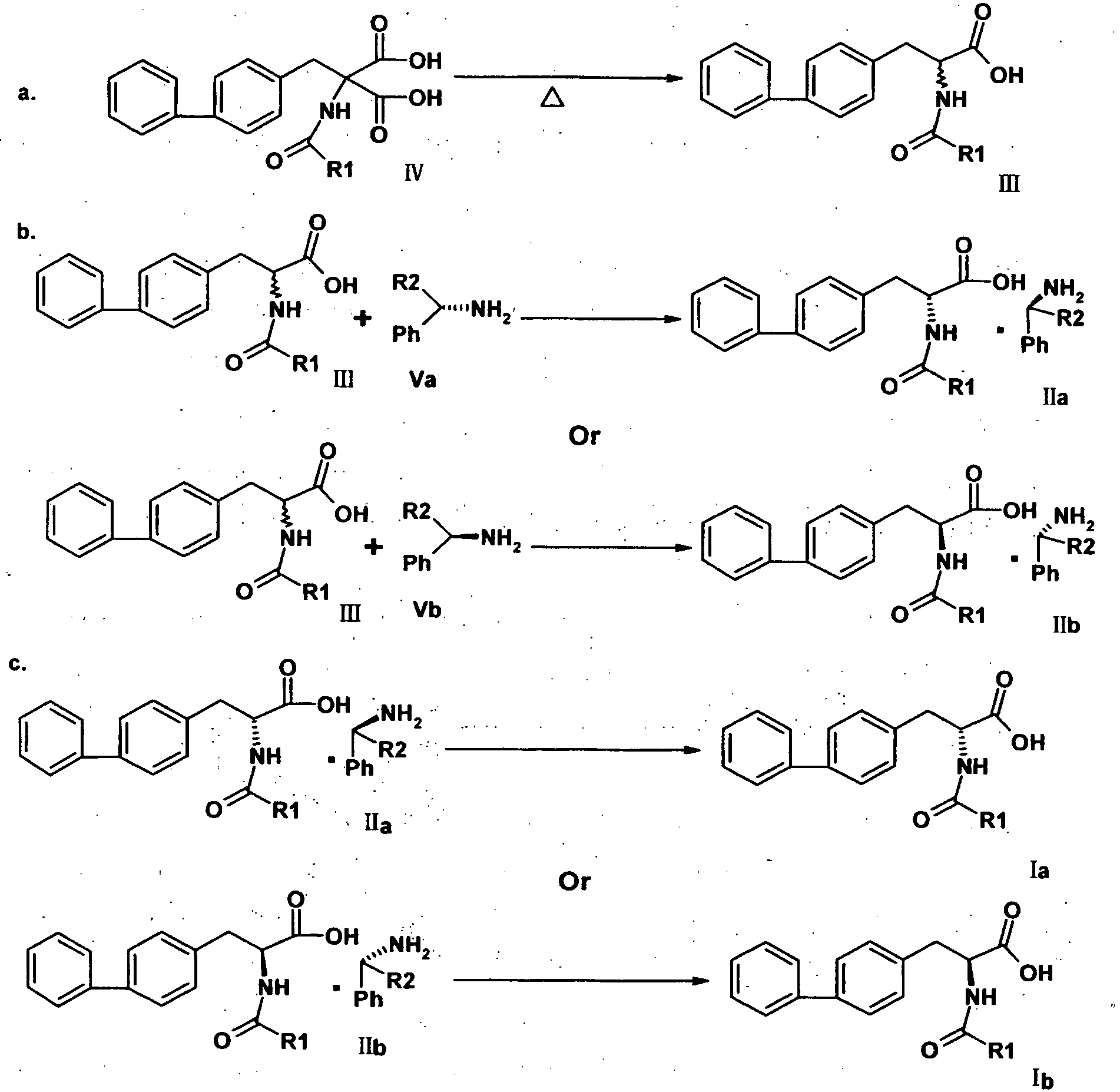
- This invention provides a method for preparing a N-acylbiphenyl alanine of formula (I), as defined herein. The new process, according to the present invention, for producing a chiral compound according to formula (I), is summarized in Scheme 2, wherein
- steps a), b) and c) are as defined herein;
- compounds of formula (I), (II), (III) and (IV) are as defined herein; and
- "*" means a chiral center with absolute stereochemistry (R) or (S),

- In one embodiment, the process of the present invention provides a compound of formula (Ia), as summarized in Scheme 3, wherein
- steps a), b) and c) are as defined herein; and
- compounds of formula (Ia), (IIa), (III) and (IV) are as defined herein.

- In another embodiment, the process of the present invention provides a compound of formula (Ib), as summarized in Scheme 4, wherein
- steps a), b) and c) are as defined herein; and
- compounds of formula (Ib), (IIb), (III) and (IV) are as defined herein.
- A chiral compound of formula (I) can be converted into a neutral endopeptidase (NEP) inhibitors, for example, as described in the Journal of Medicinal Chemistry, 1995, Vol. 38, No. 10, 1691, and the patent documents cited hereinbefore.
- In a first embodiment the present invention relates to a method for preparing a compound of formula (III), or salt thereof,

R1 is C1-C7-alkyl, such as methyl or ethyl; or is unsubstituted C6-C10-aryl such as phenyl; or is C6-C10-aryl substituted by one or more substituents independently selected from C1-C7-alkyl, C1-C7-alkoxy-C1-C7-alkyl, C1-C7-alkoxy or halo, such as para-chlorophenyl;
consisting of
reacting a compound of formula (IV), or salt thereof,
under decarboxylation reaction conditions which are achieved by heating,
to provide the compound of formula (III). - Step a) may be carried out in solvents generally known in the art, for example, in the presence of a solvent, (named solvent 1), selected from water, toluene, xylene, ethylbenzene, chlorobenzene, dichlorobenzene, nitrobenzene, N,N-dimethyl formamide (DMF) and 1-methyl-2-pyrrolidone (NMP). The amount of said solvent 1 is, for example, 0 to 50 times the feed amount (by weight) of the compound of formula IV, as defined herein.
- Typically, decarboxylation reaction conditions are achieved by heating, in particular, step a is carried out at a reaction temperature of from 80 deg C to 250 deg C. In one embodiment, step a) is carried out at the reflux temperature of solvent 1, as defined herein.
- In one embodiment, the reaction time for step a) is of from 2 to 48 hours.
- In a further embodiment, the present invention relates to a method for preparing a chiral compound of formula (II),

R1 is C1-C7-alkyl, such as methyl or ethyl; or is unsubstituted C6-C10-aryl such as phenyl; or is C6--C10-aryl substituted by one or more substituents independently selected from C1-C7-alkyl, C1-C7-alkoxy-C1-C7-alkyl, C1-C7-alkoxy or halo, such as para-chlorophenyl;
R2 is C1-7alkyl, such as methyl; or is R3R4NC(=O)- or R5OC(=O)-, wherein R3 and R4 are independently selected from hydrogen or C1-7alkyl; and R5 is C1-7alkyl;
R6 is C6-10aryl, such as phenyl, and
"*" means a chiral center with absolute stereochemistry (R) or (S),
comprising
reacting
a compound of formula (III), or salt thereof,
with a chiral amine of formula (V)
"*" means a chiral center with absolute stereochemistry (R) or (S);
and resolving the resulting diastereomeric mixture via crystallization
to provide the compound of formula (II). - A chiral compound of formula (II), as defined herein, means a compound having the formula

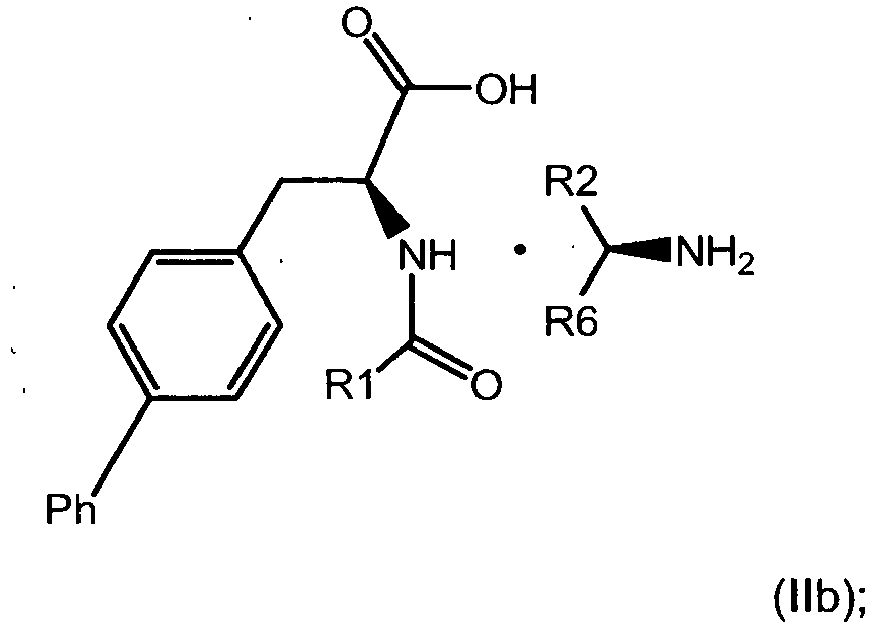


- In a further embodiment, the present invention relates to a method for preparing a chiral compound of formula (IIa),

R1 is C1-C7-alkyl, such as methyl or ethyl; or is unsubstituted C6-C10-aryl such as phenyl; or is C6-C10-aryl substituted by one or more substituenis independently selected from C1-C7-alkyl, C1-C7-alkoxy-C1-C7-alkyl, C1-C7-alkoxy or halo, such as para-chlorophenyl;
R2 is C1-7alkyl, such as methyl; or is R3R4NC(=O)- or R50C(=O)-, wherein R3 and R4 are independently selected from hydrogen or C1-7alkyl; and R5 is C1-7alkyl; and
R6 is C6-10aryl, such as phenyl;
comprising
reacting
a compound of formula (III), or salt thereof,
with a chiral amine of formula (Va)
and resolving the resulting diastereomeric mixture via crystallization
to provide the compound of formula (II). - In a further embodiment, the present invention relates to a method for preparing a chiral compound of formula (IIb),
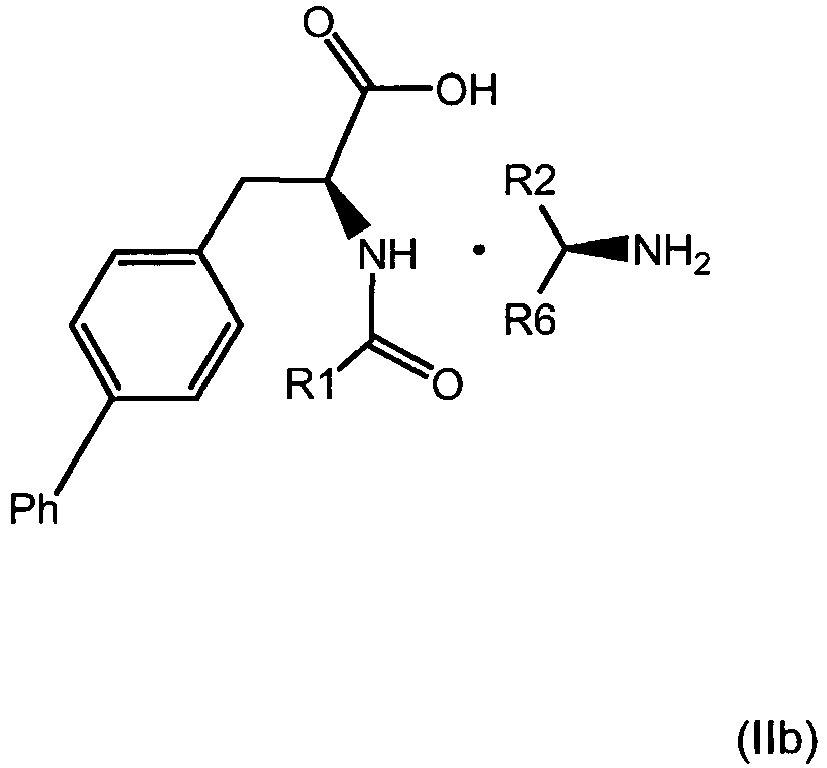
R1 is C1-C7-alkyl, such as methyl or ethyl; or is unsubstituted C6-C10-aryl such as phenyl; or is C6-C10-aryl substituted by one or more substituents independently selected from C1-C7-alkyl, C1-C7-alkyl, C1-C7-alkoxy-C1-C7-alkyl, C1-C7-alkoxy or halo, such as para-chlorophenyl;
R2 is C1-7alkyl, such as methyl; or is R3R4NC(=O)- or R5OC(=O)-, wherein R3 and R4 are independently selected from hydrogen or C1-7alkyl; and R5 is C1-7alkyl;
R6 is C6-10aryl, such as phenyl;
comprising
reacting
a compound of formula (III), or salt thereof,
with a chiral amine of formula (Vb)
and resolving the resulting diastereomeric mixture via crystallization
to provide the compound of formula (IIb). - The reactions described above are carried out in solvents generally known in the art, for example, a solvent (named solvent 2) selected from methanol, ethanol, isopropanol and aqueous solutions thereof. And the solvent added for the crystallization can be different from that added in the preparation of a compound of formula (III). The feed amount (by weight) of solvent 2 is for example, 10 to 50 times the amount of the compound of formula (III), as defined herein.
- In particular, step b is carried out at a reaction temperature of from -10 deg C to 40 deg C. In particular the crystallization is carried out at a temperature of from 0 to 40 deg C.
- Typically, in step b) the molar ratio of the 2-acylamino-3-biphenyl propanoic acid compound of formula (III), as defined herein, to the compound of formula (V), (Va) or (Vb) as defined herein, is 1.0 : (0.5 to 3.0).
- In a further embodiment, the present invention relates to a method for preparing a chiral compound of formula (I), or salt thereof,

R1 is C1-C7-alkyl, such as methyl or ethyl; or is unsubstituted C6-C10-aryl such as phenyl; or is C6-C10-aryl substituted by one or more substituents independently selected from C1-C7-alkyl, C1-C7-alkoxy-C1-C7-alkyl, C1-C7-alkoxy or halo, such as para-Chlorophenyl;
"*" means a chiral center with absolute stereochemistry (R) or (S),
comprising
treating a chiral compound of formula (II),
R1 is C1-C7-alkyl, such as methyl or ethyl; or is unsubstituted C6-C10-aryl such as phenyl; or is C6-C10-aryl substituted by one or more substituents independently selected from C1-C7-alkyl, C1-C7-alkoxy-C1-C7-alkyl, C1-C7-alkoxy or halo, such as para-Chlorophenyl;
R2 is C1-7alkyl, such as methyl; or is R3R4NC(=O)- or R50C(=O)-, wherein R3 and R4 are independently selected from hydrogen or C1-7alkyl; and R5 is C1-7alkyl;
R6 is C6-10aryl, such as phenyl, and
"*" means a chiral center with absolute stereochemistry (R) or (S),
with an acidic reagent
to provide the compound of formula (I). - In a still further embodiment, the present invention relates to a method for preparing a compound of formula (Ia), or salt thereof,

R1 is C1-C7-alkyl, such as methyl or ethyl; or is unsubstituted C6-C10-aryl such as phenyl; or is C6-C10-aryl substituted by one or more substituents independently selected from C1-C7-alkyl, C1-C7-alkoxy-C1-C7-alkyl, C1-C7-alkoxy or halo, such as para-chlorophenyl;
comprising
treating a compound of formula (IIa),
R1 is C1-C7-alkyl, such as methyl or ethyl; or is unsubstituted C6-C10-aryl such as phenyl; or is C6-C10-aryl substituted by one or more substituents independently selected from C1-C7-alkyl, C1-C7-alkoxy-C1-C7-alkyl, C1-C7-alkoxy or halo, such as para-chlorophenyl;
R2 is C1-7alkyl, such as methyl; or is R3R4NC(=O)- or R5OC(=O)-, wherein R3 and R4 are independently selected from hydrogen or C1-7alkyl; and R5 is C1-7alkyl, and
R6 is C6-10aryl, such as phenyl;
with an acidic reagent
to provide the compound of formula (I). - In a still further embodiment, the present invention relates to a method for preparing a compound of formula (Ib), or salt thereof,

R1 is C1-C7-alkyl, such as methyl or ethyl; or is unsubstituted C6-C10-aryl such as phenyl; or is C6-C10-aryl substituted by one or more substituents independently selected from C1-C7-alkyl, C1-C7-alkoxy-C1-C7-alkyl, C1-C7-alkoxy or halo, such as para-chlorophenyl;
comprising
treating a compound of formula (IIb),
R1 is C1-C7-alkyl, such as methyl or ethyl; or is unsubstituted C6-C10-aryl such as phenyl; or is C6-C10-aryl substituted by one or more substituents independently selected from C1-C7-alkyl, C1-C7-alkoxy-C1-C7-alkyl, C1-C7-alkoxy or halo, such as para-chlorophenyl;
R2 is C1-7alkyl, such as methyl; or is R3R4NC(=O)- or R5OC(=O)-, wherein R3 and R4 are independently selected from hydrogen or C1-7alkyl; and R5 is C1-7alkyl, and
R6 is C6-10aryl, such as phenyl;
with an acidic reagent
to provide the compound of formula (Ib). - Typically, the acidic reagent is an inorganic acid or an organic acid, such as hydrochloric acid, sulfuric acid, phosphoric acid, oxalic acid, citric acid, formic acid or acetic acid.
- Typically, step c) is carried out in solvents generally known in the art, for example, a solvent, (named solvent 3), selected from water, methanol, ethanol, isopropanol and tetrahydrofuran. The amount of said solvent 3 is, for example, 2 to 20 times the feed amount (by weight) of the compound of formula II, as defined herein.
- In particular, step c is carried out at a reaction temperature of from 10 deg C to 95 deg C.
- In one embodiment, the reaction time for step c) is of from 10 min to 5 hours.
- Typically, in step c) the molar ratio of the compound of formula (II), as defined herein, to the acidic reagent is 1.0 : (1.0 to 4.0).
- In a further aspect, the present invention relates to a method for preparing a compound of formula (I), (Ia) or (Ib), as defined herein, or salt thereof, comprising
- i) step a), as described above;
- ii) step b), as described above; and
- iii) step c) as described above.
- In a still further aspect, the present invention relates to a method for preparing a compound of formula (I), (Ia) or (Ib), as defined herein, or salt thereof, comprising
- iv) step b), as described above; and
- v) step c) as described above.
- Embodiment 1: A process for preparing and resolving a 2-acylamino-3-biphenyl propanoic acid compound of formula III, which is characterized in that it is comprised of the following steps:
R1 is an alkyl group, a phenyl; or phenyl containing substituting group;
R2 is methyl or a group featuring the following structure:
R5 is an alkyl group. - Embodiment 2: A process for preparing and resolving the 2-acylamino-3-biphenyl propanoic acid compound according to embodiment 1, which is characterized in that said alkyl is preferably methyl, ethyl, propyl or isopropyl; said phenyl containing substituting group is preferably para-chlorophenyl.
- Embodiment 3: A process for preparing and resolving the 2-acylamino-3-biphenyl propanoic acid compound according to embodiment 1 or 2, which is characterized in that step a is carried out by heating to a temperature of from 80 deg C to 250 deg C.
- Embodiment 4: A process for preparing and resolving the 2-acylamino-3-biphenyl propanoic acid compound according to embodiment 1 or 2, which is characterized in that during step a, the compound of formula IV reacts at reflux temperature a in solvent 1 to provide said 2-acylamino-3-biphenyl propanoic acid compound.
- Embodiment 5: A process for preparing and resolving the 2-acylamino-3-biphenyl propanoic acid compound according to embodiment 4, which is characterized in that said solvent 1 is selected from water, toluene, xylene, ethylbenzene, chlorobenzene, dichlorobenzene, nitrobenzene, N, N-dimethyl formamide and 1-methyl-2-pyrrolidone.
- Embodiment 6: A process for preparing and resolving the 2-acylamino-3-biphenyl propanoic acid compound according to embodiment 1, which is characterized in that during step b said 2-acylamino-3-biphenyl propanoic acid compound is reacted with a compound of formula Va or Vb in solvent 2 to obtain the crude wet compound of formula IIa or IIb.
- Embodiment 7: A process for preparing and resolving the 2-acylamino-3-biphenyl propanoic acid compound according to embodiment 1, which is characterized in that during step b, said 2-acylamino-3-biphenyl propanoic acid compound reacts with a compound of formula Va or Vb in solvent 2 at a specific temperature to obtain the crude wet compound of formula IIa or IIb.
- Embodiment 8: A process for preparing and resolving the 2-acylamino-3-biphenyl propanoic acid according to embodiment 7, which is characterized in that the said reaction takes place at a temperature of from -10 deg C to 40 deg C.
- Embodiment 9: A process for preparing and resolving the 2-acylamino-3-biphenyl propanoic acid compound according to embodiment 7, which is characterized in that the crude wet compound of formula IIa or IIb is added with solvent 2 to make it crystallize at a specific temperature and obtain the solid compound of formula IIa or IIb.
- Embodiment 10: A process for preparing and resolving the 2-acylamino-3-biphenyl propanoic acid compound according to embodiment 9, characterized in that the said crystallization takes place at a temperature of from 0 deg C to 40 deg C.
- Embodiment 11: A process for preparing and resolving the 2-acylamino-3-biphenyl propanoic acid compound according to any one of embodiments 6, 7, 8, 9 or 10, which is characterized in that said solvent 2 can be methanol, ethanol, isopropanol, or their respective aqueous solutions.
- Embodiment 12: A process for preparing and resolving the 2-acylamino-3-biphenyl propanoic acid compound according to embodiments 1 or 2, which is characterized in that during step b, the molar ratio of the 2-acylamino-3-biphenyl propanoic acid compound to the compound of formula Va or Vb is 1.0 : (0.5 to 3.0).
- Embodiment 13: A process for preparing and resolving the 2-acylamino-3-biphenyl propanoic acid compound according to embodiments 1 or 2, which is characterized in that the step c is carried out by adding an acidic reagent to obtain the compound of formula la or Ib.
- Embodiment 14: A process for preparing and resolving the 2-acylamino-3-biphenyl propanoic acid compound according to embodiment 13, which is characterized in that the acidic reagent is selected from hydrochloric acid, sulphuric acid, phosphoric acid, oxalic acid, citric acid, formic acid and acetic acid.
- Embodiment 15: A process for preparing and resolving the 2-acylamino-3-biphenyl propanoic acid compound according to embodiment 14, which is characterized in that the molar ratio of the compound of formula IIa or IIb to the acidic reagent is 1.0 : (1.0 to 4.0).
- Listed below are definitions of various terms used to describe the present invention. These definitions, either by replacing one, more than one or all general expressions or symbols used in the present disclosure and thus yielding preferred embodiments of the invention, preferably apply to the terms as they are used throughout the specification unless they are otherwise limited in specific instances either individually or as part of a larger group.
- Alkyl being a radical or part of a radical is a straight or branched (one or, if desired and possible, more times) carbon chain, and is especially C1-C7-alkyl, such as C1-C4-alkyl, in particular branched C1-C4-alkyl, such as isopropyl. The term "lower" or "C1-C7-" defines a moiety with up to and including maximally 7, especially up to and including maximally 4, carbon atoms, said moiety being branched (one or more times) or straight-chained and bound via a terminal or a non-terminal carbon. Lower or C1-C7-alkyl, for example, is n-pentyl, n-hexyl or n-heptyl or preferably C1-C4-alkyl, such as methyl, ethyl, n-propyl, sec-propyl, n-butyl, isobutyl, sec-butyl, tert-butyl, in particular methyl, ethyl, n-propyl, iso-propyl, n-butyl, isobutyl, sec-butyl, tert-butyl. In particular, C1-C7-alkyl is methyl, ethyl, propyl, or isopropyl. In one embodiment C1-C7-alkyl is methyl or ethyl.
- Aryl, as a radical or part of a radical, for example is a mono- or bicyclic aryl with 6 to 22 carbon atoms, such as phenyl, indenyl, indanyl or naphthyl, in particular phenyl. Substituted C6-10aryl is, for example, C6-10aryl substituted by one or more substituents (for example one to three substituents) independently selected from, for example, C1-C7-alkyl, C1-C7-alkoxy-C1-C7-alkyl, C1-C7-alkoxy and halo. In one embodiment, substituted C6-10aryl is C6-10aryl substituted by halo, such as para-chlorophenyl.
- Alkoxy, as a radical or part of a radical, is, for example, C1-C7-alkoxy and is, for example, methoxy, ethoxy, n-propyloxy, isopropyloxy, n-butyloxy, isobutyloxy, sec-butyloxy, tert-butyloxy and also includes corresponding pentyloxy, hexyloxy and heptyloxy radicals. C1-C4alkoxy is preferred.
- Halo or halogen is preferably fluoro, chloro, bromo or iodo, most preferably chloro.
- In the formulae of the present application the term "" on a C-sp3 indicates the absolute stereochemistry, either (R) or (S).

- In the formulae of the present application the term "" on a C-sp3 indicates the absolute stereochemistry, either (R) or (S).

- In the formulae of the present application the term "" on a C-sp3 represents a racemic mixture, thus it means a chiral center wherein the (S) stereoisomer and the (R) stereoisomer are in a 50:50 ratio.

- In the formulae of the present application the term "Ph" means phenyl.
- The term "chiral", as used herein, refers to molecules which have the property of non-superimposability on their mirror image partner, while the term "achiral" refers to molecules which are superimposable on their mirror image partner. Any possible pure enantiomer or mixture of enantiomers, pure diastereoisomer or mixture of diasteromer are encompassed by the present invention. In one embodiment the term chiral refers to an entiomerically enriched mixture of enantiomers. The term "enantiomerically enriched", as used herein, refers to a mixture of enantiomers wherein the amount of one enantiomer is higher than 50%. In another embodiment the term chiral refers to a diasteromerically enriched mixture of diasteromers. The term "diasteromerically enriched", as used herein, refers to a mixture of diasteromers wherein the amount of one diasteromer is higher than 50%.
- In a further embodiment the term chiral, as used herein, refers to a "diastereomeric mixture", in particular, a mixture of diastereoisomers (R, R*) and (S, R*) or (R, S*) and (S, S*), wherein R and S refer to the absolute configuration of the asymmetric carbon of a carboxyl group containing molecule and R* and S* refer to the absolute configuration of the asymmetric carbon of an amine containing molecule. A compound of formula (II) may thus be a diasteromeric mixture as defined herein.
- The term "crystallization", as used herein, refers to a process by which a single diastereoisomer is preferentially crystallized out from a diastereoisomeric mixture, as defined herein. Thus, crystallization refers, in one embodiment, to the process of preferentially crystallizing out the diastereoisomer (R, R*) or (S, R*) from the mixture (R, R*) and (S, R*), as defined above. In another embodiment, crystallization refers to the process of preferentially crystallizing out the diastereoisomer (R, S*) or (S, S*) from the mixture (R,S*) and (S,S*), as defined above.
- The term "resolving", as employed herein, refers to converting a 50:50 mixture of diastereoisomers (R,R*) and (S,R*) or (R, S*) and (S,S*), as defined above, in a mixture enriched in either one of the diastereoisomers. An enriched mixture is thus one that contains a higher abundance or proportion of one diastereoisomer over the other.
- The term "reflux" refers to the temperature at which the reaction mixture boils, preferably a temperature up to 180 °C, preferably up to 140 °C.
- As used herein, the term "room temperature" or "ambient temperature" means a temperature of from 20 to 35 °C, such as of from 20 to 25 °C.
- In view of the close relationship between the compounds and intermediates in free form and in the form of their salts, including those salts that can be used as intermediates, for example in the purification or identification of the compounds or salts thereof, any reference to "compounds", "starting materials" and "intermediates" hereinbefore and hereinafter, is to be understood as referring also to one or more salts thereof or a mixture of a corresponding free compound, intermediate or starting material and one or more salts thereof, each of which is intended to include also any solvate, metabolic precursor such as ester or amide, or salt of any one or more of these, as appropriate and expedient and if not explicitly mentioned otherwise. Different crystal forms may be obtainable and then are also included. Salts can be formed where salt forming groups, such as basic or acidic groups, are present that can exist in dissociated form at least partially, e.g. in a pH range from 4 to 10 in aqueous solutions, or can be isolated especially in solid, especially crystalline, form. In the presence of basic groups (e.g. imino or amino), salts may be formed preferably with organic or inorganic acids. Suitable inorganic acids are, for example, halogen acids, such as hydrochloric acid, sulfuric acid, or phosphoric acid. Suitable organic acids are, for example, carboxylic, phosphonic, sulfonic or sulfamic acids, for example acetic acid, propionic acid, lactic acid, fumaric acid, succinic acid, citric acid, amino acids, such as glutamic acid or aspartic acid, maleic acid, hydroxymaleic acid, methylmaleic acid, benzoic acid, methane- or ethane-sulfonic acid, ethane-1,2-disulfonic acid, benzenesulfonic acid, 2-naphthalenesulfonic acid, 1,5-naphthalene-disulfonic acid, N-cyclohexylsulfamic acid, N-methyl-, N-ethyl- or N-propyl-sulfamic acid, or other organic protonic acids, such as ascorbic acid. In the presence of negatively charged radicals, such as carboxy or sulfo, salts may be formed with bases, e.g. metal or ammonium salts, such as alkali metal or alkaline earth metal salts, for example sodium, potassium, magnesium or calcium salts, or ammonium salts with ammonia or suitable organic amines, such as tertiary monoamines, for example triethylamine or tri(2-hydroxyethyl)amine, or heterocyclic bases, for example N-ethyl-piperidine or N,N'-dimethylpiperazine. When a basic group and an acid group are present in the same molecule, internal salts may also be formed. Particularly useful salts include the hydrochloric acid, hydrobromic acid, sulfuric acid, nitric acid, phosphoric, lactic acid, fumaric acid, succinic acid, oxalic acid, malic acid, malonic acid, tartaric acid, tolyltartaric acid, benzoyltartaric acid, orotic acid, nicotinic acid, methanesulfonic acid or 4-methylbenzenesulfonic acid salts of compounds of formula (I), (III) or (IV) and the like formed from reaction with the above reagents. Methods to prepare acid addition salts are described in the literature, for example, in the relevant chapters of "CRC Handbook of Optical Resolutions via Diasteromeric Salt Formation", D. Kozma, CRC Press 2002, in Acta Cryst, 2006, B62, 498-505 and in Synthesis, 2003, 13, 1965-1967.
- Where the plural form is used for compounds, starting materials, intermediates, salts, pharmaceutical preparations, diseases, disorders and the like, this is intended to mean one (preferred) or more single compound(s), salt(s), pharmaceutical preparation(s), disease(s), disorder(s) or the like, where the singular or the indefinite article ("a", "an") is used, this is not intended to exclude the plural, but only preferably means "one".
- Particular embodiments of the invention are provided in the following Examples. These Examples serve to illustrate the invention without limiting the scope thereof, while they on the other hand represent preferred embodiments of the reaction steps, intermediates and/or the process of the present invention.
-
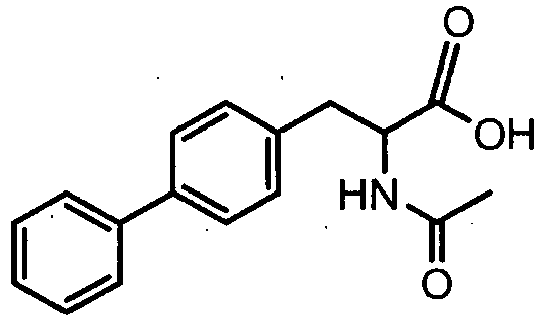
- In a dry and clean reaction bottle, add 40 g of 2-acetylamino-2- (4-phenyl benzyl) malonic acid. Add 1000 ml of water and maintain at reflux temperature for 48 hours. Test for completion of reaction with HPLC. Cool down to room temperature and vacuum filtrate it. Dry in an oven at 90 to 100 deg C and normal pressure. After drying, obtain 31.1 g of 2-acetylamino-3-biphenyl propanoic acid. Yield ratio: 89.9%. 1H NMR (500MHz,DMSO-d6):1.82, 2.89-2.93, 3.08-3.12, 4.45-4.50, 7.33-7.37,7.44-7.47, 7.58-7.60, 7.64-7.66, 8.26-8.28, 12.75; MS(m/z):224.07(100),167.14(56),165.16(26),282.94([MH+],1).
-

- Take 20 g of 2- (N-para-chlorobenzoyl) amino-2- (4-phenyl benzyl) malonic acid, and place in a drying oven at 105 deg C and normal pressure for 12 hours. Test for completion of reaction with HPLC. Obtain 16.4 g of the dry product, 2- (N-para-chlorobenzoyl) amino-3-biphenyl propanoic acid. Yield ratio: 94.8%. 1 H NMR (500MHz,DMSO-d6):3.12-3.17, 3.25-3.29, 4.66-4.71, 7.32-7.35, 7.42-7.45, 7.54-7.57, 7.58-7.60, 7.62-7.64, 7.86-7.88, 8.89-8.91, 12.963; MS(m/z):224.0(100),167.1(55),165.1(21),139.1(10),111.1(5),378.8([MH+],1).
-

- In a dry and clean reaction bottle, add 20 g of 2-acetylamino-2- (4-phenyl benzyl) malonic acid. Add 100 ml of xylene and maintain at reflux temperature for 3 hours. Test for completion of reaction with HPLC. Cool down to room temperature and vacuum filtrate it. Dry in an oven at 90 to 100 deg C and normal pressure. After drying, obtain 15.6 g of 2-acetylamino-3-biphenyl propanoic acid. Yield ratio: 90.2%. Spectroscopic data as Example 1.
-

- In a clean and dry reaction bottle, add 40 g of 2-(N-formyl phenyl) amino-2 (phenyl benzyl) malonic acid. Add 2100 ml of N, N-dimethyl formamide (DMF) and maintain at reflux temperature for 40 hours. Test for completion of reaction with HPLC. Cool down to room temperature and vacuum filtrate it. Dry in an oven at 90 to 100 deg C and normal pressure. After drying, obtain 32.8 g of 2-(N-formyl phenyl) amino-3-biphenyl propanoic acid. Yield ratio: 92.8%. 1H NMR (500MHz,DMSO-d6): 3.12-3.17, 3.23-3.27, 4.65-4.70, 7.31-7.33, 7.34-7.45, 7.46-7.48, 7.58-7.60, 7.62-7.64, 7.83-7.84, 8.77-8.79, 12.85; MS(m/z):224.0(100),167.1(34),165.1(15),105.1(10),77.2(18),344.8([MH+],1).
-

- In a clean and dry reaction bottle, add 20g of (2-(N-isopropyl formyl) amino-2 (phenyl benzyl) malonic acid. Add 200 ml of 1,3-dichlorobenzene, heat to reflux temperature and maintain temperature for 25 hours. Test for completion of reaction with HPLC. Cool down to room temperature and vacuum filtrate it. Dry in an oven at 90 to 100 deg C and normal pressure. After drying, obtain 16.3 g of 2-(N-isopropyl formyl) amino-3-biphenyl propanoic acid. Yield ratio: 94.2%. 1H NMR (500MHz,DMSO-d6): 0.87-0.88, 2.37-2.43, 2.89-2.94, 3.09-3.13, 4.44-4.48, 7.31-7.36, 7.43-7.46, 7.57-7.59, 7.63-7.65, 8.01-8.08, 12.71; MS(m/z):224.0(100),167.1(38),165.2(16),310.9([MH+],1).
-

- In a dry and clean reaction bottle, add 20 g of 2-propionyl amino-2-(4-benzyphenyl) malonic acid. Add 100ml of nitrobenzene, heat to reflux temperature, and maintain temperature for 2 hours. Test for completion of reaction with HPLC. Cool down to room temperature and vacuum filtrate it. Dry in an oven at 90 to 100 deg C and normal pressure. After drying, obtain 15.8 g of 2-propionyl amino-3-biphenyl propanoic acid. Yield ratio: 92.1%. 1 H NMR (500MHz,DMSO-d6): 0.93, 2.06-2.11, 2.88-2.93, 3.08-3.12, 4.44-4.49, 7.32-7.36, 7.44-7.47, 7.58-7.59, 7.64-7.66, 8.15-8.16, 12.72; MS(m/z): 224.0(100),167.1(45),165.1(20),296.9([MH+],1).
-

- In a dry and clean reaction bottle, add 20 g of 2-butyryl amino-2-(4-benzyphenyl) malonic acid. Add 100 ml of 1-methyl-2-pyrrolidone (NMP), heat to reflux temperature, maintain temperature for 15 hours. Test for completion of reaction with HPLC. Cool down to room temperature and vacuum filtrate it. Dry in an oven at 90 to 100 deg C and normal pressure. After drying, obtain 16.0 g of 2-butyryl amino-3-biphenyl propanoic acid. Yield ratio: 93.5%. 1H NMR (500MHz,DMSO-d6): 0.74-0.77, 1.42-1.46, 2.03-2.06, 2.87-2.92, 3.09-3.12, 4.46-4.51, 7.32-7.36, 7.43-7.47, 7.56-7.59, 7.63-7.65, 8.16-8.18, 12.70; MS(m/z):224.0(100),167.1(39),165.2(16),310.9([MH+],1).
-

- In a dry and clean reaction bottle, add 40g of 2-acetylamino-2-(4-benzyphenyl) malonic acid. Add 5 ml of ethylbenzene and maintain temperature at 80 deg C for 48 hours. Test for completion of reaction with HPLC. Cool down to room temperature and vacuum filtrate it. Dry in an oven at 90 to 100 deg C and normal pressure. After drying, obtain 30.5 g of 2-acetylamino-3-biphenyl propanoic acid. Yield ratio: 87.6%. Spectroscopic data as Example 1.
-

- Take 20 g of 2-butyryl amino-2- (4-phenyl benzyl) malonic acid, and place in a drying oven at 165 deg C and normal pressure for 18 hours. Test for completion of reaction with HPLC. Obtain 14.3 g of dry product of 2-butyryl amino-3-biphenyl propanoic acid. Yield ratio: 90.3%. Spectroscopic data as Example 7.
-

- Take 20 g of 2- (N-formyl phenyl) amino-2-(4-phenyl benzyl) malonic acid, and place in a drying oven at 80 deg C and normal pressure for 12 hours. Test for completion of reaction with HPLC. Obtain 12.7 g of the product, 2- (N-formyl phenyl) amino-3-biphenyl propanoic acid. Yield ratio: 91.7%. Spectroscopic data as Example 4.
-

- Take 20 g of 2-propionyl amino-2-(4-phenyl benzyl) malonic acid, and place in a drying oven at 250 deg C and normal pressure for 12 hours. Test for completion of reaction with HPLC. Obtain 15.4 g of dry product of 2-propionyl amino-3-biphenyl propanoic acid. Yield ratio: 89.8%. Spectroscopic data as Example 6.
- The products from the examples above (1∼11) are used as reactants in the subsequent reaction step (step b).
- In a dry and clean reaction bottle, add 300 ml of ethanol and 10 g of 2-acetylamino-3-biphenyl propanoic acid. Heat to increase temperature and dissolve the compound. Add 4 g of S-1-phenethylamine. Slowly cool down to 10 deg C. Maintain temperature for 0.5 hours. Vacuum filtrate it. Obtain crude wet product of (D)-2-acetylamino-3-biphenyl propanoic acid-(S)-1-phenethylamine salt.
- Then, add the crude wet product of (D)-2-acetylamino-3-biphenyl propanoic acid-(S)-1-phenethylamine salt to a dry and clean reaction bottle. Add 100 ml of ethanol. Heat to increase temperature to reflux. Slowly cool down to 0 deg C. Vacuum filtrate it. Dry in a drying oven for 8 hours at 50 to 60 deg C. Obtain 5.7 g of the product. Yield ratio: 39.9%.
- In a dry and clean reaction bottle, add 300 ml of methanol and 10 g of 2-acetylamino-3-biphenyl propanoic acid. Heat to increase temperature and dissolve the compound. Add 3 g of S-1-phenethylamine. Slowly cool down to 30 deg C. Maintain temperature for 0.5 hours. Vacuum filtrate it. Obtain crude wet product of (D)-2-acetylamino-3-biphenyl propanoic acid-(S)-1-phenethylamine salt.
- Then, add the crude wet product of (D)-2-acetylamino-3-biphenyl propanoic acid-(S)-1-phenethylamine salt to a dry and clean reaction bottle. Add 100 ml of methanol. Heat to increase temperature to reflux. Slowly cool down to 30 deg C. Vacuum filtrate it. Dry in a drying oven for 8 hours at 50 to 60 deg C. Obtain 5.5 g of the product. Yield ratio: 38.5%.
- In a dry and clean reaction bottle, add 300 ml of ethanol, 30 ml of tap water, and 10 g of 2-acetylamino-3-biphenyl propanoic acid. Heat to increase temperature and dissolve the compound. Add 3 g of S-1-phenethylamine. Slowly cool down to 35 deg C. Maintain temperature for 1 hours. Vacuum filtrate it. Obtain crude wet product of (D)-2-acetylamino-3-biphenyl propanoic acid-(S)-1-phenethylamine salt.
- Then, add the crude wet product of (D)-2-acetylamino-3-biphenyl propanoic acid-(S)-1-phenethylamine salt to a dry and clean reaction bottle. Add 100 ml of ethanol. Heat to increase temperature to reflux. Slowly cool down to 35 deg C. Vacuum filtrate it. Dry in a drying oven for 8 hours at 50 to 60 deg C. Obtain 5.8 g of the product. Yield ratio: 40.6%.
- In a dry and clean reaction bottle, add 634ml of ethanol and 10 g of 2-acetylamino-3-biphenyl propanoic acid. Heat to increase temperature and dissolve the compound. Add 12.7 g of R-1-phenethylamine. Slowly cool down to 15 deg C. Maintain temperature for 0.5 hours. Vacuum filtrate it. Obtain crude wet product of (L)-2-acetylamino-3-biphenyl propanoic acid-(R)-1-phenethylamine salt.
- Then, add the crude wet product of (L)-2-acetylamino-3-biphenyl propanoic acid-(R)-1-phenethylamine salt to a dry and clean reaction bottle. Add 200 ml of methanol. Heat to increase temperature to reflux. Slowly cool down to 20 deg C. Vacuum filtrate it. Dry in a drying oven for 8 hours at 50 to 60 deg C. Obtain 6.0 g of the product. Yield ratio: 42.0%.
- In a dry and clean reaction bottle, add 380 ml of methanol and 10 g of 2-acetylamino-3-biphenyl propanoic acid. Heat to increase temperature and dissolve the compound. Add 9.2 g of S-2-amino 2-phenyl acetamide. Slowly cool down to 40 deg C. Maintain temperature for 0.5 hours. Vacuum filtrate it. Obtain crude wet product of (D)-2-acetylamino-3-biphenyl propanoic acid-(S)-2-amino 2-phenyl acetamide salt.
- Then, add the crude wet product of (D)-2-acetylamino-3-biphenyl propanoic acid-(S)-2-amino 2-phenyl acetamide salt to a dry and clean reaction bottle. Add 100 ml of ethanol. Heat to increase temperature to reflux. Slowly cool down to 30 deg C. Vacuum filtrate it. Dry in a drying oven for 8 hours at 50 to 60 deg C. Obtain 5.7g of the product. Yield ratio: 39.8%.
- In a dry and clean reaction bottle, add 127 ml of isopropanol, and 10 g of 2-acetylamino-3-biphenyl propanoic acid. Heat to increase temperature and dissolve the compound. Add 2.9 g of R-2-amino N-methyl 2-phenyl acetamide. Slowly cool down to -10 deg C. Maintain temperature for 1 hour. Vacuum filtrate it. Obtain crude wet product of (L)-2-acetylamino-3-biphenyl propanoic acid-(R)-2-amino N-methyl 2-phenyl acetamide salt.
- Then, add the crude wet product of (L)-2-acetylamino-3-biphenyl propanoic acid-(R)-2-amino N-methyl 2-phenyl acetamide salt to a dry and clean reaction bottle. Add 100 ml of ethanol. Heat to increase temperature to reflux. Slowly cool down to 40 deg C. Vacuum filtrate it. Dry in a drying oven for 8 hours at 50 to 60 deg C. Obtain 6.1 g of the product. Yield ratio: 42.7%.
- In a dry and clean reaction bottle, add 400 ml of ethanol and 10 g of 2-acetylamino-3-biphenyl propanoic acid. Heat to increase temperature and dissolve the compound. Add 5 g of R-2-amino N, N-dimethyl-2-phenyl acetamide. Slowly cool down to 25 deg C. Maintain temperature for 0.5 hours. Vacuum filtrate it. Obtain crude wet product of (L)-2-acetylamino-3-biphenyl propanoic acid-(R)-2-amino N, N-dimethyl-2-phenyl acetamide salt.
- Then, add the crude wet product of (L)-2-acetylamino-3-biphenyl propanoic acid-(R)-2-amino N, N-dimethyl-2-phenyl acetamide salt to a dry and clean reaction bottle. Add 100 ml of ethanol. Heat to increase temperature to reflux. Slowly cool down to 0 deg C. Vacuum filtrate it. Dry in a drying oven for 8 hours at 50 to 60 deg C. Obtain 4.9g of the product. Yield ratio: 38.7%.
- In a dry and clean reaction bottle, add 300 ml of isopropanol, 100 ml of tap water, and 10 g of 2-acetylamino-3-biphenyl propanoic acid. Heat to increase temperature and dissolve the compound. Add 3.5 g of S-amino-phenyl-acetic ether. Slowly cool down to 0 deg C. Maintain temperature for 0.5 hours. Vacuum filtrate it. Obtain crude wet product of (D)-2-acetylamino-3-biphenyl propanoic acid-(S)-amino-phenyl-ethyl acetate amine salt.
- Then, add the crude wet product of (D)-2-acetylamino-3-biphenyl propanoic acid-(S)-amino-phenyl-ethyl acetate amine salt to a dry and clean reaction bottle. Add 100 ml of methanol. Heat to increase temperature to reflux. Slowly cool down to 30 deg C. Vacuum filtrate it. Dry in a drying oven for 8 h at 50 to 60 deg C. Obtain 5.6 g of the product. Yield ratio: 39.0%.
- In a dry and clean reaction bottle, add 300 ml of methanol, 30 ml of tap water, and 10 g of 2-acetylamino-3-biphenyl propanoic acid. Heat to increase temperature and dissolve the compound. Add 10 g of S-amino-phenyl- methyl acetate. Slowly cool down to -5 deg C. Maintain temperature for 1 hours. Vacuum filtrate it. Obtain crude wet product of (D)-2-acetylamino-3-biphenyl propanoic acid-(S)-amino-phenyl- methyl acetate amine salt.
- Then, add the crude wet product of (D)-2-acetylamino-3-biphenyl propanoic acid-(S)-amino-phenyl-methyl acetate amine salt to a dry and clean reaction bottle. Add 100 ml of ethanol. Heat to increase temperature to reflux. Slowly cool down to 35 deg C. Vacuum filtrate it. Dry in a drying oven for 8 hours at 50 to 60 deg C. Obtain 6.0 g of the product. Yield ratio: 41.5%.
- In a dry and clean reaction bottle, add 300ml of ethanol and 10 g of 2-acetylamino-3-biphenyl propanoic acid. Heat to increase temperature and dissolve the compound. Add 15 g of R-amino-phenyl- isopropyl acetate amine. Slowly cool down to 20 deg C. Maintain temperature for 0.5 hours. Vacuum filtrate it. Obtain crude wet product of (L)-2-acetylamino-3-biphenyl propanoic acid-(R)-amino-phenyl- isopropyl acetate amine salt.
- Then, add the crude wet product of (L)-2-acetylamino-3-biphenyl propanoic acid-(R)-amino-phenyl- isopropyl acetate amine salt to a dry and clean reaction bottle. Add 100 ml of ethanol. Heat to increase temperature to reflux. Slowly cool down to 20 deg C. Vacuum filtrate it. Dry in a drying oven for 8 hours at 50 to 60 deg C. Obtain 5.2g of the product. Yield ratio: 36.5%.
- In a dry and clean reaction bottle, add 400 ml of ethanol and 10 g of 2-propionyl amino-3-biphenyl propanoic acid. Heat to increase temperature and dissolve the compound. Add 5 g of R-2-amino N, N-dimethyl-2-phenyl acetamide. Slowly cool down to 25 deg C. Maintain temperature for 0.5 hours. Vacuum filtrate it. Obtain crude wet product of (L)-2-propionyl amino-3-biphenyl propanoic acid-(R)-2-amino N, N-dimethyl-2-phenyl-acetamide salt.
- Then, add the crude wet product of (L)-2-propionyl amino-3-biphenyl propanoic acid-(R)-2-amino N, N-dimethyl-2-phenyl-acetamide salt to a dry and clean reaction bottle. Add 100 ml of ethanol. Heat to increase temperature to reflux. Slowly cool down to 0 deg C. Vacuum filtrate it. Dry in a drying oven for 8 hours at 50 to 60 deg C. Obtain 4.8 g of the product. Yield ratio: 32.7%.
- In a dry and clean reaction bottle, add 300 ml of isopropanol, 100 ml of tap water, and 10 g of 2-butyryl amino-3-biphenyl propanoic acid. Heat to increase temperature and dissolve the compound. Add 3.5 g of S-amino-phenyl-ethyl acetate. Slowly cool down to 0 deg C. Maintain temperature for 0.5 hours. Vacuum filtrate it. Obtain crude wet product of (D)-2-butyryl amino-3-biphenyl propanoic acid-(S)-amino-phenyl-ethyl acetate amine salt.
- Then, add the crude wet product of (D)-2-butyryl amino-3-biphenyl propanoic acid-(S)-amino-phenyl-ethyl acetate amine salt to a dry and clean reaction bottle. Add 100 ml of methanol. Heat to increase temperature to reflux. Slowly cool down to 30 deg C. Vacuum filtrate it. Dry in a drying oven for 8 hours at 50 to 60 deg C. Obtain 4.3 g of the product. Yield ratio: 31.5%.
- In a dry and clean reaction bottle, add 300 ml of methanol, 30 ml of tap water, and 10 g of 2-(N-formyl phenyl) amino-3-biphenyl propanoic acid. Heat to increase temperature and dissolve the compound. Add 10 g of S-amino-phenyl- methyl acetate. Slowly cool down to -5 deg C. Maintain temperature for 1 hour. Vacuum filtrate it. Obtain crude wet product of (D)-2-(N-formyl phenyl) amino-3-biphenyl propanoic acid-(S)-amino-phenyl- methyl acetate amine salt.
- Then, add the crude wet product of (D)-2- (N-formyl phenyl) amino-3-biphenyl propanoic acid-(S)-amino-phenyl- methyl acetate amine salt to a dry and clean reaction bottle. Add 100 ml of ethanol. Heat to increase temperature to reflux. Slowly cool down to 35 deg C. Vacuum filtrate it. Dry in a drying oven for 8 hours at 50 to 60 deg C. Obtain 5.0g of the product. Yield ratio: 38.6%.
- In a dry and clean reaction bottle, add 300 ml of ethanol and 10 g of 2- (N-para-chlorobenzoyl) amino-3-biphenyl propanoic acid. Heat to increase temperature and dissolve the compound. Add 15 g of R-amino-phenyl- isopropyl acetate amine. Slowly cool down to 20 deg C. Maintain temperature for 0.5 hours. Vacuum filtrate it. Obtain crude wet product of (L)-2- (N-para-chlorobenzoyl) amino-3-biphenyl propanoic acid-(R)-amino-phenyl- isopropyl acetate amine salt.
- Then, add the crude wet product of (L)-2- (N-para-chlorobenzoyl) amino-3-biphenyl propanoic acid-(R)-amino-phenyl- isopropyl acetate amine salt to a dry and clean reaction bottle. Add 100 ml of ethanol. Heat to increase temperature to reflux. Slowly cool down to 20 deg C. Vacuum filtrate it. Dry in a drying oven for 8 hours at 50 to 60 deg C. Obtain 4.5 g of the product. Yield ratio: 30.5%.
- The products from the Examples above (12∼25) are used as reactants in subsequential reaction step (step c).
-

- In a dry and clean reaction bottle, add 200 ml of ethanol and 10 g of (D)-2-acetylamino-3-biphenyl propanoic acid-(S)-1-phenethylamine salt. Elevate temperature to 50 deg C. Instill 3.5 g of hydrochloric acid. Maintain temperature for 1 hour. Cool down to 0 to 5 deg C. Vacuum filtrate it. Obtain 6.5 g of the product (D)-2-acetylamino-3-biphenyl propanoic acid. Yield ratio: 93.7%. 1H NMR (500MHz,DMSO-d6) :1.81, 2.87-2.92, 3.07-3.11, 4.43-4.48, 7.32-7.36, 7.44-7.47, 7.58-7.60, 7.64-7.66, 8.25-8.26, 12.74; MS(m/z):224.0(100),167.1(56),165.2(26),282.9([MH+],1).
-

- In a dry and clean reaction bottle, add 100 ml of tap water and 10 g of (D)-2-acetylamino-3-biphenyl propanoic acid-(S)-1-phenethylamine salt. Elevate temperature to 60 deg C. Instill 2.5 g of sulfuric acid. Maintain temperature for 10 min. Slowly cool reaction solution down to 0 to 5 deg C. Vacuum filtrate it. Obtain 6.5 g of the product (D)-2-acetylamino-3-biphenyl propanoic acid. Yield ratio: 92.9%. Spectroscopic data as Example 26.
-

- In a dry and clean reaction bottle, add 50 ml of tetrahydrofuran and 10 g of (L)-2-acetylamino-3-biphenyl propanoic acid-(R)-1-phenethylamine salt. Elevate temperature to 40 deg C. Instill 3.5 g of hydrochloric acid. Maintain temperature for 1 hour. Cool down to 10 to 20 deg C. Vacuum filtrate it. Obtain 6.4 g of the product (L)-2-acetylamino-3-biphenyl propanoic acid. Yield ratio: 91.4%. 1 H NMR (500MHz,DMSO-d6): 1.82, 2.88-2.93, 3.08-3.12, 4.45-4.50, 7.33-7.36, 7.44-7.47, 7.58-7.60, 7.65-7.66, 8.26-8.28, 12.76; MS(m/z):224.0(100),167.1(54),165.1(26),282.9([MH+],1).
-

- In a dry and clean reaction bottle, add 253 ml of methanol and 10 g of (D)-2-acetylamino-3-biphenyl propanoic acid-(S)-1-phenethylamine salt. Elevate temperature to 95 deg C. Instill 9.8 g of phosphoric acid. Maintain temperature for 5 hours. Cool down to 0 to 5 deg C. Vacuum filtrate it. Obtain 6.3 g of the product (D)-2-acetylamino-3-biphenyl propanoic acid. Yield ratio: 90.7%. Spectroscopic data as Example 26.
-

- In a dry and clean reaction bottle, add 25 ml of isopropanol and 10 g of (D)-2-acetylamino-3-biphenyl propanoic acid-(S)-1-phenethylamine salt. Elevate temperature to 10 deg C. Instill 4.5 g of oxalic acid. Maintain temperature for 10 min. Slowly cool reaction solution down to 0 to 5 deg C. Vacuum filtrate it. Obtain 6.7g of the product (D)-2-acetylamino-3-biphenyl propanoic acid. Yield ratio: 95.7%. Spectroscopic data as Example 26.
-

- In a dry and clean reaction bottle, add 100ml of tetrahydrofuran and 10 g of (L)-2-acetylamino-3-biphenyl propanoic acid-(R)-1-phenethylamine salt. Elevate temperature to 40 deg C. Instill 3.5 g of hydrochloric acid. Maintain temperature for 4 hours. Cool down to 10 to 20 deg C. Vacuum filtrate it. Obtain 6.6g of the product (L)-2-acetylamino-3-biphenyl propanoic acid. Yield ratio: 94.3%. Spectroscopic data as Example 28.
-
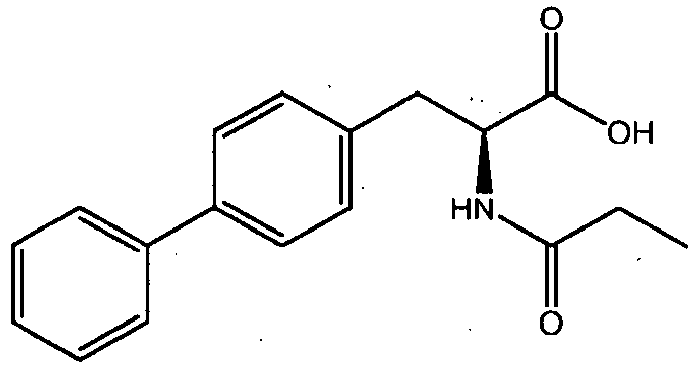
- In a dry and clean reaction bottle, add 200 ml of methanol and 10 g of (L)-2-propionyl amino-3-biphenyl propanoic acid-(R)-2-amino N, N-dimethyl-2-phenyl-acetamide salt. Elevate temperature to 90 deg C. Instill 15 g of citric acid. Maintain temperature for 5 hours. Cool down to 0 to 5 deg C. Vacuum filtrate it. Obtain 6.4 g of the product (L)-2-propionyl amino-3-biphenyl propanoic acid. Yield ratio: 91.8%. 1 H NMR (500MHz,DMSO-d6): 0.91-0.94, 2.06-2.11, 2.88-2.93, 3.08-3.12, 4.44-4.49, 7.32-7.36, 7.44-7.47, 7.57-7.59, 7.64-7.66, 8.15-8.16, 12.72; MS(m/z):224.1(100),167,1(46),165,1(20),296.9([MH+],1).
-

- In a dry and clean reaction bottle, add 25 ml of isopropanol and 10 g of (D)-2- (N-formyl phenyl) amino-3-biphenyl propanoic acid-(S)-amino-phenyl- methyl acetate amine salt. Elevate temperature to 10 deg C. Instill 4 g of acetic acid. Maintain temperature for 30 min. Slowly cool reaction solution down to 0 to 5 deg C. Vacuum filtrate it. Obtain 6.0 g of the product (D)-2- (N-formyl phenyl) amino-3-biphenylpropionic acid. Yield ratio: 89.7%. 1H NMR (500MHz,DMSO-d6): 3.11-3.16, 3.23-3.26, 4.64-4.69, 7.31-7.33, 7.34-7.45, 7.46-7.48, 7.58-7.60, 7.62-7.64, 7.82-7.84, 8.77-8.78, 12.83; MS(m/z):224.0(100),167.1(30),165.1(16),105.1(7),77.1(15),344.8([MH+],1).
-

- In a dry and clean reaction bottle, add 100 ml of tetrahydrofuran and 10 g of (L)-2- (N-para-chlorobenzoyl) amino-3-biphenyl propanoic acid-(R)-amino-phenyl- isopropyl acetate amine. Elevate temperature to 40 deg C. Instill 5 g of formic acid. Maintain temperature for 2.5 hours. Cool down to 10 to 20 deg C. Vacuum filtrate it. Obtain 5.3 g of the product, (L)-2- (N-para-chlorobenzoyl) amino-3-biphenyl propanoic acid. Yield ratio: 87.6%. 1 H NMR (500MHz,DMSO-d6): 3.10-3.14, 3.26-3.30, 4.61-4.66, 7.13-7.34, 7.39-7.44, 7.52-7.56, 7.61-7.63, 7.84-7.86, 8.75-8.77; MS(m/z):224.1(100),167.1(40),165.1(15),139.1(5),111.1(6),378.9([MH+],1).

Claims (21)
- A method for preparing a compound of formula (III), or salt thereof,

R1 is C1-C7-alkyl, such as methyl or ethyl; or is unsubstituted C6-C10-aryl such as phenyl; or is C6C10-aryl substituted by one or more substituents independently selected from C1-C7-alkyl, C1-C7-alkoxy-C1-C7-alkyl, C1-C7-alkoxy or halo, such as para-chlorophenyl;
consisting of
reacting a compound of formula (IV), or salt thereof,
under decarboxylation reaction conditions which are achieved by heating,
to provide the compound of formula (III). - The process according to claim 1, wherein the decarboxylation reaction conditions are achieved by heating at a temperature of from 80 deg C to 250 deg C.
- The process according to claim 2, wherein the decarboxylation reaction is carried out in a solvent selected from water, toluene, xylene, ethylbenzene, chlorobenzene, dichlorobenzene, nitrobenzene, N,N-dimethyl formamide (DMF) and 1-methyl-2-pyrrolidone (NMP) and at the reflux temperature of said solvent.
- A method for preparing a chiral compound of formula (II),

R1 is C1-C7-alkyl, such as methyl or ethyl; or is unsubstituted C6-C10-aryl, such as phenyl; or is C6-C10-aryl substituted by one or more substituents independently selected from C1-C7-alkyl, C1-C7-alkoxy-C1-C7-alkyl, C1-C7-alkoxy or halo, such as para-chlorophenyl;
R2 is C1-C7-alkyl, such as methyl; or is R3R4NC(=O)- or R5OC(=O)-, wherein R3 and R4 are independently selected from hydrogen or C1-C7-alkyl; and R5 is C1-C7-alkyl;
R6 is C6-C10-aryl, such as phenyl, and
"*" means a chiral center with absolute stereochemistry (R) or (S),
comprising
reacting
a compound of formula (III), or salt thereof,

"*" means a chiral center with absolute stereochemistry (R) or (S);
and resolving the resulting diastereomeric mixture via crystallization
to provide the compound of formula (II). - The process according to claim 4, wherein the chiral amine of formula (V) is of the formula (Va)

is of the formula
- The process according to claim 4, wherein the chiral compound of formula (II) is of the formula


- The process according to claim 4, wherein the chiral compound of formula (II) is of the formula (IIa),


- The process according to claim 4, wherein the chiral compound of formula (II) is of the formula (IIb),


- A method for preparing a compound of formula (I), or salt thereof,

R1 is C1-C7-alkyl, such as methyl or ethyl; or is unsubstituted C6-C10-aryl such as phenyl; or is C6-C10-aryl substituted by one or more substituents independently selected from C1-C7-alkyl, C1-C7-alkoxy-C1-C7-alkyl, C1-C7-alkoxy or halo, such as para-chlorophenyl; and
"*" means a chiral center with absolute stereochemistry (R) or (S),
comprising
treating a compound of formula (II),
R1 is C1-C7-alkyl, such as methyl or ethyl; or is unsubstituted C6-C10-aryl such as phenyl; or is C6-C10-aryl substituted by one or more substituents independently selected from C1-C7-alkyl, C1-C7-alkoxy-C1-C7-alkyl, C1-C7-alkoxy or halo, such as para-chlorophenyl;
R2 is C1-C7-alkyl, such as methyl; or is R3R4NC(=O)- or R50C(=O)-, wherein R3 and R4 are independently selected from hydrogen or C1-C7-alkyl; and R5 is C1-C7-alkyl;
R6 is C6-C10-aryl, such as phenyl, and
"*" means a chiral center with absolute stereochemistry (R) or (S),
with an acidic reagent
to provide the compound of formula (I). - The process according to claim 9, wherein the acidic reagent is an inorganic acid or an organic acid, such as hydrochloric acid, sulfuric acid, phosphoric acid, oxalic acid, citric acid, formic acid or acetic acid.
- The process according to claims 9 or 10, wherein the chiral compound of formula (I) is of the formula (Ia),

the chiral compound of formula (II) is of the formula (IIa)
- The process according to claims 9 or 10, wherein the chiral compound of formula (I) is of the formula (Ib),

the chiral compound of formula (II) is of the formula (IIb)
- A process for preparing a compound of formula (I), as defined in claim 9,
comprising the steps ofi) preparing the compound of formula (III), as defined in claim 1, according to the process defined in claims 1, 2 or 3;ii) preparing the compound of formula (II), as defined in claim 4, according to any one of the processes defined in claims 4 to 8, preferably according to the process defined in claim 7; andiii) obtaining the compound of formula (I), according to any one of the processes defined in claims 9 to 12, preferably according to the process defined in claim 11. - A process for preparing a compound of formula (I), as defined in claim 9,
comprising the steps ofi) preparing the compound of formula (II), as defined in claim 4, according to any one of the processes defined in claims 4 to 8, preferably according to the process defined in claim 7; andii) obtaining the compound of formula (I), according to any one of the processes defined in claims 9 to 12, preferably according to the process defined in claim 11. - A chiral compound of formula (II),

R1 is C1-C7-alkyl, such as methyl or ethyl; or is unsubstituted C6-C10-aryl, such as phenyl; or is C6-C10-aryl substituted by one or more substituents independently selected from C1-C7-alkyl, C1-C7-alkoxy-C1-C7-alkyl, C1-C7-alkoxy or halo, such as para-chlorophenyl;
R2 is C1-C7-alkyl, such as methyl; or is R3R4NC(=O)- or R5OC(=O)-, wherein R3 and R4 are independently selected from hydrogen or C1-C7-alkyl; and R5 is C1-C7-alkyl;
R6 is C6-C10-aryl, such as phenyl, and
"*" means a chiral center with absolute stereochemistry (R) or (S),
preferably wherein the compound of formula (II) is of the formula (IIa) or (IIb),
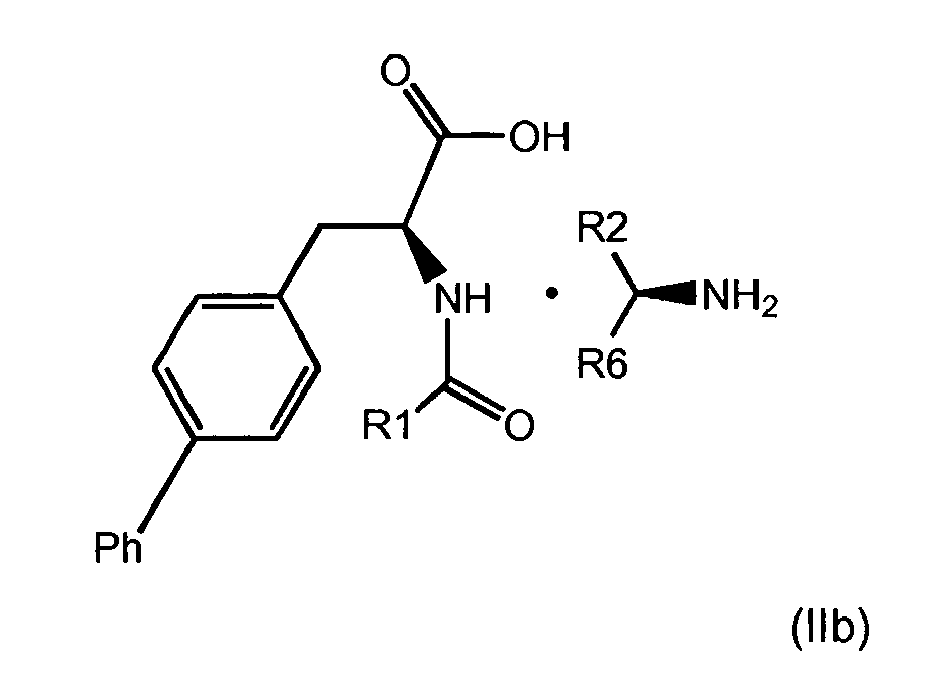
- A compound according to claim 15, wherein R6 is phenyl.
- The use of a compound according to claims 15 or 16, in the synthesis of a compound comprising an γ-amino-δ-biphenyl-α-methylalkanoic acid, or acid ester, backbone.
- The use according to claim 17, wherein the compound is N-(3-carboxy-1-oxopropyl)-(4S)-p-phenylphenylmethyl)-4-amino-(2R)-methylbutanoic acid or a salt or acid ester, thereof.
- The use according to claim 17, wherein compound is N-(3-carboxyl-1-oxopropyl)-(4S)-(p-phenylphenylmethyl)-4-amino-(2R)-methyl butanoic acid ethyl ester or salt thereof.
- A process for preparing N-(3-carboxyl-1-oxopropyl)-(4S)-(p-phenylphenylmethyl)-4-amino-(2R)-methyl butanoic acid ethyl ester, or a salt thereof, comprising the manufacture of compound of formula (II), or salt thereof, as defined in claims 15 or 16.
- A process for preparing N-(3-carboxyl-1-oxopropyl)-(4S)-(p-phenylphenylmethyl)-4-amino-(2R)-methyl butanoic acid ethyl ester, or a salt thereof, comprising the manufacture of compound of formula (IIa), or salt thereof, as defined in claims 15 or 16.
Priority Applications (3)
| Application Number | Priority Date | Filing Date | Title |
|---|---|---|---|
| HRP20141148AT HRP20141148T1 (en) | 2009-01-13 | 2010-01-12 | Process for manufacture and resolution of 2-acylamino-3-diphenylpropanoic acid |
| PL10731044T PL2387558T3 (en) | 2009-01-13 | 2010-01-12 | Process for manufacture and resolution of 2-acylamino-3-diphenylpropanoic acid |
| SI201030791T SI2387558T1 (en) | 2009-01-13 | 2010-01-12 | Process for manufacture and resolution of 2-acylamino-3-diphenylpropanoic acid |
Applications Claiming Priority (2)
| Application Number | Priority Date | Filing Date | Title |
|---|---|---|---|
| CN200910045210A CN101774941A (en) | 2009-01-13 | 2009-01-13 | Method for preparing and splitting 2-acyl amino-3-biphenylyl propionic acid |
| PCT/CN2010/070144 WO2010081410A1 (en) | 2009-01-13 | 2010-01-12 | Process for manufacture and resolution of 2-acylamino-3-diphenylpropanoic acid |
Publications (3)
| Publication Number | Publication Date |
|---|---|
| EP2387558A1 EP2387558A1 (en) | 2011-11-23 |
| EP2387558A4 EP2387558A4 (en) | 2012-08-08 |
| EP2387558B1 true EP2387558B1 (en) | 2014-08-27 |
Family
ID=42339450
Family Applications (1)
| Application Number | Title | Priority Date | Filing Date |
|---|---|---|---|
| EP10731044.3A Active EP2387558B1 (en) | 2009-01-13 | 2010-01-12 | Process for manufacture and resolution of 2-acylamino-3-diphenylpropanoic acid |
Country Status (16)
| Country | Link |
|---|---|
| US (2) | US8703990B2 (en) |
| EP (1) | EP2387558B1 (en) |
| JP (1) | JP5687205B2 (en) |
| KR (1) | KR101699095B1 (en) |
| CN (4) | CN101774941A (en) |
| AU (1) | AU2010205973B2 (en) |
| BR (1) | BRPI1007367A2 (en) |
| CA (1) | CA2749092C (en) |
| ES (1) | ES2524971T3 (en) |
| HR (1) | HRP20141148T1 (en) |
| MX (1) | MX2011007445A (en) |
| PL (1) | PL2387558T3 (en) |
| PT (1) | PT2387558E (en) |
| RU (1) | RU2520215C2 (en) |
| SI (1) | SI2387558T1 (en) |
| WO (1) | WO2010081410A1 (en) |
Families Citing this family (21)
| Publication number | Priority date | Publication date | Assignee | Title |
|---|---|---|---|---|
| CN101684077B (en) | 2008-09-24 | 2013-01-02 | 浙江九洲药业股份有限公司 | Method for preparing N-acyl diphenylalanine |
| CN101774941A (en) * | 2009-01-13 | 2010-07-14 | 浙江九洲药业股份有限公司 | Method for preparing and splitting 2-acyl amino-3-biphenylyl propionic acid |
| CA2772681C (en) * | 2009-09-23 | 2017-01-03 | Zhejiang Jiuzhou Pharmaceutical Co., Ltd. | Process for manufacture of n-acylbphenyl alanine |
| EP2744779A1 (en) * | 2011-08-19 | 2014-06-25 | DSM IP Assets B.V. | Synthesis of r-biphenylalaninol |
| CN102952029B (en) * | 2011-09-30 | 2015-07-08 | 北京海步国际医药科技发展有限公司 | Method for resolving 2-hydroxyl-3-methoxy-3,3-diphenyl propionic acid racemate using amine derivative |
| CN105085321B (en) * | 2012-03-07 | 2017-11-24 | 浙江九洲药业股份有限公司 | A kind of preparation method of N methoxycarbonyl groups L Terleus |
| WO2016037098A1 (en) | 2014-09-04 | 2016-03-10 | Concert Pharmaceuticals, Inc. | Deuterated sacubitril |
| TW201632493A (en) | 2015-02-13 | 2016-09-16 | 諾華公司 | New process |
| CN105017082B (en) * | 2015-07-31 | 2017-09-19 | 上海皓元医药股份有限公司 | Preparation of (R)-tert-butyl (1-([1,1`-biphenyl]-4-yl)-3-hydroxypropane-2-yl) carbamate, a key intermediate of heart failure drug Entresto method |
| CN105085322B (en) * | 2015-08-15 | 2017-10-03 | 浙江永宁药业股份有限公司 | The Preparation Method And Their Intermediate of the intermediates of AHU 377 and the preparation method of intermediate |
| CN105168205A (en) * | 2015-08-18 | 2015-12-23 | 泰力特医药(湖北)有限公司 | Preparation method for dual inhibitor LCZ696 of angiotensin II receptor and neprilysin |
| WO2017051326A1 (en) | 2015-09-23 | 2017-03-30 | Novartis Ag | New processes and intermediates useful in synthesis of nep inhibitors |
| CN105198775B (en) | 2015-10-10 | 2017-11-14 | 凯瑞斯德生化(苏州)有限公司 | A kind of preparation method of chiral N Boc biphenyl Propanolamines |
| US10377697B2 (en) | 2015-12-10 | 2019-08-13 | Novartis Ag | Process and intermediates |
| KR20170119447A (en) * | 2016-04-19 | 2017-10-27 | 주식회사 아미노로직스 | Method for the preparation of D-4,4'-Biphenylalanine or L-4,4'-Biphenylalanine from DL-4,4'-Biphenylalanine |
| CN109415308B (en) | 2016-07-05 | 2022-09-06 | 诺华股份有限公司 | Novel method for early-stage sabcomet intermediate |
| JP6945619B2 (en) | 2016-08-17 | 2021-10-06 | ノバルティス アーゲー | New methods and intermediates for NEP inhibitor synthesis |
| EP3558930B1 (en) | 2016-12-23 | 2021-05-26 | Novartis AG | New process for early sacubitril intermediates |
| JP6843696B2 (en) * | 2017-04-28 | 2021-03-17 | キヤノン株式会社 | Power supply device and image forming device |
| UY38072A (en) | 2018-02-07 | 2019-10-01 | Novartis Ag | COMPOSITIONS DERIVED FROM BUTANOIC ESTER SUBSTITUTED WITH BISPHENYL AS INHIBITORS OF NEP, COMPOSITIONS AND COMBINATIONS OF THE SAME |
| CN110183357B (en) * | 2019-06-13 | 2021-09-24 | 甘肃皓天医药科技有限责任公司 | A kind of preparation method for preparing Sacubitril intermediate |
Family Cites Families (11)
| Publication number | Priority date | Publication date | Assignee | Title |
|---|---|---|---|---|
| JPS61227555A (en) | 1985-04-02 | 1986-10-09 | Mitsui Toatsu Chem Inc | Production of n-acylphenylalanine compound |
| US5217996A (en) * | 1992-01-22 | 1993-06-08 | Ciba-Geigy Corporation | Biaryl substituted 4-amino-butyric acid amides |
| IL123986A (en) * | 1997-04-24 | 2011-10-31 | Organon Nv | Serine protease inhibiting antithrombotic agents and pharmaceutical compositions comprising them |
| FR2833949B1 (en) * | 2001-12-21 | 2005-08-05 | Galderma Res & Dev | NOVEL PPARy RECEPTOR ACTIVATION LIGANDS, PROCESS FOR THEIR PREPARATION AND THEIR USE IN HUMAN MEDICINE AND COSMETICS |
| PT1467728E (en) | 2002-01-17 | 2007-11-14 | Novartis Ag | PHARMACEUTICAL COMPOSITIONS UNDERSTANDING VALSARTAN AND NEP INHIBITORS |
| JP4270484B2 (en) * | 2002-03-08 | 2009-06-03 | 第一ファインケミカル株式会社 | Method for producing optically active phenylalanine derivative |
| CN100336803C (en) * | 2003-12-04 | 2007-09-12 | 上海药明康德新药开发有限公司 | Method for preparing optical pure N-tertiary butyl oxycarbonyl-beta-difluorine phenylalanine |
| GB0329584D0 (en) | 2003-12-20 | 2004-01-28 | Tanabe Seiyaku Co | Novel compounds |
| JP2007063267A (en) * | 2005-08-04 | 2007-03-15 | Ajinomoto Co Inc | Method for producing optically active diphenylalanine compound |
| EP1749816A1 (en) | 2005-08-04 | 2007-02-07 | Ajinomoto Co., Ltd. | Production method of optically active diphenylalanine compounds |
| CN101774941A (en) * | 2009-01-13 | 2010-07-14 | 浙江九洲药业股份有限公司 | Method for preparing and splitting 2-acyl amino-3-biphenylyl propionic acid |
-
2009
- 2009-01-13 CN CN200910045210A patent/CN101774941A/en active Pending
-
2010
- 2010-01-12 CN CN201410753416.0A patent/CN104557599B/en active Active
- 2010-01-12 CN CN201080004463.5A patent/CN102482202B/en active Active
- 2010-01-12 MX MX2011007445A patent/MX2011007445A/en active IP Right Grant
- 2010-01-12 BR BRPI1007367A patent/BRPI1007367A2/en not_active IP Right Cessation
- 2010-01-12 CN CN201110425581XA patent/CN102531944A/en active Pending
- 2010-01-12 JP JP2011544780A patent/JP5687205B2/en active Active
- 2010-01-12 ES ES10731044.3T patent/ES2524971T3/en active Active
- 2010-01-12 PL PL10731044T patent/PL2387558T3/en unknown
- 2010-01-12 CA CA2749092A patent/CA2749092C/en not_active Expired - Fee Related
- 2010-01-12 SI SI201030791T patent/SI2387558T1/en unknown
- 2010-01-12 RU RU2011133749/04A patent/RU2520215C2/en not_active IP Right Cessation
- 2010-01-12 PT PT107310443T patent/PT2387558E/en unknown
- 2010-01-12 HR HRP20141148AT patent/HRP20141148T1/en unknown
- 2010-01-12 WO PCT/CN2010/070144 patent/WO2010081410A1/en not_active Ceased
- 2010-01-12 US US13/144,340 patent/US8703990B2/en active Active
- 2010-01-12 EP EP10731044.3A patent/EP2387558B1/en active Active
- 2010-01-12 KR KR1020117018824A patent/KR101699095B1/en not_active Expired - Fee Related
- 2010-01-12 AU AU2010205973A patent/AU2010205973B2/en not_active Ceased
-
2014
- 2014-02-28 US US14/193,503 patent/US9181175B2/en active Active
Also Published As
| Publication number | Publication date |
|---|---|
| PT2387558E (en) | 2014-11-14 |
| RU2011133749A (en) | 2013-02-20 |
| CN101774941A (en) | 2010-07-14 |
| CN104557599A (en) | 2015-04-29 |
| PL2387558T3 (en) | 2015-03-31 |
| HRP20141148T1 (en) | 2015-01-30 |
| SI2387558T1 (en) | 2014-12-31 |
| US9181175B2 (en) | 2015-11-10 |
| US20140179947A1 (en) | 2014-06-26 |
| WO2010081410A1 (en) | 2010-07-22 |
| JP5687205B2 (en) | 2015-03-18 |
| RU2520215C2 (en) | 2014-06-20 |
| MX2011007445A (en) | 2011-10-28 |
| CN102531944A (en) | 2012-07-04 |
| AU2010205973A1 (en) | 2011-08-04 |
| US20120016151A1 (en) | 2012-01-19 |
| CN104557599B (en) | 2017-02-22 |
| EP2387558A1 (en) | 2011-11-23 |
| EP2387558A4 (en) | 2012-08-08 |
| KR101699095B1 (en) | 2017-01-23 |
| BRPI1007367A2 (en) | 2019-09-24 |
| ES2524971T3 (en) | 2014-12-16 |
| CA2749092C (en) | 2017-01-10 |
| US8703990B2 (en) | 2014-04-22 |
| AU2010205973B2 (en) | 2013-02-07 |
| KR20110116167A (en) | 2011-10-25 |
| CN102482202B (en) | 2015-02-18 |
| CA2749092A1 (en) | 2010-07-22 |
| CN102482202A (en) | 2012-05-30 |
| JP2012515142A (en) | 2012-07-05 |
Similar Documents
| Publication | Publication Date | Title |
|---|---|---|
| CA2749092C (en) | Process for manufacture and resolution of 2-acylamino-3-diphenylpropanoic acid | |
| AU2010297892B2 (en) | Process for manufacture of N-acylbphenyl alanine | |
| US9242927B2 (en) | Process for the manufacture of N-acylbiphenyl alanine | |
| EP3653607B1 (en) | Process for the preparation of enantiomerically enriched 3-aminopiperidine | |
| JP5899204B2 (en) | Process for producing chiral β-aminocarboxamide derivative | |
| TW201718462A (en) | Process for the manufacture of organic compounds and intermediates | |
| JP2008115178A (en) | PRODUCTION METHOD OF DIPHENYLALANINE-Ni(II) COMPLEX | |
| EP2050738B1 (en) | Novel imidazolidinone derivative, method of producing the same and method of producing optically active amino acid | |
| CA3154610A1 (en) | An industrial process for resolution of chlocyphos | |
| JPWO2008026527A1 (en) | Method for producing 3-cyanopyrrolidine derivatives and salts thereof | |
| WO2006082835A1 (en) | Method for producing theanine | |
| EP2855423A1 (en) | Synthesis of diamido gellants by using amino acid n-carboxyanhydrides |
Legal Events
| Date | Code | Title | Description |
|---|---|---|---|
| PUAI | Public reference made under article 153(3) epc to a published international application that has entered the european phase |
Free format text: ORIGINAL CODE: 0009012 |
|
| 17P | Request for examination filed |
Effective date: 20110816 |
|
| AK | Designated contracting states |
Kind code of ref document: A1 Designated state(s): AT BE BG CH CY CZ DE DK EE ES FI FR GB GR HR HU IE IS IT LI LT LU LV MC MK MT NL NO PL PT RO SE SI SK SM TR |
|
| DAX | Request for extension of the european patent (deleted) | ||
| A4 | Supplementary search report drawn up and despatched |
Effective date: 20120705 |
|
| RIC1 | Information provided on ipc code assigned before grant |
Ipc: C07C 233/47 20060101AFI20120629BHEP Ipc: C07C 231/12 20060101ALI20120629BHEP Ipc: C07C 231/20 20060101ALI20120629BHEP Ipc: C07C 227/34 20060101ALI20120629BHEP Ipc: C07C 233/51 20060101ALI20120629BHEP Ipc: C07C 231/14 20060101ALI20120629BHEP Ipc: C07C 233/87 20060101ALI20120629BHEP Ipc: C07C 227/18 20060101ALI20120629BHEP |
|
| 17Q | First examination report despatched |
Effective date: 20130806 |
|
| GRAP | Despatch of communication of intention to grant a patent |
Free format text: ORIGINAL CODE: EPIDOSNIGR1 |
|
| INTG | Intention to grant announced |
Effective date: 20140321 |
|
| GRAS | Grant fee paid |
Free format text: ORIGINAL CODE: EPIDOSNIGR3 |
|
| GRAA | (expected) grant |
Free format text: ORIGINAL CODE: 0009210 |
|
| AK | Designated contracting states |
Kind code of ref document: B1 Designated state(s): AT BE BG CH CY CZ DE DK EE ES FI FR GB GR HR HU IE IS IT LI LT LU LV MC MK MT NL NO PL PT RO SE SI SK SM TR |
|
| REG | Reference to a national code |
Ref country code: GB Ref legal event code: FG4D |
|
| REG | Reference to a national code |
Ref country code: CH Ref legal event code: EP |
|
| REG | Reference to a national code |
Ref country code: AT Ref legal event code: REF Ref document number: 684447 Country of ref document: AT Kind code of ref document: T Effective date: 20140915 |
|
| REG | Reference to a national code |
Ref country code: IE Ref legal event code: FG4D |
|
| REG | Reference to a national code |
Ref country code: DE Ref legal event code: R096 Ref document number: 602010018553 Country of ref document: DE Effective date: 20141009 |
|
| REG | Reference to a national code |
Ref country code: PT Ref legal event code: SC4A Free format text: AVAILABILITY OF NATIONAL TRANSLATION Effective date: 20141110 |
|
| REG | Reference to a national code |
Ref country code: HR Ref legal event code: TUEP Ref document number: P20141148 Country of ref document: HR |
|
| REG | Reference to a national code |
Ref country code: ES Ref legal event code: FG2A Ref document number: 2524971 Country of ref document: ES Kind code of ref document: T3 Effective date: 20141216 |
|
| REG | Reference to a national code |
Ref country code: LT Ref legal event code: MG4D |
|
| REG | Reference to a national code |
Ref country code: NL Ref legal event code: VDEP Effective date: 20140827 |
|
| PG25 | Lapsed in a contracting state [announced via postgrant information from national office to epo] |
Ref country code: BG Free format text: LAPSE BECAUSE OF FAILURE TO SUBMIT A TRANSLATION OF THE DESCRIPTION OR TO PAY THE FEE WITHIN THE PRESCRIBED TIME-LIMIT Effective date: 20141127 Ref country code: NO Free format text: LAPSE BECAUSE OF FAILURE TO SUBMIT A TRANSLATION OF THE DESCRIPTION OR TO PAY THE FEE WITHIN THE PRESCRIBED TIME-LIMIT Effective date: 20141127 Ref country code: SE Free format text: LAPSE BECAUSE OF FAILURE TO SUBMIT A TRANSLATION OF THE DESCRIPTION OR TO PAY THE FEE WITHIN THE PRESCRIBED TIME-LIMIT Effective date: 20140827 Ref country code: LT Free format text: LAPSE BECAUSE OF FAILURE TO SUBMIT A TRANSLATION OF THE DESCRIPTION OR TO PAY THE FEE WITHIN THE PRESCRIBED TIME-LIMIT Effective date: 20140827 Ref country code: FI Free format text: LAPSE BECAUSE OF FAILURE TO SUBMIT A TRANSLATION OF THE DESCRIPTION OR TO PAY THE FEE WITHIN THE PRESCRIBED TIME-LIMIT Effective date: 20140827 |
|
| REG | Reference to a national code |
Ref country code: HR Ref legal event code: T1PR Ref document number: P20141148 Country of ref document: HR |
|
| REG | Reference to a national code |
Ref country code: GR Ref legal event code: EP Ref document number: 20140402304 Country of ref document: GR Effective date: 20141223 |
|
| PG25 | Lapsed in a contracting state [announced via postgrant information from national office to epo] |
Ref country code: CY Free format text: LAPSE BECAUSE OF FAILURE TO SUBMIT A TRANSLATION OF THE DESCRIPTION OR TO PAY THE FEE WITHIN THE PRESCRIBED TIME-LIMIT Effective date: 20140827 Ref country code: IS Free format text: LAPSE BECAUSE OF FAILURE TO SUBMIT A TRANSLATION OF THE DESCRIPTION OR TO PAY THE FEE WITHIN THE PRESCRIBED TIME-LIMIT Effective date: 20141227 Ref country code: LV Free format text: LAPSE BECAUSE OF FAILURE TO SUBMIT A TRANSLATION OF THE DESCRIPTION OR TO PAY THE FEE WITHIN THE PRESCRIBED TIME-LIMIT Effective date: 20140827 |
|
| PG25 | Lapsed in a contracting state [announced via postgrant information from national office to epo] |
Ref country code: NL Free format text: LAPSE BECAUSE OF FAILURE TO SUBMIT A TRANSLATION OF THE DESCRIPTION OR TO PAY THE FEE WITHIN THE PRESCRIBED TIME-LIMIT Effective date: 20140827 |
|
| REG | Reference to a national code |
Ref country code: PL Ref legal event code: T3 |
|
| PG25 | Lapsed in a contracting state [announced via postgrant information from national office to epo] |
Ref country code: RO Free format text: LAPSE BECAUSE OF FAILURE TO SUBMIT A TRANSLATION OF THE DESCRIPTION OR TO PAY THE FEE WITHIN THE PRESCRIBED TIME-LIMIT Effective date: 20140827 Ref country code: SK Free format text: LAPSE BECAUSE OF FAILURE TO SUBMIT A TRANSLATION OF THE DESCRIPTION OR TO PAY THE FEE WITHIN THE PRESCRIBED TIME-LIMIT Effective date: 20140827 Ref country code: EE Free format text: LAPSE BECAUSE OF FAILURE TO SUBMIT A TRANSLATION OF THE DESCRIPTION OR TO PAY THE FEE WITHIN THE PRESCRIBED TIME-LIMIT Effective date: 20140827 Ref country code: DK Free format text: LAPSE BECAUSE OF FAILURE TO SUBMIT A TRANSLATION OF THE DESCRIPTION OR TO PAY THE FEE WITHIN THE PRESCRIBED TIME-LIMIT Effective date: 20140827 |
|
| REG | Reference to a national code |
Ref country code: DE Ref legal event code: R097 Ref document number: 602010018553 Country of ref document: DE |
|
| PG25 | Lapsed in a contracting state [announced via postgrant information from national office to epo] |
Ref country code: BE Free format text: LAPSE BECAUSE OF NON-PAYMENT OF DUE FEES Effective date: 20150131 |
|
| PLBE | No opposition filed within time limit |
Free format text: ORIGINAL CODE: 0009261 |
|
| STAA | Information on the status of an ep patent application or granted ep patent |
Free format text: STATUS: NO OPPOSITION FILED WITHIN TIME LIMIT |
|
| 26N | No opposition filed |
Effective date: 20150528 |
|
| PG25 | Lapsed in a contracting state [announced via postgrant information from national office to epo] |
Ref country code: LU Free format text: LAPSE BECAUSE OF FAILURE TO SUBMIT A TRANSLATION OF THE DESCRIPTION OR TO PAY THE FEE WITHIN THE PRESCRIBED TIME-LIMIT Effective date: 20150112 |
|
| PG25 | Lapsed in a contracting state [announced via postgrant information from national office to epo] |
Ref country code: MC Free format text: LAPSE BECAUSE OF FAILURE TO SUBMIT A TRANSLATION OF THE DESCRIPTION OR TO PAY THE FEE WITHIN THE PRESCRIBED TIME-LIMIT Effective date: 20140827 |
|
| REG | Reference to a national code |
Ref country code: FR Ref legal event code: PLFP Year of fee payment: 7 |
|
| PG25 | Lapsed in a contracting state [announced via postgrant information from national office to epo] |
Ref country code: BE Free format text: LAPSE BECAUSE OF FAILURE TO SUBMIT A TRANSLATION OF THE DESCRIPTION OR TO PAY THE FEE WITHIN THE PRESCRIBED TIME-LIMIT Effective date: 20140827 |
|
| REG | Reference to a national code |
Ref country code: FR Ref legal event code: PLFP Year of fee payment: 8 |
|
| PG25 | Lapsed in a contracting state [announced via postgrant information from national office to epo] |
Ref country code: MT Free format text: LAPSE BECAUSE OF FAILURE TO SUBMIT A TRANSLATION OF THE DESCRIPTION OR TO PAY THE FEE WITHIN THE PRESCRIBED TIME-LIMIT Effective date: 20140827 |
|
| PG25 | Lapsed in a contracting state [announced via postgrant information from national office to epo] |
Ref country code: SM Free format text: LAPSE BECAUSE OF FAILURE TO SUBMIT A TRANSLATION OF THE DESCRIPTION OR TO PAY THE FEE WITHIN THE PRESCRIBED TIME-LIMIT Effective date: 20140827 Ref country code: HU Free format text: LAPSE BECAUSE OF FAILURE TO SUBMIT A TRANSLATION OF THE DESCRIPTION OR TO PAY THE FEE WITHIN THE PRESCRIBED TIME-LIMIT; INVALID AB INITIO Effective date: 20100112 |
|
| REG | Reference to a national code |
Ref country code: FR Ref legal event code: PLFP Year of fee payment: 9 |
|
| REG | Reference to a national code |
Ref country code: HR Ref legal event code: ODRP Ref document number: P20141148 Country of ref document: HR Payment date: 20180108 Year of fee payment: 9 |
|
| PGFP | Annual fee paid to national office [announced via postgrant information from national office to epo] |
Ref country code: GR Payment date: 20171227 Year of fee payment: 9 Ref country code: PL Payment date: 20171222 Year of fee payment: 9 |
|
| PGFP | Annual fee paid to national office [announced via postgrant information from national office to epo] |
Ref country code: CZ Payment date: 20180103 Year of fee payment: 9 Ref country code: CH Payment date: 20180115 Year of fee payment: 9 |
|
| PGFP | Annual fee paid to national office [announced via postgrant information from national office to epo] |
Ref country code: AT Payment date: 20171228 Year of fee payment: 9 Ref country code: IE Payment date: 20180110 Year of fee payment: 9 Ref country code: PT Payment date: 20180110 Year of fee payment: 9 Ref country code: TR Payment date: 20180108 Year of fee payment: 9 Ref country code: HR Payment date: 20180108 Year of fee payment: 9 Ref country code: SI Payment date: 20180104 Year of fee payment: 9 |
|
| PG25 | Lapsed in a contracting state [announced via postgrant information from national office to epo] |
Ref country code: MK Free format text: LAPSE BECAUSE OF FAILURE TO SUBMIT A TRANSLATION OF THE DESCRIPTION OR TO PAY THE FEE WITHIN THE PRESCRIBED TIME-LIMIT Effective date: 20140827 |
|
| REG | Reference to a national code |
Ref country code: HR Ref legal event code: PBON Ref document number: P20141148 Country of ref document: HR Effective date: 20190112 |
|
| REG | Reference to a national code |
Ref country code: CH Ref legal event code: PL |
|
| REG | Reference to a national code |
Ref country code: AT Ref legal event code: MM01 Ref document number: 684447 Country of ref document: AT Kind code of ref document: T Effective date: 20190112 |
|
| REG | Reference to a national code |
Ref country code: IE Ref legal event code: MM4A |
|
| PG25 | Lapsed in a contracting state [announced via postgrant information from national office to epo] |
Ref country code: PT Free format text: LAPSE BECAUSE OF NON-PAYMENT OF DUE FEES Effective date: 20190712 Ref country code: SI Free format text: LAPSE BECAUSE OF NON-PAYMENT OF DUE FEES Effective date: 20190113 Ref country code: HR Free format text: LAPSE BECAUSE OF NON-PAYMENT OF DUE FEES Effective date: 20190112 Ref country code: CZ Free format text: LAPSE BECAUSE OF NON-PAYMENT OF DUE FEES Effective date: 20190112 |
|
| PG25 | Lapsed in a contracting state [announced via postgrant information from national office to epo] |
Ref country code: GR Free format text: LAPSE BECAUSE OF NON-PAYMENT OF DUE FEES Effective date: 20190802 |
|
| PG25 | Lapsed in a contracting state [announced via postgrant information from national office to epo] |
Ref country code: CH Free format text: LAPSE BECAUSE OF NON-PAYMENT OF DUE FEES Effective date: 20190131 Ref country code: AT Free format text: LAPSE BECAUSE OF NON-PAYMENT OF DUE FEES Effective date: 20190112 Ref country code: LI Free format text: LAPSE BECAUSE OF NON-PAYMENT OF DUE FEES Effective date: 20190131 |
|
| REG | Reference to a national code |
Ref country code: SI Ref legal event code: KO00 Effective date: 20190926 |
|
| PG25 | Lapsed in a contracting state [announced via postgrant information from national office to epo] |
Ref country code: IE Free format text: LAPSE BECAUSE OF NON-PAYMENT OF DUE FEES Effective date: 20190112 |
|
| PG25 | Lapsed in a contracting state [announced via postgrant information from national office to epo] |
Ref country code: PL Free format text: LAPSE BECAUSE OF NON-PAYMENT OF DUE FEES Effective date: 20190112 |
|
| PG25 | Lapsed in a contracting state [announced via postgrant information from national office to epo] |
Ref country code: TR Free format text: LAPSE BECAUSE OF NON-PAYMENT OF DUE FEES Effective date: 20190112 |
|
| P01 | Opt-out of the competence of the unified patent court (upc) registered |
Effective date: 20230517 |
|
| PGFP | Annual fee paid to national office [announced via postgrant information from national office to epo] |
Ref country code: GB Payment date: 20251218 Year of fee payment: 17 |
|
| PGFP | Annual fee paid to national office [announced via postgrant information from national office to epo] |
Ref country code: FR Payment date: 20251222 Year of fee payment: 17 |
|
| PGFP | Annual fee paid to national office [announced via postgrant information from national office to epo] |
Ref country code: ES Payment date: 20260206 Year of fee payment: 17 |
|
| PGFP | Annual fee paid to national office [announced via postgrant information from national office to epo] |
Ref country code: DE Payment date: 20251216 Year of fee payment: 17 |
|
| PGFP | Annual fee paid to national office [announced via postgrant information from national office to epo] |
Ref country code: IT Payment date: 20251230 Year of fee payment: 17 |