EP2384749A1 - Dosage regimen of an S1P receptor agonist - Google Patents
Dosage regimen of an S1P receptor agonist Download PDFInfo
- Publication number
- EP2384749A1 EP2384749A1 EP10179083A EP10179083A EP2384749A1 EP 2384749 A1 EP2384749 A1 EP 2384749A1 EP 10179083 A EP10179083 A EP 10179083A EP 10179083 A EP10179083 A EP 10179083A EP 2384749 A1 EP2384749 A1 EP 2384749A1
- Authority
- EP
- European Patent Office
- Prior art keywords
- alkyl
- daily dosage
- compound
- agonist
- days
- Prior art date
- Legal status (The legal status is an assumption and is not a legal conclusion. Google has not performed a legal analysis and makes no representation as to the accuracy of the status listed.)
- Withdrawn
Links
- 102000011011 Sphingosine 1-phosphate receptors Human genes 0.000 title abstract description 76
- 108050001083 Sphingosine 1-phosphate receptors Proteins 0.000 title abstract description 73
- 229940044601 receptor agonist Drugs 0.000 title description 66
- 239000000018 receptor agonist Substances 0.000 title description 14
- 238000011282 treatment Methods 0.000 claims abstract description 38
- 150000001875 compounds Chemical class 0.000 claims description 66
- KKGQTZUTZRNORY-UHFFFAOYSA-N fingolimod Chemical compound CCCCCCCCC1=CC=C(CCC(N)(CO)CO)C=C1 KKGQTZUTZRNORY-UHFFFAOYSA-N 0.000 claims description 50
- 229960000556 fingolimod Drugs 0.000 claims description 46
- 229940079593 drug Drugs 0.000 claims description 27
- 239000003814 drug Substances 0.000 claims description 27
- 150000003839 salts Chemical group 0.000 claims description 23
- 238000000034 method Methods 0.000 claims description 13
- 208000023275 Autoimmune disease Diseases 0.000 claims description 11
- VEXZGXHMUGYJMC-UHFFFAOYSA-N Hydrochloric acid Chemical group Cl VEXZGXHMUGYJMC-UHFFFAOYSA-N 0.000 claims description 6
- 238000009115 maintenance therapy Methods 0.000 claims description 6
- 206010052779 Transplant rejections Diseases 0.000 claims description 4
- 238000002560 therapeutic procedure Methods 0.000 claims description 3
- 208000022559 Inflammatory bowel disease Diseases 0.000 claims description 2
- 208000005777 Lupus Nephritis Diseases 0.000 claims description 2
- 201000004681 Psoriasis Diseases 0.000 claims description 2
- 201000006417 multiple sclerosis Diseases 0.000 claims description 2
- 206010039073 rheumatoid arthritis Diseases 0.000 claims description 2
- 239000000556 agonist Substances 0.000 abstract description 63
- 238000009825 accumulation Methods 0.000 abstract description 5
- 229940075993 receptor modulator Drugs 0.000 description 60
- 229910052736 halogen Inorganic materials 0.000 description 49
- 125000004178 (C1-C4) alkyl group Chemical group 0.000 description 36
- 125000005843 halogen group Chemical group 0.000 description 33
- 125000001997 phenyl group Chemical group [H]C1=C([H])C([H])=C(*)C([H])=C1[H] 0.000 description 27
- -1 2-substituted 2-amino- propane-1,3-diol Chemical class 0.000 description 25
- 150000002367 halogens Chemical class 0.000 description 24
- 125000004169 (C1-C6) alkyl group Chemical group 0.000 description 22
- 125000000217 alkyl group Chemical group 0.000 description 18
- 125000002252 acyl group Chemical group 0.000 description 15
- 125000000229 (C1-C4)alkoxy group Chemical group 0.000 description 14
- 125000003178 carboxy group Chemical group [H]OC(*)=O 0.000 description 12
- 230000036765 blood level Effects 0.000 description 11
- 238000004519 manufacturing process Methods 0.000 description 10
- OKTJSMMVPCPJKN-UHFFFAOYSA-N Carbon Chemical group [C] OKTJSMMVPCPJKN-UHFFFAOYSA-N 0.000 description 9
- 125000003118 aryl group Chemical group 0.000 description 9
- 125000000623 heterocyclic group Chemical group 0.000 description 9
- 125000001424 substituent group Chemical group 0.000 description 9
- 229910052760 oxygen Inorganic materials 0.000 description 8
- 229910052717 sulfur Inorganic materials 0.000 description 8
- 125000004191 (C1-C6) alkoxy group Chemical group 0.000 description 7
- 125000004423 acyloxy group Chemical group 0.000 description 7
- 125000000882 C2-C6 alkenyl group Chemical group 0.000 description 6
- 238000003556 assay Methods 0.000 description 6
- 210000004369 blood Anatomy 0.000 description 6
- 239000008280 blood Substances 0.000 description 6
- 210000004698 lymphocyte Anatomy 0.000 description 6
- 238000012423 maintenance Methods 0.000 description 6
- 125000000449 nitro group Chemical group [O-][N+](*)=O 0.000 description 6
- 125000003601 C2-C6 alkynyl group Chemical group 0.000 description 5
- 125000004442 acylamino group Chemical group 0.000 description 5
- 125000002915 carbonyl group Chemical group [*:2]C([*:1])=O 0.000 description 5
- 125000000753 cycloalkyl group Chemical group 0.000 description 5
- 239000012453 solvate Substances 0.000 description 5
- 230000004083 survival effect Effects 0.000 description 5
- 238000002054 transplantation Methods 0.000 description 5
- 125000005913 (C3-C6) cycloalkyl group Chemical group 0.000 description 4
- 241000700159 Rattus Species 0.000 description 4
- 125000003545 alkoxy group Chemical group 0.000 description 4
- 125000004356 hydroxy functional group Chemical group O* 0.000 description 4
- 125000003884 phenylalkyl group Chemical group 0.000 description 4
- 125000002924 primary amino group Chemical group [H]N([H])* 0.000 description 4
- 230000002035 prolonged effect Effects 0.000 description 4
- XOFLBQFBSOEHOG-UUOKFMHZSA-N γS-GTP Chemical compound C1=2NC(N)=NC(=O)C=2N=CN1[C@@H]1O[C@H](COP(O)(=O)OP(O)(=O)OP(O)(O)=S)[C@@H](O)[C@H]1O XOFLBQFBSOEHOG-UUOKFMHZSA-N 0.000 description 4
- 125000006274 (C1-C3)alkoxy group Chemical group 0.000 description 3
- 125000004890 (C1-C6) alkylamino group Chemical group 0.000 description 3
- 241000282693 Cercopithecidae Species 0.000 description 3
- IAZDPXIOMUYVGZ-UHFFFAOYSA-N Dimethylsulphoxide Chemical compound CS(C)=O IAZDPXIOMUYVGZ-UHFFFAOYSA-N 0.000 description 3
- 101100236683 Homo sapiens MBTPS1 gene Proteins 0.000 description 3
- ZMANZCXQSJIPKH-UHFFFAOYSA-N Triethylamine Chemical compound CCN(CC)CC ZMANZCXQSJIPKH-UHFFFAOYSA-N 0.000 description 3
- 125000004432 carbon atom Chemical group C* 0.000 description 3
- 230000001684 chronic effect Effects 0.000 description 3
- 210000002216 heart Anatomy 0.000 description 3
- 125000001072 heteroaryl group Chemical group 0.000 description 3
- 125000005842 heteroatom Chemical group 0.000 description 3
- 229910052739 hydrogen Inorganic materials 0.000 description 3
- 239000001257 hydrogen Substances 0.000 description 3
- 125000004435 hydrogen atom Chemical class [H]* 0.000 description 3
- 125000001624 naphthyl group Chemical group 0.000 description 3
- 102000005962 receptors Human genes 0.000 description 3
- 108020003175 receptors Proteins 0.000 description 3
- 125000006552 (C3-C8) cycloalkyl group Chemical group 0.000 description 2
- TWRXJAOTZQYOKJ-UHFFFAOYSA-L Magnesium chloride Chemical compound [Mg+2].[Cl-].[Cl-] TWRXJAOTZQYOKJ-UHFFFAOYSA-L 0.000 description 2
- 102000018697 Membrane Proteins Human genes 0.000 description 2
- 108010052285 Membrane Proteins Proteins 0.000 description 2
- 229910018828 PO3H2 Inorganic materials 0.000 description 2
- 229910019142 PO4 Inorganic materials 0.000 description 2
- 229910006069 SO3H Inorganic materials 0.000 description 2
- FAPWRFPIFSIZLT-UHFFFAOYSA-M Sodium chloride Chemical compound [Na+].[Cl-] FAPWRFPIFSIZLT-UHFFFAOYSA-M 0.000 description 2
- 230000004913 activation Effects 0.000 description 2
- 125000003342 alkenyl group Chemical group 0.000 description 2
- 125000002947 alkylene group Chemical group 0.000 description 2
- 239000011324 bead Substances 0.000 description 2
- 125000000051 benzyloxy group Chemical group [H]C1=C([H])C([H])=C(C([H])=C1[H])C([H])([H])O* 0.000 description 2
- 125000003917 carbamoyl group Chemical group [H]N([H])C(*)=O 0.000 description 2
- 150000001721 carbon Chemical group 0.000 description 2
- 229910052799 carbon Inorganic materials 0.000 description 2
- 210000004027 cell Anatomy 0.000 description 2
- 125000004093 cyano group Chemical group *C#N 0.000 description 2
- 150000002148 esters Chemical class 0.000 description 2
- 238000011156 evaluation Methods 0.000 description 2
- 230000002401 inhibitory effect Effects 0.000 description 2
- 210000003734 kidney Anatomy 0.000 description 2
- 210000004185 liver Anatomy 0.000 description 2
- 210000001165 lymph node Anatomy 0.000 description 2
- 125000002496 methyl group Chemical group [H]C([H])([H])* 0.000 description 2
- 125000002757 morpholinyl group Chemical group 0.000 description 2
- 229910052757 nitrogen Inorganic materials 0.000 description 2
- 210000001986 peyer's patch Anatomy 0.000 description 2
- 230000003285 pharmacodynamic effect Effects 0.000 description 2
- 125000000843 phenylene group Chemical group C1(=C(C=CC=C1)*)* 0.000 description 2
- 239000010452 phosphate Substances 0.000 description 2
- 125000003386 piperidinyl group Chemical group 0.000 description 2
- 239000000902 placebo Substances 0.000 description 2
- 229940068196 placebo Drugs 0.000 description 2
- 238000000159 protein binding assay Methods 0.000 description 2
- 125000003072 pyrazolidinyl group Chemical group 0.000 description 2
- 125000000168 pyrrolyl group Chemical group 0.000 description 2
- LMBFAGIMSUYTBN-MPZNNTNKSA-N teixobactin Chemical compound C([C@H](C(=O)N[C@@H]([C@@H](C)CC)C(=O)N[C@@H](CO)C(=O)N[C@H](CCC(N)=O)C(=O)N[C@H]([C@@H](C)CC)C(=O)N[C@@H]([C@@H](C)CC)C(=O)N[C@@H](CO)C(=O)N[C@H]1C(N[C@@H](C)C(=O)N[C@@H](C[C@@H]2NC(=N)NC2)C(=O)N[C@H](C(=O)O[C@H]1C)[C@@H](C)CC)=O)NC)C1=CC=CC=C1 LMBFAGIMSUYTBN-MPZNNTNKSA-N 0.000 description 2
- 125000004568 thiomorpholinyl group Chemical group 0.000 description 2
- VZCYOOQTPOCHFL-UHFFFAOYSA-N trans-butenedioic acid Natural products OC(=O)C=CC(O)=O VZCYOOQTPOCHFL-UHFFFAOYSA-N 0.000 description 2
- 125000002023 trifluoromethyl group Chemical group FC(F)(F)* 0.000 description 2
- 125000004953 trihalomethyl group Chemical group 0.000 description 2
- 125000006273 (C1-C3) alkyl group Chemical group 0.000 description 1
- 125000004768 (C1-C4) alkylsulfinyl group Chemical group 0.000 description 1
- 125000004769 (C1-C4) alkylsulfonyl group Chemical group 0.000 description 1
- 125000006376 (C3-C10) cycloalkyl group Chemical group 0.000 description 1
- 125000006570 (C5-C6) heteroaryl group Chemical group 0.000 description 1
- 125000004502 1,2,3-oxadiazolyl group Chemical group 0.000 description 1
- FLBPTSOAFRMSPF-UHFFFAOYSA-N 1-[4-[3-amino-4-hydroxy-3-(hydroxymethyl)butyl]phenyl]-5-phenylpentan-1-one Chemical compound C1=CC(CCC(CO)(CO)N)=CC=C1C(=O)CCCCC1=CC=CC=C1 FLBPTSOAFRMSPF-UHFFFAOYSA-N 0.000 description 1
- JKMHFZQWWAIEOD-UHFFFAOYSA-N 2-[4-(2-hydroxyethyl)piperazin-1-yl]ethanesulfonic acid Chemical compound OCC[NH+]1CCN(CCS([O-])(=O)=O)CC1 JKMHFZQWWAIEOD-UHFFFAOYSA-N 0.000 description 1
- BXIWYZLGTUWLCD-UHFFFAOYSA-N 2-amino-2-tetradecylpropane-1,3-diol Chemical compound CCCCCCCCCCCCCCC(N)(CO)CO BXIWYZLGTUWLCD-UHFFFAOYSA-N 0.000 description 1
- ITJCKQTXCLGXHE-UHFFFAOYSA-N 2-amino-4-(4-heptoxyphenyl)-2-methylbutan-1-ol Chemical compound CCCCCCCOC1=CC=C(CCC(C)(N)CO)C=C1 ITJCKQTXCLGXHE-UHFFFAOYSA-N 0.000 description 1
- BKMMTJMQCTUHRP-UHFFFAOYSA-N 2-aminopropan-1-ol Chemical class CC(N)CO BKMMTJMQCTUHRP-UHFFFAOYSA-N 0.000 description 1
- 125000000954 2-hydroxyethyl group Chemical group [H]C([*])([H])C([H])([H])O[H] 0.000 description 1
- QPRQEDXDYOZYLA-UHFFFAOYSA-N 2-methyl-1-butanol Substances CCC(C)CO QPRQEDXDYOZYLA-UHFFFAOYSA-N 0.000 description 1
- 125000000094 2-phenylethyl group Chemical group [H]C1=C([H])C([H])=C(C([H])=C1[H])C([H])([H])C([H])([H])* 0.000 description 1
- UKNPZNCFUIYBMA-UHFFFAOYSA-N 5-amino-5-[2-chloro-4-(2-phenylmethoxyphenyl)sulfanylphenyl]pentane-1,3-diol Chemical compound NC(CC(CCO)O)C1=C(C=C(C=C1)SC1=C(C=CC=C1)OCC1=CC=CC=C1)Cl UKNPZNCFUIYBMA-UHFFFAOYSA-N 0.000 description 1
- NESAWTWENPISNE-UHFFFAOYSA-N 5-amino-5-[2-chloro-4-(3-phenylmethoxyphenoxy)phenyl]hexane-1,3-diol Chemical compound C1=C(Cl)C(C(N)(CC(O)CCO)C)=CC=C1OC1=CC=CC(OCC=2C=CC=CC=2)=C1 NESAWTWENPISNE-UHFFFAOYSA-N 0.000 description 1
- MIYSLZPNGDBEIR-UHFFFAOYSA-N 5-amino-5-[2-chloro-4-(3-phenylmethoxyphenoxy)phenyl]pentane-1,3-diol Chemical compound C1=C(Cl)C(C(CC(O)CCO)N)=CC=C1OC1=CC=CC(OCC=2C=CC=CC=2)=C1 MIYSLZPNGDBEIR-UHFFFAOYSA-N 0.000 description 1
- 125000003341 7 membered heterocyclic group Chemical group 0.000 description 1
- QTBSBXVTEAMEQO-UHFFFAOYSA-M Acetate Chemical compound CC([O-])=O QTBSBXVTEAMEQO-UHFFFAOYSA-M 0.000 description 1
- 210000001266 CD8-positive T-lymphocyte Anatomy 0.000 description 1
- OYPRJOBELJOOCE-UHFFFAOYSA-N Calcium Chemical compound [Ca] OYPRJOBELJOOCE-UHFFFAOYSA-N 0.000 description 1
- 241000282472 Canis lupus familiaris Species 0.000 description 1
- KRKNYBCHXYNGOX-UHFFFAOYSA-K Citrate Chemical compound [O-]C(=O)CC(O)(CC([O-])=O)C([O-])=O KRKNYBCHXYNGOX-UHFFFAOYSA-K 0.000 description 1
- 229940126062 Compound A Drugs 0.000 description 1
- 229930105110 Cyclosporin A Natural products 0.000 description 1
- PMATZTZNYRCHOR-CGLBZJNRSA-N Cyclosporin A Chemical compound CC[C@@H]1NC(=O)[C@H]([C@H](O)[C@H](C)C\C=C\C)N(C)C(=O)[C@H](C(C)C)N(C)C(=O)[C@H](CC(C)C)N(C)C(=O)[C@H](CC(C)C)N(C)C(=O)[C@@H](C)NC(=O)[C@H](C)NC(=O)[C@H](CC(C)C)N(C)C(=O)[C@H](C(C)C)NC(=O)[C@H](CC(C)C)N(C)C(=O)CN(C)C1=O PMATZTZNYRCHOR-CGLBZJNRSA-N 0.000 description 1
- 108010036949 Cyclosporine Proteins 0.000 description 1
- VGGSQFUCUMXWEO-UHFFFAOYSA-N Ethene Chemical compound C=C VGGSQFUCUMXWEO-UHFFFAOYSA-N 0.000 description 1
- 239000005977 Ethylene Substances 0.000 description 1
- HKVAMNSJSFKALM-GKUWKFKPSA-N Everolimus Chemical compound C1C[C@@H](OCCO)[C@H](OC)C[C@@H]1C[C@@H](C)[C@H]1OC(=O)[C@@H]2CCCCN2C(=O)C(=O)[C@](O)(O2)[C@H](C)CC[C@H]2C[C@H](OC)/C(C)=C/C=C/C=C/[C@@H](C)C[C@@H](C)C(=O)[C@H](OC)[C@H](O)/C(C)=C/[C@@H](C)C(=O)C1 HKVAMNSJSFKALM-GKUWKFKPSA-N 0.000 description 1
- VZCYOOQTPOCHFL-OWOJBTEDSA-N Fumaric acid Chemical compound OC(=O)\C=C\C(O)=O VZCYOOQTPOCHFL-OWOJBTEDSA-N 0.000 description 1
- NLDMNSXOCDLTTB-UHFFFAOYSA-N Heterophylliin A Natural products O1C2COC(=O)C3=CC(O)=C(O)C(O)=C3C3=C(O)C(O)=C(O)C=C3C(=O)OC2C(OC(=O)C=2C=C(O)C(O)=C(O)C=2)C(O)C1OC(=O)C1=CC(O)=C(O)C(O)=C1 NLDMNSXOCDLTTB-UHFFFAOYSA-N 0.000 description 1
- 241000282414 Homo sapiens Species 0.000 description 1
- CPELXLSAUQHCOX-UHFFFAOYSA-N Hydrogen bromide Chemical compound Br CPELXLSAUQHCOX-UHFFFAOYSA-N 0.000 description 1
- DGAQECJNVWCQMB-PUAWFVPOSA-M Ilexoside XXIX Chemical compound C[C@@H]1CC[C@@]2(CC[C@@]3(C(=CC[C@H]4[C@]3(CC[C@@H]5[C@@]4(CC[C@@H](C5(C)C)OS(=O)(=O)[O-])C)C)[C@@H]2[C@]1(C)O)C)C(=O)O[C@H]6[C@@H]([C@H]([C@@H]([C@H](O6)CO)O)O)O.[Na+] DGAQECJNVWCQMB-PUAWFVPOSA-M 0.000 description 1
- 206010062016 Immunosuppression Diseases 0.000 description 1
- 206010025327 Lymphopenia Diseases 0.000 description 1
- KDXKERNSBIXSRK-UHFFFAOYSA-N Lysine Natural products NCCCCC(N)C(O)=O KDXKERNSBIXSRK-UHFFFAOYSA-N 0.000 description 1
- 239000004472 Lysine Substances 0.000 description 1
- 241000124008 Mammalia Species 0.000 description 1
- 241001465754 Metazoa Species 0.000 description 1
- AFVFQIVMOAPDHO-UHFFFAOYSA-N Methanesulfonic acid Chemical compound CS(O)(=O)=O AFVFQIVMOAPDHO-UHFFFAOYSA-N 0.000 description 1
- 150000001204 N-oxides Chemical class 0.000 description 1
- LZAPHMLITWOKCL-UHFFFAOYSA-N NC(CC(CCO)O)(C)C1=C(C=C(C=C1)SC1=C(C=CC=C1)OCC1=CC=CC=C1)Cl Chemical compound NC(CC(CCO)O)(C)C1=C(C=C(C=C1)SC1=C(C=CC=C1)OCC1=CC=CC=C1)Cl LZAPHMLITWOKCL-UHFFFAOYSA-N 0.000 description 1
- JCXJVPUVTGWSNB-UHFFFAOYSA-N Nitrogen dioxide Chemical compound O=[N]=O JCXJVPUVTGWSNB-UHFFFAOYSA-N 0.000 description 1
- 108091000080 Phosphotransferase Proteins 0.000 description 1
- ZLMJMSJWJFRBEC-UHFFFAOYSA-N Potassium Chemical compound [K] ZLMJMSJWJFRBEC-UHFFFAOYSA-N 0.000 description 1
- 102100025750 Sphingosine 1-phosphate receptor 1 Human genes 0.000 description 1
- 101710155454 Sphingosine 1-phosphate receptor 1 Proteins 0.000 description 1
- QAOWNCQODCNURD-UHFFFAOYSA-L Sulfate Chemical compound [O-]S([O-])(=O)=O QAOWNCQODCNURD-UHFFFAOYSA-L 0.000 description 1
- 210000001744 T-lymphocyte Anatomy 0.000 description 1
- URPMOIWBYMBOHA-MRXNPFEDSA-N [(2r)-2-amino-2-methyl-4-(4-pentoxyphenyl)butyl] dihydrogen phosphate Chemical group CCCCCOC1=CC=C(CC[C@@](C)(N)COP(O)(O)=O)C=C1 URPMOIWBYMBOHA-MRXNPFEDSA-N 0.000 description 1
- 238000011292 agonist therapy Methods 0.000 description 1
- 125000002723 alicyclic group Chemical group 0.000 description 1
- 125000001931 aliphatic group Chemical group 0.000 description 1
- 125000003302 alkenyloxy group Chemical group 0.000 description 1
- 125000004453 alkoxycarbonyl group Chemical group 0.000 description 1
- 125000003282 alkyl amino group Chemical group 0.000 description 1
- 125000004414 alkyl thio group Chemical group 0.000 description 1
- 125000000304 alkynyl group Chemical group 0.000 description 1
- 239000004411 aluminium Substances 0.000 description 1
- 229910052782 aluminium Inorganic materials 0.000 description 1
- XAGFODPZIPBFFR-UHFFFAOYSA-N aluminium Chemical compound [Al] XAGFODPZIPBFFR-UHFFFAOYSA-N 0.000 description 1
- 150000001412 amines Chemical class 0.000 description 1
- 150000001413 amino acids Chemical class 0.000 description 1
- 125000003277 amino group Chemical group 0.000 description 1
- 238000004458 analytical method Methods 0.000 description 1
- 125000002785 azepinyl group Chemical group 0.000 description 1
- HONIICLYMWZJFZ-UHFFFAOYSA-N azetidine Chemical compound C1CNC1 HONIICLYMWZJFZ-UHFFFAOYSA-N 0.000 description 1
- 210000003719 b-lymphocyte Anatomy 0.000 description 1
- SRSXLGNVWSONIS-UHFFFAOYSA-N benzenesulfonic acid Chemical class OS(=O)(=O)C1=CC=CC=C1 SRSXLGNVWSONIS-UHFFFAOYSA-N 0.000 description 1
- WPYMKLBDIGXBTP-UHFFFAOYSA-N benzoic acid Chemical compound OC(=O)C1=CC=CC=C1 WPYMKLBDIGXBTP-UHFFFAOYSA-N 0.000 description 1
- 239000011575 calcium Substances 0.000 description 1
- 229910052791 calcium Inorganic materials 0.000 description 1
- 230000000747 cardiac effect Effects 0.000 description 1
- 210000004970 cd4 cell Anatomy 0.000 description 1
- 238000005119 centrifugation Methods 0.000 description 1
- 229960001265 ciclosporin Drugs 0.000 description 1
- 125000001316 cycloalkyl alkyl group Chemical group 0.000 description 1
- 230000016396 cytokine production Effects 0.000 description 1
- 230000003247 decreasing effect Effects 0.000 description 1
- 230000001419 dependent effect Effects 0.000 description 1
- 201000010099 disease Diseases 0.000 description 1
- 208000037265 diseases, disorders, signs and symptoms Diseases 0.000 description 1
- 238000010494 dissociation reaction Methods 0.000 description 1
- 230000005593 dissociations Effects 0.000 description 1
- 230000007783 downstream signaling Effects 0.000 description 1
- 238000001647 drug administration Methods 0.000 description 1
- 230000000694 effects Effects 0.000 description 1
- 238000005516 engineering process Methods 0.000 description 1
- 229960005167 everolimus Drugs 0.000 description 1
- 230000000763 evoking effect Effects 0.000 description 1
- 230000007717 exclusion Effects 0.000 description 1
- 238000002474 experimental method Methods 0.000 description 1
- 235000013861 fat-free Nutrition 0.000 description 1
- LRFKWQGGENFBFO-UHFFFAOYSA-N fingolimod phosphate Chemical compound CCCCCCCCC1=CC=C(CCC(N)(CO)COP(O)(O)=O)C=C1 LRFKWQGGENFBFO-UHFFFAOYSA-N 0.000 description 1
- 125000000524 functional group Chemical group 0.000 description 1
- 125000002541 furyl group Chemical group 0.000 description 1
- 238000003304 gavage Methods 0.000 description 1
- 230000002489 hematologic effect Effects 0.000 description 1
- 125000003187 heptyl group Chemical group [H]C([*])([H])C([H])([H])C([H])([H])C([H])([H])C([H])([H])C([H])([H])C([H])([H])[H] 0.000 description 1
- 125000005446 heptyloxy group Chemical group [H]C([H])([H])C([H])([H])C([H])([H])C([H])([H])C([H])([H])C([H])([H])C([H])([H])O* 0.000 description 1
- 125000004446 heteroarylalkyl group Chemical group 0.000 description 1
- 125000005343 heterocyclic alkyl group Chemical group 0.000 description 1
- 150000002391 heterocyclic compounds Chemical class 0.000 description 1
- 125000000592 heterocycloalkyl group Chemical group 0.000 description 1
- 102000034345 heterotrimeric G proteins Human genes 0.000 description 1
- 108091006093 heterotrimeric G proteins Proteins 0.000 description 1
- 125000003707 hexyloxy group Chemical group [H]C([H])([H])C([H])([H])C([H])([H])C([H])([H])C([H])([H])C([H])([H])O* 0.000 description 1
- 125000004029 hydroxymethyl group Chemical group [H]OC([H])([H])* 0.000 description 1
- 125000002632 imidazolidinyl group Chemical group 0.000 description 1
- 125000002883 imidazolyl group Chemical group 0.000 description 1
- 230000002519 immonomodulatory effect Effects 0.000 description 1
- 230000001506 immunosuppresive effect Effects 0.000 description 1
- 230000006872 improvement Effects 0.000 description 1
- 238000001727 in vivo Methods 0.000 description 1
- 238000011534 incubation Methods 0.000 description 1
- 238000001764 infiltration Methods 0.000 description 1
- 230000008595 infiltration Effects 0.000 description 1
- 208000027866 inflammatory disease Diseases 0.000 description 1
- 230000002757 inflammatory effect Effects 0.000 description 1
- 230000003834 intracellular effect Effects 0.000 description 1
- 125000001786 isothiazolyl group Chemical group 0.000 description 1
- 125000003965 isoxazolidinyl group Chemical group 0.000 description 1
- 125000000842 isoxazolyl group Chemical group 0.000 description 1
- 238000001294 liquid chromatography-tandem mass spectrometry Methods 0.000 description 1
- 238000004020 luminiscence type Methods 0.000 description 1
- 210000004072 lung Anatomy 0.000 description 1
- 210000003563 lymphoid tissue Anatomy 0.000 description 1
- 231100001023 lymphopenia Toxicity 0.000 description 1
- 229910001629 magnesium chloride Inorganic materials 0.000 description 1
- 229940049920 malate Drugs 0.000 description 1
- VZCYOOQTPOCHFL-UPHRSURJSA-N maleic acid Chemical compound OC(=O)\C=C/C(O)=O VZCYOOQTPOCHFL-UPHRSURJSA-N 0.000 description 1
- BJEPYKJPYRNKOW-UHFFFAOYSA-N malic acid Chemical compound OC(=O)C(O)CC(O)=O BJEPYKJPYRNKOW-UHFFFAOYSA-N 0.000 description 1
- 238000002483 medication Methods 0.000 description 1
- 239000012528 membrane Substances 0.000 description 1
- 239000002207 metabolite Substances 0.000 description 1
- 229910052751 metal Inorganic materials 0.000 description 1
- 239000002184 metal Substances 0.000 description 1
- 150000002739 metals Chemical class 0.000 description 1
- 150000007522 mineralic acids Chemical class 0.000 description 1
- 239000000203 mixture Substances 0.000 description 1
- 238000012544 monitoring process Methods 0.000 description 1
- 230000003287 optical effect Effects 0.000 description 1
- 150000007524 organic acids Chemical class 0.000 description 1
- 235000005985 organic acids Nutrition 0.000 description 1
- 125000000160 oxazolidinyl group Chemical group 0.000 description 1
- 125000002971 oxazolyl group Chemical group 0.000 description 1
- 125000004043 oxo group Chemical group O=* 0.000 description 1
- 125000004430 oxygen atom Chemical group O* 0.000 description 1
- 125000004115 pentoxy group Chemical group [*]OC([H])([H])C([H])([H])C([H])([H])C(C([H])([H])[H])([H])[H] 0.000 description 1
- 210000005105 peripheral blood lymphocyte Anatomy 0.000 description 1
- 230000000144 pharmacologic effect Effects 0.000 description 1
- 230000026731 phosphorylation Effects 0.000 description 1
- 238000006366 phosphorylation reaction Methods 0.000 description 1
- 102000020233 phosphotransferase Human genes 0.000 description 1
- 125000004193 piperazinyl group Chemical group 0.000 description 1
- 229910052700 potassium Inorganic materials 0.000 description 1
- 239000011591 potassium Substances 0.000 description 1
- 229940002612 prodrug Drugs 0.000 description 1
- 239000000651 prodrug Substances 0.000 description 1
- LVTJOONKWUXEFR-FZRMHRINSA-N protoneodioscin Natural products O(C[C@@H](CC[C@]1(O)[C@H](C)[C@@H]2[C@]3(C)[C@H]([C@H]4[C@@H]([C@]5(C)C(=CC4)C[C@@H](O[C@@H]4[C@H](O[C@H]6[C@@H](O)[C@@H](O)[C@@H](O)[C@H](C)O6)[C@@H](O)[C@H](O[C@H]6[C@@H](O)[C@@H](O)[C@@H](O)[C@H](C)O6)[C@H](CO)O4)CC5)CC3)C[C@@H]2O1)C)[C@H]1[C@H](O)[C@H](O)[C@H](O)[C@@H](CO)O1 LVTJOONKWUXEFR-FZRMHRINSA-N 0.000 description 1
- 125000004309 pyranyl group Chemical group O1C(C=CC=C1)* 0.000 description 1
- 125000003373 pyrazinyl group Chemical group 0.000 description 1
- 125000003226 pyrazolyl group Chemical group 0.000 description 1
- 125000002098 pyridazinyl group Chemical group 0.000 description 1
- 125000004076 pyridyl group Chemical group 0.000 description 1
- 125000000714 pyrimidinyl group Chemical group 0.000 description 1
- 125000000719 pyrrolidinyl group Chemical group 0.000 description 1
- 230000002441 reversible effect Effects 0.000 description 1
- 238000012216 screening Methods 0.000 description 1
- 229910052708 sodium Inorganic materials 0.000 description 1
- 239000011734 sodium Substances 0.000 description 1
- 239000011780 sodium chloride Substances 0.000 description 1
- DUYSYHSSBDVJSM-KRWOKUGFSA-N sphingosine 1-phosphate Chemical compound CCCCCCCCCCCCC\C=C\[C@@H](O)[C@@H](N)COP(O)(O)=O DUYSYHSSBDVJSM-KRWOKUGFSA-N 0.000 description 1
- 150000003410 sphingosines Chemical class 0.000 description 1
- 125000000475 sulfinyl group Chemical group [*:2]S([*:1])=O 0.000 description 1
- 125000000020 sulfo group Chemical group O=S(=O)([*])O[H] 0.000 description 1
- 125000000472 sulfonyl group Chemical group *S(*)(=O)=O 0.000 description 1
- 238000001356 surgical procedure Methods 0.000 description 1
- 208000024891 symptom Diseases 0.000 description 1
- 238000012360 testing method Methods 0.000 description 1
- 125000001412 tetrahydropyranyl group Chemical group 0.000 description 1
- 125000003831 tetrazolyl group Chemical group 0.000 description 1
- 125000001113 thiadiazolyl group Chemical group 0.000 description 1
- 125000001984 thiazolidinyl group Chemical group 0.000 description 1
- 125000000335 thiazolyl group Chemical group 0.000 description 1
- 125000001544 thienyl group Chemical group 0.000 description 1
- 125000001425 triazolyl group Chemical group 0.000 description 1
- 230000001960 triggered effect Effects 0.000 description 1
- 238000012795 verification Methods 0.000 description 1
Classifications
-
- A—HUMAN NECESSITIES
- A61—MEDICAL OR VETERINARY SCIENCE; HYGIENE
- A61K—PREPARATIONS FOR MEDICAL, DENTAL OR TOILETRY PURPOSES
- A61K31/00—Medicinal preparations containing organic active ingredients
- A61K31/13—Amines
- A61K31/135—Amines having aromatic rings, e.g. ketamine, nortriptyline
- A61K31/137—Arylalkylamines, e.g. amphetamine, epinephrine, salbutamol, ephedrine or methadone
-
- A—HUMAN NECESSITIES
- A61—MEDICAL OR VETERINARY SCIENCE; HYGIENE
- A61K—PREPARATIONS FOR MEDICAL, DENTAL OR TOILETRY PURPOSES
- A61K31/00—Medicinal preparations containing organic active ingredients
- A61K31/13—Amines
- A61K31/135—Amines having aromatic rings, e.g. ketamine, nortriptyline
-
- A—HUMAN NECESSITIES
- A61—MEDICAL OR VETERINARY SCIENCE; HYGIENE
- A61K—PREPARATIONS FOR MEDICAL, DENTAL OR TOILETRY PURPOSES
- A61K31/00—Medicinal preparations containing organic active ingredients
- A61K31/33—Heterocyclic compounds
- A61K31/395—Heterocyclic compounds having nitrogen as a ring hetero atom, e.g. guanethidine or rifamycins
- A61K31/397—Heterocyclic compounds having nitrogen as a ring hetero atom, e.g. guanethidine or rifamycins having four-membered rings, e.g. azetidine
-
- A—HUMAN NECESSITIES
- A61—MEDICAL OR VETERINARY SCIENCE; HYGIENE
- A61K—PREPARATIONS FOR MEDICAL, DENTAL OR TOILETRY PURPOSES
- A61K31/00—Medicinal preparations containing organic active ingredients
- A61K31/66—Phosphorus compounds
-
- A—HUMAN NECESSITIES
- A61—MEDICAL OR VETERINARY SCIENCE; HYGIENE
- A61P—SPECIFIC THERAPEUTIC ACTIVITY OF CHEMICAL COMPOUNDS OR MEDICINAL PREPARATIONS
- A61P1/00—Drugs for disorders of the alimentary tract or the digestive system
-
- A—HUMAN NECESSITIES
- A61—MEDICAL OR VETERINARY SCIENCE; HYGIENE
- A61P—SPECIFIC THERAPEUTIC ACTIVITY OF CHEMICAL COMPOUNDS OR MEDICINAL PREPARATIONS
- A61P1/00—Drugs for disorders of the alimentary tract or the digestive system
- A61P1/04—Drugs for disorders of the alimentary tract or the digestive system for ulcers, gastritis or reflux esophagitis, e.g. antacids, inhibitors of acid secretion, mucosal protectants
-
- A—HUMAN NECESSITIES
- A61—MEDICAL OR VETERINARY SCIENCE; HYGIENE
- A61P—SPECIFIC THERAPEUTIC ACTIVITY OF CHEMICAL COMPOUNDS OR MEDICINAL PREPARATIONS
- A61P13/00—Drugs for disorders of the urinary system
- A61P13/12—Drugs for disorders of the urinary system of the kidneys
-
- A—HUMAN NECESSITIES
- A61—MEDICAL OR VETERINARY SCIENCE; HYGIENE
- A61P—SPECIFIC THERAPEUTIC ACTIVITY OF CHEMICAL COMPOUNDS OR MEDICINAL PREPARATIONS
- A61P17/00—Drugs for dermatological disorders
- A61P17/06—Antipsoriatics
-
- A—HUMAN NECESSITIES
- A61—MEDICAL OR VETERINARY SCIENCE; HYGIENE
- A61P—SPECIFIC THERAPEUTIC ACTIVITY OF CHEMICAL COMPOUNDS OR MEDICINAL PREPARATIONS
- A61P19/00—Drugs for skeletal disorders
- A61P19/02—Drugs for skeletal disorders for joint disorders, e.g. arthritis, arthrosis
-
- A—HUMAN NECESSITIES
- A61—MEDICAL OR VETERINARY SCIENCE; HYGIENE
- A61P—SPECIFIC THERAPEUTIC ACTIVITY OF CHEMICAL COMPOUNDS OR MEDICINAL PREPARATIONS
- A61P25/00—Drugs for disorders of the nervous system
-
- A—HUMAN NECESSITIES
- A61—MEDICAL OR VETERINARY SCIENCE; HYGIENE
- A61P—SPECIFIC THERAPEUTIC ACTIVITY OF CHEMICAL COMPOUNDS OR MEDICINAL PREPARATIONS
- A61P25/00—Drugs for disorders of the nervous system
- A61P25/28—Drugs for disorders of the nervous system for treating neurodegenerative disorders of the central nervous system, e.g. nootropic agents, cognition enhancers, drugs for treating Alzheimer's disease or other forms of dementia
-
- A—HUMAN NECESSITIES
- A61—MEDICAL OR VETERINARY SCIENCE; HYGIENE
- A61P—SPECIFIC THERAPEUTIC ACTIVITY OF CHEMICAL COMPOUNDS OR MEDICINAL PREPARATIONS
- A61P29/00—Non-central analgesic, antipyretic or antiinflammatory agents, e.g. antirheumatic agents; Non-steroidal antiinflammatory drugs [NSAID]
-
- A—HUMAN NECESSITIES
- A61—MEDICAL OR VETERINARY SCIENCE; HYGIENE
- A61P—SPECIFIC THERAPEUTIC ACTIVITY OF CHEMICAL COMPOUNDS OR MEDICINAL PREPARATIONS
- A61P37/00—Drugs for immunological or allergic disorders
-
- A—HUMAN NECESSITIES
- A61—MEDICAL OR VETERINARY SCIENCE; HYGIENE
- A61P—SPECIFIC THERAPEUTIC ACTIVITY OF CHEMICAL COMPOUNDS OR MEDICINAL PREPARATIONS
- A61P37/00—Drugs for immunological or allergic disorders
- A61P37/02—Immunomodulators
-
- A—HUMAN NECESSITIES
- A61—MEDICAL OR VETERINARY SCIENCE; HYGIENE
- A61P—SPECIFIC THERAPEUTIC ACTIVITY OF CHEMICAL COMPOUNDS OR MEDICINAL PREPARATIONS
- A61P37/00—Drugs for immunological or allergic disorders
- A61P37/02—Immunomodulators
- A61P37/06—Immunosuppressants, e.g. drugs for graft rejection
-
- A—HUMAN NECESSITIES
- A61—MEDICAL OR VETERINARY SCIENCE; HYGIENE
- A61P—SPECIFIC THERAPEUTIC ACTIVITY OF CHEMICAL COMPOUNDS OR MEDICINAL PREPARATIONS
- A61P43/00—Drugs for specific purposes, not provided for in groups A61P1/00-A61P41/00
Definitions
- the present invention relates to a dosage regimen of an S1P receptor modulator or agonist particularly in the course of the treatment of transplant patients or patients suffering from autoimmune diseases or disorders.
- S1P receptor modulators or agonists are compounds which signal as agonists at one or more sphingosine-1 phosphate receptors, e.g. S1P1 to S1P8.
- Agonist binding to a S1P receptor may e.g. result in dissociation of intracellular heterotrimeric G-proteins into G ⁇ -GTP and G ⁇ -GTP, and/or increased phosphorylation of the agonist-occupied receptor and activation of downstream signaling pathways/kinases.
- S1P receptor modulators or agonists are valuable compounds for the manufacture of medication for the treatment of various conditions in mammals especially in human beings. For example, efficacy in transplantation has been demonstrated in rats (skin, heart, liver, small bowel), dogs (kidney), and monkeys (kidney) models. Combination experiments with cyclosporin A showed synergy in skin and heart transplantation models in rats and in monkey renal transplantation. S1P receptor agonists or modulators combined with everolimus prolong survival of cardiac (rat) and renal (monkey) allografts. Due to their immune-modulating potency, S1P receptor modulators or agonists are also useful for the treatment of inflammatory and autoimmune diseases. Further characteristics of S1P receptor agonists can be found in the following publications:
- binding affinity of S1P receptor agonists or modulators to individual human S1P receptors may be determined in following assay:
- S1P receptor agonist or modulator activities of compounds are tested on the human S1P receptors S1P 1 , S1P 2 , S1P 3 , S1P 4 and S1P 5 .
- Functional receptor activation is assessed by quantifying compound induced GTP [ ⁇ - 35 S] binding to membrane protein prepared from transfected CHO or RH7777 cells stably expressing the appropriate human S1P receptor.
- the assay technology used is SPA (scintillation proximity based assay).
- DMSO dissolved compounds are serially diluted and added to SPA- bead (Amersham-Pharmacia) immobilised S1P receptor expressing membrane protein (10-20 ⁇ g/well) in the presence of 50 mM Hepes, 100 mM NaCl, 10 mM MgCl 2 , 10 ⁇ M GDP, 0,1% fat free BSA and 0.2 nM GTP [ ⁇ - 35 S] (1200 Ci/mmol). After incubation in 96 well microtiterplates at RT for 120 min, unbound GTP [ ⁇ - 35 S] is separated by a centrifugation step. Luminescence of SPA beads triggered by membrane bound GTP [ ⁇ - 35 S) is quantified with a TOPcount plate reader (Packard). EC 50 s are calculated using standard curve fitting software. In this assay, the S1P receptor modulators or agonists preferably have a binding affinity to S1P receptor ⁇ 50 nM.
- Preferred S1P receptor agonists or modulators are e.g. compounds which in addition to their S1 P binding properties also have accelerating lymphocyte homing properties, e.g. compounds which elicit a lymphopenia resulting from a re-distribution, preferably reversible, of lymphocytes from circulation to secondary lymphatic tissue, without evoking a generalized immunosuppression.
- accelerating lymphocyte homing properties e.g. compounds which elicit a lymphopenia resulting from a re-distribution, preferably reversible, of lymphocytes from circulation to secondary lymphatic tissue, without evoking a generalized immunosuppression.
- Na ⁇ ve cells are sequestered; CD4 and CD8 T-cells and B-cells from the blood are stimulated to migrate into lymph nodes (LN) and Peyer's patches (PP).
- the lymphocyte homing property may be measured in following Blood Lymphocyte Depletion assay:
- a S1P receptor agonist or modulator or the vehicle is administered orally by gavage to rats.
- Tail blood for hematological monitoring is obtained on day -1 to give the baseline individual values, and at 2, 6, 24, 48 and 72 hours after application.
- the S1P receptor agonist or modulator depletes peripheral blood lymphocytes, e.g. by 50%, when administered at a dose of e.g. ⁇ 20 mg/kg.
- S1 P receptor modulators or agonists are typically sphingosine analogues, such as 2-substituted 2-amino- propane-1,3-diol or 2-amino-propanol derivatives, e. g.
- a compound comprising a group of formula X wherein Z is H, C 1-6 alkyl, C 2-6 alkenyl, C 2-6 alkynyl, phenyl, phenyl substituted by OH, C 1-6 alkyl substituted by 1 to 3 substituents selected from the group consisting of halogen, C 3-8 cycloalkyl, phenyl and phenyl substituted by OH, or CH 2 -R 4z wherein R 4z is OH, acyloxy or a residue of formula (a) wherein Z 1 is a direct bond or O, preferably O:
- Group of formula X is a functional group attached as a terminal group to a moiety which may be hydrophilic or lipophilic and comprise one or more aliphatic, alicyclic, aromatic and/or heterocyclic residues, to the extent that the resulting molecule wherein at least one of Z and R 1z is or comprises a residue of formula (a), signals as an agonist at one of more sphingosine-1-phosphate receptor.
- S1 P receptor agonists or modulators are, for example:
- a S1P receptor agonist or modulator for use in a combination of the invention may also be a selective S1P1 receptor, e.g. a compound which possesses a selectivity for the S1P1 receptor over the S1 P3 receptor of at least 20 fold, e.g. 100, 500, 1000 or 2000 fold, as measured by the ratio of EC 50 for the S1P1 receptor to the EC 50 for the S1P3 receptor as evaluated in a 35 S-GTP ⁇ S binding assay, said compound having an EC 50 for binding to the S1 P1 receptor of 100 nM or less as evaluated by the 35 S-GTP ⁇ S binding assay.
- Representative S1P1 receptor agonists or modulators are e.g. the compounds listed in WO 03/061567 , the contents of which being incorporated herein by reference, for instance a compound of formula XIII or XIV
- the compounds of formulae I to XIV may exist in free or salt form.
- pharmaceutically acceptable salts of the compounds of the formulae I to XIV include salts with inorganic acids, such as hydrochloride, hydrobromide and sulfate, salts with organic acids, such as acetate, fumarate, maleate, benzoate, citrate, malate, methanesulfonate and benzenesulfonate salts, or, when appropriate, salts with metals such as sodium, potassium, calcium and aluminium, salts with amines, such as triethylamine and salts with dibasic amino acids, such as lysine.
- the compounds and salts of the combination of the present invention encompass hydrate and solvate forms.
- Acyl as indicated above may be a residue R y -CO- wherein R y is C 1-6 alkyl, C 3-6 cycloalkyl, phenyl or phenyl-C 1-4 alkyl, Unless otherwise stated, alkyl, alkoxy, alkenyl or alkynyl may be straight or branched.
- Aryl may be phenyl or naphthyl, preferably phenyl.
- the carbon chain as R 1 is substituted, it is preferably substituted by halogen, nitro, amino, hydroxy or carboxy.
- the carbon chain is interrupted by an optionally substituted phenylene, the carbon chain is preferably unsubstituted.
- the phenylene moiety is substituted, it is preferably substituted by halogen, nitro, amino, methoxy, hydroxy or carboxy,
- Preferred compounds of formula I are those wherein R 1 is C 13-20 alkyl, optionally substituted by nitro, halogen, amino, hydroxy or carboxy, and, more preferably those wherein R 1 is phenylalkyl substituted by C 6-14 -alkyl chain optionally substituted by halogen and the alkyl moiety is a C 1-6 alkyl optionally substituted by hydroxy. More preferably, R 1 , is phenyl-C 1-6 alkyl substituted on the phenyl by a straight or branched, preferably straight, C 6-14 alkyl chain. The C 6-14 alkyl chain may be in ortho, meta or para, preferably in para.
- each of R 2 to R 5 is H.
- heterocyclic group represents a 5- to 7 membered heterocyclic group having 1 to 3 heteroatoms selected from S, O and N.
- heterocyclic groups include the heteroaryl groups indicated above, and heterocyclic compounds corresponding to partially or completely hydrogenated heteroaryl groups, e.g.
- heterocyclic groups are 5-or 6-membered heteroaryl groups and the most preferred heteocyclic
- a preferred compound of formula is 2-amino-2-tetradecyl-1,3-propanediol.
- a particularly preferred S1 P receptor agonist of formula I is FTY720, i.e. 2-amino-2-[2-(4-octylphenyl) ethyl]propane-1,3-diol in free form or in a pharmaceutically acceptable salt form (referred to hereinafter as Compound A), e.g. the hydrochloride,as shown:
- a preferred compound of formula II is the one wherein each of R' 2 to R' 5 isH and m is 4, i.e. 2-amino-2- ⁇ 2-[4-(1-oxo-5-phenylpentyl)phenyl]ethyl ⁇ propane-1,3-diol, in free form or in pharmaceutically acceptable salt form (referred to hereinafter as Compound B), e.g the hydrochloride.
- a preferred compound of formula III is the one wherein W is CH 3 , each of R" 1 to R" 3 is H, Z 2 is ethylene, X is heptyloxy and Y is H, i.e. 2-amino-4-(4-heptyloxyphenyl)-2-methyl-butanol, in free form or in pharmaceutically acceptable salt form (referred to hereinafter as Compound C), e.g. the hydrochloride, The R-enantiomer is particularly preferred.
- a preferred compound of formula IVa is the FTY720-phosphate (R, 2a is H. R 3a is OH, X a is O, R 1a and R 1b are OH),
- a preferred compound of formula IVb is the Compound C-phosphate (R 2a is H, R 3b is OH, X a is O. R 1a and R 1b are OH, Y a is O and R 4a , is heptyl),
- a preferred compound of formula V is Compound B-phosphate.
- a preferred compound of formula V is phosphoric acid mono-[(R)-2-amino-2-methyl-4-(4-pentyloxy-phenyl)-butyl]ester.
- a preferred compound of formula VIII is (2R)-2-amino-4-(3-(4-cyclohexyloxybutyl)-benzo[b]thien-6-yl]-2-methylbutan-1-ol,
- a preferred compound of formula XIIa is e.g. 1- ⁇ 4-[1-(4-cyclohexyl-3-trifuoromethyl benzyloxyimino)-ethyl]-2-ethyl-benzyl ⁇ -azetidine-3-carboxylic acid, or a prodrug thereof.
- an S1P receptor modulator or agonist in the manufacture of a medication, whereby said medication is administered in such a way that during the initial 3 to 6 days, preferably 4 or 5 days, most preferred 4 days, of treatment the dosage of said S1 P receptor modulator or agonist is raised so that in total the R-fold (R being the accumulation factor) standard daily dosage of said S1 P receptor modulator or agonist is administered and thereafter the treatment is continued with the standard or a lower daily dosage of said S1P receptor modulator or agonist.
- R-fold being the accumulation factor
- Preferred medications comprise medication for transplant patients providing prolonged survival rates, in particular prolonged allograft survival rates especially for renal, heart, lung or liver transplants, or for patients suffering from autoimmune diseases, e.g. multiple sclerosis, lupus nephritis, rheumatoid arthritis, inflammatory bowel diseases or psoriasis.
- autoimmune diseases e.g. multiple sclerosis, lupus nephritis, rheumatoid arthritis, inflammatory bowel diseases or psoriasis.
- the standard daily dosage refers to the dosage of an S1P receptor modulator or agonist necessary for a steady-state trough blood level of the medication or its active metabolite(s) providing effective treatment. Said dosage is dependent on the accumulation factor (R).
- blood level is meant the concentration of a drug in blood at any time.
- Trough blood level corresponds to a pre-dose blood level.
- Steady-state means whether the trough or blood level is stable over time. Steady-state trough blood levels may be assessed, for example, by obtaining a pre-dose blood sample anytime after month 3.
- the accumulation factor (R) is calculated on the ratio of the steady-state trough to the trough just before the second dose,
- the dosage of the S1P receptor modulator or agonist during the initial 3 to 6 days, of treatment is increased stepwise, Thereafter the treatment is continued with the maintenance therapy with the standard daily dosage or with a lower daily dosage.
- the treatment may be e.g, about 1/50 to 1 ⁇ 2, preferably 1/50 to 1/10, of the standard daily dosage of the S1P receptor modulator or agonist.
- the total dosage of said S1P receptor modulator or agonist during the initial 3 to 6 days, preferably 4 or 5 days, most preferred 4 days, of treatment is increased incrementally from 3- to 21 -fold, more preferred from 4 to 12-fold, particularly about 10-fold, the standard daily dosage of said S1P receptor modulator or agonist.
- the loading dose may be 1; 1.5-2; 2-3, and 3-4 fold the standard daily dosage, on day 1,2,3 and 4, respectively.
- the highest loading regimen dose instalment on the last day of the loading regimen is 4x the maintenance dose of the S1P receptor modulator or agonist.
- the instalment doses on days 1, 2 and 3 of the loading regimen may be e.g. about 1 ⁇ 4;1 ⁇ 2; and 3 ⁇ 4 of the highest instalment dose of the S1P receptor modulator or agonist.
- a particularly preferred dosage of the S1P receptor modulator or agonist is e.g. 2-5, 5-10, 10-15 and 15-20 mg, e.g. a regimen of 2.5mg/5mg/7.5mg/10mg or 5mg/10mg/15mg/20mg, respectively, during the initial period of 4 days. Thereafter the treatment is continued with the maintenance therapy, e.g. a daily dosage of 2.5 mg or 5 mg, or at a lower daily dosage, e.g. 0.1 to 0,5 mg.
- a preferred loading regimen of a S1P receptor agonist or modulator may also be e.g. 0.5mg/1mg/1.5mg/2mg during the initial period of 4 days. Thereafter the treatment is continued with the maintenance therapy, e.g. a daily dosage of 0,5 mg.
- the present invention also provides:
- the loading regimen of S1 P receptor modulator or agonist which is administered to the subject according to the invention may be given either during the initial 3-6 days post-transplantation or may start even prior to the transplantation surgery, or at the beginning of an autoimmune disease therapy, or after an interruption of S1P receptor modulator or agonist therapy.
- Placebo run-in (Day-1): On Dray -1, subjects receive a single, placebo dose of FTY720
- FTY720 treatment (Days 1-7): All subjects receive FTY720 once daily for 7 consecutive days as follows, Day 1: Subjects receive a single 5 mg FTY720 oral dose at the exact time the Day -1 dose was administered. Days 2-4: Subject receive a single 10 mg FTY720 oral dose on Day 2, a single 15 mg FTY720 oral dose on Day 3, and a single 20 mg FTY720 oral dose on Day 4, in order to achieve the FTY720 steady-state concentration typically measured in patients on chronic dosing of FTY720 5 mg qd. Day 5-7: Subjects receive single 5 mg FTY720 oral doses once daily.
- Pharmacokinetic, pharmacodynamic and safety assessments are performed at specified times during the multiple-dose study. Subjects are released from the study center approximately 24 hours after the last drug administration on Day 7, after the safety evaluations have been completed (i.e., Day 8).
- PK evaluations Noncompartmental analysis to derive tmax, Cmax, AUC(0-24) on day 1.
- Peak and trough concentrations are summarized from days 2 through 7 to estimate drug accumulation and attainment of steady state.
- Blood samples for absolute lymphocyte counts is collected at screening, at initial baseline (Day -2), Day 1 (6h postdose), Day 3 (predose), Day 5 (predose) and Day 7 (predose).
- the samples are analyzed for pharmacodynamics
Landscapes
- Health & Medical Sciences (AREA)
- Veterinary Medicine (AREA)
- Animal Behavior & Ethology (AREA)
- Public Health (AREA)
- Chemical & Material Sciences (AREA)
- Life Sciences & Earth Sciences (AREA)
- General Health & Medical Sciences (AREA)
- Medicinal Chemistry (AREA)
- Pharmacology & Pharmacy (AREA)
- Bioinformatics & Cheminformatics (AREA)
- Engineering & Computer Science (AREA)
- Nuclear Medicine, Radiotherapy & Molecular Imaging (AREA)
- General Chemical & Material Sciences (AREA)
- Chemical Kinetics & Catalysis (AREA)
- Organic Chemistry (AREA)
- Immunology (AREA)
- Epidemiology (AREA)
- Emergency Medicine (AREA)
- Biomedical Technology (AREA)
- Neurosurgery (AREA)
- Neurology (AREA)
- Rheumatology (AREA)
- Transplantation (AREA)
- Psychiatry (AREA)
- Urology & Nephrology (AREA)
- Dermatology (AREA)
- Orthopedic Medicine & Surgery (AREA)
- Physical Education & Sports Medicine (AREA)
- Hospice & Palliative Care (AREA)
- Pain & Pain Management (AREA)
- Acyclic And Carbocyclic Compounds In Medicinal Compositions (AREA)
- Pharmaceuticals Containing Other Organic And Inorganic Compounds (AREA)
- Medicines That Contain Protein Lipid Enzymes And Other Medicines (AREA)
- Medicinal Preparation (AREA)
- Storage Device Security (AREA)
Abstract
Description
- The present invention relates to a dosage regimen of an S1P receptor modulator or agonist particularly in the course of the treatment of transplant patients or patients suffering from autoimmune diseases or disorders.
- S1P receptor modulators or agonists are compounds which signal as agonists at one or more sphingosine-1 phosphate receptors, e.g. S1P1 to S1P8. Agonist binding to a S1P receptor may e.g. result in dissociation of intracellular heterotrimeric G-proteins into Gα-GTP and Gβγ-GTP, and/or increased phosphorylation of the agonist-occupied receptor and activation of downstream signaling pathways/kinases.
- S1P receptor modulators or agonists are valuable compounds for the manufacture of medication for the treatment of various conditions in mammals especially in human beings. For example, efficacy in transplantation has been demonstrated in rats (skin, heart, liver, small bowel), dogs (kidney), and monkeys (kidney) models. Combination experiments with cyclosporin A showed synergy in skin and heart transplantation models in rats and in monkey renal transplantation. S1P receptor agonists or modulators combined with everolimus prolong survival of cardiac (rat) and renal (monkey) allografts. Due to their immune-modulating potency, S1P receptor modulators or agonists are also useful for the treatment of inflammatory and autoimmune diseases. Further characteristics of S1P receptor agonists can be found in the following publications:
- Brinkmann V, Chen S, Feng L, et al (2001) FTY720 alters lymphocyte homing and protects allografts without inducing general immunosuppression. Transplant Proc; 33:530-531.
- Brinkmann V, Pinschewer D, Feng L, et al (2001) FTY720: altered lymphocyte traffic results in allograft protection (review). Transplantation; 72:764-769.
- Pinschewer DD, Ochsenbein AF. Odermatt B, et al (2000) FTY720 immunosuppression impairs effector T-cell peripheral homing without affecting induction, expansion, and memory. J Immunol; 164:5761.
- Yanagawa Y, Sugahara K, Kataoka H, et al (1998) FTY720, a novel immunosuppressant, induces sequestration of circulating mature lymphocytes by acceleration of lymphocyte homing in rats. II. FTY720 prolongs skin allograft survival by decreasing T cell infiltration into grafts but not cytokine production in vivo. J Immunol; 160(11):5493-9.
- It has now surprisingly been found that a specific dosage regimen, e.g. a loading dose, will provide further unexpected benefits.
- The binding affinity of S1P receptor agonists or modulators to individual human S1P receptors may be determined in following assay:
- S1P receptor agonist or modulator activities of compounds are tested on the human S1P receptors S1P1, S1P2, S1P3, S1P4 and S1P5. Functional receptor activation is assessed by quantifying compound induced GTP [γ-35S] binding to membrane protein prepared from transfected CHO or RH7777 cells stably expressing the appropriate human S1P receptor. The assay technology used is SPA (scintillation proximity based assay). Briefly, DMSO dissolved compounds are serially diluted and added to SPA- bead (Amersham-Pharmacia) immobilised S1P receptor expressing membrane protein (10-20µg/well) in the presence of 50 mM Hepes, 100 mM NaCl, 10 mM MgCl2, 10 µM GDP, 0,1% fat free BSA and 0.2 nM GTP [γ-35S] (1200 Ci/mmol). After incubation in 96 well microtiterplates at RT for 120 min, unbound GTP [γ-35S] is separated by a centrifugation step. Luminescence of SPA beads triggered by membrane bound GTP [γ-35S) is quantified with a TOPcount plate reader (Packard). EC50s are calculated using standard curve fitting software. In this assay, the S1P receptor modulators or agonists preferably have a binding affinity to S1P receptor <50 nM.
- Preferred S1P receptor agonists or modulators are e.g. compounds which in addition to their S1 P binding properties also have accelerating lymphocyte homing properties, e.g. compounds which elicit a lymphopenia resulting from a re-distribution, preferably reversible, of lymphocytes from circulation to secondary lymphatic tissue, without evoking a generalized immunosuppression. Naïve cells are sequestered; CD4 and CD8 T-cells and B-cells from the blood are stimulated to migrate into lymph nodes (LN) and Peyer's patches (PP).
- The lymphocyte homing property may be measured in following Blood Lymphocyte Depletion assay:
- A S1P receptor agonist or modulator or the vehicle is administered orally by gavage to rats. Tail blood for hematological monitoring is obtained on day -1 to give the baseline individual values, and at 2, 6, 24, 48 and 72 hours after application. In this assay, the S1P receptor agonist or modulator depletes peripheral blood lymphocytes, e.g. by 50%, when administered at a dose of e.g. < 20 mg/kg.
- S1 P receptor modulators or agonists are typically sphingosine analogues, such as 2-substituted 2-amino- propane-1,3-diol or 2-amino-propanol derivatives, e. g. a compound comprising a group of formula X


- each of R5z and R6z, independently, is H, or C1-4alkyl optionally substituted by 1, 2 or 3 halogen atoms;
- R1z is OH, acyloxy or a residue of formula (a); and each of R2z and R3z independently, is H, C1-4alkyl or acyl.
- Group of formula X is a functional group attached as a terminal group to a moiety which may be hydrophilic or lipophilic and comprise one or more aliphatic, alicyclic, aromatic and/or heterocyclic residues, to the extent that the resulting molecule wherein at least one of Z and R1z is or comprises a residue of formula (a), signals as an agonist at one of more sphingosine-1-phosphate receptor.
- Examples of appropriate S1 P receptor agonists or modulators are, for example:
- Compounds as disclosed in
EP627406A1 
- which may have in the chain a bond or a hetero atom selected from a double bond, a triple bond, O, S, NR6, wherein R6 is H, C1-4alkyl, aryl-C1-4alkyl, acyl or (C1-4alkoxy)carbonyl, and carbonyl, and/or
- which may have as a substituent C1-4alkoxy, C2-4alkenyloxy, C2-4alkynyloxy, arylC1-4alkyloxy, acyl, C1-4alkylamino, C1-4alkylthio, acylamino, (C1-4alkoxy)carbonyl, (C1-4alkoxy)-carbonyiamino, acyloxy, (C1-4alkyl)carbamoyl, nitro, halogen, amino, hydroxyimino, hydroxy or carboxy; or
R1 is - a phenylalkyl wherein alkyl is a straight- or branched (C6-20)carbon chain; or
- a phenylalkyl wherein alkyl is a straight- or branched (C1-30))carbon chain wherein said phenylalkyl is substituted by
- a straight- or branched (C6-20)carbon chain optionally substituted by halogen,
- a straight- or branched (C6-21)alkoxy chain optionally substitued by halogen,
- a straight- or branched (C6-20)alkenyloxy,
- phenyl-C1-14alkoxy, halophenyl-C1-4alkoxy, phenyl-C1-14alkoxy-C1-14alkyl, phenoxy-C1-4alkoxy or phenoxy-C1-4alkyl,
- cycloalkylalkyl substituted by C6-20alkyl,
- heteroarylalkyl substituted by C6-20alkyl,
- heterocyclic C6-20alkyl or
- heterocyclic alkyl substituted by C2-20alkyl,
and wherein
the alkyl moiety may have - in the carbon chain, a bond or a heteroatom selected from a double bond, a triple bond, O, S, sulfinyl, sulfonyl, or NR6, wherein R6 is as defined above, and
- as a substituent C1-4alkoxy, C2-4alkenyloxy, C2-4alkynyloxy, arylC1-4alkyloxy, acyl, C1-4alkylamino, C1-4alkylthio, acytamino, (C1-4alkoxy)carbonyl, (C1-4alkoxy)carbronylamino, acyloxy, (C1-4alkyl)carbamoyl, nitro, halogen, amino, hydroxy or carboxy, and
each of R2, R3, R4 and R5, independently, is H, C1-4alkyl or acyl
or a pharmaceutically acceptable salt or hydrate thereof; - Compounds as disclosed in
EP 1002792A1 , e.g. a compound of formula II
- Compounds as disclosed in
EP0778263 A1 . e.g. a compound of formula III
X is H or unsubstituted or substituted straight chain alkyl having a number p of carbon atoms or unsubstituted or substituted straight chain alkoxy having a number (p-1) of carbon atoms, e.g. substituted by 1 to 3 substitutents selected from the group consisting of C1-6alkyl, OH, C1-6alkoxy, acyloxy, amino, C1-6alkylamino, acylamino, oxo, haloC1-6alkyl, halogen, unsubstituted phenyl and phenyl substituted by 1 to 3 substituents selected from the group consisting of C1-6alkyl, OH, C1-6alkoxy, acyl, acyloxy, amino, C1-6alkylamino, acylamino, haloC1-6alkyl and halogen; Y is H, C1-6alkyl, OH, C1-6alkoxy, acyl, acyloxy, amino, C1-6alkylamino, acylamino, haloC1-6alkyl or halogen, Z2 is a single bond or a straight chain alkylene having a number or carbon atoms of q,
each of p and q, independently, is an integer of 1 to 20, with the proviso of 6≤p+q≤23, m' is 1, 2 or 3, n is 2 or 3,
each of R"1, R"2, R"3 and R"4, independently, is H, C1-4alkyl or acyl,
or a pharmaceutically acceptable salt or hydrate thereof, - Compounds as disclosed in
WO02/18395 
or a pharmaceutically acceptable salt or hydrate thereof; - Compounds as disclosed in
WO 02/076995 
- mc
- is 1, 2 or 3;
- Xc
- is O or a direct bond;
- R1c
- is H; C1-6alkyl optionally substituted by OH, acyl, halogen, C3-10cycloalkyl, phenyl or hydroxy-phenylene; C2-6alkenyl; C2-6alkynyl; or phenyl optionally substituted by OH:
- R2c
- is

- Rc
- is C13-20alkyl which may optionally have in the chain an oxygen atom and which may optionally be substituted by nitro, halogen, amino, hydroxy or carboxy; or a residue of formula (a)

- Rc
- being also a residue of formula (a) wherein R8c is C1-14alkoxy when R1c is C1-4alkyl, C2-6alkenyl or C2-6alkynyl,
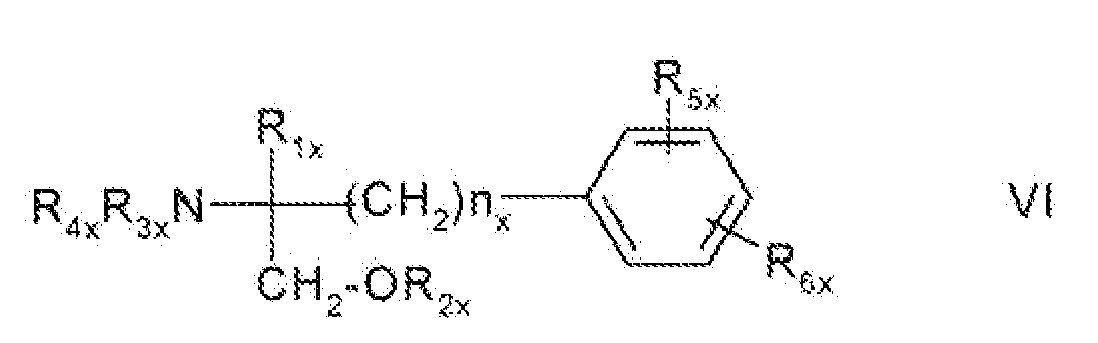
- nx
- is 2, 3 or 4
- R1x is
- H; C1-6alkyl optionally substituted by OH, acyl, halogen, cycloalkyl, phenyl or hydroxy-phenylene; C2-6alkenyl; C2-6alkynyl; or phenyl optionally substituted by OH;
- R2x
- is H, C1-4 alkyl or acyl
- each of R3x and R4x,
- independently is H, C1-4alkyl optionally substituted by halogen or acyl,
- R5x
- is H, C1-4alkyl or C1-4alkoxy, and
- R6x is
- C1-20 alkanoyl substituted by cycloalkyl; cyloalkylC1-14alkoxy wherein the cycloalkyl ring is optionally substituted by halogen, C1-4alkyl and/or C1-4alkoxy; phenylC1-14alkoxy wherein the phenyl ring is optionally substituted by halogen, C1-4alkyl and/or C1-4alkoxy,
- R6x
- being also C4-14alkoxy when R1x is C2-4alkyl substituted by OH, or pentyloxy or hexyloxy when R1x is C1-4akyl,
- Compounds as disclosed in
WO02/06268A1 

nd is an integer of 1 to 6;
Xd is ethylene, vinylene, ethynylene, a group having a formula -- D-CH2- (wherein D is carbonyl, - CH(OH)-, O, S or N), aryl or aryl substituted by up to three substitutents selected from group a as defined hereinafter;
Yd is single bond, C1-10alkylene, C1-10alkylene which is substituted by up to three substitutents selected from groups a and b, C1-10alkylene having O or S in the middle or end of the carbon chain, or C1-10alkylene having O or S in the middle or end of the carbon chain which is substituted by up to three substituents selected from groups a and b;
R5d is hydrogen, C3-6cycloalkyl, aryl, heterocyclic group, C3-6cycloalkyl substituted by up to three substituents selected from groups a and b, aryl substituted by up to three substituents selected from groups a and b, or heterocyclic group substituted by up to three substituents selected from groups a and b;
each of R6d and R7d, independently, is H or a substituent selected from group a;
each of R8d and R9d, independently, is H or C1-4alkyl optionally substituted by halogen;
<group a > is halogen, lower alkyl, halogeno lower alkyl, lower alkoxy, lower alkylthio, carboxyl, lower alkoxycarbonyl, hydroxy, lower aliphatic acyl, amino, mono-lower alkylamino, di-C1-4alkylamino, acylamino, cyano or nitro; and
<group b > is C3-6cycloalkyl, aryl or heterocyclic group, each being optionally substituted by up to three substituents selected from group a;
with the proviso that when R5d is hydrogen, Yd is a either a single bond or linear C1-10 alkylene, or a pharmacologically acceptable salt, ester or hydrate thereof; - Compounds as disclosed in
JP-14316985 JP2002316985 
JP-14316985 - Compounds as disclosed in
WO 03/29184 WO 03/29205 
R1f is halogen, trihalomethyl, OH, C1-7alkyl, C1-4alkoxy, trifluoromethoxy, phenoxy, cyclohexylmethyloxy, pyridylmethoxy, cinnamyloxy, naphthylmethoxy, phenoxymethyl, CH2-OH, CH2-CH2-OH, C1-4alkylthio, C1-4alkylsulfinyl, C1-4alkylsulfonyl, benzylthio, acetyl, nitro or cyano, or phenyl, phenylC1-4alkyl or phenyl-C1-4alkoxy each phenyl group thereof being optionally substituted by halogen, CF3, C1-4alkyl or C1-4alkoxy;
R2r is H, halogen, trihalomethyl, C1-4alkoxy, C1-7alkyl, phenethyl or benzyloxy;
R3f H, halogen, CF3, OH, C1-7alkyl, C1-4alkoxy, benzyloxy or C1-4alkoxymethyl;
each of R4f and R5f, independently is H or a residue of formula
nf is an integer from 1 to 4;
e.g. 2-amino-2-[4-(3-benzyloxyphenoxy)-2-chlorophenyl]ethyl-1,3-propane-diol, 2-amino-2-[4-(benzyloxyphenylthio)-2- chlorophenyl]ethyl-1,3-propane-diol, 2-amino-2-[4-(3-benzyloxyphenoxy)-2-chlorophenyl]propyl-1,3-propane-diol or 2-amino-2-[4-(benzyloxyphenylthio)-2-chlorophenyl]propyl-1,3-propane-diol,
or a pharmacological salt, solvate or hydrate thereof; - Compounds as disclosed in
WO03/062252A1 
Ar is phenyl or naphthyl; each of mg and ng independently is 0 or 1; A is selected from COOH, PO3H2, PO2H, SO3H, PO(C1-3alkyl)OH and 1H-tetrazol-5-yl; each of R1g and R2g independently is H, halogen, OH, COOH or C1-4alkyl optionally substituted by halogen; R3g is H or C1-4alkyl optionally substituted by halogen or OH; each R4g independently is halogen, or optionally halogen substituted C1-4alkyl or C1-3alkoxy; and each of Rg and M has one of the significances as indicated for B and C, respectively, inWO03/062252A1
or a pharmacologically acceptable salt, solvate or hydrate thereof; - Compounds as disclosed in
WO 031062248A2 
WO03/062248A2
or a pharmacologically acceptable salt, solvate or hydrate thereof; - Compounds as disclosed in
WO 04/103306A WO 05/000833 WO 05/103309 WO 05/113330 
Ak is COOR5k, OPO(OR5k)2, PO(OR5k)2, SO2OR5k, POR5kOR5k, or 1H-tetrazol-5-yl, R5k being H or C1-6alkyl;
Wk is a bond, C1-3akylene or C2-3alkenylene;
Yk is C6-10aryl or C3-9heteroaryl, optionally substituted by 1 to 3 radicals selected from halogene, OH, NO2, C1-6alkyl, C1-6alkoxy; halo-substituted C1-6alkyl and halo-substituted C1-3alkoxy;
Zk is a heterocyclic group as indicated inWO 04/103306A
R1k is C6-10aryl or C3-9heteroaryl, optionally substituted by C1-6alkyl, C6-10aryl, C6-10arylC1-4alkyl, C3-9heteroaryl, C3-9heteroarylC1-4alkyl, C3-9cycloalkyl, C3-8cycloalkylC1-4alkyl, C3-9heterocycloalkyl or C3-8heterocycloalkylC1-4alkyl-, wherein any aryl, heteroaryl, cycloalkyl or heterocycloalkyl of R1k may be substituted by 1 to 5 groups selected from halogen, C1-6alkyl, C1-6alkoxy and halo substituted-C1-6alkyl or -C1-6alkoxy;
R2k is H, C1-6alkyl, halo substituted C1-6alkyl, C2-6alkenyl or C2-6alkynyl: and each of R3k or R4k, independently, is H, halogen, OH, C1-6alkyl, C1-6alkoxy, or halo substituted C1-6alkyl or C1-6alkoxy;
and the N-oxide derivatives thereof orprodrugs thereof,
or a pharmacologically acceptable salt, solvate or hydrate thereof. - According to a further embodiment of the invention, a S1P receptor agonist or modulator for use in a combination of the invention may also be a selective S1P1 receptor, e.g. a compound which possesses a selectivity for the S1P1 receptor over the S1 P3 receptor of at least 20 fold, e.g. 100, 500, 1000 or 2000 fold, as measured by the ratio of EC50 for the S1P1 receptor to the EC50 for the S1P3 receptor as evaluated in a 35S-GTPγS binding assay, said compound having an EC50 for binding to the S1 P1 receptor of 100 nM or less as evaluated by the 35S-GTPγS binding assay. Representative S1P1 receptor agonists or modulators are e.g. the compounds listed in
WO 03/061567 
- When the compounds of formulae I to XIV have one or more asymmetric centers in the molecule, the present invention is to be understood as embracing the various optical isomers, as well as racemates, diastereoisomers and mixtures thereof are embraced. Compounds of formula III or IVb, when the carbon atom bearing the amino group is asymmetric, have preferably the R-configuration at this carbon atom.
- The compounds of formulae I to XIV may exist in free or salt form. Examples of pharmaceutically acceptable salts of the compounds of the formulae I to XIV include salts with inorganic acids, such as hydrochloride, hydrobromide and sulfate, salts with organic acids, such as acetate, fumarate, maleate, benzoate, citrate, malate, methanesulfonate and benzenesulfonate salts, or, when appropriate, salts with metals such as sodium, potassium, calcium and aluminium, salts with amines, such as triethylamine and salts with dibasic amino acids, such as lysine. The compounds and salts of the combination of the present invention encompass hydrate and solvate forms.
- Acyl as indicated above may be a residue Ry-CO- wherein Ry is C1-6alkyl, C3-6cycloalkyl, phenyl or phenyl-C1-4alkyl, Unless otherwise stated, alkyl, alkoxy, alkenyl or alkynyl may be straight or branched.
- Aryl may be phenyl or naphthyl, preferably phenyl.
- When in the compounds of formula I the carbon chain as R1 is substituted, it is preferably substituted by halogen, nitro, amino, hydroxy or carboxy. When the carbon chain is interrupted by an optionally substituted phenylene, the carbon chain is preferably unsubstituted. When the phenylene moiety is substituted, it is preferably substituted by halogen, nitro, amino, methoxy, hydroxy or carboxy,
- Preferred compounds of formula I are those wherein R1 is C13-20alkyl, optionally substituted by nitro, halogen, amino, hydroxy or carboxy, and, more preferably those wherein R1 is phenylalkyl substituted by C6-14-alkyl chain optionally substituted by halogen and the alkyl moiety is a C1-6alkyl optionally substituted by hydroxy. More preferably, R1, is phenyl-C1-6alkyl substituted on the phenyl by a straight or branched, preferably straight, C6-14alkyl chain. The C6-14alkyl chain may be in ortho, meta or para, preferably in para.
- Preferably each of R2 to R5 is H.
- In the above formula of VII "heterocyclic group" represents a 5- to 7 membered heterocyclic group having 1 to 3 heteroatoms selected from S, O and N. Examples of such heterocyclic groups include the heteroaryl groups indicated above, and heterocyclic compounds corresponding to partially or completely hydrogenated heteroaryl groups, e.g. furyl, thienyl, pyrrolyl, azepinyl, pyrazolyl, imidazolyl, oxazolyl, isoxazolyl, thiazolyl, isothiazolyl, 1,2,3-oxadiazolyl, triazolyl, tetrazolyl, thiadiazolyl, pyranyl, pyridyl, pyridazinyl, pyrimidinyl, pyrazinyl, tetrahydropyranyl, morpholinyl, thiomorpholinyl, pyrrolidinyl, pyrrolyl, imidazolidinyl, pyrazolidinyl, piperidinyl, piperazinyl, oxazolidinyl, isoxazolidinyl, thiazolidinyl or pyrazolidinyl. Preferred heterocyclic groups are 5-or 6-membered heteroaryl groups and the most preferred heteocyclic group is a morpholinyl, thiomorpholinyl or piperidinyl group.
- A preferred compound of formula is 2-amino-2-tetradecyl-1,3-propanediol. A particularly preferred S1 P receptor agonist of formula I is FTY720, i.e. 2-amino-2-[2-(4-octylphenyl) ethyl]propane-1,3-diol in free form or in a pharmaceutically acceptable salt form (referred to hereinafter as Compound A), e.g. the hydrochloride,as shown:

- A preferred compound of formula II is the one wherein each of R'2 to R'5 isH and m is 4, i.e. 2-amino-2-{2-[4-(1-oxo-5-phenylpentyl)phenyl]ethyl}propane-1,3-diol, in free form or in pharmaceutically acceptable salt form (referred to hereinafter as Compound B), e.g the hydrochloride.
- A preferred compound of formula III is the one wherein W is CH3, each of R"1 to R"3 is H, Z2 is ethylene, X is heptyloxy and Y is H, i.e. 2-amino-4-(4-heptyloxyphenyl)-2-methyl-butanol, in free form or in pharmaceutically acceptable salt form (referred to hereinafter as Compound C), e.g. the hydrochloride, The R-enantiomer is particularly preferred.
- A preferred compound of formula IVa is the FTY720-phosphate (R,2a is H. R3a is OH, Xa is O, R1a and R1b are OH), A preferred compound of formula IVb is the Compound C-phosphate (R2a is H, R3b is OH, Xa is O. R1a and R1b are OH, Ya is O and R4a, is heptyl), A preferred compound of formula V is Compound B-phosphate.
- A preferred compound of formula V is phosphoric acid mono-[(R)-2-amino-2-methyl-4-(4-pentyloxy-phenyl)-butyl]ester.
- A preferred compound of formula VIII is (2R)-2-amino-4-(3-(4-cyclohexyloxybutyl)-benzo[b]thien-6-yl]-2-methylbutan-1-ol,
- A preferred compound of formula XIIa is e.g. 1-{4-[1-(4-cyclohexyl-3-trifuoromethyl benzyloxyimino)-ethyl]-2-ethyl-benzyl}-azetidine-3-carboxylic acid, or a prodrug thereof.
- According to the invention, it provides the use of an S1P receptor modulator or agonist in the manufacture of a medication, whereby said medication is administered in such a way that during the initial 3 to 6 days, preferably 4 or 5 days, most preferred 4 days, of treatment the dosage of said S1 P receptor modulator or agonist is raised so that in total the R-fold (R being the accumulation factor) standard daily dosage of said S1 P receptor modulator or agonist is administered and thereafter the treatment is continued with the standard or a lower daily dosage of said S1P receptor modulator or agonist.
- Preferred medications comprise medication for transplant patients providing prolonged survival rates, in particular prolonged allograft survival rates especially for renal, heart, lung or liver transplants, or for patients suffering from autoimmune diseases, e.g. multiple sclerosis, lupus nephritis, rheumatoid arthritis, inflammatory bowel diseases or psoriasis.
- In view of the normally prolonged taking of the medication, the standard daily dosage (also called maintenance dose) refers to the dosage of an S1P receptor modulator or agonist necessary for a steady-state trough blood level of the medication or its active metabolite(s) providing effective treatment. Said dosage is dependent on the accumulation factor (R). By blood level is meant the concentration of a drug in blood at any time. Trough blood level corresponds to a pre-dose blood level. Steady-state means whether the trough or blood level is stable over time. Steady-state trough blood levels may be assessed, for example, by obtaining a pre-dose blood sample anytime after month 3. The accumulation factor (R) is calculated on the ratio of the steady-state trough to the trough just before the second dose,
- Preferably, the dosage of the S1P receptor modulator or agonist during the initial 3 to 6 days, of treatment is increased stepwise, Thereafter the treatment is continued with the maintenance therapy with the standard daily dosage or with a lower daily dosage. When the treatment is continued at a lower daily dosage, it may be e.g, about 1/50 to ½, preferably 1/50 to 1/10, of the standard daily dosage of the S1P receptor modulator or agonist.
- Preferably, the total dosage of said S1P receptor modulator or agonist during the initial 3 to 6 days, preferably 4 or 5 days, most preferred 4 days, of treatment is increased incrementally from 3- to 21 -fold, more preferred from 4 to 12-fold, particularly about 10-fold, the standard daily dosage of said S1P receptor modulator or agonist. For example, the loading dose may be 1; 1.5-2; 2-3, and 3-4 fold the standard daily dosage, on day 1,2,3 and 4, respectively.
- According to a preferred embodiment of the invention, the highest loading regimen dose instalment on the last day of the loading regimen, e.g. on day 4, is 4x the maintenance dose of the S1P receptor modulator or agonist. The instalment doses on days 1, 2 and 3 of the loading regimen may be e.g. about ¼;½; and ¾ of the highest instalment dose of the S1P receptor modulator or agonist.
- A particularly preferred dosage of the S1P receptor modulator or agonist, e.g. the preferred S1 P receptor modulator FTY720, is e.g. 2-5, 5-10, 10-15 and 15-20 mg, e.g. a regimen of 2.5mg/5mg/7.5mg/10mg or 5mg/10mg/15mg/20mg, respectively, during the initial period of 4 days. Thereafter the treatment is continued with the maintenance therapy, e.g. a daily dosage of 2.5 mg or 5 mg, or at a lower daily dosage, e.g. 0.1 to 0,5 mg.
- In a further embodiment of the invention, a preferred loading regimen of a S1P receptor agonist or modulator, e.g. the preferred S1 P receptor modulator FTY720, may also be e.g. 0.5mg/1mg/1.5mg/2mg during the initial period of 4 days. Thereafter the treatment is continued with the maintenance therapy, e.g. a daily dosage of 0,5 mg.
- In a series of further specific or alternative embodiments, the present invention also provides:
- 1.1 The use of a S1 P receptor modulator or agonist, e.g. FTY720, in the manufacture of a medication, whereby said medication is administered in such a way to a subject that a steady-state of the S1P receptor modulator or agonist blood levels is attained in less than a week.
The steady-state attained is such that the subject is sufficiently immunosuppressed, e.g. it shows no signs or symptoms of acute graft rejection or relapse or rebound of the autoimmune disease. During the initial 3 to 6 days, preferably 4 or 5 days, most preferred 4 days, of treatment the daily dosage of the S1P receptor modulator or agonist is raised stepwise up to 3- to 21-fold the standard daily dosage of said S1P receptor modulator or agonist and thereafter the treatment is continued with the standard daily dosage of said S1P receptor modulator or agonist. - 1.2 The use of a S1P receptor modulator or agonist, e.g. FTY720, in the manufacture of a medication, whereby said medication is administered in such a way to a subject that a steady-state of the S1P receptor modulator or agonist blood levels is attained in less than a week, and thereafter the treatment is continued at a dosage lower than the standard daily dosage.
- 1.3. The use of a S1P receptor modulator or agonist, e.g. FTY720, in the manufacture of a medication, whereby said medication is administered in such a way that during the initial 4 days of treatment the dosage of the S1P receptor modulator or agonist is 1; 1.5-2; 2-3; and 3-4 fold the standard daily dosage, respectively, and thereafter the treatment is continued with the standard daily dosage of the S1P receptor modulator or agonist, or at a lower daily dosage.
- 1,4 The use of a S1P receptor modulator or agonist, e.g. FTY720, in the manufacture of a medication, whereby said medication is administered in such a way that during the initial 4 days of treatment the dosage of the S1P receptor modulator or agonist is ¼, ½; and ¾ of the highest instalment dose of the S1P receptor modulator or agonist: and 4x the maintenance dose of the S1P receptor modulators or agonist, respectively, and thereafter the treatment is continued with the maintenance dose or optionally with a lower daily dosage of the S1P preceptor modulator or agonist.
- 1.5 The use of an S1P receptor modulator or agonist, e.g. FTY720, in the manufacture of a medication, whereby said medication is administered in such a way that during the initial 3 to 6 days, preferably 4 or 5 days, most preferred 4 days, of treatment the dosage of said S1P receptor modulator or agonist is raised so that in total the R-fold standard daily dosage of said S1P receptor modulator or agonist is administered and thereafter the treatment is continued with the standard daily dosage of said S1P receptor agonist or at a lower daily dosage,
- 1.6 The use of an S1P receptor modulator or agonist, e.g. FTY720, in the manufacture of a medication, whereby said medication is administered, after a loading regimen, at a daily dosage which is lower than the standard daily dosage.
- 1.7 The use of FTY720 in the manufacture of a medication, whereby said medication is administered, after a loading regimen, at a daily dosage of 0.1 to 0.5 mg.
- 2. A method for inhibiting graft rejection or treating an autoimmune disease in a subject in need thereof, comprising administering to the subject a S1 P receptor modulator or agonist, e.g. FTY720, in such a pharmaceutically effective amount that a steady-state of the S1 P receptor modulator or agonist blood levels is attained in the subject in less than a week. Thereafter the treatment is continued with the standard daily dosage of said S1P receptor modulator or agonist or at a lower daily dosage
- 2.1 A method for producing a steady-state of S1P receptor modulator or agonist blood levels in a subject in less than a week comprising administering during the initial 3 to 6 days, preferably 4 or 5 days, most preferred 4 days, an incremental daily dosage of up 3- to 21-fold the standard daily dosage of said S1P receptor modulator or agonist.
- 2.2 In a treatment method with a S1P receptor modulator or agonist, e.g. FTY720, the improvement being that the S1P receptor modulator or agonist is administered in such a way that during the initial 3 to 6 days, preferably 4 or 5 days, most preferred 4 days, of treatment the dosage is raised so that in total the R-fold standard daily dosage is administered. Thereafter the treatment is continued with the standard effective daily dosage or at a lower daily dosage,
- 2.3 A method for providing prolonged transplant survival rates in a subject, whereby an S1P receptor modulator or agonist is administered in such a way that during the initial 3 to 6 days, preferably 4 or 5 days, most preferred 4 days, of treatment the dosage is raised stepwise so that in total the R-fold standard daily dosage is administered and thereafter the treatment is continued with the standard daily dosage or at a lower daily dosage.
- 2.4 A method for inhibiting graft rejection or treating an autoimmune disease in a subject in need thereof, comprising administering to the subject, after a loading regimen, a S1 P receptor modulator or agonist, e.g. FTY720, at a daily dosage which is lower than the standard daily dosage.
- 2.5 A method for treating an autoimmune disease in a subject in need thereof, comprising administering to the subject, after a loading regimen, a daily dosage of FTY720 of about 0.1 to 0.5mg,
- 3. A kit containing daily units of medication of an S1P receptor modulator or agonist, e.g. FTY720., of varying daily dosage, whereby the daily dosage of said S1P receptor modulator or agonist for the initial 3 to 6 days, preferably 4 or 5 days, most preferred 4 days, of treatment is incrementally increased so that the total amount present in the daily units corresponds to the R-fold standard daily dosage of said S1P receptor modulator or agonist for this initial time period,
- 3.1. A kit containing daily units of medication of an S1P receptor modulator or agonist, e.g. FTY720, of varying daily dosage, whereby the daily dosage of S1P receptor modulator or agonist for the initial 4 days of treatment is 1; 1.5-2; 2-3; and 3-4 fold the standard daily dosage, respectively. The kit may further comprise units for the standard daily dosage of the S1P receptor modulator or agonist, e.g. FTY720, or for the subsequent treatment with a lower daily dosage. The kit may also contain instructions for use.
- 3.2 A kit containing daily units of medication of an S1P receptor modulator or agonist e.g. FTY720. of varying daily dosage, whereby the daily dosage of S1 P receptor modulator or agonist for the initial 4 days of treatment is ¼; ½, and % of the highest instalment dose of the S1P receptor modulator or agonist; and 4x the maintenance dose of the S1 P receptor modulator or agonist, respectively. The kit may further comprise units for the standard daily dosage of the S1P receptor modulator or agonist, e.g. FTY720, or for the subsequent treatment with a lower daily dosage. The kit may also contain instructions for use.
- The loading regimen of S1 P receptor modulator or agonist which is administered to the subject according to the invention may be given either during the initial 3-6 days post-transplantation or may start even prior to the transplantation surgery, or at the beginning of an autoimmune disease therapy, or after an interruption of S1P receptor modulator or agonist therapy.
- Utility of an S1P receptor modulator or agonist dosage regimen in treating diseases and conditions as hereinabove specified may be demonstrated in standard animal or clinical tests, e.g. in accordance with the methods described hereinafter.
- Initial baseline (Day -2): on Day -2, subjects enter the study center at least 12-hours prior to dosing for verification of inclusion/exclusion criteria and baseline assessments.
- Placebo run-in (Day-1): On Dray -1, subjects receive a single, placebo dose of FTY720
- FTY720 treatment (Days 1-7): All subjects receive FTY720 once daily for 7 consecutive days as follows,
Day 1: Subjects receive a single 5 mg FTY720 oral dose at the exact time the Day -1 dose was administered.
Days 2-4: Subject receive a single 10 mg FTY720 oral dose on Day 2, a single 15 mg FTY720 oral dose on Day 3, and a single 20 mg FTY720 oral dose on Day 4, in order to achieve the FTY720 steady-state concentration typically measured in patients on chronic dosing of FTY720 5 mg qd.
Day 5-7: Subjects receive single 5 mg FTY720 oral doses once daily. - Pharmacokinetic, pharmacodynamic and safety assessments are performed at specified times during the multiple-dose study. Subjects are released from the study center approximately 24 hours after the last drug administration on Day 7, after the safety evaluations have been completed (i.e., Day 8).
- FTY720 is measured in whole blood using LC/MS/MS (LLOQ = 0.080 ng/mL)
- Peak and trough concentrations are summarized from days 2 through 7 to estimate drug accumulation and attainment of steady state.
- Blood samples for absolute lymphocyte counts is collected at screening, at initial baseline (Day -2), Day 1 (6h postdose), Day 3 (predose), Day 5 (predose) and Day 7 (predose).
- The samples are analyzed for pharmacodynamics,
- Above procedure may be repeated and the patients are then treated Day 5 and followings with a daily maintenance dose of 0.5mg/kg. The patients have lower steady-state blood levels.
- Above procedure may be repeated with following loading treatments:
- 1. Day 1: Subjects receive a single 2.5 mg FTY720 oral dose at the exact time the Day - 1 dose was administered.
Days 2-4. Subject receive a single 5 mag FTY720 oral dose on Day 2. a single 7.5 mg FTY720 oral dose on Day 3, and a single 10 mg FTY720 oral dose on Day 4, in order to achieve the FTY720 steady-state concentration typically measured in patients on chronic dosing of FTY720 2.5 mg qd.
Day 5-7 and following: Subjects receive single 2.5 mg FTY720 oral doses once daily. - 2. Day 1: Subjects receive a single 1.25 mg FTY720 oral dose at the exact time the Day -1 dose was administered.
Days 2-4: Subject receive a single 2.5 mg FTY720 oral dose on Day 2, a single 3.75 mg FTY720 oral dose on Day 3, and a single 5 mg FTY720 oral dose on Day 4, in order to achieve the FTY720 steady-state concentration typically measured in patients on chronic dosing of FTY720 1.25 mg qd.
Day 5-7 and following: Subjects receive single 1.25 mg FTY720 oral doses once daily,
Claims (11)
- A compound which is 2-amino-2-[2-(4-octylphenyl)ethyl]propane-1 ,3-diol (FTY720) in free form or in a pharmaceutically acceptable salt form, for use in a method for treating acute graft rejection or an autoimmune disease in a patient in need thereof, whereby said method comprises administering a maintenance therapy of 2.5 mg or 5 mg to the patient.
- Compound according to claim 1, whereby the maintenance therapy is of 0.1 to 0.5 mg.
- Compound according to claim 1 or 2, whereby the maintenance therapy is a daily dosage.
- Compound according to claim 3, whereby the method comprises administering a loading regimen.
- Compound according to claim 4, whereby the loading regimen consists of an incremental daily dosage of up 3- to 21-fold the standard daily dosage of the compound during the initial 3 to 6 days of treatment.
- Compound according to claim 2, whereby the method comprises administering a loading regimen consisting of 0.5mg/1mg/1.5mg/2mg during the initial period of 4 days of treatment.
- Compound according to any one of claims 4 to 6, whereby the loading regimen is administered at the beginning of the autoimmune disease therapy, or after an interruption of the therapy.
- Compound according to any one of claims 1 to 7, wherein the compound is the hydrochloride form of 2-amino-2-[2-(4-octylphenyl)ethyl]propane-1,3-diol.
- Compound according to any of the preceding claims for treating multiple sclerosis, lupus nephritis, rheumatoid arthritis, inflammatory bowel diseases or psoriasis.
- A kit containing daily units of medication of a compound as defined in claim 1, of varying daily dosage, whereby the daily dosage of the compound for the initial 4 days of treatment is 1; 1.5-2; 2-3; and 3-4 fold the standard daily dosage.
- The kit according to claim 10, wherein the compound is the hydrochloride form of 2-amino-2-[2-(4-octylphenyl)ethyl]propane-1,3-diol.
Applications Claiming Priority (2)
| Application Number | Priority Date | Filing Date | Title |
|---|---|---|---|
| US63148304P | 2004-11-29 | 2004-11-29 | |
| EP05826219.7A EP1819326B1 (en) | 2004-11-29 | 2005-11-28 | Dosage regimen of an s1p receptor agonist |
Related Parent Applications (3)
| Application Number | Title | Priority Date | Filing Date |
|---|---|---|---|
| EP05826219.7A Division-Into EP1819326B1 (en) | 2004-11-29 | 2005-11-28 | Dosage regimen of an s1p receptor agonist |
| EP05826219.7 Division | 2005-11-28 | ||
| WOPCT/US2005/003044 Previously-Filed-Application | 2005-11-28 |
Publications (1)
| Publication Number | Publication Date |
|---|---|
| EP2384749A1 true EP2384749A1 (en) | 2011-11-09 |
Family
ID=36046868
Family Applications (3)
| Application Number | Title | Priority Date | Filing Date |
|---|---|---|---|
| EP10179083A Withdrawn EP2384749A1 (en) | 2004-11-29 | 2005-11-28 | Dosage regimen of an S1P receptor agonist |
| EP10179081A Withdrawn EP2359821A1 (en) | 2004-11-29 | 2005-11-28 | Dosage regimen of an s1p receptor agonist |
| EP05826219.7A Revoked EP1819326B1 (en) | 2004-11-29 | 2005-11-28 | Dosage regimen of an s1p receptor agonist |
Family Applications After (2)
| Application Number | Title | Priority Date | Filing Date |
|---|---|---|---|
| EP10179081A Withdrawn EP2359821A1 (en) | 2004-11-29 | 2005-11-28 | Dosage regimen of an s1p receptor agonist |
| EP05826219.7A Revoked EP1819326B1 (en) | 2004-11-29 | 2005-11-28 | Dosage regimen of an s1p receptor agonist |
Country Status (21)
| Country | Link |
|---|---|
| US (3) | US20090275553A1 (en) |
| EP (3) | EP2384749A1 (en) |
| JP (4) | JP2008521827A (en) |
| KR (4) | KR20070085465A (en) |
| CN (2) | CN101068536B (en) |
| AU (1) | AU2005309378B2 (en) |
| BR (1) | BRPI0518674A2 (en) |
| CA (1) | CA2589265A1 (en) |
| ES (1) | ES2495690T3 (en) |
| IL (2) | IL183134A0 (en) |
| MA (1) | MA29034B1 (en) |
| MX (1) | MX2007006373A (en) |
| NO (2) | NO20072401L (en) |
| NZ (2) | NZ590054A (en) |
| PL (1) | PL1819326T3 (en) |
| PT (1) | PT1819326E (en) |
| RU (2) | RU2478384C2 (en) |
| SG (2) | SG187468A1 (en) |
| TN (1) | TNSN07209A1 (en) |
| WO (1) | WO2006058316A1 (en) |
| ZA (1) | ZA200703328B (en) |
Families Citing this family (31)
| Publication number | Priority date | Publication date | Assignee | Title |
|---|---|---|---|---|
| AU2005272619A1 (en) | 2004-08-13 | 2006-02-23 | Praecis Pharmaceuticals, Inc. | Methods and compositions for modulating sphingosine-1-phosphate (SIP) receptor activity |
| SG187468A1 (en) * | 2004-11-29 | 2013-02-28 | Novartis Ag | Dosage regimen of an s1p receptor agonist |
| NZ588372A (en) * | 2005-09-09 | 2012-03-30 | Novartis Ag | Diphenyl ether or thioether derivatives for treatment of autoimmune diseases |
| GB0612721D0 (en) | 2006-06-27 | 2006-08-09 | Novartis Ag | Organic compounds |
| CA2684953C (en) | 2007-05-04 | 2016-08-09 | Novartis Ag | Use of s1p receptor modulator |
| WO2009115954A1 (en) | 2008-03-17 | 2009-09-24 | Actelion Pharmaceuticals Ltd | Dosing regimen for a selective s1p1 receptor agonist |
| EP2305305A4 (en) * | 2008-05-20 | 2013-02-13 | Kyorin Seiyaku Kk | INDUCTION / MAINTENANCE TRANSMITTER |
| DK2307007T3 (en) | 2008-07-23 | 2014-11-10 | Novartis Ag | Sphingosine-1-phosphate receptor modulators as well as their use in the treatment of muscle inflammation |
| ES2526119T3 (en) | 2008-08-18 | 2015-01-07 | Novartis Ag | Azetidine derivative for the treatment of peripheral neuropathies |
| EP2379499B1 (en) | 2008-12-18 | 2014-04-09 | Novartis AG | Hydrochloride salt of 1-(4-(1-((E)-4-cyclohexyl-3-trifluoromethyl-benzyloxyimino)-ethyl)-2-ethyl-benzyl)-azetidine-3-carboxylic acid |
| AU2009327405A1 (en) * | 2008-12-18 | 2011-06-30 | Novartis Ag | New polymorphic form of 1- (4- { l- [ (E) -4-cyclohexyl--3-trifluoromethyl-benzyloxyimino] -ethyl) -2-ethyl-benzy l) -azetidine-3-carboxylic |
| RS53041B (en) * | 2008-12-18 | 2014-04-30 | Novartis Ag | 1- [4- [1- (4-CYCLOHEXYL-3-TRIFLUOROMETHYL-BENZYLOXYIMINO) -ETHYL] -2-ETHYL-BENZYL] -AZETIDINE-3-CARBOXYLIC ACID |
| AU2015275246B2 (en) * | 2008-12-22 | 2018-02-01 | Novartis Ag | Dosage regimen for a S1P receptor agonist |
| PL2379067T3 (en) * | 2008-12-22 | 2016-02-29 | Novartis Ag | Dosage regimen for fingolimod for the treatment of multiple sclerosis |
| WO2010072703A1 (en) * | 2008-12-22 | 2010-07-01 | Novartis Ag | Dosage regimen of an s1p receptor agonist |
| EP3061449A1 (en) * | 2009-09-29 | 2016-08-31 | Novartis AG | Dosage regimen of an s1p receptor modulator |
| US20110124605A1 (en) * | 2009-11-20 | 2011-05-26 | Shreeram Aradhye | Use of an S1P Receptor Agonist |
| US8791100B2 (en) | 2010-02-02 | 2014-07-29 | Novartis Ag | Aryl benzylamine compounds |
| AU2011249789B2 (en) * | 2010-05-06 | 2015-03-19 | Novartis Ag | Dosage regimen of diaryl sulfide derivatives |
| JP6111202B2 (en) | 2011-01-07 | 2017-04-05 | ノバルティス アーゲー | Immunosuppressive preparation |
| US20150218090A1 (en) * | 2011-10-21 | 2015-08-06 | Novartis Ag | Dosage regimen for an s1p receptor modulator or agonist |
| SMT202000298T1 (en) | 2012-08-17 | 2020-07-08 | Actelion Pharmaceuticals Ltd | Process for the preparation of (2z,5z)-5-(3-chloro-4-((r)-2,3-dihydroxypropoxy)benzylidene)-2-(propylimino)-3-(o-tolyl)thiazolidin-4-one and intermediate used in said process |
| CN102887829B (en) * | 2012-09-05 | 2014-07-02 | 中国科学院上海药物研究所 | Method for preparing fingolimod mucate and crystals thereof and application of fingolimod mucate and crystals thereof |
| US10675254B2 (en) | 2013-10-11 | 2020-06-09 | Teikoku Seiyaku Co., Ltd. | Sphingosine-1-phosphate receptor agonist iontophoretic devices and methods of using the same |
| US10022340B2 (en) | 2013-10-11 | 2018-07-17 | Teikoku Pharma Usa, Inc. | Topical sphingosine-1-phosphate receptor agonist formulations and methods of using the same |
| MA41139B1 (en) | 2014-12-11 | 2026-02-27 | Laboratoires Juvise Pharmaceuticals | Pharmaceutical combination including ponesimod and its use in the treatment of multiple sclerosis |
| DK3256125T3 (en) | 2014-12-11 | 2022-03-21 | Actelion Pharmaceuticals Ltd | DOSAGE REGISTER FOR PONESIMOD, A SELECTIVE S1P1 RECEPTOR AGONIST |
| US20180042895A1 (en) | 2015-02-26 | 2018-02-15 | Novartis Ag | Treatment of autoimmune disease in a patient receiving additionally a beta-blocker |
| US10250466B2 (en) * | 2016-03-29 | 2019-04-02 | Juniper Networks, Inc. | Application signature generation and distribution |
| US11629124B2 (en) | 2017-03-09 | 2023-04-18 | Novartis Ag | Solid forms comprising an oxime ether compound, compositions and methods of use thereof |
| TW202131921A (en) | 2019-10-31 | 2021-09-01 | 瑞士商愛杜西亞製藥有限公司 | Combination of a cxcr7 antagonist with an s1p1 receptor modulator |
Citations (17)
| Publication number | Priority date | Publication date | Assignee | Title |
|---|---|---|---|---|
| EP0627406A1 (en) | 1992-10-21 | 1994-12-07 | Yoshitomi Pharmaceutical Industries, Ltd. | 2-amino-1,3-propanediol compound and immunosuppressant |
| EP0778263A1 (en) | 1994-08-22 | 1997-06-11 | Yoshitomi Pharmaceutical Industries, Ltd. | Benzene compound and medicinal use thereof |
| EP1002792A1 (en) | 1997-04-04 | 2000-05-24 | Yoshitomi Pharmaceutical Industries, Ltd. | 2-aminopropane-1,3-diol compounds, medicinal use thereof, and intermediates in synthesizing the same |
| WO2002006268A1 (en) | 2000-07-13 | 2002-01-24 | Sankyo Company, Limited | Amino alcohol derivatives |
| WO2002018395A1 (en) | 2000-08-31 | 2002-03-07 | Merck & Co., Inc. | Phosphate derivatives as immunoregulatory agents |
| WO2002076995A2 (en) | 2001-03-26 | 2002-10-03 | Novartis Ag | 2-amino-propanol derivatives |
| JP2002316985A (en) | 2001-04-20 | 2002-10-31 | Sankyo Co Ltd | Benzothiophene derivative |
| WO2002100148A2 (en) * | 2001-06-08 | 2002-12-19 | Novartis Ag | Treatment or prophylaxis of insulin-producing cell graft rejection |
| WO2003029205A1 (en) | 2001-09-27 | 2003-04-10 | Kyorin Pharmaceutical Co., Ltd. | Diaryl sulfide derivative, addition salt thereof, and immunosuppressant |
| WO2003029184A1 (en) | 2001-09-27 | 2003-04-10 | Kyorin Pharmaceutical Co., Ltd. | Diaryl ether derivative, addition salt thereof, and immunosuppressant |
| WO2003062252A1 (en) | 2002-01-18 | 2003-07-31 | Merck & Co., Inc. | Edg receptor agonists |
| WO2003061567A2 (en) | 2002-01-18 | 2003-07-31 | Merck & Co., Inc. | Selective s1p1/edg1 receptor agonists |
| WO2003062248A2 (en) | 2002-01-18 | 2003-07-31 | Merck & Co., Inc. | N-(benzyl)aminoalkylcarboxylates, phosphinates, phosphonates and tetrazoles as edg receptor agonists |
| WO2004103306A2 (en) | 2003-05-19 | 2004-12-02 | Irm Llc | Immunosuppressant compounds and compositions |
| WO2005000833A1 (en) | 2003-05-19 | 2005-01-06 | Irm, Llc | Immunosuppressant compounds and compositions |
| WO2005103309A1 (en) | 2004-04-26 | 2005-11-03 | Fos International S.A. | Metallothermic process for magnesium production and vacuum-induction furnace thereto |
| WO2005113330A1 (en) | 2004-05-05 | 2005-12-01 | Adler, Richard, S. | Systems and methods for protecting ship from attack on the surface or under water |
Family Cites Families (11)
| Publication number | Priority date | Publication date | Assignee | Title |
|---|---|---|---|---|
| ATE279185T1 (en) * | 1995-12-28 | 2004-10-15 | Mitsubishi Pharma Corp | 2-AMINO-2-(2-(4-OCTYLPHENYL)ETHYL)PROPANE-1,3-DI L CONTAINING MEDICINAL PRODUCT FOR TOPICAL USE FOR THE TREATMENT OF DISEASES CAUSED BY A DISRUPTION OF THE IMMUNE SYSTEM |
| US6476004B1 (en) * | 1996-07-18 | 2002-11-05 | Mitsubishi Pharma Corporation | Pharmaceutical composition |
| DE69840169D1 (en) * | 1997-02-27 | 2008-12-11 | Novartis Ag | MEDICAMENT PREPARATION CONTAINING 2-AMINO-2-Ä2- (4-OCTYLPHENYL) ETHYL PROPANE-1,3-DIOL, A LECITHIN AND A Saccharide |
| JPH1180026A (en) * | 1997-09-02 | 1999-03-23 | Yoshitomi Pharmaceut Ind Ltd | Novel immunosuppressants, methods of use and methods of identification thereof |
| JPH11116479A (en) * | 1997-10-10 | 1999-04-27 | Sugen Inc | Combined chemotherapaeutic treatment for cerebral cancer |
| ES2364816T3 (en) * | 2001-04-02 | 2011-09-14 | Genentech, Inc. | COMBINATION THERAPY. |
| CA2443040A1 (en) * | 2001-04-02 | 2002-10-17 | Nicola Frances Bateman | Solid pharmaceutical composition comprising 4 -cyano-trifluoro-3-(4-fluorophenyl-sulphonyl) -2-hydroxy-2-methylpropiono- m toluidide and pvp |
| MXPA05003254A (en) * | 2002-09-24 | 2005-06-08 | Novartis Ag | Sphingosine-1-phosphate receptor agonists in the treatment of demyelinating disorders. |
| WO2006041015A1 (en) * | 2004-10-12 | 2006-04-20 | Kyorin Pharmaceutical Co., Ltd. | Amino alcohol derivative, addition salt thereof and immunosuppressive agent |
| SG187468A1 (en) * | 2004-11-29 | 2013-02-28 | Novartis Ag | Dosage regimen of an s1p receptor agonist |
| GT200600350A (en) * | 2005-08-09 | 2007-03-28 | LIQUID FORMULATIONS |
-
2005
- 2005-11-28 SG SG2013002662A patent/SG187468A1/en unknown
- 2005-11-28 PT PT58262197T patent/PT1819326E/en unknown
- 2005-11-28 EP EP10179083A patent/EP2384749A1/en not_active Withdrawn
- 2005-11-28 EP EP10179081A patent/EP2359821A1/en not_active Withdrawn
- 2005-11-28 CN CN2005800409686A patent/CN101068536B/en not_active Expired - Fee Related
- 2005-11-28 CA CA002589265A patent/CA2589265A1/en not_active Abandoned
- 2005-11-28 ES ES05826219.7T patent/ES2495690T3/en not_active Expired - Lifetime
- 2005-11-28 KR KR1020077011969A patent/KR20070085465A/en not_active Ceased
- 2005-11-28 NZ NZ590054A patent/NZ590054A/en not_active IP Right Cessation
- 2005-11-28 JP JP2007543584A patent/JP2008521827A/en not_active Withdrawn
- 2005-11-28 MX MX2007006373A patent/MX2007006373A/en active IP Right Grant
- 2005-11-28 PL PL05826219T patent/PL1819326T3/en unknown
- 2005-11-28 NZ NZ554720A patent/NZ554720A/en not_active IP Right Cessation
- 2005-11-28 BR BRPI0518674-9A patent/BRPI0518674A2/en not_active Application Discontinuation
- 2005-11-28 AU AU2005309378A patent/AU2005309378B2/en not_active Ceased
- 2005-11-28 KR KR1020137008529A patent/KR20130041385A/en not_active Ceased
- 2005-11-28 RU RU2007124327/15A patent/RU2478384C2/en not_active IP Right Cessation
- 2005-11-28 WO PCT/US2005/043044 patent/WO2006058316A1/en not_active Ceased
- 2005-11-28 EP EP05826219.7A patent/EP1819326B1/en not_active Revoked
- 2005-11-28 KR KR1020147018084A patent/KR20140095109A/en not_active Withdrawn
- 2005-11-28 US US11/720,205 patent/US20090275553A1/en not_active Abandoned
- 2005-11-28 KR KR20157005416A patent/KR20150028858A/en not_active Ceased
- 2005-11-28 SG SG200907947-6A patent/SG158096A1/en unknown
- 2005-11-28 CN CN2012100846463A patent/CN102600472A/en active Pending
-
2007
- 2007-04-24 ZA ZA200703328A patent/ZA200703328B/en unknown
- 2007-05-10 NO NO20072401A patent/NO20072401L/en not_active Application Discontinuation
- 2007-05-10 IL IL183134A patent/IL183134A0/en unknown
- 2007-05-22 MA MA29926A patent/MA29034B1/en unknown
- 2007-05-28 TN TNP2007000209A patent/TNSN07209A1/en unknown
-
2011
- 2011-11-22 US US13/302,881 patent/US20120071446A1/en not_active Abandoned
-
2012
- 2012-02-27 JP JP2012040574A patent/JP2012107059A/en not_active Withdrawn
- 2012-10-02 RU RU2012141951/15A patent/RU2012141951A/en unknown
- 2012-11-06 NO NO20121305A patent/NO20121305L/en not_active Application Discontinuation
- 2012-12-06 IL IL223502A patent/IL223502A0/en unknown
-
2013
- 2013-03-05 JP JP2013043351A patent/JP2013129664A/en not_active Withdrawn
-
2014
- 2014-10-16 US US14/516,153 patent/US20150087720A1/en not_active Abandoned
- 2014-12-26 JP JP2014266267A patent/JP2015061883A/en active Pending
Patent Citations (18)
| Publication number | Priority date | Publication date | Assignee | Title |
|---|---|---|---|---|
| EP0627406A1 (en) | 1992-10-21 | 1994-12-07 | Yoshitomi Pharmaceutical Industries, Ltd. | 2-amino-1,3-propanediol compound and immunosuppressant |
| EP0778263A1 (en) | 1994-08-22 | 1997-06-11 | Yoshitomi Pharmaceutical Industries, Ltd. | Benzene compound and medicinal use thereof |
| EP1002792A1 (en) | 1997-04-04 | 2000-05-24 | Yoshitomi Pharmaceutical Industries, Ltd. | 2-aminopropane-1,3-diol compounds, medicinal use thereof, and intermediates in synthesizing the same |
| WO2002006268A1 (en) | 2000-07-13 | 2002-01-24 | Sankyo Company, Limited | Amino alcohol derivatives |
| WO2002018395A1 (en) | 2000-08-31 | 2002-03-07 | Merck & Co., Inc. | Phosphate derivatives as immunoregulatory agents |
| WO2002076995A2 (en) | 2001-03-26 | 2002-10-03 | Novartis Ag | 2-amino-propanol derivatives |
| JP2002316985A (en) | 2001-04-20 | 2002-10-31 | Sankyo Co Ltd | Benzothiophene derivative |
| WO2002100148A2 (en) * | 2001-06-08 | 2002-12-19 | Novartis Ag | Treatment or prophylaxis of insulin-producing cell graft rejection |
| US20030003099A1 (en) * | 2001-06-08 | 2003-01-02 | Philip Lake | Immunosuppressive combination and its use in the treatment or prophylaxis of insulin-producing cell graft rejection |
| WO2003029205A1 (en) | 2001-09-27 | 2003-04-10 | Kyorin Pharmaceutical Co., Ltd. | Diaryl sulfide derivative, addition salt thereof, and immunosuppressant |
| WO2003029184A1 (en) | 2001-09-27 | 2003-04-10 | Kyorin Pharmaceutical Co., Ltd. | Diaryl ether derivative, addition salt thereof, and immunosuppressant |
| WO2003062252A1 (en) | 2002-01-18 | 2003-07-31 | Merck & Co., Inc. | Edg receptor agonists |
| WO2003061567A2 (en) | 2002-01-18 | 2003-07-31 | Merck & Co., Inc. | Selective s1p1/edg1 receptor agonists |
| WO2003062248A2 (en) | 2002-01-18 | 2003-07-31 | Merck & Co., Inc. | N-(benzyl)aminoalkylcarboxylates, phosphinates, phosphonates and tetrazoles as edg receptor agonists |
| WO2004103306A2 (en) | 2003-05-19 | 2004-12-02 | Irm Llc | Immunosuppressant compounds and compositions |
| WO2005000833A1 (en) | 2003-05-19 | 2005-01-06 | Irm, Llc | Immunosuppressant compounds and compositions |
| WO2005103309A1 (en) | 2004-04-26 | 2005-11-03 | Fos International S.A. | Metallothermic process for magnesium production and vacuum-induction furnace thereto |
| WO2005113330A1 (en) | 2004-05-05 | 2005-12-01 | Adler, Richard, S. | Systems and methods for protecting ship from attack on the surface or under water |
Non-Patent Citations (5)
Also Published As
Similar Documents
| Publication | Publication Date | Title |
|---|---|---|
| EP1819326B1 (en) | Dosage regimen of an s1p receptor agonist | |
| EP1915130B1 (en) | Liquid formulations | |
| EP2698154A1 (en) | S1P receptor modulators for treating multiple sclerosis | |
| KR101528125B1 (en) | Use of s1p receptor modulator | |
| HK1161247A (en) | Dosage regimen of an s1p receptor agonist | |
| HK1158943A (en) | Dosage regimen of an s1p receptor agonist | |
| HK1109057B (en) | Dosage regimen of an s1p receptor agonist | |
| HK1123188B (en) | Liquid formulations | |
| KR20070102538A (en) | Induction of Antilymphocyte Antibodies by Combination of S1P Receptor Agonists / Regulators and Immunosuppressive Drugs |
Legal Events
| Date | Code | Title | Description |
|---|---|---|---|
| AC | Divisional application: reference to earlier application |
Ref document number: 1819326 Country of ref document: EP Kind code of ref document: P |
|
| AK | Designated contracting states |
Kind code of ref document: A1 Designated state(s): AT BE BG CH CY CZ DE DK EE ES FI FR GB GR HU IE IS IT LI LT LU LV MC NL PL PT RO SE SI SK TR |
|
| AX | Request for extension of the european patent |
Extension state: HR |
|
| PUAI | Public reference made under article 153(3) epc to a published international application that has entered the european phase |
Free format text: ORIGINAL CODE: 0009012 |
|
| 17P | Request for examination filed |
Effective date: 20120509 |
|
| 17Q | First examination report despatched |
Effective date: 20120711 |
|
| REG | Reference to a national code |
Ref country code: HK Ref legal event code: DE Ref document number: 1161247 Country of ref document: HK |
|
| GRAP | Despatch of communication of intention to grant a patent |
Free format text: ORIGINAL CODE: EPIDOSNIGR1 |
|
| INTG | Intention to grant announced |
Effective date: 20130418 |
|
| TPAC | Observations filed by third parties |
Free format text: ORIGINAL CODE: EPIDOSNTIPA |
|
| GRAJ | Information related to disapproval of communication of intention to grant by the applicant or resumption of examination proceedings by the epo deleted |
Free format text: ORIGINAL CODE: EPIDOSDIGR1 |
|
| INTC | Intention to grant announced (deleted) | ||
| STAA | Information on the status of an ep patent application or granted ep patent |
Free format text: STATUS: THE APPLICATION HAS BEEN WITHDRAWN |
|
| 18W | Application withdrawn |
Effective date: 20150204 |
|
| REG | Reference to a national code |
Ref country code: HK Ref legal event code: WD Ref document number: 1161247 Country of ref document: HK |