EP2384035A1 - Paging method and device - Google Patents
Paging method and device Download PDFInfo
- Publication number
- EP2384035A1 EP2384035A1 EP10729093A EP10729093A EP2384035A1 EP 2384035 A1 EP2384035 A1 EP 2384035A1 EP 10729093 A EP10729093 A EP 10729093A EP 10729093 A EP10729093 A EP 10729093A EP 2384035 A1 EP2384035 A1 EP 2384035A1
- Authority
- EP
- European Patent Office
- Prior art keywords
- paging
- user equipment
- track area
- base stations
- track
- Prior art date
- Legal status (The legal status is an assumption and is not a legal conclusion. Google has not performed a legal analysis and makes no representation as to the accuracy of the status listed.)
- Granted
Links
Images


Classifications
-
- H—ELECTRICITY
- H04—ELECTRIC COMMUNICATION TECHNIQUE
- H04W—WIRELESS COMMUNICATION NETWORKS
- H04W68/00—User notification, e.g. alerting and paging, for incoming communication, change of service or the like
- H04W68/02—Arrangements for increasing efficiency of notification or paging channel
-
- H—ELECTRICITY
- H04—ELECTRIC COMMUNICATION TECHNIQUE
- H04W—WIRELESS COMMUNICATION NETWORKS
- H04W8/00—Network data management
- H04W8/02—Processing of mobility data, e.g. registration information at HLR [Home Location Register] or VLR [Visitor Location Register]; Transfer of mobility data, e.g. between HLR, VLR or external networks
Definitions
- the present invention relates to the field of mobile communications, and particularly to a paging method and device.
- a Mobility Management Entity that manages a User Equipment (UE) may include a New Tracking Area Identity List (NEW TAI List) allocated to the UE and the Globally Unique Temporary Identity (GUTI) of the UE in a GUTI Reallocation Command message and deliver the message to the UE. If the MME detects a Lower Layer Failure before it receives a GUTI Reallocation Complete message fed back by the UE, then in order to establish a Non Access Stratum (NAS) signaling connection between the UE and the network side, the MME may page the UE by using the International Mobile Subscriber Identity (IMSI) of the UE.
- IMSI International Mobile Subscriber Identity
- the MME may include the NEW TAI List allocated to the UE and the GUTI of the UE in a Tracking Area Update Accept (TAU Accept) message and deliver the message to the UE. If the MME detects a Lower Layer Failure before receiving a TAU Complete message fed back by the UE, then the MME pages the UE by using the OLD GUTI or NEW GUTI of the UE; if results of the paging with the OLD GUTI and the NEW GUTI both present a paging failure, then the MME pages the UE by using the IMSI of the UE, and the UE may access to the network again after receiving the paging from the MME.
- TAU Accept Tracking Area Update
- a mobility management context of the UE containing a TAI LIST of the UE is stored in the MME.
- the MME determines Tracking Areas (TAs) in which the UE is registered from the TAI LIST in the mobility management context, and then sends a paging message in those TAs in which the UE is registered.
- TAs Tracking Areas
- the existing TAI List of the UE stored in the MME is effective, that is, the OLD TAI List is effective, and paging the UE by the MME using the IMSI of the UE is in those TAs corresponding to those Tracking Area Identities (TAles) contained in the OLD TAI List; or if a NEW TAI List is allocated to the UE by the MME, and the MME is unable to determine the effectiveness of the NEW TAI List and the OLD TAI List after detecting a Lower Layer Failure, that is, the MME cannot determine whether the NEW TAI List allocated to the UE is effective or the existing OLD TAI List of the UE is effective, then the MME cannot determine TAs in which the MME may page the UE by using the IMSI of the UE.
- the MME may cause the MME unable to determine the TAI LIST of the UE.
- the MME cannot determine the TAs in which the MME may page the UE by using the IMSI of the UE, either.
- the UE When a network error, for example, Lower Layer Failure or MME Restart, is detected, the UE may be unable to access to the network, and at this point, it needs to page the UE in order to make the UE to access the network again.
- a network error for example, Lower Layer Failure or MME Restart
- Embodiments of the invention provide a paging method, which solves a problem in the prior art that an MME cannot determine TAs in which the MME pages a UE, when the MME pages the UE by using the IMSI of the UE during network error recovery procedure.
- embodiments of the invention further provide a paging device.
- a paging method including: determining to page a UE by using an IMSI; and if it is judged that no TAI list of the UE is stored before paging, then paging the UE in tracking areas served by base stations connected locally.
- a paging device including: a determining unit, for determining whether to page a UE by using an IMSI; a judging unit, for judging before paging whether a TAI List of the UE is stored, after the determining unit determines to page the UE by using the IMSI; and a paging unit, for paging the UE in tracking areas served by base stations connected locally, when a result of the judging by the judging unit is negative.
- a paging method including: delivering a new TAI List allocated to a UE to the UE; and paging the UE using an IMSI in TAs corresponding to TAles contained in an existing TAI List of the UE and in the new TAI List allocated to the UE, after a network error is detected.
- a paging device including: a delivering unit, for delivering a new TAI List allocated to a UE to the UE; a detecting unit, for detecting whether a network error occurs; and a paging unit, for paging the UE using an IMSI in TAs corresponding to TAles contained in an existing TAI List of the UE and in the new TAI List allocated to the UE, after the detecting unit detects a network error.
- the technical solutions of the embodiments of the invention firstly determines to page a UE by using an IMSI, and before paging, it judges whether a TAI List of the UE is stored, and if the judgment result is "not", it pages the UE in TAs served by base stations locally connected, so that during network error recovery procedure, even if no TAI List of a UE is stored when a MME pages the UE by using an IMSI, corresponding base stations may be instructed to page the UE in TAs served by the base stations, thereby making the UE able to access to the network again after receiving a paging from the MME; the technical solutions of the embodiments of the invention further put forward that, a NEW TAI List allocated to a UE is delivered to the UE, and after a network error is detected, the UE is paged by using an IMSI in TAs corresponding to TAIes contained in an existing OLD TAI List of the UE and in the NEW TAI List allocated to the UE,
- Fig. 1 is a schematic diagram of a flow chart of a method for paging a UE by using the IMSI of the UE in Embodiment 1 of the invention
- Fig. 2 is a schematic diagram of a specific flow chart of a first paging method for paging a UE by using the IMSI of the UE in Embodiment 1 of the invention;
- Fig. 3 is a schematic diagram of a specific flow chart of a second paging method for paging a UE by using the IMSI of the UE in Embodiment 1 of the invention;
- Fig. 4 is a schematic diagram of the structure of a paging device in Embodiment 1 of the invention.
- Fig. 5 is a schematic diagram of a flow chart of a method for paging a UE by using the IMSI of the UE in Embodiment 2 of the invention
- Fig. 6 is a schematic diagram of a specific flow chart of a paging method for paging a UE by using the IMSI of the UE in Embodiment 2 of the invention.
- Fig. 7 is a schemetic diagram of the structure of a paging device in Embodiment 2 of the invention.
- the GUTI and TAI List contained in a GUTI Reallocation Command message or a TAU Accept message may be combined in the following three modes.
- Combination Mode 1 OLD GUTI and NEW TAI List, i.e., the MME only allocates a NEW TAI List to a UE, with no NEW GUTI allocated;
- Combination Mode 2 NEW GUTI, i.e., the MME only allocates a NEW GUTI to a UE, with no NEW TAI List allocated;
- Combination Mode 3 NEW GUTI and NEW TAI List, i.e., the MME allocates both a NEW GUTI and a NEW TAI List to a UE.
- a flow chart of a method for paging a UE by using the IMSI of the UE in Embodiment 1 of the invention is illustrated and includes the following operations 11-13.
- Operation 11 determining to page the UE by using the IMSI of the UE;
- Operation 12 before paging, firstly judging whether a TAI List of the UE is stored, wherein the TAI list of the UE may be a NEW TAI List or an OLD TAI List, or a NEW TAI List and an OLD TAI List;
- Embodiment 1 of the invention may be, but not limited to, GUTI Reallocation procedure or TAU procedure.
- GUTI Reallocation procedure or TAU procedure after the NEW GUTI and/or NEW TAI List allocated to the UE are/is delivered to the UE, and a Lower Layer Failure is detected, it determines to page the UE by using the IMSI of the UE, wherein the NEW TAI List and/or NEW TAI List allocated to the UE are/is delivered to the UE in the following three implementation situations.
- the first implementation situation is corresponding to the above Combination Mode 1, and specifically: the existing OLD GUTI of the UE and the NEW TAI List allocated to the UE are included in a GUTI Reallocation Command message or a TAU Accept message and delivered to the UE;
- the second implementation situation is corresponding to the above Combination Mode 2, and specifically: the NEW GUTI allocated to the UE is included in a GUTI Reallocation Command message or a TAU Accept message and delivered to the UE;
- the third implementation situation is corresponding to the above Combination Mode 3, and specifically: the NEW GUTI allocated to the UE and the NEW TAI List allocated to the UE are included in a GUTI Reallocation Command message or a TAU Accept message and delivered to the UE.
- a Lower Layer Failure is detected during the time period between the issuing of the GUTI Reallocation Command message and the receiving of the GUTI Reallocation Complete message fed back by the UE, it needs to pages the UE by using the IMSI of the UE, in order to establish an NAS signaling connection between the UE and the network side; if a Lower Layer Failure is detected during the time period between the issuing of the TAU Accept message and the receiving of the TAU Complete message fed back by the UE and the results of paging the UE by using the OLD GUTI or NEW GUTI of the UE both present a paging failure, it needs to page the UE by using the IMSI of the UE.
- Operation 13 if a result of the judging presents that no TAI List of the UE is stored, then the UE is paged in TAs served by base stations connected locally.
- the base stations connected locally refer to base stations connected with the MME, and a base station connected to an MME is also referred to as an eNodeB.
- the operation of paging the UE in the TAs served by the connected base stations may contain, but not limited to, the following two implementation situations.
- Implementation Situation 1 Firstly, a parameter for indicating a base station to page in a TA or TAs served by the base station is inserted into a Paging message that is to be sent to the base station connected locally, and then Paging messages inserted with the above parameter are sent to the base stations connected locally respectively, wherein the above parameter may be inserted into the field TAI List of the Paging message or a newly added field of the Paging message;
- Implementation Situation 2 Firstly, TAIes corresponding to TAs served by the base stations connected locally are determined respectively from a stored corresponding relationship between identities of base stations and TAIes, and then the determined TAIes corresponding to the TAs served by a corresponding base station are inserted into a Paging message that is to be sent to the base station connected locally, and then the Paging message inserted with the TAIes is sent to the corresponding base station.
- a specific realization flow chart of a first paging method for paging a UE by using the IMSI of the UE in Embodiment 1 of the invention is illustrated and includes the following operations 21-25.
- Operation 21 including the existing OLD GUTI of the UE and the NEW TAI List allocated to the UE in a GUTI Reallocation Command message and delivering the message to the UE;
- Operation 22 detecting whether a Lower Layer Failure occurs
- Operation 23 if a Lower Layer Failure is detected in Operation 22, judging whether the existing OLD TAI List of the UE or the NEW TAI List allocated to the UE is stored;
- Operation 24 if it is judged in Operation 23 that neither the existing OLD TAI List of the UE nor the NEW TAI List allocated to the UE is stored, inserting a promissory parameter into Paging messages that are to be sent to the connected base station 1 and base station 2 respectively, wherein the promissory parameter is used for indicating base station 1 and base station 2, after receiving the Paging messages respectively, to page the UE in the TAs served respectively by base station 1 and base station 2, wherein the promissory parameter may be inserted into the field TAI List of the Paging message, and the promissory parameter may be 0 or a parameter with a particular meaning, for example, a certain letter or number, etc.; Additionally, the promissory parameter may also be inserted into a newly added field of the Paging message, i.e., an indication information unit is newly added to the Paging message;
- Operation 25 sending the Paging messages to base station 1 and base station 2 connected locally, respectively; after receiving the Paging message, base station 1 pages the UE in TA1 and TA2 by using the IMSI in the field UE Paging Identity of the Paging message according to the promissory parameter in the Paging message; and after receiving the Paging message, base station 2 pages the UE in TA3 and TA4 by using the IMSI in the field UE Paging Identity of the Paging message according to the promissory parameter in the Paging message.
- a specific realization flow chart of a second paging method for paging a UE by using the IMSI of the UE in Embodiment 1 of the invention is illustrated and includes the following operations 31-36.
- Operation 31 including the existing OLD GUTI of the UE and a NEW TAI List allocated to the UE in a GUTI Reallocation Command message and delivering the message to the UE;
- Operation 32 detecting whether a Lower Layer Failure occurs
- Operation 33 if a Lower Layer Failure is detected in Operation 32, judging whether the existing OLD TAI List of the UE or the NEW TAI List allocated to the UE is stored;
- Operation 34 if it is judged in Operation 23 that neither the existing OLD TAI List nor the NEW TAI List allocated to the UE is stored, then determining from a stored corresponding relationship between identities of base stations and TAIs that the TAs served by base station 1 are TA1 and TA2 and the TAs served by base station 2 are TA3 and TA4, respectively;
- Operation 35 inserting TA1 and TA2 into the field TAI List of a Paging message to be sent to base station 1, and inserting TA3 and TA4 into the field TAI List of a Paging message to be sent to base station 2;
- Operation 36 sending the above Paging messages to be sent, to base station 1 and base station 2 that are connected locally, respectively; after receiving the Paging message, base station 1 pages the UE in TA1 and TA2 by using the IMSI in the field UE Paging Identity of the Paging message according to TA1 and TA2 in the field TAI List of the Paging message; and after receiving the Paging message, base station 2 pages the UE in TA3 and TA4 by using the IMSI in the field UE Paging Identity of the Paging message according to TA3 and TA4 in the field TAI List of the Paging message.
- Embodiment 1 of the invention first determines to pages the UE by using the IMSI of the UE, and before paging, it judges whether a TAI List of the UE is stored, if the judgment result is "not", it pages the UE in TAs served by the base stations connected locally, so that when an MME pages a UE by using the IMSI of the UE during network error recovery procedure, a corresponding base station may be indicated to page the UE in TAs served by the base station, even if no TAI List of the UE is stored, thereby making the UE able to access to the network again after receiving a paging from the MME.
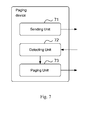
- Embodiment 1 of the invention further provides a paging device, as shown in Fig. 4 , the paging device including: a determining unit 41, a judging unit 42 and a paging unit 43, wherein:
- the determining unit 41 is used to determine whether to page a UE by using the IMSI of the UE;
- the judging unit 42 is used to judge whether a TAI List of the UE is stored before paging, after the determining unit 41 determines to page the UE by using the IMSI of the UE;
- the paging unit 43 is used to page the UE in TAs served by base stations connected locally when the judgment result of the judging unit 42 is negative;
- the paging unit 43 specifically includes a first inserting subunit and a first sending subunit, wherein the first inserting subunit is used to insert a parameter for indicating each of the base stations to page in the TAs served by the base station, into Paging messages that are to be sent to the base stations connected locally respectively; and the first sending subunit is used to send the Paging messages inserted with the above parameter by the first inserting subunit, to the base stations that are connected locally, respectively.
- the paging unit 43 specifically includes a determining subunit, a second inserting subunit and a second sending subunit, wherein the determining subunit is used to determine TAIs corresponding to the TAs served by respective base stations connected locally; the second inserting subunit is used to insert the TAIs corresponding to the TAs served by the respective base stations that are determined by the determining subunit, into Paging messages that are to be sent to the respective base stations connected locally; and the second sending subunit is used to send the Paging messages inserted with the TAIes by the second inserting subunit, to the respective base stations.
- the determining subunit is used to determine TAIs corresponding to the TAs served by respective base stations connected locally
- the second inserting subunit is used to insert the TAIs corresponding to the TAs served by the respective base stations that are determined by the determining subunit, into Paging messages that are to be sent to the respective base stations connected locally
- the second sending subunit is used to send the Paging messages inserted with the TAIe
- a flow chart of a method for paging a UE by using the IMSI of the UE in Embodiment 2 of the invention is illustrated and includes the following operations 51-53.
- Operation 51 delivering a NEW TAI List allocated to a UE to the UE;
- the NEW TAI List allocated to the UE is delivered to the UE in the following two implementation situations:
- the first implementation situation is corresponding to Combination Mode 1 of the GUTI and TAI List contained in the GUTI Reallocation Command message or the TAU Accept message, and specifically: the existing OLD GUTI of the UE and the NEW TAI List allocated to the UE are included in a GUTI Reallocation Command message or a TAU Accept message and delivered to the UE;
- the second implementation situation is corresponding to Combination Mode 3 of the GUTI and TAI List contained in the GUTI Reallocation Command message or the TAU Accept message, and specifically: the NEW GUTI allocated to the UE and the NEW TAI List allocated to the UE are included in a GUTI Reallocation Command message or a TAU Accept message and delivered to the UE.
- Operation 52 detecting whether a network error occurs
- the network error may be, but not limited to, a Lower Layer Failure, if a Lower Layer Failure is detected during the time period between the issuing of the GUTI Reallocation Command message and the receiving of the GUTI Reallocation Complete message fed back by the UE, it needs to pages the UE by using the IMSI of the UE, in order to establish an NAS signaling connection between the UE and the network side; if a Lower Layer Failure is detected during the time period between the issuing of the TAU Accept message and the receiving of the TAU Complete message fed back by the UE, and the results of paging the UE by using the OLD GUTI or NEW GUTI of the UE both present page failure, it needs to page the UE by using the IMSI of the UE;
- Operation 53 if a network error is detected in Operation 52, it pages the UE in TAs corresponding to TAIes contained in the existing OLD TAI List of the UE and in the NEW TAI List allocated to the UE, by using the IMSI of the UE;
- the operation of paging the UE in the TAs corresponding to the TAIes contained in the existing OLD TAI List of the UE and in the NEW TAI List allocated to the UE may be, but not limited to, the following process:
- TAIes corresponding to TAs served by respective base stations and included in the TAs corresponding to the TAIes contained in the existing OLD TAI List of the UE and in the NEW TAI List allocated to the UE and then it inserts the TAIes corresponding to the TAs served by the respective base stations and included in the TAs corresponding to the TAIes contained in the existing OLD TAI List of the UE and in the NEW TAI List allocated to the UE, into Paging messages to be sent to the respective base stations, and sends the above Paging messages inserted with the TAIes to the respective base stations.
- the TAs served by base station 1 are TA1 and TA2
- the TAs served by base station 2 are TA3 and TA4
- the TAI contained in the existing OLD TAI List of the UE is TA1
- the TAI contained in the NEW TAI List allocated to the UE is TA3.
- a specific realization flow chart of a paging method for paging a UE by using the IMSI of the UE in Embodiment 2 of the invention is illustrated and includes the following operations 61-65.
- Operation 61 including the existing OLD GUTI of the UE and the NEW TAI List allocated to the UE in a GUTI Reallocation Command message and delivering the message to the UE;
- Operation 62 detecting whether a Lower Layer Failure occurs
- Operation 63 If a Lower Layer Failure is detected in Operation 62, it is determined, from a stored corresponding relationship between identities of base stations and TAIes, that the TA served by base station 1 and included in the TAs corresponding to the TAIes contained in the existing OLD TAI List of the UE and in the NEW TAI List allocated to the UE is TA1, and the TA served by base station 2 and included in the TAs corresponding to the TAIes contained in the existing OLD TAI List of the UE and in the NEW TAI List allocated to the UE is TA3, respectively;
- Operation 64 inserting TA1 into the field TAI List of a Paging message to be sent to base station 1, and inserting TA3 into the field TAI List of a Paging message to be sent to base station 2;
- Operation 65 sending the above Paging messages to be sent, to base station 1 and base station 2 that are connected locally, respectively; after receiving the Paging message, base station 1 pages the UE in TA1 by using the IMSI in the field UE Paging Identity of the Paging message according to TA1 in the field TAI List of the Paging message; after receiving the Paging message, base station 2 pages the UE in TA3 by using the IMSI in the field UE Paging Identity of the Paging message according to TA3 in the field TAI List of the Paging message.
- a NEW TAI List allocated to the UE is delivered to the UE, and after a Lower Layer Failure is detected, it pages the UE by using the IMSI of the UE in the TAs corresponding to the TAIes contained in the existing OLD TAI List of the UE and in the NEW TAI List allocated to the UE, so that when an MME pages a UE by using the IMSI of the UE, it may indicate corresponding base stations to page the UE in certain TAs even in the case that TAI List of the UE can not be determined, thereby making the UE able to access to the network again after receiving a paging from the MME.
- Embodiment 2 of the invention further provides a paging device, as shown in Fig. 7 , the paging device including: a sending unit 71, a detecting unit 72 and a paging unit 73, wherein:
- the sending unit 71 is used to deliver a NEW TAI List allocated to a UE to the UE;
- the detecting unit 72 is used to detect whether a network error occurs.
- the paging unit 73 is used to page the UE by using the IMSI of the UE in TAs corresponding to TAIes contained in the existing OLD TAI List of the UE and in the NEW TAI List allocated to the UE, after a network error is detected by the detecting unit 72.
- the paging unit 73 specifically includes a determining subunit, a inserting subunit and a sending subunit, wherein the determining subunit is used to determine TAIes corresponding to TAs served by respective base stations and included in the TAs corresponding to the TAIes contained in the existing OLD TAI List of the UE and in the NEW TAI List allocated to the UE; the inserting subunit is used to insert the TAIes corresponding to the TAs served by the respective base stations and included in the TAs corresponding to the TAIes contained in the existing OLD TAI List of the UE and in the NEW TAI List allocated to the UE, which is determined by the determining subunit, into Paging messages to be sent to the respective base stations; and the sending subunit is used to send the Paging messages inserted with the TAIes by the inserting subunit to the respective base stations.
- the determining subunit is used to determine TAIes corresponding to TAs served by respective base stations and included in the TAs
Landscapes
- Engineering & Computer Science (AREA)
- Computer Networks & Wireless Communication (AREA)
- Signal Processing (AREA)
- Databases & Information Systems (AREA)
- Mobile Radio Communication Systems (AREA)
Abstract
Description
- This application claims priority to Chinese Patent Application No.
200910076582.0 - The present invention relates to the field of mobile communications, and particularly to a paging method and device.
- In Standard Specification 3GPP TS24.301, it is specified that a Mobility Management Entity (MME) that manages a User Equipment (UE) may include a New Tracking Area Identity List (NEW TAI List) allocated to the UE and the Globally Unique Temporary Identity (GUTI) of the UE in a GUTI Reallocation Command message and deliver the message to the UE. If the MME detects a Lower Layer Failure before it receives a GUTI Reallocation Complete message fed back by the UE, then in order to establish a Non Access Stratum (NAS) signaling connection between the UE and the network side, the MME may page the UE by using the International Mobile Subscriber Identity (IMSI) of the UE.
- Additionally, during Tracking Area Update (TAU) procedure, the MME may include the NEW TAI List allocated to the UE and the GUTI of the UE in a Tracking Area Update Accept (TAU Accept) message and deliver the message to the UE. If the MME detects a Lower Layer Failure before receiving a TAU Complete message fed back by the UE, then the MME pages the UE by using the OLD GUTI or NEW GUTI of the UE; if results of the paging with the OLD GUTI and the NEW GUTI both present a paging failure, then the MME pages the UE by using the IMSI of the UE, and the UE may access to the network again after receiving the paging from the MME.
- A mobility management context of the UE containing a TAI LIST of the UE is stored in the MME. During the procedure of paging the UE, the MME determines Tracking Areas (TAs) in which the UE is registered from the TAI LIST in the mobility management context, and then sends a paging message in those TAs in which the UE is registered. During the above GUTI Reallocation procedure and TAU procedure, if no NEW TAI List is allocated to the UE by the MME, then the existing TAI List of the UE stored in the MME is effective, that is, the OLD TAI List is effective, and paging the UE by the MME using the IMSI of the UE is in those TAs corresponding to those Tracking Area Identities (TAles) contained in the OLD TAI List; or if a NEW TAI List is allocated to the UE by the MME, and the MME is unable to determine the effectiveness of the NEW TAI List and the OLD TAI List after detecting a Lower Layer Failure, that is, the MME cannot determine whether the NEW TAI List allocated to the UE is effective or the existing OLD TAI List of the UE is effective, then the MME cannot determine TAs in which the MME may page the UE by using the IMSI of the UE.
- Additionally, if the MME loses the mobility management context of the UE due to such reasons as restart, or if the mobility management context of the UE is corrupted, it may cause the MME unable to determine the TAI LIST of the UE. Thus, the MME cannot determine the TAs in which the MME may page the UE by using the IMSI of the UE, either.
- When a network error, for example, Lower Layer Failure or MME Restart, is detected, the UE may be unable to access to the network, and at this point, it needs to page the UE in order to make the UE to access the network again. In conclusion, during the above network error recovery procedure, a situation in which the MME cannot determine the TAI List of the UE when the MME pages the UE by using the IMSI of the UE may exist, and at this point, the MME cannot determine TAs in which the MME pages the UE.
- Embodiments of the invention provide a paging method, which solves a problem in the prior art that an MME cannot determine TAs in which the MME pages a UE, when the MME pages the UE by using the IMSI of the UE during network error recovery procedure.
- Correspondingly, embodiments of the invention further provide a paging device.
- The technical solutions of the embodiments of the invention are as follows.
- A paging method, including: determining to page a UE by using an IMSI; and if it is judged that no TAI list of the UE is stored before paging, then paging the UE in tracking areas served by base stations connected locally.
- A paging device, including: a determining unit, for determining whether to page a UE by using an IMSI; a judging unit, for judging before paging whether a TAI List of the UE is stored, after the determining unit determines to page the UE by using the IMSI; and a paging unit, for paging the UE in tracking areas served by base stations connected locally, when a result of the judging by the judging unit is negative.
- A paging method, including: delivering a new TAI List allocated to a UE to the UE; and paging the UE using an IMSI in TAs corresponding to TAles contained in an existing TAI List of the UE and in the new TAI List allocated to the UE, after a network error is detected.
- A paging device, including: a delivering unit, for delivering a new TAI List allocated to a UE to the UE; a detecting unit, for detecting whether a network error occurs; and a paging unit, for paging the UE using an IMSI in TAs corresponding to TAles contained in an existing TAI List of the UE and in the new TAI List allocated to the UE, after the detecting unit detects a network error.
- In the technical solutions of the embodiments of the invention, it firstly determines to page a UE by using an IMSI, and before paging, it judges whether a TAI List of the UE is stored, and if the judgment result is "not", it pages the UE in TAs served by base stations locally connected, so that during network error recovery procedure, even if no TAI List of a UE is stored when a MME pages the UE by using an IMSI, corresponding base stations may be instructed to page the UE in TAs served by the base stations, thereby making the UE able to access to the network again after receiving a paging from the MME; the technical solutions of the embodiments of the invention further put forward that, a NEW TAI List allocated to a UE is delivered to the UE, and after a network error is detected, the UE is paged by using an IMSI in TAs corresponding to TAIes contained in an existing OLD TAI List of the UE and in the NEW TAI List allocated to the UE, so that during network error recovery procedure, corresponding base stations can be indicated to page the UE in the TAs corresponding to the TAIes contained in the OLD TAI List and in the NEW TAI List by using the IMSI, even if the effectiveness of the OLD TAI List and the NEW TAI List cannot be determined, thereby making the UE able to access to the network again after receiving a paging from the MME.
-
Fig. 1 is a schematic diagram of a flow chart of a method for paging a UE by using the IMSI of the UE inEmbodiment 1 of the invention; -
Fig. 2 is a schematic diagram of a specific flow chart of a first paging method for paging a UE by using the IMSI of the UE inEmbodiment 1 of the invention; -
Fig. 3 is a schematic diagram of a specific flow chart of a second paging method for paging a UE by using the IMSI of the UE inEmbodiment 1 of the invention; -
Fig. 4 is a schematic diagram of the structure of a paging device inEmbodiment 1 of the invention; -
Fig. 5 is a schematic diagram of a flow chart of a method for paging a UE by using the IMSI of the UE inEmbodiment 2 of the invention; -
Fig. 6 is a schematic diagram of a specific flow chart of a paging method for paging a UE by using the IMSI of the UE inEmbodiment 2 of the invention; and -
Fig. 7 is a schemetic diagram of the structure of a paging device inEmbodiment 2 of the invention. - The main realization principles, the specific embodiments and the beneficial effects that may be attained correspondingly will be described in detail in conjunction with each of the drawings.
- In the embodiments of the invention, the GUTI and TAI List contained in a GUTI Reallocation Command message or a TAU Accept message may be combined in the following three modes.
- Combination Mode 1: OLD GUTI and NEW TAI List, i.e., the MME only allocates a NEW TAI List to a UE, with no NEW GUTI allocated;
- Combination Mode 2: NEW GUTI, i.e., the MME only allocates a NEW GUTI to a UE, with no NEW TAI List allocated;
- Combination Mode 3: NEW GUTI and NEW TAI List, i.e., the MME allocates both a NEW GUTI and a NEW TAI List to a UE.
- As shown in
Fig. 1 , a flow chart of a method for paging a UE by using the IMSI of the UE inEmbodiment 1 of the invention is illustrated and includes the following operations 11-13. - Operation 11: determining to page the UE by using the IMSI of the UE;
- Operation 12: before paging, firstly judging whether a TAI List of the UE is stored, wherein the TAI list of the UE may be a NEW TAI List or an OLD TAI List, or a NEW TAI List and an OLD TAI List;
- Particularly,
Embodiment 1 of the invention may be, but not limited to, GUTI Reallocation procedure or TAU procedure. During GUTI Reallocation procedure or TAU procedure, after the NEW GUTI and/or NEW TAI List allocated to the UE are/is delivered to the UE, and a Lower Layer Failure is detected, it determines to page the UE by using the IMSI of the UE, wherein the NEW TAI List and/or NEW TAI List allocated to the UE are/is delivered to the UE in the following three implementation situations. - The first implementation situation is corresponding to the
above Combination Mode 1, and specifically: the existing OLD GUTI of the UE and the NEW TAI List allocated to the UE are included in a GUTI Reallocation Command message or a TAU Accept message and delivered to the UE; - The second implementation situation is corresponding to the
above Combination Mode 2, and specifically: the NEW GUTI allocated to the UE is included in a GUTI Reallocation Command message or a TAU Accept message and delivered to the UE; - The third implementation situation is corresponding to the above Combination Mode 3, and specifically: the NEW GUTI allocated to the UE and the NEW TAI List allocated to the UE are included in a GUTI Reallocation Command message or a TAU Accept message and delivered to the UE.
- If a Lower Layer Failure is detected during the time period between the issuing of the GUTI Reallocation Command message and the receiving of the GUTI Reallocation Complete message fed back by the UE, it needs to pages the UE by using the IMSI of the UE, in order to establish an NAS signaling connection between the UE and the network side; if a Lower Layer Failure is detected during the time period between the issuing of the TAU Accept message and the receiving of the TAU Complete message fed back by the UE and the results of paging the UE by using the OLD GUTI or NEW GUTI of the UE both present a paging failure, it needs to page the UE by using the IMSI of the UE.
- Operation 13: if a result of the judging presents that no TAI List of the UE is stored, then the UE is paged in TAs served by base stations connected locally. Herein, the base stations connected locally refer to base stations connected with the MME, and a base station connected to an MME is also referred to as an eNodeB.
- If the MME loses the mobility management context data of the UE due to such reasons as restart, or if the mobility management context data of the UE is corrupted, then no TAI List of the UE is stored in the MME.
- Particularly, the operation of paging the UE in the TAs served by the connected base stations may contain, but not limited to, the following two implementation situations.
- Implementation Situation 1: Firstly, a parameter for indicating a base station to page in a TA or TAs served by the base station is inserted into a Paging message that is to be sent to the base station connected locally, and then Paging messages inserted with the above parameter are sent to the base stations connected locally respectively, wherein the above parameter may be inserted into the field TAI List of the Paging message or a newly added field of the Paging message;
- Implementation Situation 2: Firstly, TAIes corresponding to TAs served by the base stations connected locally are determined respectively from a stored corresponding relationship between identities of base stations and TAIes, and then the determined TAIes corresponding to the TAs served by a corresponding base station are inserted into a Paging message that is to be sent to the base station connected locally, and then the Paging message inserted with the TAIes is sent to the corresponding base station.
- More specific embodiments will be given below.
- If the base stations connected locally are
base station 1 andbase station 2, wherein the TAs served bybase station 1 are TAI and TA2, and the TAs served bybase station 2 are TA3 and TA4. As shown inFig. 2 , a specific realization flow chart of a first paging method for paging a UE by using the IMSI of the UE inEmbodiment 1 of the invention is illustrated and includes the following operations 21-25. - Operation 21: including the existing OLD GUTI of the UE and the NEW TAI List allocated to the UE in a GUTI Reallocation Command message and delivering the message to the UE;
- Operation 22: detecting whether a Lower Layer Failure occurs;
- Operation 23: if a Lower Layer Failure is detected in
Operation 22, judging whether the existing OLD TAI List of the UE or the NEW TAI List allocated to the UE is stored; - Operation 24: if it is judged in
Operation 23 that neither the existing OLD TAI List of the UE nor the NEW TAI List allocated to the UE is stored, inserting a promissory parameter into Paging messages that are to be sent to the connectedbase station 1 andbase station 2 respectively, wherein the promissory parameter is used for indicatingbase station 1 andbase station 2, after receiving the Paging messages respectively, to page the UE in the TAs served respectively bybase station 1 andbase station 2, wherein the promissory parameter may be inserted into the field TAI List of the Paging message, and the promissory parameter may be 0 or a parameter with a particular meaning, for example, a certain letter or number, etc.; Additionally, the promissory parameter may also be inserted into a newly added field of the Paging message, i.e., an indication information unit is newly added to the Paging message; - Operation 25: sending the Paging messages to
base station 1 andbase station 2 connected locally, respectively; after receiving the Paging message,base station 1 pages the UE in TA1 and TA2 by using the IMSI in the field UE Paging Identity of the Paging message according to the promissory parameter in the Paging message; and after receiving the Paging message,base station 2 pages the UE in TA3 and TA4 by using the IMSI in the field UE Paging Identity of the Paging message according to the promissory parameter in the Paging message. - As shown in
Fig.3 , a specific realization flow chart of a second paging method for paging a UE by using the IMSI of the UE inEmbodiment 1 of the invention is illustrated and includes the following operations 31-36. - Operation 31: including the existing OLD GUTI of the UE and a NEW TAI List allocated to the UE in a GUTI Reallocation Command message and delivering the message to the UE;
- Operation 32: detecting whether a Lower Layer Failure occurs;
- Operation 33: if a Lower Layer Failure is detected in
Operation 32, judging whether the existing OLD TAI List of the UE or the NEW TAI List allocated to the UE is stored; - Operation 34: if it is judged in
Operation 23 that neither the existing OLD TAI List nor the NEW TAI List allocated to the UE is stored, then determining from a stored corresponding relationship between identities of base stations and TAIs that the TAs served bybase station 1 are TA1 and TA2 and the TAs served bybase station 2 are TA3 and TA4, respectively; - Operation 35: inserting TA1 and TA2 into the field TAI List of a Paging message to be sent to
base station 1, and inserting TA3 and TA4 into the field TAI List of a Paging message to be sent tobase station 2; - Operation 36: sending the above Paging messages to be sent, to
base station 1 andbase station 2 that are connected locally, respectively; after receiving the Paging message,base station 1 pages the UE in TA1 and TA2 by using the IMSI in the field UE Paging Identity of the Paging message according to TA1 and TA2 in the field TAI List of the Paging message; and after receiving the Paging message,base station 2 pages the UE in TA3 and TA4 by using the IMSI in the field UE Paging Identity of the Paging message according to TA3 and TA4 in the field TAI List of the Paging message. - In the technical solution provided in
Embodiment 1 of the invention, it first determines to pages the UE by using the IMSI of the UE, and before paging, it judges whether a TAI List of the UE is stored, if the judgment result is "not", it pages the UE in TAs served by the base stations connected locally, so that when an MME pages a UE by using the IMSI of the UE during network error recovery procedure, a corresponding base station may be indicated to page the UE in TAs served by the base station, even if no TAI List of the UE is stored, thereby making the UE able to access to the network again after receiving a paging from the MME. -
Embodiment 1 of the invention further provides a paging device, as shown inFig. 4 , the paging device including: a determiningunit 41, a judgingunit 42 and apaging unit 43, wherein: - the determining
unit 41 is used to determine whether to page a UE by using the IMSI of the UE; - the judging
unit 42 is used to judge whether a TAI List of the UE is stored before paging, after the determiningunit 41 determines to page the UE by using the IMSI of the UE; and - the
paging unit 43 is used to page the UE in TAs served by base stations connected locally when the judgment result of the judgingunit 42 is negative; - Preferably, the
paging unit 43 specifically includes a first inserting subunit and a first sending subunit, wherein the first inserting subunit is used to insert a parameter for indicating each of the base stations to page in the TAs served by the base station, into Paging messages that are to be sent to the base stations connected locally respectively; and the first sending subunit is used to send the Paging messages inserted with the above parameter by the first inserting subunit, to the base stations that are connected locally, respectively. - Preferably, the
paging unit 43 specifically includes a determining subunit, a second inserting subunit and a second sending subunit, wherein the determining subunit is used to determine TAIs corresponding to the TAs served by respective base stations connected locally; the second inserting subunit is used to insert the TAIs corresponding to the TAs served by the respective base stations that are determined by the determining subunit, into Paging messages that are to be sent to the respective base stations connected locally; and the second sending subunit is used to send the Paging messages inserted with the TAIes by the second inserting subunit, to the respective base stations. - As shown in
Fig. 5 , a flow chart of a method for paging a UE by using the IMSI of the UE inEmbodiment 2 of the invention is illustrated and includes the following operations 51-53. - Operation 51: delivering a NEW TAI List allocated to a UE to the UE;
- Particularly, the NEW TAI List allocated to the UE is delivered to the UE in the following two implementation situations:
- the first implementation situation is corresponding to
Combination Mode 1 of the GUTI and TAI List contained in the GUTI Reallocation Command message or the TAU Accept message, and specifically: the existing OLD GUTI of the UE and the NEW TAI List allocated to the UE are included in a GUTI Reallocation Command message or a TAU Accept message and delivered to the UE; - the second implementation situation is corresponding to Combination Mode 3 of the GUTI and TAI List contained in the GUTI Reallocation Command message or the TAU Accept message, and specifically: the NEW GUTI allocated to the UE and the NEW TAI List allocated to the UE are included in a GUTI Reallocation Command message or a TAU Accept message and delivered to the UE.
- Operation 52: detecting whether a network error occurs;
- Particularly, the network error may be, but not limited to, a Lower Layer Failure, if a Lower Layer Failure is detected during the time period between the issuing of the GUTI Reallocation Command message and the receiving of the GUTI Reallocation Complete message fed back by the UE, it needs to pages the UE by using the IMSI of the UE, in order to establish an NAS signaling connection between the UE and the network side; if a Lower Layer Failure is detected during the time period between the issuing of the TAU Accept message and the receiving of the TAU Complete message fed back by the UE, and the results of paging the UE by using the OLD GUTI or NEW GUTI of the UE both present page failure, it needs to page the UE by using the IMSI of the UE;
- Operation 53: if a network error is detected in
Operation 52, it pages the UE in TAs corresponding to TAIes contained in the existing OLD TAI List of the UE and in the NEW TAI List allocated to the UE, by using the IMSI of the UE; - Particularly, the operation of paging the UE in the TAs corresponding to the TAIes contained in the existing OLD TAI List of the UE and in the NEW TAI List allocated to the UE may be, but not limited to, the following process:
- it first determines, from a corresponding relationship between base station identities and TAIes, TAIes corresponding to TAs served by respective base stations and included in the TAs corresponding to the TAIes contained in the existing OLD TAI List of the UE and in the NEW TAI List allocated to the UE, and then it inserts the TAIes corresponding to the TAs served by the respective base stations and included in the TAs corresponding to the TAIes contained in the existing OLD TAI List of the UE and in the NEW TAI List allocated to the UE, into Paging messages to be sent to the respective base stations, and sends the above Paging messages inserted with the TAIes to the respective base stations.
- More specific embodiments will be given below.
- If the base stations connected are
base station 1 andbase station 2, the TAs served bybase station 1 are TA1 and TA2, and the TAs served bybase station 2 are TA3 and TA4, the TAI contained in the existing OLD TAI List of the UE is TA1, and the TAI contained in the NEW TAI List allocated to the UE is TA3. As shown inFig. 6 , a specific realization flow chart of a paging method for paging a UE by using the IMSI of the UE inEmbodiment 2 of the invention is illustrated and includes the following operations 61-65. - Operation 61: including the existing OLD GUTI of the UE and the NEW TAI List allocated to the UE in a GUTI Reallocation Command message and delivering the message to the UE;
- Operation 62: detecting whether a Lower Layer Failure occurs;
- Operation 63: If a Lower Layer Failure is detected in
Operation 62, it is determined, from a stored corresponding relationship between identities of base stations and TAIes, that the TA served bybase station 1 and included in the TAs corresponding to the TAIes contained in the existing OLD TAI List of the UE and in the NEW TAI List allocated to the UE is TA1, and the TA served bybase station 2 and included in the TAs corresponding to the TAIes contained in the existing OLD TAI List of the UE and in the NEW TAI List allocated to the UE is TA3, respectively; - Operation 64: inserting TA1 into the field TAI List of a Paging message to be sent to
base station 1, and inserting TA3 into the field TAI List of a Paging message to be sent tobase station 2; - Operation 65: sending the above Paging messages to be sent, to
base station 1 andbase station 2 that are connected locally, respectively; after receiving the Paging message,base station 1 pages the UE in TA1 by using the IMSI in the field UE Paging Identity of the Paging message according to TA1 in the field TAI List of the Paging message; after receiving the Paging message,base station 2 pages the UE in TA3 by using the IMSI in the field UE Paging Identity of the Paging message according to TA3 in the field TAI List of the Paging message. - Additionally, as corresponding to
Combination Mode 2 of the GUTI and TAI List contained in the GUTI Reallocation Command message or the TAU Accept message, i.e., no NEW TAI List is allocated to the UE, only the existing OLD TAI List of the UE is stored; if a Lower Layer Failure is detected during the time period between the issuing of the GUTI Reallocation Command message and the receiving of the GUTI Reallocation Complete message fed back by the UE, it needs to pages the UE in TAs corresponding to TAIes contained in the OLD TAI List by using the IMSI of the UE, in order to establish an NAS signaling connection between the UE and the network side; if a Lower Layer Failure is detected during the time period between the issuing of the TAU Accept message and the receiving of the TAU Complete message fed back by the UE, and the results of paging the UE by using the OLD GUTI or NEW GUTI of the UE are both Paging Failed, it needs to page the UE in the TAs corresponding to the TAIes contained in the OLD TAI List by using the IMSI of the UE. - In the technical solution provided in
Embodiment 2 of the invention, a NEW TAI List allocated to the UE is delivered to the UE, and after a Lower Layer Failure is detected, it pages the UE by using the IMSI of the UE in the TAs corresponding to the TAIes contained in the existing OLD TAI List of the UE and in the NEW TAI List allocated to the UE, so that when an MME pages a UE by using the IMSI of the UE, it may indicate corresponding base stations to page the UE in certain TAs even in the case that TAI List of the UE can not be determined, thereby making the UE able to access to the network again after receiving a paging from the MME. - Correspondingly,
Embodiment 2 of the invention further provides a paging device, as shown inFig. 7 , the paging device including: a sendingunit 71, a detectingunit 72 and apaging unit 73, wherein: - the sending
unit 71 is used to deliver a NEW TAI List allocated to a UE to the UE; - the detecting
unit 72 is used to detect whether a network error occurs; and - the
paging unit 73 is used to page the UE by using the IMSI of the UE in TAs corresponding to TAIes contained in the existing OLD TAI List of the UE and in the NEW TAI List allocated to the UE, after a network error is detected by the detectingunit 72. - Preferably, the
paging unit 73 specifically includes a determining subunit, a inserting subunit and a sending subunit, wherein the determining subunit is used to determine TAIes corresponding to TAs served by respective base stations and included in the TAs corresponding to the TAIes contained in the existing OLD TAI List of the UE and in the NEW TAI List allocated to the UE; the inserting subunit is used to insert the TAIes corresponding to the TAs served by the respective base stations and included in the TAs corresponding to the TAIes contained in the existing OLD TAI List of the UE and in the NEW TAI List allocated to the UE, which is determined by the determining subunit, into Paging messages to be sent to the respective base stations; and the sending subunit is used to send the Paging messages inserted with the TAIes by the inserting subunit to the respective base stations. - It should be noted that, the above embodiments are only used to illustrate the invention, rather than limiting the scope of the invention, and the invention is not limited to the above embodiments either; various technical solutions and modifications thereof without departing from the scope of the invention are all intended to be contemplated by the invention.
Claims (13)
- A paging method, comprising:determining to page a User Equipment by using an International Mobile Subscriber Identity; andif it is judged that no Tracking Area Identity List of the User Equipment is stored before paging, then paging the User Equipment in Tracking Areas served by base stations connected locally.
- The paging method of claim 1, wherein, paging the User Equipment in the Track Areas served by the base stations connected locally comprises:inserting a parameter, for indicating a base station to page in Track Areas served by the base station, into paging messages that are to be sent to the base stations connected locally; andsending the paging messages inserted with the parameter to the base stations connected locally.
- The paging method of claim 2, wherein, the parameter is inserted into a field Track Area Identity List of the paging message.
- The paging method of claim 2, wherein, the parameter is inserted into a newly added field of the paging message.
- The paging method of claim 1, wherein, paging the User Equipment in the Track Areas served by the base stations connected locally comprises:determining Track Area Identities corresponding to the Track Areas served by the base stations connected locally, respectively;inserting determined Track Area Identities corresponding to the Track Areas served by the respective base stations, into paging messages that are to be sent to the respective base stations connected locally; andsending the paging messages inserted with the Track Area Identities to the respective base stations.
- The paging method of claim 5, wherein, the Track Area Identities are inserted into a field Track Area Identity List of the paging message.
- A paging device, comprising:a determining unit, for determining whether to page a User Equipment by using an International Mobile Subscriber Identity;a judging unit, for judging before paging whether a Track Area Identity List of the User Equipment is stored, after the determining unit determines to page the User Equipment by using the International Mobile Subscriber Identity; anda paging unit, for paging the User Equipment in Tracking Areas served by base stations connected locally when a result of the judging by the judging unit presents that no Track Area Identity List of the User is stored.
- The paging device of claim 7, wherein, the paging unit comprises:a first inserting subunit, for inserting a parameter for indicating a base station to page in Track Areas served by the base station, into paging messages that are to be sent to the respective base stations connected locally; anda first sending subunit, for sending the paging messages inserted with the parameter by the first inserting subunit to the respective base stations connected locally.
- The paging device of claim 7, wherein, the paging unit comprises:a determining subunit, for determining Track Area Identities corresponding to the Track Areas served by the base stations connected locally, respectively;a second inserting subunit, for inserting the Track Area Identities corresponding to the Track Areas served by the respective base stations that are determined by the determining subunit, into paging messages that are to be sent to the respective base stations connected locally; anda second sending subunit, for sending the paging messages inserted with the Track Area Identities by the second inserting subunit to the respective base stations.
- A paging method, comprising:delivering a new Track Area Identity List allocated to a User Equipment to the User Equipment; andpaging the User Equipment by using an International Mobile Subscriber Identity in Track Areas corresponding to Track Area Identities contained in an existing Track Area Identity List of the User Equipment and in the new Track Area Identity List allocated to the User Equipment, after a network error is detected.
- The paging method of claim 10, wherein, paging the User Equipment in Track Areas corresponding to Track Area Identities contained in the existing Track Area Identity List of the User Equipment and in the new Track Area Identity List allocated to the User Equipment comprises:determining Track Area Identities corresponding to Track Areas served by corresponding base stations and included in the Track Areas corresponding to the Track Area Identities contained in the existing Track Area Identity List of the User Equipment and in the new Track Area Identity List allocated to the User Equipment;inserting the Track Area Identities corresponding to the Track Areas served by the respective corresponding base stations and included in the Track Areas corresponding to the Track Area Identities contained in the existing Track Area Identity List of the User Equipment and in the new Track Area Identity List allocated to the User Equipment, into paging messages that are to be sent to the respective corresponding base stations; andsending the paging messages inserted with the Track Area Identities to the respective corresponding base stations.
- A paging device, comprising:a sending unit, for delivering a new Track Area Identity List allocated to a User Equipment to the User Equipment;a detecting unit, for detecting whether a network error occurs; anda paging unit, for paging the User Equipment by using an International Mobile Subscriber Identity in Track Areas corresponding to Track Area Identities contained in an existing Track Area Identity List of the User Equipment and in the new Track Area Identity List allocated to the User Equipment, after the detecting unit detects a network error.
- The paging device of claim 12, wherein, the paging unit comprises:a determining subunit, for determining Track Area Identities corresponding to Track Areas served by corresponding base stations and included in the Track Areas corresponding to the Track Area Identities contained in the existing Track Area Identity List of the User Equipment and in the new Track Area Identity List allocated to the User Equipment;an inserting subunit, for inserting the Track Area Identities corresponding to the Track Areas served by the respective corresponding base stations and included in the Track Areas corresponding to the Track Area Identities contained in the existing Track Area Identity List of the User Equipment and in the new Track Area Identity List allocated to the User Equipment that are determined by the determining subunit, into paging messages that are to be sent to the respective corresponding base stations; anda sending subunit, for sending the paging messages inserted with the Track Area Identities by the inserting subunit to the respective corresponding base stations.
Applications Claiming Priority (2)
| Application Number | Priority Date | Filing Date | Title |
|---|---|---|---|
| CN200910076582A CN101778371B (en) | 2009-01-09 | 2009-01-09 | Paging method and device |
| PCT/CN2010/000034 WO2010078834A1 (en) | 2009-01-09 | 2010-01-08 | Paging method and device |
Publications (3)
| Publication Number | Publication Date |
|---|---|
| EP2384035A1 true EP2384035A1 (en) | 2011-11-02 |
| EP2384035A4 EP2384035A4 (en) | 2016-01-06 |
| EP2384035B1 EP2384035B1 (en) | 2018-08-08 |
Family
ID=42316256
Family Applications (1)
| Application Number | Title | Priority Date | Filing Date |
|---|---|---|---|
| EP10729093.4A Active EP2384035B1 (en) | 2009-01-09 | 2010-01-08 | Paging method and device |
Country Status (6)
| Country | Link |
|---|---|
| US (1) | US8996039B2 (en) |
| EP (1) | EP2384035B1 (en) |
| JP (1) | JP5198667B2 (en) |
| KR (2) | KR101265439B1 (en) |
| CN (1) | CN101778371B (en) |
| WO (1) | WO2010078834A1 (en) |
Cited By (1)
| Publication number | Priority date | Publication date | Assignee | Title |
|---|---|---|---|---|
| CN105794286A (en) * | 2014-11-12 | 2016-07-20 | 华为技术有限公司 | Method and device for paging user equipment |
Families Citing this family (14)
| Publication number | Priority date | Publication date | Assignee | Title |
|---|---|---|---|---|
| CN102413449B (en) * | 2010-09-19 | 2015-06-03 | 中兴通讯股份有限公司 | Processing method for restarting mobile management unit and mobile management unit |
| CN102413566B (en) * | 2010-09-25 | 2014-04-02 | 电信科学技术研究院 | Paging method and apparatus thereof |
| EP2880958B1 (en) * | 2012-08-02 | 2018-06-06 | Telefonaktiebolaget LM Ericsson (publ) | Method and apparatus for reducing signaling in a core network |
| CN109327704B (en) | 2012-09-28 | 2021-06-18 | 交互数字麦迪逊专利控股公司 | Cross-plane filtering for chroma signal enhancement in video coding |
| EP2908582B1 (en) * | 2012-10-10 | 2019-06-19 | LG Electronics Inc. | Processing paging by a server managing mobility to prevent, in case of paging failure, loss of downlink data buffered in a serving gateway |
| CN106304137B (en) * | 2015-05-27 | 2019-11-26 | 中国移动通信集团设计院有限公司 | A kind of paging method and device based on tracking area list |
| KR102570911B1 (en) | 2015-07-08 | 2023-08-24 | 인터디지털 매디슨 페턴트 홀딩스 에스에이에스 | Enhanced chroma coding using cross plane filtering |
| WO2017079074A1 (en) | 2015-11-06 | 2017-05-11 | Interdigital Patent Holdings, Inc. | Methods, core network entity and wireless transmit/receive unit (wtru) using enhanced dedicated core network (dcn) selection |
| US10470160B2 (en) * | 2015-12-10 | 2019-11-05 | Samsung Electronics Co., Ltd. | Method and device for transmitting/receiving signal between linked devices |
| CN105979504A (en) * | 2016-05-12 | 2016-09-28 | 中国联合网络通信集团有限公司 | Signaling monitoring number backfill method and device |
| CN108616987A (en) * | 2017-01-05 | 2018-10-02 | 中兴通讯股份有限公司 | Information interacting method and device |
| KR102347006B1 (en) * | 2017-08-18 | 2022-01-03 | 광동 오포 모바일 텔레커뮤니케이션즈 코포레이션 리미티드 | Method for paging, access network device, terminal device and core network device |
| US12309742B2 (en) * | 2021-07-29 | 2025-05-20 | Mediatek Inc. | MUSIM IMSI offset value handling for paging timing collision control |
| CN120547680B (en) * | 2025-07-18 | 2025-10-31 | 宝鸡文理学院 | Combined paging method, device, medium and equipment |
Family Cites Families (19)
| Publication number | Priority date | Publication date | Assignee | Title |
|---|---|---|---|---|
| JP2800455B2 (en) * | 1990-02-20 | 1998-09-21 | 日本電気株式会社 | Location registration method and paging method for mobile communication system |
| US5875400A (en) * | 1995-04-18 | 1999-02-23 | Northern Telecom Limited | Cellular mobile communications system |
| JP3976524B2 (en) * | 2001-07-06 | 2007-09-19 | 三洋電機株式会社 | Mobile station, communication network including a plurality of base stations, mobile radio communication system, and mobile station, base station, and control method of communication network |
| DK1446970T3 (en) * | 2001-11-03 | 2010-04-12 | Ericsson Telefon Ab L M | Method and node for setting up a connection in a telecommunications network |
| US9198156B2 (en) * | 2004-08-23 | 2015-11-24 | Telefonaktiebolaget L M Ericsson (Publ) | Paging mobile stations in a hybrid network |
| GB0602403D0 (en) | 2006-02-07 | 2006-03-15 | Lucent Technologies Inc | Interworking between communication systems |
| CN100556191C (en) * | 2006-03-20 | 2009-10-28 | 大唐移动通信设备有限公司 | A broadband wireless mobile communication system and a method for performing paging |
| JP4788430B2 (en) * | 2006-03-24 | 2011-10-05 | 日本電気株式会社 | Mobile communication network system |
| US8682357B2 (en) * | 2006-05-02 | 2014-03-25 | Intellectual Ventures Holding 81 Llc | Paging in a wireless network |
| CN101170816A (en) * | 2006-10-24 | 2008-04-30 | 华为技术有限公司 | Method and system for dynamic update and synchronization of registration area |
| EP1937013A1 (en) * | 2006-12-20 | 2008-06-25 | Mitsubishi Electric Information Technology Centre Europe B.V. | Method and device for routing, in a wireless cellular telecommunication network, an incoming call down to a mobile terminal |
| JP4932515B2 (en) | 2007-02-02 | 2012-05-16 | 株式会社エヌ・ティ・ティ・ドコモ | Tracking area setting device, user device, and tracking area setting method |
| WO2008112161A2 (en) * | 2007-03-08 | 2008-09-18 | Interdigital Technology Corporation | Balancing paging load and assigning tracking area updates |
| US8351962B2 (en) * | 2007-04-19 | 2013-01-08 | Alcatel Lucent | Logical paging areas |
| JP5121624B2 (en) * | 2008-08-08 | 2013-01-16 | 株式会社エヌ・ティ・ティ・ドコモ | Mobile communication method and circuit switching center |
| US8243725B2 (en) * | 2008-08-13 | 2012-08-14 | Interdigital Patent Holdings, Inc. | Maintaining circuit switched continuity in an enhanced universal terrestrial radio access network |
| US20100075698A1 (en) * | 2008-09-23 | 2010-03-25 | Telefonaktiebolaget L M Ericsson (Publ) | Location registration and paging in telecommunications network |
| WO2010036167A1 (en) * | 2008-09-23 | 2010-04-01 | Telefonaktiebolaget L M Ericsson (Publ) | Method and arrangements in a cellular network with femtocells |
| JP5296216B2 (en) * | 2008-10-02 | 2013-09-25 | テレフオンアクチーボラゲット エル エム エリクソン(パブル) | Method and apparatus in a wireless communication network |
-
2009
- 2009-01-09 CN CN200910076582A patent/CN101778371B/en active Active
-
2010
- 2010-01-08 KR KR1020117018498A patent/KR101265439B1/en active Active
- 2010-01-08 US US13/143,801 patent/US8996039B2/en active Active
- 2010-01-08 EP EP10729093.4A patent/EP2384035B1/en active Active
- 2010-01-08 KR KR1020127033155A patent/KR101265463B1/en active Active
- 2010-01-08 JP JP2011544777A patent/JP5198667B2/en active Active
- 2010-01-08 WO PCT/CN2010/000034 patent/WO2010078834A1/en not_active Ceased
Non-Patent Citations (1)
| Title |
|---|
| See references of WO2010078834A1 * |
Cited By (2)
| Publication number | Priority date | Publication date | Assignee | Title |
|---|---|---|---|---|
| CN105794286A (en) * | 2014-11-12 | 2016-07-20 | 华为技术有限公司 | Method and device for paging user equipment |
| CN105794286B (en) * | 2014-11-12 | 2019-06-11 | 华为技术有限公司 | Method and apparatus for paging user equipment |
Also Published As
| Publication number | Publication date |
|---|---|
| EP2384035A4 (en) | 2016-01-06 |
| KR20130007671A (en) | 2013-01-18 |
| WO2010078834A1 (en) | 2010-07-15 |
| CN101778371B (en) | 2012-08-29 |
| JP5198667B2 (en) | 2013-05-15 |
| EP2384035B1 (en) | 2018-08-08 |
| KR101265463B1 (en) | 2013-05-16 |
| KR101265439B1 (en) | 2013-05-16 |
| KR20110112425A (en) | 2011-10-12 |
| US8996039B2 (en) | 2015-03-31 |
| CN101778371A (en) | 2010-07-14 |
| US20110294523A1 (en) | 2011-12-01 |
| JP2012514916A (en) | 2012-06-28 |
Similar Documents
| Publication | Publication Date | Title |
|---|---|---|
| US8996039B2 (en) | Paging method and device | |
| US11330554B2 (en) | Discontinuous reception communication synchronization method and apparatus | |
| US9420439B2 (en) | Method and apparatus for receiving or sending short message | |
| US7239880B2 (en) | Method and apparatus for delivering multimedia multicast services over wireless communication systems | |
| EP4140210B1 (en) | Method, device, and system for paging and transmitting ue identities in wireless networks | |
| CN102217360B (en) | Method and device for processing failures of mobility management device in idle mode signaling reduction activated scene | |
| CN101572943B (en) | Method, device and system for releasing user equipment (UE) context under idle state signaling reduction (ISR) by mobility management entity (MME) | |
| US8200254B2 (en) | Method for improving paging success ratio in broad bandwith wireless communication system | |
| CN101494845B (en) | Method for recovery of context after user conceal separation, network element and system | |
| CN105592486A (en) | Disaster tolerance method, network element and server | |
| CN101540990B (en) | Method and system for paging user in paging blind zone | |
| WO2011157164A1 (en) | Method, device and system for cell detection | |
| CN101166309B (en) | A Method for Realizing User Data Synchronization in Dual Homing System | |
| CN101001449B (en) | Paging method between different access systems | |
| CN102685889B (en) | Paging method and paging device | |
| CN101500263A (en) | Tracing flow stopping method | |
| US20150250006A1 (en) | Method of implementing fast recovery of public warning systems | |
| CN108668307A (en) | Called service recovery processing method, mobility management entity and serving gateway | |
| CN101730089A (en) | Method for distinguishing validity of tracking area identification list and device thereof | |
| WO2013020293A1 (en) | Service restoration method and device | |
| CN101848423A (en) | User equipment soft combination method |
Legal Events
| Date | Code | Title | Description |
|---|---|---|---|
| PUAI | Public reference made under article 153(3) epc to a published international application that has entered the european phase |
Free format text: ORIGINAL CODE: 0009012 |
|
| 17P | Request for examination filed |
Effective date: 20110725 |
|
| AK | Designated contracting states |
Kind code of ref document: A1 Designated state(s): AT BE BG CH CY CZ DE DK EE ES FI FR GB GR HR HU IE IS IT LI LT LU LV MC MK MT NL NO PL PT RO SE SI SK SM TR |
|
| DAX | Request for extension of the european patent (deleted) | ||
| RIC1 | Information provided on ipc code assigned before grant |
Ipc: H04W 68/02 20090101AFI20150703BHEP |
|
| REG | Reference to a national code |
Ref country code: DE Ref legal event code: R079 Ref document number: 602010052526 Country of ref document: DE Free format text: PREVIOUS MAIN CLASS: H04W0008020000 Ipc: H04W0068020000 |
|
| RA4 | Supplementary search report drawn up and despatched (corrected) |
Effective date: 20151204 |
|
| RIC1 | Information provided on ipc code assigned before grant |
Ipc: H04W 68/02 20090101AFI20151130BHEP |
|
| 17Q | First examination report despatched |
Effective date: 20160114 |
|
| STAA | Information on the status of an ep patent application or granted ep patent |
Free format text: STATUS: EXAMINATION IS IN PROGRESS |
|
| GRAP | Despatch of communication of intention to grant a patent |
Free format text: ORIGINAL CODE: EPIDOSNIGR1 |
|
| STAA | Information on the status of an ep patent application or granted ep patent |
Free format text: STATUS: GRANT OF PATENT IS INTENDED |
|
| INTG | Intention to grant announced |
Effective date: 20180326 |
|
| GRAS | Grant fee paid |
Free format text: ORIGINAL CODE: EPIDOSNIGR3 |
|
| GRAA | (expected) grant |
Free format text: ORIGINAL CODE: 0009210 |
|
| STAA | Information on the status of an ep patent application or granted ep patent |
Free format text: STATUS: THE PATENT HAS BEEN GRANTED |
|
| AK | Designated contracting states |
Kind code of ref document: B1 Designated state(s): AT BE BG CH CY CZ DE DK EE ES FI FR GB GR HR HU IE IS IT LI LT LU LV MC MK MT NL NO PL PT RO SE SI SK SM TR |
|
| REG | Reference to a national code |
Ref country code: GB Ref legal event code: FG4D |
|
| REG | Reference to a national code |
Ref country code: AT Ref legal event code: REF Ref document number: 1028553 Country of ref document: AT Kind code of ref document: T Effective date: 20180815 Ref country code: CH Ref legal event code: EP |
|
| REG | Reference to a national code |
Ref country code: IE Ref legal event code: FG4D |
|
| REG | Reference to a national code |
Ref country code: DE Ref legal event code: R096 Ref document number: 602010052526 Country of ref document: DE |
|
| REG | Reference to a national code |
Ref country code: NL Ref legal event code: MP Effective date: 20180808 |
|
| REG | Reference to a national code |
Ref country code: LT Ref legal event code: MG4D |
|
| REG | Reference to a national code |
Ref country code: AT Ref legal event code: MK05 Ref document number: 1028553 Country of ref document: AT Kind code of ref document: T Effective date: 20180808 |
|
| PG25 | Lapsed in a contracting state [announced via postgrant information from national office to epo] |
Ref country code: SE Free format text: LAPSE BECAUSE OF FAILURE TO SUBMIT A TRANSLATION OF THE DESCRIPTION OR TO PAY THE FEE WITHIN THE PRESCRIBED TIME-LIMIT Effective date: 20180808 Ref country code: PL Free format text: LAPSE BECAUSE OF FAILURE TO SUBMIT A TRANSLATION OF THE DESCRIPTION OR TO PAY THE FEE WITHIN THE PRESCRIBED TIME-LIMIT Effective date: 20180808 Ref country code: GR Free format text: LAPSE BECAUSE OF FAILURE TO SUBMIT A TRANSLATION OF THE DESCRIPTION OR TO PAY THE FEE WITHIN THE PRESCRIBED TIME-LIMIT Effective date: 20181109 Ref country code: NO Free format text: LAPSE BECAUSE OF FAILURE TO SUBMIT A TRANSLATION OF THE DESCRIPTION OR TO PAY THE FEE WITHIN THE PRESCRIBED TIME-LIMIT Effective date: 20181108 Ref country code: BG Free format text: LAPSE BECAUSE OF FAILURE TO SUBMIT A TRANSLATION OF THE DESCRIPTION OR TO PAY THE FEE WITHIN THE PRESCRIBED TIME-LIMIT Effective date: 20181108 Ref country code: NL Free format text: LAPSE BECAUSE OF FAILURE TO SUBMIT A TRANSLATION OF THE DESCRIPTION OR TO PAY THE FEE WITHIN THE PRESCRIBED TIME-LIMIT Effective date: 20180808 Ref country code: AT Free format text: LAPSE BECAUSE OF FAILURE TO SUBMIT A TRANSLATION OF THE DESCRIPTION OR TO PAY THE FEE WITHIN THE PRESCRIBED TIME-LIMIT Effective date: 20180808 Ref country code: IS Free format text: LAPSE BECAUSE OF FAILURE TO SUBMIT A TRANSLATION OF THE DESCRIPTION OR TO PAY THE FEE WITHIN THE PRESCRIBED TIME-LIMIT Effective date: 20181208 Ref country code: LT Free format text: LAPSE BECAUSE OF FAILURE TO SUBMIT A TRANSLATION OF THE DESCRIPTION OR TO PAY THE FEE WITHIN THE PRESCRIBED TIME-LIMIT Effective date: 20180808 Ref country code: FI Free format text: LAPSE BECAUSE OF FAILURE TO SUBMIT A TRANSLATION OF THE DESCRIPTION OR TO PAY THE FEE WITHIN THE PRESCRIBED TIME-LIMIT Effective date: 20180808 |
|
| PG25 | Lapsed in a contracting state [announced via postgrant information from national office to epo] |
Ref country code: HR Free format text: LAPSE BECAUSE OF FAILURE TO SUBMIT A TRANSLATION OF THE DESCRIPTION OR TO PAY THE FEE WITHIN THE PRESCRIBED TIME-LIMIT Effective date: 20180808 Ref country code: LV Free format text: LAPSE BECAUSE OF FAILURE TO SUBMIT A TRANSLATION OF THE DESCRIPTION OR TO PAY THE FEE WITHIN THE PRESCRIBED TIME-LIMIT Effective date: 20180808 Ref country code: ES Free format text: LAPSE BECAUSE OF FAILURE TO SUBMIT A TRANSLATION OF THE DESCRIPTION OR TO PAY THE FEE WITHIN THE PRESCRIBED TIME-LIMIT Effective date: 20180808 |
|
| PG25 | Lapsed in a contracting state [announced via postgrant information from national office to epo] |
Ref country code: CZ Free format text: LAPSE BECAUSE OF FAILURE TO SUBMIT A TRANSLATION OF THE DESCRIPTION OR TO PAY THE FEE WITHIN THE PRESCRIBED TIME-LIMIT Effective date: 20180808 Ref country code: IT Free format text: LAPSE BECAUSE OF FAILURE TO SUBMIT A TRANSLATION OF THE DESCRIPTION OR TO PAY THE FEE WITHIN THE PRESCRIBED TIME-LIMIT Effective date: 20180808 Ref country code: RO Free format text: LAPSE BECAUSE OF FAILURE TO SUBMIT A TRANSLATION OF THE DESCRIPTION OR TO PAY THE FEE WITHIN THE PRESCRIBED TIME-LIMIT Effective date: 20180808 Ref country code: EE Free format text: LAPSE BECAUSE OF FAILURE TO SUBMIT A TRANSLATION OF THE DESCRIPTION OR TO PAY THE FEE WITHIN THE PRESCRIBED TIME-LIMIT Effective date: 20180808 |
|
| REG | Reference to a national code |
Ref country code: DE Ref legal event code: R097 Ref document number: 602010052526 Country of ref document: DE |
|
| PG25 | Lapsed in a contracting state [announced via postgrant information from national office to epo] |
Ref country code: SK Free format text: LAPSE BECAUSE OF FAILURE TO SUBMIT A TRANSLATION OF THE DESCRIPTION OR TO PAY THE FEE WITHIN THE PRESCRIBED TIME-LIMIT Effective date: 20180808 Ref country code: SM Free format text: LAPSE BECAUSE OF FAILURE TO SUBMIT A TRANSLATION OF THE DESCRIPTION OR TO PAY THE FEE WITHIN THE PRESCRIBED TIME-LIMIT Effective date: 20180808 Ref country code: DK Free format text: LAPSE BECAUSE OF FAILURE TO SUBMIT A TRANSLATION OF THE DESCRIPTION OR TO PAY THE FEE WITHIN THE PRESCRIBED TIME-LIMIT Effective date: 20180808 |
|
| PLBE | No opposition filed within time limit |
Free format text: ORIGINAL CODE: 0009261 |
|
| STAA | Information on the status of an ep patent application or granted ep patent |
Free format text: STATUS: NO OPPOSITION FILED WITHIN TIME LIMIT |
|
| 26N | No opposition filed |
Effective date: 20190509 |
|
| PG25 | Lapsed in a contracting state [announced via postgrant information from national office to epo] |
Ref country code: SI Free format text: LAPSE BECAUSE OF FAILURE TO SUBMIT A TRANSLATION OF THE DESCRIPTION OR TO PAY THE FEE WITHIN THE PRESCRIBED TIME-LIMIT Effective date: 20180808 Ref country code: MC Free format text: LAPSE BECAUSE OF FAILURE TO SUBMIT A TRANSLATION OF THE DESCRIPTION OR TO PAY THE FEE WITHIN THE PRESCRIBED TIME-LIMIT Effective date: 20180808 |
|
| REG | Reference to a national code |
Ref country code: CH Ref legal event code: PL |
|
| PG25 | Lapsed in a contracting state [announced via postgrant information from national office to epo] |
Ref country code: LU Free format text: LAPSE BECAUSE OF NON-PAYMENT OF DUE FEES Effective date: 20190108 |
|
| REG | Reference to a national code |
Ref country code: BE Ref legal event code: MM Effective date: 20190131 |
|
| REG | Reference to a national code |
Ref country code: IE Ref legal event code: MM4A |
|
| PG25 | Lapsed in a contracting state [announced via postgrant information from national office to epo] |
Ref country code: BE Free format text: LAPSE BECAUSE OF NON-PAYMENT OF DUE FEES Effective date: 20190131 |
|
| PG25 | Lapsed in a contracting state [announced via postgrant information from national office to epo] |
Ref country code: LI Free format text: LAPSE BECAUSE OF NON-PAYMENT OF DUE FEES Effective date: 20190131 Ref country code: CH Free format text: LAPSE BECAUSE OF NON-PAYMENT OF DUE FEES Effective date: 20190131 |
|
| PG25 | Lapsed in a contracting state [announced via postgrant information from national office to epo] |
Ref country code: IE Free format text: LAPSE BECAUSE OF NON-PAYMENT OF DUE FEES Effective date: 20190108 |
|
| PG25 | Lapsed in a contracting state [announced via postgrant information from national office to epo] |
Ref country code: TR Free format text: LAPSE BECAUSE OF FAILURE TO SUBMIT A TRANSLATION OF THE DESCRIPTION OR TO PAY THE FEE WITHIN THE PRESCRIBED TIME-LIMIT Effective date: 20180808 |
|
| PG25 | Lapsed in a contracting state [announced via postgrant information from national office to epo] |
Ref country code: PT Free format text: LAPSE BECAUSE OF FAILURE TO SUBMIT A TRANSLATION OF THE DESCRIPTION OR TO PAY THE FEE WITHIN THE PRESCRIBED TIME-LIMIT Effective date: 20181208 Ref country code: MT Free format text: LAPSE BECAUSE OF NON-PAYMENT OF DUE FEES Effective date: 20190108 |
|
| PG25 | Lapsed in a contracting state [announced via postgrant information from national office to epo] |
Ref country code: CY Free format text: LAPSE BECAUSE OF FAILURE TO SUBMIT A TRANSLATION OF THE DESCRIPTION OR TO PAY THE FEE WITHIN THE PRESCRIBED TIME-LIMIT Effective date: 20180808 |
|
| PG25 | Lapsed in a contracting state [announced via postgrant information from national office to epo] |
Ref country code: HU Free format text: LAPSE BECAUSE OF FAILURE TO SUBMIT A TRANSLATION OF THE DESCRIPTION OR TO PAY THE FEE WITHIN THE PRESCRIBED TIME-LIMIT; INVALID AB INITIO Effective date: 20100108 |
|
| REG | Reference to a national code |
Ref country code: DE Ref legal event code: R081 Ref document number: 602010052526 Country of ref document: DE Owner name: DATANG MOBILE COMMUNICATIONS EQUIPMENT CO., LT, CN Free format text: FORMER OWNER: CHINA ACADEMY OF TELECOMMUNICATIONS TECHNOLOGY, BEIJING, CN |
|
| REG | Reference to a national code |
Ref country code: GB Ref legal event code: 732E Free format text: REGISTERED BETWEEN 20211007 AND 20211013 |
|
| PG25 | Lapsed in a contracting state [announced via postgrant information from national office to epo] |
Ref country code: MK Free format text: LAPSE BECAUSE OF FAILURE TO SUBMIT A TRANSLATION OF THE DESCRIPTION OR TO PAY THE FEE WITHIN THE PRESCRIBED TIME-LIMIT Effective date: 20180808 |
|
| P01 | Opt-out of the competence of the unified patent court (upc) registered |
Effective date: 20230512 |
|
| PGFP | Annual fee paid to national office [announced via postgrant information from national office to epo] |
Ref country code: GB Payment date: 20260123 Year of fee payment: 17 |
|
| PGFP | Annual fee paid to national office [announced via postgrant information from national office to epo] |
Ref country code: DE Payment date: 20260121 Year of fee payment: 17 |
|
| PGFP | Annual fee paid to national office [announced via postgrant information from national office to epo] |
Ref country code: FR Payment date: 20260123 Year of fee payment: 17 |