EP2383992A2 - Verfahren und Vorrichtung zur Detektion und Klassifizierung von Okklusionsbereichen - Google Patents
Verfahren und Vorrichtung zur Detektion und Klassifizierung von Okklusionsbereichen Download PDFInfo
- Publication number
- EP2383992A2 EP2383992A2 EP11163706A EP11163706A EP2383992A2 EP 2383992 A2 EP2383992 A2 EP 2383992A2 EP 11163706 A EP11163706 A EP 11163706A EP 11163706 A EP11163706 A EP 11163706A EP 2383992 A2 EP2383992 A2 EP 2383992A2
- Authority
- EP
- European Patent Office
- Prior art keywords
- frame
- regions
- occlusion
- motion vector
- interpolated
- Prior art date
- Legal status (The legal status is an assumption and is not a legal conclusion. Google has not performed a legal analysis and makes no representation as to the accuracy of the status listed.)
- Granted
Links
Images




Classifications
-
- H—ELECTRICITY
- H04—ELECTRIC COMMUNICATION TECHNIQUE
- H04N—PICTORIAL COMMUNICATION, e.g. TELEVISION
- H04N7/00—Television systems
- H04N7/01—Conversion of standards, e.g. involving analogue television standards or digital television standards processed at pixel level
- H04N7/0135—Conversion of standards, e.g. involving analogue television standards or digital television standards processed at pixel level involving interpolation processes
- H04N7/014—Conversion of standards, e.g. involving analogue television standards or digital television standards processed at pixel level involving interpolation processes involving the use of motion vectors
-
- H—ELECTRICITY
- H04—ELECTRIC COMMUNICATION TECHNIQUE
- H04N—PICTORIAL COMMUNICATION, e.g. TELEVISION
- H04N19/00—Methods or arrangements for coding, decoding, compressing or decompressing digital video signals
- H04N19/50—Methods or arrangements for coding, decoding, compressing or decompressing digital video signals using predictive coding
- H04N19/503—Methods or arrangements for coding, decoding, compressing or decompressing digital video signals using predictive coding involving temporal prediction
- H04N19/51—Motion estimation or motion compensation
- H04N19/577—Motion compensation with bidirectional frame interpolation, i.e. using B-pictures
-
- H—ELECTRICITY
- H04—ELECTRIC COMMUNICATION TECHNIQUE
- H04N—PICTORIAL COMMUNICATION, e.g. TELEVISION
- H04N19/00—Methods or arrangements for coding, decoding, compressing or decompressing digital video signals
- H04N19/50—Methods or arrangements for coding, decoding, compressing or decompressing digital video signals using predictive coding
- H04N19/587—Methods or arrangements for coding, decoding, compressing or decompressing digital video signals using predictive coding involving temporal sub-sampling or interpolation, e.g. decimation or subsequent interpolation of pictures in a video sequence
-
- H—ELECTRICITY
- H04—ELECTRIC COMMUNICATION TECHNIQUE
- H04N—PICTORIAL COMMUNICATION, e.g. TELEVISION
- H04N5/00—Details of television systems
- H04N5/14—Picture signal circuitry for video frequency region
- H04N5/144—Movement detection
- H04N5/145—Movement estimation
-
- H—ELECTRICITY
- H04—ELECTRIC COMMUNICATION TECHNIQUE
- H04N—PICTORIAL COMMUNICATION, e.g. TELEVISION
- H04N7/00—Television systems
- H04N7/01—Conversion of standards, e.g. involving analogue television standards or digital television standards processed at pixel level
- H04N7/0127—Conversion of standards, e.g. involving analogue television standards or digital television standards processed at pixel level by changing the field or frame frequency of the incoming video signal, e.g. frame rate converter
- H04N7/0132—Conversion of standards, e.g. involving analogue television standards or digital television standards processed at pixel level by changing the field or frame frequency of the incoming video signal, e.g. frame rate converter the field or frame frequency of the incoming video signal being multiplied by a positive integer, e.g. for flicker reduction
Definitions
- the present invention relates to a method and apparatus for the detection and classification of occlusion regions.
- a video is made up of plural frames, each frame being a still image, the effect of showing consecutive frames being to give the impression of movement.
- the frame rate of videos is generally sufficiently high such that a viewer cannot perceive the individual frames but rather perceives a continuous moving image.
- frame rate up conversion The increase in the frame rate is called frame rate up conversion.
- frame rate up conversion new frames are inserted between existing frames of the video content.
- Three straightforward approaches for frame rate up conversion are referred to as “black frame insertion”, “frame repetition” and “frame averaging”. Whilst these techniques are computationally relatively simple, they can degrade visual performance. For example, black frame insertion reduces the average intensity of the video content, whereas frame repetition and frame averaging cause "motion judder" and "motion blur”.
- Motion compensated frame interpolation is the preferred solution for interpolation to avoid the motion blur, which is caused by the motion persisting function of the human visual system, the long response time of the crystal cells and the hold-type characteristic of panel displays.
- US 6487313 patent application proposes an occlusion detector and classifier algorithm which detects occlusion regions according to sharp changes in the motion vector field.
- the classification of the occlusion regions is performed according to relative positions of corresponding vectors in space with respect to each other.
- WO-A-97/04599 patent application detects occluded regions based on the idea that the vector trajectories of non-occluded blocks should be similar in consecutive motion fields. Discontinuity of trajectories is used to label occlusion blocks.
- Present invention provides a method for detecting occlusion regions on an interpolated frame to be located temporally between first and second frames of a sequence of video frames, the method utilizing forward, bidirectional and backward motion vectors estimated for each of the first, interpolated, and second frames, characterized in that the method comprises comparing at least one bidirectional motion vector with either a forward or a backward motion vector to find an inconsistency and thereby identify the location on the interpolated frame of an occlusion region.
- Embodiments of the method enable occlusion regions to be detected.
- the sum of the absolute differences of the motion vector components between the bidirectional motion vector and either a forward or a backward motion vector is compared with a predetermined threshold.
- the method preferably further comprises investigating a plurality of regions of the interpolated frame and identifying regions at which inconsistencies are found as occlusion regions, and other regions where there are no inconsistencies as non-occluded regions.
- the method further comprises classifying the occlusion regions located as covered, or uncovered.
- the identification of the regions of the interpolated frame, and the classification of the located occlusion regions, enables different interpolation strategies to be employed for each type of region identified.
- non-occluded regions will be interpolated from both first and second frames.
- the information to interpolate an uncovered region will be taken from the next, second frame, whilst the information to interpolate a covered region will be taken from the previous, first frame.
- the weighted sum of the differences of x and y components of the motion vector of a pixel, or a block of pixels is compared with a predetermined classification threshold.
- a plurality of decision steps is included in the calculation of the weighted sum of the vector component differences.
- four decision steps might be included.
- the occlusion regions can be interpolated.
- the occlusion regions are interpolated according to their classification.
- the present invention also extends to a method of frame interpolation for a sequence of video frames comprising locating an interpolated frame temporally between first and second frames of the sequence, the method comprising;
- the frame interpolation method of an embodiment of the invention may use any of the detection and/or classification techniques defined above. Similarly, the defined detection and classification methods may be combined with any of the following interpolation methods. Alternatively, any of the individual techniques described may be used alone.
- methods as defined above may comprise interpolating regions identified as non-occluded utilizing information from both of the first and second frames;
- the information used for the interpolation may be pixel information, for example, the intensity values of individual pixels and/or blocks of pixels.
- the interpolation or compensation of a non-occluded region in the interpolated frame comprises making a weighted summation of corresponding pixels in the first frame and the second frame.
- a corresponding pixel in the first frame may be found at a spatial position which is determined by the location of the non-occluded region in the interpolated frame using the corresponding bidirectional motion vector.
- the corresponding pixel in the second frame may be found at a spatial position which is determined by the location of the non-occluded region in the interpolated frame using the corresponding bidirectional motion vector.
- the coefficients for the weighted summation of the corresponding pixels from the first frame and the second frame are calculated according to the ratio of the temporal position of the interpolated frame to the time between the first and second frames less the temporal position of the interpolated frame.
- the covered and uncovered occlusion regions are interpolated using the weighted summation of unidirectional motion compensated responses of neighboring vectors.
- the unidirectional motion compensated responses of neighboring vectors are taken from the first or the second frame as appropriate, at a spatial position which is determined by the position in the interpolated frame, the corresponding bidirectional motion vector of the corresponding neighboring location and the above defined temporal ratio.
- the weights utilized in the weighted summation should be normalized to give a sum of weights equal to 1.
- the method further comprises applying de-blocking filtering between neighboring blocks of pixels.
- the present invention also extends to apparatus for detecting occlusion regions on an interpolated frame to be located temporally between first and second frames of a sequence of video frames, the apparatus comprising
- the apparatus further comprises occlusion classifier means arranged to classify the occlusion regions located as covered, or uncovered.
- the occlusion classifier means comprises computing means arranged to compute the x and y component differences of applied motion vectors, summing means for producing the weighted sum of the component differences, and comparator means for comparing the computed output of the summing means with a predetermined classification threshold.
- the occlusion classifier means further comprises control logic arranged to cycle the computation through the computing means and summing means for a number of passes before the computed output is applied to the comparator means.
- the number of passes is preferably four.
- Apparatus as defined above will be incorporated in apparatus for undertaking frame interpolation.
- apparatus as defined may be incorporated within apparatus, such as television receivers and set top boxes, for receiving and displaying audio and video content.
- the object of the present invention is to provide a method for occlusion detection that is to be used to process an interpolated frame in a video sequence.
- Another object of present invention is to classify occlusions and process an interpolated frame in accordance with the said classification.
- Another object of the present invention is to propose a method wherein de-blocking filtering between neighboring blocks of pixels of an interpolated frame is employed in order to prevent blocking artifacts.
- Another object of the present invention is to provide an apparatus for occlusion detection on an interpolated frame.
- Foreground object (110) A first original frame (100)
- a second original frame (104) An interpolated frame (102) Occlusion region (106, 108) Pixels or blocks of pixels having bidirectional motion vector (112, 114, 116, 118) Backward motion vector (120, 124, 128, 132) Forward motion vector (122, 126, 130, 134) Pixel information for uncovered region (220, 224) Pixel information for covered region (230, 234) Pixel (or block of pixels) to be compensated (300)
- Neighboring pixels (or blocks of pixels) to a pixel to be compensated (301 - 309)
- a first block of pixels to be deblocked for a vertical edge 401 - 416)
- Boundary between the blocks of pixels to be deblocked for a vertical edge (400) Effected pixels by deblocking for a vertical edge (403, 404, 407,408, 411, 4
- Embodiments of present invention are to be utilized in methods for frame interpolation for a sequence of video frames. Thus, it is required to add interpolated frames to the sequence, each interpolated frame being located temporally between a first frame and a second frame of the sequence.
- Embodiments of the invention use forward, bidirectional and backward motion vectors estimated for each of the first, interpolated, and second frames in a sequence as shown in Figure 1 .
- the manner in which the motion vectors are determined or estimated is not significant. Furthermore, any appropriate motion estimation unit may be utilized.
- the estimated motion vector fields used are intended to provide the 2-dimensional projection of the real 3-dimensional motion within the scene.
- Figure 1 schematically shows the movements of a foreground object (110) and the movement of the background together with the corresponding motion vector fields in a hypothetical scene.
- a first original frame, F(t) is labeled (100), and a second original frame, F(t+T) , is labeled (104).
- a new frame (102) is to be interpolated at the temporal position (t + ⁇ ) , where 0 ⁇ T.
- the foreground object (110) is moving in a downward direction with a velocity of D fg , whereas the background moves upwards with the velocity D bg .
- the regions (106) and (108) are occlusion regions.
- An occlusion region is an area of an image which is visible in a sequence of frames but which is not visible in either the first frame or the second frame.
- the arrows originating from the first frame (100) are the forward motion vectors which are estimated by finding a match in the second frame (104) for every pixel or block of pixels defined on first frame (100).
- the arrows having their origins on second frame (104) represent the backward motion vectors which are calculated by matching pixels or blocks of pixels on first frame (100) for every pixel or block of pixels defined on second frame (104).
- Bidirectional motion vectors are estimated by finding one match on each of original frames (100) and (104) which are located on the same spatio-temporal line with the particular pixel or block of pixels on the interpolated frame (102). These bidirectional motion vectors are represented by the two sided arrows located on the interpolated frame (102).
- the bidirectional vectors are consistent with the corresponding forward and backward motion vectors, which are located at positions pointed by the particular bidirectional motion vector.
- the bidirectional motion vector of pixels or blocks of pixels (112), which is located in the occlusion region (106), is inconsistent with at least one of the corresponding backward and forward motion vectors, (120) and (122).
- the bidirectional motion vector of pixels or blocks of pixels (114) which is also in occlusion region (106) is not similar to at least one of the corresponding backward and forward motion vectors (124) and (126).
- the bidirectional motion vector of pixels or blocks of pixels (116) is not consistent with at least one of the vectors (128) and (130), whereas bidirectional motion vector of pixels or blocks of pixels (118) is dissimilar to at least one of vectors (132) and (134).
- occlusion regions can be detected as set out in relation (1).
- R occlusion is the set of occlusion regions in the interpolated frame and thr occ is a predetermined threshold.
- the parameter ⁇ is a scaling factor for enhancing the robustness of the detection algorithm.
- Diff (.) is defined in equation (2), where D x and D y denote the x and y components of the vectors, respectively.
- Diff D ⁇ 1 ⁇ D ⁇ 2 D 1 x - D 2 x + D 1 y - D 2 y
- a bidirectional motion vector is compared with the forward and backward motion vectors, and an inconsistency is found if the difference exceeds a predetermined threshold. As shown in equation (2), it is the sum of the absolute differences of the motion vector components of the vectors which are compared.
- an occlusion region When an occlusion region is located, it is classified. It is necessary to determine whether any detected occlusion region is covered, as occlusion region (108) in Figure 1 , or is uncovered, as occlusion region (106) in Figure 1 .
- the detection and classification determines how occluded and non-occluded regions are rendered, or interpolated, in the interpolated frame (102).
- the necessary information for the interpolated frame (102) is taken from the next, or second, frame (104) if the occlusion region is uncovered, as in occlusion region (106).
- the information is taken from the previous, or first, frame (100), if the occlusion region is covered, as in occlusion region (108).
- Regions which are not identified as occlusion regions that is, regions where there is no inconsistency between a bidirectional motion vector and corresponding forward and backward motion vectors, are identified as non-occluded regions.
- the necessary information for the interpolated frame (102) is taken from both of the first and second frames.
- information for the interpolated frame may be performed bidirectional, that is, can be taken from both of the first and second frames.
- the origin of the image plane is assumed to be the top left corner of the image frame.
- the positive x and y directions point from left to right and from top to bottom, respectively.
- the classification method analyses x and y components of the vector pairs located at different positions in the neighborhood of the particular pixel or block of pixels in the interpolated frame F(t + ⁇ ) , (102).
- the classification is based on the weighted sum of the vector component differences.
- the parameter, d ⁇ controlling the vector pairs used in the analysis should be different for each of the N decision steps.
- the coefficient ⁇ i determines the dominancy of each vector pair in the classification.
- the number of decision steps, N is set to be 4 which is an optimal choice between the computational complexity and the classification performance.
- the parameters d i and ⁇ i are formulized as in equations (8) and (9).
- ⁇ x,y After the weighted sum of vector component differences, ⁇ x,y , has been calculated, it is compared with a positive classification threshold in order to make the classification. x ⁇ y ⁇ ⁇ Uncover , ⁇ x , y ⁇ - thr classification Cover , ⁇ x , y > thr classification Undecided , otherwise
- Figure 2 schematically illustrates the interpolation strategy to be applied to covered, uncovered and non-occluded regions.
- the non-occluded regions of the interpolated frame F ( t + ⁇ ) are compensated by using bidirectional pixel averaging, since the corresponding intensity information is present in both frames F ( t ) and F ( t+T ) .
- the occlusion regions need to be interpolated with a unidirectional scheme as the corresponding intensity information is only present in one of F ( t ) or F ( t+T ) .
- the correct pixel information for the uncovered region (106) is obtained from the next, or second frame (104) F ( t+T ) .
- the pixels or blocks of pixels having bidirectional motion vectors (112) and (114) of the uncovered region (106) are compensated unidirectionally by using the pixel information labeled (220) and (224), respectively.
- the correct intensity information for the covered region (108) is taken from the previous, or first frame (100), F ( t ) .
- the pixels or blocks of pixels having bidirectional motion vector (116) and (118) of the covered region (108) are compensated by the pixel information (230) and (234) of frame (100), respectively.
- the unidirectional interpolation from the correct frame might still create visual artifacts. This can be observed from the motion vectors of the covered and uncovered regions (106), (108) in Figure 2 .
- the pixels or blocks of pixels having the bidirectional motion vectors (112) and (114) and which are spatially adjacent are interpolated by using pixel information (220) and (224) which are spatially unrelated. This can cause inconsistency in the visual performance.
- Similar artifacts may be observed in the compensation of the adjacent pixels or blocks of pixels having bidirectional motion vector (116) and (118) by information from the non-adjacent pixel information (230) and (234). In order to suppress such artifacts, a weighted compensation is utilized for the occlusion regions.
- the weighted compensation result is obtained by the weighted summation of the compensation responses of a number of candidate vectors.
- Figure 3 illustrates an example of candidate vector selection in which the number of candidate vectors N is 9.
- the pixel (or block of pixels) (300) is compensated by using the vectors of the neighboring pixels (or blocks of pixels) (301, 302, 303, 304, 305, 306, 307 and 308).
- R non-occluded , R cover , R uncover denote the set of pixels (or blocks of pixels), which are labeled as non-occluded, covered and uncovered, respectively.
- the covered, uncovered and non-occluded pixels are compensated differently. For block-wise implementations, if some or all of these types appear in a neighborhood, apparent visual blocking artifacts can be observed.
- de-blocking filtering can be used and operated on the adaptive interpolation output.
- the filtering is applied along the block edge between two neighboring blocks, if
- Figure 4 schematically illustrates the de-blocking filter structure for a vertical edge between two 4x4 blocks.
- the pixels (401, 402, 403, 404, 405, 406, 407, 408, 409, 410, 411, 412, 413, 414, 415 and 416) constitute the first block of pixels which is subject to deblocking filtering, whereas the second block is formed of pixels (421, 422, 423, 424, 425, 426, 427, 428, 429, 430, 431, 432, 433, 434, 435 and 436).
- the boundary between the two blocks of pixels is labeled (400).
- the de-blocking filtering is effective over the pixels (403, 404, 407, 408, 411, 412, 415, 416, 421, 422, 425, 426, 429, 430, 433 and 434).
- the de-blocking filter structure for a horizontal edge between two 4x4 blocks is shown in Figure 5 , where the first block includes the pixels (501, 502, 503, 504, 505, 506, 507, 508, 509, 510, 511, 512, 513, 514, 515 and 516), whereas the second block is formed of pixels (521, 522, 523, 524, 525, 526, 527, 528, 529, 530, 531, 532, 533, 534, 535 and 536).
- the boundary between the two blocks is labeled (500).
- the de-blocking filtering is effective on pixels (509, 510, 511, 512, 513, 514, 515, 516, 521, 522, 523, 524, 525, 526, 527 and 528).
- the filtering is performed with a one dimensional kernel having a length of ( BlockWidth +1) for vertical edges and ( BlockHeight +1) for horizontal edges.
- the kernel length is adjusted to be an odd number for the self-dominancy of the filtered pixel.
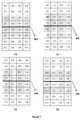
- Figure 6 schematically illustrates the one dimensional kernel positions for the filtering of the first row around a vertical edge (400).
- the two 4x4 blocks of pixels consist of the pixels (401, 402, 403, 404, 405, 406, 407, 408, 409, 410, 411, 412, 413, 414, 415, 416) and (421, 422, 423, 424, 425, 426, 427, 428, 429, 430, 431, 432, 433, 434, 435, 436), respectively.
- the pixels (403, 404, 421 and 422) are the filtered pixels on the first row, whereas the filtered pixels are labeled with (407, 408, 425 and 426) for the second row, with (411, 412, 429 and 430) for the third row and with (415, 416, 433, 434) in the fourth row for the 4x4 blocks of pixels in Figure 6 .
- the filtering should be applied for the additional rows for block height dimensions greater than 4.
- the effective pixels for the filtering of a first pixel (403) are pixels (401, 402, 403, 404 and 421), as shown in (a), whereas pixels (402, 403, 404, 421 and 422) are effective for the filtering of a second pixel (404), as illustrated in (b).
- pixels (c) illustrates that pixels (403, 404, 421, 422 and 423) contribute for the filtering of a third pixel (421).
- pixels (404, 421, 422, 423 and 424) are effective for the filtering of pixel (422).
- the effective pixels for the filtering of pixels in other rows are as follows:
- Figure 7 schematically depicts the one dimensional kernel positions for the filtering of the first column around a horizontal edge (500).
- the two 4x4 blocks of pixels consist of the pixels (501, 502, 503, 504, 505, 506, 507, 508, 509, 510, 511, 512, 513, 514, 515, 516) and (521, 522, 523, 524, 525, 526, 527, 528, 529, 530, 531, 532, 533, 534, 535, 536), respectively.
- the pixels (509, 513, 521 and 525) are the filtered pixels on the first column, whereas the filtered pixels are labeled with (510, 514, 522, and 526) for the second row, with (511, 515, 523, 527) for the third column and with (512, 516, 524, 528) in the fourth column for the 4x4 blocks of pixels in Figure 7 .
- the filtering should be applied for the additional columns for block width dimensions greater than 4.
- the effective pixels for the filtering are as follows:
- the coefficients in the filtering window, and hence, the filter strength is adjusted adaptively according to the difference along the edge between the two blocks.
- the difference is calculated with one pixel depth on both sides along the edge to be filtered.
- the edge pixel depth for the edge difference calculation may be set to different values in different implementations.
- the edge difference is converted to pixel-wise basis via division with the edge length in pixels.
- ⁇ 2 is the variance of the Gaussian formulation. After all coefficients are calculated, they are normalized to give a summation of 1.
- the variance, ⁇ 2 is set to be equal to the pixel-wise edge difference. Since the center coefficient is always set as 1 before normalization, the relative effectiveness of the other pixels increase with larger pixel-wise edge difference. Hence, stronger filtering is applied along edges with large difference values.
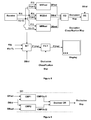
- Figure 8 illustrates an apparatus for interpolating a sequence of video frames.
- a first frame ( F(t) ) and a second frame ( F(t+T) ) are applied to the motion estimation units ( MEFwd ) , ( MEBid ) and ( MEBwd), for the estimation of forward, bidirectional and backward motion vector fields.
- the estimated forward ( DFwd ) , bidirectional (DBid) and backward (DBwd) motion vector fields are then applied to an occlusion detection unit (OD) to generate an occlusion map.
- OD occlusion detection unit
- the occlusion detection unit investigates the estimated forward, bidirectional and backward motion vector fields to identify regions where there are inconsistencies, which are identified as occlusion regions, and regions where there are no inconsistencies, which are identified as non-occluded regions.
- the generated occlusion map is then processed by an occlusion classifier unit (OC) which classifies the occlusion regions as covered or non-covered.
- the output of the occlusion classifier unit is an occlusion classification map.
- the occlusion classification map is fed to an interpolation (INT) module, together with the first frame (F(t)) and the second frame (F (t +T ) ), for the generation of an initial output frame ( F'(t + ⁇ ) ).
- the last module of the apparatus is the adaptive filtering (FILT) unit, which receives the initial output frame ( F'(t + ⁇ ) ) and the occlusion classification map as input, and interpolates the final output of the system (F (t + ⁇ ) ).
- the final output frame ( F(t + ⁇ ) ) is the frame to be interpolated.
- the resulting interpolated sequence of frames is supplied to a display device to be displayed at an increased frame rate such as 100 Hz, 120 Hz or 200 Hz.
- FIG 9 is a block diagram of an occlusion detector (OD) for use in an apparatus as shown in Figure 8 .
- the occlusion detector (OD) has comparison units, (CMP1, CMP2), which each compare corresponding motion vectors and generate respective binary output signals (CMPOut1, CMPOut2).
- CMP1, CMP2 comparison units
- CMPOut1 binary output signal
- forward motion vectors and bidirectional motion vectors are applied to a first comparator (CMP1) and its binary output signal, (CMPOut1), is set to 1 if the corresponding bidirectional motion vector, D bid , is inconsistent with the corresponding forward motion vector, D f .
- CMPOut1 is set to 0 where there is no such inconsistency.
- the backward motion vectors and bidirectional motion vectors are applied to a second comparator (CMP2) and its binary output signal, (CMPOut2), is set to 1 if the corresponding bidirectional motion vector, D bid , is inconsistent with the corresponding backward motion vector, D b , and is set to 0, otherwise.
- the binary output signals, (CMPOut1) and (CMPOut2) are then applied to a decision logic circuit so that a decision as to whether a particular region of the interpolated frame is occluded or non-occluded can be made.
- the decision is a comparison utilizing a Boolean OR operation.
- FIG 10 schematically shows a block diagram of the occlusion classification unit (OC) of the apparatus of Figure 8 .
- the units horizontal component difference unit (DIFFH) and vertical component difference unit (DIFFV) compute horizontal and vertical vector component differences, respectively, according to the d ⁇ parameter which is defined in equations (4) and (5), and whose value is determined according to the i lh pass in the multipass occlusion classification procedure.
- the weighted sum vector component differences (WSVCD) is computed with respect to the coefficients, c x and c y , which are determined according to the spatial characteristics of the particular motion vector under examination.
- multi-step weighted sum of vector component differences is calculated with respect to the coefficient, ⁇ i , which is defined in equation (3), and whose value is determined with respect to the i th pass in the multi-step occlusion classification procedure.
- multi-step weighted sum of vector component differences is compared with respect to a scalar threshold in order to decide the occlusion type of the particular pixel or block of pixels as covered, uncovered, or undecided.
- FIG 11 is a block diagram of a frame interpolation unit (INT) of the apparatus shown in Figure 8 .
- the de-multiplexer (DeMux) activates the corresponding compensation unit while de-activating the others, according to the occlusion classification map.
- the de-multiplexer (DeMux) sets the corresponding enable signal to 1, while keeping the other enable signals at 0. Compensation is performed in only the enabled unit among bidirectional compensation, unidirectional covered region compensation and unidirectional uncovered region compensation.
- the output value for the disabled modules can be set to an appropriate value.
- the corresponding compensation result is selected by the multiplexer (Mux), according to the occlusion classification map.
- FIG 12 depicts a block diagram of an adaptive de-blocking filtering unit (FILT) as used in the apparatus of Figure 8 .
- the filtering decision unit (FiltDec) decides whether there is need for de-blocking filtering between two neighboring blocks, according to the occlusion classification map, and generates enabling signals (Enable) for other units.
- the pixel-wise edge difference between the neighboring blocks is calculated in edge difference calculation unit (EdgeDiffCalc) and the filter coefficients are calculated with respect to the pixel-wise edge difference in filter coefficient calculation unit (CoeffCalc).
- the filter kernel (Filt) is applied to the image frame.
- the process aims first at localizing pixel-wise or block-wise occlusion regions in the frame to be interpolated, and classifying the detected occlusion regions as covered and uncovered.
- the interpolation of the new frame is performed with respect to the detected covered and uncovered regions.
- the algorithm proposes an adaptive de-blocking filtering for reducing the possible visual artifacts between neighboring blocks of pixels.
Landscapes
- Engineering & Computer Science (AREA)
- Multimedia (AREA)
- Signal Processing (AREA)
- Television Systems (AREA)
Applications Claiming Priority (1)
| Application Number | Priority Date | Filing Date | Title |
|---|---|---|---|
| TR201003470 | 2010-04-30 |
Publications (3)
| Publication Number | Publication Date |
|---|---|
| EP2383992A2 true EP2383992A2 (de) | 2011-11-02 |
| EP2383992A3 EP2383992A3 (de) | 2013-10-16 |
| EP2383992B1 EP2383992B1 (de) | 2017-11-29 |
Family
ID=44515224
Family Applications (1)
| Application Number | Title | Priority Date | Filing Date |
|---|---|---|---|
| EP11163706.2A Active EP2383992B1 (de) | 2010-04-30 | 2011-04-26 | Verfahren und Vorrichtung zur Detektion und Klassifizierung von Okklusionsbereichen |
Country Status (2)
| Country | Link |
|---|---|
| EP (1) | EP2383992B1 (de) |
| ES (1) | ES2660610T3 (de) |
Cited By (7)
| Publication number | Priority date | Publication date | Assignee | Title |
|---|---|---|---|---|
| US20130170551A1 (en) * | 2011-12-29 | 2013-07-04 | Hong Kong Applied Science & Technology Research Institute Company Limited | Halo Reduction in Frame-Rate-Conversion Using Hybrid Bi-Directional Motion Vectors for Occlusion/Disocclusion Detection |
| US20150015792A1 (en) * | 2012-03-05 | 2015-01-15 | Thomson Licensing | Filtering a displacement field between video frames |
| CN105517671A (zh) * | 2015-05-25 | 2016-04-20 | 北京大学深圳研究生院 | 一种基于光流法的视频插帧方法及系统 |
| US20160295232A1 (en) * | 2015-03-30 | 2016-10-06 | Kabushiki Kaisha Toshiba | Image processing apparatus, image processing method, and image processing program |
| CN113873095A (zh) * | 2020-06-30 | 2021-12-31 | 晶晨半导体(上海)股份有限公司 | 运动补偿方法和模块、芯片、电子设备及存储介质 |
| WO2022075688A1 (en) * | 2020-10-05 | 2022-04-14 | Samsung Electronics Co., Ltd. | Occlusion processing for frame rate conversion using deep learning |
| US11889227B2 (en) | 2020-10-05 | 2024-01-30 | Samsung Electronics Co., Ltd. | Occlusion processing for frame rate conversion using deep learning |
Citations (3)
| Publication number | Priority date | Publication date | Assignee | Title |
|---|---|---|---|---|
| WO1997004599A1 (en) | 1995-07-24 | 1997-02-06 | Motorola Inc. | Method and apparatus for detecting occlusion |
| US6219436B1 (en) | 1997-10-29 | 2001-04-17 | U.S. Philips Corporation | Motion vector estimation and detection of covered/uncovered image parts |
| US6487313B1 (en) | 1998-08-21 | 2002-11-26 | Koninklijke Philips Electronics N.V. | Problem area location in an image signal |
Family Cites Families (2)
| Publication number | Priority date | Publication date | Assignee | Title |
|---|---|---|---|---|
| WO1992005662A1 (en) * | 1990-09-20 | 1992-04-02 | British Broadcasting Corporation | Video image processing |
| WO2005022922A1 (en) * | 2003-09-02 | 2005-03-10 | Koninklijke Philips Electronics N.V. | Temporal interpolation of a pixel on basis of occlusion detection |
-
2011
- 2011-04-26 ES ES11163706.2T patent/ES2660610T3/es active Active
- 2011-04-26 EP EP11163706.2A patent/EP2383992B1/de active Active
Patent Citations (3)
| Publication number | Priority date | Publication date | Assignee | Title |
|---|---|---|---|---|
| WO1997004599A1 (en) | 1995-07-24 | 1997-02-06 | Motorola Inc. | Method and apparatus for detecting occlusion |
| US6219436B1 (en) | 1997-10-29 | 2001-04-17 | U.S. Philips Corporation | Motion vector estimation and detection of covered/uncovered image parts |
| US6487313B1 (en) | 1998-08-21 | 2002-11-26 | Koninklijke Philips Electronics N.V. | Problem area location in an image signal |
Cited By (9)
| Publication number | Priority date | Publication date | Assignee | Title |
|---|---|---|---|---|
| US20130170551A1 (en) * | 2011-12-29 | 2013-07-04 | Hong Kong Applied Science & Technology Research Institute Company Limited | Halo Reduction in Frame-Rate-Conversion Using Hybrid Bi-Directional Motion Vectors for Occlusion/Disocclusion Detection |
| US9148622B2 (en) * | 2011-12-29 | 2015-09-29 | Hong Kong Applied Science and Technology Research Institute Company, Limited | Halo reduction in frame-rate-conversion using hybrid bi-directional motion vectors for occlusion/disocclusion detection |
| US20150015792A1 (en) * | 2012-03-05 | 2015-01-15 | Thomson Licensing | Filtering a displacement field between video frames |
| US20160295232A1 (en) * | 2015-03-30 | 2016-10-06 | Kabushiki Kaisha Toshiba | Image processing apparatus, image processing method, and image processing program |
| US10038913B2 (en) * | 2015-03-30 | 2018-07-31 | Kabushiki Kaisha Toshiba | Image processing apparatus, image processing method, and image processing program |
| CN105517671A (zh) * | 2015-05-25 | 2016-04-20 | 北京大学深圳研究生院 | 一种基于光流法的视频插帧方法及系统 |
| CN113873095A (zh) * | 2020-06-30 | 2021-12-31 | 晶晨半导体(上海)股份有限公司 | 运动补偿方法和模块、芯片、电子设备及存储介质 |
| WO2022075688A1 (en) * | 2020-10-05 | 2022-04-14 | Samsung Electronics Co., Ltd. | Occlusion processing for frame rate conversion using deep learning |
| US11889227B2 (en) | 2020-10-05 | 2024-01-30 | Samsung Electronics Co., Ltd. | Occlusion processing for frame rate conversion using deep learning |
Also Published As
| Publication number | Publication date |
|---|---|
| ES2660610T3 (es) | 2018-03-23 |
| EP2383992A3 (de) | 2013-10-16 |
| EP2383992B1 (de) | 2017-11-29 |
Similar Documents
| Publication | Publication Date | Title |
|---|---|---|
| EP2383992B1 (de) | Verfahren und Vorrichtung zur Detektion und Klassifizierung von Okklusionsbereichen | |
| KR101536794B1 (ko) | 후광현상이 줄어든 영상보간 장치 및 방법 | |
| US10540791B2 (en) | Image processing apparatus, and image processing method for performing scaling processing based on image characteristics | |
| US7259794B2 (en) | De-interlacing device and method therefor | |
| US7936950B2 (en) | Apparatus for creating interpolation frame | |
| US8817020B2 (en) | Image processing apparatus and image processing method thereof | |
| US20090208123A1 (en) | Enhanced video processing using motion vector data | |
| EP1356676B1 (de) | Verringern von aura-artigen effekten bei der bewegungskompensierten interpolation | |
| US7489350B2 (en) | Unit for and method of sharpness enhancement | |
| US20080008243A1 (en) | Method and apparatus for frame interpolation | |
| EP2107521A2 (de) | Erfassung eines Randbereichs in einem Bild | |
| JP3842756B2 (ja) | インターレース−プログレッシブ変換用のエッジ適応補間のための方法及びシステム | |
| US9161011B2 (en) | Image processing apparatus and control method thereof | |
| CN102918830B (zh) | 图像处理装置和方法、图像显示装置和方法 | |
| EP2787484A2 (de) | Effiziente adaptive 2D-Geräuschschwellenwertverarbeitung zur Videoverarbeitung | |
| US7554611B2 (en) | Method and apparatus of bidirectional temporal noise reduction | |
| EP2509045B1 (de) | Verfahren von und Vorrichtung zur Erkennung von Bildgrenzen in Videodaten | |
| US7796191B1 (en) | Edge-preserving vertical interpolation | |
| CN102509311A (zh) | 运动检测方法和装置 | |
| US8233085B1 (en) | Method and system for interpolating a pixel value of a pixel located at an on-screen display | |
| EP1863283B1 (de) | Verfahren und Vorrichtung zur Bildinterpolation | |
| EP2429203A2 (de) | Detektion stereoskopischer Bilder | |
| Günyel et al. | Method and apparatus for the detection and classification of occlusion regions | |
| US20110298904A1 (en) | Image processing apparatus, image processing method, and image display apparatus | |
| US7778482B2 (en) | Method and system for reducing mosquito noise in a digital image |
Legal Events
| Date | Code | Title | Description |
|---|---|---|---|
| AK | Designated contracting states |
Kind code of ref document: A2 Designated state(s): AL AT BE BG CH CY CZ DE DK EE ES FI FR GB GR HR HU IE IS IT LI LT LU LV MC MK MT NL NO PL PT RO RS SE SI SK SM TR |
|
| AX | Request for extension of the european patent |
Extension state: BA ME |
|
| PUAI | Public reference made under article 153(3) epc to a published international application that has entered the european phase |
Free format text: ORIGINAL CODE: 0009012 |
|
| PUAL | Search report despatched |
Free format text: ORIGINAL CODE: 0009013 |
|
| AK | Designated contracting states |
Kind code of ref document: A3 Designated state(s): AL AT BE BG CH CY CZ DE DK EE ES FI FR GB GR HR HU IE IS IT LI LT LU LV MC MK MT NL NO PL PT RO RS SE SI SK SM TR |
|
| AX | Request for extension of the european patent |
Extension state: BA ME |
|
| RIC1 | Information provided on ipc code assigned before grant |
Ipc: H04N 5/14 20060101ALI20130906BHEP Ipc: H04N 5/44 20110101ALI20130906BHEP Ipc: H04N 7/01 20060101AFI20130906BHEP Ipc: H04N 7/26 20060101ALI20130906BHEP Ipc: H04N 7/36 20060101ALI20130906BHEP |
|
| 17P | Request for examination filed |
Effective date: 20140331 |
|
| 17Q | First examination report despatched |
Effective date: 20150817 |
|
| RIN1 | Information on inventor provided before grant (corrected) |
Inventor name: GUNYEL, BERTAN Inventor name: ALATAN, ABDULLAH AYDIN |
|
| STAA | Information on the status of an ep patent application or granted ep patent |
Free format text: STATUS: EXAMINATION IS IN PROGRESS |
|
| GRAP | Despatch of communication of intention to grant a patent |
Free format text: ORIGINAL CODE: EPIDOSNIGR1 |
|
| STAA | Information on the status of an ep patent application or granted ep patent |
Free format text: STATUS: GRANT OF PATENT IS INTENDED |
|
| RIC1 | Information provided on ipc code assigned before grant |
Ipc: H04N 7/01 20060101AFI20170807BHEP |
|
| INTG | Intention to grant announced |
Effective date: 20170901 |
|
| GRAS | Grant fee paid |
Free format text: ORIGINAL CODE: EPIDOSNIGR3 |
|
| GRAA | (expected) grant |
Free format text: ORIGINAL CODE: 0009210 |
|
| STAA | Information on the status of an ep patent application or granted ep patent |
Free format text: STATUS: THE PATENT HAS BEEN GRANTED |
|
| AK | Designated contracting states |
Kind code of ref document: B1 Designated state(s): AL AT BE BG CH CY CZ DE DK EE ES FI FR GB GR HR HU IE IS IT LI LT LU LV MC MK MT NL NO PL PT RO RS SE SI SK SM TR |
|
| REG | Reference to a national code |
Ref country code: CH Ref legal event code: EP |
|
| REG | Reference to a national code |
Ref country code: AT Ref legal event code: REF Ref document number: 951365 Country of ref document: AT Kind code of ref document: T Effective date: 20171215 |
|
| REG | Reference to a national code |
Ref country code: IE Ref legal event code: FG4D |
|
| REG | Reference to a national code |
Ref country code: DE Ref legal event code: R096 Ref document number: 602011043720 Country of ref document: DE |
|
| REG | Reference to a national code |
Ref country code: ES Ref legal event code: FG2A Ref document number: 2660610 Country of ref document: ES Kind code of ref document: T3 Effective date: 20180323 |
|
| REG | Reference to a national code |
Ref country code: NL Ref legal event code: MP Effective date: 20171129 |
|
| REG | Reference to a national code |
Ref country code: LT Ref legal event code: MG4D |
|
| REG | Reference to a national code |
Ref country code: AT Ref legal event code: MK05 Ref document number: 951365 Country of ref document: AT Kind code of ref document: T Effective date: 20171129 |
|
| REG | Reference to a national code |
Ref country code: FR Ref legal event code: PLFP Year of fee payment: 8 |
|
| PG25 | Lapsed in a contracting state [announced via postgrant information from national office to epo] |
Ref country code: FI Free format text: LAPSE BECAUSE OF FAILURE TO SUBMIT A TRANSLATION OF THE DESCRIPTION OR TO PAY THE FEE WITHIN THE PRESCRIBED TIME-LIMIT Effective date: 20171129 Ref country code: SE Free format text: LAPSE BECAUSE OF FAILURE TO SUBMIT A TRANSLATION OF THE DESCRIPTION OR TO PAY THE FEE WITHIN THE PRESCRIBED TIME-LIMIT Effective date: 20171129 Ref country code: LT Free format text: LAPSE BECAUSE OF FAILURE TO SUBMIT A TRANSLATION OF THE DESCRIPTION OR TO PAY THE FEE WITHIN THE PRESCRIBED TIME-LIMIT Effective date: 20171129 Ref country code: NO Free format text: LAPSE BECAUSE OF FAILURE TO SUBMIT A TRANSLATION OF THE DESCRIPTION OR TO PAY THE FEE WITHIN THE PRESCRIBED TIME-LIMIT Effective date: 20180228 |
|
| PG25 | Lapsed in a contracting state [announced via postgrant information from national office to epo] |
Ref country code: HR Free format text: LAPSE BECAUSE OF FAILURE TO SUBMIT A TRANSLATION OF THE DESCRIPTION OR TO PAY THE FEE WITHIN THE PRESCRIBED TIME-LIMIT Effective date: 20171129 Ref country code: BG Free format text: LAPSE BECAUSE OF FAILURE TO SUBMIT A TRANSLATION OF THE DESCRIPTION OR TO PAY THE FEE WITHIN THE PRESCRIBED TIME-LIMIT Effective date: 20180228 Ref country code: AT Free format text: LAPSE BECAUSE OF FAILURE TO SUBMIT A TRANSLATION OF THE DESCRIPTION OR TO PAY THE FEE WITHIN THE PRESCRIBED TIME-LIMIT Effective date: 20171129 Ref country code: LV Free format text: LAPSE BECAUSE OF FAILURE TO SUBMIT A TRANSLATION OF THE DESCRIPTION OR TO PAY THE FEE WITHIN THE PRESCRIBED TIME-LIMIT Effective date: 20171129 Ref country code: RS Free format text: LAPSE BECAUSE OF FAILURE TO SUBMIT A TRANSLATION OF THE DESCRIPTION OR TO PAY THE FEE WITHIN THE PRESCRIBED TIME-LIMIT Effective date: 20171129 Ref country code: GR Free format text: LAPSE BECAUSE OF FAILURE TO SUBMIT A TRANSLATION OF THE DESCRIPTION OR TO PAY THE FEE WITHIN THE PRESCRIBED TIME-LIMIT Effective date: 20180301 |
|
| PG25 | Lapsed in a contracting state [announced via postgrant information from national office to epo] |
Ref country code: NL Free format text: LAPSE BECAUSE OF FAILURE TO SUBMIT A TRANSLATION OF THE DESCRIPTION OR TO PAY THE FEE WITHIN THE PRESCRIBED TIME-LIMIT Effective date: 20171129 |
|
| PG25 | Lapsed in a contracting state [announced via postgrant information from national office to epo] |
Ref country code: EE Free format text: LAPSE BECAUSE OF FAILURE TO SUBMIT A TRANSLATION OF THE DESCRIPTION OR TO PAY THE FEE WITHIN THE PRESCRIBED TIME-LIMIT Effective date: 20171129 Ref country code: DK Free format text: LAPSE BECAUSE OF FAILURE TO SUBMIT A TRANSLATION OF THE DESCRIPTION OR TO PAY THE FEE WITHIN THE PRESCRIBED TIME-LIMIT Effective date: 20171129 Ref country code: SK Free format text: LAPSE BECAUSE OF FAILURE TO SUBMIT A TRANSLATION OF THE DESCRIPTION OR TO PAY THE FEE WITHIN THE PRESCRIBED TIME-LIMIT Effective date: 20171129 Ref country code: CZ Free format text: LAPSE BECAUSE OF FAILURE TO SUBMIT A TRANSLATION OF THE DESCRIPTION OR TO PAY THE FEE WITHIN THE PRESCRIBED TIME-LIMIT Effective date: 20171129 Ref country code: CY Free format text: LAPSE BECAUSE OF FAILURE TO SUBMIT A TRANSLATION OF THE DESCRIPTION OR TO PAY THE FEE WITHIN THE PRESCRIBED TIME-LIMIT Effective date: 20171129 |
|
| REG | Reference to a national code |
Ref country code: DE Ref legal event code: R097 Ref document number: 602011043720 Country of ref document: DE |
|
| PG25 | Lapsed in a contracting state [announced via postgrant information from national office to epo] |
Ref country code: PL Free format text: LAPSE BECAUSE OF FAILURE TO SUBMIT A TRANSLATION OF THE DESCRIPTION OR TO PAY THE FEE WITHIN THE PRESCRIBED TIME-LIMIT Effective date: 20171129 Ref country code: SM Free format text: LAPSE BECAUSE OF FAILURE TO SUBMIT A TRANSLATION OF THE DESCRIPTION OR TO PAY THE FEE WITHIN THE PRESCRIBED TIME-LIMIT Effective date: 20171129 Ref country code: RO Free format text: LAPSE BECAUSE OF FAILURE TO SUBMIT A TRANSLATION OF THE DESCRIPTION OR TO PAY THE FEE WITHIN THE PRESCRIBED TIME-LIMIT Effective date: 20171129 |
|
| PLBE | No opposition filed within time limit |
Free format text: ORIGINAL CODE: 0009261 |
|
| STAA | Information on the status of an ep patent application or granted ep patent |
Free format text: STATUS: NO OPPOSITION FILED WITHIN TIME LIMIT |
|
| 26N | No opposition filed |
Effective date: 20180830 |
|
| PG25 | Lapsed in a contracting state [announced via postgrant information from national office to epo] |
Ref country code: SI Free format text: LAPSE BECAUSE OF FAILURE TO SUBMIT A TRANSLATION OF THE DESCRIPTION OR TO PAY THE FEE WITHIN THE PRESCRIBED TIME-LIMIT Effective date: 20171129 Ref country code: MC Free format text: LAPSE BECAUSE OF FAILURE TO SUBMIT A TRANSLATION OF THE DESCRIPTION OR TO PAY THE FEE WITHIN THE PRESCRIBED TIME-LIMIT Effective date: 20171129 |
|
| REG | Reference to a national code |
Ref country code: CH Ref legal event code: PL |
|
| REG | Reference to a national code |
Ref country code: BE Ref legal event code: MM Effective date: 20180430 |
|
| REG | Reference to a national code |
Ref country code: IE Ref legal event code: MM4A |
|
| PG25 | Lapsed in a contracting state [announced via postgrant information from national office to epo] |
Ref country code: LU Free format text: LAPSE BECAUSE OF NON-PAYMENT OF DUE FEES Effective date: 20180426 |
|
| PG25 | Lapsed in a contracting state [announced via postgrant information from national office to epo] |
Ref country code: BE Free format text: LAPSE BECAUSE OF NON-PAYMENT OF DUE FEES Effective date: 20180430 Ref country code: CH Free format text: LAPSE BECAUSE OF NON-PAYMENT OF DUE FEES Effective date: 20180430 Ref country code: LI Free format text: LAPSE BECAUSE OF NON-PAYMENT OF DUE FEES Effective date: 20180430 |
|
| PG25 | Lapsed in a contracting state [announced via postgrant information from national office to epo] |
Ref country code: IE Free format text: LAPSE BECAUSE OF NON-PAYMENT OF DUE FEES Effective date: 20180426 |
|
| PG25 | Lapsed in a contracting state [announced via postgrant information from national office to epo] |
Ref country code: MT Free format text: LAPSE BECAUSE OF NON-PAYMENT OF DUE FEES Effective date: 20180426 |
|
| PG25 | Lapsed in a contracting state [announced via postgrant information from national office to epo] |
Ref country code: PT Free format text: LAPSE BECAUSE OF FAILURE TO SUBMIT A TRANSLATION OF THE DESCRIPTION OR TO PAY THE FEE WITHIN THE PRESCRIBED TIME-LIMIT Effective date: 20171129 Ref country code: HU Free format text: LAPSE BECAUSE OF FAILURE TO SUBMIT A TRANSLATION OF THE DESCRIPTION OR TO PAY THE FEE WITHIN THE PRESCRIBED TIME-LIMIT; INVALID AB INITIO Effective date: 20110426 |
|
| PG25 | Lapsed in a contracting state [announced via postgrant information from national office to epo] |
Ref country code: MK Free format text: LAPSE BECAUSE OF NON-PAYMENT OF DUE FEES Effective date: 20171129 |
|
| PG25 | Lapsed in a contracting state [announced via postgrant information from national office to epo] |
Ref country code: AL Free format text: LAPSE BECAUSE OF FAILURE TO SUBMIT A TRANSLATION OF THE DESCRIPTION OR TO PAY THE FEE WITHIN THE PRESCRIBED TIME-LIMIT Effective date: 20171129 Ref country code: IS Free format text: LAPSE BECAUSE OF FAILURE TO SUBMIT A TRANSLATION OF THE DESCRIPTION OR TO PAY THE FEE WITHIN THE PRESCRIBED TIME-LIMIT Effective date: 20180329 |
|
| PGFP | Annual fee paid to national office [announced via postgrant information from national office to epo] |
Ref country code: DE Payment date: 20250422 Year of fee payment: 15 |
|
| PGFP | Annual fee paid to national office [announced via postgrant information from national office to epo] |
Ref country code: GB Payment date: 20250423 Year of fee payment: 15 Ref country code: ES Payment date: 20250529 Year of fee payment: 15 |
|
| PGFP | Annual fee paid to national office [announced via postgrant information from national office to epo] |
Ref country code: IT Payment date: 20250424 Year of fee payment: 15 |
|
| PGFP | Annual fee paid to national office [announced via postgrant information from national office to epo] |
Ref country code: FR Payment date: 20250424 Year of fee payment: 15 |
|
| PGFP | Annual fee paid to national office [announced via postgrant information from national office to epo] |
Ref country code: TR Payment date: 20250425 Year of fee payment: 15 |