EP2381772B1 - Process and intermediates for the preparation of n-acylated-4-aryl beta-amino acid derivatives - Google Patents
Process and intermediates for the preparation of n-acylated-4-aryl beta-amino acid derivatives Download PDFInfo
- Publication number
- EP2381772B1 EP2381772B1 EP09837169.3A EP09837169A EP2381772B1 EP 2381772 B1 EP2381772 B1 EP 2381772B1 EP 09837169 A EP09837169 A EP 09837169A EP 2381772 B1 EP2381772 B1 EP 2381772B1
- Authority
- EP
- European Patent Office
- Prior art keywords
- alkyl
- aryl
- group
- compound
- substituted
- Prior art date
- Legal status (The legal status is an assumption and is not a legal conclusion. Google has not performed a legal analysis and makes no representation as to the accuracy of the status listed.)
- Active
Links
- 0 C1CC=C*C1 Chemical compound C1CC=C*C1 0.000 description 5
- TUAXCHGULMWHIO-SECBINFHSA-N CC(C)(C)OC(N[C@@H](CC(O)=O)Cc(c(F)c1)cc(F)c1F)=O Chemical compound CC(C)(C)OC(N[C@@H](CC(O)=O)Cc(c(F)c1)cc(F)c1F)=O TUAXCHGULMWHIO-SECBINFHSA-N 0.000 description 1
- INQCBWDBMIXHDN-SNVBAGLBSA-N CC(C)(C)OC(N[C@@H](CC(OC)=O)Cc(c(F)c1)cc(F)c1F)=O Chemical compound CC(C)(C)OC(N[C@@H](CC(OC)=O)Cc(c(F)c1)cc(F)c1F)=O INQCBWDBMIXHDN-SNVBAGLBSA-N 0.000 description 1
- CSNUOYBTZPFAAP-UHFFFAOYSA-N COC(CC(Cc(cc(c(N)c1)N)c1N)=O)=O Chemical compound COC(CC(Cc(cc(c(N)c1)N)c1N)=O)=O CSNUOYBTZPFAAP-UHFFFAOYSA-N 0.000 description 1
Images

Classifications
-
- C—CHEMISTRY; METALLURGY
- C07—ORGANIC CHEMISTRY
- C07D—HETEROCYCLIC COMPOUNDS
- C07D487/00—Heterocyclic compounds containing nitrogen atoms as the only ring hetero atoms in the condensed system, not provided for by groups C07D451/00 - C07D477/00
- C07D487/02—Heterocyclic compounds containing nitrogen atoms as the only ring hetero atoms in the condensed system, not provided for by groups C07D451/00 - C07D477/00 in which the condensed system contains two hetero rings
- C07D487/04—Ortho-condensed systems
-
- C—CHEMISTRY; METALLURGY
- C07—ORGANIC CHEMISTRY
- C07B—GENERAL METHODS OF ORGANIC CHEMISTRY; APPARATUS THEREFOR
- C07B53/00—Asymmetric syntheses
-
- C—CHEMISTRY; METALLURGY
- C07—ORGANIC CHEMISTRY
- C07C—ACYCLIC OR CARBOCYCLIC COMPOUNDS
- C07C269/00—Preparation of derivatives of carbamic acid, i.e. compounds containing any of the groups, the nitrogen atom not being part of nitro or nitroso groups
- C07C269/06—Preparation of derivatives of carbamic acid, i.e. compounds containing any of the groups, the nitrogen atom not being part of nitro or nitroso groups by reactions not involving the formation of carbamate groups
-
- C—CHEMISTRY; METALLURGY
- C07—ORGANIC CHEMISTRY
- C07B—GENERAL METHODS OF ORGANIC CHEMISTRY; APPARATUS THEREFOR
- C07B2200/00—Indexing scheme relating to specific properties of organic compounds
- C07B2200/07—Optical isomers
Definitions
- the present invention relates to a process for producing enantiomerically enriched beta-amino acid derivatives which are important chiral building blocks and intermediates in pharmaceuticals. More specifically, the invention pertains to a novel process for practically, conveniently and economically producing enantiomerically enriched beta-amino acid derivatives which are useful for the synthesis of amide inhibitors of dipeptidyl peptidase-IV, which have been used to treat Type 2 diabetes.
- the present invention provides a process for producing enantiomerically enriched beta-amino acid derivatives represented by the following general structural formula I, or its corresponding acceptable salts in pharmaceutical, having the R-configuration at the stereogenic center marked with an *;
- the Formula I compounds are important precursors for the synthesis of amide inhibitors of dipeptidyl peptidase-IV (general structure II), which are commercially available as drugs used to treat Type 2 diabetes (trade name, Sitagliptin, JANUVIA TM ).
- the amide inhibitors of dipeptidyl peptidase-IV are prepared by standard peptide coupling of a beta amino acid with fused heterocycles.
- a large number of synthetic steps required to prepare the beta amino acids which make the processes unpractical.
- the key intermediate beta amino acid was prepared via asymmetric hydrogenation of an N-Boc protected enamine with BINAP-RuCl 2 as the catalyst.
- BINAP-RuCl 2 as the catalyst.
- 24.0% of the starting material was recovered.
- ee a low enantiomeric excess
- US 2004/0186314 discloses a process for the preparation of an enantiomerically enriched beta-amino acid derivative by hydrogenation.
- the process is catalyzed by a cationic rhodium complex of a chiral phosphine ligand. Hydrogenation of polyhalogen-substituted phenyl substrates, however, is not disclosed.
- JP 06271520 discloses a ruthenium-catalyzed hydrogenation process for the production of an optically active beta-amino acid which is useful as a synthetic intermediate for physiologically active peptides and beta-lactam antibiotics.
- the compounds to be hydrogenated comprise an unsubstituted phenyl substrate. Hydrogenation of polyhalogen-substituted phenyl substrates is not disclosed.
- beta amino acids may be synthesized, especially those useful in the synthesis of amide inhibitors of dipeptidyl peptidase-IV.
- the present invention addresses this need.
- the present invention provides a process for the preparation of chiral beta amino acid derivatives of structural formula I in an efficient enantioselective fashion through transition metal-catalyzed asymmetric hydrogenation of a prochiral enamide of structural formula III: in the presence of a transition metal precursor complexed to a chiral phosphine ligand.
- one aspect of the present invention provides a process for producing enantiomerically enriched beta-amino acid derivatives represented by the structure of Formula I, having the R- or S-configuration at the stereogenic center marked with an *;
- the chiral phosphine ligands have a structure according to Formula IV: wherein each R is independently C 1-8 alkyl, C 3-8 cycloalkyl or aryl, and P is phosphorus.
- the transition metal precursor is selected from [M(monoolefin) 2 acetylacetonate], [M(diolefin)acetylacetonate], [M(monoolefin) 4 ]X and [M(diolefin) 2 ]X, wherein X is a noncoordinating anion selected from methanesulfonate trifluoromethanesulfonate, tetrafluoroborate, hexafluorophosphate and hexafluoroantimonate, and M is rhodium or iridium.
- the transition metal precursor is [rhodium (COD) 2 ]X or [rhodium(NBD) 2 ]X.
- the catalytic complex of the transition metal precursor and the chiral diphosphine ligand used in the hydrogenation process of the present invention may be generated in situ by addition of the transition metal species and the chiral diphosphine ligand to the reaction system.
- the catalytic complex of the transition metal precursor and the chiral diphosphine ligand used in the hydrogenation process of the present invention may be preformed with or without isolation and then added to the reaction system.
- the preformed complex is represented by the formula: wherein X is the same non-coordinating anion described above, and L is an olefin, and preferably a chelating diolefin such as 1,5-cyclooctadiene or norbornadiene, M, R, and P are the same as above in Formula IV.
- the beta enamine compounds with the structure of Formula III to be asymmetrically hydrogenated by the method of the present invention are prepared from enamine derivatives represented by the structure of Formula V (wherein the amino group is unprotected): by reaction with an acylation reagent in the presence of a suitable organic base.
- Suitable acylation reagents include C 2-8 -alkyl-, aryl- and aryl-C 1-2 -alkyl- acyl chlorides, anhydrides and chloroformates such as acetyl chloride, acetic anhydride, Boc anhydride and benzyl chloroformate.
- amide inhibitors of dipeptidyl peptidase-IV (general structure II) prepared by the process of the present invention, followed by a deprotective procedure.
- Figure 1 depicts the structures for chiral optically active phosphine ligands BICP, DuPhos, t-BuBisP*, BPE, FerroTANE, MalPhos, TrichickenPhos, TangPhos, DuanPhos, Binapine and JosiPhos, wherein each R is independently C 1-8 alkyl, C 3-8 cycloalkyl or aryl, and P is phosphorous.
- alkyl groups means an alky group of the designated length in either a linear or branched configuration. Exemplary of such alkyl groups are methyl, ethyl, propyl, isopropyl, butyl, sec-butyl, tert-butyl, pentyl, isopentyl, hexyl, isohexyl, and the like. Alkyl groups can be further substituted with with one to three groups independently selected from halogen, hydroxy, carboxy, aminocarbonyl, amino, C 1-4 alkoxy and C 1-4 alkylthio.
- cycloalkyl means a cycloaliphatic group of five to twelve total carbon atoms, or any number within this range, for example, cyclopentyl, cyclohexyl, cycloheptyl, cyclooctyl and the like.
- aryl means an aromatic group, preferably phenyl or naphthyl.
- Aryl groups can be further substituted with up to five substituents independently selected from halogen, hydroxyl, amino, C 1-4 alkyl, alkoxyl, trifluoromethyl.
- arene means benzene, naphthene and o-, m-, or p-isopropyltoluene.
- olefin means an acyclic or cyclic hydrocarbon containing one or more double bonds including aromatic cyclic hydrocarbons.
- the term includes, but not limited to, 1,5-cyclooctadiene (COD) and norbornadiene (NBD).
- heteroaryl means a 5- or 6-member aromatic heterocycle that contains at least one ring heteroatom selected from O, S and N. Heteroaryl groups can be further fused to another ring, such as aryl, cycloalky and heterocycles that are not aromatic.
- Heteroaryls include, but are not limited to, pyrrolyl, isoxazolyl, isothiazolyl, pyrazolyl, pyridinyl, oxazolyl, 1,2,4-oxadiazolyl, 1,3,4-oxadiazolyl, thiadiazolyl, thiazolyl, imidazolyl, triazolyl, tetrazolyl, furyl, triazinyl, thienyl, pyrimidinyl, pyrazinyl, benzisoxazolyl, benzoxazolyl, benzothiazolyl, benzothiadiazolyl, dihydrobenzofuryl, indolinyl, pyridazinyl, indazolyl, isoindolyl, dihydrobenzothienyl, indolizinyl, cinnolinyl, phthalazinyl, quinazolinyl, naphthyridinyl,
- the present invention provides a process for producing enantiomerically enriched beta-amino acid derivatives represented by the structure of Formula I, having the R-, or S-configuration at the stereogenic center marked with an *, wherein Ar, P and Z are the same as described above with respect to Formula I.
- a process for producing an enantiomerically pure or an enantiomerically enriched and essentially pure compound having a structure of Formula I is contemplated.
- Ar is phenyl which is substituted with one to five substituents independently selected from the group consisting of halogen. More preferably, Ar is 2,4,5-trifluorophenyl.
- P is R 3 , more preferably, P is H, C 1-8 alkyl or aryl. In another preferred subgroup, P is OR 3 . More preferably, R 3 therein is tert-butyl or benzyl.
- the process asymmetrically hydrogenates an enamide precursor with the structure of Formula III: in n a suitable organic solvent, in the presence of a transition metal precursor complexed to a chiral phosphine ligand.
- the chiral phosphine ligand is a diphosphine ligand represented by the structural formula IV: wherein each R is independently C 1-8 alkyl, C 3-8 cycloalkyl or aryl, and P is phosphorous.
- Suitable chiral optically active phosphine ligands include, but are not limited to BICP, DuPhos, t-BuBisP*, BPE, FerroTANE, MalPhos, TrichickenPhos, TangPhos, DuanPhos, Binapine and JosiPhos as shown in Figure. 1 , wherein each R is independently C 1-8 alkyl, C 1-8 cycloalkyl or aryl, and P is phosphorus.
- optically active phosphine ligands occur with (R)- or (S)-configurations, one configuration may be selected over the other depending on the desired absolute configuration of the Formula I compound to be prepared. It is possible to control the configuration of the hydrogenation products by the judicious choice of the configuration of the diphosphine ligand.
- the catalytic complex of the transition metal precursor and the chiral diphosphine ligand used in the hydrogenation process of the present invention may be either (a) generated in situ by addition of the transition metal species and the chiral diphosphine ligand to the reaction system, or (b) pre-formed with or without isolation and then added to the reaction system.
- the preformed complex is represented by the formula: wherein X is a non-coordinating anion selected from methanesulfonate trifluoromethane-sulfonate, tetrafluoroborate, hexafluorophosphate and hexafluoroantimonate, L is an olefin, and preferably a chelating diolefin such as 1,5-cyclo-octadiene or norbornadiene), M is rhodium or iridium, and P is phosphorus.
- X is a non-coordinating anion selected from methanesulfonate trifluoromethane-sulfonate, tetrafluoroborate, hexafluorophosphate and hexafluoroantimonate
- L is an olefin, and preferably a chelating diolefin such as 1,5-cyclo-octadiene or norbornadiene)
- M is rhodium
- the transition metal precursor employed according to the invention is selected from [M(monoolefin) 2 acetyl-acetonate], [M(diolefin)acetylacetonate], [M(monoolefin) 4 ]X and [M(diolefin) 2 ]X, wherein X is a noncoordinating anion selected from methanesulfonate, trifluoromethane-sulfonate, tetrafluoroborate, hexafluorophosphate and hexafluoroantimonate, and M is rhodium or iridium.
- the transition metal precursor is [rhodium (COD) 2 ]X or [rhodium(NBD) 2 ]X,
- the catalytic metal complex used in the asymmetric hydrogenation reaction in the present invention is used in amount of about 1/10000 to 1/10, preferably about 1/5000-1/100 mole, per mole of the substrate.
- the hydrogen pressure is in the range of about 1,034 bar (15 psi) to about 103,4 bar (1500 psi), preferably about 3,1 bar (45 psi) to about 31 bar (450 psi).
- the reaction temperature used for the hydrogenation is in the range of about 0 °C to about 100 °C, preferably about 25 to 60 °C.
- the asymmetric hydrogenation in this invention is carried out in an organic solvent.
- Suitable organic solvents include aromatic hydrocarbons such as toluene, benzene and chlorobenzene, aliphatic esters such as ethyl acetate, propyl acetate and butyl acetate, ethers such as tert-butyl methyl ether, diisopropyl ether and tetrahydrofuran, halogenated hydrocarbons such as dichloromethane and dichloroethane, and alcohols such as methanol, ethanol and isopropanol. These can be used alone or as a mixture of two or more solvents.
- the solvent is an ether such as tert-butyl methyl ether or tetrahydrofuran, or an alcohol such as methanol or ethanol.
- olefins such as the beta enamine compounds with the structure of Formula III occur with (Z)- or (E)-geometric isomers.
- the beta enamine compounds with the structure of Formula III for use in the asymmetric hydrogenation process of the present invention are intended to include ether (Z)- or (E)-geometric isomers, or the mixtures of the two isomers.
- At least one aspect of the present invention requires that the final enantiomerically enriched compound to have an ee in the range of, for example, from about 20% to about 99%.
- the compound may have an ee in the range of about 35% to 99%.
- the final compound would have an ee in the range of from about 40% to about 99%.
- the final compound would have an ee in the range of about 45% to about 99% and in the most preferred embodiment, the enantiomerically enriched and essentially pure compound would have an ee greater than 95%.
- the enantiomerically enriched and essentially pure compound with the structure of Formula I is obtained with 97% ee.
- the enantiomerically pure compound with the structure of Formula I is obtained with 99% ee.
- enantiomerically enriched compounds were obtained with a 37% or 42% ee.
- the beta enamine compounds with the structure of Formula III to be asymmetrically hydrogenated by the method of the present invention can be prepared from enamine derivatives represented by the structure of Formula V (wherein the amino group is unprotected): by reaction with an acylation reagent in the presence of a suitable organic base, wherein the acylation reagents are selected from C 2-8 -alkyl-, aryl- and aryl-C 1-2 -alkyl- acyl chlorides, anhydrides and chloroformates.
- Preferred acylation reagents include acetyl chloride, acetic anhydride, Boc anhydride and benzyl chloroformate.
- Suitable organic bases include one or more compounds selected from triethyl amine, tributyl amine, diisopropylethylamine, dimethyl aniline, pyridine, N,N-dimethyl-4-amino pyridine (DMAP), 1.8-diazabicyclo[5.4.0]-7-undecen (DBU) and 1,4-diazabi-cyclo[2.2.2]octane (DABCO), with pyridine and DMAP being preferred.
- DMAP N,N-dimethyl-4-amino pyridine
- DBU 1.8-diazabicyclo[5.4.0]-7-undecen
- DABCO 1,4-diazabi-cyclo[2.2.2]octane
Landscapes
- Chemical & Material Sciences (AREA)
- Organic Chemistry (AREA)
- Chemical Kinetics & Catalysis (AREA)
- Organic Low-Molecular-Weight Compounds And Preparation Thereof (AREA)
Description
- This application claims the benefit under 35 U.S.C. 119(e) of
US Provisional Application Serial No. 61/142,037 filed on Dec. 31, 2008 - The present invention relates to a process for producing enantiomerically enriched beta-amino acid derivatives which are important chiral building blocks and intermediates in pharmaceuticals. More specifically, the invention pertains to a novel process for practically, conveniently and economically producing enantiomerically enriched beta-amino acid derivatives which are useful for the synthesis of amide inhibitors of dipeptidyl peptidase-IV, which have been used to treat Type 2 diabetes.
- The present invention provides a process for producing enantiomerically enriched beta-amino acid derivatives represented by the following general structural formula I, or its corresponding acceptable salts in pharmaceutical, having the R-configuration at the stereogenic center marked with an *;

- wherein Ar is phenyl, which is substituted with one to five substituents independently selected from halogen, trifluoromethyl and trifluoromethoxy; Z is OR1; and P is R3 or OR3;
- R1 is H, C1-8 alkyl, C5-12 cycloalkyl, aryl, or aryl-C1-2 alkyl; and
- R3 is H, C1-8 alkyl, C5-12 cycloalkyl, aryl, or aryl-C1-2 alkyl; where the alkyl groups can optionally be substituted with one to three groups independently selected from halogen, hydroxy, carboxy, aminocarbonyl, amino, C1-4 alkoxy and C1-4 alkylthio; and
where the aryl groups can optionally be substituted with up to five substituents independently selected from halogen, hydroxyl, amino, C1-4 alkyl, alkoxyl and trifluoromethyl. - As disclosed in
WO 03/004498 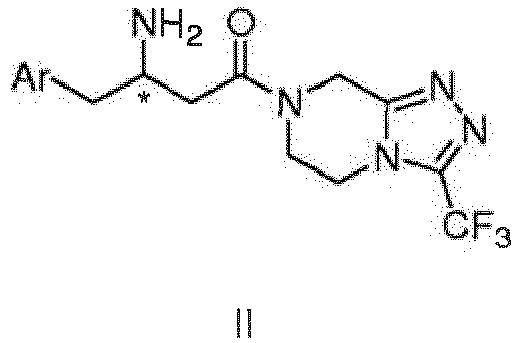
- As disclosed in
WO 03/004498 WO 04/087650 - Other routes (
WO 2004/085661 ,WO 2004/085378 andWO 2006/081151 ) involve hydrogenation of enamine derivatives with a chiral auxiliary or asymmetric hydrogenation of an N-unprotected enamine in the presence of a rhodium catalyst and Joshiphos ligand. However, high catalyst loading or use of special solvents makes the processes not cost-efficient. - As disclosed in
WO 2009/064476 , the key intermediate beta amino acid was prepared via asymmetric hydrogenation of an N-Boc protected enamine with BINAP-RuCl2 as the catalyst. However, even with long reaction time (40 h) and elevated temperature (80 °C), 24.0% of the starting material was recovered. Furthermore, a low enantiomeric excess (ee) was afforded. -
US 2004/0186314 discloses a process for the preparation of an enantiomerically enriched beta-amino acid derivative by hydrogenation. The process is catalyzed by a cationic rhodium complex of a chiral phosphine ligand. Hydrogenation of polyhalogen-substituted phenyl substrates, however, is not disclosed. -
JP 06271520 - There remains a need for practical methods by which beta amino acids may be synthesized, especially those useful in the synthesis of amide inhibitors of dipeptidyl peptidase-IV.
- The present invention addresses this need. The present invention provides a process for the preparation of chiral beta amino acid derivatives of structural formula I in an efficient enantioselective fashion through transition metal-catalyzed asymmetric hydrogenation of a prochiral enamide of structural formula III:

- Accordingly, one aspect of the present invention provides a process for producing enantiomerically enriched beta-amino acid derivatives represented by the structure of Formula I, having the R- or S-configuration at the stereogenic center marked with an *;

- wherein Ar is phenol, which is substituted with one to five substituents independently selected from halogen, trifluoromethyl and trifluoromethoxy; Z is OR1 and P is R3 or OR3;
- R1 is H, C1-8 alkyl, C5-12 cycloalkyl, aryl, or aryl-C1-2 alkyl; and
- R3 is H, C1-8 alkyl, C5-12 cycloalkyl, aryl, or aryl-C1-2 alkyl; where the alkyl groups can optionally be substituted with one to three groups independently selected from halogen, hydroxy, carboxy, aminocarbonyl, amino, C1-4 alkoxy and C1-4 alkylthio; and
where the aryl groups can optionally be substituted with up to five substituents independently selected from halogen, hydroxyl, amino, C1-4 alkyl, alkoxyl and trifluoromethyl; - wherein the process asymetrically hydrogenates a compound having the structure of Formula III in the presence of a transition metal precursor complexed to a chiral phosphine ligand catalyst in an organic solvent.
- According to one embodiment of this aspect of the invention, the chiral phosphine ligands have a structure according to Formula IV:

- The transition metal precursor is selected from [M(monoolefin)2 acetylacetonate], [M(diolefin)acetylacetonate], [M(monoolefin)4]X and [M(diolefin)2]X, wherein X is a noncoordinating anion selected from methanesulfonate trifluoromethanesulfonate, tetrafluoroborate, hexafluorophosphate and hexafluoroantimonate, and M is rhodium or iridium. Preferably, the transition metal precursor is [rhodium (COD)2]X or [rhodium(NBD)2]X.
- According to another embodiment of this aspect of the invention, the catalytic complex of the transition metal precursor and the chiral diphosphine ligand used in the hydrogenation process of the present invention may be generated in situ by addition of the transition metal species and the chiral diphosphine ligand to the reaction system. According to an alternative embodiment of this aspect of the invention, the catalytic complex of the transition metal precursor and the chiral diphosphine ligand used in the hydrogenation process of the present invention may be preformed with or without isolation and then added to the reaction system. The preformed complex is represented by the formula:


- Described herein are amide inhibitors of dipeptidyl peptidase-IV (general structure II) prepared by the process of the present invention, followed by a deprotective procedure.

- In another aspect of the present invention, structurally novel intermediates used in the process of the present invention are provided, which are useful in the preparation of compounds having the structure of Formula II. That is, compounds are provided having the structure of Formula III:

- Wherein Ar is 2,4,5-trifluorophenyl or 2,5-difluorophenyl
- Z is OR1; and P is R3;
- R1 is selected from H, C1-9 alkyl, aryl, C5-12 cycloalkyl and aryl-C1-2-alkyl; and
- R3 is selected from H, C1-8 alkyl and aryl where the alkyl groups can optionally be substituted with one to three groups independently selected from halogen, hydroxy, carboxy, aminocarbonyl, amino, C1-4 alkoxy and C1-4 alkylthio; and
where the aryl groups can optionally be substituted with up to five substituents independently selected from halogen, hydroxyl, amino, C1-4 alkyl, alkoxyl and trifluoromethyl. - A more complete appreciation of the invention and many more other intended advantages can be readily obtained by reference to the following detailed description of the preferred embodiment.
-
Figure 1 depicts the structures for chiral optically active phosphine ligands BICP, DuPhos, t-BuBisP*, BPE, FerroTANE, MalPhos, TrichickenPhos, TangPhos, DuanPhos, Binapine and JosiPhos, wherein each R is independently C1-8 alkyl, C3-8 cycloalkyl or aryl, and P is phosphorous. - Throughout the present invention, the following terms have the indicated meaning:
- The term "enantiomerically enriched compound" means optically active compounds with an enantiomeric excess (ee) of greater than 20%. The term "enatiomerically pure compound" means optically active compounds with an ee of greater than 99%. The term "enatiomerically enriched and essentially pure compound" means optically active compound with an ee of greater than about 95% but less than about 99%.
- The term "alkyl groups" means an alky group of the designated length in either a linear or branched configuration. Exemplary of such alkyl groups are methyl, ethyl, propyl, isopropyl, butyl, sec-butyl, tert-butyl, pentyl, isopentyl, hexyl, isohexyl, and the like.
Alkyl groups can be further substituted with with one to three groups independently selected from halogen, hydroxy, carboxy, aminocarbonyl, amino, C1-4 alkoxy and C1-4 alkylthio. - The term "cycloalkyl" means a cycloaliphatic group of five to twelve total carbon atoms, or any number within this range, for example, cyclopentyl, cyclohexyl, cycloheptyl, cyclooctyl and the like.
- The term "aryl" means an aromatic group, preferably phenyl or naphthyl. Aryl groups can be further substituted with up to five substituents independently selected from halogen, hydroxyl, amino, C1-4 alkyl, alkoxyl, trifluoromethyl. The term "arene" means benzene, naphthene and o-, m-, or p-isopropyltoluene.
- The term olefin means an acyclic or cyclic hydrocarbon containing one or more double bonds including aromatic cyclic hydrocarbons. The term includes, but not limited to, 1,5-cyclooctadiene (COD) and norbornadiene (NBD).
- The term "heteroaryl" means a 5- or 6-member aromatic heterocycle that contains at least one ring heteroatom selected from O, S and N. Heteroaryl groups can be further fused to another ring, such as aryl, cycloalky and heterocycles that are not aromatic. Heteroaryls include, but are not limited to, pyrrolyl, isoxazolyl, isothiazolyl, pyrazolyl, pyridinyl, oxazolyl, 1,2,4-oxadiazolyl, 1,3,4-oxadiazolyl, thiadiazolyl, thiazolyl, imidazolyl, triazolyl, tetrazolyl, furyl, triazinyl, thienyl, pyrimidinyl, pyrazinyl, benzisoxazolyl, benzoxazolyl, benzothiazolyl, benzothiadiazolyl, dihydrobenzofuryl, indolinyl, pyridazinyl, indazolyl, isoindolyl, dihydrobenzothienyl, indolizinyl, cinnolinyl, phthalazinyl, quinazolinyl, naphthyridinyl, carbazolyl, benzodioxolyl, quinoxalinyl, purinyl, furazanyl, isobenzylfuranyl, benzimidazolyl, benzofuranyl, benzothienyl, quinolyl, indolyl, isoquinolyl, and dibenzofuranyl. Heteroaryl groups can be further substituted with one to five substituents independently selected from halogen, hydroxyl, amino, C1-4 alkyl, alkoxy and trifluoromethyl.
- The present invention provides a process for producing enantiomerically enriched beta-amino acid derivatives represented by the structure of Formula I, having the R-, or S-configuration at the stereogenic center marked with an *, wherein Ar, P and Z are the same as described above with respect to Formula I. In one aspect of the present invention, a process for producing an enantiomerically pure or an enantiomerically enriched and essentially pure compound having a structure of Formula I is contemplated.
- Preferably, Ar is phenyl which is substituted with one to five substituents independently selected from the group consisting of halogen. More preferably, Ar is 2,4,5-trifluorophenyl. Preferably, P is R3, more preferably, P is H, C1-8alkyl or aryl. In another preferred subgroup, P is OR3. More preferably, R3 therein is tert-butyl or benzyl.
- The process asymmetrically hydrogenates an enamide precursor with the structure of Formula III:

- Preferably, the chiral phosphine ligand is a diphosphine ligand represented by the structural formula IV:

- Examples of suitable chiral optically active phosphine ligands include, but are not limited to BICP, DuPhos, t-BuBisP*, BPE, FerroTANE, MalPhos, TrichickenPhos, TangPhos, DuanPhos, Binapine and JosiPhos as shown in
Figure. 1 , wherein each R is independently C1-8 alkyl, C1-8 cycloalkyl or aryl, and P is phosphorus. - Because these optically active phosphine ligands occur with (R)- or (S)-configurations, one configuration may be selected over the other depending on the desired absolute configuration of the Formula I compound to be prepared. It is possible to control the configuration of the hydrogenation products by the judicious choice of the configuration of the diphosphine ligand.
- The catalytic complex of the transition metal precursor and the chiral diphosphine ligand used in the hydrogenation process of the present invention may be either (a) generated in situ by addition of the transition metal species and the chiral diphosphine ligand to the reaction system, or (b) pre-formed with or without isolation and then added to the reaction system. The preformed complex is represented by the formula:

- The transition metal precursor employed according to the invention is selected from [M(monoolefin)2acetyl-acetonate], [M(diolefin)acetylacetonate], [M(monoolefin)4]X and [M(diolefin)2]X, wherein X is a noncoordinating anion selected from methanesulfonate, trifluoromethane-sulfonate, tetrafluoroborate, hexafluorophosphate and hexafluoroantimonate, and M is rhodium or iridium. Preferably, the transition metal precursor is [rhodium (COD)2]X or [rhodium(NBD)2]X,
- The catalytic metal complex used in the asymmetric hydrogenation reaction in the present invention is used in amount of about 1/10000 to 1/10, preferably about 1/5000-1/100 mole, per mole of the substrate. The hydrogen pressure is in the range of about 1,034 bar (15 psi) to about 103,4 bar (1500 psi), preferably about 3,1 bar (45 psi) to about 31 bar (450 psi). The reaction temperature used for the hydrogenation is in the range of about 0 °C to about 100 °C, preferably about 25 to 60 °C.
- The asymmetric hydrogenation in this invention is carried out in an organic solvent. Suitable organic solvents include aromatic hydrocarbons such as toluene, benzene and chlorobenzene, aliphatic esters such as ethyl acetate, propyl acetate and butyl acetate, ethers such as tert-butyl methyl ether, diisopropyl ether and tetrahydrofuran, halogenated hydrocarbons such as dichloromethane and dichloroethane, and alcohols such as methanol, ethanol and isopropanol. These can be used alone or as a mixture of two or more solvents. Preferably, the solvent is an ether such as tert-butyl methyl ether or tetrahydrofuran, or an alcohol such as methanol or ethanol.
- Because of the nature of the restricted rotation of the carbon-carbon double bond, olefins such as the beta enamine compounds with the structure of Formula III occur with (Z)- or (E)-geometric isomers. The beta enamine compounds with the structure of Formula III for use in the asymmetric hydrogenation process of the present invention are intended to include ether (Z)- or (E)-geometric isomers, or the mixtures of the two isomers.
- At least one aspect of the present invention requires that the final enantiomerically enriched compound to have an ee in the range of, for example, from about 20% to about 99%. In yet another embodiment the compound may have an ee in the range of about 35% to 99%. In a preferred embodiment, the final compound would have an ee in the range of from about 40% to about 99%. In a more preferred embodiment, the final compound would have an ee in the range of about 45% to about 99% and in the most preferred embodiment, the enantiomerically enriched and essentially pure compound would have an ee greater than 95%. In one embodiment the enantiomerically enriched and essentially pure compound with the structure of Formula I is obtained with 97% ee. In another embodiment the enantiomerically pure compound with the structure of Formula I is obtained with 99% ee. In yet other embodiments, enantiomerically enriched compounds were obtained with a 37% or 42% ee.
- The beta enamine compounds with the structure of Formula III to be asymmetrically hydrogenated by the method of the present invention can be prepared from enamine derivatives represented by the structure of Formula V (wherein the amino group is unprotected):

- Suitable organic bases include one or more compounds selected from triethyl amine, tributyl amine, diisopropylethylamine, dimethyl aniline, pyridine, N,N-dimethyl-4-amino pyridine (DMAP), 1.8-diazabicyclo[5.4.0]-7-undecen (DBU) and 1,4-diazabi-cyclo[2.2.2]octane (DABCO), with pyridine and DMAP being preferred.
- The method for the preparation of the amino-unprotected enamine compounds having the structure of Formula V is known to those of ordinary skill in the art. For example, such compounds may include the structure of the Formula V described in the
WO 04/085378 - The present invention will be further described in the following examples, which are not intended to limit this invention and can be modified within the scope of the appended claims. All parts and percentages are by weight unless otherwise noted and all temperatures are in degrees Celsius. Solvents were of HPLC grade and used without further purification.
- The following examples 1,2,5 and 8-13 do not form part of the current invention.
-

- To a solution of 2,4,5-trifluorophenyl acetic acid (42.2g, 222 mmol) in THF (400 mL) was added 1,1'-carbonyldiimidazole (39.5g, 244 mmol) in portions at 0 °C. The mixture was warmed to room temperature for 1h, stirred at room temperature for another 1 h, and transferred to another flask containing 1.1 equivalent of methyl malonic acid magnesium salt. The stirring was continued for 24 h and quenched with 1N HCl. The mixture was extracted with dichloromethane and the organic phase was washed with saturated sodium bicarbonate, then brine, then dried over sodium sulfate, filtered and evaporated. The residue was crystallized from isopropanol/water to give 42.2g (77.3%) of off-white solid. 1H NMR (300 MHz, CDCl3) 7.10-6.90 (m, 2H), 3.85 (s, 2H), 3.78 (s, 3H), 3.55 (s, 2H)
-

- A mixture of methyl 4-(2,4,5-trifluorophenyl)acetoacetate from Example 1 (25.0 g, 102mmol) and ammonium acetate (38.5 g, 500 mmol) in methanol (250 ml) was stirred at reflux until the starting material totally disappeared (~ 4 h). The whole reaction mixture was then concentrated, switched to dichloromethane and filtered. The filtration was washed with water, then brine, then dried over sodium sulfate, filtered and evaporated- ed. The residue oil solidified when hexane was added. The solid was collected by filtration and dried to give 22.4g of the enamine product (89.6%). 1H NMR (300 MHz, CDCl3) 7.12-7.03 (m, 1H), 6.99-6.90 (m, 1H), 4.56 (s, 1H) 3.65 (s, 3H), 3.40 (s, 2H)
-

- To a solution of (Z)-methyl-3-amino-4-(2,4,5-trifluorophenyl)but-2-enoate of Example 2 (1.95 g, 7.96 mmol) and DMAP (1.07g, 8.76 mmol) in acetonitrile (20 mL) was added Boc anhydride (3.84g, 17.6 mmol) in portions at 0 °C. The reaction mixture was stirred at room temperature overnight, quenched with 1N HCl, and extracted with ethyl acetate (3x 20 mL). The combined organic phase was washed with saturated sodium bicarbonate, then brine, then dried over sodium sulfate, filtered and evaporated. The oil residue was slurried with methanol to give a white solid (0.889g, 32.4%). 1H NMR (300 MHz, CDCl3) 10.42 (s, 1H) 7.15-7.05 (m, 1H), 6.95-6.90 (m, 1H), 4.70 (s, 1H), 4.08 (s, 2H), 3.65 (s, 3H), 1.45 (s, 9H).
-

- 1.28 g (3.71 mmol) of (Z)-Methyl-3-[N-(tert-butoxycarbonyl)amino]-4-(2,4,5-trifluorophenyl)but-2-enoate of Example 3, 2.2 mg TangPhosRh(COD)BF4 and 10 mL THF were charged to a pressure bomb under N2 atmosphere. The N2 atmosphere was replaced by H2 (10 bars). The mixture was stirred at rt for 18 h. The reaction solution was passed through a silica gel pad and evaporated to dryness. The reaction gave quantitative yield and 99.0% ee. 1H NMR (300 MHz, CDCl3) 7.10-7.00 (m, 1H), 6.95-6.85 (m, 1H), 5.10 (m, 1H), 4.20-4.10 (m, 1H), 3.70 (s,3H), 2.85 (m, 1H), 2.60-2.50 (m, 1H), 1.39 (s, 9H)
-

- To a solution of (R)-Methyl-3-[N-(tert-butoxycarbonyl)amino]-4-(2,4,5-tri-fluorophenyl)butanoate of Example 4 (1.28 g, 3.69 mmol) in 15 mL THF and 15 mL water was added 3 equiv. LiOH-H2O. The reaction mixture was stirred for 16 h. 10 ml saturated NaHCO3 was added. THF was evaporated and the aq solution was acidified to pH 2-3 with NaHSO4, then extracted by ethyl acetate (3 X 15 mL). The combined organic phase was washed with brine and dried over Na2SO4. Concentration in vacuo afforded 1.17 g of white solid (95.1%). 1H NMR (300 MHz, CD3OD) 7.13-7.03 (m, 2H), 4.20-4.10 (m, 1H), 3.00-2.90 (m, 1H), 2.75-2.60 (m, 1H), 2.45-2.55 (m, 2H), 1.35 (s, 9H)
-

- A solution of (Z)-methyl-3-amino-4-(2,4,5-trifluorophenyl)but-2-enoate (4.90 g, 20 mmol) of Example 2, pyridine (4.8 ml) and acetic anhydride (4.80g, mmol) in THF (30 ml) was heated to reflux for 16 h. The reaction mixture was stirred at room temperature, quenched with 1N HCl, and extracted with ethyl acetate (3x 20 ml). The combined organic phase was washed with saturated sodium bicarbonate, then brine, then dried over sodium sulfate. Concentration was followed by purification by flash chromatography to afford 4.03 g of product (70.3%). 1H NMR (300 MHz, CDCl3) 11.14 (s, 1H) 7.10-7.00 (m, 1H), 6.96-6.87 (m, 1H), 4.81 (s, 1H), 4.14 (s, 2H), 3.70 (s, 3H), 2.14 (s, 3H).
-

- 2.30 g (8.01 mmol) of (Z)-Methyl-3-[N-(tert-butoxycarbonyl)amino]-4-(2,4,5-trifluorophenyl)but-2-enoate of Example 6, 4.6 mg TangPhosRh(COD)BF4 and 20 ml THF were charged to a pressure bomb under N2 atmosphere. The N2 atmosphere was replaced by H2 (10 bars). The mixture was stirred at rt for 18 h. The reaction solution evaporated to dryness to give quantitative yield and 97.0% ee. 1H NMR (300 MHz, CDCl3) 7.08-7.02 (m, 1H), 7.00-6.87 (m, 1H), 6.25-6.23 (m, 1H), 4.50-4.35 (m, 1H), 3.70 (s, 3H), 2.90-2.80 (m, 2H), 2.62-2.42 (m, 2H), 1.92 (s, 3H)
-

- A suspension of (R)-Methyl-3-N-acetylamino-4-(2,4,5-trifluorophenyl) butanoate of Example 7 in 6N HCl was heated to reflux overnight. The clear solution was evaporated to dryness and the residue was dissolved in sodium carbonate solution (0.85 g in 20 ml H2O). To this solution was added Boc2O (1.92 g, 8.81mmol) in THF (20 ml) dropwise at 0 °C with stirring. The mixture was warmed to room temperature with stirring for 1h. THF was evaporated and the aq solution was acidified to pH 2-3 with NaHSO4, then extracted by ethyl acetate (3 X 15 ml). The combined organic phase was washed with brine and dried over Na2SO4. Concentration in vacuo afforded 2.32 g of white solid (86.9%). 1H NMR (300 MHz, CD3OD) 7.13-7.03 (m, 2H), 4.20-4.10 (m, 1H), 3.00-2.90 (m, 1H), 2.75-2.60 (m, 1H), 2.45-2.55 (m, 2H), 1.35 (s, 9H)
-

- To a solution of (R)-3-[N-(tert-butoxycarbonyl)amino]-4-(2,4,5-trifluoro-phenyl)butanoic acid (0.333 g, 1mmol) of Example 8 and 3-(trifluoromethyl-5,6,7,8-tetrahydro-1,2,4-triazolo[4,3a]pyrozine (0.192 g, 1 mmol) in DMF (12 ml) was added HOBT (0.162 g, 1.2mmol) and EDC (0.230 g. 1.2 mmol) at 0 °C. After being stirred at room temperature for 16 h, DMF was evaporated and the residue extracted with ethyl acetate (3 X 20 ml). The organic extracts were washed with NaHSO4 aq, then NaHCO3, then brine, and then dried over Na2SO4. Concentration was followed by purification by flash chromatography to afford 0.375 g of the title compound (71.8%). 1H NMR (300 MHz, CDCl3) 7.10-7.00 (m, 1H), 7.00-6.90 (m, 1H), 5.25-5.35 (br, 1H), 5.10-5.00 (m, 1H), 4.90 (s, 1H), 4.30-3.90 (m, 5H), 3.00-2.90 (m, 2H), 2.80-2.60 (m, 2H), 1.35 (s, 9H)
-

- To a solution of (z)-4-oxo-4-[3-(trifluoromethyl)-5,6-dihydro[1,2,4]triazolo[4,3-a]pyrozin-7(8H)-yl]-1-(2,4,5-trifluorophenyl)-but-2-en-2-amine (2.00 g, 4.94 mmol) and triethyl amine (1.00g, 9.88 mmol) in dichloromethene (100 mL) was added Boc anhydride (2.15g, 9.85 mmol). The reaction mixture was stirred at reflux for 40 h. Concentration was followed by purification by flash chromatography to afford 1.24 g of product (49.8%). 1H NMR (400 MHz, d6-DMSO) 11.27 (s, 1H) 7.56-7.50 (m, 1H), 5.63 (s, 1H), 5.00-4.94 (m, 2H), 4.06-4.00 (m, 4H), 1.35 (s, 9H).
-

- 0.10 g (0.20 mmol) of Z)-tert-Butyl-4-oxo-4-[3-(trifluoromethyl)-5,6-dihydro[1,2,4]triazolo[4,3-a]pyrozin-7(8H)-yl]-1-(2,4,5-trifluorophenyl)-but-2-en-2-yl carbamate of Example 10, 5.7 mg of TangPhosRh(COD)BF4 and 5.0 ml trifluoroethanol were charged to a pressure bomb under N2 atmosphere. The N2 atmosphere was replaced by H2 (50 bars). The mixture was stirred at 90 oC for 16 h. The reaction solution evaporated to dryness to give quantitive yield and 37.7% ee.
-

- 0.10 g (0.20 mmol) of (Z)-tert-Butyl-4-oxo-4-[3-(trifluoromethyl)-5,6-dihydro[1,2,4]triazolo[4,3-a]pyrozin-7(8H)-yl]-1-(2,4,5-trifluorophenyl)-but-2-en-2-yl carbamate of Example 10, 6.7 mg of (Sp,Rc)-DuanPhosRh(COD)BF4 and 5.0 ml trifluoroethanol were charged to a pressure bomb under N2 atmosphere. The N2 atmosphere was replaced by H2 (50 bars). The mixture was stirred at 90 °C for 16 h. The reaction solution evaporated to dryness to give quantitive yield and 44.2 % ee.
-

- To a solution of the tert-butyl{(1R)-3-oxo-1-(2,4,5)-trifluorobenzyl}-3-[3-(tri-fluoromethyl)-5,6-dihydro [1,2,4]triazolo[4,3-a]pyrozin-7(8H)-yl]propyl} carbamate (0.193 mg) of Example 9 in methanol was added 20 ml of saturated hydrochloride solution in methanol. After the reaction completed, the solution was concentrated to afford white solid. 1H NMR (300 MHz, CD3OD) 7.50-7.30 (m, 1H), 7.30-7.15 (m, 1H) 5.05 (m, 2H) 4.50-3.75 (m, 5H), 3.20-2.80 (m, 4H).
- While the invention has been disclosed in connection with the preferred embodiments and methods of use, it is to be understood that many alternatives, modifications, and variations thereof are possible without departing from the present invention. Thus, the present invention is intended to embrace all such alternatives, modifications, and variations as may be apparent to those skilled in the art and encompassed within the hereinafter appended claims.

Claims (12)
- A process for producing an enantiomerically enriched compound having the structure of Formula I:

 wherein Ar is phenyl which is substituted with one to five substituents independently selected from the group consisting of halogen, trifluoromethyl, and trifluoromethoxyl;Z is OR1; and P is R3 or OR3;R1 is selected from the group consisting of H, C1-8 alkyl, C5-12 cycloalkyl, aryl and aryl-C1-2-alkyl; andR3 is selected from the group consisting of H, C1-8 alkyl, aryl, C5-12 cycloalkyl and aryl- C1-2-alkyl;where the alkyl groups can optionally be substituted with one to three groups independently selected from halogen, hydroxy, carboxy, aminocarbonyl, amino, C1-4 alkoxy and C1-4 alkylthio; and
where the aryl groups can optionally be substituted with up to five substituents independently selected from halogen, hydroxyl, amino, C1-4 alkyl, alkoxyl and trifluoromethyl. - The process of Claim 1, wherein Ar is phenyl which is substituted with one to five substituents independently selected from the group consisting of halogen.
- The process of Claim 1 or 2, wherein said compound having the structure of Formula III is prepared by reacting a compound with the structure of Formula V:

- The process of Claim 1 or 2, wherein said transition metal precursor is [M(COD)2]X or [M(NBD)2]X, wherein X is a noncoordinating anion selected from the group consisting of methanesulfonate, trifluoromethanesulfonate, tetrafluoroborate, hexafluoro-phosphate and hexafluoroantimonate; and M is rhodium.
- The process of Claim 1 or 2, wherein said chiral phosphine ligand is an optically active chiral diphosphine ligand selected from the group consisting of BICP, DuPhos, t-BuBisP*, BPE, FerroTANE, MalPhos, TrichickenfootPhos, TangPhos, DuanPhos, Binapine and JosiPhos.
- The process of Claim 1 or 2, wherein Ar is 2,4,5-trifluorophenyl.
- The process of Claim 1 or 2, wherein P is R3.
- The process of Claim 7, wherein R3 is H, C1-8 alkyl or aryl.
- The process of Claim 1 or 2, wherein P is OR3.
- The process of Claim 9, wherein R3 is tert-butyl or benzyl.
- A compound of structural formula III:

- A compound of claim 11 wherein the compound is (Z)-methyl-3-N-acetylamino-4-(2,4,5-trifluorophenyl)but-2-enoate.
Applications Claiming Priority (2)
| Application Number | Priority Date | Filing Date | Title |
|---|---|---|---|
| US14203708P | 2008-12-31 | 2008-12-31 | |
| PCT/US2009/069842 WO2010078440A1 (en) | 2008-12-31 | 2009-12-30 | Process and intermediates for the preparation of n-acylated-4-aryl beta-amino acid derivatives |
Publications (3)
| Publication Number | Publication Date |
|---|---|
| EP2381772A1 EP2381772A1 (en) | 2011-11-02 |
| EP2381772A4 EP2381772A4 (en) | 2012-11-21 |
| EP2381772B1 true EP2381772B1 (en) | 2016-08-24 |
Family
ID=42310208
Family Applications (1)
| Application Number | Title | Priority Date | Filing Date |
|---|---|---|---|
| EP09837169.3A Active EP2381772B1 (en) | 2008-12-31 | 2009-12-30 | Process and intermediates for the preparation of n-acylated-4-aryl beta-amino acid derivatives |
Country Status (5)
| Country | Link |
|---|---|
| US (1) | US8278486B2 (en) |
| EP (1) | EP2381772B1 (en) |
| CN (1) | CN102271504B (en) |
| ES (1) | ES2603215T3 (en) |
| WO (1) | WO2010078440A1 (en) |
Families Citing this family (15)
| Publication number | Priority date | Publication date | Assignee | Title |
|---|---|---|---|---|
| AU2010247193B2 (en) * | 2009-05-11 | 2016-05-19 | Tianish Laboratories Private Limited | Sitagliptin synthesis |
| CN103201260B (en) | 2010-11-11 | 2015-05-27 | 莱德克斯制药有限公司 | Drug derivatives |
| US9108972B2 (en) * | 2011-03-03 | 2015-08-18 | Cadila Healthcare Limited | Salts of DPP-IV inhibitor |
| EP2508506A1 (en) * | 2011-04-08 | 2012-10-10 | LEK Pharmaceuticals d.d. | Preparation of sitagliptin intermediates |
| EP2726483A1 (en) | 2011-06-30 | 2014-05-07 | Ranbaxy Laboratories Limited | Novel salts of sitagliptin |
| SI2736909T1 (en) | 2011-07-27 | 2017-08-31 | Farma Grs, D.O.O. | Process for the preparation of sitagliptin and its pharmaceutically acceptable salts |
| WO2013084210A1 (en) | 2011-12-08 | 2013-06-13 | Ranbaxy Laboratories Limited | Amorphous form of sitagliptin salts |
| CN103755596B (en) * | 2013-09-30 | 2015-08-05 | 浙江工业大学 | A kind of preparation method of sitagliptin intermediate |
| CN105198775B (en) * | 2015-10-10 | 2017-11-14 | 凯瑞斯德生化(苏州)有限公司 | A kind of preparation method of chiral N Boc biphenyl Propanolamines |
| CN105254519B (en) * | 2015-11-25 | 2017-05-17 | 常州吉恩药业有限公司 | Synthesizing method of sitagliptin key intermediate |
| CN110054563A (en) * | 2019-06-10 | 2019-07-26 | 江西隆莱生物制药有限公司 | The Preparation Method And Their Intermediate of butyrolactone compound |
| CN113636950B (en) | 2020-05-11 | 2023-01-17 | 浙江医药股份有限公司新昌制药厂 | A kind of preparation method of chiral 4-aryl-β-amino acid derivative |
| CN114644568B (en) * | 2020-12-21 | 2024-07-19 | 浙江医药股份有限公司新昌制药厂 | Purification method of sitagliptin intermediate |
| CN113045448A (en) * | 2021-03-09 | 2021-06-29 | 台州市生物医化产业研究院有限公司 | Recycling method of degradation waste of acetyl-maiden acid derivative |
| EP4630568A1 (en) | 2022-12-09 | 2025-10-15 | KRKA, D.D., Novo Mesto | Process for the preparation of sitagliptin |
Family Cites Families (9)
| Publication number | Priority date | Publication date | Assignee | Title |
|---|---|---|---|---|
| JP3493206B2 (en) * | 1993-03-19 | 2004-02-03 | ダイセル化学工業株式会社 | Process for producing optically active β-amino acids |
| UA74912C2 (en) | 2001-07-06 | 2006-02-15 | Merck & Co Inc | Beta-aminotetrahydroimidazo-(1,2-a)-pyrazines and tetratriazolo-(4,3-a)-pyrazines as inhibitors of dipeptylpeptidase for the treatment or prevention of diabetes |
| US20040186314A1 (en) * | 2001-08-17 | 2004-09-23 | Malan Christophe Guillaume | Process for the preparation of enantiomerically enriched n-acyl-beta-amino acid derivatives by enantioselective hydrogenation of the corresponding (z)-enamides |
| AR043515A1 (en) | 2003-03-19 | 2005-08-03 | Merck & Co Inc | PROCEDURE TO PREPARE CHIRAL DERIVATIVES BETA AMINO ACIDS BY ASYMMETRIC HYDROGENATION |
| WO2004085661A2 (en) | 2003-03-24 | 2004-10-07 | Merck & Co., Inc | Process to chiral beta-amino acid derivatives |
| WO2004087650A2 (en) | 2003-03-27 | 2004-10-14 | Merck & Co. Inc. | Process and intermediates for the preparation of beta-amino acid amide dipeptidyl peptidase-iv inhibitors |
| AR052879A1 (en) | 2005-01-24 | 2007-04-11 | Merck & Co Inc | PROCEDURE TO PREPARE BETA DERIVATIVES CHIRAL AMINO ACIDS BY ASYMMETRIC HYDROGENATION |
| WO2009064476A1 (en) | 2007-11-13 | 2009-05-22 | Teva Pharmaceutical Industries Ltd. | Preparation of sitagliptin intermediate |
| US20090192326A1 (en) * | 2007-11-13 | 2009-07-30 | Nurit Perlman | Preparation of sitagliptin intermediate |
-
2009
- 2009-12-30 EP EP09837169.3A patent/EP2381772B1/en active Active
- 2009-12-30 CN CN200980153048.3A patent/CN102271504B/en active Active
- 2009-12-30 ES ES09837169.3T patent/ES2603215T3/en active Active
- 2009-12-30 WO PCT/US2009/069842 patent/WO2010078440A1/en not_active Ceased
- 2009-12-30 US US12/650,128 patent/US8278486B2/en active Active
Non-Patent Citations (1)
| Title |
|---|
| None * |
Also Published As
| Publication number | Publication date |
|---|---|
| WO2010078440A1 (en) | 2010-07-08 |
| US8278486B2 (en) | 2012-10-02 |
| ES2603215T3 (en) | 2017-02-24 |
| US20100280245A1 (en) | 2010-11-04 |
| CN102271504A (en) | 2011-12-07 |
| CN102271504B (en) | 2014-08-20 |
| EP2381772A1 (en) | 2011-11-02 |
| EP2381772A4 (en) | 2012-11-21 |
Similar Documents
| Publication | Publication Date | Title |
|---|---|---|
| US8278486B2 (en) | Process and intermediates for the preparation of N-acylated-4-aryl beta-amino acid derivatives | |
| CA2518435C (en) | Process for the preparation of chiral beta amino acid derivatives by asymmetric hydrogenation | |
| EP2802554B1 (en) | PREPARATION OF OPTICALLY PURE ß-AMINO ACID TYPE ACTIVE PHARMACEUTICAL INGREDIENTS AND INTERMEDIATES THEREOF | |
| EP2029541B1 (en) | Process for preparation of enantiomerically enriched cyclic beta-aryl or heteroaryl carboxylic acids | |
| WO2006065826A2 (en) | Process to chiral beta amino acid derivatives by asymmetric hydrogenation | |
| KR20220084103A (en) | 2-cyanoethyl (4S)-4-(4-cyano-2-methoxyphenyl)-5-ethoxy-2,8-dimethyl-1 by racemic resolution using diastereomeric tartaric acid esters; Process for the preparation of 4-dihydro-1,6-naphthyridine-3-carboxylate | |
| EP1856028A1 (en) | Process to chiral beta amino acid derivatives by asymmetric hydrogenation | |
| JP2013170151A (en) | Direct method for producing indole-3-triflone and indole triflone derivative | |
| EP4695228A1 (en) | Synthesis of ras inhibitors | |
| WO2013114173A1 (en) | A novel process for the preparation of sitagliptin | |
| US8471016B2 (en) | Process for the preparation of chiral beta amino carboxamide derivatives | |
| Hermet et al. | Stereocontrolled synthesis and alkylation of cyclic β-amino esters: asymmetric synthesis of a (−)-sparteine surrogate | |
| CN114409585A (en) | 2-oxopyrrolidine derivatives, process for preparing the same and process for preparing intermediates | |
| Zhao et al. | Asymmetric synthesis of chiral trifluoromethyl containing heterocyclic amino acids | |
| Enders et al. | Efficient asymmetric synthesis of 3-substituted β-sultams | |
| JP5130212B2 (en) | Optically active 3-amino-2,5-dioxopyrrolidine-3-carboxylates, process for producing the same and use of the compounds | |
| EP2755945A1 (en) | ARYLATED beta-DICARBONYL COMPOUNDS AND PROCESS FOR THE PREPARATION THEREOF | |
| US7015320B2 (en) | Process for the manufacture of optically active 3-substituted lactams by asymmetric hydrogenation of 3-alkylidenelactams | |
| Tormyshev et al. | A combinatorially convenient version of synthesis of 5-substituted oxazole-4-carboxylic acid ethyl esters | |
| EP0977742B1 (en) | The preparation of enantiomerically enriched oxazolones and alpha, alpha-disubstituted amino acids | |
| Kroezen | DNA-based catalytic asymmetric allylic substitution | |
| Khong | Asymmetric synthesis of N-benzyl-5-methylhydroxy-piperidone and modular synthesis of C1-substituent tetrahydroisoquinolines (THIQ) and C2-symmetric bisisoquinolines (C2-BIQ) and their catalytic application in enantioselective Henry reaction | |
| JP2014227362A (en) | Method for producing antibacterial compound | |
| WO2010048138A1 (en) | Synthesis of intermediates useful for the production of certain cgrp inhibitors and intermediates used in such synthesis | |
| EP1229019A1 (en) | Process for the production of optically active cyclic enaminone derivatives |
Legal Events
| Date | Code | Title | Description |
|---|---|---|---|
| PUAI | Public reference made under article 153(3) epc to a published international application that has entered the european phase |
Free format text: ORIGINAL CODE: 0009012 |
|
| 17P | Request for examination filed |
Effective date: 20110725 |
|
| AK | Designated contracting states |
Kind code of ref document: A1 Designated state(s): AT BE BG CH CY CZ DE DK EE ES FI FR GB GR HR HU IE IS IT LI LT LU LV MC MK MT NL NO PL PT RO SE SI SK SM TR |
|
| DAX | Request for extension of the european patent (deleted) | ||
| REG | Reference to a national code |
Ref country code: DE Ref legal event code: R079 Ref document number: 602009040680 Country of ref document: DE Free format text: PREVIOUS MAIN CLASS: A01N0037440000 Ipc: C07B0053000000 |
|
| RIC1 | Information provided on ipc code assigned before grant |
Ipc: C07B 53/00 20060101AFI20121011BHEP Ipc: C07C 269/06 20060101ALI20121011BHEP Ipc: C07D 487/04 20060101ALI20121011BHEP Ipc: C07C 271/22 20060101ALI20121011BHEP |
|
| A4 | Supplementary search report drawn up and despatched |
Effective date: 20121018 |
|
| RIC1 | Information provided on ipc code assigned before grant |
Ipc: C07B 53/00 20060101AFI20121012BHEP Ipc: C07C 269/06 20060101ALI20121012BHEP Ipc: C07D 487/04 20060101ALI20121012BHEP Ipc: C07C 271/22 20060101ALI20121012BHEP |
|
| 17Q | First examination report despatched |
Effective date: 20130719 |
|
| GRAP | Despatch of communication of intention to grant a patent |
Free format text: ORIGINAL CODE: EPIDOSNIGR1 |
|
| INTG | Intention to grant announced |
Effective date: 20160425 |
|
| GRAJ | Information related to disapproval of communication of intention to grant by the applicant or resumption of examination proceedings by the epo deleted |
Free format text: ORIGINAL CODE: EPIDOSDIGR1 |
|
| GRAR | Information related to intention to grant a patent recorded |
Free format text: ORIGINAL CODE: EPIDOSNIGR71 |
|
| GRAS | Grant fee paid |
Free format text: ORIGINAL CODE: EPIDOSNIGR3 |
|
| GRAA | (expected) grant |
Free format text: ORIGINAL CODE: 0009210 |
|
| INTC | Intention to grant announced (deleted) | ||
| AK | Designated contracting states |
Kind code of ref document: B1 Designated state(s): AT BE BG CH CY CZ DE DK EE ES FI FR GB GR HR HU IE IS IT LI LT LU LV MC MK MT NL NO PL PT RO SE SI SK SM TR |
|
| INTG | Intention to grant announced |
Effective date: 20160718 |
|
| REG | Reference to a national code |
Ref country code: GB Ref legal event code: FG4D |
|
| REG | Reference to a national code |
Ref country code: CH Ref legal event code: EP |
|
| REG | Reference to a national code |
Ref country code: AT Ref legal event code: REF Ref document number: 822921 Country of ref document: AT Kind code of ref document: T Effective date: 20160915 |
|
| REG | Reference to a national code |
Ref country code: IE Ref legal event code: FG4D |
|
| REG | Reference to a national code |
Ref country code: DE Ref legal event code: R096 Ref document number: 602009040680 Country of ref document: DE |
|
| REG | Reference to a national code |
Ref country code: FR Ref legal event code: PLFP Year of fee payment: 8 |
|
| REG | Reference to a national code |
Ref country code: LT Ref legal event code: MG4D |
|
| REG | Reference to a national code |
Ref country code: NL Ref legal event code: MP Effective date: 20160824 |
|
| REG | Reference to a national code |
Ref country code: AT Ref legal event code: MK05 Ref document number: 822921 Country of ref document: AT Kind code of ref document: T Effective date: 20160824 |
|
| PG25 | Lapsed in a contracting state [announced via postgrant information from national office to epo] |
Ref country code: FI Free format text: LAPSE BECAUSE OF FAILURE TO SUBMIT A TRANSLATION OF THE DESCRIPTION OR TO PAY THE FEE WITHIN THE PRESCRIBED TIME-LIMIT Effective date: 20160824 Ref country code: HR Free format text: LAPSE BECAUSE OF FAILURE TO SUBMIT A TRANSLATION OF THE DESCRIPTION OR TO PAY THE FEE WITHIN THE PRESCRIBED TIME-LIMIT Effective date: 20160824 Ref country code: NO Free format text: LAPSE BECAUSE OF FAILURE TO SUBMIT A TRANSLATION OF THE DESCRIPTION OR TO PAY THE FEE WITHIN THE PRESCRIBED TIME-LIMIT Effective date: 20161124 Ref country code: LT Free format text: LAPSE BECAUSE OF FAILURE TO SUBMIT A TRANSLATION OF THE DESCRIPTION OR TO PAY THE FEE WITHIN THE PRESCRIBED TIME-LIMIT Effective date: 20160824 Ref country code: NL Free format text: LAPSE BECAUSE OF FAILURE TO SUBMIT A TRANSLATION OF THE DESCRIPTION OR TO PAY THE FEE WITHIN THE PRESCRIBED TIME-LIMIT Effective date: 20160824 |
|
| REG | Reference to a national code |
Ref country code: ES Ref legal event code: FG2A Ref document number: 2603215 Country of ref document: ES Kind code of ref document: T3 Effective date: 20170224 |
|
| PG25 | Lapsed in a contracting state [announced via postgrant information from national office to epo] |
Ref country code: PT Free format text: LAPSE BECAUSE OF FAILURE TO SUBMIT A TRANSLATION OF THE DESCRIPTION OR TO PAY THE FEE WITHIN THE PRESCRIBED TIME-LIMIT Effective date: 20161226 Ref country code: LV Free format text: LAPSE BECAUSE OF FAILURE TO SUBMIT A TRANSLATION OF THE DESCRIPTION OR TO PAY THE FEE WITHIN THE PRESCRIBED TIME-LIMIT Effective date: 20160824 Ref country code: SE Free format text: LAPSE BECAUSE OF FAILURE TO SUBMIT A TRANSLATION OF THE DESCRIPTION OR TO PAY THE FEE WITHIN THE PRESCRIBED TIME-LIMIT Effective date: 20160824 Ref country code: GR Free format text: LAPSE BECAUSE OF FAILURE TO SUBMIT A TRANSLATION OF THE DESCRIPTION OR TO PAY THE FEE WITHIN THE PRESCRIBED TIME-LIMIT Effective date: 20161125 Ref country code: AT Free format text: LAPSE BECAUSE OF FAILURE TO SUBMIT A TRANSLATION OF THE DESCRIPTION OR TO PAY THE FEE WITHIN THE PRESCRIBED TIME-LIMIT Effective date: 20160824 |
|
| PG25 | Lapsed in a contracting state [announced via postgrant information from national office to epo] |
Ref country code: RO Free format text: LAPSE BECAUSE OF FAILURE TO SUBMIT A TRANSLATION OF THE DESCRIPTION OR TO PAY THE FEE WITHIN THE PRESCRIBED TIME-LIMIT Effective date: 20160824 Ref country code: EE Free format text: LAPSE BECAUSE OF FAILURE TO SUBMIT A TRANSLATION OF THE DESCRIPTION OR TO PAY THE FEE WITHIN THE PRESCRIBED TIME-LIMIT Effective date: 20160824 |
|
| REG | Reference to a national code |
Ref country code: DE Ref legal event code: R097 Ref document number: 602009040680 Country of ref document: DE |
|
| PG25 | Lapsed in a contracting state [announced via postgrant information from national office to epo] |
Ref country code: PL Free format text: LAPSE BECAUSE OF FAILURE TO SUBMIT A TRANSLATION OF THE DESCRIPTION OR TO PAY THE FEE WITHIN THE PRESCRIBED TIME-LIMIT Effective date: 20160824 Ref country code: BE Free format text: LAPSE BECAUSE OF FAILURE TO SUBMIT A TRANSLATION OF THE DESCRIPTION OR TO PAY THE FEE WITHIN THE PRESCRIBED TIME-LIMIT Effective date: 20160824 Ref country code: SK Free format text: LAPSE BECAUSE OF FAILURE TO SUBMIT A TRANSLATION OF THE DESCRIPTION OR TO PAY THE FEE WITHIN THE PRESCRIBED TIME-LIMIT Effective date: 20160824 Ref country code: CZ Free format text: LAPSE BECAUSE OF FAILURE TO SUBMIT A TRANSLATION OF THE DESCRIPTION OR TO PAY THE FEE WITHIN THE PRESCRIBED TIME-LIMIT Effective date: 20160824 Ref country code: SM Free format text: LAPSE BECAUSE OF FAILURE TO SUBMIT A TRANSLATION OF THE DESCRIPTION OR TO PAY THE FEE WITHIN THE PRESCRIBED TIME-LIMIT Effective date: 20160824 Ref country code: DK Free format text: LAPSE BECAUSE OF FAILURE TO SUBMIT A TRANSLATION OF THE DESCRIPTION OR TO PAY THE FEE WITHIN THE PRESCRIBED TIME-LIMIT Effective date: 20160824 Ref country code: BG Free format text: LAPSE BECAUSE OF FAILURE TO SUBMIT A TRANSLATION OF THE DESCRIPTION OR TO PAY THE FEE WITHIN THE PRESCRIBED TIME-LIMIT Effective date: 20161124 |
|
| PLBE | No opposition filed within time limit |
Free format text: ORIGINAL CODE: 0009261 |
|
| STAA | Information on the status of an ep patent application or granted ep patent |
Free format text: STATUS: NO OPPOSITION FILED WITHIN TIME LIMIT |
|
| REG | Reference to a national code |
Ref country code: CH Ref legal event code: PL |
|
| 26N | No opposition filed |
Effective date: 20170526 |
|
| PG25 | Lapsed in a contracting state [announced via postgrant information from national office to epo] |
Ref country code: SI Free format text: LAPSE BECAUSE OF FAILURE TO SUBMIT A TRANSLATION OF THE DESCRIPTION OR TO PAY THE FEE WITHIN THE PRESCRIBED TIME-LIMIT Effective date: 20160824 |
|
| PG25 | Lapsed in a contracting state [announced via postgrant information from national office to epo] |
Ref country code: MC Free format text: LAPSE BECAUSE OF FAILURE TO SUBMIT A TRANSLATION OF THE DESCRIPTION OR TO PAY THE FEE WITHIN THE PRESCRIBED TIME-LIMIT Effective date: 20160824 |
|
| REG | Reference to a national code |
Ref country code: IE Ref legal event code: MM4A |
|
| PG25 | Lapsed in a contracting state [announced via postgrant information from national office to epo] |
Ref country code: LU Free format text: LAPSE BECAUSE OF NON-PAYMENT OF DUE FEES Effective date: 20161230 Ref country code: LI Free format text: LAPSE BECAUSE OF NON-PAYMENT OF DUE FEES Effective date: 20161231 Ref country code: CH Free format text: LAPSE BECAUSE OF NON-PAYMENT OF DUE FEES Effective date: 20161231 |
|
| PG25 | Lapsed in a contracting state [announced via postgrant information from national office to epo] |
Ref country code: IE Free format text: LAPSE BECAUSE OF NON-PAYMENT OF DUE FEES Effective date: 20161230 |
|
| REG | Reference to a national code |
Ref country code: FR Ref legal event code: PLFP Year of fee payment: 9 |
|
| PG25 | Lapsed in a contracting state [announced via postgrant information from national office to epo] |
Ref country code: HU Free format text: LAPSE BECAUSE OF FAILURE TO SUBMIT A TRANSLATION OF THE DESCRIPTION OR TO PAY THE FEE WITHIN THE PRESCRIBED TIME-LIMIT; INVALID AB INITIO Effective date: 20091230 Ref country code: CY Free format text: LAPSE BECAUSE OF FAILURE TO SUBMIT A TRANSLATION OF THE DESCRIPTION OR TO PAY THE FEE WITHIN THE PRESCRIBED TIME-LIMIT Effective date: 20160824 |
|
| PG25 | Lapsed in a contracting state [announced via postgrant information from national office to epo] |
Ref country code: TR Free format text: LAPSE BECAUSE OF FAILURE TO SUBMIT A TRANSLATION OF THE DESCRIPTION OR TO PAY THE FEE WITHIN THE PRESCRIBED TIME-LIMIT Effective date: 20160824 Ref country code: MK Free format text: LAPSE BECAUSE OF FAILURE TO SUBMIT A TRANSLATION OF THE DESCRIPTION OR TO PAY THE FEE WITHIN THE PRESCRIBED TIME-LIMIT Effective date: 20160824 Ref country code: IS Free format text: LAPSE BECAUSE OF FAILURE TO SUBMIT A TRANSLATION OF THE DESCRIPTION OR TO PAY THE FEE WITHIN THE PRESCRIBED TIME-LIMIT Effective date: 20160824 |
|
| PG25 | Lapsed in a contracting state [announced via postgrant information from national office to epo] |
Ref country code: MT Free format text: LAPSE BECAUSE OF NON-PAYMENT OF DUE FEES Effective date: 20161230 |
|
| REG | Reference to a national code |
Ref country code: DE Ref legal event code: R082 Ref document number: 602009040680 Country of ref document: DE Representative=s name: ZACCO LEGAL RECHTSANWALTSGESELLSCHAFT MBH, DE |
|
| P01 | Opt-out of the competence of the unified patent court (upc) registered |
Effective date: 20230525 |
|
| REG | Reference to a national code |
Ref country code: DE Ref legal event code: R082 Ref document number: 602009040680 Country of ref document: DE |
|
| PGFP | Annual fee paid to national office [announced via postgrant information from national office to epo] |
Ref country code: GB Payment date: 20251229 Year of fee payment: 17 |
|
| PGFP | Annual fee paid to national office [announced via postgrant information from national office to epo] |
Ref country code: IT Payment date: 20251219 Year of fee payment: 17 |
|
| PGFP | Annual fee paid to national office [announced via postgrant information from national office to epo] |
Ref country code: FR Payment date: 20251226 Year of fee payment: 17 |
|
| PGFP | Annual fee paid to national office [announced via postgrant information from national office to epo] |
Ref country code: ES Payment date: 20260102 Year of fee payment: 17 |
|
| PGFP | Annual fee paid to national office [announced via postgrant information from national office to epo] |
Ref country code: DE Payment date: 20251229 Year of fee payment: 17 |