EP2374916A1 - Erosion and corrosion resistant coating system for compressor - Google Patents
Erosion and corrosion resistant coating system for compressor Download PDFInfo
- Publication number
- EP2374916A1 EP2374916A1 EP10195959A EP10195959A EP2374916A1 EP 2374916 A1 EP2374916 A1 EP 2374916A1 EP 10195959 A EP10195959 A EP 10195959A EP 10195959 A EP10195959 A EP 10195959A EP 2374916 A1 EP2374916 A1 EP 2374916A1
- Authority
- EP
- European Patent Office
- Prior art keywords
- particles
- metal
- process according
- nickel
- tantalum
- Prior art date
- Legal status (The legal status is an assumption and is not a legal conclusion. Google has not performed a legal analysis and makes no representation as to the accuracy of the status listed.)
- Withdrawn
Links
- 230000007797 corrosion Effects 0.000 title claims description 18
- 238000005260 corrosion Methods 0.000 title claims description 18
- 230000003628 erosive effect Effects 0.000 title claims description 16
- 238000000576 coating method Methods 0.000 title description 17
- 239000011248 coating agent Substances 0.000 title description 14
- PXHVJJICTQNCMI-UHFFFAOYSA-N Nickel Chemical compound [Ni] PXHVJJICTQNCMI-UHFFFAOYSA-N 0.000 claims abstract description 65
- 239000002245 particle Substances 0.000 claims abstract description 59
- 229910052759 nickel Inorganic materials 0.000 claims abstract description 30
- 229910052751 metal Inorganic materials 0.000 claims abstract description 27
- 239000002184 metal Substances 0.000 claims abstract description 27
- 238000000034 method Methods 0.000 claims abstract description 23
- 230000008569 process Effects 0.000 claims abstract description 20
- 229910052715 tantalum Inorganic materials 0.000 claims abstract description 19
- 229910003460 diamond Inorganic materials 0.000 claims abstract description 17
- 239000010432 diamond Substances 0.000 claims abstract description 17
- 239000000463 material Substances 0.000 claims abstract description 17
- GUVRBAGPIYLISA-UHFFFAOYSA-N tantalum atom Chemical compound [Ta] GUVRBAGPIYLISA-UHFFFAOYSA-N 0.000 claims abstract description 17
- PNEYBMLMFCGWSK-UHFFFAOYSA-N aluminium oxide Inorganic materials [O-2].[O-2].[O-2].[Al+3].[Al+3] PNEYBMLMFCGWSK-UHFFFAOYSA-N 0.000 claims abstract description 12
- SKKMWRVAJNPLFY-UHFFFAOYSA-N azanylidynevanadium Chemical compound [V]#N SKKMWRVAJNPLFY-UHFFFAOYSA-N 0.000 claims abstract description 12
- 238000007747 plating Methods 0.000 claims abstract description 10
- UONOETXJSWQNOL-UHFFFAOYSA-N tungsten carbide Chemical compound [W+]#[C-] UONOETXJSWQNOL-UHFFFAOYSA-N 0.000 claims abstract description 10
- NFFIWVVINABMKP-UHFFFAOYSA-N methylidynetantalum Chemical compound [Ta]#C NFFIWVVINABMKP-UHFFFAOYSA-N 0.000 claims abstract description 9
- 229910003468 tantalcarbide Inorganic materials 0.000 claims abstract description 9
- 239000011253 protective coating Substances 0.000 claims abstract description 7
- XLYOFNOQVPJJNP-UHFFFAOYSA-N water Substances O XLYOFNOQVPJJNP-UHFFFAOYSA-N 0.000 claims description 17
- 239000011159 matrix material Substances 0.000 claims description 8
- 239000008199 coating composition Substances 0.000 claims description 4
- 230000005661 hydrophobic surface Effects 0.000 claims description 4
- 239000000758 substrate Substances 0.000 claims description 4
- 229910052581 Si3N4 Inorganic materials 0.000 claims description 3
- NRTOMJZYCJJWKI-UHFFFAOYSA-N Titanium nitride Chemical compound [Ti]#N NRTOMJZYCJJWKI-UHFFFAOYSA-N 0.000 claims description 3
- 230000003373 anti-fouling effect Effects 0.000 claims description 3
- HQVNEWCFYHHQES-UHFFFAOYSA-N silicon nitride Chemical compound N12[Si]34N5[Si]62N3[Si]51N64 HQVNEWCFYHHQES-UHFFFAOYSA-N 0.000 claims description 3
- MTPVUVINMAGMJL-UHFFFAOYSA-N trimethyl(1,1,2,2,2-pentafluoroethyl)silane Chemical compound C[Si](C)(C)C(F)(F)C(F)(F)F MTPVUVINMAGMJL-UHFFFAOYSA-N 0.000 claims description 3
- 229910010271 silicon carbide Inorganic materials 0.000 claims 2
- HBMJWWWQQXIZIP-UHFFFAOYSA-N silicon carbide Chemical compound [Si+]#[C-] HBMJWWWQQXIZIP-UHFFFAOYSA-N 0.000 claims 2
- 239000010410 layer Substances 0.000 description 14
- 239000000203 mixture Substances 0.000 description 10
- 230000002209 hydrophobic effect Effects 0.000 description 7
- 239000002131 composite material Substances 0.000 description 6
- ATJFFYVFTNAWJD-UHFFFAOYSA-N Tin Chemical compound [Sn] ATJFFYVFTNAWJD-UHFFFAOYSA-N 0.000 description 5
- 230000008901 benefit Effects 0.000 description 4
- 238000009713 electroplating Methods 0.000 description 4
- 230000006872 improvement Effects 0.000 description 3
- 229910045601 alloy Inorganic materials 0.000 description 2
- 239000000956 alloy Substances 0.000 description 2
- 239000011230 binding agent Substances 0.000 description 2
- 230000008859 change Effects 0.000 description 2
- 238000005240 physical vapour deposition Methods 0.000 description 2
- 230000035939 shock Effects 0.000 description 2
- 244000256297 Euphorbia tirucalli Species 0.000 description 1
- VEQPNABPJHWNSG-UHFFFAOYSA-N Nickel(2+) Chemical compound [Ni+2] VEQPNABPJHWNSG-UHFFFAOYSA-N 0.000 description 1
- -1 PVD Substances 0.000 description 1
- HZEWFHLRYVTOIW-UHFFFAOYSA-N [Ti].[Ni] Chemical compound [Ti].[Ni] HZEWFHLRYVTOIW-UHFFFAOYSA-N 0.000 description 1
- 238000005844 autocatalytic reaction Methods 0.000 description 1
- 230000015572 biosynthetic process Effects 0.000 description 1
- 239000003054 catalyst Substances 0.000 description 1
- 238000005229 chemical vapour deposition Methods 0.000 description 1
- 239000011247 coating layer Substances 0.000 description 1
- 238000005336 cracking Methods 0.000 description 1
- 239000006185 dispersion Substances 0.000 description 1
- 230000000694 effects Effects 0.000 description 1
- 238000007772 electroless plating Methods 0.000 description 1
- 230000008020 evaporation Effects 0.000 description 1
- 238000001704 evaporation Methods 0.000 description 1
- 239000010408 film Substances 0.000 description 1
- 238000009501 film coating Methods 0.000 description 1
- 230000004907 flux Effects 0.000 description 1
- 239000012634 fragment Substances 0.000 description 1
- 238000010286 high velocity air fuel Methods 0.000 description 1
- 238000007749 high velocity oxygen fuel spraying Methods 0.000 description 1
- 238000004519 manufacturing process Methods 0.000 description 1
- 238000012986 modification Methods 0.000 description 1
- 230000004048 modification Effects 0.000 description 1
- 150000002815 nickel Chemical class 0.000 description 1
- 229910001453 nickel ion Inorganic materials 0.000 description 1
- 229910001000 nickel titanium Inorganic materials 0.000 description 1
- HBVFXTAPOLSOPB-UHFFFAOYSA-N nickel vanadium Chemical compound [V].[Ni] HBVFXTAPOLSOPB-UHFFFAOYSA-N 0.000 description 1
- 229910000510 noble metal Inorganic materials 0.000 description 1
- 238000000623 plasma-assisted chemical vapour deposition Methods 0.000 description 1
- 239000011148 porous material Substances 0.000 description 1
- 239000000843 powder Substances 0.000 description 1
- 239000012266 salt solution Substances 0.000 description 1
- 239000000243 solution Substances 0.000 description 1
- 239000007921 spray Substances 0.000 description 1
- 239000010935 stainless steel Substances 0.000 description 1
- 229910001220 stainless steel Inorganic materials 0.000 description 1
- 239000000126 substance Substances 0.000 description 1
- 239000000725 suspension Substances 0.000 description 1
- 238000007751 thermal spraying Methods 0.000 description 1
- 239000010409 thin film Substances 0.000 description 1
- 229910001432 tin ion Inorganic materials 0.000 description 1
- WFKWXMTUELFFGS-UHFFFAOYSA-N tungsten Chemical compound [W] WFKWXMTUELFFGS-UHFFFAOYSA-N 0.000 description 1
- 229910052721 tungsten Inorganic materials 0.000 description 1
- 239000010937 tungsten Substances 0.000 description 1
- 238000005019 vapor deposition process Methods 0.000 description 1
- 238000009736 wetting Methods 0.000 description 1
Images


Classifications
-
- C—CHEMISTRY; METALLURGY
- C23—COATING METALLIC MATERIAL; COATING MATERIAL WITH METALLIC MATERIAL; CHEMICAL SURFACE TREATMENT; DIFFUSION TREATMENT OF METALLIC MATERIAL; COATING BY VACUUM EVAPORATION, BY SPUTTERING, BY ION IMPLANTATION OR BY CHEMICAL VAPOUR DEPOSITION, IN GENERAL; INHIBITING CORROSION OF METALLIC MATERIAL OR INCRUSTATION IN GENERAL
- C23C—COATING METALLIC MATERIAL; COATING MATERIAL WITH METALLIC MATERIAL; SURFACE TREATMENT OF METALLIC MATERIAL BY DIFFUSION INTO THE SURFACE, BY CHEMICAL CONVERSION OR SUBSTITUTION; COATING BY VACUUM EVAPORATION, BY SPUTTERING, BY ION IMPLANTATION OR BY CHEMICAL VAPOUR DEPOSITION, IN GENERAL
- C23C18/00—Chemical coating by decomposition of either liquid compounds or solutions of the coating forming compounds, without leaving reaction products of surface material in the coating; Contact plating
- C23C18/16—Chemical coating by decomposition of either liquid compounds or solutions of the coating forming compounds, without leaving reaction products of surface material in the coating; Contact plating by reduction or substitution, e.g. electroless plating
- C23C18/1601—Process or apparatus
- C23C18/1633—Process of electroless plating
- C23C18/1655—Process features
- C23C18/1662—Use of incorporated material in the solution or dispersion, e.g. particles, whiskers, wires
-
- C—CHEMISTRY; METALLURGY
- C23—COATING METALLIC MATERIAL; COATING MATERIAL WITH METALLIC MATERIAL; CHEMICAL SURFACE TREATMENT; DIFFUSION TREATMENT OF METALLIC MATERIAL; COATING BY VACUUM EVAPORATION, BY SPUTTERING, BY ION IMPLANTATION OR BY CHEMICAL VAPOUR DEPOSITION, IN GENERAL; INHIBITING CORROSION OF METALLIC MATERIAL OR INCRUSTATION IN GENERAL
- C23C—COATING METALLIC MATERIAL; COATING MATERIAL WITH METALLIC MATERIAL; SURFACE TREATMENT OF METALLIC MATERIAL BY DIFFUSION INTO THE SURFACE, BY CHEMICAL CONVERSION OR SUBSTITUTION; COATING BY VACUUM EVAPORATION, BY SPUTTERING, BY ION IMPLANTATION OR BY CHEMICAL VAPOUR DEPOSITION, IN GENERAL
- C23C18/00—Chemical coating by decomposition of either liquid compounds or solutions of the coating forming compounds, without leaving reaction products of surface material in the coating; Contact plating
- C23C18/16—Chemical coating by decomposition of either liquid compounds or solutions of the coating forming compounds, without leaving reaction products of surface material in the coating; Contact plating by reduction or substitution, e.g. electroless plating
- C23C18/1601—Process or apparatus
- C23C18/1633—Process of electroless plating
- C23C18/1646—Characteristics of the product obtained
- C23C18/165—Multilayered product
- C23C18/1651—Two or more layers only obtained by electroless plating
-
- C—CHEMISTRY; METALLURGY
- C23—COATING METALLIC MATERIAL; COATING MATERIAL WITH METALLIC MATERIAL; CHEMICAL SURFACE TREATMENT; DIFFUSION TREATMENT OF METALLIC MATERIAL; COATING BY VACUUM EVAPORATION, BY SPUTTERING, BY ION IMPLANTATION OR BY CHEMICAL VAPOUR DEPOSITION, IN GENERAL; INHIBITING CORROSION OF METALLIC MATERIAL OR INCRUSTATION IN GENERAL
- C23C—COATING METALLIC MATERIAL; COATING MATERIAL WITH METALLIC MATERIAL; SURFACE TREATMENT OF METALLIC MATERIAL BY DIFFUSION INTO THE SURFACE, BY CHEMICAL CONVERSION OR SUBSTITUTION; COATING BY VACUUM EVAPORATION, BY SPUTTERING, BY ION IMPLANTATION OR BY CHEMICAL VAPOUR DEPOSITION, IN GENERAL
- C23C18/00—Chemical coating by decomposition of either liquid compounds or solutions of the coating forming compounds, without leaving reaction products of surface material in the coating; Contact plating
- C23C18/16—Chemical coating by decomposition of either liquid compounds or solutions of the coating forming compounds, without leaving reaction products of surface material in the coating; Contact plating by reduction or substitution, e.g. electroless plating
- C23C18/48—Coating with alloys
-
- C—CHEMISTRY; METALLURGY
- C23—COATING METALLIC MATERIAL; COATING MATERIAL WITH METALLIC MATERIAL; CHEMICAL SURFACE TREATMENT; DIFFUSION TREATMENT OF METALLIC MATERIAL; COATING BY VACUUM EVAPORATION, BY SPUTTERING, BY ION IMPLANTATION OR BY CHEMICAL VAPOUR DEPOSITION, IN GENERAL; INHIBITING CORROSION OF METALLIC MATERIAL OR INCRUSTATION IN GENERAL
- C23C—COATING METALLIC MATERIAL; COATING MATERIAL WITH METALLIC MATERIAL; SURFACE TREATMENT OF METALLIC MATERIAL BY DIFFUSION INTO THE SURFACE, BY CHEMICAL CONVERSION OR SUBSTITUTION; COATING BY VACUUM EVAPORATION, BY SPUTTERING, BY ION IMPLANTATION OR BY CHEMICAL VAPOUR DEPOSITION, IN GENERAL
- C23C30/00—Coating with metallic material characterised only by the composition of the metallic material, i.e. not characterised by the coating process
-
- F—MECHANICAL ENGINEERING; LIGHTING; HEATING; WEAPONS; BLASTING
- F01—MACHINES OR ENGINES IN GENERAL; ENGINE PLANTS IN GENERAL; STEAM ENGINES
- F01D—NON-POSITIVE DISPLACEMENT MACHINES OR ENGINES, e.g. STEAM TURBINES
- F01D5/00—Blades; Blade-carrying members; Heating, heat-insulating, cooling or antivibration means on the blades or the members
- F01D5/12—Blades
- F01D5/28—Selecting particular materials; Particular measures relating thereto; Measures against erosion or corrosion
- F01D5/288—Protective coatings for blades
-
- Y—GENERAL TAGGING OF NEW TECHNOLOGICAL DEVELOPMENTS; GENERAL TAGGING OF CROSS-SECTIONAL TECHNOLOGIES SPANNING OVER SEVERAL SECTIONS OF THE IPC; TECHNICAL SUBJECTS COVERED BY FORMER USPC CROSS-REFERENCE ART COLLECTIONS [XRACs] AND DIGESTS
- Y10—TECHNICAL SUBJECTS COVERED BY FORMER USPC
- Y10T—TECHNICAL SUBJECTS COVERED BY FORMER US CLASSIFICATION
- Y10T428/00—Stock material or miscellaneous articles
- Y10T428/12—All metal or with adjacent metals
- Y10T428/12493—Composite; i.e., plural, adjacent, spatially distinct metal components [e.g., layers, joint, etc.]
Definitions
- the present invention relates to a coating system for providing metal surfaces with improved water droplet erosion protection, enhanced corrosion pitting resistance, enhanced crevice corrosion resistance, improved surface finish and improved antifouling capability. More particularly, the invention provides a metal article, for example a turbine compressor blade or an airfoil for rotating blade applications, having a surface susceptible to erosion, corrosion and pitting, which has applied thereto a Ni-containing or tantalum-containing coating in which hard particles, such as diamond particles, alumina particles, vanadium nitride, tantalum carbide and/or tungsten carbide particles, are dispersed in the nickel or tantalum layer.
- hard particles such as diamond particles, alumina particles, vanadium nitride, tantalum carbide and/or tungsten carbide particles
- the invention also relates to a process for providing a protective coating to a metal surface by applying a nickel or tantalum plate layer to the surface and dispersing the particles of hard material such as diamond, alumina, vanadium nitride, tantalum carbide and/or tungsten carbide within the nickel or tantalum plate layer.
- a nickel or tantalum plate layer to the surface and dispersing the particles of hard material such as diamond, alumina, vanadium nitride, tantalum carbide and/or tungsten carbide within the nickel or tantalum plate layer.
- the present invention seeks to satisfy that need.
- a coating system comprising a Ni-containing or tantalum-containing composition having hard particles, such as diamond particles, alumina particles, vanadium nitride, tantalum carbide and/or tungsten carbide particles, dispersed throughout the nickel-containing or tantalum-containing composition.
- the invention provides a process for providing a protective coating to a metal surface by applying a nickel or tantalum plate layer to the surface and dispersing the particles of hard material such as diamond, alumina, vanadium nitride, tantalum carbide and/or tungsten carbide within the nickel or tantalum plate layer.
- the dispersion of the particles is typically carried out as the plating is occurring.
- the metal surface coated according to the present process exhibits enhanced blade anti-fouling capability and improved damage tolerance. Other advantages are excellent resistance of the coated surface to water impingement erosion and corrosion resistance of the coated surface.
- FIGURE 1 is a schematic cross-section showing the nickel plate layer with hard particles dispersed therein and a water droplet located on an upper surface thereof;
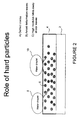
- FIGURE 2 is a schematic cross-section showing the role of hard particles in the present invention.
- FIGURE 3 shows a turbine blade having a Ni plated coating with diamond particles impregnated in the nickel plated coating.
- FIG. 1 there is shown schematically a cross-section of a metal substrate 2 having a nickel plate layer 4 with hard particles 6 dispersed therein.
- a water droplet 8 is shown located on an upper surface of the layer 4.
- Figure 2 shows schematically a cross-section of the metal substrate 2 having the nickel plate layer 4 with hard particles 6 dispersed therein, and two water droplets 8 and 10 located on the upper surface of the layer 4.
- the hard particles assist in deflecting cracks, arresting deformation waves and dissipating shock waves.
- Figure 3 shows a turbine blade 12 having a Ni plated coating 14 with diamond particles impregnated in the nickel plated coating, typically to a thickness of 0.5 to 1 mil.
- the base 16 of the blade is usually uncoated.
- the present invention thus provides an improvement in both water droplet erosion and corrosion resistance of metal surfaces, for example in compressor blades and airfoils for rotating blade applications, by way of a coating system comprising a Ni-containing or Ta-containing composition having hard particles, such as diamond particles, alumina particles, vanadium nitride, tantalum carbide and/or tungsten carbide particles, dispersed throughout the Ni- or Ta-containing composition.
- a coating system comprising a Ni-containing or Ta-containing composition having hard particles, such as diamond particles, alumina particles, vanadium nitride, tantalum carbide and/or tungsten carbide particles, dispersed throughout the Ni- or Ta-containing composition.
- the present invention provides a process for applying a protective coating to a metal surface susceptible to corrosion and pitting. This is achieved by a nickel/hard particle or tantalum/hard particle composite layer applied to the surface, with the particles of a hard material dispersed within the nickel or tantalum plate layer. Typically, the hard particles are dispersed within the coating layer as the layer is applied to the metal surface.
- the metal surface is provided with an erosion resistant hydrophobic surface which will enable water droplets to impact and fragment to smaller droplets with lower propensity to cause erosion damage.
- the hydrophobic surface should contain hard particles or a hard coating which is both chemically hydrophobic and, if required, textured to maintain contact angles that further augment the hydrophobic nature of the surface. Examples of such compositions include vanadium nitride embedded in nickel matrix, tin ion nickel matrix (microstructure similar to other embodiments). Coatings such as this can be deposited by techniques such as thermal spray, PVD, and composite plating.
- the nickel/hard particle composite plating or tantalum/hard particle composite plating can be provided with a hydrophobic thin film coating so that the water droplets are unable to wet the surface.
- the effect of the hydrophobic coating is that the water droplets rather than wetting the surface instead implode releasing the shock wave.
- the absence of film formation can be aided either by the composition of the overlay (such as VN, TiN, CrN), or by texture.
- the hydrophobic materials can be applied either as a stand-alone overlay or can be embedded in a tough hydrophobic metallic binder such as nickel.
- the coating can have pores designed in so that the droplets see partly a surface and partly a hole and they cannot adhere to the hole.
- the hard particles can be held by a corrosion resistant binder, which can be typically nickel. Under extremely corrosive conditions, other metallic matrix materials such as tantalum can be used to offer a step change in corrosion resistance.
- a corrosion resistant binder which can be typically nickel. Under extremely corrosive conditions, other metallic matrix materials such as tantalum can be used to offer a step change in corrosion resistance.
- the hard particles discussed above also serve to impart wear resistance and hydrophobicity to the surface.
- the hard material is selected from diamond, alumina, vanadium nitride, titanium carbide, titanium nitride, tantalum carbide and tungsten carbide. Mixtures of these hard materials may also be employed. Such mixtures can vary from 100 - 0 percent depending on cost and life required. Diamond is the hardest but also the most expensive. When diamond is employed, it may be mixed, for example 50:50 by weight, with alumina to provide a somewhat lower performance but at reduced cost.
- TiN Other hard materials, for example SiC, silicon nitride, cBN, TiC, TiN, may also be employed if desired.
- a particular benefit of TiN is that it is hydrophobic.
- the hard material is usually in the form particles having size range of from 0.1 to 15 microns.
- the particle size range is typically 0.1 micron to 8 microns.
- the particle size range is usually 0.1 micron to 10 microns, for example 0.1 micron to 8 microns.
- the spacing between particles is typically 0.1 to 150 microns.
- the spacing is usually 0.1 to 100 microns. This range can be determined by particle sizes.
- the concentration of the hard material in the nickel layer is typically in the range of 10-70% loading. Loading in the context of the present application refers to the volume fraction of particles to matrix. Thus, a volume fraction of 30% would have a lower erosion resistance due to a lower percentage of hard particle phase.
- the coating process of the invention is typically carried out utilizing a plating technique, with particles entrapped, entrapped plating electroless or electroplating.
- electroplating the part is made cathodic with nickel ions supplied from a nickel rich anode in a nickel salt solution.
- Electroless nickel plating is an autocatalytic reaction used to deposit a coating of nickel on a substrate. Unlike electroplating, it is not necessary to pass an electric current through the solution to form a deposit. Such techniques are more suited to be used to manufacture composite coatings by suspending powder in the bath.
- Electroless nickel plating has several advantages over electroplating. Free from flux-density and power supply issues, it provides an even deposit regardless of work-piece geometry and, with the proper pre-plate catalyst, can deposit on nonconductive surfaces. Other composite compositions such as nickel vanadium nitride and nickel titanium nitride can also be deposited by thermal spraying processes such as suspension plasma, HVOF and HVAF.
- compositions such as tantalum reinforced with hard materials such as diamond, alumina and vanadium nitride can be deposited by a vapor deposition processes.
- vapor deposition processes include physical vapor deposition, chemical vapor deposition and plasma enhanced chemical vapor deposition.
- An unexpected advantage of the present invention is the excellent water impingement erosion and corrosion resistance of the nickel/diamond plate.
- the matrix is made extremely corrosion resistant by use of a noble metal, and the wear properties are enhanced by addition of hard particles. These would include hard particles such as diamond, SiC, tin, WC.
- the matrix is preferably selected from Ta and Ta alloyed with tungsten.
Landscapes
- Chemical & Material Sciences (AREA)
- Chemical Kinetics & Catalysis (AREA)
- Engineering & Computer Science (AREA)
- Materials Engineering (AREA)
- Mechanical Engineering (AREA)
- Metallurgy (AREA)
- Organic Chemistry (AREA)
- General Chemical & Material Sciences (AREA)
- Dispersion Chemistry (AREA)
- Structures Of Non-Positive Displacement Pumps (AREA)
- Other Surface Treatments For Metallic Materials (AREA)
- Chemically Coating (AREA)
Abstract
A process for providing a protective coating to a metal surface comprises applying a nickel or tantalum plate layer to the surface and dispersing particles of a hard material such as diamond, alumina, vanadium nitride, tantalum carbide and/or tungsten carbide within the nickel or tantalum plate layer as the plating is occurring.
Description
- The present invention relates to a coating system for providing metal surfaces with improved water droplet erosion protection, enhanced corrosion pitting resistance, enhanced crevice corrosion resistance, improved surface finish and improved antifouling capability. More particularly, the invention provides a metal article, for example a turbine compressor blade or an airfoil for rotating blade applications, having a surface susceptible to erosion, corrosion and pitting, which has applied thereto a Ni-containing or tantalum-containing coating in which hard particles, such as diamond particles, alumina particles, vanadium nitride, tantalum carbide and/or tungsten carbide particles, are dispersed in the nickel or tantalum layer. The invention also relates to a process for providing a protective coating to a metal surface by applying a nickel or tantalum plate layer to the surface and dispersing the particles of hard material such as diamond, alumina, vanadium nitride, tantalum carbide and/or tungsten carbide within the nickel or tantalum plate layer.
- It is known that stainless steel compressor blades employed in gas turbines undergo water droplet erosion and corrosion pitting induced cracking, since modem gas turbines employ on-line water wash, fogging and/or evaporation cooler systems to enhance compressor efficiency. In addition, turbine units are often deployed in environments which are highly corrosive, for example in close proximity to chemical petroleum plants or at the ocean coastline.
- One approach to solving this problem would be to change the material used to fabricate the blades. While this may result in improvement of corrosion resistance, it is unclear whether it would solve the water droplet erosion problem.
- Another approach might be to use alternate alloys for compressor blades, but this is typically not cost effective. Redesign of the blade to achieve better overall robustness may likewise not be feasible since these alloys are sensitive to rub and fretting.
- A need exists for a turbine blade coating system that is capable of protecting blades susceptible to water droplet erosion and corrosion damage. The present invention seeks to satisfy that need.
- It has now been discovered, according to the present invention, that it is possible to provide improvement in both water droplet erosion and corrosion resistance of metal surfaces, for example in compressor blades and airfoils for rotating blade applications. Thus, in one aspect, there is provided a coating system comprising a Ni-containing or tantalum-containing composition having hard particles, such as diamond particles, alumina particles, vanadium nitride, tantalum carbide and/or tungsten carbide particles, dispersed throughout the nickel-containing or tantalum-containing composition.
- In another aspect, the invention provides a process for providing a protective coating to a metal surface by applying a nickel or tantalum plate layer to the surface and dispersing the particles of hard material such as diamond, alumina, vanadium nitride, tantalum carbide and/or tungsten carbide within the nickel or tantalum plate layer. The dispersion of the particles is typically carried out as the plating is occurring.
- In a further aspect, there is provided a metal component coated with a coating composition of the invention using the process of the invention.
- The metal surface coated according to the present process exhibits enhanced blade anti-fouling capability and improved damage tolerance. Other advantages are excellent resistance of the coated surface to water impingement erosion and corrosion resistance of the coated surface.
-
FIGURE 1 is a schematic cross-section showing the nickel plate layer with hard particles dispersed therein and a water droplet located on an upper surface thereof; -
FIGURE 2 is a schematic cross-section showing the role of hard particles in the present invention; -
FIGURE 3 shows a turbine blade having a Ni plated coating with diamond particles impregnated in the nickel plated coating. - Referring to
Figure 1 , there is shown schematically a cross-section of ametal substrate 2 having anickel plate layer 4 withhard particles 6 dispersed therein. Awater droplet 8 is shown located on an upper surface of thelayer 4. -
Figure 2 shows schematically a cross-section of themetal substrate 2 having thenickel plate layer 4 withhard particles 6 dispersed therein, and twowater droplets layer 4. In this Figure, it will be seen that the hard particles assist in deflecting cracks, arresting deformation waves and dissipating shock waves. -
Figure 3 shows aturbine blade 12 having a Ni platedcoating 14 with diamond particles impregnated in the nickel plated coating, typically to a thickness of 0.5 to 1 mil. Thebase 16 of the blade is usually uncoated. - The present invention thus provides an improvement in both water droplet erosion and corrosion resistance of metal surfaces, for example in compressor blades and airfoils for rotating blade applications, by way of a coating system comprising a Ni-containing or Ta-containing composition having hard particles, such as diamond particles, alumina particles, vanadium nitride, tantalum carbide and/or tungsten carbide particles, dispersed throughout the Ni- or Ta-containing composition.
- In another aspect, the present invention provides a process for applying a protective coating to a metal surface susceptible to corrosion and pitting. This is achieved by a nickel/hard particle or tantalum/hard particle composite layer applied to the surface, with the particles of a hard material dispersed within the nickel or tantalum plate layer. Typically, the hard particles are dispersed within the coating layer as the layer is applied to the metal surface.
- In another aspect, the metal surface is provided with an erosion resistant hydrophobic surface which will enable water droplets to impact and fragment to smaller droplets with lower propensity to cause erosion damage. The hydrophobic surface should contain hard particles or a hard coating which is both chemically hydrophobic and, if required, textured to maintain contact angles that further augment the hydrophobic nature of the surface. Examples of such compositions include vanadium nitride embedded in nickel matrix, tin ion nickel matrix (microstructure similar to other embodiments). Coatings such as this can be deposited by techniques such as thermal spray, PVD, and composite plating.
- In a further embodiment, the nickel/hard particle composite plating or tantalum/hard particle composite plating can be provided with a hydrophobic thin film coating so that the water droplets are unable to wet the surface. The effect of the hydrophobic coating is that the water droplets rather than wetting the surface instead implode releasing the shock wave.
- The absence of film formation can be aided either by the composition of the overlay (such as VN, TiN, CrN), or by texture. The hydrophobic materials can be applied either as a stand-alone overlay or can be embedded in a tough hydrophobic metallic binder such as nickel.
- With regard to texture, it is possible to have posts of particles surrounded by a matrix that is in a recess, so that the contacting water droplet does not get enough surface to hold on to. Alternatively, the coating can have pores designed in so that the droplets see partly a surface and partly a hole and they cannot adhere to the hole.
- The hard particles can be held by a corrosion resistant binder, which can be typically nickel. Under extremely corrosive conditions, other metallic matrix materials such as tantalum can be used to offer a step change in corrosion resistance. The hard particles discussed above also serve to impart wear resistance and hydrophobicity to the surface.
- Typically the hard material is selected from diamond, alumina, vanadium nitride, titanium carbide, titanium nitride, tantalum carbide and tungsten carbide. Mixtures of these hard materials may also be employed. Such mixtures can vary from 100 - 0 percent depending on cost and life required. Diamond is the hardest but also the most expensive. When diamond is employed, it may be mixed, for example 50:50 by weight, with alumina to provide a somewhat lower performance but at reduced cost.
- Other hard materials, for example SiC, silicon nitride, cBN, TiC, TiN, may also be employed if desired. A particular benefit of TiN is that it is hydrophobic.
- The hard material is usually in the form particles having size range of from 0.1 to 15 microns. For diamond and alumina, the particle size range is typically 0.1 micron to 8 microns. For tungsten carbide, the particle size range is usually 0.1 micron to 10 microns, for example 0.1 micron to 8 microns.
- The spacing between particles is typically 0.1 to 150 microns. For TiN, the spacing is usually 0.1 to 100 microns. This range can be determined by particle sizes.
- The concentration of the hard material in the nickel layer is typically in the range of 10-70% loading. Loading in the context of the present application refers to the volume fraction of particles to matrix. Thus, a volume fraction of 30% would have a lower erosion resistance due to a lower percentage of hard particle phase.
- The coating process of the invention is typically carried out utilizing a plating technique, with particles entrapped, entrapped plating electroless or electroplating. In electroplating, the part is made cathodic with nickel ions supplied from a nickel rich anode in a nickel salt solution. Electroless nickel plating is an autocatalytic reaction used to deposit a coating of nickel on a substrate. Unlike electroplating, it is not necessary to pass an electric current through the solution to form a deposit. Such techniques are more suited to be used to manufacture composite coatings by suspending powder in the bath.
- Electroless nickel plating has several advantages over electroplating. Free from flux-density and power supply issues, it provides an even deposit regardless of work-piece geometry and, with the proper pre-plate catalyst, can deposit on nonconductive surfaces. Other composite compositions such as nickel vanadium nitride and nickel titanium nitride can also be deposited by thermal spraying processes such as suspension plasma, HVOF and HVAF.
- Compositions such as tantalum reinforced with hard materials such as diamond, alumina and vanadium nitride can be deposited by a vapor deposition processes. Typically such processes include physical vapor deposition, chemical vapor deposition and plasma enhanced chemical vapor deposition.
- An unexpected advantage of the present invention is the excellent water impingement erosion and corrosion resistance of the nickel/diamond plate.
- In a yet further embodiment, the matrix is made extremely corrosion resistant by use of a noble metal, and the wear properties are enhanced by addition of hard particles. These would include hard particles such as diamond, SiC, tin, WC. The matrix is preferably selected from Ta and Ta alloyed with tungsten.
- While the invention has been described in connection with what is presently considered to be the most practical and preferred embodiment, it is to be understood that the invention is not to be limited to the disclosed embodiment, but on the contrary, is intended to cover various modifications and equivalent arrangements included within the scope of the appended claims.
Claims (14)
- A process for providing a protective coating to a surface of a metal component, comprising applying a metal plate layer to the surface and dispersing particles of a hard material within the metal plate layer as the plating is occurring, wherein the metal is selected from nickel and tantalum.
- A process according to claim 1 wherein said hard material is selected from diamond, alumina, vanadium nitride, tantalum carbide, tungsten carbide, silicon carbide, silicon nitride, cBN, titanium carbide and titanium nitride.
- A process according to claim 1 or claim 2, wherein said hard material is in the form of particles with a size range of 0.1 to 15 microns.
- A process according to any preceding claim, wherein an erosion resistant hydrophobic surface is provided on said protective coating.
- A process according to claim 4, wherein said hydrophobic surface comprises vanadium nitride particles embedded in a nickel matrix.
- A process according to any preceding claim, wherein the spacing between said hard particles is 0.1 to 150 microns.
- A process according to any preceding claim, wherein the hard material is present in the metal layer in the range of 10-70% by weight.
- A process according to any preceding claim, wherein said metal component is a turbine compressor blade.
- A process according to any one of claims 1 to 7, wherein said metal component is an airfoil for a rotating blade application.
- A process according to any preceding claim, wherein the concentration of the hard material in the nickel layer is in the range of 10-60% by weight.
- A process according to any preceding claim, wherein said protective coating provides improved water droplet erosion protection, enhanced corrosion pitting resistance, enhanced crevice corrosion resistance, improved surface finish and improved antifouling capability.
- A metal component coated according to the process of any preceding claim.
- A metal-containing coating composition suitable for use on a metal substrate having surfaces which are susceptible to erosion, corrosion and pitting, said coating composition comprising a metal selected from nickel and tantalum and hard particles dispersed in the metal.
- A metal-containing coating composition according to claim 13, wherein said hard particles are selected from diamond particles, alumina particles, vanadium nitride particles, tantalum carbide particles, silicon carbide particles, silicon nitride particles, cBN particles, titanium carbide particles, titanium nitride particles and tungsten carbide particles.
Applications Claiming Priority (1)
| Application Number | Priority Date | Filing Date | Title |
|---|---|---|---|
| US12/654,843 US20110165433A1 (en) | 2010-01-06 | 2010-01-06 | Erosion and corrosion resistant coating system for compressor |
Publications (1)
| Publication Number | Publication Date |
|---|---|
| EP2374916A1 true EP2374916A1 (en) | 2011-10-12 |
Family
ID=44223599
Family Applications (1)
| Application Number | Title | Priority Date | Filing Date |
|---|---|---|---|
| EP10195959A Withdrawn EP2374916A1 (en) | 2010-01-06 | 2010-12-20 | Erosion and corrosion resistant coating system for compressor |
Country Status (3)
| Country | Link |
|---|---|
| US (1) | US20110165433A1 (en) |
| EP (1) | EP2374916A1 (en) |
| JP (1) | JP2011140715A (en) |
Cited By (1)
| Publication number | Priority date | Publication date | Assignee | Title |
|---|---|---|---|---|
| EP3168323A1 (en) | 2015-11-13 | 2017-05-17 | General Electric Technology GmbH | Power plant component and method for manufacturing such component |
Families Citing this family (13)
| Publication number | Priority date | Publication date | Assignee | Title |
|---|---|---|---|---|
| US9309895B2 (en) | 2012-06-18 | 2016-04-12 | Kennametal Inc. | Closed impeller with a coated vane |
| US9365932B2 (en) | 2012-06-20 | 2016-06-14 | General Electric Company | Erosion and corrosion resistant coatings for exhaust gas recirculation based gas turbines |
| EP2746428B1 (en) * | 2012-12-20 | 2017-09-13 | General Electric Technology GmbH | Coating of turbine parts |
| EP2767616A1 (en) | 2013-02-15 | 2014-08-20 | Alstom Technology Ltd | Turbomachine component with an erosion and corrosion resistant coating system and method for manufacturing such a component |
| CN104070729A (en) * | 2014-06-11 | 2014-10-01 | 张家港市华尊宝特种材料科技有限公司 | Metal material good in heat preservation property |
| US9896585B2 (en) * | 2014-10-08 | 2018-02-20 | General Electric Company | Coating, coating system, and coating method |
| US10041361B2 (en) | 2014-10-15 | 2018-08-07 | General Electric Company | Turbine blade coating composition |
| CN104502257B (en) * | 2014-11-05 | 2017-02-15 | 中国人民解放军第二炮兵工程大学 | Adhesive-corrosion-resistant performance detection method for solid self-lubricating coating |
| US10533439B2 (en) * | 2014-12-16 | 2020-01-14 | United Technologies Corporation | Gas turbine engine component with abrasive surface formed by electrical discharge machining |
| EP3199821B1 (en) | 2014-12-25 | 2023-08-30 | IHI Corporation | Compressor blade for engine |
| EP3320126A1 (en) * | 2015-07-06 | 2018-05-16 | Carbodeon Ltd Oy | Metallic coating and a method for producing the same |
| EP3470680A1 (en) * | 2017-10-16 | 2019-04-17 | OneSubsea IP UK Limited | Erosion resistant blades for compressors |
| CN110527950B (en) * | 2018-05-24 | 2023-07-25 | 香港城市大学 | a non-stick material |
Citations (3)
| Publication number | Priority date | Publication date | Assignee | Title |
|---|---|---|---|---|
| GB1439947A (en) * | 1972-05-30 | 1976-06-16 | Union Carbide Corp | Corrosion resistant coatings and process for making the same |
| EP1469100A1 (en) * | 2003-04-18 | 2004-10-20 | General Electric Company | Nickel aluminide coating and coating systems formed therewith |
| US20080145649A1 (en) * | 2006-12-14 | 2008-06-19 | General Electric | Protective coatings which provide wear resistance and low friction characteristics, and related articles and methods |
Family Cites Families (7)
| Publication number | Priority date | Publication date | Assignee | Title |
|---|---|---|---|---|
| US3409418A (en) * | 1966-11-09 | 1968-11-05 | Du Pont | Dense products of vanadium or zirconium nitride with iron, nickel or cobalt |
| US3572962A (en) * | 1969-06-02 | 1971-03-30 | Canadian Patents Dev | Stator blading for noise reduction in turbomachinery |
| US3628329A (en) * | 1970-02-24 | 1971-12-21 | Gen Electric | Gas turbine engine inlet guide vane actuator with automatic reset |
| US5429200A (en) * | 1994-03-31 | 1995-07-04 | Dresser Industries, Inc. | Rotary drill bit with improved cutter |
| EP1590098A4 (en) * | 2003-02-07 | 2006-04-19 | Diamond Innovations Inc | Fiber and sheet equipment wear surfaces of extended resistance and methods for their manufacture |
| US7001145B2 (en) * | 2003-11-20 | 2006-02-21 | General Electric Company | Seal assembly for turbine, bucket/turbine including same, method for sealing interface between rotating and stationary components of a turbine |
| US20070099027A1 (en) * | 2005-10-28 | 2007-05-03 | Anand Krishnamurthy | Wear resistant coatings |
-
2010
- 2010-01-06 US US12/654,843 patent/US20110165433A1/en not_active Abandoned
- 2010-12-20 EP EP10195959A patent/EP2374916A1/en not_active Withdrawn
- 2010-12-24 JP JP2010286854A patent/JP2011140715A/en not_active Withdrawn
Patent Citations (3)
| Publication number | Priority date | Publication date | Assignee | Title |
|---|---|---|---|---|
| GB1439947A (en) * | 1972-05-30 | 1976-06-16 | Union Carbide Corp | Corrosion resistant coatings and process for making the same |
| EP1469100A1 (en) * | 2003-04-18 | 2004-10-20 | General Electric Company | Nickel aluminide coating and coating systems formed therewith |
| US20080145649A1 (en) * | 2006-12-14 | 2008-06-19 | General Electric | Protective coatings which provide wear resistance and low friction characteristics, and related articles and methods |
Cited By (1)
| Publication number | Priority date | Publication date | Assignee | Title |
|---|---|---|---|---|
| EP3168323A1 (en) | 2015-11-13 | 2017-05-17 | General Electric Technology GmbH | Power plant component and method for manufacturing such component |
Also Published As
| Publication number | Publication date |
|---|---|
| JP2011140715A (en) | 2011-07-21 |
| US20110165433A1 (en) | 2011-07-07 |
Similar Documents
| Publication | Publication Date | Title |
|---|---|---|
| EP2374916A1 (en) | Erosion and corrosion resistant coating system for compressor | |
| EP3168323B1 (en) | Power plant component | |
| El Rayes et al. | Erosion-corrosion of cermet coating | |
| EP2088225B1 (en) | Erosion and corrosion-resistant coating system and process therefor | |
| CN101876327A (en) | Erosion and corrosion resistant turbocompressor airfoil and method of manufacture | |
| EP2096194B1 (en) | Protective coating for metallic seals | |
| US9556505B2 (en) | Thermal barrier coating systems and methods of making and using the same | |
| EP3879001B1 (en) | Abrasive tip coating | |
| JPH0784661B2 (en) | Highly erosion resistant and highly abrasive wear resistant composite coating system and its manufacturing method | |
| Rezagholizadeh et al. | Electroless Ni-P/Ni-B-B4C duplex composite coatings for improving the corrosion and tribological behavior of Ck45 steel | |
| Raghavendra et al. | Study on influence of Surface roughness of Ni-Al2O3 nano composite coating and evaluation of wear characteristics | |
| EP4004256B1 (en) | Multilayered nickel-phosphorus composite | |
| CN107937857B (en) | A kind of anti-corrosion and wear-resistant composite coating on the surface of 7075 aluminum alloy and its preparation method | |
| US20140166473A1 (en) | Erosion and corrosion resistant components and methods thereof | |
| CN108350595A (en) | Aircraft engine component including erosion shield and the method for manufacturing the component | |
| Maharajan et al. | Surface morphology studies and corrosion behaviour of plasma sprayed Cr3C2/8YSZ composite coating on SS316 | |
| Zavareh et al. | Electrochemical characterizations of different ceramic composite coatings on carbon steel piping using high velocity oxy-fuel spray | |
| Godwin et al. | Tribological and Corrosion Behavior Spray Method-A Review | |
| Salicio-Paz et al. | Electroless Nickel-Based Multilayers | |
| Yu | Erosion-corrosion behavior of Pd–Co and Pd–Cu films on 316L stainless steel in simulated PTA slurry environment | |
| Lingxi et al. | Microstructure and properties of Zn-Al-Ni-Cu composite coating prepared by arc spraying. | |
| Fayomi et al. | Effect of Incorporating a Biodegradable Ecofriendly Additive in Pursuit of Improved Anti-Corrosion, Microstructure and Mechanical Properties of a Zn-based TiO2/TiB2 Coating by DAECD Technique | |
| Fernandez et al. | Wear and corrosion of metal-matrix (stainless steel or NiTi)-TiC coatings | |
| Rathnakaran et al. | Electroless Ni–P–TiO₂ Nanocomposite Coatings for Enhanced Durability and Saltwater Corrosion Protection of Jet Ski Engine Components | |
| EP2913421A1 (en) | Coated article and method for production coating |
Legal Events
| Date | Code | Title | Description |
|---|---|---|---|
| PUAI | Public reference made under article 153(3) epc to a published international application that has entered the european phase |
Free format text: ORIGINAL CODE: 0009012 |
|
| AK | Designated contracting states |
Kind code of ref document: A1 Designated state(s): AL AT BE BG CH CY CZ DE DK EE ES FI FR GB GR HR HU IE IS IT LI LT LU LV MC MK MT NL NO PL PT RO RS SE SI SK SM TR |
|
| AX | Request for extension of the european patent |
Extension state: BA ME |
|
| STAA | Information on the status of an ep patent application or granted ep patent |
Free format text: STATUS: THE APPLICATION IS DEEMED TO BE WITHDRAWN |
|
| 18D | Application deemed to be withdrawn |
Effective date: 20120413 |