EP2374813A1 - Use of phenol-soluble modulins for vaccine development - Google Patents
Use of phenol-soluble modulins for vaccine development Download PDFInfo
- Publication number
- EP2374813A1 EP2374813A1 EP09803779A EP09803779A EP2374813A1 EP 2374813 A1 EP2374813 A1 EP 2374813A1 EP 09803779 A EP09803779 A EP 09803779A EP 09803779 A EP09803779 A EP 09803779A EP 2374813 A1 EP2374813 A1 EP 2374813A1
- Authority
- EP
- European Patent Office
- Prior art keywords
- cells
- antigen
- cell
- conjugate
- peptide
- Prior art date
- Legal status (The legal status is an assumption and is not a legal conclusion. Google has not performed a legal analysis and makes no representation as to the accuracy of the status listed.)
- Withdrawn
Links
- 229960005486 vaccine Drugs 0.000 title claims abstract description 29
- 238000011161 development Methods 0.000 title abstract description 10
- 108090000765 processed proteins & peptides Proteins 0.000 claims abstract description 270
- 239000000427 antigen Substances 0.000 claims abstract description 190
- 102000004196 processed proteins & peptides Human genes 0.000 claims abstract description 132
- 108090000623 proteins and genes Proteins 0.000 claims abstract description 114
- 238000000034 method Methods 0.000 claims abstract description 94
- 206010028980 Neoplasm Diseases 0.000 claims abstract description 74
- 230000000890 antigenic effect Effects 0.000 claims abstract description 50
- 230000028993 immune response Effects 0.000 claims abstract description 29
- 201000011510 cancer Diseases 0.000 claims abstract description 16
- 208000035473 Communicable disease Diseases 0.000 claims abstract description 13
- 210000004027 cell Anatomy 0.000 claims description 266
- 210000004443 dendritic cell Anatomy 0.000 claims description 139
- 239000013598 vector Substances 0.000 claims description 80
- 239000000203 mixture Substances 0.000 claims description 69
- 108091033319 polynucleotide Proteins 0.000 claims description 65
- 239000002157 polynucleotide Substances 0.000 claims description 65
- 102000040430 polynucleotide Human genes 0.000 claims description 65
- 210000000612 antigen-presenting cell Anatomy 0.000 claims description 62
- 208000037265 diseases, disorders, signs and symptoms Diseases 0.000 claims description 55
- 150000001875 compounds Chemical class 0.000 claims description 50
- 201000010099 disease Diseases 0.000 claims description 46
- 239000003446 ligand Substances 0.000 claims description 46
- 229940115272 polyinosinic:polycytidylic acid Drugs 0.000 claims description 38
- 108091036414 Polyinosinic:polycytidylic acid Proteins 0.000 claims description 37
- 230000035800 maturation Effects 0.000 claims description 36
- 239000000556 agonist Substances 0.000 claims description 33
- 238000011282 treatment Methods 0.000 claims description 33
- 102000004127 Cytokines Human genes 0.000 claims description 28
- 108090000695 Cytokines Proteins 0.000 claims description 28
- 230000000694 effects Effects 0.000 claims description 25
- 229920001184 polypeptide Polymers 0.000 claims description 23
- 230000007402 cytotoxic response Effects 0.000 claims description 21
- 150000007523 nucleic acids Chemical group 0.000 claims description 20
- 239000008194 pharmaceutical composition Substances 0.000 claims description 19
- 238000000338 in vitro Methods 0.000 claims description 18
- 208000015181 infectious disease Diseases 0.000 claims description 18
- 230000001939 inductive effect Effects 0.000 claims description 16
- 230000001737 promoting effect Effects 0.000 claims description 16
- 230000035755 proliferation Effects 0.000 claims description 15
- 239000003814 drug Substances 0.000 claims description 14
- 101000831496 Homo sapiens Toll-like receptor 3 Proteins 0.000 claims description 12
- 102100024324 Toll-like receptor 3 Human genes 0.000 claims description 12
- 239000003795 chemical substances by application Substances 0.000 claims description 12
- 239000003937 drug carrier Substances 0.000 claims description 12
- 239000000825 pharmaceutical preparation Substances 0.000 claims description 12
- 230000001613 neoplastic effect Effects 0.000 claims description 11
- 101000669447 Homo sapiens Toll-like receptor 4 Proteins 0.000 claims description 10
- 102100039360 Toll-like receptor 4 Human genes 0.000 claims description 10
- 208000026935 allergic disease Diseases 0.000 claims description 9
- 102100027754 Mast/stem cell growth factor receptor Kit Human genes 0.000 claims description 8
- 108091028043 Nucleic acid sequence Proteins 0.000 claims description 7
- 108010060818 Toll-Like Receptor 9 Proteins 0.000 claims description 7
- 102100033117 Toll-like receptor 9 Human genes 0.000 claims description 7
- 208000023275 Autoimmune disease Diseases 0.000 claims description 5
- 239000003970 toll like receptor agonist Substances 0.000 claims description 4
- 230000036210 malignancy Effects 0.000 claims description 3
- 102100037354 Ectodysplasin-A Human genes 0.000 claims description 2
- 101000880080 Homo sapiens Ectodysplasin-A Proteins 0.000 claims description 2
- 206010038997 Retroviral infections Diseases 0.000 claims 1
- 229940123384 Toll-like receptor (TLR) agonist Drugs 0.000 claims 1
- 108091007433 antigens Proteins 0.000 abstract description 188
- 102000036639 antigens Human genes 0.000 abstract description 188
- 238000001727 in vivo Methods 0.000 abstract description 41
- 102000004169 proteins and genes Human genes 0.000 abstract description 41
- 230000027455 binding Effects 0.000 abstract description 30
- ISWSIDIOOBJBQZ-UHFFFAOYSA-N Phenol Chemical compound OC1=CC=CC=C1 ISWSIDIOOBJBQZ-UHFFFAOYSA-N 0.000 abstract description 11
- 230000005847 immunogenicity Effects 0.000 abstract description 9
- 230000001965 increasing effect Effects 0.000 abstract description 9
- 244000052769 pathogen Species 0.000 abstract description 9
- 230000001717 pathogenic effect Effects 0.000 abstract description 5
- 230000008878 coupling Effects 0.000 abstract description 4
- 238000010168 coupling process Methods 0.000 abstract description 4
- 238000005859 coupling reaction Methods 0.000 abstract description 4
- 241000699670 Mus sp. Species 0.000 description 65
- 230000004044 response Effects 0.000 description 45
- 235000018102 proteins Nutrition 0.000 description 40
- -1 spacer amino acid Chemical class 0.000 description 39
- 102000002689 Toll-like receptor Human genes 0.000 description 37
- 108020000411 Toll-like receptor Proteins 0.000 description 37
- 210000001744 T-lymphocyte Anatomy 0.000 description 36
- 210000001151 cytotoxic T lymphocyte Anatomy 0.000 description 35
- 238000002649 immunization Methods 0.000 description 34
- 230000014509 gene expression Effects 0.000 description 33
- 230000003053 immunization Effects 0.000 description 33
- 108010075205 OVA-8 Proteins 0.000 description 30
- 230000001472 cytotoxic effect Effects 0.000 description 29
- 230000002163 immunogen Effects 0.000 description 29
- 102000010735 Adenomatous polyposis coli protein Human genes 0.000 description 26
- 108010038310 Adenomatous polyposis coli protein Proteins 0.000 description 26
- 231100000433 cytotoxic Toxicity 0.000 description 26
- 210000004988 splenocyte Anatomy 0.000 description 25
- 101000831567 Homo sapiens Toll-like receptor 2 Proteins 0.000 description 24
- 102100024333 Toll-like receptor 2 Human genes 0.000 description 24
- 150000001413 amino acids Chemical group 0.000 description 24
- 206010058314 Dysplasia Diseases 0.000 description 23
- 241000282414 Homo sapiens Species 0.000 description 23
- 230000004913 activation Effects 0.000 description 23
- JVJGCCBAOOWGEO-RUTPOYCXSA-N (2s)-2-[[(2s)-2-[[(2s)-2-[[(2s)-2-[[(2s)-4-amino-2-[[(2s,3s)-2-[[(2s,3s)-2-[[(2s)-2-azaniumyl-3-hydroxypropanoyl]amino]-3-methylpentanoyl]amino]-3-methylpentanoyl]amino]-4-oxobutanoyl]amino]-3-phenylpropanoyl]amino]-4-carboxylatobutanoyl]amino]-6-azaniumy Chemical compound OC[C@H](N)C(=O)N[C@@H]([C@@H](C)CC)C(=O)N[C@@H]([C@@H](C)CC)C(=O)N[C@@H](CC(N)=O)C(=O)N[C@H](C(=O)N[C@@H](CCC(O)=O)C(=O)N[C@@H](CCCCN)C(=O)N[C@@H](CC(C)C)C(O)=O)CC1=CC=CC=C1 JVJGCCBAOOWGEO-RUTPOYCXSA-N 0.000 description 21
- 235000001014 amino acid Nutrition 0.000 description 21
- 239000012634 fragment Substances 0.000 description 21
- 238000000684 flow cytometry Methods 0.000 description 19
- 101000716102 Homo sapiens T-cell surface glycoprotein CD4 Proteins 0.000 description 18
- 102100036011 T-cell surface glycoprotein CD4 Human genes 0.000 description 18
- 230000036755 cellular response Effects 0.000 description 17
- 241000700605 Viruses Species 0.000 description 16
- 210000001185 bone marrow Anatomy 0.000 description 16
- 102000039446 nucleic acids Human genes 0.000 description 16
- 108020004707 nucleic acids Proteins 0.000 description 16
- 238000003556 assay Methods 0.000 description 15
- 206010020718 hyperplasia Diseases 0.000 description 15
- 238000011740 C57BL/6 mouse Methods 0.000 description 14
- 230000030741 antigen processing and presentation Effects 0.000 description 14
- 230000001580 bacterial effect Effects 0.000 description 14
- 230000002538 fungal effect Effects 0.000 description 14
- 230000006698 induction Effects 0.000 description 14
- 230000011664 signaling Effects 0.000 description 14
- 210000004881 tumor cell Anatomy 0.000 description 14
- 239000002671 adjuvant Substances 0.000 description 13
- 238000003114 enzyme-linked immunosorbent spot assay Methods 0.000 description 13
- 210000001616 monocyte Anatomy 0.000 description 13
- 125000003729 nucleotide group Chemical group 0.000 description 13
- 210000001519 tissue Anatomy 0.000 description 13
- 108010017213 Granulocyte-Macrophage Colony-Stimulating Factor Proteins 0.000 description 12
- 102100039620 Granulocyte-macrophage colony-stimulating factor Human genes 0.000 description 12
- 241000701806 Human papillomavirus Species 0.000 description 12
- 102100022297 Integrin alpha-X Human genes 0.000 description 12
- 239000002953 phosphate buffered saline Substances 0.000 description 12
- 239000003053 toxin Substances 0.000 description 12
- 231100000765 toxin Toxicity 0.000 description 12
- 108700012359 toxins Proteins 0.000 description 12
- 210000001266 CD8-positive T-lymphocyte Anatomy 0.000 description 11
- 239000013566 allergen Substances 0.000 description 11
- 238000003776 cleavage reaction Methods 0.000 description 11
- 238000011534 incubation Methods 0.000 description 11
- 108020004999 messenger RNA Proteins 0.000 description 11
- 239000002773 nucleotide Substances 0.000 description 11
- 230000007017 scission Effects 0.000 description 11
- 230000003612 virological effect Effects 0.000 description 11
- 206010054949 Metaplasia Diseases 0.000 description 10
- 241001465754 Metazoa Species 0.000 description 10
- 108060008682 Tumor Necrosis Factor Proteins 0.000 description 10
- 102000000852 Tumor Necrosis Factor-alpha Human genes 0.000 description 10
- 210000004369 blood Anatomy 0.000 description 10
- 239000008280 blood Substances 0.000 description 10
- 230000009089 cytolysis Effects 0.000 description 10
- 238000002474 experimental method Methods 0.000 description 10
- 108020001507 fusion proteins Proteins 0.000 description 10
- 102000037865 fusion proteins Human genes 0.000 description 10
- 210000002865 immune cell Anatomy 0.000 description 10
- 230000002147 killing effect Effects 0.000 description 10
- 239000000463 material Substances 0.000 description 10
- 230000015689 metaplastic ossification Effects 0.000 description 10
- 108010002350 Interleukin-2 Proteins 0.000 description 9
- 102000000588 Interleukin-2 Human genes 0.000 description 9
- 102000004388 Interleukin-4 Human genes 0.000 description 9
- 108090000978 Interleukin-4 Proteins 0.000 description 9
- 230000003213 activating effect Effects 0.000 description 9
- 238000004458 analytical method Methods 0.000 description 9
- 230000000875 corresponding effect Effects 0.000 description 9
- 208000035475 disorder Diseases 0.000 description 9
- 229940028885 interleukin-4 Drugs 0.000 description 9
- 238000002372 labelling Methods 0.000 description 9
- 238000004519 manufacturing process Methods 0.000 description 9
- 230000001225 therapeutic effect Effects 0.000 description 9
- 101150029707 ERBB2 gene Proteins 0.000 description 8
- 108010067306 Fibronectins Proteins 0.000 description 8
- 102000016359 Fibronectins Human genes 0.000 description 8
- 108091054437 MHC class I family Proteins 0.000 description 8
- 108700018351 Major Histocompatibility Complex Proteins 0.000 description 8
- 102100030086 Receptor tyrosine-protein kinase erbB-2 Human genes 0.000 description 8
- 101710100968 Receptor tyrosine-protein kinase erbB-2 Proteins 0.000 description 8
- 229960004784 allergens Drugs 0.000 description 8
- 230000018109 developmental process Effects 0.000 description 8
- 230000003308 immunostimulating effect Effects 0.000 description 8
- 239000002609 medium Substances 0.000 description 8
- 229940035032 monophosphoryl lipid a Drugs 0.000 description 8
- 210000000056 organ Anatomy 0.000 description 8
- 201000010153 skin papilloma Diseases 0.000 description 8
- 125000006850 spacer group Chemical group 0.000 description 8
- 241000894007 species Species 0.000 description 8
- 230000020382 suppression by virus of host antigen processing and presentation of peptide antigen via MHC class I Effects 0.000 description 8
- 230000004614 tumor growth Effects 0.000 description 8
- 102100024222 B-lymphocyte antigen CD19 Human genes 0.000 description 7
- 102100029974 GTPase HRas Human genes 0.000 description 7
- 101710091881 GTPase HRas Proteins 0.000 description 7
- 208000017604 Hodgkin disease Diseases 0.000 description 7
- 101000980825 Homo sapiens B-lymphocyte antigen CD19 Proteins 0.000 description 7
- 102000013462 Interleukin-12 Human genes 0.000 description 7
- 108010065805 Interleukin-12 Proteins 0.000 description 7
- 241000124008 Mammalia Species 0.000 description 7
- 241000699666 Mus <mouse, genus> Species 0.000 description 7
- 101710144111 Non-structural protein 3 Proteins 0.000 description 7
- 230000005867 T cell response Effects 0.000 description 7
- 238000013459 approach Methods 0.000 description 7
- 210000003719 b-lymphocyte Anatomy 0.000 description 7
- 238000003018 immunoassay Methods 0.000 description 7
- 208000014018 liver neoplasm Diseases 0.000 description 7
- 230000001404 mediated effect Effects 0.000 description 7
- 238000002360 preparation method Methods 0.000 description 7
- 230000008569 process Effects 0.000 description 7
- 102000005962 receptors Human genes 0.000 description 7
- 108020003175 receptors Proteins 0.000 description 7
- 239000000243 solution Substances 0.000 description 7
- FWPKHBSTLJXXIA-CATQOQJWSA-N CC[C@H](C)[C@H](NC(=O)[C@@H](NC(=O)[C@H](CO)NC(=O)[C@@H](NC(=O)[C@@H](NC(=O)[C@H](CC(O)=O)NC(=O)[C@H](CCC(N)=O)NC(=O)[C@H](C)NC(=O)[C@@H](N)CCSC)[C@@H](C)CC)[C@@H](C)CC)[C@@H](C)O)C(=O)N[C@@H](CO)C(=O)N[C@@H](CC(O)=O)C(=O)N[C@@H](CC(C)C)C(=O)N[C@@H](C(C)C)C(=O)N[C@@H](CCCCN)C(=O)N[C@@H](Cc1c[nH]c2ccccc12)C(=O)N[C@@H]([C@@H](C)CC)C(=O)N[C@@H]([C@@H](C)CC)C(=O)N[C@@H](CC(O)=O)C(=O)N[C@@H]([C@@H](C)O)C(=O)N[C@@H](C(C)C)C(=O)N[C@@H](CC(N)=O)C(=O)N[C@@H](CCCCN)C(=O)N[C@@H](Cc1ccccc1)C(=O)N[C@@H]([C@@H](C)O)C(=O)N[C@@H](CCCCN)C(=O)N[C@@H](CCCCN)C(O)=O Chemical compound CC[C@H](C)[C@H](NC(=O)[C@@H](NC(=O)[C@H](CO)NC(=O)[C@@H](NC(=O)[C@@H](NC(=O)[C@H](CC(O)=O)NC(=O)[C@H](CCC(N)=O)NC(=O)[C@H](C)NC(=O)[C@@H](N)CCSC)[C@@H](C)CC)[C@@H](C)CC)[C@@H](C)O)C(=O)N[C@@H](CO)C(=O)N[C@@H](CC(O)=O)C(=O)N[C@@H](CC(C)C)C(=O)N[C@@H](C(C)C)C(=O)N[C@@H](CCCCN)C(=O)N[C@@H](Cc1c[nH]c2ccccc12)C(=O)N[C@@H]([C@@H](C)CC)C(=O)N[C@@H]([C@@H](C)CC)C(=O)N[C@@H](CC(O)=O)C(=O)N[C@@H]([C@@H](C)O)C(=O)N[C@@H](C(C)C)C(=O)N[C@@H](CC(N)=O)C(=O)N[C@@H](CCCCN)C(=O)N[C@@H](Cc1ccccc1)C(=O)N[C@@H]([C@@H](C)O)C(=O)N[C@@H](CCCCN)C(=O)N[C@@H](CCCCN)C(O)=O FWPKHBSTLJXXIA-CATQOQJWSA-N 0.000 description 6
- 108010029697 CD40 Ligand Proteins 0.000 description 6
- 102100032937 CD40 ligand Human genes 0.000 description 6
- 101710121036 Delta-hemolysin Proteins 0.000 description 6
- SXRSQZLOMIGNAQ-UHFFFAOYSA-N Glutaraldehyde Chemical compound O=CCCCC=O SXRSQZLOMIGNAQ-UHFFFAOYSA-N 0.000 description 6
- 241000238631 Hexapoda Species 0.000 description 6
- 208000010747 Hodgkins lymphoma Diseases 0.000 description 6
- 102100037850 Interferon gamma Human genes 0.000 description 6
- 108010074328 Interferon-gamma Proteins 0.000 description 6
- 102000043129 MHC class I family Human genes 0.000 description 6
- 241001529936 Murinae Species 0.000 description 6
- 239000004365 Protease Substances 0.000 description 6
- 241000751137 Staphylococcus epidermidis RP62A Species 0.000 description 6
- 108091008874 T cell receptors Proteins 0.000 description 6
- 102000016266 T-Cell Antigen Receptors Human genes 0.000 description 6
- 102100034922 T-cell surface glycoprotein CD8 alpha chain Human genes 0.000 description 6
- 230000021615 conjugation Effects 0.000 description 6
- 239000013604 expression vector Substances 0.000 description 6
- 230000006870 function Effects 0.000 description 6
- 238000001990 intravenous administration Methods 0.000 description 6
- 201000007270 liver cancer Diseases 0.000 description 6
- 210000005105 peripheral blood lymphocyte Anatomy 0.000 description 6
- 230000002093 peripheral effect Effects 0.000 description 6
- 238000012360 testing method Methods 0.000 description 6
- 239000013603 viral vector Substances 0.000 description 6
- 108091032973 (ribonucleotides)n+m Proteins 0.000 description 5
- 241000196324 Embryophyta Species 0.000 description 5
- LFQSCWFLJHTTHZ-UHFFFAOYSA-N Ethanol Chemical compound CCO LFQSCWFLJHTTHZ-UHFFFAOYSA-N 0.000 description 5
- 102100041003 Glutamate carboxypeptidase 2 Human genes 0.000 description 5
- PEDCQBHIVMGVHV-UHFFFAOYSA-N Glycerine Chemical compound OCC(O)CO PEDCQBHIVMGVHV-UHFFFAOYSA-N 0.000 description 5
- 241000711549 Hepacivirus C Species 0.000 description 5
- 101000599852 Homo sapiens Intercellular adhesion molecule 1 Proteins 0.000 description 5
- 241000341655 Human papillomavirus type 16 Species 0.000 description 5
- 102100037877 Intercellular adhesion molecule 1 Human genes 0.000 description 5
- 102000004889 Interleukin-6 Human genes 0.000 description 5
- 108090001005 Interleukin-6 Proteins 0.000 description 5
- 108091054438 MHC class II family Proteins 0.000 description 5
- 108700006640 OspA Proteins 0.000 description 5
- 102000035195 Peptidases Human genes 0.000 description 5
- 108091005804 Peptidases Proteins 0.000 description 5
- 206010035226 Plasma cell myeloma Diseases 0.000 description 5
- 208000006664 Precursor Cell Lymphoblastic Leukemia-Lymphoma Diseases 0.000 description 5
- 206010039491 Sarcoma Diseases 0.000 description 5
- 230000006052 T cell proliferation Effects 0.000 description 5
- 230000001270 agonistic effect Effects 0.000 description 5
- 238000009472 formulation Methods 0.000 description 5
- 210000002443 helper t lymphocyte Anatomy 0.000 description 5
- 238000009169 immunotherapy Methods 0.000 description 5
- 238000001802 infusion Methods 0.000 description 5
- 239000007924 injection Substances 0.000 description 5
- 238000002347 injection Methods 0.000 description 5
- 229940100601 interleukin-6 Drugs 0.000 description 5
- 230000003834 intracellular effect Effects 0.000 description 5
- 210000004698 lymphocyte Anatomy 0.000 description 5
- 210000002540 macrophage Anatomy 0.000 description 5
- 238000005259 measurement Methods 0.000 description 5
- 239000000546 pharmaceutical excipient Substances 0.000 description 5
- 239000013612 plasmid Substances 0.000 description 5
- 239000002243 precursor Substances 0.000 description 5
- 230000000638 stimulation Effects 0.000 description 5
- 239000000126 substance Substances 0.000 description 5
- MZOFCQQQCNRIBI-VMXHOPILSA-N (3s)-4-[[(2s)-1-[[(2s)-1-[[(1s)-1-carboxy-2-hydroxyethyl]amino]-4-methyl-1-oxopentan-2-yl]amino]-5-(diaminomethylideneamino)-1-oxopentan-2-yl]amino]-3-[[2-[[(2s)-2,6-diaminohexanoyl]amino]acetyl]amino]-4-oxobutanoic acid Chemical compound OC[C@@H](C(O)=O)NC(=O)[C@H](CC(C)C)NC(=O)[C@H](CCCN=C(N)N)NC(=O)[C@H](CC(O)=O)NC(=O)CNC(=O)[C@@H](N)CCCCN MZOFCQQQCNRIBI-VMXHOPILSA-N 0.000 description 4
- 208000014697 Acute lymphocytic leukaemia Diseases 0.000 description 4
- 241000894006 Bacteria Species 0.000 description 4
- 101150013553 CD40 gene Proteins 0.000 description 4
- 108010022366 Carcinoembryonic Antigen Proteins 0.000 description 4
- 102100025475 Carcinoembryonic antigen-related cell adhesion molecule 5 Human genes 0.000 description 4
- 206010008342 Cervix carcinoma Diseases 0.000 description 4
- AOJJSUZBOXZQNB-TZSSRYMLSA-N Doxorubicin Chemical compound O([C@H]1C[C@@](O)(CC=2C(O)=C3C(=O)C=4C=CC=C(C=4C(=O)C3=C(O)C=21)OC)C(=O)CO)[C@H]1C[C@H](N)[C@H](O)[C@H](C)O1 AOJJSUZBOXZQNB-TZSSRYMLSA-N 0.000 description 4
- 101000609767 Dromaius novaehollandiae Ovalbumin Proteins 0.000 description 4
- 241000588724 Escherichia coli Species 0.000 description 4
- 208000005176 Hepatitis C Diseases 0.000 description 4
- 102000008949 Histocompatibility Antigens Class I Human genes 0.000 description 4
- 102000018713 Histocompatibility Antigens Class II Human genes 0.000 description 4
- 101000611183 Homo sapiens Tumor necrosis factor Proteins 0.000 description 4
- 241000713772 Human immunodeficiency virus 1 Species 0.000 description 4
- 108010021625 Immunoglobulin Fragments Proteins 0.000 description 4
- 102000008394 Immunoglobulin Fragments Human genes 0.000 description 4
- 206010061218 Inflammation Diseases 0.000 description 4
- 102000000589 Interleukin-1 Human genes 0.000 description 4
- 108010002352 Interleukin-1 Proteins 0.000 description 4
- 108010028921 Lipopeptides Proteins 0.000 description 4
- 206010025323 Lymphomas Diseases 0.000 description 4
- 208000034578 Multiple myelomas Diseases 0.000 description 4
- MSFSPUZXLOGKHJ-UHFFFAOYSA-N Muraminsaeure Natural products OC(=O)C(C)OC1C(N)C(O)OC(CO)C1O MSFSPUZXLOGKHJ-UHFFFAOYSA-N 0.000 description 4
- 206010028561 Myeloid metaplasia Diseases 0.000 description 4
- NWIBSHFKIJFRCO-WUDYKRTCSA-N Mytomycin Chemical compound C1N2C(C(C(C)=C(N)C3=O)=O)=C3[C@@H](COC(N)=O)[C@@]2(OC)[C@@H]2[C@H]1N2 NWIBSHFKIJFRCO-WUDYKRTCSA-N 0.000 description 4
- 108700023315 OspC Proteins 0.000 description 4
- 108010013639 Peptidoglycan Proteins 0.000 description 4
- 102100040283 Peptidyl-prolyl cis-trans isomerase B Human genes 0.000 description 4
- 108010072866 Prostate-Specific Antigen Proteins 0.000 description 4
- 102100038358 Prostate-specific antigen Human genes 0.000 description 4
- 101100431670 Rattus norvegicus Ybx3 gene Proteins 0.000 description 4
- 108010039491 Ricin Proteins 0.000 description 4
- 240000004808 Saccharomyces cerevisiae Species 0.000 description 4
- 206010070834 Sensitisation Diseases 0.000 description 4
- FAPWRFPIFSIZLT-UHFFFAOYSA-M Sodium chloride Chemical compound [Na+].[Cl-] FAPWRFPIFSIZLT-UHFFFAOYSA-M 0.000 description 4
- 241000191940 Staphylococcus Species 0.000 description 4
- 241000781999 Staphylococcus aureus subsp. aureus MSSA476 Species 0.000 description 4
- 241000191963 Staphylococcus epidermidis Species 0.000 description 4
- 241000193996 Streptococcus pyogenes Species 0.000 description 4
- 102100024554 Tetranectin Human genes 0.000 description 4
- IQFYYKKMVGJFEH-XLPZGREQSA-N Thymidine Chemical compound O=C1NC(=O)C(C)=CN1[C@@H]1O[C@H](CO)[C@@H](O)C1 IQFYYKKMVGJFEH-XLPZGREQSA-N 0.000 description 4
- 102100040247 Tumor necrosis factor Human genes 0.000 description 4
- 102100040245 Tumor necrosis factor receptor superfamily member 5 Human genes 0.000 description 4
- 208000006105 Uterine Cervical Neoplasms Diseases 0.000 description 4
- 208000002495 Uterine Neoplasms Diseases 0.000 description 4
- 208000000260 Warts Diseases 0.000 description 4
- RJURFGZVJUQBHK-UHFFFAOYSA-N actinomycin D Natural products CC1OC(=O)C(C(C)C)N(C)C(=O)CN(C)C(=O)C2CCCN2C(=O)C(C(C)C)NC(=O)C1NC(=O)C1=C(N)C(=O)C(C)=C2OC(C(C)=CC=C3C(=O)NC4C(=O)NC(C(N5CCCC5C(=O)N(C)CC(=O)N(C)C(C(C)C)C(=O)OC4C)=O)C(C)C)=C3N=C21 RJURFGZVJUQBHK-UHFFFAOYSA-N 0.000 description 4
- 230000004663 cell proliferation Effects 0.000 description 4
- 201000010881 cervical cancer Diseases 0.000 description 4
- 238000006243 chemical reaction Methods 0.000 description 4
- 230000001684 chronic effect Effects 0.000 description 4
- 108010048032 cyclophilin B Proteins 0.000 description 4
- 238000001514 detection method Methods 0.000 description 4
- 229960002986 dinoprostone Drugs 0.000 description 4
- XEYBRNLFEZDVAW-ARSRFYASSA-N dinoprostone Chemical compound CCCCC[C@H](O)\C=C\[C@H]1[C@H](O)CC(=O)[C@@H]1C\C=C/CCCC(O)=O XEYBRNLFEZDVAW-ARSRFYASSA-N 0.000 description 4
- 208000002169 ectodermal dysplasia Diseases 0.000 description 4
- 239000000839 emulsion Substances 0.000 description 4
- 239000002158 endotoxin Substances 0.000 description 4
- 206010073071 hepatocellular carcinoma Diseases 0.000 description 4
- 210000000987 immune system Anatomy 0.000 description 4
- 230000002458 infectious effect Effects 0.000 description 4
- 230000002757 inflammatory effect Effects 0.000 description 4
- 230000004054 inflammatory process Effects 0.000 description 4
- 238000002955 isolation Methods 0.000 description 4
- 210000000244 kidney pelvis Anatomy 0.000 description 4
- 210000000265 leukocyte Anatomy 0.000 description 4
- 239000002502 liposome Substances 0.000 description 4
- 210000004185 liver Anatomy 0.000 description 4
- 230000004048 modification Effects 0.000 description 4
- 238000012986 modification Methods 0.000 description 4
- 230000009826 neoplastic cell growth Effects 0.000 description 4
- 231100000252 nontoxic Toxicity 0.000 description 4
- 230000003000 nontoxic effect Effects 0.000 description 4
- 108010044156 peptidyl-prolyl cis-trans isomerase b Proteins 0.000 description 4
- 239000000047 product Substances 0.000 description 4
- XEYBRNLFEZDVAW-UHFFFAOYSA-N prostaglandin E2 Natural products CCCCCC(O)C=CC1C(O)CC(=O)C1CC=CCCCC(O)=O XEYBRNLFEZDVAW-UHFFFAOYSA-N 0.000 description 4
- 235000019419 proteases Nutrition 0.000 description 4
- 238000000159 protein binding assay Methods 0.000 description 4
- 230000008313 sensitization Effects 0.000 description 4
- 210000003491 skin Anatomy 0.000 description 4
- 210000000952 spleen Anatomy 0.000 description 4
- 238000010561 standard procedure Methods 0.000 description 4
- 238000007920 subcutaneous administration Methods 0.000 description 4
- 239000000725 suspension Substances 0.000 description 4
- 108010013645 tetranectin Proteins 0.000 description 4
- 238000002560 therapeutic procedure Methods 0.000 description 4
- 238000013518 transcription Methods 0.000 description 4
- 230000035897 transcription Effects 0.000 description 4
- 210000003171 tumor-infiltrating lymphocyte Anatomy 0.000 description 4
- 241000701161 unidentified adenovirus Species 0.000 description 4
- 241001430294 unidentified retrovirus Species 0.000 description 4
- 206010046766 uterine cancer Diseases 0.000 description 4
- 238000002255 vaccination Methods 0.000 description 4
- 238000005406 washing Methods 0.000 description 4
- STQGQHZAVUOBTE-UHFFFAOYSA-N 7-Cyan-hept-2t-en-4,6-diinsaeure Natural products C1=2C(O)=C3C(=O)C=4C(OC)=CC=CC=4C(=O)C3=C(O)C=2CC(O)(C(C)=O)CC1OC1CC(N)C(O)C(C)O1 STQGQHZAVUOBTE-UHFFFAOYSA-N 0.000 description 3
- 208000024893 Acute lymphoblastic leukemia Diseases 0.000 description 3
- 206010003571 Astrocytoma Diseases 0.000 description 3
- 241000193830 Bacillus <bacterium> Species 0.000 description 3
- 206010004593 Bile duct cancer Diseases 0.000 description 3
- 102000014914 Carrier Proteins Human genes 0.000 description 3
- 241000606161 Chlamydia Species 0.000 description 3
- 241000193403 Clostridium Species 0.000 description 3
- 206010009944 Colon cancer Diseases 0.000 description 3
- 206010010452 Congenital ectodermal dysplasia Diseases 0.000 description 3
- FBPFZTCFMRRESA-FSIIMWSLSA-N D-Glucitol Natural products OC[C@H](O)[C@H](O)[C@@H](O)[C@H](O)CO FBPFZTCFMRRESA-FSIIMWSLSA-N 0.000 description 3
- FBPFZTCFMRRESA-JGWLITMVSA-N D-glucitol Chemical compound OC[C@H](O)[C@@H](O)[C@H](O)[C@H](O)CO FBPFZTCFMRRESA-JGWLITMVSA-N 0.000 description 3
- 108010092160 Dactinomycin Proteins 0.000 description 3
- 108010053187 Diphtheria Toxin Proteins 0.000 description 3
- 102000016607 Diphtheria Toxin Human genes 0.000 description 3
- 238000011510 Elispot assay Methods 0.000 description 3
- 102000004190 Enzymes Human genes 0.000 description 3
- 108090000790 Enzymes Proteins 0.000 description 3
- 241000588722 Escherichia Species 0.000 description 3
- 208000032612 Glial tumor Diseases 0.000 description 3
- 206010018338 Glioma Diseases 0.000 description 3
- DHMQDGOQFOQNFH-UHFFFAOYSA-N Glycine Chemical compound NCC(O)=O DHMQDGOQFOQNFH-UHFFFAOYSA-N 0.000 description 3
- 102000003886 Glycoproteins Human genes 0.000 description 3
- 108090000288 Glycoproteins Proteins 0.000 description 3
- 102000002812 Heat-Shock Proteins Human genes 0.000 description 3
- 108010004889 Heat-Shock Proteins Proteins 0.000 description 3
- 208000035186 Hemolytic Autoimmune Anemia Diseases 0.000 description 3
- 241000700721 Hepatitis B virus Species 0.000 description 3
- 208000021519 Hodgkin lymphoma Diseases 0.000 description 3
- 241000282412 Homo Species 0.000 description 3
- 101000892862 Homo sapiens Glutamate carboxypeptidase 2 Proteins 0.000 description 3
- 241000725303 Human immunodeficiency virus Species 0.000 description 3
- 241000257303 Hymenoptera Species 0.000 description 3
- 241000713666 Lentivirus Species 0.000 description 3
- 108090001030 Lipoproteins Proteins 0.000 description 3
- 102000004895 Lipoproteins Human genes 0.000 description 3
- 102000008072 Lymphokines Human genes 0.000 description 3
- 108010074338 Lymphokines Proteins 0.000 description 3
- 102100028389 Melanoma antigen recognized by T-cells 1 Human genes 0.000 description 3
- 241000699660 Mus musculus Species 0.000 description 3
- 241000588653 Neisseria Species 0.000 description 3
- 208000034176 Neoplasms, Germ Cell and Embryonal Diseases 0.000 description 3
- 208000015914 Non-Hodgkin lymphomas Diseases 0.000 description 3
- 108091034117 Oligonucleotide Proteins 0.000 description 3
- 206010061902 Pancreatic neoplasm Diseases 0.000 description 3
- 108010004729 Phycoerythrin Proteins 0.000 description 3
- 241000223960 Plasmodium falciparum Species 0.000 description 3
- DNIAPMSPPWPWGF-UHFFFAOYSA-N Propylene glycol Chemical compound CC(O)CO DNIAPMSPPWPWGF-UHFFFAOYSA-N 0.000 description 3
- 206010060862 Prostate cancer Diseases 0.000 description 3
- 208000000236 Prostatic Neoplasms Diseases 0.000 description 3
- 241000589516 Pseudomonas Species 0.000 description 3
- 208000021712 Soft tissue sarcoma Diseases 0.000 description 3
- 241000191967 Staphylococcus aureus Species 0.000 description 3
- 241001134656 Staphylococcus lugdunensis Species 0.000 description 3
- 241000192086 Staphylococcus warneri Species 0.000 description 3
- 208000005718 Stomach Neoplasms Diseases 0.000 description 3
- 206010047115 Vasculitis Diseases 0.000 description 3
- JLCPHMBAVCMARE-UHFFFAOYSA-N [3-[[3-[[3-[[3-[[3-[[3-[[3-[[3-[[3-[[3-[[3-[[5-(2-amino-6-oxo-1H-purin-9-yl)-3-[[3-[[3-[[3-[[3-[[3-[[5-(2-amino-6-oxo-1H-purin-9-yl)-3-[[5-(2-amino-6-oxo-1H-purin-9-yl)-3-hydroxyoxolan-2-yl]methoxy-hydroxyphosphoryl]oxyoxolan-2-yl]methoxy-hydroxyphosphoryl]oxy-5-(5-methyl-2,4-dioxopyrimidin-1-yl)oxolan-2-yl]methoxy-hydroxyphosphoryl]oxy-5-(6-aminopurin-9-yl)oxolan-2-yl]methoxy-hydroxyphosphoryl]oxy-5-(6-aminopurin-9-yl)oxolan-2-yl]methoxy-hydroxyphosphoryl]oxy-5-(6-aminopurin-9-yl)oxolan-2-yl]methoxy-hydroxyphosphoryl]oxy-5-(6-aminopurin-9-yl)oxolan-2-yl]methoxy-hydroxyphosphoryl]oxyoxolan-2-yl]methoxy-hydroxyphosphoryl]oxy-5-(5-methyl-2,4-dioxopyrimidin-1-yl)oxolan-2-yl]methoxy-hydroxyphosphoryl]oxy-5-(4-amino-2-oxopyrimidin-1-yl)oxolan-2-yl]methoxy-hydroxyphosphoryl]oxy-5-(5-methyl-2,4-dioxopyrimidin-1-yl)oxolan-2-yl]methoxy-hydroxyphosphoryl]oxy-5-(5-methyl-2,4-dioxopyrimidin-1-yl)oxolan-2-yl]methoxy-hydroxyphosphoryl]oxy-5-(6-aminopurin-9-yl)oxolan-2-yl]methoxy-hydroxyphosphoryl]oxy-5-(6-aminopurin-9-yl)oxolan-2-yl]methoxy-hydroxyphosphoryl]oxy-5-(4-amino-2-oxopyrimidin-1-yl)oxolan-2-yl]methoxy-hydroxyphosphoryl]oxy-5-(4-amino-2-oxopyrimidin-1-yl)oxolan-2-yl]methoxy-hydroxyphosphoryl]oxy-5-(4-amino-2-oxopyrimidin-1-yl)oxolan-2-yl]methoxy-hydroxyphosphoryl]oxy-5-(6-aminopurin-9-yl)oxolan-2-yl]methoxy-hydroxyphosphoryl]oxy-5-(4-amino-2-oxopyrimidin-1-yl)oxolan-2-yl]methyl [5-(6-aminopurin-9-yl)-2-(hydroxymethyl)oxolan-3-yl] hydrogen phosphate Polymers Cc1cn(C2CC(OP(O)(=O)OCC3OC(CC3OP(O)(=O)OCC3OC(CC3O)n3cnc4c3nc(N)[nH]c4=O)n3cnc4c3nc(N)[nH]c4=O)C(COP(O)(=O)OC3CC(OC3COP(O)(=O)OC3CC(OC3COP(O)(=O)OC3CC(OC3COP(O)(=O)OC3CC(OC3COP(O)(=O)OC3CC(OC3COP(O)(=O)OC3CC(OC3COP(O)(=O)OC3CC(OC3COP(O)(=O)OC3CC(OC3COP(O)(=O)OC3CC(OC3COP(O)(=O)OC3CC(OC3COP(O)(=O)OC3CC(OC3COP(O)(=O)OC3CC(OC3COP(O)(=O)OC3CC(OC3COP(O)(=O)OC3CC(OC3COP(O)(=O)OC3CC(OC3COP(O)(=O)OC3CC(OC3COP(O)(=O)OC3CC(OC3CO)n3cnc4c(N)ncnc34)n3ccc(N)nc3=O)n3cnc4c(N)ncnc34)n3ccc(N)nc3=O)n3ccc(N)nc3=O)n3ccc(N)nc3=O)n3cnc4c(N)ncnc34)n3cnc4c(N)ncnc34)n3cc(C)c(=O)[nH]c3=O)n3cc(C)c(=O)[nH]c3=O)n3ccc(N)nc3=O)n3cc(C)c(=O)[nH]c3=O)n3cnc4c3nc(N)[nH]c4=O)n3cnc4c(N)ncnc34)n3cnc4c(N)ncnc34)n3cnc4c(N)ncnc34)n3cnc4c(N)ncnc34)O2)c(=O)[nH]c1=O JLCPHMBAVCMARE-UHFFFAOYSA-N 0.000 description 3
- 230000001464 adherent effect Effects 0.000 description 3
- 230000000172 allergic effect Effects 0.000 description 3
- 230000000635 anti-gonococcal effect Effects 0.000 description 3
- 208000010668 atopic eczema Diseases 0.000 description 3
- 108091008324 binding proteins Proteins 0.000 description 3
- 238000007796 conventional method Methods 0.000 description 3
- 125000000151 cysteine group Chemical group N[C@@H](CS)C(=O)* 0.000 description 3
- 231100000599 cytotoxic agent Toxicity 0.000 description 3
- STQGQHZAVUOBTE-VGBVRHCVSA-N daunorubicin Chemical compound O([C@H]1C[C@@](O)(CC=2C(O)=C3C(=O)C=4C=CC=C(C=4C(=O)C3=C(O)C=21)OC)C(C)=O)[C@H]1C[C@H](N)[C@H](O)[C@H](C)O1 STQGQHZAVUOBTE-VGBVRHCVSA-N 0.000 description 3
- 239000000539 dimer Substances 0.000 description 3
- 238000012137 double-staining Methods 0.000 description 3
- 238000004520 electroporation Methods 0.000 description 3
- 230000008030 elimination Effects 0.000 description 3
- 238000003379 elimination reaction Methods 0.000 description 3
- 229940088598 enzyme Drugs 0.000 description 3
- 210000002919 epithelial cell Anatomy 0.000 description 3
- 150000002148 esters Chemical class 0.000 description 3
- 239000000945 filler Substances 0.000 description 3
- 125000000524 functional group Chemical group 0.000 description 3
- 230000004927 fusion Effects 0.000 description 3
- 206010017758 gastric cancer Diseases 0.000 description 3
- 239000003102 growth factor Substances 0.000 description 3
- 239000001963 growth medium Substances 0.000 description 3
- 208000006454 hepatitis Diseases 0.000 description 3
- 231100000283 hepatitis Toxicity 0.000 description 3
- 230000002267 hypothalamic effect Effects 0.000 description 3
- 230000036039 immunity Effects 0.000 description 3
- 239000003112 inhibitor Substances 0.000 description 3
- 230000000977 initiatory effect Effects 0.000 description 3
- 230000003993 interaction Effects 0.000 description 3
- 210000004153 islets of langerhan Anatomy 0.000 description 3
- 238000011813 knockout mouse model Methods 0.000 description 3
- 230000000670 limiting effect Effects 0.000 description 3
- GZQKNULLWNGMCW-PWQABINMSA-N lipid A (E. coli) Chemical compound O1[C@H](CO)[C@@H](OP(O)(O)=O)[C@H](OC(=O)C[C@@H](CCCCCCCCCCC)OC(=O)CCCCCCCCCCCCC)[C@@H](NC(=O)C[C@@H](CCCCCCCCCCC)OC(=O)CCCCCCCCCCC)[C@@H]1OC[C@@H]1[C@@H](O)[C@H](OC(=O)C[C@H](O)CCCCCCCCCCC)[C@@H](NC(=O)C[C@H](O)CCCCCCCCCCC)[C@@H](OP(O)(O)=O)O1 GZQKNULLWNGMCW-PWQABINMSA-N 0.000 description 3
- 229920006008 lipopolysaccharide Polymers 0.000 description 3
- 210000001165 lymph node Anatomy 0.000 description 3
- 208000015486 malignant pancreatic neoplasm Diseases 0.000 description 3
- 230000001394 metastastic effect Effects 0.000 description 3
- 206010061289 metastatic neoplasm Diseases 0.000 description 3
- 229960004857 mitomycin Drugs 0.000 description 3
- 238000002156 mixing Methods 0.000 description 3
- 239000003921 oil Substances 0.000 description 3
- 201000002528 pancreatic cancer Diseases 0.000 description 3
- 208000008443 pancreatic carcinoma Diseases 0.000 description 3
- 230000037361 pathway Effects 0.000 description 3
- 230000003389 potentiating effect Effects 0.000 description 3
- 125000002924 primary amino group Chemical group [H]N([H])* 0.000 description 3
- 238000000746 purification Methods 0.000 description 3
- 230000001177 retroviral effect Effects 0.000 description 3
- 201000000306 sarcoidosis Diseases 0.000 description 3
- 210000005212 secondary lymphoid organ Anatomy 0.000 description 3
- 230000028327 secretion Effects 0.000 description 3
- 239000011780 sodium chloride Substances 0.000 description 3
- 235000010356 sorbitol Nutrition 0.000 description 3
- 239000000600 sorbitol Substances 0.000 description 3
- 208000037969 squamous neck cancer Diseases 0.000 description 3
- 201000011549 stomach cancer Diseases 0.000 description 3
- 238000010254 subcutaneous injection Methods 0.000 description 3
- 239000007929 subcutaneous injection Substances 0.000 description 3
- 230000004083 survival effect Effects 0.000 description 3
- 230000001988 toxicity Effects 0.000 description 3
- 231100000419 toxicity Toxicity 0.000 description 3
- 238000011830 transgenic mouse model Methods 0.000 description 3
- 230000014616 translation Effects 0.000 description 3
- 201000008827 tuberculosis Diseases 0.000 description 3
- 241001529453 unidentified herpesvirus Species 0.000 description 3
- XLYOFNOQVPJJNP-UHFFFAOYSA-N water Substances O XLYOFNOQVPJJNP-UHFFFAOYSA-N 0.000 description 3
- VIYKYVYAKVNDPS-HKGPVOKGSA-N (2s)-2-azanyl-3-[3,4-bis(oxidanyl)phenyl]propanoic acid Chemical group OC(=O)[C@@H](N)CC1=CC=C(O)C(O)=C1.OC(=O)[C@@H](N)CC1=CC=C(O)C(O)=C1 VIYKYVYAKVNDPS-HKGPVOKGSA-N 0.000 description 2
- FDKXTQMXEQVLRF-ZHACJKMWSA-N (E)-dacarbazine Chemical compound CN(C)\N=N\c1[nH]cnc1C(N)=O FDKXTQMXEQVLRF-ZHACJKMWSA-N 0.000 description 2
- IQFYYKKMVGJFEH-OFKYTIFKSA-N 1-[(2r,4s,5r)-4-hydroxy-5-(tritiooxymethyl)oxolan-2-yl]-5-methylpyrimidine-2,4-dione Chemical compound C1[C@H](O)[C@@H](CO[3H])O[C@H]1N1C(=O)NC(=O)C(C)=C1 IQFYYKKMVGJFEH-OFKYTIFKSA-N 0.000 description 2
- VPFUWHKTPYPNGT-UHFFFAOYSA-N 3-(3,4-dihydroxyphenyl)-1-(5-hydroxy-2,2-dimethylchromen-6-yl)propan-1-one Chemical compound OC1=C2C=CC(C)(C)OC2=CC=C1C(=O)CCC1=CC=C(O)C(O)=C1 VPFUWHKTPYPNGT-UHFFFAOYSA-N 0.000 description 2
- 101800000504 3C-like protease Proteins 0.000 description 2
- 102000002627 4-1BB Ligand Human genes 0.000 description 2
- 108010082808 4-1BB Ligand Proteins 0.000 description 2
- 102100038222 60 kDa heat shock protein, mitochondrial Human genes 0.000 description 2
- 208000030507 AIDS Diseases 0.000 description 2
- 108010066676 Abrin Proteins 0.000 description 2
- QTBSBXVTEAMEQO-UHFFFAOYSA-N Acetic acid Chemical group CC(O)=O QTBSBXVTEAMEQO-UHFFFAOYSA-N 0.000 description 2
- 108010085238 Actins Proteins 0.000 description 2
- 102100036464 Activated RNA polymerase II transcriptional coactivator p15 Human genes 0.000 description 2
- 208000031261 Acute myeloid leukaemia Diseases 0.000 description 2
- 102000003730 Alpha-catenin Human genes 0.000 description 2
- 108090000020 Alpha-catenin Proteins 0.000 description 2
- 206010059313 Anogenital warts Diseases 0.000 description 2
- 101100504181 Arabidopsis thaliana GCS1 gene Proteins 0.000 description 2
- 241000416162 Astragalus gummifer Species 0.000 description 2
- 206010003827 Autoimmune hepatitis Diseases 0.000 description 2
- 206010050245 Autoimmune thrombocytopenia Diseases 0.000 description 2
- 241000193738 Bacillus anthracis Species 0.000 description 2
- DWRXFEITVBNRMK-UHFFFAOYSA-N Beta-D-1-Arabinofuranosylthymine Natural products O=C1NC(=O)C(C)=CN1C1C(O)C(O)C(CO)O1 DWRXFEITVBNRMK-UHFFFAOYSA-N 0.000 description 2
- 208000008439 Biliary Liver Cirrhosis Diseases 0.000 description 2
- 208000033222 Biliary cirrhosis primary Diseases 0.000 description 2
- 206010005003 Bladder cancer Diseases 0.000 description 2
- 241000588807 Bordetella Species 0.000 description 2
- 241000589968 Borrelia Species 0.000 description 2
- 241000589969 Borreliella burgdorferi Species 0.000 description 2
- 206010006187 Breast cancer Diseases 0.000 description 2
- 208000026310 Breast neoplasm Diseases 0.000 description 2
- 102100035793 CD83 antigen Human genes 0.000 description 2
- 102000000905 Cadherin Human genes 0.000 description 2
- 108050007957 Cadherin Proteins 0.000 description 2
- 101100455063 Caenorhabditis elegans lmp-1 gene Proteins 0.000 description 2
- 241000589876 Campylobacter Species 0.000 description 2
- 102100025570 Cancer/testis antigen 1 Human genes 0.000 description 2
- 241000222120 Candida <Saccharomycetales> Species 0.000 description 2
- 241000222122 Candida albicans Species 0.000 description 2
- 101710132601 Capsid protein Proteins 0.000 description 2
- 241000726768 Carpinus Species 0.000 description 2
- 102100028906 Catenin delta-1 Human genes 0.000 description 2
- 102100025064 Cellular tumor antigen p53 Human genes 0.000 description 2
- 206010007953 Central nervous system lymphoma Diseases 0.000 description 2
- 108010058432 Chaperonin 60 Proteins 0.000 description 2
- 108010049048 Cholera Toxin Proteins 0.000 description 2
- 102000009016 Cholera Toxin Human genes 0.000 description 2
- 208000030939 Chronic inflammatory demyelinating polyneuropathy Diseases 0.000 description 2
- 208000015943 Coeliac disease Diseases 0.000 description 2
- 208000000907 Condylomata Acuminata Diseases 0.000 description 2
- 229920002261 Corn starch Polymers 0.000 description 2
- 241000186216 Corynebacterium Species 0.000 description 2
- 241000701022 Cytomegalovirus Species 0.000 description 2
- 241000725619 Dengue virus Species 0.000 description 2
- 101100216227 Dictyostelium discoideum anapc3 gene Proteins 0.000 description 2
- RTZKZFJDLAIYFH-UHFFFAOYSA-N Diethyl ether Chemical compound CCOCC RTZKZFJDLAIYFH-UHFFFAOYSA-N 0.000 description 2
- IAZDPXIOMUYVGZ-UHFFFAOYSA-N Dimethylsulphoxide Chemical compound CS(C)=O IAZDPXIOMUYVGZ-UHFFFAOYSA-N 0.000 description 2
- 102100025012 Dipeptidyl peptidase 4 Human genes 0.000 description 2
- 108010031111 EBV-encoded nuclear antigen 1 Proteins 0.000 description 2
- 241000283073 Equus caballus Species 0.000 description 2
- 208000001640 Fibromyalgia Diseases 0.000 description 2
- 108010040721 Flagellin Proteins 0.000 description 2
- 241000710831 Flavivirus Species 0.000 description 2
- 102100040578 G antigen 7 Human genes 0.000 description 2
- 108010010803 Gelatin Proteins 0.000 description 2
- 101000930822 Giardia intestinalis Dipeptidyl-peptidase 4 Proteins 0.000 description 2
- 241000713813 Gibbon ape leukemia virus Species 0.000 description 2
- WQZGKKKJIJFFOK-GASJEMHNSA-N Glucose Natural products OC[C@H]1OC(O)[C@H](O)[C@@H](O)[C@@H]1O WQZGKKKJIJFFOK-GASJEMHNSA-N 0.000 description 2
- 108010017080 Granulocyte Colony-Stimulating Factor Proteins 0.000 description 2
- 102000004269 Granulocyte Colony-Stimulating Factor Human genes 0.000 description 2
- 241000606768 Haemophilus influenzae Species 0.000 description 2
- 241000589989 Helicobacter Species 0.000 description 2
- 108010088652 Histocompatibility Antigens Class I Proteins 0.000 description 2
- 241000228402 Histoplasma Species 0.000 description 2
- 101000946856 Homo sapiens CD83 antigen Proteins 0.000 description 2
- 101000856237 Homo sapiens Cancer/testis antigen 1 Proteins 0.000 description 2
- 101000893968 Homo sapiens G antigen 7 Proteins 0.000 description 2
- 101000578784 Homo sapiens Melanoma antigen recognized by T-cells 1 Proteins 0.000 description 2
- 101000914484 Homo sapiens T-lymphocyte activation antigen CD80 Proteins 0.000 description 2
- 241000701085 Human alphaherpesvirus 3 Species 0.000 description 2
- 101000767631 Human papillomavirus type 16 Protein E7 Proteins 0.000 description 2
- 206010020751 Hypersensitivity Diseases 0.000 description 2
- 201000009794 Idiopathic Pulmonary Fibrosis Diseases 0.000 description 2
- 108060003951 Immunoglobulin Proteins 0.000 description 2
- 108010043496 Immunoglobulin Idiotypes Proteins 0.000 description 2
- 108090000174 Interleukin-10 Proteins 0.000 description 2
- 102000003812 Interleukin-15 Human genes 0.000 description 2
- 108090000172 Interleukin-15 Proteins 0.000 description 2
- 102000003810 Interleukin-18 Human genes 0.000 description 2
- 108090000171 Interleukin-18 Proteins 0.000 description 2
- 208000003456 Juvenile Arthritis Diseases 0.000 description 2
- 208000008839 Kidney Neoplasms Diseases 0.000 description 2
- 241000235058 Komagataella pastoris Species 0.000 description 2
- GUBGYTABKSRVRQ-QKKXKWKRSA-N Lactose Natural products OC[C@H]1O[C@@H](O[C@H]2[C@H](O)[C@@H](O)C(O)O[C@@H]2CO)[C@H](O)[C@@H](O)[C@H]1O GUBGYTABKSRVRQ-QKKXKWKRSA-N 0.000 description 2
- GQYIWUVLTXOXAJ-UHFFFAOYSA-N Lomustine Chemical compound ClCCN(N=O)C(=O)NC1CCCCC1 GQYIWUVLTXOXAJ-UHFFFAOYSA-N 0.000 description 2
- 206010058467 Lung neoplasm malignant Diseases 0.000 description 2
- 208000016604 Lyme disease Diseases 0.000 description 2
- 208000031422 Lymphocytic Chronic B-Cell Leukemia Diseases 0.000 description 2
- 108010010995 MART-1 Antigen Proteins 0.000 description 2
- 101710105759 Major outer membrane porin Proteins 0.000 description 2
- 101710164702 Major outer membrane protein Proteins 0.000 description 2
- PEEHTFAAVSWFBL-UHFFFAOYSA-N Maleimide Chemical compound O=C1NC(=O)C=C1 PEEHTFAAVSWFBL-UHFFFAOYSA-N 0.000 description 2
- 206010064912 Malignant transformation Diseases 0.000 description 2
- 101710085938 Matrix protein Proteins 0.000 description 2
- 241000712079 Measles morbillivirus Species 0.000 description 2
- 208000000172 Medulloblastoma Diseases 0.000 description 2
- 101710127721 Membrane protein Proteins 0.000 description 2
- 108010057081 Merozoite Surface Protein 1 Proteins 0.000 description 2
- 229930192392 Mitomycin Natural products 0.000 description 2
- 102100035877 Monocyte differentiation antigen CD14 Human genes 0.000 description 2
- 241000711386 Mumps virus Species 0.000 description 2
- 241000714177 Murine leukemia virus Species 0.000 description 2
- 101100481584 Mus musculus Tlr1 gene Proteins 0.000 description 2
- 241000186359 Mycobacterium Species 0.000 description 2
- 208000033776 Myeloid Acute Leukemia Diseases 0.000 description 2
- 208000001894 Nasopharyngeal Neoplasms Diseases 0.000 description 2
- 206010061306 Nasopharyngeal cancer Diseases 0.000 description 2
- 206010029260 Neuroblastoma Diseases 0.000 description 2
- 108010058846 Ovalbumin Proteins 0.000 description 2
- 206010034277 Pemphigoid Diseases 0.000 description 2
- 108010081690 Pertussis Toxin Proteins 0.000 description 2
- XYFCBTPGUUZFHI-UHFFFAOYSA-N Phosphine Chemical compound P XYFCBTPGUUZFHI-UHFFFAOYSA-N 0.000 description 2
- 241000224016 Plasmodium Species 0.000 description 2
- 102100035181 Plastin-1 Human genes 0.000 description 2
- 208000012654 Primary biliary cholangitis Diseases 0.000 description 2
- 101000762949 Pseudomonas aeruginosa (strain ATCC 15692 / DSM 22644 / CIP 104116 / JCM 14847 / LMG 12228 / 1C / PRS 101 / PAO1) Exotoxin A Proteins 0.000 description 2
- 201000004681 Psoriasis Diseases 0.000 description 2
- 206010038389 Renal cancer Diseases 0.000 description 2
- 208000004453 Retinal Dysplasia Diseases 0.000 description 2
- 241000702670 Rotavirus Species 0.000 description 2
- 241000607142 Salmonella Species 0.000 description 2
- 206010048810 Sebaceous hyperplasia Diseases 0.000 description 2
- 241000607768 Shigella Species 0.000 description 2
- 241000713311 Simian immunodeficiency virus Species 0.000 description 2
- 208000021386 Sjogren Syndrome Diseases 0.000 description 2
- 208000000453 Skin Neoplasms Diseases 0.000 description 2
- 101800001707 Spacer peptide Proteins 0.000 description 2
- 241000344863 Staphylococcus aureus subsp. aureus COL Species 0.000 description 2
- 229920002472 Starch Polymers 0.000 description 2
- 241000194017 Streptococcus Species 0.000 description 2
- 201000009594 Systemic Scleroderma Diseases 0.000 description 2
- 206010042953 Systemic sclerosis Diseases 0.000 description 2
- 102100027222 T-lymphocyte activation antigen CD80 Human genes 0.000 description 2
- 208000024313 Testicular Neoplasms Diseases 0.000 description 2
- 206010057644 Testis cancer Diseases 0.000 description 2
- 108010055044 Tetanus Toxin Proteins 0.000 description 2
- 241000710209 Theiler's encephalomyelitis virus Species 0.000 description 2
- 208000031981 Thrombocytopenic Idiopathic Purpura Diseases 0.000 description 2
- 241000223996 Toxoplasma Species 0.000 description 2
- 229920001615 Tragacanth Polymers 0.000 description 2
- 241000589884 Treponema pallidum Species 0.000 description 2
- 241000223104 Trypanosoma Species 0.000 description 2
- 241000223109 Trypanosoma cruzi Species 0.000 description 2
- 102000044209 Tumor Suppressor Genes Human genes 0.000 description 2
- 108700025716 Tumor Suppressor Genes Proteins 0.000 description 2
- 206010067584 Type 1 diabetes mellitus Diseases 0.000 description 2
- VGQOVCHZGQWAOI-UHFFFAOYSA-N UNPD55612 Natural products N1C(O)C2CC(C=CC(N)=O)=CN2C(=O)C2=CC=C(C)C(O)=C12 VGQOVCHZGQWAOI-UHFFFAOYSA-N 0.000 description 2
- 208000023915 Ureteral Neoplasms Diseases 0.000 description 2
- 206010046392 Ureteric cancer Diseases 0.000 description 2
- 208000007097 Urinary Bladder Neoplasms Diseases 0.000 description 2
- 241000700618 Vaccinia virus Species 0.000 description 2
- 206010046865 Vaccinia virus infection Diseases 0.000 description 2
- 241000607598 Vibrio Species 0.000 description 2
- JXLYSJRDGCGARV-WWYNWVTFSA-N Vinblastine Natural products O=C(O[C@H]1[C@](O)(C(=O)OC)[C@@H]2N(C)c3c(cc(c(OC)c3)[C@]3(C(=O)OC)c4[nH]c5c(c4CCN4C[C@](O)(CC)C[C@H](C3)C4)cccc5)[C@@]32[C@H]2[C@@]1(CC)C=CCN2CC3)C JXLYSJRDGCGARV-WWYNWVTFSA-N 0.000 description 2
- 208000033559 Waldenström macroglobulinemia Diseases 0.000 description 2
- 241000607734 Yersinia <bacteria> Species 0.000 description 2
- 239000002253 acid Substances 0.000 description 2
- 150000007513 acids Chemical class 0.000 description 2
- RJURFGZVJUQBHK-IIXSONLDSA-N actinomycin D Chemical compound C[C@H]1OC(=O)[C@H](C(C)C)N(C)C(=O)CN(C)C(=O)[C@@H]2CCCN2C(=O)[C@@H](C(C)C)NC(=O)[C@H]1NC(=O)C1=C(N)C(=O)C(C)=C2OC(C(C)=CC=C3C(=O)N[C@@H]4C(=O)N[C@@H](C(N5CCC[C@H]5C(=O)N(C)CC(=O)N(C)[C@@H](C(C)C)C(=O)O[C@@H]4C)=O)C(C)C)=C3N=C21 RJURFGZVJUQBHK-IIXSONLDSA-N 0.000 description 2
- 230000009471 action Effects 0.000 description 2
- 125000002252 acyl group Chemical group 0.000 description 2
- 238000011316 allogeneic transplantation Methods 0.000 description 2
- WNROFYMDJYEPJX-UHFFFAOYSA-K aluminium hydroxide Chemical compound [OH-].[OH-].[OH-].[Al+3] WNROFYMDJYEPJX-UHFFFAOYSA-K 0.000 description 2
- 125000003277 amino group Chemical group 0.000 description 2
- 208000025009 anogenital human papillomavirus infection Diseases 0.000 description 2
- 201000004201 anogenital venereal wart Diseases 0.000 description 2
- VGQOVCHZGQWAOI-HYUHUPJXSA-N anthramycin Chemical compound N1[C@@H](O)[C@@H]2CC(\C=C\C(N)=O)=CN2C(=O)C2=CC=C(C)C(O)=C12 VGQOVCHZGQWAOI-HYUHUPJXSA-N 0.000 description 2
- 230000000692 anti-sense effect Effects 0.000 description 2
- 210000000436 anus Anatomy 0.000 description 2
- 201000000448 autoimmune hemolytic anemia Diseases 0.000 description 2
- 201000003710 autoimmune thrombocytopenic purpura Diseases 0.000 description 2
- 230000009286 beneficial effect Effects 0.000 description 2
- 230000008901 benefit Effects 0.000 description 2
- WQZGKKKJIJFFOK-VFUOTHLCSA-N beta-D-glucose Chemical compound OC[C@H]1O[C@@H](O)[C@H](O)[C@@H](O)[C@@H]1O WQZGKKKJIJFFOK-VFUOTHLCSA-N 0.000 description 2
- IQFYYKKMVGJFEH-UHFFFAOYSA-N beta-L-thymidine Natural products O=C1NC(=O)C(C)=CN1C1OC(CO)C(O)C1 IQFYYKKMVGJFEH-UHFFFAOYSA-N 0.000 description 2
- 230000001588 bifunctional effect Effects 0.000 description 2
- 230000004071 biological effect Effects 0.000 description 2
- 230000008512 biological response Effects 0.000 description 2
- 210000000481 breast Anatomy 0.000 description 2
- 239000006172 buffering agent Substances 0.000 description 2
- 210000004899 c-terminal region Anatomy 0.000 description 2
- 150000001720 carbohydrates Chemical group 0.000 description 2
- 230000010261 cell growth Effects 0.000 description 2
- 230000001413 cellular effect Effects 0.000 description 2
- 210000003169 central nervous system Anatomy 0.000 description 2
- 208000019065 cervical carcinoma Diseases 0.000 description 2
- 239000003153 chemical reaction reagent Substances 0.000 description 2
- 210000000349 chromosome Anatomy 0.000 description 2
- 201000005795 chronic inflammatory demyelinating polyneuritis Diseases 0.000 description 2
- 239000003636 conditioned culture medium Substances 0.000 description 2
- 239000008120 corn starch Substances 0.000 description 2
- 229940099112 cornstarch Drugs 0.000 description 2
- 230000000120 cytopathologic effect Effects 0.000 description 2
- 229940127089 cytotoxic agent Drugs 0.000 description 2
- 239000002254 cytotoxic agent Substances 0.000 description 2
- 229960000640 dactinomycin Drugs 0.000 description 2
- 230000006378 damage Effects 0.000 description 2
- 229960000975 daunorubicin Drugs 0.000 description 2
- 238000006731 degradation reaction Methods 0.000 description 2
- 108010031971 delta catenin Proteins 0.000 description 2
- 239000000412 dendrimer Substances 0.000 description 2
- 229940029030 dendritic cell vaccine Drugs 0.000 description 2
- 229920000736 dendritic polymer Polymers 0.000 description 2
- 238000000432 density-gradient centrifugation Methods 0.000 description 2
- 230000002542 deteriorative effect Effects 0.000 description 2
- 230000004069 differentiation Effects 0.000 description 2
- 238000010790 dilution Methods 0.000 description 2
- 239000012895 dilution Substances 0.000 description 2
- 229960001760 dimethyl sulfoxide Drugs 0.000 description 2
- 150000002016 disaccharides Chemical group 0.000 description 2
- BFMYDTVEBKDAKJ-UHFFFAOYSA-L disodium;(2',7'-dibromo-3',6'-dioxido-3-oxospiro[2-benzofuran-1,9'-xanthene]-4'-yl)mercury;hydrate Chemical compound O.[Na+].[Na+].O1C(=O)C2=CC=CC=C2C21C1=CC(Br)=C([O-])C([Hg])=C1OC1=C2C=C(Br)C([O-])=C1 BFMYDTVEBKDAKJ-UHFFFAOYSA-L 0.000 description 2
- 229960004679 doxorubicin Drugs 0.000 description 2
- 239000000975 dye Substances 0.000 description 2
- 239000012636 effector Substances 0.000 description 2
- 230000007613 environmental effect Effects 0.000 description 2
- 235000019441 ethanol Nutrition 0.000 description 2
- MMXKVMNBHPAILY-UHFFFAOYSA-N ethyl laurate Chemical compound CCCCCCCCCCCC(=O)OCC MMXKVMNBHPAILY-UHFFFAOYSA-N 0.000 description 2
- 210000002950 fibroblast Anatomy 0.000 description 2
- 201000010103 fibrous dysplasia Diseases 0.000 description 2
- GNBHRKFJIUUOQI-UHFFFAOYSA-N fluorescein Chemical compound O1C(=O)C2=CC=CC=C2C21C1=CC=C(O)C=C1OC1=CC(O)=CC=C21 GNBHRKFJIUUOQI-UHFFFAOYSA-N 0.000 description 2
- 150000002270 gangliosides Chemical class 0.000 description 2
- 239000008273 gelatin Substances 0.000 description 2
- 229920000159 gelatin Polymers 0.000 description 2
- 235000019322 gelatine Nutrition 0.000 description 2
- 235000011852 gelatine desserts Nutrition 0.000 description 2
- 235000011187 glycerol Nutrition 0.000 description 2
- 210000003714 granulocyte Anatomy 0.000 description 2
- 230000012010 growth Effects 0.000 description 2
- 201000009277 hairy cell leukemia Diseases 0.000 description 2
- 230000036541 health Effects 0.000 description 2
- 102000022382 heparin binding proteins Human genes 0.000 description 2
- 108091012216 heparin binding proteins Proteins 0.000 description 2
- 235000008216 herbs Nutrition 0.000 description 2
- 210000004408 hybridoma Anatomy 0.000 description 2
- JYGXADMDTFJGBT-VWUMJDOOSA-N hydrocortisone Chemical compound O=C1CC[C@]2(C)[C@H]3[C@@H](O)C[C@](C)([C@@](CC4)(O)C(=O)CO)[C@@H]4[C@@H]3CCC2=C1 JYGXADMDTFJGBT-VWUMJDOOSA-N 0.000 description 2
- 230000003463 hyperproliferative effect Effects 0.000 description 2
- 201000003535 hypohidrotic ectodermal dysplasia Diseases 0.000 description 2
- 208000035128 hypohidrotic/hair/tooth type autosomal recessive ectodermal dysplasia 10B Diseases 0.000 description 2
- 208000032771 hypohidrotic/hair/tooth type autosomal recessive ectodermal dysplasia 11B Diseases 0.000 description 2
- 229940124669 imidazoquinoline Drugs 0.000 description 2
- 150000002466 imines Chemical class 0.000 description 2
- 230000001900 immune effect Effects 0.000 description 2
- 102000018358 immunoglobulin Human genes 0.000 description 2
- 238000011065 in-situ storage Methods 0.000 description 2
- 238000010348 incorporation Methods 0.000 description 2
- 230000002401 inhibitory effect Effects 0.000 description 2
- 230000015788 innate immune response Effects 0.000 description 2
- 208000036971 interstitial lung disease 2 Diseases 0.000 description 2
- 238000007912 intraperitoneal administration Methods 0.000 description 2
- 201000010982 kidney cancer Diseases 0.000 description 2
- 239000008101 lactose Substances 0.000 description 2
- 208000032839 leukemia Diseases 0.000 description 2
- 150000002632 lipids Chemical class 0.000 description 2
- 239000007788 liquid Substances 0.000 description 2
- 238000011068 loading method Methods 0.000 description 2
- 230000005923 long-lasting effect Effects 0.000 description 2
- 201000005202 lung cancer Diseases 0.000 description 2
- 208000020816 lung neoplasm Diseases 0.000 description 2
- 206010025135 lupus erythematosus Diseases 0.000 description 2
- 208000003747 lymphoid leukemia Diseases 0.000 description 2
- HQKMJHAJHXVSDF-UHFFFAOYSA-L magnesium stearate Chemical compound [Mg+2].CCCCCCCCCCCCCCCCCC([O-])=O.CCCCCCCCCCCCCCCCCC([O-])=O HQKMJHAJHXVSDF-UHFFFAOYSA-L 0.000 description 2
- 201000004792 malaria Diseases 0.000 description 2
- 230000036212 malign transformation Effects 0.000 description 2
- 208000020984 malignant renal pelvis neoplasm Diseases 0.000 description 2
- 230000010534 mechanism of action Effects 0.000 description 2
- 201000001441 melanoma Diseases 0.000 description 2
- 210000004379 membrane Anatomy 0.000 description 2
- 239000012528 membrane Substances 0.000 description 2
- GLVAUDGFNGKCSF-UHFFFAOYSA-N mercaptopurine Chemical compound S=C1NC=NC2=C1NC=N2 GLVAUDGFNGKCSF-UHFFFAOYSA-N 0.000 description 2
- 208000037970 metastatic squamous neck cancer Diseases 0.000 description 2
- MYWUZJCMWCOHBA-VIFPVBQESA-N methamphetamine Chemical compound CN[C@@H](C)CC1=CC=CC=C1 MYWUZJCMWCOHBA-VIFPVBQESA-N 0.000 description 2
- 230000005012 migration Effects 0.000 description 2
- 238000013508 migration Methods 0.000 description 2
- CFCUWKMKBJTWLW-BKHRDMLASA-N mithramycin Chemical compound O([C@@H]1C[C@@H](O[C@H](C)[C@H]1O)OC=1C=C2C=C3C[C@H]([C@@H](C(=O)C3=C(O)C2=C(O)C=1C)O[C@@H]1O[C@H](C)[C@@H](O)[C@H](O[C@@H]2O[C@H](C)[C@H](O)[C@H](O[C@@H]3O[C@H](C)[C@@H](O)[C@@](C)(O)C3)C2)C1)[C@H](OC)C(=O)[C@@H](O)[C@@H](C)O)[C@H]1C[C@@H](O)[C@H](O)[C@@H](C)O1 CFCUWKMKBJTWLW-BKHRDMLASA-N 0.000 description 2
- KKZJGLLVHKMTCM-UHFFFAOYSA-N mitoxantrone Chemical compound O=C1C2=C(O)C=CC(O)=C2C(=O)C2=C1C(NCCNCCO)=CC=C2NCCNCCO KKZJGLLVHKMTCM-UHFFFAOYSA-N 0.000 description 2
- 229960001156 mitoxantrone Drugs 0.000 description 2
- 108010010621 modeccin Proteins 0.000 description 2
- 239000003607 modifier Substances 0.000 description 2
- 238000010172 mouse model Methods 0.000 description 2
- 201000006417 multiple sclerosis Diseases 0.000 description 2
- 208000029766 myalgic encephalomeyelitis/chronic fatigue syndrome Diseases 0.000 description 2
- 206010028417 myasthenia gravis Diseases 0.000 description 2
- 208000025113 myeloid leukemia Diseases 0.000 description 2
- 210000004296 naive t lymphocyte Anatomy 0.000 description 2
- 210000004498 neuroglial cell Anatomy 0.000 description 2
- 208000002154 non-small cell lung carcinoma Diseases 0.000 description 2
- 230000009871 nonspecific binding Effects 0.000 description 2
- 210000004940 nucleus Anatomy 0.000 description 2
- 229920001542 oligosaccharide Polymers 0.000 description 2
- 229940092253 ovalbumin Drugs 0.000 description 2
- 210000001672 ovary Anatomy 0.000 description 2
- 101800000607 p15 Proteins 0.000 description 2
- 201000002530 pancreatic endocrine carcinoma Diseases 0.000 description 2
- 238000007911 parenteral administration Methods 0.000 description 2
- 210000005259 peripheral blood Anatomy 0.000 description 2
- 239000011886 peripheral blood Substances 0.000 description 2
- 125000001997 phenyl group Chemical group [H]C1=C([H])C([H])=C(*)C([H])=C1[H] 0.000 description 2
- 208000010626 plasma cell neoplasm Diseases 0.000 description 2
- 239000004033 plastic Substances 0.000 description 2
- 229920003023 plastic Polymers 0.000 description 2
- 108010049148 plastin Proteins 0.000 description 2
- 229960003171 plicamycin Drugs 0.000 description 2
- 239000013573 pollen allergen Substances 0.000 description 2
- 229920003259 poly(silylenemethylene) Polymers 0.000 description 2
- 230000002265 prevention Effects 0.000 description 2
- 208000016800 primary central nervous system lymphoma Diseases 0.000 description 2
- 238000012545 processing Methods 0.000 description 2
- 230000000770 proinflammatory effect Effects 0.000 description 2
- XJMOSONTPMZWPB-UHFFFAOYSA-M propidium iodide Chemical compound [I-].[I-].C12=CC(N)=CC=C2C2=CC=C(N)C=C2[N+](CCC[N+](C)(CC)CC)=C1C1=CC=CC=C1 XJMOSONTPMZWPB-UHFFFAOYSA-M 0.000 description 2
- AQHHHDLHHXJYJD-UHFFFAOYSA-N propranolol Chemical compound C1=CC=C2C(OCC(O)CNC(C)C)=CC=CC2=C1 AQHHHDLHHXJYJD-UHFFFAOYSA-N 0.000 description 2
- 108020001580 protein domains Proteins 0.000 description 2
- 230000002797 proteolythic effect Effects 0.000 description 2
- RXWNCPJZOCPEPQ-NVWDDTSBSA-N puromycin Chemical compound C1=CC(OC)=CC=C1C[C@H](N)C(=O)N[C@H]1[C@@H](O)[C@H](N2C3=NC=NC(=C3N=C2)N(C)C)O[C@@H]1CO RXWNCPJZOCPEPQ-NVWDDTSBSA-N 0.000 description 2
- 230000002285 radioactive effect Effects 0.000 description 2
- 238000001959 radiotherapy Methods 0.000 description 2
- 230000002829 reductive effect Effects 0.000 description 2
- 201000007444 renal pelvis carcinoma Diseases 0.000 description 2
- BXNMTOQRYBFHNZ-UHFFFAOYSA-N resiquimod Chemical compound C1=CC=CC2=C(N(C(COCC)=N3)CC(C)(C)O)C3=C(N)N=C21 BXNMTOQRYBFHNZ-UHFFFAOYSA-N 0.000 description 2
- 238000010839 reverse transcription Methods 0.000 description 2
- 201000009410 rhabdomyosarcoma Diseases 0.000 description 2
- 238000000926 separation method Methods 0.000 description 2
- 210000002966 serum Anatomy 0.000 description 2
- 230000019491 signal transduction Effects 0.000 description 2
- 201000000849 skin cancer Diseases 0.000 description 2
- 239000007787 solid Substances 0.000 description 2
- 239000002904 solvent Substances 0.000 description 2
- 238000010186 staining Methods 0.000 description 2
- 235000019698 starch Nutrition 0.000 description 2
- 210000000130 stem cell Anatomy 0.000 description 2
- 230000004936 stimulating effect Effects 0.000 description 2
- 235000000346 sugar Nutrition 0.000 description 2
- 239000013589 supplement Substances 0.000 description 2
- 201000008205 supratentorial primitive neuroectodermal tumor Diseases 0.000 description 2
- 208000024891 symptom Diseases 0.000 description 2
- 230000002195 synergetic effect Effects 0.000 description 2
- 239000006188 syrup Substances 0.000 description 2
- 235000020357 syrup Nutrition 0.000 description 2
- 201000000596 systemic lupus erythematosus Diseases 0.000 description 2
- 201000003120 testicular cancer Diseases 0.000 description 2
- 229940118376 tetanus toxin Drugs 0.000 description 2
- 229940124597 therapeutic agent Drugs 0.000 description 2
- 125000003396 thiol group Chemical group [H]S* 0.000 description 2
- 229940104230 thymidine Drugs 0.000 description 2
- 210000001685 thyroid gland Anatomy 0.000 description 2
- WYWHKKSPHMUBEB-UHFFFAOYSA-N tioguanine Chemical compound N1C(N)=NC(=S)C2=C1N=CN2 WYWHKKSPHMUBEB-UHFFFAOYSA-N 0.000 description 2
- 235000010487 tragacanth Nutrition 0.000 description 2
- 239000000196 tragacanth Substances 0.000 description 2
- 229940116362 tragacanth Drugs 0.000 description 2
- 230000002103 transcriptional effect Effects 0.000 description 2
- 238000010361 transduction Methods 0.000 description 2
- 230000026683 transduction Effects 0.000 description 2
- 238000001890 transfection Methods 0.000 description 2
- 238000012546 transfer Methods 0.000 description 2
- 238000013519 translation Methods 0.000 description 2
- 238000002054 transplantation Methods 0.000 description 2
- 239000013638 trimer Substances 0.000 description 2
- 238000005829 trimerization reaction Methods 0.000 description 2
- 241000712461 unidentified influenza virus Species 0.000 description 2
- 210000000626 ureter Anatomy 0.000 description 2
- 201000011294 ureter cancer Diseases 0.000 description 2
- 201000005112 urinary bladder cancer Diseases 0.000 description 2
- 208000007089 vaccinia Diseases 0.000 description 2
- 239000003981 vehicle Substances 0.000 description 2
- 239000002435 venom Substances 0.000 description 2
- 231100000611 venom Toxicity 0.000 description 2
- 210000001048 venom Anatomy 0.000 description 2
- 229960003048 vinblastine Drugs 0.000 description 2
- JXLYSJRDGCGARV-XQKSVPLYSA-N vincaleukoblastine Chemical compound C([C@@H](C[C@]1(C(=O)OC)C=2C(=CC3=C([C@]45[C@H]([C@@]([C@H](OC(C)=O)[C@]6(CC)C=CCN([C@H]56)CC4)(O)C(=O)OC)N3C)C=2)OC)C[C@@](C2)(O)CC)N2CCC2=C1NC1=CC=CC=C21 JXLYSJRDGCGARV-XQKSVPLYSA-N 0.000 description 2
- OGWKCGZFUXNPDA-XQKSVPLYSA-N vincristine Chemical compound C([N@]1C[C@@H](C[C@]2(C(=O)OC)C=3C(=CC4=C([C@]56[C@H]([C@@]([C@H](OC(C)=O)[C@]7(CC)C=CCN([C@H]67)CC5)(O)C(=O)OC)N4C=O)C=3)OC)C[C@@](C1)(O)CC)CC1=C2NC2=CC=CC=C12 OGWKCGZFUXNPDA-XQKSVPLYSA-N 0.000 description 2
- 229960004528 vincristine Drugs 0.000 description 2
- OGWKCGZFUXNPDA-UHFFFAOYSA-N vincristine Natural products C1C(CC)(O)CC(CC2(C(=O)OC)C=3C(=CC4=C(C56C(C(C(OC(C)=O)C7(CC)C=CCN(C67)CC5)(O)C(=O)OC)N4C=O)C=3)OC)CN1CCC1=C2NC2=CC=CC=C12 OGWKCGZFUXNPDA-UHFFFAOYSA-N 0.000 description 2
- 210000002845 virion Anatomy 0.000 description 2
- 210000000239 visual pathway Anatomy 0.000 description 2
- 230000004400 visual pathway Effects 0.000 description 2
- 239000000080 wetting agent Substances 0.000 description 2
- MTCFGRXMJLQNBG-REOHCLBHSA-N (2S)-2-Amino-3-hydroxypropansäure Chemical compound OC[C@H](N)C(O)=O MTCFGRXMJLQNBG-REOHCLBHSA-N 0.000 description 1
- YHQZWWDVLJPRIF-JLHRHDQISA-N (4R)-4-[[(2S,3R)-2-[acetyl-[(3R,4R,5S,6R)-3-amino-4-[(1R)-1-carboxyethoxy]-5-hydroxy-6-(hydroxymethyl)oxan-2-yl]amino]-3-hydroxybutanoyl]amino]-5-amino-5-oxopentanoic acid Chemical compound C(C)(=O)N([C@@H]([C@H](O)C)C(=O)N[C@H](CCC(=O)O)C(N)=O)C1[C@H](N)[C@@H](O[C@@H](C(=O)O)C)[C@H](O)[C@H](O1)CO YHQZWWDVLJPRIF-JLHRHDQISA-N 0.000 description 1
- SSOORFWOBGFTHL-OTEJMHTDSA-N (4S)-5-[[(2S)-1-[[(2S)-1-[[(2S)-1-[[(2S)-1-[[(2S)-1-[[(2S)-1-[[(2S)-1-[[(2S)-6-amino-1-[[(2S)-1-[[(2S)-1-[[(2S)-1-[[(2S)-1-[[2-[(2S)-2-[[(2S)-1-[[(2S)-1-[[(2S)-1-[[(2S)-1-[[(2S)-1-[[(2S)-1-[[(2S)-6-amino-1-[[(2S)-1-[[(2S)-1-[[(2S,3S)-1-[[(2S)-1-[[(2S)-1-[[(2S)-6-amino-1-[[(2S)-1-[[(2S)-1-[[(2S)-1-[[(2S)-1-[[(2S)-1-[[(2S)-5-amino-1-[[(2S)-1-[[(2S)-1-[[(2S)-6-amino-1-[[(2S)-6-amino-1-[[(2S)-1-[[(2S)-1-[[(2S)-5-amino-1-[[(2S)-5-carbamimidamido-1-[[(2S)-5-carbamimidamido-1-[[(1S)-4-carbamimidamido-1-carboxybutyl]amino]-1-oxopentan-2-yl]amino]-1-oxopentan-2-yl]amino]-1,5-dioxopentan-2-yl]amino]-5-carbamimidamido-1-oxopentan-2-yl]amino]-5-carbamimidamido-1-oxopentan-2-yl]amino]-1-oxohexan-2-yl]amino]-1-oxohexan-2-yl]amino]-5-carbamimidamido-1-oxopentan-2-yl]amino]-4-methyl-1-oxopentan-2-yl]amino]-1,5-dioxopentan-2-yl]amino]-4-methyl-1-oxopentan-2-yl]amino]-3-hydroxy-1-oxopropan-2-yl]amino]-3-hydroxy-1-oxopropan-2-yl]amino]-3-hydroxy-1-oxopropan-2-yl]amino]-1-oxopropan-2-yl]amino]-1-oxohexan-2-yl]amino]-3-hydroxy-1-oxopropan-2-yl]amino]-1-oxo-3-phenylpropan-2-yl]amino]-3-methyl-1-oxopentan-2-yl]amino]-3-methyl-1-oxobutan-2-yl]amino]-5-carbamimidamido-1-oxopentan-2-yl]amino]-1-oxohexan-2-yl]amino]-3-methyl-1-oxobutan-2-yl]amino]-5-carbamimidamido-1-oxopentan-2-yl]amino]-3-methyl-1-oxobutan-2-yl]amino]-4-methyl-1-oxopentan-2-yl]amino]-1-oxopropan-2-yl]amino]-5-carbamimidamido-1-oxopentan-2-yl]carbamoyl]pyrrolidin-1-yl]-2-oxoethyl]amino]-3-(1H-indol-3-yl)-1-oxopropan-2-yl]amino]-4-methyl-1-oxopentan-2-yl]amino]-1-oxo-3-phenylpropan-2-yl]amino]-5-carbamimidamido-1-oxopentan-2-yl]amino]-1-oxohexan-2-yl]amino]-3-methyl-1-oxobutan-2-yl]amino]-5-carbamimidamido-1-oxopentan-2-yl]amino]-4-methyl-1-oxopentan-2-yl]amino]-1-oxo-3-phenylpropan-2-yl]amino]-3-(1H-imidazol-4-yl)-1-oxopropan-2-yl]amino]-3-methyl-1-oxobutan-2-yl]amino]-4-methyl-1-oxopentan-2-yl]amino]-4-[[(2S)-2-[[(2S)-2-[[(2S)-2,6-diaminohexanoyl]amino]-3-methylbutanoyl]amino]propanoyl]amino]-5-oxopentanoic acid Chemical compound CC[C@H](C)[C@H](NC(=O)[C@@H](NC(=O)[C@H](CCCNC(N)=N)NC(=O)[C@H](CCCCN)NC(=O)[C@@H](NC(=O)[C@H](CCCNC(N)=N)NC(=O)[C@@H](NC(=O)[C@H](CC(C)C)NC(=O)[C@H](C)NC(=O)[C@H](CCCNC(N)=N)NC(=O)[C@@H]1CCCN1C(=O)CNC(=O)[C@H](Cc1c[nH]c2ccccc12)NC(=O)[C@H](CC(C)C)NC(=O)[C@H](Cc1ccccc1)NC(=O)[C@H](CCCNC(N)=N)NC(=O)[C@H](CCCCN)NC(=O)[C@@H](NC(=O)[C@H](CCCNC(N)=N)NC(=O)[C@H](CC(C)C)NC(=O)[C@H](Cc1ccccc1)NC(=O)[C@H](Cc1c[nH]cn1)NC(=O)[C@@H](NC(=O)[C@H](CC(C)C)NC(=O)[C@H](CCC(O)=O)NC(=O)[C@H](C)NC(=O)[C@@H](NC(=O)[C@@H](N)CCCCN)C(C)C)C(C)C)C(C)C)C(C)C)C(C)C)C(C)C)C(=O)N[C@@H](Cc1ccccc1)C(=O)N[C@@H](CO)C(=O)N[C@@H](CCCCN)C(=O)N[C@@H](C)C(=O)N[C@@H](CO)C(=O)N[C@@H](CO)C(=O)N[C@@H](CO)C(=O)N[C@@H](CC(C)C)C(=O)N[C@@H](CCC(N)=O)C(=O)N[C@@H](CC(C)C)C(=O)N[C@@H](CCCNC(N)=N)C(=O)N[C@@H](CCCCN)C(=O)N[C@@H](CCCCN)C(=O)N[C@@H](CCCNC(N)=N)C(=O)N[C@@H](CCCNC(N)=N)C(=O)N[C@@H](CCC(N)=O)C(=O)N[C@@H](CCCNC(N)=N)C(=O)N[C@@H](CCCNC(N)=N)C(=O)N[C@@H](CCCNC(N)=N)C(O)=O SSOORFWOBGFTHL-OTEJMHTDSA-N 0.000 description 1
- YYGNTYWPHWGJRM-UHFFFAOYSA-N (6E,10E,14E,18E)-2,6,10,15,19,23-hexamethyltetracosa-2,6,10,14,18,22-hexaene Chemical compound CC(C)=CCCC(C)=CCCC(C)=CCCC=C(C)CCC=C(C)CCC=C(C)C YYGNTYWPHWGJRM-UHFFFAOYSA-N 0.000 description 1
- IAKHMKGGTNLKSZ-INIZCTEOSA-N (S)-colchicine Chemical compound C1([C@@H](NC(C)=O)CC2)=CC(=O)C(OC)=CC=C1C1=C2C=C(OC)C(OC)=C1OC IAKHMKGGTNLKSZ-INIZCTEOSA-N 0.000 description 1
- 102000040650 (ribonucleotides)n+m Human genes 0.000 description 1
- XTVRPSBYSGATQQ-UHFFFAOYSA-N 1,2-dinitrosodioxidane Chemical compound O=NOON=O XTVRPSBYSGATQQ-UHFFFAOYSA-N 0.000 description 1
- WEYNBWVKOYCCQT-UHFFFAOYSA-N 1-(3-chloro-4-methylphenyl)-3-{2-[({5-[(dimethylamino)methyl]-2-furyl}methyl)thio]ethyl}urea Chemical compound O1C(CN(C)C)=CC=C1CSCCNC(=O)NC1=CC=C(C)C(Cl)=C1 WEYNBWVKOYCCQT-UHFFFAOYSA-N 0.000 description 1
- VSNHCAURESNICA-NJFSPNSNSA-N 1-oxidanylurea Chemical compound N[14C](=O)NO VSNHCAURESNICA-NJFSPNSNSA-N 0.000 description 1
- FBUTXZSKZCQABC-UHFFFAOYSA-N 2-amino-1-methyl-7h-purine-6-thione Chemical compound S=C1N(C)C(N)=NC2=C1NC=N2 FBUTXZSKZCQABC-UHFFFAOYSA-N 0.000 description 1
- GOJUJUVQIVIZAV-UHFFFAOYSA-N 2-amino-4,6-dichloropyrimidine-5-carbaldehyde Chemical group NC1=NC(Cl)=C(C=O)C(Cl)=N1 GOJUJUVQIVIZAV-UHFFFAOYSA-N 0.000 description 1
- VDCRFBBZFHHYGT-IOSLPCCCSA-N 2-amino-9-[(2r,3r,4s,5r)-3,4-dihydroxy-5-(hydroxymethyl)oxolan-2-yl]-7-prop-2-enyl-3h-purine-6,8-dione Chemical compound O=C1N(CC=C)C=2C(=O)NC(N)=NC=2N1[C@@H]1O[C@H](CO)[C@@H](O)[C@H]1O VDCRFBBZFHHYGT-IOSLPCCCSA-N 0.000 description 1
- 108010068327 4-hydroxyphenylpyruvate dioxygenase Proteins 0.000 description 1
- 101710169336 5'-deoxyadenosine deaminase Proteins 0.000 description 1
- 208000002008 AIDS-Related Lymphoma Diseases 0.000 description 1
- 101000768957 Acholeplasma phage L2 Uncharacterized 37.2 kDa protein Proteins 0.000 description 1
- 101000823746 Acidianus ambivalens Uncharacterized 17.7 kDa protein in bps2 3'region Proteins 0.000 description 1
- 101000916369 Acidianus ambivalens Uncharacterized protein in sor 5'region Proteins 0.000 description 1
- 101000769342 Acinetobacter guillouiae Uncharacterized protein in rpoN-murA intergenic region Proteins 0.000 description 1
- 101000823696 Actinobacillus pleuropneumoniae Uncharacterized glycosyltransferase in aroQ 3'region Proteins 0.000 description 1
- 102000007469 Actins Human genes 0.000 description 1
- 206010065051 Acute hepatitis C Diseases 0.000 description 1
- 101710137115 Adenylyl cyclase-associated protein 1 Proteins 0.000 description 1
- 102100021879 Adenylyl cyclase-associated protein 2 Human genes 0.000 description 1
- 101710137132 Adenylyl cyclase-associated protein 2 Proteins 0.000 description 1
- 208000005676 Adrenogenital syndrome Diseases 0.000 description 1
- 208000008190 Agammaglobulinemia Diseases 0.000 description 1
- 229920001817 Agar Polymers 0.000 description 1
- 101000786513 Agrobacterium tumefaciens (strain 15955) Uncharacterized protein outside the virF region Proteins 0.000 description 1
- 108010088751 Albumins Proteins 0.000 description 1
- 102000009027 Albumins Human genes 0.000 description 1
- 101000618005 Alkalihalobacillus pseudofirmus (strain ATCC BAA-2126 / JCM 17055 / OF4) Uncharacterized protein BpOF4_00885 Proteins 0.000 description 1
- 208000032671 Allergic granulomatous angiitis Diseases 0.000 description 1
- 241000219496 Alnus Species 0.000 description 1
- 101800001761 Alpha-1-microglobulin Proteins 0.000 description 1
- 102000003966 Alpha-1-microglobulin Human genes 0.000 description 1
- GUBGYTABKSRVRQ-XLOQQCSPSA-N Alpha-Lactose Chemical compound O[C@@H]1[C@@H](O)[C@@H](O)[C@@H](CO)O[C@H]1O[C@@H]1[C@@H](CO)O[C@H](O)[C@H](O)[C@H]1O GUBGYTABKSRVRQ-XLOQQCSPSA-N 0.000 description 1
- 241000710929 Alphavirus Species 0.000 description 1
- 241000223600 Alternaria Species 0.000 description 1
- 206010001935 American trypanosomiasis Diseases 0.000 description 1
- 102100022749 Aminopeptidase N Human genes 0.000 description 1
- 206010061424 Anal cancer Diseases 0.000 description 1
- 208000005034 Angiolymphoid Hyperplasia with Eosinophilia Diseases 0.000 description 1
- 208000001454 Anhidrotic Ectodermal Dysplasia 1 Diseases 0.000 description 1
- 206010002556 Ankylosing Spondylitis Diseases 0.000 description 1
- 102100020724 Ankyrin repeat, SAM and basic leucine zipper domain-containing protein 1 Human genes 0.000 description 1
- 208000003343 Antiphospholipid Syndrome Diseases 0.000 description 1
- 208000007860 Anus Neoplasms Diseases 0.000 description 1
- 241000256837 Apidae Species 0.000 description 1
- 101100162403 Arabidopsis thaliana ALEU gene Proteins 0.000 description 1
- 240000005528 Arctium lappa Species 0.000 description 1
- 108010024976 Asparaginase Proteins 0.000 description 1
- 102000015790 Asparaginase Human genes 0.000 description 1
- 201000002909 Aspergillosis Diseases 0.000 description 1
- 208000036641 Aspergillus infections Diseases 0.000 description 1
- 101000669426 Aspergillus restrictus Ribonuclease mitogillin Proteins 0.000 description 1
- 241000208837 Asterales Species 0.000 description 1
- 206010060971 Astrocytoma malignant Diseases 0.000 description 1
- 241000271566 Aves Species 0.000 description 1
- 241000713842 Avian sarcoma virus Species 0.000 description 1
- 101000967489 Azorhizobium caulinodans (strain ATCC 43989 / DSM 5975 / JCM 20966 / LMG 6465 / NBRC 14845 / NCIMB 13405 / ORS 571) Uncharacterized protein AZC_3924 Proteins 0.000 description 1
- 102100035526 B melanoma antigen 1 Human genes 0.000 description 1
- 208000010839 B-cell chronic lymphocytic leukemia Diseases 0.000 description 1
- 208000003950 B-cell lymphoma Diseases 0.000 description 1
- 210000002237 B-cell of pancreatic islet Anatomy 0.000 description 1
- 208000032791 BCR-ABL1 positive chronic myelogenous leukemia Diseases 0.000 description 1
- 241000223836 Babesia Species 0.000 description 1
- 101000823761 Bacillus licheniformis Uncharacterized 9.4 kDa protein in flaL 3'region Proteins 0.000 description 1
- 101000819719 Bacillus methanolicus Uncharacterized N-acetyltransferase in lysA 3'region Proteins 0.000 description 1
- 101000789586 Bacillus subtilis (strain 168) UPF0702 transmembrane protein YkjA Proteins 0.000 description 1
- 101000792624 Bacillus subtilis (strain 168) Uncharacterized protein YbxH Proteins 0.000 description 1
- 101000790792 Bacillus subtilis (strain 168) Uncharacterized protein YckC Proteins 0.000 description 1
- 101000819705 Bacillus subtilis (strain 168) Uncharacterized protein YlxR Proteins 0.000 description 1
- 101000948218 Bacillus subtilis (strain 168) Uncharacterized protein YtxJ Proteins 0.000 description 1
- 101100242035 Bacillus subtilis (strain 168) pdhA gene Proteins 0.000 description 1
- 101000718627 Bacillus thuringiensis subsp. kurstaki Putative RNA polymerase sigma-G factor Proteins 0.000 description 1
- 208000035143 Bacterial infection Diseases 0.000 description 1
- 208000023328 Basedow disease Diseases 0.000 description 1
- 208000009137 Behcet syndrome Diseases 0.000 description 1
- 206010004446 Benign prostatic hyperplasia Diseases 0.000 description 1
- 241000219429 Betula Species 0.000 description 1
- 235000003932 Betula Nutrition 0.000 description 1
- 235000018185 Betula X alpestris Nutrition 0.000 description 1
- 235000018212 Betula X uliginosa Nutrition 0.000 description 1
- 241000219495 Betulaceae Species 0.000 description 1
- 241000238658 Blattella Species 0.000 description 1
- 241001674044 Blattodea Species 0.000 description 1
- 108010006654 Bleomycin Proteins 0.000 description 1
- 101000641200 Bombyx mori densovirus Putative non-structural protein Proteins 0.000 description 1
- 206010005949 Bone cancer Diseases 0.000 description 1
- 208000018084 Bone neoplasm Diseases 0.000 description 1
- 108030001720 Bontoxilysin Proteins 0.000 description 1
- 241000588779 Bordetella bronchiseptica Species 0.000 description 1
- 241000588832 Bordetella pertussis Species 0.000 description 1
- 241000589978 Borrelia hermsii Species 0.000 description 1
- 241000495356 Borrelia microti Species 0.000 description 1
- 241001148604 Borreliella afzelii Species 0.000 description 1
- 241001148605 Borreliella garinii Species 0.000 description 1
- 208000013165 Bowen disease Diseases 0.000 description 1
- 208000019337 Bowen disease of the skin Diseases 0.000 description 1
- 241000339490 Brachyachne Species 0.000 description 1
- 241000589893 Brachyspira hyodysenteriae Species 0.000 description 1
- 208000003174 Brain Neoplasms Diseases 0.000 description 1
- 206010006143 Brain stem glioma Diseases 0.000 description 1
- 241000589562 Brucella Species 0.000 description 1
- COVZYZSDYWQREU-UHFFFAOYSA-N Busulfan Chemical compound CS(=O)(=O)OCCCCOS(C)(=O)=O COVZYZSDYWQREU-UHFFFAOYSA-N 0.000 description 1
- 102100023701 C-C motif chemokine 18 Human genes 0.000 description 1
- 102100040839 C-type lectin domain family 6 member A Human genes 0.000 description 1
- 101710125370 C-type lectin domain family 6 member A Proteins 0.000 description 1
- 102000049320 CD36 Human genes 0.000 description 1
- 108010045374 CD36 Antigens Proteins 0.000 description 1
- 210000004366 CD4-positive T-lymphocyte Anatomy 0.000 description 1
- 229940123189 CD40 agonist Drugs 0.000 description 1
- 102100025222 CD63 antigen Human genes 0.000 description 1
- 201000002829 CREST Syndrome Diseases 0.000 description 1
- 101710147327 Calcineurin B homologous protein 1 Proteins 0.000 description 1
- OYPRJOBELJOOCE-UHFFFAOYSA-N Calcium Chemical compound [Ca] OYPRJOBELJOOCE-UHFFFAOYSA-N 0.000 description 1
- 102100033620 Calponin-1 Human genes 0.000 description 1
- 241000589875 Campylobacter jejuni Species 0.000 description 1
- 102100039510 Cancer/testis antigen 2 Human genes 0.000 description 1
- 206010007134 Candida infections Diseases 0.000 description 1
- 101710158575 Cap-specific mRNA (nucleoside-2'-O-)-methyltransferase Proteins 0.000 description 1
- 101710205625 Capsid protein p24 Proteins 0.000 description 1
- BVKZGUZCCUSVTD-UHFFFAOYSA-L Carbonate Chemical compound [O-]C([O-])=O BVKZGUZCCUSVTD-UHFFFAOYSA-L 0.000 description 1
- 206010007279 Carcinoid tumour of the gastrointestinal tract Diseases 0.000 description 1
- 201000009030 Carcinoma Diseases 0.000 description 1
- 208000031229 Cardiomyopathies Diseases 0.000 description 1
- DLGOEMSEDOSKAD-UHFFFAOYSA-N Carmustine Chemical compound ClCCNC(=O)N(N=O)CCCl DLGOEMSEDOSKAD-UHFFFAOYSA-N 0.000 description 1
- 208000005024 Castleman disease Diseases 0.000 description 1
- 102100035882 Catalase Human genes 0.000 description 1
- 108010053835 Catalase Proteins 0.000 description 1
- 241000218645 Cedrus Species 0.000 description 1
- 108010039939 Cell Wall Skeleton Proteins 0.000 description 1
- 241000282693 Cercopithecidae Species 0.000 description 1
- 206010008263 Cervical dysplasia Diseases 0.000 description 1
- 101710163595 Chaperone protein DnaK Proteins 0.000 description 1
- 102000009410 Chemokine receptor Human genes 0.000 description 1
- 108050000299 Chemokine receptor Proteins 0.000 description 1
- 241000255930 Chironomidae Species 0.000 description 1
- 241000256128 Chironomus <genus> Species 0.000 description 1
- 241001647372 Chlamydia pneumoniae Species 0.000 description 1
- 241001647378 Chlamydia psittaci Species 0.000 description 1
- 241000606153 Chlamydia trachomatis Species 0.000 description 1
- 206010008609 Cholangitis sclerosing Diseases 0.000 description 1
- 206010008631 Cholera Diseases 0.000 description 1
- 102000002745 Choline Kinase Human genes 0.000 description 1
- 108010018888 Choline kinase Proteins 0.000 description 1
- 206010008724 Chondroectodermal dysplasia Diseases 0.000 description 1
- 208000006332 Choriocarcinoma Diseases 0.000 description 1
- 241000588881 Chromobacterium Species 0.000 description 1
- 208000017667 Chronic Disease Diseases 0.000 description 1
- 208000010833 Chronic myeloid leukaemia Diseases 0.000 description 1
- 208000006344 Churg-Strauss Syndrome Diseases 0.000 description 1
- 241000222290 Cladosporium Species 0.000 description 1
- PTOAARAWEBMLNO-KVQBGUIXSA-N Cladribine Chemical compound C1=NC=2C(N)=NC(Cl)=NC=2N1[C@H]1C[C@H](O)[C@@H](CO)O1 PTOAARAWEBMLNO-KVQBGUIXSA-N 0.000 description 1
- 101000947633 Claviceps purpurea Uncharacterized 13.8 kDa protein Proteins 0.000 description 1
- 201000000304 Cleidocranial dysplasia Diseases 0.000 description 1
- 241000193163 Clostridioides difficile Species 0.000 description 1
- 241000193155 Clostridium botulinum Species 0.000 description 1
- 241000193449 Clostridium tetani Species 0.000 description 1
- 201000007408 Clouston syndrome Diseases 0.000 description 1
- 208000011038 Cold agglutinin disease Diseases 0.000 description 1
- 206010009868 Cold type haemolytic anaemia Diseases 0.000 description 1
- 206010009900 Colitis ulcerative Diseases 0.000 description 1
- 102000007644 Colony-Stimulating Factors Human genes 0.000 description 1
- 108010071942 Colony-Stimulating Factors Proteins 0.000 description 1
- 208000001333 Colorectal Neoplasms Diseases 0.000 description 1
- 208000008448 Congenital adrenal hyperplasia Diseases 0.000 description 1
- 206010010356 Congenital anomaly Diseases 0.000 description 1
- 241000711573 Coronaviridae Species 0.000 description 1
- 241000557626 Corvus corax Species 0.000 description 1
- 241000723382 Corylus Species 0.000 description 1
- 235000001543 Corylus americana Nutrition 0.000 description 1
- 240000007582 Corylus avellana Species 0.000 description 1
- 235000007466 Corylus avellana Nutrition 0.000 description 1
- 241000186227 Corynebacterium diphtheriae Species 0.000 description 1
- 241000699802 Cricetulus griseus Species 0.000 description 1
- 108700032819 Croton tiglium crotin II Proteins 0.000 description 1
- 208000019707 Cryoglobulinemic vasculitis Diseases 0.000 description 1
- 208000006081 Cryptococcal meningitis Diseases 0.000 description 1
- 241001337994 Cryptococcus <scale insect> Species 0.000 description 1
- 241000221204 Cryptococcus neoformans Species 0.000 description 1
- XFXPMWWXUTWYJX-UHFFFAOYSA-N Cyanide Chemical compound N#[C-] XFXPMWWXUTWYJX-UHFFFAOYSA-N 0.000 description 1
- 108010025464 Cyclin-Dependent Kinase 4 Proteins 0.000 description 1
- 102000013701 Cyclin-Dependent Kinase 4 Human genes 0.000 description 1
- CMSMOCZEIVJLDB-UHFFFAOYSA-N Cyclophosphamide Chemical compound ClCCN(CCCl)P1(=O)NCCCO1 CMSMOCZEIVJLDB-UHFFFAOYSA-N 0.000 description 1
- UHDGCWIWMRVCDJ-CCXZUQQUSA-N Cytarabine Chemical compound O=C1N=C(N)C=CN1[C@H]1[C@@H](O)[C@H](O)[C@@H](CO)O1 UHDGCWIWMRVCDJ-CCXZUQQUSA-N 0.000 description 1
- 101710112752 Cytotoxin Proteins 0.000 description 1
- FBPFZTCFMRRESA-KVTDHHQDSA-N D-Mannitol Chemical compound OC[C@@H](O)[C@@H](O)[C@H](O)[C@H](O)CO FBPFZTCFMRRESA-KVTDHHQDSA-N 0.000 description 1
- XUIIKFGFIJCVMT-GFCCVEGCSA-N D-thyroxine Chemical compound IC1=CC(C[C@@H](N)C(O)=O)=CC(I)=C1OC1=CC(I)=C(O)C(I)=C1 XUIIKFGFIJCVMT-GFCCVEGCSA-N 0.000 description 1
- 108010037897 DC-specific ICAM-3 grabbing nonintegrin Proteins 0.000 description 1
- 108020004414 DNA Proteins 0.000 description 1
- 241000209210 Dactylis Species 0.000 description 1
- 208000001840 Dandruff Diseases 0.000 description 1
- WEAHRLBPCANXCN-UHFFFAOYSA-N Daunomycin Natural products CCC1(O)CC(OC2CC(N)C(O)C(C)O2)c3cc4C(=O)c5c(OC)cccc5C(=O)c4c(O)c3C1 WEAHRLBPCANXCN-UHFFFAOYSA-N 0.000 description 1
- 206010011968 Decreased immune responsiveness Diseases 0.000 description 1
- 102100037840 Dehydrogenase/reductase SDR family member 2, mitochondrial Human genes 0.000 description 1
- 102100031262 Deleted in malignant brain tumors 1 protein Human genes 0.000 description 1
- 208000016192 Demyelinating disease Diseases 0.000 description 1
- 102100024230 Dendritic cell-specific transmembrane protein Human genes 0.000 description 1
- 101710190014 Dendritic cell-specific transmembrane protein Proteins 0.000 description 1
- 208000005335 Dentin Dysplasia Diseases 0.000 description 1
- 241000702421 Dependoparvovirus Species 0.000 description 1
- 201000004624 Dermatitis Diseases 0.000 description 1
- 206010012438 Dermatitis atopic Diseases 0.000 description 1
- 206010012442 Dermatitis contact Diseases 0.000 description 1
- 206010012468 Dermatitis herpetiformis Diseases 0.000 description 1
- 241000238710 Dermatophagoides Species 0.000 description 1
- 201000003066 Diffuse Scleroderma Diseases 0.000 description 1
- 208000002699 Digestive System Neoplasms Diseases 0.000 description 1
- 241000255581 Drosophila <fruit fly, genus> Species 0.000 description 1
- 238000012286 ELISA Assay Methods 0.000 description 1
- 208000006586 Ectromelia Diseases 0.000 description 1
- 241000605314 Ehrlichia Species 0.000 description 1
- LVGKNOAMLMIIKO-UHFFFAOYSA-N Elaidinsaeure-aethylester Natural products CCCCCCCCC=CCCCCCCCC(=O)OCC LVGKNOAMLMIIKO-UHFFFAOYSA-N 0.000 description 1
- 201000002650 Ellis-van Creveld syndrome Diseases 0.000 description 1
- MBYXEBXZARTUSS-QLWBXOBMSA-N Emetamine Natural products O(C)c1c(OC)cc2c(c(C[C@@H]3[C@H](CC)CN4[C@H](c5c(cc(OC)c(OC)c5)CC4)C3)ncc2)c1 MBYXEBXZARTUSS-QLWBXOBMSA-N 0.000 description 1
- 102100038132 Endogenous retrovirus group K member 6 Pro protein Human genes 0.000 description 1
- 206010014733 Endometrial cancer Diseases 0.000 description 1
- 206010014759 Endometrial neoplasm Diseases 0.000 description 1
- 241000224431 Entamoeba Species 0.000 description 1
- 241001133638 Entamoeba equi Species 0.000 description 1
- 241000224432 Entamoeba histolytica Species 0.000 description 1
- 241000588914 Enterobacter Species 0.000 description 1
- 101001095863 Enterobacteria phage T4 RNA ligase 1 Proteins 0.000 description 1
- 101000948901 Enterobacteria phage T4 Uncharacterized 16.0 kDa protein in segB-ipI intergenic region Proteins 0.000 description 1
- 101100373503 Enterobacteria phage T4 y06Q gene Proteins 0.000 description 1
- 241000194033 Enterococcus Species 0.000 description 1
- 241000194032 Enterococcus faecalis Species 0.000 description 1
- 241000194031 Enterococcus faecium Species 0.000 description 1
- 102100029727 Enteropeptidase Human genes 0.000 description 1
- 108010013369 Enteropeptidase Proteins 0.000 description 1
- 241000709661 Enterovirus Species 0.000 description 1
- 208000018428 Eosinophilic granulomatosis with polyangiitis Diseases 0.000 description 1
- 206010014967 Ependymoma Diseases 0.000 description 1
- 101000805958 Equine herpesvirus 4 (strain 1942) Virion protein US10 homolog Proteins 0.000 description 1
- 206010015218 Erythema multiforme Diseases 0.000 description 1
- 101000790442 Escherichia coli Insertion element IS2 uncharacterized 11.1 kDa protein Proteins 0.000 description 1
- 101000788354 Escherichia phage P2 Uncharacterized 8.2 kDa protein in gpA 5'region Proteins 0.000 description 1
- 208000000461 Esophageal Neoplasms Diseases 0.000 description 1
- 108090000371 Esterases Proteins 0.000 description 1
- 239000001856 Ethyl cellulose Substances 0.000 description 1
- ZZSNKZQZMQGXPY-UHFFFAOYSA-N Ethyl cellulose Chemical compound CCOCC1OC(OC)C(OCC)C(OCC)C1OC1C(O)C(O)C(OC)C(CO)O1 ZZSNKZQZMQGXPY-UHFFFAOYSA-N 0.000 description 1
- 101000738180 Euglena gracilis Chaperonin CPN60, mitochondrial Proteins 0.000 description 1
- 241000238739 Euroglyphus Species 0.000 description 1
- 208000006168 Ewing Sarcoma Diseases 0.000 description 1
- 208000010201 Exanthema Diseases 0.000 description 1
- 208000017259 Extragonadal germ cell tumor Diseases 0.000 description 1
- 206010067141 Faciodigitogenital dysplasia Diseases 0.000 description 1
- 108010074860 Factor Xa Proteins 0.000 description 1
- 241000219427 Fagales Species 0.000 description 1
- 108090000786 Fascin Proteins 0.000 description 1
- 241000282326 Felis catus Species 0.000 description 1
- 108010049003 Fibrinogen Proteins 0.000 description 1
- 102000008946 Fibrinogen Human genes 0.000 description 1
- 208000000571 Fibrocystic breast disease Diseases 0.000 description 1
- 208000008961 Fibrous Dysplasia of Bone Diseases 0.000 description 1
- 206010053717 Fibrous histiocytoma Diseases 0.000 description 1
- 238000012413 Fluorescence activated cell sorting analysis Methods 0.000 description 1
- GHASVSINZRGABV-UHFFFAOYSA-N Fluorouracil Chemical compound FC1=CNC(=O)NC1=O GHASVSINZRGABV-UHFFFAOYSA-N 0.000 description 1
- 208000000901 Focal Epithelial Hyperplasia Diseases 0.000 description 1
- 208000004262 Food Hypersensitivity Diseases 0.000 description 1
- 206010016946 Food allergy Diseases 0.000 description 1
- 101000770304 Frankia alni UPF0460 protein in nifX-nifW intergenic region Proteins 0.000 description 1
- 206010073655 Freeman-Sheldon syndrome Diseases 0.000 description 1
- 108010068561 Fructose-Bisphosphate Aldolase Proteins 0.000 description 1
- 241000233866 Fungi Species 0.000 description 1
- 102100039717 G antigen 1 Human genes 0.000 description 1
- 102100039699 G antigen 4 Human genes 0.000 description 1
- 101710092267 G antigen 5 Proteins 0.000 description 1
- 102100039698 G antigen 5 Human genes 0.000 description 1
- 101710092269 G antigen 6 Proteins 0.000 description 1
- 102100039713 G antigen 6 Human genes 0.000 description 1
- 108091006027 G proteins Proteins 0.000 description 1
- 102000040452 GAGE family Human genes 0.000 description 1
- 108091072337 GAGE family Proteins 0.000 description 1
- 102000030782 GTP binding Human genes 0.000 description 1
- 108091000058 GTP-Binding Proteins 0.000 description 1
- 208000022072 Gallbladder Neoplasms Diseases 0.000 description 1
- 102100030525 Gap junction alpha-4 protein Human genes 0.000 description 1
- 229940124897 Gardasil Drugs 0.000 description 1
- 208000015872 Gaucher disease Diseases 0.000 description 1
- 108700004714 Gelonium multiflorum GEL Proteins 0.000 description 1
- 108700039691 Genetic Promoter Regions Proteins 0.000 description 1
- 208000034951 Genetic Translocation Diseases 0.000 description 1
- 101000797344 Geobacillus stearothermophilus Putative tRNA (cytidine(34)-2'-O)-methyltransferase Proteins 0.000 description 1
- 101000748410 Geobacillus stearothermophilus Uncharacterized protein in fumA 3'region Proteins 0.000 description 1
- 208000021309 Germ cell tumor Diseases 0.000 description 1
- 208000007465 Giant cell arteritis Diseases 0.000 description 1
- 241000224466 Giardia Species 0.000 description 1
- 241000224467 Giardia intestinalis Species 0.000 description 1
- 208000009693 Gingival Hyperplasia Diseases 0.000 description 1
- 102000006395 Globulins Human genes 0.000 description 1
- 108010044091 Globulins Proteins 0.000 description 1
- 206010018364 Glomerulonephritis Diseases 0.000 description 1
- 102000005720 Glutathione transferase Human genes 0.000 description 1
- 108010070675 Glutathione transferase Proteins 0.000 description 1
- 239000004471 Glycine Substances 0.000 description 1
- 244000068988 Glycine max Species 0.000 description 1
- 235000010469 Glycine max Nutrition 0.000 description 1
- 102000007390 Glycogen Phosphorylase Human genes 0.000 description 1
- 108010046163 Glycogen Phosphorylase Proteins 0.000 description 1
- 241001510533 Glycyphagus Species 0.000 description 1
- 201000003200 Goldenhar Syndrome Diseases 0.000 description 1
- 208000024869 Goodpasture syndrome Diseases 0.000 description 1
- 241001123589 Gorilla papillomavirus Species 0.000 description 1
- 208000009329 Graft vs Host Disease Diseases 0.000 description 1
- 108010026389 Gramicidin Proteins 0.000 description 1
- 206010072579 Granulomatosis with polyangiitis Diseases 0.000 description 1
- 208000015023 Graves' disease Diseases 0.000 description 1
- NYHBQMYGNKIUIF-UUOKFMHZSA-N Guanosine Chemical group C1=NC=2C(=O)NC(N)=NC=2N1[C@@H]1O[C@H](CO)[C@@H](O)[C@H]1O NYHBQMYGNKIUIF-UUOKFMHZSA-N 0.000 description 1
- 208000035895 Guillain-Barré syndrome Diseases 0.000 description 1
- 208000031886 HIV Infections Diseases 0.000 description 1
- 102000006354 HLA-DR Antigens Human genes 0.000 description 1
- 108010058597 HLA-DR Antigens Proteins 0.000 description 1
- 241000606790 Haemophilus Species 0.000 description 1
- 101000772675 Haemophilus influenzae (strain ATCC 51907 / DSM 11121 / KW20 / Rd) UPF0438 protein HI_0847 Proteins 0.000 description 1
- 101000631019 Haemophilus influenzae (strain ATCC 51907 / DSM 11121 / KW20 / Rd) Uncharacterized protein HI_0350 Proteins 0.000 description 1
- 101100406392 Haemophilus influenzae (strain ATCC 51907 / DSM 11121 / KW20 / Rd) omp26 gene Proteins 0.000 description 1
- 101000768938 Haemophilus phage HP1 (strain HP1c1) Uncharacterized 8.9 kDa protein in int-C1 intergenic region Proteins 0.000 description 1
- 208000030836 Hashimoto thyroiditis Diseases 0.000 description 1
- 101710178376 Heat shock 70 kDa protein Proteins 0.000 description 1
- 101710152018 Heat shock cognate 70 kDa protein Proteins 0.000 description 1
- 102100026973 Heat shock protein 75 kDa, mitochondrial Human genes 0.000 description 1
- 101710130649 Heat shock protein 75 kDa, mitochondrial Proteins 0.000 description 1
- 101710113864 Heat shock protein 90 Proteins 0.000 description 1
- 102100034051 Heat shock protein HSP 90-alpha Human genes 0.000 description 1
- 101710154606 Hemagglutinin Proteins 0.000 description 1
- 229920002971 Heparan sulfate Polymers 0.000 description 1
- 208000037319 Hepatitis infectious Diseases 0.000 description 1
- 208000031916 Hidrotic ectodermal dysplasia Diseases 0.000 description 1
- 201000002563 Histoplasmosis Diseases 0.000 description 1
- 241000744855 Holcus Species 0.000 description 1
- 206010050469 Holt-Oram syndrome Diseases 0.000 description 1
- 101000985215 Homo sapiens 4-hydroxyphenylpyruvate dioxygenase Proteins 0.000 description 1
- 101000757160 Homo sapiens Aminopeptidase N Proteins 0.000 description 1
- 101000785414 Homo sapiens Ankyrin repeat, SAM and basic leucine zipper domain-containing protein 1 Proteins 0.000 description 1
- 101000874316 Homo sapiens B melanoma antigen 1 Proteins 0.000 description 1
- 101000978371 Homo sapiens C-C motif chemokine 18 Proteins 0.000 description 1
- 101000934368 Homo sapiens CD63 antigen Proteins 0.000 description 1
- 101000945318 Homo sapiens Calponin-1 Proteins 0.000 description 1
- 101000889345 Homo sapiens Cancer/testis antigen 2 Proteins 0.000 description 1
- 101000721661 Homo sapiens Cellular tumor antigen p53 Proteins 0.000 description 1
- 101000844721 Homo sapiens Deleted in malignant brain tumors 1 protein Proteins 0.000 description 1
- 101001027128 Homo sapiens Fibronectin Proteins 0.000 description 1
- 101000886137 Homo sapiens G antigen 1 Proteins 0.000 description 1
- 101000886678 Homo sapiens G antigen 2D Proteins 0.000 description 1
- 101000886136 Homo sapiens G antigen 4 Proteins 0.000 description 1
- 101000719019 Homo sapiens Glutamyl aminopeptidase Proteins 0.000 description 1
- 101100341519 Homo sapiens ITGAX gene Proteins 0.000 description 1
- 101000959820 Homo sapiens Interferon alpha-1/13 Proteins 0.000 description 1
- 101000917826 Homo sapiens Low affinity immunoglobulin gamma Fc region receptor II-a Proteins 0.000 description 1
- 101000917824 Homo sapiens Low affinity immunoglobulin gamma Fc region receptor II-b Proteins 0.000 description 1
- 101001005720 Homo sapiens Melanoma-associated antigen 4 Proteins 0.000 description 1
- 101001036406 Homo sapiens Melanoma-associated antigen C1 Proteins 0.000 description 1
- 101001057156 Homo sapiens Melanoma-associated antigen C2 Proteins 0.000 description 1
- 101001057159 Homo sapiens Melanoma-associated antigen C3 Proteins 0.000 description 1
- 101000946889 Homo sapiens Monocyte differentiation antigen CD14 Proteins 0.000 description 1
- 101000934338 Homo sapiens Myeloid cell surface antigen CD33 Proteins 0.000 description 1
- 101000979342 Homo sapiens Nuclear factor NF-kappa-B p105 subunit Proteins 0.000 description 1
- 101001114057 Homo sapiens P antigen family member 1 Proteins 0.000 description 1
- 101000583175 Homo sapiens Prolactin-inducible protein Proteins 0.000 description 1
- 101000780643 Homo sapiens Protein argonaute-2 Proteins 0.000 description 1
- 101001130441 Homo sapiens Ras-related protein Rap-2a Proteins 0.000 description 1
- 101001062222 Homo sapiens Receptor-binding cancer antigen expressed on SiSo cells Proteins 0.000 description 1
- 101000946843 Homo sapiens T-cell surface glycoprotein CD8 alpha chain Proteins 0.000 description 1
- 101000669460 Homo sapiens Toll-like receptor 5 Proteins 0.000 description 1
- 101000669406 Homo sapiens Toll-like receptor 6 Proteins 0.000 description 1
- 101000652736 Homo sapiens Transgelin Proteins 0.000 description 1
- 101000854936 Homo sapiens Visual system homeobox 1 Proteins 0.000 description 1
- 108091006905 Human Serum Albumin Proteins 0.000 description 1
- 241000714260 Human T-lymphotropic virus 1 Species 0.000 description 1
- 241000700588 Human alphaherpesvirus 1 Species 0.000 description 1
- 241000701074 Human alphaherpesvirus 2 Species 0.000 description 1
- 206010071038 Human anaplasmosis Diseases 0.000 description 1
- 241000701044 Human gammaherpesvirus 4 Species 0.000 description 1
- 208000019758 Hypergammaglobulinemia Diseases 0.000 description 1
- 206010020880 Hypertrophy Diseases 0.000 description 1
- 206010020983 Hypogammaglobulinaemia Diseases 0.000 description 1
- 206010021042 Hypopharyngeal cancer Diseases 0.000 description 1
- 206010056305 Hypopharyngeal neoplasm Diseases 0.000 description 1
- 101150027427 ICP4 gene Proteins 0.000 description 1
- XDXDZDZNSLXDNA-TZNDIEGXSA-N Idarubicin Chemical compound C1[C@H](N)[C@H](O)[C@H](C)O[C@H]1O[C@@H]1C2=C(O)C(C(=O)C3=CC=CC=C3C3=O)=C3C(O)=C2C[C@@](O)(C(C)=O)C1 XDXDZDZNSLXDNA-TZNDIEGXSA-N 0.000 description 1
- XDXDZDZNSLXDNA-UHFFFAOYSA-N Idarubicin Natural products C1C(N)C(O)C(C)OC1OC1C2=C(O)C(C(=O)C3=CC=CC=C3C3=O)=C3C(O)=C2CC(O)(C(C)=O)C1 XDXDZDZNSLXDNA-UHFFFAOYSA-N 0.000 description 1
- 108010054477 Immunoglobulin Fab Fragments Proteins 0.000 description 1
- 102000001706 Immunoglobulin Fab Fragments Human genes 0.000 description 1
- 102000018071 Immunoglobulin Fc Fragments Human genes 0.000 description 1
- 108010091135 Immunoglobulin Fc Fragments Proteins 0.000 description 1
- 108700005091 Immunoglobulin Genes Proteins 0.000 description 1
- 208000022559 Inflammatory bowel disease Diseases 0.000 description 1
- 108090000176 Interleukin-13 Proteins 0.000 description 1
- 108010002386 Interleukin-3 Proteins 0.000 description 1
- 108090001007 Interleukin-8 Proteins 0.000 description 1
- 108010002335 Interleukin-9 Proteins 0.000 description 1
- 208000005016 Intestinal Neoplasms Diseases 0.000 description 1
- 208000032177 Intestinal Polyps Diseases 0.000 description 1
- 206010061252 Intraocular melanoma Diseases 0.000 description 1
- 206010060711 Intravascular papillary endothelial hyperplasia Diseases 0.000 description 1
- 241000710842 Japanese encephalitis virus Species 0.000 description 1
- 241000721662 Juniperus Species 0.000 description 1
- 101000782488 Junonia coenia densovirus (isolate pBRJ/1990) Putative non-structural protein NS2 Proteins 0.000 description 1
- 206010059176 Juvenile idiopathic arthritis Diseases 0.000 description 1
- 208000007766 Kaposi sarcoma Diseases 0.000 description 1
- 208000001126 Keratosis Diseases 0.000 description 1
- 241000588748 Klebsiella Species 0.000 description 1
- 101000811523 Klebsiella pneumoniae Uncharacterized 55.8 kDa protein in cps region Proteins 0.000 description 1
- 101100123255 Komagataeibacter xylinus aceC gene Proteins 0.000 description 1
- QNAYBMKLOCPYGJ-REOHCLBHSA-N L-alanine Chemical compound C[C@H](N)C(O)=O QNAYBMKLOCPYGJ-REOHCLBHSA-N 0.000 description 1
- FBOZXECLQNJBKD-ZDUSSCGKSA-N L-methotrexate Chemical compound C=1N=C2N=C(N)N=C(N)C2=NC=1CN(C)C1=CC=C(C(=O)N[C@@H](CCC(O)=O)C(O)=O)C=C1 FBOZXECLQNJBKD-ZDUSSCGKSA-N 0.000 description 1
- AYFVYJQAPQTCCC-GBXIJSLDSA-N L-threonine Chemical compound C[C@@H](O)[C@H](N)C(O)=O AYFVYJQAPQTCCC-GBXIJSLDSA-N 0.000 description 1
- 101000818409 Lactococcus lactis subsp. lactis Uncharacterized HTH-type transcriptional regulator in lacX 3'region Proteins 0.000 description 1
- 102100032241 Lactotransferrin Human genes 0.000 description 1
- 208000031671 Large B-Cell Diffuse Lymphoma Diseases 0.000 description 1
- 206010023825 Laryngeal cancer Diseases 0.000 description 1
- 241000589248 Legionella Species 0.000 description 1
- 241000589242 Legionella pneumophila Species 0.000 description 1
- 208000007764 Legionnaires' Disease Diseases 0.000 description 1
- 241000222722 Leishmania <genus> Species 0.000 description 1
- 241000222732 Leishmania major Species 0.000 description 1
- 101000878851 Leptolyngbya boryana Putative Fe(2+) transport protein A Proteins 0.000 description 1
- 241000589902 Leptospira Species 0.000 description 1
- 241000589929 Leptospira interrogans Species 0.000 description 1
- 240000007472 Leucaena leucocephala Species 0.000 description 1
- 235000010643 Leucaena leucocephala Nutrition 0.000 description 1
- NNJVILVZKWQKPM-UHFFFAOYSA-N Lidocaine Chemical compound CCN(CC)CC(=O)NC1=C(C)C=CC=C1C NNJVILVZKWQKPM-UHFFFAOYSA-N 0.000 description 1
- 206010024503 Limb reduction defect Diseases 0.000 description 1
- 108010031801 Lipopolysaccharide Receptors Proteins 0.000 description 1
- 241000186781 Listeria Species 0.000 description 1
- 241000186779 Listeria monocytogenes Species 0.000 description 1
- 241000209082 Lolium Species 0.000 description 1
- 102100029204 Low affinity immunoglobulin gamma Fc region receptor II-a Human genes 0.000 description 1
- 208000028018 Lymphocytic leukaemia Diseases 0.000 description 1
- 206010052178 Lymphocytic lymphoma Diseases 0.000 description 1
- 206010025312 Lymphoma AIDS related Diseases 0.000 description 1
- 208000030289 Lymphoproliferative disease Diseases 0.000 description 1
- 102000016200 MART-1 Antigen Human genes 0.000 description 1
- 102000043131 MHC class II family Human genes 0.000 description 1
- 241000829100 Macaca mulatta polyomavirus 1 Species 0.000 description 1
- 208000004059 Male Breast Neoplasms Diseases 0.000 description 1
- 208000030070 Malignant epithelial tumor of ovary Diseases 0.000 description 1
- 206010025557 Malignant fibrous histiocytoma of bone Diseases 0.000 description 1
- 208000032271 Malignant tumor of penis Diseases 0.000 description 1
- 229930195725 Mannitol Natural products 0.000 description 1
- 208000025205 Mantle-Cell Lymphoma Diseases 0.000 description 1
- 201000001853 McCune-Albright syndrome Diseases 0.000 description 1
- 201000005505 Measles Diseases 0.000 description 1
- 102100022430 Melanocyte protein PMEL Human genes 0.000 description 1
- 102000000440 Melanoma-associated antigen Human genes 0.000 description 1
- 108050008953 Melanoma-associated antigen Proteins 0.000 description 1
- 102100025077 Melanoma-associated antigen 4 Human genes 0.000 description 1
- 102100039447 Melanoma-associated antigen C1 Human genes 0.000 description 1
- 102100027252 Melanoma-associated antigen C2 Human genes 0.000 description 1
- 102100027248 Melanoma-associated antigen C3 Human genes 0.000 description 1
- 206010027209 Meningitis cryptococcal Diseases 0.000 description 1
- 206010027406 Mesothelioma Diseases 0.000 description 1
- 108090000157 Metallothionein Proteins 0.000 description 1
- 206010027480 Metastatic malignant melanoma Diseases 0.000 description 1
- 101000758828 Methanosarcina barkeri (strain Fusaro / DSM 804) Uncharacterized protein Mbar_A1602 Proteins 0.000 description 1
- 229920000168 Microcrystalline cellulose Polymers 0.000 description 1
- 101001122401 Middle East respiratory syndrome-related coronavirus (isolate United Kingdom/H123990006/2012) Non-structural protein ORF3 Proteins 0.000 description 1
- 206010049567 Miller Fisher syndrome Diseases 0.000 description 1
- VFKZTMPDYBFSTM-KVTDHHQDSA-N Mitobronitol Chemical compound BrC[C@@H](O)[C@@H](O)[C@H](O)[C@H](O)CBr VFKZTMPDYBFSTM-KVTDHHQDSA-N 0.000 description 1
- 208000003250 Mixed connective tissue disease Diseases 0.000 description 1
- 244000302512 Momordica charantia Species 0.000 description 1
- 235000009811 Momordica charantia Nutrition 0.000 description 1
- 241000588621 Moraxella Species 0.000 description 1
- 241000588622 Moraxella bovis Species 0.000 description 1
- 241000588655 Moraxella catarrhalis Species 0.000 description 1
- 101001065556 Mus musculus Lymphocyte antigen 6G Proteins 0.000 description 1
- 241000186367 Mycobacterium avium Species 0.000 description 1
- 241000187482 Mycobacterium avium subsp. paratuberculosis Species 0.000 description 1
- 241000186362 Mycobacterium leprae Species 0.000 description 1
- 241000187480 Mycobacterium smegmatis Species 0.000 description 1
- 241000187479 Mycobacterium tuberculosis Species 0.000 description 1
- 101000944608 Mycobacterium tuberculosis (strain ATCC 25618 / H37Rv) Chaperonin GroEL 2 Proteins 0.000 description 1
- 101100054729 Mycobacterium tuberculosis (strain ATCC 25618 / H37Rv) hspX gene Proteins 0.000 description 1
- 101100361221 Mycobacterium tuberculosis (strain ATCC 25618 / H37Rv) rpfC gene Proteins 0.000 description 1
- 101100361225 Mycobacterium tuberculosis (strain ATCC 25618 / H37Rv) rpfD gene Proteins 0.000 description 1
- 101001055788 Mycolicibacterium smegmatis (strain ATCC 700084 / mc(2)155) Pentapeptide repeat protein MfpA Proteins 0.000 description 1
- 241000204031 Mycoplasma Species 0.000 description 1
- 208000031888 Mycoses Diseases 0.000 description 1
- 201000003793 Myelodysplastic syndrome Diseases 0.000 description 1
- 208000033761 Myelogenous Chronic BCR-ABL Positive Leukemia Diseases 0.000 description 1
- 102100025243 Myeloid cell surface antigen CD33 Human genes 0.000 description 1
- 208000014767 Myeloproliferative disease Diseases 0.000 description 1
- 201000002481 Myositis Diseases 0.000 description 1
- GXCLVBGFBYZDAG-UHFFFAOYSA-N N-[2-(1H-indol-3-yl)ethyl]-N-methylprop-2-en-1-amine Chemical compound CN(CCC1=CNC2=C1C=CC=C2)CC=C GXCLVBGFBYZDAG-UHFFFAOYSA-N 0.000 description 1
- 108700015872 N-acetyl-nor-muramyl-L-alanyl-D-isoglutamine Proteins 0.000 description 1
- 108700020354 N-acetylmuramyl-threonyl-isoglutamine Proteins 0.000 description 1
- 229910002651 NO3 Inorganic materials 0.000 description 1
- 241001644525 Nastus productus Species 0.000 description 1
- 241000588652 Neisseria gonorrhoeae Species 0.000 description 1
- 241000588650 Neisseria meningitidis Species 0.000 description 1
- 208000012902 Nervous system disease Diseases 0.000 description 1
- 208000025966 Neurological disease Diseases 0.000 description 1
- NHNBFGGVMKEFGY-UHFFFAOYSA-N Nitrate Chemical compound [O-][N+]([O-])=O NHNBFGGVMKEFGY-UHFFFAOYSA-N 0.000 description 1
- IOVCWXUNBOPUCH-UHFFFAOYSA-M Nitrite anion Chemical compound [O-]N=O IOVCWXUNBOPUCH-UHFFFAOYSA-M 0.000 description 1
- 206010051081 Nodular regenerative hyperplasia Diseases 0.000 description 1
- 101800000515 Non-structural protein 3 Proteins 0.000 description 1
- 108010051791 Nuclear Antigens Proteins 0.000 description 1
- 102000019040 Nuclear Antigens Human genes 0.000 description 1
- 102100023050 Nuclear factor NF-kappa-B p105 subunit Human genes 0.000 description 1
- GSFVFRFSBSNYNG-UHFFFAOYSA-N O-azidohydroxylamine Chemical group NON=[N+]=[N-] GSFVFRFSBSNYNG-UHFFFAOYSA-N 0.000 description 1
- HCUVEUVIUAJXRB-UHFFFAOYSA-N OC1=C(C=C(CNC(CCCC=2SC=CC=2)=O)C=C1)OC Chemical compound OC1=C(C=C(CNC(CCCC=2SC=CC=2)=O)C=C1)OC HCUVEUVIUAJXRB-UHFFFAOYSA-N 0.000 description 1
- 206010051934 Oculoauriculovertebral dysplasia Diseases 0.000 description 1
- 208000008909 Oculodentodigital dysplasia Diseases 0.000 description 1
- 208000004910 Odontodysplasia Diseases 0.000 description 1
- 206010030155 Oesophageal carcinoma Diseases 0.000 description 1
- 206010050171 Oesophageal dysplasia Diseases 0.000 description 1
- 241000320412 Ogataea angusta Species 0.000 description 1
- 241000795633 Olea <sea slug> Species 0.000 description 1
- 240000007817 Olea europaea Species 0.000 description 1
- 102000015636 Oligopeptides Human genes 0.000 description 1
- 108010038807 Oligopeptides Proteins 0.000 description 1
- 102000043276 Oncogene Human genes 0.000 description 1
- 108700020796 Oncogene Proteins 0.000 description 1
- 208000010335 Ophthalmomandibulomelic dysplasia Diseases 0.000 description 1
- 101000740670 Orgyia pseudotsugata multicapsid polyhedrosis virus Protein C42 Proteins 0.000 description 1
- 206010031096 Oropharyngeal cancer Diseases 0.000 description 1
- 206010057444 Oropharyngeal neoplasm Diseases 0.000 description 1
- 241000283973 Oryctolagus cuniculus Species 0.000 description 1
- 101710093908 Outer capsid protein VP4 Proteins 0.000 description 1
- 101710135467 Outer capsid protein sigma-1 Proteins 0.000 description 1
- 101710116435 Outer membrane protein Proteins 0.000 description 1
- 208000007571 Ovarian Epithelial Carcinoma Diseases 0.000 description 1
- 206010033128 Ovarian cancer Diseases 0.000 description 1
- 206010061328 Ovarian epithelial cancer Diseases 0.000 description 1
- 206010033268 Ovarian low malignant potential tumour Diseases 0.000 description 1
- 206010061535 Ovarian neoplasm Diseases 0.000 description 1
- 102100023219 P antigen family member 1 Human genes 0.000 description 1
- 229910018828 PO3H2 Inorganic materials 0.000 description 1
- 229910019142 PO4 Inorganic materials 0.000 description 1
- 108060006580 PRAME Proteins 0.000 description 1
- 102000036673 PRAME Human genes 0.000 description 1
- 102100034640 PWWP domain-containing DNA repair factor 3A Human genes 0.000 description 1
- 108050007154 PWWP domain-containing DNA repair factor 3A Proteins 0.000 description 1
- 229930012538 Paclitaxel Natural products 0.000 description 1
- 208000002193 Pain Diseases 0.000 description 1
- 241000282579 Pan Species 0.000 description 1
- 241000282577 Pan troglodytes Species 0.000 description 1
- 108090000526 Papain Proteins 0.000 description 1
- 108010057576 Papillomavirus E7 Proteins Proteins 0.000 description 1
- 208000002606 Paramyxoviridae Infections Diseases 0.000 description 1
- 208000002774 Paraproteinemias Diseases 0.000 description 1
- 208000030852 Parasitic disease Diseases 0.000 description 1
- 208000000821 Parathyroid Neoplasms Diseases 0.000 description 1
- 235000019483 Peanut oil Nutrition 0.000 description 1
- 201000011152 Pemphigus Diseases 0.000 description 1
- 208000002471 Penile Neoplasms Diseases 0.000 description 1
- 206010034299 Penile cancer Diseases 0.000 description 1
- 102000057297 Pepsin A Human genes 0.000 description 1
- 108090000284 Pepsin A Proteins 0.000 description 1
- 108010033276 Peptide Fragments Proteins 0.000 description 1
- 102000007079 Peptide Fragments Human genes 0.000 description 1
- 108010043958 Peptoids Proteins 0.000 description 1
- 241000238661 Periplaneta Species 0.000 description 1
- 208000031845 Pernicious anaemia Diseases 0.000 description 1
- 241000009328 Perro Species 0.000 description 1
- 241000745991 Phalaris Species 0.000 description 1
- 241000746981 Phleum Species 0.000 description 1
- 101710177166 Phosphoprotein Proteins 0.000 description 1
- 101000769182 Photorhabdus luminescens Uncharacterized protein in pnp 3'region Proteins 0.000 description 1
- 101710099976 Photosystem I P700 chlorophyll a apoprotein A1 Proteins 0.000 description 1
- 240000007643 Phytolacca americana Species 0.000 description 1
- 235000009074 Phytolacca americana Nutrition 0.000 description 1
- 101100413173 Phytolacca americana PAP2 gene Proteins 0.000 description 1
- 241000709664 Picornaviridae Species 0.000 description 1
- 208000007641 Pinealoma Diseases 0.000 description 1
- 208000007913 Pituitary Neoplasms Diseases 0.000 description 1
- 101000983333 Plasmodium falciparum (isolate NF54) 25 kDa ookinete surface antigen Proteins 0.000 description 1
- 241000209464 Platanaceae Species 0.000 description 1
- 241000209466 Platanus Species 0.000 description 1
- 244000268528 Platanus occidentalis Species 0.000 description 1
- 235000006485 Platanus occidentalis Nutrition 0.000 description 1
- 241000233870 Pneumocystis Species 0.000 description 1
- 241000233872 Pneumocystis carinii Species 0.000 description 1
- 101710183389 Pneumolysin Proteins 0.000 description 1
- 241000209048 Poa Species 0.000 description 1
- 241000209504 Poaceae Species 0.000 description 1
- 241001536628 Poales Species 0.000 description 1
- 241000276498 Pollachius virens Species 0.000 description 1
- 239000002202 Polyethylene glycol Substances 0.000 description 1
- 229920002873 Polyethylenimine Polymers 0.000 description 1
- 208000007048 Polymyalgia Rheumatica Diseases 0.000 description 1
- 241001505332 Polyomavirus sp. Species 0.000 description 1
- 102000017033 Porins Human genes 0.000 description 1
- 108010013381 Porins Proteins 0.000 description 1
- 108700011066 PreScission Protease Proteins 0.000 description 1
- 208000006994 Precancerous Conditions Diseases 0.000 description 1
- 102100030350 Prolactin-inducible protein Human genes 0.000 description 1
- 229940124158 Protease/peptidase inhibitor Drugs 0.000 description 1
- 101710176177 Protein A56 Proteins 0.000 description 1
- 101710188053 Protein D Proteins 0.000 description 1
- 241000588769 Proteus <enterobacteria> Species 0.000 description 1
- 108010094028 Prothrombin Proteins 0.000 description 1
- 241000588768 Providencia Species 0.000 description 1
- 101000961392 Pseudescherichia vulneris Uncharacterized 29.9 kDa protein in crtE 3'region Proteins 0.000 description 1
- 208000032952 Pseudoepitheliomatous hyperplasia Diseases 0.000 description 1
- 101100134871 Pseudomonas aeruginosa (strain ATCC 15692 / DSM 22644 / CIP 104116 / JCM 14847 / LMG 12228 / 1C / PRS 101 / PAO1) aceE gene Proteins 0.000 description 1
- 101000731030 Pseudomonas oleovorans Poly(3-hydroxyalkanoate) polymerase 2 Proteins 0.000 description 1
- 101001065485 Pseudomonas putida Probable fatty acid methyltransferase Proteins 0.000 description 1
- 201000001263 Psoriatic Arthritis Diseases 0.000 description 1
- 208000036824 Psoriatic arthropathy Diseases 0.000 description 1
- 102000007615 Pulmonary Surfactant-Associated Protein A Human genes 0.000 description 1
- 108010007100 Pulmonary Surfactant-Associated Protein A Proteins 0.000 description 1
- 206010037549 Purpura Diseases 0.000 description 1
- 241001672981 Purpura Species 0.000 description 1
- 101710201576 Putative membrane protein Proteins 0.000 description 1
- 241000238711 Pyroglyphidae Species 0.000 description 1
- 102000009572 RNA Polymerase II Human genes 0.000 description 1
- 108010009460 RNA Polymerase II Proteins 0.000 description 1
- 238000011529 RT qPCR Methods 0.000 description 1
- 102100022851 Rab5 GDP/GTP exchange factor Human genes 0.000 description 1
- 102100031420 Ras-related protein Rap-2a Human genes 0.000 description 1
- 102100029165 Receptor-binding cancer antigen expressed on SiSo cells Human genes 0.000 description 1
- 208000015634 Rectal Neoplasms Diseases 0.000 description 1
- 208000035415 Reinfection Diseases 0.000 description 1
- 208000033464 Reiter syndrome Diseases 0.000 description 1
- 208000006265 Renal cell carcinoma Diseases 0.000 description 1
- 108020005091 Replication Origin Proteins 0.000 description 1
- 101710203837 Replication-associated protein Proteins 0.000 description 1
- 208000007313 Reproductive Tract Infections Diseases 0.000 description 1
- 101710132893 Resolvase Proteins 0.000 description 1
- 241000725643 Respiratory syncytial virus Species 0.000 description 1
- 201000000582 Retinoblastoma Diseases 0.000 description 1
- 206010039085 Rhinitis allergic Diseases 0.000 description 1
- 101000711023 Rhizobium leguminosarum bv. trifolii Uncharacterized protein in tfuA 3'region Proteins 0.000 description 1
- 101000948156 Rhodococcus erythropolis Uncharacterized 47.3 kDa protein in thcA 5'region Proteins 0.000 description 1
- 101000917565 Rhodococcus fascians Uncharacterized 33.6 kDa protein in fasciation locus Proteins 0.000 description 1
- 241000606701 Rickettsia Species 0.000 description 1
- 241000606695 Rickettsia rickettsii Species 0.000 description 1
- 241000220221 Rosales Species 0.000 description 1
- 241000710799 Rubella virus Species 0.000 description 1
- 238000011579 SCID mouse model Methods 0.000 description 1
- AUVVAXYIELKVAI-UHFFFAOYSA-N SJ000285215 Natural products N1CCC2=CC(OC)=C(OC)C=C2C1CC1CC2C3=CC(OC)=C(OC)C=C3CCN2CC1CC AUVVAXYIELKVAI-UHFFFAOYSA-N 0.000 description 1
- 241000235070 Saccharomyces Species 0.000 description 1
- 235000019485 Safflower oil Nutrition 0.000 description 1
- 101000999689 Saimiriine herpesvirus 2 (strain 11) Transcriptional regulator ICP22 homolog Proteins 0.000 description 1
- 101000790284 Saimiriine herpesvirus 2 (strain 488) Uncharacterized 9.5 kDa protein in DHFR 3'region Proteins 0.000 description 1
- 208000004337 Salivary Gland Neoplasms Diseases 0.000 description 1
- 206010061934 Salivary gland cancer Diseases 0.000 description 1
- 241001138501 Salmonella enterica Species 0.000 description 1
- 241001354013 Salmonella enterica subsp. enterica serovar Enteritidis Species 0.000 description 1
- 241000531795 Salmonella enterica subsp. enterica serovar Paratyphi A Species 0.000 description 1
- 241000293871 Salmonella enterica subsp. enterica serovar Typhi Species 0.000 description 1
- 241000607149 Salmonella sp. Species 0.000 description 1
- 108010084592 Saporins Proteins 0.000 description 1
- 241000242680 Schistosoma mansoni Species 0.000 description 1
- 206010039710 Scleroderma Diseases 0.000 description 1
- 241000209056 Secale Species 0.000 description 1
- MTCFGRXMJLQNBG-UHFFFAOYSA-N Serine Natural products OCC(N)C(O)=O MTCFGRXMJLQNBG-UHFFFAOYSA-N 0.000 description 1
- 241000607720 Serratia Species 0.000 description 1
- 244000000231 Sesamum indicum Species 0.000 description 1
- 208000009359 Sezary Syndrome Diseases 0.000 description 1
- 208000021388 Sezary disease Diseases 0.000 description 1
- 108010079723 Shiga Toxin Proteins 0.000 description 1
- 108010091769 Shiga Toxin 1 Proteins 0.000 description 1
- 108010090763 Shiga Toxin 2 Proteins 0.000 description 1
- 241000607764 Shigella dysenteriae Species 0.000 description 1
- 241000607760 Shigella sonnei Species 0.000 description 1
- 241000700584 Simplexvirus Species 0.000 description 1
- 241000258242 Siphonaptera Species 0.000 description 1
- 206010041067 Small cell lung cancer Diseases 0.000 description 1
- 101710149279 Small delta antigen Proteins 0.000 description 1
- 208000001203 Smallpox Diseases 0.000 description 1
- CDBYLPFSWZWCQE-UHFFFAOYSA-L Sodium Carbonate Chemical compound [Na+].[Na+].[O-]C([O-])=O CDBYLPFSWZWCQE-UHFFFAOYSA-L 0.000 description 1
- DBMJMQXJHONAFJ-UHFFFAOYSA-M Sodium laurylsulphate Chemical compound [Na+].CCCCCCCCCCCCOS([O-])(=O)=O DBMJMQXJHONAFJ-UHFFFAOYSA-M 0.000 description 1
- 235000011684 Sorghum saccharatum Nutrition 0.000 description 1
- 244000062793 Sorghum vulgare Species 0.000 description 1
- 208000006045 Spondylarthropathies Diseases 0.000 description 1
- 241000191980 Staphylococcus intermedius Species 0.000 description 1
- 240000006694 Stellaria media Species 0.000 description 1
- 206010072148 Stiff-Person syndrome Diseases 0.000 description 1
- 241000193985 Streptococcus agalactiae Species 0.000 description 1
- 101000936719 Streptococcus gordonii Accessory Sec system protein Asp3 Proteins 0.000 description 1
- 241000194019 Streptococcus mutans Species 0.000 description 1
- 108010011834 Streptolysins Proteins 0.000 description 1
- 241000187747 Streptomyces Species 0.000 description 1
- 101000788499 Streptomyces coelicolor Uncharacterized oxidoreductase in mprA 5'region Proteins 0.000 description 1
- 101001102841 Streptomyces griseus Purine nucleoside phosphorylase ORF3 Proteins 0.000 description 1
- 101000708557 Streptomyces lincolnensis Uncharacterized 17.2 kDa protein in melC2-rnhH intergenic region Proteins 0.000 description 1
- ZSJLQEPLLKMAKR-UHFFFAOYSA-N Streptozotocin Natural products O=NN(C)C(=O)NC1C(O)OC(CO)C(O)C1O ZSJLQEPLLKMAKR-UHFFFAOYSA-N 0.000 description 1
- CZMRCDWAGMRECN-UGDNZRGBSA-N Sucrose Chemical compound O[C@H]1[C@H](O)[C@@H](CO)O[C@@]1(CO)O[C@@H]1[C@H](O)[C@@H](O)[C@H](O)[C@@H](CO)O1 CZMRCDWAGMRECN-UGDNZRGBSA-N 0.000 description 1
- 229930006000 Sucrose Natural products 0.000 description 1
- UCKMPCXJQFINFW-UHFFFAOYSA-N Sulphide Chemical compound [S-2] UCKMPCXJQFINFW-UHFFFAOYSA-N 0.000 description 1
- 101800001271 Surface protein Proteins 0.000 description 1
- 101710143177 Synaptonemal complex protein 1 Proteins 0.000 description 1
- 102100036234 Synaptonemal complex protein 1 Human genes 0.000 description 1
- 208000004732 Systemic Vasculitis Diseases 0.000 description 1
- 230000006044 T cell activation Effects 0.000 description 1
- 230000024932 T cell mediated immunity Effects 0.000 description 1
- 208000000389 T-cell leukemia Diseases 0.000 description 1
- 208000028530 T-cell lymphoblastic leukemia/lymphoma Diseases 0.000 description 1
- 208000026651 T-cell prolymphocytic leukemia Diseases 0.000 description 1
- 108010076818 TEV protease Proteins 0.000 description 1
- 229940124614 TLR 8 agonist Drugs 0.000 description 1
- 102100033082 TNF receptor-associated factor 3 Human genes 0.000 description 1
- 208000001106 Takayasu Arteritis Diseases 0.000 description 1
- 239000004098 Tetracycline Substances 0.000 description 1
- BHEOSNUKNHRBNM-UHFFFAOYSA-N Tetramethylsqualene Natural products CC(=C)C(C)CCC(=C)C(C)CCC(C)=CCCC=C(C)CCC(C)C(=C)CCC(C)C(C)=C BHEOSNUKNHRBNM-UHFFFAOYSA-N 0.000 description 1
- 101000649826 Thermotoga neapolitana Putative anti-sigma factor antagonist TM1081 homolog Proteins 0.000 description 1
- AYFVYJQAPQTCCC-UHFFFAOYSA-N Threonine Natural products CC(O)C(N)C(O)=O AYFVYJQAPQTCCC-UHFFFAOYSA-N 0.000 description 1
- 239000004473 Threonine Substances 0.000 description 1
- 108090000190 Thrombin Proteins 0.000 description 1
- 201000009365 Thymic carcinoma Diseases 0.000 description 1
- 108020004440 Thymidine kinase Proteins 0.000 description 1
- 208000024770 Thyroid neoplasm Diseases 0.000 description 1
- 241000710771 Tick-borne encephalitis virus Species 0.000 description 1
- 208000002474 Tinea Diseases 0.000 description 1
- 241000130764 Tinea Species 0.000 description 1
- 102000008228 Toll-like receptor 2 Human genes 0.000 description 1
- 108010060888 Toll-like receptor 2 Proteins 0.000 description 1
- 102100039357 Toll-like receptor 5 Human genes 0.000 description 1
- 102100039387 Toll-like receptor 6 Human genes 0.000 description 1
- 241000223997 Toxoplasma gondii Species 0.000 description 1
- 201000005485 Toxoplasmosis Diseases 0.000 description 1
- 101710134694 Transcriptional regulator ICP22 homolog Proteins 0.000 description 1
- 102000010912 Transferrin-Binding Proteins Human genes 0.000 description 1
- 108010062476 Transferrin-Binding Proteins Proteins 0.000 description 1
- 102000006747 Transforming Growth Factor alpha Human genes 0.000 description 1
- 102000004887 Transforming Growth Factor beta Human genes 0.000 description 1
- 108090001012 Transforming Growth Factor beta Proteins 0.000 description 1
- 101800004564 Transforming growth factor alpha Proteins 0.000 description 1
- 206010044407 Transitional cell cancer of the renal pelvis and ureter Diseases 0.000 description 1
- 101800000385 Transmembrane protein Proteins 0.000 description 1
- 206010052779 Transplant rejections Diseases 0.000 description 1
- 241000589886 Treponema Species 0.000 description 1
- 241000589892 Treponema denticola Species 0.000 description 1
- 241000224526 Trichomonas Species 0.000 description 1
- 241000224527 Trichomonas vaginalis Species 0.000 description 1
- 108010030743 Tropomyosin Proteins 0.000 description 1
- 102000005937 Tropomyosin Human genes 0.000 description 1
- 101710090322 Truncated surface protein Proteins 0.000 description 1
- 108060008683 Tumor Necrosis Factor Receptor Proteins 0.000 description 1
- 208000035896 Twin-reversed arterial perfusion sequence Diseases 0.000 description 1
- 244000177175 Typha elephantina Species 0.000 description 1
- 241000132125 Tyrophagus Species 0.000 description 1
- 102100039094 Tyrosinase Human genes 0.000 description 1
- 108060008724 Tyrosinase Proteins 0.000 description 1
- GBOGMAARMMDZGR-UHFFFAOYSA-N UNPD149280 Natural products N1C(=O)C23OC(=O)C=CC(O)CCCC(C)CC=CC3C(O)C(=C)C(C)C2C1CC1=CC=CC=C1 GBOGMAARMMDZGR-UHFFFAOYSA-N 0.000 description 1
- 201000006704 Ulcerative Colitis Diseases 0.000 description 1
- 108010046334 Urease Proteins 0.000 description 1
- 206010046431 Urethral cancer Diseases 0.000 description 1
- 206010046458 Urethral neoplasms Diseases 0.000 description 1
- 208000024780 Urticaria Diseases 0.000 description 1
- 201000005969 Uveal melanoma Diseases 0.000 description 1
- 206010046851 Uveitis Diseases 0.000 description 1
- 241000870995 Variola Species 0.000 description 1
- 206010047112 Vasculitides Diseases 0.000 description 1
- 240000001866 Vernicia fordii Species 0.000 description 1
- 241000711975 Vesicular stomatitis virus Species 0.000 description 1
- 241000256856 Vespidae Species 0.000 description 1
- 101000827562 Vibrio alginolyticus Uncharacterized protein in proC 3'region Proteins 0.000 description 1
- 101000778915 Vibrio parahaemolyticus serotype O3:K6 (strain RIMD 2210633) Uncharacterized membrane protein VP2115 Proteins 0.000 description 1
- 108010003533 Viral Envelope Proteins Proteins 0.000 description 1
- 208000036142 Viral infection Diseases 0.000 description 1
- 102100020673 Visual system homeobox 1 Human genes 0.000 description 1
- 206010047642 Vitiligo Diseases 0.000 description 1
- 206010047741 Vulval cancer Diseases 0.000 description 1
- 208000004354 Vulvar Neoplasms Diseases 0.000 description 1
- 208000027207 Whipple disease Diseases 0.000 description 1
- 208000008383 Wilms tumor Diseases 0.000 description 1
- 241000219995 Wisteria Species 0.000 description 1
- 208000027418 Wounds and injury Diseases 0.000 description 1
- 241000710772 Yellow fever virus Species 0.000 description 1
- 241000607447 Yersinia enterocolitica Species 0.000 description 1
- 208000025087 Yersinia pseudotuberculosis infectious disease Diseases 0.000 description 1
- 229920000392 Zymosan Polymers 0.000 description 1
- 241000606834 [Haemophilus] ducreyi Species 0.000 description 1
- 210000001015 abdomen Anatomy 0.000 description 1
- 101150094017 aceA gene Proteins 0.000 description 1
- DPXJVFZANSGRMM-UHFFFAOYSA-N acetic acid;2,3,4,5,6-pentahydroxyhexanal;sodium Chemical compound [Na].CC(O)=O.OCC(O)C(O)C(O)C(O)C=O DPXJVFZANSGRMM-UHFFFAOYSA-N 0.000 description 1
- 208000009621 actinic keratosis Diseases 0.000 description 1
- 229930183665 actinomycin Natural products 0.000 description 1
- 239000012190 activator Substances 0.000 description 1
- 239000004480 active ingredient Substances 0.000 description 1
- 230000001154 acute effect Effects 0.000 description 1
- 208000037621 acute hepatitis C virus infection Diseases 0.000 description 1
- 230000004721 adaptive immunity Effects 0.000 description 1
- 102000030621 adenylate cyclase Human genes 0.000 description 1
- 108060000200 adenylate cyclase Proteins 0.000 description 1
- 239000000853 adhesive Substances 0.000 description 1
- 230000001070 adhesive effect Effects 0.000 description 1
- 208000020990 adrenal cortex carcinoma Diseases 0.000 description 1
- 230000001919 adrenal effect Effects 0.000 description 1
- 210000004100 adrenal gland Anatomy 0.000 description 1
- 208000007128 adrenocortical carcinoma Diseases 0.000 description 1
- 208000014619 adult acute lymphoblastic leukemia Diseases 0.000 description 1
- 201000011184 adult acute lymphocytic leukemia Diseases 0.000 description 1
- 230000002411 adverse Effects 0.000 description 1
- 239000008272 agar Substances 0.000 description 1
- 235000004279 alanine Nutrition 0.000 description 1
- 150000001299 aldehydes Chemical class 0.000 description 1
- 235000010443 alginic acid Nutrition 0.000 description 1
- 239000000783 alginic acid Substances 0.000 description 1
- 229920000615 alginic acid Polymers 0.000 description 1
- 229960001126 alginic acid Drugs 0.000 description 1
- 150000004781 alginic acids Chemical class 0.000 description 1
- 125000003342 alkenyl group Chemical group 0.000 description 1
- 125000000217 alkyl group Chemical group 0.000 description 1
- 229940100198 alkylating agent Drugs 0.000 description 1
- 239000002168 alkylating agent Substances 0.000 description 1
- 125000000304 alkynyl group Chemical group 0.000 description 1
- 208000030961 allergic reaction Diseases 0.000 description 1
- 201000010105 allergic rhinitis Diseases 0.000 description 1
- 230000007815 allergy Effects 0.000 description 1
- 230000000735 allogeneic effect Effects 0.000 description 1
- NWMHDZMRVUOQGL-CZEIJOLGSA-N almurtide Chemical compound OC(=O)CC[C@H](C(N)=O)NC(=O)[C@H](C)NC(=O)CO[C@@H]([C@H](O)[C@H](O)CO)[C@@H](NC(C)=O)C=O NWMHDZMRVUOQGL-CZEIJOLGSA-N 0.000 description 1
- 208000004631 alopecia areata Diseases 0.000 description 1
- 102000015395 alpha 1-Antitrypsin Human genes 0.000 description 1
- 108010050122 alpha 1-Antitrypsin Proteins 0.000 description 1
- 229940024142 alpha 1-antitrypsin Drugs 0.000 description 1
- 102000013529 alpha-Fetoproteins Human genes 0.000 description 1
- 108010026331 alpha-Fetoproteins Proteins 0.000 description 1
- 108010090535 alpha-albumin Proteins 0.000 description 1
- 108010001818 alpha-sarcin Proteins 0.000 description 1
- 230000004075 alteration Effects 0.000 description 1
- 101150078331 ama-1 gene Proteins 0.000 description 1
- 150000001408 amides Chemical class 0.000 description 1
- 125000000539 amino acid group Chemical group 0.000 description 1
- 125000002344 aminooxy group Chemical group [H]N([H])O[*] 0.000 description 1
- 210000001691 amnion Anatomy 0.000 description 1
- 208000007502 anemia Diseases 0.000 description 1
- 210000004102 animal cell Anatomy 0.000 description 1
- MWPLVEDNUUSJAV-UHFFFAOYSA-N anthracene Chemical compound C1=CC=CC2=CC3=CC=CC=C3C=C21 MWPLVEDNUUSJAV-UHFFFAOYSA-N 0.000 description 1
- 239000003242 anti bacterial agent Substances 0.000 description 1
- 230000000340 anti-metabolite Effects 0.000 description 1
- 230000000840 anti-viral effect Effects 0.000 description 1
- 229940088710 antibiotic agent Drugs 0.000 description 1
- 230000005875 antibody response Effects 0.000 description 1
- 230000007503 antigenic stimulation Effects 0.000 description 1
- 229940100197 antimetabolite Drugs 0.000 description 1
- 239000002256 antimetabolite Substances 0.000 description 1
- 239000003963 antioxidant agent Substances 0.000 description 1
- 201000011165 anus cancer Diseases 0.000 description 1
- SCJNCDSAIRBRIA-DOFZRALJSA-N arachidonyl-2'-chloroethylamide Chemical compound CCCCC\C=C/C\C=C/C\C=C/C\C=C/CCCC(=O)NCCCl SCJNCDSAIRBRIA-DOFZRALJSA-N 0.000 description 1
- 210000001367 artery Anatomy 0.000 description 1
- 229960003272 asparaginase Drugs 0.000 description 1
- DCXYFEDJOCDNAF-UHFFFAOYSA-M asparaginate Chemical compound [O-]C(=O)C(N)CC(N)=O DCXYFEDJOCDNAF-UHFFFAOYSA-M 0.000 description 1
- 208000006673 asthma Diseases 0.000 description 1
- QVGXLLKOCUKJST-UHFFFAOYSA-N atomic oxygen Chemical compound [O] QVGXLLKOCUKJST-UHFFFAOYSA-N 0.000 description 1
- 201000008937 atopic dermatitis Diseases 0.000 description 1
- 230000001363 autoimmune Effects 0.000 description 1
- 208000006424 autoimmune oophoritis Diseases 0.000 description 1
- 208000036923 autoimmune primary adrenal insufficiency Diseases 0.000 description 1
- 230000005784 autoimmunity Effects 0.000 description 1
- 101150070136 axeA gene Proteins 0.000 description 1
- 125000000751 azo group Chemical group [*]N=N[*] 0.000 description 1
- 201000008680 babesiosis Diseases 0.000 description 1
- 210000001224 bacterial fimbriae Anatomy 0.000 description 1
- 210000000270 basal cell Anatomy 0.000 description 1
- 239000011324 bead Substances 0.000 description 1
- 208000001119 benign fibrous histiocytoma Diseases 0.000 description 1
- HFACYLZERDEVSX-UHFFFAOYSA-N benzidine Chemical compound C1=CC(N)=CC=C1C1=CC=C(N)C=C1 HFACYLZERDEVSX-UHFFFAOYSA-N 0.000 description 1
- 125000001797 benzyl group Chemical group [H]C1=C([H])C([H])=C(C([H])=C1[H])C([H])([H])* 0.000 description 1
- MSWZFWKMSRAUBD-UHFFFAOYSA-N beta-D-galactosamine Natural products NC1C(O)OC(CO)C(O)C1O MSWZFWKMSRAUBD-UHFFFAOYSA-N 0.000 description 1
- 208000026900 bile duct neoplasm Diseases 0.000 description 1
- 239000011230 binding agent Substances 0.000 description 1
- 230000000975 bioactive effect Effects 0.000 description 1
- 230000033228 biological regulation Effects 0.000 description 1
- 230000015572 biosynthetic process Effects 0.000 description 1
- 229960001561 bleomycin Drugs 0.000 description 1
- OYVAGSVQBOHSSS-UAPAGMARSA-O bleomycin A2 Chemical compound N([C@H](C(=O)N[C@H](C)[C@@H](O)[C@H](C)C(=O)N[C@@H]([C@H](O)C)C(=O)NCCC=1SC=C(N=1)C=1SC=C(N=1)C(=O)NCCC[S+](C)C)[C@@H](O[C@H]1[C@H]([C@@H](O)[C@H](O)[C@H](CO)O1)O[C@@H]1[C@H]([C@@H](OC(N)=O)[C@H](O)[C@@H](CO)O1)O)C=1N=CNC=1)C(=O)C1=NC([C@H](CC(N)=O)NC[C@H](N)C(N)=O)=NC(N)=C1C OYVAGSVQBOHSSS-UAPAGMARSA-O 0.000 description 1
- 230000037396 body weight Effects 0.000 description 1
- RSIHSRDYCUFFLA-DYKIIFRCSA-N boldenone Chemical compound O=C1C=C[C@]2(C)[C@H]3CC[C@](C)([C@H](CC4)O)[C@@H]4[C@@H]3CCC2=C1 RSIHSRDYCUFFLA-DYKIIFRCSA-N 0.000 description 1
- 210000000988 bone and bone Anatomy 0.000 description 1
- 210000002798 bone marrow cell Anatomy 0.000 description 1
- 201000008873 bone osteosarcoma Diseases 0.000 description 1
- 208000012172 borderline epithelial tumor of ovary Diseases 0.000 description 1
- 229940053031 botulinum toxin Drugs 0.000 description 1
- 210000004556 brain Anatomy 0.000 description 1
- 208000011803 breast fibrocystic disease Diseases 0.000 description 1
- 206010006475 bronchopulmonary dysplasia Diseases 0.000 description 1
- 239000000872 buffer Substances 0.000 description 1
- 208000000594 bullous pemphigoid Diseases 0.000 description 1
- 208000019748 bullous skin disease Diseases 0.000 description 1
- 229960002092 busulfan Drugs 0.000 description 1
- 239000011575 calcium Substances 0.000 description 1
- 229910052791 calcium Inorganic materials 0.000 description 1
- 239000001506 calcium phosphate Substances 0.000 description 1
- 229910000389 calcium phosphate Inorganic materials 0.000 description 1
- 235000011010 calcium phosphates Nutrition 0.000 description 1
- HXCHCVDVKSCDHU-LULTVBGHSA-N calicheamicin Chemical compound C1[C@H](OC)[C@@H](NCC)CO[C@H]1O[C@H]1[C@H](O[C@@H]2C\3=C(NC(=O)OC)C(=O)C[C@](C/3=C/CSSSC)(O)C#C\C=C/C#C2)O[C@H](C)[C@@H](NO[C@@H]2O[C@H](C)[C@@H](SC(=O)C=3C(=C(OC)C(O[C@H]4[C@@H]([C@H](OC)[C@@H](O)[C@H](C)O4)O)=C(I)C=3C)OC)[C@@H](O)C2)[C@@H]1O HXCHCVDVKSCDHU-LULTVBGHSA-N 0.000 description 1
- 229930195731 calicheamicin Natural products 0.000 description 1
- 230000005907 cancer growth Effects 0.000 description 1
- 201000003984 candidiasis Diseases 0.000 description 1
- 238000005251 capillar electrophoresis Methods 0.000 description 1
- 239000002775 capsule Substances 0.000 description 1
- 150000001718 carbodiimides Chemical class 0.000 description 1
- 235000014633 carbohydrates Nutrition 0.000 description 1
- 125000002915 carbonyl group Chemical group [*:2]C([*:1])=O 0.000 description 1
- YAYRGNWWLMLWJE-UHFFFAOYSA-L carboplatin Chemical compound O=C1O[Pt](N)(N)OC(=O)C11CCC1 YAYRGNWWLMLWJE-UHFFFAOYSA-L 0.000 description 1
- 229960004562 carboplatin Drugs 0.000 description 1
- 150000003857 carboxamides Chemical class 0.000 description 1
- 239000001768 carboxy methyl cellulose Substances 0.000 description 1
- JGPOSNWWINVNFV-UHFFFAOYSA-N carboxyfluorescein diacetate succinimidyl ester Chemical compound C=1C(OC(=O)C)=CC=C2C=1OC1=CC(OC(C)=O)=CC=C1C2(C1=C2)OC(=O)C1=CC=C2C(=O)ON1C(=O)CCC1=O JGPOSNWWINVNFV-UHFFFAOYSA-N 0.000 description 1
- 229960005243 carmustine Drugs 0.000 description 1
- 239000000969 carrier Substances 0.000 description 1
- 230000015556 catabolic process Effects 0.000 description 1
- 125000002091 cationic group Chemical group 0.000 description 1
- 210000004970 cd4 cell Anatomy 0.000 description 1
- 238000004113 cell culture Methods 0.000 description 1
- 238000012832 cell culture technique Methods 0.000 description 1
- 230000030833 cell death Effects 0.000 description 1
- 230000011712 cell development Effects 0.000 description 1
- 230000032823 cell division Effects 0.000 description 1
- 230000006037 cell lysis Effects 0.000 description 1
- 239000002771 cell marker Substances 0.000 description 1
- 238000001516 cell proliferation assay Methods 0.000 description 1
- 239000002458 cell surface marker Substances 0.000 description 1
- 230000003833 cell viability Effects 0.000 description 1
- 210000004520 cell wall skeleton Anatomy 0.000 description 1
- 230000007969 cellular immunity Effects 0.000 description 1
- 239000001913 cellulose Substances 0.000 description 1
- 235000010980 cellulose Nutrition 0.000 description 1
- 229920002678 cellulose Polymers 0.000 description 1
- 229920002301 cellulose acetate Polymers 0.000 description 1
- 235000013339 cereals Nutrition 0.000 description 1
- 201000007335 cerebellar astrocytoma Diseases 0.000 description 1
- 208000030239 cerebral astrocytoma Diseases 0.000 description 1
- 230000002490 cerebral effect Effects 0.000 description 1
- 230000004745 cervical carcinogenesis Effects 0.000 description 1
- 210000003679 cervix uteri Anatomy 0.000 description 1
- 238000012512 characterization method Methods 0.000 description 1
- 208000007287 cheilitis Diseases 0.000 description 1
- SQQXRXKYTKFFSM-UHFFFAOYSA-N chembl1992147 Chemical compound OC1=C(OC)C(OC)=CC=C1C1=C(C)C(C(O)=O)=NC(C=2N=C3C4=NC(C)(C)N=C4C(OC)=C(O)C3=CC=2)=C1N SQQXRXKYTKFFSM-UHFFFAOYSA-N 0.000 description 1
- NDAYQJDHGXTBJL-MWWSRJDJSA-N chembl557217 Chemical compound C1=CC=C2C(C[C@H](NC(=O)[C@@H](CC(C)C)NC(=O)[C@H](CC=3C4=CC=CC=C4NC=3)NC(=O)[C@@H](CC(C)C)NC(=O)[C@H](CC=3C4=CC=CC=C4NC=3)NC(=O)[C@@H](CC(C)C)NC(=O)[C@H](CC=3C4=CC=CC=C4NC=3)NC(=O)[C@@H](C(C)C)NC(=O)[C@H](C(C)C)NC(=O)[C@@H](C(C)C)NC(=O)[C@H](C)NC(=O)[C@H](NC(=O)CNC(=O)[C@@H](NC=O)C(C)C)CC(C)C)C(=O)NCCO)=CNC2=C1 NDAYQJDHGXTBJL-MWWSRJDJSA-N 0.000 description 1
- 210000000038 chest Anatomy 0.000 description 1
- 208000018805 childhood acute lymphoblastic leukemia Diseases 0.000 description 1
- 201000011633 childhood acute lymphocytic leukemia Diseases 0.000 description 1
- 201000002687 childhood acute myeloid leukemia Diseases 0.000 description 1
- 201000004018 childhood brain stem glioma Diseases 0.000 description 1
- 201000004677 childhood cerebellar astrocytic neoplasm Diseases 0.000 description 1
- 201000008522 childhood cerebral astrocytoma Diseases 0.000 description 1
- 201000005793 childhood medulloblastoma Diseases 0.000 description 1
- JCKYGMPEJWAADB-UHFFFAOYSA-N chlorambucil Chemical compound OC(=O)CCCC1=CC=C(N(CCCl)CCCl)C=C1 JCKYGMPEJWAADB-UHFFFAOYSA-N 0.000 description 1
- 229960004630 chlorambucil Drugs 0.000 description 1
- 208000006990 cholangiocarcinoma Diseases 0.000 description 1
- 108091016312 choline binding proteins Proteins 0.000 description 1
- 208000001020 chondrodysplasia punctata Diseases 0.000 description 1
- 238000004587 chromatography analysis Methods 0.000 description 1
- 208000032852 chronic lymphocytic leukemia Diseases 0.000 description 1
- DQLATGHUWYMOKM-UHFFFAOYSA-L cisplatin Chemical compound N[Pt](N)(Cl)Cl DQLATGHUWYMOKM-UHFFFAOYSA-L 0.000 description 1
- 229960004316 cisplatin Drugs 0.000 description 1
- 229960002436 cladribine Drugs 0.000 description 1
- 239000013599 cloning vector Substances 0.000 description 1
- 238000009643 clonogenic assay Methods 0.000 description 1
- 231100000096 clonogenic assay Toxicity 0.000 description 1
- 229940110456 cocoa butter Drugs 0.000 description 1
- 235000019868 cocoa butter Nutrition 0.000 description 1
- 210000001072 colon Anatomy 0.000 description 1
- 208000029742 colonic neoplasm Diseases 0.000 description 1
- 238000004440 column chromatography Methods 0.000 description 1
- 230000004154 complement system Effects 0.000 description 1
- 239000002299 complementary DNA Substances 0.000 description 1
- 210000002808 connective tissue Anatomy 0.000 description 1
- 108010015408 connexin 37 Proteins 0.000 description 1
- 238000010276 construction Methods 0.000 description 1
- 208000010247 contact dermatitis Diseases 0.000 description 1
- 235000005687 corn oil Nutrition 0.000 description 1
- 239000002285 corn oil Substances 0.000 description 1
- 230000002596 correlated effect Effects 0.000 description 1
- 230000000139 costimulatory effect Effects 0.000 description 1
- 235000012343 cottonseed oil Nutrition 0.000 description 1
- 239000002385 cottonseed oil Substances 0.000 description 1
- 244000038559 crop plants Species 0.000 description 1
- 230000009260 cross reactivity Effects 0.000 description 1
- 201000003278 cryoglobulinemia Diseases 0.000 description 1
- 238000005138 cryopreservation Methods 0.000 description 1
- 238000012258 culturing Methods 0.000 description 1
- 229960004397 cyclophosphamide Drugs 0.000 description 1
- 229960000684 cytarabine Drugs 0.000 description 1
- GBOGMAARMMDZGR-TYHYBEHESA-N cytochalasin B Chemical compound C([C@H]1[C@@H]2[C@@H](C([C@@H](O)[C@@H]3/C=C/C[C@H](C)CCC[C@@H](O)/C=C/C(=O)O[C@@]23C(=O)N1)=C)C)C1=CC=CC=C1 GBOGMAARMMDZGR-TYHYBEHESA-N 0.000 description 1
- GBOGMAARMMDZGR-JREHFAHYSA-N cytochalasin B Natural products C[C@H]1CCC[C@@H](O)C=CC(=O)O[C@@]23[C@H](C=CC1)[C@H](O)C(=C)[C@@H](C)[C@@H]2[C@H](Cc4ccccc4)NC3=O GBOGMAARMMDZGR-JREHFAHYSA-N 0.000 description 1
- 230000016396 cytokine production Effects 0.000 description 1
- 230000002380 cytological effect Effects 0.000 description 1
- 210000004292 cytoskeleton Anatomy 0.000 description 1
- 230000010013 cytotoxic mechanism Effects 0.000 description 1
- 239000002619 cytotoxin Substances 0.000 description 1
- 229960003901 dacarbazine Drugs 0.000 description 1
- 230000034994 death Effects 0.000 description 1
- 230000003247 decreasing effect Effects 0.000 description 1
- RSIHSRDYCUFFLA-UHFFFAOYSA-N dehydrotestosterone Natural products O=C1C=CC2(C)C3CCC(C)(C(CC4)O)C4C3CCC2=C1 RSIHSRDYCUFFLA-UHFFFAOYSA-N 0.000 description 1
- 238000012217 deletion Methods 0.000 description 1
- 230000037430 deletion Effects 0.000 description 1
- 206010061811 demyelinating polyneuropathy Diseases 0.000 description 1
- 210000003298 dental enamel Anatomy 0.000 description 1
- CFCUWKMKBJTWLW-UHFFFAOYSA-N deoliosyl-3C-alpha-L-digitoxosyl-MTM Natural products CC=1C(O)=C2C(O)=C3C(=O)C(OC4OC(C)C(O)C(OC5OC(C)C(O)C(OC6OC(C)C(O)C(C)(O)C6)C5)C4)C(C(OC)C(=O)C(O)C(C)O)CC3=CC2=CC=1OC(OC(C)C1O)CC1OC1CC(O)C(O)C(C)O1 CFCUWKMKBJTWLW-UHFFFAOYSA-N 0.000 description 1
- 230000001419 dependent effect Effects 0.000 description 1
- 201000001981 dermatomyositis Diseases 0.000 description 1
- 238000013461 design Methods 0.000 description 1
- 230000001627 detrimental effect Effects 0.000 description 1
- 239000008121 dextrose Substances 0.000 description 1
- 206010012601 diabetes mellitus Diseases 0.000 description 1
- 229930191339 dianthin Natural products 0.000 description 1
- RAABOESOVLLHRU-UHFFFAOYSA-N diazene Chemical compound N=N RAABOESOVLLHRU-UHFFFAOYSA-N 0.000 description 1
- 229910000071 diazene Inorganic materials 0.000 description 1
- 206010012818 diffuse large B-cell lymphoma Diseases 0.000 description 1
- 230000029087 digestion Effects 0.000 description 1
- 210000002249 digestive system Anatomy 0.000 description 1
- 208000010643 digestive system disease Diseases 0.000 description 1
- 239000003085 diluting agent Substances 0.000 description 1
- PSLWZOIUBRXAQW-UHFFFAOYSA-M dimethyl(dioctadecyl)azanium;bromide Chemical compound [Br-].CCCCCCCCCCCCCCCCCC[N+](C)(C)CCCCCCCCCCCCCCCCCC PSLWZOIUBRXAQW-UHFFFAOYSA-M 0.000 description 1
- ZZVUWRFHKOJYTH-UHFFFAOYSA-N diphenhydramine Chemical compound C=1C=CC=CC=1C(OCCN(C)C)C1=CC=CC=C1 ZZVUWRFHKOJYTH-UHFFFAOYSA-N 0.000 description 1
- 229960000520 diphenhydramine Drugs 0.000 description 1
- 206010013023 diphtheria Diseases 0.000 description 1
- LOKCTEFSRHRXRJ-UHFFFAOYSA-I dipotassium trisodium dihydrogen phosphate hydrogen phosphate dichloride Chemical compound P(=O)(O)(O)[O-].[K+].P(=O)(O)([O-])[O-].[Na+].[Na+].[Cl-].[K+].[Cl-].[Na+] LOKCTEFSRHRXRJ-UHFFFAOYSA-I 0.000 description 1
- 230000008034 disappearance Effects 0.000 description 1
- 239000007884 disintegrant Substances 0.000 description 1
- 239000012153 distilled water Substances 0.000 description 1
- PRAKJMSDJKAYCZ-UHFFFAOYSA-N dodecahydrosqualene Natural products CC(C)CCCC(C)CCCC(C)CCCCC(C)CCCC(C)CCCC(C)C PRAKJMSDJKAYCZ-UHFFFAOYSA-N 0.000 description 1
- 229940079593 drug Drugs 0.000 description 1
- 238000007908 dry granulation Methods 0.000 description 1
- 208000031068 ectodermal dysplasia syndrome Diseases 0.000 description 1
- 210000001671 embryonic stem cell Anatomy 0.000 description 1
- AUVVAXYIELKVAI-CKBKHPSWSA-N emetine Chemical compound N1CCC2=CC(OC)=C(OC)C=C2[C@H]1C[C@H]1C[C@H]2C3=CC(OC)=C(OC)C=C3CCN2C[C@@H]1CC AUVVAXYIELKVAI-CKBKHPSWSA-N 0.000 description 1
- 229960002694 emetine Drugs 0.000 description 1
- AUVVAXYIELKVAI-UWBTVBNJSA-N emetine Natural products N1CCC2=CC(OC)=C(OC)C=C2[C@H]1C[C@H]1C[C@H]2C3=CC(OC)=C(OC)C=C3CCN2C[C@H]1CC AUVVAXYIELKVAI-UWBTVBNJSA-N 0.000 description 1
- 239000003995 emulsifying agent Substances 0.000 description 1
- 210000003372 endocrine gland Anatomy 0.000 description 1
- 239000006274 endogenous ligand Substances 0.000 description 1
- 201000006828 endometrial hyperplasia Diseases 0.000 description 1
- 210000002889 endothelial cell Anatomy 0.000 description 1
- 238000005516 engineering process Methods 0.000 description 1
- 239000003623 enhancer Substances 0.000 description 1
- 230000002708 enhancing effect Effects 0.000 description 1
- 108010028531 enomycin Proteins 0.000 description 1
- 239000002702 enteric coating Substances 0.000 description 1
- 238000009505 enteric coating Methods 0.000 description 1
- 230000000369 enteropathogenic effect Effects 0.000 description 1
- 231100000249 enterotoxic Toxicity 0.000 description 1
- 230000002242 enterotoxic effect Effects 0.000 description 1
- 230000006862 enzymatic digestion Effects 0.000 description 1
- 208000037828 epithelial carcinoma Diseases 0.000 description 1
- 210000003386 epithelial cell of thymus gland Anatomy 0.000 description 1
- 210000003743 erythrocyte Anatomy 0.000 description 1
- 201000004101 esophageal cancer Diseases 0.000 description 1
- 210000003238 esophagus Anatomy 0.000 description 1
- ZINJLDJMHCUBIP-UHFFFAOYSA-N ethametsulfuron-methyl Chemical compound CCOC1=NC(NC)=NC(NC(=O)NS(=O)(=O)C=2C(=CC=CC=2)C(=O)OC)=N1 ZINJLDJMHCUBIP-UHFFFAOYSA-N 0.000 description 1
- ZMMJGEGLRURXTF-UHFFFAOYSA-N ethidium bromide Chemical compound [Br-].C12=CC(N)=CC=C2C2=CC=C(N)C=C2[N+](CC)=C1C1=CC=CC=C1 ZMMJGEGLRURXTF-UHFFFAOYSA-N 0.000 description 1
- 229960005542 ethidium bromide Drugs 0.000 description 1
- 235000019325 ethyl cellulose Nutrition 0.000 description 1
- 229920001249 ethyl cellulose Polymers 0.000 description 1
- LVGKNOAMLMIIKO-QXMHVHEDSA-N ethyl oleate Chemical compound CCCCCCCC\C=C/CCCCCCCC(=O)OCC LVGKNOAMLMIIKO-QXMHVHEDSA-N 0.000 description 1
- 229940093471 ethyl oleate Drugs 0.000 description 1
- VJJPUSNTGOMMGY-MRVIYFEKSA-N etoposide Chemical compound COC1=C(O)C(OC)=CC([C@@H]2C3=CC=4OCOC=4C=C3[C@@H](O[C@H]3[C@@H]([C@@H](O)[C@@H]4O[C@H](C)OC[C@H]4O3)O)[C@@H]3[C@@H]2C(OC3)=O)=C1 VJJPUSNTGOMMGY-MRVIYFEKSA-N 0.000 description 1
- 229960005420 etoposide Drugs 0.000 description 1
- 210000003527 eukaryotic cell Anatomy 0.000 description 1
- 201000005884 exanthem Diseases 0.000 description 1
- 230000005284 excitation Effects 0.000 description 1
- 239000006277 exogenous ligand Substances 0.000 description 1
- 238000000605 extraction Methods 0.000 description 1
- 201000008819 extrahepatic bile duct carcinoma Diseases 0.000 description 1
- 201000001155 extrinsic allergic alveolitis Diseases 0.000 description 1
- 208000024519 eye neoplasm Diseases 0.000 description 1
- 208000030503 familial ossifying fibroma Diseases 0.000 description 1
- 101150020570 fbpC gene Proteins 0.000 description 1
- 201000007741 female breast cancer Diseases 0.000 description 1
- 201000002276 female breast carcinoma Diseases 0.000 description 1
- 229940012952 fibrinogen Drugs 0.000 description 1
- 208000008487 fibromuscular dysplasia Diseases 0.000 description 1
- 239000012997 ficoll-paque Substances 0.000 description 1
- 238000011049 filling Methods 0.000 description 1
- 208000003341 florid cemento-osseous dysplasia Diseases 0.000 description 1
- 238000001943 fluorescence-activated cell sorting Methods 0.000 description 1
- 239000007850 fluorescent dye Substances 0.000 description 1
- 229960002949 fluorouracil Drugs 0.000 description 1
- 108010006620 fodrin Proteins 0.000 description 1
- 201000003444 follicular lymphoma Diseases 0.000 description 1
- 239000013568 food allergen Substances 0.000 description 1
- 239000012737 fresh medium Substances 0.000 description 1
- 230000005714 functional activity Effects 0.000 description 1
- 238000002825 functional assay Methods 0.000 description 1
- ZZUFCTLCJUWOSV-UHFFFAOYSA-N furosemide Chemical compound C1=C(Cl)C(S(=O)(=O)N)=CC(C(O)=O)=C1NCC1=CC=CO1 ZZUFCTLCJUWOSV-UHFFFAOYSA-N 0.000 description 1
- 201000010175 gallbladder cancer Diseases 0.000 description 1
- 210000000973 gametocyte Anatomy 0.000 description 1
- 108010084448 gamma Catenin Proteins 0.000 description 1
- 102000054078 gamma Catenin Human genes 0.000 description 1
- 229960005277 gemcitabine Drugs 0.000 description 1
- SDUQYLNIPVEERB-QPPQHZFASA-N gemcitabine Chemical compound O=C1N=C(N)C=CN1[C@H]1C(F)(F)[C@H](O)[C@@H](CO)O1 SDUQYLNIPVEERB-QPPQHZFASA-N 0.000 description 1
- 238000001476 gene delivery Methods 0.000 description 1
- 238000001415 gene therapy Methods 0.000 description 1
- 238000010353 genetic engineering Methods 0.000 description 1
- 201000007116 gestational trophoblastic neoplasm Diseases 0.000 description 1
- 239000003862 glucocorticoid Substances 0.000 description 1
- 229960002442 glucosamine Drugs 0.000 description 1
- 239000008103 glucose Substances 0.000 description 1
- 150000002334 glycols Chemical class 0.000 description 1
- 208000024908 graft versus host disease Diseases 0.000 description 1
- 239000008187 granular material Substances 0.000 description 1
- 201000007192 granulomatous hepatitis Diseases 0.000 description 1
- 239000013574 grass pollen allergen Substances 0.000 description 1
- 230000009036 growth inhibition Effects 0.000 description 1
- 125000001188 haloalkyl group Chemical group 0.000 description 1
- 125000005067 haloformyl group Chemical group 0.000 description 1
- 210000003128 head Anatomy 0.000 description 1
- 201000010536 head and neck cancer Diseases 0.000 description 1
- 208000014829 head and neck neoplasm Diseases 0.000 description 1
- 208000029427 heart-hand syndrome Diseases 0.000 description 1
- 239000000185 hemagglutinin Substances 0.000 description 1
- 210000003958 hematopoietic stem cell Anatomy 0.000 description 1
- 208000014845 hemimelia Diseases 0.000 description 1
- 239000003228 hemolysin Substances 0.000 description 1
- 230000009716 hepatic expression Effects 0.000 description 1
- 208000005252 hepatitis A Diseases 0.000 description 1
- 208000002672 hepatitis B Diseases 0.000 description 1
- 208000024557 hepatobiliary disease Diseases 0.000 description 1
- 210000003494 hepatocyte Anatomy 0.000 description 1
- 239000008241 heterogeneous mixture Substances 0.000 description 1
- 201000009379 histiocytoid hemangioma Diseases 0.000 description 1
- 229940046533 house dust mites Drugs 0.000 description 1
- 201000009163 human granulocytic anaplasmosis Diseases 0.000 description 1
- 208000022340 human granulocytic ehrlichiosis Diseases 0.000 description 1
- 229920002674 hyaluronan Polymers 0.000 description 1
- 229940099552 hyaluronan Drugs 0.000 description 1
- 229960000890 hydrocortisone Drugs 0.000 description 1
- 125000004356 hydroxy functional group Chemical group O* 0.000 description 1
- 230000002390 hyperplastic effect Effects 0.000 description 1
- 208000017819 hyperplastic polyp Diseases 0.000 description 1
- 208000022098 hypersensitivity pneumonitis Diseases 0.000 description 1
- 201000006866 hypopharynx cancer Diseases 0.000 description 1
- 229960000908 idarubicin Drugs 0.000 description 1
- 208000013643 idiopathic inflammatory myopathy Diseases 0.000 description 1
- 150000003949 imides Chemical class 0.000 description 1
- 229960002751 imiquimod Drugs 0.000 description 1
- DOUYETYNHWVLEO-UHFFFAOYSA-N imiquimod Chemical group C1=CC=CC2=C3N(CC(C)C)C=NC3=C(N)N=C21 DOUYETYNHWVLEO-UHFFFAOYSA-N 0.000 description 1
- 230000002519 immonomodulatory effect Effects 0.000 description 1
- 230000006450 immune cell response Effects 0.000 description 1
- 208000026278 immune system disease Diseases 0.000 description 1
- 238000003119 immunoblot Methods 0.000 description 1
- 230000000984 immunochemical effect Effects 0.000 description 1
- 229940127121 immunoconjugate Drugs 0.000 description 1
- 230000002766 immunoenhancing effect Effects 0.000 description 1
- 229940072221 immunoglobulins Drugs 0.000 description 1
- 239000000367 immunologic factor Substances 0.000 description 1
- 238000010324 immunological assay Methods 0.000 description 1
- 229960001438 immunostimulant agent Drugs 0.000 description 1
- 239000003022 immunostimulating agent Substances 0.000 description 1
- 230000002637 immunotoxin Effects 0.000 description 1
- 239000002596 immunotoxin Substances 0.000 description 1
- 229940051026 immunotoxin Drugs 0.000 description 1
- 231100000608 immunotoxin Toxicity 0.000 description 1
- 230000006872 improvement Effects 0.000 description 1
- 238000000099 in vitro assay Methods 0.000 description 1
- 239000000411 inducer Substances 0.000 description 1
- 239000012678 infectious agent Substances 0.000 description 1
- 239000004615 ingredient Substances 0.000 description 1
- 230000005764 inhibitory process Effects 0.000 description 1
- 239000003999 initiator Substances 0.000 description 1
- 208000014674 injury Diseases 0.000 description 1
- 238000011081 inoculation Methods 0.000 description 1
- 238000003780 insertion Methods 0.000 description 1
- 230000037431 insertion Effects 0.000 description 1
- 230000010354 integration Effects 0.000 description 1
- 230000017730 intein-mediated protein splicing Effects 0.000 description 1
- 229960003130 interferon gamma Drugs 0.000 description 1
- 102000003898 interleukin-24 Human genes 0.000 description 1
- 108090000237 interleukin-24 Proteins 0.000 description 1
- 210000000936 intestine Anatomy 0.000 description 1
- 230000010039 intracellular degradation Effects 0.000 description 1
- 230000031146 intracellular signal transduction Effects 0.000 description 1
- 230000010189 intracellular transport Effects 0.000 description 1
- 208000020082 intraepithelial neoplasia Diseases 0.000 description 1
- 238000007918 intramuscular administration Methods 0.000 description 1
- 150000002500 ions Chemical class 0.000 description 1
- 230000007794 irritation Effects 0.000 description 1
- 239000012948 isocyanate Substances 0.000 description 1
- 150000002513 isocyanates Chemical class 0.000 description 1
- 125000000468 ketone group Chemical group 0.000 description 1
- 150000002576 ketones Chemical class 0.000 description 1
- 208000017169 kidney disease Diseases 0.000 description 1
- 238000011005 laboratory method Methods 0.000 description 1
- 206010023841 laryngeal neoplasm Diseases 0.000 description 1
- 230000003902 lesion Effects 0.000 description 1
- 230000021633 leukocyte mediated immunity Effects 0.000 description 1
- 208000002741 leukoplakia Diseases 0.000 description 1
- 201000011486 lichen planus Diseases 0.000 description 1
- 229960004194 lidocaine Drugs 0.000 description 1
- 208000012987 lip and oral cavity carcinoma Diseases 0.000 description 1
- 238000001638 lipofection Methods 0.000 description 1
- 230000033001 locomotion Effects 0.000 description 1
- 229960002247 lomustine Drugs 0.000 description 1
- 230000005960 long-lasting response Effects 0.000 description 1
- 230000007774 longterm Effects 0.000 description 1
- 229950005634 loxoribine Drugs 0.000 description 1
- 239000000314 lubricant Substances 0.000 description 1
- 210000004072 lung Anatomy 0.000 description 1
- 210000002751 lymph Anatomy 0.000 description 1
- 230000001926 lymphatic effect Effects 0.000 description 1
- 210000004324 lymphatic system Anatomy 0.000 description 1
- 210000000207 lymphocyte subset Anatomy 0.000 description 1
- 208000019420 lymphoid neoplasm Diseases 0.000 description 1
- 210000005210 lymphoid organ Anatomy 0.000 description 1
- 210000003563 lymphoid tissue Anatomy 0.000 description 1
- 230000000329 lymphopenic effect Effects 0.000 description 1
- 239000006166 lysate Substances 0.000 description 1
- 125000003588 lysine group Chemical group [H]N([H])C([H])([H])C([H])([H])C([H])([H])C([H])([H])C([H])(N([H])[H])C(*)=O 0.000 description 1
- 230000002934 lysing effect Effects 0.000 description 1
- 239000012139 lysis buffer Substances 0.000 description 1
- 230000002101 lytic effect Effects 0.000 description 1
- 101710130522 mRNA export factor Proteins 0.000 description 1
- 201000000564 macroglobulinemia Diseases 0.000 description 1
- VTHJTEIRLNZDEV-UHFFFAOYSA-L magnesium dihydroxide Chemical compound [OH-].[OH-].[Mg+2] VTHJTEIRLNZDEV-UHFFFAOYSA-L 0.000 description 1
- 239000000347 magnesium hydroxide Substances 0.000 description 1
- 229910001862 magnesium hydroxide Inorganic materials 0.000 description 1
- 235000019359 magnesium stearate Nutrition 0.000 description 1
- 238000012423 maintenance Methods 0.000 description 1
- 201000003175 male breast cancer Diseases 0.000 description 1
- 208000010907 male breast carcinoma Diseases 0.000 description 1
- 208000030883 malignant astrocytoma Diseases 0.000 description 1
- 230000003211 malignant effect Effects 0.000 description 1
- 208000006178 malignant mesothelioma Diseases 0.000 description 1
- 208000026045 malignant tumor of parathyroid gland Diseases 0.000 description 1
- 235000010355 mannitol Nutrition 0.000 description 1
- 239000000594 mannitol Substances 0.000 description 1
- 239000003550 marker Substances 0.000 description 1
- 239000011159 matrix material Substances 0.000 description 1
- 230000007246 mechanism Effects 0.000 description 1
- 229960004961 mechlorethamine Drugs 0.000 description 1
- HAWPXGHAZFHHAD-UHFFFAOYSA-N mechlorethamine Chemical compound ClCCN(C)CCCl HAWPXGHAZFHHAD-UHFFFAOYSA-N 0.000 description 1
- 210000005015 mediastinal lymph node Anatomy 0.000 description 1
- 210000002752 melanocyte Anatomy 0.000 description 1
- SGDBTWWWUNNDEQ-LBPRGKRZSA-N melphalan Chemical compound OC(=O)[C@@H](N)CC1=CC=C(N(CCCl)CCCl)C=C1 SGDBTWWWUNNDEQ-LBPRGKRZSA-N 0.000 description 1
- 229960001924 melphalan Drugs 0.000 description 1
- 229960001428 mercaptopurine Drugs 0.000 description 1
- RHCSKNNOAZULRK-UHFFFAOYSA-N mescaline Chemical compound COC1=CC(CCN)=CC(OC)=C1OC RHCSKNNOAZULRK-UHFFFAOYSA-N 0.000 description 1
- 208000021039 metastatic melanoma Diseases 0.000 description 1
- 229960000485 methotrexate Drugs 0.000 description 1
- 238000012737 microarray-based gene expression Methods 0.000 description 1
- 230000002906 microbiologic effect Effects 0.000 description 1
- 244000005700 microbiome Species 0.000 description 1
- 235000019813 microcrystalline cellulose Nutrition 0.000 description 1
- 239000008108 microcrystalline cellulose Substances 0.000 description 1
- 229940016286 microcrystalline cellulose Drugs 0.000 description 1
- 238000000520 microinjection Methods 0.000 description 1
- JMUHBNWAORSSBD-WKYWBUFDSA-N mifamurtide Chemical compound CCCCCCCCCCCCCCCC(=O)OC[C@@H](OC(=O)CCCCCCCCCCCCCCC)COP(O)(=O)OCCNC(=O)[C@H](C)NC(=O)CC[C@H](C(N)=O)NC(=O)[C@H](C)NC(=O)[C@@H](C)O[C@H]1[C@H](O)[C@@H](CO)OC(O)[C@@H]1NC(C)=O JMUHBNWAORSSBD-WKYWBUFDSA-N 0.000 description 1
- 229960005225 mifamurtide Drugs 0.000 description 1
- 229960005485 mitobronitol Drugs 0.000 description 1
- 210000003470 mitochondria Anatomy 0.000 description 1
- 230000002297 mitogenic effect Effects 0.000 description 1
- 208000008588 molluscum contagiosum Diseases 0.000 description 1
- 238000012544 monitoring process Methods 0.000 description 1
- 150000002772 monosaccharides Chemical class 0.000 description 1
- 208000008084 monostotic fibrous dysplasia Diseases 0.000 description 1
- 230000000877 morphologic effect Effects 0.000 description 1
- 238000012243 multiplex automated genomic engineering Methods 0.000 description 1
- 201000005962 mycosis fungoides Diseases 0.000 description 1
- 206010028537 myelofibrosis Diseases 0.000 description 1
- 210000000066 myeloid cell Anatomy 0.000 description 1
- 201000000050 myeloid neoplasm Diseases 0.000 description 1
- PUPNJSIFIXXJCH-UHFFFAOYSA-N n-(4-hydroxyphenyl)-2-(1,1,3-trioxo-1,2-benzothiazol-2-yl)acetamide Chemical compound C1=CC(O)=CC=C1NC(=O)CN1S(=O)(=O)C2=CC=CC=C2C1=O PUPNJSIFIXXJCH-UHFFFAOYSA-N 0.000 description 1
- 208000018795 nasal cavity and paranasal sinus carcinoma Diseases 0.000 description 1
- 239000013642 negative control Substances 0.000 description 1
- 210000005170 neoplastic cell Anatomy 0.000 description 1
- 201000001119 neuropathy Diseases 0.000 description 1
- 230000007823 neuropathy Effects 0.000 description 1
- 125000000449 nitro group Chemical group [O-][N+](*)=O 0.000 description 1
- 238000001821 nucleic acid purification Methods 0.000 description 1
- 201000008106 ocular cancer Diseases 0.000 description 1
- 201000002575 ocular melanoma Diseases 0.000 description 1
- 208000017920 oculo-auriculo-vertebral spectrum Diseases 0.000 description 1
- 235000019198 oils Nutrition 0.000 description 1
- 150000002482 oligosaccharides Chemical class 0.000 description 1
- 239000004006 olive oil Substances 0.000 description 1
- 235000008390 olive oil Nutrition 0.000 description 1
- 102000027450 oncoproteins Human genes 0.000 description 1
- 108091008819 oncoproteins Proteins 0.000 description 1
- 208000022982 optic pathway glioma Diseases 0.000 description 1
- 201000005737 orchitis Diseases 0.000 description 1
- 210000004789 organ system Anatomy 0.000 description 1
- 239000012074 organic phase Substances 0.000 description 1
- 230000008520 organization Effects 0.000 description 1
- 201000006958 oropharynx cancer Diseases 0.000 description 1
- 201000008482 osteoarthritis Diseases 0.000 description 1
- 201000008968 osteosarcoma Diseases 0.000 description 1
- 229940026778 other chemotherapeutics in atc Drugs 0.000 description 1
- 208000021284 ovarian germ cell tumor Diseases 0.000 description 1
- 230000002018 overexpression Effects 0.000 description 1
- 230000003647 oxidation Effects 0.000 description 1
- 238000007254 oxidation reaction Methods 0.000 description 1
- 229910052760 oxygen Inorganic materials 0.000 description 1
- 239000001301 oxygen Substances 0.000 description 1
- 239000006179 pH buffering agent Substances 0.000 description 1
- 229960001592 paclitaxel Drugs 0.000 description 1
- 230000000242 pagocytic effect Effects 0.000 description 1
- 210000002741 palatine tonsil Anatomy 0.000 description 1
- 210000000496 pancreas Anatomy 0.000 description 1
- 229940055729 papain Drugs 0.000 description 1
- 235000019834 papain Nutrition 0.000 description 1
- 230000003071 parasitic effect Effects 0.000 description 1
- 230000000849 parathyroid Effects 0.000 description 1
- 238000005192 partition Methods 0.000 description 1
- 235000010603 pastilles Nutrition 0.000 description 1
- 239000000312 peanut oil Substances 0.000 description 1
- 210000004197 pelvis Anatomy 0.000 description 1
- 201000001976 pemphigus vulgaris Diseases 0.000 description 1
- 210000003899 penis Anatomy 0.000 description 1
- 229940111202 pepsin Drugs 0.000 description 1
- 239000000137 peptide hydrolase inhibitor Substances 0.000 description 1
- 229940023041 peptide vaccine Drugs 0.000 description 1
- 239000000816 peptidomimetic Substances 0.000 description 1
- KHIWWQKSHDUIBK-UHFFFAOYSA-N periodic acid Chemical compound OI(=O)(=O)=O KHIWWQKSHDUIBK-UHFFFAOYSA-N 0.000 description 1
- 210000003819 peripheral blood mononuclear cell Anatomy 0.000 description 1
- 210000001428 peripheral nervous system Anatomy 0.000 description 1
- 208000033808 peripheral neuropathy Diseases 0.000 description 1
- 210000004303 peritoneum Anatomy 0.000 description 1
- 108010021711 pertactin Proteins 0.000 description 1
- 210000001986 peyer's patch Anatomy 0.000 description 1
- 230000000144 pharmacologic effect Effects 0.000 description 1
- 108010076042 phenomycin Proteins 0.000 description 1
- 208000028591 pheochromocytoma Diseases 0.000 description 1
- NBIIXXVUZAFLBC-UHFFFAOYSA-K phosphate Chemical compound [O-]P([O-])([O-])=O NBIIXXVUZAFLBC-UHFFFAOYSA-K 0.000 description 1
- 239000010452 phosphate Substances 0.000 description 1
- 239000008363 phosphate buffer Substances 0.000 description 1
- 229910000073 phosphorus hydride Inorganic materials 0.000 description 1
- 230000026731 phosphorylation Effects 0.000 description 1
- 238000006366 phosphorylation reaction Methods 0.000 description 1
- 201000003113 pineoblastoma Diseases 0.000 description 1
- 230000001817 pituitary effect Effects 0.000 description 1
- 208000010916 pituitary tumor Diseases 0.000 description 1
- 230000036470 plasma concentration Effects 0.000 description 1
- 239000013600 plasmid vector Substances 0.000 description 1
- 150000003057 platinum Chemical class 0.000 description 1
- 201000000317 pneumocystosis Diseases 0.000 description 1
- 230000008488 polyadenylation Effects 0.000 description 1
- 201000006292 polyarteritis nodosa Diseases 0.000 description 1
- 229920001223 polyethylene glycol Polymers 0.000 description 1
- 108010094020 polyglycine Proteins 0.000 description 1
- 229920000232 polyglycine polymer Polymers 0.000 description 1
- 229920000642 polymer Polymers 0.000 description 1
- 208000005987 polymyositis Diseases 0.000 description 1
- 229920005862 polyol Polymers 0.000 description 1
- 150000003077 polyols Chemical class 0.000 description 1
- 208000001061 polyostotic fibrous dysplasia Diseases 0.000 description 1
- 235000010482 polyoxyethylene sorbitan monooleate Nutrition 0.000 description 1
- 208000014081 polyp of colon Diseases 0.000 description 1
- 229920001282 polysaccharide Polymers 0.000 description 1
- 239000005017 polysaccharide Substances 0.000 description 1
- 150000004804 polysaccharides Chemical class 0.000 description 1
- 229920000053 polysorbate 80 Polymers 0.000 description 1
- 239000001267 polyvinylpyrrolidone Substances 0.000 description 1
- 229920000036 polyvinylpyrrolidone Polymers 0.000 description 1
- 235000013855 polyvinylpyrrolidone Nutrition 0.000 description 1
- 239000011148 porous material Substances 0.000 description 1
- 230000034190 positive regulation of NF-kappaB transcription factor activity Effects 0.000 description 1
- 229920001592 potato starch Polymers 0.000 description 1
- 230000035935 pregnancy Effects 0.000 description 1
- 230000001855 preneoplastic effect Effects 0.000 description 1
- 239000003755 preservative agent Substances 0.000 description 1
- 150000003141 primary amines Chemical group 0.000 description 1
- 208000003476 primary myelofibrosis Diseases 0.000 description 1
- 238000011809 primate model Methods 0.000 description 1
- 229960004919 procaine Drugs 0.000 description 1
- MFDFERRIHVXMIY-UHFFFAOYSA-N procaine Chemical compound CCN(CC)CCOC(=O)C1=CC=C(N)C=C1 MFDFERRIHVXMIY-UHFFFAOYSA-N 0.000 description 1
- CPTBDICYNRMXFX-UHFFFAOYSA-N procarbazine Chemical compound CNNCC1=CC=C(C(=O)NC(C)C)C=C1 CPTBDICYNRMXFX-UHFFFAOYSA-N 0.000 description 1
- 229960000624 procarbazine Drugs 0.000 description 1
- 230000002062 proliferating effect Effects 0.000 description 1
- 238000011321 prophylaxis Methods 0.000 description 1
- 229960003712 propranolol Drugs 0.000 description 1
- 230000001681 protective effect Effects 0.000 description 1
- 238000001243 protein synthesis Methods 0.000 description 1
- 230000006337 proteolytic cleavage Effects 0.000 description 1
- 201000009732 pulmonary eosinophilia Diseases 0.000 description 1
- 238000002106 pulse oximetry Methods 0.000 description 1
- 229950010131 puromycin Drugs 0.000 description 1
- 238000003908 quality control method Methods 0.000 description 1
- 206010037844 rash Diseases 0.000 description 1
- 230000036647 reaction Effects 0.000 description 1
- 208000002574 reactive arthritis Diseases 0.000 description 1
- 238000003753 real-time PCR Methods 0.000 description 1
- 229940044601 receptor agonist Drugs 0.000 description 1
- 239000000018 receptor agonist Substances 0.000 description 1
- 230000003134 recirculating effect Effects 0.000 description 1
- 206010038038 rectal cancer Diseases 0.000 description 1
- 201000001275 rectum cancer Diseases 0.000 description 1
- 230000009467 reduction Effects 0.000 description 1
- 230000001105 regulatory effect Effects 0.000 description 1
- 208000015347 renal cell adenocarcinoma Diseases 0.000 description 1
- 208000030859 renal pelvis/ureter urothelial carcinoma Diseases 0.000 description 1
- 229950010550 resiquimod Drugs 0.000 description 1
- 230000000241 respiratory effect Effects 0.000 description 1
- 230000000717 retained effect Effects 0.000 description 1
- 238000012552 review Methods 0.000 description 1
- 206010039073 rheumatoid arthritis Diseases 0.000 description 1
- 235000005713 safflower oil Nutrition 0.000 description 1
- 239000003813 safflower oil Substances 0.000 description 1
- 210000003296 saliva Anatomy 0.000 description 1
- 208000010157 sclerosing cholangitis Diseases 0.000 description 1
- 238000012216 screening Methods 0.000 description 1
- 208000002477 septooptic dysplasia Diseases 0.000 description 1
- 239000008159 sesame oil Substances 0.000 description 1
- 235000011803 sesame oil Nutrition 0.000 description 1
- 230000035939 shock Effects 0.000 description 1
- 239000013605 shuttle vector Substances 0.000 description 1
- 210000004927 skin cell Anatomy 0.000 description 1
- 208000017520 skin disease Diseases 0.000 description 1
- 231100000046 skin rash Toxicity 0.000 description 1
- 208000000587 small cell lung carcinoma Diseases 0.000 description 1
- 201000002314 small intestine cancer Diseases 0.000 description 1
- 235000019812 sodium carboxymethyl cellulose Nutrition 0.000 description 1
- 229920001027 sodium carboxymethylcellulose Polymers 0.000 description 1
- 235000019333 sodium laurylsulphate Nutrition 0.000 description 1
- 239000008109 sodium starch glycolate Substances 0.000 description 1
- 229940079832 sodium starch glycolate Drugs 0.000 description 1
- 229920003109 sodium starch glycolate Polymers 0.000 description 1
- 210000004872 soft tissue Anatomy 0.000 description 1
- 239000008247 solid mixture Substances 0.000 description 1
- 239000003549 soybean oil Substances 0.000 description 1
- 235000012424 soybean oil Nutrition 0.000 description 1
- 210000004989 spleen cell Anatomy 0.000 description 1
- 201000005671 spondyloarthropathy Diseases 0.000 description 1
- 210000003046 sporozoite Anatomy 0.000 description 1
- 229940031439 squalene Drugs 0.000 description 1
- TUHBEKDERLKLEC-UHFFFAOYSA-N squalene Natural products CC(=CCCC(=CCCC(=CCCC=C(/C)CCC=C(/C)CC=C(C)C)C)C)C TUHBEKDERLKLEC-UHFFFAOYSA-N 0.000 description 1
- 208000017572 squamous cell neoplasm Diseases 0.000 description 1
- 239000003381 stabilizer Substances 0.000 description 1
- 239000008107 starch Substances 0.000 description 1
- 229940032147 starch Drugs 0.000 description 1
- 239000008174 sterile solution Substances 0.000 description 1
- 238000003860 storage Methods 0.000 description 1
- ZSJLQEPLLKMAKR-GKHCUFPYSA-N streptozocin Chemical compound O=NN(C)C(=O)N[C@H]1[C@@H](O)O[C@H](CO)[C@@H](O)[C@@H]1O ZSJLQEPLLKMAKR-GKHCUFPYSA-N 0.000 description 1
- 229960001052 streptozocin Drugs 0.000 description 1
- 238000006467 substitution reaction Methods 0.000 description 1
- 239000000758 substrate Substances 0.000 description 1
- KZNICNPSHKQLFF-UHFFFAOYSA-N succinimide Chemical class O=C1CCC(=O)N1 KZNICNPSHKQLFF-UHFFFAOYSA-N 0.000 description 1
- JJAHTWIKCUJRDK-UHFFFAOYSA-N succinimidyl 4-(N-maleimidomethyl)cyclohexane-1-carboxylate Chemical compound C1CC(CN2C(C=CC2=O)=O)CCC1C(=O)ON1C(=O)CCC1=O JJAHTWIKCUJRDK-UHFFFAOYSA-N 0.000 description 1
- 239000005720 sucrose Substances 0.000 description 1
- 150000008163 sugars Chemical class 0.000 description 1
- QAOWNCQODCNURD-UHFFFAOYSA-L sulfate group Chemical group S(=O)(=O)([O-])[O-] QAOWNCQODCNURD-UHFFFAOYSA-L 0.000 description 1
- 125000000475 sulfinyl group Chemical group [*:2]S([*:1])=O 0.000 description 1
- 125000000472 sulfonyl group Chemical group *S(*)(=O)=O 0.000 description 1
- 239000006228 supernatant Substances 0.000 description 1
- 239000000829 suppository Substances 0.000 description 1
- 239000004094 surface-active agent Substances 0.000 description 1
- 238000001356 surgical procedure Methods 0.000 description 1
- 239000000375 suspending agent Substances 0.000 description 1
- 230000008961 swelling Effects 0.000 description 1
- 208000011580 syndromic disease Diseases 0.000 description 1
- 238000007910 systemic administration Methods 0.000 description 1
- 229940037128 systemic glucocorticoids Drugs 0.000 description 1
- 239000000454 talc Substances 0.000 description 1
- 229910052623 talc Inorganic materials 0.000 description 1
- 230000008685 targeting Effects 0.000 description 1
- RCINICONZNJXQF-MZXODVADSA-N taxol Chemical compound O([C@@H]1[C@@]2(C[C@@H](C(C)=C(C2(C)C)[C@H](C([C@]2(C)[C@@H](O)C[C@H]3OC[C@]3([C@H]21)OC(C)=O)=O)OC(=O)C)OC(=O)[C@H](O)[C@@H](NC(=O)C=1C=CC=CC=1)C=1C=CC=CC=1)O)C(=O)C1=CC=CC=C1 RCINICONZNJXQF-MZXODVADSA-N 0.000 description 1
- 206010043207 temporal arteritis Diseases 0.000 description 1
- 230000002123 temporal effect Effects 0.000 description 1
- NRUKOCRGYNPUPR-QBPJDGROSA-N teniposide Chemical compound COC1=C(O)C(OC)=CC([C@@H]2C3=CC=4OCOC=4C=C3[C@@H](O[C@H]3[C@@H]([C@@H](O)[C@@H]4O[C@@H](OC[C@H]4O3)C=3SC=CC=3)O)[C@@H]3[C@@H]2C(OC3)=O)=C1 NRUKOCRGYNPUPR-QBPJDGROSA-N 0.000 description 1
- 229960001278 teniposide Drugs 0.000 description 1
- 210000001550 testis Anatomy 0.000 description 1
- 229960002372 tetracaine Drugs 0.000 description 1
- GKCBAIGFKIBETG-UHFFFAOYSA-N tetracaine Chemical compound CCCCNC1=CC=C(C(=O)OCCN(C)C)C=C1 GKCBAIGFKIBETG-UHFFFAOYSA-N 0.000 description 1
- 229930101283 tetracycline Natural products 0.000 description 1
- 229960002180 tetracycline Drugs 0.000 description 1
- 235000019364 tetracycline Nutrition 0.000 description 1
- 150000003522 tetracyclines Chemical class 0.000 description 1
- 238000011285 therapeutic regimen Methods 0.000 description 1
- 230000004797 therapeutic response Effects 0.000 description 1
- 239000002562 thickening agent Substances 0.000 description 1
- 150000007970 thio esters Chemical class 0.000 description 1
- 150000003573 thiols Chemical class 0.000 description 1
- 210000000115 thoracic cavity Anatomy 0.000 description 1
- 229960004072 thrombin Drugs 0.000 description 1
- 201000005990 thymic dysplasia Diseases 0.000 description 1
- 208000008732 thymoma Diseases 0.000 description 1
- 210000001541 thymus gland Anatomy 0.000 description 1
- 201000002510 thyroid cancer Diseases 0.000 description 1
- 206010043778 thyroiditis Diseases 0.000 description 1
- 229940034208 thyroxine Drugs 0.000 description 1
- XUIIKFGFIJCVMT-UHFFFAOYSA-N thyroxine-binding globulin Natural products IC1=CC(CC([NH3+])C([O-])=O)=CC(I)=C1OC1=CC(I)=C(O)C(I)=C1 XUIIKFGFIJCVMT-UHFFFAOYSA-N 0.000 description 1
- 229960003087 tioguanine Drugs 0.000 description 1
- 229940044616 toll-like receptor 7 agonist Drugs 0.000 description 1
- 230000000699 topical effect Effects 0.000 description 1
- 231100000331 toxic Toxicity 0.000 description 1
- 230000002588 toxic effect Effects 0.000 description 1
- 238000003151 transfection method Methods 0.000 description 1
- 238000011820 transgenic animal model Methods 0.000 description 1
- 230000009261 transgenic effect Effects 0.000 description 1
- XETCRXVKJHBPMK-MJSODCSWSA-N trehalose 6,6'-dimycolate Chemical compound C([C@@H]1[C@H]([C@H](O)[C@@H](O)[C@@H](O[C@@H]2[C@@H]([C@@H](O)[C@H](O)[C@@H](COC(=O)C(CCCCCCCCCCC3C(C3)CCCCCCCCCCCCCCCCCC)C(O)CCCCCCCCCCCCCCCCCCCCCCCCC)O2)O)O1)O)OC(=O)C(C(O)CCCCCCCCCCCCCCCCCCCCCCCCC)CCCCCCCCCCC1CC1CCCCCCCCCCCCCCCCCC XETCRXVKJHBPMK-MJSODCSWSA-N 0.000 description 1
- QORWJWZARLRLPR-UHFFFAOYSA-H tricalcium bis(phosphate) Chemical compound [Ca+2].[Ca+2].[Ca+2].[O-]P([O-])([O-])=O.[O-]P([O-])([O-])=O QORWJWZARLRLPR-UHFFFAOYSA-H 0.000 description 1
- 208000029387 trophoblastic neoplasm Diseases 0.000 description 1
- 102000003298 tumor necrosis factor receptor Human genes 0.000 description 1
- 208000029729 tumor suppressor gene on chromosome 11 Diseases 0.000 description 1
- 230000001173 tumoral effect Effects 0.000 description 1
- 125000001493 tyrosinyl group Chemical group [H]OC1=C([H])C([H])=C(C([H])=C1[H])C([H])([H])C([H])(N([H])[H])C(*)=O 0.000 description 1
- 208000018417 undifferentiated high grade pleomorphic sarcoma of bone Diseases 0.000 description 1
- 230000003827 upregulation Effects 0.000 description 1
- 208000037965 uterine sarcoma Diseases 0.000 description 1
- 230000002477 vacuolizing effect Effects 0.000 description 1
- 210000001215 vagina Anatomy 0.000 description 1
- 206010046885 vaginal cancer Diseases 0.000 description 1
- 208000013139 vaginal neoplasm Diseases 0.000 description 1
- 210000003556 vascular endothelial cell Anatomy 0.000 description 1
- 210000003462 vein Anatomy 0.000 description 1
- 230000035899 viability Effects 0.000 description 1
- 230000009385 viral infection Effects 0.000 description 1
- 239000000304 virulence factor Substances 0.000 description 1
- 230000007923 virulence factor Effects 0.000 description 1
- 210000003905 vulva Anatomy 0.000 description 1
- 201000005102 vulva cancer Diseases 0.000 description 1
- 239000001993 wax Substances 0.000 description 1
- 238000001262 western blot Methods 0.000 description 1
- 238000005550 wet granulation Methods 0.000 description 1
- 238000009736 wetting Methods 0.000 description 1
- 229940051021 yellow-fever virus Drugs 0.000 description 1
Images


Classifications
-
- C—CHEMISTRY; METALLURGY
- C07—ORGANIC CHEMISTRY
- C07K—PEPTIDES
- C07K14/00—Peptides having more than 20 amino acids; Gastrins; Somatostatins; Melanotropins; Derivatives thereof
- C07K14/195—Peptides having more than 20 amino acids; Gastrins; Somatostatins; Melanotropins; Derivatives thereof from bacteria
- C07K14/305—Peptides having more than 20 amino acids; Gastrins; Somatostatins; Melanotropins; Derivatives thereof from bacteria from Micrococcaceae (F)
- C07K14/31—Peptides having more than 20 amino acids; Gastrins; Somatostatins; Melanotropins; Derivatives thereof from bacteria from Micrococcaceae (F) from Staphylococcus (G)
-
- A—HUMAN NECESSITIES
- A61—MEDICAL OR VETERINARY SCIENCE; HYGIENE
- A61K—PREPARATIONS FOR MEDICAL, DENTAL OR TOILETRY PURPOSES
- A61K39/00—Medicinal preparations containing antigens or antibodies
- A61K39/385—Haptens or antigens, bound to carriers
-
- A—HUMAN NECESSITIES
- A61—MEDICAL OR VETERINARY SCIENCE; HYGIENE
- A61P—SPECIFIC THERAPEUTIC ACTIVITY OF CHEMICAL COMPOUNDS OR MEDICINAL PREPARATIONS
- A61P31/00—Antiinfectives, i.e. antibiotics, antiseptics, chemotherapeutics
- A61P31/04—Antibacterial agents
-
- C—CHEMISTRY; METALLURGY
- C07—ORGANIC CHEMISTRY
- C07K—PEPTIDES
- C07K14/00—Peptides having more than 20 amino acids; Gastrins; Somatostatins; Melanotropins; Derivatives thereof
- C07K14/435—Peptides having more than 20 amino acids; Gastrins; Somatostatins; Melanotropins; Derivatives thereof from animals; from humans
- C07K14/46—Peptides having more than 20 amino acids; Gastrins; Somatostatins; Melanotropins; Derivatives thereof from animals; from humans from vertebrates
- C07K14/47—Peptides having more than 20 amino acids; Gastrins; Somatostatins; Melanotropins; Derivatives thereof from animals; from humans from vertebrates from mammals
-
- A—HUMAN NECESSITIES
- A61—MEDICAL OR VETERINARY SCIENCE; HYGIENE
- A61K—PREPARATIONS FOR MEDICAL, DENTAL OR TOILETRY PURPOSES
- A61K39/00—Medicinal preparations containing antigens or antibodies
- A61K2039/555—Medicinal preparations containing antigens or antibodies characterised by a specific combination antigen/adjuvant
- A61K2039/55511—Organic adjuvants
- A61K2039/55561—CpG containing adjuvants; Oligonucleotide containing adjuvants
-
- A—HUMAN NECESSITIES
- A61—MEDICAL OR VETERINARY SCIENCE; HYGIENE
- A61K—PREPARATIONS FOR MEDICAL, DENTAL OR TOILETRY PURPOSES
- A61K39/00—Medicinal preparations containing antigens or antibodies
- A61K2039/60—Medicinal preparations containing antigens or antibodies characteristics by the carrier linked to the antigen
- A61K2039/6031—Proteins
- A61K2039/6068—Other bacterial proteins, e.g. OMP
-
- C—CHEMISTRY; METALLURGY
- C07—ORGANIC CHEMISTRY
- C07K—PEPTIDES
- C07K2319/00—Fusion polypeptide
Definitions
- the invention generally relates to the field of immunology and, in particular, to methods for increasing the immunogenicity of an antigenic peptide by means of their covalent coupling to a modulin-derived peptide (PSM, phenol soluble modulin).
- PSM modulin-derived peptide
- the binding of the PSM ⁇ , PSM ⁇ and PSM ⁇ peptides to an antigen increases the capacity of the antigen to activate an immune response in vivo.
- the PSM ⁇ , PSM ⁇ and PSM ⁇ peptides bound to these antigens can be used in the development of vaccines for preventing or treating infectious diseases or cancer.
- CTLs are activated by means of the presentation to T cell receptors (TCRs) of small peptides associated to MHC class I molecules. These peptide-MHC class I complexes are present on the surface of antigen-presenting cells (APCs), which are also capable of providing stimulus signals for the optimal activation of CTLs.
- TCRs T cell receptors
- APCs antigen-presenting cells
- DCs Dendritic cells
- non-activated T lymphocytes non-activated T lymphocytes
- CD4+ helper T lymphocytes activating CD4+ helper T lymphocytes and CD8+ cytotoxic T lymphocytes.
- dendritic cells In the absence of inflammation and of immune response, dendritic cells move through the blood, peripheral tissues, lymph and secondary lymphoid organs. In peripheral tissues, dendritic cells capture own and foreign antigens. The captured antigens are processed to proteolytic peptides and pass to the MHC class I and II molecules (for the activation of CD8+ or CD4+ T lymphocytes, respectively). This process of antigen capture, degradation and loading is called antigen presentation. However, in the absence of stimulation, peripheral dendritic cells present antigens inefficiently. The exogenous signal or signals from the pathogens or the endogenous signal or signals induces or induce dendritic cells so that they initiate a development process called maturation, which transforms dendritic cells into APCs and into T lymphocyte activators.
- maturation which transforms dendritic cells into APCs and into T lymphocyte activators.
- T lymphocytes through CD40-dependent and independent pathways, and endothelial cells contribute to the final maturation of dendritic cells by means of direct cell to cell contact and by means of cytokine secretion.
- cytokine secretion A short time after a danger signal arises, the efficiency of the antigen capture, intracellular transport and degradation, and intracellular traffic of MHC molecules are modified.
- the peptide load increases, as well as the half-life and the transfer of MHC molecules to the cell surface.
- the expression on the surface of the T cell co-stimulatory molecules also increases.
- dendritic cells are converted into the most potent APCs, and the only ones capable of activating non-activated T lymphocytes and initiating the immune response. Together with the modification of their capacities in antigen presentation, maturation also induces the massive migration of dendritic cells out of the peripheral tissues.
- Dendritic cells respond to two types of signals: to the direct recognition of pathogens (by means of receptors with a specific recognition pattern), and to the indirect recognition of infection (by means of inflammatory cytokines, internal cell compounds and specific immune responses). In response to these signals, dendritic cells are activated and initiate their maturation process, which transforms them into efficient T cell stimulators.
- One of the most efficient signals for the maturation of DCs is mediated by the interactions of toll-like receptors, TLRs, (TLR1-9) with their respective ligands (reviewed by Kaisho and Akira, Biochimica et Biophysica Acta, 2002:1589:1-13 ).
- a first approach to target antigenic peptides to MHC class I and/or II molecules is based on synthetic peptide vaccines containing selected epitopes capable of binding directly to these molecules on the surface of the APCs. In some cases these peptides have achieved tumor protection or virus elimination in murine models, whereas in other cases they have induced tolerance.
- the studies with different types of peptides in humans have reached timid clinical responses in patients with cancer. This poor immunogenic capacity can be due to the fact that peptides generally do not activate the maturation of dendritic cells, such that antigen presentation occurs in a non-immunogenic environment, the non-response to the antigen (anergy) being favored.
- compositions wherein the antigenic peptides are provided with a second compound showing affinity towards a receptor on the surface of the APC have been described in the past.
- TLRs are expressed in macrophages and in dendritic cells, and in other cells such as B lymphocytes. Ligands for several TLRs have also been identified. Most of these ligands come from pathogens but they are not found in the host, suggesting that TLRs are essential for detecting invading microorganisms.
- the recognition of ligands by TLRs gives rise to a quick activation of the innate immunity upon inducing the production of pro-inflammatory cytokines and to the overregulation of co-stimulatory molecules.
- the activated innate immunity gives rise to an efficient adaptive immunity.
- TLR ligands have been used for increasing the efficiency of an antigen such as including EDA ( Lasarte et al. J Immunol, 2007 , Spanish patent application ES200501412 ), flagellin ( Cuadros C et al., Infect Immun. 2004 May;72:2810-6 ) or CpGs ( Tighe, H., et al. 2000. Eur J Immunol. 30:1939 ).
- WO2005025614 describes adjuvant compositions comprising a nucleic acid encoding a TLR agonist and a nucleic acid encoding GM-CSF, although no mention is done in this document that GM-CSF might be provided as a fusion protein with the TLR agonist.
- WO2004060319 describes adjuvant compositions comprising a combination of a TLR agonist and a TNF receptor agonist for increasing the immune response against an antigen but wherein both components are not covalently linked.
- WO07042583 describes immunostimulatory composition against hepatitis C virus comprising a TLR3 agonist (poly I:C), a CD40 agonist and a NS3 polypeptide. It does not teach covalent complexes between any of the elements of the composition.
- WO06134190 describes immunostimulatory compounds comprising a fibronectin fragment with affinity towards TLR4. This document mentions the possibility of covalent coupling of the fibronectin fragment and an antigen. However, this document does not mention similar compounds using TLR2 agonists or PSM.
- WO2007103322 describes fusion proteins comprising an immunogenic polypeptide and either a TLR5 agonist (Flagelin) or a TLR2/6 agonist (the Pam 3 Cys lipopeptide) and the uses thereof to induce an antibody response against the immunogenic peptide.
- WO2006083706 describes a screening method for the identification of TLR2 ligands and the isolation of a series of new TLR2 ligands as well as covalent conjugates comprising these ligands and an antigen which can be used to generate protective immunisation.
- the invention relates to a conjugate comprising
- the invention relates to a polynucleotide or gene construct comprising a nucleic acid sequence encoding a conjugate of the invention, to a vector comprising a polynucleotide or gene construct of the invention and to a host cell comprising a polynucleotide, a gene construct or a vector of the invention.
- the invention relates to a composition
- a composition comprising, together or separately,
- the invention relates to a method for obtaining an antigen-primed antigen-presenting cell comprising the steps of
- the invention relates to an antigen-primed antigen-presenting cell obtained by the method of the invention.
- the invention relates to a pharmaceutical composition or a vaccine comprising a conjugate, a polynucleotide, a gene construct, a vector, a host cell, a composition or an antigen-primed antigen-presenting cell.
- the invention relates to a conjugate, a polynucleotide, a gene construct, a vector, a host cell, a composition, a pharmaceutical composition, a vaccine or an antigen presenting cell of the invention for use in medicine.
- the invention relates to a conjugate, a polynucleotide, a gene construct, a vector, a host cell, a composition of the invention, a pharmaceutical composition, a vaccine or an antigen presenting cell of the invention for use in a method of inducing a cytotoxic response towards an infectious disease, an allergic disease or a neoplastic disease.
- the invention relates to a conjugate, a polynucleotide, a gene construct, a vector, a host cell, a composition, a pharmaceutical composition, a vaccine or an antigen presenting cell of the invention for use in an in vitro method for promoting the presentation of the antigenic peptide or peptides by antigen-presenting cells or for promoting maturation of antigen-presenting cells.
- the invention relates to a conjugate comprising
- the invention relates to a polynucleotide or gene construct comprising a nucleic acid sequence encoding a non-immunogenic conjugate of the invention, a vector comprising a polynucleotide or gene construct of the invention, a host cell comprising a polynucleotide or gene construct of the invention.
- the invention in another aspect, relates to a pharmaceutical preparation comprising a non-immunogenic conjugate, a polynucleotide, gene construct, a vector or a host cell of the invention and a pharmaceutically acceptable carrier.
- the invention relates to a conjugate, a polynucleotide, a gene construct, a vector, a host cell or a pharmaceutical composition of the invention for use in medicine.
- the invention relates to a non-immunogenic conjugate, a polynucleotide, a gene construct, a vector, a host cell or a pharmaceutical composition of the invention for use in the treatment of a disease characterized by an undesired proliferation or an undesired activity of a cell selected from the group of a CD4-, CD8-, CD 19-, CD11c-, F4/8- or a CD 17-positive cells or a combination thereof.
- PSM peptides are capable of carrying an antigen to antigen-presenting cells, activate its maturation, improve the antigen presentation and consequently promote the activation of a immune cell response against the antigen.
- This strategy has been proved to be effective to induce cytotoxic responses and to protect C57BL/6 mice from the development of tumors. It has been observed, however, that the mechanism of action of the peptides derived from modulin is independent of TLR2.
- the immunization of mice with the peptides used which contain alpha or gamma modulins bound to an antigen, induces strong cell responses even in knockout mice for the TLR2 receptor.
- covalent conjugates comprising a phenol-soluble modulin and an antigenic peptide are capable of promoting maturation of dendritic cells and peptide presentation by dendritic cells of peptides covalently coupled to said PSMs.
- fusion proteins comprising a PSM and a peptide promote maturation of dendritic cells and antigen presentation to a higher degree than that observed with the antigenic peptide alone.
- example 3 of the invention shows that the administration of the conjugates leads to a strong and long term cytotoxic response which is not observed after the administration of a composition comprising a non covalent mixture of the PSM and the antigenic peptide.
- the invention relates to a conjugate comprising
- the first component of the conjugates of the invention corresponds to a phenol-soluble modulin or a functionally equivalent variant thereof.
- phenol-soluble modulin and “PSM” are used here indistinctly and relate to any member of the family of cytotoxic peptides secreted by different Staphylococcus strains, in particular Staphylococcus aureus and Staphylococcus epidermidis, and characterized by their ability to partition into the organic phase when extracted with hot phenol.
- Table 1 Phenol-soluble modulins Organism Name Accession SEQ ID Sequence S. epidermidis RP62A PSM alpha YP_187680 1 MADVIAKIVEIVKGLIDQFTQK S.
- aureus MSSA476 PSM alpha 3 PSMA3_STAAS 10 MEFVAKLFKFFKDLLGKFLGNN Staphylococcus aureus subsp.
- the PSM used in the conjugates of the invention include the ⁇ -, ⁇ - and ⁇ -modulins as described in SEQ ID NO:1, 13 and 14, respectively.
- Suitable functional assays to determine whether a given compound is a functionally equivalent variant of the PSM are, e.g. the assay based on the ability of PSM to activate HIV-1 LTR in THP-1 cells as well as the ability of PSM to promote TNF- ⁇ secretion by THP-1 cells, both described by Mehlin et al.
- nucleotide sequences which are substantially homologous to the PSM mentioned.
- substantially homologous relates to any of the nucleotide sequences describe above when its nucleotide sequence has a degree of identity with respect to the nucleotide sequence of the invention of at least 60%, advantageously of at least 70%, preferably of at least 85%, and more preferably of at least 95%.
- a nucleotide sequence that is substantially homologous to the nucleotide sequence of the invention can typically be isolated from a producer organism of the polypeptide of the invention based on the information contained in said nucleotide sequence, or it is constructed based on the DNA sequence shown in SEQ ID NO: 1-14, by means of introducing conservative or non-conservative substitutions, for example.
- Other examples of possible modifications include the insertion of one or more nucleotides in the sequence, the addition of one or more nucleotides in any of the ends of the sequence, or the deletion of one or more nucleotides in any end or inside the sequence.
- the degree of identity between two polynucleotides is determined using computer algorithms and methods that are widely known for the persons skilled in the art.
- the identity between two amino acid sequences is preferably determined by using the BLASTN algorithm [BLAST Manual, Altschul, S., et al., NCBI NLM NIH Bethesda, Md. 20894, Altschul, S., et al., J. Mol. Biol. 215: 403-410 (1990 )].
- Preferred PSM homologs used in the present invention include the delta-lysins and delta-hemolysins isolated from Staphylococcus aureus.
- component (i) of the conjugates of the invention is a PSM selected from the group of SEQ ID NO: 1 to 26.
- Table II Cytotoxic peptides showing high degree of sequence similarity to the PSMs.
- Component (ii) of the conjugates of the invention is one or more antigenic peptides.
- antigenic peptide as used herein, is understood as a peptide that stimulates the immune system of a mammal having a tumor or infectious diseases to attack the tumor and inhibits its growth or destroy the pathogen causing the disease.
- the antigen used in the invention is matched to the specific disease found in the animal being treated.
- the peptide antigen is heterologous to the PSM; that is to say, it is not the PSM protein itself or a fragment thereof, although in certain circumstances it may be desirable to use a fusion protein comprising two copies of the same PSM, e.g. in order to induce a response to the PSM protein itself.
- the antigen may be derived from the same organism as the PSM. When the antigen is from a species which produces a PSM, it may be desirable to use the PSM from that species, as any immune response which is generated against the PSM itself will contribute to the protection afforded against that organism.
- the antigen is from S. aureus
- the PSM e.g. the alpha modulin
- the PSM is preferably also from S. aureus.
- the antigen or antigens may be complete proteins, isolated domains of a protein, peptide fragments of a protein or polyepitopic fusion proteins comprising multiple epitopes (e.g. from 5 to 100 different epitopes).
- the polypeptide may optionally include additional segments, e.g., it can include at least 4, 5, 10, 15, 20, 25, 30, 40, 50, 60, 75, 90, or even 100 or more segments, each being a portion of a naturally-occurring protein of a pathogenic agent and/or of a naturally occurring tumor antigen which can be the same or different from the protein(s) from which the other segments are derived.
- Each of these segments can be at least 8 amino acids in length, and each contains at least one epitope (preferably two or more) different from the epitopes of the other segments.
- At least one (preferably at least two or three) of the segments in the hybrid polypeptide may contain, e.g., 3, 4, 5, 6, 7, or even 10 or more epitopes, particularly class I or class II MHC-binding epitopes.
- Two, three, or more of the segments can be contiguous in the hybrid polypeptide: i.e., they are joined end-to-end, with no spacer between them. Alternatively, any two adjacent segments can be linked by a spacer amino acid or spacer peptide.
- the antigen can be, for example, but is not limited to, a viral antigen, a bacterial antigen, a fungal antigen, a differentiation antigen, a tumor antigen, an embryonic antigen, an antigen of oncogenes and mutated tumor-suppressor genes, a unique tumor antigen resulting from chromosomal translocations and/or derivatives thereof.
- Viral antigens which are capable of eliciting an immune response against the virus include HIV-1 antigens, (such as tat, nef, gp120 or gp160, gp40, p24, gag, env, vif, vpr, vpu, rev), human herpes viruses, (such as gH, gL gM gB gC gK gE or gD or derivatives thereof or Immediate Early protein such as ICP27 , ICP47, ICP4, ICP36 from HSVl or HSV2, cytomegalovirus, especially Human, (such as gB or derivatives thereof), Epstein Barr virus (such as gp350 or derivatives thereof), Varicella Zoster Virus (such as gpl, II, III and IE63), or from a hepatitis virus such as hepatitis B virus (for example Hepatitis B Surface antigen or Hepatitis core antigen), hepatitis C virus
- Influenza virus cells such as HA, NP, NA, or M proteins, or combinations thereof
- rotavirus antigens such as VP7sc and other rotaviral components
- the antigenic peptide derives from hepatitis C, in a more preferred embodiment, the peptide derives from the hepatitis C NS3 protein. In a more preferred embodiment, the antigenic peptide corresponds to the amino acids 1073-1081 of the HLA-A2-restricted NS3 peptide, whose sequence is CVNGVCWTV (SEQ ID NO:50).
- the antigenic peptide derives from human papillomavirus, in a more preferred embodiment, from human papillomavirus 16, in a more preferred embodiment, the peptide derives from human papillomavirus E7 protein and, in a more preferred embodiment, said peptide comprises the sequence RAHYNIVTF (SEQ ID NO:55).
- the invention contemplates the use of bacterial antigens such as antigens from Neisseria spp, including N. gonorrhea and N. meningitidis (transferrin-binding proteins, lactoferrin binding proteins, PiIC and adhesins); antigens from S . pyogenes (such as M proteins or fragments thereof and C5A protease); antigens from S . agalactiae, S. mutans; H.
- bacterial antigens such as antigens from Neisseria spp, including N. gonorrhea and N. meningitidis (transferrin-binding proteins, lactoferrin binding proteins, PiIC and adhesins); antigens from S . pyogenes (such as M proteins or fragments thereof and C5A protease); antigens from S . agalactiae, S. mutans; H.
- Moraxella spp including M catarrhalis, also known as Branhamella catarrhalis (such as high and low molecular weight adhesins and invasins); antigens from Bordetella spp, including B. pertussis (for example parapertussis and B. bronchiseptica (such as pertactin, pertussis toxin or derivatives thereof, filamenteous hemagglutinin, adenylate cyclase, fimbriae); antigens from Mycobacterium spp., including M. tuberculosis, M. bovis, M. leprae, M. avium, M. paratuberculosis, M.
- M. tuberculosis including M. bovis, M. leprae, M. avium, M. paratuberculosis, M.
- ESAT6 Antigen 85A, -B or -C, MPT 44, MPT59, MPT45, HSPIO,HSP65, HSP70, HSP 75, HSP90, PPD 19kDa [Rv3763], PPD 38kDa [Rv0934]
- antigens from Escherichia spp including enterotoxic E. coli (for example colonization factors, heat-labile toxin or derivatives thereof, heat-stable toxin or derivatives thereof), antigens from enterohemorragic E. coli and enteropathogenic E.
- coli for example shiga toxin-like toxin or derivatives thereof
- antigens from Vibrio spp including h cholera (for example cholera toxin or derivatives thereof); antigens from Shigella spp, including S . sonnei, S. dysenteriae, S. flexnerii; Yersinia spp, including Y. enterocolitica (for example a Yop protein); antigens from 7. pestis, Y pseudo tuberculosis; Campylobacter spp, including C . jejuni (for example toxins, adhesins and invasins); antigens from Salmonella spp, including S . typhi, S. paratyphi, S.
- choleraesuis S. enteritidis
- Wisteria spp. including L. monocytogenes
- Helicobacter spp including H . pylori (for example urease, catalase, vacuolating toxin)
- antigens from Pseudomonas spp including P . aeruginosa
- Staphylococcus spp. including S . aureus, S. epidermidis
- Enterococcus spp. including E. faecalis, E. faecium
- Clostridium spp. including C . tetani (for example tetanus toxin and derivative thereof); antigens from C .
- botulinum for example botulinum toxin and derivative thereof
- antigens from C . difficile for example clostridium toxins A or B and derivatives thereof
- antigens from Bacillus spp. including B. anthracis (for example anthrax toxin and derivatives thereof); Corynebacterium spp., including C . diphtheriae (for example diphtheria toxin and derivatives thereof); antigens from Borrelia spp., including B. burgdorferi (for example OspA, OspC, DbpA, DbpB); antigens from B. garinii (for example OspA, OspC, DbpA, DbpB), B.
- afzelii for example OspA, OspC, DbpA, DbpB
- antigens from B. andersonfi for example OspA, OspC, DbpA, DbpB
- antigens from B. hermsii for example OspA, OspC, DbpA, DbpB
- B. hermsii for example OspA, OspC, DbpA, DbpB
- Ehrlichia spp. including E. equi and the agent of the Human Granulocytic Ehrlichiosis
- Rickettsia spp including R. rickettsii
- Chlamydia spp. including C .
- trachomatis for example MOMP, heparin-binding proteins
- antigens from Chlamydia pneumoniae for example MOMP, heparin-binding proteins
- antigens from C . psittaci for example MOMP, heparin-binding proteins
- Leptospira spp. including L . interrogans
- Treponema spp. including T. pallidum (for example the rare outer membrane proteins), antigens from T. denticola, T. hyodysenteriae
- antigens from Plasmodium spp. including P. falciparum
- gondii for example SAG2, SAGS, Tg34
- antigens from Entamoeba spp. including E. histolytica
- Babesia spp. including B. microti
- Trypanosoma spp. including T. cruzi
- Giardia spp. including G . lamblia
- leishmania spp. including L. major
- Pneumocystis spp. including P. carinii
- Trichomonas spp. including T. vaginalis
- Schisostoma spp. including S. mansoni, or derived from yeast such as Candida spp., including C .
- Cryptococcus spp. including C . neoformans
- antigens from M. tuberculosis such as Rv2557, Rv2558, RPFs: Rv0837c, Rv1884c, Rv2389c, Rv2450, Rv1009, aceA (Rv0467), PstS1, (Rv0932), SodA (Rv3846), Rv2031c 16kDa1.
- antigens from Chlamydia such as the High Molecular Weight Protein (HWMP), ORF3 ( EP 366 412 ), and putative membrane proteins (Pmps)
- antigens from Streptococcus spp including S .
- pneumoniae PsaA, PspA, streptolysin, choline-binding proteins, the protein antigen Pneumolysin, and mutant detoxified derivatives thereof); antigens derived from Haemophilus spp., including H. influenzae type B (for example PRP and conjugates thereof); antigens from non typeable H.
- influenzae such as OMP26, high molecular weight adhesins, P5, P6, protein D and lipoprotein D, and fimbrin and fimbrin derived peptides, or multiple copy variants or fusion proteins thereof
- antigens derived from Plasmodium falciparum such as RTS.S, TRAP, MSP1, AMA1, MSP3, EBA, GLURP, RAP1, RAP2, Sequestrin, PfEMP1, Pf332, LSA1, LSA3, STARP, SALSA, PfEXP1, Pfs25, Pfs28, PFS27/25, Pfs16, Pfs48/45, Pfs230 and their analogues in Plasmodium spp.)
- Fungal antigens for use with the conjugates and methods of the invention include, but are not limited to, e.g., Candida fungal antigen components; histoplasma fungal antigens such as heat shock protein 60 (HSP60) and other histoplasma fungal antigen components; cryptococcal fungal antigens such as capsular polysaccharides and other cryptococcal fungal antigen components; coccidiodes fungal antigens such as spherule antigens and other coccidiodes fungal antigen components; and tinea fungal antigens such as trichophytin and other coccidiodes fungal antigen components.
- HSP60 heat shock protein 60
- cryptococcal fungal antigens such as capsular polysaccharides and other cryptococcal fungal antigen components
- coccidiodes fungal antigens such as spherule antigens and other coccidiodes fungal antigen components
- tinea fungal antigens such as trichophytin and other
- Protozoal antigens include, but are not limited to, Plasmodium falciparum antigens such as merozoite surface antigens, sporozoite surface antigens, circumsporozoite antigens, gametocyte/gamete surface antigens, blood-stage antigen pf, 55/RESA and other plasmodial antigen components; toxoplasma antigens such as SAG-1, p30 and other toxoplasmal antigen components; schistosomae antigens such as glutathione- S-transferase, paramyosin, and other schistosomal antigen components; leishmania major and other leishmaniae antigens such as gp63, lipophosphoglycan and its associated protein and other leishmanial antigen components; and Trypanosoma cruzi antigens such as the 75-77 kDa antigen, the 56 kDa antigen and other trypanosomal antigen components.
- the antigen can be an allergen or environmental antigen, such as, but not limited to, an antigen derived from naturally occurring allergens such as pollen allergens (tree-, herb, weed-, and grass pollen allergens), insect allergens (inhalant, saliva and venom allergens), animal hair and dandruff allergens, and food allergens.
- pollen allergens tree-, herb, weed-, and grass pollen allergens
- insect allergens inhalant, saliva and venom allergens
- animal hair and dandruff allergens animal hair and dandruff allergens
- Food allergens e.g., cowpol, cowpol, cowpol, cowpol, cowpol, cowpol, cowpol, cowpol, cowpol, cowpol, cowpol, cowpol, cowpol, cowpol, cowpol, cowpol, and
- birch (Betula), alder (Alnus), hazel (Corylus), hornbeam (Carpinus) and olive (Olea), cedar (Cryptomeriaand Juniperus), Plane tree (Platanus), the order of Poales including i.e. grasses of the genera Lolium, Phleum, Poa, Cynodon, Dactylis, Holcus, Phalaris, Secale, and Sorghum, the orders of Asterales and Urticales including i.a. herbs of the genera Ambrosia, Artemisia, and Parietaria.
- allergen antigens that may be used include allergens from house dust mites of the genus Dermatophagoides and Euroglyphus, storage mite e.g Lepidoglyphys, Glycyphagus and Tyrophagus, those from cockroaches, midges and fleas e.g. Blatella, Periplaneta, Chironomus and Ctenocepphalides, those from mammals such as cat, dog and horse, birds, venom allergens including such originating from stinging or biting insects such as those from the taxonomic order of Hymenoptera including bees (superfamily Apidae), wasps and ants (superfamily Formicoidae). Still other allergen antigens that may be used include inhalation allergens from fungi such as from the genera Alternaria and Cladosporium.
- tumor antigens examples include MAGE, MART-1/Melan-A, gp100, Dipeptidyl peptidase IV (DPPIV), adenosine deaminase-binding protein (ADAbp), cyclophilin b, Colorectal associated antigen (CRC)-0017-1A/GA733, Carcinoembryonic Antigen (CEA) and its antigenic epitopes CAP-1 and CAP-2, etv6, am11, Prostate Specific Antigen (PSA) and its antigenic epitopes PSA-1, PSA-2, and PSA-3, prostate-specific membrane antigen (PSMA), T-cell receptor/CD3- ⁇ chain, MAGE-family of tumor antigens (e.g., MAGE-A1, MAGE-A2, MAGE-A3, MAGEA4, MAGE-A5, MAGE-A6, MAGE-A7, MAGE-A8, MAGE-A9, MAGE-A10, MAGE-A11, MAGE-A12, M
- the conjugates of the invention may comprise a linker connecting the first and second component.
- said non-natural intermediate amino acid sequence acts as a hinge region between domains, allowing them to move independently from one another while they maintain the three-dimensional shape of the individual domains.
- a preferred non-natural intermediate amino acid sequence according to the invention would be a hinge region characterized by a structural ductility allowing this movement.
- Non-limiting exemplary linkers that can be used to connect components (i) and (ii) of the invention include a non-natural flexible linker.
- said flexible linker is a flexible linker peptide with a length of 20 amino acids or less.
- the linker peptide comprises 2 amino acids or more selected from the group consisting of glycine, serine, alanine and threonine.
- said flexible linker is a polyglycine linker.
- Possible examples of linker/spacer sequences include SGGTSGSTSGTGST (SEQ ID NO:27), AGSSTGSSTGPGSTT (SEQ ID NO:28) or GGSGGAP (SEQ ID NO:29). These sequences have been used for binding designed coiled helixes to other protein domains ( Muller, K.M., Arndt, K.M. and Alber, T., Meth. Enzymology, 2000, 328: 261-281 ).
- Said linker preferably comprises or consists of the amino acid sequence GGGVEGGG (SEQ ID NO: 30).
- the effect of the linker region is providing space between component (i) and component (ii) so that the secondary structure of component (i) is not affected by the presence of component (ii) and vice versa.
- the spacer preferably has a peptide nature.
- the linker peptide preferably comprises at least two amino acids, at least three amino acids, at least five amino acids, at least ten amino acids, at least 15 amino acids, at least 20 amino acids, at least 30 amino acids, at least 40 amino acids, at least 50 amino acids, at least 60 amino acids, at least 70 amino acids, at least 80 amino acids, at least 90 amino acids or approximately 100 amino acids.
- the linker can be bound to components flanking the two components of the conjugates of the invention by means of covalent bonds and preferably the spacer is essentially non-immunogenic and/or does not comprise any cysteine residue.
- the three-dimensional structure of the spacer is preferably linear or substantially linear.
- spacer or linker peptides include those which have been used for binding proteins without substantially deteriorating the function of the bound proteins or at least without substantially deteriorating the function of one of the bound proteins. More preferably, the spacers or linkers have been used for binding proteins comprising structures with coiled helixes.
- the linker can include residues 53-56 of tetranectin, forming a ⁇ sheet in tetranectin, and residues 57-59 forming a turn in the tetranectin ( Nielsen, B.B. et al., FEBS Lett. 412: 388-396, 1997 ).
- the sequence of the segment is GTKVHMK (SEQ ID NO:31).
- This linker has the advantage that when it is present in native tetranectin, it binds the trimerization domain with the CRD domain, and therefore it is suitable for connecting the trimerization domain to another domain in general. Furthermore, the resulting construct is not expected to be more immunogenic than the construct without a linker.
- a subsequence from the connecting strand 3 from human fibronectin can be chosen as a linker, corresponding to amino acids 1992-2102 (SWISSPROT numbering, entry P02751).
- the subsequence PGTSGQQPSVGQQ (SEQ ID NO:32) corresponding to amino acids number 2037-2049 is preferably used, and within that subsequence fragment GTSGQ (SEQ ID NO:33) corresponding to amino acids 2038-2042 is more preferable.
- This construct has the advantage that it not very prone to proteolytic cleavage and is not very immunogenic because fibronectin is present at high concentrations in plasma.
- a suitable peptide linker can be based on the 10 amino acid residue sequence of the upper hinge region of murine IgG3.
- This peptide (PKPSTPPGSS, SEQ ID NO: 34) has been used to produce antibodies dimerized by means of a coiled helix ( Pack P. and Pluckthun, A., 1992, Biochemistry 31:1579-1584 ) and can be useful as a spacer peptide according to the present invention.
- a corresponding sequence of the upper hinge region of human IgG3 can be even more preferable. Human IgG3 sequences are not expected to be immunogenic in human beings.
- the linker peptide is selected from the group of the peptide of sequence APAETKAEPMT (SEQ ID NO:35) and of the peptide of sequence GAP.
- the two components of the conjugates of the invention can be connected by a peptide the sequence of which contains a cleavage target for a protease, thus allowing the separation of component (i) from component (ii).
- Protease cleavage sites suitable for their incorporation into the polypeptides of the invention include enterokinase (cleavage site DDDDK, SEQ ID NO:36), factor Xa (cleavage site IEDGR, SEQ ID NO:37), thrombin (cleavage site LVPRGS, SEQ ID NO:38), TEV protease (cleavage site ENLYFQG, SEQ ID NO:39), PreScission protease (cleavage site LEVLFQGP, SEQ ID NO:40), inteins and the like.
- the cleavage site is a protease cleavage site expressed in tumor tissues, in inflamed tissues or in liver such that the separation of Apo A and of component (ii) takes place once the conjugate has reached the liver.
- the linker contains a matrix metalloprotease-9 recognition site (cleavage site LFPTS, SEQ ID NO:41).
- component (ii) comprises more than one antigen or epitope.
- the antigen or epitopes may be the same or different.
- different peptides may be coupled at different sites of the PSM.
- the antigenic peptides may be forming a single polypeptide chain that may be coupled to a single site in the PSM
- the conjugates of the invention may be formed by a single polypeptide chain wherein the C-terminus of component (ii) is a single antigenic peptide which forms a single polypeptide chain with component (i).
- the conjugate according of the invention is a single polypeptide chain wherein the C-terminus of component (ii) is coupled to the N-terminus of component (i) or wherein the N-terminus of component (ii) is coupled to the C-terminus of component (i).
- the conjugates of the invention is not a peptide selected from the group of :
- the conjugates of the invention are capable of inducing a cytolytic T cell (CTL) response having specificity for cells expressing on their surface peptide antigens that are presented in association with proteins encoded by the major histocompatibility complex (MHC).
- CTLs induce and promote the intracellular destruction of intracellular microbes, or the lysis of cells infected with such microbes or expressing tumoral antigens on the surface.
- MHC major histocompatibility complex
- CTL CD8+ cells
- the level or strength of the CD8+ (CTL) response can be assessed in vivo or in vitro.
- CD8+ T cell responses In humans, there exists so far only one in vivo test to measure CD8+ T cell responses, which is a skin test. In this skin test, HLA class I binding peptides are injected intradermally. If a CTL response is present, these cells will recognize and attack peptide- pulsed dermal cells, causing a local inflammatory reaction either via cytokine release or the cytotoxic mechanism. This inflammatory reaction can be quantified by measuring the diameter of the local skin rash and/or by measuring the diameter of the infiltrate (i.e., the swelling reaction).
- the HLA-class I binding peptide can also be injected intradermally in a bound form, e.g., bound to extracorporally derived dendritic cells.
- a bound form e.g., bound to extracorporally derived dendritic cells.
- CD8+ T cell responses can be measured by challenge infection with a vaccinia recombinant virus expressing the peptide used for immunization. The level of immunity to reinfection can be quantified as the factor of reduction of the vaccinia virus titer recovered from mouse organs after challenge infection
- the level of CD8+ T cell responses can also be quantified in vitro, by estimating the number of CD8+ T cells specific for the antigenic peptide in question.
- the so called "frequency" i.e., the number of specific CD8+ T cells divided by the number of non-specific white blood cells, is less than 10 -6 .
- the frequency increases due to proliferation of specific T cells.
- the frequency of specific CD8+ T cells may rise to 10 -2
- the frequency of specific CD8+ T cells usually drops to a "memory" level of around 10 -4 .
- the CD8+ T cell response can be quantified by measuring the frequency of specific CD8+ T cells.
- the classical assays used to measure the frequency of specific CD8+ T cells are based on limiting dilution cell culture techniques, as described in detail by Kundig, T. M. et al. (Proc.Natl.Acad.Sci.USA., 1996, 93:9716-9723 ).
- a novel approach to estimate the frequency of specific CD8+ T cells is to construct soluble class I MHC (for use in mice) or HLA molecules (for use in humans) with a peptide bound to their groove, so that the specific T cell receptors will bind to these complexes.
- the conjugates of the invention can be obtained using any method known for a person skilled in the art. It is thus possible to obtain the PSM polypeptide or the variant of said protein by any standard method.
- the PSM protein can be purified by phenol extraction of supernatants of stationary S. epidermidis as described in by Mehlin et al. (J.Exp.Med., 1999, 189:907 ).
- the PSM protein can be obtained from cDNA by means of expression in a heterologous organism such as, for example, E.coli, S.cerevisiae, P.pastoris, insect cells using methods known in the art such as those described in Otto, M. et al (J Infect Dis. 2004, 190:748-55 ).
- therapeutically active component (ii) to the PSM can be carried out in different ways.
- One possibility is the direct conjugation of a functional group to the therapeutically active component in a position which does not interfere with the activity of said component.
- functional groups relate to a group of specific atoms in a molecule which are responsible for a characteristic chemical reaction of said molecule.
- Examples of functional groups include, but are not limited to hydroxy, aldehyde, alkyl, alkenyl, alkynyl, amide, carboxamide, primary, secondary, tertiary and quaternary amines, aminoxy, azide, azo (diimide), benzyl, carbonate, ester, ether, glyoxylyl, haloalkyl, haloformyl, imine, imide, ketone, maleimide, isocyanide, isocyanate, carbonyl, nitrate, nitrite, nitro, nitroso, peroxide, phenyl, phenyl, phosphine, phosphate, phosphono, pyridyl, sulfide, sulfonyl, sulfinyl, thioester, thiol and oxidized 3,4-dihydroxyphenylalanine (DOPA) groups.
- DOPA 3,4-di
- Examples of said groups are maleimide or glyoxylyl groups which react specifically with thiol groups in the PSM molecule and oxidized 3,4-dihydroxyphenylalanine (DOPA) groups which react with primary amine groups in the PSM molecule.
- DOPA 3,4-dihydroxyphenylalanine
- conjugates therapeutically active component (ii) to the PSM molecule by means of the use of homo- or heterobifunctional groups.
- the bifunctional group can be conjugated first to the therapeutically active compound and, then, conjugated to the PSM peptide or, alternatively, it is possible to conjugate the bifunctional group to the PSM protein and then, conjugate it to the component (ii).
- Illustrative examples of theses types of conjugates include the conjugates known as ketone-oxime (described in US20050255042 ) in which the first component of the conjugate comprises an aminoxy group which is bound to a ketone group present in a heterobifunctional group which is in turn bound to an amino group in the second component of the conjugate.
- the agent which is used to conjugate components (i) and (ii) of the conjugates of the invention can be photolytically, chemically, thermally or enzymatically processed. It is particularly interesting to use linking agents which can be hydrolyzed by enzymes which are in the cell target, so that the therapeutically active compound is only released in the inside of the cell. Examples of types linking agents which can be intracellularly processed have been described in WO04054622 , WO06107617 , WO07046893 and W007112193 .
- component (ii) of the conjugate of the invention is a compound with a peptide nature, including both oligopeptides and peptides.
- Methods for chemically modifying a polypeptide chain are widely known for a person skilled in the art and include methods based on the conjugation through the thiol groups present in the cysteine moieties, methods based on the conjugation through the primary amino groups present in lysine moieties ( US6809186 ), methods based on the conjugation through the N- and C-terminal moieties.
- Reagents suitable for modifying polypeptides to allow their coupling to other compounds include: glutaraldehyde (it allows binding compounds to the N-terminal end of polypeptides), carbodiimide (it allows binding the compound to the C-terminal end of a polypeptide), succinimide esters (for example MBS, SMCC) which allow activating the N-terminal end and cysteine moieties, benzidine (BDB), which allows activating tyrosine moieties, periodate, which allows activating carbohydrate moieties in the proteins which are glycosylated.
- glutaraldehyde it allows binding compounds to the N-terminal end of polypeptides
- carbodiimide it allows binding the compound to the C-terminal end of a polypeptide
- succinimide esters for example MBS, SMCC
- BDB benzidine
- component PSM and the antigenic peptide form a single peptide chain
- a gene construct of the invention encoding said conjugate, for which said construct is introduced in a vector suitable for its expression in a heterologous organism together with transcription and, optionally, translation control elements.
- the transcription and, optionally, translation control elements present in the expression cassette of the invention include promoters, which direct the transcription of the nucleotide sequence to which they are operatively linked and other sequences which are necessary or suitable for the transcription and its suitable regulation in time and place, for example, initiation and termination signals, cleavage sites, polyadenylation signal, replication origin, transcriptional enhancers, transcriptional silencers, etc.
- Said elements, as well as the vectors used for constructing the expression cassettes and the recombinant vectors according to the invention are generally chosen according to the host cells to be used.
- the invention relates to a polynucleotide encoding a polypeptide of the invention.
- a polynucleotide encoding a polypeptide of the invention.
- the polynucleotides of the invention will only encode the conjugates in which component (ii) has a peptide nature and which forms a single peptide chain with component (i), regardless of the relative orientation and regardless of the fact that both components are directly connected or separated by a spacer region.
- the invention in another aspect, relates to a gene construct comprising a polynucleotide of the invention.
- the construct preferably comprises the polynucleotide of the invention located under the operative control of sequences regulating the expression of the polynucleotide of the invention.
- promoters suitable for the embodiment of the present invention include, without being necessarily limited to, constitutive promoters such as the derivatives of the genomes of eukaryotic viruses such as the polyoma virus, adenovirus, SV40, CMV, avian sarcoma virus, hepatitis B virus, the promoter of the metallothionein gene, the promoter of the herpes simplex virus thymidine kinase gene, retrovirus LTR regions, the promoter of the immunoglobulin gene, the promoter of the actin gene, the promoter of the EF-lalpha gene as well as inducible promoters in which the expression of the protein depends on the addition of a molecule or an exogenous signal, such as the tetracycline system, the NF ⁇ B/UV light system, the Cre/
- constitutive promoters such as the derivatives of the genomes of eukaryotic viruses such as the polyoma virus, adenovirus, SV40, CMV
- the gene constructs of the invention contain the expression-enhancing regions present in promoter regions of predominantly hepatic expression genes such as human serum albumin genes, prothrombin genes, the alpha-1-microglobulin genes or aldolase genes, either in a single copy in the form of several copies thereof and either in an isolated form or in combination with other liver-specific expression elements such as cytomegalovirus, alpha-1-antitrypsin or albumin promoters.
- the promoter used for expressing the polynucleotides of the invention are promoters functional in dendritic cells such as the fascin gene promoter as described by Bros et al. (J.
- promoters which are tissue-specific include the promoter of the albumin gene ( Miyatake et al., 1997, J. Virol, 71:5124-32 ), the core promoter of hepatitis virus ( Sandig et al, 1996, Gene Ther., 3:1002-9 ); the promoter of the alpha-phetoprotein gene ( Arbuthnot et al., 1996, Hum.GeneTher., 7:1503-14 ), and the promoter of the globulin-binding protein which binds to thyroxine ( Wang, L., et al., 1997, Proc. Natl. Acad. Sci. USA 94:11563-11566 ).
- the polynucleotides of the invention or the gene constructs forming them can form part of a vector.
- the invention relates to a vector comprising a polynucleotide or a gene construct of the invention.
- a person skilled in the art will understand that there is no limitation as regards the type of vector which can be used because said vector can be a cloning vector suitable for propagation and for obtaining the polynucleotides or suitable gene constructs or expression vectors in different heterologous organisms suitable for purifying the conjugates.
- suitable vectors include expression vectors in prokaryotes such as pUC18, pUC19, Bluescript and their derivatives, mp18, mp19, pBR322, pMB9, CoIE1, pCR1, RP4, phages and shuttle vectors such as pSA3 and pAT28, expression vectors in yeasts such as vectors of the type of 2 micron plasmids, integration plasmids, YEP vectors, centromeric plasmids and the like, expression vectors in insect cells such as the pAC series and pVL series vectors, expression vectors in plants such as vectors of expression in plants such as pIBI, pEarleyGate, pAVA, pCAMBIA, pGSA, pGWB, pMDC, pMY, pORE series vectors and the like and expression vectors in superior eukaryotic cells based on viral vectors (adenoviruses, viruses associated to
- the vector of the invention can be used to transform, transfect or infect cells which can be transformed, transfected or infected by said vector.
- Said cells can be prokaryotic or eukaryotic.
- the vector wherein said DNA sequence is introduced can be a plasmid or a vector which, when it is introduced in a host cell, is integrated in the genome of said cell and replicates together with the chromosome (or chromosomes) in which it has been integrated.
- Said vector can be obtained by conventional methods known by the persons skilled in the art (Sambrok et al., 2001, mentioned above).
- the invention relates to a cell comprising a polynucleotide, a gene construct or a vector of the invention, for which said cell has been able to be transformed, transfected or infected with a construct or vector provided by this invention.
- the transformed, transfected or infected cells can be obtained by conventional methods known by persons skilled in the art (Sambrok et al., 2001, mentioned above).
- said host cell is an animal cell transfected or infected with a suitable vector.
- Host cells suitable for the expression of the conjugates of the invention include, without being limited to, mammal, plant, insect, fungal and bacterial cells.
- Bacterial cells include, without being limited to, Gram-positive bacterial cells such as species of the Bacillus, Streptomyces and Staphylococcus genus and Gram-negative bacterial cells such as cells of the Escherichia and Pseudomonas genus.
- Fungal cells preferably include cells of yeasts such as Saccharomyces, Pichia pastoris and Hansenula polymorpha.
- Insect cells include, without being limited to, Drosophila cells and Sf9 cells.
- Plant cells include, among others, cells of crop plants such as cereals, medicinal, ornamental or bulbous plants.
- Suitable mammal cells in the present invention include epithelial cell lines (porcine, etc.), osteosarcoma cell lines (human, etc.), neuroblastoma cell lines (human, etc.), epithelial carcinomas (human, etc.), glial cells (murine, etc.), hepatic cell lines (from monkey, etc.), CHO (Chinese Hamster Ovary) cells, COS cells, BHK cells, HeLa cells, 911, AT1080, A549, 293 or PER.C6, NTERA-2 human ECC cells, D3 cells of the mESC line, human embryonic stem cells such as HS293 and BGV01, SHEF1, SHEF2 and HS181, NIH3T3 cells, 293T, REH and MCF-7 and hMSC cells.
- epithelial cell lines porcine, etc.
- osteosarcoma cell lines human, etc.
- neuroblastoma cell lines human, etc.
- epithelial carcinomas human, etc
- the invention relates to a pharmaceutical preparation or a vaccine comprising a conjugate of the invention, a polynucleotide or gene construct of the invention, a vector of the invention, or a host cell of the invention and a pharmaceutically acceptable carrier.
- pharmaceutically acceptable carrier refers to a carrier that does not cause an allergic reaction or other untoward effect in subjects to whom it is administered.
- suitable pharmaceutically acceptable carriers include, for example, one or more of water, saline, phosphate buffered saline, dextrose, glycerol, ethanol, or the like and combinations thereof.
- the vaccine can contain minor amounts of auxiliary substances such as wetting or emulsifying agents, pH buffering agents, and/or adjuvants which enhance the effectiveness of the vaccine.
- adjuvants examples include but are not limited to: aluminum hydroxide, N-acetyl-muramyl-L-threonyl-D-isoglutamine (thr-MDP), N- acetyl-nor-muramyl-L-alanyl-D-isoglutamine, MTP-PE and RIBI, which contains three components extracted from bacteria, monophosporyl lipid A, trehalose dimycolate and cell wall skeleton (MPL+TDM+CWS) in a 2% squalene/Tween 80 emulsion.
- thr-MDP N-acetyl-muramyl-L-threonyl-D-isoglutamine
- MTP-PE N-acetyl-nor-muramyl-L-alanyl-D-isoglutamine
- MTP-PE N-acetyl-nor-muramyl-L-alanyl-D-isoglutamine
- adjuvants include DDA (dimethyldioctadecylammonium bromide), Freund's complete and incomplete adjuvants and QuilA.
- immune modulating substances such as lymphokines (e.g., IFN-GAMMA, IL-2 and IL-12) or synthetic IFN-gamma inducers such as poly I:C can be used in combination with adjuvants described herein.
- the invention relates to a conjugate of the invention, a polynucleotide or gene construct of the invention, a vector of the invention, a host cell or a pharmaceutically composition or a vaccine of the invention for use in medicine.
- the conjugates may be used alone or may be delivered in combination with other antigens or with other compounds such as cytokines that are known to enhance immune stimulation of CTL responses, such as, GM-CSF, IL-12, IL-2, TNF, IFN, IL-18, IL-3, IL-4, IL-8, IL-9, IL-13, IL-10, IL-14, IL-15, G-SCF, IFN alpha, IFN beta, IFN gamma, TGF ⁇ , TNF, and the like.
- cytokines are known in the art and are readily available in the literature or commercially.
- the invention relates to a conjugate of the invention, to a polynucleotide or gene construct of the invention, to a vector of the invention, to a host cell of the invention or to a pharmaceutically composition or a vaccine according to the invention for use in a method of eliciting a cytotoxic response towards the antigenic peptide.
- the invention relates to a method of eliciting an immune response in a subject in need of said response comprising the administration to said subject of a conjugate of the invention, to a polynucleotide or gene construct of the invention, to a vector of the invention, to a host cell of the invention or to a pharmaceutically composition or a vaccine according to the invention.
- the conjugates, polynucleotides, gene constructs, vectors, host cells and pharmaceutical compositions of the invention can be used for the treatment of any disease for which an antigenic peptide has been identified that leads to the generation of an CTL-response.
- the compounds of the present invention are suitable for the treatment of viral diseases such as diseases resulting from infection by an adenovirus, a herpesvirus (e.g. HSV-1, HSV-II, CMV or VZV), a poxvirus (e.g., an orhopoxvirus such as variola or vaccinia, or molluscum contagiosum), a picornavirus (e.g.
- rhinvirus or enterovirus an orthomyxovirus (e.g. influenza virus), a pramoyxovirus (e.g. parainfluenzavirus, mumps virus, measles virus and respiratory syncitial virus), a coronavirus (e.g. SARS), a papovirus (e.g. papillomavirus such as those causing genital warts, common warts or planter warts), a hepadnavisuts (e.g. hepatitis B virus), a flavivirus (e.g. hepatitis C virus or Dengue virus), or a retrovirus (e.g. lentivirus such as HIV-1).
- an orthomyxovirus e.g. influenza virus
- a pramoyxovirus e.g. parainfluenzavirus, mumps virus, measles virus and respiratory syncitial virus
- coronavirus e.g. SARS
- papovirus
- the conjugates, polynucleotides, gene constructs, vectors, host cells or pharmaceutical preparations of the invention may be used for the treatment of infectious diseases caused by hepatitis C virus. These diseases include, but not limiting, cronic and acute hepatitis C.
- Bacterial diseases such as diseases resulting from infection by bacteria of the genus Escherichia, Enterobacter, Salmonella, Staphylococcus, Shigella, Listeria, Aerobacter, Helicobacter, Klebsiella, Proteus, Pseudomonas, Streptococcus, Chlamydia, Mycoplasma, Pneumococcus, Neisseria, Clostridium, Bacillus, Corynebacterium, Mycobacterium, Campylobacter, Vibrio, Serratia, Providencia, Chromobacterium, Brucella, Yersinia, Heamophilus or Bordetella.
- infectious diseases such as fungal diseases including but not limited to candidiasis, aspergillosis, histoplasmosis, cryptococcal meningitis, or parasitic diseases including but not limited to malaria, penumocystisn carinii, penumonia, leismaniosis, cryptoporidiosis, toxoplasmosis, and trypanosoma infection.
- the conjugates of the invention are also suitable for the treatment of hyperproliferatuve diseases such as, without limitation, neoplasms located in the: colon, abdomen, bone, breast, digestive system, liver, pancreas, peritoneum, endocrine glands (adrenal, parathyroid, pituitary, testicles, ovary, thymus, thyroid), eye, head and neck, nervous (central and peripheral), lymphatic system, pelvis, skin, soft tissue, spleen, thorax, and urogenital tract.
- hyperproliferatuve diseases such as, without limitation, neoplasms located in the: colon, abdomen, bone, breast, digestive system, liver, pancreas, peritoneum, endocrine glands (adrenal, parathyroid, pituitary, testicles, ovary, thymus, thyroid), eye, head and neck, nervous (central and peripheral), lymphatic system, pelvis, skin, soft tissue, spleen, thorax,
- hyperproliferative disorders can also be treated or detected by the compounds of the invention include, but are not limited to acute Childhood Lymphoblastic Leukemia, Acute Lymphoblastic Leukemia, Acute Lymphocytic Leukemia, Acute Myeloid Leukemia, Adrenocortical Carcinoma, Adult (Primary) Hepatocellular Cancer, Adult (Primary) Liver Cancer, Adult Acute Lymphocytic Leukemia, Adult Acute Myeloid Leukemia, Adult Hodgkin's Disease, Adult Hodgkin's Lymphoma, Adult Lymphocytic Leukemia, Adult Non-Hodgkin's Lymphoma, Adult Primary Liver Cancer, Adult Soft Tissue Sarcoma, AIDS-Related Lymphoma, AIDS-Related Malignancies, Anal Cancer, Astrocytoma, Bile Duct Cancer, Bladder Cancer, Bone Cancer, Brain Stem Glioma, Brain Tumors, Breast Cancer, Cancer of the Renal Pel
- the conjugates of the invention may also be suitable for the preventing and/or treating premalignant conditions and to prevent progression to a neoplastic or malignant state, including but not limited to those disorders described above.
- Such uses are indicated in conditions known or suspected of preceding progression to neoplasia or cancer, in particular, where non-neoplastic cell growth consisting of hyperplasia, metaplasia, or most particularly, dysplasia has occurred.
- Hyperplasia is a form of controlled cell proliferation, involving an increase in cell number in a tissue or organ, without significant alteration in structure or function.
- Hyperplastic disorders which can be prevented and/or treated with the compounds of the invention include, but are not limited to, angiofollicular mediastinal lymph node hyperplasia, angiolymphoid hyperplasia with eosinophilia, atypical melanocyte hyperplasia, basal cell hyperplasia, benign giant lymph node hyperplasia, cementum hyperplasia, congenital adrenal hyperplasia, congenital sebaceous hyperplasia, cystic hyperplasia, cystic hyperplasia of the breast, denture hyperplasia, ductal hyperplasia, endometrial hyperplasia, fibromuscular hyperplasia, focal epithelial hyperplasia, gingival hyperplasia, inflammatory fibrous hyperplasia, inflammatory papillary hyperplasia, intravascular papillary endotheli
- Metaplasia is a form of controlled cell growth in which one type of adult or fully differentiated cell substitutes for another type of adult cell.
- Metaplastic disorders which can be prevented and/or treated with the compounds of the invention include, but are not limited to, agnogenic myeloid metaplasia, apocrine metaplasia, atypical metaplasia, autoparenchymatous metaplasia, connective tissue metaplasia, epithelial metaplasia, intestinal metaplasia, metaplastic anemia, metaplastic ossification, metaplastic polyps, myeloid metaplasia, primary myeloid metaplasia, secondary myeloid metaplasia, squamous metaplasia, squamous metaplasia of amnion, and symptomatic myeloid metaplasia.
- Dysplasia is frequently a forerunner of cancer, and is found mainly in the epithelia; it is the most disorderly form of non-neoplastic cell growth, involving a loss in individual cell uniformity and in the architectural orientation of cells.
- Dysplastic cells often have abnormally large, deeply stained nuclei, and exhibit pleomorphism.
- Dysplasia characteristically occurs where there exists chronic irritation or inflammation.
- Dysplastic disorders which can be prevented and/or treated with the compounds of he invention include, but are not limited to, anhidrotic ectodermal dysplasia, anterofacial dysplasia, asphyxiating thoracic dysplasia, atriodigital dysplasia, bronchopulmonary dysplasia, cerebral dysplasia, cervical dysplasia, chondroectodermal dysplasia, cleidocranial dysplasia, congenital ectodermal dysplasia, craniodiaphysial dysplasia, craniocarpotarsal dysplasia, craniometaphysial dysplasia, dentin dysplasia, diaphysial dysplasia, ectodermal dysplasia, enamel dysplasia, encephalo-ophthalmic dysplasia, dysplasia epiphysialis hemimelia, dysplasia epiphysialis multiplex, dysplasia
- Additional pre-neoplastic disorders which can be prevented and/or treated with the compounds according to the present invention include, but are not limited to, benign dysproliferative disorders (e.g., benign tumors, fibrocystic conditions, tissue hypertrophy, intestinal polyps, colon polyps, and esophageal dysplasia), leukoplakia, keratoses, Bowen's disease, Farmer's Skin, solar cheilitis, and solar keratosis.
- benign dysproliferative disorders e.g., benign tumors, fibrocystic conditions, tissue hypertrophy, intestinal polyps, colon polyps, and esophageal dysplasia
- leukoplakia keratoses
- Bowen's disease Farmer's Skin
- solar cheilitis solar cheilitis
- the conjugates, polynucleotides, gene constructs, vectors, host cells and pharmaceutical preparations of the invention are used for the treatment of disorders caused by undesired cellular proliferation caused by human papillomavirus, including warts, as well as tumors.
- Wart types that can be treated with the compositions of the invention include common warts, plantar warts, genital warts, subungual or periungual warts and flat warts.
- Tumors that can be treated with the compositions of the present invention include cervical cancer, vulva, vagina and anus in woman and penis and anus in men.
- Example 3 of the present application describes the ability of combinations of a PSM conjugates and either a TLR2 ligand (PGN), TLR3 ligand (pIC), a TLR4 ligand (LPS or the EDA domain of fibronectin), or a TLR9 ligand (CpG) to promote a cytotoxic response to the peptide coupled to the PSM which is stronger that the response obtained when the peptide is administered as a conjugate with PSM in the absence of additional TLR ligand.
- PPN TLR2 ligand
- pIC TLR3 ligand
- LPS the EDA domain of fibronectin
- CpG TLR9 ligand
- the invention relates to a composition
- a composition comprising, together or separately,
- TLR agonist refers to a component which is capable of causing a signalling response through a TLR signalling pathway, either as a direct ligand or indirectly through generation of endogenous or exogenous ligand ( Sabroe et al, JI 2003 p1630-5 ).
- the TLR agonist is capable of causing a signalling response through TLR-1.
- TLR-1 agonists include tri-acylated lipopeptides (LPs); phenol-soluble modulins; Mycobacterium tuberculosis LP; S-(2,3-bis(palmitoyloxy)-(2-RS)-propyl)-N-palmitoyl-(R)-Cys-(S)-Ser-(S)-Lys(4)-OH, trihydrochloride (Pam 3 Cys) LP which mimics the acetylated amino terminus of a bacterial lipoprotein and OspA LP from Borrelia burgdorfei.
- the TLR agonist is capable of causing a signalling response through TLR-2.
- TLR-2 agonists include, without limitation, a phenol-soluble modulin (PSM) as defined in tables 1 and 2 and variants thereof, one or more of a bacterial lipopeptide from M. tuberculosis, B. burgdorferi, T. pallidum; peptidoglycans from species including Staphylococcus aureus; lipoteichoic acids, mannuronic acids, Neisseria porins, bacterial fimbriae, Yersina virulence factors, CMV virions, measles haemagglutinin, and zymosan from yeast.
- PSM phenol-soluble modulin
- the TLR agonist is capable of causing a signalling response through TLR-3, such as double stranded RNA, or polyinosinic-polycytidylic acid (Poly I:C).
- the TLR agonist is capable of causing a signalling response through TLR-4, such as one or more of the EDA domain of fibronectin, a lipopolysaccharide (LPS) from gram-negative bacteria, or fragments thereof; heat shock protein (HSP) 10, 60, 65, 70, 75 or 90; surfactant Protein A, hyaluronan oligosaccharides, heparan sulphate fragments, fibronectin fragments, fibrinogen peptides and b-defensin-2.
- the TLR agonist is HSP 60, 70 or 90.
- the TLR agonist capable of causing a signalling response through TLR-4 is a non-toxic derivative of LPS such as monophosphoryl lipid A (MPL) as descrbed by Ribi et al (1986, Immunology and Immunopharmacology of bacterial endotoxins, Plenum Publ. Corp., NY, p407-419 ) and having the structure:
- MPL monophosphoryl lipid A
- a further detoxified version of MPL results from the removal of the acyl chain from the 3- position of the disaccharide backbone, and is called 3-0-deacylated monophosphoryl lipid A (3D-MPL).
- the non-toxic derivatives of LPS, or bacterial lipopolysaccharides, which may be used as TLR agonists in the present invention may be purified and processed from bacterial sources, or alternatively they may be synthetic.
- purified monophosphoryl lipid A is described in Ribi et al 1986 (supra)
- 3-0-Deacylated monophosphoryl or diphosphoryl lipid A derived from Salmonella sp. is described in GB 2220211 and US 4912094 .
- LPS derivatives that may be used as TLR agonists in the present invention are those immunostimulants that are similar in structure to that of LPS or MPL or 3D-MPL.
- the LPS derivatives may be an acylated monosaccharide, which is a sub-portion to the above structure of MPL.
- a disaccharide agonist may be a purified or synthetic lipid A of the following formula: wherein R 2 may be H or PO 3 H 2 ; R 3 may be an acyl chain or 8-hydroxymyristoyl or a 3-acyloxyacyl residue having the formula: wherein R 4 is and X and Y have a value of 0 up to 20.
- the TLR agonist is capable of causing a signalling response through TLR-5, such as bacterial flagellin.
- the TLR agonist is capable of causing a signalling response through TLR-6 such as mycobacterial lipoprotein, di-acylated LP, and phenol-soluble modulin.
- TLR-6 such as mycobacterial lipoprotein, di-acylated LP, and phenol-soluble modulin.
- TLR6 agonists are described in W02003043572 .
- the TLR agonist is capable of causing a signalling response through TLR-7 such as loxoribine, a guanosine analogue at positions N7 and C8, or an imidazoquinoline compound, or derivative thereof.
- TLR-7 such as loxoribine, a guanosine analogue at positions N7 and C8, or an imidazoquinoline compound, or derivative thereof.
- the TLR agonist is imiquimod. Further TLR7 agonists are described in W002085905 .
- the TLR agonist is capable of causing a signalling response through TLR-8 such as an imidazoquinoline molecule with anti-viral activity, for example resiquimod (R848); resiquimod is also capable of recognition by TLR-7.
- TLR-8 agonists which may be used include those described in W02004071459 .
- the TLR agonist is capable of causing a signalling response through TLR-9 such as s DNA containing unmethylated CpG nucleotides, in particular sequence contexts known as CpG motifs.
- CpG-containing oligonucleotides induce a predominantly Th1 response.
- Such oligonucleotides are well known and are described, for example, in WO 96/02555 , WO 99/33488 and U.S. Patent Nos. 6,008,200 and 5,856,462 .
- CpG nucleotides are CpG oligonucleotides.
- component (i) is a TLR agonist capable of causing a signalling response through TLR-10.
- the TLR agonist is capable of causing a signalling response through any combination of two or more of the above TLRs.
- agonistic antibodies of a co-stimulatory molecule
- agonistic antibodies relates to compounds which are capable of binding with high affinity to proteins in the surface of the T-cells and which have a agonistic effect, i.e. they are capable of activating signaling through the receptor leading to the same effects as the binding of the ligand.
- Preferred co-stimulatory molecules that can be targeted with the agonistic antibodies are molecules having a co-stimultory activity on T-cell proliferation and include, without limitation, CD4 and CD137.
- preferred agonistic antibodies suitable for use in the compositions of the invention include anti-CD4 and anti-CD137-specific antibodies.
- the term, antibody comprises complete antibody molecules as well as fragments thereof being capable of binding to CD137 or CD4, and thus exerting an agonistic effect on CD137 or CD4 function.
- Activation of CD137 co-stimulates proliferation of T lymphocytes (Goodwin et al., 1993; Pollock et al., 1993; Schwarz et al., 1996), and CD137 ligand expressed by B lymphocytes co-stimulates T cell proliferation synergistically with B7 (DeBenedette et al., 1995).
- Antibodies for use in the present invention may be directed against CD137 or CD4.
- the term “antibody” comprises polyclonal as well as monoclonal antibodies, chimeric antibodies, humanised antibodies, which may be present in bound or soluble form.
- an "antibody” according to the present invention may be a fragment or derivative of the afore-mentioned species. Such antibodies or antibody fragments may also be present as recombinant molecules, e. g. as fusion proteins with other (proteinaceous) components.
- Antibody fragments are typically produced through enzymatic digestion, protein synthesis or by recombinant technologies known to a person skilled in the art. Therefore, antibodies for use in the present invention may be polyclonal, monoclonal, human or humanised or recombinant antibodies or fragments thereof as well as single chain antibodies, e. g. scFv- constructs, or synthetic antibodies.
- Polyclonal antibodies are heterogenous mixtures of antibody molecules being produced from sera of animals which have been immunised with the antigen.
- Subject of the present invention are also polyclonal monospecific antibodies which are obtained by purification of the antibody mixture (e.g. via chromatography over a column carrying peptides of the specific epitope.
- a monoclonal antibody represents a homogenous population of antibodies specific for a single epitope of the antigen.
- Monoclonal antibodies can be prepared according to methods described in the prior art (e. g. Kohler und Milstein, Nature, 256,495-397, (1975 ) ; US-Patent 4,376, 110 ; Harlow und Lane, Antibodies: A Laboratory Manual, Cold Spring, Harbor Laboratory (1988 ); Ausubel et al., (eds), 1998, Current Protocols in Molecular Biology, John Wiley amp; Sons, New York ).
- Antibodies for use in the present invention can belong to any one of the following classes of immunoglobulins : IgG, IgM, IgE, IgA, GILD and, where applicable, a subclass of the afore-mentioned classes, e. g. the sub-classes of the IgG class.
- IgG and ist sub-classes such as IgG1, IgG2, IgG2a, IgG2b, IgG3 or IgGM, are preferred.
- IgG subtypes IgG1/k or IgG2b/k are especially preferred.
- a hybridoma clone which produces monoclonal antibodies for use in the present invention can be cultured in vitro, in situ oder in vivo. High titers of monoclonal antibodies are preferably produced in vivo or in situ.
- Chimeric antibodies are species containing components of different origin (e. g. antibodies containing a variable region derived from a murine monoclonal antibody, and a constant region derived from a human immunoglobulin). Chimeric antibodies are employed in order to reduce the immunogenicity of the species when administered to the patient and to improve the production yield. For example, in comparison to hybridoma cell lines, murine monoclonal antibodies give higher yiels. However, they lead to a higher immunogenicity in a human patient. Therefore, chimeric human/murine antibodies are preferably used. Even more preferred is a monoclonal antibody in which the hypervariable complementarity defining regions (CDR) of a murine monoclonal antibody are combined with the further antibody regions of a human antibody.
- CDR hypervariable complementarity defining regions
- Such an antibody is called a humanised antibody.
- Chimeric antibodies and methods for their production are described in the prior art ( Cabilly et al., Proc. Natl. Sci. USA 81: 3273-3277 (1984 ); Morrison et al. Proc. Natl. Acad. Sci USA 81: 6851-6855 (1984 ); Boulianne et al.
- Antibody fragments comprise any deleted or derivatised antibody moieties having one or two binding site (s) for the antigen, i. e. one or more epitopes of CD137 or CD137 ligand.
- Such antibody framents are Fv, Fab or F (ab') 2 fragments or single strand fragments such as scFv. Double stranded fragments such as Fv, Fab or F (ab') 2 are preferred.
- Fab und F (ab') 2 fragments have no Fc fragment contained in intact antibodies. As a beneficial consequence, such fragments are transported faster in the circulatory system and show less non-specific tissue binding in comparison to complete antibody species.
- Such fragments may be produced from intact antibodies by proteolytic digestion using proteases such as papain (for the production of Fab fragments) or pepsin (for the production of F (ab') 2 fragments), or chemical oxidation.
- antibody fragments or antibody constructs are produced through genetic manipulation of the corresponding antibody genes.
- Recombinant antibody constructs usually comprise single-chain Fv molecules (scFvs,-30kDa in size), in which the VH and VL domains are tethered together via a polypeptide linker to improve expression and folding efficiency.
- scFvs single-chain Fv molecules
- the monomeric scFv fragments can be complexed into dimers, trimers or larger aggregates using adhesive protein domains or peptide linkers.
- An example of such a construct of a bivalent scFv dimer is a 60 kDa diabody in which a short, e. g.
- linker between VH ⁇ and V-domains of each scFv prevents alignment of V-domains into a single Fv module and instead results in association of two scFv molecules.
- Diabodies have two functional antigen-binding sites.
- the linkers can also be reduced to less than three residues which prevent the formation of a diabody and instead directs three scFv molecules to associate into a trimer (90 kDa triabody) with three functional antigen-binding sites. Association of four scFvs into a tetravalent tetrabody is also possible.
- Antibodies for use in the present invention are dimers of scFv-CH3 fusion proteins (80 kDa; so-called”minibodies"
- Antibodies for use in the present invention are preferably directed to a peptide or protein which is encoded by a nucleic acid comprising a nucleotide sequence according to GenBank Acc. No. L12964 8 (see Fig. 8A ) or a nucleic acid having at least 90%, preferably at least 95%, especially preferred at least 97% homology to the nucleotide sequence according to GenBank Acc. No. L12964.
- immunostimulatory cytokine is understood as any compound which promotes an increase in the activity of any component of the immune system including those components forming part or being involved in cell-mediated immune response, humoral-mediated immune response and the complement system.
- the immunostimulatory cytokine is selected from the group of IL-12, IL-2, IL-15, IL-18, IL-24, GM-CSF, TNF ⁇ , CD40 ligand, IFN ⁇ , IFN ⁇ , IFN ⁇ and functionally equivalent variants thereof.
- component (b) of the compositions of the invention includes a TLR agonist.
- the agonist is selected from the group of a TLR3 ligand, a TLR4 ligand and a TLR9 ligand.
- the TLR3 ligand is polyI:C
- the TLR4 ligand is LPS or the EDA domain of fibronectin and/or the TLR9 ligand is CpG.
- compositions of the invention are suitable for promoting an immunological response towards the antigenic peptide forming part of the conjugates.
- the invention relates to pharmaceutical preparation or a vaccine comprising a composition of the invention and a pharmaceutically acceptable carrier.
- the invention relates to a composition of the invention or a pharmaceutical preparation or vaccine comprising the compositions of the invention for use in medicine.
- compositions of the invention may be used for the same purposes than the conjugates of the invention.
- the invention relates to the composition of the invention for use in medicine.
- compositions of the invention may be used in vivo as a vaccine for inducing a cytotoxic response towards the antigenic peptide.
- the invention relates to a method for inducing a cytotoxic response towards an antigenic peptide comprising administering to a subject in need of said response the compositions of the invention.
- the invention relates to the compositions and pharmaceutical compositions of the invention for use in a method of inducing a cytotoxic response towards an antigenic peptide.
- the invention relates to a method to induce a cytotoxic response against an infectious, allergic or neoplastic disease.
- the invention relates to a composition of the invention for use in the treatment of an infectious disease, an allergic disease or a neoplastic disease.
- the invention relates to a method for the treatment of an infectious disease, an allergic disease or a neoplastic disease which comprises the administration to a patient in need thereof the compositions of the invention
- the conjugates of the invention are capable of promoting maturation of dendritic cells and antigenic presentation.
- the conjugates of the invention may also be used in vitro for promoting maturation of dendritic cells.
- the invention relates to the use of a conjugate as of the invention, a polynucleotide or gene construct of the invention, a vector of the invention, a host cell of the invention or a composition of the invention for promoting the presentation of the antigenic peptide or peptides by antigen presenting cells or for promoting maturation of antigen-presenting cells.
- the antigen-presenting cells are dendritic cells.
- the invention relates to a method for obtaining antigen-primed dendritic cells comprising the steps of
- the method of obtaining antigen-primed APC involves contacting the APC with a conjugate according to the invention.
- APCs antigen presenting cells
- APC suitable for use in the present invention include both professional APC such as dendritic cells (DC), macrophages and B-cells as well as non-professional APC such as fibroblasts, thymic epithelial cells, thyroid epithelial cells, glial cells, pancreatic beta cells and vascular endothelial cells.
- DC dendritic cells
- macrophages and B-cells
- non-professional APC such as fibroblasts, thymic epithelial cells, thyroid epithelial cells, glial cells, pancreatic beta cells and vascular endothelial cells.
- the APC are dendritic cells.
- the APC for use in the methods of the inventions are dendritic cells, since these are the only APC having the capacity to present antigens in an efficient amount to activate naive T-cells for cytotoxic T-lymphocyte (CTL) responses.
- CTL cytotoxic T-lymphocyte
- dendritic cells refers to a diverse population of morphologically similar cell types found in a variety of lymphoid and non-lymphoid tissues, Steinman (1991) Ann. Rev. Immunol. 9:271-296 .
- Dendritic cells constitute the most potent and preferred APCs in the organism. While the dendritic cells can be differentiated from monocytes, they possess distinct phenotypes. For example, a particular differentiating marker, CD14 antigen, is not found in dendritic cells but is possessed by monocytes. Also, mature dendritic cells are not phagocytic, whereas the monocytes are strongly phagocytosing cells. It has been shown that mature DCs can provide all the signals necessary for T cell activation and proliferation.
- Dendritic cells can be isolated or generated from blood or bone marrow, or secondary lymphoid organs of the subject, such as but not limited to spleen, lymph nodes, tonsils, Peyer's patch of the intestine, and bone marrow, by any of the methods known in the art.
- DCs used in the methods of the invention are (or terminally differentiated) dendritic cells.
- the source of dendritic cells is preferably human blood monocytes.
- Immune cells obtained from such sources typically comprise predominantly recirculating lymphocytes and macrophages at various stages of differentiation and maturation.
- Dendritic cell preparations can be enriched by standard techniques (see e.g., Current Protocols in Immunology, 7.32.1-7.32.16, John Wiley and Sons, Inc., 1997 ) such as by depletion of T cells and adherent cells, followed by density gradient centrifugation.
- DCs may optionally be further purified by sorting of fluorescence-labeled cells, or by using anti-CD83 MAb magnetic beads.
- a high yield of a relatively homogenous population of DCs can be obtained by treating DC progenitors present in blood samples or bone marrow with cytokines, such as granulocyte-macrophage colony stimulating factor (GM-CSF) and interleukin 4 (IL-4). Under such conditions, monocytes differentiate into dendritic cells without cell proliferation. Further treatment with agents such as TNF alpha stimulates terminal differentiation of DCs.
- cytokines such as granulocyte-macrophage colony stimulating factor (GM-CSF) and interleukin 4 (IL-4).
- GM-CSF granulocyte-macrophage colony stimulating factor
- IL-4 interleukin 4
- dendritic cells can be obtained from blood monocytes as follows: peripheral blood monocytes are obtained by standard methods (see, e.g., Sallusto et al., 1994, J. Exp. Med. 179:1109-1118 ). Leukocytes from healthy blood donors are collected by leukapheresis pack or buffy coat preparation using Ficoll-Paque density gradient centrifugation and plastic adherence. If mature DCs are desired, the following protocol may be used to culture DCs. Cells are allowed to adhere to plastic dishes for 4 hours at 37 degrees C.
- Nonadherent cells are removed and adherent monocytes are cultured for 7 days in culture media containing 0.1 mu g/ml granulocyte-monocyte colony stimulating factor (GM-CSF) and 0.05 mu g/ml interleukin-4 (IL-4).
- GM-CSF granulocyte-monocyte colony stimulating factor
- IL-4 interleukin-4
- tumor necrosis factor- alpha is added on day 5, and cells are collected on day 7.
- Immunol., 1997 12:3135-3142 disclose maturation of immature DCs by overnight culture in medium containing GM-CSF and IL-4, plus a "cytokine cocktail" comprising TNF-I ⁇ , IL-1 I 2 , IL-6 and PGE2.
- Preferred concentrations of cytokines in the cocktail are 10 ng/ml TNF-I ⁇ , 10 ng/ml IL- 11 2 , 100 ng/ml IL-6 and 1 I1 ⁇ 4g/ml PGE2.
- European Patent Publication EP-A-O 922 758 discloses the production of mature dendritic cells from immature dendritic cells derived from monocytes by culture in medium containing IFN-I.
- CD40L base process and the "Post-Maturation Electroporation (PME) CD40L process” for DC maturation are described in International Application WO 2006/042177 , the contents of which are incorporated by reference.
- immature DC are transfected with CD40L mRNA and antigen-encoding mRNA, and then treated with IFN-I (1000 U/ml) or TNF-I ⁇ (10 ng/ml) or a combination of IFN-I 3 and PGE2 (1 I1 ⁇ 4g/ml).
- IFN-I 1000 U/ml
- TNF-I ⁇ 10 ng/ml
- PGE2 1 I1 ⁇ 4g/ml
- monocyte derived immature DCs are matured (typically after 4-7 days after beginning culture of monocytes with GM-CSF and IL-4) by overnight culture (12-30 hours, preferably about 18 hrs) with TNF-I ⁇ (10 ng/ml), IFN-I 3 (1000 U/ml) and PGE2 (1 I1 ⁇ 4g/ml).
- DCs are harvested and electroporated with antigen-encoding RNA and CD40L mRNA and cultured in X-VIVO 15 media containing 800 U/ml GM-CSF and 500 U/ml IL-4 for 4 hrs or more hours prior to removing and aliquot for pulsing with a lysate or extract of cells or virions.
- the antigen-presenting cells including but not limited to macrophages, dendritic cells and B-cells, can be obtained by production in vitro from stem and progenitor cells from human peripheral blood or bone marrow as described by Inaba et al, (1992) J Exp Med 176 1693-1702 .
- Dendritic cells obtained in this way characteristically express the cell surface marker CD83.
- such cells characteristically express high levels of MHC class II molecules, as well as cell surface markers CD1 alpha, CD40, CD86, CD54, and CD80, but lose expression of CD14.
- Other cell surface markers characteristically include the T cell markers CD2 and CD5, the B cell marker CD7 and the myeloid cell markers CD13, CD32 (Fc gamma R II), CD33, CD36, and CD63, as well as a large number of leukocyte-associated antigens.
- standard techniques such as morphological observation and immunochemical staining, can be used to verify the presence of dendritic cells.
- the purity of dendritic cells can be assessed by flow cytometry using fluorochrome-labeled antibodies directed against one or more of the characteristic cell surface markers noted above, e.g., CD83, HLA-ABC, HLA-DR, CD1 alpha, CD40, and/or CD54.
- This technique can also be used to distinguish between immature and mature DCs, using fluorochrome-labeled antibodies directed against CD 14, which is present in immature, but not mature, DCs.
- DC precursors may be obtained from a healthy subject or a subject known to be suffering from a disease associated with the expression of a particular antigen. Such DC precursors may be allogeneic or autologous.
- DC precursors are cultured under appropriate conditions and for a time sufficient to expand the cell population and maintain the DC's in a state for optimal antigen uptake, processing and presentation.
- DC are generated from such DC precursors by culture ex vivo in serum free or protein-free medium for 40 hours, in the absence of exogenously added cytokines, as detailed in co-owned USSN 60/158, 618 .
- Preferred aspects of DC isolation and culture include the use of culture medium lacking exogenously supplied cytokines and culture under serum-free conditions in a manner effective to result in the generation of Ag-loaded superactivated DC, which are cells that have already processed an Ag and have the ability to present the Ag to the immune cells and quickly generate Ag-specific immune responses, e. g., CTL-mediated T cell responses to tumor antigens.
- Dendritic cells can be preserved by cryopreservation either before or after exposure to the conjugates of the invention.
- step (i) of the method of obtaining antigen-loaded dendritic cells of the invention the APC are contacted contacting a dendritic cell with a conjugate, a polynucleotide, a gene construct, a vector, a host cell or a pharmaceutical composition according to the invention.
- the contacting step will be carried out differently depending on whether the DC are contacted with the conjugates as such or with a nucleic acid encoding said conjugates.
- the contacting step comprises the contacting/incubating of the DC with the conjugates for sufficient time.
- sensitization may be increased by contacting the APCs with heat shock protein(s) (hsp) noncovalently bound to the conjugate. It has been demonstrated that hsps noncovalently bound to antigenic molecules can increase APC sensitization.
- the APC can be transfected with a vector encoding the conjugates and used for adoptive immunotherapy and/or vaccine therapy.
- a vector encoding the conjugates and used for adoptive immunotherapy and/or vaccine therapy.
- Several approaches for introducing nucleic acids into cells in vivo, ex vivo and in vitro have been used such as lipid or liposome based gene delivery and replication-defective retroviral vectors harboring a therapeutic polynucleotide sequence as part of the retroviral genome.
- Widely used retroviral vectors include those based upon murine leukemia virus (MuLV), gibbon ape leukemia virus (GaLV), Simian Immunodeficiency virus (SIV), human immunodeficiency virus (HIV), alphavirus, and combinations thereof
- the vectors are optionally pseudotyped to extend the host range of the vector to cells which are not infected by the retrovirus corresponding to the vector.
- the vesicular stomatitis virus envelope glycoprotein (VSV-G) has been used to construct VSV-G-pseudotyped HIV vectors which can infect hematopoietic stem cells.
- Adeno-associated virus (AAV)-based vectors are also used to transduce cells with target nucleic acids, e.g., in the in vitro production of nucleic acids and peptides, and in in vivo and ex vivo gene therapy procedures.
- Other suitable viral vectors include herpes virus, lentivirus, and vaccinia virus.
- non-viral transfection methods include, but are not limited to electroporation methods, calcium phosphate transfection, liposomes, cationic lipid complexes, water-oil emulsions, polethylene imines, and dendrimers.
- electroporation methods calcium phosphate transfection
- liposomes cationic lipid complexes
- water-oil emulsions water-oil emulsions
- polethylene imines and dendrimers.
- two or more types of vectors can be used together.
- a plasmid vector may be used in conjunction with liposomes.
- nucleic acid may be incorporated into the non-viral vectors by any suitable means known in the art.
- plasmids this typically involves ligating the construct into a suitable restriction site.
- the vector and construct may be associated by mixing under suitable conditions known in the art.
- RNA it is also possible to load APC with RNA. This is usually carried out using techniques such as electroporation, passive uptake, lipofection, microinjection, cationic reagents, viral transduction, CaPO4 and the like
- the activation of the DC can be detected by contacting the DC with T cell clones expressing a T-cell receptor specific for the antigenic peptide present in the conjugate and measuring the proliferation of the T-cells, usually by measuring the incorporation of a labeled nucleotide analog.
- the cells are isolated in order to obtain the antigen-primed APC.
- Cell surface markers can be used to isolate the cells necessary to practice the methods of this invention.
- DCs express MHC molecules and costimulatory molecules (e.g., B7-1 and B7-2). The expression of surface markers facilitates identification and purification of these cells.
- FACS fluorescence-activated Cell Sorting
- column chromatography For a review of immunological and immunoassay procedures in general, see Stites and Terr (eds.) 1991 Basic and Clinical Immunology (7th ed .) and Paul supra. For a discussion of how to make antibodies to selected antigens see Harlow and Lane (1989) supra.
- Cell isolation or immunoassays for detection of cells during cell purification can be performed in any of several configurations, e.g., those reviewed in Maggio (ed.) (1980) Enzyme Immunoassay, CRC Press, Boca Raton, FIa .; Tijan (1985) "Practice and Theory of Enzyme Immunoassays," Laboratory Techniques in Biochemistry and Molecular Biology, Elsevier Science Publishers B.V., Amsterd am; Harlow and Lane, supra; Chan (ed.) (1987) Immunoassay: A Practical Guide Academic Press, Orlando, FIa .; Price and Newman (eds.) (1991) Principles and Practice of Immunoassays, Stockton Press, NY ; and Ngo (ed.) (1988) Non-isotopic Immunoassays, Plenum Press, NY .
- Cells can be isolated and characterized by flow cytometry methods and FACS analysis.
- flow-cytometry methods A wide variety of flow-cytometry methods are known.
- fluorescence activated flow cytometry see, for example, Abbas et al. (1991) Cellular and Molecular immunology W.B. Saunders Company, particularly chapter 3 , and Kuby (1992) Immunology W. H. Freeman and Company, particularly chapter 6 .
- Labeling agents which can be used to label cell antigen include, but are not limited to monoclonal antibodies, polyclonal antibodies, proteins, or other polymers such as affinity matrices, carbohydrates or lipids. Detection proceeds by any known method, such as immunoblotting, western blot analysis, tracking of radioactive or bioluminescent markers, capillary electrophoresis, or other methods which track a molecule based upon size, charge or affinity.
- the invention relates to an APC obtainable by the method previously mentioned.
- the antigen-loaded APC obtained using the method of the present invention can be used to activate CD8+ T cells and/or CD4+ T-cells in vitro or can be introduced directly in a subject to activate the T cells in vivo.
- the invention relates to an APC obtainable by the method of the invention for use in medicine as well as to a vaccine comprising the APC obtainable by the method of the invention.
- the cells may originate from the same individual which is to be trated (autologous transplantation) or from a different individual (allogeneic transplantation). In allogeneic transplantation, the donor and recipient are matched based on similarity of HLA antigens in order to minimize the immune response of both donor and recipient cells against the other.
- CD8 + T cells educated in vitro can be introduced into a mammal where they are cytotoxic against target cells bearing antigenic peptides corresponding to those the T cells are activated to recognize on class I MHC molecules.
- target cells are typically cancer cells, or pathogen-infected cells which express unique antigenic peptides on their MHC class I surfaces.
- CD4 + helper T cells which recognize antigenic peptides in the context of MHC class II, can also be stimulated by the APCs of the invention, which comprise antigenic peptides both in the context of class I and class II MHC.
- Helper T cells also stimulate an immune response against a target cell.
- helper T cells are stimulated with the antigen-loaded APCs in vitro or in vivo .
- the invention relates to an antigen-presenting cell according to the invention, to use in a method for induction of a cytotoxic cell response against the cytotoxic antigen.
- the invention relates to an antigen-presenting cell according to the invention to use in a method for induction of a cytotoxic cell response against an infectious, allergic or neoplastic disease.
- the immunogenicity of the antigen-presenting cells or educated T cells produced by the methods of the invention can be determined by well known methodologies including, but not limited to the following:
- the APC cells can be used for the treatment of different diseases depending on the type of antigen which form part of the conjugates used for the sensitization of the antigen-presenting cells. Suitable antigens for sensitization have been described previously and thus, the cells are suitable for the treatment of infectious diseases, allergic diseases or neoplastic diseases.
- the invention relates to the antigen-presenting cells of the invention for use in the treatment of infectious diseases, allergic diseases or neoplastic diseases.
- the invention relates to a method for the treatment of infectious diseases, allergic diseases or neoplastic diseases comprising the administration to a patient the antigen presenting cells of the invention.
- the invention relates to the use of an antigen-presenting cell according to the invention, to be used in a method for induction of a cytotoxic cell response against the cytotoxic antigen or to be used in a method for induction of a cytotoxic cell response against an infectious, allergic or neoplastic disease.
- the methods of treatment of the present invention comprised the so-called adoptive immunotherapy.
- adoptive immunotherapy refers to a therapeutic approach for treating cancer or infectious diseases in which immune cells are administered to a host with the aim that the cells mediate either directly or indirectly specific immunity to (i.e., mount an immune response directed against) the undesired cells.
- the immune response results in inhibition of tumor and/or metastatic cell growth and/or proliferation and most preferably results in neoplastic cell death and/or resorption
- the immune cells can be derived from a different organism/host (exogenous immune cells) or can be cells obtained from the subject organism (autologous immune cells)
- the immune cells are typically activated in vitro by a particular antigen (in this case the antigenic peptide used in the conjugates of the invention) using any of the techniques mentioned above for the activation of APC in vitro.
- a particular antigen in this case the antigenic peptide used in the conjugates of the invention.
- Methods of performing adoptive immunotherapy are well known to those of skill in the art (see, e g, US Pat Nos 5,081,029 , 5,985,270 , 5,830,464 , 5,776,451 , 5,229,115 , 690,915 , and the like).
- the invention contemplates numerous modalities of adoptive immunotherapy.
- the DC e.g.
- the DC can be transfected with nucleic acids encoding the conjugates of the invention and then re- introduced into a patient.
- the DC are pulsed with the conjugates of the invention or transfected with nucleic acids encoding the conjugates of the invention, and then used to stimulate peripheral blood lymphocytes or TIL in culture and activate CTLs targeted against the antigenic peptide that are then infused into the patient.
- fibroblasts, and other APCs, or tumor cells are transfected with a nucleic acid encoding the conjugates for the invention and used to activate tumor cells or PBLs ex vivo to produce CTLs directed against the antigenic peptide that can then be infused into a patient.
- the immune cells are derived from peripheral blood lymphocytes or TILs (e.g. derived from tumors/tumor suspension)
- Lymphocytes used for in vitro activation include, but are not limited to T lymphocytes, various antigen presenting cells (e g monocytes, dendritic cells, B cells, etc.) and the like.
- Activation can involve contacting an antigen presenting cell with the conjugates of this invention which then present the antigen (or fragment thereof), e.g.
- Activation of immune cells can take a number of forms including, but not limited, to the direct addition of the conjugate to peripheral blood lymphocytes (PBLs) or tumor infiltrating lymphocytes (TILs) in culture, loading of antigen presenting cells (e g monocytes, dendptic cells, etc) with the chimeric molecule in culture, transfection of antigen presenting cells, or PBLs, with a nucleic acid encoding the conjugate and the like
- PBLs peripheral blood lymphocytes
- TILs tumor infiltrating lymphocytes
- Inoculation of the activated cells is preferably through systemic administration.
- the cells can be administered intravenously through a central venous catheter or into a large peripheral vein.
- Other methods of administration for example, direct infusion into an artery are within the scope of the invention.
- the dendritic cells of the invention can be provided in a formulation which is suitable for administration to a patient, e.g., intravenously.
- DCs of the invention that are suitable for administration to a patient are referred to herein as a "vaccine” or "DC vaccine.”
- a vaccine or DC vaccine may further comprise additional components to help modulate the immune response, or it may be further processed in order to be suitable for administration to a patient.
- Methods of intravenous administration of dendritic cells are known in the art, and one of skill in the art will be able to vary the parameters of intravenous administration in order to maximize the therapeutic effect of the administered DCs.
- DCs are administered to a subject in any suitable manner, often with at least one pharmaceutically acceptable carrier.
- the suitability of a pharmaceutically acceptable carrier is determined in part by the particular composition being administered, as well as by the particular method used to administer the composition. Most typically, quality control tests (e.g., microbiological assays clonogenic assays, viability tests), are performed and the cells are reinfused back to the subj ect, in some cases preceded by the administration of diphenhydramine and hydrocortisone. See, e.g., Korbling et al. (1986) Blood 67: 529-532 and Haas et al. (1990) Exp. Hematol. 18: 94-98 .
- Formulations suitable for parenteral administration include aqueous isotonic sterile injection solutions which can contain antioxidants, buffers, bacteriostats, and solutes that render the formulation isotonic with the blood of the intended recipient, as well as aqueous and non-aqueous sterile suspensions that can include suspending agents, solubilizers, thickening agents, stabilizers, and preservatives.
- aqueous isotonic sterile injection solutions which can contain antioxidants, buffers, bacteriostats, and solutes that render the formulation isotonic with the blood of the intended recipient
- aqueous and non-aqueous sterile suspensions that can include suspending agents, solubilizers, thickening agents, stabilizers, and preservatives.
- DCs of the invention can be administered to a subject at a rate determined by the effective dose, the toxicity of the cell type (e.g., the LD-50), and the side-effects of the cell type at various concentrations, as appropriate to the mass and overall health of the subject as determined by one of skill in the art. Administration can be accomplished via single or divided doses.
- the DCs of the invention can supplement other treatments for a disease or disorder, including, for example, conventional radiation therapy, cytotoxic agents, nucleotide analogues and biologic response modifiers.
- the dose of the dendritic cells administered to a patient should be sufficient to effect a beneficial therapeutic response in the patient over time, or to inhibit growth of cancer cells, or to inhibit infection.
- cells are administered to a patient in an amount sufficient to elicit an effective CTL response to the virus or tumor antigen and/or to alleviate, reduce, cure or at least partially arrest symptoms and/or complications from the disease or infection.
- An amount adequate to accomplish this is defined as a "therapeutically effective dose.”
- the dose will be determined by the activity of dendritic cell produced and the condition of the patient, as well as the body weight or surface area of the patient to be treated.
- the size of the dose also will be determined by the existence, nature, and extent of any adverse side-effects that accompany the administration of a particular cell in a particular patient.
- the physician In determining the effective amount of the cell to be administered in the treatment or prophylaxis of diseases such as cancer (e.g., metastatic melanoma, prostate cancer, etc.), the physician needs to evaluate circulating plasma levels, CTL toxicity, progression of the disease, and the induction of immune response against any introduced cell type.
- blood samples Prior to infusion, blood samples are obtained and saved for analysis. Generally at least about 10 4 to 10 6 and typically, between 10 8 and 10 10 cells are infused intravenously or intraperitoneally into a 70 kg patient over roughly 60-120 minutes. Preferably, cell numbers of at least 10 7 for each vaccination point are used.
- the injections may be e.g. 4 times repeated in a 2 weeks interval and should be given preferably near lymph nodes by intradermal or subcutaneous injections. Booster injections may be performed after a 4 weeks pause. Vital signs and oxygen saturation by pulse oximetry are closely monitored. Blood samples are obtained 5 minutes and 1 hour following infusion and saved for analysis. Cell reinfusion is repeated roughly every month for a total of 10-12 treatments in a one year period.
- infusions can be performed on a outpatient basis at the discretion of the clinician. If the reinfusion is given as an outpatient, the participant is monitored for at least 4 hours following the therapy.
- cells of the present invention can be administered at a rate determined by the LD-50 (or other measure of toxicity) of the cell type, and the side-effects of the cell type at various concentrations, as applied to the mass and overall health of the patient. Administration can be accomplished via single or divided doses.
- patients may optionally receive in addition a suitable dosage of a biological response modifier including but not limited to the cytokines IFN ⁇ , IFN ⁇ , IL-2, IL-4, IL-6, TNF or other cytokine growth factor, antisense TGF ⁇ , antisense IL-10, and the like.
- a biological response modifier including but not limited to the cytokines IFN ⁇ , IFN ⁇ , IL-2, IL-4, IL-6, TNF or other cytokine growth factor, antisense TGF ⁇ , antisense IL-10, and the like.
- the cells can be used alone or in conjunction with other therapeutic regimens including but not limited to administration of IL-2, other chemotherapeutics (e.g. doxirubicin, vinblastine, vincristine, etc), radiotherapy, surgery, and the like.
- the cells may, optionally, be expanded in culture This expansion can be accomplished by repeated stimulation of the T cells with the conjugates of the invention with or without IL-2 or by growth in medium containing IL-2 alone
- Other methods of T cell cultivation for example with other lymphokines, growth factors, or other bioactive molecules are also within the scope of the invention.
- the PSM conjugates of the invention can efficiently bind to the surface of a large number of B lymphocytes, macrophages, CD11c dendritic cells, CD4 and CD8 T lymphocytes or of granulocytes and, in particular, are capable of binding to cells expressing CD4, CD8, CD19, CD11c, F4/8 o CD117 markers.
- Compounds of interest include therapeutically active compounds which are to be targeted to the specific cells as well as cytotoxic compounds which are required wherein there is an abnormally elevated number of cells or the cells show an undesired activity.
- the invention relates to a conjugate (hereinafter "non-immunogenic conjugate) comprising
- PSM suitable for use in the non-immunogenic conjugates of the invention have been described in detail in relation with the immunogenic conjugates.
- biologically active compound is defined as a compound which is capable of preventing or eliminating the symptoms of a disease.
- the invention initially contemplates the use of any therapeutic compound which is susceptible to covalent modification without substantially losing its biological activity, such that it can be conjugated to PSM or to the functionally equivalent variant thereof.
- the invention contemplates the use of small organic molecules, peptides, peptidomimetics, peptoids, proteins, polypeptides, glycoproteins, oligosaccharides, nucleic acids and the like as a therapeutically effective component.
- the biologically active compound is a peptidic compound.
- the biologically active peptidic compound forms a single polypeptide chain with the PSM.
- the invention also relates to polynucleotide or gene constructs comprising a sequence encoding the non-immunogenic conjugate, a vector comprising said polynucleotide or gene construct and to a host cell comprising the polynucleotide, gene construct or vector. Suitable vectors and host cells for expressing the non-immunogenic conjugates are essentially the same as those used for the immunogenic conjugates and thus, need not be further explained.
- the invention provides a pharmaceutical composition
- a pharmaceutical composition comprising a non-immunogenic conjugate of the invention, as well as a polynucleotide coding for said conjugate, a vector or a gene construct comprising said polynucleotide or a host cell comprising said polynucleotide, vector or gene construct, together with a pharmaceutically acceptable carrier, adjuvant or vehicle for the administration to a patient.
- pharmaceutically acceptable carrier as used herein means a pharmaceutically acceptable material, composition or vehicle, such as a liquid or solid filler, diluent, excipient, solvent or encapsulating material, involved in carrying or transporting the subject agents from one organ, or portion of the body, to another organ, or portion of the body.
- Each carrier must be “acceptable” in the sense of being compatible with the other ingredients of the formulation.
- materials which can serve as pharmaceutically acceptable carriers include: (1) sugars, such as lactose, glucose and sucrose; (2) starches, such as corn starch and potato starch; (3) cellulose, and its derivatives, such as sodium carboxymethyl cellulose, ethyl cellulose and cellulose acetate; (4) powdered tragacanth; (5) malt; (6) gelatin; (7) talc; (8) excipients, such as cocoa butter and suppository waxes; (9) oils, such as peanut oil, cottonseed oil, safflower oil, sesame oil, olive oil, corn oil and soybean oil; (10) glycols, such as propylene glycol; (11) polyols, such as glycerin, sorbitol, mannitol, solutol and polyethylene glycol; (12) esters, such as ethyl oleate and ethyl la
- compositions can be administered by any suitable administration route, for example an oral, topical, rectal or parenteral route (including subcutaneous, intraperitoneal, intradermal, intramuscular and intravenous route).
- suitable administration route for example an oral, topical, rectal or parenteral route (including subcutaneous, intraperitoneal, intradermal, intramuscular and intravenous route).
- Suitable pharmaceutical forms for oral administration include any solid composition (tablets, pastilles, capsules, granules, etc.) or liquid composition (solutions, suspensions, emulsions, syrups, etc.) and can contain conventional excipients known in the art, such as binding agents, for example syrup, acacia, gelatin, sorbitol, tragacanth, or polyvinylpyrrolidone; fillers, for example lactose, sugar, cornstarch, calcium fosfate, sorbitol or glycine; lubricants for the preparation of tablets, for example magnesium stearate, disintegrants, for example starch, polyvinylpirrolidone, sodium starch glycolate or microcrystalline cellulose; or pharmaceutically acceptable wetting agents such as sodium laurylsulfate.
- binding agents for example syrup, acacia, gelatin, sorbitol, tragacanth, or polyvinylpyrrolidone
- fillers for example lactose,
- Solid oral compositions can be prepared by means of conventional methods for mixing, filling or preparing tablets.
- the repeated mixing operations can be used to distribute the active ingredient through the entire compositions by using large amounts of filler agents. Such operations are conventional in the art.
- the tablets can be prepared, for example by means of wet or dry granulation and can be optionally coated according to methods well known in normal pharmaceutical practice, particularly with an enteric coating.
- compositions can also be adapted for parenteral administration such as sterile solutions, suspensions or lyophilized products in a suitable unitary pharmaceutical form.
- Suitable excipients such as bulk agents, buffering agents or surfactants can be used.
- the mentioned formulations will be prepared using usual methods such as those described or referred to in Spanish Pharmacopoeia and the Pharmacopoeia of the United States and in similar reference texts.
- the administration of the compounds or compositions used in the present invention can be obtained by any suitable method, such as intravenous infusion, oral preparations and intraperitoneal and intravenous administration. Nevertheless, the preferred administration route will depend on the patient's condition. Oral administration is preferred due to the comfort for the patient and the chronic character of the diseases which are to be treated.
- compositions of the invention will preferably be found in pharmaceutically acceptable or substantially pure form, i.e. the compositions of the invention have a pharmaceutically acceptable purity level excluding the pharmaceutically acceptable excipients and not including material considered to be toxic at the normal dosage levels.
- the therapeutically effective amounts of the non-immunogenic conjugates of the invention will generally depend, among other factors, on the individual who is to be treated, on the severity of the disease said individual suffers from, on the administration form chosen etc. For this reason, the doses mentioned in this invention must be considered as guides for the person skilled in the art and the latter must adjust the doses according to the variables mentioned previously. Nevertheless, the conjugates can be administered once or more times a day, for example, 1, 2, 3 or 4 times a day in a typical daily total amount comprised between 1 and 200 mg/kg body mass/day, preferably 1-10 mg/kg body mass/day.
- an inhibitor of choline kinase can be administered once or more times a day, for example, 1, 2, 3 or 4 times a day in a typical daily total amount comprised between 1 and 200 mg/kg body mass/day, preferably 1-10 mg/kg body mass/day.
- the non-immunogenic conjugates can be used in medicine and thus, the invention also relates to the non-immunogenic conjugates, the polynucleotides encoding said conjugates, the vector comprising said polynucleotide or gene construct, the host cell comprising the polynucleotide, gene construct or vector or the pharmaceutical compositions comprising said conjugates for use in medicine.
- the non-immunogenic conjugates of the invention are particularly suited for delivery of biologically active compounds to those cell types for which the conjugates show affinity.
- the conjugates are capable of binding to cells expressing CD4, CD8, CD11c, CD19, F480 or CD117.
- the compounds can be used for the treatment of diseases wherein an undesired proliferation of one or more types of the cells mentioned above occurs.
- the compounds can also be used for delivery of compounds suitable for restoring a property of any of the above mentioned cell types.
- the compounds may be either supplying a missing activity to the cell or may be inhibiting a gene responsible for the disappearance of a given property of the cell.
- the invention relates to a method for the treatment of a disease characterized by an undesired proliferation or an undesired activity of a cell selected from the group of a CD4, CD8, CD11c, CD19, F480 or CD117-positive cell or a combination thereof which comprises administering to a patient the polynucleotides encoding said conjugates, the vector comprising said polynucleotide or gene construct, the host cell comprising the polynucleotide, gene construct or vector or the pharmaceutical compositions comprising said conjugates.
- the non-immunogenic conjugates comprise a cytotoxic compound and can be used for the treatment of a disease characterised by an undesired proliferation of cells expressing or CD4, CD8, CD 19, CD11c, F4/8 o CD117.
- a cytotoxin or cytotoxic agent includes any agent that is detrimental to (e.g., kills) cells.
- kills any agent that is detrimental to (e.g., kills) cells.
- these classes of drugs which are well known in the art, and their mechanisms of action, see Goodman et al., Goodman and Gilman's The Pharmacological Basis Of Therapeutics, 8th Ed., Macmillan Publishing Co., 1990 . Additional techniques relevant to the preparation of antibody immunotoxins are provided in for instance Vitetta, Immunol. Today 14, 252 (1993 ) and US 5,194,594 .
- Suitable therapeutic agents for forming immunoconjugates useful for the present invention include taxol, cytochalasin B, gramicidin D, ethidium bromide, emetine, mitomycin, etoposide, tenoposide, vincristine, vinblastine, colchicin, doxorubicin, daunorubicin, dihydroxy anthracin dione, mitoxantrone, actinomycin D, 1-dehydro-testosterone, glucocorticoids, procaine, tetracaine, lidocaine, propranolol, and puromycin, antimetabolites (such as methotrexate, 6-mercaptopurine, 6-thioguanine, cytarabine, fludarabin, 5-fluorouracil, decarbazine, hydroxyurea, asparaginase, gemcitabine, cladribine), alkylating agents (such as mechlorethamine, thioepa, chlor
- Therapeutic agents which may be administered in combination with an antibody as described elsewhere herein, may also be candidates for therapeutic moieties useful for conjugation to an antibody used in the present invention.
- the cytotoxic compound is a polypeptide, this include, without limitation, an enzymatically active toxin, or active fragment thereof, such as abrin, ricin A, pseudomonas exotoxin, or diphtheria toxin; a protein such as tumor necrosis factor or interferon-gamma or, biological response modifiers such as, for example, lymphokines, interleukin-1 (IL-1 ), interleukin-2 (IL-2), interleukin-6 (IL-6), granulocyte macrophage colony stimulating factor (GM-CSF), granulocyte colony stimulating factor (G-CSF), or other growth factors and apotopic inducing protein isolated from mitochondria.
- IL-1 interleukin-1
- IL-2 interleukin-2
- IL-6 interleukin-6
- GM-CSF granul
- CD4-positive cells are, for instance, HIV-1 infection wherein and for promoting growth inhibition of CD4-expressing cells in those situations wherein there is an increased activity of the CD4 cells against self targets or organs as it happens in autoimmune diseases such as systemic lupus erythematosis, rheumatoid arthritis, osteoarthritis, juvenile chronic arthritis, a spondyloarthropathy, systemic sclerosis, an idiopathic inflammatory myopathy, Sjogren's syndrome, systemic vasculitis, sarcoidosis, autoimmune hemolytic anemia, autoimmune thrombocytopenia, thyroiditis, diabetes mellitus, immune-mediated renal disease, a demyelinating disease of the central or peripheral nervous system, idiopathic demyelinating polyneuropathy, Guillain-Barre syndrome, a chronic inflammatory demyelinating polyneuropathy, a hepatobiliary disease, infectious or autoimmune chronic active he
- autoimmune diseases such as system
- Diseases characterised by an undesired proliferation or an undesired activity of a CD8-positive cell include immune-mediated diseases resulting from immune responses against self-antigens or from inappropriate responses against innocuous foreign antigens (i.e. infection with non-cytopathic viruses or with viruses mimicking self antigens).
- autoimmune disease refers to a condition in a subject characterized by cellular, tissue and/or organ injury caused by an immunologic reaction of the subject to its own cells, tissues and/or organs.
- autoimmune diseases which can be treated with the cell population of the invention include alopecia areata, ankylosing spondylitis, antiphospholipid syndrome, autoimmune Addison's disease, autoimmune diseases of the adrenal gland, autoimmune hemolytic anemia, autoimmune hepatitis, autoimmune oophoritis and orchitis, autoimmune thrombocytopenia, Behcet's disease, bullous pemphigoid, cardiomyopathy, celiac sprue-dermatitis, chronic fatigue immune dysfunction syndrome (CFIDS), chronic inflammatory demyelinating polyneuropathy, Churg-Strauss syndrome, cicatrical pemphigoid, CREST syndrome, cold agglutinin disease, discoid lup
- TMEV Theiler's murine encephalomyelitis virus
- Diseases characterised by an undesired proliferation or an undesired activity of a cell CD11c-positive cell include any B-lineage malignancies such as lymphoid neoplasms, non-Hogdkin lymphoma, follicular lymphoma, diffuse large B cell lymphoma, chronic lymphocytic lymphoma, hairy cell leukemia, T-prolymphocytic leukemia, mantle cell lymphoma, Burkitt's type leukemia, multiple myeloma, acute lymphatic leukemia and the like.
- B-lineage malignancies such as lymphoid neoplasms, non-Hogdkin lymphoma, follicular lymphoma, diffuse large B cell lymphoma, chronic lymphocytic lymphoma, hairy cell leukemia, T-prolymphocytic leukemia, mantle cell lymphoma, Burkitt's type leukemia, multiple myeloma,
- Modulin peptides are able to bind to the cell surface of the splenocytes. Analysis of the subpopulations capable of binding modulin-derived peptides.
- Binding assays were carried out using either splenocytes ( Figure 1 , panels A B, D, E and G) or bone marrow derived dendritic cells ( Figure 1 , panels C and F).
- the cells were fixed by means of an incubation with a 0.4% glutaraldehyde solution for 15 minutes at 4°C. 5x10 5 fixed cells were incubated in the presence of 20 ⁇ M CFSE ⁇ Mod-SIINFEKL ( Figure 1 , panels A, B and C), or CFSE ⁇ Mod-SIINFEKL ( figure 1 , panels D, E, F and G),.
- the labeling experiments with the CFSE ⁇ Mod-SIINFEKL or with CFSE ⁇ Mod-SIINFEKL peptide or with CFSE-OVA(235-264) control peptide were carried out on bone marrow dendritic cells obtained as indicated below ( Figure 1C and 1F ),.
- the CFSE- ⁇ Mod-SIINFEKL peptide was synthesized, containing the gamma modulin sequence bound to the SIINFEKL cytotoxic T determinant of ovoalbumin and the CFSE (Carboxyfluorescein diacetate succinimidyl ester (CFSE)) fluorescent dye was bound to the amino-terminal end of the peptide in order to analyze its capacity to bind to the cell surface by flow cytometry.
- CFSE Carboxyfluorescein diacetate succinimidyl ester
- the CFSE ⁇ Mod-SIINFEKL peptide was also able to stain bone marrow derived dendritic cells 8 Figure 1F ).
- double staining was carried out using anti-CD4, CD8, CD11c, CD19, F480 or GR1(CD117) antibodies labeled with phycoerythrin (Pharmingen) together with the CFSE- ⁇ Mod-SIINFEKL peptide ( Figure 1G )
- it was found that approximately 24.4 % of CD4+ cells, 17.8% of CD8+ cells, 62.1% of CD11c cells, 52.8% of CD19 cells, 66.2% of F418 cells and 27.3% of GR1+ cells were stained with the CFSE ⁇ Mod-SIINFEKL peptide, indicating that ⁇ Modulin binds to these cells.
- ⁇ -modulin and ⁇ -modulin bind specifically to some cell subtypes and in particular to antigen-presenting cells, a property that can be very useful while carrying antigens to these cells at the time of activating a specific cell response against the antigen.
- Example 2 ⁇ -modulin and ⁇ -modulin peptides activate the maturation of dendritic cells and antigen presentation.
- Dendritic cells were grown from bone marrow cells. After lysing the erythrocytes with ACK lysis buffer, the cells were washed and lymphocytes and granulocytes were removed by means of incubation with a mixture of antibodies against CD4 (GK1; ATCC, Manassas, VA), CD8 (53.6.72; ATCC), Ly-6G/Gr1 (BD-Pharmingen; San Diego CA) and CD45R/B220 (BD-Pharmingen), followed by rabbit supplement.
- CD4 GK1; ATCC, Manassas, VA
- CD8 53.6.72; ATCC
- Ly-6G/Gr1 BD-Pharmingen; San Diego CA
- CD45R/B220 BD-Pharmingen
- the remaining cells grew in 12 culture plates in complete medium with 10 6 cells/ml supplemented with 20 ng/ml of mGM-CSF and 20 ng/ml of mIL-4 (both from Peprotech; London, GB). Every 2 days the medium was substituted with fresh medium containing cytokines. On day 7, non-adherent dendritic cells were collected, and cultured in the presence or absence of 50 ⁇ M of modulin peptides or of 1 ⁇ g/ml of LPS (Sigma) and incubated for 48 hours at 37°C and 5% CO2. After this period, the cells were isolated and incubated with anti IAb, CD54 and CD86 antibodies (Pharmingen). In parallel experiments, the dendritic cells were incubated with the indicated stimuli for 16 hours, after which the expression of the messenger RNA for the p40 molecules of IL-12 and of TNF- ⁇ was analyzed.
- RNA of dendritic cells incubated for 16 hours with the different stimuli indicated above were extracted using the Nucleic Acid Purification Lysis Solution (Applied BioSystems, Foster City, CA) and the ABI PRISM 6100 Nucleic Acid PrepStation (Applied BioSystems) semiautomatic system.
- the treatment with DNAses, the reverse transcription and the real-time quantitative PCR for the p40 subunit ofIL-12 and TNF-alpha were carried out as previously described and using specific primers for these cytokines ( Zabala, M., et to the 2007. J Hepatol 47:807-815 .)
- the messenger RNA values were calculated using the formula: 2 ⁇ Ct , where ⁇ Ct indicates the difference in the threshold cycle between the control gene ( ⁇ actin) and the genes under study.
- DC maturation markers were measured by flow cytometry.
- DC were harvested and pre-incubated with a rat anti-CD16/32 mAb (2.4G2 clone, BD Pharmingen) for 15 min, to block non-specific binding of primary antibodies. After this initial incubation, cells were stained with the primary antibodies at 4°C for 15 min, washed and acquired on FACSscan cytometer (BD Biosciences, San Diego, CA) and analyzed using Cell Quest software (BD Biosciences).
- the antibodies used were: anti-H-2K b (AF6-88.5 clone), anti-CD54 (3E2 clone), anti-CD86 (GL1 clone) and anti-CD 11c (HL-3 clone), all from BD Pharmingen.
- Dendritic cells derived from bone marrow were cultured in the presence or absence of 10 ⁇ M of the indicated peptides ( Figure 3 ). Forty hours later, the cells were washed and distributed in 96-well plates at different concentrations and incubated in the presence of 10 5 T cells/well obtained from OT-1 transgenic mice (which express a specific T receptor for the SIINFEKL peptide of ovalbumin. Seventy-two hours later, tritiated thymidine was added to the cultures and six hours later the cells were harvested and the incorporated thymidine was analyzed in a scintillation counter (Topcount Packard).
- the maturation of dendritic cells is a requirement for the optimal stimulation of a T lymphocyte response.
- the APCs increase the expression of surface molecules such as MHC class I (H2Kb in this model) and class II (IAb in this model) and CD40, CD80 and CD86 molecules. Therefore, it was analyzed if the peptides derived from ⁇ -modulin or ⁇ -modulin EDA-SIINFEKL could induce the maturation of dendritic cells derived from bone marrow.
- the dendritic cells were cultured as indicated in materials and methods and analyzed by flow cytometry to see the expression of these maturation markers.
- Example 3A The immunization with modulin-derived peptides bound to the cytotoxic SIINFEKL antigen and in combination with some TLR ligands induce the activation of a cytotoxic response against the antigen. This cytotoxic response is long-lasting and protects the mice against the subcutaneous injection of EG.7OVA tumor cells.
- CTL cytotoxic T lymphocytes
- ELISPOT IFN ⁇ producing cells after immunization
- mice were intravenously immunized intravenously with 5 nmoles of the indicated peptides in combination with 50 ⁇ g of the TLR3 ligand poly I:C.
- the peptides were immunized in the presence of TLR2 (peptidoglycan), TLR4 (LPS or the EDA protein) or TLR9 (CpG) ligand.
- TLR2 peptidoglycan
- TLR4 LPS or the EDA protein
- TLR9 CpG
- mice were sacrificed and the splenocytes were analyzed by flow cytometry to quantify the number of cells with high CFSE labeling with respect to the cells with low CFSE labeling.
- the percentage of cell lysis of the cells incubated with the cytotoxic SIINFEKL peptide can be calculated in an experiment called in vivo killing.
- ELISPOT experiments were carried out using a BD-pharmingen kit (San Diego, CA) and according to the instructions of the manufacturer. Briefly, the plates (Multiscreen HTS, Millipore, Bedford, MA) incubated overnight with the anti-IFN ⁇ antibody were blocked for 2 hours with HL-1 medium (Biowhittaker, Verviers, Belgium) containing 10% horse serum. Thus, 5x10 5 splenocytes were incubated in triplicate in the absence or in the presence of the antigens at 37°C and 5% CO2.
- the plates were washed with PBS and incubated with biotinylated anti-IFN ⁇ antibody (2 mg/ml). After two hours, the plates were washed and incubated with a 1/100 dilution of streptavidin-peroxidase. One hour later, the wells were washed and developed using the AEC substrate set (BD-Pharmingen). The colorimetric reaction was stopped with distilled water and the number of spots was quantified using an ELISPOT automatic reader (CTL, Aalen, Germany).
- CTL ELISPOT automatic reader
- mice were subcutaneously immunized with 5 nmol of the indicated peptides in combination with poly I:C. Seven days after the immunization, the mice were subcutaneously injected with 5x10 5 or with 5x10 7 EG7OVA cells. In some experiments, mice were first challenged s.c with 5x10 5 cells and when tumors reached 5 mm in diameter they were treated with the indicated peptide. The tumor growth was controlled with a gage. Mice were sacrificed when the tumor reached a volume greater than 4 cm 3 . Kaplan-Meier plot of mice survival for each immunogen is depicted.
- the immunization of C57BL/6 mice with the ⁇ Mod-SIINFEKL or ⁇ Mod-SIINFEKL peptides is capable of inducing strong cytotoxic responses ( Figure 3B ) and production of IFN ⁇ ( Figure 3A ) in response to the stimulation with the SIINFEKL peptide.
- the free SIINFEKL peptide is not capable of activating these responses, neither is the combination of ⁇ -modulin or ⁇ -modulin peptides with SIINFEKL when the latter is not covalently bound to them.
- the capacity of these immunogens to activate a long-lasting response was also studied.
- TLR ligands The effect of other TLR ligands in combination with modulin-derived peptides on their capacity to enhance the activation of a cytotoxic response against the SIINFEKL peptide was also studied. As shown in Figure 4 , the combination of modulin peptides ( ⁇ Mod-SIINFEKL and ⁇ Mod-SIINFEKL) with TLR3 and TLR9 ligands, and to a lesser extent with TLR4 ligands has a synergistic effect on the activation of the immune response. This data suggests that modulin peptides can be combined with these ligands for the design of potential vaccines.
- mice were subcutaneously immunized with 5 nmoles of the peptides indicated in Figure 5A and 5B in combination with the poly I:C adjuvant. Seven days after the immunization, 5x10 5 (in A) or 7x10 5 (in B) EG7OVA cells were injected subcutaneously.
- modulin derived peptides were coupled to a well characterized cytotoxic T cell determinant from the non-structural protein NS3 from hepatitis C virus (the HLA-A2-restricted NS3 peptide 1073-1081, sequence CVNGVCWTV (SEQ ID NO:50)).
- the peptides ⁇ Mod-1073, ⁇ Mod-1073 and ⁇ Mod-1073 as well as the peptide p1073 alone were synthesized.
- HHD transgenic mice which express the human HLA_A2 molecule
- mice which express the human HLA_A2 molecule
- ELISPOT and in vivo killing assays were carried out as described above using target cells pulsed with peptide 1073.
- the presence of ⁇ -Mod, ⁇ -Mod as well as ⁇ -Mod coupled to peptide 1073 allowed the induction of strong T cell immune responses specific for the peptide which are not found when mice are injected with the peptide 1073 plus poly I:C.
- those mice immunized with ⁇ Mod-1073, ⁇ Mod-1073 and ⁇ Mod-1073 had high numbers of IFN ⁇ producing cells specific for peptide 1073 ( Figure 7A ) and high levels of CTL activity ( Figure 7B ).
- this data shows that the binding of the ⁇ -modulin, ⁇ -modulin or ⁇ -modulin peptides to an antigen favors the carrying of the antigen towards the antigen-presenting cells, promoting their maturation and antigen presentation.
- This property allows these immunogens, in combination with the TLR3, 4 or 9 ligands, to induce in vivo strong cytotoxic cell responses against the antigen which may protect the mice against the growth of tumor cells which express said antigen or against cells expressing a viral antigen.
- modulin-derived peptides can form a very suitable vector for the induction of cell responses against an antigen of interest.
- the construction of fusion proteins based on these peptides involves a suitable strategy in vaccination protocols against tumor diseases or diseases caused by infectious agents.
- Example 3B Immunization with peptide ⁇ Mod-E7(49-57) in combination with poly I:C induces a specific cytotoxic response against peptide E7(49-57) and is capable of curing mice carrying TC1 subcutaneous tumors.
- C57BL6 mice were intravenously immunized with 5 nmoles of the indicated peptides in combination with 50 ⁇ g of the TLR3 ligand poly I:C.
- the animals were sacrificed 7 days after the immunizations and ELISPOT experiments were conducted using a BD-pharmingen kit (San Diego, CA) as indicated above and using peptide E7(49-57) as an antigen.
- mice were subcutaneously injected with 5 x 10 5 TC-1 tumor cells (expressing the E7 protein of the HPV-16 virus). After 25 days, when the tumor reaches a diameter of 8 mm, the mice are intravenously treated with PBS (B), with peptide E7(49-57) plus 50 ⁇ g/ml poly I:C (C), or with peptide ⁇ Mod-E7(49-57) plus 50 ⁇ g/ml poly I:C (D). Seven days later, the mice received a second immunization of the same immunogens. The tumor size, presented as the average of two perpendicular diameters, was measured at regular intervals using a gauge. The number of tumor-free mice relative to the total number of animals per group is included for each treatment.
- modulin-derived peptides were capable of binding to the surface of the splenocytes, activating the maturation of antigen-presenting cells and acting as a carrier for transporting antigens, such that the immunization with fusion peptides between these modulin-derived peptides and a cytotoxic T determinant such as SIINFEKL in combination with a TLR ligand was capable of inducing strong cytotoxic T responses in vivo and of protecting mice after the challenge of a EG7OVA tumor cell expressing the antigen. The intention was to see if this therapeutic effect observed in the EG7OVA tumor model could be extrapolated to other tumor models.
- Cervical cancer is one of the most common cancers in women all over the world, and the fifth most frequent cancer in general, with an estimated prevalence of 1.4 million cases.
- HPV mucosatropic human papillomaviruses
- the TC1 tumor model which expresses HPV16 E7 antigen as a tumor antigen, has been used.
- the animals were vaccinated with the different alternatives. It was found that those animals which received the immunization with peptide ⁇ Mod-E7(49-57) and poly I:C eliminate the tumor completely.
- 11 of 11 mice treated with this immunogen are cured, whereas when the mice are treated with peptide E7(49-57), only 4 of 11 mice achieve the elimination of the tumor.
- Example 4 The capacity of modulin-derived peptides to induce a cell response against the antigen is independent of the activation of the TLR2 pathway.
- CTL cytotoxic T lymphocytes
- ELISPOT IFN ⁇ -producing cells after immunization
- mice C57BL6 wild type mice and knockout mice were immunized for TLR2 with the aim of studying the dependence on TLR2 in the immunostimulating capacity of modulin-derived peptides.
- different mice were injected with 5 nmoles of the indicated peptides or with PBS in combination with 50 ⁇ g of the TLR3 ligand poly I:C.
- the mice were intravenously injected with a mixture of 5x10 6 splenocytes, half of which had been previously labeled with a dose of 0.25 ⁇ M C and the other half with 2.5 ⁇ M CFSE and the SIINFEKL peptide (10 ⁇ g/ml).
- the mice were sacrificed and the splenocytes were analyzed by flow cytometry to quantify the number of cells with high CFSE labeling with respect to the cells with low CFSE labeling in the same manner as in Example 3.
- ELISPOT experiments were carried out using a BD-pharmingen kit (San Diego, CA) and according to the instructions of the manufacturer, in the same manner as in Example 3.
- Mouse splenocytes were purified from C57BL/6 TLR2 KO mice after homogenizing the spleen. The cells were fixed by means of an incubation with a 0.4% glutaraldehyde solution for 15 minutes at 4°C. 5x10 5 fixed splenocytes were incubated in the presence of 20 ⁇ M CFSE ⁇ Mod-SIINFEKL, CFSE ⁇ Mod-SIINFEKL or CFSE-OVA(235-264) control peptide to show the binding specificity. After 30 minutes of incubation at 4°C, two washings with PBS were carried out and the performed labeling was analyzed by flow cytometry.
- the immunization with the ⁇ Mod-SIINFEKL peptides or with ⁇ Mod-SIINFEKL is capable of inducing cytotoxic T responses against target cells incubated with the SIINFEKL peptide when C57BL/6 wild type mice are immunized.
- the activation of IFN- ⁇ -producing cells specific for the SIINFEKL peptide ( Figure 8B and 8A respectively) is induced.
- this response is surprisingly also observed when mice lacking the molecule TLR2 are immunized. Indeed, the response level found is similar in both cases of mice, suggesting that the TLR2 molecule is not responsible for the capacity of the modulin-derived peptides used to favor the induction of cell responses against the SIINFEKL T determinant ( Figure 8 ).
Landscapes
- Health & Medical Sciences (AREA)
- Chemical & Material Sciences (AREA)
- Life Sciences & Earth Sciences (AREA)
- Organic Chemistry (AREA)
- Medicinal Chemistry (AREA)
- General Health & Medical Sciences (AREA)
- Proteomics, Peptides & Aminoacids (AREA)
- Molecular Biology (AREA)
- Genetics & Genomics (AREA)
- Gastroenterology & Hepatology (AREA)
- Biochemistry (AREA)
- Biophysics (AREA)
- Pharmacology & Pharmacy (AREA)
- Animal Behavior & Ethology (AREA)
- Public Health (AREA)
- Veterinary Medicine (AREA)
- Epidemiology (AREA)
- Mycology (AREA)
- Microbiology (AREA)
- Immunology (AREA)
- Toxicology (AREA)
- Zoology (AREA)
- Oncology (AREA)
- Communicable Diseases (AREA)
- Chemical Kinetics & Catalysis (AREA)
- General Chemical & Material Sciences (AREA)
- Nuclear Medicine, Radiotherapy & Molecular Imaging (AREA)
- Medicines Containing Antibodies Or Antigens For Use As Internal Diagnostic Agents (AREA)
- Medicines That Contain Protein Lipid Enzymes And Other Medicines (AREA)
- Peptides Or Proteins (AREA)
- Micro-Organisms Or Cultivation Processes Thereof (AREA)
- Medicines Containing Material From Animals Or Micro-Organisms (AREA)
Abstract
The invention relates to methods for increasing immunogenicity of an antigenic peptide by means of its covalent coupling to a modulin derived peptide (PSM, phenol soluble modulin). In particular, the binding of PSMα, PSMγ and PSMδ peptides to an antigen (from a pathogen or a tumor associated protein) increases the capacity of the antigen to activate an immune response in vivo. Thus, the PSMα, PSMγ and PSMδ peptides bound to these antigens may be used in the development of vaccines for preventing or treating infectious diseases or cancer
Description
- The invention generally relates to the field of immunology and, in particular, to methods for increasing the immunogenicity of an antigenic peptide by means of their covalent coupling to a modulin-derived peptide (PSM, phenol soluble modulin). In particular, the binding of the PSMα, PSMγ and PSMδ peptides to an antigen (from a pathogen or a protein associated to a tumor) increases the capacity of the antigen to activate an immune response in vivo. Thus, the PSMα, PSMγ and PSMδ peptides bound to these antigens can be used in the development of vaccines for preventing or treating infectious diseases or cancer.
- Pathogens and cancer are still the main causes of death in the world. The development of vaccines for preventing diseases for which there is no vaccination -such as AIDS or malaria- or for treating chronic diseases or cancers, as well as the improvement of the efficacy and safety of already existing vaccines, are still a priority. In most cases, the development of such vaccines requires strategies capable of specifically stimulating CD8+ cytotoxic T lymphocytes (CTLs).
- CTLs are activated by means of the presentation to T cell receptors (TCRs) of small peptides associated to MHC class I molecules. These peptide-MHC class I complexes are present on the surface of antigen-presenting cells (APCs), which are also capable of providing stimulus signals for the optimal activation of CTLs.
- Dendritic cells (DCs) are the most potent APCs and have a unique capacity for interacting with non-activated T lymphocytes (naive T lymphocytes) and initiating the primary immune response, activating CD4+ helper T lymphocytes and CD8+ cytotoxic T lymphocytes.
- In the absence of inflammation and of immune response, dendritic cells move through the blood, peripheral tissues, lymph and secondary lymphoid organs. In peripheral tissues, dendritic cells capture own and foreign antigens. The captured antigens are processed to proteolytic peptides and pass to the MHC class I and II molecules (for the activation of CD8+ or CD4+ T lymphocytes, respectively). This process of antigen capture, degradation and loading is called antigen presentation. However, in the absence of stimulation, peripheral dendritic cells present antigens inefficiently. The exogenous signal or signals from the pathogens or the endogenous signal or signals induces or induce dendritic cells so that they initiate a development process called maturation, which transforms dendritic cells into APCs and into T lymphocyte activators.
- Bacterial and viral products, as well as inflammatory cytokines and other own molecules, induce the maturation of dendritic cells by means of direct interaction with the surface receptors of innate dendritic cells. T lymphocytes, through CD40-dependent and independent pathways, and endothelial cells contribute to the final maturation of dendritic cells by means of direct cell to cell contact and by means of cytokine secretion. A short time after a danger signal arises, the efficiency of the antigen capture, intracellular transport and degradation, and intracellular traffic of MHC molecules are modified. The peptide load increases, as well as the half-life and the transfer of MHC molecules to the cell surface. The expression on the surface of the T cell co-stimulatory molecules also increases. In this way, dendritic cells are converted into the most potent APCs, and the only ones capable of activating non-activated T lymphocytes and initiating the immune response. Together with the modification of their capacities in antigen presentation, maturation also induces the massive migration of dendritic cells out of the peripheral tissues. The modifications in the expression of chemokine receptors and adhesion molecules, as well as the important changes in the organization of the cytoskeleton, contribute to the migration of dendritic cells through the lymph until the secondary lymphoid organs.
- Dendritic cells respond to two types of signals: to the direct recognition of pathogens (by means of receptors with a specific recognition pattern), and to the indirect recognition of infection (by means of inflammatory cytokines, internal cell compounds and specific immune responses). In response to these signals, dendritic cells are activated and initiate their maturation process, which transforms them into efficient T cell stimulators. One of the most efficient signals for the maturation of DCs is mediated by the interactions of toll-like receptors, TLRs, (TLR1-9) with their respective ligands (reviewed by Kaisho and Akira, Biochimica et Biophysica Acta, 2002:1589:1-13).
- A first approach to target antigenic peptides to MHC class I and/or II molecules is based on synthetic peptide vaccines containing selected epitopes capable of binding directly to these molecules on the surface of the APCs. In some cases these peptides have achieved tumor protection or virus elimination in murine models, whereas in other cases they have induced tolerance. The studies with different types of peptides in humans have reached timid clinical responses in patients with cancer. This poor immunogenic capacity can be due to the fact that peptides generally do not activate the maturation of dendritic cells, such that antigen presentation occurs in a non-immunogenic environment, the non-response to the antigen (anergy) being favored.
- Alternatively, several approaches have been described wherein the peptides are targeted to the APC by the use of compositions wherein the antigenic peptides are provided with a second compound showing affinity towards a receptor on the surface of the APC. In this sense, the use of TLR ligands for targeting an immunogenic peptide to the APC has been described in the past.
- TLRs are expressed in macrophages and in dendritic cells, and in other cells such as B lymphocytes. Ligands for several TLRs have also been identified. Most of these ligands come from pathogens but they are not found in the host, suggesting that TLRs are essential for detecting invading microorganisms. The recognition of ligands by TLRs gives rise to a quick activation of the innate immunity upon inducing the production of pro-inflammatory cytokines and to the overregulation of co-stimulatory molecules. The activated innate immunity gives rise to an efficient adaptive immunity.
- Different TLR ligands have been used for increasing the efficiency of an antigen such as including EDA (Lasarte et al. J Immunol, 2007, Spanish patent application
ES200501412 -
WO2005025614 describes adjuvant compositions comprising a nucleic acid encoding a TLR agonist and a nucleic acid encoding GM-CSF, although no mention is done in this document that GM-CSF might be provided as a fusion protein with the TLR agonist. -
WO2004060319 describes adjuvant compositions comprising a combination of a TLR agonist and a TNF receptor agonist for increasing the immune response against an antigen but wherein both components are not covalently linked. -
WO07042583 -
WO06134190 -
WO2007103322 describes fusion proteins comprising an immunogenic polypeptide and either a TLR5 agonist (Flagelin) or a TLR2/6 agonist (the Pam3Cys lipopeptide) and the uses thereof to induce an antibody response against the immunogenic peptide. -
WO2006083706 describes a screening method for the identification of TLR2 ligands and the isolation of a series of new TLR2 ligands as well as covalent conjugates comprising these ligands and an antigen which can be used to generate protective immunisation. - However, there is still a need for further immunogenic compositions which are capable of (i) transporting antigen-derived T lymphocyte epitopes to APCs (or DCs) so that they are loaded in the MHC class I and/or II molecules, (ii) transmit the suitable signals to the DC to induce its activation since the arrival of the antigen to the DC without the existence of a maturation signal could cause tolerance instead of activation of helper and cytotoxic T lymphocytes and (iii) lead to efficient immunogenicity irrespective of prior immunity against the carrier itself.
- In a first aspect, the invention relates to a conjugate comprising
- (i) a phenol-soluble modulin (PSM) or a functionally-equivalent variant thereof and
- (ii) one or more antigenic peptides
- In further aspects, the invention relates to a polynucleotide or gene construct comprising a nucleic acid sequence encoding a conjugate of the invention, to a vector comprising a polynucleotide or gene construct of the invention and to a host cell comprising a polynucleotide, a gene construct or a vector of the invention.
- In another aspect, the invention relates to a composition comprising, together or separately,
- (a) A conjugate, a polynucleotide, a gene construct, a vector or a host cell of the invention and
- (b) a second component selected from the group of
- (i) one or more toll-like receptor agonists,
- (ii) one or more agonist antibodies of a co-stimulatory molecule,
- (iii) one of more cytokines and
- (iv) any combination of the compounds mentioned in (i) to (iii)
- In another aspect, the invention relates to a method for obtaining an antigen-primed antigen-presenting cell comprising the steps of
- (i) contacting an antigen-presenting cell with a conjugate, a polynucleotide, a gene construct, a vector, a host cell or a composition of the invention and
- (ii) isolating the antigen-primed antigen-presenting cell.
- In another aspect, the invention relates to an antigen-primed antigen-presenting cell obtained by the method of the invention.
- In another aspect, the invention relates to a pharmaceutical composition or a vaccine comprising a conjugate, a polynucleotide, a gene construct, a vector, a host cell, a composition or an antigen-primed antigen-presenting cell.
- In another aspect, the invention relates to a conjugate, a polynucleotide, a gene construct, a vector, a host cell, a composition, a pharmaceutical composition, a vaccine or an antigen presenting cell of the invention for use in medicine.
- In yet another aspect, the invention relates to a conjugate, a polynucleotide, a gene construct, a vector, a host cell, a composition of the invention, a pharmaceutical composition, a vaccine or an antigen presenting cell of the invention for use in a method of inducing a cytotoxic response towards an infectious disease, an allergic disease or a neoplastic disease.
- In yet another aspect, the invention relates to a conjugate, a polynucleotide, a gene construct, a vector, a host cell, a composition, a pharmaceutical composition, a vaccine or an antigen presenting cell of the invention for use in an in vitro method for promoting the presentation of the antigenic peptide or peptides by antigen-presenting cells or for promoting maturation of antigen-presenting cells.
- In another aspect, the invention relates to a conjugate comprising
- (i) a phenol-soluble modulin (PSM) or a functionally-equivalent variant thereof and
- (ii) a biologically active compound
- In further aspects, the invention relates to a polynucleotide or gene construct comprising a nucleic acid sequence encoding a non-immunogenic conjugate of the invention, a vector comprising a polynucleotide or gene construct of the invention, a host cell comprising a polynucleotide or gene construct of the invention.
- In another aspect, the invention relates to a pharmaceutical preparation comprising a non-immunogenic conjugate, a polynucleotide, gene construct, a vector or a host cell of the invention and a pharmaceutically acceptable carrier.
- In yet another aspect, the invention relates to a conjugate, a polynucleotide, a gene construct, a vector, a host cell or a pharmaceutical composition of the invention for use in medicine.
- In yet another aspect, the invention relates to a non-immunogenic conjugate, a polynucleotide, a gene construct, a vector, a host cell or a pharmaceutical composition of the invention for use in the treatment of a disease characterized by an undesired proliferation or an undesired activity of a cell selected from the group of a CD4-, CD8-, CD 19-, CD11c-, F4/8- or a CD 17-positive cells or a combination thereof.
-
-
Figure 1 . PSM peptides bind to mouse splenocytes. The mouse splenocytes (panels A, B, D and E) or bone marrow derived dendritic cells (panels C and F) were fixed with glutaraldehyde and then incubated with either CFSE αMod-SIINFEKL peptide (panels A, B and C) or with the CFSE γMod-SIINFEKL peptide (panels D, E and F), containing the PSMα or the PSMγ peptide covalently bound to the SIINFEKL peptide and labeled with CFSE at an amino terminal end. As controls, cells were also stained with the labeled control peptide CFSE-OVA(235-264) (A, C, D and F). To study the specificity of binding we carried out the incubation of the CFSE labeled peptides in the presence or absence of αMod-SIINFEKL (B) or γMod-SIINFEKL (D) peptides not labeled with CFSE as competitors. After 30 minutes at 4°C and two washings with PBS, the cells were analyzed by flow cytometry. (G) Double staining of the total splenocytes with the CFSE γMod-SIINFEKL peptide and with anti-CD4, CD8, CD11c, CD19, F480 or GR1antibodies labeled with phycoerythrin. The bottom histograms of panel G indicate the percentage of positive cells for these surface markers which are stained with the CFSE γMod-SIINFEKL peptide. -
Figure 2 . PSM peptides induce the maturation of dendritic cells derived from bone marrow and improve antigen presentation. Expression of messenger RNA encoding IL-12 proteins (p40) (A) or TNF-α (B). The dendritic cells derived from bone marrow were cultured with the indicated peptides at a concentration of 50 µM. After 14 hours of culture, the RNA of the cells was purified and its reverse transcription was carried out. The expression of mRNA for IL12-p40 and TNFα was carried out by real-time PCR. (C) Expression of maturation markers on the cell surface of dendritic cells.. The dendritic cells derived from bone marrow were cultured as described in (A) in the presence of the indicated peptides. After 48 hours of culture, the expression of the indicated markers was analyzed by flow cytometry using specific antibodies. (RFU: Relative Fluorescence Units) (D) In vitro assay for antigen presentation. Bone marrow-derived dendritic cells were cultured in the presence or absence of 10 µM of the indicated peptides. Forty hours later, the cells were washed and distributed in 96-well plates at different concentrations and incubated in the presence of 105 T cells/well obtained from transgenic OT-1 mice (which express a specific T receptor for the SIINFEKL peptide of ovalbumin). Seventy-two hours later, tritiated thymidine was added to the cultures and six hours later, the cells were harvested and the incorporated thymidine was analyzed in a scintillation counter (Topcount Packard). -
Figure 3 . Activation of an in vivo cell response specific for SIINFEKL peptide. C57BL/6 were immunized with 5 nmoles of the indicated peptide plus 50 µg of poly I:C. Seven days (A and B) or 60 days (C and D) after immunizations, mice were sacrificed and ELISPOT assay (A and C) was carried out to quantify the number of IFNγ-producing cells in response to the SIINFEKL peptide or the corresponding modulin peptide in each of the groups of immunized mice. (B and D) Measurement of the specific cytotoxic activity against the SIINFEKL peptide induced seven days (B) or 60 days (D) after the immunization with the different peptides. The in vivo lysis (in vivo killing) assay was carried out by intravenously injecting the mice with splenocytes labeled with 0.25 µM CFSE or with 2.5 µM CFSE and the SIINFEKL peptide (10 µg/ml). After 16 hours, the mice were sacrificed and the splenocytes were analyzed by flow cytometry to quantify the lysis of the cells pulsed with the SIINFEKL peptide. -
Figure 4 . Synergy of modulins with different TLR ligands in the in vivo activation of cell responses. C57BL/6 mice were immunized with 5 nmoles of the indicated peptide and in combination with 50 µg of the indicated TLR ligand: PGN (peptidoglycan), pIC (poly I:C), LPS (lypopolysaccharide), EDA (extra domain A from fibronectin), or CpG. After seven days, the specific cytotoxic activity against the SIINFEKL peptide induced after the immunization with the different peptides was measured. An in vivo lysis (in vivo killing) assay was carried out by intravenously injecting the mice with splenocytes labeled with 0.25 µM CFSE or with 2.5 µM CFSE and the SIINFEKL peptide (10 µg/ml). After 16 hours, the mice were sacrificed and the splenocytes were analyzed by flow cytometry to quantify the lysis of the cells pulsed with the SIINFEKL peptide. -
Figure 5 . Protection against the development of tumors. (A) C57BL/6 mice were subcutaneously immunized intravenously with 5 nmoles of SIINFEKL peptide, αMod plus SIINFEKL (not covalently linked), αMod-SIINFEKL or SIINFEKL-αMod, all of them in combination with 50 µg of poly I:C. A group of mice received poly I:C alone and another group was injected with PBS (as a tumor growth control). (B) C57BL/6 mice were subcutaneously immunized intravenously with 5 nmoles of SIINFEKL peptide or with γMod-SIINFEKL peptide in combination with poly I:C. A group of mice received poly I:C alone and another group was injected with PBS (as a tumor growth control). Seven days after the immunization, 5x10⁻⁵ (A) or 7x10⁵ (B) EG7OVA tumor cells were subcutaneously injected. The follow-up of the tumor growth was monitored with a gage. Kaplan-Meier plot of mice survival for each treatment is depicted. Effect of αMod-SIINFEKL (A) and γMod-SIINFEKL (B) on protection against tumor challenge. -
Figure 6A . Treatment of mice bearing EG7OVA established tumors with peptide αMod-SIINFEKL peptide plus poly I:C. C57BL/6 mice were injected s.c with 5x10⁵ EG7OVA tumor cells. When tumors reached 5 mm in diameter they were treated with PBS or with the indicated peptide plus poly I:C. The follow-up of the tumor growth was monitored with a gage. Kaplan-Meier plot of mice survival for each treatment is depicted. -
Figure 6B . Immunization with αMod-E7 (49-57) peptide in combination with poly I:C induces a specific cytotoxic response against the E7 (49-57) peptide and is capable of curing mice carrying TC1 subcutaneous tumors. (A) C57B/6 mice were immunized with 5 nmoles of the indicated peptide in combination with 50 µg of poly I:C. Seven days after immunization, the induced response against the cytotoxic peptide E7 (49-57) was measured with ELISPOT to quantify the number of cells producing IFN-γ. (B), (C) and (D) C57B/6 mice were subcutaneously injected with 5 x 10⁵ TC-1 tumor cells (expressing HPV-16 E7 protein). After 25 days, when the tumor had 8 mm diameter, mice were intravenously treated with PBS (B), with E7 (49-57) peptide + 50 µg/ml poly I:C (C) or with αMod-E7 (49-57) peptide + 50 µg/ml poly I:C (D). After seven days, mice were immunized again with a second immunization with the same immunogens. Tumor size, presented as the average of two perpendicular diameters, was measured regularly. The number of tumor-free mice relative to the number of total mice per group is included for each treatment. -
Figure 7 . In vivo induction of T cell responses against the hepatitis C NS3 peptide p1073 by using α, γ or δ-derived modulin peptides coupled to p1073. C57BL/6 were immunized with 5 nmoles of the indicated peptide plus 50 µg of poly I:C. Seven days later, mice were sacrificed and ELISPOT assay (A) was carried out to measure the presence of IFNγ producing cells specific for peptide p1073 (1073) from hepatitis C NS3 protein. In vivo killing assay (B) was performed using spleen cells labeled with 0.25 µM CFSE or with 2.5 µM CFSE and peptide p1073 (10 µg/ml). -
Figure 8 . Activation of a cell response induced by modulin-derived peptides in KO mice for TLR2. C57BL/6 wild type mice or TLR2 KO mice were immunized with 5 nmoles of the indicated peptide and in combination with 50 µg of poly I:C. Seven days after the immunization, the animals were sacrificed and an ELISPOT was carried out to quantify the number of IFNγ producing cells in response to the SIINFEKL peptide. (B) Measurement of the specific cytotoxic activity against the SIINFEKL peptide induced after the immunization with the different peptides. An in vivo lysis (in vivo killing) assay was carried out by intravenously injecting mice with splenocytes labeled with 0.25 µM C mM CFSE or with 2.5 µM CFSE and the SIINFEKL peptide (10 µg/ml). After 16 hours, the mice were sacrificed and the splenocytes were analyzed by flow cytometry to quantify the lysis of the cells pulsed with the SIINFEKL peptide. -
Figure 9 . PSM peptides bind to mouse splenocytes from TLR2 knock out mice. Mouse splenocytes from TLR2 KO mice were fixed with glutaraldehyde and then incubated with either CFSE αMod-SIINFEKL peptide or with the CFSE γMod-SIINFEKL peptide. As controls, cells were also stained with the labeled control peptide CFSE-OVA(235-264) or left untreated (dashed gray histogram). After 30 minutes of incubation at 4°C and two washings with PBS, the cells were analyzed by flow cytometry. - The authors of the present invention have shown that PSM peptides are capable of carrying an antigen to antigen-presenting cells, activate its maturation, improve the antigen presentation and consequently promote the activation of a immune cell response against the antigen. This strategy has been proved to be effective to induce cytotoxic responses and to protect C57BL/6 mice from the development of tumors. It has been observed, however, that the mechanism of action of the peptides derived from modulin is independent of TLR2. In fact, the immunization of mice with the peptides used, which contain alpha or gamma modulins bound to an antigen, induces strong cell responses even in knockout mice for the TLR2 receptor.
- The authors of the present invention have shown that covalent conjugates comprising a phenol-soluble modulin and an antigenic peptide are capable of promoting maturation of dendritic cells and peptide presentation by dendritic cells of peptides covalently coupled to said PSMs.
- As shown in example 2 of the present invention, fusion proteins comprising a PSM and a peptide promote maturation of dendritic cells and antigen presentation to a higher degree than that observed with the antigenic peptide alone. Moreover, example 3 of the invention shows that the administration of the conjugates leads to a strong and long term cytotoxic response which is not observed after the administration of a composition comprising a non covalent mixture of the PSM and the antigenic peptide.
- Thus, in a first aspect, the invention relates to a conjugate comprising
- (i) a phenol-soluble modulin (PSM) or a functionally-equivalent variant thereof and
- (ii) one or more antigenic peptides
- The first component of the conjugates of the invention corresponds to a phenol-soluble modulin or a functionally equivalent variant thereof. The terms "phenol-soluble modulin" and "PSM" are used here indistinctly and relate to any member of the family of cytotoxic peptides secreted by different Staphylococcus strains, in particular Staphylococcus aureus and Staphylococcus epidermidis, and characterized by their ability to partition into the organic phase when extracted with hot phenol.

Table 1: Phenol-soluble modulins Organism Name Accession SEQ ID Sequence S. epidermidis RP62A PSM alpha YP_187680 1 MADVIAKIVEIVKGLIDQFTQK S. epidermidis RP62A PSM beta 1 YP_188322 2 MSKLAEAIANTVKAAQDQDWTKLGTSIVDIVESGVSVLGKIFGF S. epidermidis RP62A PSM beta 1 YP_188320 3 MEQLFDAIRSVVDAGINQDWSQLASGIAGIVENGISVISKLLGQ S. epidermidis RP62A PSM beta 1 YP_188319 4 MELLTHLGVLIMKLFNAFKDILEAAITNDGTQLGASIVNI IESSVDMVNRFLGN S. epidermidis RP62A PSM beta 1 YP_189947 5 MEHVSKLAEAIANTVSAAQAEDGAELAKSIVNIVANAGGIIQDIAHAFGY S. epidermidis RP62A PSM beta 1 YP_189944 6 MEHVSKLGEAIVDTVTAAQAEDGAELAKSIVNIVANAGGIIQDIAHAFGY S.aureus subsp. aureus COL anti protein YP_186050 7 MTGLAEAIANTVQAAQQHDSVKLGTSIVDIVANGVGLLGKLFGF S.aureus subsp. aureus COL anti protein YP_186049 8 MEGLFNAIKDTVTAAINNDGAKLGTSIVSIVENGVGLLGKLFGF Staphylococcus aureus subsp. aureus MSSA476 PSM alpha 4 PSMA4_STAAS 9 MAIVGTIIKIIKAIIDIFAK Staphylococcus aureus subsp. aureus MSSA476 PSM alpha 3 PSMA3_STAAS 10 MEFVAKLFKFFKDLLGKFLGNN Staphylococcus aureus subsp. aureus MSSA476 PSM alpha 2 PSMA2_STAAS 11 MGIIAGIIKFIKGLIEKFTGK Staphylococcus aureus subsp. aureus MSSA476 PSM alpha 1 PSMA1_STAAS 12 MGIIAGIIKVIKSLIEQFTGK S.epidermidis PSMγ 13 MAADIISTIGDLVKWIIDTVNKFKK S.aureus PSM δ 14 MSIVSTIIEVVKTIVDIVKKFKK - Most preferably, the PSM used in the conjugates of the invention include the α-, γ- and δ-modulins as described in SEQ ID NO:1, 13 and 14, respectively.
- The expression "functionally equivalent variant" of a PSM refers to compounds showing substantially the same biological activity(ies) as PSM. Suitable functional assays to determine whether a given compound is a functionally equivalent variant of the PSM are, e.g. the assay based on the ability of PSM to activate HIV-1 LTR in THP-1 cells as well as the ability of PSM to promote TNF-α secretion by THP-1 cells, both described by Mehlin et al. (J.Exp.Med., 1999, 189:907-917), the assay based on the capacity of promoting NF-kappaB activation in cells expressing TLR2 (either cells transiently transfected with TLR2 or cells which express TLR2 constitutively) as described by Hajjar et al. (Journal of Immunology, 2001, 166:15-19).
- Related molecules suitable as component (i) of the conjugates of the present invention also include those sequences which are substantially homologous to the PSM mentioned. The expression "substantially homologous", as used herein, relates to any of the nucleotide sequences describe above when its nucleotide sequence has a degree of identity with respect to the nucleotide sequence of the invention of at least 60%, advantageously of at least 70%, preferably of at least 85%, and more preferably of at least 95%. A nucleotide sequence that is substantially homologous to the nucleotide sequence of the invention can typically be isolated from a producer organism of the polypeptide of the invention based on the information contained in said nucleotide sequence, or it is constructed based on the DNA sequence shown in SEQ ID NO: 1-14, by means of introducing conservative or non-conservative substitutions, for example. Other examples of possible modifications include the insertion of one or more nucleotides in the sequence, the addition of one or more nucleotides in any of the ends of the sequence, or the deletion of one or more nucleotides in any end or inside the sequence. The degree of identity between two polynucleotides is determined using computer algorithms and methods that are widely known for the persons skilled in the art. The identity between two amino acid sequences is preferably determined by using the BLASTN algorithm [BLAST Manual, Altschul, S., et al., NCBI NLM NIH Bethesda, Md. 20894, Altschul, S., et al., J. Mol. Biol. 215: 403-410 (1990)].
- Suitable peptides having a substantial sequence homology correspond are shown in table 2. Preferred PSM homologs used in the present invention include the delta-lysins and delta-hemolysins isolated from Staphylococcus aureus.
- In a preferred embodiment, component (i) of the conjugates of the invention is a PSM selected from the group of SEQ ID NO: 1 to 26.
Table II: Cytotoxic peptides showing high degree of sequence similarity to the PSMs. Organism Name Accession SEQ ID Sequence S.aureus delta- hemolysin AAF43204 15 MAQDIISTIGDLVKWIIDTVNKFTK S.aureus delta-hemolysin AAG03054 16 MAQDIISTISDLVKWIIDTVNKFTK S.intermedius delta-hemolysin CAA11542 17 MAGDIVGTIGEFVKLIIETVQKF S. hemolyticus Antigonococcal protein 1 P11697 18 MQKLAEAIAAAVQAGQDKDWGKMGTSIVGIVENGISVLGKIFGF S. hemolyticus Antigonococcal protein 2 P11698 19 MEKIANAVKSAIEAGQNQDWTKLGTSILDIVSNGVTELSKIFGF S. hemolyticus Antigonococcal protein 3 P11699 20 MSKLVQAISDAVQAQQNQDWAKLGTSIVGIVENGVGILGKLFGF S.lugdunensis SLUSH A AAB49286 21 MSGIVDAITKAVQAGLDKDWATMATSIADAIAKGVDFIAGFFN S.lugdunensis SLUSH B AAB49287 22 MSGIIEAITKAVQAGLDKDWATMGTSIAEALAKGIDAISGLFG S.lugdunensis SLUSH C AAB49288 23 MDGIFEAISKAVQAGLQKDWATMGTSIAEALAKGVDFIIGLGH S.warneri delta-lysin CAA11542 24 MAGDIVGTIGEFVKLIIETVQKF S.warneri delta-lysin I CAA11543 25 MAADIISTIGDLVKLIINTVKKFQK S.warneri delta-lysin II CAA11544 26 MTADIISTIGDFVKWILDTVKKFTK - Component (ii) of the conjugates of the invention is one or more antigenic peptides. The expression "antigenic peptide", as used herein, is understood as a peptide that stimulates the immune system of a mammal having a tumor or infectious diseases to attack the tumor and inhibits its growth or destroy the pathogen causing the disease. Thus, the antigen used in the invention is matched to the specific disease found in the animal being treated.
- In general, the peptide antigen is heterologous to the PSM; that is to say, it is not the PSM protein itself or a fragment thereof, although in certain circumstances it may be desirable to use a fusion protein comprising two copies of the same PSM, e.g. in order to induce a response to the PSM protein itself. The antigen may be derived from the same organism as the PSM. When the antigen is from a species which produces a PSM, it may be desirable to use the PSM from that species, as any immune response which is generated against the PSM itself will contribute to the protection afforded against that organism. For example, when the antigen is from S. aureus, the PSM (e.g. the alpha modulin) is preferably also from S. aureus.
- It will be appreciated that the antigen or antigens may be complete proteins, isolated domains of a protein, peptide fragments of a protein or polyepitopic fusion proteins comprising multiple epitopes (e.g. from 5 to 100 different epitopes). The polypeptide may optionally include additional segments, e.g., it can include at least 4, 5, 10, 15, 20, 25, 30, 40, 50, 60, 75, 90, or even 100 or more segments, each being a portion of a naturally-occurring protein of a pathogenic agent and/or of a naturally occurring tumor antigen which can be the same or different from the protein(s) from which the other segments are derived. Each of these segments can be at least 8 amino acids in length, and each contains at least one epitope (preferably two or more) different from the epitopes of the other segments. At least one (preferably at least two or three) of the segments in the hybrid polypeptide may contain, e.g., 3, 4, 5, 6, 7, or even 10 or more epitopes, particularly class I or class II MHC-binding epitopes. Two, three, or more of the segments can be contiguous in the hybrid polypeptide: i.e., they are joined end-to-end, with no spacer between them. Alternatively, any two adjacent segments can be linked by a spacer amino acid or spacer peptide.
- The antigen can be, for example, but is not limited to, a viral antigen, a bacterial antigen, a fungal antigen, a differentiation antigen, a tumor antigen, an embryonic antigen, an antigen of oncogenes and mutated tumor-suppressor genes, a unique tumor antigen resulting from chromosomal translocations and/or derivatives thereof.
- Viral antigens which are capable of eliciting an immune response against the virus include HIV-1 antigens, (such as tat, nef, gp120 or gp160, gp40, p24, gag, env, vif, vpr, vpu, rev), human herpes viruses, (such as gH, gL gM gB gC gK gE or gD or derivatives thereof or Immediate Early protein such as ICP27 , ICP47, ICP4, ICP36 from HSVl or HSV2, cytomegalovirus, especially Human, (such as gB or derivatives thereof), Epstein Barr virus (such as gp350 or derivatives thereof), Varicella Zoster Virus (such as gpl, II, III and IE63), or from a hepatitis virus such as hepatitis B virus (for example Hepatitis B Surface antigen or Hepatitis core antigen), hepatitis C virus (for example core, E1 NS3 or NS5 antigens), from paramyxoviruses such as Respiratory Syncytial virus (such as F and G proteins or derivatives thereof), from parainfluenza virus, from rubella virus (such as proteins E1 and E2), measles virus, mumps virus, human papilloma viruses (for example HPV6, 11, 16, 18, eg LI, L2, E1, E2, E3, E4, E5, E6, E7), flaviviruses (e.g. Yellow Fever Virus, Dengue Virus, Tick-borne encephalitis virus, Japanese Encephalitis Virus) or Influenza virus cells, such as HA, NP, NA, or M proteins, or combinations thereof), rotavirus antigens (such as VP7sc and other rotaviral components), and the like (see Fundamental Virology, Second Edition, eds. Fields, B. N. and Knipe, D. M. (Raven Press, New York, 1991) for additional examples of viral antigens)
- In a preferred embodiment, the antigenic peptide derives from hepatitis C, in a more preferred embodiment, the peptide derives from the hepatitis C NS3 protein. In a more preferred embodiment, the antigenic peptide corresponds to the amino acids 1073-1081 of the HLA-A2-restricted NS3 peptide, whose sequence is CVNGVCWTV (SEQ ID NO:50).
- In a preferred embodiment, the antigenic peptide derives from human papillomavirus, in a more preferred embodiment, from human papillomavirus 16, in a more preferred embodiment, the peptide derives from human papillomavirus E7 protein and, in a more preferred embodiment, said peptide comprises the sequence RAHYNIVTF (SEQ ID NO:55).
- The invention contemplates the use of bacterial antigens such as antigens from Neisseria spp, including N. gonorrhea and N. meningitidis (transferrin-binding proteins, lactoferrin binding proteins, PiIC and adhesins); antigens from S. pyogenes (such as M proteins or fragments thereof and C5A protease); antigens from S. agalactiae, S. mutans; H. ducreyi; Moraxella spp, including M catarrhalis, also known as Branhamella catarrhalis (such as high and low molecular weight adhesins and invasins); antigens from Bordetella spp, including B. pertussis (for example parapertussis and B. bronchiseptica (such as pertactin, pertussis toxin or derivatives thereof, filamenteous hemagglutinin, adenylate cyclase, fimbriae); antigens from Mycobacterium spp., including M. tuberculosis, M. bovis, M. leprae, M. avium, M. paratuberculosis, M. smegmatis; Legionella spp, including L. pneumophila; (for example ESAT6, Antigen 85A, -B or -C, MPT 44, MPT59, MPT45, HSPIO,HSP65, HSP70, HSP 75, HSP90, PPD 19kDa [Rv3763], PPD 38kDa [Rv0934] ); antigens from Escherichia spp, including enterotoxic E. coli (for example colonization factors, heat-labile toxin or derivatives thereof, heat-stable toxin or derivatives thereof), antigens from enterohemorragic E. coli and enteropathogenic E. coli (for example shiga toxin-like toxin or derivatives thereof); antigens from Vibrio spp, including h cholera (for example cholera toxin or derivatives thereof); antigens from Shigella spp, including S. sonnei, S. dysenteriae, S. flexnerii; Yersinia spp, including Y. enterocolitica (for example a Yop protein); antigens from 7. pestis, Y pseudo tuberculosis; Campylobacter spp, including C. jejuni (for example toxins, adhesins and invasins); antigens from Salmonella spp, including S. typhi, S. paratyphi, S. choleraesuis, S. enteritidis; Wisteria spp., including L. monocytogenes; Helicobacter spp, including H. pylori (for example urease, catalase, vacuolating toxin); antigens from Pseudomonas spp, including P. aeruginosa; Staphylococcus spp., including S. aureus, S. epidermidis; Enterococcus spp., including E. faecalis, E. faecium; Clostridium spp., including C. tetani (for example tetanus toxin and derivative thereof); antigens from C. botulinum (for example botulinum toxin and derivative thereof), antigens from C. difficile (for example clostridium toxins A or B and derivatives thereof); antigens from Bacillus spp., including B. anthracis (for example anthrax toxin and derivatives thereof); Corynebacterium spp., including C. diphtheriae (for example diphtheria toxin and derivatives thereof); antigens from Borrelia spp., including B. burgdorferi (for example OspA, OspC, DbpA, DbpB); antigens from B. garinii (for example OspA, OspC, DbpA, DbpB), B. afzelii (for example OspA, OspC, DbpA, DbpB), antigens from B. andersonfi (for example OspA, OspC, DbpA, DbpB), antigens from B. hermsii; Ehrlichia spp., including E. equi and the agent of the Human Granulocytic Ehrlichiosis; Rickettsia spp, including R. rickettsii; Chlamydia spp., including C. trachomatis (for example MOMP, heparin-binding proteins); antigens from Chlamydia pneumoniae (for example MOMP, heparin-binding proteins), antigens from C. psittaci; Leptospira spp., including L. interrogans; Treponema spp., including T. pallidum (for example the rare outer membrane proteins), antigens from T. denticola, T. hyodysenteriae; antigens from Plasmodium spp., including P. falciparum; Toxoplasma spp. and T. gondii (for example SAG2, SAGS, Tg34); antigens from Entamoeba spp., including E. histolytica; Babesia spp., including B. microti; Trypanosoma spp., including T. cruzi; Giardia spp., including G. lamblia; leishmania spp., including L. major; Pneumocystis spp., including P. carinii; Trichomonas spp., including T. vaginalis; Schisostoma spp., including S. mansoni, or derived from yeast such as Candida spp., including C. albicans; Cryptococcus spp., including C. neoformans; antigens from M. tuberculosis (such as Rv2557, Rv2558, RPFs: Rv0837c, Rv1884c, Rv2389c, Rv2450, Rv1009, aceA (Rv0467), PstS1, (Rv0932), SodA (Rv3846), Rv2031c 16kDa1., Tb Ra12, Tb H9, Tb Ra35, Tb38-1, Erd 14, DPV, MTI, MSL, mTTC2 and hTCC1); antigens from Chlamydia (such as the High Molecular Weight Protein (HWMP), ORF3 (
EP 366 412 - Fungal antigens for use with the conjugates and methods of the invention include, but are not limited to, e.g., Candida fungal antigen components; histoplasma fungal antigens such as heat shock protein 60 (HSP60) and other histoplasma fungal antigen components; cryptococcal fungal antigens such as capsular polysaccharides and other cryptococcal fungal antigen components; coccidiodes fungal antigens such as spherule antigens and other coccidiodes fungal antigen components; and tinea fungal antigens such as trichophytin and other coccidiodes fungal antigen components.
- Protozoal antigens include, but are not limited to, Plasmodium falciparum antigens such as merozoite surface antigens, sporozoite surface antigens, circumsporozoite antigens, gametocyte/gamete surface antigens, blood-stage antigen pf, 55/RESA and other plasmodial antigen components; toxoplasma antigens such as SAG-1, p30 and other toxoplasmal antigen components; schistosomae antigens such as glutathione- S-transferase, paramyosin, and other schistosomal antigen components; leishmania major and other leishmaniae antigens such as gp63, lipophosphoglycan and its associated protein and other leishmanial antigen components; and Trypanosoma cruzi antigens such as the 75-77 kDa antigen, the 56 kDa antigen and other trypanosomal antigen components.
- The antigen can be an allergen or environmental antigen, such as, but not limited to, an antigen derived from naturally occurring allergens such as pollen allergens (tree-, herb, weed-, and grass pollen allergens), insect allergens (inhalant, saliva and venom allergens), animal hair and dandruff allergens, and food allergens. Important pollen allergens from trees, grasses and herbs originate from the taxonomic orders of Fagales, Oleales, Pinoles and platanaceae including La. birch (Betula), alder (Alnus), hazel (Corylus), hornbeam (Carpinus) and olive (Olea), cedar (Cryptomeriaand Juniperus), Plane tree (Platanus), the order of Poales including i.e. grasses of the genera Lolium, Phleum, Poa, Cynodon, Dactylis, Holcus, Phalaris, Secale, and Sorghum, the orders of Asterales and Urticales including i.a. herbs of the genera Ambrosia, Artemisia, and Parietaria. Other allergen antigens that may be used include allergens from house dust mites of the genus Dermatophagoides and Euroglyphus, storage mite e.g Lepidoglyphys, Glycyphagus and Tyrophagus, those from cockroaches, midges and fleas e.g. Blatella, Periplaneta, Chironomus and Ctenocepphalides, those from mammals such as cat, dog and horse, birds, venom allergens including such originating from stinging or biting insects such as those from the taxonomic order of Hymenoptera including bees (superfamily Apidae), wasps and ants (superfamily Formicoidae). Still other allergen antigens that may be used include inhalation allergens from fungi such as from the genera Alternaria and Cladosporium.
- Examples of tumor antigens include MAGE, MART-1/Melan-A, gp100, Dipeptidyl peptidase IV (DPPIV), adenosine deaminase-binding protein (ADAbp), cyclophilin b, Colorectal associated antigen (CRC)-0017-1A/GA733, Carcinoembryonic Antigen (CEA) and its antigenic epitopes CAP-1 and CAP-2, etv6, am11, Prostate Specific Antigen (PSA) and its antigenic epitopes PSA-1, PSA-2, and PSA-3, prostate-specific membrane antigen (PSMA), T-cell receptor/CD3-ζ chain, MAGE-family of tumor antigens (e.g., MAGE-A1, MAGE-A2, MAGE-A3, MAGEA4, MAGE-A5, MAGE-A6, MAGE-A7, MAGE-A8, MAGE-A9, MAGE-A10, MAGE-A11, MAGE-A12, MAGE-Xp2 (MAGE-B2), MAGE-Xp3 (MAGE-B3), MAGE-Xp4 (MAGE-B4), MAGE-C1, MAGE-C2, MAGE-C3, MAGE-C4, MAGEC5), GAGE-family of tumor antigens (e.g., GAGE-1, GAGE-2, GAGE-3, GAGE-4, GAGE-5, GAGE-6, GAGE-7, GAGE-8, GAGE-9), BAGE, RAGE, LAGE-1, NAG, GnT-V, MUM-1, CDK4, tyrosinase, p53, MUC family, HER2/neu, p21ras, RCAS1, α-fetoprotein, E-cadherin, α-catenin,13-catenin, γ-catenin, p120ctn, gp100Pme1117, PRAME, NY-ESO-1, cdc27, adenomatous polyposis coli protein (APC), fodrin, Connexin 37, Ig- idiotype, p15, gp75, GM2 and GD2 gangliosides, viral products such as human papilloma virus proteins, Smad family of tumor antigens, Imp-1, P1A, EBV-encoded nuclear antigen (EBNA)-1, brain glycogen phosphorylase, SSX-1, SSX-2 (HOM-MEL40), SSX-3, SSX-4, SSX-5, SCP-1 and CT-7, and c-erbB-2, acute lymphoblastic leukemia (etv6, amll, cyclophilin b), B cell lymphoma (Ig-idiotype), glioma (E-cadherin, α-catenin,13-catenin, 7-catenin, p120ctn), bladder cancer (p21ras), biliary cancer (p21ras), breast cancer (MUC family, HER2/neu, c-erbB-2), cervical carcinoma (p53, p21ras), colon carcinoma (p21ras, HER2/neu, c-erbB-2, MUC family), colorectal cancer (Colorectal associated antigen (CRC)-0017-1A/GA733, APC), choriocarcinoma (CEA), epithelial cell cancer (cyclophilin b), gastric cancer (HER2/neu, c-erbB-2, ga733 glycoprotein), hepatocellular cancer, Hodgkins lymphoma (lmp-1, EBNA-1), lung cancer (CEA, MAGE-3, NY-ESO-1), lymphoid cell-derived leukemia (cyclophilin b), melanoma (p15 protein, gp75, oncofetal antigen, GM2 and GD2 gangliosides, MelanA/MART-1, cdc27, MAGE-3, p21ras, gp100Pme1117), myeloma (MUC family, p21ras), non-small cell lung carcinoma (HER2/neu, c-erbB-2), nasopharyngeal cancer (lmp-1, EBNA-1), ovarian cancer (MUC family, HER2/neu, c-erbB-2), prostate cancer (Prostate Specific Antigen (PSA) and its antigenic epitopes PSA-1, PSA-2, and PSA-3, PSMA, HER2/neu, c-erbB-2, ga733 glycoprotein), renal cancer (HER2/neu, c-erbB-2), squamous cell cancers of the cervix and esophagus (viral products such as human papilloma virus proteins), testicular cancer (NY-ES0-1), and T cell leukemia (HTLV-1 epitopes).
- The conjugates of the invention may comprise a linker connecting the first and second component. According to the invention, said non-natural intermediate amino acid sequence acts as a hinge region between domains, allowing them to move independently from one another while they maintain the three-dimensional shape of the individual domains. In this sense, a preferred non-natural intermediate amino acid sequence according to the invention would be a hinge region characterized by a structural ductility allowing this movement. Non-limiting exemplary linkers that can be used to connect components (i) and (ii) of the invention include a non-natural flexible linker. In a preferred embodiment, said flexible linker is a flexible linker peptide with a length of 20 amino acids or less. In a more preferred embodiment, the linker peptide comprises 2 amino acids or more selected from the group consisting of glycine, serine, alanine and threonine. In a preferred embodiment of the invention, said flexible linker is a polyglycine linker. Possible examples of linker/spacer sequences include SGGTSGSTSGTGST (SEQ ID NO:27), AGSSTGSSTGPGSTT (SEQ ID NO:28) or GGSGGAP (SEQ ID NO:29). These sequences have been used for binding designed coiled helixes to other protein domains (Muller, K.M., Arndt, K.M. and Alber, T., Meth. Enzymology, 2000, 328: 261-281). Said linker preferably comprises or consists of the amino acid sequence GGGVEGGG (SEQ ID NO: 30).
- The effect of the linker region is providing space between component (i) and component (ii) so that the secondary structure of component (i) is not affected by the presence of component (ii) and vice versa. The spacer preferably has a peptide nature. The linker peptide preferably comprises at least two amino acids, at least three amino acids, at least five amino acids, at least ten amino acids, at least 15 amino acids, at least 20 amino acids, at least 30 amino acids, at least 40 amino acids, at least 50 amino acids, at least 60 amino acids, at least 70 amino acids, at least 80 amino acids, at least 90 amino acids or approximately 100 amino acids.
- The linker can be bound to components flanking the two components of the conjugates of the invention by means of covalent bonds and preferably the spacer is essentially non-immunogenic and/or does not comprise any cysteine residue. In a similar manner, the three-dimensional structure of the spacer is preferably linear or substantially linear.
- Preferred examples of spacer or linker peptides include those which have been used for binding proteins without substantially deteriorating the function of the bound proteins or at least without substantially deteriorating the function of one of the bound proteins. More preferably, the spacers or linkers have been used for binding proteins comprising structures with coiled helixes.
- The linker can include residues 53-56 of tetranectin, forming a β sheet in tetranectin, and residues 57-59 forming a turn in the tetranectin (Nielsen, B.B. et al., FEBS Lett. 412: 388-396, 1997). The sequence of the segment is GTKVHMK (SEQ ID NO:31). This linker has the advantage that when it is present in native tetranectin, it binds the trimerization domain with the CRD domain, and therefore it is suitable for connecting the trimerization domain to another domain in general. Furthermore, the resulting construct is not expected to be more immunogenic than the construct without a linker.
- Alternatively, a subsequence from the connecting
strand 3 from human fibronectin can be chosen as a linker, corresponding to amino acids 1992-2102 (SWISSPROT numbering, entry P02751). The subsequence PGTSGQQPSVGQQ (SEQ ID NO:32) corresponding to amino acids number 2037-2049 is preferably used, and within that subsequence fragment GTSGQ (SEQ ID NO:33) corresponding to amino acids 2038-2042 is more preferable. This construct has the advantage that it not very prone to proteolytic cleavage and is not very immunogenic because fibronectin is present at high concentrations in plasma. - Alternatively, a suitable peptide linker can be based on the 10 amino acid residue sequence of the upper hinge region of murine IgG3. This peptide (PKPSTPPGSS, SEQ ID NO: 34) has been used to produce antibodies dimerized by means of a coiled helix (Pack P. and Pluckthun, A., 1992, Biochemistry 31:1579-1584) and can be useful as a spacer peptide according to the present invention. A corresponding sequence of the upper hinge region of human IgG3 can be even more preferable. Human IgG3 sequences are not expected to be immunogenic in human beings.
- In a preferred embodiment, the linker peptide is selected from the group of the peptide of sequence APAETKAEPMT (SEQ ID NO:35) and of the peptide of sequence GAP.
- Alternatively, the two components of the conjugates of the invention can be connected by a peptide the sequence of which contains a cleavage target for a protease, thus allowing the separation of component (i) from component (ii). Protease cleavage sites suitable for their incorporation into the polypeptides of the invention include enterokinase (cleavage site DDDDK, SEQ ID NO:36), factor Xa (cleavage site IEDGR, SEQ ID NO:37), thrombin (cleavage site LVPRGS, SEQ ID NO:38), TEV protease (cleavage site ENLYFQG, SEQ ID NO:39), PreScission protease (cleavage site LEVLFQGP, SEQ ID NO:40), inteins and the like. In a preferred embodiment, the cleavage site is a protease cleavage site expressed in tumor tissues, in inflamed tissues or in liver such that the separation of Apo A and of component (ii) takes place once the conjugate has reached the liver. In a preferred embodiment, the linker contains a matrix metalloprotease-9 recognition site (cleavage site LFPTS, SEQ ID NO:41).
- The invention also contemplates conjugates wherein component (ii) comprises more than one antigen or epitope. In this case, the antigen or epitopes may be the same or different. In case the antigenic peptides are coupled to the PSM, then different peptides may be coupled at different sites of the PSM. Alternatively, the antigenic peptides may be forming a single polypeptide chain that may be coupled to a single site in the PSM
- In a preferred embodiment, the conjugates of the invention may be formed by a single polypeptide chain wherein the C-terminus of component (ii) is a single antigenic peptide which forms a single polypeptide chain with component (i). In a still more preferred embodiment, the conjugate according of the invention is a single polypeptide chain wherein the C-terminus of component (ii) is coupled to the N-terminus of component (i) or wherein the N-terminus of component (ii) is coupled to the C-terminus of component (i).
- In a preferred embodiment, the conjugates of the invention is not a peptide selected from the group of :
- LMSCLILRIFILIKEGVISMAQDIISTIGDLVKWIIDTVNKFTKK (SEQ ID NO: 42)
- and MAQDIISTIGDLVKWIIDTVNKFTKKKKKKKKKKKK (SEQ ID NO: 43)
- The conjugates of the invention are capable of inducing a cytolytic T cell (CTL) response having specificity for cells expressing on their surface peptide antigens that are presented in association with proteins encoded by the major histocompatibility complex (MHC). CTLs induce and promote the intracellular destruction of intracellular microbes, or the lysis of cells infected with such microbes or expressing tumoral antigens on the surface.
- To determine whether a CTL response is obtained in an animal being treated in accordance with this invention, one measures the level of CD8+ cells (i.e. CTL) present in the blood or lymphatic organs such as the spleen or lymph nodes. This determination is done by first measuring the level of CD8+ cells before performing the method of this invention and measuring the level during treatment, e.g. at 7, 10, 20, 40 days, etc. The level or strength of the CD8+ (CTL) response can be assessed in vivo or in vitro.
- In humans, there exists so far only one in vivo test to measure CD8+ T cell responses, which is a skin test. In this skin test, HLA class I binding peptides are injected intradermally. If a CTL response is present, these cells will recognize and attack peptide- pulsed dermal cells, causing a local inflammatory reaction either via cytokine release or the cytotoxic mechanism. This inflammatory reaction can be quantified by measuring the diameter of the local skin rash and/or by measuring the diameter of the infiltrate (i.e., the swelling reaction). As an alternative to the injection of soluble free peptide, the HLA-class I binding peptide can also be injected intradermally in a bound form, e.g., bound to extracorporally derived dendritic cells. In other mammals, additional, although experimental, in vivo tests to assess CD8+ T cell responses exist. For example, in a mouse model, CD8+ T cell responses can be measured by challenge infection with a vaccinia recombinant virus expressing the peptide used for immunization. The level of immunity to reinfection can be quantified as the factor of reduction of the vaccinia virus titer recovered from mouse organs after challenge infection
- The level of CD8+ T cell responses can also be quantified in vitro, by estimating the number of CD8+ T cells specific for the antigenic peptide in question. In a naive mammal the so called "frequency", i.e., the number of specific CD8+ T cells divided by the number of non-specific white blood cells, is less than 10-6. After successful immunization, the frequency increases due to proliferation of specific T cells. During an acute viral infection, for example, the frequency of specific CD8+ T cells may rise to 10-2 Then, after elimination of the virus, the frequency of specific CD8+ T cells usually drops to a "memory" level of around 10-4. Thus, the CD8+ T cell response can be quantified by measuring the frequency of specific CD8+ T cells. The higher the frequency, the stronger the response. The classical assays used to measure the frequency of specific CD8+ T cells are based on limiting dilution cell culture techniques, as described in detail by Kundig, T. M. et al. (Proc.Natl.Acad.Sci.USA., 1996, 93:9716-9723). A novel approach to estimate the frequency of specific CD8+ T cells is to construct soluble class I MHC (for use in mice) or HLA molecules (for use in humans) with a peptide bound to their groove, so that the specific T cell receptors will bind to these complexes. These complexes can be labeled for detection, for example, with a fluorescent substance, allowing for detection by flow cytometry. Another approach to quantify the level of CTL activity in vivo is the in vivo killing assay, which has been described in
figures 3 ,4 and9 of the present patent invention. - The conjugates of the invention can be obtained using any method known for a person skilled in the art. It is thus possible to obtain the PSM polypeptide or the variant of said protein by any standard method. For example, the PSM protein can be purified by phenol extraction of supernatants of stationary S. epidermidis as described in by Mehlin et al. (J.Exp.Med., 1999, 189:907). Alternatively, the PSM protein can be obtained from cDNA by means of expression in a heterologous organism such as, for example, E.coli, S.cerevisiae, P.pastoris, insect cells using methods known in the art such as those described in Otto, M. et al (J Infect Dis. 2004, 190:748-55).
- Once there is a sufficient amount of purified PSM protein, it must be conjugated to the antigenic compound of interest. The conjugation of therapeutically active component (ii) to the PSM can be carried out in different ways. One possibility is the direct conjugation of a functional group to the therapeutically active component in a position which does not interfere with the activity of said component. As understood in the present invention, functional groups relate to a group of specific atoms in a molecule which are responsible for a characteristic chemical reaction of said molecule. Examples of functional groups include, but are not limited to hydroxy, aldehyde, alkyl, alkenyl, alkynyl, amide, carboxamide, primary, secondary, tertiary and quaternary amines, aminoxy, azide, azo (diimide), benzyl, carbonate, ester, ether, glyoxylyl, haloalkyl, haloformyl, imine, imide, ketone, maleimide, isocyanide, isocyanate, carbonyl, nitrate, nitrite, nitro, nitroso, peroxide, phenyl, phenyl, phosphine, phosphate, phosphono, pyridyl, sulfide, sulfonyl, sulfinyl, thioester, thiol and oxidized 3,4-dihydroxyphenylalanine (DOPA) groups. Examples of said groups are maleimide or glyoxylyl groups which react specifically with thiol groups in the PSM molecule and oxidized 3,4-dihydroxyphenylalanine (DOPA) groups which react with primary amine groups in the PSM molecule.
- Another possibility is to conjugate therapeutically active component (ii) to the PSM molecule by means of the use of homo- or heterobifunctional groups. The bifunctional group can be conjugated first to the therapeutically active compound and, then, conjugated to the PSM peptide or, alternatively, it is possible to conjugate the bifunctional group to the PSM protein and then, conjugate it to the component (ii). Illustrative examples of theses types of conjugates include the conjugates known as ketone-oxime (described in
US20050255042 ) in which the first component of the conjugate comprises an aminoxy group which is bound to a ketone group present in a heterobifunctional group which is in turn bound to an amino group in the second component of the conjugate. - In other embodiments, the agent which is used to conjugate components (i) and (ii) of the conjugates of the invention can be photolytically, chemically, thermally or enzymatically processed. It is particularly interesting to use linking agents which can be hydrolyzed by enzymes which are in the cell target, so that the therapeutically active compound is only released in the inside of the cell. Examples of types linking agents which can be intracellularly processed have been described in
WO04054622 WO06107617 WO07046893 W007112193 - In a preferred embodiment, component (ii) of the conjugate of the invention is a compound with a peptide nature, including both oligopeptides and peptides. Methods for chemically modifying a polypeptide chain are widely known for a person skilled in the art and include methods based on the conjugation through the thiol groups present in the cysteine moieties, methods based on the conjugation through the primary amino groups present in lysine moieties (
US6809186 ), methods based on the conjugation through the N- and C-terminal moieties. Reagents suitable for modifying polypeptides to allow their coupling to other compounds include: glutaraldehyde (it allows binding compounds to the N-terminal end of polypeptides), carbodiimide (it allows binding the compound to the C-terminal end of a polypeptide), succinimide esters (for example MBS, SMCC) which allow activating the N-terminal end and cysteine moieties, benzidine (BDB), which allows activating tyrosine moieties, periodate, which allows activating carbohydrate moieties in the proteins which are glycosylated. - In the particular case in which component PSM and the antigenic peptide form a single peptide chain, it is possible to express the conjugate in a single step using a gene construct of the invention encoding said conjugate, for which said construct is introduced in a vector suitable for its expression in a heterologous organism together with transcription and, optionally, translation control elements. The transcription and, optionally, translation control elements present in the expression cassette of the invention include promoters, which direct the transcription of the nucleotide sequence to which they are operatively linked and other sequences which are necessary or suitable for the transcription and its suitable regulation in time and place, for example, initiation and termination signals, cleavage sites, polyadenylation signal, replication origin, transcriptional enhancers, transcriptional silencers, etc. Said elements, as well as the vectors used for constructing the expression cassettes and the recombinant vectors according to the invention are generally chosen according to the host cells to be used.
- In another aspect, the invention relates to a polynucleotide encoding a polypeptide of the invention. A person skilled in the art will understand that the polynucleotides of the invention will only encode the conjugates in which component (ii) has a peptide nature and which forms a single peptide chain with component (i), regardless of the relative orientation and regardless of the fact that both components are directly connected or separated by a spacer region.
- In another aspect, the invention relates to a gene construct comprising a polynucleotide of the invention. The construct preferably comprises the polynucleotide of the invention located under the operative control of sequences regulating the expression of the polynucleotide of the invention. A person skilled in the art will understand that the polynucleotides of the invention must access the nucleus of a target tissue and there be transcribed and translated to give rise to the biologically active fusion protein.
- In principle, any promoter can be used for the gene constructs of the present invention provided that said promoter is compatible with the cells in which the polynucleotide is to be expressed. Thus, promoters suitable for the embodiment of the present invention include, without being necessarily limited to, constitutive promoters such as the derivatives of the genomes of eukaryotic viruses such as the polyoma virus, adenovirus, SV40, CMV, avian sarcoma virus, hepatitis B virus, the promoter of the metallothionein gene, the promoter of the herpes simplex virus thymidine kinase gene, retrovirus LTR regions, the promoter of the immunoglobulin gene, the promoter of the actin gene, the promoter of the EF-lalpha gene as well as inducible promoters in which the expression of the protein depends on the addition of a molecule or an exogenous signal, such as the tetracycline system, the NFκB/UV light system, the Cre/Lox system and the promoter of heat shock genes, the regulatable promoters of RNA polymerase II described in
WO/2006/135436 as well as tissue-specific promoters. In a preferred embodiment, the gene constructs of the invention contain the expression-enhancing regions present in promoter regions of predominantly hepatic expression genes such as human serum albumin genes, prothrombin genes, the alpha-1-microglobulin genes or aldolase genes, either in a single copy in the form of several copies thereof and either in an isolated form or in combination with other liver-specific expression elements such as cytomegalovirus, alpha-1-antitrypsin or albumin promoters. Preferably, the promoter used for expressing the polynucleotides of the invention are promoters functional in dendritic cells such as the fascin gene promoter as described by Bros et al. (J. Immunol., 2003, 171:1825-1834), the DC-CK1, DC-STAMP and DC-SIGN gene promoters, the Dectin-2 promoter described in Morita et al., (Gene Ther., 2001, 8:1729-37), the CD11c gene promoter as described in (Masood, R., et al. 2001. Int J Mol Med 8:335-343 and Somia, N. V., et al. 1995. Proc Acad Sci USA 92:7570-7574). - Other examples of promoters which are tissue-specific include the promoter of the albumin gene (Miyatake et al., 1997, J. Virol, 71:5124-32), the core promoter of hepatitis virus (Sandig et al, 1996, Gene Ther., 3:1002-9); the promoter of the alpha-phetoprotein gene (Arbuthnot et al., 1996, Hum.GeneTher., 7:1503-14), and the promoter of the globulin-binding protein which binds to thyroxine (Wang, L., et al., 1997, Proc. Natl. Acad. Sci. USA 94:11563-11566).
- The polynucleotides of the invention or the gene constructs forming them can form part of a vector. Thus, in another aspect, the invention relates to a vector comprising a polynucleotide or a gene construct of the invention. A person skilled in the art will understand that there is no limitation as regards the type of vector which can be used because said vector can be a cloning vector suitable for propagation and for obtaining the polynucleotides or suitable gene constructs or expression vectors in different heterologous organisms suitable for purifying the conjugates. Thus, suitable vectors according to the present invention include expression vectors in prokaryotes such as pUC18, pUC19, Bluescript and their derivatives, mp18, mp19, pBR322, pMB9, CoIE1, pCR1, RP4, phages and shuttle vectors such as pSA3 and pAT28, expression vectors in yeasts such as vectors of the type of 2 micron plasmids, integration plasmids, YEP vectors, centromeric plasmids and the like, expression vectors in insect cells such as the pAC series and pVL series vectors, expression vectors in plants such as vectors of expression in plants such as pIBI, pEarleyGate, pAVA, pCAMBIA, pGSA, pGWB, pMDC, pMY, pORE series vectors and the like and expression vectors in superior eukaryotic cells based on viral vectors (adenoviruses, viruses associated to adenoviruses as well as retroviruses and lentiviruses) as well as non-viral vectors such as pSilencer 4.1-CMV (Ambion), pcDNA3, pcDNA3.1/hyg pHCMV/Zeo, pCR3.1, pEFI/His, pIND/GS, pRc/HCMV2, pSV40/Zeo2, pTRACER-HCMV, pUB6/V5-His, pVAX1, pZeoSV2, pCI, pSVL and pKSV-10, pBPV-1, pML2d and pTDT1.
- The vector of the invention can be used to transform, transfect or infect cells which can be transformed, transfected or infected by said vector. Said cells can be prokaryotic or eukaryotic. By way of example, the vector wherein said DNA sequence is introduced can be a plasmid or a vector which, when it is introduced in a host cell, is integrated in the genome of said cell and replicates together with the chromosome (or chromosomes) in which it has been integrated. Said vector can be obtained by conventional methods known by the persons skilled in the art (Sambrok et al., 2001, mentioned above).
- Therefore, in another aspect, the invention relates to a cell comprising a polynucleotide, a gene construct or a vector of the invention, for which said cell has been able to be transformed, transfected or infected with a construct or vector provided by this invention. The transformed, transfected or infected cells can be obtained by conventional methods known by persons skilled in the art (Sambrok et al., 2001, mentioned above). In a particular embodiment, said host cell is an animal cell transfected or infected with a suitable vector.
- Host cells suitable for the expression of the conjugates of the invention include, without being limited to, mammal, plant, insect, fungal and bacterial cells. Bacterial cells include, without being limited to, Gram-positive bacterial cells such as species of the Bacillus, Streptomyces and Staphylococcus genus and Gram-negative bacterial cells such as cells of the Escherichia and Pseudomonas genus. Fungal cells preferably include cells of yeasts such as Saccharomyces, Pichia pastoris and Hansenula polymorpha. Insect cells include, without being limited to, Drosophila cells and Sf9 cells. Plant cells include, among others, cells of crop plants such as cereals, medicinal, ornamental or bulbous plants. Suitable mammal cells in the present invention include epithelial cell lines (porcine, etc.), osteosarcoma cell lines (human, etc.), neuroblastoma cell lines (human, etc.), epithelial carcinomas (human, etc.), glial cells (murine, etc.), hepatic cell lines (from monkey, etc.), CHO (Chinese Hamster Ovary) cells, COS cells, BHK cells, HeLa cells, 911, AT1080, A549, 293 or PER.C6, NTERA-2 human ECC cells, D3 cells of the mESC line, human embryonic stem cells such as HS293 and BGV01, SHEF1, SHEF2 and HS181, NIH3T3 cells, 293T, REH and MCF-7 and hMSC cells.
- The authors of the present invention have observed that that conjugates of the invention are capable of eliciting a CTL response towards the antigen forming part of the conjugate, thus allowing the use of said conjugates for the treatment of diseases wherein an immune response towards the antigen is required. Thus, in another aspect, the invention relates to a pharmaceutical preparation or a vaccine comprising a conjugate of the invention, a polynucleotide or gene construct of the invention, a vector of the invention, or a host cell of the invention and a pharmaceutically acceptable carrier.
- The term "pharmaceutically acceptable carrier" refers to a carrier that does not cause an allergic reaction or other untoward effect in subjects to whom it is administered. Suitable pharmaceutically acceptable carriers include, for example, one or more of water, saline, phosphate buffered saline, dextrose, glycerol, ethanol, or the like and combinations thereof. In addition, if desired, the vaccine can contain minor amounts of auxiliary substances such as wetting or emulsifying agents, pH buffering agents, and/or adjuvants which enhance the effectiveness of the vaccine. Examples of adjuvants that may be effective include but are not limited to: aluminum hydroxide, N-acetyl-muramyl-L-threonyl-D-isoglutamine (thr-MDP), N- acetyl-nor-muramyl-L-alanyl-D-isoglutamine, MTP-PE and RIBI, which contains three components extracted from bacteria, monophosporyl lipid A, trehalose dimycolate and cell wall skeleton (MPL+TDM+CWS) in a 2% squalene/
Tween 80 emulsion. Other examples of adjuvants include DDA (dimethyldioctadecylammonium bromide), Freund's complete and incomplete adjuvants and QuilA. In addition, immune modulating substances such as lymphokines (e.g., IFN-GAMMA, IL-2 and IL-12) or synthetic IFN-gamma inducers such as poly I:C can be used in combination with adjuvants described herein. - In yet another aspect, the invention relates to a conjugate of the invention, a polynucleotide or gene construct of the invention, a vector of the invention, a host cell or a pharmaceutically composition or a vaccine of the invention for use in medicine.
- The conjugates may be used alone or may be delivered in combination with other antigens or with other compounds such as cytokines that are known to enhance immune stimulation of CTL responses, such as, GM-CSF, IL-12, IL-2, TNF, IFN, IL-18, IL-3, IL-4, IL-8, IL-9, IL-13, IL-10, IL-14, IL-15, G-SCF, IFN alpha, IFN beta, IFN gamma, TGFα, TNF, and the like. The cytokines are known in the art and are readily available in the literature or commercially.
- In another aspect, the invention relates to a conjugate of the invention, to a polynucleotide or gene construct of the invention, to a vector of the invention, to a host cell of the invention or to a pharmaceutically composition or a vaccine according to the invention for use in a method of eliciting a cytotoxic response towards the antigenic peptide. Moreover, the invention relates to a method of eliciting an immune response in a subject in need of said response comprising the administration to said subject of a conjugate of the invention, to a polynucleotide or gene construct of the invention, to a vector of the invention, to a host cell of the invention or to a pharmaceutically composition or a vaccine according to the invention.
- It will be appreciated that the conjugates, polynucleotides, gene constructs, vectors, host cells and pharmaceutical compositions of the invention can be used for the treatment of any disease for which an antigenic peptide has been identified that leads to the generation of an CTL-response. Thus, the compounds of the present invention are suitable for the treatment of viral diseases such as diseases resulting from infection by an adenovirus, a herpesvirus (e.g. HSV-1, HSV-II, CMV or VZV), a poxvirus (e.g., an orhopoxvirus such as variola or vaccinia, or molluscum contagiosum), a picornavirus (e.g. rhinvirus or enterovirus), an orthomyxovirus (e.g. influenza virus), a pramoyxovirus (e.g. parainfluenzavirus, mumps virus, measles virus and respiratory syncitial virus), a coronavirus (e.g. SARS), a papovirus (e.g. papillomavirus such as those causing genital warts, common warts or planter warts), a hepadnavisuts (e.g. hepatitis B virus), a flavivirus (e.g. hepatitis C virus or Dengue virus), or a retrovirus (e.g. lentivirus such as HIV-1).
- In a preferred embodiment, the conjugates, polynucleotides, gene constructs, vectors, host cells or pharmaceutical preparations of the invention may be used for the treatment of infectious diseases caused by hepatitis C virus. These diseases include, but not limiting, cronic and acute hepatitis C.
- Bacterial diseases such as diseases resulting from infection by bacteria of the genus Escherichia, Enterobacter, Salmonella, Staphylococcus, Shigella, Listeria, Aerobacter, Helicobacter, Klebsiella, Proteus, Pseudomonas, Streptococcus, Chlamydia, Mycoplasma, Pneumococcus, Neisseria, Clostridium, Bacillus, Corynebacterium, Mycobacterium, Campylobacter, Vibrio, Serratia, Providencia, Chromobacterium, Brucella, Yersinia, Heamophilus or Bordetella.
- Other infectious diseases such as fungal diseases including but not limited to candidiasis, aspergillosis, histoplasmosis, cryptococcal meningitis, or parasitic diseases including but not limited to malaria, penumocystisn carinii, penumonia, leismaniosis, cryptoporidiosis, toxoplasmosis, and trypanosoma infection.
- The conjugates of the invention are also suitable for the treatment of hyperproliferatuve diseases such as, without limitation, neoplasms located in the: colon, abdomen, bone, breast, digestive system, liver, pancreas, peritoneum, endocrine glands (adrenal, parathyroid, pituitary, testicles, ovary, thymus, thyroid), eye, head and neck, nervous (central and peripheral), lymphatic system, pelvis, skin, soft tissue, spleen, thorax, and urogenital tract.
- Similarly, other hyperproliferative disorders can also be treated or detected by the compounds of the invention include, but are not limited to acute Childhood Lymphoblastic Leukemia, Acute Lymphoblastic Leukemia, Acute Lymphocytic Leukemia, Acute Myeloid Leukemia, Adrenocortical Carcinoma, Adult (Primary) Hepatocellular Cancer, Adult (Primary) Liver Cancer, Adult Acute Lymphocytic Leukemia, Adult Acute Myeloid Leukemia, Adult Hodgkin's Disease, Adult Hodgkin's Lymphoma, Adult Lymphocytic Leukemia, Adult Non-Hodgkin's Lymphoma, Adult Primary Liver Cancer, Adult Soft Tissue Sarcoma, AIDS-Related Lymphoma, AIDS-Related Malignancies, Anal Cancer, Astrocytoma, Bile Duct Cancer, Bladder Cancer, Bone Cancer, Brain Stem Glioma, Brain Tumors, Breast Cancer, Cancer of the Renal Pelvis and Ureter, Central Nervous System (Primary) Lymphoma, Central Nervous System Lymphoma, Cerebellar Astrocytoma, Cerebral Astrocytoma, Cervical Cancer, Childhood (Primary) Hepatocellular Cancer, Childhood (Primary) Liver Cancer, Childhood Acute Lymphoblastic Leukemia, Childhood Acute Myeloid Leukemia, Childhood Brain Stem Glioma, Childhood Cerebellar Astrocytoma, Childhood Cerebral Astrocytoma, Childhood Extracranial Germ Cell Tumors, Childhood Hodgkin's Disease, Childhood Hodgkin's Lymphoma, Childhood Hypothalamic and Visual Pathway Glioma, Childhood Lymphoblastic Leukemia, Childhood Medulloblastoma, Childhood Non-Hodgkin's Lymphoma, Childhood Pineal and Supratentorial Primitive Neuroectodermal Tumors, Childhood Primary Liver Cancer, Childhood Rhabdomyosarcoma, Childhood Soft Tissue Sarcoma, Childhood Visual Pathway and Hypothalamic Glioma, Chronic Lymphocytic Leukemia, Chronic Myelogenous Leukemia, Colon Cancer, Cutaneous T-CeIl Lymphoma, Endocrine Pancreas Islet Cell Carcinoma, Endometrial Cancer, Ependymoma, Epithelial Cancer, Esophageal Cancer, Ewing's Sarcoma and Related Tumors, Exocrine Pancreatic Cancer, Extracranial Germ Cell Tumor, Extragonadal Germ Cell Tumor, Extrahepatic Bile Duct Cancer, Eye Cancer, Female Breast Cancer, Gaucher's Disease, Gallbladder Cancer, Gastric Cancer, Gastrointestinal Carcinoid Tumor, Gastrointestinal Tumors, Germ Cell Tumors, Gestational Trophoblastic Tumor, Hairy Cell Leukemia, Head and Neck Cancer, Hepatocellular Cancer, Hodgkin's Disease, Hodgkin's Lymphoma, Hypergammaglobulinemia, Hypopharyngeal Cancer, Intestinal Cancers, Intraocular Melanoma, Islet Cell Carcinoma, Islet Cell Pancreatic Cancer, Kaposi's Sarcoma, Kidney Cancer, Laryngeal Cancer, Lip and Oral Cavity Cancer, Liver Cancer, Lung Cancer, Lymphoproliferative Disorders, Macroglobulinemia, Male Breast Cancer, Malignant Mesothelioma, Malignant Thymoma, Medulloblastoma, Melanoma, Mesothelioma, Metastatic Occult Primary Squamous Neck Cancer, Metastatic Primary Squamous Neck Cancer, Metastatic Squamous Neck Cancer, Multiple Myeloma, Multiple Myeloma/Plasma Cell Neoplasm, Myelodysplastic Syndrome, Myelogenous Leukemia, Myeloid Leukemia, Myeloproliferative Disorders, Nasal Cavity and Paranasal Sinus Cancer, Nasopharyngeal Cancer, Neuroblastoma, Non-Hodgkin's Lymphoma During Pregnancy, Normelanoma Skin Cancer, Non-Small Cell Lung Cancer, Occult Primary Metastatic Squamous Neck Cancer, Oropharyngeal Cancer, Osteo-ZMalignant Fibrous Sarcoma, OsteosarcomaWMalignant Fibrous Histiocytoma, Osteosarcoma/Malignant Fibrous Histiocytoma of Bone, Ovarian Epithelial Cancer, Ovarian Germ Cell Tumor, Ovarian Low Malignant Potential Tumor, Pancreatic Cancer, Paraproteinemias, Purpura, Parathyroid Cancer, Penile Cancer, Pheochromocytoma, Pituitary Tumor, Plasma Cell Neoplasm/Multiple Myeloma, Primary Central Nervous System Lymphoma, Primary Liver Cancer, Prostate Cancer, Rectal Cancer, Renal Cell Cancer, Renal Pelvis and Ureter Cancer, Retinoblastoma, Rhabdomyosarcoma, Salivary Gland Cancer, Sarcoidosis Sarcomas, Sezary Syndrome, Skin Cancer, Small Cell Lung Cancer, Small Intestine Cancer, Soft Tissue Sarcoma, Squamous Neck Cancer, Stomach Cancer, Supratentorial Primitive Neuroectodermal and Pineal Tumors, T-CeIl Lymphoma, Testicular Cancer, Thymoma, Thyroid Cancer, Transitional Cell Cancer of the Renal Pelvis and Ureter, Transitional Renal Pelvis and Ureter Cancer, Trophoblastic Tumors, Ureter and Renal Pelvis Cell Cancer, Urethral Cancer, Uterine Cancer, Uterine Sarcoma, Vaginal Cancer, Visual Pathway and Hypothalamic Glioma, Vulvar Cancer, Waldenstrom's Macroglobulinemia, Wilms' Tumor, and any other hyperproliferative disease, besides neoplasia, located in an organ system listed above.
- Moreover, the conjugates of the invention may also be suitable for the preventing and/or treating premalignant conditions and to prevent progression to a neoplastic or malignant state, including but not limited to those disorders described above. Such uses are indicated in conditions known or suspected of preceding progression to neoplasia or cancer, in particular, where non-neoplastic cell growth consisting of hyperplasia, metaplasia, or most particularly, dysplasia has occurred.
- Hyperplasia is a form of controlled cell proliferation, involving an increase in cell number in a tissue or organ, without significant alteration in structure or function. Hyperplastic disorders which can be prevented and/or treated with the compounds of the invention include, but are not limited to, angiofollicular mediastinal lymph node hyperplasia, angiolymphoid hyperplasia with eosinophilia, atypical melanocyte hyperplasia, basal cell hyperplasia, benign giant lymph node hyperplasia, cementum hyperplasia, congenital adrenal hyperplasia, congenital sebaceous hyperplasia, cystic hyperplasia, cystic hyperplasia of the breast, denture hyperplasia, ductal hyperplasia, endometrial hyperplasia, fibromuscular hyperplasia, focal epithelial hyperplasia, gingival hyperplasia, inflammatory fibrous hyperplasia, inflammatory papillary hyperplasia, intravascular papillary endothelial hyperplasia, nodular hyperplasia of prostate, nodular regenerative hyperplasia, pseudoepitheliomatous hyperplasia, senile sebaceous hyperplasia, and verrucous hyperplasia.
- Metaplasia is a form of controlled cell growth in which one type of adult or fully differentiated cell substitutes for another type of adult cell. Metaplastic disorders which can be prevented and/or treated with the compounds of the invention include, but are not limited to, agnogenic myeloid metaplasia, apocrine metaplasia, atypical metaplasia, autoparenchymatous metaplasia, connective tissue metaplasia, epithelial metaplasia, intestinal metaplasia, metaplastic anemia, metaplastic ossification, metaplastic polyps, myeloid metaplasia, primary myeloid metaplasia, secondary myeloid metaplasia, squamous metaplasia, squamous metaplasia of amnion, and symptomatic myeloid metaplasia.
- Dysplasia is frequently a forerunner of cancer, and is found mainly in the epithelia; it is the most disorderly form of non-neoplastic cell growth, involving a loss in individual cell uniformity and in the architectural orientation of cells. Dysplastic cells often have abnormally large, deeply stained nuclei, and exhibit pleomorphism. Dysplasia characteristically occurs where there exists chronic irritation or inflammation. Dysplastic disorders which can be prevented and/or treated with the compounds of he invention include, but are not limited to, anhidrotic ectodermal dysplasia, anterofacial dysplasia, asphyxiating thoracic dysplasia, atriodigital dysplasia, bronchopulmonary dysplasia, cerebral dysplasia, cervical dysplasia, chondroectodermal dysplasia, cleidocranial dysplasia, congenital ectodermal dysplasia, craniodiaphysial dysplasia, craniocarpotarsal dysplasia, craniometaphysial dysplasia, dentin dysplasia, diaphysial dysplasia, ectodermal dysplasia, enamel dysplasia, encephalo-ophthalmic dysplasia, dysplasia epiphysialis hemimelia, dysplasia epiphysialis multiplex, dysplasia epiphysialis punctata, epithelial dysplasia, faciodigitogenital dysplasia, familial fibrous dysplasia of jaws, familial white folded dysplasia, fibromuscular dysplasia, fibrous dysplasia of bone, florid osseous dysplasia, hereditary renal-retinal dysplasia, hidrotic ectodermal dysplasia, hypohidrotic ectodermal dysplasia, lymphopenic thymic dysplasia, mammary dysplasia, mandibulofacial dysplasia, metaphysial dysplasia, Mondini dysplasia, monostotic fibrous dysplasia, myoepithelial dysplasia, multiple epiphysial dysplasia, oculoauriculovertebral dysplasia, oculodentodigital dysplasia, oculovertebral dysplasia, odontogenic dysplasia, ophthalmomandibulomelic dysplasia, periapical cemental dysplasia, polyostotic fibrous dysplasia, pseudoachondroplastic spondyloepiphysial dysplasia, retinal dysplasia, septo-optic dysplasia, spondyloepiphysial dysplasia, and ventriculoradial dysplasia.
- Additional pre-neoplastic disorders which can be prevented and/or treated with the compounds according to the present invention include, but are not limited to, benign dysproliferative disorders (e.g., benign tumors, fibrocystic conditions, tissue hypertrophy, intestinal polyps, colon polyps, and esophageal dysplasia), leukoplakia, keratoses, Bowen's disease, Farmer's Skin, solar cheilitis, and solar keratosis.
- In a preferred embodiment, the conjugates, polynucleotides, gene constructs, vectors, host cells and pharmaceutical preparations of the invention are used for the treatment of disorders caused by undesired cellular proliferation caused by human papillomavirus, including warts, as well as tumors. Wart types that can be treated with the compositions of the invention include common warts, plantar warts, genital warts, subungual or periungual warts and flat warts. Tumors that can be treated with the compositions of the present invention include cervical cancer, vulva, vagina and anus in woman and penis and anus in men.
- The authors of the present invention have identified that the immunogenic effect of the conjugates of the invention is increased in a synergistic manner if the conjugates are administered together with other immunostimulatory compounds. Example 3 of the present application describes the ability of combinations of a PSM conjugates and either a TLR2 ligand (PGN), TLR3 ligand (pIC), a TLR4 ligand (LPS or the EDA domain of fibronectin), or a TLR9 ligand (CpG) to promote a cytotoxic response to the peptide coupled to the PSM which is stronger that the response obtained when the peptide is administered as a conjugate with PSM in the absence of additional TLR ligand.
- Thus, in another aspect, the invention relates to a composition comprising, together or separately,
- (a) a conjugate according to the invention, a polynucleotide or gene construct according to the invention, a vector according to the invention or a host cell according to the invention and
- (b) a second component selected from the group of
- (i) one or more toll-like receptor agonists,
- (ii) one or more agonist antibodies of a co-stimulatory molecule,
- (iii) one of more cytokines and
- (iv) one or more compounds as defined in (i) to (iii)
- The term "TLR agonist", as used herein, refers to a component which is capable of causing a signalling response through a TLR signalling pathway, either as a direct ligand or indirectly through generation of endogenous or exogenous ligand (Sabroe et al, JI 2003 p1630-5).
- In one embodiment of the present invention, the TLR agonist is capable of causing a signalling response through TLR-1. Non-limiting examples of TLR-1 agonists include tri-acylated lipopeptides (LPs); phenol-soluble modulins; Mycobacterium tuberculosis LP; S-(2,3-bis(palmitoyloxy)-(2-RS)-propyl)-N-palmitoyl-(R)-Cys-(S)-Ser-(S)-Lys(4)-OH, trihydrochloride (Pam3Cys) LP which mimics the acetylated amino terminus of a bacterial lipoprotein and OspA LP from Borrelia burgdorfei.
- In an alternative embodiment, the TLR agonist is capable of causing a signalling response through TLR-2. Non-limiting examples of TLR-2 agonists include, without limitation, a phenol-soluble modulin (PSM) as defined in tables 1 and 2 and variants thereof, one or more of a bacterial lipopeptide from M. tuberculosis, B. burgdorferi, T. pallidum; peptidoglycans from species including Staphylococcus aureus; lipoteichoic acids, mannuronic acids, Neisseria porins, bacterial fimbriae, Yersina virulence factors, CMV virions, measles haemagglutinin, and zymosan from yeast.
- In an alternative embodiment, the TLR agonist is capable of causing a signalling response through TLR-3, such as double stranded RNA, or polyinosinic-polycytidylic acid (Poly I:C).
- In an alternative embodiment, the TLR agonist is capable of causing a signalling response through TLR-4, such as one or more of the EDA domain of fibronectin, a lipopolysaccharide (LPS) from gram-negative bacteria, or fragments thereof; heat shock protein (HSP) 10, 60, 65, 70, 75 or 90; surfactant Protein A, hyaluronan oligosaccharides, heparan sulphate fragments, fibronectin fragments, fibrinogen peptides and b-defensin-2. In one embodiment the TLR agonist is
HSP 60, 70 or 90. In an alternative embodiment, the TLR agonist capable of causing a signalling response through TLR-4 is a non-toxic derivative of LPS such as monophosphoryl lipid A (MPL) as descrbed by Ribi et al (1986, Immunology and Immunopharmacology of bacterial endotoxins, Plenum Publ. Corp., NY, p407-419) and having the structure:
- A further detoxified version of MPL results from the removal of the acyl chain from the 3- position of the disaccharide backbone, and is called 3-0-deacylated monophosphoryl lipid A (3D-MPL).
- The non-toxic derivatives of LPS, or bacterial lipopolysaccharides, which may be used as TLR agonists in the present invention may be purified and processed from bacterial sources, or alternatively they may be synthetic. For example, purified monophosphoryl lipid A is described in Ribi et al 1986 (supra), and 3-0-Deacylated monophosphoryl or diphosphoryl lipid A derived from Salmonella sp. is described in
GB 2220211 US 4912094 . Other purified and synthetic lipopolysaccharides have been described (US 6,005,099 andEP 0 729 473 B1EP 0 549 074 B1US 6,005,099 andEP 0 729 473 B1


- A yet further non-toxic derivative of LPS, which shares little structural homology with LPS and is purely synthetic is that described in
WO 00/00462 - In an alternative embodiment, the TLR agonist is capable of causing a signalling response through TLR-5, such as bacterial flagellin.
- In an alternative embodiment, the TLR agonist is capable of causing a signalling response through TLR-6 such as mycobacterial lipoprotein, di-acylated LP, and phenol-soluble modulin. Further TLR6 agonists are described in
W02003043572 . - In an alternative embodiment, the TLR agonist is capable of causing a signalling response through TLR-7 such as loxoribine, a guanosine analogue at positions N7 and C8, or an imidazoquinoline compound, or derivative thereof. In one embodiment, the TLR agonist is imiquimod. Further TLR7 agonists are described in
W002085905 - In an alternative embodiment, the TLR agonist is capable of causing a signalling response through TLR-8 such as an imidazoquinoline molecule with anti-viral activity, for example resiquimod (R848); resiquimod is also capable of recognition by TLR-7. Other TLR-8 agonists which may be used include those described in
W02004071459 . - In an alternative embodiment, the TLR agonist is capable of causing a signalling response through TLR-9 such as s DNA containing unmethylated CpG nucleotides, in particular sequence contexts known as CpG motifs. CpG-containing oligonucleotides induce a predominantly Th1 response. Such oligonucleotides are well known and are described, for example, in
WO 96/02555 WO 99/33488 U.S. Patent Nos. 6,008,200 and5,856,462 . In one embodiment, CpG nucleotides are CpG oligonucleotides. - In an alternative embodiment, component (i) is a TLR agonist capable of causing a signalling response through TLR-10. Alternatively, the TLR agonist is capable of causing a signalling response through any combination of two or more of the above TLRs.
- The term "agonistic antibodies" of a co-stimulatory molecule", as used herein, relates to compounds which are capable of binding with high affinity to proteins in the surface of the T-cells and which have a agonistic effect, i.e. they are capable of activating signaling through the receptor leading to the same effects as the binding of the ligand. Preferred co-stimulatory molecules that can be targeted with the agonistic antibodies are molecules having a co-stimultory activity on T-cell proliferation and include, without limitation, CD4 and CD137. Thus, preferred agonistic antibodies suitable for use in the compositions of the invention include anti-CD4 and anti-CD137-specific antibodies. According to the present invention, the term, antibody" comprises complete antibody molecules as well as fragments thereof being capable of binding to CD137 or CD4, and thus exerting an agonistic effect on CD137 or CD4 function. Activation of CD137 co-stimulates proliferation of T lymphocytes (Goodwin et al., 1993; Pollock et al., 1993; Schwarz et al., 1996), and CD137 ligand expressed by B lymphocytes co-stimulates T cell proliferation synergistically with B7 (DeBenedette et al., 1995).
- Antibodies for use in the present invention may be directed against CD137 or CD4. The term "antibody" comprises polyclonal as well as monoclonal antibodies, chimeric antibodies, humanised antibodies, which may be present in bound or soluble form. Furthermore, an "antibody" according to the present invention may be a fragment or derivative of the afore-mentioned species. Such antibodies or antibody fragments may also be present as recombinant molecules, e. g. as fusion proteins with other (proteinaceous) components. Antibody fragments are typically produced through enzymatic digestion, protein synthesis or by recombinant technologies known to a person skilled in the art. Therefore, antibodies for use in the present invention may be polyclonal, monoclonal, human or humanised or recombinant antibodies or fragments thereof as well as single chain antibodies, e. g. scFv- constructs, or synthetic antibodies.
- Polyclonal antibodies are heterogenous mixtures of antibody molecules being produced from sera of animals which have been immunised with the antigen. Subject of the present invention are also polyclonal monospecific antibodies which are obtained by purification of the antibody mixture (e.g. via chromatography over a column carrying peptides of the specific epitope. A monoclonal antibody represents a homogenous population of antibodies specific for a single epitope of the antigen.
- Monoclonal antibodies can be prepared according to methods described in the prior art (e. g. Kohler und Milstein, Nature, 256,495-397, (1975) ;
US-Patent 4,376, 110 ; Harlow und Lane, Antibodies: A Laboratory Manual, Cold Spring, Harbor Laboratory (1988); Ausubel et al., (eds), 1998, Current Protocols in Molecular Biology, John Wiley amp; Sons, New York). - Genetically engineered antibodies for use in the present invention may be produced according to methods as described in the afore-mentioned references.
- Antibodies for use in the present invention can belong to any one of the following classes of immunoglobulins : IgG, IgM, IgE, IgA, GILD and, where applicable, a subclass of the afore-mentioned classes, e. g. the sub-classes of the IgG class. IgG and ist sub-classes, such as IgG1, IgG2, IgG2a, IgG2b, IgG3 or IgGM, are preferred. IgG subtypes IgG1/k or IgG2b/k are especially preferred. A hybridoma clone which produces monoclonal antibodies for use in the present invention can be cultured in vitro, in situ oder in vivo. High titers of monoclonal antibodies are preferably produced in vivo or in situ.
- Chimeric antibodies are species containing components of different origin (e. g. antibodies containing a variable region derived from a murine monoclonal antibody, and a constant region derived from a human immunoglobulin). Chimeric antibodies are employed in order to reduce the immunogenicity of the species when administered to the patient and to improve the production yield. For example, in comparison to hybridoma cell lines, murine monoclonal antibodies give higher yiels. However, they lead to a higher immunogenicity in a human patient. Therefore, chimeric human/murine antibodies are preferably used. Even more preferred is a monoclonal antibody in which the hypervariable complementarity defining regions (CDR) of a murine monoclonal antibody are combined with the further antibody regions of a human antibody. Such an antibody is called a humanised antibody. Chimeric antibodies and methods for their production are described in the prior art (Cabilly et al., Proc. Natl. Sci. USA 81: 3273-3277 (1984); Morrison et al. Proc. Natl. Acad. Sci USA 81: 6851-6855 (1984); Boulianne et al. Nature 312 643-646 (1984);
Cabilly et al., EP-A-125023 Taniguchi et al., EP-A-171496 Morrion et al., EP-A-173494 Neuberger et al., WO 86/01533 Kudo et al., EP-A-184187 Robinson et al., WO 87/02671 - Antibody fragments comprise any deleted or derivatised antibody moieties having one or two binding site (s) for the antigen, i. e. one or more epitopes of CD137 or CD137 ligand.
- Specific examples of such antibody framents are Fv, Fab or F (ab') 2 fragments or single strand fragments such as scFv. Double stranded fragments such as Fv, Fab or F (ab') 2 are preferred. Fab und F (ab') 2 fragments have no Fc fragment contained in intact antibodies. As a beneficial consequence, such fragments are transported faster in the circulatory system and show less non-specific tissue binding in comparison to complete antibody species. Such fragments may be produced from intact antibodies by proteolytic digestion using proteases such as papain (for the production of Fab fragments) or pepsin (for the production of F (ab') 2 fragments), or chemical oxidation.
- Preferably, antibody fragments or antibody constructs are produced through genetic manipulation of the corresponding antibody genes. Recombinant antibody constructs usually comprise single-chain Fv molecules (scFvs,-30kDa in size), in which the VH and VL domains are tethered together via a polypeptide linker to improve expression and folding efficiency. In order to increase functional affinity (avidity) and to increase the size and thereby reduce the blood clearance rates, the monomeric scFv fragments can be complexed into dimers, trimers or larger aggregates using adhesive protein domains or peptide linkers. An example of such a construct of a bivalent scFv dimer is a 60 kDa diabody in which a short, e. g. five-residue, linker between VH~ and V-domains of each scFv prevents alignment of V-domains into a single Fv module and instead results in association of two scFv molecules. Diabodies have two functional antigen-binding sites. The linkers can also be reduced to less than three residues which prevent the formation of a diabody and instead directs three scFv molecules to associate into a trimer (90 kDa triabody) with three functional antigen-binding sites. Association of four scFvs into a tetravalent tetrabody is also possible. Further preferred antibody constructs for use in the present invention are dimers of scFv-CH3 fusion proteins (80 kDa; so-called"minibodies") Antibodies for use in the present invention are preferably directed to a peptide or protein which is encoded by a nucleic acid comprising a nucleotide sequence according to GenBank Acc. No. L12964 8 (see
Fig. 8A ) or a nucleic acid having at least 90%, preferably at least 95%, especially preferred at least 97% homology to the nucleotide sequence according to GenBank Acc. No. L12964. - The term "immunostimulatory cytokine", as used herein, is understood as any compound which promotes an increase in the activity of any component of the immune system including those components forming part or being involved in cell-mediated immune response, humoral-mediated immune response and the complement system. Preferably, the immunostimulatory cytokine is selected from the group of IL-12, IL-2, IL-15, IL-18, IL-24, GM-CSF, TNFα, CD40 ligand, IFNα, IFNβ, IFNγ and functionally equivalent variants thereof.
- In a preferred embodiment, component (b) of the compositions of the invention includes a TLR agonist. In a still more preferred embodiment, the agonist is selected from the group of a TLR3 ligand, a TLR4 ligand and a TLR9 ligand. In a still more preferred embodiment, the TLR3 ligand is polyI:C, the TLR4 ligand is LPS or the EDA domain of fibronectin and/or the TLR9 ligand is CpG.
- The compositions of the invention are suitable for promoting an immunological response towards the antigenic peptide forming part of the conjugates. Thus, in another aspect, the invention relates to pharmaceutical preparation or a vaccine comprising a composition of the invention and a pharmaceutically acceptable carrier. In another aspect, the invention relates to a composition of the invention or a pharmaceutical preparation or vaccine comprising the compositions of the invention for use in medicine.
- The compositions of the invention may be used for the same purposes than the conjugates of the invention. Thus, in another aspect, the invention relates to the composition of the invention for use in medicine.
- The compositions of the invention may be used in vivo as a vaccine for inducing a cytotoxic response towards the antigenic peptide. Thus, in another aspect, the invention relates to a method for inducing a cytotoxic response towards an antigenic peptide comprising administering to a subject in need of said response the compositions of the invention. In another aspect, the invention relates to the compositions and pharmaceutical compositions of the invention for use in a method of inducing a cytotoxic response towards an antigenic peptide. In a preferred embodiment, the invention relates to a method to induce a cytotoxic response against an infectious, allergic or neoplastic disease.
- Thus, in another aspect, the invention relates to a composition of the invention for use in the treatment of an infectious disease, an allergic disease or a neoplastic disease. In another aspect, the invention relates to a method for the treatment of an infectious disease, an allergic disease or a neoplastic disease which comprises the administration to a patient in need thereof the compositions of the invention
- As shown in example 2 of the present invention, the conjugates of the invention are capable of promoting maturation of dendritic cells and antigenic presentation. Thus, the conjugates of the invention may also be used in vitro for promoting maturation of dendritic cells. Thus, in another aspect, the invention relates to the use of a conjugate as of the invention, a polynucleotide or gene construct of the invention, a vector of the invention, a host cell of the invention or a composition of the invention for promoting the presentation of the antigenic peptide or peptides by antigen presenting cells or for promoting maturation of antigen-presenting cells. In a preferred embodiment, the antigen-presenting cells are dendritic cells.
- The different embodiments relating to the methods for promoting maturation of dendritic cells and antigen presentation are summarized in detail below under item VIII.
- The authors of the present invention have also observed that the conjugates of the invention are capable of promoting maturation of dendritic cells and the antigenic presentation by said cells, thus leading to antigen-primed dendritic cells. Thus, in another aspect, the invention relates to a method for obtaining antigen-primed dendritic cells comprising the steps of
- (i) contacting an antigen-presenting (APC) cell with a conjugate, a polynucleotide, a gene construct, a vector, a host cell or a pharmaceutical composition or a preparation according to the invention and
- (ii) isolating the antigen-loaded APC.
- In the first step, the method of obtaining antigen-primed APC involves contacting the APC with a conjugate according to the invention.
- The term "antigen presenting cells (APCs), as used herein, refers to a class of cells capable of presenting one or more antigens in the form of peptide-MHC complex recognizable by specific effector cells of the immune system, and thereby inducing an effective cellular immune response against the antigen or antigens being presented. APC suitable for use in the present invention include both professional APC such as dendritic cells (DC), macrophages and B-cells as well as non-professional APC such as fibroblasts, thymic epithelial cells, thyroid epithelial cells, glial cells, pancreatic beta cells and vascular endothelial cells. In a preferred embodiment, the APC are dendritic cells. Preferably, the APC for use in the methods of the inventions are dendritic cells, since these are the only APC having the capacity to present antigens in an efficient amount to activate naive T-cells for cytotoxic T-lymphocyte (CTL) responses.
- The term "dendritic cells (DCs)" refers to a diverse population of morphologically similar cell types found in a variety of lymphoid and non-lymphoid tissues, Steinman (1991) Ann. Rev. Immunol. 9:271-296. Dendritic cells constitute the most potent and preferred APCs in the organism. While the dendritic cells can be differentiated from monocytes, they possess distinct phenotypes. For example, a particular differentiating marker, CD14 antigen, is not found in dendritic cells but is possessed by monocytes. Also, mature dendritic cells are not phagocytic, whereas the monocytes are strongly phagocytosing cells. It has been shown that mature DCs can provide all the signals necessary for T cell activation and proliferation.
- Dendritic cells can be isolated or generated from blood or bone marrow, or secondary lymphoid organs of the subject, such as but not limited to spleen, lymph nodes, tonsils, Peyer's patch of the intestine, and bone marrow, by any of the methods known in the art. Preferably, DCs used in the methods of the invention are (or terminally differentiated) dendritic cells. The source of dendritic cells is preferably human blood monocytes.
- Immune cells obtained from such sources typically comprise predominantly recirculating lymphocytes and macrophages at various stages of differentiation and maturation. Dendritic cell preparations can be enriched by standard techniques (see e.g., Current Protocols in Immunology, 7.32.1-7.32.16, John Wiley and Sons, Inc., 1997) such as by depletion of T cells and adherent cells, followed by density gradient centrifugation. DCs may optionally be further purified by sorting of fluorescence-labeled cells, or by using anti-CD83 MAb magnetic beads. Alternatively, a high yield of a relatively homogenous population of DCs can be obtained by treating DC progenitors present in blood samples or bone marrow with cytokines, such as granulocyte-macrophage colony stimulating factor (GM-CSF) and interleukin 4 (IL-4). Under such conditions, monocytes differentiate into dendritic cells without cell proliferation. Further treatment with agents such as TNF alpha stimulates terminal differentiation of DCs.
- By way of example but not limitation, dendritic cells can be obtained from blood monocytes as follows: peripheral blood monocytes are obtained by standard methods (see, e.g., Sallusto et al., 1994, J. Exp. Med. 179:1109-1118). Leukocytes from healthy blood donors are collected by leukapheresis pack or buffy coat preparation using Ficoll-Paque density gradient centrifugation and plastic adherence. If mature DCs are desired, the following protocol may be used to culture DCs. Cells are allowed to adhere to plastic dishes for 4 hours at 37 degrees C. Nonadherent cells are removed and adherent monocytes are cultured for 7 days in culture media containing 0.1 mu g/ml granulocyte-monocyte colony stimulating factor (GM-CSF) and 0.05 mu g/ml interleukin-4 (IL-4). In order to prepare mature dendritic cells, tumor necrosis factor- alpha is added on
day 5, and cells are collected on day 7. - Methods for maturing immature dendritic cells are known in the art. For example, fully and irreversibly mature and stable DCs can be obtained by culturing immature dendritic cells in medium with autologous or non-autologous monocyte-conditioned medium, PBMC-conditioned medium or SACs as described in Romani et al. (Immunol. Methods, 1996, 196:137) and Bender et al. (J. Immunol. Methods, 1996, 196:121). Jonuleit et al. (Eur. J. Immunol., 1997 12:3135-3142) disclose maturation of immature DCs by overnight culture in medium containing GM-CSF and IL-4, plus a "cytokine cocktail" comprising TNF-I±, IL-1 I2, IL-6 and PGE2. Preferred concentrations of cytokines in the cocktail are 10 ng/ml TNF-I±, 10 ng/ml IL- 112, 100 ng/ml IL-6 and 1 I¼g/ml PGE2. European Patent Publication
EP-A-O 922 758 U.S. Patent Publication No. 2004/0152191 discloses the maturation of dendritic cells by culture withRU 41740 WO 2006/042177 , the contents of which are incorporated by reference. In the CD40L base process, immature DC are transfected with CD40L mRNA and antigen-encoding mRNA, and then treated with IFN-I (1000 U/ml) or TNF-I± (10 ng/ml) or a combination of IFN-I3 and PGE2 (1 I¼g/ml). The cytokine levels may be increased or decreased. In the "PME-CD40L process", monocyte derived immature DCs are matured (typically after 4-7 days after beginning culture of monocytes with GM-CSF and IL-4) by overnight culture (12-30 hours, preferably about 18 hrs) with TNF-I± (10 ng/ml), IFN-I3 (1000 U/ml) and PGE2 (1 I¼g/ml). Following this overnight culture, DCs are harvested and electroporated with antigen-encoding RNA and CD40L mRNA and cultured in X-VIVO 15 media containing 800 U/ml GM-CSF and 500 U/ml IL-4 for 4 hrs or more hours prior to removing and aliquot for pulsing with a lysate or extract of cells or virions. - Alternatively, the antigen-presenting cells (APCs), including but not limited to macrophages, dendritic cells and B-cells, can be obtained by production in vitro from stem and progenitor cells from human peripheral blood or bone marrow as described by Inaba et al, (1992) J Exp Med 176 1693-1702.
- Dendritic cells obtained in this way characteristically express the cell surface marker CD83. In addition, such cells characteristically express high levels of MHC class II molecules, as well as cell surface markers CD1 alpha, CD40, CD86, CD54, and CD80, but lose expression of CD14. Other cell surface markers characteristically include the T cell markers CD2 and CD5, the B cell marker CD7 and the myeloid cell markers CD13, CD32 (Fc gamma R II), CD33, CD36, and CD63, as well as a large number of leukocyte-associated antigens.
- Optionally, standard techniques, such as morphological observation and immunochemical staining, can be used to verify the presence of dendritic cells. For example, the purity of dendritic cells can be assessed by flow cytometry using fluorochrome-labeled antibodies directed against one or more of the characteristic cell surface markers noted above, e.g., CD83, HLA-ABC, HLA-DR, CD1 alpha, CD40, and/or CD54. This technique can also be used to distinguish between immature and mature DCs, using fluorochrome-labeled antibodies directed against CD 14, which is present in immature, but not mature, DCs.
- DC precursors may be obtained from a healthy subject or a subject known to be suffering from a disease associated with the expression of a particular antigen. Such DC precursors may be allogeneic or autologous.
- Once DC precursors are obtained, they are cultured under appropriate conditions and for a time sufficient to expand the cell population and maintain the DC's in a state for optimal antigen uptake, processing and presentation. In one preferred approach to culture of DC precursors, DC are generated from such DC precursors by culture ex vivo in serum free or protein-free medium for 40 hours, in the absence of exogenously added cytokines, as detailed in
co-owned USSN 60/158, 618 - Preferred aspects of DC isolation and culture include the use of culture medium lacking exogenously supplied cytokines and culture under serum-free conditions in a manner effective to result in the generation of Ag-loaded superactivated DC, which are cells that have already processed an Ag and have the ability to present the Ag to the immune cells and quickly generate Ag-specific immune responses, e. g., CTL-mediated T cell responses to tumor antigens.
- Dendritic cells can be preserved by cryopreservation either before or after exposure to the conjugates of the invention.
- In step (i) of the method of obtaining antigen-loaded dendritic cells of the invention, the APC are contacted contacting a dendritic cell with a conjugate, a polynucleotide, a gene construct, a vector, a host cell or a pharmaceutical composition according to the invention. The contacting step will be carried out differently depending on whether the DC are contacted with the conjugates as such or with a nucleic acid encoding said conjugates.
- In the case that the contacting step is carried out using the conjugates of the invention, the contacting step comprises the contacting/incubating of the DC with the conjugates for sufficient time. In one embodiment, sensitization may be increased by contacting the APCs with heat shock protein(s) (hsp) noncovalently bound to the conjugate. It has been demonstrated that hsps noncovalently bound to antigenic molecules can increase APC sensitization.
- Alternatively, the APC can be transfected with a vector encoding the conjugates and used for adoptive immunotherapy and/or vaccine therapy. Several approaches for introducing nucleic acids into cells in vivo, ex vivo and in vitro have been used such as lipid or liposome based gene delivery and replication-defective retroviral vectors harboring a therapeutic polynucleotide sequence as part of the retroviral genome. Widely used retroviral vectors include those based upon murine leukemia virus (MuLV), gibbon ape leukemia virus (GaLV), Simian Immunodeficiency virus (SIV), human immunodeficiency virus (HIV), alphavirus, and combinations thereof The vectors are optionally pseudotyped to extend the host range of the vector to cells which are not infected by the retrovirus corresponding to the vector. For example, the vesicular stomatitis virus envelope glycoprotein (VSV-G) has been used to construct VSV-G-pseudotyped HIV vectors which can infect hematopoietic stem cells. Adeno-associated virus (AAV)-based vectors are also used to transduce cells with target nucleic acids, e.g., in the in vitro production of nucleic acids and peptides, and in in vivo and ex vivo gene therapy procedures. Other suitable viral vectors include herpes virus, lentivirus, and vaccinia virus.
- In addition to viral vectors, a number of non-viral transfection methods are available. Such methods include, but are not limited to electroporation methods, calcium phosphate transfection, liposomes, cationic lipid complexes, water-oil emulsions, polethylene imines, and dendrimers. Where appropriate, two or more types of vectors can be used together. For example, a plasmid vector may be used in conjunction with liposomes. In the case of non- viral vectors, nucleic acid may be incorporated into the non-viral vectors by any suitable means known in the art. For plasmids, this typically involves ligating the construct into a suitable restriction site. For vectors such as liposomes, water-oil emulsions, polyethylene amines and dendrimers, the vector and construct may be associated by mixing under suitable conditions known in the art.
- It is also possible to load APC with RNA. This is usually carried out using techniques such as electroporation, passive uptake, lipofection, microinjection, cationic reagents, viral transduction, CaPO4 and the like
- The activation of the DC can be detected by contacting the DC with T cell clones expressing a T-cell receptor specific for the antigenic peptide present in the conjugate and measuring the proliferation of the T-cells, usually by measuring the incorporation of a labeled nucleotide analog.
- Once the APC have been sensitized with the antigen, the cells are isolated in order to obtain the antigen-primed APC. Cell surface markers can be used to isolate the cells necessary to practice the methods of this invention. For example, DCs express MHC molecules and costimulatory molecules (e.g., B7-1 and B7-2). The expression of surface markers facilitates identification and purification of these cells. These methods of identification and isolation include FACS, column chromatography and the like. For a review of immunological and immunoassay procedures in general, see Stites and Terr (eds.) 1991 Basic and Clinical Immunology (7th ed.) and Paul supra. For a discussion of how to make antibodies to selected antigens see Harlow and Lane (1989) supra. Cell isolation or immunoassays for detection of cells during cell purification can be performed in any of several configurations, e.g., those reviewed in Maggio (ed.) (1980) Enzyme Immunoassay, CRC Press, Boca Raton, FIa.; Tijan (1985) "Practice and Theory of Enzyme Immunoassays," Laboratory Techniques in Biochemistry and Molecular Biology, Elsevier Science Publishers B.V., Amsterdam; Harlow and Lane, supra; Chan (ed.) (1987) Immunoassay: A Practical Guide Academic Press, Orlando, FIa.; Price and Newman (eds.) (1991) Principles and Practice of Immunoassays, Stockton Press, NY; and Ngo (ed.) (1988) Non-isotopic Immunoassays, Plenum Press, NY. Cells can be isolated and characterized by flow cytometry methods and FACS analysis. A wide variety of flow-cytometry methods are known. For a general overview of fluorescence activated flow cytometry, see, for example, Abbas et al. (1991) Cellular and Molecular immunology W.B. Saunders Company, particularly , and Kuby (1992) Immunology W. H. Freeman and Company, particularly chapter 6.
- Labeling agents which can be used to label cell antigen include, but are not limited to monoclonal antibodies, polyclonal antibodies, proteins, or other polymers such as affinity matrices, carbohydrates or lipids. Detection proceeds by any known method, such as immunoblotting, western blot analysis, tracking of radioactive or bioluminescent markers, capillary electrophoresis, or other methods which track a molecule based upon size, charge or affinity.
- Thus, in another aspect, the invention relates to an APC obtainable by the method previously mentioned.
- The antigen-loaded APC obtained using the method of the present invention can be used to activate CD8+ T cells and/or CD4+ T-cells in vitro or can be introduced directly in a subject to activate the T cells in vivo. Thus, in further aspects, the invention relates to an APC obtainable by the method of the invention for use in medicine as well as to a vaccine comprising the APC obtainable by the method of the invention. It will be understood that, for the purposes of medical uses, the cells may originate from the same individual which is to be trated (autologous transplantation) or from a different individual (allogeneic transplantation). In allogeneic transplantation, the donor and recipient are matched based on similarity of HLA antigens in order to minimize the immune response of both donor and recipient cells against the other.
- CD8+ T cells educated in vitro can be introduced into a mammal where they are cytotoxic against target cells bearing antigenic peptides corresponding to those the T cells are activated to recognize on class I MHC molecules. These target cells are typically cancer cells, or pathogen-infected cells which express unique antigenic peptides on their MHC class I surfaces.
- Similarly, CD4+ helper T cells, which recognize antigenic peptides in the context of MHC class II, can also be stimulated by the APCs of the invention, which comprise antigenic peptides both in the context of class I and class II MHC. Helper T cells also stimulate an immune response against a target cell. As with cytotoxic T cells, helper T cells are stimulated with the antigen-loaded APCs in vitro or in vivo.
- Thus, in another aspect, the invention relates to an antigen-presenting cell according to the invention, to use in a method for induction of a cytotoxic cell response against the cytotoxic antigen. In another aspect, the invention relates to an antigen-presenting cell according to the invention to use in a method for induction of a cytotoxic cell response against an infectious, allergic or neoplastic disease.
- The immunogenicity of the antigen-presenting cells or educated T cells produced by the methods of the invention can be determined by well known methodologies including, but not limited to the following:
- 51Cr-release lysis assay for CTL function. Cytotoxic T cells can kill cells that present the particular peptide:MHC class I complex that they specifically recognize. CTL function is typically determined by measuring the release of radioactive isotope by a target cell (e.g., an antigen loaded APC, tumor cell, pathogen cell, etc.).
- Cytokine-release assay. Analysis of the types and quantities of cytokines secreted by T cells upon contacting modified APCs can be a measure of functional activity. Cytokines can be measured by ELISA or ELISpot assays to determine the rate and total amount of cytokine production (Fujihashi et a/. (1993) J. Immunol. Meth. 160:181; Tanquay and Killion (1 994) Lymphokine Cytokine Res. 13:259).
- In vitro T-cell education. The compositions of the invention can be assayed for the ability to elicit reactive T-cell populations from normal donor or patient-derived PBMC. In this system, elicited T cells can be tested for lytic activity, cytokine-release, polyclonality, and crossreactivity to the antigenic epitope (Parkhurst et al., 1996, J. Immunol. 1996, 157:2539).
- Transgenic animal models. Immunogenicity can be assessed in vivo by vaccinating HLA transgenic mice with the compositions of the invention and determining the nature and magnitude of the induced immune response. Alternatively, the hu-PBL-SCID mouse model allows reconstitution of a human immune system in a mouse by adoptive transfer of human PBL. These animals may be vaccinated with the compositions and analyzed for immune response as previously mentioned in Shirai et al. (1995) J. Immunol. 154:2733; Mosier et al.(1993) Proc. Natl. Acad. Sci. USA 90:2443.
- Proliferation Assays. T cells will proliferate in response to reactive compositions. Proliferation can be monitored quantitatively by measuring, for example, [3H]-thymidine-uptake. In a preferred method, T-cell proliferation is measured using carboxy-flouroscein diacetate succinimidyl ester (CFSE). CFSE consists of a fluorescein molecule containing a succinimidyl ester functional group and two acetate moieties. Lymphocytes are first incubated with membrane permeable, non-fluorescent CFSE which passively diffuses into cells and intracellular esterases cleave the acetate groups converting it to a fluorescent, membrane impermeant dye. Excess dye is washed away and quiescent cells are induced to proliferate by in vitro mitogenic or antigenic stimulation. The cells are maintained in culture for six days. During each round of cell division, the CFSE fluorescence is halved, allowing the identification of successive cell generations. CFSE is detected using standard fluorescein filters (excitation = 492 nm, emission = 517 nm). Staining with fluorescence labelled antibodies for cell surface molecules, such as CD4 and CD8, and intracellular markers allows the examination of the proliferation of specific lymphocyte subsets as well as the characterization of the phenotypic and functional properties of proliferating cells using flow cytometry. The concomitant use of propidium iodide (PI) facilitates the assessment of cell viability. CFSE flow kits are available through Renovar, Inc. (Madison, WI) and other sources.
- Primate models. A non-human primate (chimpanzee) model system can be used to monitor in vivo immunogenicities of HLA-restricted ligands. It has been demonstrated that chimpanzees share overlapping MHC-ligand specificities with human MHC molecules, thus allowing one to test HLA-restricted ligands for relative in vivo immunogenicity (Bertoni et al., 1998, Immunol. 161 :4447).
- Monitoring TCR Siqnal Transduction Events. Several intracellular signal transduction events (e.g., phosphorylation) are associated with successful TCR engagement by MHC-ligand complexes. The qualitative and quantitative analyses of these events have been correlated with the relative abilities of compositions to activate effector cells through TCR engagement (Salazar et al. (2000) Tnt. J. Cancer 85829; lsakov et al. (1995) J. Exp. Med. 181 :375).
- The APC cells can be used for the treatment of different diseases depending on the type of antigen which form part of the conjugates used for the sensitization of the antigen-presenting cells. Suitable antigens for sensitization have been described previously and thus, the cells are suitable for the treatment of infectious diseases, allergic diseases or neoplastic diseases. Thus, in another aspect, the invention relates to the antigen-presenting cells of the invention for use in the treatment of infectious diseases, allergic diseases or neoplastic diseases. In yet another aspect, the invention relates to a method for the treatment of infectious diseases, allergic diseases or neoplastic diseases comprising the administration to a patient the antigen presenting cells of the invention. In another aspect, the invention relates to the use of an antigen-presenting cell according to the invention, to be used in a method for induction of a cytotoxic cell response against the cytotoxic antigen or to be used in a method for induction of a cytotoxic cell response against an infectious, allergic or neoplastic disease.
- Preferably, the methods of treatment of the present invention comprised the so-called adoptive immunotherapy. The term "adoptive immunotherapy" refers to a therapeutic approach for treating cancer or infectious diseases in which immune cells are administered to a host with the aim that the cells mediate either directly or indirectly specific immunity to (i.e., mount an immune response directed against) the undesired cells. In preferred embodiments, the immune response results in inhibition of tumor and/or metastatic cell growth and/or proliferation and most preferably results in neoplastic cell death and/or resorption The immune cells can be derived from a different organism/host (exogenous immune cells) or can be cells obtained from the subject organism (autologous immune cells)
- The immune cells are typically activated in vitro by a particular antigen (in this case the antigenic peptide used in the conjugates of the invention) using any of the techniques mentioned above for the activation of APC in vitro. Methods of performing adoptive immunotherapy are well known to those of skill in the art (see, e g,
US Pat Nos 5,081,029 ,5,985,270 ,5,830,464 ,5,776,451 ,5,229,115 ,690,915 , and the like). The invention contemplates numerous modalities of adoptive immunotherapy. In one embodiment, the DC (e.g. isolated from the patient or autologous dendritic cells) are pulsed with the conjugates of the invention and then injected back into the subject where they present and activate immune cells in vivo. In addition, or alternatively, the DC can be transfected with nucleic acids encoding the conjugates of the invention and then re- introduced into a patient. In yet another embodiment, the DC are pulsed with the conjugates of the invention or transfected with nucleic acids encoding the conjugates of the invention, and then used to stimulate peripheral blood lymphocytes or TIL in culture and activate CTLs targeted against the antigenic peptide that are then infused into the patient. Similarly, fibroblasts, and other APCs, or tumor cells are transfected with a nucleic acid encoding the conjugates for the invention and used to activate tumor cells or PBLs ex vivo to produce CTLs directed against the antigenic peptide that can then be infused into a patient. - Using the teachings provided herein, other therapeutic modalities utilizing the conjugates of the invention or the nucleic acids encoding said conjugates can be readily developed. As indicated above, in one embodiment the immune cells are derived from peripheral blood lymphocytes or TILs (e.g. derived from tumors/tumor suspension) Lymphocytes used for in vitro activation include, but are not limited to T lymphocytes, various antigen presenting cells (e g monocytes, dendritic cells, B cells, etc.) and the like. Activation can involve contacting an antigen presenting cell with the conjugates of this invention which then present the antigen (or fragment thereof), e.g. on HLA class I molecules and/or on HLA class II molecules, and/or can involve contacting a cell (e.g. T-lymphocyte) directly with the chimeric molecule. Activation of immune cells can take a number of forms including, but not limited, to the direct addition of the conjugate to peripheral blood lymphocytes (PBLs) or tumor infiltrating lymphocytes (TILs) in culture, loading of antigen presenting cells (e g monocytes, dendptic cells, etc) with the chimeric molecule in culture, transfection of antigen presenting cells, or PBLs, with a nucleic acid encoding the conjugate and the like
- Inoculation of the activated cells is preferably through systemic administration. The cells can be administered intravenously through a central venous catheter or into a large peripheral vein. Other methods of administration (for example, direct infusion into an artery) are within the scope of the invention.
- The dendritic cells of the invention can be provided in a formulation which is suitable for administration to a patient, e.g., intravenously. DCs of the invention that are suitable for administration to a patient are referred to herein as a "vaccine" or "DC vaccine." A vaccine or DC vaccine may further comprise additional components to help modulate the immune response, or it may be further processed in order to be suitable for administration to a patient. Methods of intravenous administration of dendritic cells are known in the art, and one of skill in the art will be able to vary the parameters of intravenous administration in order to maximize the therapeutic effect of the administered DCs.
- Thus, DCs are administered to a subject in any suitable manner, often with at least one pharmaceutically acceptable carrier. The suitability of a pharmaceutically acceptable carrier is determined in part by the particular composition being administered, as well as by the particular method used to administer the composition. Most typically, quality control tests (e.g., microbiological assays clonogenic assays, viability tests), are performed and the cells are reinfused back to the subj ect, in some cases preceded by the administration of diphenhydramine and hydrocortisone. See, e.g., Korbling et al. (1986) Blood 67: 529-532 and Haas et al. (1990) Exp. Hematol. 18: 94-98.
- Formulations suitable for parenteral administration, such as, for example, by intravenous administration, include aqueous isotonic sterile injection solutions which can contain antioxidants, buffers, bacteriostats, and solutes that render the formulation isotonic with the blood of the intended recipient, as well as aqueous and non-aqueous sterile suspensions that can include suspending agents, solubilizers, thickening agents, stabilizers, and preservatives. Generally, DCs of the invention can be administered to a subject at a rate determined by the effective dose, the toxicity of the cell type (e.g., the LD-50), and the side-effects of the cell type at various concentrations, as appropriate to the mass and overall health of the subject as determined by one of skill in the art. Administration can be accomplished via single or divided doses. The DCs of the invention can supplement other treatments for a disease or disorder, including, for example, conventional radiation therapy, cytotoxic agents, nucleotide analogues and biologic response modifiers.
- The dose of the dendritic cells administered to a patient, in the context of the present invention should be sufficient to effect a beneficial therapeutic response in the patient over time, or to inhibit growth of cancer cells, or to inhibit infection. Thus, cells are administered to a patient in an amount sufficient to elicit an effective CTL response to the virus or tumor antigen and/or to alleviate, reduce, cure or at least partially arrest symptoms and/or complications from the disease or infection. An amount adequate to accomplish this is defined as a "therapeutically effective dose." The dose will be determined by the activity of dendritic cell produced and the condition of the patient, as well as the body weight or surface area of the patient to be treated. The size of the dose also will be determined by the existence, nature, and extent of any adverse side-effects that accompany the administration of a particular cell in a particular patient. In determining the effective amount of the cell to be administered in the treatment or prophylaxis of diseases such as cancer (e.g., metastatic melanoma, prostate cancer, etc.), the physician needs to evaluate circulating plasma levels, CTL toxicity, progression of the disease, and the induction of immune response against any introduced cell type.
- Prior to infusion, blood samples are obtained and saved for analysis. Generally at least about 104 to 106 and typically, between 108 and 1010 cells are infused intravenously or intraperitoneally into a 70 kg patient over roughly 60-120 minutes. Preferably, cell numbers of at least 107 for each vaccination point are used. The injections may be e.g. 4 times repeated in a 2 weeks interval and should be given preferably near lymph nodes by intradermal or subcutaneous injections. Booster injections may be performed after a 4 weeks pause. Vital signs and oxygen saturation by pulse oximetry are closely monitored. Blood samples are obtained 5 minutes and 1 hour following infusion and saved for analysis. Cell reinfusion is repeated roughly every month for a total of 10-12 treatments in a one year period. After the first treatment, infusions can be performed on a outpatient basis at the discretion of the clinician. If the reinfusion is given as an outpatient, the participant is monitored for at least 4 hours following the therapy. For administration, cells of the present invention can be administered at a rate determined by the LD-50 (or other measure of toxicity) of the cell type, and the side-effects of the cell type at various concentrations, as applied to the mass and overall health of the patient. Administration can be accomplished via single or divided doses. In some regimens, patients may optionally receive in addition a suitable dosage of a biological response modifier including but not limited to the cytokines IFNα, IFNγ, IL-2, IL-4, IL-6, TNF or other cytokine growth factor, antisense TGFβ, antisense IL-10, and the like.
- In the case that the activated cells are used to treat tumors, the cells can be used alone or in conjunction with other therapeutic regimens including but not limited to administration of IL-2, other chemotherapeutics (e.g. doxirubicin, vinblastine, vincristine, etc), radiotherapy, surgery, and the like. As indicated above, the cells may, optionally, be expanded in culture This expansion can be accomplished by repeated stimulation of the T cells with the conjugates of the invention with or without IL-2 or by growth in medium containing IL-2 alone Other methods of T cell cultivation (for example with other lymphokines, growth factors, or other bioactive molecules) are also within the scope of the invention.
- The authors of the present invention have also observed that the PSM conjugates of the invention can efficiently bind to the surface of a large number of B lymphocytes, macrophages, CD11c dendritic cells, CD4 and CD8 T lymphocytes or of granulocytes and, in particular, are capable of binding to cells expressing CD4, CD8, CD19, CD11c, F4/8 o CD117 markers.
- This finding opens the door for new additional therapeutic applications wherein a compound of interest can be delivered to cells expressing one or more of the above markers. Compounds of interest include therapeutically active compounds which are to be targeted to the specific cells as well as cytotoxic compounds which are required wherein there is an abnormally elevated number of cells or the cells show an undesired activity.
- Thus, in another aspect, the invention relates to a conjugate (hereinafter "non-immunogenic conjugate) comprising
- (i) a phenol soluble modulin or a functionally-equivalent variant thereof and
- (ii) a biologically active compound
- PSM suitable for use in the non-immunogenic conjugates of the invention have been described in detail in relation with the immunogenic conjugates.
- The term "biologically active compound" is defined as a compound which is capable of preventing or eliminating the symptoms of a disease. The invention initially contemplates the use of any therapeutic compound which is susceptible to covalent modification without substantially losing its biological activity, such that it can be conjugated to PSM or to the functionally equivalent variant thereof. Thus, the invention contemplates the use of small organic molecules, peptides, peptidomimetics, peptoids, proteins, polypeptides, glycoproteins, oligosaccharides, nucleic acids and the like as a therapeutically effective component.
- In a preferred embodiment, the biologically active compound is a peptidic compound. In a still more preferred embodiment, the biologically active peptidic compound forms a single polypeptide chain with the PSM. The invention also relates to polynucleotide or gene constructs comprising a sequence encoding the non-immunogenic conjugate, a vector comprising said polynucleotide or gene construct and to a host cell comprising the polynucleotide, gene construct or vector. Suitable vectors and host cells for expressing the non-immunogenic conjugates are essentially the same as those used for the immunogenic conjugates and thus, need not be further explained.
- In another aspect, the invention provides a pharmaceutical composition comprising a non-immunogenic conjugate of the invention, as well as a polynucleotide coding for said conjugate, a vector or a gene construct comprising said polynucleotide or a host cell comprising said polynucleotide, vector or gene construct, together with a pharmaceutically acceptable carrier, adjuvant or vehicle for the administration to a patient. The phrase "pharmaceutically acceptable carrier" as used herein means a pharmaceutically acceptable material, composition or vehicle, such as a liquid or solid filler, diluent, excipient, solvent or encapsulating material, involved in carrying or transporting the subject agents from one organ, or portion of the body, to another organ, or portion of the body. Each carrier must be "acceptable" in the sense of being compatible with the other ingredients of the formulation. Some examples of materials which can serve as pharmaceutically acceptable carriers include: (1) sugars, such as lactose, glucose and sucrose; (2) starches, such as corn starch and potato starch; (3) cellulose, and its derivatives, such as sodium carboxymethyl cellulose, ethyl cellulose and cellulose acetate; (4) powdered tragacanth; (5) malt; (6) gelatin; (7) talc; (8) excipients, such as cocoa butter and suppository waxes; (9) oils, such as peanut oil, cottonseed oil, safflower oil, sesame oil, olive oil, corn oil and soybean oil; (10) glycols, such as propylene glycol; (11) polyols, such as glycerin, sorbitol, mannitol, solutol and polyethylene glycol; (12) esters, such as ethyl oleate and ethyl laurate; (13) agar; (14) buffering agents, such as magnesium hydroxide and aluminum hydroxide; (15) alginic acid; (16) pyrogen-free water; (17) isotonic saline; (18) Ringer's solution; (19) ethyl alcohol; (20) phosphate buffer solutions; and (21) other non-toxic compatible substances employed in pharmaceutical formulations such as DMSO (dimethylsulphoxide) and its derivatives.
- The pharmaceutical compositions can be administered by any suitable administration route, for example an oral, topical, rectal or parenteral route (including subcutaneous, intraperitoneal, intradermal, intramuscular and intravenous route).
- Suitable pharmaceutical forms for oral administration include any solid composition (tablets, pastilles, capsules, granules, etc.) or liquid composition (solutions, suspensions, emulsions, syrups, etc.) and can contain conventional excipients known in the art, such as binding agents, for example syrup, acacia, gelatin, sorbitol, tragacanth, or polyvinylpyrrolidone; fillers, for example lactose, sugar, cornstarch, calcium fosfate, sorbitol or glycine; lubricants for the preparation of tablets, for example magnesium stearate, disintegrants, for example starch, polyvinylpirrolidone, sodium starch glycolate or microcrystalline cellulose; or pharmaceutically acceptable wetting agents such as sodium laurylsulfate.
- Solid oral compositions can be prepared by means of conventional methods for mixing, filling or preparing tablets. The repeated mixing operations can be used to distribute the active ingredient through the entire compositions by using large amounts of filler agents. Such operations are conventional in the art. The tablets can be prepared, for example by means of wet or dry granulation and can be optionally coated according to methods well known in normal pharmaceutical practice, particularly with an enteric coating.
- The pharmaceutical compositions can also be adapted for parenteral administration such as sterile solutions, suspensions or lyophilized products in a suitable unitary pharmaceutical form. Suitable excipients such as bulk agents, buffering agents or surfactants can be used. The mentioned formulations will be prepared using usual methods such as those described or referred to in Spanish Pharmacopoeia and the Pharmacopoeia of the United States and in similar reference texts.
- The administration of the compounds or compositions used in the present invention can be obtained by any suitable method, such as intravenous infusion, oral preparations and intraperitoneal and intravenous administration. Nevertheless, the preferred administration route will depend on the patient's condition. Oral administration is preferred due to the comfort for the patient and the chronic character of the diseases which are to be treated.
- For their application in therapy, the compositions of the invention will preferably be found in pharmaceutically acceptable or substantially pure form, i.e. the compositions of the invention have a pharmaceutically acceptable purity level excluding the pharmaceutically acceptable excipients and not including material considered to be toxic at the normal dosage levels.
- The therapeutically effective amounts of the non-immunogenic conjugates of the invention will generally depend, among other factors, on the individual who is to be treated, on the severity of the disease said individual suffers from, on the administration form chosen etc. For this reason, the doses mentioned in this invention must be considered as guides for the person skilled in the art and the latter must adjust the doses according to the variables mentioned previously. Nevertheless, the conjugates can be administered once or more times a day, for example, 1, 2, 3 or 4 times a day in a typical daily total amount comprised between 1 and 200 mg/kg body mass/day, preferably 1-10 mg/kg body mass/day. In the same manner an inhibitor of choline kinase can be administered once or more times a day, for example, 1, 2, 3 or 4 times a day in a typical daily total amount comprised between 1 and 200 mg/kg body mass/day, preferably 1-10 mg/kg body mass/day.
- The non-immunogenic conjugates can be used in medicine and thus, the invention also relates to the non-immunogenic conjugates, the polynucleotides encoding said conjugates, the vector comprising said polynucleotide or gene construct, the host cell comprising the polynucleotide, gene construct or vector or the pharmaceutical compositions comprising said conjugates for use in medicine.
- The non-immunogenic conjugates of the invention are particularly suited for delivery of biologically active compounds to those cell types for which the conjugates show affinity. As it has been shown in example 1, the conjugates are capable of binding to cells expressing CD4, CD8, CD11c, CD19, F480 or CD117. In those cases wherein the compound is cytotoxic or is capable of inhibiting growth suppressor genes, the compounds can be used for the treatment of diseases wherein an undesired proliferation of one or more types of the cells mentioned above occurs. However, the compounds can also be used for delivery of compounds suitable for restoring a property of any of the above mentioned cell types. The compounds may be either supplying a missing activity to the cell or may be inhibiting a gene responsible for the disappearance of a given property of the cell.
- Thus, in another aspect, the invention relates to a method for the treatment of a disease characterized by an undesired proliferation or an undesired activity of a cell selected from the group of a CD4, CD8, CD11c, CD19, F480 or CD117-positive cell or a combination thereof which comprises administering to a patient the polynucleotides encoding said conjugates, the vector comprising said polynucleotide or gene construct, the host cell comprising the polynucleotide, gene construct or vector or the pharmaceutical compositions comprising said conjugates. In a preferred embodiment, the non-immunogenic conjugates comprise a cytotoxic compound and can be used for the treatment of a disease characterised by an undesired proliferation of cells expressing or CD4, CD8, CD 19, CD11c, F4/8 o CD117.
- A cytotoxin or cytotoxic agent includes any agent that is detrimental to (e.g., kills) cells. For a description of these classes of drugs which are well known in the art, and their mechanisms of action, see Goodman et al., Goodman and Gilman's The Pharmacological Basis Of Therapeutics, 8th Ed., Macmillan Publishing Co., 1990. Additional techniques relevant to the preparation of antibody immunotoxins are provided in for instance Vitetta, Immunol. Today 14, 252 (1993) and
US 5,194,594 . Suitable therapeutic agents for forming immunoconjugates useful for the present invention include taxol, cytochalasin B, gramicidin D, ethidium bromide, emetine, mitomycin, etoposide, tenoposide, vincristine, vinblastine, colchicin, doxorubicin, daunorubicin, dihydroxy anthracin dione, mitoxantrone, actinomycin D, 1-dehydro-testosterone, glucocorticoids, procaine, tetracaine, lidocaine, propranolol, and puromycin, antimetabolites (such as methotrexate, 6-mercaptopurine, 6-thioguanine, cytarabine, fludarabin, 5-fluorouracil, decarbazine, hydroxyurea, asparaginase, gemcitabine, cladribine), alkylating agents (such as mechlorethamine, thioepa, chlorambucil, melphalan, carmustine (BSNU), lomustine (CCNU), cyclophosphamide, busulfan, dibromomannitol, streptozotocin, dacarbazine (DT1C), procarbazine, mitomycin C, cisplatin and other platinum derivatives, such as carboplatin), antibiotics (such as dactinomycin (formerly actinomycin), bleomycin, daunorubicin (formerly daunomycin), doxorubicin, idarubicin, mithramycin, calicheamicin, mitomycin, mitoxantrone, plicamycin, anthramycin (AMC)), diphtheria toxin and related molecules (such as diphtheria A chain and active fragments thereof and hybrid molecules), ricin toxin (such as ricin A or a deglycosylated ricin A chain toxin), cholera toxin, a Shiga-like toxin (SLT-I, SLT-II, SLT-IIV), LT toxin, C3 toxin, Shiga toxin, pertussis toxin, tetanus toxin, soybean Bowman-Birk protease inhibitor, Pseudomonas exotoxin, alorin, saporin, modeccin, gelanin, abrin A chain, modeccin A chain, alpha-sarcin, Aleurites fordii proteins, dianthin proteins, Phytolacca americana proteins (PAPI, PAPII, and PAP-S), momordica charantia inhibitor, curcin, crotin, sapaonaria officinalis inhibitor, gelonin, mitogellin, restrictocin, phenomycin, and enomycin toxins. Therapeutic agents, which may be administered in combination with an antibody as described elsewhere herein, may also be candidates for therapeutic moieties useful for conjugation to an antibody used in the present invention. Moreover, if the cytotoxic compound is a polypeptide, this include, without limitation, an enzymatically active toxin, or active fragment thereof, such as abrin, ricin A, pseudomonas exotoxin, or diphtheria toxin; a protein such as tumor necrosis factor or interferon-gamma or, biological response modifiers such as, for example, lymphokines, interleukin-1 (IL-1 ), interleukin-2 (IL-2), interleukin-6 (IL-6), granulocyte macrophage colony stimulating factor (GM-CSF), granulocyte colony stimulating factor (G-CSF), or other growth factors and apotopic inducing protein isolated from mitochondria. - Diseases wherein it is desired to destroy CD4-positive cells are, for instance, HIV-1 infection wherein and for promoting growth inhibition of CD4-expressing cells in those situations wherein there is an increased activity of the CD4 cells against self targets or organs as it happens in autoimmune diseases such as systemic lupus erythematosis, rheumatoid arthritis, osteoarthritis, juvenile chronic arthritis, a spondyloarthropathy, systemic sclerosis, an idiopathic inflammatory myopathy, Sjogren's syndrome, systemic vasculitis, sarcoidosis, autoimmune hemolytic anemia, autoimmune thrombocytopenia, thyroiditis, diabetes mellitus, immune-mediated renal disease, a demyelinating disease of the central or peripheral nervous system, idiopathic demyelinating polyneuropathy, Guillain-Barre syndrome, a chronic inflammatory demyelinating polyneuropathy, a hepatobiliary disease, infectious or autoimmune chronic active hepatitis, primary biliary cirrhosis, granulomatous hepatitis, sclerosing cholangitis, inflammatory bowel disease, gluten-sensitive enteropathy, Whipple's disease, an autoimmune or immune-mediated skin disease, a bullous skin disease, erythema multiforme, contact dermatitis, psoriasis, an allergic disease, asthma, allergic rhinitis, atopic dermatitis, food hypersensitivity, urticaria, an immunologic disease of the lung, eosinophilic pneumonias, idiopathic pulmonary fibrosis, hypersensitivity pneumonitis, a transplantation associated disease, graft rejection or graft-versus-host-disease.
- Diseases characterised by an undesired proliferation or an undesired activity of a CD8-positive cell include immune-mediated diseases resulting from immune responses against self-antigens or from inappropriate responses against innocuous foreign antigens (i.e. infection with non-cytopathic viruses or with viruses mimicking self antigens).
- The term "autoimmune disease", as used herein, refers to a condition in a subject characterized by cellular, tissue and/or organ injury caused by an immunologic reaction of the subject to its own cells, tissues and/or organs. Illustrative, non-limiting examples of autoimmune diseases which can be treated with the cell population of the invention include alopecia areata, ankylosing spondylitis, antiphospholipid syndrome, autoimmune Addison's disease, autoimmune diseases of the adrenal gland, autoimmune hemolytic anemia, autoimmune hepatitis, autoimmune oophoritis and orchitis, autoimmune thrombocytopenia, Behcet's disease, bullous pemphigoid, cardiomyopathy, celiac sprue-dermatitis, chronic fatigue immune dysfunction syndrome (CFIDS), chronic inflammatory demyelinating polyneuropathy, Churg-Strauss syndrome, cicatrical pemphigoid, CREST syndrome, cold agglutinin disease, discoid lupus, essential mixed cryoglobulinemia, fibromyalgia-fibromyositis, glomerulonephritis, Graves' disease, Guillain-Barre, Hashimoto's thyroiditis, idiopathic pulmonary fibrosis, idiopathic thrombocytopenia purpura (ITP), IgA neuropathy, juvenile arthritis, lichen planus, Ménière's disease, mixed connective tissue disease, multiple sclerosis, type 1 or immune-mediated diabetes mellitus, myasthenia gravis, pemphigus vulgaris, pernicious anemia, polyarteritis nodosa, polychrondritis, polyglandular syndromes, polymyalgia rheumatica, polymyositis and dermatomyositis, primary agammaglobulinemia, primary biliary cirrhosis, psoriasis, psoriatic arthritis, Raynauld's phenomenon, Reiter's syndrome, sarcoidosis, scleroderma, progressive systemic sclerosis, Sjögren's syndrome, Goodpasture's syndrome, stiff-man syndrome, systemic lupus erythematosus, lupus erythematosus, takayasu arteritis, temporal arteristis/giant cell arteritis, ulcerative colitis, uveitis, vasculitides such as dermatitis herpetiformis vasculitis, vitiligo, Wegener's granulomatosis, etc.).
- Diseases resulting from inappropriate responses against innocuous foreign antigens (i.e. infection with non-cytopathic viruses or with viruses mimicking self antigens) include HIV-1-induced neurological disease, Theiler's murine encephalomyelitis virus (TMEV) - mediated multiple sclerosis, HSV-induced myasthenia gravis, rotavirus-induced pancreatic islet autoimmunity and the like.
- Diseases characterised by an undesired proliferation or an undesired activity of a cell CD11c-positive cell include any B-lineage malignancies such as lymphoid neoplasms, non-Hogdkin lymphoma, follicular lymphoma, diffuse large B cell lymphoma, chronic lymphocytic lymphoma, hairy cell leukemia, T-prolymphocytic leukemia, mantle cell lymphoma, Burkitt's type leukemia, multiple myeloma, acute lymphatic leukemia and the like.
- The invention is described by way of the following examples which are to be construed as merely illustrative and not limitative of the scope of the invention.
- The peptides used in the present assays are shown in Table 3.
Peptide Sequence SEQ ID NO: SIINFEKL SIINFEKL 44 αMod MADVIAKIVEIVKGLIDQFTQK 1 αMod-SIINFEKL MADVIAKIVEIVKGLIDQFTQKSIINFEKL 45 SIINFEKL-αMod SIINFEKLMADVIAKIVEIVKGLIDQFTQK 46 γMod MAADIISTIGDLVKWIIDTVNKFKK 13 γMod-SIINFEKL MAADIISTIGDLVKWIIDTVNKFKKSIINFEKL 47 SIINFEKL-yMod SIINFEKLMAADIISTIGDLVKWIIDTVNKFKK 48 OVA(235-264) ASGTMSMLVLLPDEVSGLEQLESIINFEKL 49 CFSE-γMod-SIINFEKL CFSE- MAADIISTIGDLVKWIIDTVNKFKKSIINFEKL 47 CFSE-OVA(235-264) CFSE-ASGTMSMLVLLPDEVSGLEQLESIINFEKL 49 1073 CVNGVCWTV 50 αMod-1073 MADVIAKIVEIVKGLIDQFTQKCVNGVCWTV 51 γMod-1073 MAADIISTIGDLVKWIIDTVNKFKKCVNGVCWTV 52 δMod MSIVSTIIEVVKTIVDIVKKFKK 14 δMod-1073 MSIVSTIIEVVKTIVDIVKKFKKCVNGVCWTV 53 1073-δMod CVNGVCWTVMSIVSTIIEVVKTIVDIVKKFKK 54 - Binding assays were carried out using either splenocytes (
Figure 1 , panels A B, D, E and G) or bone marrow derived dendritic cells (Figure 1 , panels C and F). The cells were fixed by means of an incubation with a 0.4% glutaraldehyde solution for 15 minutes at 4°C. 5x10⁵ fixed cells were incubated in the presence of 20 µM CFSE αMod-SIINFEKL (Figure 1 , panels A, B and C), or CFSE γMod-SIINFEKL (figure 1 , panels D, E, F and G),. In some assays, and to study the specificity of CFSE labeled peptide binding, these incubations were carried out in the presence or absence of the unlabeled peptides αMod-SIINFEKL, γMod-SIINFEKL or SIINFEKL (100 µM) (panels B and E). Also, we carried out binding assays using the CFSE labeled peptide CFSE-OVA(235-264) as a negative control (Figure 1 , panels A, C, D and F). After 30 minutes of incubation at 4°C, two washings with PBS were carried out and the performed labeling was analyzed by flow cytometry. In some experiments (Figure 1G ), double staining was carried out using anti-CD4, CD8, CD11c, CD 19, F480 or GR1(CD117) antibodies labeled with phycoerythrin (Pharmingen) together with the CFSE-γMod-SIINFEKL peptide. In these cases, the labeling with the specific antibodies was carried out before fixing the cells with glutaraldehyde. As mentioned above, in some cases, the labeling experiments with the CFSE γMod-SIINFEKL or with CFSE αMod-SIINFEKL peptide or with CFSE-OVA(235-264) control peptide were carried out on bone marrow dendritic cells obtained as indicated below (Figure 1C and 1F ),. - One of the features that can favor the activity of an immunogen to induce an efficient immune response is its capacity to be efficiently captured by antigen-presenting cells. Modulin peptides could have this capacity since it has been described that they can activate the TLR2 signaling pathway and antigen-presenting cells express this molecule ion their surface. However, there is no experimental evidence that modulin peptides bind to the surface of antigen-presenting cells. For this reason, the CFSE-γMod-SIINFEKL peptide was synthesized, containing the gamma modulin sequence bound to the SIINFEKL cytotoxic T determinant of ovoalbumin and the CFSE (Carboxyfluorescein diacetate succinimidyl ester (CFSE)) fluorescent dye was bound to the amino-terminal end of the peptide in order to analyze its capacity to bind to the cell surface by flow cytometry.
- Thus, as shown in
Figure 1 , it was found that CFSE-αMod-SIINFEKL peptide binds to splenocytes. Indeed, splenocytes incubated with CFSE-αMod-SIINFEKL showed higher fluorescence intensity than that found on splenocytes incubated with the CFSE labeled irrelevant peptide CFSE-OVA(235-264) (Figure 1A ). This positive signal was significantly inhibited by the addition of the non labeled peptide αMod-SIINFEKL but not by SIINFEKL peptide (Figure 1B ), suggesting that the signal obtained with CFSE αMod-SIINFEKL is specific and related to the presence of α-Modulin. This binding capacity of CFSE αMod-SIINFEKL was also clearly observed when bone marrow derived dendritic cells were used (Figure 1C ). Similar results were found when we used the CFSE-γMod-SIINFEKL peptide (Figures 1C , D and E). In this case, two fluorescence peaks (one with low fluorescence (low) and other with high fluorescence (bright) (Figure 1D ,) were found. The fluorescence obtained with the CFSE labeled irrelevant peptide CFSE-OVA (235-264) was similar to the low fluorescent peak observed with CFSE γMod-SIINFEKL (Figure 1D ) suggesting that this second peak was due to a non-specific binding. The incubation with the γMod-SIINFEKL peptide which does not contain CFSE and which therefore competes with the CFSE γMod-SIINFEKL peptide for the binding to its receptor, reduced the bright fluorescence (see dotted line inFigure 1E ). However, the incubation with the SIINFEKL peptide did not affect this signal, indicating that the binding of the peptide to the cell surface was due to the action of the γ-modulin sequence. - As in the case of CFSE αMod-SIINFEKL peptide, the CFSE γMod-SIINFEKL peptide was also able to stain bone marrow derived
dendritic cells 8Figure 1F ). When double staining was carried out using anti-CD4, CD8, CD11c, CD19, F480 or GR1(CD117) antibodies labeled with phycoerythrin (Pharmingen) together with the CFSE-γMod-SIINFEKL peptide (Figure 1G ), it was found that approximately 24.4 % of CD4+ cells, 17.8% of CD8+ cells, 62.1% of CD11c cells, 52.8% of CD19 cells, 66.2% of F418 cells and 27.3% of GR1+ cells were stained with the CFSE γMod-SIINFEKL peptide, indicating that γModulin binds to these cells. - This data indicates that α-modulin and γ-modulin bind specifically to some cell subtypes and in particular to antigen-presenting cells, a property that can be very useful while carrying antigens to these cells at the time of activating a specific cell response against the antigen..
- Dendritic cells were grown from bone marrow cells. After lysing the erythrocytes with ACK lysis buffer, the cells were washed and lymphocytes and granulocytes were removed by means of incubation with a mixture of antibodies against CD4 (GK1; ATCC, Manassas, VA), CD8 (53.6.72; ATCC), Ly-6G/Gr1 (BD-Pharmingen; San Diego CA) and CD45R/B220 (BD-Pharmingen), followed by rabbit supplement. The remaining cells grew in 12 culture plates in complete medium with 106 cells/ml supplemented with 20 ng/ml of mGM-CSF and 20 ng/ml of mIL-4 (both from Peprotech; London, GB). Every 2 days the medium was substituted with fresh medium containing cytokines. On day 7, non-adherent dendritic cells were collected, and cultured in the presence or absence of 50 µM of modulin peptides or of 1 µg/ml of LPS (Sigma) and incubated for 48 hours at 37°C and 5% CO2. After this period, the cells were isolated and incubated with anti IAb, CD54 and CD86 antibodies (Pharmingen). In parallel experiments, the dendritic cells were incubated with the indicated stimuli for 16 hours, after which the expression of the messenger RNA for the p40 molecules of IL-12 and of TNF-α was analyzed.
- The total RNA of dendritic cells incubated for 16 hours with the different stimuli indicated above were extracted using the Nucleic Acid Purification Lysis Solution (Applied BioSystems, Foster City, CA) and the ABI PRISM 6100 Nucleic Acid PrepStation (Applied BioSystems) semiautomatic system. The treatment with DNAses, the reverse transcription and the real-time quantitative PCR for the p40 subunit ofIL-12 and TNF-alpha were carried out as previously described and using specific primers for these cytokines (Zabala, M., et to the 2007. J Hepatol 47:807-815.) The messenger RNA values were calculated using the formula: 2ΔCt, where ΔCt indicates the difference in the threshold cycle between the control gene (β actin) and the genes under study.
- Expression of DC maturation markers was measured by flow cytometry. DC were harvested and pre-incubated with a rat anti-CD16/32 mAb (2.4G2 clone, BD Pharmingen) for 15 min, to block non-specific binding of primary antibodies. After this initial incubation, cells were stained with the primary antibodies at 4°C for 15 min, washed and acquired on FACSscan cytometer (BD Biosciences, San Diego, CA) and analyzed using Cell Quest software (BD Biosciences). The antibodies used were: anti-H-2Kb (AF6-88.5 clone), anti-CD54 (3E2 clone), anti-CD86 (GL1 clone) and anti-CD 11c (HL-3 clone), all from BD Pharmingen.
- Dendritic cells derived from bone marrow were cultured in the presence or absence of 10 µM of the indicated peptides (
Figure 3 ). Forty hours later, the cells were washed and distributed in 96-well plates at different concentrations and incubated in the presence of 105 T cells/well obtained from OT-1 transgenic mice (which express a specific T receptor for the SIINFEKL peptide of ovalbumin. Seventy-two hours later, tritiated thymidine was added to the cultures and six hours later the cells were harvested and the incorporated thymidine was analyzed in a scintillation counter (Topcount Packard). - The maturation of dendritic cells (DC) is a requirement for the optimal stimulation of a T lymphocyte response. When maturation occurs, the APCs increase the expression of surface molecules such as MHC class I (H2Kb in this model) and class II (IAb in this model) and CD40, CD80 and CD86 molecules. Therefore, it was analyzed if the peptides derived from α-modulin or γ-modulin EDA-SIINFEKL could induce the maturation of dendritic cells derived from bone marrow. To that end, the dendritic cells were cultured as indicated in materials and methods and analyzed by flow cytometry to see the expression of these maturation markers. It can be observed in
Figure 2C that the addition of α-modulin or γ-modulins induce the overexpression of some of these markers. Specifically, α-modulin activates the expression of CD54, CD86 and the IAb molecule, whereas γ-modulin promotes the expression of CD54 and the IAb molecule. This data suggests that modulins could have an enhancing effect in the activation of an immune response against an antigen by means of stimulating the maturation of dendritic cells. - When the expression of messenger RNA for IL-12 and TNF-alpha cytokines was analyzed (
Figure 2A and 2B respectively), it was found that to a certain extent, α- and γ-modulins were capable of increasing the expression of these mRNAs (p<0.05 in both cases, when we compared the mRNA expression of DC cultured with α or γ- Modulins or with culture medium alone), suggesting that they are capable of promoting the secretion of these pro-inflammatory cytokines which could favor the activation of an immune response against an antigen. - Once the capacity of modulin peptides to bind to the surface of the dendritic cell and activate its maturation was analyzed, it was studied if it was capable of favoring the antigen presentation of the SIINFEKL peptide to which they were covalently bound. Thus, when the dendritic cells were incubated with 10 µM of the peptides αMod-SIINFEKL, γMod-SIINFEKL, OVA(235-264), αMod, γMod or SIINFEKL alone, and these cells were used as presenting cells to activate the proliferation of T lymphocytes of OT-1 mice (and therefore with a specific T cell receptor for the SIINFEKL peptide), it was found that T lymphocytes proliferate better when the dendritic cells have been incubated with SIINFEKL alone, which does not require antigen processing since it binds directly to MHC-class I molecules at the surface of dendritic cells. However, when we compare those peptides requiring antigen processing (longer peptides), it was found that dendritic cells incubated with αMod-SIINFEKL or with γMod-SIINFEKL stimulated OT-1 T cell proliferation significantly better than OVA(235-264) peptide (p<0.05). Thus, as it can be seen in
Figure 2D , the presence of α-modulin or γ-modulin favours SIINFEKL processing and presentation by dendritic cells to SIINFEKL-specific T lymphocytes improving their proliferation. - C57BL6 mice were intravenously immunized intravenously with 5 nmoles of the indicated peptides in combination with 50 µg of the TLR3 ligand poly I:C. In some cases, the peptides were immunized in the presence of TLR2 (peptidoglycan), TLR4 (LPS or the EDA protein) or TLR9 (CpG) ligand. Seven days after the immunization, the mice were intravenously injected with a mixture of 5x10⁶ splenocytes, half of which had been previously labeled with a dose of 0.25 µM C and the other half with 2.5 uM CFSE and the SIINFEKL peptide (10 µg/ml). On the following day, the mice were sacrificed and the splenocytes were analyzed by flow cytometry to quantify the number of cells with high CFSE labeling with respect to the cells with low CFSE labeling. Thus, the percentage of cell lysis of the cells incubated with the cytotoxic SIINFEKL peptide can be calculated in an experiment called in vivo killing.
- For the analysis of IFNγ-producing cells specific for SIINFEKL and induced in vivo by the immunizations, ELISPOT experiments were carried out using a BD-pharmingen kit (San Diego, CA) and according to the instructions of the manufacturer. Briefly, the plates (Multiscreen HTS, Millipore, Bedford, MA) incubated overnight with the anti-IFNγ antibody were blocked for 2 hours with HL-1 medium (Biowhittaker, Verviers, Belgium) containing 10% horse serum. Thus, 5x10⁵ splenocytes were incubated in triplicate in the absence or in the presence of the antigens at 37°C and 5% CO2. On the following day, the plates were washed with PBS and incubated with biotinylated anti-IFNγ antibody (2 mg/ml). After two hours, the plates were washed and incubated with a 1/100 dilution of streptavidin-peroxidase. One hour later, the wells were washed and developed using the AEC substrate set (BD-Pharmingen). The colorimetric reaction was stopped with distilled water and the number of spots was quantified using an ELISPOT automatic reader (CTL, Aalen, Germany).
- C57BL6 mice were subcutaneously immunized with 5 nmol of the indicated peptides in combination with poly I:C. Seven days after the immunization, the mice were subcutaneously injected with 5x10⁵ or with 5x10⁷ EG7OVA cells. In some experiments, mice were first challenged s.c with 5x10⁵ cells and when tumors reached 5 mm in diameter they were treated with the indicated peptide. The tumor growth was controlled with a gage. Mice were sacrificed when the tumor reached a volume greater than 4 cm3. Kaplan-Meier plot of mice survival for each immunogen is depicted.
- As shown in
Figure 3 , the immunization of C57BL/6 mice with the αMod-SIINFEKL or γMod-SIINFEKL peptides is capable of inducing strong cytotoxic responses (Figure 3B ) and production of IFNγ (Figure 3A ) in response to the stimulation with the SIINFEKL peptide. However, the free SIINFEKL peptide is not capable of activating these responses, neither is the combination of α-modulin or γ-modulin peptides with SIINFEKL when the latter is not covalently bound to them. The capacity of these immunogens to activate a long-lasting response was also studied. When the induced response was analyzed 60 days after the immunization, it was found that α or γ-modulin-derived peptides bound to SIINFEKL were capable of inducing a specific cell response (Fig 3C , IFNγ-producing cells measured by ELISPOT andFig 3D , cells with lysis capacity measured by in vivo killing) which is not capable of inducing the SIINFEKL peptide in combination with the poly I:C adjuvant. These results indicate that the covalent binding of a cytotoxic determinant to α or γ modulin peptides provides it with a special property essential for the induction of a long-lasting cytotoxic cell response against the cytotoxic antigen. This property, and according to the results observed in previous Figures, could be measured by the capacity of modulin peptides to carry the antigen towards the presenting cells. The binding of the antigen to the presenting cells could furthermore favor their maturation and the presentation of the cytotoxic determinant in a more efficient manner and this, together with the aid of an adjuvant such as poly I:C, a TLR3 ligand, could enormously enhance the activation of the cell response. - The effect of other TLR ligands in combination with modulin-derived peptides on their capacity to enhance the activation of a cytotoxic response against the SIINFEKL peptide was also studied. As shown in
Figure 4 , the combination of modulin peptides (αMod-SIINFEKL and γMod-SIINFEKL) with TLR3 and TLR9 ligands, and to a lesser extent with TLR4 ligands has a synergistic effect on the activation of the immune response. This data suggests that modulin peptides can be combined with these ligands for the design of potential vaccines. - Once the capacity of modulin-derived peptides to activate a cytotoxic response against the SIINFEKL antigen was demonstrated, the capacity of these immunogens to protect the mice from the injection of EG7OVA tumor cells was evaluated. Thus, mice were subcutaneously immunized with 5 nmoles of the peptides indicated in
Figure 5A and 5B in combination with the poly I:C adjuvant. Seven days after the immunization, 5x10⁵ (in A) or 7x10⁵ (in B) EG7OVA cells were injected subcutaneously. It was observed that the immunization with the αMod-SIINFEKL (Figure 5A ) or γMod-SIINFEKL peptides (Fig 5B ) protected the mice from tumor growth. All the mice immunized with SIINFEKL or with saline developed tumors. We also tested the capacity of modulin derived peptides to treat mice bearing subcutaneous tumors. In this case, EG7OVA tumor bearing mice were treated with γMod-SIINFEKL plus poly I:C, γMod + SIINFEKL (not linked covalently) plus poly I:C, SIINFEKL plus poly I:C , plus poly I:C alone or with saline and tumor growth was evaluated. It was found that treatment of mice with γMod-SIINFEKL was able to reject the tumor in about 38% of the mice as compare to 0% for the remaining treatments (Figure 6 , p<0.05) These data suggests that alpha or gamma modulin peptides can be used as carriers and adjuvants in the development of vaccination strategies against pathogens or against cancer. - Next, the immunostimulatory capacity of modulin derived peptides was tested with another antigen different from SIINFEKL in order to check whether the results could also be reproduced. The modulin derived peptides were coupled to a well characterized cytotoxic T cell determinant from the non-structural protein NS3 from hepatitis C virus (the HLA-A2-restricted NS3 peptide 1073-1081, sequence CVNGVCWTV (SEQ ID NO:50)). Thus the peptides αMod-1073, γMod-1073 and δMod-1073 as well as the peptide p1073 alone were synthesized. HHD transgenic mice (which express the human HLA_A2 molecule) were immunized with 5 nmoles of the corresponding peptide in the presence of poly I:C. Seven days after immunization, ELISPOT and in vivo killing assays were carried out as described above using target cells pulsed with
peptide 1073. As it is shown infigure 7A, and 7B , the presence of α-Mod, γ-Mod as well as δ-Mod coupled topeptide 1073 allowed the induction of strong T cell immune responses specific for the peptide which are not found when mice are injected with thepeptide 1073 plus poly I:C. Indeed, those mice immunized with δMod-1073, γMod-1073 and δMod-1073 had high numbers of IFNγ producing cells specific for peptide 1073 (Figure 7A ) and high levels of CTL activity (Figure 7B ). - In summary, this data shows that the binding of the α-modulin, γ-modulin or δ-modulin peptides to an antigen favors the carrying of the antigen towards the antigen-presenting cells, promoting their maturation and antigen presentation. This property allows these immunogens, in combination with the TLR3, 4 or 9 ligands, to induce in vivo strong cytotoxic cell responses against the antigen which may protect the mice against the growth of tumor cells which express said antigen or against cells expressing a viral antigen.
- Therefore, modulin-derived peptides can form a very suitable vector for the induction of cell responses against an antigen of interest. The construction of fusion proteins based on these peptides involves a suitable strategy in vaccination protocols against tumor diseases or diseases caused by infectious agents.
- The following peptides were used in this section:
Peptide Sequence SEQ ID NO: E7(49-57) RAHYNIVTF 55 αMod-E7(49-57) MADVIAKIVEIVKGLIDQFTQKRAHYNIVTF 56 - C57BL6 mice were intravenously immunized with 5 nmoles of the indicated peptides in combination with 50 µg of the TLR3 ligand poly I:C. For the analysis of the IFN-γ producing cells in the presence of the peptide E7(49-57) and induced in vivo by the immunizations, the animals were sacrificed 7 days after the immunizations and ELISPOT experiments were conducted using a BD-pharmingen kit (San Diego, CA) as indicated above and using peptide E7(49-57) as an antigen.
- The C57B/6 mice were subcutaneously injected with 5 x 10⁵ TC-1 tumor cells (expressing the E7 protein of the HPV-16 virus). After 25 days, when the tumor reaches a diameter of 8 mm, the mice are intravenously treated with PBS (B), with peptide E7(49-57) plus 50 µg/ml poly I:C (C), or with peptide αMod-E7(49-57) plus 50 µg/ml poly I:C (D). Seven days later, the mice received a second immunization of the same immunogens. The tumor size, presented as the average of two perpendicular diameters, was measured at regular intervals using a gauge. The number of tumor-free mice relative to the total number of animals per group is included for each treatment.
- In the previous experiments it was demonstrated that modulin-derived peptides were capable of binding to the surface of the splenocytes, activating the maturation of antigen-presenting cells and acting as a carrier for transporting antigens, such that the immunization with fusion peptides between these modulin-derived peptides and a cytotoxic T determinant such as SIINFEKL in combination with a TLR ligand was capable of inducing strong cytotoxic T responses in vivo and of protecting mice after the challenge of a EG7OVA tumor cell expressing the antigen. The intention was to see if this therapeutic effect observed in the EG7OVA tumor model could be extrapolated to other tumor models.
- Cervical cancer is one of the most common cancers in women all over the world, and the fifth most frequent cancer in general, with an estimated prevalence of 1.4 million cases. There is consistent evidence that chronic genital tract infection due to various types of mucosatropic human papillomaviruses (HPV) causes cervical cancer. It has thus been postulated that HPV acts as a cervical carcinogenesis initiator and that the malignant transformation depends on the interaction with other factors.
- The currently used vaccine against uterine cancer of the United States Merck laboratory, called Gardasil is indicated for the prevention of the infection by HPV-16 and HPV-17 virus strains which are in the origin of approximately 70 percent of all uterine cancer cases. This vaccine has proved to be effective in the prevention of this disease when it is administered to girls at very early ages (11-12 years). However, this vaccine is not indicated for the treatment if uterine cancer, once the latter has been manifested. The expression of the oncogenic proteins of HPV E6 and E7 is necessary for the start and the maintenance of malignant transformation and the cell immunity to E7 which have been associated with the clinical and cytological resolution of HPV-induced lesions. For this reason, the TC1 tumor model, which expresses HPV16 E7 antigen as a tumor antigen, has been used. Once the tumors have been established, reaching a diameter of 8 mm after the subcutaneous injection of the tumor cells, the animals were vaccinated with the different alternatives. It was found that those animals which received the immunization with peptide αMod-E7(49-57) and poly I:C eliminate the tumor completely. Thus, 11 of 11 mice treated with this immunogen are cured, whereas when the mice are treated with peptide E7(49-57), only 4 of 11 mice achieve the elimination of the tumor. These data suggest that the fusion peptide αMod-E7(49-57), or similar peptides based on the fusion between modulin-derived peptides and an HPV antigen can be considered for the development of an alternative therapy against human cervical carcinoma.
- C57BL6 wild type mice and knockout mice were immunized for TLR2 with the aim of studying the dependence on TLR2 in the immunostimulating capacity of modulin-derived peptides. Thus, different mice were injected with 5 nmoles of the indicated peptides or with PBS in combination with 50 µg of the TLR3 ligand poly I:C. Seven days after the immunization, the mice were intravenously injected with a mixture of 5x10⁶ splenocytes, half of which had been previously labeled with a dose of 0.25 µM C and the other half with 2.5 µM CFSE and the SIINFEKL peptide (10 µg/ml). On the following day, the mice were sacrificed and the splenocytes were analyzed by flow cytometry to quantify the number of cells with high CFSE labeling with respect to the cells with low CFSE labeling in the same manner as in Example 3.
- For the analysis of IFNγ-producing cells in the presence of SIINFEKL and induced in vivo by the immunizations, ELISPOT experiments were carried out using a BD-pharmingen kit (San Diego, CA) and according to the instructions of the manufacturer, in the same manner as in Example 3.
- Mouse splenocytes were purified from C57BL/6 TLR2 KO mice after homogenizing the spleen. The cells were fixed by means of an incubation with a 0.4% glutaraldehyde solution for 15 minutes at 4°C. 5x10⁵ fixed splenocytes were incubated in the presence of 20 µM CFSE γMod-SIINFEKL, CFSE αMod-SIINFEKL or CFSE-OVA(235-264) control peptide to show the binding specificity. After 30 minutes of incubation at 4°C, two washings with PBS were carried out and the performed labeling was analyzed by flow cytometry.
- As expected, the immunization with the αMod-SIINFEKL peptides or with γMod-SIINFEKL is capable of inducing cytotoxic T responses against target cells incubated with the SIINFEKL peptide when C57BL/6 wild type mice are immunized. In the same way, the activation of IFN-γ-producing cells specific for the SIINFEKL peptide (
Figure 8B and 8A respectively) is induced. However, this response is surprisingly also observed when mice lacking the molecule TLR2 are immunized. Indeed, the response level found is similar in both cases of mice, suggesting that the TLR2 molecule is not responsible for the capacity of the modulin-derived peptides used to favor the induction of cell responses against the SIINFEKL T determinant (Figure 8 ). - Accordingly, when the binding assays using CFSE labeled peptide were carried out, it was found that both CFSE αMod-SIINFEKL and CFSE γMod-SIINFEKL peptides still retained the capacity to bind to the surface of splenocytes (
Figure 9 ) suggesting that this binding is not related to TLR2 molecule. - It can be concluded with these experiments that although it has not been described in the literature that modulin peptides activate the TLR2 pathway, this property, if is correct, is not necessary for their immunoenhancing capacity. The mechanism of action of these peptides to favor the induction of cell responses against the antigen to which they are bound is still to be discovered.


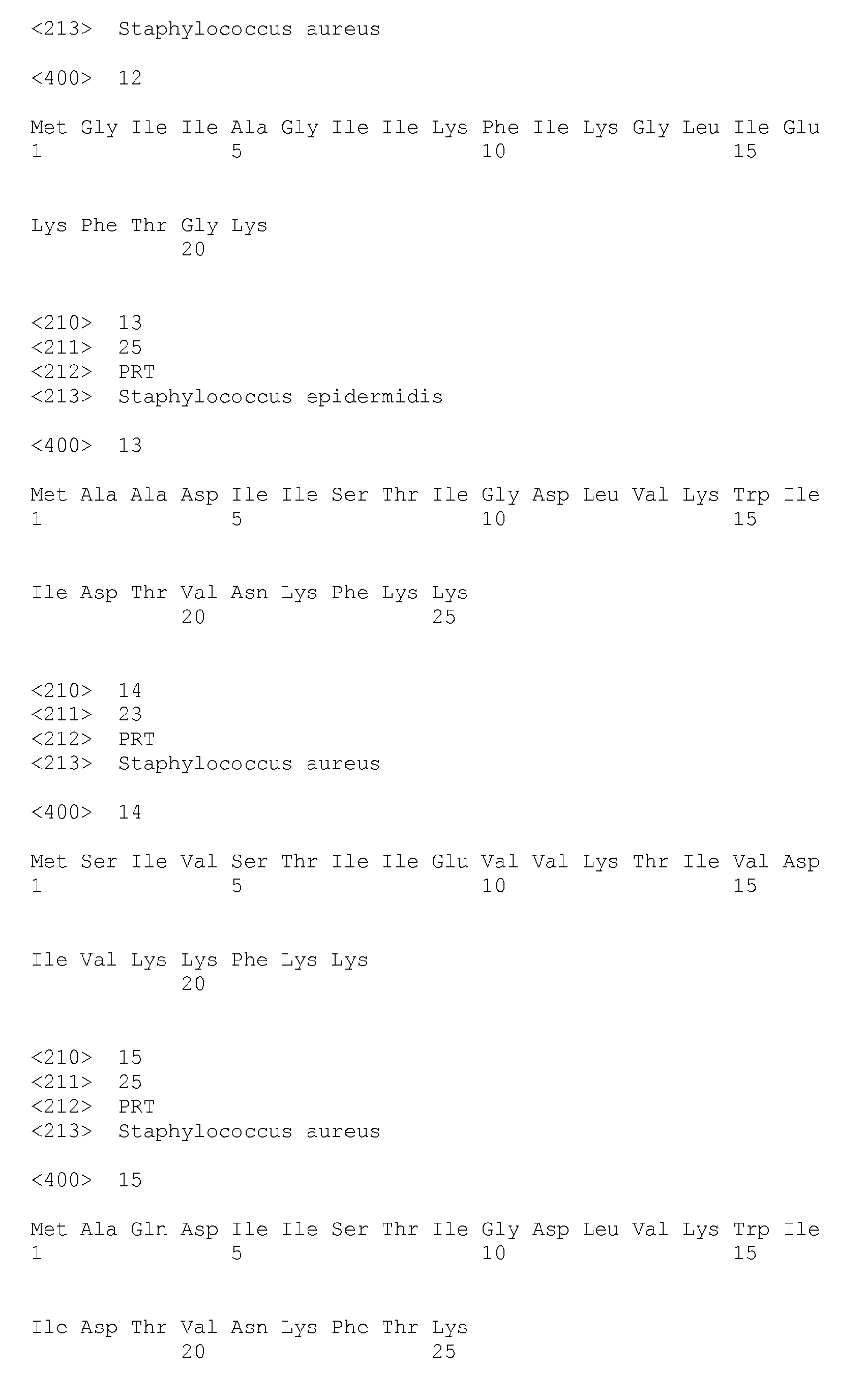


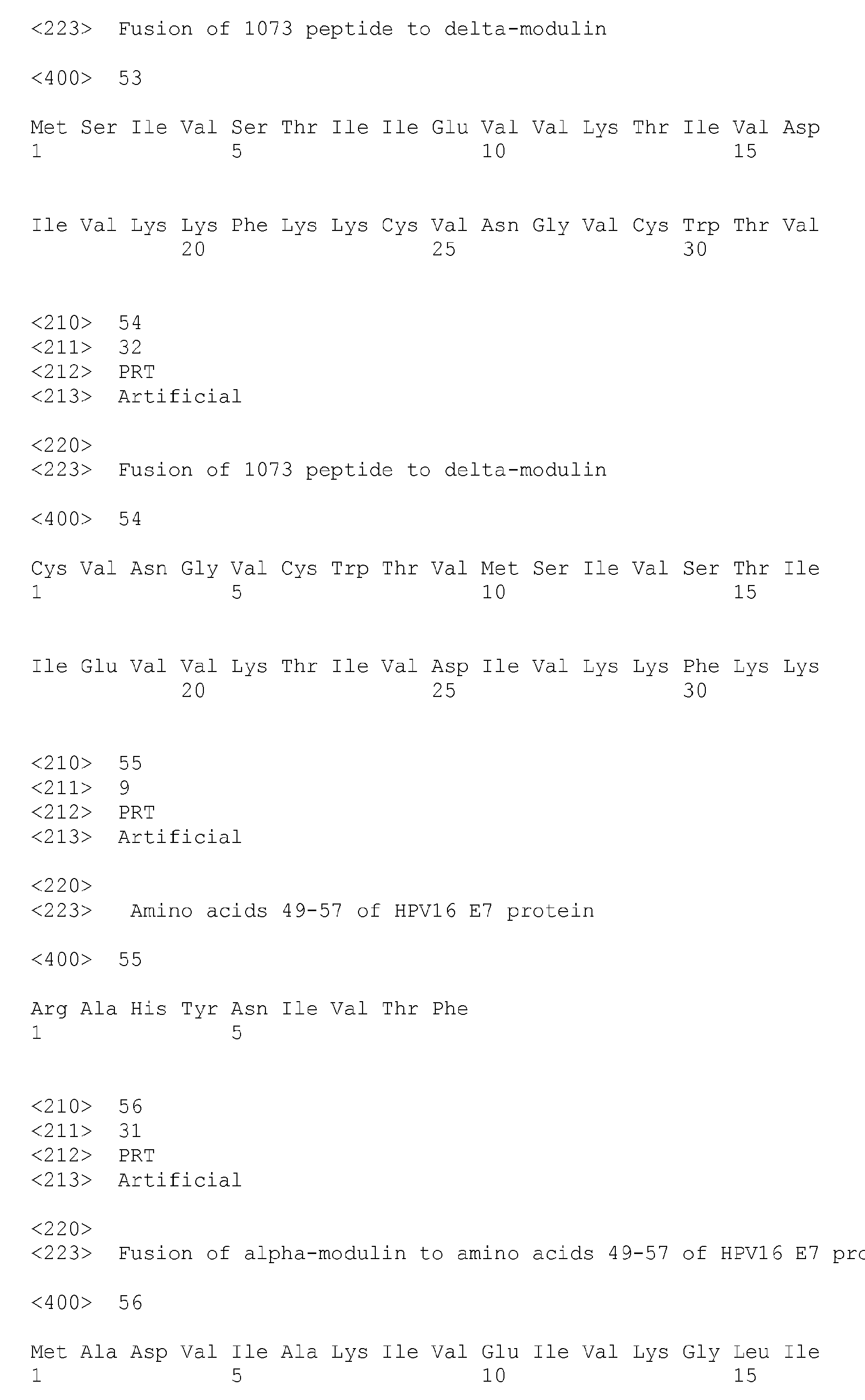

Claims (27)
- A conjugate comprising(i) a phenol-soluble modulin (PSM) or a functionally-equivalent variant thereof and(ii) one or more antigenic peptideswherein components (i) and (ii) are covalently coupled and wherein the conjugate promotes a cytotoxic response towards the antigenic peptide or peptides.
- A conjugate according to claim 1 wherein the PSM is selected from the group of SEQ ID NO:1 to 10 or a functionally-equivalent variant thereof.
- A conjugate according to claim 1 or 2 wherein component (ii) forms a single polypeptide chain with component (i).
- A polynucleotide or gene construct comprising a nucleic acid sequence encoding a conjugate as defined in claim 3.
- A vector comprising a polynucleotide or gene construct as defined in 4.
- A host cell comprising a polynucleotide or gene construct as defined in 4 or a vector as defined in 5.
- A composition comprising, together or separately,(a) A conjugate as defined in claims 1 to 3, a polynucleotide or gene construct as defined in claim 4, a vector as defined in claim 5, a host cell as defined in claim 6 and(b) a second component selected from the group of(i) one or more toll-like receptor agonists,(ii) one or more agonist antibodies of a co-stimulatory molecule,(iii) one of more cytokines and(iv) any combination of the compounds mentioned in (i) to (iii)
- A composition according to claim 7 wherein the second toll-like receptor agonist is selected from the group of a TLR3 ligand, a TLR4 ligand and a TLR9 ligand.
- A composition according to claim 8 wherein the TLR3 ligand is poly I:C, the TLR4 ligand is LPS or the EDA protein and/or the TLR9 ligand is CpG.
- A method for obtaining an antigen-primed antigen-presenting cell comprising the steps of(i) contacting an antigen-presenting cell with a conjugate as defined in claims 1 to 3, a polynucleotide or gene construct as defined in claim 4, a vector as defined in claim 5, a host cell as defined in claim 6 or a composition as defined in any of claims 7 to 9 and(ii) isolating the antigen-primed antigen-presenting cell.
- A method as defined in claim 10 wherein the antigen-presenting cell is a dendritic cell.
- An antigen presenting cell obtained by the methods as defined in claims 10 or 11.
- A pharmaceutical preparation or a vaccine comprising a conjugate as defined in claims 1 to 3, a polyucleotide or gene construct as defined in claim 4, a vector as defined in claim 5, a host cell as defined in claim 6, a composition as defined in any of claims 7 to 9 or an antigen presenting cell as defined in claim 12 and a pharmaceutically acceptable carrier.
- A conjugate as defined in claims 1 to 3, a polyucleotide or gene construct as defined in claim 4, a vector as defined in claim 5, a host cell as defined in claim 6, a composition as defined in any of claims 7 to 9 , a pharmaceutical composition or vaccine as defined in claim 10 or an antigen presenting cell as defined in claim 12 for use in medicine.
- A conjugate as defined in claims 1 to 3, a polyucleotide or gene construct as defined in claim 4, a vector as defined in claim 5, a host cell as defined in claim 6, a composition as defined in any of claims 7 to 9, a pharmaceutical composition as defined in claim 10 or an antigen presenting cell as defined in claim 12 for use in a method of inducing a cytotoxic response towards the antigenic peptide.
- A conjugate as defined in claims 1 to 3, a polyucleotide or gene construct as defined in claim 4, a vector as defined in claim 5, a host cell as defined in claim 6, a composition as defined in any of claims 7 to 9, a pharmaceutical composition as defined in claim 10 or an antigen presenting cell as defined in claim 12 for use in a method of inducing a cytotoxic response towards an infectious disease, an allergic disease or a neoplastic disease.
- Use of a conjugate as defined in claims 1 to 3, a polyucleotide or gene construct as defined in claim 4, a vector as defined in claim 5, a host cell as defined in claim 6, a composition as defined in any of claims 7 to 9 in an in vitro method for promoting the presentation of the antigenic peptide or peptides by antigen-presenting cells or for promoting maturation of antigen-presenting cells.
- A conjugate comprising(i) a phenol-soluble modulin (PSM) or a functionally-equivalent variant thereof and(ii) a biologically active compoundwherein components (i) and (ii) are covalently coupled.
- A conjugate according to claim 18 wherein the PSM is selected from the group of SEQ ID NO: 1 to 10 or a functionally-equivalent variant thereof.
- A conjugate according to claims 18 or 19 wherein component (ii) is a peptidic compound which forms a single polypeptide chain with component (i).
- A polynucleotide or gene construct comprising a nucleic acid sequence encoding a conjugate as defined in claim 20.
- A vector comprising a polynucleotide or gene construct as defined in claim 21.
- A host cell comprising a polynucleotide or gene construct as defined in 22.
- A pharmaceutical preparation comprising a conjugate as defined in claim 18 to 20, a polynucleotide or gene construct as defined in claim 21, a vector as defined in claim 22 or a host cell as defined in claim 23 and a pharmaceutically acceptable carrier.
- A conjugate as defined in claim 18 to 20, a polynucleotide or gene construct as defined in claim 21, a vector as defined in claim 22 or a host cell as defined in claim 23 or a pharmaceutical preparation as defined in claim 24 for use in medicine.
- A conjugate as defined in claim 18 to 20, a polynucleotide or gene construct as defined in claim 21, a vector as defined in claim 22 or a host cell as defined in claim 23 or a pharmaceutical preparation as defined in claim 24 wherein the for use in the treatment of a disease characterized by an undesired proliferation or an undesired activity of a cell selected from the group of a CD4-, CD8-, CD19-, CD11c-, F4/8- or a CD 117-positive cells or a combination thereof.
- A conjugate as defined in claim 18 to 20, a polynucleotide or gene construct as defined in claim 21, a vector as defined in claim 22 or a host cell as defined in claim 23 or a pharmaceutical preparation as defined in claim 24 wherein the disease characterized by an undesired proliferation or undesired activity of a cell selected from the group of a CD4-, CD8-, CD 19-, CD11c-, F4/8- or a CD117-positive cell is an autoimmune disease, a retroviral infection of a CD4-positive cell, a disease resulting from an immune response against a self-antigen induced by an innocuous foreign agent and a B-lineage malignancy.
Applications Claiming Priority (2)
| Application Number | Priority Date | Filing Date | Title |
|---|---|---|---|
| ES200803441 | 2008-12-03 | ||
| PCT/ES2009/070546 WO2010063865A1 (en) | 2008-12-03 | 2009-12-02 | Use of phenol-soluble modulins for vaccine development |
Publications (1)
| Publication Number | Publication Date |
|---|---|
| EP2374813A1 true EP2374813A1 (en) | 2011-10-12 |
Family
ID=42072810
Family Applications (1)
| Application Number | Title | Priority Date | Filing Date |
|---|---|---|---|
| EP09803779A Withdrawn EP2374813A1 (en) | 2008-12-03 | 2009-12-02 | Use of phenol-soluble modulins for vaccine development |
Country Status (9)
| Country | Link |
|---|---|
| US (1) | US20110268757A1 (en) |
| EP (1) | EP2374813A1 (en) |
| JP (1) | JP2012510284A (en) |
| CN (1) | CN102325790A (en) |
| AU (1) | AU2009323996A1 (en) |
| BR (1) | BRPI0923249A2 (en) |
| CA (1) | CA2745603A1 (en) |
| MX (1) | MX2011005915A (en) |
| WO (1) | WO2010063865A1 (en) |
Families Citing this family (4)
| Publication number | Priority date | Publication date | Assignee | Title |
|---|---|---|---|---|
| WO2018089602A1 (en) * | 2016-11-09 | 2018-05-17 | Baylor College Of Medicine | Therapeutic for the prevention and/or treatment of weight gain and/or diabetes |
| CN111295196A (en) * | 2017-08-31 | 2020-06-16 | 加利福尼亚大学董事会 | Molecular bacterial therapy for controlling skin enzyme activity |
| CN112778399A (en) * | 2021-01-21 | 2021-05-11 | 南开大学 | Preparation and property characterization method of nano antibacterial peptide derived from toxic amyloid fiber |
| CN113234125B (en) * | 2021-05-10 | 2022-12-06 | 华东理工大学 | Self-assembly polypeptide, polypeptide hydrogel, preparation method and application thereof |
Family Cites Families (42)
| Publication number | Priority date | Publication date | Assignee | Title |
|---|---|---|---|---|
| US4376110A (en) | 1980-08-04 | 1983-03-08 | Hybritech, Incorporated | Immunometric assays using monoclonal antibodies |
| US4816567A (en) | 1983-04-08 | 1989-03-28 | Genentech, Inc. | Recombinant immunoglobin preparations |
| JPS6147500A (en) | 1984-08-15 | 1986-03-07 | Res Dev Corp Of Japan | Chimera monoclonal antibody and its preparation |
| EP0173494A3 (en) | 1984-08-27 | 1987-11-25 | The Board Of Trustees Of The Leland Stanford Junior University | Chimeric receptors by dna splicing and expression |
| GB8422238D0 (en) | 1984-09-03 | 1984-10-10 | Neuberger M S | Chimeric proteins |
| JPS61134325A (en) | 1984-12-04 | 1986-06-21 | Teijin Ltd | Expression of hybrid antibody gene |
| US5081029A (en) | 1985-09-25 | 1992-01-14 | Oncogen | Methods of adoptive immunotherapy for treatment of aids |
| EP0247091B1 (en) | 1985-11-01 | 1993-09-29 | Xoma Corporation | Modular assembly of antibody genes, antibodies prepared thereby and use |
| US4912094B1 (en) | 1988-06-29 | 1994-02-15 | Ribi Immunochem Research Inc. | Modified lipopolysaccharides and process of preparation |
| US4999403A (en) | 1988-10-28 | 1991-03-12 | Exxon Chemical Patents Inc. | Graft polymers of functionalized ethylene-alpha-olefin copolymer with polypropylene, methods of preparation, and use in polypropylene compositions |
| US5229115A (en) | 1990-07-26 | 1993-07-20 | Immunex Corporation | Adoptive immunotherapy with interleukin-7 |
| US5194594A (en) | 1990-09-07 | 1993-03-16 | Techniclone, Inc. | Modified antibodies |
| WO1992012726A1 (en) | 1991-01-16 | 1992-08-06 | Schering Corporation | Use of interleukin-10 in adoptive immunotherapy of cancer |
| ZA929870B (en) | 1991-12-23 | 1993-08-18 | Duphar Int Res | Adjuvants |
| JP3967769B2 (en) | 1993-11-17 | 2007-08-29 | オーエム・ファルマ | Glucosamine disaccharides, process for their production, pharmaceutical compositions containing them and their use |
| WO1996002555A1 (en) | 1994-07-15 | 1996-02-01 | The University Of Iowa Research Foundation | Immunomodulatory oligonucleotides |
| US5985270A (en) | 1995-09-13 | 1999-11-16 | Fordham University | Adoptive immunotherapy using macrophages sensitized with heat shock protein-epitope complexes |
| US5856462A (en) | 1996-09-10 | 1999-01-05 | Hybridon Incorporated | Oligonucleotides having modified CpG dinucleosides |
| US5830464A (en) | 1997-02-07 | 1998-11-03 | Fordham University | Compositions and methods for the treatment and growth inhibition of cancer using heat shock/stress protein-peptide complexes in combination with adoptive immunotherapy |
| DE69840739D1 (en) | 1997-10-27 | 2009-05-28 | Merix Bioscience Inc | Method and composition for the production of mature dendritic cells |
| GB9727262D0 (en) | 1997-12-24 | 1998-02-25 | Smithkline Beecham Biolog | Vaccine |
| US7157092B1 (en) | 1998-06-30 | 2007-01-02 | Om Pharma | Acyl pseudodipeptides, preparation method and pharmaceutical compositions containing same |
| US6809186B1 (en) | 1999-01-22 | 2004-10-26 | Martek Biosciences Corporation | Simple method for labeled conjugate production |
| FR2819263B1 (en) | 2001-01-10 | 2003-04-11 | Lco Sante | PROCESS FOR MATURATION OF DENDRITIC CELLS AND ACTIVATION OF MACROPHAGES WITH RU 41740 |
| JP4331944B2 (en) | 2001-04-17 | 2009-09-16 | 大日本住友製薬株式会社 | New adenine derivatives |
| DE60230340D1 (en) | 2001-11-16 | 2009-01-22 | 3M Innovative Properties Co | N-Ä4- (4-amino-2-ethyl-1H-imidazoÄ4,5-quinolin-1-yl) -butyl-methanesulfonamide, pharmaceutical composition containing the same and their use |
| US8877901B2 (en) | 2002-12-13 | 2014-11-04 | Immunomedics, Inc. | Camptothecin-binding moiety conjugates |
| JP4959136B2 (en) | 2002-12-13 | 2012-06-20 | イミューノメディクス、インコーポレイテッド | Immunoconjugates with cleavable linkages in cells |
| EP2572714A1 (en) | 2002-12-30 | 2013-03-27 | 3M Innovative Properties Company | Immunostimulatory Combinations |
| WO2004071459A2 (en) | 2003-02-13 | 2004-08-26 | 3M Innovative Properties Company | Methods and compositions related to irm compounds and toll-like receptor 8 |
| GB0321615D0 (en) | 2003-09-15 | 2003-10-15 | Glaxo Group Ltd | Improvements in vaccination |
| WO2005051315A2 (en) | 2003-11-24 | 2005-06-09 | The Regents Of The University Of California | On-demand cleavable linkers for radioconjugates for cancer imaging and therapy |
| RU41740U1 (en) | 2004-07-16 | 2004-11-10 | Колесник Владислав Иванович | SEAFRONT |
| US20080145931A1 (en) | 2004-10-07 | 2008-06-19 | Argos Therapeutics, Inc. | Mature Dendritic Cell Compositions and Methods of Culturing Same |
| WO2006135436A2 (en) | 2004-10-22 | 2006-12-21 | University Of Florida Research Foundation, Inc. | Inhibition of gene expression and therapeutic uses thereof |
| WO2006083706A2 (en) | 2005-01-31 | 2006-08-10 | Vaxinnate Corporation | Method to identify polypeptide toll-like receptor (tlr) ligands |
| CA2604032C (en) | 2005-04-06 | 2017-08-22 | Ibc Pharmaceuticals, Inc. | Methods for generating stably linked complexes composed of homodimers, homotetramers or dimers of dimers and uses |
| ES2291071B1 (en) | 2005-06-13 | 2009-03-16 | Proyecto De Biomedicina Cima, S.L. | AGENTS AND METHODS BASED ON THE USE OF THE EDA DOMAIN OF FIBRONECTINE. |
| JP2009511452A (en) | 2005-10-07 | 2009-03-19 | プロイェクト、デ、ビオメディシナ、シーマ、ソシエダッド、リミターダ | Combination of immunostimulants for the prevention and treatment of hepatitis C |
| CA2607056C (en) | 2005-10-19 | 2015-11-24 | Ibc Pharmaceuticals, Inc. | Methods and compositions for generating bioactive assemblies of increased complexity and uses |
| ES2555544T3 (en) | 2006-03-07 | 2016-01-04 | Vaxinnate Corporation | Compositions that include hemagglutinin, preparation methods and methods of use thereof |
| US20100166708A1 (en) * | 2007-02-20 | 2010-07-01 | The Regents Of The University Of California | Antimicrobial and anti-inflammatory therapies and compositions |
-
2009
- 2009-12-02 AU AU2009323996A patent/AU2009323996A1/en not_active Abandoned
- 2009-12-02 MX MX2011005915A patent/MX2011005915A/en active IP Right Grant
- 2009-12-02 JP JP2011539059A patent/JP2012510284A/en active Pending
- 2009-12-02 CN CN2009801560811A patent/CN102325790A/en active Pending
- 2009-12-02 US US13/132,530 patent/US20110268757A1/en not_active Abandoned
- 2009-12-02 CA CA2745603A patent/CA2745603A1/en not_active Abandoned
- 2009-12-02 BR BRPI0923249A patent/BRPI0923249A2/en not_active IP Right Cessation
- 2009-12-02 WO PCT/ES2009/070546 patent/WO2010063865A1/en not_active Ceased
- 2009-12-02 EP EP09803779A patent/EP2374813A1/en not_active Withdrawn
Non-Patent Citations (1)
| Title |
|---|
| See references of WO2010063865A1 * |
Also Published As
| Publication number | Publication date |
|---|---|
| CA2745603A1 (en) | 2010-06-10 |
| CN102325790A (en) | 2012-01-18 |
| BRPI0923249A2 (en) | 2016-01-26 |
| MX2011005915A (en) | 2011-08-17 |
| US20110268757A1 (en) | 2011-11-03 |
| AU2009323996A1 (en) | 2011-07-07 |
| JP2012510284A (en) | 2012-05-10 |
| WO2010063865A1 (en) | 2010-06-10 |
Similar Documents
| Publication | Publication Date | Title |
|---|---|---|
| EP2125012B1 (en) | Compositions comprising a b subunit of shiga toxin and a means stimulating nkt cells | |
| US11235032B2 (en) | Combination immunotherapy dosing regimen for immune checkpoint blockade | |
| KR20110036618A (en) | HIV vaccine based on targeting maximized doses and nubs to dendritic cells | |
| CA2807585A1 (en) | Novel vaccine adjuvants based on targeting adjuvants to antibodies directly to antigen-presenting cells | |
| US11925679B2 (en) | H3.3 CTL peptides and uses thereof | |
| KR20070029111A (en) | Improvement in Vaccination | |
| US20110076304A1 (en) | Adapter molecule for the delivery of adenovirus vectors | |
| US20110268757A1 (en) | Use of phenol-soluble modulins for vaccine development | |
| US20220118069A1 (en) | H3.3 ctl peptides and uses thereof | |
| WO2018162450A1 (en) | New inmunostimulatory compositions comprising an entity of cold inducible rna-binding protein with an antigen for the activation of dendritic cells | |
| WO2012123269A1 (en) | Immunogenic compositions and methods for their use | |
| Amorena Zabalza et al. | Immunogenic compositions and methods for their use |
Legal Events
| Date | Code | Title | Description |
|---|---|---|---|
| PUAI | Public reference made under article 153(3) epc to a published international application that has entered the european phase |
Free format text: ORIGINAL CODE: 0009012 |
|
| 17P | Request for examination filed |
Effective date: 20110701 |
|
| AK | Designated contracting states |
Kind code of ref document: A1 Designated state(s): AT BE BG CH CY CZ DE DK EE ES FI FR GB GR HR HU IE IS IT LI LT LU LV MC MK MT NL NO PL PT RO SE SI SK SM TR |
|
| AX | Request for extension of the european patent |
Extension state: AL BA RS |
|
| 17Q | First examination report despatched |
Effective date: 20140508 |
|
| STAA | Information on the status of an ep patent application or granted ep patent |
Free format text: STATUS: THE APPLICATION IS DEEMED TO BE WITHDRAWN |
|
| 18D | Application deemed to be withdrawn |
Effective date: 20140701 |