EP2374256B1 - Anomaliedetektion für auf paketen basierende netzwerke - Google Patents
Anomaliedetektion für auf paketen basierende netzwerke Download PDFInfo
- Publication number
- EP2374256B1 EP2374256B1 EP08876170.5A EP08876170A EP2374256B1 EP 2374256 B1 EP2374256 B1 EP 2374256B1 EP 08876170 A EP08876170 A EP 08876170A EP 2374256 B1 EP2374256 B1 EP 2374256B1
- Authority
- EP
- European Patent Office
- Prior art keywords
- network
- detection
- training
- anomaly
- packet
- Prior art date
- Legal status (The legal status is an assumption and is not a legal conclusion. Google has not performed a legal analysis and makes no representation as to the accuracy of the status listed.)
- Not-in-force
Links
Images


Classifications
-
- H—ELECTRICITY
- H04—ELECTRIC COMMUNICATION TECHNIQUE
- H04L—TRANSMISSION OF DIGITAL INFORMATION, e.g. TELEGRAPHIC COMMUNICATION
- H04L63/00—Network architectures or network communication protocols for network security
- H04L63/14—Network architectures or network communication protocols for network security for detecting or protecting against malicious traffic
- H04L63/1408—Network architectures or network communication protocols for network security for detecting or protecting against malicious traffic by monitoring network traffic
- H04L63/1425—Traffic logging, e.g. anomaly detection
-
- H—ELECTRICITY
- H04—ELECTRIC COMMUNICATION TECHNIQUE
- H04L—TRANSMISSION OF DIGITAL INFORMATION, e.g. TELEGRAPHIC COMMUNICATION
- H04L43/00—Arrangements for monitoring or testing data switching networks
Definitions
- the present invention relates in general to anomaly detection for packet-based networks.
- the present invention finds advantageous, but non-exclusive, application in networks based on Internet Protocol (IP).
- IP Internet Protocol
- anomaly detection for packet-based networks is intended to detect an anomalous behaviour in a packet-based network, such as an IP-based network.
- the anomaly detection which was proposed for the first time in network and computer security by J.P. Anderson in Computer security threat monitoring and surveillance, Technical Report, Washington, PA,, James P. Anderson Co., is based on establishing statistical models for normal behaviour of a monitored object, such as a network or a program or a user activity. Subsequently, a live measure/sample of the monitored object is compared with the statistical model, and an alert is issued if such measure/sample presents a significant deviation from the statistical model.
- SVM Support Vector Machine
- OC-SVM one-class Support Vector Machine
- a main purpose of using machine learning techniques is to achieve a generalization capability which allows, given an available training data set, to correctly classify future data as normal or anomalous.
- SVM-based classifiers are generally trained through supervised learning, in which a machine computes the best function relating output data to input data. The goodness of this function is judged by its ability to generalize on new inputs, i.e., inputs which are not present in the training data set.
- SVMs are used for detecting intrusions and misbehaviours.
- DAS Defense Advanced Research Projects Agency
- IDS Intrusion Detection System
- the SVMs are trained on existent attack data, such as probing attacks, Denial-of-Service (DoS) attacks, etc.
- the features on which these SVMs work are the 41 TCP connection features, such as IP addresses, port numbers, TCP flags, packets size, etc., included in the DARPA database, or on a subset of these features, as described in M. V. Mahoney and P. K. Chan, An Analysis of the 1999 DARPA/Lincoln Laboratory Evaluation Data for Network Anomaly Detection, Computer Science Department, Florida Institute of Technology 150 W. University Dr., Melbourne, Florida 32901 .
- SVMs are comprehensively more accurate for IDS than other machine learning approaches, such as Artificial Neural Networks (ANN), K-means classifiers, Multivariate Adaptive Regression Splines (MARS), and Linear Genetic Programming.
- ANN Artificial Neural Networks
- K-means classifiers K-means classifiers
- MAM Multivariate Adaptive Regression Splines
- intrusion detection in wireless ad hoc networks Another area in which the use of SVMs was proposed is intrusion detection in wireless ad hoc networks.
- the intrusion detection functionality is meant to detect anomalous behaviour in network traffic, which also includes routing traffic.
- network traffic which also includes routing traffic.
- intrusion detection in wireless ad hoc networks reference may be made to H. Deng, Q.-A. Zeng, D. P. Agrawal, SVM-based Intrusion Detection System for Wireless Ad Hoc Networks, Proceedings of the IEEE Vehicular Technology Conference, October 2003, IEEE 58th Volume 3, 6-9 Oct. 2003 pages: 2147-2151 Vol.3 .
- a whole category of host IDS uses system call sequences to decide if a computer is under attack or not.
- Such approaches build a model of the correct or normal short system call sequences when the computer is used by authorized users, and use this model to decide either if the current user is non authorized or if an intrusion is ongoing.
- Such approach usually, builds a database with admissible short sequences of system calls during training, and compare new sequences against those stored in the database during detection. If the new sequence is found in the database the user behaviour is considered normal. The sequences have to match exactly, since a little deviation from the model can mean that a malicious program is being executed by the user.
- S. Forrest S. A.
- US 2004215972 discloses to provide an intelligent system that utilizes intelligent mobile agents that are distributed throughout an enterprise network to collectively monitor user activities, build user profiles, evaluate intrusion risk, match user activities with known attack patterns and signatures, and perform intrusion determination (i.e., deciding whether an intrusion is really taking place).
- the agents are equipped with kernel-based learning algorithms (such as Support Vector Machines or SVMs) to perform intrusion determination and delivering real-time protection.
- kernel-based learning algorithms such as Support Vector Machines or SVMs
- US 2005207413 discloses a method and apparatus for rapidly detecting anomalies that elude methods such as top ten counting from massive data streams with a large number of flows.
- the method determines the conditions for greater position in the ranking and closer scrutiny and then applies the conditions and determines the number of entrances of an entity being observed to the list, number of events while on the list and duration on the list for each observed entity, such as an IP address. Anomalies are detected by comparing with historical data and data collected for other similar entities and profiles..
- US2007074288 discloses a network status display device and method using a traffic pattern map which can facilitate recognizing a current network status by analyzing a harmful or abnormal traffic deteriorating the network performance by the use of a flow occupancy rate of the representative port having the maximum occupancy rate for each network/host address section by software and displaying the analysis result.
- an objective of the present invention is to provide a methodology which can alleviate at least in part the above cited drawbacks, and, in particular, which allows anomalies in the behaviour of packet-based networks to be detected in real time and hence without involving a computationally-intensive and time-consuming data processing.
- the Applicant has also noted that the known methods are aimed at detecting a limited amount of anomalies in the behaviour of packet-based networks, and hence have a good/reliable behaviour/performance only for those anomalies they are planned to detect.
- Another objective of the present invention is to provide a methodology which allows a large spectrum of anomalies in the behaviour of packet-based networks to be efficiently and reliably detected.
- the present invention achieves the aforementioned objectives by
- detecting an anomaly comprises:
- the detection feature vector comprises detection feature items related to corresponding monitored network resources, and arranged in the detection feature vector depending on the ordering of the corresponding monitored network resources.
- the detection feature items are arranged in the detection feature vector according to an order identical to the ordering of the corresponding monitored network resources.
- the monitored network resources are ordered based on a respective amount of data traffic generated or received by each monitored network resource.
- the machine learning system is a one-class classifier, preferably a one-class Support Vector Machine (OC-SVM).
- O-SVM Support Vector Machine
- the present invention is implemented by means of a software program including software code portions for implementing, when the software program is loaded in a memory of a processing system and run thereon, the anomaly detection method described hereinafter.
- the Applicant has carried out an in-depth study of IP-based networks in order to investigate the possibility of developing an anomaly detection methodology which allows a large spectrum of anomalies in the behaviour of IP-based networks to be efficiently and reliably detected in real time and, hence, without involving a computationally-intensive and time-consuming processing.
- a large spectrum of anomalies in the behaviour of an IP-based network may be efficiently and reliably detected in real time and without involving a computationally-intensive and time-consuming data processing by:
- the network resources are network-related software objects belonging to one of following categories:
- anomalies in the behaviour of the IP-based network may be detected by monitoring the ports of the IP-based network.
- anomalies in the behaviour of the network applications accessible via TCP and/or UDP may be detected by monitoring TCP and/or UDP ports.
- the network applications are defined as 4 th layer protocol, and port number couples.
- the couple ⁇ protocol TCP, port 80> identifies web-based applications which use TCP as transport protocol and port 80 to listen for client requests.
- anomalies in the behaviour of the IP-based network may be detected by monitoring source and/or destination IP addresses, and/or by monitoring any IP-based network protocol which uses the ports and/or different message types.
- the monitored network resources are ordered based on corresponding traffic received or generated by each of the network resources.
- most-used network resources are identified, the most-used network resources being those monitored network resources which receive and/or generate the most of traffic.
- the traffic is expressed in terms of bits per second (bps) or packets per second (pps).
- the anomaly detection is based on using a machine learning system for detecting intrusions and misbehaviors of the IP-based network.
- detecting an anomaly comprises:
- the detection feature vector comprises detection feature items which are related to corresponding monitored network resources, and are arranged in the detection feature vector depending on the ordering of the corresponding monitored network resources.
- the detection feature items are arranged in the detection feature vector according to an arrangement order identical to the ordering of the corresponding monitored network resources.
- the machine learning system is, conveniently, a one-class classifier, preferably a one-class Support Vector Machine (OC-SVM).
- OC-SVM Support Vector Machine
- the model consists of a set of support vectors which define a hyper-surface, in the followings called for simplicity hypersphere, that encloses all possible normal class representations. All observations, i.e., input vectors, lying outside this hypersphere are considered anomalous, i.e., they correspond to attack or network failure situations, and/or other anomalies. Since only the normal class representation is necessary for training, the present invention is significantly less resource consuming than traditional SVM-based approaches. As a consequence, it is faster and more appropriate for real-time anomaly detection method in broadband networks.
- OC-SVM Another important advantage of using OC-SVM lies in the high detection reliability achieved by such a technique_which allows a large spectrum of anomalies to be reliably detected, since the OC-SVM is trained on the normal behaviour of the monitored IP-based network, i.e., the normal class model, contrary to known methods which normally have a good/reliable behaviour/performance only for those anomalies they are planned to detect.
- a further important advantage of using OC-SVM lies in the conspicuous classification precision and detection speed achieved by such a technique with respect to other proposed methods, such as Neural Networks, k-Nearest Neighbour classifiers, Statistical methods, Data Mining methods, etc., thus permitting a significant reduction in False Positives and False Negatives rates.
- SVMs can be applied to regression, classification, and density estimation problems.
- SVMs belong to the category of maximum-margin classifiers, and they naturally perform binary classification (i.e. they have two output classes), by finding, in the feature space of the SVM, a decision hypersurface (usually a hyperplane) that splits the positive examples from the negative examples, the split being such as to have the largest distances from the hypersurface to the nearest of the positive and negative examples, generally making the classification correct for testing data that is near, but not identical to the training data.
- a decision hypersurface usually a hyperplane
- the decision function also known as hypothesis, is described by a weight vector w and a threshold b. According to which side of the hypersurface the input vector x lies on, it is classified into class +1 or -1.
- the idea of structural risk minimization is to find a hypothesis h for which the lowest error probability can be guaranteed.
- SVMs Vapnik showed that this goal can be translated into finding the hypersurface with largest margin for separable data.
- SVMs find the hypersurface h , which separates the positive and negative training examples, marked with "+" and "-", respectively, in Figure 1 , with largest margin.
- the examples closest to the hypersurface h are called support vectors, marked with circles in Figure 1 .
- the training example ( x tsv , y tsv ) for calculating b must be a support vector with ⁇ tsv ⁇ C.
- kernel functions denoted by K ( x 1 , x 2 )
- K x 1 , x 2
- SVMs can be linear classifiers, polynomial classifiers, radial basis function (RBF) classifiers, or two-layer sigmoid neural networks.
- Normal SVM classifiers represent supervised learning procedures that need positive and negative examples for training to obtain a model of both the normal class, i.e., how the system is supposed to behave in the absence of attacks and anomalies such as failure conditions, and the complementary class, i.e., the anomalous/a typical behaviour.
- the limit of such a mechanism is that, for a highly reliable recognition of anomalies, i.e., with a low error rate, a huge number of negative examples are required in practice.
- the number of negative examples has to cover as much as possible of the anomalous conditions that can be encountered in the modeled object's behaviour.
- the detection engine is supposed to model only the normal behaviour of the object, possibly without requiring any additional information.
- OC-SVMs One-Class Support Vector Machines
- the support vectors characterizing the object's class are obtained only from positive training examples.
- such support vectors define a hypersphere that encloses all possible representations of the object. All observations (input vectors) lying outside this hypersphere are considered not correct or anomalous representations.
- the present invention exploits OC-SVM-based mechanism which requires only the description of the correct class, i.e., the normal behaviour class, for the modeled system, i.e., the IP-based network.
- the reference SVM model per monitored network is built only from positive training examples representing the normal class.
- the solution is based on the use of OC-SVM with a particular set of features and a specific distance function for modeling the IP-based network and for real-time anomalies detection in such network.
- the problem the OC-SVM has to solve is the estimation of a model function h(x, w) which gives a closed boundary around the target class data (reference may for example be made to D. M. J. Tax, One-class classification, Concept learning in the absence of counter examples, Ph.D. thesis, Technical University of Delft, 2001 ).
- This closed boundary is a hypersphere that contains all the training objects X tr , and that is characterized by a center a and a radius R, as illustrated in Figure 2 .
- Parameter C gives the trade-off between the volume of the description and the errors.
- the minimization of this error is a well-known quadratic programming problem, for which standard algorithms exist (reference may again be made to the above-referenced One-class classification) .
- the present invention proposes a particular training set construction method, a working optimized representation of the input data together with an appropriate distance metric and an automatic method for SVM parameters configuration.
- the present invention also proposes a real-time update, or adaptation, mechanism for the reference template: as a first measure raise the alarm, but nevertheless incorporate the violating vector into the normal behaviour template if the distance from the template is under a configured threshold value.
- OC-SVM-based anomaly detection will be described in terms of an anomaly detection system.
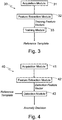
- the anomaly detection system comprises two software components showed, respectively, in Figures 3 and 4 : a training software component 30, and an anomaly detection software component 40, each comprising several software modules.
- the training software component 30 comprises:
- the SVs together with some OC-SVM specific parameters represent the normal class model, i.e., the normal behaviour of the IP-based network.
- the anomaly detection software component 40 comprises:
- the detection module 43 is further configured to issue an alarm together with an attached severity level based on the performed anomaly decision.
- the acquisition modules 31 and 41 are implemented in collectors which are part of the IP-based network or which receive the traffic generated by the IP-based network.
- the collectors are common network devices which have access to all IP data that travel on the IP-based network.
- the collectors may be Personal Computers (PCs), routers, or security appliances.
- the acquisition module 31 acquires from the IP-based network all IP packets traveling through the IP-based network, eliminates duplicates, and provides the feature extraction module 32 with the acquired IP packets without the duplicates.
- the acquisition module 31 acquires all the IP packets traveling through the IP-based network during a free-of-attacks and free-of-failures training period only.
- the acquisition module 41 in use, acquires in real time from the IP-based network all IP packets traveling through the IP-based network, eliminates duplicates, and provides the feature extraction module 42 with the acquired IP packets without the duplicates.
- sampling interval i.e., periodicity of sample collection process
- the sampling interval may depend on capability of underlying network (i.e., netflow data generation period of the routers), and may vary from 1 to 5 minutes.
- the proposed anomaly detection can work with different sets of features extracted from IP traffic data. Even if hereinafter it will be described the use of some sets, other sets can be used, since the invention provides an automatic procedure for computing the necessary SVM parameters for each new type of feature set.
- the feature extraction modules 32 and 42 in use, select, among the IP packets provided by the acquisition modules 31 and 41, those IP packets that encapsulate data related to the network resources to be monitored.
- the feature extraction modules 32 and 42 in use, group (or aggregate) for each network resource to be monitored corresponding IP messages among the selected IP messages, the corresponding IP messages being those selected IP messages that encapsulate data related to the network resource to be monitored.
- the feature extraction modules 32 and 42 compute for each network resource to be monitored a respective number of packets and/or bytes generated by the network resource based on the grouped corresponding IP messages, and order the network resources depending on the respective computed number of packets and/or bytes generated by each network resource, i.e., depending on the amount of data traffic generated by each network resource.
- the feature extraction module 32 create a training ordered sequence of training feature items corresponding to the first N ordered network resources, i.e., the N most-used network resources, since the first N ordered network resources are the network resources generating the most of the traffic among the network resources to be monitored, N being a configurable parameter. Then the feature extraction module 32 form a training feature vector containing the training ordered sequence of the training feature items.
- the feature extraction module 42 create a detection ordered sequence of detection feature items corresponding to the first N ordered network resources, i.e., the N most-used network resources, since the first N ordered network resources are the network resources generating the most of the traffic among the monitored network resources. Then the feature extraction module 42 form a detection feature vector containing the detection ordered sequence of the detection feature items.
- the IP packets that encapsulate application data are grouped (or aggregated) per port, and the number of packets and/or bytes generated by each port is computed. Then the top most-used N network applications are identified.
- the aggregation is performed by IP address identifier, while for control messages, the aggregation is performed by message type, and so on.
- the feature vectors used for training and detection contain the sequences of N values extracted in a decreasing order by the amount of packets and/or bytes.
- Each feature vector refers to a specific category of network resources, e.g. the 4th level protocol (TCP, UDP) or control protocol (ICMP) or IP address.
- TCP 4th level protocol
- UDP 4th level protocol
- ICMP control protocol
- the anomaly detection system is configured to detect anomalies on both bytes and packets, the number of vectors per category is doubled.
- An important feature of the anomaly detection system is the dynamic configuration of application or server ports.
- the system can work on data aggregated by destination port, but can also take into consideration traffic aggregated per source port if such ports are well-known, i.e., are among the Interned Assigned Numbers Authority (IANA) registered TCP/UDP ports, or if such ports generate significant amounts of traffic on a regular basis within the monitored IP-based network.
- IANA Interned Assigned Numbers Authority
- the training module 33 computes and outputs the normal class model, or the reference template, i.e., the normal behavior of the traffic in the monitored IP-based network, based on only positive examples, i.e., the training feature vectors.
- OC-SVM computes or learns a function h which defines a hypersphere which encloses the positive examples/observations (representing the target class), while all other observations are not necessary for the complete definition of the hypersphere.
- the OC-SVM operates by mapping the training feature vectors into a high-dimensional feature space and by finding in the high-dimensional feature space a hypersphere that encompasses all the training feature vectors, the hypersphere having a given center, a given radius defining the detection threshold and a surface in the high-dimensional feature space defined by the support vectors.
- the OC-SVM variables that need to be set are the kernel function, the C constant, the training set size and the support vectors size.
- the output of the OC-SVM consists in the value of the parameters of the kernel, the number of support vectors, the support vectors themselves, the weights (or ⁇ coefficients, also known as Lagrangian multipliers) of each support vector and a detection threshold which is practically the radius of the hypersphere.
- a SEQUENCE linear kernel function is exploited, the SEQUENCE linear kernel function being comprised in Chih-Chung Chang and Chih-Jen Lin, LIBSVM: a library for support vector machines, 2001, (Software available at http: // www . csie . ntu . edu . tw / ⁇ cjlin / libsvm ), which is hereby incorporated by reference, and wherein the SEQUENCE linear kernel function is introduced for sequences.
- the SEQUENCE linear kernel function outperforms other kernel functions for this specific task.
- the OC-SVM used in this way automatically produces all the information necessary for reference template creation, i.e., the support vectors, their weights, the center and the radius of the hypersphere, i.e., the detection threshold.
- the detection module 43 computes, for each detection feature vector provided at a given moment in time by the feature extraction module 42, and representing a live feature set, a corresponding distance between the detection feature vector and the center of the hypersphere obtained during the training and comprised in the reference template.
- a third aspect of the present invention refers to implementation of a new distance metric to be used in the OC-SVM classification algorithm.
- This distance function works on sequences, numerical or alphanumerical, or vectors of real or integer values, and is a newly defined metric, different from known distances, such as the Hamming distance and edit distances, e.g., the Levenshtein distance.
- the Hamming distance between two sequences counts the number of positions in which the sequences differ. For example, the Hamming distance between sequences 0011 and 0101 is two.
- the Levenshtein distance between two strings a and b is the number of deletions, insertions and substitutions required to transform a in b.
- the distance between "test” and “tent” is one because with one substitution "tent” is transformed in "test”.
- the distance computation according to the present invention takes into account both the positions in which two sequences are different, and how many positions are in between two symbols present in both sequences.
- figure 5 shows two vectors A and B each containing respective feature items.
- the feature items represent TCP-based application ports.
- the vector A is the center of the hypersphere obtained during the training, while B is a detection feature vector.
- the distance between A and B is computed as follows: for each port that is present in both vectors A and B a respective number of positions that separate the port in the two vectors in either direction is counted. Then, to obtain the distance between the vectors A and B the counted numbers for all the ports present in both vectors A and B are summed together.
- a respective value that relates to the port's position inside the vector is added to the distance.
- This contribution of the single port to the total distance is bigger if the position is smaller, meaning that if the port occupies an important position in the vector, hence is a port that received or generated much traffic, its anomalous position has more importance/severity.
- the smaller is the port's position ( 0 is the most important) the higher is the distance and hence the severity level of a possible alert.
- a smaller position means the corresponding port is significant for the monitored IP-based network, hence its contribution to the anomaly is important.
- the vectors A and B have two ports, i.e., port 80 and port 22, in the same position, and, therefore, these two ports give no contribution to the distance.
- the vectors A and B have the port 25 in different positions which are distant two positions, and, therefore, the port 25 gives a contribution of 2 to the distance.
- the vectors A and B have the port 443 in different positions which are distant two positions, and, therefore, the port 443 gives a contribution of 2 to the distance.
- the vectors A and B have the port 6688 in different positions which are distant one position, and, therefore, the port 6688 gives a contribution of 1 to the distance.
- the vector A has the port 1035 which is not present in the vector B and is in the last position of the vector A , i.e., position 5 , and, therefore, the port 1035 gives a contribution of 1 to the distance.
- the vector B has the port 1017 which is not present in the vector A and is in the position 4 of the vector A , and, therefore, the port 1017 gives a contribution of 2 to the distance.
- the distance between the vectors A and B is 8 .
- the detection module 43 classifies the detection feature vector as belonging to the normal class, otherwise an anomaly is detected and an alarm is issued.
- the severity of the alarm is directly proportional to the average distance between the detection feature vector and the reference hypersphere.
- the anomaly detection may be implemented by means of a decision fusion scheme.
- the fusion rule may be based on majority voting.
- a simple majority voting scheme includes:
- the present invention proposes an anomaly detection method and system for packet-based networks, such as IP-based networks, based on a real-time monitoring of the sequences of the top N most-used network resources, such as network applications, IP addresses, specific protocols message types, etc., taking into consideration the amount of traffic generated/received by each network resource.
- the system builds the corresponding OC-SVM models on time of day basis. This approach results in models which are quite stable during normal network operation, so an anomaly is clearly identified by the system.
- applying the present invention in a time of day aware manner means that it is possible to build different OC-SVM models for different time intervals during the day, and that it is also possible to build different OC-SVM models for working days and holidays.
- the anomaly detection is significantly simplified with one-class Support Vector Machines, since only one reference template is used for the anomaly detection and not an arbitrary number of attack signatures as in misuse detection. Consequently, the anomaly detection according to the present invention is faster and its duration does not depend on the size of an additional database.
- network resources belonging to different categories such as network applications, IP messages, and over-IP protocols
- anomalies based on sequences of top N most-used network resources belonging to the same category, or on sequences of top N most-used network resources belonging to the different categories.
- the present invention may be applied to any packet-based network other than the aforementioned IP-based network.
- the present invention may also be used to detect anomalies in the usage of control and management protocols, and also in routing protocols.
- the control protocols that can be taken into consideration can be ICMP, Internet Group Management Protocol (IGMP), Simple Network Management Protocol (SNMP), Domain Name System (DNS) etc., while the routing protocols can be those used in IP networks, such as OSPF.
- IGMP Internet Group Management Protocol
- SNMP Simple Network Management Protocol
- DNS Domain Name System
- the routing protocols can be those used in IP networks, such as OSPF.
- OSPF IP Network Management Protocol
- the only request to apply the present invention is that the protocols are able to manage different message types.
Landscapes
- Engineering & Computer Science (AREA)
- Computer Security & Cryptography (AREA)
- Computer Networks & Wireless Communication (AREA)
- Signal Processing (AREA)
- Computer Hardware Design (AREA)
- Computing Systems (AREA)
- General Engineering & Computer Science (AREA)
- Data Exchanges In Wide-Area Networks (AREA)
Claims (9)
- Anomaliedetektionsverfahren für ein auf Paketen basierendes Netzwerk, wobei das auf Paketen basierende Netzwerk mehrere Netzwerkressourcen umfasst, wobei das Verfahren umfasst:• Überwachen der Netzwerkressourcen des auf Paketen basierenden Netzwerks;• Ordnen der überwachten Netzwerkressourcen gemäß einem vorgegebenen Ordnungskriterium auf der Grundlage einer entsprechenden Menge an Datenverkehr, der von der jeweiligen überwachten Netzwerkressource erzeugt oder empfangen wird; und• Erfassen einer Anomalie in dem auf Paketen basierenden Netzwerk auf der Grundlage der geordneten Netzwerkressourcen,wobei das Erfassen einer Anomalie umfasst:• Bilden eines Detektionsmerkmalvektors, der Detektionsmerkmalelemente umfasst, die auf die entsprechenden überwachten Netzwerkressourcen bezogen sind und in Abhängigkeit von der Ordnung der entsprechenden überwachten Netzwerkressourcen in dem Detektionsmerkmalvektor angeordnet sind; und• Einspeisen des Detektionsmerkmalvektors in eine Ein-Klassen-Support-Vektor-Maschine, welche so konfiguriert ist, dass sie auf der Grundlage des Detektionsmerkmalvektors eine Anomalie in dem auf Paketen basierenden Netzwerk erfasst,wobei das Verfahren ferner umfasst:• Trainieren der Ein-Klassen-Support-Vektor-Maschine während einer Trainingsphase, wobei die Trainingsphase eine Zeitphase ist, die im Wesentlichen frei von Angriffen und frei von Fehlern ist;wobei das Trainieren der Ein-Klassen-Support-Vektor-Maschine umfasst:• Überwachen und Ordnen der Netzwerkressourcen während der Trainingsphase, wobei das Ordnen gemäß dem vorgegebenen Ordnungskriterium erfolgt;• Bilden entsprechender Trainingsmerkmalvektoren auf der Grundlage der Netzwerkressourcen, die während der Trainingsphase überwacht und geordnet werden, wobei jeder Trainingsmerkmalvektor entsprechende Trainingsmerkmalelemente umfasst, welche auf entsprechende Netzwerkressourcen bezogen sind, die während der Trainingsphase überwacht und geordnet werden, und welche in Abhängigkeit von der Ordnung der entsprechenden Netzwerkressourcen, die während der Trainingsphase überwacht und geordnet werden, in dem Trainingsmerkmalvektor angeordnet sind; und• Trainieren der Ein-Klassen-Support-Vektor-Maschine auf der Grundlage der Trainingsmerkmalvektoren.
- Verfahren nach Anspruch 1, wobei die Detektionsmerkmalelemente gemäß einer Ordnung in dem Detektionsmerkmalvektor angeordnet werden, die mit der Ordnung der entsprechenden überwachten Netzwerkressourcen identisch ist.
- Verfahren nach Anspruch 2, wobei die Ein-Klassen-Support-Vektor-Maschine durch Abbilden der Trainingsmerkmalvektoren in einen hochdimensionalen Merkmalraum und durch Berechnen einer Hyperfläche in dem hochdimensionalen Merkmalraum arbeitet, welche alle Trainingsmerkmalvektoren umfasst und über ein vorgegebenes Zentrum und einen vorgegebenen Radius modellierbar ist, welche einen Anomaliedetektions-Schwellenwert definieren, wobei die Ein-Klassen-Support-Vektor-Maschine Support-Vektoren umfasst, welche durch Trainingsmerkmalvektoren definiert werden, die der Hyperfläche nächstgelegen sind;
wobei das Trainieren der Ein-Klassen-Support-Vektor-Maschine Berechnen einer Referenzschablone umfasst, welche die Support-Vektoren und das Zentrum und den Radius der Hyperfläche umfasst;
wobei das Erfassen einer Anomalie ferner Erfassen einer Anomalie in dem auf Paketen basierenden Netzwerk auf der Grundlage der Referenzschablone und des Detektionsmerkmalvektors umfasst;
und wobei das Erfassen einer Anomalie in dem auf Paketen basierenden Netzwerk auf der Grundlage der Referenzschablone und des Detektionsmerkmalvektors umfasst:• Berechnen eines Abstands zwischen dem Detektionsmerkmalvektor und dem Zentrum der Hyperfläche und• Erfassen einer Anomalie in dem auf Paketen basierenden Netzwerk auf der Grundlage des berechneten Abstands und des Radius der Hyperfläche. - Verfahren nach Anspruch 3, wobei die Referenzschablone ein Verhalten des auf Paketen basierenden Netzwerks repräsentiert, wenn keine Angriffe und keine Fehler vorliegen.
- Verfahren nach Anspruch 3 oder 4, wobei das Berechnen eines Abstands zwischen dem Detektionsmerkmalvektor und dem Zentrum der Hyperfläche Berechnen eines Abstands auf der Grundlage von Folgendem umfasst:• für jedes Detektionsmerkmalelement, welches auch im Zentrum der Hyperfläche enthalten ist und im Zentrum der Hyperfläche in einer ersten Position angeordnet ist, die sich von einer zweiten Position unterscheidet, in welcher das Detektionsmerkmalelement in dem Detektionsmerkmalvektor angeordnet ist, auf der Grundlage eines entsprechenden Abstands zwischen der ersten und der zweiten Position;• für jedes Detektionsmerkmalelement, welches nicht im Zentrum der Hyperfläche enthalten ist, auf der Grundlage eines entsprechenden Werts, der eine Position anzeigt, in welcher das Detektionsmerkmalelement in dem Detektionsmerkmalvektor angeordnet ist; und• für jedes Detektionsmerkmalelement, welches im Zentrum der Hyperfläche enthalten ist und nicht im Detektionsmerkmalvektor enthalten ist, auf der Grundlage eines entsprechenden Werts, der eine Position anzeigt, in welcher das Merkmalelement im Zentrum der Hyperfläche angeordnet ist.
- Verfahren nach einem der vorhergehenden Ansprüche, wobei das auf Paketen basierende Netzwerk auf dem Internet Protocol basiert und wobei die Netzwerkressourcen netzwerkbezogene Software-Objekte sind, die zu einer der folgenden Kategorien gehören:• Anschlüsse• Netzwerkanwendungen• Internet-Protocol-Adressen.• spezielle Protokollmeldungstypen• Over-Internet-Protocol-Protokolle• Internet-Control-Message-Protocol-Meldungen und• Routing-Protokoll-Meldungen.
- Verfahren nach Anspruch 6, wobei die Netzwerkressourcen zu zwei oder mehr der Kategorien gehören.
- Anomaliedetektionssystem für auf Paketen basierende Netzwerke, dadurch gekennzeichnet, dass es so konfiguriert ist, dass das Anomaliedetektionsverfahren nach einem der vorhergehenden Ansprüche realisiert wird.
- Software-Programm, welches in einen Speicher eines Prozessors des Anomaliedetektionssystems nach Anspruch 8 zu laden ist und Software-Code-Teile zum Realisieren des Anomaliedetektionsverfahrens nach einem der Ansprüche 1 bis 7 umfasst, wenn das Software-Programm auf dem Prozessor abläuft.
Applications Claiming Priority (1)
| Application Number | Priority Date | Filing Date | Title |
|---|---|---|---|
| PCT/IT2008/000821 WO2010076832A1 (en) | 2008-12-31 | 2008-12-31 | Anomaly detection for packet-based networks |
Publications (2)
| Publication Number | Publication Date |
|---|---|
| EP2374256A1 EP2374256A1 (de) | 2011-10-12 |
| EP2374256B1 true EP2374256B1 (de) | 2017-07-12 |
Family
ID=41307329
Family Applications (1)
| Application Number | Title | Priority Date | Filing Date |
|---|---|---|---|
| EP08876170.5A Not-in-force EP2374256B1 (de) | 2008-12-31 | 2008-12-31 | Anomaliedetektion für auf paketen basierende netzwerke |
Country Status (3)
| Country | Link |
|---|---|
| US (1) | US9094444B2 (de) |
| EP (1) | EP2374256B1 (de) |
| WO (1) | WO2010076832A1 (de) |
Cited By (1)
| Publication number | Priority date | Publication date | Assignee | Title |
|---|---|---|---|---|
| US20220038482A1 (en) * | 2020-01-31 | 2022-02-03 | Panasonic Intellectual Property Corporation Of America | Anomaly detection method and anomaly detection device |
Families Citing this family (52)
| Publication number | Priority date | Publication date | Assignee | Title |
|---|---|---|---|---|
| US8683591B2 (en) | 2010-11-18 | 2014-03-25 | Nant Holdings Ip, Llc | Vector-based anomaly detection |
| WO2012154657A2 (en) * | 2011-05-06 | 2012-11-15 | The Penn State Research Foundation | Robust anomaly detection and regularized domain adaptation of classifiers with application to internet packet-flows |
| CN102420723A (zh) * | 2011-12-14 | 2012-04-18 | 南京邮电大学 | 一种面向多类入侵的异常检测方法 |
| CN103295024B (zh) * | 2012-02-29 | 2017-03-01 | 佳能株式会社 | 分类与对象检测方法和装置以及图像拍摄和处理设备 |
| KR101280725B1 (ko) * | 2012-09-13 | 2013-07-05 | 이기범 | 쿠폰을 이용한 가변 콘텐츠 제공 장치 및 방법 |
| EP3123685A1 (de) * | 2014-03-27 | 2017-02-01 | Telefonaktiebolaget LM Ericsson (publ) | Verfahren und system zum schutz vor verteilter verweigerung von dienstangriffen |
| US9635050B2 (en) * | 2014-07-23 | 2017-04-25 | Cisco Technology, Inc. | Distributed supervised architecture for traffic segregation under attack |
| CN104270392B (zh) * | 2014-10-24 | 2017-09-26 | 中国科学院信息工程研究所 | 一种基于三分类器协同训练学习的网络协议识别方法及系统 |
| JP5962736B2 (ja) * | 2014-10-30 | 2016-08-03 | 日本電気株式会社 | 情報処理システム、分類方法、及びそのためのプログラム |
| CN105703963B (zh) * | 2014-11-26 | 2017-04-05 | 中国科学院沈阳自动化研究所 | 基于pso‑ocsvm的工业控制系统通信行为异常检测方法 |
| KR20160095856A (ko) * | 2015-02-04 | 2016-08-12 | 한국전자통신연구원 | 새로운 공격 유형의 자동 탐지 및 공격 유형 모델 갱신을 통한 지능형 침입 탐지 시스템 및 방법 |
| KR20160099160A (ko) * | 2015-02-11 | 2016-08-22 | 한국전자통신연구원 | 명령어 집합의 행위 패턴을 엔-그램 방식으로 모델링하는 방법, 그 방법으로 동작하는 컴퓨팅 장치, 및 그 방법을 컴퓨팅 장치에서 실행하도록 구성되는 기록 매체에 저장된 프로그램 |
| US9954870B2 (en) | 2015-04-29 | 2018-04-24 | International Business Machines Corporation | System conversion in a networked computing environment |
| US9462013B1 (en) | 2015-04-29 | 2016-10-04 | International Business Machines Corporation | Managing security breaches in a networked computing environment |
| US9923908B2 (en) | 2015-04-29 | 2018-03-20 | International Business Machines Corporation | Data protection in a networked computing environment |
| US10154053B2 (en) * | 2015-06-04 | 2018-12-11 | Cisco Technology, Inc. | Method and apparatus for grouping features into bins with selected bin boundaries for use in anomaly detection |
| RU2601148C1 (ru) | 2015-06-30 | 2016-10-27 | Закрытое акционерное общество "Лаборатория Касперского" | Система и способ выявления аномалий при подключении устройств |
| US10541903B2 (en) * | 2015-10-02 | 2020-01-21 | Futurewei Technologies, Inc. | Methodology to improve the anomaly detection rate |
| US11049004B1 (en) * | 2015-11-15 | 2021-06-29 | ThetaRay Ltd. | System and method for anomaly detection in dynamically evolving data using random neural network decomposition |
| US20180046936A1 (en) * | 2016-08-10 | 2018-02-15 | Futurewei Technologies, Inc. | Density-based apparatus, computer program, and method for reclassifying test data points as not being an anomoly |
| EP3293937A1 (de) * | 2016-09-12 | 2018-03-14 | Vectra Networks, Inc. | Verfahren und system zum erkennen von bösartigen nutzdaten |
| US10542017B1 (en) * | 2016-10-13 | 2020-01-21 | Symantec Corporation | Systems and methods for personalizing security incident reports |
| CN106506556B (zh) * | 2016-12-29 | 2019-11-19 | 北京神州绿盟信息安全科技股份有限公司 | 一种网络流量异常检测方法及装置 |
| US10375098B2 (en) * | 2017-01-31 | 2019-08-06 | Splunk Inc. | Anomaly detection based on relationships between multiple time series |
| US20180234302A1 (en) * | 2017-02-10 | 2018-08-16 | Qualcomm Incorporated | Systems and methods for network monitoring |
| US10404738B2 (en) | 2017-02-27 | 2019-09-03 | Microsoft Technology Licensing, Llc | IPFIX-based detection of amplification attacks on databases |
| GB201714917D0 (en) * | 2017-09-15 | 2017-11-01 | Spherical Defence Labs Ltd | Detecting anomalous application messages in telecommunication networks |
| US10911490B2 (en) * | 2017-12-28 | 2021-02-02 | A10 Networks, Inc. | Adaptive, deceptive and polymorphic security platform |
| CN109194612B (zh) * | 2018-07-26 | 2021-05-18 | 北京计算机技术及应用研究所 | 一种基于深度置信网络和svm的网络攻击检测方法 |
| AU2019399664A1 (en) | 2018-12-14 | 2021-06-17 | Newsouth Innovations Pty Limited | A network device classification apparatus and process |
| US11743153B2 (en) | 2018-12-14 | 2023-08-29 | Newsouth Innovations Pty Limited | Apparatus and process for monitoring network behaviour of Internet-of-things (IoT) devices |
| AU2019399138B2 (en) * | 2018-12-14 | 2025-08-21 | Newsouth Innovations Pty Limited | Apparatus and process for detecting network security attacks on IoT devices |
| US20200327379A1 (en) * | 2019-04-09 | 2020-10-15 | GE Precision Healthcare LLC | Fastestimator healthcare ai framework |
| US10891546B2 (en) * | 2019-04-29 | 2021-01-12 | Google Llc | Network anomaly detection |
| CN110380888B (zh) * | 2019-05-29 | 2021-02-23 | 华为技术有限公司 | 一种网络异常检测方法和装置 |
| US11620157B2 (en) | 2019-10-18 | 2023-04-04 | Splunk Inc. | Data ingestion pipeline anomaly detection |
| US11615101B2 (en) | 2019-10-18 | 2023-03-28 | Splunk Inc. | Anomaly detection in data ingested to a data intake and query system |
| CN111325260B (zh) * | 2020-02-14 | 2023-10-27 | 北京百度网讯科技有限公司 | 数据处理方法及装置、电子设备、计算机可读介质 |
| CN111614665A (zh) * | 2020-05-20 | 2020-09-01 | 重庆邮电大学 | 一种基于深度残差哈希网络的入侵检测方法 |
| US12205022B2 (en) | 2020-07-31 | 2025-01-21 | Splunk Inc. | Data field extraction by a data intake and query system |
| US11704490B2 (en) | 2020-07-31 | 2023-07-18 | Splunk Inc. | Log sourcetype inference model training for a data intake and query system |
| US11663176B2 (en) | 2020-07-31 | 2023-05-30 | Splunk Inc. | Data field extraction model training for a data intake and query system |
| CN112118154A (zh) * | 2020-09-18 | 2020-12-22 | 上海斗象信息科技有限公司 | 基于机器学习的icmp隧道检测方法 |
| US11687438B1 (en) | 2021-01-29 | 2023-06-27 | Splunk Inc. | Adaptive thresholding of data streamed to a data processing pipeline |
| US11949570B2 (en) * | 2021-07-30 | 2024-04-02 | Keysight Technologies, Inc. | Methods, systems, and computer readable media for utilizing machine learning to automatically configure filters at a network packet broker |
| US12061692B2 (en) * | 2021-12-15 | 2024-08-13 | Cylance Inc. | Methods and systems for fingerprinting malicious behavior |
| CN114726749B (zh) * | 2022-03-02 | 2023-10-31 | 阿里巴巴(中国)有限公司 | 数据异常检测模型获取方法、装置、设备及介质 |
| US12255794B2 (en) | 2022-03-15 | 2025-03-18 | Keysight Technologies, Inc. | Methods, systems, and computer readable media for selectively processing a packet flow using a flow inspection engine |
| CN115474214B (zh) * | 2022-08-31 | 2023-04-18 | 广东九博科技股份有限公司 | 一种基于小型化接入分组设备的组网方法及系统 |
| CN115563570B (zh) * | 2022-12-05 | 2023-04-14 | 上海飞旗网络技术股份有限公司 | 一种资源的异常检测方法、装置及设备 |
| US12401563B2 (en) | 2023-01-08 | 2025-08-26 | Keysight Technologies, Inc. | Methods, systems, and computer readable media for detecting network service anomalies |
| WO2025257514A1 (en) | 2024-06-10 | 2025-12-18 | Khalifa University of Science and Technology | Methods and systems for intrusion detection |
Family Cites Families (7)
| Publication number | Priority date | Publication date | Assignee | Title |
|---|---|---|---|---|
| US7941855B2 (en) * | 2003-04-14 | 2011-05-10 | New Mexico Technical Research Foundation | Computationally intelligent agents for distributed intrusion detection system and method of practicing same |
| WO2005017813A2 (en) * | 2003-08-19 | 2005-02-24 | Fraunhofer-Gesellschaft zur Förderung der angewandten Forschung e.V. | Method and apparatus for automatic online detection and classification of anomalous objects in a data stream |
| US7490071B2 (en) * | 2003-08-29 | 2009-02-10 | Oracle Corporation | Support vector machines processing system |
| US7738373B2 (en) * | 2004-03-18 | 2010-06-15 | At&T Intellectual Property Ii, L.P. | Method and apparatus for rapid location of anomalies in IP traffic logs |
| US20050234920A1 (en) * | 2004-04-05 | 2005-10-20 | Lee Rhodes | System, computer-usable medium and method for monitoring network activity |
| US7849187B2 (en) * | 2005-09-28 | 2010-12-07 | Electronics And Telecommunications Research Institute | Network status display device and method using traffic pattern map |
| US8074115B2 (en) * | 2005-10-25 | 2011-12-06 | The Trustees Of Columbia University In The City Of New York | Methods, media and systems for detecting anomalous program executions |
-
2008
- 2008-12-31 WO PCT/IT2008/000821 patent/WO2010076832A1/en not_active Ceased
- 2008-12-31 EP EP08876170.5A patent/EP2374256B1/de not_active Not-in-force
- 2008-12-31 US US13/143,062 patent/US9094444B2/en active Active
Non-Patent Citations (1)
| Title |
|---|
| None * |
Cited By (2)
| Publication number | Priority date | Publication date | Assignee | Title |
|---|---|---|---|---|
| US20220038482A1 (en) * | 2020-01-31 | 2022-02-03 | Panasonic Intellectual Property Corporation Of America | Anomaly detection method and anomaly detection device |
| US11876818B2 (en) * | 2020-01-31 | 2024-01-16 | Panasonic Intellectual Property Corporation Of America | Anomaly detection method and anomaly detection device |
Also Published As
| Publication number | Publication date |
|---|---|
| WO2010076832A1 (en) | 2010-07-08 |
| US20110267964A1 (en) | 2011-11-03 |
| US9094444B2 (en) | 2015-07-28 |
| EP2374256A1 (de) | 2011-10-12 |
Similar Documents
| Publication | Publication Date | Title |
|---|---|---|
| US9094444B2 (en) | Anomaly detection for packet-based networks | |
| Bangui et al. | A hybrid machine learning model for intrusion detection in VANET | |
| Anyanwu et al. | RBF-SVM kernel-based model for detecting DDoS attacks in SDN integrated vehicular network | |
| Zainudin et al. | An efficient hybrid-dnn for ddos detection and classification in software-defined iiot networks | |
| Saiyed et al. | A genetic algorithm-and t-test-based system for DDoS attack detection in IoT networks | |
| EP2235910B1 (de) | Anomaliedetektion für streckenzustands-routing-protokolle | |
| US10630709B2 (en) | Assessing detectability of malware related traffic | |
| US10917421B2 (en) | Refining synthetic malicious samples with unlabeled data | |
| US10187401B2 (en) | Hierarchical feature extraction for malware classification in network traffic | |
| Oo et al. | The design of SDN based detection for distributed denial of service (DDoS) attack | |
| Thangasamy et al. | Dynamic phad/ahad analysis for network intrusion detection and prevention system for cloud environment | |
| Usha et al. | DDoS attack detection in intelligent transport systems using adaptive neuro-fuzzy inference system | |
| Goyal et al. | Intrusion detection in wireless sensor networks using deep learning | |
| Sakthipriya et al. | Security-aware IoT botnet attack detection framework using dilated and cascaded deep learning mechanism with conditional adversarial autoencoder-based features | |
| Gajula et al. | Real-World Intrusion-Aware Zero Trust Architecture: An AI-Driven ASPM Framework Using CICIDS-2017 Network Attack Traffic | |
| Arul et al. | Ensemble learning mechanisms for threat detection: a survey | |
| La Mantia et al. | Stochastic packet inspection for TCP traffic | |
| Hasan et al. | Adversarial attacks on deep learning-based network intrusion detection systems: A taxonomy and review | |
| Akbaş et al. | Usage of machine learning algorithms for flow based anomaly detection system in software defined networks | |
| Bhargava et al. | Implementation of machine learning based ddos attack detection system | |
| Zakrzewski et al. | Anomaly detection of data and topology patterns in WSNs | |
| Kandula et al. | Enhanced Cyber Security Using Global Local Artificial Neural Network Based Intrusion Detection in Big Data Environment | |
| Moorthy et al. | A Hybrid Data Mining based Intrusion Detection System for Wireless Local Area Networks | |
| EP4704376A1 (de) | Langzeitvorhersage von cyberangriffsvarianten | |
| Zolanvari | Addressing Pragmatic Challenges in Utilizing AI for Security of Industrial IoT |
Legal Events
| Date | Code | Title | Description |
|---|---|---|---|
| PUAI | Public reference made under article 153(3) epc to a published international application that has entered the european phase |
Free format text: ORIGINAL CODE: 0009012 |
|
| 17P | Request for examination filed |
Effective date: 20110705 |
|
| AK | Designated contracting states |
Kind code of ref document: A1 Designated state(s): AT BE BG CH CY CZ DE DK EE ES FI FR GB GR HR HU IE IS IT LI LT LU LV MC MT NL NO PL PT RO SE SI SK TR |
|
| DAX | Request for extension of the european patent (deleted) | ||
| RAP1 | Party data changed (applicant data changed or rights of an application transferred) |
Owner name: TELECOM ITALIA S.P.A. |
|
| 17Q | First examination report despatched |
Effective date: 20160909 |
|
| GRAP | Despatch of communication of intention to grant a patent |
Free format text: ORIGINAL CODE: EPIDOSNIGR1 |
|
| INTG | Intention to grant announced |
Effective date: 20170214 |
|
| GRAS | Grant fee paid |
Free format text: ORIGINAL CODE: EPIDOSNIGR3 |
|
| GRAA | (expected) grant |
Free format text: ORIGINAL CODE: 0009210 |
|
| AK | Designated contracting states |
Kind code of ref document: B1 Designated state(s): AT BE BG CH CY CZ DE DK EE ES FI FR GB GR HR HU IE IS IT LI LT LU LV MC MT NL NO PL PT RO SE SI SK TR |
|
| REG | Reference to a national code |
Ref country code: GB Ref legal event code: FG4D |
|
| REG | Reference to a national code |
Ref country code: CH Ref legal event code: EP |
|
| REG | Reference to a national code |
Ref country code: AT Ref legal event code: REF Ref document number: 909297 Country of ref document: AT Kind code of ref document: T Effective date: 20170715 |
|
| REG | Reference to a national code |
Ref country code: IE Ref legal event code: FG4D |
|
| REG | Reference to a national code |
Ref country code: DE Ref legal event code: R096 Ref document number: 602008051121 Country of ref document: DE |
|
| REG | Reference to a national code |
Ref country code: NL Ref legal event code: MP Effective date: 20170712 |
|
| REG | Reference to a national code |
Ref country code: LT Ref legal event code: MG4D |
|
| REG | Reference to a national code |
Ref country code: AT Ref legal event code: MK05 Ref document number: 909297 Country of ref document: AT Kind code of ref document: T Effective date: 20170712 |
|
| REG | Reference to a national code |
Ref country code: FR Ref legal event code: PLFP Year of fee payment: 10 |
|
| PG25 | Lapsed in a contracting state [announced via postgrant information from national office to epo] |
Ref country code: HR Free format text: LAPSE BECAUSE OF FAILURE TO SUBMIT A TRANSLATION OF THE DESCRIPTION OR TO PAY THE FEE WITHIN THE PRESCRIBED TIME-LIMIT Effective date: 20170712 Ref country code: AT Free format text: LAPSE BECAUSE OF FAILURE TO SUBMIT A TRANSLATION OF THE DESCRIPTION OR TO PAY THE FEE WITHIN THE PRESCRIBED TIME-LIMIT Effective date: 20170712 Ref country code: SE Free format text: LAPSE BECAUSE OF FAILURE TO SUBMIT A TRANSLATION OF THE DESCRIPTION OR TO PAY THE FEE WITHIN THE PRESCRIBED TIME-LIMIT Effective date: 20170712 Ref country code: FI Free format text: LAPSE BECAUSE OF FAILURE TO SUBMIT A TRANSLATION OF THE DESCRIPTION OR TO PAY THE FEE WITHIN THE PRESCRIBED TIME-LIMIT Effective date: 20170712 Ref country code: NO Free format text: LAPSE BECAUSE OF FAILURE TO SUBMIT A TRANSLATION OF THE DESCRIPTION OR TO PAY THE FEE WITHIN THE PRESCRIBED TIME-LIMIT Effective date: 20171012 Ref country code: NL Free format text: LAPSE BECAUSE OF FAILURE TO SUBMIT A TRANSLATION OF THE DESCRIPTION OR TO PAY THE FEE WITHIN THE PRESCRIBED TIME-LIMIT Effective date: 20170712 Ref country code: LT Free format text: LAPSE BECAUSE OF FAILURE TO SUBMIT A TRANSLATION OF THE DESCRIPTION OR TO PAY THE FEE WITHIN THE PRESCRIBED TIME-LIMIT Effective date: 20170712 |
|
| PG25 | Lapsed in a contracting state [announced via postgrant information from national office to epo] |
Ref country code: IS Free format text: LAPSE BECAUSE OF FAILURE TO SUBMIT A TRANSLATION OF THE DESCRIPTION OR TO PAY THE FEE WITHIN THE PRESCRIBED TIME-LIMIT Effective date: 20171112 Ref country code: ES Free format text: LAPSE BECAUSE OF FAILURE TO SUBMIT A TRANSLATION OF THE DESCRIPTION OR TO PAY THE FEE WITHIN THE PRESCRIBED TIME-LIMIT Effective date: 20170712 Ref country code: GR Free format text: LAPSE BECAUSE OF FAILURE TO SUBMIT A TRANSLATION OF THE DESCRIPTION OR TO PAY THE FEE WITHIN THE PRESCRIBED TIME-LIMIT Effective date: 20171013 Ref country code: BG Free format text: LAPSE BECAUSE OF FAILURE TO SUBMIT A TRANSLATION OF THE DESCRIPTION OR TO PAY THE FEE WITHIN THE PRESCRIBED TIME-LIMIT Effective date: 20171012 Ref country code: LV Free format text: LAPSE BECAUSE OF FAILURE TO SUBMIT A TRANSLATION OF THE DESCRIPTION OR TO PAY THE FEE WITHIN THE PRESCRIBED TIME-LIMIT Effective date: 20170712 Ref country code: PL Free format text: LAPSE BECAUSE OF FAILURE TO SUBMIT A TRANSLATION OF THE DESCRIPTION OR TO PAY THE FEE WITHIN THE PRESCRIBED TIME-LIMIT Effective date: 20170712 |
|
| REG | Reference to a national code |
Ref country code: DE Ref legal event code: R097 Ref document number: 602008051121 Country of ref document: DE |
|
| PG25 | Lapsed in a contracting state [announced via postgrant information from national office to epo] |
Ref country code: RO Free format text: LAPSE BECAUSE OF FAILURE TO SUBMIT A TRANSLATION OF THE DESCRIPTION OR TO PAY THE FEE WITHIN THE PRESCRIBED TIME-LIMIT Effective date: 20170712 Ref country code: DK Free format text: LAPSE BECAUSE OF FAILURE TO SUBMIT A TRANSLATION OF THE DESCRIPTION OR TO PAY THE FEE WITHIN THE PRESCRIBED TIME-LIMIT Effective date: 20170712 Ref country code: CZ Free format text: LAPSE BECAUSE OF FAILURE TO SUBMIT A TRANSLATION OF THE DESCRIPTION OR TO PAY THE FEE WITHIN THE PRESCRIBED TIME-LIMIT Effective date: 20170712 |
|
| PLBE | No opposition filed within time limit |
Free format text: ORIGINAL CODE: 0009261 |
|
| STAA | Information on the status of an ep patent application or granted ep patent |
Free format text: STATUS: NO OPPOSITION FILED WITHIN TIME LIMIT |
|
| PG25 | Lapsed in a contracting state [announced via postgrant information from national office to epo] |
Ref country code: EE Free format text: LAPSE BECAUSE OF FAILURE TO SUBMIT A TRANSLATION OF THE DESCRIPTION OR TO PAY THE FEE WITHIN THE PRESCRIBED TIME-LIMIT Effective date: 20170712 Ref country code: SK Free format text: LAPSE BECAUSE OF FAILURE TO SUBMIT A TRANSLATION OF THE DESCRIPTION OR TO PAY THE FEE WITHIN THE PRESCRIBED TIME-LIMIT Effective date: 20170712 |
|
| 26N | No opposition filed |
Effective date: 20180413 |
|
| REG | Reference to a national code |
Ref country code: CH Ref legal event code: PL |
|
| PG25 | Lapsed in a contracting state [announced via postgrant information from national office to epo] |
Ref country code: SI Free format text: LAPSE BECAUSE OF FAILURE TO SUBMIT A TRANSLATION OF THE DESCRIPTION OR TO PAY THE FEE WITHIN THE PRESCRIBED TIME-LIMIT Effective date: 20170712 |
|
| PG25 | Lapsed in a contracting state [announced via postgrant information from national office to epo] |
Ref country code: MT Free format text: LAPSE BECAUSE OF NON-PAYMENT OF DUE FEES Effective date: 20171231 Ref country code: LU Free format text: LAPSE BECAUSE OF NON-PAYMENT OF DUE FEES Effective date: 20171231 |
|
| REG | Reference to a national code |
Ref country code: IE Ref legal event code: MM4A |
|
| REG | Reference to a national code |
Ref country code: BE Ref legal event code: MM Effective date: 20171231 |
|
| PG25 | Lapsed in a contracting state [announced via postgrant information from national office to epo] |
Ref country code: IE Free format text: LAPSE BECAUSE OF NON-PAYMENT OF DUE FEES Effective date: 20171231 |
|
| PG25 | Lapsed in a contracting state [announced via postgrant information from national office to epo] |
Ref country code: LI Free format text: LAPSE BECAUSE OF NON-PAYMENT OF DUE FEES Effective date: 20171231 Ref country code: CH Free format text: LAPSE BECAUSE OF NON-PAYMENT OF DUE FEES Effective date: 20171231 Ref country code: BE Free format text: LAPSE BECAUSE OF NON-PAYMENT OF DUE FEES Effective date: 20171231 |
|
| PG25 | Lapsed in a contracting state [announced via postgrant information from national office to epo] |
Ref country code: MC Free format text: LAPSE BECAUSE OF FAILURE TO SUBMIT A TRANSLATION OF THE DESCRIPTION OR TO PAY THE FEE WITHIN THE PRESCRIBED TIME-LIMIT Effective date: 20170712 Ref country code: HU Free format text: LAPSE BECAUSE OF FAILURE TO SUBMIT A TRANSLATION OF THE DESCRIPTION OR TO PAY THE FEE WITHIN THE PRESCRIBED TIME-LIMIT; INVALID AB INITIO Effective date: 20081231 |
|
| PG25 | Lapsed in a contracting state [announced via postgrant information from national office to epo] |
Ref country code: CY Free format text: LAPSE BECAUSE OF NON-PAYMENT OF DUE FEES Effective date: 20170712 |
|
| PG25 | Lapsed in a contracting state [announced via postgrant information from national office to epo] |
Ref country code: TR Free format text: LAPSE BECAUSE OF FAILURE TO SUBMIT A TRANSLATION OF THE DESCRIPTION OR TO PAY THE FEE WITHIN THE PRESCRIBED TIME-LIMIT Effective date: 20170712 |
|
| PG25 | Lapsed in a contracting state [announced via postgrant information from national office to epo] |
Ref country code: PT Free format text: LAPSE BECAUSE OF FAILURE TO SUBMIT A TRANSLATION OF THE DESCRIPTION OR TO PAY THE FEE WITHIN THE PRESCRIBED TIME-LIMIT Effective date: 20170712 |
|
| REG | Reference to a national code |
Ref country code: DE Ref legal event code: R079 Ref document number: 602008051121 Country of ref document: DE Free format text: PREVIOUS MAIN CLASS: H04L0029060000 Ipc: H04L0065000000 |
|
| PGFP | Annual fee paid to national office [announced via postgrant information from national office to epo] |
Ref country code: GB Payment date: 20221227 Year of fee payment: 15 Ref country code: FR Payment date: 20221227 Year of fee payment: 15 |
|
| PGFP | Annual fee paid to national office [announced via postgrant information from national office to epo] |
Ref country code: IT Payment date: 20221221 Year of fee payment: 15 Ref country code: DE Payment date: 20221228 Year of fee payment: 15 |
|
| P01 | Opt-out of the competence of the unified patent court (upc) registered |
Effective date: 20230528 |
|
| P02 | Opt-out of the competence of the unified patent court (upc) changed |
Effective date: 20230603 |
|
| REG | Reference to a national code |
Ref country code: DE Ref legal event code: R119 Ref document number: 602008051121 Country of ref document: DE |
|
| GBPC | Gb: european patent ceased through non-payment of renewal fee |
Effective date: 20231231 |
|
| PG25 | Lapsed in a contracting state [announced via postgrant information from national office to epo] |
Ref country code: DE Free format text: LAPSE BECAUSE OF NON-PAYMENT OF DUE FEES Effective date: 20240702 |
|
| PG25 | Lapsed in a contracting state [announced via postgrant information from national office to epo] |
Ref country code: GB Free format text: LAPSE BECAUSE OF NON-PAYMENT OF DUE FEES Effective date: 20231231 |
|
| PG25 | Lapsed in a contracting state [announced via postgrant information from national office to epo] |
Ref country code: FR Free format text: LAPSE BECAUSE OF NON-PAYMENT OF DUE FEES Effective date: 20231231 |
|
| PG25 | Lapsed in a contracting state [announced via postgrant information from national office to epo] |
Ref country code: GB Free format text: LAPSE BECAUSE OF NON-PAYMENT OF DUE FEES Effective date: 20231231 Ref country code: FR Free format text: LAPSE BECAUSE OF NON-PAYMENT OF DUE FEES Effective date: 20231231 Ref country code: DE Free format text: LAPSE BECAUSE OF NON-PAYMENT OF DUE FEES Effective date: 20240702 |
|
| PG25 | Lapsed in a contracting state [announced via postgrant information from national office to epo] |
Ref country code: IT Free format text: LAPSE BECAUSE OF NON-PAYMENT OF DUE FEES Effective date: 20231231 |