EP2373201B1 - Induction cookware identifying - Google Patents
Induction cookware identifying Download PDFInfo
- Publication number
- EP2373201B1 EP2373201B1 EP09764678.0A EP09764678A EP2373201B1 EP 2373201 B1 EP2373201 B1 EP 2373201B1 EP 09764678 A EP09764678 A EP 09764678A EP 2373201 B1 EP2373201 B1 EP 2373201B1
- Authority
- EP
- European Patent Office
- Prior art keywords
- cookware
- coil
- item
- induction
- induction cooking
- Prior art date
- Legal status (The legal status is an assumption and is not a legal conclusion. Google has not performed a legal analysis and makes no representation as to the accuracy of the status listed.)
- Revoked
Links
- 230000006698 induction Effects 0.000 title claims description 80
- 238000010411 cooking Methods 0.000 claims description 61
- 238000004891 communication Methods 0.000 claims description 11
- 238000010438 heat treatment Methods 0.000 claims description 6
- 230000004044 response Effects 0.000 claims description 6
- 230000000007 visual effect Effects 0.000 claims description 3
- 230000000295 complement effect Effects 0.000 claims 1
- 239000000463 material Substances 0.000 description 21
- 238000000034 method Methods 0.000 description 14
- 230000005291 magnetic effect Effects 0.000 description 11
- 238000010586 diagram Methods 0.000 description 8
- 229910000859 α-Fe Inorganic materials 0.000 description 7
- 239000013077 target material Substances 0.000 description 6
- 239000000696 magnetic material Substances 0.000 description 4
- 230000008901 benefit Effects 0.000 description 3
- 239000004020 conductor Substances 0.000 description 3
- 239000003989 dielectric material Substances 0.000 description 3
- 230000005294 ferromagnetic effect Effects 0.000 description 3
- 239000011521 glass Substances 0.000 description 3
- 239000011261 inert gas Substances 0.000 description 3
- 230000008569 process Effects 0.000 description 3
- 230000005855 radiation Effects 0.000 description 3
- 230000036962 time dependent Effects 0.000 description 3
- 230000005355 Hall effect Effects 0.000 description 2
- XEEYBQQBJWHFJM-UHFFFAOYSA-N Iron Chemical compound [Fe] XEEYBQQBJWHFJM-UHFFFAOYSA-N 0.000 description 2
- 239000003990 capacitor Substances 0.000 description 2
- 230000008878 coupling Effects 0.000 description 2
- 238000010168 coupling process Methods 0.000 description 2
- 238000005859 coupling reaction Methods 0.000 description 2
- 239000007789 gas Substances 0.000 description 2
- 238000005259 measurement Methods 0.000 description 2
- 239000012811 non-conductive material Substances 0.000 description 2
- VYZAMTAEIAYCRO-UHFFFAOYSA-N Chromium Chemical compound [Cr] VYZAMTAEIAYCRO-UHFFFAOYSA-N 0.000 description 1
- 229910000599 Cr alloy Inorganic materials 0.000 description 1
- 229910000640 Fe alloy Inorganic materials 0.000 description 1
- 238000006842 Henry reaction Methods 0.000 description 1
- 229910000990 Ni alloy Inorganic materials 0.000 description 1
- 238000012356 Product development Methods 0.000 description 1
- 230000005540 biological transmission Effects 0.000 description 1
- 230000008859 change Effects 0.000 description 1
- 239000011651 chromium Substances 0.000 description 1
- 230000002301 combined effect Effects 0.000 description 1
- 239000013256 coordination polymer Substances 0.000 description 1
- 230000001419 dependent effect Effects 0.000 description 1
- 238000013461 design Methods 0.000 description 1
- 238000001514 detection method Methods 0.000 description 1
- 230000000694 effects Effects 0.000 description 1
- 230000005670 electromagnetic radiation Effects 0.000 description 1
- 239000003302 ferromagnetic material Substances 0.000 description 1
- 239000002241 glass-ceramic Substances 0.000 description 1
- 230000003993 interaction Effects 0.000 description 1
- 230000007246 mechanism Effects 0.000 description 1
- 229910052751 metal Inorganic materials 0.000 description 1
- 239000002184 metal Substances 0.000 description 1
- 230000004048 modification Effects 0.000 description 1
- 238000012986 modification Methods 0.000 description 1
- 239000004033 plastic Substances 0.000 description 1
- 238000001228 spectrum Methods 0.000 description 1
- 238000012546 transfer Methods 0.000 description 1
Images


Classifications
-
- H—ELECTRICITY
- H05—ELECTRIC TECHNIQUES NOT OTHERWISE PROVIDED FOR
- H05B—ELECTRIC HEATING; ELECTRIC LIGHT SOURCES NOT OTHERWISE PROVIDED FOR; CIRCUIT ARRANGEMENTS FOR ELECTRIC LIGHT SOURCES, IN GENERAL
- H05B6/00—Heating by electric, magnetic or electromagnetic fields
- H05B6/02—Induction heating
- H05B6/06—Control, e.g. of temperature, of power
- H05B6/062—Control, e.g. of temperature, of power for cooking plates or the like
-
- A—HUMAN NECESSITIES
- A47—FURNITURE; DOMESTIC ARTICLES OR APPLIANCES; COFFEE MILLS; SPICE MILLS; SUCTION CLEANERS IN GENERAL
- A47J—KITCHEN EQUIPMENT; COFFEE MILLS; SPICE MILLS; APPARATUS FOR MAKING BEVERAGES
- A47J27/00—Cooking-vessels
- A47J27/002—Construction of cooking-vessels; Methods or processes of manufacturing specially adapted for cooking-vessels
-
- H—ELECTRICITY
- H05—ELECTRIC TECHNIQUES NOT OTHERWISE PROVIDED FOR
- H05B—ELECTRIC HEATING; ELECTRIC LIGHT SOURCES NOT OTHERWISE PROVIDED FOR; CIRCUIT ARRANGEMENTS FOR ELECTRIC LIGHT SOURCES, IN GENERAL
- H05B1/00—Details of electric heating devices
- H05B1/02—Automatic switching arrangements specially adapted to apparatus ; Control of heating devices
- H05B1/0202—Switches
- H05B1/0219—Switches actuated by modification of the magnetic properties of a material
-
- H—ELECTRICITY
- H05—ELECTRIC TECHNIQUES NOT OTHERWISE PROVIDED FOR
- H05B—ELECTRIC HEATING; ELECTRIC LIGHT SOURCES NOT OTHERWISE PROVIDED FOR; CIRCUIT ARRANGEMENTS FOR ELECTRIC LIGHT SOURCES, IN GENERAL
- H05B2206/00—Aspects relating to heating by electric, magnetic, or electromagnetic fields covered by group H05B6/00
- H05B2206/02—Induction heating
- H05B2206/023—Induction heating using the curie point of the material in which heating current is being generated to control the heating temperature
-
- H—ELECTRICITY
- H05—ELECTRIC TECHNIQUES NOT OTHERWISE PROVIDED FOR
- H05B—ELECTRIC HEATING; ELECTRIC LIGHT SOURCES NOT OTHERWISE PROVIDED FOR; CIRCUIT ARRANGEMENTS FOR ELECTRIC LIGHT SOURCES, IN GENERAL
- H05B2213/00—Aspects relating both to resistive heating and to induction heating, covered by H05B3/00 and H05B6/00
- H05B2213/06—Cook-top or cookware capable of communicating with each other
Definitions
- This specification describes an induction cooking system.
- Some conventional cooking systems deliver heat to a cooking utensil (e.g., a pan, pot, skillet, etc.) by for example a gas flame or electric resistance coil.
- a cooking utensil e.g., a pan, pot, skillet, etc.
- any material that lies between the heat source and the cooking utensil e.g., a glass cooktop
- Induction cooking systems work differently.
- an alternating current in an induction coil produces a time dependent magnetic field that induces eddy currents in electrically conductive materials near the coil, such as a ferromagnetic component (or the target material) of induction cooking utensils. As eddy currents flow within the target material, it becomes hot via a joule heating mechanism.
- induction cooking systems will not directly heat non-conductive materials (such as a glass cooktop) that are placed between the induction coil and the target material.
- any such non-conductive materials placed between the induction coil and the target material may be indirectly heated by the radiant, convective, or conductive heat emanating from the hot target material.
- WO 01/19141 and D6 US 2004/149736 disclose prior art RFID-controlled induction heating systems.
- the present invention relates to an induction cooking system as recited in the appended set of claims.
- an item of cookware for use with an induction cooking system includes an element selected from a group consisting of ferrite chips, a passive resonant circuit, a material with a curie point that is in the temperature range of the operation of the induction cooking system, and a permanent magnet.
- the element is for coacting with the induction cooking system to identify the item of cookware.
- the item of cookware may contain more than one of ferrite chips, a passive resonant circuit, a material with a curie point that is in the temperature range of operation of the induction cooking system, and a permanent magnet for coacting with the induction cooking system to identify the item of cookware.
- the temperature of the outer surface of the cookware may be, in use, significantly lower than the temperature of the inner surface of the cookware.
- a method for identifying induction cookware includes providing in material properties of the cookware, an indication that in use, the outer surface of the cookware is significantly lower than the inside surface of the cookware.
- the method may further include identifying the indication and conducting current in the coil to provide a time dependent magnetic field that induces eddy currents in the cookware to heat a surface of the cookware.
- the identifying the indication may be performed by a coil.
- the current in the coil may be dependent on the presence or absence of the indication.
- the material properties providing the indication may include the impedance signature of the cookware.
- the identifying the indication may include measuring the impedance of the element of cookware at a number of frequencies.
- the identifying the indication may include measuring the impedance of a passive resonant circuit in the cookware.
- the identifying the indication may include measuring the impedance of the element of cookware by measuring electrical parameters of a secondary coil.
- the providing may include inserting a passive resonant circuit in the cookware.
- the providing may include including in the cookware materials with varying curie points to provide an impedance signature.
- the providing may comprise including in the cookware a permanent magnet.
- the providing may include embedding ferrite chip in the cookware.
- the material properties may include the resonance frequency of a coil embedded in the cookware.
- the material properties may include the reactance of the cookware.
- a process for operating an induction cooking system includes a plurality of methods for identifying an item of cookware.
- the plurality of methods for identifying the item of cookware may include a first method for identifying an item of cookware including one of transmitting RF radiation to a wireless network element in an item of cookware; measuring the reactance of the item of cookware; and detecting the presence of a permanent magnet in the element of cookware.
- the plurality of methods for identifying the item of cookware may include a second method for identifying cookware including one of transmitting RF radiation to a radio frequency identification (RFID) tag in the element of cookware; radiating RF radiation to a wireless communication element in the element of cookware; measuring the impedance of the cookware; measuring the reactance of the cookware; detecting the presence of a permanent magnet in the item of cookware; and detecting a resonant frequency of a resonant coil in the element of cookware.
- RFID radio frequency identification
- circuitry may be implemented as one of, or a combination of, analog circuitry, digital circuitry, or one or more microprocessors executing software instructions. Operations may be performed by analog circuitry or by a microprocessor executing software that performs the mathematical or logical equivalent to the analog operation.
- Fig. 1 shows an induction cooking system.
- Power electronics circuitry 2 is operationally coupled to a primary induction coil 4, system control circuitry 6, and cookware identifier circuitry 8.
- Cookware identifier circuitry 8 may be operationally coupled to a data base 10 including a cookware identity (ID) list and to system control circuitry 6.
- a user interface (UI) 12 is operationally coupled to system control circuitry 6.
- Cooktop 14 interfaces the primary induction coil 4 with cookware 16.
- Figs. 1 , 3 , 4 , 5A , and 6 show the system in logical form.
- the elements may share components, and elements that perform the activities of a block may be physically separated.
- cookware identifier circuitry 8 may include elements of the power electronics circuitry 2.
- the cookware 16 may be of the type described in U.S. Pat. App. 12/031,214 , U.S. Pat. App. 12/031,220 or in U.S. Pat. 12/031,226 .
- An outer wall this type of cookware can be relatively cool to the touch, even if an inner wall is at a temperature sufficient to cook food. Such cookware will be hereinafter referred to as "cool cookware". If the cookware 16 is non-cool cookware, the outer wall may be nearly as hot as the inner wall. If a user mistakes non-cool cookware for cool cookware, burns and/or damage to surfaces on which the cookware is placed may result.
- the use of cool cookware permits greater flexibility in the design of the cooktop 14.
- the cooktop does not need to be as heat tolerant as the cooktop of a conventional induction cooking surface, which permits the use of different materials for the cooktop, dimensions of the cooktop, and other advantages.
- Cookware 16 is provided with an identifying characteristic so that the cookware identifying circuitry 8 can identify the cookware. Identifying characteristics may include a specific impedance or impedance signature, an element that can respond to a radio frequency (RF) signals or can interact with a wireless network, a characteristic reactance, or a characteristic resonance frequency. More detailed specific examples of identifying characteristics will be described below.
- RF radio frequency
- the process is initiated, for example, by the cooking system sensing the presence of the cookware 16 or by a user entering a command through the user interface 12 which is communicated to the system control circuitry 6.
- the cookware identifier circuitry attempts to identify the cookware. In attempting to identify the cookware, the cookware identifier circuitry may interact with the cookware as indicated by the dashed line between the cookware identifier circuitry 8 and the cookware 16 in Fig. 1 . The nature of the interaction will be described below.
- it is determined if the cookware has been identified.
- the system control circuitry may cause the system to operate with reduced functionality. If it is determined at block 27 that the cookware is not suitable for full functionality operation, at block 29 the system control circuitry may cause the system to operate with reduced functionality. If it is determined at block 27 that the cookware is suitable for full functionality operation, at block 24 the system control circuitry directs the power electronics circuitry to operate with full functionality, by supplying power to the primary induction coil 4, which creates a magnetic field which causes eddy currents in cookware 16, which causes the cookware to heat.
- Reduced functionality may include operating with reduced maximum power or providing no power to the primary induction coil, limitations on some features of the induction cooking system, or a warning to the user.
- the reduced functionality provided at block 26 may be the same or different than the reduced functionality provided at block 29.
- identified means a binary identification of the cookware as being or not being cool cookware.
- This embodiment (hereinafter referred to as a “binary identification embodiment”) does not permit as sophisticated a tailoring of the reduced functionality as the embodiment described below, but can operate with simpler cookware identifier circuitry 8 and does not require the cookware ID list 10.
- "identified” means that the specific identity, for example, a specific product code, manufacturer, model number or the like, of the cookware has been determined. If the specific identity of the cookware has been determined, the specific identity of the cookware can be compared with the cookware identity list 10 to determine the features of the cookware. Alternatively, the features of the cookware can be indicated directly by the identification scheme. For example, a specific identification scheme could indicate that the item of cookware is cool cookware and could also directly indicate the manufacturer, the dimensions, and other information about the cookware. This embodiment (hereinafter referred to as a "specific identification embodiment") permits full functionality operation to include more sophisticated features and also permits a sophisticated tailoring of the reduced functionality of the operation at block 29.
- a specific identification embodiment permits full functionality operation to include more sophisticated features and also permits a sophisticated tailoring of the reduced functionality of the operation at block 29.
- the system control circuitry 6 can cause the power electronics circuitry 2 to provide no power to the induction coil 4 and provide visual and/or auditory indication that the cookware is not suitable for induction cooking; if the cookware is suitable for induction cooking, but is not cool cookware, the system control circuitry 6 can limit the maximum power that the power electronics circuitry 2 provides to the coil 4 and/or provide visual or auditory indication that the cookware is not cool cookware; or if the cookware is cool cookware (which includes being suitable for induction cooking), the system control circuitry 6 can provide full maximum power to the coil 4.
- a binary identification embodiment can make binary classifications instead of or in addition to whether or not the cookware is cool cookware.
- the type of binary classification may lend itself to measurement with specific types of sensors.
- An induction cooking system may prevent or lessen the risk of burns or damage to surfaces by preventing the conventional cookware from heating at all; by reducing the maximum power to the primary induction coil, which permits the cookware to heat, but not to a temperature that would cause serious burns; or by warning the user that the cookware may be hot. Additionally, if the cookware is non-cool cookware, the cooking system may limit or eliminate some features.
- Fig. 3 shows an implementation of the induction cooking system of Fig. 1 , with the cookware identifier circuitry 8 in more detail.
- the cookware identifier circuitry 8 includes an impedance detector 28.
- the cookware 16 may include a passive resonant circuit 36 and the cookware identifier circuitry may include a secondary coil 30, that is, coil in addition to the primary induction coil whose function is something other than producing a magnetic field that induces eddy currents in electrically conductive materials near the coil.
- the impedance detector determines an impedance of the cookware 16 by measuring the voltage across and the current through the primary induction coil 4 at a frequency.
- the impedance detector determines an impedance signature by measuring the impedance at a plurality of frequencies. In another variation, the impedance detector measures the impedance of the optional passive resonant circuit 36. In another variation, the impedance detector detects the impedance at a plurality of temperatures. In another variation, the impedance detector measures the impedance by measuring the current through and the voltage across the secondary coil 30.
- the variations can be combined; for example, the impedance detector may measure, at a number of frequencies, current through and voltage across a secondary coil to determine the impedance of passive resonant circuits to determine an impedance signature of the cookware; or the impedance detector can measure the impedance at a number of frequencies and at a number of temperatures. Measuring the impedance by measuring the current and voltage across the primary induction coil 4 at a single frequency requires the fewest components and the simplest circuitry. The variations may require more components and more complex circuitry, but permit more sophisticated identification schemes.
- the impedance of the cookware may be altered to produce a unique impedance or impedance signature in a number of ways.
- the dimensions and geometry of the cookware can be modified; the material of the cookware can be varied; ferrite chips may be embedded in the cookware; and in other ways, such as inserting a resonant circuit in the cookware.
- An example of modifying the geometry of the cookware is constructing the cookware so that there is a gap between the induction target and the cooktop.
- Examples of varying the material of the cookware include using layers of dielectric material in the cookware and using materials, for example alloys of nickel, chromium, and iron, with varying curie points.
- the curie point is the temperature at which a ferromagnetic material loses its ferromagnetic properties. The loss of ferromagnetic properties results in a loss of the ability to support low frequency (20 - 30 kHz) induction heating, leading to a dramatic change in the system impedance.
- Ferrite chips, for example low temperature ferrites can be incorporated into the cookware, for example by adhering them to the bottom of the target portion of the cookware.
- a low temperature ferrite has a low curie temperature which results in a characteristic low temperature impedance response.
- the entries of the cookware ID may be cataloged according to impedances or impedance signatures.
- the implementation of Fig. 3 is suitable for either a specific identification embodiment, as defined above, but is especially suitable for a binary identification embodiment, as defined above. Impedance can be measured relatively simply, using elements (for example the coil 4) that have other functions, such as providing the time dependent magnetic field that induces eddy currents in electrically conductive materials near the coil.
- a relatively simple coding scheme can be used so that a material property of the cookware, such as the impedance or impedance signature, can be used to transmit information in addition to the material property itself.
- a material property such as the impedance or impedance signature can be used to encode information that is independent of the material property.
- a specific impedance profile could indicate whether or not the cookware is cool cookware.
- Conventional induction cooking cookware detects information about the material properties that is directly related to the material property. For example, some conventional induction cooking systems measure the impedance signature of the cookware to determine if the cookware includes magnetic material or not. In this case, the impedance signature is a direct indicator of whether or not the cookware contains magnetic material.
- Fig. 4 shows another implementation of the induction cooking system of Fig. 1 .
- the cookware identifier circuitry includes an RF device 32.
- the cookware 16 includes an identifier 34 that can coact with the RF device to identify the cookware.
- the RF device 32 is an RFID transponder and the identifier 34 is an RFID tag.
- the RF device 32 and the identifier 34 are both elements of a wireless communications system, for example, a "Bluetooth" system (url www.bluetooth.org or www.bluetooth.org ) or a Zigbee system (Advantage Electronics Product Development, Inc. of Broomfield, Colorado, USA www.advantage-dev.com ).
- An implementation incorporating RFID devices or elements of a wireless communication system is also suitable for a binary identification embodiment, but is particularly suitable for a specific identification embodiment, because the more extensive communication capabilities of an RFID or wireless communications network permits the efficient transmission of larger amounts of information than does a simpler scheme such as measuring impedance signatures.
- the RF device 32 may be a receiver, antenna, or some other device that detects electromagnetic radiation from the identifier 34.
- FIG. 5A An example of this form of implementation, with other elements, is shown in FIG. 5A .
- the identifier 34 of Fig. 4 is a resonant circuit 34', for example a resonant coil, embedded in, or attached to, the cookware.
- RF device 32 of Fig. 4 may be a receiver coil 32'.
- Resonant circuit 34' is in the form of a coil with a shunting capacitance. The coil has a characteristic inductance that is generally defined by its mean diameter and quantity of turns.
- the resonant frequency of an actual example may differ slightly due to non-theoretical behavior and tolerance differences.
- L is 6 ⁇ H
- C is 1000 pF
- the coil has five turns with a diameter of about 11.4 cm (4.5 inches), so that f is approximately 2 MHz.
- L is 2.5 ⁇ H
- C is 100 pF
- the coil has four turns with a diameter of about 8.9 cm (3.5 inches), so that f is approximately 10 MHz.
- Fig. 5B is a schematic diagram of some elements of the system of Fig. 5A . Some of the reference numbers identify the corresponding elements of Fig. 5A .
- Inductance 48 represents the inductance of the target material of the cookware 16 of Fig. 5A .
- Resonant circuit 34' of Fig. 5A is represented in Fig. 5B as an inductance 41 and a capacitance 43.
- Receiver coil 32' of Fig. 5A is represented as an inductance 33, a noise filter 35, and an amplifier 37.
- the induction coil 4 is powered at a very low power level so that that the coil 4 radiates at a fundamental frequency (for example 30 kHz) and also radiates harmonic and noise spectra.
- the receiver coil 32' detects a reference signal level of about -60dB at output terminal 47.
- the noise at the resonance frequency of the resonant circuit 34' causes the resonant circuit 34' to radiate at the resonant frequency, in this example 1 MHz, many times greater in magnitude than the magnitude of the noise at that frequency. So at 1 MHz, the receiver coil 32' detects a reference signal of -30dB at output terminal 47, providing a binary identification of the cookware 4.
- a specific identification scheme (or a more robust binary identification system) could be developed by providing additional resonant circuits with different resonance frequencies.
- an identification method that includes an identifier 34 or 34', such as an RFID tag or a resonant coil, is particularly suited to use with cool cookware.
- the heat tolerance of the identifier does not need to be a consideration and the identifier can be positioned anywhere on a cool surface. For example, the identifier can be centered on the bottom surface of the cookware.
- an identifier would either need to be heat tolerant or would need to be placed in a location that is cool in use, for example in a handle. Placing the identifier in a handle is undesirable because a handle is typically several centimeters from the cooktop and therefore from the identification circuitry and because the handle, in use, may be in different orientations relative to the identification circuitry.
- the cookware identifier circuitry 8 includes a reactance (capacitive impedance) detector 42.
- the reactance detector 42 is operationally coupled to the cookware 16 as indicated by line 140.
- an induction cooking system equipped to use cool cookware may have several physical characteristics that are different from induction cooking systems that are not equipped to use cool cookware. The physical characteristics may cause the capacitive impedance (hereinafter "reactance") to differ from conventional induction cooking systems.
- the cool cookware may have a non-conductive outer surface including a dielectric material such as glass ceramic, glass, or plastic.
- the cool cookware may include a vacuum or inert gas layer between the outer surface 44 and the cookware conductive layer.
- the cooktop may be made of different material and have different dimensions than cooktops of conventional induction cooking systems because cooktops designed for usage with cool cookware do not need to be as heat resistant as cooktops designed for usage with conventional cookware.
- the combined effect of the non-conductive layers may mean that the conductive layer of the cookware is farther from the induction coil than conventional induction cooking cookware, which also affects reactance.
- the different reactance of cool cookware system components permits an induction cooking system as shown in Fig. 6 to use a reactance detector 42 as a cookware identifier.
- Fig. 7A shows a cutaway diagrammatic view of some elements of Fig. 6 in greater detail.
- the cookware has a conductive layer 46 of a material suitable for induction cooking and may have an outer layer 44 of a dielectric material.
- the cookware may have intervening layers represented by layer 48, for example vacuum layers, inert gas layers, and reflective layers as described in U.S. Patent App. 12/031,214 , U.S. Pat. App. 12/031,220 or in U.S. Pat. 12/031,226 .
- Reactance detection circuitry including reactance detector 42, reactance sensing targets 38A and 38B, reactance guard rings 39A and 39B, and reactance detector leads 40A and 40B may be positioned so that the cooktop 14 is between the reactance sensing targets and the conductive layer 46.
- reactance detection circuitry including reactance detector 42, reactance sensing targets 38A and 38B, reactance guard rings 39A and 39B, and reactance detector leads 40A and 40B may be positioned so that the cooktop 14 is between the reactance sensing targets and the conductive layer 46.
- Fig. 7D layers between sensing targets 38A and 38B and conductive layer 46, in this view cooktop 14, outer layer 44, and intervening layers 48, are referred to in Fig. 7D below as collective layer 50.
- the coupling of the reactance detector and the reactance guard rings 39A and 39B will be shown below in Fig. 7E .
- Fig. 7B shows a diagrammatic view of the reactance sensing target 38A or 38B and guard rings 39A or 39B as viewed in the direction indicated by indicator 51 of FIG. 7A .
- the guard ring 39A or 39B surrounds the sensing target 38A or 38B to eliminate stray capacitance to ensure that the reactance measurement is along path 52 of Fig. 7A .
- Fig. 7C shows the equivalent electrical circuit of the arrangement of FIG. 7A .
- the reference numbers with the " ' " (prime) indicator refer to the electrical equivalent of the like numbered elements of FIGS. 7A and 7B .
- the circuit is equivalent to two capacitors in series, each with a capacitance of C 50' .
- the capacitance 54 has a reactance signature substantially different than the reactance signature of the equivalent circuit of a cookware item that does not have the physical features shown in FIG. 7A , or in which the metal layer is a different distance from the cooktop.
- An element of cookware according to the arrangement of Fig. 7A can therefore be identified by its reactance pattern.
- reactance detector 42 is shown as a functional block in a block diagram.
- One circuit for measuring the reactance is shown schematically in Figs. 7E .
- Current sensor 42 includes a sinusoidal voltage source 54A coupled to capacitance target 38A and sinusoidal voltage source 54B coupled to capacitance target 38B with the polarity reversed from the coupling of voltage source 54A and capacitance target 38A.
- the current in leads 40A and 40B is sensed by current sensors 56A and 56B, respectively, differentially summed at element 58 to provide a sensed current I sense .
- the frequency of the sinusoidal voltage source is varied to obtain a reactance pattern.
- one or more permanent magnets 62 are embedded in, or attached to, the cookware 16.
- the permanent magnets 62 result in the existence of a DC magnetic field, that is a magnetic field that is time independent.
- the cookware identifier circuitry 8 includes a DC magnetic field detector 63.
- the DC magnetic field detector 63 is operationally coupled to the permanent magnets 62 as indicated by lines 64.
- the DC magnetic field detector may include, for example, one or more Hall Effect sensors.
- An implementation including more than one permanent magnet 62 with varying size, geometry and magnetic field strength and including more than one Hall Effect sensor permits a more reliable, robust, and sophisticated identification of the cookware.
- the magnetic material should have low resistivity so that eddy currents do not form in the permanent magnets.
- identification methods described above may be prone to misidentification, either due to "spoofing", that is, intentionally designing an item of cookware so that it is mistakenly identified, or due to coincidental similarity or due to an item of non-cool cookware coincidentally having similar material characteristics to cool cookware.
- the identification system is the reactance measuring system described in Figs. 6 and 7
- an item of non-cool cookware could be designed so that it has a reactance that is similar to an item of cool cookware or it could coincidentally have a similar reactance.
- the probability of misidentification can be alleviated by using more than one method of identification, for example, the reactance method of Figs. 6 - 7B and in addition, determining the resonant frequency of a resonant coil in the item of cookware, as described in Figs. 5A and 5B .
Landscapes
- Engineering & Computer Science (AREA)
- Physics & Mathematics (AREA)
- Electromagnetism (AREA)
- Manufacturing & Machinery (AREA)
- Food Science & Technology (AREA)
- Induction Heating Cooking Devices (AREA)
- Cookers (AREA)
Description
- This specification describes an induction cooking system. Some conventional cooking systems deliver heat to a cooking utensil (e.g., a pan, pot, skillet, etc.) by for example a gas flame or electric resistance coil. In these cooking systems, any material that lies between the heat source and the cooking utensil (e.g., a glass cooktop) is also heated. Induction cooking systems work differently. In an induction cooking system, an alternating current in an induction coil produces a time dependent magnetic field that induces eddy currents in electrically conductive materials near the coil, such as a ferromagnetic component (or the target material) of induction cooking utensils. As eddy currents flow within the target material, it becomes hot via a joule heating mechanism. Heat in the target is conducted through the body of the cooking utensil to the food surface, and the food is cooked. Unlike gas or electric cooking systems, induction cooking systems will not directly heat non-conductive materials (such as a glass cooktop) that are placed between the induction coil and the target material. However, any such non-conductive materials placed between the induction coil and the target material may be indirectly heated by the radiant, convective, or conductive heat emanating from the hot target material.
-
WO 01/19141 US 2004/149736 disclose prior art RFID-controlled induction heating systems. - The present invention relates to an induction cooking system as recited in the appended set of claims.
- In one aspect, an item of cookware for use with an induction cooking system includes an element selected from a group consisting of ferrite chips, a passive resonant circuit, a material with a curie point that is in the temperature range of the operation of the induction cooking system, and a permanent magnet. The element is for coacting with the induction cooking system to identify the item of cookware. The item of cookware may contain more than one of ferrite chips, a passive resonant circuit, a material with a curie point that is in the temperature range of operation of the induction cooking system, and a permanent magnet for coacting with the induction cooking system to identify the item of cookware. The temperature of the outer surface of the cookware may be, in use, significantly lower than the temperature of the inner surface of the cookware.
- In another aspect, a method for identifying induction cookware includes providing in material properties of the cookware, an indication that in use, the outer surface of the cookware is significantly lower than the inside surface of the cookware. The method may further include identifying the indication and conducting current in the coil to provide a time dependent magnetic field that induces eddy currents in the cookware to heat a surface of the cookware. The identifying the indication may be performed by a coil. The current in the coil may be dependent on the presence or absence of the indication. The material properties providing the indication may include the impedance signature of the cookware. The identifying the indication may include measuring the impedance of the element of cookware at a number of frequencies. The identifying the indication may include measuring the impedance of a passive resonant circuit in the cookware. The identifying the indication may include measuring the impedance of the element of cookware by measuring electrical parameters of a secondary coil. The providing may include inserting a passive resonant circuit in the cookware. The providing may include including in the cookware materials with varying curie points to provide an impedance signature. The providing may comprise including in the cookware a permanent magnet. The providing may include embedding ferrite chip in the cookware. The material properties may include the resonance frequency of a coil embedded in the cookware. The material properties may include the reactance of the cookware.
- In another aspect, a process for operating an induction cooking system includes a plurality of methods for identifying an item of cookware. The plurality of methods for identifying the item of cookware may include a first method for identifying an item of cookware including one of transmitting RF radiation to a wireless network element in an item of cookware; measuring the reactance of the item of cookware; and detecting the presence of a permanent magnet in the element of cookware. The plurality of methods for identifying the item of cookware may include a second method for identifying cookware including one of transmitting RF radiation to a radio frequency identification (RFID) tag in the element of cookware; radiating RF radiation to a wireless communication element in the element of cookware; measuring the impedance of the cookware; measuring the reactance of the cookware; detecting the presence of a permanent magnet in the item of cookware; and detecting a resonant frequency of a resonant coil in the element of cookware.
- Other features, objects, and advantages will become apparent from the following detailed description, when read in connection with the following drawing, in which:
-
-
Fig. 1 is a diagrammatic view of an induction cooking system; -
Fig. 2 is a block diagram of a process for operating an induction cooking system; -
Figs. 3, 4 , and5A are diagrammatic views of an induction cooking system; -
Fig. 5B is a circuit diagram of a the induction cooking system ofFig. 5A ; -
Fig. 6 is a diagrammatic view of an induction cooking system; -
Fig. 7A is a diagrammatic view of a portion of the induction cooking system ofFig. 6 ; -
Fig. 7B is a view of elements of the view ofFig. 7A ; -
Figs. 7C and 7D are circuit diagrams of some elements of the induction cooking system ofFig. 7A ; -
Fig. 7E is a circuit diagram of a circuit for measuring reactance; and -
Fig. 8 is a block diagram of an induction cooking system. - Though the elements of several views of the drawing may be shown and described as discrete elements in a block diagram and may be referred to as "circuitry", unless otherwise indicated, the elements may be implemented as one of, or a combination of, analog circuitry, digital circuitry, or one or more microprocessors executing software instructions. Operations may be performed by analog circuitry or by a microprocessor executing software that performs the mathematical or logical equivalent to the analog operation.
-
Fig. 1 shows an induction cooking system.Power electronics circuitry 2 is operationally coupled to aprimary induction coil 4,system control circuitry 6, andcookware identifier circuitry 8.Cookware identifier circuitry 8 may be operationally coupled to adata base 10 including a cookware identity (ID) list and tosystem control circuitry 6. A user interface (UI) 12 is operationally coupled tosystem control circuitry 6. Cooktop 14 interfaces theprimary induction coil 4 withcookware 16.Figs. 1 ,3 ,4 ,5A , and6 show the system in logical form. In an actual implementation, the elements may share components, and elements that perform the activities of a block may be physically separated. For example,cookware identifier circuitry 8 may include elements of thepower electronics circuitry 2. - The
cookware 16 may be of the type described inU.S. Pat. App. 12/031,214 ,U.S. Pat. App. 12/031,220 or inU.S. Pat. 12/031,226 cookware 16 is non-cool cookware, the outer wall may be nearly as hot as the inner wall. If a user mistakes non-cool cookware for cool cookware, burns and/or damage to surfaces on which the cookware is placed may result. The use of cool cookware permits greater flexibility in the design of thecooktop 14. The cooktop does not need to be as heat tolerant as the cooktop of a conventional induction cooking surface, which permits the use of different materials for the cooktop, dimensions of the cooktop, and other advantages.Cookware 16 is provided with an identifying characteristic so that thecookware identifying circuitry 8 can identify the cookware. Identifying characteristics may include a specific impedance or impedance signature, an element that can respond to a radio frequency (RF) signals or can interact with a wireless network, a characteristic reactance, or a characteristic resonance frequency. More detailed specific examples of identifying characteristics will be described below. - The operation of the system of
Fig. 1 is described inFig. 2 . Atblock 18 the process is initiated, for example, by the cooking system sensing the presence of thecookware 16 or by a user entering a command through theuser interface 12 which is communicated to thesystem control circuitry 6. Atblock 20, the cookware identifier circuitry attempts to identify the cookware. In attempting to identify the cookware, the cookware identifier circuitry may interact with the cookware as indicated by the dashed line between thecookware identifier circuitry 8 and thecookware 16 inFig. 1 . The nature of the interaction will be described below. Atblock 22, it is determined if the cookware has been identified. If the cookware has been identified atblock 22, atblock 27, it is determined if the cookware is suitable for full functionality operation of the induction heating system as will be described below. If the cookware is not identified atblock 22, atblock 26 the system control circuitry may cause the system to operate with reduced functionality. If it is determined atblock 27 that the cookware is not suitable for full functionality operation, atblock 29 the system control circuitry may cause the system to operate with reduced functionality. If it is determined atblock 27 that the cookware is suitable for full functionality operation, atblock 24 the system control circuitry directs the power electronics circuitry to operate with full functionality, by supplying power to theprimary induction coil 4, which creates a magnetic field which causes eddy currents incookware 16, which causes the cookware to heat. "Reduced functionality" may include operating with reduced maximum power or providing no power to the primary induction coil, limitations on some features of the induction cooking system, or a warning to the user. The reduced functionality provided atblock 26 may be the same or different than the reduced functionality provided atblock 29. - In one embodiment, "identified" means a binary identification of the cookware as being or not being cool cookware. This embodiment (hereinafter referred to as a "binary identification embodiment") does not permit as sophisticated a tailoring of the reduced functionality as the embodiment described below, but can operate with simpler
cookware identifier circuitry 8 and does not require thecookware ID list 10. - In another embodiment, "identified" means that the specific identity, for example, a specific product code, manufacturer, model number or the like, of the cookware has been determined. If the specific identity of the cookware has been determined, the specific identity of the cookware can be compared with the
cookware identity list 10 to determine the features of the cookware. Alternatively, the features of the cookware can be indicated directly by the identification scheme. For example, a specific identification scheme could indicate that the item of cookware is cool cookware and could also directly indicate the manufacturer, the dimensions, and other information about the cookware. This embodiment (hereinafter referred to as a "specific identification embodiment") permits full functionality operation to include more sophisticated features and also permits a sophisticated tailoring of the reduced functionality of the operation atblock 29. For example, if it the cookware is not suitable for induction cooking, then thesystem control circuitry 6 can cause thepower electronics circuitry 2 to provide no power to theinduction coil 4 and provide visual and/or auditory indication that the cookware is not suitable for induction cooking; if the cookware is suitable for induction cooking, but is not cool cookware, thesystem control circuitry 6 can limit the maximum power that thepower electronics circuitry 2 provides to thecoil 4 and/or provide visual or auditory indication that the cookware is not cool cookware; or if the cookware is cool cookware (which includes being suitable for induction cooking), thesystem control circuitry 6 can provide full maximum power to thecoil 4. - Many other embodiments of varying degrees of complexity and sophistication are possible. For example, a binary identification embodiment can make binary classifications instead of or in addition to whether or not the cookware is cool cookware. In some cases, the type of binary classification may lend itself to measurement with specific types of sensors.
- An induction cooking system according to
Figs. 1 and 2 may prevent or lessen the risk of burns or damage to surfaces by preventing the conventional cookware from heating at all; by reducing the maximum power to the primary induction coil, which permits the cookware to heat, but not to a temperature that would cause serious burns; or by warning the user that the cookware may be hot. Additionally, if the cookware is non-cool cookware, the cooking system may limit or eliminate some features. -
Fig. 3 shows an implementation of the induction cooking system ofFig. 1 , with thecookware identifier circuitry 8 in more detail. Thecookware identifier circuitry 8 includes animpedance detector 28. Thecookware 16 may include a passiveresonant circuit 36 and the cookware identifier circuitry may include asecondary coil 30, that is, coil in addition to the primary induction coil whose function is something other than producing a magnetic field that induces eddy currents in electrically conductive materials near the coil. In one implementation of the cooking system, the impedance detector determines an impedance of thecookware 16 by measuring the voltage across and the current through theprimary induction coil 4 at a frequency. In one variation, the impedance detector determines an impedance signature by measuring the impedance at a plurality of frequencies. In another variation, the impedance detector measures the impedance of the optional passiveresonant circuit 36. In another variation, the impedance detector detects the impedance at a plurality of temperatures. In another variation, the impedance detector measures the impedance by measuring the current through and the voltage across thesecondary coil 30. The variations can be combined; for example, the impedance detector may measure, at a number of frequencies, current through and voltage across a secondary coil to determine the impedance of passive resonant circuits to determine an impedance signature of the cookware; or the impedance detector can measure the impedance at a number of frequencies and at a number of temperatures. Measuring the impedance by measuring the current and voltage across theprimary induction coil 4 at a single frequency requires the fewest components and the simplest circuitry. The variations may require more components and more complex circuitry, but permit more sophisticated identification schemes. - The impedance of the cookware may be altered to produce a unique impedance or impedance signature in a number of ways. The dimensions and geometry of the cookware can be modified; the material of the cookware can be varied; ferrite chips may be embedded in the cookware; and in other ways, such as inserting a resonant circuit in the cookware.
- An example of modifying the geometry of the cookware is constructing the cookware so that there is a gap between the induction target and the cooktop. Examples of varying the material of the cookware include using layers of dielectric material in the cookware and using materials, for example alloys of nickel, chromium, and iron, with varying curie points. The curie point is the temperature at which a ferromagnetic material loses its ferromagnetic properties. The loss of ferromagnetic properties results in a loss of the ability to support low frequency (20 - 30 kHz) induction heating, leading to a dramatic change in the system impedance. Ferrite chips, for example low temperature ferrites can be incorporated into the cookware, for example by adhering them to the bottom of the target portion of the cookware. A low temperature ferrite has a low curie temperature which results in a characteristic low temperature impedance response.
- In the implementation of
Fig. 3 , if the system includes a cookware ID list, the entries of the cookware ID may be cataloged according to impedances or impedance signatures. The implementation ofFig. 3 is suitable for either a specific identification embodiment, as defined above, but is especially suitable for a binary identification embodiment, as defined above. Impedance can be measured relatively simply, using elements (for example the coil 4) that have other functions, such as providing the time dependent magnetic field that induces eddy currents in electrically conductive materials near the coil. Since a binary identification embodiment does not require the transfer of large amount of data, a relatively simple coding scheme can be used so that a material property of the cookware, such as the impedance or impedance signature, can be used to transmit information in addition to the material property itself. Stated differently a material property such as the impedance or impedance signature can be used to encode information that is independent of the material property. For example, a specific impedance profile could indicate whether or not the cookware is cool cookware. Conventional induction cooking cookware detects information about the material properties that is directly related to the material property. For example, some conventional induction cooking systems measure the impedance signature of the cookware to determine if the cookware includes magnetic material or not. In this case, the impedance signature is a direct indicator of whether or not the cookware contains magnetic material. -
Fig. 4 shows another implementation of the induction cooking system ofFig. 1 . In the implementation ofFig. 4 , the cookware identifier circuitry includes anRF device 32. Thecookware 16 includes anidentifier 34 that can coact with the RF device to identify the cookware. - In one form of the implementation of
Fig. 4 , theRF device 32 is an RFID transponder and theidentifier 34 is an RFID tag. In another form of the implementation ofFig. 4 , theRF device 32 and theidentifier 34 are both elements of a wireless communications system, for example, a "Bluetooth" system (url www.bluetooth.org or www.bluetooth.org) or a Zigbee system (Advantage Electronics Product Development, Inc. of Broomfield, Colorado, USA www.advantage-dev.com ). - An implementation incorporating RFID devices or elements of a wireless communication system is also suitable for a binary identification embodiment, but is particularly suitable for a specific identification embodiment, because the more extensive communication capabilities of an RFID or wireless communications network permits the efficient transmission of larger amounts of information than does a simpler scheme such as measuring impedance signatures.
- In another form of the implementation of
FIG. 4 , theRF device 32 may be a receiver, antenna, or some other device that detects electromagnetic radiation from theidentifier 34. An example of this form of implementation, with other elements, is shown inFIG. 5A . - In the example of
FIG. 5A , theidentifier 34 ofFig. 4 is a resonant circuit 34', for example a resonant coil, embedded in, or attached to, the cookware.RF device 32 ofFig. 4 may be a receiver coil 32'. Resonant circuit 34' is in the form of a coil with a shunting capacitance. The coil has a characteristic inductance that is generally defined by its mean diameter and quantity of turns. The resulting circuit with the inductance of the coil in parallel with the capacitance has a theoretical resonant frequency f of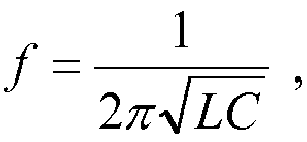
-
Fig. 5B is a schematic diagram of some elements of the system ofFig. 5A . Some of the reference numbers identify the corresponding elements ofFig. 5A .Inductance 48 represents the inductance of the target material of thecookware 16 ofFig. 5A . Resonant circuit 34' ofFig. 5A is represented inFig. 5B as aninductance 41 and acapacitance 43. Receiver coil 32' ofFig. 5A is represented as aninductance 33, anoise filter 35, and anamplifier 37. - In operation, the
induction coil 4 is powered at a very low power level so that that thecoil 4 radiates at a fundamental frequency (for example 30 kHz) and also radiates harmonic and noise spectra. Typically, the receiver coil 32' detects a reference signal level of about -60dB atoutput terminal 47. However, the noise at the resonance frequency of the resonant circuit 34' causes the resonant circuit 34' to radiate at the resonant frequency, in this example 1 MHz, many times greater in magnitude than the magnitude of the noise at that frequency. So at 1 MHz, the receiver coil 32' detects a reference signal of -30dB atoutput terminal 47, providing a binary identification of thecookware 4. A specific identification scheme (or a more robust binary identification system) could be developed by providing additional resonant circuits with different resonance frequencies. - Using an identification method that includes an
identifier 34 or 34', such as an RFID tag or a resonant coil, is particularly suited to use with cool cookware. The heat tolerance of the identifier does not need to be a consideration and the identifier can be positioned anywhere on a cool surface. For example, the identifier can be centered on the bottom surface of the cookware. When used with conventional induction cooking cookware, an identifier would either need to be heat tolerant or would need to be placed in a location that is cool in use, for example in a handle. Placing the identifier in a handle is undesirable because a handle is typically several centimeters from the cooktop and therefore from the identification circuitry and because the handle, in use, may be in different orientations relative to the identification circuitry. - In the implementation of
FIG. 6 , thecookware identifier circuitry 8 includes a reactance (capacitive impedance)detector 42. Thereactance detector 42 is operationally coupled to thecookware 16 as indicated byline 140. - As described in
U.S. Patent App. 12/031,214 ,U.S. Pat. App. 12/031,220 or inU.S. Pat. 12/031,226 outer surface 44 and the cookware conductive layer. The cooktop may be made of different material and have different dimensions than cooktops of conventional induction cooking systems because cooktops designed for usage with cool cookware do not need to be as heat resistant as cooktops designed for usage with conventional cookware. The combined effect of the non-conductive layers (which may include a vacuum or inert gas layer) may mean that the conductive layer of the cookware is farther from the induction coil than conventional induction cooking cookware, which also affects reactance. The different reactance of cool cookware system components permits an induction cooking system as shown inFig. 6 to use areactance detector 42 as a cookware identifier. -
Fig. 7A shows a cutaway diagrammatic view of some elements ofFig. 6 in greater detail. The cookware has aconductive layer 46 of a material suitable for induction cooking and may have anouter layer 44 of a dielectric material. The cookware may have intervening layers represented bylayer 48, for example vacuum layers, inert gas layers, and reflective layers as described inU.S. Patent App. 12/031,214 ,U.S. Pat. App. 12/031,220 or inU.S. Pat. 12/031,226 reactance detector 42,reactance sensing targets reactance guard rings cooktop 14 is between the reactance sensing targets and theconductive layer 46. Collectively, layers betweensensing targets conductive layer 46, in thisview cooktop 14,outer layer 44, and interveninglayers 48, are referred to inFig. 7D below ascollective layer 50. The coupling of the reactance detector and thereactance guard rings Fig. 7E . -
Fig. 7B shows a diagrammatic view of thereactance sensing target guard rings indicator 51 ofFIG. 7A . Theguard ring sensing target path 52 ofFig. 7A . -
Fig. 7C shows the equivalent electrical circuit of the arrangement ofFIG. 7A . The reference numbers with the " ' " (prime) indicator refer to the electrical equivalent of the like numbered elements ofFIGS. 7A and7B . The circuit is equivalent to two capacitors in series, each with a capacitance of C50'. As shown inFig. 7D , the two capacitors in series can be represented by asingle capacitance 54, with a capacitance CP of
capacitance 54 has a reactance signature substantially different than the reactance signature of the equivalent circuit of a cookware item that does not have the physical features shown inFIG. 7A , or in which the metal layer is a different distance from the cooktop. An element of cookware according to the arrangement ofFig. 7A can therefore be identified by its reactance pattern. - In
Figs. 7A - 7D ,reactance detector 42 is shown as a functional block in a block diagram. One circuit for measuring the reactance is shown schematically inFigs. 7E .Current sensor 42 includes asinusoidal voltage source 54A coupled tocapacitance target 38A andsinusoidal voltage source 54B coupled tocapacitance target 38B with the polarity reversed from the coupling ofvoltage source 54A andcapacitance target 38A. The current inleads current sensors element 58 to provide a sensed current Isense. The capacitance can then be determined according to
- In the implementation of
FIG. 8 , one or morepermanent magnets 62 are embedded in, or attached to, thecookware 16. Thepermanent magnets 62 result in the existence of a DC magnetic field, that is a magnetic field that is time independent. Thecookware identifier circuitry 8 includes a DCmagnetic field detector 63. The DCmagnetic field detector 63 is operationally coupled to thepermanent magnets 62 as indicated bylines 64. The DC magnetic field detector may include, for example, one or more Hall Effect sensors. An implementation including more than onepermanent magnet 62 with varying size, geometry and magnetic field strength and including more than one Hall Effect sensor permits a more reliable, robust, and sophisticated identification of the cookware. For an implementation using permanent magnets, it is desirable to select the magnetic material and other system components so that thepermanent magnets 62 do not perturb AC parameters and thereby overheat. For example, the magnetic material should have low resistivity so that eddy currents do not form in the permanent magnets. - Some of the identification methods described above may be prone to misidentification, either due to "spoofing", that is, intentionally designing an item of cookware so that it is mistakenly identified, or due to coincidental similarity or due to an item of non-cool cookware coincidentally having similar material characteristics to cool cookware. For example, if the identification system is the reactance measuring system described in
Figs. 6 and7 , an item of non-cool cookware could be designed so that it has a reactance that is similar to an item of cool cookware or it could coincidentally have a similar reactance. The probability of misidentification can be alleviated by using more than one method of identification, for example, the reactance method ofFigs. 6 - 7B and in addition, determining the resonant frequency of a resonant coil in the item of cookware, as described inFigs. 5A and 5B . - A number of embodiments of the invention have been described. Modification may be made without departing from the scope of the invention, and accordingly, other embodiments are in the claims.
Claims (9)
- An induction cooking system comprising:an induction hob (14) with a control system (6);an induction coil (4) for heating cookware; anda cookware identifier (8) comprising a radio frequency (RF) communication circuit (32);
whereinthe cookware identifier is configured to identify whether an item of cookware (16) is of a type wherein the temperature of the outer surface of the cookware is, in use, significantly lower than the temperature of the inner surface of the cookware,in response to the cookware identifier determining that an item of cookware is of the described type, the control system is configured to provide full power to the induction coil, andin response to the cookware identifier determining that an item of cookware is not of the described type, the control system is configured to provide no power or limit the maximum power that is applied to the induction coil. - The induction cooking system of claim 1, wherein
in response to the cookware identifier (8) determining that an item of cookware (16) is not of the described type and is not suitable for induction cooking, the control system is configured to provide no power to the induction coil, and
in response to the cookware identifier determining that an item of cookware is not of the described type but is suitable for induction cooking, the control system is configured to provide to limit the maximum power that is applied to the induction coil to a temperature that permits the item of cookware to heat without causing burns or damage to surfaces of the item of cookware. - The induction cooking system of claim 1 or 2, wherein in response to the cookware identifier (8) determining that an item of cookware (16) is not of the described type, the control system is configured to provide a warning to a user, such as a visual and/or auditory indication that the item of cookware may be hot.
- The induction cooking system of claim 1 wherein the RF communication circuit (32) comprises one or more of an RFID tag reader or a component of a wireless communication system.
- The induction cooking system of claim 1 wherein the RF communication circuit (32) determines that the item of cookware (16) is of the specified type by receiving a binary indication.
- The induction cooking system of claim 1 wherein the RF communication circuit (32) determines that the item of cookware (16) is of the specified type by receiving an identification of the make or model of the cookware.
- The induction cooking system of claim 1 wherein the RF communication circuit (32) comprises the induction coil and a receiver coil, wherein the receiver coil interacts with a complementary coil in the cookware and measures whether the coil in the cookware has a characteristic inductance and resonant frequency that specifically indicate to the induction cooking system that the item of cookware is of the specified type, when the coil in the cookware is energized by the induction coil.
- The induction cooking system of claim 7 wherein if the cookware further comprises a second resonant coil, wherein the second coil has a second resonant frequency different from that of the first coil, the identification circuit determines additional information about the cookware from the second resonant frequency.
- The induction cooking system of claim 1, further comprising an item of cookware (16).
Applications Claiming Priority (2)
| Application Number | Priority Date | Filing Date | Title |
|---|---|---|---|
| US12/335,787 US20100147832A1 (en) | 2008-12-16 | 2008-12-16 | Induction cookware identifying |
| PCT/US2009/066320 WO2010074898A1 (en) | 2008-12-16 | 2009-12-02 | Induction cookware identifying |
Publications (2)
| Publication Number | Publication Date |
|---|---|
| EP2373201A1 EP2373201A1 (en) | 2011-10-12 |
| EP2373201B1 true EP2373201B1 (en) | 2017-05-31 |
Family
ID=41664928
Family Applications (1)
| Application Number | Title | Priority Date | Filing Date |
|---|---|---|---|
| EP09764678.0A Revoked EP2373201B1 (en) | 2008-12-16 | 2009-12-02 | Induction cookware identifying |
Country Status (4)
| Country | Link |
|---|---|
| US (1) | US20100147832A1 (en) |
| EP (1) | EP2373201B1 (en) |
| CN (1) | CN102281801A (en) |
| WO (1) | WO2010074898A1 (en) |
Cited By (3)
| Publication number | Priority date | Publication date | Assignee | Title |
|---|---|---|---|---|
| DE102017114951A1 (en) * | 2017-07-05 | 2019-01-10 | Miele & Cie. Kg | Method for operating a hob of an induction hob with a cookware |
| DE102017114956A1 (en) * | 2017-07-05 | 2019-01-10 | Miele & Cie. Kg | Method for operating a hob of an induction hob with a cookware |
| DE102019104011A1 (en) * | 2019-02-18 | 2020-08-20 | Miele & Cie. Kg | Method for the automatic assignment of an installation device to a hotplate of an inductive hob, installation device and system for carrying out the method |
Families Citing this family (46)
| Publication number | Priority date | Publication date | Assignee | Title |
|---|---|---|---|---|
| US9226343B2 (en) * | 2007-11-30 | 2015-12-29 | Nuwave, Llc | Apparatus, system, method and computer program product for precise multistage programmable induction cooktop |
| ES2356780B1 (en) * | 2009-01-20 | 2012-03-13 | Bsh Electrodomésticos España, S.A. | COOKING FIELD WITH AT LEAST ONE HEATING AREA OF VARIOUS HEATING ELEMENTS. |
| DE102010027833A1 (en) * | 2010-04-15 | 2011-10-20 | E.G.O. Elektro-Gerätebau GmbH | Cooking vessel, heater and cooking system |
| US8598497B2 (en) | 2010-11-30 | 2013-12-03 | Bose Corporation | Cooking temperature and power control |
| US9006622B2 (en) | 2010-11-30 | 2015-04-14 | Bose Corporation | Induction cooking |
| US8602248B2 (en) | 2011-03-02 | 2013-12-10 | Bose Corporation | Cooking utensil |
| US20120285946A1 (en) * | 2011-05-10 | 2012-11-15 | General Electric Company | Utensil quality feedback for induction cooktop |
| US9058552B2 (en) * | 2011-10-26 | 2015-06-16 | International Business Machines Corporation | RFID tag temperature adaptation |
| KR20140109921A (en) * | 2012-01-08 | 2014-09-16 | 액세스 비지니스 그룹 인터내셔날 엘엘씨 | Inductive cooking system |
| US20130175254A1 (en) * | 2012-01-10 | 2013-07-11 | General Electric Company | Cook top appliance having spill and boil-over detection and response |
| US20130214771A1 (en) * | 2012-01-25 | 2013-08-22 | Radiation Monitoring Devices, Inc. | Systems and methods for inspecting structures including pipes and reinforced concrete |
| US9066373B2 (en) * | 2012-02-08 | 2015-06-23 | General Electric Company | Control method for an induction cooking appliance |
| ES2430039B1 (en) * | 2012-05-11 | 2014-10-02 | Bsh Electrodomésticos España, S.A. | Cooking appliance with a heating unit |
| US9470423B2 (en) | 2013-12-02 | 2016-10-18 | Bose Corporation | Cooktop power control system |
| WO2015124883A1 (en) * | 2014-02-21 | 2015-08-27 | Morphy Richards Limited | Magnetic method for determining a cooking appliance characteristic |
| FR3018110B1 (en) * | 2014-02-28 | 2019-08-23 | Seb S.A. | COMMUNICATING INDUCTION COOKTOP AND METHOD OF SEARCHING AND FOLLOWING A CULINARY ARTICLE COMMUNICATING ON THE SAME |
| US20150334785A1 (en) * | 2014-05-15 | 2015-11-19 | Cooktek Induction Systems, Llc | Menu-based cooking appliance |
| EP2945462B1 (en) | 2014-05-16 | 2017-03-22 | Electrolux Appliances Aktiebolag | Method and device for providing a unique identifier to a hob induction coil |
| FR3028405B1 (en) * | 2014-11-14 | 2016-11-25 | Seb Sa | COOKING CONTAINER HAVING A MAGNETIC MEASURING TEMPERATURE DEVICE |
| US20170071034A1 (en) * | 2015-09-09 | 2017-03-09 | Cooktek Induction Systems, Llc | Induction holding, warming, and cooking system having in-unit magnetic control |
| FR3041518B1 (en) * | 2015-09-29 | 2017-10-20 | Seb Sa | COOKING CONTAINER HAVING AN ENERGY RECOVERY DEVICE |
| CN106604432A (en) * | 2015-10-20 | 2017-04-26 | 奇想生活股份有限公司 | Food heating treatment device capable of receiving wireless electromagnetic energy |
| EP3384813B1 (en) * | 2017-04-03 | 2020-02-26 | Electrolux Appliances Aktiebolag | Cooking vessel for an induction cooking hob |
| CN109407723B (en) * | 2017-08-16 | 2021-11-16 | 佛山市顺德区美的电热电器制造有限公司 | Heating platform, appliance and control method of heating platform |
| CN109393935A (en) * | 2017-08-16 | 2019-03-01 | 佛山市顺德区美的电热电器制造有限公司 | Cooking apparatus, cooking control method and computer installation |
| CN109413786A (en) * | 2017-08-16 | 2019-03-01 | 佛山市顺德区美的电热电器制造有限公司 | The control method of heating platform, utensil, cooking apparatus and heating platform |
| CN109419313B (en) * | 2017-09-05 | 2021-05-07 | 佛山市顺德区美的电热电器制造有限公司 | Electric cooker and heating control method therefor |
| DE102017123505A1 (en) | 2017-10-10 | 2019-04-11 | Miele & Cie. Kg | Induction cookware for use on an induction hob, induction cookware system and method for limiting power in a system |
| CN109691869B (en) * | 2017-10-24 | 2020-02-28 | 佛山市顺德区美的电热电器制造有限公司 | Split cooking appliance and control method thereof |
| JP6843267B2 (en) * | 2017-11-08 | 2021-03-17 | 三菱電機株式会社 | Induction heating cooker |
| KR102049864B1 (en) * | 2018-02-08 | 2019-11-28 | 엘지전자 주식회사 | Cooking appliance |
| CN110312335A (en) * | 2018-03-20 | 2019-10-08 | 佛山市顺德区美的电热电器制造有限公司 | Cookware material detection circuit, cooking apparatus and the method for detecting cookware material |
| ES2729717A1 (en) * | 2018-05-04 | 2019-11-05 | Bsh Electrodomesticos Espana Sa | Induction power transmission system. |
| ES2736025A1 (en) * | 2018-06-21 | 2019-12-23 | Bsh Electrodomesticos Espana Sa | Cooking system (Machine-translation by Google Translate, not legally binding) |
| FR3084806B1 (en) * | 2018-08-01 | 2023-11-03 | Seb Sa | AUTOMATIC PAIRING METHOD FOR COMMUNICATION BETWEEN A CULINARY ITEM AND A HOB OF AN INDUCTION COOKING HOB |
| DE102018119965A1 (en) * | 2018-08-16 | 2020-02-20 | Miele & Cie. Kg | Method for automatically assigning at least one set-up device to at least one hotplate of an inductive hob and system for carrying out the method |
| CN111550834B (en) * | 2019-02-12 | 2024-06-28 | 陈景超 | Temperature measurement module of gas stove and control method |
| GB201909384D0 (en) * | 2019-06-28 | 2019-08-14 | Nicoventures Trading Ltd | Apparatus for an aerosol generating device |
| KR102805226B1 (en) * | 2019-08-13 | 2025-05-12 | 엘지전자 주식회사 | Method for distinguishing container of blender and the same blender |
| CN112393280A (en) * | 2019-08-19 | 2021-02-23 | 广东美的白色家电技术创新中心有限公司 | Electromagnetic cooking bench and control method thereof |
| KR102927795B1 (en) * | 2019-11-05 | 2026-02-13 | 엘지전자 주식회사 | Wireless power transfer cooktop device and method |
| GB2597762A (en) * | 2020-08-04 | 2022-02-09 | Njori Ltd | Induction cooker |
| KR102912692B1 (en) * | 2020-12-30 | 2026-01-14 | 엘지전자 주식회사 | Induction heating type cooktop and operating method thereof |
| JP2022111547A (en) * | 2021-01-20 | 2022-08-01 | タイガー魔法瓶株式会社 | electrical equipment |
| DE102021103594A1 (en) | 2021-02-16 | 2022-08-18 | Miele & Cie. Kg | Kitchen utensil for placing on an induction hob |
| US12449132B2 (en) | 2022-03-29 | 2025-10-21 | Haier Us Appliance Solutions, Inc. | Matching a cooking surface size to appropriate cookware and cooking appliance implementing the same |
Citations (22)
| Publication number | Priority date | Publication date | Assignee | Title |
|---|---|---|---|---|
| US3742178A (en) | 1971-12-29 | 1973-06-26 | Gen Electric | Induction cooking appliance including cooking vessel having means for wireless transmission of temperature data |
| US3777094A (en) | 1971-09-09 | 1973-12-04 | Environment One Corp | Thermally insulated cookware for dynamic induction field heating and cooking apparatus |
| US3979572A (en) | 1974-10-29 | 1976-09-07 | Mitsubishi Denki Kabushiki Kaisha | Induction heating apparatus |
| DE2551187A1 (en) | 1975-11-14 | 1977-05-18 | Karl Fischer | Saucepan with butt-welded seamless base - has tubular sheet metal butt welded jacket |
| US4523083A (en) | 1981-07-29 | 1985-06-11 | Hamilton-Dunn Research Co. | Beverage warmer |
| DE4227395C2 (en) | 1992-08-19 | 1996-11-14 | Amc Int Alfa Metalcraft Corp | Cooking vessel |
| DE19714701A1 (en) | 1997-04-09 | 1998-10-15 | Innovat Ges Fuer Sondermaschin | Device for induction heating of cooking pans for use with domestic cookers |
| WO2001019141A1 (en) * | 1999-09-07 | 2001-03-15 | Thermal Solutions, Inc. | Method and apparatus for magnetic induction heating using radio frequency identification of object to be heated |
| US6274856B1 (en) | 1998-05-19 | 2001-08-14 | Thermal Solutions, Inc. | Temperature self-regulating food delivery system |
| EP1420613A2 (en) | 2002-11-15 | 2004-05-19 | Electrolux Home Products Corporation N.V. | Method and device of thermal monitoring of inductive heatable cooking vessel |
| US20040149736A1 (en) * | 2003-01-30 | 2004-08-05 | Thermal Solutions, Inc. | RFID-controlled smart induction range and method of cooking and heating |
| EP0883327B1 (en) | 1997-06-03 | 2004-09-08 | Diehl AKO Stiftung & Co. KG | Arrangement for wirelessly transmitting the temperature and for detecting the presence of cookware on a cooktop |
| DE10315217A1 (en) | 2003-04-01 | 2004-10-14 | E.G.O. Elektro-Gerätebau GmbH | A cooker ceramic hob unit has indicator units which show whether a cooking pot is displaced or is of unsuitable material |
| EP1708545A2 (en) | 2005-03-31 | 2006-10-04 | BSH Bosch und Siemens Hausgeräte GmbH | Induction heating apparatus |
| DE102005023468A1 (en) | 2005-05-20 | 2006-11-30 | Electrolux Home Products Corporation N.V. | Cooking device with temperature sensing device |
| JP2007134257A (en) | 2005-11-14 | 2007-05-31 | Matsushita Electric Ind Co Ltd | Induction heating cooker |
| WO2007082172A2 (en) | 2006-01-05 | 2007-07-19 | Imura International U.S.A. Inc. | Radio frequency identification controlled heatable objects, systems and system components, and methods of making the same |
| WO2007107888A2 (en) | 2006-03-23 | 2007-09-27 | Access Business Group International Llc | System and method for food preparation |
| DE102006014818A1 (en) | 2006-03-29 | 2007-10-11 | Electrolux Home Products Corporation N.V. | Device for preparing and / or keeping warm food |
| DE102006017800A1 (en) | 2006-04-18 | 2007-11-15 | BSH Bosch und Siemens Hausgeräte GmbH | Power transmission unit |
| US20070263699A1 (en) | 2006-05-09 | 2007-11-15 | Thermal Solutions, Inc. | Magnetic element temperature sensors |
| US20090065497A1 (en) | 2007-09-07 | 2009-03-12 | Bose Corporation | Induction cookware |
Family Cites Families (101)
| Publication number | Priority date | Publication date | Assignee | Title |
|---|---|---|---|---|
| US2321587A (en) * | 1940-05-10 | 1943-06-15 | Davie | Electrical conductive coating |
| CH421237A (en) * | 1964-02-05 | 1966-09-30 | Ebauches Sa | Proximity detector |
| US3509469A (en) * | 1967-05-17 | 1970-04-28 | Nasa | Position sensing device employing misaligned magnetic field generating and detecting apparatus |
| US3587040A (en) * | 1968-08-12 | 1971-06-22 | Qonaar Corp | Vehicle detector |
| US3530499A (en) * | 1969-09-29 | 1970-09-22 | Charles F Schroeder | Electrically heated appliance unit |
| US3740513A (en) * | 1971-09-23 | 1973-06-19 | Environment One Corp | Improved consumer oriented combined counter and cooking unit using induction heating |
| US3742174A (en) * | 1971-12-29 | 1973-06-26 | Gen Electric | Induction cooking appliance including cooking vessel having means for transmission of temperature data by light pulses |
| US3761668A (en) * | 1972-03-01 | 1973-09-25 | Gen Electric | Small electrical apparatus powered by induction cooking appliances |
| US3745290A (en) * | 1972-03-01 | 1973-07-10 | Gen Electric | Inductively heatable utensils or vessels for heating,serving and storing food |
| US3966426A (en) * | 1972-03-24 | 1976-06-29 | White-Westinghouse Corporation | Cooking vessel for use with induction heating cooking unit |
| US3775577A (en) * | 1972-04-20 | 1973-11-27 | Environment One Corp | Induction cooking apparatus having pan safety control |
| US3843857A (en) * | 1972-05-26 | 1974-10-22 | R Cunningham | Induction heating system primarily intended for cooking use |
| US3781505A (en) * | 1972-06-28 | 1973-12-25 | Gen Electric | Constant duty cycle control of induction cooking inverter |
| US3781506A (en) * | 1972-07-28 | 1973-12-25 | Gen Electric | Non-contacting temperature measurement of inductively heated utensil and other objects |
| US3782222A (en) * | 1972-10-10 | 1974-01-01 | J Berggren | Counterbalancing assembly for air motivated device |
| US3973105A (en) * | 1973-10-24 | 1976-08-03 | Mitsubishi Denki Kabushiki Kaisha | Protective device for induction heating apparatus |
| JPS5421983B2 (en) * | 1974-02-05 | 1979-08-03 | ||
| US3873964A (en) * | 1974-02-19 | 1975-03-25 | Indicator Controls Corp | Vehicle detection |
| US4020310A (en) * | 1975-03-20 | 1977-04-26 | Souder Jr James J | Container for inductively heating food |
| US4043859A (en) * | 1975-03-31 | 1977-08-23 | Bell & Howell Company | Label applying machine |
| US4013859A (en) * | 1975-06-04 | 1977-03-22 | Environment/One Corporation | Induction cooking unit having cooking load sensing device and essentially zero stand-by power loss |
| GB1588531A (en) * | 1977-01-11 | 1981-04-23 | Redland Automation Ltd | Vehicle detection |
| US4169222A (en) * | 1977-07-26 | 1979-09-25 | Rangaire Corporation | Induction cook-top system and control |
| US4276539A (en) * | 1978-06-22 | 1981-06-30 | U.S. Philips Corporation | Vehicle detection systems |
| DE2906912A1 (en) * | 1979-02-22 | 1980-09-04 | Sachs Systemtechnik Gmbh | COOKING VESSEL FOR AN INDUCTION COOKER |
| US4263549A (en) * | 1979-10-12 | 1981-04-21 | Corcom, Inc. | Apparatus for determining differential mode and common mode noise |
| US4334135A (en) * | 1980-12-22 | 1982-06-08 | General Electric Company | Utensil location sensor for induction surface units |
| US4404459A (en) * | 1981-10-19 | 1983-09-13 | The Bendix Corporation | Housing and mounting assembly providing a temperature stabilized environment for a microcircuit |
| US4472706A (en) * | 1981-11-30 | 1984-09-18 | Hodge Patrick M | Vehicle presence loop detector |
| US4568937A (en) * | 1982-06-03 | 1986-02-04 | Microsense Systems, Limited | Induction loop vehicle detector |
| EP0113710A1 (en) * | 1982-07-16 | 1984-07-25 | Marriott Mclellan Limited | Compact electric guitar |
| NO152483C (en) * | 1982-12-14 | 1985-10-09 | Ardal Og Sunndal Verk | STAINLESS STEEL KITCHEN FOR ALL TYPES OF HEATING SOURCES |
| US4873494A (en) * | 1983-03-16 | 1989-10-10 | Sarasota Automation Limited | Inductive loop presence detector with cross talk filter |
| JPS603693U (en) * | 1983-06-20 | 1985-01-11 | 株式会社日本アルミ | Pot for induction cooker |
| US4579080A (en) * | 1983-12-09 | 1986-04-01 | Applied Materials, Inc. | Induction heated reactor system for chemical vapor deposition |
| FR2563368B1 (en) * | 1984-04-20 | 1987-06-19 | Jeumont Schneider | METHOD FOR THERMAL COMPENSATION OF A MAGNETIC CIRCUIT |
| US4541411A (en) * | 1984-07-10 | 1985-09-17 | Ga Technologies Inc. | Graphite composite cookware |
| US4646935A (en) * | 1985-01-18 | 1987-03-03 | Clad Metals, Inc. | Induction cooking utensils |
| DE3544809A1 (en) * | 1985-10-02 | 1987-04-02 | Turck Werner Kg | MAGNETIC-DEPENDENT, ELECTRONIC PROXIMITY SWITCH |
| CH667790A5 (en) * | 1985-10-31 | 1988-11-15 | Kuhn Heinrich Metall | COOKING POT. |
| JPH0612699B2 (en) * | 1985-11-27 | 1994-02-16 | 株式会社東芝 | Induction heating cooker |
| CH672383A5 (en) * | 1986-10-29 | 1989-11-15 | Baumer Electric Ag | |
| JPS63134965A (en) * | 1986-11-11 | 1988-06-07 | シーメンス、アクチエンゲゼルシヤフト | Method of measuring electric oscillation circuit |
| US4820891A (en) * | 1986-11-29 | 1989-04-11 | Kabushiki Kaisha Toshiba | Induction heated cooking apparatus |
| US5280435A (en) * | 1987-05-08 | 1994-01-18 | Baumer Electric Ag | Identification system having a plurality of devices for reading, writing and recognizing a code and a plurality of code carriers and associated process |
| US5643485A (en) * | 1988-04-15 | 1997-07-01 | Midwest Research Institute | Cooking utensil with improved heat retention |
| JPH0650557B2 (en) * | 1989-07-04 | 1994-06-29 | 株式会社日立製作所 | Field instrument communication method |
| US5386102A (en) * | 1989-12-14 | 1995-01-31 | Mitsubishi Denki Kabushiki Kaisha | Cooker |
| US5150272A (en) * | 1990-03-06 | 1992-09-22 | Intersonics Incorporated | Stabilized electromagnetic levitator and method |
| US5198764A (en) * | 1991-02-22 | 1993-03-30 | Sentech Corp. | Position detector apparatus and method utilizing a transient voltage waveform processor |
| US5153525A (en) * | 1991-06-17 | 1992-10-06 | Minnesota Mining And Manufacturing Company | Vehicle detector with series resonant oscillator drive |
| US5361064A (en) * | 1991-06-17 | 1994-11-01 | Minnesota Mining And Manufacturing Company | Vehicle detector with power main noise compensation |
| US5273151A (en) * | 1992-03-23 | 1993-12-28 | Duncan Industries Parking Control Systems Corp. | Resonant coil coin detection apparatus |
| DK105192A (en) * | 1992-08-24 | 1994-04-22 | Voss Ernst Fab As | Appliance for heating food preparation vessels. |
| US5457391A (en) * | 1992-09-03 | 1995-10-10 | Nec Corporation | Load short-circuit detection using AWH-bridge driving circuit and an exclusive-OR gate |
| US5455768A (en) * | 1992-11-06 | 1995-10-03 | Safetran Traffic Systems, Inc. | System for determining vehicle speed and presence |
| US5491475A (en) * | 1993-03-19 | 1996-02-13 | Honeywell Inc. | Magnetometer vehicle detector |
| JP2634771B2 (en) * | 1993-06-16 | 1997-07-30 | 日本冶金工業株式会社 | Container for electromagnetic cooker and method of manufacturing the same |
| DE4427549C2 (en) * | 1994-08-04 | 1997-03-20 | Weiss Electronic Elektronische | Method and device for determining the speed of vehicles |
| US5523753A (en) * | 1994-09-12 | 1996-06-04 | Minnesota Mining And Manufacturing Company | Vehicle detector system with periodic source filtering |
| US5770837A (en) * | 1994-11-18 | 1998-06-23 | Sumitomo Electric Industries, Ltd. | Metal plate for electromagnetic heating |
| US5648008A (en) * | 1994-11-23 | 1997-07-15 | Maytag Corporation | Inductive cooking range and cooktop |
| DK42495A (en) * | 1995-04-07 | 1996-10-08 | Electrolux Ab | Surface for induction cooker |
| DE19603845B4 (en) * | 1996-02-05 | 2010-07-22 | E.G.O. Elektro-Gerätebau GmbH | Electric radiant heater with an active sensor for cooking vessel detection |
| US6621410B1 (en) * | 1996-08-26 | 2003-09-16 | Rf Code, Inc. | System for item and orientation identification |
| US6208235B1 (en) * | 1997-03-24 | 2001-03-27 | Checkpoint Systems, Inc. | Apparatus for magnetically decoupling an RFID tag |
| US5844502A (en) * | 1997-07-22 | 1998-12-01 | Elite Access Systems, Inc. | Temperature-compensated object sensing device and method therefor |
| US6054697A (en) * | 1997-07-26 | 2000-04-25 | Pizza Hut, Inc. | Pizza pan shielding systems and methods |
| KR100319651B1 (en) * | 1997-09-24 | 2002-03-08 | 마스다 노부유키 | Automatic plate bending system using high frequency induction heating |
| JPH11134623A (en) * | 1997-10-30 | 1999-05-21 | Sony Corp | Head short detection circuit |
| US6316753B2 (en) * | 1998-05-19 | 2001-11-13 | Thermal Solutions, Inc. | Induction heating, temperature self-regulating |
| US6072383A (en) * | 1998-11-04 | 2000-06-06 | Checkpoint Systems, Inc. | RFID tag having parallel resonant circuit for magnetically decoupling tag from its environment |
| DE19859105A1 (en) * | 1998-12-21 | 2000-06-29 | Ego Elektro Geraetebau Gmbh | Arrangement for controlling electrically controllable devices, in particular electric cooking devices |
| US6573706B2 (en) * | 1999-11-18 | 2003-06-03 | Intellijoint Systems Ltd. | Method and apparatus for distance based detection of wear and the like in joints |
| US6605368B2 (en) * | 1999-12-21 | 2003-08-12 | Laura Lisa Smith | Cookware vessel |
| AU769037B2 (en) * | 2000-01-05 | 2004-01-15 | Inductive Signature Technologies, Inc. | Method and apparatus for active isolation in inductive loop detectors |
| AU2001247195A1 (en) * | 2000-01-31 | 2001-08-07 | Board Of Regents, The University Of Texas System | Method and system for collecting and transmitting chemical information |
| US6384387B1 (en) * | 2000-02-15 | 2002-05-07 | Vesture Corporation | Apparatus and method for heated food delivery |
| US6474499B2 (en) * | 2000-05-03 | 2002-11-05 | Eastman Chemical Company | Container base cup having reduced heat gain |
| EP1325666A4 (en) * | 2000-08-18 | 2007-03-21 | Luxine Inc | Induction heating and control system and method with high reliability and advanced performance features |
| IT1319079B1 (en) * | 2000-11-02 | 2003-09-23 | Inoxia S R L | STAINLESS STEEL COOKING CONTAINER WITH CAPSULAR BOTTOM HEATED BY MAGNETIC INDUCTION |
| WO2003003412A2 (en) * | 2001-06-29 | 2003-01-09 | Inductive Signature Technologies, Inc. | Inductive signature measurement circuit |
| DE10135270A1 (en) * | 2001-07-13 | 2003-01-23 | Ego Elektro Geraetebau Gmbh | Electric radiant heater with an active sensor for cooking vessel detection |
| US6650111B2 (en) * | 2001-07-18 | 2003-11-18 | Eaton Corporation | Pulsed excited proximity sensor |
| US6750433B2 (en) * | 2001-11-29 | 2004-06-15 | General Electric Company | Oven display and user interface |
| WO2003077599A1 (en) * | 2002-03-12 | 2003-09-18 | Matsushita Electric Industrial Co., Ltd. | Induction heating device |
| DE10212929A1 (en) * | 2002-03-19 | 2003-10-02 | Ego Elektro Geraetebau Gmbh | Control device for an electrical device |
| US6894255B2 (en) * | 2002-03-22 | 2005-05-17 | Matsushita Electric Industrial Co., Ltd. | Induction heating apparatus |
| US20030209154A1 (en) * | 2002-05-13 | 2003-11-13 | Park Jong Peter | Fluid path in a double layered cooking apparatus |
| JP2004017994A (en) * | 2002-06-13 | 2004-01-22 | Thermos Kk | Insulated container and method for manufacturing the same |
| US6956188B2 (en) * | 2002-12-06 | 2005-10-18 | General Electric Company | Induction heating coil with integrated resonant capacitor and method of fabrication thereof, and induction heating system employing the same |
| US7086593B2 (en) * | 2003-04-30 | 2006-08-08 | The United States Of America As Represented By The Administrator Of The National Aeronautics And Space Administration | Magnetic field response measurement acquisition system |
| DE10335133A1 (en) * | 2003-07-31 | 2005-03-03 | Pepperl + Fuchs Gmbh | Device and method for detecting the path of a target object |
| KR20050052082A (en) * | 2003-11-29 | 2005-06-02 | Samsung Electronics Co Ltd | A composite cooking apparatus |
| KR20050052081A (en) * | 2003-11-29 | 2005-06-02 | Samsung Electronics Co Ltd | A composite cooking apparatus |
| US6920411B2 (en) * | 2003-12-04 | 2005-07-19 | Eaton Corporation | Method for configuring an operational characteristic of a proximity sensor |
| US7551058B1 (en) * | 2003-12-10 | 2009-06-23 | Advanced Design Consulting Usa, Inc. | Sensor for monitoring environmental parameters in concrete |
| US7069090B2 (en) * | 2004-08-02 | 2006-06-27 | E.G.O. North America, Inc. | Systems and methods for providing variable output feedback to a user of a household appliance |
| US7299652B2 (en) * | 2004-08-16 | 2007-11-27 | Gagnon Francois | Self-contained gel insulated container |
| US7681342B2 (en) * | 2006-05-05 | 2010-03-23 | Lung Wai Choi | Induction ironing apparatus and method |
| US8796598B2 (en) * | 2007-09-07 | 2014-08-05 | Bose Corporation | Induction cookware |
-
2008
- 2008-12-16 US US12/335,787 patent/US20100147832A1/en not_active Abandoned
-
2009
- 2009-12-02 EP EP09764678.0A patent/EP2373201B1/en not_active Revoked
- 2009-12-02 WO PCT/US2009/066320 patent/WO2010074898A1/en not_active Ceased
- 2009-12-02 CN CN2009801545864A patent/CN102281801A/en active Pending
Patent Citations (24)
| Publication number | Priority date | Publication date | Assignee | Title |
|---|---|---|---|---|
| US3777094A (en) | 1971-09-09 | 1973-12-04 | Environment One Corp | Thermally insulated cookware for dynamic induction field heating and cooking apparatus |
| US3742178A (en) | 1971-12-29 | 1973-06-26 | Gen Electric | Induction cooking appliance including cooking vessel having means for wireless transmission of temperature data |
| US3979572A (en) | 1974-10-29 | 1976-09-07 | Mitsubishi Denki Kabushiki Kaisha | Induction heating apparatus |
| DE2551187A1 (en) | 1975-11-14 | 1977-05-18 | Karl Fischer | Saucepan with butt-welded seamless base - has tubular sheet metal butt welded jacket |
| US4523083A (en) | 1981-07-29 | 1985-06-11 | Hamilton-Dunn Research Co. | Beverage warmer |
| DE4227395C2 (en) | 1992-08-19 | 1996-11-14 | Amc Int Alfa Metalcraft Corp | Cooking vessel |
| DE19714701A1 (en) | 1997-04-09 | 1998-10-15 | Innovat Ges Fuer Sondermaschin | Device for induction heating of cooking pans for use with domestic cookers |
| EP0883327B1 (en) | 1997-06-03 | 2004-09-08 | Diehl AKO Stiftung & Co. KG | Arrangement for wirelessly transmitting the temperature and for detecting the presence of cookware on a cooktop |
| US6274856B1 (en) | 1998-05-19 | 2001-08-14 | Thermal Solutions, Inc. | Temperature self-regulating food delivery system |
| WO2001019141A1 (en) * | 1999-09-07 | 2001-03-15 | Thermal Solutions, Inc. | Method and apparatus for magnetic induction heating using radio frequency identification of object to be heated |
| DE60029600T2 (en) | 1999-09-07 | 2007-07-26 | Thermal Solutions, Inc., Wichita | METHOD AND DEVICE FOR MAGNETIC INDUCTION HEATING, PROVIDED WITH A FUNCTION IDENTIFICATION UNIT FOR IDENTIFICATION OF THE GOOD TO BE ROLLED |
| EP1420613A2 (en) | 2002-11-15 | 2004-05-19 | Electrolux Home Products Corporation N.V. | Method and device of thermal monitoring of inductive heatable cooking vessel |
| US20040149736A1 (en) * | 2003-01-30 | 2004-08-05 | Thermal Solutions, Inc. | RFID-controlled smart induction range and method of cooking and heating |
| DE10315217A1 (en) | 2003-04-01 | 2004-10-14 | E.G.O. Elektro-Gerätebau GmbH | A cooker ceramic hob unit has indicator units which show whether a cooking pot is displaced or is of unsuitable material |
| EP1708545A2 (en) | 2005-03-31 | 2006-10-04 | BSH Bosch und Siemens Hausgeräte GmbH | Induction heating apparatus |
| DE102005023468A1 (en) | 2005-05-20 | 2006-11-30 | Electrolux Home Products Corporation N.V. | Cooking device with temperature sensing device |
| JP2007134257A (en) | 2005-11-14 | 2007-05-31 | Matsushita Electric Ind Co Ltd | Induction heating cooker |
| WO2007082172A2 (en) | 2006-01-05 | 2007-07-19 | Imura International U.S.A. Inc. | Radio frequency identification controlled heatable objects, systems and system components, and methods of making the same |
| WO2007107888A2 (en) | 2006-03-23 | 2007-09-27 | Access Business Group International Llc | System and method for food preparation |
| US20070221668A1 (en) | 2006-03-23 | 2007-09-27 | Baarman David W | System and method for food preparation |
| DE102006014818A1 (en) | 2006-03-29 | 2007-10-11 | Electrolux Home Products Corporation N.V. | Device for preparing and / or keeping warm food |
| DE102006017800A1 (en) | 2006-04-18 | 2007-11-15 | BSH Bosch und Siemens Hausgeräte GmbH | Power transmission unit |
| US20070263699A1 (en) | 2006-05-09 | 2007-11-15 | Thermal Solutions, Inc. | Magnetic element temperature sensors |
| US20090065497A1 (en) | 2007-09-07 | 2009-03-12 | Bose Corporation | Induction cookware |
Non-Patent Citations (1)
| Title |
|---|
| "Auszug aus: Der Sprach-Brockhaus: dt. Bildworterbuch von A-Z. - 9., neu be- arbeitete und erweiterte Auflage", BROCKHAUS, 1984, Wiesbaden, XP055467741 |
Cited By (3)
| Publication number | Priority date | Publication date | Assignee | Title |
|---|---|---|---|---|
| DE102017114951A1 (en) * | 2017-07-05 | 2019-01-10 | Miele & Cie. Kg | Method for operating a hob of an induction hob with a cookware |
| DE102017114956A1 (en) * | 2017-07-05 | 2019-01-10 | Miele & Cie. Kg | Method for operating a hob of an induction hob with a cookware |
| DE102019104011A1 (en) * | 2019-02-18 | 2020-08-20 | Miele & Cie. Kg | Method for the automatic assignment of an installation device to a hotplate of an inductive hob, installation device and system for carrying out the method |
Also Published As
| Publication number | Publication date |
|---|---|
| CN102281801A (en) | 2011-12-14 |
| US20100147832A1 (en) | 2010-06-17 |
| WO2010074898A1 (en) | 2010-07-01 |
| EP2373201A1 (en) | 2011-10-12 |
Similar Documents
| Publication | Publication Date | Title |
|---|---|---|
| US20100147832A1 (en) | Induction cookware identifying | |
| CN101965750B (en) | Radio frequency antenna for heating devices | |
| US10727675B2 (en) | Smart table and method for operating the same | |
| KR102887125B1 (en) | Detection of foreign substances in wireless power transfer systems | |
| KR102191406B1 (en) | Induction power transmitter | |
| CA2276304C (en) | Cooktop with a non-metallic hotplate | |
| EP4085509B1 (en) | Systems and methods for dynamically tuning a wireless power transfer system | |
| CN113364064A (en) | Inductive power transmitter | |
| US20090314769A1 (en) | Hob allowing the temperature of a culinary article to be detected | |
| US8231269B2 (en) | Culinary article that allows the detection of its temperature via a cooking plate | |
| JP6328572B2 (en) | Induction heating cooker with non-contact power feeding function and control method thereof | |
| US20130139704A1 (en) | Cooking Vessel, Heating Device and Cooking System | |
| WO2011046993A1 (en) | Induction-based heating appliances employing long wave magnetic communication | |
| US20240244720A1 (en) | Built-in induction system with enhanced safety via smart pad | |
| US20250079909A1 (en) | System for wirelessly transferring energy | |
| CN112393282A (en) | Cooking utensil | |
| EP3914042A1 (en) | Cooking device, cookware and related methods | |
| HK1162894A (en) | Induction cookware identifying | |
| JP6899696B2 (en) | Induction heating cooker | |
| CN118786755A (en) | Object detection technology in multi-function stoves | |
| US6590190B1 (en) | Induction system and safe armature | |
| EP3479650B1 (en) | Temperature measuring device, cooking apparatus and cooking system | |
| HK40107541A (en) | Built-in induction system with enhanced safety via smart pad | |
| CN120457616A (en) | Foreign Object Detection and Friendly Metals |
Legal Events
| Date | Code | Title | Description |
|---|---|---|---|
| PUAI | Public reference made under article 153(3) epc to a published international application that has entered the european phase |
Free format text: ORIGINAL CODE: 0009012 |
|
| 17P | Request for examination filed |
Effective date: 20110706 |
|
| AK | Designated contracting states |
Kind code of ref document: A1 Designated state(s): AT BE BG CH CY CZ DE DK EE ES FI FR GB GR HR HU IE IS IT LI LT LU LV MC MK MT NL NO PL PT RO SE SI SK SM TR |
|
| DAX | Request for extension of the european patent (deleted) | ||
| PUAG | Search results despatched under rule 164(2) epc together with communication from examining division |
Free format text: ORIGINAL CODE: 0009017 |
|
| 17Q | First examination report despatched |
Effective date: 20160722 |
|
| B565 | Issuance of search results under rule 164(2) epc |
Effective date: 20160722 |
|
| GRAP | Despatch of communication of intention to grant a patent |
Free format text: ORIGINAL CODE: EPIDOSNIGR1 |
|
| STAA | Information on the status of an ep patent application or granted ep patent |
Free format text: STATUS: GRANT OF PATENT IS INTENDED |
|
| INTG | Intention to grant announced |
Effective date: 20170124 |
|
| GRAS | Grant fee paid |
Free format text: ORIGINAL CODE: EPIDOSNIGR3 |
|
| GRAA | (expected) grant |
Free format text: ORIGINAL CODE: 0009210 |
|
| STAA | Information on the status of an ep patent application or granted ep patent |
Free format text: STATUS: THE PATENT HAS BEEN GRANTED |
|
| AK | Designated contracting states |
Kind code of ref document: B1 Designated state(s): AT BE BG CH CY CZ DE DK EE ES FI FR GB GR HR HU IE IS IT LI LT LU LV MC MK MT NL NO PL PT RO SE SI SK SM TR |
|
| REG | Reference to a national code |
Ref country code: CH Ref legal event code: EP Ref country code: GB Ref legal event code: FG4D |
|
| REG | Reference to a national code |
Ref country code: AT Ref legal event code: REF Ref document number: 896673 Country of ref document: AT Kind code of ref document: T Effective date: 20170615 |
|
| REG | Reference to a national code |
Ref country code: IE Ref legal event code: FG4D |
|
| REG | Reference to a national code |
Ref country code: DE Ref legal event code: R096 Ref document number: 602009046365 Country of ref document: DE |
|
| REG | Reference to a national code |
Ref country code: NL Ref legal event code: MP Effective date: 20170531 |
|
| REG | Reference to a national code |
Ref country code: LT Ref legal event code: MG4D |
|
| REG | Reference to a national code |
Ref country code: AT Ref legal event code: MK05 Ref document number: 896673 Country of ref document: AT Kind code of ref document: T Effective date: 20170531 |
|
| PG25 | Lapsed in a contracting state [announced via postgrant information from national office to epo] |
Ref country code: LT Free format text: LAPSE BECAUSE OF FAILURE TO SUBMIT A TRANSLATION OF THE DESCRIPTION OR TO PAY THE FEE WITHIN THE PRESCRIBED TIME-LIMIT Effective date: 20170531 Ref country code: AT Free format text: LAPSE BECAUSE OF FAILURE TO SUBMIT A TRANSLATION OF THE DESCRIPTION OR TO PAY THE FEE WITHIN THE PRESCRIBED TIME-LIMIT Effective date: 20170531 Ref country code: HR Free format text: LAPSE BECAUSE OF FAILURE TO SUBMIT A TRANSLATION OF THE DESCRIPTION OR TO PAY THE FEE WITHIN THE PRESCRIBED TIME-LIMIT Effective date: 20170531 Ref country code: FI Free format text: LAPSE BECAUSE OF FAILURE TO SUBMIT A TRANSLATION OF THE DESCRIPTION OR TO PAY THE FEE WITHIN THE PRESCRIBED TIME-LIMIT Effective date: 20170531 Ref country code: NO Free format text: LAPSE BECAUSE OF FAILURE TO SUBMIT A TRANSLATION OF THE DESCRIPTION OR TO PAY THE FEE WITHIN THE PRESCRIBED TIME-LIMIT Effective date: 20170831 Ref country code: GR Free format text: LAPSE BECAUSE OF FAILURE TO SUBMIT A TRANSLATION OF THE DESCRIPTION OR TO PAY THE FEE WITHIN THE PRESCRIBED TIME-LIMIT Effective date: 20170901 Ref country code: ES Free format text: LAPSE BECAUSE OF FAILURE TO SUBMIT A TRANSLATION OF THE DESCRIPTION OR TO PAY THE FEE WITHIN THE PRESCRIBED TIME-LIMIT Effective date: 20170531 |
|
| PG25 | Lapsed in a contracting state [announced via postgrant information from national office to epo] |
Ref country code: NL Free format text: LAPSE BECAUSE OF FAILURE TO SUBMIT A TRANSLATION OF THE DESCRIPTION OR TO PAY THE FEE WITHIN THE PRESCRIBED TIME-LIMIT Effective date: 20170531 Ref country code: LV Free format text: LAPSE BECAUSE OF FAILURE TO SUBMIT A TRANSLATION OF THE DESCRIPTION OR TO PAY THE FEE WITHIN THE PRESCRIBED TIME-LIMIT Effective date: 20170531 Ref country code: SE Free format text: LAPSE BECAUSE OF FAILURE TO SUBMIT A TRANSLATION OF THE DESCRIPTION OR TO PAY THE FEE WITHIN THE PRESCRIBED TIME-LIMIT Effective date: 20170531 Ref country code: BG Free format text: LAPSE BECAUSE OF FAILURE TO SUBMIT A TRANSLATION OF THE DESCRIPTION OR TO PAY THE FEE WITHIN THE PRESCRIBED TIME-LIMIT Effective date: 20170831 Ref country code: IS Free format text: LAPSE BECAUSE OF FAILURE TO SUBMIT A TRANSLATION OF THE DESCRIPTION OR TO PAY THE FEE WITHIN THE PRESCRIBED TIME-LIMIT Effective date: 20170930 |
|
| REG | Reference to a national code |
Ref country code: FR Ref legal event code: PLFP Year of fee payment: 9 |
|
| PG25 | Lapsed in a contracting state [announced via postgrant information from national office to epo] |
Ref country code: EE Free format text: LAPSE BECAUSE OF FAILURE TO SUBMIT A TRANSLATION OF THE DESCRIPTION OR TO PAY THE FEE WITHIN THE PRESCRIBED TIME-LIMIT Effective date: 20170531 Ref country code: CZ Free format text: LAPSE BECAUSE OF FAILURE TO SUBMIT A TRANSLATION OF THE DESCRIPTION OR TO PAY THE FEE WITHIN THE PRESCRIBED TIME-LIMIT Effective date: 20170531 Ref country code: SK Free format text: LAPSE BECAUSE OF FAILURE TO SUBMIT A TRANSLATION OF THE DESCRIPTION OR TO PAY THE FEE WITHIN THE PRESCRIBED TIME-LIMIT Effective date: 20170531 Ref country code: DK Free format text: LAPSE BECAUSE OF FAILURE TO SUBMIT A TRANSLATION OF THE DESCRIPTION OR TO PAY THE FEE WITHIN THE PRESCRIBED TIME-LIMIT Effective date: 20170531 Ref country code: RO Free format text: LAPSE BECAUSE OF FAILURE TO SUBMIT A TRANSLATION OF THE DESCRIPTION OR TO PAY THE FEE WITHIN THE PRESCRIBED TIME-LIMIT Effective date: 20170531 |
|
| REG | Reference to a national code |
Ref country code: DE Ref legal event code: R026 Ref document number: 602009046365 Country of ref document: DE |
|
| PG25 | Lapsed in a contracting state [announced via postgrant information from national office to epo] |
Ref country code: SM Free format text: LAPSE BECAUSE OF FAILURE TO SUBMIT A TRANSLATION OF THE DESCRIPTION OR TO PAY THE FEE WITHIN THE PRESCRIBED TIME-LIMIT Effective date: 20170531 Ref country code: IT Free format text: LAPSE BECAUSE OF FAILURE TO SUBMIT A TRANSLATION OF THE DESCRIPTION OR TO PAY THE FEE WITHIN THE PRESCRIBED TIME-LIMIT Effective date: 20170531 Ref country code: PL Free format text: LAPSE BECAUSE OF FAILURE TO SUBMIT A TRANSLATION OF THE DESCRIPTION OR TO PAY THE FEE WITHIN THE PRESCRIBED TIME-LIMIT Effective date: 20170531 |
|
| PLBI | Opposition filed |
Free format text: ORIGINAL CODE: 0009260 |
|
| PLAX | Notice of opposition and request to file observation + time limit sent |
Free format text: ORIGINAL CODE: EPIDOSNOBS2 |
|
| PLAF | Information modified related to communication of a notice of opposition and request to file observations + time limit |
Free format text: ORIGINAL CODE: EPIDOSCOBS2 |
|
| 26 | Opposition filed |
Opponent name: AURIGIUM LEISCHNER & LUTHE PATENTANWAELTE PARTNERS Effective date: 20180227 Opponent name: ZWILLING J.A. HENCKLES AG Effective date: 20180226 |
|
| PG25 | Lapsed in a contracting state [announced via postgrant information from national office to epo] |
Ref country code: SI Free format text: LAPSE BECAUSE OF FAILURE TO SUBMIT A TRANSLATION OF THE DESCRIPTION OR TO PAY THE FEE WITHIN THE PRESCRIBED TIME-LIMIT Effective date: 20170531 |
|
| PLBB | Reply of patent proprietor to notice(s) of opposition received |
Free format text: ORIGINAL CODE: EPIDOSNOBS3 |
|
| REG | Reference to a national code |
Ref country code: CH Ref legal event code: PL |
|
| REG | Reference to a national code |
Ref country code: IE Ref legal event code: MM4A |
|
| PG25 | Lapsed in a contracting state [announced via postgrant information from national office to epo] |
Ref country code: MT Free format text: LAPSE BECAUSE OF NON-PAYMENT OF DUE FEES Effective date: 20171202 Ref country code: LU Free format text: LAPSE BECAUSE OF NON-PAYMENT OF DUE FEES Effective date: 20171202 |
|
| REG | Reference to a national code |
Ref country code: BE Ref legal event code: MM Effective date: 20171231 |
|
| PG25 | Lapsed in a contracting state [announced via postgrant information from national office to epo] |
Ref country code: IE Free format text: LAPSE BECAUSE OF NON-PAYMENT OF DUE FEES Effective date: 20171202 |
|
| PG25 | Lapsed in a contracting state [announced via postgrant information from national office to epo] |
Ref country code: CH Free format text: LAPSE BECAUSE OF NON-PAYMENT OF DUE FEES Effective date: 20171231 Ref country code: LI Free format text: LAPSE BECAUSE OF NON-PAYMENT OF DUE FEES Effective date: 20171231 Ref country code: BE Free format text: LAPSE BECAUSE OF NON-PAYMENT OF DUE FEES Effective date: 20171231 |
|
| PGFP | Annual fee paid to national office [announced via postgrant information from national office to epo] |
Ref country code: FR Payment date: 20181226 Year of fee payment: 10 Ref country code: GB Payment date: 20181227 Year of fee payment: 10 |
|
| PGFP | Annual fee paid to national office [announced via postgrant information from national office to epo] |
Ref country code: DE Payment date: 20181231 Year of fee payment: 10 |
|
| PG25 | Lapsed in a contracting state [announced via postgrant information from national office to epo] |
Ref country code: HU Free format text: LAPSE BECAUSE OF FAILURE TO SUBMIT A TRANSLATION OF THE DESCRIPTION OR TO PAY THE FEE WITHIN THE PRESCRIBED TIME-LIMIT; INVALID AB INITIO Effective date: 20091202 Ref country code: MC Free format text: LAPSE BECAUSE OF FAILURE TO SUBMIT A TRANSLATION OF THE DESCRIPTION OR TO PAY THE FEE WITHIN THE PRESCRIBED TIME-LIMIT Effective date: 20170531 |
|
| REG | Reference to a national code |
Ref country code: DE Ref legal event code: R064 Ref document number: 602009046365 Country of ref document: DE Ref country code: DE Ref legal event code: R103 Ref document number: 602009046365 Country of ref document: DE |
|
| PG25 | Lapsed in a contracting state [announced via postgrant information from national office to epo] |
Ref country code: CY Free format text: LAPSE BECAUSE OF NON-PAYMENT OF DUE FEES Effective date: 20170531 |
|
| PG25 | Lapsed in a contracting state [announced via postgrant information from national office to epo] |
Ref country code: MK Free format text: LAPSE BECAUSE OF FAILURE TO SUBMIT A TRANSLATION OF THE DESCRIPTION OR TO PAY THE FEE WITHIN THE PRESCRIBED TIME-LIMIT Effective date: 20170531 |
|
| PLAB | Opposition data, opponent's data or that of the opponent's representative modified |
Free format text: ORIGINAL CODE: 0009299OPPO |
|
| RDAF | Communication despatched that patent is revoked |
Free format text: ORIGINAL CODE: EPIDOSNREV1 |
|
| R26 | Opposition filed (corrected) |
Opponent name: ZWILLING J.A. HENCKLES AG Effective date: 20180226 |
|
| RDAG | Patent revoked |
Free format text: ORIGINAL CODE: 0009271 |
|
| STAA | Information on the status of an ep patent application or granted ep patent |
Free format text: STATUS: PATENT REVOKED |
|
| PG25 | Lapsed in a contracting state [announced via postgrant information from national office to epo] |
Ref country code: TR Free format text: LAPSE BECAUSE OF FAILURE TO SUBMIT A TRANSLATION OF THE DESCRIPTION OR TO PAY THE FEE WITHIN THE PRESCRIBED TIME-LIMIT Effective date: 20170531 |
|
| REG | Reference to a national code |
Ref country code: FI Ref legal event code: MGE |
|
| 27W | Patent revoked |
Effective date: 20191015 |
|
| GBPR | Gb: patent revoked under art. 102 of the ep convention designating the uk as contracting state |
Effective date: 20191015 |
|
| PG25 | Lapsed in a contracting state [announced via postgrant information from national office to epo] |
Ref country code: PT Free format text: LAPSE BECAUSE OF FAILURE TO SUBMIT A TRANSLATION OF THE DESCRIPTION OR TO PAY THE FEE WITHIN THE PRESCRIBED TIME-LIMIT Effective date: 20170531 |