EP2371927A1 - Fluorescent dye compounds, conjugates and uses thereof - Google Patents
Fluorescent dye compounds, conjugates and uses thereof Download PDFInfo
- Publication number
- EP2371927A1 EP2371927A1 EP11004494A EP11004494A EP2371927A1 EP 2371927 A1 EP2371927 A1 EP 2371927A1 EP 11004494 A EP11004494 A EP 11004494A EP 11004494 A EP11004494 A EP 11004494A EP 2371927 A1 EP2371927 A1 EP 2371927A1
- Authority
- EP
- European Patent Office
- Prior art keywords
- substituted
- dye
- compound
- alkyl
- labeled
- Prior art date
- Legal status (The legal status is an assumption and is not a legal conclusion. Google has not performed a legal analysis and makes no representation as to the accuracy of the status listed.)
- Granted
Links
- 0 Cc(c(*)c(*)c1c(cc2*)N)c(*)c1c2O Chemical compound Cc(c(*)c(*)c1c(cc2*)N)c(*)c1c2O 0.000 description 11
- QBHDSQZASIBAAI-UHFFFAOYSA-N CC(c(cc1)ccc1C(O)=O)=O Chemical compound CC(c(cc1)ccc1C(O)=O)=O QBHDSQZASIBAAI-UHFFFAOYSA-N 0.000 description 3
- BEPFIHDNYGOVPZ-UHFFFAOYSA-N CC(C(C(C=C1S(O)(=O)=O)=Nc2cc(Cl)c3O)=CC1O)c2c3Cl Chemical compound CC(C(C(C=C1S(O)(=O)=O)=Nc2cc(Cl)c3O)=CC1O)c2c3Cl BEPFIHDNYGOVPZ-UHFFFAOYSA-N 0.000 description 1
- CJVOWQNEQKTKDY-XLNRJJMWSA-N CC(C)(C(/C(/c1ccccc11)=N\c(cc2Br)cc(Br)c2O)=CC1=O)O Chemical compound CC(C)(C(/C(/c1ccccc11)=N\c(cc2Br)cc(Br)c2O)=CC1=O)O CJVOWQNEQKTKDY-XLNRJJMWSA-N 0.000 description 1
- BRDJPCFGLMKJRU-UHFFFAOYSA-N CC(C)(C(C(C=C1)=Nc2cc(Cl)c3O)=CC1=O)c2c3Cl Chemical compound CC(C)(C(C(C=C1)=Nc2cc(Cl)c3O)=CC1=O)c2c3Cl BRDJPCFGLMKJRU-UHFFFAOYSA-N 0.000 description 1
- YLGVSUBKRSKUNU-UHFFFAOYSA-N CC(C)(C1=C2)c(c(Br)c(c(Br)c3)O)c3N=C1c1ccccc1C2=O Chemical compound CC(C)(C1=C2)c(c(Br)c(c(Br)c3)O)c3N=C1c1ccccc1C2=O YLGVSUBKRSKUNU-UHFFFAOYSA-N 0.000 description 1
- MFNZTEBFZTVDNR-UHFFFAOYSA-N CC(C)(c1cc(cccc2)c2c(O)c1)O Chemical compound CC(C)(c1cc(cccc2)c2c(O)c1)O MFNZTEBFZTVDNR-UHFFFAOYSA-N 0.000 description 1
- MWICDQHSRTWRDP-UHFFFAOYSA-N CC(C)c1cc(N)c(C)c(Br)c1O Chemical compound CC(C)c1cc(N)c(C)c(Br)c1O MWICDQHSRTWRDP-UHFFFAOYSA-N 0.000 description 1
- DSANJUWYYIZDRH-UHFFFAOYSA-N CC(C1)C=Cc2c1cc(C(C)(C)O)cc2O Chemical compound CC(C1)C=Cc2c1cc(C(C)(C)O)cc2O DSANJUWYYIZDRH-UHFFFAOYSA-N 0.000 description 1
- VSHJVPONOWXYBI-UHFFFAOYSA-N Cc(c(N)cc(Br)c1O)c1Br Chemical compound Cc(c(N)cc(Br)c1O)c1Br VSHJVPONOWXYBI-UHFFFAOYSA-N 0.000 description 1
- ADMDZPQWKDHLFB-UHFFFAOYSA-N Cc(c(OC)c(cc1OC)N)c1O Chemical compound Cc(c(OC)c(cc1OC)N)c1O ADMDZPQWKDHLFB-UHFFFAOYSA-N 0.000 description 1
- FYFDHARRHSUKST-UHFFFAOYSA-N Cc1cc(N)c(C)c(C(O)=O)c1O Chemical compound Cc1cc(N)c(C)c(C(O)=O)c1O FYFDHARRHSUKST-UHFFFAOYSA-N 0.000 description 1
- QTTHNDLBAGZQLO-UHFFFAOYSA-N Nc(cc(c(O)c1F)F)c1F Chemical compound Nc(cc(c(O)c1F)F)c1F QTTHNDLBAGZQLO-UHFFFAOYSA-N 0.000 description 1
- JYWKEVKEKOTYEX-UHFFFAOYSA-N O=C(C(Br)=C1)C(Br)=CC1=NCl Chemical compound O=C(C(Br)=C1)C(Br)=CC1=NCl JYWKEVKEKOTYEX-UHFFFAOYSA-N 0.000 description 1
- GTOFKXZQQDSVFH-UHFFFAOYSA-N OC(CC(Cc1ccccc1)C(O)=O)=O Chemical compound OC(CC(Cc1ccccc1)C(O)=O)=O GTOFKXZQQDSVFH-UHFFFAOYSA-N 0.000 description 1
- BJTZDTCYEZZWKI-UHFFFAOYSA-N OC(c1cc(O)c(C=CCC2)c2c1)=O Chemical compound OC(c1cc(O)c(C=CCC2)c2c1)=O BJTZDTCYEZZWKI-UHFFFAOYSA-N 0.000 description 1
Images


Classifications
-
- C—CHEMISTRY; METALLURGY
- C07—ORGANIC CHEMISTRY
- C07H—SUGARS; DERIVATIVES THEREOF; NUCLEOSIDES; NUCLEOTIDES; NUCLEIC ACIDS
- C07H21/00—Compounds containing two or more mononucleotide units having separate phosphate or polyphosphate groups linked by saccharide radicals of nucleoside groups, e.g. nucleic acids
-
- C—CHEMISTRY; METALLURGY
- C07—ORGANIC CHEMISTRY
- C07D—HETEROCYCLIC COMPOUNDS
- C07D219/00—Heterocyclic compounds containing acridine or hydrogenated acridine ring systems
- C07D219/04—Heterocyclic compounds containing acridine or hydrogenated acridine ring systems with hetero atoms or with carbon atoms having three bonds to hetero atoms with at the most one bond to halogen, e.g. ester or nitrile radicals, directly attached to carbon atoms of the ring system
- C07D219/06—Oxygen atoms
-
- C—CHEMISTRY; METALLURGY
- C09—DYES; PAINTS; POLISHES; NATURAL RESINS; ADHESIVES; COMPOSITIONS NOT OTHERWISE PROVIDED FOR; APPLICATIONS OF MATERIALS NOT OTHERWISE PROVIDED FOR
- C09B—ORGANIC DYES OR CLOSELY-RELATED COMPOUNDS FOR PRODUCING DYES, e.g. PIGMENTS; MORDANTS; LAKES
- C09B15/00—Acridine dyes
-
- C—CHEMISTRY; METALLURGY
- C09—DYES; PAINTS; POLISHES; NATURAL RESINS; ADHESIVES; COMPOSITIONS NOT OTHERWISE PROVIDED FOR; APPLICATIONS OF MATERIALS NOT OTHERWISE PROVIDED FOR
- C09K—MATERIALS FOR MISCELLANEOUS APPLICATIONS, NOT PROVIDED FOR ELSEWHERE
- C09K11/00—Luminescent materials, e.g. electroluminescent or chemiluminescent
- C09K11/06—Luminescent materials, e.g. electroluminescent or chemiluminescent containing organic luminescent materials
-
- C—CHEMISTRY; METALLURGY
- C12—BIOCHEMISTRY; BEER; SPIRITS; WINE; VINEGAR; MICROBIOLOGY; ENZYMOLOGY; MUTATION OR GENETIC ENGINEERING
- C12Q—MEASURING OR TESTING PROCESSES INVOLVING ENZYMES, NUCLEIC ACIDS OR MICROORGANISMS; COMPOSITIONS OR TEST PAPERS THEREFOR; PROCESSES OF PREPARING SUCH COMPOSITIONS; CONDITION-RESPONSIVE CONTROL IN MICROBIOLOGICAL OR ENZYMOLOGICAL PROCESSES
- C12Q1/00—Measuring or testing processes involving enzymes, nucleic acids or microorganisms; Compositions therefor; Processes of preparing such compositions
- C12Q1/68—Measuring or testing processes involving enzymes, nucleic acids or microorganisms; Compositions therefor; Processes of preparing such compositions involving nucleic acids
- C12Q1/6813—Hybridisation assays
- C12Q1/6816—Hybridisation assays characterised by the detection means
-
- C—CHEMISTRY; METALLURGY
- C12—BIOCHEMISTRY; BEER; SPIRITS; WINE; VINEGAR; MICROBIOLOGY; ENZYMOLOGY; MUTATION OR GENETIC ENGINEERING
- C12Q—MEASURING OR TESTING PROCESSES INVOLVING ENZYMES, NUCLEIC ACIDS OR MICROORGANISMS; COMPOSITIONS OR TEST PAPERS THEREFOR; PROCESSES OF PREPARING SUCH COMPOSITIONS; CONDITION-RESPONSIVE CONTROL IN MICROBIOLOGICAL OR ENZYMOLOGICAL PROCESSES
- C12Q1/00—Measuring or testing processes involving enzymes, nucleic acids or microorganisms; Compositions therefor; Processes of preparing such compositions
- C12Q1/68—Measuring or testing processes involving enzymes, nucleic acids or microorganisms; Compositions therefor; Processes of preparing such compositions involving nucleic acids
- C12Q1/6869—Methods for sequencing
-
- G—PHYSICS
- G01—MEASURING; TESTING
- G01N—INVESTIGATING OR ANALYSING MATERIALS BY DETERMINING THEIR CHEMICAL OR PHYSICAL PROPERTIES
- G01N33/00—Investigating or analysing materials by specific methods not covered by groups G01N1/00 - G01N31/00
- G01N33/48—Biological material, e.g. blood, urine; Haemocytometers
- G01N33/50—Chemical analysis of biological material, e.g. blood, urine; Testing involving biospecific ligand binding methods; Immunological testing
- G01N33/58—Chemical analysis of biological material, e.g. blood, urine; Testing involving biospecific ligand binding methods; Immunological testing involving labelled substances
- G01N33/582—Chemical analysis of biological material, e.g. blood, urine; Testing involving biospecific ligand binding methods; Immunological testing involving labelled substances with fluorescent label
-
- C—CHEMISTRY; METALLURGY
- C09—DYES; PAINTS; POLISHES; NATURAL RESINS; ADHESIVES; COMPOSITIONS NOT OTHERWISE PROVIDED FOR; APPLICATIONS OF MATERIALS NOT OTHERWISE PROVIDED FOR
- C09K—MATERIALS FOR MISCELLANEOUS APPLICATIONS, NOT PROVIDED FOR ELSEWHERE
- C09K2211/00—Chemical nature of organic luminescent or tenebrescent compounds
- C09K2211/10—Non-macromolecular compounds
- C09K2211/1003—Carbocyclic compounds
- C09K2211/1011—Condensed systems
-
- C—CHEMISTRY; METALLURGY
- C09—DYES; PAINTS; POLISHES; NATURAL RESINS; ADHESIVES; COMPOSITIONS NOT OTHERWISE PROVIDED FOR; APPLICATIONS OF MATERIALS NOT OTHERWISE PROVIDED FOR
- C09K—MATERIALS FOR MISCELLANEOUS APPLICATIONS, NOT PROVIDED FOR ELSEWHERE
- C09K2211/00—Chemical nature of organic luminescent or tenebrescent compounds
- C09K2211/10—Non-macromolecular compounds
- C09K2211/1018—Heterocyclic compounds
- C09K2211/1025—Heterocyclic compounds characterised by ligands
- C09K2211/1029—Heterocyclic compounds characterised by ligands containing one nitrogen atom as the heteroatom
-
- Y—GENERAL TAGGING OF NEW TECHNOLOGICAL DEVELOPMENTS; GENERAL TAGGING OF CROSS-SECTIONAL TECHNOLOGIES SPANNING OVER SEVERAL SECTIONS OF THE IPC; TECHNICAL SUBJECTS COVERED BY FORMER USPC CROSS-REFERENCE ART COLLECTIONS [XRACs] AND DIGESTS
- Y10—TECHNICAL SUBJECTS COVERED BY FORMER USPC
- Y10S—TECHNICAL SUBJECTS COVERED BY FORMER USPC CROSS-REFERENCE ART COLLECTIONS [XRACs] AND DIGESTS
- Y10S436/00—Chemistry: analytical and immunological testing
- Y10S436/80—Fluorescent dyes, e.g. rhodamine
-
- Y—GENERAL TAGGING OF NEW TECHNOLOGICAL DEVELOPMENTS; GENERAL TAGGING OF CROSS-SECTIONAL TECHNOLOGIES SPANNING OVER SEVERAL SECTIONS OF THE IPC; TECHNICAL SUBJECTS COVERED BY FORMER USPC CROSS-REFERENCE ART COLLECTIONS [XRACs] AND DIGESTS
- Y10—TECHNICAL SUBJECTS COVERED BY FORMER USPC
- Y10T—TECHNICAL SUBJECTS COVERED BY FORMER US CLASSIFICATION
- Y10T436/00—Chemistry: analytical and immunological testing
- Y10T436/14—Heterocyclic carbon compound [i.e., O, S, N, Se, Te, as only ring hetero atom]
- Y10T436/142222—Hetero-O [e.g., ascorbic acid, etc.]
- Y10T436/143333—Saccharide [e.g., DNA, etc.]
Definitions
- the present teachings generally relate to fluorescent dyes, linkable forms of fluorescent dyes, energy transfer dyes, and reagents labeled with fluorescent dyes, and uses thereof.
- non-radioactive detection of biological analytes utilizing fluorescent labels is an important technology in modem molecular biology. By eliminating the need for radioactive labels, safety is enhanced and the environmental impact and costs associated with reagent disposal is greatly reduced. Examples of methods utilizing such non-radioactive fluorescent detection include 4-color automated DNA sequencing, oligonucleotide hybridization methods, and detection of polymerase-chain-reaction products, immunoassays, and the like.
- multiple spectrally distinguishable fluorescent labels in order to achieve independent detection of a plurality of spatially overlapping analytes, e.g., single-tube multiplex DNA probe assays and 4-color automated DNA sequencing methods.
- multiplex DNA probe assays by employing spectrally distinguishable fluorescent labels, the number of reaction tubes may be reduced thereby simplifying experimental protocols and facilitating the production of application-specific reagent kits.
- 4-color automated DNA sequencing multicolor fluorescent labeling allows for the analysis of multiple bases in a single lane thereby increasing throughput over single-color methods and reducing uncertainties associated with inter-lane electrophoretic mobility variations.
- red fluorescence emitting dyes based on the structure (1) are very chemically and photoactively stable and are excitable by light of longer wavelengths.
- the present teachings provide novel fluorescent dyes comprising a structure selected from, and
- R 1 -R 3 and R 6 -R 16 can each independently be -H, halogen, fluorine, chlorine, bromine, aryl, substituted aryl, heteroaryl, -CO 2 H, -CO 2 R, -SO 3 H, -SO 3 R, -CH 2 CO 2 H, -CH 2 CO 2 R, - CH 2 SO 3 H, -CH 2 SO 3 R, -CH 2 NH 2 , -CH 2 NHR, -NO 2 , C 1 -C 6 alkyl, substituted C 1 -C 6 alkyl, C 1 -C 6 alkoxy, substituted C 1 -C 6 alkoxy, C 1 -C 6 alkoxyaryl, substituted C 1 -C 6 alkoxyaryl, phenyl, substituted phenyl, biphenyl, substituted biphenyl, benzyl, substituted benzyl, benzoyl, substituted benzoyl, bond or linking group, wherein R can be
- R 4 and R 5 taken separately can be C 1 -C 6 alkyl, C 1 -C 6 substituted alkyl, R 4 and R 5 taken together can be C 3 -C 7 cycloalkyl, C 4 -C 7 unsaturated cycloalkyl, C 3 -C 7 substituted cycloalkyl or C 4 -C 7 substituted unsaturated cycloalkyl;
- At least one of R 1 -R 3 or R 8 is not -H.
- at least one of R 1 -R 3 and R 6 -R 16 can be -SO 3 H.
- the present teachings provide for energy transfer dye compounds comprising a donor dye covalently attached to an acceptor dye, wherein the donor dye is capable of absorbing light at a first wavelength and emitting excitation energy in response, and the acceptor dye is capable of absorbing the excitation energy emitted by the donor dye and fluorescing at a second wavelength in response.
- the donor dye can be covalently attached to the acceptor dye by a bond, a non-nucleotidic linker or a nucleotidic linker (i.e.-a polynucleotide, ribonucleic acid, and the like).
- the linker can serve to facilitate efficient transfer of energy between the donor dye and the acceptor dye.
- at least one of the donor and acceptor dyes is a dye of the present teachings.
- the present teachings provide for labeled nucleosides and/or nucleotides comprising the structure NUC-L-D
- NUC comprises a nucleoside, a nucleotide, a modified nucleoside or a modified nucleotide
- L comprises a bond or a linker
- D comprises a dye compound of the present teachings.
- NUC and D can be covalently linked by a linking moiety, L, wherein L can be attached to D at one of R 1 -R 3 and R 6 -R 16 .
- the linking moiety can be attached to the 8-position of the purine, if NUC comprises a 7-deazapurine base, the linking moiety can be attached to the 7-position of the 7-deazapurine, and if NUC comprises a pyrimidine base, the linking moiety can be attached to the 5-position of the pyrimidine.
- the present teachings provide for oligonucleotide analysis methods comprising the steps of forming a set of labeled oligonucleotide fragments labeled with a dye of the structure set forth above, subjecting the labeled oligonucleotide fragments to a size-dependent separation process, e.g., electrophoresis, and detecting the labeled oligonucleotide fragments subsequent to the separation process.
- a size-dependent separation process e.g., electrophoresis
- the present invention in particular, relates to the following:
- FIG. 1 shows a generalized synthetic pathway for the synthesis of dye compounds of the present teachings comprising the structure (I) .
- FIG. 2 shows a generalized synthetic pathway for the synthesis of dye compounds of the present teachings comprising the structure (II) .
- FIG. 3 shows a generalized synthetic pathway for the synthesis of dye compounds of the present teachings comprising the structure (III) .
- FIG. 4 shows a generalized synthetic pathway for the synthesis of dye compounds of the present teachings comprising the structure (IV) .
- FIG. 5 shows a possible synthetic pathway for the synthesis of dye compounds of the present teachings comprising the structure (I) .
- FIG. 6 shows an exemplary synthetic pathway for the synthesis of a tertiary alcohol (e.g.- 2-(4'-hydroxynathalen-2-yl)-2-propanol) intermediate useful for the preparation of compounds of the present teachings.
- a tertiary alcohol e.g.- 2-(4'-hydroxynathalen-2-yl)-2-propanol
- FIG. 7 shows a possible synthetic scheme for the preparation of compounds of the present teachings comprising the structure (II) .
- FIG. 8 shows possible synthetic schemes for the preparation of compounds of the present teachings comprising the structure (II) .
- FIG. 9 shows absorption spectra of DDAO and several representative compounds of the present teachings.
- FIG. 10 shows emission spectra of DDAO and several representative compounds of the present teachings.
- the present teachings comprise fluorescent dye compounds useful as fluorescent labels, as components of energy transfer dyes, in conjugates of nucleosides, nucleotides and polynucleotides, in methods utilizing such dyes and reagents in the area of analytical biotechnology.
- the compounds of the present teachings may find particular application in the area of fluorescent nucleic acid analysis, e.g., automated DNA sequencing and fragment analysis, detection of probe hybridization in hybridization arrays, detection of nucleic acid amplification products, and the like.
- the present teachings provide novel fluorescent dyes comprising a structure selected from, and
- R 1 -R 3 and R 6 -R 16 can each independently be -H, halogen, fluorine, chlorine, bromine, aryl, substituted aryl, heteroaryl, -CO 2 H, -CO 2 R, -SO 3 H, -SO 3 R, -CH 2 CO 2 H, -CH 2 CO 2 R, - CH 2 SO 3 H, -CH 2 SO 3 R, -CH 2 NH 2 , -CH 2 NHR, -NO 2 , C 1 -C 6 alkyl, substituted C 1 -C 6 alkyl, C 1 -C 6 alkoxy, substituted C 1 -C 6 alkoxy, C 1 -C 6 alkoxyaryl, substituted C 1 -C 6 alkoxyaryl, phenyl, substituted phenyl, biphenyl, substituted biphenyl, benzyl, substituted benzyl, benzoyl, substituted benzoyl, bond or linking group, wherein R can be
- R 4 and R 5 taken separately can be C 1 -C 6 alkyl, C 1 -C 6 substituted alkyl, R 4 and R 5 taken together can be C 3 -C 7 cycloalkyl, C 4 -C 7 unsaturated cycloalkyl, C 3 -C 7 substituted cycloalkyl or C 4 -C 7 substituted unsaturated cycloalkyl;
- any of the compounds described herein can include the phenol oxygen deprotonated form as well as all possible resonance structures.
- dye compounds of the present teachings can comprise the structure:
- dye compounds of the present teachings can comprise the structure:
- dye compounds of the present teachings can comprise the structure:
- dye compounds of the present teachings can comprise the structure:
- R 6 and R 7 can each independently be halo gen, fluorine, chlorine or bromine. In some embodiments, R 6 and R 7 can be fluorine. In some embodiments, R 6 and R 7 can be chlorine. In some embodiments, R 6 and R 7 can be bromine.
- R 6 can be -H and R 7 can be -H, -CO 2 H, -CO 2 R, -SO 3 H, - SO 3 R, -CH 2 CO 2 H, -CH 2 CO 2 R, -CH 2 SO 3 H, -CH 2 SO 3 R, -CH 2 NH 2 , and -CH 2 NHR where R is defined as above.
- X 1 can be -H and X 2 can be -H, -SO 3 H, -SO 3 R, - CH 2 CO 2 H, -CH 2 CO 2 R, -CH 2 NH 2 , and -CH 2 NHR where R is define as above.
- dye compounds of the present teachings comprise the structure (I), wherein R 1 -R 3 and R 8 can each independently be -H, -CO 2 H, -CO 2 R, -SO 3 H, - SO 3 R, -CH 2 CO 2 H, -CH 2 CO 2 R, -CH 2 SO 3 H, -CH 2 SO 3 R, -CH 2 NH 2 , -CH 2 NHR or -NO 2 , wherein R is defined as above, with the proviso that if the compound comprises the structure (I), then at least one of R 1 -R 3 or R 8 is not -H.
- R 1 -R 3 and R 8 can each independently be -SO 3 H, -SO 3 R, -CH 2 NH 2 , -CH 2 NHR or -NO 2 , wherein R is defined as above. In some embodiments, R 1 -R 3 and R 8 can each independently be -SO 3 H or -SO 3 R, wherein R is defined as above. In some embodiments, R 1 -R 3 and R 8 can each independently be -CH 2 NH 2 or -CH 2 NHR, wherein R is defined as above.
- dye compounds of the present teachings comprise the structure (I), wherein R 6 and R 7 can each independently be halogen, fluorine, chlorine or bromine and R 1 -R 3 and R 8 can each independently be -H, -CO 2 H, -CO 2 R, -SO 3 H, -SO 3 R, - CH 2 CO 2 H, -CH 2 CO 2 R, -CH 2 SO 3 H, -CH 2 SO 3 R, -CH 2 NH 2 , -CH 2 NHR, -NO 2 , C 1 -C 6 alkyl, substituted C 1 -C 6 alkyl, C 1 -C 6 alkoxy, substituted C 1 -C 6 alkoxy, C 1 -C 6 alkoxyaryl, substituted C 1 -C 6 alkoxyaryl, phenyl, substituted phenyl, biphenyl, substituted biphenyl, benzyl, substituted benzyl, benzoyl, substituted benzoyl,
- R 6 and R 7 can each independently be halogen, fluorine, chlorine or bromine and R 1 -R 3 and R 8 can each independently be -SO 3 H, -SO 3 R, -CH 2 NH 2 , -CH 2 NHR or -NO 2 , wherein R is defined as above.
- R 6 and R 7 are fluorine and R 1 -R 3 and R 8 can each independently be -SO 3 H, -SO 3 R, -CH 2 NH 2 , -CH 2 NHR or -NO 2 , wherein R is defined as above.
- R 6 and R 7 are chlorine and R 1 -R 3 and R 8 can each independently be -SO 3 H, -SO 3 R, -CH 2 NH 2 , -CH 2 NHR or -NO 2 , wherein R is defined as above.
- R 6 and R 7 are bromine and R 1 -R 3 and R 8 can each independently be - SO 3 H, -SO 3 R, -CH 2 NH 2 , -CH 2 NHR or -NO 2 , wherein R is defined as above.
- dye compounds of the present teachings can comprise the structure (I), wherein R 6 can be -H and R 7 can be -H, -SO 3 H, -SO 3 R, -CH 2 CO 2 H, -CH 2 CO 2 R, - CH 2 NH 2 , or -CH 2 NHR, wherein R is defined as above, and R 1 -R 3 and R 8 can each independently be -SO 3 H, -SO 3 R, -CH 2 NH 2 , -CH 2 NHR, or -NO 2 , wherein R is defined as above.
- R 6 can be -H and R 7 can be -H, -SO 3 H or -SO 3 R, and R 1 -R 3 and R 8 can each independently be -CH 2 NH 2 or -CH 2 NHR, wherein R is defined as above.
- a dye compound of the present teachings can comprise the structure
- a dye compound of the present teachings can comprise the structure
- a dye compound of the present teachings can comprise the structure
- R can be substituted benzoyl.
- R can be linking group.
- R can be trifluoroacetyl.
- R can comprise the structure
- R can comprise the structure
- X can be succinimide.
- R can be any organic radical
- R 4 and R 5 can be methyl. In some embodiments, at least one of R 2 and R 3 can be -NO 2 and R 4 and R 5 can be methyl.
- dye compounds of the present teachings can comprise the structure ( II ), wherein R 6 and R 7 can each independently be halogen, fluorine, chlorine or bromine, R can be -CO 2 H, -CO 2 R, -SO 3 H, -SO 3 R, -CH 2 CO 2 H, -CH 2 CO 2 R, -CH 2 SO 3 H, - CH 2 SO 3 R, -CH 2 NH 2 , -CH 2 NHR or -NO 2 .
- dye compounds of the present teachings can comprise the structure ( II ), wherein R 6 and R 7 can each independently be halogen, fluorine, chlorine or bromine and any of R 3 , R 8 and R 9 -R 12 can be -CO 2 H, -CO 2 R, -SO 3 H, - SO 3 R -CH 2 CO 2 H, -CH 2 CO 2 R, -CH 2 SO 3 H, -CH 2 SO 3 R, -CH 2 NH 2 , -CH 2 NHR, -NO 2 , C 1 -C 6 alkyl, substituted C 1 -C 6 alkyl, C 1 -C 6 alkoxy, substituted C 1 -C 6 alkoxy, C 1 -C 6 alkoxyaryl, substituted C 1 -C 6 alkoxyaryl, phenyl, substituted phenyl, biphenyl, substituted biphenyl, benzyl, substituted benzyl, benzoyl, substituted benzoyl, substituted be
- dye compounds of the present teachings can comprise the structure ( II ), wherein R 6 and R 7 can each independently be halogen, fluorine, chlorine or bromine, R 9 can be -CO 2 H, -CO 2 R, -SO 3 H, -SO 3 R, -CH 2 CO 2 H, -CH 2 CO 2 R, -CH 2 SO 3 H, - CH 2 SO 3 R -CH 2 NH 2 , -CH 2 NHR or -NO 2 , and R 10 -R 12 can be -H, wherein R is defined as above.
- dye compounds of the present teachings can comprise the structure ( II ), wherein R 6 and R 7 can each independently be halogen, fluorine, chlorine or bromine, R 10 can be -CO 2 H, -CO 2 R, -SO 3 H, -SO 3 R, -CH 2 CO 2 H, -CH 2 CO 2 R, -CH 2 SO 3 H, -CH 2 SO 3 R, -CH 2 NH 2 , - CH 2 NHR or -NO 2 , and R 9 and R 11 -R 12 can be -H, wherein R is defined as above.
- dye compounds of the present teachings can comprise the structure ( II ), wherein R 6 and R 7 can each independently be halogen, fluorine, chlorine or bromine, R 11 can be -CO 2 H, -CO 2 R, -SO 3 H, -SO 3 R, -CH 2 CO 2 H, -CH 2 CO 2 R, -CH 2 SO 3 H, -CH 2 SO 3 R, -CH 2 NH 2 , -CH 2 NHR or -NO 2 , and R 9 -R 10 and R 12 can be -H, wherein R is defined as above.
- dye compounds of the present teachings can comprise the structure ( II ), wherein R 6 and R 7 can each independently be halogen, fluorine, chlorine or bromine, R 12 can be -CO 2 H, -CO 2 R, -SO 3 H, - SO 3 R, -CH 2 CO 2 H, -CH 2 CO 2 R, -CH 2 SO 3 H, -CH 2 SO 3 R, -CH 2 NH 2 , -CH 2 NHR or -NO 2 , and R 9 -R 11 can be -H, wherein R is defined as above.
- dye compounds of the present teachings can comprise the structure ( II ), wherein R 6 can be -H and R 7 can be -H, -SO 3 H, -SO 3 R, -CH 2 CO 2 H, -CH 2 CO 2 R, - CH 2 NH 2 , or -CH 2 NHR, wherein R is defined as above, R 9 can be -CO 2 H, -CO 2 R, -SO 3 H, - SO 3 R, -CH 2 CO 2 H, -CH 2 CO 2 R, -CH 2 SO 3 H, -CH 2 SO 3 R, -CH 2 NH 2 , -CH 2 NHR or -NO 2 and R 10 -R 12 can be -H, wherein R is defined as above.
- dye compounds of the present teachings can comprise the structure ( II ), wherein R 6 can be -H and R 7 can be -H, - SO 3 H, -SO 3 R, -CH 2 CO 2 H, -CH 2 CO 2 R, -CH 2 NH 2 , or -CH 2 NHR, wherein R is defined as above, R 10 can be -CO 2 H, -CO 2 R, -SO 3 H, -SO 3 R, -CH 2 CO 2 H, -CH 2 CO 2 R, -CH 2 SO 3 H, -CH 2 SO 3 R, - CH 2 NH 2 , -CH 2 NHR or -NO 2 , and R 9 and R 11 -R 12 can be -H, wherein R is defined as above.
- dye compounds of the present teachings can comprise the structure ( II ), wherein R 6 can be -H and R 7 can be -H, -SO 3 H, -SO 3 R, -CH 2 CO 2 H, -CH 2 CO 2 R, -CH 2 NH 2 , or - CH 2 NHR, wherein R is defined as above, R 11 can be -CO 2 H, -CO 2 R, -SO 3 H, -SO 3 R, - CH 2 CO 2 H, -CH 2 CO 2 R, -CH 2 SO 3 H, -CH 2 SO 3 R, -CH 2 NH 2 , -CH 2 NHR or -NO 2 , and R 9 -R 10 and R 12 can be -H, wherein R is defined as above.
- dye compounds of the present teachings can comprise the structure ( II ), wherein R 6 can be -H and R 7 can be -H, - SO 3 H, -SO 3 R, -CH 2 CO 2 H, -CH 2 CO 2 R, -CH 2 NH 2 , or -CH 2 NHR, wherein R is defined as above, R 12 can be -CO 2 H, -CO 2 R, -SO 3 H, -SO 3 R, -CH 2 CO 2 H, -CH 2 CO 2 R, -CH 2 SO 3 H, -CH 2 SO 3 R, - CH 2 NH 2 , -CH 2 NHR or -NO 2 and R 9 -R 11 can be -H, wherein R is defined as above.
- any of R 9 -R 12 can be -SO 3 H, -SO 3 R, -CH 2 NH 2 , -CH 2 NHR, or -NO 2 , wherein R is defined as above. In some embodiments, any of R 9 -R 12 can be -SO 3 H or - SO 3 R, wherein R is defined as above. In some embodiments, any of R 9 -R 12 can be -CH 2 NH 2 or -CH 2 NHR, wherein R is defined as above.
- a dye compound of the present teachings can comprise the structure
- R 6 and R 7 can be hydrogen, fluorine, chlorine or bromine.
- a dye compound of the present teachings can comprise the structure
- R 6 and R 7 can be hydrogen, fluorine, chlorine or bromine.
- a dye compound of the present teachings can comprise the structure
- R 6 and R 7 can be hydrogen, fluorine, chlorine or bromine.
- a dye compound of the present teachings can comprise the structure
- R 6 and R 7 can be hydrogen, fluorine, chlorine or bromine.
- a dye compound of the present teachings can comprise the structure
- a dye compound of the present teachings can comprise the structure
- a dye compound of the present teachings can comprise the structure
- a dye compound of the present teachings can comprise the structure
- R can be substituted benzoyl.
- R can be linking group.
- R can be trifluoroacetyl.
- R can comprise the structure
- R can comprise the structure
- X can be succinimide.
- R can be any organic radical
- compounds of the present teachings comprise the structure (III).
- R 1 and R 3 can be -H.
- R 6 can be -H.
- R 13 , R 15 and R 16 can be -H.
- R 2 can be -SO 3 H.
- R 2 can be -H.
- R 14 can be -CH 2 NH 2 .
- R 14 can be -CH 2 NHR.
- R can be
- R can comprise the structure
- X can be succinimide.
- R can be any organic radical
- R can be linking group. In some embodiments, R 14 can be -H. In some embodiments, R 14 can be -SO 3 H. In some embodiments, R 14 can be -H. In some embodiments, R 2 can be -CH 2 NH 2 . In some embodiments, R 2 can be -CH 2 NHR. In some embodiments, R can be
- R can comprise the structure
- X can be succinimide.
- R can be any organic radical
- R can be linking group.
- R 2 can be -H.
- R 4 and R 5 can be methyl.
- compounds of the present teachings comprise the structure (IV).
- R 10 can be -SO 3 H.
- R 10 can be -H.
- R 14 can be -CH 2 NH 2 .
- R 14 can be -CH 2 NHR.
- R can be
- R can comprise the structure
- X can be succinimide.
- R can be any organic radical
- R is linking group.
- R 14 can be -H.
- R 3 , R 6 , R 9 , R 11 , R 12 , R 13 , R 15 and R 16 can be -H.
- R 14 can be -SO 3 H.
- R 14 can be -H.
- R 10 can be - CH 2 NH 2 .
- R 10 can be -CH 2 NHR.
- R can be
- R can comprise the structure
- X can be succinimide.
- R can be any organic radical
- R can be linking group.
- R 14 can be -H.
- R 3 , R 6 , R 9 , R 11 , R 12 , R 13 , Ras and R 16 can be -H.
- R 4 and R 5 can be methyl.
- substituted refers to a molecule wherein one or more hydrogen atoms are replaced with one or more non-hydrogen atoms, functional groups or moieties.
- unsubstituted amine is -NH 2
- a substituted amine can be -NHCH 3 .
- substituents include but are not limited to halogen, fluorine, chlorine, bromine, C 1 -C 6 alkyl, C 1 -C 6 cycloalkyl, C 1 -C 6 branched alkyl, C 1 -C 6 alkene, C 1 -C 6 cyclic alkene, C 1 -C 6 branched alkene, C 1 -C 6 alkyne, C 1 -C 6 branched alkyne, sulfate, sulfonate, sulfone, amino, ammonium, amido, nitrile, C 1 -C 6 alkoxy, phenoxy, substituted phenoxy aromatic, phenyl, polycyclic aromatic, electron-rich heterocycle, and linking group.
- linking group refers to a moiety capable of reacting with a "complementary functionality" attached to a reagent or member of an energy transfer dye pair, such reaction forming a "linkage” connecting the dye to the reagent or member of the energy transfer dye pair.
- Suitable linking groups include but are not limited to isothiocyanate, sulfonyl chloride, 4,6-dichlorotriazinyl, succinimidyl ester, or other active carboxylate whenever the complementary functionality is amine.
- Suitable linking groups include but are not limited to maleimide, haloacetyl, iodoacetyl, haloacetamide or iodoacetamide whenever the complementary functionality is sulfhydryl. See, for example, R. Haugland, Molecular Probes Handbook of Fluorescent Probes and Research Chemicals, Molecular probes, Inc. (1992 ).
- nucleophile or electrophile used to covalently conjugate a dye of the present teachings to a given molecule or substrate can depend upon the identity of the complementary functional group on the molecule or substrate to which the dye molecule is to be conjugated.
- Types of complementary functional groups that can be present on molecules or substances to be conjugated include, but are not limited to, amines, thiols, alcohols, phenols, aldehydes, ketones, phosphates, imidazoles, hydrazines, hydroxylamines, mono- and disubstituted amines, halides, epoxides, sulfonate esters, carboxylic acids or carboxylates.
- suitable nucleophiles for use in connection with the present teachings comprise amines, phenols, anilines, thiols or alcohols, or combinations thereof.
- the nucleophile comprises an amine.
- the nucleophile comprises a primary amine.
- the nucleophile comprises a secondary amine.
- the electrophile comprises an acrylamide, an activated ester of a carboxylic acid, an acyl azide, an acyl nitrile, an acyl halide, an aldehyde, an alkyl halide, an anhydride, an aryl halide, an azide, an aziridine, a boronate, a carboxylic acid or carboxylate, a diazoalkane, a haloacetamide, a halotriazine, a hydrazine, an imido ester, an isocyanate, an isothiocyanate, a maleimide, a phosphoramidite a Michael acceptor (i.e.- an ⁇ , ⁇ -unsaturated ester, an ⁇ , ⁇ -unsaturated aldehyde, and the like) or a sulfonyl halide.
- the electrophile comprises an activated ester of a carboxylic acid or carboxylate, a succinimidyl ester, a haloacetamide, an acyl halide, an alkyl halide, a sulfonyl halide, an isothiocyanate, a maleimide or an azidoperfluorobenzamido group.
- the linking group is a N-hydroxysuccinimidyl (NHS) ester and the complementary functionality is an amine.
- a dye of the present teachings including a carboxylic acid moiety as a linking group is reacted with, for example, dicyclohexylcarbodiimide (DCC) and N-hydroxysuccinimide.
- DCC dicyclohexylcarbodiimide
- N-hydroxysuccinimide a dye of the present teachings including a carboxylic acid moiety as a linking group
- a molecule or substrate to be conjugated to a dye molecule of the present teachings including a carboxylic acid moiety as a linking group is reacted with, for example, dicyclohexylcarbodiimide (DCC) and N-hydroxysuccinimide.
- FIG. 1 An exemplary synthetic scheme for the preparation of compounds of the present teachings comprising the structure ( I ) is shown in Figure 1 .
- a 4-hydroxyaniline compound of the type ( 2 ) with a tertiary alcohol ( 4 ), such as 2-(4'-hydroxyphenyl)-2-propanol, in the presence of a base to form compound ( 5 ).
- 4 tertiary alcohol
- compound ( 2 ) can be oxidize 4-hydroxyaniline compound ( 2 ) to form an N-chloroimine compound of the type ( 3 ) which can be reacted with a tertiary alcohol ( 4 ), such as 2-(4'-hydroxyphenyl)-2-propanol, in the presence of a base to form compound ( 5 ).
- Compound ( 5 ) can then be reacted with a reducing agent, such as sodium dithionite, to form secondary amine compound ( 6 ).
- Compound ( 6 ) can then be converted to compound ( 7 ) by cyclization, through treatment with an acid such as 2N HCl, followed by oxidation, with for example sodium periodate.
- compound ( 7 ) can be optionally be further derivitized.
- compound ( 7 ) can optionally be sulfonated by reaction with, for example, chlorosulfonic acid.
- compound ( 7 ) can be aminomethylated by reaction with an aminomethylating agent, for example, N-(hydroxymethyl)trifluoroacetamide in the presence of an acid such as concentrated sulfuric acid, or similar established conditions.
- an aminomethylating agent for example, N-(hydroxymethyl)trifluoroacetamide in the presence of an acid such as concentrated sulfuric acid, or similar established conditions.
- FIG. 2 An exemplary synthetic scheme for the preparation of compounds of the present teachings comprising the structure ( II ) is shown in Figure 2 .
- a 4-hydroxyaniline compound of the type ( 2 ) can be reacted with a tertiary alcohol ( 8 ), such as 2-(4'-hydroxynathalen-2-yl)-2-propanol, in the presence of a base to form compound ( 9 ).
- a tertiary alcohol ( 8 ) such as 2-(4'-hydroxynathalen-2-yl)-2-propanol
- 4-hydroxyaniline compound ( 2 ) can be oxidized using known conditions to form an N-chloroimine compound of the type ( 3 ) which can be reacted with a tertiary alcohol ( 8 ) in the presence of a base to form compound ( 9 ).
- Compound ( 9 ) can then be reacted with a reducing agent, such as sodium dithionite, to form secondary amine compound ( 10 ).
- a reducing agent such as sodium dithionite
- Compound ( 10 ) can then be converted to compound ( 11 ) by cyclization, through treatment with an acid such as 2N HCl, followed by oxidation, with for example sodium periodate.
- compound ( 11 ) can be optionally be further derivitized.
- compound ( 11 ) can optionally be sulfonated by reaction with, for example, chlorosulfonic acid.
- FIG. 3 An exemplary synthetic scheme for the preparation of compounds of the present teachings comprising the structure ( III ) is shown in Figure 3 .
- a compound of the type ( 12 ) can be reacted with a tertiary alcohol ( 4 ), in the presence of a base to form compound ( 14 ).
- compound ( 12 ) can be oxidized "using known conditions to form an N-chloroimine compound of the type ( 13 ) which can be reacted with a tertiary alcohol ( 4 ) in the presence of a base to form compound ( 14 ).
- Compound ( 14 ) can then be reacted with a reducing agent, such as sodium dithionite, to form secondary amine compound ( 15 ).
- a reducing agent such as sodium dithionite
- Compound ( 15 ) can then be converted to compound ( 16 ) by cyclization, through treatment with an acid such as 2N HCl, followed by oxidation, with for example sodium periodate.
- compound ( 16 ) can optionally be further derivitized.
- compound ( 16 ) can optionally be sulfonated by reaction with, for example, chlorosulfonic acid.
- FIG. 4 An exemplary synthetic scheme for the preparation of compounds of the present teachings comprising the structure ( IV ) is shown in Figure 4 .
- a compound of the type ( 12 ) can be reacted with a tertiary alcohol ( 8 ), in the presence of a base to form compound ( 17 ).
- compound ( 1 2 ) can be oxidized using known conditions to form an N-chloroimine compound of the type ( 13 ) which can be reacted with a tertiary alcohol ( 8 ) in the presence of a base to form compound ( 17 ).
- Compound ( 17 ) can then be reacted with a reducing agent, such as sodium dithionite, to form secondary amine compound ( 18 ).
- a reducing agent such as sodium dithionite
- Compound ( 18 ) can then be converted to compound ( 19 ) by cyclization, through treatment with an acid such as 2N HCl, followed by oxidation, with for example sodium periodate.
- compound ( 19 ) can optionally be further derivitized.
- compound ( 19 ) can optionally be sulfonated by reaction with, for example, chlorosulfonic acid.
- FIG. 5 A synthetic scheme for the preparation of exemplary compounds of the present teachings is shown in Figure 5 .
- a chloroimine compound of the type ( 20 ) can be reacted with a tertiary alcohol ( 21 ), in the presence of a base to form compound ( 22 ).
- Compound ( 22 ) can then be reacted with a reducing agent, such as sodium dithionite, to form secondary amine compound ( 23 ).
- Compound ( 23 ) can then be converted to compound ( 24 ) by cyclization, through treatment with an acid such as 2N HCl, followed by oxidation, with for example sodium periodate.
- compound ( 24 ) can be sulfonated by reaction with, for example, chlorosulfonic acid to provide dye ( 25 ) of the present teachings.
- compound ( 24 ) can be aminomethylated by reaction with an aminomethylating agent, for example, N-(hydroxymethyl)trifluoroacetamide in the presence of an acid such as concentrated sulfuric acid, or similar established conditions to form compound ( 26 ).
- Dye ( 26 ) can be de-halogenated by literature procedure ( Corey, P.F., U.S. Patent 4,810,636 March 7, 1989 ; Corey, et al. Angew Chem Int. Ed.
- Dye ( 27 ) can be can be sulfonated by reaction with, for example, chlorosulfonic acid to provide dye ( 28 ) of the present teachings.
- the tetralone intermediate can be aromatized in two steps by bromination and base catalyzed bromide elimination to give 4-hydroxy-2-napthoic acid ( 30 ).
- 4-Hydroxy-2-napthoic acid compound ( 30 ) can be converted to the ethyl ester derivative by Fisher esterification in ethanol and HCl.
- ethyl 4-Hydroxy-2-napthoate can be reacted with methyl magnesium chloride (3.3 eqiuv) to give the tertiary alcohol 2-(4'-hydroxynathalen-2-yl)-2-propanol ( 31 ).
- N-chloroimine compound ( 20 ) can be reacted with tertiary alcohol ( 31 ), in the presence of a base to form compound ( 32 ).
- Compound ( 32 ) can then be reacted with a reducing agent, such as sodium dithionite, to form secondary amine compound ( 33 ).
- Compound ( 33 ) can then be converted to compound ( 34 ) by cyclization, through treatment with an acid such as 2N HCl, followed by oxidation, with for example sodium periodate.
- dye ( 34 ) can be can be sulfonated by reaction with, for example, chlorosulfonic acid to provide dye ( 35 ) of the present teachings.
- Dye ( 35 ) can be de-halogenated by literature procedure ( Corey, P.F., U.S. Patent 4,810,636 March 7, 1989 ; Corey, et al. Angew Chem Int. Ed. Engl. 30 (1991 )), by reduction with, for example, Raney nickel/H 2 and then oxidized by reacting with an oxidizing agent, such as sodium periodate, to give dye ( 36 ) of the present teachings.
- Dye ( 36 ) can be aminomethylated by treating with N-(hydroxymethyl)trifluoroacetamide in the presence of an acid such as concentrated sulfuric acid, or similar established conditions to form compound ( 37 ) of the present teachings.
- dye ( 34 ) can be aminomethylated by treating with N-(hydroxymethyl)trifluoroacetamide in the presence of an acid such as concentrated sulfuric acid, or similar established conditions to form compound ( 38 ).
- compound ( 38 ) can be de-halogenated and then oxidized by literature procedures to give compound ( 39 ).
- compound ( 39 ) can be sulfonated by reaction with, for example, chlorosulfonic acid to provide a dye ( 40 ) of the present teachings.
- amine functionality on compounds ( 37 ) or ( 40 ) can optionally be deprotected and optionally converted to a substituted amine and/or compounds ( 37 ) or ( 40 ) can optionally be halogenated using established procedures to tune the fluorescence properties (i.e.- emission wavelength).
- Suitable N-chloroimine compounds of the type ( 3 ), shown in, for example, Figures 1 & 2 , for use in connection with the present teachings can be obtained from commercial sources and/or prepared from numerous 4-hydroxyaniline compounds that are either commercially available or are known in the art using literature established procedures.
- suitable 4-hydroxyaniline compounds include, but are not limited to, the following:
- any of the above 4-hydroxyaniline compounds can be converted into the N-chloroimine directly or after optional protection of possibly labile functionality.
- Further examples of suitable for 4-hydroxyaniline compounds that are known in the art can be found by structure searching in available databases such as Chemical Abstracts Service (CAS), SciFinder, and the like.
- Suitable N-chloroimine compounds of the type (12), shown in, for example, Figure 3 , for use in connection with the present teachings can be obtained from commercial sources and/or prepared from numerous 4-hydroxy-aminonaphthalene compounds that are either commercially available or are known in the art using literature established procedures.
- suitable 4-hydroxy-aminonaphthalene compounds include, but are not limited to, the following:
- any of the above 4-hydroxy-aminonaphthalene compounds can be converted into the N-chloroimine directly or after optional protection of possibly labile functionality.
- Further examples of suitable for 4-hydroxy-aminonaphthalene compounds that are known in the art can be found by structure searching in available databases such as Chemical Abstracts Service (CAS), SciFinder, and the like.
- Suitable tertiary alcohol compounds of the type (8) shown in, for example, Figure 2 can be prepared from suitable 4-hydroxy-2-napthoic acid compounds in a manner similar to that described in Figure 6 -
- suitable 4-hydroxy-2-napthoic acid compounds known in the art include, but are not limited to, the following:
- any of the above 4-hydroxy-2-napthoic acid compounds can be used directly for synthesizing compounds of the present teachings or after optional protection of possibly labile functionality.
- Further examples of suitable for 4-hydroxy-2-napthoic acid compounds that are known in the art can be found by structure searching in available databases such as Chemical Abstracts Service (CAS), SciFinder, and the like.
- the present teachings comprise energy transfer dye compounds incorporating dye compounds of Formula I-IV.
- energy transfer dyes of the present teachings comprise a donor dye capable of absorbing light at a first wavelength and emitting excitation energy in response that is covalently attached to an acceptor dye which is capable of absorbing the excitation energy emitted by the donor dye and fluorescing at a second wavelength in response.
- the donor dye can be covalently attached to the acceptor dye through a linker.
- the linker can be effective to facilitate efficient energy transfer between the donor and acceptor dyes.
- the linker can be non-nucleotidic.
- the linker can be a nucleotidic linker, such as a polynucleotide.
- a nucleotidic linker such as a polynucleotide.
- linkers suitable for use in connection with the present teachings can comprise the general structure
- R 11 can be a moiety that comprises an unsubstituted alkene, a substituted alkene, an unsubstituted diene, a substituted diene, an unsubstituted triene, a substituted triene, an unsubstituted alkyne, a substituted alkyne, an unsubstituted five- or six-membered ring having at least one unsaturated bond, a substituted five- or six-membered ring having at least one unsaturated bond or an unsubstituted or substituted fused ring structure that is attached to the carbonyl carbon atom, and R 12 is a moiety comprising a functional group that is capable of attaching the linker to a donor dye or an acceptor dye, such that both a donor dye and an acceptor dye are represented.
- R 11 in the linker examples include, but are not limited to cyclopentene, cyclohexene, cyclopentadiene, cyclohexadiene, furan, thiofuran, pyrrole, pyrazole, isoimidazole, pyran, pyrone, benzene, pyridine, pyridazine, pyrimidine, triazine, pyrazine and oxazine.
- fused ring structures include, but are not limited to indene, benzofuran, thionaphthalene, indole and naphthalene.
- the linker has the structure
- the linker attaches to a dye of the present teachings at one of the X 1 -X 2 , R 1 -R 3 or R 7 -R 10 positions.
- the linker can be a bond. Additional suitable linkers include polynucleotides, ribonucleic acids, and the like.
- one of the donor or acceptor dye is a dye according to the present teachings and the other dye can be a cyanine, phthalocyanine, squaraine, bodipy, fluorescein, rhodamine, extended rhodamine or dibenzorhodamine dye.
- Example of suitable dyes for use in connection with energy transfer dyes of the present teachings include, but are not limited to, 5-carboxyfluorescein, 6-carboxyfluorescein, rhodamine green (R110), 5-carboxyrhodamine, 6-carboxyrhodamine, N,N'-diethyl-2',7'-dimethyl-5-carboxy-rhodamine (5-R6G), N,N'-diethyl-2',7'-dimethyl-6-carboxyrhodamine (6-R6G), N,N,N',N'-tetramethyl-5-carboxyrhodamine (5-TAMRA), N,N,N',N'-tetramethyl-5-carboxyrhodamine (6-TAMRA), 5-carboxy-X-rhodamine (5-ROX), 6-carboxy-X-rhodamine (6-ROX), 5-carboxy-2',4',5',7'
- the present teachings provide for labeled nucleosides and/or nucleotides comprising the structure NUC-L-D
- NUC comprises a nucleoside, a nucleotide, a modified nucleoside or a modified nucleotide
- L comprises a bond or a linker
- D comprises a dye compound of the present teachings.
- NUC and D can be conjugated by a linker, L, wherein L can be attached to D at one of X 1 -X 2 , R 1 -R 3 or R 7 -R 10 .
- NUC comprises a purine base
- the linker can be attached to the 8-position of the purine
- NUC comprises a 7-deazapurine base
- the linker can be attached to the 7-position of the 7-deazapurine
- NUC comprises a pyrimidine base
- the linker can be attached to the 5-position of the pyrimidine.
- nucleoside and nucleotide reagents can be particularly useful in the context of labeling polynucleotides formed by enzymatic synthesis, e.g., nucleotide triphosphates used in the context of PCR amplification, Sanger-type polynucleotide sequencing, and nick-translation reactions.
- nucleoside labeling can be accomplished by any of number of known labeling techniques employing known linkers, linking groups, and associated complementary functionalities.
- the linker should (i) not interfere with oligonucleotide-target hybridization, (ii) be compatible with relevant enzymes, e.g., polymerases, ligases, and the like, and (iii) not adversely affect the fluorescence properties of the dye.
- suitable linkers can be acetylenic amido or alkenic amido linkers, wherein the conjugation between the dye and the nucleoside or nucleotide base can be formed by, for example, reaction of an activated N-hydroxysuccinimide (NHS) ester of the dye with an alkynylamino- or alkenylamino-derivatized base of a nucleo side or nucleotide.
- NHS N-hydroxysuccinimide
- labeled nucleosides or nucleotides can comprise the structure
- labeled nucleosides or nucleotides can comprise the structure
- X can be where n ranges from 1 to 5, where n ranges from 1 to 5, wherein R 1 can be -H or lower alkyl; and R 2 can be -H, lower alkyl or protecting group. See, for example, Khan et al., U.S. Patent Application Serial No. 08/833,854 filed April 10, 1997 .
- alkynylamino-derivatized nucleosides The synthesis of alkynylamino-derivatized nucleosides is taught by, for example, Hobbs, et al. in European Patent No. 0 251 786 B1 , and Hobbs, et al., J. Org. Chem., 54: 3420 (1989 ). Briefly, the alkynylamino-derivatized nucleotides can be formed by placing the appropriate halodideoxynucleoside (usually 5-iodopyrimidine and 7-iodo-7-deazapurine dideoxynucleosides as taught by Hobbs, et al.
- the appropriate halodideoxynucleoside usually 5-iodopyrimidine and 7-iodo-7-deazapurine dideoxynucleosides as taught by Hobbs, et al.
- the alkynylamino-nucleoside can be isolated by concentrating the reaction mixture and purifying by silica gel chromatography with an eluting solvent that contains ammonium hydroxide to neutralize hydrohalide generated in the coupling reaction.
- methanol/methylene chloride can be added to the reaction mixture, followed by the bicarbonate form of a strongly basic anion exchange resin.
- the slurry can then be stirred for about 45 minutes, filtered, and the resin rinsed with additional methanol/methylene chloride.
- the combined filtrates can be concentrated and purified by flash-chromatography on silica gel using a methanol-methylene chloride gradient.
- the triphosphates are obtained by standard techniques.
- nucleosides and/or nucleotides of the present teachings can comprise natural sugars (i.e.-ribose, 2'-deoxyribose, and the like) or sugar analogues.
- sugar analog refers to analogs of the sugar ribose.
- Exemplary ribose sugar analogs include, but are not limited to, substituted or unsubstituted furanoses having more or fewer than 5 ring atoms, e.g., erythroses and hexoses and substituted or unsubstituted 3-6 carbon acyclic sugars.
- Typical substituted furanoses and acyclic sugars are those in which one or more of the carbon atoms are substituted with one or more of the same or different -R, -OR, -NRR or halogen groups, where each R is independently -H, (C 1 -C 6 ) alkyl or (C 1 -C 14 ) aryl.
- substituted furanoses having 5 ring atoms include but are not limited to 2'-deoxyribose, 2'-(C 1 -C 6 )alkylribose, 2'-(C 1 -C 6 )alkoxyribose, 2'-(C 5 -C 14 )aryloxyribose, 2',3'-dideoxyribose, 2',3'-didehydroribose, 2'-deoxy-3'-haloribose, 2'-deoxy-3'-fluororibose, 2'-deoxy-3'-chlororibose, 2'-deoxy- 3'-aminoribose, 2'-deoxy-3'-(C 1 -C 6 )alkylribose, 2'-deoxy-3'-(C 1 -C 6 )alkoxyribose, 2'-deoxy-3'-(C 5 -C 14 )aryloxyribo
- nucleosides and/or nucleotides of the present teachings can have the structure
- B comprises a nucleoside or nucleotide base, such as uracil, cytosine, deazaadenine, or deazaguanosine;
- W 1 and W 2 taken separately can be -OH or a group capable of blocking polymerase-mediated template-directed polymerzation, e.g., -H, fluorine, and the like;
- W 3 can be OH, or mono-, di- or triphosphate or a phosphate analog;
- D is a dye compound of the present teachings.
- nucleotides of the present teachings can be dideoxynucleotide triphosphates having the structure including associated counterions if present.
- Labeled dideoxy nucleotides such as that shown above find particular application as chain terminating agents in Sanger-type DNA sequencing methods utilizing fluorescent detection.
- nucleotides of the present teachings can be deoxynucleotide triphosphates having the structure
- Labeled deoxynucleotides such as that shown above find particular application as reagents for labeling polymerase extension products, e.g., in the polymerase chain reaction or nick-translation.
- the present teachings can provide polynucleotides labeled with at least one dye of the present teachings.
- labeled polynucleotides are useful in a number of important contexts including as DNA sequencing primers, PCR primers, oligonucleotide hybridization probes, oligonucleotide ligation probes, and the like.
- labeled polynucleotides of the present teachings can include multiple dyes located such that fluorescence energy transfer takes place between a donor dye and an acceptor dye.
- Such multi-dye energy-transfer polynucleotides find application as spectrally-tunable sequencing primers, see for example, Ju, et al., Proc. Natl. Acad. Sci. USA 92: 4347-4351 (1995 ), or as hybridization probes, see for example, Lee, et al. Nucleic Acids Research, 21: 3761-3766 (1993 ).
- Labeled polynucleotides can be synthesized either enzymatically, e.g., using a DNA polymerase or ligase, see for example, Stryer, Biochemistry, Chapter 24, W.H. Freeman and Company (1981 ), or by chemical synthesis, e.g., by the phosphoramidite method, the phosphitetriester method, and the like, see for example, Gait, Oligonucleotide Synthesis, IRL Press (1990 ).
- Labels may be introduced during enzymatic synthesis utilizing labeled nucleotide triphosphate monomers as described above, or introduced during chemical synthesis using labeled non-nucleotide or nucleotide phosphoramidites as described above, or may be introduced subsequent to synthesis.
- the labeled polynucleotide is made using enzymatic synthesis, the following procedure can be used.
- a template DNA is denatured and an oligonucleotide primer is annealed to the template DNA.
- a mixture of deoxynucleotide triphosphates is added to the mixture including dGTP, dATP, dCTP, and dTTP where at least a fraction of the deoxynucleotides is labeled with a dye compound of the invention as described above.
- a polymerase enzyme is added under conditions where the polymerase enzyme is active.
- a labeled polynucleotide is formed by the incorporation of the labeled deoxynucleotides during polymerase-mediated strand synthesis.
- two primers are used instead of one, one primer complementary to the (+) strand and the other complementary to the (-) strand of the target, the polymerase is a thermostable polymerase, and the reaction temperature is cycled between a denaturation temperature and an extension temperature, thereby exponentially synthesizing a labeled complement to the target sequence by PCR, see fro example, PCR Protocols, Innis et al. eds., Academic Press (1990 ).
- Labeled polynucleotides can be chemically synthesized using the phosphoramidite method.
- Detailed descriptions of the chemistry used to form polynucleotides by the phosphoramidite method are provided in, for example, Caruthers et al., U.S. Pat. Nos. 4,458,066 and 4,415,732 ; Caruthers, et al., Genetic Engineering, 4: 1-17 (1982 ); Users Manual Model 392 and 394 Polynucleotide Synthesizers, pages 6-1 through 6-22, Applied Biosystems, Part No. 901237 (1991 ).
- the phosphoramidite method of polynucleotide synthesis can be advantageous in some embodiments because of its efficient and rapid coupling reactions and the stability of the starting materials.
- the synthesis is performed with the growing polynucleotide chain attached to a solid support, so that excess reagents, which are in the liquid phase, can be easily removed by filtration, thereby eliminating the need for purification steps between synthesis cycles.
- a solid support including a protected nucleotide monomer is treated with acid, e.g., trichloroacetic acid, to remove a 5'-hydroxyl protecting group, freeing the hydroxyl for a subsequent coupling reaction.
- acid e.g., trichloroacetic acid
- An activated intermediate is then formed by simultaneously adding a protected phosphoramidite nucleoside monomer and a weak acid, e.g., tetrazole, to the reaction.
- the weak acid protonates the nitrogen of the phosphoramidite forming a reactive intermediate. Nucleoside addition is complete within 30 s.
- a capping step is performed that terminates any polynucleotide chains that did not undergo nucleoside addition.
- Capping can be accomplished with acetic anhydride and 1-methylimidazole.
- the internucleotide linkage is then converted from the phosphite to the more stable phosphotriester by oxidation using iodine as the preferred oxidizing agent and water as the oxygen donor.
- the hydroxyl protecting group is removed with a protic acid, such as trichloroacetic acid or dichloroacetic acid, and the cycle is repeated until chain elongation is complete.
- the polynucleotide chain is cleaved from the support using a base, such as ammonium hydroxide or t-butyl amine.
- a base such as ammonium hydroxide or t-butyl amine.
- the cleavage reaction also removes any phosphate protecting groups, such as cyanoethyl.
- the protecting groups on the exocyclic amines of the bases and the hydroxyl protecting groups on the dyes are removed by treating the polynucleotide solution in base at an elevated temperature, e.g., 55 °C.
- an elevated temperature e.g. 55 °C.
- any of the phosphoramidite nucleoside monomers may be dye-labeled phosphoramidites as described above. If the 5'-terminal position of the nucleotide is labeled, a labeled non-nucleotidic phosphoramidite of the invention may be used during the final condensation step. If an internal position of the oligonucleotide is labeled, a labeled nucleotidic phosphoramidite of the invention may be used during any of the condensation steps.
- the polynucleotide may be labeled at a number of positions including the 5'-terminus, see for example Oligonucleotides and Analogs, Eckstein ed., Chapter 8, IRL Press (1991 ) and Orgel, et al., Nucleic Acids Research 11(18): 6513 (1983 ); U.S. Patent No. 5,118,800 ; the phosphodiester backbone, see for example Oligonucleotides and Analogs, Eckstein ed., Chapter 9, IRL Press (1991 ); or at the 3'-terminus, see for example Nelson, Nucleic Acids Research 20(23): 6253-6259 , and U.S. Patent Nos. 5,401,837 and 5,141,813 .
- oligonucleotide labeling procedures see R. Haugland in Excited States of Biopolymers, Steiner ed., Plenum Press, NY (1983 ).
- an oligonuleotide can be labeled as follows.
- a dye including a carboxy linking group is converted to the N-hydroxysuccinimide ester by reacting with approximately 1 equivalent of 1,3-dicyclohexylcarbodiimide and approximately 3 equivalents of N-hydroxysuccinimide in dry ethyl acetate for 3 hours at room temperature.
- the reaction mixture is washed with 5% HCl, dried over magnesium sulfate, filtered, and concentrated to a solid which is resuspended in DMSO.
- the DMSO dye stock is then added in excess (10-20x) to an aminohexyl derivatized oligonucleotide in 0.25 M bicarbonate/carbonate buffer at pH 9.4 and allowed to react for 6 hours, e.g., U.S. Patent No. 4,757,141 .
- the dye labeled oligonucleotide is separated from unreacted dye by passage through a size-exclusion chromatography column eluting with buffer, e.g., 0.1 molar triethylamine acetate (TEAA).
- buffer e.g., 0.1 molar triethylamine acetate (TEAA).
- the fraction containing the crude labeled oligonucleotide is further purified by reverse phase HPLC employing gradient elution.
- the present teachings provide for a mixture comprising at least one compound of the present teachings in any of the forms described herein and at least one other component comprising a fluorescent dye.
- the present teachings can provide for a mixture of polynucleotides, wherein at least one polynucleotide of the mixture comprises a compound of the present teachings and at least one other polynucleotide comprising a fluorescent dye.
- Mixture components comprising fluorescent dyes of the present teachings can be prepared by any of the methods described herein.
- the present teachings provide for kits comprising at least one compound of the present teachings in any of the forms described herein.
- Compound 43 was prepared in the same manner as in Example 2. A solution of 43.3 mg of compound 43 (0.1 mmoles) in 20 mL NH 3 /MeOH was stirred at room temperature for 20 hours. The reaction was concentrated to dryness by evaporation and co-evaporation with DCM to give compound 44 .
- the residue ( 44 ) was dissolved in 5 mL DMF and treated with 200 ⁇ L of diisopropylethylamine (Hunig's base) and 74mg of anhydride 48 (0.324 mmoles) at room temperature. The reaction was stirred at room temperature for 3 hours then quenched with 1 mL 10% HCl. The solvent was removed in vacuo and the residue was redissolved in 50mL H 2 O and extracted with 3 x 50 mL 10% MeOH/EtOAc. The organic layer was dried over Na 2 SO 4 , filtered and evaporated to dryness.
Landscapes
- Chemical & Material Sciences (AREA)
- Organic Chemistry (AREA)
- Life Sciences & Earth Sciences (AREA)
- Health & Medical Sciences (AREA)
- Engineering & Computer Science (AREA)
- Molecular Biology (AREA)
- Biochemistry (AREA)
- Proteomics, Peptides & Aminoacids (AREA)
- Biotechnology (AREA)
- General Health & Medical Sciences (AREA)
- Immunology (AREA)
- Zoology (AREA)
- Wood Science & Technology (AREA)
- Genetics & Genomics (AREA)
- Physics & Mathematics (AREA)
- Analytical Chemistry (AREA)
- Microbiology (AREA)
- Urology & Nephrology (AREA)
- Biophysics (AREA)
- Bioinformatics & Cheminformatics (AREA)
- General Engineering & Computer Science (AREA)
- Biomedical Technology (AREA)
- Hematology (AREA)
- Materials Engineering (AREA)
- Medicinal Chemistry (AREA)
- Food Science & Technology (AREA)
- Cell Biology (AREA)
- General Physics & Mathematics (AREA)
- Pathology (AREA)
- Measuring Or Testing Involving Enzymes Or Micro-Organisms (AREA)
- Pyrane Compounds (AREA)
- Plural Heterocyclic Compounds (AREA)
- Organic Low-Molecular-Weight Compounds And Preparation Thereof (AREA)
- Other In-Based Heterocyclic Compounds (AREA)
- Steroid Compounds (AREA)
- Investigating Or Analysing Biological Materials (AREA)
Abstract
Description
- The present teachings generally relate to fluorescent dyes, linkable forms of fluorescent dyes, energy transfer dyes, and reagents labeled with fluorescent dyes, and uses thereof.
- The non-radioactive detection of biological analytes utilizing fluorescent labels is an important technology in modem molecular biology. By eliminating the need for radioactive labels, safety is enhanced and the environmental impact and costs associated with reagent disposal is greatly reduced. Examples of methods utilizing such non-radioactive fluorescent detection include 4-color automated DNA sequencing, oligonucleotide hybridization methods, and detection of polymerase-chain-reaction products, immunoassays, and the like.
- In many applications it is advantageous to employ multiple spectrally distinguishable fluorescent labels in order to achieve independent detection of a plurality of spatially overlapping analytes, e.g., single-tube multiplex DNA probe assays and 4-color automated DNA sequencing methods. In the case of multiplex DNA probe assays, by employing spectrally distinguishable fluorescent labels, the number of reaction tubes may be reduced thereby simplifying experimental protocols and facilitating the production of application-specific reagent kits. In the case of 4-color automated DNA sequencing, multicolor fluorescent labeling allows for the analysis of multiple bases in a single lane thereby increasing throughput over single-color methods and reducing uncertainties associated with inter-lane electrophoretic mobility variations.
- Currently available multiplex dye sets suitable in 4-color automated DNA sequencing applications require blue or blue-green laser light to adequately excite fluorescence emissions from all of the dyes making up the set, e.g., argon-ion lasers. Use of blue or blue-green lasers in commercial automated DNA sequencing systems are often disadvantageous because of the high cost and limited lifetime of such lasers.
- Thus, there exists a need for fluorescent dye compounds that satisfy the above constraints and are excitable by light having a wavelength above about 600 nm.
- It has now been found that red fluorescence emitting dyes based on the structure (1) are very chemically and photoactively stable and are excitable by light of longer wavelengths.

- In some embodiments, the present teachings provide novel fluorescent dyes comprising a structure selected from,


- wherein
- R1-R3 and R6-R16 can each independently be -H, halogen, fluorine, chlorine, bromine, aryl, substituted aryl, heteroaryl, -CO2H, -CO2R, -SO3H, -SO3R, -CH2CO2H, -CH2CO2R, - CH2SO3H, -CH2SO3R, -CH2NH2, -CH2NHR, -NO2, C1-C6 alkyl, substituted C1-C6 alkyl, C1-C6 alkoxy, substituted C1-C6 alkoxy, C1-C6 alkoxyaryl, substituted C1-C6 alkoxyaryl, phenyl, substituted phenyl, biphenyl, substituted biphenyl, benzyl, substituted benzyl, benzoyl, substituted benzoyl, bond or linking group, wherein R can be C1-C6 alkyl, substituted C1-C6 alkyl, C1-C6 alkoxy, substituted C1-C6 alkoxy, C1-C6 alkoxyaryl, substituted C1-C6 alkoxyaryl, phenyl, substituted phenyl, biphenyl, substituted biphenyl, benzyl, substituted benzyl, benzoyl, substituted benzoyl, bond or linking group; and
- R4 and R5 taken separately can be C1-C6 alkyl, C1-C6 substituted alkyl, R4 and R5 taken together can be C3-C7 cycloalkyl, C4-C7 unsaturated cycloalkyl, C3-C7 substituted cycloalkyl or C4-C7 substituted unsaturated cycloalkyl;
- with the proviso that if the compound comprises the structure (I), then at least one of R1-R3 or R8 is not -H. Optionally, at least one of R1-R3 and R6-R16 can be -SO3H.
- In some embodiments, the present teachings provide for energy transfer dye compounds comprising a donor dye covalently attached to an acceptor dye, wherein the donor dye is capable of absorbing light at a first wavelength and emitting excitation energy in response, and the acceptor dye is capable of absorbing the excitation energy emitted by the donor dye and fluorescing at a second wavelength in response. In some embodiments, the donor dye can be covalently attached to the acceptor dye by a bond, a non-nucleotidic linker or a nucleotidic linker (i.e.-a polynucleotide, ribonucleic acid, and the like). In some embodiments, the linker can serve to facilitate efficient transfer of energy between the donor dye and the acceptor dye. In some embodiments, at least one of the donor and acceptor dyes is a dye of the present teachings.
- In some embodiments, the present teachings provide for labeled nucleosides and/or nucleotides comprising the structure
NUC-L-D
- wherein NUC comprises a nucleoside, a nucleotide, a modified nucleoside or a modified nucleotide, L comprises a bond or a linker and D comprises a dye compound of the present teachings. In some embodiments, NUC and D can be covalently linked by a linking moiety, L, wherein L can be attached to D at one of R1-R3 and R6-R16. In some embodiments, if NUC comprises a purine base, the linking moiety can be attached to the 8-position of the purine, if NUC comprises a 7-deazapurine base, the linking moiety can be attached to the 7-position of the 7-deazapurine, and if NUC comprises a pyrimidine base, the linking moiety can be attached to the 5-position of the pyrimidine.
- In some embodiments, the present teachings provide for oligonucleotide analysis methods comprising the steps of forming a set of labeled oligonucleotide fragments labeled with a dye of the structure set forth above, subjecting the labeled oligonucleotide fragments to a size-dependent separation process, e.g., electrophoresis, and detecting the labeled oligonucleotide fragments subsequent to the separation process.
- The present invention, in particular, relates to the following:
- 1. A compound comprising a structure selected from


- R1-R3 and R6-R16 are each independently selected from -H, halogen, fluorine, chlorine, bromine, aryl, substituted aryl, heteroaryl, -CO2H, -CO2F, -SO3H, -SO3R, -CH2CO2H, - CH2CO2R, -CH2SO3H, -CH2SO3R, -CH2NH2, -CH2NHR, -NO2, C1-C6 alkyl, substituted C1-C6 alkyl, C1-C6 alkoxy, substituted C1-C6 alkoxy, C1-C6 alkoxyaryl, substituted C1-C6 alkoxyaryl, phenyl, substituted phenyl, biphenyl, substituted biphenyl, benzyl, substituted benzyl, benzoyl, substituted benzoyl, bond and linking group, wherein R is selected from C1-C6 alkyl, substituted C1-C6 alkyl, C1-C6 alkoxy, substituted C1-C6 alkoxy, C1-C6 alkoxyaryl, substituted C1-C6 alkoxyaryl, phenyl, substituted phenyl, biphenyl, substituted biphenyl, benzyl, substituted benzyl, benzoyl, substituted benzoyl, bond and linking group; and
- R4 and R5 taken separately are selected from C1-C6 alkyl and C1-C6 substituted alkyl, R4 and R5 taken together are selected from C3-C7 cycloalkyl, C4-C7 unsaturated cycloalkyl, C3-C7 substituted cycloalkyl and C4-C7 substituted unsaturated cycloalkyl;
- with the proviso that if the compound comprises the structure (I), then at least one of R1, R2, R3 or R8 is not -H.
- 2. The compound of item 1, wherein R6 and R7 are each independently selected from halogen, fluorine, chlorine and bromine.
- 3. The compound of either of
items 1 or 2, wherein R6 and R7 are fluorine. - 4. The compound of either of
items 1 or 2, wherein R6 and R7 are chlorine. - 5. The compound of either of
items 1 or 2, wherein R6 and R7 are bromine. - 6. The compound of item 1, wherein R6 is -H and R7 is selected from -H, -CO2H, -CO2R, - SO3H, -SO3R, -CH2CO2H, -CH2CO2R, -CH2SO3H, -CH2SO3R, -CH2NH2, and -CH2NHR.
- 7. The compound of item 1, wherein R6 is -H and R7 is selected from -H, -SO3H, -SO3R, - CH2CO2H, -CH2CO2R, -CH2NH2, and -CH2NHR.
- 8. The compound of item 1, wherein the compound comprises the structure (I), R6 and R7 are each independently selected from halogen, fluorine, chlorine and bromine and R2 is selected from -CO2H, -CO2R, -SO3H, -SO3R, -CH2CO2H, -CH2CO2R, -CH2SO3H, -CH2SO3R, -CH2NH2, -CH2NHR and -NO2.
- 9. The compound of any one of items 1-8, wherein the compound comprises the structure (I) and R2 is selected from -SO3H, -SO3R, -CH2NH2, -CH2NHR, and -NO2.
- 10. The compound of any one of items 1-8, wherein the compound comprises the structure (I) and R2 is selected from -SO3H and -SO3R.
- 11. The compound of any one of items 1-8, wherein the compound comprises the structure (I) and R2 is selected from -CH2NE2 and -CH2NHR.
- 12. The compound of any one of items 8-10, wherein R2 is -SO3H.
- 13. The compound of any one of items 8-10, wherein R2 is -SO3R.
- 14. The compound of any one of
items - 15. The compound of any one of
items - 16. The compound of any one of items 9-11, 13 or 15, wherein R is

- 17. The compound of any one of items 9-11, 13 or 15, wherein R is linking group.
- 18. The compound of any one of items 1, 6 or 7, wherein the compound comprises the structure (I), R7 is -SO3H and R2 is -CH2NH2.
- 19. The compound of any one of items 1, 6 or 7, wherein the compound comprises the structure (I), R7 is -SO3H and R2 is -CH2NHR.
- 20. The compound of
item 19, wherein R is substituted benzoyl. - 21. The compound of any one of
items 
- 22. The compound of
item 19, wherein R is linking group. - 23. The compound of item, wherein at least one of R1-R3 and R6-R16 is SO3H.
- 24. The compound of any one of the preceding items, wherein R4 and R5 are methyl.
- 25. The compound of any one of the preceding items, wherein R1 and R3 are -H.
- 26. The compound of any one of items 1-5, wherein the compound comprises the structure (II), R9 is selected from -H, -CO2H, -CO2R, -SO3H, -SO3R, -CH2CO2H, -CH2CO2R, -CH2SO3H, -CH2SO3R, -CH2NH2, -CH2NHR and -NO2, and R3 and R8-R10 are -H.
- 27. The compound of
item 26, wherein R9 is selected from -SO3H, -SO3R, -CH2NH2, - CH2NHR, and -NO2. - 28. The compound of
item 26, wherein R9 is selected from -SO3H and -SO3R. - 29. The compound of
item 26, wherein R9 is selected from -CH2NH2 and -CH2NHR. - 30. The compound of
item 26, wherein R9 is -SO3H. - 31. The compound of
item 26, wherein R9 is -SO3R. - 32. The compound of
item 26, wherein R9 is -CH2NH2. - 33. The compound of
item 26, wherein R9 is -CH2NHR. - 34. The compound of any one of items 26-29, 31 or 33, wherein R is

- 35. The compound of any one of items 26-29, 31 or 33, wherein R is linking group.
- 36. The compound of any one of items 6 or 7, wherein the compound comprises the structure (II), R9 is selected from -H, -CO2H, -CO2R, -SO3H, -SO3R, -CH2CO2H, -CH2CO2R,-CH2SO3H, -CH2SO3R, -CH2NH2, -CH2NHR and -NO2, and R3 and R10-R12 are -H.
- 37. The compound of
item 36, wherein R7 is -SO3H and R9 is -CH2NH2. - 38. The compound of
item 36, wherein R7 is -SO3H and R9 is -CH2NHR. - 39. The compound of
item 36, wherein R is
- 40. The compound of
item 36, wherein R is linking group. - 41. The compound of any one of items 1-7, wherein the compound comprises the structure (II), R10 is selected from -H, -CO2H, -CO2F, -SO3H, -SO3R, -CH2CO2H, -CH2CO2R, - CH2SO3H, -CH2SO3R, -CH2NH2, -CH2NHR and -NO2, and R3, R9 and R11-R12 are -H.
- 42. The compound of
item 41, wherein R10 is selected from -SO3H, -SO3F, -CH2NH2,-CH2NHR, and -NO2. - 43. The compound of
item 41, wherein R10 is selected from -SO3H and -SO3R - 44. The compound of
item 41, wherein R10 is selected from -CH2NH2 and -CH2NHR. - 45. The compound of
item 41, wherein R10 is -SO3H. - 46. The compound of
item 41, wherein R10 is -SO3R - 47. The compound of
item 41, wherein R10 is -CH2NH2. - 48. The compound of
item 41, wherein R10 is -CH2NHR. - 49. The compound of any one of items 41-44, 46 or 48, wherein R is

- 50. The compound of any one of items 41-44,46 or 48, wherein R is linking group.
- 51. The compound of any one of items 6 or 7, wherein the compound comprises the structure (II), R10 is selected from -H, -CO2H, -CO2R, -SO3H, -SO3R, -CH2CO2H, -CH2CO2R, - CH2SO3H, -CH2SO3R, -CH2NH2, -CH2NHR and -NO2 and R3 , R9 and R11-R12 are -H.
- 52. The compound of item 51, wherein R7 is -SO3H and R10 is -CH2NH2.
- 53. The compound of item 51, wherein R7 is -SO3H and R10 is -CH2NHR.
- 54. The compound of item 53, wherein R is

- 55. The compound of item 53, wherein R is linking group.
- 56. The compound of any one of items 1-7, wherein the compound comprises the structure (II), R11 is selected from -H, -CO2H, -CO2R, -SO3H, -SO3R, -CH2CO2H, -CH2CO2R, - CH2SO3H, -CH2SO3R, -CH2NH2, -CH2NHR and -NO2, and R3, R9-R10 and R12 are -H.
- 57. The compound of item 56, wherein R11 is selected from -SO3H, -SO3R, -CH2NH2, - CH2NHR, and -NO2.
- 58. The compound of item 56, wherein R11 is selected from -SO3H and -SO3R.
- 59. The compound of item 56, wherein R11 is selected from -CH2NH2 and -CH2NHR.
- 60. The compound of item 56, wherein R11 is -SO3H.
- 61. The compound of item 56, wherein R11 is -SO3R.
- 62. The compound of item 56, wherein R11 is -CH2NH2.
- 63. The compound of item 56, wherein R11 is -CH2NHR.
- 64. The compound of any one of claims 56-59, 61 or 63, wherein R is

- 65. The compound of any one of items 56-59, 61 or 63, wherein R is linking group.
- 66. The compound of any one of items 6 or 7, wherein the compound comprises the structure (II), Ru is selected from -H, -CO2H, -CO2R, -SO3H, -SO3R, -CH2CO2H, -CH2CO2R, - CH2SO3H, -CH2SO3R, -CH2NH2, -CH2NHR and -NO2, and R3, R9-R10 and R12 are -H.
- 67. The compound of item 66, wherein R7 is -SO3H and R11 is -CH2NH2.
- 68. The compound of item 66, wherein R7 is -SO3H and R11 is -CH2NHR.
- 69. The compound of item 68, wherein R is

- 70. The compound of item 68, wherein R is linking group.
- 71. The compound of any one of items, 1-7, wherein the compound comprises the structure (II), R12 is selected from -H, -CO2H, -CO2R, -SO3H, -SO3R, -CH2CO2H, -CH2CO2R, - CH2SO3H, -CH2SO3R, -CH2NH2, -CH2NHR and -NO2, and R3 and R9-R11 are -H.
- 72. The compound of item 71, wherein R12 is selected from -SO3H, -SO3R, -CH2NH2, - CH2NHR, and -NO2.
- 73. The compound of item 71, wherein R12 is selected from -SO3H and -SO3R.
- 74. The compound of item 71, wherein R12 is selected from -CH2NH2 and -CH2NHR.
- 75. The compound of item 71, wherein R12 is -SO3H.
- 76. The compound of item 71, wherein R12 is -SO3R.
- 77. The compound of item 71, wherein R12 is -CH2NH2.
- 78. The compound of item 71, wherein R12 is -CH2NHR.
- 79. The compound of any one of items 71-74, 76 or 78, wherein R is

- 80. The compound of any one of items 71-74, 76 or 78, wherein R is linking group.
- 81. The compound of any one of items 6 or 7, wherein the compound comprises the structure (II), R12 is selected from -H, -CO2H, -CO2R, -SO3H, -SO3R, -CH2CO2H, -CH2CO2R, - CH2SO3H -CH2SO3R, -CH2NH2, -CH2NER and -NO2, and R3 and R9-R11 are -H.
- 82. The compound of item 81, wherein R7 is -SO3H and R12 is -CH2NH2.
- 83. The compound of item 81, wherein R7 is -SO3H and R12 is -CH2NHR.
- 84. The compound of item 83, wherein R is

- 85. The compound of item 83, wherein R is linking group.
- 86. The compound of any one of items 26-85, wherein R9-R12 are H.
- 87. The compound of any one of items 26-86, wherein R4 and R5 are methyl.
- 88. The compound according to any one of 1-5 or 8, wherein R2 and R3 are -NO2 and R4 and R5 are methyl.
- 89. The compound according to any one of items 1, 6 or 7, wherein the compound comprises the structure (III) and R1 and R3 are -H.
- 90. The compound of item 89, wherein R6 is -H.
- 91. The compound according to any one of items 89-90, wherein R13, R15 and R16 are -H.
- 92. The compound of item 91, wherein R2 is -SO3H.
- 93. The compound of item 91, wherein R2 is -H.
- 94. The compound according to any one of items 91-93, wherein R14 is -CH2NH2.
- 95. The compound according to any one of items 91-93, wherein R14 is -CH2NHR.
- 96. The compound of item 95, wherein R is

- 97. The compound of item 95, wherein R is linking group.
- 98. The compound of either one of items 92-93, wherein R14 is -H.
- 99. The compound of item 91, wherein R14 is -SO3H.
- 100. The compound of item 91, wherein R14 is -H.
- 101. The compound according to either one of items 91 or 99-100, wherein R2 is -CH2NH2.
- 102. The compound according to either one of items 91 or 99-100, wherein R2 is -CH2NHR.
- 103. The compound of item 102, wherein R is

- 104. The compound of item 102, wherein R is linking group.
- 105. The compound of item 99, wherein R2 is -H.
- 106. The compound according to any one of 89-105, wherein R4 and R5 are methyl.
- 107. The compound according to any one of items 1, 6 or 7, wherein the compound comprises the structure (IV).
- 108. The compound of item 107, wherein R10 is -SO3H.
- 109. The compound of item 107, wherein R10 is -H.
- 110. The compound according to any one of items 107-109, wherein R14 is -CH2NH2.
- 111. The compound according to any one of items 107-109, wherein R14 is -CH2NHR.
- 112. The compound of item 111, wherein R is

- 113. The compound of item 111, wherein R is linking group.
- 114. The compound according to any one of items 107-109, wherein R14 is -H.
- 115. The compound according to any one of items 107-114, wherein R3, R6, R9, R11, R12, R13, R15 and R16 are -H.
- 114. The compound of item 107, wherein R14 is -SO3H.
- 115. The compound of item 107, wherein R14 is -H.
- 116. The compound according to any one of items 114 or 115, wherein R10 is -CH2NH2.
- 117. The compound according to any one of items 114 or 115, wherein R10 is -CH2NHR.
- 118. The compound of item 117, wherein R is

- 119. The compound of item 117, wherein R is linking group.
- 120. The compound according to any one of items 107 or 114, wherein R14 is -H.
- 121. The compound according to any one of items 1 14-120, wherein R3, R5, R9, R11, R12, R13, R15 and R16 are -H.
- 122. The compound according to any one of 114-121, wherein R4 and R5 are methyl.
- 123. An energy transfer dye comprising a donor dye covalently attached to an acceptor dye, wherein the donor dye is capable of absorbing light at a first wavelength and emitting excitation energy in response, the acceptor dye is capable of absorbing the excitation energy emitted by the donor dye and fluorescing at a second wavelength in response and one of the donor dye or the acceptor is a compound according to any one of the preceding claims.
- 124. The energy transfer dye of item 123, wherein the donor dye is covalently attached to the acceptor dye through a linker.
- 125. The energy transfer dye of item 124, wherein the linker is non-nucleotidic.
- 126. The energy transfer dye of item 124, wherein the linker is nucleotidic.
- 127. The energy transfer dye according to any one of items 123-126, wherein the acceptor dye is a compound comprising a structure selected from


- R1-R3 and R6-R16 are each independently selected from -H, halogen, fluorine, chlorine, bromine, aryl, substituted aryl, heteroaryl, -CO2H, -CO2R, -SO3H, -SO3R, -CH2CO2H, - CH2CO2R, -CH2SO3H, -CH2SO3R, -CH2NH2, -CH2NHR, -NO2, C1-C6 alkyl, substituted C1-C6 alkyl, C1-C6 alkoxy, substituted C1-C6 alkoxy, C1-C6 alkoxyaryl, substituted C1-C6 alkoxyaryl, phenyl, substituted phenyl, biphenyl, substituted biphenyl, benzyl, substituted benzyl, benzoyl, substituted benzoyl, bond and linking group, wherein R is selected from C1-C6 alkyl, substituted C1-C6 alkyl, C1-C6 alkoxy, substituted C1-C6 alkoxy, C1-C6 alkoxyaryl, substituted C1-C6 alkoxyaryl, phenyl, substituted phenyl, biphenyl, substituted biphenyl, benzyl, substituted benzyl, benzoyl, substituted benzoyl, bond and linking group; and
- R4 and R5 taken separately are selected from C1-C6 alkyl and C1-C6 substituted alkyl, and R4 and R5 taken together are selected from C3-C7 cycloalkyl, C4-C7 unsaturated cycloalkyl, C3-C7 substituted cycloalkyl and C4-C7 substituted unsaturated cycloalkyl.
- 128. The energy transfer dye of item 127, wherein the donor dye is selected from 5-carboxyfluorescein (5-FAM), 6-carboxyfluorescein (6-FAM), rhodamine green (R110), 5-carboxyrhodamine, 6-carboxyrhodamine, N,N'-diethyl-2',7'-dimethyl-5-carboxy-rhodamine (5-R6G), N,N'-diethyl-2',7'-dimethyl-6-carboxyrhodamine (6-R6G), N,N,N',N'-tetramethyl-5-carboxyrhodamine (5-TAMRA), Cy3, N,N,N',N'-tetramethyl-5-carboxyrhodamine (6-TAMRA), 5-carboxy-X-rhodamine (5-ROX), 6-carboxy-X-rhodamine (6-ROX), 5-carboxy-2',4',5',7',-4,7-hexachlorofluorescein, 6-carboxy-2',4',5',7',4,7-hexachlorofluorescein, 5-carboxy-2',7'-dicarboxy-4',5'-dichloro-fluorescein, 6-carboxy-2',7'-dicarboxy-4',5'-dichlorofluorescein, 5-carboxy-2',4',5',7'-tetrachlorofluorescein, 1',2'-benzo-4'-fluoro-7',4,7-trichloro-5-carboxyfluorescein, 1',2'-benzo-4'-fluoro-7',4,7-trichloro-6-carboxyfluorescein and 1',2',7',8'-dibenzo-4,7-dichloro-5-carboxyfluorescein.
- 129. A labeled nucleoside or nucleotide compound comprising the structure
NUC-L-D
wherein NUC comprises a nucleoside, a nucleotide, a modified nucleoside or a modified nucleotide, L comprises a bond or a linker that covalently attaches NUC and D, and D comprises a compound according to any one of items 1-128. - 130. The labeled nucleoside or nucleotide compound of item 129, wherein L is attached to D at a position on D selected from of X2, R1, R3, R7, R8, R9 and R10.
- 131. The labeled nucleoside or nucleotide compound of any one of items 129-130, wherein if NUC comprises a purine base, the linking moiety is attached to the 8-position of the purine, if NUC comprises a 7-deazapurine base, the linking moiety is attached to the 7-position of the 7-deazapurine, and if NUC comprises a pyrimidine base, the linking moiety is attached to the 5-position of the pyrimidine.
- 132. The labeled nucleoside or nucleotide of any one of items 129-131 wherein NUC comprises a base selected from the group consisting of uracil, cytosine, deazaadenine, and deazaguanosine.
- 133. The labeled nucleoside or nucleotide of any one of items 129-132 comprising the structure

- 134. A method of polynucleotide sequencing comprising the steps of:
- i) forming a mixture of a first, a second, a third, and a forth class of polynucleotides such that:
- each polynucleotide in the first class includes a 3'-terminal dideoxyadenosine and is labeled with a first dye;
- each polynucleotide in the second class includes a 3'-terminal dideoxycytidine and is labeled with a second dye;
- each polynucleotide in the third class includes a 3'-terminal dideoxyguanosine and is labeled with a third dye; and
- each polynucleotide in the forth class includes a 3'-terminal dideoxythymidine and is labeled with a forth dye;
- wherein at least one of the first, second, third, or forth dyes is a dye compound according to any one of items 1-128;
- the other of the dyes being spectrally resolvable from the dye(s) and from each other;
- ii) electrophoretically separating the polynucleotides thereby forming bands of similarly sized polynucleotides;
- iii) illuminating the bands with an illumination beam capable of causing the dyes to fluoresce; and
- iv) identifying the classes of the polynucleotides in the bands by the fluorescence spectrum of the dyes.
- i) forming a mixture of a first, a second, a third, and a forth class of polynucleotides such that:
- 135. The method of item 134, further comprising a fifth dye as an internal standard.
- 136. A method of polynucleotide sequencing comprising the steps of:
- i) forming a mixture comprising
a first, a second, a third, and a forth class of polynucleotides such that:- each polynucleotide in the first class includes a 3'-terminal dideoxyadenosine and is labeled with a first dye;
- each polynucleotide in the second class includes a 3'-terminal dideoxycytidine and is labeled with a second dye;
- each polynucleotide in the third class includes a 3'-terminal dideoxyguanosine and is labeled with a third dye; and
- each polynucleotide in the forth class includes a 3'-terminal dideoxythymidine and is labeled with a forth dye; and
- and a fifth dye as an internal standard;
- wherein a fifth dye is a dye compound according to any one of items 1-128;
- the other of the dyes being spectrally resolvable from the dye(s) and from each other;
- ii) electrophoretically separating the polynucleotides thereby forming bands of similarly sized polynucleotides;
- iii) illuminating the bands with an illumination beam capable of causing the dyes to fluoresce; and
- iv) identifying the classes of the polynucleotides in the bands by the fluorescence spectrum of the dyes.
- i) forming a mixture comprising
- 137. A method of fragment analysis comprising:
- i) forming labeled polynucleotide fragments, the fragments being labeled with a dye compound according to any one of items 1-87;
- ii) subjecting the labeled polynucleotide fragments to a size-dependent separation process; and
- iii) detecting the labeled polynucleotide fragments subsequent to the separation process.
- 138. A labeled polynucleotide comprising the structure
NUC-L-D
wherein NUC comprises a polynucleotide, L comprises a bond or a linker that covalently attaches NUC and D, and D comprises a compound according to any one of items 1-128. - These and other features and advantages of the present teachings will become better understood with reference to the following description, figures, and appended claims.
-
FIG. 1 shows a generalized synthetic pathway for the synthesis of dye compounds of the present teachings comprising the structure (I). -
FIG. 2 shows a generalized synthetic pathway for the synthesis of dye compounds of the present teachings comprising the structure (II). -
FIG. 3 shows a generalized synthetic pathway for the synthesis of dye compounds of the present teachings comprising the structure (III). -
FIG. 4 shows a generalized synthetic pathway for the synthesis of dye compounds of the present teachings comprising the structure (IV). -
FIG. 5 shows a possible synthetic pathway for the synthesis of dye compounds of the present teachings comprising the structure (I). -
FIG. 6 shows an exemplary synthetic pathway for the synthesis of a tertiary alcohol (e.g.- 2-(4'-hydroxynathalen-2-yl)-2-propanol) intermediate useful for the preparation of compounds of the present teachings. -
FIG. 7 shows a possible synthetic scheme for the preparation of compounds of the present teachings comprising the structure (II). -
FIG. 8 shows possible synthetic schemes for the preparation of compounds of the present teachings comprising the structure (II). -
FIG. 9 shows absorption spectra of DDAO and several representative compounds of the present teachings. -
FIG. 10 shows emission spectra of DDAO and several representative compounds of the present teachings. - Reference will now be made in detail to alternative embodiments of the present teachings, examples of which are illustrated in the accompanying drawings. While the present teachings will be described in conjunction with the alternative embodiments, it will be understood that they are not intended to limit the present teachings to those embodiments. On the contrary, the present teachings are intended to cover all alternatives, modifications, and equivalents, which may be included within the invention as defined by the appended claims.
- In this application, the use of the singular includes the plural unless specifically stated otherwise. In this application, the use of "or" means "and/or" unless stated otherwise. Furthermore, the use of the term "comprising," as well as other forms, such as "comprises" and "comprise," will be considered inclusive, in that the term "comprising" leaves open the possibility of including additional elements.
- It will be understood that the chemical structures that are used to define compounds of the present teachings are each representations of one of the possible resonance structures that each given structure can be represented by. Further, it will be understood that by definition, resonance structures are merely a graphical representation used by those of skill in the art to represent electron delocalization, and that the present teachings are not limited in any way by showing one particular resonance structure for a given structure.
- Generally, the present teachings comprise fluorescent dye compounds useful as fluorescent labels, as components of energy transfer dyes, in conjugates of nucleosides, nucleotides and polynucleotides, in methods utilizing such dyes and reagents in the area of analytical biotechnology. The compounds of the present teachings may find particular application in the area of fluorescent nucleic acid analysis, e.g., automated DNA sequencing and fragment analysis, detection of probe hybridization in hybridization arrays, detection of nucleic acid amplification products, and the like.
- In some embodiments, the present teachings provide novel fluorescent dyes comprising a structure selected from,


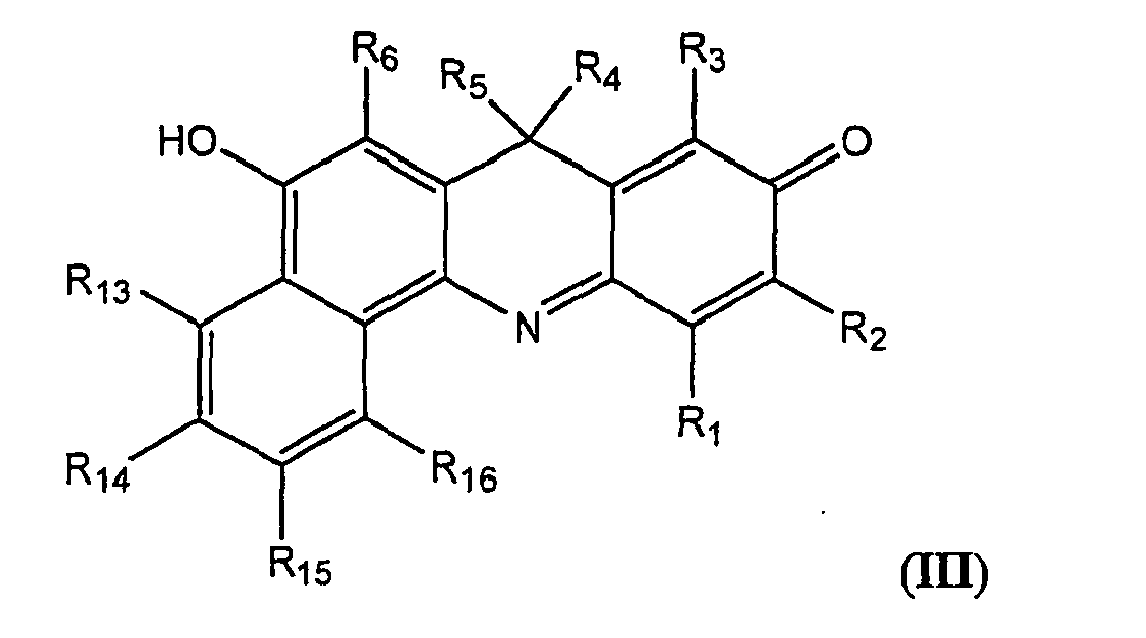

- wherein
- R1-R3 and R6-R16 can each independently be -H, halogen, fluorine, chlorine, bromine, aryl, substituted aryl, heteroaryl, -CO2H, -CO2R, -SO3H, -SO3R, -CH2CO2H, -CH2CO2R, - CH2SO3H, -CH2SO3R, -CH2NH2, -CH2NHR, -NO2, C1-C6 alkyl, substituted C1-C6 alkyl, C1-C6 alkoxy, substituted C1-C6 alkoxy, C1-C6 alkoxyaryl, substituted C1-C6 alkoxyaryl, phenyl, substituted phenyl, biphenyl, substituted biphenyl, benzyl, substituted benzyl, benzoyl, substituted benzoyl, bond or linking group, wherein R can be C1-C6 alkyl, substituted C1-C6 alkyl, C1-C6 alkoxy, substituted C1-C6 alkoxy, C1-C6 alkoxyaryl, substituted C1-C6 alkoxyaryl, phenyl, substituted phenyl, biphenyl, substituted biphenyl, benzyl, substituted benzyl, benzoyl, substituted benzoyl, bond or linking group; and
- R4 and R5 taken separately can be C1-C6 alkyl, C1-C6 substituted alkyl, R4 and R5 taken together can be C3-C7 cycloalkyl, C4-C7 unsaturated cycloalkyl, C3-C7 substituted cycloalkyl or C4-C7 substituted unsaturated cycloalkyl;
- with the proviso that if the compound comprises the structure (I), then at least one of R1R3 or R8 is not -H. Optionally, at least one of R1-R3 and R6-R16 can be -SO3H. It will be understood that any of the compounds described herein can include the phenol oxygen deprotonated form as well as all possible resonance structures.
- In some embodiments, dye compounds of the present teachings can comprise the structure:

- In some embodiments, dye compounds of the present teachings can comprise the structure:

- In some embodiments, dye compounds of the present teachings can comprise the structure:
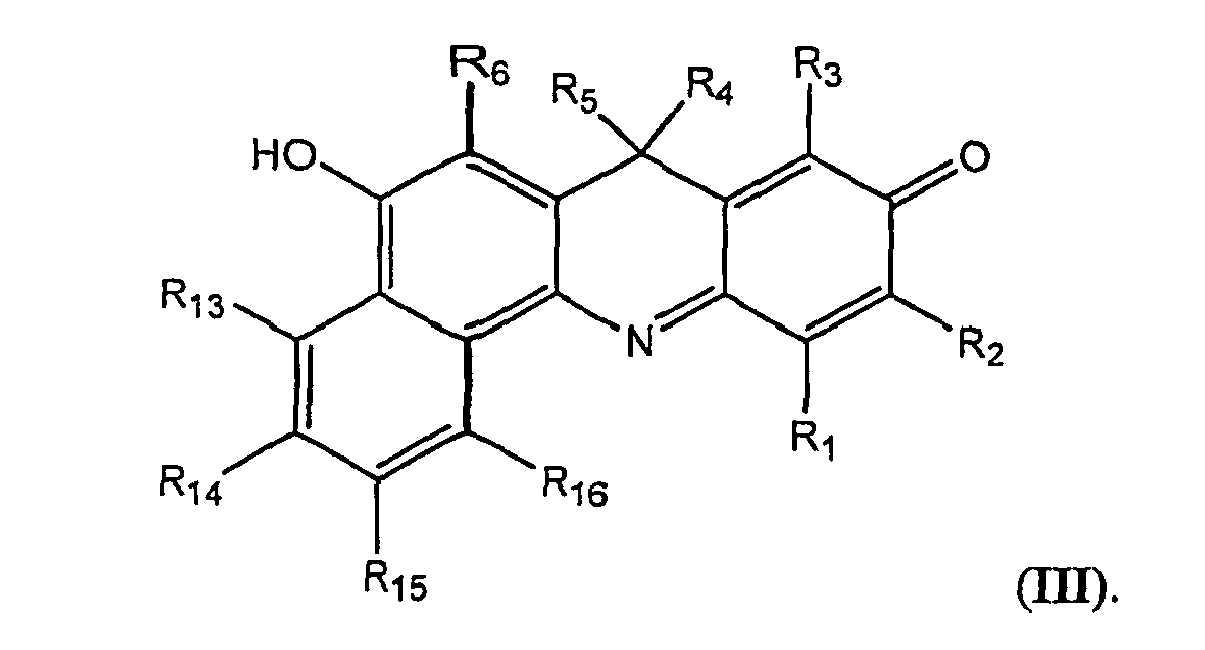
- In some embodiments, dye compounds of the present teachings can comprise the structure:

- In some embodiments, R6 and R7 can each independently be halo gen, fluorine, chlorine or bromine. In some embodiments, R6 and R7 can be fluorine. In some embodiments, R6 and R7 can be chlorine. In some embodiments, R6 and R7 can be bromine.
- In some embodiments, R6 can be -H and R7 can be -H, -CO2H, -CO2R, -SO3H, - SO3R, -CH2CO2H, -CH2CO2R, -CH2SO3H, -CH2SO3R, -CH2NH2, and -CH2NHR where R is defined as above. In some embodiments, X1 can be -H and X2 can be -H, -SO3H, -SO3R, - CH2CO2H, -CH2CO2R, -CH2NH2, and -CH2NHR where R is define as above.
- In some embodiments, dye compounds of the present teachings comprise the structure (I), wherein R1-R3 and R8 can each independently be -H, -CO2H, -CO2R, -SO3H, - SO3R, -CH2CO2H, -CH2CO2R, -CH2SO3H, -CH2SO3R, -CH2NH2, -CH2NHR or -NO2, wherein R is defined as above, with the proviso that if the compound comprises the structure (I), then at least one of R1-R3 or R8 is not -H. In some embodiments, R1-R3 and R8 can each independently be -SO3H, -SO3R, -CH2NH2, -CH2NHR or -NO2, wherein R is defined as above. In some embodiments, R1-R3 and R8 can each independently be -SO3H or -SO3R, wherein R is defined as above. In some embodiments, R1-R3 and R8 can each independently be -CH2NH2 or -CH2NHR, wherein R is defined as above.
- In some embodiments, dye compounds of the present teachings comprise the structure (I), wherein R6 and R7 can each independently be halogen, fluorine, chlorine or bromine and R1-R3 and R8 can each independently be -H, -CO2H, -CO2R, -SO3H, -SO3R, - CH2CO2H, -CH2CO2R, -CH2SO3H, -CH2SO3R, -CH2NH2, -CH2NHR, -NO2, C1-C6 alkyl, substituted C1-C6 alkyl, C1-C6 alkoxy, substituted C1-C6 alkoxy, C1-C6 alkoxyaryl, substituted C1-C6 alkoxyaryl, phenyl, substituted phenyl, biphenyl, substituted biphenyl, benzyl, substituted benzyl, benzoyl, substituted benzoyl, bond or linking group, wherein R is defined as above, with the proviso that if the compound comprises the structure (I), then at least one of R1-R3 or R8 is not -H. In some embodiments, R6 and R7 can each independently be halogen, fluorine, chlorine or bromine and R1-R3 and R8 can each independently be -SO3H, -SO3R, -CH2NH2, -CH2NHR or -NO2, wherein R is defined as above. In some embodiments, R6 and R7 are fluorine and R1-R3 and R8 can each independently be -SO3H, -SO3R, -CH2NH2, -CH2NHR or -NO2, wherein R is defined as above. In some embodiments, R6 and R7 are chlorine and R1-R3 and R8 can each independently be -SO3H, -SO3R, -CH2NH2, -CH2NHR or -NO2, wherein R is defined as above. In some embodiments, R6 and R7 are bromine and R1-R3 and R8 can each independently be - SO3H, -SO3R, -CH2NH2, -CH2NHR or -NO2, wherein R is defined as above.
- In some embodiments, dye compounds of the present teachings can comprise the structure (I), wherein R6 can be -H and R7 can be -H, -SO3H, -SO3R, -CH2CO2H, -CH2CO2R, - CH2NH2, or -CH2NHR, wherein R is defined as above, and R1-R3 and R8 can each independently be -SO3H, -SO3R, -CH2NH2, -CH2NHR, or -NO2, wherein R is defined as above. In some embodiments, R6 can be -H and R7 can be -H, -SO3H or -SO3R, and R1-R3 and R8 can each independently be -CH2NH2 or -CH2NHR, wherein R is defined as above.
- In some embodiments, a dye compound of the present teachings can comprise the structure

- In some embodiments, a dye compound of the present teachings can comprise the structure

- In some embodiments, a dye compound of the present teachings can comprise the structure

- In some embodiments, R can be substituted benzoyl. In some embodiments, R can be linking group. In some embodiments, R can be trifluoroacetyl. In some embodiments, R can comprise the structure

- In some embodiments, R can comprise the structure

- X can be succinimide.
- In some embodiments, R can be

- In some embodiments, R4 and R5 can be methyl. In some embodiments, at least one of R2 and R3 can be -NO2 and R4 and R5 can be methyl.
- In some embodiments, dye compounds of the present teachings can comprise the structure (II), wherein R6 and R7 can each independently be halogen, fluorine, chlorine or bromine, R can be -CO2H, -CO2R, -SO3H, -SO3R, -CH2CO2H, -CH2CO2R, -CH2SO3H, - CH2SO3R, -CH2NH2, -CH2NHR or -NO2. In some embodiments, dye compounds of the present teachings can comprise the structure (II), wherein R6 and R7 can each independently be halogen, fluorine, chlorine or bromine and any of R3, R8 and R9-R12 can be -CO2H, -CO2R, -SO3H, - SO3R -CH2CO2H, -CH2CO2R, -CH2SO3H, -CH2SO3R, -CH2NH2, -CH2NHR, -NO2, C1-C6 alkyl, substituted C1-C6 alkyl, C1-C6 alkoxy, substituted C1-C6 alkoxy, C1-C6 alkoxyaryl, substituted C1-C6 alkoxyaryl, phenyl, substituted phenyl, biphenyl, substituted biphenyl, benzyl, substituted benzyl, benzoyl, substituted benzoyl, bond or linking group, wherein R is defined as above.
- In some embodiments, dye compounds of the present teachings can comprise the structure (II), wherein R6 and R7 can each independently be halogen, fluorine, chlorine or bromine, R9 can be -CO2H, -CO2R, -SO3H, -SO3R, -CH2CO2H, -CH2CO2R, -CH2SO3H, - CH2SO3R -CH2NH2, -CH2NHR or -NO2, and R10-R12 can be -H, wherein R is defined as above. In some embodiments, dye compounds of the present teachings can comprise the structure (II), wherein R6 and R7 can each independently be halogen, fluorine, chlorine or bromine, R10 can be -CO2H, -CO2R, -SO3H, -SO3R, -CH2CO2H, -CH2CO2R, -CH2SO3H, -CH2SO3R, -CH2NH2, - CH2NHR or -NO2, and R9 and R11-R12 can be -H, wherein R is defined as above. In some embodiments, dye compounds of the present teachings can comprise the structure (II), wherein R6 and R7 can each independently be halogen, fluorine, chlorine or bromine, R11 can be -CO2H, -CO2R, -SO3H, -SO3R, -CH2CO2H, -CH2CO2R, -CH2SO3H, -CH2SO3R, -CH2NH2, -CH2NHR or -NO2, and R9-R10 and R12 can be -H, wherein R is defined as above. In some embodiments, dye compounds of the present teachings can comprise the structure (II), wherein R6 and R7 can each independently be halogen, fluorine, chlorine or bromine, R12 can be -CO2H, -CO2R, -SO3H, - SO3R, -CH2CO2H, -CH2CO2R, -CH2SO3H, -CH2SO3R, -CH2NH2, -CH2NHR or -NO2, and R9-R11 can be -H, wherein R is defined as above.
- In some embodiments, dye compounds of the present teachings can comprise the structure (II), wherein R6 can be -H and R7 can be -H, -SO3H, -SO3R, -CH2CO2H, -CH2CO2R, - CH2NH2, or -CH2NHR, wherein R is defined as above, R9 can be -CO2H, -CO2R, -SO3H, - SO3R, -CH2CO2H, -CH2CO2R, -CH2SO3H, -CH2SO3R, -CH2NH2, -CH2NHR or -NO2 and R10-R12 can be -H, wherein R is defined as above. In some embodiments, dye compounds of the present teachings can comprise the structure (II), wherein R6 can be -H and R7 can be -H, - SO3H, -SO3R, -CH2CO2H, -CH2CO2R, -CH2NH2, or -CH2NHR, wherein R is defined as above, R10 can be -CO2H, -CO2R, -SO3H, -SO3R, -CH2CO2H, -CH2CO2R, -CH2SO3H, -CH2SO3R, - CH2NH2, -CH2NHR or -NO2, and R9 and R11-R12 can be -H, wherein R is defined as above. In some embodiments, dye compounds of the present teachings can comprise the structure (II), wherein R6 can be -H and R7 can be -H, -SO3H, -SO3R, -CH2CO2H, -CH2CO2R, -CH2NH2, or - CH2NHR, wherein R is defined as above, R11 can be -CO2H, -CO2R, -SO3H, -SO3R, - CH2CO2H, -CH2CO2R, -CH2SO3H, -CH2SO3R, -CH2NH2, -CH2NHR or -NO2, and R9-R10 and R12 can be -H, wherein R is defined as above. In some embodiments, dye compounds of the present teachings can comprise the structure (II), wherein R6 can be -H and R7 can be -H, - SO3H, -SO3R, -CH2CO2H, -CH2CO2R, -CH2NH2, or -CH2NHR, wherein R is defined as above, R12 can be -CO2H, -CO2R, -SO3H, -SO3R, -CH2CO2H, -CH2CO2R, -CH2SO3H, -CH2SO3R, - CH2NH2, -CH2NHR or -NO2 and R9-R11 can be -H, wherein R is defined as above.
- In some embodiments, any of R9-R12 can be -SO3H, -SO3R, -CH2NH2, -CH2NHR, or -NO2, wherein R is defined as above. In some embodiments, any of R9-R12 can be -SO3H or - SO3R, wherein R is defined as above. In some embodiments, any of R9-R12 can be -CH2NH2 or -CH2NHR, wherein R is defined as above.
- In some embodiments, a dye compound of the present teachings can comprise the structure

- wherein R6 and R7 can be hydrogen, fluorine, chlorine or bromine.
- In some embodiments, a dye compound of the present teachings can comprise the structure

- wherein R6 and R7 can be hydrogen, fluorine, chlorine or bromine.
- In some embodiments, a dye compound of the present teachings can comprise the structure

- wherein R6 and R7 can be hydrogen, fluorine, chlorine or bromine.
- In some embodiments, a dye compound of the present teachings can comprise the structure

- wherein R6 and R7 can be hydrogen, fluorine, chlorine or bromine.
- In some embodiments, a dye compound of the present teachings can comprise the structure

- In some embodiments, a dye compound of the present teachings can comprise the structure

- wherein R is defined as above.
- In some embodiments, a dye compound of the present teachings can comprise the structure
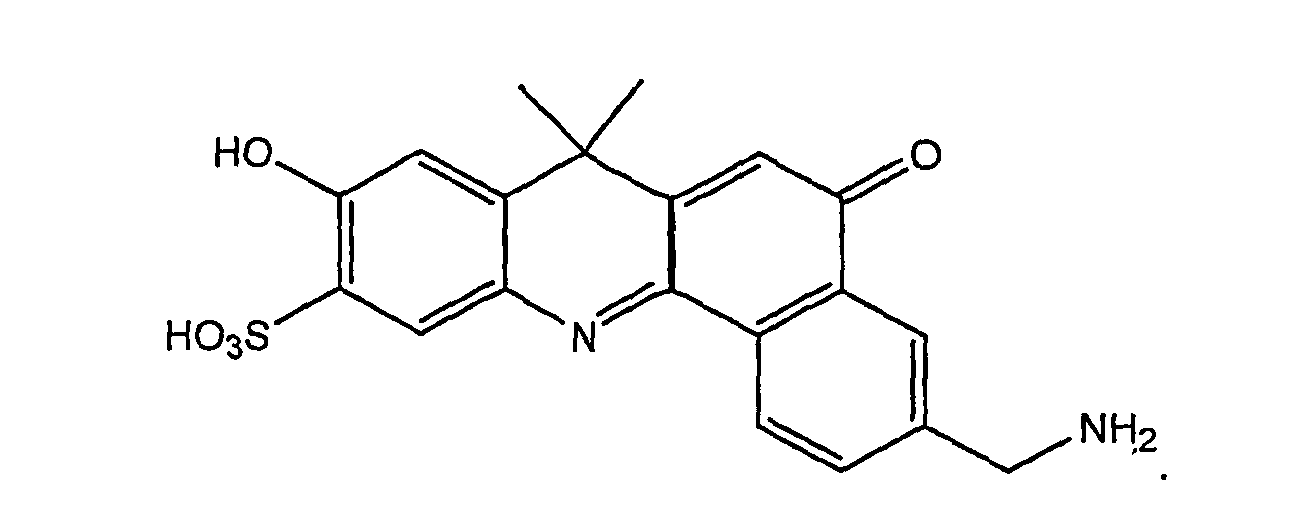
- In some embodiments, a dye compound of the present teachings can comprise the structure

- wherein R is defined as above.
- In some embodiments, R can be substituted benzoyl. In some embodiments, R can be linking group. In some embodiments, R can be trifluoroacetyl. In some embodiments, R can comprise the structure

- In some embodiments, R can comprise the structure

- X can be succinimide.
- In some embodiments, R can be

- In some embodiments, compounds of the present teachings comprise the structure (III). In some embodiments, R1 and R3 can be -H. In some embodiments, R6 can be -H. In some embodiments, R13, R15 and R16 can be -H. In some embodiments, R2 can be -SO3H. In some embodiments, R2 can be -H. In some embodiments, R14 can be -CH2NH2. In some embodiments, R14 can be -CH2NHR. In some embodiments, R can be

- In some embodiments, R can comprise the structure

- X can be succinimide.
- In some embodiments, R can be

- In some embodiments, R can be linking group. In some embodiments, R14 can be -H. In some embodiments, R14 can be -SO3H. In some embodiments, R14 can be -H. In some embodiments, R2 can be -CH2NH2. In some embodiments, R2 can be -CH2NHR. In some embodiments, R can be

- In some embodiments, R can comprise the structure

- X can be succinimide.
- In some embodiments, R can be

- In some embodiments, R can be linking group. In some embodiments, R2 can be -H. In some embodiments, R4 and R5 can be methyl.
- In some embodiments, compounds of the present teachings comprise the structure (IV). In some embodiments, R10 can be -SO3H. In some embodiments, R10 can be -H. In some embodiments, R14 can be -CH2NH2. In some embodiments, R14 can be -CH2NHR. In some embodiments, R can be

- In some embodiments, R can comprise the structure

- X can be succinimide.
- In some embodiments, R can be

- In some embodiments, R is linking group. In some embodiments, R14 can be -H. In some embodiments, R3, R6, R9, R11, R12, R13, R15 and R16 can be -H. In some embodiments, R14 can be -SO3H. In some embodiments, R14 can be -H. In some embodiments, R10 can be - CH2NH2. In some embodiments, R10 can be -CH2NHR. In some embodiments, R can be

- In some embodiments, R can comprise the structure

- X can be succinimide.
- In some embodiments, R can be

- In some embodiments, R can be linking group. In some embodiments, R14 can be -H. In some embodiments, R3, R6, R9, R11, R12, R13, Ras and R16 can be -H. In some embodiments, R4 and R5 can be methyl.
- As used herein "substituted" refers to a molecule wherein one or more hydrogen atoms are replaced with one or more non-hydrogen atoms, functional groups or moieties. For example, unsubstituted amine is -NH2, while a substituted amine can be -NHCH3. Exemplary substituents include but are not limited to halogen, fluorine, chlorine, bromine, C1-C6 alkyl, C1-C6 cycloalkyl, C1-C6 branched alkyl, C1-C6 alkene, C1-C6 cyclic alkene, C1-C6 branched alkene, C1-C6 alkyne, C1-C6 branched alkyne, sulfate, sulfonate, sulfone, amino, ammonium, amido, nitrile, C1-C6 alkoxy, phenoxy, substituted phenoxy aromatic, phenyl, polycyclic aromatic, electron-rich heterocycle, and linking group.
- As used herein, "linking group" refers to a moiety capable of reacting with a "complementary functionality" attached to a reagent or member of an energy transfer dye pair, such reaction forming a "linkage" connecting the dye to the reagent or member of the energy transfer dye pair. Suitable linking groups include but are not limited to isothiocyanate, sulfonyl chloride, 4,6-dichlorotriazinyl, succinimidyl ester, or other active carboxylate whenever the complementary functionality is amine. Suitable linking groups include but are not limited to maleimide, haloacetyl, iodoacetyl, haloacetamide or iodoacetamide whenever the complementary functionality is sulfhydryl. See, for example, R. Haugland, Molecular Probes Handbook of Fluorescent Probes and Research Chemicals, Molecular probes, Inc. (1992).
- Furthermore, it will be understood that a variety of complementary linking group/complementary functionality pairs suitable for covalently conjugating dye molecules of the present" teachings to various molecules or substrates (i.e.- nucleotides, nucleosides, oligonucleotides, peptides, other dyes molecules, linking moieties, and the like) are known in the art. Examples of complementary electrophiles and nucleophiles suitable for use as linking group/complementary functionality pairs in a wide variety of contexts are shown in Table 1, where the reaction of the indicated electrophilic and nucleophilic species yields the indicated covalent linkage. Conditions under which the covalent linkages are formed are well-known.
TABLE 1 Examples Of Some Routes To Useful Covalent Linkages Electrophilic Group Nucleophilic Group Resulting Linkage activated esters* amines/anilines carboxamides acyl azides** amines/anilines carboxamides acyl halides amines/anilines carboxamides acyl halides alcohols/phenols esters acyl nitriles alcohols/phenols esters acyl nitriles amines/anilines carboxamides aldehydes amines/anilines imines aldehydes or ketones hydrazines hydrazones aldehydes or ketones hydroxylamines oximes alkyl halides amines/anilines alkyl amines alkyl halides carboxylic acids esters alkyl halides thiols thioethers alkyl halides alcohols/phenols ethers alkyl sulfonates thiols thioethers alkyl sulfonates carboxylic acids esters alkyl sulfonates alcohols/phenols ethers anhydrides alcohols/phenols esters anhydrides amines/anilines carboxamides aryl halides thiols thiophenols aryl halides amines aryl amines aziridines thiols thioethers boronates glycols boronate esters carboxylic acids amines/anilines carboxamides carboxylic acids alcohols esters carboxylic acids hydrazines hydrazides carbodiimides carboxylic acids N-acylureas or anhydrides carbonates amines carbamates chloroformates amine carbamates diazoalkanes carboxylic acids esters epoxides thiols thioethers haloacetamides thiols thioethers halotriazines amines/anilines aminotriazines halotriazines alcohols/phenols triazinyl ethers imido esters amines/anilines amidines isocyanates amines/anilines ureas isocyanates alcohols/phenols urethanes isothiocyanates amineslanilines thioureas maleimides thiols thioethers phosphoramidites alcohols phosphite esters silyl halides alcohols silyl ethers sulfonate esters amines/anilines alkyl amines sulfonate esters thiols thioethers sulfonate esters carboxylic acids esters sulfonate esters alcohols ethers sulfonyl halides amines/anilines sulfonamides sulfonyl halides phenols/alcohols sulfonate esters *Activated esters, as understood in the art, generally have the formula - COX, where X is a good leaving group, e.g., oxysuccinimidyl (-ONC4H4O2), oxysulfosuccinimidyl (-ONC4H3O2-SO3H), 1-oxybenzotriazoiyl (-OC6H4N3); or an aryloxy group of the formula -OR", where R" is an aryl or an aryl substituted with one or more of the same or different electron- withdrawing substituents (e.g., NO2, -F, -Cl, -CN or -CF3), used to form an anhydride or mixed anhydride of the formula -OCORa or -OCNRaNHRb, where Ra and Rb, which may be the same or different, are (C1-C6) alkyl, (C1-C6) perfluoroalkyl or (C1-C6) alkoxy; or cyclohexyl, 3-dimethylaminopropyl, or N-morpholinoethyl.
**Acyl azides can also rearrange to isocyanates. - The selection of nucleophile or electrophile used to covalently conjugate a dye of the present teachings to a given molecule or substrate can depend upon the identity of the complementary functional group on the molecule or substrate to which the dye molecule is to be conjugated. Types of complementary functional groups that can be present on molecules or substances to be conjugated include, but are not limited to, amines, thiols, alcohols, phenols, aldehydes, ketones, phosphates, imidazoles, hydrazines, hydroxylamines, mono- and disubstituted amines, halides, epoxides, sulfonate esters, carboxylic acids or carboxylates.
- In some embodiments, suitable nucleophiles for use in connection with the present teachings comprise amines, phenols, anilines, thiols or alcohols, or combinations thereof. In some embodiments, the nucleophile comprises an amine. In some embodiments, the nucleophile comprises a primary amine. In some embodiments, the nucleophile comprises a secondary amine.
- In some embodiments, the electrophile comprises an acrylamide, an activated ester of a carboxylic acid, an acyl azide, an acyl nitrile, an acyl halide, an aldehyde, an alkyl halide, an anhydride, an aryl halide, an azide, an aziridine, a boronate, a carboxylic acid or carboxylate, a diazoalkane, a haloacetamide, a halotriazine, a hydrazine, an imido ester, an isocyanate, an isothiocyanate, a maleimide, a phosphoramidite a Michael acceptor (i.e.- an α,β-unsaturated ester, an α,β-unsaturated aldehyde, and the like) or a sulfonyl halide.
- In some embodiments, the electrophile comprises an activated ester of a carboxylic acid or carboxylate, a succinimidyl ester, a haloacetamide, an acyl halide, an alkyl halide, a sulfonyl halide, an isothiocyanate, a maleimide or an azidoperfluorobenzamido group. In some embodiments, the linking group is a N-hydroxysuccinimidyl (NHS) ester and the complementary functionality is an amine. To form an NHS ester, a dye of the present teachings including a carboxylic acid moiety as a linking group is reacted with, for example, dicyclohexylcarbodiimide (DCC) and N-hydroxysuccinimide. Alternatively, to form an NHS ester, a molecule or substrate to be conjugated to a dye molecule of the present teachings including a carboxylic acid moiety as a linking group is reacted with, for example, dicyclohexylcarbodiimide (DCC) and N-hydroxysuccinimide.
- An exemplary synthetic scheme for the preparation of compounds of the present teachings comprising the structure (I) is shown in
Figure 1 . Using, for example, the synthetic procedures described inCorey, P.F., U.S. Patent No. 4,810,636 as a guide, one of skill in the art can react a 4-hydroxyaniline compound of the type ( 2 ) with a tertiary alcohol ( 4 ), such as 2-(4'-hydroxyphenyl)-2-propanol, in the presence of a base to form compound ( 5 ). Alternatively, one can oxidize 4-hydroxyaniline compound (2) to form an N-chloroimine compound of the type ( 3 ) which can be reacted with a tertiary alcohol ( 4 ), such as 2-(4'-hydroxyphenyl)-2-propanol, in the presence of a base to form compound ( 5 ). Compound ( 5 ) can then be reacted with a reducing agent, such as sodium dithionite, to form secondary amine compound ( 6 ). Compound ( 6 ) can then be converted to compound ( 7 ) by cyclization, through treatment with an acid such as 2N HCl, followed by oxidation, with for example sodium periodate. In some embodiments, depending on the substitution pattern present, compound ( 7 ) can be optionally be further derivitized. For example, compound ( 7 ) can optionally be sulfonated by reaction with, for example, chlorosulfonic acid. - Alternatively, compound ( 7 ) can be aminomethylated by reaction with an aminomethylating agent, for example, N-(hydroxymethyl)trifluoroacetamide in the presence of an acid such as concentrated sulfuric acid, or similar established conditions.
- An exemplary synthetic scheme for the preparation of compounds of the present teachings comprising the structure (II) is shown in
Figure 2 . Following a scheme similar to that described by Corey, a 4-hydroxyaniline compound of the type ( 2 ) can be reacted with a tertiary alcohol ( 8 ), such as 2-(4'-hydroxynathalen-2-yl)-2-propanol, in the presence of a base to form compound ( 9 ). Alternatively, 4-hydroxyaniline compound ( 2 ) can be oxidized using known conditions to form an N-chloroimine compound of the type ( 3 ) which can be reacted with a tertiary alcohol ( 8 ) in the presence of a base to form compound ( 9 ). Compound ( 9 ) can then be reacted with a reducing agent, such as sodium dithionite, to form secondary amine compound ( 10 ). Compound ( 10 ) can then be converted to compound ( 11 ) by cyclization, through treatment with an acid such as 2N HCl, followed by oxidation, with for example sodium periodate. In some embodiments, depending on the substitution pattern present, compound ( 11 ) can be optionally be further derivitized. For example, compound ( 11 ) can optionally be sulfonated by reaction with, for example, chlorosulfonic acid. - An exemplary synthetic scheme for the preparation of compounds of the present teachings comprising the structure (III) is shown in
Figure 3 . Following a scheme similar to that described by Corey, a compound of the type ( 12 ) can be reacted with a tertiary alcohol ( 4 ), in the presence of a base to form compound ( 14 ). Alternatively, compound ( 12 ) can be oxidized "using known conditions to form an N-chloroimine compound of the type ( 13 ) which can be reacted with a tertiary alcohol ( 4 ) in the presence of a base to form compound (14 ). Compound ( 14 ) can then be reacted with a reducing agent, such as sodium dithionite, to form secondary amine compound ( 15 ). Compound ( 15 ) can then be converted to compound ( 16 ) by cyclization, through treatment with an acid such as 2N HCl, followed by oxidation, with for example sodium periodate. In some embodiments, depending on the substitution pattern present, compound ( 16 ) can optionally be further derivitized. For example, compound ( 16 ) can optionally be sulfonated by reaction with, for example, chlorosulfonic acid. - An exemplary synthetic scheme for the preparation of compounds of the present teachings comprising the structure (IV) is shown in
Figure 4 . Following a scheme similar to that described by Corey, a compound of the type ( 12 ) can be reacted with a tertiary alcohol ( 8 ), in the presence of a base to form compound ( 17 ). Alternatively, compound ( 12) can be oxidized using known conditions to form an N-chloroimine compound of the type ( 13 ) which can be reacted with a tertiary alcohol ( 8 ) in the presence of a base to form compound ( 17 ). Compound (17 ) can then be reacted with a reducing agent, such as sodium dithionite, to form secondary amine compound ( 18 ). Compound ( 18 ) can then be converted to compound ( 19 ) by cyclization, through treatment with an acid such as 2N HCl, followed by oxidation, with for example sodium periodate. In some embodiments, depending on the substitution pattern present, compound ( 19 ) can optionally be further derivitized. For example, compound ( 19 ) can optionally be sulfonated by reaction with, for example, chlorosulfonic acid. - A synthetic scheme for the preparation of exemplary compounds of the present teachings is shown in
Figure 5 . Following a scheme similar to that described by Corey, a chloroimine compound of the type ( 20 ) can be reacted with a tertiary alcohol ( 21 ), in the presence of a base to form compound ( 22 ). Compound ( 22 ) can then be reacted with a reducing agent, such as sodium dithionite, to form secondary amine compound ( 23 ). Compound ( 23 ) can then be converted to compound ( 24 ) by cyclization, through treatment with an acid such as 2N HCl, followed by oxidation, with for example sodium periodate. Further, compound ( 24 ) can be sulfonated by reaction with, for example, chlorosulfonic acid to provide dye ( 25 ) of the present teachings. Alternatively, compound (24 ) can be aminomethylated by reaction with an aminomethylating agent, for example, N-(hydroxymethyl)trifluoroacetamide in the presence of an acid such as concentrated sulfuric acid, or similar established conditions to form compound (26). Dye ( 26 ) can be de-halogenated by literature procedure (Corey, P.F., U.S. Patent 4,810,636 March 7, 1989 ; Corey, et al. Angew Chem Int. Ed. Engl 30 (1991)), by reduction with, for example, Raney nickel/H2 and then oxidized by reacting with an oxidizing agent, such as sodium periodate, to give dye ( 27 ) of the present teachings. Dye ( 27 ) can be can be sulfonated by reaction with, for example, chlorosulfonic acid to provide dye ( 28 ) of the present teachings. - If one of skill in the art were to use 2-(4' -hydroxynathalen-2-yl)-2-propanol as the tertiary alcohol, it could be prepared according to the literature procedures (Haworth et al. J.Chem Soc, Abstracts, pp. 10-13 (1943)), see
Figure 6 . Specifically, benzyl succinate ( 29 ) (commercially available from Sigma-Aldrich Chemical Company, Milwaukee, WI) can be suspended in cold acetyl chloride to give a bis-anhydride benzyl succinate derivative. The anhydride derivative can be cyclized to the tetralone intermediate with AlCl3 in nitrobenzene. The tetralone intermediate can be aromatized in two steps by bromination and base catalyzed bromide elimination to give 4-hydroxy-2-napthoic acid ( 30 ). 4-Hydroxy-2-napthoic acid compound ( 30 ) can be converted to the ethyl ester derivative by Fisher esterification in ethanol and HCl. Finally, using established literature procedures (J.Am.Chem.Soc., v. 108, 4119 (1986)), ethyl 4-Hydroxy-2-napthoate can be reacted with methyl magnesium chloride (3.3 eqiuv) to give the tertiary alcohol 2-(4'-hydroxynathalen-2-yl)-2-propanol ( 31 ). - A synthetic scheme for the preparation of exemplary compounds of the present teachings is shown in
Figure 7 . Following a scheme similar to that described by Corey, N-chloroimine compound ( 20 ) can be reacted with tertiary alcohol ( 31 ), in the presence of a base to form compound ( 32 ). Compound ( 32 ) can then be reacted with a reducing agent, such as sodium dithionite, to form secondary amine compound ( 33 ). Compound ( 33 ) can then be converted to compound ( 34 ) by cyclization, through treatment with an acid such as 2N HCl, followed by oxidation, with for example sodium periodate. - A synthetic scheme for the conversion of exemplary compound ( 34 ) to further compounds of the present teachings is shown in
Figure 8 . In some embodiments, dye (34 ) can be can be sulfonated by reaction with, for example, chlorosulfonic acid to provide dye ( 35 ) of the present teachings. Dye ( 35 ) can be de-halogenated by literature procedure (Corey, P.F., U.S. Patent 4,810,636 March 7, 1989 ; Corey, et al. Angew Chem Int. Ed. Engl. 30 (1991)), by reduction with, for example, Raney nickel/H2 and then oxidized by reacting with an oxidizing agent, such as sodium periodate, to give dye ( 36 ) of the present teachings. Dye ( 36 ) can be aminomethylated by treating with N-(hydroxymethyl)trifluoroacetamide in the presence of an acid such as concentrated sulfuric acid, or similar established conditions to form compound ( 37 ) of the present teachings. Alternatively, dye ( 34) can be aminomethylated by treating with N-(hydroxymethyl)trifluoroacetamide in the presence of an acid such as concentrated sulfuric acid, or similar established conditions to form compound ( 38 ). As above, compound ( 38 ) can be de-halogenated and then oxidized by literature procedures to give compound ( 39 ). Finally, compound ( 39 ) can be sulfonated by reaction with, for example, chlorosulfonic acid to provide a dye ( 40 ) of the present teachings. Further, one of skill in the art will recognize that the amine functionality on compounds ( 37 ) or ( 40 ) can optionally be deprotected and optionally converted to a substituted amine and/or compounds ( 37 ) or (40 ) can optionally be halogenated using established procedures to tune the fluorescence properties (i.e.- emission wavelength). - Suitable N-chloroimine compounds of the type ( 3 ), shown in, for example,
Figures 1 &2 , for use in connection with the present teachings can be obtained from commercial sources and/or prepared from numerous 4-hydroxyaniline compounds that are either commercially available or are known in the art using literature established procedures. Examples, of suitable 4-hydroxyaniline compounds include, but are not limited to, the following:


- One of skill in the art will understand that any of the above 4-hydroxyaniline compounds can be converted into the N-chloroimine directly or after optional protection of possibly labile functionality. Further examples of suitable for 4-hydroxyaniline compounds that are known in the art can be found by structure searching in available databases such as Chemical Abstracts Service (CAS), SciFinder, and the like.
- Suitable N-chloroimine compounds of the type (12), shown in, for example,
Figure 3 , for use in connection with the present teachings can be obtained from commercial sources and/or prepared from numerous 4-hydroxy-aminonaphthalene compounds that are either commercially available or are known in the art using literature established procedures. Examples, of suitable 4-hydroxy-aminonaphthalene compounds include, but are not limited to, the following:


- One of skill in the art will understand that any of the above 4-hydroxy-aminonaphthalene compounds can be converted into the N-chloroimine directly or after optional protection of possibly labile functionality. Further examples of suitable for 4-hydroxy-aminonaphthalene compounds that are known in the art can be found by structure searching in available databases such as Chemical Abstracts Service (CAS), SciFinder, and the like.
- Suitable tertiary alcohol compounds of the type (8) shown in, for example,
Figure 2 , can be prepared from suitable 4-hydroxy-2-napthoic acid compounds in a manner similar to that described inFigure 6 - Examples of suitable 4-hydroxy-2-napthoic acid compounds known in the art include, but are not limited to, the following:


- One of skill in the art will understand that any of the above 4-hydroxy-2-napthoic acid compounds can be used directly for synthesizing compounds of the present teachings or after optional protection of possibly labile functionality. Further examples of suitable for 4-hydroxy-2-napthoic acid compounds that are known in the art can be found by structure searching in available databases such as Chemical Abstracts Service (CAS), SciFinder, and the like.
- In some embodiments, the present teachings comprise energy transfer dye compounds incorporating dye compounds of Formula I-IV. Generally, energy transfer dyes of the present teachings comprise a donor dye capable of absorbing light at a first wavelength and emitting excitation energy in response that is covalently attached to an acceptor dye which is capable of absorbing the excitation energy emitted by the donor dye and fluorescing at a second wavelength in response. In some embodiments, the donor dye can be covalently attached to the acceptor dye through a linker. In some embodiments, the linker can be effective to facilitate efficient energy transfer between the donor and acceptor dyes. In some embodiments, the linker can be non-nucleotidic. In some embodiments, the linker can be a nucleotidic linker, such as a polynucleotide. For a thorough discussion of the structure, synthesis and use of such energy transfer dyes see, for example,
Mathies, et al. U.S. Patent No. 5,728,528 ,Lee, et al. U.S. Patent No. 5,863,727 ,Glazer, et al. U.S. Patent No. 5,853,992 ,Waggoner, et al., U.S. Patent No. 6,008,373 ,Nampalli, et al., U.S. Patent Application Pub. No. 2004/0126763 A1 ,Kumar, et al., PCT Pub. No. WO 00/13026A1 PCT Pub. No. WO 01/19841 A1 - In some embodiments, linkers suitable for use in connection with the present teachings can comprise the general structure

- wherein carbonyl can be covalently attached to either a donor dye or an acceptor dye, R11 can be a moiety that comprises an unsubstituted alkene, a substituted alkene, an unsubstituted diene, a substituted diene, an unsubstituted triene, a substituted triene, an unsubstituted alkyne, a substituted alkyne, an unsubstituted five- or six-membered ring having at least one unsaturated bond, a substituted five- or six-membered ring having at least one unsaturated bond or an unsubstituted or substituted fused ring structure that is attached to the carbonyl carbon atom, and R12 is a moiety comprising a functional group that is capable of attaching the linker to a donor dye or an acceptor dye, such that both a donor dye and an acceptor dye are represented.
- Examples of suitable five- or six-membered rings that can be used as R11 in the linker include, but are not limited to cyclopentene, cyclohexene, cyclopentadiene, cyclohexadiene, furan, thiofuran, pyrrole, pyrazole, isoimidazole, pyran, pyrone, benzene, pyridine, pyridazine, pyrimidine, triazine, pyrazine and oxazine. Examples of fused ring structures include, but are not limited to indene, benzofuran, thionaphthalene, indole and naphthalene. In some embodiments, the linker has the structure

- In some embodiments, the linker attaches to a dye of the present teachings at one of the X1-X2, R1-R3 or R7-R10 positions. In some embodiments, the linker can be a bond. Additional suitable linkers include polynucleotides, ribonucleic acids, and the like.
- In some embodiments, one of the donor or acceptor dye is a dye according to the present teachings and the other dye can be a cyanine, phthalocyanine, squaraine, bodipy, fluorescein, rhodamine, extended rhodamine or dibenzorhodamine dye.
- Example of suitable dyes for use in connection with energy transfer dyes of the present teachings include, but are not limited to, 5-carboxyfluorescein, 6-carboxyfluorescein, rhodamine green (R110), 5-carboxyrhodamine, 6-carboxyrhodamine, N,N'-diethyl-2',7'-dimethyl-5-carboxy-rhodamine (5-R6G), N,N'-diethyl-2',7'-dimethyl-6-carboxyrhodamine (6-R6G), N,N,N',N'-tetramethyl-5-carboxyrhodamine (5-TAMRA), N,N,N',N'-tetramethyl-5-carboxyrhodamine (6-TAMRA), 5-carboxy-X-rhodamine (5-ROX), 6-carboxy-X-rhodamine (6-ROX), 5-carboxy-2',4',5',7',-4,7-hexachloroffuorescein, 6-carboxy-2',4',5',7',4,7-hexachlorofluorescein, 5-carboxy-2',7'-dicarboxy-4',5'-dichlorofluorescein, 6-carboxy-2',7'-dicarboxy-4',5'-dichloro-fluorescein, 5-carboxy-2',4',5',7'-tetrachlorofluorescein, 1',2'-benzo-4'-fluoro-7',4,7-trichloro-5-carboxyfluorescein, 1',2'-benzo-4'-fluoro-7',4,7-trichloro-6-carboxyfluorescein, 1',2',7',8'-dibenzo-4,7-dichloro-5-carboxyfluorescein, as well as other commercially available dyes as shown in Table 2.
Table 2 Fluorescent Dye Absorbance (nm) Emission (nm) Extinction Coefficient 5-Fluorescein 495 520 73000 5-Carboxyfluorescein (5-FAM) 495 520 83000 6-Carboxyfluorescein (6-FAM) 495 520 83000 6-Carboxyhexachlorofluorescein (6-HEX) 535 556 73000 6-Carboxytetrachlorofluorescein (6-TET) 521 536 73000 JOE 520 548 73000 LightCycler Red 640 625 640 LightCycler Red 705 685 705 Oregon Green 488 496 516 76000 Oregon Green 500 499 519 84000 Oregon Green 514 506 526 85000 BODIPY FL-X 504 510 70000 BODIPY FL 504 510 70000 BODIPY-TMR-X 544 570 56000 BODIPY R6G 528 547 70000 BODIPY 650/665 650 665 101000 BODIPY 564/570 563 569 142000 BODIPY 581/591 581 591 136000 BODIPY TR-X 588 616 68000 BODIPY 630/650 625 640 101000 BODIPY 493/503 500 509 79000 5-Carboxyrhodamine 6G 524 557 102000 5(6)-Carboxytetramethylrhodamine (TAMRA) 546 576 90000 6-Carboxytetramethylrhodamine (TAMRA) 544 576 90000 5(6)-Carboxy-X-Rhodamine (ROX) 576 601 82000 6-Carboxy-X-Rhodamine (ROX) 575 602 82000 AMCA-X (Coumarin) 353 442 19000 Texas Red-X 583 603 116000 Rhodamine Red-X 560 580 129000 Marina Blue 362 459 19000 Pacific Blue 416 451 37000 Rhodamine Green-X 503 528 74000 7-diethylaminocoumarin-3-carboxylic acid 432 472 56000 7-methoxycoumarin-3-carboxylic acid 358 410 26000 Cy3 552 570 150000 Cy3B 558 573 130000 Cy5 643 667 250000 Cy5.5 675 694 250000 DY-505 505 530 85000 DY-550 553 578 122000 DY-555 555 580 100000 DY-610 606 636 140000 DY-630 630 655 120000 DY-633 630 659 120000 DY-636 645 671 120000 DY-650 653 674 77000 DY-675 674 699 110000 DY-676 674 699 84000 DY-681 691 708 125000 DY-700 702 723 96000 DY-701 706 731 115000 DY-730 734 750 113000 DY-750 747 776 45700 DY-751 751 779 220000 DY-782 782 800 102000 Cy3.5 581 596 150000 EDANS 336 490 5700 WellRED D2-PA 750 770 170000 WellRED D3 -PA 685 706 224000 WellRED D4-PA 650 670 203000 Pyrene 341 377 43000 Cascade Blue 399 423 30000 Cascade Yellow 409 558 24000 PyMPO 415 570 26000 Lucifer Yellow 428 532 11000 NBD-X 466 535 22000 Carboxynapthofluorescein 598 668 42000 Alexa Fluor 350 346 442 19000 Alexa Fluor 405 401 421 35000 Alexa Fluor 430 434 541 16000 Alexa Fluor 488 495 519 71000 Alexa Fluor 532 532 554 81000 Alexa Fluor 546 556 573 104000 Alexa Fluor 555 555 565 150000 Alexa Fluor 568 578 603 91300 Alexa Fluor 594 590 617 73000 Alexa Fluor 633 632 647 100000 Alexa Fluor 647 650 665 239000 Alexa Fluor 660 663 690 132000 Alexa Fluor 680 679 702 184000 Alexa Fluor 700 702 723 192000 Alexa Fluor 750 749 775 240000 Oyster 556 556 570 155000 Oyster 645 645 666 250000 Oyster 656 656 674 220000 5(6)-Carboxyeosin 521 544 95000 Erythrosin 529 544 90000 - In some embodiments, the present teachings provide for labeled nucleosides and/or nucleotides comprising the structure
NUC-L-D
- wherein NUC comprises a nucleoside, a nucleotide, a modified nucleoside or a modified nucleotide, L comprises a bond or a linker and D comprises a dye compound of the present teachings. In some embodiments, NUC and D can be conjugated by a linker, L, wherein L can be attached to D at one of X1-X2, R1-R3 or R7-R10. In some embodiments, if NUC comprises a purine base, the linker can be attached to the 8-position of the purine, if NUC comprises a 7-deazapurine base, the linker can be attached to the 7-position of the 7-deazapurine, and if NUC comprises a pyrimidine base, the linker can be attached to the 5-position of the pyrimidine. Such nucleoside and nucleotide reagents can be particularly useful in the context of labeling polynucleotides formed by enzymatic synthesis, e.g., nucleotide triphosphates used in the context of PCR amplification, Sanger-type polynucleotide sequencing, and nick-translation reactions.
- It will be understood that nucleoside labeling can be accomplished by any of number of known labeling techniques employing known linkers, linking groups, and associated complementary functionalities. Generally, the linker should (i) not interfere with oligonucleotide-target hybridization, (ii) be compatible with relevant enzymes, e.g., polymerases, ligases, and the like, and (iii) not adversely affect the fluorescence properties of the dye. For exemplary base labeling procedures suitable for use in connection with the present teachings see, for example, Gibson, et al., Nucleic Acids Research, 15:6455-6467 (1987); Gebeyehu, et al., Nucleic Acids Research, 15: 4513-4535 (1987); Haralambidis, et al., Nucleic Acids Research, 15: 4856-4876 (1987); Nelson, et al., Nucleosides and Nucleotides, 5(3): 233-241 (1986); Bergstrom, et al., JACS, 111: 374-375 (1989); and
U.S. Patent Nos. 4,855,225 ,5,231,191 , and5,449,767 . - In some embodiments, suitable linkers can be acetylenic amido or alkenic amido linkers, wherein the conjugation between the dye and the nucleoside or nucleotide base can be formed by, for example, reaction of an activated N-hydroxysuccinimide (NHS) ester of the dye with an alkynylamino- or alkenylamino-derivatized base of a nucleo side or nucleotide. In some embodiments, labeled nucleosides or nucleotides can comprise the structure

- In some embodiments, labeled nucleosides or nucleotides can comprise the structure

- wherein X can be

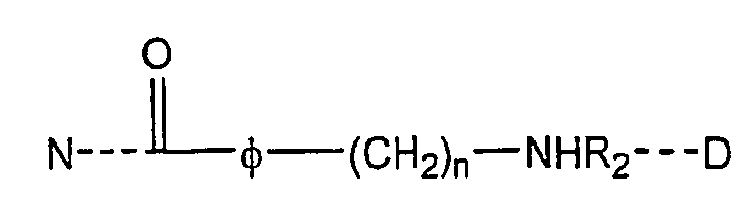


Khan et al., U.S. Patent Application Serial No. 08/833,854 filed April 10, 1997 - The synthesis of alkynylamino-derivatized nucleosides is taught by, for example, Hobbs, et al. in European Patent No.
0 251 786 B1 , and Hobbs, et al., J. Org. Chem., 54: 3420 (1989). Briefly, the alkynylamino-derivatized nucleotides can be formed by placing the appropriate halodideoxynucleoside (usually 5-iodopyrimidine and 7-iodo-7-deazapurine dideoxynucleosides as taught by Hobbs, et al. (cited above)) and Cu(I) in a flask, flushing with argon to remove air, adding dry DMF, followed by addition of an alkynylamine, triethylamine and Pd(O). The reaction mixture is stirred for several hours, or until thin layer chromatography indicates consumption of the halodideoxynucleoside. When an unprotected alkynylamine is used, the alkynylamino-nucleoside can be isolated by concentrating the reaction mixture and purifying by silica gel chromatography with an eluting solvent that contains ammonium hydroxide to neutralize hydrohalide generated in the coupling reaction. When a protected alkynylamine is used, methanol/methylene chloride can be added to the reaction mixture, followed by the bicarbonate form of a strongly basic anion exchange resin. The slurry can then be stirred for about 45 minutes, filtered, and the resin rinsed with additional methanol/methylene chloride. The combined filtrates can be concentrated and purified by flash-chromatography on silica gel using a methanol-methylene chloride gradient. The triphosphates are obtained by standard techniques. - In some embodiments, nucleosides and/or nucleotides of the present teachings can comprise natural sugars (i.e.-ribose, 2'-deoxyribose, and the like) or sugar analogues. As used herein, the term "sugar analog" refers to analogs of the sugar ribose. Exemplary ribose sugar analogs include, but are not limited to, substituted or unsubstituted furanoses having more or fewer than 5 ring atoms, e.g., erythroses and hexoses and substituted or unsubstituted 3-6 carbon acyclic sugars. Typical substituted furanoses and acyclic sugars are those in which one or more of the carbon atoms are substituted with one or more of the same or different -R, -OR, -NRR or halogen groups, where each R is independently -H, (C1-C6) alkyl or (C1-C14) aryl. Examples of substituted furanoses having 5 ring atoms include but are not limited to 2'-deoxyribose, 2'-(C1-C6)alkylribose, 2'-(C1-C6)alkoxyribose, 2'-(C5-C14)aryloxyribose, 2',3'-dideoxyribose, 2',3'-didehydroribose, 2'-deoxy-3'-haloribose, 2'-deoxy-3'-fluororibose, 2'-deoxy-3'-chlororibose, 2'-deoxy- 3'-aminoribose, 2'-deoxy-3'-(C1-C6)alkylribose, 2'-deoxy-3'-(C1-C6)alkoxyribose, 2'-deoxy-3'-(C5-C14)aryloxyribose, 3'-(C1-C6)alkylribose-5'-triphosphate, 2'-deoxy-3'-(C1-C6)alkylribose-5'-triphosphate, 2'-deoxy-3'-(C1-C6)alkoxyribose-5'-triphosphate, 2'-deoxy-3'-(C5-C14)aryloxyribose-5'-triphosphate, 2'-deoxy-3'-haloribose-5'-triphosphate, 2'-deoxy-3'-aminoribose-5'-triphosphate, 2',3'-dideoxyribose-5'-triphosphate or 2',3'-didehydroribose-5'-triphosphate. Further sugar analogs also include so called locked nucleic acids (LNAs) having the structure
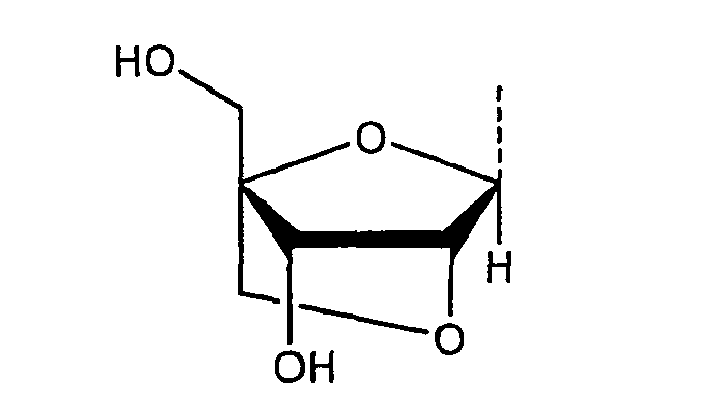
- and those described in
Wengel, et al. WO 99/14226 - In some embodiments, nucleosides and/or nucleotides of the present teachings can have the structure

- wherein B comprises a nucleoside or nucleotide base, such as uracil, cytosine, deazaadenine, or deazaguanosine; W1 and W2 taken separately can be -OH or a group capable of blocking polymerase-mediated template-directed polymerzation, e.g., -H, fluorine, and the like; W3 can be OH, or mono-, di- or triphosphate or a phosphate analog; and D is a dye compound of the present teachings. In some embodiments, nucleotides of the present teachings can be dideoxynucleotide triphosphates having the structure including associated counterions if present.

- including associated counterions if present.
- Labeled dideoxy nucleotides such as that shown above find particular application as chain terminating agents in Sanger-type DNA sequencing methods utilizing fluorescent detection.
- In some embodiments, nucleotides of the present teachings can be deoxynucleotide triphosphates having the structure

- including associated counterions if present.
- Labeled deoxynucleotides such as that shown above find particular application as reagents for labeling polymerase extension products, e.g., in the polymerase chain reaction or nick-translation.
- In some embodiments, the present teachings can provide polynucleotides labeled with at least one dye of the present teachings. Such labeled polynucleotides are useful in a number of important contexts including as DNA sequencing primers, PCR primers, oligonucleotide hybridization probes, oligonucleotide ligation probes, and the like.
- In some embodiments, labeled polynucleotides of the present teachings can include multiple dyes located such that fluorescence energy transfer takes place between a donor dye and an acceptor dye. Such multi-dye energy-transfer polynucleotides find application as spectrally-tunable sequencing primers, see for example, Ju, et al., Proc. Natl. Acad. Sci. USA 92: 4347-4351 (1995), or as hybridization probes, see for example, Lee, et al. Nucleic Acids Research, 21: 3761-3766 (1993).
- Labeled polynucleotides can be synthesized either enzymatically, e.g., using a DNA polymerase or ligase, see for example, Stryer, Biochemistry, ), or by chemical synthesis, e.g., by the phosphoramidite method, the phosphitetriester method, and the like, see for example, Gait, Oligonucleotide Synthesis, IRL Press (1990). Labels may be introduced during enzymatic synthesis utilizing labeled nucleotide triphosphate monomers as described above, or introduced during chemical synthesis using labeled non-nucleotide or nucleotide phosphoramidites as described above, or may be introduced subsequent to synthesis.
- Generally, if the labeled polynucleotide is made using enzymatic synthesis, the following procedure can be used. A template DNA is denatured and an oligonucleotide primer is annealed to the template DNA. A mixture of deoxynucleotide triphosphates is added to the mixture including dGTP, dATP, dCTP, and dTTP where at least a fraction of the deoxynucleotides is labeled with a dye compound of the invention as described above. Next, a polymerase enzyme is added under conditions where the polymerase enzyme is active. A labeled polynucleotide is formed by the incorporation of the labeled deoxynucleotides during polymerase-mediated strand synthesis. In an alternative enzymatic synthesis method, two primers are used instead of one, one primer complementary to the (+) strand and the other complementary to the (-) strand of the target, the polymerase is a thermostable polymerase, and the reaction temperature is cycled between a denaturation temperature and an extension temperature, thereby exponentially synthesizing a labeled complement to the target sequence by PCR, see fro example, PCR Protocols, Innis et al. eds., Academic Press (1990).
- Labeled polynucleotides can be chemically synthesized using the phosphoramidite method. Detailed descriptions of the chemistry used to form polynucleotides by the phosphoramidite method are provided in, for example,
Caruthers et al., U.S. Pat. Nos. 4,458,066 and4,415,732 ; Caruthers, et al., Genetic Engineering, 4: 1-17 (1982); Users Manual Model 392 and 394 Polynucleotide Synthesizers, pages 6-1 through 6-22, Applied Biosystems, Part No. 901237 (1991). - The phosphoramidite method of polynucleotide synthesis can be advantageous in some embodiments because of its efficient and rapid coupling reactions and the stability of the starting materials. The synthesis is performed with the growing polynucleotide chain attached to a solid support, so that excess reagents, which are in the liquid phase, can be easily removed by filtration, thereby eliminating the need for purification steps between synthesis cycles.
- The following briefly describes the steps of a typical polynucleotide synthesis cycle using the phosphoramidite method. First, a solid support including a protected nucleotide monomer is treated with acid, e.g., trichloroacetic acid, to remove a 5'-hydroxyl protecting group, freeing the hydroxyl for a subsequent coupling reaction. An activated intermediate is then formed by simultaneously adding a protected phosphoramidite nucleoside monomer and a weak acid, e.g., tetrazole, to the reaction. The weak acid protonates the nitrogen of the phosphoramidite forming a reactive intermediate. Nucleoside addition is complete within 30 s. Next, a capping step is performed that terminates any polynucleotide chains that did not undergo nucleoside addition. Capping can be accomplished with acetic anhydride and 1-methylimidazole. The internucleotide linkage is then converted from the phosphite to the more stable phosphotriester by oxidation using iodine as the preferred oxidizing agent and water as the oxygen donor. After oxidation, the hydroxyl protecting group is removed with a protic acid, such as trichloroacetic acid or dichloroacetic acid, and the cycle is repeated until chain elongation is complete. After synthesis, the polynucleotide chain is cleaved from the support using a base, such as ammonium hydroxide or t-butyl amine. The cleavage reaction also removes any phosphate protecting groups, such as cyanoethyl. Finally, the protecting groups on the exocyclic amines of the bases and the hydroxyl protecting groups on the dyes are removed by treating the polynucleotide solution in base at an elevated temperature, e.g., 55 °C. One of skill in the art will recognize that a variety if reagents can be used to perform the synthesis described above, and in some cases reagents are available to carry out more than one step in a single reaction.
- Any of the phosphoramidite nucleoside monomers may be dye-labeled phosphoramidites as described above. If the 5'-terminal position of the nucleotide is labeled, a labeled non-nucleotidic phosphoramidite of the invention may be used during the final condensation step. If an internal position of the oligonucleotide is labeled, a labeled nucleotidic phosphoramidite of the invention may be used during any of the condensation steps.
- Subsequent to synthesis, the polynucleotide may be labeled at a number of positions including the 5'-terminus, see for example Oligonucleotides and Analogs, Eckstein ed., ) and Orgel, et al., Nucleic Acids Research 11(18): 6513 (1983);
U.S. Patent No. 5,118,800 ; the phosphodiester backbone, see for example Oligonucleotides and Analogs, Eckstein ed., ); or at the 3'-terminus, see for example Nelson, Nucleic Acids Research 20(23): 6253-6259, andU.S. Patent Nos. 5,401,837 and5,141,813 . For a through review of oligonucleotide labeling procedures see R. Haugland in Excited States of Biopolymers, Steiner ed., Plenum Press, NY (1983). - In one post-synthesis chemical labeling method an oligonuleotide can be labeled as follows. A dye including a carboxy linking group is converted to the N-hydroxysuccinimide ester by reacting with approximately 1 equivalent of 1,3-dicyclohexylcarbodiimide and approximately 3 equivalents of N-hydroxysuccinimide in dry ethyl acetate for 3 hours at room temperature. The reaction mixture is washed with 5% HCl, dried over magnesium sulfate, filtered, and concentrated to a solid which is resuspended in DMSO. The DMSO dye stock is then added in excess (10-20x) to an aminohexyl derivatized oligonucleotide in 0.25 M bicarbonate/carbonate buffer at pH 9.4 and allowed to react for 6 hours, e.g.,
U.S. Patent No. 4,757,141 . The dye labeled oligonucleotide is separated from unreacted dye by passage through a size-exclusion chromatography column eluting with buffer, e.g., 0.1 molar triethylamine acetate (TEAA). The fraction containing the crude labeled oligonucleotide is further purified by reverse phase HPLC employing gradient elution. - It will be understood that the following examples are meant to be merely illustrative and are not meant to be limiting of the present teachings in any way. Although the above description will be adequate to teach one of skill in the art how to practice the present teachings, the following examples are provided as further guidance to those of skill in the art.
- In some embodiments, the present teachings provide for a mixture comprising at least one compound of the present teachings in any of the forms described herein and at least one other component comprising a fluorescent dye. For example, the present teachings can provide for a mixture of polynucleotides, wherein at least one polynucleotide of the mixture comprises a compound of the present teachings and at least one other polynucleotide comprising a fluorescent dye. Mixture components comprising fluorescent dyes of the present teachings can be prepared by any of the methods described herein. In some embodiments, the present teachings provide for kits comprising at least one compound of the present teachings in any of the forms described herein.
- EXAMPLES
- Materials and Methods
- Unless otherwise indicated, all reagents were obtained from Sigma-Aldrich (Milwaukee, WI) and used as received from the distributor. DDAO ( 1 ) was prepared as described in
Corey, P.F., U.S. Patent No. 4,810,636 . NMR spectra were obtained using a Bruker 400 MHz Avance-NMR Spectrometer. Mass spec. data was obtained using an Applied Biosystems API 1500 Mass Spectrometer. Fluorescence data was obtained using a Perkin Elmer LS-50B Luminescence Spectrophotometer. UV/Vis data was obtained using a Hewlett Packard 8451A Diode Array Spectrophotometer. - Example 1: Synthesis of 6-sulfo-DDAO (42)

- To a stirred solution of 50 mg of DDAO ( 41 ) dissolved in 5 mL dichlorormethane (DCM) and cooled to 0°C was added 0.5 mL chlorosulfonic acid. The reaction was stirred at 60°C overnight and then poured into ice-water. Unreacted starting material was extracted with ethyl acetate (EtOAc) and then the product was extracted with n-butanol. The solvent was removed in vacou to obtain 45 mg of 6-sulfo-DDAO ( 42 ) as dark shiny crystals. 1H NMR (CD3OD): δ 7.9 (s, 1H), 7.75 (s, 1H), 7.2 (s, 1H), 1.78 (s, 6H). MS: M+H = 388.
- Example 2: Synthesis of N-(4-caboxybenzoyl)-aminomethyl DDAO (45)

- To a stirred solution of 450 mg DDAO (1.466 mmoles) in 10 mL of conc. sulfuric acid (H2SO4) was added 419 mg of N-(hydroxymethyl)trifluoroacetamide (2.929 mmoles) at room temperature. The resulting mixture was stirred at room temperature for 2 hours. The reaction was poured into 100 mL of ice water and extracted with 4 x 100 mL of 10% methanol/dichloromethane (MeOH/DCM). The organic layer was dried over sodium sulfate (Na2SO4), filtered and evaporated to dryness under reduced pressure. The residue was purified by silica gel chromatography using a gradient of 2:20:78 to 8:20:72 MeOH/ethyl acetate (EtOAc)/DCM) to give 456 mg of compound 43 as a reddish solid. 1H NMR (DMSO-d6): δ 11.4 (br s, 1H, OH), 9.95 (t, 1H, NH), 7.82 (s, 1H), 7.34 (s, 1H), 7.03 (s, 1H), 4.35 (d, 2H), 1.78 (s, 6H). MS: (ESI) M-H = 431.2.
- A solution of 64 mg of compound 43 (0.148 mmoles) in 30 mL NH3/MeOH was stirred at room temperature for 20 hours. The reaction was concentrated to dryness by evaporation and co-evaporation with MeOH. The solid was recrystallized from MeOH/DCM to give compound 44 .
- To a stirred solution of compound 44 in 6 mL dimethyl-formamide(DMF)/DCM (1:1) was added 118 mg of 4-carboxyethy terephthaloyl chloride (0.594 mmoles) and 0.2 mL diisopropylethylamine at room temperature. The resulting mixture was allowed to stir at room temperature for 3 hours. The reaction was then quenched by addition of 10 mL sat. aq. sodium bicarbonate (NaHCO3) and 0.5 mL of a solution of sodium methoxide/MeOH (25%). The reaction mixture was then diluted with 20 mL H2O and extracted 1 x 50 mL EtOAc. The organic layer was dried over Na2SO4, filtered and evaporated under reduced pressure. The residue was then treated with a solution of lithium hydroxide(LiOH)/MeOH/H2O (177 mg/20 mL/5 mL) at 80°C for 45 minutes. The reaction was then cooled to room temperature, evaporated under reduced pressure, re-dissolved in 30 mL H2O, acidified with 1.5
mL 10% HCl, and extracted with 100 mL EtOAc. The organic layer was dried over Na2SO4, filtered and evaporated to dryness under reduced pressure. The residue was purified by silica gel chromatography (using a gradient of 1:9 to 8:2 MeOH/DCM) to give 52 mg ofcompound 45 as a solid. 1H NMR (DMSO-d6): δ 8.84 (t, 1H, NH), 8.00 (d, 2H), 7.34 (m, 3H), 6.97 (s, 1H), 6.52 (s, 1H), 4.24 (d, 2H), 1.70 (s, 6H). MS: (ESI) M+H = 485.0. - Example 3: Synthesis of 6,8-Dinitro-DDAO (46)

- A solution of 50 mg of DDAO dissolved in 2 mL of a 1:1 solution of H2SO4/HNO3 was stirred overnight at room temperature. The reaction was extracted with EtOAc. The solvent was removed in vacuo and the crude product was recrystallized from EtOH to give 41 mg of dinitro-DDAO ( 46 ).
- Example 4: Synthesis of N-(4-caboxy-2-sulfobenzoyl)-aminomethyl DDAO (47)

- Compound 43 was prepared in the same manner as in Example 2. A solution of 43.3 mg of compound 43 (0.1 mmoles) in 20 mL NH3/MeOH was stirred at room temperature for 20 hours. The reaction was concentrated to dryness by evaporation and co-evaporation with DCM to give compound 44 .
- The residue ( 44 ) was dissolved in 5 mL DMF and treated with 200 µL of diisopropylethylamine (Hunig's base) and 74mg of anhydride 48 (0.324 mmoles) at room temperature. The reaction was stirred at room temperature for 3 hours then quenched with 1
mL 10% HCl. The solvent was removed in vacuo and the residue was redissolved in 50mL H2O and extracted with 3 x 50mL 10% MeOH/EtOAc. The organic layer was dried over Na2SO4, filtered and evaporated to dryness. - The residue was then treated with 20 mL of a solution of LiOH·H2O/MeOH/H2O (0.85g/100mL/20mL) at room temperature for 10 minutes. The mixture was acidified with 1
mL 10% HCl and diluted with 50 mL sat. NaCl. The mixture was extracted 2 x 100mL 10% MeOH/EtOAc, then the organic layer was treated with 0.5 mL triethylamine, evaporated to dryness and finally co-evaporated with MeOH. The crude product was dissolved in 50 mL of 20% MeOH/DCM and purified by silica gel chromatography (2 x 17.5 cm, eluant gradient: 20%, 30%, 50%, 60%, 70% and 80% MeOH/DCM (100mL each gradient step, collecting 20 mL fractions)) to give 60 mg ofcompound 47 . 1H NMR (in MeOD): δ 8.52 (d, 1H), 8.01 (dd, 1H), 7.71 (d, 1H), 7.51 (s, 1H), 7.24 (s, 1H), 6.69 (s, 1H), 4.45 (s, 2H, CH2), 1.82 (s, 6H, 2 x CH3). MS (ESI) m/e 563.2 (calcd. for M-H = 563.0).
Claims (19)
- An energy transfer dye comprising a donor dye covalently attached to an acceptor dye, wherein the donor dye is capable of absorbing light at a first wavelength and emitting excitation energy in response, the acceptor dye is capable of absorbing the excitation energy emitted by the donor dye and fluorescing at a second wavelength in response, and the donor dye is a compound selected from the group consisting of structures (I), (II), (III) and (IV)
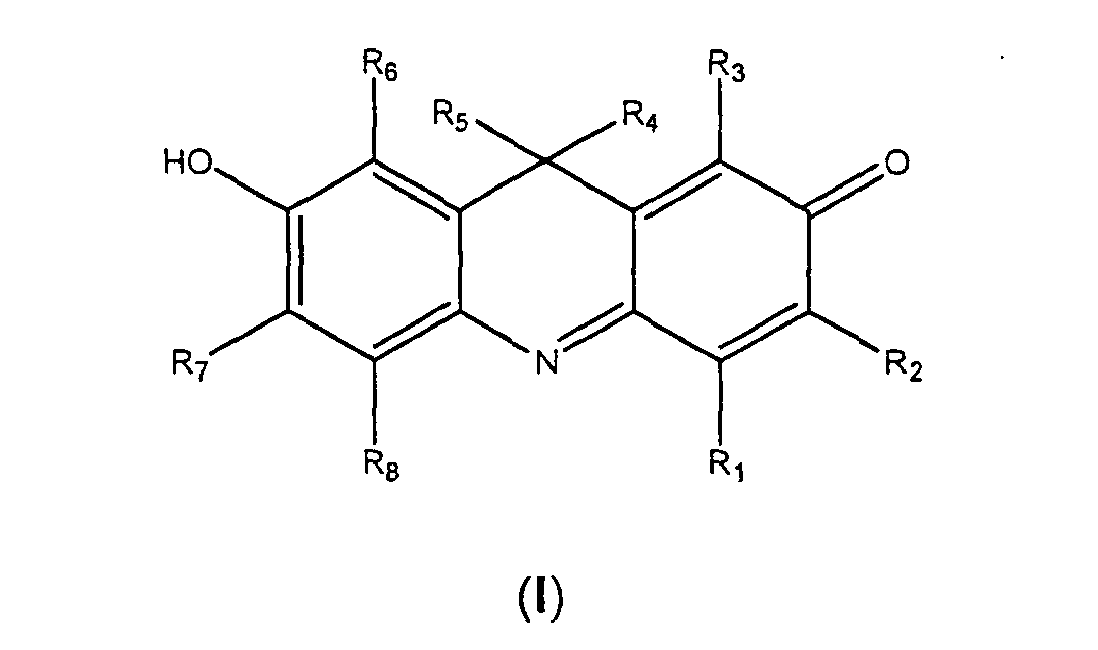


 each of R1-R3 and R6-R16 is independently selected from the group consisting of -H, halogen, aryl, substituted aryl, heteroaryl, -CO2H, -CO2R, -SO3H, -SO3R, -CH2CO2H, -CH2CO2R, -CH2SO3H, -CH2SO3R, -CH2NH2, -CH2NHR, -NO2, C1-C6 alkyl, substituted C1-C6 alkyl, C1-C6 alkoxy, substituted C1-C6 alkoxy, C1-C6 alkoxyaryl, substituted C1-C6 alkoxyaryl, biphenyl, substituted biphenyl, benzyl, substituted benzyl, benzoyl, and substituted benzoyl, wherein R is selected from C1-C6 alkyl, substituted C1-C6 alkyl, C1-C6 alkoxy, substituted C1-C6 alkoxy, C1-C6 alkoxyaryl, substituted C1-C6 alkoxyaryl, phenyl, substituted phenyl, biphenyl, substituted biphenyl, benzyl, substituted benzyl, benzoyl, substituted benzoyl, and a linking group; andeach of R4 and R5 taken separately is selected from the group consisting of C1-C6 alkyl and C1-C6 substituted alkyl, R4 and R5 taken together are selected from the group consisting of C3-C7 cycloalkyl, C4-C7 unsaturated cycloalkyl, C3-C7 substituted cycloalkyl and C4-C7 substituted unsaturated cycloalkyl,wherein at least one of R1-R3 and R6-R16 is -SO3H,with the proviso that if the compound comprises the structure (I), then at least one of R1, R2, R3 or R8 is independently selected from the group consisting of halogen, aryl, substituted aryl, heteroaryl, -CO2H, -CO2R, -SO3H, -SO3R, -CH2CO2H, -CH2CO2R, -CH2SO3H, -CH2SO3R, -CH2NH2, -CH2NHR, -NO2, C1-C6 alkyl, substituted C1-C6 alkyl, C1-C6 alkoxy, substituted C1-C6 alkoxy, C1-C6 alkoxyaryl, substituted C1-C6 alkoxyaryl, , biphenyl, substituted biphenyl, benzyl, substituted benzyl, benzoyl, and substituted benzoyl, wherein R is selected from the group consisting of C1-C6 alkyl, substituted C1-C6 alkyl, C1-C6 alkoxy, substituted C1-C6 alkoxy, C1-C6 alkoxyaryl, substituted C1-C6 alkoxyaryl, phenyl, substituted phenyl, biphenyl, substituted biphenyl, benzyl, substituted benzyl, benzoyl, substituted benzoyl, and a linking group.
 - The energy transfer dye of claim 1, wherein the donor dye is covalently attached to the acceptor dye through a linker.
- The energy transfer dye of claim 2, wherein the linker is non-nucleotidic.
- The energy transfer dye of claim 2, wherein the linker is nucleotidic.
- The energy transfer dye according to any one of claims 1-4, wherein the acceptor dye is a compound comprising a structure selected from the group consisting of structures (I), (II), (III) and (IV)


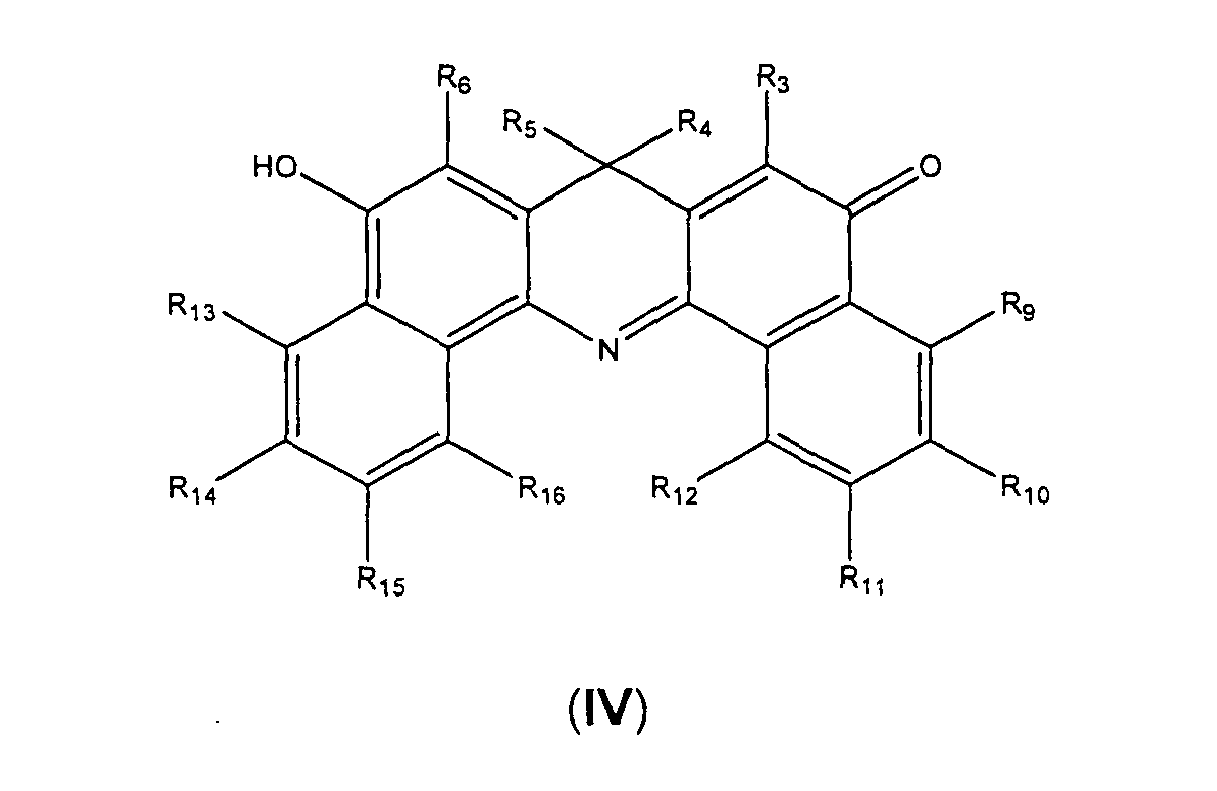 each of R1-R3 and R6-R16 is independently selected from the group consisting of -H, halogen, aryl, substituted aryl, heteroaryl, -CO2H, -CO2R, -SO3H, -SO3R, -CH2CO2H, -CH2CO2R, -CH2SO3H, -CH2SO3R, -CH2NH2, -CH2NHR, -NO2, C1-C6 alkyl, substituted C1-C6 alkyl, C1-C6 alkoxy, substituted C1-C6 alkoxy, C1-C6 alkoxyaryl, substituted C1-C6 alkoxyaryl, biphenyl, substituted biphenyl, benzyl, substituted benzyl, benzoyl, and substituted benzoyl, wherein R is selected from the group consisting of C1-C6 alkyl, substituted C1-C6 alkyl, C1-C6 alkoxy, substituted C1-C6 alkoxy, C1-C6 alkoxyaryl, substituted C1-C6 alkoxyaryl, phenyl, substituted phenyl, biphenyl, substituted biphenyl, benzyl, substituted benzyl, benzoyl, and substituted benzoyl; andeach of R4 and R5 taken separately is selected from the group consisting of C1-C6 alkyl and C1-C6 substituted alkyl, and R4 and R5 taken together are selected from the group consisting of C3-C7 cycloalkyl, C4-C7 unsaturated cycloalkyl, C3-C7 substituted cycloalkyl and C4-C7 substituted unsaturated cycloalkyl,wherein at least one of R1-R3 and R6-R16 is -SO3H,with the proviso that if the compound comprises the structure (I), then at least one of R1, R2, R3 or R8 is independently selected from the group consisting of halogen, aryl, substituted aryl, heteroaryl, -CO2H, -CO2R, -SO3H, -SO3R, -CH2CO2H, -CH2CO2R, -CH2SO3H, -CH2SO3R, -CH2NH2, -CH2NHR, -NO2, C1-C6 alkyl, substituted C1-C6 alkyl, C1-C6 alkoxy, substituted C1-C6 alkoxy, C1-C6 alkoxyaryl, substituted C1-C6 alkoxyaryl, biphenyl, substituted biphenyl, benzyl, substituted benzyl, benzoyl, and substituted benzoyl, wherein R is selected from the group consisting of C1-C6 alkyl, substituted C1-C6 alkyl, C1-C6 alkoxy, substituted C1-C6 alkoxy, C1-C6 alkoxyaryl, substituted C1-C6 alkoxyaryl, phenyl, substituted phenyl, biphenyl, substituted biphenyl, benzyl, substituted benzyl, benzoyl, and substituted benzoyl.
 - The energy transfer dye of claim 5, wherein the donor dye is selected from the group consisting of 5-carboxyfluorescein (5-FAM), 6-carboxyfluorescein (6-FAM), rhodamine green (R110), 5-carboxyrhodamine, 6-carboxyrhodamine, N,N'-diethyl-2',7'-dimethyl-5-carboxy-rhodamine (5-R6G), N,N'-diethyl-2',7'-dimethyl-6-carboxyrhodamine (6-R6G), N,N,N',N'-tetramethyl-5-carboxyrhodamine (5-TAMRA), Cy3, N,N,N',N'-tetramethyl-5-carboxyrhodamine (6-TAMRA), 5-carboxy-X-rhodamine (5-ROX), 6-carboxy-X-rhodamine (6-ROX), 5-carboxy-2',4',5',7',4,7-hexachlorofluorescein, 6-carboxy-2',4',5,7',4,7-hexachlorofluorescein, 5-carboxy-2',7'-dicarboxy-4',5'-dichloro-fluorescein, 6-carboxy-1',2'-dicarboxy-4',5'-dichlorofluorescein, 5-carboxy-2',4',5',7'-tetrachlorofluorescein, 1',2'-benzo-4'-fluoro-7',4,7-trichloro-5-carboxyfluorescein, 1',2'-benzo-4'-fluoro-7',4,7-trichloro-6-carboxyfluorescein and 1',2',7',8'-dibenzo-4,7-dichloro-5-carboxyfluorescein.
- A labeled nucleoside or nucleotide compound comprising the structure
NUC-L-D
wherein NUC comprises a nucleoside, a nucleotide, a modified nucleoside or a modified nucleotide, L comprises a bond or a linker that covalently attaches NUC and D, and D comprises a compound according to any one of claims 1-6. - The labeled nucleoside or nucleotide compound of claim 7, wherein L is attached to D at a position on D selected from one of R1, R3, R7, R8, R9 and R10.
- The labeled nucleoside or nucleotide compound of any one of claims 7-8, wherein if NUC comprises a purine base, the linking moiety is attached to the 8-position of the purine, if NUC comprises a 7-deazapurine base, the linking moiety is attached to the 7-position of the 7-deazapurine, and if NUC comprises a pyrimidine base, the linking moiety is attached to the 5-position of the pyrimidine.
- The labeled nucleoside or nucleotide of any one of claims 7-9, wherein NUC comprises a base selected from the group consisting of uracil, cytosine, deazaadenine, and deazaguanosine.
- The labeled nucleoside or nucleotide compound comprising the structure

- A method of polynucleotide sequencing comprising:i) forming a mixture of a first, a second, a third, and a fourth class of polynucleotides such that: each polynucleotide is labeled with a fluorescent dye; wherein at least one of the first, second, third, or fourth dyes is an energy transfer dye compound according to any one of claims 1-6;ii) electrophoretically separating the polynucleotides;iii) illuminating the bands with an illumination beam capable of causing the dyes to fluoresce; andiv) identifying the classes of the polynucleotides in the bands by the fluorescence spectrum of the dyes.
- The method of claim 12, further comprising a fifth dye as an internal standard.
- A method of polynucleotide sequencing comprising:i) forming a mixture comprising a first, a second, a third, and a fourth class of polynucleotides such that: each polynucleotide in the first class includes a 3'-terminal dideoxyadenosine and is labeled with a first dye; each polynucleotide in the second class includes a 3'-terminal dideoxycytidine and is labeled with a second dye; each polynucleotide in the third class includes a 3'-terminal dideoxyguanosine and is labeled with a third dye; and each polynucleotide in the fourth class includes a 3'-terminal dideoxythymidine and is labeled with a fourth dye; and a fifth dye as an internal standard; wherein a fifth dye is a dye compound according to any one of claims 1-6; the other of the dyes being spectrally resolvable from the dye(s) and from each other;ii) electrophoretically separating the polynucleotides thereby forming bands of similarly sized polynucleotides;iii) illuminating the bands with an illumination beam capable of causing the dyes to fluoresce; andiv) identifying the classes of the polynucleotides in the bands by the fluorescence spectrum of the dyes.
- A method of fragment analysis comprising:i) forming labeled polynucleotide fragments, the fragments being labeled with a dye compound according to any one of claims 1-6;ii) subjecting the labeled polynucleotide fragments to a size-dependent separation process; andiii) detecting the labeled polynucleotide fragments subsequent to the separation process.
- A labeled polynucleotide comprising the structure
NUC-L-D
wherein NUC comprises a polynucleotide, L comprises a bond or a linker that covalently attaches NUC and D, and D comprises a compound according to any one of claims 1-6. - The labeled nucleoside or nucleotide compound of claim 11, wherein the attachment of D is selected from a position on D selected from one of R1, R3, R7, R8, R9 and R10.
- The labeled nucleoside or nucleotide of any one of claims 11 and 17,
wherein if NUC comprises a purine base, the linking moiety is attached to the 8-position of the purine, if NUC comprises a 7-deazapurine base, the linking moiety is attached to the 7-position of the 7-deazapurine, and if NUC comprises a pyrimidine base, the linking moiety is attached to the 5-position of the pyrimidine. - The labeled nucleoside or nucleotide of any one of claims 11 and 17-18,
wherein NUC comprises a base selected from the group consisting of uracil, cytosine, deazaadenine, and deazaguanosine.
Applications Claiming Priority (3)
| Application Number | Priority Date | Filing Date | Title |
|---|---|---|---|
| US61111904P | 2004-09-16 | 2004-09-16 | |
| EP05801162.8A EP1802727B1 (en) | 2004-09-16 | 2005-09-16 | Fluorescent dye compounds, conjugates and uses thereof |
| PCT/US2005/033174 WO2006034036A1 (en) | 2004-09-16 | 2005-09-16 | Fluorescent dye compounds, conjugates and uses thereof |
Related Parent Applications (3)
| Application Number | Title | Priority Date | Filing Date |
|---|---|---|---|
| EP05801162.8 Division | 2005-09-16 | ||
| EP05801162.8A Division EP1802727B1 (en) | 2004-09-16 | 2005-09-16 | Fluorescent dye compounds, conjugates and uses thereof |
| EP05801162.8A Division-Into EP1802727B1 (en) | 2004-09-16 | 2005-09-16 | Fluorescent dye compounds, conjugates and uses thereof |
Publications (2)
| Publication Number | Publication Date |
|---|---|
| EP2371927A1 true EP2371927A1 (en) | 2011-10-05 |
| EP2371927B1 EP2371927B1 (en) | 2020-03-11 |
Family
ID=35455743
Family Applications (2)
| Application Number | Title | Priority Date | Filing Date |
|---|---|---|---|
| EP05801162.8A Expired - Lifetime EP1802727B1 (en) | 2004-09-16 | 2005-09-16 | Fluorescent dye compounds, conjugates and uses thereof |
| EP11004494.8A Expired - Lifetime EP2371927B1 (en) | 2004-09-16 | 2005-09-16 | Fluorescent dye compounds, conjugates and uses thereof |
Family Applications Before (1)
| Application Number | Title | Priority Date | Filing Date |
|---|---|---|---|
| EP05801162.8A Expired - Lifetime EP1802727B1 (en) | 2004-09-16 | 2005-09-16 | Fluorescent dye compounds, conjugates and uses thereof |
Country Status (8)
| Country | Link |
|---|---|
| US (4) | US7256292B2 (en) |
| EP (2) | EP1802727B1 (en) |
| JP (2) | JP2008513579A (en) |
| CN (1) | CN101258220A (en) |
| AU (1) | AU2005287078A1 (en) |
| CA (1) | CA2581174A1 (en) |
| SG (1) | SG155923A1 (en) |
| WO (1) | WO2006034036A1 (en) |
Families Citing this family (11)
| Publication number | Priority date | Publication date | Assignee | Title |
|---|---|---|---|---|
| US7570443B2 (en) | 2003-09-19 | 2009-08-04 | Applied Biosystems, Llc | Optical camera alignment |
| CA2581174A1 (en) * | 2004-09-16 | 2006-03-30 | Applera Corporation | Fluorescent dye compounds, conjugates and uses thereof |
| US20080066549A1 (en) * | 2006-09-18 | 2008-03-20 | Oldham Mark F | Methods, systems and apparatus for light concentrating mechanisms |
| US20080293127A1 (en) * | 2007-05-22 | 2008-11-27 | Applera Corporation | Method to Render Pressure Sensitive Adhesive Compatible with Polymerase Chain Reaction Systems |
| WO2010062787A1 (en) * | 2008-11-03 | 2010-06-03 | Washington University | Bioluminescence imaging of myeloperoxidase activity in vivo, methods, compositions and apparatuses therefor |
| WO2010063732A1 (en) * | 2008-12-01 | 2010-06-10 | Biotype Ag | Novel combination of fluorescent dyes for the detection of nucleic acids |
| GB201012417D0 (en) * | 2010-07-23 | 2010-09-08 | Cambridge Entpr Ltd | Capilary electrophoresis of carbohydrates |
| US20120171684A1 (en) * | 2010-12-29 | 2012-07-05 | Life Technologies Corporation | Ddao compounds as fluorescent reference standards |
| TWI485145B (en) | 2012-10-26 | 2015-05-21 | 財團法人工業技術研究院 | P-type organic semiconductor materials and optoelectronic components |
| US11155713B2 (en) | 2018-05-29 | 2021-10-26 | Elitechgroup, Inc. | Carborhodamine compounds and methods of preparation thereof |
| WO2022006368A2 (en) | 2020-07-02 | 2022-01-06 | Life Technologies Corporation | Trinucleotide cap analogs, preparation and uses thereof |
Citations (22)
| Publication number | Priority date | Publication date | Assignee | Title |
|---|---|---|---|---|
| US4415732A (en) | 1981-03-27 | 1983-11-15 | University Patents, Inc. | Phosphoramidite compounds and processes |
| US4458066A (en) | 1980-02-29 | 1984-07-03 | University Patents, Inc. | Process for preparing polynucleotides |
| US4757141A (en) | 1985-08-26 | 1988-07-12 | Applied Biosystems, Incorporated | Amino-derivatized phosphite and phosphate linking agents, phosphoramidite precursors, and useful conjugates thereof |
| US4810636A (en) | 1986-12-09 | 1989-03-07 | Miles Inc. | Chromogenic acridinone enzyme substrates |
| US4855225A (en) | 1986-02-07 | 1989-08-08 | Applied Biosystems, Inc. | Method of detecting electrophoretically separated oligonucleotides |
| US5118800A (en) | 1983-12-20 | 1992-06-02 | California Institute Of Technology | Oligonucleotides possessing a primary amino group in the terminal nucleotide |
| US5141813A (en) | 1989-08-28 | 1992-08-25 | Clontech Laboratories, Inc. | Multifunctional controlled pore glass reagent for solid phase oligonucleotide synthesis |
| US5231191A (en) | 1987-12-24 | 1993-07-27 | Applied Biosystems, Inc. | Rhodamine phosphoramidite compounds |
| EP0251786B1 (en) | 1986-07-02 | 1994-11-30 | E.I. Du Pont De Nemours And Company | Alkynylamino-nucleotides |
| US5449767A (en) | 1981-04-17 | 1995-09-12 | Yale University | Modified polynucleotides and methods of preparing same |
| US5728528A (en) | 1995-09-20 | 1998-03-17 | The Regents Of The University Of California | Universal spacer/energy transfer dyes |
| US5853992A (en) | 1996-10-04 | 1998-12-29 | The Regents Of The University Of California | Cyanine dyes with high-absorbance cross section as donor chromophores in energy transfer labels |
| US5863727A (en) | 1996-05-03 | 1999-01-26 | The Perkin-Elmer Corporation | Energy transfer dyes with enhanced fluorescence |
| WO1999014226A2 (en) | 1997-09-12 | 1999-03-25 | Exiqon A/S | Bi- and tri-cyclic nucleoside, nucleotide and oligonucleotide analogues |
| US6008373A (en) | 1995-06-07 | 1999-12-28 | Carnegie Mellon University | Fluorescent labeling complexes with large stokes shift formed by coupling together cyanine and other fluorochromes capable of resonance energy transfer |
| WO2000013026A1 (en) | 1998-08-31 | 2000-03-09 | Amersham Pharmacia Biotech, Inc. | Energy transfer dyes |
| WO2001019841A1 (en) | 1999-09-17 | 2001-03-22 | Amersham Pharmacia Biotech, Inc. | Charge-modified nucleic acid terminators |
| WO2003020734A2 (en) * | 2001-08-29 | 2003-03-13 | Amersham Biosciences Corp | Labeled nucleoside polyphosphates |
| WO2004020603A2 (en) * | 2002-08-29 | 2004-03-11 | Amersham Biosciences Corp | Analyte detection |
| US20040126763A1 (en) | 2002-12-20 | 2004-07-01 | Satyam Nampalli | Heterocyclic FRETdye cassettes for labeling biological molecules and their use in DNA sequencing |
| WO2004072304A1 (en) * | 2003-02-05 | 2004-08-26 | Amersham Biosciences Corp | Nucleic acid amplification |
| WO2004072297A2 (en) * | 2003-02-05 | 2004-08-26 | Amersham Biosciences Corp | Terminal-phosphate-labeled nucleotides and methods of use |
Family Cites Families (18)
| Publication number | Priority date | Publication date | Assignee | Title |
|---|---|---|---|---|
| ES2091267T3 (en) | 1986-12-09 | 1996-11-01 | Bayer Ag | ENZYMATIC SUBSTRATES OF ACRIDINONE CHROMOGENE. |
| DE3912046B4 (en) * | 1988-09-02 | 2004-03-25 | Carnegie Mellon University | Method of labeling a component of an aqueous liquid and luminescent photostable reaction product |
| US5393615A (en) * | 1994-02-03 | 1995-02-28 | Miles Inc. | Mediators suitable for the electrochemical regeneration of NADH, NADPH or analogs thereof |
| JP2909216B2 (en) | 1994-04-29 | 1999-06-23 | パーキン‐エルマー コーポレイション | Real-time detection device for nucleic acid amplification products |
| US6583168B1 (en) * | 1997-11-25 | 2003-06-24 | Applera Corporation | Sulfonated diarylrhodamine dyes |
| DK1140888T3 (en) * | 1998-12-14 | 2003-08-25 | Vertex Pharma San Diego Llc | Optical molecular sensors for cytochrome P450 activity |
| US6465644B1 (en) * | 2000-05-02 | 2002-10-15 | Applera Corporation | Sulfonated [8,9] benzophenoxazine dyes and the use of their labelled conjugates |
| JP2003064083A (en) * | 2001-08-23 | 2003-03-05 | Fuji Photo Film Co Ltd | 2,3,3-TRIMETHYL-3H-PYRROLO[2,3-b]PYRIDINE-5-SULFONIC ACID AND DERIVATIVE THEREOF |
| US7033762B2 (en) * | 2001-08-29 | 2006-04-25 | Amersham Biosciences Corp | Single nucleotide amplification and detection by polymerase |
| US7052839B2 (en) * | 2001-08-29 | 2006-05-30 | Amersham Biosciences Corp | Terminal-phosphate-labeled nucleotides and methods of use |
| WO2003020603A1 (en) * | 2001-09-06 | 2003-03-13 | Robert John Galway | Collapsible packing boxes |
| AU2002326950A1 (en) * | 2001-09-19 | 2003-04-01 | Pe Corporation (Ny) | Membrane transportable fluorescent substrates |
| CA2433473A1 (en) | 2002-07-23 | 2004-01-23 | F. Hoffmann-La Roche Ag | Fluorescent hybridization probes with reduced background |
| CA2496462C (en) * | 2002-08-29 | 2014-01-28 | Amersham Biosciences Corp | Allele specific primer extension |
| CA2581174A1 (en) | 2004-09-16 | 2006-03-30 | Applera Corporation | Fluorescent dye compounds, conjugates and uses thereof |
| US20100227327A1 (en) | 2008-08-08 | 2010-09-09 | Xiaoliang Sunney Xie | Methods and compositions for continuous single-molecule nucleic acid sequencing by synthesis with fluorogenic nucleotides |
| EP2470912A4 (en) | 2009-08-25 | 2013-04-17 | Life Technologies Corp | Quantitative fluorescent protein standards |
| US20120171684A1 (en) | 2010-12-29 | 2012-07-05 | Life Technologies Corporation | Ddao compounds as fluorescent reference standards |
-
2005
- 2005-09-16 CA CA002581174A patent/CA2581174A1/en not_active Abandoned
- 2005-09-16 WO PCT/US2005/033174 patent/WO2006034036A1/en not_active Ceased
- 2005-09-16 EP EP05801162.8A patent/EP1802727B1/en not_active Expired - Lifetime
- 2005-09-16 US US11/229,012 patent/US7256292B2/en not_active Expired - Lifetime
- 2005-09-16 AU AU2005287078A patent/AU2005287078A1/en not_active Abandoned
- 2005-09-16 EP EP11004494.8A patent/EP2371927B1/en not_active Expired - Lifetime
- 2005-09-16 CN CNA2005800310384A patent/CN101258220A/en active Pending
- 2005-09-16 SG SG200906144-1A patent/SG155923A1/en unknown
- 2005-09-16 JP JP2007532501A patent/JP2008513579A/en active Pending
-
2007
- 2007-12-17 US US11/838,793 patent/US7985602B2/en active Active
-
2008
- 2008-09-11 JP JP2008233982A patent/JP2009041027A/en active Pending
-
2011
- 2011-06-21 US US13/165,575 patent/US8729267B2/en not_active Expired - Lifetime
-
2014
- 2014-03-28 US US14/229,663 patent/US9745336B2/en active Active
Patent Citations (23)
| Publication number | Priority date | Publication date | Assignee | Title |
|---|---|---|---|---|
| US4458066A (en) | 1980-02-29 | 1984-07-03 | University Patents, Inc. | Process for preparing polynucleotides |
| US4415732A (en) | 1981-03-27 | 1983-11-15 | University Patents, Inc. | Phosphoramidite compounds and processes |
| US5449767A (en) | 1981-04-17 | 1995-09-12 | Yale University | Modified polynucleotides and methods of preparing same |
| US5118800A (en) | 1983-12-20 | 1992-06-02 | California Institute Of Technology | Oligonucleotides possessing a primary amino group in the terminal nucleotide |
| US4757141A (en) | 1985-08-26 | 1988-07-12 | Applied Biosystems, Incorporated | Amino-derivatized phosphite and phosphate linking agents, phosphoramidite precursors, and useful conjugates thereof |
| US4855225A (en) | 1986-02-07 | 1989-08-08 | Applied Biosystems, Inc. | Method of detecting electrophoretically separated oligonucleotides |
| EP0251786B1 (en) | 1986-07-02 | 1994-11-30 | E.I. Du Pont De Nemours And Company | Alkynylamino-nucleotides |
| US4810636A (en) | 1986-12-09 | 1989-03-07 | Miles Inc. | Chromogenic acridinone enzyme substrates |
| US5231191A (en) | 1987-12-24 | 1993-07-27 | Applied Biosystems, Inc. | Rhodamine phosphoramidite compounds |
| US5141813A (en) | 1989-08-28 | 1992-08-25 | Clontech Laboratories, Inc. | Multifunctional controlled pore glass reagent for solid phase oligonucleotide synthesis |
| US5401837A (en) | 1989-08-28 | 1995-03-28 | Clontech Laboratories, Inc. | Method for labeling the 3' terminus of a synthetic oligonucleotide using a unique multifunctional controlled pore glass (MF-CPG) reagent in solid phase oligonucleotide synthesis |
| US6008373A (en) | 1995-06-07 | 1999-12-28 | Carnegie Mellon University | Fluorescent labeling complexes with large stokes shift formed by coupling together cyanine and other fluorochromes capable of resonance energy transfer |
| US5728528A (en) | 1995-09-20 | 1998-03-17 | The Regents Of The University Of California | Universal spacer/energy transfer dyes |
| US5863727A (en) | 1996-05-03 | 1999-01-26 | The Perkin-Elmer Corporation | Energy transfer dyes with enhanced fluorescence |
| US5853992A (en) | 1996-10-04 | 1998-12-29 | The Regents Of The University Of California | Cyanine dyes with high-absorbance cross section as donor chromophores in energy transfer labels |
| WO1999014226A2 (en) | 1997-09-12 | 1999-03-25 | Exiqon A/S | Bi- and tri-cyclic nucleoside, nucleotide and oligonucleotide analogues |
| WO2000013026A1 (en) | 1998-08-31 | 2000-03-09 | Amersham Pharmacia Biotech, Inc. | Energy transfer dyes |
| WO2001019841A1 (en) | 1999-09-17 | 2001-03-22 | Amersham Pharmacia Biotech, Inc. | Charge-modified nucleic acid terminators |
| WO2003020734A2 (en) * | 2001-08-29 | 2003-03-13 | Amersham Biosciences Corp | Labeled nucleoside polyphosphates |
| WO2004020603A2 (en) * | 2002-08-29 | 2004-03-11 | Amersham Biosciences Corp | Analyte detection |
| US20040126763A1 (en) | 2002-12-20 | 2004-07-01 | Satyam Nampalli | Heterocyclic FRETdye cassettes for labeling biological molecules and their use in DNA sequencing |
| WO2004072304A1 (en) * | 2003-02-05 | 2004-08-26 | Amersham Biosciences Corp | Nucleic acid amplification |
| WO2004072297A2 (en) * | 2003-02-05 | 2004-08-26 | Amersham Biosciences Corp | Terminal-phosphate-labeled nucleotides and methods of use |
Non-Patent Citations (23)
| Title |
|---|
| "Polynucleotide Synthesizers", APPLIED BIOSYSTEMS, 1991, pages 901237 |
| "Users Manual Model", pages: 392 - 394 |
| BERGSTROM ET AL., JACS, vol. 111, 1989, pages 374 - 375 |
| CARUTHERS ET AL., GENETIC ENGINEERING, vol. 4, 1982, pages 1 - 17 |
| COREY ET AL., ANGEW CHERN INT. ED. ENGL, vol. 30, 1991 |
| COREY ET AL., ANGEW CHERN INT. ED. ENGL., vol. 30, 1991 |
| ECKSTEIN: "Oligonucleotides and Analogs", 1991, IRL PRESS, article "Chapter 8" |
| GAIT: "Oligonucleotide Synthesis", 1990, IRL PRESS |
| GEBEYEHU ET AL., NUCLEIC ACIDS RESEARCH, vol. 15, 1987, pages 4513 - 4535 |
| GIBSON ET AL., NUCLEIC ACIDS RESEARCH, vol. 15, 1987, pages 6455 - 6467 |
| HARALAMBIDIS ET AL., NUCLEIC ACIDS RESEARCH, vol. 15, 1987, pages 4856 - 4876 |
| HAWORTH ET AL., J.CHEM SOC, ABSTRACTS, 1943, pages 10 - 13 |
| HOBBS ET AL., J. ORG. CHEM., vol. 54, 1989, pages 3420 |
| INNIS ET AL.: "PCR Protocols", 1990, ACADEMIC PRESS |
| J.AM.CHEM.SOC., vol. 108, 1986, pages 4119 |
| JU ET AL., PROC. NATL. ACAD. SCI. USA, vol. 92, 1995, pages 4347 - 4351 |
| LEE ET AL., NUCLEIC ACIDS RESEARCH, vol. 21, 1993, pages 3761 - 3766 |
| NELSON ET AL., NUCLEOSIDES AND NUCLEOTIDES, vol. 5, no. 3, 1986, pages 233 - 241 |
| NELSON, NUCLEIC ACIDS RESEARCH, vol. 20, no. 23, pages 6253 - 6259 |
| ORGEL ET AL., NUCLEIC ACIDS RESEARCH, vol. 11, no. 18, 1983, pages 6513 |
| R. HAUGLAND: "Excited States of Biopolymers", 1983, PLENUM PRESS |
| R. HAUGLAND: "Molecular Probes Handbook of Fluorescent Probes and Research Chemicals", 1992, MOLECULAR PROBES, INC. |
| STRYER: "Biochemistry", 1981, W.H. FREEMAN AND COMPANY, article "Chapter 24" |
Also Published As
| Publication number | Publication date |
|---|---|
| EP2371927B1 (en) | 2020-03-11 |
| EP1802727B1 (en) | 2018-04-04 |
| AU2005287078A1 (en) | 2006-03-30 |
| JP2008513579A (en) | 2008-05-01 |
| US20060167257A1 (en) | 2006-07-27 |
| US20140303003A1 (en) | 2014-10-09 |
| US8729267B2 (en) | 2014-05-20 |
| US20110250699A1 (en) | 2011-10-13 |
| SG155923A1 (en) | 2009-10-29 |
| CA2581174A1 (en) | 2006-03-30 |
| US7985602B2 (en) | 2011-07-26 |
| US7256292B2 (en) | 2007-08-14 |
| US9745336B2 (en) | 2017-08-29 |
| WO2006034036A1 (en) | 2006-03-30 |
| JP2009041027A (en) | 2009-02-26 |
| CN101258220A (en) | 2008-09-03 |
| US20090093062A1 (en) | 2009-04-09 |
| EP1802727A1 (en) | 2007-07-04 |
Similar Documents
| Publication | Publication Date | Title |
|---|---|---|
| US9745336B2 (en) | Fluorescent dye compounds, conjugates and uses thereof | |
| US6221606B1 (en) | Dibenzorhodamine dyes | |
| CA2367868C (en) | 4,7-dichlororhodamine dyes useful as molecular probes | |
| JP2004043772A (en) | Aromatic substituted xanthene coloring matter | |
| US6583168B1 (en) | Sulfonated diarylrhodamine dyes | |
| AU2001259351A1 (en) | Sulfonated (8,9)benzophenoxazine dyes and the use of their labelled conjugates | |
| JP2008513579A5 (en) | ||
| US7550570B2 (en) | 4,7-dichlororhodamine dyes labeled polynucleotides | |
| AU2008200036A1 (en) | Sulfonated diarylrhodamine dyes |
Legal Events
| Date | Code | Title | Description |
|---|---|---|---|
| PUAI | Public reference made under article 153(3) epc to a published international application that has entered the european phase |
Free format text: ORIGINAL CODE: 0009012 |
|
| AC | Divisional application: reference to earlier application |
Ref document number: 1802727 Country of ref document: EP Kind code of ref document: P |
|
| AK | Designated contracting states |
Kind code of ref document: A1 Designated state(s): AT BE BG CH CY CZ DE DK EE ES FI FR GB GR HU IE IS IT LI LT LU LV MC NL PL PT RO SE SI SK TR |
|
| 17P | Request for examination filed |
Effective date: 20120327 |
|
| RAP1 | Party data changed (applicant data changed or rights of an application transferred) |
Owner name: LIFE TECHNOLOGIES CORPORATION |
|
| STAA | Information on the status of an ep patent application or granted ep patent |
Free format text: STATUS: EXAMINATION IS IN PROGRESS |
|
| 17Q | First examination report despatched |
Effective date: 20170208 |
|
| GRAP | Despatch of communication of intention to grant a patent |
Free format text: ORIGINAL CODE: EPIDOSNIGR1 |
|
| STAA | Information on the status of an ep patent application or granted ep patent |
Free format text: STATUS: GRANT OF PATENT IS INTENDED |
|
| RIC1 | Information provided on ipc code assigned before grant |
Ipc: C07D 219/06 20060101ALI20190822BHEP Ipc: C12Q 1/68 20180101ALI20190822BHEP Ipc: C09B 15/00 20060101ALI20190822BHEP Ipc: C12Q 1/6816 20180101ALI20190822BHEP Ipc: C07D 219/04 20060101ALI20190822BHEP Ipc: C09K 11/06 20060101AFI20190822BHEP Ipc: G01N 33/58 20060101ALI20190822BHEP Ipc: C12Q 1/6869 20180101ALI20190822BHEP Ipc: C07H 21/00 20060101ALI20190822BHEP |
|
| INTG | Intention to grant announced |
Effective date: 20190916 |
|
| GRAJ | Information related to disapproval of communication of intention to grant by the applicant or resumption of examination proceedings by the epo deleted |
Free format text: ORIGINAL CODE: EPIDOSDIGR1 |
|
| STAA | Information on the status of an ep patent application or granted ep patent |
Free format text: STATUS: EXAMINATION IS IN PROGRESS |
|
| GRAR | Information related to intention to grant a patent recorded |
Free format text: ORIGINAL CODE: EPIDOSNIGR71 |
|
| GRAS | Grant fee paid |
Free format text: ORIGINAL CODE: EPIDOSNIGR3 |
|
| STAA | Information on the status of an ep patent application or granted ep patent |
Free format text: STATUS: GRANT OF PATENT IS INTENDED |
|
| GRAA | (expected) grant |
Free format text: ORIGINAL CODE: 0009210 |
|
| STAA | Information on the status of an ep patent application or granted ep patent |
Free format text: STATUS: THE PATENT HAS BEEN GRANTED |
|
| INTC | Intention to grant announced (deleted) | ||
| INTG | Intention to grant announced |
Effective date: 20200130 |
|
| AC | Divisional application: reference to earlier application |
Ref document number: 1802727 Country of ref document: EP Kind code of ref document: P |
|
| AK | Designated contracting states |
Kind code of ref document: B1 Designated state(s): AT BE BG CH CY CZ DE DK EE ES FI FR GB GR HU IE IS IT LI LT LU LV MC NL PL PT RO SE SI SK TR |
|
| REG | Reference to a national code |
Ref country code: GB Ref legal event code: FG4D |
|
| REG | Reference to a national code |
Ref country code: CH Ref legal event code: EP |
|
| REG | Reference to a national code |
Ref country code: AT Ref legal event code: REF Ref document number: 1243136 Country of ref document: AT Kind code of ref document: T Effective date: 20200315 |
|
| REG | Reference to a national code |
Ref country code: IE Ref legal event code: FG4D |
|
| REG | Reference to a national code |
Ref country code: DE Ref legal event code: R096 Ref document number: 602005056689 Country of ref document: DE |
|
| PG25 | Lapsed in a contracting state [announced via postgrant information from national office to epo] |
Ref country code: FI Free format text: LAPSE BECAUSE OF FAILURE TO SUBMIT A TRANSLATION OF THE DESCRIPTION OR TO PAY THE FEE WITHIN THE PRESCRIBED TIME-LIMIT Effective date: 20200311 |
|
| REG | Reference to a national code |
Ref country code: NL Ref legal event code: MP Effective date: 20200311 |
|
| PG25 | Lapsed in a contracting state [announced via postgrant information from national office to epo] |
Ref country code: LV Free format text: LAPSE BECAUSE OF FAILURE TO SUBMIT A TRANSLATION OF THE DESCRIPTION OR TO PAY THE FEE WITHIN THE PRESCRIBED TIME-LIMIT Effective date: 20200311 Ref country code: SE Free format text: LAPSE BECAUSE OF FAILURE TO SUBMIT A TRANSLATION OF THE DESCRIPTION OR TO PAY THE FEE WITHIN THE PRESCRIBED TIME-LIMIT Effective date: 20200311 Ref country code: BG Free format text: LAPSE BECAUSE OF FAILURE TO SUBMIT A TRANSLATION OF THE DESCRIPTION OR TO PAY THE FEE WITHIN THE PRESCRIBED TIME-LIMIT Effective date: 20200611 Ref country code: GR Free format text: LAPSE BECAUSE OF FAILURE TO SUBMIT A TRANSLATION OF THE DESCRIPTION OR TO PAY THE FEE WITHIN THE PRESCRIBED TIME-LIMIT Effective date: 20200612 |
|
| REG | Reference to a national code |
Ref country code: LT Ref legal event code: MG4D |
|
| PG25 | Lapsed in a contracting state [announced via postgrant information from national office to epo] |
Ref country code: NL Free format text: LAPSE BECAUSE OF FAILURE TO SUBMIT A TRANSLATION OF THE DESCRIPTION OR TO PAY THE FEE WITHIN THE PRESCRIBED TIME-LIMIT Effective date: 20200311 |
|
| PG25 | Lapsed in a contracting state [announced via postgrant information from national office to epo] |
Ref country code: PT Free format text: LAPSE BECAUSE OF FAILURE TO SUBMIT A TRANSLATION OF THE DESCRIPTION OR TO PAY THE FEE WITHIN THE PRESCRIBED TIME-LIMIT Effective date: 20200805 Ref country code: SK Free format text: LAPSE BECAUSE OF FAILURE TO SUBMIT A TRANSLATION OF THE DESCRIPTION OR TO PAY THE FEE WITHIN THE PRESCRIBED TIME-LIMIT Effective date: 20200311 Ref country code: IS Free format text: LAPSE BECAUSE OF FAILURE TO SUBMIT A TRANSLATION OF THE DESCRIPTION OR TO PAY THE FEE WITHIN THE PRESCRIBED TIME-LIMIT Effective date: 20200711 Ref country code: EE Free format text: LAPSE BECAUSE OF FAILURE TO SUBMIT A TRANSLATION OF THE DESCRIPTION OR TO PAY THE FEE WITHIN THE PRESCRIBED TIME-LIMIT Effective date: 20200311 Ref country code: LT Free format text: LAPSE BECAUSE OF FAILURE TO SUBMIT A TRANSLATION OF THE DESCRIPTION OR TO PAY THE FEE WITHIN THE PRESCRIBED TIME-LIMIT Effective date: 20200311 Ref country code: CZ Free format text: LAPSE BECAUSE OF FAILURE TO SUBMIT A TRANSLATION OF THE DESCRIPTION OR TO PAY THE FEE WITHIN THE PRESCRIBED TIME-LIMIT Effective date: 20200311 Ref country code: RO Free format text: LAPSE BECAUSE OF FAILURE TO SUBMIT A TRANSLATION OF THE DESCRIPTION OR TO PAY THE FEE WITHIN THE PRESCRIBED TIME-LIMIT Effective date: 20200311 |
|
| REG | Reference to a national code |
Ref country code: AT Ref legal event code: MK05 Ref document number: 1243136 Country of ref document: AT Kind code of ref document: T Effective date: 20200311 |
|
| REG | Reference to a national code |
Ref country code: DE Ref legal event code: R097 Ref document number: 602005056689 Country of ref document: DE |
|
| PLBE | No opposition filed within time limit |
Free format text: ORIGINAL CODE: 0009261 |
|
| STAA | Information on the status of an ep patent application or granted ep patent |
Free format text: STATUS: NO OPPOSITION FILED WITHIN TIME LIMIT |
|
| PG25 | Lapsed in a contracting state [announced via postgrant information from national office to epo] |
Ref country code: DK Free format text: LAPSE BECAUSE OF FAILURE TO SUBMIT A TRANSLATION OF THE DESCRIPTION OR TO PAY THE FEE WITHIN THE PRESCRIBED TIME-LIMIT Effective date: 20200311 Ref country code: AT Free format text: LAPSE BECAUSE OF FAILURE TO SUBMIT A TRANSLATION OF THE DESCRIPTION OR TO PAY THE FEE WITHIN THE PRESCRIBED TIME-LIMIT Effective date: 20200311 Ref country code: IT Free format text: LAPSE BECAUSE OF FAILURE TO SUBMIT A TRANSLATION OF THE DESCRIPTION OR TO PAY THE FEE WITHIN THE PRESCRIBED TIME-LIMIT Effective date: 20200311 Ref country code: ES Free format text: LAPSE BECAUSE OF FAILURE TO SUBMIT A TRANSLATION OF THE DESCRIPTION OR TO PAY THE FEE WITHIN THE PRESCRIBED TIME-LIMIT Effective date: 20200311 |
|
| 26N | No opposition filed |
Effective date: 20201214 |
|
| PG25 | Lapsed in a contracting state [announced via postgrant information from national office to epo] |
Ref country code: PL Free format text: LAPSE BECAUSE OF FAILURE TO SUBMIT A TRANSLATION OF THE DESCRIPTION OR TO PAY THE FEE WITHIN THE PRESCRIBED TIME-LIMIT Effective date: 20200311 Ref country code: SI Free format text: LAPSE BECAUSE OF FAILURE TO SUBMIT A TRANSLATION OF THE DESCRIPTION OR TO PAY THE FEE WITHIN THE PRESCRIBED TIME-LIMIT Effective date: 20200311 |
|
| PG25 | Lapsed in a contracting state [announced via postgrant information from national office to epo] |
Ref country code: MC Free format text: LAPSE BECAUSE OF FAILURE TO SUBMIT A TRANSLATION OF THE DESCRIPTION OR TO PAY THE FEE WITHIN THE PRESCRIBED TIME-LIMIT Effective date: 20200311 |
|
| REG | Reference to a national code |
Ref country code: CH Ref legal event code: PL |
|
| REG | Reference to a national code |
Ref country code: BE Ref legal event code: MM Effective date: 20200930 |
|
| PG25 | Lapsed in a contracting state [announced via postgrant information from national office to epo] |
Ref country code: LU Free format text: LAPSE BECAUSE OF NON-PAYMENT OF DUE FEES Effective date: 20200916 |
|
| PG25 | Lapsed in a contracting state [announced via postgrant information from national office to epo] |
Ref country code: CH Free format text: LAPSE BECAUSE OF NON-PAYMENT OF DUE FEES Effective date: 20200930 Ref country code: BE Free format text: LAPSE BECAUSE OF NON-PAYMENT OF DUE FEES Effective date: 20200930 Ref country code: LI Free format text: LAPSE BECAUSE OF NON-PAYMENT OF DUE FEES Effective date: 20200930 Ref country code: IE Free format text: LAPSE BECAUSE OF NON-PAYMENT OF DUE FEES Effective date: 20200916 |
|
| PG25 | Lapsed in a contracting state [announced via postgrant information from national office to epo] |
Ref country code: TR Free format text: LAPSE BECAUSE OF FAILURE TO SUBMIT A TRANSLATION OF THE DESCRIPTION OR TO PAY THE FEE WITHIN THE PRESCRIBED TIME-LIMIT Effective date: 20200311 Ref country code: CY Free format text: LAPSE BECAUSE OF FAILURE TO SUBMIT A TRANSLATION OF THE DESCRIPTION OR TO PAY THE FEE WITHIN THE PRESCRIBED TIME-LIMIT Effective date: 20200311 |
|
| P01 | Opt-out of the competence of the unified patent court (upc) registered |
Effective date: 20230520 |
|
| PGFP | Annual fee paid to national office [announced via postgrant information from national office to epo] |
Ref country code: DE Payment date: 20240904 Year of fee payment: 20 |
|
| PGFP | Annual fee paid to national office [announced via postgrant information from national office to epo] |
Ref country code: GB Payment date: 20240911 Year of fee payment: 20 |
|
| PGFP | Annual fee paid to national office [announced via postgrant information from national office to epo] |
Ref country code: FR Payment date: 20240924 Year of fee payment: 20 |
|
| REG | Reference to a national code |
Ref country code: DE Ref legal event code: R071 Ref document number: 602005056689 Country of ref document: DE |
|
| REG | Reference to a national code |
Ref country code: GB Ref legal event code: PE20 Expiry date: 20250915 |