EP2371741A1 - Packaging for disposable soft contact lenses - Google Patents
Packaging for disposable soft contact lenses Download PDFInfo
- Publication number
- EP2371741A1 EP2371741A1 EP11171593A EP11171593A EP2371741A1 EP 2371741 A1 EP2371741 A1 EP 2371741A1 EP 11171593 A EP11171593 A EP 11171593A EP 11171593 A EP11171593 A EP 11171593A EP 2371741 A1 EP2371741 A1 EP 2371741A1
- Authority
- EP
- European Patent Office
- Prior art keywords
- package
- lens
- contact lens
- flexible
- substrates
- Prior art date
- Legal status (The legal status is an assumption and is not a legal conclusion. Google has not performed a legal analysis and makes no representation as to the accuracy of the status listed.)
- Granted
Links
Images



Classifications
-
- A—HUMAN NECESSITIES
- A45—HAND OR TRAVELLING ARTICLES
- A45C—PURSES; LUGGAGE; HAND CARRIED BAGS
- A45C11/00—Receptacles for purposes not provided for in groups A45C1/00-A45C9/00
- A45C11/005—Contact lens cases
-
- B—PERFORMING OPERATIONS; TRANSPORTING
- B32—LAYERED PRODUCTS
- B32B—LAYERED PRODUCTS, i.e. PRODUCTS BUILT-UP OF STRATA OF FLAT OR NON-FLAT, e.g. CELLULAR OR HONEYCOMB, FORM
- B32B1/00—Layered products having a non-planar shape
-
- B—PERFORMING OPERATIONS; TRANSPORTING
- B65—CONVEYING; PACKING; STORING; HANDLING THIN OR FILAMENTARY MATERIAL
- B65D—CONTAINERS FOR STORAGE OR TRANSPORT OF ARTICLES OR MATERIALS, e.g. BAGS, BARRELS, BOTTLES, BOXES, CANS, CARTONS, CRATES, DRUMS, JARS, TANKS, HOPPERS, FORWARDING CONTAINERS; ACCESSORIES, CLOSURES, OR FITTINGS THEREFOR; PACKAGING ELEMENTS; PACKAGES
- B65D75/00—Packages comprising articles or materials partially or wholly enclosed in strips, sheets, blanks, tubes or webs of flexible sheet material, e.g. in folded wrappers
- B65D75/26—Articles or materials wholly enclosed in laminated sheets or wrapper blanks
-
- A—HUMAN NECESSITIES
- A45—HAND OR TRAVELLING ARTICLES
- A45C—PURSES; LUGGAGE; HAND CARRIED BAGS
- A45C11/00—Receptacles for purposes not provided for in groups A45C1/00-A45C9/00
- A45C11/04—Spectacle cases; Pince-nez cases
- A45C11/046—Spectacle cases; Pince-nez cases with contact lens holders
-
- B—PERFORMING OPERATIONS; TRANSPORTING
- B32—LAYERED PRODUCTS
- B32B—LAYERED PRODUCTS, i.e. PRODUCTS BUILT-UP OF STRATA OF FLAT OR NON-FLAT, e.g. CELLULAR OR HONEYCOMB, FORM
- B32B15/00—Layered products comprising a layer of metal
- B32B15/04—Layered products comprising a layer of metal comprising metal as the main or only constituent of a layer, which is next to another layer of the same or of a different material
-
- B—PERFORMING OPERATIONS; TRANSPORTING
- B32—LAYERED PRODUCTS
- B32B—LAYERED PRODUCTS, i.e. PRODUCTS BUILT-UP OF STRATA OF FLAT OR NON-FLAT, e.g. CELLULAR OR HONEYCOMB, FORM
- B32B15/00—Layered products comprising a layer of metal
- B32B15/04—Layered products comprising a layer of metal comprising metal as the main or only constituent of a layer, which is next to another layer of the same or of a different material
- B32B15/08—Layered products comprising a layer of metal comprising metal as the main or only constituent of a layer, which is next to another layer of the same or of a different material of synthetic resin
- B32B15/085—Layered products comprising a layer of metal comprising metal as the main or only constituent of a layer, which is next to another layer of the same or of a different material of synthetic resin comprising polyolefins
-
- B—PERFORMING OPERATIONS; TRANSPORTING
- B32—LAYERED PRODUCTS
- B32B—LAYERED PRODUCTS, i.e. PRODUCTS BUILT-UP OF STRATA OF FLAT OR NON-FLAT, e.g. CELLULAR OR HONEYCOMB, FORM
- B32B15/00—Layered products comprising a layer of metal
- B32B15/20—Layered products comprising a layer of metal comprising aluminium or copper
-
- B—PERFORMING OPERATIONS; TRANSPORTING
- B32—LAYERED PRODUCTS
- B32B—LAYERED PRODUCTS, i.e. PRODUCTS BUILT-UP OF STRATA OF FLAT OR NON-FLAT, e.g. CELLULAR OR HONEYCOMB, FORM
- B32B27/00—Layered products comprising a layer of synthetic resin
- B32B27/32—Layered products comprising a layer of synthetic resin comprising polyolefins
-
- B—PERFORMING OPERATIONS; TRANSPORTING
- B32—LAYERED PRODUCTS
- B32B—LAYERED PRODUCTS, i.e. PRODUCTS BUILT-UP OF STRATA OF FLAT OR NON-FLAT, e.g. CELLULAR OR HONEYCOMB, FORM
- B32B3/00—Layered products comprising a layer with external or internal discontinuities or unevennesses, or a layer of non-planar shape; Layered products comprising a layer having particular features of form
- B32B3/02—Layered products comprising a layer with external or internal discontinuities or unevennesses, or a layer of non-planar shape; Layered products comprising a layer having particular features of form characterised by features of form at particular places, e.g. in edge regions
- B32B3/08—Layered products comprising a layer with external or internal discontinuities or unevennesses, or a layer of non-planar shape; Layered products comprising a layer having particular features of form characterised by features of form at particular places, e.g. in edge regions characterised by added members at particular parts
-
- B—PERFORMING OPERATIONS; TRANSPORTING
- B32—LAYERED PRODUCTS
- B32B—LAYERED PRODUCTS, i.e. PRODUCTS BUILT-UP OF STRATA OF FLAT OR NON-FLAT, e.g. CELLULAR OR HONEYCOMB, FORM
- B32B7/00—Layered products characterised by the relation between layers; Layered products characterised by the relative orientation of features between layers, or by the relative values of a measurable parameter between layers, i.e. products comprising layers having different physical, chemical or physicochemical properties; Layered products characterised by the interconnection of layers
- B32B7/04—Interconnection of layers
- B32B7/06—Interconnection of layers permitting easy separation
-
- B—PERFORMING OPERATIONS; TRANSPORTING
- B65—CONVEYING; PACKING; STORING; HANDLING THIN OR FILAMENTARY MATERIAL
- B65D—CONTAINERS FOR STORAGE OR TRANSPORT OF ARTICLES OR MATERIALS, e.g. BAGS, BARRELS, BOTTLES, BOXES, CANS, CARTONS, CRATES, DRUMS, JARS, TANKS, HOPPERS, FORWARDING CONTAINERS; ACCESSORIES, CLOSURES, OR FITTINGS THEREFOR; PACKAGING ELEMENTS; PACKAGES
- B65D75/00—Packages comprising articles or materials partially or wholly enclosed in strips, sheets, blanks, tubes or webs of flexible sheet material, e.g. in folded wrappers
- B65D75/28—Articles or materials wholly enclosed in composite wrappers, i.e. wrappers formed by associating or interconnecting two or more sheets or blanks
- B65D75/30—Articles or materials enclosed between two opposed sheets or blanks having their margins united, e.g. by pressure-sensitive adhesive, crimping, heat-sealing, or welding
-
- B—PERFORMING OPERATIONS; TRANSPORTING
- B65—CONVEYING; PACKING; STORING; HANDLING THIN OR FILAMENTARY MATERIAL
- B65D—CONTAINERS FOR STORAGE OR TRANSPORT OF ARTICLES OR MATERIALS, e.g. BAGS, BARRELS, BOTTLES, BOXES, CANS, CARTONS, CRATES, DRUMS, JARS, TANKS, HOPPERS, FORWARDING CONTAINERS; ACCESSORIES, CLOSURES, OR FITTINGS THEREFOR; PACKAGING ELEMENTS; PACKAGES
- B65D75/00—Packages comprising articles or materials partially or wholly enclosed in strips, sheets, blanks, tubes or webs of flexible sheet material, e.g. in folded wrappers
- B65D75/40—Packages formed by enclosing successive articles, or increments of material, in webs, e.g. folded or tubular webs, or by subdividing tubes filled with liquid, semi-liquid, or plastic materials
- B65D75/42—Chains of interconnected packages
-
- B—PERFORMING OPERATIONS; TRANSPORTING
- B65—CONVEYING; PACKING; STORING; HANDLING THIN OR FILAMENTARY MATERIAL
- B65D—CONTAINERS FOR STORAGE OR TRANSPORT OF ARTICLES OR MATERIALS, e.g. BAGS, BARRELS, BOTTLES, BOXES, CANS, CARTONS, CRATES, DRUMS, JARS, TANKS, HOPPERS, FORWARDING CONTAINERS; ACCESSORIES, CLOSURES, OR FITTINGS THEREFOR; PACKAGING ELEMENTS; PACKAGES
- B65D75/00—Packages comprising articles or materials partially or wholly enclosed in strips, sheets, blanks, tubes or webs of flexible sheet material, e.g. in folded wrappers
- B65D75/52—Details
- B65D75/58—Opening or contents-removing devices added or incorporated during package manufacture
- B65D75/5855—Peelable seals
-
- B—PERFORMING OPERATIONS; TRANSPORTING
- B65—CONVEYING; PACKING; STORING; HANDLING THIN OR FILAMENTARY MATERIAL
- B65D—CONTAINERS FOR STORAGE OR TRANSPORT OF ARTICLES OR MATERIALS, e.g. BAGS, BARRELS, BOTTLES, BOXES, CANS, CARTONS, CRATES, DRUMS, JARS, TANKS, HOPPERS, FORWARDING CONTAINERS; ACCESSORIES, CLOSURES, OR FITTINGS THEREFOR; PACKAGING ELEMENTS; PACKAGES
- B65D77/00—Packages formed by enclosing articles or materials in preformed containers, e.g. boxes, cartons, sacks or bags
- B65D77/02—Wrapped articles enclosed in rigid or semi-rigid containers
-
- B—PERFORMING OPERATIONS; TRANSPORTING
- B65—CONVEYING; PACKING; STORING; HANDLING THIN OR FILAMENTARY MATERIAL
- B65D—CONTAINERS FOR STORAGE OR TRANSPORT OF ARTICLES OR MATERIALS, e.g. BAGS, BARRELS, BOTTLES, BOXES, CANS, CARTONS, CRATES, DRUMS, JARS, TANKS, HOPPERS, FORWARDING CONTAINERS; ACCESSORIES, CLOSURES, OR FITTINGS THEREFOR; PACKAGING ELEMENTS; PACKAGES
- B65D81/00—Containers, packaging elements, or packages, for contents presenting particular transport or storage problems, or adapted to be used for non-packaging purposes after removal of contents
- B65D81/18—Containers, packaging elements, or packages, for contents presenting particular transport or storage problems, or adapted to be used for non-packaging purposes after removal of contents providing specific environment for contents, e.g. temperature above or below ambient
- B65D81/22—Containers, packaging elements, or packages, for contents presenting particular transport or storage problems, or adapted to be used for non-packaging purposes after removal of contents providing specific environment for contents, e.g. temperature above or below ambient in moist conditions or immersed in liquids
-
- B—PERFORMING OPERATIONS; TRANSPORTING
- B65—CONVEYING; PACKING; STORING; HANDLING THIN OR FILAMENTARY MATERIAL
- B65D—CONTAINERS FOR STORAGE OR TRANSPORT OF ARTICLES OR MATERIALS, e.g. BAGS, BARRELS, BOTTLES, BOXES, CANS, CARTONS, CRATES, DRUMS, JARS, TANKS, HOPPERS, FORWARDING CONTAINERS; ACCESSORIES, CLOSURES, OR FITTINGS THEREFOR; PACKAGING ELEMENTS; PACKAGES
- B65D81/00—Containers, packaging elements, or packages, for contents presenting particular transport or storage problems, or adapted to be used for non-packaging purposes after removal of contents
- B65D81/32—Containers, packaging elements, or packages, for contents presenting particular transport or storage problems, or adapted to be used for non-packaging purposes after removal of contents for packaging two or more different materials which must be maintained separate prior to use in admixture
-
- A—HUMAN NECESSITIES
- A45—HAND OR TRAVELLING ARTICLES
- A45C—PURSES; LUGGAGE; HAND CARRIED BAGS
- A45C11/00—Receptacles for purposes not provided for in groups A45C1/00-A45C9/00
- A45C11/005—Contact lens cases
- A45C2011/006—Contact lens cases for storing a plurality of disposable lens packages
-
- B—PERFORMING OPERATIONS; TRANSPORTING
- B32—LAYERED PRODUCTS
- B32B—LAYERED PRODUCTS, i.e. PRODUCTS BUILT-UP OF STRATA OF FLAT OR NON-FLAT, e.g. CELLULAR OR HONEYCOMB, FORM
- B32B2307/00—Properties of the layers or laminate
- B32B2307/70—Other properties
- B32B2307/748—Releasability
-
- B—PERFORMING OPERATIONS; TRANSPORTING
- B32—LAYERED PRODUCTS
- B32B—LAYERED PRODUCTS, i.e. PRODUCTS BUILT-UP OF STRATA OF FLAT OR NON-FLAT, e.g. CELLULAR OR HONEYCOMB, FORM
- B32B2323/00—Polyalkenes
- B32B2323/10—Polypropylene
-
- B—PERFORMING OPERATIONS; TRANSPORTING
- B32—LAYERED PRODUCTS
- B32B—LAYERED PRODUCTS, i.e. PRODUCTS BUILT-UP OF STRATA OF FLAT OR NON-FLAT, e.g. CELLULAR OR HONEYCOMB, FORM
- B32B2439/00—Containers; Receptacles
- B32B2439/80—Medical packaging
-
- B—PERFORMING OPERATIONS; TRANSPORTING
- B65—CONVEYING; PACKING; STORING; HANDLING THIN OR FILAMENTARY MATERIAL
- B65D—CONTAINERS FOR STORAGE OR TRANSPORT OF ARTICLES OR MATERIALS, e.g. BAGS, BARRELS, BOTTLES, BOXES, CANS, CARTONS, CRATES, DRUMS, JARS, TANKS, HOPPERS, FORWARDING CONTAINERS; ACCESSORIES, CLOSURES, OR FITTINGS THEREFOR; PACKAGING ELEMENTS; PACKAGES
- B65D2585/00—Containers, packaging elements or packages specially adapted for particular articles or materials
- B65D2585/54—Containers, packaging elements or packages specially adapted for particular articles or materials for articles of special shape not otherwise provided for
- B65D2585/545—Contact lenses
Definitions
- the present invention relates to contact lens packaging and more particularly relates to an improved economic form of package for a contact lens which satisfies lens packaging criteria including sterility and environmentally sensitive disposability.
- the traditional packaging for disposable lenses consists of a polypropylene "boat or receptacle for the lens, topped by a multi-layer film of polyethylene, Aluminium, bonding agent and Polypropylene.
- the boat is filled with a suitable storage solution preferably saline and receives the lens in situ.
- the "boat” or blister pack is then autoclaved using steam and pressure to terminal sterility. These blister packs are presented to the patient in boxes of individual or as multiple blister strips.
- the marketing objective is to be able to present the contact lens to a patient in an aesthetically pleasing package that both satisfies the statutory requirements for sterility and stability and allows the patient to remove the lens safely and easily.
- the packaging is used only once and is discarded after the lens is removed. This impacts on the costs of lens/package combination.
- me cost of the packaging should be kept to an absolute minimum. Disposability of lens packages places an onus on conformity to the required ecological requirements.
- the packages should present the least problematic ecological threat as is possible.
- the above packages are known generically as blister packs and generally hold a single contact lens.
- the packs typically consist of two pieces the first being the moulded or preformed blister pack ( sometimes referred to as a boat) and a cover.
- the boat is usually an injection moulded plastics which has high stiffness but is capable of limited elastic deflection and includes a preformed recess in which the contact lens is placed.
- the cover is typically a laminated material comprising mostly Aluminum and polypropylene.
- the package must be well sealed and should minimize gas transmission through the "boat " and laminated layer to maximize the shelf life and prevent drying out of the lens contained in the package.
- the lens must be kept hydrated whilst in the package. In use, the user removes the laminated material from a flange formed on the "boat” by peeling back to expose the lens immersed in a hydrating solution.
- a variety of contact lens packages and particularly disposable contact lens packages including preformed blister packs are taught in the prior art.
- One example of a known contact lens packaging is disclosed in United States patent 5,704,468 . That patent teaches a packaging arrangement for the containment in a blister pack of a hydrophilic contact lens in a sterile aqueous solution.
- the packaging includes a form of stiffening groove or wall elements in flanges of base members of the blister packages housing to facilitate an improved attachment between the base members of the blister package housing the lens and a flexible cover sheet utilized for sealing engagement with the base members while incorporating additional strength to the blister package structures.
- United States patent 4,392,569 discloses an asepticizing case for the storage and transport of soft contact lenses wherein each lens is confined on a curved surface in a fluid environment without the direct application of force thereto.
- the case includes a flexible skirt of having a smaller radius of curvature than that of the lens receiving surface is affixed to the cap to insure the positioning of each lens.
- Another packaging arrangement for a hydrophilic contact lens is disclosed in United States patent 5,620,088 .
- the packaging arrangement disclosed houses a contact lens in a sterile aqueous solution.
- the arrangement discloses a plurality of disposable hydrophilic contact lenses in a specific number of individual packaging arrangements collectively housed in a box like container so as to provide a specified or essentially measured supply of contact lenses for use by a consumer over a predetermined period of time.
- a further packaging for holding a contact lens is disclosed in United States patent 4,691,820 which describes a moulded blister package for storing and dispensing a hydrophilic contact lens.
- the package comprises a base portion which includes a cavity surrounded by an outstanding flange and a cover sheet sealed to the flange to enclose the cavity.
- a portion of the side wall of the cavity is inclined to form a ramp to the flange.
- the cover sheet may be stripped from the flange to expose the cavity and inclined side wall whereupon the lens is readily removed by sliding up and out of the cavity along the inclined surface.
- United States Patent 5853085 discloses a disposable holding and cleaning apparatus for a contact lens and which includes an open end for holding one or more contact lenses.
- the envelope is divided by a horizontal seam and vertical seam in order to form a pair of lens storage compartments and fluid storage compartments.
- Several ports are includes in the package to facilitate communication between the fluid and the lens storage compartments. When manual pressure is exerted on the balloon the balloon bursts and disperses lens cleaning solution onto the lens storage compartments through the ports for cleaning the lenses.
- This arrangement enables holding of contact lenses and lens care solution in air tight condition and prevents accidental loss of the contact lens.
- the packaging arrangements for holding contact lenses disclosed in that patent is intended as a cleaning method for contact lenses rather than a flexible mass produced economic package for holding and transporting lenses.
- a disadvantage of this lens package in United States Patent 5853085 is that it is expensive to manufacture and is complex in construction.
- EP 1 092 645 discloses a disposable package for a contact lens which employs an injection moulded blister pack sealed by a laminated layer of plastics and aluminum foil
- That patent discloses an example of the well known blister packages which includes a magnifying lens to enable a user to read lens indicia.
- the package disclosed is potentially resealable and there is no teaching in this patent of a retort style package for a contact lens.
- EP 0129 388 also discloses a package specifically for measurement of one or more optical parameters of a contact lens wherein the lens is housed on an "optimally acceptable" plastics film containing and aqueous fluid and a contact lens.
- the present invention seeks to ameliorate the problems of the prior art packages by providing an alternative and more economic package but without compromise to the statutory and medical requirements of contact lens packages.
- the present invention offers an alternative solution for packaging of disposable contact lenses by employing a packaging material which provides the requisite maintenance of hydration and protection for a lens therein and which may be stacked flat for optimum space economy.
- the lens package is manufactured from one piece of the package material.
- the package preferably consists of identical but flexible materials approved by the various contact lens regulatory authorities around the world whilst remaining simple in construction.
- the present invention comprises:
- the present invention comprises:
- the retort package is capable of conforming partially or wholly with the contact lens.
- the present invention comprises:
- the present invention comprises:
- access to a lens in said package is via at least one sealed edge of said package.
- the present invention comprises:
- edges of said package are heat sealed.
- the lens resides in said solution inside said package.
- the present invention comprises; a single use package capable of holding a contact lens therein, the packaging comprising:
- each said at least first and second opposing surfaces oppose an anterior and /or posterior surface of said contact lens.
- the means for releasing the contact lens from the package comprises peeling away one of said barrier layers from the other layer.
- the barrier layers are capable of mutual deformation responsive to a load applied to the package.
- the barrier layers are formed from two pieces which provide the two opposing inner surfaces which define said space in which said lens is held. Opposing edges of the barrier layers are preferably heat sealed.
- the hydration maintenance medium also provides a buffer to dissipate energy generated by external loads applied to the package at or near the location of the lens.
- the lens hydration maintenance medium is a suitable storage solution which may be, but not limited to, a saline based solution.
- Each barrier wall of the package may be laminated and include a metallic layer such as but not limited to aluminium.
- Each barrier layer further comprises an outer layer of protective material and an inner layer of polypropolyene which engages an outer surface of the metallicised layer.
- the polypropylene layer engages an inner surface of the metallicised layer:
- At least one package is detachably connected to other like packages such that a set of at least two like packages are formed wherein eachpackage is connected to an adjacent package via a frangible connection.
- An additional package may be connected to a contact lens package and includes therein a source of lens hydration maintenance medium.
- the barrier layers of the package may be formed from the same or different materials.
- the present invention comprises; a method of producing a disposable contact lens package comprising the steps of:
- the method comprises the further step following sealing the lens package, of sterilizing the package by autoclaving.
- the present invention comprises; a single use package for retaining a contact lens: the package comprising at least one barrier material defining an internal space fore holding a contact lens in a medium for maintaining lens hydration in a sealed environment; means to enable release of the lens from said space; wherein the at least one barrier layer is formed from a homogenous, pliable material.
- the barrier material is pliable allowing the package to be deformed, flattened, twisted, bent folded or rolled in unison with the lens and without compromise to the integrity of the lens therein.
- the present invention comprises; a set of single use retort packages for holding contact lenses therein; the packages each comprising at least one barrier layer of flexible/pliable package material forming at least first and second opposing surfaces which define an internal package space in which the contact lens is retained; a medium in the space for maintaining lens hydration; and means for enabling release of said contact lens from said package; wherein the at least one barrier layer of material is capable of assuming a generally planar configuration and is not preformed; wherein the set is formed by joining at least two said packages end to end so that a single package may be torn away from an adjacent package via a frangible connection between the packages.
- the present invention comprises; a single use generally planar pliable retort package for holding a contact lens.
- the present invention comprises; a strip of joined single use retort packages for holding a contact lens; wherein each single use package is connected to an adjacent package via a frangible connection.
- the present invention comprises; a kit of joined single use pliable retort packages for each holding a contact lens; wherein each single use package is connected to at least one adjacent package .
- the present invention comprises; a single use package capable of holding a contact lens therein, the packaging comprising:
- FIG. 1 there is shown a plan view of a typical prior art disposable blister contact lens package 1 which is formed in two art.
- Figure 2 shows a side elevation of the package 1 of figure 1 .
- Package 1 comprises a blister pack 2 which is sealed by a membrane 3 forming a lid on pack 1 and which may be peeled away to release contact lens 4 therein.
- Figure 3 shows a perspective view of the package of figure 2 with membrane 2 peeled away to expose contact lens 4.
- member 2 will be a preformed blister pack and includes a profiled recess 5 which in whole or in part either conform to the shape of a lens or provides a recess in which a lens may be placed.
- the injection moulded pre formation makes this is an expensive package to manufacture with the result that the lens will inevitably be more expensive for the consumer.
- Member 2 is typically injection moulded and the package is completed with sealing membrane 3 which mates with flange 6 to effect a sterile seal.
- Lens 4 is immersed in a solution 7 which maintains lens hydration keeps the lens hydrated until it is removed from the pack.
- Figure 4 shows a stacking arrangement according to one embodiment .for two identical prior art contact lens packages 10 and 11. It can be seen from figure 4 that although two packs conveniently interfit they take up a thickness greater than the thickness (or depth) of two packs. Ideally a lens package should take up as little space as possible considering the relatively small size of a contact lens. Economy of storage space is a critical issue where lenses arc-mass produced. The existing blister packs take up a disproportionate amount of space relative to the size of the lens leading to increased handling and storage costs.
- Figure 5 shows a plurality of like blister packs 12 stacked as in figure 4 and retained in a carton 13. This space taking, inconvenient and materials intensive form of lens packaging exists as a result of the conventional wisdom suggesting that lenses cannot be stacked other than in rigid containers which isolate the lens from external load.
- Package 14 comprises a layered flexible envelope for holding a lens and which may be formed from one piece or two pieces of like or different flexible material.
- package 14 is manufactured from a single piece of a flexible laminated material which is strong enough to protect a lens held in a space formed in the package but flexible enough to withstand a variety of applied loads such as but not limited to, bending, folding, twisting, rolling or crushing.
- the wall of the package which is preferably a homogenous material does not necessarily conform to the shape of a lens but rather the lens "floats" in the package.
- the package may be formed by folding a homogenous material back on itself and sealing the edges to form a sterile envelope. Alternatively, the package may be farmed from a homogenous material from two opposing pieces heat sealed along their edges in opposing relationship. Access to the lens is gained by dividing the package along one or more predetermined heat sealed edges.
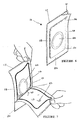
- package 14 comprises first and second barrier layers 15 and 16 which may be formed by folding one layer or by joining two separate barrier layers. Barrier layers 15 and 16 are heat sealed around edges 17, 18, 19 and 20. The heat sealing of edges 17-20 provide a boundary defining an internal space 21 in which a lens 22 is housed. Lens 22 is immersed in a predetermined minimum amount of solution 23 which keeps the lens hydrated (see figure 7 ).
- the barrier layers 16 and 17 are multi layer laminates comprising materials which enable compliance with statutory requirements for lens packages .
- a typical lens package material may comprise a PET (polyethylene tarepthelate) layer, an aluminium layer and a polyolefin layer such as polypropylene.
- a packet of a predetermined size may be formed from barrier layers of the same or different materials.
- the package may be formed by folding a single strip of material back on itself to form the space therein for holding the lens.
- two separate strips of the same or different material in opposing engagement are heat sealed at their edges.
- a thin layer of Aluminium has properties such as inherent pliability and inhibition of oxygen transmission which make it a good material as part of the barrier wall composites.
- a lamination profile of a barrier material may comprise an outer layer of PET of 10 ⁇ , an aluminium layer of 50 ⁇ a polypropylene layer of 50 ⁇ .
- Figure 8 shows a strip of retort packages 30,31 and 32 held together by frangible joins 33 and 34.
- the lens packages may be separated one at a time by tearing off at joins 33 and 34. Also, the strips may be folded about joins 33 and 34 which contributes to efficient storage and packaging . Thus 6 -8 and possibly more lenses could potentially be stored in the same space as two lenses using prior art blister packs.
- Figure 9 shows the strip of retort packages 30 - 32 of figure 8 including a hydrating solution pack 35 attached to package 30 via a frangible join 36.
- Pack 35 may be used by the consumer to hydrate the lens should supplementary lens hydration be required.
- Figure 10 shows an exploded view of a carton 40 containing a large number of like envelopes 41 holding retort package strips 42 according to a preferred embodiment. It can be seen from this arrangement that a larger number of lenses may be stored per unit space compared to prior art packaging. Up to and depending upon the tightness of the packaging more than 10 lenses may be stored in a space which would previously have been taken by two lens packages.
- the manufacturing of disposable lenses becomes more cost effective as the cost of packaging the lens is reduced and the efficiency of sealing and subsequent sterilising is improved. From the patients perspective the lens can appeal more as a disposable item, takes up far less space and can be packaged in a more appealing fashion.
- This type of packaging especially suits daily disposable lenses as the cost component of this type of packaging is attractive to a consumer and manufacturer.
- the form of retort packaging described would preferably contain one soft contact lens each.
- the appropriate art work and statutory information may be printed on the external surfaces in a similar fashion to the current packaging.
- the integrity of the lens in this "flat" style packaging is preserved by a surrounding buffer of storage medium in the packet
- the storage medium may also act as a safety buffer if the lens packet is subjected to rough or potentially damaging treatment.
- the current blister pack offers lens barrier protection through use of the injection moulded and pre formed rigid blister component.
- the conventional blister package includes an aluminium foil bridging an opening to the blister pack
- the unsupported foil offers no more protection and on the foil side potentially less protection than a retort package with two flexible barrier layers which respond more favorably to applied loads.
- the aluminium surface of the blister packs can be more easily punctured due to it's tightness over the polypropylene "boat".
- the retort style packaging is inherently soft and can deflect potential punctures by moving with the puncturing object.
- the solution employed for maintenance of hydration of the lens is a saline solution.
- the package allows for a sufficient minimum of solution for maintenance of hydration and does not require that the lens swim in hydrating solution as in the prior art packages.
- the lens 'swims' in a bath of hydration maintenance solution disposed in preformed recess.
- excess hydration maintenance fluid may be forced out during the manufacturing process leaving a predetermined minimum of solution or gel to keep the lens hydrated. Due to the optimal sealing qualities of the retort package no vapour will escape from the internal space.
- the flatness of the package barrier layers will facilitate sticking of the lens to one or other of the internal surfaces providing the advantage that when a layer is peeled back to expose the lens inside the lens will be stuck to an inner surface which ensures that the lens will not drop out during opening.
Landscapes
- Engineering & Computer Science (AREA)
- Mechanical Engineering (AREA)
- Chemical & Material Sciences (AREA)
- Composite Materials (AREA)
- Packages (AREA)
- Packaging Frangible Articles (AREA)
- Purses, Travelling Bags, Baskets, Or Suitcases (AREA)
- Eyeglasses (AREA)
- Basic Packing Technique (AREA)
Abstract
Description
- The present invention relates to contact lens packaging and more particularly relates to an improved economic form of package for a contact lens which satisfies lens packaging criteria including sterility and environmentally sensitive disposability.
- Soft disposable contact lenses are commonly contained in disposable packages. As packaging adds to the overall cost of the lens it should be made as economically as possible but without compromise to the requisite packaging criteria. The traditional packaging for disposable lenses (both two weekly and daily) consists of a polypropylene "boat or receptacle for the lens, topped by a multi-layer film of polyethylene, Aluminium, bonding agent and Polypropylene. The boat is filled with a suitable storage solution preferably saline and receives the lens in situ. The "boat" or blister pack is then autoclaved using steam and pressure to terminal sterility. These blister packs are presented to the patient in boxes of individual or as multiple blister strips. The marketing objective is to be able to present the contact lens to a patient in an aesthetically pleasing package that both satisfies the statutory requirements for sterility and stability and allows the patient to remove the lens safely and easily. The packaging is used only once and is discarded after the lens is removed. This impacts on the costs of lens/package combination. In order to reduce the overall price of the lens to the patient, me cost of the packaging should be kept to an absolute minimum. Disposability of lens packages places an onus on conformity to the required ecological requirements. The packages should present the least problematic ecological threat as is possible. The above packages are known generically as blister packs and generally hold a single contact lens. The packs typically consist of two pieces the first being the moulded or preformed blister pack
( sometimes referred to as a boat) and a cover. The boat is usually an injection moulded plastics which has high stiffness but is capable of limited elastic deflection and includes a preformed recess in which the contact lens is placed. The cover is typically a laminated material comprising mostly Aluminum and polypropylene. The package must be well sealed and should minimize gas transmission through the "boat " and laminated layer to maximize the shelf life and prevent drying out of the lens contained in the package. The lens must be kept hydrated whilst in the package. In use, the user removes the laminated material from a flange formed on the "boat" by peeling back to expose the lens immersed in a hydrating solution. A variety of contact lens packages and particularly disposable contact lens packages including preformed blister packs are taught in the prior art. - One example of a known contact lens packaging is disclosed in United States patent
5,704,468 . That patent teaches a packaging arrangement for the containment in a blister pack of a hydrophilic contact lens in a sterile aqueous solution. The packaging includes a form of stiffening groove or wall elements in flanges of base members of the blister packages housing to facilitate an improved attachment between the base members of the blister package housing the lens and a flexible cover sheet utilized for sealing engagement with the base members while incorporating additional strength to the blister package structures. - United States patent
4,392,569 discloses an asepticizing case for the storage and transport of soft contact lenses wherein each lens is confined on a curved surface in a fluid environment without the direct application of force thereto. The case includes a flexible skirt of having a smaller radius of curvature than that of the lens receiving surface is affixed to the cap to insure the positioning of each lens. Another packaging arrangement for a hydrophilic contact lens is disclosed in United States patent5,620,088 . The packaging arrangement disclosed houses a contact lens in a sterile aqueous solution. More specifically the arrangement discloses a plurality of disposable hydrophilic contact lenses in a specific number of individual packaging arrangements collectively housed in a box like container so as to provide a specified or essentially measured supply of contact lenses for use by a consumer over a predetermined period of time. - A further packaging for holding a contact lens is disclosed in United States patent
4,691,820 which describes a moulded blister package for storing and dispensing a hydrophilic contact lens. The package comprises a base portion which includes a cavity surrounded by an outstanding flange and a cover sheet sealed to the flange to enclose the cavity. A portion of the side wall of the cavity is inclined to form a ramp to the flange. The cover sheet may be stripped from the flange to expose the cavity and inclined side wall whereupon the lens is readily removed by sliding up and out of the cavity along the inclined surface. - Another packaging arrangement is disclosed in United States patent
5,823,327 which describes a base member for a blister package for the containment of a contact lens and which includes a planar flange extending outwardly about a cavity for housing the contact lens. A proximate peripheral edge of the flange includes a continuous groove into which there is pressed the material of a flexible cover sheet of the blister package so as to clampingly engage the base member. - Flexible retort packages are also known, but not in use with contact lenses. One such package is disclosed in United States patent
4,769,261 . That patent teaches a seal layer for use in large institutional sized retort pouches comprising an ABA film structure wherein the A layers are each composed of a blend of a minor amount of an elastomer and a major amount of a polyolefin and the B layer is composed of a blend of a major amount of an elastomer and a minor amount of polyolefin. Retort pouches made with the ABA film structure as the seal layer exhibit improved impact strength. Conventional wisdom in the contact lens industry has been to provide preformed stiff packaging which protects the lens from external impact damage from applied loads. - United States Patent
5853085 discloses a disposable holding and cleaning apparatus for a contact lens and which includes an open end for holding one or more contact lenses. The envelope is divided by a horizontal seam and vertical seam in order to form a pair of lens storage compartments and fluid storage compartments. Several ports are includes in the package to facilitate communication between the fluid and the lens storage compartments. When manual pressure is exerted on the balloon the balloon bursts and disperses lens cleaning solution onto the lens storage compartments through the ports for cleaning the lenses. This arrangement enables holding of contact lenses and lens care solution in air tight condition and prevents accidental loss of the contact lens. The packaging arrangements for holding contact lenses disclosed in that patent is intended as a cleaning method for contact lenses rather than a flexible mass produced economic package for holding and transporting lenses. A disadvantage of this lens package in United States Patent5853085 is that it is expensive to manufacture and is complex in construction. - Other examples of contact lens packages are disclosed in European Patents
EP 1 092 645 Al to Johnson and Johnson andEP 0 129 388 to Ruxley Holdings Limited.EP 1 092 645 discloses a disposable package for a contact lens which employs an injection moulded blister pack sealed by a laminated layer of plastics and aluminum foil, That patent discloses an example of the well known blister packages which includes a magnifying lens to enable a user to read lens indicia. The package disclosed is potentially resealable and there is no teaching in this patent of a retort style package for a contact lens. -
EP 0129 388 also discloses a package specifically for measurement of one or more optical parameters of a contact lens wherein the lens is housed on an "optimally acceptable" plastics film containing and aqueous fluid and a contact lens. - The known contact lens packages have a number of disadvantages which include the following:
- 1. The packages are relatively expensive for daily disposable packages as they use two types of material one of which is preformed increasing manufacturing costs. Consumers resist packages which contribute to increased cost of a lens. This will become even more of a problem as the daily disposable market grows and becomes more competitive.
- 2. Prior art packages are traditionally manufactured from two distinctly different materials which are used to make up a blister which houses the lens. This can lead to sealing problems with an attendant risk of compromised sterility. Over time, a poor sealing blister pack can allow its contents to evaporate and render the pack useless. This could cause stock defects and consequent financial losses to the manufacturer. Correction of the defects would be potentially expensive.
- 3. Should the patient receive a non sterile lens due to poor or incomplete package sealing, there could be the possibility of that patient being subjected to an eye infection with the risk of ocular compromise and resultant litigation.
- 4. The size of the packaging is a disadvantage to the disposable lens concept as the receptacle is many times larger than the lens itself As a result of the polypropylene blister component the individual component is somewhat deeper than the lens from a sagittal perspective and as such does not lend itself to a disposable look nor convenient stacking due to its bulk, If the consumer travels, the lenses can prove to be quite a bulky item.
- 5. The traditional approach to lens packaging has been to ensure that the original shape of the lens is maintained in the package. This philosophical approach places limitations on package configurations.
- There is a long felt want in the disposable contact lens industry to provide an economic, space efficient and convenient disposable contact lens package without compromise to durability, sterility and utility of the lens.
- The present invention seeks to ameliorate the problems of the prior art packages by providing an alternative and more economic package but without compromise to the statutory and medical requirements of contact lens packages.
- Conventional wisdom requires a disposable contact lens package to be stiff and preformed with a profiled recess to house the lens therein. The preformed recess in the known packages is intended to ensure that the lens shape is maintained and is not deformed by the package. Retort style packaging on the other hand is contrary to conventional wisdom as it is flexible and not preformed and can contribute to adjustments to the shape of the lens in the package.. The present invention challenges the long held view that disposable lens packages must be stiff and for the most part rigid and capable of elastic deflection under load. Stiffness of the package was previously thought essential to protect the lens. If wall stiffness is abandoned as an essential packaging criteria this opens alternative storage possibilities for contact lens packages with significant space economy.
- The present invention according to one embodiment, offers an alternative solution for packaging of disposable contact lenses by employing a packaging material which provides the requisite maintenance of hydration and protection for a lens therein and which may be stacked flat for optimum space economy. According to one embodiment, the lens package is manufactured from one piece of the package material. The package preferably consists of identical but flexible materials approved by the various contact lens regulatory authorities around the world whilst remaining simple in construction.
- In its broadest form the present invention comprises:
- a single use contact lens package made from one piece and from one pliable material.
- In another broad form the present invention comprises:
- a disposable contact lens package for holding at least one contact lens in a sterile aqueous solution; characterized in that the package is made in one piece and of one pliable material. According to a preferred embodiment the lens is contained in a retort package.
- According to another embodiment the retort package is capable of conforming partially or wholly with the contact lens.
- In another broad form the present invention comprises:
- a disposable contact lens package for holding at least one contact lens in a sterile aqueous solution; characterized in that the package is made in one piece and of one material wherein the package is a pliable and flexible retort package.
- In another broad form the present invention comprises:
- a single use disposable contact lens package for holding at least one contact lens in a sterile aqueous solution; characterized in that the package is made from one or two pieces of the same material wherein the package is a pliable and flexible retort package; wherein said material can be folded back on itself to form said package.
- According to one embodiment, access to a lens in said package is via at least one sealed edge of said package.
- In another broad form according to a method aspect, the present invention comprises:
- a method of producing a disposable contact lens package comprising the steps of:
- a) taking a single sheet of pliable material;
folding said material back on itself to define an envelope to receive a at least one contact lens; - c) sealing said envelope so that said contact lens is held in a sterile aqueous solution;
- d) allowing access to said package by splitting or dividing said package along at least one edge.
- a) taking a single sheet of pliable material;
- According to one embodiment the edges of said package are heat sealed.
- According to a preferred embodiment the lens resides in said solution inside said package.
- In another broad form the present invention comprises;
a single use package capable of holding a contact lens therein, the packaging comprising: - at least one barrier layer of flexible/pliable package material forming at least first and second opposing surfaces which define an internal package space in which the contact lens is retained;
- a medium in the space for maintaining lens hydration; and
- means for enabling release of said contact lens from said package; wherein the at least one barrier layer of material is capable of assuming a generally planar configuration and is not preformed
- Preferably each said at least first and second opposing surfaces oppose an anterior and /or posterior surface of said contact lens. The means for releasing the contact lens from the package comprises peeling away one of said barrier layers from the other layer.
- The barrier layers are capable of mutual deformation responsive to a load applied to the package. Preferably the barrier layers are formed from two pieces which provide the two opposing inner surfaces which define said space in which said lens is held. Opposing edges of the barrier layers are preferably heat sealed. The hydration maintenance medium also provides a buffer to dissipate energy generated by external loads applied to the package at or near the location of the lens. The lens hydration maintenance medium is a suitable storage solution which may be, but not limited to, a saline based solution. Each barrier wall of the package may be laminated and include a metallic layer such as but not limited to aluminium. Each barrier layer further comprises an outer layer of protective material and an inner layer of polypropolyene which engages an outer surface of the metallicised layer. The polypropylene layer engages an inner surface of the metallicised layer:
- According to another embodiment at least one package is detachably connected to other like packages such that a set of at least two like packages are formed wherein eachpackage is connected to an adjacent package via a frangible connection.
- An additional package may be connected to a contact lens package and includes therein a source of lens hydration maintenance medium.
- The barrier layers of the package may be formed from the same or different materials.
- In another broad form of a method aspect, the present invention comprises;
a method of producing a disposable contact lens package comprising the steps of: - a) taking a single sheet of pliable material;
- b) placing a lens on a surface of the sheet;
- c) dosing the surface of the material with a predetermined hydration medium;
- d) folding said material back on itself to define a space in which the contact is held;
- e) sealing said- envelope so that said contact lens is held in a. sealed environment;
- f) allowing access to said lens by splitting or dividing said package along at least one edge.
- According to a preferred embodiment the method comprises the further step following sealing the lens package, of sterilizing the package by autoclaving.
- In another broad the present invention comprises; a single use package for retaining a contact lens: the package comprising at least one barrier material defining an internal space fore holding a contact lens in a medium for maintaining lens hydration in a sealed environment; means to enable release of the lens from said space; wherein the at least one barrier layer is formed from a homogenous, pliable material.
- The barrier material is pliable allowing the package to be deformed, flattened, twisted, bent folded or rolled in unison with the lens and without compromise to the integrity of the lens therein.
- In another broad form, the present invention comprises;
a set of single use retort packages for holding contact lenses therein; the packages each comprising at least one barrier layer of flexible/pliable package material forming at least first and second opposing surfaces which define an internal package space in which the contact lens is retained;
a medium in the space for maintaining lens hydration; and
means for enabling release of said contact lens from said package; wherein the at least one barrier layer of material is capable of assuming a generally planar configuration and is not preformed; wherein the set is formed by joining at least two said packages end to end so that a single package may be torn away from an adjacent package via a frangible connection between the packages. - In its broadest form the present invention comprises;
a single use generally planar pliable retort package for holding a contact lens. - In another form the present invention comprises; a strip of joined single use retort packages for holding a contact lens; wherein each single use package is connected to an adjacent package via a frangible connection.
- In another broad form the present invention comprises;
a kit of joined single use pliable retort packages for each holding a contact lens; wherein each single use package is connected to at least one adjacent package . - In another broad form the present invention comprises;
a single use package capable of holding a contact lens therein, the packaging comprising: - at least one barrier layer of flexible/pliable package material forming at least first and second opposing surfaces which define an internal package space in which the contact lens is retained;
- a medium in the space for maintaining lens hydration; and
- means for enabling release of said contact lens from said package; wherein said at least one barrier layer of material is capable of assuming a generally co planar configuration and is/are not preformed.
- The present invention will now be described according to a preferred, but non limiting embodiment and with reference to the accompanying illustrations: wherein;
-
Figure 1 shows a plan view of a typical prior art disposable blister contact lens package. -
Figure 2 shows a side elevation of the package offigure 1 with lid peeled away to release the contact lens therein. -
Figure 3 shows a perspective view of the package offigure 2 . -
Figure 4 shows a stacking arrangement for two identical prior art contact lens packages according to.one embodiment, -
Figure 5 shows a plurality of blister packs stacked as infigure 4 and contained in a carton. -
Figure 6 shows a perspective view of a retort package according to a preferred embodiment of the invention. -
Figure 7 shows the retort package offigure 6 with the contact lens exposed by peeling a layer. -
Figure 8 shows a strip of retort packages . -
Figure 9 shows the strip of retort packages offigure 8 including a hydrating solution pack. -
Figure 10 shows a carton containing a large number of envelopes holding retort package strips according to a preferred embodiment. - Throughout the specification the term homogenous should be taken to be a reference to a package wall formed from a single layer (i.e.. non laminated layer) of the same material. The package described may also be made from a multi layer laminated material which may be formed from a combination of suitable plastics or a combination of suitable plastics and a metallic layer as described herein. Referring to
figure 1 there is shown a plan view of a typical prior art disposable blister contact lens package 1 which is formed in two art.Figure 2 shows a side elevation of the package 1 offigure 1 . Package 1 comprises ablister pack 2 which is sealed by amembrane 3 forming a lid on pack 1 and which may be peeled away to releasecontact lens 4 therein.Figure 3 shows a perspective view of the package offigure 2 withmembrane 2 peeled away to exposecontact lens 4. Typicallymember 2 will be a preformed blister pack and includes a profiledrecess 5 which in whole or in part either conform to the shape of a lens or provides a recess in which a lens may be placed. The injection moulded pre formation makes this is an expensive package to manufacture with the result that the lens will inevitably be more expensive for the consumer.Member 2 is typically injection moulded and the package is completed with sealingmembrane 3 which mates withflange 6 to effect a sterile seal.Lens 4 is immersed in a solution 7 which maintains lens hydration keeps the lens hydrated until it is removed from the pack. -
Figure 4 shows a stacking arrangement according to one embodiment .for two identical prior art contact lens packages 10 and 11. It can be seen fromfigure 4 that although two packs conveniently interfit they take up a thickness greater than the thickness (or depth) of two packs. Ideally a lens package should take up as little space as possible considering the relatively small size of a contact lens. Economy of storage space is a critical issue where lenses arc-mass produced. The existing blister packs take up a disproportionate amount of space relative to the size of the lens leading to increased handling and storage costs.Figure 5 shows a plurality oflike blister packs 12 stacked as infigure 4 and retained in a carton 13. This space taking, inconvenient and materials intensive form of lens packaging exists as a result of the conventional wisdom suggesting that lenses cannot be stacked other than in rigid containers which isolate the lens from external load. - Referring to
figure 6 there is shown a perspective view of aretort package 14 according to one embodiment of the invention.Package 14 comprises a layered flexible envelope for holding a lens and which may be formed from one piece or two pieces of like or different flexible material. According to oneembodiment package 14 is manufactured from a single piece of a flexible laminated material which is strong enough to protect a lens held in a space formed in the package but flexible enough to withstand a variety of applied loads such as but not limited to, bending, folding, twisting, rolling or crushing. The wall of the package which is preferably a homogenous material does not necessarily conform to the shape of a lens but rather the lens "floats" in the package. The package may be formed by folding a homogenous material back on itself and sealing the edges to form a sterile envelope. Alternatively, the package may be farmed from a homogenous material from two opposing pieces heat sealed along their edges in opposing relationship. Access to the lens is gained by dividing the package along one or more predetermined heat sealed edges. Referring tofigure 6 ,package 14 comprises first and second barrier layers 15 and 16 which may be formed by folding one layer or by joining two separate barrier layers. Barrier layers 15 and 16 are heat sealed around edges 17, 18, 19 and 20. The heat sealing of edges 17-20 provide a boundary defining aninternal space 21 in which alens 22 is housed.Lens 22 is immersed in a predetermined minimum amount ofsolution 23 which keeps the lens hydrated (seefigure 7 ). To release and expose the lens,layer 16 is peeled away fromlayer 17. Alternatively,layer 17 may be peeled away fromlayer 16. To facilitate initial release of layers, a portion of the mating engagement between layers is lightly sealed preferably at a corner to enable separation of the barrier layers.Figure 7 shows the package offigure 6 torn open to releaselens 22. According to one embodiment, the barrier layers 16 and 17 are multi layer laminates comprising materials which enable compliance with statutory requirements for lens packages . For example, a typical lens package material may comprise a PET (polyethylene tarepthelate) layer, an aluminium layer and a polyolefin layer such as polypropylene. A packet of a predetermined size may be formed from barrier layers of the same or different materials. According to one embodiment the package may be formed by folding a single strip of material back on itself to form the space therein for holding the lens. In another embodiment two separate strips of the same or different material in opposing engagement are heat sealed at their edges. A thin layer of Aluminium has properties such as inherent pliability and inhibition of oxygen transmission which make it a good material as part of the barrier wall composites. According to one embodiment, a lamination profile of a barrier material may comprise an outer layer of PET of 10 µ, an aluminium layer of 50 µ a polypropylene layer of 50 µ. -
Figure 8 shows a strip of retort packages 30,31 and 32 held together by frangible joins 33 and 34. The lens packages may be separated one at a time by tearing off at joins 33 and 34. Also, the strips may be folded about joins 33 and 34 which contributes to efficient storage and packaging . Thus 6 -8 and possibly more lenses could potentially be stored in the same space as two lenses using prior art blister packs. -
Figure 9 shows the strip of retort packages 30 - 32 offigure 8 including a hydratingsolution pack 35 attached to package 30 via afrangible join 36.Pack 35 may be used by the consumer to hydrate the lens should supplementary lens hydration be required. -
Figure 10 shows an exploded view of acarton 40 containing a large number oflike envelopes 41 holding retort package strips 42 according to a preferred embodiment. It can be seen from this arrangement that a larger number of lenses may be stored per unit space compared to prior art packaging. Up to and depending upon the tightness of the packaging more than 10 lenses may be stored in a space which would previously have been taken by two lens packages. - The manufacturing of disposable lenses becomes more cost effective as the cost of packaging the lens is reduced and the efficiency of sealing and subsequent sterilising is improved. From the patients perspective the lens can appeal more as a disposable item, takes up far less space and can be packaged in a more appealing fashion. This type of packaging especially suits daily disposable lenses as the cost component of this type of packaging is attractive to a consumer and manufacturer. The form of retort packaging described would preferably contain one soft contact lens each. The appropriate art work and statutory information may be printed on the external surfaces in a similar fashion to the current packaging.
- The integrity of the lens in this "flat" style packaging is preserved by a surrounding buffer of storage medium in the packet The storage medium may also act as a safety buffer if the lens packet is subjected to rough or potentially damaging treatment. The current blister pack offers lens barrier protection through use of the injection moulded and pre formed rigid blister component. However, as the conventional blister package includes an aluminium foil bridging an opening to the blister pack, the unsupported foil offers no more protection and on the foil side potentially less protection than a retort package with two flexible barrier layers which respond more favorably to applied loads. In fact, the aluminium surface of the blister packs can be more easily punctured due to it's tightness over the polypropylene "boat". The retort style packaging is inherently soft and can deflect potential punctures by moving with the puncturing object.
- According to one embodiment the solution employed for maintenance of hydration of the lens is a saline solution. The package allows for a sufficient minimum of solution for maintenance of hydration and does not require that the lens swim in hydrating solution as in the prior art packages. In the prior art blister packs, the lens 'swims' in a bath of hydration maintenance solution disposed in preformed recess.
- In the package according to the invention, excess hydration maintenance fluid may be forced out during the manufacturing process leaving a predetermined minimum of solution or gel to keep the lens hydrated. Due to the optimal sealing qualities of the retort package no vapour will escape from the internal space. The flatness of the package barrier layers will facilitate sticking of the lens to one or other of the internal surfaces providing the advantage that when a layer is peeled back to expose the lens inside the lens will be stuck to an inner surface which ensures that the lens will not drop out during opening.
- Advantages of the retort style packaging include the following;
- 1 More homogenous packaging than the known packages with the attendant improvements in sealing and subsequent sterilising
- 2 Smaller and slimmer (flatter) packaging lends itself to disposability which makes it ideal for traveling.
- 3 The flatter pack saves weight and space due to flat storage.
- 4 Less packaging material per lens compared to the prior art packages.
- 5 More cost effective than current types of packaging thus allowing for a reduction in cost of lenses to consumers.
- 6 The use of a metallic foil (such as but not limited to Aluminium) foil stabilizes light and prevents unwanted O2 transmission.
- 7 The package is not re useable or resealable.
- 8 As air is not used in the package non ballasted autoclaving is not required.
- 9 Absence of air in the package may contribute lens stability within the package.
- 10 As the package is significantly smaller and slimmer than the prior art packages batch sizes may be increased yet storage space in an end users package may be reduced.
- 11 Secondary packaging can be more compact and package walls/barrier layers of the package are flexible /pliable which enables the whole package to be deformed or worked by bending, twisted, folded or rolled. Thus the package could be stored rolled in a tube for instance.
- 12 Contact lenses may now be packaged without the previous package design constraint that the basic lens shape be retained.
- It will be recognized by persons skilled in the art that numerous variations and modification may be made to the invention as broadly described herein without departing from the overall spirit and scope of the invention.
- The following clauses comprise the original subject matter of the claims of the parent application
EP 02753929.5 WO 03/016175 - 1. A single use package capable of holding a contact lens therein, the packaging comprising:
- at least one barrier layer of flexible/pliable package material forming at least first and
- second opposing surfaces which define an internal package space in which the contact lens is retained;
- a medium in the space for maintaining lens hydration; and
- means for enabling release of said contact lens from said package; wherein said at least one barrier layer of material is capable of assuming a generally co planar configuration and is/are not preformed.
- 3. A package according to
clause 2 wherein the package materials is/are capable of mutual deformation responsive to a load applied to the package. - 4. A package according to
clause 3 wherein the hydration maintenance medium provides a buffer to dissipate energy generated by external loads applied to the package. - 5. A package according to
clause 4 wherein the package material comprises a single layer of the same material. - 6. A package according to
clause 4 wherein the package material comprises two single layers sheets of different materials. - 7. A package according to
clause 4 wherein the package material comprises two single layer sheets of the same material. - 8. A package according to
clause 4 wherein the package comprises a single sheet of multi layer material. - 9. A package material according to
clause 4 wherein the package comprises two sheets of like multi layer material. - 10. A package according to
clause 4 wherein the package comprises two sheets of different multi layer material. - 11. A package according to any of the foregoing clauses wherein, the means for releasing the contact lens from the package comprises separating the opposing surfaces by peeling or tearing the package.
- 12. A package according to
clause 11 wherein opposing edges of the opposing surfaces are heat sealed. - 13. A package according to
clause 12 wherein the medium is saline based. - 14. A package according to clause 13 wherein, the lens hydration maintenance medium is saline solution.
- 15. A package according to
clause 14 wherein, the lens in said space is free to move inside the space defined by the opposing inner surfaces and edges of the space. - 16. A package according to
clause 15 wherein, each said at least first and second opposing surfaces oppose an anterior and/or posterior surface of said contact lens. - 17. A package according to clauses 8 or 9 wherein, the multi layer material includes a metallic layer.
- 18. A package according to
clause 17 wherein the multi layer material further comprises an outer layer capable of displaying product indicia and sealing any inner layers from an external environment. - 19. A package according to
clause 18 further comprising an appropriate polyolefin layer. - 20. A package according to
clause 19 wherein the outer layer engages an outer surface of a layer of aluminium. - 21. A package according to
clause 20 wherein the polyolefin layer comprises a polypropylene layer which engages an inner surface of the aluminium layer. - 22. A package according to
clause 1 or 21 having connected thereto at least one other like package such that a set of at least two like packages are formed. - 23. A package according to
clause 22 wherein each package is connected to an adjacent package via a frangible connection. - 24. A package according to any of the foregoing clauses further comprising an additional package connected to said contact lens package and having therein a source of lens hydration maintenance medium.
- 25. A package according to clause 24 wherein the package material is pliable allowing the package to be deformed, flattened, twisted, bent, folded crushed or rolled in unison with the lens and without compromise to the integrity of the lens therein.
- 26. A package according to
clause 5 wherein the space is formed by folding a single sheet of said flexible material back on itself and heat sealing opposing edges of the sheet. - 27. A method of producing a disposable contact lens package comprising the steps of:
- a) taking a single sheet of pliable material;
- b) placing a lens on a surface of the sheet;
- c) dosing the surface of the material with a predetermined hydration maintenance medium;
- d) folding said material back on itself to define a space in which the contact lens is held;
- e) sealing said envelope so that said contact lens is held in a sealed environment ; sterilizing the envelope and contents;
- f) allowing access to said lens by splitting, peeling or dividing said package along at least one edge.
- 28. A single use package for retaining a contact lens: the package comprising at least one barrier material defining an internal space for holding a contact lens; a medium in the space for maintaining lens hydration; means to enable release of the lens from said space; wherein the at least one barrier layer is formed from a homogenous, pliable material.
- 29. A package according to clause 28 wherein the barrier material is pliable allowing the package to be deformed, flattened, twisted, bent, crushed folded or rolled in unison with the lens therein and without compromise to the integrity of the lens.
- 30. A set of single use retort packages for holding contact lenses therein; the packages each comprising at least one layer of flexible/pliable package material forming at least first and second opposing surfaces which define an internal package space in which the contact lens is retained;
a medium in the space for maintaining lens hydration; and
means for enabling release of said contact lens from said package; wherein the package-material is capable of assuming a generally planar configuration and is not preformed; wherein the set is formed by joining at least two said packages end to end so that a single package may be torn away from an adjacent package via a frangible connection between the packages. - 31. A single use, pliable retort package including an internal space for holding a contact lens and a medium for maintaining lens hydration therein.
- 32. A package according to
clause 31 wherein, the pliability of the retort package enables the package to be rolled, folded, bent, twisted or flattened in unison with the lens without damage to the lens. - 33. A single use package for retaining a contact lens therein: the package comprising at least one package wall defining an internal space for holding the contact lens; a medium in the space for maintaining lens hydration; means to enable release of the lens from said space; wherein the at least one wall is formed from a homogenous or multi layer, pliable material.
- 34. A single use package according to
clause 33 wherein the homogenous material is a single layer. - 35. A single use package according to
clause 34 wherein the multi layer package material includes a metallic layer of aluminium. - 36. A single use package according to
clause 35 wherein the internal space is defined by opposing walls which each have sufficient pliability to enable rolling, folding, twisting flattening of the package without damage to the lens. - 37. A single use package according to
clause 33 wherein the lens is released from the package by peeling one layer from another layer. - 38. A kit of joined single use pliable retort packages for each holding a contact lens; wherein each single use package is connected to at least one adjacent package.
Claims (15)
- A disposable contact lens package (14) comprising:a first flexible substrate (15);a second flexible substrate (16) coupled to said first substrate (15);a soft contact lens (22) sealed between said first substrate (15) and said second substrate (16);a buffer fluid (23) sealed between said first flexible substrate (15) and said second flexible substrate (16), wherein said buffer fluid (23) contacts said contact lens (22);wherein said contact lens (22) is a newly manufactured lens (22);wherein said package (14) containing said contact lens (22) is a retort package (14) configured to be autoclaved; andwherein a portion of the package comprises a single non-laminated layer of plastics material.
- The package (14) of claim 1, wherein both said first (15) and second (16) substrates are substantially flat or planar.
- The package (14) of claim 1, wherein the substrates (15, 16) are sealed in an area surrounding the contact lens (22).
- The package (14) of claim 1, wherein at least a portion of at lest one of said flexible substrates (15, 16) extends beyond said seal to from a griping flap.
- The package (14) of claim 1, wherein at least one of said substrates (15, 16) is a multi-layer laminate.
- The package (14) of claim 1, wherein at least one of the substrates (15, 16) comprises aluminum.
- The package (14) of claim 5, wherein the multi-layer laminate comprises one or more materials selected from the group consisting of polyethylene terepthelate, polypropylene, and aluminum.
- The package (14) of claim1, wherein said buffer fluid (23) further comprises a hydration medium (23).
- The package (14) of claim 1, wherein the entire package (14), when sealed, is flexible without damaging the contact lens (22).
- The package (14) of claim 1, wherein said first (15) and second (16) flexible substrates are peelably separated to release said lens.
- The package (14) of claim 1, further comprising a second package (30, 31, 32, 35) having a first flexible substrate (15), a second flexible substrate (16) coupled to said first substrate (15);
wherein said package (14) and said second package (30, 31, 32, 35) are connected via a frangible connection. - The package (14) of claim 11, wherein said second package comprises a hydrating solution pack containing a hydrating solution sealed between said first flexible substrate (15) and said second flexible substrate (16).
- The package of claim 11, further comprising a newly manufactured contact lens (22) hermetically sealed between said first substrate (15) and said second substrate (16), a buffer fluid (23) sealed between said first flexible substrate (15) and said second flexible substrate (16), wherein said buffer fluid (23) contacts said contact lens (22), said package (14) containing said contact lens is a retort package (14) configured to be autoclaved.
- The package of claim 1, wherein said first (15) and second substrates (16) comprise a single sheet of flexible material folded to provide said first (15) and second substrates (16) on either side of said lens (22).
- The package of claim 1, wherein at least a portion of one of the substrates (15, 16) is transparent.
Applications Claiming Priority (3)
| Application Number | Priority Date | Filing Date | Title |
|---|---|---|---|
| AUPR7086A AUPR708601A0 (en) | 2001-08-17 | 2001-08-17 | Disposable package for contact lens |
| EP02753929.5A EP1427653B1 (en) | 2001-08-17 | 2002-08-17 | Packaging for disposable soft contact lenses |
| PCT/AU2002/001105 WO2003016175A1 (en) | 2001-08-17 | 2002-08-17 | Packaging for disposable soft contact lenses |
Related Parent Applications (3)
| Application Number | Title | Priority Date | Filing Date |
|---|---|---|---|
| EP02753929.5 Division | 2002-08-17 | ||
| EP02753929.5A Division-Into EP1427653B1 (en) | 2001-08-17 | 2002-08-17 | Packaging for disposable soft contact lenses |
| EP02753929.5A Division EP1427653B1 (en) | 2001-08-17 | 2002-08-17 | Packaging for disposable soft contact lenses |
Publications (2)
| Publication Number | Publication Date |
|---|---|
| EP2371741A1 true EP2371741A1 (en) | 2011-10-05 |
| EP2371741B1 EP2371741B1 (en) | 2019-04-10 |
Family
ID=3831041
Family Applications (2)
| Application Number | Title | Priority Date | Filing Date |
|---|---|---|---|
| EP11171593.4A Expired - Lifetime EP2371741B1 (en) | 2001-08-17 | 2002-08-17 | Packaging for disposable soft contact lenses |
| EP02753929.5A Expired - Lifetime EP1427653B1 (en) | 2001-08-17 | 2002-08-17 | Packaging for disposable soft contact lenses |
Family Applications After (1)
| Application Number | Title | Priority Date | Filing Date |
|---|---|---|---|
| EP02753929.5A Expired - Lifetime EP1427653B1 (en) | 2001-08-17 | 2002-08-17 | Packaging for disposable soft contact lenses |
Country Status (12)
| Country | Link |
|---|---|
| EP (2) | EP2371741B1 (en) |
| JP (1) | JP4192222B2 (en) |
| KR (1) | KR100912460B1 (en) |
| CN (1) | CN100556773C (en) |
| AU (1) | AUPR708601A0 (en) |
| CA (1) | CA2457088C (en) |
| DK (2) | DK2371741T3 (en) |
| ES (2) | ES2552933T3 (en) |
| NO (2) | NO340383B1 (en) |
| NZ (1) | NZ574136A (en) |
| WO (1) | WO2003016175A1 (en) |
| ZA (1) | ZA200402100B (en) |
Families Citing this family (29)
| Publication number | Priority date | Publication date | Assignee | Title |
|---|---|---|---|---|
| AUPR708601A0 (en) | 2001-08-17 | 2001-09-06 | Newman, Steve | Disposable package for contact lens |
| US7086526B2 (en) | 2001-08-17 | 2006-08-08 | Clearlab International Pte Ltd. | Packaging for disposable soft contact lenses |
| CN1980582B (en) | 2001-08-17 | 2010-12-22 | 美你康株式会社 | Package for disposable soft contact lenses |
| US7832552B2 (en) | 2002-08-17 | 2010-11-16 | Menicon Co. Ltd. | Duo packaging for disposable soft contact lenses using a substrate |
| WO2005018640A1 (en) * | 2003-08-20 | 2005-03-03 | The Procter & Gamble Company | Kit for treatment of upper gastrointestinal tract conditions |
| US7722808B2 (en) | 2003-09-12 | 2010-05-25 | Novartis Ag | Method and kits for sterilizing and storing soft contact lenses |
| ITBO20040512A1 (en) * | 2004-08-06 | 2004-11-06 | Elopak Systems | CONTAINER FOR A PRODUCT AND PROCEDURE FOR ITS REALIZATION |
| US20060054514A1 (en) * | 2004-09-16 | 2006-03-16 | Michael Tokarski | Contact lens package |
| ATE452659T1 (en) * | 2004-10-01 | 2010-01-15 | Menicon Co Ltd | METHOD FOR STERILIZING PACKAGED CONTACT LENSES WITH PACKAGING SOLUTION |
| US20060213783A1 (en) * | 2005-03-22 | 2006-09-28 | Michael Tokarski | Ophthalmic lens package |
| SG163538A1 (en) * | 2005-03-31 | 2010-08-30 | Johnson & Johnson Vision Care | Interconnecting contact lens package |
| KR20140100553A (en) | 2006-07-10 | 2014-08-14 | 존슨 앤드 존슨 비젼 케어, 인코포레이티드 | Packages for ophthalmic lenses containing pharmaceutical agents |
| CN105427463B (en) | 2008-12-31 | 2018-06-26 | 庄臣及庄臣视力保护公司 | Apparatus and method for dispensing ophthalmic lenses |
| WO2010103573A1 (en) | 2009-03-12 | 2010-09-16 | 株式会社メニコン | Distribution storage method for contact lens and contact lens package |
| EP2454171A1 (en) * | 2009-07-14 | 2012-05-23 | Oculynx Limited | Surgical cleansing solutions |
| US20110017243A1 (en) | 2009-07-24 | 2011-01-27 | Voss Leslie A | Portioned packages for maintenance solutions and ophthalmic lenses |
| SG189573A1 (en) * | 2011-10-18 | 2013-05-31 | Menicon Singapore Pte Ltd | Contact lens secondary packaging and methods |
| SG189572A1 (en) * | 2011-10-18 | 2013-05-31 | Menicon Singapore Pte Ltd | Systems and methods for multi-stage sealing of contact lens packaging |
| CN103144846A (en) * | 2012-02-15 | 2013-06-12 | 叶如康 | Toothpaste and packing device thereof |
| US9439487B2 (en) | 2013-03-15 | 2016-09-13 | Johnson & Johnson Vision Care, Inc. | Contact lens package with reduced head space |
| US10368621B2 (en) | 2013-03-15 | 2019-08-06 | Johnson & Johnson Vision Care, Inc. | Contact lens package with reduced lens-package interactions and method of making |
| JP6191909B2 (en) * | 2013-07-01 | 2017-09-06 | 大日本印刷株式会社 | Container storage case |
| GB2520297B (en) * | 2013-11-14 | 2015-11-18 | Contact Lens Prec Lab Ltd | Improvements in or relating to packaging for contact lenses |
| US11028354B2 (en) | 2016-02-08 | 2021-06-08 | Becton Dickinson And Company | Prepared plated media product |
| TWI713712B (en) | 2016-03-28 | 2020-12-21 | 英商古柏威順國際控股有限合夥公司 | Contact lens blister packages and related methods |
| US11103609B2 (en) * | 2018-03-16 | 2021-08-31 | Noel Elman | Devices and methods for controlled release of substances |
| US10899521B2 (en) * | 2018-05-23 | 2021-01-26 | Johnson & Johnson Vision Care, Inc. | Package for an ophthalmic device having a multilayer lidstock containing a cyclic olefin seal layer |
| KR102405619B1 (en) | 2020-06-10 | 2022-06-08 | 주식회사 비엠지 | Contact lens packing system |
| KR102892329B1 (en) | 2023-08-21 | 2025-11-28 | 엘앤피랩 주식회사 | Disposable Contact Lens Case Cover With Improved Binding Force And Manufacturing Method Thereof |
Citations (12)
| Publication number | Priority date | Publication date | Assignee | Title |
|---|---|---|---|---|
| US3369656A (en) * | 1966-12-22 | 1968-02-20 | Euchee Harp Skinner Jr. | Contact lens container |
| US4392569A (en) | 1979-06-06 | 1983-07-12 | Shoup Leo E | Soft contact lens asepticizing case |
| EP0129388A2 (en) | 1983-06-17 | 1984-12-27 | Contactasol Holdings Limited | Measurement of contact lenses |
| US4691820A (en) | 1985-11-18 | 1987-09-08 | Vistakon, Inc. | Package for hydrophilic contact lens |
| US4769261A (en) | 1987-01-08 | 1988-09-06 | Exxon Chemical Patents Inc. | Retort pouch and coextruded film therefor |
| WO1992000151A1 (en) * | 1990-06-28 | 1992-01-09 | Polymer Technology Corporation | Contact lens cleaning and conditioning pouch and method of use |
| US5620088A (en) | 1993-11-02 | 1997-04-15 | Johnson & Johnson Vision Products, Inc. | Packaging arrangement for contact lenses |
| US5704468A (en) | 1995-09-29 | 1998-01-06 | Johnson & Johnson Vision Products, Inc. | Packaging arrangement for contact lenses |
| US5823327A (en) | 1993-11-02 | 1998-10-20 | Johnson & Johnson Vision Products, Inc. | Packaging arrangement for contact lenses |
| US5853085A (en) | 1997-11-04 | 1998-12-29 | Luttrell; Mark | Disposable apparatus for containing and cleaning contact lenses |
| EP1092645A1 (en) | 1999-10-13 | 2001-04-18 | Johson & Johnson Vision Care Inc. | Primary package for contact lens |
| WO2003016175A1 (en) | 2001-08-17 | 2003-02-27 | Clearlab Pte Ltd | Packaging for disposable soft contact lenses |
Family Cites Families (16)
| Publication number | Priority date | Publication date | Assignee | Title |
|---|---|---|---|---|
| US4266693A (en) * | 1979-06-11 | 1981-05-12 | Pfeiffer N Leonard | Portable fuel and oil dispenser |
| DE68923345T2 (en) * | 1988-11-02 | 1995-12-21 | British Tech Group | Pouring contact lenses. |
| ATE321575T1 (en) * | 1993-01-15 | 2006-04-15 | Mark L Pankow | DEVICE FOR TREATING CONTACT LENSES |
| WO1994024019A2 (en) * | 1993-04-21 | 1994-10-27 | Allergan, Inc. | Contact lens containers and methods of using |
| US5697495A (en) * | 1993-11-02 | 1997-12-16 | Johnson & Johnson Vision Products, Inc. | Packaging arrangement for contact lenses |
| TW295570B (en) * | 1994-05-04 | 1997-01-11 | Ciba Geigy Ag | |
| US5409104A (en) * | 1994-06-01 | 1995-04-25 | Ciba-Geigy Corporation | Contact lens package having improved access features |
| JP3892056B2 (en) * | 1994-06-10 | 2007-03-14 | ジョンソン・アンド・ジョンソン・ビジョン・ケア・インコーポレイテッド | Contact lens packaging container and synthesized packaging means |
| US5620087A (en) * | 1994-06-10 | 1997-04-15 | Johnson & Johnson Vision Products, Inc. | Printed label structure for packaging arrangements |
| US5565059A (en) * | 1994-06-10 | 1996-10-15 | Johnson & Johnson Vision Products, Inc. | Apparatus and method for preparing printing labels |
| TW266267B (en) * | 1994-08-23 | 1995-12-21 | Ciba Geigy | Process for sterilizing articles and providing sterile storage environments |
| JPH1058610A (en) * | 1996-08-21 | 1998-03-03 | Seiko Epson Corp | Antibacterial resin molding |
| US6029808A (en) * | 1999-01-29 | 2000-02-29 | Johnson & Johnson Vision Products, Inc. | Primary package for contact lens |
| CA2299691C (en) * | 1999-03-01 | 2011-07-12 | Johnson & Johnson Vision Care, Inc. | Package for medical device |
| CN2384905Y (en) * | 1999-07-28 | 2000-06-28 | 福建南平南孚电池有限公司 | Bar-type packing bag for battery |
| US20020029984A1 (en) * | 2000-09-08 | 2002-03-14 | Lisa Hughes | Bathroom cleaning apparatus |
-
2001
- 2001-08-17 AU AUPR7086A patent/AUPR708601A0/en not_active Abandoned
-
2002
- 2002-08-17 ES ES02753929.5T patent/ES2552933T3/en not_active Expired - Lifetime
- 2002-08-17 DK DK11171593.4T patent/DK2371741T3/en active
- 2002-08-17 KR KR1020047002315A patent/KR100912460B1/en not_active Expired - Lifetime
- 2002-08-17 DK DK02753929.5T patent/DK1427653T3/en active
- 2002-08-17 NZ NZ574136A patent/NZ574136A/en not_active IP Right Cessation
- 2002-08-17 WO PCT/AU2002/001105 patent/WO2003016175A1/en not_active Ceased
- 2002-08-17 JP JP2003521115A patent/JP4192222B2/en not_active Expired - Lifetime
- 2002-08-17 ES ES11171593T patent/ES2734548T3/en not_active Expired - Lifetime
- 2002-08-17 EP EP11171593.4A patent/EP2371741B1/en not_active Expired - Lifetime
- 2002-08-17 EP EP02753929.5A patent/EP1427653B1/en not_active Expired - Lifetime
- 2002-08-17 CN CNB028206894A patent/CN100556773C/en not_active Expired - Fee Related
- 2002-08-17 CA CA002457088A patent/CA2457088C/en not_active Expired - Lifetime
-
2004
- 2004-02-16 NO NO20040671A patent/NO340383B1/en not_active IP Right Cessation
- 2004-03-16 ZA ZA2004/02100A patent/ZA200402100B/en unknown
-
2016
- 2016-05-04 NO NO20160743A patent/NO20160743A1/en not_active Application Discontinuation
Patent Citations (12)
| Publication number | Priority date | Publication date | Assignee | Title |
|---|---|---|---|---|
| US3369656A (en) * | 1966-12-22 | 1968-02-20 | Euchee Harp Skinner Jr. | Contact lens container |
| US4392569A (en) | 1979-06-06 | 1983-07-12 | Shoup Leo E | Soft contact lens asepticizing case |
| EP0129388A2 (en) | 1983-06-17 | 1984-12-27 | Contactasol Holdings Limited | Measurement of contact lenses |
| US4691820A (en) | 1985-11-18 | 1987-09-08 | Vistakon, Inc. | Package for hydrophilic contact lens |
| US4769261A (en) | 1987-01-08 | 1988-09-06 | Exxon Chemical Patents Inc. | Retort pouch and coextruded film therefor |
| WO1992000151A1 (en) * | 1990-06-28 | 1992-01-09 | Polymer Technology Corporation | Contact lens cleaning and conditioning pouch and method of use |
| US5620088A (en) | 1993-11-02 | 1997-04-15 | Johnson & Johnson Vision Products, Inc. | Packaging arrangement for contact lenses |
| US5823327A (en) | 1993-11-02 | 1998-10-20 | Johnson & Johnson Vision Products, Inc. | Packaging arrangement for contact lenses |
| US5704468A (en) | 1995-09-29 | 1998-01-06 | Johnson & Johnson Vision Products, Inc. | Packaging arrangement for contact lenses |
| US5853085A (en) | 1997-11-04 | 1998-12-29 | Luttrell; Mark | Disposable apparatus for containing and cleaning contact lenses |
| EP1092645A1 (en) | 1999-10-13 | 2001-04-18 | Johson & Johnson Vision Care Inc. | Primary package for contact lens |
| WO2003016175A1 (en) | 2001-08-17 | 2003-02-27 | Clearlab Pte Ltd | Packaging for disposable soft contact lenses |
Also Published As
| Publication number | Publication date |
|---|---|
| NZ574136A (en) | 2010-07-30 |
| CA2457088C (en) | 2008-01-15 |
| DK2371741T3 (en) | 2019-07-15 |
| JP4192222B2 (en) | 2008-12-10 |
| WO2003016175A1 (en) | 2003-02-27 |
| JP2004538220A (en) | 2004-12-24 |
| DK1427653T3 (en) | 2016-01-25 |
| EP1427653B1 (en) | 2015-10-14 |
| KR100912460B1 (en) | 2009-08-14 |
| NO20040671D0 (en) | 2004-02-16 |
| AUPR708601A0 (en) | 2001-09-06 |
| CN1918048A (en) | 2007-02-21 |
| ES2552933T3 (en) | 2015-12-03 |
| ZA200402100B (en) | 2006-12-27 |
| KR20040030137A (en) | 2004-04-08 |
| EP1427653A4 (en) | 2009-03-11 |
| CN100556773C (en) | 2009-11-04 |
| NO340383B1 (en) | 2017-04-10 |
| EP2371741B1 (en) | 2019-04-10 |
| NO20160743A1 (en) | 2004-04-13 |
| ES2734548T3 (en) | 2019-12-10 |
| NO20040671L (en) | 2004-04-13 |
| EP1427653A1 (en) | 2004-06-16 |
| HK1066775A1 (en) | 2005-04-01 |
| CA2457088A1 (en) | 2003-02-27 |
Similar Documents
| Publication | Publication Date | Title |
|---|---|---|
| EP1427653B1 (en) | Packaging for disposable soft contact lenses | |
| US10786057B2 (en) | Packaging for disposable soft contact lenses | |
| US7828137B2 (en) | Packaging for disposable soft contact lenses | |
| AU2016200855B2 (en) | Packaging for disposable soft contact lenses | |
| AU2009203013A1 (en) | Packaging for disposable soft contact lenses | |
| HK1066775B (en) | Packaging for disposable soft contact lenses | |
| AU2002322175A1 (en) | Packaging for disposable soft contact lenses | |
| HK1262205A1 (en) | Packaging for disposable soft contact lenses |
Legal Events
| Date | Code | Title | Description |
|---|---|---|---|
| PUAI | Public reference made under article 153(3) epc to a published international application that has entered the european phase |
Free format text: ORIGINAL CODE: 0009012 |
|
| AC | Divisional application: reference to earlier application |
Ref document number: 1427653 Country of ref document: EP Kind code of ref document: P |
|
| AK | Designated contracting states |
Kind code of ref document: A1 Designated state(s): AT BE BG CH CY CZ DE DK EE ES FI FR GB GR IE IT LI LU MC NL PT SE SK TR |
|
| RAP1 | Party data changed (applicant data changed or rights of an application transferred) |
Owner name: MENICON SINGAPORE PTE LTD. |
|
| 17P | Request for examination filed |
Effective date: 20120405 |
|
| 17Q | First examination report despatched |
Effective date: 20120910 |
|
| STAA | Information on the status of an ep patent application or granted ep patent |
Free format text: STATUS: EXAMINATION IS IN PROGRESS |
|
| GRAP | Despatch of communication of intention to grant a patent |
Free format text: ORIGINAL CODE: EPIDOSNIGR1 |
|
| STAA | Information on the status of an ep patent application or granted ep patent |
Free format text: STATUS: GRANT OF PATENT IS INTENDED |
|
| INTG | Intention to grant announced |
Effective date: 20181022 |
|
| GRAS | Grant fee paid |
Free format text: ORIGINAL CODE: EPIDOSNIGR3 |
|
| GRAA | (expected) grant |
Free format text: ORIGINAL CODE: 0009210 |
|
| STAA | Information on the status of an ep patent application or granted ep patent |
Free format text: STATUS: THE PATENT HAS BEEN GRANTED |
|
| AC | Divisional application: reference to earlier application |
Ref document number: 1427653 Country of ref document: EP Kind code of ref document: P |
|
| AK | Designated contracting states |
Kind code of ref document: B1 Designated state(s): AT BE BG CH CY CZ DE DK EE ES FI FR GB GR IE IT LI LU MC NL PT SE SK TR |
|
| REG | Reference to a national code |
Ref country code: GB Ref legal event code: FG4D |
|
| REG | Reference to a national code |
Ref country code: CH Ref legal event code: EP Ref country code: AT Ref legal event code: REF Ref document number: 1118354 Country of ref document: AT Kind code of ref document: T Effective date: 20190415 |
|
| REG | Reference to a national code |
Ref country code: IE Ref legal event code: FG4D |
|
| REG | Reference to a national code |
Ref country code: DE Ref legal event code: R096 Ref document number: 60249861 Country of ref document: DE |
|
| REG | Reference to a national code |
Ref country code: DK Ref legal event code: T3 Effective date: 20190711 |
|
| REG | Reference to a national code |
Ref country code: NL Ref legal event code: FP |
|
| REG | Reference to a national code |
Ref country code: AT Ref legal event code: MK05 Ref document number: 1118354 Country of ref document: AT Kind code of ref document: T Effective date: 20190410 |
|
| PG25 | Lapsed in a contracting state [announced via postgrant information from national office to epo] |
Ref country code: FI Free format text: LAPSE BECAUSE OF FAILURE TO SUBMIT A TRANSLATION OF THE DESCRIPTION OR TO PAY THE FEE WITHIN THE PRESCRIBED TIME-LIMIT Effective date: 20190410 Ref country code: PT Free format text: LAPSE BECAUSE OF FAILURE TO SUBMIT A TRANSLATION OF THE DESCRIPTION OR TO PAY THE FEE WITHIN THE PRESCRIBED TIME-LIMIT Effective date: 20190910 Ref country code: SE Free format text: LAPSE BECAUSE OF FAILURE TO SUBMIT A TRANSLATION OF THE DESCRIPTION OR TO PAY THE FEE WITHIN THE PRESCRIBED TIME-LIMIT Effective date: 20190410 |
|
| PG25 | Lapsed in a contracting state [announced via postgrant information from national office to epo] |
Ref country code: BG Free format text: LAPSE BECAUSE OF FAILURE TO SUBMIT A TRANSLATION OF THE DESCRIPTION OR TO PAY THE FEE WITHIN THE PRESCRIBED TIME-LIMIT Effective date: 20190710 Ref country code: GR Free format text: LAPSE BECAUSE OF FAILURE TO SUBMIT A TRANSLATION OF THE DESCRIPTION OR TO PAY THE FEE WITHIN THE PRESCRIBED TIME-LIMIT Effective date: 20190711 |
|
| REG | Reference to a national code |
Ref country code: ES Ref legal event code: FG2A Ref document number: 2734548 Country of ref document: ES Kind code of ref document: T3 Effective date: 20191210 |
|
| PG25 | Lapsed in a contracting state [announced via postgrant information from national office to epo] |
Ref country code: AT Free format text: LAPSE BECAUSE OF FAILURE TO SUBMIT A TRANSLATION OF THE DESCRIPTION OR TO PAY THE FEE WITHIN THE PRESCRIBED TIME-LIMIT Effective date: 20190410 |
|
| REG | Reference to a national code |
Ref country code: DE Ref legal event code: R097 Ref document number: 60249861 Country of ref document: DE |
|
| PG25 | Lapsed in a contracting state [announced via postgrant information from national office to epo] |
Ref country code: CZ Free format text: LAPSE BECAUSE OF FAILURE TO SUBMIT A TRANSLATION OF THE DESCRIPTION OR TO PAY THE FEE WITHIN THE PRESCRIBED TIME-LIMIT Effective date: 20190410 Ref country code: EE Free format text: LAPSE BECAUSE OF FAILURE TO SUBMIT A TRANSLATION OF THE DESCRIPTION OR TO PAY THE FEE WITHIN THE PRESCRIBED TIME-LIMIT Effective date: 20190410 Ref country code: SK Free format text: LAPSE BECAUSE OF FAILURE TO SUBMIT A TRANSLATION OF THE DESCRIPTION OR TO PAY THE FEE WITHIN THE PRESCRIBED TIME-LIMIT Effective date: 20190410 |
|
| PLBE | No opposition filed within time limit |
Free format text: ORIGINAL CODE: 0009261 |
|
| STAA | Information on the status of an ep patent application or granted ep patent |
Free format text: STATUS: NO OPPOSITION FILED WITHIN TIME LIMIT |
|
| 26N | No opposition filed |
Effective date: 20200113 |
|
| PG25 | Lapsed in a contracting state [announced via postgrant information from national office to epo] |
Ref country code: TR Free format text: LAPSE BECAUSE OF FAILURE TO SUBMIT A TRANSLATION OF THE DESCRIPTION OR TO PAY THE FEE WITHIN THE PRESCRIBED TIME-LIMIT Effective date: 20190410 |
|
| PG25 | Lapsed in a contracting state [announced via postgrant information from national office to epo] |
Ref country code: MC Free format text: LAPSE BECAUSE OF FAILURE TO SUBMIT A TRANSLATION OF THE DESCRIPTION OR TO PAY THE FEE WITHIN THE PRESCRIBED TIME-LIMIT Effective date: 20190410 Ref country code: LU Free format text: LAPSE BECAUSE OF NON-PAYMENT OF DUE FEES Effective date: 20190817 Ref country code: LI Free format text: LAPSE BECAUSE OF NON-PAYMENT OF DUE FEES Effective date: 20190831 Ref country code: CH Free format text: LAPSE BECAUSE OF NON-PAYMENT OF DUE FEES Effective date: 20190831 |
|
| REG | Reference to a national code |
Ref country code: BE Ref legal event code: MM Effective date: 20190831 |
|
| PG25 | Lapsed in a contracting state [announced via postgrant information from national office to epo] |
Ref country code: BE Free format text: LAPSE BECAUSE OF NON-PAYMENT OF DUE FEES Effective date: 20190831 |
|
| PGFP | Annual fee paid to national office [announced via postgrant information from national office to epo] |
Ref country code: NL Payment date: 20200825 Year of fee payment: 19 |
|
| PGFP | Annual fee paid to national office [announced via postgrant information from national office to epo] |
Ref country code: DE Payment date: 20200819 Year of fee payment: 19 Ref country code: IE Payment date: 20200825 Year of fee payment: 19 Ref country code: DK Payment date: 20200826 Year of fee payment: 19 Ref country code: GB Payment date: 20200819 Year of fee payment: 19 Ref country code: FR Payment date: 20200715 Year of fee payment: 19 Ref country code: ES Payment date: 20200901 Year of fee payment: 19 |
|
| PGFP | Annual fee paid to national office [announced via postgrant information from national office to epo] |
Ref country code: IT Payment date: 20200713 Year of fee payment: 19 |
|
| PG25 | Lapsed in a contracting state [announced via postgrant information from national office to epo] |
Ref country code: CY Free format text: LAPSE BECAUSE OF FAILURE TO SUBMIT A TRANSLATION OF THE DESCRIPTION OR TO PAY THE FEE WITHIN THE PRESCRIBED TIME-LIMIT Effective date: 20190410 |
|
| REG | Reference to a national code |
Ref country code: DE Ref legal event code: R119 Ref document number: 60249861 Country of ref document: DE |
|
| REG | Reference to a national code |
Ref country code: DK Ref legal event code: EBP Effective date: 20210831 |
|
| REG | Reference to a national code |
Ref country code: NL Ref legal event code: MM Effective date: 20210901 |
|
| GBPC | Gb: european patent ceased through non-payment of renewal fee |
Effective date: 20210817 |
|
| PG25 | Lapsed in a contracting state [announced via postgrant information from national office to epo] |
Ref country code: NL Free format text: LAPSE BECAUSE OF NON-PAYMENT OF DUE FEES Effective date: 20210901 |
|
| PG25 | Lapsed in a contracting state [announced via postgrant information from national office to epo] |
Ref country code: IT Free format text: LAPSE BECAUSE OF NON-PAYMENT OF DUE FEES Effective date: 20210817 Ref country code: IE Free format text: LAPSE BECAUSE OF NON-PAYMENT OF DUE FEES Effective date: 20210817 Ref country code: GB Free format text: LAPSE BECAUSE OF NON-PAYMENT OF DUE FEES Effective date: 20210817 Ref country code: FR Free format text: LAPSE BECAUSE OF NON-PAYMENT OF DUE FEES Effective date: 20210831 Ref country code: DK Free format text: LAPSE BECAUSE OF NON-PAYMENT OF DUE FEES Effective date: 20210831 Ref country code: DE Free format text: LAPSE BECAUSE OF NON-PAYMENT OF DUE FEES Effective date: 20220301 |
|
| REG | Reference to a national code |
Ref country code: ES Ref legal event code: FD2A Effective date: 20220929 |
|
| PG25 | Lapsed in a contracting state [announced via postgrant information from national office to epo] |
Ref country code: ES Free format text: LAPSE BECAUSE OF NON-PAYMENT OF DUE FEES Effective date: 20210818 |