EP2371593A1 - Verfahren zur Herstellung eines Türaufprallträgers - Google Patents
Verfahren zur Herstellung eines Türaufprallträgers Download PDFInfo
- Publication number
- EP2371593A1 EP2371593A1 EP11157844A EP11157844A EP2371593A1 EP 2371593 A1 EP2371593 A1 EP 2371593A1 EP 11157844 A EP11157844 A EP 11157844A EP 11157844 A EP11157844 A EP 11157844A EP 2371593 A1 EP2371593 A1 EP 2371593A1
- Authority
- EP
- European Patent Office
- Prior art keywords
- hollow profile
- section
- kidney
- width
- cross
- Prior art date
- Legal status (The legal status is an assumption and is not a legal conclusion. Google has not performed a legal analysis and makes no representation as to the accuracy of the status listed.)
- Granted
Links
- 238000004519 manufacturing process Methods 0.000 title claims abstract description 12
- 238000000034 method Methods 0.000 title claims description 15
- 229910000831 Steel Inorganic materials 0.000 claims abstract description 14
- 239000010959 steel Substances 0.000 claims abstract description 14
- 238000003466 welding Methods 0.000 claims abstract description 11
- 229910001563 bainite Inorganic materials 0.000 claims abstract description 5
- 229910000734 martensite Inorganic materials 0.000 claims abstract description 5
- 210000003734 kidney Anatomy 0.000 claims description 11
- 238000010438 heat treatment Methods 0.000 claims description 6
- 229910052796 boron Inorganic materials 0.000 claims description 3
- 230000007797 corrosion Effects 0.000 claims description 3
- 238000005260 corrosion Methods 0.000 claims description 3
- 230000007704 transition Effects 0.000 claims description 3
- 239000011248 coating agent Substances 0.000 claims 1
- 238000000576 coating method Methods 0.000 claims 1
- 239000000463 material Substances 0.000 description 11
- 238000007493 shaping process Methods 0.000 description 5
- 229910052782 aluminium Inorganic materials 0.000 description 4
- XAGFODPZIPBFFR-UHFFFAOYSA-N aluminium Chemical compound [Al] XAGFODPZIPBFFR-UHFFFAOYSA-N 0.000 description 4
- 238000005520 cutting process Methods 0.000 description 3
- 230000003014 reinforcing effect Effects 0.000 description 3
- 238000005496 tempering Methods 0.000 description 3
- PXHVJJICTQNCMI-UHFFFAOYSA-N Nickel Chemical compound [Ni] PXHVJJICTQNCMI-UHFFFAOYSA-N 0.000 description 2
- 208000027418 Wounds and injury Diseases 0.000 description 2
- 238000010521 absorption reaction Methods 0.000 description 2
- 230000006378 damage Effects 0.000 description 2
- 208000014674 injury Diseases 0.000 description 2
- 238000005304 joining Methods 0.000 description 2
- 229910052751 metal Inorganic materials 0.000 description 2
- 239000002184 metal Substances 0.000 description 2
- 230000002787 reinforcement Effects 0.000 description 2
- 229910000851 Alloy steel Inorganic materials 0.000 description 1
- 229910000712 Boron steel Inorganic materials 0.000 description 1
- ZOKXTWBITQBERF-UHFFFAOYSA-N Molybdenum Chemical compound [Mo] ZOKXTWBITQBERF-UHFFFAOYSA-N 0.000 description 1
- 229910000797 Ultra-high-strength steel Inorganic materials 0.000 description 1
- YHEXKHYQCQBLJR-UHFFFAOYSA-N [B].[Mn].[C] Chemical compound [B].[Mn].[C] YHEXKHYQCQBLJR-UHFFFAOYSA-N 0.000 description 1
- 238000000137 annealing Methods 0.000 description 1
- 238000005452 bending Methods 0.000 description 1
- 238000005261 decarburization Methods 0.000 description 1
- 230000001419 dependent effect Effects 0.000 description 1
- 238000011161 development Methods 0.000 description 1
- 230000018109 developmental process Effects 0.000 description 1
- 230000002349 favourable effect Effects 0.000 description 1
- 230000000977 initiatory effect Effects 0.000 description 1
- 230000010354 integration Effects 0.000 description 1
- 239000007769 metal material Substances 0.000 description 1
- 229910052750 molybdenum Inorganic materials 0.000 description 1
- 239000011733 molybdenum Substances 0.000 description 1
- 229910052759 nickel Inorganic materials 0.000 description 1
- 230000008092 positive effect Effects 0.000 description 1
- 230000002028 premature Effects 0.000 description 1
- 238000005482 strain hardening Methods 0.000 description 1
- 239000000126 substance Substances 0.000 description 1
Images
Classifications
-
- B—PERFORMING OPERATIONS; TRANSPORTING
- B60—VEHICLES IN GENERAL
- B60J—WINDOWS, WINDSCREENS, NON-FIXED ROOFS, DOORS, OR SIMILAR DEVICES FOR VEHICLES; REMOVABLE EXTERNAL PROTECTIVE COVERINGS SPECIALLY ADAPTED FOR VEHICLES
- B60J5/00—Doors
- B60J5/04—Doors arranged at the vehicle sides
- B60J5/042—Reinforcement elements
Definitions
- the invention relates to a method for producing a door impact carrier for vehicle doors of a motor vehicle according to the features of patent claim 1.
- the side doors of motor vehicles are reinforced.
- reinforcing elements sheet metal components are used as well as seamless steel tubes, welded steel tubes and aluminum extruded profiles of different shapes.
- the reinforcing elements are intended to help reduce the intrusion of the vehicle door into the vehicle compartment during a side crash in order to minimize the risk of injury to the occupants or to completely avoid injuries.
- this presents a particular challenge, since the lateral vehicle structure has no crumple zone in comparison with the front end or rear section, and consequently the energy absorption capacity due to deformation is lower.
- This disadvantage can be countered by the use of steel materials, which achieve high mechanical properties by heat treatments and coordinated chemical analysis.
- door impact beams are given a special shape which is matched to the expected impact forces and impact directions.
- the DE 37 28 476 C1 relates to a tubular door reinforcement made of a steel material. It is a high-alloy steel. However, the positive properties of this steel are paid for by very high material costs by adding nickel and molybdenum.
- the invention has for its object to provide a method for producing a door impact beam, with which it is possible to produce a lightweight door impact beam with excellent crash performance as inexpensively.
- the bending resistance of the component must be correspondingly high. This is basically achieved via the rigidity of the component, which in turn depends on parameters such as the material thickness and the component shape.
- High mechanical properties such as the yield strength Re and the tensile strength Rm contribute to absorb energy under sudden load of the component.
- a material which already has high strengths with sufficient ductility as a strip material in the initial state and can thus provide the required component stability.
- the initial structure of the material is therefore predominantly martensitic (> 50%) with proportions of bainite ( ⁇ 50%) in order to provide a necessary plastic deformation for the cold tube forming process with subsequent profile shaping can.
- Highest strength steel strip means steel strips with initial strengths Rm of more than 1,100 MPa.
- the strengths Rm are preferably above 1,300 MPa.
- the provided ultra-high strength steel strip is welded on a tube welding line to a front tube with a circular cross-section.
- a calibration plant is connected to a pipe welding line.
- immediately after the welding of the front pipe this in Calibration steps brought by specially arranged calibration rollers in a kidney-like shape.
- the Vorrohr is referred to after forming in the kidney-like shape as a hollow profile strand. Due to the suitability shaping of the front pipe in the calibration of the tube welding line in combination with the highest-strength strip material used, the component is made directly and offers maximum stability with a short and therefore consolidatedgünster manufacturing. A separate heat treatment, such as tempering, is not required. This can be saved to a considerable extent manufacturing costs.
- the hollow profile strand only has to be cut to length and provided with a shaped cut at the end and can be welded directly into the door of a motor vehicle. It can be completely dispensed with separate connections, such as mounting flanges, which are usually made of sheet metal and manufactured separately.
- the joining of a mounting flange with the door reinforcement element of the door impact carrier is usually carried out by means of thermal joining methods such as the MIG or MAG welding method. This represents an increased effort for the total production and can cause unnecessarily high costs.
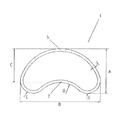
- the figure shows a cross section through a tube profile transformed into a hollow profile strand. This cross section corresponds to the cross section of the finished door impact beam.
- kidney-shaped or kidney-like hollow profile strand 1 which is shaped like an oval, but at its lower side in the image plane has a concave recess, which is referred to as Kidney Bay 2.
- the hollow profile strand 1 is convexly curved. This curvature extends between end regions of the kidney-shaped hollow profile 1, which can also be referred to as kidney poles.
- the radius becomes smaller than in the area of the renal medulla 2 and in the area of the convexly curved back of the kidney 3.
- the geometric relationships can be defined by the parameters explained below.
- the initial parameter is the width B, which is measured in the image plane horizontally from Nierenpol to Nierenpol. All other geometric quantities are presented in dependence thereon.
- the wall thickness S is set to be in a range of 1/40 to 1/30 x the width B lies. For a given wall thickness S of, for example, 2 mm, the width B is adjusted accordingly and is 60 mm to 80 mm.
- the height C measured from the deepest of the concave kidney bay 2 is correspondingly smaller and lies in a range from 0.3 ⁇ B to 0.4 ⁇ B. It is in particular 1/3 ⁇ B.
- the radius D in the area of the concave kidney bay 2 is preferably in a range of 0.3 ⁇ B to 0.4 ⁇ B. In particular, it is 1/3 ⁇ B.
- the radius E in the transition region from the concave kidney bay 2 to the terminal renal poles is in a range of 0.16 ⁇ B to 0.2 ⁇ B and is in particular 1/6 ⁇ B.
Landscapes
- Engineering & Computer Science (AREA)
- Mechanical Engineering (AREA)
- Body Structure For Vehicles (AREA)
Abstract
a) Aus einem höchstfesten Stahlband mit einem Ausgangsgefüge, das vorwiegend martensitisch ausgeprägt ist mit Anteilen an Bainit wird durch Kaltumformung und Längsnahtschweißen ein Vorrohr mit kreisrundem Querschnitt hergestellt;
b) Das Vorrohr wird unmittelbar im Anschluss an das Längsnahtschweißen in einem Kalibrierschritt durch Kaltumformung zu einem Hohlprofilstrang (1) mit nierenförmigem Querschnitt umgeformt, wobei der Hohlprofilstrang (1) eine Festigkeit Rm von mehr als 1.150 MPa aufweist;
c) Der Hohlprofilstrang (1) wird abgelängt;
d) Die abgelängten Stücke des Hohlprofilstrangs (1) werden endseitig mit einem Formschnitt versehen.
Description
- Die Erfindung betrifft ein Verfahren zur Herstellung eins Türaufprallträgers für Fahrzeugtüren eines Kraftfahrzeugs gemäß den Merkmalen des Patentanspruchs 1.
- Zur Gewährleistung der Kraftfahrzeug-Insassensicherheit bei einem Seitencrash werden die Seitentüren von Kraftfahrzeugen verstärkt. Als Verstärkungselemente finden Blechbauteile ebenso Anwendung wie nahtlose Stahlrohre, geschweißte Stahlrohre und Aluminiumstrangpressprofile unterschiedlicher Formgebung. Die Verstärkungselemente sollen dabei während eines Seitencrashs die Intrusion der Fahrzeugtür in die Fahrzeugzelle reduzieren helfen, um bei den Insassen die Verletzungsgefahr möglichst gering zu halten bzw. um Verletzungen ganz zu vermeiden. Dies stellt jedoch eine besondere Herausforderung dar, da die seitliche Fahrzeugstruktur im Vergleich zum Vorderwagen bzw. Hinterwagen keine Knautschzone aufweist und daraus folgend das Energieabsorptionsvermögen durch Verformung geringer ist. Diesem Nachteil kann begegnet werden durch die Verwendung von Stahlwerkstoffen, die durch Wärmebehandlungen und abgestimmte chemische Analyse hohe mechanische Kennwerte erzielen. Zudem erhalten Türaufprallträger eine spezielle Formgebung, die auf die zu erwartenden Anprallkräfte und Anprallrichtungen abgestimmt ist.
- In der
EP 0 425 059 B1 wird offenbart, dass durch die Verwendung von Kohlenstoff-Mangan-Borstahl mit anschließender Vergütung Eigenschaften erzielt werden, die den Anforderungen des Seitencrashs genügen. Die Erzielung der hohen mechanischen Kennwerte wird aber hierbei nur durch aufwendiges Härten und Anlassen des Bauteils erreicht. Da das Härten und Anlassen nicht bereits während des Rohrherstellungsprozesses erfolgen kann, ergeben sich kostentechnische Nachteile. Ferner ist von Nachteil, dass die zusätzlich durchzuführenden Wärmebehandlungen zur Erzielung einer hohen Festigkeit zu einem Verzug der Bauteile führen, wenn die Bauteile nicht hinreichend fixiert werden. Eine Fixierung der Bauteile ist aber zur Sicherstellung der Maßhaltigkeit und der Bauteilform unabdingbar. Der Kostenaufwand hierfür ist nicht unbeträchtlich. Auch die Verwendung von speziell beschichteten Bändern zur Vermeidung oder Reduktion von Randentkohlungen und Zunder, die aus dem Härten an Luft resultieren, erhöhen den finanziellen Aufwand deutlich. - Ferner wird in der
EP 0 425 059 B1 beschrieben, dass nach dem Härten eine lokale Formgebung am Rohr erfolgt, um zusätzlich durch Kaltverfestigungen in diesem Bereich die Festigkeit zu steigern. Nachteilig hierbei ist, dass bei der Formgebung nach dem Härten gerade die Dehnungswerte deutlich abnehmen. Diese sind wiederum relevant, um einen gewissen Grad an Verformung des Bauteils unter Last zu gewährleisten, so dass ohne starke Materialeinschnürung und verfrühter Rissinitiierung und -ausbreitung ein Totalausfall des Bauteils auftritt. Ein Totalausfall des Bauteils hätte fatale Folgen für das Unfallopfer während des Unfallgeschehens. - Die
DE 37 28 476 C1 betrifft eine rohrförmige Türverstärkung aus einem Stahlwerkstoff. Es handelt sich um einen hochlegierten Stahl. Die positiven Eigenschaften dieses Stahls werden allerdings durch sehr hohe Werkstoffkosten durch Zugabe von Nickel und Molybdän erkauft. - In der
EP 0 330 759 A2 wird ein Profil aus dem Leichtmetallwerkstoff Aluminium beschrieben, das als Verstärkungselement in der Fahrzeugtür dienen soll. Zwar besitzt Aluminium ein geringeres spezifisches Gewicht, allerdings auch einen deutlich geringeren E-Modul. Dies macht die Verwendung von dickwandigeren Profilen erforderlich, um ähnlich hohe Bauteilsteifigkeiten wie bei Stahlbauteilen zu erzielen. Dadurch wird jedoch der Gewichtsvorteil des Aluminiums im Vergleich zu Stahlwerkstoffen nahezu egalisiert. - Der Erfindung liegt die Aufgabe zugrunde, ein Verfahren zur Herstellung eines Türaufprallträgers aufzuzeigen, mit welchem es möglich ist, einen leichtbauenden Türaufprallträger mit hervorragender Crashperformance möglichst kostengünstig herzustellen.
- Diese Aufgabe ist bei einem Verfahren mit den Merkmalen des Patentanspruchs 1 gelöst.
- Vorteilhafte Weiterbildungen des Verfahrens sind Gegenstand der Unteransprüche.
- Bei dem erfindungsgemäßen Verfahren sind folgende Fertigungsschritte vorgesehen:
- a) Aus einem höchstfesten Stahlband mit einem Ausgangsgefüge, das vorwiegend martensitisch ausgeprägt ist mit Anteilen an Bainit, d. h. mehr als 50 % Martensit und weniger als 50 % Bainit enthält, wird durch Kaltumformung und Längsnahtschweißen ein Vorrohr mit kreisrundem Querschnitt hergestellt;
- b) Das Vorrohr wird unmittelbar im Anschluss an das Längsnahtschweißen in einem Kalibrierschritt durch Kaltumformung zu einem Hohlprofilstrang mit nierenförmigem Querschnitt umgeformt, wobei der Hohlprofilstrang eine Festigkeit Rm von mehr als 1.150 MPa aufweist;
- c) Der Hohlprofilstrang wird abgelängt;
- d) Die abgelängten Stücke des Hohlprofilstrangs werden endseitig mit einem Formschnitt versehen.
- Um eine optimierte Crashperformance des Bauteils zu erreichen, ist es erforderlich, ein deutlich erhöhtes Energieabsorptionsvermögen zu realisieren, ohne das Gewicht zu erhöhen und ohne die Gestaltung des Bauteils besonders kompliziert zu machen. Das bedeutet, dass das Biegewiderstandsmoment des Bauteils entsprechend hoch sein muss. Dies wird grundsätzlich über die Steifigkeit des Bauteils erzielt, welche wiederum von Parametern, wie der Materialdicke und der Bauteilform, abhängt.
- Auch hohe mechanische Kennwerte wie die Streckgrenze Re und die Zugfestigkeit Rm tragen unter schlagartiger Belastung des Bauteils dazu bei, Energie zu absorbieren. Im Rahmen der Erfindung wird ein Werkstoff eingesetzt, welcher bereits als Bandmaterial im Ausgangszustand hohe Festigkeiten bei ausreichender Duktilität aufweist und so die erforderliche Bauteilstabilität bieten kann. Das Ausgangsgefüge des Werkstoffs ist daher vorwiegend martensitisch ausgeprägt (>50 %) mit Anteilen an Bainit (<50%), um eine notwendige plastische Verformung für den kalten Rohrformprozess mit anschließender Profilformgebung bieten zu können. Unter höchstfestem Stahlband sind Stahlbänder mit Ausgangsfestigkeiten Rm von mehr als 1.100 MPa zu verstehen. Vorzugsweise liegen die Festigkeiten Rm über 1.300 MPa.
- Das bereitgestellte, höchstfeste Stahlband wird auf einer Rohrschweißstraße zu einem Vorrohr mit kreisrundem Querschnitt geschweißt. An eine Rohrschweißstraße schließt sich ein Kalibrierwerk an. Im Rahmen der Erfindung wird unmittelbar nach dem Schweißen des Vorrohrs dieses in Kalibrierschritten durch speziell angeordnete Kalibrierrollen in eine nierenähnliche Form gebracht. Das Vorrohr wird nach dem Umformen in die nierenähnliche Form als Hohlprofilstrang bezeichnet. Durch die eignungsgemäße Formgebung des Vorrohrs im Kalibrierwerk der Rohrschweißstraße in Kombination mit dem verwendeten höchstfestem Bandmaterial ist das Bauteil direkt gefertigt und bietet höchste Stabilität bei kurzer und somit kostengünster Fertigungsweise. Eine separate Wärmebehandlung, wie zum Beispiel das Vergüten, ist nicht erforderlich. Dadurch können in erheblichem Maße Fertigungskosten eingespart werden.
- Es hat sich gezeigt, dass die am fertigen Hohlprofilstrang zu messenden Festigkeiten Rm deutlich oberhalb von 1.150 MPa liegen, wobei neben der Festigkeit des eingesetzten Bandes die Kaltumformung bei der Herstellung des Hohlprofilstrangs weiter festigkeitssteigernd wirkt.
- Es ist mit dem erfindungsgemäßen Verfahren möglich, ein vorbeschichtetes Stahlband zu verwenden. Die fertigen Türaufprallträger sind dadurch korrosionsgeschützt. Da eine nachfolgende Wärmebehandlung entfällt, kann die Korrosionsschutzschicht auch nicht zerstört werden.
- Ein weiterer Vorteil ist, dass der Hohlprofilstrang nur noch abgelängt und endseitig mit einem Formschnitt versehen werden muss und unmittelbar in die Tür eines Kraftfahrzeugs eingeschweißt werden kann. Es kann auf separate Anbindungen, wie zum Beispiel Montageflansche, die in der Regel aus Blech geformt sind und separat gefertigt werden, vollkommen verzichtet werden. Das Verbinden eines Montageflansches mit dem Türverstärkungselement des Türaufprallträgers erfolgt üblicherweise mittels thermischer Fügeverfahren wie dem MIG- oder MAG-Schweißverfahren. Dies stellt für die Gesamtfertigung einen erhöhten Aufwand dar und kann unnötig hohe Kosten verursachen.
- Mit der Erfindung ist es somit möglich, bei sehr geringer Fertigungstiefe höchstfeste Werkstoffe zunächst zu einem Rohr und unmittelbar anschließend zu einem eignungsgemäß gestalteten Profil umzuformen, wobei sich die Kaltumformung festigkeitssteigernd auswirkt. Die formgebenden Bearbeitungsschritte wie das Ablängen und finale Formschneiden, beispielsweise durch Fixiersägen oder Konturschneiden mittels eines Lasers, sind weniger kostenintensiv als nachträgliche Wärmebehandlungen. Dadurch kann bei sehr niedrigen Fertigungskosten, gleichzeitig hoher Crashverformung und zudem geringem Gewicht aufgrund anforderungsgerechter Gestalt auf kostengünstige Weise ein Türaufprallträger hergestellt werden.
- Als besonders vorteilhaft hat sich herausgestellt, wenn das Rohrprofil während des Kalibrierungsschrittes so umgeformt wird, dass sich bestimmte geometrische Verhältnisse einstellen. Als besonders günstig hat sich ein nierenähnlicher oder nierenförmiger Querschnitt des Hohlprofils gezeigt, der bestimmten geometrischen Bedingungen folgt. Diese geometrischen Bedingungen werden nachfolgend anhand des in der Zeichnung schematisch dargestellten Ausführungsbeispiels erläutert.
- Die Figur zeigt einen Querschnitt durch ein zu einem Hohlprofilstrang umgeformtes Rohrprofil. Dieser Querschnitt entspricht dem Querschnitt des fertigen Türaufprallträgers.
- Es handelt sich um einen nierenförmigen oder nierenähnlichen Hohlprofilstrang 1, der geformt ist wie ein Oval, allerdings an seiner in der Bildebene unteren Seite eine konkave Einbuchtung besitzt, die als Nierenbucht 2 bezeichnet wird. An der der Nierenbucht 2 gegenüberliegenden Seite ist der Hohlprofilstrang 1 konvex gekrümmt. Diese Krümmung erstreckt sich zwischen endseitigen Bereichen des nierenförmigen Hohlprofils 1, die auch als Nierenpole bezeichnet werden können. Im Bereich der Nierenpole befindet sich ein Übergangsbereich, in welchem der Radius kleiner wird als im Bereich der Nierenbucht 2 und im Bereich des konvex gekrümmten Nierenrückens 3.
- Die geometrischen Verhältnisse lassen sich durch die nachfolgend erläuterten Parameter definieren. Der Ausgangsparameter ist die Breite B, die in der Bildebene horizontal von Nierenpol zu Nierenpol gemessen wird. Alle weiteren geometrischen Größen werden in Abhängigkeit hiervon dargestellt. Zunächst wird die Wanddicke S so gewählt, dass sie in einem Bereich von 1/40 bis 1/30 x der Breite B liegt. Bei einer vorgegebenen Wanddicke S von zum Beispiel 2 mm wird die Breite B entsprechend eingestellt und beträgt 60 mm bis 80 mm.
- Die senkrecht zur Breite B gemessene maximale Höhe A, die sich von den Nierenpolen bis zum Nierenrücken 3 erstreckt, wird so gewählt, dass folgende Bedingung gilt: A = 0,4 x B bis 0,6 x B, insbesondere gilt A = 0,5 x B.
- Die Höhe C vom Tiefsten der konkaven Nierenbucht 2 gemessen ist dementsprechend kleiner und liegt in einem Bereich von 0,3 x B bis 0,4 x B. Sie beträgt insbesondere 1/3 x B.
- Der Radius D im Bereich der konkaven Nierenbucht 2 liegt vorzugsweise in einem Bereich von 0,3 x B bis 0,4 x B. Insbesondere beträgt er 1/3 x B.
- Der Radius E im Übergangsbereich von der konkaven Nierenbucht 2 zu den endseitigen Nierenpolen liegt in einem Bereich von 0,16 x B bis 0,2 x B und beträgt insbesondere 1/6 x B.
- Bezugszeichen:
- 1 -
- Hohlprofil
- 2 -
- Nierenbucht
- 3 -
- Nierenrücken
- A -
- Höhe
- B -
- Breite
- C -
- Höhe
- D -
- Radius
- E -
- Radius
- S-
- Wanddicke
Claims (8)
- Verfahren zur Herstellung eines Türaufprallträgers für eine Fahrzeugtür mit folgenden Schritten:a) Aus einem höchstfesten Stahlband mit einer Ausgangsfestigkeit Rm von mehr als 1.100 MPa und mit einem Ausgangsgefüge, das mehr als 50 % Martensit und weniger als 50 % Bainit enthält, wird durch Kaltumformung und Längsnahtschweißen ein Vorrohr mit kreisrundem Querschnitt hergestellt;b) Das Vorrohr wird unmittelbar im Anschluss an das Längsnahtschweißen in einem Kalibrierschritt durch Kaltumformung zu einem Hohlprofilstrang (1) mit nierenförmigem Querschnitt umgeformt, wobei der Hohlprofilstrang (1) eine Festigkeit Rm von mehr als 1.150 MPa aufweist;c) Der Hohlprofilstrang (1) wird abgelängt;d) Die abgelängten Stücke des Hohlprofilstrangs (1) werden endseitig mit einem Formschnitt versehen.
- Verfahren nach Anspruch 1, dadurch gekennzeichnet, dass die so gefertigten Türaufprallträger ohne weitere Wärmebehandlung dafür geeignet sind, in eine Tür eines Kraftfahrzeugs geschweißt werden.
- Verfahren nach Anspruch 1 oder 2, dadurch gekennzeichnet, dass Stahlband verwendet wird, welches mit einer Korrosionsschutzbeschichtung vorbeschichtet ist.
- Verfahren nach einem der Ansprüche 1 bis 3, dadurch gekennzeichnet, dass das Rohrprofil im Kalibrierschritt so umgeformt wird, dass sich im Querschnitt eine Breite (B) einstellt und eine senkrecht zu Breite (B) gemessene maximale Höhe (A), wobei A = 0,4 x B bis 0,6 x B und insbesondere A = 0,5 x B ist.
- Verfahren nach einem der Ansprüche 1 bis 4, dadurch gekennzeichnet, dass das Rohrprofil im Kalibrierschritt so umgeformt wird, dass sich im Querschnitt eine Breite (B) einstellt und eine senkrecht zur Breite (B) gemessene Höhe (C) im Tiefsten einer konkaven Nierenbucht (2), die in einem Bereich von 0,3 x B bis 0,4 x B liegt und insbesondere 1/3 x B beträgt.
- Verfahren nach einem der Ansprüche 1 bis 5, dadurch gekennzeichnet, dass das Rohrprofil im Kalibrierschritt so umgeformt wird, dass sich im Querschnitt eine Breite (B) einstellt, wobei die Wanddicke (S) in einem Bereich von 1/40 bis 1/30 x B liegt.
- Verfahren nach einem der Ansprüche 1 bis 6, dadurch gekennzeichnet, dass das Rohrprofil im Kalibrierschritt so umgeformt wird, sich im Querschnitt eine Breite (B) einstellt, wobei ein Radius (D) im Bereich einer konkaven Nierenbucht (2) des nierenförmigen Hohlprofilstrangs (1) hergestellt wird, der in einem Bereich von 0,3 x B bis 0,4 x B liegt und insbesondere 1/3 x B beträgt.
- Verfahren nach einem der Ansprüche 1 bis 6, dadurch gekennzeichnet, dass das Rohrprofil im Kalibrierschritt so umgeformt wird, dass sich im Querschnitt eine Breite (B) einstellt, wobei ein Radius (E) im Übergangsbereich von der konkaven Nierenbucht (2) zu endseitigen Nierenpolen des nierenförmigen Hohlprofilstrangs (1) hergestellt wird, der in einem Bereich von 0,12 x B bis 0,2 x B liegt und insbesondere 1/6 x B beträgt.
Applications Claiming Priority (1)
| Application Number | Priority Date | Filing Date | Title |
|---|---|---|---|
| DE102010011973A DE102010011973A1 (de) | 2010-03-22 | 2010-03-22 | Verfahren zur Herstellung eines Türaufprallträgers |
Publications (2)
| Publication Number | Publication Date |
|---|---|
| EP2371593A1 true EP2371593A1 (de) | 2011-10-05 |
| EP2371593B1 EP2371593B1 (de) | 2012-09-19 |
Family
ID=43920642
Family Applications (1)
| Application Number | Title | Priority Date | Filing Date |
|---|---|---|---|
| EP20110157844 Not-in-force EP2371593B1 (de) | 2010-03-22 | 2011-03-11 | Verfahren zur Herstellung eines Türaufprallträgers |
Country Status (2)
| Country | Link |
|---|---|
| EP (1) | EP2371593B1 (de) |
| DE (1) | DE102010011973A1 (de) |
Citations (3)
| Publication number | Priority date | Publication date | Assignee | Title |
|---|---|---|---|---|
| DE3728476C1 (en) | 1987-08-26 | 1989-04-06 | Benteler Werke Ag | Use of a steel as material for producing pipes for door reinforcement |
| EP0330759A2 (de) | 1988-03-02 | 1989-09-06 | VAW Aluminium AG | Biegeträger für Türaufprallprofile, Stossfänger, Karosserie-versteifungen o.dgl. |
| EP0425059B1 (de) | 1989-10-26 | 1993-12-08 | MANNESMANN Aktiengesellschaft | Rohrförmiges Stahlprofil für die Türverstärkung |
-
2010
- 2010-03-22 DE DE102010011973A patent/DE102010011973A1/de not_active Withdrawn
-
2011
- 2011-03-11 EP EP20110157844 patent/EP2371593B1/de not_active Not-in-force
Patent Citations (3)
| Publication number | Priority date | Publication date | Assignee | Title |
|---|---|---|---|---|
| DE3728476C1 (en) | 1987-08-26 | 1989-04-06 | Benteler Werke Ag | Use of a steel as material for producing pipes for door reinforcement |
| EP0330759A2 (de) | 1988-03-02 | 1989-09-06 | VAW Aluminium AG | Biegeträger für Türaufprallprofile, Stossfänger, Karosserie-versteifungen o.dgl. |
| EP0425059B1 (de) | 1989-10-26 | 1993-12-08 | MANNESMANN Aktiengesellschaft | Rohrförmiges Stahlprofil für die Türverstärkung |
Also Published As
| Publication number | Publication date |
|---|---|
| EP2371593B1 (de) | 2012-09-19 |
| DE102010011973A1 (de) | 2011-09-22 |
Similar Documents
| Publication | Publication Date | Title |
|---|---|---|
| EP0425059B1 (de) | Rohrförmiges Stahlprofil für die Türverstärkung | |
| DE69100316T2 (de) | Durch Einrollen geformter Stossfänger und Methode zu seiner Herstellung. | |
| DE60128624T2 (de) | Formteil, das aus einem Stahlblech hergestellt ist, und Verfahren zu dessen Herstellung | |
| EP2123447B1 (de) | Verbundwerkstoff mit ballistischer Schutzwirkung | |
| DE10208778B4 (de) | Aus Stahl-Hohlprofilen gebildete Tragstruktur für Fahrzeuge | |
| DE102013100720B4 (de) | Querträger für ein Kraftfahrzeug | |
| EP0902842B2 (de) | Verfahren zur herstellung eines bauteils | |
| DE102011113675A1 (de) | Verstärkungsstruktur zum Verstärken einer Seitenwandstruktur für ein Kraftfahrzeug im Bereich eines Türausschnittes | |
| DE102009017374A1 (de) | Verfahren zur Herstellung einer Strukturkomponente für ein Kraftfahrzeug | |
| DE102015114105A1 (de) | Aufprallträger für ein Kraftfahrzeug sowie Verfahren zu seiner Herstellung | |
| WO2018158130A1 (de) | Stahlflachhalbzeug, verfahren zur herstellung einer komponente und verwendung | |
| DE102013001028A1 (de) | Zwischenschale für eine Kraftfahrzeugtür, Verfahren zur Herstellung einer Zwischenschale und Tür für ein Kraftfahrzeug | |
| WO2012059233A1 (de) | Verfahren zum rollformen von profilen und dadurch hergestelles strukturteil | |
| DE102010012833B4 (de) | Längsträger sowie Längsträgeranordnung | |
| DE102013107179B4 (de) | Stoßabsorptionsvorrichtung für ein Kraftfahrzeug | |
| DE102023116669A1 (de) | Seitenaufprallträger zur Verstärkung einer Fahrzeugtür | |
| DE102013216317A1 (de) | Gezielte lokale Einstellung von Materialeigenschaften eines höchstfesten kaltverfestigten FeMn-Stahles zur Herstellung von Strukturbauteilen, insbesondere Strukturbauteile eines Fahrzeugsitzes | |
| EP2371593B1 (de) | Verfahren zur Herstellung eines Türaufprallträgers | |
| DE102020005898A1 (de) | Seitenaufprallträger für ein Kraftfahrzeug | |
| EP3296104B1 (de) | Verfahren zur herstellung eines karosseriebauteils mit reduzierter rissneigung | |
| DE102023124896A1 (de) | Unterbodenblech eines Kraftfahrzeuges | |
| DE102006047894B4 (de) | Längsträger und Kraftfahrzeug mit zumindest einem solchen | |
| DE102018109992B4 (de) | Kraftfahrzeug-Stoßfängeranordnung und Verfahren zur Herstellung | |
| DE102010041863B4 (de) | Kraftfahrzeug mit einem Blechbauteil | |
| DE102020109579A1 (de) | Träger für ein Kraftfahrzeug und Verfahren zur Herstellung eines Trägers |
Legal Events
| Date | Code | Title | Description |
|---|---|---|---|
| PUAI | Public reference made under article 153(3) epc to a published international application that has entered the european phase |
Free format text: ORIGINAL CODE: 0009012 |
|
| AK | Designated contracting states |
Kind code of ref document: A1 Designated state(s): AL AT BE BG CH CY CZ DE DK EE ES FI FR GB GR HR HU IE IS IT LI LT LU LV MC MK MT NL NO PL PT RO RS SE SI SK SM TR |
|
| AX | Request for extension of the european patent |
Extension state: BA ME |
|
| 17P | Request for examination filed |
Effective date: 20110926 |
|
| RIC1 | Information provided on ipc code assigned before grant |
Ipc: B60J 5/04 20060101AFI20120223BHEP |
|
| GRAP | Despatch of communication of intention to grant a patent |
Free format text: ORIGINAL CODE: EPIDOSNIGR1 |
|
| RAP1 | Party data changed (applicant data changed or rights of an application transferred) |
Owner name: BENTELER DEUTSCHLAND GMBH |
|
| GRAS | Grant fee paid |
Free format text: ORIGINAL CODE: EPIDOSNIGR3 |
|
| GRAA | (expected) grant |
Free format text: ORIGINAL CODE: 0009210 |
|
| AK | Designated contracting states |
Kind code of ref document: B1 Designated state(s): AL AT BE BG CH CY CZ DE DK EE ES FI FR GB GR HR HU IE IS IT LI LT LU LV MC MK MT NL NO PL PT RO RS SE SI SK SM TR |
|
| REG | Reference to a national code |
Ref country code: GB Ref legal event code: FG4D Free format text: NOT ENGLISH |
|
| REG | Reference to a national code |
Ref country code: CH Ref legal event code: EP |
|
| REG | Reference to a national code |
Ref country code: IE Ref legal event code: FG4D Free format text: LANGUAGE OF EP DOCUMENT: GERMAN |
|
| REG | Reference to a national code |
Ref country code: AT Ref legal event code: REF Ref document number: 575805 Country of ref document: AT Kind code of ref document: T Effective date: 20121015 |
|
| REG | Reference to a national code |
Ref country code: DE Ref legal event code: R096 Ref document number: 502011000101 Country of ref document: DE Effective date: 20121115 |
|
| PG25 | Lapsed in a contracting state [announced via postgrant information from national office to epo] |
Ref country code: FI Free format text: LAPSE BECAUSE OF FAILURE TO SUBMIT A TRANSLATION OF THE DESCRIPTION OR TO PAY THE FEE WITHIN THE PRESCRIBED TIME-LIMIT Effective date: 20120919 Ref country code: NO Free format text: LAPSE BECAUSE OF FAILURE TO SUBMIT A TRANSLATION OF THE DESCRIPTION OR TO PAY THE FEE WITHIN THE PRESCRIBED TIME-LIMIT Effective date: 20121219 Ref country code: HR Free format text: LAPSE BECAUSE OF FAILURE TO SUBMIT A TRANSLATION OF THE DESCRIPTION OR TO PAY THE FEE WITHIN THE PRESCRIBED TIME-LIMIT Effective date: 20120919 Ref country code: LT Free format text: LAPSE BECAUSE OF FAILURE TO SUBMIT A TRANSLATION OF THE DESCRIPTION OR TO PAY THE FEE WITHIN THE PRESCRIBED TIME-LIMIT Effective date: 20120919 |
|
| REG | Reference to a national code |
Ref country code: NL Ref legal event code: VDEP Effective date: 20120919 |
|
| REG | Reference to a national code |
Ref country code: LT Ref legal event code: MG4D Effective date: 20120919 |
|
| PG25 | Lapsed in a contracting state [announced via postgrant information from national office to epo] |
Ref country code: GR Free format text: LAPSE BECAUSE OF FAILURE TO SUBMIT A TRANSLATION OF THE DESCRIPTION OR TO PAY THE FEE WITHIN THE PRESCRIBED TIME-LIMIT Effective date: 20121220 Ref country code: LV Free format text: LAPSE BECAUSE OF FAILURE TO SUBMIT A TRANSLATION OF THE DESCRIPTION OR TO PAY THE FEE WITHIN THE PRESCRIBED TIME-LIMIT Effective date: 20120919 Ref country code: SI Free format text: LAPSE BECAUSE OF FAILURE TO SUBMIT A TRANSLATION OF THE DESCRIPTION OR TO PAY THE FEE WITHIN THE PRESCRIBED TIME-LIMIT Effective date: 20120919 Ref country code: SE Free format text: LAPSE BECAUSE OF FAILURE TO SUBMIT A TRANSLATION OF THE DESCRIPTION OR TO PAY THE FEE WITHIN THE PRESCRIBED TIME-LIMIT Effective date: 20120919 |
|
| PG25 | Lapsed in a contracting state [announced via postgrant information from national office to epo] |
Ref country code: EE Free format text: LAPSE BECAUSE OF FAILURE TO SUBMIT A TRANSLATION OF THE DESCRIPTION OR TO PAY THE FEE WITHIN THE PRESCRIBED TIME-LIMIT Effective date: 20120919 Ref country code: RO Free format text: LAPSE BECAUSE OF FAILURE TO SUBMIT A TRANSLATION OF THE DESCRIPTION OR TO PAY THE FEE WITHIN THE PRESCRIBED TIME-LIMIT Effective date: 20120919 Ref country code: IS Free format text: LAPSE BECAUSE OF FAILURE TO SUBMIT A TRANSLATION OF THE DESCRIPTION OR TO PAY THE FEE WITHIN THE PRESCRIBED TIME-LIMIT Effective date: 20130119 Ref country code: CZ Free format text: LAPSE BECAUSE OF FAILURE TO SUBMIT A TRANSLATION OF THE DESCRIPTION OR TO PAY THE FEE WITHIN THE PRESCRIBED TIME-LIMIT Effective date: 20120919 Ref country code: NL Free format text: LAPSE BECAUSE OF FAILURE TO SUBMIT A TRANSLATION OF THE DESCRIPTION OR TO PAY THE FEE WITHIN THE PRESCRIBED TIME-LIMIT Effective date: 20120919 |
|
| PG25 | Lapsed in a contracting state [announced via postgrant information from national office to epo] |
Ref country code: PL Free format text: LAPSE BECAUSE OF FAILURE TO SUBMIT A TRANSLATION OF THE DESCRIPTION OR TO PAY THE FEE WITHIN THE PRESCRIBED TIME-LIMIT Effective date: 20120919 Ref country code: SK Free format text: LAPSE BECAUSE OF FAILURE TO SUBMIT A TRANSLATION OF THE DESCRIPTION OR TO PAY THE FEE WITHIN THE PRESCRIBED TIME-LIMIT Effective date: 20120919 Ref country code: PT Free format text: LAPSE BECAUSE OF FAILURE TO SUBMIT A TRANSLATION OF THE DESCRIPTION OR TO PAY THE FEE WITHIN THE PRESCRIBED TIME-LIMIT Effective date: 20130121 |
|
| PLBE | No opposition filed within time limit |
Free format text: ORIGINAL CODE: 0009261 |
|
| STAA | Information on the status of an ep patent application or granted ep patent |
Free format text: STATUS: NO OPPOSITION FILED WITHIN TIME LIMIT |
|
| PG25 | Lapsed in a contracting state [announced via postgrant information from national office to epo] |
Ref country code: DK Free format text: LAPSE BECAUSE OF FAILURE TO SUBMIT A TRANSLATION OF THE DESCRIPTION OR TO PAY THE FEE WITHIN THE PRESCRIBED TIME-LIMIT Effective date: 20120919 Ref country code: BG Free format text: LAPSE BECAUSE OF FAILURE TO SUBMIT A TRANSLATION OF THE DESCRIPTION OR TO PAY THE FEE WITHIN THE PRESCRIBED TIME-LIMIT Effective date: 20121219 Ref country code: RS Free format text: LAPSE BECAUSE OF FAILURE TO SUBMIT A TRANSLATION OF THE DESCRIPTION OR TO PAY THE FEE WITHIN THE PRESCRIBED TIME-LIMIT Effective date: 20120919 |
|
| 26N | No opposition filed |
Effective date: 20130620 |
|
| BERE | Be: lapsed |
Owner name: BENTELER DEUTSCHLAND G.M.B.H. Effective date: 20130331 |
|
| REG | Reference to a national code |
Ref country code: DE Ref legal event code: R097 Ref document number: 502011000101 Country of ref document: DE Effective date: 20130620 |
|
| PG25 | Lapsed in a contracting state [announced via postgrant information from national office to epo] |
Ref country code: MC Free format text: LAPSE BECAUSE OF NON-PAYMENT OF DUE FEES Effective date: 20130331 Ref country code: ES Free format text: LAPSE BECAUSE OF FAILURE TO SUBMIT A TRANSLATION OF THE DESCRIPTION OR TO PAY THE FEE WITHIN THE PRESCRIBED TIME-LIMIT Effective date: 20121230 |
|
| PG25 | Lapsed in a contracting state [announced via postgrant information from national office to epo] |
Ref country code: CY Free format text: LAPSE BECAUSE OF FAILURE TO SUBMIT A TRANSLATION OF THE DESCRIPTION OR TO PAY THE FEE WITHIN THE PRESCRIBED TIME-LIMIT Effective date: 20120919 |
|
| REG | Reference to a national code |
Ref country code: IE Ref legal event code: MM4A |
|
| PG25 | Lapsed in a contracting state [announced via postgrant information from national office to epo] |
Ref country code: IE Free format text: LAPSE BECAUSE OF NON-PAYMENT OF DUE FEES Effective date: 20130311 Ref country code: AL Free format text: LAPSE BECAUSE OF FAILURE TO SUBMIT A TRANSLATION OF THE DESCRIPTION OR TO PAY THE FEE WITHIN THE PRESCRIBED TIME-LIMIT Effective date: 20120919 Ref country code: BE Free format text: LAPSE BECAUSE OF NON-PAYMENT OF DUE FEES Effective date: 20130331 |
|
| PG25 | Lapsed in a contracting state [announced via postgrant information from national office to epo] |
Ref country code: MT Free format text: LAPSE BECAUSE OF FAILURE TO SUBMIT A TRANSLATION OF THE DESCRIPTION OR TO PAY THE FEE WITHIN THE PRESCRIBED TIME-LIMIT Effective date: 20120919 |
|
| REG | Reference to a national code |
Ref country code: CH Ref legal event code: PL |
|
| PG25 | Lapsed in a contracting state [announced via postgrant information from national office to epo] |
Ref country code: CH Free format text: LAPSE BECAUSE OF NON-PAYMENT OF DUE FEES Effective date: 20140331 Ref country code: LI Free format text: LAPSE BECAUSE OF NON-PAYMENT OF DUE FEES Effective date: 20140331 |
|
| REG | Reference to a national code |
Ref country code: FR Ref legal event code: PLFP Year of fee payment: 5 |
|
| PG25 | Lapsed in a contracting state [announced via postgrant information from national office to epo] |
Ref country code: SM Free format text: LAPSE BECAUSE OF FAILURE TO SUBMIT A TRANSLATION OF THE DESCRIPTION OR TO PAY THE FEE WITHIN THE PRESCRIBED TIME-LIMIT Effective date: 20120919 |
|
| PG25 | Lapsed in a contracting state [announced via postgrant information from national office to epo] |
Ref country code: TR Free format text: LAPSE BECAUSE OF FAILURE TO SUBMIT A TRANSLATION OF THE DESCRIPTION OR TO PAY THE FEE WITHIN THE PRESCRIBED TIME-LIMIT Effective date: 20120919 |
|
| PG25 | Lapsed in a contracting state [announced via postgrant information from national office to epo] |
Ref country code: HU Free format text: LAPSE BECAUSE OF FAILURE TO SUBMIT A TRANSLATION OF THE DESCRIPTION OR TO PAY THE FEE WITHIN THE PRESCRIBED TIME-LIMIT; INVALID AB INITIO Effective date: 20110311 Ref country code: LU Free format text: LAPSE BECAUSE OF NON-PAYMENT OF DUE FEES Effective date: 20130311 Ref country code: MK Free format text: LAPSE BECAUSE OF FAILURE TO SUBMIT A TRANSLATION OF THE DESCRIPTION OR TO PAY THE FEE WITHIN THE PRESCRIBED TIME-LIMIT Effective date: 20120919 |
|
| GBPC | Gb: european patent ceased through non-payment of renewal fee |
Effective date: 20150311 |
|
| PG25 | Lapsed in a contracting state [announced via postgrant information from national office to epo] |
Ref country code: GB Free format text: LAPSE BECAUSE OF NON-PAYMENT OF DUE FEES Effective date: 20150311 |
|
| REG | Reference to a national code |
Ref country code: FR Ref legal event code: PLFP Year of fee payment: 6 |
|
| REG | Reference to a national code |
Ref country code: FR Ref legal event code: PLFP Year of fee payment: 7 |
|
| REG | Reference to a national code |
Ref country code: AT Ref legal event code: MM01 Ref document number: 575805 Country of ref document: AT Kind code of ref document: T Effective date: 20160311 |
|
| PG25 | Lapsed in a contracting state [announced via postgrant information from national office to epo] |
Ref country code: AT Free format text: LAPSE BECAUSE OF NON-PAYMENT OF DUE FEES Effective date: 20160311 |
|
| REG | Reference to a national code |
Ref country code: FR Ref legal event code: PLFP Year of fee payment: 8 |
|
| PGFP | Annual fee paid to national office [announced via postgrant information from national office to epo] |
Ref country code: DE Payment date: 20180320 Year of fee payment: 8 |
|
| PGFP | Annual fee paid to national office [announced via postgrant information from national office to epo] |
Ref country code: FR Payment date: 20180328 Year of fee payment: 8 |
|
| PGFP | Annual fee paid to national office [announced via postgrant information from national office to epo] |
Ref country code: IT Payment date: 20180327 Year of fee payment: 8 |
|
| REG | Reference to a national code |
Ref country code: DE Ref legal event code: R119 Ref document number: 502011000101 Country of ref document: DE |
|
| PG25 | Lapsed in a contracting state [announced via postgrant information from national office to epo] |
Ref country code: DE Free format text: LAPSE BECAUSE OF NON-PAYMENT OF DUE FEES Effective date: 20191001 |
|
| PG25 | Lapsed in a contracting state [announced via postgrant information from national office to epo] |
Ref country code: FR Free format text: LAPSE BECAUSE OF NON-PAYMENT OF DUE FEES Effective date: 20190331 Ref country code: IT Free format text: LAPSE BECAUSE OF NON-PAYMENT OF DUE FEES Effective date: 20190311 |