EP2366699B1 - 8-substituted isoquinoline derivative and use thereof - Google Patents
8-substituted isoquinoline derivative and use thereof Download PDFInfo
- Publication number
- EP2366699B1 EP2366699B1 EP09817505.2A EP09817505A EP2366699B1 EP 2366699 B1 EP2366699 B1 EP 2366699B1 EP 09817505 A EP09817505 A EP 09817505A EP 2366699 B1 EP2366699 B1 EP 2366699B1
- Authority
- EP
- European Patent Office
- Prior art keywords
- group
- compound
- substituted
- salt
- formula
- Prior art date
- Legal status (The legal status is an assumption and is not a legal conclusion. Google has not performed a legal analysis and makes no representation as to the accuracy of the status listed.)
- Not-in-force
Links
- -1 8-substituted isoquinoline Chemical class 0.000 title description 356
- 150000001875 compounds Chemical class 0.000 claims description 657
- 125000000217 alkyl group Chemical group 0.000 claims description 137
- 150000003839 salts Chemical class 0.000 claims description 136
- 125000004435 hydrogen atom Chemical group [H]* 0.000 claims description 92
- 125000002947 alkylene group Chemical group 0.000 claims description 67
- 125000003118 aryl group Chemical group 0.000 claims description 54
- 201000010099 disease Diseases 0.000 claims description 48
- 208000037265 diseases, disorders, signs and symptoms Diseases 0.000 claims description 48
- 208000024891 symptom Diseases 0.000 claims description 43
- 125000003710 aryl alkyl group Chemical group 0.000 claims description 42
- 239000008194 pharmaceutical composition Substances 0.000 claims description 38
- 101100508533 Drosophila melanogaster IKKbeta gene Proteins 0.000 claims description 36
- 230000002401 inhibitory effect Effects 0.000 claims description 34
- 125000005843 halogen group Chemical group 0.000 claims description 32
- 125000003277 amino group Chemical group 0.000 claims description 28
- 125000003545 alkoxy group Chemical group 0.000 claims description 24
- 241000124008 Mammalia Species 0.000 claims description 23
- 125000002887 hydroxy group Chemical group [H]O* 0.000 claims description 23
- 102000003945 NF-kappa B Human genes 0.000 claims description 19
- 108010057466 NF-kappa B Proteins 0.000 claims description 19
- 125000000623 heterocyclic group Chemical group 0.000 claims description 18
- 230000002265 prevention Effects 0.000 claims description 17
- 108060008682 Tumor Necrosis Factor Proteins 0.000 claims description 16
- 206010039073 rheumatoid arthritis Diseases 0.000 claims description 14
- MZOFCQQQCNRIBI-VMXHOPILSA-N (3s)-4-[[(2s)-1-[[(2s)-1-[[(1s)-1-carboxy-2-hydroxyethyl]amino]-4-methyl-1-oxopentan-2-yl]amino]-5-(diaminomethylideneamino)-1-oxopentan-2-yl]amino]-3-[[2-[[(2s)-2,6-diaminohexanoyl]amino]acetyl]amino]-4-oxobutanoic acid Chemical compound OC[C@@H](C(O)=O)NC(=O)[C@H](CC(C)C)NC(=O)[C@H](CCCN=C(N)N)NC(=O)[C@H](CC(O)=O)NC(=O)CNC(=O)[C@@H](N)CCCCN MZOFCQQQCNRIBI-VMXHOPILSA-N 0.000 claims description 12
- 102000000852 Tumor Necrosis Factor-alpha Human genes 0.000 claims description 12
- 239000004480 active ingredient Substances 0.000 claims description 12
- 206010028980 Neoplasm Diseases 0.000 claims description 11
- 201000011510 cancer Diseases 0.000 claims description 11
- 230000001684 chronic effect Effects 0.000 claims description 11
- 239000003112 inhibitor Substances 0.000 claims description 8
- 208000023275 Autoimmune disease Diseases 0.000 claims description 7
- 206010061218 Inflammation Diseases 0.000 claims description 7
- 125000004104 aryloxy group Chemical group 0.000 claims description 7
- 125000004093 cyano group Chemical group *C#N 0.000 claims description 7
- 230000004054 inflammatory process Effects 0.000 claims description 7
- 208000024172 Cardiovascular disease Diseases 0.000 claims description 6
- 208000027866 inflammatory disease Diseases 0.000 claims description 6
- 230000001154 acute effect Effects 0.000 claims description 5
- 125000003739 carbamimidoyl group Chemical group C(N)(=N)* 0.000 claims description 3
- BRHIJXZCVQIOOR-UHFFFAOYSA-N 6,8-dimethoxyisoquinoline Chemical compound C1=NC=CC2=CC(OC)=CC(OC)=C21 BRHIJXZCVQIOOR-UHFFFAOYSA-N 0.000 claims description 2
- 238000000034 method Methods 0.000 description 204
- 239000000203 mixture Substances 0.000 description 183
- 239000000543 intermediate Substances 0.000 description 180
- OKKJLVBELUTLKV-UHFFFAOYSA-N Methanol Chemical compound OC OKKJLVBELUTLKV-UHFFFAOYSA-N 0.000 description 174
- 238000004895 liquid chromatography mass spectrometry Methods 0.000 description 160
- YMWUJEATGCHHMB-UHFFFAOYSA-N Dichloromethane Chemical compound ClCCl YMWUJEATGCHHMB-UHFFFAOYSA-N 0.000 description 148
- 239000000243 solution Substances 0.000 description 143
- ZMANZCXQSJIPKH-UHFFFAOYSA-N Triethylamine Chemical class CCN(CC)CC ZMANZCXQSJIPKH-UHFFFAOYSA-N 0.000 description 97
- HEDRZPFGACZZDS-UHFFFAOYSA-N Chloroform Chemical compound ClC(Cl)Cl HEDRZPFGACZZDS-UHFFFAOYSA-N 0.000 description 94
- 239000002904 solvent Substances 0.000 description 93
- XEKOWRVHYACXOJ-UHFFFAOYSA-N Ethyl acetate Chemical compound CCOC(C)=O XEKOWRVHYACXOJ-UHFFFAOYSA-N 0.000 description 84
- 230000014759 maintenance of location Effects 0.000 description 67
- WEVYAHXRMPXWCK-UHFFFAOYSA-N Acetonitrile Chemical compound CC#N WEVYAHXRMPXWCK-UHFFFAOYSA-N 0.000 description 60
- 239000011541 reaction mixture Substances 0.000 description 60
- 230000002829 reductive effect Effects 0.000 description 57
- KDLHZDBZIXYQEI-UHFFFAOYSA-N Palladium Chemical compound [Pd] KDLHZDBZIXYQEI-UHFFFAOYSA-N 0.000 description 54
- 238000006243 chemical reaction Methods 0.000 description 54
- WYURNTSHIVDZCO-UHFFFAOYSA-N Tetrahydrofuran Chemical compound C1CCOC1 WYURNTSHIVDZCO-UHFFFAOYSA-N 0.000 description 52
- ZMXDDKWLCZADIW-UHFFFAOYSA-N N,N-Dimethylformamide Chemical compound CN(C)C=O ZMXDDKWLCZADIW-UHFFFAOYSA-N 0.000 description 49
- QTBSBXVTEAMEQO-UHFFFAOYSA-N Acetic acid Chemical compound CC(O)=O QTBSBXVTEAMEQO-UHFFFAOYSA-N 0.000 description 48
- YXFVVABEGXRONW-UHFFFAOYSA-N Toluene Chemical compound CC1=CC=CC=C1 YXFVVABEGXRONW-UHFFFAOYSA-N 0.000 description 48
- 125000004432 carbon atom Chemical group C* 0.000 description 48
- 238000004519 manufacturing process Methods 0.000 description 44
- XLYOFNOQVPJJNP-UHFFFAOYSA-N water Substances O XLYOFNOQVPJJNP-UHFFFAOYSA-N 0.000 description 36
- UIIMBOGNXHQVGW-UHFFFAOYSA-M Sodium bicarbonate Chemical compound [Na+].OC([O-])=O UIIMBOGNXHQVGW-UHFFFAOYSA-M 0.000 description 35
- LFQSCWFLJHTTHZ-UHFFFAOYSA-N Ethanol Chemical compound CCO LFQSCWFLJHTTHZ-UHFFFAOYSA-N 0.000 description 34
- 101100465990 Schizosaccharomyces pombe (strain 972 / ATCC 24843) psy1 gene Proteins 0.000 description 33
- 239000003814 drug Substances 0.000 description 33
- 229940079593 drug Drugs 0.000 description 32
- 238000009472 formulation Methods 0.000 description 32
- 239000012044 organic layer Substances 0.000 description 31
- 239000002585 base Substances 0.000 description 30
- 239000000126 substance Substances 0.000 description 30
- 235000019439 ethyl acetate Nutrition 0.000 description 29
- 238000012360 testing method Methods 0.000 description 28
- 125000002496 methyl group Chemical group [H]C([H])([H])* 0.000 description 27
- 239000003054 catalyst Substances 0.000 description 26
- 125000006239 protecting group Chemical group 0.000 description 26
- VLKZOEOYAKHREP-UHFFFAOYSA-N n-Hexane Chemical compound CCCCCC VLKZOEOYAKHREP-UHFFFAOYSA-N 0.000 description 25
- RTZKZFJDLAIYFH-UHFFFAOYSA-N Diethyl ether Chemical compound CCOCC RTZKZFJDLAIYFH-UHFFFAOYSA-N 0.000 description 24
- 230000000694 effects Effects 0.000 description 24
- 229910052763 palladium Inorganic materials 0.000 description 24
- 238000010511 deprotection reaction Methods 0.000 description 23
- VEXZGXHMUGYJMC-UHFFFAOYSA-N Hydrochloric acid Chemical compound Cl VEXZGXHMUGYJMC-UHFFFAOYSA-N 0.000 description 22
- 239000012442 inert solvent Substances 0.000 description 22
- HEMHJVSKTPXQMS-UHFFFAOYSA-M Sodium hydroxide Chemical compound [OH-].[Na+] HEMHJVSKTPXQMS-UHFFFAOYSA-M 0.000 description 21
- 238000004440 column chromatography Methods 0.000 description 21
- 125000001997 phenyl group Chemical group [H]C1=C([H])C([H])=C(*)C([H])=C1[H] 0.000 description 21
- 125000001424 substituent group Chemical group 0.000 description 21
- IAZDPXIOMUYVGZ-UHFFFAOYSA-N Dimethylsulphoxide Chemical compound CS(C)=O IAZDPXIOMUYVGZ-UHFFFAOYSA-N 0.000 description 20
- 239000002253 acid Substances 0.000 description 20
- 125000001495 ethyl group Chemical group [H]C([H])([H])C([H])([H])* 0.000 description 20
- 239000012299 nitrogen atmosphere Substances 0.000 description 19
- YLQBMQCUIZJEEH-UHFFFAOYSA-N Furan Chemical compound C=1C=COC=1 YLQBMQCUIZJEEH-UHFFFAOYSA-N 0.000 description 18
- BWHMMNNQKKPAPP-UHFFFAOYSA-L potassium carbonate Chemical compound [K+].[K+].[O-]C([O-])=O BWHMMNNQKKPAPP-UHFFFAOYSA-L 0.000 description 18
- RYHBNJHYFVUHQT-UHFFFAOYSA-N 1,4-Dioxane Chemical compound C1COCCO1 RYHBNJHYFVUHQT-UHFFFAOYSA-N 0.000 description 17
- 235000017557 sodium bicarbonate Nutrition 0.000 description 17
- 229910000030 sodium bicarbonate Inorganic materials 0.000 description 17
- JGFZNNIVVJXRND-UHFFFAOYSA-N N,N-Diisopropylethylamine (DIPEA) Chemical compound CCN(C(C)C)C(C)C JGFZNNIVVJXRND-UHFFFAOYSA-N 0.000 description 16
- 210000004027 cell Anatomy 0.000 description 16
- 239000003795 chemical substances by application Substances 0.000 description 16
- 230000008878 coupling Effects 0.000 description 16
- 238000010168 coupling process Methods 0.000 description 16
- 238000005859 coupling reaction Methods 0.000 description 16
- 125000004076 pyridyl group Chemical group 0.000 description 16
- 230000035484 reaction time Effects 0.000 description 16
- MFRIHAYPQRLWNB-UHFFFAOYSA-N sodium tert-butoxide Chemical compound [Na+].CC(C)(C)[O-] MFRIHAYPQRLWNB-UHFFFAOYSA-N 0.000 description 16
- CSCPPACGZOOCGX-UHFFFAOYSA-N Acetone Chemical compound CC(C)=O CSCPPACGZOOCGX-UHFFFAOYSA-N 0.000 description 15
- DTQVDTLACAAQTR-UHFFFAOYSA-N Trifluoroacetic acid Chemical class OC(=O)C(F)(F)F DTQVDTLACAAQTR-UHFFFAOYSA-N 0.000 description 15
- 125000003178 carboxy group Chemical group [H]OC(*)=O 0.000 description 15
- 230000002757 inflammatory effect Effects 0.000 description 15
- 239000007858 starting material Substances 0.000 description 15
- JUJWROOIHBZHMG-UHFFFAOYSA-N Pyridine Chemical compound C1=CC=NC=C1 JUJWROOIHBZHMG-UHFFFAOYSA-N 0.000 description 14
- CDBYLPFSWZWCQE-UHFFFAOYSA-L Sodium Carbonate Chemical compound [Na+].[Na+].[O-]C([O-])=O CDBYLPFSWZWCQE-UHFFFAOYSA-L 0.000 description 14
- 238000003786 synthesis reaction Methods 0.000 description 14
- 238000004809 thin layer chromatography Methods 0.000 description 14
- 241001465754 Metazoa Species 0.000 description 13
- 239000003960 organic solvent Substances 0.000 description 13
- YJVFFLUZDVXJQI-UHFFFAOYSA-L palladium(ii) acetate Chemical compound [Pd+2].CC([O-])=O.CC([O-])=O YJVFFLUZDVXJQI-UHFFFAOYSA-L 0.000 description 13
- 229940002612 prodrug Drugs 0.000 description 13
- 239000000651 prodrug Substances 0.000 description 13
- 229920006395 saturated elastomer Polymers 0.000 description 13
- UHOVQNZJYSORNB-UHFFFAOYSA-N Benzene Chemical compound C1=CC=CC=C1 UHOVQNZJYSORNB-UHFFFAOYSA-N 0.000 description 12
- WKBOTKDWSSQWDR-UHFFFAOYSA-N Bromine atom Chemical group [Br] WKBOTKDWSSQWDR-UHFFFAOYSA-N 0.000 description 12
- 102000004127 Cytokines Human genes 0.000 description 12
- 108090000695 Cytokines Proteins 0.000 description 12
- XTHFKEDIFFGKHM-UHFFFAOYSA-N Dimethoxyethane Chemical compound COCCOC XTHFKEDIFFGKHM-UHFFFAOYSA-N 0.000 description 12
- YNAVUWVOSKDBBP-UHFFFAOYSA-N Morpholine Chemical compound C1COCCN1 YNAVUWVOSKDBBP-UHFFFAOYSA-N 0.000 description 12
- RWRDLPDLKQPQOW-UHFFFAOYSA-N Pyrrolidine Chemical compound C1CCNC1 RWRDLPDLKQPQOW-UHFFFAOYSA-N 0.000 description 12
- 125000001309 chloro group Chemical group Cl* 0.000 description 12
- 125000004123 n-propyl group Chemical group [H]C([H])([H])C([H])([H])C([H])([H])* 0.000 description 12
- 230000034190 positive regulation of NF-kappaB transcription factor activity Effects 0.000 description 12
- CYPYTURSJDMMMP-WVCUSYJESA-N (1e,4e)-1,5-diphenylpenta-1,4-dien-3-one;palladium Chemical compound [Pd].[Pd].C=1C=CC=CC=1\C=C\C(=O)\C=C\C1=CC=CC=C1.C=1C=CC=CC=1\C=C\C(=O)\C=C\C1=CC=CC=C1.C=1C=CC=CC=1\C=C\C(=O)\C=C\C1=CC=CC=C1 CYPYTURSJDMMMP-WVCUSYJESA-N 0.000 description 11
- ROSDSFDQCJNGOL-UHFFFAOYSA-N Dimethylamine Chemical compound CNC ROSDSFDQCJNGOL-UHFFFAOYSA-N 0.000 description 11
- 230000015572 biosynthetic process Effects 0.000 description 11
- 229910052801 chlorine Inorganic materials 0.000 description 11
- 239000000047 product Substances 0.000 description 11
- 125000002023 trifluoromethyl group Chemical group FC(F)(F)* 0.000 description 11
- XYFCBTPGUUZFHI-UHFFFAOYSA-N Phosphine Chemical compound P XYFCBTPGUUZFHI-UHFFFAOYSA-N 0.000 description 10
- 239000012298 atmosphere Substances 0.000 description 10
- 125000001449 isopropyl group Chemical group [H]C([H])([H])C([H])(*)C([H])([H])[H] 0.000 description 10
- 239000003446 ligand Substances 0.000 description 10
- 229910052698 phosphorus Inorganic materials 0.000 description 10
- 239000011574 phosphorus Substances 0.000 description 10
- 239000012453 solvate Substances 0.000 description 10
- 208000001132 Osteoporosis Diseases 0.000 description 9
- KWYUFKZDYYNOTN-UHFFFAOYSA-M Potassium hydroxide Chemical compound [OH-].[K+] KWYUFKZDYYNOTN-UHFFFAOYSA-M 0.000 description 9
- 239000003153 chemical reaction reagent Substances 0.000 description 9
- 239000000706 filtrate Substances 0.000 description 9
- 238000001914 filtration Methods 0.000 description 9
- 230000037361 pathway Effects 0.000 description 9
- 229910000027 potassium carbonate Inorganic materials 0.000 description 9
- 238000002953 preparative HPLC Methods 0.000 description 9
- FVAUCKIRQBBSSJ-UHFFFAOYSA-M sodium iodide Chemical compound [Na+].[I-] FVAUCKIRQBBSSJ-UHFFFAOYSA-M 0.000 description 9
- 125000000999 tert-butyl group Chemical group [H]C([H])([H])C(*)(C([H])([H])[H])C([H])([H])[H] 0.000 description 9
- 241000699666 Mus <mouse, genus> Species 0.000 description 8
- 125000001797 benzyl group Chemical group [H]C1=C([H])C([H])=C(C([H])=C1[H])C([H])([H])* 0.000 description 8
- 150000001732 carboxylic acid derivatives Chemical class 0.000 description 8
- 125000005842 heteroatom Chemical group 0.000 description 8
- 229930195733 hydrocarbon Natural products 0.000 description 8
- 239000012046 mixed solvent Substances 0.000 description 8
- 125000002950 monocyclic group Chemical group 0.000 description 8
- 238000010992 reflux Methods 0.000 description 8
- 239000011347 resin Substances 0.000 description 8
- 229920005989 resin Polymers 0.000 description 8
- 238000010898 silica gel chromatography Methods 0.000 description 8
- RIOQSEWOXXDEQQ-UHFFFAOYSA-N triphenylphosphine Chemical compound C1=CC=CC=C1P(C=1C=CC=CC=1)C1=CC=CC=C1 RIOQSEWOXXDEQQ-UHFFFAOYSA-N 0.000 description 8
- LWIHDJKSTIGBAC-UHFFFAOYSA-K tripotassium phosphate Chemical compound [K+].[K+].[K+].[O-]P([O-])([O-])=O LWIHDJKSTIGBAC-UHFFFAOYSA-K 0.000 description 8
- 230000006433 tumor necrosis factor production Effects 0.000 description 8
- 125000003349 3-pyridyl group Chemical group N1=C([H])C([*])=C([H])C([H])=C1[H] 0.000 description 7
- 125000000339 4-pyridyl group Chemical group N1=C([H])C([H])=C([*])C([H])=C1[H] 0.000 description 7
- 208000009386 Experimental Arthritis Diseases 0.000 description 7
- CBHOOMGKXCMKIR-UHFFFAOYSA-N azane;methanol Chemical compound N.OC CBHOOMGKXCMKIR-UHFFFAOYSA-N 0.000 description 7
- MUALRAIOVNYAIW-UHFFFAOYSA-N binap Chemical group C1=CC=CC=C1P(C=1C(=C2C=CC=CC2=CC=1)C=1C2=CC=CC=C2C=CC=1P(C=1C=CC=CC=1)C=1C=CC=CC=1)C1=CC=CC=C1 MUALRAIOVNYAIW-UHFFFAOYSA-N 0.000 description 7
- FJDQFPXHSGXQBY-UHFFFAOYSA-L caesium carbonate Chemical compound [Cs+].[Cs+].[O-]C([O-])=O FJDQFPXHSGXQBY-UHFFFAOYSA-L 0.000 description 7
- 229910000024 caesium carbonate Inorganic materials 0.000 description 7
- NEHMKBQYUWJMIP-UHFFFAOYSA-N chloromethane Chemical compound ClC NEHMKBQYUWJMIP-UHFFFAOYSA-N 0.000 description 7
- 125000001559 cyclopropyl group Chemical group [H]C1([H])C([H])([H])C1([H])* 0.000 description 7
- 239000002158 endotoxin Substances 0.000 description 7
- 229910052736 halogen Inorganic materials 0.000 description 7
- 239000001257 hydrogen Substances 0.000 description 7
- 229910052739 hydrogen Inorganic materials 0.000 description 7
- NFHFRUOZVGFOOS-UHFFFAOYSA-N palladium;triphenylphosphane Chemical compound [Pd].C1=CC=CC=C1P(C=1C=CC=CC=1)C1=CC=CC=C1.C1=CC=CC=C1P(C=1C=CC=CC=1)C1=CC=CC=C1.C1=CC=CC=C1P(C=1C=CC=CC=1)C1=CC=CC=C1.C1=CC=CC=C1P(C=1C=CC=CC=1)C1=CC=CC=C1 NFHFRUOZVGFOOS-UHFFFAOYSA-N 0.000 description 7
- 108090000623 proteins and genes Proteins 0.000 description 7
- UMJSCPRVCHMLSP-UHFFFAOYSA-N pyridine Natural products COC1=CC=CN=C1 UMJSCPRVCHMLSP-UHFFFAOYSA-N 0.000 description 7
- 229910000029 sodium carbonate Inorganic materials 0.000 description 7
- 238000006467 substitution reaction Methods 0.000 description 7
- WSLDOOZREJYCGB-UHFFFAOYSA-N 1,2-Dichloroethane Chemical compound ClCCCl WSLDOOZREJYCGB-UHFFFAOYSA-N 0.000 description 6
- WFDIJRYMOXRFFG-UHFFFAOYSA-N Acetic anhydride Chemical compound CC(=O)OC(C)=O WFDIJRYMOXRFFG-UHFFFAOYSA-N 0.000 description 6
- UFHFLCQGNIYNRP-UHFFFAOYSA-N Hydrogen Chemical compound [H][H] UFHFLCQGNIYNRP-UHFFFAOYSA-N 0.000 description 6
- BAVYZALUXZFZLV-UHFFFAOYSA-N Methylamine Chemical compound NC BAVYZALUXZFZLV-UHFFFAOYSA-N 0.000 description 6
- WQDUMFSSJAZKTM-UHFFFAOYSA-N Sodium methoxide Chemical compound [Na+].[O-]C WQDUMFSSJAZKTM-UHFFFAOYSA-N 0.000 description 6
- JFDZBHWFFUWGJE-UHFFFAOYSA-N benzonitrile Chemical compound N#CC1=CC=CC=C1 JFDZBHWFFUWGJE-UHFFFAOYSA-N 0.000 description 6
- STNNHWPJRRODGI-UHFFFAOYSA-N carbonic acid;n,n-diethylethanamine Chemical compound [O-]C([O-])=O.CC[NH+](CC)CC.CC[NH+](CC)CC STNNHWPJRRODGI-UHFFFAOYSA-N 0.000 description 6
- 230000003197 catalytic effect Effects 0.000 description 6
- 239000004210 ether based solvent Substances 0.000 description 6
- 125000001153 fluoro group Chemical group F* 0.000 description 6
- 230000005764 inhibitory process Effects 0.000 description 6
- NOESYZHRGYRDHS-UHFFFAOYSA-N insulin Chemical compound N1C(=O)C(NC(=O)C(CCC(N)=O)NC(=O)C(CCC(O)=O)NC(=O)C(C(C)C)NC(=O)C(NC(=O)CN)C(C)CC)CSSCC(C(NC(CO)C(=O)NC(CC(C)C)C(=O)NC(CC=2C=CC(O)=CC=2)C(=O)NC(CCC(N)=O)C(=O)NC(CC(C)C)C(=O)NC(CCC(O)=O)C(=O)NC(CC(N)=O)C(=O)NC(CC=2C=CC(O)=CC=2)C(=O)NC(CSSCC(NC(=O)C(C(C)C)NC(=O)C(CC(C)C)NC(=O)C(CC=2C=CC(O)=CC=2)NC(=O)C(CC(C)C)NC(=O)C(C)NC(=O)C(CCC(O)=O)NC(=O)C(C(C)C)NC(=O)C(CC(C)C)NC(=O)C(CC=2NC=NC=2)NC(=O)C(CO)NC(=O)CNC2=O)C(=O)NCC(=O)NC(CCC(O)=O)C(=O)NC(CCCNC(N)=N)C(=O)NCC(=O)NC(CC=3C=CC=CC=3)C(=O)NC(CC=3C=CC=CC=3)C(=O)NC(CC=3C=CC(O)=CC=3)C(=O)NC(C(C)O)C(=O)N3C(CCC3)C(=O)NC(CCCCN)C(=O)NC(C)C(O)=O)C(=O)NC(CC(N)=O)C(O)=O)=O)NC(=O)C(C(C)CC)NC(=O)C(CO)NC(=O)C(C(C)O)NC(=O)C1CSSCC2NC(=O)C(CC(C)C)NC(=O)C(NC(=O)C(CCC(N)=O)NC(=O)C(CC(N)=O)NC(=O)C(NC(=O)C(N)CC=1C=CC=CC=1)C(C)C)CC1=CN=CN1 NOESYZHRGYRDHS-UHFFFAOYSA-N 0.000 description 6
- 229920006008 lipopolysaccharide Polymers 0.000 description 6
- 238000005259 measurement Methods 0.000 description 6
- BDAGIHXWWSANSR-UHFFFAOYSA-N methanoic acid Natural products OC=O BDAGIHXWWSANSR-UHFFFAOYSA-N 0.000 description 6
- 150000007530 organic bases Chemical class 0.000 description 6
- 239000007800 oxidant agent Substances 0.000 description 6
- 238000006722 reduction reaction Methods 0.000 description 6
- 239000012279 sodium borohydride Substances 0.000 description 6
- 229910000033 sodium borohydride Inorganic materials 0.000 description 6
- 125000001544 thienyl group Chemical group 0.000 description 6
- JOXIMZWYDAKGHI-UHFFFAOYSA-N toluene-4-sulfonic acid Chemical class CC1=CC=C(S(O)(=O)=O)C=C1 JOXIMZWYDAKGHI-UHFFFAOYSA-N 0.000 description 6
- FPIRBHDGWMWJEP-UHFFFAOYSA-N 1-hydroxy-7-azabenzotriazole Chemical compound C1=CN=C2N(O)N=NC2=C1 FPIRBHDGWMWJEP-UHFFFAOYSA-N 0.000 description 5
- 125000003682 3-furyl group Chemical group O1C([H])=C([*])C([H])=C1[H] 0.000 description 5
- 125000001541 3-thienyl group Chemical group S1C([H])=C([*])C([H])=C1[H] 0.000 description 5
- 101001043754 Homo sapiens Inhibitor of nuclear factor kappa-B kinase subunit beta Proteins 0.000 description 5
- 239000012359 Methanesulfonyl chloride Substances 0.000 description 5
- 108091000080 Phosphotransferase Proteins 0.000 description 5
- VYPSYNLAJGMNEJ-UHFFFAOYSA-N Silicium dioxide Chemical compound O=[Si]=O VYPSYNLAJGMNEJ-UHFFFAOYSA-N 0.000 description 5
- QAOWNCQODCNURD-UHFFFAOYSA-N Sulfuric acid Chemical class OS(O)(=O)=O QAOWNCQODCNURD-UHFFFAOYSA-N 0.000 description 5
- 238000006069 Suzuki reaction reaction Methods 0.000 description 5
- 125000002777 acetyl group Chemical group [H]C([H])([H])C(*)=O 0.000 description 5
- 230000002378 acidificating effect Effects 0.000 description 5
- 125000003342 alkenyl group Chemical group 0.000 description 5
- IYABWNGZIDDRAK-UHFFFAOYSA-N allene Chemical group C=C=C IYABWNGZIDDRAK-UHFFFAOYSA-N 0.000 description 5
- 150000001408 amides Chemical class 0.000 description 5
- 210000004369 blood Anatomy 0.000 description 5
- 239000008280 blood Substances 0.000 description 5
- QGBQGMHXBSLYLZ-UHFFFAOYSA-N ditert-butyl-(1-naphthalen-1-ylnaphthalen-2-yl)phosphane Chemical group C1=CC=C2C(C3=C4C=CC=CC4=CC=C3P(C(C)(C)C)C(C)(C)C)=CC=CC2=C1 QGBQGMHXBSLYLZ-UHFFFAOYSA-N 0.000 description 5
- CNXMDTWQWLGCPE-UHFFFAOYSA-N ditert-butyl-(2-phenylphenyl)phosphane Chemical group CC(C)(C)P(C(C)(C)C)C1=CC=CC=C1C1=CC=CC=C1 CNXMDTWQWLGCPE-UHFFFAOYSA-N 0.000 description 5
- 102000053341 human IKBKB Human genes 0.000 description 5
- PQNFLJBBNBOBRQ-UHFFFAOYSA-N indane Chemical compound C1=CC=C2CCCC2=C1 PQNFLJBBNBOBRQ-UHFFFAOYSA-N 0.000 description 5
- 239000007924 injection Substances 0.000 description 5
- 238000002347 injection Methods 0.000 description 5
- 229910052751 metal Inorganic materials 0.000 description 5
- 239000002184 metal Substances 0.000 description 5
- QARBMVPHQWIHKH-UHFFFAOYSA-N methanesulfonyl chloride Chemical compound CS(Cl)(=O)=O QARBMVPHQWIHKH-UHFFFAOYSA-N 0.000 description 5
- 150000002825 nitriles Chemical class 0.000 description 5
- 229910000073 phosphorus hydride Inorganic materials 0.000 description 5
- 102000020233 phosphotransferase Human genes 0.000 description 5
- 239000002244 precipitate Substances 0.000 description 5
- 238000000746 purification Methods 0.000 description 5
- 125000005493 quinolyl group Chemical group 0.000 description 5
- 238000000926 separation method Methods 0.000 description 5
- HPALAKNZSZLMCH-UHFFFAOYSA-M sodium;chloride;hydrate Chemical class O.[Na+].[Cl-] HPALAKNZSZLMCH-UHFFFAOYSA-M 0.000 description 5
- 125000001412 tetrahydropyranyl group Chemical group 0.000 description 5
- 125000003258 trimethylene group Chemical group [H]C([H])([*:2])C([H])([H])C([H])([H])[*:1] 0.000 description 5
- 239000003643 water by type Substances 0.000 description 5
- CXNIUSPIQKWYAI-UHFFFAOYSA-N xantphos Chemical compound C=12OC3=C(P(C=4C=CC=CC=4)C=4C=CC=CC=4)C=CC=C3C(C)(C)C2=CC=CC=1P(C=1C=CC=CC=1)C1=CC=CC=C1 CXNIUSPIQKWYAI-UHFFFAOYSA-N 0.000 description 5
- ZWEHNKRNPOVVGH-UHFFFAOYSA-N 2-Butanone Chemical compound CCC(C)=O ZWEHNKRNPOVVGH-UHFFFAOYSA-N 0.000 description 4
- 125000000954 2-hydroxyethyl group Chemical group [H]C([*])([H])C([H])([H])O[H] 0.000 description 4
- 125000001622 2-naphthyl group Chemical group [H]C1=C([H])C([H])=C2C([H])=C(*)C([H])=C([H])C2=C1[H] 0.000 description 4
- 239000004215 Carbon black (E152) Substances 0.000 description 4
- 102000004190 Enzymes Human genes 0.000 description 4
- 108090000790 Enzymes Proteins 0.000 description 4
- 108010063738 Interleukins Proteins 0.000 description 4
- 102000015696 Interleukins Human genes 0.000 description 4
- AFVFQIVMOAPDHO-UHFFFAOYSA-N Methanesulfonic acid Chemical compound CS(O)(=O)=O AFVFQIVMOAPDHO-UHFFFAOYSA-N 0.000 description 4
- NQRYJNQNLNOLGT-UHFFFAOYSA-N Piperidine Chemical compound C1CCNCC1 NQRYJNQNLNOLGT-UHFFFAOYSA-N 0.000 description 4
- DKGAVHZHDRPRBM-UHFFFAOYSA-N Tert-Butanol Chemical compound CC(C)(C)O DKGAVHZHDRPRBM-UHFFFAOYSA-N 0.000 description 4
- XSQUKJJJFZCRTK-UHFFFAOYSA-N Urea Chemical compound NC(N)=O XSQUKJJJFZCRTK-UHFFFAOYSA-N 0.000 description 4
- 150000001413 amino acids Chemical group 0.000 description 4
- 150000004945 aromatic hydrocarbons Chemical class 0.000 description 4
- YNHIGQDRGKUECZ-UHFFFAOYSA-L bis(triphenylphosphine)palladium(ii) dichloride Chemical compound [Cl-].[Cl-].[Pd+2].C1=CC=CC=C1P(C=1C=CC=CC=1)C1=CC=CC=C1.C1=CC=CC=C1P(C=1C=CC=CC=1)C1=CC=CC=C1 YNHIGQDRGKUECZ-UHFFFAOYSA-L 0.000 description 4
- 210000000988 bone and bone Anatomy 0.000 description 4
- ILAHWRKJUDSMFH-UHFFFAOYSA-N boron tribromide Chemical compound BrB(Br)Br ILAHWRKJUDSMFH-UHFFFAOYSA-N 0.000 description 4
- 235000013877 carbamide Nutrition 0.000 description 4
- 239000007810 chemical reaction solvent Substances 0.000 description 4
- 239000003638 chemical reducing agent Substances 0.000 description 4
- 238000001816 cooling Methods 0.000 description 4
- 239000013078 crystal Substances 0.000 description 4
- 125000004122 cyclic group Chemical group 0.000 description 4
- 125000001028 difluoromethyl group Chemical group [H]C(F)(F)* 0.000 description 4
- 238000010828 elution Methods 0.000 description 4
- FRYHCSODNHYDPU-UHFFFAOYSA-N ethanesulfonyl chloride Chemical compound CCS(Cl)(=O)=O FRYHCSODNHYDPU-UHFFFAOYSA-N 0.000 description 4
- DNJIEGIFACGWOD-UHFFFAOYSA-N ethanethiol Chemical compound CCS DNJIEGIFACGWOD-UHFFFAOYSA-N 0.000 description 4
- 229910052731 fluorine Inorganic materials 0.000 description 4
- 125000002485 formyl group Chemical group [H]C(*)=O 0.000 description 4
- 125000002541 furyl group Chemical group 0.000 description 4
- 238000004128 high performance liquid chromatography Methods 0.000 description 4
- FUKUFMFMCZIRNT-UHFFFAOYSA-N hydron;methanol;chloride Chemical compound Cl.OC FUKUFMFMCZIRNT-UHFFFAOYSA-N 0.000 description 4
- 125000004029 hydroxymethyl group Chemical group [H]OC([H])([H])* 0.000 description 4
- 150000007529 inorganic bases Chemical class 0.000 description 4
- 239000012948 isocyanate Substances 0.000 description 4
- UKVIEHSSVKSQBA-UHFFFAOYSA-N methane;palladium Chemical compound C.[Pd] UKVIEHSSVKSQBA-UHFFFAOYSA-N 0.000 description 4
- 125000001570 methylene group Chemical group [H]C([H])([*:1])[*:2] 0.000 description 4
- 230000001590 oxidative effect Effects 0.000 description 4
- 125000004430 oxygen atom Chemical group O* 0.000 description 4
- PIBWKRNGBLPSSY-UHFFFAOYSA-L palladium(II) chloride Chemical compound Cl[Pd]Cl PIBWKRNGBLPSSY-UHFFFAOYSA-L 0.000 description 4
- 125000003367 polycyclic group Chemical group 0.000 description 4
- SCVFZCLFOSHCOH-UHFFFAOYSA-M potassium acetate Chemical compound [K+].CC([O-])=O SCVFZCLFOSHCOH-UHFFFAOYSA-M 0.000 description 4
- 229910000160 potassium phosphate Inorganic materials 0.000 description 4
- 235000011009 potassium phosphates Nutrition 0.000 description 4
- LPNYRYFBWFDTMA-UHFFFAOYSA-N potassium tert-butoxide Chemical compound [K+].CC(C)(C)[O-] LPNYRYFBWFDTMA-UHFFFAOYSA-N 0.000 description 4
- 239000000843 powder Substances 0.000 description 4
- COIOYMYWGDAQPM-UHFFFAOYSA-N tris(2-methylphenyl)phosphane Chemical compound CC1=CC=CC=C1P(C=1C(=CC=CC=1)C)C1=CC=CC=C1C COIOYMYWGDAQPM-UHFFFAOYSA-N 0.000 description 4
- BWHDROKFUHTORW-UHFFFAOYSA-N tritert-butylphosphane Chemical compound CC(C)(C)P(C(C)(C)C)C(C)(C)C BWHDROKFUHTORW-UHFFFAOYSA-N 0.000 description 4
- 102000003390 tumor necrosis factor Human genes 0.000 description 4
- NAWXUBYGYWOOIX-SFHVURJKSA-N (2s)-2-[[4-[2-(2,4-diaminoquinazolin-6-yl)ethyl]benzoyl]amino]-4-methylidenepentanedioic acid Chemical compound C1=CC2=NC(N)=NC(N)=C2C=C1CCC1=CC=C(C(=O)N[C@@H](CC(=C)C(O)=O)C(O)=O)C=C1 NAWXUBYGYWOOIX-SFHVURJKSA-N 0.000 description 3
- DIOHEXPTUTVCNX-UHFFFAOYSA-N 1,1,1-trifluoro-n-phenyl-n-(trifluoromethylsulfonyl)methanesulfonamide Chemical compound FC(F)(F)S(=O)(=O)N(S(=O)(=O)C(F)(F)F)C1=CC=CC=C1 DIOHEXPTUTVCNX-UHFFFAOYSA-N 0.000 description 3
- SPEUIVXLLWOEMJ-UHFFFAOYSA-N 1,1-dimethoxyethane Chemical compound COC(C)OC SPEUIVXLLWOEMJ-UHFFFAOYSA-N 0.000 description 3
- 125000001637 1-naphthyl group Chemical group [H]C1=C([H])C([H])=C2C(*)=C([H])C([H])=C([H])C2=C1[H] 0.000 description 3
- 125000006479 2-pyridyl methyl group Chemical group [H]C1=C([H])C([H])=C([H])C(=N1)C([H])([H])* 0.000 description 3
- SAQLGSOFCRCQHO-UHFFFAOYSA-N 3-[8-(piperidin-4-ylamino)isoquinolin-6-yl]benzonitrile Chemical compound N#CC1=CC=CC(C=2C=C3C=CN=CC3=C(NC3CCNCC3)C=2)=C1 SAQLGSOFCRCQHO-UHFFFAOYSA-N 0.000 description 3
- BMYNFMYTOJXKLE-UHFFFAOYSA-N 3-azaniumyl-2-hydroxypropanoate Chemical compound NCC(O)C(O)=O BMYNFMYTOJXKLE-UHFFFAOYSA-N 0.000 description 3
- OSWFIVFLDKOXQC-UHFFFAOYSA-N 4-(3-methoxyphenyl)aniline Chemical compound COC1=CC=CC(C=2C=CC(N)=CC=2)=C1 OSWFIVFLDKOXQC-UHFFFAOYSA-N 0.000 description 3
- YYROPELSRYBVMQ-UHFFFAOYSA-N 4-toluenesulfonyl chloride Chemical compound CC1=CC=C(S(Cl)(=O)=O)C=C1 YYROPELSRYBVMQ-UHFFFAOYSA-N 0.000 description 3
- ZCYVEMRRCGMTRW-UHFFFAOYSA-N 7553-56-2 Chemical group [I] ZCYVEMRRCGMTRW-UHFFFAOYSA-N 0.000 description 3
- IJGRMHOSHXDMSA-UHFFFAOYSA-N Atomic nitrogen Chemical compound N#N IJGRMHOSHXDMSA-UHFFFAOYSA-N 0.000 description 3
- WVDDGKGOMKODPV-UHFFFAOYSA-N Benzyl alcohol Chemical compound OCC1=CC=CC=C1 WVDDGKGOMKODPV-UHFFFAOYSA-N 0.000 description 3
- LSNNMFCWUKXFEE-UHFFFAOYSA-M Bisulfite Chemical compound OS([O-])=O LSNNMFCWUKXFEE-UHFFFAOYSA-M 0.000 description 3
- OKTJSMMVPCPJKN-UHFFFAOYSA-N Carbon Chemical group [C] OKTJSMMVPCPJKN-UHFFFAOYSA-N 0.000 description 3
- VGGSQFUCUMXWEO-UHFFFAOYSA-N Ethene Chemical compound C=C VGGSQFUCUMXWEO-UHFFFAOYSA-N 0.000 description 3
- 239000005977 Ethylene Substances 0.000 description 3
- 241000282412 Homo Species 0.000 description 3
- 239000003458 I kappa b kinase inhibitor Substances 0.000 description 3
- SIKJAQJRHWYJAI-UHFFFAOYSA-N Indole Chemical compound C1=CC=C2NC=CC2=C1 SIKJAQJRHWYJAI-UHFFFAOYSA-N 0.000 description 3
- 102000004877 Insulin Human genes 0.000 description 3
- 108090001061 Insulin Proteins 0.000 description 3
- 108090001005 Interleukin-6 Proteins 0.000 description 3
- WMFOQBRAJBCJND-UHFFFAOYSA-M Lithium hydroxide Chemical compound [Li+].[OH-] WMFOQBRAJBCJND-UHFFFAOYSA-M 0.000 description 3
- 102000018745 NF-KappaB Inhibitor alpha Human genes 0.000 description 3
- 108010052419 NF-KappaB Inhibitor alpha Proteins 0.000 description 3
- CTQNGGLPUBDAKN-UHFFFAOYSA-N O-Xylene Chemical compound CC1=CC=CC=C1C CTQNGGLPUBDAKN-UHFFFAOYSA-N 0.000 description 3
- NBIIXXVUZAFLBC-UHFFFAOYSA-N Phosphoric acid Chemical class OP(O)(O)=O NBIIXXVUZAFLBC-UHFFFAOYSA-N 0.000 description 3
- DNIAPMSPPWPWGF-UHFFFAOYSA-N Propylene glycol Chemical compound CC(O)CO DNIAPMSPPWPWGF-UHFFFAOYSA-N 0.000 description 3
- 206010063837 Reperfusion injury Diseases 0.000 description 3
- 101150059043 SOH1 gene Proteins 0.000 description 3
- 150000008065 acid anhydrides Chemical class 0.000 description 3
- 150000001298 alcohols Chemical class 0.000 description 3
- 229910052783 alkali metal Inorganic materials 0.000 description 3
- 125000000304 alkynyl group Chemical group 0.000 description 3
- 238000007112 amidation reaction Methods 0.000 description 3
- 229910052786 argon Inorganic materials 0.000 description 3
- 206010003246 arthritis Diseases 0.000 description 3
- 150000001502 aryl halides Chemical class 0.000 description 3
- 208000006673 asthma Diseases 0.000 description 3
- 230000001580 bacterial effect Effects 0.000 description 3
- 238000004166 bioassay Methods 0.000 description 3
- 229910052799 carbon Inorganic materials 0.000 description 3
- 201000011529 cardiovascular cancer Diseases 0.000 description 3
- KXZJHVJKXJLBKO-UHFFFAOYSA-N chembl1408157 Chemical compound N=1C2=CC=CC=C2C(C(=O)O)=CC=1C1=CC=C(O)C=C1 KXZJHVJKXJLBKO-UHFFFAOYSA-N 0.000 description 3
- 239000000470 constituent Substances 0.000 description 3
- UAOMVDZJSHZZME-UHFFFAOYSA-N diisopropylamine Chemical compound CC(C)NC(C)C UAOMVDZJSHZZME-UHFFFAOYSA-N 0.000 description 3
- 125000002147 dimethylamino group Chemical group [H]C([H])([H])N(*)C([H])([H])[H] 0.000 description 3
- 239000002552 dosage form Substances 0.000 description 3
- 125000003754 ethoxycarbonyl group Chemical group C(=O)(OCC)* 0.000 description 3
- 238000002474 experimental method Methods 0.000 description 3
- 235000019253 formic acid Nutrition 0.000 description 3
- 238000002868 homogeneous time resolved fluorescence Methods 0.000 description 3
- 150000002430 hydrocarbons Chemical group 0.000 description 3
- RAXXELZNTBOGNW-UHFFFAOYSA-N imidazole Natural products C1=CNC=N1 RAXXELZNTBOGNW-UHFFFAOYSA-N 0.000 description 3
- 150000003949 imides Chemical class 0.000 description 3
- 238000001727 in vivo Methods 0.000 description 3
- 229940125396 insulin Drugs 0.000 description 3
- 229910052740 iodine Inorganic materials 0.000 description 3
- 150000002513 isocyanates Chemical class 0.000 description 3
- 125000005956 isoquinolyl group Chemical group 0.000 description 3
- 150000002576 ketones Chemical class 0.000 description 3
- 238000004811 liquid chromatography Methods 0.000 description 3
- 238000001819 mass spectrum Methods 0.000 description 3
- 239000011159 matrix material Substances 0.000 description 3
- 101150096829 med31 gene Proteins 0.000 description 3
- 230000002503 metabolic effect Effects 0.000 description 3
- 239000002207 metabolite Substances 0.000 description 3
- 125000000956 methoxy group Chemical group [H]C([H])([H])O* 0.000 description 3
- 125000004184 methoxymethyl group Chemical group [H]C([H])([H])OC([H])([H])* 0.000 description 3
- 125000004573 morpholin-4-yl group Chemical group N1(CCOCC1)* 0.000 description 3
- XERMVRJWJCKFMG-SFHVURJKSA-N n-[(2s)-1-[4-(3-aminopropylamino)butylamino]-3-hydroxy-1-oxopropan-2-yl]-4-[4-(diaminomethylideneamino)phenyl]butanamide Chemical compound NCCCNCCCCNC(=O)[C@H](CO)NC(=O)CCCC1=CC=C(N=C(N)N)C=C1 XERMVRJWJCKFMG-SFHVURJKSA-N 0.000 description 3
- 229910052757 nitrogen Inorganic materials 0.000 description 3
- 150000007524 organic acids Chemical class 0.000 description 3
- 201000008482 osteoarthritis Diseases 0.000 description 3
- LXNAVEXFUKBNMK-UHFFFAOYSA-N palladium(II) acetate Substances [Pd].CC(O)=O.CC(O)=O LXNAVEXFUKBNMK-UHFFFAOYSA-N 0.000 description 3
- 239000002798 polar solvent Substances 0.000 description 3
- 125000000168 pyrrolyl group Chemical group 0.000 description 3
- XSCHRSMBECNVNS-UHFFFAOYSA-N quinoxaline Chemical compound N1=CC=NC2=CC=CC=C21 XSCHRSMBECNVNS-UHFFFAOYSA-N 0.000 description 3
- 238000006268 reductive amination reaction Methods 0.000 description 3
- 239000011435 rock Substances 0.000 description 3
- 229930195734 saturated hydrocarbon Natural products 0.000 description 3
- 235000009518 sodium iodide Nutrition 0.000 description 3
- 208000011580 syndromic disease Diseases 0.000 description 3
- 210000001258 synovial membrane Anatomy 0.000 description 3
- 208000001072 type 2 diabetes mellitus Diseases 0.000 description 3
- 239000008096 xylene Substances 0.000 description 3
- AIFRHYZBTHREPW-UHFFFAOYSA-N β-carboline Chemical class N1=CC=C2C3=CC=CC=C3NC2=C1 AIFRHYZBTHREPW-UHFFFAOYSA-N 0.000 description 3
- UKSZBOKPHAQOMP-SVLSSHOZSA-N (1e,4e)-1,5-diphenylpenta-1,4-dien-3-one;palladium Chemical compound [Pd].C=1C=CC=CC=1\C=C\C(=O)\C=C\C1=CC=CC=C1.C=1C=CC=CC=1\C=C\C(=O)\C=C\C1=CC=CC=C1 UKSZBOKPHAQOMP-SVLSSHOZSA-N 0.000 description 2
- XDBHWPLGGBLUHH-UHFFFAOYSA-N (3-cyanophenyl)boronic acid Chemical compound OB(O)C1=CC=CC(C#N)=C1 XDBHWPLGGBLUHH-UHFFFAOYSA-N 0.000 description 2
- WUDZLWAVRVYFJS-UHFFFAOYSA-N (3-methylimidazol-4-yl)-[4-(6-phenylisoquinolin-8-yl)oxypiperidin-1-yl]methanone Chemical compound CN1C=NC=C1C(=O)N1CCC(OC=2C3=CN=CC=C3C=C(C=2)C=2C=CC=CC=2)CC1 WUDZLWAVRVYFJS-UHFFFAOYSA-N 0.000 description 2
- QSWLFBMVIGQONC-UHFFFAOYSA-N (3-propan-2-ylphenyl)boronic acid Chemical compound CC(C)C1=CC=CC(B(O)O)=C1 QSWLFBMVIGQONC-UHFFFAOYSA-N 0.000 description 2
- VLSDXINSOMDCBK-BQYQJAHWSA-N (E)-1,1'-azobis(N,N-dimethylformamide) Chemical compound CN(C)C(=O)\N=N\C(=O)N(C)C VLSDXINSOMDCBK-BQYQJAHWSA-N 0.000 description 2
- UWYZHKAOTLEWKK-UHFFFAOYSA-N 1,2,3,4-tetrahydroisoquinoline Chemical compound C1=CC=C2CNCCC2=C1 UWYZHKAOTLEWKK-UHFFFAOYSA-N 0.000 description 2
- IOEPOEDBBPRAEI-UHFFFAOYSA-N 1,2-dihydroisoquinoline Chemical compound C1=CC=C2CNC=CC2=C1 IOEPOEDBBPRAEI-UHFFFAOYSA-N 0.000 description 2
- YWDUZLFWHVQCHY-UHFFFAOYSA-N 1,3,5-tribromobenzene Chemical compound BrC1=CC(Br)=CC(Br)=C1 YWDUZLFWHVQCHY-UHFFFAOYSA-N 0.000 description 2
- VEBNUJGPQMXZEU-UHFFFAOYSA-N 1-(2-ditert-butylphosphanylnaphthalen-1-yl)-n,n-dimethylnaphthalen-2-amine Chemical group C1=CC=C2C(C3=C4C=CC=CC4=CC=C3N(C)C)=C(P(C(C)(C)C)C(C)(C)C)C=CC2=C1 VEBNUJGPQMXZEU-UHFFFAOYSA-N 0.000 description 2
- PVOAHINGSUIXLS-UHFFFAOYSA-N 1-Methylpiperazine Chemical compound CN1CCNCC1 PVOAHINGSUIXLS-UHFFFAOYSA-N 0.000 description 2
- FCEHBMOGCRZNNI-UHFFFAOYSA-N 1-benzothiophene Chemical compound C1=CC=C2SC=CC2=C1 FCEHBMOGCRZNNI-UHFFFAOYSA-N 0.000 description 2
- LMDZBCPBFSXMTL-UHFFFAOYSA-N 1-ethyl-3-(3-dimethylaminopropyl)carbodiimide Chemical compound CCN=C=NCCCN(C)C LMDZBCPBFSXMTL-UHFFFAOYSA-N 0.000 description 2
- 125000004343 1-phenylethyl group Chemical group [H]C1=C([H])C([H])=C(C([H])=C1[H])C([H])(*)C([H])([H])[H] 0.000 description 2
- YBYIRNPNPLQARY-UHFFFAOYSA-N 1H-indene Chemical compound C1=CC=C2CC=CC2=C1 YBYIRNPNPLQARY-UHFFFAOYSA-N 0.000 description 2
- 125000004793 2,2,2-trifluoroethoxy group Chemical group FC(CO*)(F)F 0.000 description 2
- YQTCQNIPQMJNTI-UHFFFAOYSA-N 2,2-dimethylpropan-1-one Chemical group CC(C)(C)[C]=O YQTCQNIPQMJNTI-UHFFFAOYSA-N 0.000 description 2
- HBEDSQVIWPRPAY-UHFFFAOYSA-N 2,3-dihydrobenzofuran Chemical compound C1=CC=C2OCCC2=C1 HBEDSQVIWPRPAY-UHFFFAOYSA-N 0.000 description 2
- ZEMZPXWZVTUONV-UHFFFAOYSA-N 2-(2-dicyclohexylphosphanylphenyl)-n,n-dimethylaniline Chemical group CN(C)C1=CC=CC=C1C1=CC=CC=C1P(C1CCCCC1)C1CCCCC1 ZEMZPXWZVTUONV-UHFFFAOYSA-N 0.000 description 2
- 125000000094 2-phenylethyl group Chemical group [H]C1=C([H])C([H])=C(C([H])=C1[H])C([H])([H])C([H])([H])* 0.000 description 2
- 125000003903 2-propenyl group Chemical group [H]C([*])([H])C([H])=C([H])[H] 0.000 description 2
- 125000001494 2-propynyl group Chemical group [H]C#CC([H])([H])* 0.000 description 2
- HWWYDZCSSYKIAD-UHFFFAOYSA-N 3,5-dimethylpyridine Chemical compound CC1=CN=CC(C)=C1 HWWYDZCSSYKIAD-UHFFFAOYSA-N 0.000 description 2
- CUOISFUFZLZUMM-UHFFFAOYSA-N 3-(4-aminopiperidin-1-yl)sulfonylpropyl acetate Chemical compound CC(=O)OCCCS(=O)(=O)N1CCC(N)CC1 CUOISFUFZLZUMM-UHFFFAOYSA-N 0.000 description 2
- NYPQHTBFWATHRI-UHFFFAOYSA-N 3-(8-piperidin-4-yloxyisoquinolin-6-yl)benzonitrile Chemical compound N#CC1=CC=CC(C=2C=C3C=CN=CC3=C(OC3CCNCC3)C=2)=C1 NYPQHTBFWATHRI-UHFFFAOYSA-N 0.000 description 2
- ZGGLDTKNINLECC-UHFFFAOYSA-N 3-[8-[(1-piperidin-4-ylpiperidin-4-yl)amino]isoquinolin-6-yl]benzonitrile Chemical compound N#CC1=CC=CC(C=2C=C3C=CN=CC3=C(NC3CCN(CC3)C3CCNCC3)C=2)=C1 ZGGLDTKNINLECC-UHFFFAOYSA-N 0.000 description 2
- SDJVXAJXNGQCDZ-UHFFFAOYSA-N 3-[8-[[1-(2-aminoethyl)piperidin-4-yl]amino]isoquinolin-6-yl]benzonitrile Chemical compound C1CN(CCN)CCC1NC1=CC(C=2C=C(C=CC=2)C#N)=CC2=CC=NC=C12 SDJVXAJXNGQCDZ-UHFFFAOYSA-N 0.000 description 2
- VIWGKNNOZXHCSN-UHFFFAOYSA-N 3-[8-[[1-(2-oxo-2-pyrrolidin-1-ylethyl)piperidin-4-yl]amino]isoquinolin-6-yl]benzonitrile Chemical compound C1CCCN1C(=O)CN(CC1)CCC1NC(C1=CN=CC=C1C=1)=CC=1C1=CC=CC(C#N)=C1 VIWGKNNOZXHCSN-UHFFFAOYSA-N 0.000 description 2
- NKMINTYTACWHET-UHFFFAOYSA-N 3-[8-[[1-(azetidin-3-yl)piperidin-4-yl]amino]isoquinolin-6-yl]benzonitrile Chemical compound N#CC1=CC=CC(C=2C=C3C=CN=CC3=C(NC3CCN(CC3)C3CNC3)C=2)=C1 NKMINTYTACWHET-UHFFFAOYSA-N 0.000 description 2
- DXRBBMDQZFZNHF-UHFFFAOYSA-N 3-[8-[[1-(azetidin-3-ylmethyl)piperidin-4-yl]amino]isoquinolin-6-yl]benzonitrile Chemical compound N#CC1=CC=CC(C=2C=C3C=CN=CC3=C(NC3CCN(CC4CNC4)CC3)C=2)=C1 DXRBBMDQZFZNHF-UHFFFAOYSA-N 0.000 description 2
- RIGPOMJFPXZANO-UHFFFAOYSA-N 3-[8-[[1-(morpholin-2-ylmethyl)piperidin-4-yl]amino]isoquinolin-6-yl]benzonitrile Chemical compound N#CC1=CC=CC(C=2C=C3C=CN=CC3=C(NC3CCN(CC4OCCNC4)CC3)C=2)=C1 RIGPOMJFPXZANO-UHFFFAOYSA-N 0.000 description 2
- GGJXASIHBLSHTG-UHFFFAOYSA-N 3-[8-[[1-(morpholin-3-ylmethyl)piperidin-4-yl]amino]isoquinolin-6-yl]benzonitrile Chemical compound N#CC1=CC=CC(C=2C=C3C=CN=CC3=C(NC3CCN(CC4NCCOC4)CC3)C=2)=C1 GGJXASIHBLSHTG-UHFFFAOYSA-N 0.000 description 2
- GCXBEEKTPWZHJN-UHFFFAOYSA-N 3-bromo-5-methoxybenzaldehyde Chemical compound COC1=CC(Br)=CC(C=O)=C1 GCXBEEKTPWZHJN-UHFFFAOYSA-N 0.000 description 2
- ALRHLSYJTWAHJZ-UHFFFAOYSA-N 3-hydroxypropionic acid Chemical compound OCCC(O)=O ALRHLSYJTWAHJZ-UHFFFAOYSA-N 0.000 description 2
- VHYFNPMBLIVWCW-UHFFFAOYSA-N 4-Dimethylaminopyridine Chemical compound CN(C)C1=CC=NC=C1 VHYFNPMBLIVWCW-UHFFFAOYSA-N 0.000 description 2
- USZLNSOQZSAPJV-UHFFFAOYSA-N 6-methoxy-n-(1-methylsulfonylpiperidin-4-yl)isoquinolin-8-amine Chemical compound C=12C=NC=CC2=CC(OC)=CC=1NC1CCN(S(C)(=O)=O)CC1 USZLNSOQZSAPJV-UHFFFAOYSA-N 0.000 description 2
- RZOKQIPOABEQAM-UHFFFAOYSA-N 6-methylpyridine-3-carboxylic acid Chemical compound CC1=CC=C(C(O)=O)C=N1 RZOKQIPOABEQAM-UHFFFAOYSA-N 0.000 description 2
- KOPSDOQUXJXWBM-UHFFFAOYSA-N 8-bromo-6-methoxyisoquinoline Chemical compound C1=NC=CC2=CC(OC)=CC(Br)=C21 KOPSDOQUXJXWBM-UHFFFAOYSA-N 0.000 description 2
- XXPBFNVKTVJZKF-UHFFFAOYSA-N 9,10-dihydrophenanthrene Chemical compound C1=CC=C2CCC3=CC=CC=C3C2=C1 XXPBFNVKTVJZKF-UHFFFAOYSA-N 0.000 description 2
- UJOBWOGCFQCDNV-UHFFFAOYSA-N 9H-carbazole Chemical compound C1=CC=C2C3=CC=CC=C3NC2=C1 UJOBWOGCFQCDNV-UHFFFAOYSA-N 0.000 description 2
- LRFVTYWOQMYALW-UHFFFAOYSA-N 9H-xanthine Chemical compound O=C1NC(=O)NC2=C1NC=N2 LRFVTYWOQMYALW-UHFFFAOYSA-N 0.000 description 2
- IKHGUXGNUITLKF-UHFFFAOYSA-N Acetaldehyde Chemical compound CC=O IKHGUXGNUITLKF-UHFFFAOYSA-N 0.000 description 2
- 208000007815 Acquired Hyperostosis Syndrome Diseases 0.000 description 2
- NLXLAEXVIDQMFP-UHFFFAOYSA-N Ammonia chloride Chemical compound [NH4+].[Cl-] NLXLAEXVIDQMFP-UHFFFAOYSA-N 0.000 description 2
- 206010002556 Ankylosing Spondylitis Diseases 0.000 description 2
- XKRFYHLGVUSROY-UHFFFAOYSA-N Argon Chemical compound [Ar] XKRFYHLGVUSROY-UHFFFAOYSA-N 0.000 description 2
- 201000001320 Atherosclerosis Diseases 0.000 description 2
- 208000027496 Behcet disease Diseases 0.000 description 2
- 208000009137 Behcet syndrome Diseases 0.000 description 2
- CPELXLSAUQHCOX-UHFFFAOYSA-M Bromide Chemical compound [Br-] CPELXLSAUQHCOX-UHFFFAOYSA-M 0.000 description 2
- 241000282472 Canis lupus familiaris Species 0.000 description 2
- 229920002134 Carboxymethyl cellulose Polymers 0.000 description 2
- 208000006545 Chronic Obstructive Pulmonary Disease Diseases 0.000 description 2
- 208000011231 Crohn disease Diseases 0.000 description 2
- 108010037462 Cyclooxygenase 2 Proteins 0.000 description 2
- 201000004624 Dermatitis Diseases 0.000 description 2
- AOJJSUZBOXZQNB-TZSSRYMLSA-N Doxorubicin Chemical compound O([C@H]1C[C@@](O)(CC=2C(O)=C3C(=O)C=4C=CC=C(C=4C(=O)C3=C(O)C=21)OC)C(=O)CO)[C@H]1C[C@H](N)[C@H](O)[C@H](C)O1 AOJJSUZBOXZQNB-TZSSRYMLSA-N 0.000 description 2
- 208000032928 Dyslipidaemia Diseases 0.000 description 2
- QUSNBJAOOMFDIB-UHFFFAOYSA-N Ethylamine Chemical compound CCN QUSNBJAOOMFDIB-UHFFFAOYSA-N 0.000 description 2
- 241000282326 Felis catus Species 0.000 description 2
- GHASVSINZRGABV-UHFFFAOYSA-N Fluorouracil Chemical compound FC1=CNC(=O)NC1=O GHASVSINZRGABV-UHFFFAOYSA-N 0.000 description 2
- ZHNUHDYFZUAESO-UHFFFAOYSA-N Formamide Chemical compound NC=O ZHNUHDYFZUAESO-UHFFFAOYSA-N 0.000 description 2
- 208000007465 Giant cell arteritis Diseases 0.000 description 2
- WQZGKKKJIJFFOK-GASJEMHNSA-N Glucose Natural products OC[C@H]1OC(O)[C@H](O)[C@@H](O)[C@@H]1O WQZGKKKJIJFFOK-GASJEMHNSA-N 0.000 description 2
- 206010018691 Granuloma Diseases 0.000 description 2
- 101000801643 Homo sapiens Retinal-specific phospholipid-transporting ATPase ABCA4 Proteins 0.000 description 2
- 101000997832 Homo sapiens Tyrosine-protein kinase JAK2 Proteins 0.000 description 2
- MHAJPDPJQMAIIY-UHFFFAOYSA-N Hydrogen peroxide Chemical compound OO MHAJPDPJQMAIIY-UHFFFAOYSA-N 0.000 description 2
- 206010020751 Hypersensitivity Diseases 0.000 description 2
- 108010002352 Interleukin-1 Proteins 0.000 description 2
- 102000000589 Interleukin-1 Human genes 0.000 description 2
- KFZMGEQAYNKOFK-UHFFFAOYSA-N Isopropanol Chemical compound CC(C)O KFZMGEQAYNKOFK-UHFFFAOYSA-N 0.000 description 2
- 206010059176 Juvenile idiopathic arthritis Diseases 0.000 description 2
- 206010064000 Lichenoid keratosis Diseases 0.000 description 2
- 208000017170 Lipid metabolism disease Diseases 0.000 description 2
- 201000002481 Myositis Diseases 0.000 description 2
- PCLIMKBDDGJMGD-UHFFFAOYSA-N N-bromosuccinimide Chemical compound BrN1C(=O)CCC1=O PCLIMKBDDGJMGD-UHFFFAOYSA-N 0.000 description 2
- 108010014632 NF-kappa B kinase Proteins 0.000 description 2
- 102000019148 NF-kappaB-inducing kinase activity proteins Human genes 0.000 description 2
- 238000005481 NMR spectroscopy Methods 0.000 description 2
- UFWIBTONFRDIAS-UHFFFAOYSA-N Naphthalene Chemical compound C1=CC=CC2=CC=CC=C21 UFWIBTONFRDIAS-UHFFFAOYSA-N 0.000 description 2
- PVNIIMVLHYAWGP-UHFFFAOYSA-N Niacin Chemical compound OC(=O)C1=CC=CN=C1 PVNIIMVLHYAWGP-UHFFFAOYSA-N 0.000 description 2
- MITFXPHMIHQXPI-UHFFFAOYSA-N Oraflex Chemical compound N=1C2=CC(C(C(O)=O)C)=CC=C2OC=1C1=CC=C(Cl)C=C1 MITFXPHMIHQXPI-UHFFFAOYSA-N 0.000 description 2
- 229910002666 PdCl2 Inorganic materials 0.000 description 2
- 244000025272 Persea americana Species 0.000 description 2
- 235000008673 Persea americana Nutrition 0.000 description 2
- PCNDJXKNXGMECE-UHFFFAOYSA-N Phenazine Natural products C1=CC=CC2=NC3=CC=CC=C3N=C21 PCNDJXKNXGMECE-UHFFFAOYSA-N 0.000 description 2
- 206010065159 Polychondritis Diseases 0.000 description 2
- 208000007048 Polymyalgia Rheumatica Diseases 0.000 description 2
- 239000004793 Polystyrene Substances 0.000 description 2
- 102100038280 Prostaglandin G/H synthase 2 Human genes 0.000 description 2
- 201000004681 Psoriasis Diseases 0.000 description 2
- 208000006311 Pyoderma Diseases 0.000 description 2
- KYQCOXFCLRTKLS-UHFFFAOYSA-N Pyrazine Chemical compound C1=CN=CC=N1 KYQCOXFCLRTKLS-UHFFFAOYSA-N 0.000 description 2
- KAESVJOAVNADME-UHFFFAOYSA-N Pyrrole Chemical compound C=1C=CNC=1 KAESVJOAVNADME-UHFFFAOYSA-N 0.000 description 2
- SMWDFEZZVXVKRB-UHFFFAOYSA-N Quinoline Chemical compound N1=CC=CC2=CC=CC=C21 SMWDFEZZVXVKRB-UHFFFAOYSA-N 0.000 description 2
- 241000700159 Rattus Species 0.000 description 2
- 102100033617 Retinal-specific phospholipid-transporting ATPase ABCA4 Human genes 0.000 description 2
- YASAKCUCGLMORW-UHFFFAOYSA-N Rosiglitazone Chemical compound C=1C=CC=NC=1N(C)CCOC(C=C1)=CC=C1CC1SC(=O)NC1=O YASAKCUCGLMORW-UHFFFAOYSA-N 0.000 description 2
- 201000004854 SAPHO syndrome Diseases 0.000 description 2
- 206010039710 Scleroderma Diseases 0.000 description 2
- 206010040047 Sepsis Diseases 0.000 description 2
- 206010040070 Septic Shock Diseases 0.000 description 2
- PMZURENOXWZQFD-UHFFFAOYSA-L Sodium Sulfate Chemical compound [Na+].[Na+].[O-]S([O-])(=O)=O PMZURENOXWZQFD-UHFFFAOYSA-L 0.000 description 2
- 210000001744 T-lymphocyte Anatomy 0.000 description 2
- 208000001106 Takayasu Arteritis Diseases 0.000 description 2
- YTPLMLYBLZKORZ-UHFFFAOYSA-N Thiophene Chemical compound C=1C=CSC=1 YTPLMLYBLZKORZ-UHFFFAOYSA-N 0.000 description 2
- HEDRZPFGACZZDS-MICDWDOJSA-N Trichloro(2H)methane Chemical compound [2H]C(Cl)(Cl)Cl HEDRZPFGACZZDS-MICDWDOJSA-N 0.000 description 2
- 108060008683 Tumor Necrosis Factor Receptor Proteins 0.000 description 2
- 102100033444 Tyrosine-protein kinase JAK2 Human genes 0.000 description 2
- HCHKCACWOHOZIP-UHFFFAOYSA-N Zinc Chemical compound [Zn] HCHKCACWOHOZIP-UHFFFAOYSA-N 0.000 description 2
- 150000001242 acetic acid derivatives Chemical class 0.000 description 2
- RBYGDVHOECIAFC-UHFFFAOYSA-L acetonitrile;palladium(2+);dichloride Chemical compound [Cl-].[Cl-].[Pd+2].CC#N.CC#N RBYGDVHOECIAFC-UHFFFAOYSA-L 0.000 description 2
- 150000007513 acids Chemical class 0.000 description 2
- DZBUGLKDJFMEHC-UHFFFAOYSA-N acridine Chemical compound C1=CC=CC2=CC3=CC=CC=C3N=C21 DZBUGLKDJFMEHC-UHFFFAOYSA-N 0.000 description 2
- 239000000654 additive Substances 0.000 description 2
- 239000005456 alcohol based solvent Substances 0.000 description 2
- 150000001299 aldehydes Chemical class 0.000 description 2
- 150000001340 alkali metals Chemical class 0.000 description 2
- 125000004656 alkyl sulfonylamino group Chemical group 0.000 description 2
- 230000029936 alkylation Effects 0.000 description 2
- 238000005804 alkylation reaction Methods 0.000 description 2
- 208000026935 allergic disease Diseases 0.000 description 2
- VSCWAEJMTAWNJL-UHFFFAOYSA-K aluminium trichloride Chemical compound Cl[Al](Cl)Cl VSCWAEJMTAWNJL-UHFFFAOYSA-K 0.000 description 2
- 230000009435 amidation Effects 0.000 description 2
- 235000001014 amino acid Nutrition 0.000 description 2
- 125000000539 amino acid group Chemical group 0.000 description 2
- RDOXTESZEPMUJZ-UHFFFAOYSA-N anisole Chemical compound COC1=CC=CC=C1 RDOXTESZEPMUJZ-UHFFFAOYSA-N 0.000 description 2
- MWPLVEDNUUSJAV-UHFFFAOYSA-N anthracene Chemical compound C1=CC=CC2=CC3=CC=CC=C3C=C21 MWPLVEDNUUSJAV-UHFFFAOYSA-N 0.000 description 2
- 230000003092 anti-cytokine Effects 0.000 description 2
- 125000006615 aromatic heterocyclic group Chemical group 0.000 description 2
- 125000004429 atom Chemical group 0.000 description 2
- WPYMKLBDIGXBTP-UHFFFAOYSA-N benzoic acid Chemical compound OC(=O)C1=CC=CC=C1 WPYMKLBDIGXBTP-UHFFFAOYSA-N 0.000 description 2
- IOJUPLGTWVMSFF-UHFFFAOYSA-N benzothiazole Chemical compound C1=CC=C2SC=NC2=C1 IOJUPLGTWVMSFF-UHFFFAOYSA-N 0.000 description 2
- 125000003236 benzoyl group Chemical group [H]C1=C([H])C([H])=C(C([H])=C1[H])C(*)=O 0.000 description 2
- WTEOIRVLGSZEPR-UHFFFAOYSA-N boron trifluoride Chemical compound FB(F)F WTEOIRVLGSZEPR-UHFFFAOYSA-N 0.000 description 2
- UWTDFICHZKXYAC-UHFFFAOYSA-N boron;oxolane Chemical compound [B].C1CCOC1 UWTDFICHZKXYAC-UHFFFAOYSA-N 0.000 description 2
- FLHFTXCMKFVKRP-UHFFFAOYSA-N bromomethylcyclobutane Chemical compound BrCC1CCC1 FLHFTXCMKFVKRP-UHFFFAOYSA-N 0.000 description 2
- XJHCXCQVJFPJIK-UHFFFAOYSA-M caesium fluoride Chemical compound [F-].[Cs+] XJHCXCQVJFPJIK-UHFFFAOYSA-M 0.000 description 2
- 239000002775 capsule Substances 0.000 description 2
- 239000004202 carbamide Substances 0.000 description 2
- 125000002915 carbonyl group Chemical group [*:2]C([*:1])=O 0.000 description 2
- 239000001768 carboxy methyl cellulose Substances 0.000 description 2
- 235000010948 carboxy methyl cellulose Nutrition 0.000 description 2
- 239000008112 carboxymethyl-cellulose Substances 0.000 description 2
- 239000000969 carrier Substances 0.000 description 2
- 210000000845 cartilage Anatomy 0.000 description 2
- 230000015556 catabolic process Effects 0.000 description 2
- 230000002490 cerebral effect Effects 0.000 description 2
- 150000001793 charged compounds Chemical class 0.000 description 2
- PBAYDYUZOSNJGU-UHFFFAOYSA-N chelidonic acid Natural products OC(=O)C1=CC(=O)C=C(C(O)=O)O1 PBAYDYUZOSNJGU-UHFFFAOYSA-N 0.000 description 2
- 239000000460 chlorine Substances 0.000 description 2
- 125000004803 chlorobenzyl group Chemical group 0.000 description 2
- 150000004696 coordination complex Chemical class 0.000 description 2
- JHIVVAPYMSGYDF-UHFFFAOYSA-N cyclohexanone Chemical compound O=C1CCCCC1 JHIVVAPYMSGYDF-UHFFFAOYSA-N 0.000 description 2
- KFGVRWGDTLZAAO-UHFFFAOYSA-N cyclopenta-1,3-diene dicyclohexyl(cyclopenta-1,3-dien-1-yl)phosphane iron(2+) Chemical compound [Fe++].c1cc[cH-]c1.C1CCC(CC1)P(C1CCCCC1)c1ccc[cH-]1 KFGVRWGDTLZAAO-UHFFFAOYSA-N 0.000 description 2
- YMGUBTXCNDTFJI-UHFFFAOYSA-N cyclopropanecarboxylic acid Chemical compound OC(=O)C1CC1 YMGUBTXCNDTFJI-UHFFFAOYSA-N 0.000 description 2
- 210000000805 cytoplasm Anatomy 0.000 description 2
- 230000002354 daily effect Effects 0.000 description 2
- 230000003247 decreasing effect Effects 0.000 description 2
- 230000007547 defect Effects 0.000 description 2
- 238000006731 degradation reaction Methods 0.000 description 2
- 238000011161 development Methods 0.000 description 2
- 230000018109 developmental process Effects 0.000 description 2
- 229960003957 dexamethasone Drugs 0.000 description 2
- UREBDLICKHMUKA-CXSFZGCWSA-N dexamethasone Chemical compound C1CC2=CC(=O)C=C[C@]2(C)[C@]2(F)[C@@H]1[C@@H]1C[C@@H](C)[C@@](C(=O)CO)(O)[C@@]1(C)C[C@@H]2O UREBDLICKHMUKA-CXSFZGCWSA-N 0.000 description 2
- 206010012601 diabetes mellitus Diseases 0.000 description 2
- 125000006286 dichlorobenzyl group Chemical group 0.000 description 2
- VPLLTGLLUHLIHA-UHFFFAOYSA-N dicyclohexyl(phenyl)phosphane Chemical compound C1CCCCC1P(C=1C=CC=CC=1)C1CCCCC1 VPLLTGLLUHLIHA-UHFFFAOYSA-N 0.000 description 2
- LCSNDSFWVKMJCT-UHFFFAOYSA-N dicyclohexyl-(2-phenylphenyl)phosphane Chemical group C1CCCCC1P(C=1C(=CC=CC=1)C=1C=CC=CC=1)C1CCCCC1 LCSNDSFWVKMJCT-UHFFFAOYSA-N 0.000 description 2
- HPNMFZURTQLUMO-UHFFFAOYSA-N diethylamine Chemical compound CCNCC HPNMFZURTQLUMO-UHFFFAOYSA-N 0.000 description 2
- 125000001664 diethylamino group Chemical group [H]C([H])([H])C([H])([H])N(*)C([H])([H])C([H])([H])[H] 0.000 description 2
- SBZXBUIDTXKZTM-UHFFFAOYSA-N diglyme Chemical compound COCCOCCOC SBZXBUIDTXKZTM-UHFFFAOYSA-N 0.000 description 2
- WDUDHEOUGWAKFD-UHFFFAOYSA-N ditert-butyl(cyclopenta-2,4-dien-1-yl)phosphane;iron(2+) Chemical compound [Fe+2].CC(C)(C)P(C(C)(C)C)C1=CC=C[CH-]1.CC(C)(C)P(C(C)(C)C)C1=CC=C[CH-]1 WDUDHEOUGWAKFD-UHFFFAOYSA-N 0.000 description 2
- 230000004064 dysfunction Effects 0.000 description 2
- 150000002170 ethers Chemical class 0.000 description 2
- 125000000031 ethylamino group Chemical group [H]C([H])([H])C([H])([H])N([H])[*] 0.000 description 2
- 238000004992 fast atom bombardment mass spectroscopy Methods 0.000 description 2
- 125000004175 fluorobenzyl group Chemical group 0.000 description 2
- 229960002949 fluorouracil Drugs 0.000 description 2
- 210000001035 gastrointestinal tract Anatomy 0.000 description 2
- 239000000499 gel Substances 0.000 description 2
- 239000008103 glucose Substances 0.000 description 2
- HHLFWLYXYJOTON-UHFFFAOYSA-N glyoxylic acid Chemical compound OC(=O)C=O HHLFWLYXYJOTON-UHFFFAOYSA-N 0.000 description 2
- 239000008187 granular material Substances 0.000 description 2
- XMBWDFGMSWQBCA-UHFFFAOYSA-N hydrogen iodide Chemical class I XMBWDFGMSWQBCA-UHFFFAOYSA-N 0.000 description 2
- 238000007327 hydrogenolysis reaction Methods 0.000 description 2
- 239000005457 ice water Substances 0.000 description 2
- 125000002883 imidazolyl group Chemical group 0.000 description 2
- 239000003018 immunosuppressive agent Substances 0.000 description 2
- 125000003453 indazolyl group Chemical group N1N=C(C2=C1C=CC=C2)* 0.000 description 2
- 125000001041 indolyl group Chemical group 0.000 description 2
- CGIGDMFJXJATDK-UHFFFAOYSA-N indomethacin Chemical compound CC1=C(CC(O)=O)C2=CC(OC)=CC=C2N1C(=O)C1=CC=C(Cl)C=C1 CGIGDMFJXJATDK-UHFFFAOYSA-N 0.000 description 2
- 229910052500 inorganic mineral Inorganic materials 0.000 description 2
- 208000012947 ischemia reperfusion injury Diseases 0.000 description 2
- 125000000959 isobutyl group Chemical group [H]C([H])([H])C([H])(C([H])([H])[H])C([H])([H])* 0.000 description 2
- AWJUIBRHMBBTKR-UHFFFAOYSA-N isoquinoline Chemical compound C1=NC=CC2=CC=CC=C21 AWJUIBRHMBBTKR-UHFFFAOYSA-N 0.000 description 2
- 201000002215 juvenile rheumatoid arthritis Diseases 0.000 description 2
- 239000010410 layer Substances 0.000 description 2
- 125000000040 m-tolyl group Chemical group [H]C1=C([H])C(*)=C([H])C(=C1[H])C([H])([H])[H] 0.000 description 2
- NUJOXMJBOLGQSY-UHFFFAOYSA-N manganese dioxide Chemical compound O=[Mn]=O NUJOXMJBOLGQSY-UHFFFAOYSA-N 0.000 description 2
- 230000004060 metabolic process Effects 0.000 description 2
- TWXDDNPPQUTEOV-FVGYRXGTSA-N methamphetamine hydrochloride Chemical compound Cl.CN[C@@H](C)CC1=CC=CC=C1 TWXDDNPPQUTEOV-FVGYRXGTSA-N 0.000 description 2
- 229940098779 methanesulfonic acid Drugs 0.000 description 2
- 125000001160 methoxycarbonyl group Chemical group [H]C([H])([H])OC(*)=O 0.000 description 2
- 125000006178 methyl benzyl group Chemical group 0.000 description 2
- UJNZOIKQAUQOCN-UHFFFAOYSA-N methyl(diphenyl)phosphane Chemical compound C=1C=CC=CC=1P(C)C1=CC=CC=C1 UJNZOIKQAUQOCN-UHFFFAOYSA-N 0.000 description 2
- 125000000250 methylamino group Chemical group [H]N(*)C([H])([H])[H] 0.000 description 2
- 235000010755 mineral Nutrition 0.000 description 2
- 239000011707 mineral Substances 0.000 description 2
- 238000010172 mouse model Methods 0.000 description 2
- 125000004108 n-butyl group Chemical group [H]C([H])([H])C([H])([H])C([H])([H])C([H])([H])* 0.000 description 2
- 125000001624 naphthyl group Chemical group 0.000 description 2
- 125000006502 nitrobenzyl group Chemical group 0.000 description 2
- 125000004433 nitrogen atom Chemical group N* 0.000 description 2
- 229940021182 non-steroidal anti-inflammatory drug Drugs 0.000 description 2
- 238000000655 nuclear magnetic resonance spectrum Methods 0.000 description 2
- ZWLPBLYKEWSWPD-UHFFFAOYSA-N o-toluic acid Chemical compound CC1=CC=CC=C1C(O)=O ZWLPBLYKEWSWPD-UHFFFAOYSA-N 0.000 description 2
- 125000003261 o-tolyl group Chemical group [H]C1=C([H])C(*)=C(C([H])=C1[H])C([H])([H])[H] 0.000 description 2
- CTSLXHKWHWQRSH-UHFFFAOYSA-N oxalyl chloride Chemical compound ClC(=O)C(Cl)=O CTSLXHKWHWQRSH-UHFFFAOYSA-N 0.000 description 2
- VUYVXCJTTQJVKJ-UHFFFAOYSA-L palladium(2+);tricyclohexylphosphane;dichloride Chemical compound Cl[Pd]Cl.C1CCCCC1P(C1CCCCC1)C1CCCCC1.C1CCCCC1P(C1CCCCC1)C1CCCCC1 VUYVXCJTTQJVKJ-UHFFFAOYSA-L 0.000 description 2
- OTYPIDNRISCWQY-UHFFFAOYSA-L palladium(2+);tris(2-methylphenyl)phosphane;dichloride Chemical compound Cl[Pd]Cl.CC1=CC=CC=C1P(C=1C(=CC=CC=1)C)C1=CC=CC=C1C.CC1=CC=CC=C1P(C=1C(=CC=CC=1)C)C1=CC=CC=C1C OTYPIDNRISCWQY-UHFFFAOYSA-L 0.000 description 2
- 230000000737 periodic effect Effects 0.000 description 2
- 230000000144 pharmacologic effect Effects 0.000 description 2
- YNPNZTXNASCQKK-UHFFFAOYSA-N phenanthrene Chemical compound C1=CC=C2C3=CC=CC=C3C=CC2=C1 YNPNZTXNASCQKK-UHFFFAOYSA-N 0.000 description 2
- RDOWQLZANAYVLL-UHFFFAOYSA-N phenanthridine Chemical compound C1=CC=C2C3=CC=CC=C3C=NC2=C1 RDOWQLZANAYVLL-UHFFFAOYSA-N 0.000 description 2
- 125000000951 phenoxy group Chemical group [H]C1=C([H])C([H])=C(O*)C([H])=C1[H] 0.000 description 2
- HXITXNWTGFUOAU-UHFFFAOYSA-N phenylboronic acid Chemical compound OB(O)C1=CC=CC=C1 HXITXNWTGFUOAU-UHFFFAOYSA-N 0.000 description 2
- 239000002504 physiological saline solution Substances 0.000 description 2
- HYAFETHFCAUJAY-UHFFFAOYSA-N pioglitazone Chemical compound N1=CC(CC)=CC=C1CCOC(C=C1)=CC=C1CC1C(=O)NC(=O)S1 HYAFETHFCAUJAY-UHFFFAOYSA-N 0.000 description 2
- 125000005936 piperidyl group Chemical group 0.000 description 2
- BASFCYQUMIYNBI-UHFFFAOYSA-N platinum Chemical compound [Pt] BASFCYQUMIYNBI-UHFFFAOYSA-N 0.000 description 2
- 201000006292 polyarteritis nodosa Diseases 0.000 description 2
- 125000005575 polycyclic aromatic hydrocarbon group Chemical group 0.000 description 2
- 229920002223 polystyrene Polymers 0.000 description 2
- 235000011056 potassium acetate Nutrition 0.000 description 2
- NROKBHXJSPEDAR-UHFFFAOYSA-M potassium fluoride Chemical compound [F-].[K+] NROKBHXJSPEDAR-UHFFFAOYSA-M 0.000 description 2
- 125000001501 propionyl group Chemical group O=C([*])C([H])([H])C([H])([H])[H] 0.000 description 2
- 239000008213 purified water Substances 0.000 description 2
- 125000003226 pyrazolyl group Chemical group 0.000 description 2
- 125000002098 pyridazinyl group Chemical group 0.000 description 2
- 125000000714 pyrimidinyl group Chemical group 0.000 description 2
- 108020003175 receptors Proteins 0.000 description 2
- 102000005962 receptors Human genes 0.000 description 2
- 230000009467 reduction Effects 0.000 description 2
- 230000001105 regulatory effect Effects 0.000 description 2
- 208000009169 relapsing polychondritis Diseases 0.000 description 2
- 150000003873 salicylate salts Chemical class 0.000 description 2
- 201000000306 sarcoidosis Diseases 0.000 description 2
- 125000002914 sec-butyl group Chemical group [H]C([H])([H])C([H])([H])C([H])(*)C([H])([H])[H] 0.000 description 2
- 125000003607 serino group Chemical group [H]N([H])[C@]([H])(C(=O)[*])C(O[H])([H])[H] 0.000 description 2
- 125000003808 silyl group Chemical group [H][Si]([H])([H])[*] 0.000 description 2
- JQWHASGSAFIOCM-UHFFFAOYSA-M sodium periodate Chemical compound [Na+].[O-]I(=O)(=O)=O JQWHASGSAFIOCM-UHFFFAOYSA-M 0.000 description 2
- GEHJYWRUCIMESM-UHFFFAOYSA-L sodium sulfite Chemical compound [Na+].[Na+].[O-]S([O-])=O GEHJYWRUCIMESM-UHFFFAOYSA-L 0.000 description 2
- 239000012321 sodium triacetoxyborohydride Substances 0.000 description 2
- 239000008279 sol Substances 0.000 description 2
- 239000007787 solid Substances 0.000 description 2
- VNFWTIYUKDMAOP-UHFFFAOYSA-N sphos Chemical group COC1=CC=CC(OC)=C1C1=CC=CC=C1P(C1CCCCC1)C1CCCCC1 VNFWTIYUKDMAOP-UHFFFAOYSA-N 0.000 description 2
- 230000001629 suppression Effects 0.000 description 2
- 239000000725 suspension Substances 0.000 description 2
- 239000003826 tablet Substances 0.000 description 2
- 206010043207 temporal arteritis Diseases 0.000 description 2
- PWQLFIKTGRINFF-UHFFFAOYSA-N tert-butyl 4-hydroxypiperidine-1-carboxylate Chemical compound CC(C)(C)OC(=O)N1CCC(O)CC1 PWQLFIKTGRINFF-UHFFFAOYSA-N 0.000 description 2
- FPGGTKZVZWFYPV-UHFFFAOYSA-M tetrabutylammonium fluoride Chemical compound [F-].CCCC[N+](CCCC)(CCCC)CCCC FPGGTKZVZWFYPV-UHFFFAOYSA-M 0.000 description 2
- 125000003718 tetrahydrofuranyl group Chemical group 0.000 description 2
- CXWXQJXEFPUFDZ-UHFFFAOYSA-N tetralin Chemical compound C1=CC=C2CCCCC2=C1 CXWXQJXEFPUFDZ-UHFFFAOYSA-N 0.000 description 2
- ZFXYFBGIUFBOJW-UHFFFAOYSA-N theophylline Chemical compound O=C1N(C)C(=O)N(C)C2=C1NC=N2 ZFXYFBGIUFBOJW-UHFFFAOYSA-N 0.000 description 2
- 125000003396 thiol group Chemical group [H]S* 0.000 description 2
- FYSNRJHAOHDILO-UHFFFAOYSA-N thionyl chloride Chemical compound ClS(Cl)=O FYSNRJHAOHDILO-UHFFFAOYSA-N 0.000 description 2
- 238000012546 transfer Methods 0.000 description 2
- ILJSQTXMGCGYMG-UHFFFAOYSA-N triacetic acid Chemical compound CC(=O)CC(=O)CC(O)=O ILJSQTXMGCGYMG-UHFFFAOYSA-N 0.000 description 2
- 125000006000 trichloroethyl group Chemical group 0.000 description 2
- WLPUWLXVBWGYMZ-UHFFFAOYSA-N tricyclohexylphosphine Chemical compound C1CCCCC1P(C1CCCCC1)C1CCCCC1 WLPUWLXVBWGYMZ-UHFFFAOYSA-N 0.000 description 2
- RXJKFRMDXUJTEX-UHFFFAOYSA-N triethylphosphine Chemical compound CCP(CC)CC RXJKFRMDXUJTEX-UHFFFAOYSA-N 0.000 description 2
- AQRLNPVMDITEJU-UHFFFAOYSA-N triethylsilane Chemical compound CC[SiH](CC)CC AQRLNPVMDITEJU-UHFFFAOYSA-N 0.000 description 2
- 125000004044 trifluoroacetyl group Chemical group FC(C(=O)*)(F)F 0.000 description 2
- 125000000876 trifluoromethoxy group Chemical group FC(F)(F)O* 0.000 description 2
- 125000006493 trifluoromethyl benzyl group Chemical group 0.000 description 2
- DLQYXUGCCKQSRJ-UHFFFAOYSA-N tris(furan-2-yl)phosphane Chemical compound C1=COC(P(C=2OC=CC=2)C=2OC=CC=2)=C1 DLQYXUGCCKQSRJ-UHFFFAOYSA-N 0.000 description 2
- 102000003298 tumor necrosis factor receptor Human genes 0.000 description 2
- 238000004704 ultra performance liquid chromatography Methods 0.000 description 2
- 150000003672 ureas Chemical class 0.000 description 2
- GEFUGGQLCNKIQP-UHFFFAOYSA-N (1-benzhydrylazetidin-3-yl)methanol Chemical compound C1C(CO)CN1C(C=1C=CC=CC=1)C1=CC=CC=C1 GEFUGGQLCNKIQP-UHFFFAOYSA-N 0.000 description 1
- NGXSZHCEKTZGFP-UHFFFAOYSA-N (1-benzylpiperidin-4-yl)carbamic acid Chemical compound C1CC(NC(=O)O)CCN1CC1=CC=CC=C1 NGXSZHCEKTZGFP-UHFFFAOYSA-N 0.000 description 1
- XUFXOAAUWZOOIT-SXARVLRPSA-N (2R,3R,4R,5S,6R)-5-[[(2R,3R,4R,5S,6R)-5-[[(2R,3R,4S,5S,6R)-3,4-dihydroxy-6-methyl-5-[[(1S,4R,5S,6S)-4,5,6-trihydroxy-3-(hydroxymethyl)-1-cyclohex-2-enyl]amino]-2-oxanyl]oxy]-3,4-dihydroxy-6-(hydroxymethyl)-2-oxanyl]oxy]-6-(hydroxymethyl)oxane-2,3,4-triol Chemical compound O([C@H]1O[C@H](CO)[C@H]([C@@H]([C@H]1O)O)O[C@H]1O[C@@H]([C@H]([C@H](O)[C@H]1O)N[C@@H]1[C@@H]([C@@H](O)[C@H](O)C(CO)=C1)O)C)[C@@H]1[C@@H](CO)O[C@@H](O)[C@H](O)[C@H]1O XUFXOAAUWZOOIT-SXARVLRPSA-N 0.000 description 1
- RJMIEHBSYVWVIN-LLVKDONJSA-N (2r)-2-[4-(3-oxo-1h-isoindol-2-yl)phenyl]propanoic acid Chemical compound C1=CC([C@H](C(O)=O)C)=CC=C1N1C(=O)C2=CC=CC=C2C1 RJMIEHBSYVWVIN-LLVKDONJSA-N 0.000 description 1
- OBETXYAYXDNJHR-SSDOTTSWSA-M (2r)-2-ethylhexanoate Chemical compound CCCC[C@@H](CC)C([O-])=O OBETXYAYXDNJHR-SSDOTTSWSA-M 0.000 description 1
- NWZSZGALRFJKBT-KNIFDHDWSA-N (2s)-2,6-diaminohexanoic acid;(2s)-2-hydroxybutanedioic acid Chemical compound OC(=O)[C@@H](O)CC(O)=O.NCCCC[C@H](N)C(O)=O NWZSZGALRFJKBT-KNIFDHDWSA-N 0.000 description 1
- RDJGLLICXDHJDY-NSHDSACASA-N (2s)-2-(3-phenoxyphenyl)propanoic acid Chemical compound OC(=O)[C@@H](C)C1=CC=CC(OC=2C=CC=CC=2)=C1 RDJGLLICXDHJDY-NSHDSACASA-N 0.000 description 1
- GUHPRPJDBZHYCJ-SECBINFHSA-N (2s)-2-(5-benzoylthiophen-2-yl)propanoic acid Chemical compound S1C([C@H](C(O)=O)C)=CC=C1C(=O)C1=CC=CC=C1 GUHPRPJDBZHYCJ-SECBINFHSA-N 0.000 description 1
- VUAFHZCUKUDDBC-SCSAIBSYSA-N (2s)-2-[(2-methyl-2-sulfanylpropanoyl)amino]-3-sulfanylpropanoic acid Chemical compound CC(C)(S)C(=O)N[C@H](CS)C(O)=O VUAFHZCUKUDDBC-SCSAIBSYSA-N 0.000 description 1
- MDKGKXOCJGEUJW-VIFPVBQESA-N (2s)-2-[4-(thiophene-2-carbonyl)phenyl]propanoic acid Chemical compound C1=CC([C@@H](C(O)=O)C)=CC=C1C(=O)C1=CC=CS1 MDKGKXOCJGEUJW-VIFPVBQESA-N 0.000 description 1
- PZIFPMYXXCAOCC-JWQCQUIFSA-N (2s,3r)-3-(2-carboxyethylsulfanyl)-2-hydroxy-3-[2-(8-phenyloctyl)phenyl]propanoic acid Chemical compound OC(=O)CCS[C@@H]([C@@H](O)C(O)=O)C1=CC=CC=C1CCCCCCCCC1=CC=CC=C1 PZIFPMYXXCAOCC-JWQCQUIFSA-N 0.000 description 1
- PPWBDINRNWYVFZ-UHFFFAOYSA-N (3-bromo-5-methoxyphenyl)methanol Chemical compound COC1=CC(Br)=CC(CO)=C1 PPWBDINRNWYVFZ-UHFFFAOYSA-N 0.000 description 1
- TZPCJBAZAFHBBC-UHFFFAOYSA-N (3-methylimidazol-4-yl)-[4-(6-phenylmethoxyisoquinolin-8-yl)oxypiperidin-1-yl]methanone Chemical compound CN1C=NC=C1C(=O)N1CCC(OC=2C3=CN=CC=C3C=C(OCC=3C=CC=CC=3)C=2)CC1 TZPCJBAZAFHBBC-UHFFFAOYSA-N 0.000 description 1
- YWHSDMIDSVQLFY-UHFFFAOYSA-N (4-aminopiperidin-1-yl)-(6-methylpyridin-3-yl)methanone Chemical compound C1=NC(C)=CC=C1C(=O)N1CCC(N)CC1 YWHSDMIDSVQLFY-UHFFFAOYSA-N 0.000 description 1
- GCYSQXZPDQBVCH-UHFFFAOYSA-N (4-aminopiperidin-1-yl)-cyclopropylmethanone Chemical compound C1CC(N)CCN1C(=O)C1CC1 GCYSQXZPDQBVCH-UHFFFAOYSA-N 0.000 description 1
- RVOKBNSHBIZVOS-UHFFFAOYSA-N (4-aminopiperidin-1-yl)-pyridin-3-ylmethanone Chemical compound C1CC(N)CCN1C(=O)C1=CC=CN=C1 RVOKBNSHBIZVOS-UHFFFAOYSA-N 0.000 description 1
- HMLGSIZOMSVISS-ONJSNURVSA-N (7r)-7-[[(2z)-2-(2-amino-1,3-thiazol-4-yl)-2-(2,2-dimethylpropanoyloxymethoxyimino)acetyl]amino]-3-ethenyl-8-oxo-5-thia-1-azabicyclo[4.2.0]oct-2-ene-2-carboxylic acid Chemical compound N([C@@H]1C(N2C(=C(C=C)CSC21)C(O)=O)=O)C(=O)\C(=N/OCOC(=O)C(C)(C)C)C1=CSC(N)=N1 HMLGSIZOMSVISS-ONJSNURVSA-N 0.000 description 1
- AJWKBZZCDVKNTJ-UHFFFAOYSA-N (8-bromoisoquinolin-6-yl) 4-methylbenzenesulfonate Chemical compound C1=CC(C)=CC=C1S(=O)(=O)OC1=CC(Br)=C(C=NC=C2)C2=C1 AJWKBZZCDVKNTJ-UHFFFAOYSA-N 0.000 description 1
- XYENQIYEXSOUGY-UHFFFAOYSA-N (8-bromoisoquinolin-6-yl) trifluoromethanesulfonate Chemical compound C1=NC=CC2=CC(OS(=O)(=O)C(F)(F)F)=CC(Br)=C21 XYENQIYEXSOUGY-UHFFFAOYSA-N 0.000 description 1
- BBVIDBNAYOIXOE-UHFFFAOYSA-N 1,2,4-oxadiazole Chemical compound C=1N=CON=1 BBVIDBNAYOIXOE-UHFFFAOYSA-N 0.000 description 1
- YGTAZGSLCXNBQL-UHFFFAOYSA-N 1,2,4-thiadiazole Chemical compound C=1N=CSN=1 YGTAZGSLCXNBQL-UHFFFAOYSA-N 0.000 description 1
- CSNIZNHTOVFARY-UHFFFAOYSA-N 1,2-benzothiazole Chemical compound C1=CC=C2C=NSC2=C1 CSNIZNHTOVFARY-UHFFFAOYSA-N 0.000 description 1
- KTZQTRPPVKQPFO-UHFFFAOYSA-N 1,2-benzoxazole Chemical compound C1=CC=C2C=NOC2=C1 KTZQTRPPVKQPFO-UHFFFAOYSA-N 0.000 description 1
- IRFSXVIRXMYULF-UHFFFAOYSA-N 1,2-dihydroquinoline Chemical compound C1=CC=C2C=CCNC2=C1 IRFSXVIRXMYULF-UHFFFAOYSA-N 0.000 description 1
- VYMPLPIFKRHAAC-UHFFFAOYSA-N 1,2-ethanedithiol Chemical compound SCCS VYMPLPIFKRHAAC-UHFFFAOYSA-N 0.000 description 1
- FKASFBLJDCHBNZ-UHFFFAOYSA-N 1,3,4-oxadiazole Chemical compound C1=NN=CO1 FKASFBLJDCHBNZ-UHFFFAOYSA-N 0.000 description 1
- MBIZXFATKUQOOA-UHFFFAOYSA-N 1,3,4-thiadiazole Chemical compound C1=NN=CS1 MBIZXFATKUQOOA-UHFFFAOYSA-N 0.000 description 1
- BCMCBBGGLRIHSE-UHFFFAOYSA-N 1,3-benzoxazole Chemical compound C1=CC=C2OC=NC2=C1 BCMCBBGGLRIHSE-UHFFFAOYSA-N 0.000 description 1
- FNKCOUREFBNNHG-UHFFFAOYSA-N 1,3-dibromo-5-chlorobenzene Chemical compound ClC1=CC(Br)=CC(Br)=C1 FNKCOUREFBNNHG-UHFFFAOYSA-N 0.000 description 1
- ASWYHZXKFSLNLN-UHFFFAOYSA-N 1,3-dibromo-5-fluorobenzene Chemical compound FC1=CC(Br)=CC(Br)=C1 ASWYHZXKFSLNLN-UHFFFAOYSA-N 0.000 description 1
- KEQGZUUPPQEDPF-UHFFFAOYSA-N 1,3-dichloro-5,5-dimethylimidazolidine-2,4-dione Chemical compound CC1(C)N(Cl)C(=O)N(Cl)C1=O KEQGZUUPPQEDPF-UHFFFAOYSA-N 0.000 description 1
- FLBAYUMRQUHISI-UHFFFAOYSA-N 1,8-naphthyridine Chemical compound N1=CC=CC2=CC=CN=C21 FLBAYUMRQUHISI-UHFFFAOYSA-N 0.000 description 1
- AYXQZVXQUWFDGU-UHFFFAOYSA-N 1-(2-piperidin-1-ylethylsulfonyl)piperidin-4-amine Chemical compound C1CC(N)CCN1S(=O)(=O)CCN1CCCCC1 AYXQZVXQUWFDGU-UHFFFAOYSA-N 0.000 description 1
- PSYNJMIOIXGFCP-UHFFFAOYSA-N 1-(2-pyrrolidin-1-ylethylsulfonyl)piperidin-4-amine Chemical compound C1CC(N)CCN1S(=O)(=O)CCN1CCCC1 PSYNJMIOIXGFCP-UHFFFAOYSA-N 0.000 description 1
- RCZACEVMRGJMDT-UHFFFAOYSA-N 1-(4-aminopiperidin-1-yl)-2-methoxyethanone Chemical compound COCC(=O)N1CCC(N)CC1 RCZACEVMRGJMDT-UHFFFAOYSA-N 0.000 description 1
- NLHBHVGPMMXWIM-UHFFFAOYSA-N 1-(4-aminopiperidin-1-yl)ethanone Chemical compound CC(=O)N1CCC(N)CC1 NLHBHVGPMMXWIM-UHFFFAOYSA-N 0.000 description 1
- ARECLULLLYMJKA-UHFFFAOYSA-N 1-(4-aminopiperidin-1-yl)propan-1-one Chemical compound CCC(=O)N1CCC(N)CC1 ARECLULLLYMJKA-UHFFFAOYSA-N 0.000 description 1
- CXPNGOGSYTYPRS-UHFFFAOYSA-N 1-(4-methylpiperazin-1-yl)sulfonylpiperidin-4-amine Chemical compound C1CN(C)CCN1S(=O)(=O)N1CCC(N)CC1 CXPNGOGSYTYPRS-UHFFFAOYSA-N 0.000 description 1
- AJHDVDZORHMHFT-UHFFFAOYSA-N 1-(cyclobutylmethylsulfonyl)piperidin-4-amine Chemical compound C1CC(N)CCN1S(=O)(=O)CC1CCC1 AJHDVDZORHMHFT-UHFFFAOYSA-N 0.000 description 1
- ZTKLADJVKMMVFR-UHFFFAOYSA-N 1-(cyclopropylmethylsulfonyl)piperidin-4-amine Chemical compound C1CC(N)CCN1S(=O)(=O)CC1CC1 ZTKLADJVKMMVFR-UHFFFAOYSA-N 0.000 description 1
- PONPOLKTMCAYHN-UHFFFAOYSA-N 1-(fluoromethylsulfonyl)piperidin-4-amine Chemical compound NC1CCN(S(=O)(=O)CF)CC1 PONPOLKTMCAYHN-UHFFFAOYSA-N 0.000 description 1
- YTSOPVVRTQPQER-UHFFFAOYSA-N 1-(oxolan-2-ylmethylsulfonyl)piperidin-4-amine Chemical compound C1CC(N)CCN1S(=O)(=O)CC1OCCC1 YTSOPVVRTQPQER-UHFFFAOYSA-N 0.000 description 1
- ASOKPJOREAFHNY-UHFFFAOYSA-N 1-Hydroxybenzotriazole Chemical compound C1=CC=C2N(O)N=NC2=C1 ASOKPJOREAFHNY-UHFFFAOYSA-N 0.000 description 1
- VFBONHLJZJRTAD-UHFFFAOYSA-N 1-[2-(diethylamino)ethylsulfonyl]piperidin-4-amine Chemical compound CCN(CC)CCS(=O)(=O)N1CCC(N)CC1 VFBONHLJZJRTAD-UHFFFAOYSA-N 0.000 description 1
- VLZDTKJKLOZGMC-UHFFFAOYSA-N 1-[2-(dimethylamino)ethylsulfonyl]piperidin-4-amine Chemical compound CN(C)CCS(=O)(=O)N1CCC(N)CC1 VLZDTKJKLOZGMC-UHFFFAOYSA-N 0.000 description 1
- FSBQVROOODHJEH-UHFFFAOYSA-N 1-[3-(4-methylpiperazin-1-yl)propylsulfonyl]piperidin-4-amine Chemical compound C1CN(C)CCN1CCCS(=O)(=O)N1CCC(N)CC1 FSBQVROOODHJEH-UHFFFAOYSA-N 0.000 description 1
- RHDRTRQEPHFKFZ-UHFFFAOYSA-N 1-[3-(dimethylamino)propylsulfonyl]piperidin-4-amine Chemical compound CN(C)CCCS(=O)(=O)N1CCC(N)CC1 RHDRTRQEPHFKFZ-UHFFFAOYSA-N 0.000 description 1
- PGBXZQKIIWHFGI-UHFFFAOYSA-N 1-bromo-3-(bromomethyl)-5-methoxybenzene Chemical compound COC1=CC(Br)=CC(CBr)=C1 PGBXZQKIIWHFGI-UHFFFAOYSA-N 0.000 description 1
- GGMDFPMASIXEIR-UHFFFAOYSA-N 1-bromo-3-chloro-5-fluorobenzene Chemical compound FC1=CC(Cl)=CC(Br)=C1 GGMDFPMASIXEIR-UHFFFAOYSA-N 0.000 description 1
- AOYXWYFGLFWATH-UHFFFAOYSA-N 1-cyclopropylsulfonylpiperidin-4-amine Chemical compound C1CC(N)CCN1S(=O)(=O)C1CC1 AOYXWYFGLFWATH-UHFFFAOYSA-N 0.000 description 1
- PCJDRCGDIIPPST-UHFFFAOYSA-N 1-ethylsulfonylpiperidin-4-amine Chemical compound CCS(=O)(=O)N1CCC(N)CC1 PCJDRCGDIIPPST-UHFFFAOYSA-N 0.000 description 1
- OQURWGJAWSLGQG-UHFFFAOYSA-N 1-isocyanatopropane Chemical compound CCCN=C=O OQURWGJAWSLGQG-UHFFFAOYSA-N 0.000 description 1
- FLQSRSQNICPZIH-UHFFFAOYSA-N 1-methylsulfonylpiperidin-4-amine Chemical compound CS(=O)(=O)N1CCC(N)CC1 FLQSRSQNICPZIH-UHFFFAOYSA-N 0.000 description 1
- XYSKGGIRUYMGEO-UHFFFAOYSA-N 1-morpholin-4-ylsulfonylpiperidin-4-amine Chemical compound C1CC(N)CCN1S(=O)(=O)N1CCOCC1 XYSKGGIRUYMGEO-UHFFFAOYSA-N 0.000 description 1
- LWSCBOOKQQDXRS-UHFFFAOYSA-N 1-piperidin-1-ylsulfonylpiperidin-4-amine Chemical compound C1CC(N)CCN1S(=O)(=O)N1CCCCC1 LWSCBOOKQQDXRS-UHFFFAOYSA-N 0.000 description 1
- WJFKNYWRSNBZNX-UHFFFAOYSA-N 10H-phenothiazine Chemical compound C1=CC=C2NC3=CC=CC=C3SC2=C1 WJFKNYWRSNBZNX-UHFFFAOYSA-N 0.000 description 1
- TZMSYXZUNZXBOL-UHFFFAOYSA-N 10H-phenoxazine Chemical compound C1=CC=C2NC3=CC=CC=C3OC2=C1 TZMSYXZUNZXBOL-UHFFFAOYSA-N 0.000 description 1
- 238000005160 1H NMR spectroscopy Methods 0.000 description 1
- HYZJCKYKOHLVJF-UHFFFAOYSA-N 1H-benzimidazole Chemical compound C1=CC=C2NC=NC2=C1 HYZJCKYKOHLVJF-UHFFFAOYSA-N 0.000 description 1
- LJCZNYWLQZZIOS-UHFFFAOYSA-N 2,2,2-trichlorethoxycarbonyl chloride Chemical group ClC(=O)OCC(Cl)(Cl)Cl LJCZNYWLQZZIOS-UHFFFAOYSA-N 0.000 description 1
- YJUFGFXVASPYFQ-UHFFFAOYSA-N 2,3-dihydro-1-benzothiophene Chemical compound C1=CC=C2SCCC2=C1 YJUFGFXVASPYFQ-UHFFFAOYSA-N 0.000 description 1
- 125000004564 2,3-dihydrobenzofuran-2-yl group Chemical group O1C(CC2=C1C=CC=C2)* 0.000 description 1
- VEPOHXYIFQMVHW-XOZOLZJESA-N 2,3-dihydroxybutanedioic acid (2S,3S)-3,4-dimethyl-2-phenylmorpholine Chemical compound OC(C(O)C(O)=O)C(O)=O.C[C@H]1[C@@H](OCCN1C)c1ccccc1 VEPOHXYIFQMVHW-XOZOLZJESA-N 0.000 description 1
- OCZHXCDELJNNNS-UHFFFAOYSA-N 2,6-dichloropyridine-3-sulfonyl chloride Chemical compound ClC1=CC=C(S(Cl)(=O)=O)C(Cl)=N1 OCZHXCDELJNNNS-UHFFFAOYSA-N 0.000 description 1
- KLIVRBFRQSOGQI-UHFFFAOYSA-N 2-(11-oxo-6h-benzo[c][1]benzothiepin-3-yl)acetic acid Chemical compound S1CC2=CC=CC=C2C(=O)C2=CC=C(CC(=O)O)C=C12 KLIVRBFRQSOGQI-UHFFFAOYSA-N 0.000 description 1
- VZSRBBMJRBPUNF-UHFFFAOYSA-N 2-(2,3-dihydro-1H-inden-2-ylamino)-N-[3-oxo-3-(2,4,6,7-tetrahydrotriazolo[4,5-c]pyridin-5-yl)propyl]pyrimidine-5-carboxamide Chemical compound C1C(CC2=CC=CC=C12)NC1=NC=C(C=N1)C(=O)NCCC(N1CC2=C(CC1)NN=N2)=O VZSRBBMJRBPUNF-UHFFFAOYSA-N 0.000 description 1
- UEJJHQNACJXSKW-UHFFFAOYSA-N 2-(2,6-dioxopiperidin-3-yl)-1H-isoindole-1,3(2H)-dione Chemical compound O=C1C2=CC=CC=C2C(=O)N1C1CCC(=O)NC1=O UEJJHQNACJXSKW-UHFFFAOYSA-N 0.000 description 1
- MYQXHLQMZLTSDB-UHFFFAOYSA-N 2-(2-ethyl-2,3-dihydro-1-benzofuran-5-yl)acetic acid Chemical compound OC(=O)CC1=CC=C2OC(CC)CC2=C1 MYQXHLQMZLTSDB-UHFFFAOYSA-N 0.000 description 1
- UUNRWZQWCNTSCV-UHFFFAOYSA-N 2-(3,5-dimethoxyphenyl)acetonitrile Chemical compound COC1=CC(CC#N)=CC(OC)=C1 UUNRWZQWCNTSCV-UHFFFAOYSA-N 0.000 description 1
- IVKIDNUBLJFKNF-UHFFFAOYSA-N 2-(3-bromo-5-methoxyphenyl)acetonitrile Chemical compound COC1=CC(Br)=CC(CC#N)=C1 IVKIDNUBLJFKNF-UHFFFAOYSA-N 0.000 description 1
- SVHXNUJVCRLXGF-UHFFFAOYSA-N 2-(3-bromo-5-methoxyphenyl)ethanamine Chemical compound COC1=CC(Br)=CC(CCN)=C1 SVHXNUJVCRLXGF-UHFFFAOYSA-N 0.000 description 1
- VOHILFSOWRNVJJ-UHFFFAOYSA-N 2-(bromomethyl)oxolane Chemical compound BrCC1CCCO1 VOHILFSOWRNVJJ-UHFFFAOYSA-N 0.000 description 1
- 125000003821 2-(trimethylsilyl)ethoxymethyl group Chemical group [H]C([H])([H])[Si](C([H])([H])[H])(C([H])([H])[H])C([H])([H])C(OC([H])([H])[*])([H])[H] 0.000 description 1
- DCXHLPGLBYHNMU-UHFFFAOYSA-N 2-[1-(4-azidobenzoyl)-5-methoxy-2-methylindol-3-yl]acetic acid Chemical compound CC1=C(CC(O)=O)C2=CC(OC)=CC=C2N1C(=O)C1=CC=C(N=[N+]=[N-])C=C1 DCXHLPGLBYHNMU-UHFFFAOYSA-N 0.000 description 1
- APBSKHYXXKHJFK-UHFFFAOYSA-N 2-[2-(4-chlorophenyl)-1,3-thiazol-4-yl]acetic acid Chemical compound OC(=O)CC1=CSC(C=2C=CC(Cl)=CC=2)=N1 APBSKHYXXKHJFK-UHFFFAOYSA-N 0.000 description 1
- TYCOFFBAZNSQOJ-UHFFFAOYSA-N 2-[4-(3-fluorophenyl)phenyl]propanoic acid Chemical compound C1=CC(C(C(O)=O)C)=CC=C1C1=CC=CC(F)=C1 TYCOFFBAZNSQOJ-UHFFFAOYSA-N 0.000 description 1
- JIEKMACRVQTPRC-UHFFFAOYSA-N 2-[4-(4-chlorophenyl)-2-phenyl-5-thiazolyl]acetic acid Chemical compound OC(=O)CC=1SC(C=2C=CC=CC=2)=NC=1C1=CC=C(Cl)C=C1 JIEKMACRVQTPRC-UHFFFAOYSA-N 0.000 description 1
- UJFATSXAKMXUCR-UHFFFAOYSA-N 2-[4-[[6-(3-cyanophenyl)isoquinolin-8-yl]amino]piperidin-1-yl]acetic acid Chemical compound C1CN(CC(=O)O)CCC1NC1=CC(C=2C=C(C=CC=2)C#N)=CC2=CC=NC=C12 UJFATSXAKMXUCR-UHFFFAOYSA-N 0.000 description 1
- WGDADRBTCPGSDG-UHFFFAOYSA-N 2-[[4,5-bis(4-chlorophenyl)-1,3-oxazol-2-yl]sulfanyl]propanoic acid Chemical compound O1C(SC(C)C(O)=O)=NC(C=2C=CC(Cl)=CC=2)=C1C1=CC=C(Cl)C=C1 WGDADRBTCPGSDG-UHFFFAOYSA-N 0.000 description 1
- XKSAJZSJKURQRX-UHFFFAOYSA-N 2-acetyloxy-5-(4-fluorophenyl)benzoic acid Chemical compound C1=C(C(O)=O)C(OC(=O)C)=CC=C1C1=CC=C(F)C=C1 XKSAJZSJKURQRX-UHFFFAOYSA-N 0.000 description 1
- JBKINHFZTVLNEM-UHFFFAOYSA-N 2-bromoethoxy-tert-butyl-dimethylsilane Chemical compound CC(C)(C)[Si](C)(C)OCCBr JBKINHFZTVLNEM-UHFFFAOYSA-N 0.000 description 1
- VHCSBTPOPKFYIU-UHFFFAOYSA-N 2-chloroethanesulfonyl chloride Chemical compound ClCCS(Cl)(=O)=O VHCSBTPOPKFYIU-UHFFFAOYSA-N 0.000 description 1
- 125000004182 2-chlorophenyl group Chemical group [H]C1=C([H])C(Cl)=C(*)C([H])=C1[H] 0.000 description 1
- 125000004198 2-fluorophenyl group Chemical group [H]C1=C([H])C(F)=C(*)C([H])=C1[H] 0.000 description 1
- 125000002941 2-furyl group Chemical group O1C([*])=C([H])C([H])=C1[H] 0.000 description 1
- 125000004204 2-methoxyphenyl group Chemical group [H]C1=C([H])C(*)=C(OC([H])([H])[H])C([H])=C1[H] 0.000 description 1
- BSKHPKMHTQYZBB-UHFFFAOYSA-N 2-methylpyridine Chemical class CC1=CC=CC=N1 BSKHPKMHTQYZBB-UHFFFAOYSA-N 0.000 description 1
- ILYSAKHOYBPSPC-UHFFFAOYSA-N 2-phenylbenzoic acid Chemical class OC(=O)C1=CC=CC=C1C1=CC=CC=C1 ILYSAKHOYBPSPC-UHFFFAOYSA-N 0.000 description 1
- 125000004105 2-pyridyl group Chemical group N1=C([*])C([H])=C([H])C([H])=C1[H] 0.000 description 1
- 125000000389 2-pyrrolyl group Chemical group [H]N1C([*])=C([H])C([H])=C1[H] 0.000 description 1
- 125000000175 2-thienyl group Chemical group S1C([*])=C([H])C([H])=C1[H] 0.000 description 1
- NKSZCPBUWGZONP-UHFFFAOYSA-N 3,4-dihydroisoquinoline Chemical compound C1=CC=C2C=NCCC2=C1 NKSZCPBUWGZONP-UHFFFAOYSA-N 0.000 description 1
- DNNVRTZJRKIUFK-UHFFFAOYSA-N 3,4-dihydroquinoline Chemical compound C1=CC=C2N=CCCC2=C1 DNNVRTZJRKIUFK-UHFFFAOYSA-N 0.000 description 1
- LJGHYPLBDBRCRZ-UHFFFAOYSA-N 3-(3-aminophenyl)sulfonylaniline Chemical compound NC1=CC=CC(S(=O)(=O)C=2C=C(N)C=CC=2)=C1 LJGHYPLBDBRCRZ-UHFFFAOYSA-N 0.000 description 1
- VFQMCQNCDPZCBL-UHFFFAOYSA-N 3-(8-bromoisoquinolin-6-yl)benzonitrile Chemical compound C=1C2=CC=NC=C2C(Br)=CC=1C1=CC=CC(C#N)=C1 VFQMCQNCDPZCBL-UHFFFAOYSA-N 0.000 description 1
- HZXSUJJRADCHQE-UHFFFAOYSA-N 3-(8-piperidin-4-ylsulfanylisoquinolin-6-yl)benzonitrile Chemical compound N#CC1=CC=CC(C=2C=C3C=CN=CC3=C(SC3CCNCC3)C=2)=C1 HZXSUJJRADCHQE-UHFFFAOYSA-N 0.000 description 1
- SDSCQPRRINNWTF-UHFFFAOYSA-N 3-[6-(3-cyanophenyl)isoquinolin-8-yl]oxyazetidine-1-carboximidamide Chemical compound C1N(C(=N)N)CC1OC1=CC(C=2C=C(C=CC=2)C#N)=CC2=CC=NC=C12 SDSCQPRRINNWTF-UHFFFAOYSA-N 0.000 description 1
- DXRQTNRRFNGEFB-UHFFFAOYSA-N 3-[8-(1-pyridin-3-ylazetidin-3-yl)oxyisoquinolin-6-yl]benzonitrile Chemical compound N#CC1=CC=CC(C=2C=C3C=CN=CC3=C(OC3CN(C3)C=3C=NC=CC=3)C=2)=C1 DXRQTNRRFNGEFB-UHFFFAOYSA-N 0.000 description 1
- RSZOAFOQALMTTG-UHFFFAOYSA-N 3-[8-(1-pyridin-3-ylpiperidin-4-yl)oxyisoquinolin-6-yl]benzonitrile Chemical compound N#CC1=CC=CC(C=2C=C3C=CN=CC3=C(OC3CCN(CC3)C=3C=NC=CC=3)C=2)=C1 RSZOAFOQALMTTG-UHFFFAOYSA-N 0.000 description 1
- BQCLLTHGCODFIT-UHFFFAOYSA-N 3-[8-(1-pyrimidin-5-ylpiperidin-4-yl)oxyisoquinolin-6-yl]benzonitrile Chemical compound N#CC1=CC=CC(C=2C=C3C=CN=CC3=C(OC3CCN(CC3)C=3C=NC=NC=3)C=2)=C1 BQCLLTHGCODFIT-UHFFFAOYSA-N 0.000 description 1
- YEJYDXQMITZWOY-UHFFFAOYSA-N 3-[8-(3-imidazol-1-ylpropylamino)isoquinolin-6-yl]benzonitrile Chemical compound N#CC1=CC=CC(C=2C=C3C=CN=CC3=C(NCCCN3C=NC=C3)C=2)=C1 YEJYDXQMITZWOY-UHFFFAOYSA-N 0.000 description 1
- YSIZRFWAIJSAQD-UHFFFAOYSA-N 3-[8-[(1-acetylpiperidin-4-yl)amino]isoquinolin-6-yl]benzonitrile Chemical compound C1CN(C(=O)C)CCC1NC1=CC(C=2C=C(C=CC=2)C#N)=CC2=CC=NC=C12 YSIZRFWAIJSAQD-UHFFFAOYSA-N 0.000 description 1
- RFCJJGDAHUSHQD-UHFFFAOYSA-N 3-[8-[(1-methylsulfonylpiperidin-4-yl)amino]isoquinolin-6-yl]benzonitrile Chemical compound C1CN(S(=O)(=O)C)CCC1NC1=CC(C=2C=C(C=CC=2)C#N)=CC2=CC=NC=C12 RFCJJGDAHUSHQD-UHFFFAOYSA-N 0.000 description 1
- BEBHRDATMYJABB-UHFFFAOYSA-N 3-[8-[[1-(1-methylazetidin-3-yl)piperidin-4-yl]amino]isoquinolin-6-yl]benzonitrile Chemical compound C1N(C)CC1N1CCC(NC=2C3=CN=CC=C3C=C(C=2)C=2C=C(C=CC=2)C#N)CC1 BEBHRDATMYJABB-UHFFFAOYSA-N 0.000 description 1
- VQGONBUFRWPHKR-UHFFFAOYSA-N 3-[8-[[1-(2,6-dichloropyridin-3-yl)sulfonylpiperidin-4-yl]amino]isoquinolin-6-yl]benzonitrile Chemical compound ClC1=NC(Cl)=CC=C1S(=O)(=O)N1CCC(NC=2C3=CN=CC=C3C=C(C=2)C=2C=C(C=CC=2)C#N)CC1 VQGONBUFRWPHKR-UHFFFAOYSA-N 0.000 description 1
- CNJGKMCZUXQPMV-UHFFFAOYSA-N 3-[8-[[1-(2-hydroxyethyl)piperidin-4-yl]amino]isoquinolin-6-yl]benzonitrile Chemical compound C1CN(CCO)CCC1NC1=CC(C=2C=C(C=CC=2)C#N)=CC2=CC=NC=C12 CNJGKMCZUXQPMV-UHFFFAOYSA-N 0.000 description 1
- YUDSGGVAVBUGAU-UHFFFAOYSA-N 3-[8-[[1-(2-methylbenzoyl)piperidin-4-yl]amino]isoquinolin-6-yl]benzonitrile Chemical compound CC1=CC=CC=C1C(=O)N1CCC(NC=2C3=CN=CC=C3C=C(C=2)C=2C=C(C=CC=2)C#N)CC1 YUDSGGVAVBUGAU-UHFFFAOYSA-N 0.000 description 1
- JYPYNEYILXQEQS-UHFFFAOYSA-N 3-[8-[[1-(3-hydroxypropanoyl)piperidin-4-yl]amino]isoquinolin-6-yl]benzonitrile Chemical compound C1CN(C(=O)CCO)CCC1NC1=CC(C=2C=C(C=CC=2)C#N)=CC2=CC=NC=C12 JYPYNEYILXQEQS-UHFFFAOYSA-N 0.000 description 1
- ADPIEJQOIUIYRD-UHFFFAOYSA-N 3-[8-[[1-(cyclopropanecarbonyl)piperidin-4-yl]amino]isoquinolin-6-yl]benzonitrile Chemical compound C1CC(NC=2C3=CN=CC=C3C=C(C=2)C=2C=C(C=CC=2)C#N)CCN1C(=O)C1CC1 ADPIEJQOIUIYRD-UHFFFAOYSA-N 0.000 description 1
- BTZFEZYBQDALHE-UHFFFAOYSA-N 3-[8-[[1-(pyridin-3-ylmethyl)piperidin-4-yl]amino]isoquinolin-6-yl]benzonitrile Chemical compound N#CC1=CC=CC(C=2C=C3C=CN=CC3=C(NC3CCN(CC=4C=NC=CC=4)CC3)C=2)=C1 BTZFEZYBQDALHE-UHFFFAOYSA-N 0.000 description 1
- KPQYCHQJIXNXHK-UHFFFAOYSA-N 3-[8-[[1-[(4-methylmorpholin-2-yl)methyl]piperidin-4-yl]amino]isoquinolin-6-yl]benzonitrile Chemical compound C1N(C)CCOC1CN1CCC(NC=2C3=CN=CC=C3C=C(C=2)C=2C=C(C=CC=2)C#N)CC1 KPQYCHQJIXNXHK-UHFFFAOYSA-N 0.000 description 1
- NHQDETIJWKXCTC-UHFFFAOYSA-N 3-chloroperbenzoic acid Chemical compound OOC(=O)C1=CC=CC(Cl)=C1 NHQDETIJWKXCTC-UHFFFAOYSA-N 0.000 description 1
- 125000004179 3-chlorophenyl group Chemical group [H]C1=C([H])C(*)=C([H])C(Cl)=C1[H] 0.000 description 1
- GPKDGVXBXQTHRY-UHFFFAOYSA-N 3-chloropropane-1-sulfonyl chloride Chemical compound ClCCCS(Cl)(=O)=O GPKDGVXBXQTHRY-UHFFFAOYSA-N 0.000 description 1
- 125000004180 3-fluorophenyl group Chemical group [H]C1=C([H])C(*)=C([H])C(F)=C1[H] 0.000 description 1
- 125000004208 3-hydroxyphenyl group Chemical group [H]OC1=C([H])C([H])=C([H])C(*)=C1[H] 0.000 description 1
- KDHWOCLBMVSZPG-UHFFFAOYSA-N 3-imidazol-1-ylpropan-1-amine Chemical compound NCCCN1C=CN=C1 KDHWOCLBMVSZPG-UHFFFAOYSA-N 0.000 description 1
- XDELKSRGBLWMBA-UHFFFAOYSA-N 3-iodopyridine Chemical compound IC1=CC=CN=C1 XDELKSRGBLWMBA-UHFFFAOYSA-N 0.000 description 1
- 125000004207 3-methoxyphenyl group Chemical group [H]C1=C([H])C(*)=C([H])C(OC([H])([H])[H])=C1[H] 0.000 description 1
- PBEDVTDUVXFSMW-UHFFFAOYSA-N 3-methylimidazole-4-carboxylic acid Chemical compound CN1C=NC=C1C(O)=O PBEDVTDUVXFSMW-UHFFFAOYSA-N 0.000 description 1
- 125000001397 3-pyrrolyl group Chemical group [H]N1C([H])=C([*])C([H])=C1[H] 0.000 description 1
- CPKKDCNTZYSLJQ-UHFFFAOYSA-N 4-(4-aminopiperidin-1-yl)sulfonylbutanenitrile Chemical compound NC1CCN(S(=O)(=O)CCCC#N)CC1 CPKKDCNTZYSLJQ-UHFFFAOYSA-N 0.000 description 1
- LGWMTRPJZFEWCX-UHFFFAOYSA-N 4-[(2-methylpropan-2-yl)oxycarbonyl]morpholine-2-carboxylic acid Chemical compound CC(C)(C)OC(=O)N1CCOC(C(O)=O)C1 LGWMTRPJZFEWCX-UHFFFAOYSA-N 0.000 description 1
- KVXXEKIGMOEPSA-UHFFFAOYSA-N 4-[(2-methylpropan-2-yl)oxycarbonyl]morpholine-3-carboxylic acid Chemical compound CC(C)(C)OC(=O)N1CCOCC1C(O)=O KVXXEKIGMOEPSA-UHFFFAOYSA-N 0.000 description 1
- GDCJNPRNOXAVMY-UHFFFAOYSA-N 4-[[6-(3-cyanophenyl)isoquinolin-8-yl]amino]-n-ethylpiperidine-1-carboxamide Chemical compound C1CN(C(=O)NCC)CCC1NC1=CC(C=2C=C(C=CC=2)C#N)=CC2=CC=NC=C12 GDCJNPRNOXAVMY-UHFFFAOYSA-N 0.000 description 1
- PGEIASXGAWGDFU-UHFFFAOYSA-N 4-[[6-(3-cyanophenyl)isoquinolin-8-yl]amino]piperidine-1-carboxamide Chemical compound C1CN(C(=O)N)CCC1NC1=CC(C=2C=C(C=CC=2)C#N)=CC2=CC=NC=C12 PGEIASXGAWGDFU-UHFFFAOYSA-N 0.000 description 1
- HAOZJOIFBCAONP-UHFFFAOYSA-N 4-[[6-(6-methylpyridin-3-yl)isoquinolin-8-yl]amino]-n-propylpiperidine-1-carboxamide Chemical compound C1CN(C(=O)NCCC)CCC1NC1=CC(C=2C=NC(C)=CC=2)=CC2=CC=NC=C12 HAOZJOIFBCAONP-UHFFFAOYSA-N 0.000 description 1
- KRNZYSPSPXSKJH-UHFFFAOYSA-N 4-amino-n,n-dimethylpiperidine-1-sulfonamide Chemical compound CN(C)S(=O)(=O)N1CCC(N)CC1 KRNZYSPSPXSKJH-UHFFFAOYSA-N 0.000 description 1
- KPJGEGXVWDTBTK-UHFFFAOYSA-N 4-amino-n-ethylpiperidine-1-sulfonamide Chemical compound CCNS(=O)(=O)N1CCC(N)CC1 KPJGEGXVWDTBTK-UHFFFAOYSA-N 0.000 description 1
- ZCABIBBFGSONGQ-UHFFFAOYSA-N 4-amino-n-methylpiperidine-1-sulfonamide Chemical compound CNS(=O)(=O)N1CCC(N)CC1 ZCABIBBFGSONGQ-UHFFFAOYSA-N 0.000 description 1
- FYFLGURLXVGDSS-UHFFFAOYSA-N 4-amino-n-propan-2-ylpiperidine-1-sulfonamide Chemical compound CC(C)NS(=O)(=O)N1CCC(N)CC1 FYFLGURLXVGDSS-UHFFFAOYSA-N 0.000 description 1
- 125000004801 4-cyanophenyl group Chemical group [H]C1=C([H])C(C#N)=C([H])C([H])=C1* 0.000 description 1
- 125000001255 4-fluorophenyl group Chemical group [H]C1=C([H])C(*)=C([H])C([H])=C1F 0.000 description 1
- SYCHUQUJURZQMO-UHFFFAOYSA-N 4-hydroxy-2-methyl-1,1-dioxo-n-(1,3-thiazol-2-yl)-1$l^{6},2-benzothiazine-3-carboxamide Chemical compound OC=1C2=CC=CC=C2S(=O)(=O)N(C)C=1C(=O)NC1=NC=CS1 SYCHUQUJURZQMO-UHFFFAOYSA-N 0.000 description 1
- 125000004203 4-hydroxyphenyl group Chemical group [H]OC1=C([H])C([H])=C(*)C([H])=C1[H] 0.000 description 1
- 125000004172 4-methoxyphenyl group Chemical group [H]C1=C([H])C(OC([H])([H])[H])=C([H])C([H])=C1* 0.000 description 1
- 125000000590 4-methylphenyl group Chemical group [H]C1=C([H])C(=C([H])C([H])=C1*)C([H])([H])[H] 0.000 description 1
- 125000004487 4-tetrahydropyranyl group Chemical group [H]C1([H])OC([H])([H])C([H])([H])C([H])(*)C1([H])[H] 0.000 description 1
- KDDQRKBRJSGMQE-UHFFFAOYSA-N 4-thiazolyl Chemical group [C]1=CSC=N1 KDDQRKBRJSGMQE-UHFFFAOYSA-N 0.000 description 1
- 125000004199 4-trifluoromethylphenyl group Chemical group [H]C1=C([H])C(=C([H])C([H])=C1*)C(F)(F)F 0.000 description 1
- PJJGZPJJTHBVMX-UHFFFAOYSA-N 5,7-Dihydroxyisoflavone Chemical compound C=1C(O)=CC(O)=C(C2=O)C=1OC=C2C1=CC=CC=C1 PJJGZPJJTHBVMX-UHFFFAOYSA-N 0.000 description 1
- KMOCJUIQAIRJTD-UHFFFAOYSA-N 5-(4-aminopiperidine-1-carbonyl)pyridine-2-carbonitrile Chemical compound C1CC(N)CCN1C(=O)C1=CC=C(C#N)N=C1 KMOCJUIQAIRJTD-UHFFFAOYSA-N 0.000 description 1
- MVDXXGIBARMXSA-PYUWXLGESA-N 5-[[(2r)-2-benzyl-3,4-dihydro-2h-chromen-6-yl]methyl]-1,3-thiazolidine-2,4-dione Chemical compound S1C(=O)NC(=O)C1CC1=CC=C(O[C@@H](CC=2C=CC=CC=2)CC2)C2=C1 MVDXXGIBARMXSA-PYUWXLGESA-N 0.000 description 1
- GYCPLYCTMDTEPU-UHFFFAOYSA-N 5-bromopyrimidine Chemical compound BrC1=CN=CN=C1 GYCPLYCTMDTEPU-UHFFFAOYSA-N 0.000 description 1
- CWDWFSXUQODZGW-UHFFFAOYSA-N 5-thiazolyl Chemical group [C]1=CN=CS1 CWDWFSXUQODZGW-UHFFFAOYSA-N 0.000 description 1
- WMHSQCDPPJRWIL-UHFFFAOYSA-N 6-cyanopyridine-3-carboxylic acid Chemical compound OC(=O)C1=CC=C(C#N)N=C1 WMHSQCDPPJRWIL-UHFFFAOYSA-N 0.000 description 1
- AWWBETNYPZOBLL-UHFFFAOYSA-N 6-phenylmethoxy-8-piperidin-4-yloxyisoquinoline Chemical compound C=1C=CC=CC=1COC(C=C1C=CN=CC1=1)=CC=1OC1CCNCC1 AWWBETNYPZOBLL-UHFFFAOYSA-N 0.000 description 1
- VVIAGPKUTFNRDU-UHFFFAOYSA-N 6S-folinic acid Natural products C1NC=2NC(N)=NC(=O)C=2N(C=O)C1CNC1=CC=C(C(=O)NC(CCC(O)=O)C(O)=O)C=C1 VVIAGPKUTFNRDU-UHFFFAOYSA-N 0.000 description 1
- IXJCHVMUTFCRBH-SDUHDBOFSA-N 7-[(1r,2s,3e,5z)-10-(4-acetyl-3-hydroxy-2-propylphenoxy)-1-hydroxy-1-[3-(trifluoromethyl)phenyl]deca-3,5-dien-2-yl]sulfanyl-4-oxochromene-2-carboxylic acid Chemical compound CCCC1=C(O)C(C(C)=O)=CC=C1OCCCC\C=C/C=C/[C@@H]([C@H](O)C=1C=C(C=CC=1)C(F)(F)F)SC1=CC=C2C(=O)C=C(C(O)=O)OC2=C1 IXJCHVMUTFCRBH-SDUHDBOFSA-N 0.000 description 1
- JFGCDIZMXGLIIN-UHFFFAOYSA-N 8-[(1-methylsulfonylpiperidin-4-yl)amino]isoquinolin-6-ol Chemical compound C1CN(S(=O)(=O)C)CCC1NC1=CC(O)=CC2=CC=NC=C12 JFGCDIZMXGLIIN-UHFFFAOYSA-N 0.000 description 1
- DUSBODFYCJJZET-UHFFFAOYSA-N 8-bromo-6-methoxy-1,2,3,4-tetrahydroisoquinoline Chemical compound C1NCCC2=CC(OC)=CC(Br)=C21 DUSBODFYCJJZET-UHFFFAOYSA-N 0.000 description 1
- SBQVIYZXZXDDED-UHFFFAOYSA-N 8-bromo-6-phenylmethoxyisoquinoline Chemical compound C=1C2=CC=NC=C2C(Br)=CC=1OCC1=CC=CC=C1 SBQVIYZXZXDDED-UHFFFAOYSA-N 0.000 description 1
- SVMOLLGJWZXMCX-UHFFFAOYSA-N 8-bromoisoquinolin-6-ol Chemical compound C1=NC=CC2=CC(O)=CC(Br)=C21 SVMOLLGJWZXMCX-UHFFFAOYSA-N 0.000 description 1
- PQJUJGAVDBINPI-UHFFFAOYSA-N 9H-thioxanthene Chemical compound C1=CC=C2CC3=CC=CC=C3SC2=C1 PQJUJGAVDBINPI-UHFFFAOYSA-N 0.000 description 1
- 206010058284 Allergy to arthropod sting Diseases 0.000 description 1
- 229940077274 Alpha glucosidase inhibitor Drugs 0.000 description 1
- 208000024827 Alzheimer disease Diseases 0.000 description 1
- 206010002198 Anaphylactic reaction Diseases 0.000 description 1
- 206010002383 Angina Pectoris Diseases 0.000 description 1
- 208000000103 Anorexia Nervosa Diseases 0.000 description 1
- 206010003210 Arteriosclerosis Diseases 0.000 description 1
- 229910015900 BF3 Inorganic materials 0.000 description 1
- 208000031729 Bacteremia Diseases 0.000 description 1
- 239000005711 Benzoic acid Substances 0.000 description 1
- 229940123208 Biguanide Drugs 0.000 description 1
- ZOXJGFHDIHLPTG-UHFFFAOYSA-N Boron Chemical compound [B] ZOXJGFHDIHLPTG-UHFFFAOYSA-N 0.000 description 1
- 201000006474 Brain Ischemia Diseases 0.000 description 1
- 208000032841 Bulimia Diseases 0.000 description 1
- 206010006550 Bulimia nervosa Diseases 0.000 description 1
- XLFNZQAPDCXYRY-UHFFFAOYSA-L C([O-])([O-])=O.[Cs+].C1(CC1)COC=1C=C(C=C2C=CN=CC12)C=1C=C(C#N)C=CC1.[Cs+] Chemical compound C([O-])([O-])=O.[Cs+].C1(CC1)COC=1C=C(C=C2C=CN=CC12)C=1C=C(C#N)C=CC1.[Cs+] XLFNZQAPDCXYRY-UHFFFAOYSA-L 0.000 description 1
- VNUGNBSZMRLILN-UHFFFAOYSA-N C[C-]1C(=C(C(=C1C)C)C)C.C(C)(C)(C)P([C-]1C=CC=C1)C(C)(C)C.[Fe+2] Chemical compound C[C-]1C(=C(C(=C1C)C)C)C.C(C)(C)(C)P([C-]1C=CC=C1)C(C)(C)C.[Fe+2] VNUGNBSZMRLILN-UHFFFAOYSA-N 0.000 description 1
- 206010006895 Cachexia Diseases 0.000 description 1
- GAGWJHPBXLXJQN-UORFTKCHSA-N Capecitabine Chemical compound C1=C(F)C(NC(=O)OCCCCC)=NC(=O)N1[C@H]1[C@H](O)[C@H](O)[C@@H](C)O1 GAGWJHPBXLXJQN-UORFTKCHSA-N 0.000 description 1
- GAGWJHPBXLXJQN-UHFFFAOYSA-N Capecitabine Natural products C1=C(F)C(NC(=O)OCCCCC)=NC(=O)N1C1C(O)C(O)C(C)O1 GAGWJHPBXLXJQN-UHFFFAOYSA-N 0.000 description 1
- BVKZGUZCCUSVTD-UHFFFAOYSA-L Carbonate Chemical compound [O-]C([O-])=O BVKZGUZCCUSVTD-UHFFFAOYSA-L 0.000 description 1
- 206010007556 Cardiac failure acute Diseases 0.000 description 1
- 206010007559 Cardiac failure congestive Diseases 0.000 description 1
- 208000031229 Cardiomyopathies Diseases 0.000 description 1
- 102000016289 Cell Adhesion Molecules Human genes 0.000 description 1
- 108010067225 Cell Adhesion Molecules Proteins 0.000 description 1
- 206010008120 Cerebral ischaemia Diseases 0.000 description 1
- ZKLPARSLTMPFCP-UHFFFAOYSA-N Cetirizine Chemical compound C1CN(CCOCC(=O)O)CCN1C(C=1C=CC(Cl)=CC=1)C1=CC=CC=C1 ZKLPARSLTMPFCP-UHFFFAOYSA-N 0.000 description 1
- VEXZGXHMUGYJMC-UHFFFAOYSA-M Chloride anion Chemical compound [Cl-] VEXZGXHMUGYJMC-UHFFFAOYSA-M 0.000 description 1
- 208000017667 Chronic Disease Diseases 0.000 description 1
- OIRAEJWYWSAQNG-UHFFFAOYSA-N Clidanac Chemical compound ClC=1C=C2C(C(=O)O)CCC2=CC=1C1CCCCC1 OIRAEJWYWSAQNG-UHFFFAOYSA-N 0.000 description 1
- 208000018652 Closed Head injury Diseases 0.000 description 1
- 206010009900 Colitis ulcerative Diseases 0.000 description 1
- 206010010741 Conjunctivitis Diseases 0.000 description 1
- 206010010744 Conjunctivitis allergic Diseases 0.000 description 1
- OCUCCJIRFHNWBP-IYEMJOQQSA-L Copper gluconate Chemical class [Cu+2].OC[C@@H](O)[C@@H](O)[C@H](O)[C@@H](O)C([O-])=O.OC[C@@H](O)[C@@H](O)[C@H](O)[C@@H](O)C([O-])=O OCUCCJIRFHNWBP-IYEMJOQQSA-L 0.000 description 1
- CMSMOCZEIVJLDB-UHFFFAOYSA-N Cyclophosphamide Chemical compound ClCCN(CCCl)P1(=O)NCCCO1 CMSMOCZEIVJLDB-UHFFFAOYSA-N 0.000 description 1
- PMATZTZNYRCHOR-CGLBZJNRSA-N Cyclosporin A Chemical compound CC[C@@H]1NC(=O)[C@H]([C@H](O)[C@H](C)C\C=C\C)N(C)C(=O)[C@H](C(C)C)N(C)C(=O)[C@H](CC(C)C)N(C)C(=O)[C@H](CC(C)C)N(C)C(=O)[C@@H](C)NC(=O)[C@H](C)NC(=O)[C@H](CC(C)C)N(C)C(=O)[C@H](C(C)C)NC(=O)[C@H](CC(C)C)N(C)C(=O)CN(C)C1=O PMATZTZNYRCHOR-CGLBZJNRSA-N 0.000 description 1
- 229930105110 Cyclosporin A Natural products 0.000 description 1
- 108010036949 Cyclosporine Proteins 0.000 description 1
- VVNCNSJFMMFHPL-VKHMYHEASA-N D-penicillamine Chemical compound CC(C)(S)[C@@H](N)C(O)=O VVNCNSJFMMFHPL-VKHMYHEASA-N 0.000 description 1
- 206010012438 Dermatitis atopic Diseases 0.000 description 1
- 206010012442 Dermatitis contact Diseases 0.000 description 1
- XBPCUCUWBYBCDP-UHFFFAOYSA-N Dicyclohexylamine Chemical class C1CCCCC1NC1CCCCC1 XBPCUCUWBYBCDP-UHFFFAOYSA-N 0.000 description 1
- QOSSAOTZNIDXMA-UHFFFAOYSA-N Dicylcohexylcarbodiimide Chemical compound C1CCCCC1N=C=NC1CCCCC1 QOSSAOTZNIDXMA-UHFFFAOYSA-N 0.000 description 1
- 206010013700 Drug hypersensitivity Diseases 0.000 description 1
- 208000004232 Enteritis Diseases 0.000 description 1
- 108010008165 Etanercept Proteins 0.000 description 1
- RBBWCVQDXDFISW-UHFFFAOYSA-N Feprazone Chemical compound O=C1C(CC=C(C)C)C(=O)N(C=2C=CC=CC=2)N1C1=CC=CC=C1 RBBWCVQDXDFISW-UHFFFAOYSA-N 0.000 description 1
- 208000004262 Food Hypersensitivity Diseases 0.000 description 1
- 206010016946 Food allergy Diseases 0.000 description 1
- WSFSSNUMVMOOMR-UHFFFAOYSA-N Formaldehyde Chemical compound O=C WSFSSNUMVMOOMR-UHFFFAOYSA-N 0.000 description 1
- 238000009619 Gattermann reaction Methods 0.000 description 1
- 208000015872 Gaucher disease Diseases 0.000 description 1
- 206010018364 Glomerulonephritis Diseases 0.000 description 1
- 201000005569 Gout Diseases 0.000 description 1
- 208000009329 Graft vs Host Disease Diseases 0.000 description 1
- 102000003658 Group IV Phospholipases A2 Human genes 0.000 description 1
- 108010082107 Group IV Phospholipases A2 Proteins 0.000 description 1
- 206010019280 Heart failures Diseases 0.000 description 1
- 206010019663 Hepatic failure Diseases 0.000 description 1
- 101001018145 Homo sapiens Mitogen-activated protein kinase kinase kinase 3 Proteins 0.000 description 1
- 101000652736 Homo sapiens Transgelin Proteins 0.000 description 1
- 208000035150 Hypercholesterolemia Diseases 0.000 description 1
- 208000031226 Hyperlipidaemia Diseases 0.000 description 1
- 201000002980 Hyperparathyroidism Diseases 0.000 description 1
- 206010020772 Hypertension Diseases 0.000 description 1
- 206010020850 Hyperthyroidism Diseases 0.000 description 1
- 201000001431 Hyperuricemia Diseases 0.000 description 1
- 208000001953 Hypotension Diseases 0.000 description 1
- 108060006678 I-kappa-B kinase Proteins 0.000 description 1
- 102000001284 I-kappa-B kinase Human genes 0.000 description 1
- HEFNNWSXXWATRW-UHFFFAOYSA-N Ibuprofen Chemical compound CC(C)CC1=CC=C(C(C)C(O)=O)C=C1 HEFNNWSXXWATRW-UHFFFAOYSA-N 0.000 description 1
- XDXDZDZNSLXDNA-TZNDIEGXSA-N Idarubicin Chemical compound C1[C@H](N)[C@H](O)[C@H](C)O[C@H]1O[C@@H]1C2=C(O)C(C(=O)C3=CC=CC=C3C3=O)=C3C(O)=C2C[C@@](O)(C(C)=O)C1 XDXDZDZNSLXDNA-TZNDIEGXSA-N 0.000 description 1
- XDXDZDZNSLXDNA-UHFFFAOYSA-N Idarubicin Natural products C1C(N)C(O)C(C)OC1OC1C2=C(O)C(C(=O)C3=CC=CC=C3C3=O)=C3C(O)=C2CC(O)(C(C)=O)C1 XDXDZDZNSLXDNA-UHFFFAOYSA-N 0.000 description 1
- DGAQECJNVWCQMB-PUAWFVPOSA-M Ilexoside XXIX Chemical compound C[C@@H]1CC[C@@]2(CC[C@@]3(C(=CC[C@H]4[C@]3(CC[C@@H]5[C@@]4(CC[C@@H](C5(C)C)OS(=O)(=O)[O-])C)C)[C@@H]2[C@]1(C)O)C)C(=O)O[C@H]6[C@@H]([C@H]([C@@H]([C@H](O6)CO)O)O)O.[Na+] DGAQECJNVWCQMB-PUAWFVPOSA-M 0.000 description 1
- 206010061598 Immunodeficiency Diseases 0.000 description 1
- 208000029462 Immunodeficiency disease Diseases 0.000 description 1
- 206010061216 Infarction Diseases 0.000 description 1
- 208000022559 Inflammatory bowel disease Diseases 0.000 description 1
- 102100021892 Inhibitor of nuclear factor kappa-B kinase subunit alpha Human genes 0.000 description 1
- 101710110357 Inhibitor of nuclear factor kappa-B kinase subunit alpha Proteins 0.000 description 1
- 101710205525 Inhibitor of nuclear factor kappa-B kinase subunit beta Proteins 0.000 description 1
- 102100021854 Inhibitor of nuclear factor kappa-B kinase subunit beta Human genes 0.000 description 1
- 206010022489 Insulin Resistance Diseases 0.000 description 1
- 206010022491 Insulin resistant diabetes Diseases 0.000 description 1
- 102000051628 Interleukin-1 receptor antagonist Human genes 0.000 description 1
- 108700021006 Interleukin-1 receptor antagonist Proteins 0.000 description 1
- 108090001007 Interleukin-8 Proteins 0.000 description 1
- ZCVMWBYGMWKGHF-UHFFFAOYSA-N Ketotifene Chemical compound C1CN(C)CCC1=C1C2=CC=CC=C2CC(=O)C2=C1C=CS2 ZCVMWBYGMWKGHF-UHFFFAOYSA-N 0.000 description 1
- AHLPHDHHMVZTML-BYPYZUCNSA-N L-Ornithine Chemical class NCCC[C@H](N)C(O)=O AHLPHDHHMVZTML-BYPYZUCNSA-N 0.000 description 1
- WHUUTDBJXJRKMK-VKHMYHEASA-N L-glutamic acid Chemical class OC(=O)[C@@H](N)CCC(O)=O WHUUTDBJXJRKMK-VKHMYHEASA-N 0.000 description 1
- KDXKERNSBIXSRK-YFKPBYRVSA-N L-lysine Chemical class NCCCC[C@H](N)C(O)=O KDXKERNSBIXSRK-YFKPBYRVSA-N 0.000 description 1
- FBOZXECLQNJBKD-ZDUSSCGKSA-N L-methotrexate Chemical compound C=1N=C2N=C(N)N=C(N)C2=NC=1CN(C)C1=CC=C(C(=O)N[C@@H](CCC(O)=O)C(O)=O)C=C1 FBOZXECLQNJBKD-ZDUSSCGKSA-N 0.000 description 1
- 239000002841 Lewis acid Substances 0.000 description 1
- 102000003960 Ligases Human genes 0.000 description 1
- 108090000364 Ligases Proteins 0.000 description 1
- 208000019693 Lung disease Diseases 0.000 description 1
- 108010075654 MAP Kinase Kinase Kinase 1 Proteins 0.000 description 1
- CSNNHWWHGAXBCP-UHFFFAOYSA-L Magnesium sulfate Chemical compound [Mg+2].[O-][S+2]([O-])([O-])[O-] CSNNHWWHGAXBCP-UHFFFAOYSA-L 0.000 description 1
- 206010025476 Malabsorption Diseases 0.000 description 1
- 208000004155 Malabsorption Syndromes Diseases 0.000 description 1
- SBDNJUWAMKYJOX-UHFFFAOYSA-N Meclofenamic Acid Chemical compound CC1=CC=C(Cl)C(NC=2C(=CC=CC=2)C(O)=O)=C1Cl SBDNJUWAMKYJOX-UHFFFAOYSA-N 0.000 description 1
- 201000009906 Meningitis Diseases 0.000 description 1
- 102100033115 Mitogen-activated protein kinase kinase kinase 1 Human genes 0.000 description 1
- 102100033059 Mitogen-activated protein kinase kinase kinase 3 Human genes 0.000 description 1
- 238000006751 Mitsunobu reaction Methods 0.000 description 1
- HZQDCMWJEBCWBR-UUOKFMHZSA-N Mizoribine Chemical compound OC1=C(C(=O)N)N=CN1[C@H]1[C@H](O)[C@H](O)[C@@H](CO)O1 HZQDCMWJEBCWBR-UUOKFMHZSA-N 0.000 description 1
- UCHDWCPVSPXUMX-TZIWLTJVSA-N Montelukast Chemical compound CC(C)(O)C1=CC=CC=C1CC[C@H](C=1C=C(\C=C\C=2N=C3C=C(Cl)C=CC3=CC=2)C=CC=1)SCC1(CC(O)=O)CC1 UCHDWCPVSPXUMX-TZIWLTJVSA-N 0.000 description 1
- 241000699670 Mus sp. Species 0.000 description 1
- KWYHDKDOAIKMQN-UHFFFAOYSA-N N,N,N',N'-tetramethylethylenediamine Chemical compound CN(C)CCN(C)C KWYHDKDOAIKMQN-UHFFFAOYSA-N 0.000 description 1
- MKYBYDHXWVHEJW-UHFFFAOYSA-N N-[1-oxo-1-(2,4,6,7-tetrahydrotriazolo[4,5-c]pyridin-5-yl)propan-2-yl]-2-[[3-(trifluoromethoxy)phenyl]methylamino]pyrimidine-5-carboxamide Chemical compound O=C(C(C)NC(=O)C=1C=NC(=NC=1)NCC1=CC(=CC=C1)OC(F)(F)F)N1CC2=C(CC1)NN=N2 MKYBYDHXWVHEJW-UHFFFAOYSA-N 0.000 description 1
- NIPNSKYNPDTRPC-UHFFFAOYSA-N N-[2-oxo-2-(2,4,6,7-tetrahydrotriazolo[4,5-c]pyridin-5-yl)ethyl]-2-[[3-(trifluoromethoxy)phenyl]methylamino]pyrimidine-5-carboxamide Chemical compound O=C(CNC(=O)C=1C=NC(=NC=1)NCC1=CC(=CC=C1)OC(F)(F)F)N1CC2=C(CC1)NN=N2 NIPNSKYNPDTRPC-UHFFFAOYSA-N 0.000 description 1
- AFCARXCZXQIEQB-UHFFFAOYSA-N N-[3-oxo-3-(2,4,6,7-tetrahydrotriazolo[4,5-c]pyridin-5-yl)propyl]-2-[[3-(trifluoromethoxy)phenyl]methylamino]pyrimidine-5-carboxamide Chemical compound O=C(CCNC(=O)C=1C=NC(=NC=1)NCC1=CC(=CC=C1)OC(F)(F)F)N1CC2=C(CC1)NN=N2 AFCARXCZXQIEQB-UHFFFAOYSA-N 0.000 description 1
- ANXKDQAQLZWMAX-UHFFFAOYSA-N N-anilino-N-nitronitramide hydrochloride Chemical compound Cl.[O-][N+](=O)N(Nc1ccccc1)[N+]([O-])=O ANXKDQAQLZWMAX-UHFFFAOYSA-N 0.000 description 1
- ZDZOTLJHXYCWBA-VCVYQWHSSA-N N-debenzoyl-N-(tert-butoxycarbonyl)-10-deacetyltaxol Chemical compound O([C@H]1[C@H]2[C@@](C([C@H](O)C3=C(C)[C@@H](OC(=O)[C@H](O)[C@@H](NC(=O)OC(C)(C)C)C=4C=CC=CC=4)C[C@]1(O)C3(C)C)=O)(C)[C@@H](O)C[C@H]1OC[C@]12OC(=O)C)C(=O)C1=CC=CC=C1 ZDZOTLJHXYCWBA-VCVYQWHSSA-N 0.000 description 1
- CMWTZPSULFXXJA-UHFFFAOYSA-N Naproxen Natural products C1=C(C(C)C(O)=O)C=CC2=CC(OC)=CC=C21 CMWTZPSULFXXJA-UHFFFAOYSA-N 0.000 description 1
- 206010029113 Neovascularisation Diseases 0.000 description 1
- JZFPYUNJRRFVQU-UHFFFAOYSA-N Niflumic acid Chemical compound OC(=O)C1=CC=CN=C1NC1=CC=CC(C(F)(F)F)=C1 JZFPYUNJRRFVQU-UHFFFAOYSA-N 0.000 description 1
- GRYLNZFGIOXLOG-UHFFFAOYSA-N Nitric acid Chemical compound O[N+]([O-])=O GRYLNZFGIOXLOG-UHFFFAOYSA-N 0.000 description 1
- 208000008589 Obesity Diseases 0.000 description 1
- 208000005141 Otitis Diseases 0.000 description 1
- ZCQWOFVYLHDMMC-UHFFFAOYSA-N Oxazole Chemical compound C1=COC=N1 ZCQWOFVYLHDMMC-UHFFFAOYSA-N 0.000 description 1
- 229910019142 PO4 Inorganic materials 0.000 description 1
- 229930012538 Paclitaxel Natural products 0.000 description 1
- 229930040373 Paraformaldehyde Natural products 0.000 description 1
- 208000018737 Parkinson disease Diseases 0.000 description 1
- 102000009097 Phosphorylases Human genes 0.000 description 1
- 108010073135 Phosphorylases Proteins 0.000 description 1
- 206010035226 Plasma cell myeloma Diseases 0.000 description 1
- 206010035664 Pneumonia Diseases 0.000 description 1
- 239000002202 Polyethylene glycol Substances 0.000 description 1
- 238000006796 Pomeranz-Fritsch reaction Methods 0.000 description 1
- ZLMJMSJWJFRBEC-UHFFFAOYSA-N Potassium Chemical compound [K] ZLMJMSJWJFRBEC-UHFFFAOYSA-N 0.000 description 1
- TVQZAMVBTVNYLA-UHFFFAOYSA-N Pranoprofen Chemical compound C1=CC=C2CC3=CC(C(C(O)=O)C)=CC=C3OC2=N1 TVQZAMVBTVNYLA-UHFFFAOYSA-N 0.000 description 1
- 102000004245 Proteasome Endopeptidase Complex Human genes 0.000 description 1
- 108090000708 Proteasome Endopeptidase Complex Proteins 0.000 description 1
- WTKZEGDFNFYCGP-UHFFFAOYSA-N Pyrazole Chemical compound C=1C=NNC=1 WTKZEGDFNFYCGP-UHFFFAOYSA-N 0.000 description 1
- CZPWVGJYEJSRLH-UHFFFAOYSA-N Pyrimidine Chemical compound C1=CN=CN=C1 CZPWVGJYEJSRLH-UHFFFAOYSA-N 0.000 description 1
- 206010039085 Rhinitis allergic Diseases 0.000 description 1
- 206010039984 Senile osteoporosis Diseases 0.000 description 1
- GIIZNNXWQWCKIB-UHFFFAOYSA-N Serevent Chemical compound C1=C(O)C(CO)=CC(C(O)CNCCCCCCOCCCCC=2C=CC=CC=2)=C1 GIIZNNXWQWCKIB-UHFFFAOYSA-N 0.000 description 1
- 208000000453 Skin Neoplasms Diseases 0.000 description 1
- 238000006619 Stille reaction Methods 0.000 description 1
- 241000194017 Streptococcus Species 0.000 description 1
- 229940100389 Sulfonylurea Drugs 0.000 description 1
- QJJXYPPXXYFBGM-LFZNUXCKSA-N Tacrolimus Chemical compound C1C[C@@H](O)[C@H](OC)C[C@@H]1\C=C(/C)[C@@H]1[C@H](C)[C@@H](O)CC(=O)[C@H](CC=C)/C=C(C)/C[C@H](C)C[C@H](OC)[C@H]([C@H](C[C@H]2C)OC)O[C@@]2(O)C(=O)C(=O)N2CCCC[C@H]2C(=O)O1 QJJXYPPXXYFBGM-LFZNUXCKSA-N 0.000 description 1
- 229940123237 Taxane Drugs 0.000 description 1
- BPEGJWRSRHCHSN-UHFFFAOYSA-N Temozolomide Chemical compound O=C1N(C)N=NC2=C(C(N)=O)N=CN21 BPEGJWRSRHCHSN-UHFFFAOYSA-N 0.000 description 1
- FZWLAAWBMGSTSO-UHFFFAOYSA-N Thiazole Chemical compound C1=CSC=N1 FZWLAAWBMGSTSO-UHFFFAOYSA-N 0.000 description 1
- JLRGJRBPOGGCBT-UHFFFAOYSA-N Tolbutamide Chemical compound CCCCNC(=O)NS(=O)(=O)C1=CC=C(C)C=C1 JLRGJRBPOGGCBT-UHFFFAOYSA-N 0.000 description 1
- 102000040945 Transcription factor Human genes 0.000 description 1
- 108091023040 Transcription factor Proteins 0.000 description 1
- 102100031013 Transgelin Human genes 0.000 description 1
- 206010052779 Transplant rejections Diseases 0.000 description 1
- 208000030886 Traumatic Brain injury Diseases 0.000 description 1
- GSEJCLTVZPLZKY-UHFFFAOYSA-N Triethanolamine Chemical class OCCN(CCO)CCO GSEJCLTVZPLZKY-UHFFFAOYSA-N 0.000 description 1
- 206010067584 Type 1 diabetes mellitus Diseases 0.000 description 1
- 201000006704 Ulcerative Colitis Diseases 0.000 description 1
- 208000024780 Urticaria Diseases 0.000 description 1
- 206010046914 Vaginal infection Diseases 0.000 description 1
- 201000008100 Vaginitis Diseases 0.000 description 1
- 206010047115 Vasculitis Diseases 0.000 description 1
- 241000700605 Viruses Species 0.000 description 1
- YEEZWCHGZNKEEK-UHFFFAOYSA-N Zafirlukast Chemical compound COC1=CC(C(=O)NS(=O)(=O)C=2C(=CC=CC=2)C)=CC=C1CC(C1=C2)=CN(C)C1=CC=C2NC(=O)OC1CCCC1 YEEZWCHGZNKEEK-UHFFFAOYSA-N 0.000 description 1
- FPDSKMNWLVWALC-UHFFFAOYSA-N [8-[(1-methylsulfonylpiperidin-4-yl)amino]isoquinolin-6-yl] trifluoromethanesulfonate Chemical compound C1CN(S(=O)(=O)C)CCC1NC1=CC(OS(=O)(=O)C(F)(F)F)=CC2=CC=NC=C12 FPDSKMNWLVWALC-UHFFFAOYSA-N 0.000 description 1
- RYIDGJFPRNFFNH-UHFFFAOYSA-N [8-[1-(3-methylimidazole-4-carbonyl)piperidin-4-yl]oxyisoquinolin-6-yl] trifluoromethanesulfonate Chemical compound CN1C=NC=C1C(=O)N1CCC(OC=2C3=CN=CC=C3C=C(OS(=O)(=O)C(F)(F)F)C=2)CC1 RYIDGJFPRNFFNH-UHFFFAOYSA-N 0.000 description 1
- 229960002632 acarbose Drugs 0.000 description 1
- XUFXOAAUWZOOIT-UHFFFAOYSA-N acarviostatin I01 Natural products OC1C(O)C(NC2C(C(O)C(O)C(CO)=C2)O)C(C)OC1OC(C(C1O)O)C(CO)OC1OC1C(CO)OC(O)C(O)C1O XUFXOAAUWZOOIT-UHFFFAOYSA-N 0.000 description 1
- FSQKKOOTNAMONP-UHFFFAOYSA-N acemetacin Chemical compound CC1=C(CC(=O)OCC(O)=O)C2=CC(OC)=CC=C2N1C(=O)C1=CC=C(Cl)C=C1 FSQKKOOTNAMONP-UHFFFAOYSA-N 0.000 description 1
- 229960004892 acemetacin Drugs 0.000 description 1
- 125000004036 acetal group Chemical group 0.000 description 1
- 125000000738 acetamido group Chemical group [H]C([H])([H])C(=O)N([H])[*] 0.000 description 1
- PBCJIPOGFJYBJE-UHFFFAOYSA-N acetonitrile;hydrate Chemical compound O.CC#N PBCJIPOGFJYBJE-UHFFFAOYSA-N 0.000 description 1
- 125000002252 acyl group Chemical group 0.000 description 1
- 125000004442 acylamino group Chemical group 0.000 description 1
- YKIOKAURTKXMSB-UHFFFAOYSA-N adams's catalyst Chemical compound O=[Pt]=O YKIOKAURTKXMSB-UHFFFAOYSA-N 0.000 description 1
- 230000000996 additive effect Effects 0.000 description 1
- 230000001800 adrenalinergic effect Effects 0.000 description 1
- NDAUXUAQIAJITI-UHFFFAOYSA-N albuterol Chemical compound CC(C)(C)NCC(O)C1=CC=C(O)C(CO)=C1 NDAUXUAQIAJITI-UHFFFAOYSA-N 0.000 description 1
- 229960005142 alclofenac Drugs 0.000 description 1
- ARHWPKZXBHOEEE-UHFFFAOYSA-N alclofenac Chemical compound OC(=O)CC1=CC=C(OCC=C)C(Cl)=C1 ARHWPKZXBHOEEE-UHFFFAOYSA-N 0.000 description 1
- 239000003513 alkali Substances 0.000 description 1
- 229910052784 alkaline earth metal Inorganic materials 0.000 description 1
- 125000004453 alkoxycarbonyl group Chemical group 0.000 description 1
- 150000003973 alkyl amines Chemical group 0.000 description 1
- 125000003282 alkyl amino group Chemical group 0.000 description 1
- 125000003806 alkyl carbonyl amino group Chemical group 0.000 description 1
- 150000001350 alkyl halides Chemical class 0.000 description 1
- 150000001356 alkyl thiols Chemical class 0.000 description 1
- 239000002168 alkylating agent Substances 0.000 description 1
- 229940100198 alkylating agent Drugs 0.000 description 1
- 201000009961 allergic asthma Diseases 0.000 description 1
- 208000002205 allergic conjunctivitis Diseases 0.000 description 1
- 208000002029 allergic contact dermatitis Diseases 0.000 description 1
- 201000010105 allergic rhinitis Diseases 0.000 description 1
- FPHLBGOJWPEVME-UHFFFAOYSA-N alminoprofen Chemical compound OC(=O)C(C)C1=CC=C(NCC(C)=C)C=C1 FPHLBGOJWPEVME-UHFFFAOYSA-N 0.000 description 1
- 229960004663 alminoprofen Drugs 0.000 description 1
- 239000003888 alpha glucosidase inhibitor Substances 0.000 description 1
- OBETXYAYXDNJHR-UHFFFAOYSA-N alpha-ethylcaproic acid Natural products CCCCC(CC)C(O)=O OBETXYAYXDNJHR-UHFFFAOYSA-N 0.000 description 1
- 239000004411 aluminium Substances 0.000 description 1
- 229910052782 aluminium Inorganic materials 0.000 description 1
- XAGFODPZIPBFFR-UHFFFAOYSA-N aluminium Chemical compound [Al] XAGFODPZIPBFFR-UHFFFAOYSA-N 0.000 description 1
- 229910000147 aluminium phosphate Inorganic materials 0.000 description 1
- QZNJPJDUBTYMRS-UHFFFAOYSA-M amfenac sodium hydrate Chemical class O.[Na+].NC1=C(CC([O-])=O)C=CC=C1C(=O)C1=CC=CC=C1 QZNJPJDUBTYMRS-UHFFFAOYSA-M 0.000 description 1
- 230000002862 amidating effect Effects 0.000 description 1
- 150000001412 amines Chemical class 0.000 description 1
- 230000006229 amino acid addition Effects 0.000 description 1
- 125000006598 aminocarbonylamino group Chemical group 0.000 description 1
- 150000003927 aminopyridines Chemical class 0.000 description 1
- 235000019270 ammonium chloride Nutrition 0.000 description 1
- VZTDIZULWFCMLS-UHFFFAOYSA-N ammonium formate Chemical compound [NH4+].[O-]C=O VZTDIZULWFCMLS-UHFFFAOYSA-N 0.000 description 1
- 229960004238 anakinra Drugs 0.000 description 1
- 229940051880 analgesics and antipyretics pyrazolones Drugs 0.000 description 1
- 238000004458 analytical method Methods 0.000 description 1
- 208000003455 anaphylaxis Diseases 0.000 description 1
- 208000007502 anemia Diseases 0.000 description 1
- 230000033115 angiogenesis Effects 0.000 description 1
- 150000008064 anhydrides Chemical class 0.000 description 1
- 210000004102 animal cell Anatomy 0.000 description 1
- 239000005557 antagonist Substances 0.000 description 1
- 125000000748 anthracen-2-yl group Chemical group [H]C1=C([H])C([H])=C2C([H])=C3C([H])=C([*])C([H])=C([H])C3=C([H])C2=C1[H] 0.000 description 1
- 229940045799 anthracyclines and related substance Drugs 0.000 description 1
- 230000002075 anti-alcohol Effects 0.000 description 1
- 230000001773 anti-convulsant effect Effects 0.000 description 1
- 229940127003 anti-diabetic drug Drugs 0.000 description 1
- 230000003110 anti-inflammatory effect Effects 0.000 description 1
- 230000000340 anti-metabolite Effects 0.000 description 1
- 239000000043 antiallergic agent Substances 0.000 description 1
- 229940125681 anticonvulsant agent Drugs 0.000 description 1
- 239000001961 anticonvulsive agent Substances 0.000 description 1
- 239000003472 antidiabetic agent Substances 0.000 description 1
- 229940111133 antiinflammatory and antirheumatic drug oxicams Drugs 0.000 description 1
- 229940111131 antiinflammatory and antirheumatic product propionic acid derivative Drugs 0.000 description 1
- 229940100197 antimetabolite Drugs 0.000 description 1
- 239000002256 antimetabolite Substances 0.000 description 1
- 239000002246 antineoplastic agent Substances 0.000 description 1
- 229940041181 antineoplastic drug Drugs 0.000 description 1
- 229940054051 antipsychotic indole derivative Drugs 0.000 description 1
- 239000003435 antirheumatic agent Substances 0.000 description 1
- 239000007864 aqueous solution Substances 0.000 description 1
- 150000001483 arginine derivatives Chemical class 0.000 description 1
- 150000004982 aromatic amines Chemical group 0.000 description 1
- 208000011775 arteriosclerosis disease Diseases 0.000 description 1
- 210000000544 articulatio talocruralis Anatomy 0.000 description 1
- 235000010323 ascorbic acid Nutrition 0.000 description 1
- 125000003289 ascorbyl group Chemical class [H]O[C@@]([H])(C([H])([H])O*)[C@@]1([H])OC(=O)C(O*)=C1O* 0.000 description 1
- 150000001509 aspartic acid derivatives Chemical class 0.000 description 1
- 208000024998 atopic conjunctivitis Diseases 0.000 description 1
- 201000008937 atopic dermatitis Diseases 0.000 description 1
- 208000010668 atopic eczema Diseases 0.000 description 1
- VSRXQHXAPYXROS-UHFFFAOYSA-N azanide;cyclobutane-1,1-dicarboxylic acid;platinum(2+) Chemical compound [NH2-].[NH2-].[Pt+2].OC(=O)C1(C(O)=O)CCC1 VSRXQHXAPYXROS-UHFFFAOYSA-N 0.000 description 1
- WOIIIUDZSOLAIW-NSHDSACASA-N azapropazone Chemical compound C1=C(C)C=C2N3C(=O)[C@H](CC=C)C(=O)N3C(N(C)C)=NC2=C1 WOIIIUDZSOLAIW-NSHDSACASA-N 0.000 description 1
- 229960001671 azapropazone Drugs 0.000 description 1
- LMEKQMALGUDUQG-UHFFFAOYSA-N azathioprine Chemical compound CN1C=NC([N+]([O-])=O)=C1SC1=NC=NC2=C1NC=N2 LMEKQMALGUDUQG-UHFFFAOYSA-N 0.000 description 1
- RQPZNWPYLFFXCP-UHFFFAOYSA-L barium dihydroxide Chemical compound [OH-].[OH-].[Ba+2] RQPZNWPYLFFXCP-UHFFFAOYSA-L 0.000 description 1
- 229910001863 barium hydroxide Inorganic materials 0.000 description 1
- NBMKJKDGKREAPL-DVTGEIKXSA-N beclomethasone Chemical compound C1CC2=CC(=O)C=C[C@]2(C)[C@]2(Cl)[C@@H]1[C@@H]1C[C@H](C)[C@@](C(=O)CO)(O)[C@@]1(C)C[C@@H]2O NBMKJKDGKREAPL-DVTGEIKXSA-N 0.000 description 1
- 229940092705 beclomethasone Drugs 0.000 description 1
- 229960005430 benoxaprofen Drugs 0.000 description 1
- RFRXIWQYSOIBDI-UHFFFAOYSA-N benzarone Chemical compound CCC=1OC2=CC=CC=C2C=1C(=O)C1=CC=C(O)C=C1 RFRXIWQYSOIBDI-UHFFFAOYSA-N 0.000 description 1
- 125000003785 benzimidazolyl group Chemical group N1=C(NC2=C1C=CC=C2)* 0.000 description 1
- CYKIHIBNSFRKQP-UHFFFAOYSA-N benzo[f][1]benzothiole Chemical compound C1=CC=C2C=C(SC=C3)C3=CC2=C1 CYKIHIBNSFRKQP-UHFFFAOYSA-N 0.000 description 1
- 125000000499 benzofuranyl group Chemical group O1C(=CC2=C1C=CC=C2)* 0.000 description 1
- 235000010233 benzoic acid Nutrition 0.000 description 1
- 150000001558 benzoic acid derivatives Chemical class 0.000 description 1
- 125000001164 benzothiazolyl group Chemical group S1C(=NC2=C1C=CC=C2)* 0.000 description 1
- 235000019445 benzyl alcohol Nutrition 0.000 description 1
- JGWLEABDHMGFNN-UHFFFAOYSA-N benzyl n-[1-(3-iodopropylsulfonyl)piperidin-4-yl]carbamate Chemical compound C1CN(S(=O)(=O)CCCI)CCC1NC(=O)OCC1=CC=CC=C1 JGWLEABDHMGFNN-UHFFFAOYSA-N 0.000 description 1
- IBZVRQRSHCOQGP-UHFFFAOYSA-N benzyl n-[1-(3-morpholin-4-ylpropylsulfonyl)piperidin-4-yl]carbamate Chemical compound C=1C=CC=CC=1COC(=O)NC(CC1)CCN1S(=O)(=O)CCCN1CCOCC1 IBZVRQRSHCOQGP-UHFFFAOYSA-N 0.000 description 1
- 229960002537 betamethasone Drugs 0.000 description 1
- UREBDLICKHMUKA-DVTGEIKXSA-N betamethasone Chemical compound C1CC2=CC(=O)C=C[C@]2(C)[C@]2(F)[C@@H]1[C@@H]1C[C@H](C)[C@@](C(=O)CO)(O)[C@@]1(C)C[C@@H]2O UREBDLICKHMUKA-DVTGEIKXSA-N 0.000 description 1
- 125000002619 bicyclic group Chemical group 0.000 description 1
- 150000004283 biguanides Chemical class 0.000 description 1
- 239000011230 binding agent Substances 0.000 description 1
- 229960000074 biopharmaceutical Drugs 0.000 description 1
- 230000002051 biphasic effect Effects 0.000 description 1
- 230000037396 body weight Effects 0.000 description 1
- 230000037182 bone density Effects 0.000 description 1
- 230000004097 bone metabolism Effects 0.000 description 1
- 230000010478 bone regeneration Effects 0.000 description 1
- 230000037118 bone strength Effects 0.000 description 1
- 229910052796 boron Inorganic materials 0.000 description 1
- MCQRPQCQMGVWIQ-UHFFFAOYSA-N boron;methylsulfanylmethane Chemical compound [B].CSC MCQRPQCQMGVWIQ-UHFFFAOYSA-N 0.000 description 1
- VEWFZHAHZPVQES-UHFFFAOYSA-N boron;n,n-diethylethanamine Chemical compound [B].CCN(CC)CC VEWFZHAHZPVQES-UHFFFAOYSA-N 0.000 description 1
- NNTOJPXOCKCMKR-UHFFFAOYSA-N boron;pyridine Chemical compound [B].C1=CC=NC=C1 NNTOJPXOCKCMKR-UHFFFAOYSA-N 0.000 description 1
- GXJABQQUPOEUTA-RDJZCZTQSA-N bortezomib Chemical compound C([C@@H](C(=O)N[C@@H](CC(C)C)B(O)O)NC(=O)C=1N=CC=NC=1)C1=CC=CC=C1 GXJABQQUPOEUTA-RDJZCZTQSA-N 0.000 description 1
- 229960001467 bortezomib Drugs 0.000 description 1
- 210000004556 brain Anatomy 0.000 description 1
- 210000000481 breast Anatomy 0.000 description 1
- 125000001246 bromo group Chemical group Br* 0.000 description 1
- AEILLAXRDHDKDY-UHFFFAOYSA-N bromomethylcyclopropane Chemical compound BrCC1CC1 AEILLAXRDHDKDY-UHFFFAOYSA-N 0.000 description 1
- 229940124630 bronchodilator Drugs 0.000 description 1
- 239000000168 bronchodilator agent Substances 0.000 description 1
- 229960004272 bucillamine Drugs 0.000 description 1
- IJTPQQVCKPZIMV-UHFFFAOYSA-N bucloxic acid Chemical compound ClC1=CC(C(=O)CCC(=O)O)=CC=C1C1CCCCC1 IJTPQQVCKPZIMV-UHFFFAOYSA-N 0.000 description 1
- 229950005608 bucloxic acid Drugs 0.000 description 1
- 239000000872 buffer Substances 0.000 description 1
- 125000000484 butyl group Chemical group [H]C([*])([H])C([H])([H])C([H])([H])C([H])([H])[H] 0.000 description 1
- AXCZMVOFGPJBDE-UHFFFAOYSA-L calcium dihydroxide Chemical compound [OH-].[OH-].[Ca+2] AXCZMVOFGPJBDE-UHFFFAOYSA-L 0.000 description 1
- KVUAALJSMIVURS-ZEDZUCNESA-L calcium folinate Chemical compound [Ca+2].C1NC=2NC(N)=NC(=O)C=2N(C=O)C1CNC1=CC=C(C(=O)N[C@@H](CCC([O-])=O)C([O-])=O)C=C1 KVUAALJSMIVURS-ZEDZUCNESA-L 0.000 description 1
- 239000000920 calcium hydroxide Substances 0.000 description 1
- 229910001861 calcium hydroxide Inorganic materials 0.000 description 1
- 159000000007 calcium salts Chemical class 0.000 description 1
- 229960004117 capecitabine Drugs 0.000 description 1
- 125000002837 carbocyclic group Chemical group 0.000 description 1
- 150000001721 carbon Chemical group 0.000 description 1
- IETKMTGYQIVLRF-UHFFFAOYSA-N carbon monoxide;rhodium;triphenylphosphane Chemical compound [Rh].[O+]#[C-].C1=CC=CC=C1P(C=1C=CC=CC=1)C1=CC=CC=C1.C1=CC=CC=C1P(C=1C=CC=CC=1)C1=CC=CC=C1.C1=CC=CC=C1P(C=1C=CC=CC=1)C1=CC=CC=C1 IETKMTGYQIVLRF-UHFFFAOYSA-N 0.000 description 1
- 230000006315 carbonylation Effects 0.000 description 1
- 238000005810 carbonylation reaction Methods 0.000 description 1
- 229960004562 carboplatin Drugs 0.000 description 1
- 150000003857 carboxamides Chemical class 0.000 description 1
- PUXBGTOOZJQSKH-UHFFFAOYSA-N carprofen Chemical compound C1=C(Cl)C=C2C3=CC=C(C(C(O)=O)C)C=C3NC2=C1 PUXBGTOOZJQSKH-UHFFFAOYSA-N 0.000 description 1
- 229960003184 carprofen Drugs 0.000 description 1
- RZEKVGVHFLEQIL-UHFFFAOYSA-N celecoxib Chemical compound C1=CC(C)=CC=C1C1=CC(C(F)(F)F)=NN1C1=CC=C(S(N)(=O)=O)C=C1 RZEKVGVHFLEQIL-UHFFFAOYSA-N 0.000 description 1
- 229960000590 celecoxib Drugs 0.000 description 1
- 210000002421 cell wall Anatomy 0.000 description 1
- 206010008118 cerebral infarction Diseases 0.000 description 1
- 229960001803 cetirizine Drugs 0.000 description 1
- JCKYGMPEJWAADB-UHFFFAOYSA-N chlorambucil Chemical compound OC(=O)CCCC1=CC=C(N(CCCl)CCCl)C=C1 JCKYGMPEJWAADB-UHFFFAOYSA-N 0.000 description 1
- 229960004630 chlorambucil Drugs 0.000 description 1
- 125000000068 chlorophenyl group Chemical group 0.000 description 1
- XTHPWXDJESJLNJ-UHFFFAOYSA-N chlorosulfonic acid Substances OS(Cl)(=O)=O XTHPWXDJESJLNJ-UHFFFAOYSA-N 0.000 description 1
- 239000000812 cholinergic antagonist Substances 0.000 description 1
- 208000037976 chronic inflammation Diseases 0.000 description 1
- 208000037893 chronic inflammatory disorder Diseases 0.000 description 1
- 208000020832 chronic kidney disease Diseases 0.000 description 1
- 229960001265 ciclosporin Drugs 0.000 description 1
- YZFWTZACSRHJQD-UHFFFAOYSA-N ciglitazone Chemical compound C=1C=C(CC2C(NC(=O)S2)=O)C=CC=1OCC1(C)CCCCC1 YZFWTZACSRHJQD-UHFFFAOYSA-N 0.000 description 1
- 229950009226 ciglitazone Drugs 0.000 description 1
- WCZVZNOTHYJIEI-UHFFFAOYSA-N cinnoline Chemical compound N1=NC=CC2=CC=CC=C21 WCZVZNOTHYJIEI-UHFFFAOYSA-N 0.000 description 1
- 229960004316 cisplatin Drugs 0.000 description 1
- DQLATGHUWYMOKM-UHFFFAOYSA-L cisplatin Chemical compound N[Pt](N)(Cl)Cl DQLATGHUWYMOKM-UHFFFAOYSA-L 0.000 description 1
- 150000001860 citric acid derivatives Chemical class 0.000 description 1
- 229950010886 clidanac Drugs 0.000 description 1
- 206010009887 colitis Diseases 0.000 description 1
- 210000001072 colon Anatomy 0.000 description 1
- 239000003086 colorant Substances 0.000 description 1
- 238000004040 coloring Methods 0.000 description 1
- 230000009918 complex formation Effects 0.000 description 1
- 210000004351 coronary vessel Anatomy 0.000 description 1
- 239000003246 corticosteroid Substances 0.000 description 1
- 229960001334 corticosteroids Drugs 0.000 description 1
- 239000006071 cream Substances 0.000 description 1
- 229960000265 cromoglicic acid Drugs 0.000 description 1
- 210000004748 cultured cell Anatomy 0.000 description 1
- 125000001995 cyclobutyl group Chemical group [H]C1([H])C([H])([H])C([H])(*)C1([H])[H] 0.000 description 1
- 125000004850 cyclobutylmethyl group Chemical group C1(CCC1)C* 0.000 description 1
- 125000001352 cyclobutyloxy group Chemical group C1(CCC1)O* 0.000 description 1
- 125000000113 cyclohexyl group Chemical group [H]C1([H])C([H])([H])C([H])([H])C([H])(*)C([H])([H])C1([H])[H] 0.000 description 1
- 125000002933 cyclohexyloxy group Chemical group C1(CCCCC1)O* 0.000 description 1
- 239000003255 cyclooxygenase 2 inhibitor Substances 0.000 description 1
- 125000001511 cyclopentyl group Chemical group [H]C1([H])C([H])([H])C([H])([H])C([H])(*)C1([H])[H] 0.000 description 1
- 125000004851 cyclopentylmethyl group Chemical group C1(CCCC1)C* 0.000 description 1
- 125000001887 cyclopentyloxy group Chemical group C1(CCCC1)O* 0.000 description 1
- 229960004397 cyclophosphamide Drugs 0.000 description 1
- PFWWSGFPICCWGU-UHFFFAOYSA-N cyclopropanesulfonyl chloride Chemical compound ClS(=O)(=O)C1CC1 PFWWSGFPICCWGU-UHFFFAOYSA-N 0.000 description 1
- GUDMZGLFZNLYEY-UHFFFAOYSA-N cyclopropylmethanol Chemical compound OCC1CC1 GUDMZGLFZNLYEY-UHFFFAOYSA-N 0.000 description 1
- 125000004186 cyclopropylmethyl group Chemical group [H]C([H])(*)C1([H])C([H])([H])C1([H])[H] 0.000 description 1
- 125000000131 cyclopropyloxy group Chemical group C1(CC1)O* 0.000 description 1
- 229930182912 cyclosporin Natural products 0.000 description 1
- 230000016396 cytokine production Effects 0.000 description 1
- 230000001086 cytosolic effect Effects 0.000 description 1
- 230000006378 damage Effects 0.000 description 1
- 238000006264 debenzylation reaction Methods 0.000 description 1
- 230000002950 deficient Effects 0.000 description 1
- 238000006356 dehydrogenation reaction Methods 0.000 description 1
- 230000001419 dependent effect Effects 0.000 description 1
- 239000000645 desinfectant Substances 0.000 description 1
- 125000004663 dialkyl amino group Chemical group 0.000 description 1
- ZFTFAPZRGNKQPU-UHFFFAOYSA-N dicarbonic acid Chemical compound OC(=O)OC(O)=O ZFTFAPZRGNKQPU-UHFFFAOYSA-N 0.000 description 1
- 229960001259 diclofenac Drugs 0.000 description 1
- DCOPUUMXTXDBNB-UHFFFAOYSA-N diclofenac Chemical compound OC(=O)CC1=CC=CC=C1NC1=C(Cl)C=CC=C1Cl DCOPUUMXTXDBNB-UHFFFAOYSA-N 0.000 description 1
- ZBCBWPMODOFKDW-UHFFFAOYSA-N diethanolamine Chemical class OCCNCCO ZBCBWPMODOFKDW-UHFFFAOYSA-N 0.000 description 1
- FAMRKDQNMBBFBR-BQYQJAHWSA-N diethyl azodicarboxylate Substances CCOC(=O)\N=N\C(=O)OCC FAMRKDQNMBBFBR-BQYQJAHWSA-N 0.000 description 1
- HUPFGZXOMWLGNK-UHFFFAOYSA-N diflunisal Chemical compound C1=C(O)C(C(=O)O)=CC(C=2C(=CC(F)=CC=2)F)=C1 HUPFGZXOMWLGNK-UHFFFAOYSA-N 0.000 description 1
- 229960000616 diflunisal Drugs 0.000 description 1
- 125000004786 difluoromethoxy group Chemical group [H]C(F)(F)O* 0.000 description 1
- IJKVHSBPTUYDLN-UHFFFAOYSA-N dihydroxy(oxo)silane Chemical compound O[Si](O)=O IJKVHSBPTUYDLN-UHFFFAOYSA-N 0.000 description 1
- 229940043279 diisopropylamine Drugs 0.000 description 1
- 239000003085 diluting agent Substances 0.000 description 1
- BADXJIPKFRBFOT-UHFFFAOYSA-N dimedone Chemical compound CC1(C)CC(=O)CC(=O)C1 BADXJIPKFRBFOT-UHFFFAOYSA-N 0.000 description 1
- 229910001873 dinitrogen Inorganic materials 0.000 description 1
- 230000008034 disappearance Effects 0.000 description 1
- 239000002988 disease modifying antirheumatic drug Substances 0.000 description 1
- VLARUOGDXDTHEH-UHFFFAOYSA-L disodium cromoglycate Chemical compound [Na+].[Na+].O1C(C([O-])=O)=CC(=O)C2=C1C=CC=C2OCC(O)COC1=CC=CC2=C1C(=O)C=C(C([O-])=O)O2 VLARUOGDXDTHEH-UHFFFAOYSA-L 0.000 description 1
- 239000012153 distilled water Substances 0.000 description 1
- 229960003668 docetaxel Drugs 0.000 description 1
- 229960004679 doxorubicin Drugs 0.000 description 1
- 201000005311 drug allergy Diseases 0.000 description 1
- 239000003937 drug carrier Substances 0.000 description 1
- 208000019258 ear infection Diseases 0.000 description 1
- 206010014599 encephalitis Diseases 0.000 description 1
- 230000002124 endocrine Effects 0.000 description 1
- 238000005516 engineering process Methods 0.000 description 1
- 229950002375 englitazone Drugs 0.000 description 1
- 238000006911 enzymatic reaction Methods 0.000 description 1
- 210000003238 esophagus Anatomy 0.000 description 1
- 239000003759 ester based solvent Substances 0.000 description 1
- 229960000403 etanercept Drugs 0.000 description 1
- CCIVGXIOQKPBKL-UHFFFAOYSA-N ethanesulfonic acid Chemical class CCS(O)(=O)=O CCIVGXIOQKPBKL-UHFFFAOYSA-N 0.000 description 1
- 125000001301 ethoxy group Chemical group [H]C([H])([H])C([H])([H])O* 0.000 description 1
- RIFGWPKJUGCATF-UHFFFAOYSA-N ethyl chloroformate Chemical compound CCOC(Cl)=O RIFGWPKJUGCATF-UHFFFAOYSA-N 0.000 description 1
- WUDNUHPRLBTKOJ-UHFFFAOYSA-N ethyl isocyanate Chemical compound CCN=C=O WUDNUHPRLBTKOJ-UHFFFAOYSA-N 0.000 description 1
- JBTWLSYIZRCDFO-UHFFFAOYSA-N ethyl methyl carbonate Chemical compound CCOC(=O)OC JBTWLSYIZRCDFO-UHFFFAOYSA-N 0.000 description 1
- FAMRKDQNMBBFBR-UHFFFAOYSA-N ethyl n-ethoxycarbonyliminocarbamate Chemical compound CCOC(=O)N=NC(=O)OCC FAMRKDQNMBBFBR-UHFFFAOYSA-N 0.000 description 1
- VJJPUSNTGOMMGY-MRVIYFEKSA-N etoposide Chemical compound COC1=C(O)C(OC)=CC([C@@H]2C3=CC=4OCOC=4C=C3[C@@H](O[C@H]3[C@@H]([C@@H](O)[C@@H]4O[C@H](C)OC[C@H]4O3)O)[C@@H]3[C@@H]2C(OC3)=O)=C1 VJJPUSNTGOMMGY-MRVIYFEKSA-N 0.000 description 1
- 229960005420 etoposide Drugs 0.000 description 1
- 238000011156 evaluation Methods 0.000 description 1
- 230000003203 everyday effect Effects 0.000 description 1
- 210000003414 extremity Anatomy 0.000 description 1
- ZPAKPRAICRBAOD-UHFFFAOYSA-N fenbufen Chemical compound C1=CC(C(=O)CCC(=O)O)=CC=C1C1=CC=CC=C1 ZPAKPRAICRBAOD-UHFFFAOYSA-N 0.000 description 1
- 229960001395 fenbufen Drugs 0.000 description 1
- IDKAXRLETRCXKS-UHFFFAOYSA-N fenclofenac Chemical compound OC(=O)CC1=CC=CC=C1OC1=CC=C(Cl)C=C1Cl IDKAXRLETRCXKS-UHFFFAOYSA-N 0.000 description 1
- 229950006236 fenclofenac Drugs 0.000 description 1
- 229950011481 fenclozic acid Drugs 0.000 description 1
- 229960001419 fenoprofen Drugs 0.000 description 1
- 229960002679 fentiazac Drugs 0.000 description 1
- 229960000489 feprazone Drugs 0.000 description 1
- RWTNPBWLLIMQHL-UHFFFAOYSA-N fexofenadine Chemical compound C1=CC(C(C)(C(O)=O)C)=CC=C1C(O)CCCN1CCC(C(O)(C=2C=CC=CC=2)C=2C=CC=CC=2)CC1 RWTNPBWLLIMQHL-UHFFFAOYSA-N 0.000 description 1
- 229960003592 fexofenadine Drugs 0.000 description 1
- 239000012467 final product Substances 0.000 description 1
- 238000003818 flash chromatography Methods 0.000 description 1
- 229960000390 fludarabine Drugs 0.000 description 1
- GIUYCYHIANZCFB-FJFJXFQQSA-N fludarabine phosphate Chemical compound C1=NC=2C(N)=NC(F)=NC=2N1[C@@H]1O[C@H](COP(O)(O)=O)[C@@H](O)[C@@H]1O GIUYCYHIANZCFB-FJFJXFQQSA-N 0.000 description 1
- LPEPZBJOKDYZAD-UHFFFAOYSA-M flufenamate Chemical compound [O-]C(=O)C1=CC=CC=C1NC1=CC=CC(C(F)(F)F)=C1 LPEPZBJOKDYZAD-UHFFFAOYSA-M 0.000 description 1
- 229940067594 flufenamate Drugs 0.000 description 1
- 229950007979 flufenisal Drugs 0.000 description 1
- RMBPEFMHABBEKP-UHFFFAOYSA-N fluorene Chemical compound C1=CC=C2C3=C[CH]C=CC3=CC2=C1 RMBPEFMHABBEKP-UHFFFAOYSA-N 0.000 description 1
- 125000003983 fluorenyl group Chemical group C1(=CC=CC=2C3=CC=CC=C3CC12)* 0.000 description 1
- 229950001284 fluprofen Drugs 0.000 description 1
- 229960002390 flurbiprofen Drugs 0.000 description 1
- SYTBZMRGLBWNTM-UHFFFAOYSA-N flurbiprofen Chemical compound FC1=CC(C(C(O)=O)C)=CC=C1C1=CC=CC=C1 SYTBZMRGLBWNTM-UHFFFAOYSA-N 0.000 description 1
- 229960002714 fluticasone Drugs 0.000 description 1
- MGNNYOODZCAHBA-GQKYHHCASA-N fluticasone Chemical compound C1([C@@H](F)C2)=CC(=O)C=C[C@]1(C)[C@]1(F)[C@@H]2[C@@H]2C[C@@H](C)[C@@](C(=O)SCF)(O)[C@@]2(C)C[C@@H]1O MGNNYOODZCAHBA-GQKYHHCASA-N 0.000 description 1
- 235000008191 folinic acid Nutrition 0.000 description 1
- 239000011672 folinic acid Substances 0.000 description 1
- 235000020932 food allergy Nutrition 0.000 description 1
- 239000008098 formaldehyde solution Substances 0.000 description 1
- 150000004675 formic acid derivatives Chemical class 0.000 description 1
- 230000022244 formylation Effects 0.000 description 1
- 238000006170 formylation reaction Methods 0.000 description 1
- 239000012458 free base Substances 0.000 description 1
- 238000004108 freeze drying Methods 0.000 description 1
- VZCYOOQTPOCHFL-OWOJBTEDSA-L fumarate(2-) Chemical class [O-]C(=O)\C=C\C([O-])=O VZCYOOQTPOCHFL-OWOJBTEDSA-L 0.000 description 1
- 125000000524 functional group Chemical group 0.000 description 1
- JKFAIQOWCVVSKC-UHFFFAOYSA-N furazan Chemical compound C=1C=NON=1 JKFAIQOWCVVSKC-UHFFFAOYSA-N 0.000 description 1
- 229950010931 furofenac Drugs 0.000 description 1
- 108020001507 fusion proteins Proteins 0.000 description 1
- 102000037865 fusion proteins Human genes 0.000 description 1
- 208000020694 gallbladder disease Diseases 0.000 description 1
- 230000005251 gamma ray Effects 0.000 description 1
- 230000002496 gastric effect Effects 0.000 description 1
- SDUQYLNIPVEERB-QPPQHZFASA-N gemcitabine Chemical compound O=C1N=C(N)C=CN1[C@H]1C(F)(F)[C@H](O)[C@@H](CO)O1 SDUQYLNIPVEERB-QPPQHZFASA-N 0.000 description 1
- 229960005277 gemcitabine Drugs 0.000 description 1
- 229960004580 glibenclamide Drugs 0.000 description 1
- ZJJXGWJIGJFDTL-UHFFFAOYSA-N glipizide Chemical compound C1=NC(C)=CN=C1C(=O)NCCC1=CC=C(S(=O)(=O)NC(=O)NC2CCCCC2)C=C1 ZJJXGWJIGJFDTL-UHFFFAOYSA-N 0.000 description 1
- 229960001381 glipizide Drugs 0.000 description 1
- ZNNLBTZKUZBEKO-UHFFFAOYSA-N glyburide Chemical compound COC1=CC=C(Cl)C=C1C(=O)NCCC1=CC=C(S(=O)(=O)NC(=O)NC2CCCCC2)C=C1 ZNNLBTZKUZBEKO-UHFFFAOYSA-N 0.000 description 1
- 150000002332 glycine derivatives Chemical class 0.000 description 1
- PCHJSUWPFVWCPO-UHFFFAOYSA-N gold Chemical compound [Au] PCHJSUWPFVWCPO-UHFFFAOYSA-N 0.000 description 1
- 229910052737 gold Inorganic materials 0.000 description 1
- 239000010931 gold Substances 0.000 description 1
- 208000024908 graft versus host disease Diseases 0.000 description 1
- 230000012010 growth Effects 0.000 description 1
- 150000004820 halides Chemical class 0.000 description 1
- 150000008282 halocarbons Chemical class 0.000 description 1
- 150000002367 halogens Chemical class 0.000 description 1
- 208000019622 heart disease Diseases 0.000 description 1
- 238000010438 heat treatment Methods 0.000 description 1
- 230000002489 hematologic effect Effects 0.000 description 1
- 229960002897 heparin Drugs 0.000 description 1
- 229920000669 heparin Polymers 0.000 description 1
- 230000002440 hepatic effect Effects 0.000 description 1
- 208000006454 hepatitis Diseases 0.000 description 1
- 231100000283 hepatitis Toxicity 0.000 description 1
- 125000003187 heptyl group Chemical group [H]C([*])([H])C([H])([H])C([H])([H])C([H])([H])C([H])([H])C([H])([H])C([H])([H])[H] 0.000 description 1
- 125000004836 hexamethylene group Chemical group [H]C([H])([*:2])C([H])([H])C([H])([H])C([H])([H])C([H])([H])C([H])([H])[*:1] 0.000 description 1
- 125000004051 hexyl group Chemical group [H]C([H])([H])C([H])([H])C([H])([H])C([H])([H])C([H])([H])C([H])([H])* 0.000 description 1
- HNDVDQJCIGZPNO-UHFFFAOYSA-N histidine Natural products OC(=O)C(N)CC1=CN=CN1 HNDVDQJCIGZPNO-UHFFFAOYSA-N 0.000 description 1
- 210000005260 human cell Anatomy 0.000 description 1
- IKDUDTNKRLTJSI-UHFFFAOYSA-N hydrazine monohydrate Substances O.NN IKDUDTNKRLTJSI-UHFFFAOYSA-N 0.000 description 1
- 150000003840 hydrochlorides Chemical class 0.000 description 1
- 150000002431 hydrogen Chemical class 0.000 description 1
- LELOWRISYMNNSU-UHFFFAOYSA-N hydrogen cyanide Chemical class N#C LELOWRISYMNNSU-UHFFFAOYSA-N 0.000 description 1
- 230000007062 hydrolysis Effects 0.000 description 1
- 238000006460 hydrolysis reaction Methods 0.000 description 1
- XXSMGPRMXLTPCZ-UHFFFAOYSA-N hydroxychloroquine Chemical compound ClC1=CC=C2C(NC(C)CCCN(CCO)CC)=CC=NC2=C1 XXSMGPRMXLTPCZ-UHFFFAOYSA-N 0.000 description 1
- 229960004171 hydroxychloroquine Drugs 0.000 description 1
- 201000001421 hyperglycemia Diseases 0.000 description 1
- 201000008980 hyperinsulinism Diseases 0.000 description 1
- 230000009610 hypersensitivity Effects 0.000 description 1
- 208000006575 hypertriglyceridemia Diseases 0.000 description 1
- 230000036543 hypotension Effects 0.000 description 1
- 229950009183 ibufenac Drugs 0.000 description 1
- CYWFCPPBTWOZSF-UHFFFAOYSA-N ibufenac Chemical compound CC(C)CC1=CC=C(CC(O)=O)C=C1 CYWFCPPBTWOZSF-UHFFFAOYSA-N 0.000 description 1
- 229960001680 ibuprofen Drugs 0.000 description 1
- 229960000908 idarubicin Drugs 0.000 description 1
- 201000000916 idiopathic juvenile osteoporosis Diseases 0.000 description 1
- 208000009326 ileitis Diseases 0.000 description 1
- 150000002460 imidazoles Chemical class 0.000 description 1
- 208000026278 immune system disease Diseases 0.000 description 1
- 230000007813 immunodeficiency Effects 0.000 description 1
- 230000004957 immunoregulator effect Effects 0.000 description 1
- 229960003444 immunosuppressant agent Drugs 0.000 description 1
- 229940125721 immunosuppressive agent Drugs 0.000 description 1
- 125000003392 indanyl group Chemical group C1(CCC2=CC=CC=C12)* 0.000 description 1
- 150000002473 indoazoles Chemical class 0.000 description 1
- PZOUSPYUWWUPPK-UHFFFAOYSA-N indole Natural products CC1=CC=CC2=C1C=CN2 PZOUSPYUWWUPPK-UHFFFAOYSA-N 0.000 description 1
- RKJUIXBNRJVNHR-UHFFFAOYSA-N indolenine Natural products C1=CC=C2CC=NC2=C1 RKJUIXBNRJVNHR-UHFFFAOYSA-N 0.000 description 1
- 150000002475 indoles Chemical class 0.000 description 1
- 229960000905 indomethacin Drugs 0.000 description 1
- 229960004187 indoprofen Drugs 0.000 description 1
- 230000001939 inductive effect Effects 0.000 description 1
- 239000011261 inert gas Substances 0.000 description 1
- 230000007574 infarction Effects 0.000 description 1
- 229960000598 infliximab Drugs 0.000 description 1
- 238000001802 infusion Methods 0.000 description 1
- 208000030603 inherited susceptibility to asthma Diseases 0.000 description 1
- 230000000977 initiatory effect Effects 0.000 description 1
- 229940079865 intestinal antiinfectives imidazole derivative Drugs 0.000 description 1
- 239000011630 iodine Substances 0.000 description 1
- OEXHQOGQTVQTAT-JRNQLAHRSA-N ipratropium Chemical compound O([C@H]1C[C@H]2CC[C@@H](C1)[N@@+]2(C)C(C)C)C(=O)C(CO)C1=CC=CC=C1 OEXHQOGQTVQTAT-JRNQLAHRSA-N 0.000 description 1
- 229960001888 ipratropium Drugs 0.000 description 1
- 229950000831 iralukast Drugs 0.000 description 1
- UWKQSNNFCGGAFS-XIFFEERXSA-N irinotecan Chemical compound C1=C2C(CC)=C3CN(C(C4=C([C@@](C(=O)OC4)(O)CC)C=4)=O)C=4C3=NC2=CC=C1OC(=O)N(CC1)CCC1N1CCCCC1 UWKQSNNFCGGAFS-XIFFEERXSA-N 0.000 description 1
- 229960004768 irinotecan Drugs 0.000 description 1
- 230000000302 ischemic effect Effects 0.000 description 1
- 125000002510 isobutoxy group Chemical group [H]C([H])([H])C([H])(C([H])([H])[H])C([H])([H])O* 0.000 description 1
- NIZHERJWXFHGGU-UHFFFAOYSA-N isocyanato(trimethyl)silane Chemical compound C[Si](C)(C)N=C=O NIZHERJWXFHGGU-UHFFFAOYSA-N 0.000 description 1
- 125000000904 isoindolyl group Chemical group C=1(NC=C2C=CC=CC12)* 0.000 description 1
- 125000003253 isopropoxy group Chemical group [H]C([H])([H])C([H])(O*)C([H])([H])[H] 0.000 description 1
- JJWLVOIRVHMVIS-UHFFFAOYSA-N isopropylamine Chemical compound CC(C)N JJWLVOIRVHMVIS-UHFFFAOYSA-N 0.000 description 1
- GUSYANXQYUJOBH-UHFFFAOYSA-N isoquinolin-8-amine Chemical compound C1=NC=C2C(N)=CC=CC2=C1 GUSYANXQYUJOBH-UHFFFAOYSA-N 0.000 description 1
- 150000002537 isoquinolines Chemical class 0.000 description 1
- ZLTPDFXIESTBQG-UHFFFAOYSA-N isothiazole Chemical compound C=1C=NSC=1 ZLTPDFXIESTBQG-UHFFFAOYSA-N 0.000 description 1
- CTAPFRYPJLPFDF-UHFFFAOYSA-N isoxazole Chemical compound C=1C=NOC=1 CTAPFRYPJLPFDF-UHFFFAOYSA-N 0.000 description 1
- 229950011455 isoxepac Drugs 0.000 description 1
- QFGMXJOBTNZHEL-UHFFFAOYSA-N isoxepac Chemical compound O1CC2=CC=CC=C2C(=O)C2=CC(CC(=O)O)=CC=C21 QFGMXJOBTNZHEL-UHFFFAOYSA-N 0.000 description 1
- YYUAYBYLJSNDCX-UHFFFAOYSA-N isoxicam Chemical compound OC=1C2=CC=CC=C2S(=O)(=O)N(C)C=1C(=O)NC=1C=C(C)ON=1 YYUAYBYLJSNDCX-UHFFFAOYSA-N 0.000 description 1
- 229950002252 isoxicam Drugs 0.000 description 1
- 239000005453 ketone based solvent Substances 0.000 description 1
- DKYWVDODHFEZIM-UHFFFAOYSA-N ketoprofen Chemical compound OC(=O)C(C)C1=CC=CC(C(=O)C=2C=CC=CC=2)=C1 DKYWVDODHFEZIM-UHFFFAOYSA-N 0.000 description 1
- 229960000991 ketoprofen Drugs 0.000 description 1
- 229960004958 ketotifen Drugs 0.000 description 1
- 150000003893 lactate salts Chemical class 0.000 description 1
- 210000000867 larynx Anatomy 0.000 description 1
- VHOGYURTWQBHIL-UHFFFAOYSA-N leflunomide Chemical compound O1N=CC(C(=O)NC=2C=CC(=CC=2)C(F)(F)F)=C1C VHOGYURTWQBHIL-UHFFFAOYSA-N 0.000 description 1
- 229960000681 leflunomide Drugs 0.000 description 1
- 229960001691 leucovorin Drugs 0.000 description 1
- 208000032839 leukemia Diseases 0.000 description 1
- 239000003199 leukotriene receptor blocking agent Substances 0.000 description 1
- 150000002617 leukotrienes Chemical class 0.000 description 1
- 150000007517 lewis acids Chemical class 0.000 description 1
- DLEDOFVPSDKWEF-UHFFFAOYSA-N lithium butane Chemical compound [Li+].CCC[CH2-] DLEDOFVPSDKWEF-UHFFFAOYSA-N 0.000 description 1
- JILPJDVXYVTZDQ-UHFFFAOYSA-N lithium methoxide Chemical compound [Li+].[O-]C JILPJDVXYVTZDQ-UHFFFAOYSA-N 0.000 description 1
- LYUARYSAVQUGLK-UHFFFAOYSA-N lithium;triethylborane Chemical compound [Li].CCB(CC)CC LYUARYSAVQUGLK-UHFFFAOYSA-N 0.000 description 1
- 210000004185 liver Anatomy 0.000 description 1
- 231100000835 liver failure Toxicity 0.000 description 1
- 208000007903 liver failure Diseases 0.000 description 1
- UGDPYGKWIHHBMB-UHFFFAOYSA-N lobenzarit Chemical compound OC(=O)C1=CC=CC=C1NC1=CC(Cl)=CC=C1C(O)=O UGDPYGKWIHHBMB-UHFFFAOYSA-N 0.000 description 1
- 229950005662 lobenzarit Drugs 0.000 description 1
- 239000006210 lotion Substances 0.000 description 1
- 239000000314 lubricant Substances 0.000 description 1
- 210000004072 lung Anatomy 0.000 description 1
- 210000004324 lymphatic system Anatomy 0.000 description 1
- 159000000003 magnesium salts Chemical class 0.000 description 1
- 150000002688 maleic acid derivatives Chemical class 0.000 description 1
- 239000003550 marker Substances 0.000 description 1
- 239000000463 material Substances 0.000 description 1
- 230000007246 mechanism Effects 0.000 description 1
- 229960003803 meclofenamic acid Drugs 0.000 description 1
- 239000002609 medium Substances 0.000 description 1
- 229960003464 mefenamic acid Drugs 0.000 description 1
- SGDBTWWWUNNDEQ-LBPRGKRZSA-N melphalan Chemical compound OC(=O)[C@@H](N)CC1=CC=C(N(CCCl)CCCl)C=C1 SGDBTWWWUNNDEQ-LBPRGKRZSA-N 0.000 description 1
- 229960001924 melphalan Drugs 0.000 description 1
- 230000037323 metabolic rate Effects 0.000 description 1
- 229910052987 metal hydride Inorganic materials 0.000 description 1
- 150000004681 metal hydrides Chemical class 0.000 description 1
- 206010061289 metastatic neoplasm Diseases 0.000 description 1
- XZWYZXLIPXDOLR-UHFFFAOYSA-N metformin Chemical compound CN(C)C(=N)NC(N)=N XZWYZXLIPXDOLR-UHFFFAOYSA-N 0.000 description 1
- 229960003105 metformin Drugs 0.000 description 1
- PKAUVIXBZJUYRV-UHFFFAOYSA-N methane;hydroiodide Chemical compound C.I PKAUVIXBZJUYRV-UHFFFAOYSA-N 0.000 description 1
- 125000003322 methanediylidene group Chemical group *=C=* 0.000 description 1
- AFVFQIVMOAPDHO-UHFFFAOYSA-M methanesulfonate group Chemical class CS(=O)(=O)[O-] AFVFQIVMOAPDHO-UHFFFAOYSA-M 0.000 description 1
- IZDROVVXIHRYMH-UHFFFAOYSA-N methanesulfonic anhydride Chemical compound CS(=O)(=O)OS(C)(=O)=O IZDROVVXIHRYMH-UHFFFAOYSA-N 0.000 description 1
- 125000005948 methanesulfonyloxy group Chemical group 0.000 description 1
- 229960000485 methotrexate Drugs 0.000 description 1
- RMIODHQZRUFFFF-UHFFFAOYSA-N methoxyacetic acid Chemical compound COCC(O)=O RMIODHQZRUFFFF-UHFFFAOYSA-N 0.000 description 1
- UZKWTJUDCOPSNM-UHFFFAOYSA-N methoxybenzene Substances CCCCOC=C UZKWTJUDCOPSNM-UHFFFAOYSA-N 0.000 description 1
- HAMGRBXTJNITHG-UHFFFAOYSA-N methyl isocyanate Chemical compound CN=C=O HAMGRBXTJNITHG-UHFFFAOYSA-N 0.000 description 1
- 125000004170 methylsulfonyl group Chemical group [H]C([H])([H])S(*)(=O)=O 0.000 description 1
- 210000001589 microsome Anatomy 0.000 description 1
- 150000007522 mineralic acids Chemical class 0.000 description 1
- OJGQFYYLKNCIJD-UHFFFAOYSA-N miroprofen Chemical compound C1=CC(C(C(O)=O)C)=CC=C1C1=CN(C=CC=C2)C2=N1 OJGQFYYLKNCIJD-UHFFFAOYSA-N 0.000 description 1
- 229950006616 miroprofen Drugs 0.000 description 1
- 239000003226 mitogen Substances 0.000 description 1
- KKZJGLLVHKMTCM-UHFFFAOYSA-N mitoxantrone Chemical compound O=C1C2=C(O)C=CC(O)=C2C(=O)C2=C1C(NCCNCCO)=CC=C2NCCNCCO KKZJGLLVHKMTCM-UHFFFAOYSA-N 0.000 description 1
- 229960001156 mitoxantrone Drugs 0.000 description 1
- 238000002156 mixing Methods 0.000 description 1
- 229950000844 mizoribine Drugs 0.000 description 1
- 229960005285 mofebutazone Drugs 0.000 description 1
- REOJLIXKJWXUGB-UHFFFAOYSA-N mofebutazone Chemical compound O=C1C(CCCC)C(=O)NN1C1=CC=CC=C1 REOJLIXKJWXUGB-UHFFFAOYSA-N 0.000 description 1
- 229960005127 montelukast Drugs 0.000 description 1
- RTGDFNSFWBGLEC-SYZQJQIISA-N mycophenolate mofetil Chemical compound COC1=C(C)C=2COC(=O)C=2C(O)=C1C\C=C(/C)CCC(=O)OCCN1CCOCC1 RTGDFNSFWBGLEC-SYZQJQIISA-N 0.000 description 1
- 229960004866 mycophenolate mofetil Drugs 0.000 description 1
- 201000000050 myeloid neoplasm Diseases 0.000 description 1
- 208000010125 myocardial infarction Diseases 0.000 description 1
- ISDFTCHEGRGWKX-UHFFFAOYSA-N n,2-diphenylpyrimidin-4-amine Chemical class C=1C=NC(C=2C=CC=CC=2)=NC=1NC1=CC=CC=C1 ISDFTCHEGRGWKX-UHFFFAOYSA-N 0.000 description 1
- HVFACEFRDHLRKN-UHFFFAOYSA-N n-(1-cyclopropylsulfonylpiperidin-4-yl)-6-methoxyisoquinolin-8-amine Chemical compound C=12C=NC=CC2=CC(OC)=CC=1NC(CC1)CCN1S(=O)(=O)C1CC1 HVFACEFRDHLRKN-UHFFFAOYSA-N 0.000 description 1
- ISDTWQQXEMEFME-UHFFFAOYSA-N n-(1-ethylsulfonylpiperidin-4-yl)-6-(3-propan-2-ylphenyl)isoquinolin-8-amine Chemical compound C1CN(S(=O)(=O)CC)CCC1NC1=CC(C=2C=C(C=CC=2)C(C)C)=CC2=CC=NC=C12 ISDTWQQXEMEFME-UHFFFAOYSA-N 0.000 description 1
- BRIKCDXEVXERMP-UHFFFAOYSA-N n-(1-ethylsulfonylpiperidin-4-yl)-6-methoxyisoquinolin-8-amine Chemical compound C1CN(S(=O)(=O)CC)CCC1NC1=CC(OC)=CC2=CC=NC=C12 BRIKCDXEVXERMP-UHFFFAOYSA-N 0.000 description 1
- CWTUHFMGFCWKPH-UHFFFAOYSA-N n-(1-ethylsulfonylpiperidin-4-yl)-6-phenylmethoxyisoquinolin-8-amine Chemical compound C1CN(S(=O)(=O)CC)CCC1NC1=CC(OCC=2C=CC=CC=2)=CC2=CC=NC=C12 CWTUHFMGFCWKPH-UHFFFAOYSA-N 0.000 description 1
- RLKHFSNWQCZBDC-UHFFFAOYSA-N n-(benzenesulfonyl)-n-fluorobenzenesulfonamide Chemical compound C=1C=CC=CC=1S(=O)(=O)N(F)S(=O)(=O)C1=CC=CC=C1 RLKHFSNWQCZBDC-UHFFFAOYSA-N 0.000 description 1
- OQJBFFCUFALWQL-UHFFFAOYSA-N n-(piperidine-1-carbonylimino)piperidine-1-carboxamide Chemical compound C1CCCCN1C(=O)N=NC(=O)N1CCCCC1 OQJBFFCUFALWQL-UHFFFAOYSA-N 0.000 description 1
- YKYONYBAUNKHLG-UHFFFAOYSA-N n-Propyl acetate Natural products CCCOC(C)=O YKYONYBAUNKHLG-UHFFFAOYSA-N 0.000 description 1
- TXMJSJWHXOPNST-UHFFFAOYSA-N n-[2-[4-[[6-(3-cyanophenyl)isoquinolin-8-yl]amino]piperidine-1-carbonyl]phenyl]methanesulfonamide Chemical compound CS(=O)(=O)NC1=CC=CC=C1C(=O)N1CCC(NC=2C3=CN=CC=C3C=C(C=2)C=2C=C(C=CC=2)C#N)CC1 TXMJSJWHXOPNST-UHFFFAOYSA-N 0.000 description 1
- 125000006606 n-butoxy group Chemical group 0.000 description 1
- 125000001298 n-hexoxy group Chemical group [H]C([H])([H])C([H])([H])C([H])([H])C([H])([H])C([H])([H])C([H])([H])O* 0.000 description 1
- 125000001280 n-hexyl group Chemical group C(CCCCC)* 0.000 description 1
- 125000003935 n-pentoxy group Chemical group [H]C([H])([H])C([H])([H])C([H])([H])C([H])([H])C([H])([H])O* 0.000 description 1
- 125000000740 n-pentyl group Chemical group [H]C([H])([H])C([H])([H])C([H])([H])C([H])([H])C([H])([H])* 0.000 description 1
- 125000003506 n-propoxy group Chemical group [H]C([H])([H])C([H])([H])C([H])([H])O* 0.000 description 1
- 125000004888 n-propyl amino group Chemical group [H]N(*)C([H])([H])C([H])([H])C([H])([H])[H] 0.000 description 1
- 229960002009 naproxen Drugs 0.000 description 1
- CMWTZPSULFXXJA-VIFPVBQESA-M naproxen(1-) Chemical compound C1=C([C@H](C)C([O-])=O)C=CC2=CC(OC)=CC=C21 CMWTZPSULFXXJA-VIFPVBQESA-M 0.000 description 1
- 230000027405 negative regulation of phosphorylation Effects 0.000 description 1
- 201000008383 nephritis Diseases 0.000 description 1
- 230000007935 neutral effect Effects 0.000 description 1
- 230000003472 neutralizing effect Effects 0.000 description 1
- 150000002815 nickel Chemical class 0.000 description 1
- 235000001968 nicotinic acid Nutrition 0.000 description 1
- 239000011664 nicotinic acid Substances 0.000 description 1
- 229960003512 nicotinic acid Drugs 0.000 description 1
- 229960000916 niflumic acid Drugs 0.000 description 1
- FEMOMIGRRWSMCU-UHFFFAOYSA-N ninhydrin Chemical compound C1=CC=C2C(=O)C(O)(O)C(=O)C2=C1 FEMOMIGRRWSMCU-UHFFFAOYSA-N 0.000 description 1
- 150000002823 nitrates Chemical class 0.000 description 1
- 229910017604 nitric acid Inorganic materials 0.000 description 1
- 125000000449 nitro group Chemical group [O-][N+](*)=O 0.000 description 1
- NIHNNTQXNPWCJQ-UHFFFAOYSA-N o-biphenylenemethane Natural products C1=CC=C2CC3=CC=CC=C3C2=C1 NIHNNTQXNPWCJQ-UHFFFAOYSA-N 0.000 description 1
- 235000020824 obesity Nutrition 0.000 description 1
- 239000002674 ointment Substances 0.000 description 1
- 230000003287 optical effect Effects 0.000 description 1
- 235000005985 organic acids Nutrition 0.000 description 1
- 125000002524 organometallic group Chemical group 0.000 description 1
- 210000001672 ovary Anatomy 0.000 description 1
- DWAFYCQODLXJNR-BNTLRKBRSA-L oxaliplatin Chemical compound O1C(=O)C(=O)O[Pt]11N[C@@H]2CCCC[C@H]2N1 DWAFYCQODLXJNR-BNTLRKBRSA-L 0.000 description 1
- 229960001756 oxaliplatin Drugs 0.000 description 1
- OFPXSFXSNFPTHF-UHFFFAOYSA-N oxaprozin Chemical compound O1C(CCC(=O)O)=NC(C=2C=CC=CC=2)=C1C1=CC=CC=C1 OFPXSFXSNFPTHF-UHFFFAOYSA-N 0.000 description 1
- 229960002739 oxaprozin Drugs 0.000 description 1
- 125000002971 oxazolyl group Chemical group 0.000 description 1
- 229960000649 oxyphenbutazone Drugs 0.000 description 1
- HFHZKZSRXITVMK-UHFFFAOYSA-N oxyphenbutazone Chemical compound O=C1C(CCCC)C(=O)N(C=2C=CC=CC=2)N1C1=CC=C(O)C=C1 HFHZKZSRXITVMK-UHFFFAOYSA-N 0.000 description 1
- 125000003854 p-chlorophenyl group Chemical group [H]C1=C([H])C(*)=C([H])C([H])=C1Cl 0.000 description 1
- 229960001592 paclitaxel Drugs 0.000 description 1
- NXJCBFBQEVOTOW-UHFFFAOYSA-L palladium(2+);dihydroxide Chemical compound O[Pd]O NXJCBFBQEVOTOW-UHFFFAOYSA-L 0.000 description 1
- 210000000496 pancreas Anatomy 0.000 description 1
- 229920002866 paraformaldehyde Polymers 0.000 description 1
- 230000001575 pathological effect Effects 0.000 description 1
- HIANJWSAHKJQTH-UHFFFAOYSA-N pemirolast Chemical compound CC1=CC=CN(C2=O)C1=NC=C2C=1N=NNN=1 HIANJWSAHKJQTH-UHFFFAOYSA-N 0.000 description 1
- 229960004439 pemirolast Drugs 0.000 description 1
- 229960001639 penicillamine Drugs 0.000 description 1
- 125000001147 pentyl group Chemical group C(CCCC)* 0.000 description 1
- 208000028169 periodontal disease Diseases 0.000 description 1
- 239000000546 pharmaceutical excipient Substances 0.000 description 1
- 150000002989 phenols Chemical class 0.000 description 1
- 229950000688 phenothiazine Drugs 0.000 description 1
- 229960002895 phenylbutazone Drugs 0.000 description 1
- VYMDGNCVAMGZFE-UHFFFAOYSA-N phenylbutazonum Chemical compound O=C1C(CCCC)C(=O)N(C=2C=CC=CC=2)N1C1=CC=CC=C1 VYMDGNCVAMGZFE-UHFFFAOYSA-N 0.000 description 1
- 235000021317 phosphate Nutrition 0.000 description 1
- 150000003013 phosphoric acid derivatives Chemical class 0.000 description 1
- DHRLEVQXOMLTIM-UHFFFAOYSA-N phosphoric acid;trioxomolybdenum Chemical compound O=[Mo](=O)=O.O=[Mo](=O)=O.O=[Mo](=O)=O.O=[Mo](=O)=O.O=[Mo](=O)=O.O=[Mo](=O)=O.O=[Mo](=O)=O.O=[Mo](=O)=O.O=[Mo](=O)=O.O=[Mo](=O)=O.O=[Mo](=O)=O.O=[Mo](=O)=O.OP(O)(O)=O DHRLEVQXOMLTIM-UHFFFAOYSA-N 0.000 description 1
- 150000003018 phosphorus compounds Chemical class 0.000 description 1
- UHZYTMXLRWXGPK-UHFFFAOYSA-N phosphorus pentachloride Chemical compound ClP(Cl)(Cl)(Cl)Cl UHZYTMXLRWXGPK-UHFFFAOYSA-N 0.000 description 1
- 230000026731 phosphorylation Effects 0.000 description 1
- 238000006366 phosphorylation reaction Methods 0.000 description 1
- LFSXCDWNBUNEEM-UHFFFAOYSA-N phthalazine Chemical compound C1=NN=CC2=CC=CC=C21 LFSXCDWNBUNEEM-UHFFFAOYSA-N 0.000 description 1
- 125000004592 phthalazinyl group Chemical group C1(=NN=CC2=CC=CC=C12)* 0.000 description 1
- XKJCHHZQLQNZHY-UHFFFAOYSA-N phthalimide Chemical compound C1=CC=C2C(=O)NC(=O)C2=C1 XKJCHHZQLQNZHY-UHFFFAOYSA-N 0.000 description 1
- 229960005095 pioglitazone Drugs 0.000 description 1
- BCIIMDOZSUCSEN-UHFFFAOYSA-N piperidin-4-amine Chemical compound NC1CCNCC1 BCIIMDOZSUCSEN-UHFFFAOYSA-N 0.000 description 1
- 229960002702 piroxicam Drugs 0.000 description 1
- QYSPLQLAKJAUJT-UHFFFAOYSA-N piroxicam Chemical compound OC=1C2=CC=CC=C2S(=O)(=O)N(C)C=1C(=O)NC1=CC=CC=N1 QYSPLQLAKJAUJT-UHFFFAOYSA-N 0.000 description 1
- PIDSZXPFGCURGN-UHFFFAOYSA-N pirprofen Chemical compound ClC1=CC(C(C(O)=O)C)=CC=C1N1CC=CC1 PIDSZXPFGCURGN-UHFFFAOYSA-N 0.000 description 1
- 229960000851 pirprofen Drugs 0.000 description 1
- 230000006584 pituitary dysfunction Effects 0.000 description 1
- 229910052697 platinum Inorganic materials 0.000 description 1
- 229950011515 pobilukast Drugs 0.000 description 1
- 229920001223 polyethylene glycol Polymers 0.000 description 1
- 208000001685 postmenopausal osteoporosis Diseases 0.000 description 1
- 239000011591 potassium Substances 0.000 description 1
- 229910052700 potassium Inorganic materials 0.000 description 1
- ZUFQCVZBBNZMKD-UHFFFAOYSA-M potassium 2-ethylhexanoate Chemical compound [K+].CCCCC(CC)C([O-])=O ZUFQCVZBBNZMKD-UHFFFAOYSA-M 0.000 description 1
- NNFCIKHAZHQZJG-UHFFFAOYSA-N potassium cyanide Chemical compound [K+].N#[C-] NNFCIKHAZHQZJG-UHFFFAOYSA-N 0.000 description 1
- 239000011698 potassium fluoride Substances 0.000 description 1
- 235000003270 potassium fluoride Nutrition 0.000 description 1
- 159000000001 potassium salts Chemical class 0.000 description 1
- UAJUXJSXCLUTNU-UHFFFAOYSA-N pranlukast Chemical compound C=1C=C(OCCCCC=2C=CC=CC=2)C=CC=1C(=O)NC(C=1)=CC=C(C(C=2)=O)C=1OC=2C=1N=NNN=1 UAJUXJSXCLUTNU-UHFFFAOYSA-N 0.000 description 1
- 229960004583 pranlukast Drugs 0.000 description 1
- 229960003101 pranoprofen Drugs 0.000 description 1
- 229960005205 prednisolone Drugs 0.000 description 1
- OIGNJSKKLXVSLS-VWUMJDOOSA-N prednisolone Chemical compound O=C1C=C[C@]2(C)[C@H]3[C@@H](O)C[C@](C)([C@@](CC4)(O)C(=O)CO)[C@@H]4[C@@H]3CCC2=C1 OIGNJSKKLXVSLS-VWUMJDOOSA-N 0.000 description 1
- 229960004618 prednisone Drugs 0.000 description 1
- XOFYZVNMUHMLCC-ZPOLXVRWSA-N prednisone Chemical compound O=C1C=C[C@]2(C)[C@H]3C(=O)C[C@](C)([C@@](CC4)(O)C(=O)CO)[C@@H]4[C@@H]3CCC2=C1 XOFYZVNMUHMLCC-ZPOLXVRWSA-N 0.000 description 1
- 238000012746 preparative thin layer chromatography Methods 0.000 description 1
- 239000003755 preservative agent Substances 0.000 description 1
- 230000002335 preservative effect Effects 0.000 description 1
- 150000003141 primary amines Chemical class 0.000 description 1
- 125000002924 primary amino group Chemical group [H]N([H])* 0.000 description 1
- MFDFERRIHVXMIY-UHFFFAOYSA-N procaine Chemical class CCN(CC)CCOC(=O)C1=CC=C(N)C=C1 MFDFERRIHVXMIY-UHFFFAOYSA-N 0.000 description 1
- 230000002062 proliferating effect Effects 0.000 description 1
- VVWRJUBEIPHGQF-UHFFFAOYSA-N propan-2-yl n-propan-2-yloxycarbonyliminocarbamate Chemical compound CC(C)OC(=O)N=NC(=O)OC(C)C VVWRJUBEIPHGQF-UHFFFAOYSA-N 0.000 description 1
- RZWZRACFZGVKFM-UHFFFAOYSA-N propanoyl chloride Chemical compound CCC(Cl)=O RZWZRACFZGVKFM-UHFFFAOYSA-N 0.000 description 1
- 230000000069 prophylactic effect Effects 0.000 description 1
- 150000005599 propionic acid derivatives Chemical class 0.000 description 1
- 229940090181 propyl acetate Drugs 0.000 description 1
- 125000001436 propyl group Chemical group [H]C([*])([H])C([H])([H])C([H])([H])[H] 0.000 description 1
- 210000002307 prostate Anatomy 0.000 description 1
- 235000018102 proteins Nutrition 0.000 description 1
- 102000004169 proteins and genes Human genes 0.000 description 1
- 230000017854 proteolysis Effects 0.000 description 1
- 239000012264 purified product Substances 0.000 description 1
- 125000004307 pyrazin-2-yl group Chemical group [H]C1=C([H])N=C(*)C([H])=N1 0.000 description 1
- JEXVQSWXXUJEMA-UHFFFAOYSA-N pyrazol-3-one Chemical class O=C1C=CN=N1 JEXVQSWXXUJEMA-UHFFFAOYSA-N 0.000 description 1
- 125000004940 pyridazin-4-yl group Chemical group N1=NC=C(C=C1)* 0.000 description 1
- PBMFSQRYOILNGV-UHFFFAOYSA-N pyridazine Chemical compound C1=CC=NN=C1 PBMFSQRYOILNGV-UHFFFAOYSA-N 0.000 description 1
- QJZUKDFHGGYHMC-UHFFFAOYSA-N pyridine-3-carbaldehyde Chemical compound O=CC1=CC=CN=C1 QJZUKDFHGGYHMC-UHFFFAOYSA-N 0.000 description 1
- 150000003222 pyridines Chemical class 0.000 description 1
- 125000004527 pyrimidin-4-yl group Chemical group N1=CN=C(C=C1)* 0.000 description 1
- 125000004528 pyrimidin-5-yl group Chemical group N1=CN=CC(=C1)* 0.000 description 1
- JWVCLYRUEFBMGU-UHFFFAOYSA-N quinazoline Chemical compound N1=CN=CC2=CC=CC=C21 JWVCLYRUEFBMGU-UHFFFAOYSA-N 0.000 description 1
- 125000002294 quinazolinyl group Chemical group N1=C(N=CC2=CC=CC=C12)* 0.000 description 1
- 125000001567 quinoxalinyl group Chemical group N1=C(C=NC2=CC=CC=C12)* 0.000 description 1
- 238000001959 radiotherapy Methods 0.000 description 1
- ZAHRKKWIAAJSAO-UHFFFAOYSA-N rapamycin Natural products COCC(O)C(=C/C(C)C(=O)CC(OC(=O)C1CCCCN1C(=O)C(=O)C2(O)OC(CC(OC)C(=CC=CC=CC(C)CC(C)C(=O)C)C)CCC2C)C(C)CC3CCC(O)C(C3)OC)C ZAHRKKWIAAJSAO-UHFFFAOYSA-N 0.000 description 1
- 206010037844 rash Diseases 0.000 description 1
- 239000002994 raw material Substances 0.000 description 1
- 239000000376 reactant Substances 0.000 description 1
- 229940044551 receptor antagonist Drugs 0.000 description 1
- 239000002464 receptor antagonist Substances 0.000 description 1
- 238000011160 research Methods 0.000 description 1
- 208000037803 restenosis Diseases 0.000 description 1
- 238000007363 ring formation reaction Methods 0.000 description 1
- RZJQGNCSTQAWON-UHFFFAOYSA-N rofecoxib Chemical compound C1=CC(S(=O)(=O)C)=CC=C1C1=C(C=2C=CC=CC=2)C(=O)OC1 RZJQGNCSTQAWON-UHFFFAOYSA-N 0.000 description 1
- 229960000371 rofecoxib Drugs 0.000 description 1
- 229960004586 rosiglitazone Drugs 0.000 description 1
- 229960002052 salbutamol Drugs 0.000 description 1
- 229960004017 salmeterol Drugs 0.000 description 1
- 150000003335 secondary amines Chemical class 0.000 description 1
- 230000036303 septic shock Effects 0.000 description 1
- 239000000741 silica gel Substances 0.000 description 1
- 229910002027 silica gel Inorganic materials 0.000 description 1
- 201000009890 sinusitis Diseases 0.000 description 1
- QFJCIRLUMZQUOT-HPLJOQBZSA-N sirolimus Chemical compound C1C[C@@H](O)[C@H](OC)C[C@@H]1C[C@@H](C)[C@H]1OC(=O)[C@@H]2CCCCN2C(=O)C(=O)[C@](O)(O2)[C@H](C)CC[C@H]2C[C@H](OC)/C(C)=C/C=C/C=C/[C@@H](C)C[C@@H](C)C(=O)[C@H](OC)[C@H](O)/C(C)=C/[C@@H](C)C(=O)C1 QFJCIRLUMZQUOT-HPLJOQBZSA-N 0.000 description 1
- 229960002930 sirolimus Drugs 0.000 description 1
- 201000000849 skin cancer Diseases 0.000 description 1
- 239000011734 sodium Substances 0.000 description 1
- 229910052708 sodium Inorganic materials 0.000 description 1
- BEOOHQFXGBMRKU-UHFFFAOYSA-N sodium cyanoborohydride Chemical compound [Na+].[B-]C#N BEOOHQFXGBMRKU-UHFFFAOYSA-N 0.000 description 1
- 159000000000 sodium salts Chemical class 0.000 description 1
- 229910052938 sodium sulfate Inorganic materials 0.000 description 1
- 235000011152 sodium sulphate Nutrition 0.000 description 1
- 235000010265 sodium sulphite Nutrition 0.000 description 1
- VYPDUQYOLCLEGS-UHFFFAOYSA-M sodium;2-ethylhexanoate Chemical compound [Na+].CCCCC(CC)C([O-])=O VYPDUQYOLCLEGS-UHFFFAOYSA-M 0.000 description 1
- 241000894007 species Species 0.000 description 1
- 238000001228 spectrum Methods 0.000 description 1
- 201000005671 spondyloarthropathy Diseases 0.000 description 1
- 239000007921 spray Substances 0.000 description 1
- 230000006641 stabilisation Effects 0.000 description 1
- 238000013112 stability test Methods 0.000 description 1
- 238000011105 stabilization Methods 0.000 description 1
- 239000003381 stabilizer Substances 0.000 description 1
- 238000007655 standard test method Methods 0.000 description 1
- 150000003431 steroids Chemical class 0.000 description 1
- 239000000021 stimulant Substances 0.000 description 1
- 210000002784 stomach Anatomy 0.000 description 1
- 125000005415 substituted alkoxy group Chemical group 0.000 description 1
- 239000000758 substrate Substances 0.000 description 1
- 150000003890 succinate salts Chemical class 0.000 description 1
- 229950005175 sudoxicam Drugs 0.000 description 1
- NCEXYHBECQHGNR-QZQOTICOSA-N sulfasalazine Chemical compound C1=C(O)C(C(=O)O)=CC(\N=N\C=2C=CC(=CC=2)S(=O)(=O)NC=2N=CC=CC=2)=C1 NCEXYHBECQHGNR-QZQOTICOSA-N 0.000 description 1
- 229960001940 sulfasalazine Drugs 0.000 description 1
- 125000000472 sulfonyl group Chemical group *S(*)(=O)=O 0.000 description 1
- 150000003462 sulfoxides Chemical class 0.000 description 1
- 229910052717 sulfur Inorganic materials 0.000 description 1
- 125000004434 sulfur atom Chemical group 0.000 description 1
- UDYFLDICVHJSOY-UHFFFAOYSA-N sulfur trioxide-pyridine complex Substances O=S(=O)=O.C1=CC=NC=C1 UDYFLDICVHJSOY-UHFFFAOYSA-N 0.000 description 1
- 150000003467 sulfuric acid derivatives Chemical class 0.000 description 1
- 229960000894 sulindac Drugs 0.000 description 1
- MLKXDPUZXIRXEP-MFOYZWKCSA-N sulindac Chemical compound CC1=C(CC(O)=O)C2=CC(F)=CC=C2\C1=C/C1=CC=C(S(C)=O)C=C1 MLKXDPUZXIRXEP-MFOYZWKCSA-N 0.000 description 1
- 239000000829 suppository Substances 0.000 description 1
- 229960004492 suprofen Drugs 0.000 description 1
- 230000004083 survival effect Effects 0.000 description 1
- 239000000375 suspending agent Substances 0.000 description 1
- 230000008961 swelling Effects 0.000 description 1
- 239000006188 syrup Substances 0.000 description 1
- 235000020357 syrup Nutrition 0.000 description 1
- 201000000596 systemic lupus erythematosus Diseases 0.000 description 1
- 229960001967 tacrolimus Drugs 0.000 description 1
- QJJXYPPXXYFBGM-SHYZHZOCSA-N tacrolimus Natural products CO[C@H]1C[C@H](CC[C@@H]1O)C=C(C)[C@H]2OC(=O)[C@H]3CCCCN3C(=O)C(=O)[C@@]4(O)O[C@@H]([C@H](C[C@H]4C)OC)[C@@H](C[C@H](C)CC(=C[C@@H](CC=C)C(=O)C[C@H](O)[C@H]2C)C)OC QJJXYPPXXYFBGM-SHYZHZOCSA-N 0.000 description 1
- RCINICONZNJXQF-MZXODVADSA-N taxol Chemical compound O([C@@H]1[C@@]2(C[C@@H](C(C)=C(C2(C)C)[C@H](C([C@]2(C)[C@@H](O)C[C@H]3OC[C@]3([C@H]21)OC(C)=O)=O)OC(=O)C)OC(=O)[C@H](O)[C@@H](NC(=O)C=1C=CC=CC=1)C=1C=CC=CC=1)O)C(=O)C1=CC=CC=C1 RCINICONZNJXQF-MZXODVADSA-N 0.000 description 1
- 229960004964 temozolomide Drugs 0.000 description 1
- 229960002871 tenoxicam Drugs 0.000 description 1
- WZWYJBNHTWCXIM-UHFFFAOYSA-N tenoxicam Chemical compound O=C1C=2SC=CC=2S(=O)(=O)N(C)C1=C(O)NC1=CC=CC=N1 WZWYJBNHTWCXIM-UHFFFAOYSA-N 0.000 description 1
- DYHSDKLCOJIUFX-UHFFFAOYSA-N tert-butoxycarbonyl anhydride Chemical compound CC(C)(C)OC(=O)OC(=O)OC(C)(C)C DYHSDKLCOJIUFX-UHFFFAOYSA-N 0.000 description 1
- FJYBLMJHXRWDAQ-UHFFFAOYSA-N tert-butyl 2-(hydroxymethyl)morpholine-4-carboxylate Chemical compound CC(C)(C)OC(=O)N1CCOC(CO)C1 FJYBLMJHXRWDAQ-UHFFFAOYSA-N 0.000 description 1
- QBRVJYGNBXRBDS-UHFFFAOYSA-N tert-butyl 2-[[4-[[6-(3-cyanophenyl)isoquinolin-8-yl]amino]piperidin-1-yl]methyl]morpholine-4-carboxylate Chemical compound C1N(C(=O)OC(C)(C)C)CCOC1CN1CCC(NC=2C3=CN=CC=C3C=C(C=2)C=2C=C(C=CC=2)C#N)CC1 QBRVJYGNBXRBDS-UHFFFAOYSA-N 0.000 description 1
- LWKMTSRRGUVABD-UHFFFAOYSA-N tert-butyl 2-formylmorpholine-4-carboxylate Chemical compound CC(C)(C)OC(=O)N1CCOC(C=O)C1 LWKMTSRRGUVABD-UHFFFAOYSA-N 0.000 description 1
- HXRDRJKAEYHOBB-UHFFFAOYSA-N tert-butyl 3-(hydroxymethyl)azetidine-1-carboxylate Chemical compound CC(C)(C)OC(=O)N1CC(CO)C1 HXRDRJKAEYHOBB-UHFFFAOYSA-N 0.000 description 1
- AIQSXVGBMCJQAG-UHFFFAOYSA-N tert-butyl 3-(hydroxymethyl)morpholine-4-carboxylate Chemical compound CC(C)(C)OC(=O)N1CCOCC1CO AIQSXVGBMCJQAG-UHFFFAOYSA-N 0.000 description 1
- IEDMTGUBTXVJQJ-UHFFFAOYSA-N tert-butyl 3-[4-[[6-(3-cyanophenyl)isoquinolin-8-yl]amino]piperidin-1-yl]azetidine-1-carboxylate Chemical compound C1N(C(=O)OC(C)(C)C)CC1N1CCC(NC=2C3=CN=CC=C3C=C(C=2)C=2C=C(C=CC=2)C#N)CC1 IEDMTGUBTXVJQJ-UHFFFAOYSA-N 0.000 description 1
- OCXSWORTMRYUEB-UHFFFAOYSA-N tert-butyl 3-[[4-[[6-(3-cyanophenyl)isoquinolin-8-yl]amino]piperidin-1-yl]methyl]azetidine-1-carboxylate Chemical compound C1N(C(=O)OC(C)(C)C)CC1CN1CCC(NC=2C3=CN=CC=C3C=C(C=2)C=2C=C(C=CC=2)C#N)CC1 OCXSWORTMRYUEB-UHFFFAOYSA-N 0.000 description 1
- PHQKYWNRLHOIDJ-UHFFFAOYSA-N tert-butyl 3-[[4-[[6-(3-cyanophenyl)isoquinolin-8-yl]amino]piperidin-1-yl]methyl]morpholine-4-carboxylate Chemical compound CC(C)(C)OC(=O)N1CCOCC1CN1CCC(NC=2C3=CN=CC=C3C=C(C=2)C=2C=C(C=CC=2)C#N)CC1 PHQKYWNRLHOIDJ-UHFFFAOYSA-N 0.000 description 1
- JVQOZRRUGOADSU-UHFFFAOYSA-N tert-butyl 3-formylazetidine-1-carboxylate Chemical compound CC(C)(C)OC(=O)N1CC(C=O)C1 JVQOZRRUGOADSU-UHFFFAOYSA-N 0.000 description 1
- MOLHQYMJBRBXAN-UHFFFAOYSA-N tert-butyl 3-formylmorpholine-4-carboxylate Chemical compound CC(C)(C)OC(=O)N1CCOCC1C=O MOLHQYMJBRBXAN-UHFFFAOYSA-N 0.000 description 1
- XRRXRQJQQKMFBC-UHFFFAOYSA-N tert-butyl 3-hydroxyazetidine-1-carboxylate Chemical compound CC(C)(C)OC(=O)N1CC(O)C1 XRRXRQJQQKMFBC-UHFFFAOYSA-N 0.000 description 1
- VMKIXWAFFVLJCK-UHFFFAOYSA-N tert-butyl 3-oxoazetidine-1-carboxylate Chemical compound CC(C)(C)OC(=O)N1CC(=O)C1 VMKIXWAFFVLJCK-UHFFFAOYSA-N 0.000 description 1
- DMOBSOBXQCVFNN-UHFFFAOYSA-N tert-butyl 4-(4-aminopiperidin-1-yl)sulfonylpiperazine-1-carboxylate Chemical compound C1CN(C(=O)OC(C)(C)C)CCN1S(=O)(=O)N1CCC(N)CC1 DMOBSOBXQCVFNN-UHFFFAOYSA-N 0.000 description 1
- MWFWSEUSYFIUJO-UHFFFAOYSA-N tert-butyl 4-[4-[[6-(3-cyanophenyl)isoquinolin-8-yl]amino]piperidin-1-yl]piperidine-1-carboxylate Chemical compound C1CN(C(=O)OC(C)(C)C)CCC1N1CCC(NC=2C3=CN=CC=C3C=C(C=2)C=2C=C(C=CC=2)C#N)CC1 MWFWSEUSYFIUJO-UHFFFAOYSA-N 0.000 description 1
- LZRDHSFPLUWYAX-UHFFFAOYSA-N tert-butyl 4-aminopiperidine-1-carboxylate Chemical compound CC(C)(C)OC(=O)N1CCC(N)CC1 LZRDHSFPLUWYAX-UHFFFAOYSA-N 0.000 description 1
- ROUYFJUVMYHXFJ-UHFFFAOYSA-N tert-butyl 4-oxopiperidine-1-carboxylate Chemical compound CC(C)(C)OC(=O)N1CCC(=O)CC1 ROUYFJUVMYHXFJ-UHFFFAOYSA-N 0.000 description 1
- USYCVFFWCMHPPG-UHFFFAOYSA-N tert-butyl 4-sulfanylpiperidine-1-carboxylate Chemical compound CC(C)(C)OC(=O)N1CCC(S)CC1 USYCVFFWCMHPPG-UHFFFAOYSA-N 0.000 description 1
- ACNRTYKOPZDRCO-UHFFFAOYSA-N tert-butyl n-(2-oxoethyl)carbamate Chemical compound CC(C)(C)OC(=O)NCC=O ACNRTYKOPZDRCO-UHFFFAOYSA-N 0.000 description 1
- FTTIVZXKYOZXGG-UHFFFAOYSA-N tert-butyl n-[2-[4-[[6-(3-cyanophenyl)isoquinolin-8-yl]amino]piperidin-1-yl]ethyl]carbamate Chemical compound C1CN(CCNC(=O)OC(C)(C)C)CCC1NC1=CC(C=2C=C(C=CC=2)C#N)=CC2=CC=NC=C12 FTTIVZXKYOZXGG-UHFFFAOYSA-N 0.000 description 1
- ILMRJRBKQSSXGY-UHFFFAOYSA-N tert-butyl(dimethyl)silicon Chemical group C[Si](C)C(C)(C)C ILMRJRBKQSSXGY-UHFFFAOYSA-N 0.000 description 1
- 210000001550 testis Anatomy 0.000 description 1
- 125000004632 tetrahydrothiopyranyl group Chemical group S1C(CCCC1)* 0.000 description 1
- CZDYPVPMEAXLPK-UHFFFAOYSA-N tetramethylsilane Chemical compound C[Si](C)(C)C CZDYPVPMEAXLPK-UHFFFAOYSA-N 0.000 description 1
- 229960003433 thalidomide Drugs 0.000 description 1
- 229960000278 theophylline Drugs 0.000 description 1
- 230000001225 therapeutic effect Effects 0.000 description 1
- 238000002560 therapeutic procedure Methods 0.000 description 1
- 125000000335 thiazolyl group Chemical group 0.000 description 1
- 150000003564 thiocarbonyl compounds Chemical class 0.000 description 1
- 150000003566 thiocarboxylic acids Chemical class 0.000 description 1
- NONOKGVFTBWRLD-UHFFFAOYSA-N thioisocyanate group Chemical group S(N=C=O)N=C=O NONOKGVFTBWRLD-UHFFFAOYSA-N 0.000 description 1
- GLQWRXYOTXRDNH-UHFFFAOYSA-N thiophen-2-amine Chemical class NC1=CC=CS1 GLQWRXYOTXRDNH-UHFFFAOYSA-N 0.000 description 1
- 229930192474 thiophene Natural products 0.000 description 1
- 210000001685 thyroid gland Anatomy 0.000 description 1
- 229960001312 tiaprofenic acid Drugs 0.000 description 1
- 150000003606 tin compounds Chemical class 0.000 description 1
- 229950002345 tiopinac Drugs 0.000 description 1
- 229950006150 tioxaprofen Drugs 0.000 description 1
- 210000001519 tissue Anatomy 0.000 description 1
- 229960003989 tocilizumab Drugs 0.000 description 1
- 229960005371 tolbutamide Drugs 0.000 description 1
- 229960002905 tolfenamic acid Drugs 0.000 description 1
- YEZNLOUZAIOMLT-UHFFFAOYSA-N tolfenamic acid Chemical compound CC1=C(Cl)C=CC=C1NC1=CC=CC=C1C(O)=O YEZNLOUZAIOMLT-UHFFFAOYSA-N 0.000 description 1
- 229960001017 tolmetin Drugs 0.000 description 1
- UPSPUYADGBWSHF-UHFFFAOYSA-N tolmetin Chemical compound C1=CC(C)=CC=C1C(=O)C1=CC=C(CC(O)=O)N1C UPSPUYADGBWSHF-UHFFFAOYSA-N 0.000 description 1
- 125000003944 tolyl group Chemical group 0.000 description 1
- 238000013518 transcription Methods 0.000 description 1
- 230000035897 transcription Effects 0.000 description 1
- 238000011830 transgenic mouse model Methods 0.000 description 1
- 238000002054 transplantation Methods 0.000 description 1
- 229960000575 trastuzumab Drugs 0.000 description 1
- 230000009529 traumatic brain injury Effects 0.000 description 1
- TUQOTMZNTHZOKS-UHFFFAOYSA-N tributylphosphine Chemical compound CCCCP(CCCC)CCCC TUQOTMZNTHZOKS-UHFFFAOYSA-N 0.000 description 1
- DBGVGMSCBYYSLD-UHFFFAOYSA-N tributylstannane Chemical compound CCCC[SnH](CCCC)CCCC DBGVGMSCBYYSLD-UHFFFAOYSA-N 0.000 description 1
- ZMANZCXQSJIPKH-UHFFFAOYSA-O triethylammonium ion Chemical compound CC[NH+](CC)CC ZMANZCXQSJIPKH-UHFFFAOYSA-O 0.000 description 1
- ITMCEJHCFYSIIV-UHFFFAOYSA-N triflic acid Chemical compound OS(=O)(=O)C(F)(F)F ITMCEJHCFYSIIV-UHFFFAOYSA-N 0.000 description 1
- WJKHJLXJJJATHN-UHFFFAOYSA-N triflic anhydride Chemical compound FC(F)(F)S(=O)(=O)OS(=O)(=O)C(F)(F)F WJKHJLXJJJATHN-UHFFFAOYSA-N 0.000 description 1
- GRGCWBWNLSTIEN-UHFFFAOYSA-N trifluoromethanesulfonyl chloride Chemical compound FC(F)(F)S(Cl)(=O)=O GRGCWBWNLSTIEN-UHFFFAOYSA-N 0.000 description 1
- 125000001889 triflyl group Chemical group FC(F)(F)S(*)(=O)=O 0.000 description 1
- LENZDBCJOHFCAS-UHFFFAOYSA-N tris Chemical class OCC(N)(CO)CO LENZDBCJOHFCAS-UHFFFAOYSA-N 0.000 description 1
- 125000002221 trityl group Chemical group [H]C1=C([H])C([H])=C([H])C([H])=C1C([*])(C1=C(C(=C(C(=C1[H])[H])[H])[H])[H])C1=C([H])C([H])=C([H])C([H])=C1[H] 0.000 description 1
- GXPHKUHSUJUWKP-UHFFFAOYSA-N troglitazone Chemical compound C1CC=2C(C)=C(O)C(C)=C(C)C=2OC1(C)COC(C=C1)=CC=C1CC1SC(=O)NC1=O GXPHKUHSUJUWKP-UHFFFAOYSA-N 0.000 description 1
- 229960001641 troglitazone Drugs 0.000 description 1
- GXPHKUHSUJUWKP-NTKDMRAZSA-N troglitazone Natural products C([C@@]1(OC=2C(C)=C(C(=C(C)C=2CC1)O)C)C)OC(C=C1)=CC=C1C[C@H]1SC(=O)NC1=O GXPHKUHSUJUWKP-NTKDMRAZSA-N 0.000 description 1
- 238000002604 ultrasonography Methods 0.000 description 1
- 241000701447 unidentified baculovirus Species 0.000 description 1
- 230000002568 urticarial effect Effects 0.000 description 1
- 210000004291 uterus Anatomy 0.000 description 1
- NQPDZGIKBAWPEJ-UHFFFAOYSA-N valeric acid Chemical compound CCCCC(O)=O NQPDZGIKBAWPEJ-UHFFFAOYSA-N 0.000 description 1
- 230000004862 vasculogenesis Effects 0.000 description 1
- 235000015112 vegetable and seed oil Nutrition 0.000 description 1
- 239000008158 vegetable oil Substances 0.000 description 1
- OGWKCGZFUXNPDA-XQKSVPLYSA-N vincristine Chemical compound C([N@]1C[C@@H](C[C@]2(C(=O)OC)C=3C(=CC4=C([C@]56[C@H]([C@@]([C@H](OC(C)=O)[C@]7(CC)C=CCN([C@H]67)CC5)(O)C(=O)OC)N4C=O)C=3)OC)C[C@@](C1)(O)CC)CC1=C2NC2=CC=CC=C12 OGWKCGZFUXNPDA-XQKSVPLYSA-N 0.000 description 1
- 229960004528 vincristine Drugs 0.000 description 1
- OGWKCGZFUXNPDA-UHFFFAOYSA-N vincristine Natural products C1C(CC)(O)CC(CC2(C(=O)OC)C=3C(=CC4=C(C56C(C(C(OC(C)=O)C7(CC)C=CCN(C67)CC5)(O)C(=O)OC)N4C=O)C=3)OC)CN1CCC1=C2NC2=CC=CC=C12 OGWKCGZFUXNPDA-UHFFFAOYSA-N 0.000 description 1
- 230000009385 viral infection Effects 0.000 description 1
- 229940075420 xanthine Drugs 0.000 description 1
- 229960004764 zafirlukast Drugs 0.000 description 1
- 229950007802 zidometacin Drugs 0.000 description 1
- MWLSOWXNZPKENC-SSDOTTSWSA-N zileuton Chemical compound C1=CC=C2SC([C@H](N(O)C(N)=O)C)=CC2=C1 MWLSOWXNZPKENC-SSDOTTSWSA-N 0.000 description 1
- 229960005332 zileuton Drugs 0.000 description 1
- 229910052725 zinc Inorganic materials 0.000 description 1
- 239000011701 zinc Substances 0.000 description 1
- 229960003414 zomepirac Drugs 0.000 description 1
- ZXVNMYWKKDOREA-UHFFFAOYSA-N zomepirac Chemical compound C1=C(CC(O)=O)N(C)C(C(=O)C=2C=CC(Cl)=CC=2)=C1C ZXVNMYWKKDOREA-UHFFFAOYSA-N 0.000 description 1
Images

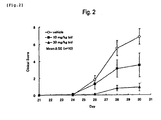
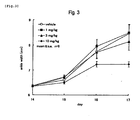
Classifications
-
- C—CHEMISTRY; METALLURGY
- C07—ORGANIC CHEMISTRY
- C07D—HETEROCYCLIC COMPOUNDS
- C07D401/00—Heterocyclic compounds containing two or more hetero rings, having nitrogen atoms as the only ring hetero atoms, at least one ring being a six-membered ring with only one nitrogen atom
- C07D401/02—Heterocyclic compounds containing two or more hetero rings, having nitrogen atoms as the only ring hetero atoms, at least one ring being a six-membered ring with only one nitrogen atom containing two hetero rings
- C07D401/12—Heterocyclic compounds containing two or more hetero rings, having nitrogen atoms as the only ring hetero atoms, at least one ring being a six-membered ring with only one nitrogen atom containing two hetero rings linked by a chain containing hetero atoms as chain links
-
- A—HUMAN NECESSITIES
- A61—MEDICAL OR VETERINARY SCIENCE; HYGIENE
- A61K—PREPARATIONS FOR MEDICAL, DENTAL OR TOILETRY PURPOSES
- A61K31/00—Medicinal preparations containing organic active ingredients
- A61K31/33—Heterocyclic compounds
- A61K31/395—Heterocyclic compounds having nitrogen as a ring hetero atom, e.g. guanethidine or rifamycins
- A61K31/435—Heterocyclic compounds having nitrogen as a ring hetero atom, e.g. guanethidine or rifamycins having six-membered rings with one nitrogen as the only ring hetero atom
- A61K31/47—Quinolines; Isoquinolines
- A61K31/472—Non-condensed isoquinolines, e.g. papaverine
- A61K31/4725—Non-condensed isoquinolines, e.g. papaverine containing further heterocyclic rings
-
- A—HUMAN NECESSITIES
- A61—MEDICAL OR VETERINARY SCIENCE; HYGIENE
- A61P—SPECIFIC THERAPEUTIC ACTIVITY OF CHEMICAL COMPOUNDS OR MEDICINAL PREPARATIONS
- A61P17/00—Drugs for dermatological disorders
- A61P17/04—Antipruritics
-
- A—HUMAN NECESSITIES
- A61—MEDICAL OR VETERINARY SCIENCE; HYGIENE
- A61P—SPECIFIC THERAPEUTIC ACTIVITY OF CHEMICAL COMPOUNDS OR MEDICINAL PREPARATIONS
- A61P17/00—Drugs for dermatological disorders
- A61P17/06—Antipsoriatics
-
- A—HUMAN NECESSITIES
- A61—MEDICAL OR VETERINARY SCIENCE; HYGIENE
- A61P—SPECIFIC THERAPEUTIC ACTIVITY OF CHEMICAL COMPOUNDS OR MEDICINAL PREPARATIONS
- A61P19/00—Drugs for skeletal disorders
-
- A—HUMAN NECESSITIES
- A61—MEDICAL OR VETERINARY SCIENCE; HYGIENE
- A61P—SPECIFIC THERAPEUTIC ACTIVITY OF CHEMICAL COMPOUNDS OR MEDICINAL PREPARATIONS
- A61P19/00—Drugs for skeletal disorders
- A61P19/02—Drugs for skeletal disorders for joint disorders, e.g. arthritis, arthrosis
-
- A—HUMAN NECESSITIES
- A61—MEDICAL OR VETERINARY SCIENCE; HYGIENE
- A61P—SPECIFIC THERAPEUTIC ACTIVITY OF CHEMICAL COMPOUNDS OR MEDICINAL PREPARATIONS
- A61P19/00—Drugs for skeletal disorders
- A61P19/08—Drugs for skeletal disorders for bone diseases, e.g. rachitism, Paget's disease
- A61P19/10—Drugs for skeletal disorders for bone diseases, e.g. rachitism, Paget's disease for osteoporosis
-
- A—HUMAN NECESSITIES
- A61—MEDICAL OR VETERINARY SCIENCE; HYGIENE
- A61P—SPECIFIC THERAPEUTIC ACTIVITY OF CHEMICAL COMPOUNDS OR MEDICINAL PREPARATIONS
- A61P29/00—Non-central analgesic, antipyretic or antiinflammatory agents, e.g. antirheumatic agents; Non-steroidal antiinflammatory drugs [NSAID]
-
- A—HUMAN NECESSITIES
- A61—MEDICAL OR VETERINARY SCIENCE; HYGIENE
- A61P—SPECIFIC THERAPEUTIC ACTIVITY OF CHEMICAL COMPOUNDS OR MEDICINAL PREPARATIONS
- A61P3/00—Drugs for disorders of the metabolism
- A61P3/08—Drugs for disorders of the metabolism for glucose homeostasis
- A61P3/10—Drugs for disorders of the metabolism for glucose homeostasis for hyperglycaemia, e.g. antidiabetics
-
- A—HUMAN NECESSITIES
- A61—MEDICAL OR VETERINARY SCIENCE; HYGIENE
- A61P—SPECIFIC THERAPEUTIC ACTIVITY OF CHEMICAL COMPOUNDS OR MEDICINAL PREPARATIONS
- A61P35/00—Antineoplastic agents
-
- A—HUMAN NECESSITIES
- A61—MEDICAL OR VETERINARY SCIENCE; HYGIENE
- A61P—SPECIFIC THERAPEUTIC ACTIVITY OF CHEMICAL COMPOUNDS OR MEDICINAL PREPARATIONS
- A61P37/00—Drugs for immunological or allergic disorders
-
- A—HUMAN NECESSITIES
- A61—MEDICAL OR VETERINARY SCIENCE; HYGIENE
- A61P—SPECIFIC THERAPEUTIC ACTIVITY OF CHEMICAL COMPOUNDS OR MEDICINAL PREPARATIONS
- A61P37/00—Drugs for immunological or allergic disorders
- A61P37/02—Immunomodulators
- A61P37/06—Immunosuppressants, e.g. drugs for graft rejection
-
- A—HUMAN NECESSITIES
- A61—MEDICAL OR VETERINARY SCIENCE; HYGIENE
- A61P—SPECIFIC THERAPEUTIC ACTIVITY OF CHEMICAL COMPOUNDS OR MEDICINAL PREPARATIONS
- A61P37/00—Drugs for immunological or allergic disorders
- A61P37/08—Antiallergic agents
-
- A—HUMAN NECESSITIES
- A61—MEDICAL OR VETERINARY SCIENCE; HYGIENE
- A61P—SPECIFIC THERAPEUTIC ACTIVITY OF CHEMICAL COMPOUNDS OR MEDICINAL PREPARATIONS
- A61P43/00—Drugs for specific purposes, not provided for in groups A61P1/00-A61P41/00
-
- A—HUMAN NECESSITIES
- A61—MEDICAL OR VETERINARY SCIENCE; HYGIENE
- A61P—SPECIFIC THERAPEUTIC ACTIVITY OF CHEMICAL COMPOUNDS OR MEDICINAL PREPARATIONS
- A61P9/00—Drugs for disorders of the cardiovascular system
-
- A—HUMAN NECESSITIES
- A61—MEDICAL OR VETERINARY SCIENCE; HYGIENE
- A61P—SPECIFIC THERAPEUTIC ACTIVITY OF CHEMICAL COMPOUNDS OR MEDICINAL PREPARATIONS
- A61P9/00—Drugs for disorders of the cardiovascular system
- A61P9/10—Drugs for disorders of the cardiovascular system for treating ischaemic or atherosclerotic diseases, e.g. antianginal drugs, coronary vasodilators, drugs for myocardial infarction, retinopathy, cerebrovascula insufficiency, renal arteriosclerosis
-
- C—CHEMISTRY; METALLURGY
- C07—ORGANIC CHEMISTRY
- C07D—HETEROCYCLIC COMPOUNDS
- C07D217/00—Heterocyclic compounds containing isoquinoline or hydrogenated isoquinoline ring systems
- C07D217/02—Heterocyclic compounds containing isoquinoline or hydrogenated isoquinoline ring systems with only hydrogen atoms or radicals containing only carbon and hydrogen atoms, directly attached to carbon atoms of the nitrogen-containing ring; Alkylene-bis-isoquinolines
-
- C—CHEMISTRY; METALLURGY
- C07—ORGANIC CHEMISTRY
- C07D—HETEROCYCLIC COMPOUNDS
- C07D401/00—Heterocyclic compounds containing two or more hetero rings, having nitrogen atoms as the only ring hetero atoms, at least one ring being a six-membered ring with only one nitrogen atom
- C07D401/02—Heterocyclic compounds containing two or more hetero rings, having nitrogen atoms as the only ring hetero atoms, at least one ring being a six-membered ring with only one nitrogen atom containing two hetero rings
- C07D401/10—Heterocyclic compounds containing two or more hetero rings, having nitrogen atoms as the only ring hetero atoms, at least one ring being a six-membered ring with only one nitrogen atom containing two hetero rings linked by a carbon chain containing aromatic rings
-
- C—CHEMISTRY; METALLURGY
- C07—ORGANIC CHEMISTRY
- C07D—HETEROCYCLIC COMPOUNDS
- C07D401/00—Heterocyclic compounds containing two or more hetero rings, having nitrogen atoms as the only ring hetero atoms, at least one ring being a six-membered ring with only one nitrogen atom
- C07D401/14—Heterocyclic compounds containing two or more hetero rings, having nitrogen atoms as the only ring hetero atoms, at least one ring being a six-membered ring with only one nitrogen atom containing three or more hetero rings
-
- C—CHEMISTRY; METALLURGY
- C07—ORGANIC CHEMISTRY
- C07D—HETEROCYCLIC COMPOUNDS
- C07D405/00—Heterocyclic compounds containing both one or more hetero rings having oxygen atoms as the only ring hetero atoms, and one or more rings having nitrogen as the only ring hetero atom
- C07D405/14—Heterocyclic compounds containing both one or more hetero rings having oxygen atoms as the only ring hetero atoms, and one or more rings having nitrogen as the only ring hetero atom containing three or more hetero rings
-
- C—CHEMISTRY; METALLURGY
- C07—ORGANIC CHEMISTRY
- C07D—HETEROCYCLIC COMPOUNDS
- C07D409/00—Heterocyclic compounds containing two or more hetero rings, at least one ring having sulfur atoms as the only ring hetero atoms
- C07D409/14—Heterocyclic compounds containing two or more hetero rings, at least one ring having sulfur atoms as the only ring hetero atoms containing three or more hetero rings
-
- C—CHEMISTRY; METALLURGY
- C07—ORGANIC CHEMISTRY
- C07D—HETEROCYCLIC COMPOUNDS
- C07D413/00—Heterocyclic compounds containing two or more hetero rings, at least one ring having nitrogen and oxygen atoms as the only ring hetero atoms
- C07D413/02—Heterocyclic compounds containing two or more hetero rings, at least one ring having nitrogen and oxygen atoms as the only ring hetero atoms containing two hetero rings
- C07D413/12—Heterocyclic compounds containing two or more hetero rings, at least one ring having nitrogen and oxygen atoms as the only ring hetero atoms containing two hetero rings linked by a chain containing hetero atoms as chain links
-
- C—CHEMISTRY; METALLURGY
- C07—ORGANIC CHEMISTRY
- C07D—HETEROCYCLIC COMPOUNDS
- C07D413/00—Heterocyclic compounds containing two or more hetero rings, at least one ring having nitrogen and oxygen atoms as the only ring hetero atoms
- C07D413/14—Heterocyclic compounds containing two or more hetero rings, at least one ring having nitrogen and oxygen atoms as the only ring hetero atoms containing three or more hetero rings
-
- C—CHEMISTRY; METALLURGY
- C07—ORGANIC CHEMISTRY
- C07D—HETEROCYCLIC COMPOUNDS
- C07D417/00—Heterocyclic compounds containing two or more hetero rings, at least one ring having nitrogen and sulfur atoms as the only ring hetero atoms, not provided for by group C07D415/00
- C07D417/14—Heterocyclic compounds containing two or more hetero rings, at least one ring having nitrogen and sulfur atoms as the only ring hetero atoms, not provided for by group C07D415/00 containing three or more hetero rings
Definitions
- the present invention relates to a novel isoquinoline derivative having a 8-substitution and a pharmaceutical composition comprising the same as an active ingredient thereof.
- a nuclear factor ⁇ B is a transcription factor that regulates the expression of genes responsible for reactions involved in the survival of an organism.
- genes whose expression is regulated by this NF- ⁇ B include genes of many inflammatory factors including inflammatory cytokines such as tumor necrosis factor (TNF)- ⁇ , interleukin (IL)-1, and IL-6, cyclooxygenase-2 (COX-2), inducible NO synthetase (iNOS), and cell adhesion molecules such as ICAM and VCAM.
- stimuli that induce the activation of NF- ⁇ B include stimuli such as inflammatory cytokines such as IL-1 and TNF- ⁇ , bacterial cell products such as bacterial lipopolysaccharides (LPS), viruses, various stresses such as ultraviolet light and ⁇ -ray irradiation, and T-cell mitogens.
- stimuli such as inflammatory cytokines such as IL-1 and TNF- ⁇
- bacterial cell products such as bacterial lipopolysaccharides (LPS)
- viruses various stresses such as ultraviolet light and ⁇ -ray irradiation, and T-cell mitogens.
- NF- ⁇ B is thought to be involved in many conditions associated with inflammation, including rheumatoid arthritis (Non-patent Document 1), angiogenesis (Non-patent Document 2), arteriosclerosis (Non-patent Document 3), endotoxin shock and sepsis (Non-patent Document 4), inflammatory bowel disease (Non-patent Document 5), ischemic reperfusion injury (Non-patent Document 6), and pneumonia (Non-patent Document 7). Furthermore, previous studies have shown that NF- ⁇ B plays an important role in etiology and development of cancer (Non-patent Document 8).
- NF- ⁇ H binds to I ⁇ B, an inhibitory protein, to form a complex and exists in cytoplasm.
- This complex formation confines NF- ⁇ B in cytoplasm, inhibiting transfer thereof to the nucleus.
- specific amino acid residues of I ⁇ B serine residues 32 and 36 in the case of I ⁇ B ⁇
- Nf- ⁇ B released from I ⁇ B rapidly transfers into the nucleus and activates the transcription of a target gene.
- I ⁇ B is phosphorylated by I ⁇ B kinase (IKK).
- IKK is a kinase complex having catalytic subunits known as IKK ⁇ (also referred to as IKK1) and IKK ⁇ (also referred to as IKK2) (Non-patent Documents 10 and 11).
- IKK is activated by phosphorylation, and MEKK1, MEKK3, NF- ⁇ B inducing kinase (NIK), and the like are known as phosphorylases thereof.
- Non-patent Document 14 It has been reported that inhibition of phosphorylation of I ⁇ B by IKK is effective for the stabilization of I ⁇ K (Non-patent Document 14).
- NF- ⁇ B is activated by inflammatory cytokines in synovial membrane cells derived from a patient with rheumatoid arthritis.
- I ⁇ B stably exists even with stimuli of inflammatory cytokines and then activation of NF- ⁇ B is suppressed.
- the kinase activity of IKK ⁇ plays a central role in activation of NF- ⁇ B (Non-patent Document 14). Therefore, suppression of NF- ⁇ B activation by inhibiting the IKK activity may be effective for the treatment of autoimmune diseases, inflammatory diseases, cardiovascular diseases, and cancer.
- Patent Document 1 aminothiophene derivatives (Patent Document 2), imidazole derivatives (Patent Document 3), indole derivatives (Patent Document 4), aminopyridine derivatives (Patent Document 5), anilinophenylpyrimidine derivatives (Patent Document 6), pyrazolaquinazoline derivatives (Patent Document 7), and indazole derivatives (Patent Document 8) are disclosed as examples of compounds inhibiting the IKK activity.
- An object of the present invention is to provide a compound that has an excellent inhititing effect of IKK activity, in particular, an excellent inhititing effect of IKK activity and is useful for the prevention or treatment of diseases or symptoms associated with NF- ⁇ B.
- Another object of the present invention is to provide a pharmaceutical composition comprising the compound.
- the present inventors conducted various researches to achieve the foregoing objects. As a result, they found that a compound represented by the following formula (1) has an excellent IKK ⁇ inhibiting activity and thus accomplished the present invention.
- the present invention relates to the following.
- the "compound represented by general formula (1) or a salt thereof” (which hereinafter may be simply referred to as “the compound of the present invention") has an excellent IKK ⁇ inhibiting activity. Besides, the compound of the present invention has a TNF- ⁇ production suppressing activity. Furthermore, the compound of the present invention has an anti-inflammatory effect. As a result, the compound of the present invention has an NF- ⁇ B activation inhibiting effect and characteristics of being useful in the prevention and/or treatment of NF- ⁇ B associated diseases and symptoms, for example, autoimmune diseases, inflammatory diseases, cardiovascular diseases, and cancer when administered to humans and animals and very safe.
- halogen atom refers to a fluorine atom, a chlorine atom, a bromine atom, or an iodine atom.
- Preferred examples of halogen atoms include a chlorine atom, a bromine atom, and an iodine atom.
- a chlorine atom or a bromine atom is more preferred as a halogen atom and a chlorine atom is particularly preferred.
- a fluorine atom may be more preferred.
- an "alkyl group” refers to a straight, branched, or cyclic saturated hydrocarbon group or a combination thereof.
- Preferred examples of alkyl groups include lower alkyl groups.
- "lower” means that a certain functional group has 1 to 6 carbon atoms.
- alkyl groups having 1 to 3 carbon atoms are particularly preferred.
- substituents having an alkyl moiety for example, an alkoxy group
- a lower alkyl moiety is similarly preferred as the alkyl moiety and an alkyl moiety having 1 to 3 carbon atoms is particularly preferred as a lower alkyl moiety.
- alkyl groups having 1 to 3 carbon atoms include a methyl group, an ethyl group, an n-propyl group, an isopropyl group, and a cyclopropyl group.
- Preferred examples of alkyl groups having 4 to 6 carbon atoms include an n-butyl group, an isobutyl group, an s-butyl group, a t-butyl group, a cyclobutyl group, a cyclopropylmethyl group, an n-pentyl group, a cyclopentyl group, a cyclopropylethyl group, a cyclobutylmethyl group, an n-hexyl group, a cyclohexyl group, a cyclopropylpropyl group, a cyclobutylethyl group, and a cyclopentylmethyl group.
- Particularly preferred examples of such alkyl groups include a methyl group, an
- an "alkoxy group” refers to a structure in which the above-mentioned alkyl group binds to an oxygen atom. Examples thereof include straight, branched, or cyclic saturated alkoxy groups and combinations thereof and lower alkoxy groups are preferred. Among the lower alkoxy groups, alkoxy groups having 1 to 4 carbon atoms are particularly preferred.
- alkoxy groups having 1 to 4 carbon atoms include a methoxy group, an ethoxy group, an n-propoxy group, an isopropoxy group, a cyclopropoxy group, an n-butoxy group, an isobutoxy group, an s-butoxy group, a t-butoxy group, a cyclobutoxy group, and a cyclopropylmethoxy group.
- alkoxy groups having 5 or 6 carbon atoms include an n-pentyloxy group, a cyclopentyloxy group, a cyclopropylethyloxy group, a cyclobutylmethyloxy group, an n-hexyloxy group, a cyclohexyloxy group, a cyclopropylpropyloxy group, a cyclobutylethyloxy group, and a cyclopentylmethyloxy group.
- an "alkylene” refers to a divalent group comprising a straight, branched, or cyclic saturated hydrocarbon or a combination thereof and examples thereof include divalent groups comprising a saturated hydrocarbon having 1 to 6 carbon atoms. In one embodiment, alkylenes having 1 to 3 carbon atoms are preferred. In another embodiment, alkylenes having 4 to 6 carbon atoms may be preferred. Straight or branched alkylenes are preferred, and straight alkylenes are particularly preferred. Preferred examples of alkylenes include methylene, ethylene, trimethylene, tetramethylene, pentamethylene, and hexamethylene. Particularly preferred examples of alkyl groups include methylene, ethylene, and trimethylene.
- an "aryl group” refers to a substituent derived from an aromatic hydrocarbon and examples thereof include monocyclic aromatic groups and fused polycyclic aromatic groups. Examples thereof include monovalent substituents derived from the following aryl rings by removing one arbitrary hydrogen atom. Examples of aryl rings include monocyclic aromatic rings and fused polycyclic aromatic rings. In the present specification, partially unsaturated monocyclic or fused-bicyclic carbon rings and heterocyclic rings and the like are also included in monocyclic aromatic rings and fused polycyclic aromatic rings.
- An aryl ring may be an aromatic hydrocarbon ring and may contain one or more, for example, 1 to 3 hetero atoms of one or more types selected from the group consisting of a nitrogen atom, a sulfur atom, and an oxygen atom as ring-constituting atoms other than carbon atoms.
- Examples of the monocyclic aromatic rings include monocyclic aromatic hydrocarbon rings and monocyclic aromatic heterocyclic rings containing one or more hetero atoms and examples thereof include a benzene ring and 5-or 6-membered aromatic heterocyclic rings containing one or more hetero atoms.
- 5- or 6-membered aromatic heterocyclic rings include thiophene, pyridine, furan, thiazole, oxazole, pyrazole, pyrazine, pyrimidine, pyrrole, imidazole, pyridazine, isothiazole, isoxazole, 1,2,4-oxadiazole, 1,3,4-oxadiazole, 1,2,4-thiadiazole, 1,3,4-thiadiazole, and furazan.
- the fused polycyclic aromatic rings include fused polycyclic aromatic hydrocarbon rings and fused polycyclic aromatic heterocyclic rings containing one or more hetero atoms.
- fused polycyclic aromatic hydrocarbon rings include bicyclic or tricyclic aromatic hydrocarbon rings having 9 to 14 carbon atoms and specific preferred examples thereof include naphthalene, 1,2,3,4-tetrahydronaphthalene, indene, 2,3-dihydroindene (indane), fluorene, phenanthrene, 9,10-dihydrophenanthrene, and anthracene.
- fused polycyclic aromatic heterocyclic rings include 9- to 14-membered, preferably 9- or 10-membered fused polycyclic aromatic heterocyclic rings containing one or more, for example, 1 to 4 hetero atoms and specific preferred examples thereof include benzofuran, 2,3-dihydrobenzofuran, benzothiophene, 2,3-dihydrobenzothiophene, benzimidazole, benzoxazole, benzisoxazole, benzothiazole, benzisothiazole, naphtho[2,3-b] thiophene, quinoline, isoquinoline, 1,2-dihydroisoquinoline, 3,4-dihydroisoquinoline, 1,2-dihydroquinoline, 3,4-dihydroquinoline, 1,2,3,4-tetrahydroisoquinoline, 1,2,3,9-tetrahydroquinoline, indole, indoline, quinoxaline, phenanthridine, phen
- examples of monocyclic aromatic groups as aryl groups include monovalent groups derived from the above-mentioned monocyclic aromatic rings by removing one arbitrary hydrogen atom and specific preferred examples thereof include a phenyl group, a thienyl group (2- or 3-thienyl group), a pyridyl group (2-, 3-, or 4-pyridyl group), a furyl group (2- or 3-furyl group), a thiazolyl group (2-, 4-, or 5-thiazolyl group), an oxazolyl group (2-, 4-, or 5-oxazolyl group), a pyrazolyl group (1-, 3-, or 4-pyrazolyl group), a 2-pyrazinyl group, a pyrimidinyl group (2-, 4-, or 5-pyrimidinyl group), a pyrrolyl group (1-, 2-, or 3-pyrrolyl group), an imidazolyl group (1-, 2-, or 4-imidazolyl group), a
- fused polycyclic aromatic groups as aryl groups include monovalent groups derived from the above-mentioned fused polycyclic aromatic ring comprising 2 to 4, preferably 2 or 3 rings by removing one arbitrary hydrogen atom and specific preferred examples thereof include a 1-naphthyl group, a 2-naphthyl group, an 1-indenyl group, an 2-indenyl group, a 2,3-dihydroinden-1-yl group, a 2,3-dihydroinden-2-yl group, an 2-anthryl group, an indazolyl group (3-, 4-, 5-, 6-, or 7-indazolyl group), a quinolyl group (2-, 3-, 4-, 5-, 6-, 7-, or 8-quinolyl group), an isoquinolyl group (1-, 3-, 4-, 5-, 6-, 7-, or 8-isoquinolyl group), a 1,2-dihydroisoquinolyl or 1,2,3,4-te
- an "aryloxy group” refers to a group to which the above-mentioned aryl group binds via an oxygen atom.
- the aryl moiety of an aryloxy group is preferably a monocyclic aromatic group and examples of aryloxy groups include a phenoxy group, a 2-thienyloxy group, a 3-thienyloxy group, a 2-pyridyloxy group, a 3-pyridyloxy group, a 4-pyridyloxy group, a 2-furyloxy group, a 3-furyloxy group, a 2-thiazolyloxy group, a 4-thiazolyloxy group, a 5-thiazolyloxy group, an 2-oxazolyloxy group, an 4-oxazolyloxy group, an 5-oxazolyloxy group, a 1-pyrazolyloxy group, a 3-pyrazolyloxy group, a 4-pyrazolyloxy group, a 2-pyrazinyloxy group, a 2-pyr
- a phenoxy group, a 2-thienyloxy group, a 3-thienyloxy group, a 2-furyloxy group, a 3-furyloxy group, a 2-pyridyloxy group, a 3-pyridyloxy group, a 4-pyridyloxy group, and the like are particularly preferred.
- an "aralkyl group” refers to an alkyl group substituted with an aryl group (arylalkyl group).
- an alkyl moiety of an aralkyl group is the same as the above-mentioned alkyl group, and an aryl moiety is the same as the above-mentioned aryl group.
- An aryl moiety of an aralkyl group is preferably a monocyclic aromatic group.
- aralkyl groups include a benzyl group, a 2-thienylmethyl group, a 3-thienylmethyl group, a 2-pyridylmethyl group, a 3-pyridylmethyl group, a 4-pyridylmethyl group, a 2-furylmethyl group, a 3-furylmethyl group, a 2-thiazolylmethyl group, a 4-thiazolylmethyl group, a 5-thiazolylmethyl group, an 2-oxazolylmethyl group, an 4-oxazolylmethyl group, an 5-oxazolylmethyl group, a 1-pyrazolylmethyl group, a 3-pyrazolylmethyl group, a 4-pyrazolylmethyl group, a 2-pyrazinylmethyl group, a 2-pyrimidinylmethyl group, a 4-pyrimidinylmethyl group, a 5-pyrimidinylmethyl group, a 1-pyrrolylmethyl group, a 2-pyrrolylmethyl group, a 3-pyrrolylmethyl group, an 1-imid
- a benzyl group, a 2-thienylmethyl group, a 3-thienylmethyl group, a 2-furylmethyl group, a 3-furylmethyl group, a 2-pyridylmethyl group, a 3-pyridylmethyl group, a 4-pyridylmethyl group, and the like are particularly preferred.
- aralkyl groups include a 2-phenylethyl group, a 2-(2-thienyl)ethyl group, a 2-(3-thienyl)ethyl group, a 2- (2-pyridyl)ethyl group, a 2-(3-pyridyl)ethyl group, a 2-(4-pyridyl)ethyl group, a 2-(2-furyl)ethyl group, a 2-(3-furyl)ethyl group, a 2-(2-thiazolyl)ethyl group, a 2-(4-thiazolyl)ethyl group, a 2-(5-thiazolyl)ethyl group, an 2-(2-oxazolyl)ethyl group, an 2-(4-oxazolyl)ethyl group, an 2-(5-oxazolyl)ethyl group, a 2-(1-pyrazolyl)ethyl group
- a 2-phenylethyl group, a 2-(2-thienyl)ethyl group, a 2-(3-thienyl)ethyl group, a 2-(2-furyl)ethyl group, a 2-(3-furyl)ethyl group, a 2-(2-pyridyl)ethyl group, a 2-(3-pyridyl)ethyl group, and a 2-(4-pyridyl)ethyl group are particularly preferred.
- examples of aralkyl groups also include a 1-phenylethyl group, a 1-(2-thienyl)ethyl group, a 1-(3-thienyl)ethyl group, a 1-(2-pyridyl)ethyl group, a 1-(3-pyridyl)ethyl group, a 1-(4-pyridyl)ethyl group, a 1-(2-furyl)ethyl group, a 1-(3-furyl)ethyl group, a 1-(2-thiazolyl)ethyl group, a 1-(4-thiazolyl)ethyl group, a 1-(5-thiazolyl)ethyl group, an 1-(2-oxazolyl)ethyl group, an 1-(9-oxazolyl)ethyl group, an 1-(5-oxazolyl)ethyl group, a 1-(1-pyrazolyl)ethyl group
- a 1-phenylethyl group, a 1-(2-thienyl)ethyl group, a 1-(3-thienyl)ethyl group, a 1-(2-furyl)ethyl group, a 1-(3-furyl)ethyl group, a 1-(2-pyridyl)ethyl group, a 1-(3-pyridyl)ethyl group, and a 1-(4-pyridyl)ethyl group are particularly preferred.
- a "saturated heterocyclic group” refers to a saturated ring group containing a hetero atom as a constituent of the ring and examples thereof include monocyclic saturated heterocyclic groups.
- the ring contains preferably 1 or 2 hetero atoms, more preferably one hetero atom.
- the monocyclic saturated heterocyclic group is, for example, a 3- to 7-membered ring group, particularly preferably a 5- or 6-membered ring group.
- saturated heterocyclic groups include a tetrahydropyranyl group (3- or 4-tetrahydropyranyl group), a 3-tetrahydrofuryl group, a piperidyl group (3- or 4-piperidyl group), a 3-pyrrolidyl group, a tetrahydrothiopyranyl group (3- or 4-tetrahydrothiopyranyl group), a 3-tetrahydrothiofuryl group, and a morpholino group (2- or 3-morpholino group).
- a particularly preferred example is a morpholino group.
- amino group refers to a -NH 2 group.
- examples of a substituent on an alkyl group that may be substituted include a hydroxyl group, a halogen atom, a carboxy group, a cyano group, a saturated heterocyclic group, an alkylsulfonylamino group, and an aminocarbonylamino group.
- a hydroxyl group and a halogen atom are more preferred.
- An alkyl group that may be substituted is preferably one group selected from the group consisting of a trifluoromethyl group, a difluoromethyl group, a hydroxymethyl group, and a 2-hydroxyethyl group in addition to the above-mentioned preferred examples of alkyl groups.
- a methyl group, an ethyl group, an n-propyl group, an isopropyl group, a cyclopropyl group, a trifluoromethyl group, a difluoromethyl group, a hydroxymethyl group, and a 2-hydroxyethyl group are more preferred, and a methyl group is particularly preferred.
- examples of a substituent in an alkoxy group that may be substituted include the same substituents as substituents in the above-mentioned alkyl groups that may be substituted, and one or more halogen atoms are particularly preferred.
- a substituted alkoxy groups is preferably, for example, an alkoxy group substituted arbitrarily with one or more halogen atoms, more preferably an alkoxy group having 1 to 4 carbon atoms substituted arbitrarily with one or more halogen atoms.
- the halogen atom may be identical to or different from each other.
- An alkoxy group that may be substituted is preferably one group selected from the group consisting of a monofluoromethoxy group, a difluoromethoxy group, a trifluoromethoxy group, and a 2,2,2-trifluoroethoxy group in addition to the above-mentioned preferred examples of alkoxy groups having 1 to 6 carbon atoms.
- One group selected from the group consisting of a trifluoromethoxy group and a 2,2,2-trifluoroethoxy group in addition to the above-mentioned preferred examples of alkoxy groups having 1 to 6 carbon atoms is particularly preferred.
- a substituent in an alkylene that may be substituted is preferably one group selected from the group consisting of a trifluoromethyl group, a difluoromethyl group, a hydroxymethyl group, and a 2-hydroxyethyl group in addition to the same groups as the above-mentioned substituents in an alkyl group that may be substituted, more preferably a methyl group, an ethyl group, an n-propyl group, an isopropyl group, a cyclopropyl group, a trifluoromethyl group, a difluoromethyl group, a hydroxymethyl group, and a 2-hydroxyethyl group, particularly preferably a methyl group.
- substituents in an aryl group that may be substituted and an aryloxy group that may be substituted are the same as the above-mentioned substituents in an alkyl group that may be substituted.
- substituents in an aralkyl group that may be substituted are the same as, for example, the above-mentioned substituents in an alkyl group that may be substituted.
- an aralkyl group may be preferably substituted with an alkyl group, an alkoxy group, an amino group, a hydroxyl group, a cyano group, or a halogen atom on a carbon atom among constituents forming an aryl ring of the above-mentioned aralkyl group.
- Specific examples thereof include a 4-methylphenylmethyl group, a 4-methoxyphenylmethyl group, an 4-aminophenylmethyl group, a 4-hydroxyphenylmethyl group, a 4-fluorophenylmethyl group, a 5-methyl-2-furylmethyl group, a 4-methyl-2-furylmethyl group, a 5-methyl-3-furylmethyl group, a 5-methyl-2-pyrrolylmethyl group, a 4-methyl-2-pyrrolylmethyl group, a 5-methyl-3-pyrrolylmethyl group, a 5-methyl-2-thienylmethyl group, a 4-methyl-2-thienylmethyl group, and a 5-methyl-3-thienylmethyl group.
- an aralkyl group may be preferably substituted with an alkyl group or an alkoxy group on a nitrogen atom among constituents forming an aryl ring of an aralkyl group.
- Specific examples thereof include a 1-methyl-2-pyrrolylmethyl group, a 1-ethyl-2-pyrrolylmethyl group, and a 1-methyl-3-pyrrolylmethyl group.
- substituents in a saturated heterocyclic group that may be substituted are the same as, for example, the above-mentioned substituents of an alkyl group that may be substituted.
- saturated heterocyclic groups that may be substituted are preferably the above-mentioned preferred examples of saturated heterocyclic groups.
- examples of amino groups that may be substituted include an -NH 2 group, an alkylamino group, a dialkylamino group, an acylamino group, an alkylcarbonylamino group, and an alkylsulfonylamino group. Furthermore, examples of amino groups that may be substituted also include an amino group substituted with 1 or 2 alkyl groups that may be substituted, an amino group substituted with 1 or 2 aryl groups that may be substituted, and an amino group substituted with an aryl group that may be substituted and an alkyl group that may be substituted.
- amino groups that may be substituted include a methylamino group, an ethylamino group, an n-propylamino group, an isopropylamino group, a dimethylamino group, an ethyl(methyl)amino group, a diethylamino group, a methyl(n-propyl)amino group, an acetylamino group, a propanoylamino group, a methylsulfonylamino group, an ethylsulfonylamino group, an n-propylsulfonylamino group, an isopropylsulfonylamino group, and a cyclopropylsulfonylamino group.
- D 1 represents a single bond, -N(R 11 )-, -O-, -S-, -S(O)-, or -S(O) 2 -, preferably a single bond, -N(R 11 )-, -O-, and -S-, more preferably a single bond, -N(R 11 )-, and -O-.
- -N(R 11 )- may be particularly preferred and - 0- may be particularly preferred in another embodiment.
- -S(O)- and -S(O) 2 - may be preferred in yet another embodiment.
- R 11 represents a hydrogen atom or an alkyl group that may be substituted, and a hydrogen atom is preferred in one embodiment.
- a lower alkyl group is preferred, an alkyl group having 1 to 3 carbon atoms is more preferred, a methyl group and an ethyl group are yet more preferred, and a methyl group is particularly preferred.
- a 1 represents a single bond, an alkylene that may be substituted, or any of divalent groups selected from the following formulas (1a-1) to (1a-6): preferably an alkylene that may be substituted or any of divalent groups selected from the formulas (1a-1) to (1a-6).
- the formulas (1a-1), (1a-2), and (1a-5) are more preferred, the formulas (1a-1) and (1a-2) are yet more preferred, and the formula (1a-1) is particularly preferred.
- the formula (1a-2) may be preferred.
- the formulas (1a-3), (1a-4), and (1a-6) may be more preferred, the formulas (1a-3) and (1a-4) may be yet more preferred, and the formula (1a-3) may be particularly preferred. In yet another embodiment, the formula (1a-4) may be preferred.
- a 1 examples include the following formulas (1a-1-1), (1a-2-1), and (1a-5-1): wherein R 12 , R 13 , v, and w have the same meaning as defined above, and the formula (1a-1-1) is more preferred in one embodiment. In another embodiment, the formula (1a-2-1) may be more preferred. In yet another embodiment, the formula (1a-5-1) may be more preferred.
- a 1 represents the formula (1a-5) or (1a-6), preferably the formula (1a-5).
- a 1 represents a single bond, an alkylene that may be substituted, or any of divalent groups selected from the above-mentioned formulas (1a-1) to (1a-4).
- D 2 represents an alkylene that may be substituted or -E-C(O)-.
- D 2 represents an alkylene that may be substituted or -E-C(O)-.
- n 1 is an integer of 0, 1, or 2, and 0 or 1 is preferred. In one embodiment, 0 is particularly preferred. In another embodiment, 1 may be preferred.
- n 2 is an integer of 2 or 3. In one embodiment, 2 is preferred. In another embodiment, 3 may be preferred.
- n 3 is an integer of 1 or 2. In one embodiment, 1 is preferred. In another embodiment, 2 may be preferred.
- R 12 and R 13 each independently represent a hydrogen atom, a hydroxyl group, or an alkyl group that may be substituted, preferably a hydrogen atom or an alkyl group that may be substituted. In one embodiment, a hydrogen atom is more preferred. In another embodiment, an alkyl group that may be substituted may be preferred. Preferred examples of alkyl groups that may be substituted include a methyl group, an ethyl group, an n-propyl group, an i-propyl group, and a trifluoromethyl group and a methyl group is more preferred.
- X 1 represents -N(R 14 )-, -O-, or -S-, and -N(R 14 )- or - 0- is preferred. In one embodiment, -0- or -S- is more preferred, and -0- is particularly preferred. In another embodiment, -N(R 14 )- may be preferred.
- R 14 represents a hydrogen atom or an alkyl group that may be substituted, and a hydrogen atom is preferred in one embodiment. In another embodiment, an alkyl group that may be substituted may be preferred. Examples of an alkyl group that may be substituted in R 14 include alkyl groups having 1 to 3 carbon atoms.
- v represents a bond with D 1
- w represents a bond with D 2 .
- D 2 represents a single bond, an alkylene that may be substituted, -C (O) -, -C(S)-, -S(O) 2 -, -C(O)-N(R 15 )-, - C(S)-N(R 15 )-, or -E-C(O)-, preferably a single bond or an alkylene that may be substituted.
- an alkylene that may be substituted is more preferred.
- An alkylene that may be substituted is preferably a straight or branched alkylene having 1 to 3 carbon atoms. Examples thereof include methylene, ethylene, and trimethylene and methylene and ethylene are preferred.
- a single bond may be preferred.
- -C(O)-, -S(O) 2 -, or -E-C(O)- may be preferred and -C(O)- may be more preferred.
- -S(O) 2 - may be preferred.
- R 15 represents a hydrogen atom or an alkyl group, preferably a hydrogen atom.
- E represents an alkylene that may be substituted.
- An alkylene is preferably a straight or branched alkylene having 1 to 4 carbon atoms, more preferably an alkylene having 1 to 3 carbon atoms.
- Examples of alkylenes include methylene, ethylene, and trimethylene and methylene and ethylene are preferred.
- R 1 represents a hydrogen atom, an alkyl group that may be substituted, an amino group that may be substituted, a saturated heterocyclic group that may be substituted, an aralkyl group that may be substituted, an aryl group that may be substituted, a carbamimidoyl group, or any of groups selected from the following formulas (1b-1) to (1b-4): preferably a hydrogen atom, an alkyl group that may be substituted, a saturated heterocyclic group that may be substituted, an aralkyl group that may be substituted, an aryl group that may be substituted, or any of groups selected from the formulas (1b-1) to (1b-4), more preferably an alkyl group that may be substituted, an aralkyl group that may be substituted, an aryl group that may be substituted, or any of groups selected from the formulas (1b-1) to (1b-4).
- an alkyl group that may be substituted, an aralkyl group that may be substituted, or an aryl group that may be substituted is more preferred, and an alkyl group that may be substituted is particularly preferred.
- an aralkyl group that may be substituted may be preferred.
- an aryl group that may be substituted may be preferred. Examples of an alkyl group that may be substituted include the above-mentioned preferred examples of an alkyl group that may be substituted.
- An alkyl group having 1 to 6 carbon atoms is preferred, and an alkyl group having 1 to 4 carbon atoms is more preferred.
- Examples of an alkyl group include a methyl group, an ethyl group, an n-propyl group, an i-propyl group, a cyclopropyl group, and a trifluoromethyl group.
- Examples of an aralkyl group that may be substituted include the above-mentioned preferred examples of an aralkyl group that may be substituted, for example, an alkyl group having 1 to 3 carbon atoms that is substituted with an aryl group.
- Examples of an aralkyl group include a benzyl group, a 2-pyridylmethyl group, a 3-pyridylmethyl group, and a 4-pyridylmethyl group.
- Examples of an aryl group that may be substituted include the above-mentioned preferred examples of an aryl group that may be substituted, for example, a phenyl group, a thienyl group (2- or 3-thienyl group), a pyridyl group (2-, 3-, or 4-pyridyl group), a furyl group (2- or 3-furyl group), a naphthyl group (1- or 2-naphthyl group), a quinolyl group (2-, 3-, 4-, 5-, 6-, 7-, or 8-quinolyl group), and substitution products thereof, and a phenyl group or a pyridyl group (2-, 3-, or 4-pyridyl group) is preferred.
- a phenyl group is particularly preferred.
- a pyridyl group may be preferred.
- R 1 preferably represents a hydrogen atom, a saturated heterocyclic group that may be substituted, or any of groups selected from the formulas (1b-1) to (1b-4).
- a saturated heterocyclic group that may be substituted or the formula (1b-1) or (1b-3) is preferred.
- the formula (1b-2) or (1b-4) may be preferred.
- Examples of a saturated heterocyclic group that may be substituted include a morpholino group (2- or 3-morpholino group), an azetidyl group (2- or 3-azetidyl group), a piperidyl group (2-, 3-, or 4-piperidyl group), and a pyrrolidyl group (2- or 3-pyrrolidyl group).
- a hydrogen atom may be preferred.
- n 1 is an integer of 0, 1, or 2. In one embodiment, 0 or 1 is preferred and 1 is more preferred. In another embodiment, 2 may be preferred.
- n 2 is an integer of 1 or 2 and 1 is preferred.
- n 3 is an integer of 0, 1, or 2 and 0 or 1 is preferred.
- X 2 represents -N(R 14 )-, -O-, or -S-. -0- or -S- is preferred, and -0- is particularly preferred.
- D 11 represents an alkylene that may be substituted.
- An alkylene is preferably a straight or branched alkylene having 1 to 4 carbon atoms, more preferably an alkylene having 1 to 3 carbon atoms.
- Examples of alkylenes include methylene, ethylene, and trimethylene and methylene or ethylene is preferred.
- D 12 represents a single bond, an alkylene that may be substituted, -C (O) -, -S(O) 2 -, or -C(O)-N(R 15 )-.
- a single bond or an alkylene that may be substituted is preferred.
- -C(O)-or -S(O) 2 - is preferred and -C(O)- is particularly preferred.
- -S(O) 2 - may be preferred.
- R 16 , R 18 , and R 19 may be identical to or different from one another and each independently represents a hydrogen atom or an alkyl group that may be substituted.
- a hydrogen atom is preferred.
- an alkyl group that may be substituted may be preferred.
- Examples of an alkyl group that may be substituted include alkyl groups having 1 to 3 carbon atoms. A methyl group, an ethyl group, or an n-propyl group is preferred, and a methyl group is more preferred.
- R 17 represents a hydrogen atom, an alkyl group that may be substituted, an aralkyl group that may be substituted, or an aryl group that may be substituted.
- a hydrogen atom, an alkyl group that may be substituted, or an aryl group that may be substituted is preferred, and an alkyl group that may be substituted or an aryl group that may be substituted is more preferred.
- An alkyl group that may be substituted is preferably an alkyl group having 1 to 6 carbon atoms, more preferably an alkyl group having 1 to 4 carbon atoms.
- Examples of an alkyl group include a methyl group, an ethyl group, an n-propyl group, an i-propyl group, a cyclopropyl group, and a trifluoromethyl group.
- Examples of an aryl group that may be substituted include a phenyl group, a thienyl group (2- or 3-thienyl group), a pyridyl group (2-, 3-, or 4-pyridyl group), a furyl group (2- or 3-furyl group), a naphthyl group (a 1- or 2-naphthyl group), and a quinolyl group (2-, 3-, 4-, 5-, 6-, 7-, or 8-quinolyl group) and substitution products thereof.
- a phenyl group and a pyridyl group (2-, 3-, or 4-pyridyl group) are preferred.
- D 12 represents a single bond.
- D 3 represents a single bond, -N(R 21 )-, -O-, -N(R 21 )-C(O)-, or -S-, preferably a single bond, -O-, or -N(R 21 )-C(O)-, more preferably a single bond or -N(R 21 )-C(O)-.
- a single bond is particularly preferred.
- -N(R 21 )-C(O)- may be preferred.
- R 21 represents a hydrogen atom or an alkyl group that may be substituted.
- a hydrogen atom is preferred.
- an alkyl group that may be substituted may be preferred.
- Examples of an alkyl group that may be substituted include alkyl groups having 1 to 3 carbon atoms. A methyl group, an ethyl group, and an n-propyl group are preferred and a methyl group is more preferred.
- R 2 represents an alkyl group that may be substituted or a group represented by the following formula (2a-1): In one embodiment, a group represented by the formula (2a-1) is preferred. In another embodiment, an alkyl group that may be substituted may be preferred. Examples of an alkyl group that may be substituted include the above-mentioned preferred examples of an alkyl group that may be substituted. An alkyl group having 1 to 6 carbon atoms is preferred and an alkyl group having 1 to 3 carbon atoms is more preferred.
- Q represents an aryl group that may be substituted.
- an aryl group include the above-mentioned preferred examples of aryl group.
- a monocyclic aromatic group is preferred.
- a fused polycyclic aromatic group or the like may be preferred.
- monocyclic aromatic groups include a phenyl group, a thienyl group (2- or 3-thienyl group), a pyridyl group (2-, 3-, or 4-pyridyl group), and a furyl group (2- or 3-furyl group).
- a phenyl group is particularly preferred.
- a pyridyl group may be preferred.
- a thienyl group may be preferred.
- fused polycyclic aromatic groups include a 1-naphthyl group, a 2-naphthyl group, a quinolyl group (2-, 3-, 4-, 5-, 6-, 7-, or 8-quinolyl group), an isoquinolyl group (1-, 3-, 4-, 5-, 6-, 7-, or 8-isoquinolyl group), an indazolyl group (3-, 4-, 5-, 6-, or 7-indazolyl group), and an indolyl group (2-, 3-, 4-, 5-, 6-, or 7-indolyl group).
- examples include a pyrrolyl group, a pyrimidinyl group, a pyridazinyl group, an imidazolyl group, a quinazolinyl group, and a quinolyl group.
- a pyrrolyl group is preferred.
- a pyrazolyl group may be preferred.
- R 23 , R 24 , and R 25 may be identical to or different from one another and each independently represents a hydrogen atom, a halogen atom, a cyano group, an alkyl group that may be substituted, an alkoxy group that may be substituted, an amino group that may be substituted, an aryl group that may be substituted, an aryloxy group that may be substituted, an aralkyl group that may be substituted, or a group represented by the following formula (2b-1): 1 or 2 of R 23 , R 24 , and R 25 preferably represent a hydrogen atom. In one embodiment, it is particularly preferred that any two of R 23 , R 24 , and R 25 represent a hydrogen atom.
- R 23 , R 24 , and R 25 may be preferred that any one of R 23 , R 24 , and R 25 represents a hydrogen atom. In yet another embodiment, it is possible that none of R 23 , R 24 , and R 25 represent a hydrogen atom.
- R 23 , R 24 , and R 25 preferably represent a halogen atom, a cyano group, an alkyl group that may be substituted, an alkoxy group that may be substituted, an amino group that may be substituted, or a group represented by the formula (2b-1). In one embodiment, a halogen atom or a cyano group is particularly preferred. In another embodiment, an alkoxy group that may be substituted or an amino group that may be substituted may be preferred.
- a group represented by the formula (2b-1) may be preferred.
- Q substituted with R 23 , R 24 , and R 25 include a phenyl group, a 2-, 3-, or 4-methylphenyl group, a 2-, 3-, or 4-trifluoromethylphenyl group, a 2-, 3-, or 4-methanesulfonylphenyl group, a 2-, 3-, or 4-cyanophenyl group, a 2-, 3-, or 4-fluorophenyl group, a 2-, 3-, or 4-chlorophenyl group, a 2-, 3-, or 4-methoxyphenyl group, an 2-, 3-, or 4-aminophenyl group, a 2-, 3-, or 4-hydroxy phenyl group, a 2-, 3-, or 4-hydroxymethylphenyl group, an 2-, 3-, or 4-aminomethylphenyl group, a 2-, 3-, or 4-cyanomethylphenyl group, a 2-, 3-, or 4-cyanomethylphenyl group, a 2-
- Examples thereof further include a 2-cyanopyridin-3-yl group, a 4-cyanopyridin-3-yl group, a 5-cyanopyridin-3-yl group, a 6-cyanopyridin-3-yl group, a 2-cyanopyridin-4-yl group, a 3-cyanopyridin-4-yl group, a 2-fluoropyridin-3-yl group, a 4-fluoropyridin-3-yl group, a 5-fluoropyridin-3-yl group, a 2-fluoropyridin-4-yl group, a 3-fluoropyridin-4-yl group, a 2-methylpyridin-3-yl group, 4-methylpyridin-3-yl group, a 5-methylpyridin-3-yl group, a 6-methylpyridin-3-yl group, a 2-methylpyridin-4-yl group, a 3-methylpyridin-4-yl group, a 2-difluoromethylpyridin-3-y
- D 21 represents a single bond or an alkylene that may be substituted.
- a single bond is preferred.
- an alkylene that may be substituted may be preferred.
- Examples of an alkylene that may be substituted include alkylenes having 1 to 3 carbon atoms. Examples of alkylenes include methylene, ethylene, and trimethylene.
- D 22 represents a single bond, an alkylene that may be substituted, -C(O)-, -S(O) 2 -, or -C(O)-N(R 28 )-, preferably a single bond, an alkylene that may be substituted, - C(O)-, or -S(O) 2 -.
- -C(O)- or -S(O) 2 - is more preferred.
- a single bond may be preferred.
- R 26 , R 27 , and R 28 may be identical to or different from one another and each independently represents a hydrogen atom or an alkyl group that may be substituted.
- a hydrogen atom is preferred.
- an alkyl group that may be substituted may be preferred.
- An alkyl group that may be substituted is preferably an alkyl group having 1 to 6 carbon atoms, more preferably an alkyl group having 1 to 4 carbon atoms. Examples of alkyl groups include a methyl group, an ethyl group, and a cyclopropyl group.
- z represents a bond with Q.
- R 27 represents a hydrogen atom.
- Combinations of substituents in the compound of the present invention are not particularly limited so long as the compound of the present invention has an intended IKK ⁇ inhibiting activity and the preferred examples thereof include compounds having the following combinations of substituents or salts thereof:
- Examples of the compound of the present invention include the following examples, but the compound of the present invention is not limited to these examples.
- the compound of the present invention may have one or more asymmetric center, and a stereoisomer such as an optical enantiomer or a diastereoisomer based on such an asymmetric center may exist.
- stereoisomers in a pure form and arbitrary mixtures or racemates of stereoisomers all fall within the scope of the present invention. In one embodiment, mixtures of racemates and the like may be preferred due to easiness of production.
- the compound of the present invention has an olefinic double bond or a cyclic structure, two or more stereoisomers may exist, and arbitrary stereoisomers in a pure form or arbitrary mixtures of stereoisomers all fall within the scope of the present invention.
- the compound of the present invention may exist as a tautomer. Existence of tautomers is apparent for those skilled in the art and all tautomers fall within the scope of the present invention.
- the compound represented by the formula (1) is generally understood as a compound , in a free form, represented by the formula (1).
- the compound represented by the formula (1) may exist as a salt and such a salt also fall within the scope of the present invention.
- the form of the salt is not particularly limited and an acid addition salt is generally formed.
- a base addition salt may be formed depending on the type of a substituent.
- Salts are preferably pharmaceutically acceptable salts. Acids and bases that form pharmaceutically acceptable salts are known to those skilled in the art and examples thereof include the salts described by Berge et al. in J. Pharm. Sci., 1977, pp. 1-19 .
- acid addition salts include mineral acid salts such as hydrochlorides, hydrobromates, hydroiodides, nitrates, sulfates, hydrogen sulfates, phosphates, and hydrogen phosphates and organic acid salts such as acetates, trifluoroacetates, gluconates, lactates, salicylates, citrates, tartarates, ascorbates, succinates, maleates, fumarates, formates, benzoates, methanesulfonates, ethanesulfonates, and p-toluenesulfonates.
- mineral acid salts such as hydrochlorides, hydrobromates, hydroiodides, nitrates, sulfates, hydrogen sulfates, phosphates, and hydrogen phosphates
- organic acid salts such as acetates, trifluoroacetates, gluconates, lactates, salicylates, citrates, tartarates,
- examples of base addition salts include alkali metal salts such as sodium salts and potassium salts, alkaline earth metal salts such as magnesium salts and calcium salts, organic amine salts such as triethylamine salts, pyridine salts, procaine salts, picoline salts, dicyclohexylamine salts, diethanolamine salts, triethanolamine salts, tris(hydroxymethyl)aminomethane salts, and amino acid addition salts such as arginine salts, lysine salts, ornithine salts, serine salts, glycine salts, aspartic acid salts, and glutamic acid salts.
- alkali metal salts such as sodium salts and potassium salts
- alkaline earth metal salts such as magnesium salts and calcium salts
- organic amine salts such as triethylamine salts, pyridine salts, procaine salts, picoline salts, dicyclohexylamine salts, diethanolamine salt
- the compound of the present invention may be a nonhydrate. Furthermore, the compound of the present invention is preferably a hydrate in one embodiment. In one embodiment, the compound of the present invention is preferably a solvate. In another embodiment, a nonsolvate may be preferred.
- the compound of the present invention may be crystalline or amorphous.
- the crystalline compound may be of a single crystal or a mixture of multiple crystalline forms.
- the compound of the present invention may be of an arbitrary mixture of crystalline and amorphous forms.
- the compound represented by the formula (1) is neither a hydrate nor a solvate (this compound may be referred to as a "free compound”). In another embodiment, it may be preferred that "the compound represented by the formula (1)” is either a hydrate or a solvate. In one embodiment, it is preferred that "a salt of the compound represented by the formula (1)” is neither a hydrate nor a solvate. In another embodiment, it may be preferred that "a salt of the compound represented by the formula (1)” is either a hydrate or a solvate. Furthermore, preferred examples include crystals of these substances.
- the above-mentioned compound of the present invention is preferably crystalline.
- a prodrug can be produced from the compound of the present invention by, for example, suitably introducing a group constituting a prodrug into one or more arbitrary groups selected from hydroxyl groups and amino groups in the compound of the present invention according to a usual method using a prodrug forming reagent such as a corresponding halogenated compound and then suitably isolating and purifying according to a usual method as intended.
- a prodrug of the compound of the present invention can also be produced by suitably introducing a group constituting a prodrug into a carboxyl group in the compound of the present invention according to a usual method using a prodrug forming reagent such as a corresponding alcohol or amine.
- a protective group existing in a compound represented by the formula (2) described later may be utilized.
- the prodrug is not particularly limited so long as a metabolite thereof exhibits an intended pharmacological effect and examples thereof include compounds in which a group constituting a prodrug is introduced into one or more arbitrary groups selected from hydroxyl groups, amino groups, and carboxyl groups in the compound of the present invention.
- Examples of the group that can constitute a prodrug when introduced into a hydroxyl group or an amino group include an acyl group and an alkoxycarbonyl group and preferred examples include an acetyl group, a propionyl group, a methoxycarbonyl group, and an ethoxycarbonyl group.
- an ethoxycarbonyl group is particularly preferred.
- an acetyl group, a propionyl group, or a methoxycarbonyl group may be preferred.
- the group that can constitute a prodrug when introduced into a carboxyl group include a methyl group, an ethyl group, an n-propyl group, an isopropyl group, an n-butyl group, an isobutyl group, an s-butyl group, a t-butyl group, an amino group, a methylamino group, an ethylamino group, a dimethylamino group, and a diethylamino group and preferred examples include an ethyl group, an n-propyl group, and an isopropyl group.
- an ethyl group is particularly preferred.
- an n-propyl group or an isopropyl group may be preferred.
- R 3 represents a hydrogen atom or an alkyl group that may be substituted, preferably a hydrogen atom.
- a lower alkyl group is preferred, an alkyl group having 1 to 3 carbon atoms is more preferred, a methyl group or an ethyl group is even more preferred, and a methyl group is particularly preferred.
- R 4 represents a hydrogen atom, an alkyl group that may be substituted, or an aralkyl group that may be substituted.
- An alkyl group that may be substituted or an aralkyl group that may be substituted are preferred and an alkyl group that may be substituted is more preferred.
- an aralkyl group that may be substituted may be preferred.
- a hydrogen atom may be preferred.
- R 5 represents a halogen atom, preferably a bromine atom, a chlorine atom, or a fluorine atom, more preferably a bromine atom or a chlorine atom, yet more preferably a bromine atom. In another embodiment, a chlorine atom may be preferred.
- R 4 represents a hydrogen atom, an alkyl group that may be substituted, or an aralkyl group that may be substituted, preferably an alkyl group that may be substituted or an aralkyl group that may be substituted, more preferably an alkyl group that may be substituted.
- an aralkyl group that may be substituted may be preferred.
- a hydrogen atom may be preferred.
- R 5 represents a halogen atom, preferably a bromine atom, a chlorine atom, or a fluorine atom, more preferably a bromine atom or a chlorine atom, yet more preferably a bromine atom. In another embodiment, a chlorine atom may be preferred.
- the compound represented by the formula (2a) or (2b) is generally a free compound represented by the formula (2a) or (2b), respectively. Furthermore, the compound represented by the formula (2a) or (2b) may exist as a salt thereof, and such a salt thereof also falls within the scope of the present invention.
- the form of the salt can be the same as those of the compound represented by the formula (1).
- the compound represented by the formula (2a) or (2b) or a salt thereof may be a nonhydrate. Furthermore, in one embodiment, the compound represented by the formula (2a) or (2b) or a salt thereof is preferably a hydrate. In one embodiment, the compound represented by the formula (2a) or (2b) or a salt thereof is preferably a solvate.
- the compound represented by the formula (2a) or (2b) is a nonsolvate.
- the compound represented by the formula (2a) or (2b) may be crystalline or amorphous.
- the crystalline compound may be of a single crystal or a mixture of multiple crystalline forms.
- the compound represented by the formula (2a) or (2b) may be of an arbitrary mixture of crystalline and amorphous forms.
- it is preferred that "the compound represented by the formula (2a) or (2b)" is neither a hydrate nor a solvate (this compound may be referred to as a "free compound").
- the compound represented by the formula (2a) or (2b) is either a hydrate or a solvate. In one embodiment, it is preferred that a "salt of the compound represented by the formula (2a) or (2b)" is neither a hydrate nor a solvate. In another embodiment, it may be preferred that a "salt of the compound represented by the formula (2a) or (2b)” is either a hydrate or a solvate. Furthermore, preferred examples include crystals of those substances. In one embodiment, the above-mentioned compound represented by the formula (2a) or (2b) or a salt thereof is preferably crystalline.
- a prodrug of the compound represented by the formula (2a) or (2b) or a salt thereof; the form and the production method of the prodrug of the compound represented by the formula (2a) or (2b) or a salt thereof can be the same as those of the compound represented by the formula (1) or a salt thereof.
- the compound of the present invention can be produced by, for example, the following methods, but the production methods thereof are not limited to the following Production Methods.
- the reaction time of each reaction is not particularly limited and it is sufficient to terminate the reaction in each reaction when an intended yield is obtained. The progression of the reaction can be readily followed by the analytical measure described later.
- Each reaction in the following Production Methods can be carried out in an inert gas atmosphere, such as, for example, a nitrogen or argon flow, if necessary.
- protection by a protective group and subsequent deprotection in each reaction in the following Production Methods can be performed suitably with reference to the methods described later if necessary.
- the protective group used in the following Production Methods include a protective group for a carboxyl group (-COOH), a protective group for a hydroxyl group (-OH), a protective group for a formyl group (-CHO), and a protective group for an amino group (-NH 2 ).
- Examples of the protective group for a carboxyl group include an alkyl group having 1 to 4 carbon atoms, an alkenyl group having 2 to 4 carbon atoms, an alkyl group having 1 to 4 carbon atoms that is substituted with an alkoxy group having 1 to 4 carbon atoms, an alkyl group having 1 to 4 carbon atoms that is substituted with 1 to 3 halogen atoms and specific examples include a methyl group, an ethyl group, a t-butyl group, an allyl group, a methoxyethyl group, and a trichloroethyl group.
- Examples of the protective group for a hydroxyl group include an alkyl group having 1 to 4 carbon atoms, an alkenyl group having 2 to 4 carbon atoms, an alkyl group having 1 to 4 carbon atoms that is substituted with an alkoxy group having 1 to 4 carbon atoms, an alkyl group having 1 to 4 carbon atoms that is substituted with 1 to 3 halogen atoms, a silyl group substituted with 3 identical or different alkyl groups having 1 to 4 carbon atoms or phenyl groups, a tetrahydropyranyl group, a tetrahydrofuryl group, a propargyl group, and a trimethylsilylethyl group and specific examples include a methyl group, an ethyl group, a t-butyl group, an allyl group, a methoxymethyl (MOM) group, a methoxyethyl (MEM) group, a trichloroethyl group,
- Examples of the protective group for a formyl group include an acetal group and specific examples include dimethyl acetal.
- Examples of the protective group for an amino group include a benzyl group, a methylbenzyl group, a chlorobenzyl group, a dichlorobenzyl group, a fluorobenzyl group, a trifluoromethylbenzyl group, a nitrobenzyl group, a methoxyphenyl group, an N-methylaminobenzyl group, an N,N-dimethylaminobenzyl group, a phenacyl group, an acetyl group, a trifluoroacetyl group, a pivaloyl group, a benzoyl group, an allyloxycarbonyl group, a 2,2,2-trichloroethoxycarbonyl group, a benzyloxycarbonyl (Cbz) group, a t-butoxycarbonyl (Boc) group, a 1-methyl-1-(4-biphenyl)ethoxycarbonyl (Bpoc) group, a 9-fluor
- the compound can be converted to a target compound by deprotecting an introduced protective group at the same time as or successively after the production step.
- the protection and deprotection reactions can be performed by a known method, for example, the method described in Protective Groups in Organic Synthesis, John Wiley and Sons (2007 ), and deprotection can be performed by, for example, the following methods (1) to (6) and the like.
- This reaction is performed by, for example, reacting the compound with a base in a reaction solvent such as a polar solvent.
- a reaction solvent such as a polar solvent.
- the base include alkali metal bases such as sodium hydroxide, potassium hydroxide, lithium hydroxide, barium hydroxide, calcium hydroxide, sodium carbonate, potassium carbonate, sodium methoxide, and potassium t-butoxide and organic bases such as triethylamine.
- the amount of a alkali metal base used is usually 1 to 20 molar equivalents per mole of a reactant, preferably, for example, 1 to 10 molar equivalents and that of an organic base is, for example, 1 molar equivalent to a large excess.
- the reaction solvent is usually an inactive medium that does not interfere with an reaction, preferably a polar solvent.
- the polar solvent include water, methanol, ethanol, tetrahydrofuran, and dioxane. If necessary, these solvents can be mixed.
- As the reaction temperature for example, a suitable temperature from -10°C to reflux temperature of a solvent is selected.
- the reaction time is usually 0.5 to 72 hours or longer, preferably, for example, 1 to 48 hours. When an organic base is used, the reaction time is, for example, 5 hours to 14 days.
- This reaction is performed by, for example, using tetra-n-butylammonium fluoride or the like in an organic solvent that can be mixed with water (tetrahydrofuran, acetonitrile, etc.) at -10 to 60°C.
- This reaction is performed, for example, in an acidic solvent (acetic acid, a buffer of pH 4.2 to 7.2, or a mixture of these solutions and an organic solvent such as tetrahydrofuran) in the presence of a zinc powder at -10 to 60°C with or without applying ultrasound waves.
- an acidic solvent acetic acid, a buffer of pH 4.2 to 7.2, or a mixture of these solutions and an organic solvent such as tetrahydrofuran
- a metal complex [tetrakis triphenylphosphine palladium(0), bis(triphenylphosphine)palladium(II) dichloride, palladium(II) acetate, tris(triphenylphosphine)rhodium(I) chloride, etc.] in an organic solvent (dichloromethane, dimethylformamide, tetrahydrofuran, ethyl acetate, acetonitrile, dioxane, ethanol, etc.), water, or a mixed solvent thereof in the presence of a trap reagent (tributyltin hydride, triethyl silane, dimedon, morpholine, diethylamine, pyrrolidine, etc.), an organic acid (acetic acid, formic acid, 2-ethylhexanoic acid, etc.) and/or an organic acid salt (so
- Production Methods 1 and 2 will be described as examples of production methods of the compound of the present invention.
- Step means a step.
- Step 1-1 is step 1-1.
- the compound of the present invention can be produced by performing a deprotection reaction in the compound of the formula (2), wherein D 1a , A 1a , D 2a , R 1a , D 3a , and R 2a each have the same meaning as D 1 , A 1 , D 2 , R 1 , D 3 , and R 2 , respectively, in Scheme 1 (Step 1-1).
- D 1a , A 1a , D 2a , R 1a , D 3a , and R 2a in the compound of the formula (2) are the same groups as D 1 , A 1 , D 2 , R 1 , D 3 , and R 2 , respectively, in the compound of the formula (1), Step 1-1 is unnecessary.
- this deprotection reaction can be performed according to a known method, for example, the method described in Protective Groups in Organic Synthesis, John Wiley and Sons (2007 ) or the like.
- a deprotection reaction using an acid can be performed with reference to the conditions in the above-mentioned "Deprotection reaction under an acidic condition.”
- a solvent used for a reaction include nonsolvents, water, alcohol, acetonitrile, and ether solvents such as 1,4-dioxane and a mixed solvent thereof.
- examples of the acid include mineral acids and organic acids and specific examples include hydrochloric acid, sulfuric acid, nitric acid, acetic acid, methanesulfonic acid, and phosphoric acid. Hydrochloric acid is preferred.
- the amount of an acid used is preferably 1 to 100 molar equivalents per mole of the compound of the formula (2).
- a reaction is preferably performed in the range of room temperature to reflux temperature of a solvent, more preferably from room temperature to 80°C.
- the compound of the formula (1) can also be produced by deprotecting the compound of the formula (2) having a Boc group using trifluoroacetic acid.
- trifluoroacetic acid can be used solely or as a mixed solvent with water or dichloromethane.
- the reaction can be performed in the temperature range of 0 to 100°C, preferably in the range of room temperature to 50°C. It is preferred to use 1 to 100 molar equivalents of trifluoroacetic acid per mole of the compound of the formula (2).
- a salt of the compound of the formula (1) can be obtained by isolating and purifying this solid by a usual method. Furthermore, when the compound of the formula (1) forms an acid adduct after the reaction, a free base (free compound) can be obtained by neutralizing this acid adduct by a usual method, and then an intended acid adduct can also be obtained.
- a compound of the formula (2) wherein D 1a represents -S(O)- or -S(O) 2 - can be produced by oxidizing a compound of the formula (2) wherein D 1a represents -S- (Compound 1-1U) according to, for example, the following method (1-1-i) or (1-1-ii).
- a compound of the formula (2) wherein R 1a represents any of groups of the formulas (1b-1) to (1b-4) can be produced from a compound of the formula (2) wherein R 1a represents any of groups of the following formulas (1b-5) to (1b-8) respectively: wherein D 11 , R 16 , R 18 , R 19 , X 2 , m 1 , m 2 , and m 3 have the same meaning as defined above and x represents a bond with D 2a (Compound 1-2U) by any of the following methods (1-2-i) to (1-2-iv).
- a compound of the formula (2) wherein R 1a represents a group of formula (1b-1), (lb-2), (1b-3), or (1b-4) can be produced from a compound of the formula (2) wherein R 1a represents a group of formula (1b-5), (1b-6), (1b-7) or (1b-8), respectively.
- a compound of the formula (2) wherein D 12 in groups of the formulas (1b-1) to (lb-4) represents an alkylene that may be substituted can be obtained by, for example, using an alkyl halide (a chloride, a bromide, an iodide, etc.).
- a reaction can be usually performed in the presence of a base.
- Preferred examples of the base include inorganic bases such as potassium carbonate, sodium carbonate, cesium carbonate, sodium hydrogencarbonate, potassium hydroxide, and sodium hydroxide and potassium carbonate is particularly preferred.
- One or more molar equivalents of a halide per mole of Compound 1-2U are preferably used and it is more preferred to use 2 to 10 molar equivalents or more.
- reaction solvent examples include water, alcohol solvents such as methanol and ethanol, inert solvents such as N,N-dimethylformamide, tetrahydrofuran, 1,4-dioxane, acetone, 2-butanone, dimethyl sulfoxide, and acetonitrile and a mixed solvent thereof. Water, N,N-dimethylformamide, and acetone are preferred.
- the reaction temperature is, for example, -10°C or higher, preferably from 0 to 200°C.
- the reaction time is usually 0.5 hours or longer, preferably 2 to 36 hours.
- a compound of the formula (2) wherein R 1a represents any of groups of the formulas (1b-1) to (1b-4) can also be produced by coupling an aldehyde or a ketone corresponding to a substituent to be introduced and Compound 1-2U by a reductive amination reaction.
- Examples of the method of reductive amination include the method described in The Fourth Series of Experimental Chemistry, The Chemical Society of Japan ed., Maruzen Co., Ltd., vol. 20, pp. 300-302, "Reductive Amination Reaction " or the methods according to the references included in this publication.
- coupling is carried out by allowing a reducing agent to act on the starting compound in a solvent.
- the reducing agent examples include metal hydride reducing agents such as sodium borohydride, zinc borohydride, sodium borohydride triacetate, a borane-dimethyl sulfide complex, a borane-pyridine complex, a borane-triethylamine complex, a borane-tetrahydrofuran complex, and lithium triethylboron and sodium borohydride and sodium borohydride triacetate are preferred.
- metal hydride reducing agents such as sodium borohydride, zinc borohydride, sodium borohydride triacetate, a borane-dimethyl sulfide complex, a borane-pyridine complex, a borane-triethylamine complex, a borane-tetrahydrofuran complex, and lithium triethylboron and sodium borohydride and sodium borohydride triacetate are preferred.
- 1 or more molar equivalents of the corresponding aldehyde or ketone are used and it is preferred to use 2 to 10 molar equivalents.
- the solvent include alcohols such as methanol, ethanol, and isopropanol, ethers such as tetrahydrofuran, 1,2-dimethoxyethane, and 1,4-dioxane, halogenated hydrocarbons such as dichloromethane, chloroform, and 1,2-dichloroethane, and N,N-dimethylformamide and methanol, tetrahydrofuran, and 1,2-dichloroethane are preferred.
- the reaction temperature is 0°C or higher, preferably from 10°C to reflux temperature of a solvent.
- the reaction time is 0.1 hours or longer, preferably 0.5 to 30 hours.
- a carboxylic acid corresponding to R 17 in the formulas (1b-1) to (1b-4), that is, a commercially available or preparable R 17 -COOH can be reacted with Compound 1-2U in an inert solvent in the presence of a suitable condensing agent widely used to form a bond with carboxylic acid by a known method.
- the condensing agent include dicyclohexylcarbodiimide, diisopropyl carbodiamide, and 1-ethyl-3-(3-dimethylaminopropyl)carbodiimide.
- 1-Hydroxybenzotriazole, 1-hydroxy-7-azobenzotriazole, and the like may be used as additives in some cases.
- the inert solvent examples include halogen hydrocarbons such as dichloromethane, chloroform, and 1,2-dichloroethane and N,N-dimethylformamide. Two or more types of organic solvents may be mixed.
- One or more molar equivalents of the carboxylic acid and the condensing agent per mole of Compound 1-2U can usually be used and it is preferred to use 1 to 10 molar equivalents.
- the reaction temperature is 0°C or higher, preferably, for example, 0 to 100°C.
- the reaction time is 0.1 hours or longer, preferably, for example, 0.1 to 48 hours.
- the compound of the formula (2) wherein R 1a represents any of groups of the formulas (1b-1) to (1b-4) can also be produced by coupling a carboxylic acid chloride or a mixed acid anhydride corresponding to R 17 in the formulas (1b-1) to (1b-4 and Compound 1-2U in an inert solvent in the presence of a base.
- the inert solvent include halogen hydrocarbons such as dichloromethane, chloroform, and 1,2-dichloroethane and acetonitrile.
- the base include organic bases such as triethylamine, N,N-diisopropylethylamine, and pyridine and inorganic bases such as potassium carbonate and sodium hydrogencarbonate.
- 1 to 6 molar equivalents of a base, a carboxylic acid chloride, or a mixed acid anhydride per mole of Compound 1-2U can usually be used, and it is preferred to use 1.1 to 3.3 molar equivalents.
- the reaction temperature is from -10 to 100°C, preferably approx. 0 to 50°C.
- the reaction time is preferably 0.1 to 48 hours.
- the compound of the formula (2) wherein R 1a represents any of groups of the formulas (1b-1) to (1b-4) can be produced by coupling Compound 1-2U and a sulfonic acid chloride or a sulfonic acid anhydride corresponding to R 17 in the formulas (1b-1) to (1b-4) in an inert solvent in the presence of a base by the methods described in The Fourth Series of Experimental Chemistry, The Chemical Society of Japan ed., Maruzen Co., Ltd., vol. 22, pp. 137-151, "Acid Amides and Acid Imides " or the methods according to the references included in this publication.
- Examples of the inert solvent include halogen hydrocarbons such as dichloromethane, chloroform, and 1,2-dichloroethane and acetonitrile. Dichloromethane is particularly preferred.
- Examples of the base include organic bases such as triethylamine, N,N-diisopropylethylamine, and pyridine and inorganic bases such as potassium carbonate and sodium hydrogencarbonate. Triethylamine, N,N-diisopropylethylamine, and pyridine are preferred. 1 to 10 molar equivalents of a base and a sulfonic acid chloride per mole of Compound 1-2U can be usually used and it is preferred to use 1.1 to 5 molar equivalents.
- the reaction temperature is from -10 to 40°C, preferably approx. 0 to 30°C.
- the reaction time is preferably 0.1 to 48 hours.
- the inert solvent include halogen hydrocarbons such as dichloromethane and chloroform and acetonitrile.
- the base include organic bases such as triethylamine, N,N-diisopropylethylamine, pyridine and inorganic bases such as potassium carbonate and sodium hydrogencarbonate.
- 1 to 10 molar equivalents of a base and an isocyanate per mole of compound 1-2U can usually be used, and it is preferred to use 1.1 to 3.3 molar equivalents.
- the reaction temperature is from -10 to 40°C, preferably approx. 0 to 30°C.
- the reaction time is preferably 0.1 to 48 hours.
- a compound of the formula (2) wherein R 2a represents the above-mentioned formula (2a-1) and one or more of R 23 , R 24 , and R 25 represents the above-mentioned formula (2b-1) (Compound 1-3T) can be produced from a compound of the formula (2) wherein R 2a represents the formula (2a-1) and one or more of R 23 , R 24 , and R 25 represents the following formula (2b-2): wherein D 21 , R 26 , and z have the same meaning as defined above (Compound 1-3U) by the following methods (1-3-i) to (1-3-iv).
- the compound of the formula (2) can be produced from a compound of the formula (3) wherein A 1b represents any of
- a compound of the formula (2) wherein A 1a represents a group of the formula (1a-1), (1a-2), (1a-3), (1a-4), or (1a-5 can be produced from a compound of the formula (3) wherein A 1b represents a group of the formula (1a-7), (1a-8), (1a-9), (1a-10), or (1a-11), respectively.
- a compound of the formula (2) wherein D 2a represents -C(O)-, -S(O) 2 -, -C(S)-, -C(O)-N(R 15 )-, -C(S)-N(R 15 )-, or -E-C(O)- can be produced from a compound of formula (3) and commercially available or preparable compound of the following formula (1-2a): Y 1 -D 2c -R 1a (1-2a) wherein Y 1 represents a halogen atom or a hydroxyl group, D 2c represents -C(O)-, -S(O) 2 -, -C(S)-, or -E-C(O)-, and R 1a has the same meaning as defined above, provided that, when D 2c represents alkylene, -E-C(O)-, or -S(O) 2 -, Y 1 represents a halogen atom) according to any of the following methods (1-4-i)
- a compound of the formula (2) wherein D 2a represents an alkylene or -EC(O)- can be produced from a compound of the formula (3) and a compound of the formula (1-2a) or a commercially available or preparable compound of the following formula (1-2b): Y 2 -C(O)-D 2d -R 1a (1-2b) wherein Y 2 represents a hydrogen atom or an alkyl group, D 2d is an alkylene or -E-C(O)-, and R 1a has the same meaning as defined above, according to the same method as in the above (1-2-i).
- a compound of the formula (2) wherein D 2a represents -C(O)- can be produced from a compound of the formula (3) and a commercially available or preparable compound of the formula (1-2a) according to the same method as in the above (1-2-ii).
- the compound of the formula (1-2a) is carboxylic acid, and this carboxylic acid may be used as it is in a reaction according to the method (1-2-ii) or may be converted to a corresponding anhydride and then used in a reaction according to the method (1-2-ii).
- a compound of the formula (2) wherein D 2a represents -S(O) 2 - can be produced from a compound of the formula (3) and a commercially available or preparable compound of the formula (1-2a) according to the same method as in the above (1-2-iii).
- a compound of the formula (2) wherein D 2a represents -C(O)-N(R 15 )- or -C(S)-N(R 15 )- and R 15 represents a hydrogen atom can be produced from a compound of the formula (3) and a commercially available or preparable compound (for example, preparable according to the methods described in The First Series of Experimental Chemistry, The Chemical Society of Japan ed., Maruzen Co., Ltd., vol. 14, pp.
- a compound of the formula (2) wherein D 2a represents -C(S)- can be produced from a compound of the formula (3) by, for example, the method described in The First Series of Experimental Chemistry, The Chemical Society of Japan ed., Maruzen Co., Ltd., vol. 14, pp. 1827-1828, "Synthesis of Thiocarboxylic Acid Amide " or the methods described in the references included in this publication.
- Examples of the method include methods comprising reacting a compound of the formula (3) and a corresponding thiocarboxylic acid ester in a solvent in the presence of a base.
- Examples also include methods comprising producing from a compound of the formula (2) wherein D 2a represents -C(O)- by the method described in The First Series of Experimental Chemistry, The Chemical Society of Japan ed., Maruzen Co., Ltd., vol. 14., pp. 1817-1821, "Thiocarbonyl Compounds " or the methods described in the references included in this publication.
- D 2a represents a single bond and R 1a represents a hydrogen atom in the compound of the formula (2), Step 1-2 is unnecessary.
- a compound of the formula (2) wherein D 2a represents -E-C(O)- can be produced from a compound of the formula (3-1) wherein D 1a has the same meaning as defined above, A 1d represents any of divalent groups of the above-mentioned formulas (1a-1) to (1a-5), provided that, when D 1a represents a single bond, A 1d represents a divalent group of the formula (1a-5), and, when D 1a represents - N(R 11 )-, -O-, -S-, -S(O)-, or -S(O) 2 -, A 1d represents any of divalent groups of the formulas (1a-1) to (1a-4), and D 2b represents -E-C(O)-OH by an amidation reaction with a commercially available or preparable aminating reagent according to, for example, the method described in The Fourth Series of Experimental Chemistry, The Chemical Society of Japan ed., Maruzen Co., Ltd., vol.
- aminating reagent examples include primary amines such as methylamine and secondary amines such as dimethylamine and pyrrolidine.
- a compound of the formula (3-1) can be produced by coupling a compound of formula (3) and a commercially available or preparable compound of the following formula (1-2-2a): Y 3 -E-C(O)-O-G 1 (1-2-2a) wherein Y 3 represents a halogen atom and G 1 represents a hydrogen atom or a protective group of a carboxyl group) or a commercially available or preparable compound of the following formula (1-2-2b): H-C(O)-E-C(O)-O-G 1 (1-2-2b) wherein G 1 has the same meaning as defined above by a method according to the above (1-2-i) and then deprotecting G 1 . However, when G 1 represents hydrogen, deprotection is unnecessary.
- a compound of the formula (3) can be produced by deprotecting the G 2 group in a compound of the formula (4) wherein A 1c represents any of groups of the following formulas (1a-12) to (1a-16): D 1a , D 3a , R 2a , R 12 , R 13 , X 1 , n 1 , n 2 , and v each have the same meaning as defined above, and G 2 represents a protective group of an amino group, provided that, when D 1a represents a single bond, A 1c represents a divalent group of the formula (1a-16), D 1a represents -N(R 11 )-, -O-, -S-, -S(O)-, or -S(O) 2 -, A 1c represents any of divalent groups of the formulas (1a-12) to (la-15).
- the compound of the formula (3) wherein A 1b represents a group of the formula (1a-7) (1a-8), (1a-9), (1a-10), or (1a-11) can be produced from a compound of the formula (4) wherein A 1c represents a group of (1a-12), (1a-13), (1a-14), (1a-15), or (1a-16), respectively.
- G 2 represents a Boc group
- the above-described "Deprotection reaction under an acidic condition" can be performed as a method for producing a compound of the formula (3) by deprotecting the Boc group in the compound of the formula (4).
- a compound of the formula (4) can be produced by coupling a compound of the formula (5) wherein D 3a and R 2a each have the same meaning as defined above and any commercially available or preparable compound of the following formulas (1a-17) to (1a-21): wherein Y 4 represents HN(R 11 )-, HO-, or HS- and R 12 , R 13 , X 1 , n 1 , n 2 , and G 2 each have the same meaning as defined above.
- a compound of the formula (4) wherein D 1a represents -N(R 11 )- can be produced by reacting a compound of the formula (5) and any of compounds of the formulas (1a-17) to (1a-20) wherein Y 4 represents HN(R 11 )-or a compound of the formula (1a-21) in an inert solvent in the presence of a palladium catalyst, a phosphorus compound, and a base (for example, according to Buchwald, S.L., J. Org. Chem., 2000, pp. 1158 and Buchwald, S.L., Organic Letters, 2000, pp. 1101 ).
- inert solvent examples include ether solvents such as tetrahydrofuran, 1,4-dioxane, and 1,2-dimethoxyethane, toluene, and N,N-dimethylformamide. 1,4-Dioxane and toluene are preferred.
- the palladium catalyst examples include commercially available catalysts such as tetrakis(triphenylphosphine)palladium, tetrakis(methyldiphenylphosphine)palladium, dichlorobis(triphenylphosphine)palladium, dichlorobis(tri-o-tolylphosphine)palladium, dichlorobis(tricyclohexylphosphine)palladium, dichlorobis(triethylphosphine)palladium, palladium acetate, palladium chloride, bis(acetonitrile)palladium chloride, bis(dibenzylideneacetone)palladium, tris(dibenzylideneacetone)dipalladium, and bis(diphenylphosphinoferrocene)palladium chloride.
- catalysts such as tetrakis(triphenylphosphine)palladium, tetrakis(methyldipheny
- catalysts may be added to a reaction system as they are or catalysts separately prepared and isolated from palladium acetate, tris(dibenzylideneacetone)dipalladium, or the like and an arbitrary ligand may be added.
- a catalyst that appears to be actually involved in the reaction may be prepared in a reaction system by mixing palladium acetate, tris(dibenzylideneacetone)dipalladium, or the like and an arbitrary ligand.
- the number of valents in palladium may be 0 or +2.
- preferred examples include tris(dibenzylideneacetone)dipalladium(0) and palladium(II) acetate.
- Examples of the phosphorus compound include phosphine ligands such as trifurylphosphine, tri(o-tolyl)phosphine, tri(cyclohexyl)phosphine, tri(t-butyl)phosphine, dicyclohexylphenylphosphine, 1,1'-bis(di-t-butylphosphino)ferrocene, 2-dicyclohexylphosphino-2'-dimethylamino-1,1'-biphenyl, 2-(di-t-butylphosphino)biphenyl, 2-(dicyclohexylphosphino)biphenyl, 2,2'-bis(diphenylphosphino)-1,1'-binaphthyl, xantphos, and tri(tert-butyl)phosphine.
- phosphine ligands such as trifurylphosphine, tri(o
- Alternative examples also include 2-dicyclohexylphosphino-2',6'-dimethoxybiphenyl, 2-dicyclohexyl-2',4',6'-triisopropylbiphenyl, and 1,2,3,4,5-pentamethyl-1'-(di-t-butylphosphino)ferrocene).
- 2-(di-tert-butylphosphino)biphenyl, 2-(dicyclohexylphosphino)biphenyl, 2,2'-bis (diphenylphosphino)-1,1'-binaphthyl, xantphos, tri(tert-butyl)phosphine, and the like are preferred.
- Preferred examples of a combination of a palladium catalyst and a phosphorus compound include tris(dibenzylideneacetone)dipalladium and 2,2'-bis(diphenylphosphino)-1,1'-binaphthyl.
- the equivalent amount of a palladium catalyst may be an equal amount or a catalytic amount, but 0.01 mol% or more based on the starting compounds is preferred, and 0.10 to 50.0 mol% is particularly preferred.
- Examples of the base include sodium tert-butoxide, cesium carbonate, and potassium phosphate.
- reaction temperature a suitable temperature from room temperature to reflux temperature of a solvent is selected, and the range of room temperature to 200°C is preferred.
- the reaction time is 0.1 hours or longer, preferably 0.1 to 48 hours.
- a compound of the formula (4) wherein D 1a represents -0- can be produced by reacting a compound of the formula (5) and any of compounds of the formulas (1a-17) to (1a-20) wherein Y 4 represents HO- in an inert solvent in the presence of a palladium catalyst, a phosphorus compound, and a base (for example, according to Buchwald, S.L., J. Org. Chem., 2000, pp. 1158 and Buchwald, S.L., Organic Letters, 2000, pp. 1101 ).
- the inert solvent include ether solvents such as tetrahydrofuran, 1,4-dioxane, and 1,2-dimethoxyethane and toluene.
- Examples of the palladium catalyst include the above-mentioned palladium catalysts, for example, palladium(II) acetate and tris(dibenzylideneacetone)dipalladium(0).
- Examples of the phosphorus compound include 2-(di-tert-butylphosphino)biphenyl, rac-2-(di-tert-butylphosphino)-1,1'-binaphthyl, and 2-(di-tert-butylphosphino)-2'-dimethylamino-1,1'-binaphthyl.
- examples of the base include sodium tert-butoxide, potassium tert-butoxide, cesium carbonate, and potassium phosphate.
- Preferred examples of a combination of a palladium catalyst and a phosphorus compound include palladium acetate and rac-2-(di-tert-butylphosphino)-1,1'-binaphthyl. It is usually preferred to use 1 or more molar equivalents of a compound represented by the formulas (1a-17) to (1a-20) per mole of a compound of the formula (5) and it is more preferred to use 1 to 5 molar equivalents.
- As the reaction temperature a suitable temperature from room temperature to reflux temperature of a solvent is selected.
- the reaction time is preferably 0.1 to 48 hours.
- a compound of the formula (4) wherein D 1a represents -S- can be produced by reacting a compound of the formula (5) and any of compounds of the formulas (1a-17) to (1a-20) wherein Y 4 represents HS- in an inert solvent in the presence of a palladium catalyst, a phosphorus compound, and a base (for example, according to Hartwing et al., J. Am. Chem. Soc., 2000, pp. 2180 ).
- Examples of the inert solvent include hydrocarbon solvents such as toluene, xylene, and hexane, halogen hydrocarbon solvents such as dichloromethane, 1,2-dimethoxyethane, and chloroform, and ether solvents such as tetrahydrofuran, dioxane, and diglyme.
- Examples of the palladium catalyst include the above-mentioned palladium catalysts such as, for example, palladium acetate and bis(dibenzylideneacetone)palladium.
- Examples of the phosphorus compound include the above-mentioned phosphorus compounds and preferred examples include Josiphos ligands.
- the amount of a palladium catalyst used may be equal to the starting compound or a catalytic amount, but 0.01 mol% or more based on the starting compound is preferred and 0.10 to 50.0 mol% is particularly preferred.
- examples of the base include sodium tert-butoxide, potassium tert-butoxide, and cesium carbonate.
- As the reaction temperature a suitable temperature from room temperature to reflux temperature of a solvent is selected.
- the reaction time is preferably 0.1 to 48 hours.
- a compound of the formula (4) wherein D 1a represents -S(O) - or -S(O) 2 - can be obtained by oxidizing a compound of the formula (4) wherein D 1a represents -S-according to the above-mentioned method (1-1-i) or (1-1-ii).
- a compound of formula (4) wherein D 1a represents -N(R 11 )- or -O- can be produced by coupling a compound of the formula (5-1) wherein D 1b represents -N(R 11 )H or -OH, D 3a and R 2a have the same meaning as defined above and any of compounds of the following formulas (1a-22) to (1a-25): wherein Y 5 represents a halogen atom, a hydroxyl group, a methanesulfonyloxy (OMs) group, a p-toluenesulfonyloxy (OTs) group, an alkenyl group, an alkynyl group, or R a -C(O)- wherein R a represents a hydrogen atom or an alkyl group, and R 12 , R 13 , X 1 , G 2 , and n 1 have the same meaning as defined above.
- a compound of formula (4) wherein D 1a represents -N(R 11 )- can be produced from a compound of the formula (5-1) wherein D 1b represents -N(R 11 )H and any of compounds of the formulas (1a-22) to (1a-25) wherein Y 5 represents a halogen atom, an OMs group, an OTs group, or R a -C(o)- according to the same method as in the above (1-2-i).
- Y 5 when Y 5 represents a halogen atom, OMs, or OTs, Y 5 in a detached state binds to D 1a in any of compounds of the formulas (1a-22) to (1a-25), and, when Y 5 represents R a -C(O)-, a carbonyl moiety in Y 5 is converted to methylene and binds to D 1a in any of compounds of the formulas (1a-22) to (1a-25).
- a compound of the formula (4) wherein D 1a represents -N(R 11 )- can be produced by coupling a compound of the formula (5-1) wherein D 1b represents -N(R 11 )H and any of compounds of the formulas (1a-22) to (1a-25) wherein Y 5 represents an alkenyl group or an alkynyl group in the presence of a suitable metal catalyst and a ligand (for example, according to Thomas, E.M. & Matthias, B., Chem. Rev., 1998, p. 673 ).
- a Mitsunobu reaction for example, according to Mitsunobu, 0., SYNTHESIS, 1981, p. 1 .
- such a compound can be produced by reacting a compound of the formula (5-1) and any of compounds of the formulas (1a-22) to (1a-25) wherein Y 5 represents a hydroxyl group in an organic solvent in the presence of a phosphine such as triphenylphosphine or tributylphosphine and an azo compound such as diethyl azodicarboxylate, diisopropyl azodicarboxylate, N,N,N',N'-tetramethyl azodicarboxamide, 1,1'-(azodicarbonyl)dipiperidine, or N,N,N',N'-tetraisopropyl carboxamide.
- a phosphine such as triphenylphosphine or tributylphosphine
- an azo compound such as diethyl azodicarboxylate, diisopropyl azodicarboxylate, N,N,N',N'-tetramethyl
- organic solvent examples include ethers such as diethyl ether, tetrahydrofuran, and dimethoxyethane, halogen solvents such as methylene chloride, and benzenes such as benzene, toluene, and xylene and these solvents can be mixed if necessary.
- ethers such as diethyl ether, tetrahydrofuran, and dimethoxyethane
- halogen solvents such as methylene chloride
- benzenes such as benzene, toluene, and xylene and these solvents can be mixed if necessary.
- the amount of a phosphine used is usually 1 to 10 molar equivalents per mole of a compound of the formula (5-1), preferably 1.5 to 5 molar equivalents.
- an azo compound used is usually 1 to 10 molar equivalents per mole of a compound of the formula (5-1), preferably 1.5 to 5 molar equivalents.
- the amount of a compound of the formulas (1a-22) to (1a-25) is 1 to 10 times that of a compound of the formula (5-1) in mole, preferably 1.5 to 5 times in mole.
- the reaction temperature is usually in the range of -20°C to reflux temperature of a solvent, preferably from 0 to -60°c.
- the reaction time is generally 1 hour to 3 days, preferably 3 to 24 hours.
- a compound of formula (4) wherein D 1a represents -0- can be produced by coupling a compound of the formula (5-1) wherein D 1b represents -OH and any of compounds of the formulas (1a-22) to (1a-25) wherein Y 5 represents an alkenyl group or an alkynyl group in the presence of a suitable metal catalyst and ligand (for example, according to Francisco, A. et al., Chem. Rev., 2004, p. 3079 , or Ian C.S. et al., J. Am. Chem. Soc., 2003, p. 8696 ).
- a suitable metal catalyst and ligand for example, according to Francisco, A. et al., Chem. Rev., 2004, p. 3079 , or Ian C.S. et al., J. Am. Chem. Soc., 2003, p. 8696 ).
- a compound of the formula (2) can also be produced from a compound of the formula (5-1) and a commercially available or separately preparable compound of the following formula (1-2-3a): Y 5 -A 1d -D 2a -R 1a (1-2-3a) wherein A 1d represents an alkylene that may be substituted or any divalent group selected from the following formulas (1a-1a) to (1a-4a): wherein R 12 , R 13 , X 1 , and n 1 each have the same meaning as defined above, v represents a bond with Y 5 , and w represents a bond with D 2a , and Y 5 , D 2e , and R 18 have the same meaning as defined above, according to the same method as in Step 1-4-1.
- Examples of the method for preparing a compound of the formula (1-2-3a) include a method comprising introducing a moiety corresponding to -D 2a -R 1a by alkylation, amidation, or sulfonamidation of any of compounds of the formulas (1a-22) to (1a-25) or urea formation thereon or the like according to the method of Step 1-2. At this time, a protective group may be introduced and deprotection may be performed if necessary.
- a compound of the formula (5-1) can be produced by coupling a compound of the formula (5) and a commercially available or preparable compound of the following formula (1-4-2a) or (1-4-2b): H-N (R 11 ) -G 3a (1-4-2a) wherein R 11 has the same meaning as defined above and G 3a represents a hydrogen atom or a protective group of an amino group; H-O-G ab (1-4-2b) wherein G 3b represents a hydrogen atom or a protective group of an oxygen atom, according to the method of Step 1-4 and then deprotecting G 3a or G 3b .
- the deprotection step is unnecessary.
- a compound of the formula (2) can also be produced by reacting a compound of the formula (5) and a commercially available or separately preparable compound of the following formula (1-2-4a): Y 6 -A 1e -D 2a -R 1a (1-2-4a) wherein Y 6 represents a hydrogen atom, HN(R 11 )-, HO-, or HS-, A 1e represents an alkylene that may be substituted or any divalent group selected from the formulas (1a-1b) to (1a-6b); wherein v represents a bond with Y 6 , w represents a bond with D 2a , and R 12 , R 13 , X 1 , n 1 , and n 2 have the same meaning as defined above), D 2a and R 1a have the same meaning as defined above, provided that, when Y 6 represents a hydrogen atom, A 1e represents a divalent group of the formula (1a-5b) or (1a-6b), and, when Y 6 represents NN(R 11 )-
- a compound of the formula (1-2-4a) can be prepared by introducing a moiety corresponding to - D 2a -R 1a by alkylation, amidation, sulfonamidation, conversion to urea, or the like of any of compounds of the following formulas (1a-26) to (1a-30): wherein Y 6 , R 12 , R 13 , X 1 , n 1 , and n 2 each have the same meaning as defined above, according to the method of Step 1-2.
- a protective group may be introduced and deprotection may be performed, if necessary.
- a compound of the formula (5) can be produced from a compound of the formula (6) wherein E 1 represents a hydrogen atom, a p-toluenesulfonyl (Ts) group, a methanesulfonyl (Ms) group, or a trifluoromethanesulfonyl (Tf) group.
- a compound of the formula (5) wherein D 3a represents a single bond can be produced by performing a Suzuki reaction of a compound of the formula (6) and a commercially available or preparable organic boronic acid compound or organic boronic acid ester (for example, according to Miyaura et al., Journal Of Organometallic Chemistry, 2000, 611, p. 392 ).
- Examples of the palladium catalyst used in the Suzuki reaction include tetrakis(triphenylphosphine)palladium, tetrakis(methyldiphenylphosphine)palladium, dichlorobis(triphenylphosphine)palladium, dichlorobis(tri-o-tolylphosphine)palladium, dichlorobis(tricyclohexylphosphine)palladium, dichlorobis(triethylphosphine)palladium, palladium acetate, palladium chloride, bis(acetonitrile)palladium chloride, tris(dibenzylideneacetone)dipalladium, and bis(diphenylphosphinoferrocene)palladium chloride.
- a catalyst prepared from palladium acetate, tris(dibenzylideneacetone)dipalladium, or the like and an arbitrary ligand may be used.
- the number of valents in palladium is, for example, 0 or +2.
- Examples of a ligand in palladium include phosphine ligands such as trifurylphosphine, tri(o-tolyl)phosphine, tri(cyclohexyl)phosphine, tri(t-butyl)phosphine, dicyclohexylphenylphosphine, 1,1'-bis(di-t-butylphosphino)ferrocene, 2-dicyclohexylphosphino-2'-dimethylamino-1,1'-biphenyl, 2-dicyclohexylphosphino-2',4',7'-triisopropylbiphenyl, and 2-(di-t-butylphosphino)biphenyl and nonphosphine ligands such as imidazol-2-ylidene carbenes.
- phosphine ligands such as trifurylphosphine, tri(o-tolyl)pho
- the amount of a palladium catalyst used in the Suzuki reaction is preferably 0.01 mol% or more based on the starting compound (a compound of the formula [6] ), more preferably 0.1 to 50 mol%.
- Examples of a base used in the Suzuki reaction include sodium carbonate, potassium carbonate, cesium carbonate, cesium fluoride, potassium fluoride, potassium phosphate, potassium acetate, triethylamine, potassium hydroxide, sodium hydroxide, sodium methoxide, and lithium methoxide.
- an inert solvent used in the Suzuki reaction examples include hydrocarbon solvents such as toluene, xylene, and hexane, halogen hydrocarbon solvents such as dichloromethane and chloroform, sulfoxide solvents such as dimethyl sulfoxide, amide solvents such as dimethylformamide, ether solvents such as tetrahydrofuran, dioxane, and diglyme, alcohol solvents such as methanol, ethanol, and tert-butanol, nitrile solvents such as acetonitrile, ketone solvents such as acetone and cyclohexanone, ester solvents such as ethyl acetate, and heterocyclic ring solvents such as pyridine.
- hydrocarbon solvents such as toluene, xylene, and hexane
- halogen hydrocarbon solvents such as dichloromethane and chloroform
- sulfoxide solvents such as dimethyl s
- the solvent system may be a biphasic system of water and an organic solvent or a homogeneous system of hydrous organic solvents or organic solvents.
- the reaction temperature varies depending on the starting compound, the catalyst, the base, the type of the solvent, and the like and is, for example, 0 to 150°C, preferably from room temperature to 120°C.
- a compound of the formula (5) wherein D 3a represents a single bond can be produced by a Stille reaction of a compound of the formula (6) and a commercially available or preparable organic tin compound (for example, according to Angew. Chem. Int. Ed. Engl., 1986, p. 508 ).
- a compound of the formula (5) wherein D 3a represents -N(R 21 )- can be produced by coupling a compound of the formula (6) and a commercially available or preparable aminating reagent according to the method of Step 1-4.
- the aminating reagent include primary or secondary alkylamines and arylamines.
- a compound of the formula (5) wherein D 3a represents -0- can be produced by reacting a compound of the formula (6) wherein E 1 represents a hydrogen atom and a commercially available or preparable aryl halide or aryl triflate or a compound of the formula (6) wherein E 1 represents Ts, Ms, or Tf and an etherifying agent having a hydroxyl group in an inert solvent in the presence of a palladium catalyst, a phosphorus compound, and a base (for example, according to Buchwald, S.L., J. Org. Chem., 2000, p. 1158 and Buchwald, S.L., Organic Letters, 2000, p. 1101 ).
- Examples of the inert solvent include ether solvents such as tetrahydrofuran, 1,4-dioxane, and 1,2-dimethoxyethane and toluene.
- Examples of the palladium catalyst include palladium acetate and tris(dibenzylideneacetone)dipalladium.
- Examples of the phosphorus compound include 2-(di-tert-butylphosphino)biphenyl, 2-(di-tert-butylphosphino)-1,1'-binaphthyl, and 2-(di-tert-butylphosphino)-2'-dimethylamino-1,1'-binaphthyl.
- examples of the base include sodium tert-butoxide, potassium tert-butoxide, cesium carbonate, and potassium phosphate.
- Examples of the etherifying agent include alcohols such as methanol and ethanol and phenols.
- a compound of the formula (5) wherein D 38 represents -S- can be produced from a compound of the formula (6) wherein E 1 represents Ts, Ms, or Tf and an intended compound having a thiol group according to the same method as in Step 1-4.
- Examples of the compound having a thiol group include alkylthiols such as ethanethiol and thiophenols.
- a compound of the formula (5) wherein D 3a represents -N(R 21 )-C(O)- can be produced from a compound of the formula (7) wherein D 3b represents -N(R 21 )-H, wherein R 21 has the same meaning as defined above.
- a compound of the formula (5) wherein D 3a represents -N(R 21 )- can be produced by coupling a compound of the formula (7) and a commercially available or preparable intended aryl halide or aryl triflate according to the method of above Step 1-4.
- a compound of the formula (7) can be produced from a compound of the formula (6). Specifically, by coupling a compound of the formula (6) and a commercially available or preparable compound of the following formula (1-5-2a): H-N(R 21 )-G 4 (1-5-2a) wherein R 21 has the same meaning as defined above and G 4 represents a hydrogen atom or a protective group of an amino group according to the method of Step 1-4 and then deprotecting G 4 .
- a compound of the formula (6) can be produced from a compound of the formula (8).
- preferred examples include known methods comprising reacting p-toluenesulfonyl chloride, methanesulfonyl chloride, trifluoromethanesulfonyl chloride, methanesulfonic acid anhydride, trifluoromethanesulfonic acid anhydride, or N-phenylbis(trifluoromethanesulfonimide) in the presence of a suitable base such as triethylamine, N,N-diisopropylethylamine, pyridine, sodium carbonate, potassium carbonate, or sodium hydrogencarbonate.
- a suitable base such as triethylamine, N,N-diisopropylethylamine, pyridine, sodium carbonate, potassium carbonate, or sodium hydrogencarbonate.
- reaction solvent examples include various organic solvents and chloroform, dichloromethane, and the like are preferred.
- reaction temperature a suitable temperature is usually selected from -20 to -100°C, preferably -10 to 80°C.
- the reaction time is generally 1 hour to 3 days, preferably 3 to 24 hours.
- a compound of the formula (8) can be produced according to, for example, Reference Examples 1-1 to 1-5 described later.
- a compound of the above-mentioned formula (2) wherein D 1a , A 1a , D 2a , R 1a , D 3a , and R 2a has the same meaning as defined above can be produced along a reaction pathway shown in Scheme 2.
- a compound of the formula (2) may be produced suitably by employing the same method as in (1-1-i) to (1-1-ii), (1-2-i) to (1-2-iv), (1-3-i) to (1-3-iv), and (1-4-i) to (1-4-v) in Production Method 1. Furthermore, a compound of the formula (1) can be produced from a compound of the formula (2) according to the method of Step 1-1 in Production Method 1.
- a compound of the formula (2) can be produced from a compound of the formula (9) wherein D 1a , A 1a , D 2a , R 1a , and E 1 have the same meaning as defined above according to the same method as in Step 1-5 in Production Method 1.
- a compound of the formula (2) wherein D 3a represents -N(R 21 )-C(O)- can be produced from a compound of the formula (10-1) wherein D 3b represents -N(R 21 )-H and D 1a , A 1a , D 2a , R 1a , and R 21 have the same meaning as defined above according to the same method as in Step 1-5-1 in Production Method 1.
- a compound of the formula (2) wherein D 3a represents -N(R 21 )- can be produced from a compound of the formula (10-1) according to the same method as in Step 1-5-1 in Production Method 1.
- a compound of the formula (10-1) can be produced from a compound of the formula (9) according to the same method as in Step 1-5-2 in Production Method 1.
- a compound of the formula (9) can be produced from a compound of the formula (10) wherein D 18 , A 1a , D 2a , and R 1a have the same meaning as defined above according to the same method as in Step 1-6 in Production Method 1.
- a compound of the formula (10) can be produced by deprotecting a compound of the formula (11) wherein D 1a , A 1a , D 2a , and R 1a have the same meaning as defined above and E 2 represents a hydrogen atom or a protective group of a hydroxyl group.
- E 2 represents a benzyl group
- a compound of the formula (10) is produced by debenzylation
- the above-described "Deprotection reaction by hydrogenolysis” can be performed. Examples include methods comprising performing a reaction in an alcohol, an ether solvent such as ethyl acetate, or 1,4-dioxane or a mixed solvent thereof.
- Examples of a catalyst include a palladium carbon powder. The reaction is performed, for example, at 0 to 100°C, preferably 10 to 80°C. However, when E 2 represents a hydrogen atom, Step 2-3 is unnecessary.
- a compound of the formula (11) can be produced from a compound of the formula (12) wherein D 1a , A 1b , and E 2 have the same meaning as defined above according to the same method as in Step 1-2 in Production Method 1.
- a compound of the formula (11) wherein D 2a represents -E-C(O)- can be produced from a compound of the formula (12-1) wherein D 1a , A 1b , D 2b , and E 2 have the same meaning as defined above according to the method of Step 1-2-1 in Production Method 1.
- a compound of the formula (12-1) can be produced from a compound of the formula (12) according to the same method as in Step 1-2-2 in Production Method 1.
- a compound of the formula (12) can be produced from a compound of the formula (13) wherein D 1a , A 1c , and E 2 have the same meaning as defined above according to the same method as in Step 1-3 in Production Method 1.
- a compound of the formula (13) can be produced from a compound of the formula (14) wherein E 2 has the same meaning as defined above according to the method of Step 1-4 in Production Method 1.
- a compound of the formula (13) wherein D 1a represents -N(R 11 )- or O- can be produced from a compound of the formula (14-1) wherein D 1b represents -N(R 11 )H or -OH and E 2 has the same meaning as defined above according to the same method as in Step 1-4-1 in Production Method 1.
- a compound of the formula (11) can also be produced by using a compound of the formula (14-1) in the method of Step 1-2-3 in Production Method 1.
- a compound of the formula (14-1) can be produced from a compound of the formula (14) wherein E 2 has the same meaning as defined above according to the same method as in Step 1-4-2 in Production Method 1.
- a compound of the formula (11) can also be produced by using a compound of the formula (14) according to the method of Step 1-2-4 in Production Method 1.
- a compound of the formula (14) can be produced by protecting a hydroxyl group in a compound of the formula (8).
- the protection reaction of a hydroxyl group can be performed according to a known method, for example, the method described in Protective Groups in Organic Synthesis, John Wiley and Sons (2007 ).
- Examples of the protective group of a hydroxyl group include the above-mentioned protective groups of a hydroxyl group, for example, a methyl group, a tert-butyl group, a MOM group, a MEM group, a THP group, a benzyl group, and a TBDMS group.
- a compound of the formula (14) wherein E 2 represents a methyl group can be produced by the method described in Reference Examples 1-1 to 1-4.
- Step means a step, for example, “Step3-1-1” is Step 3-1-1.
- Production Methods shown in the following Scheme 3 are particularly preferred production methods when R 5 represents a bromine atom or a chlorine atom in the formulas (2a) and (2b).
- a compound of the formula (2a) can be produced from a compound of the formula (IM2) wherein R 4 , and R 5 have the same meaning as defined above and a commercially available or preparable compound of the following formula (3-1a) or (3-1b): Y 7 -R 3 (3-1a) wherein Y 7 represents a halogen atom, and R 3 has the same meaning as defined above H-C(O)-R 3 (3-1b) wherein R 3 has the same meaning as defined above according to the same method as in (1-2-i) in Production Method 1.
- R 3 in the compound of the formula (2a) represents a hydrogen atom
- Step 3-1-1 is unnecessary.
- a commercially available iodine methane (TCI) can be used as a compound of the formula (3-1a).
- a commercially available acetaldehyde (TCI) can be used as a compound formula (3-1b).
- a compound of the formula (2b) can be produced from a compound of the formula (IM2) wherein R 4 and R 5 have the same meaning as defined above according to, for example, the method described in The Fifth Series of Experimental Chemistry, The Chemical Society of Japan ed., Maruzen Co., Ltd., vol. 17, pp. 425-427, "Catalytic Dehydrogenation Reaction" and the methods described in the references of this publication.
- a compound of the formula (IM2) can be produced by heating a compound of the formula (IM3) wherein R 4 and R 5 have the same meaning as defined above and formamide in a suitable acid solvent (for example, according to Whaley, W.M. & Govindachari, T.R., Org. React., 1951, 6, p. 74 ).
- suitable acid solvent for example, according to Whaley, W.M. & Govindachari, T.R., Org. React., 1951, 6, p. 74 .
- the acid solvent include hydrochloric acid, trifluoroacetic acid, and formic acid.
- a compound of the formula (IM3) can be produced from a compound of the formula (IM4) wherein R 4 and R 5 have the same meaning as defined above according to the methods described in, for example, The Fifth Series of Experimental Chemistry, The Chemical Society of Japan ed., Maruzen Co., Ltd., vol. 14, pp. 352-357, "Reduction Reaction of Nitriles " and the methods described in the references of this publication.
- a compound of the formula (IM4) can be produced from a compound of the formula (IM5) wherein R 4 and R 5 have the same meaning as defined above by performing a substitution reaction with a suitable cyanidating agent according to the methods described in, for example, The First Series of Experimental Chemistry, The Chemical Society of Japan ed., Maruzen Co., Ltd., vol. 14, pp. 1433-1439, "Substitution with Metal Cyanides or Hydrogen Cyanides " or the methods described in The Fifth Series of Experimental Chemistry, The Chemical Society of Japan ed., Maruzen Co., Ltd., vol. 14, pp. 517-519, "Synthesis of Nitriles " and the method described in the references of these publications.
- the cyanidating agent include sodium cyanide and potassium cyanide.
- a compound of the formula (IM5) can be produced from a compound of the formula (IM6) wherein R 4 and R 5 have the same meaning as defined above according to the methods described in, for example, The Fifth Series of Experimental Chemistry, The Chemical Society of Japan ed., Maruzen Co., Ltd., vol. 13, pp. 393-406 , "Generation of C-C1 and C-Br Bonds from C-O Bond and the methods described in the references of this publication.
- a compound of the formula (IM6) can be produced from a compound of the formula (IM7) wherein R 4 and R 5 have the same meaning as defined above according to the methods described in, for example, The Fifth Series of Experimental Chemistry, The Chemical Society of Japan ed., Maruzen Co., Ltd., vol. 14, pp. 1-18, "Synthesis by Reduction Reaction" and the methods described in the references of this publication.
- a compound of the formula (IM7) can be produced from a compound of the formula (IM8) wherein R 4 and R 5 have the same meaning as defined above according to the methods described in, for example, The Fifth Series of Experimental Chemistry, The Chemical Society of Japan ed., Maruzen Co., Ltd., vol. 15, pp. 78-87, "Synthesis by Formylation and Carbonylation" and the methods described in the references of this publication.
- a compound of the formula (IM8) can be produced from a compound of the formula (IM9) wherein R 6 represents a halogen atom and R 4 and R 5 have the same meaning as defined above and a commercially available or preparable compound of the following formula (3-8a): R 4 -O-M 4 (3-8a) wherein M 4 represents an organic metal atom and R 4 has the same meaning as defined above according to the methods described in, for example, The Fifth Series of Experimental Chemistry, The Chemical Society of Japan ed., Maruzen Co., Ltd., vol. 14, pp. 241-249, "Synthesis from Aryl Halides " and the methods described in the references of this publication.
- a commercially available sodium methoxide can be used as a compound of the formula (3-8a).
- a commercially available compound of the formula (IM9) can also be used.
- 1,3,5-tribromobenzene TCI
- 1,3-dibromo-5-fluorobenzene TCI
- 1,3-dibromo-5-chlorobenzene TCI
- 1-bromo-3-chloro-5-fluorobenzene TCI
- the compound of the present invention has a IKK ⁇ inhibiting activity.
- the compound of the present invention can inhibit the expression of a gene whose expression is regulated by NF- ⁇ B by suppressing the activation of NF- ⁇ B via inhibition of the IKK activity. Therefore, for example, the compound of the present invention can inhibit the production of inflammatory cytokines (TNF- ⁇ , IL-1, etc.), resulting in suppression of inflammatory reactions of these cytokines against various cells.
- the compound of the present invention has an IKK ⁇ inhibiting activity, an IKK inhibiting activity, an NF- ⁇ B activation pathway inhibiting activity, a TNF- ⁇ production suppressing activity, and the like and is useful for the prevention or treatment of diseases or symptoms associated with IKK ⁇ , IKK, NF- ⁇ B, TNF- ⁇ , and the like. Furthermore, the compound of the present invention is also useful as an IKK ⁇ inhibitor, an IKK inhibitor, an NF- ⁇ B activation pathway inhibitor, a TNF- ⁇ production suppressing agent, and the like.
- IKK ⁇ examples include a khown human IKK ⁇ (Accession No. NP_001547) and IKK ⁇ mutants that have a sequence of the amino acid sequence of the human IKK ⁇ in which one or more amino acids are substituted, deleted, or added and have an IKK ⁇ activity.
- the human IKK ⁇ is more preferred.
- IKK ⁇ mutants that have a sequence of the amino acid sequence of the human IKK ⁇ in which one or more amino acids are substituted, deleted, or added and have an IKK ⁇ activity may be preferred.
- the IKK ⁇ activity can also be measured according to a method already disclosed by Kishore et al. (J. B. C., 2003, 278, pp. 32861-32871 ) using a commercially available IKK ⁇ (for example, Carna Biosciences, Japan).
- a preferred example of IKK ⁇ used in the measurement of the IKK ⁇ activity inhibiting ability described in Test Example 1 described later is a fusion protein labeled with a histidine tag at the N terminus of the amino acid residue of human IKK ⁇ obtained in an expression system using baculovirus.
- the IKK ⁇ activity inhibiting ability (IKK ⁇ inhibiting activity) and the IKK activity inhibiting ability (IKK inhibiting activity) of the compound of the present invention can be determined by adding a test compound before initiating the enzymatic reaction as in the method described in Test Example 1 described later and measuring the amount of a phosphorylated substrate.
- IKK is activated, I ⁇ B is phosphorylated, and the phosphorylated I ⁇ B is ubiquitinated and then degraded in the proteasome.
- the stimulus-dependent degradation of I ⁇ B can be measured by the method disclosed in, for example, WO 2004/089913 .
- the I ⁇ B ⁇ degradation suppressing activity of the compound of the present invention can be determined by adding a test compound before applying a stimulus to cells and measuring degraded I ⁇ B ⁇ .
- a cell When a cell receives an inflammatory stimulus such as bacterial lipopolysaccharide (LPS), an endotoxin, the cell produces inflammatory cytokines such as TNF- ⁇ , and IKK is known to be involved therein.
- inflammatory cytokine can be measured by the methods already disclosed in WO 2004/089913 .
- the cells to be used may be primary cultured human or animal cells or cultured cell strains such as THP-1 cells as in the method described in Test Example 2 of the present specification.
- blood can also be used for the measurement as in the method described in Test Example 3 in the present specification.
- the inflammatory cytokine production inhibiting ability of the compound of the present invention can be determined by adding a test compound before applying an inflammatory stimulus to cells or blood and measuring the amount of inflammatory cytokines produced.
- TNF- ⁇ production suppressing ability can be evaluated according to, for example, the method described in Test Example 4 in the present specification and the method already disclosed by Kishore et al. (J. B. C., 2003, 278, pp. 32861-32871 ).
- the animals used are not limited to mice and rats.
- the in-vivo TNF- ⁇ production inhibiting ability of the compound of the present invention can be determined by administering a test compound to animals before administering LPS and measuring the amount of inflammatory cytokines produced.
- TNF- ⁇ -associated diseases include rheumatoid arthritis, ankylosing spondylarthritis, Crohn's disease, giant cell arteritis, polymyalgia rheumatica, pigmented purpuric lichenoid dermatitis, sarcoidosis, Wegener's granuloma, pyoderma, Behcet's syndrome, TNF-receptor-associated periodic syndrome, SAPHO syndrome, Takayasu's disease, myositis, Still's disease, periarteritis nodosa, relapsing polychondritis, and scleroderma ( C. Lacoin et al., European League against Rheumatism (EULAR) 2008, THU0470 .
- EULAR European League against Rheumatism
- the compound of the present invention has an IKK ⁇ activity inhibiting ability and is useful for the prevention and treatment of diseases and symptoms associated with IKK ⁇ or NF- ⁇ B.
- diseases and symptoms include rheumatoid arthritis, osteoarthritis, inflammatory colitis, asthma, chronic obstructive pulmonary disease, transplant rejection (prevention), cancer, ischemia-reperfusion injury, diabetes, virus infections, and heart diseases descried by Burke et al. (Curr. Opin. Drug Discov. Devel., 2003, 6, pp. 720-728 ) but are not limited to these examples.
- diseases and symptoms include autoimmune diseases, inflammatory diseases, cardiovascular diseases, cancer, and diseases associated with acute or chronic inflammatory reactions and more specific examples include systemic anaphylaxis, hypersensitivity reaction, drug allergy, allergy to insect stings, food allergy, Crohn's disease, ulcerative colitis, ileitis, enteritis, vaginitis, psoriasis, dermatitis, eczema, atopic dermatitis, allergic contact dermatitis, pigmented purpuric lichenoid dermatitis, urticarial eruption, vasculitis, spondylarthrosis (including ankylosing spondylarthritis), scleroderma, pyoderma, SAPHO syndrome, allergic asthma, allergic rhinitis, allergic conjunctivitis, hypersensitivity lung disease, rheumatoid arthritis, Still's disease, giant cell arteritis, polymyalgia rheumatica, psoriasis arthritis,
- the mouse collagen-induced arthritis model shows the same biochemical and pathological features as human chronic rheumatoid arthritis and is widely used to study the disease mechanism and potential therapies of human chronic rheumatoid arthritis ( Staines et al., Br. J. Rheumatol., 1994, 33, pp. 798-807 and Feldmann et al., Annu. Rev. Immunol., 1996, 14, pp. 397-440 ).
- test compound can be administered at doses of 0.01 to 1000 mg/kg, preferably 0.1 to 100 mg/kg to the mouse collagen-induced arthritis model and evaluating swelling and histology of the four limbs.
- Osteoporosis is a term that is widely used for many diseases and symptoms associated with decreased bone mass and includes primary osteoporosis (for example, postmenopausal osteoporosis, senile osteoporosis, and juvenile osteoporosis) and secondary osteoporosis.
- secondary osteoporosis examples include chronic diseases (for example, chronic kidney disease, liver failure, gastrointestinal malabsorption, chronic lack of exercise, and chronic inflammatory diseases including chronic rheumatoid arthritis, osteoarthritis, periodontal disease, and abacterial joint relaxation), diseases associated with endocrine dysfunction (for example, diabetes, hyperthyroidism, hyperparathyroidism, sex dysfunction, and pituitary dysfunction), symptoms associated with drugs and substances (for example, corticosteroids, heparins, anti-convulsants, alcohols, and immunosuppressive agents), and hematological disturbance (for example, metastatic diseases, myeloma, leukemia, Gaucher's disease, and anemia).
- chronic diseases for example, chronic kidney disease, liver failure, gastrointestinal malabsorption, chronic lack of exercise, and chronic inflammatory diseases including chronic rheumatoid arthritis, osteoarthritis, periodontal disease, and abacterial joint relaxation
- diseases associated with endocrine dysfunction for example, diabetes, hypert
- Usefulness can be confirmed by orally, intravenously, or intraperitoneally administering a test compound to the model animal at doses of 0.01 to 1000 mg/kg, preferably 0.1 to 100 mg/kg and measuring bone density, bone strength, bone metabolism marker, and the like.
- Usefulness of the compound of the present invention for the prevention and/or treatment of cerebral circulatory disturbance can be confirmed by, for example, administering a test compound to a mouse cerebral ischemia model ( Herrmann et al., Nature Medicine, 2005, 11, pp. 1322-1329 ). Usefulness can be confirmed by orally, intravenously, or intraperitoneally administering a test compound to the model animal at doses of 0.01 to 1000 mg/kg, preferably 0.1 to 100 mg/kg and measuring the infarct volume and the like.
- Usefulness of the compound of the present invention for the prevention and/or treatment of type II diabetes can be confirmed by, for example, administering a test compound to a mouse insulin resistant diabetes model ( Arkan et al., Nature Medicine, 2005, 11, pp. 191-198 ). Usefulness can be confirmed by orally, intravenously, or intraperitoneally administering a test compound to the model animal at doses of 0.01 to 1000 mg/kg, preferably 0.1 to 100 mg/kg and measuring blood glucose concentrations and plasma insulin concentrations.
- Usefulness of the compound of the present invention for the prevention and/or treatment of cancer can be confirmed by, for example, administering a test compound to an ultraviolet ray irradiation induced skin cancer mouse model, a cancer cell transplanted immunodeficiency mouse model ( Orengo, I.F. et al.; Arch. Dermatol., 2002, 138(6), pp. 823-824 , and Clin. Cancer Res., 2006 (12), pp. 5887-5894 ), or the like.
- Efficacy can be confirmed by orally, intravenously, or intraperitoneally administering a test compound to the model animal at doses of 0.01 to 1000 mg/kg, preferably 0.1 to 100 mg/kg and observing the growth and disappearance of cancer tissues.
- Usefulness of the compound of the present invention as an active ingredient of a pharmaceutical can be confirmed by, for example, performing a metabolism test.
- the metabolism test include blood stability test (a method of predicting the in-vivo metabolic clearance from the metabolic rate of a compound in hepatic microsome or the S9 fraction of human or other animal species [refer to Shou, W.Z. et al., J. Mass Spectrom., 40(10), pp. 1347-1356, 2005 , Li, C. et al., Drug Metab. Dispos., 34(6), 901-905, 2006 , or the like] ), metabolite molecular species test, and reactive metabolite test.
- Usefulness as an active ingredient of a pharmaceutical can be confirmed by clarifying metabolic profiles of the compound using one or more of these methods.
- the enzyme inhibition selectivity of the compound of the present invention can be evaluated by measuring the inhibitory effect of the compound using various commercially available kinases under reaction conditions suitable for each enzyme.
- the inhibitory effect of the compound on ROCK I can be evaluated by measuring enzyme activity using commercially available ROCK I (Carna Biosciences, Japan) and HTRF ® KinEASE TM -STK S2 Kit (Cisbio Bioassays U.S.) in the presence of the compound according to the methods in the instructions attached to the products.
- the inhibitory effect on JAK2 and PKC ⁇ can also be evaluated by the same method as for ROCK I using a combination of commercially available JAK2 (Carna Biosciences, Japan) and HTRF ® KinEASE TM -TK Kit (Cisbio Bioassays U.S.) and a combination of PKC ⁇ (Carna Biosciences, Japan) and HTRF ® KinEASE TM -STK S1 Kit (Cisbio Bioassays U.S.).
- the enzyme inhibition selectivity of the compound can be evaluated by comparing the inhibitory effect on various kinases measured in this manner and the inhibitory effect on IKK ⁇ .
- the present invention also provides methods of prevention and/or treatment for the above-mentioned diseases and symptoms, and the methods include administration of a safe and effective amount of the compound represented by the above-mentioned formula (1) or a pharmaceutically acceptable salt thereof to a mammal requiring the prevention and/or treatment.
- pharmaceutical compositions or compounds effective in the prevention and/or treatment of the above-mentioned diseases and symptoms can be used in combination.
- target mammals of the above-mentioned preventing and/or treating methods include humans, pets or companion animals such as dogs and cats, and farm animals.
- to "treat" a disease or a symptom includes to prevent the aggravation of, delay the progression of, improve, cure, resolve, or relieve one or more biological signs of the disease or the symptom and prevent one or more biological cascades that can cause the disease or the symptom. Furthermore, in the present specification, to "prevent” a disease or a symptom is to substantially decrease the possibility and/or severity of one or more biological signs of the disease or the symptom and delay the onset thereof.
- the present invention also provides a pharmaceutical composition comprising the compound of the present invention as an active ingredient.
- This pharmaceutical composition can be used against the above-mentioned disease or symptom in mammals, preferably humans, pets or companion animals such as dogs and cats, and farm animals solely or in combination with one or more other preventing or treating agents.
- immunosuppressants such as, specifically, tacrolimus, cyclosporin, rapamycin, and mycophenolate mofetil and formulations comprising these drugs
- disease modifying antirheumatic drugs and antimetabolites used as a treating agent for chronic rheumatoid arthritis such as, specifically, gold formulations, bucillamine, lobenzarit, hydroxychloroquine, D-penicillamine, salazosulfa pyridine, methotrexate, azathiopurine, mizoribine, and leflunomide and formulations comprising these drugs
- receptor antagonists against cytokines such as interleukin (IL)-1, IL-6, and tumor necrosis factor (TNF)- ⁇ , anti-cytokine antibody formulations, anti-cytokine receptor antibody formulations, and soluble receptor formulations against these cytokines, which antagonists or formulations are biologics, such as, specifically, anakinra,
- an effective amount of the compound of the present invention or a pharmaceutically acceptable salt thereof can be used as it is or mixed with a pharmaceutically acceptable carrier to produce a pharmaceutical composition using a technique known to those skilled in the art.
- a pharmaceutically acceptable carrier may be, for example, a suspending agent such as carboxymethylcellulose, purified water, physiological saline, or the like in some cases, and other known carriers can also be used.
- the compound of the present invention or a pharmaceutically acceptable salt thereof can be suspended or dissolved in purified water containing 0.5% carboxymethylcellulose and used as a pharmaceutical composition.
- Examples of the dosage form of the pharmaceutical composition of the present invention include tablet, powder, granule, syrup, suspension, capsule, and injection and these formulations can be produced using various carriers depending on the dosage form by techniques known to those skilled in the art.
- examples of a carrier for an oral agent include excipient, binder, lubricant, fluidity promoter, and coloring material.
- the pharmaceutical composition of the present invention is a parenteral agent such as an injection, distilled water for injection, physiological saline, aqueous glucose solution, vegetable oil for injection, propylene glycol, polyethylene glycol, or the like can be generally used as a diluent.
- a disinfectant, a preservative, a stabilizer, an isotonizing agent, a soothing agent, or the like may also be added.
- the pharmaceutical composition of the present invention When the pharmaceutical composition of the present invention is administered to a mammal, for example, a human, it can be orally administered in the form of tablet, powder, granule, suspension, or capsule or parenterally administered in the form of injection including a drip infusion, suppository, gel, lotion, ointment, cream, or spray.
- the dose varies depending on the indication, dosage form, patient's age, body weight, severity of the symptom, or the like and the general adult daily dosage is, for example, 0.001 to 2000 mg, which is divided into 1 to 5 times.
- the pharmaceutical composition of the present invention is generally administered everyday for several days to 2 months, and both the daily dose and the treatment period can be adjusted depending on the patient's symptom.
- Precoatedsilica Gel 60 F254 (Merck, Product No. 5715-1M) was used for thin layer chromatography (TLC). After developing with chloroform: methanol (1:0 to 1:1), acetonitrile:acetic acid:water (200:1:1 to 100:4:4), or ethyl acetate:hexane (1:0 to 0:1), the product was confirmed by UV (254 or 365 nm) irradiation, colors produced by iodine solution, aqueous permanganate potassium solution, phosphomolybdic acid (ethanol solution), ninhydrin, dinitrophenylhydrazine hydrochloride solution, or the like.
- TLC thin layer chromatography
- Anhydrous magnesium sulfate or anhydrous sodium sulfate was used to dry an organic solvent.
- Quad 1 purification system Biotage
- Multi Prep YFLC Yamazen Corporation
- any of Ultra Pack Si-40A, 40B, or 40D manufactured by the corporation was used as a column.
- MORITEX 2-ch Parallel Purification Apparatus Purif- ⁇ 2 (50F)
- Purif- ⁇ 2 50F
- PurifPack-Si series manufactured by the corporation was used as a column.
- Silica Gel 60N (spherical, neutral, 40 to 100 ⁇ m, Kanto Chemical Co., Inc.) was used for flash column chromatography.
- PTLC preparative thin layer chromatography
- the preparative purification system of Japan Waters was used.
- Develosil C-30-UG-5 Nomura Chemical Co., Ltd.
- a water-acetonitrile solvent containing 0.1% acetic acid was used as an eluate.
- Shimadzu LC6A System (Shimadzu Corporation) was used as an HPLC apparatus in "separation of chiral compounds.”
- Chiralcel OJ-RH (20 mm i.d. x 250 mm) (Daicel CHEMICAL INDUSTRIES,LTD.) was used as a column for separation. Elution was performed at a flow rate of 10 mL/min using water as Solution A and acetonitrile as Solution B as solvents, with a ratio of 70% Solution B.
- the solvent was removed by lyophilization to give a target compound, unless otherwise specified.
- NMR nuclear magnetic resonance spectrum
- Gemini-300 FT-NMR, Varian, Inc.
- AL-300 FT-NMR, JEOL Ltd.
- deuterated chloroform was used as the solvent
- a chemical shift was measured using tetramethyl silane (TMS) as an internal standard and expressed with ⁇ (ppm), and the binding constant was expressed with J (Hz).
- TMS tetramethyl silane
- Ref Example to be referred to for a production method.
- EXP. 1-N-2 in the Ref. column indicates that a compound can be synthesized according to the production method described in Example 1-N-2.
- EXP. 1-N-1(a) indicates that a compound can be synthesized according to the production method described in Step a of Example 1-N-1. If a slash appears in the Ref. column, the corresponding Example is described in the main text.
- the number given before a substituent indicates the position of substitution.
- the hyphenated number before an abbreviation of an aromatic ring indicates the position of substitution of the aromatic ring.
- (S) included in a compound name or a formula indicates that an asymmetric carbon is in the S configuration, and (R) indicates the R configuration.
- a compound having asymmetric carbon atoms that does not include (R) or (S) indicates a mixture comprising (R) compounds and (S) compounds in an arbitrary ratio. Such a compound may be a racemic mixture of (R) compound and (S) compound.
- a symbol represents bonding towards the far side of the page (that is, ⁇ -orientation), a symbol represents bonding towards the near side of the page (that is, ⁇ -orientation), a symbol represents either ⁇ -orientation or ⁇ -orientation, or a mixture of both, and a symbol represents a mixture of ⁇ -orientation and ⁇ -orientation.
- deprotection was required in a synthesis step of an Example compound in the Table, deprotection was performed by a known method, such as, for example, the methods described in Protective Groups in Organic Synthesis, John Wiley and Sons (2007 ).
- 3-Bromo-5-methoxybenzaldehyde can be produced from 1,3,5-tribromobenzene according to the methods described in J. Org. Chem., 2004, 69, p. 8982 and U.S. Patent No. 2004/198736 .
- Triphenylphosphine 28 g; KANTO was added to a dichloromethane (150 mL) solution of Intermediate 1 (22.05 g) with ice cooling, the resulting mixture was stirred for approx. 10 minutes followed by the addition of N-bromosuccinimide (20 g; TCI), and the resulting mixture was stirred at room temperature for 13 hours and 30 minutes. The solvent was evaporated under reduced pressure and the residue was purified by column chromatography (n-hexane/ethyl acetate) to give the title compound (23.94 g).
- Paraformaldehyde (660 mg; WAKO) was added to a formic acid (50 mL) solution of Intermediate 4 (4.33 g) at 50°C and the resulting mixture was stirred as it was for 13 hours and 30 minutes.
- the solvent was evaporated under reduced pressure followed by the addition of dichloromethane (100 mL) and 1 N aqueous sodium hydroxide solution (100 mL) to extract the reaction mixture, and the aqueous layer was further extracted with dichloromethane. The organic layer was combined and dried and then the solvent was evaporated under reduced pressure to give the title compound (4.49 g).
- Triethylamine (18 mL; WAKO) and N-phenylbis(trifluoromethanesulfonimide) 14 g; TCI
- a chloroform (130 mL) solution of Intermediate 7 10 g
- the resulting mixture was stirred at 90°C for 12 hours and 30 minutes.
- the resulting mixture was stirred at room temperature for approx. 10 minutes and washed with saturated brine, the organic layer was dried, the solvent was evaporated under reduced pressure, and the residue was purified by column chromatography (Yamazen; n-hexane/ethyl acetate) to give the title compound (10.2 g).
- Triethylamine (0.137 mL) was added to a dichloromethane (5 mL) solution of Intermediate 7 (100 mg) and p-toluenesulfonic acid chloride (66 mg; WAKO) at room temperature and the resulting mixture was stirred as it was for 15 hours.
- the resulting mixture was diluted with dichloromethane and washed with water, the organic layer was dried, then the solvent was evaporated under reduced pressure, and the residue was purified by column chromatography (Yamazen; n-hexane/ethyl acetate) to give the title compound (92.9 mg).
- Triethylamine (10 mL) was added to a dichloromethane (90 mL) solution of 1-benzyl piperidin-4-ylcarbamate (5.09 g) at 0°C followed by the dropwise addition of ethane sulfonylchloride (which may be referred to as sso10; 3.2 mL; TCI) and the resulting mixture was stirred overnight slowly raising to room temperature.
- 1 N Hydrochloric acid (90 mL; WAKO) was added to the reaction mixture solution, the resulting mixture was stirred for approx.
- Triethylamine 14 mL; WAKO was added to a dichloromethane (98 mL) solution of 1-benzyl piperidin-4-ylcarbamate (5.33 g), 6-methylnicotinic acid (which may be referred to as sco100; 4.0 g; Ald), HOAt (4.0 g; Wata) and WSC.HC1 (5.7 g; Wata) and the resulting mixture was stirred overnight at room temperature.
- 1-benzyl piperidin-4-ylcarbamate 5.33 g
- 6-methylnicotinic acid which may be referred to as sco100; 4.0 g; Ald
- HOAt 4.0 g; Wata
- WSC.HC1 5.7 g; Wata
- N-5, N-6, N-7 and N-8 were synthesized using cyclopropanecarboxylic acid (which may be referred to as sco2), 6-cyanonicotinic acid (which may be referred to as sco6), nicotinic acid (which may be referred to as sco28) and methoxyacetic acid (which may be referred to as sco96), respectively, instead of 6-methylnicotinic acid described in the step of Reference Example N-4.
- sco2 cyclopropanecarboxylic acid
- 6-cyanonicotinic acid which may be referred to as sco6
- nicotinic acid which may be referred to as sco28
- methoxyacetic acid which may be referred to as sco96
- Triethylamine (3 mL) was added to a dichloromethane (200 mL) solution of 1-benzyl piperidin-4-ylcarbamate (1.2 g) at 0°C followed by the dropwise addition of 3-chloropropane sulfonylchloride (4.3 mL; TCI) and the resulting mixture was slowly stirred overnight with raising to room temperature.
- 1 N Hydrochloric acid (90 mL; WAKO) was added to the reaction mixture solution, the resulting mixture was stirred for approx.
- Triethylamine (10 mL) was added to a dichloromethane (90 mL) solution of 1-benzyl piperidin-4-ylcarbamate (5.09 g) at 0°C followed by the dropwise addition of methanesulfonyl chloride (which may be referred to as sbo1; 3 mL; TCI) and the resulting mixture was slowly stirred overnight with raising to room temperature.
- 1 N Hydrochloric acid (90 mL; WAKO) was added to the reaction mixture solution, the resulting mixture was stirred for approx.
- Triethylamine (3.4 mL) was added to a dichloromethane (300 mL) solution of 1-benzyl piperidin-4-ylcarbamate (2.2 g) at 0°C followed by the dropwise addition of 2-chloroethanesulfonyl chloride (2.6 mL; TCI) and the resulting mixture was slowly stirred overnight with raising to room temperature.
- 1 N Hydrochloric acid (90 mL; WAKO) was added to the reaction mixture solution, the resulting mixture was stirred for approx.
- Triethylamine (1.5 mL) was added to a dichloromethane (30 mL) solution of 1-benzylpiperidin-4-ylcarbamate (580 mg) at 0°C followed by the dropwise addition of chlorosulfonic acid (290 ⁇ L; TCI), the resulting mixture was stirred at room temperature for 4 hours, and the solvent was evaporated under reduced pressure. Benzene (32 mL) and phosphorus pentachloride (0.7 g; WAKO) were added to this residue and the resulting mixture was stirred at 80°C for 1.5 hours.
- reaction mixture solution was cooled to room temperature followed by the addition of 1 N aqueous sodium hydroxide solution (10 mL), the resulting mixture was extracted with dichloromethane, the organic layer was dried, then the solvent was evaporated under reduced pressure, and the residue was purified by silica gel column chromatography (Yamazen; hexane/ethyl acetate). 30 mg of this purified compound was dissolved in dichloromethane (0.4 mL) followed by the addition of 3,5-lutidine (0.4 mL; WAKO) and methylamine (2 M,70 ⁇ L; Ald) and the resulting mixture was stirred at room temperature for 24 hours.
- Example 1-o-39 3-(8-(cyclopropylmethoxy)isoquinolin-6-yl)benzonitrile
- Cesium carbonate (52.7 mg) was added to a 1,4-dioxane solution of Intermediate Br-1 (24.7 mg), cyclopropylmethanol (which may be referred to as soh39; 29.4 mg; Ald), Pd(OAc) 2 (11.1 mg), 1,1'-binaphthyl-2-yldi-tert-butylphosphine (26.0 mg) and the resulting mixture was stirred at 80°C for 21 hours. The reaction mixture solution was filtrated through celite and then the filtrate was concentrated.
- Example compounds 1-o-24, -31, -41 to -44, and -49 to -51 in Table 1-o were finally purified by preparative HPLC.
- Triethylamine (35 ⁇ L) and cyclopropanecarboxylic acid (which may be referred to as sco2; 12.8 mg; TCI) were added to a DMF (2 mL) solution of Example compound 1-N-1 (20 mg), HOAt (14 mg; TCI), WSC (29 mg; TCI) at room temperature and the resulting mixture was stirred for 12 and half hours at room temperature.
- Ethyl acetate, saturated brine, and water were added to extract the reaction mixture, then the organic layer was dried, the solvent was evaporated under reduced pressure, and the residue was purified by column chromatography (Yamazen; chloroform/methanol) to give the title compound (17.5 mg).
- PS-DCC resin N-Cyclohexylcarbodiimide-N'-propyloxymethyl polystyrene; 35.0 mg; Nova
- HOAt 6.2 mg
- triethylamine 15.4 ⁇ L
- 2-methylbenzoic acid which may be referred to as sco3; 4.6 mg; TCI
- the filtrate and the wash were mixed followed by the addition of MP-Carbonate resin (Macroporous triethylammonium methylpolystyrene carbonate; 50 mg; Argonaut), the resulting mixture was shaken for 1 hour followed by the addition of MP-Carbonate resin (50 mg), the resulting mixture was shaken for 1 hour, MP-Carbonate resin (50 mg) was further added, and the resulting mixture was shaken for 14 hours. The resulting mixture was filtrated followed by the addition of SCX (300 mg) and the resulting mixture was shaken for 2 hours. The reaction mixture was filtrated and the residue was washed with dichloromethane (3 mL) and methanol (4 mL).
- MP-Carbonate resin Macroporous triethylammonium methylpolystyrene carbonate
- PS-DCC resin N-Cyclohexylcarbodiimide-N'-propyloxymethylpolystyrene; 35.0 mg; Nova
- HOAT 6.2 mg
- triethylamine 15.4 ⁇ L
- 2-(methylsulfonamide)benzoic acid which may be referred to as sco4; 9.0 mg; Matrix
- PS-DCC resin (35.0 mg), HOAt (6.2 mg), triethylamine (15.4 ⁇ L), and 3-hydroxypropionic acid (which may be referred to as sco5; 4.0 mg; TCI) were added to a DMF (0.6 mL) solution of Example compound 1-N-1 (10.0 mg) and the resulting mixture was shaken at room temperature for 14 hours under a nitrogen atmosphere. The reaction mixture was filtrated and the residue was washed with DMF (0.25 mL ⁇ 2). The filtrate and the wash were mixed followed by the addition of MP-Carbonate resin (50 mg), the resulting mixture was shaken for 1 hour followed by the addition of MP-Carbonate resin (50 mg), and the resulting mixture was shaken for 1 hour.
- MP-Carbonate resin 50 mg
- the ST column represent the structures represented by the above general formulas
- the J and Ar columns represent "J” and "Ar,” respectively, in the general formulas shown in the ST column
- "ST,” “SM1,” “SM2,” “LCMS,” and “Ref” are defined as described above
- abbreviations such as “co1,” “Ar1,” and “sco1” represent compounds or groups corresponding to the abbreviations in Tables co, Ar, and sco, respectively, provided later.
- Abbreviations in the tables represent compounds or groups shown in the figures shown earlier or later.
- Tables 2-N, 2-o, and 2-s also include compounds finally purified by preparative HPLC, such as those of Examples 2-o-33, 2-o-34, 2-o-52, 2-o-76, 2-o-88, 2-o-89, 2-o-99, 2-o-100, 2-o-120, 2-o-128 to 2-o-132, 2-o-158, 2-o-160, 2-o-170 to 2-o-172, 2-o-181, 2-o-189, 2-o-191 to 2-o-193, 2-o-210, 2-o-211, 2-o-221, 2-o-222, for example.
- 4-N-3, 4-N-4, 4-N-5, and 4-N-7 represent Example compounds 4-N-3, 4-N-4, 4-N-5, and 4-N-7, respectively, described later.
- Example 4-NP-419, 4-NP-420, 4-NP-435 to 4-NP-458, 4-NP-469 to 4-NP-471, 4-NP-497 to 4-NP-507, 4-NP-511 and 4-NP-517 were synthesized according to the methods in Examples 2-N-1 to 2-N-5 (Table 2-N2).
- the ST column represents the structures represented by the above general formulas
- the J and Ar columns represent “J” and “Ar” in the general formula represented in the ST column
- "ST,” “SM1,” “SM2,” “LCMS,” and “Ref” are defined as described above
- abbreviations such as “co1,” “Ar1,” and “sco1” represent compounds or groups corresponding to the abbreviations in Tables co, Ar, and sco, respectively, provided later.
- Abbreviations in the tables represent compounds or groups shown in the figures shown earlier or later.
- the compounds in the tables also include compounds finally purified by preparative HPLC.
- Triethylamine (52 ⁇ L) and methanesulfonyl chloride (which may be referred to as ssol; 12 ⁇ L; TCI) were added to a dichloromethane (3 mL) solution of Example compound 1-N-1 (30 mg) at room temperature and the resulting mixture was stirred for 23 and half hours at room temperature. Further, triethylamine (52 ⁇ L) and methanesulfonyl chloride (24 ⁇ L) were added to a resulting solution at room temperature and the resulting mixture was stirred for 13 and half hours.
- the ST column represent the structures represented by the above general formulas
- the J and Ar columns represent "J” and “Ar,” respectively, in the general formulas shown in the ST column
- "ST “ "SM1 " SM2 " “LCMS,” and “Ref” are defined as described above
- abbreviations such as “sol,” “Ar1,” and “ssol” represent compounds or groups corresponding to the abbreviations in Tables so, Ar, and sso, respectively, provided later.
- Abbreviations in the tables represent compounds or groups shown in the figures shown earlier or later.
- Tables 3-N, 3-o, and 3-s also include compounds finally purified by preparative HPLC, such as those of Example compounds 3-o-11, 3-o-13, 3-o-19, 3-o-22, 3-o-28, 3-o-37 and 3-o-39, for example.
- EXP. 4-N-4, 4-N-5, and 4-N-7 represent Example compounds 4-N-4, 4-N-5, and 4-N-7, respectively, described later.
- the ST column represents the structures represented by the above general formulas
- the J and Ar columns represent “J” and “Ar” in the general formula represented in the ST column
- "ST,” “SM1,” “SM22,” “LCMS,” and “Ref” are defined as described above
- abbreviations such as “sol,” “Ar1,” and “ssol” represent compounds or groups corresponding to the abbreviations in Tables so, Ar, and sso, respectively, provided later.
- Abbreviations in the tables represent compounds or groups shown in the figures shown earlier or later.
- the compounds in the tables also include compounds finally purified by preparative HPLC.
- EXP. 3-N-2 4-NP-520 EXP. 1-N-68 sso42 Qn2 so42 Ar161 A 0. 83 411.
- 3 EXP. 3-N-2 4-NP-521 EXP. 1-N-68 sso4 Qn2 so4 Ar161 A 0. 73 409.
- 3 EXP. 3-N-2 4-NP-522 EXP. 1-N-68 sso64 Qn2 so64 Ar161 A 0. 82 423.
- EXP. 3-N-2 4-NP-526 EXP. 1-N-63 sso3 Qn1 so3 Ar192 A 0. 95 425. 4 EXP. 3-N-2 4-NP-527 EXP.
- Triethylamine (52 ⁇ L) and sodium triacetoxyhydroborate (32 mg; Ald) were added to a 1,2-dichloroethane (3 mL) solution of Example compound 1-N-1 (30 mg) and t-butyl n-(2-oxoethyl)carbamate (24 mg; Ald) at room temperature and the resulting mixture was stirred for 16 hours at room temperature.
- Chloroform and saturated aqueous sodium bicarbonate solution were added to extract the reaction mixture, then the organic layer was dried, the solvent was evaporated under reduced pressure, and the residue was purified by column chromatography (Yamazen; chloroform/methanol) to give the title compound (40.3 mg) .
- Example compound 1-N-1 (20 mg) and 3-pyridine carbaldehyde (10 ⁇ L; WAKO) according to the method described in Step a of Example 4-N-1.
- LCMS 420.5 (MH + ); retention time: 0.87 min; LCMS; condition A)
- Oxalyl dichloride 60 ⁇ L; WAKO
- DMSO 82 ⁇ L
- dichloromethane 5 mL
- the resulting mixture was stirred as it was for 15 minutes followed by the addition of a dichloromethane (2 mL) solution of Intermediate 4-N-3-1 (100 mg), and the resulting mixture was stirred at -78°C for 1 hour.
- Diisopropylethylamine 320 ⁇ L was added, the resulting mixture was gradually returned to room temperature and stirred for 2 and half hours.
- Example compound 1-N-1 (30 mg) and Intermediate 4-N-3-2 (40 mg) according to the method described in Step a of Example 4-N-1.
- a methanol hydrochloride solution (10%, 0.5 mL) was added to a methanol (7 mL) solution of 1-(diphenylmethyl)-3-(hydroxymethyl)azetidine (500 mg; Oak) followed by the addition of 20% palladium hydroxide-active carbon (15 mg; WAKO) under a nitrogen atmosphere and the resulting mixture was stirred at room temperature for 17 and half hours under a hydrogen atmosphere.
- the insoluble matter was filtrated and the solvent was evaporated under reduced pressure.
- the residue was dissolved in a mixed solvent of chloroform and methanol, the resulting mixture passed through a sodium bicarbonate column, and the solvent was evaporated under reduced pressure.
- Example compound 1-N-1 50 mg
- Intermediate 4-N-4-2 50 mg
- Example compound 1-N-1 50 mg
- Intermediate 4-N-5-2 89 mg
- Example compound 1-N-1 Chloroform and saturated aqueous sodium bicarbonate solution were added to Example compound 1-N-1 to extract the compound, then the organic layer was dried, the solvent was evaporated under reduced pressure to give resulting residue (17 mg).
- Sodium triacetoxyhydroborate (33 mg) was added to a dichloromethane (5 mL) solution of the resulting residue, Intermediate 4-N-7-1 (25 mg), and acetic acid (30 ⁇ L) at room temperature, and the resulting mixture was stirred at room temperature for 13 hours.
- Example compound 1-N-1 (15 mg) and 1-BOC-4-piperidone (18 mg; WAKO) according to the method described in Step b of Example 4-N-7.
- Example compound 4-N-5 (10 mg) according to the method described in Example 4-N-9.
- LCMS 442.2 (MH + ); retention time: 0.79 min; LCMS; condition A)
- Example compound 1-N-1 glyoxylic acid (6.9 M in water; 21 ⁇ L; TCI), and triethylamine (52 ⁇ L) at room temperature and the resulting mixture was stirred at room temperature for 15 hours.
- Water (0.2 mL) was added to the reaction mixture solution and the solvent was evaporated under reduced pressure. Methanol and diethyl ether were added to the residue and the precipitate was filtrated and dried to give the title compound (43 mg).
- Example 4-o-1 to 4-o-13 were synthesized according to the method in Step a of Example 4-N-1 (Table 4-o).
- the ST column represents the structures represented by the above general formulas
- the J and Ar columns represent "J” and "Ar, " respectively, in the general formulas shown in the ST column
- "ST, "SM1, " “SM2, “ “LCMS, " and “Ref” are defined as described above
- abbreviations such as "ch202,” “Ar1,” and “sch202” represent compounds or groups corresponding to the abbreviations in Tables ch, Ar, and sch, respectively, provided later.
- Abbreviations in the tables represent compounds or groups shown in the figures shown earlier or later.
- Table 4-o also includes compounds finally purified by preparative HPLC, such as those of Examples 4-o-1, 4-o-3, 4-o-8 and 4-o-13 for example.
- Example compound 1-o-1 15 mg
- 3-iodinepyridine 22.8 mg
- Pd 2 (dba) 3 55.5 mg
- BINAP 9.2 mg
- the resulting mixture was stirred overnight at 70°C.
- the resulting mixture was stirred at room temperature for approx. 10 minutes, then the reaction mixture solution was filtrated, and the filtrate was concentrated under reduced pressure.
- the residue was purified by preparative HPLC to give the title compound (0.8 mg).
- Example compound 1-o-1 15 mg
- 5-bromopyrimidine 17.6 mg; Ald
- Pd 2 (dba) 3 55.5 mg
- BINAP 9.2 mg
- the resulting mixture was stirred overnight at 70°C.
- the resulting mixture was stirred at room temperature for approx. 10 minutes, then the reaction mixture solution was filtrated, and the filtrate was concentrated under reduced pressure.
- the residue was purified by column chromatography (Yamazen; chloroform/methanol) followed by the addition of a suitable amount of a methanol hydrochloride solution (10%; TCI), the resulting mixture was stirred at room temperature for approx. 10 minutes followed by the addition of ether, and the precipitate was collected by filtration and dried to give the title compound (7.0 mg).
- Example compound 1-o-6 (15 mg) and 3-iodopyridine (24.6 mg; TCI) according to the method described in Example 6-o-1.
- Example compound 1-o-6 (15 mg), 5-tert-butyl (1H-pyrazol-1-yl)methanediylidene dicarbamate (14.9 mg; ADVANCE CHEMTECH), and triethylamine (11.2 ⁇ L; WAKO) were added to an acetonitrile solution and the resulting mixture was stirred at room temperature for 3 days. Chloroform and water were added to the reaction mixture solution to extract the reaction mixture, the organic layer was dried, and the solvent was evaporated under reduced pressure.
- Aqueous sodium carbonate solution (0.6 M, 0.18 mL) was added to a THF (0.72 mL) solution of Intermediate 1-NP-1-2 (16.4 mg), 3-isopropylphenylboronic acid (which may be referred to as sbo9; 23 mg), and PdCl 2 dppfCH 2 Cl 2 (94.3 mg) at room temperature and the resulting mixture was stirred at 60°C for 17 hours.
- the reaction mixture solution was filtrated through celite and then the solvent was evaporated under reduced pressure. The residue was dissolved in dichloromethane (1 mL) and methanol (1 mL) followed by the addition of SCX resin (150 mg) and the resulting mixture was agitated by shaking for 5 hours.
- Example 1-NP-2 to 1-NP-43 Compounds of Examples 1-NP-2 to 1-NP-43 were synthesized according to the method in Example 1-NP-1 (Table 1-NP). At this time, for example, the method described in Step b of Example 1-N-1 was used if deprotection is required.
- the ST column represents the structures represented by the above general formulas and the Ar column represents "Ar" in the general formulas shown in the ST column.
- the SM1 column represents compounds used in respective Examples corresponding to Intermediate N-2 used in Step a of Example 1-NP-1 and the SM2 column represents compounds used in respective Examples corresponding to 3-isopropylphenyl boronic acid (which may be referred to as sbo9) used in Step c of Example 1-NP-1.
- Example 1-NP-15 Intermediate N-7 was used as “SM1” toward Intermediate 9 to perform Step a of Example 1-NP-1 and 3-methylboronic acid (which may be referred to as sbo19) was used as "SM2" to perform Step c of Example 1-NP-1.
- LCMS was defined as described above, abbreviations such as “Ar9” and “sbo9” represent compounds or groups corresponding to abbreviations in Tables Ar and sbo, respectively, provided later.
- Example compounds in Table 1-NP also include compounds purified by column chromatography.
- N-7 sbo16 Qn7P Ar16 A 1. 08 415. 1 1-NP-22 IM. N-7 sbo22 Qn7P Ar22 A 0. 82 413. 1 1-NP-23 IM. N-7 sbo23 Qn7P Ar23 A 0. 93 439. 1 1-NP-24 IM. N-7 sbo14 Qn7P Ar14 A 0. 69 438. 1 1-NP-25 IM. N-7 sbo5 Qn7P Ar7 A 0. 88 439. 1 1-NP-26 IM. N-7 sbo25 Qn7P Ar25 A 1. 13 409. 1 1-NP-27 IM. N-7 sbo18 Qn7P Ar18 A 1. 09 434. 1 1-NP-28 IM.
- N-7 sbo2 Qn7P Ar2 A 1. 26 443.
- 1 1-NP-29 sa1 sbo25 Qn1-1 Ar25 A 0. 81 304.
- Example 1-oP-1 to 1-oP-43 were synthesized according to the method in Example 1-oP-2 (Table 1-oP). At this time, for example, the method described in Step b of Example 1-N-1 was used if deprotection is required.
- the ST column represents the structures represented by the above general formulas and the Ar column represents "Ar" in the general formulas shown in the ST column.
- the SM1 column represents compounds used in respective Examples corresponding to 1-BOC-4hydroxypiperidine (which may be referred to as soh1) used in Step a of Example 1-oP-2 and the SM2 column represents compounds used in respective Examples corresponding to phenylboronic acid (which may be referred to as sbo25) used in Step d of Example 1-oP-2.
- 1-BOC-3hydroxy azetidine which may be referred to as soh6 was used as "SM1" toward Intermediate 9 to perform Step a of Example 1-oP-2.
- Example 1-oP-2 3-methylboronic acid (which may be referred to as sbo19) was then used as "SM2" to perform Step d of Example 1-oP-2.
- LCMS LCMS
- Table 1-oP the compound of Example 1-oP-14 was purified by column chromatography and the compounds of Example 1-oP-12, 1-oP-13, 1-oP-35 to 1-oP-37, and 1-oP-41 were finally purified by preparative HPLC.
- 2-Dicyclohexylphosphino-2',4',6'-triisopropylbiphenyl (20 mg), potassium phosphate (34 mg), and 4-cyanophenylboronic acid (which may be referred to as sbo18; 25 mg; WAKO) were added to a t-butanol (3 mL) solution of Intermediate 2-NP-1-1 (20 mg) and palladium acetate (10 mg; Ald) and t-butanol (3 mL) was further added. The resulting mixture was stirred to reflux under a nitrogen atmosphere at 110°C for 20 hours. The resulting mixture was stirred at room temperature for approx.
- Example 2-NP-2 to 2-NP-58 Compounds of Examples 2-NP-2 to 2-NP-58 were synthesized according to the method in Example 2-NP-1 (Table 2-NP). At this time, for example, the method described in Step b of Example 1-N-1 was used if deprotection is required.
- the ST column represents the structures represented by the above general formulas and the Ar column represents "Ar" in the general formulas shown in the ST column.
- the SM1 column represents compounds used in respective Examples corresponding to Intermediate N-5 used in Step a of Example 2-NP-1 and the SM2 column represents compounds used in respective Examples corresponding to 4-cyanophenylboronic acid (which may be referred to as sbo18) used in Step b of Example 2-NP-1.
- Example 2-NP-24 Intermediate N-4 was used as "SM1" toward Intermediate 10 to perform Step a of Example 2-NP-1 and then phenylboronic acid (which may be referred to as sbo25) was used as "SM2" to perform Step b of Example 2-NP-1.
- LCMS phenylboronic acid
- Example compounds in Table 2-NP include compounds purified by column chromatography and those finally purified by preparative HPLC.
- N-5 sbo21 Qn5P Ar21 A 1. 10 414. 3 2-NP-15 IM. N-5 sbo69 Qn5P Ar69 A 1. 06 411. 3 2-NP-16 IM. N-5 sbo70 Qn5P Ar70 A 1. 28 408. 3 2-NP-17 IM. N-5 sbo71 Qn5P Ar71 A 1. 39 424. 0 2-NP-18 IM. N-5 sbo20 Qn5P Ar20 A 1. 16 415. 1 2-NP-19 IM. N-5 sbo17 Qn5P Ar17 B 2. 90 466. 2 2-NP-20 IM. N-5 sbo18 Qn5P Ar18 A 1. 19 397. 2 2-NP-21 IM.
- N-5 sbo13 Qn5P Ar13 A 1. 28 390. 1 2-NP-22 IM. N-5 sbo5 Qn5P Ar5 A 1. 50 458. 1 2-NP-23 IM. N-5 sbo4 Qn5P Ar4 B 2. 99 415. 2 2-NP-24 IM. N-4 sbo25 Qn4P Ar25 A 1. 14 423. 1 2-NP-25 IM. N-4 sbo19 Qn4P Ar19 A 1. 23 437. 1 2-NP-26 IM. N-4 sbo9 Qn4P Ar9 A 1. 39 465. 1 2-NP-27 IM. N-4 sbo68 Qn4P Ar68 A 1. 06 462. 0 2-NP-28 IM.
- N-4 sbo12 Qn4P Ar12 A 0. 93 438. 1 2-NP-29 IM. N-4 sbo21 Qn4P Ar21 A 1. 04 465. 1 2-NP-30 IM. N-4 sbo69 Qn4P Ar69 A 1. 02 462. 1 2-NP-31 IM. N-4 sbo70 Qn4P Ar70 A 1. 21 459. 0 2-NP-32 IM. N-4 sbo71 Qn4P Ar71 A 1. 31 475. 0 2-NP-33 IM. N-4 sbo20 Qn4P Ar20 A 1. 10 466. 0 2-NP-34 IM. N-4 sbo24 Qn4P Ar24 A 0. 99 442. 0 2-NP-35 IM.
- N-4 sbo65 Qn4P Ar65 A 1. 07 454.
- 3 2-NP-42 IM. N-1 sbo19 Qn1P Ar19 A 1. 31 396. 0 2-NP-43 IM.
- N-1 sbo21 Qn1P Ar21 A 1. 10 424. 0 2-NP-46 IM. N-1 sbo69 Qn1P Ar69 A 1. 09 421. 0 2-NP-47 IM. N-1 sbo70 Qn1P Ar70 A 1. 29 418. 0 2-NP-48 IM. N-1 sbo71 Qn1P Ar71 A 1. 37 433. 9 2-NP-49 IM. N-1 sbo16 Qn1P Ar16 A 1. 14 388. 0 2-NP-50 IM. N-1 sbo64 Qn1P Ar64 A 1. 23 401. 9 2-NP-51 IM. N-1 sbo24 Qn1P Ar24 A 0. 99 401. 0 2-NP-52 IM.
- N-1 sbo65 Qn1P Ar65 A 1. 07 413. 0 2-NP-53 IM. N-1 sbo66 Qn1P Ar66 A 1. 10 413. 0 2-NP-54 IM. N-1 sbo67 Qn1P Ar67 A 0. 78 383. 0 2-NP-55 IM. N-1 sbo23 Qn1P Ar23 B 2. 43 412. 2 2-NP-66 IM. N-1 sbo14 Qn1P Ar14 A 0. 82 411. 2 2-NP-67 IM. N-1 sbo5 Qn1P Ar7 B 2. 42 412. 2 2-NP-58 IM. N-1 sbo25 Qn1P Ar25 A 1. 19 382. 0
- Aqueous sodium carbonate solution (0.6 M, 0.7 mL) was added to a THF (2.8 mL) solution of Intermediate 8 (50 mg), 3-methylphenylboronic acid (which may be referred to as sbo19; 20. 9 mg; Ald), and PdCl 2 dppf ⁇ CH 2 Cl 2 (22.9 mg) at room temperature and the resulting mixture was stirred as it was for 6 and half hours.
- the reaction mixture solution was filtrated through celite and then the solvent was evaporated under reduced pressure. The residue was dissolved in dichloromethane (1 mL) and methanol (1 mL) followed by the addition of SCX resin (700 mg) and the resulting mixture was agitated by shaking for 3 hours.
- Example 3-NP-2 to 3-NP-149 were synthesized according to the method in Example 3-NP-1 (Table 3-NP). At this time, for example, the method described in Step b of Example 1-N-1 was used if deprotection is required.
- the SM1 column represents compounds used in respective Examples corresponding to Intermediate N-3 used in Example 3-NP-1 and the SM2 column represents compounds used in respective Examples corresponding to 3-methylphenylboronic acid (which may be referred to as sbo19) used in Example 3-NP-1.
- Example 3-NP-24 toward Intermediate 9, Intermediate N-2 was used as “SM1” and 4-cyano-3-fluoroboronic acid (which may be referred to as sbo41) was used as "SM2" to perform the step of Example 3-NP-1.
- LCMS was defined as described above, abbreviations such as “Ar19” and “sbo19” represent compounds or groups corresponding to abbreviations in Tables Ar and sbo, respectively, provided later.
- Example compounds in Table 3-NP include compounds purified by column chromatography and/or compounds finally purified by preparative HPLC.
- Example compounds in Table 3-NP2 include compounds purified by column chromatography and/or compounds finally purified by preparative HPLC.
- N-3 sbo71 Qn3P Ar71 A 1. 56 460. 0 3-NP-8 IM. N-3 sbo20 Qn3P Ar20 A 1. 32 451. 1 3-NP-9 IM. N-3 sbo16 Qn3P Ar16 A 1. 31 414. 1 3-NP-10 IM. N-3 sbo64 Qn3P Ar64 A 1. 37 428. 1 3-NP-11 IM. N-3 sbo28 Qn3P Ar28 A 1. 24 388. 1 3-NP-12 IM. N-3 sbo72 Qn3P Ar72 A 1. 19 427. 1 3-NP-13 IM. N-3 sbo65 Qn3P Ar65 A 1. 20 439. 1 3-NP-14 IM.
- N-3 sbo66 Qn3P Ar66 A 1. 24 439. 1 3-NP-15 IM. N-3 sbo67 Qn3P Ar67 A 0. 91 409. 1 3-NP-16 IM. N-3 sbo73 Qn3P Ar73 A 1. 23 427. 1 3-NP-17 IM. N-3 sbo23 Qn3P Ar23 A 1. 10 438. 1 3-NP-18 IM. N-3 sbo14 Qn3P Ar14 A 0. 80 437. 1 3-NP-19 IM. N-3 sbo37 Qn3P Ar37 A 1. 30 439. 0 3-NP-20 IM. N-3 sbo18 Qn3P Ar18 A 1. 24 433. 1 3-NP-21 IM.
- N-3 sbo2 Qn3P Ar2 A 1. 45 442. 0 3-NP-22 IM. N-3 sbo25 Qn3P Ar25 A 1. 26 408. 3 3-NP-23 IM. N-3 sbo4 Qn3P Ar4 A 1. 34 451. 2 3-NP-24 IM. N-2 sbo41 Qn2P Ar41 A 1. 28 439. 1 3-NP-25 IM. N-4 sbo41 Qn4P Ar41 A 1. 16 466. 2 3-NP-26 IM. N-3 sbo41 Qn3P Ar41 A 1. 31 451. 3 3-NP-27 IM. N-5 sbo41 Qn5P Ar41 A 1. 24 415. 2 3-NP-28 IM.
- N-4 sbo42 Qn4P Ar42 A 1. 10 476. 2 3-NP-29 IM. N-2 sbo42 Qn2P Ar42 A 1. 20 449. 2 3-NP-30 IM. N-3 sbo42 Qn3P Ar42 A 1. 22 461. 2 3-NP-31 IM. N-5 sbo42 Qn5P Ar42 A 1. 16 425. 2 3-NP-32 IM. N-4 sbo43 Qn4P Ar43 A 1. 17 462. 2 3-NP-33 IM. N-2 sbo43 Qn2P Ar43 A 1. 27 435. 2 3-NP-34 IM. N-3 sbo43 Qn3P Ar43 A 1. 31 447. 2 3-NP-35 IM.
- N-5 sbo43 Qn5P Ar43 A 1. 24 411. 2 3-NP-36 IM. N-4 sbo44 Qn4P Ar44 A 1. 18 466. 2 3-NP-37 IM. N-2 sbo44 Qn2P Ar44 A 1. 30 439. 1 3-NP-38 IM. N-3 sbo44 Qn3P Ar44 A 1. 34 451. 1 3-NP-39 IM. N-5 sbo44 Qn5P Ar44 A 1. 25 415. 2 3-NP-40 IM. N-6 sbo44 Qn6P Ar44 A 1. 28 477. 1 3-NP-41 IM. N-4 sbo45 Qn4P Ar45 A 0. 96 463. 2 3-NP-42 IM.
- N-2 sbo45 Qn2P Ar45 A 1. 07 436. 1 3-NP-43 IM. N-3 sbo45 Qn3P Ar45 A 1. 09 448. 1 3-NP-44 IM. N-3 sbo46 Qn3P Ar46 A 1. 47 469. 3 3-NP-45 IM. N-2 sbo46 Qn2P Ar46 A 1. 42 457. 3 3-NP-46 IM. N-4 sbo47 Qn4P Ar47 A 1. 22 493. 4 3-NP-47 IM. N-3 sbo47 Qn3P Ar47 A 1. 39 478. 3 3-NP-48 IM. N-4 sbo48 Qn4P Ar48 A 1. 39 508. 4 3-NP-49 IM.
- N-3 sbo50 Qn3P Ar50 A 1. 31 457. 3 3-NP-57 IM. N-2 sbo50 Qn2P Ar50 A 1. 28 445. 4 3-NP-58 IM. N-5 sbo50 Qn5P Ar50 A 1. 24 420. 4 3-NP-59 IM. N-2 sbo63 Qn2P Ar63 A 1. 43 457. 4 3-NP-60 IM. N-3 sbo63 Qn3P Ar63 A 1. 48 469. 4 3-NP-61 IM. N-2 sbo52 Qn2P Ar52 A 1. 27 435. 4 3-NP-62 IM. N-2 sbo53 Qn2P Ar53 A 1. 44 489. 4 3-NP-63 IM.
- N-2 sbo54 Qn2P Ar54 A 1. 41 489. 4 3-NP-64 IM. N-2 sbo55 Qn2P Ar55 A 1. 46 489. 4 3-NP-65 IM. N-2 sbo56 Qn2P Ar56 A 1. 14 449. 4 3-NP-66 IM. N-2 sbo57 Qn2P Ar57 A 1. 46 482. 4 3-NP-67 IM. N-2 sbo58 Gn2P Ar58 A 1. 39 424. 4 3-NP-68 IM. N-2 sbo59 Qn2P Ar59 A 1. 34 442. 4 3-NP-69 IM. N-2 sbo60 Qn2P Ar60 A 1. 13 456. 4 3-NP-70 IM.
- N-2 sbo76 Qn2P Ar76 A 1. 32 456. 5 3-NP-85 IM. N-2 sbo77 Qn2P Ar77 A 1. 26 456. 4 3-NP-86 IM. N-2 sbo78 Qn2P Ar78 A 1. 29 456. 4 3-NP-87 IM. N-2 sbo79 Qn2P Ar79 A 1. 40 458. 4 3-NP-88 IM. N-2 sbo81 Qn2P Ar81 A 1. 26 451. 4 3-NP-89 IM. N-3 sbo80 Qn3P Ar80 A 1. 35 456. 4 3-NP-90 IM. N-3 sbo81 Qn3P Ar81 A 1. 29 463. 4 3-NP-91 IM.
- N-1 sbo50 Qn1P Ar50 A 1. 22 430. 4 3-NP-92 IM. N-1 sbo62 Qn1P Ar62 A 1. 31 446. 4 3-NP-93 IM. N-1 sbo44 Qn1P Ar44 A 1. 28 425. 4 3-NP-94 IM. N-1 sbo56 Qn1P Ar56 A 1. 13 435. 4 3-NP-95 IM. N-1 sbo53 Qn1P Ar53 A 1. 41 475. 4 3-NP-96 IM. N-1 sbo42 Qn1P Ar42 A 1. 15 435. 5 3-NP-97 IM. N-8 sbo50 Qn8P Ar50 A 1. 13 424. 5 3-NP-98 IM.
- N-8 sbo62 Qn8P Ar62 A 1. 23 440. 4 3-NP-99 IM. N-8 sbo81 Qn8P Ar81 A 1. 09 431. 5 3-NP-100 IM. N-8 sbo56 Qn8P Ar56 A 1. 04 429. 5 3-NP-101 IM. N-8 sbo53 Qn8P Ar53 A 1. 32 469. 4 3-NP-102 IM. N-8 sbo42 Qn8P Ar42 A 1. 09 429. 5 3-NP-103 IM. N-2 sbo82 Qn2P Ar82 A 1. 26 444. 4 3-NP-104 IM. N-2 sbo83 Qn2P Ar83 A 1. 43 474. 4 3-NP-105 IM.
- N-2 sbo84 Qn2P Ar84 A 1. 36 455. 4 3-NP-106 IM. N-3 sbo83 Qn3P Ar83 A 1. 50 486. 4 3-NP-107 IM. N-3 sbo84 Qn3P Ar84 A 1. 39 467. 3 3-NP-108 IM. N-3 sbo85 Qn3P Ar85 A 1. 43 470. 4 3-NP-109 IM. N-1 sbo84 Qn1P Ar84 A 1. 26 441. 3 3-NP-110 IM. N-1 sbo41 Qn1P Ar41 A 1. 26 425. 4 3-NP-111 IM. N-8 sbo44 Qn8P Ar44 A 1. 18 419. 4 3-NP-112 IM.
- N-8 sbo52 Qn8P Ar52 A 1. 21 415. 5 3-NP-113 IM. N-8 sbo41 Qn8P Ar41 A 1. 17 419. 4 3-NP-114 IM. N-1 sbo18 Qn1P Ar18 A 1. 60 479. 4 3-NP-115 IM. N-2 sbo86 Qn2P Ar86 A 1. 47 493. 4 3-NP-116 IM. N-1 sbo87 Qn1P Ar87 A 1. 32 441. 3 3-NP-117 IM. N-2 sbo87 Qn2P Ar87 A 1. 38 455. 3 3-NP-118 IM. N-3 sbo87 Qn3P Ar87 A 1. 43 467. 3 3-NP-119 IM.
- N-1 sbo20 Qn1P Ar20 A 1. 19 425. 4 3-NP-120 IM. N-2 sbo20 Qn2P Ar20 A 1. 25 439. 4 3-NP-121 IM. N-1 sbo60 Qn1P Ar60 A 1. 10 442. 4 3-NP-122 IM. N-2 sbo88 Qn2P Ar88 A 1. 35 455. 4 3-NP-123 IM. N-2 sbo89 Qn2P Ar89 A 1. 19 454. 4 3-NP-124 IM. N-2 sbo47 Qn2P Ar47 A 1. 33 465. 4 3-NP-125 IM. N-1 sbo81 Qn1P Ar81 A 1. 15 437. 4 3-NP-126 IM.
- N-9 sbo41 Qn9P Ar41 A 1. 17 389. 4 3-NP-127 IM. N-9 sbo18 Qn9P Ar18 A 1. 00 371. 4 3-NP-128 IM. N-9 sbo42 Qn9P Ar42 A 0. 99 399. 4 3-NP-129 IM. N-9 sbo56 Qn9P Ar56 A 0. 96 399. 4 3-NP-130 IM. N-9 sbo20 Qn9P Ar2O A 1. 05 389. 4 3-NP-131 IM. N-9 sbo81 Qn9P Ar81 A 1. 03 401. 4 3-NP-132 IM. N-9 sbo50 Qn9P Ar50 A 1. 04 394. 4 3-NP-133 IM.
- N-10 sbo42 Qn10P Ar42 A 1. 07 413. 4 3-NP-141 IM. N-1.0 sbo56 Qn10P Ar56 A 1. 02 413. 4 3-NP-142 IM. N-10 sbo20 Qn10P Ar20 A 1. 14 403. 4 3-NP-143 IM. N-10 sbo81 Qn10P Ar81 A 1. 14 415. 4 3-NP-144 IM. N-10 sbo50 Qn10P Ar50 A 1. 15 408. 4 3-NP-145 IM. N-10 sbo60 Qn10P Ar60 A 1. 04 420. 4 3-NP-146 IM. N-10 sbo43 Qn10P Ar43 A 1. 21 399. 4 3-NP-147 IM.
- N-10 sbo90 Qn10P Ar90 A 1. 03 386. 4 3-NP-148 IM. N-10 sbo63 Qn10P Ar53 A 1. 39 453. 4 3-NP-149 IM. N-10 sbo44 Qn10P Ar44 A 1. 21 403. 4
- N-1 sbo2 Qn1P Ar2 A 1. 31 416. 4 4-NP-60 IM. N-1 sbo94 Qn1P Ar94 A 1. 18 421. 4 4-NP-61 IM. N-1 sbo52 Qn1P Ar52 A 1. 22 421. 4 4-NP-62 IM. N-1 sbo54 Qn1P Ar54 A 1. 35 475. 4 4-NP-63 IM. N-1 sbo55 Qn1P Ar55 A 1. 37 475. 3 4-NP-64 IM. N-3 sbo92 Qn3P Ar92 A 1. 32 456. 4 4-NP-65 IM. N-3 sbo15 Qn3P Ar15 A 1. 3 426. 4 4-NP-66 IM.
- N-11 sbo4 Qn11P Ar4 A 1. 56 479. 4 4-NP-75 IM. N-11 sbo41 Qn11P Ar41 A 1. 57 479. 4 4-NP-76 IM. N-1 sbo95 Qn1P Ar95 A 1. 17 425. 3 4-NP-77 IM. N-2 sbo95 Qn2P Ar95 A 1. 24 439. 4 4-NP-78 IM. N-3 sbo95 Qn3P Ar95 A 1. 27 451. 4 4-NP-79 IM. N-12 sbo4 Qn12P Ar4 A 1. 43 465. 3 4-NP-80 IM. N-17 sbo4 Qn17P Ar4 A 1. 34 443. 3 4-NP-81 IM.
- N-13 sbo4 Qn13P Ar4 A 1. 38 495. 3 4-NP-82 IM. N-13 sbo18 Qn13P Ar18 A 1. 30 477. 3 4-NP-86 IM. N-1 sbo98 Qn1P Ar98 A 1. 17 425. 3 4-NP-87 IM. N-2 sbo98 Qn2P Ar98 A 1. 28 439. 3 4-NP-95 IM. N-15 sbo4 Qn15P Ar4 A 1. 19 469. 5 4-NP-96 IM. N-16 sbo4 Qn16P Ar4 A 1. 35 478. 4 4-NP-97 IM. N-14 sbo4 Qn14P Ar4 A 1. 05 538. 5 4-NP-99 IM.
- N-2 sbo106 Qn2P Ar106 A 1. 24 465. 2 4-NP-109 IM. N-1 sbo96 Qn1P Ar96 A 0. 96 408. 3 4-NP-100 IM. N-2 sbo107 Qn2P Ar107 A 1. 36 444. 2 4-NP-128 IM. N-18 sbo4 Qn18P Ar4 A 1. 03 551. 3 4-NP-130 IM. N-19 sbo4 Qn19P Ar4 A 1. 00 482. 3 4-NP-131 IM. N-20 sbo4 Qn20P Ar4 A 1. 11 524. 3 4-NP-132 IM. N-21 sbo4 Qn21P Ar4 A 1. 15 510. 3 4-NP-133 IM.
- N-22 sbo4 Qn22P Ar4 A 1. 10 508.
- N-29 sbo4 Qn29P Ar4 A 1. 48 468. 2 4-NP-167 IM. N-30 sbo4 Qn30P Ar4 A 1. 07 509. 2 4-NP-186 IM. N-31 sbo4 Qn31P Ar4 A 1. 61 494. 0 4-NP-187 IM. N-32 sbo4 Qn32P Ar4 A 1. 04 495. 2 4-NP-216 IM. N-2 sbo175 Qn2P Ar175 A 1. 35 456. 4 4-NP-408 IM. N-9 sbo186 Qn9P Ar186 A 0. 64 361. 3 4-NP-409 IM. N-4 sbo186 Qn4P Ar186 A 0. 73 438. 3
- Example 4-NP the method described in Step b of Example 1-N-1 was used if deprotection is required.
- the SM1 column represents compounds used in respective Examples corresponding to Intermediate Tf-2 used in Example 4-NP-113 and the SM2 column represents compounds used in respective Examples corresponding to 1-methyl-1H-indazole-5-boronic acid (which may be referred to as sbo118) used in Example 4-NP-113.
- Example 4-NP-83 Intermediate Tf-2 was used as “SM1” and 5-(4,4,5,5-tetramethyl-1,3,2-dioxaborolan-2-yl)nicotinonitrile (which may be referred to as sbo96) was used as "SM2" to perform the steps of Example 4-NP-113.
- LCMS was defined as described above, abbreviations such as “Ar19” and “sbo19” represent compounds or groups corresponding to abbreviations in Tables Ar and sbo, respectively, provided later.
- Example compounds in Table 4-NP also include compounds purified by column chromatography and/or compounds finally purified by preparative HPLC.
- Example compounds in Table 4-NP also include compounds synthesized by reacting at 80 to 90°C using 1,4-dioxane instead of THF in the method in Example 4-NP-113, such as the following Example compounds 4-NP-355, 4-NP-356, 4-NP-365, 4-NP-366, 4-NP-367, and 4-NP-368.
Landscapes
- Chemical & Material Sciences (AREA)
- Organic Chemistry (AREA)
- Health & Medical Sciences (AREA)
- Medicinal Chemistry (AREA)
- Veterinary Medicine (AREA)
- Public Health (AREA)
- General Health & Medical Sciences (AREA)
- Animal Behavior & Ethology (AREA)
- Life Sciences & Earth Sciences (AREA)
- Pharmacology & Pharmacy (AREA)
- General Chemical & Material Sciences (AREA)
- Engineering & Computer Science (AREA)
- Chemical Kinetics & Catalysis (AREA)
- Nuclear Medicine, Radiotherapy & Molecular Imaging (AREA)
- Bioinformatics & Cheminformatics (AREA)
- Immunology (AREA)
- Physical Education & Sports Medicine (AREA)
- Rheumatology (AREA)
- Orthopedic Medicine & Surgery (AREA)
- Diabetes (AREA)
- Cardiology (AREA)
- Dermatology (AREA)
- Heart & Thoracic Surgery (AREA)
- Emergency Medicine (AREA)
- Transplantation (AREA)
- Hematology (AREA)
- Obesity (AREA)
- Pain & Pain Management (AREA)
- Vascular Medicine (AREA)
- Pulmonology (AREA)
- Endocrinology (AREA)
- Urology & Nephrology (AREA)
- Epidemiology (AREA)
- Pharmaceuticals Containing Other Organic And Inorganic Compounds (AREA)
- Other In-Based Heterocyclic Compounds (AREA)
- Plural Heterocyclic Compounds (AREA)
- Nitrogen Condensed Heterocyclic Rings (AREA)
Description
- The present invention relates to a novel isoquinoline derivative having a 8-substitution and a pharmaceutical composition comprising the same as an active ingredient thereof.
- A nuclear factor κB (NF-κB) is a transcription factor that regulates the expression of genes responsible for reactions involved in the survival of an organism. Examples of known genes whose expression is regulated by this NF-κB include genes of many inflammatory factors including inflammatory cytokines such as tumor necrosis factor (TNF)-α, interleukin (IL)-1, and IL-6, cyclooxygenase-2 (COX-2), inducible NO synthetase (iNOS), and cell adhesion molecules such as ICAM and VCAM.
Meanwhile, many stimuli that induce the activation of NF-κB are also known and examples thereof include stimuli such as inflammatory cytokines such as IL-1 and TNF-α, bacterial cell products such as bacterial lipopolysaccharides (LPS), viruses, various stresses such as ultraviolet light and γ-ray irradiation, and T-cell mitogens. - NF-κB is thought to be involved in many conditions associated with inflammation, including rheumatoid arthritis (Non-patent Document 1), angiogenesis (Non-patent Document 2), arteriosclerosis (Non-patent Document 3), endotoxin shock and sepsis (Non-patent Document 4), inflammatory bowel disease (Non-patent Document 5), ischemic reperfusion injury (Non-patent Document 6), and pneumonia (Non-patent Document 7). Furthermore, previous studies have shown that NF-κB plays an important role in etiology and development of cancer (Non-patent Document 8).
- In a cell with no stimulus, NF-κH binds to IκB, an inhibitory protein, to form a complex and exists in cytoplasm. This complex formation confines NF-κB in cytoplasm, inhibiting transfer thereof to the nucleus. When the cell is stimulated, specific amino acid residues of IκB (
serine residues 32 and 36 in the case of IκBα) is phosphorylated, further polyubiquitinated, and degraded by proteasomes (Non-patent Document 9). Nf-κB released from IκB rapidly transfers into the nucleus and activates the transcription of a target gene. - IκB is phosphorylated by IκB kinase (IKK). IKK is a kinase complex having catalytic subunits known as IKKα (also referred to as IKK1) and IKKβ (also referred to as IKK2) (
Non-patent Documents 10 and 11). IKK is activated by phosphorylation, and MEKK1, MEKK3, NF-κB inducing kinase (NIK), and the like are known as phosphorylases thereof. - The view is advocated that inhibition of NF-κB activation by allowing IκB to exist stably is effective measure for the treatment of autoimmune diseases and other diseases. For example, when IκB is overexpressed in synovial membrane cells collected from a patient with rheumatoid arthritis, the expression of TNF-α, IL-6, and IL-8 decreased (Non-patent Document 12). Furthermore, a transgenic mouse that expresses proteolysis-resistant IκB in T cells showed resistance to collagen-induced arthritis (Non-patent Document 13).
- It has been reported that inhibition of phosphorylation of IκB by IKK is effective for the stabilization of IκK (Non-patent Document 14). NF-κB is activated by inflammatory cytokines in synovial membrane cells derived from a patient with rheumatoid arthritis. However, when NF-κB is expressed in synovial membrane cells deficient in the IKKβ kinase activity, IκB stably exists even with stimuli of inflammatory cytokines and then activation of NF-κB is suppressed. This suggests that the kinase activity of IKKβ plays a central role in activation of NF-κB (Non-patent Document 14).
Therefore, suppression of NF-κB activation by inhibiting the IKK activity may be effective for the treatment of autoimmune diseases, inflammatory diseases, cardiovascular diseases, and cancer. - β-carboline derivatives (Patent Document 1), aminothiophene derivatives (Patent Document 2), imidazole derivatives (Patent Document 3), indole derivatives (Patent Document 4), aminopyridine derivatives (Patent Document 5), anilinophenylpyrimidine derivatives (Patent Document 6), pyrazolaquinazoline derivatives (Patent Document 7), and indazole derivatives (Patent Document 8) are disclosed as examples of compounds inhibiting the IKK activity.
-
- Patent Document 1:
WO 2004/092167 - Patent Document 2:
WO 2003/010158 - Patent Document 3:
WO 2002/030423 - Patent Document 4:
WO 2001/030774 - Patent Document 5:
WO 2002/044153 - Patent Document 6:
WO 20046/0471 - Patent Document 7:
WO 2002/060386 - Patent Document 8:
WO 2006/002434 -
- Non-Patent Document 1: Nature Immunol., 2001, 2, p. 771-773
- Non-Patent Document 2: Nature, 1995, 376, p. 517-519
- Non-Patent Document 3: J. Clin. Inv., 1996, 97, p. 1715-1722
- Non-Patent Document 4: J. Clin. Inv., 1997, 100, p. 972-985
- Non-Patent Document 5: Gut, 2007, 56, p. 524-533
- Non-Patent Document 6: Nature Medicine, 1998, 4, p. 698-704
- Non-Patent Document 7: Trends Pharmacol. Sci., 1997, 18, p. 46-50
- Non-Patent Document 8: Nature Rev. Cancer, 2002, 2, p. 301-310
- Non-Patent Document 9: Genes & Development, 1995, 9(22), p. 2723-2735
- Non-Patent Document 10: Nature, 1997, 388, p. 548-554
- Non-Patent Document 11: Cell, 1997, 90(2), p. 373-383
- Non-Patent Document 12: Proc. Natl. Acad. Sci. U.S.A., 1999, 96, p. 5668-5673
- Non-Patent Document 13: J. Immunol., 1999, 163, p. 1577-1583
- Non-Patent Document 14: J. Immunol., 2001, 166, p. 2705-2711
- JD White and DS Straus (J. ORG. CHEM. 32, p. 2689-2692 (1967)) disclose a synthesis of 3-halo-6,8-dimethoxyisoquinolines by Gattermann reaction of 3,5-dimethoxyphenylacetonitrile as well as the synthesis of 6,8-dimethoxyisoquinoline by Pomeranz-Fritsch cyclization.
-
US 2002/161004 discloses certain compounds containing fused carbocyclic or heterocyclic rings, compositions and methods that are useful in the treatment of inflammatory, immunoregulatory, metabolic and cell proliferative conditions or diseases. - An object of the present invention is to provide a compound that has an excellent inhititing effect of IKK activity, in particular, an excellent inhititing effect of IKK activity and is useful for the prevention or treatment of diseases or symptoms associated with NF-κB. Another object of the present invention is to provide a pharmaceutical composition comprising the compound.
- The present inventors conducted various researches to achieve the foregoing objects. As a result, they found that a compound represented by the following formula (1) has an excellent IKKβ inhibiting activity and thus accomplished the present invention.
- Specifically, the present invention relates to the following.
- <1> A compound represented by the following general formula (1) or a salt thereof:

D1 represents a single bond, -N(R11)-, -O-, -S-, -S(O)-, or -S(O)2-, wherein R11 represents a hydrogen atom or an alkyl group that may be substituted;
A1 represents a single bond, an alkylene that may be substituted, or any of divalent groups selected from the following formulas (1a-1) to (1a-6):

n1 is an integer of 0, 1, or 2;
n2 is an integer of 2 or 3;
n3 is an integer of 1 or 2;
R12 and R13 may be identical to or different from each other and each independently represents a hydrogen atom, a hydroxyl group, or an alkyl group that may be substituted;
X1 represents -N(R14)-, -O-, or -S-, wherein R14 represents a hydrogen atom or an alkyl group that may be substituted;
v represents a bond with D1; and
w represents a bond with D2;
D2 represents a single bond, an alkylene that may be substituted, -C (O) -, -C (S) -, -S (O) 2-. -C(O)-N(R15)-, - C(S)-N(R15)-, or -E-C(O)-,
wherein
E represents an alkylene that may be substituted and
R15 represents a hydrogen atom or an alkyl group;
R1 represents a hydrogen atom, an alkyl group that may be substituted, an amino group that may be substituted, a saturated heterocyclic group that may be substituted, an aryl group that may be substituted, an aralkyl group that may be substituted, a carbamimidoyl group, or any of groups selected from the following formulas (1b-1) to (1b-4):
m1 is an integer of 0, 1, or 2;
m2 is an integer of 1 or 2;
m3 is an integer of 0, 1, or 2;
X2 represents -N(R14)-, -O-, or -S-, wherein R14 represents a hydrogen atom or an alkyl group that may be substituted;
D11 represents an alkylene that may be substituted;
D12 represents a single bond, an alkylene that may be substituted, -C (O) -, -S(O)2-, or -C(O)-N(R15)-, wherein R15 represents a hydrogen atom or an alkyl group;
R16, R18, and R19 may be identical to or different from one another and each independently represents a hydrogen atom or an alkyl group that may be substituted;
R17 represents a hydrogen atom, an alkyl group that may be substituted, an aryl group that may be substituted, or an aralkyl group that may be substituted; and
x represents a bond with D2;
with the proviso that, when R17 represents a hydrogen atom, D12 represents a single bond;
with the proviso that,
when D1 represents a single bond, A1 represents a divalent group represented by the above-mentioned formula (1a-5) or (1a-6);
when D1 represents -N(R11)-, -O-, -S-, -S (O) -, or - S(O)2-, A1 represents a single bond, an alkylene that may be substituted, or any of divalent groups selected from the formulas (1a-1) to (1a-4), wherein, when A1 represents a single bond, D2 represents an alkylene that may be substituted or -E-C(O)-;
when R1 represents an amino group that may be substituted, D2 represents an alkylene that may be substituted or -E-C(O)-; and
D3 represents a single bond, -N(R21)-, -O-, -N(R21)-C(O)-, or -S-, wherein R21 represents a hydrogen atom or an alkyl group that may be substituted; and
R2 represents an alkyl group that may be substituted or the following formula (2a-1):
Q represents an aryl group that may be substituted;
y represents a bond with D3; and
R23, R24, and R25 may be identical to or different from one another and each independently represents a hydrogen atom, a halogen atom, a cyano group, an alkyl group that may be substituted, an alkoxy group that may be substituted, an amino group that may be substituted, an aryl group that may be substituted, an aryloxy group that may be substituted, an aralkyl group that may be substituted, or the following formula (2b-1):
D21 represents a single bond or an alkylene that may be substituted;
D22 represents a single bond, an alkylene that may be substituted, -C(O)-, -S(O)2-, or -C(O)-N(R28)-;
R26, R27, and R28 may be identical to or different from one another and each independently represents a hydrogen atom or an alkyl group that may be substituted; and
z represents a bond with Q;
with the proviso that, when D22 represents a single bond, R27 represents a hydrogen atom; - <2> The compound according to the above <1> or a salt thereof, wherein D1 represents a single bond, - N(R11)-, -O-, or -S-, wherein R11 has the same meaning as defined above;
- <2-2> The compound according to the above <1> or a salt thereof, wherein D1 represents -N(R11)-, wherein R11 has the same meaning as defined above;
- <3> The compound according to the above <1> or <2> or a salt thereof, wherein A1 represents an alkylene that may be substituted or any of divalent groups selected from the formulas (1a-1) to (1a-5), wherein n1, n2, X1, R12, R13, R14, v, and w have the same meanings as defined above;
- <4> The compound according to the above <1> or <2> or a salt thereof, wherein A1 represents any of divalent groups selected from the formulas (1a-1) to (1a-3) and (1a-5), wherein n1, n2, R12, R13, v, and w have the same meanings as defined above;
- <4-2> The compound according to the above <1> or <2> or a salt thereof, wherein A1 represents the formula (1a-1), wherein n1, R12, R13, v, and w have the same meanings as defined above;
- <9-3> The compound according to the above <1> or <2> or a salt thereof, wherein A1 represents the formula (1a-2), wherein n1, R12, R13, v, and w have the same meanings as defined above;
- <4-4> The compound according to the above <1> or <2> or a salt thereof, wherein A1 represents the formula (1a-5), wherein n2, R12, R13, v, and w have the same meanings as defined above;
- <4-5> The compound according to the above <1> or <2> or a salt thereof, wherein A1 represents the following formula (1a-1-1):

- <4-6> The compound according to the above <1> or <2> or a salt thereof, wherein A1 represents the following formula (1a-2-1):

- <4-7> The compound according to the above <1> or <2> or a salt thereof, wherein A1 represents the following formula (1a-5-1):

- <5> The compound according to any one of the above <1> to <4-3> or a salt thereof, wherein n1 is an integer of 0 or 1;
(It should be noted that when a range of item numbers referred to like "the above <1> to <4-3>" or "the above <1> to <5>" is provided and such a range includes an item number having a branch number such as <4-2>, the range means referring to the item number having a branch number such as <4-2> as well. It is same in the following.) - <6> The compound according to any one of the above <1> to <5> or a salt thereof, wherein D2 represents an alkylene that may be substituted, -C(O)-, or -S(O)2-;
- <7> The compound according to any one of the above <1> to <5> or a salt thereof, wherein D2 represents - C (O) - or -S(O)2-;
- <8> The compound according to any one of the above <1> to <7> or a salt thereof, wherein R1 represents a hydrogen atom, an alkyl group that may be substituted, an aralkyl group that may be substituted, or an aryl group that may be substituted;
- <8-2> The compound according to any one of the above <1> to <7> or a salt thereof, wherein R1 represents an aryl group that may be substituted;
- <8-3> The compound according to any one of the above <1> to <7> or a salt thereof, wherein R1 represents an alkyl group that may be substituted;
- <9> The compound according to any one of the above <1> to <7> or a salt thereof, wherein R1 represents any of divalent groups selected from the formulas (1b-1) to (1b-4), wherein m1, m2, m3, X2, D11, D12, R14, R15, R16, R17, R18, R19, and x have the same meanings as defined above;
- <10> The compound according to any one of the above <1> to <9> or a salt thereof, wherein D3 represents a single bond, -O-, or -N(R21)-C(O)-, wherein R21 have the same meaning as defined above;
- <11> The compound according to any one of the above <1> to <10> or a salt thereof, wherein D3 represents a single bond;
- <12> The compound according to any one of the above <1> to <11> or a salt thereof, wherein R2 represents the formula (2a-1), wherein Q, y, R23, R24, R25, D21, D22, R26, R27, R28, and z have the same meanings as defined above;
- <13> The compound according to any one of the above <1> to <12> or a salt thereof, wherein Q in the formula (2a-1) represents a monocyclic aromatic group;
- <13-2> The compound according to any one of the above <1> to <12> or a salt thereof, wherein Q in the formula (2a-1) represents a phenyl group that may be substituted, a pyridyl group that may be substituted, or a thiophenyl group that may be substituted;
- <13-3> The compound according to any one of the above <1> to <12> or a salt thereof, wherein Q in the formula (2a-1) represents a phenyl group that may be substituted;
- <13-4> The compound according to any one of the above <1> to <12> or a salt thereof, wherein Q in the formula (2a-1) represents a pyridyl group that may be substituted;
- <14> A compound selected from the following groups or a salt thereof:
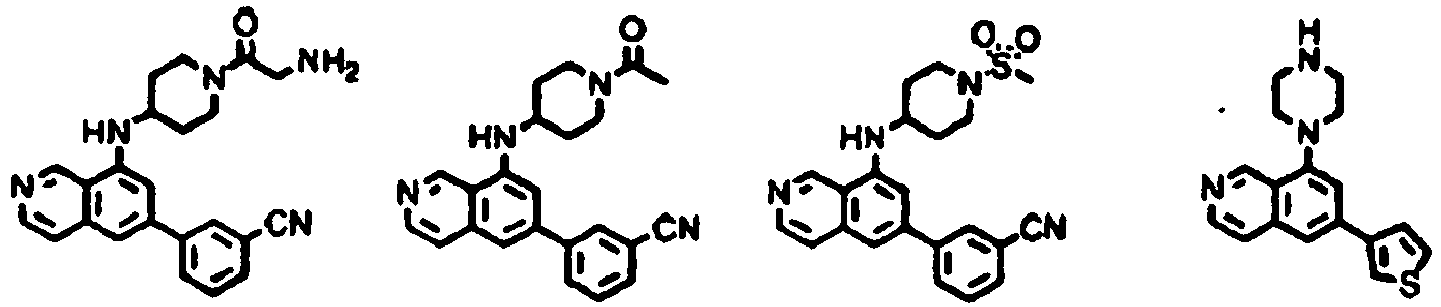



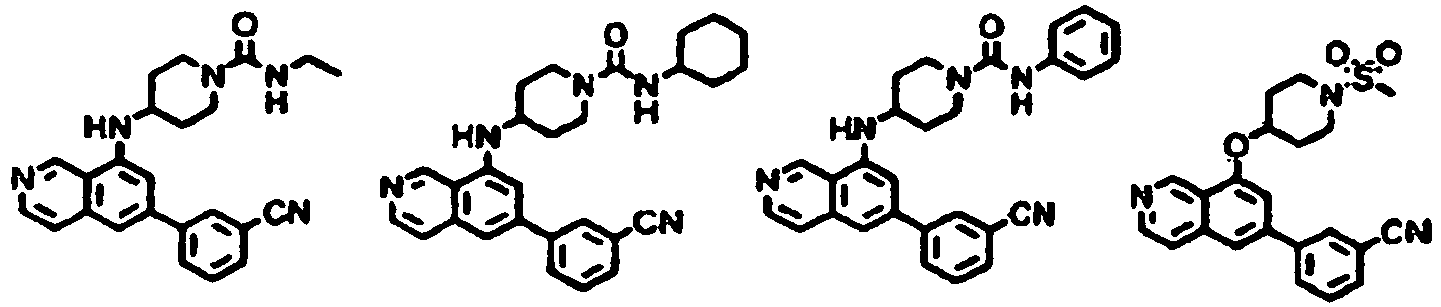


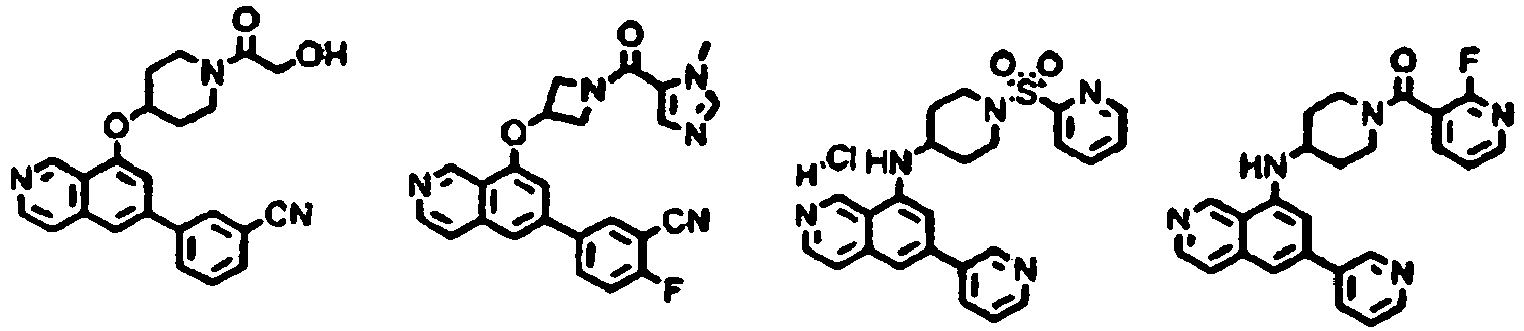


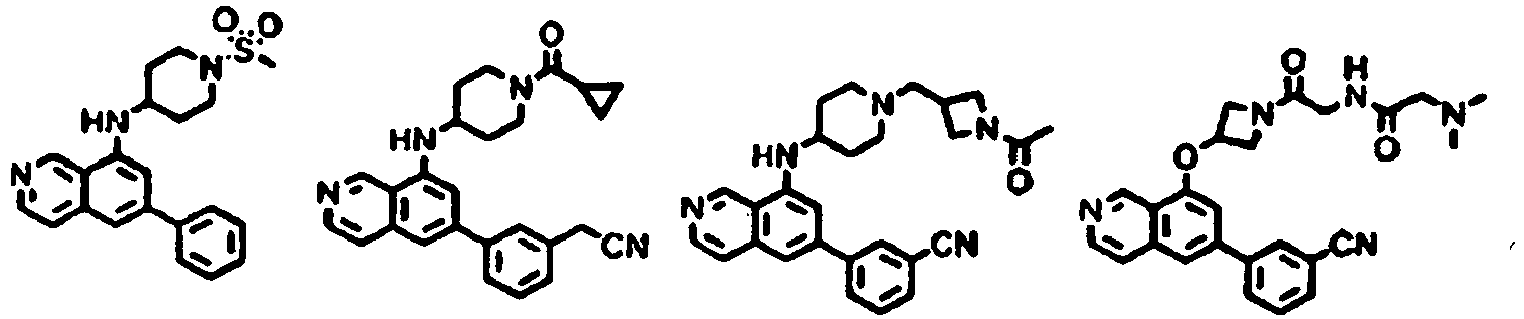


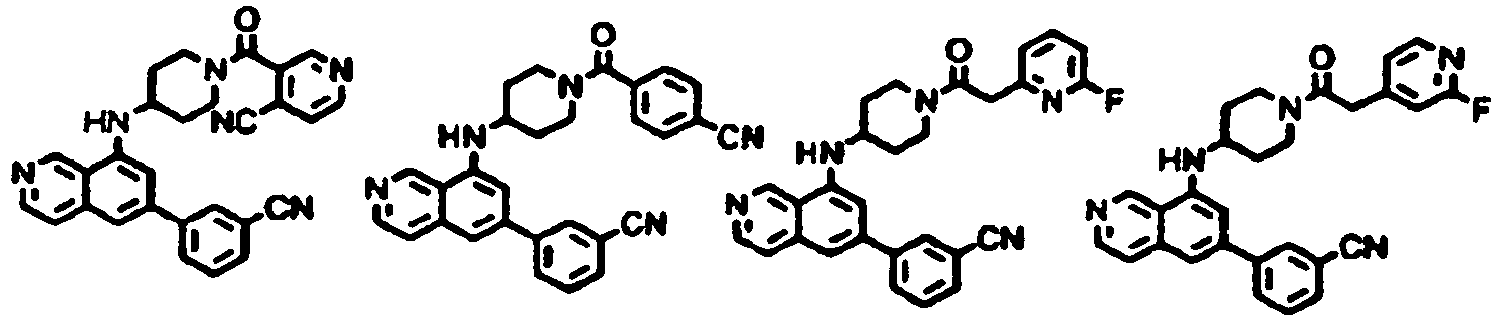


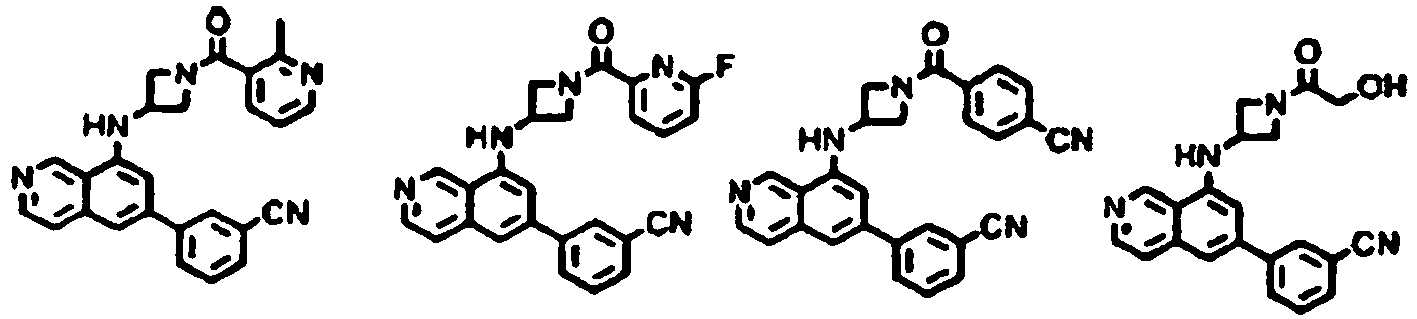


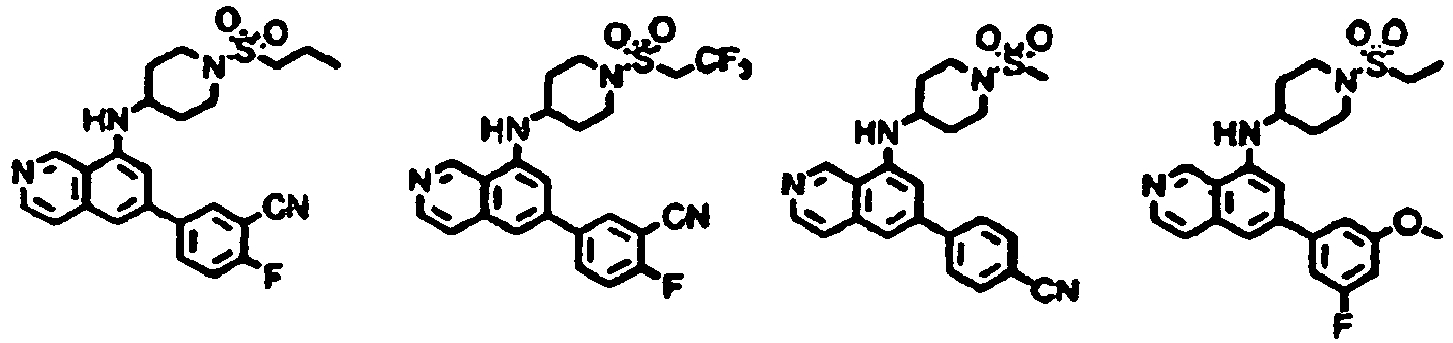


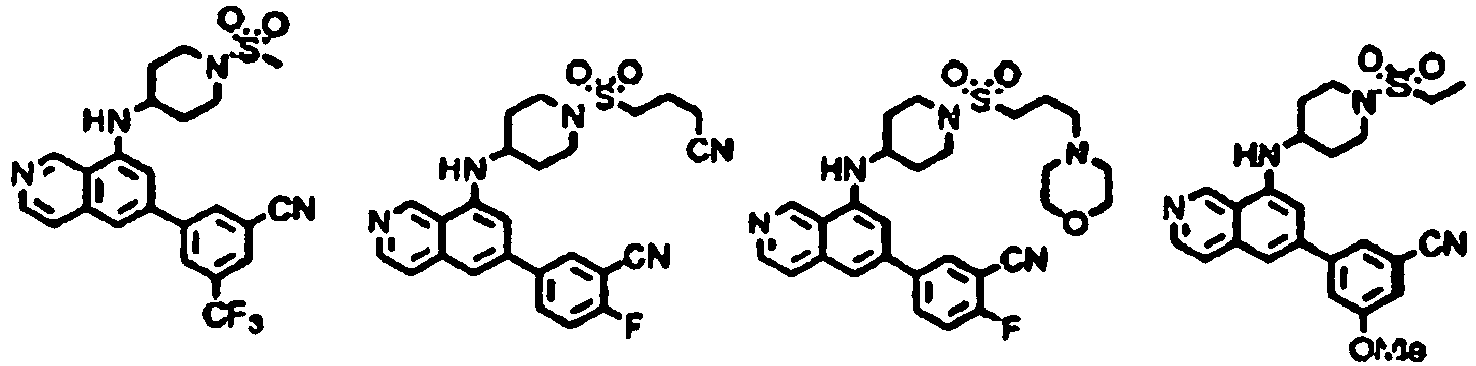


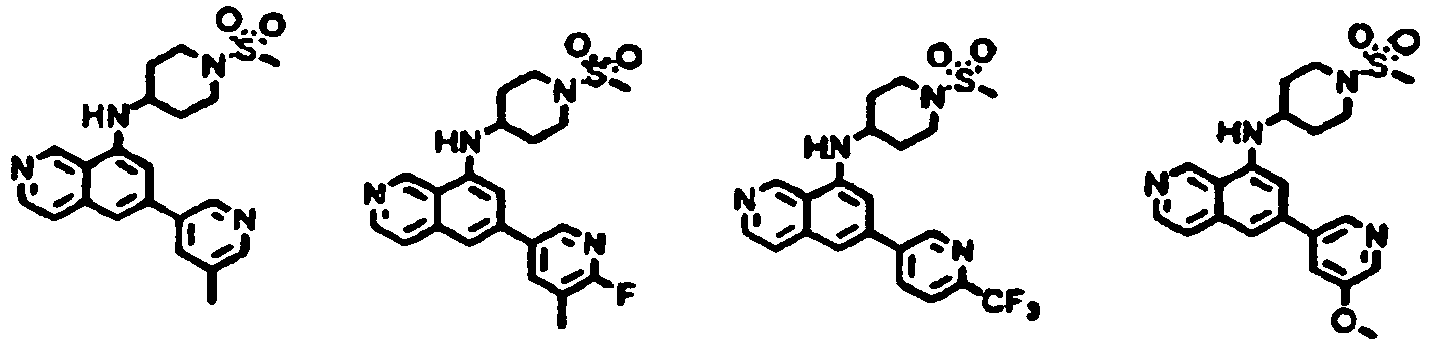


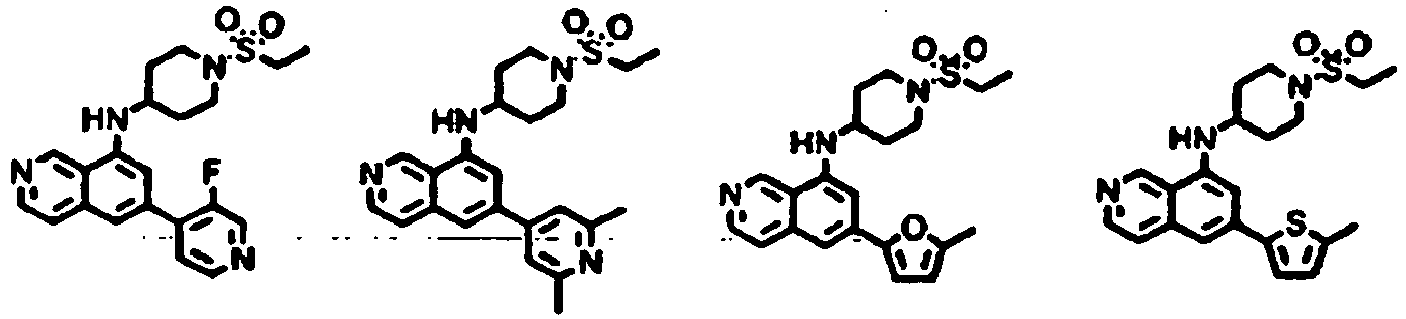


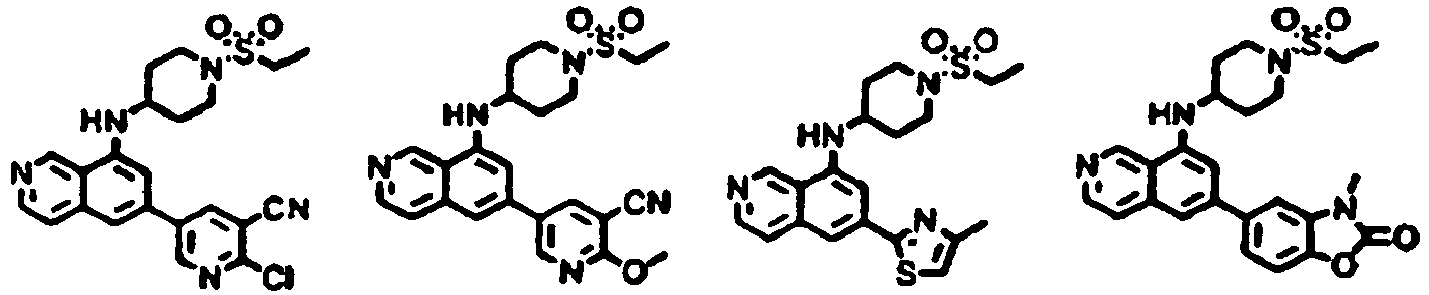


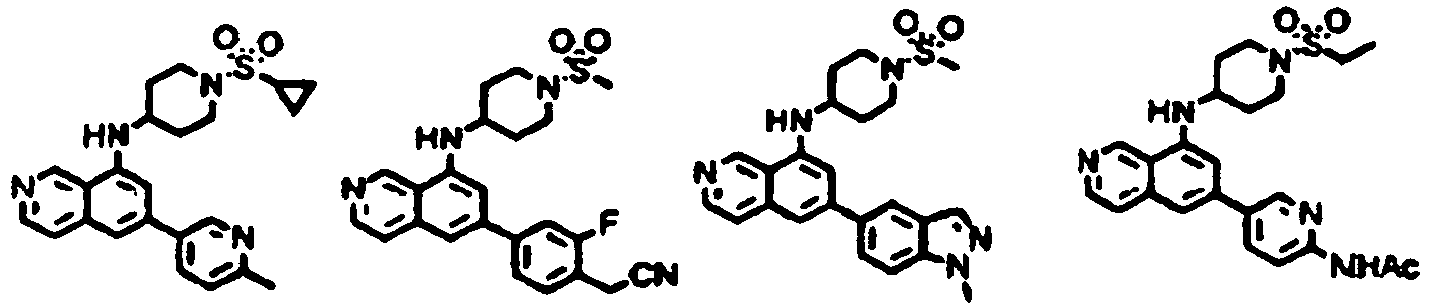
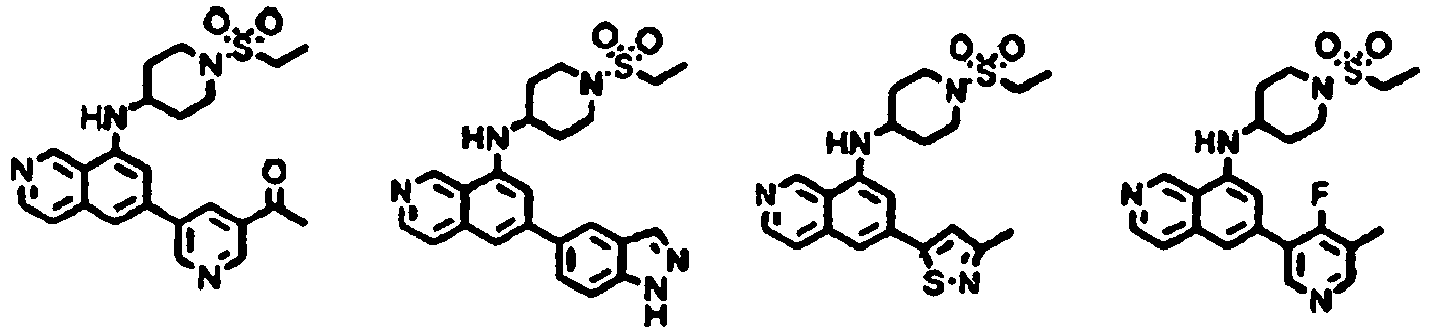


- <15> A pharmaceutical composition comprising a compound according to any one of the above <1> to <14> or a pharmaceutically acceptable salt thereof as an active ingredient;
- <16> The pharmaceutical composition according to the above <15>, for preventing and/or treatmenting an NF-κB-associated disease or symptom;
- <16-2> The pharmaceutical composition according to the above <15>, for preventing and/or treating an NF-κB-associated disease or symptom by inhibiting a NF-κB activation pathway;
- <17> The pharmaceutical composition according to the above <15>, for preventing and/or treating an IKKβ-associated disease or symptom;
- <17-2> The pharmaceutical composition according to the above <15>, for preventing and/or treating an IKKβ-associated disease or symptom by inhibiting IKKβ;
- <17-3> The pharmaceutical composition according to the above <15>, for preventing and/or treating an IKK-associated disease or symptom;
- <17-4> The pharmaceutical composition according to the above <15>, for preventing and/or treating an IKK-associated disease or symptom by inhibiting IKK;
- <18> The pharmaceutical composition according to the above <15>, for preventing and/or treating a TNF-α-associated disease or symptom;
- <18-2> The pharmaceutical composition according to the above <15>, for preventing and/or treating a TNF-α-associated disease or symptom by suppressing THF-α production;
- <19> The pharmaceutical composition according to the above <15>, for preventing and/or treating mammal rheumatoid arthritis;
- <20> The pharmaceutical composition according to the above <15>, for preventing and/or treating a mammal autoimmune disease;
- <21> The pharmaceutical composition according to the above <15>, for preventing and/or treating a mammal inflammatory disease;
- <22> The pharmaceutical composition according to the above <15>, used for the prophylactic and/or therapeutic treatment of a mammal cardiovascular disease;
- <23> The pharmaceutical composition according to the above <15>, for preventing and/or treating a mammal cancer;
- <24> The pharmaceutical composition according to the above <15>, for preventing and/or treating a disease or symptom associated with acute or chronic inflammatory reaction in mammals;
- <25> An IKKβ inhibitor, comprising a compound according to any one of the above <1> to <14> or a salt thereof as an active ingredient;
- <25-2> An NF-κB activation pathway inhibitor, comprising a compound according to any one of the above <1> to <14> or a salt thereof as an active ingredient;
- <25-3> An IKK inhibitor, comprising a compound according to any one of the above <1> to <14> or a salt thereof as an active ingredient;
- <25-4> A TNF-α production inhibitor, comprising a compound according to any one of the above <1> to <14> or a salt thereof as an active ingredient;
- <26> A method for inhibiting IKKβ, comprising administeing an effective amount of a compound according to any one of the above <1> to <14> or a pharmaceutically acceptable salt thereof;
- <26-2> A method for inhibiting an NF-κB activation pathway, comprising administering an effective amount of a compound according to any one of the above <1> to <14> or a pharmaceutically acceptable salt thereof;
- <26-3> A method for inhibiting IKK, comprising administering an effective amount of a compound according to any one of the above <1> to <14> or a pharmaceutically acceptable salt thereof;
- <26-4> A method for inhibiting TNF-α production, comprising administering an effective amount of a compound according to any one of the above <1> to <14> or a pharmaceutically acceptable salt thereof;
- <27> A method for preventing and/or treating an NF-κB-associated disease or symptom comprising administering an effective amount of a compound according to any one of the above <1> to <14> or a pharmaceutically acceptable salt thereof;
- <28> A method for preventing and/or treating an IKKβ-associated disease or symptom comprising administering an effective amount of a compound according to any one of the above <1> to <14> or a pharmaceutically acceptable salt thereof;
- <28-2> A method for preventing and/or treating an IKK-associated disease or symptom comprising administration of an effective amount of a compound according to any one of the above <1> to <14> or a pharmaceutically acceptable salt thereof;
- <28-3> A method for preventing and/or treating an TNF-α-associated disease or symptom comprising administering an effective amount of a compound according to any one of the above <1> to <14> or a pharmaceutically acceptable salt thereof;
- <29> A method for preventing and/or treating a disease or symptom associated with acute or chronic inflammatory reaction in mammals comprising administering an effective amount of a compound according to any one of the above <1> to <14> or a pharmaceutically acceptable salt thereof;
- <29-2> A method for preventing and/or treating mammal rheumatoid arthritis comprising administering an effective amount of a compound according to any one of the above <1> to <14> or a pharmaceutically acceptable salt thereof;
- <29-3> A method for preventing and/or treating a mammal autoimmune disease comprising administering an effective amount of a compound according to any one of the above <1> to <14> or a pharmaceutically acceptable salt thereof;
- <29-4> A method for preventing and/or treating a mammal inflammatory disease comprising administering an effective amount of a compound according to any one of the above <1> to <14> or a pharmaceutically acceptable salt thereof;
- <29-5> A method for preventing and/or treating a mammal cardiovascular disease comprising administering an effective amount of a compound according to any one of the above <1> to <14> or a pharmaceutically acceptable salt thereof;
- <29-6> A method for preventing and/or treating a mammal cancer comprising administering an effective amount of a compound according to any one of the above <1> to <14> or a pharmaceutically acceptable salt thereof;
- <30> The compound according to any one of the above <1> to <14> or a pharmaceutically acceptable salt thereof, for preventing and/or treating an NF-κB-associated disease or symptom;
- <30-2> The compound according to any one of the above <1> to <14> or a pharmaceutically acceptable salt thereof, for preventing and/or treating an IKKβ-associated disease or symptom;
- <30-3> The compound according to any one of the above <1> to <14> or a pharmactutically acceptable salt thereof, for preventing and/or treating an TNF-α-associated disease or symptom;
- <31> A compound represented by the following formula (2a) or a salt thereof:

R3 represents a hydrogen atom or an alkyl group that may be substituted;
R4 represents a hydrogen atom, an alkyl group that may be substituted, or an aralkyl group that may be substituted; and
R5 represents a halogen atom; - <31-2> The compound according to the above <31> or a salt thereof, wherein R3 represents a hydrogen atom;
- <31-3> The compound according to the above <31> or <31-2> or a salt thereof, wherein R4 represents an alkyl group that may be substituted;
- <31-4> The compound according to the above <31> or <31-2> or a salt thereof, wherein R4 represents a methyl group that may be substituted;
- <31-5> The compound according to any of the above <31> to <31-4> or a salt thereof, wherein R3 represents a bromine atom;
- <32> A compound represented by the following formula (2b) or a salt thereof:

R4 represents a hydrogen atom, an alkyl group that may be substituted, or an aralkyl group that may be substituted; and
R5 represents a halogen atom. - <32-2> The compound according to the above <32> or a salt thereof, wherein R4 represents an alkyl group that may be substituted;
- <32-3> The compound according to the above <32> or <32-2> or a salt thereof, wherein R4 represents a methyl group;
- <32-4> The compound according to any of the above <32> to <32-3> or a salt thereof, wherein R5 represents a bromine atom;
- The "compound represented by general formula (1) or a salt thereof" (which hereinafter may be simply referred to as "the compound of the present invention") has an excellent IKKβ inhibiting activity. Besides, the compound of the present invention has a TNF-α production suppressing activity. Furthermore, the compound of the present invention has an anti-inflammatory effect. As a result, the compound of the present invention has an NF-κB activation inhibiting effect and characteristics of being useful in the prevention and/or treatment of NF-κB associated diseases and symptoms, for example, autoimmune diseases, inflammatory diseases, cardiovascular diseases, and cancer when administered to humans and animals and very safe.
-
-
Figure 1 illustrates effects of Example Compound 1-N-6 by Method A on a mouse collagen-induced arthritis model in Test Example 5. In the figure, the horizontal axis represents experiment days and the vertical axis represents clinical scores; -
Figure 2 illustrates effects of Example Compound 2-N-100 by Method B on a mouse collagen-induced arthritis model (only the results at doses of 10 and 30 mg/kg are shown) in Test Example 5. In the figure, the horizontal axis represents experiment days and the vertical axis represents clinical scores; and -
Figure 3 illustrates effects of Example Compound 3-NP-24 on a rat Streptococcus cell wall (SCW)-induced arthritis model in Test Example 6. In the figure, the horizontal axis represents experiment days and the vertical axis represents thickness of the ankle joint. - Hereafter, the present invention will be specifically described.
In the present specification, unless otherwise specified, a "halogen atom" refers to a fluorine atom, a chlorine atom, a bromine atom, or an iodine atom. Preferred examples of halogen atoms include a chlorine atom, a bromine atom, and an iodine atom. In one embodiment of the present invention, a chlorine atom or a bromine atom is more preferred as a halogen atom and a chlorine atom is particularly preferred. In another embodiment of the present invention, a fluorine atom may be more preferred. - In the present specification, an "alkyl group" refers to a straight, branched, or cyclic saturated hydrocarbon group or a combination thereof. Preferred examples of alkyl groups include lower alkyl groups.
In the present specification, "lower" means that a certain functional group has 1 to 6 carbon atoms. Among lower alkyl groups, alkyl groups having 1 to 3 carbon atoms are particularly preferred. In other substituents having an alkyl moiety (for example, an alkoxy group) a lower alkyl moiety is similarly preferred as the alkyl moiety and an alkyl moiety having 1 to 3 carbon atoms is particularly preferred as a lower alkyl moiety.
Preferred examples of alkyl groups having 1 to 3 carbon atoms include a methyl group, an ethyl group, an n-propyl group, an isopropyl group, and a cyclopropyl group.
Preferred examples of alkyl groups having 4 to 6 carbon atoms include an n-butyl group, an isobutyl group, an s-butyl group, a t-butyl group, a cyclobutyl group, a cyclopropylmethyl group, an n-pentyl group, a cyclopentyl group, a cyclopropylethyl group, a cyclobutylmethyl group, an n-hexyl group, a cyclohexyl group, a cyclopropylpropyl group, a cyclobutylethyl group, and a cyclopentylmethyl group. Particularly preferred examples of such alkyl groups include a methyl group, an ethyl group, an n-propyl group, an isopropyl group, and a cyclopropyl group. - In the present specification, an "alkoxy group" refers to a structure in which the above-mentioned alkyl group binds to an oxygen atom. Examples thereof include straight, branched, or cyclic saturated alkoxy groups and combinations thereof and lower alkoxy groups are preferred. Among the lower alkoxy groups, alkoxy groups having 1 to 4 carbon atoms are particularly preferred.
Preferred examples of alkoxy groups having 1 to 4 carbon atoms include a methoxy group, an ethoxy group, an n-propoxy group, an isopropoxy group, a cyclopropoxy group, an n-butoxy group, an isobutoxy group, an s-butoxy group, a t-butoxy group, a cyclobutoxy group, and a cyclopropylmethoxy group. Preferred examples of alkoxy groups having 5 or 6 carbon atoms include an n-pentyloxy group, a cyclopentyloxy group, a cyclopropylethyloxy group, a cyclobutylmethyloxy group, an n-hexyloxy group, a cyclohexyloxy group, a cyclopropylpropyloxy group, a cyclobutylethyloxy group, and a cyclopentylmethyloxy group. - In the present specification, an "alkylene" refers to a divalent group comprising a straight, branched, or cyclic saturated hydrocarbon or a combination thereof and examples thereof include divalent groups comprising a saturated hydrocarbon having 1 to 6 carbon atoms. In one embodiment, alkylenes having 1 to 3 carbon atoms are preferred. In another embodiment, alkylenes having 4 to 6 carbon atoms may be preferred. Straight or branched alkylenes are preferred, and straight alkylenes are particularly preferred.
Preferred examples of alkylenes include methylene, ethylene, trimethylene, tetramethylene, pentamethylene, and hexamethylene. Particularly preferred examples of alkyl groups include methylene, ethylene, and trimethylene. - In the present specification, an "aryl group" refers to a substituent derived from an aromatic hydrocarbon and examples thereof include monocyclic aromatic groups and fused polycyclic aromatic groups. Examples thereof include monovalent substituents derived from the following aryl rings by removing one arbitrary hydrogen atom.
Examples of aryl rings include monocyclic aromatic rings and fused polycyclic aromatic rings.
In the present specification, partially unsaturated monocyclic or fused-bicyclic carbon rings and heterocyclic rings and the like are also included in monocyclic aromatic rings and fused polycyclic aromatic rings. An aryl ring may be an aromatic hydrocarbon ring and may contain one or more, for example, 1 to 3 hetero atoms of one or more types selected from the group consisting of a nitrogen atom, a sulfur atom, and an oxygen atom as ring-constituting atoms other than carbon atoms.
Examples of the monocyclic aromatic rings include monocyclic aromatic hydrocarbon rings and monocyclic aromatic heterocyclic rings containing one or more hetero atoms and examples thereof include a benzene ring and 5-or 6-membered aromatic heterocyclic rings containing one or more hetero atoms. Specifically, preferred examples of 5- or 6-membered aromatic heterocyclic rings include thiophene, pyridine, furan, thiazole, oxazole, pyrazole, pyrazine, pyrimidine, pyrrole, imidazole, pyridazine, isothiazole, isoxazole, 1,2,4-oxadiazole, 1,3,4-oxadiazole, 1,2,4-thiadiazole, 1,3,4-thiadiazole, and furazan.
Examples of the fused polycyclic aromatic rings include fused polycyclic aromatic hydrocarbon rings and fused polycyclic aromatic heterocyclic rings containing one or more hetero atoms. Examples of fused polycyclic aromatic hydrocarbon rings include bicyclic or tricyclic aromatic hydrocarbon rings having 9 to 14 carbon atoms and specific preferred examples thereof include naphthalene, 1,2,3,4-tetrahydronaphthalene, indene, 2,3-dihydroindene (indane), fluorene, phenanthrene, 9,10-dihydrophenanthrene, and anthracene.
Examples of fused polycyclic aromatic heterocyclic rings include 9- to 14-membered, preferably 9- or 10-membered fused polycyclic aromatic heterocyclic rings containing one or more, for example, 1 to 4 hetero atoms and specific preferred examples thereof include benzofuran, 2,3-dihydrobenzofuran, benzothiophene, 2,3-dihydrobenzothiophene, benzimidazole, benzoxazole, benzisoxazole, benzothiazole, benzisothiazole, naphtho[2,3-b] thiophene, quinoline, isoquinoline, 1,2-dihydroisoquinoline, 3,4-dihydroisoquinoline, 1,2-dihydroquinoline, 3,4-dihydroquinoline, 1,2,3,4-tetrahydroisoquinoline, 1,2,3,9-tetrahydroquinoline, indole, indoline, quinoxaline, phenanthridine, phenothiazine, phenoxazine, phthalazine, naphthyridine, quinazoline, cinnoline, carbazole, β-carboline, acridine, phenazine, phthalimide, and thioxanthene.
In the present specification, examples of monocyclic aromatic groups as aryl groups include monovalent groups derived from the above-mentioned monocyclic aromatic rings by removing one arbitrary hydrogen atom and specific preferred examples thereof include a phenyl group, a thienyl group (2- or 3-thienyl group), a pyridyl group (2-, 3-, or 4-pyridyl group), a furyl group (2- or 3-furyl group), a thiazolyl group (2-, 4-, or 5-thiazolyl group), an oxazolyl group (2-, 4-, or 5-oxazolyl group), a pyrazolyl group (1-, 3-, or 4-pyrazolyl group), a 2-pyrazinyl group, a pyrimidinyl group (2-, 4-, or 5-pyrimidinyl group), a pyrrolyl group (1-, 2-, or 3-pyrrolyl group), an imidazolyl group (1-, 2-, or 4-imidazolyl group), a pyridazinyl group (3- or 4-pyridazinyl group), an 3-isothiazolyl group, an 3-isooxazolyl group, an 1,2,4-oxadiazol-5-ylgroup, and an 1,2,9-oxadiazol-3-yl group.
In the present specification, examples of fused polycyclic aromatic groups as aryl groups include monovalent groups derived from the above-mentioned fused polycyclic aromatic ring comprising 2 to 4, preferably 2 or 3 rings by removing one arbitrary hydrogen atom and specific preferred examples thereof include a 1-naphthyl group, a 2-naphthyl group, an 1-indenyl group, an 2-indenyl group, a 2,3-dihydroinden-1-yl group, a 2,3-dihydroinden-2-yl group, an 2-anthryl group, an indazolyl group (3-, 4-, 5-, 6-, or 7-indazolyl group), a quinolyl group (2-, 3-, 4-, 5-, 6-, 7-, or 8-quinolyl group), an isoquinolyl group (1-, 3-, 4-, 5-, 6-, 7-, or 8-isoquinolyl group), a 1,2-dihydroisoquinolyl or 1,2,3,4-tetrahydroisoquinolyl group (substituted at the same position as in an isoquinolyl group), an indolyl group (1-, 2-, 3-, 4-, 5-, 6-, or 7-indolyl group), an isoindolyl group (1-, 2-, 4-, or 5-isoindolyl group), a phthalazinyl group (1-, 5-, or 6-phthalazinyl group), a quinoxalinyl group (2-, 3-, or 5-quinoxalinyl group), a benzofuranyl group (2-, 3-, 4-, 5-, or 6-benzofuranyl group), a 2,3-dihydrobenzofuran-1-yl group, a 2,3-dihydrobenzofuran-2-yl group, a 2,3-dihydrobenzothiophen-1-yl group, a 2,3-dihydrobenzothiophen-2-yl group, a benzothiazolyl group (2-, 4-, 5- or 6-benzothiazolyl group), a benzimidazolyl group (1-, 2-, 4-, 5- or 6-benzimidazolyl group), a fluorenyl group (1-, 2-, 3-, or 4-fluorenyl group), and a thioxanthenyl group. - In the present specification, an "aryloxy group" refers to a group to which the above-mentioned aryl group binds via an oxygen atom. The aryl moiety of an aryloxy group is preferably a monocyclic aromatic group and examples of aryloxy groups include a phenoxy group, a 2-thienyloxy group, a 3-thienyloxy group, a 2-pyridyloxy group, a 3-pyridyloxy group, a 4-pyridyloxy group, a 2-furyloxy group, a 3-furyloxy group, a 2-thiazolyloxy group, a 4-thiazolyloxy group, a 5-thiazolyloxy group, an 2-oxazolyloxy group, an 4-oxazolyloxy group, an 5-oxazolyloxy group, a 1-pyrazolyloxy group, a 3-pyrazolyloxy group, a 4-pyrazolyloxy group, a 2-pyrazinyloxy group, a 2-pyrimidinyloxy group, a 4-pyrimidinyloxy group, a 5-pyrimidinyloxy group, a 1-pyrrolyloxy group, a 2-pyrrolyloxy group, a 3-pyrrolyloxy group, an 1-imidazolyloxy group, an 2-imidazolyloxy group, an 4-imidazolyloxy group, a 3-pyridazinyloxy group, a 4-pyridazinyloxy group, an 3-isothiazolyloxy group, an 3-isooxazolyloxy group, an 1,2,4-oxadiazol-5-yloxy group, and an 1, 2, 4-oxadiazol-3-yloxy group. A phenoxy group, a 2-thienyloxy group, a 3-thienyloxy group, a 2-furyloxy group, a 3-furyloxy group, a 2-pyridyloxy group, a 3-pyridyloxy group, a 4-pyridyloxy group, and the like are particularly preferred.
- In the present specification, an "aralkyl group" refers to an alkyl group substituted with an aryl group (arylalkyl group). Here, an alkyl moiety of an aralkyl group is the same as the above-mentioned alkyl group, and an aryl moiety is the same as the above-mentioned aryl group. An aryl moiety of an aralkyl group is preferably a monocyclic aromatic group.
Examples of aralkyl groups include a benzyl group, a 2-thienylmethyl group, a 3-thienylmethyl group, a 2-pyridylmethyl group, a 3-pyridylmethyl group, a 4-pyridylmethyl group, a 2-furylmethyl group, a 3-furylmethyl group, a 2-thiazolylmethyl group, a 4-thiazolylmethyl group, a 5-thiazolylmethyl group, an 2-oxazolylmethyl group, an 4-oxazolylmethyl group, an 5-oxazolylmethyl group, a 1-pyrazolylmethyl group, a 3-pyrazolylmethyl group, a 4-pyrazolylmethyl group, a 2-pyrazinylmethyl group, a 2-pyrimidinylmethyl group, a 4-pyrimidinylmethyl group, a 5-pyrimidinylmethyl group, a 1-pyrrolylmethyl group, a 2-pyrrolylmethyl group, a 3-pyrrolylmethyl group, an 1-imidazolylmethyl group, an 2-imidazolylmethyl group, an 4-imidazolylmethyl group, a 3-pyridazinylmethyl group, a 4-pyridazinylmethyl group, an 3-isothiazolylmethyl group, an 3-isooxazolylmethyl group, an 1,2,4-oxadiazol-5-ylmethyl group, and an 1,2,4-oxadiazol-3-ylmethyl group. In one embodiment, a benzyl group, a 2-thienylmethyl group, a 3-thienylmethyl group, a 2-furylmethyl group, a 3-furylmethyl group, a 2-pyridylmethyl group, a 3-pyridylmethyl group, a 4-pyridylmethyl group, and the like are particularly preferred.
Furthermore, examples of aralkyl groups include a 2-phenylethyl group, a 2-(2-thienyl)ethyl group, a 2-(3-thienyl)ethyl group, a 2- (2-pyridyl)ethyl group, a 2-(3-pyridyl)ethyl group, a 2-(4-pyridyl)ethyl group, a 2-(2-furyl)ethyl group, a 2-(3-furyl)ethyl group, a 2-(2-thiazolyl)ethyl group, a 2-(4-thiazolyl)ethyl group, a 2-(5-thiazolyl)ethyl group, an 2-(2-oxazolyl)ethyl group, an 2-(4-oxazolyl)ethyl group, an 2-(5-oxazolyl)ethyl group, a 2-(1-pyrazolyl)ethyl group, a 2-(3-pyrazolyl)ethyl group, a 2-(4-pyrazolyl)ethyl group, a 2-(2-pyrazinyl)ethyl group, a 2-(2-pyrimidinyl)ethyl group, a 2-(4-pyrimidinyl)ethyl group, a 2-(5-pyrimidinyl)ethyl group, a 2-(1-pyrrolyl)ethyl group, a 2-(2-pyrrolyl)ethyl group, a 2-(3-pyrrolyl)ethyl group, an 2-(1-imidazolyl)ethyl group, an 2-(2-imidazolyl)ethyl group, an 2-(4-imidazolyl)ethyl group, a 2-(3-pyridazinyl)ethyl group, a 2-(4-pyridazinyl)ethyl group, an 2-(3-isothiazolyl)ethyl group, an 2-(3-isooxazolyl)ethyl group, an 2-(1,2,4-oxadiazol-5-yl)ethyl group, and an 2-(1,2,4-oxadiazol-3-yl)ethyl group. In one embodiment, a 2-phenylethyl group, a 2-(2-thienyl)ethyl group, a 2-(3-thienyl)ethyl group, a 2-(2-furyl)ethyl group, a 2-(3-furyl)ethyl group, a 2-(2-pyridyl)ethyl group, a 2-(3-pyridyl)ethyl group, and a 2-(4-pyridyl)ethyl group are particularly preferred.
Furthermore, examples of aralkyl groups also include a 1-phenylethyl group, a 1-(2-thienyl)ethyl group, a 1-(3-thienyl)ethyl group, a 1-(2-pyridyl)ethyl group, a 1-(3-pyridyl)ethyl group, a 1-(4-pyridyl)ethyl group, a 1-(2-furyl)ethyl group, a 1-(3-furyl)ethyl group, a 1-(2-thiazolyl)ethyl group, a 1-(4-thiazolyl)ethyl group, a 1-(5-thiazolyl)ethyl group, an 1-(2-oxazolyl)ethyl group, an 1-(9-oxazolyl)ethyl group, an 1-(5-oxazolyl)ethyl group, a 1-(1-pyrazolyl)ethyl group, a 1-(3-pyrazolyl)ethyl group, a 1-(4-pyrazolyl)ethyl group, a 1-(2-pyrazinyl)ethyl group, a 1-(2-pyrimidinyl)ethyl group, a 1-(9-pyrimidinyl)ethyl group, a 1-(5-pyrimidinyl)ethyl group, a 1-(1-pyrrolyl)ethyl group, a 1-(2-pyrrolyl)ethyl group, a 1-(3-pyrrolyl)ethyl group, a 1-(1-imidazolyl)ethyl group, an 1-(2-imidazolyl)ethyl group, an 1-(4-imidazolyl)ethyl group, a 1-(3-pyridazinyl)ethyl group, a 1-(4-pyridazinyl)ethyl group, an 1-(3-isothiazolyl)ethyl group, an 1-(3-isooxazolyl)ethyl group, an 1-(1,2,4-oxadiazol-5-yl)ethyl group, and an 1-(1,2,4-oxadiazol-3-yl)ethyl group. In one embodiment, a 1-phenylethyl group, a 1-(2-thienyl)ethyl group, a 1-(3-thienyl)ethyl group, a 1-(2-furyl)ethyl group, a 1-(3-furyl)ethyl group, a 1-(2-pyridyl)ethyl group, a 1-(3-pyridyl)ethyl group, and a 1-(4-pyridyl)ethyl group are particularly preferred. - In the present specification, a "saturated heterocyclic group" refers to a saturated ring group containing a hetero atom as a constituent of the ring and examples thereof include monocyclic saturated heterocyclic groups. The ring contains preferably 1 or 2 hetero atoms, more preferably one hetero atom. Furthermore, the monocyclic saturated heterocyclic group is, for example, a 3- to 7-membered ring group, particularly preferably a 5- or 6-membered ring group. Specific preferred examples of saturated heterocyclic groups include a tetrahydropyranyl group (3- or 4-tetrahydropyranyl group), a 3-tetrahydrofuryl group, a piperidyl group (3- or 4-piperidyl group), a 3-pyrrolidyl group, a tetrahydrothiopyranyl group (3- or 4-tetrahydrothiopyranyl group), a 3-tetrahydrothiofuryl group, and a morpholino group (2- or 3-morpholino group). A particularly preferred example is a morpholino group.
- In the present specification, an "amino group" refers to a -NH2 group.
- In the present specification, examples of a substituent on an alkyl group that may be substituted include a hydroxyl group, a halogen atom, a carboxy group, a cyano group, a saturated heterocyclic group, an alkylsulfonylamino group, and an aminocarbonylamino group. A hydroxyl group and a halogen atom are more preferred.
An alkyl group that may be substituted is preferably one group selected from the group consisting of a trifluoromethyl group, a difluoromethyl group, a hydroxymethyl group, and a 2-hydroxyethyl group in addition to the above-mentioned preferred examples of alkyl groups. A methyl group, an ethyl group, an n-propyl group, an isopropyl group, a cyclopropyl group, a trifluoromethyl group, a difluoromethyl group, a hydroxymethyl group, and a 2-hydroxyethyl group are more preferred, and a methyl group is particularly preferred. - In the present specification, examples of a substituent in an alkoxy group that may be substituted include the same substituents as substituents in the above-mentioned alkyl groups that may be substituted, and one or more halogen atoms are particularly preferred.
A substituted alkoxy groups is preferably, for example, an alkoxy group substituted arbitrarily with one or more halogen atoms, more preferably an alkoxy group having 1 to 4 carbon atoms substituted arbitrarily with one or more halogen atoms. When an alkoxy group is substituted with 2 or more halogen atoms, the halogen atom may be identical to or different from each other. An alkoxy group that may be substituted is preferably one group selected from the group consisting of a monofluoromethoxy group, a difluoromethoxy group, a trifluoromethoxy group, and a 2,2,2-trifluoroethoxy group in addition to the above-mentioned preferred examples of alkoxy groups having 1 to 6 carbon atoms. One group selected from the group consisting of a trifluoromethoxy group and a 2,2,2-trifluoroethoxy group in addition to the above-mentioned preferred examples of alkoxy groups having 1 to 6 carbon atoms is particularly preferred. - In the present specification, a substituent in an alkylene that may be substituted is preferably one group selected from the group consisting of a trifluoromethyl group, a difluoromethyl group, a hydroxymethyl group, and a 2-hydroxyethyl group in addition to the same groups as the above-mentioned substituents in an alkyl group that may be substituted, more preferably a methyl group, an ethyl group, an n-propyl group, an isopropyl group, a cyclopropyl group, a trifluoromethyl group, a difluoromethyl group, a hydroxymethyl group, and a 2-hydroxyethyl group, particularly preferably a methyl group.
- In the present specification, substituents in an aryl group that may be substituted and an aryloxy group that may be substituted are the same as the above-mentioned substituents in an alkyl group that may be substituted.
- In the present specification, substituents in an aralkyl group that may be substituted are the same as, for example, the above-mentioned substituents in an alkyl group that may be substituted.
- In the present specification, preferred examples of aralkyl groups that may be substituted in one embodiment include the above-mentioned preferred examples of aralkyl groups. Furthermore, in another embodiment, an aralkyl group may be preferably substituted with an alkyl group, an alkoxy group, an amino group, a hydroxyl group, a cyano group, or a halogen atom on a carbon atom among constituents forming an aryl ring of the above-mentioned aralkyl group. Specific examples thereof include a 4-methylphenylmethyl group, a 4-methoxyphenylmethyl group, an 4-aminophenylmethyl group, a 4-hydroxyphenylmethyl group, a 4-fluorophenylmethyl group, a 5-methyl-2-furylmethyl group, a 4-methyl-2-furylmethyl group, a 5-methyl-3-furylmethyl group, a 5-methyl-2-pyrrolylmethyl group, a 4-methyl-2-pyrrolylmethyl group, a 5-methyl-3-pyrrolylmethyl group, a 5-methyl-2-thienylmethyl group, a 4-methyl-2-thienylmethyl group, and a 5-methyl-3-thienylmethyl group. Furthermore, in another embodiment, an aralkyl group may be preferably substituted with an alkyl group or an alkoxy group on a nitrogen atom among constituents forming an aryl ring of an aralkyl group. Specific examples thereof include a 1-methyl-2-pyrrolylmethyl group, a 1-ethyl-2-pyrrolylmethyl group, and a 1-methyl-3-pyrrolylmethyl group.
- In the present specification, substituents in a saturated heterocyclic group that may be substituted are the same as, for example, the above-mentioned substituents of an alkyl group that may be substituted.
In the present specification, saturated heterocyclic groups that may be substituted are preferably the above-mentioned preferred examples of saturated heterocyclic groups. - In the present specification, examples of amino groups that may be substituted include an -NH2 group, an alkylamino group, a dialkylamino group, an acylamino group, an alkylcarbonylamino group, and an alkylsulfonylamino group. Furthermore, examples of amino groups that may be substituted also include an amino group substituted with 1 or 2 alkyl groups that may be substituted, an amino group substituted with 1 or 2 aryl groups that may be substituted, and an amino group substituted with an aryl group that may be substituted and an alkyl group that may be substituted.
Specific examples of amino groups that may be substituted include a methylamino group, an ethylamino group, an n-propylamino group, an isopropylamino group, a dimethylamino group, an ethyl(methyl)amino group, a diethylamino group, a methyl(n-propyl)amino group, an acetylamino group, a propanoylamino group, a methylsulfonylamino group, an ethylsulfonylamino group, an n-propylsulfonylamino group, an isopropylsulfonylamino group, and a cyclopropylsulfonylamino group. - Hereafter, the structure of the compound represented by the formula (1) (also simply referred to as "the compound of the formula (1)") will be described in detail. In the compound of the formula (1), D1 represents a single bond, -N(R11)-, -O-, -S-, -S(O)-, or -S(O)2-, preferably a single bond, -N(R11)-, -O-, and -S-, more preferably a single bond, -N(R11)-, and -O-. In one embodiment, -N(R11)- may be particularly preferred and - 0- may be particularly preferred in another embodiment. -S(O)- and -S(O)2- may be preferred in yet another embodiment.
- R11 represents a hydrogen atom or an alkyl group that may be substituted, and a hydrogen atom is preferred in one embodiment. In another embodiment, a lower alkyl group is preferred, an alkyl group having 1 to 3 carbon atoms is more preferred, a methyl group and an ethyl group are yet more preferred, and a methyl group is particularly preferred.
- A1 represents a single bond, an alkylene that may be substituted, or any of divalent groups selected from the following formulas (1a-1) to (1a-6):


- Preferred examples of A1 include the following formulas (1a-1-1), (1a-2-1), and (1a-5-1):

- When D1 represents a single bond, A1 represents the formula (1a-5) or (1a-6), preferably the formula (1a-5).
- When D1 represents -N(R11)-, -O-, -S-, -S (O) -, or - S(O)2-, A1 represents a single bond, an alkylene that may be substituted, or any of divalent groups selected from the above-mentioned formulas (1a-1) to (1a-4).
When A1 represents a single bond, D2 represents an alkylene that may be substituted or -E-C(O)-. - When R1 represents an amino group that may be substituted, D2 represents an alkylene that may be substituted or -E-C(O)-.
- n1 is an integer of 0, 1, or 2, and 0 or 1 is preferred. In one embodiment, 0 is particularly preferred. In another embodiment, 1 may be preferred.
- n2 is an integer of 2 or 3. In one embodiment, 2 is preferred. In another embodiment, 3 may be preferred.
- n3 is an integer of 1 or 2. In one embodiment, 1 is preferred. In another embodiment, 2 may be preferred.
- . R12 and R13 each independently represent a hydrogen atom, a hydroxyl group, or an alkyl group that may be substituted, preferably a hydrogen atom or an alkyl group that may be substituted. In one embodiment, a hydrogen atom is more preferred. In another embodiment, an alkyl group that may be substituted may be preferred. Preferred examples of alkyl groups that may be substituted include a methyl group, an ethyl group, an n-propyl group, an i-propyl group, and a trifluoromethyl group and a methyl group is more preferred.
- X1 represents -N(R14)-, -O-, or -S-, and -N(R14)- or - 0- is preferred. In one embodiment, -0- or -S- is more preferred, and -0- is particularly preferred. In another embodiment, -N(R14)- may be preferred.
- R14 represents a hydrogen atom or an alkyl group that may be substituted, and a hydrogen atom is preferred in one embodiment. In another embodiment, an alkyl group that may be substituted may be preferred. Examples of an alkyl group that may be substituted in R14 include alkyl groups having 1 to 3 carbon atoms.
- v represents a bond with D1, and w represents a bond with D2.
- D2 represents a single bond, an alkylene that may be substituted, -C (O) -, -C(S)-, -S(O)2-, -C(O)-N(R15)-, - C(S)-N(R15)-, or -E-C(O)-, preferably a single bond or an alkylene that may be substituted. In one embodiment, an alkylene that may be substituted is more preferred. An alkylene that may be substituted is preferably a straight or branched alkylene having 1 to 3 carbon atoms. Examples thereof include methylene, ethylene, and trimethylene and methylene and ethylene are preferred.
In another embodiment, a single bond may be preferred.
In yet another embodiment, -C(O)-, -S(O)2-, or -E-C(O)-may be preferred and -C(O)- may be more preferred. In yet another embodiment, -S(O)2- may be preferred. - R15 represents a hydrogen atom or an alkyl group, preferably a hydrogen atom.
- E represents an alkylene that may be substituted. An alkylene is preferably a straight or branched alkylene having 1 to 4 carbon atoms, more preferably an alkylene having 1 to 3 carbon atoms. Examples of alkylenes include methylene, ethylene, and trimethylene and methylene and ethylene are preferred.
- R1 represents a hydrogen atom, an alkyl group that may be substituted, an amino group that may be substituted, a saturated heterocyclic group that may be substituted, an aralkyl group that may be substituted, an aryl group that may be substituted, a carbamimidoyl group, or any of groups selected from the following formulas (1b-1) to (1b-4):

In another embodiment, R1 preferably represents a hydrogen atom, a saturated heterocyclic group that may be substituted, or any of groups selected from the formulas (1b-1) to (1b-4). In one embodiment, a saturated heterocyclic group that may be substituted or the formula (1b-1) or (1b-3) is preferred. In another embodiment, the formula (1b-2) or (1b-4) may be preferred. Examples of a saturated heterocyclic group that may be substituted include a morpholino group (2- or 3-morpholino group), an azetidyl group (2- or 3-azetidyl group), a piperidyl group (2-, 3-, or 4-piperidyl group), and a pyrrolidyl group (2- or 3-pyrrolidyl group). In another embodiment, a hydrogen atom may be preferred. - m1 is an integer of 0, 1, or 2. In one embodiment, 0 or 1 is preferred and 1 is more preferred. In another embodiment, 2 may be preferred.
- m2 is an integer of 1 or 2 and 1 is preferred.
- m3 is an integer of 0, 1, or 2 and 0 or 1 is preferred.
- X2 represents -N(R14)-, -O-, or -S-. -0- or -S- is preferred, and -0- is particularly preferred.
- D11 represents an alkylene that may be substituted. An alkylene is preferably a straight or branched alkylene having 1 to 4 carbon atoms, more preferably an alkylene having 1 to 3 carbon atoms. Examples of alkylenes include methylene, ethylene, and trimethylene and methylene or ethylene is preferred.
- D12 represents a single bond, an alkylene that may be substituted, -C (O) -, -S(O)2-, or -C(O)-N(R15)-. In one embodiment, a single bond or an alkylene that may be substituted is preferred. In another embodiment, -C(O)-or -S(O)2- is preferred and -C(O)- is particularly preferred. In yet another embodiment, -S(O)2- may be preferred.
- R16, R18, and R19 may be identical to or different from one another and each independently represents a hydrogen atom or an alkyl group that may be substituted. In one embodiment, a hydrogen atom is preferred. In another embodiment, an alkyl group that may be substituted may be preferred. Examples of an alkyl group that may be substituted include alkyl groups having 1 to 3 carbon atoms. A methyl group, an ethyl group, or an n-propyl group is preferred, and a methyl group is more preferred.
- R17 represents a hydrogen atom, an alkyl group that may be substituted, an aralkyl group that may be substituted, or an aryl group that may be substituted. A hydrogen atom, an alkyl group that may be substituted, or an aryl group that may be substituted is preferred, and an alkyl group that may be substituted or an aryl group that may be substituted is more preferred. An alkyl group that may be substituted is preferably an alkyl group having 1 to 6 carbon atoms, more preferably an alkyl group having 1 to 4 carbon atoms. Examples of an alkyl group include a methyl group, an ethyl group, an n-propyl group, an i-propyl group, a cyclopropyl group, and a trifluoromethyl group. Examples of an aryl group that may be substituted include a phenyl group, a thienyl group (2- or 3-thienyl group), a pyridyl group (2-, 3-, or 4-pyridyl group), a furyl group (2- or 3-furyl group), a naphthyl group (a 1- or 2-naphthyl group), and a quinolyl group (2-, 3-, 4-, 5-, 6-, 7-, or 8-quinolyl group) and substitution products thereof. A phenyl group and a pyridyl group (2-, 3-, or 4-pyridyl group) are preferred.
- x represents a bond with D2.
- When R17 represents a hydrogen atom, D12 represents a single bond.
- D3 represents a single bond, -N(R21)-, -O-, -N(R21)-C(O)-, or -S-, preferably a single bond, -O-, or -N(R21)-C(O)-, more preferably a single bond or -N(R21)-C(O)-. In one embodiment, a single bond is particularly preferred. In another embodiment, -N(R21)-C(O)- may be preferred.
- R21 represents a hydrogen atom or an alkyl group that may be substituted. In one embodiment, a hydrogen atom is preferred. In another embodiment, an alkyl group that may be substituted may be preferred. Examples of an alkyl group that may be substituted include alkyl groups having 1 to 3 carbon atoms. A methyl group, an ethyl group, and an n-propyl group are preferred and a methyl group is more preferred.
- R2 represents an alkyl group that may be substituted or a group represented by the following formula (2a-1):

- Q represents an aryl group that may be substituted. Examples of an aryl group include the above-mentioned preferred examples of aryl group. In one embodiment, a monocyclic aromatic group is preferred. In another embodiment, a fused polycyclic aromatic group or the like may be preferred. Examples of monocyclic aromatic groups include a phenyl group, a thienyl group (2- or 3-thienyl group), a pyridyl group (2-, 3-, or 4-pyridyl group), and a furyl group (2- or 3-furyl group). In one embodiment, a phenyl group is particularly preferred. In another embodiment, a pyridyl group may be preferred. In yet another embodiment, a thienyl group may be preferred.
Examples of fused polycyclic aromatic groups include a 1-naphthyl group, a 2-naphthyl group, a quinolyl group (2-, 3-, 4-, 5-, 6-, 7-, or 8-quinolyl group), an isoquinolyl group (1-, 3-, 4-, 5-, 6-, 7-, or 8-isoquinolyl group), an indazolyl group (3-, 4-, 5-, 6-, or 7-indazolyl group), and an indolyl group (2-, 3-, 4-, 5-, 6-, or 7-indolyl group). In yet another embodiment, examples include a pyrrolyl group, a pyrimidinyl group, a pyridazinyl group, an imidazolyl group, a quinazolinyl group, and a quinolyl group. In one embodiment, a pyrrolyl group is preferred. In yet another embodiment, a pyrazolyl group may be preferred. - y represents a bond with D3.
- R23, R24, and R25 may be identical to or different from one another and each independently represents a hydrogen atom, a halogen atom, a cyano group, an alkyl group that may be substituted, an alkoxy group that may be substituted, an amino group that may be substituted, an aryl group that may be substituted, an aryloxy group that may be substituted, an aralkyl group that may be substituted, or a group represented by the following formula (2b-1):

Examples of Q substituted with R23, R24, and R25 include a phenyl group, a 2-, 3-, or 4-methylphenyl group, a 2-, 3-, or 4-trifluoromethylphenyl group, a 2-, 3-, or 4-methanesulfonylphenyl group, a 2-, 3-, or 4-cyanophenyl group, a 2-, 3-, or 4-fluorophenyl group, a 2-, 3-, or 4-chlorophenyl group, a 2-, 3-, or 4-methoxyphenyl group, an 2-, 3-, or 4-aminophenyl group, a 2-, 3-, or 4-hydroxy phenyl group, a 2-, 3-, or 4-hydroxymethylphenyl group, an 2-, 3-, or 4-aminomethylphenyl group, a 2-, 3-, or 4-cyanomethylphenyl group, a 2-, 3-, or 4-(2-cyanoethyl)phenyl group, an 2-, 3-, or 4-acetylphenyl group, a 2-, 3-, or 4-pyridyl group, a 2- or 3-thienyl group, a 2- or 3-furyl group, a 3,4-difluorophenyl group, a 3-chloro-4-fluorophenyl group, a 4-cyano-3-methylphenyl group, a 3-cyano-4-fluorophenyl group, an 4-amino-3-cyanophenyl group a 3-cyano-5-fluorophenyl group, a 3-fluoro-4-cyanophenyl group, a 5-cyanothiophen-2-yl group, a 4-methylthiophen-3-yl group, a 6-methoxypyridin-3-yl group, and a 6-fluoropyridin-3-yl group. Examples thereof further include a 2-cyanopyridin-3-yl group, a 4-cyanopyridin-3-yl group, a 5-cyanopyridin-3-yl group, a 6-cyanopyridin-3-yl group, a 2-cyanopyridin-4-yl group, a 3-cyanopyridin-4-yl group, a 2-fluoropyridin-3-yl group, a 4-fluoropyridin-3-yl group, a 5-fluoropyridin-3-yl group, a 2-fluoropyridin-4-yl group, a 3-fluoropyridin-4-yl group, a 2-methylpyridin-3-yl group, 4-methylpyridin-3-yl group, a 5-methylpyridin-3-yl group, a 6-methylpyridin-3-yl group, a 2-methylpyridin-4-yl group, a 3-methylpyridin-4-yl group, a 2-difluoromethylpyridin-3-yl group, a 4-difluoromethylpyridin-3-yl group, a 5-difluoromethylpyridin-3-yl group, a 6-difluoromethylpyridin-3-yl group, a 2-difluoromethylpyridin-4-yl group, a 3-difluoromethylpyridin-4-yl group, an 2-ethylpyridin-3-yl group, an 4-ethylpyridin-3-yl group, an 5-ethylpyridin-3-yl group, an 6-ethylpyridin-3-yl group, an 2-ethylpyridin-4-yl group, an 3-ethylpyridin-4-yl group, an 4-, 5-, 6-, or 7-indazolyl group, and a 3-, 4-, or 5-pyrazolyl group. - D21 represents a single bond or an alkylene that may be substituted. In one embodiment, a single bond is preferred. In another embodiment, an alkylene that may be substituted may be preferred. Examples of an alkylene that may be substituted include alkylenes having 1 to 3 carbon atoms. Examples of alkylenes include methylene, ethylene, and trimethylene.
- D22 represents a single bond, an alkylene that may be substituted, -C(O)-, -S(O)2-, or -C(O)-N(R28)-, preferably a single bond, an alkylene that may be substituted, - C(O)-, or -S(O)2-. In one embodiment, -C(O)- or -S(O)2-is more preferred. In another embodiment, a single bond may be preferred.
- R26, R27, and R28 may be identical to or different from one another and each independently represents a hydrogen atom or an alkyl group that may be substituted. In one embodiment, a hydrogen atom is preferred. In another embodiment, an alkyl group that may be substituted may be preferred. An alkyl group that may be substituted is preferably an alkyl group having 1 to 6 carbon atoms, more preferably an alkyl group having 1 to 4 carbon atoms. Examples of alkyl groups include a methyl group, an ethyl group, and a cyclopropyl group.
- z represents a bond with Q.
- When D22 represents a single bond, R27 represents a hydrogen atom.
- Combinations of substituents in the compound of the present invention are not particularly limited so long as the compound of the present invention has an intended IKKβ inhibiting activity and the preferred examples thereof include compounds having the following combinations of substituents or salts thereof:
- [1] the compound of the formula (1), wherein R2 represents a substituted phenyl group or a substituted pyridyl group, or a salt thereof;
- [2] the compound of the formula (1), wherein D3 represents a single bond and R2 represents a substituted phenyl group or a substituted pyridyl group, or a salt thereof;
- [3] the compound of the formula (1), wherein D3 represents a single bond and R2 represents a substituted phenyl group, or a salt thereof;
- [4] the compound of the formula (1), wherein D3 represents a single bond and R2 represents a substituted pyridyl group, or a salt thereof;
- [5] the compound of the formula (1), wherein D1 represents -N(R11)-, -O-, or -S-, or a salt thereof;
- [6] the compound of the formula (1), wherein D1 represents -N(R11)-, or a salt thereof;
- [7] the compound of the formula (1), wherein D1 represents -O-, or a salt thereof;
- [8] the compound of the formula (1), wherein D1 represents -S-, or a salt thereof;
- [9] the compound of the formula (1), wherein A1 represents a divalent group represented by the formula (1a-1), (1a-2), or (1a-5), or a salt thereof;
- [10] the compound of the formula (1), wherein A1 represents a divalent group represented by the formula (1a-1 or (1a-2), or a salt thereof;
- [11] the compound of the formula (1), wherein D2 represents -C(O)-, -S(O)2-, or -C(O)-N(R15)-, or a salt thereof;
- [12] the compound of the formula (1), wherein A1 represents a divalent group represented by the formula (1a-1), (1a-2), or (1a-5) and D2 represents -C(O)-, - S(O)2-, or -C(O)-N(R15)-, or a salt thereof;
- [13] the compound of the formula (1), wherein R2 represents a substituted phenyl group or a substituted pyridyl group and D1 represents -N(R11)-, -O-, or -S-, or a salt thereof; and
- [14] the compound of the formula (1), wherein R2 represents a substituted phenyl group or a substituted pyridyl group, D1 represents -N(R11)-, -O-, or -S-, and A1 represents a divalent group represented by the formula (1a-1), (1a-2), or (1a-5), or a salt thereof.
- Examples of the compound of the present invention include the following examples, but the compound of the present invention is not limited to these examples.
-


-


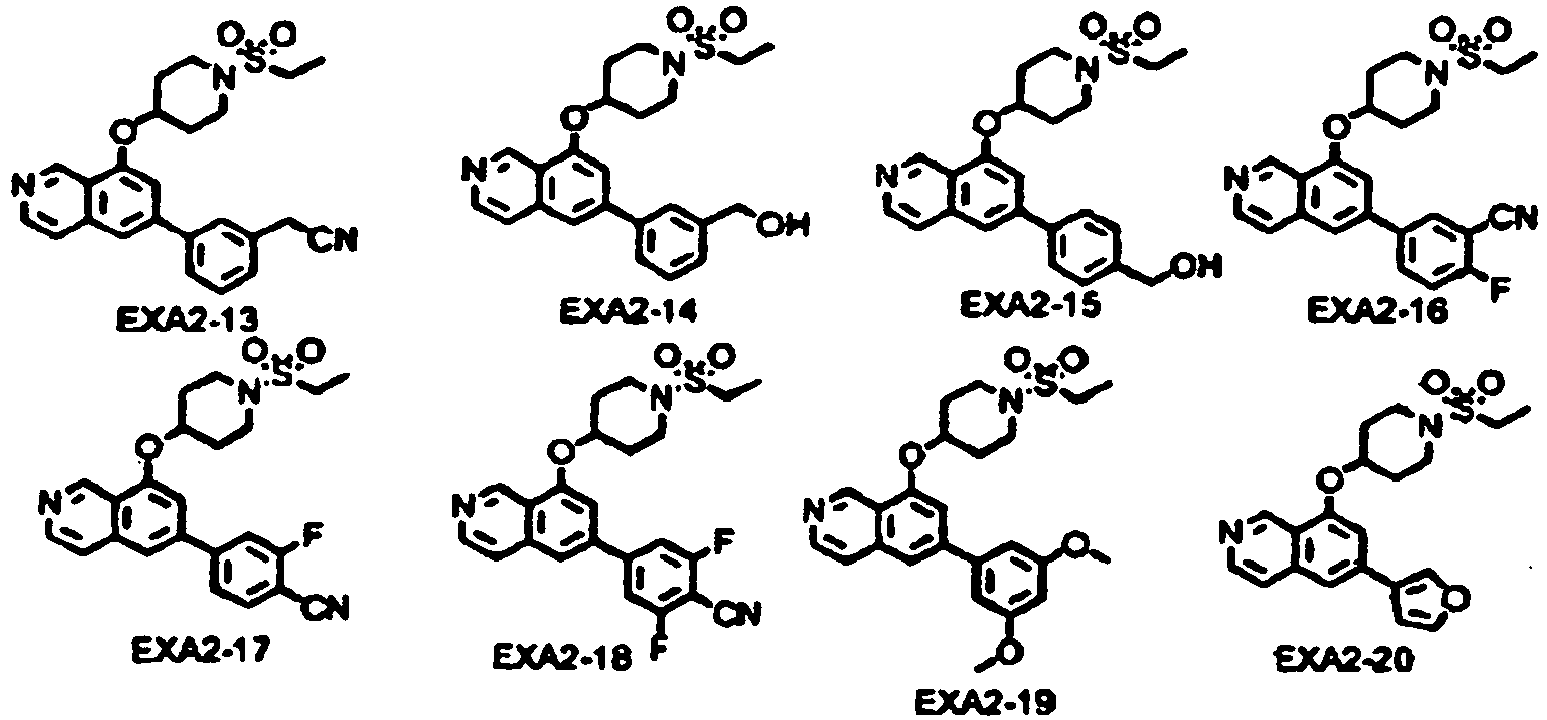

-


- The compound of the present invention may have one or more asymmetric center, and a stereoisomer such as an optical enantiomer or a diastereoisomer based on such an asymmetric center may exist. Stereoisomers in a pure form and arbitrary mixtures or racemates of stereoisomers all fall within the scope of the present invention. In one embodiment, mixtures of racemates and the like may be preferred due to easiness of production. Furthermore, when the compound of the present invention has an olefinic double bond or a cyclic structure, two or more stereoisomers may exist, and arbitrary stereoisomers in a pure form or arbitrary mixtures of stereoisomers all fall within the scope of the present invention. Furthermore, the compound of the present invention may exist as a tautomer. Existence of tautomers is apparent for those skilled in the art and all tautomers fall within the scope of the present invention.
- In the present specification, "the compound represented by the formula (1)" is generally understood as a compound , in a free form, represented by the formula (1).
- The compound represented by the formula (1) may exist as a salt and such a salt also fall within the scope of the present invention. The form of the salt is not particularly limited and an acid addition salt is generally formed. A base addition salt may be formed depending on the type of a substituent.
Salts are preferably pharmaceutically acceptable salts. Acids and bases that form pharmaceutically acceptable salts are known to those skilled in the art and examples thereof include the salts described by Berge et al. in J. Pharm. Sci., 1977, pp. 1-19.
Examples of acid addition salts include mineral acid salts such as hydrochlorides, hydrobromates, hydroiodides, nitrates, sulfates, hydrogen sulfates, phosphates, and hydrogen phosphates and organic acid salts such as acetates, trifluoroacetates, gluconates, lactates, salicylates, citrates, tartarates, ascorbates, succinates, maleates, fumarates, formates, benzoates, methanesulfonates, ethanesulfonates, and p-toluenesulfonates.
For example, when one or more substituents include an acidic moiety, examples of base addition salts include alkali metal salts such as sodium salts and potassium salts, alkaline earth metal salts such as magnesium salts and calcium salts, organic amine salts such as triethylamine salts, pyridine salts, procaine salts, picoline salts, dicyclohexylamine salts, diethanolamine salts, triethanolamine salts, tris(hydroxymethyl)aminomethane salts, and amino acid addition salts such as arginine salts, lysine salts, ornithine salts, serine salts, glycine salts, aspartic acid salts, and glutamic acid salts. - The compound of the present invention may be a nonhydrate. Furthermore, the compound of the present invention is preferably a hydrate in one embodiment.
In one embodiment, the compound of the present invention is preferably a solvate. In another embodiment, a nonsolvate may be preferred. - The compound of the present invention may be crystalline or amorphous. The crystalline compound may be of a single crystal or a mixture of multiple crystalline forms. Alternatively, the compound of the present invention may be of an arbitrary mixture of crystalline and amorphous forms.
- In one embodiment, it is preferred that "the compound represented by the formula (1)" is neither a hydrate nor a solvate (this compound may be referred to as a "free compound"). In another embodiment, it may be preferred that "the compound represented by the formula (1)" is either a hydrate or a solvate.
In one embodiment, it is preferred that "a salt of the compound represented by the formula (1)" is neither a hydrate nor a solvate. In another embodiment, it may be preferred that "a salt of the compound represented by the formula (1)" is either a hydrate or a solvate. Furthermore, preferred examples include crystals of these substances. - In one embodiment, the above-mentioned compound of the present invention is preferably crystalline.
- A prodrug can be produced from the compound of the present invention by, for example, suitably introducing a group constituting a prodrug into one or more arbitrary groups selected from hydroxyl groups and amino groups in the compound of the present invention according to a usual method using a prodrug forming reagent such as a corresponding halogenated compound and then suitably isolating and purifying according to a usual method as intended. Furthermore, a prodrug of the compound of the present invention can also be produced by suitably introducing a group constituting a prodrug into a carboxyl group in the compound of the present invention according to a usual method using a prodrug forming reagent such as a corresponding alcohol or amine. When the prodrug of the present invention is produced, a protective group existing in a compound represented by the formula (2) described later may be utilized.
The prodrug is not particularly limited so long as a metabolite thereof exhibits an intended pharmacological effect and examples thereof include compounds in which a group constituting a prodrug is introduced into one or more arbitrary groups selected from hydroxyl groups, amino groups, and carboxyl groups in the compound of the present invention. Examples of the group that can constitute a prodrug when introduced into a hydroxyl group or an amino group include an acyl group and an alkoxycarbonyl group and preferred examples include an acetyl group, a propionyl group, a methoxycarbonyl group, and an ethoxycarbonyl group. In one embodiment, an ethoxycarbonyl group is particularly preferred. In another embodiment, an acetyl group, a propionyl group, or a methoxycarbonyl group may be preferred. Examples of the group that can constitute a prodrug when introduced into a carboxyl group include a methyl group, an ethyl group, an n-propyl group, an isopropyl group, an n-butyl group, an isobutyl group, an s-butyl group, a t-butyl group, an amino group, a methylamino group, an ethylamino group, a dimethylamino group, and a diethylamino group and preferred examples include an ethyl group, an n-propyl group, and an isopropyl group. In one embodiment, an ethyl group is particularly preferred. In another embodiment, an n-propyl group or an isopropyl group may be preferred. - Hereafter, the structure of the compound represented by the formula (2a) (which may also be simply referred to as "the compound of the formula (2a)") will be described in detail.
In the compound of the formula (2a), R3 represents a hydrogen atom or an alkyl group that may be substituted, preferably a hydrogen atom. In another embodiment, a lower alkyl group is preferred, an alkyl group having 1 to 3 carbon atoms is more preferred, a methyl group or an ethyl group is even more preferred, and a methyl group is particularly preferred. - R4 represents a hydrogen atom, an alkyl group that may be substituted, or an aralkyl group that may be substituted. An alkyl group that may be substituted or an aralkyl group that may be substituted are preferred and an alkyl group that may be substituted is more preferred. In another embodiment, an aralkyl group that may be substituted may be preferred. In yet another embodiment, a hydrogen atom may be preferred.
- R5 represents a halogen atom, preferably a bromine atom, a chlorine atom, or a fluorine atom, more preferably a bromine atom or a chlorine atom, yet more preferably a bromine atom. In another embodiment, a chlorine atom may be preferred.
- Hereafter, the structure of the compound represented by the formula (2b) (which may also be simply referred to as "the compound of the formula (2b)") will be described in detail.
In the compound of the formula (2b), R4 represents a hydrogen atom, an alkyl group that may be substituted, or an aralkyl group that may be substituted, preferably an alkyl group that may be substituted or an aralkyl group that may be substituted, more preferably an alkyl group that may be substituted. In another embodiment, an aralkyl group that may be substituted may be preferred. In yet another embodiment, a hydrogen atom may be preferred. - R5 represents a halogen atom, preferably a bromine atom, a chlorine atom, or a fluorine atom, more preferably a bromine atom or a chlorine atom, yet more preferably a bromine atom. In another embodiment, a chlorine atom may be preferred.
- The compound represented by the formula (2a) or (2b) is generally a free compound represented by the formula (2a) or (2b), respectively. Furthermore, the compound represented by the formula (2a) or (2b) may exist as a salt thereof, and such a salt thereof also falls within the scope of the present invention. The form of the salt can be the same as those of the compound represented by the formula (1).
The compound represented by the formula (2a) or (2b) or a salt thereof may be a nonhydrate. Furthermore, in one embodiment, the compound represented by the formula (2a) or (2b) or a salt thereof is preferably a hydrate.
In one embodiment, the compound represented by the formula (2a) or (2b) or a salt thereof is preferably a solvate. In another embodiment, it may be preferred that the compound represented by the formula (2a) or (2b) is a nonsolvate.
The compound represented by the formula (2a) or (2b) may be crystalline or amorphous. The crystalline compound may be of a single crystal or a mixture of multiple crystalline forms. Alternatively, the compound represented by the formula (2a) or (2b) may be of an arbitrary mixture of crystalline and amorphous forms.
In one embodiment, it is preferred that "the compound represented by the formula (2a) or (2b)" is neither a hydrate nor a solvate (this compound may be referred to as a "free compound"). In another embodiment, it may be preferred that "the compound represented by the formula (2a) or (2b)" is either a hydrate or a solvate.
In one embodiment, it is preferred that a "salt of the compound represented by the formula (2a) or (2b)" is neither a hydrate nor a solvate. In another embodiment, it may be preferred that a "salt of the compound represented by the formula (2a) or (2b)" is either a hydrate or a solvate. Furthermore, preferred examples include crystals of those substances.
In one embodiment, the above-mentioned compound represented by the formula (2a) or (2b) or a salt thereof is preferably crystalline.
A prodrug of the compound represented by the formula (2a) or (2b) or a salt thereof; the form and the production method of the prodrug of the compound represented by the formula (2a) or (2b) or a salt thereof can be the same as those of the compound represented by the formula (1) or a salt thereof. - The compound of the present invention can be produced by, for example, the following methods, but the production methods thereof are not limited to the following Production Methods.
In the following Production Methods, the reaction time of each reaction is not particularly limited and it is sufficient to terminate the reaction in each reaction when an intended yield is obtained. The progression of the reaction can be readily followed by the analytical measure described later.
Each reaction in the following Production Methods can be carried out in an inert gas atmosphere, such as, for example, a nitrogen or argon flow, if necessary. - Furthermore, protection by a protective group and subsequent deprotection in each reaction in the following Production Methods can be performed suitably with reference to the methods described later if necessary.
Examples of the protective group used in the following Production Methods include a protective group for a carboxyl group (-COOH), a protective group for a hydroxyl group (-OH), a protective group for a formyl group (-CHO), and a protective group for an amino group (-NH2). - Examples of the protective group for a carboxyl group include an alkyl group having 1 to 4 carbon atoms, an alkenyl group having 2 to 4 carbon atoms, an alkyl group having 1 to 4 carbon atoms that is substituted with an alkoxy group having 1 to 4 carbon atoms, an alkyl group having 1 to 4 carbon atoms that is substituted with 1 to 3 halogen atoms and specific examples include a methyl group, an ethyl group, a t-butyl group, an allyl group, a methoxyethyl group, and a trichloroethyl group.
- Examples of the protective group for a hydroxyl group include an alkyl group having 1 to 4 carbon atoms, an alkenyl group having 2 to 4 carbon atoms, an alkyl group having 1 to 4 carbon atoms that is substituted with an alkoxy group having 1 to 4 carbon atoms, an alkyl group having 1 to 4 carbon atoms that is substituted with 1 to 3 halogen atoms, a silyl group substituted with 3 identical or different alkyl groups having 1 to 4 carbon atoms or phenyl groups, a tetrahydropyranyl group, a tetrahydrofuryl group, a propargyl group, and a trimethylsilylethyl group and specific examples include a methyl group, an ethyl group, a t-butyl group, an allyl group, a methoxymethyl (MOM) group, a methoxyethyl (MEM) group, a trichloroethyl group, a phenyl group, a methylphenyl group, a chlorophenyl group, a benzyl group, a methyl benzyl group, a chlorobenzyl group, a dichlorobenzyl group, a fluorobenzyl group, a trifluoromethylbenzyl group, a nitrobenzyl group, a methoxybenzyl group, an N-methylaminobenzyl group, an N,N-dimethylaminobenzyl group, a phenacyl group, a trityl group, an 1-ethoxyethyl (EE) group, a tetrahydropyranyl (THP) group, a tetrahydrofuryl group, a propargyl group, a trimethylsilyl (TMS) group, a triethylsilyl (TES) group, a t-butyldimethylsilyl (TBDMS) group, a t-butyldiphenylsilyl (TBDPS) group, an acetyl (Ac) group, a pivaloyl group, a benzoyl group, an allyloxycarbonyl (Alloc) group, and a 2,2,2-trichloroethoxycarbonyl (Troc) group.
- Examples of the protective group for a formyl group include an acetal group and specific examples include dimethyl acetal.
- Examples of the protective group for an amino group include a benzyl group, a methylbenzyl group, a chlorobenzyl group, a dichlorobenzyl group, a fluorobenzyl group, a trifluoromethylbenzyl group, a nitrobenzyl group, a methoxyphenyl group, an N-methylaminobenzyl group, an N,N-dimethylaminobenzyl group, a phenacyl group, an acetyl group, a trifluoroacetyl group, a pivaloyl group, a benzoyl group, an allyloxycarbonyl group, a 2,2,2-trichloroethoxycarbonyl group, a benzyloxycarbonyl (Cbz) group, a t-butoxycarbonyl (Boc) group, a 1-methyl-1-(4-biphenyl)ethoxycarbonyl (Bpoc) group, a 9-fluorenylmethoxycarbonyl group, a benzyloxy methyl (BOM) group, and a 2-(trimethylsilyl)ethoxymethyl (SEM) group.
- During the production step or at the final stage in the following Production Methods, the compound can be converted to a target compound by deprotecting an introduced protective group at the same time as or successively after the production step. The protection and deprotection reactions can be performed by a known method, for example, the method described in Protective Groups in Organic Synthesis, John Wiley and Sons (2007), and deprotection can be performed by, for example, the following methods (1) to (6) and the like.
-
- (1) Deprotection reaction under an acidic condition.
This reaction is performed, for example, in an organic solvent (dichloromethane, chloroform, dioxane, ethyl acetate, methanol, anisole, etc.) in the presence of an acid such as an organic acid (acetic acid, trifluoroacetic acid, methanesulfonic acid, p-toluenesulfonic acid, etc.), a Lewis acid (boron tribromide, boron trifluoride, bromide aluminium, aluminium chloride, etc.) or an inorganic acid (hydrochloric acid, hydrobromic acid, sulfuric acid, etc.) or a mixture thereof (hydrobromic acid/acetic acid, etc.) at -10 to 100°C. In some methods, ethanethiol, 1,2-ethanedithiol, or the like may be added as an additive. The amount of an acid used is preferably 1 to 100 molar equivalents based on the starting compound. The reaction time is usually 0.1 hours or longer, preferably, for example, 0.5 to 48 hours. Since the reaction progression can be followed by thin layer chromatography (TLC), high performance liquid chromatography (HPLC), or the like, the reaction can be suitably terminated when an intended yield of a target compound is obtained. - (2) Deprotection reaction by alkali hydrolysis. This reaction is performed by, for example, reacting the compound with a base in a reaction solvent such as a polar solvent. Examples of the base include alkali metal bases such as sodium hydroxide, potassium hydroxide, lithium hydroxide, barium hydroxide, calcium hydroxide, sodium carbonate, potassium carbonate, sodium methoxide, and potassium t-butoxide and organic bases such as triethylamine. The amount of a alkali metal base used is usually 1 to 20 molar equivalents per mole of a reactant, preferably, for example, 1 to 10 molar equivalents and that of an organic base is, for example, 1 molar equivalent to a large excess. The reaction solvent is usually an inactive medium that does not interfere with an reaction, preferably a polar solvent. Examples of the polar solvent include water, methanol, ethanol, tetrahydrofuran, and dioxane. If necessary, these solvents can be mixed. As the reaction temperature, for example, a suitable temperature from -10°C to reflux temperature of a solvent is selected. The reaction time is usually 0.5 to 72 hours or longer, preferably, for example, 1 to 48 hours. When an organic base is used, the reaction time is, for example, 5 hours to 14 days.
- (3) Deprotection reaction by hydrogenolysis. This reaction is performed, for example, in a solvent [an ether solvent (tetrahydrofuran, dioxane, dimethoxyethane, diethyl ether, etc.), an alcohol solvent (methanol, ethanol, etc.), a benzene solvent (benzene, toluene, etc.), a ketone solvent (acetone, methyl ethyl ketone, etc.), a nitrile solvent (acetonitrile, etc.), an amide solvent (dimethylformamide, etc.), an ester solvent (ethyl acetate, etc.), water, acetic acid, a mixed solvent of two or more of these solvents, etc.] in the presence of a catalyst (a palladium carbon powder, platinum oxide (PtO2), activated nickel, etc.) and a hydrogen source such as a hydrogen gas, ammonium formate, or hydrazine hydrate under normal pressure or increased pressure at -10 to 100°C.
- (4) Deprotection reaction of a silyl group. This reaction is performed by, for example, using tetra-n-butylammonium fluoride or the like in an organic solvent that can be mixed with water (tetrahydrofuran, acetonitrile, etc.) at -10 to 60°C.
- (5) Deprotection reaction using a metal. This reaction is performed, for example, in an acidic solvent (acetic acid, a buffer of pH 4.2 to 7.2, or a mixture of these solutions and an organic solvent such as tetrahydrofuran) in the presence of a zinc powder at -10 to 60°C with or without applying ultrasound waves.
- (6) Deprotection reaction using a metal complex. This reaction is performed by, for example, using a metal complex [tetrakis triphenylphosphine palladium(0), bis(triphenylphosphine)palladium(II) dichloride, palladium(II) acetate, tris(triphenylphosphine)rhodium(I) chloride, etc.] in an organic solvent (dichloromethane, dimethylformamide, tetrahydrofuran, ethyl acetate, acetonitrile, dioxane, ethanol, etc.), water, or a mixed solvent thereof in the presence of a trap reagent (tributyltin hydride, triethyl silane, dimedon, morpholine, diethylamine, pyrrolidine, etc.), an organic acid (acetic acid, formic acid, 2-ethylhexanoic acid, etc.) and/or an organic acid salt (sodium 2-ethylhexanoate, potassium 2-ethylhexanoate, etc.) and in the presence or absence of a phosphine reagent (triphenylphosphine, etc.) at -10 to 60°C.
-
Production Methods - The compound of the formula (1) can be produced along the reaction pathway shown in
Scheme 1. In the following scheme, "Step" means a step. For example, "Step 1-1" is step 1-1.
- The compound of the present invention can be produced by performing a deprotection reaction in the compound of the formula (2), wherein D1a, A1a, D2a, R1a, D3a, and R2a each have the same meaning as D1, A1, D2, R1, D3, and R2, respectively, in Scheme 1 (Step 1-1).
When D1a, A1a, D2a, R1a, D3a , and R2a in the compound of the formula (2) are the same groups as D1, A1, D2, R1, D3, and R2, respectively, in the compound of the formula (1), Step 1-1 is unnecessary. - As described above, this deprotection reaction can be performed according to a known method, for example, the method described in Protective Groups in Organic Synthesis, John Wiley and Sons (2007) or the like.
- A deprotection reaction using an acid can be performed with reference to the conditions in the above-mentioned "Deprotection reaction under an acidic condition." For example, when the compound of the formula (2) having a Boc group is deprotected to produce the compound of the formula (1), examples of a solvent used for a reaction include nonsolvents, water, alcohol, acetonitrile, and ether solvents such as 1,4-dioxane and a mixed solvent thereof. Furthermore, examples of the acid include mineral acids and organic acids and specific examples include hydrochloric acid, sulfuric acid, nitric acid, acetic acid, methanesulfonic acid, and phosphoric acid. Hydrochloric acid is preferred. The amount of an acid used is preferably 1 to 100 molar equivalents per mole of the compound of the formula (2). A reaction is preferably performed in the range of room temperature to reflux temperature of a solvent, more preferably from room temperature to 80°C. The compound of the formula (1) can also be produced by deprotecting the compound of the formula (2) having a Boc group using trifluoroacetic acid. In this case, trifluoroacetic acid can be used solely or as a mixed solvent with water or dichloromethane. The reaction can be performed in the temperature range of 0 to 100°C, preferably in the range of room temperature to 50°C. It is preferred to use 1 to 100 molar equivalents of trifluoroacetic acid per mole of the compound of the formula (2).
When a salt is formed with the acid used by the compound of the formula (1) as a solid after the reaction, a salt of the compound of the formula (1) can be obtained by isolating and purifying this solid by a usual method. Furthermore, when the compound of the formula (1) forms an acid adduct after the reaction, a free base (free compound) can be obtained by neutralizing this acid adduct by a usual method, and then an intended acid adduct can also be obtained. - A compound of the formula (2) wherein D1a represents -S(O)- or -S(O)2- can be produced by oxidizing a compound of the formula (2) wherein D1a represents -S- (Compound 1-1U) according to, for example, the following method (1-1-i) or (1-1-ii).
- (1-1-i) A compound of the formula (2) wherein D1a represents -S(O)- can be obtained by oxidizing Compound 1-1U using an oxidizing agent in an inert solvent. Examples of the inert solvent include dichloromethane, chloroform, tetrahydrofuran, 1,4-dioxane, acetonitrile, tert-butanol, acetic acid, trifluoroacetic acid, and water and a mixed solvent thereof. Examples of the oxidizing agent include sodium metaperiodate, 3-chloroperbenzoic acid, and hydrogen peroxide. It is preferred to use 0.3 to 2 molar equivalents of the oxidizing agent per mole of the starting compound. The reaction time is preferably 0.1 to 48 hours.
- (1-1-ii) A compound of the formula (2) wherein D1a represents -S(O)2- can be obtained by oxidizing Compound 1-1U using an oxidizing agent in an inert solvent. The same inert solvents and oxidizing agents as in the above-mentioned (1-1-i) can be used. However, it is preferred to use 2 or more molar equivalents of the oxidizing agent per mole of the starting compound.
- A compound of the formula (2) wherein R1a represents any of groups of the formulas (1b-1) to (1b-4) can be produced from a compound of the formula (2) wherein R1a represents any of groups of the following formulas (1b-5) to (1b-8) respectively:

Here, a compound of the formula (2) wherein R1a represents a group of formula (1b-1), (lb-2), (1b-3), or (1b-4) can be produced from a compound of the formula (2) wherein R1a represents a group of formula (1b-5), (1b-6), (1b-7) or (1b-8), respectively. - (1-2-i) A compound of the formula (2) wherein D12 in groups of the formulas (1b-1) to (lb-4) represents an alkylene that may be substituted can be obtained by, for example, using an alkyl halide (a chloride, a bromide, an iodide, etc.). A reaction can be usually performed in the presence of a base. Preferred examples of the base include inorganic bases such as potassium carbonate, sodium carbonate, cesium carbonate, sodium hydrogencarbonate, potassium hydroxide, and sodium hydroxide and potassium carbonate is particularly preferred. One or more molar equivalents of a halide per mole of Compound 1-2U are preferably used and it is more preferred to use 2 to 10 molar equivalents or more. Examples of a reaction solvent used include water, alcohol solvents such as methanol and ethanol, inert solvents such as N,N-dimethylformamide, tetrahydrofuran, 1,4-dioxane, acetone, 2-butanone, dimethyl sulfoxide, and acetonitrile and a mixed solvent thereof. Water, N,N-dimethylformamide, and acetone are preferred. The reaction temperature is, for example, -10°C or higher, preferably from 0 to 200°C. The reaction time is usually 0.5 hours or longer, preferably 2 to 36 hours.
A compound of the formula (2) wherein R1a represents any of groups of the formulas (1b-1) to (1b-4) can also be produced by coupling an aldehyde or a ketone corresponding to a substituent to be introduced and Compound 1-2U by a reductive amination reaction. Examples of the method of reductive amination include the method described in The Fourth Series of Experimental Chemistry, The Chemical Society of Japan ed., Maruzen Co., Ltd., vol. 20, pp. 300-302, "Reductive Amination Reaction" or the methods according to the references included in this publication. Preferably, coupling is carried out by allowing a reducing agent to act on the starting compound in a solvent. Examples of the reducing agent include metal hydride reducing agents such as sodium borohydride, zinc borohydride, sodium borohydride triacetate, a borane-dimethyl sulfide complex, a borane-pyridine complex, a borane-triethylamine complex, a borane-tetrahydrofuran complex, and lithium triethylboron and sodium borohydride and sodium borohydride triacetate are preferred. For example, 0.1 or more molar equivalents of a reducing agent per mole of Compound 1-2U are usually used and it is preferred to use 1 to 20 molar equivalents. 1 or more molar equivalents of the corresponding aldehyde or ketone are used and it is preferred to use 2 to 10 molar equivalents. Examples of the solvent include alcohols such as methanol, ethanol, and isopropanol, ethers such as tetrahydrofuran, 1,2-dimethoxyethane, and 1,4-dioxane, halogenated hydrocarbons such as dichloromethane, chloroform, and 1,2-dichloroethane, and N,N-dimethylformamide and methanol, tetrahydrofuran, and 1,2-dichloroethane are preferred. The reaction temperature is 0°C or higher, preferably from 10°C to reflux temperature of a solvent. The reaction time is 0.1 hours or longer, preferably 0.5 to 30 hours. - (1-2-ii) A compound of the formula (2) wherein D12 in groups of the formulas (1b-1) to (lb-4) represents -C(O)-can be produced by amidating a compound having a carboxyl group (-COOH) and Compound 1-2U by the methods described in The Fourth Series of Experimental Chemistry. The Chemical Society of Japan ed., Maruzen Co., Ltd., vol. 22, pp. 137-151, "Acid Amides and Acid Imides" or according to the references included in this publication. Specifically, a carboxylic acid corresponding to R17 in the formulas (1b-1) to (1b-4), that is, a commercially available or preparable R17-COOH can be reacted with Compound 1-2U in an inert solvent in the presence of a suitable condensing agent widely used to form a bond with carboxylic acid by a known method. Examples of the condensing agent include dicyclohexylcarbodiimide, diisopropyl carbodiamide, and 1-ethyl-3-(3-dimethylaminopropyl)carbodiimide. 1-Hydroxybenzotriazole, 1-hydroxy-7-azobenzotriazole, and the like may be used as additives in some cases. Examples of the inert solvent include halogen hydrocarbons such as dichloromethane, chloroform, and 1,2-dichloroethane and N,N-dimethylformamide. Two or more types of organic solvents may be mixed. One or more molar equivalents of the carboxylic acid and the condensing agent per mole of Compound 1-2U can usually be used and it is preferred to use 1 to 10 molar equivalents. The reaction temperature is 0°C or higher, preferably, for example, 0 to 100°C. The reaction time is 0.1 hours or longer, preferably, for example, 0.1 to 48 hours.
Alternatively, the compound of the formula (2) wherein R1a represents any of groups of the formulas (1b-1) to (1b-4) can also be produced by coupling a carboxylic acid chloride or a mixed acid anhydride corresponding to R17 in the formulas (1b-1) to (1b-4 and Compound 1-2U in an inert solvent in the presence of a base. Examples of the inert solvent include halogen hydrocarbons such as dichloromethane, chloroform, and 1,2-dichloroethane and acetonitrile. Examples of the base include organic bases such as triethylamine, N,N-diisopropylethylamine, and pyridine and inorganic bases such as potassium carbonate and sodium hydrogencarbonate. 1 to 6 molar equivalents of a base, a carboxylic acid chloride, or a mixed acid anhydride per mole of Compound 1-2U can usually be used, and it is preferred to use 1.1 to 3.3 molar equivalents. The reaction temperature is from -10 to 100°C, preferably approx. 0 to 50°C. The reaction time is preferably 0.1 to 48 hours. - When D12 in the formulas (1b-1) to (1b-4) represents -S(O)2- in the compound of the formula (2), the compound of the formula (2) wherein R1a represents any of groups of the formulas (1b-1) to (1b-4) can be produced by coupling Compound 1-2U and a sulfonic acid chloride or a sulfonic acid anhydride corresponding to R17 in the formulas (1b-1) to (1b-4) in an inert solvent in the presence of a base by the methods described in The Fourth Series of Experimental Chemistry, The Chemical Society of Japan ed., Maruzen Co., Ltd., vol. 22, pp. 137-151, "Acid Amides and Acid Imides" or the methods according to the references included in this publication. Examples of the inert solvent include halogen hydrocarbons such as dichloromethane, chloroform, and 1,2-dichloroethane and acetonitrile. Dichloromethane is particularly preferred. Examples of the base include organic bases such as triethylamine, N,N-diisopropylethylamine, and pyridine and inorganic bases such as potassium carbonate and sodium hydrogencarbonate. Triethylamine, N,N-diisopropylethylamine, and pyridine are preferred. 1 to 10 molar equivalents of a base and a sulfonic acid chloride per mole of Compound 1-2U can be usually used and it is preferred to use 1.1 to 5 molar equivalents. The reaction temperature is from -10 to 40°C, preferably approx. 0 to 30°C. The reaction time is preferably 0.1 to 48 hours.
- (1-2-iv) When D12 in the formulas (1b-1) to (1b-4) represents -C(O)-N(R15)- in the compound of the formula (2), the compound of the formula (2) wherein R1a represents any of groups of the formulas (1b-1) to (1b-4) can be produced by coupling compound 1-2U and an isocyanate corresponding to R17 in the formulas (1b-1) to (1b-4) in an inert solvent in the presence or absence of a base by the method described in The First Series of Experimental Chemistry, The Chemical Society of Japan ed., Maruzen Co., Ltd., vol. 14, pp. 1628-1644, "Ureas" or The Fourth Series of Experimental Chemistry, The Chemical Society of Japan ed., Maruzen Co., Ltd., vol. 20, pp. 360-361, "Ureas" or the methods according to the references included in these publications. Examples of the inert solvent include halogen hydrocarbons such as dichloromethane and chloroform and acetonitrile. Examples of the base include organic bases such as triethylamine, N,N-diisopropylethylamine, pyridine and inorganic bases such as potassium carbonate and sodium hydrogencarbonate. 1 to 10 molar equivalents of a base and an isocyanate per mole of compound 1-2U can usually be used, and it is preferred to use 1.1 to 3.3 molar equivalents. The reaction temperature is from -10 to 40°C, preferably approx. 0 to 30°C. The reaction time is preferably 0.1 to 48 hours.
- A compound of the formula (2) wherein R2a represents the above-mentioned formula (2a-1) and one or more of R23, R24 , and R25 represents the above-mentioned formula (2b-1) (Compound 1-3T) can be produced from a compound of the formula (2) wherein R2a represents the formula (2a-1) and one or more of R23 , R24 , and R25 represents the following formula (2b-2):
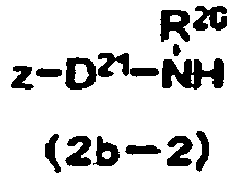
-
- (1-3-i) Compound 1-3T wherein D22 represents an alkylene that may be substituted can be produced from Compound 1-3U according to the same method as in the above-mentioned (1-2-i).
- (1-3-ii) Compound 1-3T wherein D22 represents -C(O) - can be produced from Compound 1-3U according to the same method as in the above (1-2-ii).
- (1-3-iii) Compound 1-3T wherein D22 represents - S(O)2- can be produced from Compound 1-3U according to the same method as in the above (1-2-iii).
- (1-3-iv) Compound 1-3T wherein D22 represents -C(-O) - N(R28)- can be produced from Compound 1-3U according to the same method as in the above (1-2-iv).
- When, in the compound of the formula (2), D1a represents a single bond, -N(R11)-, -O-, -S-, -S(O)-, or -S(O)2-, A1a represents any of divalent groups of the above-mentioned formulas (1a-1 to (1a-5), and D2a represents a single bond, -S(O)2-, -C(O)-N(R15)-, or -E-C(O)-, (provided that, when D1a represents a single bond, A1a represents a divalent group of the formula (1a-5), and, when D1a represents -N(R11)-, -O-, -S-, -S(O)-, or - S(O)2-, A1a represents any of divalent groups of the formulas (1a-1 to (1a-4)), the compound of the formula (2) can be produced from a compound of the formula (3) wherein A1b represents any of groups of the following formulas (1a-7) to (1a-11):


Here, a compound of the formula (2) wherein A1a represents a group of the formula (1a-1), (1a-2), (1a-3), (1a-4), or (1a-5 can be produced from a compound of the formula (3) wherein A1b represents a group of the formula (1a-7), (1a-8), (1a-9), (1a-10), or (1a-11), respectively. - A compound of the formula (2) wherein D2a represents -C(O)-, -S(O)2-, -C(S)-, -C(O)-N(R15)-, -C(S)-N(R15)-, or -E-C(O)- can be produced from a compound of formula (3) and commercially available or preparable compound of the following formula (1-2a):
Y1-D2c-R1a (1-2a)
wherein Y1 represents a halogen atom or a hydroxyl group, D2c represents -C(O)-, -S(O)2-, -C(S)-, or -E-C(O)-, and R1a has the same meaning as defined above, provided that, when D2c represents alkylene, -E-C(O)-, or -S(O)2-, Y1 represents a halogen atom) according to any of the following methods (1-4-i) to (1-4-v). - (1-4-i) A compound of the formula (2) wherein D2a represents an alkylene or -EC(O)- can be produced from a compound of the formula (3) and a compound of the formula (1-2a) or a commercially available or preparable compound of the following formula (1-2b):
Y2-C(O)-D2d-R1a (1-2b)
wherein Y2 represents a hydrogen atom or an alkyl group, D2d is an alkylene or -E-C(O)-, and R1a has the same meaning as defined above, according to the same method as in the above (1-2-i). - (1-4-ii) A compound of the formula (2) wherein D2a represents -C(O)- can be produced from a compound of the formula (3) and a commercially available or preparable compound of the formula (1-2a) according to the same method as in the above (1-2-ii). When Y1 represents a hydroxyl group and D2c represents -C(O)- in a compound of the formula (1-2a), the compound of the formula (1-2a) is carboxylic acid, and this carboxylic acid may be used as it is in a reaction according to the method (1-2-ii) or may be converted to a corresponding anhydride and then used in a reaction according to the method (1-2-ii).
- (1-4-iii) A compound of the formula (2) wherein D2a represents -S(O)2- can be produced from a compound of the formula (3) and a commercially available or preparable compound of the formula (1-2a) according to the same method as in the above (1-2-iii).
- (1-4-iv) A compound of the formula (2) wherein D2a represents -C(O)-N(R15)- or -C(S)-N(R15)- and R15 represents a hydrogen atom can be produced from a compound of the formula (3) and a commercially available or preparable compound (for example, preparable according to the methods described in The First Series of Experimental Chemistry, The Chemical Society of Japan ed., Maruzen Co., Ltd., vol. 14, pp. 1490-1508, "Isocyanates" and "Thioisocyanates" or the methods according to the references included in this publication) of the following formula (1-2c) or (1-2d):
O=C-N-(R1a) (1-2c)
S=C-N- (R1a) (1-2d)
according to the same method as in the above-mentioned (1-2-iv). - (1-4-v) A compound of the formula (2) wherein D2a represents -C(S)- can be produced from a compound of the formula (3) by, for example, the method described in The First Series of Experimental Chemistry, The Chemical Society of Japan ed., Maruzen Co., Ltd., vol. 14, pp. 1827-1828, "Synthesis of Thiocarboxylic Acid Amide" or the methods described in the references included in this publication. Examples of the method include methods comprising reacting a compound of the formula (3) and a corresponding thiocarboxylic acid ester in a solvent in the presence of a base. Examples also include methods comprising producing from a compound of the formula (2) wherein D2a represents -C(O)- by the method described in The First Series of Experimental Chemistry, The Chemical Society of Japan ed., Maruzen Co., Ltd., vol. 14., pp. 1817-1821, "Thiocarbonyl Compounds" or the methods described in the references included in this publication.
When D2a represents a single bond and R1a represents a hydrogen atom in the compound of the formula (2), Step 1-2 is unnecessary. - A compound of the formula (2) wherein D2a represents -E-C(O)- can be produced from a compound of the formula (3-1) wherein D1a has the same meaning as defined above, A1d represents any of divalent groups of the above-mentioned formulas (1a-1) to (1a-5), provided that, when D1a represents a single bond, A1d represents a divalent group of the formula (1a-5), and, when D1a represents - N(R11)-, -O-, -S-, -S(O)-, or -S(O)2-, A1d represents any of divalent groups of the formulas (1a-1) to (1a-4), and D2b represents -E-C(O)-OH by an amidation reaction with a commercially available or preparable aminating reagent according to, for example, the method described in The Fourth Series of Experimental Chemistry, The Chemical Society of Japan ed., Maruzen Co., Ltd., vol. 22, pp. 137-151, "Acid Amides and Acid Imides" and the methods according to the references included in this publication. Examples of the aminating reagent include primary amines such as methylamine and secondary amines such as dimethylamine and pyrrolidine.
- A compound of the formula (3-1) can be produced by coupling a compound of formula (3) and a commercially available or preparable compound of the following formula (1-2-2a):
Y3-E-C(O)-O-G1 (1-2-2a)
wherein Y3 represents a halogen atom and G1 represents a hydrogen atom or a protective group of a carboxyl group) or a commercially available or preparable compound of the following formula (1-2-2b):
H-C(O)-E-C(O)-O-G1 (1-2-2b)
wherein G1 has the same meaning as defined above by a method according to the above (1-2-i) and then deprotecting G1. However, when G1 represents hydrogen, deprotection is unnecessary. - A compound of the formula (3) can be produced by deprotecting the G2 group in a compound of the formula (4) wherein A1c represents any of groups of the following formulas (1a-12) to (1a-16):
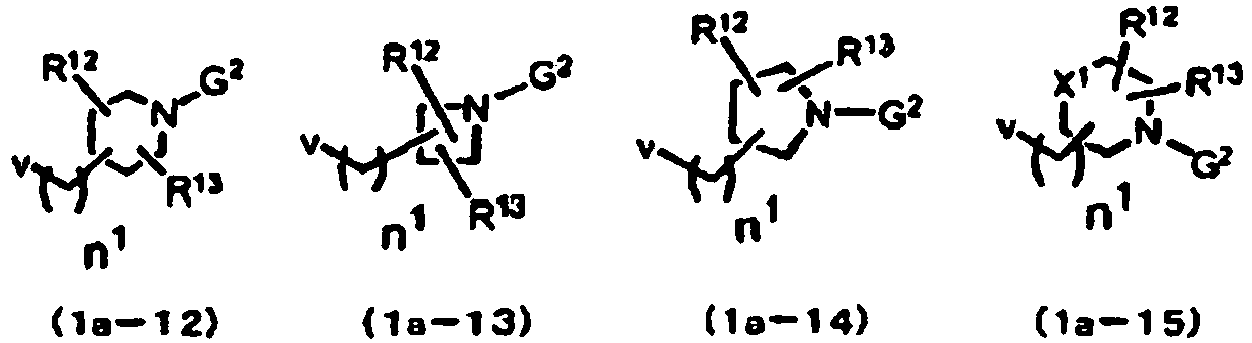

Here, the compound of the formula (3) wherein A1b represents a group of the formula (1a-7) (1a-8), (1a-9), (1a-10), or (1a-11) can be produced from a compound of the formula (4) wherein A1c represents a group of (1a-12), (1a-13), (1a-14), (1a-15), or (1a-16), respectively.
For example, when G2 represents a Boc group, the above-described "Deprotection reaction under an acidic condition" can be performed as a method for producing a compound of the formula (3) by deprotecting the Boc group in the compound of the formula (4). - A compound of the formula (4) can be produced by coupling a compound of the formula (5) wherein D3a and R2a each have the same meaning as defined above and any commercially available or preparable compound of the following formulas (1a-17) to (1a-21):


Specifically, a compound of the formula (4) wherein D1a represents -N(R11)- can be produced by reacting a compound of the formula (5) and any of compounds of the formulas (1a-17) to (1a-20) wherein Y4 represents HN(R11)-or a compound of the formula (1a-21) in an inert solvent in the presence of a palladium catalyst, a phosphorus compound, and a base (for example, according to Buchwald, S.L., J. Org. Chem., 2000, pp. 1158 and Buchwald, S.L., Organic Letters, 2000, pp. 1101). Examples of the inert solvent include ether solvents such as tetrahydrofuran, 1,4-dioxane, and 1,2-dimethoxyethane, toluene, and N,N-dimethylformamide. 1,4-Dioxane and toluene are preferred. Examples of the palladium catalyst include commercially available catalysts such as tetrakis(triphenylphosphine)palladium, tetrakis(methyldiphenylphosphine)palladium, dichlorobis(triphenylphosphine)palladium, dichlorobis(tri-o-tolylphosphine)palladium, dichlorobis(tricyclohexylphosphine)palladium, dichlorobis(triethylphosphine)palladium, palladium acetate, palladium chloride, bis(acetonitrile)palladium chloride, bis(dibenzylideneacetone)palladium, tris(dibenzylideneacetone)dipalladium, and bis(diphenylphosphinoferrocene)palladium chloride. These catalysts may be added to a reaction system as they are or catalysts separately prepared and isolated from palladium acetate, tris(dibenzylideneacetone)dipalladium, or the like and an arbitrary ligand may be added. Furthermore, a catalyst that appears to be actually involved in the reaction may be prepared in a reaction system by mixing palladium acetate, tris(dibenzylideneacetone)dipalladium, or the like and an arbitrary ligand. The number of valents in palladium may be 0 or +2. In particular, preferred examples include tris(dibenzylideneacetone)dipalladium(0) and palladium(II) acetate. Examples of the phosphorus compound include phosphine ligands such as trifurylphosphine, tri(o-tolyl)phosphine, tri(cyclohexyl)phosphine, tri(t-butyl)phosphine, dicyclohexylphenylphosphine, 1,1'-bis(di-t-butylphosphino)ferrocene, 2-dicyclohexylphosphino-2'-dimethylamino-1,1'-biphenyl, 2-(di-t-butylphosphino)biphenyl, 2-(dicyclohexylphosphino)biphenyl, 2,2'-bis(diphenylphosphino)-1,1'-binaphthyl, xantphos, and tri(tert-butyl)phosphine. Alternative examples also include 2-dicyclohexylphosphino-2',6'-dimethoxybiphenyl, 2-dicyclohexyl-2',4',6'-triisopropylbiphenyl, and 1,2,3,4,5-pentamethyl-1'-(di-t-butylphosphino)ferrocene). 2-(di-tert-butylphosphino)biphenyl, 2-(dicyclohexylphosphino)biphenyl, 2,2'-bis (diphenylphosphino)-1,1'-binaphthyl, xantphos, tri(tert-butyl)phosphine, and the like are preferred. Preferred examples of a combination of a palladium catalyst and a phosphorus compound include tris(dibenzylideneacetone)dipalladium and 2,2'-bis(diphenylphosphino)-1,1'-binaphthyl. The equivalent amount of a palladium catalyst may be an equal amount or a catalytic amount, but 0.01 mol% or more based on the starting compounds is preferred, and 0.10 to 50.0 mol% is particularly preferred. Examples of the base include sodium tert-butoxide, cesium carbonate, and potassium phosphate. For example, usually, 1 or more molar equivalents of a compound represent by any of the formulas (1a-17) to (1a-21) per mole of a compound of the formula (5) is preferred, and 1 to 5 molar equivalents are more preferred. As the reaction temperature, a suitable temperature from room temperature to reflux temperature of a solvent is selected, and the range of room temperature to 200°C is preferred. The reaction time is 0.1 hours or longer, preferably 0.1 to 48 hours.
A compound of the formula (4) wherein D1a represents -0- can be produced by reacting a compound of the formula (5) and any of compounds of the formulas (1a-17) to (1a-20) wherein Y4 represents HO- in an inert solvent in the presence of a palladium catalyst, a phosphorus compound, and a base (for example, according to Buchwald, S.L., J. Org. Chem., 2000, pp. 1158 and Buchwald, S.L., Organic Letters, 2000, pp. 1101). Examples of the inert solvent include ether solvents such as tetrahydrofuran, 1,4-dioxane, and 1,2-dimethoxyethane and toluene. Examples of the palladium catalyst include the above-mentioned palladium catalysts, for example, palladium(II) acetate and tris(dibenzylideneacetone)dipalladium(0). Examples of the phosphorus compound include 2-(di-tert-butylphosphino)biphenyl, rac-2-(di-tert-butylphosphino)-1,1'-binaphthyl, and 2-(di-tert-butylphosphino)-2'-dimethylamino-1,1'-binaphthyl. Furthermore, examples of the base include sodium tert-butoxide, potassium tert-butoxide, cesium carbonate, and potassium phosphate. Preferred examples of a combination of a palladium catalyst and a phosphorus compound include palladium acetate and rac-2-(di-tert-butylphosphino)-1,1'-binaphthyl. It is usually preferred to use 1 or more molar equivalents of a compound represented by the formulas (1a-17) to (1a-20) per mole of a compound of the formula (5) and it is more preferred to use 1 to 5 molar equivalents. As the reaction temperature, a suitable temperature from room temperature to reflux temperature of a solvent is selected. The reaction time is preferably 0.1 to 48 hours.
A compound of the formula (4) wherein D1a represents -S- can be produced by reacting a compound of the formula (5) and any of compounds of the formulas (1a-17) to (1a-20) wherein Y4 represents HS- in an inert solvent in the presence of a palladium catalyst, a phosphorus compound, and a base (for example, according to Hartwing et al., J. Am. Chem. Soc., 2000, pp. 2180). Examples of the inert solvent include hydrocarbon solvents such as toluene, xylene, and hexane, halogen hydrocarbon solvents such as dichloromethane, 1,2-dimethoxyethane, and chloroform, and ether solvents such as tetrahydrofuran, dioxane, and diglyme. Examples of the palladium catalyst include the above-mentioned palladium catalysts such as, for example, palladium acetate and bis(dibenzylideneacetone)palladium. Examples of the phosphorus compound include the above-mentioned phosphorus compounds and preferred examples include Josiphos ligands. The amount of a palladium catalyst used may be equal to the starting compound or a catalytic amount, but 0.01 mol% or more based on the starting compound is preferred and 0.10 to 50.0 mol% is particularly preferred. Furthermore, examples of the base include sodium tert-butoxide, potassium tert-butoxide, and cesium carbonate. For example, it is usually preferred to use 1 or more molar equivalents of a compound represented by any of the formulas (1a-17) to (1a-20) per mole of a compound of the formula (5) and it is more preferred to use 1 to 5 molar equivalents. As the reaction temperature, a suitable temperature from room temperature to reflux temperature of a solvent is selected. The reaction time is preferably 0.1 to 48 hours.
A compound of the formula (4) wherein D1a represents -S(O) - or -S(O)2- can be obtained by oxidizing a compound of the formula (4) wherein D1a represents -S-according to the above-mentioned method (1-1-i) or (1-1-ii). - As an alternative method, a compound of formula (4) wherein D1a represents -N(R11)- or -O- can be produced by coupling a compound of the formula (5-1) wherein D1b represents -N(R11)H or -OH, D3a and R2a have the same meaning as defined above and any of compounds of the following formulas (1a-22) to (1a-25):

Specifically, a compound of formula (4) wherein D1a represents -N(R11)- can be produced from a compound of the formula (5-1) wherein D1b represents -N(R11)H and any of compounds of the formulas (1a-22) to (1a-25) wherein Y5 represents a halogen atom, an OMs group, an OTs group, or Ra-C(o)- according to the same method as in the above (1-2-i). Here, when Y5 represents a halogen atom, OMs, or OTs, Y5 in a detached state binds to D1a in any of compounds of the formulas (1a-22) to (1a-25), and, when Y5 represents Ra-C(O)-, a carbonyl moiety in Y5 is converted to methylene and binds to D1a in any of compounds of the formulas (1a-22) to (1a-25).
Furthermore, as an alternative method, a compound of the formula (4) wherein D1a represents -N(R11)- can be produced by coupling a compound of the formula (5-1) wherein D1b represents -N(R11)H and any of compounds of the formulas (1a-22) to (1a-25) wherein Y5 represents an alkenyl group or an alkynyl group in the presence of a suitable metal catalyst and a ligand (for example, according to Thomas, E.M. & Matthias, B., Chem. Rev., 1998, p. 673). When the compound obtained after this coupling has an unsaturated bond, a usual reduction reaction (for example, according to the methods described in The First Series of Experimental Chemistry, The Chemical Society of Japan ed., Maruzen Co., Ltd., vol. 15-II, pp. 333-448, "Addition of Catalytic hydrogen" or The Fourth Series of Experimental Chemistry, The Chemical Society of Japan ed., Maruzen Co., Ltd., vol. 26, pp. 159-266, "Reduction in General" can be performed.
A compound of formula (4) wherein D1a represents -0-can be produced from a compound of the formula (5-1) wherein D1b represents -OH and any of compounds of the formulas (1a-22) to (1a-25) wherein Y5 represents a hydroxyl group by utilizing a Mitsunobu reaction (for example, according to Mitsunobu, 0., SYNTHESIS, 1981, p. 1). Specifically, such a compound can be produced by reacting a compound of the formula (5-1) and any of compounds of the formulas (1a-22) to (1a-25) wherein Y5 represents a hydroxyl group in an organic solvent in the presence of a phosphine such as triphenylphosphine or tributylphosphine and an azo compound such as diethyl azodicarboxylate, diisopropyl azodicarboxylate, N,N,N',N'-tetramethyl azodicarboxamide, 1,1'-(azodicarbonyl)dipiperidine, or N,N,N',N'-tetraisopropyl carboxamide. Examples of the organic solvent include ethers such as diethyl ether, tetrahydrofuran, and dimethoxyethane, halogen solvents such as methylene chloride, and benzenes such as benzene, toluene, and xylene and these solvents can be mixed if necessary. The amount of a phosphine used is usually 1 to 10 molar equivalents per mole of a compound of the formula (5-1), preferably 1.5 to 5 molar equivalents. The amount of an azo compound used is usually 1 to 10 molar equivalents per mole of a compound of the formula (5-1), preferably 1.5 to 5 molar equivalents. For example, the amount of a compound of the formulas (1a-22) to (1a-25) is 1 to 10 times that of a compound of the formula (5-1) in mole, preferably 1.5 to 5 times in mole. The reaction temperature is usually in the range of -20°C to reflux temperature of a solvent, preferably from 0 to -60°c. The reaction time is generally 1 hour to 3 days, preferably 3 to 24 hours.
As an alternative method, a compound of formula (4) wherein D1a represents -0- can be produced by coupling a compound of the formula (5-1) wherein D1b represents -OH and any of compounds of the formulas (1a-22) to (1a-25) wherein Y5 represents an alkenyl group or an alkynyl group in the presence of a suitable metal catalyst and ligand (for example, according to Francisco, A. et al., Chem. Rev., 2004, p. 3079, or Ian C.S. et al., J. Am. Chem. Soc., 2003, p. 8696). When the compound obtained after this coupling has an unsaturated bond, a usual reduction reaction (for example, according to the methods described in The First Series of Experimental Chemistry, The Chemical Society of Japan ed., Maruzen Co., Ltd., vol. 15-II, pp. 333-448, "Addition of Catalytic Hydrogen" and The Fourth Series of Experimental Chemistry, The Chemical Society of Japan ed., Maruzen Co., Ltd., vol. 26, pp. 159-266, "Reduction in General". - A compound of the formula (2) can also be produced from a compound of the formula (5-1) and a commercially available or separately preparable compound of the following formula (1-2-3a):
Y5-A1d-D2a-R1a (1-2-3a)
wherein A1d represents an alkylene that may be substituted or any divalent group selected from the following formulas (1a-1a) to (1a-4a):
Examples of the method for preparing a compound of the formula (1-2-3a) include a method comprising introducing a moiety corresponding to -D2a-R1a by alkylation, amidation, or sulfonamidation of any of compounds of the formulas (1a-22) to (1a-25) or urea formation thereon or the like according to the method of Step 1-2. At this time, a protective group may be introduced and deprotection may be performed if necessary. - A compound of the formula (5-1) can be produced by coupling a compound of the formula (5) and a commercially available or preparable compound of the following formula (1-4-2a) or (1-4-2b):
H-N (R11) -G3a (1-4-2a)
wherein R11 has the same meaning as defined above and G3a represents a hydrogen atom or a protective group of an amino group;
H-O-Gab (1-4-2b)
wherein G3b represents a hydrogen atom or a protective group of an oxygen atom, according to the method of Step 1-4 and then deprotecting G3a or G3b. However, when G3a or G3b represents a hydrogen atom, the deprotection step is unnecessary. - A compound of the formula (2) can also be produced by reacting a compound of the formula (5) and a commercially available or separately preparable compound of the following formula (1-2-4a):
Y6-A1e-D2a-R1a (1-2-4a)
wherein Y6 represents a hydrogen atom, HN(R11)-, HO-, or HS-, A1e represents an alkylene that may be substituted or any divalent group selected from the formulas (1a-1b) to (1a-6b);

For example, a compound of the formula (1-2-4a) can be prepared by introducing a moiety corresponding to - D2a-R1a by alkylation, amidation, sulfonamidation, conversion to urea, or the like of any of compounds of the following formulas (1a-26) to (1a-30):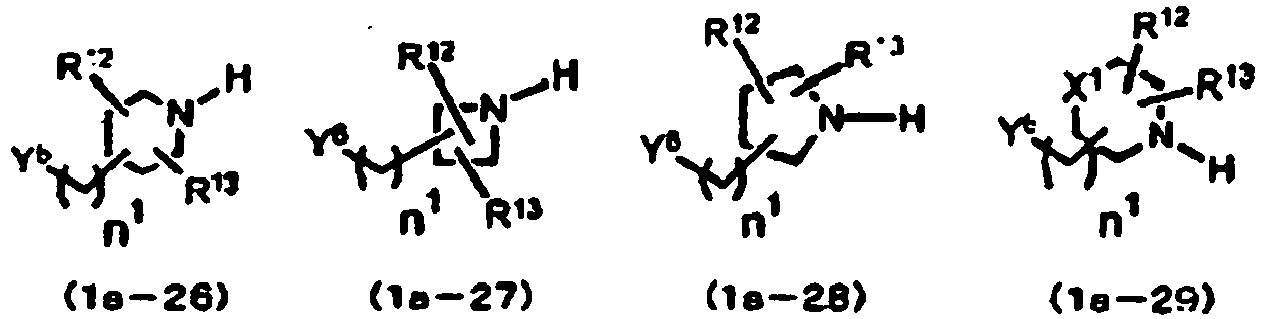

- A compound of the formula (5) can be produced from a compound of the formula (6) wherein E1 represents a hydrogen atom, a p-toluenesulfonyl (Ts) group, a methanesulfonyl (Ms) group, or a trifluoromethanesulfonyl (Tf) group.
A compound of the formula (5) wherein D3a represents a single bond can be produced by performing a Suzuki reaction of a compound of the formula (6) and a commercially available or preparable organic boronic acid compound or organic boronic acid ester (for example, according to Miyaura et al., Journal Of Organometallic Chemistry, 2000, 611, p. 392). Examples of the palladium catalyst used in the Suzuki reaction include tetrakis(triphenylphosphine)palladium, tetrakis(methyldiphenylphosphine)palladium, dichlorobis(triphenylphosphine)palladium, dichlorobis(tri-o-tolylphosphine)palladium, dichlorobis(tricyclohexylphosphine)palladium, dichlorobis(triethylphosphine)palladium, palladium acetate, palladium chloride, bis(acetonitrile)palladium chloride, tris(dibenzylideneacetone)dipalladium, and bis(diphenylphosphinoferrocene)palladium chloride. Furthermore, a catalyst prepared from palladium acetate, tris(dibenzylideneacetone)dipalladium, or the like and an arbitrary ligand may be used. The number of valents in palladium is, for example, 0 or +2. Examples of a ligand in palladium include phosphine ligands such as trifurylphosphine, tri(o-tolyl)phosphine, tri(cyclohexyl)phosphine, tri(t-butyl)phosphine, dicyclohexylphenylphosphine, 1,1'-bis(di-t-butylphosphino)ferrocene, 2-dicyclohexylphosphino-2'-dimethylamino-1,1'-biphenyl, 2-dicyclohexylphosphino-2',4',7'-triisopropylbiphenyl, and 2-(di-t-butylphosphino)biphenyl and nonphosphine ligands such as imidazol-2-ylidene carbenes.
The amount of a palladium catalyst used in the Suzuki reaction is preferably 0.01 mol% or more based on the starting compound (a compound of the formula [6] ), more preferably 0.1 to 50 mol%. Examples of a base used in the Suzuki reaction include sodium carbonate, potassium carbonate, cesium carbonate, cesium fluoride, potassium fluoride, potassium phosphate, potassium acetate, triethylamine, potassium hydroxide, sodium hydroxide, sodium methoxide, and lithium methoxide.
Examples of an inert solvent used in the Suzuki reaction include hydrocarbon solvents such as toluene, xylene, and hexane, halogen hydrocarbon solvents such as dichloromethane and chloroform, sulfoxide solvents such as dimethyl sulfoxide, amide solvents such as dimethylformamide, ether solvents such as tetrahydrofuran, dioxane, and diglyme, alcohol solvents such as methanol, ethanol, and tert-butanol, nitrile solvents such as acetonitrile, ketone solvents such as acetone and cyclohexanone, ester solvents such as ethyl acetate, and heterocyclic ring solvents such as pyridine. Furthermore, 2 or more organic solvents may be mixed. Furthermore, the solvent system may be a biphasic system of water and an organic solvent or a homogeneous system of hydrous organic solvents or organic solvents.
The reaction temperature varies depending on the starting compound, the catalyst, the base, the type of the solvent, and the like and is, for example, 0 to 150°C, preferably from room temperature to 120°C. - Furthermore, as an alternative method, a compound of the formula (5) wherein D3a represents a single bond can be produced by a Stille reaction of a compound of the formula (6) and a commercially available or preparable organic tin compound (for example, according to Angew. Chem. Int. Ed. Engl., 1986, p. 508).
- A compound of the formula (5) wherein D3a represents -N(R21)- can be produced by coupling a compound of the formula (6) and a commercially available or preparable aminating reagent according to the method of Step 1-4. Examples of the aminating reagent include primary or secondary alkylamines and arylamines.
- A compound of the formula (5) wherein D3a represents -0- can be produced by reacting a compound of the formula (6) wherein E1 represents a hydrogen atom and a commercially available or preparable aryl halide or aryl triflate or a compound of the formula (6) wherein E1 represents Ts, Ms, or Tf and an etherifying agent having a hydroxyl group in an inert solvent in the presence of a palladium catalyst, a phosphorus compound, and a base (for example, according to Buchwald, S.L., J. Org. Chem., 2000, p. 1158 and Buchwald, S.L., Organic Letters, 2000, p. 1101). Examples of the inert solvent include ether solvents such as tetrahydrofuran, 1,4-dioxane, and 1,2-dimethoxyethane and toluene. Examples of the palladium catalyst include palladium acetate and tris(dibenzylideneacetone)dipalladium. Examples of the phosphorus compound include 2-(di-tert-butylphosphino)biphenyl, 2-(di-tert-butylphosphino)-1,1'-binaphthyl, and 2-(di-tert-butylphosphino)-2'-dimethylamino-1,1'-binaphthyl. Furthermore, examples of the base include sodium tert-butoxide, potassium tert-butoxide, cesium carbonate, and potassium phosphate. Examples of the etherifying agent include alcohols such as methanol and ethanol and phenols.
- A compound of the formula (5) wherein D38 represents -S- can be produced from a compound of the formula (6) wherein E1 represents Ts, Ms, or Tf and an intended compound having a thiol group according to the same method as in Step 1-4. Examples of the compound having a thiol group include alkylthiols such as ethanethiol and thiophenols.
- A compound of the formula (5) wherein D3a represents -N(R21)-C(O)- can be produced from a compound of the formula (7) wherein D3b represents -N(R21)-H, wherein R21 has the same meaning as defined above. Specifically, a compound of the formula (7) and a commercially available or preparable intended compound having a carboxyl group (-COOH), carboxylic acid chloride, or mixed acid anhydride according to the same method as in the above (1-2-ii).
As an alternative method, a compound of the formula (5) wherein D3a represents -N(R21)- can be produced by coupling a compound of the formula (7) and a commercially available or preparable intended aryl halide or aryl triflate according to the method of above Step 1-4. - A compound of the formula (7) can be produced from a compound of the formula (6). Specifically, by coupling a compound of the formula (6) and a commercially available or preparable compound of the following formula (1-5-2a):
H-N(R21)-G4 (1-5-2a)
wherein R21 has the same meaning as defined above and G4 represents a hydrogen atom or a protective group of an amino group according to the method of Step 1-4 and then deprotecting G4. - A compound of the formula (6) can be produced from a compound of the formula (8). Specifically, preferred examples include known methods comprising reacting p-toluenesulfonyl chloride, methanesulfonyl chloride, trifluoromethanesulfonyl chloride, methanesulfonic acid anhydride, trifluoromethanesulfonic acid anhydride, or N-phenylbis(trifluoromethanesulfonimide) in the presence of a suitable base such as triethylamine, N,N-diisopropylethylamine, pyridine, sodium carbonate, potassium carbonate, or sodium hydrogencarbonate. Examples of the reaction solvent include various organic solvents and chloroform, dichloromethane, and the like are preferred. As the reaction temperature, a suitable temperature is usually selected from -20 to -100°C, preferably -10 to 80°C. The reaction time is generally 1 hour to 3 days, preferably 3 to 24 hours.
A compound of the formula (8) can be produced according to, for example, Reference Examples 1-1 to 1-5 described later. - A compound of the above-mentioned formula (2) wherein D1a, A1a, D2a, R1a, D3a, and R2a has the same meaning as defined above can be produced along a reaction pathway shown in
Scheme 2.
- A compound of the formula (2) may be produced suitably by employing the same method as in (1-1-i) to (1-1-ii), (1-2-i) to (1-2-iv), (1-3-i) to (1-3-iv), and (1-4-i) to (1-4-v) in
Production Method 1.
Furthermore, a compound of the formula (1) can be produced from a compound of the formula (2) according to the method of Step 1-1 inProduction Method 1. - A compound of the formula (2) can be produced from a compound of the formula (9) wherein D1a, A1a, D2a, R1a, and E1 have the same meaning as defined above according to the same method as in Step 1-5 in
Production Method 1. - A compound of the formula (2) wherein D3a represents -N(R21)-C(O)- can be produced from a compound of the formula (10-1) wherein D3b represents -N(R21)-H and D1a, A1a, D2a, R1a, and R21 have the same meaning as defined above according to the same method as in Step 1-5-1 in
Production Method 1.
As an alternative method, a compound of the formula (2) wherein D3a represents -N(R21)- can be produced from a compound of the formula (10-1) according to the same method as in Step 1-5-1 inProduction Method 1. - A compound of the formula (10-1) can be produced from a compound of the formula (9) according to the same method as in Step 1-5-2 in
Production Method 1. - A compound of the formula (9) can be produced from a compound of the formula (10) wherein D18, A1a, D2a, and R1a have the same meaning as defined above according to the same method as in Step 1-6 in
Production Method 1. - A compound of the formula (10) can be produced by deprotecting a compound of the formula (11) wherein D1a, A1a, D2a, and R1a have the same meaning as defined above and E2 represents a hydrogen atom or a protective group of a hydroxyl group.
For example, when E2 represents a benzyl group and a compound of the formula (10) is produced by debenzylation, the above-described "Deprotection reaction by hydrogenolysis" can be performed. Examples include methods comprising performing a reaction in an alcohol, an ether solvent such as ethyl acetate, or 1,4-dioxane or a mixed solvent thereof. Examples of a catalyst include a palladium carbon powder. The reaction is performed, for example, at 0 to 100°C, preferably 10 to 80°C. However, when E2 represents a hydrogen atom, Step 2-3 is unnecessary. - A compound of the formula (11) can be produced from a compound of the formula (12) wherein D1a, A1b, and E2 have the same meaning as defined above according to the same method as in Step 1-2 in
Production Method 1. - A compound of the formula (11) wherein D2a represents -E-C(O)- can be produced from a compound of the formula (12-1) wherein D1a, A1b, D2b, and E2 have the same meaning as defined above according to the method of Step 1-2-1 in
Production Method 1. - A compound of the formula (12-1) can be produced from a compound of the formula (12) according to the same method as in Step 1-2-2 in
Production Method 1. - A compound of the formula (12) can be produced from a compound of the formula (13) wherein D1a, A1c, and E2 have the same meaning as defined above according to the same method as in Step 1-3 in
Production Method 1. - A compound of the formula (13) can be produced from a compound of the formula (14) wherein E2 has the same meaning as defined above according to the method of Step 1-4 in
Production Method 1. - As an alternative method, a compound of the formula (13) wherein D1a represents -N(R11)- or O- can be produced from a compound of the formula (14-1) wherein D1b represents -N(R11)H or -OH and E2 has the same meaning as defined above according to the same method as in Step 1-4-1 in
Production Method 1. - Furthermore, as an alternative method, a compound of the formula (11) can also be produced by using a compound of the formula (14-1) in the method of Step 1-2-3 in
Production Method 1. - A compound of the formula (14-1) can be produced from a compound of the formula (14) wherein E2 has the same meaning as defined above according to the same method as in Step 1-4-2 in
Production Method 1. - Furthermore, as an alternative method, a compound of the formula (11) can also be produced by using a compound of the formula (14) according to the method of Step 1-2-4 in
Production Method 1. - A compound of the formula (14) can be produced by protecting a hydroxyl group in a compound of the formula (8). The protection reaction of a hydroxyl group can be performed according to a known method, for example, the method described in Protective Groups in Organic Synthesis, John Wiley and Sons (2007). Examples of the protective group of a hydroxyl group include the above-mentioned protective groups of a hydroxyl group, for example, a methyl group, a tert-butyl group, a MOM group, a MEM group, a THP group, a benzyl group, and a TBDMS group. In particular, a compound of the formula (14) wherein E2 represents a methyl group can be produced by the method described in Reference Examples 1-1 to 1-4.
- Compounds represented by the formulas (2a) and (2b) can be produced along the reaction pathway shown in Scheme 3. In the following scheme, "Step" means a step, for example, "Step3-1-1" is Step 3-1-1.
Production Methods shown in the following Scheme 3 are particularly preferred production methods when R5 represents a bromine atom or a chlorine atom in the formulas (2a) and (2b).
- In Scheme 3, a compound of the formula (2a) can be produced from a compound of the formula (IM2) wherein R4, and R5 have the same meaning as defined above and a commercially available or preparable compound of the following formula (3-1a) or (3-1b):
Y7-R3 (3-1a)
wherein Y7 represents a halogen atom, and R3 has the same meaning as defined above
H-C(O)-R3 (3-1b)
wherein R3 has the same meaning as defined above according to the same method as in (1-2-i) inProduction Method 1. When R3 in the compound of the formula (2a) represents a hydrogen atom, Step 3-1-1 is unnecessary.
For example, a commercially available iodine methane (TCI) can be used as a compound of the formula (3-1a). Furthermore, a commercially available acetaldehyde (TCI) can be used as a compound formula (3-1b). - In Scheme 3, a compound of the formula (2b) can be produced from a compound of the formula (IM2) wherein R4 and R5 have the same meaning as defined above according to, for example, the method described in The Fifth Series of Experimental Chemistry, The Chemical Society of Japan ed., Maruzen Co., Ltd., vol. 17, pp. 425-427, "Catalytic Dehydrogenation Reaction" and the methods described in the references of this publication.
- In Scheme 3, a compound of the formula (IM2) can be produced by heating a compound of the formula (IM3) wherein R4 and R5 have the same meaning as defined above and formamide in a suitable acid solvent (for example, according to Whaley, W.M. & Govindachari, T.R., Org. React., 1951, 6, p. 74). Examples of the acid solvent include hydrochloric acid, trifluoroacetic acid, and formic acid.
- In Scheme 3, a compound of the formula (IM3) can be produced from a compound of the formula (IM4) wherein R4 and R5 have the same meaning as defined above according to the methods described in, for example, The Fifth Series of Experimental Chemistry, The Chemical Society of Japan ed., Maruzen Co., Ltd., vol. 14, pp. 352-357, "Reduction Reaction of Nitriles" and the methods described in the references of this publication.
- In Scheme 3, a compound of the formula (IM4) can be produced from a compound of the formula (IM5) wherein R4 and R5 have the same meaning as defined above by performing a substitution reaction with a suitable cyanidating agent according to the methods described in, for example, The First Series of Experimental Chemistry, The Chemical Society of Japan ed., Maruzen Co., Ltd., vol. 14, pp. 1433-1439, "Substitution with Metal Cyanides or Hydrogen Cyanides" or the methods described in The Fifth Series of Experimental Chemistry, The Chemical Society of Japan ed., Maruzen Co., Ltd., vol. 14, pp. 517-519, "Synthesis of Nitriles" and the method described in the references of these publications. Examples of the cyanidating agent include sodium cyanide and potassium cyanide.
- In Scheme 3, a compound of the formula (IM5) can be produced from a compound of the formula (IM6) wherein R4 and R5 have the same meaning as defined above according to the methods described in, for example, The Fifth Series of Experimental Chemistry, The Chemical Society of Japan ed., Maruzen Co., Ltd., vol. 13, pp. 393-406, "Generation of C-C1 and C-Br Bonds from C-O Bond and the methods described in the references of this publication.
- In Scheme 3, a compound of the formula (IM6) can be produced from a compound of the formula (IM7) wherein R4 and R5 have the same meaning as defined above according to the methods described in, for example, The Fifth Series of Experimental Chemistry, The Chemical Society of Japan ed., Maruzen Co., Ltd., vol. 14, pp. 1-18, "Synthesis by Reduction Reaction" and the methods described in the references of this publication.
- In Scheme 3, a compound of the formula (IM7) can be produced from a compound of the formula (IM8) wherein R4 and R5 have the same meaning as defined above according to the methods described in, for example, The Fifth Series of Experimental Chemistry, The Chemical Society of Japan ed., Maruzen Co., Ltd., vol. 15, pp. 78-87, "Synthesis by Formylation and Carbonylation" and the methods described in the references of this publication.
- In Scheme 3, a compound of the formula (IM8) can be produced from a compound of the formula (IM9) wherein R6 represents a halogen atom and R4 and R5 have the same meaning as defined above and a commercially available or preparable compound of the following formula (3-8a):
R4-O-M4 (3-8a)
wherein M4 represents an organic metal atom and R4 has the same meaning as defined above according to the methods described in, for example, The Fifth Series of Experimental Chemistry, The Chemical Society of Japan ed., Maruzen Co., Ltd., vol. 14, pp. 241-249, "Synthesis from Aryl Halides" and the methods described in the references of this publication.
For example, as a compound of the formula (3-8a), a commercially available sodium methoxide (WAKO) can be used.
A commercially available compound of the formula (IM9) can also be used. For example, 1,3,5-tribromobenzene (TCI), 1,3-dibromo-5-fluorobenzene (TCI), 1,3-dibromo-5-chlorobenzene (TCI), and 1-bromo-3-chloro-5-fluorobenzene (TCI) can be used. - The compound of the present invention has a IKKβ inhibiting activity.
The compound of the present invention can inhibit the expression of a gene whose expression is regulated by NF-κB by suppressing the activation of NF-κB via inhibition of the IKK activity. Therefore, for example, the compound of the present invention can inhibit the production of inflammatory cytokines (TNF-α, IL-1, etc.), resulting in suppression of inflammatory reactions of these cytokines against various cells. Therefore, the compound of the present invention has an IKKβ inhibiting activity, an IKK inhibiting activity, an NF-κB activation pathway inhibiting activity, a TNF-α production suppressing activity, and the like and is useful for the prevention or treatment of diseases or symptoms associated with IKKβ, IKK, NF-κB, TNF-α, and the like. Furthermore, the compound of the present invention is also useful as an IKKβ inhibitor, an IKK inhibitor, an NF-κB activation pathway inhibitor, a TNF-α production suppressing agent, and the like. - These and other pharmacological activities of the compound of the present invention can be measured by standard test methods, for example, the methods described below.
Examples of IKKβ that can be used for the measurement of an IKKβ activity include a khown human IKKβ (Accession No. NP_001547) and IKKβ mutants that have a sequence of the amino acid sequence of the human IKKβ in which one or more amino acids are substituted, deleted, or added and have an IKKβ activity. In one embodiment, the human IKKβ (Accession No. NP_001547) is more preferred. In another embodiment, IKKβ mutants that have a sequence of the amino acid sequence of the human IKKβ in which one or more amino acids are substituted, deleted, or added and have an IKKβ activity may be preferred. Furthermore, the IKKβ activity can also be measured according to a method already disclosed by Kishore et al. (J. B. C., 2003, 278, pp. 32861-32871) using a commercially available IKKβ (for example, Carna Biosciences, Japan). A preferred example of IKKβ used in the measurement of the IKKβ activity inhibiting ability described in Test Example 1 described later is a fusion protein labeled with a histidine tag at the N terminus of the amino acid residue of human IKKβ obtained in an expression system using baculovirus. - The IKKβ activity inhibiting ability (IKKβ inhibiting activity) and the IKK activity inhibiting ability (IKK inhibiting activity) of the compound of the present invention can be determined by adding a test compound before initiating the enzymatic reaction as in the method described in Test Example 1 described later and measuring the amount of a phosphorylated substrate.
When IKK is activated, IκB is phosphorylated, and the phosphorylated IκB is ubiquitinated and then degraded in the proteasome. The stimulus-dependent degradation of IκB can be measured by the method disclosed in, for example,WO 2004/089913 . The IκBα degradation suppressing activity of the compound of the present invention can be determined by adding a test compound before applying a stimulus to cells and measuring degraded IκBα. - When a cell receives an inflammatory stimulus such as bacterial lipopolysaccharide (LPS), an endotoxin, the cell produces inflammatory cytokines such as TNF-α, and IKK is known to be involved therein. Production of an inflammatory cytokine can be measured by the methods already disclosed in
WO 2004/089913 . The cells to be used may be primary cultured human or animal cells or cultured cell strains such as THP-1 cells as in the method described in Test Example 2 of the present specification. Furthermore, blood can also be used for the measurement as in the method described in Test Example 3 in the present specification. The inflammatory cytokine production inhibiting ability of the compound of the present invention can be determined by adding a test compound before applying an inflammatory stimulus to cells or blood and measuring the amount of inflammatory cytokines produced. - Administration of LPS to animals induces rapid production of TNF-α. This model is used for in-vivo evaluation of a drug that is expected to have a TNF-α production suppressing ability. Specifically, the TNF-α production suppressing ability can be evaluated according to, for example, the method described in Test Example 4 in the present specification and the method already disclosed by Kishore et al. (J. B. C., 2003, 278, pp. 32861-32871). The animals used are not limited to mice and rats. The in-vivo TNF-α production inhibiting ability of the compound of the present invention can be determined by administering a test compound to animals before administering LPS and measuring the amount of inflammatory cytokines produced.
- Examples of TNF-α-associated diseases include rheumatoid arthritis, ankylosing spondylarthritis, Crohn's disease, giant cell arteritis, polymyalgia rheumatica, pigmented purpuric lichenoid dermatitis, sarcoidosis, Wegener's granuloma, pyoderma, Behcet's syndrome, TNF-receptor-associated periodic syndrome, SAPHO syndrome, Takayasu's disease, myositis, Still's disease, periarteritis nodosa, relapsing polychondritis, and scleroderma (C. Lacoin et al., European League Against Rheumatism (EULAR) 2008, THU0470.
- The compound of the present invention has an IKKβ activity inhibiting ability and is useful for the prevention and treatment of diseases and symptoms associated with IKKβ or NF-κB. Examples of such diseases and symptoms include rheumatoid arthritis, osteoarthritis, inflammatory colitis, asthma, chronic obstructive pulmonary disease, transplant rejection (prevention), cancer, ischemia-reperfusion injury, diabetes, virus infections, and heart diseases descried by Burke et al. (Curr. Opin. Drug Discov. Devel., 2003, 6, pp. 720-728) but are not limited to these examples.
Examples of such diseases and symptoms include autoimmune diseases, inflammatory diseases, cardiovascular diseases, cancer, and diseases associated with acute or chronic inflammatory reactions and more specific examples include systemic anaphylaxis, hypersensitivity reaction, drug allergy, allergy to insect stings, food allergy, Crohn's disease, ulcerative colitis, ileitis, enteritis, vaginitis, psoriasis, dermatitis, eczema, atopic dermatitis, allergic contact dermatitis, pigmented purpuric lichenoid dermatitis, urticarial eruption, vasculitis, spondylarthrosis (including ankylosing spondylarthritis), scleroderma, pyoderma, SAPHO syndrome, allergic asthma, allergic rhinitis, allergic conjunctivitis, hypersensitivity lung disease, rheumatoid arthritis, Still's disease, giant cell arteritis, polymyalgia rheumatica, psoriasis arthritis, systemic lupus erythematosus, type I diabetes, glomerulonephritis, transplantation rejection (including allograft rejection and graft versus host disease), atherosclerosis, myositis, ischemia-reperfusion injury, traumatic brain damage, cerebral circulatory disturbance, closed head trauma, Parkinson's disease, multiple secrosis, Alzheimer's disease, encephalitis, meningitis, osteoporosis, gout, hepatitis, nephritis, gallbladder disease, sepsis, sarcoidosis, conjunctivitis, otitis, chronic obstructive pulmonary disease, sinusitis, Behcet's syndrome, cancer in the breast, the skin, the prostate, the neck, the uterus, the ovaries, the testicles, the bladder, the lungs, the liver, the larynx, the mouth cavity, the colon, the gastrointestinal tracts (for example, the esophagus, the stomach, and the pancreas), the brain, the thyroid gland, blood, and the lymphatic system, Wegener's granuloma, diseases in which vasculogenesis or neovascularization plays a role, obesity, type II diabetes, X syndrome, insulin resistance, hyperglycemia, hyperuricemia, hyperinsulinism, cachexia, hypercholesterolemia, hyperlipidemia, dyslipidemia, mixed dyslipidemia, hypertriglyceridemia, anorexia nervosa, bulimia, bacteremia, septic shock acute heart failure, hypotension, hypertension, angina pectoris, myocardial infarction, cardiomyopathy, congestive heart failure, atherosclerosis, coronary arteries disease, restenosis and angiostenosis, periarteritis nodosa, Takayasu's disease, TNF-receptor-associated periodic syndrome, relapsing polychondritis, immunological diseases, and symptoms associated with these diseases. - Usefulness of the compound of the present invention for the prevention and/or treatment of rheumatoid arthritis can be confirmed by, for example, administering a test compound to a mouse collagen-induced arthritis model (see Test Example 5). The mouse collagen-induced arthritis model shows the same biochemical and pathological features as human chronic rheumatoid arthritis and is widely used to study the disease mechanism and potential therapies of human chronic rheumatoid arthritis (Staines et al., Br. J. Rheumatol., 1994, 33, pp. 798-807 and Feldmann et al., Annu. Rev. Immunol., 1996, 14, pp. 397-440). Usefulness can be confirmed by orally, intravenously, or intraperitoneally administering a test compound at doses of 0.01 to 1000 mg/kg, preferably 0.1 to 100 mg/kg to the mouse collagen-induced arthritis model and evaluating swelling and histology of the four limbs.
- Usefulness of the compound of the present invention for the prevention and/or treatment of osteoporosis in patients (including prevention and treatment of bone defect and bone regeneration) can be confirmed by, for example, administering a test compound to an osteoporosis model. Osteoporosis is a term that is widely used for many diseases and symptoms associated with decreased bone mass and includes primary osteoporosis (for example, postmenopausal osteoporosis, senile osteoporosis, and juvenile osteoporosis) and secondary osteoporosis. Examples of secondary osteoporosis include chronic diseases (for example, chronic kidney disease, liver failure, gastrointestinal malabsorption, chronic lack of exercise, and chronic inflammatory diseases including chronic rheumatoid arthritis, osteoarthritis, periodontal disease, and abacterial joint relaxation), diseases associated with endocrine dysfunction (for example, diabetes, hyperthyroidism, hyperparathyroidism, sex dysfunction, and pituitary dysfunction), symptoms associated with drugs and substances (for example, corticosteroids, heparins, anti-convulsants, alcohols, and immunosuppressive agents), and hematological disturbance (for example, metastatic diseases, myeloma, leukemia, Gaucher's disease, and anemia). It has been reported that at least either direct inhibition of IκB or indirect inhibition of the NF-κB pathway is useful for the treatment of osteoporosis and osteoarthritis (
WO 2003/104219 ,WO 2003/103658 ,WO 2003/029242 ,WO 2003/065972 , andWO 99/65495 - Usefulness of the compound of the present invention for the prevention and/or treatment of cerebral circulatory disturbance can be confirmed by, for example, administering a test compound to a mouse cerebral ischemia model (Herrmann et al., Nature Medicine, 2005, 11, pp. 1322-1329). Usefulness can be confirmed by orally, intravenously, or intraperitoneally administering a test compound to the model animal at doses of 0.01 to 1000 mg/kg, preferably 0.1 to 100 mg/kg and measuring the infarct volume and the like.
- Usefulness of the compound of the present invention for the prevention and/or treatment of type II diabetes can be confirmed by, for example, administering a test compound to a mouse insulin resistant diabetes model (Arkan et al., Nature Medicine, 2005, 11, pp. 191-198). Usefulness can be confirmed by orally, intravenously, or intraperitoneally administering a test compound to the model animal at doses of 0.01 to 1000 mg/kg, preferably 0.1 to 100 mg/kg and measuring blood glucose concentrations and plasma insulin concentrations.
- Usefulness of the compound of the present invention for the prevention and/or treatment of cancer can be confirmed by, for example, administering a test compound to an ultraviolet ray irradiation induced skin cancer mouse model, a cancer cell transplanted immunodeficiency mouse model (Orengo, I.F. et al.; Arch. Dermatol., 2002, 138(6), pp. 823-824, and Clin. Cancer Res., 2006 (12), pp. 5887-5894), or the like. Efficacy can be confirmed by orally, intravenously, or intraperitoneally administering a test compound to the model animal at doses of 0.01 to 1000 mg/kg, preferably 0.1 to 100 mg/kg and observing the growth and disappearance of cancer tissues.
- Usefulness of the compound of the present invention as an active ingredient of a pharmaceutical can be confirmed by, for example, performing a metabolism test. Examples of the metabolism test include blood stability test (a method of predicting the in-vivo metabolic clearance from the metabolic rate of a compound in hepatic microsome or the S9 fraction of human or other animal species [refer to Shou, W.Z. et al., J. Mass Spectrom., 40(10), pp. 1347-1356, 2005, Li, C. et al., Drug Metab. Dispos., 34(6), 901-905, 2006, or the like] ), metabolite molecular species test, and reactive metabolite test. Usefulness as an active ingredient of a pharmaceutical can be confirmed by clarifying metabolic profiles of the compound using one or more of these methods.
- The enzyme inhibition selectivity of the compound of the present invention can be evaluated by measuring the inhibitory effect of the compound using various commercially available kinases under reaction conditions suitable for each enzyme. For example, the inhibitory effect of the compound on ROCK I can be evaluated by measuring enzyme activity using commercially available ROCK I (Carna Biosciences, Japan) and HTRF® KinEASE™-STK S2 Kit (Cisbio Bioassays U.S.) in the presence of the compound according to the methods in the instructions attached to the products. Similarly, the inhibitory effect on JAK2 and PKCθ can also be evaluated by the same method as for ROCK I using a combination of commercially available JAK2 (Carna Biosciences, Japan) and HTRF® KinEASE™-TK Kit (Cisbio Bioassays U.S.) and a combination of PKCθ (Carna Biosciences, Japan) and HTRF® KinEASE™-STK S1 Kit (Cisbio Bioassays U.S.). The enzyme inhibition selectivity of the compound can be evaluated by comparing the inhibitory effect on various kinases measured in this manner and the inhibitory effect on IKKβ.
- The present invention also provides methods of prevention and/or treatment for the above-mentioned diseases and symptoms, and the methods include administration of a safe and effective amount of the compound represented by the above-mentioned formula (1) or a pharmaceutically acceptable salt thereof to a mammal requiring the prevention and/or treatment. Furthermore, pharmaceutical compositions or compounds effective in the prevention and/or treatment of the above-mentioned diseases and symptoms can be used in combination. Furthermore, preferred examples of target mammals of the above-mentioned preventing and/or treating methods include humans, pets or companion animals such as dogs and cats, and farm animals.
- In the present specification, to "treat" a disease or a symptom includes to prevent the aggravation of, delay the progression of, improve, cure, resolve, or relieve one or more biological signs of the disease or the symptom and prevent one or more biological cascades that can cause the disease or the symptom. Furthermore, in the present specification, to "prevent" a disease or a symptom is to substantially decrease the possibility and/or severity of one or more biological signs of the disease or the symptom and delay the onset thereof.
- The present invention also provides a pharmaceutical composition comprising the compound of the present invention as an active ingredient. This pharmaceutical composition can be used against the above-mentioned disease or symptom in mammals, preferably humans, pets or companion animals such as dogs and cats, and farm animals solely or in combination with one or more other preventing or treating agents.
Examples of pharmaceuticals that can be used in combination with the pharmaceutical composition of the present invention include immunosuppressants such as, specifically, tacrolimus, cyclosporin, rapamycin, and mycophenolate mofetil and formulations comprising these drugs; disease modifying antirheumatic drugs and antimetabolites used as a treating agent for chronic rheumatoid arthritis such as, specifically, gold formulations, bucillamine, lobenzarit, hydroxychloroquine, D-penicillamine, salazosulfa pyridine, methotrexate, azathiopurine, mizoribine, and leflunomide and formulations comprising these drugs; receptor antagonists against cytokines such as interleukin (IL)-1, IL-6, and tumor necrosis factor (TNF)-α, anti-cytokine antibody formulations, anti-cytokine receptor antibody formulations, and soluble receptor formulations against these cytokines, which antagonists or formulations are biologics, such as, specifically, anakinra, infliximab, tocilizumab, and etanercept and formulations comprising these drugs; steroid formulations such as, specifically, dexamethasone, betamethasone, prednisolone, fluticasone, and beclomethasone and formulations comprising these drugs, bronchodilators used as a treating agent for chronic bronchial asthma such as, specifically, salmeterol and salbutamol, β2 adrenergic stimulants, and ipratropium, an anticholinergic drug and formulations comprising these drugs; treating agents for allergic diseases such as, for example, theophylline, a xanthine-related drug, and formulations comprising these drugs, anti-allergic drugs such as fexofenadine, epinastatin, cetirizine, ketotifen, disodium cromoglycate, and pemirolast and formulations comprising these drugs, leukotriene antagonists such as zafirlukast, montelukast, pranlukast, iralukast, and pobilukast and formulations comprising these drugs, leukotriene biosynthesis inhibitors such as zileuton and formulations comprising these drugs; nonsteroidal anti-inflammatory drugs (NSAIDs) such as, specifically, propionic acid derivatives (for example, alminoprofen, benoxaprofen, bucloxic acid, carprofen, fenbufen, fenoprofen, fluprofen, flurbiprofen, ibuprofen, indoprofen, ketoprofen, miroprofen, naproxen, oxaprozin, pirprofen, pranoprofen, suprofen, tiaprofenic acid, and tioxaprofen) and formulations comprising these drugs, acetic acid derivatives (for example, indomethacin, acemetacin, alclofenac, clidanac, diclofenac, fenclofenac, fenclozic acid, fentiazac, furofenac, ibufenac, isoxepac, oxpinac, sulindac, tiopinac, tolmetin, zidometacin, and zomepirac) and formulations comprising these drugs, fenamate derivatives (for example, flufenamate, meclofenamic acid, mefenamic acid, niflumic acid, and tolfenamic acid) and formulations comprising these drugs, biphenyl carboxylic acid derivatives (for example, diflunisal and flufenisal) and formulations comprising these drugs, oxicams (for example, isoxicam, piroxicam, sudoxicam, and tenoxicam) and formulations comprising these drugs, salicylates (for example, acetylsalicyl acid and sulfaslazine) and formulations comprising these drugs, pyrazolones (for example, apazone, bezpiperylon, feprazone, mofebutazone, oxyphenbutazone, and phenylbutazone) and formulations comprising these drugs, cyclooxygenase-2 inhibitors (for example, celecoxib and rofecoxib) and formulations comprising these drugs; cytoplasmic phospholipase A2α (cPLA2α) inhibitors and formulations comprising these drugs; other IKK inhibitors and formulations comprising these drugs; antitumor drugs such as, specifically, bortezomib, capecitabine, gemcitabine, irinotecan, fludarabine, 5-fluorouracil or 5-fluorouracil/leucovorin, taxanes (for example, paclitaxel and docetaxel), platinum formulations (for example, cisplatin, carboplatin, and oxaliplatin), anthracyclines (for example, doxorubicin and idarubicin), mitoxantrone, dexamethasone, vincristine, etoposide, prednisone, thalidomide, trastuzumab, temozolomide, alkylating agents such as melphalan, chlorambucil, and cyclophosphamide, and formulations comprising these drugs; anti-diabetic drugs such as, specifically, insulin or pseudo insulin, sulfonylureas (for example, glyburide, meglinatide, tolbutamide, and glipizide) and formulations comprising these drugs, biguanides (for example, metformin) and formulations comprising these drugs, α-glucosidase inhibitors (for example, acarbose) and formulations comprising these drugs, thiazolidinone compounds (for example, rosiglitazone, troglitazone, ciglitazone, pioglitazone, and englitazone) and formulations comprising these drugs. Furthermore, a pharmaceutical composition comprising the compound of the present invention as an active ingredient can also be used in combination with radiation therapy. - An effective amount of the compound of the present invention or a pharmaceutically acceptable salt thereof can be used as it is or mixed with a pharmaceutically acceptable carrier to produce a pharmaceutical composition using a technique known to those skilled in the art. Such a carrier may be, for example, a suspending agent such as carboxymethylcellulose, purified water, physiological saline, or the like in some cases, and other known carriers can also be used. As one example, the compound of the present invention or a pharmaceutically acceptable salt thereof can be suspended or dissolved in purified water containing 0.5% carboxymethylcellulose and used as a pharmaceutical composition.
Examples of the dosage form of the pharmaceutical composition of the present invention include tablet, powder, granule, syrup, suspension, capsule, and injection and these formulations can be produced using various carriers depending on the dosage form by techniques known to those skilled in the art. For example, examples of a carrier for an oral agent include excipient, binder, lubricant, fluidity promoter, and coloring material. - When the pharmaceutical composition of the present invention is a parenteral agent such as an injection, distilled water for injection, physiological saline, aqueous glucose solution, vegetable oil for injection, propylene glycol, polyethylene glycol, or the like can be generally used as a diluent. Furthermore, if necessary, a disinfectant, a preservative, a stabilizer, an isotonizing agent, a soothing agent, or the like may also be added.
- When the pharmaceutical composition of the present invention is administered to a mammal, for example, a human, it can be orally administered in the form of tablet, powder, granule, suspension, or capsule or parenterally administered in the form of injection including a drip infusion, suppository, gel, lotion, ointment, cream, or spray. The dose varies depending on the indication, dosage form, patient's age, body weight, severity of the symptom, or the like and the general adult daily dosage is, for example, 0.001 to 2000 mg, which is divided into 1 to 5 times. The pharmaceutical composition of the present invention is generally administered everyday for several days to 2 months, and both the daily dose and the treatment period can be adjusted depending on the patient's symptom.
- Hereafter, the present invention will be specifically described with reference to Examples and Test Examples (hereinafter referred to as "Examples, etc."). However, the scope of the present invention is not limited to the following Examples, etc.
- In the Examples, etc., Precoatedsilica Gel 60 F254 (Merck, Product No. 5715-1M) was used for thin layer chromatography (TLC). After developing with chloroform: methanol (1:0 to 1:1), acetonitrile:acetic acid:water (200:1:1 to 100:4:4), or ethyl acetate:hexane (1:0 to 0:1), the product was confirmed by UV (254 or 365 nm) irradiation, colors produced by iodine solution, aqueous permanganate potassium solution, phosphomolybdic acid (ethanol solution), ninhydrin, dinitrophenylhydrazine hydrochloride solution, or the like.
- Anhydrous magnesium sulfate or anhydrous sodium sulfate was used to dry an organic solvent.
- Among column chromatography procedures,
Quad 1 purification system (Biotage) was used for those indicated with "Quad" and one or several of any cartridge column among KP-Sil-12M, -40S, or -40M manufactured by the corporation were used depending on the amount of a sample. Furthermore, Multi Prep YFLC (Yamazen Corporation) was used for steps indicated with "Yamazen" and any of Ultra Pack Si-40A, 40B, or 40D manufactured by the corporation was used as a column. Furthermore, MORITEX 2-ch Parallel Purification Apparatus "Purif-α2 (50F)" was used for steps indicated with "MORITEX" and PurifPack-Si series manufactured by the corporation was used as a column.
Silica Gel 60N (spherical, neutral, 40 to 100 µm, Kanto Chemical Co., Inc.) was used for flash column chromatography.
One or several of PLC Plate Silica Gel 60 F254, 20 x 20 cm, layer thickness, 2 mm, with concentration zone (4 cm) (Merck, Product No. 13793-1M) were used for preparative thin layer chromatography (hereinafter referred to as "PTLC") depending on the amount of a sample.
For purification by HPLC, the preparative purification system of Japan Waters was used. Develosil C-30-UG-5 (Nomura Chemical Co., Ltd.) or the like was used as a column. A water-acetonitrile solvent containing 0.1% acetic acid was used as an eluate. - Shimadzu LC6A System (Shimadzu Corporation) was used as an HPLC apparatus in "separation of chiral compounds." Chiralcel OJ-RH (20 mm i.d. x 250 mm) (Daicel CHEMICAL INDUSTRIES,LTD.) was used as a column for separation. Elution was performed at a flow rate of 10 mL/min using water as Solution A and acetonitrile as Solution B as solvents, with a ratio of 70% Solution B. In purification by HPLC, the solvent was removed by lyophilization to give a target compound, unless otherwise specified. To measure nuclear magnetic resonance spectrum (NMR), Gemini-300 (FT-NMR, Varian, Inc.), or AL-300 (FT-NMR, JEOL Ltd.) was used. Unless otherwise specified, deuterated chloroform was used as the solvent, a chemical shift was measured using tetramethyl silane (TMS) as an internal standard and expressed with δ (ppm), and the binding constant was expressed with J (Hz).
- For "LCMS," mass spectrum was measured by liquid chromatography mass spectrometry (LCMS). The following apparatuses (A), (B), and (C) were used depending on the purpose for analyses.
- (A) A single quadrupole mass spectrometer, UPLC/SQD System (Waters), was used as a mass spectrometer and measurement was performed by the electrospray (ESI) method. Acquity Ultra Performance LC System was used as the liquid chromatography apparatus. ACQUITY UPLC BEH C18 2.1 x 50 mm 1.7 µm (Waters) was used as the separation column. Generally, elution was performed at a flow rate of 0.6 mL/min, using water (containing 0.1% [v/v] acetic acid) as Solution A and acetonitrile (containing 0.1% [v/v] acetic acid) as Solution B, under conditions of a linear gradient of 5 to 90% (v/v) Solution B from 0 minutes to 2.0 minutes and a linear gradient of 90 to 98% (v/v) Solution B from 2.0 minutes to 2.5 minutes.
- (B) Platform-LC Mass Spectrometer (Micromass) was used as a mass spectrometer for the measurement by the electrospray (ESI) method. An apparatus of GILSON was used as a liquid chromatography apparatus. Develosil C30-UG-5 (50 x 4.6 mm) (Nomura Chemical Co., Ltd.) was used as the separation column. Generally, elution was performed at a flow rate of 2 mL/min, using water (containing 0.1% [v/v] acetic acid) as Solution A and acetonitrile (containing 0.1% [v/v] acetic acid) as Solution B, under conditions of a linear gradient of 5 to 98% (v/v) Solution B from 0 minutes to 4 minutes and 98% (v/v) Solution B to 6 minutes.
- (C) Micromass ZMD Mass Spectrometer (Waters) was used as the mass spectrometer for the measurement by the electrospray (ESI) method. An apparatus of Waters was used as a liquid chromatography apparatus. Develosil C30-UG-5 (50 x 4.6 mm) (Nomura Chemical Co., Ltd.) was used as the separation column. Generally, elution was performed at a
flow rate 2 mL/min, using water (containing 0.1% [v/v] acetic acid) as Solution A and acetonitrile (containing 0.1% [v/v] acetic acid) as Solution B, under conditions of a linear gradient of 5 to 98% (v/v) Solution B from 0 minutes to 4 minutes, followed by 98% Solution B maintained to 5 minutes, a linear gradient of 98 to 5% (v/v) Solution B from 5 minutes to 5.01 minutes, and 5% Solution B maintained to 7.3 minutes. -
- Symbols in the tables are defined as follows.
- "EXP.": Example number
- "exp.": Reference Example number
- "SM1" and "SM2": Starting material. "EXP. Example number" is used for a starting material that is an Example compound and "IM. Intermediate number" is used for a starting material that is an intermediate compound (for example, "IM. Br-1" indicates Intermediate Br-1). Abbreviations used in "SM2" refer to compounds corresponding to abbreviations represented in the tables provided later. For example, starting materials shown in "SM1" and "SM2" in EXP1-N-3 of "Table 1-N" correspond to "Intermediate Br-1" and "sa3," respectively. When there is one starting material, only the relevant starting material is shown.
- "ST": Structure represented by any of general formulas Qn1 to Qn26, Qn1-1, Qn1-2, Qn8-1, Qn1P to Qn10P, Qo1 to Qo14, Qo1-1 to Qo1-10, Qo2-1 to Qo2-6, Qo9-1, and Qs1 to Qs2. In each of the following general formulas, J represents a structure corresponding to an abbreviation such as "co1" in "Table co" and Ar represents a structure corresponding to an abbreviation such as "Ar1" in "Table Ar."
-


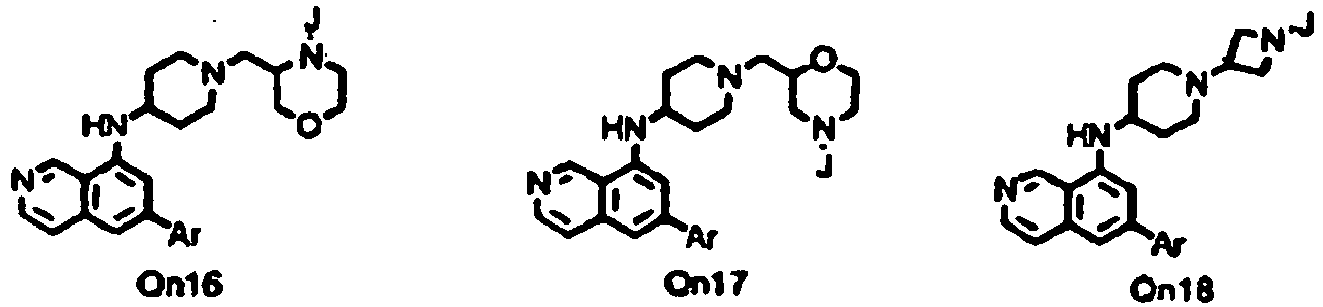


-

-


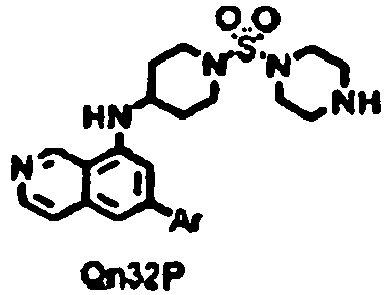
-


-
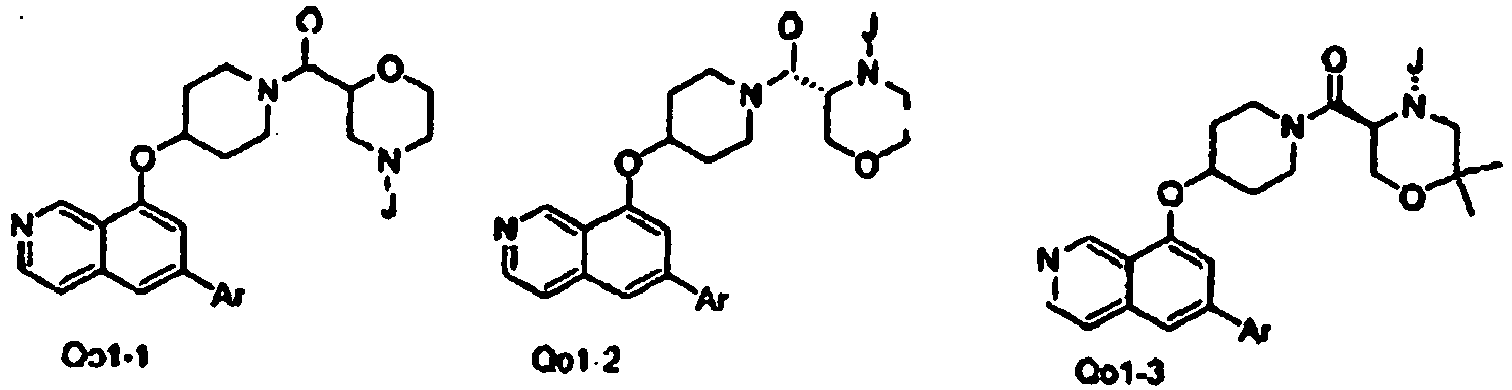


-

-
- "LCMS": Liquid chromatography mass spectrometry spectrum data (m/z). Specifically, the following "method", "RTime", and "mass" are included.
- "method": LCMS conditions. "A" indicates a condition that the above-mentioned "LCMS" apparatus (A) was used. "B" indicates a condition that the above-mentioned "LCMS" apparatus (B) was used. "C" indicates a condition that the above-mentioned "LCMS" apparatus (C) was used. Furthermore, "D" shown in the condition column indicates mass spectrum data measured by fast atom bombardment mass spectrometry (FAB-MS) using JEOL-JMS-SX102 (JEOL Ltd.).
- "RTime": Retention time (min) in LCMS.
- "mass": Mass spectrum data (MH+ or MH-) (however, "N.D." indicates that the molecular ion peak could not be detected). The m/z value in "mass" items indicates the value of a proton-added molecular ion (MH+) unless otherwise specified.
- "Ref.": Example to be referred to for a production method. For example, "EXP. 1-N-2" in the Ref. column indicates that a compound can be synthesized according to the production method described in Example 1-N-2. Furthermore, "EXP. 1-N-1(a)" indicates that a compound can be synthesized according to the production method described in Step a of Example 1-N-1. If a slash appears in the Ref. column, the corresponding Example is described in the main text.
-
- "Spl.": Manufacturer of a reagent used. May be referred to using the following abbreviations:
- Tokyo Chemical Industry, TCI; Aldrich, Ald; Sigma-Aldrich, sAld; Kanto Chemical, KANTO; Wako Pure Chemical Industries, WAKO; Lancaster, LANC; Maybridge, MAYB; Acros, Acros; Nacalai Tesque, nakalai; Alfa Aesar, AAesar; Avocado, Avocado; Fluoro Chem, Fchem; Argonaut, Argonaut; ABCR, ABCR; Matrix, Matrix; Array BioPharma, Array; Oakwood, Oak; AstaTech, Ast; Enamin, Ena; Apollo, Apollo; CNH Technologies, CNH; AMRI, AMRI; Tyger, Tyger; Watanabe, Wata; Fluka, Fluka; NEOSYSTEM, NEO; Novabiochem, Nova; BACHEM, BACHEM; FRONTIER, FRON; Combi-Blocks, Combi; Strem, Strem; Life Chemicals, Life; J&W Pharmalab, J&W; Princeton Bio, Princeton; Bionet, Bionet; Otava, Otava; Synchem, Synchem; Asymchem, Asym; Varian, Varian; NeoMPS, NeoMPS; Tront, Tront; ChemBridge, Chemb; Synthonix, Syn; ACB Blocks, ACBB; Labotest, Labo; Focus, Focus; Hande Sciences, Hande; ASDI, ASDI; Bolon Molecular, Boron.
- Furthermore, abbreviations in the main text and the tables are defined as follows:
- n, normal; i, iso; s, secondary; t, tertiary; c, cyclo; Me, methyl; Et, ethyl; Pr, propyl; Bu, butyl; Pen, pentyl; Hex, hexyl; Hep, heptyl; Ph, phenyl; Bn, benzyl; Py, pyridyl; Indan, indanyl; Ac, acetyl; CHO, formyl; COOH, carboxyl; NO2, nitro; DMA, dimethylamino; NH2, amino; CF3, trifluoromethyl; F, fluoro; Cl, Chloro; Br, bromo; CF3, trifluoromethyl; OMe, methoxy; OH, hydroxy; TFA, trifluoroacetyl; SO2, sulfonyl; CO, carbonyl; THF, tetrahydrofuran; DMF, N,N-dimethylformamide; DMSO, dimethyl sulfoxide; TsOH, p-toluenesulfonic acid; Tf2O, anhydrous trifluoromethanesulfonic acid.
- The number given before a substituent indicates the position of substitution. The hyphenated number before an abbreviation of an aromatic ring indicates the position of substitution of the aromatic ring. (S) included in a compound name or a formula indicates that an asymmetric carbon is in the S configuration, and (R) indicates the R configuration. Furthermore, a compound having asymmetric carbon atoms that does not include (R) or (S) indicates a mixture comprising (R) compounds and (S) compounds in an arbitrary ratio. Such a compound may be a racemic mixture of (R) compound and (S) compound.
In the present specification, unless otherwise specified, as apparent for those skilled in the art,
A symbol


- When deprotection was required in a synthesis step of an Example compound in the Table, deprotection was performed by a known method, such as, for example, the methods described in Protective Groups in Organic Synthesis, John Wiley and Sons (2007).
- NaBH4 (3.85 g; WAKO) was added to an ethanol (80 mL) and THF (20 mL) mixture solution of 3-bromo-5-methoxybenzaldehyde (22 g) with ice cooling and the resulting mixture was stirred at room temperature for 3 hours. The resulting mixture was poured into ice water (300 mL) and ethyl acetate (300 mL) was added thereto to extract the mixture with and the organic layer was washed with saturated aqueous sodium bicarbonate solution (300 mL) and then dried. The solvent was evaporated under reduced pressure to give the title compound (22.05 g).
- 3-Bromo-5-methoxybenzaldehyde can be produced from 1,3,5-tribromobenzene according to the methods described in J. Org. Chem., 2004, 69, p. 8982 and
U.S. Patent No. 2004/198736 . - Triphenylphosphine (28 g; KANTO) was added to a dichloromethane (150 mL) solution of Intermediate 1 (22.05 g) with ice cooling, the resulting mixture was stirred for approx. 10 minutes followed by the addition of N-bromosuccinimide (20 g; TCI), and the resulting mixture was stirred at room temperature for 13 hours and 30 minutes. The solvent was evaporated under reduced pressure and the residue was purified by column chromatography (n-hexane/ethyl acetate) to give the title compound (23.94 g).
- Sodium cyanide (3.4 g; WAKO) was added to a DMSO (100 mL) solution of Intermediate 2 (16.3 g) at room temperature and the resulting mixture was stirred at 40°C for 1 hour and 40 minutes. Ethyl acetate (300 mL) and saturated aqueous sodium bicarbonate solution (150 mL), and water (150 mL) were added to extract the reaction mixture, the reaction mixture was washed with saturated brine (300 mL), the organic layer was dried, and the solvent was evaporated under reduced pressure. The residue was purified by column chromatography (Yamazen; n-hexane/ethyl acetate) to give the title compound (11.37 g).
- A borane-tetrahydrofuran complex (1 M, 73.6 mL) was added to a THF (36.8 mL) solution of Intermediate 3 at room temperature and the resulting mixture was stirred to reflux at 80°C for 2 hours. Methanol (26 mL) and 1 N hydrochloric acid (26 mL) were added to the reaction mixture solution and the resulting mixture was stirred at room temperature for 1 hour. The resulting mixture was neutralized with 1 N aqueous sodium hydroxide solution followed by the addition of ethyl acetate (100 mL) to extract the reaction mixture, the organic layer was dried, and then the solvent was evaporated under reduced pressure to give the title compound (8.76 g).
- Paraformaldehyde (660 mg; WAKO) was added to a formic acid (50 mL) solution of Intermediate 4 (4.33 g) at 50°C and the resulting mixture was stirred as it was for 13 hours and 30 minutes. The solvent was evaporated under reduced pressure followed by the addition of dichloromethane (100 mL) and 1 N aqueous sodium hydroxide solution (100 mL) to extract the reaction mixture, and the aqueous layer was further extracted with dichloromethane. The organic layer was combined and dried and then the solvent was evaporated under reduced pressure to give the title compound (4.49 g).
- Sodium sulfate (2.8 g) and manganese dioxide (7.1 g; Ald) were added to a toluene (60 mL) solution of Intermediate 5 (1.99 g) and the resulting mixture was stirred at 140°C for 24 hours. The reaction mixture was filtrated through celite followed by the addition of 2 N hydrochloric acid and the resulting mixture was washed with ether. The resulting mixture was neutralized with 5 N aqueous sodium hydroxide solution and then extracted with dichloromethane to give the title compound (698 mg).
- 1H-NMR (DMSO); δ (ppm) 3.94 (3H, s), 7.44 (1H, d, J = 2.2 Hz), 7.66 (1H, d, J = 2.2 H2), 7.76 (1H, d, 5.9 Hz), 8.53 (1H, d, 5.9 Hz), 9.29 (1H, s)
- An aqueous hydrobromic acid (180 mL) solution of Intermediate 6 (30 g) was stirred at 130°C for 38 hours. The resulting mixture was stirred at room temperature for approx. 10 minutes followed by the addition of water (300 mL) and the precipitate was collected by filtration and dried to give the title compound (21 g).
- Triethylamine (18 mL; WAKO) and N-phenylbis(trifluoromethanesulfonimide) (14 g; TCI) were added to a chloroform (130 mL) solution of Intermediate 7 (10 g) at room temperature and the resulting mixture was stirred at 90°C for 12 hours and 30 minutes. The resulting mixture was stirred at room temperature for approx. 10 minutes and washed with saturated brine, the organic layer was dried, the solvent was evaporated under reduced pressure, and the residue was purified by column chromatography (Yamazen; n-hexane/ethyl acetate) to give the title compound (10.2 g).
- Benzyl alcohol (0.25 mL; Ald), triphenylphosphine (1.29 g), and TMAD (850 mg; Ald) were added to a toluene (30 mL) solution of Intermediate 7 (500 mg) and the resulting mixture was stirred at room temperature for 13 hours. The reaction mixture solution was filtrated, the solvent was evaporated under reduced pressure, and the residue was purified by column chromatography (Yamazen; n-hexane/ethyl acetate) to give the title compound (186 mg).
- Triethylamine (0.137 mL) was added to a dichloromethane (5 mL) solution of Intermediate 7 (100 mg) and p-toluenesulfonic acid chloride (66 mg; WAKO) at room temperature and the resulting mixture was stirred as it was for 15 hours. The resulting mixture was diluted with dichloromethane and washed with water, the organic layer was dried, then the solvent was evaporated under reduced pressure, and the residue was purified by column chromatography (Yamazen; n-hexane/ethyl acetate) to give the title compound (92.9 mg).
- An aqueous solution (50 mL) of sodium carbonate (3.5 g) was added to a THF (200 mL) solution of Intermediate 8 (3.9 g), 3-cyanophenylboronic acid (which may be referred to as sbol; 1.6 g; WAKE), PdCl2dppf.CH2Cl2 (1.78 g; TCI) at room temperature and the resulting mixture was stirred as it was for 6 and half hours. Ethyl acetate (300 mL), saturated brine, and water were added to extract the reaction mixture, then the organic layer was dried, the solvent was evaporated under reduced pressure, and the residue was purified by column chromatography (Yamazen; chloroform/methanol) to give the title compound (2.1 g).
- According to the method of Reference Example Br-1, syntheses in Reference Examples Br-2 to Br-7 were performed using
Intermediate 8 as a raw material to synthesize Intermediates Br-2 to Br-7 (Table Br). In Table Br, the Ar column represents "Ar" in the general formula QBr shown below and the structures corresponding to each abbreviation are shown in Table Ar provided later. Further, in Table Br, the SM1 column represents compounds used in each Reference Example corresponding to 3-cyanophenylboronic acid (which may be referred to as sbo1) used in Reference Example Br-1. Further, the Reference Example number of a compound produced in each Reference Example is used as an intermediate number thereof. For example, the compound obtained in Reference Example Br-2 is Intermediate Br-2. In Table Br, "exp." and "LCMS" are defined as described above, and abbreviations such as "sbo1" and "Ar1" represent compounds or groups corresponding to abbreviations in Tables sbo and Ar. -

[Table B r ] exp SM1 Ar LCMS method RTime MH+ Br-1 sbo1 Ar1 A 1. 17 309. 0 Br-2 sbo2 Ar2 A 2. 10 318. 2 Br-3 sbo3 Ar3 A 1. 16 285. 1 Br-4 sbo4 Ar4 A 1. 73 326. 9 Br-5 sbo5 Ar7 A 2. 21 370. 0 Br-6 sbo6 Ar8 A 1. 81 413. 2 Br-7 sbo41 Ar41 A 1. 79 327. 2 Br-8 sbo192 Ar192 A 1. 18 299. 1 Br-9 sbo186 Ar186 A 1. 02 299. 1 Br-10 sbo161 Ar161 A 0. 94 313. 3 - Triethylamine (10 mL) was added to a dichloromethane (90 mL) solution of 1-benzyl piperidin-4-ylcarbamate (5.09 g) at 0°C followed by the dropwise addition of ethane sulfonylchloride (which may be referred to as sso10; 3.2 mL; TCI) and the resulting mixture was stirred overnight slowly raising to room temperature. 1 N Hydrochloric acid (90 mL; WAKO) was added to the reaction mixture solution, the resulting mixture was stirred for approx. 10 minutes, then the reaction mixture was extracted with chloroform, the organic layer was dried, the solvent was evaporated under reduced pressure, and the residue was purified by silica gel column chromatography (Yamazen; chloroform/methanol). Palladium hydroxide (20% by weight, Wet-type, 5 g; NECHEM) was added to a methanol (90 mL) solution of this product under a nitrogen atmosphere. The atmosphere in a reaction vessel was replaced with hydrogen at room temperature, the resulting mixture was stirred overnight, the atmosphere in the reaction vessel was returned to a nitrogen atmosphere, the residue was removed by filtration, the solvent was evaporated under reduced pressure, and the residue was dried to give the title compound (3.32 g).
- Intermediates N-1 and N-3 were synthesized using mesyl chloride (which may be referred to as sso1) and cyclopropylsulfonyl chloride (which may be referred to as sso4), respectively, instead of ethanesulfonyl chloride described in the step of Reference Example N-2.
- Triethylamine (14 mL; WAKO) was added to a dichloromethane (98 mL) solution of 1-benzyl piperidin-4-ylcarbamate (5.33 g), 6-methylnicotinic acid (which may be referred to as sco100; 4.0 g; Ald), HOAt (4.0 g; Wata) and WSC.HC1 (5.7 g; Wata) and the resulting mixture was stirred overnight at room temperature. Saturated sodium hydrogencarbonate solution (50 mL) was added to the reaction mixture solution, the resulting mixture was extracted, the organic layer was dried, the solvent was evaporated under reduced pressure, and the residue was purified by silica gel column chromatography (Yamazen; chloroform/methanol). Palladium carbon (10% by weight, Pe-type, 3.45 g; NECHEM) was added to a methanol (90 mL) solution of this product under a nitrogen atmosphere. The atmosphere in a reaction vessel was replaced with hydrogen- at room temperature, the resulting mixture was stirred overnight, the atmosphere in the reaction vessel was returned to a nitrogen atmosphere, the residue was removed by filtration, the solvent was evaporated under reduced pressure, and the residue was dried to give the title compound (4.05 g).
- Intermediates N-5, N-6, N-7 and N-8 were synthesized using cyclopropanecarboxylic acid (which may be referred to as sco2), 6-cyanonicotinic acid (which may be referred to as sco6), nicotinic acid (which may be referred to as sco28) and methoxyacetic acid (which may be referred to as sco96), respectively, instead of 6-methylnicotinic acid described in the step of Reference Example N-4.
- Intermediates N-9 and N-10 were synthesized using acetic anhydride (which may be referred to as sco1) and propionyl chloride (TCI), respectively, instead of ethanesulfonyl chloride described in the step of Reference Example N-2.
- Sodium sulfite (1.3 g; WAKO), ethanol (3.9 mL), and water (5.8 mL) were added to (bromomethyl)cyclobutane (0.8 mL; Ald), the resulting mixture was stirred at 100°C for 2 hours, and the solvent was evaporated under reduced pressure. Toluene (10 mL), DMF (20 µL), and thionyl chloride (1.9 mL; TCI) were successively added to the residue, the resulting mixture was stirred at 110°C for 5 hours, and the solvent was evaporated under reduced pressure. This residue was used instead of ethanesulfonyl chloride described in the step of Reference Example N-2 to give the title compound.
- Intermediates N-12 and N-13 were synthesized using (bromomethyl)cyclopropane and tetrahydrofurfuryl bromide, respectively, instead of (bromomethyl)cyclobutane described in the step of Reference Example N-11.
- Triethylamine (3 mL) was added to a dichloromethane (200 mL) solution of 1-benzyl piperidin-4-ylcarbamate (1.2 g) at 0°C followed by the dropwise addition of 3-chloropropane sulfonylchloride (4.3 mL; TCI) and the resulting mixture was slowly stirred overnight with raising to room temperature. 1 N Hydrochloric acid (90 mL; WAKO) was added to the reaction mixture solution, the resulting mixture was stirred for approx. 10 minutes, then the reaction mixture was extracted with chloroform, the organic layer was dried, the solvent was evaporated under reduced pressure, and the residue was purified by silica gel column chromatography (Yamazen; chloroform/methanol). 100 mg of this purified compound was dissolved in acetone (10 mL) followed by the addition of sodium iodide (KANTO; 44 mg) and the resulting mixture was stirred at room temperature for 12 hours. Sodium iodide (KANTO; 44 mg) was further added, the resulting mixture was stirred at 40°C for 24 hours followed by the addition of sodium iodide (KANTO; 132 mg), and the resulting mixture was stirred at 60°C for 24 hours. The reaction mixture solution was cooled to room temperature, the residue was collected by filtration using a Kiriyama funnel to give the title compound (64 mg).
(LCMS: 467.2 (MH+); retention time: 1.68 min; LCMS; condition A) - Morpholine (22 µL) and sodium carbonate (27 mg) were added to an acetonitrile (0.5 mL) solution of Intermediate N-14-1 (15 mg) and the resulting mixture was stirred at 80°C for 12 hours. Water was added to the reaction mixture solution and the resulting mixture was extracted with ethyl acetate. The organic layer was dried and the solvent was evaporated under reduced pressure to give the title compound (13 mg).
(LCMS: 426.3 (MH+); retention time: 1.03 min; LCMS; condition A) - Palladium/carbon (10% by weight, Wet-type, 6 mg; NECHEM) was added to a methanol (150 µL) solution of Intermediate N-14-2 (13 mg) under a nitrogen atmosphere. The atmosphere in a reaction vessel was replaced with hydrogen at room temperature, the resulting mixture was stirred overnight, the atmosphere in the reaction vessel was returned to a nitrogen atmosphere, the residue was removed by filtration, the solvent was evaporated under reduced pressure, and the residue was dried to give the title compound (8.1 mg).
(LCMS: 292.3 (MH+); retention time: 0.25 min; LCMS; condition A) - Intermediates N-18 and N-25 were synthesized using 1-methylpiperazine and dimethylamine, respectively, instead of morpholine described in the step of Reference Example N-14.
- Potassium acetate (12 mg) was added to a DMF (1 mL) solution of Intermediate N-14-1 (15 mg) and the resulting mixture was stirred at 80°C for 15 hours. Saturated aqueous sodium bicarbonate solution was added to the reaction mixture solution and the resulting mixture was extracted with ethyl acetate. The organic layer was dried and the solvent was evaporated under reduced pressure. The title compound was obtained from this product according to the method described in Step c of Reference Example N-14.
(LCMS: 265.2 (MH+); retention time: 0.27 min; LCMS; condition A) - Sodium cyanide (6 mg) was added to a DMSO (1 mL) solution of Intermediate N-14-1 (15 mg) and the resulting mixture was stirred at 80°C for 1 hour. Saturated aqueous sodium bicarbonate solution was added to the reaction mixture solution and the resulting mixture was extracted with ethyl acetate. The organic layer was dried and the solvent was evaporated under reduced pressure. The title compound (2.3 mg) was obtained from this product according to the method described in Step c of Reference Example N-14.
(LCMS: 232.2 (MH+); retention time: 0.27 min; LCMS; condition A) - Triethylamine (10 mL) was added to a dichloromethane (90 mL) solution of 1-benzyl piperidin-4-ylcarbamate (5.09 g) at 0°C followed by the dropwise addition of methanesulfonyl chloride (which may be referred to as sbo1; 3 mL; TCI) and the resulting mixture was slowly stirred overnight with raising to room temperature. 1 N Hydrochloric acid (90 mL; WAKO) was added to the reaction mixture solution, the resulting mixture was stirred for approx. 10 minute, the resulting mixture was extracted with chloroform, the organic layer was dried, then the solvent was evaporated under reduced pressure, and the residue was purified by silica gel column chromatography (Yamazen; chloroform/methanol). 200 mg of this purified compound was dissolved in THF (4 mL) and the resulting mixture was added dropwise to a THF (5 mL) solution of LDA prepared from diisopropylamine (0.2 mL; WAKO) and normal butyllithium (1.6 M, 1 mL; KANTO) at -78°C. The resulting mixture was stirred for 30 minutes followed by the dropwise addition of THF (3 mL) solution of N-fluorobenzenesulfonimide (320 mg) and the resulting mixture was slowly stirred overnight with raising to room temperature. Saturated aqueous ammonium chloride solution was added to the reaction mixture solution and the resulting mixture was extracted with ethyl acetate. The organic layer was dried, the solvent was evaporated under reduced pressure, and the residue was purified by silica gel column chromatography (Yamazen; chloroform/methanol). The title compound (10 mg) was obtained from this purified product according to the method described in Step c of Reference Example N-14.
(LCMS: 197.2 (MH+); retention time: 0.27 min; LCMS; condition A) - Triethylamine (3.4 mL) was added to a dichloromethane (300 mL) solution of 1-benzyl piperidin-4-ylcarbamate (2.2 g) at 0°C followed by the dropwise addition of 2-chloroethanesulfonyl chloride (2.6 mL; TCI) and the resulting mixture was slowly stirred overnight with raising to room temperature. 1 N Hydrochloric acid (90 mL; WAKO) was added to the reaction mixture solution, the resulting mixture was stirred for approx. 10 minutes, then the reaction mixture was extracted with chloroform, the organic layer was dried, the solvent was evaporated under reduced pressure, and the residue was purified by silica gel column chromatography (Yamazen; chloroform/methanol). 30 mg of this purified compound was dissolved in methanol (1 mL) followed by the addition of dimethylamine (2 M, 0.2 mL; Ald), the resulting mixture was stirred at 100°C for 2 hours with microwave irradiation, and then the solvent was evaporated under reduced pressure. The title compound was obtained from this residue according to the method described in Step c of Reference Example N-14.
(LCMS: 236.2 (MH+); retention time: 0.27 min; LCMS; condition A) - Intermediates N-20, N-21, N-22 and N-23 were synthesized using morpholine, diethylamine, pyrrolidine and piperidine, respectively, instead of dimethylamine described in the step of Reference Example N-19.
- Triethylamine (1.5 mL) was added to a dichloromethane (30 mL) solution of 1-benzylpiperidin-4-ylcarbamate (580 mg) at 0°C followed by the dropwise addition of chlorosulfonic acid (290 µL; TCI), the resulting mixture was stirred at room temperature for 4 hours, and the solvent was evaporated under reduced pressure. Benzene (32 mL) and phosphorus pentachloride (0.7 g; WAKO) were added to this residue and the resulting mixture was stirred at 80°C for 1.5 hours. The reaction mixture solution was cooled to room temperature followed by the addition of 1 N aqueous sodium hydroxide solution (10 mL), the resulting mixture was extracted with dichloromethane, the organic layer was dried, then the solvent was evaporated under reduced pressure, and the residue was purified by silica gel column chromatography (Yamazen; hexane/ethyl acetate). 30 mg of this purified compound was dissolved in dichloromethane (0.4 mL) followed by the addition of 3,5-lutidine (0.4 mL; WAKO) and methylamine (2 M,70 µL; Ald) and the resulting mixture was stirred at room temperature for 24 hours. 1 N hydrochloric acid (2 mL; WAKO) was added to the reaction mixture solution, the resulting mixture was stirred for approx. 10 minutes, then the reaction mixture was extracted with dichloromethane, the organic layer was dried, and then the solvent was evaporated under reduced pressure. The title compound was obtained from this residue according to the method described in Step c of Reference Example N-14.
(LCMS: 194.1 (MH+); retention time: 0.27 min; LCMS; condition A) - Intermediates N-26, N-27, N-28, N-29, N-30, N-31 and N-32 were synthesized using morpholine, dimethylamine, ethylamine, isopropylamine, 1-methyl piperazine, piperidine and 1-(tert-butoxycarbonyl)piperezine, respectively, instead of methylamine described in the step of Reference Example N-24.
- Reference Example Tf-1 8-(1-(methylsulfonyl)piperidin-4-ylamino)isoquinolin-6-yl trifluoromethanesulfonate (Intermediate Tf-1)
- The title compound (1.09 g) was obtained from Intermediate 6 (2 g) and Intermediate N-1 by the similar method as Step a of Example 1-N-1.
- A dichloromethane solution of boron tribromide (1 M, 44.7 mL; TCI) was added to a dichloromethane solution of Intermediate Tf-1-1 (1.0 g) at 0°C under a nitrogen atmosphere and the resulting mixture was returned to room temperature and then stirred overnight at 50°C. Methanol was added and then the solvent was evaporated under reduced pressure to give the title compound (1.8 g).
- The title compound (0.62 g) was obtained from Intermediate Tf-1-2 (1.8 g) by the similar method as Reference Example 1-6-1.
- Intermediates Tf-2 and Tf-3 were synthesized using Intermediates N-2 and N-3, respectively, instead of Intermediate N-1 described in the step of Reference Example Tf-1.
- Sodium t-butoxide (1.58 g; TCI) was added to a toluene solution of Intermediate Br-1 (1.7 g), 4-amino-1-N-Boc-piperidine (which may be referred to as sal; 2.2 g; WAKO), Pd2(dba)3 (1.0 g; Ald), and BINAP (1.36 g; Ald) under a nitrogen atmosphere and the resulting mixture was stirred at 80°C for 8 hours. The resulting mixture was stirred at room temperature for approx. 10 minutes, then the reaction mixture solution was filtrated, and the filtrate was concentrated under reduced pressure. The residue was purified by column chromatography (Yamazen; hexane/ethyl acetate) to give the title compound (1.2 g).
- A methanol hydrochloride solution (10%, 20 mL; TCI) of Intermediate 1-N-1 (1.2 g) was stirred at 50°C for 2 and half hours. The resulting mixture was stirred at room temperature for approx. 10 minutes followed by the addition of ether and the precipitate was collected by filtration and dried to give the title compound (997 mg).
(LCMS: 329.3 (MH+); retention time: 0.77 min; LCMS; condition A) - Sodium t-butoxide (23.1 mg) was added to a toluene solution of Intermediate Br-1 (24.7 mg), N-(3-aminopropyl)imidazole (which may be referred to as sa22; 90.1 mg; TCI), Pd2(dba)3 (14.7 mg), and BINAP (19.9 mg) under a nitrogen atmosphere and the resulting mixture was stirred at 80°C for 8 hours. The resulting mixture was stirred at room temperature for approx. 10 minutes, then the reaction mixture solution was filtrated, and the solvent was evaporated. The residue was purified by preparative HPLC to give the title compound (6.0 mg).
(LCMS: 359.2 (MH+); retention time: 2.29 min; LCMS; condition B) - Cesium carbonate (958 mg; Ald) was added to a toluene solution of Intermediate Br-1 (300 mg), 4-hydroxy-1-N-Boc-piperidine (which may be referred to as soh1; 604 mg; Ald), Pd(OAc)2 (44.9 mg; WAKO), and 1,1'-binaphthyl-2-yldi-tert-butylphosphine (94.6 mg; Strem) under a nitrogen atmosphere and the resulting mixture was stirred overnight at 70°C. The resulting mixture was stirred at room temperature for approx. 10 minutes, then the reaction mixture solution was filtrated, and the filtrate was concentrated under reduced pressure. The residue was purified by column chromatography (Yamazen; chloroform/methanol) to give the title compound (256 mg).
(Intermediate 1-o-1 LCMS: 430.5 (MH+); retention time: 1.70 min; LCMS; condition A) - The title compound (186 mg) was obtained from Intermediate 1-o-1 (256 mg) according to the method described in Step b of Example 1-N-1.
(LCMS: 330.0 (MH+); retention time: 0.85 min; LCMS; condition A) - Example 1-o-39 3-(8-(cyclopropylmethoxy)isoquinolin-6-yl)benzonitrile Cesium carbonate (52.7 mg) was added to a 1,4-dioxane solution of Intermediate Br-1 (24.7 mg), cyclopropylmethanol (which may be referred to as soh39; 29.4 mg; Ald), Pd(OAc)2 (11.1 mg), 1,1'-binaphthyl-2-yldi-tert-butylphosphine (26.0 mg) and the resulting mixture was stirred at 80°C for 21 hours. The reaction mixture solution was filtrated through celite and then the filtrate was concentrated. The residue was dissolved in dichloromethane (250 µL), the resulting mixture was added to SCX resin (300 mg; Varian) and agitated by shaking for 3 hours. The reaction mixture was filtrated, then the SCX resin was washed with dichloromethane and methanol followed by the addition of 2 M ammonia methanol solution to elute, and the solvent was evaporated to give the title compound (11.0 mg).
(LCMS: 301.3 (MR+); retention time: 1.50 min; LCMS; condition A) - Diisopropylethylamine (211 µL; TCI) was added to 1,4-dioxane solution of Intermediate Br-1 (187 mg), 4-mercapto-1-N-Boc-piperidine (which may be referred to as ssh1; 132 mg; Intermediate 1-s-1), Pd2(dba)3 (55.5 mg), and Xanthphos (70.1 mg; Ald) under a nitrogen atmosphere and the resulting mixture was stirred overnight at 80°C. The resulting mixture was stirred at room temperature for approx. 10 minutes, then the reaction mixture solution was filtrated, and the filtrate was concentrated under reduced pressure. The residue was purified by column chromatography (Yamazen; chloroform/methanol) to give the title compound (1.36 mg).
(Intermediate 1-s-1 LCMS: 446.4 (MH+); retention time: 5.28 min; LCMS; condition B) - The title compound (90.5 mg) was obtained from Intermediate 1-s-1 (136 mg) according to the method described in Step b of Example 1-N-1.
(LCMS: 346.2 (MH+); retention time: 1.01 min; LCMS; condition A) - Compounds of Examples 1-N-3 to 1-N-62, 1-o-2 to 1-o-56, and 1-s-2 were synthesized according to the method in Example 1-N-1, 1-N-22, 1-o-1, 1-o-39, or 1-s-1 (Tables 1-N, 1-o, and 1-s). At this time, for example, the method described in Step b of Example 1-N-1 was used if deprotection was required. The X and Ar columns in Tables 1-N, 1-o, and 1-s represent "X" and "Ar," respectively, in the following general formula "Q1. "SM1," "SM2," "LCMS," and "Ref" are defined as described above. Abbreviations such as "a1, " "Ar1," "sa1," "oh1," "soh1," "sh1," and "ssh1" represent compounds or groups corresponding to abbreviations in Tables a, Ar, sa, oh, soh, sh, and ssh, respectively.
-

- Example compounds 1-o-24, -31, -41 to -44, and -49 to -51 in Table 1-o were finally purified by preparative HPLC.
-


-


-

- Triethylamine (103 µL) and acetic anhydride (which may be referred to as sco1; 28 µL; WAKO) were added to a dichloromethane (6 mL) solution of Example compound 1-N-1 (60 mg) at room temperature and the resulting mixture was stirred for 11 hours. Methanol was added to the reaction mixture solution and the resulting mixture was concentrated under reduced pressure and purified by silica gel column chromatography (Yamazen; chloroform/methanol) to give the title compound (69.1 mg).
(LCMS: 371.4 (MH+); retention time: 1.09 min; LCM; condition A) - Triethylamine (35 µL) and cyclopropanecarboxylic acid (which may be referred to as sco2; 12.8 mg; TCI) were added to a DMF (2 mL) solution of Example compound 1-N-1 (20 mg), HOAt (14 mg; TCI), WSC (29 mg; TCI) at room temperature and the resulting mixture was stirred for 12 and half hours at room temperature. Ethyl acetate, saturated brine, and water were added to extract the reaction mixture, then the organic layer was dried, the solvent was evaporated under reduced pressure, and the residue was purified by column chromatography (Yamazen; chloroform/methanol) to give the title compound (17.5 mg).
(LCMS: 397.4 (MH+); retention time: 1.15 min; LCMS; condition A) - PS-DCC resin (N-Cyclohexylcarbodiimide-N'-propyloxymethyl polystyrene; 35.0 mg; Nova), HOAt (6.2 mg), triethylamine (15.4 µL), and 2-methylbenzoic acid (which may be referred to as sco3; 4.6 mg; TCI) were added to a DMF (0.6 mL) solution of Example compound 1-N-1 (10.0 mg) and the resulting mixture was shaken at room temperature for 14 hours under a nitrogen atmosphere. The reaction mixture was filtrated and the residue was washed with DMF (0.25 mL x 2). The filtrate and the wash were mixed followed by the addition of MP-Carbonate resin (Macroporous triethylammonium methylpolystyrene carbonate; 50 mg; Argonaut), the resulting mixture was shaken for 1 hour followed by the addition of MP-Carbonate resin (50 mg), the resulting mixture was shaken for 1 hour, MP-Carbonate resin (50 mg) was further added, and the resulting mixture was shaken for 14 hours. The resulting mixture was filtrated followed by the addition of SCX (300 mg) and the resulting mixture was shaken for 2 hours. The reaction mixture was filtrated and the residue was washed with dichloromethane (3 mL) and methanol (4 mL). Then, the mixture was washed with 4 N ammonia methanol solution (4 mL; Ald) and this resulting wash was concentrated. The resulting mixture was dried using a vacuum pump to give the title compound (9.5 mg).
(LCMS: 447.1 (MH+); retention time: 1.30 min; LCMS; condition A) - PS-DCC resin (N-Cyclohexylcarbodiimide-N'-propyloxymethylpolystyrene; 35.0 mg; Nova), HOAT (6.2 mg), triethylamine (15.4 µL), and 2-(methylsulfonamide)benzoic acid (which may be referred to as sco4; 9.0 mg; Matrix) were added to a DMF (0.6 mL) solution of Example compound 1-N-1 (10.0 mg) and the resulting mixture was shaken at room temperature for 14 hours under a nitrogen atmosphere. The resulting mixture was filtrated followed by the addition of SCX (300 mg) and the resulting mixture was shaken for 2 hours. The reaction mixture was filtrated and the residue was washed with dichloromethane (3 mL) and methanol (4 mL). Then, the mixture was washed with 4 N ammonia methanol solution (4 mL; Ald) and this resulting wash was concentrated. The resulting mixture was dried using a vacuum pump to give the title compound (3.5 mg) .
(LCMS: 526.2 (MH+); retention time: 1.24 min; LCMS; condition A) - PS-DCC resin (35.0 mg), HOAt (6.2 mg), triethylamine (15.4 µL), and 3-hydroxypropionic acid (which may be referred to as sco5; 4.0 mg; TCI) were added to a DMF (0.6 mL) solution of Example compound 1-N-1 (10.0 mg) and the resulting mixture was shaken at room temperature for 14 hours under a nitrogen atmosphere. The reaction mixture was filtrated and the residue was washed with DMF (0.25 mL × 2). The filtrate and the wash were mixed followed by the addition of MP-Carbonate resin (50 mg), the resulting mixture was shaken for 1 hour followed by the addition of MP-Carbonate resin (50 mg), and the resulting mixture was shaken for 1 hour. MP-Carbonate resin (50 mg) and PS-Isocyanate resin (Polystyrene methylisocyanate; 50 mg; Ald) were further added, and the resulting mixture was shaken for 14 hours. The resulting mixture was filtrated followed by the addition of SCX (300 mg) and the resulting mixture was shaken for 2 hours. The reaction mixture was filtrated and the residue was washed with dichloromethane (3 mL) and methanol (4 mL). Then, the mixture was washed with 4 N ammonia methanol solution (4 mL) and this resulting wash was concentrated. The resulting mixture was dried using a vacuum pump to give the title compound (5.3 mg).
(LCMS: 401.2 (MH+); retention time: 1.02 min; LCMS; condition A) - Compounds of Examples 2-N-6 to 2-N-113, 2-N-201 to 2-N-293, 2-N-301 to 2-N-320, 2-N-401 to 2-N-402, 2-N-501 to 2-N-511, 2-N-601 to 2-N-620, 2-N-701 to 2-N-713, 2-N-801 to 2-N-804 and 2-N-901 to 2-N-990, 2-o-1 to 2-o-257 and 2-s-1 to 2-s-6 were synthesized according to the methods in Example 2-N-1 to 2-N-5 (Tables 2-N, 2-o, and 2-s).
In Tables 2-N, 2-o, and 2-s, the ST column represent the structures represented by the above general formulas, the J and Ar columns represent "J" and "Ar," respectively, in the general formulas shown in the ST column, "ST," "SM1," "SM2," "LCMS," and "Ref" are defined as described above, and abbreviations such as "co1," "Ar1," and "sco1" represent compounds or groups corresponding to the abbreviations in Tables co, Ar, and sco, respectively, provided later. Abbreviations in the tables represent compounds or groups shown in the figures shown earlier or later.
Tables 2-N, 2-o, and 2-s also include compounds finally purified by preparative HPLC, such as those of Examples 2-o-33, 2-o-34, 2-o-52, 2-o-76, 2-o-88, 2-o-89, 2-o-99, 2-o-100, 2-o-120, 2-o-128 to 2-o-132, 2-o-158, 2-o-160, 2-o-170 to 2-o-172, 2-o-181, 2-o-189, 2-o-191 to 2-o-193, 2-o-210, 2-o-211, 2-o-221, 2-o-222, for example.
EXP. 4-N-3, 4-N-4, 4-N-5, and 4-N-7 represent Example compounds 4-N-3, 4-N-4, 4-N-5, and 4-N-7, respectively, described later. - Compounds of Example 4-NP-419, 4-NP-420, 4-NP-435 to 4-NP-458, 4-NP-469 to 4-NP-471, 4-NP-497 to 4-NP-507, 4-NP-511 and 4-NP-517 were synthesized according to the methods in Examples 2-N-1 to 2-N-5 (Table 2-N2). In Table 2-N2, the ST column represents the structures represented by the above general formulas, the J and Ar columns represent "J" and "Ar" in the general formula represented in the ST column, "ST," "SM1," "SM2," "LCMS," and "Ref" are defined as described above, abbreviations such as "co1," "Ar1," and "sco1" represent compounds or groups corresponding to the abbreviations in Tables co, Ar, and sco, respectively, provided later. Abbreviations in the tables represent compounds or groups shown in the figures shown earlier or later. The compounds in the tables also include compounds finally purified by preparative HPLC.
-


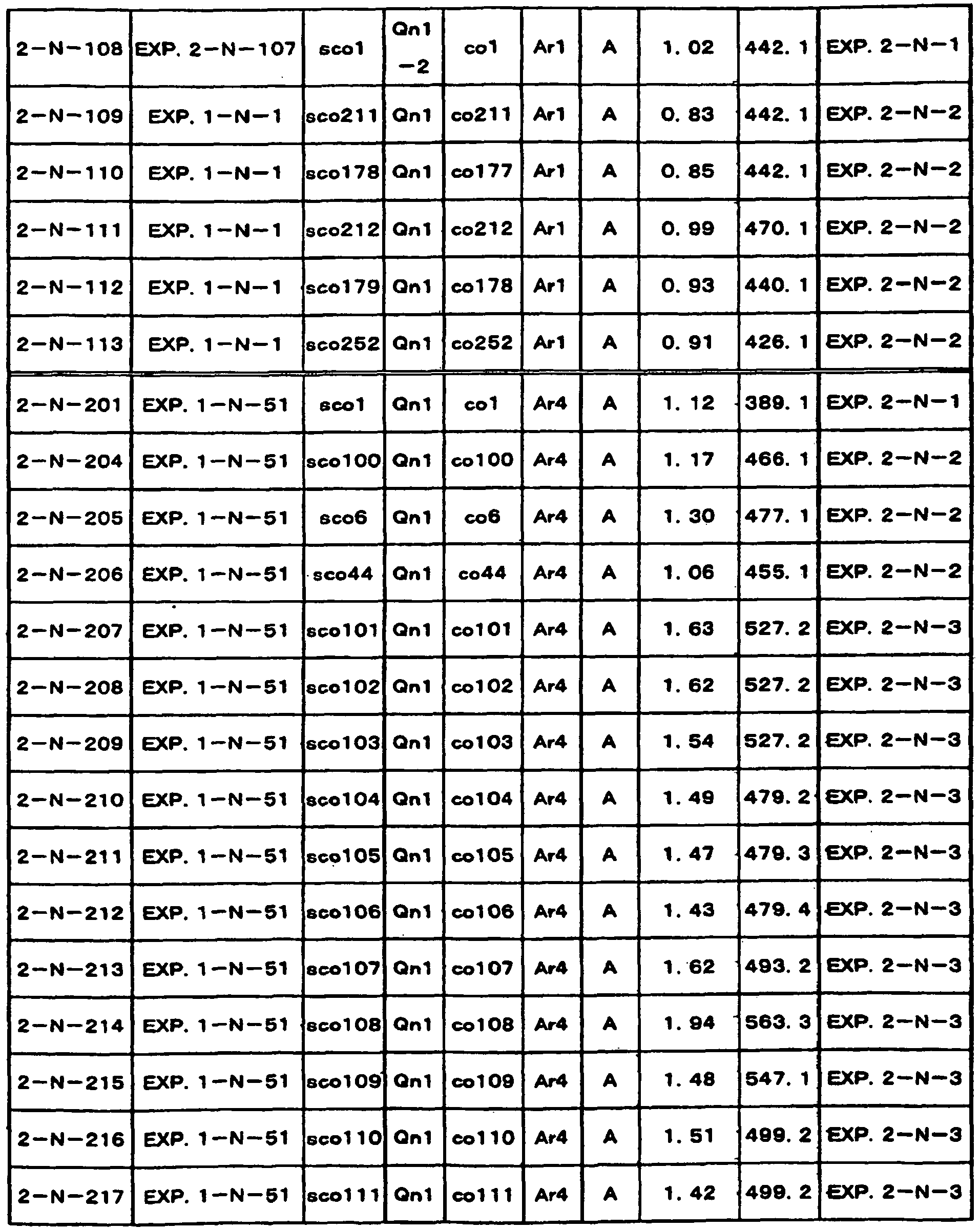


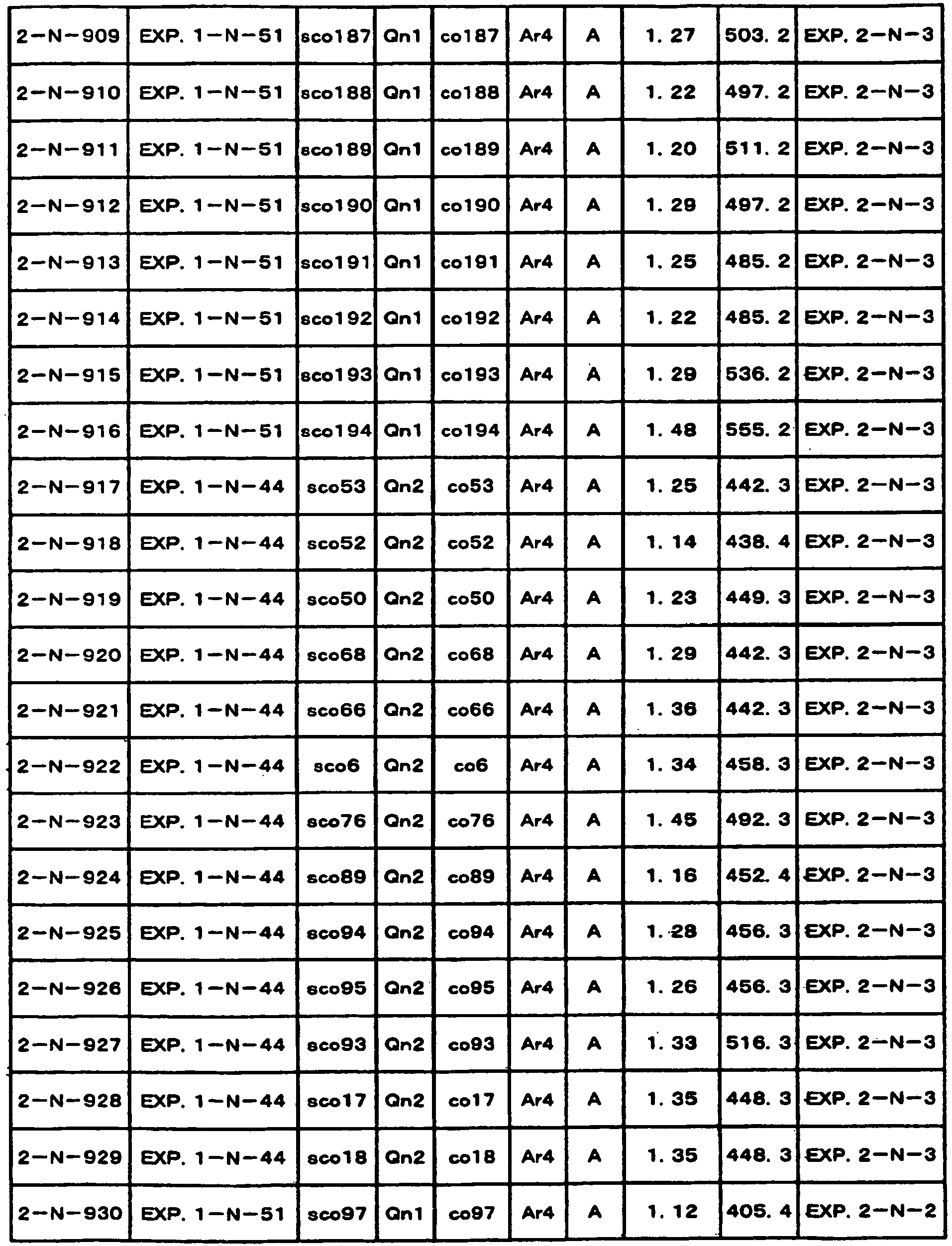


-
[Table 2-o] EXP SM1 SM2 ST J Ar LCMS Ref meth od RTime MH+ 2-o-1 EXP. 1-o-1 sco1 Qo1 co1 Ar1 A 1. 14 372. 4 EXP. 2-N-1 2-o-2 EXP. 1-o-1 sco201 Qo1 co201 Ar1 A 1. 33 400. 3 EXP. 2-N-2 2-o-3 EXP. 1-o-1 sco2 Qo1 co2 Ar1 A 1. 29 398. 3 EXP. 2-N-2 2-o-4 EXP. 1-o-1 sco202 Qo1 co202 Ar1 A 1. 06 441. 3 EXP. 2-N-2 2-o-5 EXP. 1-o-1 sco203 Qo1 co203 Ar1 A 1. 18 442. 3 EXP. 2-N-2 2-o-6 EXP. 1-o-1 sco204 Qo1 co204 Ar1 A 1. 2 428. 1 EXP. 2-N-2 2-o-7 EXP. 1-o-1 sco49 Qo1 co49 Ar1 A 1. 36 424. 3 EXP. 2-N-2 2-o-8 EXP. 1-o-1 sco205 Qo1 co205 Ar1 A 0. 95 441. 1 EXP. 2-N-2 2-o-9 EXP. 1-o-1 sco206 Qo1 co206 Ar1 A 1. 44 437. 3 EXP. 2-N-2 2-o-10 EXP. 1-o-1 sco47 Qo1 co47 Ar1 A 1. 43 440. 2 EXP. 2-N-2 2-o-11 EXP. 1-o-1 sco39 Qo1 co39 Ar1 A 1. 11 436. 2 EXP. 2-N-2 2-o-12 EXP. 1-o-1 sco41 Qo1 co41 Ar1 A 1. 18 436. 2 EXP. 2-N-2 2-o-13 EXP. 1-o-1 sco37 Qo1 co37 Ar1 A 1. 24 435. 3 EXP. 2-N-2 2-o-14 EXP. 1-o-1 sco44 Qo1 co44 Ar1 A 1. 03 438. 2 EXP. 2-N-2 2-o-15 EXP. 1-o-1 sco207 Qo1 co207 Ar1 A 1. 37 438. 3 EXP. 2-N-2 2-o-16 EXP. 1-o-1 sco208 Qo1 co208 Ar1 A 1. 21 438. 3 EXP. 2-N-2 2-o-17 EXP. 1-o-1 sco45 Qo1 co45 Ar1 A 1. 23 441. 2 EXP. 2-N-2 2-o-18 EXP. 1-o-1 sco209 Qo1 co209 Ar1 A 1. 03 453. 0 EXP. 2-N-2 2-o-19 EXP. 1-o-1 sco210 Qo1 co210 Ar1 A 1. 00 443. 1 EXP. 2-N-2 2-o-20 EXP. 1-o-1 sco211 Qo1 co211 Ar1 A 0. 92 443. 1 EXP. 2-N-2 2-o-21 EXP. 1-o-1 sco212 Qo1 co212 Ar1 A 0. 99 471. 1 EXP. 2-N-2 2-o-22 EXP. 1-o-1 sco213 Qo1 co213 Ar1 A 0. 96 485. 1 EXP. 2-N-2 2-o-23 EXP. 1-o-1 sco28 Qo1 co28 Ar1 A 1. 17 436. 2 EXP. 2-N-2 2-o-24 EXP. 1-o-1 sco37 Qo1 co37 Ar1 A 1. 24 435. 3 EXP. 2-N-2 2-o-26 EXP. 1-o-1 sco76 Qo1 co76 Ar1 A 1. 63 503. 3 EXP. 2-N-2 2-o-26 EXP. 1-o-1 sco100 Qo1 co100 Ar1 A 1. 17 449. 1 EXP. 2-N-3 2-o-27 EXP. 1-o-1 sco74 Qo1 co74 Ar1 A 1. 35 469. 0 EXP. 2-N-3 2-o-28 EXP. 1-o-1 sco75 Qo1 co75 Ar1 A 0. 99 460. 1 EXP. 2-N-3 2-o-29 EXP. 1-o-1 sco6 Qo1 co6 Ar1 A 1. 29 460. 2 EXP. 2-N-3 2-o-30 EXP. 1-o-1 sco53 Qo1 co53 Ar1 A 1. 25 453. 2 EXP. 2-N-3 2-o-31 EXP. 1-o-1 sco38 Qo1 co38 Ar1 A 1. 12 435. 0 EXP. 2-N-3 2-o-32 EXP. 1-o-1 sco68 Qo1 co68 Ar1 A 1. 29 453. 2 EXP. 2-N-3 2-o-33 EXP. 1-o-1 sco214 Qo1 co214 Ar1 A 1. 31 453. 3 EXP. 2-N-3 2-o-34 EXP. 1-o-1 sco77 Qo1 co77 Ar1 A 1. 35 465. 1 EXP. 2-N-3 2-o-35 EXP. 1-o-1 sco215 Qo1 co215 Ar1 A 1. 38 483. 0 EXP. 2-N-3 2-o-36 EXP. 1-o-1 sco249 Qo1 co249 Ar1 A 1. 26 449. 1 EXP. 2-N-2 2-o-37 EXP. 1-o-1 sco31 Qo1 co31 Ar1 A 1. 40 434. 3 EXP. 2-N-3 2-o-38 EXP. 1-o-1 sco8 Qo1 co8 Ar1 A 1. 51 448. 3 EXP. 2-N-3 2-o-39 EXP. 1-o-1 sco11 Qo1 co11 Ar1 A 1. 45 452. 3 EXP. 2-N-3 2-o-40 EXP. 1-o-1 sco23 Qo1 co23 Ar1 A 1. 46 464. 3 EXP. 2-N-3 2-o-41 EXP. 1-o-1 sco17 Qo1 co17 Ar1 A 1. 39 459. 3 EXP. 2-N-3 2-o-42 EXP. 1-o-1 sco26 Qo1 co26 Ar1 A 1. 53 477. 1 EXP. 2-N-3 2-o-43 EXP. 1-o-1 sco92 Qo1 co92 Ar1 A 1. 09 449. 2 EXP. 2-N-3 2-o-44 EXP. 1-o-1 sco216 Qo1 co216 Ar1 A 1. 04 438. 1 EXP. 2-N-3 2-o-46 EXP. 1-o-1 sco97 Qo1 co97 Ar1 A 1. 19 388. 3 EXP. 2-N-2 2-o-46 EXP. 1-o-1 sco96 Qo1 co96 Ar1 A 1. 15 402. 3 EXP. 2-N-3 2-o-47 EXP. 1-o-1 sco217 Qo1 co217 Ar1 A 1. 05 430. 1 EXP. 2-N-2 2-o-48 EXP. 1-o-1 sco218 Qo1 co218 Ar1 A 0. 87 387. 0 EXP. 2-N-2 2-o-49 EXP. 1-o-1 sco219 Qo1 co219 Ar1 A 0. 93 415. 1 EXP. 2-N-2 2-o-50 EXP. 1-o-1 sco220 Qo1 co220 Ar1 A 0. 93 457. 1 EXP. 2-N-2- 2-o-51 EXP. 1-o-1 sco221 Qo1 co221 Ar1 A 0. 90 441. 1 EXP. 2-N-2 2-o-52 EXP. 1-o-1 sco222 Qo1 co222 Ar1 B 2. 37 457. 2 EXP. 2-N-2 2-o-53 EXP. 1-o-1 sco223 Qo1 co223 Ar1 A 1. 13 416. 1 EXP. 2-N-3 2-o-54 EXP. 1-o-1 sco224 Qo1 co224 Ar1 A 1. 29 456. 1 EXP. 2-N-3 2-o-55 EXP. 1-o-1 sco225 Qo1 co225 Ar1 A 1. 32 470. 3 EXP. 2-N-3 2-o-56 EXP. 1-o-1 sco98 Qo1 co98 Ar1 A 1. 18 430. 1 EXP. 2-N-3 2-o-57 EXP. 1-o-1 sco99 Qo1 co99 Ar1 A 1. 15 430. 1 EXP. 2-N-3 2-o-58 EXP. 1-o-1 sco226 Qo1 co226 Ar1 A 1. 70 538. 1 EXP. 2-N-3 2-o-59 EXP. 1-o-1 sco227 Qo1 co227 Ar1 A 1. 39 484. 3 EXP. 2-N-3 2-o-60 EXP. 1-o-1 sco228 Qo1 co228 Ar1 A 1. 06 416. 1 EXP. 2-N-3 2-o-61 EXP. 1-o-1 sco229 Qo1 co229 Ar1 A 0. 96 441. 2 EXP. 2-N-2 2-o-62 EXP. 1-o-1 sco230 Qo1 co230 Ar1 A 0. 91 455. 1 EXP. 2-N-2 2-o-63 EXP. 1-o-1 sco231 Qo1 co231 Ar1 A 0. 93 413. 2 EXP. 2-N-2 2-o-64 EXP. 1-o-1 sco232 Qo1 co232 Ar1 A 0. 94 427. 2 EXP. 2-N-2 2-o-65 EXP. 1-o-1 sco252 Qo1 co252 Ar1 A 0. 93 427. 1 EXP. 2-N-2 2-o-66 EXP. 1-o-6 sco1 Qo2 co1 Ar1 A 1. 07 344. 1 EXP. 2-N-1 2-o-67 EXP. 1-o-6 sco39 Qo2 co39 Ar1 A 1. 01 408. 2 EXP. 2-N-4 2-o-68 EXP. 1-o-6 sco41 Qo2 co41 Ar1 A 1. 20 408. 1 EXP. 2-N-2 2-o-69 EXP. 1-o-8 sco40 Qo2 co40 Ar1 A 1. 10 408. 0 EXP. 2-N-2 2-o-70 EXP. 1-o-8 sco44 Qo2 co44 Ar1 A 0. 97 410. 2 EXP. 2-N-4 2-o-71 EXP. 1-o-6 sco43 Qo2 co43 Ar1 A 1. 04 410. 1 EXP. 2-N-2 2-o-72 EXP. 1-o-6 sco233 Qo2 co233 Ar1 A 1. 22 395. 2 EXP. 2-N-4 2-o-73 EXP. 1-o-6 sco207 Qo2 co207 Ar1 A 1. 23 410. 1 EXP. 2-N-2 2-o-74 EXP. 1-o-6 sco234 Qo2 co234 Ar1 A 1. 20 410. 1 EXP. 2-N-2 2-o-75 EXP. 1-o-8 sco235 Qo2 co235 Ar1 A 0. 89 415. 1 EXP. 2-N-2 2-o-76 EXP. 1-o-6 sco210 Qo2 co210 Ar1 A 0. 95 415. 2 EXP. 2-N-2 2-o-77 EXP. 1-o-6 sco28 Qo2 co28 Ar1 A 1. 08 407. 2 EXP. 2-N-4 2-o-78 EXP. 1-o-6 sco76 Qo2 co76 Ar1 A 1. 49 475. 1 EXP. 2-N-2 2-o-79 EXP. 1-o-6 sco53 Qo2 co53 Ar1 A 1. 24 425. 1 EXP. 2-N-2 2-o-80 EXP. 1-o-6 sco100 Go2 co100 Ar1 A 1. 13 421. 1 EXP. 2-N-3 2-o-81 EXP. 1-o-6 sco74 Go2 co74 Ar1 A 1. 33 441. 0 EXP. 2-N-3 2-o-82 EXP. 1-o-6 sco75 Qo2 co75 Ar1 A 0. 94 422. 0 EXP. 2-N-3 2-o-83 EXP. 1-o-8 sco6 Qo2 co6 Ar1 A 1. 25 432. 0 EXP. 2-N-3 2-o-84 EXP. 1-o-6 sco38 Qo2 co38 Ar1 A 1. 09 407. 0 EXP. 2-N-3 2-o-85 EXP. 1-o-6 sco68 Qo2 co68 Ar1 A 1. 25 425. 0 EXP. 2-N-3 2-o-86 EXP. 1-o-6 sco236 Qo2 co236 Ar1 A 1. 28 455. 2 EXP. 2-N-3 2-o-87 EXP. 1-o-6 sco215 Qo2 co215 Ar1 A 1. 34 455. 0 EXP. 2-N-3 2-o-88 EXP. 1-o-6 sco214 Qo2 co214 Ar1 A 1. 27 425. 1 EXP. 2-N-3 2-o-89 EXP. 1-o-8 sco77 Qo2 co77 Ar1 A 1. 32 437. 1 EXP. 2-N-3 2-o-90 EXP. 1-o-6 sco31 Qo2 co31 Ar1 A 1. 36 408. 3 EXP. 2-N-3 2-o-91 EXP. 1-o-8 sco8 Qo2 co8 Ar1 A 1. 46 420. 3 EXP. 2-N-3 2-o-92 EXP. 1-o-6 sco11 Qo2 co11 Ar1 A 1. 40 424. 3 EXP. 2-N-3 2-o-93 EXP. 1-o-6 sco23 Qo2 co23 Ar1 A 1. 39 436. 3 EXP. 2-N-3 2-o-94 EXP. 1-o-6 sco17 Qo2 co17 Ar1 A 1. 33 431. 2 EXP. 2-N-3 2-o-95 EXP. 1-o-6 sco26 Qo2 co26 Ar1 A 1. 46 449. 1 EXP. 2-N-3 2-o-96 EXP. 1-o-6 sco237 Qo2 co237 Ar1 A 1. 26 457. 1 EXP. 2-N-2 2-o-97 EXP. 1-o-6 sco92 Qo2 co92 Ar1 A 0. 97 421. 2 EXP. 2-N-2 2-o-98 EXP. 1-o-6 sco238 Qo2 co238 Ar1 A 0. 97 421. 1 EXP. 2-N-2 2-o-99 EXP. 1-o-6 sco239 Qo2 co239 Ar1 A 0. 99 435. 1 EXP. 2-N-2 2-o-100 EXP. 1-o-6 sco216 Qo2 cc216 Ar1 A 0. 91 410. 0 EXP. 2-N-2 2-o-101 EXP. 1-o-6 sco240 Qo2 co240 Ar1 A 0. 97 411. 2 EXP. 2-N-4 2-o-102 EXP. 1-o-6 sco241 Qo2 co241 Ar1 A 0. 95 412. 2 EXP. 2-N-4 2-o-103 EXP. 1-o-6 sco242 Qo2 co242 Ar1 A 0. 88 424. 2 EXP. 2-N-2 2-o-104 EXP. 1-o-6 sco243 Qo2 co243 Ar1 A 0. 89 427. 2 EXP. 2-N-2 2-o-105 EXP. 1-o-6 sco97 Go2 co97 Ar1 A 1. 10 359. 8 EXP. 2-N-2 2-o-106 EXP. 1-o-6 sco244 Qo2 co244 Ar1 A 1. 00 374. 1 EXP. 2-N-2 2-o-107 EXP. 1-o-6 sco245 Qo2 co245 Ar1 A 1. 48 496. 3 EXP. 2-N-2 2-o-108 EXP. 1-o-6 sco223 Qo2 co223 Ar1 A 1. 01 388. 1 EXP. 2-N-3 2-o-109 EXP. 1-o-8 sco224 Qo2 co224 Ar1 A 1. 20 428. 1 EXP. 2-N-3 2-o-110 EXP. 1-o-8 sco227 Qo2 co227 Ar1 A 1. 22 442. 1 EXP. 2-N-3 2-o-111 EXP. 1-o-6 sco98 Qo2 co98 Ar1 A 1. 06 402. 1 EXP. 2-N-3 2-o-112 EXP. 1-o-6 sco99 Qo2 co99 Ar1 A 1. 04 402. 1 EXP. 2-N-3 2-o-113 EXP. 1-o-6 sco226 Qo2 co226 Ar1 A 1. 61 510. 2 EXP. 2-N-3 2-o-114 EXP. 1-o-6 sco227 Qo2 co227 Ar1 A 1. 28 456. 3 EXP. 2-N-3 2-o-115 EXP. 1-o-6 sco228 Qo2 co228 Ar1 A 0. 97 388. 1 EXP. 2-N-3 2-o-116 EXP. 1-o-6 sco218 Qo2 co218 Ar1 A 0. 82 359. 0 EXP. 2-N-2 2-o-117 EXP. 1-o-6 sco246 Qo2 co246 Ar1 A 0. 82 373. 0 EXP. 2-N-2 2-o-118 EXP. 1-o-8 sco219 Qo2 co219 Ar1 A 0. 94 387. 1 EXP. 2-N-2 2-o-119 EXP. 1-o-8 sco229 Qo2 co229 Ar1 A 1. 46 413. 2 EXP. 2-N-2 2-o-120 EXP. 1-o-6 sco230 Qo2 co230 Ar1 A 0. 87 427. 2 EXP. 2-N-2 2-o-121 EXP. 1-o-6 sco230 Qo2 co230 Ar1 A 0. 81 385. 2 EXP. 2-N-2 2-o-122 EXP. 1-o-3 sco1 Qo3 co1 Ar1 A 1. 08 358. 4 EXP. 2-N-2 2-o-123 EXP. 1-o-3 sco215 Qo3 co215 Ar1 A 1. 29 469. 0 EXP. 2-N-3 2-o-124 EXP. 1-o-3 sco44 Qo3 co44 Ar1 A 0. 91 424. 1 EXP. 2-N-3 2-o-125 EXP. 1-o-3 sco39 Qo3 co39 Ar1 A 0. 99 422. 1 EXP. 2-N-3 2-o-126 EXP. 1-o-3 sco97 Qo3 co97 Ar1 A 0. 94 374. 1 EXP. 2-N-3 2-o-128 EXP. 1-o-76 sco1 Qo5 co1 Ar1 A 0. 98 402. 0 EXP. 2-N-2 2-o-129 EXP. 1-o-76 sco28 Qo5 co28 Ar1 A 0. 99 465. 0 EXP. 2-N-2 2-o-130 EXP. 1-o-76 sco44 Qo5 co44 Ar1 A 0. 89 468. 0 EXP. 2-N-2 2-o-131 EXP. 1-o-76 sco219 Qo5 so219 Ar1 A 0. 8 445. 1 EXP. 2-N-2 2-o-132 EXP. 1-o-76 sco97 Qo5 co97 Ar1 A 0. 92 418. 0 EXP. 2-N-2 2-o-133 EXP. 1-o-13 sco1 Qo6 co1 Ar1 A 1. 08 372. 2 EXP. 2-N-1 2-o-134 EXP. 1-o-13 sco247 Qo6 co247 Ar1 A 1. 28 453. 2 EXP. 2-N-2 2-o-135 EXP. 1-o-13 sco249 Qo6 co249 Ar1 A 1. 35 423. 2 EXP. 2-N-2 2-o-136 EXP. 1-o-13 sco250 Qo6 co250 Ar1 A 1. 02 424. 2 EXP. 2-N-2 2-o-137 EXP. 1-o-13 sco240 Qo6 co240 Ar1 A 1. 08 439. 2 EXP. 2-N-2 2-o-138 EXP. 1-o-11 sco1 Qo7 co1 Ar1 A 1. 16 386. 2 EXP. 2-N-1 2-o-139 EXP. 1-o-12 sco1 Qo8 co1 Ar1 A 1. 32 386. 4 EXP. 2-N-1 2-o-140 EXP. 1-o-16 sco1 Qo9 co1 Ar1 A 1. 08 358. 0 EXP. 2-N-1 2-o-141 EXP. 1-o-15 sco44 Qo9 co44 Ar1 A 1. 09 424. 1 EXP. 2-N-2 2-o-142 EXP. 1-o-15 sco210 Qo9 co210 Ar1 B 2. 32 429. 3 EXP. 2-N-2 2-o-143 EXP. 1-o-15 sco216 Qo9 co216 Ar1 B 2. 28 424. 2 EXP. 2-N-2 2-o-144 EXP. 1-o-15 sco219 Qo9 co219 Ar1 A 0. 91 401. 0 EXP. 2-N-2 2-o-145 EXP. 1-o-18 sco1 Qo10 co1 Ar1 B 2. 91 388. 3 EXP. 2-N-1 2-o-146 EXP. 1-o-18 sco44 Qo10 co44 Ar1 B 2. 55 454. 2 EXP. 2-N-2 2-o-147 EXP. 1-o-10 sco1 Qo11 co1 Ar1 A 0. 98 346. 1 EXP. 2-N-1 2-o-148 EXP. 1-o-7 sco44 Qo12 co44 Ar1 A 1. 07 452. 1 EXP. 2-N-3 2-o-149 EXP. 1-o-7 sco97 Qo12 co97 Ar1 A 1. 05 402. 1 EXP. 2-N-3 2-o-150 EXP. 1-o-8 sco1 Qo13 co1 Ar1 A 1. 13 386. 2 EXP. 2-N-1 2-o-151 EXP. 1-o-8 sco44 Qo13 co44 Ar1 A 1. 03 452. 1 EXP. 2-N-2 2-o-152 EXP. 2-o-19 sco1 Qo1-1 co1 Ar1 A 1. 23 485. 3 EXP. 2-N-1 2-o-153 EXP. 2-o-19 sco44 Qo1-1 co44 Ar1 A 1. 13 551. 1 EXP. 2-N-2 2-o-154 EXP. 2-o-20 sco1 Qo1-2 co1 Ar1 A 1. 12 485. 2 EXP. 2-N-1 2-o-155 EXP. 2-o-20 sco44 Qo1-2 co44 Ar1 A 1. 05 551. 1 EXP. 2-N-2 2-o-156 EXP. 2-o-21 sco1 Qo1-3 co1 Ar1 B 3. 16 513. 3 EXP. 2-N-1 2-o-157 EXP. 2-o-21 sco44 Qo1-3 co44 Ar1 B 2. 84 579. 2 EXP. 2-N-2 2-o-158 EXP. 2-o-22 sco219 Qo1-4 co219 Ar1 A 1. 15 570. 0 EXP. 2-N-5 2-o-159 EXP. 2-o-22 sco44 Qo1-4 co44 Ar1 A 1. 13 593. 1 EXP. 2-N-5 2-o-160 EXP. 2-o-22 sco97 Qo1-4 co97 Ar1 A 1. 25 543. 2 EXP. 2-N-5 2-o-161 EXP. 2-o-22 sco2 Qo1-4 co2 Ar1 A 1. 34 653. 1 EXP. 2-N-6 2-o-162 EXP. 2-o-36 sco1 Qo1-5 co1 Ar1 A 1. 25 491. 2 EXP. 2-N-1 2-o-163 EXP. 2-o-36 sco44 Qo1-5 co44 Ar1 A 1. 26 557. 7 EXP. 2-N-2 2-o-164 EXP. 2-o-48 sco44 Qo1-6 co44 Ar1 A 1. 03 495. 1 EXP. 2-N-3 2-o-165 EXP. 2-o-48 sco219 Qo1-6 co219 Ar1 A 0. 96 472. 1 EXP. 2-N-3 2-o-166 EXP. 2-o-48 sco39 Qo1-6 co39 Ar1 A 1. 09 493. 1 EXP. 2-N-3 2-o-167 EXP. 2-o-48 sco207 Qo1-6 co207 Ar1 A 1. 17 495. 1 EXP. 2-N-3 2-o-168 EXP. 2-o-48 sco216 Qo1-6 co216 Ar1 A 0. 98 495. 1 EXP. 2-N-3 2-o-169 EXP. 2-o-48 sco217 Qo1-6 co217 Ar1 A 1. 02 486. 1 EXP. 2-N-3 2-o-170 EXP. 2-o-48 sco97 Qo1-6 co97 Ar1 A 1. 04 445. 1 EXP. 2-N-3 2-o-171 EXP. 2-o-48 sco2 Qo1-6 co2 Ar1 A 1. 17 455. 1 EXP. 2-N-3 2-o-172 EXP. 2-o-48 sco49 Qo1-6 co49 Ar1 A 1. 23 481. 1 EXP. 2-N-3 2-o-173 EXP. 2-o-61 sco1 Qo1-7 co1 Ar1 A 1. 14 483. 3 EXP. 2-N-1 2-o-174 EXP. 2-o-81 sco28 Qo1-7 co28 Ar1 A 1. 17 546. 0 EXP. 2-N-2 2-o-175 EXP. 2-o-61 sco39 Qo1-7 co39 Ar1 A 1. 07 547. 1 EXP. 2-N-5 2-o-176 EXP. 2-o-61 sco44 Qo1-7 co44 Ar1 A 1. 01 549. 1 EXP. 2-N-5 2-o-177 EXP. 2-o-61 sco2 Qo1-7 co2 Ar1 A 1. 2 509. 1 EXP. 2-N-5 2-o-178 EXP. 2-o-61 sco219 Qo1-7 co219 Ar1 A 0. 96 526. 1 EXP. 2-N-5 2-o-179 EXP. 2-o-61 sco97 Qo1-7 co97 Ar1 A 1. 06 499. 0 EXP. 2-N-5 2-o-180 EXP. 2-o-63 sco44 Qo1-8 co44 Ar1 A 1. 02 521. 1 EXP. 2-N-2 2-o-181 EXP. 2-o-63 sco28 Qo1-8 co28 Ar1 A 1. 25 518. 0 EXP. 2-N-2 2-o-182 EXP. 2-o-63 sco1 Qo1-8 co1 Ar1 8 2. 79 455. 2 EXP. 2-N-1 2-o-183 EXP. 2-o-64 sco44 Qo1-9 co44 Ar1 A 1. 03 835. 1 EXP. 2-N-2 2-o-184 EXP. 2-o-65 sco44 Qo1-10 co44 Ar1 A 0. 97 635. 1 EXP. 2-N-3 2-o-185 EXP. 2-o-66 sco39 Qo1-10 co39 Ar1 A 1. 05 533. 1 EXP. 2-N-3 2-o-186- EXP. 2-o-65 sco97 Qo1-10 co97 Ar1 A 1. 00 485. 1 EXP. 2-N-3 2-o-187 EXP. 2-o-65 sco4 Qo1-10 co4 Ar1 A 1. 09 532. 1 EXP. 2-N-3 2-o-188 EXP. 2-o-75 sco1 Qo2-1 co1 Ar1 A 1. 08 457. 1 EXP. 2-N-1 2-o-189 EXP. 2-o-75 sco44 Qo2-1 co44 Ar1 A 1. 01 523. 1 EXP. 2-N-2 2-o-190 EXP. 2-o-76 sco1 Qo2-2 co1 Ar1 A 1. 07 457. 1 EXP. 2-N-1 2-o-191 EXP. 2-o-76 sco44 Qo2-2 co44 Ar1 A 1. 03 523. 1 EXP. 2-N-2 2-o-192 EXP. 2-o-76 sco219 Qo2-2 co219 Ar1 A 0. 98 500. 1 EXP. 2-N-3 2-o-193 EXP. 2-o-76 sco97 Qo2-2 co97 Ar1 A 1. 05 473. 1 EXP. 2-N-3 2-o-194 EXP. 2-o-116 sco44 Qo2-3 co44 Ar1 A 0. 91 467. 1 EXP. 2-N-5 2-o-196 EXP. 2-o-116 sco219 Qo2-3 co219 Ar1 A 0. 83 444. 1 EXP. 2-N-5 2-o-196 EXP. 2-o-116 sco97 Qo2-3 co97 Ar1 A 0. 9 417. 1 EXP. 2-N-6 2-o-197 EXP. 2-o-116 sco2 Qo2-3 co2 Ar1 A 1. 02 427. 1 EXP. 2-N-5 2-o-198 EXP. 2-o-116 sco39 Qo2-3 co39 Ar1 A 0. 95 465. 0 EXP. 2-N-5 2-o-199 EXP. 2-o-116 sco28 Qo2-3 co28 Ar1 A 0. 98 464. 0 EXP. 2-N-5 2-o-200 EXP. 2-o-116 sco207 Qo2-3 co207 Ar1 A 1. 04 467. 1 EXP. 2-N-5 2-o-201 EXP. 2-o-116 sco216 Qo2-3 co216 Ar1 A 0. 85 467. 1 EXP. 2-N-5 2-o-202 EXP. 2-o116 sco49 Qo2-3 co49 Ar1 A 1. 07 463. 0 EXP. 2-N-5 2-o-203 EXP. 2-o-116 sco217 Qo2-3 co217 Ar1 A 0. 89 458. 1 EXP. 2-N-5 2-o-204 EXP. 2-0-117 sco44 Qo2-4 co44 Ar1 A 0. 92 481. 1 EXP. 2-N-5 2-o-205 EXP. 2-o-117 sco219 Qo2-4 co219 Ar1 A 0. 86 458. 1 EXP. 2-N-5 2-o-206 EXP. 2-o-117 sco2 Qo2-4 co2 Ar1 A 1. 09 441. 1 EXP. 2-N-5 2-o-207 EXP. 2-o-117 sco39 Qo2-4 co39 Ar1 A 0. 96 479. 0 EXP. 2-N-5 2-o-208 EXP. 2-o-117 sco28 Qo2-4 co28 Ar1 A 1. 02 478. 0 EXP. 2-N-5 2-o-209 EXP. 2-o-117 sco49 Qo2-4 co49 Ar1 A 1. 12 467. 0 EXP. 2-N-5 2-o-210 EXP. 2-o-117 sco97 Qo2-4 co97 Ar1 A 1. 00 431. 1 EXP. 2-N-5 2-o-211 EXP. 2-o-117 sco216 Qo2-4 co216 Ar1 A 0. 95 481. 1 EXP. 2-N-5 2-o-212 EXP. 2-o-119 sco1 Qo2-5 co1 Ar1 A 1. 05 455. 2 EXP. 2-N-1 2-o-213 EXP. 2-o-121 sco1 Qo2-6 co1 Ar1 A 0. 97 427. 2 EXP. 2-N-1 2-o-214 EXP. 2-o-121 sco28 Qo2-6 co28 Ar1 A 1. 02 490. 2 EXP. 2-N-4 2-o-215 EXP. 2-o-121 sco44 Qo2-6 co44 Ar1 A 0. 93 493. 2 EXP. 2-N-4 2-o-216 EXP. 2-o-121 sco92 Qo2-6 co92 Ar1 A 0. 94 504. 2 EXP. 2-N-4 2-o-217 EXP. 2-o-121 sco240 Qo2-6 co240 Ar1 A 0. 95 494. 2 EXP. 2-N-4 2-o-218 EXP. 2-o-142 sco1 Qo9-1 co1 Ar1 A 1. 14 471. 1 EXP. 2-N-1 2-o-219 EXP. 2-o-142 sco44 Qo9-1 co44 Ar1 A 1. 00 537. 0 EXP. 2-N-2 2-o-220 EXP. 2-o-142 sco219 Qo9-1 co219 Ar1 A 0. 89 514. 0 EXP. 2-N-2 2-o-221 EXP. 1-o-55 sco1 Qo1 co1 Ar3 A 0. 86 348. 0 EXP. 2-N-1 2-o-222 EXP. 1-o-55 sco44 Qo1 co44 Ar3 A 0. 81 414. 0 EXP. 2-N-2 2-o-223 EXP. 1-o-55 sco37 Qo1 co37 Ar3 A 0. 90 411. 0 EXP. 2-N-4 2-o-224 EXP. 1-o-55 sco5 Qo1 co5 Ar3 A 0. 90 425. 1 EXP. 2-N-4 2-o-225 EXP. 1-o-56 sco76 Qo1 co76 Ar3 A 1. 17 479. 0 EXP. 2-N-4 2-o-226 EXP. 1-o-55 sco74 Qo1 co74 Ar3 A 1. 06 445. 0 EXP. 2-N-4 2-o-227 EXP. 1-o-55 sco40 Qo1 co40 Ar3 A 0. 84 412. 1 EXP. 2-N-4 2-o-228 EXP. 1-o-55 sco41 Qo1 co41 Ar3 A 0. 87 412. 0 EXP. 2-N-4 2-o-229 EXP. 1-o-55 sco207 Qo1 co207 Ar3 A 0. 93 414. 1 EXP. 2-N-4 2-o-230 EXP. 1-o-55 sco3 Qo1 co3 Ar3 A 0. 96 374. 0 EXP. 2-N-4 2-o-231 EXP. 1-o-55 sco4 Qo1 co4 Ar3 A 0. 87 141. 0 EXP. 2-N-4 2-o-232 EXP. 1-o-55 sco39 Qo1 co39 Ar3 A 0. 82 412. 0 EXP. 2-N-4 2-o-233 EXP. 1-o-55 sco43 Qo1 co43 Ar3 A 0. 81 414. 1 EXP. 2-N-4 2-o-234 EXP. 1-o-55 sco216 Qo1 co216 Ar3 A 0. 72 414. 1 EXP. 2-N-4 2-o-235 EXP. 1-o-55 sco92 Qo1 co92 Ar3 A 0. 82 425. 1 EXP. 2-N-4 2-o-236 EXP. 1-o-55 sco219 Qo1 co219 Ar3 A 0. 70 391. 1 EXP. 2-N-4 2-o-237 EXP. 1-o-55 sco97 Qo1 co97 Ar3 A 0. 78 364. 0 EXP. 2-N-4 2-o-238 EXP. 1-o-55 sco210 Qo1 co210 Ar3 A 0. 69 419. 1 EXP. 2-N-4 2-o-239 EXP. 1-o-55 sco235 Qo1 co235 Ar3 A 0. 68 419. 1 EXP. 2-N-4 2-o-240 EXP. 1-o-55 sco236 Qo1 co235 Ar3 A 0. 68 389. 1 EXP. 2-N-2 2-o-241 EXP. 2-o-239 sco44 Qo1-11 co44 Ar3 A 0. 74 527. 1 EXP. 2-N-5 2-o-242 EXP. 2-o-239 eco219 Qo1-11 co219 Ar3 A 0. 66 504. 0 EXP. 2-N-5 2-o-243 EXP. 2-o-238 sco44 Qo1-1 co44 Ar3 A 0. 75 527. 1 EXP. 2-N-5 2-o-244 EXP. 2-o-238 sco219 Qo1-1 co219 Ar3 A 0. 69 504. 1 EXP. 2-N-5 2-o-246 EXP. 2-o-238 sco97 Qo1-1 co97 Ar3 A 0. 72 477. 1 EXP. 2-N-5 2-o-246 EXP. 2-o-238 sco2 Qo1-1 co2 Ar3 A 0. 88 487. 1 EXP. 2-N-5 2-o-247 EXP. 2-o-240 sco44 Qo1 -8 co44 Ar3 A 0. 87 497. 0 EXP. 2-N-6 2-o-248 EXP. 2-o-240 sco219 Qo1-8 co219 Ar3 A 0. 66 474. 1 EXP. 2-N-5 2-o-249 EXP. 2-o-240 sco97 Qo1-8 co97 Ar3 A 0. 71 447. 1 EXP. 2-N-5 2-o-250 EXP. 2-o-240 sco2 Qo1-8 co2 Ar3 A 0. 85 457. 1 EXP. 2-N-5 2-o-251 EXP. 2-o-240 sco39 Qo1-8 co39 Ar3 A 0. 76 495. 1 EXP. 2-N-5 2-o-252 EXP. 1-o-56 sco3 Qo2 co3 Ar4 A 1. 30 388. 3 EXP. 2-N-2 2-o-253 EXP. 1-o-56 sco39 Qo2 co39 Ar4 A 1. 14 426. 2 EXP. 2-N-2 2-o-254 EXP. 1-o-56 sco214 Qo2 co214 Ar4 A 1. 37 443. 2 EXP. 2-N-2 2-o-255 EXP. 1-o-56 sco5 Qo2 co5 Ar4 A 1. 26 439. 0 EXP. 2-N-2 2-o-256 EXP. 1-o-56 sco76 Qo2 co76 Ar4 A 1. 56 493. 2 EXP. 2-N-2 2-o-257 EXP. 1-o-2 sco1 Qo14 co1 Ar1 A 1. 16 372. 4 EXP. 2-N-1 -
[Table 2 - s ] EXP SM1 SM2 ST J Ar LCMS Ref method RTime MH+ 2-s-1 EXP. 1-s-1 sco100 Qs1 co100 Ar1 A 1. 46 465. 3 EXP. 2-N-2 2-s-2 EXP. 1-s-1 sco6 Qs1 co6 Ar1 A 4. 60 476. 3 EXP. 2-N-2 2-s-3 EXP. 1-s-1 sco94 Qs1 co94 Ar1 A 1. 60 463. 4 EXP. 2-N-2 2-s-4 EXP. 1-s-2 sco1 Qs2 co1 Ar1 A 1. 16 347. 9 EXP. 2-N-1 2-s-5 EXP. 1-s-2 sco44 Qs2 co44 Ar1 A 1. 08 414. 1 EXP. 2-N-2 2-s-6 EXP. 1-s-2 sco97 Qs2 co97 Ar1 A 1. 09 364. 0 EXP. 2-N-2 -
[Table 2 -N 2] Exp. SM1 SM2 ST J Ar LCMS Ref. method RTime MH+ 4-NP-419 EXP. 1-N-66 sco1 Qn2 co1 Ar192 A 0. 65 333. 3 EXP. 2-N-1 4-NP-420 EXP. 1-N-66 sco2 Qn2 co2 Ar192 A 0. 73 347. 3 EXP. 2-N-3 4-NP-435 EXP. 1-N-63 sco260 Qn1 co260 Ar192 A 0. 87 389. 4 EXP. 2-N-3 4-NP-436 EXP. 1-N-64 sco260 Qn1 co260 Ar186 A 0. 77 389. 4 EXP. 2-N-3 4-NP-437 EXP. 1-N-65 sco260 Qn1 co260 Ar161 A 0. 73 403. 4 EXP. 2-N-3 4-NP-438 EXP. 1-N-63 sco281 Qn1 co261 Ar192 A 0. 96 403. 4 EXP. 2-N-3 4-NP-439 EXP. 1-N-64 sco261 Qn1 co261 Ar186 A 0. 87 403. 4 EXP. 2-N-3 4-NP-440 EXP. 1-N-65 sco261 Qn1 sco261 Ar161 A 0. 82 417. 4 EXP. 2-N-3 4-NP-441 EXP. 1-N-63 sco201 Qn1 co201 Ar192 A 0. 86 389. 4 EXP. 2-N-3 4-NP-442 EXP. 1-N-64 sco201 Qn1 co201 Ar186 A 0. 77 389. 4 EXP. 2-N-3 4-NP-443 EXP. 1-N-65 sco201 Qn1 co201 Ar161 A 0. 73 403. 4 EXP. 2-N-3 4-NP-444 EXP. 1-N-63 sco257 Qn1 co257 Ar192 A 0. 92 401. 4 EXP. 2-N-3 4-NP-445 EXP. 1-N-64 sco257 Qn1 co257 Ar186 A 0. 82 401. 4 EXP. 2-N-3 4-NP-446 EXP. 1-N-65 sco257 Qn1 co257 Ar161 A 0. 78 415. 4 EXP. 2-N-3 4-NP-447 EXP. 1-N-63 sco262 Qn1 co262 Ar192 A 0. 99 415. 4 EXP. 2-N-3 4-NP-448 EXP. 1-N-64 sco262 Qn1 co262 Ar186 A 0. 9 415. 4 EXP. 2-N-3 4-NP-449 EXP. 1-N-65 sco262 Qn1 co262 Ar161 A 0. 85 429. 4 EXP. 2-N-3 4-NP-450 EXP. 1-N-63 sc263 Qn1 co263 Ar192 A 1. 05 429. 4 EXP. 2-N-3 4-NP-451 EXP. 1-N-64 sco263 Qn1 co263 Ar186 A 0. 97 429. 4 EXP. 2-N-3 4-NP-452 EXP. 1-N-65 sco263 Qn1 co263 Ar161 A 0. 91 443. 5 EXP. 2-N-3 4-NP-453 EXP. 1-N-63 sco2 Qn1 co2 Ar192 A 0. 83 387. 4 EXP. 2-N-3 4-NP-464 EXP. 1-N-64 sco2 Qn1 co2 Ar186 A 0. 73 387. 4 EXP. 2-N-3 4-NP-455 EXP. 1-N-65 sco2 Qn1 co2 Ar161 A 0. 69 401. 4 EXP. 2-N-3 4-NP-456 EXP. 1-N-63 sco7 Qn1 co7 Ar192 A 0. 79 375. 4 EXP. 2-N-3 4-NP-457 EXP. 1-N-64 sco7 Qn1 co7 Ar186 A 0. 69 375. 4 EXP. 2-N-3 4-NP-458 EXP. 1-N-65 eco7 Qn1 co7 Ar161 A 0. 65 389. 4 EXP. 2-N-3 4-NP-489 EXP. 1-N-63 sco1 Qn1 co1 Ar192 A 0. 71 361. 4 EXP. 2-N-1 4-NP-470 EXP. 1-N-64 sco1 Qn1 co1 Ar186 A 0. 61 361. 4 EXP. 2-N-1 4-N-471 EXP. 1-N-65 sco1 Qn1 co1 Ar161 A 0. 58 375. 4 EXP. 2-N-1 4-NP-497 EXP. 1-N-66 sco260 Qn2 co260 Ar192 A 0. 84 361. 3 EXP. 2-N-3 4-NP-498 EXP. 1-N-66 sco2 Qn2 co2 Ar192 A 0. 78 359. 3 EXP. 2-N-3 4-NP-499 EXP. 1-N-66 sco257 Qn2 co257 Ar192 A 0. 87 373. 3 EXP. 2-N-3 4-NP-500 EXP. 1-N-67 sco7 Qn2 co7 Ar186 A 0. 66 347. 3 EXP. 2-N-3 4-NP-501 EXP. 1-N-67 sco260 Qn2 co260 Ar186 A 0. 74 361. 3 EXP. 2-N-3 4-NP-502 EXP. 1-N-67 sco2 Qn2 co2 Ar186 A 0. 69 359. 3 EXP. 2-N-3 4-NP-503 EXP. 1-N-67 sco257 Qn2 co257 Ar186 A 0. 78 373. 3 EXP. 2-N-3 4-NP-504 EXP. 1-N-68 sco7 Qn2 co7 Ar161 A 0. 65 361. 3 EXP. 2-N-3 4-NP-505 EXP. 1-N-68 sco260 Qn2 co260 Ar161 A 0. 72 375. 4 EXP. 2-N-3 4-NP-506 EXP. 1-N-68 sco2 Qn2 co2 Ar161 A 0. 68 373. 3 EXP. 2-N-3 4-NP-507 EXP. 1-N-68 sco257 Qn2 co257 Ar161 A 0. 76 387. 4 EXP. 2-N-3 4-NP-511 EXP. 1-N-67 sco1 Qn2 co1 Ar186 A 0. 57 333. 3 EXP. 2-N-1 4-NP-517 EXP. 1-N-68 sco1 Qn2 co1 Ar161 A 0. 56 347. 3 EXP. 2-N-1 - Triethylamine (52 µL) and methanesulfonyl chloride (which may be referred to as ssol; 12 µL; TCI) were added to a dichloromethane (3 mL) solution of Example compound 1-N-1 (30 mg) at room temperature and the resulting mixture was stirred for 23 and half hours at room temperature. Further, triethylamine (52 µL) and methanesulfonyl chloride (24 µL) were added to a resulting solution at room temperature and the resulting mixture was stirred for 13 and half hours. Chloroform and water were added to extract the reaction mixture, then the organic layer was dried, the solvent was evaporated under reduced pressure, and the residue was purified by column chromatography (Yamazen; chloroform/methanol) to give the title compound (8.3 mg).
(LCMS: 329.3 (MH+); retention time: 0.77 min; LCMS; condition A) - Triethylamine (15.4 µL) and 2,6-dichloropyridine-3-sulfonyl chloride (which may be referred to as sso2; 7.0; J&W) were added to a DCM (1.8 mL) solution of Example compound 1-N-1 (10.0 mg) and the resulting mixture was shaken at room temperature for 14 hours under a nitrogen atmosphere. The resulting mixture was filtrated followed by the addition of SCX (300 mg) and the resulting mixture was shaken for 2 hours. The reaction mixture was filtrated and the residue was washed with dichloromethane (3 mL) and methanol (4 mL). Then, the mixture was washed with 4 N ammonia methanol solution (4 mL) and this resulting wash was concentrated. The resulting mixture was dried using a vacuum pump to give the title compound (6.9 mg).
(LCMS: 538.1 (MH+); retention time: 1.54 min; LCMS; condition A) - Compounds of Examples 3-N-3 to 3-N-24, 3-N-103 to 3-N-114, 3-N-201 to 3-N-209, 3-N-301 to 3-N-302, 3-N-401 to 3-N-411, 3-N-501 to 3-N-520 and 3-N-601 to 3-N-674, 3-o-1 to 3-o-42 and 3-s-1 to 3-s-3 were synthesized according to the method in Example 3-N-1 or 3-N-2 (Tables 3-N, 3-o, and 3-s). In Tables 3-N, 3-o, and 3-s, the ST column represent the structures represented by the above general formulas, the J and Ar columns represent "J" and "Ar," respectively, in the general formulas shown in the ST column, "ST " "SM1 " SM2 " "LCMS," and "Ref" are defined as described above, and abbreviations such as "sol," "Ar1," and "ssol" represent compounds or groups corresponding to the abbreviations in Tables so, Ar, and sso, respectively, provided later. Abbreviations in the tables represent compounds or groups shown in the figures shown earlier or later.
Tables 3-N, 3-o, and 3-s also include compounds finally purified by preparative HPLC, such as those of Example compounds 3-o-11, 3-o-13, 3-o-19, 3-o-22, 3-o-28, 3-o-37 and 3-o-39, for example.
EXP. 4-N-4, 4-N-5, and 4-N-7 represent Example compounds 4-N-4, 4-N-5, and 4-N-7, respectively, described later. - Compounds of Examples 4-NP-1 to 4-NP-24, 4-NP-27 to 4-NP-30, 4-NP-33 to 4-NP-35, 4-NP-37 to 4-NP-50, 4-NP-73, 4-NP-421 to 4-NP-422, 4-NP-459 to 4-NP-468, 4-NP-474 to 4-NP-484, 4-NP-508 to 4-NP-510, 4-NP-512 to 4-NP-516, 4-NP-518 to 4-NP-522 and 4-NP-526 to 4-NP-531 were synthesized according to the method in Example 3-N-1 or 3-N-2 (Table 3-N2). In Table 3-N2, the ST column represents the structures represented by the above general formulas, the J and Ar columns represent "J" and "Ar" in the general formula represented in the ST column, "ST," "SM1," "SM22," "LCMS," and "Ref" are defined as described above, abbreviations such as "sol," "Ar1," and "ssol" represent compounds or groups corresponding to the abbreviations in Tables so, Ar, and sso, respectively, provided later. Abbreviations in the tables represent compounds or groups shown in the figures shown earlier or later. The compounds in the tables also include compounds finally purified by preparative HPLC.
-


-
[Table 3 - o ] EXP SM1 SM2 ST J Ar LCMS Ref meth od RTime MH+ 3-o-1 EXP. 1-o-1 sso1 Qo1 so1 Ar1 A 1. 29 408. 4 EXP. 3-N-1 3-o-2 EXP. 1-o-1 sso3 Qo1 so3 Ar1 A 1. 44 436. 3 EXP. 3-N-1 3-o-3 EXP. 1-o-1 sso6 Qo1 so6 Ar1 A 1. 34 471. 2 EXP. 3-N-2 3-o-4 EXP. 1-o-1 sso32 Qo1 so32 Ar1 A 1. 35 527. 2 EXP. 3-N-2 3-o-5 EXP. 1-o-1 sso36 Qo1 so36 Ar1 A 1. 42 437. 2 EXP. 3-N-1 3-o-6 EXP. 1-o-1 sso9 Qo1 so9 Ar1 A 1. 27 474. 2 EXP. 3-N-1 3-o-7 EXP. 1-o-1 sso33 Qo1 so33 Ar1 A 1. 62 476. 1 EXP. 3-N-1 3-o-8 EXP. 1-o-6 sso1 Qo2 so1 Ar1 A 1. 22 380. 1 EXP. 3-N-1 3-o-9 EXP. 1-o-6 sso6 Qe2 so6 Ar1 A 1. 29 443. 1 EXP. 3-N-2 3-o-10 EXP. 1-o-6 sso9 Qe2 so9 Ar1 A 1. 15 446. 1 EXP. 3-N-2 3-o-11 EXP. 1-o-6 sso34 Qo2 so34 Ar1 A 1. 26 457. 0 EXP. 3-N-1 3-o-12 EXP. 1-o-5 sso1 Qo4 so1 Ar1 A 1. 21 394. 3 EXP. 3-N-1 3-o-13 EXP. 1-o-76 sso1 Qo5 so1 Ar1 A 1. 04 438. 0 EXP. 3-N-1 3-o-14 EXP.1-o-13 sso1 Qo6 so1 Ar1 A 1. 21 408. 2 EXP. 3-N-2 3-o-15 EXP. 1-o-13 sso9 Qo6 so9 Ar1 A 1. 24 474. 2 EXP. 3-N-1 3-o-16 EXP. 1-o-13 sso35 Qo6 so35 Ar1 A 1. 09 475. 2 EXP. 3-N-1 3-o-17 EXP. 1-o-11 sso1 Qo7 so1 Ar1 A 1. 35 422. 2 EXP. 3-N-1 3-o-18 EXP. 1-o-12 sso1 Qo8 so1 Ar1 A 1. 37 422. 4 EXP. 3-N-1 3-o-19 EXP. 1-o-15 sso1 Qo9 so1 Ar1 A 1. 30 394. 0 EXP. 3-N-1 3-o-20 EXP. 1-o-15 sso4 Qo9 so4 Ar1 A 1. 33 420. 2 EXP. 3-N-1 3-o-21 EXP. 1-o-18 sso1 Qo10 so1 Ar1 B 3. 33 424. 2 EXP. 3-N-1 3-o-22 EXP. 1-o-10 sso1 Qo11 so1 Ar1 A 1. 13 382. 2 EXP. 3-N-1 3-o-23 EXP. 1-o-2 sso1 Qo14 so1 Ar1 A 1. 25 408. 4 EXP. 3-N-1 3-o-24 EXP. 1-o-7 sso1 Qo12 so1 Ar1 A 1. 19 422. 1 EXP. 3-N-2 3-o-25 EXP. 1-o-8 sso1 Qo13 so1 Ar1 A 1. 23 422. 1 EXP. 3-N-1 3-o-26 EXP. 2-o-19 sso1 Qo1-1 so1 Ar1 A 1. 35 521. 3 EXP. 3-N-1 3-o-27 EXP. 2-o-20 sso1 Qo1-2 so1 Ar1 A 1. 26 521. 0 EXP. 3-N-1 3-o-28 EXP. 2-o-22 sso1 Qo1-4 so1 Ar1 A 1. 37 563. 1 EXP. 3-N-2 3-o-29 EXP. 2-o-36 sso1 Qo1-5 so1 Ar1 A 1. 30 527. 2 EXP. 3-N-1 3-o-30 EXP. 2-o-61 sso1 Qo1 -7 so1 Ar1 A 1. 23 519. 3 EXP. 3-N-1 3-o-31 EXP. 2-o-63 sso9 Qo1-8 so9 Ar1 A 1. 16 557. 1 EXP. 3-N-1 3-o-32 EXP. 2-o-75 sso1 Qo2-1 so1 Ar1 A 1. 18 493. 0 EXP. 3-N-1 3-o-33 EXP. 2-o-76 sso1 Qo2-2 so1 Ar1 A 1. 29 493. 0 EXP. 3-N-1 3-o-34 EXP. 2-o-117 sso1 Qo2-4 so1 Ar1 A 1. 09 451. 0 EXP. 3-N-2 3-o-35 EXP. 2-o-119 sso1 Qo2-5 so1 Ar1 A 1. 13 491. 2 EXP. 3-N-2 3-o-36 EXP. 2-o-121 sso34 Qo2-6 so34 Ar1 A 1. 81 526. 1 EXP. 3-N-2 3-o-37 EXP. 2-o-121 sso9 Qo2-6 so9 Ar1 A 1. 11 529. 2 EXP. 3-N-2 3-o-38 EXP. 2-o-142 sso1 Qo9-1 so1 Ar1 A 1. 24 507. 2 EXP. 3-N-1 3-o-39 EXP. 1-o-55 sso1 Qo1 so1 Ar3 A 0. 97 384. 0 EXP. 3-N-1 3-o-40 EXP. 2-o-239 sso1 Qo1-11 so1 Ar3 A 0. 86 497. 0 EXP. 3-N-2 3-o-41 EXP. 2-o-238 sso1 Qo1-1 so1 Ar3 A 0. 87 497. 0 EXP. 3-N-2 3-o-42 EXP. 1 -o-56 sso4 Qo2 so4 Ar4 A 1. 43 424. 2 EXP. 3-N-1 - [Table 3 - s ]
EXP SM1 SM2 ST J Ar LCMS Ref method RTime MH+ 3-s-1 EXP. 1-s-1 sso1 Qs1 so1 Ar1 A 1. 59 424. 3 EXP. 3-N-1 3-s-2 EXP. 1-s-1 sso3 Qs1 so3 Ar1 A 1. 68 450. 3 EXP. 3-N-1 3-s-3 EXP. 1-s-2 sso1 Qs2 so1 Ar1 A 1. 16 347. 9 EXP. 3-N-1 -
[Table 3-N2] Exp. SM1 SM2 ST J Ar LCMS Ref. method RTime MH+ 4-NP-1 EXP. 1-N-61 sso50 Qn1 so50 Ar41 A 1. 29 469. 4 EXP. 3-N-1 4-NP-2 EXP. 1-N-4 sso51 Qn2 so51 Ar1 A 1. 20 421. 4 EXP. 3-N-1 4-NP-3 EXP. 1-N-61 sso52 Qn1 so52 Ar41 A 1. 41 522. 4 EXP. 3-N-2 4-NP-4 EXP. 1-N-61 sso9 Qn1 so9 Ar41 A 1. 16 491. 4 EXP. 3-N-2 4-NP-5 EXP. 1-N-61 sso53 Qn1 so53 Ar41 A 1. 26 491. 4 EXP. 3-N-2 4-NP-6 EXP. 1-N-61 sso35 Qn1 so35 Ar41 A 1. 13 492. 4 EXP. 3-N-2 4-NP-7 EXP. 1-N-61 sso54 Qn1 so54 Ar41 A 1. 36 491. 4 EXP. 3-N-2 4-NP-8 EXP. 1-N-62 sso55 Qn2 so55 Ar41 A 1. 57 465. 4 EXP. 3-N-2 4-NP-9 EXP. 1-N-62 sso56 Qn2 so56 Ar41 A 1. 48 540. 3 EXP. 3-N-2 4-NP-10 EXP. 1-N-62 sso57 Qn2 so57 Ar41 A 1. 49 494. 3 EXP. 3-N-2 4-NP-11 EXP. 1-N-62 sso52 Qn2 so52 Ar41 A 1. 42 494. 3 EXP. 3-N-2 4-NP-12 EXP. 1-N-62 sso58 Qn2 so58 Ar41 A 1. 40 531. 4 EXP. 3-N-2 4-NP-13 EXP. 1-N-62 sso9 Qn2 so9 Ar41 A 1. 16 463. 4 EXP. 3-N-2 4-NP-14 EXP. 1-N-62 aao63 Qn2 so53 Ar41 A 1. 24 463. 4 EXP. 3-N-2 4-NP-15 EXP. 1-N-62 sso59 Qn2 so59 Ar41 A 1. 44 494. 3 EXP. 3-N-2 4-NP-16 EXP. 1-N-62 sso35 Qn2 so35 Ar41 A 1. 10 464. 4 EXP. 3-N-2 4-NP-17 EXP. 1 -N-62 sso60 Qn2 so60 Ar41 A 1. 11 483. 4 EXP. 3-N-2 4-NP-18 EXP. 1-N-51 sso56 Qn1 so56 Ar4 A 1. 48 568. 3 EXP. 3-N-2 4-NP-19 EXP. 1-N-51 sso57 Gn1 so57 Ar4 A 1. 47 522. 4 EXP. 3-N-2 4-NP-20 EXP. 1-N-61 sso58 Qn1 s058 Ar4 A 1. 38 559. 4 EXP. 3-N-2 4-NP-21 EXP. 1-N-51 sso9 Qn1 so9 Ar4 A 1. 13 491. 4 EXP. 3-N-2 4-NP-22 EXP. 1-N-51 sso53 Qn1 so53 Ar4 A 1. 22 491. 4 EXP. 3-N-2 4-NP-23 EXP. 1 -N-51 sso35 Qn1 so35 Ar4 A 1. 15 492. 4 EXP. 3-N-2 4-NP-24 EXP. 1-N-51 sso54 Qn1 so54 Ar4 A 1. 34 491. 4 EXP. 3-N-2 4-NP-27 EXP. 1-O-57 sso2 Qo1 so2 Ar4 A 1. 48 440. 4 EXP. 3-N-1 4-NP-28 EXP. 1-O-57 sso3 Qo1 so3 Ar4 A 1. 55 452. 4 EXP. 3-N-1 4-NP-29 EXP. 1-O-58 sso2 Qo1 so2 Ar41 A 1. 54 440. 4 EXP. 3-N-1 4-NP-30 EXP. 1-O-58 sso3 Qo1 so3 Ar41 A 1. 58 452. 4 EXP. 3-N-1 4-NP-33 EXP. 1-O-59 sso1 Qo15 so1 Ar4 A 1. 49 440. 4 EXP. 3-N-1 4-NP-34 EXP. 1-O-59 sso2 Qo15 so2 Ar4 A 1. 58 454. 4 EXP. 3-N-1 4-NP-35 EXP. 1-O-59 sso3 Qo15 so3 Ar4 A 1. 62 466. 4 EXP. 3-N-1 4-NP-37 EXP. 1-N-61 sso55 Qn1 so55 Ar41 A 1. 56 493. 4 EXP. 3-N-2 4-NP-38 EXP. 1-N-61 sso56 Gn1 so56 Ar41 A 1. 51 568. 3 EXP. 3-N-2 4-NP-39 EXP. 1-N-61 sso57 Qn1 so57 Ar41 A 1. 51 522. 3 EXP. 3-N-2 4-NP-40 EXP. 1-N-61 sso61 Qn1 so61 Ar41 A 1. 34 451. 4 EXP. 3-N-2 4-NP-41 EXP. 1-N-61 sso58 Qn1 so58 Ar41 A 1. 43 559. 4 EXP. 3-N-2 4-NP-42 EXP. 1-N-61 sso59 Qn1 so59 Ar41 A 1. 43 522. 4 EXP. 3-N-2 4-NP-43 EXP. 1-N-61 sso60 Qn1 so60 Ar41 A 1. 10 491. 4 EXP. 3-N-2 4-NP-44 EXP. 1-N-62 sso62 Qn2 so62 Ar41 A 1. 45 451. 4 EXP. 3-N-2 4-NP-45 EXP. 1-N-62 sso61 Qn2 so61 Ar41 A 1. 33 423. 4 EXP. 3-N-2 4-NP-46 EXP. 1-N-62 sso54 Qn2 so54 Ar41 A 1. 38 463. 4 EXP. 3-N-2 4-NP-47 EXP. 1-N-51 sso55 Qn1 so55 Ar4 A 1. 54 493. 4 EXP. 3-N-2 4-NP-48 EXP. 1-N-51 sso41 Qn1 so41 Ar4 A 1. 34 451. 4 EXP. 3-N-2 4-NP-49 EXP. 1-N-51 sso52 Gn1 so52 Ar4 A 1. 39 522. 4 EXP. 3-N-2 4-NP-50 EXP. 1-N-51 sso59 Qn1 so59 Ar4 A 1. 41 522. 4 EXP. 3-N-2 4-NP-73 EXP. 1-N-51 sso63 Qn1 so63 Ar4 A 1. 55 467. 4 EXP. 3-N-1 4-NP-421 EXP. 1-N-66 sso1 Qn2 so1 Ar192 A 0. 73 369. 2 EXP. 3-N-2 4-NP-422 EXP. 1-N-66 sso2 Qn2 so2 Ar192 A 0. 83 383. 3 EXP. 3-N-2 4-NP-459 EXP. 1-N-63 sso42 Qn1 so42 Ar192 A 0. 96 425. 4 EXP. 3-N-2 4-NP-460 EXP. 1-N-64 sso42 Qn1 so42 Ar186 A 0. 86 425. 4 EXP. 3-N-2 4-NP-461 EXP. 1-N-65 sso42 Qn1 so42 Ar161 A 0. 81 439. 4 EXP. 3-N-2 4-NP-462 EXP. 1-N-63 sso63 Qn1 so63 Ar192 A 1. 07 439. 4 EXP. 3-N-2 4-NP-463 EXP. 1-N-64 sso63 Qn1 so63 Ar186 A 0. 97 439. 4 EXP. 3-N-2 4-NP-464 EXP. 1-N-65 sso63 Qn1 so63 Ar161 A 0. 9 453. 4 EXP. 3-N-2 4-NP-465 EXP. 1-N-63 sso64 Qn1 so64 Ar192 A 0. 98 437. 4 EXP. 3-N-2 4-NP-466 EXP. 1-N-64 sso64 Qn1 so64 Ar186 A 0. 87 437. 4 EXP. 3-N-2 4-NP-467 EXP. 1-N-65 sso64 Qn1 so64 Ar161 A 0. 82 451. 4 EXP. 3-N-2 4-NP-468 EXP. 1-N-65 sso44 Qn1 so44 Ar161 A 0. 87 479. 4 EXP. 3-N-2 4-NP-474 EXP. 1-N-63 sso64 Qn1 so65 Ar192 A 1. 06 533. 4 EXP. 3-N-2 4-NP-475 EXP. 1-N-64 sso64 Qn1 so65 Ar186 A 0. 98 533. 4 EXP. 3-N-2 4-NP-476 EXP. 1-N-65 sso64 Qn1 so65 Ar161 A 0. 92 547. 5 EXP. 3-N-2 4-NP-477 EXP. 1-N-64 sso3 Qn1 so3 Ar186 A 0. 84 425. 4 EXP. 3-N-2 4-NP-478 EXP. 1-N-65 soo3 Qn1 so3 Ar161 A 0. 8 439. 4 EXP. 3-N-2 4-NP-479 EXP. 1-N-63 sso62 Qn1 so62 Ar192 A 1. 08 451. 4 EXP. 3-N-2 4-NP-480 EXP. 1-N-64 sso62 Qn1 so62 Ar186 A 0. 97 451. 4 EXP. 3-N-2 4-NP-481 EXP. 1-N-64 sso55 Qn1 so55 Ar186 A 1. 08 465. 4 EXP. 3-N-2 4-NP-482 EXP. 1-N-63 sso66 Qn1 so66 Ar192 A 1. 02 433. 3 EXP. 3-N-2 4-NP-483 EXP. 1-N-64 sso66 Qn1 so66 Ar186 A 0. 91 433. 3 EXP. 3-N-2 4-NP-484 EXP. 1-N-65 sso66 Qn1 so66 Ar161 A 0. 85 447. 3 EXP. 3-N-2 4-NP-508 EXP. 1-N-66 sso7 Qn2 so7 Ar192 A 0. 93 397. 3 EXP. 3-N-2 4-NP-509 EXP. 1-N-66 sso4 Qn2 so4 Ar192 A 0. 85 395. 3 EXP. 3-N-2 4-NP-510 EXP. 1-N-66 sso64 Qn2 so64 Ar192 A 0. 96 409. 3 EXP. 3-N-2 4-NP-512 EXP. 1-N-67 sso1 Qn2 so1 Ar186 A 0. 64 369. 3 EXP. 3-N-2 4-NP-513 EXP. 1-N-67 sso2 Qn2 so2 Ar186 A 0. 72 383. 3 EXP. 3-N-2 4-NP-514 EXP. 1-N-67 sso42 Qn2 so42 Ar186 A 0. 82 397. 3 EXP. 3-N-2 4-NP-515 EXP. 1-N-67 sso4 Qn2 so4 Ar186 A 0. 75 395. 3 EXP. 3-N-2 4-NP-516 EXP. 1-N-67 sso64 Qn2 so64 Ar186 A 0. 84 409. 3 EXP. 3-N-2 4-NP-518 EXP. 1-N-68 sso1 Qn2 so1 Ar161 A 0. 66 383. 2 EXP. 3-N-2 4-N-519 EXP. 1-N-68 sso2 Qn2 so2 Ar161 A 0. 7 397. 3 EXP. 3-N-2 4-NP-520 EXP. 1-N-68 sso42 Qn2 so42 Ar161 A 0. 83 411. 3 EXP. 3-N-2 4-NP-521 EXP. 1-N-68 sso4 Qn2 so4 Ar161 A 0. 73 409. 3 EXP. 3-N-2 4-NP-522 EXP. 1-N-68 sso64 Qn2 so64 Ar161 A 0. 82 423. 3 EXP. 3-N-2 4-NP-526 EXP. 1-N-63 sso3 Qn1 so3 Ar192 A 0. 95 425. 4 EXP. 3-N-2 4-NP-527 EXP. 1-N-65 sso62 Qn1 so62 Ar161 A 0. 9 465. 4 EXP. 3-N-2 4-NP-528 EXP. 1-N-63 sso62 Qn1 so62 Ar192 A 1. 17 465. 4 EXP. 3-N-2 4-NP-529 EXP. 1-N-65 sso55 Qn1 so55 Ar161 A 0. 99 479. 4 EXP. 3-N-2 4-NP-530 EXP. 1-N-63 sso44 Qn1 so44 Ar192 A 1. 04 465. 3 EXP. 3-N-2 4-NP-531 EXP. 1-N-64 sso44 Qn1 so44 Ar186 A 0. 93 465. 3 EXP. 3-N-2 - Triethylamine (52 µL) and sodium triacetoxyhydroborate (32 mg; Ald) were added to a 1,2-dichloroethane (3 mL) solution of Example compound 1-N-1 (30 mg) and t-butyl n-(2-oxoethyl)carbamate (24 mg; Ald) at room temperature and the resulting mixture was stirred for 16 hours at room temperature. Chloroform and saturated aqueous sodium bicarbonate solution were added to extract the reaction mixture, then the organic layer was dried, the solvent was evaporated under reduced pressure, and the residue was purified by column chromatography (Yamazen; chloroform/methanol) to give the title compound (40.3 mg) .
- The title compound (28.5 mg) was obtained from Intermediate 4-N-1 (40.3 mg) according to the method described in Step b of Example 1-N-1.
(LCMS : 372.4 (MH+) ; retention time: 0.70 min; LCMS; condition A) - The title compound (8.8 mg) was obtained from Example compound 1-N-1 (20 mg) and 3-pyridine carbaldehyde (10 µL; WAKO) according to the method described in Step a of Example 4-N-1.
(LCMS: 420.5 (MH+); retention time: 0.87 min; LCMS; condition A) - Ethyl chlorocarbonate (149 µL; TCI) was added to a THF (8 mL) solution of morpholine-3,4-dicarboxylic acid 4-tert-butyl ester (300 mg; Ast) and diisopropylethylamine (560 µL; WAKO) with ice cooling and the resulting mixture was stirred at room temperature for 1 and half hours. Sodium tetrahydroborate (197 mg; WAKO) was added at room temperature, the resulting mixture was stirred for 15 minutes followed by the addition of methanol (1.2 mL) with ice cooling, and the resulting mixture was stirred at room temperature for 2 hours. The reaction mixture solution was concentrated under reduced pressure, ethyl acetate and saturated aqueous sodium bicarbonate solution were added to extract the reaction mixture, then the organic layer was dried, and the solvent was evaporated under reduced pressure to give the title compound (209 mg).
(Intermediate 4-N-3-1 Rf (TLC) = 0.4 (CH3Cl: MeOH = 10:1)) - Oxalyl dichloride (60 µL; WAKO) was added to DMSO (82 µL) and dichloromethane (5 mL) at -78°C, the resulting mixture was stirred as it was for 15 minutes followed by the addition of a dichloromethane (2 mL) solution of Intermediate 4-N-3-1 (100 mg), and the resulting mixture was stirred at -78°C for 1 hour. Diisopropylethylamine (320 µL) was added, the resulting mixture was gradually returned to room temperature and stirred for 2 and half hours. The reaction mixture solution was concentrated under reduced pressure followed by the addition of ethyl acetate, the resulting mixture was washed successively with saturated aqueous sodium bicarbonate solution and water, then the organic layer was dried, and the solvent was evaporated under reduced pressure to give the title compound (101 mg).
(Intermediate 4-N-3-2 Rf (TLC) = 0.5 (CH3Cl: MeOH = 10:1)) - The title compound (31 mg) was obtained from Example compound 1-N-1 (30 mg) and Intermediate 4-N-3-2 (40 mg) according to the method described in Step a of Example 4-N-1.
- The title compound (22 mg) was obtained from Intermediate 4-N-3-3 (31 mg) according to the method described in Step b of Example 1-N-1.
(LCMS: 428.1 (MH+); retention time: 0.83 min; LCMS; condition A) - A methanol hydrochloride solution (10%, 0.5 mL) was added to a methanol (7 mL) solution of 1-(diphenylmethyl)-3-(hydroxymethyl)azetidine (500 mg; Oak) followed by the addition of 20% palladium hydroxide-active carbon (15 mg; WAKO) under a nitrogen atmosphere and the resulting mixture was stirred at room temperature for 17 and half hours under a hydrogen atmosphere. The insoluble matter was filtrated and the solvent was evaporated under reduced pressure. The residue was dissolved in a mixed solvent of chloroform and methanol, the resulting mixture passed through a sodium bicarbonate column, and the solvent was evaporated under reduced pressure. The residue was dissolved in acetonitrile (5 mL) followed by the addition of an acetonitrile (3 mL) solution of dicarbonate di-t-butyl (520 mg; WAKO) at room temperature and the resulting mixture was stirred at room temperature for 14 hours. Di-t-butyl dicarbonate (100 mg) was further added, the resulting mixture was stirred for 2 hours, then chloroform (20 mL × 3) and saturated aqueous sodium bicarbonate solution (20 mL) were added to the reaction mixture solution to extract the reaction mixture, then the organic layer was dried, and the solvent was evaporated under reduced pressure. The residue was purified by column chromatography (Yamazen; chloroform/methanol) to give the title compound (237 mg).
(Intermediate 4-N-4-1 Rf (TLC) = 0.4 (CH3Cl: MeOH = 10:1)) - The title compound (118 mg) was obtained from Intermediate 4-N-4-1 (118 mg) according to the method described in Step b of Example 4-N-3.
- The title compound (45 mg) was obtained from Example compound 1-N-1 (50 mg) and Intermediate 4-N-4-2 (50 mg) according to the method described in Step a of Example 4-N-1.
- The title compound (34 mg) was obtained from Intermediate 4-N-4-3 (45 mg) according to the method described in Step b of Example 1-N-1.
(LCMS: 398.1 (MH+); retention time: 0.68 min; LCMS; condition A) - The title compound (199.6 mg) was obtained from 4-(tert-butoxycarbonyl)morpholine-2-carboxylic acid (300 mg; NeoMPS) according to the method described in Step a of Example 4-N-3.
(Intermediate 4-N-5-1 Rf (TLC) = 0.4 (CH3Cl: MeOH = 10:1)) - The title compound (229 mg) was obtained from Intermediate 4-N-5-1 (199 mg) according to the method described in Step b of Example 4-N-3.
- The title compound (68 mg) was obtained from Example compound 1-N-1 (50 mg) and Intermediate 4-N-5-2 (89 mg) according to the method described in Step a of Example 4-N-1.
- The title compound (54 mg) was obtained from Intermediate 4-N-5-3 (68 mg) according to the method described in Step b of Example 1-N-1.
(LCMS: 428.1 (MH+); retention time: 0.71 min; LCMS; condition A) - Potassium carbonate (52 mg; WAKO) was added to a DMF (2 mL) solution of Example compound 1-N-1 (30 mg) and (2-bromoethoxy)-tert-butyldimethylsilane (64 µL; Ald) at room temperature and the resulting mixture was stirred at 50°C for 12 and half hours. The resulting mixture was stirred at room temperature for approx. 10 minutes, then diluted with ethyl acetate (6 mL), and washed successively with water and saturated brine, then the organic layer was dried, and the solvent was evaporated under reduced pressure. Chloroform was added to the residue and the insoluble matter was filtrated to give the title compound (18.6 mg).
(LCMS: 373.4 (MH+); retention time: 0.79 min; LCMS; condition A) - A DMSO (10 mL) solution of a sulfur trioxidepyridine complex (2.2 g; Ald) was added to a triethylamine (4 mL) solution of 1-Boc-3-(hydroxy)azetidine (500 mg; CNH) at room temperature and the resulting mixture was stirred 50°C for 2 and half hours. The resulting mixture was stirred for approx. 10 minutes at room temperature, then the reaction mixture was poured into ice water (40 mL) and extracted with ethyl acetate (40 mL), the organic layer was dried, and the solvent was evaporated under reduced pressure to give the title compound (305 mg).
- Chloroform and saturated aqueous sodium bicarbonate solution were added to Example compound 1-N-1 to extract the compound, then the organic layer was dried, the solvent was evaporated under reduced pressure to give resulting residue (17 mg). Sodium triacetoxyhydroborate (33 mg) was added to a dichloromethane (5 mL) solution of the resulting residue, Intermediate 4-N-7-1 (25 mg), and acetic acid (30 µL) at room temperature, and the resulting mixture was stirred at room temperature for 13 hours. Chloroform and saturated aqueous sodium bicarbonate solution were added to the reaction mixture solution to extract the reaction mixture, then the organic layer was dried, the solvent was evaporated under reduced pressure, and the residue was purified by column chromatography (Yamazen; chloroform/methanol) to give the title compound (12.9 mg).
(Intermediate 4-N-7-2 LCMS: 484.1 (MH+); retention time: 1.06 min; LCMS; condition A) - The title compound (8.9 mg) was obtained from Intermediate 4-N-7-2 (12.9 mg) according to the method described in Step b of Example 1-N-1.
(LCMS: 384.1 (MH+); retention time: 0.81 min; LCMS; condition A) - The title compound (3.8 mg) was obtained from Example compound 1-N-1 (15 mg) and 1-BOC-4-piperidone (18 mg; WAKO) according to the method described in Step b of Example 4-N-7.
- Intermediate 4-N-8-1 (3.8 mg) was dissolved in 95% aqueous TFA solution and the resulting mixture was allowed to stand at room temperature for 2 hours. The solvent was evaporated to give the title compound (5.2 mg).
(LCMS: 412.1 (MH4) ; retention time: 0.65 min; LCMS; condition A) - An aqueous formaldehyde solution (37% by weight; 45 µL; Ald) and triethylamine (8 µL) were added to an acetonitrile (2 mL) solution of Example compound 4-N-7 (10 mg) and triacetoxy sodium hydroborate (13 mg) at room temperature and the resulting mixture was stirred at room temperature for 15 hours. Chloroform and saturated aqueous sodium bicarbonate solution were added to extract the reaction mixture, then the organic layer was dried, the solvent was evaporated under reduced pressure, and the residue was purified by column chromatography (Yamazen; chloroform/methanol) to give the title compound (3.3 mg).
(LCMS: 398.1 (MN+); retention time: 0.88 min; LCMS; condition A) - The title compound (6.3 mg) was obtained from Example compound 4-N-5 (10 mg) according to the method described in Example 4-N-9.
(LCMS: 442.2 (MH+); retention time: 0.79 min; LCMS; condition A) - Sodium cyanotrihydroborate (15 mg; TCI) was added to a methanol (3 mL) solution of Example compound 1-N-1 (30 mg), glyoxylic acid (6.9 M in water; 21 µL; TCI), and triethylamine (52 µL) at room temperature and the resulting mixture was stirred at room temperature for 15 hours. Water (0.2 mL) was added to the reaction mixture solution and the solvent was evaporated under reduced pressure. Methanol and diethyl ether were added to the residue and the precipitate was filtrated and dried to give the title compound (43 mg).
- The title compound (4.7 mg) was obtained from Intermediate 4-N-11-1 (20 mg) and pyrrolidine (7.3 mg; TCI) according to the method described in Example 2-N-2.
(LCMS: 440.1 (MH+); retention time: 0.89 min; LCMS; condition A) - The title compound (8.4 mg) was obtained from Intermediate 4-N-11-1 (20 mg) and morpholine (9.0 mg; Ald) according to the method described in Example 2-N-2.
(LCMS: 456.1 (MH+); retention time: 0.87 min; LCMS; condition A) - Compounds of Examples 4-o-1 to 4-o-13 were synthesized according to the method in Step a of Example 4-N-1 (Table 4-o). In Table 4-o, the ST column represents the structures represented by the above general formulas, the J and Ar columns represent "J" and "Ar, " respectively, in the general formulas shown in the ST column, "ST, " "SM1, " "SM2, " "LCMS, " and "Ref" are defined as described above, and abbreviations such as "ch202," "Ar1," and "sch202" represent compounds or groups corresponding to the abbreviations in Tables ch, Ar, and sch, respectively, provided later. Abbreviations in the tables represent compounds or groups shown in the figures shown earlier or later.
Table 4-o also includes compounds finally purified by preparative HPLC, such as those of Examples 4-o-1, 4-o-3, 4-o-8 and 4-o-13 for example. -
[Table 4-o] EXP SM1 SM2 ST J Ar LCMS Ref met hod RTime MH+ 4-o-1 EXP. 1-o-1 sch202 QO1 ch202 Ar1 B 2. 34 421. 2 EXP. 4-N-1(a) 4-o-2 EXP. 1-o-1 sch203 QO1 ch203 Ar1 A 0. 84 424. 1 EXP. 4-N-1(a) 4-o-3 EXP. 1-o-1 sch204 QO1 ch204 Ar1 B 2. 41 388. 2 EXP. 4-N-1(a) 4-o-4 EXP. 1-o-6 sch201 QO2 ch201 Ar1 A 0. 81 316. 1 EXP. 4-N-1(a) 4-o-5 EXP. 1-o-6 sch202 QO2 ch202 Ar1 A 0. 89 393. 2 EXP. 4-N-1(a) 4-o-6 EXP. 1-o-6 sch205 QO2 ch205 Ar1 A 1. 06 392. 1 EXP. 4-N-1(a) 4-o-7 EXP. 1-o-6 sch206 QO2 ch206 Ar1 A 0. 88 386. 0 EXP. 4-N-1(a) 4-o-8 EXP. 1-o-76 sch201 QO5 ch201 Ar1 A 0. 84 374. 0 EXP. 4-N-1(a) 4-o-9 EXP. 1-o-15 sch201 QO9 ch201 Ar1 A 0. 88 330. 0 EXP. 4-N-1 (a) 4-o-10 EXP. 1-o-18 sch201 QO10 ch201 Ar1 B 2. 28 360. 2 EXP. 4-N-1(a) 4-o-11 EXP. 2-o-19 sch201 QO1-1 ch201 Ar1 A 0. 96 457. 0 EXP. 4-N-1(a) 4-o-12 EXP. 2-o-63 sch201 QO1-8 ch201 Ar1 B 2. 35 427. 2 EXP. 4-N-1(a) 4-o-13 EXP. 2-o-76 sch201 QO2-2 ch201 Ar1 A 0. 95 429. 1 EXP. 4-N-1(a) - Triethylamine (52 µL), 4-Dimethylaminopyridine(1 mg), and trimethylsilyl isocyanate (which may be referred to as son1; 99 µL; TCI) were added to a dichloromethane solution of Example compound 1-N-1 (30 mg) and the resulting mixture was stirred at room temperature for 16 and half hours. Diethyl ether was added to the reaction mixture solution, the insoluble matter was filtrated, and the filtrate was concentrated under reduced pressure. The residue was purified by preparative HPLC to give the title compound (2.2 mg).
(LCMS: 372.4 (MH+); retention time: 0.98 min; LCMS; condition A) - Triethylamine (35 µL) and ethyl isocyanate (which may be referred to as son2; 10 mg; TCI) were added to a dichloromethane solution of Example compound 1-N-1 (20 mg) and the resulting mixture was stirred at room temperature for 13 and half hours. Dichloromethane and water were added to extract the reaction mixture, then the organic layer was dried, the solvent was evaporated under reduced pressure, and the residue was purified by column chromatography (Yamazen; chloroform/methanol) to give the title compound (15.9 mg).
(LCMS: 400.5 (MH+); retention time: 1.07 min; LCMS; condition A) - Triethylamine (48 µL) and propyl isocyanate (which may be referred to as son7; 8.9 mg; TCI) were added to a DMF solution of Example compound 1-N-63 (15 mg) and the resulting mixture was stirred at room temperature for 12 and half hours. The solvent of the reaction mixture solution was evaporated, the residue was dissolved in chloroform (0.7 ml) and methanol (0.3 ml), and SCX (500 mg) was added and shaken for 1 hour. The reaction mixture was filtrated and the residue was washed with chloroform (3.5 mL) and methanol (4 mL). Then, the mixture was washed with 2 N ammonia methanol solution (4 mL) and this resulting wash was concentrated. The resulting mixture was dried using a vacuum pump to give the title compound (12.8 mg).
(LCMS: 404.3 (MH+); retention time: 0.86 min; LCMS; condition A) - Compounds of Examples 5-N-3 to 5-N-32 and 5-o-1 to 5-o-10 were synthesized according to the methods in Examples 5-N-1, 5-N-2 and 5-N-15 (Tables 5-N and 5-o). In Tables 5-N and 5-o, the ST column represents the structures represented by the above general formulas, the J and Ar columns represent "J" and "Ar," respectively, in the general formulas shown in the ST column, "ST," "SM1," "SM2, " "LCMS, " and "Ref" are defined as described above, and abbreviations such as "on1," "Ar1," and "son1" represent compounds or groups corresponding to the abbreviations in Tables on, Ar, and son, respectively, provided later. Abbreviations in the tables represent compounds or groups shown in the figures shown earlier or later.
-


-
[Table 5-o] EXP SM1 SM2 ST J Ar LCMS Ref method RTime MH+ 6-o-1 EXP. 1-o-1 son1 Qo1 on1 Ar1 A 1. 02 373. 4 EXP. 5-N-2 5-o-2 EXP. 1-o-1 son2 Qo1 on2 Ar1 A 1. 18 401. 3 EXP. 5-N-2 5-o-3 EXP. 1-o-1 son3 Qo1 on3 Ar1 A 1. 42 455. 3 EXP. 5-N-2 5-o-4 EXP. 1-o-1 son4 Qo1 on4 Ar1 A 1. 42 449. 3 EXP. 5-N-2 5-o-5 EXP. 1-o-2 son1 QO14 on1 Ar1 A 1. 03 373. 4 EXP. 5-N-2 5-o-6 EXP. 1-o-6 son1 QO2 on1 Ar1 A 0. 98 345. 1 EXP. 5-N-2 5-o-7 EXP. 1-o-13 son1 QO6 on1 Ar1 A 1. 05 373. 2 EXP. 5-N-2 5-o-8 EXP. 1-o-10 son1 QO11 on1 Ar1 A 0. 96 347. 1 EXP. 5-N-2 5-o-9 EXP. 1-o-12 son1 Qo8 on1 Ar1 A 1. 13 387. 4 EXP. 5-N-2 5-o-10 EXP. 1-o-11 son1 Qo7 on1 Ar1 A 1. 11 387. 2 EXP. 5-N-2 - Sodium t-butoxide (10.7 mg) was added to a toluene solution of Example compound 1-o-1 (15 mg), 3-iodinepyridine (22.8 mg; TCI), Pd2(dba)3 (55.5 mg), and BINAP (9.2 mg) under a nitrogen atmosphere and the resulting mixture was stirred overnight at 70°C. The resulting mixture was stirred at room temperature for approx. 10 minutes, then the reaction mixture solution was filtrated, and the filtrate was concentrated under reduced pressure. The residue was purified by preparative HPLC to give the title compound (0.8 mg).
(LCMS: 407.0 (MH+); retention time: 1.12 min; LCMS; condition A) - Sodium t-butoxide (10.7 mg) was added to a toluene solution of Example compound 1-o-1 (15 mg), 5-bromopyrimidine (17.6 mg; Ald), Pd2(dba)3 (55.5 mg), and BINAP (9.2 mg) under a nitrogen atmosphere and the resulting mixture was stirred overnight at 70°C. The resulting mixture was stirred at room temperature for approx. 10 minutes, then the reaction mixture solution was filtrated, and the filtrate was concentrated under reduced pressure. The residue was purified by column chromatography (Yamazen; chloroform/methanol) followed by the addition of a suitable amount of a methanol hydrochloride solution (10%; TCI), the resulting mixture was stirred at room temperature for approx. 10 minutes followed by the addition of ether, and the precipitate was collected by filtration and dried to give the title compound (7.0 mg).
(LCMS: 408.3 (MH+); retention time: 1.23 min; LCMS; condition A) - The title compound (3.6 mg) was obtained from Example compound 1-o-6 (15 mg) and 3-iodopyridine (24.6 mg; TCI) according to the method described in Example 6-o-1.
(LCMS: 379.0 (MH+); retention time: 1.09 min; LCMS; condition A) - Example compound 1-o-6 (15 mg), 5-tert-butyl (1H-pyrazol-1-yl)methanediylidene dicarbamate (14.9 mg; ADVANCE CHEMTECH), and triethylamine (11.2 µL; WAKO) were added to an acetonitrile solution and the resulting mixture was stirred at room temperature for 3 days. Chloroform and water were added to the reaction mixture solution to extract the reaction mixture, the organic layer was dried, and the solvent was evaporated under reduced pressure. The residue was purified by column chromatography (Yamazen; chloroform/methanol) followed by the addition of a suitable amount of a methanol hydrochloride solution (10%; TCI) and the resulting mixture was stirred at 50°C for 2 hours. The resulting mixture was stirred at room temperature for approx. 10 minutes followed by the addition of ether and the precipitate was collected by filtration and dried to give the title compound (14.3 mg).
(LCMS: 344.1 (MH+); retention time: 0.85 min; LCMS; condition A) - The title compound (759 mg) was obtained from Intermediate 9 (700 mg) and Intermediate N-2 (846 mg) according to the method described in Step a of Example 1-N-1.
(Intermediate 1-NP-1-1 LCMS: 426.3 (MH+); retention time: 1.11 min; LCMS; condition A) - Palladium carbon (10% by weight, PE-type, 230 mg; NECHEM) was added to a methanol (10 mL) and THF (5 mL) solution of Intermediate 1-NP-1-1 (750 mg) under a nitrogen atmosphere and the resulting mixture was stirred at room temperature for 15 and half hours under a hydrogen gas atmosphere. The atmosphere was replaced with a nitrogen gas, then the insoluble matter was removed by filtration through celite, and the solvent was evaporated under reduced pressure. Dichloromethane (30 mL), N-phenylbis(trifluoromethanesulfonimide) (691 mg), and triethylamine (2.2 mL) were added to the residue and the resulting mixture was stirred at 50°C for 13 hours. The resulting mixture was stirred at room temperature for approx. 10 minutes, then the solvent was evaporated under reduced pressure, and the residue was purified by column chromatography (Yamazen; chloroform/methanol) to give the title compound (260 mg).
- Aqueous sodium carbonate solution (0.6 M, 0.18 mL) was added to a THF (0.72 mL) solution of Intermediate 1-NP-1-2 (16.4 mg), 3-isopropylphenylboronic acid (which may be referred to as sbo9; 23 mg), and PdCl2dppfCH2Cl2 (94.3 mg) at room temperature and the resulting mixture was stirred at 60°C for 17 hours. The reaction mixture solution was filtrated through celite and then the solvent was evaporated under reduced pressure. The residue was dissolved in dichloromethane (1 mL) and methanol (1 mL) followed by the addition of SCX resin (150 mg) and the resulting mixture was agitated by shaking for 5 hours. The reaction mixture was filtrated, then SCX resin was washed with dichloromethane (1 mL × 4) and methanol (1 mL × 4) followed by the addition of 2 M ammonia methanol solution (0.5 mL × 3) to elute, and the solvent was evaporated to give the title compound (10.2 mg).
(LCMS: 438.2 (MH+) ; retention time: 1.59 min; LCMS; condition A) - Compounds of Examples 1-NP-2 to 1-NP-43 were synthesized according to the method in Example 1-NP-1 (Table 1-NP). At this time, for example, the method described in Step b of Example 1-N-1 was used if deprotection is required. In Table 1-NP, the ST column represents the structures represented by the above general formulas and the Ar column represents "Ar" in the general formulas shown in the ST column. In Table 1-NP, the SM1 column represents compounds used in respective Examples corresponding to Intermediate N-2 used in Step a of Example 1-NP-1 and the SM2 column represents compounds used in respective Examples corresponding to 3-isopropylphenyl boronic acid (which may be referred to as sbo9) used in Step c of Example 1-NP-1. For example, in Example 1-NP-15, Intermediate N-7 was used as "SM1" toward
Intermediate 9 to perform Step a of Example 1-NP-1 and 3-methylboronic acid (which may be referred to as sbo19) was used as "SM2" to perform Step c of Example 1-NP-1. In Table 1-NP, "LCMS" was defined as described above, abbreviations such as "Ar9" and "sbo9" represent compounds or groups corresponding to abbreviations in Tables Ar and sbo, respectively, provided later.
Example compounds in Table 1-NP also include compounds purified by column chromatography. -
[Table 1-NP] EXP SM1 SM2 ST Ar LCMS method Rtime MH+ 1-NP-1 IM. N-2 sbo9 Qn2P Ar9 A 1. 59 438. 2 1-NP-2 IM. N-2 sbo10 Qn2P Ar10 A 1. 47 464. 1 1-NP-3 IM. N-2 sbo11 Qn2P Ar11 A 1. 19 438. 2 1-NP-4 IM. N-2 sbo12 Qn2P Ar12 A 1. 05 411. 2 1-NP-5 IM. N-2 sbo13 Qn2P Ar13 A 1. 34 414. 2 1-NP-6 IM. N-2 sbo2 Qn2P Ar2 A 1. 43 430. 1 1-NP-7 IM. N-2 sbo14 On2P Ar14 A 0. 70 425. 2 1-NP-8 IM. N-2 sbo15 Qn2P Ar15 A 1. 32 414. 2 1-NP-9 IM: N-2 sbo16 Qn2P Ar16 A 1. 26 402. 1 1-NP-10 IM. N-2 sbo4 Qn2P Ar4 A 1. 29 439. 1 1-NP-11 IM. N-2 sbo25 Qn2P Ar25 A 1. 29 398. 2 1-NP-12 IM. N-2 sbo17 Qn2P Ar17 A 1. 29 426. 1 1-NP-13 IM. N-2 sbo18 Qn2P Ar18 A 1. 21 421. 2 1-NP-14 IM. N-2 sbo3 Qn2P Ar3 A 0. 94 397. 2 1-NP-15 IM. N-7 sbo19 Qn7P Ar19 A 1. 24 423. 1 1-NP-16 IM. N-7 sbo13 Qn7P Ar13 A 1. 18 427. 1 1-NP-17 IM. N-7 sbo11 Qn7P Ar11 A 1. 04 451. 1 1-NP-18 IM. N-7 sbo4 Qn7P Ar4 A 1. 14 452. 1 1-NP-19 IM. N-7 sbo20 Qn7P Ar20 A 1. 10 452. 1 1-NP-20 IM. N-7 sbo21 Qn7P Ar21 A 1. 04 451. 1 1-NP-21 IM. N-7 sbo16 Qn7P Ar16 A 1. 08 415. 1 1-NP-22 IM. N-7 sbo22 Qn7P Ar22 A 0. 82 413. 1 1-NP-23 IM. N-7 sbo23 Qn7P Ar23 A 0. 93 439. 1 1-NP-24 IM. N-7 sbo14 Qn7P Ar14 A 0. 69 438. 1 1-NP-25 IM. N-7 sbo5 Qn7P Ar7 A 0. 88 439. 1 1-NP-26 IM. N-7 sbo25 Qn7P Ar25 A 1. 13 409. 1 1-NP-27 IM. N-7 sbo18 Qn7P Ar18 A 1. 09 434. 1 1-NP-28 IM. N-7 sbo2 Qn7P Ar2 A 1. 26 443. 1 1-NP-29 sa1 sbo25 Qn1-1 Ar25 A 0. 81 304. 3 1-NP-30 sa1 sbo19 Gn1-1 Ar19 A 0. 90 318. 3 1-NP-31 sa1 sbo17 Qn1-1 Ar17 A 0. 84 334. 3 1-NP-32 sa1 sbo11 Qn1-1 Ar11 A 0. 77 346. 4 1-NP-33 sa1 sbo2 Qn1-1 Ar2 A 0. 93 338. 3 1-NP-34 sa1 sbo74 Qn1-1 Ar74 A 0. 93 338. 3 1-NP-36 sa6 sbo18 Qn1-1 Ar18 A 0. 77 329. 3 1-NP-37 sa6 sbo16 Qn1-1 Art 6 A 0. 74 310. 2 1-NP-38 sa6 sbo25 Qn8-1 Ar25 A 0. 79 290. 3 1-NP-39 sa6 sbo18 Qn8-1 Ar18 A 0. 79 315. 3 1-NP-40 sa6 sbo16 Qn8-1 Art 6 A 0. 71 296. 2 1-NP-41 sa6 sbo19 Qn8-1 Ar19 A 0. 89 304. 3 1-NP-42 sa6 sbo17 Qn8-1 Ar17 A 0. 83 320. 3 1-NP-43 sa6 sbo2 Qn8-1 Ar2 A 0. 94 324. 3 - The title compound (443 mg) was obtained from Intermediate 9 (700 mg) and 1-BOC-4-hydroxypiperidine (soh1; 1.35 g; Ald) according to the method described in Steps a and b of Example 1-o-1.
- The title compound (400 mg) was obtained from Intermediate 1-oP-1-1 (443 mg) and 1-methyl-1H-imidazole-5-carboxylic acid (which may be referred to as sco44; 275 mg; MAYB) according to the method described in Example 2-N-2.
- The title compound (150 mg) was obtained from Intermediate 1-oP-2-2 (400 mg) according to the method described in Step b of Example 1-NP-1.
- The title compound (5.7 mg) was obtained from Intermediate 1-oP-2-3 (10 mg) and phenylboronic acid (which may be referred to as sbo25; TCI) according to the method described in Step c of Example 1-NP-1.
(LCMS: 413.1 (MH+); retention time: 1.02 min; LCMS; condition A) - Compounds of Examples 1-oP-1 to 1-oP-43 were synthesized according to the method in Example 1-oP-2 (Table 1-oP). At this time, for example, the method described in Step b of Example 1-N-1 was used if deprotection is required. In Table 1-oP, the ST column represents the structures represented by the above general formulas and the Ar column represents "Ar" in the general formulas shown in the ST column. The SM1 column represents compounds used in respective Examples corresponding to 1-BOC-4hydroxypiperidine (which may be referred to as soh1) used in Step a of Example 1-oP-2 and the SM2 column represents compounds used in respective Examples corresponding to phenylboronic acid (which may be referred to as sbo25) used in Step d of Example 1-oP-2. For example, in Example 1-oP-17, 1-BOC-3hydroxy azetidine (which may be referred to as soh6) was used as "SM1" toward
Intermediate 9 to perform Step a of Example 1-oP-2. Subsequently, after Steps b and c of Example 1-oP-2 were performed, 3-methylboronic acid (which may be referred to as sbo19) was then used as "SM2" to perform Step d of Example 1-oP-2. In Table 1-oP, "LCMS" was defined as described above. Abbreviations in the tables represent compounds or groups of abbreviations in figures provided later.
In Table 1-oP, the compound of Example 1-oP-14 was purified by column chromatography and the compounds of Example 1-oP-12, 1-oP-13, 1-oP-35 to 1-oP-37, and 1-oP-41 were finally purified by preparative HPLC. -
[Table 1-oP] EXP SM1 SM2 ST Ar LCMS method RTime MH+ 1-oP-1 soh1 sbo18 QoP1 Ar18 A 1. 02 438. 2 1-oP-2 soh1 sbo25 QoP1 Ar25 A 0. 98 413. 1 1-oP-3 soh1 sbo19 QoP1 Ar19 A 1. 09 427. 1 1-oP-4 sch1 sbo13 QoP1 Ar13 A 1. 05 431. 0 1-oP-5 soh1 sbo2 OoP1 Ar2 A 1. 16 447. 0 1-oP-6 soh1 sbo16 QoP1 Ar16 A 0. 91 419. 0 1-oP-7 soh1 sbo4 QoP1 Ar4 A 1. 03 456. 0 1-oP-8 soh1 sbo20 QoP1 Ar20 A 1. 01 456. 0 1-oP-9 soh1 sbo14 QoP1 Ar14 A 0. 57 442. 1 1-oP-10 soh1 sbo26 QoP1 Ar26 A 1. 15 402. 1 1-oP-11 soh1 sbo23 QoP1 Ar23 A 1. 25 443. 1 1-oP-12 soh1 sbo12 QoP1 Ar12 A 0. 80 428. 1 1-oP-13 soh1 sbo24 QoP1 Ar24 A 0. 87 432. 0 1-oP-14 soh6 sbo12 GoP2 Ar12 A 0. 87 400. 1 1-oP-15 soh6 sbo35 QoP2 Ar35 A 1. 43 491. 1 1-oP-16 soh6 sbo17 QoP2 Ar17 A 1. 08 415. 1 1-oP-17 soh6 sbo19 QoP2 Ar19 A 1. 16 399. 1 1-oP-18 soh6 sbo27 QoP2 Ar27 A 1. 42 461. 1 1-oP-19 soh6 sbo25 GoP2 Ar25 A 1. 05 385. 0 1-oP-20 soh6 sbo28 QoP2 Ar28 A 0. 87 375. 0 1-oP-21 soh6 sbo13 QoP2 Ar13 A 1. 12 403. 0 1-oP-22 soh6 sbo2 QoP2 Ar2 A 1. 23 419. 0 1-oP-23 soh6 sbo10 QoP2 Ar10 A 1. 31 453. 0 1-oP-24 soh6 sbo29 QoP2 Ar29 A 0. 88 463. 0 1-oP-25 soh6 sbo11 QoP2 Ar11 A 0. 99 427. 1 1-oP-26 soh6 abo30 GoP2 Ar30 A 0. 76 428. 1 1-oP-27 soh6 ebo31 QoP2 Ar31 A 0. 84 442. 0 1-oP-28 soh6 ebo18 QoP2 Ar18 A 1. 04 410. 0 1-oP-31 soh6 ebo22 QoP2 Ar22 A 0. 69 389. 0 1-oP-32 soh6 sbo16 QoP2 Ar16 A 0. 96 391. 0 1-oP-33 soh6 sbo4 QoP2 Ar4 A 1. 11 428. 0 1-oP-34 soh6 abo32 QoP2 Ar32 A 0. 70 387. 0 1-oP-35 sch6 sbo33 QoP2 Ar33 A 1. 24 464. 9 1-oP-36 soh6 sbo34 QoP2 Ar34 A 0. 99 410. 0 1-oP-37 soh6 sbo35 QoP2 Ar35 A 0. 85 401. 0 1-oP-38 soh6 sbo36 QoP2 Ar36 A 0. 94 391. 0 1-oP-39 soh6 sbo37 QoP2 Ar37 A 0. 99 416. 0 1-oP-40 soh6 sbo38 QoP2 Ar38 A 1. 14 424. 9 1-oP-41 soh6 sbo39 QoP2 Ar39 B 2. 62 428. 1 1-oP-42 soh6 sbo23 QoP2 Ar23 B 2. 12 415. 2 1-oP-43 soh6 sbo40 QoP2 Ar40 A 0. 84 429. 0 - Cesium carbonate (1.5 g) was added to a dioxane solution of Intermediate 10 (576 mg), Intermediate N-5 (308 mg), Pd2(dba)3 (280 mg), and Xanthphos (354 mg) at room temperature under a nitrogen atmosphere and the resulting mixture was stirred at 80°C for 15 hours. The resulting mixture was stirred at room temperature for approx. 10 minutes and then filtrated and the solvent was evaporated under reduced pressure. The residue was purified by column chromatography (chloroform/methanol) to give the title compound (785 mg).
- 2-Dicyclohexylphosphino-2',4',6'-triisopropylbiphenyl (20 mg), potassium phosphate (34 mg), and 4-cyanophenylboronic acid (which may be referred to as sbo18; 25 mg; WAKO) were added to a t-butanol (3 mL) solution of Intermediate 2-NP-1-1 (20 mg) and palladium acetate (10 mg; Ald) and t-butanol (3 mL) was further added. The resulting mixture was stirred to reflux under a nitrogen atmosphere at 110°C for 20 hours. The resulting mixture was stirred at room temperature for approx. 10 minutes, then the solvent was evaporated, the resulting residue was dissolved in ethyl acetate (5.4 mL) and methanol (0.6 mL), the resulting mixture was filtrated, and the solvent was evaporated under reduced pressure. The residue was dissolved in dichloromethane (2 mL) and methanol (2 mL) followed by the addition of SCX resin (150 mg) and the resulting mixture was stirred by shaking for 3 hours. The reaction mixture was filtrated, SCX resin was washed with dichloromethane (3 mL x 2) and methanol (3 mL x 2) followed by the addition of 2 M ammonia methanol solution (0.5 mL x 3) to elute, and the solvent was evaporated. The residue was purified by preparative HPLC to give the title compound (1.3 mg).
(LCMS: 397.2 (MH+); retention time: 1.18 min; LCMS; condition A) - Compounds of Examples 2-NP-2 to 2-NP-58 were synthesized according to the method in Example 2-NP-1 (Table 2-NP). At this time, for example, the method described in Step b of Example 1-N-1 was used if deprotection is required. In Table 2-NP, the ST column represents the structures represented by the above general formulas and the Ar column represents "Ar" in the general formulas shown in the ST column. The SM1 column represents compounds used in respective Examples corresponding to Intermediate N-5 used in Step a of Example 2-NP-1 and the SM2 column represents compounds used in respective Examples corresponding to 4-cyanophenylboronic acid (which may be referred to as sbo18) used in Step b of Example 2-NP-1. For example, in Example 2-NP-24, Intermediate N-4 was used as "SM1" toward
Intermediate 10 to perform Step a of Example 2-NP-1 and then phenylboronic acid (which may be referred to as sbo25) was used as "SM2" to perform Step b of Example 2-NP-1. In Table 2-NP, "LCMS" was defined as described above, abbreviations such as "Ar16" and "sbo16" represent compounds or groups corresponding to abbreviations in Tables Ar and sbo, respectively, provided later.
Example compounds in Table 2-NP include compounds purified by column chromatography and those finally purified by preparative HPLC. -
[Table 2-NP] EXP SM1 SM2 ST Ar LCMS method Rtime MH+ 2-NP-1 IM. N-5 sbo16 Qn5P Ar16 A 1. 12 378. 3 2-NP-2 IM. N-5 sbo64 Qn5P Ar64 A 1. 20 392. 3 2-NP-3 IM. N-6 sbo28 Qn5P Ar28 A 1. 09 362. 0 2-NP-4 IM. N-5 sbo24 Qn5P Ar24 A 1. 01 391. 0 2-NP-5 IM. N-5 sbo65 Qn5P Ar65 A 1. 06 403. 3 2-NP-6 IM. N-5 sbo66 Qn5P Ar66 A 1. 07 403. 3 2-NP-7 IM. N-5 sbo67 Qn5P Ar67 A 0. 92 409. 1 2-NP-8 IM. N-6 sbo14 Qn5P Ar14 A 0. 76 401. 0 2-NP-9 IM. N-5 sbo25 Qn5P Ar25 A 1. 19 372. 3 2-NP-10 IM. N-5 sbo19 Qn5P Ar19 A 1. 29 386. 1 2-NP-11 IM. N-5 sbo9 Qn5P Ar9 A 1. 45 414. 3 2-NP-12 IM. N-5 sbo68 Qn5P Ar68 A 1. 10 411. 3 2-NP-13 IM. N-5 sbo12 Gn5P Ar12 A 0. 98 387. 1 2-NP-14 IM. N-5 sbo21 Qn5P Ar21 A 1. 10 414. 3 2-NP-15 IM. N-5 sbo69 Qn5P Ar69 A 1. 06 411. 3 2-NP-16 IM. N-5 sbo70 Qn5P Ar70 A 1. 28 408. 3 2-NP-17 IM. N-5 sbo71 Qn5P Ar71 A 1. 39 424. 0 2-NP-18 IM. N-5 sbo20 Qn5P Ar20 A 1. 16 415. 1 2-NP-19 IM. N-5 sbo17 Qn5P Ar17 B 2. 90 466. 2 2-NP-20 IM. N-5 sbo18 Qn5P Ar18 A 1. 19 397. 2 2-NP-21 IM. N-5 sbo13 Qn5P Ar13 A 1. 28 390. 1 2-NP-22 IM. N-5 sbo5 Qn5P Ar5 A 1. 50 458. 1 2-NP-23 IM. N-5 sbo4 Qn5P Ar4 B 2. 99 415. 2 2-NP-24 IM. N-4 sbo25 Qn4P Ar25 A 1. 14 423. 1 2-NP-25 IM. N-4 sbo19 Qn4P Ar19 A 1. 23 437. 1 2-NP-26 IM. N-4 sbo9 Qn4P Ar9 A 1. 39 465. 1 2-NP-27 IM. N-4 sbo68 Qn4P Ar68 A 1. 06 462. 0 2-NP-28 IM. N-4 sbo12 Qn4P Ar12 A 0. 93 438. 1 2-NP-29 IM. N-4 sbo21 Qn4P Ar21 A 1. 04 465. 1 2-NP-30 IM. N-4 sbo69 Qn4P Ar69 A 1. 02 462. 1 2-NP-31 IM. N-4 sbo70 Qn4P Ar70 A 1. 21 459. 0 2-NP-32 IM. N-4 sbo71 Qn4P Ar71 A 1. 31 475. 0 2-NP-33 IM. N-4 sbo20 Qn4P Ar20 A 1. 10 466. 0 2-NP-34 IM. N-4 sbo24 Qn4P Ar24 A 0. 99 442. 0 2-NP-35 IM. N-4 sbo65 Qn4P Ar65 A 1. 07 454. 1 2-N-36 IM. N-4 sbo23 Qn4P Ar23 B 2. 54 453. 3 2-NP-37 IM. N-4 sbo14 Qn4P Ar14 A 0. 74 452. 1 2-NP-38 IM. N-4 sbo5 Qn4P Ar7 B 2. 34 453. 3 2-NP-42 IM. N-1 sbo19 Qn1P Ar19 A 1. 31 396. 0 2-NP-43 IM. N-1 sbo68 Qn1P Ar68 A 1. 12 421. 0 2-NP-44 IM. N-1 sbo12 Qn1P Ar12 A 0. 96 397. 0 2-NP-45 IM. N-1 sbo21 Qn1P Ar21 A 1. 10 424. 0 2-NP-46 IM. N-1 sbo69 Qn1P Ar69 A 1. 09 421. 0 2-NP-47 IM. N-1 sbo70 Qn1P Ar70 A 1. 29 418. 0 2-NP-48 IM. N-1 sbo71 Qn1P Ar71 A 1. 37 433. 9 2-NP-49 IM. N-1 sbo16 Qn1P Ar16 A 1. 14 388. 0 2-NP-50 IM. N-1 sbo64 Qn1P Ar64 A 1. 23 401. 9 2-NP-51 IM. N-1 sbo24 Qn1P Ar24 A 0. 99 401. 0 2-NP-52 IM. N-1 sbo65 Qn1P Ar65 A 1. 07 413. 0 2-NP-53 IM. N-1 sbo66 Qn1P Ar66 A 1. 10 413. 0 2-NP-54 IM. N-1 sbo67 Qn1P Ar67 A 0. 78 383. 0 2-NP-55 IM. N-1 sbo23 Qn1P Ar23 B 2. 43 412. 2 2-NP-66 IM. N-1 sbo14 Qn1P Ar14 A 0. 82 411. 2 2-NP-67 IM. N-1 sbo5 Qn1P Ar7 B 2. 42 412. 2 2-NP-58 IM. N-1 sbo25 Qn1P Ar25 A 1. 19 382. 0 - Aqueous sodium carbonate solution (0.6 M, 0.7 mL) was added to a THF (2.8 mL) solution of Intermediate 8 (50 mg), 3-methylphenylboronic acid (which may be referred to as sbo19; 20. 9 mg; Ald), and PdCl2dppf·CH2Cl2 (22.9 mg) at room temperature and the resulting mixture was stirred as it was for 6 and half hours. The reaction mixture solution was filtrated through celite and then the solvent was evaporated under reduced pressure. The residue was dissolved in dichloromethane (1 mL) and methanol (1 mL) followed by the addition of SCX resin (700 mg) and the resulting mixture was agitated by shaking for 3 hours. The reaction mixture was filtrated, then SCX resin was washed with dichloromethane and methanol followed by the addition of 2 M ammonia methanol solution to elute, and the solvent was evaporated. Sodium t-butoxide (28.8 mg) was added to a dioxane solution of the residue, Intermediate N-3 (40.9 mg), Pd2(dba)3 (18.3 mg), and BINAP (24.9 mg) at room temperature and the resulting mixture was stirred at 80°C for 8 hours. The resulting mixture was stirred at room temperature for approx. 10 minutes, then the reaction mixture solution was filtrated, the solvent was evaporated under reduced pressure, and the residue was purified by Quad. The residue was dissolved in dichloromethane (1 mL) and methanol (1 mL) followed by the addition of SCX resin (300 mg) and the resulting mixture was agitated by shaking for 3 hours. The reaction mixture was filtrated, the SCX resin was washed with dichloromethane and methanol followed by the addition of 2 M ammonia methanol solution to elute, the solvent was evaporated to give the title compound (28.4 mg).
- Compounds of Examples 3-NP-2 to 3-NP-149 were synthesized according to the method in Example 3-NP-1 (Table 3-NP). At this time, for example, the method described in Step b of Example 1-N-1 was used if deprotection is required. In Table 3-NP, the SM1 column represents compounds used in respective Examples corresponding to Intermediate N-3 used in Example 3-NP-1 and the SM2 column represents compounds used in respective Examples corresponding to 3-methylphenylboronic acid (which may be referred to as sbo19) used in Example 3-NP-1. For example, in Example 3-NP-24, toward
Intermediate 9, Intermediate N-2 was used as "SM1" and 4-cyano-3-fluoroboronic acid (which may be referred to as sbo41) was used as "SM2" to perform the step of Example 3-NP-1. In Table 3-NP, "LCMS" was defined as described above, abbreviations such as "Ar19" and "sbo19" represent compounds or groups corresponding to abbreviations in Tables Ar and sbo, respectively, provided later.
Example compounds in Table 3-NP include compounds purified by column chromatography and/or compounds finally purified by preparative HPLC. - Example 4-NP-25, 4-NP-26, 4-NP-31, 4-NP-32, 4-NP-36, 4-NP-51 to 4-NP-72, 4-NP-74 to 4-NP-82, 4-NP-86, 4-NP-87, 4-NP-95 to 4-NP-97, 4-NP-99, 4-NP-100, 4-NP-109, 4-NP-128, 4-NP-130 to 4-NP-134, 4-NP-145, 4-NP-162 to 4-NP-167, 4-NP-186, 4-NP-187, 4-NP-216, 4-NP-408 and 4-NP-409
Compounds of Examples 4-NP-25, 4-NP-26, 4-NP-31, 4-NP-32, 4-NP-36, 4-NP-51 to 4-NP-72, 4-NP-74 to 4-NP-82, 4-NP-86, 4-NP-87, 4-NP-95 to 4-NP-97, 4-NP-99, 4-NP-100, 4-NP-109, 4-NP-128, 4-NP-130 to 4-NP-134, 4-NP-145, 4-NP-162 to 4-NP-167, 4-NP-186, 4-NP-187, 4-NP-216, 4-NP-408 and 4-NP-409 were synthesized according to the method in Example 3-NP-1 (Table 3-NP2). At this time, for example, the method described in Step b of Example 1-N-1 was used if deprotection is required. In Table 3-NP2, the SM1, SM2, ST, Ar and LCMS columns are similar as in Table 3-NP, respectively. Example compounds in Table 3-NP2 include compounds purified by column chromatography and/or compounds finally purified by preparative HPLC. -
[Table 3-NP] EXP SM1 SM2 ST Ar LCMS method Rtime MH+ 3-NP-1 IM. N-3 sbo19 Qn3P Ar19 A 1. 40 422. 1 3-NP-2 IM. N-3 sbo13 Qn3P Ar13 A 1. 42 426. 1 3-NP-3 IM. N-3 sbo12 Qn3P Ar12 A 1. 15 423. 1 3-NP-4 IM. N-3 sbo21 Qn3P Ar21 A 1. 23 460. 1 3-NP-5 IM. N-3 sbo69 Qn3P Ar69 A 1. 27 447. 1 3-NP-6 IM. N-3 sbo70 Qn3P Ar70 A 1. 43 444. 1 3-NP-7 IM. N-3 sbo71 Qn3P Ar71 A 1. 56 460. 0 3-NP-8 IM. N-3 sbo20 Qn3P Ar20 A 1. 32 451. 1 3-NP-9 IM. N-3 sbo16 Qn3P Ar16 A 1. 31 414. 1 3-NP-10 IM. N-3 sbo64 Qn3P Ar64 A 1. 37 428. 1 3-NP-11 IM. N-3 sbo28 Qn3P Ar28 A 1. 24 388. 1 3-NP-12 IM. N-3 sbo72 Qn3P Ar72 A 1. 19 427. 1 3-NP-13 IM. N-3 sbo65 Qn3P Ar65 A 1. 20 439. 1 3-NP-14 IM. N-3 sbo66 Qn3P Ar66 A 1. 24 439. 1 3-NP-15 IM. N-3 sbo67 Qn3P Ar67 A 0. 91 409. 1 3-NP-16 IM. N-3 sbo73 Qn3P Ar73 A 1. 23 427. 1 3-NP-17 IM. N-3 sbo23 Qn3P Ar23 A 1. 10 438. 1 3-NP-18 IM. N-3 sbo14 Qn3P Ar14 A 0. 80 437. 1 3-NP-19 IM. N-3 sbo37 Qn3P Ar37 A 1. 30 439. 0 3-NP-20 IM. N-3 sbo18 Qn3P Ar18 A 1. 24 433. 1 3-NP-21 IM. N-3 sbo2 Qn3P Ar2 A 1. 45 442. 0 3-NP-22 IM. N-3 sbo25 Qn3P Ar25 A 1. 26 408. 3 3-NP-23 IM. N-3 sbo4 Qn3P Ar4 A 1. 34 451. 2 3-NP-24 IM. N-2 sbo41 Qn2P Ar41 A 1. 28 439. 1 3-NP-25 IM. N-4 sbo41 Qn4P Ar41 A 1. 16 466. 2 3-NP-26 IM. N-3 sbo41 Qn3P Ar41 A 1. 31 451. 3 3-NP-27 IM. N-5 sbo41 Qn5P Ar41 A 1. 24 415. 2 3-NP-28 IM. N-4 sbo42 Qn4P Ar42 A 1. 10 476. 2 3-NP-29 IM. N-2 sbo42 Qn2P Ar42 A 1. 20 449. 2 3-NP-30 IM. N-3 sbo42 Qn3P Ar42 A 1. 22 461. 2 3-NP-31 IM. N-5 sbo42 Qn5P Ar42 A 1. 16 425. 2 3-NP-32 IM. N-4 sbo43 Qn4P Ar43 A 1. 17 462. 2 3-NP-33 IM. N-2 sbo43 Qn2P Ar43 A 1. 27 435. 2 3-NP-34 IM. N-3 sbo43 Qn3P Ar43 A 1. 31 447. 2 3-NP-35 IM. N-5 sbo43 Qn5P Ar43 A 1. 24 411. 2 3-NP-36 IM. N-4 sbo44 Qn4P Ar44 A 1. 18 466. 2 3-NP-37 IM. N-2 sbo44 Qn2P Ar44 A 1. 30 439. 1 3-NP-38 IM. N-3 sbo44 Qn3P Ar44 A 1. 34 451. 1 3-NP-39 IM. N-5 sbo44 Qn5P Ar44 A 1. 25 415. 2 3-NP-40 IM. N-6 sbo44 Qn6P Ar44 A 1. 28 477. 1 3-NP-41 IM. N-4 sbo45 Qn4P Ar45 A 0. 96 463. 2 3-NP-42 IM. N-2 sbo45 Qn2P Ar45 A 1. 07 436. 1 3-NP-43 IM. N-3 sbo45 Qn3P Ar45 A 1. 09 448. 1 3-NP-44 IM. N-3 sbo46 Qn3P Ar46 A 1. 47 469. 3 3-NP-45 IM. N-2 sbo46 Qn2P Ar46 A 1. 42 457. 3 3-NP-46 IM. N-4 sbo47 Qn4P Ar47 A 1. 22 493. 4 3-NP-47 IM. N-3 sbo47 Qn3P Ar47 A 1. 39 478. 3 3-NP-48 IM. N-4 sbo48 Qn4P Ar48 A 1. 39 508. 4 3-NP-49 IM. N-3 sbo48 Qn3P Ar48 A 1. 54 493. 3 3-NP-50 IM. N-2 sbo48 Qn2P Ar48 A 1. 50 481. 3 3-NP-51 IM. N-4 sbo49 Qn4P Ar49 A 1. 30 456. 4 3-NP-52 IM. N-3 sbo49 Qn3P Ar49 A 1. 44 441. 4 3-NP-53 IM. N-2 sbo49 Qn2P Ar49 A 1. 41 429. 4 3-NP-54 IM. N-5 sbo49 Qn5P Ar49 A 1. 37 404. 4 3-NP-55 IM. N-4 sbo50 Qn4P Ar50 A 1. 16 472. 4 3-NP-56 IM. N-3 sbo50 Qn3P Ar50 A 1. 31 457. 3 3-NP-57 IM. N-2 sbo50 Qn2P Ar50 A 1. 28 445. 4 3-NP-58 IM. N-5 sbo50 Qn5P Ar50 A 1. 24 420. 4 3-NP-59 IM. N-2 sbo63 Qn2P Ar63 A 1. 43 457. 4 3-NP-60 IM. N-3 sbo63 Qn3P Ar63 A 1. 48 469. 4 3-NP-61 IM. N-2 sbo52 Qn2P Ar52 A 1. 27 435. 4 3-NP-62 IM. N-2 sbo53 Qn2P Ar53 A 1. 44 489. 4 3-NP-63 IM. N-2 sbo54 Qn2P Ar54 A 1. 41 489. 4 3-NP-64 IM. N-2 sbo55 Qn2P Ar55 A 1. 46 489. 4 3-NP-65 IM. N-2 sbo56 Qn2P Ar56 A 1. 14 449. 4 3-NP-66 IM. N-2 sbo57 Qn2P Ar57 A 1. 46 482. 4 3-NP-67 IM. N-2 sbo58 Gn2P Ar58 A 1. 39 424. 4 3-NP-68 IM. N-2 sbo59 Qn2P Ar59 A 1. 34 442. 4 3-NP-69 IM. N-2 sbo60 Qn2P Ar60 A 1. 13 456. 4 3-NP-70 IM. N-2 sbo61 Qn2P Ar61 A 1. 18 440. 4 3-NP-71 IM. N-2 sbo62 Qn2P Ar62 A 1. 30 460. 4 3-NP-72 IM. N-3 sbo52 Qn3P Ar52 A 1. 30 447. 4 3-NP-73 IM. N-3 sbo53 Qn3P Ar53 A 1. 48 501. 4 3-NP-74 IM. N-3 sbo54 Qn3P Ar54 A 1. 45 501. 4 3-NP-75 IM. N-3 sbo55 Qn3P Ar55 A 1. 49 501. 4 3-NP-76 IM. N-3 sbo56 Qn3P Ar56 A 1. 18 461. 4 3-NP-77 IM. N-3 sbo57 Qn3P Ar57 A 1. 49 494. 4 3-NP-78 IM. N-3 sbo58 Qn3P Ar58 A 1. 44 436. 4 3-NP-79 IM. N-3 sbo59 Qn3P Ar59 A 1. 40 454. 4 3-NP-80 IM. N-3 sbo60 Qn3P Ar60 A 1. 16 468. 4 3-NP-81 IM. N-3 sbo61 Qn3P Ar61 A 1. 24 452. 4 3-NP-82 IM. N-3 sbo62 Qn3P Ar62 A 1. 35 472. 4 3-NP-83 IM. N-2 sbo76 Qn2P Ar75 A 1. 42 440. 5 3-NP-84 IM. N-2 sbo76 Qn2P Ar76 A 1. 32 456. 5 3-NP-85 IM. N-2 sbo77 Qn2P Ar77 A 1. 26 456. 4 3-NP-86 IM. N-2 sbo78 Qn2P Ar78 A 1. 29 456. 4 3-NP-87 IM. N-2 sbo79 Qn2P Ar79 A 1. 40 458. 4 3-NP-88 IM. N-2 sbo81 Qn2P Ar81 A 1. 26 451. 4 3-NP-89 IM. N-3 sbo80 Qn3P Ar80 A 1. 35 456. 4 3-NP-90 IM. N-3 sbo81 Qn3P Ar81 A 1. 29 463. 4 3-NP-91 IM. N-1 sbo50 Qn1P Ar50 A 1. 22 430. 4 3-NP-92 IM. N-1 sbo62 Qn1P Ar62 A 1. 31 446. 4 3-NP-93 IM. N-1 sbo44 Qn1P Ar44 A 1. 28 425. 4 3-NP-94 IM. N-1 sbo56 Qn1P Ar56 A 1. 13 435. 4 3-NP-95 IM. N-1 sbo53 Qn1P Ar53 A 1. 41 475. 4 3-NP-96 IM. N-1 sbo42 Qn1P Ar42 A 1. 15 435. 5 3-NP-97 IM. N-8 sbo50 Qn8P Ar50 A 1. 13 424. 5 3-NP-98 IM. N-8 sbo62 Qn8P Ar62 A 1. 23 440. 4 3-NP-99 IM. N-8 sbo81 Qn8P Ar81 A 1. 09 431. 5 3-NP-100 IM. N-8 sbo56 Qn8P Ar56 A 1. 04 429. 5 3-NP-101 IM. N-8 sbo53 Qn8P Ar53 A 1. 32 469. 4 3-NP-102 IM. N-8 sbo42 Qn8P Ar42 A 1. 09 429. 5 3-NP-103 IM. N-2 sbo82 Qn2P Ar82 A 1. 26 444. 4 3-NP-104 IM. N-2 sbo83 Qn2P Ar83 A 1. 43 474. 4 3-NP-105 IM. N-2 sbo84 Qn2P Ar84 A 1. 36 455. 4 3-NP-106 IM. N-3 sbo83 Qn3P Ar83 A 1. 50 486. 4 3-NP-107 IM. N-3 sbo84 Qn3P Ar84 A 1. 39 467. 3 3-NP-108 IM. N-3 sbo85 Qn3P Ar85 A 1. 43 470. 4 3-NP-109 IM. N-1 sbo84 Qn1P Ar84 A 1. 26 441. 3 3-NP-110 IM. N-1 sbo41 Qn1P Ar41 A 1. 26 425. 4 3-NP-111 IM. N-8 sbo44 Qn8P Ar44 A 1. 18 419. 4 3-NP-112 IM. N-8 sbo52 Qn8P Ar52 A 1. 21 415. 5 3-NP-113 IM. N-8 sbo41 Qn8P Ar41 A 1. 17 419. 4 3-NP-114 IM. N-1 sbo18 Qn1P Ar18 A 1. 60 479. 4 3-NP-115 IM. N-2 sbo86 Qn2P Ar86 A 1. 47 493. 4 3-NP-116 IM. N-1 sbo87 Qn1P Ar87 A 1. 32 441. 3 3-NP-117 IM. N-2 sbo87 Qn2P Ar87 A 1. 38 455. 3 3-NP-118 IM. N-3 sbo87 Qn3P Ar87 A 1. 43 467. 3 3-NP-119 IM. N-1 sbo20 Qn1P Ar20 A 1. 19 425. 4 3-NP-120 IM. N-2 sbo20 Qn2P Ar20 A 1. 25 439. 4 3-NP-121 IM. N-1 sbo60 Qn1P Ar60 A 1. 10 442. 4 3-NP-122 IM. N-2 sbo88 Qn2P Ar88 A 1. 35 455. 4 3-NP-123 IM. N-2 sbo89 Qn2P Ar89 A 1. 19 454. 4 3-NP-124 IM. N-2 sbo47 Qn2P Ar47 A 1. 33 465. 4 3-NP-125 IM. N-1 sbo81 Qn1P Ar81 A 1. 15 437. 4 3-NP-126 IM. N-9 sbo41 Qn9P Ar41 A 1. 17 389. 4 3-NP-127 IM. N-9 sbo18 Qn9P Ar18 A 1. 00 371. 4 3-NP-128 IM. N-9 sbo42 Qn9P Ar42 A 0. 99 399. 4 3-NP-129 IM. N-9 sbo56 Qn9P Ar56 A 0. 96 399. 4 3-NP-130 IM. N-9 sbo20 Qn9P Ar2O A 1. 05 389. 4 3-NP-131 IM. N-9 sbo81 Qn9P Ar81 A 1. 03 401. 4 3-NP-132 IM. N-9 sbo50 Qn9P Ar50 A 1. 04 394. 4 3-NP-133 IM. N-9 sbo60 Qn9P Ar60 A 0. 94 406. 4 3-NP-134 IM. N-9 sbo43 Qn9P Ar43 A 1. 09 385. 4 3-NP-136 IM. N-9 sbo53 Qn9P Ar53 A 1. 28 439. 4 3-NP-136 IM. N-9 sbo44 Qn9P Ar44 A 1. 13 389. 4 3-NP-137 IM. N-9 sbo46 Qn9P Ar46 A 1. 25 405. 4 3-NP-138 IM. N-10 sbo41 Qn10P Ar41 A 1. 25 403. 4 3-NP-139 IM. N-10 sbo18 Qn10P Ar18 A 1. 10 385. 4 3-NP-140 IM. N-10 sbo42 Qn10P Ar42 A 1. 07 413. 4 3-NP-141 IM. N-1.0 sbo56 Qn10P Ar56 A 1. 02 413. 4 3-NP-142 IM. N-10 sbo20 Qn10P Ar20 A 1. 14 403. 4 3-NP-143 IM. N-10 sbo81 Qn10P Ar81 A 1. 14 415. 4 3-NP-144 IM. N-10 sbo50 Qn10P Ar50 A 1. 15 408. 4 3-NP-145 IM. N-10 sbo60 Qn10P Ar60 A 1. 04 420. 4 3-NP-146 IM. N-10 sbo43 Qn10P Ar43 A 1. 21 399. 4 3-NP-147 IM. N-10 sbo90 Qn10P Ar90 A 1. 03 386. 4 3-NP-148 IM. N-10 sbo63 Qn10P Ar53 A 1. 39 453. 4 3-NP-149 IM. N-10 sbo44 Qn10P Ar44 A 1. 21 403. 4 -
[Table 3-NP2] Exp SM1 SM2 ST Ar LCMS method Rtime MH+ 4-NP-25 IM. N-2 sbo34 Qn2P Ar34 A 1. 20 421. 4 4-NP-26 IM. N-3 sbo34 Qn3P Ar34 A 1. 24 433. 4 4-NP-31 IM. N-1 sbo88 Qn1P Ar88 A 1. 29 441. 4 4-NP-32 IM. N-3 sbo88 Qn3P Ar88 A 1. 42 467. 3 4-NP-36 IM. N-2 sbo91 Qn2P Ar91 A 1. 24 470. 4 4-NP-51 IM. N-1 sbo92 Qn1P Ar92 A 1. 21 430. 4 4-NP-52 IM. N-1 sbo15 Qn1P Ar15 A 1. 2 400. 4 4-NP-53 IM. N-1 sbo17 Qn1P Ar17 A 1. 19 412. 4 4-NP-54 IM. N-1 sbo93 Qn1P Ar93 A 1. 13 426. 4 4-NP-55 IM. N-1 sbo86 Qn1P Ar86 A 1. 25 430. 4 4-NP-56 IM. N-1 sbo82 Qn1P Ar82 A 1. 16 430. 4 4-NP-57 IM. N-1 sbo89 Qn1P Ar89 A 1. 11 440. 4 4-NP-58 IM. N-1 sbo13 Qn1P Ar13 A 1. 19 400. 4 4-NP-59 IM. N-1 sbo2 Qn1P Ar2 A 1. 31 416. 4 4-NP-60 IM. N-1 sbo94 Qn1P Ar94 A 1. 18 421. 4 4-NP-61 IM. N-1 sbo52 Qn1P Ar52 A 1. 22 421. 4 4-NP-62 IM. N-1 sbo54 Qn1P Ar54 A 1. 35 475. 4 4-NP-63 IM. N-1 sbo55 Qn1P Ar55 A 1. 37 475. 3 4-NP-64 IM. N-3 sbo92 Qn3P Ar92 A 1. 32 456. 4 4-NP-65 IM. N-3 sbo15 Qn3P Ar15 A 1. 3 426. 4 4-NP-66 IM. N-3 sbo17 Qn3P Ar17 A 1. 27 438. 4 4-NP-67 IM. N-3 sbo93 Qn3P Ar93 A 1. 24 452. 5 4-NP-68 IM. N-3 sbo86 Qn3P Ar86 A 1. 36 456. 4 4-NP-69 IM. N-3 sbo82 Qn3P Ar82 A 1. 28 456. 4 4-NP-70 IM. N-3 sbo89 Qn3P Ar89 A 1. 23 466. 4 4-NP-71 IM. N-3 sbo70 Qn3P Ar70 A 1. 36 444. 4 4-NP-72 IM. N-2 sbo92 Qn2P Ar92 A 1. 26 444. 4 4-NP-74 IM. N-11 sbo4 Qn11P Ar4 A 1. 56 479. 4 4-NP-75 IM. N-11 sbo41 Qn11P Ar41 A 1. 57 479. 4 4-NP-76 IM. N-1 sbo95 Qn1P Ar95 A 1. 17 425. 3 4-NP-77 IM. N-2 sbo95 Qn2P Ar95 A 1. 24 439. 4 4-NP-78 IM. N-3 sbo95 Qn3P Ar95 A 1. 27 451. 4 4-NP-79 IM. N-12 sbo4 Qn12P Ar4 A 1. 43 465. 3 4-NP-80 IM. N-17 sbo4 Qn17P Ar4 A 1. 34 443. 3 4-NP-81 IM. N-13 sbo4 Qn13P Ar4 A 1. 38 495. 3 4-NP-82 IM. N-13 sbo18 Qn13P Ar18 A 1. 30 477. 3 4-NP-86 IM. N-1 sbo98 Qn1P Ar98 A 1. 17 425. 3 4-NP-87 IM. N-2 sbo98 Qn2P Ar98 A 1. 28 439. 3 4-NP-95 IM. N-15 sbo4 Qn15P Ar4 A 1. 19 469. 5 4-NP-96 IM. N-16 sbo4 Qn16P Ar4 A 1. 35 478. 4 4-NP-97 IM. N-14 sbo4 Qn14P Ar4 A 1. 05 538. 5 4-NP-99 IM. N-2 sbo106 Qn2P Ar106 A 1. 24 465. 2 4-NP-109 IM. N-1 sbo96 Qn1P Ar96 A 0. 96 408. 3 4-NP-100 IM. N-2 sbo107 Qn2P Ar107 A 1. 36 444. 2 4-NP-128 IM. N-18 sbo4 Qn18P Ar4 A 1. 03 551. 3 4-NP-130 IM. N-19 sbo4 Qn19P Ar4 A 1. 00 482. 3 4-NP-131 IM. N-20 sbo4 Qn20P Ar4 A 1. 11 524. 3 4-NP-132 IM. N-21 sbo4 Qn21P Ar4 A 1. 15 510. 3 4-NP-133 IM. N-22 sbo4 Qn22P Ar4 A 1. 10 508. 3 4-NP-134 IM. N-23 sbo4 Qn23P Ar4 A 1. 15 522. 3 4-NP-145 IM. N-24 sbo4 Qn24P Ar4 A 1. 31 440. 2 4-N-162 IM. N-25 sbo4 Qn25P Ar4 A 1. 10 496. 2 4-N-163 IM. N-26 sbo4 Qn26P Ar4 A 1. 34 469. 2 4-NP-164 IM. N-27 sbo4 Qn27P Ar4 A 1. 39 454. 4 4-NP-166 IM. N-28 sbo4 Qn28P Ar4 A 1. 40 454. 2 4-NP-166 IM. N-29 sbo4 Qn29P Ar4 A 1. 48 468. 2 4-NP-167 IM. N-30 sbo4 Qn30P Ar4 A 1. 07 509. 2 4-NP-186 IM. N-31 sbo4 Qn31P Ar4 A 1. 61 494. 0 4-NP-187 IM. N-32 sbo4 Qn32P Ar4 A 1. 04 495. 2 4-NP-216 IM. N-2 sbo175 Qn2P Ar175 A 1. 35 456. 4 4-NP-408 IM. N-9 sbo186 Qn9P Ar186 A 0. 64 361. 3 4-NP-409 IM. N-4 sbo186 Qn4P Ar186 A 0. 73 438. 3 - Aqueous sodium carbonate solution (0.1 M, 0.5 mL) was added to a THF (2.0 mL) solution of Intermediate Tf-2 (20 mg), 3-cyanopyridine-5-boronic acid pinacol ester (which may be referred to as sbo96; 29.0 mg; FRON), and PdCl2dppf·CH2Cl2 (4.0 mg) at room temperature and the resulting mixture was stirred at 60°C for 15 hours. The reaction mixture solution was filtrated through celite and then the solvent was evaporated under reduced pressure. The residue was purified by column chromatography (Yamazen; chloroform/methanol) to give the title compound (18.3 mg).
(LCMS: 422.3 (MH+); retention time: 1.09 min; LCMS; condition A) - Water (0.5 mL) was added to a THF (2.0 mL) solution of Intermediate Tf-2 (20 mg), 1-methyl-1H-indazole-5-boronic acid (which may be referred to as sbo118; 15.1 mg; Syn), PdCl2dppf·CH2Cl2 (7.0 mg), and sodium carbonate (13.6 mg) at room temperature and the resulting mixture was stirred at 80°C for 17 and half hours. The reaction mixture solution was filtrated through celite and then the solvent was evaporated under reduced pressure. The residue was dissolved in dichloromethane (1 mL) and methanol (1 mL) followed by the addition of SCX resin (200 mg) and the resulting mixture was agitated by shaking for 3 hours. The reaction mixture was filtrated, then SCX resin was washed with dichloromethane and methanol followed by the addition of 2 M ammonia methanol solution to elute, and the solvent was evaporated to give the title compound (19.5 mg).
(LCMS: 450.3 (MH+); retention time: 1.13 min; LCMS; condition A) - Example 4-NP-83 to 4-NP-85, 4-NP-92 to 4-NP-94, 4-NP-101 to 4-NP-127, 4-NP-135, 4-NP-136, 4-NP-138 to 4-NP-144, 4-NP-146, 4-NP-147, 4-NP-149 to 4-NP-156, 4-NP-160, 4-NP-161, 4-NP-169 to 4-NP-180, 4-NP-182, 4-NP-185, 4-NP-188 to 4-NP-202, 4-NP-204 to 4-NP-214, 4-NP-217 to 4-NP-227, 4-NP-231 to 4-NP-244, 4-NP-248 to 4-NP-260, 4-NP-264 to 4-NP-275, 4-NP-278 to 4-NP-297, 4-NP-301 to 4-NP-303, 4-NP-307, 4-NP-309 to 4-NP-311, 4-NP-313 to 4-NP-330, 4-NP-332 to 4-NP-347, 4-NP-349 to 4-NP-357, 4-NP-359, 4-NP-361 to 4-NP-394, 4-NP-404, 4-NP-406, 4-NP-407, 4-NP-410 to 4-NP-418, 4-NP-430 to 4-NP-434, 4-NP-472 and 4-NP-473
Compounds of Examples 4-NP-83 to 4-NP-85, 4-NP-92 to 4-NP-94, 4-NP-101 to 4-NP-127, 4-NP-135, 4-NP-136, 4-NP-138 to 4-NP-144, 4-NP-146, 4-NP-147, 4-NP-149 to 4-NP-156, 4-NP-160, 4-NP-161, 4-NP-169 to 4-NP-180, 4-NP-182, 4-NP-185, 4-NP-188 to 4-NP-202, 4-NP-204 to 4-NP-214, 4-NP-217 to 4-NP-227, 4-NP-231 to 4-NP-244, 4-NP-248 to 4-NP-260, 4-NP-264 to 4-NP-275, 4-NP-278 to 4-NP-297, 4-NP-301 to 4-NP-303, 4-NP-307, 4-NP-309 to 4-NP-311, 4-NP-313 to 4-NP-330, 4-NP-332 to 4-NP-347, 4-NP-349 to 4-NP-357, 4-NP-359, 4-NP-361 to 4-NP-394, 4-NP-404, 4-NP-406, 4-NP-407, 4-NP-410 to 4-NP-418, 4-NP-430 to 4-NP-434, 4-NP-472 and 4-NP-473 were synthesized according to the method in Example 4-NP-113 (Table 4-NP). At this time, for example, the method described in Step b of Example 1-N-1 was used if deprotection is required. In Table 4-NP, the SM1 column represents compounds used in respective Examples corresponding to Intermediate Tf-2 used in Example 4-NP-113 and the SM2 column represents compounds used in respective Examples corresponding to 1-methyl-1H-indazole-5-boronic acid (which may be referred to as sbo118) used in Example 4-NP-113. For example, in Example 4-NP-83, Intermediate Tf-2 was used as "SM1" and 5-(4,4,5,5-tetramethyl-1,3,2-dioxaborolan-2-yl)nicotinonitrile (which may be referred to as sbo96) was used as "SM2" to perform the steps of Example 4-NP-113. In Table 4-NP, "LCMS" was defined as described above, abbreviations such as "Ar19" and "sbo19" represent compounds or groups corresponding to abbreviations in Tables Ar and sbo, respectively, provided later.
Example compounds in Table 4-NP also include compounds purified by column chromatography and/or compounds finally purified by preparative HPLC.
Further, the Example compounds in Table 4-NP also include compounds synthesized by reacting at 80 to 90°C using 1,4-dioxane instead of THF in the method in Example 4-NP-113, such as the following Example compounds 4-NP-355, 4-NP-356, 4-NP-365, 4-NP-366, 4-NP-367, and 4-NP-368. -
[Table 4-NP] Exp SM1 SM2 ST Ar LCMS method Rtime MH+ 4-NP-83 Tf-2 sbo96 Qn2P Ar96 A 1. 09 422. 3 4-NP-84 Tf-2 sbo90 Qn2P Ar90 A 1. 14 422. 3 4-NP-85 Tf-2 sbo97 Qn2P Ar97 A 0. 96 432. 1 4-NP-92 Tf-2 sbo103 Qn2P Ar103 A 0. 94 467. 3 4-NP-93 Tf-2 sbo104 Qn2P Ar104 A 1. 47 436. 3 4-NP-94 Tf-2 sbo105 Qn2P Ar105 A 1. 17 435. 3 4-NP-101 Tf-2 sbo108 Qn2P Ar108 B 3. 16 439. 0 4-NP-102 Tf-2 sbo109 Qn2P Ar109 B 3. 16 449. 3 4-NP-103 Tf-2 sbo110 Qn2P Ar110 B 2. 97 481. 5 4-NP-104 Tf-2 sbo111 Qn2P Ar111 A 1. 36 451. 3 4-NP-105 Tf-2 sbo112 Qn2P Ar112 A 1. 17 444. 3 4-NP-106 Tf-2 sbo113 Qn2P Ar113 A 1. 23 440. 3 4-NP-107 Tf-2 sbo114 Qn2P Ar114 A 1. 26 451. 3 4-NP-108 Tf-2 sbo115 Qn2P Ar115 A 1. 29 446. 3 4-NP-110 Tf-2 sbo73 Qn2P Ar73 A 1. 13 415. 2 4-NP-111 Tf-2 sbo116 Qn2P Ar116 A 1. 29 449. 2 4-NP-112 Tf-2 sbo117 Qn2P Ar117 A 1. 35 433. 2 4-NP-113 Tf-2 sbo118 Qn2P Ar118 A 1. 13 450. 3 4-NP-114 Tf-2 sbo119 Qn2P Ar119 A 1. 19 447. 3 4-NP-115 Tf-2 sbo120 Qn2P Ar120 A 0. 91 439. 3 4-NP-116 Tf-2 sbo121 Qn2P Ar121 A 1. 01 453. 3 4-NP-117 Tf-2 sbo122 Qn2P Ar122 A 0. 86 439. 3 4-NP-118 Tf-2 sbo123 Qn2P Ar123 A 0. 98 453. 3 4-NP-119 Tf-2 sbo124 Qn2P Ar124 A 0. 95 457. 3 4-NP-120 Tf-2 sbo125 Qn2P Ar125 A 1. 09 454. 3 4-NP-121 Tf-2 sbo128 Qn2P Ar126 A 0. 83 386. 3 4-NP-122 Tf-2 sbo127 Qn2P Ar127 A 0. 76 494. 4 4-NP-123 Tf-2 sbo128 Qn2P Ar128 A 0. 91 400. 3 4-NP-124 Tf-2 sbo129 Qn2P Ar129 A 1. 11 437. 2 4-NP-125 Tf-2 sbo130 Qn2P Ar130 A 1. 04 430. 4 4-NP-126 Tf-2 sbo131 Qn2P Ar131 A 1. 29 494. 4 4-NP-127 Tf-2 sbo132 Qn2P Ar132 A 1. 14 466. 5 4-NP-135 Tf-2 sbo134 Qn2P Ar134 A 1. 13 425. 3 4-NP-136 Tf-2 sbo135 Qn2P Ar136 A 1. 12 429. 3 4-NP-138 Tf-2 sbo136 Qn2P Ar136 A 0. 92 451. 1 4-NP-139 Tf-2 sbo137 Qn2P Ar137 A 1. 33 466. 3 4-NP-140 Tf-1 sbo90 Qn1P Ar90 B 2. 78 407. 8 4-NP-141 Tf-1 sbo123 Qn1P Ar123 B 2. 57 439. 3 4-NP-142 Tf-1 sbo130 Qn1P Ar130 B 2. 74 416. 1 4-NP-143 Tf-1 sbo73 Qn1P Ar73 A 1. 10 401. 2 4-NP-144 Tf-1 sbo118 Qn1P Ar118 A 1. 15 436. 3 4-NP-146 Tf-1 sbo192 Qn1P Ar192 A 0. 87 397. 2 4-NP-147 Tf-2 sbo192 Qn2P Ar192 A 0. 94 411. 2 4-NP-149 Tf-1 sbo22 Qn1P Ar22 A 0. 89 386. 0 4-NP-150 Tf-1 sbo194 Qn1P Ar194 A 1. 26 428. 3 4-NP-151 Tf-1 sbo195 Qn1P Ar196 A 1. 30 462. 2 4-NP-152 Tf-1 sbo186 Qn1P Ar186 A 0. 76 397. 2 4-NP-163 Tf-1 sbo157 Qn1P Ar157 A 1. 16 411. 2 4-NP-154 Tf-1 sbo158 Qn1P Ar158 A 1. 14 411. 2 4-NP-155 Tf-1 sbo147 Qn1P Ar147 A 1. 15 417. 2 4-NP-156 Tf-1 sbo196 Qn1P Ar196 A 0. 68 481. 2 4-NP-160 Tf-1 sbo148 Qn1P Ar148 A 0. 69 398. 2 4-NP-161 Tf-1 sbo300 Qn1P Ar300 A 0. 74 399. 2 4-NP-169 Tf-1 sbo111 Qn1P Ar111 A 1. 27 437. 4 4-NP-170 Tf-1 sbo139 Qn1P Ar139 A 0. 94 397. 2 4-NP-171 Tf-1 sbo140 Qn1P Ar140 A 1. 09 409. 4 4-NP-172 Tf-1 sbo141 Qn1P Ar141 A 1. 07 434. 4 4-NP-173 Tf-1 sbo142 Qn1P Ar142 A 1. 13 415. 5 4-NP-174 Tf-1 sbo143 Qn1P Ar143 A 1. 17 434. 4 4-NP-176 Tf-1 sbo144 Qn1P Ar144 A 1. 13 415. 4 4-NP-176 Tf-1 sbo47 Qn1P Ar47 A 1. 28 451. 4 4-NP-177 Tf-1 sbo145 Qn1P Ar145 A 1. 02 413. 2 4-NP-178 Tf-1 sbo146 Qn1P Ar146 A 0. 69 398. 2 4-NP-179 Tf-2 sbo147 Qn2P Ar147 A 1. 22 431. 0 4-NP-180 Tf-2 sbo148 Qn2P Ar148 A 0. 69 412. 3 4-NP-182 Tf-2 sbo150 Qn2P Ar160 A 1. 19 422. 2 4-NP-186 Tf-1 sbo163 Qn1P Ar153 A 1. 10 413. 2 4-NP-188 Tf-2 sbo153 Qn2P Ar153 A 1. 21 427. 3 4-NP-189 Tf-2 sbo154 Qn2P Ar164 A 1. 09 412. 2 4-NP-190 Tf-2 sbo166 Qn2P Ar165 A 1. 15 431. 2 4-NP-191 Tf-2 sbo139 Qn2P Ar139 A 1. 02 411. 2 4-NP-192 Tf-2 sbo144 Qn2P Ar144 A 1. 21 429. 5 4-NP-193 Tf-2 sbo142 Qn2P Ar142 A 1. 28 429. 4 4-NP-194 Tf-2 sbo156 Qn2P Ar156 A 1. 37 445. 2 4-NP-195 Tf-2 sbo167 Qn2P Ar157 A 1. 32 425. 2 4-NP-196 Tf-2 sbo158 Qn2P Ar15B A 1. 29 425. 2 4-NP-197 Tf-2 sbo159 Qn2P Ar159 A 0. 93 411. 2 4-NP-198 Tf-1 sbo160 Qn1P Ar160 A 1. 18 439. 4 4-NP-199 Tf-1 Ar161 Qn1P Ar161 A 0. 77 411. 2 4-NP-200 Tf-1 sbo162 Qn1P Ar162 A 1. 35 447. 2 4-NP-201 Tf-1 sbo163 Qn1P Ar163 A 0. 99 422. 4 4-NP-202 Tf-1 sbo150 Qn1P Ar150 A 1. 09 408. 4 4-NP-204 Tf-1 sbo165 Qn1P Ar165 A 1. 01 401. 5 4-NP-205 Tf-1 sbo166 Qn1P Ar166 A 1. 23 431. 5 4-NP-206 Tf-1 sbo156 Qn1P Ar156 A 1. 20 431. 4 4-NP-207 Tf-1 sbo167 Qn1P Ar167 A 1. 06 414. 5 4-NP-208 Tf-1 sbo168 Qn1P Ar168 A 0. 89 439. 5 4-NP-209 Tf-1 sbo169 Qn1P Ar169 A 1. 00 465. 0 4-NP-210 Tf-1 sbo170 Qn1P Ar170 A 0. 95 401. 5 4-NP-211 Tf-1 sbo171 Qn1P Ar171 A 1. 22 431. 5 4-NP-212 Tf-1 sbo172 Qn1P Ar172 A 0. 93 478. 5 4-NP-213 Tf-1 sbo173 Qn1P Ar173 A 1. 25 421. 5 4-NP-214 Tf-1 sbo174 Qn1P Ar174 A 1. 19 439. 0 4-NP-217 Tf-2 sbo176 Qn2P Ar176 A 1. 12 431. 2 4-NP-218 Tf-2 sbo177 Qn2P Ar177 A 0. 93 387. 2 4-NP-219 Tf- 2 sbo178 Qn2P Ar178 A 0. 839 411. 2 4-NP-220 Tf-2 sbo179 Qn2P Ar179 A 1. 07 455. 2 4-NP-221 Tf-2 sbo180 Qn2P Ar180 A 0. 88 411. 2 4-NP-222 Tf-2 sbo181 Qn2P Ar181 A 1. 24 445. 2 4-NP-223 Tf-2 sbo182 Qn2P Ar182 A 1. 31 461. 5 4-NP-224 Tf-2 sbo161 Qn2P Ar161 A 0. 81 425. 2 4-NP-225 Tf-2 sbo163 Qn2P Ar163 A 1. 01 436. 0 4-NP-226 Tf-2 sbo165 Qn2P Ar165 A 1. 05 415. 5 4-NP-227 Tf-2 sbo167 Qn2P Ar167 A 1. 15 428. 1 4-NP-231 Tf-1 sbo186 Qn1P Ar186 A 0. 74 397. 3 4-NP-232 Tf-1 sbo145 Qn1P Ar145 A 0. 98 413. 2 4-NP-233 Tf-1 sbo187 Qn1P Ar187 A 1. 30 466. 5 4-NP-234 Tf-1 sbo188 Qn1P Ar188 A 0. 91 386. 3 4-NP-235 Tf-1 sbo189 Qn1P Ar189 A 1. 12 482. 3 4-NP-236 Tf-1 sbo190 Qn1P Ar190 A 0. 95 414. 3 4-NP-237 Tf-1 sbo191 Qn1P Ar191 A 1. 01 454. 3 4-NP-238 Tf-1 sbo154 Qn1P Arts4 A 0. 64 398. 2 4-NP-239 Tf-2 sbe191 Qn2P Ar191 A 1. 09 488. 3 4-NP-240 Tf-3 sbo192 Qn3P Ar192 A 1. 02 423. 2 4-NP-241 Tf-3 sbo139 Qn3P Ar139 A 1. 03 423. 2 4-NP-242 Tf-3 sbo188 Qn3P Ar186 A 0. 88 423. 2 4-NP-243 Tf-2 sbo170 Qn2P Ar170 A 1. 05 415. 0 4-NP-244 Tf-2 sbo188 Qn2P Ar188 A 0. 98 400. 2 4-NP-248 Tf-2 sbo202 Qn2P Ar202 A 1. 37 449. 1 4-NP-249 Tf-2 sbo203 Qn2P Ar203 A 0. 98 454. 2 4-NP-250 Tf-2 sbo204 Qn2P Ar204 A 1. 26 400. 5 4-NP-251 Tf-2 sbo205 Qn2P Ar205 A 1. 34 416. 4 4-NP-262 Tf-2 sbo206 Qn2P Ar206 A 1. 35 416. 2 4-NP-253 Tf-1 sbo207 Qn1P Ar207 A 0. 71 412. 2 4-NP-254 Tf-2 sbo207 Qn2P Ar207 A 0. 76 426. 2 4-NP-255 Tf-1 sbo208 Qn1P Ar208 A 0. 72 412. 2 4-NP-256 Tf-1 sbo209 Qn1P Ar209 A 0. 74 428. 3 4-NP-257 Tf-2 sbo208 Qn2P Ar208 A 0. 72 426. 3 4-NP-258 Tf-2 sbo209 an2P Ar209 A 0. 80 440. 3 4-NP-259 Tf-1 sbo210 Qn1P Ar210 A 1. 18 481. 5 4-NP-260 Tf-1 sbo211 Qn1P Ar211 A 1. 06 415. 0 4-NP-264 Tf-1 sbo215 Qn1P Ar215 A 1. 08 417. 4 4-NP-265 Tf-1 sbo216 Qn1P Ar216 A 0. 88 460. 9 4-N-266 Tf-1 sbo217 Qn1P Ar217 A 0. 62 422. 2 4-NP-267 Tf-1 sbo218 Qn1P Ar218 A 0. 74 436. 2 4-NP-268 Tf-1 sbo219 Qn1P Ar219 A 0. 91 400. 5 4-NP-269 Tf-1 sbo220 Qn1P Ar220 A 0. 82 400. 0 4-NP-270 Tf-1 sbo221 Qn1P Ar221 A 1. 06 385. 0 4-NP-271 To-1 sbo222 Qn1P Ar222 A 1. 28 438. 6 4-NP-272 Tt-1 sbo223 Qn1P Ar223 A 0. 94 417. 4 4-NP-273 Tf-1 sbo224 Qn1P Ar224 A 1. 11 448. 0 4-NP-274 Tf-1 sbo225 Qn1P Ar225 A 0. 84 400. 3 4-NP-276 Tf-1 sbo226 Qn1P Ar226 A 1. 03 401. 4 4-NP-278 Tf-1 sbo229 Qn1P Ar229 A 0. 56 412. 2 4-NP-279 Tf-1 sbo230 Qn1P Ar230 A 0. 53 412. 2 4-NP-280 Tf-2 sbo230 Qn2P Ar230 A 0. 58 426. 3 4-NP-281 Tf-1 sbo231 Qn1P Ar231 A 0. 90 454. 3 4-NP-282 Tf-1 sbo232 Gn1P Ar232 A 0. 77 440. 2 4-NP-283 Tf-3 sbo219 Qn3P Ar219 A 1. 01 426. 5 4-NP-284 Tf-3 sbo167 Qn3P Ar167 A 1. 07 440. 5 4-NP-285 Tf-3 sbo233 Qn3P Ar233 A 1. 12 462. 3 4-NP-286 Tf-3 sbo157 Qn3P Ar157 A 1. 20 437. 3 4-NP-287 Tf-3 sbo148 Qn3P Ar148 A 0. 63 424. 2 4-NP-288 Tf-3 sbo90 Qn3P Ar90 A 1. 09 435. 2 4-NP-289 Tf-3 sbo166 Qn3P Ar168 A 1. 04 428. 2 4-NP-290 Tf-3 sbo171 Qn3P Ar171 A 1. 23 458. 2 4-NP-291 Tf-3 sbo117 Qn3P Ar117 A 1. 32 446. 2 4-NP-292 Tf-3 sbo128 Qn3P Ar128 A 0. 89 413. 2 4-NP-293 Tf-3 sbo161 Qn3P Ar161 A 0. 73 437. 2 4-NP-294 Tf-2 sbo234 Qn2P Ar234 A 1. 24 456. 4 4-NP-295 Tf-2 sbo235 Qn2P Ar235 A 1. 16 452. 5 4-NP-296 Tf-2 sbo210 Qn2P Ar210 A 1. 22 465. 5 4-NP-297 Tf-2 sbo236 Qn2P Ar236 A 1. 27 461. 4 4-NP-301 Tf-2 sbo240 Qn2P Ar240 A 1. 07 467. 1 4-NP-302 Tf-2 sbo241 Qn2P Ar241 A 1. 09 481. 3 4-NP-303 Tf-2 sbo242 Qn2P Ar242 A 1. 14 483. 3 4-NP-307 Tf-1 sbo246 Qn1P Ar246 A 0. 97 436. 5 4-NP-309 Tf-2 sbo248 Qn2P Ar248 A 0. 92 475. 2 4-NP-310 Tf-2 sbo249 Qn2P Ar249 A 1. 14 503. 2 4-NP-311 Tf-2 sbo186 Gn2P Ar186 A 0. 74 411. 2 4-NP-313 Tf-3 sbo96 Qn3P Ar96 A 1. 04 435. 2 4-NP-314 Tf-3 sbo150 Qn3P Ar150 A 1. 12 435. 2 4-NP-315 Tf-3 sbo158 Qn3P Ar168 A 1. 14 437. 3 4-NP-316 Tf-3 sbo156 Qn3P Ar156 A 1. 27 457. 1 4-NP-317 Tf-3 sbo231 Qn3P Ar231 A 1. 08 480. 3 4-NP-318 Tf-3 sbo232 Qn3P Ar232 A 0. 95 466. 3 4-NP-319 Tf-3 sbo232 Qn3P Ar232 A 0. 99 448. 2 4-NP-320 Tf-1 sbo251 Qn1P Ar251 A 1. 13 450. 4 4-NP-321 Tf-1 sbo233 Qn1P Ar233 A 1. 11 450. 4 4-NP-322 Tf-1 sbo252 Qn1P Ar252 A 1. 13 450. 4 4-NP-323 Tf-1 sbo253 Qn1P Ar253 A 0. 97 423. 3 4-NP-324 Tf-2 sbo253 Gn2P Ar153 A 1. 04 437. 4 4-NP-325 Tf-1 sbo264 Qn1P Ar264 A 0. 90 411. 3 4-NP-326 Tf-1 sbo255 Qn1P Ar255 A 0. 94 411. 3 4-NP-327 Tf-2 sbo264 Qn2P Ar254 A 0. 97 425. 4 4-NP-328 If- 2 sbo255 Qn2P Ar255 A 1. 00 425. 2 4-NP-329 Tf-2 sbo173 Qn2P Ar173 A 1. 25 435. 5 4-NP-330 Tf-2 sbo256 Qn2P Ar256 A 1. 19 445. 3 4-NP-332 Tf-2 sbo268 Qn2P Ar258 A 1. 12 431. 3 4-NP-333 Tf-2 sbo246 Qn2P Ar246 A 1. 08 480. 4 4-NP-334 Tf-2 sbo219 Qn2P Ar219 A 0. 97 414. 3 4-NP-336 Tf-2 sbo259 Qn2P Ar259 A 0. 92 465. 3 4-NP-336 Tf-2 sbo260 Qn2P Ar260 A 0. 98 479. 3 4-NP-337 Tf-2 sbo261 Qn2P Ar261 A 1. 06 437. 2 4-NP-338 Tf-2 sbo266 Qn2P Ar266 A 1. 29 449. 3 4-NP-339 Tf-2 sbo263 Qn2P Ar263 A 1. 32 463. 4 4-NP-340 Tf-2 sbo265 Qn2P Ar264 A 0. 81 427. 3 4-NP-341 Tf-2 sbo265 Qn2P Ar265 A 1. 21 441. 3 4-NP-342 Tf-3 sbo233 Qn3P Ar233 A 1. 13 463. 4 4-NP-343 Tf-3 sbo252 Qn3P Ar252 A 1. 19 462. 3 4-NP-344 Tf-2 sbo233 Qn2P Ar233 A 1. 1 450. 4 4-NP-345 Tf-2 sbo252 Qn2P Ar252 A 1. 15 450. 4 4-NP-346 Tf-1 sbo262 Qn1P Ar262 A 1. 01 427. 3 4-NP-347 Tf-2 sbo262 Qn2P Ar262 A 1. 08 441. 3 4-NP-349 Tf-2 sbo267 Qn2P Ar267 A 0. 94 439. 3 4-NP-350 Tf-3 sbo254 Qn3P Ar254 A 1. 02 437. 1 4-NP-351 Tf-3 sbo255 Qn3P Ar255 A 1. 04 437. 4 4-NP-352 Tf-1 sbo288 Gn1P Ar268 A 0. 96 433. 1 4-NP-353 Tf-2 sbo268 Qn2P Ar268 A 1. 03 447. 1 4-NP-354 Tf-1 sbo269 Qn1P Ar269 A 0. 91 415. 5 4-NP-355 Tf-1 sbo270 Qn1P Ar270 A 0. 88 451. 4 4-NP-356 Tf-2 sbo270 Qn2P Ar270 A 0. 93 465. 4 4-NP-357 Tf-2 sbo274 Qn2P Ar274 A 0. 87 454. 2 4-NP-359 Tf-2 sbo276 Qn2P Ar276 A 0. 98 465. 3 4-NP-361 Tf-2 sbo269 Gn2P Ar269 A 0. 96 429. 0 4-NP-362 Tf-1 sbo236 Qn1P Ar236 A 1. 06 438. 6 4-NP-363 Tf-1 sbo271 Qn1P Ar271 A 0. 79 411. 1 4-NP-364 Tf-2 sbo271 Qn2P Ar271 A 0. 85 425. 3 4-NP-365 Tf-1 sbo272 Qn1P Ar272 A 1. 09 450. 3 4-NP-366 Tf-1 sbo273 Qn1P Ar273 A 1. 05 460. 3 4-NP-367 Tf-2 sbo272 Qn2P Ar272 A 1. 18 464. 5 4-NP-368 Tf-2 sbo273 Qn2P Ar273 A 1. 11 464. 5 4-NP-369 Tf-1 sbo278 Qn1P Ar278 A 0. 99 433. 0 4-NP-370 Tf-1 sbo279 Qn1P Ar279 A 0. 98 433. 0 4-NP-371 Tf-1 sbo280 Qn1P Ar280 A 0. 88 415. 3 4-NP-372 Tf-2 sbo278 Qn2P Ar278 A 1. 06 447. 0 4-NP-373 Tf-2 sbo279 Gn2P Ar279 A 1. 06 447. 1 4-NP-374 Tf-2 sbo280 Qn2P Ar280 A 0. 96 429. 3 4-NP-375 Tf-3 sbo278 Qn3P Ar278 A 1. 13 459. 3 4-NP-376 Tf-3 sbo279 Qn3P Ar279 A 1. 1 459. 1 4-NP-377 Tf-3 sbo280 Qn3P Ar280 A 0. 99 441. 1 4-NP-378 Tf-3 sbo269 Qn3P Ar269 A 1. 01 441. 1 4-NP-379 Tf-3 sbo271 Qn3P Ar271 A 0. 88 437. 3 4-NP-380 Tf-3 sbo161 Qn3P Ar161 A 0. 73 437. 3 4-NP-381 Tf-1 sbo281 Qn1P Ar281 A 1. 27 447. 1 4-NP-382 Tf-1 sbo282 Qn1P Ar282 A 1. 23 447. 3 4-NP-383 Tf-1 sbo283 Qn1P Ar283 A 1. 26 435. 1 4-NP-384 Tf-1 sbo284 Qn1P Ar284 A 0. 84 415. 5 4-NP-385 Tf-2 sbo281 Qn2P Ar281 A 1. 32 461. 1 4-NP-386 Tf-2 sbo282 Qn2P Ar282 A 1. 29 461. 1 4-NP-387 Tf-2 sbo283 Qn2P Ar283 A 1. 31 449. 6 4-NP-388 Tf-2 sbo284 Qn2P Ar284 A 0. 91 429. 5 4-NP-389 Tf-1 sbo285 Qn1P Ar285 A 0. 76 411. 3 4-NP-390 Tf-2 sbo285 Qn2P Ar285 A 0. 83 425. 3 4-NP-391 Tf-3 sbo286 Qn3P Ar285 A 0. 87 437. 3 4-NP-392 Tf-1 sbo286 Qn1P Ar286 A 1. 18 457. 1 4-NP-393 Tf-2 sbo286 Qn2P Ar286 A 1. 24 471. 1 4-NP-394 Tf-3 sbo286 Qn3P Ar288 A 1. 28 483. 1 4-NP-404 Tf-2 sbo288 Qn2P Ar288 A 1. 01 429. 3 4-NP-406 Tf-2 sbo289 Qn2P Ar289 A 1. 06 429. 6 4-NP-407 Tf-1 sbo289 Qn1P Ar289 A 1. 00 415. 3 4-NP-410 Tf-1 sbo290 Qn1P Ar290 A 1. 17 443. 8 4-NP-411 Tf-2 sbo290 Qn2P Ar290 A 1. 11 429. 5 4-NP-412 Tf-1 sbo291 Qn1P Ar291 A 1. 14 440. 5 4-NP-413 Tf-1 sbo292 Qn1P Ar292 A 0. 87 461. 2 4-NP-414 Tf-1 sbo293 Qn1P Ar293 A 1. 12 454. 3 4-NP-415 Tf-1 sbo294 Qn1P Ar294 A 1. 17 468. 6 4-NP-416 Tf-1 sbo295 Qn1P Ar296 A 1. 18 468. 4 4-NP-417 Tf-1 sbo296 Qn1P Ar296 A 1. 45 454. 5 4-NP-418 Tf-1 sbo297 Qn1P Ar297 A 1. 08 455. 3 4-NP-430 Tf-1 sbo304 Qn1P Ar304 A 0. 73 399. 3 4-NP-431 Tf-1 sbo305 Qn1P Ar305 A 0. 94 426. 1 4-NP-432 Tf-1 sbo306 Qn1P Ar306 A 0. 89 441. 3 4-NP-433 Tf-1 sbo307 Qn1P Ar307 A 0. 83 461. 5 4-NP-434 Tf-1 sbo308 Qn1P Ar308 A 0. 91 460. 5 4-NP-472 Tf-1 sbo309 Qn1P Ar309 A 1. 11 489. 5 4-NP-473 Tf-1 sbo310 Qn1P Ar310 A 1. 04 474. 4 - The title compound was obtained as a crude product (166 mg) by the similar method as the method described in Example 4-NP-8 using Intermediate 6 (120 mg) and 4-((tert-butoxycarbonylamino)methyl)phenylboronic acid (76.1 mg; Combi).
- The title compound (49.2 mg) was obtained using Intermediate 4-NP-88-1 (166 mg) and Intermediate N-2 (81.6 mg) by the similar method as the method described in Example 1-N-1.
- The title compound (1.3 mg) was obtained using Intermediate 4-NP-88-2 (19.4 mg) and 6-methylnicotinic acid (which may be referred to as sco100; 8.0 mg; Ald) by the similar method as the method described in Example 2-N-2.
- The title compound (6.4 mg) was obtained using Intermediate 4-NP-88-2 (19.4 mg) and 2-hydroxyacetic acid (which may be referred to as sco97; 3.3 mg; WAKO) by the similar method as the method described in Example 2-N-2.
- The title compound was obtained as a crude product (162 mg) using Intermediate 6 (100 mg) and tert-butyl 4-(4,4,5,5-tetramethyl-1,3,2-dioxaborolan-2-yl)phenethylcarbamate (which may be referred to as sbo400; 135 mg) by the similar method as the method described in Example 4-NP-8.
- The title compound (39.6 mg) was obtained using Intermediate 4-NP-90-1 (162 mg) and Intermediate N-2 (58.4 mg) by the similar method as the method described in Example 1-N-1.
- The title compound (8.4 mg) was obtained using Intermediate 4-NP-90-2 (20 mg) and 6-methylnicotinic acid (which may be referred to as sco100; 8.0 mg; Ald) by the similar method as the method described in Example 2-N-2.
- The title compound (0.9 mg) was obtained using Intermediate 4-NP-90-2 (20 mg) and 2-hydroxyacetic acid (which may be referred to as sco97; 3.3 mg; WAKO) by the similar method as the method described in Example 2-N-2.
- The title compound was obtained as a byproduct in the reaction in the step of Example 4-NP-79.
(LCMS: 418.5 (MH+); retention time: 1.19 min; LCMS: condition A) - The title compound (32.1 mg) was obtained using Intermediate Tf-1 (40 mg) and 3-aminophenylboronic acid (24.1 mg; TCI) by the similar method as the method described in Example 4-NP-8.
- The title compound was synthesized according to the following publications using Intermediate 4-NP-148-1 (16 mg) and 2-hydroxyacetic acid (which may be referred to as sco97; 3.7 mg; WAKO) to give the title compound (4.5 mg).
(Document:US 5366987 ) - Aqueous sodium carbonate solution (0.1 M, 0.5 mL) was added to a THF (2.0 mL) solution of Intermediate Tf-2 (80 mg), 3-formylphenylboronic acid (51.0 mg; Ald), and PdCl2dppf-CH2Cl2 (14.0 mg) at room temperature and the resulting mixture was stirred at 60°C for 11 hours. The reaction mixture solution was filtrated through celite and then the solvent was evaporated under reduced pressure. The residue was purified by column chromatography (Yamazen; chloroform/methanol) to give the title compound (81.0 mg).
(LCMS: 424.4 (MH+); retention time: 1.16 min; LCMS; condition A) - Sodium cyanoborohydride (5 mg; WAKO) was added to a methanol solution of Intermediate 4-NP-157-1 (25 mg), 1-BOC-PIPERAZINE (110 mg; Ald), acetic acid (7 ul) at room temperature and the resulting mixture was stirred for 13 hours at room temperature. Chloroform and saturated aqueous sodium bicarbonate solution were added to extract the reaction mixture, then the organic layer was dried, the solvent was evaporated under reduced pressure, and the residue was purified by column chromatography (Yamazen; chloroform/methanol) to give the title compound (19.6 mg).
(LCMS: 594.3 (MH+); retention time: 1.16 min; LCMS; condition A) - A methanol hydrochloride solution (10%, 2ml) of Intermediate 4-NP-157-2(19.6 mg) was stirred at 50°C for 2 hours. The reaction solution was evaporated under reduced pressure, ethanol and ether were added to the residue, and the residue was collected by filtration to give the title compound (13.9 mg).
(LCMS: 494.3 (MH+); retention time: 0.82 min; LCMS; condition A) - The title compound (2.2 mg) was obtained from Intermediate 4-NP-157-1 (25 mg) and morpholine (10 ul; Ald) by the similar method as Step b of Example 4-NP-157.
(LCMS: 495.2 (MH+); retention time: 0.83 min; LCMS; condition A) - The title compound (9.6 mg) was obtained from Intermediate 4-NP-157-1 (25 mg) and 4-(tert-butoxycarbonylamino)piperidine (118 mg; TCI) using the similar method as Steps b and c of Example 4-NP-157 sequentially.
(LCMS: 508.3 (MH+); retention time: 0.69 min; LCMS; condition A) - The title compound (34.0 mg) was obtained from Intermediate Tf-2 (60.0 mg) and 5-formyl pyridine-3-boronic acid pinacol ester (55.0 mg) by the similar method as Step a of Example 4-NP-157.
(LCMS: 425.3 (MH+); retention time: 0.99 min; LCMS; condition A) - The title compound (54.7 mg) was obtained from Intermediate 4-NP-181-1 (34.0 mg) by the similar method as Step b of Example 4-NP-157.
(LCMS: 595.3 (MH+); retention time: 1.06 min; LCMS; condition A) - The title compound (15.8 mg) was obtained from Intermediate 4-NP-181-2 (22.4 mg) by the similar method as Step c of Example 4-NP-157.
(LCMS: 495.3 (MH+); retention time: 0.71 min; LCMS; condition A) - The title compound (30.6 mg) was obtained as a byproduct in the reaction in the step b of Example 4-NP-181.
(LCMS: 427.2 (MH+); retention time: 0.83 min; LCMS; condition A) - The title compound (164 mg) was obtained using Intermediate Tf-1 (200 mg) and 3-amino-4-fluorophenylboronic acid (137 mg; Asymchem) by the similar method as the method described in Example 4-NP-8.
- The title compound was synthesized by the method described in Step a of Example 1-N-1 using Intermediate 4-NP-228-1 (20 mg) and cyclopropanecarbaldehyde (9.6 µL; Ald) and the product was purified by preparative HPLC to give the title compound (4.9 mg).
- 2 M Hydrochloric acid-dioxane (2 M; KOKUSAN) was added to the product obtained by the similar method as the method described in Example 4-NP-8 using Intermediate Tf-1 (20 mg) and 2-methoxypyridin-4-ylboronic acid (20.2 mg; Combi) and concentrated and the product was purified by preparative HPLC to give the title compound (1.3 mg).
- Sodium t-butoxide (1.28 mg; TCI) was added to a 1,4-dioxane solution of Intermediate Tf-2 (20.0 mg), 3-methylaniline (17.9 mg; WAKO), Pd2(dba)3 (3.1 mg; Ald), and BINAP (4.2 mg; Ald) under a nitrogen atmosphere and the resulting mixture was stirred at 80°C for 4 hours. The resulting mixture was stirred at room temperature for approx. 10 minutes, then the reaction mixture solution was filtrated, and the filtrate was concentrated under reduced pressure. The residue was purified by column chromatography (Yamazen; chloroform/methanol) to give the title compound (2.4 mg).
(LCMS: 425.4 (MH+); retention time: 1.23 min; LCMS; condition A) - (LCMS: 436.3 (MH+) ; retention time: 1.07 min; LCMS; condition A)
- (LCMS: 429.3 (MH+); retention time: 1.16 min; LCMS; condition A)
- (LCMS: 425.3 (MH+); retention time: 1.21 min; LCMS; condition A)
- (LCMS: 429.3 (MH+); retention time: 1.13 min; LCMS; condition A)
Compounds of Examples 4-NP-400, 4-NP-401, 4-NP-402 and 4-NP-403 were synthesized using 3-aminobenzonitrile, 3-fluoroaniline, 4-methylaniline, and 4-fluoroaniline respectively, instead of 3-methylaniline described in the step of Example 4-NP-348. - The title compound (21 mg) was obtained from Intermediate Tf-1 (30 mg) and 3-formylphenylboronic acid (which may be referred to as sbo298; 32 mg; Ald) by the similar method as Step a of Example 1-N-1.
(LCMS: 410.5 (MH+); retention time: 0.99 min; LCMS; condition A) - Methylamine (2 M, 110 µL; Ald) and sodium cyanoborohydride (1 M, 77 µL; Ald) were added successively to a methanol (900 µL) solution of Intermediate 4-NP-423-1 (21 mg), the resulting mixture was stirred at room temperature for 12 hours, then the solvent was evaporated under reduced pressure, and the residue was purified by silica gel column chromatography (Yamazen; chloroform/methanol) to give the title compound (3.3 mg).
(LCMS: 425.3 (MH+); retention time: 0.64 min; LCMS; condition A) - (LCMS: 439.3 (MH+); retention time: 0.68 min; LCMS; condition A)
- (LCMS: 439.4 (MH+); retention time: 0.67 min; LCMS; condition A)
Compounds of Examples 4-NP-424 and 4-NP-427 were synthesized using ethylamine and dimethylamine, respectively, instead of methylamine described in the step b of Example 4-NP-423. - A DMF solution of Intermediate Tf-1 (10 mg), 2-fluoro-6-(tri-n-butylstannyl)pyridine (19.3 µL), tetrakis(triphenylphosphine)palladium (2.6 mg), and lithium chloride (1.8 mg) was stirred at 100°C for 12 hours under a nitrogen atmosphere. The solvent of the reaction mixture was evaporated and the residue was purified by column chromatography (Yamazen; chloroform/methanol) to give the title compound (3.6 mg).
(LCMS: 415.2 (MH+); retention time: 1.26 min; LCMS; condition A) - Methanol (900 µL), dimethylamine (2 M, 110 µL; Ald), and sodium cyanoborohydride (1 M, 77 µL; Ald) were added successively to the residue obtained from Intermediate Tf-2 (30 mg) and 3-formylphenylboronic acid (which may be referred to as sbo298; 32 mg; Ald) by the similar method as Step a of Example 1-N-1, the resulting mixture was stirred at room temperature for 12 hours, then the solvent was evaporated under reduced pressure, and the residue was purified by silica gel column chromatography (Yamazen; chloroform/methanol) to give the title compound (7.6 mg).
(LCMS: 453.4 (MH+); retention time: 0.72 min; LCMS; condition A) - (LCMS: 439.3 (MH+) ; retention time: 0.75 min; LCMS; condition A)
- (LCMS: 467.3 (MH+); retention time: 0.74 min; LCMS; condition A)
Compounds of Examples 4-NP-485 and 4-NP-486 were synthesized using methylamine and isopropylamine, respectively, instead of dimethylamine described in Example 4-NP-425. - The compound was synthesized using 4-formylthiophene-2-ylboronic acid instead of 3-formylphenylboronic acid described in Example 4-NP-425.
(LCMS: 459.3 (MH+); retention time: 0.63 min; LCMS; condition A) - The compound was synthesized using 3-acetylphenylboronic acid and methylamine, respectively, instead of 3-formylphenylboronic acid and dimethylamine described in Example 4-NP-425.
(LCMS: 453.3 (MH+); retention time: 0.75 min; LCMS; condition A) - The compound was synthesized using 3-acetylphenylboronic acid and ethylamine, respectively, instead of 3-formylphenylboronic acid and dimethylamine described in Example 4-NP-425.
(LCMS: 467.4 (MH+) ; retention time: 0.77 min; LCMS; condition A) - (5-methyl-2-oxo-1,3-dioxol-4-yl)methyl 4-nitrophenyl carbonate (4.5 mg) and triethylamine (5 µL) were added successively to a DMF (400 µL) solution of Example compound 4-NP-485 (6.2 mg), the resulting mixture was stirred at room temperature for 12 hours, then the solvent was evaporated under reduced pressure, and the residue was purified by silica gel column chromatography (Yamazen; chloroform/methanol) to give the title compound.
(LCMS: 595.4 (MH+); retention time: 1.26 min; LCMS; condition A)
(5-methyl-2-oxo-1,3-dioxol-4-yl)methyl 4-nitrophenyl carbonate was prepared by the method described in the Journal of Medicinal Chemistry, 42 (1999), 3994-4000. - Diisopropylethylamine (11.4 mg) was added to a 1,4-dioxane solution of Intermediate Tf-1 (20 mg), thiophenol (8 mg; Ald), Pd2(dba)3 (1.0 mg) and Xantphos (1.28 mg) and the resulting mixture was stirred to reflux for 10 hours. Ethyl acetate and saturated brine were added to extract the reaction mixture, then the organic layer was dried, the solvent was evaporated under reduced pressure, and the residue was purified by column chromatography (Yamazen; chloroform/methanol) to give the title compound (7.8 mg).
(LCMS: 414.2 (MH+); retention time: 1.31 min; LCMS; condition A) - The title compound was synthesized using 3-chlorothiophenol instead of thiophenol described in Example 5-NP-532.
(LCMS: 449.2 (MH+); retention time: 1.38 min; LCMS; condition A) - A DMF solution of Intermediate Tf-1 (20 mg), tri-n-butyl(2-pyridyl)tin (21.1 ul), and tetrakis(triphenylphosphine)palladium(0) (5.1 mg) was stirred at 100°C for 12 hours under a nitrogen atmosphere. The solvent of the reaction mixture solution was evaporated and the residue was purified by column chromatography (Yamazen; chloroform/methanol) to give the title compound (4.3 mg).
(LCMS: 383.4 (MH+); retention time: 0.96 minute; LCMS condition: A) - Compounds of Examples 5-NP-2 to 5-NP-18 were synthesized according to the method in Example 5-NP-1 (Table 5-NP). At this time, for example, the method described in Step b of Example 1-N-1 was used if deprotection is required. In Table 5-NP, SM1 column represents compounds used in respective Examples corresponding to Intermediate Tf-1 used in Example 5-NP-1 and the SM2 column represents compounds used in respective Examples corresponding to tri-n-butyl(2-pyridyl)tin (which may be referred to as sbo138) used in Example 5-NP-1. For example, in Example 5-NP-2, toward Intermediate, Intermediate Tf-1 was used as "SM1" and 6-(tributylstannyl)nicotinonitrile (which may be referred to as sbo164) was used as "SM2" to perform the step of Example 5-NP-1. In 5-NP, "LCMS" was defined as described above, abbreviations such as "Ar19" and "sbo19" represent compounds or groups corresponding to abbreviations in Tables Ar and sbo, respectively, provided later.
Example compounds in Table 5-NP include compounds purified by column chromatography and/or compounds finally purified by preparative HPLC. -
[Table 5-NP] Exp SM1 SM2 ST Ar LCMS method Rtime MH+ 6-NP-2 Tf-1 sbo184 Qn1P Ar164 A 1. 11 408. 2 5-NP-3 Tf-1 sbo185 Qn1P Ar185 A 0. 76 384. 0 5-NP-4 Tf-2 sbo199 Qn2P Ar199 A 1. 26 416. 2 5-NP-5 Tf-2 sbo200 Qn2P Ar200 A 1. 38 427. 2 5-NP-6 Tf-2 sbo201 Qn2P Ar201 A 1. 18 411. 2 5-NP-7 Tf-2 sbo237 Qn2P Ar237 A 1. 16 411. 3 5-NP-8 Tf-2 sbo238 Qn2P Ar238 A 1. 16 411. 3 5-NP-9 Tf-2 sbo239 Qn2P Ar239 A 1. 20 417. 4 5-NP-10 Tf-2 sbo247 Qn2P Ar247 A 1. 10 417. 5 5-NP-11 Tf-2 sbo267 Qn2P Ar257 A 0. 94 433. 3 5-NP-12 Tf-2 sbo275 Qn2P Ar275 A 1. 10 417. 2 6-NP-13 Tf-2 sbo277 Qn2P Ar277 A 1. 01 429. 2 5-NP-14 Tf-1 sbo277 Qn1P Ar277 A 0. 93 415. 3 5-NP-15 Tf-1 sbo287 Qn1P Ar287 A 1. 15 435. 0 6-NP-16 Tf-1 sbo237 Qn1P Ar237 A 0. 96 397. 3 5-NP-17 Tf-1 sbo199 Qn1P Ar199 A 1. 00 401. 5 5-NP-18 Tf-2 sbo287 Qn2P Ar287 A 1. 23 449. 2 - Intermediate Tf-2 (600.0 mg) and benzophenone imine (258 µL; TCI) were added to a toluene (5.1 mL) solution of Pd2(dba)3 (58.8 mg; Ald), 1,1-bis(diphenylphosphino)ferrocene (106.7 mg; TCI), and sodium t-butoxide (246.7 mg; TCI) under a nitrogen atmosphere and the resulting mixture was stirred at 80°C for 6 hours. The resulting mixture was stirred at room temperature for approx. 10 minutes, then dichloromethane (2 mL) was added to the reaction mixture solution, the resulting mixture was filtrated through celite, and the filtrate was concentrated under reduced pressure. Methanol (77 mL), hydroxylammonium chloride (178.4 mg; KANTO), and sodium acetate (273.3 mg; WAKO) were added successively to the residue, then the resulting mixture was stirred at room temperature for 1 hour, then the solvent was evaporated under reduced pressure, and the residue was purified by silica gel column chromatography (Yamazen; chloroform/methanol) to give the title compound (391.1 mg).
(LCMS: 335.3 (MH+); retention time: 0.77 min; LCMS; condition A) - 3-Fluorobenzoic acid (16.8 mg; TCI), HOAt (16.3 mg; Wata), WSC (34.4 mg; TCI), and triethylamine (42 µL) were added to a DMF (2 mL) solution of Intermediate 6-NP-1-1 (20 mg) and the resulting mixture was stirred at room temperature for 12 and half hours. The solvent was evaporated, then dichloromethane and 1 N aqueous sodium hydroxide solution were added to extract the reaction mixture, the solvent was evaporated under reduced pressure, and the residue was purified by column chromatography (Yamazen; chloroform/methanol) to give the title compound (9.8 mg).
(LCMS: 457.5 (MH+); retention time: 1.11 min; LCMS; condition A) - (LCMS: 505.4 (MH+); retention time: 0.75 min; LCMS; condition A)
- (LCMS: 454.3 (MH+); retention time: 0.86 min; LCMS; condition A)
- (LCMS: 464.3 (MH+) ; retention time: 1.05 min; LCMS; condition A)
- (LCMS: 464.5 (MH+); retention time: 1.01 min; LCMS; condition A)
- (LCMS: 482.3 (MH+); retention time: 1.12 min; LCMS; condition A)
- (LCMS: 454.3 (MH+); retention time: 0.89 min; LCMS; condition A)
- (LCMS: 453.5 (MH+); retention time: 1.13 min; LCMS; condition A)
- (LCMS: 439.3 (MH+); retention time: 1.12 min; LCMS; condition A)
- (LCMS: 440.2 (MH+) ; retention time: 0.85 min; LCMS; condition A)
- (LCMS: 440.3 (MH+); retention time: 0.85 min; LCMS; condition A)
- Compounds of Examples 6-NP-2, 6-NP-3, 6-NP-4, 6-NP-5, 6-NP-6, 6-NP-7, 6-NP-8, 6-NP-9, 6-NP-10, and 6-NP-11 were synthesized by using 4-(1H-imidazol-1-yl)benzoic acid, 2-methylpyridine-4-carboxylic acid, 3-cyanobenzoic acid, 4-cyanobenzoic acid, 4-cyano-3-fluorobenzoic acid, 6-methylnicotinic acid, 2-toluylic acid, benzoic acid, isonicotinic acid, nicotinic acid, respectively, instead of 3-fluorobenzoic acid described in Step b of Example 6-NP-1.
- Tables Ar, a, oh, sh, co, so, ch, on, sbo, sa, sch, ssh, sco, sso, sch, and son are shown as below.
-
[Table Ar] Ar Str. Ar Str. Ar Str. Ar1 
Ar7 
Ar13 
Ar2 
Ar8 
Ar14 
Ar3 
Ar9 
Ar15 
Ar4 
Ar10 
Ar16 
Ar5 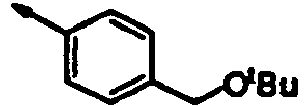
Ar11 
Ar17 
Ar6 
Ar12 
Ar18 
Ar Str. Ar Str. Ar Str. Ar19 
Ar25 
Ar31 
Ar20 
Ar26 
Ar32 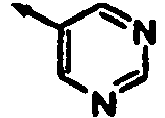
Ar21 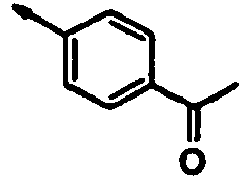
Ar27 
Ar33 
Ar22 
Ar28 
Ar34 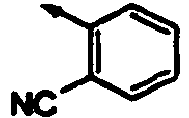
Ar23 
Ar28 
Ar35 
Ar24 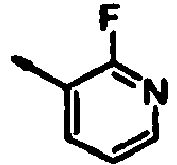
Ar30 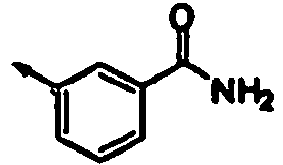
Ar36 
Ar37 
Ar43 
Ar49 
Ar38 
Ar44 
Ar50 
Ar39 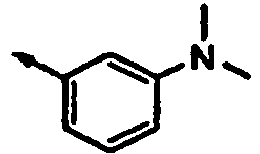
Ar45 
Ar40 
Ar46 
Ar52 
Ar41 
Ar47 
Ar53 
Ar42 
Ar48 
Ar54 
Ar Str. Ar Str. Ar Str. Ar55 
Ar61 
Ar67 
Ar56 
Ar62 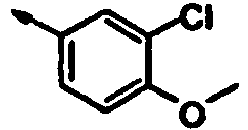
Ar68 
Ar57 
Ar63 
Ar69 
Ar58 
Ar64 
Ar70 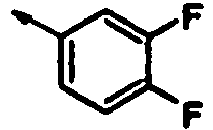
Ar59 
Ar65 
Ar71 
Ar60 
Ar66 
Ar72 
Ar73 
Ar79 
Ar85 
Ar74 
Ar80 
Ar86 
Ar75 
Ar81 
Ar87 
Ar76 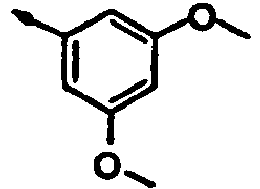
Ar82 
Ar88 
Ar77 
Ar83 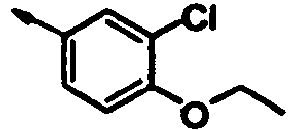
Ar89 
Ar78 
Ar84 
Ar90 
Ar Str. Ar Str. Ar Str. Ar91 
Ar96 
Ar101 
Ar92 
Ar97 
Ar102 
Ar93 
Ar98 
Ar103 
Ar94 
Ar99 
Ar104 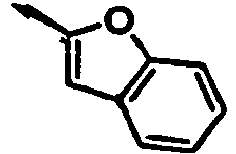
Ar95 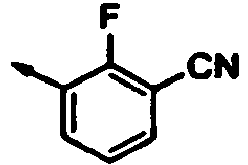
Ar100 
Ar105 
Ar106 
Ar111 
Ar116 
Ar107 
Ar112 
Ar117 
Ar108 
Ar113 
Ar118 
Ar109 
Ar114 
Ar119 
Ar110 
Ar115 
Ar120 
Ar Str. Ar Str. Ar Str. Ar121 
Ar126 
Ar131 
Ar122 
Ar127 
Ar132 
Ar123 
Ar128 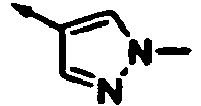
Ar133 
Ar124 
Ar129 
Ar134 
Ar125 
Ar130 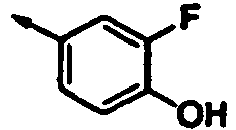
Ar135 
Ar136 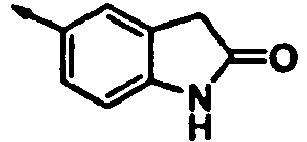
Ar141 
Ar146 
Ar137 
Ar142 
Ar147 
Ar138 
Ar143 
Ar148 
Ar139 
Ar144 
Ar149 
Ar140 
Ar145 
Ar150 
Ar Str. Ar Str. Ar Str. Ar151 
Ar156 
Ar162 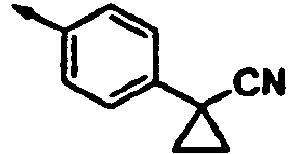
Ar152 
Ar157 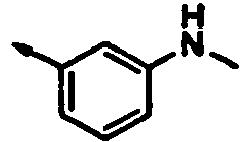
Ar163 
Ar153 
Ar158 
Ar164 
Ar154 
Ar159 
Ar165 
Ar155 
Ar160 
Ar166 
Ar161 
Ar187 
Ar172 
Ar177 
Ar168 
Ar173 
Ar178 
Ar169 
Ar174 
Ar179 
Ar170 
Ar175 
Ar180 
Ar171 
Ar176 
Ar181 
Ar Str. Ar Str. Ar Str. Ar182 
Ar188 
Ar193 
Ar183 
Ar189 
Ar194 
Ar184 
Ar190 
Ar195 
Ar185 
Ar191 
Ar196 
Ar186 
Ar192 
Ar197 
Ar187 
Ar198 
Ar204 
Ar210 
Ar199 
Ar205 
Ar211 
Ar200 
Ar206 
Ar201 
Ar207 
Ar212 
Ar202 
Ar208 
Ar213 
Ar203 
Ar209 
Ar214 
Ar Str. Ar Str. Ar Str. Ar215 
Ar220 
Ar225 
Ar216 
Ar221 
Ar226 
Ar217 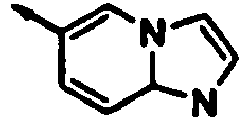
Ar222 
Ar227 
Ar218 
Ar223 
Ar228 
Ar219 
Ar224 
Ar229 
Ar230 
Ar235 
Ar241 
Ar231 
Ar236 
Ar242 
Ar232 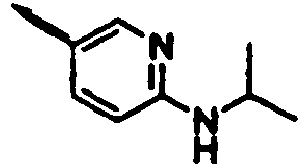
Ar237 
Ar243 
Ar233 
Ar238 
Ar244 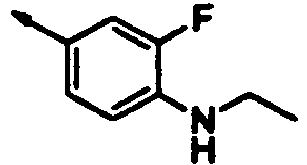
Ar234 
Ar239 
Ar240 
Ar245 
Ar Str. Ar Str. Ar Str. Ar246 
Ar251 
Ar256 
Ar247 
Ar252 
Ar257 
Ar248 
Ar253 
Ar258 
Ar249 
Ar254 
Ar259 
Ar250 
Ar255 
Ar260 
Ar261 
Ar266 
Ar271 
Ar262 
Ar267 
Ar272 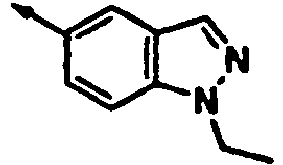
Ar263 
Ar268 
Ar273 
Ar264 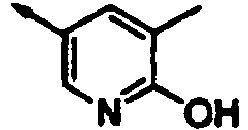
Ar269 
Ar274 
Ar265 
Ar270 
Ar275 
Ar Str. Ar Str. Ar Str. Ar276 
Ar281 
Ar288 
Ar277 
Ar282 
Ar287 
Ar278 
Ar283 
Ar288 
Ar279 
Ar284 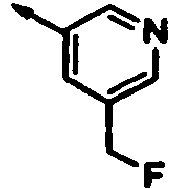
Ar289 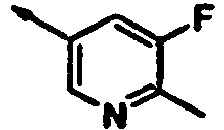
Ar280 
Ar285 
Ar290 
Ar291 
Ar296 
Ar306 
Ar292 
Ar297 
Ar307 
Ar293 
Ar300 
Ar308 
Ar294 
Ar304 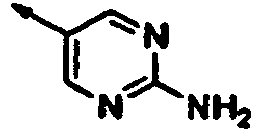
Ar309 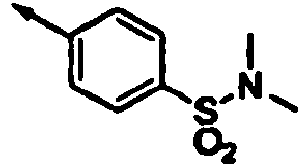
Ar295 
Ar305 
Ar310 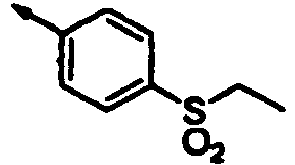
Ar312 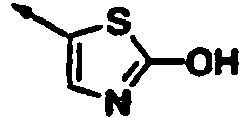
-
[Table a] a Str. a Str. a Str. a1 
a7 
a13 
a2 
a8 
a14 
a3 
a9 
a15 
a4 
a10 
a18 
a5 
a11 
a17 
a6 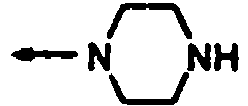
a12 
a18 
a19 
a25 
a31 
a20 
a26 
a32 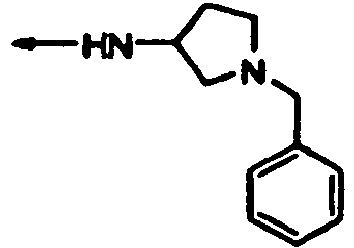
a21 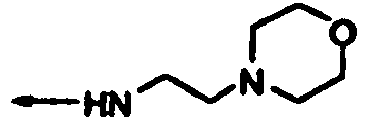
a27 
a22 
a28 
a33 
a23 
a29 
a34 
a24 
a30 
a35 
a36 
-
[Table oh] oh Str. oh Str. oh Str. oh1 
oh7 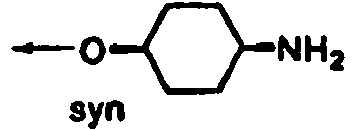
oh15 
oh2 
oh8 
oh16 
oh3 
oh10 
oh18 
oh4 
oh11 
oh19 
oh5 
oh12 
oh20 
oh6 
oh13 
oh21 
oh23 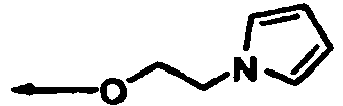
oh33 
oh39 
oh24 
oh34 
oh40 
oh25 
oh35 
oh41 
oh26 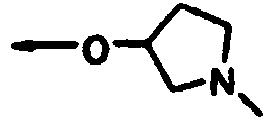
oh36 
oh42 
oh27 
oh37 
oh43 
oh28 
oh38 
oh44 
oh45 
oh54 
oh47 
oh55 
oh49 
oh50 
ch51 
oh52 
-
[Table sh] sh Str. sh1 
sh2 
-
[Table co] co Str. co Str. co Str. co1 
co7 
co13 
co2 
co8 
co14 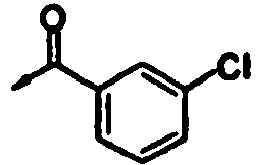
co3 
co9 
co15 
co4 
co10 
co16 
co5 
co11 
co17 
co6 
co12 
co18 
co19 
co25 
co31 
co20 
co26 
co32 
co21 
co27 
co33 
co22 
co28 
co34 
co23 
co29 
co35 
co24 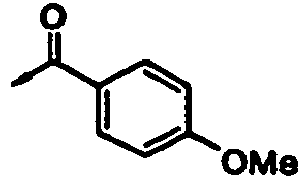
co3D 
co36 
co37 
co43 
co49 
co38 
co44 
co50 
co39 
co45 
co51 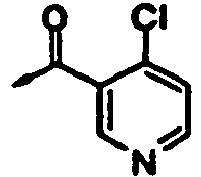
co40 
co46 
co52 
co41 
co47 
co53 
co42 
co48 
co54 
co55 
co61 
co67 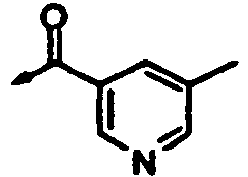
co56 
co62 
co68 
co57 
co63 
co69 
co58 
co64 
co70 
co59 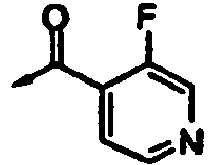
co65 
co71 
co60 
co66 
co72 
co73 
co79 
co85 
co74 
co80 
co86 
co75 
co81 
co87 co76 
co82 
co88 co77 
co83 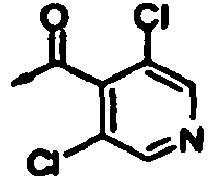
co89 
co78 
co84 
co90 
co91 
co97 
co103 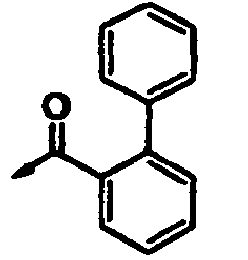
co92 
co98 
co104 
co93 
co99 
co105 co94 
co100 
co106 co95 
co101 
co107 
co96 
co102 
co108 co109 
co115 
co121 
co110 
co116 
co122 
co111 
co117 
co123 
co112 
co118 co124 
co113 
co119 
co125 
co114 
co 120 
co126 
co127 
co133 
co139 
co128 
co134 
co140 
co129 
co135 
co141 
co130 
co136 
co142 
co131 
co137 
co143 
co132 
co138 
co144 
co 145 
co151 
co157 
co146 co152 co158 co147 co153 
co159 co148 co154 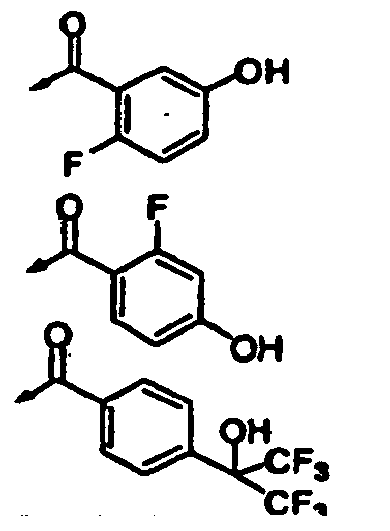
co160 co149 co155 co161 co150 
co156 co162 co163 
co169 
co175 
co164 
co170 
co176 
co165 
co171 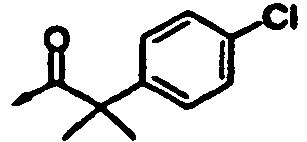
co177 
co166 
co172 
co178 
co167 
co173 
co179 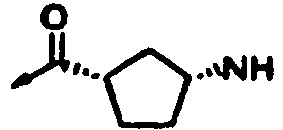
co168 
co174 
co180 
co181 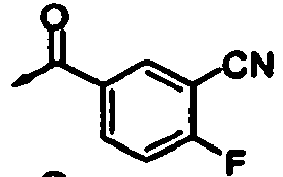
co187 
co193 
co182 
co188 
co194 
co183 co189 
co195 
co184 
co190 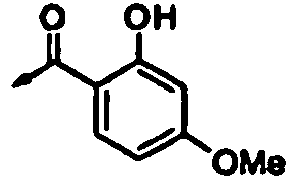
co196 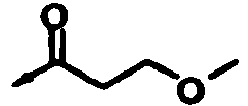
co185 
co191 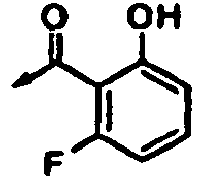
co197 
co186 
co192 
co198 
co199 
co201 
co207 
co213 
co202 
co208 
co214 
co203 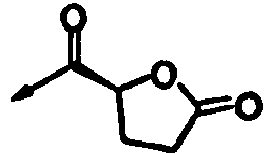
co209 
co215 
co204 
co210 
co216 
co205 
co211 co217 
co206 
co212 co218 
co219 
co225 
co231 
co220 
co226 
co232 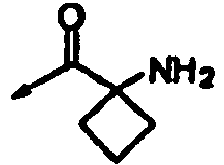
co221 
co227 
co233 
co222 
co228 
co234 
co223 
co229 
co235 
co224 
co230 
co236 
co237 
co243 
co249 
co238 
co244 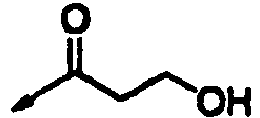
co250 
co239 
co245 
co252 
co240 
co246 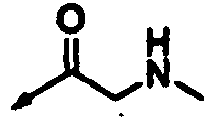
co253 
co241 
co247 
co242 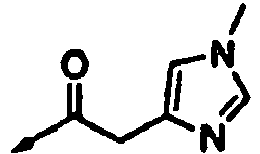
co254 
co Str. co Str. co Str. co255 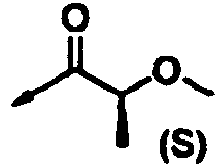
co261 
co256 
co262 
co257 
co263 
co258 
co264 
co259 
co260 
-
[Table so] so Str. so Str. so str. so1 
so7 
so13 
so2 
so8 
so14 
so3 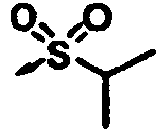
so9 
so15 
so4 
so10 
so16 
so5 
so11 so17 
so6 
so12 
so18 
so19 
so25 
so20 
so26 
so32 
so21 
so27 
so33 
so22 
so28 
so34 
so23 
so29 
so35 
so24 
so30 
so36 
so Str. so Str. so Str. so37 
so42 
so48 
so38 
so43 
so49 
so39 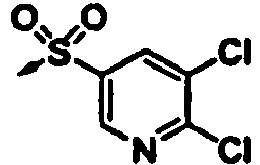
so44 
so50 
so40 
so45 
so51 
so41 
so46 
so52 
so47 
so53 
so Str. so Str. so Str. so54 
so59 
so65 
so55 
so60 
so66 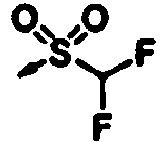
so56 
so61 
so57 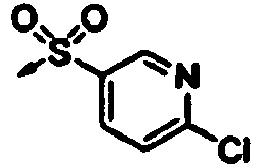
so62 
so63 
so58 
so64 
-

-


- In Table sbo, compounds with no entry in the Spl. column were synthesized according to the method described in Tetrahedron, 2001, 57, 9813-9816 using a commercially available aryl halide as a raw material.
Alternatively, compounds were synthesized by the methods described in the following Reference Examples. - Sodium hydride (462 mg; WAKO) was added to a DMF solution (5 mL) of 3-bromophenol (1 g; TCI) with ice cooling, the resulting mixture was stirred for a certain period followed by the addition of 2-bromomethylethyl ether (1.0 mL; TCI), and the resulting mixture was stirred at room temperature for 12 hours. Water was added to the reaction mixture solution, the reaction mixture was extracted with ethyl acetate, and the organic layer was washed with water and saturated brine. The organic layer was dried and the solvent was evaporated under reduced pressure. The title compound (1.5 g) was synthesized according to the method described in Tetrahedron, 2001, 57, pp. 9813-9816 using the residue.
- Potassium carbonate (7 g) and bromoacetonitrile (2.3 ml; TCI) were added to an acetone solution (40 mL) of 3-bromophenol (3 g; TCI) at room temperature and the resulting mixture was stirred at 50°C for 12 hours. The reaction mixture solution was filtrated through celite and the filtrate was evaporated under reduced pressure. The residue was purified by column chromatography (Yamazen; hexane/ethyl acetate) and then the title compound was synthesized according to the method described in Tetrahedron, 2001, 57, pp. 9813-9816.
- The title compound was synthesized according to the method described in
WO 2006/097691 . - Methyl iodide (170 µL) was added to a DMF solution of 2-amino-5-bromopyridine (500 mg; TCI) and sodium hydride (123 mg) and the resulting mixture was stirred at room temperature for 13 hours. Ethyl acetate and saturated brine were added to extract the reaction mixture, the organic layer was dried, and the solvent was evaporated under reduced pressure. The residue was purified by column chromatography (Yamazen; hexane/ethyl acetate) and then the title compound was synthesized according to the method described in Tetrahedron, 2001, 57, pp. 9813-9816.
- The title compound was synthesized by the similar method as Reference Example sbo208 using ethyl iodide instead of methyl iodide.
- The title compound was synthesized by the similar method as Reference Example sbo208 using 3-bromo-5-hydroxypyridine (FRON) instead of 2-amino-5-bromo pyridine and ethyl iodide instead of methyl iodide.
- An amino group was introduced into an aromatic ring according to the method described in
WO 2008/156831A2 using 1-bromo-3-chlorobenzene (TCI) and cyclobutanamine (TCI) and the title compound was obtained according to the similar method as the method described in Tetrahedron, 2001, 57, pp. 9813-9816. - Compounds of Reference Examples sbo213, sbo214, sbo227, sbo228, sbo243, sbo244, and sbo245 were synthesized according to the method described in Reference Example sbo212 using commercially available 2-bromo-4-chloro-1-fluorobenzene (Ald), 1-bromo-4-chloro-2-methylbenzene (TCI), 2-bromo-4-chloro-1-fluorobenzene (Ald), 2-bromo-4-chloro-1-fluorobenzene(Ald), 2-bromo-4-chloro-1-methylbenzene (WAKO), 1-bromo-4-chloro-2-fluorobenzene (WAKO), 1-bromo-4-chloro-2-methylbenzene (TCI) and commercially available corresponding amine compounds instead of 1-bromo-3-chlorobenzene (TCI) described in Reference Example sbo212.
- Acetic acid (97 µL) was added to a 1,2-dichloroethane solution of 2-amino-5-bromopyridine (300 mg; TCI), isobutyl aldehyde (232 µL; TCI), and sodium triacetoxyborohydride (504 mg) at room temperature and the resulting mixture was stirred for 14 hours. Water was added to the reaction mixture solution, then the reaction mixture was extracted with chloroform, the organic layer was dried, and the solvent was evaporated under reduced pressure. The residue was purified by column chromatography (Yamazen; hexane/ethyl acetate) and then the title compound was synthesized according to the method described in Tetrahedron, 2001, 57, pp. 9813-9816.
- The title compound was synthesized by the similar method as Reference Example sbo231 using acetone instead of isobutyl aldehyde.
- Sodium hydride (67 mg; WAKO) was added to a THF solution (3 mL) of 5-bromo-2-benzoxazolinone (222 mg; Ald) with ice cooling, the resulting mixture was stirred for a certain period followed by the addition of methyl iodide (83 µL; TCI), and the resulting mixture was stirred at room temperature for 3 hours. Saturated aqueous ammonium chloride was added two the reaction mixture solution, the reaction mixture was extracted with diethyl ether, and the organic layer was washed with saturated brine. The organic layer was dried and the solvent was evaporated under reduced pressure. Using the residue, the title compound was synthesized from the residue according to the method described in the Tetrahedron, 2001, 57, pp. 9813-9816.
- Compounds of Reference Example sbo241, sbo242, sbo246, sbo263, sbo266, and sbo276 were synthesized according to the method described in Reference Example 240 using 6-bromo-2H-1,4-benzoxazine-3(4H)-one, 6-bromo-2-benzothiazolinone, 5-bromo-7-azaindole, 5-bromo-2-methylindole, 6-bromoindole, and 5-bromooxyindole, respectively, instead of 5-bromo-2-benzoxazolinone described in the step of Reference Example sbo240.
- Reference Examples sbo259 and sbo260 were synthesized using 5-bromoisoindolin-1-one instead of 5-bromo-2-benzoxazolinone described in Reference Example sbo240 and separated by silica gel column chromatography (Yamazen; hexane/ethyl acetate).
- 3-Bromo-5-cyclopropylpyridine, a known compound, was obtained by the similar method as the method described in
WO 2008/091681 using 3,5-dibromopyridine (TCI) and cyclopropylboronic acid (Ald). The title compound was obtained by the similar method as the method described in Tetrahedron, 2001, 57, pp. 9813-9816 using the product thereof. - Reference Examples sbo281 and sbo282 were synthesized according to the method described in Reference Example sbo253 using 3-bromo-5-chlorobenzonitrile (WAKO) and 2-bromo-5-chlorobenzonitrile (Apollo) instead of 3,5-dibromopyridine (TCI) described in Reference Example sbo253 and using potassium cyclopropyltrifluoroborate (Ald) as a substitute of cyclopropylboronic acid (Ald) by the similar method as the method described in Organic Letter, 2004, 6, pp. 357-360.
- An alkyl group was introduced into a pyridine derivative by the similar method as the method described in
US5436344A1 using 2-bromo-5-chloropyridine (TCI) and ethylmagnesium bromide (KANTO), a commercially available Grignard reagent, in the presence of a nickel catalyst and the title compound was obtained by the similar method as the method described in Tetrahedron, 2001, 57, pp. 9813-9816 using the product thereof. - Reference Examples sbo 255 and sbo 271 were synthesized according to the method described in Reference Example sbo254 using 3,5-dibromopyridine (TCI) and 2-bromo-4-chloropyridine (Oak) instead of 2-bromo-5-chloropyridine (TCI) described in Reference Example sbo254.
- Reference Example sbo285 was synthesized according to the method described in Reference Example sbo254 using 2-bromo-5-chloro-3-methylpyridine (Asym) instead of 2-bromo-5-chloropyridine (TCI) described in Reference Example sbo254 and methylmagnesium bromide (KANTO) instead of ethylmagnesium bromide (KANTO).
- A diethyl ether (1.8 mL) solution of 5-bromo-2-methoxythiazole (200 mg) was cooled to -78°C followed by the dropwise addition of normal butyllithium (1.6 M,0.7 mL; KANTO). The resulting mixture was stirred as it was for 1 hour, followed by the addition of tri-n-butyltin chloride (0.35 mL; TCI), and the resulting mixture was slowly raised to room temperature and then stirred for 2 hours. Saturated aqueous sodium bicarbonate solution was added to the reaction mixture solution, the reaction mixture was extracted with ethyl acetate, and the organic layer was washed with saturated brine. The organic layer was dried and the solvent was evaporated under reduced pressure to give the title compound.
- 5-Bromo-3-methylisothiazole was synthesized from 5-amino-3-methylisothiazole (Ald) by the method described in
US2004/2545 - Sodium hydride (44 mg) was added to a THF solution of 5-bromoindazole (200 mg; Ast) at 0°C, the resulting mixture was stirred for a certain period followed by the addition of ethyl iodide (156 µL), and the resulting mixture was stirred at room temperature for 11 hours. 1 N hydrochloric acid was added to the reaction mixture, the reaction mixture was extracted with ethyl acetate, the organic layer was dried, and the solvent was evaporated under reduced pressure. The residue was purified by column chromatography (Yamazen; hexane/ethyl acetate) and then the title compound was synthesized according to the method described in Tetrahedron, 2001, 57, pp. 9813-9816.
- The title compound was synthesized by the similar method using 5-bromo-3-methylindazole (J&W) instead of 5-bromoindazole in Reference Example sbo272 and ethyl iodide instead of methyl iodide.
- A THF (1 mL) solution of diisopropylamine (160 µL; WAKO) was cooled to -78°C under a nitrogen atmosphere followed by the dropwise addition of normal butyllithium (2.6 M, 430 µL; KANTO). The resulting mixture was stirred as it was for 30 minutes followed by the dropwise addition of a THF (1 mL) solution of 4-fluoro-3-methylpyridine (111 mg) and the resulting mixture was further stirred for 1 hour. Then tri-n-butyltin chloride (330 µL; TCI) was added and the resulting mixture was slowly raised to room temperature and then stirred for 2 hours. Saturated aqueous sodium bicarbonate solution was added to the reaction mixture solution, to the reaction mixture was extracted with ethyl acetate, and the organic layer was washed with saturated brine. The organic layer was dried and the solvent was evaporated under reduced pressure to give the title compound.
- The title compound was synthesized according to the method described in Reference Example sbo277 using 3-chloro-4-fluoropyridine instead of 4-fluoro-3-methyl pyridine described in the Step of Reference Example sbo277.
- 5-Bromo-2-(difluoromethyl)pyridine, a known compound, was obtained by the similar method as the method described in
WO 2006/109729 using 5-bromopicolinaldehyde (May) and DEOXO-FLUOR (Ald). The title compound was obtained by the similar method as the method described in Tetrahedron, 2001, 57, pp. 9813-9816 using the product. - Compounds of Reference Example sbo268 and 279 were synthesized according to the method described in Reference Example sbo278 using 5-bromonicotinaldehyde (Ald) and 4-chloropicolinaldehyde (Bionet), respectively, instead of 5-bromopicolinaldehyde (May) described in Reference Example sbo278.
- A formyl group was introduced into an aromatic ring by the similar method as the method described in
WO 2004/20414A1 - The title compound was obtained according to the method described in
U.S. Patent No. 2007/254892 ,WO 2005/123703 , Reference Example sbo278, or the like using (5-bromopyridin-2-yl)methanol (May) and DEOXO-FLUOR (Ald). - 2-(fluoromethyl)-4-(4,4,5,5-tetramethyl-1,3,2-dioxaborolan-2-yl)pyridine (sbo 280)
- Compounds of Reference Examples sbo 280 and sbo 284 were synthesized according to the method described in Reference Example sbo269 using (4-chloropyridin-2-yl)methanol (Combi) and (5-bromopyridin-3-yl)methanol (Apollo), respectively, instead of (5-bromopyridin-2-yl)methanol(May) described in Reference Example sbo269.
- A vinylbenzene derivative was obtained by the similar method as the method described in Journal of Organic Chemistry, 2006, 71, pp. 9681-9686 using 3-bromo-5-chlorobenzonitrile (WAKO) and potassium vinyltrifluoroborate (Ald). Further, a vinyl group was reduced by the similar method as the method described in
U.S. Patent No. 5863947 and the title compound was obtained by the similar method as the method described in Tetrahedron, 2001, 57, pp. 9813-9816 using the resulting product. - Tetrakis triphenylphosphine palladium (0.15 g; Ald) was added to a DMF (3.6 mL) solution of 2,5-dichloro-3-fluoropyridine (0.2 g; Combi) and then trimethyl aluminium (2 M, 660 µL; Ald) was slowly added dropwise. Then the resulting mixture was heated to 70°C and stirred for 3 hours. The reaction mixture solution was cooled to room temperature followed by the addition of water (3 mL), the reaction mixture was extracted with ethyl acetate, the organic layer was dried, the solvent was evaporated under reduced pressure, and the residue was purified by silica gel column chromatography (Yamazen; hexane/ethyl acetate). The title compound was synthesized according to the method described in Tetrahedron, 2001, 57, pp. 9813-9816 using this purified product.
- Reference Example sbo289 was synthesized according to the method described in Reference Example sbo288 using triethylaluminium instead of trimethylaluminium described in Reference Example sbo288.
- A Boc protective group was bonded to an amino group of 2-(4-chlorophenyl)ethanamine (Ald) by a usual method and the title compound was synthesized in the similar manner as the method described in Tetrahedron, 2001, 57, pp. 9813-9816.
-
[Table sa] sa Str. Spl. sa Str. Spl. sa Str. Spl. sa1 
WAKO sa7 
WAKO sa13 
Ast sa2 
Ast sa8 
ALD sa14 
Ast sa3 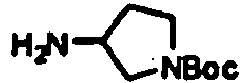
Ast sa9 
TCl sa15 
Ast sa4 
Ast sa10 
TCl sa18 
Ast sa5 
TCl sa11 
sa17 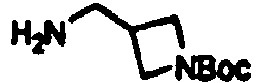
Ast sa6 
TCl sa12 
Ast sa18 
TCl sa Str. Spl. sa Str. Spl. sa Str. Spl. sa19 
TCl sa25 
sa31 
Matrix sa20 
AAesar sa26 
TCl sa32 
TCl sa21 
TCl sa27 
Ald sa33 
Ast sa22 
TCl sa28 
Ald sa34 
AMRI sa23 
sa29 
TO sa35 
Ast sa24 
sa30 
sa36 
TCl - In Table sa, the compound represented by sa23 to 25 was protected with an alcohol by a usual method using a commercially available aminoalcohol as a raw material.
Furthermore, the compound represented by sa11 was prepared as a racemate by mixing the compounds represented by sa33 and sa34, which are chiral compounds, in equal amounts. - Anhydrous trifluoroacetic acid (1.4 mL) and triethylamine (1.4 mL) were added to a dichloromethane solution (10 mL) of tert-butyl 4-aminopiperidine-1-carboxylate (1 g) and the resulting mixture was stirred at room temperature for 13 and half hours. Dichloromethane and water were added to the reaction mixture solution to extract the reaction mixture, the organic layer was dried, and the solvent was evaporated under reduced pressure to give the title compound (1.7 g).
- Methyl iodide (1.25 mL; Ald) and potassium carbonate (3.5 g) were added to a DMF solution (10 mL) of Intermediate sa30-1 (1.5 g) at room temperature and the resulting mixture was stirred for 13 hours. Ethyl acetate and water were added to extract the reaction mixture, the reaction mixture was washed with saturated brine, the organic layer was dried, the solvent was evaporated under reduced pressure, and the residue was purified by column chromatography (Yamazen; hexane/ethyl acetate) to give the title compound (1.14 g).
- 2 N aqueous sodium hydroxide solution (0.6 mL) was added to a methanol solution (4 mL) of Intermediate sa30-2 (370 mg) at room temperature, the resulting mixture was stirred for 4 hours, then 2 N aqueous sodium hydroxide solution (0.6 mL) was further added, and the resulting mixture was stirred for 1 hour. The reaction mixture solution was concentrated under reduced pressure and chloroform and water were added to the residue to extract the reaction mixture. The organic layer was dried and the solvent was evaporated under reduced pressure to give the title compound (249 mg).
(LCMS: 215.2 (MH+); retention time: 1.37 min; LCMS; condition A) -
[Table soh] soh Str. Spl. soh Str. Spl. soh Str. Spl. soh1 
Ald soh7 
AMRI soh15 
soh2 
MAYB soh8 
Oak soh16 
AMRI soh3 
soh10 
TCl soh18 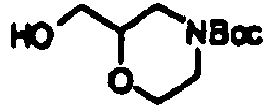
Tyger soh4 
WAKO soh11 
Ald soh19 
soh5 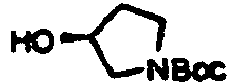
WAKO soh12 
Apollo soh20 
soh6 
CNH soh13 
Matrix soh21 
TCl soh Str. Spl. soh Str. Spl. soh Str. Spl. soh23 
TCl soh33 
TCl soh39 
Ald soh24 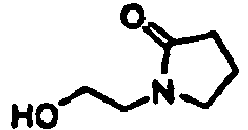
TCl soh34 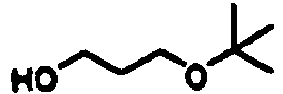
nacalai soh40 
Ald soh25 
soh35 
WAKO soh41 
TCl soh26 
Ald soh36 
TCl soh42 
Ald soh27 
TCl soh37 
TCl soh43 
soh28 
TCl soh38 
TCl soh44 
Ald soh45 
TCl soh54 
TCl soh47 
TCl soh55 
soh49 
TCl soh50 
Fluke soh51 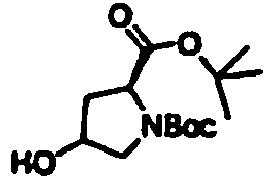
Wata soh52 
Ald - Compounds represented by soh3, 25, and 43 in Table soh were prepared as a racemate by mixing commercially available R-configured and S-configured chiral compounds. Compounds represented by son19 and 20 were protected with amines by a usual method using a commercially available aminoalcohol as a raw material. A compound represented by soh15 was synthesized according to Step a of Example 4-N-4.
-
[Table ssh] sshsh Str. Spl. ssh Str. SPl. ssh Str. Spl. ssh1 
ssh2 
Ald - A compound represented by ssh1 in Table ssh was prepared with reference to Bioorg. Med. Chem. Lett. 2000, 10, pp. 805-809 and
U.S. Patent No. 5317025 . -
[Table sco] sco Str. Spl. sco Str. Spl. Sco Str. Spl. sco1 
WAKO sco7 
TCl sco13 
TCl sco2 
TCl sco8 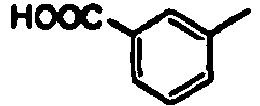
TCl sco14 
TCl sco3 
TCl sco9 
Ald sco15 
TCl sco4 
Matrix sco10 
TCl sco16 
Ald sco5 
TCl sco11 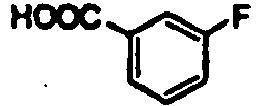
TCl sco17 
TCl sco6 
Ald sco12 
TCl sco18 
Ald sco Str. Spl. sco Str. Spl. sco Str. Spl. sco19 
WAKO sco25 
AAesar sco31 
WAKO sco20 
WAKO sco26 
TCl sco32 
TCl sco21 
TCl sco27 
TCl sco33 
AAesar sco22 
TCl sco28 
TCl sco34 
TCl sco23 
TCl sco29 
WAKO sco35 
Ald sco24 
WAKO sco30 
WAKO sco36 
TCl sco Str. Spl. Sco Str. Spl. sco Str. Spl. sco37 
TCl sco43 
MAYB sco49 
TCl sco38 
TCl sco44 
MAYB sco50 
sco39 
Ald sco45 
matrix sco51 
Ald sco40 
MAYB sco46 
Acros sco52 
Ald sco41 
TCl sco47 
TCl sco53 
Ald sco42 
MAYB sco48 
TCl sco54 
TCl sco Str. Spl. sco Str. Spl. sco Str. Spl. sco55 
TCl sco61 
Ald sco67 
LANC sco56 
WAKO sco62 
MAYB sco68 
Ald sco57 
Ald sco63 
TCl sco69 
TCl sco58 
MAYB sco64 
TCl sco70 
Matrix sco59 
Matrix sco65 
TCl sco71 
LANC sco60 
Ald sco66 
Ald sco72 
Ald sco73 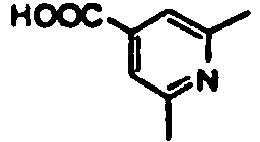
Life sco79 
sco85 
Matrix sco74 
TCl sco80 
Apollo sco86 
Ald sco75 
TCl sco81 
Matrix sco87 
MAYB sco76 
Ald sco82 
Blonet sco88 
J&W sco77 
Matrix sco83 
TCl sco89 
Princeton sco78 
Ald sco84 
TCl sco90 
Otava sco Str. Spl. sco Str. Spl. sco Str. Spl. sco91 
WAKO sco97 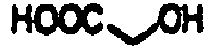
WAKO sco103 
TCl sco92 
TCl sco98 
TCl sco104 
Ald sco93 
AAesar sco99 
TCl sco105 TCl sco94 
sco100 
Ald sco106 TCl sco95 
sco101 
WAKO sco107 Ald sco96 
TCl sco102 
TCl sco109 TCl sco109 
TO sco115 
ABCR sco121 
Ald sco110 
Matrix sco116 
Apollo sco122 
TCl sco111 
LANC sco117 
Ald sco123 
LANC sco112 
Oak sco118 TCl sco124 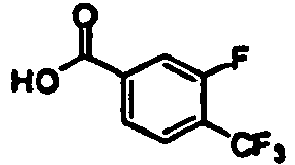
Ald sco113 
Ald sco119 
Ald sco125 
TCl sco114 
AAesar sco120 
Ald sco126 
Fchem sco Str. Spl. sco Str. Spl. sco Str. Spl. sco127 
WAKO sco133 
Acros sco139 
Apollo sco128 
TCl sco134 
TCl sco140 
Acros sco129 
TCl sco135 
TCl sco141 
TO sco130 
Ald sco136 
TCI sco142 
Ald sco131 
Ald sco137 
TCI sco143 
Ald sco132 
TCI sco138 
LANC sco144 
Matrix sco145 
Matrix sco151 
TCI sco157 
Ald sco146 Ald sco152 J&W sco158 
Ald sco147 Ald sco153 
Apollo sco159 
Matrix sco148 Ald sco154 
Matrix sco160 
WAKO sco149 Ald sco155 
Matrix sco161 Synchem sco150 Ald sco156 LANC sco162 MAYB sco Str. Spl. sco Str. Spl. sco Str. Spl. sco163 
Ald sco169 
MAYB sco175 
sco164 
MAYB sco170 
Apollo sco176 
Matrix sco165 
Ald sco171 
Acros sco177 
TCI sco166 
LANC sco172 
Asymchem sco 178 
Ast sco167 
Apollo sco173 
sco179 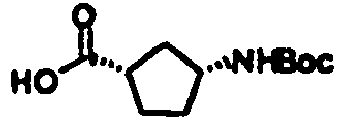
Acros sco168 
Ald sco174 
J&W sco180 
WAKO SM2 Str. Spl. SM2 Str. Spl. SM2 Str. Spl. sco181 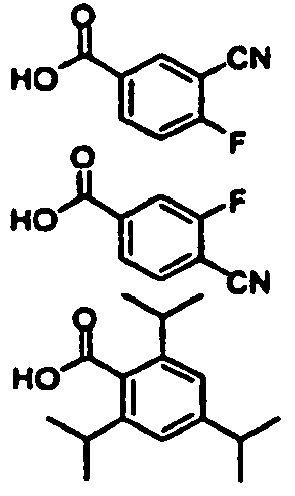
Apollo sco187 
Apollo sco193 
WAKO sco182 Apollo sco188 
Ald sco194 
Ald sco183 WAKO sco189 
LANC sco195 
Matrix sco184 
Ald sco190 
Ald sco196 
Ald sco185 
Ald sco191 
Ald sco197 
TCI sco186 
Ald sco192 
WAKO sco198 
Ald sco199 
TCI sco Str. Spl. sco Str. Spl. sco Str. Spl. sco201 
TCI sco207 
MAYB sco213 
sco202 
TCI sco208 
Fchem sco214 
Ald sco203 
TCI sco209 
Oak sco215 
Ald sco204 
Ald sco210 
NEO sco216 MAYB sco205 
Wata sco211 Ast sco217 
TCI sco206 
Ald sco212 
sco218 
WAKO sco218 
WAKO sco225 
Oak sco231 
Wata sco220 
Matrix sco226 
WAKO sco 232 
Ald sco221 
Matrix sco227 
WAKO sco 233 
WAKO sco222 
Tyger sco228 
TCI sco 234 
Wata sco2223 
TCI sco229 
BACHEM sco 235 
Ast sco224 
Ald sco230 
Oak sco238 
TCI sco Str. Spl. sco Str. Spl. sco Str. Spl. sco237 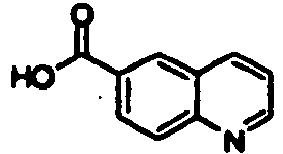
MAYB sco243 
Ast sco249 
Wata sco238 
TCI sco244 
TCI sco250 
Tyger sco239 
Atd sco245 
LANC sco240 
Apollo sco246 
WAKO sco252 
sco241 
Ald sco247 
AAesar sco253 AMRI sco242 
sAld sco254 
sco255 
Acros sco261 
TCl sco256 
Toront sco262 
sco257 
TCI TCI sco258 
Chemb sco263 
TCl sco259 Aldrich sco264 
Ald sco260 
TCI - A compound represented by sco50 in Table sco was prepared by the described method in Tetrahedron Lett., 2005, 46, pp. 135-137. A compound represented by sco79 was prepared from 3,5-pyridinedicarboxylic acid by a usual method. A compound represented by sco94 was prepared by the described method in Synlett, 2000, pp. 1488-1490. A compound represented by sco95 was prepared by the described method in Chem. Pharm.Bull., 1984, pp. 4866-4872. A compound represented by sco173 was prepared by the method described in Tetrahedron Lett., 2005, 46, pp. 135-137. A compound represented by sco176 was prepared from 3-iodobenzoic acid by a usual method. A compound represented by sco212 was prepared by the described method in
WO 2004/092167 . A compound represented by sco213 was prepared from a commercially available morpholine derivative by a usual method by protecting an amino group. A compound represented by sco253 was prepared by the method described inU.S. Patent No. 5348978 . A compound represented by sco254 was prepared from propionitrile and 2,6-difluoro-pyridine by the method described in Synlett, 2000, pp. 1488-1490. -
[Table sso] sso Str. Spl. sso Str. Spl. sso Str. Spl. sso1 
TCI sso7 
sso13 
TCl sso2 
J&W sso8 
Ald sso14 
TCl sso3 
TCI sso9 
WAKO sso15 
TCI sso4 
Ald sso10 
TO sso16 
AM sso5 
TCI sso11 
MAYB sso17 
Ald sso6 
WAKO sso12 
WAKO sso18 
AAesar sso Str. Spl. sso Str. Spl. sso Str. Spl. sso19 
Ald sso25 
WAKO sso20 
Ald sso26 
Avocado sso32 
Ald sso21 
Ald sso27 
Ald sso33 
WAKO sso22 
J&W sso28 
Ald sso34 
Array sso23 
MAYB sso29 
TCl sso35 
MAYB sso24 
Avocado sso36 
TCl sso str. Spl. sso Str. Spl. sso Str. Spl. sso37 
TCl sso42 
Ald sso48 
oak sso38 
Ald sso43 
TCI sso49 
sso39 
Apollo sso44 
Acros sso50 
Otava sso40 
MAYB sso45 
Ald sso51 
sso41 
Ald sso46 
sso52 
Ena sso47 
Ald sso53 
Ena sso Str. Spl. sso Str. Spl. sso Str. Spl. sso54 
MAYB sso59 
MAYB sso65 
sso55 
Apollo sso60 
AC88 sso66 
Ena sso56 
MAYB sso61 
Matrix sso57 
Ena sso62 
Labo sso58 
MAYB sso63 
TCI sso64 
Hande - In Table sso, a compound represented by sso46 was prepared from sulfuryl chloride and 3-methoxyphenylmethylmagnesium chloride by the method described in
U.S. Patent No. 2007/99825 . A compound represented by sso49 was prepared from sulfuryl chloride and 6-methyl-2-pyridylmagnesium bromide (Rieke Metals) by the method described inU.S. Patent No. 2007/99825 . - A THF solution of 1-propynylmagnesium bromide (0.5 N, 140 µL; Ald) was cooled to -78°C followed by the addition of sulfuryl chloride (10 L; TCI) and the resulting mixture was stirred for 1 hour. The resulting mixture was stirred at room temperature for 2 hours and the reaction mixture solution was concentrated to give the title compound.
-

- Sodium methoxide (25 g; WAKO) was added to a DMF (250 mL) solution of 1,3,5-tribromobenzene (75 g; TCI) and the resulting mixture was stirred at 90°C for 15 minutes. The reaction mixture was concentrated, aqueous ammonium chloride (400 mL) and ethyl acetate (400 mL) were added to extract the reaction mixture, the organic layer was washed with saturated brine (200 mL x 2), and the organic layer was dried. The solvent was evaporated under reduced pressure and the residue was purified by column chromatography (n-hexane) to give the title compound (39.2 g).
1H-NMR (CDCl3); δ (ppm) 3.97 (3H, s), 6.98 (2H, m), 7.25 (1H, m) - Butylmagnesium chloride (2.0 M, THF; Ald) (31 mL) was cooled to -10°C followed by the addition of butyllithium (1.6 M, Hex; Ald) (79 mL) and the resulting mixture was stirred for 30 minutes. A toluene solution (220 mL) of Example compound IM1-1 (45 g) was further added and the resulting mixture was further stirred for 30 minutes. A toluene solution (50 mL) of DMF (18 mL; WAKO) was added and the resulting mixture was stirred for 1 hour and then stirred at room temperature for 30 minutes. Aqueous ammonium chloride (300 mL) and ethyl acetate (300 mL) were added to extract the reaction mixture and the organic layer was washed with saturated brine (300 mL) and dried. The solvent was evaporated under reduced pressure and the residue was purified by column chromatography (n-hexane/ethyl acetate) to give the title compound (25.8 g).
1H-NMR (CDCl3); δ (ppm) 3.87 (3H, s), 7.32 (2H, m), 7.58 (1H, t, 1.5 Hz) 9.91 (1H, s) - NaBH4 (3.85 g; WAKO) was added to an ethanol (80 mL) and THF (20 mL) mixture solution of Example compound IM1-2 (22 g) with ice cooling and the resulting mixture was stirred at room temperature for 3 hours. The resulting mixture was poured into ice water (300 mL), then ethyl acetate (300 mL) was added to extract the reaction mixture, and the organic layer was washed with saturated aqueous sodium bicarbonate solution (300 mL) and then dried. The solvent was evaporated under reduced pressure to give the title compound (22.05 g).
1H-NMR (CDCl3) ; δ (ppm) 1.86 (1H, s), 3.79 (3H, s), 4.63 (2H, s), 6.84 (1H, m), 6.97 (1H, m), 7.09 (1H, m) - Triphenylphosphine (28 g; KANTO) was added to a dichloromethane (150 mL) solution of Example compound IM1-3 (22.05 g) with ice cooling, the resulting mixture was stirred for approx. 10 minutes followed by the addition of N-bromosuccinimide (20 g; TCI), and the resulting mixture was stirred at room temperature for 13 hours and 30 minutes. The solvent was evaporated under reduced pressure and the residue was purified by column chromatography (n-hexane/ethyl acetate) to give the title compound (23.94 g).
1H-NMR (CDCl3); δ (ppm) 3.80 (3H, s), 4.38 (2H, s), 6.85 (1H, m), 6.98 (1H, m), 7.13 (1H, m) - Sodium cyanide (3.4 g; WAKO) was added to a DMSO (100 mL) solution of Example compound IM1-4 (16.3 g) at room temperature and the resulting mixture was stirred at 40°C for 1 hour and 40 minutes. Ethyl acetate (300 mL), saturated aqueous sodium bicarbonate solution (150 mL), and water (150 mL) were added to the reaction mixture to extract the reaction mixture, the organic layer was washed with saturated brine (300 mL) and then dried, and then the solvent was evaporated under reduced pressure. The residue was purified by column chromatography (Yamazen; n-hexane/ethyl acetate) to give the title compound (11.37 g).
1H-NMR (CDCl3); δ (ppm) 3.69 (2H, s), 3.81 (3H, s), 6.81 (1H, m), 7.02 (1H, m), 7.06 (1H, m) - A borane-tetrahydrofuran complex (1 M, 73.6 mL) was added to a THF (36.8 mL) solution of Example compound IM1-5 at room temperature and the resulting mixture was stirred to reflux at 80°C for 2 hours. Methanol (26 mL) and 1 N hydrochloric acid (26 mL) were added to the reaction mixture solution and the resulting mixture was stirred for 1 hour at room temperature. The resulting mixture was neutralized with 1 N aqueous sodium hydroxide solution, then ethyl acetate (100 mL) was added to extract the reaction mixture, the organic layer was dried, and the solvent was evaporated under reduced pressure to give the title compound (8.76 g).
- Paraformaldehyde (660 mg; WAKO) was added to a formic acid (50 mL) solution of Intermediate IM1-6-1 (4.33 g) obtained by the above-mentioned method at 50°C and the resulting mixture was stirred for 13 hours and 30 minutes. The solvent was evaporated under reduced pressure, dichloromethane (100 mL) and 1 N aqueous sodium hydroxide solution (100 mL) were added to extract the reaction mixture, and the aqueous layer was further extracted with dichloromethane. The organic layer was combined and dried and the solvent was evaporated under reduced pressure to give the title compound (4.49 g).
- 1H-NMR (CDCl3) ; δ (ppm) 1.90 (1H, s), 2.75 (2H, m), 3.06 (2H, m), 3.76 (3H, s), 3.91 (2H, s), 6.61 (1H, d, J = 2.6 Hz), 6.96 (1H, d, J = 2.6 Hz)
- Sodium sulfate (2.8 g) and manganese dioxide (7.1 g; Ald) were added to a toluene (60 mL) solution of Intermediate IM1-6-2 (1.99 g) obtained by the above-mentioned method and the resulting mixture was stirred at 140°C for 24 hours. The resulting mixture was filtrated through celite followed by the addition of 2 N hydrochloric acid, and the resulting mixture was washed with ether. The resulting mixture was neutralized with 5 N aqueous sodium hydroxide solution and extracted with dichloromethane to give the title compound (698 mg).
(LCMS: 238.0 (MH+); retention time: 3.64 min; LCMS; condition A)
1H-NMR (DMSO); δ (ppm) 3.94 (3H, s), 7.44 (1H, d, J = 2.2 Hz), 7.66 (1H, d, J = 2.2 Hz), 7.76 (1H, d, J = 5.9 Hz), 8.53 (1H, d, 5.9 Hz), 9.29 (1H, s) - The IKKβ activity inhibiting ability of the compound of the present invention was evaluated by time-resolved fluorescence resonance energy transfer (TR-FRET) assay. IKKβ, which was used in the assay, was obtained from Sf9 cells as a host using Bac-to-Bac System of Invitrogen (U.S.) according to the manufacturer's instruction.
Specifically, 6 µL of a mixed solution of an assay buffer (50 mM HEPES pH 7.2, 10 mM MgCl2, 1mM EGTA, 0.01% Briji, 0.01% BSA) and a biotinylated substrate (GST-IκBα [amino acid residues 1 to 54] -biotin; final concentration 0.25 µM)/ATP (final concentration 25 µM) was added to a well containing 2 µL of a test compound at various concentrations or DMSO (final concentration 0.1%). Then, 2 µL of IKKβ (final concentration 1 nM) diluted with the above-mentioned assay buffer was added to initiate a reaction and incubated at room temperature for 30 minutes, followed by the addition of 2 µL of 500 mM EDTA to terminate the reaction. A detection reagent (3 µL) comprising a buffer (20 mM Tris-HCl pH 7.5, 600 mM KF, 0.1% BSA) containing an avidin reagent (Cisbio, France) labeled with APC and anti-phosphoserine-IκBα monoclonal antibody 9A7K labeled with europium cryptate (Cisbio, France), which recognizes phosphorylated IκBα and does not recognize non-phosphorylated IκBα, was added and the reactant was further incubated at room temperature for 60 minutes. The extent of phosphorylation of the biotinylated substrate peptides was measured as a ratio of the specific energy transfer signal at 665 nm to the reference europium signal at 615 nm using Perkin-Elmer Envision (Perkin Elmer, U.S.). In order to obtain monoclonal antibody 9A7K, a partial IκBα peptide (amino acid residues 28 to 39) phosphorylated the serine residues corresponding to 32nd and 36th amino acid residues in IκBα protein was conjugated to keyhole limpet hemocyanin, mixed with an adjuvant, and used to immunize a C3H/He mouse. Then, 9A7K was obtained from the mouse using a conventional method. - Among the compounds of the present invention, the test compounds, Example compounds 1-N-1 to 1-N-17, 1-N-19 to 1-N-30, 1-N-32, 1-N-34, 1-N-36 to 1-N-43, 1-N-45 to 1-N-51, 2-N-301, 2-N-2 to 2-N-113, 2-N-201 to 2-N-213, 2-N-215 to 2-N-291, 2-N-1, 2-N-302 to 2-N-320, 2-N-401, 2-N-402, 2-N-501 to 2-N-511, 2-N-601 to 2-N-619, 2-N-701 to 2-N-713, 2-N-801 to 2-N-804, 3-N-1 to 3-N-24, 3-N-101 to 3-N-114, 3-N-201 to 3-N-209, 3-N-301, 3-N-302, 3-N-401 to 3-N-411, 3-N-501 to 3-N-520, 1-o-1 to 1-o-6, 1-o-10 to 1-o-13, 1-o-15, 1-o-16, 1-o-18, 1-o-20, 1-o-21, 1-o-24, 1-o-26 to 1-o-28, 1-o-33 to 1-o-35, 1-o-38, 1-o-43, 1-o-99, 1-o-47, 1-o-51, 1-o-52, 1-s-1, 1-s-2, 2-o-1 to 2-o-21, 2-o-23 to 2-o-35, 2-o-37 to 2-o-50, 2-o-52 to 2-o-57, 2-o-59 to 2-o-64, 2-o-66 to 2-o-120, 2-o-123 to 2-o-134, 2-o-136 to 2-o-138, 2-o-140, 2-o-141, 2-o-143 to 2-o-147, 2-o-149 to 2-o-162, 2-o-164 to 2-o-203, 2-o-205 to 2-o-224, 2-o-226 to 2-o-228, 2-o-232, 2-o-234, 2-o-235, 2-o-237, 2-o-247 to 2-o-256, 2-s-1 to 2-s-6, 3-o-1 to 3-o-11, 3-o-14 to 3-o-22, 3-o-24 to 3-o-39, 3-o-42, 3-s-1 to 3-s-3, 4-o-1, 4-o-3 to 4-o-13, 5-o-1, 5-o-2, 5-o-5 to 5-o-8, 5-o-10, 1-oP-2 to 1-oP-12, 1-oP-14, 1-oP-16, 1-oP-17, 1-oP-19 to 1-oP-22, 1-oP-31 to 1-oP-33, 1-oP-35, 1-oP-37 to 1-oP-39, 1-oP-42, 1-NP-1 to 1-NP-34, 1-NP-36, 1-NP-38 to 1-NP-43, 6-o-1 to 6-o-3, 7-o-1, 3-NP-1 to 3-NP-84, 3-NP-87, 3-NP-88, 3-NP-90 to 3-NP-102, 5-N-1 to 5-N-14, 2-NP-1 to 2-NP-4, 2-NP-6 to 2-NP-10, 2-NP-12 to 2-NP-21, 2-NP-23 to 2-NP-34, 2-NP-36 to 2-NP-38, 2-NP-42 to 2-NP-51, 2-NP-53 to 2-NP-58, exhibited 50% or higher IKKβ activity inhibiting ability at 1 µM or lower.
Furthermore, the test compounds, Example compounds 4-NP-1 to 4-NP-11, 4-NP-13 to 4-NP-36, 4-NP-38 to 4-NP-40, 4-NP-42 to 4-NP-45, 4-NP-47 to 4-NP-157, 4-NP-159 to 4-NP-184, 4-NP-186 to 4-NP-201, 4-NP-203 to 4-NP-229, 4-NP-231 to 4-NP-244, 4-NP-248 to 4-NP-297, 4-NP-301 to 4-NP-320, 4-NP-322 to 4-NP-330, 4-NP-332 to 4-NP-338, 4-NP-340 to 4-NP-342, 4-NP-344, 4-NP-346 to 4-NP-347, 4-NP-349 to 4-NP-357, 4-NP-361 to 4-NP-394, 4-NP-399, 4-NP-404, 4-NP-406 to 4-NP-427, 4-NP-430 to 4-NP-473, 5-NP-2 to 5-NP-20, 6-NP-1 to 6-NP-11, also exhibited 50% or higher IKKβ activity inhibiting ability at 1 µM or lower.
These results confirmed that the compounds of present invention had a potent IKKβ activity inhibiting ability. - Effects of the compound of the present invention on TNF-α produced when human monocyte established cell line THP-1 having properties of a monocyte was stimulated with endotoxin (LPS) were measured as follows.
THP-1 cells which were cultured in RPMI1640 (Invitrogen Corporation, U.S.) supplemented with 10% inactivated fetal bovine serum (FBS) added to a 96-well culture plate at 1 × 10⁵ cells/160 µL/well, 20 µL of a test compound having various concentrations or DMSO (final concentration 1%) was further added, and the resulting mixture was preincubated at 37°C for 1 hour. Then, LPS (Sigma, U.S.) was added to each well at a final concentration of 2 µg/mL. The resulting mixture was incubated at 37°C for 4 hours and then the culture supernatant was collected. The TNF-α concentrations in the culture supernatant were measured using TNF-α ELISA Kit (R&D Systems, U.S.) or TNF-α HTRF Kit (Cisbio, France). The TNF-α suppression rate in the test compound at each concentration was obtained assuming the TNF-α concentration in the culture supernatant to which DMSO was added as 100% production (suppression rate 0%). Furthermore, the cell survival rate was measured using Cell Counting Kit-8 (DOJINDO, Japan). - Among the compound of the present invention, the representative test compounds, Example compounds 1-N-1 to 1-N-6, 1-N-11 to 1-N-15, 1-N-17, 1-N-20 to 1-N-24, 1-N-26 to 1-N-28, 1-N-34, 1-N-38 to 1-N-43, 1-N-47, 1-N-49, 2-N-301, 2-N-1 to 2-N-34, 2-N-36 to 2-N-63, 2-N-65 to 2-N-70, 2-N-72 to 2-N-77, 2-N-79 to 2-N-113, 2-N-201, 2-N-203 to 2-N-207, 2-N-211, 2-N-215, 2-N-216, 2-N-219, 2-N-224 to 2-N-226, 2-N-228 to 2-N-231, 2-N-233, 2-N-234, 2-N-236 to 2-N-243, 2-N-245, 2-N-247 to 2-N-253, 2-N-255, 2-N-256, 2-N-258 to 2-N-261, 2-N-263, 2-N-264, 2-N-266 to 2-N-271, 2-N-273 to 2-N-275, 2-N-277 to 2-N-280, 2-N-284, 2-N-286 to 2-N-288, 2-N-290, 2-N-291, 2-N-302 to 2-N-319, 2-N-401, 2-N-402, 2-N-501 to 2-N-508, 2-N-601 to 2-N-619, 2-N-701 to 2-N-708, 2-N-710 to 2-N-713, 2-N-801 to 2-N-804, 3-N-1 to 3-N-24, 3-N-101 to 3-N-114, 3-N-201 to 3-N-209, 3-N-301, 3-N-302, 3-N-401, 3-N-402, 3-N-404, 3-N-405, 3-N-410, 3-N-501 to 3-N-518, 3-N-520, 1-o-4, 1-o-5, 1-o-10, 1-o-15, 1-o-16, 1-o-18, 1-o-26, 1-o-33, 1-o-43, 1-s-1, 1-s-2, 2-o-5, 2-o-6, 2-o-11 to 2-o-15, 2-o-19, 2-o-20, 2-o23 to 2-o-26, 2-o-28, 2-o-29, 2-o-31, 2-o-32, 2-o-35, 2-o-43 to 2-o-45, 2-o-53, 2-o-56, 2-o-57, 2-o-63, 2-o-64, 2-o-66 to 2-o-71, 2-o-73 to 2-o-78, 2-o-80 to 2-o-85, 2-o-92, 2-o-93, 2-o-97 to 2-o-101, 2-o-103 to 2-o-106, 2-o-108 to 2-o-112, 2-o-114 to 2-o-118, 2-o-120, 2-o-124, 2-o-125, 2-o-134, 2-o-137, 2-o-138, 2-o-140, 2-o-141, 2-o-144, 2-o-152 to 2-o-154, 2-o-160, 2-o-162, 2-o-164 to 2-o-167, 2-o-172, 2-o-174, 2-o-179 to 2-o-185, 2-o-187 to 2-o-195, 2-o-197, 2-o-199, 2-o-200, 2-o-202, 2-o-205, 2-o-2016, 2-o-208, 2-o-209, 2-o-214, 2-o-222, 2-o-253, 2-o-256, 2-s-1 to 2-s-3, 2-s-6, 3-o-1 to 3-o-3, 3-o-6, 3-o-8, 3-o-11, 3-o-15, 3-o-18, 3-o-19, 3-o-25, 3-o-26, 3-o-28 to 3-o-2835, 3-o-42, 3-s-1, 3-s-2, 4-o-4, 4-o-5, 4-o-7, 4-o-9, 4-o-11 to 4-o-14, 1-oP-17, 1-oP-21, 1-oP-22, 1-oP-32, 1-oP-33, 1-oP-35, 1-oP-43, 1-NP-2 to 1-NP-31, 1-NP-33, 1-NP-38, 1-NP-40, 6-o-3, 7-o-1, 3-NP-1 to 3-NP-9, 3-NP-11, 3-NP-12, 3-NP-14 to 3-NP-53, 3-NP-55 to 3-NP-62, 3-NP-64, 3-NP-65, 3-NP-68 to 3-NP-73, 3-NP-75, 3-NP-76, 3-NP-79 to 3-NP-81, 3-NP-83, 3-NP-87, 3-NP-88, 3-NP-90 to 3-NP-96, 3-NP-99, 3-NP-100, 3-NP-102, 5-N-1 to 5-N-4, 5-N-6 to 5-N-14, 2-NP-1 to 2-NP-3, 2-NP-6, 2-NP-8 to 2-NP-10, 2-NP-12, 2-NP-14, 2-NP-15, 2-NP-19 to 2-NP-21, 2-NP-24, 2-NP-25, 2-NP-27 to 2-NP-32, 2-NP-36 to 2-NP-38, 2-NP-42 to 2-NP-47, 2-NP-49, 2-NP-50, 2-NP-53 to 2-NP-58, showed TNF-α production suppression rates of 50% or higher at 5 µM or lower.
Furthermore, the test compounds, Example compounds 4-NP-1 to 4-NP-7, 4-NP-10, 4-NP-19 to 4-NP-24, 4-NP-27, 4-NP-31 to 4-NP-32, 4-NP-36, 4-NP-43, 4-NP-47 to 4-NP-89, 4-NP-91 to 4-NP-99, 4-NP-101 to 4-NP-150, 4-NP-152 to 4-NP-157, 4-NP-159 to 4-NP-160, 4-NP-162 to 4-N-164, 4-NP-167 to 4-NP-170, 4-NP-172 to 4-NP-182, 4-NP-186 to 4-NP-189, 4-NP-191 to 4-NP-196, 4-NP-198 to 4-NP-201, 4-NP-203 to 4-NP-216, 4-NP-224 to 4-NP-228, 4-NP-231 to 4-NP-235, 4-NP-237 to 4-NP-244, 4-NP-248 to 4-NP-261, 4-NP-263 to 4-NP-264, 4-NP-266 to 4-NP-268, 4-NP-270, 4-NP-273 to 4-NP-275, 4-NP-277, 4-NP-281 to 4-NP-296, 4-NP-301 to 4-NP-309, 4-NP-311 to 4-NP-315, 4-NP-318, 4-NP-320, 4-NP-322 to 4-NP-334, 4-NP-341, 4-NP-344, 4-NP-346, 4-NP-349 to 4-NP-356, 4-NP-361 to 4-NP-388, 4-NP-392 to 4-NP-394, 4-NP-399, 4-NP-404, 4-NP-406 to 4-NP-411, 4-NP-414, 4-NP-421, 4-NP-423 to 4-NP-427, 4-NP-430, 4-NP-433 to 4-NP-434, 4-NP-436 to 4-NP-437, 4-NP-439 to 4-NP-448, 4-NP-451, 4-NP-454 to 4-NP-455, 4-NP-457, 4-NP-459 to 4-NP-468, 4-NP-470 to 4-NP-473, 5-NP-2 to 5-NP-10, 5-NP-12 to 5-NP-17, 5-NP-19 to 5-NP-20, 6-NP-1, 6-NP-4, 6-NP-5, 6-NP-9, also showed TNF-α production suppression rates of 50% or higher at 5 µM or lower. These results confirmed that the compounds of the present invention potently suppressed the TNF-α production by LPS stimulus in THP-1 cells. - Effects of the compound of the present invention on TNF-α produced when LPS was added to mouse blood were measured as follows.
Blood collected from a BALB/c mouse was added to each well of a 96-well plate at 85 µL/well, 10 µL of a test compound having various concentrations or a DMSO solution (final concentration 0.1%) was further added, and the resulting mixture was preincubated at 37°C for 30 minutes. Then, LPS (Sigma, U.S.) was added to each well at a final concentration of 5 µg/mL. The resulting mixture was incubated at 37°C for 4 hours and centrifuged and a plasma fraction was collected. The TNF-α concentrations in the plasma fraction were measured using TNF-α ELISA Kit (R&D Systems, U.S.). The TNF-α suppression rate in the test compound at each concentration was obtained assuming the TNF-α concentration in the plasma fraction to which DMSO was added as 100% production (suppression rate 0%). - Among the compound of the present invention, the representative test compounds, Example compounds 1-N-1, 1-N-3, 1-N-4, 1-N-6, 1-N-12, 1-N-13, 1-N-15, 1-N-17, 1-N-19, 1-N-20, 1-N-21, 1-N-24, 1-N-26 to 1-N-28, 1-N-36, 2-N-301, 2-N-2, 2-N-5 to 2-N-8, 2-N-11, 2-N-14, 2-N-16 to 2-N-18, 2-N-23, 2-N-26, 2-N-28, 2-N-31, 2-N-32, 2-N-34, 2-N-37, 2-N-38, 2-N-40, 2-N-45, 2-N-47, 2-N-49, 2-N-50, 2-N-60, 2-N-61, 2-N-65, 2-N-68, 2-N-69, 2-N-72, 2-N-74 to 2-N-76, 2-N-84, 2-N-86, 2-N-88, 2-N-89, 2-N-91 to 2-N-100, 2-N-106, 2-N-108, 2-N-203 to 2-N-206, 2-N-241, 2-N-260, 2-N-267, 2-N-277, 2-N-1, 2-N-302 to 2-N-304, 2-N-307, 2-N-310, 2-N-312, 2-N-314, 2-N-315, 2-N-401, 2-N-402, 2-N-501, 2-N-502, 2-N-504, 2-N-508, 2-N-509, 2-N-601, 2-N-612, 2-N-619, 2-N-801, 3-N-1, 3-N-3 to 3-N-6, 3-N-8 to 3-N-10, 3-N-12, 3-N-18, 3-N-23, 3-N-101 to 3-N-103, 3-N-111, 3-N-112, 3-N-201, 3-N-202, 3-N-206, 3-N-301, 3-N-401, 3-N-402, 3-N-404, 3-N-405, 3-N-410, 3-N-509, 3-N-513, 1-o-4 to 1-o-6, 1-o-43, 2-o-1, 2-o-11, 2-o-14, 2-o-15, 2-o-23, 2-o-25, 2-o-44, 2-o-45, 2-o-67, 2-o-70, 2-o-71, 2-o-73, 2-o-78, 2-o-105, 2-o-111, 2-o-117, 2-o-144, 2-o-167, 2-o-174, 2-o-195, 2-o-205, 3-o-1 to 3-o-3, 3-o-14, 3-o-18, 3-o-30, 3-o-34, 3-s-1, 3-s-2, 4-o-4, 4-o-9, 5-o-1, 1-oP-33, 1-oP-43, 1-NP-6, 1-NP-10, 1-NP-11, 1-NP-13, 1-NP-16, 1-NP-18, 1-NP-23, 1-NP-40, 3-NP-1 to 3-NP-3, 3-NP-5 to 3-NP-8, 3-NP-11, 3-NP-12, 3-NP-15 to 3-NP-26, 3-NP-28 to 3-NP-31, 3-NP-33, 3-NP-34, 3-NP-36 to 3-NP-40, 3-NP-42, 3-NP-43, 3-N-45, 3-NP-56, 3-NP-57, 3-NP-59, 3-NP-64, 3-NP-65, 3-NP-69 to 3-NP-72, 3-NP-87, 3-NP-88, 3-NP-91 to 3-NP-96, 5-N-1 to 5-N-4, 5-N-6 to 5-N-8, 2-NP-9, 2-NP-12, 2-NP-15, 2-NP-24, 2-NP-25, 2-NP-27 to 2-NP-31, 2-NP-37, 2-NP-42, 2-NP-45 to 2-NP-47, 2-NP-49, 2-NP-54 to 2-NP-56, 2-NP-58, showed TNF-α production suppression rates of 50% or higher at 10 pM or lower.
Furthermore, the test compounds, Example compounds 4-NP-1 to 4-NP-2, 4-NP-4 to 4-NP-5, 4-NP-19, 4-NP-21 to 4-NP-22, 4-NP-31 to 4-NP-32, 4-NP-48, 4-NP-51 to 4-NP-63, 4-NP-65, 4-NP-67 to 4-NP-68, 4-NP-71 to 4-NP-74, 4-NP-76 to 4-NP-78, 4-NP-96 to 4-NP-97, 4-NP-104 to 4-NP-112, 4-NP-116 to 4-NP-121, 4-NP-123, 4-NP-128 to 4-NP-136, 4-NP-138, 4-NP-140 to 4-NP-150, 4-NP-152 to 4-NP-155, 4-NP-159 to 4-NP-160, 4-NP-162 to 4-NP-164, 4-NP-167, 4-NP-169 to 4-NP-170, 4-NP-173, 4-NP-175 to 4-NP-180, 4-NP-182, showed TNF-α production suppression rates of 50% or higher at 10 µM or lower. These results confirmed that the compound of the present invention potently suppressed the TNF-α produced when LPS was added to mouse blood. - Effects of the compound of the present invention on TNF-α produced when LPS was added to rat blood were measured as follows.
Blood collected from a Lewis rat was added to each well of a 96-well plate at 85 µL/well, 10 µL of a test compound having various concentrations or a DMSO solution (final concentration 0.1%) was further added, and the resulting mixture was preincubated at 37°C for 30 minutes. Then, LPS (Sigma, U.S.) was added to each well at a final concentration of 20 µg/mL. The resulting mixture was incubated at 37°C for 4 hours and centrifuged and a plasma fraction was collected. The TNF-α concentrations in the plasma fraction were measured using TNF-α ELISA Kit (R&D Systems, U.S.). The TNF-α suppression rate in the test compound at each concentration was obtained assuming the TNF-α concentration in the plasma fraction to which DMSO was added as 100% production (suppression rate 0%). - Among the compound of the present invention, the representative test compounds, Example compounds 4-NP-53, 4-NP-61, 4-NP-144 to 4-NP-147, 4-NP-149 to 4-NP-150, 4-NP-152 to 4-NP-154, 4-NP-163 to 4-NP-164, 4-NP-167, 4-NP-169 to 4-NP-170, 4-NP-173, 4-NP-177, 4-NP-179, 4-NP-181 to 4-NP-182, 4-NP-189, 4-NP-191, 4-N-195 to 4-NP-196, 4-NP-198 to 4-NP-199, 4-NP-201, 4-NP-204, 4-NP-207, 4-NP-210, 4-NP-213 to 4-NP-214, 4-NP-224 to 4-NP-227, 4-NP-232, 4-NP-235, 4-NP-240 to 4-NP-243, 4-NP-249 to 4-NP-252, 4-NP-256, 4-NP-259, 4-NP-261, 4-NP-264, 4-NP-266 to 4-NP-268, 4-NP-273, 4-NP-275, 4-NP-283 to 4-NP-286, 4-NP-288 to 4-NP-289, 4-NP-292 to 4-NP-296, 4-NP-301, 4-NP-306, 4-NP-311 to 4-NP-314, 4-NP-320, 4-NP-322, 4-NP-323 to 4-NP-329, 4-NP-332, 4-NP-334, 4-NP-344, 4-NP-349 to 4-NP-356, 4-NP-361 to 4-NP-388, 4-NP-392 to 4-NP-393, 4-NP-409 to 4-NP-410, 4-NP-423, 4-NP-425 to 4-NP-427, 4-NP-434, 5-NP-2, 5-NP-4, 5-NP-7, 5-NP-9, 5-NP-11 to 5-NP-14, 5-NP-16 to 5-NP-17, 5-NP-19 to 5-NP-20, 6-NP-1, 6-NP-3 to 6-NP-5, showed TNF-α production suppression rates of 50% or higher at 10 µM or lower. These results confirmed that the compound of the present invention potently suppressed the TNF-α produced when LPS was added to mouse blood.
- Effects of the compound of the present invention on TNF-α produced when LPS was administered to a mouse were measured as follows.
A test compound was orally administered to 6- to 10-week-old female BALB/c mice and 5 µg of LPS (Sigma, U.S.) was intraperitoneally administered 30 minutes later. To prepare a solution for administration, 0.5% w/v Methylcellulose 400 Solution (Wako Pure Chemical Industries, Ltd.) was used as a solvent. At 90 minutes after administration of LPS, blood (50 to 100 µL) was collected from the orbit. The collected blood was centrifuged at 5000 rpm for 5 minutes and the TNF-α concentrations of the obtained plasma fraction were measured using TNF-α ELISA Kit (R&D Systems, U.S.). The TNF-α suppression rate in each test compound dose group was obtained assuming the TNF-α concentration in the solvent treatment group as 100% production (suppression rate 0%). - Among the compounds of the present invention, the representative test compounds, Example compounds 1-N-6, 1-N-19, 2-N-1, 3-N-1, 5-N-4, 2-N-100, and 3-N-202, showed TNF-α production suppression rates of 50% or higher at a dose of 30 mg/kg. These results confirmed that the compound of the present invention potently suppressed the TNF-α produced when LPS was administered to a mouse.
- On
Days
Among the compounds of the present invention, a representative test compound (Example compound 1-N-6 or 2-N-100) was orally administered twice daily every day fromDay 21 toDay 34 at a dose of 25 or 50 mg/kg (method A) or fromDay 21 toDay 29 at a dose of 1, 3, 10, or 30 mg/kg (method B). The solution for administration was prepared by using 0.5% w/v Methylcellulose 400 Solution (Wako Pure Chemical Industries, Ltd.) as a solvent.
After administration of collagen onDay 21, the extent of development of arthritis in the mouse limbs were scored by visually observing each limb periodically according to the clinical scores outlined in Table X-1. -
Table X-1 Score Condition 0 Normal 1 Inflammation occurred in 1 or more toe joints 2 Inflammation occurred in heel or plantar surface 3 Marked inflammation occurred in ankle, heel, or plantar surface 4 Ankylosis (motion of hock for flexion and extension significantly decreased) - The clinical scores for all four limbs were summed up for each mouse and the mean ± standard error (SE) of each treatment group was calculated. The results of Example compound 1-N-6 is shown in
Figure 1 , and the results of Example compound 2-N-100 are shown inFigure 2 . Evaluation was performed until the following day of the final administration. - As shown in
Figure 1 , Example compound 1-N-6 suppressed the onset of arthritis in the test by method A. At this time, Example compound 1-N-6 did not exhibit toxicity.
These results confirmed that Example compound 1-N-6 had an excellent anti-inflammatory effect.
Furthermore, as shown inFigure 2 , Example compound 2-N-100 suppressed the onset of arthritis in the test by method B. At this time, Example compound 2-N-100 did not exhibit toxicity.
These results confirmed that Example compound 2-N-100 had an excellent anti-inflammatory action. - It was confirmed by performing similar tests that the following Example compounds also had an anti-inflammatory effect.
Example compounds: 1-NP-10, 1-NP-13, 2-N-2, 2-N-94, 3-N-10, 3-N-103, 3-N-202, 3-N-4, 3-NP-114, 3-NP-116, 3-NP-120, 3-NP-122, 3-NP-20, 3-NP-21, 3-NP-23, 3-NP-24, 3-NP-26, 3-NP-37, 3-NP-88, 3-NP-95, 4-NP-109, 4-NP-144, 4-NP-149, 4-NP-31, 4-NP-60, 4-NP-61, 4-NP-83, 4-NP-86 - Test Example 6 Effects in rat streptococcus cell wall (SCW)-induced arthritis model
10 µL of PBS (Invitrogen Corporation, U.S.) solution containing 10 µg of peptidoglycan polysaccharide polymer (PG-PS 100P) (MD Biosciences, U.S.) was injected into the joint cavity of the left hindlimb ankle of female LEW/CrlCrlj rats (6- to 8-week-old) (Charles River Laboratories Japan, Inc., Japan) onDay 0 to immunize the rats. Then, 400 µL of PBS solution containing 100 µg of PG-PS 100P was added to the caudal vein onDay 14.
Among the compounds of the present invention, the representative test compound, Example compound 3-NP-24, was orally administered once daily every day fromDay 14 to Day 16 (dose: 1, 3, or 10 mg/kg). To prepare a solution for administration, 0.5% w/v Methylcellulose 400 Solution (Wako Pure Chemical Industries, Ltd.) was used as a solvent.
To evaluate swelling due to arthritis, thickness of the left hindlimb ankle joint of rats was measured every day fromDay 14 toDay 17 and the mean ± standard error (SE) of the ankle joint thickness in each treatment group was calculated. The results of Example compound 3-NP-24 are shown inFigure 3 . - As shown in
Figure 3 , Example compound 3-NP-24 suppressed swelling and did not exhibit toxicity. These results confirmed that Example compound 3-NP-24 had an excellent anti-inflammatory effect. - It was confirmed by performing similar tests that the following Example compounds also had an anti-inflammatory effect.
Example compounds: 1-NP-10, 1-NP-13, 3-NP-114, 4-NP-61, 4-NP-146, 4-NP-149, 4-NP-152, 4-NP-170, 4-NP-182, 4-NP-199, 4-NP-213, 4-NP-224, 4-NP-242, 4-NP-245, 4-NP-311, 4-NP-313, 4-NP-314, 4-NP-329, 4-NP-363, 4-NP-364, 4-NP-369, 4-NP-372, 4-NP-373, 4-NP-375, 4-NP-376, 4-NP-380
However, Example compounds 4-NP-61, 4-NP-146, 4-NP-149, 4-NP-152, 4-NP-170, 4-NP-182, 4-NP-199, 4-NP-213, 4-NP-224, 4-NP-242, 4-NP-245, 4-NP-311, 4-NP-313, 4-NP-314, 4-NP-329, 4-NP-363, 4-NP-364, 4-NP-369, 4-NP-372, 4-NP-373, 4-NP-375, 4-NP-376, 4-NP-380 were tested by twice daily oral administration. - The present application was filed based on the provisional application for U.S. patent filed on October 2 on 2008 (61/102,086) and the content thereof are hereby incorporated by reference into the present application.
- The compound of the present invention or a salt thereof has an IKKβ inhibiting activity. The compound of the present invention or a salt thereof is useful for the prophylactic and/or therapeutic treatment of, for example, autoimmune diseases, inflammatory diseases, and the like and can be used in the medical and pharmaceutical industry.
Claims (40)
- A compound represented by the following formula (1) or a salt thereof:
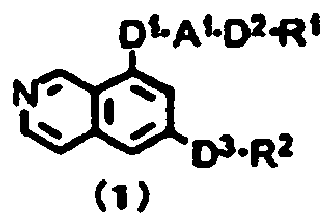
D1 represents a single bond, -N (R11) -, -O-, -S-, -S(O)-, or -S(O)2-, wherein R11 represents a hydrogen atom or an alkyl group that may be substituted;
A1 represents a single bond, an alkylene that may be substituted, or any of divalent groups selected from the following formulas (1a-1) to (1a-6):

n1 is an integer of 0, 1, or 2;
n2 is an integer of 2 or 3;
n3 is an integer of 1 or 2;
R12 and R13 may be identical to or different from each other and each independently represents a hydrogen atom, a hydroxyl group, or an alkyl group that may be substituted;
X1 represents -N(R14)-, -O-, or -S-, wherein R14 represents a hydrogen atom or an alkyl group that may be substituted;
v represents a bond with D1; and
w represents a bond with D2
C2 represents a single bond, an alkylene that may be substituted, -C (O) -, -C(S)-, -S (O)2-, -C(O)-N(R15)-, -C(S)-N(R15)-, or -E-C(O)-, wherein E represents an alkylene that may be substituted and R15 represents a hydrogen atom or an alkyl group;
R1 represents a hydrogen atom, an alkyl group that may be substituted, an amino group that may be substituted, a saturated heterocyclic group that may be substituted, an aryl group that may be substituted, an aralkyl group that may be substituted, a carbamimidoyl group, or any of groups selected from the following formulas (1b-1) to (1b-4):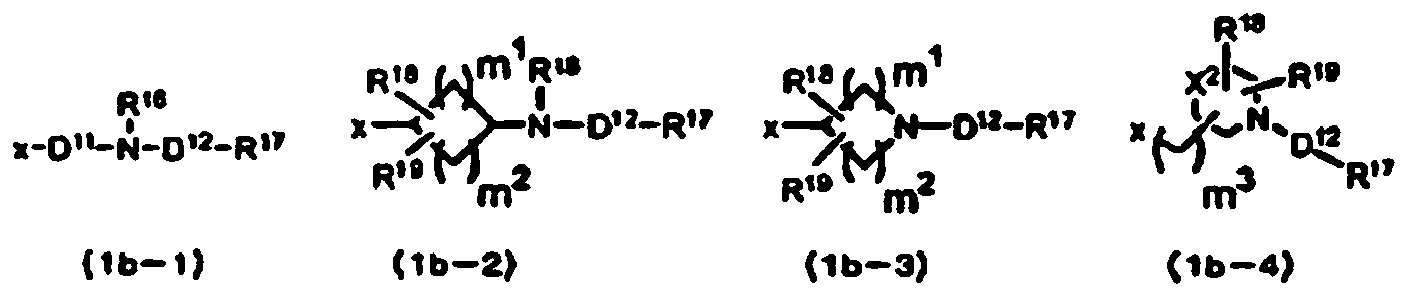
m1 is an integer of 0, 1, or 2;
m2 is an integer of 1 or 2;
m3 is an integer of 0, 1, or 2;
X2 represents -N(R14)-, -O-, or -S-, wherein R14 represents a hydrogen atom or an alkyl group that may be substituted:
D11 represents an alkylene that may be substituted;
D12 represents a single bond, an alkylene that may be substituted, -C(O)-, -S(O)2-, or -C(O)-N(R15)-, wherein R15 represents a hydrogen atom or an alkyl group;
R16, R18, and R19 may be identical to or different from one another and each independently represents a hydrogen atom or an alkyl group that may be substituted;
R17 represents a hydrogen atom, an alkyl group that may be substituted, an aryl group that may be substituted, or an aralkyl group that may be substituted; and
x represents a bond with D2;
with the proviso that, when R17 represents a hydrogen atom, D12 represents a single bond;
with the proviso that,
when D1 represents a single bond, A1 represents a divalent group represented by the above-mentioned formula (1a-5) or (1a-6) ;
when D1 represents -N(R11)-, -O-, -S-, -S (O) -, or -S(O)2-, A1 represents a single bond, an alkylene that may be substituted, or any of divalent groups selected from the formulas (1a-1) to (1a-4), wherein, when A1 represents a single bond, D2 represents an alkylene that may be substituted or -E-C (O) -;
when R1 represents an amino group that may be substituted, D2 represents an alkylene that may be substituted or -E-C.(O)-;
and
D3 represents a single bond, -N(R21)-, -O-, -N (R21) -C (O) -, or -S-, wherein R21 represents a hydrogen atom or an alkyl group that may be substituted; and
R2 represents an alkyl group that may be substituted or the following formula (2a-1):
Q represents an aryl group that may be substituted; and
y represents a bond with D3; and
R23, R24, and R25 may be identical to or different from one another and each independently represents a hydrogen atom, a halogen atom, a cyano group, an alkyl group that may be substituted, an alkoxy group that may be substituted, an amino group that may be substituted, an aryl group that may be substituted, an aryloxy group that may be substituted, an aralkyl group that may be substituted, or the following formula (2b-1):
D21 represents a single bond or an alkylene that may be substituted;
D22 represents a single bond, an alkylene that may be substituted, -C (O) -, -S(O)2-, or -C(O)-N(R28)-;
R26 , R21, and R28 may be identical to or different from one another and each independently represents a hydrogen atom or an alkyl group that may be substituted; and
z represents a bond with Q;
with the provisos that: when D22 represents a single bond, R27 represents a hydrogen atom; and that 6,8-dimethoxyisoquinoline is excluded. - The compound according to claim 1 or a salt thereof, wherein D1 represents a single bond, -N (R11) -, -O-, or -S-, wherein R11 has the same meaning as defined above.
- The compound according to claim 1 or 2 or a salt thereof, wherein A1 represents an alkylene that may be substituted or any of divalent groups selected from the formulas (1a-1) to (1a-5), wherein n1, n2, X1, R12, R13, R14, v, and w have the same meanings as defined above.
- The compound according to claim 1 or 2 or a salt thereof, wherein A1 represents any of divalent groups selected from the formulas (1a-1) to (1a-3) and (1a-5), wherein n1, n2, R12, R13, v, and w have the same meanings as defined above.
- The compound according to any one of claims 1 to 4 or a salt thereof, wherein n1 is an integer of 0 or 1.
- The compound according to any one of claims 1 to 5 or a salt thereof, wherein D2 represents an alkylene that may be substituted, -C (O) -, or -S(O)2-.
- The compound according to any one of claims 1 to 5 or a salt thereof, wherein D2 represents -C(O)- or -S(O)2-.
- The compound according to any one of claims 1 to 7 or a salt thereof, wherein R1 represents a hydrogen atom, an alkyl group that may be substituted, an aryl group that may be substituted, or an aralkyl group that may be substituted.
- The compound according to any one of claims 1 to 7 or a salt thereof, wherein R1 represents any of divalent groups selected from the formulas (1b-1) to (1b-4), wherein m1, m2, m3, X2, D11, D12, R14 , R15, R16, R17 , R18, R19, and x have the same meanings as defined above.
- The compound according to any one of claims 1 to 9 or a salt thereof, wherein D3 represents a single bond, -O-, or - N (R21) -C (O) -, wherein R21 have the same meaning as defined above.
- The compound according to any one of claims 1 to 10 or a salt thereof, wherein D3 represents a single bond or -N(R21)-C(O)-, wherein R21 have the same meaning as defined above.
- The compound according to any one of claims 1 to 11 or a salt thereof, wherein D3 represents a single bond.
- The compound according to any one of claims 1 to 12 or a salt thereof, wherein R2 represents the formula (2a-1), wherein Q, y, R23, R24, R25, D21, D22, R26, R27, R28, and z have the same meanings as defined above.
- The compound according to any one of claims 1 to 13 or a salt thereof, wherein Q in the formula (2a-1) represents a monocyclic aromatic group.
- A compound according to claim 1 or a salt thereof, wherein the compound is selected from the group consisting of:


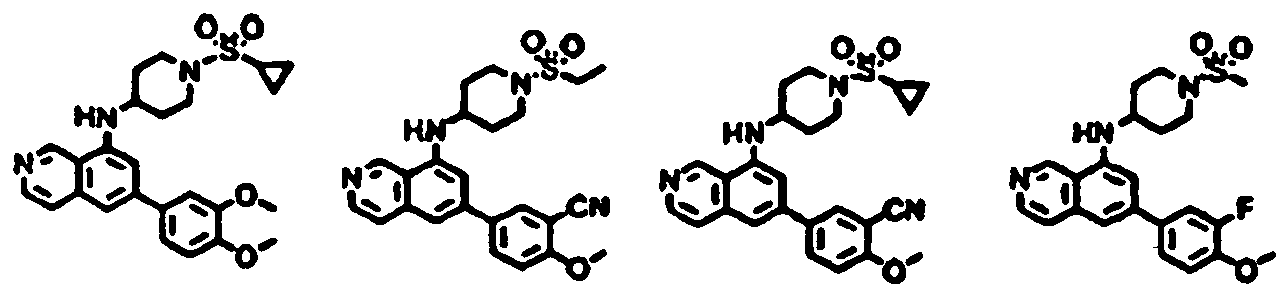


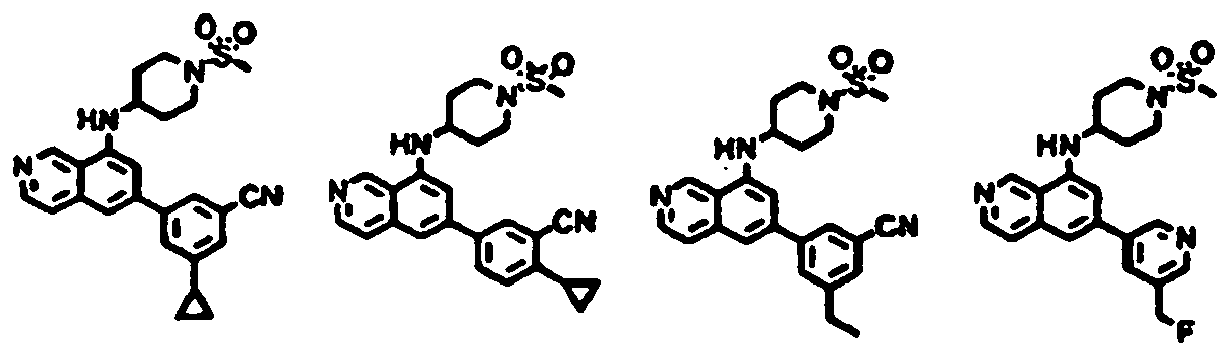


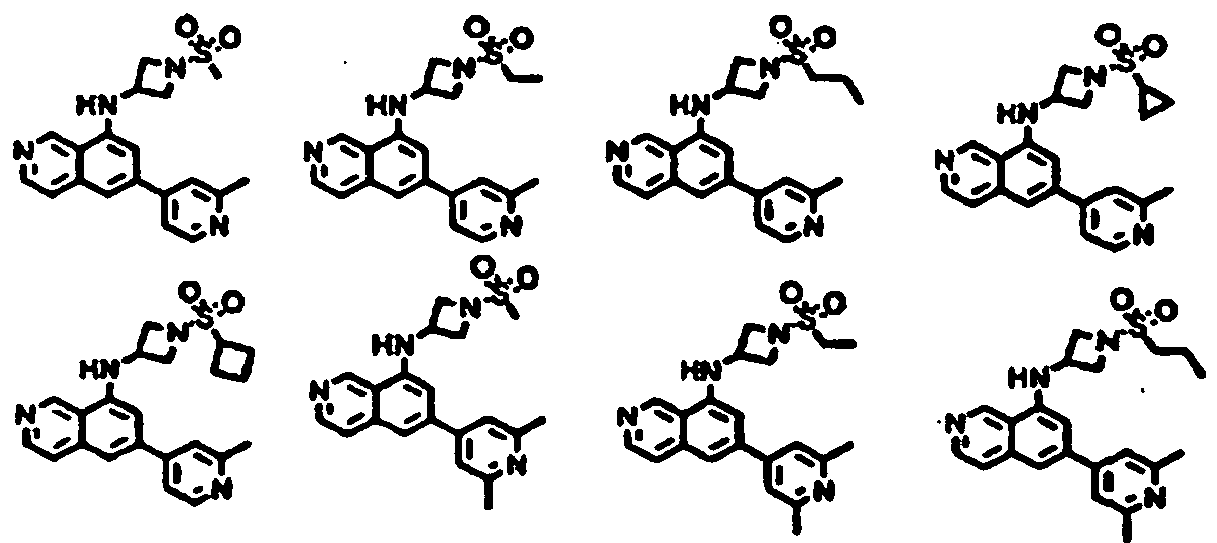


- A compound according to claim 1 or a salt thereof, wherein the compound is selected from the group consisting of:


- The compound or the salt thereof according to claim 16, wherein the compound is:

- The compound or the salt thereof according to claim 16, wherein the compound is:
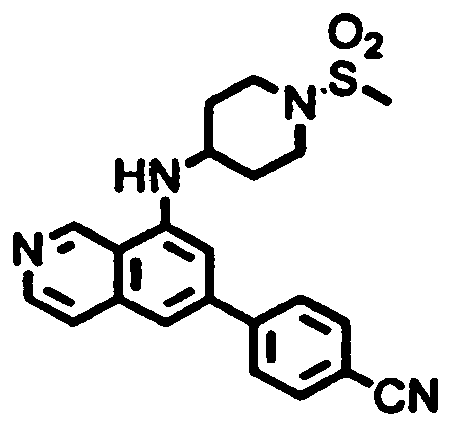
- The compound or the salt thereof according to claim 16, wherein the compound is:

- The compound or the salt thereof according to claim 16, wherein the compound is:

- The compound or the salt thereof according to claim 16, wherein the compound is:

- The compound or the salt thereof according to claim 16, wherein the compound is:

- The compound or the salt thereof according to claim 16, wherein the compound is:

- A pharmaceutical composition comprising a compound according to any one of claims 1 to 23 or a pharmaceutically acceptable salt thereof as an active ingredient.
- The pharmaceutical composition according to claim 24, for preventing and/or treating an NF-KB-associated disease or symptom.
- The pharmaceutical composition according to claim 24, for preventing and/or treating an IKKβ-associated disease or symptom.
- The pharmaceutical composition according to claim 24, for preventing and/or treating a TNF-α-associated disease or symptom.
- The pharmaceutical composition according to claim 24, for preventing and/or treating mammal rheumatoid arthritis.
- The pharmaceutical composition according to claim 24, for preventing and/or treating a mammal autoimmune disease.
- The pharmaceutical composition according to claim 24, for preventing and/or treating a mammal inflammatory disease.
- The pharmaceutical composition according to claim 24, for preventing and/or treating a mammal cardiovascular disease.
- The pharmaceutical composition according to claim 24, for preventing and/or treating a mammal cancer.
- The pharmaceutical composition according to claim 24, for preventing and/or treating a disease or symptom associated with acute or chronic inflammatory reaction in mammals.
- An IKKβ inhibitor, comprising a compound according to any one of claims 1 to 14 or a salt thereof as an active ingredient.
- A compound according to any one of claims 1 to 23 or a pharmaceutically acceptable salt thereof for use in inhibiting IKKβ.
- A compound according to any one of claims 1 to 23 or a pharmaceutically acceptable salt thereof for use in the prevention and/or treatment of a NF-kB-associated disease or symptom.
- A compound according to any one of claims 1 to 23 or a pharmaceutically acceptable salt thereof for use in the prevention and/or treatment of an IKKβ-associated disease or symptom.
- A compound according to any one of claims 1 to 23 or a pharmaceutically acceptable salt thereof for use in the prevention and/or treatment of a disease or symptom associated with acute or chronic inflammatory reaction in mammals.
- A compound represented by the following formula (2a) or a salt thereof:
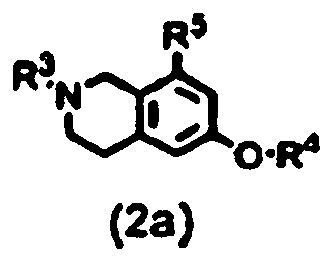
R3 represents a hydrogen atom or an alkyl group that may be substituted;
R4 represents a hydrogen atom, an alkyl group that may be substituted, or an aralkyl group that may be substituted; and
R5 represents a halogen atom. - A compound represented by the following formula (2b) or a salt thereof:

R4 represents a hydrogen atom, an alkyl group that may be substituted, or an aralkyl group that may be substituted; and
R5 represents a halogen atom.
Priority Applications (1)
| Application Number | Priority Date | Filing Date | Title |
|---|---|---|---|
| PL09817505T PL2366699T3 (en) | 2008-10-02 | 2009-10-01 | 8-substituted isoquinoline derivative and use thereof |
Applications Claiming Priority (2)
| Application Number | Priority Date | Filing Date | Title |
|---|---|---|---|
| US10208608P | 2008-10-02 | 2008-10-02 | |
| PCT/JP2009/005072 WO2010038465A1 (en) | 2008-10-02 | 2009-10-01 | 8-substituted isoquinoline derivative and use thereof |
Publications (3)
| Publication Number | Publication Date |
|---|---|
| EP2366699A1 EP2366699A1 (en) | 2011-09-21 |
| EP2366699A4 EP2366699A4 (en) | 2012-03-14 |
| EP2366699B1 true EP2366699B1 (en) | 2013-08-07 |
Family
ID=42073244
Family Applications (1)
| Application Number | Title | Priority Date | Filing Date |
|---|---|---|---|
| EP09817505.2A Not-in-force EP2366699B1 (en) | 2008-10-02 | 2009-10-01 | 8-substituted isoquinoline derivative and use thereof |
Country Status (12)
| Country | Link |
|---|---|
| US (1) | US8299055B2 (en) |
| EP (1) | EP2366699B1 (en) |
| JP (1) | JP5312466B2 (en) |
| KR (1) | KR101323448B1 (en) |
| CN (1) | CN102171204B (en) |
| AU (1) | AU2009298981B2 (en) |
| BR (1) | BRPI0919282A2 (en) |
| CA (1) | CA2738563C (en) |
| ES (1) | ES2431368T3 (en) |
| PL (1) | PL2366699T3 (en) |
| RU (1) | RU2504544C2 (en) |
| WO (1) | WO2010038465A1 (en) |
Cited By (1)
| Publication number | Priority date | Publication date | Assignee | Title |
|---|---|---|---|---|
| US11655235B2 (en) | 2019-11-06 | 2023-05-23 | Yuhan Corporation | Pyrrolidine and piperidine compounds |
Families Citing this family (31)
| Publication number | Priority date | Publication date | Assignee | Title |
|---|---|---|---|---|
| US8044068B2 (en) * | 2006-04-04 | 2011-10-25 | Taisho Pharmaceutical Co., Ltd | Aminopyrrolidine compound |
| AU2011356644B2 (en) | 2011-01-28 | 2016-05-19 | Tate & Lyle Solutions Usa Llc | Stevia blends containing rebaudioside B |
| GB201217700D0 (en) | 2012-08-01 | 2012-11-14 | Tate & Lyle Ingredients | Sweetener compositions containing rebaudioside B |
| US9565840B2 (en) | 2012-11-01 | 2017-02-14 | Kyoto University | Fibrotic non-human animal, and use thereof |
| WO2016057924A1 (en) | 2014-10-10 | 2016-04-14 | Genentech, Inc. | Pyrrolidine amide compounds as histone demethylase inhibitors |
| AR112682A1 (en) | 2017-08-17 | 2019-11-27 | Syngenta Participations Ag | HERBICIDE COMPOUNDS |
| AR114422A1 (en) | 2018-03-30 | 2020-09-02 | Syngenta Participations Ag | HERBICIDE COMPOUNDS |
| GB201818348D0 (en) | 2018-11-12 | 2018-12-26 | Syngenta Participations Ag | Herbicidal compounds |
| GB201818349D0 (en) | 2018-11-12 | 2018-12-26 | Syngenta Participations Ag | Herbicidal compounds |
| GB201901617D0 (en) | 2019-02-06 | 2019-03-27 | Syngenta Crop Protection Ag | Herbicidal compounds |
| AR117990A1 (en) | 2019-02-06 | 2021-09-08 | Syngenta Crop Protection Ag | HERBICIDE COMPOUNDS |
| WO2020161138A1 (en) | 2019-02-07 | 2020-08-13 | Syngenta Crop Protection Ag | Pyridazinium compounds for use in controlling unwanted plant growth |
| GB201901760D0 (en) | 2019-02-08 | 2019-03-27 | Syngenta Crop Protection Ag | Herbicidal compounds |
| GB201901866D0 (en) | 2019-02-11 | 2019-04-03 | Syngenta Crop Protection Ag | Pre-harvest desiccation method |
| GB201902013D0 (en) | 2019-02-14 | 2019-04-03 | Syngenta Crop Protection Ag | Herbicidal compounds |
| GB201902064D0 (en) | 2019-02-14 | 2019-04-03 | Syngenta Crop Protection Ag | Herbicidal compounds |
| GB201902107D0 (en) | 2019-02-15 | 2019-04-03 | Syngenta Crop Protection Ag | Herbicidal compounds |
| WO2020164925A1 (en) | 2019-02-15 | 2020-08-20 | Syngenta Crop Protection Ag | Herbicidal compositions |
| JP2022520648A (en) | 2019-02-15 | 2022-03-31 | シンジェンタ クロップ プロテクション アクチェンゲゼルシャフト | Weeding composition |
| BR112021015914A2 (en) | 2019-02-15 | 2021-10-05 | Syngenta Crop Protection Ag | HERBICIDAL COMPOSITIONS |
| CN113412054A (en) | 2019-02-15 | 2021-09-17 | 先正达农作物保护股份公司 | Herbicidal composition |
| US20220125052A1 (en) | 2019-02-15 | 2022-04-28 | Syngenta Crop Protection Ag | Herbicidal Compositions |
| GB201902383D0 (en) | 2019-02-21 | 2019-04-10 | Syngenta Crop Protection Ag | Herbicidal compounds |
| GB201903000D0 (en) | 2019-03-06 | 2019-04-17 | Syngenta Crop Protection Ag | Herbicidal compounds |
| JP2023068213A (en) * | 2020-03-31 | 2023-05-17 | 慶應義塾 | Agent for treating inflammatory bowel disease, and amide compound or salt thereof |
| WO2021201126A1 (en) * | 2020-03-31 | 2021-10-07 | 富士フイルム株式会社 | Amide compound or salt thereof, pharmaceutical composition and histone deacetylase inhibitor |
| TWI783480B (en) * | 2020-05-27 | 2022-11-11 | 美商美國禮來大藥廠 | Compounds useful for inhibiting cdk7 |
| WO2023284838A1 (en) | 2021-07-15 | 2023-01-19 | 四川海思科制药有限公司 | Aak1 inhibitor and use thereof |
| US20250066294A1 (en) | 2021-12-27 | 2025-02-27 | Fundación Centro De Investigación Cooperativa De Energías Alternativas Cic Energigune Fundazioa | Method for preparing ionic compounds |
| EP4457885A1 (en) | 2021-12-27 | 2024-11-06 | Fundación Centro de Investigación Cooperativa de Energías Alternativas, CIC Energigune Fundazioa | Solid polymer electrolytes comprising ionic compounds and uses thereof |
| CN117551057B (en) * | 2023-03-24 | 2026-04-10 | 浙江海正药业股份有限公司 | Benzo ring derivative and preparation method and application thereof |
Family Cites Families (24)
| Publication number | Priority date | Publication date | Assignee | Title |
|---|---|---|---|---|
| GB9322828D0 (en) * | 1993-11-05 | 1993-12-22 | Sandoz Ltd | Organic compounds |
| JPH1087491A (en) * | 1996-07-26 | 1998-04-07 | Asahi Chem Ind Co Ltd | Transcription control factor inhibitor |
| HUP0102492A2 (en) | 1998-06-19 | 2001-11-28 | Smithkline Beecham Corp. | Use of amino-indanone inhibitors of transcription factor nf-kb for producing pharmaceutical compositions |
| DE19951360A1 (en) | 1999-10-26 | 2001-05-03 | Aventis Pharma Gmbh | Substituted indoles |
| ATE319713T1 (en) | 2000-10-03 | 2006-03-15 | Bristol Myers Squibb Co | AMINO-SUBSTITUTED TETRACYCLIC COMPOUNDS USEFUL AS ANTI-INFLAMMATORY AGENTS AND DRUGS CONTAINING SAME. |
| WO2002030423A1 (en) | 2000-10-12 | 2002-04-18 | Smithkline Beecham Corporation | NF-λB INHIBITORS |
| ATE392898T1 (en) * | 2000-10-26 | 2008-05-15 | Amgen Inc | ANTIPHLOGISTIC AGENTS |
| JP2002193938A (en) | 2000-12-01 | 2002-07-10 | Bayer Ag | 4-arylpyridine derivative |
| US7122544B2 (en) | 2000-12-06 | 2006-10-17 | Signal Pharmaceuticals, Llc | Anilinopyrimidine derivatives as IKK inhibitors and compositions and methods related thereto |
| PL364111A1 (en) | 2001-02-01 | 2004-12-13 | Bristol-Myers Squibb Company | Methods of treating inflammatory and immune diseases using inhibitors of ikappab kinase (ikk) |
| SE0102616D0 (en) | 2001-07-25 | 2001-07-25 | Astrazeneca Ab | Novel compounds |
| EP1448545B1 (en) | 2001-10-04 | 2008-11-19 | Smithkline Beecham Corporation | Nf-kb inhibitors |
| US20040006118A1 (en) | 2001-10-12 | 2004-01-08 | Callahan James F | Nf-kb inhibitors |
| AU2002365426A1 (en) | 2001-10-12 | 2003-09-02 | Barnes-Jewish Hospital | Methods for screening osteogenic compounds |
| US20030187026A1 (en) | 2001-12-13 | 2003-10-02 | Qun Li | Kinase inhibitors |
| EA008622B1 (en) | 2002-06-05 | 2007-06-29 | Инститьют Оф Медисинал Молекьюлар Дизайн. Инк. | Immunity-related protein kinase inhibitors |
| DE60312997T2 (en) | 2002-06-06 | 2007-12-13 | Smithkline Beecham Corp. | NF-KB INHIBITORS |
| JPWO2004009555A1 (en) | 2002-07-22 | 2005-11-17 | 旭化成ファーマ株式会社 | 5-substituted isoquinoline derivatives |
| US7094789B2 (en) | 2002-07-22 | 2006-08-22 | Asahi Kasei Pharma Corporation | 5-substituted isoquinoline derivatives |
| KR20050119652A (en) | 2003-03-24 | 2005-12-21 | 에프. 호프만-라 로슈 아게 | Benzyl-pyridazinons as reverse transcriptase inhibitors |
| MXPA05010793A (en) | 2003-04-09 | 2005-12-05 | Millennium Pharm Inc | Beta-carbolines useful for treating inflammatory disease. |
| GB0308466D0 (en) | 2003-04-11 | 2003-05-21 | Novartis Ag | Organic compounds |
| AR050253A1 (en) | 2004-06-24 | 2006-10-11 | Smithkline Beecham Corp | COMPOSITE DERIVED FROM INDAZOL CARBOXAMIDE, COMPOSITION THAT INCLUDES IT AND ITS USE FOR THE PREPARATION OF A MEDICINAL PRODUCT |
| EP1899322B1 (en) | 2005-06-28 | 2009-09-02 | Sanofi-Aventis | Isoquinoline derivatives as inhibitors of rho-kinase |
-
2009
- 2009-10-01 PL PL09817505T patent/PL2366699T3/en unknown
- 2009-10-01 RU RU2011112393/04A patent/RU2504544C2/en not_active IP Right Cessation
- 2009-10-01 US US12/571,601 patent/US8299055B2/en not_active Expired - Fee Related
- 2009-10-01 CA CA2738563A patent/CA2738563C/en not_active Expired - Fee Related
- 2009-10-01 AU AU2009298981A patent/AU2009298981B2/en not_active Ceased
- 2009-10-01 WO PCT/JP2009/005072 patent/WO2010038465A1/en not_active Ceased
- 2009-10-01 ES ES09817505T patent/ES2431368T3/en active Active
- 2009-10-01 CN CN200980138589.9A patent/CN102171204B/en not_active Expired - Fee Related
- 2009-10-01 EP EP09817505.2A patent/EP2366699B1/en not_active Not-in-force
- 2009-10-01 JP JP2010531755A patent/JP5312466B2/en not_active Expired - Fee Related
- 2009-10-01 KR KR1020117007358A patent/KR101323448B1/en not_active Expired - Fee Related
- 2009-10-01 BR BRPI0919282A patent/BRPI0919282A2/en not_active Application Discontinuation
Cited By (1)
| Publication number | Priority date | Publication date | Assignee | Title |
|---|---|---|---|---|
| US11655235B2 (en) | 2019-11-06 | 2023-05-23 | Yuhan Corporation | Pyrrolidine and piperidine compounds |
Also Published As
| Publication number | Publication date |
|---|---|
| JPWO2010038465A1 (en) | 2012-03-01 |
| RU2011112393A (en) | 2012-11-10 |
| KR101323448B1 (en) | 2013-11-27 |
| AU2009298981A1 (en) | 2010-04-08 |
| US8299055B2 (en) | 2012-10-30 |
| CA2738563C (en) | 2014-02-11 |
| US20100261701A1 (en) | 2010-10-14 |
| EP2366699A4 (en) | 2012-03-14 |
| WO2010038465A1 (en) | 2010-04-08 |
| CA2738563A1 (en) | 2010-04-08 |
| CN102171204A (en) | 2011-08-31 |
| ES2431368T3 (en) | 2013-11-26 |
| EP2366699A1 (en) | 2011-09-21 |
| BRPI0919282A2 (en) | 2017-03-28 |
| CN102171204B (en) | 2014-08-20 |
| PL2366699T3 (en) | 2013-12-31 |
| RU2504544C2 (en) | 2014-01-20 |
| AU2009298981B2 (en) | 2012-09-27 |
| JP5312466B2 (en) | 2013-10-09 |
| KR20110048583A (en) | 2011-05-11 |
Similar Documents
| Publication | Publication Date | Title |
|---|---|---|
| US8299055B2 (en) | 8-substituted isoquinoline derivative and the use thereof | |
| US10933070B2 (en) | Heterocyclic amides as kinase inhibitors | |
| ES2770026T3 (en) | Imidazothiazole and imidazopyrazine derivatives as protease-activated receptor 4 (PAR4) inhibitors to treat platelet aggregation | |
| JP2016518316A (en) | MK2 inhibitors and their use | |
| JP6559699B2 (en) | Substituted nitrogen-containing heterocyclic derivatives, pharmaceutical compositions containing them, and their antitumor applications | |
| EP4225753B1 (en) | Potent and selective compounds as serotonin 1b receptor modulators | |
| US20260138974A1 (en) | Potent and selective compounds as serotonin 1b receptor modulators | |
| HK1253099B (en) | Heterocyclic amides as kinase inhibitors | |
| HK1249100B (en) | Heterocyclic amides as kinase inhibitors | |
| HK1213545B (en) | Heterocyclic amides as kinase inhibitors |
Legal Events
| Date | Code | Title | Description |
|---|---|---|---|
| PUAI | Public reference made under article 153(3) epc to a published international application that has entered the european phase |
Free format text: ORIGINAL CODE: 0009012 |
|
| 17P | Request for examination filed |
Effective date: 20110228 |
|
| AK | Designated contracting states |
Kind code of ref document: A1 Designated state(s): AT BE BG CH CY CZ DE DK EE ES FI FR GB GR HR HU IE IS IT LI LT LU LV MC MK MT NL NO PL PT RO SE SI SK SM TR |
|
| DAX | Request for extension of the european patent (deleted) | ||
| A4 | Supplementary search report drawn up and despatched |
Effective date: 20120210 |
|
| RIC1 | Information provided on ipc code assigned before grant |
Ipc: A61P 37/06 20060101ALI20120210BHEP Ipc: C07D 401/12 20060101AFI20120210BHEP Ipc: A61K 31/4725 20060101ALI20120210BHEP Ipc: A61P 9/00 20060101ALI20120210BHEP Ipc: A61P 17/04 20060101ALI20120210BHEP Ipc: A61P 19/00 20060101ALI20120210BHEP Ipc: A61K 31/472 20060101ALI20120210BHEP Ipc: A61P 35/00 20060101ALI20120210BHEP Ipc: A61K 31/5377 20060101ALI20120210BHEP Ipc: A61P 17/06 20060101ALI20120210BHEP Ipc: A61P 3/10 20060101ALI20120210BHEP Ipc: A61P 37/08 20060101ALI20120210BHEP Ipc: C07D 217/02 20060101ALI20120210BHEP Ipc: A61K 31/496 20060101ALI20120210BHEP Ipc: A61P 43/00 20060101ALI20120210BHEP Ipc: A61P 37/00 20060101ALI20120210BHEP Ipc: A61P 9/10 20060101ALI20120210BHEP Ipc: A61P 19/10 20060101ALI20120210BHEP Ipc: A61K 31/501 20060101ALI20120210BHEP Ipc: A61P 29/00 20060101ALI20120210BHEP |
|
| REG | Reference to a national code |
Ref country code: DE Ref legal event code: R079 Ref document number: 602009017872 Country of ref document: DE Free format text: PREVIOUS MAIN CLASS: C07D0401120000 Ipc: C07D0217020000 |
|
| RIC1 | Information provided on ipc code assigned before grant |
Ipc: A61K 31/501 20060101ALI20130204BHEP Ipc: C07D 401/12 20060101ALI20130204BHEP Ipc: A61P 35/00 20060101ALI20130204BHEP Ipc: A61P 29/00 20060101ALI20130204BHEP Ipc: A61P 37/08 20060101ALI20130204BHEP Ipc: A61P 43/00 20060101ALI20130204BHEP Ipc: A61P 17/06 20060101ALI20130204BHEP Ipc: A61P 9/00 20060101ALI20130204BHEP Ipc: A61P 3/10 20060101ALI20130204BHEP Ipc: C07D 401/14 20060101ALI20130204BHEP Ipc: A61P 17/04 20060101ALI20130204BHEP Ipc: A61P 19/00 20060101ALI20130204BHEP Ipc: A61P 37/00 20060101ALI20130204BHEP Ipc: A61P 37/06 20060101ALI20130204BHEP Ipc: A61K 31/472 20060101ALI20130204BHEP Ipc: A61K 31/5377 20060101ALI20130204BHEP Ipc: C07D 217/02 20060101AFI20130204BHEP Ipc: A61P 19/02 20060101ALI20130204BHEP Ipc: A61P 9/10 20060101ALI20130204BHEP Ipc: A61P 19/10 20060101ALI20130204BHEP |
|
| GRAP | Despatch of communication of intention to grant a patent |
Free format text: ORIGINAL CODE: EPIDOSNIGR1 |
|
| GRAS | Grant fee paid |
Free format text: ORIGINAL CODE: EPIDOSNIGR3 |
|
| GRAA | (expected) grant |
Free format text: ORIGINAL CODE: 0009210 |
|
| AK | Designated contracting states |
Kind code of ref document: B1 Designated state(s): AT BE BG CH CY CZ DE DK EE ES FI FR GB GR HR HU IE IS IT LI LT LU LV MC MK MT NL NO PL PT RO SE SI SK SM TR |
|
| REG | Reference to a national code |
Ref country code: GB Ref legal event code: FG4D |
|
| REG | Reference to a national code |
Ref country code: AT Ref legal event code: REF Ref document number: 625712 Country of ref document: AT Kind code of ref document: T Effective date: 20130815 Ref country code: CH Ref legal event code: NV Representative=s name: BOVARD AG, CH Ref country code: CH Ref legal event code: EP |
|
| REG | Reference to a national code |
Ref country code: IE Ref legal event code: FG4D |
|
| REG | Reference to a national code |
Ref country code: DE Ref legal event code: R096 Ref document number: 602009017872 Country of ref document: DE Effective date: 20131002 |
|
| REG | Reference to a national code |
Ref country code: ES Ref legal event code: FG2A Ref document number: 2431368 Country of ref document: ES Kind code of ref document: T3 Effective date: 20131126 |
|
| REG | Reference to a national code |
Ref country code: AT Ref legal event code: MK05 Ref document number: 625712 Country of ref document: AT Kind code of ref document: T Effective date: 20130807 |
|
| REG | Reference to a national code |
Ref country code: PL Ref legal event code: T3 |
|
| REG | Reference to a national code |
Ref country code: NL Ref legal event code: VDEP Effective date: 20130807 |
|
| REG | Reference to a national code |
Ref country code: LT Ref legal event code: MG4D |
|
| PG25 | Lapsed in a contracting state [announced via postgrant information from national office to epo] |
Ref country code: PT Free format text: LAPSE BECAUSE OF FAILURE TO SUBMIT A TRANSLATION OF THE DESCRIPTION OR TO PAY THE FEE WITHIN THE PRESCRIBED TIME-LIMIT Effective date: 20131209 Ref country code: SE Free format text: LAPSE BECAUSE OF FAILURE TO SUBMIT A TRANSLATION OF THE DESCRIPTION OR TO PAY THE FEE WITHIN THE PRESCRIBED TIME-LIMIT Effective date: 20130807 Ref country code: LT Free format text: LAPSE BECAUSE OF FAILURE TO SUBMIT A TRANSLATION OF THE DESCRIPTION OR TO PAY THE FEE WITHIN THE PRESCRIBED TIME-LIMIT Effective date: 20130807 Ref country code: CY Free format text: LAPSE BECAUSE OF FAILURE TO SUBMIT A TRANSLATION OF THE DESCRIPTION OR TO PAY THE FEE WITHIN THE PRESCRIBED TIME-LIMIT Effective date: 20130619 Ref country code: AT Free format text: LAPSE BECAUSE OF FAILURE TO SUBMIT A TRANSLATION OF THE DESCRIPTION OR TO PAY THE FEE WITHIN THE PRESCRIBED TIME-LIMIT Effective date: 20130807 Ref country code: IS Free format text: LAPSE BECAUSE OF FAILURE TO SUBMIT A TRANSLATION OF THE DESCRIPTION OR TO PAY THE FEE WITHIN THE PRESCRIBED TIME-LIMIT Effective date: 20131207 Ref country code: NO Free format text: LAPSE BECAUSE OF FAILURE TO SUBMIT A TRANSLATION OF THE DESCRIPTION OR TO PAY THE FEE WITHIN THE PRESCRIBED TIME-LIMIT Effective date: 20131107 Ref country code: HR Free format text: LAPSE BECAUSE OF FAILURE TO SUBMIT A TRANSLATION OF THE DESCRIPTION OR TO PAY THE FEE WITHIN THE PRESCRIBED TIME-LIMIT Effective date: 20130807 |
|
| PG25 | Lapsed in a contracting state [announced via postgrant information from national office to epo] |
Ref country code: GR Free format text: LAPSE BECAUSE OF FAILURE TO SUBMIT A TRANSLATION OF THE DESCRIPTION OR TO PAY THE FEE WITHIN THE PRESCRIBED TIME-LIMIT Effective date: 20131108 Ref country code: NL Free format text: LAPSE BECAUSE OF FAILURE TO SUBMIT A TRANSLATION OF THE DESCRIPTION OR TO PAY THE FEE WITHIN THE PRESCRIBED TIME-LIMIT Effective date: 20130807 Ref country code: LV Free format text: LAPSE BECAUSE OF FAILURE TO SUBMIT A TRANSLATION OF THE DESCRIPTION OR TO PAY THE FEE WITHIN THE PRESCRIBED TIME-LIMIT Effective date: 20130807 Ref country code: FI Free format text: LAPSE BECAUSE OF FAILURE TO SUBMIT A TRANSLATION OF THE DESCRIPTION OR TO PAY THE FEE WITHIN THE PRESCRIBED TIME-LIMIT Effective date: 20130807 Ref country code: SI Free format text: LAPSE BECAUSE OF FAILURE TO SUBMIT A TRANSLATION OF THE DESCRIPTION OR TO PAY THE FEE WITHIN THE PRESCRIBED TIME-LIMIT Effective date: 20130807 |
|
| PG25 | Lapsed in a contracting state [announced via postgrant information from national office to epo] |
Ref country code: CY Free format text: LAPSE BECAUSE OF FAILURE TO SUBMIT A TRANSLATION OF THE DESCRIPTION OR TO PAY THE FEE WITHIN THE PRESCRIBED TIME-LIMIT Effective date: 20130807 |
|
| PG25 | Lapsed in a contracting state [announced via postgrant information from national office to epo] |
Ref country code: CZ Free format text: LAPSE BECAUSE OF FAILURE TO SUBMIT A TRANSLATION OF THE DESCRIPTION OR TO PAY THE FEE WITHIN THE PRESCRIBED TIME-LIMIT Effective date: 20130807 Ref country code: EE Free format text: LAPSE BECAUSE OF FAILURE TO SUBMIT A TRANSLATION OF THE DESCRIPTION OR TO PAY THE FEE WITHIN THE PRESCRIBED TIME-LIMIT Effective date: 20130807 Ref country code: SK Free format text: LAPSE BECAUSE OF FAILURE TO SUBMIT A TRANSLATION OF THE DESCRIPTION OR TO PAY THE FEE WITHIN THE PRESCRIBED TIME-LIMIT Effective date: 20130807 Ref country code: DK Free format text: LAPSE BECAUSE OF FAILURE TO SUBMIT A TRANSLATION OF THE DESCRIPTION OR TO PAY THE FEE WITHIN THE PRESCRIBED TIME-LIMIT Effective date: 20130807 Ref country code: RO Free format text: LAPSE BECAUSE OF FAILURE TO SUBMIT A TRANSLATION OF THE DESCRIPTION OR TO PAY THE FEE WITHIN THE PRESCRIBED TIME-LIMIT Effective date: 20130807 |
|
| PG25 | Lapsed in a contracting state [announced via postgrant information from national office to epo] |
Ref country code: MC Free format text: LAPSE BECAUSE OF FAILURE TO SUBMIT A TRANSLATION OF THE DESCRIPTION OR TO PAY THE FEE WITHIN THE PRESCRIBED TIME-LIMIT Effective date: 20130807 |
|
| PLBE | No opposition filed within time limit |
Free format text: ORIGINAL CODE: 0009261 |
|
| STAA | Information on the status of an ep patent application or granted ep patent |
Free format text: STATUS: NO OPPOSITION FILED WITHIN TIME LIMIT |
|
| 26N | No opposition filed |
Effective date: 20140508 |
|
| REG | Reference to a national code |
Ref country code: DE Ref legal event code: R097 Ref document number: 602009017872 Country of ref document: DE Effective date: 20140508 |
|
| PG25 | Lapsed in a contracting state [announced via postgrant information from national office to epo] |
Ref country code: IE Free format text: LAPSE BECAUSE OF NON-PAYMENT OF DUE FEES Effective date: 20131001 |
|
| PG25 | Lapsed in a contracting state [announced via postgrant information from national office to epo] |
Ref country code: SM Free format text: LAPSE BECAUSE OF FAILURE TO SUBMIT A TRANSLATION OF THE DESCRIPTION OR TO PAY THE FEE WITHIN THE PRESCRIBED TIME-LIMIT Effective date: 20130807 |
|
| PG25 | Lapsed in a contracting state [announced via postgrant information from national office to epo] |
Ref country code: MK Free format text: LAPSE BECAUSE OF FAILURE TO SUBMIT A TRANSLATION OF THE DESCRIPTION OR TO PAY THE FEE WITHIN THE PRESCRIBED TIME-LIMIT Effective date: 20130807 Ref country code: HU Free format text: LAPSE BECAUSE OF FAILURE TO SUBMIT A TRANSLATION OF THE DESCRIPTION OR TO PAY THE FEE WITHIN THE PRESCRIBED TIME-LIMIT; INVALID AB INITIO Effective date: 20091001 Ref country code: LU Free format text: LAPSE BECAUSE OF NON-PAYMENT OF DUE FEES Effective date: 20131001 Ref country code: BG Free format text: LAPSE BECAUSE OF FAILURE TO SUBMIT A TRANSLATION OF THE DESCRIPTION OR TO PAY THE FEE WITHIN THE PRESCRIBED TIME-LIMIT Effective date: 20130807 |
|
| PG25 | Lapsed in a contracting state [announced via postgrant information from national office to epo] |
Ref country code: MT Free format text: LAPSE BECAUSE OF FAILURE TO SUBMIT A TRANSLATION OF THE DESCRIPTION OR TO PAY THE FEE WITHIN THE PRESCRIBED TIME-LIMIT Effective date: 20130807 |
|
| REG | Reference to a national code |
Ref country code: FR Ref legal event code: PLFP Year of fee payment: 7 |
|
| REG | Reference to a national code |
Ref country code: FR Ref legal event code: PLFP Year of fee payment: 8 |
|
| PGFP | Annual fee paid to national office [announced via postgrant information from national office to epo] |
Ref country code: GB Payment date: 20160928 Year of fee payment: 8 |
|
| PGFP | Annual fee paid to national office [announced via postgrant information from national office to epo] |
Ref country code: FR Payment date: 20160919 Year of fee payment: 8 Ref country code: PL Payment date: 20160915 Year of fee payment: 8 |
|
| PGFP | Annual fee paid to national office [announced via postgrant information from national office to epo] |
Ref country code: BE Payment date: 20160913 Year of fee payment: 8 Ref country code: ES Payment date: 20160913 Year of fee payment: 8 Ref country code: TR Payment date: 20160922 Year of fee payment: 8 |
|
| PGFP | Annual fee paid to national office [announced via postgrant information from national office to epo] |
Ref country code: DE Payment date: 20160927 Year of fee payment: 8 Ref country code: CH Payment date: 20161013 Year of fee payment: 8 |
|
| PGFP | Annual fee paid to national office [announced via postgrant information from national office to epo] |
Ref country code: IT Payment date: 20161024 Year of fee payment: 8 |
|
| REG | Reference to a national code |
Ref country code: DE Ref legal event code: R119 Ref document number: 602009017872 Country of ref document: DE |
|
| REG | Reference to a national code |
Ref country code: CH Ref legal event code: PL |
|
| GBPC | Gb: european patent ceased through non-payment of renewal fee |
Effective date: 20171001 |
|
| REG | Reference to a national code |
Ref country code: FR Ref legal event code: ST Effective date: 20180629 |
|
| PG25 | Lapsed in a contracting state [announced via postgrant information from national office to epo] |
Ref country code: DE Free format text: LAPSE BECAUSE OF NON-PAYMENT OF DUE FEES Effective date: 20180501 Ref country code: CH Free format text: LAPSE BECAUSE OF NON-PAYMENT OF DUE FEES Effective date: 20171031 Ref country code: LI Free format text: LAPSE BECAUSE OF NON-PAYMENT OF DUE FEES Effective date: 20171031 Ref country code: GB Free format text: LAPSE BECAUSE OF NON-PAYMENT OF DUE FEES Effective date: 20171001 |
|
| REG | Reference to a national code |
Ref country code: BE Ref legal event code: MM Effective date: 20171031 |
|
| PG25 | Lapsed in a contracting state [announced via postgrant information from national office to epo] |
Ref country code: BE Free format text: LAPSE BECAUSE OF NON-PAYMENT OF DUE FEES Effective date: 20171031 Ref country code: FR Free format text: LAPSE BECAUSE OF NON-PAYMENT OF DUE FEES Effective date: 20171031 |
|
| REG | Reference to a national code |
Ref country code: ES Ref legal event code: FD2A Effective date: 20181017 |
|
| PG25 | Lapsed in a contracting state [announced via postgrant information from national office to epo] |
Ref country code: IT Free format text: LAPSE BECAUSE OF NON-PAYMENT OF DUE FEES Effective date: 20171001 |
|
| PG25 | Lapsed in a contracting state [announced via postgrant information from national office to epo] |
Ref country code: ES Free format text: LAPSE BECAUSE OF NON-PAYMENT OF DUE FEES Effective date: 20171002 |
|
| PG25 | Lapsed in a contracting state [announced via postgrant information from national office to epo] |
Ref country code: PL Free format text: LAPSE BECAUSE OF NON-PAYMENT OF DUE FEES Effective date: 20171001 |
|
| PG25 | Lapsed in a contracting state [announced via postgrant information from national office to epo] |
Ref country code: TR Free format text: LAPSE BECAUSE OF NON-PAYMENT OF DUE FEES Effective date: 20171001 |