EP2364589A2 - Schrein mit einem inerten und stabilen geschlossenen Mikroklima, insbesondere zur endgültigen Konservierung mumifizierter organischer Überreste und zugehöriges Konservierungsverfahren - Google Patents
Schrein mit einem inerten und stabilen geschlossenen Mikroklima, insbesondere zur endgültigen Konservierung mumifizierter organischer Überreste und zugehöriges Konservierungsverfahren Download PDFInfo
- Publication number
- EP2364589A2 EP2364589A2 EP11156807A EP11156807A EP2364589A2 EP 2364589 A2 EP2364589 A2 EP 2364589A2 EP 11156807 A EP11156807 A EP 11156807A EP 11156807 A EP11156807 A EP 11156807A EP 2364589 A2 EP2364589 A2 EP 2364589A2
- Authority
- EP
- European Patent Office
- Prior art keywords
- shrine
- inert gas
- mummified
- preservation
- hygrometer
- Prior art date
- Legal status (The legal status is an assumption and is not a legal conclusion. Google has not performed a legal analysis and makes no representation as to the accuracy of the status listed.)
- Withdrawn
Links
- 238000000034 method Methods 0.000 title claims abstract description 20
- 238000004321 preservation Methods 0.000 title claims abstract description 11
- IJGRMHOSHXDMSA-UHFFFAOYSA-N Atomic nitrogen Chemical compound N#N IJGRMHOSHXDMSA-UHFFFAOYSA-N 0.000 claims abstract description 36
- 229910052757 nitrogen Inorganic materials 0.000 claims abstract description 16
- 239000011521 glass Substances 0.000 claims abstract description 14
- 239000000126 substance Substances 0.000 claims abstract description 14
- 230000018044 dehydration Effects 0.000 claims abstract description 5
- 238000006297 dehydration reaction Methods 0.000 claims abstract description 5
- 239000012780 transparent material Substances 0.000 claims abstract description 5
- 239000011261 inert gas Substances 0.000 claims description 18
- VTYYLEPIZMXCLO-UHFFFAOYSA-L Calcium carbonate Chemical compound [Ca+2].[O-]C([O-])=O VTYYLEPIZMXCLO-UHFFFAOYSA-L 0.000 claims description 8
- 238000004026 adhesive bonding Methods 0.000 claims description 8
- 239000007789 gas Substances 0.000 claims description 7
- 239000012298 atmosphere Substances 0.000 claims description 4
- 229910000019 calcium carbonate Inorganic materials 0.000 claims description 4
- 238000005201 scrubbing Methods 0.000 claims description 4
- 229920001296 polysiloxane Polymers 0.000 claims description 3
- 230000001737 promoting effect Effects 0.000 claims description 3
- 239000011347 resin Substances 0.000 claims description 3
- 229920005989 resin Polymers 0.000 claims description 3
- 230000000284 resting effect Effects 0.000 claims description 3
- XEEYBQQBJWHFJM-UHFFFAOYSA-N Iron Chemical compound [Fe] XEEYBQQBJWHFJM-UHFFFAOYSA-N 0.000 claims description 2
- VYPSYNLAJGMNEJ-UHFFFAOYSA-N Silicium dioxide Chemical compound O=[Si]=O VYPSYNLAJGMNEJ-UHFFFAOYSA-N 0.000 claims description 2
- 230000000845 anti-microbial effect Effects 0.000 claims description 2
- 239000003124 biologic agent Substances 0.000 claims description 2
- 229920000515 polycarbonate Polymers 0.000 claims description 2
- 239000004417 polycarbonate Substances 0.000 claims description 2
- 239000000741 silica gel Substances 0.000 claims description 2
- 229910002027 silica gel Inorganic materials 0.000 claims description 2
- 238000005406 washing Methods 0.000 abstract description 3
- 239000012299 nitrogen atmosphere Substances 0.000 abstract description 2
- 229910001873 dinitrogen Inorganic materials 0.000 description 4
- 239000000356 contaminant Substances 0.000 description 2
- 238000000354 decomposition reaction Methods 0.000 description 2
- 239000003344 environmental pollutant Substances 0.000 description 2
- 230000002045 lasting effect Effects 0.000 description 2
- 231100000719 pollutant Toxicity 0.000 description 2
- 239000004810 polytetrafluoroethylene Substances 0.000 description 2
- 229920001343 polytetrafluoroethylene Polymers 0.000 description 2
- 241000201308 Boschniakia Species 0.000 description 1
- 238000004458 analytical method Methods 0.000 description 1
- 239000005388 borosilicate glass Substances 0.000 description 1
- 238000006243 chemical reaction Methods 0.000 description 1
- 230000007613 environmental effect Effects 0.000 description 1
- 238000005530 etching Methods 0.000 description 1
- 230000001747 exhibiting effect Effects 0.000 description 1
- 239000003925 fat Substances 0.000 description 1
- 238000009413 insulation Methods 0.000 description 1
- 230000001050 lubricating effect Effects 0.000 description 1
- 238000012423 maintenance Methods 0.000 description 1
- 230000002906 microbiologic effect Effects 0.000 description 1
- 238000013508 migration Methods 0.000 description 1
- 230000005012 migration Effects 0.000 description 1
- 230000004048 modification Effects 0.000 description 1
- 238000012986 modification Methods 0.000 description 1
- 239000011368 organic material Substances 0.000 description 1
- 239000012188 paraffin wax Substances 0.000 description 1
- 239000003755 preservative agent Substances 0.000 description 1
- 230000002335 preservative effect Effects 0.000 description 1
- 230000001681 protective effect Effects 0.000 description 1
- 239000003566 sealing material Substances 0.000 description 1
- 210000004872 soft tissue Anatomy 0.000 description 1
- XLYOFNOQVPJJNP-UHFFFAOYSA-N water Substances O XLYOFNOQVPJJNP-UHFFFAOYSA-N 0.000 description 1
Images
Classifications
-
- A—HUMAN NECESSITIES
- A01—AGRICULTURE; FORESTRY; ANIMAL HUSBANDRY; HUNTING; TRAPPING; FISHING
- A01N—PRESERVATION OF BODIES OF HUMANS OR ANIMALS OR PLANTS OR PARTS THEREOF; BIOCIDES, e.g. AS DISINFECTANTS, AS PESTICIDES OR AS HERBICIDES; PEST REPELLANTS OR ATTRACTANTS; PLANT GROWTH REGULATORS
- A01N1/00—Preservation of bodies of humans or animals, or parts thereof
Definitions
- the present invention relates to a shrine which is able to define an environment provided with a stable and inert confined microclimate, which can be conveniently used for the definitive preservation of mummified organic remains, such as for example archaeological, paleontological finds, relics and so on.
- the invention also relates to a related preservation method using the above-mentioned shrine.
- the technical problem underlying the present invention consists in providing a shrine which can obviate the decomposition risk and allow exhibiting the remains.
- the invention further relates to a process for preserving mummified organic remains, comprising the steps of:
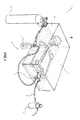
- a shrine for preserving mummified biological remains is designated with 1.
- It is substantially shaped like a parallelepiped and it shows side, lower and upper walls made of a transparent material with anti-burglary features, for example in polycarbonate multi-layered glass.
- the lower wall alternatively can be constituted by a base made of other, even not transparent material, on condition that it is a sealing material.
- the volume and the shape will be chosen in a suitable way, in order to house the find which will have to be preserved. However, they will have to be sufficiently reduced, in order to contract to the bare minimum the atmosphere contained in the shrine 1, surrounding the find itself.
- Said walls designated with 2 (side walls) and 3 (upper wall), can be obtained from glass sheets, properly cut with a laser pantograph to reduce to the minimum the errors and the tolerances.
- the assembly of the glass sheets takes place by gluing, with the application, at the edges of the sheets properly shaped to match therebetween, of a single silicone layer or, alternatively, of a ultraviolet catalysed resin.
- gluing can be fired in oven at suitable temperature.
- the upper glass sheet operating as upper wall 3, will constitute the cover of the shrine 1 and it will then assembled as last one, after having introduced the find R inside the shrine 1.
- two PTFE-glass taps are mounted, respectively designated with 4 and 5.
- This type of tap is made of borosilicate glass, equipped with a PTFE key to guarantee a greater resistance to etching.
- the PTFE key is then auto-lubricating and it avoids the need to introduce lubricating fats.
- the taps are fixed at a respective hole in the appropriate sheet by applying silicone or a ultraviolet catalysed resin.
- the shrine 1 constitutes a real bottle with gas flow, by connecting the two taps 4, 5 to a gaseous chemical line 10 which will allow to wash the find with inert gas, in particular nitrogen, and then to replace the inner atmosphere with dry nitrogen which in case can be replaced with another inert gas.
- nitrogen gas coming from a source such as for example a cylinder 6 with nozzle is made to convey inside the shrine.
- the nitrogen gas is subjected to scrubbing in a vessel 7 containing anhydrous calcium carbonate in order to provide a total and complete dehydration of the nitrogen gas.
- the nitrogen gas After its passage in the vessel containing anhydrous calcium carbonate 7, the nitrogen gas can be subjected to scrubbing in additional vessels containing antimicrobial substances in order to eliminate possible contaminating biological agents.
- a discharge pipe 8 which is used to make the inert gas to flow into an expansion vessel 9 wherein an electric hygrometer is positioned allowing to record the relative moisture of the outgoing flow, is connected to the second tap 5.
- the dry nitrogen flow is maintained at least for one hour or for some hours, indicatively about two hours for each shrine cubed meter, thereafter one proceeds with closing the outlet tap 5, after few seconds, with closing the inlet tap 4, so as to create inside the shrine 1 a light overpressure.
- the closed structure is left to rest for an extended period of time of at least one day, for example two days, thus promoting gaseous exchanges between the mummified remains and the nitrogen atmosphere.
- Nitrogen inletting cycles (washing) and standing cycles (rest) are repeated until the recorded outlet moisture is lower than 40%.
- This washing and resting process can be repeated after a still longer period of time, for example 30 days, thereafter one proceeds with closing definitely the taps 4, 5 by placing a drop of paraffin on the respective ground cone.
- the preferential nitrogen choice as inert gas is due to the long experimentation and it guarantees that the molecule of this inert gas is sufficiently large so that it does not allow the migration thereof, either through the glass or through the gluing.
- One of said walls for example the one with the inserted taps 4, 5, can have a mixed thermo-hygrometric sensor, being careful to insert inside the glass only the sensor, whereas the reader has to be left however outside the shrine, as it needs power supply which has to be provided through a battery.
Landscapes
- Life Sciences & Earth Sciences (AREA)
- Health & Medical Sciences (AREA)
- Engineering & Computer Science (AREA)
- Dentistry (AREA)
- General Health & Medical Sciences (AREA)
- Wood Science & Technology (AREA)
- Zoology (AREA)
- Environmental Sciences (AREA)
- Packages (AREA)
- Drying Of Gases (AREA)
- Sampling And Sample Adjustment (AREA)
Applications Claiming Priority (1)
| Application Number | Priority Date | Filing Date | Title |
|---|---|---|---|
| IT000095A ITRM20100095A1 (it) | 2010-03-08 | 2010-03-08 | Teca con microclima confinato stabile e inerte, in particolare per la conservazione definitiva di resti organici mummificati, e relativo metodo di conservazione |
Publications (2)
| Publication Number | Publication Date |
|---|---|
| EP2364589A2 true EP2364589A2 (de) | 2011-09-14 |
| EP2364589A3 EP2364589A3 (de) | 2012-07-18 |
Family
ID=42932172
Family Applications (1)
| Application Number | Title | Priority Date | Filing Date |
|---|---|---|---|
| EP11156807A Withdrawn EP2364589A3 (de) | 2010-03-08 | 2011-03-03 | Schrein mit einem inerten und stabilen geschlossenen Mikroklima, insbesondere zur endgültigen Konservierung mumifizierter organischer Überreste und zugehöriges Konservierungsverfahren |
Country Status (2)
| Country | Link |
|---|---|
| EP (1) | EP2364589A3 (de) |
| IT (1) | ITRM20100095A1 (de) |
Cited By (1)
| Publication number | Priority date | Publication date | Assignee | Title |
|---|---|---|---|---|
| CN106049902A (zh) * | 2015-04-05 | 2016-10-26 | 王振牛 | 潜气式地下有机类文物发掘技术方案 |
Family Cites Families (3)
| Publication number | Priority date | Publication date | Assignee | Title |
|---|---|---|---|---|
| DE3333860A1 (de) * | 1983-09-20 | 1984-04-12 | Wolfgang 8013 Haar Horn | Fahrbares teilklimageraet fuer die erzeugung variabler luftfeuchtezustaende zwischen ca. 5-100% relativer feuchtigkeit(ohne wesentliche temperaturbeeinflussung) zur be- und entfeuchtung von kleinstraeumen mittels an- und abkoppelbarer schlauchverbindungen durch schnellschluss-ventile |
| GB2193308B (en) * | 1986-05-09 | 1990-10-03 | Eaton Williams Raymond H | Humidity and pollutant control plant for museum cases |
| US4749241A (en) * | 1986-10-29 | 1988-06-07 | The J. Paul Getty Trust | Display case |
-
2010
- 2010-03-08 IT IT000095A patent/ITRM20100095A1/it unknown
-
2011
- 2011-03-03 EP EP11156807A patent/EP2364589A3/de not_active Withdrawn
Non-Patent Citations (1)
| Title |
|---|
| None |
Cited By (1)
| Publication number | Priority date | Publication date | Assignee | Title |
|---|---|---|---|---|
| CN106049902A (zh) * | 2015-04-05 | 2016-10-26 | 王振牛 | 潜气式地下有机类文物发掘技术方案 |
Also Published As
| Publication number | Publication date |
|---|---|
| ITRM20100095A1 (it) | 2011-09-09 |
| EP2364589A3 (de) | 2012-07-18 |
Similar Documents
| Publication | Publication Date | Title |
|---|---|---|
| Whelan et al. | Reviews and syntheses: Carbonyl sulfide as a multi-scale tracer for carbon and water cycles | |
| Schindlbacher et al. | Soil respiration under climate change: prolonged summer drought offsets soil warming effects | |
| Natali et al. | Effects of experimental warming of air, soil and permafrost on carbon balance in Alaskan tundra | |
| Campbell et al. | Increased nitrogen leaching following soil freezing is due to decreased root uptake in a northern hardwood forest | |
| León‐Sánchez et al. | Photosynthesis and growth reduction with warming are driven by nonstomatal limitations in a Mediterranean semi‐arid shrub | |
| Prentice et al. | The carbon cycle and atmospheric carbon dioxide | |
| Henneberg et al. | Internal methane transport through J uncus effusus: Experimental manipulation of morphological barriers to test above‐and below‐ground diffusion limitation | |
| Lappalainen et al. | Pan-Eurasian Experiment (PEEX): Towards holistic understanding of the feedbacks and interactions in the land–atmosphere–ocean–society continuum in the Northern Eurasian region | |
| Quirk et al. | Increased susceptibility to drought‐induced mortality in Sequoia sempervirens (Cupressaceae) trees under Cenozoic atmospheric carbon dioxide starvation | |
| Dorodnikov et al. | Plant-mediated CH 4 transport and contribution of photosynthates to methanogenesis at a boreal mire: a 14 C pulse-labeling study | |
| Gansert | Xylem sap flow as a major pathway for oxygen supply to the sapwood of birch (Betula pubescens Ehr.) | |
| Strömgren | Soil-surface CO2 flux and growth in a boreal Norway spruce stand | |
| Etzold et al. | Long‐term stem CO 2 concentration measurements in N orway spruce in relation to biotic and abiotic factors | |
| Zundel et al. | The H218O enrichment in the leaf water of tropic trees: comparison of species from the tropical rain forest and the semi-arid region in Brazil | |
| Niemi et al. | Elevated UV‐B radiation alters fluxes of methane and carbon dioxide in peatland microcosms | |
| Gaines et al. | Rapid tree water transport and residence times in a Pennsylvania catchment | |
| Duarte et al. | Photochemical and biophysical feedbacks of C3 and C4 Mediterranean halophytes to atmospheric CO2 enrichment confirmed by their stable isotope signatures | |
| Olsrud et al. | Response of ericoid mycorrhizal colonization and functioning to global change factors | |
| Jones et al. | Factors affecting the cycling of dimethylsulfide and dimethylsulfoniopropionate in coral reef waters of the Great Barrier Reef | |
| Farmer et al. | A comparison of methods for the measurement of bark pH | |
| Silvola et al. | Effects of elevated CO2 and N deposition on CH4 emissions from European mires | |
| EP2364589A2 (de) | Schrein mit einem inerten und stabilen geschlossenen Mikroklima, insbesondere zur endgültigen Konservierung mumifizierter organischer Überreste und zugehöriges Konservierungsverfahren | |
| Wingate et al. | Evaporation and carbonic anhydrase activity recorded in oxygen isotope signatures of net CO2 fluxes from a Mediterranean soil | |
| Llusia et al. | Contrasting species-specific, compound-specific, seasonal, and interannual responses of foliar isoprenoid emissions to experimental drought in a Mediterranean shrubland | |
| Cernusak et al. | Oxygen isotope composition of CAM and C3Clusia species: non‐steady‐state dynamics control leaf water 18O enrichment in succulent leaves |
Legal Events
| Date | Code | Title | Description |
|---|---|---|---|
| PUAI | Public reference made under article 153(3) epc to a published international application that has entered the european phase |
Free format text: ORIGINAL CODE: 0009012 |
|
| AK | Designated contracting states |
Kind code of ref document: A2 Designated state(s): AL AT BE BG CH CY CZ DE DK EE ES FI FR GB GR HR HU IE IS IT LI LT LU LV MC MK MT NL NO PL PT RO RS SE SI SK SM TR |
|
| AX | Request for extension of the european patent |
Extension state: BA ME |
|
| PUAL | Search report despatched |
Free format text: ORIGINAL CODE: 0009013 |
|
| AK | Designated contracting states |
Kind code of ref document: A3 Designated state(s): AL AT BE BG CH CY CZ DE DK EE ES FI FR GB GR HR HU IE IS IT LI LT LU LV MC MK MT NL NO PL PT RO RS SE SI SK SM TR |
|
| AX | Request for extension of the european patent |
Extension state: BA ME |
|
| RIC1 | Information provided on ipc code assigned before grant |
Ipc: F24F 3/14 20060101ALI20120613BHEP Ipc: A47F 3/04 20060101ALI20120613BHEP Ipc: A01N 1/00 20060101AFI20120613BHEP |
|
| 17P | Request for examination filed |
Effective date: 20130118 |
|
| STAA | Information on the status of an ep patent application or granted ep patent |
Free format text: STATUS: THE APPLICATION IS DEEMED TO BE WITHDRAWN |
|
| 18D | Application deemed to be withdrawn |
Effective date: 20141001 |