EP2361657A1 - Multilayer solid golf ball - Google Patents
Multilayer solid golf ball Download PDFInfo
- Publication number
- EP2361657A1 EP2361657A1 EP11154682A EP11154682A EP2361657A1 EP 2361657 A1 EP2361657 A1 EP 2361657A1 EP 11154682 A EP11154682 A EP 11154682A EP 11154682 A EP11154682 A EP 11154682A EP 2361657 A1 EP2361657 A1 EP 2361657A1
- Authority
- EP
- European Patent Office
- Prior art keywords
- golf ball
- ball
- core
- millimeters
- dimples
- Prior art date
- Legal status (The legal status is an assumption and is not a legal conclusion. Google has not performed a legal analysis and makes no representation as to the accuracy of the status listed.)
- Granted
Links
- 239000007787 solid Substances 0.000 title abstract description 8
- 239000012815 thermoplastic material Substances 0.000 claims abstract description 15
- 239000000463 material Substances 0.000 claims description 28
- 239000000203 mixture Substances 0.000 claims description 21
- 229920000554 ionomer Polymers 0.000 claims description 18
- 229920001187 thermosetting polymer Polymers 0.000 claims description 12
- 229920005989 resin Polymers 0.000 claims description 11
- 239000011347 resin Substances 0.000 claims description 11
- 239000002253 acid Substances 0.000 claims description 8
- 229920006122 polyamide resin Polymers 0.000 claims description 7
- 229920001225 polyester resin Polymers 0.000 claims description 7
- 239000004645 polyester resin Substances 0.000 claims description 7
- 229920005749 polyurethane resin Polymers 0.000 claims description 7
- 229920000642 polymer Polymers 0.000 claims description 6
- 229920002803 thermoplastic polyurethane Polymers 0.000 claims description 3
- 239000010410 layer Substances 0.000 abstract description 77
- 239000005062 Polybutadiene Substances 0.000 abstract description 11
- 229920002857 polybutadiene Polymers 0.000 abstract description 8
- 150000002978 peroxides Chemical class 0.000 abstract description 7
- 239000002356 single layer Substances 0.000 abstract description 2
- 229920001971 elastomer Polymers 0.000 description 14
- 239000005060 rubber Substances 0.000 description 13
- 230000000052 comparative effect Effects 0.000 description 8
- XLOMVQKBTHCTTD-UHFFFAOYSA-N Zinc monoxide Chemical compound [Zn]=O XLOMVQKBTHCTTD-UHFFFAOYSA-N 0.000 description 6
- TZCXTZWJZNENPQ-UHFFFAOYSA-L barium sulfate Chemical compound [Ba+2].[O-]S([O-])(=O)=O TZCXTZWJZNENPQ-UHFFFAOYSA-L 0.000 description 4
- 239000000945 filler Substances 0.000 description 4
- 230000005484 gravity Effects 0.000 description 4
- 230000007774 longterm Effects 0.000 description 4
- 230000008901 benefit Effects 0.000 description 3
- 150000001875 compounds Chemical class 0.000 description 3
- 239000003431 cross linking reagent Substances 0.000 description 3
- 238000007373 indentation Methods 0.000 description 3
- 238000000034 method Methods 0.000 description 3
- 230000000704 physical effect Effects 0.000 description 3
- 239000011787 zinc oxide Substances 0.000 description 3
- XKMZOFXGLBYJLS-UHFFFAOYSA-L zinc;prop-2-enoate Chemical compound [Zn+2].[O-]C(=O)C=C.[O-]C(=O)C=C XKMZOFXGLBYJLS-UHFFFAOYSA-L 0.000 description 3
- VTYYLEPIZMXCLO-UHFFFAOYSA-L Calcium carbonate Chemical compound [Ca+2].[O-]C([O-])=O VTYYLEPIZMXCLO-UHFFFAOYSA-L 0.000 description 2
- 229920003182 Surlyn® Polymers 0.000 description 2
- 239000005035 Surlyn® Substances 0.000 description 2
- BMFMTNROJASFBW-UHFFFAOYSA-N 2-(furan-2-ylmethylsulfinyl)acetic acid Chemical compound OC(=O)CS(=O)CC1=CC=CO1 BMFMTNROJASFBW-UHFFFAOYSA-N 0.000 description 1
- 239000005977 Ethylene Substances 0.000 description 1
- 244000043261 Hevea brasiliensis Species 0.000 description 1
- JLVVSXFLKOJNIY-UHFFFAOYSA-N Magnesium ion Chemical compound [Mg+2] JLVVSXFLKOJNIY-UHFFFAOYSA-N 0.000 description 1
- CERQOIWHTDAKMF-UHFFFAOYSA-N Methacrylic acid Chemical compound CC(=C)C(O)=O CERQOIWHTDAKMF-UHFFFAOYSA-N 0.000 description 1
- 239000000654 additive Substances 0.000 description 1
- 229910000019 calcium carbonate Inorganic materials 0.000 description 1
- 230000006835 compression Effects 0.000 description 1
- 238000007906 compression Methods 0.000 description 1
- 238000012669 compression test Methods 0.000 description 1
- 238000010276 construction Methods 0.000 description 1
- 229920001577 copolymer Polymers 0.000 description 1
- 238000011161 development Methods 0.000 description 1
- 230000000694 effects Effects 0.000 description 1
- 239000000806 elastomer Substances 0.000 description 1
- 238000005516 engineering process Methods 0.000 description 1
- 238000001746 injection moulding Methods 0.000 description 1
- ZLNQQNXFFQJAID-UHFFFAOYSA-L magnesium carbonate Chemical compound [Mg+2].[O-]C([O-])=O ZLNQQNXFFQJAID-UHFFFAOYSA-L 0.000 description 1
- 239000001095 magnesium carbonate Substances 0.000 description 1
- 229910000021 magnesium carbonate Inorganic materials 0.000 description 1
- 229910001425 magnesium ion Inorganic materials 0.000 description 1
- DZBOAIYHPIPCBP-UHFFFAOYSA-L magnesium;2-methylprop-2-enoate Chemical compound [Mg+2].CC(=C)C([O-])=O.CC(=C)C([O-])=O DZBOAIYHPIPCBP-UHFFFAOYSA-L 0.000 description 1
- DWLAVVBOGOXHNH-UHFFFAOYSA-L magnesium;prop-2-enoate Chemical compound [Mg+2].[O-]C(=O)C=C.[O-]C(=O)C=C DWLAVVBOGOXHNH-UHFFFAOYSA-L 0.000 description 1
- 238000005259 measurement Methods 0.000 description 1
- 229910052751 metal Inorganic materials 0.000 description 1
- 239000002184 metal Substances 0.000 description 1
- 238000012986 modification Methods 0.000 description 1
- 230000004048 modification Effects 0.000 description 1
- 238000000465 moulding Methods 0.000 description 1
- 229920003052 natural elastomer Polymers 0.000 description 1
- 229920001194 natural rubber Polymers 0.000 description 1
- 230000036314 physical performance Effects 0.000 description 1
- 229920001195 polyisoprene Polymers 0.000 description 1
- 239000000843 powder Substances 0.000 description 1
- 229910001415 sodium ion Inorganic materials 0.000 description 1
- 229920003048 styrene butadiene rubber Polymers 0.000 description 1
- 229920005992 thermoplastic resin Polymers 0.000 description 1
- WFKWXMTUELFFGS-UHFFFAOYSA-N tungsten Chemical compound [W] WFKWXMTUELFFGS-UHFFFAOYSA-N 0.000 description 1
- 229910052721 tungsten Inorganic materials 0.000 description 1
- 239000010937 tungsten Substances 0.000 description 1
Images


Classifications
-
- A—HUMAN NECESSITIES
- A63—SPORTS; GAMES; AMUSEMENTS
- A63B—APPARATUS FOR PHYSICAL TRAINING, GYMNASTICS, SWIMMING, CLIMBING, OR FENCING; BALL GAMES; TRAINING EQUIPMENT
- A63B37/00—Solid balls; Rigid hollow balls; Marbles
- A63B37/02—Special cores
-
- A—HUMAN NECESSITIES
- A63—SPORTS; GAMES; AMUSEMENTS
- A63B—APPARATUS FOR PHYSICAL TRAINING, GYMNASTICS, SWIMMING, CLIMBING, OR FENCING; BALL GAMES; TRAINING EQUIPMENT
- A63B37/00—Solid balls; Rigid hollow balls; Marbles
- A63B37/0003—Golf balls
- A63B37/0038—Intermediate layers, e.g. inner cover, outer core, mantle
- A63B37/004—Physical properties
- A63B37/0046—Deflection or compression
-
- A—HUMAN NECESSITIES
- A63—SPORTS; GAMES; AMUSEMENTS
- A63B—APPARATUS FOR PHYSICAL TRAINING, GYMNASTICS, SWIMMING, CLIMBING, OR FENCING; BALL GAMES; TRAINING EQUIPMENT
- A63B37/00—Solid balls; Rigid hollow balls; Marbles
- A63B37/0003—Golf balls
- A63B37/0004—Surface depressions or protrusions
-
- A—HUMAN NECESSITIES
- A63—SPORTS; GAMES; AMUSEMENTS
- A63B—APPARATUS FOR PHYSICAL TRAINING, GYMNASTICS, SWIMMING, CLIMBING, OR FENCING; BALL GAMES; TRAINING EQUIPMENT
- A63B37/00—Solid balls; Rigid hollow balls; Marbles
- A63B37/0003—Golf balls
- A63B37/0004—Surface depressions or protrusions
- A63B37/0017—Specified total dimple volume
-
- A—HUMAN NECESSITIES
- A63—SPORTS; GAMES; AMUSEMENTS
- A63B—APPARATUS FOR PHYSICAL TRAINING, GYMNASTICS, SWIMMING, CLIMBING, OR FENCING; BALL GAMES; TRAINING EQUIPMENT
- A63B37/00—Solid balls; Rigid hollow balls; Marbles
- A63B37/0003—Golf balls
- A63B37/0004—Surface depressions or protrusions
- A63B37/0018—Specified number of dimples
-
- A—HUMAN NECESSITIES
- A63—SPORTS; GAMES; AMUSEMENTS
- A63B—APPARATUS FOR PHYSICAL TRAINING, GYMNASTICS, SWIMMING, CLIMBING, OR FENCING; BALL GAMES; TRAINING EQUIPMENT
- A63B37/00—Solid balls; Rigid hollow balls; Marbles
- A63B37/0003—Golf balls
- A63B37/0023—Covers
- A63B37/0029—Physical properties
- A63B37/0031—Hardness
-
- A—HUMAN NECESSITIES
- A63—SPORTS; GAMES; AMUSEMENTS
- A63B—APPARATUS FOR PHYSICAL TRAINING, GYMNASTICS, SWIMMING, CLIMBING, OR FENCING; BALL GAMES; TRAINING EQUIPMENT
- A63B37/00—Solid balls; Rigid hollow balls; Marbles
- A63B37/0003—Golf balls
- A63B37/0038—Intermediate layers, e.g. inner cover, outer core, mantle
- A63B37/0039—Intermediate layers, e.g. inner cover, outer core, mantle characterised by the material
-
- A—HUMAN NECESSITIES
- A63—SPORTS; GAMES; AMUSEMENTS
- A63B—APPARATUS FOR PHYSICAL TRAINING, GYMNASTICS, SWIMMING, CLIMBING, OR FENCING; BALL GAMES; TRAINING EQUIPMENT
- A63B37/00—Solid balls; Rigid hollow balls; Marbles
- A63B37/0003—Golf balls
- A63B37/0038—Intermediate layers, e.g. inner cover, outer core, mantle
- A63B37/004—Physical properties
- A63B37/0043—Hardness
-
- A—HUMAN NECESSITIES
- A63—SPORTS; GAMES; AMUSEMENTS
- A63B—APPARATUS FOR PHYSICAL TRAINING, GYMNASTICS, SWIMMING, CLIMBING, OR FENCING; BALL GAMES; TRAINING EQUIPMENT
- A63B37/00—Solid balls; Rigid hollow balls; Marbles
- A63B37/0003—Golf balls
- A63B37/0038—Intermediate layers, e.g. inner cover, outer core, mantle
- A63B37/004—Physical properties
- A63B37/0045—Thickness
-
- A—HUMAN NECESSITIES
- A63—SPORTS; GAMES; AMUSEMENTS
- A63B—APPARATUS FOR PHYSICAL TRAINING, GYMNASTICS, SWIMMING, CLIMBING, OR FENCING; BALL GAMES; TRAINING EQUIPMENT
- A63B37/00—Solid balls; Rigid hollow balls; Marbles
- A63B37/0003—Golf balls
- A63B37/005—Cores
- A63B37/0051—Materials other than polybutadienes; Constructional details
-
- A—HUMAN NECESSITIES
- A63—SPORTS; GAMES; AMUSEMENTS
- A63B—APPARATUS FOR PHYSICAL TRAINING, GYMNASTICS, SWIMMING, CLIMBING, OR FENCING; BALL GAMES; TRAINING EQUIPMENT
- A63B37/00—Solid balls; Rigid hollow balls; Marbles
- A63B37/0003—Golf balls
- A63B37/005—Cores
- A63B37/006—Physical properties
- A63B37/0061—Coefficient of restitution
-
- A—HUMAN NECESSITIES
- A63—SPORTS; GAMES; AMUSEMENTS
- A63B—APPARATUS FOR PHYSICAL TRAINING, GYMNASTICS, SWIMMING, CLIMBING, OR FENCING; BALL GAMES; TRAINING EQUIPMENT
- A63B37/00—Solid balls; Rigid hollow balls; Marbles
- A63B37/0003—Golf balls
- A63B37/005—Cores
- A63B37/006—Physical properties
- A63B37/0064—Diameter
-
- A—HUMAN NECESSITIES
- A63—SPORTS; GAMES; AMUSEMENTS
- A63B—APPARATUS FOR PHYSICAL TRAINING, GYMNASTICS, SWIMMING, CLIMBING, OR FENCING; BALL GAMES; TRAINING EQUIPMENT
- A63B37/00—Solid balls; Rigid hollow balls; Marbles
- A63B37/0003—Golf balls
- A63B37/005—Cores
- A63B37/006—Physical properties
- A63B37/0065—Deflection or compression
-
- A—HUMAN NECESSITIES
- A63—SPORTS; GAMES; AMUSEMENTS
- A63B—APPARATUS FOR PHYSICAL TRAINING, GYMNASTICS, SWIMMING, CLIMBING, OR FENCING; BALL GAMES; TRAINING EQUIPMENT
- A63B37/00—Solid balls; Rigid hollow balls; Marbles
- A63B37/0003—Golf balls
- A63B37/007—Characteristics of the ball as a whole
- A63B37/0072—Characteristics of the ball as a whole with a specified number of layers
- A63B37/0075—Three piece balls, i.e. cover, intermediate layer and core
-
- A—HUMAN NECESSITIES
- A63—SPORTS; GAMES; AMUSEMENTS
- A63B—APPARATUS FOR PHYSICAL TRAINING, GYMNASTICS, SWIMMING, CLIMBING, OR FENCING; BALL GAMES; TRAINING EQUIPMENT
- A63B37/00—Solid balls; Rigid hollow balls; Marbles
- A63B37/0003—Golf balls
- A63B37/007—Characteristics of the ball as a whole
- A63B37/0072—Characteristics of the ball as a whole with a specified number of layers
- A63B37/0076—Multi-piece balls, i.e. having two or more intermediate layers
-
- A—HUMAN NECESSITIES
- A63—SPORTS; GAMES; AMUSEMENTS
- A63B—APPARATUS FOR PHYSICAL TRAINING, GYMNASTICS, SWIMMING, CLIMBING, OR FENCING; BALL GAMES; TRAINING EQUIPMENT
- A63B37/00—Solid balls; Rigid hollow balls; Marbles
- A63B37/0003—Golf balls
- A63B37/007—Characteristics of the ball as a whole
- A63B37/0077—Physical properties
- A63B37/0092—Hardness distribution amongst different ball layers
- A63B37/00922—Hardness distribution amongst different ball layers whereby hardness of the cover is lower than hardness of the intermediate layers
-
- A—HUMAN NECESSITIES
- A63—SPORTS; GAMES; AMUSEMENTS
- A63B—APPARATUS FOR PHYSICAL TRAINING, GYMNASTICS, SWIMMING, CLIMBING, OR FENCING; BALL GAMES; TRAINING EQUIPMENT
- A63B37/00—Solid balls; Rigid hollow balls; Marbles
- A63B37/02—Special cores
- A63B37/06—Elastic cores
Definitions
- the present invention relates generally to a golf ball and, more particularly, to a multilayer solid golf ball having a core that retains its performance characteristics after exposure to high temperature.
- Multilayer golf balls with layers comprising a thermoplastic material such as ionomer materials brought golf ball technology to the next level.
- a thermoplastic material such as ionomer materials
- thin layers of different materials fused together added extra features such as lower spin off the tee but increasing spin around the green.
- one of the layers may be a hard ionomer in a mantle layer while a soft elastomer material forms the layer for outer cover.
- Thin layers of ionomer layers were typically used because ionomer has relatively low resilience, particularly when compared to the rubbers typically used to form the core or the layers of the core.
- highly neutralized ionomers such as those developed by DuPont®, have resilience comparable to or even better than the resilience of rubber materials. These highly neutralized ionomers may represent the next step in innovation for golf ball cores. Golf ball cores comprising a thermoplastic material are more consistent in quality than thermoset rubber cores.
- thermoplastic resins such as a highly neutralized ionomer, for a golf ball core is the effect that ambient temperature has on the shape and performance of the golf ball core.
- Flying distance is an important index used to evaluate the performance of a golf ball. Flying distance is affected by three main factors: "initial velocity”, “spin rate”, and “launch angle”. Initial velocity is one of the primary physical properties affecting the flying distance of the golf ball.
- the coefficient of restitution (COR) is an alternate parameter of initial velocity of the golf ball, and the temperature will affect the COR.
- the COR is generally defined as the ratio of velocity of an object before and after an impact.
- a COR of 1 is a perfect elastic collision where no energy is lost due to the collision, and a COR of 0 is a perfect inelastic collision, where all of the energy is dissipated during the collision.
- the physical properties, including the COR, of the golf ball will be affected when the temperature is lower or higher than 24 degrees Celsius.
- the COR is significantly positive relative to the ambient temperature, so the golf ball usually flies shorter in a cold weather.
- performance is affected by long-term exposure to high temperatures. Due to the habits of many golfers, golf balls may be routinely subjected to long-term exposure to high temperatures. For example, many golfers tend to leave their golf balls in their golf bags and in their car trunks. Golfers may live in areas where daytime, or even nighttime temperatures regularly exceed 30 degrees Celsius, particularly during daylight hours during the summer. Inside a car trunk, the temperature may reach 50 degrees Celsius for extended periods of time.
- golf balls When exposed to relatively high ambient temperatures for extended periods, golf balls tend to lose their original performance characteristics.
- the material of the core or the cover layers may distort or lose their shape, particularly when the temperature cycles between relatively high ambient temperatures and relatively low ambient temperatures, such as the ambient temperature changes over the course of a day. This results in loss of distance and feel.
- the invention provides a golf ball comprising a core, said core comprising a thermoplastic material; an intermediate layer enclosing said core to form an inner ball, said intermediate layer comprising a thermoset material; and a cover enclosing said inner ball, wherein said golf ball satisfies the following requirements: (1) said inner ball has a first deflection amount of 2.2 to 3.2 millimeters under a load of 10 to 130 kilograms when said inner ball is kept in an environment of 24 degrees Celsius for at least about eight hours, (2) said inner ball has a second deflection amount under a load of 10 to 130 kilograms when said inner ball is kept in an environment of about 50 degrees Celsius for at least about 8 hours, and wherein the ratio of the second deflection amount to the first deflection amount is between about 1.05 and about 1.15, and (3) said core has a coefficient of restitution at 40 meters per second falling between approximately 0.79 and 0.89 and higher than that of said golf ball.
- the invention provides a golf ball comprising a core, said core comprising a thermoplastic material; an intermediate layer enclosing said core to form an inner ball, said intermediate layer comprising a thermoset material; and a cover enclosing said inner ball and having a plurality of dimples on its outer surface, wherein said golf ball satisfies the following requirements: (1) said inner ball has a first deflection amount of 2.2 to 3.2 millimeters under a load of 10 to 130 kilograms when said inner ball is kept in an environment of 24 degrees Celsius for at least about 8 hours, (2) said inner ball has a second deflection amount under a load of 10 to 130 kilograms when said inner ball is kept in an environment of 50 degrees Celsius for at least about 8 hours, and the ratio of the second deflection amount to the first deflection amount is between about 1.05 and about 1.15, (3) said core has a coefficient of restitution at forty (40) meters per second falling between approximately 0.79 and 0.89 and higher than that of said golf ball, and (4) said
- FIG. 1 is a perspective view of a golf ball
- FIG. 2 is a cross-sectional view of a first embodiment of the golf ball shown in FIG. 1 ;
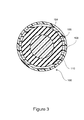
- FIG. 3 is a cross-sectional view of a second embodiment of the golf ball shown in FIG. 1 .
- FIG. 1 shows a perspective view of a solid golf ball 100 according to the invention.
- Golf ball 100 is generally spherical in shape with a plurality of dimples 102 disposed on the surface of golf ball 100. Any number of dimples 102 may be provided on the surface of golf ball 100. In some embodiments, the number of dimples 102 may range from about 250 to about 500. In some embodiments, the number of dimples 102 may range from about 300 to about 400. Dimples 102 may be arranged on the surface of golf ball 100 in any pattern.
- dimples 102 may have any shape known in the art, such as elliptical, polygonal, or the like. While in some embodiments dimples 102 may be protrusions extending away from the surface of golf ball 100, dimples 102 are typically indentations in the surface of golf ball 100. Each indentation defines a volume. For example, if a dimple is a hemispherical indentation in the surface, the space carved out by the dimple and bounded by an imaginary line representing where the surface of golf ball 100 would be if no dimple were present has a volume of a hemisphere, or 2/3 ⁇ r 3 , where r is the radius of the hemisphere.
- all dimples 102 may have the same diameter or radius. In other embodiments, dimples 102 may be provided with different diameters or radii. In some embodiments, each dimples may have a diameter or radius selected from a preselected group of diameters/radii. In some embodiments, the number of different diameters/radii in the preselected group of diameters/radii ranges from three (3) to six (6). In some embodiments, the number of dimples 102 with the greatest diameter/radius is greater than the number of dimples with any other diameter/radius. In other words, in such an embodiment, there are more of the largest dimples than dimples of any other size.
- the aggregate of the volumes of all of dimples 102 on the surface of golf ball 100 is a total dimple volume.
- the total dimple volume is about 550 cubic millimeters to about 800 cubic millimeters. In some embodiments, the total dimple volume may range from about 600 cubic millimeters to about 800 cubic millimeters.
- golf ball 100 is generally constructed as a multilayer solid golf ball. In other words, multiple layers of material are fused or compressed together to form the ball. As shown in FIG. 2 , one embodiment of golf ball 100 includes a core 104, a cover 108, and an intermediate layer 106 sandwiched between core 104 and intermediate layer 106. Together, core 104 and intermediate layer 106 may be considered to be an "inner ball”.
- Core 104 may include any number of materials.
- core 104 may include a thermoplastic material or a thermoset material.
- the thermoplastic material of core 104 may be an ionomer resin, a highly neutralized acid polymer composition, a polyamide resin, a polyester resin, a polyurethane resin, and combinations thereof.
- core 104 comprises an ionomer resin.
- core 104 may include HPF and Surlyn®, both commercially available from E. I. Dupont de Nemours and Company, and IOTEK®, commercially available from Exxon Corporation.
- one composition of core 104 includes HPF as the main composition with Surlyn® and/or IOTEK® as optional sub-compositions. Any sub-composition of core 104 may be in an amount of 0 to 40 parts by weight, or in some embodiments, 0 to 10 parts by weight, based on 100 parts by weight of the main composition of core 104.
- Core 104 may be made using any method known in the art, such as hot-press molding or injection molding. Core 104 of the present invention may be single layer or multilayer construction, and except for the aforementioned materials, any other materials may be also used to make core 104. In some embodiments, the material of core 104 is selected to provide core 104 with a COR greater than 0.750. In some embodiments, core 104 has a COR at 40 meters per second ranging between about 0.79 and 0.89. In some embodiments, core 104 has a higher COR than that of golf ball 100 taken as a whole.
- a diameter of core 104 may be in a range between about 19.0 millimeters and about 37.0 millimeters. In some embodiments, the diameter of core 104 may range from about 19.0 millimeters and about 32 millimeters. In some embodiments, the diameter of core 104 may range between about 21.0 millimeters and about 35.0 millimeters. In some embodiments, the diameter of core 104 may range between about 23.0 millimeters and 32.0 millimeters.
- intermediate layer 106 covers and substantially encloses core 104.
- Intermediate layer 106 has an interior surface facing an exterior surface of core 104.
- the exterior surface of intermediate layer 106 faces an interior surface of cover 108.
- Intermediate layer 106 may have any thickness. In one embodiment, the thickness of intermediate layer 106 may range from about 3 millimeters to about 11 millimeters. In one embodiment, the thickness of intermediate layer 106 may range from about 4 millimeters to about 10 millimeters.
- Intermediate layer 106 may include a thermoset material.
- the thermoset material may be a rubber composition.
- the base rubber of the rubber composition may include 1,4-cis-polybutadiene, polyisoprene, styrene-butadiene copolymers, natural rubber, and combinations thereof.
- 1,4-cis-polybutadiene may be used as the base rubber of the rubber composition.
- 1,4-cis-polybutadiene can be used as the base material for intermediate layer 106, with additional materials added to the base material.
- the amount of 1,4-cis-polybutadiene is at least 50 parts by weight, based on 100 parts by weight of the rubber composition.
- Additives such as a crosslinking agent and a filler with a greater specific gravity may be added to the rubber composition.
- the suitable crosslinking agent can be selected from the group consisting of peroxide, zinc diacrylate, magnesium acrylate, zinc methacrylate, and magnesium methacrylate.
- zinc acrylate may be used.
- peroxide may be used as the cross-linking agent.
- core 104 is formed from a high resilient thermoplastic material, the performance of golf ball 100 is maintained in spite of long-term exposure to relatively high ambient temperatures when intermediate layer 106 is formed from a peroxide cross-linked polybutadiene material.
- golf ball 100 when intermediate layer 106 is formed from a peroxide cross-linked polybutadiene material and core 104 may include a high resilient thermoplastic material, golf ball 100 may be stored at 24 degrees Celsius for at least about 8 hours.
- the inner ball (core 104 and intermediate layer 106) may have a first deflection amount of 2.2 millimeters to about 3.2 millimeters under a load of about 10 kilograms to about 130 kilograms when golf ball 100 is stored in an environment of about 24 degrees Celsius for at least about 8 hours.
- golf ball 100 may have a different deflection, the second deflection amount.
- the ratio of the second deflection amount to the first deflection amount is between about 1.5 and about 1.15.
- Example ball is made according to the invention.
- core 104 includes HPF2000, a DuPont ionomer resin in which the MAA acid groups have been fully neutralized with magnesium ions.
- Intermediate layer 106 includes BR compound, a peroxide cross-linked polybutadiene material, the specific composition of which is shown in Table 2.
- Comparative 1 where the entire inner ball includes HPF2000 and Comparative 2, where the entire inner ball comprises Surlyn8940, a Dupont ionomer resin - Ethylene/methacrylic acid (E/MAA) copolymer, in which the MAA acid groups have been partially neutralized with sodium ions.
- E/MAA Dupont ionomer resin - Ethylene/methacrylic acid
- Table 1 Comparison of Example Ball Performance with Conventional Balls Example Comparative 1 Comparative 2 Core HPF2000 HPF2000 Surlyn8940 Intermediate layer BR Core diameter(mm) 28.0 Inner ball diameter (mm) 39.3 39.3 39.3 Compression Test (10-130kg) Second Deflection Amount after storage at 50 degrees C for 8hrs (mm) 3.13 3.27 2.21 First Deflection Amount after storage at 24 degrees C for 8hrs (mm) 2.84 2.66 1.54 Ratio of Second Deflection Amount to First Deflection Amount 1.10 1.23 1.44 COR 0.838 0.825 0.726 Table 2: BR Compound Composition TAIPOLTM BR0150 100 Zinc diacrylate 28 Zinc oxide 6 Barium sulfate 39.5 Peroxide 1
- the deflection performance of the Example ball is greater than that of Comparative 1 and Comparative 2 after exposure to high ambient temperatures.
- the ratio of the second deflection amount to the first deflection amount of the Example ball is about 1.1, while the other balls have a ratio of 1.23 and 1.44, respectively. This means that the Comparative balls are less capable of holding their shape and resisting compression after long exposure to high temperatures than the Example ball. Further the COR of the Example ball is greater than either of the Comparative balls.
- a suitable filler may be added in the rubber composition, such as zinc oxide, barium sulfate, calcium carbonate, and magnesium carbonate, and in the present invention, zinc oxide is preferred.
- a metal powder with a greater specific gravity may also be used as the filler, such as tungsten.
- an exterior surface of intermediate layer 106 faces an interior surface of cover 108.
- the exterior surface of cover 108 is the exterior surface of golf ball 100, which is shown in FIG. 1 .
- Cover 108 may include any material known in the art.
- cover 108 may include an ionomer resin, a highly neutralized ionomer resin, a polyamide resin, a polyester resin, a thermoplastic polyurethane resin, a thermoset polyurethane resin, or combinations of these compounds.
- inner cover layer 110 In the embodiment shown in FIG. 3 , an additional cover layer is provided: inner cover layer 110.
- cover 108 may be considered to be an outer cover layer.
- Inner cover layer 110 may comprise the same material as that of outer cover layer 108.
- the thickness of inner cover layer 110 may range between about 0.5 millimeters and 11.0 millimeters. In some embodiments, the thickness of inner cover layer 110 may range between about 0.5 millimeters and about 8.5 millimeters. In some embodiments, the thickness of inner cover layer 110 may range between about 0.5 millimeters and about 3.0 millimeters.
- Inner cover layer 110 has an interior surface that faces an exterior surface of intermediate layer 106. Inner cover layer 110 covers and encloses intermediate layer 106. Inner cover layer 110 has an exterior surface that faces an interior surface of outer cover layer 108.
- the exterior surface of inner cover layer 110 has a higher hardness than the exterior surface of cover 108.
- an exterior surface of inner cover layer 110 may have a Shore D hardness of 45 to 65, while the exterior surface of outer cover layer 108 may have a Shore D hardness of 40 to 60.
- the entirety of inner cover layer 110 has a higher hardness than the entirety of cover 108.
- balls described herein have compositions and layers selected to improve the performance of balls after exposure to high ambient temperatures
- balls may also be designed to improve or maintain performance in other types of environments.
- some types of golf balls may have reduced performance when cold. This problem is addressed in U.S. Patent Number , currently U.S. Patent Application Serial Number 12/230,272 , entitled “Multilayer Solid Golf Ball", and filed on August 27, 2008, the entirety of which is incorporated herein by reference.
Landscapes
- Health & Medical Sciences (AREA)
- General Health & Medical Sciences (AREA)
- Physical Education & Sports Medicine (AREA)
- Chemical & Material Sciences (AREA)
- Engineering & Computer Science (AREA)
- Materials Engineering (AREA)
- Compositions Of Macromolecular Compounds (AREA)
- Polyurethanes Or Polyureas (AREA)
Abstract
Description
- This application claims priority under 35 U.S.C. § 119(e) to
U.S. Provisional Patent Application Number 61/153,952 - The present invention relates generally to a golf ball and, more particularly, to a multilayer solid golf ball having a core that retains its performance characteristics after exposure to high temperature.
- The history of golf ball development had gone very far from wound golf balls to solid two piece golf balls and multilayer golf balls. Rubber cores gradually replaced wound cores because of quality consistency and performance benefit such as reducing of driver spin for longer distance.
- Multilayer golf balls with layers comprising a thermoplastic material such as ionomer materials brought golf ball technology to the next level. Typically, thin layers of different materials fused together added extra features such as lower spin off the tee but increasing spin around the green. For example, one of the layers may be a hard ionomer in a mantle layer while a soft elastomer material forms the layer for outer cover. Thin layers of ionomer layers were typically used because ionomer has relatively low resilience, particularly when compared to the rubbers typically used to form the core or the layers of the core.
- However, highly neutralized ionomers, such as those developed by DuPont®, have resilience comparable to or even better than the resilience of rubber materials. These highly neutralized ionomers may represent the next step in innovation for golf ball cores. Golf ball cores comprising a thermoplastic material are more consistent in quality than thermoset rubber cores. One limitation on the use of thermoplastic resins, such as a highly neutralized ionomer, for a golf ball core is the effect that ambient temperature has on the shape and performance of the golf ball core.
- Flying distance is an important index used to evaluate the performance of a golf ball. Flying distance is affected by three main factors: "initial velocity", "spin rate", and "launch angle". Initial velocity is one of the primary physical properties affecting the flying distance of the golf ball. The coefficient of restitution (COR) is an alternate parameter of initial velocity of the golf ball, and the temperature will affect the COR. The COR is generally defined as the ratio of velocity of an object before and after an impact. A COR of 1 is a perfect elastic collision where no energy is lost due to the collision, and a COR of 0 is a perfect inelastic collision, where all of the energy is dissipated during the collision. Taking 24 degrees Celsius as the standard temperature at which the United States Golf Association (USGA) sets as a standard temperature for measuring golf ball physical properties and performance characteristics for adherence to USGA rules and regulations, the physical properties, including the COR, of the golf ball will be affected when the temperature is lower or higher than 24 degrees Celsius. For example, the COR is significantly positive relative to the ambient temperature, so the golf ball usually flies shorter in a cold weather.
- Similarly, performance is affected by long-term exposure to high temperatures. Due to the habits of many golfers, golf balls may be routinely subjected to long-term exposure to high temperatures. For example, many golfers tend to leave their golf balls in their golf bags and in their car trunks. Golfers may live in areas where daytime, or even nighttime temperatures regularly exceed 30 degrees Celsius, particularly during daylight hours during the summer. Inside a car trunk, the temperature may reach 50 degrees Celsius for extended periods of time.
- When exposed to relatively high ambient temperatures for extended periods, golf balls tend to lose their original performance characteristics. The material of the core or the cover layers may distort or lose their shape, particularly when the temperature cycles between relatively high ambient temperatures and relatively low ambient temperatures, such as the ambient temperature changes over the course of a day. This results in loss of distance and feel.
- Therefore, there exists a need in the art for a golf ball that maintains its performance characteristics even after exposure to relatively high ambient temperatures.
- In one aspect, the invention provides a golf ball comprising a core, said core comprising a thermoplastic material; an intermediate layer enclosing said core to form an inner ball, said intermediate layer comprising a thermoset material; and a cover enclosing said inner ball, wherein said golf ball satisfies the following requirements: (1) said inner ball has a first deflection amount of 2.2 to 3.2 millimeters under a load of 10 to 130 kilograms when said inner ball is kept in an environment of 24 degrees Celsius for at least about eight hours, (2) said inner ball has a second deflection amount under a load of 10 to 130 kilograms when said inner ball is kept in an environment of about 50 degrees Celsius for at least about 8 hours, and wherein the ratio of the second deflection amount to the first deflection amount is between about 1.05 and about 1.15, and (3) said core has a coefficient of restitution at 40 meters per second falling between approximately 0.79 and 0.89 and higher than that of said golf ball.
- In another aspect the invention provides a golf ball comprising a core, said core comprising a thermoplastic material; an intermediate layer enclosing said core to form an inner ball, said intermediate layer comprising a thermoset material; and a cover enclosing said inner ball and having a plurality of dimples on its outer surface, wherein said golf ball satisfies the following requirements: (1) said inner ball has a first deflection amount of 2.2 to 3.2 millimeters under a load of 10 to 130 kilograms when said inner ball is kept in an environment of 24 degrees Celsius for at least about 8 hours, (2) said inner ball has a second deflection amount under a load of 10 to 130 kilograms when said inner ball is kept in an environment of 50 degrees Celsius for at least about 8 hours, and the ratio of the second deflection amount to the first deflection amount is between about 1.05 and about 1.15, (3) said core has a coefficient of restitution at forty (40) meters per second falling between approximately 0.79 and 0.89 and higher than that of said golf ball, and (4) said dimples have a total volume of 550 cubic millimeters to 800 cubic millimeters.
- Other systems, methods, features and advantages of the invention will be, or will become, apparent to one of ordinary skill in the art upon examination of the following figures and detailed description. It is intended that all such additional systems, methods, features and advantages be included within this description and this summary, be within the scope of the invention, and be protected by the following claims.
- The invention can be better understood with reference to the following drawings and description. The components in the figures are not necessarily to scale, emphasis instead being placed upon illustrating the principles of the invention. Moreover, in the figures, like reference numerals designate corresponding parts throughout the different views.
-
FIG. 1 is a perspective view of a golf ball; -
FIG. 2 is a cross-sectional view of a first embodiment of the golf ball shown inFIG. 1 ; and -
FIG. 3 is a cross-sectional view of a second embodiment of the golf ball shown inFIG. 1 . -
FIG. 1 shows a perspective view of asolid golf ball 100 according to the invention.Golf ball 100 is generally spherical in shape with a plurality ofdimples 102 disposed on the surface ofgolf ball 100. Any number ofdimples 102 may be provided on the surface ofgolf ball 100. In some embodiments, the number ofdimples 102 may range from about 250 to about 500. In some embodiments, the number ofdimples 102 may range from about 300 to about 400.Dimples 102 may be arranged on the surface ofgolf ball 100 in any pattern. - Though shown as substantially hemispherical,
dimples 102 may have any shape known in the art, such as elliptical, polygonal, or the like. While in some embodiments dimples 102 may be protrusions extending away from the surface ofgolf ball 100,dimples 102 are typically indentations in the surface ofgolf ball 100. Each indentation defines a volume. For example, if a dimple is a hemispherical indentation in the surface, the space carved out by the dimple and bounded by an imaginary line representing where the surface ofgolf ball 100 would be if no dimple were present has a volume of a hemisphere, or 2/3πr 3, where r is the radius of the hemisphere. In some embodiments, alldimples 102 may have the same diameter or radius. In other embodiments,dimples 102 may be provided with different diameters or radii. In some embodiments, each dimples may have a diameter or radius selected from a preselected group of diameters/radii. In some embodiments, the number of different diameters/radii in the preselected group of diameters/radii ranges from three (3) to six (6). In some embodiments, the number ofdimples 102 with the greatest diameter/radius is greater than the number of dimples with any other diameter/radius. In other words, in such an embodiment, there are more of the largest dimples than dimples of any other size. - The aggregate of the volumes of all of
dimples 102 on the surface ofgolf ball 100 is a total dimple volume. In one embodiment, the total dimple volume is about 550 cubic millimeters to about 800 cubic millimeters. In some embodiments, the total dimple volume may range from about 600 cubic millimeters to about 800 cubic millimeters. - Internally,
golf ball 100 is generally constructed as a multilayer solid golf ball. In other words, multiple layers of material are fused or compressed together to form the ball. As shown inFIG. 2 , one embodiment ofgolf ball 100 includes acore 104, acover 108, and anintermediate layer 106 sandwiched betweencore 104 andintermediate layer 106. Together,core 104 andintermediate layer 106 may be considered to be an "inner ball". -
Core 104 may include any number of materials. In some embodiments,core 104 may include a thermoplastic material or a thermoset material. The thermoplastic material ofcore 104 may be an ionomer resin, a highly neutralized acid polymer composition, a polyamide resin, a polyester resin, a polyurethane resin, and combinations thereof. In one embodiment,core 104 comprises an ionomer resin. For example,core 104 may include HPF and Surlyn®, both commercially available from E. I. Dupont de Nemours and Company, and IOTEK®, commercially available from Exxon Corporation. To increase COR, one composition ofcore 104 includes HPF as the main composition with Surlyn® and/or IOTEK® as optional sub-compositions. Any sub-composition ofcore 104 may be in an amount of 0 to 40 parts by weight, or in some embodiments, 0 to 10 parts by weight, based on 100 parts by weight of the main composition ofcore 104. -
Core 104 may be made using any method known in the art, such as hot-press molding or injection molding.Core 104 of the present invention may be single layer or multilayer construction, and except for the aforementioned materials, any other materials may be also used to makecore 104. In some embodiments, the material ofcore 104 is selected to providecore 104 with a COR greater than 0.750. In some embodiments,core 104 has a COR at 40 meters per second ranging between about 0.79 and 0.89. In some embodiments,core 104 has a higher COR than that ofgolf ball 100 taken as a whole. - In some embodiments, a diameter of
core 104 may be in a range between about 19.0 millimeters and about 37.0 millimeters. In some embodiments, the diameter ofcore 104 may range from about 19.0 millimeters and about 32 millimeters. In some embodiments, the diameter ofcore 104 may range between about 21.0 millimeters and about 35.0 millimeters. In some embodiments, the diameter ofcore 104 may range between about 23.0 millimeters and 32.0 millimeters. - In the embodiment shown in
FIG. 2 ,intermediate layer 106 covers and substantially enclosescore 104.Intermediate layer 106 has an interior surface facing an exterior surface ofcore 104. In the embodiment shown inFIG. 2 , the exterior surface ofintermediate layer 106 faces an interior surface ofcover 108.Intermediate layer 106 may have any thickness. In one embodiment, the thickness ofintermediate layer 106 may range from about 3 millimeters to about 11 millimeters. In one embodiment, the thickness ofintermediate layer 106 may range from about 4 millimeters to about 10 millimeters. -
Intermediate layer 106 may include a thermoset material. In some embodiments, the thermoset material may be a rubber composition. In some embodiments, the base rubber of the rubber composition may include 1,4-cis-polybutadiene, polyisoprene, styrene-butadiene copolymers, natural rubber, and combinations thereof. To increase the resiliency of the inner ball, 1,4-cis-polybutadiene may be used as the base rubber of the rubber composition. Alternatively, 1,4-cis-polybutadiene can be used as the base material forintermediate layer 106, with additional materials added to the base material. In some embodiments, the amount of 1,4-cis-polybutadiene is at least 50 parts by weight, based on 100 parts by weight of the rubber composition. - Additives, such as a crosslinking agent and a filler with a greater specific gravity may be added to the rubber composition. The suitable crosslinking agent can be selected from the group consisting of peroxide, zinc diacrylate, magnesium acrylate, zinc methacrylate, and magnesium methacrylate. To increase the resiliency of the rubber composition, zinc acrylate may be used. However, to increase the resistance to long-term exposure to relatively high ambient temperatures, peroxide may be used as the cross-linking agent. In particular, when
core 104 is formed from a high resilient thermoplastic material, the performance ofgolf ball 100 is maintained in spite of long-term exposure to relatively high ambient temperatures whenintermediate layer 106 is formed from a peroxide cross-linked polybutadiene material. - For example, when
intermediate layer 106 is formed from a peroxide cross-linked polybutadiene material andcore 104 may include a high resilient thermoplastic material,golf ball 100 may be stored at 24 degrees Celsius for at least about 8 hours. The inner ball (core 104 and intermediate layer 106) may have a first deflection amount of 2.2 millimeters to about 3.2 millimeters under a load of about 10 kilograms to about 130 kilograms whengolf ball 100 is stored in an environment of about 24 degrees Celsius for at least about 8 hours. When the same ball is stored in an environment of about 50 degrees Celsius for at least about 8 hours,golf ball 100 may have a different deflection, the second deflection amount. The ratio of the second deflection amount to the first deflection amount is between about 1.5 and about 1.15. - In Table 1, various COR and deflection measurements are provided for various golf balls. An Example ball is made according to the invention. In the Example,
core 104 includes HPF2000, a DuPont ionomer resin in which the MAA acid groups have been fully neutralized with magnesium ions.Intermediate layer 106 includes BR compound, a peroxide cross-linked polybutadiene material, the specific composition of which is shown in Table 2. The performance of the Example is compared with two conventional balls: Comparative 1, where the entire inner ball includes HPF2000 andComparative 2, where the entire inner ball comprises Surlyn8940, a Dupont ionomer resin - Ethylene/methacrylic acid (E/MAA) copolymer, in which the MAA acid groups have been partially neutralized with sodium ions.Table 1: Comparison of Example Ball Performance with Conventional Balls Example Comparative 1 Comparative 2Core HPF2000 HPF2000 Surlyn8940 Intermediate layer BR Core diameter(mm) 28.0 Inner ball diameter (mm) 39.3 39.3 39.3 Compression Test (10-130kg) Second Deflection Amount after storage at 50 degrees C for 8hrs (mm) 3.13 3.27 2.21 First Deflection Amount after storage at 24 degrees C for 8hrs (mm) 2.84 2.66 1.54 Ratio of Second Deflection Amount to First Deflection Amount 1.10 1.23 1.44 COR 0.838 0.825 0.726 Table 2: BR Compound Composition TAIPOL™ BR0150 100 Zinc diacrylate 28 Zinc oxide 6 Barium sulfate 39.5 Peroxide 1 - As shown in Table 1, the deflection performance of the Example ball is greater than that of Comparative 1 and
Comparative 2 after exposure to high ambient temperatures. The ratio of the second deflection amount to the first deflection amount of the Example ball is about 1.1, while the other balls have a ratio of 1.23 and 1.44, respectively. This means that the Comparative balls are less capable of holding their shape and resisting compression after long exposure to high temperatures than the Example ball. Further the COR of the Example ball is greater than either of the Comparative balls. - To increase the specific gravity of
intermediate layer 106, a suitable filler may be added in the rubber composition, such as zinc oxide, barium sulfate, calcium carbonate, and magnesium carbonate, and in the present invention, zinc oxide is preferred. In addition, a metal powder with a greater specific gravity may also be used as the filler, such as tungsten. By means of adjusting the added amount of the filler, the specific gravity ofintermediate layer 106 can reach the desired level. - In the embodiment shown in
FIG. 2 , an exterior surface ofintermediate layer 106 faces an interior surface ofcover 108. The exterior surface ofcover 108 is the exterior surface ofgolf ball 100, which is shown inFIG. 1 . Cover 108 may include any material known in the art. In some embodiments, cover 108 may include an ionomer resin, a highly neutralized ionomer resin, a polyamide resin, a polyester resin, a thermoplastic polyurethane resin, a thermoset polyurethane resin, or combinations of these compounds. - In the embodiment shown in
FIG. 3 , an additional cover layer is provided:inner cover layer 110. In such anembodiment cover 108 may be considered to be an outer cover layer.Inner cover layer 110 may comprise the same material as that ofouter cover layer 108. - The thickness of
inner cover layer 110 may range between about 0.5 millimeters and 11.0 millimeters. In some embodiments, the thickness ofinner cover layer 110 may range between about 0.5 millimeters and about 8.5 millimeters. In some embodiments, the thickness ofinner cover layer 110 may range between about 0.5 millimeters and about 3.0 millimeters. -
Inner cover layer 110 has an interior surface that faces an exterior surface ofintermediate layer 106.Inner cover layer 110 covers and enclosesintermediate layer 106.Inner cover layer 110 has an exterior surface that faces an interior surface ofouter cover layer 108. - In some embodiments, the exterior surface of
inner cover layer 110 has a higher hardness than the exterior surface ofcover 108. In some embodiments, an exterior surface ofinner cover layer 110 may have a Shore D hardness of 45 to 65, while the exterior surface ofouter cover layer 108 may have a Shore D hardness of 40 to 60. In some embodiments, the entirety ofinner cover layer 110 has a higher hardness than the entirety ofcover 108. - While the balls described herein have compositions and layers selected to improve the performance of balls after exposure to high ambient temperatures, balls may also be designed to improve or maintain performance in other types of environments. For example, some types of golf balls may have reduced performance when cold. This problem is addressed in U.S. Patent Number , currently
U.S. Patent Application Serial Number 12/230,272 - Further alternatives of the present invention are as follows:
- 1. A golf ball comprising:
- a core, said core comprising a thermoplastic material;
- an intermediate layer enclosing said core to form an inner ball, said intermediate layer comprising a thermoset material; and
- a cover enclosing said inner ball, wherein said golf ball satisfies the following requirements:
- (1) said inner ball has a first deflection amount of 2.2 to 3.2 millimeters under a load of 10 to 130 kilograms when said inner ball is kept in an environment of 24 degrees Celsius for at least about eight hours,
- (2) said inner ball has a second deflection amount under a load of 10 to 130 kilograms when said inner ball is kept in an environment of about 50 degrees Celsius for at least about 8 hours, and wherein the ratio of the second deflection amount to the first deflection amount is between about 1.05 and about 1.15, and
- (3) said core has a coefficient of restitution at 40 meters per second falling between approximately 0.79 and 0.89 and higher than that of said golf ball.
- 2. The golf ball of alternative 1, wherein said core has a diameter of 19 millimeters to 32 millimeters.
- 3. The golf ball of alternative 1, wherein said intermediate layer has a thickness of 3 millimeters to 11 millimeters.
- 4. The golf ball of alternative 1, wherein said intermediate layer has a thickness of 4 millimeters to 10 millimeters.
- 5. The golf ball of alternative 1, wherein said thermoplastic material is selected from the group consisting of ionomer resin, highly neutralized acid polymer composition, polyamide resin, polyester resin, polyurethane resin, and any combinations thereof.
- 6. The golf ball of alternative 1, wherein said cover comprises an inner cover layer enclosing said inner ball and an outer cover layer enclosing said inner cover layer; said outer cover layer having a Shore D hardness lower than that of the inner cover layer.
- 7. The golf ball of alternative 6, wherein said inner cover layer comprises an external surface having a Shore D hardness of 45 to 65; said outer cover layer comprises an external surface having a Shore D hardness of 40 to 60.
- 8. A golf ball comprising:
- a core, said core comprising a thermoplastic material;
- an intermediate layer enclosing said core to form an inner ball, said intermediate layer comprising a thermoset material; and
- a cover enclosing said inner ball and having a plurality of dimples on its outer surface, wherein said golf ball satisfies the following requirements:
- (1) said inner ball has a first deflection amount of 2.2 to 3.2 millimeters under a load of 10 to 130 kilograms when said inner ball is kept in an environment of 24 degrees Celsius for at least about 8 hours,
- (2) said inner ball has a second deflection amount under a load of 10 to 130 kilograms when said inner ball is kept in an environment of 50 degrees Celsius for at least about 8 hours, and the ratio of the second deflection amount to the first deflection amount is between about 1.05 and about 1.15, and
- (3) said core has a coefficient of restitution at forty (40) meters per second falling between approximately 0.79 and 0.89 and higher than that of said golf ball, and
- (4) said dimples have a total volume of 550 cubic millimeters to 800 cubic millimeters.
- 9. The golf ball of alternative 8, wherein said dimples have a total number of 250 to 500.
- 10. The golf ball of alternative 8, wherein said dimples have a total number of 300 to 450.
- 11. The golf ball of alternative 8, wherein said dimples have a total volume of 600 cubic millimeters to 800 cubic millimeters.
- 12. The golf ball of alternative 8, wherein said dimples are provided with 3 to 6 kinds of different diameters.
- 13. The golf ball of alternative 12, wherein the number of dimples with the largest diameter is greater than the respective number of any other dimples with smaller diameters.
- 14. The golf ball of alternative 8, wherein said core has a diameter of 19 millimeters to 32 millimeters.
- 15. The golf ball of alternative 8, wherein said intermediate layer has a thickness of 3 millimeters to 11 millimeters.
- 16. The golf ball of alternative 8, wherein said intermediate layer has a thickness of 4 millimeters to 10 millimeters.
- 17. The golf ball of alternative 8, wherein said thermoplastic material is selected from the group consisting of ionomer resin, highly neutralized acid polymer composition, polyamide resin, polyester resin, polyurethane resin, and any combinations thereof.
- 18. The golf ball of alternative 8, wherein said cover comprises an inner cover layer enclosing said inner ball and an outer cover layer enclosing said inner cover layer; said outer cover layer having a Shore D hardness lower than that of the inner cover layer.
- 19. The golf ball of alternative 18, wherein said inner cover layer or outer cover layer comprises a material selected from the group consisting of ionomer resin, highly neutralized acid polymer composition, polyamide resin, polyester resin, thermoplastic polyurethane resin, thermoset polyurethane resin, and any combinations thereof.
- 20. The golf ball of alternative 18, wherein said inner cover layer comprises an external surface having a Shore D hardness of 45 to 65; said outer cover layer comprises an external surface having a Shore D hardness of 40 to 60.
- While various embodiments of the invention have been described, the description is intended to be exemplary, rather than limiting and it will be apparent to those of ordinary skill in the art that many more embodiments and implementations are possible that are within the scope of the invention. Accordingly, the invention is not to be restricted except in light of the attached claims and their equivalents. Also, various modifications and changes may be made within the scope of the attached claims.
Claims (10)
- A golf ball comprising:a core, said core comprising a thermoplastic material;an intermediate layer enclosing said core to form an inner ball, said intermediate layer comprising a thermoset material; anda cover enclosing said inner ball, wherein said golf ball satisfies the following requirements:(1) said inner ball has a first deflection amount of 2.2 to 3.2 millimeters under a load of 10 to 130 kilograms when said inner ball is kept in an environment of 24 degrees Celsius for at least about eight hours,(2) said inner ball has a second deflection amount under a load of 10 to 130 kilograms when said inner ball is kept in an environment of about 50 degrees Celsius for at least about 8 hours, and wherein the ratio of the second deflection amount to the first deflection amount is between about 1.05 and about 1.15, and(3) said core has a coefficient of restitution at 40 meters per second falling between approximately 0.79 and 0.89 and higher than that of said golf ball.
- The golf ball of claim 1, wherein said cover has a plurality of dimples on its surface, and wherein the plurality of dimples have a total volume of 550 cubic millimeters to 800 cubic millimeters.
- The golf ball of claim 2, wherein said dimples have a total number of 250 to 500, and wherein said dimples are provided with 3 to 6 kinds of different diameters.
- The golf ball of claim 3, wherein the number of dimples with the largest diameter is greater than the respective number of any other dimples with smaller diameters.
- The golf ball of claim 1, 2, or 3 wherein said core has a diameter of 19 millimeters to 32 millimeters.
- The golf ball of claim 1, 2, or 3, wherein said intermediate layer has a thickness of 3 millimeters to 11 millimeters.
- The golf ball of claim 1, 2, or 3, wherein said thermoplastic material is selected from the group consisting of ionomer resin, highly neutralized acid polymer composition, polyamide resin, polyester resin, polyurethane resin, and any combinations thereof.
- The golf ball of claim 1, 2, or 3, wherein said cover comprises an inner cover layer enclosing said inner ball and an outer cover layer enclosing said inner cover layer, wherein said outer cover layer having a Shore D hardness lower than that of said inner cover layer.
- The golf ball of claim 7, wherein said inner cover layer comprises an external surface having a Shore D hardness of 45 to 65, and wherein said outer cover layer comprises an external surface having a Shore D hardness of 40 to 60.
- The golf ball of claim 1, 2, 3, 8, or 9 wherein said cover layer comprises a material selected from the group consisting of ionomer resin, highly neutralized acid polymer composition, polyamide resin, polyester resin, thermoplastic polyurethane resin, thermoset polyurethane resin, and any combinations thereof.
Applications Claiming Priority (1)
| Application Number | Priority Date | Filing Date | Title |
|---|---|---|---|
| US12/708,800 US20110053707A1 (en) | 2009-02-19 | 2010-02-19 | Multilayer Solid Golf Ball |
Publications (2)
| Publication Number | Publication Date |
|---|---|
| EP2361657A1 true EP2361657A1 (en) | 2011-08-31 |
| EP2361657B1 EP2361657B1 (en) | 2014-05-21 |
Family
ID=43901194
Family Applications (1)
| Application Number | Title | Priority Date | Filing Date |
|---|---|---|---|
| EP11154682.6A Not-in-force EP2361657B1 (en) | 2010-02-19 | 2011-02-16 | Multilayer solid golf ball |
Country Status (8)
| Country | Link |
|---|---|
| US (1) | US20110053707A1 (en) |
| EP (1) | EP2361657B1 (en) |
| JP (1) | JP2011167517A (en) |
| KR (1) | KR101129150B1 (en) |
| CN (3) | CN104368132A (en) |
| AU (1) | AU2011100184B4 (en) |
| CA (1) | CA2730693C (en) |
| TW (1) | TWI490014B (en) |
Families Citing this family (37)
| Publication number | Priority date | Publication date | Assignee | Title |
|---|---|---|---|---|
| US20100056302A1 (en) * | 2008-08-27 | 2010-03-04 | Feng Tay Enterprises Co., Ltd. | Multilayer solid golf ball |
| US20100179001A1 (en) * | 2009-01-12 | 2010-07-15 | Feng Tay Enterprises Co., Ltd. | Golf ball |
| US20110053707A1 (en) * | 2009-02-19 | 2011-03-03 | Nike, Inc. | Multilayer Solid Golf Ball |
| US20130172105A1 (en) * | 2011-07-29 | 2013-07-04 | Nike, Inc. | Golf Ball Having Temperature Controllable Compression Deformation |
| US20130210552A1 (en) * | 2011-08-23 | 2013-08-15 | Nike, Inc. | Golf ball having high initial velocity |
| US8979676B2 (en) * | 2011-08-23 | 2015-03-17 | Nike, Inc. | Multi-core golf ball having increased initial velocity at high swing speeds relative to low swing speeds |
| US9089739B2 (en) * | 2011-08-23 | 2015-07-28 | Nike, Inc. | Multi-core golf ball having increased initial velocity |
| US8764580B2 (en) | 2011-09-30 | 2014-07-01 | Nike, Inc. | Golf ball having relationships among the densities of various layers |
| US9457240B2 (en) | 2011-12-27 | 2016-10-04 | Nike, Inc. | Golf ball with configurable materials and method of post production modification |
| US9333393B2 (en) | 2011-12-30 | 2016-05-10 | Nike, Inc. | Method of making a golf ball core |
| US9101798B2 (en) | 2012-01-03 | 2015-08-11 | Nike, Inc. | Golf ball with high density and high hardness mantle |
| US8992340B2 (en) | 2012-01-03 | 2015-03-31 | Nike, Inc. | Golf ball with an outer core having a high coefficient of restitution |
| US9033823B2 (en) | 2012-01-03 | 2015-05-19 | Nike, Inc. | Golf ball with specified density inner cover layer |
| WO2013103689A1 (en) * | 2012-01-03 | 2013-07-11 | Nike International Ltd. | Golf ball with resin inner core |
| US9061184B2 (en) | 2012-01-03 | 2015-06-23 | Nike, Inc. | Golf ball with specified inner core and outer core compression |
| US8932153B2 (en) | 2012-01-03 | 2015-01-13 | Nike, Inc. | Golf ball with specified core coefficient of restitution |
| US9005051B2 (en) * | 2012-03-05 | 2015-04-14 | Nike, Inc. | Golf ball with a large and soft polymer core |
| US9227110B2 (en) * | 2012-03-29 | 2016-01-05 | Nike, Inc. | Golf ball having multi-layer core with filler in outer core |
| US9492714B2 (en) | 2012-03-30 | 2016-11-15 | Nike, Inc. | Method and kit for customizing a golf ball |
| US8979675B2 (en) * | 2012-04-25 | 2015-03-17 | Nike, Inc. | Golf ball core having radial appendages |
| US9259618B2 (en) * | 2012-06-10 | 2016-02-16 | Dunlop Sports Co. Ltd. | Golf ball |
| US20140048974A1 (en) * | 2012-08-13 | 2014-02-20 | Nike, Inc. | Method Of Making A Golf Ball |
| US20140045623A1 (en) * | 2012-08-13 | 2014-02-13 | Nike, Inc. | Golf Ball With Hard Cover Layer |
| US20140045620A1 (en) * | 2012-08-13 | 2014-02-13 | Nike, Inc. | Golf Ball With Resin Inner Core |
| US20140045622A1 (en) * | 2012-08-13 | 2014-02-13 | Nike, Inc. | Golf Ball With Two Soft Layers And One Hard Layer |
| KR101401384B1 (en) * | 2013-03-25 | 2014-05-30 | 주식회사 제니큐 | System and method for golf game |
| KR20150001657A (en) | 2013-06-26 | 2015-01-06 | 던롭 스포츠 가부시키가이샤 | Multi-piece golf ball |
| US9687697B2 (en) | 2013-06-26 | 2017-06-27 | Dunlop Sports Co. Ltd. | Multi-piece golf ball |
| JP6324234B2 (en) * | 2013-06-26 | 2018-05-16 | 住友ゴム工業株式会社 | Multi-piece golf ball |
| CN103706088A (en) * | 2013-12-13 | 2014-04-09 | 江苏红果科技股份有限公司 | Electronic golf ball and golf competition electronic assistant system thereof |
| JP2015123093A (en) * | 2013-12-25 | 2015-07-06 | ダンロップスポーツ株式会社 | Golf ball |
| USD814578S1 (en) * | 2017-02-14 | 2018-04-03 | Callaway Golf Company | Golf ball |
| USD831138S1 (en) * | 2017-03-21 | 2018-10-16 | Foremost Golf Mfg., Ltd. | Golf ball |
| USD815219S1 (en) * | 2017-03-24 | 2018-04-10 | Callaway Golf Company | Golf ball |
| USD868912S1 (en) * | 2017-05-09 | 2019-12-03 | Volvik, Inc. | Golf ball |
| USD823956S1 (en) * | 2017-05-19 | 2018-07-24 | Nexen Corporation | Golf ball |
| KR102432249B1 (en) * | 2020-01-31 | 2022-08-12 | 문선희 | Durable low-distance golf ball and manufacturing method thereof |
Citations (4)
| Publication number | Priority date | Publication date | Assignee | Title |
|---|---|---|---|---|
| US20070129172A1 (en) * | 2001-10-09 | 2007-06-07 | Christopher Cavallaro | Multilayer golf ball containing at least three core layers, at least one intermediate barrier layer, and at least one cover layer |
| US20080312008A1 (en) * | 2007-02-13 | 2008-12-18 | Bridgestone Sports Co., Ltd. | Solid golf ball |
| US20090280928A1 (en) * | 2008-05-12 | 2009-11-12 | Brian Comeau | Golf ball with heat resistant layer |
| US20110053707A1 (en) * | 2009-02-19 | 2011-03-03 | Nike, Inc. | Multilayer Solid Golf Ball |
Family Cites Families (30)
| Publication number | Priority date | Publication date | Assignee | Title |
|---|---|---|---|---|
| US8017A (en) * | 1851-04-01 | Splint-machine | ||
| US9028A (en) * | 1852-06-15 | David kood | ||
| US4848770A (en) * | 1986-10-20 | 1989-07-18 | Wilson Sporting Goods Co. | Three-piece solid golf ball |
| US6648777B2 (en) * | 1993-06-01 | 2003-11-18 | Callaway Golf Company | Multi-layer golf ball |
| JP2658811B2 (en) * | 1993-07-08 | 1997-09-30 | ブリヂストンスポーツ株式会社 | Three piece solid golf ball |
| US6786838B2 (en) * | 1995-06-07 | 2004-09-07 | Acushnet Company | Golf ball with multi-layered core |
| US7041007B2 (en) * | 1996-03-11 | 2006-05-09 | Acushnet Company | Method for making multilayer golf ball |
| JPH10151226A (en) * | 1996-11-25 | 1998-06-09 | Bridgestone Sports Co Ltd | Three piece solid golf ball |
| US20050282659A1 (en) * | 1998-03-18 | 2005-12-22 | Kennedy Thomas J Iii | High compression multi-layer RIM golf balls |
| US6653382B1 (en) * | 1999-10-21 | 2003-11-25 | E. I. Du Pont De Nemours And Company | Highly-neutralized ethylene copolymers and their use in golf balls |
| JP2001017572A (en) * | 1999-07-09 | 2001-01-23 | Bridgestone Sports Co Ltd | Solid golf ball |
| US6602153B2 (en) * | 1999-09-16 | 2003-08-05 | Callaway Golf Company | Aerodynamic pattern for a two-piece golf ball |
| US6458046B1 (en) * | 2000-08-21 | 2002-10-01 | Acushnet Company | Multi-layer, wound golf ball |
| JP2002186684A (en) * | 2000-12-22 | 2002-07-02 | Sumitomo Rubber Ind Ltd | Golf ball |
| US6852042B2 (en) * | 2001-03-23 | 2005-02-08 | Acushnet Company | Golf ball |
| US6995191B2 (en) * | 2003-05-19 | 2006-02-07 | Acushnet Company | Multi-layer golf ball with a foamed intermediate layer |
| US7125345B2 (en) * | 2002-10-24 | 2006-10-24 | Acushnet Company | Low deformation golf ball |
| US7652086B2 (en) * | 2001-06-26 | 2010-01-26 | Acushnet Company | Highly-neutralized thermoplastic copolymer center for improved multi-layer core golf ball |
| JP4708610B2 (en) * | 2001-07-06 | 2011-06-22 | Sriスポーツ株式会社 | Multi-piece solid golf ball |
| US7375153B2 (en) * | 2001-09-13 | 2008-05-20 | Acushnet Company | Zinc stearate-cis-to-trans catalyst blends for improved golf ball core compositions |
| US7300364B2 (en) * | 2004-02-06 | 2007-11-27 | Acushnet Company | Multi-layer golf ball having velocity gradient from faster center to slower cover |
| US6935970B2 (en) * | 2002-07-25 | 2005-08-30 | Callaway Golf Company | Golf ball |
| US6783468B2 (en) * | 2002-10-24 | 2004-08-31 | Acushnet Company | Low deformation golf ball |
| US7211008B2 (en) * | 2004-03-10 | 2007-05-01 | Acushnet Company | Golf balls having a low modulus HNP layer and a high modulus HNP layer |
| US7528196B2 (en) * | 2005-01-24 | 2009-05-05 | Taylor Made Golf Company, Inc. | Polyalkenamer compositions and golf balls prepared therefrom |
| US7273425B2 (en) * | 2005-12-05 | 2007-09-25 | Bridgestone Sports Co., Ltd. | Solid golf ball |
| US7625301B2 (en) * | 2007-03-02 | 2009-12-01 | Bridgestone Sports Co., Ltd. | Golf ball |
| US20090181801A1 (en) * | 2008-01-10 | 2009-07-16 | Sullivan Michael J | Two-Layer Core Golf Ball |
| US8357060B2 (en) * | 2007-12-28 | 2013-01-22 | Taylor Made Golf Company, Inc. | Golf ball with soft feel |
| US8127937B2 (en) * | 2009-03-27 | 2012-03-06 | Uop Llc | High performance cross-linked polybenzoxazole and polybenzothiazole polymer membranes |
-
2010
- 2010-02-19 US US12/708,800 patent/US20110053707A1/en not_active Abandoned
-
2011
- 2011-02-09 CA CA2730693A patent/CA2730693C/en not_active Expired - Fee Related
- 2011-02-11 AU AU2011100184A patent/AU2011100184B4/en not_active Ceased
- 2011-02-16 EP EP11154682.6A patent/EP2361657B1/en not_active Not-in-force
- 2011-02-16 TW TW100105085A patent/TWI490014B/en not_active IP Right Cessation
- 2011-02-17 CN CN201410505386.1A patent/CN104368132A/en active Pending
- 2011-02-17 CN CN201120040701XU patent/CN202199049U/en not_active Expired - Fee Related
- 2011-02-17 CN CN2011100399198A patent/CN102166405A/en active Pending
- 2011-02-17 JP JP2011031779A patent/JP2011167517A/en active Pending
- 2011-02-18 KR KR1020110014609A patent/KR101129150B1/en not_active Expired - Fee Related
Patent Citations (4)
| Publication number | Priority date | Publication date | Assignee | Title |
|---|---|---|---|---|
| US20070129172A1 (en) * | 2001-10-09 | 2007-06-07 | Christopher Cavallaro | Multilayer golf ball containing at least three core layers, at least one intermediate barrier layer, and at least one cover layer |
| US20080312008A1 (en) * | 2007-02-13 | 2008-12-18 | Bridgestone Sports Co., Ltd. | Solid golf ball |
| US20090280928A1 (en) * | 2008-05-12 | 2009-11-12 | Brian Comeau | Golf ball with heat resistant layer |
| US20110053707A1 (en) * | 2009-02-19 | 2011-03-03 | Nike, Inc. | Multilayer Solid Golf Ball |
Also Published As
| Publication number | Publication date |
|---|---|
| CA2730693C (en) | 2012-01-10 |
| AU2011100184B4 (en) | 2013-05-16 |
| TW201129406A (en) | 2011-09-01 |
| KR20110095828A (en) | 2011-08-25 |
| CN104368132A (en) | 2015-02-25 |
| CN202199049U (en) | 2012-04-25 |
| EP2361657B1 (en) | 2014-05-21 |
| US20110053707A1 (en) | 2011-03-03 |
| TWI490014B (en) | 2015-07-01 |
| CN102166405A (en) | 2011-08-31 |
| KR101129150B1 (en) | 2012-03-23 |
| AU2011100184A4 (en) | 2011-03-10 |
| JP2011167517A (en) | 2011-09-01 |
| CA2730693A1 (en) | 2011-04-19 |
Similar Documents
| Publication | Publication Date | Title |
|---|---|---|
| EP2361657B1 (en) | Multilayer solid golf ball | |
| EP2327456B1 (en) | Solid golf ball with thin mantle layer | |
| JP6675144B2 (en) | Multi-piece solid golf ball | |
| US6419595B1 (en) | Solid golf ball | |
| JP6675143B2 (en) | Multi-piece solid golf ball | |
| US5948862A (en) | Multi-piece solid golf ball | |
| US6786838B2 (en) | Golf ball with multi-layered core | |
| US7857716B2 (en) | Golf ball | |
| JP5201316B2 (en) | Multi-piece solid golf ball | |
| US9409060B2 (en) | Multilayer solid golf ball | |
| JP2010253268A (en) | Multi-piece solid golf ball | |
| US9993691B2 (en) | Multi-piece solid golf ball | |
| JP2009095369A (en) | Multi-piece solid golf ball | |
| US9168424B2 (en) | Multi-piece solid golf ball | |
| JP4045139B2 (en) | Multi-piece solid golf ball | |
| US9205306B2 (en) | Multi-piece solid golf ball | |
| US6544131B1 (en) | Multi-piece solid golf ball having good shot feel | |
| US20040209706A1 (en) | Golf ball with multi-layered core | |
| US6592471B1 (en) | Multi-piece solid golf ball | |
| US10967226B2 (en) | Multi-piece solid golf ball | |
| KR101427669B1 (en) | Multi layer golf ball |
Legal Events
| Date | Code | Title | Description |
|---|---|---|---|
| PUAI | Public reference made under article 153(3) epc to a published international application that has entered the european phase |
Free format text: ORIGINAL CODE: 0009012 |
|
| 17P | Request for examination filed |
Effective date: 20110216 |
|
| AK | Designated contracting states |
Kind code of ref document: A1 Designated state(s): AL AT BE BG CH CY CZ DE DK EE ES FI FR GB GR HR HU IE IS IT LI LT LU LV MC MK MT NL NO PL PT RO RS SE SI SK SM TR |
|
| AX | Request for extension of the european patent |
Extension state: BA ME |
|
| GRAP | Despatch of communication of intention to grant a patent |
Free format text: ORIGINAL CODE: EPIDOSNIGR1 |
|
| INTG | Intention to grant announced |
Effective date: 20131216 |
|
| GRAS | Grant fee paid |
Free format text: ORIGINAL CODE: EPIDOSNIGR3 |
|
| GRAA | (expected) grant |
Free format text: ORIGINAL CODE: 0009210 |
|
| AK | Designated contracting states |
Kind code of ref document: B1 Designated state(s): AL AT BE BG CH CY CZ DE DK EE ES FI FR GB GR HR HU IE IS IT LI LT LU LV MC MK MT NL NO PL PT RO RS SE SI SK SM TR |
|
| REG | Reference to a national code |
Ref country code: GB Ref legal event code: FG4D |
|
| RIN1 | Information on inventor provided before grant (corrected) |
Inventor name: KABESHITA, YUTAKA Inventor name: CHENG, HSIN Inventor name: LIU, CHEN-TAI Inventor name: ISHII, HIDEYUKI Inventor name: ICHIKAWA, YASUSHI Inventor name: CHOU, CHIEN-HSIN |
|
| REG | Reference to a national code |
Ref country code: CH Ref legal event code: EP |
|
| REG | Reference to a national code |
Ref country code: AT Ref legal event code: REF Ref document number: 669306 Country of ref document: AT Kind code of ref document: T Effective date: 20140615 |
|
| REG | Reference to a national code |
Ref country code: IE Ref legal event code: FG4D |
|
| REG | Reference to a national code |
Ref country code: DE Ref legal event code: R096 Ref document number: 602011007131 Country of ref document: DE Effective date: 20140710 |
|
| RAP2 | Party data changed (patent owner data changed or rights of a patent transferred) |
Owner name: NIKE INNOVATE C.V. |
|
| REG | Reference to a national code |
Ref country code: SE Ref legal event code: TRGR |
|
| REG | Reference to a national code |
Ref country code: NL Ref legal event code: VDEP Effective date: 20140521 Ref country code: AT Ref legal event code: MK05 Ref document number: 669306 Country of ref document: AT Kind code of ref document: T Effective date: 20140521 |
|
| REG | Reference to a national code |
Ref country code: LT Ref legal event code: MG4D |
|
| PG25 | Lapsed in a contracting state [announced via postgrant information from national office to epo] |
Ref country code: NO Free format text: LAPSE BECAUSE OF FAILURE TO SUBMIT A TRANSLATION OF THE DESCRIPTION OR TO PAY THE FEE WITHIN THE PRESCRIBED TIME-LIMIT Effective date: 20140821 Ref country code: FI Free format text: LAPSE BECAUSE OF FAILURE TO SUBMIT A TRANSLATION OF THE DESCRIPTION OR TO PAY THE FEE WITHIN THE PRESCRIBED TIME-LIMIT Effective date: 20140521 Ref country code: LT Free format text: LAPSE BECAUSE OF FAILURE TO SUBMIT A TRANSLATION OF THE DESCRIPTION OR TO PAY THE FEE WITHIN THE PRESCRIBED TIME-LIMIT Effective date: 20140521 Ref country code: IS Free format text: LAPSE BECAUSE OF FAILURE TO SUBMIT A TRANSLATION OF THE DESCRIPTION OR TO PAY THE FEE WITHIN THE PRESCRIBED TIME-LIMIT Effective date: 20140921 Ref country code: GR Free format text: LAPSE BECAUSE OF FAILURE TO SUBMIT A TRANSLATION OF THE DESCRIPTION OR TO PAY THE FEE WITHIN THE PRESCRIBED TIME-LIMIT Effective date: 20140822 |
|
| PG25 | Lapsed in a contracting state [announced via postgrant information from national office to epo] |
Ref country code: AT Free format text: LAPSE BECAUSE OF FAILURE TO SUBMIT A TRANSLATION OF THE DESCRIPTION OR TO PAY THE FEE WITHIN THE PRESCRIBED TIME-LIMIT Effective date: 20140521 Ref country code: LV Free format text: LAPSE BECAUSE OF FAILURE TO SUBMIT A TRANSLATION OF THE DESCRIPTION OR TO PAY THE FEE WITHIN THE PRESCRIBED TIME-LIMIT Effective date: 20140521 Ref country code: PL Free format text: LAPSE BECAUSE OF FAILURE TO SUBMIT A TRANSLATION OF THE DESCRIPTION OR TO PAY THE FEE WITHIN THE PRESCRIBED TIME-LIMIT Effective date: 20140521 Ref country code: RS Free format text: LAPSE BECAUSE OF FAILURE TO SUBMIT A TRANSLATION OF THE DESCRIPTION OR TO PAY THE FEE WITHIN THE PRESCRIBED TIME-LIMIT Effective date: 20140521 Ref country code: HR Free format text: LAPSE BECAUSE OF FAILURE TO SUBMIT A TRANSLATION OF THE DESCRIPTION OR TO PAY THE FEE WITHIN THE PRESCRIBED TIME-LIMIT Effective date: 20140521 Ref country code: ES Free format text: LAPSE BECAUSE OF FAILURE TO SUBMIT A TRANSLATION OF THE DESCRIPTION OR TO PAY THE FEE WITHIN THE PRESCRIBED TIME-LIMIT Effective date: 20140521 |
|
| PG25 | Lapsed in a contracting state [announced via postgrant information from national office to epo] |
Ref country code: PT Free format text: LAPSE BECAUSE OF FAILURE TO SUBMIT A TRANSLATION OF THE DESCRIPTION OR TO PAY THE FEE WITHIN THE PRESCRIBED TIME-LIMIT Effective date: 20140922 |
|
| PG25 | Lapsed in a contracting state [announced via postgrant information from national office to epo] |
Ref country code: CZ Free format text: LAPSE BECAUSE OF FAILURE TO SUBMIT A TRANSLATION OF THE DESCRIPTION OR TO PAY THE FEE WITHIN THE PRESCRIBED TIME-LIMIT Effective date: 20140521 Ref country code: RO Free format text: LAPSE BECAUSE OF FAILURE TO SUBMIT A TRANSLATION OF THE DESCRIPTION OR TO PAY THE FEE WITHIN THE PRESCRIBED TIME-LIMIT Effective date: 20140521 Ref country code: BE Free format text: LAPSE BECAUSE OF FAILURE TO SUBMIT A TRANSLATION OF THE DESCRIPTION OR TO PAY THE FEE WITHIN THE PRESCRIBED TIME-LIMIT Effective date: 20140521 Ref country code: SK Free format text: LAPSE BECAUSE OF FAILURE TO SUBMIT A TRANSLATION OF THE DESCRIPTION OR TO PAY THE FEE WITHIN THE PRESCRIBED TIME-LIMIT Effective date: 20140521 Ref country code: DK Free format text: LAPSE BECAUSE OF FAILURE TO SUBMIT A TRANSLATION OF THE DESCRIPTION OR TO PAY THE FEE WITHIN THE PRESCRIBED TIME-LIMIT Effective date: 20140521 Ref country code: EE Free format text: LAPSE BECAUSE OF FAILURE TO SUBMIT A TRANSLATION OF THE DESCRIPTION OR TO PAY THE FEE WITHIN THE PRESCRIBED TIME-LIMIT Effective date: 20140521 |
|
| REG | Reference to a national code |
Ref country code: DE Ref legal event code: R097 Ref document number: 602011007131 Country of ref document: DE |
|
| PG25 | Lapsed in a contracting state [announced via postgrant information from national office to epo] |
Ref country code: NL Free format text: LAPSE BECAUSE OF FAILURE TO SUBMIT A TRANSLATION OF THE DESCRIPTION OR TO PAY THE FEE WITHIN THE PRESCRIBED TIME-LIMIT Effective date: 20140521 |
|
| PLBE | No opposition filed within time limit |
Free format text: ORIGINAL CODE: 0009261 |
|
| STAA | Information on the status of an ep patent application or granted ep patent |
Free format text: STATUS: NO OPPOSITION FILED WITHIN TIME LIMIT |
|
| 26N | No opposition filed |
Effective date: 20150224 |
|
| PG25 | Lapsed in a contracting state [announced via postgrant information from national office to epo] |
Ref country code: IT Free format text: LAPSE BECAUSE OF FAILURE TO SUBMIT A TRANSLATION OF THE DESCRIPTION OR TO PAY THE FEE WITHIN THE PRESCRIBED TIME-LIMIT Effective date: 20140521 |
|
| REG | Reference to a national code |
Ref country code: FR Ref legal event code: TP Owner name: NIKE INNOVATE C.V., US Effective date: 20150420 |
|
| REG | Reference to a national code |
Ref country code: DE Ref legal event code: R097 Ref document number: 602011007131 Country of ref document: DE Effective date: 20150224 |
|
| PG25 | Lapsed in a contracting state [announced via postgrant information from national office to epo] |
Ref country code: SI Free format text: LAPSE BECAUSE OF FAILURE TO SUBMIT A TRANSLATION OF THE DESCRIPTION OR TO PAY THE FEE WITHIN THE PRESCRIBED TIME-LIMIT Effective date: 20140521 |
|
| PG25 | Lapsed in a contracting state [announced via postgrant information from national office to epo] |
Ref country code: LU Free format text: LAPSE BECAUSE OF FAILURE TO SUBMIT A TRANSLATION OF THE DESCRIPTION OR TO PAY THE FEE WITHIN THE PRESCRIBED TIME-LIMIT Effective date: 20150216 |
|
| REG | Reference to a national code |
Ref country code: CH Ref legal event code: PL |
|
| PG25 | Lapsed in a contracting state [announced via postgrant information from national office to epo] |
Ref country code: LI Free format text: LAPSE BECAUSE OF NON-PAYMENT OF DUE FEES Effective date: 20150228 Ref country code: CH Free format text: LAPSE BECAUSE OF NON-PAYMENT OF DUE FEES Effective date: 20150228 Ref country code: MC Free format text: LAPSE BECAUSE OF FAILURE TO SUBMIT A TRANSLATION OF THE DESCRIPTION OR TO PAY THE FEE WITHIN THE PRESCRIBED TIME-LIMIT Effective date: 20140521 |
|
| REG | Reference to a national code |
Ref country code: IE Ref legal event code: MM4A |
|
| REG | Reference to a national code |
Ref country code: FR Ref legal event code: PLFP Year of fee payment: 6 |
|
| PG25 | Lapsed in a contracting state [announced via postgrant information from national office to epo] |
Ref country code: IE Free format text: LAPSE BECAUSE OF NON-PAYMENT OF DUE FEES Effective date: 20150216 |
|
| REG | Reference to a national code |
Ref country code: DE Ref legal event code: R082 Ref document number: 602011007131 Country of ref document: DE Representative=s name: GRUENECKER PATENT- UND RECHTSANWAELTE PARTG MB, DE Ref country code: DE Ref legal event code: R081 Ref document number: 602011007131 Country of ref document: DE Owner name: NIKE INNOVATE C.V., BEAVERTON, US Free format text: FORMER OWNER: NIKE INTERNATIONAL LTD., BEAVERTON, OREG., US Ref country code: DE Ref legal event code: R081 Ref document number: 602011007131 Country of ref document: DE Owner name: FENG TAY ENTERPRISES CO., LTD., DOULIOU CITY, TW Free format text: FORMER OWNER: NIKE INTERNATIONAL LTD., BEAVERTON, OREG., US |
|
| PG25 | Lapsed in a contracting state [announced via postgrant information from national office to epo] |
Ref country code: MT Free format text: LAPSE BECAUSE OF FAILURE TO SUBMIT A TRANSLATION OF THE DESCRIPTION OR TO PAY THE FEE WITHIN THE PRESCRIBED TIME-LIMIT Effective date: 20140521 |
|
| REG | Reference to a national code |
Ref country code: FR Ref legal event code: PLFP Year of fee payment: 7 |
|
| PGFP | Annual fee paid to national office [announced via postgrant information from national office to epo] |
Ref country code: SE Payment date: 20170213 Year of fee payment: 7 |
|
| PG25 | Lapsed in a contracting state [announced via postgrant information from national office to epo] |
Ref country code: HU Free format text: LAPSE BECAUSE OF FAILURE TO SUBMIT A TRANSLATION OF THE DESCRIPTION OR TO PAY THE FEE WITHIN THE PRESCRIBED TIME-LIMIT; INVALID AB INITIO Effective date: 20110216 Ref country code: SM Free format text: LAPSE BECAUSE OF FAILURE TO SUBMIT A TRANSLATION OF THE DESCRIPTION OR TO PAY THE FEE WITHIN THE PRESCRIBED TIME-LIMIT Effective date: 20140521 Ref country code: BG Free format text: LAPSE BECAUSE OF FAILURE TO SUBMIT A TRANSLATION OF THE DESCRIPTION OR TO PAY THE FEE WITHIN THE PRESCRIBED TIME-LIMIT Effective date: 20140521 |
|
| PG25 | Lapsed in a contracting state [announced via postgrant information from national office to epo] |
Ref country code: CY Free format text: LAPSE BECAUSE OF FAILURE TO SUBMIT A TRANSLATION OF THE DESCRIPTION OR TO PAY THE FEE WITHIN THE PRESCRIBED TIME-LIMIT Effective date: 20140521 |
|
| PG25 | Lapsed in a contracting state [announced via postgrant information from national office to epo] |
Ref country code: TR Free format text: LAPSE BECAUSE OF FAILURE TO SUBMIT A TRANSLATION OF THE DESCRIPTION OR TO PAY THE FEE WITHIN THE PRESCRIBED TIME-LIMIT Effective date: 20140521 |
|
| REG | Reference to a national code |
Ref country code: GB Ref legal event code: 732E Free format text: REGISTERED BETWEEN 20170928 AND 20171004 |
|
| REG | Reference to a national code |
Ref country code: DE Ref legal event code: R082 Ref document number: 602011007131 Country of ref document: DE Representative=s name: GRUENECKER PATENT- UND RECHTSANWAELTE PARTG MB, DE Ref country code: DE Ref legal event code: R081 Ref document number: 602011007131 Country of ref document: DE Owner name: FENG TAY ENTERPRISES CO., LTD., DOULIOU CITY, TW Free format text: FORMER OWNER: NIKE INNOVATE C.V., BEAVERTON, OREG., US |
|
| REG | Reference to a national code |
Ref country code: GB Ref legal event code: 732E Free format text: REGISTERED BETWEEN 20171123 AND 20171129 |
|
| REG | Reference to a national code |
Ref country code: FR Ref legal event code: PLFP Year of fee payment: 8 |
|
| REG | Reference to a national code |
Ref country code: FR Ref legal event code: TP Owner name: FENG TAY ENTERPRISES CO., LTD., TW Effective date: 20180208 |
|
| PG25 | Lapsed in a contracting state [announced via postgrant information from national office to epo] |
Ref country code: MK Free format text: LAPSE BECAUSE OF FAILURE TO SUBMIT A TRANSLATION OF THE DESCRIPTION OR TO PAY THE FEE WITHIN THE PRESCRIBED TIME-LIMIT Effective date: 20140521 |
|
| REG | Reference to a national code |
Ref country code: SE Ref legal event code: EUG |
|
| PG25 | Lapsed in a contracting state [announced via postgrant information from national office to epo] |
Ref country code: SE Free format text: LAPSE BECAUSE OF NON-PAYMENT OF DUE FEES Effective date: 20180217 Ref country code: AL Free format text: LAPSE BECAUSE OF FAILURE TO SUBMIT A TRANSLATION OF THE DESCRIPTION OR TO PAY THE FEE WITHIN THE PRESCRIBED TIME-LIMIT Effective date: 20140521 |
|
| PGFP | Annual fee paid to national office [announced via postgrant information from national office to epo] |
Ref country code: GB Payment date: 20200206 Year of fee payment: 10 Ref country code: DE Payment date: 20200204 Year of fee payment: 10 |
|
| PGFP | Annual fee paid to national office [announced via postgrant information from national office to epo] |
Ref country code: FR Payment date: 20200113 Year of fee payment: 10 |
|
| REG | Reference to a national code |
Ref country code: DE Ref legal event code: R119 Ref document number: 602011007131 Country of ref document: DE |
|
| GBPC | Gb: european patent ceased through non-payment of renewal fee |
Effective date: 20210216 |
|
| PG25 | Lapsed in a contracting state [announced via postgrant information from national office to epo] |
Ref country code: FR Free format text: LAPSE BECAUSE OF NON-PAYMENT OF DUE FEES Effective date: 20210228 Ref country code: GB Free format text: LAPSE BECAUSE OF NON-PAYMENT OF DUE FEES Effective date: 20210216 Ref country code: DE Free format text: LAPSE BECAUSE OF NON-PAYMENT OF DUE FEES Effective date: 20210901 |