EP2360759A2 - Electrode active material for secondary battery and method for preparing the same - Google Patents
Electrode active material for secondary battery and method for preparing the same Download PDFInfo
- Publication number
- EP2360759A2 EP2360759A2 EP09827755A EP09827755A EP2360759A2 EP 2360759 A2 EP2360759 A2 EP 2360759A2 EP 09827755 A EP09827755 A EP 09827755A EP 09827755 A EP09827755 A EP 09827755A EP 2360759 A2 EP2360759 A2 EP 2360759A2
- Authority
- EP
- European Patent Office
- Prior art keywords
- active material
- electrode active
- metalloid
- metal
- oxide
- Prior art date
- Legal status (The legal status is an assumption and is not a legal conclusion. Google has not performed a legal analysis and makes no representation as to the accuracy of the status listed.)
- Granted
Links
Images





Classifications
-
- H—ELECTRICITY
- H01—ELECTRIC ELEMENTS
- H01M—PROCESSES OR MEANS, e.g. BATTERIES, FOR THE DIRECT CONVERSION OF CHEMICAL ENERGY INTO ELECTRICAL ENERGY
- H01M10/00—Secondary cells; Manufacture thereof
- H01M10/05—Accumulators with non-aqueous electrolyte
- H01M10/052—Li-accumulators
-
- C—CHEMISTRY; METALLURGY
- C01—INORGANIC CHEMISTRY
- C01G—COMPOUNDS CONTAINING METALS NOT COVERED BY SUBCLASSES C01D OR C01F
- C01G13/00—Compounds of mercury
-
- C—CHEMISTRY; METALLURGY
- C01—INORGANIC CHEMISTRY
- C01G—COMPOUNDS CONTAINING METALS NOT COVERED BY SUBCLASSES C01D OR C01F
- C01G15/00—Compounds of gallium, indium or thallium
-
- C—CHEMISTRY; METALLURGY
- C01—INORGANIC CHEMISTRY
- C01G—COMPOUNDS CONTAINING METALS NOT COVERED BY SUBCLASSES C01D OR C01F
- C01G17/00—Compounds of germanium
-
- C—CHEMISTRY; METALLURGY
- C01—INORGANIC CHEMISTRY
- C01G—COMPOUNDS CONTAINING METALS NOT COVERED BY SUBCLASSES C01D OR C01F
- C01G29/00—Compounds of bismuth
-
- C—CHEMISTRY; METALLURGY
- C01—INORGANIC CHEMISTRY
- C01G—COMPOUNDS CONTAINING METALS NOT COVERED BY SUBCLASSES C01D OR C01F
- C01G30/00—Compounds of antimony
-
- C—CHEMISTRY; METALLURGY
- C01—INORGANIC CHEMISTRY
- C01G—COMPOUNDS CONTAINING METALS NOT COVERED BY SUBCLASSES C01D OR C01F
- C01G9/00—Compounds of zinc
-
- H—ELECTRICITY
- H01—ELECTRIC ELEMENTS
- H01M—PROCESSES OR MEANS, e.g. BATTERIES, FOR THE DIRECT CONVERSION OF CHEMICAL ENERGY INTO ELECTRICAL ENERGY
- H01M4/00—Electrodes
- H01M4/02—Electrodes composed of, or comprising, active material
- H01M4/36—Selection of substances as active materials, active masses, active liquids
- H01M4/362—Composites
-
- H—ELECTRICITY
- H01—ELECTRIC ELEMENTS
- H01M—PROCESSES OR MEANS, e.g. BATTERIES, FOR THE DIRECT CONVERSION OF CHEMICAL ENERGY INTO ELECTRICAL ENERGY
- H01M4/00—Electrodes
- H01M4/02—Electrodes composed of, or comprising, active material
- H01M4/36—Selection of substances as active materials, active masses, active liquids
- H01M4/48—Selection of substances as active materials, active masses, active liquids of inorganic oxides or hydroxides
- H01M4/483—Selection of substances as active materials, active masses, active liquids of inorganic oxides or hydroxides for non-aqueous cells
-
- H—ELECTRICITY
- H01—ELECTRIC ELEMENTS
- H01M—PROCESSES OR MEANS, e.g. BATTERIES, FOR THE DIRECT CONVERSION OF CHEMICAL ENERGY INTO ELECTRICAL ENERGY
- H01M4/00—Electrodes
- H01M4/02—Electrodes composed of, or comprising, active material
- H01M4/36—Selection of substances as active materials, active masses, active liquids
- H01M4/48—Selection of substances as active materials, active masses, active liquids of inorganic oxides or hydroxides
- H01M4/485—Selection of substances as active materials, active masses, active liquids of inorganic oxides or hydroxides of mixed oxides or hydroxides for inserting or intercalating light metals, e.g. LiTi2O4 or LiTi2OxFy
-
- H—ELECTRICITY
- H01—ELECTRIC ELEMENTS
- H01M—PROCESSES OR MEANS, e.g. BATTERIES, FOR THE DIRECT CONVERSION OF CHEMICAL ENERGY INTO ELECTRICAL ENERGY
- H01M6/00—Primary cells; Manufacture thereof
- H01M6/50—Methods or arrangements for servicing or maintenance, e.g. for maintaining operating temperature
- H01M6/5088—Initial activation; predischarge; Stabilisation of initial voltage
-
- C—CHEMISTRY; METALLURGY
- C01—INORGANIC CHEMISTRY
- C01P—INDEXING SCHEME RELATING TO STRUCTURAL AND PHYSICAL ASPECTS OF SOLID INORGANIC COMPOUNDS
- C01P2002/00—Crystal-structural characteristics
- C01P2002/70—Crystal-structural characteristics defined by measured X-ray, neutron or electron diffraction data
- C01P2002/72—Crystal-structural characteristics defined by measured X-ray, neutron or electron diffraction data by d-values or two theta-values, e.g. as X-ray diagram
-
- C—CHEMISTRY; METALLURGY
- C01—INORGANIC CHEMISTRY
- C01P—INDEXING SCHEME RELATING TO STRUCTURAL AND PHYSICAL ASPECTS OF SOLID INORGANIC COMPOUNDS
- C01P2004/00—Particle morphology
- C01P2004/01—Particle morphology depicted by an image
- C01P2004/04—Particle morphology depicted by an image obtained by TEM, STEM, STM or AFM
-
- C—CHEMISTRY; METALLURGY
- C01—INORGANIC CHEMISTRY
- C01P—INDEXING SCHEME RELATING TO STRUCTURAL AND PHYSICAL ASPECTS OF SOLID INORGANIC COMPOUNDS
- C01P2006/00—Physical properties of inorganic compounds
- C01P2006/40—Electric properties
-
- H—ELECTRICITY
- H01—ELECTRIC ELEMENTS
- H01M—PROCESSES OR MEANS, e.g. BATTERIES, FOR THE DIRECT CONVERSION OF CHEMICAL ENERGY INTO ELECTRICAL ENERGY
- H01M4/00—Electrodes
- H01M4/02—Electrodes composed of, or comprising, active material
- H01M2004/026—Electrodes composed of, or comprising, active material characterised by the polarity
- H01M2004/027—Negative electrodes
-
- Y—GENERAL TAGGING OF NEW TECHNOLOGICAL DEVELOPMENTS; GENERAL TAGGING OF CROSS-SECTIONAL TECHNOLOGIES SPANNING OVER SEVERAL SECTIONS OF THE IPC; TECHNICAL SUBJECTS COVERED BY FORMER USPC CROSS-REFERENCE ART COLLECTIONS [XRACs] AND DIGESTS
- Y02—TECHNOLOGIES OR APPLICATIONS FOR MITIGATION OR ADAPTATION AGAINST CLIMATE CHANGE
- Y02E—REDUCTION OF GREENHOUSE GAS [GHG] EMISSIONS, RELATED TO ENERGY GENERATION, TRANSMISSION OR DISTRIBUTION
- Y02E60/00—Enabling technologies; Technologies with a potential or indirect contribution to GHG emissions mitigation
- Y02E60/10—Energy storage using batteries
Definitions
- the present disclosure relates to an electrode active material for a secondary battery and a secondary battery including the electrode active material.
- a lithium secondary battery materials allowing insertion and release of lithium ions are used as a cathode and an anode, and an organic electrolyte or a polymer electrolyte is charged between the cathode and the anode.
- an organic electrolyte or a polymer electrolyte is charged between the cathode and the anode.
- carbonaceous materials are mainly used for the anode active material of a lithium secondary battery.
- an electrode active material with a higher capacity is required.
- metallic Si, Sn, etc. which exhibit higher charge-discharge capacity than the carbonaceous materials and are electrochemically alloyable with lithium, have been used as an electrode active material.
- these metallic electrode active materials tend to crack or pulverize because of severe volume change accompanied by charge and discharge of lithium. Accordingly, the capacity of a secondary battery using these metallic electrode active material delines rapidly with the progress of charge-discharge cycles and also the lifetime is reduced.
- an electrode active material including first particulate of a metal (or metalloid) oxide alloyable with lithium and second particulate of an oxide containing lithium and the same metal (or metalloid) as that of the metal (or metalloid) oxide may reduce the formation of an irreversible phase such as a lithium oxide or a lithium metal oxide during initial charge-discharge of a battery since lithium is already contained in the second particulate before the initial charge-discharge through reaction of lithium with the metal (or metalloid) oxide.
- the present disclosure is based on the findings.
- the present disclosure provides an electrode active material including: (a) first particulate of a metal (or metalloid) oxide alloyable with lithium; and (b) second particulate of an oxide containing lithium and the same metal (or metalloid) as that of the metal, (or metalloid) oxide, and a secondary battery including the electrode active material.
- the present disclosure provides a method for preparing the electrode active material, including: chemically or mechanically mixing an oxygen-free lithium salt and a metal (or metalloid) oxide alloyable with lithium; and heat treating the resulting mixture under an inert atmosphere.
- the present disclosure provides a method for preparing the electrode active material, including: chemically or mechanically mixing an oxygen-free lithium salt and a metal (or metalloid) oxide alloyable with lithium; and mechanical alloying the resulting mixture.
- an electrode active material according to the present disclosure When an electrode active material according to the present disclosure is used as an anode active material, reduced amounts of an irreversible phase such as a lithium oxide or a lithium metal oxide are produced during initial charge-discharge of a battery since lithium is already contained in the second particulate before the initial charge-discharge, and thus a dead volume on the side of the cathode can be minimized and a high-capacity battery can be fabricated.
- an irreversible phase such as a lithium oxide or a lithium metal oxide
- the present disclosure provides an electrode active material for a secondary battery comprising: first particulate of a metal (or metalloid) oxide alloyable with lithium; and second particulate of an oxide containing lithium and the same metal (or metalloid) as that of the metal (or metalloid) oxide.
- an irreversible phase such as a lithium oxide or a lithium metal oxide is formed during initial charge-discharge of a battery due to the reaction of lithium ion (Li + ) inserted into the anode with the metal (or metalloid) oxide. Since the irreversible phase can surround the metal (or metalloid) such as Si, Sn, etc. and thus reduce the volume change of the mental (or metalloid), the electrode active material comprising the metal (or metalloid) oxide alloyable with lithium, such as SiO, SnO, etc. experiences less cracking or pulverization caused by the volume change as compared to the electrode active material comprising the metal (or metalloid) such as Si, Sn, etc.
- a battery having the electrode active material comprising the metal (or metalloid) oxide experiences deteriorated initial efficiency and capacity because lithium, is consumed due to the formation of the irreversible phase such as the lithium, oxide or the lithium metal oxide and an amount of usable lithium reduces.
- the irreversible phase formed at the anode may result in increased dead volume at the anode if the irreversible capacity is large.
- the battery capacity is decreased since the capacity available at the cathode is reduced.
- the increased dead volume may decrease the battery life due to the low battery capacity and low charge-discharge efficiency at each cycle.
- metallic lithium such as lithium foil or lithium powder has been reacted with a metal (or metalloid) oxide when preparing the electrode active material or the metallic lithium has been coated on the surface of a previously-prepared metal (or metalloid) oxide electrode in order to inhibit the dead volume generation at the cathode due to the formation of the irreversible phase at the anode
- metallic lithium is highly reactive with water and may ignite and forms lithium carbonate by reacting with carbon dioxide, it is not recommended to use metallic lithium when preparing the electrode active material.
- the heat generated during the reaction of the metallic lithium with the metal (or metalloid) oxide allows the sub-nanometer metal (or metalloid) phase grow into large metal (or metalloid) crystal phase, it is difficult to reduce volume change during the charge-discharge of the battery.
- a battery using such an electrode as anode allows, when the lithium ion (Li + ) released from the cathode is inserted into the anode during charging, release of the lithium ion also from the metallic lithium present on the anode surface. Since the lithium ion released from the metallic lithium is inserted into the anode along with the lithium ion released from the cathode, the consumption of the lithium ion due to the formation of the irreversible phase resitting from the reaction of the lithium ion with the mental (or metalloid) oxide can be compensated for, and the dead volume generation at the cathode can be minimized.
- the metallic lithium is simply present on the surface of the electrode comprising the metal (or metalloid) oxide, it cannot reduce the formation of the irreversible phase resulting from the reaction between lithium and the metal (or metalloid) oxide during battery charging.
- the electrode active material of the conventional electrode comprises only the metal (or metalloid) oxide particulate and it does not comprise both the metal (or metalloid) and lithium as in the electrode active material of the present disclosure.
- the electrode active material according to the present disclosure comprises first particulate of an oxide of a metal (or metalloid), e.g., Si, Sn, etc., and second particulate of an oxide containing lithium and the same metal (or mental as that of the metal (or metalloid) oxide.
- a metal or metalloid
- the formation of the irreversible phase such as a lithium oxide or a lithium metal oxide during initial charge-discharge of a battery can be reduced and thus initial efficiency can be improved.
- the dead volume generation at the cathode due to the formation of the irreversible phase at the anode can be minimized, the deterioration of battery capacity can be prevented.
- a secondary battery using the electrode active material, according to the present disclosure may have high initial efficiency of about 50 % or better as well as high capacity.
- the metal (or metalloid) oxide of the first particulate may be any oxide of a metalloid or a metal allowable with lithium, without special limitation, including Si, Sn, Al, Sb, Bi, As, Ge, Pb, Zn, Cd, In, Ga, etc.
- oxide containing the metal (or metalloid) and lithium of the second particulate examples include Li 2 SiO, Li 2 SnO, Li 4 SiO 4 , Li 2 Si 2 O 5 Li 6 Si 2 O 7 , Li 2 Si 3 O 7 , Li 8 SiO 6 , Li 2 SnO 3 , Li 5 AlO 4 , LiAlO 2 , LiAl 5 O 8 , LiSbO 3 , LiSb 3 O 8 , Li 3 SbO 4 , Li 5 SbO 5 , Li 7 SbO 6 , LiSb 3 O 8 , Li 0 . 62 Bi 7 .
- any crystalline or amorphous oxide in which lithium is contained in the mental (or metalloid) may be used.
- the second particulate in the electrode active material By including the second particulate in the electrode active material, formation of the lithium oxide and the lithium metal oxide at the anode during the battery charge-discharge can be reduced and, thus, the dead volume generation at the cathode due to the initial irreversible phase can be minimized.
- the first particulate of the metal (or metalloid) oxide and the second particulate of the oxide comprising the metal (or metalloid) as well as lithium may be mixed in the electrode active material.
- the first particulate or aggregates of two of more of the first particulates are surrounded by the second particulate.
- the first particulate may have an average particle size (diameter) from about 0.1 nm to 5 ⁇ m
- the second particulate may have an average particle size (diameter) from about 0.1 nm to 20 ⁇ m.
- the electrode active material comprising the first particulate and the second particulate of such size may have an average particle size (diameter) from about 0.1 to 100 ⁇ m, but without being limited thereto.
- a secondary battery including the electrode active material of the present disclosure exhibits improved initial efficiency over the secondary battery including the existing electrode active maternal comprising only the metal (or metalloid) oxide particulate.
- a secondary battery using an electrode active material comprising first particulate of SiO and second particulate of Li 4 SiO 4 according to the present disclosure exhibits an initial efficiency of about 50 % or greater, preferably 65 % or greater, more preferably 70 % or greater.
- the electrode active material comprising a metal such as Si, Sn, etc. shows volume change of about 400 % or greater
- the electrode active material of the present disclosure exhibits a smaller volume change of about 300 % or less during charge-discharge of a battery.
- the first particulate and the second particulate may be included in a weight ratio of 5 : 95 to 95 : 5.
- the electrode active material has a low capacity because of low reversible capacity.
- the lithium included in the second particulate may cause safety problems by, for example, reacting with water.
- the weight proportion of the first particulate is too high, a large amount of an irreversible phase such as a lithium oxide or a lithium metal oxide may be produced during battery charge discharge via reaction with lithium ions, thereby resulting in decreased initial efficiency.
- the electrode active material of the present disclosure may be prepared by: chemically or mechanically mixing an oxygen-free lithium salt and a metal (or metalloid) oxide alloyable with lithium; and heat treating the mixture under an inert atmosphere.
- the metal (or metalloid) oxide may be an oxide of any metal or metalloid) alloyable with lithium, without special limitation.
- Non-limiting example may include Si, Sn, Al, Sb, Bi, As, Ge, Pb, Zn, Cd, In, Ga and alloys thereof.
- the lithium salt which is mixed with the metal (or metalloid) oxide and forms the second particulate, may be an oxygen-free lithium salt. It is because, if the lithium salt contains oxygen, lithium oxide may be produced during the heat treatment and, thus, not only lithium but also oxygen may react with the metal (or metalloid) oxide, thereby resulting in decreased initial efficiency of the battery.
- Non-limiting examples of the oxygen-free lithium salt included LiCl, LiBF 4 , LiAlCl 4 , LiSCN, LiSbF 6 , LiPF 6 , LiAsF 6 , LiB 10 Cl 10 , LiF, LiBr and Lil.
- the oxygen-free lithium salt When the oxygen-free lithium salt is mixed with the metal (or metalloid) oxide, the final molar ratio of the matal (or metalloid) (M) and oxygen (O) included in the electrode active material, M /O, becomes 1 or greater, more specifically from 1 to 10. As a result, the formation of the irreversible phase is reduced and the initial efficiency of the battery can be further improved.
- the oxygen-free lithium salt and the metal (or metalloid) oxide may be mixed at a weight ratio of 5 : 95 to 80 : 20.
- the second particulate comprising lithium may be produced in too small an amount due to the insufficient amount of the lithium to react with the metal (or metalloid) oxide.
- the irreversible phase such as a lithium, oxide or a lithium metal oxide may be produced in too large an amount from the reaction of the lithium ion inserted into the anode and the metal (or metalloid) oxide during initial charge-discharge of the battery. Consequently, the initial efficiency of the battery may not be improved as desired.
- the weight proportion of the oxygen-free lithium salt is too large, the excessive amount of lithium included in the second particulate may cause safety problem of the battery. Also, the lithium exceeding the amount that can be included in the second particulate may precipitate.
- the oxygen-free lithium salt and the metal (or metalloid) oxide alloyable with lithium may be mixed by chemical or mechanical mixing.
- the chemical mixing may comprise: dispersing the metal (or metalloid) oxide in a solution prepared by dissolving the oxygen-free lithium salt in a solvent to prepare a dispersion; and drying the dispersion.
- the solvent or dispersion medium for dissolving the oxygen-free lithium salt and dispersing the alloyable metal (or metalloid) oxide may be any one that can provide homogeneous dissolution and mixing and can be removed easily afterwards, without particular limitation.
- Non-limiting examples of the solvent or dispersion medium may included distilled water, alcohols such as ethanol, methanol, etc., acetone, tetrahydrofuran, methylene chloride, chloroform, dimethylfarrnamide, N-methyl-2-pyrrolidon-, cyclohexane, dichloromethane, dimethyl sulfoxide, acetonitrile, pyridine, amines, and mixtures thereof.
- a dispersing apparatus commonly employed in the art may be used to disperse the metal (or metalloid) oxide and thus form the dispersion.
- the dispersing apparatus may be any apparatus that can disperse the material in the dispersion medium, without special limitation. Examples may included an ultrasonic dispersing apparatus, a magnetic stirring apparatus, a spray dryer apparatus, or the like.
- the mixture with the lithium, salt formed on the surface of the metal (or metalloid) oxide may be obtained.
- the solvent or dispersion medium may be removed according to the methods known in the art.
- the oxygen-free lithium salt and the metal (or metalloid) oxide alloyable with lithium may be homogeneously mixed also by mechanical mixing.
- mechanical mixing refers to pulverizing and mixing particles desired to be mixed by applying mechanical, force and thus forming a homogeneous mixture.
- mechanical mixing is performed using a mechanical mixing apparatus such as a high-energy ball mill, a planetary mill, a stirred ball mill, a vibrating mill, or the like.
- Process parameters such as rotation speed, ball-powder weight ratio, ball size, mixing time, mixing temperature, atmosphere, etc. may be varied depending on conditions.
- alcohols such as ethanol or higher fatty acids such as stearic acid may be added as a processing control agent.
- the processing control agent may be added in an amount of about 2.0 parts by weight or less, preferably 0.5 part by weight or less, based on 100 parts by weight of the mixture.
- the mixing time may he decreased by adding the processing control agent.
- the process parameters such as mixing time, mixing temperature, rotation speed, etc. are controlled such that the rotation speed is increased to about 100 rpm or higher in about 2 hours of mechanical mixing
- mechanical alloying may be accomplished while the oxygen-free lithium salt and the metal (or metalloid) oxide alloyable with lithium are pulverized and mixed.
- the electrode active material of the present disclosure may be obtained in the form of an alloy with a homogeneous composition. In this case, the heat treatment under an inert atmosphere may be unnecessary.
- the mixture may be mechanical mixed and alloyed by rotating at room temperature.
- the mixture of the oxygen-free lithium salt and the metal (or metalloid) oxide may be pulverized and homogeneously mixed.
- the electrode active material comprising a mixture of first particulate of the metal (or metalloid) oxide and second particulate of the oxide containing lithium and the same metal (or metalloid) as that of the metal (or metalloid) oxide can be obtained.
- the mixture of the oxygen-free lithium shalt and the metal (or metalloid) oxide and the balls may be loaded in the ball mill apparatus at a weight ratio of 1 : 10-20. Outside this range, compressive stress may not be applied to the mixture or productivity may decrease because of unnecessarily excessive use of the balls.
- the ball may be a stainless steel ball or a zirconia ball having a diameter of about 0.1 to 10 mm.
- the rotation speed may be about 300-3000 rpm.
- the rotation speed may be controlled adequately depending on whether the associated process is mechanical mixing or mechanical alloying.
- the mechanical alloying time may be 30 minutes or longer, preferably 3-100 hours. Within this range, the electrode active material wherein the first particulate and the second particulate are mixed can be obtained.
- the mechanical alloying time is too short, the mixture of the oxygen-free lithium salt and the metal (or metalloid) oxide may not be adequately pulverized or mixed and, as a result, thereof, the first particulate and the second articulate may not be homogeneously mixed in the prepared electrode active material.
- impurities may be incorporated during the mechanical alloying, thereby deteriorating performance of the electrode active material.
- the mechanical mixing and/or alloying may be performed under an atmosphere where supply of oxygen is blocked.
- the atmosphere where supply of oxygen is blocked may be an inert atmosphere of nitrogen gas, hydrogen gas, argon gas, helium gas, krypton gas, xenon gas, etc. or a vacuum atmosphere, but without being limited thereto.
- the metal (or metalloid) oxide reacts with the lithium of the lithium salt formed on the surface thereof and thus forms new bonding.
- a mixture of the allowable metal (or metalloid) oxide and the oxide containing lithium and the same metal (or metalloid) as that of the metal (or metalloid) oxide is obtained.
- the anion of the lithium salt is released as gas.
- the heat treating temperature may be any temperature between the melting point of the oxygen-free lithium salt and the boiling point of the lithium salt, without special limitation.
- the heat treating temperature may be different depending on the particular oxygen-free lithium salt.
- the heat treating temperature is below the melting point of the lithium salt, the reaction between the lithium, salt and the metal (or metalloid) oxide may not occur.
- the temperature is above the boiling point of the lithium salt, the lithium salt may be released as gas before it sufficiently reacts with the metal (or metalloid) oxide. Accordingly, an appropriate range of the heat treating temperature is from 500 to 2000 °C.
- the heat treating temperature may be determined considering the kinds of metal (or metalloid) oxide.
- the heat treatment of the mixture may be performed under an inert atmosphere of nitrogen gas, hydrogen gas, argon gas, helium gas, krypton gas, xenon gas, etc. where supply of oxygen is blocked.
- nitrogen gas hydrogen gas
- argon gas helium gas
- krypton gas krypton gas
- xenon gas etc.
- an electrode may be prepared according to a method commonly employed in the art. For example, after mixing the electrode active material of the present disclosure with a binder, a solvent and, optional a conductivity enhancer and a dispersant and stirring to prepare a slurry, the slurry may be applied on a metallic current collector and then compressed and dried to prepare the electrode.
- the binder may be used in an amount of 1-10 parts by weight based on 100 parts by weight of the electrode active material, and the conductivity enhancer may be used in an amount of 1-30 parts by weight based on 100 parts by weight of the electrode active material,
- the binder may be an aqueous binder such as polytetrafluoroethylene (PTFE), polyvinylidene fluoride (PVDF), polyvinyl acetate, polyethylene oxide, polypyrrolidone, polyvinyl alcohols, polyacrylonitrile, polyacrylic acid (PAA), carboxymethyl cellulose (CMC), and styrene-butadiene rubber (SBR).
- PTFE polytetrafluoroethylene
- PVDF polyvinylidene fluoride
- PVDF polyvinyl acetate
- polyethylene oxide polyethylene oxide
- polypyrrolidone polyvinyl alcohols
- PAA polyacrylonitrile
- PAA polyacrylic acid
- CMC carboxymethyl cellulose
- SBR styrene-butadiene rubber
- carbon black may be used as the conductivity enhancer.
- Commercially available products marketed as the conductivity enhancer included Acetylene Black (Chevron Chemical or Gulf Oil Company), Ketjen Black EC (Armak Company), Vulcan XC-72 (Cabot Company), Super P (MMM), etc.
- linear conductivity enhancers such as carbon nanotube, carbon (nano)fiber, etc. may be used.
- the metallic current collector may be any one made of a highly conductive metal, allowing easy attachment of the slurry of the electrode active material and having no reactivity within the voltage range of the battery. Typical examples included meshes and foils prepared from copper, gold, nickel and combinations thereof.
- the method for applying the slurry on the current collector is not particularly limited.
- doctor blading, dipping, brushing, or the like may be employed.
- the application amount is also not specifically limited, but may be such an amount that the thickness of the active material layer remaining after removal of the solvent or dispersion medium is generally about 0.005-5 mm, preferably 0.05-2 mm.
- the method for removing the solvent or dispersion medium is not specifically limited, but such a method that allows evaporation of the solvent or dispersion medium as soon as possible without cracking of the active material layer due to concentration of stress or peeling of the active material later from the current collector.
- drying may be performed in a vacuum oven of 50-200 for 0.5 to 3 days.
- the electrode active material of the present disclosure can be used for any device for electrochemical reactions.
- it can be used for all kinds of primary batteries, secondary batteries, fuel cells, solar cells, or capacitors.
- it can be used for secondary batteries.
- the secondary battery of the present disclosure may be fabricated using the electrode comprising the electrode active material of the present disclosure according to a method known in the art. For example, it may be prepared by interposing a porous separator between the cathode and the anode and then adding an electrolyte thereto.
- the secondary battery incudes a lithium ion secondary battery, a lithium polymer secondary battery, a lithium ion polymer secondary buttery, or the like.
- the electrolyte may included a nonaqueous solvent and an electrolyte salt.
- the nonaqueous solvent may be a nonaqueous solvent commonly used for a nonaqueous electrolyte, without especial limitation.
- a nonaqueous solvent commonly used for a nonaqueous electrolyte, without especial limitation.
- cyclic carbonate, linear carbonate, lactone, ether, ester, ketone, etc. may be used.
- Examples of the cyclic carbonate include ethylene carbonate (EC), propylene carbonate (PC), butylene carbonate (BC), etc.
- examples of the linear carbonate include diethyl carbonate (DEC), dimethyl carbonate (DMC), dipropyl carbonate (DPC), ethylmethyl carbonate (EMC), methylpropyl carbonate (MPC), etc.
- Examples of the lactone include ⁇ -butyrolactone (GBL)
- examples of the ether include dibutyl ether, tetrahydrofuran, 2-methyltetrahydrofuran, 1,4-dioxane, 1,2-dimethaxyethane, etc.
- ester examples include n-methyl acetate, n-ethyl acetate, methyl propionate, ethyl propionate, propyl propionate,; butyl propionate, methyl pivalate, etc.
- ketone examples include polymethyl vinyl ketone.
- the electrolyte salt is not specifically limited as long as it is generally used as an electrolyte salt for a nonaqueous electrolyte.
- Non-limiting examples of the electrolyte salt include salts having a structure of A + B - , wherein A + represents an alkali mental cation such as Li + , Na + , K + or a combination thereof, and B - represents an anion such as PF 6 - , BF 4 - , Cl - , Br - , I - , CiO 4 - , AsF 6 - , CH 3 CO 2 - , CF 3 SO 3 , N(CF 3 SO 2 ) 2 - , C(CF 2 SO 2 ) 2 - or a combination thereof.
- a lithium salt may be used.
- These electrolyte salts may be used alone or in combination.
- the secondary battery of the present disclosure may include a separator.
- the separator is not specifically limited, but may be a porous separator.
- Non-limiting examples include polypropylene-, polyethylene- and polyolefin-based porous separators.
- the shape of the secondary battery of the present disclosure is not particularly limited, it can have a cylindrical shape, a square shape, a pouch shape or a coin shape.
- parts by weight are based on 100 parts by weight of a mixture of an (oxygen-free) lithium salt and a metal (or metalloid) oxide.
- Fig. 1 is a scanning electron microscopy (SEM) image of the prepared electrode active material.
- Ethylene carbonate (EC) and diethyl carbonate (DEC) were mixed at a volume ratio of 30 : 70.
- 1 M LiPF 6 was added to prepare a nonaqueous electrolyte.
- a coin-shaped battery was prepared by interposing a polyolefin separator between the electrode prepared above as an anode and a Li metal foil as a counter electrode and then injecting the electrolyte.
- An electrode active material and a battery were prepared in the same manner as in Example 1, except for using 80 parts by weight of lithium chloride and 20 parts by weight of silicon monoxide instead of 50 parts by weight of lithium chloride and 50 parts by weight of silicon monoxide.
- An electrode active material and a battery were prepared in the same manner as in Example 1, except for using 76 parts by weight lithium iodide (Lil) as an oxygen-free lithium salt instead of 50 parts by weight of lithium chloride.
- Li lithium iodide
- An electrode active material and a battery were prepared in the same manner as in Example 1, except for using 25 parts by weight of lithium chloride and 75 parts by weight of tin monoxide (SnO) instead of 50 parts by weight of lithium chloride and 50 parts by weight of silicon monoxide.
- SnO tin monoxide
- An electrode active material and a battery were prepared in the same manner as in Example 1, except for using 47 parts by weight of lithium carbonate (Li 2 CO 3 ) and 53 parts by weight of silicon monoxide instead of 50 parts by weight of lithium chloride and 50 parts by weight of silicon monoxide.
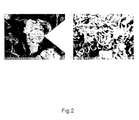
- Fig. 2 is an SEM image of the prepared electrode active material.
- An electrode active material and a battery were prepared in the same manner as in Example 1, except for heat treating 100 parts by weight of silicon monoxide at 800 °C instead of heat treating a mixture of 50 parts by weight lithium chloride and 50 parts by weight of silicon monoxide.
- a battery was prepared in the same manner as in Example 1, except for using 100 parts by weight of heat-untreated silicon monoxide instead of an electrode active material prepared by heat treating a mixture of lithium chloride and silicon monoxide.
- Fig. 3 is an SEM image of the prepared electrode active material.
- An electrode active material and a battery were prepared in the same manner as in Example 1, except for using 36 parts by weight of lithium hydroxide (LiOH) as an oxygen-containing lithium salt and 64 parts by weight of silicon monoxide instead of 50 parts by weight of lithium chloride and 50 parts by weight of silicon monoxide.
- LiOH lithium hydroxide
- An electrode active material and a battery were prepared in the same manner as in Example 1, except for heat treating 100 parts by weight of tin monoxide at 800 °C instead of heat treating a mixture of 50 parts by weight lithium chloride and 50 parts by weight of silicon monoxide.
- a battery was prepared in the same manner as in Example 1, except for using 100 parts by weight of heat-untreated tin monoxide instead of an electrode active material prepared by heat treating a mixture of 50 parts by weight lithium chloride and 50 parts by weight silicon monoxide.
- Battery charging The battery was charged under constant current until 5 mV, and then under constant voltage reaches to 0.005 C at 5 mV.
- Example 1 Si nuclear magnetic resonance (NMR) spectroscopy, Li-NMR spectroscopy and X-ray diffractometry (XRD) were performed to investigate the bonding structure of the electrode active material of the present disclosure.
- the electrode active material prepared in Example 1 was compared with the heat-treated SiO of Comparative Examples 2 as control 1, the heat-untreated SiO of Comparative Examples 3 as control 2, and LiCl as control 3. The result is shown in Figs. 5-7 .
Landscapes
- Chemical & Material Sciences (AREA)
- Organic Chemistry (AREA)
- Inorganic Chemistry (AREA)
- Chemical Kinetics & Catalysis (AREA)
- Electrochemistry (AREA)
- General Chemical & Material Sciences (AREA)
- Engineering & Computer Science (AREA)
- Manufacturing & Machinery (AREA)
- Composite Materials (AREA)
- Battery Electrode And Active Subsutance (AREA)
- Silicon Compounds (AREA)
- Secondary Cells (AREA)
Abstract
Description
- The present disclosure relates to an electrode active material for a secondary battery and a secondary battery including the electrode active material.
- In a lithium secondary battery, materials allowing insertion and release of lithium ions are used as a cathode and an anode, and an organic electrolyte or a polymer electrolyte is charged between the cathode and the anode. When the lithium ions are inserted and released at the cathode and the anode, electrical energy is generated through oxidation and reduction reactions.
- At present, carbonaceous materials are mainly used for the anode active material of a lithium secondary battery. However, in order to further improve the capacity of the lithium secondary battery, use of an electrode active material with a higher capacity is required.
- To satisfy this requirement, metallic Si, Sn, etc., which exhibit higher charge-discharge capacity than the carbonaceous materials and are electrochemically alloyable with lithium, have been used as an electrode active material. However, these metallic electrode active materials tend to crack or pulverize because of severe volume change accompanied by charge and discharge of lithium. Accordingly, the capacity of a secondary battery using these metallic electrode active material delines rapidly with the progress of charge-discharge cycles and also the lifetime is reduced.
- Thus, there has been an attempt to replace the metals such as Si, Sn, etc. with their oxides for use as an electrode active material, in order to reduce the cracking and pulverization problems. Although use of the mental oxide electrode active material solves the problem, initial efficiency is lower as compared to the carbonaceous electrode active materials. Furthermore, during the initial reaction with lithium ions, an irreversible phase such as a lithium oxide or a lithium, metal oxide is formed, resulting in further decline of initial efficiency than the metallic electrode active material.
- The inventors of the present disclosure have confirmed that an electrode active material, including first particulate of a metal (or metalloid) oxide alloyable with lithium and second particulate of an oxide containing lithium and the same metal (or metalloid) as that of the metal (or metalloid) oxide may reduce the formation of an irreversible phase such as a lithium oxide or a lithium metal oxide during initial charge-discharge of a battery since lithium is already contained in the second particulate before the initial charge-discharge through reaction of lithium with the metal (or metalloid) oxide.
- Further, they have found out that, when an oxygen-free lithium salt is used to prepare the electrode active material, reduction of initial efficiency during the initial charge-discharge of the battery may be prevented since additional inflow of oxygen into the metal (or metalloid) oxide during heat treatment can be prevented.
- The present disclosure is based on the findings.
- In one general aspect, the present disclosure provides an electrode active material including: (a) first particulate of a metal (or metalloid) oxide alloyable with lithium; and (b) second particulate of an oxide containing lithium and the same metal (or metalloid) as that of the metal, (or metalloid) oxide, and a secondary battery including the electrode active material.
- In another general aspect, the present disclosure provides a method for preparing the electrode active material, including: chemically or mechanically mixing an oxygen-free lithium salt and a metal (or metalloid) oxide alloyable with lithium; and heat treating the resulting mixture under an inert atmosphere.
- In another general aspect, the present disclosure provides a method for preparing the electrode active material, including: chemically or mechanically mixing an oxygen-free lithium salt and a metal (or metalloid) oxide alloyable with lithium; and mechanical alloying the resulting mixture.
- When an electrode active material according to the present disclosure is used as an anode active material, reduced amounts of an irreversible phase such as a lithium oxide or a lithium metal oxide are produced during initial charge-discharge of a battery since lithium is already contained in the second particulate before the initial charge-discharge, and thus a dead volume on the side of the cathode can be minimized and a high-capacity battery can be fabricated.
-
-
Fig. 1 is a scanning electron microscopy (SEM) image of an electrode active material prepared in Example 1. -
Fig. 2 is an SEM image of an electrode active material prepared in Comparative Example 1. -
Fig. 3 is an SEM image of SiO used in Comparative Example 3. -
Fig. 4 shows charge-discharge curves of secondary batteries prepared in Examples 1-2 and Comparative Examples 1-3. -
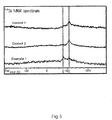
Fig. 5 shows Si nuclear magnetic resonance (NMR) spectra of an electrode active material prepared in Example 1, heat-treated SiO used in Comparative Example 2, and heat-untreated SiO used in Comparative Example 3. -
Fig. 6 shows Li-NMR spectra of an electrode active material prepared in Example 1 and LiCl ascontrol 3. -
Fig. 7 shows X-ray diffraction (XRD) spectra of an electrode active material prepared in Example 1 and control 2 (heat-untreated SiO used in Comparative Example 3). - Hereinafter, the embodiments of the present disclosure will be described in detail.
- The present disclosure provides an electrode active material for a secondary battery comprising: first particulate of a metal (or metalloid) oxide alloyable with lithium; and second particulate of an oxide containing lithium and the same metal (or metalloid) as that of the metal (or metalloid) oxide.
- When a metal (or metalloid) oxide alloyable with lithium such as SiO, SnO, etc. is used as an anode active materials, an irreversible phase such as a lithium oxide or a lithium metal oxide is formed during initial charge-discharge of a battery due to the reaction of lithium ion (Li+) inserted into the anode with the metal (or metalloid) oxide. Since the irreversible phase can surround the metal (or metalloid) such as Si, Sn, etc. and thus reduce the volume change of the mental (or metalloid), the electrode active material comprising the metal (or metalloid) oxide alloyable with lithium, such as SiO, SnO, etc. experiences less cracking or pulverization caused by the volume change as compared to the electrode active material comprising the metal (or metalloid) such as Si, Sn, etc.
- However, a battery having the electrode active material comprising the metal (or metalloid) oxide experiences deteriorated initial efficiency and capacity because lithium, is consumed due to the formation of the irreversible phase such as the lithium, oxide or the lithium metal oxide and an amount of usable lithium reduces. Specially, in the current secondary battery system wherein the lithium source is present at the cathode, the irreversible phase formed at the anode may result in increased dead volume at the anode if the irreversible capacity is large. As a result, the battery capacity is decreased since the capacity available at the cathode is reduced. In addition, the increased dead volume may decrease the battery life due to the low battery capacity and low charge-discharge efficiency at each cycle.
- To solve these problems, metallic lithium such as lithium foil or lithium powder has been reacted with a metal (or metalloid) oxide when preparing the electrode active material or the metallic lithium has been coated on the surface of a previously-prepared metal (or metalloid) oxide electrode in order to inhibit the dead volume generation at the cathode due to the formation of the irreversible phase at the anode
- However, since metallic lithium is highly reactive with water and may ignite and forms lithium carbonate by reacting with carbon dioxide, it is not recommended to use metallic lithium when preparing the electrode active material. Moreover, since the heat generated during the reaction of the metallic lithium with the metal (or metalloid) oxide allows the sub-nanometer metal (or metalloid) phase grow into large metal (or metalloid) crystal phase, it is difficult to reduce volume change during the charge-discharge of the battery.
- Thus, there has been an attempt to coat metallic lithium on the surface of an electrode comprising a mental (or metalloid) oxide and applying a pressure so that the metallic lithium is adhered well to the electrode surface, in order to use thus prepared electrode as an anode to inhibit the dead volume generation at the cathode.
- Specifically, a battery using such an electrode as anode allows, when the lithium ion (Li+) released from the cathode is inserted into the anode during charging, release of the lithium ion also from the metallic lithium present on the anode surface. Since the lithium ion released from the metallic lithium is inserted into the anode along with the lithium ion released from the cathode, the consumption of the lithium ion due to the formation of the irreversible phase resitting from the reaction of the lithium ion with the mental (or metalloid) oxide can be compensated for, and the dead volume generation at the cathode can be minimized.
- However, such an electrode is not currently produced in large scale due to the safety problems such as the risk of ignition resulting from the reaction of the metallic lithium with water.
- In addition, since the metallic lithium is simply present on the surface of the electrode comprising the metal (or metalloid) oxide, it cannot reduce the formation of the irreversible phase resulting from the reaction between lithium and the metal (or metalloid) oxide during battery charging. Moreover, the electrode active material of the conventional electrode comprises only the metal (or metalloid) oxide particulate and it does not comprise both the metal (or metalloid) and lithium as in the electrode active material of the present disclosure.
- in contrast, the electrode active material according to the present disclosure comprises first particulate of an oxide of a metal (or metalloid), e.g., Si, Sn, etc., and second particulate of an oxide containing lithium and the same metal (or mental as that of the metal (or metalloid) oxide. Thus, since lithium is already contained in the second particulate before the initial charge-discharge, the formation of the irreversible phase such as a lithium oxide or a lithium metal oxide during initial charge-discharge of a battery can be reduced and thus initial efficiency can be improved. Furthermore, since the dead volume generation at the cathode due to the formation of the irreversible phase at the anode can be minimized, the deterioration of battery capacity can be prevented. Accordingly, a secondary battery using the electrode active material, according to the present disclosure may have high initial efficiency of about 50 % or better as well as high capacity.
- The metal (or metalloid) oxide of the first particulate may be any oxide of a metalloid or a metal allowable with lithium, without special limitation, including Si, Sn, Al, Sb, Bi, As, Ge, Pb, Zn, Cd, In, Ga, etc.
- Examples of the oxide containing the metal (or metalloid) and lithium of the second particulate include Li2SiO, Li2SnO, Li4SiO4, Li2Si2O5 Li6Si2O7, Li2Si3O7, Li8SiO6, Li2SnO3, Li5AlO4, LiAlO2, LiAl5O8, LiSbO3, LiSb3O8, Li3SbO4, Li5SbO5, Li7SbO6, LiSb3O8, Li0.62Bi7.38O11.38, LiBiO2, LiBiO3, Li3BiO4, Li5BiO5, Li7BiO6, LiBi12O18.50, LiAsO3, Li3AsO4, Li4As2O7, Li2GeO5, Li2Ge4O9, LiGe7O15, Li2GeO3, Li4Ge5O12, Li4Ge9O20, Li4GeO4, Li6Ge2O7, Li8GeO6 Li2PbO3, Li4PbO4, Li8PbO6, Li6ZnO4, LilnO2, Li3lnO3, LiGaO2, LiGa5O8, Li5GaO4, etc. But, without being limited thereto, any crystalline or amorphous oxide in which lithium is contained in the mental (or metalloid) may be used. By including the second particulate in the electrode active material, formation of the lithium oxide and the lithium metal oxide at the anode during the battery charge-discharge can be reduced and, thus, the dead volume generation at the cathode due to the initial irreversible phase can be minimized.
- The first particulate of the metal (or metalloid) oxide and the second particulate of the oxide comprising the metal (or metalloid) as well as lithium may be mixed in the electrode active material. Preferably, the first particulate or aggregates of two of more of the first particulates are surrounded by the second particulate.
- The first particulate may have an average particle size (diameter) from about 0.1 nm to 5 µm, and the second particulate may have an average particle size (diameter) from about 0.1 nm to 20 µm. The electrode active material comprising the first particulate and the second particulate of such size may have an average particle size (diameter) from about 0.1 to 100 µm, but without being limited thereto.
- A secondary battery including the electrode active material of the present disclosure exhibits improved initial efficiency over the secondary battery including the existing electrode active maternal comprising only the metal (or metalloid) oxide particulate. For example, a secondary battery using an electrode active material comprising first particulate of SiO and second particulate of Li4SiO4 according to the present disclosure exhibits an initial efficiency of about 50 % or greater, preferably 65 % or greater, more preferably 70 % or greater.
- In addition, whereas the electrode active material comprising a metal such as Si, Sn, etc. shows volume change of about 400 % or greater, the electrode active material of the present disclosure exhibits a smaller volume change of about 300 % or less during charge-discharge of a battery.
- Preferably, the first particulate and the second particulate may be included in a weight ratio of 5 : 95 to 95 : 5. When the weight proportion of the first particulate is too small, the electrode active material has a low capacity because of low reversible capacity. And, the lithium included in the second particulate may cause safety problems by, for example, reacting with water. When the weight proportion of the first particulate is too high, a large amount of an irreversible phase such as a lithium oxide or a lithium metal oxide may be produced during battery charge discharge via reaction with lithium ions, thereby resulting in decreased initial efficiency.
- The electrode active material of the present disclosure may be prepared by: chemically or mechanically mixing an oxygen-free lithium salt and a metal (or metalloid) oxide alloyable with lithium; and heat treating the mixture under an inert atmosphere.
- The metal (or metalloid) oxide may be an oxide of any metal or metalloid) alloyable with lithium, without special limitation. Non-limiting example may include Si, Sn, Al, Sb, Bi, As, Ge, Pb, Zn, Cd, In, Ga and alloys thereof.
- The lithium salt, which is mixed with the metal (or metalloid) oxide and forms the second particulate, may be an oxygen-free lithium salt. It is because, if the lithium salt contains oxygen, lithium oxide may be produced during the heat treatment and, thus, not only lithium but also oxygen may react with the metal (or metalloid) oxide, thereby resulting in decreased initial efficiency of the battery.
- Non-limiting examples of the oxygen-free lithium salt included LiCl, LiBF4, LiAlCl4, LiSCN, LiSbF6, LiPF6, LiAsF6, LiB10Cl10, LiF, LiBr and Lil.
- When the oxygen-free lithium salt is mixed with the metal (or metalloid) oxide, the final molar ratio of the matal (or metalloid) (M) and oxygen (O) included in the electrode active material, M /O, becomes 1 or greater, more specifically from 1 to 10. As a result, the formation of the irreversible phase is reduced and the initial efficiency of the battery can be further improved.
- Preferably, the oxygen-free lithium salt and the metal (or metalloid) oxide may be mixed at a weight ratio of 5 : 95 to 80 : 20. When the weight proportion of the oxygen-free lithium salt is too small, the second particulate comprising lithium may be produced in too small an amount due to the insufficient amount of the lithium to react with the metal (or metalloid) oxide. Then, the irreversible phase such as a lithium, oxide or a lithium metal oxide may be produced in too large an amount from the reaction of the lithium ion inserted into the anode and the metal (or metalloid) oxide during initial charge-discharge of the battery. Consequently, the initial efficiency of the battery may not be improved as desired. And, when the weight proportion of the oxygen-free lithium salt is too large, the excessive amount of lithium included in the second particulate may cause safety problem of the battery. Also, the lithium exceeding the amount that can be included in the second particulate may precipitate.
- The oxygen-free lithium salt and the metal (or metalloid) oxide alloyable with lithium may be mixed by chemical or mechanical mixing.
- First, the chemical mixing may comprise: dispersing the metal (or metalloid) oxide in a solution prepared by dissolving the oxygen-free lithium salt in a solvent to prepare a dispersion; and drying the dispersion.
- The solvent or dispersion medium for dissolving the oxygen-free lithium salt and dispersing the alloyable metal (or metalloid) oxide may be any one that can provide homogeneous dissolution and mixing and can be removed easily afterwards, without particular limitation. Non-limiting examples of the solvent or dispersion medium may included distilled water, alcohols such as ethanol, methanol, etc., acetone, tetrahydrofuran, methylene chloride, chloroform, dimethylfarrnamide, N-methyl-2-pyrrolidon-, cyclohexane, dichloromethane, dimethyl sulfoxide, acetonitrile, pyridine, amines, and mixtures thereof.
- After dissolving the lithium salt in the solvent or dispersion medium, a dispersing apparatus commonly employed in the art may be used to disperse the metal (or metalloid) oxide and thus form the dispersion. The dispersing apparatus may be any apparatus that can disperse the material in the dispersion medium, without special limitation. Examples may included an ultrasonic dispersing apparatus, a magnetic stirring apparatus, a spray dryer apparatus, or the like.
- Then, after removing the solvent or dispersion by drying the dispersion medium at room temperature (25-28 °C) or at 50-200 °C, the mixture with the lithium, salt formed on the surface of the metal (or metalloid) oxide may be obtained. The solvent or dispersion medium may be removed according to the methods known in the art.
- The oxygen-free lithium salt and the metal (or metalloid) oxide alloyable with lithium may be homogeneously mixed also by mechanical mixing. As used herein, mechanical mixing refers to pulverizing and mixing particles desired to be mixed by applying mechanical, force and thus forming a homogeneous mixture.
- In general, mechanical mixing is performed using a mechanical mixing apparatus such as a high-energy ball mill, a planetary mill, a stirred ball mill, a vibrating mill, or the like. Process parameters such as rotation speed, ball-powder weight ratio, ball size, mixing time, mixing temperature, atmosphere, etc. may be varied depending on conditions. To attain a superior mixing efficiency, alcohols such as ethanol or higher fatty acids such as stearic acid may be added as a processing control agent. The processing control agent may be added in an amount of about 2.0 parts by weight or less, preferably 0.5 part by weight or less, based on 100 parts by weight of the mixture. The mixing time may he decreased by adding the processing control agent.
- When the process parameters such as mixing time, mixing temperature, rotation speed, etc. are controlled such that the rotation speed is increased to about 100 rpm or higher in about 2 hours of mechanical mixing, mechanical alloying may be accomplished while the oxygen-free lithium salt and the metal (or metalloid) oxide alloyable with lithium are pulverized and mixed. Through this mechanical mixing and mechanical alloying, the electrode active material of the present disclosure may be obtained in the form of an alloy with a homogeneous composition. In this case, the heat treatment under an inert atmosphere may be unnecessary.
- For example, after loading a mixture of the oxygen-free lithium salt and the metal (or metalloid) oxide in a ball mill apparatus together with ball having a diameter of about 5 mm, the mixture may be mechanical mixed and alloyed by rotating at room temperature. As a result of the ball milling, the mixture of the oxygen-free lithium salt and the metal (or metalloid) oxide may be pulverized and homogeneously mixed. By adjusting the rotation speed and mixing time, the electrode active material comprising a mixture of first particulate of the metal (or metalloid) oxide and second particulate of the oxide containing lithium and the same metal (or metalloid) as that of the metal (or metalloid) oxide can be obtained.
- Specifically, the mixture of the oxygen-free lithium shalt and the metal (or metalloid) oxide and the balls may be loaded in the ball mill apparatus at a weight ratio of 1 : 10-20. Outside this range, compressive stress may not be applied to the mixture or productivity may decrease because of unnecessarily excessive use of the balls.
- The ball may be a stainless steel ball or a zirconia ball having a diameter of about 0.1 to 10 mm.
- Specifically, the rotation speed may be about 300-3000 rpm. The rotation speed may be controlled adequately depending on whether the associated process is mechanical mixing or mechanical alloying.
- The mechanical alloying time may be 30 minutes or longer, preferably 3-100 hours. Within this range, the electrode active material wherein the first particulate and the second particulate are mixed can be obtained. When the mechanical alloying time is too short, the mixture of the oxygen-free lithium salt and the metal (or metalloid) oxide may not be adequately pulverized or mixed and, as a result, thereof, the first particulate and the second articulate may not be homogeneously mixed in the prepared electrode active material. And, when the mechanical alloying time is too long, impurities may be incorporated during the mechanical alloying, thereby deteriorating performance of the electrode active material.
- When preparing the electrode active material, by the mechanical mixing and/or the alloying, the mechanical mixing and/or alloying may be performed under an atmosphere where supply of oxygen is blocked. The atmosphere where supply of oxygen is blocked may be an inert atmosphere of nitrogen gas, hydrogen gas, argon gas, helium gas, krypton gas, xenon gas, etc. or a vacuum atmosphere, but without being limited thereto.
- As the resulting mixture is heat treated in a reactor under an inert atmosphere, the metal (or metalloid) oxide reacts with the lithium of the lithium salt formed on the surface thereof and thus forms new bonding. As a result, a mixture of the allowable metal (or metalloid) oxide and the oxide containing lithium and the same metal (or metalloid) as that of the metal (or metalloid) oxide is obtained. In this process, the anion of the lithium salt is released as gas.
- The heat treating temperature may be any temperature between the melting point of the oxygen-free lithium salt and the boiling point of the lithium salt, without special limitation. The heat treating temperature may be different depending on the particular oxygen-free lithium salt. When the heat treating temperature is below the melting point of the lithium salt, the reaction between the lithium, salt and the metal (or metalloid) oxide may not occur. And, when the temperature is above the boiling point of the lithium salt, the lithium salt may be released as gas before it sufficiently reacts with the metal (or metalloid) oxide. Accordingly, an appropriate range of the heat treating temperature is from 500 to 2000 °C.
- For example, when a mixture of LiCl as the oxygen-free lithium salt and SiO as the metal (or metalloid) oxide is heat treated, a temperature of 1300 °C or below is preferred. It is because SiO tends to form SiO2 and SiO and then grow at temperatures above 1300 °C, making it difficult to control the thickness of SiO. Accordingly, the heat treating temperature may be determined considering the kinds of metal (or metalloid) oxide.
- The heat treatment of the mixture may be performed under an inert atmosphere of nitrogen gas, hydrogen gas, argon gas, helium gas, krypton gas, xenon gas, etc. where supply of oxygen is blocked. When the mixture contacts oxygen during the heat treatment, lithium and oxygen may react together with the metal (or metalioid) oxide to form a lithium, oxide or a lithium metal oxide. As a result, improvement of the initial efficiency of the battery may decrease.
- In the present disclosure, an electrode may be prepared according to a method commonly employed in the art. For example, after mixing the electrode active material of the present disclosure with a binder, a solvent and, optional a conductivity enhancer and a dispersant and stirring to prepare a slurry, the slurry may be applied on a metallic current collector and then compressed and dried to prepare the electrode.
- The binder may be used in an amount of 1-10 parts by weight based on 100 parts by weight of the electrode active material, and the conductivity enhancer may be used in an amount of 1-30 parts by weight based on 100 parts by weight of the electrode active material,
- The binder may be an aqueous binder such as polytetrafluoroethylene (PTFE), polyvinylidene fluoride (PVDF), polyvinyl acetate, polyethylene oxide, polypyrrolidone, polyvinyl alcohols, polyacrylonitrile, polyacrylic acid (PAA), carboxymethyl cellulose (CMC), and styrene-butadiene rubber (SBR).
- Usually, carbon black may be used as the conductivity enhancer. Commercially available products marketed as the conductivity enhancer included Acetylene Black (Chevron Chemical or Gulf Oil Company), Ketjen Black EC (Armak Company), Vulcan XC-72 (Cabot Company), Super P (MMM), etc. Also, linear conductivity enhancers such as carbon nanotube, carbon (nano)fiber, etc. may be used.
- The metallic current collector may be any one made of a highly conductive metal, allowing easy attachment of the slurry of the electrode active material and having no reactivity within the voltage range of the battery. Typical examples included meshes and foils prepared from copper, gold, nickel and combinations thereof.
- The method for applying the slurry on the current collector is not particularly limited. For example, doctor blading, dipping, brushing, or the like may be employed. The application amount is also not specifically limited, but may be such an amount that the thickness of the active material layer remaining after removal of the solvent or dispersion medium is generally about 0.005-5 mm, preferably 0.05-2 mm.
- Also, the method for removing the solvent or dispersion medium is not specifically limited, but such a method that allows evaporation of the solvent or dispersion medium as soon as possible without cracking of the active material layer due to concentration of stress or peeling of the active material later from the current collector. As a non-limiting example, drying may be performed in a vacuum oven of 50-200 for 0.5 to 3 days.
- The electrode active material of the present disclosure can be used for any device for electrochemical reactions. For example, it can be used for all kinds of primary batteries, secondary batteries, fuel cells, solar cells, or capacitors. Preferably, it can be used for secondary batteries.
- The secondary battery of the present disclosure may be fabricated using the electrode comprising the electrode active material of the present disclosure according to a method known in the art. For example, it may be prepared by interposing a porous separator between the cathode and the anode and then adding an electrolyte thereto. The secondary battery incudes a lithium ion secondary battery, a lithium polymer secondary battery, a lithium ion polymer secondary buttery, or the like.
- The electrolyte may included a nonaqueous solvent and an electrolyte salt.
- The nonaqueous solvent may be a nonaqueous solvent commonly used for a nonaqueous electrolyte, without especial limitation. For example, cyclic carbonate, linear carbonate, lactone, ether, ester, ketone, etc. may be used.
- Examples of the cyclic carbonate include ethylene carbonate (EC), propylene carbonate (PC), butylene carbonate (BC), etc., and examples of the linear carbonate include diethyl carbonate (DEC), dimethyl carbonate (DMC), dipropyl carbonate (DPC), ethylmethyl carbonate (EMC), methylpropyl carbonate (MPC), etc. Examples of the lactone include γ-butyrolactone (GBL), and examples of the ether include dibutyl ether, tetrahydrofuran, 2-methyltetrahydrofuran, 1,4-dioxane, 1,2-dimethaxyethane, etc. Examples of the ester include n-methyl acetate, n-ethyl acetate, methyl propionate, ethyl propionate, propyl propionate,; butyl propionate, methyl pivalate, etc., and examples of the ketone include polymethyl vinyl ketone. These nonaqueous solvents may be used either alone or in combination.
- The electrolyte salt is not specifically limited as long as it is generally used as an electrolyte salt for a nonaqueous electrolyte. Non-limiting examples of the electrolyte salt include salts having a structure of A+B-, wherein A+ represents an alkali mental cation such as Li+, Na+, K+ or a combination thereof, and B- represents an anion such as PF6 -, BF4 -, Cl-, Br-, I-, CiO4 -, AsF6 -, CH3CO2 - , CF3SO3, N(CF3SO2)2 -, C(CF2SO2)2 - or a combination thereof. Preferably, a lithium salt may be used. These electrolyte salts may be used alone or in combination.
- The secondary battery of the present disclosure may include a separator. The separator is not specifically limited, but may be a porous separator. Non-limiting examples include polypropylene-, polyethylene- and polyolefin-based porous separators.
- Although the shape of the secondary battery of the present disclosure is not particularly limited, it can have a cylindrical shape, a square shape, a pouch shape or a coin shape.
- The examples and experiments will now be described. The following examples and experiments are for illustrative purposes only and not intended to limit the scope of the present disclosure.
- In the followings, parts by weight are based on 100 parts by weight of a mixture of an (oxygen-free) lithium salt and a metal (or metalloid) oxide.
- After dissolving 50 parts by weight of lithium chlorine (LiCl) in ethanol, 50 parts by weight of silicon monoxide (SiO) was uniformly dispersed to prepare a dispersion. The resulting dispersion was heated to 70 °C to remove the solvent from the mixture. The resulting mixture was heat treated at 800 °C under a nitrogen atmosphere to prepare an electrode active material.
Fig. 1 is a scanning electron microscopy (SEM) image of the prepared electrode active material. - Thus prepared electrode active material powder was mixed with polyvinylidene fluoride (PVDF) as a binder and Acetylene Black as a conductivity enhancer at a weight ratio of 85 : 10 : 5. Then, after adding N-methyl-2-pyrrolidone (NMP) as a solvent, the mixture was mixed to prepare a homogeneous electrode slurry. The prepared electrode slurry was coated on one side of a copper (Cu) current collector to a thickness of 65 µm. After drying, pressing and punching to a desired size, an electrode was prepared.
- Ethylene carbonate (EC) and diethyl carbonate (DEC) were mixed at a volume ratio of 30 : 70. To the resulting nonaqueous electrolyte solvent, 1 M LiPF6 was added to prepare a nonaqueous electrolyte.
- A coin-shaped battery was prepared by interposing a polyolefin separator between the electrode prepared above as an anode and a Li metal foil as a counter electrode and then injecting the electrolyte.
- An electrode active material and a battery were prepared in the same manner as in Example 1, except for using 80 parts by weight of lithium chloride and 20 parts by weight of silicon monoxide instead of 50 parts by weight of lithium chloride and 50 parts by weight of silicon monoxide.
- An electrode active material and a battery were prepared in the same manner as in Example 1, except for using 76 parts by weight lithium iodide (Lil) as an oxygen-free lithium salt instead of 50 parts by weight of lithium chloride.
- An electrode active material and a battery were prepared in the same manner as in Example 1, except for using 25 parts by weight of lithium chloride and 75 parts by weight of tin monoxide (SnO) instead of 50 parts by weight of lithium chloride and 50 parts by weight of silicon monoxide.
- An electrode active material and a battery were prepared in the same manner as in Example 1, except for using 47 parts by weight of lithium carbonate (Li2CO3) and 53 parts by weight of silicon monoxide instead of 50 parts by weight of lithium chloride and 50 parts by weight of silicon monoxide.
Fig. 2 is an SEM image of the prepared electrode active material. - An electrode active material and a battery were prepared in the same manner as in Example 1, except for heat treating 100 parts by weight of silicon monoxide at 800 °C instead of heat treating a mixture of 50 parts by weight lithium chloride and 50 parts by weight of silicon monoxide.
- A battery was prepared in the same manner as in Example 1, except for using 100 parts by weight of heat-untreated silicon monoxide instead of an electrode active material prepared by heat treating a mixture of lithium chloride and silicon monoxide.
-
Fig. 3 is an SEM image of the prepared electrode active material. - An electrode active material and a battery were prepared in the same manner as in Example 1, except for using 36 parts by weight of lithium hydroxide (LiOH) as an oxygen-containing lithium salt and 64 parts by weight of silicon monoxide instead of 50 parts by weight of lithium chloride and 50 parts by weight of silicon monoxide.
- An electrode active material and a battery were prepared in the same manner as in Example 1, except for heat treating 100 parts by weight of tin monoxide at 800 °C instead of heat treating a mixture of 50 parts by weight lithium chloride and 50 parts by weight of silicon monoxide.
- A battery was prepared in the same manner as in Example 1, except for using 100 parts by weight of heat-untreated tin monoxide instead of an electrode active material prepared by heat treating a mixture of 50 parts by weight lithium chloride and 50 parts by weight silicon monoxide.
- Charge-discharge characteristics of the batteries prepared in Examples 1-4 and Comparative Examples 1-6 were measured for 1 cycle. The result is shown in Table 1 and
Fig. 4 . Charging and discharging were performed under the condition described below. Also, the molar ratio (a : b) of first particulate (a) and second particulate (b) in the electrode active material and the molar ratio (M : O) of the metal (or metalloid) (M, M = Si or Sn) and oxygen (O) in the electrode active material were measured. - Battery charging: The battery was charged under constant current until 5 mV, and then under constant voltage reaches to 0.005 C at 5 mV.
- Battery discharging: The battery was discharged under constant current until 1.0 V.
[Table 1] a : b molar ratio Discharging capacity (mAh/g) Charging capacity (mAh/g) Initial efficiency (%) M : O molar ratio Ex. 1 55 : 45 1680 2174 78.2 1 : 1 Ex. 2 13 : 87 1580 1734 91.1 1 : 1 Ex. 3 57 : 43 1655 2108 78.5 1 : 1 Ex. 4 48 : 52 848 1201 70.5 1 : 1 Comp. Ex. 1 54 : 46 1430 2677 52.3 1 : 2 Comp. Ex. 2 100 : 0 1745 2710 64.4 1 : 1 Comp. Ex. 3 100 : 0 1750 2713 64.5 1 : 1 Comp. Ex. 4 55 : 45 1427 2718 52.5 1 : 2 Comp. Ex. 5 10 : 0 873 1556 56.1 1 : 1 Comp. Ex. 6 100 : 0 870 1548 56.2 1 : 1 - 1) As seen from Table 1 and
Fig. 4 , the secondary battery prepared in Example 1 showed a decreased charging capacity but about 14 % improved initial efficiency as compared to the battery prepared in Comparative Examples 2 or 3. Also, the secondary battery prepared in Example 4 exhibited improved initial efficiency as compared to the battery prepared in Comparative Example 5 or 6. Therefore, it can be seen that when SiO and oxygen-free LiCl are mixed and then heat treated, the formation of the irreversible phase during charge-discharge of the battery caused by the reaction between lithium ion and SiO is reduced. - 2) Also, the secondary battery prepared in Example 1 (using the oxygen-free lithium salt LiCl) and the secondary battery prepared in Example 3 (using the oxygen-free lithium salt Lil) showed much higher initial efficiency as well as increased discharging capacity when compared with the secondary battery prepared in Comparative Example 1 (using the oxygen-containing lithium salt Li2CO3) or the secondary battery prepared in Comparative Example 4 (using the oxygen-containing lithium salt LiOH). And, as a result of quantifying the metal (or metalloid) (M, M = Si or Sn) and oxygen (O) included in the electrode active material, the electrode active material of Example 1 had an Si : O ratio of 1 : 1, with a lower oxygen content than the electrode active materials of Comparative Examples 1 and 4 (Si : O = 1 : 2). Therefore, it can be seen that when an oxygen-free lithium salt is used, initial efficiency and discharging capacity are improved since lithium and oxygen are not introduced into SiO during the heat treatment.
- 3) When comparing the secondary battery of Comparative Example 2 (using heat-treated SiO) with the secondary battery of Comparative Example 3 (using heat-untreated SiO), and the secondary battery of Comparative Example 5 (using heat-treated SnO) with the secondary battery of Comparative Example 6 (using heat-untreated SnO) respectively, the initial efficiency and charging/discharging capacity were almost similar. Therefore, it can be seen that heat treatment of SiO or SnO does not affect the charge-discharge characteristics of a battery.
- Si nuclear magnetic resonance (NMR) spectroscopy, Li-NMR spectroscopy and X-ray diffractometry (XRD) were performed to investigate the bonding structure of the electrode active material of the present disclosure. The electrode active material prepared in Example 1 was compared with the heat-treated SiO of Comparative Examples 2 as
control 1, the heat-untreated SiO of Comparative Examples 3 ascontrol 2, and LiCl ascontrol 3. The result is shown inFigs. 5-7 . - 1) As seen from
Fig. 5 , although control 1 (heat-treated SiO) and control 2 (heat-untreated SiO) show the same Si-NMR peaks at the same positions, the electrode active material prepared in Example 1 show a peak at a position different from that of control 2 (heat-untreated SiO). It reveals that the Si-NMR peak change of the electrode active material prepared in Example 1 is not due to heat treatment but the bonding of SiO to a different substance. - 2) Also, as seen from
Fig. 6 , the electrode active material prepared in Example 1 shored a Li-NMR peak at a different position from that of control 3 (LiCl). The chlorine content of the electrode active material of Example 1 was measured at about 50 ppm. Therefore, it was revealed that the lithium present in the electrode active material of Example 1 does not exist as LiCl. - 3) In addition, as seen from
Fig. 7 , the electrode active material prepared in Example 1 showed the same XRD peak patterns as control 2 (SiO), with no peak at different positions. In particular, the peaks occurring between 20 and 30° are the characteristic peaks observed from the SiO nanostructure. The peaks were also observed from the electrode active material prepared in Example 1. A crystalline material may show such peaks. However, the crystal grain size of the electrode active material of Example 1 andcontrol 2 is calculated to be about 5 nm or smaller from the peak widths. Such a small crystal grain size reveals that the electrode active material of Example 1 is not crystalline but amorphous. The XRD revealed that not only the first particulate of the metal (or metailoid) oxide but also the second particulate of the oxide containing the metal (or metalloid) and lithium are amorphous. - 4) To conclude, it can be seen that lithium is chemically bonded to SiO in the electrode active material of Example 1.
- The present application contains subject matter related to International Patent Application No.
PCT/KR2008/006836 PCT/KR2008/006929 - Those skilled in the art will appreciate that the conceptions and specific embodiments disclosed in the foregoing description may be readily utilized as a basis for modifying or designing other embodiments for carrying out the same purposes of the present disclosure. Those skilled in the art will also appreciate that such equivalent embodiments do not depart from the spirit and scope of the disclosure as set forth in the appended claims.
Claims (20)
- An electrode active material comprising:first particulate of a metal (or metalloid) oxide alloyable with lithium; andsecond particulate of an oxide containing lithium and the same metal (or metalloid) as that of the metal (or metalloid) oxide.
- The electrode active material according to claim 1, wherein the first particulate and the second particulate are mixed in the electrode active material.
- The electrode active material according to claim 1, wherein the first particulate or aggregates of two or more of the first particulates are surrounded by the second particulate.
- The electrode active material according to claim 1, wherein the first particulate and the second particulate are included in a weight ratio of 5 : 95 to 95 : 5.
- The electrode active material according to claim 1, wherein a molar ratio of the metal (or metalloid) (M) and oxygen (O) included in the electrode active material, M / O, is 1 or greater.
- The electrode active material according to claim 1, wherein the first particulate have an average particle size (diameter) from 0.1 nm to 5 µm, and the second particulate have an average particle size (diameter) from 0.0 nm to 20 µm.
- The electrode active material according to claim 1, wherein the metal (or metalloid) of the metal (or metalloid) oxide of the first particulate is selected from a group consisting of Si, Sn, Al, Sb, Bi, As, Ge, Pb, Zn, Cd, In, Ga and alloys thereof.
- The electrode active material according to claim 1, wherein the oxide containing the metal (or metalloid) and lithium of the second particulate is selected from a group consisting of Li2SiO, Li2SnO, Li4SiO4, Li2Si2O5, Li6Si2O7, Li2Si3O7, Li8SiO6, Li2SnO3, Li5AlO4, LiAlO2, LiAl5O8, LiSbO3, LiSb3O8, Li3SbO4, Li5SbO5, U7SbO6, LiSb3O8, Li0.62Bi7.38O11.38, LiBiO2, LiBiO3, Li3BiO4, Li5BiO5, Li7BiO6, LiBi12O18.50, LiAsO3, Li3AsO4, Li4As2O7; Li2GeO5, Li2Ge4O9, Li2Ge7O15, Li2GeO3, Li4Ge5O12, Li4Ge9O20. Li4GeO4, Li6Ge2O7, Li8GeO6, Li2PbO3, Li4PbO4. Li8PbO6, Li6ZnO4, LiInO2, Li3InO3, LiGaO2, LiGa5O8, and Li6GaO4.
- The electrode active material according to claim 1, wherein the oxide containing the metal (or metalloid) and lithium of the second particulate is crystalline, amorphous, or both.
- The electrode active material according to claim 1, wherein the electrode active material is an anode active material.
- A secondary battery comprising the electrode active material according to any one of claims 1 to 10.
- The secondary battery according to claim 11, which has an initial efficiency of 50 % or greater.
- A method for preparing the electrode active material according to any one of claims 1 to 9, comprising:chemically or mechanically mixing an oxygen-free lithium salt and a metal (or metalloid) oxide alloyable with lithium; andheat treating the resulting mixture under an inert atmosphere at a temperature between the melting point of the oxygen-free lithium salt and the boiling point of the oxygen-free lithium salt, or mechanical alloying the resulting mixture.
- The method for preparing an electrode active material according to claim 13, wherein the oxygen-free lithium salt is selected from a group consisting of LiCl, LiBF4, LiAlCl4, LiSCN, LiSbF6, LiPF6, LiAsF6, LiB10Cl10, LiF, LiBr and Lil.
- The method for preparing an electrode active material according to claim 13, wherein the metal (or metalloid) of the metal (or metalloid) oxide of the first particulate is selected from a group consisting of Si, Sn, Al, Sb, Bi, As, Ge, Pb, Zn, Cd, In, Ga and alloys thereof.
- The method for preparing an electrode active material according to claim 13, therein the oxygen-free lithium salt and the metal (or metalloid) oxide are mixed at a weight ratio of 5 : 95 to 80 : 20.
- The method for preparing an electrode active material according to claim 13, wherein the chemical mixing comprises: dispersing the metal (or metalloid) oxide in a solution prepared by dissolving the oxygen-free lithium salt in a solvent to prepare a dispersion; and drying the dispersion.
- The method for prepaying an electrode active material according to claim 13, wherein the mechanical mixing is performed using a ball mill, a planetary mill, a stirred ball mill or a vibrating mill.
- The method for preparing an electrode active material according to claim 13, wherein the heat treatment is performed at 500-2000 °C.
- The method for preparing an electrode active material according to claim 13, wherein the mechanical alloying is performed using a ball mill, a planetary mill, a stirred ball mill or a vibrating mill.
Applications Claiming Priority (3)
| Application Number | Priority Date | Filing Date | Title |
|---|---|---|---|
| KR2008006836 | 2008-11-20 | ||
| KR2008006929 | 2008-11-24 | ||
| PCT/KR2009/006846 WO2010058990A2 (en) | 2008-11-20 | 2009-11-20 | Electrode active material for secondary battery and method for preparing the same |
Publications (3)
| Publication Number | Publication Date |
|---|---|
| EP2360759A2 true EP2360759A2 (en) | 2011-08-24 |
| EP2360759A4 EP2360759A4 (en) | 2013-03-06 |
| EP2360759B1 EP2360759B1 (en) | 2017-07-12 |
Family
ID=42198683
Family Applications (1)
| Application Number | Title | Priority Date | Filing Date |
|---|---|---|---|
| EP09827755.1A Active EP2360759B1 (en) | 2008-11-20 | 2009-11-20 | Electrode active material for secondary battery and method for preparing the same |
Country Status (5)
| Country | Link |
|---|---|
| US (1) | US8546019B2 (en) |
| EP (1) | EP2360759B1 (en) |
| JP (1) | JP5558482B2 (en) |
| CN (1) | CN102292854B (en) |
| WO (1) | WO2010058990A2 (en) |
Families Citing this family (39)
| Publication number | Priority date | Publication date | Assignee | Title |
|---|---|---|---|---|
| JP5450182B2 (en) * | 2010-03-12 | 2014-03-26 | 株式会社半導体エネルギー研究所 | Secondary battery and electronic equipment |
| US20120003541A1 (en) * | 2010-07-02 | 2012-01-05 | Samsung Sdi Co., Ltd. | Positive active material for lithium secondary battery and lithium secondary battery using the same |
| CN102569812B (en) * | 2011-12-24 | 2013-11-27 | 西北工业大学 | Preparation method of polymer doped lithium stannate cathode material |
| IN2014MN01862A (en) | 2012-02-28 | 2015-07-03 | Lg Chemical Ltd | |
| EP2712009B1 (en) * | 2012-07-13 | 2019-09-11 | LG Chem, Ltd. | Bimodal-type anode active material and lithium secondary battery including same |
| KR101558044B1 (en) | 2012-07-13 | 2015-10-07 | 주식회사 엘지화학 | Bimodal type-anode active material and lithium secondary battery comprising the same |
| WO2014034933A1 (en) * | 2012-09-03 | 2014-03-06 | 日本ケミコン株式会社 | Electrode material for lithium ion secondary batteries, method for producing electrode material for lithium ion secondary batteries, and lithium ion secondary battery |
| GB2508218A (en) * | 2012-11-26 | 2014-05-28 | Leclanch S A | Electrode for the reduction of gassing in lithium titanate cells |
| KR101591698B1 (en) | 2012-11-30 | 2016-02-04 | 주식회사 엘지화학 | Anode active material, lithium secondary battery comprising the material, and method of preparing the material |
| EP2997611B1 (en) | 2013-05-15 | 2026-04-22 | QuantumScape Battery, Inc. | Solid state catholyte or electrolyte for battery |
| US9761861B1 (en) | 2013-06-25 | 2017-09-12 | Quantumscape Corporation | Pulse plating of lithium material in electrochemical devices |
| CN107611347A (en) * | 2013-08-21 | 2018-01-19 | 信越化学工业株式会社 | Negative electrode active material and its material and its manufacture method, negative electrode, lithium rechargeable battery and its manufacture method |
| WO2015045316A1 (en) * | 2013-09-24 | 2015-04-02 | 三洋電機株式会社 | Negative electrode active material for nonaqueous electrolyte secondary batteries and nonaqueous electrolyte secondary battery using same |
| JP5839733B2 (en) * | 2013-12-25 | 2016-01-06 | 株式会社半導体エネルギー研究所 | Manufacturing method of secondary battery |
| JP6359836B2 (en) * | 2014-02-07 | 2018-07-18 | 信越化学工業株式会社 | Negative electrode material for nonaqueous electrolyte secondary battery, negative electrode for nonaqueous electrolyte secondary battery, method for producing the same, and nonaqueous electrolyte secondary battery |
| JP6181590B2 (en) * | 2014-04-02 | 2017-08-16 | 信越化学工業株式会社 | Anode for non-aqueous electrolyte secondary battery and non-aqueous electrolyte secondary battery |
| US9859560B2 (en) | 2014-06-04 | 2018-01-02 | Quantumscape Corporation | Electrode materials with mixed particle sizes |
| JP2016062860A (en) * | 2014-09-22 | 2016-04-25 | 株式会社東芝 | Electrode active material for non-aqueous electrolyte secondary battery and non-aqueous electrolyte secondary battery including the same |
| US10116003B2 (en) | 2015-02-03 | 2018-10-30 | Quantumscape Corporation | Metal sulfide anolytes for electrochemical cells |
| WO2016210371A1 (en) | 2015-06-24 | 2016-12-29 | Quantumscape Corporation | Composite electrolytes |
| KR102765039B1 (en) | 2015-12-04 | 2025-02-11 | 퀀텀스케이프 배터리, 인코포레이티드 | Electrolyte and catholyte compositions comprising lithium, phosphorus, sulfur and iodine, electrolyte membranes for electrochemical devices, and an annealing method for producing these electrolytes and catholytes. |
| JP6746526B2 (en) * | 2016-04-06 | 2020-08-26 | 信越化学工業株式会社 | Negative electrode active material, mixed negative electrode active material, and method for producing negative electrode active material |
| WO2017208627A1 (en) * | 2016-05-30 | 2017-12-07 | 信越化学工業株式会社 | Negative electrode active material, mixed negative electrode active material, and method for producing negative electrode active material |
| WO2017208625A1 (en) * | 2016-05-30 | 2017-12-07 | 信越化学工業株式会社 | Negative electrode active material, mixed negative electrode active material, and method for producing negative electrode active material |
| PL3343677T3 (en) * | 2016-06-02 | 2023-10-30 | Lg Energy Solution, Ltd. | Cathode active material, cathode comprising same, and lithium secondary battery comprising same |
| US11342630B2 (en) | 2016-08-29 | 2022-05-24 | Quantumscape Battery, Inc. | Catholytes for solid state rechargeable batteries, battery architectures suitable for use with these catholytes, and methods of making and using the same |
| KR102765058B1 (en) * | 2016-11-01 | 2025-02-10 | 주식회사 아모그린텍 | Electrode and Secondary Battery Using the Same, and Method for Manufacturing the Electrode |
| WO2018165606A1 (en) | 2017-03-10 | 2018-09-13 | Quantumscape Corporation | Metal negative electrode ultrasonic charging |
| JP6911545B2 (en) * | 2017-06-05 | 2021-07-28 | 株式会社Gsユアサ | Negative electrode and non-aqueous electrolyte power storage element |
| US10431700B2 (en) * | 2017-06-09 | 2019-10-01 | Giga Solar Materials Corp. | Conductive paste composition for providing enhanced adhesion strength to a semiconductor substrate and its use |
| KR102244904B1 (en) * | 2017-07-13 | 2021-04-26 | 주식회사 엘지화학 | Anode comprising electrode protective layer and lithium secondary battery comprising the same |
| CN108717977B (en) * | 2018-05-29 | 2021-10-08 | 哈尔滨工业大学 | A lithium-ion battery with excellent zero-volt storage performance |
| CN110556525B (en) * | 2019-08-21 | 2022-03-29 | 华南理工大学 | Lithium germanate, lithium germanate/graphite composite negative electrode material, preparation method thereof and application thereof in assembled lithium battery |
| CN112751027B (en) * | 2019-10-30 | 2024-08-09 | 贝特瑞新材料集团股份有限公司 | Negative electrode material, preparation method thereof and lithium ion battery |
| CN111848132A (en) * | 2020-07-30 | 2020-10-30 | 电子科技大学 | Easy sintering high Q value Li3Mg2SbO6 based microwave dielectric ceramic material and preparation method thereof |
| CN115440944B (en) * | 2021-06-04 | 2025-08-22 | 中伟新材料股份有限公司 | Lithium battery positive electrode active material and preparation method, positive electrode and lithium battery thereof |
| JP7040832B1 (en) | 2021-08-11 | 2022-03-23 | 日本重化学工業株式会社 | Negative electrode active material for lithium ion secondary battery, its manufacturing method, and negative electrode for lithium ion secondary battery |
| CN114292088B (en) * | 2021-12-30 | 2022-10-11 | 安徽大学 | A kind of tritium-neutron composite breeder lithium lead-acid eutectic ceramic pellet and preparation method |
| KR102729470B1 (en) * | 2022-10-12 | 2024-11-13 | 포스코홀딩스 주식회사 | Compositions containing lithium containing compounds and battery disposal method |
Family Cites Families (13)
| Publication number | Priority date | Publication date | Assignee | Title |
|---|---|---|---|---|
| JP3252414B2 (en) * | 1991-11-29 | 2002-02-04 | 松下電器産業株式会社 | Non-aqueous electrolyte secondary battery |
| JP2997741B2 (en) * | 1992-07-29 | 2000-01-11 | セイコーインスツルメンツ株式会社 | Non-aqueous electrolyte secondary battery and method of manufacturing the same |
| JP4768901B2 (en) | 1999-06-03 | 2011-09-07 | チタン工業株式会社 | Lithium titanium composite oxide, method for producing the same, and use thereof |
| KR100417251B1 (en) | 1999-12-15 | 2004-02-05 | 주식회사 엘지화학 | Method for preparing lithium manganese spinel oxide having improved electrochemical performance |
| JP4702510B2 (en) | 2001-09-05 | 2011-06-15 | 信越化学工業株式会社 | Lithium-containing silicon oxide powder and method for producing the same |
| KR20110104083A (en) | 2003-05-13 | 2011-09-21 | 미쓰비시 가가꾸 가부시키가이샤 | Layered lithium nickel-based composite oxide powder and its manufacturing method |
| JP4650603B2 (en) * | 2003-12-22 | 2011-03-16 | 日本電気株式会社 | Anode material for secondary battery, method for producing the same, and secondary battery using the same |
| JP2005285545A (en) * | 2004-03-30 | 2005-10-13 | Ngk Insulators Ltd | Lithium secondary battery |
| KR20050114516A (en) | 2004-06-01 | 2005-12-06 | 브이케이 주식회사 | Positive electrode active material for lithium ion secondary cell coated hetero metal oxide on the surface and lithium ion secondary cell comprising it |
| JP4533822B2 (en) * | 2005-08-24 | 2010-09-01 | 株式会社東芝 | Nonaqueous electrolyte battery and negative electrode active material |
| US7776473B2 (en) | 2006-03-27 | 2010-08-17 | Shin-Etsu Chemical Co., Ltd. | Silicon-silicon oxide-lithium composite, making method, and non-aqueous electrolyte secondary cell negative electrode material |
| KR100830612B1 (en) * | 2006-05-23 | 2008-05-21 | 강원대학교산학협력단 | Negative active material for lithium secondary battery, method of preparing same, and lithium secondary battery comprising same |
| KR101451801B1 (en) * | 2007-02-14 | 2014-10-17 | 삼성에스디아이 주식회사 | Anode active material, method of preparing the same, anode and lithium battery containing the material |
-
2009
- 2009-11-20 US US13/130,153 patent/US8546019B2/en active Active
- 2009-11-20 JP JP2011537364A patent/JP5558482B2/en active Active
- 2009-11-20 CN CN200980155046.8A patent/CN102292854B/en active Active
- 2009-11-20 EP EP09827755.1A patent/EP2360759B1/en active Active
- 2009-11-20 WO PCT/KR2009/006846 patent/WO2010058990A2/en not_active Ceased
Also Published As
| Publication number | Publication date |
|---|---|
| CN102292854A (en) | 2011-12-21 |
| EP2360759B1 (en) | 2017-07-12 |
| JP2012509564A (en) | 2012-04-19 |
| EP2360759A4 (en) | 2013-03-06 |
| US20110311875A1 (en) | 2011-12-22 |
| US8546019B2 (en) | 2013-10-01 |
| WO2010058990A2 (en) | 2010-05-27 |
| CN102292854B (en) | 2015-01-14 |
| WO2010058990A3 (en) | 2010-08-12 |
| JP5558482B2 (en) | 2014-07-23 |
Similar Documents
| Publication | Publication Date | Title |
|---|---|---|
| US8546019B2 (en) | Electrode active material for secondary battery and method for preparing the same | |
| EP2416410B1 (en) | Composite for electrode active material and secondary battery comprising the same | |
| EP3499614B1 (en) | Cathode active material for lithium secondary battery, method for manufacturing same, electrode comprising same, and lithium secondary battery comprising said electrode | |
| EP3011617B1 (en) | Conductive carbons for lithium ion batteries | |
| KR101604081B1 (en) | Composite anode active material, anode comprising the material, lithium battery comprising the anode, and method for preparing the material | |
| EP4382487A1 (en) | Positive electrode active material, method for preparing same, positive electrode including same, and lithium secondary battery | |
| KR20160083227A (en) | Cathode active material for lithium ion secondary battery, method for preparing the same, and lithium ion secondary battery including the same | |
| EP4254553A1 (en) | Positive electrode active material for lithium secondary battery, method for manufacturing same, and positive electrode and lithium secondary battery comprising same | |
| EP4451387A1 (en) | Cathode active material, preparation method therefor, and cathode and lithium secondary battery, which comprise same | |
| EP4432393A1 (en) | Positive electrode active material, method for preparing same, and positive electrode and lithium secondary battery including same | |
| EP2806488A1 (en) | Electrode active material for lithium secondary battery and method for manufacturing same | |
| EP4047693A1 (en) | Cathode active material for lithium secondary battery and method for preparing cathode active material | |
| EP4300628A1 (en) | Positive electrode material, method for preparing same, and lithium secondary battery comprising same | |
| EP4718527A1 (en) | Positive electrode active material and preparation method therefor | |
| EP4726805A1 (en) | Positive active material, and positive electrode and lithium secondary battery comprising same | |
| EP4632843A1 (en) | Cathode active material, and cathode and lithium secondary battery comprising same | |
| EP4553927A1 (en) | Cathode active material precursor, preparation method therefor, method for preparing cathode active material by using same, and cathode active material | |
| KR101194911B1 (en) | Electrode active material for secondary battery and method for preparing the same | |
| EP4451375A1 (en) | Anode material for secondary battery | |
| EP4668361A1 (en) | Cathode active material, preparation method therefor, and cathode and lithium secondary battery which comprise same | |
| US20210210747A1 (en) | Passivated and/or protected silicon anode material slurries | |
| US11502295B2 (en) | Silver and/or tin coated silicon active material and anode slurries formed therefrom | |
| KR101102651B1 (en) | Electrode Active Material for Secondary Battery and Manufacturing Method Thereof | |
| EP4618193A1 (en) | Lithium secondary battery comprising amorphous cathode active material | |
| KR101367029B1 (en) | Hybrid composite for electrode active material and method for preparing the same |
Legal Events
| Date | Code | Title | Description |
|---|---|---|---|
| PUAI | Public reference made under article 153(3) epc to a published international application that has entered the european phase |
Free format text: ORIGINAL CODE: 0009012 |
|
| 17P | Request for examination filed |
Effective date: 20110620 |
|
| AK | Designated contracting states |
Kind code of ref document: A2 Designated state(s): AT BE BG CH CY CZ DE DK EE ES FI FR GB GR HR HU IE IS IT LI LT LU LV MC MK MT NL NO PL PT RO SE SI SK SM TR |
|
| DAX | Request for extension of the european patent (deleted) | ||
| A4 | Supplementary search report drawn up and despatched |
Effective date: 20130206 |
|
| RIC1 | Information provided on ipc code assigned before grant |
Ipc: H01M 4/36 20060101ALI20130131BHEP Ipc: H01M 10/05 20100101ALI20130131BHEP Ipc: H01M 10/052 20100101ALI20130131BHEP Ipc: H01M 4/04 20060101ALI20130131BHEP Ipc: H01M 4/485 20100101ALI20130131BHEP Ipc: H01M 6/50 20060101ALI20130131BHEP Ipc: H01M 4/48 20100101AFI20130131BHEP |
|
| 17Q | First examination report despatched |
Effective date: 20140130 |
|
| GRAP | Despatch of communication of intention to grant a patent |
Free format text: ORIGINAL CODE: EPIDOSNIGR1 |
|
| RIC1 | Information provided on ipc code assigned before grant |
Ipc: H01M 4/36 20060101ALI20170227BHEP Ipc: H01M 10/052 20100101ALI20170227BHEP Ipc: C01G 15/00 20060101ALI20170227BHEP Ipc: H01M 10/05 20100101ALI20170227BHEP Ipc: C01G 17/00 20060101ALI20170227BHEP Ipc: H01M 4/48 20100101AFI20170227BHEP Ipc: H01M 4/04 20060101ALI20170227BHEP Ipc: C01G 13/00 20060101ALI20170227BHEP Ipc: H01M 6/50 20060101ALI20170227BHEP Ipc: C01G 30/00 20060101ALI20170227BHEP Ipc: C01G 9/00 20060101ALI20170227BHEP Ipc: H01M 4/485 20100101ALI20170227BHEP Ipc: C01G 29/00 20060101ALI20170227BHEP |
|
| INTG | Intention to grant announced |
Effective date: 20170404 |
|
| GRAS | Grant fee paid |
Free format text: ORIGINAL CODE: EPIDOSNIGR3 |
|
| GRAA | (expected) grant |
Free format text: ORIGINAL CODE: 0009210 |
|
| AK | Designated contracting states |
Kind code of ref document: B1 Designated state(s): AT BE BG CH CY CZ DE DK EE ES FI FR GB GR HR HU IE IS IT LI LT LU LV MC MK MT NL NO PL PT RO SE SI SK SM TR |
|
| REG | Reference to a national code |
Ref country code: GB Ref legal event code: FG4D |
|
| REG | Reference to a national code |
Ref country code: CH Ref legal event code: EP |
|
| REG | Reference to a national code |
Ref country code: AT Ref legal event code: REF Ref document number: 909131 Country of ref document: AT Kind code of ref document: T Effective date: 20170715 |
|
| REG | Reference to a national code |
Ref country code: IE Ref legal event code: FG4D |
|
| REG | Reference to a national code |
Ref country code: DE Ref legal event code: R096 Ref document number: 602009047141 Country of ref document: DE |
|
| REG | Reference to a national code |
Ref country code: FR Ref legal event code: PLFP Year of fee payment: 9 |
|
| REG | Reference to a national code |
Ref country code: NL Ref legal event code: MP Effective date: 20170712 |
|
| REG | Reference to a national code |
Ref country code: LT Ref legal event code: MG4D |
|
| REG | Reference to a national code |
Ref country code: AT Ref legal event code: MK05 Ref document number: 909131 Country of ref document: AT Kind code of ref document: T Effective date: 20170712 |
|
| PG25 | Lapsed in a contracting state [announced via postgrant information from national office to epo] |
Ref country code: AT Free format text: LAPSE BECAUSE OF FAILURE TO SUBMIT A TRANSLATION OF THE DESCRIPTION OR TO PAY THE FEE WITHIN THE PRESCRIBED TIME-LIMIT Effective date: 20170712 Ref country code: HR Free format text: LAPSE BECAUSE OF FAILURE TO SUBMIT A TRANSLATION OF THE DESCRIPTION OR TO PAY THE FEE WITHIN THE PRESCRIBED TIME-LIMIT Effective date: 20170712 Ref country code: FI Free format text: LAPSE BECAUSE OF FAILURE TO SUBMIT A TRANSLATION OF THE DESCRIPTION OR TO PAY THE FEE WITHIN THE PRESCRIBED TIME-LIMIT Effective date: 20170712 Ref country code: NL Free format text: LAPSE BECAUSE OF FAILURE TO SUBMIT A TRANSLATION OF THE DESCRIPTION OR TO PAY THE FEE WITHIN THE PRESCRIBED TIME-LIMIT Effective date: 20170712 Ref country code: NO Free format text: LAPSE BECAUSE OF FAILURE TO SUBMIT A TRANSLATION OF THE DESCRIPTION OR TO PAY THE FEE WITHIN THE PRESCRIBED TIME-LIMIT Effective date: 20171012 Ref country code: SE Free format text: LAPSE BECAUSE OF FAILURE TO SUBMIT A TRANSLATION OF THE DESCRIPTION OR TO PAY THE FEE WITHIN THE PRESCRIBED TIME-LIMIT Effective date: 20170712 Ref country code: LT Free format text: LAPSE BECAUSE OF FAILURE TO SUBMIT A TRANSLATION OF THE DESCRIPTION OR TO PAY THE FEE WITHIN THE PRESCRIBED TIME-LIMIT Effective date: 20170712 |
|
| PG25 | Lapsed in a contracting state [announced via postgrant information from national office to epo] |
Ref country code: BG Free format text: LAPSE BECAUSE OF FAILURE TO SUBMIT A TRANSLATION OF THE DESCRIPTION OR TO PAY THE FEE WITHIN THE PRESCRIBED TIME-LIMIT Effective date: 20171012 Ref country code: PL Free format text: LAPSE BECAUSE OF FAILURE TO SUBMIT A TRANSLATION OF THE DESCRIPTION OR TO PAY THE FEE WITHIN THE PRESCRIBED TIME-LIMIT Effective date: 20170712 Ref country code: IS Free format text: LAPSE BECAUSE OF FAILURE TO SUBMIT A TRANSLATION OF THE DESCRIPTION OR TO PAY THE FEE WITHIN THE PRESCRIBED TIME-LIMIT Effective date: 20171112 Ref country code: GR Free format text: LAPSE BECAUSE OF FAILURE TO SUBMIT A TRANSLATION OF THE DESCRIPTION OR TO PAY THE FEE WITHIN THE PRESCRIBED TIME-LIMIT Effective date: 20171013 Ref country code: ES Free format text: LAPSE BECAUSE OF FAILURE TO SUBMIT A TRANSLATION OF THE DESCRIPTION OR TO PAY THE FEE WITHIN THE PRESCRIBED TIME-LIMIT Effective date: 20170712 Ref country code: LV Free format text: LAPSE BECAUSE OF FAILURE TO SUBMIT A TRANSLATION OF THE DESCRIPTION OR TO PAY THE FEE WITHIN THE PRESCRIBED TIME-LIMIT Effective date: 20170712 |
|
| REG | Reference to a national code |
Ref country code: DE Ref legal event code: R097 Ref document number: 602009047141 Country of ref document: DE |
|
| PG25 | Lapsed in a contracting state [announced via postgrant information from national office to epo] |
Ref country code: RO Free format text: LAPSE BECAUSE OF FAILURE TO SUBMIT A TRANSLATION OF THE DESCRIPTION OR TO PAY THE FEE WITHIN THE PRESCRIBED TIME-LIMIT Effective date: 20170712 Ref country code: CZ Free format text: LAPSE BECAUSE OF FAILURE TO SUBMIT A TRANSLATION OF THE DESCRIPTION OR TO PAY THE FEE WITHIN THE PRESCRIBED TIME-LIMIT Effective date: 20170712 Ref country code: DK Free format text: LAPSE BECAUSE OF FAILURE TO SUBMIT A TRANSLATION OF THE DESCRIPTION OR TO PAY THE FEE WITHIN THE PRESCRIBED TIME-LIMIT Effective date: 20170712 |
|
| PLBE | No opposition filed within time limit |
Free format text: ORIGINAL CODE: 0009261 |
|
| STAA | Information on the status of an ep patent application or granted ep patent |
Free format text: STATUS: NO OPPOSITION FILED WITHIN TIME LIMIT |
|
| PG25 | Lapsed in a contracting state [announced via postgrant information from national office to epo] |
Ref country code: SM Free format text: LAPSE BECAUSE OF FAILURE TO SUBMIT A TRANSLATION OF THE DESCRIPTION OR TO PAY THE FEE WITHIN THE PRESCRIBED TIME-LIMIT Effective date: 20170712 Ref country code: SK Free format text: LAPSE BECAUSE OF FAILURE TO SUBMIT A TRANSLATION OF THE DESCRIPTION OR TO PAY THE FEE WITHIN THE PRESCRIBED TIME-LIMIT Effective date: 20170712 Ref country code: EE Free format text: LAPSE BECAUSE OF FAILURE TO SUBMIT A TRANSLATION OF THE DESCRIPTION OR TO PAY THE FEE WITHIN THE PRESCRIBED TIME-LIMIT Effective date: 20170712 Ref country code: IT Free format text: LAPSE BECAUSE OF FAILURE TO SUBMIT A TRANSLATION OF THE DESCRIPTION OR TO PAY THE FEE WITHIN THE PRESCRIBED TIME-LIMIT Effective date: 20170712 |
|
| 26N | No opposition filed |
Effective date: 20180413 |
|
| PG25 | Lapsed in a contracting state [announced via postgrant information from national office to epo] |
Ref country code: MC Free format text: LAPSE BECAUSE OF FAILURE TO SUBMIT A TRANSLATION OF THE DESCRIPTION OR TO PAY THE FEE WITHIN THE PRESCRIBED TIME-LIMIT Effective date: 20170712 |
|
| PG25 | Lapsed in a contracting state [announced via postgrant information from national office to epo] |
Ref country code: CH Free format text: LAPSE BECAUSE OF NON-PAYMENT OF DUE FEES Effective date: 20171130 Ref country code: LI Free format text: LAPSE BECAUSE OF NON-PAYMENT OF DUE FEES Effective date: 20171130 |
|
| PG25 | Lapsed in a contracting state [announced via postgrant information from national office to epo] |
Ref country code: SI Free format text: LAPSE BECAUSE OF FAILURE TO SUBMIT A TRANSLATION OF THE DESCRIPTION OR TO PAY THE FEE WITHIN THE PRESCRIBED TIME-LIMIT Effective date: 20170712 Ref country code: LU Free format text: LAPSE BECAUSE OF NON-PAYMENT OF DUE FEES Effective date: 20171120 |
|
| REG | Reference to a national code |
Ref country code: BE Ref legal event code: MM Effective date: 20171130 |
|
| REG | Reference to a national code |
Ref country code: IE Ref legal event code: MM4A |
|
| PG25 | Lapsed in a contracting state [announced via postgrant information from national office to epo] |
Ref country code: MT Free format text: LAPSE BECAUSE OF NON-PAYMENT OF DUE FEES Effective date: 20171120 |
|
| REG | Reference to a national code |
Ref country code: FR Ref legal event code: PLFP Year of fee payment: 10 |
|
| PG25 | Lapsed in a contracting state [announced via postgrant information from national office to epo] |
Ref country code: IE Free format text: LAPSE BECAUSE OF NON-PAYMENT OF DUE FEES Effective date: 20171120 |
|
| PG25 | Lapsed in a contracting state [announced via postgrant information from national office to epo] |
Ref country code: BE Free format text: LAPSE BECAUSE OF NON-PAYMENT OF DUE FEES Effective date: 20171130 |
|
| PG25 | Lapsed in a contracting state [announced via postgrant information from national office to epo] |
Ref country code: HU Free format text: LAPSE BECAUSE OF FAILURE TO SUBMIT A TRANSLATION OF THE DESCRIPTION OR TO PAY THE FEE WITHIN THE PRESCRIBED TIME-LIMIT; INVALID AB INITIO Effective date: 20091120 |
|
| PG25 | Lapsed in a contracting state [announced via postgrant information from national office to epo] |
Ref country code: CY Free format text: LAPSE BECAUSE OF NON-PAYMENT OF DUE FEES Effective date: 20170712 |
|
| PG25 | Lapsed in a contracting state [announced via postgrant information from national office to epo] |
Ref country code: MK Free format text: LAPSE BECAUSE OF FAILURE TO SUBMIT A TRANSLATION OF THE DESCRIPTION OR TO PAY THE FEE WITHIN THE PRESCRIBED TIME-LIMIT Effective date: 20170712 |
|
| PG25 | Lapsed in a contracting state [announced via postgrant information from national office to epo] |
Ref country code: TR Free format text: LAPSE BECAUSE OF FAILURE TO SUBMIT A TRANSLATION OF THE DESCRIPTION OR TO PAY THE FEE WITHIN THE PRESCRIBED TIME-LIMIT Effective date: 20170712 |
|
| PG25 | Lapsed in a contracting state [announced via postgrant information from national office to epo] |
Ref country code: PT Free format text: LAPSE BECAUSE OF FAILURE TO SUBMIT A TRANSLATION OF THE DESCRIPTION OR TO PAY THE FEE WITHIN THE PRESCRIBED TIME-LIMIT Effective date: 20170712 |
|
| REG | Reference to a national code |
Ref country code: DE Ref legal event code: R081 Ref document number: 602009047141 Country of ref document: DE Owner name: LG ENERGY SOLUTION LTD., KR Free format text: FORMER OWNER: LG CHEM. LTD., SEOUL, KR Ref country code: DE Ref legal event code: R081 Ref document number: 602009047141 Country of ref document: DE Owner name: LG ENERGY SOLUTION, LTD., KR Free format text: FORMER OWNER: LG CHEM. LTD., SEOUL, KR |
|
| P01 | Opt-out of the competence of the unified patent court (upc) registered |
Effective date: 20230408 |
|
| REG | Reference to a national code |
Ref country code: GB Ref legal event code: 732E Free format text: REGISTERED BETWEEN 20230824 AND 20230831 |
|
| REG | Reference to a national code |
Ref country code: DE Ref legal event code: R081 Ref document number: 602009047141 Country of ref document: DE Owner name: LG ENERGY SOLUTION, LTD., KR Free format text: FORMER OWNER: LG ENERGY SOLUTION LTD., SEOUL, KR |
|
| PGFP | Annual fee paid to national office [announced via postgrant information from national office to epo] |
Ref country code: DE Payment date: 20251020 Year of fee payment: 17 |
|
| PGFP | Annual fee paid to national office [announced via postgrant information from national office to epo] |
Ref country code: GB Payment date: 20251023 Year of fee payment: 17 |
|
| PGFP | Annual fee paid to national office [announced via postgrant information from national office to epo] |
Ref country code: FR Payment date: 20251021 Year of fee payment: 17 |