EP2360150A1 - Method for the separation of intermediates which may be used for the preparation of escitalopram - Google Patents
Method for the separation of intermediates which may be used for the preparation of escitalopram Download PDFInfo
- Publication number
- EP2360150A1 EP2360150A1 EP11165320A EP11165320A EP2360150A1 EP 2360150 A1 EP2360150 A1 EP 2360150A1 EP 11165320 A EP11165320 A EP 11165320A EP 11165320 A EP11165320 A EP 11165320A EP 2360150 A1 EP2360150 A1 EP 2360150A1
- Authority
- EP
- European Patent Office
- Prior art keywords
- formula
- compound
- alkyl
- amino
- cyano
- Prior art date
- Legal status (The legal status is an assumption and is not a legal conclusion. Google has not performed a legal analysis and makes no representation as to the accuracy of the status listed.)
- Withdrawn
Links
- 238000000034 method Methods 0.000 title claims abstract description 120
- 238000002360 preparation method Methods 0.000 title claims abstract description 23
- 229960004341 escitalopram Drugs 0.000 title abstract description 30
- WSEQXVZVJXJVFP-FQEVSTJZSA-N escitalopram Chemical compound C1([C@]2(C3=CC=C(C=C3CO2)C#N)CCCN(C)C)=CC=C(F)C=C1 WSEQXVZVJXJVFP-FQEVSTJZSA-N 0.000 title abstract description 28
- 239000000543 intermediate Substances 0.000 title abstract description 3
- 238000000926 separation method Methods 0.000 title description 11
- 150000002009 diols Chemical class 0.000 claims abstract description 53
- 230000002255 enzymatic effect Effects 0.000 claims abstract description 40
- 238000005917 acylation reaction Methods 0.000 claims abstract description 39
- 230000010933 acylation Effects 0.000 claims abstract description 36
- 238000005947 deacylation reaction Methods 0.000 claims abstract description 31
- 230000020176 deacylation Effects 0.000 claims abstract description 29
- 150000001875 compounds Chemical class 0.000 claims description 208
- 125000004093 cyano group Chemical group *C#N 0.000 claims description 109
- 125000002924 primary amino group Chemical group [H]N([H])* 0.000 claims description 88
- 102000004190 Enzymes Human genes 0.000 claims description 82
- 108090000790 Enzymes Proteins 0.000 claims description 82
- 229910052736 halogen Inorganic materials 0.000 claims description 81
- 239000000203 mixture Substances 0.000 claims description 78
- 150000002367 halogens Chemical class 0.000 claims description 75
- 125000001424 substituent group Chemical group 0.000 claims description 68
- -1 C2-io-alkynyl Chemical group 0.000 claims description 59
- 125000006222 dimethylaminomethyl group Chemical group [H]C([H])([H])N(C([H])([H])[H])C([H])([H])* 0.000 claims description 57
- 238000002955 isolation Methods 0.000 claims description 56
- 125000002887 hydroxy group Chemical group [H]O* 0.000 claims description 55
- 125000000449 nitro group Chemical group [O-][N+](*)=O 0.000 claims description 55
- 150000003839 salts Chemical class 0.000 claims description 51
- 238000000746 purification Methods 0.000 claims description 48
- XLYOFNOQVPJJNP-UHFFFAOYSA-N water Substances O XLYOFNOQVPJJNP-UHFFFAOYSA-N 0.000 claims description 47
- 239000002253 acid Substances 0.000 claims description 40
- 125000003118 aryl group Chemical group 0.000 claims description 35
- 125000000008 (C1-C10) alkyl group Chemical group 0.000 claims description 34
- 125000004169 (C1-C6) alkyl group Chemical group 0.000 claims description 24
- 125000006374 C2-C10 alkenyl group Chemical group 0.000 claims description 23
- 229910052760 oxygen Inorganic materials 0.000 claims description 23
- 229910052717 sulfur Inorganic materials 0.000 claims description 23
- 239000003795 chemical substances by application Substances 0.000 claims description 22
- 125000001072 heteroaryl group Chemical group 0.000 claims description 22
- 239000003960 organic solvent Substances 0.000 claims description 22
- 239000012074 organic phase Substances 0.000 claims description 21
- 125000000027 (C1-C10) alkoxy group Chemical group 0.000 claims description 18
- 125000004432 carbon atom Chemical group C* 0.000 claims description 15
- 241000589774 Pseudomonas sp. Species 0.000 claims description 14
- 108010013563 Lipoprotein Lipase Proteins 0.000 claims description 13
- 125000005110 aryl thio group Chemical group 0.000 claims description 11
- 125000004104 aryloxy group Chemical group 0.000 claims description 11
- 102000004157 Hydrolases Human genes 0.000 claims description 10
- 108090000604 Hydrolases Proteins 0.000 claims description 10
- 108010093096 Immobilized Enzymes Proteins 0.000 claims description 10
- 102000004882 Lipase Human genes 0.000 claims description 9
- 108090001060 Lipase Proteins 0.000 claims description 9
- 239000004367 Lipase Substances 0.000 claims description 9
- 235000019421 lipase Nutrition 0.000 claims description 9
- SYTBZMRGLBWNTM-SNVBAGLBSA-N (R)-flurbiprofen Chemical compound FC1=CC([C@H](C(O)=O)C)=CC=C1C1=CC=CC=C1 SYTBZMRGLBWNTM-SNVBAGLBSA-N 0.000 claims description 8
- 241000222120 Candida <Saccharomycetales> Species 0.000 claims description 8
- 101710098554 Lipase B Proteins 0.000 claims description 7
- 125000004122 cyclic group Chemical group 0.000 claims description 7
- 239000008346 aqueous phase Substances 0.000 claims description 6
- 239000012948 isocyanate Substances 0.000 claims description 6
- 150000002513 isocyanates Chemical class 0.000 claims description 6
- 150000002540 isothiocyanates Chemical class 0.000 claims description 6
- 125000004433 nitrogen atom Chemical group N* 0.000 claims description 6
- 239000007858 starting material Substances 0.000 claims description 6
- 108090000371 Esterases Proteins 0.000 claims description 5
- 108091005804 Peptidases Proteins 0.000 claims description 5
- 239000004365 Protease Substances 0.000 claims description 5
- 102100037486 Reverse transcriptase/ribonuclease H Human genes 0.000 claims description 5
- 101000984201 Thermomyces lanuginosus Lipase Proteins 0.000 claims description 5
- 239000013078 crystal Substances 0.000 claims description 3
- 229910052770 Uranium Inorganic materials 0.000 claims description 2
- 229910052721 tungsten Inorganic materials 0.000 claims description 2
- 229910052720 vanadium Inorganic materials 0.000 claims description 2
- 102100022119 Lipoprotein lipase Human genes 0.000 claims 1
- YXFVVABEGXRONW-UHFFFAOYSA-N Toluene Chemical compound CC1=CC=CC=C1 YXFVVABEGXRONW-UHFFFAOYSA-N 0.000 description 270
- 238000006243 chemical reaction Methods 0.000 description 101
- 239000000243 solution Substances 0.000 description 47
- 239000010410 layer Substances 0.000 description 38
- 230000003287 optical effect Effects 0.000 description 37
- MEGHWIAOTJPCHQ-UHFFFAOYSA-N ethenyl butanoate Chemical compound CCCC(=O)OC=C MEGHWIAOTJPCHQ-UHFFFAOYSA-N 0.000 description 36
- IUGYQRQAERSCNH-UHFFFAOYSA-N pivalic acid Chemical compound CC(C)(C)C(O)=O IUGYQRQAERSCNH-UHFFFAOYSA-N 0.000 description 34
- 125000006273 (C1-C3) alkyl group Chemical group 0.000 description 33
- IMNFDUFMRHMDMM-UHFFFAOYSA-N N-Heptane Chemical compound CCCCCCC IMNFDUFMRHMDMM-UHFFFAOYSA-N 0.000 description 26
- 239000000047 product Substances 0.000 description 25
- RYHBNJHYFVUHQT-UHFFFAOYSA-N 1,4-Dioxane Chemical compound C1COCCO1 RYHBNJHYFVUHQT-UHFFFAOYSA-N 0.000 description 24
- 239000011541 reaction mixture Substances 0.000 description 23
- WPYMKLBDIGXBTP-UHFFFAOYSA-N benzoic acid Chemical compound OC(=O)C1=CC=CC=C1 WPYMKLBDIGXBTP-UHFFFAOYSA-N 0.000 description 22
- 238000004128 high performance liquid chromatography Methods 0.000 description 22
- UHOVQNZJYSORNB-UHFFFAOYSA-N Benzene Chemical compound C1=CC=CC=C1 UHOVQNZJYSORNB-UHFFFAOYSA-N 0.000 description 21
- LFQSCWFLJHTTHZ-UHFFFAOYSA-N Ethanol Chemical compound CCO LFQSCWFLJHTTHZ-UHFFFAOYSA-N 0.000 description 21
- XEKOWRVHYACXOJ-UHFFFAOYSA-N Ethyl acetate Chemical compound CCOC(C)=O XEKOWRVHYACXOJ-UHFFFAOYSA-N 0.000 description 21
- OKKJLVBELUTLKV-UHFFFAOYSA-N Methanol Chemical compound OC OKKJLVBELUTLKV-UHFFFAOYSA-N 0.000 description 21
- VLKZOEOYAKHREP-UHFFFAOYSA-N n-Hexane Chemical compound CCCCCC VLKZOEOYAKHREP-UHFFFAOYSA-N 0.000 description 21
- 125000001153 fluoro group Chemical group F* 0.000 description 20
- 150000002148 esters Chemical class 0.000 description 19
- IJGRMHOSHXDMSA-UHFFFAOYSA-N Atomic nitrogen Chemical compound N#N IJGRMHOSHXDMSA-UHFFFAOYSA-N 0.000 description 18
- JUJWROOIHBZHMG-UHFFFAOYSA-N Pyridine Chemical compound C1=CC=NC=C1 JUJWROOIHBZHMG-UHFFFAOYSA-N 0.000 description 18
- 229960001653 citalopram Drugs 0.000 description 18
- 239000002904 solvent Substances 0.000 description 18
- 108010084311 Novozyme 435 Proteins 0.000 description 17
- ZMANZCXQSJIPKH-UHFFFAOYSA-N Triethylamine Chemical compound CCN(CC)CC ZMANZCXQSJIPKH-UHFFFAOYSA-N 0.000 description 17
- 239000007864 aqueous solution Substances 0.000 description 16
- 238000006798 ring closing metathesis reaction Methods 0.000 description 16
- 239000000126 substance Substances 0.000 description 16
- WEVYAHXRMPXWCK-UHFFFAOYSA-N Acetonitrile Chemical compound CC#N WEVYAHXRMPXWCK-UHFFFAOYSA-N 0.000 description 15
- RTZKZFJDLAIYFH-UHFFFAOYSA-N Diethyl ether Chemical compound CCOCC RTZKZFJDLAIYFH-UHFFFAOYSA-N 0.000 description 15
- HEMHJVSKTPXQMS-UHFFFAOYSA-M Sodium hydroxide Chemical compound [OH-].[Na+] HEMHJVSKTPXQMS-UHFFFAOYSA-M 0.000 description 15
- 125000006592 (C2-C3) alkenyl group Chemical group 0.000 description 14
- 125000002252 acyl group Chemical group 0.000 description 14
- 238000003756 stirring Methods 0.000 description 14
- 125000002496 methyl group Chemical group [H]C([H])([H])* 0.000 description 13
- 125000004178 (C1-C4) alkyl group Chemical group 0.000 description 12
- 125000006593 (C2-C3) alkynyl group Chemical group 0.000 description 12
- CSCPPACGZOOCGX-UHFFFAOYSA-N Acetone Chemical compound CC(C)=O CSCPPACGZOOCGX-UHFFFAOYSA-N 0.000 description 12
- 125000000882 C2-C6 alkenyl group Chemical group 0.000 description 12
- YMWUJEATGCHHMB-UHFFFAOYSA-N Dichloromethane Chemical compound ClCCl YMWUJEATGCHHMB-UHFFFAOYSA-N 0.000 description 12
- 102000043296 Lipoprotein lipases Human genes 0.000 description 12
- 239000002585 base Substances 0.000 description 12
- 238000004808 supercritical fluid chromatography Methods 0.000 description 12
- WSEQXVZVJXJVFP-HXUWFJFHSA-N (R)-citalopram Chemical compound C1([C@@]2(C3=CC=C(C=C3CO2)C#N)CCCN(C)C)=CC=C(F)C=C1 WSEQXVZVJXJVFP-HXUWFJFHSA-N 0.000 description 11
- 239000005711 Benzoic acid Substances 0.000 description 11
- 125000003601 C2-C6 alkynyl group Chemical group 0.000 description 11
- MUBZPKHOEPUJKR-UHFFFAOYSA-N Oxalic acid Chemical compound OC(=O)C(O)=O MUBZPKHOEPUJKR-UHFFFAOYSA-N 0.000 description 11
- 235000010233 benzoic acid Nutrition 0.000 description 11
- 238000006722 reduction reaction Methods 0.000 description 11
- 125000006559 (C1-C3) alkylamino group Chemical group 0.000 description 10
- 125000004455 (C1-C3) alkylthio group Chemical group 0.000 description 10
- 125000006698 (C1-C3) dialkylamino group Chemical group 0.000 description 10
- 125000006274 (C1-C3)alkoxy group Chemical group 0.000 description 10
- 125000004890 (C1-C6) alkylamino group Chemical group 0.000 description 10
- 125000006656 (C2-C4) alkenyl group Chemical group 0.000 description 10
- HBAQYPYDRFILMT-UHFFFAOYSA-N 8-[3-(1-cyclopropylpyrazol-4-yl)-1H-pyrazolo[4,3-d]pyrimidin-5-yl]-3-methyl-3,8-diazabicyclo[3.2.1]octan-2-one Chemical class C1(CC1)N1N=CC(=C1)C1=NNC2=C1N=C(N=C2)N1C2C(N(CC1CC2)C)=O HBAQYPYDRFILMT-UHFFFAOYSA-N 0.000 description 10
- IAZDPXIOMUYVGZ-UHFFFAOYSA-N Dimethylsulphoxide Chemical compound CS(C)=O IAZDPXIOMUYVGZ-UHFFFAOYSA-N 0.000 description 10
- ZMXDDKWLCZADIW-UHFFFAOYSA-N N,N-Dimethylformamide Chemical compound CN(C)C=O ZMXDDKWLCZADIW-UHFFFAOYSA-N 0.000 description 10
- 125000000217 alkyl group Chemical group 0.000 description 10
- KQNPFQTWMSNSAP-UHFFFAOYSA-N isobutyric acid Chemical compound CC(C)C(O)=O KQNPFQTWMSNSAP-UHFFFAOYSA-N 0.000 description 10
- 229910052757 nitrogen Inorganic materials 0.000 description 10
- 125000000229 (C1-C4)alkoxy group Chemical group 0.000 description 9
- 125000004191 (C1-C6) alkoxy group Chemical group 0.000 description 9
- 125000006700 (C1-C6) alkylthio group Chemical group 0.000 description 9
- 125000006619 (C1-C6) dialkylamino group Chemical group 0.000 description 9
- 125000006650 (C2-C4) alkynyl group Chemical group 0.000 description 9
- VONGZNXBKCOUHB-UHFFFAOYSA-N Phenylmethyl butanoate Chemical compound CCCC(=O)OCC1=CC=CC=C1 VONGZNXBKCOUHB-UHFFFAOYSA-N 0.000 description 9
- 150000007513 acids Chemical class 0.000 description 9
- 229910052739 hydrogen Inorganic materials 0.000 description 9
- 239000001257 hydrogen Substances 0.000 description 9
- UMJSCPRVCHMLSP-UHFFFAOYSA-N pyridine Natural products COC1=CC=CN=C1 UMJSCPRVCHMLSP-UHFFFAOYSA-N 0.000 description 9
- 238000006268 reductive amination reaction Methods 0.000 description 9
- GNULRNVWXYXBQY-UHFFFAOYSA-N 4-[4-(dimethylamino)-1-(4-fluorophenyl)-1-hydroxybutyl]-3-(hydroxymethyl)benzonitrile Chemical compound C=1C=C(C#N)C=C(CO)C=1C(O)(CCCN(C)C)C1=CC=C(F)C=C1 GNULRNVWXYXBQY-UHFFFAOYSA-N 0.000 description 8
- WYURNTSHIVDZCO-UHFFFAOYSA-N Tetrahydrofuran Chemical compound C1CCOC1 WYURNTSHIVDZCO-UHFFFAOYSA-N 0.000 description 8
- NZNMSOFKMUBTKW-UHFFFAOYSA-N cyclohexanecarboxylic acid Chemical compound OC(=O)C1CCCCC1 NZNMSOFKMUBTKW-UHFFFAOYSA-N 0.000 description 8
- ZWLPBLYKEWSWPD-UHFFFAOYSA-N o-toluic acid Chemical compound CC1=CC=CC=C1C(O)=O ZWLPBLYKEWSWPD-UHFFFAOYSA-N 0.000 description 8
- 239000012044 organic layer Substances 0.000 description 8
- LPNBBFKOUUSUDB-UHFFFAOYSA-N p-toluic acid Chemical compound CC1=CC=C(C(O)=O)C=C1 LPNBBFKOUUSUDB-UHFFFAOYSA-N 0.000 description 8
- ZWEHNKRNPOVVGH-UHFFFAOYSA-N 2-Butanone Chemical compound CCC(C)=O ZWEHNKRNPOVVGH-UHFFFAOYSA-N 0.000 description 7
- FERIUCNNQQJTOY-UHFFFAOYSA-N Butyric acid Chemical compound CCCC(O)=O FERIUCNNQQJTOY-UHFFFAOYSA-N 0.000 description 7
- 150000001299 aldehydes Chemical class 0.000 description 7
- 229940093499 ethyl acetate Drugs 0.000 description 7
- 235000019439 ethyl acetate Nutrition 0.000 description 7
- 125000001495 ethyl group Chemical group [H]C([H])([H])C([H])([H])* 0.000 description 7
- 238000000605 extraction Methods 0.000 description 7
- 125000004435 hydrogen atom Chemical group [H]* 0.000 description 7
- 230000011987 methylation Effects 0.000 description 7
- 238000007069 methylation reaction Methods 0.000 description 7
- XMIIGOLPHOKFCH-UHFFFAOYSA-N 3-phenylpropionic acid Chemical compound OC(=O)CCC1=CC=CC=C1 XMIIGOLPHOKFCH-UHFFFAOYSA-N 0.000 description 6
- QTBSBXVTEAMEQO-UHFFFAOYSA-N Acetic acid Chemical compound CC(O)=O QTBSBXVTEAMEQO-UHFFFAOYSA-N 0.000 description 6
- HEDRZPFGACZZDS-UHFFFAOYSA-N Chloroform Chemical compound ClC(Cl)Cl HEDRZPFGACZZDS-UHFFFAOYSA-N 0.000 description 6
- BZLVMXJERCGZMT-UHFFFAOYSA-N Methyl tert-butyl ether Chemical compound COC(C)(C)C BZLVMXJERCGZMT-UHFFFAOYSA-N 0.000 description 6
- KWYUFKZDYYNOTN-UHFFFAOYSA-M Potassium hydroxide Chemical compound [OH-].[K+] KWYUFKZDYYNOTN-UHFFFAOYSA-M 0.000 description 6
- 125000003277 amino group Chemical group 0.000 description 6
- 238000002425 crystallisation Methods 0.000 description 6
- 238000006911 enzymatic reaction Methods 0.000 description 6
- 150000002170 ethers Chemical class 0.000 description 6
- 125000005843 halogen group Chemical group 0.000 description 6
- FUZZWVXGSFPDMH-UHFFFAOYSA-N hexanoic acid Chemical compound CCCCCC(O)=O FUZZWVXGSFPDMH-UHFFFAOYSA-N 0.000 description 6
- NPZTUJOABDZTLV-UHFFFAOYSA-N hydroxybenzotriazole Substances O=C1C=CC=C2NNN=C12 NPZTUJOABDZTLV-UHFFFAOYSA-N 0.000 description 6
- GPSDUZXPYCFOSQ-UHFFFAOYSA-N m-toluic acid Chemical compound CC1=CC=CC(C(O)=O)=C1 GPSDUZXPYCFOSQ-UHFFFAOYSA-N 0.000 description 6
- 239000000758 substrate Substances 0.000 description 6
- 238000012360 testing method Methods 0.000 description 6
- 238000005406 washing Methods 0.000 description 6
- GWYFCOCPABKNJV-UHFFFAOYSA-M 3-Methylbutanoic acid Natural products CC(C)CC([O-])=O GWYFCOCPABKNJV-UHFFFAOYSA-M 0.000 description 5
- XTHFKEDIFFGKHM-UHFFFAOYSA-N Dimethoxyethane Chemical compound COCCOC XTHFKEDIFFGKHM-UHFFFAOYSA-N 0.000 description 5
- ROSDSFDQCJNGOL-UHFFFAOYSA-N Dimethylamine Chemical compound CNC ROSDSFDQCJNGOL-UHFFFAOYSA-N 0.000 description 5
- OFOBLEOULBTSOW-UHFFFAOYSA-N Malonic acid Chemical compound OC(=O)CC(O)=O OFOBLEOULBTSOW-UHFFFAOYSA-N 0.000 description 5
- LRHPLDYGYMQRHN-UHFFFAOYSA-N N-Butanol Chemical compound CCCCO LRHPLDYGYMQRHN-UHFFFAOYSA-N 0.000 description 5
- 125000000304 alkynyl group Chemical group 0.000 description 5
- 150000001408 amides Chemical class 0.000 description 5
- GWYFCOCPABKNJV-UHFFFAOYSA-N beta-methyl-butyric acid Natural products CC(C)CC(O)=O GWYFCOCPABKNJV-UHFFFAOYSA-N 0.000 description 5
- 150000001732 carboxylic acid derivatives Chemical class 0.000 description 5
- 229930195733 hydrocarbon Natural products 0.000 description 5
- 150000002430 hydrocarbons Chemical class 0.000 description 5
- 239000012071 phase Substances 0.000 description 5
- 125000001436 propyl group Chemical group [H]C([*])([H])C([H])([H])C([H])([H])[H] 0.000 description 5
- 125000000391 vinyl group Chemical group [H]C([*])=C([H])[H] 0.000 description 5
- XYHKNCXZYYTLRG-UHFFFAOYSA-N 1h-imidazole-2-carbaldehyde Chemical compound O=CC1=NC=CN1 XYHKNCXZYYTLRG-UHFFFAOYSA-N 0.000 description 4
- YYROPELSRYBVMQ-UHFFFAOYSA-N 4-toluenesulfonyl chloride Chemical compound CC1=CC=C(S(Cl)(=O)=O)C=C1 YYROPELSRYBVMQ-UHFFFAOYSA-N 0.000 description 4
- ZAFNJMIOTHYJRJ-UHFFFAOYSA-N Diisopropyl ether Chemical compound CC(C)OC(C)C ZAFNJMIOTHYJRJ-UHFFFAOYSA-N 0.000 description 4
- ZHNUHDYFZUAESO-UHFFFAOYSA-N Formamide Chemical compound NC=O ZHNUHDYFZUAESO-UHFFFAOYSA-N 0.000 description 4
- VEXZGXHMUGYJMC-UHFFFAOYSA-N Hydrochloric acid Chemical compound Cl VEXZGXHMUGYJMC-UHFFFAOYSA-N 0.000 description 4
- DKGAVHZHDRPRBM-UHFFFAOYSA-N Tert-Butanol Chemical compound CC(C)(C)O DKGAVHZHDRPRBM-UHFFFAOYSA-N 0.000 description 4
- DTQVDTLACAAQTR-UHFFFAOYSA-N Trifluoroacetic acid Chemical group OC(=O)C(F)(F)F DTQVDTLACAAQTR-UHFFFAOYSA-N 0.000 description 4
- 125000003342 alkenyl group Chemical group 0.000 description 4
- HSFWRNGVRCDJHI-UHFFFAOYSA-N alpha-acetylene Natural products C#C HSFWRNGVRCDJHI-UHFFFAOYSA-N 0.000 description 4
- 150000001413 amino acids Chemical class 0.000 description 4
- 125000001246 bromo group Chemical group Br* 0.000 description 4
- 125000001309 chloro group Chemical group Cl* 0.000 description 4
- 238000004587 chromatography analysis Methods 0.000 description 4
- XBDQKXXYIPTUBI-UHFFFAOYSA-N dimethylselenoniopropionate Natural products CCC(O)=O XBDQKXXYIPTUBI-UHFFFAOYSA-N 0.000 description 4
- MTZQAGJQAFMTAQ-UHFFFAOYSA-N ethyl benzoate Chemical compound CCOC(=O)C1=CC=CC=C1 MTZQAGJQAFMTAQ-UHFFFAOYSA-N 0.000 description 4
- 125000002534 ethynyl group Chemical group [H]C#C* 0.000 description 4
- 230000007062 hydrolysis Effects 0.000 description 4
- 238000006460 hydrolysis reaction Methods 0.000 description 4
- 125000001449 isopropyl group Chemical group [H]C([H])([H])C([H])(*)C([H])([H])[H] 0.000 description 4
- 125000004123 n-propyl group Chemical group [H]C([H])([H])C([H])([H])C([H])([H])* 0.000 description 4
- FJKROLUGYXJWQN-UHFFFAOYSA-N papa-hydroxy-benzoic acid Natural products OC(=O)C1=CC=C(O)C=C1 FJKROLUGYXJWQN-UHFFFAOYSA-N 0.000 description 4
- FDPIMTJIUBPUKL-UHFFFAOYSA-N pentan-3-one Chemical compound CCC(=O)CC FDPIMTJIUBPUKL-UHFFFAOYSA-N 0.000 description 4
- XNGIFLGASWRNHJ-UHFFFAOYSA-N phthalic acid Chemical compound OC(=O)C1=CC=CC=C1C(O)=O XNGIFLGASWRNHJ-UHFFFAOYSA-N 0.000 description 4
- 125000004368 propenyl group Chemical group C(=CC)* 0.000 description 4
- 125000002568 propynyl group Chemical group [*]C#CC([H])([H])[H] 0.000 description 4
- 230000002829 reductive effect Effects 0.000 description 4
- YGSDEFSMJLZEOE-UHFFFAOYSA-N salicylic acid Chemical compound OC(=O)C1=CC=CC=C1O YGSDEFSMJLZEOE-UHFFFAOYSA-N 0.000 description 4
- YLQBMQCUIZJEEH-UHFFFAOYSA-N tetrahydrofuran Natural products C=1C=COC=1 YLQBMQCUIZJEEH-UHFFFAOYSA-N 0.000 description 4
- UOCLXMDMGBRAIB-UHFFFAOYSA-N 1,1,1-trichloroethane Chemical compound CC(Cl)(Cl)Cl UOCLXMDMGBRAIB-UHFFFAOYSA-N 0.000 description 3
- LNETULKMXZVUST-UHFFFAOYSA-N 1-naphthoic acid Chemical compound C1=CC=C2C(C(=O)O)=CC=CC2=C1 LNETULKMXZVUST-UHFFFAOYSA-N 0.000 description 3
- QGZKDVFQNNGYKY-UHFFFAOYSA-N Ammonia Chemical compound N QGZKDVFQNNGYKY-UHFFFAOYSA-N 0.000 description 3
- KFZMGEQAYNKOFK-UHFFFAOYSA-N Isopropanol Chemical compound CC(C)O KFZMGEQAYNKOFK-UHFFFAOYSA-N 0.000 description 3
- BAVYZALUXZFZLV-UHFFFAOYSA-N Methylamine Chemical compound NC BAVYZALUXZFZLV-UHFFFAOYSA-N 0.000 description 3
- NBIIXXVUZAFLBC-UHFFFAOYSA-N Phosphoric acid Chemical compound OP(O)(O)=O NBIIXXVUZAFLBC-UHFFFAOYSA-N 0.000 description 3
- QAOWNCQODCNURD-UHFFFAOYSA-N Sulfuric acid Chemical compound OS(O)(=O)=O QAOWNCQODCNURD-UHFFFAOYSA-N 0.000 description 3
- 230000002378 acidificating effect Effects 0.000 description 3
- 125000003158 alcohol group Chemical group 0.000 description 3
- 239000000935 antidepressant agent Substances 0.000 description 3
- BTANRVKWQNVYAZ-UHFFFAOYSA-N butan-2-ol Chemical compound CCC(C)O BTANRVKWQNVYAZ-UHFFFAOYSA-N 0.000 description 3
- 125000004369 butenyl group Chemical group C(=CCC)* 0.000 description 3
- 125000000480 butynyl group Chemical group [*]C#CC([H])([H])C([H])([H])[H] 0.000 description 3
- 150000001735 carboxylic acids Chemical class 0.000 description 3
- 210000004027 cell Anatomy 0.000 description 3
- 210000005056 cell body Anatomy 0.000 description 3
- 239000003153 chemical reaction reagent Substances 0.000 description 3
- VZFUCHSFHOYXIS-UHFFFAOYSA-N cycloheptane carboxylic acid Natural products OC(=O)C1CCCCCC1 VZFUCHSFHOYXIS-UHFFFAOYSA-N 0.000 description 3
- 230000000694 effects Effects 0.000 description 3
- 239000003480 eluent Substances 0.000 description 3
- FPIQZBQZKBKLEI-UHFFFAOYSA-N ethyl 1-[[2-chloroethyl(nitroso)carbamoyl]amino]cyclohexane-1-carboxylate Chemical compound ClCCN(N=O)C(=O)NC1(C(=O)OCC)CCCCC1 FPIQZBQZKBKLEI-UHFFFAOYSA-N 0.000 description 3
- 239000012530 fluid Substances 0.000 description 3
- 150000008282 halocarbons Chemical class 0.000 description 3
- 244000005700 microbiome Species 0.000 description 3
- 125000004108 n-butyl group Chemical group [H]C([H])([H])C([H])([H])C([H])([H])C([H])([H])* 0.000 description 3
- 150000007524 organic acids Chemical class 0.000 description 3
- 235000006408 oxalic acid Nutrition 0.000 description 3
- BDERNNFJNOPAEC-UHFFFAOYSA-N propan-1-ol Chemical compound CCCO BDERNNFJNOPAEC-UHFFFAOYSA-N 0.000 description 3
- 230000035484 reaction time Effects 0.000 description 3
- 125000002914 sec-butyl group Chemical group [H]C([H])([H])C([H])([H])C([H])(*)C([H])([H])[H] 0.000 description 3
- QZAYGJVTTNCVMB-UHFFFAOYSA-N serotonin Chemical compound C1=C(O)C=C2C(CCN)=CNC2=C1 QZAYGJVTTNCVMB-UHFFFAOYSA-N 0.000 description 3
- 241000894007 species Species 0.000 description 3
- 125000000999 tert-butyl group Chemical group [H]C([H])([H])C(*)(C([H])([H])[H])C([H])([H])[H] 0.000 description 3
- HNAGHMKIPMKKBB-UHFFFAOYSA-N 1-benzylpyrrolidine-3-carboxamide Chemical compound C1C(C(=O)N)CCN1CC1=CC=CC=C1 HNAGHMKIPMKKBB-UHFFFAOYSA-N 0.000 description 2
- 125000004206 2,2,2-trifluoroethyl group Chemical group [H]C([H])(*)C(F)(F)F 0.000 description 2
- LULAYUGMBFYYEX-UHFFFAOYSA-N 3-chlorobenzoic acid Chemical compound OC(=O)C1=CC=CC(Cl)=C1 LULAYUGMBFYYEX-UHFFFAOYSA-N 0.000 description 2
- XHQZJYCNDZAGLW-UHFFFAOYSA-N 3-methoxybenzoic acid Chemical compound COC1=CC=CC(C(O)=O)=C1 XHQZJYCNDZAGLW-UHFFFAOYSA-N 0.000 description 2
- ZQVKTHRQIXSMGY-UHFFFAOYSA-N 4-Ethylbenzoic acid Chemical compound CCC1=CC=C(C(O)=O)C=C1 ZQVKTHRQIXSMGY-UHFFFAOYSA-N 0.000 description 2
- XRHGYUZYPHTUJZ-UHFFFAOYSA-N 4-chlorobenzoic acid Chemical compound OC(=O)C1=CC=C(Cl)C=C1 XRHGYUZYPHTUJZ-UHFFFAOYSA-N 0.000 description 2
- ZEYHEAKUIGZSGI-UHFFFAOYSA-N 4-methoxybenzoic acid Chemical compound COC1=CC=C(C(O)=O)C=C1 ZEYHEAKUIGZSGI-UHFFFAOYSA-N 0.000 description 2
- CVICEEPAFUYBJG-UHFFFAOYSA-N 5-chloro-2,2-difluoro-1,3-benzodioxole Chemical group C1=C(Cl)C=C2OC(F)(F)OC2=C1 CVICEEPAFUYBJG-UHFFFAOYSA-N 0.000 description 2
- CURLTUGMZLYLDI-UHFFFAOYSA-N Carbon dioxide Chemical compound O=C=O CURLTUGMZLYLDI-UHFFFAOYSA-N 0.000 description 2
- 229940126062 Compound A Drugs 0.000 description 2
- GSNUFIFRDBKVIE-UHFFFAOYSA-N DMF Natural products CC1=CC=C(C)O1 GSNUFIFRDBKVIE-UHFFFAOYSA-N 0.000 description 2
- 230000005526 G1 to G0 transition Effects 0.000 description 2
- 239000007818 Grignard reagent Substances 0.000 description 2
- NLDMNSXOCDLTTB-UHFFFAOYSA-N Heterophylliin A Natural products O1C2COC(=O)C3=CC(O)=C(O)C(O)=C3C3=C(O)C(O)=C(O)C=C3C(=O)OC2C(OC(=O)C=2C=C(O)C(O)=C(O)C=2)C(O)C1OC(=O)C1=CC(O)=C(O)C(O)=C1 NLDMNSXOCDLTTB-UHFFFAOYSA-N 0.000 description 2
- UFHFLCQGNIYNRP-UHFFFAOYSA-N Hydrogen Chemical compound [H][H] UFHFLCQGNIYNRP-UHFFFAOYSA-N 0.000 description 2
- 108010048733 Lipozyme Proteins 0.000 description 2
- WMFOQBRAJBCJND-UHFFFAOYSA-M Lithium hydroxide Chemical compound [Li+].[OH-] WMFOQBRAJBCJND-UHFFFAOYSA-M 0.000 description 2
- FYYHWMGAXLPEAU-UHFFFAOYSA-N Magnesium Chemical compound [Mg] FYYHWMGAXLPEAU-UHFFFAOYSA-N 0.000 description 2
- ILUJQPXNXACGAN-UHFFFAOYSA-N O-methylsalicylic acid Chemical compound COC1=CC=CC=C1C(O)=O ILUJQPXNXACGAN-UHFFFAOYSA-N 0.000 description 2
- XBDQKXXYIPTUBI-UHFFFAOYSA-M Propionate Chemical compound CCC([O-])=O XBDQKXXYIPTUBI-UHFFFAOYSA-M 0.000 description 2
- PMZURENOXWZQFD-UHFFFAOYSA-L Sodium Sulfate Chemical compound [Na+].[Na+].[O-]S([O-])(=O)=O PMZURENOXWZQFD-UHFFFAOYSA-L 0.000 description 2
- FAPWRFPIFSIZLT-UHFFFAOYSA-M Sodium chloride Chemical compound [Na+].[Cl-] FAPWRFPIFSIZLT-UHFFFAOYSA-M 0.000 description 2
- KKEYFWRCBNTPAC-UHFFFAOYSA-N Terephthalic acid Chemical compound OC(=O)C1=CC=C(C(O)=O)C=C1 KKEYFWRCBNTPAC-UHFFFAOYSA-N 0.000 description 2
- 241000223258 Thermomyces lanuginosus Species 0.000 description 2
- 235000011054 acetic acid Nutrition 0.000 description 2
- KXKVLQRXCPHEJC-UHFFFAOYSA-N acetic acid trimethyl ester Natural products COC(C)=O KXKVLQRXCPHEJC-UHFFFAOYSA-N 0.000 description 2
- 239000000654 additive Substances 0.000 description 2
- 150000001298 alcohols Chemical class 0.000 description 2
- 125000003282 alkyl amino group Chemical group 0.000 description 2
- 125000004414 alkyl thio group Chemical group 0.000 description 2
- 230000029936 alkylation Effects 0.000 description 2
- 238000005804 alkylation reaction Methods 0.000 description 2
- 125000002947 alkylene group Chemical group 0.000 description 2
- 150000001412 amines Chemical class 0.000 description 2
- 150000008064 anhydrides Chemical class 0.000 description 2
- 230000001430 anti-depressive effect Effects 0.000 description 2
- 229940005513 antidepressants Drugs 0.000 description 2
- 150000004945 aromatic hydrocarbons Chemical class 0.000 description 2
- 125000003710 aryl alkyl group Chemical group 0.000 description 2
- FHJRZADLVRHXJY-UHFFFAOYSA-N benzoic acid benzyl butanoate Chemical compound C(C1=CC=CC=C1)(=O)O.C(CCC)(=O)OCC1=CC=CC=C1 FHJRZADLVRHXJY-UHFFFAOYSA-N 0.000 description 2
- 150000001558 benzoic acid derivatives Chemical class 0.000 description 2
- OBNCKNCVKJNDBV-UHFFFAOYSA-N butanoic acid ethyl ester Natural products CCCC(=O)OCC OBNCKNCVKJNDBV-UHFFFAOYSA-N 0.000 description 2
- 125000003178 carboxy group Chemical group [H]OC(*)=O 0.000 description 2
- 239000007810 chemical reaction solvent Substances 0.000 description 2
- 239000012141 concentrate Substances 0.000 description 2
- DOBRDRYODQBAMW-UHFFFAOYSA-N copper(i) cyanide Chemical compound [Cu+].N#[C-] DOBRDRYODQBAMW-UHFFFAOYSA-N 0.000 description 2
- 239000012043 crude product Substances 0.000 description 2
- 230000008025 crystallization Effects 0.000 description 2
- 239000012531 culture fluid Substances 0.000 description 2
- 210000004748 cultured cell Anatomy 0.000 description 2
- JBDSSBMEKXHSJF-UHFFFAOYSA-N cyclopentanecarboxylic acid Chemical compound OC(=O)C1CCCC1 JBDSSBMEKXHSJF-UHFFFAOYSA-N 0.000 description 2
- 230000018044 dehydration Effects 0.000 description 2
- 238000006297 dehydration reaction Methods 0.000 description 2
- 238000001514 detection method Methods 0.000 description 2
- HPNMFZURTQLUMO-UHFFFAOYSA-N diethylamine Chemical compound CCNCC HPNMFZURTQLUMO-UHFFFAOYSA-N 0.000 description 2
- 125000002147 dimethylamino group Chemical group [H]C([H])([H])N(*)C([H])([H])[H] 0.000 description 2
- 238000003818 flash chromatography Methods 0.000 description 2
- 239000012458 free base Substances 0.000 description 2
- 150000004795 grignard reagents Chemical class 0.000 description 2
- IPCSVZSSVZVIGE-UHFFFAOYSA-N hexadecanoic acid Chemical compound CCCCCCCCCCCCCCCC(O)=O IPCSVZSSVZVIGE-UHFFFAOYSA-N 0.000 description 2
- 125000004051 hexyl group Chemical group [H]C([H])([H])C([H])([H])C([H])([H])C([H])([H])C([H])([H])C([H])([H])* 0.000 description 2
- 238000002347 injection Methods 0.000 description 2
- 239000007924 injection Substances 0.000 description 2
- 229910052500 inorganic mineral Inorganic materials 0.000 description 2
- 125000000959 isobutyl group Chemical group [H]C([H])([H])C([H])(C([H])([H])[H])C([H])([H])* 0.000 description 2
- FGKJLKRYENPLQH-UHFFFAOYSA-N isocaproic acid Chemical compound CC(C)CCC(O)=O FGKJLKRYENPLQH-UHFFFAOYSA-N 0.000 description 2
- QQVIHTHCMHWDBS-UHFFFAOYSA-N isophthalic acid Chemical compound OC(=O)C1=CC=CC(C(O)=O)=C1 QQVIHTHCMHWDBS-UHFFFAOYSA-N 0.000 description 2
- 150000002576 ketones Chemical class 0.000 description 2
- FCCDDURTIIUXBY-UHFFFAOYSA-N lipoamide Chemical compound NC(=O)CCCCC1CCSS1 FCCDDURTIIUXBY-UHFFFAOYSA-N 0.000 description 2
- 239000011777 magnesium Substances 0.000 description 2
- 229910052749 magnesium Inorganic materials 0.000 description 2
- BDAGIHXWWSANSR-UHFFFAOYSA-N methanoic acid Natural products OC=O BDAGIHXWWSANSR-UHFFFAOYSA-N 0.000 description 2
- 239000011707 mineral Substances 0.000 description 2
- 239000011259 mixed solution Substances 0.000 description 2
- 239000012046 mixed solvent Substances 0.000 description 2
- 239000003607 modifier Substances 0.000 description 2
- 235000005985 organic acids Nutrition 0.000 description 2
- 230000003647 oxidation Effects 0.000 description 2
- 238000007254 oxidation reaction Methods 0.000 description 2
- 239000002245 particle Substances 0.000 description 2
- 238000005192 partition Methods 0.000 description 2
- 125000001147 pentyl group Chemical group C(CCCC)* 0.000 description 2
- 125000001997 phenyl group Chemical group [H]C1=C([H])C([H])=C(*)C([H])=C1[H] 0.000 description 2
- 238000001556 precipitation Methods 0.000 description 2
- 238000012545 processing Methods 0.000 description 2
- 235000019260 propionic acid Nutrition 0.000 description 2
- IUVKMZGDUIUOCP-BTNSXGMBSA-N quinbolone Chemical compound O([C@H]1CC[C@H]2[C@H]3[C@@H]([C@]4(C=CC(=O)C=C4CC3)C)CC[C@@]21C)C1=CCCC1 IUVKMZGDUIUOCP-BTNSXGMBSA-N 0.000 description 2
- 229960004889 salicylic acid Drugs 0.000 description 2
- 229910052938 sodium sulfate Inorganic materials 0.000 description 2
- 125000003003 spiro group Chemical group 0.000 description 2
- KDYFGRWQOYBRFD-UHFFFAOYSA-N succinic acid Chemical compound OC(=O)CCC(O)=O KDYFGRWQOYBRFD-UHFFFAOYSA-N 0.000 description 2
- JOXIMZWYDAKGHI-UHFFFAOYSA-N toluene-4-sulfonic acid Chemical compound CC1=CC=C(S(O)(=O)=O)C=C1 JOXIMZWYDAKGHI-UHFFFAOYSA-N 0.000 description 2
- 125000005951 trifluoromethanesulfonyloxy group Chemical group 0.000 description 2
- NQPDZGIKBAWPEJ-UHFFFAOYSA-N valeric acid Chemical compound CCCCC(O)=O NQPDZGIKBAWPEJ-UHFFFAOYSA-N 0.000 description 2
- PAORVUMOXXAMPL-VIFPVBQESA-N (2r)-3,3,3-trifluoro-2-methoxy-2-phenylpropanoyl chloride Chemical compound CO[C@@](C(Cl)=O)(C(F)(F)F)C1=CC=CC=C1 PAORVUMOXXAMPL-VIFPVBQESA-N 0.000 description 1
- PAORVUMOXXAMPL-SECBINFHSA-N (2s)-3,3,3-trifluoro-2-methoxy-2-phenylpropanoyl chloride Chemical compound CO[C@](C(Cl)=O)(C(F)(F)F)C1=CC=CC=C1 PAORVUMOXXAMPL-SECBINFHSA-N 0.000 description 1
- 125000004916 (C1-C6) alkylcarbonyl group Chemical group 0.000 description 1
- JEUSDRLWFSRHSX-XUEDOEMRSA-N (z)-7-[(1s,2r,3r,4r)-3-[(e,3s)-4-(4-fluorophenoxy)-3-hydroxybut-1-enyl]-7-oxabicyclo[2.2.1]heptan-2-yl]hept-5-enoic acid Chemical compound C([C@@H](O)\C=C\[C@@H]1[C@H]([C@@H]2CC[C@H]1O2)C\C=C/CCCC(O)=O)OC1=CC=C(F)C=C1 JEUSDRLWFSRHSX-XUEDOEMRSA-N 0.000 description 1
- SCYULBFZEHDVBN-UHFFFAOYSA-N 1,1-Dichloroethane Chemical compound CC(Cl)Cl SCYULBFZEHDVBN-UHFFFAOYSA-N 0.000 description 1
- GYSCBCSGKXNZRH-UHFFFAOYSA-N 1-benzothiophene-2-carboxamide Chemical compound C1=CC=C2SC(C(=O)N)=CC2=C1 GYSCBCSGKXNZRH-UHFFFAOYSA-N 0.000 description 1
- 238000005160 1H NMR spectroscopy Methods 0.000 description 1
- 125000000453 2,2,2-trichloroethyl group Chemical group [H]C([H])(*)C(Cl)(Cl)Cl 0.000 description 1
- XBNGYFFABRKICK-UHFFFAOYSA-N 2,3,4,5,6-pentafluorophenol Chemical compound OC1=C(F)C(F)=C(F)C(F)=C1F XBNGYFFABRKICK-UHFFFAOYSA-N 0.000 description 1
- NTOIKDYVJIWVSU-UHFFFAOYSA-N 2,3-dihydroxy-2,3-bis(4-methylbenzoyl)butanedioic acid Chemical compound C1=CC(C)=CC=C1C(=O)C(O)(C(O)=O)C(O)(C(O)=O)C(=O)C1=CC=C(C)C=C1 NTOIKDYVJIWVSU-UHFFFAOYSA-N 0.000 description 1
- OXQGTIUCKGYOAA-UHFFFAOYSA-N 2-Ethylbutanoic acid Chemical compound CCC(CC)C(O)=O OXQGTIUCKGYOAA-UHFFFAOYSA-N 0.000 description 1
- NGNBDVOYPDDBFK-UHFFFAOYSA-N 2-[2,4-di(pentan-2-yl)phenoxy]acetyl chloride Chemical compound CCCC(C)C1=CC=C(OCC(Cl)=O)C(C(C)CCC)=C1 NGNBDVOYPDDBFK-UHFFFAOYSA-N 0.000 description 1
- IKCLCGXPQILATA-UHFFFAOYSA-N 2-chlorobenzoic acid Chemical compound OC(=O)C1=CC=CC=C1Cl IKCLCGXPQILATA-UHFFFAOYSA-N 0.000 description 1
- SLAMLWHELXOEJZ-UHFFFAOYSA-N 2-nitrobenzoic acid Chemical compound OC(=O)C1=CC=CC=C1[N+]([O-])=O SLAMLWHELXOEJZ-UHFFFAOYSA-N 0.000 description 1
- JMTMSDXUXJISAY-UHFFFAOYSA-N 2H-benzotriazol-4-ol Chemical compound OC1=CC=CC2=C1N=NN2 JMTMSDXUXJISAY-UHFFFAOYSA-N 0.000 description 1
- FREZLSIGWNCSOQ-UHFFFAOYSA-N 3-methylbutanoyl 3-methylbutanoate Chemical compound CC(C)CC(=O)OC(=O)CC(C)C FREZLSIGWNCSOQ-UHFFFAOYSA-N 0.000 description 1
- AFPHTEQTJZKQAQ-UHFFFAOYSA-N 3-nitrobenzoic acid Chemical compound OC(=O)C1=CC=CC([N+]([O-])=O)=C1 AFPHTEQTJZKQAQ-UHFFFAOYSA-N 0.000 description 1
- OSWFIVFLDKOXQC-UHFFFAOYSA-N 4-(3-methoxyphenyl)aniline Chemical compound COC1=CC=CC(C=2C=CC(N)=CC=2)=C1 OSWFIVFLDKOXQC-UHFFFAOYSA-N 0.000 description 1
- CDPKJZJVTHSESZ-UHFFFAOYSA-N 4-chlorophenylacetic acid Chemical compound OC(=O)CC1=CC=C(Cl)C=C1 CDPKJZJVTHSESZ-UHFFFAOYSA-N 0.000 description 1
- BBYDXOIZLAWGSL-UHFFFAOYSA-N 4-fluorobenzoic acid Chemical compound OC(=O)C1=CC=C(F)C=C1 BBYDXOIZLAWGSL-UHFFFAOYSA-N 0.000 description 1
- 229940090248 4-hydroxybenzoic acid Drugs 0.000 description 1
- OTLNPYWUJOZPPA-UHFFFAOYSA-N 4-nitrobenzoic acid Chemical compound OC(=O)C1=CC=C([N+]([O-])=O)C=C1 OTLNPYWUJOZPPA-UHFFFAOYSA-N 0.000 description 1
- NNJMFJSKMRYHSR-UHFFFAOYSA-N 4-phenylbenzoic acid Chemical compound C1=CC(C(=O)O)=CC=C1C1=CC=CC=C1 NNJMFJSKMRYHSR-UHFFFAOYSA-N 0.000 description 1
- JRLTTZUODKEYDH-UHFFFAOYSA-N 8-methylquinoline Chemical group C1=CN=C2C(C)=CC=CC2=C1 JRLTTZUODKEYDH-UHFFFAOYSA-N 0.000 description 1
- DLFVBJFMPXGRIB-UHFFFAOYSA-N Acetamide Chemical compound CC(N)=O DLFVBJFMPXGRIB-UHFFFAOYSA-N 0.000 description 1
- 239000004925 Acrylic resin Substances 0.000 description 1
- 229920000178 Acrylic resin Polymers 0.000 description 1
- USFZMSVCRYTOJT-UHFFFAOYSA-N Ammonium acetate Chemical compound N.CC(O)=O USFZMSVCRYTOJT-UHFFFAOYSA-N 0.000 description 1
- 239000005695 Ammonium acetate Substances 0.000 description 1
- LSNNMFCWUKXFEE-UHFFFAOYSA-M Bisulfite Chemical compound OS([O-])=O LSNNMFCWUKXFEE-UHFFFAOYSA-M 0.000 description 1
- 241000589513 Burkholderia cepacia Species 0.000 description 1
- DKPFZGUDAPQIHT-UHFFFAOYSA-N Butyl acetate Natural products CCCCOC(C)=O DKPFZGUDAPQIHT-UHFFFAOYSA-N 0.000 description 1
- FERIUCNNQQJTOY-UHFFFAOYSA-M Butyrate Chemical compound CCCC([O-])=O FERIUCNNQQJTOY-UHFFFAOYSA-M 0.000 description 1
- 101150041968 CDC13 gene Proteins 0.000 description 1
- XFXPMWWXUTWYJX-UHFFFAOYSA-N Cyanide Chemical compound N#[C-] XFXPMWWXUTWYJX-UHFFFAOYSA-N 0.000 description 1
- GHVNFZFCNZKVNT-UHFFFAOYSA-N Decanoic acid Natural products CCCCCCCCCC(O)=O GHVNFZFCNZKVNT-UHFFFAOYSA-N 0.000 description 1
- FEWJPZIEWOKRBE-JCYAYHJZSA-N Dextrotartaric acid Chemical compound OC(=O)[C@H](O)[C@@H](O)C(O)=O FEWJPZIEWOKRBE-JCYAYHJZSA-N 0.000 description 1
- 238000003747 Grignard reaction Methods 0.000 description 1
- 102000004895 Lipoproteins Human genes 0.000 description 1
- 108090001030 Lipoproteins Proteins 0.000 description 1
- 239000012359 Methanesulfonyl chloride Substances 0.000 description 1
- UIHCLUNTQKBZGK-UHFFFAOYSA-N Methyl isobutyl ketone Natural products CCC(C)C(C)=O UIHCLUNTQKBZGK-UHFFFAOYSA-N 0.000 description 1
- 241001661345 Moesziomyces antarcticus Species 0.000 description 1
- JGFZNNIVVJXRND-UHFFFAOYSA-N N,N-Diisopropylethylamine (DIPEA) Chemical compound CCN(C(C)C)C(C)C JGFZNNIVVJXRND-UHFFFAOYSA-N 0.000 description 1
- SECXISVLQFMRJM-UHFFFAOYSA-N N-Methylpyrrolidone Chemical compound CN1CCCC1=O SECXISVLQFMRJM-UHFFFAOYSA-N 0.000 description 1
- 239000007832 Na2SO4 Substances 0.000 description 1
- 229910019142 PO4 Inorganic materials 0.000 description 1
- 235000021314 Palmitic acid Nutrition 0.000 description 1
- NQRYJNQNLNOLGT-UHFFFAOYSA-N Piperidine Chemical compound C1CCNCC1 NQRYJNQNLNOLGT-UHFFFAOYSA-N 0.000 description 1
- 241000589516 Pseudomonas Species 0.000 description 1
- RWRDLPDLKQPQOW-UHFFFAOYSA-N Pyrrolidine Chemical compound C1CCNC1 RWRDLPDLKQPQOW-UHFFFAOYSA-N 0.000 description 1
- FEWJPZIEWOKRBE-UHFFFAOYSA-N Tartaric acid Natural products [H+].[H+].[O-]C(=O)C(O)C(O)C([O-])=O FEWJPZIEWOKRBE-UHFFFAOYSA-N 0.000 description 1
- 241000223257 Thermomyces Species 0.000 description 1
- HEDRZPFGACZZDS-MICDWDOJSA-N Trichloro(2H)methane Chemical compound [2H]C(Cl)(Cl)Cl HEDRZPFGACZZDS-MICDWDOJSA-N 0.000 description 1
- XTXRWKRVRITETP-UHFFFAOYSA-N Vinyl acetate Chemical compound CC(=O)OC=C XTXRWKRVRITETP-UHFFFAOYSA-N 0.000 description 1
- 230000000996 additive effect Effects 0.000 description 1
- 150000007933 aliphatic carboxylic acids Chemical class 0.000 description 1
- 150000001338 aliphatic hydrocarbons Chemical class 0.000 description 1
- 150000004703 alkoxides Chemical class 0.000 description 1
- 125000003545 alkoxy group Chemical group 0.000 description 1
- 125000004448 alkyl carbonyl group Chemical group 0.000 description 1
- 229910000147 aluminium phosphate Inorganic materials 0.000 description 1
- 229910021529 ammonia Inorganic materials 0.000 description 1
- 235000019257 ammonium acetate Nutrition 0.000 description 1
- 229940043376 ammonium acetate Drugs 0.000 description 1
- 150000003863 ammonium salts Chemical class 0.000 description 1
- BFNBIHQBYMNNAN-UHFFFAOYSA-N ammonium sulfate Chemical compound N.N.OS(O)(=O)=O BFNBIHQBYMNNAN-UHFFFAOYSA-N 0.000 description 1
- 229910052921 ammonium sulfate Inorganic materials 0.000 description 1
- 235000011130 ammonium sulphate Nutrition 0.000 description 1
- 238000004458 analytical method Methods 0.000 description 1
- 239000003125 aqueous solvent Substances 0.000 description 1
- 150000001540 azides Chemical class 0.000 description 1
- 238000010923 batch production Methods 0.000 description 1
- JFDZBHWFFUWGJE-UHFFFAOYSA-N benzonitrile Substances N#CC1=CC=CC=C1 JFDZBHWFFUWGJE-UHFFFAOYSA-N 0.000 description 1
- 230000033228 biological regulation Effects 0.000 description 1
- 239000000872 buffer Substances 0.000 description 1
- YHASWHZGWUONAO-UHFFFAOYSA-N butanoyl butanoate Chemical compound CCCC(=O)OC(=O)CCC YHASWHZGWUONAO-UHFFFAOYSA-N 0.000 description 1
- 229910052799 carbon Inorganic materials 0.000 description 1
- 239000001569 carbon dioxide Substances 0.000 description 1
- 229910002092 carbon dioxide Inorganic materials 0.000 description 1
- 150000004649 carbonic acid derivatives Chemical class 0.000 description 1
- 150000001733 carboxylic acid esters Chemical class 0.000 description 1
- 239000003054 catalyst Substances 0.000 description 1
- WRJWRGBVPUUDLA-UHFFFAOYSA-N chlorosulfonyl isocyanate Chemical compound ClS(=O)(=O)N=C=O WRJWRGBVPUUDLA-UHFFFAOYSA-N 0.000 description 1
- 238000001816 cooling Methods 0.000 description 1
- 238000004132 cross linking Methods 0.000 description 1
- LDHQCZJRKDOVOX-NSCUHMNNSA-N crotonic acid Chemical compound C\C=C\C(O)=O LDHQCZJRKDOVOX-NSCUHMNNSA-N 0.000 description 1
- 239000000287 crude extract Substances 0.000 description 1
- 238000007333 cyanation reaction Methods 0.000 description 1
- 238000010908 decantation Methods 0.000 description 1
- 239000012024 dehydrating agents Substances 0.000 description 1
- 238000010511 deprotection reaction Methods 0.000 description 1
- SBZXBUIDTXKZTM-UHFFFAOYSA-N diglyme Chemical compound COCCOCCOC SBZXBUIDTXKZTM-UHFFFAOYSA-N 0.000 description 1
- NKDDWNXOKDWJAK-UHFFFAOYSA-N dimethoxymethane Chemical compound COCOC NKDDWNXOKDWJAK-UHFFFAOYSA-N 0.000 description 1
- 238000005538 encapsulation Methods 0.000 description 1
- LZWYWAIOTBEZFN-UHFFFAOYSA-N ethenyl hexanoate Chemical compound CCCCCC(=O)OC=C LZWYWAIOTBEZFN-UHFFFAOYSA-N 0.000 description 1
- UIWXSTHGICQLQT-UHFFFAOYSA-N ethenyl propanoate Chemical compound CCC(=O)OC=C UIWXSTHGICQLQT-UHFFFAOYSA-N 0.000 description 1
- 239000000284 extract Substances 0.000 description 1
- 238000001914 filtration Methods 0.000 description 1
- 239000012467 final product Substances 0.000 description 1
- 235000019253 formic acid Nutrition 0.000 description 1
- 238000001640 fractional crystallisation Methods 0.000 description 1
- 125000003187 heptyl group Chemical group [H]C([*])([H])C([H])([H])C([H])([H])C([H])([H])C([H])([H])C([H])([H])C([H])([H])[H] 0.000 description 1
- 125000005842 heteroatom Chemical group 0.000 description 1
- 150000007857 hydrazones Chemical class 0.000 description 1
- 150000004678 hydrides Chemical class 0.000 description 1
- 239000003112 inhibitor Substances 0.000 description 1
- 238000011835 investigation Methods 0.000 description 1
- 125000002346 iodo group Chemical group I* 0.000 description 1
- LSACYLWPPQLVSM-UHFFFAOYSA-N isobutyric acid anhydride Chemical compound CC(C)C(=O)OC(=O)C(C)C LSACYLWPPQLVSM-UHFFFAOYSA-N 0.000 description 1
- 150000005605 isobutyric acids Chemical class 0.000 description 1
- INHCSSUBVCNVSK-UHFFFAOYSA-L lithium sulfate Inorganic materials [Li+].[Li+].[O-]S([O-])(=O)=O INHCSSUBVCNVSK-UHFFFAOYSA-L 0.000 description 1
- ZDGGJQMSELMHLK-UHFFFAOYSA-N m-Trifluoromethylhippuric acid Chemical compound OC(=O)CNC(=O)C1=CC=CC(C(F)(F)F)=C1 ZDGGJQMSELMHLK-UHFFFAOYSA-N 0.000 description 1
- 229910052943 magnesium sulfate Inorganic materials 0.000 description 1
- VZCYOOQTPOCHFL-UPHRSURJSA-N maleic acid Chemical compound OC(=O)\C=C/C(O)=O VZCYOOQTPOCHFL-UPHRSURJSA-N 0.000 description 1
- 239000011976 maleic acid Substances 0.000 description 1
- 238000004519 manufacturing process Methods 0.000 description 1
- QARBMVPHQWIHKH-UHFFFAOYSA-N methanesulfonyl chloride Chemical compound CS(Cl)(=O)=O QARBMVPHQWIHKH-UHFFFAOYSA-N 0.000 description 1
- 125000002950 monocyclic group Chemical group 0.000 description 1
- 125000002757 morpholinyl group Chemical group 0.000 description 1
- 239000012452 mother liquor Substances 0.000 description 1
- 230000035772 mutation Effects 0.000 description 1
- WQEPLUUGTLDZJY-UHFFFAOYSA-N n-Pentadecanoic acid Natural products CCCCCCCCCCCCCCC(O)=O WQEPLUUGTLDZJY-UHFFFAOYSA-N 0.000 description 1
- XVDBWWRIXBMVJV-UHFFFAOYSA-N n-[bis(dimethylamino)phosphanyl]-n-methylmethanamine Chemical compound CN(C)P(N(C)C)N(C)C XVDBWWRIXBMVJV-UHFFFAOYSA-N 0.000 description 1
- 125000001624 naphthyl group Chemical group 0.000 description 1
- 229910052759 nickel Inorganic materials 0.000 description 1
- 150000002825 nitriles Chemical class 0.000 description 1
- QJGQUHMNIGDVPM-UHFFFAOYSA-N nitrogen group Chemical group [N] QJGQUHMNIGDVPM-UHFFFAOYSA-N 0.000 description 1
- 229910000069 nitrogen hydride Inorganic materials 0.000 description 1
- 150000007530 organic bases Chemical class 0.000 description 1
- 150000002923 oximes Chemical class 0.000 description 1
- 229910052763 palladium Inorganic materials 0.000 description 1
- IZUPBVBPLAPZRR-UHFFFAOYSA-N pentachloro-phenol Natural products OC1=C(Cl)C(Cl)=C(Cl)C(Cl)=C1Cl IZUPBVBPLAPZRR-UHFFFAOYSA-N 0.000 description 1
- 239000008363 phosphate buffer Substances 0.000 description 1
- 125000004193 piperazinyl group Chemical group 0.000 description 1
- 239000002798 polar solvent Substances 0.000 description 1
- LPNYRYFBWFDTMA-UHFFFAOYSA-N potassium tert-butoxide Chemical compound [K+].CC(C)(C)[O-] LPNYRYFBWFDTMA-UHFFFAOYSA-N 0.000 description 1
- 239000002244 precipitate Substances 0.000 description 1
- 239000002243 precursor Chemical group 0.000 description 1
- 150000003138 primary alcohols Chemical class 0.000 description 1
- 150000003141 primary amines Chemical class 0.000 description 1
- FVSKHRXBFJPNKK-UHFFFAOYSA-N propionitrile Chemical compound CCC#N FVSKHRXBFJPNKK-UHFFFAOYSA-N 0.000 description 1
- 238000011403 purification operation Methods 0.000 description 1
- 238000011084 recovery Methods 0.000 description 1
- 150000003335 secondary amines Chemical class 0.000 description 1
- 229940076279 serotonin Drugs 0.000 description 1
- 239000011780 sodium chloride Substances 0.000 description 1
- 235000011152 sodium sulphate Nutrition 0.000 description 1
- 230000000707 stereoselective effect Effects 0.000 description 1
- 125000000547 substituted alkyl group Chemical group 0.000 description 1
- 238000006467 substitution reaction Methods 0.000 description 1
- 239000001384 succinic acid Substances 0.000 description 1
- 229940124530 sulfonamide Drugs 0.000 description 1
- 150000003456 sulfonamides Chemical class 0.000 description 1
- 150000003458 sulfonic acid derivatives Chemical class 0.000 description 1
- 150000003467 sulfuric acid derivatives Chemical class 0.000 description 1
- 239000006228 supernatant Substances 0.000 description 1
- 235000002906 tartaric acid Nutrition 0.000 description 1
- 239000011975 tartaric acid Substances 0.000 description 1
- RBTVSNLYYIMMKS-UHFFFAOYSA-N tert-butyl 3-aminoazetidine-1-carboxylate;hydrochloride Chemical compound Cl.CC(C)(C)OC(=O)N1CC(N)C1 RBTVSNLYYIMMKS-UHFFFAOYSA-N 0.000 description 1
- 150000003509 tertiary alcohols Chemical class 0.000 description 1
- VZCYOOQTPOCHFL-UHFFFAOYSA-N trans-butenedioic acid Natural products OC(=O)C=CC(O)=O VZCYOOQTPOCHFL-UHFFFAOYSA-N 0.000 description 1
- LDHQCZJRKDOVOX-UHFFFAOYSA-N trans-crotonic acid Natural products CC=CC(O)=O LDHQCZJRKDOVOX-UHFFFAOYSA-N 0.000 description 1
- 238000012546 transfer Methods 0.000 description 1
- 125000002827 triflate group Chemical group FC(S(=O)(=O)O*)(F)F 0.000 description 1
- 229920002554 vinyl polymer Polymers 0.000 description 1
Classifications
-
- C—CHEMISTRY; METALLURGY
- C07—ORGANIC CHEMISTRY
- C07C—ACYCLIC OR CARBOCYCLIC COMPOUNDS
- C07C255/00—Carboxylic acid nitriles
- C07C255/49—Carboxylic acid nitriles having cyano groups bound to carbon atoms of six-membered aromatic rings of a carbon skeleton
- C07C255/53—Carboxylic acid nitriles having cyano groups bound to carbon atoms of six-membered aromatic rings of a carbon skeleton containing cyano groups and hydroxy groups bound to the carbon skeleton
-
- C—CHEMISTRY; METALLURGY
- C07—ORGANIC CHEMISTRY
- C07B—GENERAL METHODS OF ORGANIC CHEMISTRY; APPARATUS THEREFOR
- C07B57/00—Separation of optically-active compounds
-
- C—CHEMISTRY; METALLURGY
- C07—ORGANIC CHEMISTRY
- C07C—ACYCLIC OR CARBOCYCLIC COMPOUNDS
- C07C253/00—Preparation of carboxylic acid nitriles
- C07C253/30—Preparation of carboxylic acid nitriles by reactions not involving the formation of cyano groups
-
- C—CHEMISTRY; METALLURGY
- C07—ORGANIC CHEMISTRY
- C07C—ACYCLIC OR CARBOCYCLIC COMPOUNDS
- C07C253/00—Preparation of carboxylic acid nitriles
- C07C253/32—Separation; Purification; Stabilisation; Use of additives
- C07C253/34—Separation; Purification
-
- C—CHEMISTRY; METALLURGY
- C07—ORGANIC CHEMISTRY
- C07C—ACYCLIC OR CARBOCYCLIC COMPOUNDS
- C07C255/00—Carboxylic acid nitriles
- C07C255/01—Carboxylic acid nitriles having cyano groups bound to acyclic carbon atoms
- C07C255/32—Carboxylic acid nitriles having cyano groups bound to acyclic carbon atoms having cyano groups bound to acyclic carbon atoms of a carbon skeleton containing at least one six-membered aromatic ring
- C07C255/34—Carboxylic acid nitriles having cyano groups bound to acyclic carbon atoms having cyano groups bound to acyclic carbon atoms of a carbon skeleton containing at least one six-membered aromatic ring with cyano groups linked to the six-membered aromatic ring, or to the condensed ring system containing that ring, by unsaturated carbon chains
-
- C—CHEMISTRY; METALLURGY
- C07—ORGANIC CHEMISTRY
- C07C—ACYCLIC OR CARBOCYCLIC COMPOUNDS
- C07C255/00—Carboxylic acid nitriles
- C07C255/49—Carboxylic acid nitriles having cyano groups bound to carbon atoms of six-membered aromatic rings of a carbon skeleton
- C07C255/58—Carboxylic acid nitriles having cyano groups bound to carbon atoms of six-membered aromatic rings of a carbon skeleton containing cyano groups and singly-bound nitrogen atoms, not being further bound to other hetero atoms, bound to the carbon skeleton
- C07C255/59—Carboxylic acid nitriles having cyano groups bound to carbon atoms of six-membered aromatic rings of a carbon skeleton containing cyano groups and singly-bound nitrogen atoms, not being further bound to other hetero atoms, bound to the carbon skeleton the carbon skeleton being further substituted by singly-bound oxygen atoms
-
- C—CHEMISTRY; METALLURGY
- C07—ORGANIC CHEMISTRY
- C07D—HETEROCYCLIC COMPOUNDS
- C07D307/00—Heterocyclic compounds containing five-membered rings having one oxygen atom as the only ring hetero atom
- C07D307/77—Heterocyclic compounds containing five-membered rings having one oxygen atom as the only ring hetero atom ortho- or peri-condensed with carbocyclic rings or ring systems
- C07D307/87—Benzo [c] furans; Hydrogenated benzo [c] furans
-
- C—CHEMISTRY; METALLURGY
- C12—BIOCHEMISTRY; BEER; SPIRITS; WINE; VINEGAR; MICROBIOLOGY; ENZYMOLOGY; MUTATION OR GENETIC ENGINEERING
- C12P—FERMENTATION OR ENZYME-USING PROCESSES TO SYNTHESISE A DESIRED CHEMICAL COMPOUND OR COMPOSITION OR TO SEPARATE OPTICAL ISOMERS FROM A RACEMIC MIXTURE
- C12P13/00—Preparation of nitrogen-containing organic compounds
- C12P13/001—Amines; Imines
-
- C—CHEMISTRY; METALLURGY
- C12—BIOCHEMISTRY; BEER; SPIRITS; WINE; VINEGAR; MICROBIOLOGY; ENZYMOLOGY; MUTATION OR GENETIC ENGINEERING
- C12P—FERMENTATION OR ENZYME-USING PROCESSES TO SYNTHESISE A DESIRED CHEMICAL COMPOUND OR COMPOSITION OR TO SEPARATE OPTICAL ISOMERS FROM A RACEMIC MIXTURE
- C12P13/00—Preparation of nitrogen-containing organic compounds
- C12P13/002—Nitriles (-CN)
-
- C—CHEMISTRY; METALLURGY
- C12—BIOCHEMISTRY; BEER; SPIRITS; WINE; VINEGAR; MICROBIOLOGY; ENZYMOLOGY; MUTATION OR GENETIC ENGINEERING
- C12P—FERMENTATION OR ENZYME-USING PROCESSES TO SYNTHESISE A DESIRED CHEMICAL COMPOUND OR COMPOSITION OR TO SEPARATE OPTICAL ISOMERS FROM A RACEMIC MIXTURE
- C12P13/00—Preparation of nitrogen-containing organic compounds
- C12P13/008—Preparation of nitrogen-containing organic compounds containing a N-O bond, e.g. nitro (-NO2), nitroso (-NO)
-
- C—CHEMISTRY; METALLURGY
- C12—BIOCHEMISTRY; BEER; SPIRITS; WINE; VINEGAR; MICROBIOLOGY; ENZYMOLOGY; MUTATION OR GENETIC ENGINEERING
- C12P—FERMENTATION OR ENZYME-USING PROCESSES TO SYNTHESISE A DESIRED CHEMICAL COMPOUND OR COMPOSITION OR TO SEPARATE OPTICAL ISOMERS FROM A RACEMIC MIXTURE
- C12P13/00—Preparation of nitrogen-containing organic compounds
- C12P13/02—Amides, e.g. chloramphenicol or polyamides; Imides or polyimides; Urethanes, i.e. compounds comprising N-C=O structural element or polyurethanes
-
- C—CHEMISTRY; METALLURGY
- C12—BIOCHEMISTRY; BEER; SPIRITS; WINE; VINEGAR; MICROBIOLOGY; ENZYMOLOGY; MUTATION OR GENETIC ENGINEERING
- C12P—FERMENTATION OR ENZYME-USING PROCESSES TO SYNTHESISE A DESIRED CHEMICAL COMPOUND OR COMPOSITION OR TO SEPARATE OPTICAL ISOMERS FROM A RACEMIC MIXTURE
- C12P41/00—Processes using enzymes or microorganisms to separate optical isomers from a racemic mixture
- C12P41/006—Processes using enzymes or microorganisms to separate optical isomers from a racemic mixture by reactions involving C-N bonds, e.g. nitriles, amides, hydantoins, carbamates, lactames, transamination reactions, or keto group formation from racemic mixtures
- C12P41/007—Processes using enzymes or microorganisms to separate optical isomers from a racemic mixture by reactions involving C-N bonds, e.g. nitriles, amides, hydantoins, carbamates, lactames, transamination reactions, or keto group formation from racemic mixtures by reactions involving acyl derivatives of racemic amines
-
- C—CHEMISTRY; METALLURGY
- C12—BIOCHEMISTRY; BEER; SPIRITS; WINE; VINEGAR; MICROBIOLOGY; ENZYMOLOGY; MUTATION OR GENETIC ENGINEERING
- C12P—FERMENTATION OR ENZYME-USING PROCESSES TO SYNTHESISE A DESIRED CHEMICAL COMPOUND OR COMPOSITION OR TO SEPARATE OPTICAL ISOMERS FROM A RACEMIC MIXTURE
- C12P7/00—Preparation of oxygen-containing organic compounds
- C12P7/02—Preparation of oxygen-containing organic compounds containing a hydroxy group
- C12P7/22—Preparation of oxygen-containing organic compounds containing a hydroxy group aromatic
-
- C—CHEMISTRY; METALLURGY
- C07—ORGANIC CHEMISTRY
- C07B—GENERAL METHODS OF ORGANIC CHEMISTRY; APPARATUS THEREFOR
- C07B2200/00—Indexing scheme relating to specific properties of organic compounds
- C07B2200/07—Optical isomers
Definitions
- the present invention relates to a novel method for the preparation of optically active intermediates useful for the preparation of escitalopram involving selective enzymatic acylation or deacylation.
- Citalopram is a well-known antidepressant drug that has now been on the market for some years.
- Citalopram was first disclosed in DE 2,657,013 , corresponding to US 4,136,193 .
- This patent publication i.a. outlines a process for preparation of citalopram from the corresponding 5-bromo-derivative by reaction with cuprous cyanide in a suitable solvent and by alkylation of 5-bromo-phtalane.
- both processes use the racemic diol having the formula as starting material.
- the diol of formula (I) is reacted with an enantiomerically pure acid derivative, such as (+) or (-)- ⁇ -methoxy- ⁇ -trifluoromethyl-phenylacetyl chloride to form a mixture of diastereomeric esters, which are separated by HPLC or fractional crystallization, whereupon the ester with the correct stereochemistry is enantioselectively converted into escitalopram.
- an enantiomerically pure acid derivative such as (+) or (-)- ⁇ -methoxy- ⁇ -trifluoromethyl-phenylacetyl chloride
- the diol of formula (II) is separated into the enantiomers by stereoselective crystallization with an enantiomerically pure acid such as (+)-di- p -toluoyltartaric acid, whereupon the S-enantiomer of the diol of the formula (A) is enantioselectively converted to escitalopram.
- an enantiomerically pure acid such as (+)-di- p -toluoyltartaric acid
- Escitalopram has now been developed as an antidepressant. Hence, there is a desire for an improved method for preparation of escitalopram.
- the S-enantiomer of the diol of formula (I) above as well as acylated derivatives thereof may be prepared by selective enzymatic acylation of the primary hydroxyl group in the racemic diol to obtain S-diol or an acylated derivative thereof with high optical purity and further that the enantiomers obtained may be separated by a series of isolation and purification operations.
- the present invention relates to a novel process for the preparation of the S- or R-enantiomer of a diol having the formula wherein R is cyano or a group which may be converted to a cyano group, Z is a group -CH 2 -N(R'R'') wherein R'and R'' are methyl or Z is a group which may be converted to a dimethylaminomethyl group, the dotted line represents a double or a single bond and Hal is fluoro or a salt thereof, and/or the opposite enantiomer of an acylated diol having the formula wherein R, Z, the dotted line and Hal are as defined above, W is O or S, and R 3 is -Y-R 1 , wherein R 1 is C 1-10 -alkyl,C 2-10 -alkenyl or C 2-10 -alkynyl all of which may optionally be substituted one or more times with substituents selected from C 1-10 -alkoxy, C
- the invention also relates to methods for the separation of mixtures of an enantiomer of formula (IV) from the opposite enantiomer of formula (II) and to the R- and S-enantiomers of the compounds of formula (IV) above.
- the invention relates to a method for the preparation of escitalopram and racemic citalopram from the enantiomers of a compound of formula (II) obtained by the selective enzymatic acylation or deacylation according to the invention, or the enantiomers of the optically active acyl derivative of formula (IV) obtained by the selective enzymatic acylation or deacylation according to the invention.
- the present invention thus relates in one embodiment to a selective enzymatic acylation as above and in another embodiment to selective enzymatic deacylation as above.
- Selective enzymatic acylation means that the enzymatic acylation is preferentially effective for conversion of one of the enantiomers of a compound of formula (II) preferentially leaving the other enantiomer of the compound of formula (II) unconverted in the reaction mixture.
- Selective enzymatic deacylation means that the enzymatic deacylation is preferentially effective for conversion of one of the enantiomers of a compound of formula (IV), preferentially leaving the other enantiomer of the compound of formula (IV) unconverted in the reaction mixture.
- the selective acylation according to the invention thus results in a mixture containing preferentially the compound of formula (II) in the S-form and the compound of formula (IV) in the R-form, or it may result in a mixture containing preferentially the compound of formula (II) in the R-form and the compound of formula (IV) in the S-form.
- the selective enzymatic deacylation may result in a mixture containing preferentially the compound of formula (IV) in the S-form and the compound of formula (II) in the R-form, or it may result in a mixture containing preferentially the compound of formula (IV) in the R-form and the compound of formula (II) in the S-form.
- composition mixture obtained after acylation or deacylation according to the invention depend on the specific hydrolase used and the conditions under which the reaction is carried out. Characteristic of the enzymatic acylation/deacylation according to the invention is that a considerably larger portion of one enantiomer is converted than of the other.
- the optical purity of the diol of formula (II) and/or the acylated compound of formula (IV) obtained by the optical resolution method of the present invention is usually at least 90% ee, preferably at least 95% ee, more preferably at least 97% ee and most preferably at least 98% ee. However, lower values for the optical purity are acceptable.
- the starting material for the enzymatic method of the invention is a racemic diol of formula (II) or a racemic acyl derivative of formula (IV)
- R is halogen or cyano, most preferred cyano.
- the dotted line in formula (II) and (IV) is a single bond.
- Z is dimethylaminomethyl or a group that may be converted to dimethylaminomethyl. In a suitable embodiment Z is dimethylaminomethyl.
- Hal is fluoro
- R is cyano
- the dotted line is a single bond
- Z is dimethylaminomethyl.
- the acylating agent used for the encymatic acylation according to the invention may suitable be one of the compounds of formula (IIIa), (IIIb) and (IIIc).
- acylating agent used according to the invention is any of the compounds of formula (IIIa) and (IIIb).
- the acylating agent used is a compound of formula (IIIa).
- the acylating agent used is a compound of formula (IIIb).
- the acylating agent is a compound of formula (IIIc).
- acylating agent is any of the above, X is suitable O.
- the acylating agent of formula (IIIb) as above is a compound wherein R 2 is vinyl.
- the acylating agent of formula (IIIb) is a compound as above wherein R 1 is propyl.
- R 1 is propyl.
- This specific embodiment covers a preferred acylating agent of the invention, namely vinyl butyrate.
- the acylating agent is a compound of formula (IIIc).
- substituent R 1 in the isocyanate and the isothiocyanate as defined in any of the embodiments above, are as follows:
- the invention also covers a method for selective enzymatic deacylation of a racemic compound of formula (IV) as defined above.
- Suitable, the racemic compound of formula (IV) used is a compound wherein Y is O, or S.
- racemic compound of formula (IV) used is a compound wherein Y is O.
- racemic compound of formula (IV) used is a compound wherein Y is S.
- racemic compound of formula (IV) used is a compound wherein Y is a bond.
- the substituent R 1 in the racemic compound (IV) as defined in any of the embodiments above is as follows: C 1-10 -alkyl, C 2-10 -alkenyl or C 2-10 -alkynyl all of which may optionally be substituted one or more times with substituents selected from C 1-10 -alkoxy, C 1-10 -alkylthio, hydroxy, halogen, amino, nitro, cyano, C 1-10 -alkylamino and di-(C 1-10 -alkyl)amino, more suitable R 1 is C 1 - 10 -alkyl, C 2 - 10 -alkenyl or C 2-10 -alkynyl all of which may optionally be substituted one or more times with substituents selected from hydroxy, halogen, amino, nitro and cyano, preferably R 1 is C 1-10 -alkyl, preferably unbranched C 1-10 -alkyl and more preferred R 1 is unbranched C 4-10
- selective enzymatic acylation is carried out under conditions substantially suppressing hydrolysis.
- Hydrolysis which is the reverse reaction of the acylation reaction, takes place if water is present in the reaction system.
- selective enzymatic acylation is preferably carried out in a water-free organic solvent or almost anhydrous organic solvent (enzymes normally require the presence of some water to be active).
- the percentage of water allowed in a particular reaction system may be determined by a person skilled in the art.
- the organic solvent which may be used for the acylation reaction is not particularly important as long as it does not deactivate the enzyme used.
- Suitable solvents include hydrocarbons such as hexane, heptane, benzene and toluene; ethers such as diethyl ether, diisopropyl ether, tetrahydrofuran, 1,4-dioxane, tert-butyl methyl ether and dimethoxyethane; ketones such as acetone, diethyl ketone, butanon, and methyl ethyl ketone; esters such as methyl acetate, ethyl acetate, ethyl butyrate, vinyl butyrate and ethyl benzoate; halogenated hydrocarbons such as methylene chloride, chloroform and 1,1,1-trichloroethane; seconday and tertiary alcohols, such as tert-butanol; nitrogen
- hydrocarbons such as hexane, heptane, benzene and toluene, ethers such as diethyl ether, diisopropyl ether, 1,4-dioxane and tert-butyl methyl ether and esters such as vinyl butyrate
- the most preferred solvents may be aromatic hydrocarbons such as benzene or toluene and ethers, most preferred toluene and for another enzyme the most preferred solvents may be ethers such as 1,4-dioxane (see the examples below).
- the above solvents may be used singly or in a combination of two or more solvents.
- the concentration of racemic diol of formula (II) and acylating agent should not be too high as a high concentration of reagents in the solvent may lead to non-selective acylation of the racemic diol.
- Suitable the concentration of racemic diol and acylating reagent is each below 1,0 M, more suitable below 0,5 M, even more suitable below 0,2 M or even more suitable below 0,1 M.
- a person skilled in the art will be able to determine the optimal concentration of racemic diol and acylating agent.
- Selective enzymatic deacylation is preferably carried out in water or a mixture of water and an organic solvent, suitable in presence of a buffer.
- the organic solvent which may be used in the reaction is not particularly important as long as it does not deactivate the enzyme used.
- Suitable organic solvents are solvents miscible with water such as alcohols, acetonitrile, DMF, DMSO, dioxane, DME and diglyme. The skilled person will be able to identify other suitable solvents. A person skilled in the art will be able to determine the optimal concentration of racemic compound of formula (IV) used in the reaction
- the enzymatic acylation or deacylation according to the invention is carried out using a hydrolase, such as a lipase, an esterase, an acylase or a protease.
- a hydrolase such as a lipase, an esterase, an acylase or a protease.
- enzymatic acylation is performed with a hydrolase, such as a lipase, an esterase, an acylase or a protease.
- a hydrolase such as a lipase, an esterase, an acylase or a protease.
- the enzymes useful according to the invention are such enzymes capable of performing R-selective acylation or S-selective acylation of the primary hydroxy group in the racemic compound of formula (II).
- enzymatic deacylation is performed with a hydrolase, such as a lipase, an esterase, an acylase or a protease.
- a hydrolase such as a lipase, an esterase, an acylase or a protease.
- the enzymes useful according to the invention are such enzymes capable of performing R-selective deacylation or S-selective deacylation of the acyl group in the racemic compound of formula (IV).
- hydrolase and "enzyme” either generally or in relation to a specific enzyme, means not only the enzyme itself, but also cultured products containing the enzyme, such as culture fluid containing a cell body, or a cultured cell body, and processed product of the cultured product (for example a crude extract, a freeze-dried microorganism or cell, an acetone dried microorganism or cell, a ground product of such microorganism or cell, or the like).
- the "enzyme” or “hydrolase” may be immobilized as the enzyme itself or as a cell body by known techniques, and may be used in immobilized form.
- the immobilization may be carried out by methods known to the person skilled in the art, such methods include, for example carrier bonding, cross linking, encapsulation and the like.
- the hydrolase is used in the form of an immobilized enzyme or Cross-Linked Enzyme Crystal (CLEC) enzymes.
- CLEC Cross-Linked Enzyme Crystal
- enzymatic acylation according to the invention may be carried out using, LipoZyme TL IM from Thermomyces lanuginosus or Lipoprotein Lipase pseudomonas sp. (isolated from Pseudomonas Cepacia and obtained from Fluka), and particularly good results have been found when using or Lipoprotein Lipase pseudomonas sp.
- the enzyme used is Pseudomonas sp. lipoprotein lipaseor Thermomyces lanuginosus lipase.
- the enzyme used is Pseudomonas sp. lipoprotein lipase.
- use of one of the above mentioned enzymes according to the invention also covers the use of cultured products containing the enzyme, such as culture fluid containing a cell body, or a cultured cell body, processed product of the cultured product and any immobilized forms of these enzymes/cultured products.
- any of the above specifically mentioned enzymes according to the invention also covers the use of mutants, variants or any equivalents of the above specifically mentioned enzymes, which are capable of performing the selective acylation or deacylation according to the invention.
- the variants or equivalents thereof may be isolated from various strains of Pseudomonas, Candida or Thermomyces, or any other source, or they may be prepared by mutation of the DNA encoding the above mentioned enzymes leading to variations in the amino acid composition of the enzyme.
- Suitable the mutants or variants of the above mentioned enzymes are variants and mutants where single amino acids have been removed or replaced by other amino acids, and suitable the amino acid sequence of the variant or mutant is more than 60 % identical, preferably more than 80 % or most preferred more than 90 % identical to the above mentioned enzymes.
- the enzyme used is Pseudomonas sp. lipoprotein lipase or a mutant or variant thereof.
- Pseudomonas sp. lipoprotein lipase is used.
- the enzyme used is Candida antartica lipase B or a mutant or variant thereof.
- the enzyme used is Candida antartica lipase B.
- the enzyme is Novozyme®435 (Candida antartica lipase B immobilized on acrylic resin, available from the company Novozymes A/S).
- the enzyme used is Thermomyces lanuginosus lipase or a mutant or variant thereof.
- the enzyme used is Thermomyces lanuginosus lipase.
- the enzyme used is Lipozyme TM TL IM, also available from the company Novozymes A/S.
- the preferred reaction conditions for enzymatic acylation/deacylation differ depending on the particular enzyme used, whether it is immobilised or not etc.
- a suitable temperature for the reaction lies between 0-80 °C, more preferably between 20-60 °C, or more preferred between 30-50 °C.
- the amount of enzyme to be used is not particularly restricted, but is usually 0.01-1.0, preferably 0.02-0.5 and more preferably 0.02-0.3, as weight ratio relative to substrate.
- the reaction may be carried as a batch process or it may be carried out as a continous process.
- the enzyme may be used in a plurality of batches repeatedly or continuously.
- the reaction time is not particularly restricted, and will depend on the enzyme used and the scale and type production method (batch or continuos).
- the present invention also relates to an S- or R-enantiomer of a compound having the formula (IV) wherein R, Hal, R 3 , W, the dotted line and Z are as defined above,or a salt thereof.
- the optically active acyl derivative above is the S-enantiomer. According to another embodiment of the invention, the optically active acyl derivative above is the R-enantiomer.
- the R- or S-enantiomer above is a compound wherein R is halogen or cyano, preferably R is cyano.
- the R- or S-enantiomer above is a compound wherein Hal is fluoro.
- the R- or S-enantiomer above is a compound wherein the dotted line represents a single bond.
- the R- or S-enantiomer above is a compound wherein Z is dimethylaminomethyl or a group that may be converted to dimethylaminomethyl, more suitable Z is dimethylaminomethyl, and the other substituents are as defined above.
- the R- or S-enantiomer above is a compound wherein Z is dimethylaminomethyl, Hal is fluoro, the dotted line represents a single bond, and R is cyano or halogen, suitable cyano.
- the R- or S-enantiomer above is a compound wherein Y is O, or S, preferably Y is O and the other substituents are as defined above. In a further embodiment of the invention, the R- or S-enantiomer above is a compound wherein Y is S and the other substituents are as defined above.
- the R- or S-enantiomer above is a compound wherein Y is a bond and the other substituents are as defined above.
- the R- or S-enantiomer above is a compound wherein Y is NH and the other substituents are as defined above.
- R 1 is C 1-6 -alkyl, C 2-6 -alkenyl or C 2-6 -alkynyl all of which may optionally be substituted one or more times with substituents selected from C 1-6 -alkoxy, C 1-6 -alkylthio, hydroxy, halogen, amino, nitro, cyano, C 1-6 -alkylamino and di-(C 1-6 -alkyl)amino
- R 1 is C 1-4 -alkyl, C 2-4 -alkenyl or C 2-4 -alkynyl all of which may optionally be substituted one or more times with substituents selected from C 1-4 -alkoxy, C 1-4 -alkylthio, hydroxy, halogen, amino, nitro, cyano, C 1-4 -alkylamino and di-(C 1-4 -alkyl)a
- the R- or S-enantiomer as defined in any of the embodiments above is a compound wherein R 1 is as follows: C 1 _ 10 -alkyl, C 2-10 -alkenyl or C 2-10 -alkynyl all of which may optionally be substituted one or more times with substituents selected from C 1-10 -alkoxy, C 1-10 alkylthio, hydroxy, halogen, amino, nitro, cyano, C 1-6 -alkylamino and di-(C 1-10 -alkyl)amino, more suitable R 1 is C 1-10 -alkyl, C 2-10 -alkenyl or C 2-10 -alkynyl all of which may optionally be substituted one or more times with substituents selected from hydroxy, halogen, amino, nitro and cyano, preferably R 1 is C 1-10 -alkyl, preferably unbranched C 1-10 -alkyl and more preferred R 1 is unbranched C 1-10 -alky
- an enantiomer of the diol derivative represented by the formula (II) is obtained as a mixture with the opposite enantiomer of the compound of formula (IV). This reaction mixture is then optionally separated from the enzyme.
- the present inventors have made intensive investigations and have as a result found that the enantiomer of a compound of formula (II) in the form of a salt with an acid is efficiently distributed into an aqueous layer and the opposite enantiomer of a compound of formula (IV) in the form of a salt with the acid is efficiently distributed into an organic layer when the reaction mixture is treated with a mixed solvent containing organic solvent and water in the presence of an acid.
- the invention relates to a method for the isolation and purification of an acyl derivative having the formula wherein R is cyano or a group which may be converted to a cyano group, Hal is halogen, the dotted line is a double or a single bond and Z is a group -CH 2 -N(R'R") wherein R' and R'' C 1-6 -alkyl, or R'and R'' are connected to each other to form a cyclic structure including the N-atom to which they are attached, or Z is a group which may be converted to a dimethylaminomethyl group, W is O or S and R 3 is -Y-R 1 wherein Y is a bond, O, S or NH and R 1 is C 1-10 -alkyl, C 2-10 -alkenyl or C 2-10 -alkynyl all of which may optionally be substituted with one or more substituents selected from C 1-10 -alkoxy, C 1-10 -alkoxy, C 1-10
- R is halogen or cyano, preferably cyano in the method for isolation and purification above.
- Hal is fluoro in the method for isolation and purification above.
- the dotted line represents a single bond.
- Z is dimethylaminomethyl or a group that may be converted to a dimethylaminomethyl group.
- Suitable Z is dimethylaminomethyl.
- Hal is fluoro
- Z is dimethylaminomethyl
- the dotted line is a single bond
- R is cyano or halogen, preferably cyano.
- the compound of formula (IV) in the method for isolation and purification above is a compound wherein Y is O, or S, preferably Y is O and the other substituents are as defined above.
- the compound of formula (IV) in the method for isolation and purification above is a compound wherein Y is S.
- the compound of formula (IV) in the method for isolation and purification above is a compound wherein Y is a bond and the other substituents are as defined above.
- the compound of formula (IV) in the method for isolation and purification above is a compound wherein Y is NH and the other substituents are as defined above.
- the compound of formula (IV) in the method for isolation and purification above is a compound wherein R 1 is C 1-6 -alkyl, C 2-6 -alkenyl or C 2-6 -alkynyl all of which may optionally be substituted one or more times with substituents selected from C 1-6 -alkoxy, C 1-6 -alkylthio, hydroxy, halogen, amino, nitro, cyano, C 1-6 -alkylamino and di-(C 1-6 -alkyl)amino, more preferred R 1 is C 1-4 -alkyl, C 2-4 -alkenyl or C 2-4 -alkynyl all of which may optionally be substituted one or more times with substituents selected from C 1-4 -alkoxy, C 1-4 -alkylthio, hydroxy, halogen, amino, nitro, cyano, C 1-4 -alkylamino and di-(C 1-4 -al
- the compound of formula (IV) in the method for isolation and purification above is a compound wherein R 1 is as follows: C 1-10 -alkyl, C 2-10 -alkenyl or C 2-10 -alkynyl all of which may optionally be substituted one or more times with substituents selected from C 1-10 -alkoxy, C 1-10 -alkylthio, hydroxy, halogen, amino, nitro, cyano, C 1-6 -alkylamino and di-(C 1-10 -alkyl)amino, more suitable R 1 is C 1-10 -alkyl, C 2-10 -alkenyl or C 2-10 -alkynyl all of which may optionally be substituted one or more times with substituents selected from hydroxy, halogen, amino, nitro and cyano, preferably R 1 is C 1-10 -alkyl, preferably unbranched C 1-10 -alkyl and more preferred R 1 is unbranched C 4
- a salt of the R- or S-enantiomer of a compound having the formula (II) with an acid may be selectively extracted into an aqueous layer and a salt of the opposite enantiomer of a compound of formula (IV) with an acid may be selectively separated into an organic layer by treating, in the presence of the acid, a mixture comprising an enantiomer of formula (II) and the opposite enantiomer of formula (IV), reaction solvent and the like with an organic solvent and water, and in presence of an acid.
- the salt of the enantiomer of formula (IV) and the salt of the enantiomer of formula (II) may be separated with little loss of the desired enantiomers.
- the S-enantiomer of the compound of formula (IV) is isolated from the R-enantiomer of the compound of formula (II).
- the S-enantiomer of the diol of formula (II) is isolated from the R-enantiomer of the acyl derivatitive of formula (IV).
- the amount of water to be used is 1:2 to 1:100, preferably 1:5 to 1:50, as a ratio between the compound of formula (II) and water.
- the reaction solvent may be evaporated to reduce the amount thereof or may be substituted with another organic solvent.
- the acid which may be used in the above isolation and purification process is not particularly restricted, but for example, there may be mentioned, mineral acids such as hydrochloric acid, sulfuric acid and phosphoric acid; organic acids, in particular carboxylic acids, represented by aliphatic carboxylic acids such as formic acid, acetic acid, propionic acid, n-butyric acid, iso-butyric acid, n-valeric acid, iso-valeric acid, pivalic acid, n-caproic acid, iso-caproic acid, cyclopentanecarboxylic acid, cyclohexanecarboxylic acid, oxalic acid, malonic acid and tartaric acid; or aromatic carboxylic acids such as benzoic acid, p-chlorobenzoic acid, p-nitrobenzoic acid, p-methoxybenzoic acid, p-toluic acid, o-toluic acid, m-toluic acid, naphthoic acid, phthal
- organic acids are preferred, in particular carboxylic acids such as n-butyrate, iso-valerate, cyclohexanecarboxylic acid, pivalic acid, benzoic acid and o-toluic acid, and particularly preferred is pivalic acid.
- carboxylic acids such as n-butyrate, iso-valerate, cyclohexanecarboxylic acid, pivalic acid, benzoic acid and o-toluic acid, and particularly preferred is pivalic acid.
- carboxylic acids such as n-butyrate, iso-valerate, cyclohexanecarboxylic acid, pivalic acid, benzoic acid and o-toluic acid, and particularly preferred is pivalic acid.
- the above acids may be used singly or in a combination of two or more species.
- the amount of the acids to be used is not particularly restricted, but the molar ratio of the sum of the compounds of formula (IV) and (II) and acid, is usually
- the acid used in the present isolation and purification step may be the same as the organic acid used in the acylation or deacylation reaction according to the invention or may be a different one.
- organic solvent which may be used in the isolation and purification step, there may be mentioned, for example, hydrocarbons such as hexane, heptane, benzene and toluene; ethers such as diethyl ether, tetrahydrofuran, 1,4-dioxane, tert-butyl methyl ether and dimethoxyethane; ketones such as acetone, diethyl ketone and methyl ethyl ketone; esters such as methyl acetate, ethyl acetate, ethyl butyrate and ethyl benzoate; halogenated hydrocarbons such as methylene chloride, chloroform and 1,1,1-trichloroethane.
- hydrocarbons such as hexane, heptane, benzene and toluene
- ethers such as diethyl ether, tetrahydrofuran, 1,4-dio
- aliphatic hydrocarbons such as hexane and heptane and aromatic hyderocarbons, such as benzene and toluene are preferred. Most preferred are aromatic hydrocarbons and most preferred is toluene.
- aromatic hydrocarbons Most preferred is toluene.
- the above solvents may be used singly or in a combination of two or more solvents.
- Temperature of the isolation and purification step is preferably at 0 to 80 °C, and more preferably at 10 to 40 °C and most preferred at 20 to 30 °C
- the salt of the diol of formula (II) may be used as an aqueous solution of the salt, and if needed, it may be used as a solution in another solvent or a concentrate obtained by concentration, solvent substitution or the like operation. Furthermore, it can be used as a crystal obtained by crystallization or the like operation.
- the diol of formula (II) is be used as a free diol form obtained by the following operations: A mixture containing the diol of formula (II) and an organic solvent and/or its concentrate is obtained by treating an aqueous layer with a general base such as sodium hydroxide or potassium hydroxide to control the pH of the aqueous layer to be at least 9, preferably at least 11, then extracting the free amine form of the diol of formula (II) with an organic solvent, followed by washing and concentrating the extract.
- the chemical purity of the diol of formula (II) obtained by the series of isolation and purification method is usually at least 95%, preferably at least 97%, more preferably at least 99% and most preferably at least 99.5%.
- the compound of formula (IV) obtained by the above operations may be washed with an aqueous phase in order to improve chemical purity of the product.
- the compound of formula (IV) may be obtained as a free amine form by treating the ammonium salt of the compound of formula (IV), obtained by the above operations, with a base.
- the chemical purity of the diol of formula (IV) obtained by the series of isolation and purification method is usually at least 95%, preferably at least 97%, more preferably at least 99% and most preferably at least 99.5%.
- optical purity of the product obtained after separation of the enantiomers of formula (II) and (IV) as above, may be improved before further processing. Improvement of the optical purity may be obtained by chromatography as described in WO 03/011278 or by crystallisation of diastereomeric esters or salts with optically active acids as described in US patent No. 4,943,590 .
- the mixture of compound of formula (II) and compound of formula (IV) which is separated by the above method for isolation and purification has been prepared by the selective acylation and in another embodiment by selective deacylation according to the invention.
- the invention also relates to another novel method for the separation of the R- or S-diol of formula (II) from the acyl derivative of formula (IV) of the other enantiomer whereby the desired compound may be isolated and purified.
- the acyl derivative having the formula wherein R is cyano or a group which may be converted to a cyano group, Hal is halogen, the dotted line represents a double or a single bond, Z is a group -CH 2 -N(R'R'' ) wherein R' and R''are C 1-6 -alkyl, or R'and R''are connected to each other to form a cyclic structure including the N-atom to which they are attached, or Z is a group which may be converted to a dimethylaminomethyl group, W is O or S; and R 3 is -Y-R 1 wherin Y is a bond, O, S or NH and R 1 is C 1-10 -alkyl, C 2-10 -alkenyl or C 2-10 -alkynyl all of which may optionally be substituted one or more times with substituents selected from C 1-10 -alkoxy, C 1-10 -alkylthio,
- any of the above isolated phases may additionally be washed one or more times with an organic or an aqueous solvent, respectively to improve the chemical purity of the product.
- the S-diol of the compound of formula (II) is separated from the R-enantiomer of the compound of formula (IV).
- the S-enantiomer of the compound of formula (IV) is separated from the R-enantiomer of the compound of formula (II).
- R is halogen or cyano, preferably cyano in the method for isolation and purification above.
- Hal is fluoro in the method for isolation and purification above.
- the dotted line represents a single bond.
- Z is dimethylaminomethyl or a group that may be converted to a dimethylaminomethyl group.
- Suitable Z is dimethylaminomethyl.
- Hal is fluoro
- Z is dimethylaminomethyl
- the dotted line is a single bond
- R is cyano or halogen, preferably cyano.
- the compound of formula (IV) in the method for isolation and purification above is a compound wherein Y is O, or S, preferably Y is O and the other substituents are as defined above.
- the compound of formula (IV) in the method for isolation and purification above is a compound, wherein Y is S.
- the compound of formula (IV) in the method for isolation and purification above is a compound wherein Y is a bond and the other substituents are as defined above.
- the compound of formula (IV) in the method for isolation and purification above is a compound wherein Y is NH and the other substituents are as defined above.
- the compound of formula (IV) in the method for isolation and purification above is a compound wherein R 1 is C 1-6 -alkyl, C 2-6 -alkenyl or C 2-6 -alkynyl all of which may optionally be substituted one or more times with substituents selected from C 1-6 -alkoxy, C 1-6 -alkylthio, hydroxy, halogen, amino, nitro, cyano, C 1-6 -alkylamino and di-(C 1-6 -alkyl)amino, more preferred R 1 is C 1-4 -alkyl, C 2-4 -alkenyl or C 2-4 -alkynyl all of which may optionally be substituted one or more times with substituents selected from C 1-4 -alkoxy, C 1-4 -alkylthio, hydroxy, halogen, amino, nitro, cyano, C 1-4 -alkylamino and di-(C 1-4 -al
- the compound of formula (IV) in the method for isolation and purification above is a compound wherein R 1 is as follows: C 1-10 -alkyl, C 2-10 -alkenyl or C 2-10 -alkynyl all of which may optionally be substituted one or more times with substituents selected from C 1-10 -alkoxy, C 1-10 -alkylthio, hydroxy, halogen, amino, nitro, cyano, C 1-6 -alkylamino and di-(C 1-10 -alkyl)amino, more suitable R 1 is C 1-10 -alkyl, C 2-10 -alkenyl or C 2-10 -alkynyl all of which may optionally be substituted one or more times with substituents selected from hydroxy, halogen, amino, nitro and cyano, preferably R 1 is C 1-10 -alkyl, preferably unbranched C 1-10 -alkyl and more preferred R 1 is unbranched C 4
- protic organic solvent which may be used in the isolation and purification step
- alcohols such as methanol, ethanol, 1-propanol, 2-propanol, 1-butanol, 2-butanol and tert-butanol.
- the above solvents may be used singly or in a combination of two or more species.
- apolar organic solvent which may be used in the isolation and purification step, there may be mentioned, for example, hydrocarbons such as hexane, heptane, benzene and toluene; ethers such as diethyl ether, tert-butyl methyl ether and dimethoxyethane; halogenated hydrocarbons such as methylene chloride, chloroform and 1,1,1-trichloroethane. Among them, preferred are hydrocarbons such as hexane, heptane, benzene and toluene, and more preferred is heptane.
- the above solvents may be used singly or in a combination of two or more species.
- the mixture of the compound of formula (IV) and the diol of formula (II) used in the above method for isolation and purification has been prepared by enzymatic acylation according to the invention and in another embodiment by enzymatic deacylation according to the invention.
- optical purity of the product obtained after separation of the enantiomers of formula (II) and (IV) as above, may have to be improved before further processing. Improvement of the optical purity may be obtained by chromatography as described in WO 03/006449 or by crystallisation of diastereomeric esters or salts with optically active acids as described in US patent No. 4,943,590 .
- the present invention also relates to a process for the preparation of escitalopram having the formula or a pharmaceutically acceptable salt thereof comprising preparation of the S-enantiomer of a diol having the formula wherein R is cyano or a group which may be converted to a cyano group, the dotted line represents a double or a single bond, Z is a dimethylaminomethyl group or a group which may be converted to a dimethylaminomethyl group and Hal is halogen, or a salt thereof, or the S-enantiomer of an acylated diol having the formula wherein R, Z, the dotted line and Hal are as defined above, W is O or S, and R 3 is -Y-R 1 , wherein R 1 is C 1-10 -alkyl, C 2-10 -alkenyl or C 2-10 -alkynyl all of which may optionally be substituted one or more times with substituents selected from C 1-10 -alkoxy, C 1-10 -alky
- the S-enantiomer of formula (IIs) above or the S-eantiomer of formula (IVs) used for the preparation of escitalopram is separated from the R-enantiomer of formula (IV) and (II) respectively, before ringclosure.
- the mixture of the R- or S-enantiomer of a compound of formula (II) and the opposite enantiomer of the compound of formula (IV) obtained by enzymatic acylation has been separated from each other by the isolation and purification process according one of the above novel methods for isolation and purification.
- the mixture has been separated by the other of the above novel methods for isolation and purification.
- the mixture of the R- or S-enantiomer of a compound of formula (II) and the opposite enantiomer of the compound of formula (IV) obtained by enzymatic deacylation has been separated from each other by the isolation and purification process according one of the above novel methods for isolation and purification.
- the mixture has been separated by the other of the above novel methods for isolation and purification.
- the S-enantiomer of formula (IIs) above or the S-enantiomer of formula (IVs) used for the preparation of escitalopram is not separated from the R-enantiomer of formula (IV) and (II) respectively, before ringclosure.
- the group R means cyano or any other group which may be converted to a cyano group.
- Groups which may be converted to a cyano group include halogen such as chloro, bromo, iodo or fluoro, preferably chloro or bromo.
- Other groups which may be converted to cyano include CF 3 -(CF 2 ) n SO 2 -O- , wherein n is 0-8, -OH, -CHO, -CH 2 OH, -CH 2 NH 2 , -CH 2 NO 2 , -CH 2 C1, -CH 2 Br, -CH 3 , -NHR 5 ,-CHNOH, -COOR 6 , -CONR 6 R 7 wherein R 5 is hydrogen or C 1-6 alkylcarbonyl, and R 6 and R 7 are selected from hydrogen, optionally substituted C 1-6 alkyl, aryl-C 1-6 alkyl or aryl and, a group of formula wherein Z is O or S; R 8 - R 9 are each independently selected from hydrogen and C 1-6 alkyl or R 8 and R
- R is halogen, in particular bromo or chloro
- conversion to a cyano may be carried out as described in US 4,136,193 , WO 00/13648 , WO 00/11926 and WO 01/02383 .
- WO 00/13648 and WO 00/11926 describe the conversion of a halogen or a triflate group to a cyano group by cyanation with a cyanide source in presence of a Pd or Ni catalyst.
- the bromo compound is reacted with magnesium to form a Grignard reagent, followed by reaction with a compound containing a CN group bound to a leaving group.
- a compound where R is -COOH may be reacted with chlorosulfonyl isocyanate in order to form the nitrile, or treated with a dehydrating agent and a sulfonamide as described in WO 00/44738 .
- Racemic compounds of formula (II) may be prepared by the methods described in the above mentioned patents or by the alkylation method described in US patent No. 4.136.193 or the double grignard reaction described in EP 171 943 or by analogous methods.
- racemic compound of formula (II) may be available in the form of an acid addition salt, such as the sulphate salt, and in this case a free base of the compound of formula (II) may be obtained by treating the salt with a base in a mixture or water and an organic solvent, to transfer the compound of formula (II) into the organic phase.
- an acid addition salt such as the sulphate salt
- a free base of the compound of formula (II) may be obtained by treating the salt with a base in a mixture or water and an organic solvent, to transfer the compound of formula (II) into the organic phase.
- R is cyano in the compounds of romula (II), (IIs), (IIr), (IV) (IVs) (IVr) and (V). If R is not cyano, conversion of the group R to a cyano group is suitably carried out after ringclosure to form a compound of formula (V).
- Hal is fluoro in the compounds of romula (II), (IIs), (IIr), (IV) (IVs) (IVr) and (V).
- Hal is not fluoro
- conversion of the group Hal to a fluoro is suitably carried out after ringclosure to form a compound of formula (V).
- a procedure for carrying out this conversion is described in Speciality Chemicals Magazine, April 2003, page 36-38 .
- Z is dimethylaminomethyl, -CH 2 -L, -CH 2 -NPg 1 Pg 2 , -CH 2 -NMePg 1 , -CH 2 -NHCH 3 , -CH 2 -NH 2 , -CO-N(CH 3 ) 2 , aldehyde or -COOR 17 in the compounds of formula (II), (IIs), (IIr), (IV) (IVs) (IVr) and (V).
- Z is dimethylaminomethyl. If Z is not dimethylaminomethyl, conversion of Z to a dimethylaminomethyl group is suitably carried out after ringclosure.
- Z is dimethylaminomethyl, -CH 2 -L, -CH 2 -NPg 1 Pg 2 , -CH 2 -NMePg 1 , -CH 2 -NHCH 3 , -CH 2 -NH 2 , aldehyde, -CO-N(CH 3 ) 2 , -COOR 17 when the dotted line represents a bond.
- the dotted line is preferably a single bond.
- Compounds wherein the dotted line represents a double bond may be converted to the corresponding compound wherein the dotted line is a single bond by the methods described in WO 0168630 . Preferably the reduction is carried out after ringclosure.
- Enantioselective ring-closure of the compounds of formula (IVs) or (IIs) to form the compounds of formula (V) may suitably be carried out by treatment of a labile ester derivative of the compound with a base such as KOC(CH 3 ) 3 and other alkoxides, NaH and other hydrides, triethylamine, ethyldiisopropylamine or pyridine, at low temperatures in an inert organic solvent, such as tetrahydrofuran, toluene, DMSO, DMF, t-butyl methyl ether, dimethoxyethane, dimethoxymethane, dioxane, acetonitrile or dichloromethane.
- a base such as KOC(CH 3 ) 3 and other alkoxides, NaH and other hydrides, triethylamine, ethyldiisopropylamine or pyridine
- Ringclosure of the compound of formula (IIs) is suitably carried out by treatment with a base as described above in presence of an agent capable of forming a labile group with the primary alcohol of the diol, such as methanesulfonyloxy, p-toluenesulfonyloxy, 10-camphorsulfonyloxy, trifluoroacetyloxy and trifluoromethanesulfonyloxy and halogen.
- an agent capable of forming a labile group with the primary alcohol of the diol such as methanesulfonyloxy, p-toluenesulfonyloxy, 10-camphorsulfonyloxy, trifluoroacetyloxy and trifluoromethanesulfonyloxy and halogen.
- labile groups could typically be a group selected from methanesulfonyloxy, p -toluenesulfonyloxy, 10-camphorsulfonyloxy, trifluoroacetyloxy and trifluoromethanesulfonyloxy or halogen.
- the compound of formula (IVs) is subjected to hydrolysis to form the compound of formula (IIs) with aquesous base, such as NaOH, KOH or LiOH in water or alcohol or a mixture thereof and then reacted with an activated leaving group, such as for example mesylchloride or tosylchloride in an organic solvent in the presence of an organic base.
- aquesous base such as NaOH, KOH or LiOH in water or alcohol or a mixture thereof
- an activated leaving group such as for example mesylchloride or tosylchloride in an organic solvent in the presence of an organic base.
- optical purity of the escitalopram product may have to be improved after ringclosure. Improvement of the optical purity may be obtained by chromatography on a chiral stationary phase or by crystallisation of racemic citalopram base or a salt thereof according to the methods described in WO 03/000672 .
- the R-enantiomer of the compounds of formula (II) and (IV) obtained according to the invention may be used to prepare racemic citalopram and escitalopram by ring closure in acidic environment according to the method described in WO 03/000672 .
- Suitable acids for carrying out acidic ring closure are mineral acid, a carboxylic acid, a sulfonic acid or sulfonic acid derivative, more suitable H 2 SO 4 orH 3 PO 4 .
- the invention relates to a process for the preparation of racemic citalopram and /or escitalopram or a pharmaceutically acceptable salt thereof comprising preparation of the R-enantiomer of a diol having the formula wherein R is cyano or a group which may be converted to a cyano group, the dotted line represents an optinal bond and Z is a dimethylaminomethyl group or a group which may be converted to a dimethylaminomethyl group and Hal is halogen, or a salt thereof, or the R-enantiomer of an acylated diol having the formula wherein R, Z, the dotted line and Hal is as defined above, W is O or S, and R 3 is -Y-R 1 , wherein R 1 is C 1-10 -alkyl, C 2 - 10 -alkenyl or C 2 - 10 -alkynyl all of which may optionally be substituted one or more times with substituents selected from C 1 - l
- the above method for conversion of R-diol to escitalopram is used for the preparation of escitalopram.
- the conversion of of the group R to a cyano group, reduction of a double bond represented by the dotted line to a single bond, conversion of the group Z to a dimethylaminomethyl group and conversion of Hal to a fluoro group may be carried out as described above.
- the mixture of the R- or S-enantiomer of a compound of formula (II) and the opposite enantiomer of the compound of formula (IV) obtained by enzymatic acylation has been separated from each other by the isolation and purification process according one of the above methods for isolation and purification.
- the mixture has been separated by the other of the above methods for isolation and purification.
- the mixture of the R- or S-enantiomer of a compound of formula (II) and the opposite enantiomer of the compound of formula (IV) obrtained by enzymatic deacylation has been separated from each other by the isolation and purification process according one of the above methods for isolation and purification.
- the mixture has been separated by the other of the above methods for isolation and purification.
- the S-enantiomer of formula (IIr) above or the S-enantiomer of formula (IVr) used for the preparation of escitalopram is not separated form the R-enantiomer of formula (IV) and (II) respectively, before ringclosure.
- optical purity of the escitalopram product may have to be improved after ringclosure. Improvement of the optical purity may be obtained by chromatography on a chiral stationary phase or by crystallisation of racemic citalopram base or a salt thereof according to the methods described in WO 03/000672 .
- C 1-10 -alkyl refers to a branched or unbranched alkyl group having from one to ten carbon atoms inclusive, such as methyl, ethyl, 1-propyl, 2-propyl, 1-butyl, 2-butyl, 2-methyl-2-propyl, 2-methyl-1-propyl, pentyl, hexyl and heptyl.
- C 1-6 -alkyl refers to a branched or unbranched alkyl group having from one to six carbon atoms inclusive, such as methyl, ethyl, 1-propyl, 2-propyl, 1-butyl, 2-butyl, 2-methyl-2-propyl, 2-methyl-l-propyl, pentyl and hexyl.
- C 1-4 -alkyl refers to a branched or unbranched alkyl group having from one to four carbon atoms inclusive, such as methyl, ethyl, 1-propyl, 2-propyl, 1-butyl, 2-butyl, 2-methyl-2-propyl and 2-methyl-1-propyl.
- C 1-3 -alkyl refers to a branched or unbranched alkyl group having from one to three carbon atoms inclusive, such as methyl, ethyl, 1-propyl, 2-propyl.
- C 2-10 -alkenyl and C 2-10 -alkynyl designate branched or unbranched alkenyl and alkynyl groups, respectively, having from two to ten carbon atoms, including one double bond and one triple bond respectively, such as ethenyl, propenyl, butenyl, ethynyl, propynyl and butynyl.
- C 2 - 6 -alkenyl and C 2-6 -alkynyl designate branched or unbranched alkenyl and alkynyl groups, respectively, having from two to six carbon atoms, including one double bond and one triple bond respectively, such as ethenyl, propenyl, butenyl, ethynyl, propynyl and butynyl.
- C 2 - 4 -alkenyl and C 2-4 -alkynyl designate branched or unbranched alkenyl and alkynyl groups, respectively, having from two to four carbon atoms, including one double bond and one triple bond respectively, such as ethenyl, propenyl, butenyl, ethynyl, propynyl and butynyl.
- C 2 _ 3 -alkenyl and C 2 - 3 -alkynyl designate branched or unbranched alkenyl and alkynyl groups, respectively, having from two to three carbon atoms, including one double bond and one triple bond respectively, such as ethenyl, propenyl, ethynyl and propynyl.
- C I - 10 alkoxy, C 1 - l o alkylthio, C I - 10 alkylamino and di-(C 1-10 -alkyl)amino etc. designate such groups in which the alkyl group is C 1-10 alkyl as defined above.
- the terms C 1-6 alkoxy, C 1-6 alkylthio, C 1-6 alkylamino and di-(C 1 _ 6 -alkyl)amino etc. designate such groups in which the alkyl group is C I - 6 alkyl as defined above.
- alkyl group designate such groups in which the alkyl group is C 1-4 alkyl as defined above.
- the terms C 1-3 alkoxy, C 1-3 alkylthio, C 1-3 alkylamino and di-(C 1-3 -alkyl)amino etc. designate such groups in which the alkyl group is C I - 3 alkyl as defined above.
- Halogen means fluoro, chloro, bromo or iodo.
- aryl refers to a mono or bicyclic carbocyclic aromatic group, such as phenyl, or naphthyl, in particular phenyl.
- Aryloxy, arylthio refers to such a group wherein aryl is as defined above.
- heteroaryl refers to a 5 or 6 membered monocyclic heteroaromatic group or a bicyclic heteroaromatic group. Suitable the heteroaryl group contains 1-3 heteroatoms selected from 0, S and N.
- R o and R 1 may together form a chain of 3 to 5 carbon atoms, thus forming an anhydride.
- the cyclic structure form groups, such as groups include piperidin, pyrrolidin, morpholinyl and piperazinyl.
- HOBt means hydroxybenzotriazol and pfp means pentafluorophenol.
- the toluene layer contained 583.1 g of a solution of 4-[4-dimethylamino-1 -(4'-fluorophenyl)-1 -hydroxybutyl]-3-hydroxymethylbenzonitrile in toluene (content of pure (S)-4-[4-dimethylamino- I -(4'-fluorophenyl)- I - hydroxybutyl]-3-hydroxymethylbenzonitrile: 36.0 g, yield through the enzymatic resolution process: 41.1%, 0.105 mol).
- a mixed solution containing the supernatant and washing fluid was extracted three times with water (438 g, 263 g x 2), and 1005.4 g of the obtained aqueous layer was washed with 79 g of toluene for five times.
- the combined toluene layer was washed twice with 169.0 g of water, concentrated at 60°C under reduced pressure, to thereby obtain 64.0 g of a solution of (S)-4-[4-dimethylamino-1-(4'-fluorophenyl)-1-hydroxybutyl]-3-hydroxymethylbenzonitrile in toluene.
- Said toluene solution contained 32.0 g (0.0935 mol) of (S)-4-[4-dimethylamino-1-(4'-fluorophenyl)-1-hydroxybutyl]-3-hydroxymethylbenzonitrile.
- Overall yield was 36.4%.
- optical purity determined by HPLC was 98.7 % ee, and chemical purity was 99.9 area %, ⁇ (R)-5-cyano-2-[dimethylamino- (4'-fluorophenyl)-hydroxybutyl] benzyl butyrate: 0.04 area %.
- a test tube equipped with a stopper was charged with 50 mg (0.146 m mol ) of( ⁇ )-4-[4-dimethylamino-1 -(4'-fluorophenyl)-1 -hydroxybutyl]-3-hydroxymethylbenzonitrile, 25 mg of various kinds of lipases, 33 mg ( 0.29 m mol) of vinyl butyrate and 1 ml of toluene, and stirred at 40°C for 16 hours.
- E-values were calculated for the substrate with the optical purity of at least 50% ee. The results are shown in Table 1.
- the results are shown in Table 2.
- a test tube equipped with a stopper was charged with 100 mg (0.292 m mol ) of( ⁇ )-4-[4-dimethylamino-1-(4'-fluorophenyl)-1-hydroxybutyl)-3-hydroxymethylbenzonitrile, 50 mg of Novozym 435 (product of Novozymes), 333 mg (2.92 m mol ) of vinyl butyrate, 0.292 m mol of various kinds of additives and 1 ml of toluene, and stirred at the temperature of 40°C for 16 hours.
- the results are shown in Table 3.
- a test tube equipped with a stopper was charged with 10 mg (0.029 m mol) of( ⁇ )-4-[4-dimethylamino-1-(4'-fluorophenyl)-1-hydroxybutyl]-3-hydroxymethylbenzonitrile, 10 mg of Novozym 435 (product of Novozymes), 0.29 m mol of various kinds of acyl donor and 1 ml of diisopropyl ether, and stirred at 30°C for 16 hours. For the substrate with the optical purity of at least 30% ee, E-values were calculated. The results are shown in Table 8.
- a test tube equipped with a stopper was charged with 10 mg ( 0.029 m mol) of( ⁇ )-4-[4-dimethylamino-1-(4'-fluorophenyl)-1-hydroxybutyl]-3-hydroxymethylbenzonitrile, 10 mg ofNovozym 435 (product of Novozymes), 33 mg (0.29 m mol) of vinyl butyrate and 1 ml of various kinds of solvents, and stirred at 30°C for 16 hours. After the reaction, converted ratios and optical purities were analyzed and E-values were calculated. The results are shown in Table 9.
- reaction fluid was separated by decantation, and the remaining enzyme was washed with 30 ml of toluene and recovered.
- Enzyme activities were calculated according to the following equation. The results are shown in Table 10.
- the combined toluene layer was washed three times with water (50 ml, 30 ml, 30 ml) at 20°C, and an aqueous layer containing (S)-4-[4-dimethylamino-1-(4'-fluorophenyl)-1-hydroxybutyl]-3-hydroxymethylbenzonitrile (3.5 g, 0.011 mol, extraction yield: 95%), pivalic acid salt was obtained.
- the combined toluene layer was washed three times with water (250 ml, 63 ml, 63 ml) at 60°C, and an aqueous layer containing (S)-4-[4-dimethylamino-1-(4'-fluorophenyl)-1-hydroxybutyl]-3-hydroxymethylbenzonitrile (7.8 g, 0.0228 mol, extraction yield: 80%), o-toluic acid salt was obtained.
- K ⁇ a C ⁇ o ⁇ n ⁇ c ⁇ e ⁇ n ⁇ t ⁇ r ⁇ a ⁇ t ⁇ i ⁇ o ⁇ n o ⁇ f t ⁇ h ⁇ e c ⁇ o ⁇ m ⁇ p ⁇ o ⁇ u ⁇ n ⁇ d A i ⁇ n a ⁇ q ⁇ u ⁇ e ⁇ o ⁇ u ⁇ s l ⁇ a ⁇ y ⁇ e ⁇ r / C ⁇ o ⁇ n ⁇ c ⁇ e ⁇ n ⁇ t ⁇ r ⁇ a ⁇ t ⁇ i ⁇ o ⁇ n o f t ⁇ h ⁇ e c ⁇ o ⁇ m ⁇ p ⁇ o ⁇ u n ⁇ d A i ⁇ ⁇ ⁇
- the enzyme was filtrated from the enzyme reaction mixture obtained by the method according to Example 1, and washed twice with toluene.
- Thus-obtained 1174.3 g of a toluene solution containing (S)- 4-[4-dimethylamino-1-(4'-ftuorophenyl)-1-hydroxybutyl]-3-hydroxymethylbenzonitrile (44.8 g, 0.131 mol), pivalic acid salt was added 600.3 g of water and extracted.
- Example 20-24 compared to example 19 show that the separation improves by the addition of salts.
- the enzyme was filtrated from the enzyme reaction mixture obtained by the method according to Example l, and washed twice with toluene.
- the enzyme was filtrated from the enzyme reaction mixture obtained by the method according to Example l, and washed twice with toluene.
- the enzyme was filtrated from the enzyme reaction mixture obtained by the method according to Example l, and washed twice with toluene.
- Toluene solution containing 1.0 g (2.92 mmol) of (S)-4-[4-dimethylamino-1-(4'-fluorophenyl)-1-hydroxybutyl]-3-hydroxymethylbenzonitrile, pivalic acid was added 13.0 mL of water and extracted.
- the enzyme was filtrated from the enzyme reaction mixture obtained by the method according to Example l, and washed twice with toluene.
- the enzyme is filtered off and washed with a small amount of 1,4-dioxane.
- the combined organic phases are evaporated in vacuo and subsequently analyzed on super critical fluid chromatography. After 560 hours at a conversion of 62,8 %, the reaction was stopped.
- the enzyme is filtered off and washed with a small amount of 1,4-dioxane.
- the combined organic phases are evaporated in vacuo and subsequently analyzed on super critical fluid chromatography. The obtained ee-values are shown in table 16.
- reaction mixture was allowed to warm up to 60 °C and stirred for 15 hours under a slight flow of nitrogen and stirring was stopped.
- the enzyme was filtrated off from the reaction mixture with Kiriyama funnel, and washed with 50 g of toluene.
- the combined toluene layer was washed twice with water (255 ml, 265 ml) and concentrated to give 14.9 g of (R)-5-Cyano-2- [dimethylamino- (4'-fluorophenyl)-hydroxybutyl] benzyl butyrate benzoic acid salt.
Landscapes
- Chemical & Material Sciences (AREA)
- Organic Chemistry (AREA)
- Life Sciences & Earth Sciences (AREA)
- Zoology (AREA)
- Engineering & Computer Science (AREA)
- Wood Science & Technology (AREA)
- Chemical Kinetics & Catalysis (AREA)
- General Health & Medical Sciences (AREA)
- Genetics & Genomics (AREA)
- Biotechnology (AREA)
- General Engineering & Computer Science (AREA)
- Health & Medical Sciences (AREA)
- Biochemistry (AREA)
- General Chemical & Material Sciences (AREA)
- Bioinformatics & Cheminformatics (AREA)
- Microbiology (AREA)
- Proteomics, Peptides & Aminoacids (AREA)
- Analytical Chemistry (AREA)
- Organic Low-Molecular-Weight Compounds And Preparation Thereof (AREA)
- Preparation Of Compounds By Using Micro-Organisms (AREA)
- Pharmaceuticals Containing Other Organic And Inorganic Compounds (AREA)
- Acyclic And Carbocyclic Compounds In Medicinal Compositions (AREA)
- Hydrogenated Pyridines (AREA)
Abstract
Description
- The present invention relates to a novel method for the preparation of optically active intermediates useful for the preparation of escitalopram involving selective enzymatic acylation or deacylation.
- Citalopram is a well-known antidepressant drug that has now been on the market for some years.
- It is a selective, centrally acting serotonin (5-hydroxytryptamine; 5-HT) reuptake inhibitor, accordingly having antidepressant activities.
- Citalopram was first disclosed in
DE 2,657,013 , corresponding toUS 4,136,193 . This patent publication i.a. outlines a process for preparation of citalopram from the corresponding 5-bromo-derivative by reaction with cuprous cyanide in a suitable solvent and by alkylation of 5-bromo-phtalane. -
US Patent No 4,943,590 corresponding toEP-B1-347 066 - Both processes use the racemic diol having the formula

- Escitalopram has now been developed as an antidepressant. Hence, there is a desire for an improved method for preparation of escitalopram.
- It has now been found that the S-enantiomer of the diol of formula (I) above as well as acylated derivatives thereof may be prepared by selective enzymatic acylation of the primary hydroxyl group in the racemic diol to obtain S-diol or an acylated derivative thereof with high optical purity and further that the enantiomers obtained may be separated by a series of isolation and purification operations.
- Accordingly, the present invention relates to a novel process for the preparation of the S- or R-enantiomer of a diol having the formula


- a) subjecting a racemic compound of formula


wherein X is O or S; W is O or S; U is O or S, V is halogen and
R0 is C1-10-alkyl, C2-10-alkenyl or C2-10-alkynyl all of which may optionally be substituted one or more times with substituents selected from C1-10-alkoxy, C1-10-alkylthio, hydroxy, halogen, amino, nitro, cyano, C1-10-alkylamino, di-(C1-10-alkyl)amino, aryl, aryloxy, arylthio and heteroaryl, or R0 is aryl, wherein any of the aryl and heteroaryl groups may optionally be substituted one or more times with substituents selected from C1-10-alkyl, C2-10-alkenyl, C2-10-alkynyl, C1-10-alkoxy, C1-10-alkylthio, hydroxy, halogen, amino, nitro, cyano, C1-10-alkylamino and di-(C1-10-alkyl)amino;
R1 is as defined for R0;
R2 is as defined for R0, or R2 is a suitable leaving group;
or R0 and R1 together form a chain of 3 to 5 carbon atoms;
provided that W and U are not S when X is S; to form a mixture of the starting material of formula (II) in either the R- or the S-form and the opposite enantiomer of the acylated diol having the formula
- b) subjecting a racemic compound of formula

enzymatic deacylation to form a mixture of deacylated compound of formula
optionally followed by, in either order, isolation of the S- or R-enantiomer of the compound of formula (II) and/or the opposite enantiomer of the compound of formula (IV) or a salt thereof. - The invention also relates to methods for the separation of mixtures of an enantiomer of formula (IV) from the opposite enantiomer of formula (II) and to the R- and S-enantiomers of the compounds of formula (IV) above.
- Finally, the invention relates to a method for the preparation of escitalopram and racemic citalopram from the enantiomers of a compound of formula (II) obtained by the selective enzymatic acylation or deacylation according to the invention, or the enantiomers of the optically active acyl derivative of formula (IV) obtained by the selective enzymatic acylation or deacylation according to the invention.
- When used in connection with the compounds of formula (II), (IV) and (V), the terms "enantiomer", "R-enantiomer" "S-enantiomer", "R - form", "S-form", "R-diol" and "S-diol" refer to the orientation og the groups around the carbon atom to which the 4-Hal-phenyl group is attached.
- The present invention thus relates in one embodiment to a selective enzymatic acylation as above and in another embodiment to selective enzymatic deacylation as above.
- Selective enzymatic acylation means that the enzymatic acylation is preferentially effective for conversion of one of the enantiomers of a compound of formula (II) preferentially leaving the other enantiomer of the compound of formula (II) unconverted in the reaction mixture.
- Selective enzymatic deacylation means that the enzymatic deacylation is preferentially effective for conversion of one of the enantiomers of a compound of formula (IV), preferentially leaving the other enantiomer of the compound of formula (IV) unconverted in the reaction mixture.
- The selective acylation according to the invention thus results in a mixture containing preferentially the compound of formula (II) in the S-form and the compound of formula (IV) in the R-form, or it may result in a mixture containing preferentially the compound of formula (II) in the R-form and the compound of formula (IV) in the S-form.
- Likewise, the selective enzymatic deacylation may result in a mixture containing preferentially the compound of formula (IV) in the S-form and the compound of formula (II) in the R-form, or it may result in a mixture containing preferentially the compound of formula (IV) in the R-form and the compound of formula (II) in the S-form.
- The composition mixture obtained after acylation or deacylation according to the invention depend on the specific hydrolase used and the conditions under which the reaction is carried out. Characteristic of the enzymatic acylation/deacylation according to the invention is that a considerably larger portion of one enantiomer is converted than of the other. The optical purity of the diol of formula (II) and/or the acylated compound of formula (IV) obtained by the optical resolution method of the present invention is usually at least 90% ee, preferably at least 95% ee, more preferably at least 97% ee and most preferably at least 98% ee. However, lower values for the optical purity are acceptable.
- The starting material for the enzymatic method of the invention is a racemic diol of formula (II) or a racemic acyl derivative of formula (IV)
- In a preferred embodiment of the invention R is halogen or cyano, most preferred cyano.
- In a further embodiment of the invention, the dotted line in formula (II) and (IV) is a single bond.
- In one embodiment Z is dimethylaminomethyl or a group that may be converted to dimethylaminomethyl. In a suitable embodiment Z is dimethylaminomethyl.
- Most preferred, Hal is fluoro, R is cyano, the dotted line is a single bond and Z is dimethylaminomethyl.
- The acylating agent used for the encymatic acylation according to the invention may suitable be one of the compounds of formula (IIIa), (IIIb) and (IIIc).
- In another embodiment the acylating agent used according to the invention is any of the compounds of formula (IIIa) and (IIIb).
- According to a further embodiment of the invention, the acylating agent used is a compound of formula (IIIa).
- According to a still another embodiment of the invention, the acylating agent used is a compound of formula (IIIb).
- According to another embodiment of the invention the acylating agent is a compound of formula (IIIc).
- When the acylating agent is a compound of formula (IIIa), U is suitable O.
- When the acyalting agent is any of the above, W is suitable O.
- When the acylating agent is any of the above, X is suitable O.
- Suitable, the substituents R0, R1 and R2 in any of the acylating agents (IIIa), (IIIb) and (IIIc) defined in any of the embodiments above are as follows:
- R0, R1 and R2 are independently selected from C1-6-alkyl, C2-6-alkenyl and C2-6-alkynyl all of which may optionally be substituted one or more times with substituents selected from C1-6-alkoxy, C1-6-alkylthio, hydroxy, halogen, amino, nitro, cyano, C1-6-alkylamino and di-(C1-6-alkyl)amino or R2 is a suitable leaving group, such as succinimidyl, HOBt and pfp, or R0 and R1 together form a chain of 3-5 carbon atoms more suitable R0, R1 and R2 are independently selected from C1-4-alkyl, C2-4-alkenyl and C2-4-alkynyl all of which may optionally be substituted one or more times with substituents selected from C1-4-alkoxy, C1-4-alkylthio, hydroxy, halogen, amino, nitro, cyano, C1-4-alkylamino and di-(C1-4-alkyl)amino or R2 is a suitable leaving group, such as succinimidyl, HOBt and pfp or R0 and R1 together form a chain of 3-5 carbon atoms, more preferred R0, R1 and R2 are independently selected from C1-3-alkyl, C2-3-alkenyl and C2-3-alkynyl all of which may optionally be substituted one or more times with substituents selected from C1-3-alkoxy, C1-3-alkylthio, hydroxy, halogen, amino, nitro, cyano, C1-3-alkylamino and di-(C1-3-alkyl)amino, even more preferred R0 and R1 is C1-3-alkyl, in particular unbranched C1-3-alkyl and R2 is C1-3-alkyl substituted one or more times with halogen or R2 is C2-3-alkenyl.
- Suitably, the substituents R0 and R1 in acylating agents of formula (IIIa) as defined in any of the embodiments above, are as follows:
- R0 and R1 are independently selected from C1-6-alkyl, C2-6-alkenyl and C2-6-alkynyl all of which may optionally be substituted one or more times with substituents selected from C1-6-alkoxy, C1-6-alkylthio, hydroxy, halogen, amino, nitro, cyano, C1-6-alkylamino and di-(C1-6-alkyl)amino, more suitable R0and R1 are independently selected from C1-4-alkyl, C2-4-alkenyl and C2-4-alkynyl all of which may optionally be substituted one or more times with substituents selected from C1-4-alkoxy, C1-4-alkylthio, hydroxy, halogen, amino, nitro, cyano, C1-4-alkylamino and di-(C1-4-alkyl)amino, preferably R0 and R1 are independently selected from C1-3-alkyl, C2-3-alkenyl and C2-3-alkynyl all of which may all optionally be substituted one or more times with substituents selected from C1-3-alkoxy, C1-3-alkylthio, hydroxy, halogen, amino, nitro, cyano, C1-3-alkylamino and di-(C1-3-alkyl)amino, more preferred R0 and R1 are independently C1-4-alkyl and most preferred, and most preferred R0 and R1 is C1-3-alkyl, in particular unbranched C1-3-alkyl, suitable propyl.
- Suitably, the substituents R1 and R2 in acylating reagents of formula (IIIb) as defined in any of the embodiments above, are as follows:
- R1 and R2 are independently selected from C1-6-alkyl, C2-6-alkenyl and C2-6-alkynyl all of which may optionally be substituted one or more times with substituents selected from C1-6-alkoxy, C1-6-alkylthio, hydroxy, halogen, amino, nitro, cyano, C1-6-alkylamino and di-(C1-6-alkyl)amino or R2 is another leaving group, such as succinimidyl, HOBt and pfp, more suitable R1 and R2 are independently selected from C1-4-alkyl, C2-4-alkenyl and C2-4-alkynyl all of which may optionally be substituted one or more times with substituents selected from C1-4-alkoxy, C1-4-alkylthio, hydroxy, halogen, amino, nitro, cyano, C1-4-alkylamino and di-(C1-4-alkyl)amino or R2 is another leaving group, such as succinimidyl, HOBt and pfp, preferably R1 is selected from C1-3-alkyl, C2-3-alkenyl and C2-3-alkynyl all of which may optionally be substituted one or more times with substituents selected from C1-3-alkoxy, C1-3-alkylthio, hydroxy, halogen, amino, nitro, cyano, C1-3-alkylamino and di-(C1-3-alkyl)amino and R2 is C1-4-alkyl substituted one or more times with halogen, R2 is C2-4-alkenyl or R2 is another leaving group, such as succinimidyl, HOBt and pfp, more preferred R1 is C1-3-alkyl, C2-3-alkenyl or C2-3-alkynyl all of which may optionally be substituted one or more times with substituents selected from C1-3-alkoxy, C1-3-alkylthio, hydroxy, halogen, amino, nitro, cyano, C1-3-alkylamino and di-(C1-3-alkyl)amino and R2 is C1-3-alkyl substituted one or more times with halogen or R2 is C2-3-alkenyl, still more preferred R1 is C1-3-alkyl and R2 is C1-3-alkyl substituted one or more times with halogen or R2 is C2-3-alkenyl, and more suitable R1 is C1-3-alkyl, in particular unbranched C1-3-alkyl, such as methyl, ethyl or propyl and R2 is C2- 3-alkenyl.
- R2 meaning C1-3-alkyl substituted one or more times with halogen is a suitable leaving group including groups such as 2,2,2-trichloroethyl and 2,2,2-trifluoroethyl, in particular 2,2,2-trifluoroethyl.
- In a specific embodiment of the invention, the acylating agent of formula (IIIb) as above is a compound wherein R2 is vinyl.
- According to another specific embodiment of the invention, the acylating agent of formula (IIIb) is a compound as above wherein R1 is propyl. This specific embodiment covers a preferred acylating agent of the invention, namely vinyl butyrate.
- According to a further embodiment of the invention, the acylating agent is a compound of formula (IIIc).
- Suitably, the substituent R1 in the compound of formula (IIIc) as defined in any of the embodiments above, are as follows:
- R1 is C1-6-alkyl, C2-6-alkenyl and C2-6-alkynyl all of which may optionally be substituted one or more times with substituents selected from C1-6-alkoxy, C1-6-alkylthio, hydroxy, halogen, amino, nitro, cyano, C1-4-alkylamino and di-(C1-6-alkyl)amino, more suitable R1 is C1-4-alkyl, C2-4-alkenyl and C2-4-alkynyl all of which may optionally be substituted one or more times with substituents selected from C1-4-alkoxy, C1-4-alkylthio, hydroxy, halogen, amino, nitro, cyano, C1-4-alkylamino and di-(C1-4-alkyl)amino, preferebly R1 is C1-3-alkyl, C2-3-alkenyl and C2-3-alkynyl all of which may optionally be substituted one or more times with C1-3-alkoxy, C1-3-alkylthio, hydroxy, halogen, amino, nitro, cyano, C1-3-alkylamino and di-(C1-3-alkyl)amino, more preferred R1 is C1-3-alkyl, C2-3-alkenyl or C2-3-alkynyl, and more suitable suitable R1 is C1-3-alkyl, in particular unbranched C1-3-alkyl, such as methyl, ethyl or propyl.
- V is suitable chloro.
- The acylating agent used according to the invention may also be an isocyanate of formula R1-N=C=O or an isothiocyanate of the formula R1-N=C=S.
- Thus, in a further embodiment of the invention, the acylating agent is an isothiocyanate of the formula R1-N=C=O.
- According to another embodiment of the invention, the acylating agent is an isocyanate of formula R1-N=C=S.
- Suitably, the substituent R1 in the isocyanate and the isothiocyanate as defined in any of the embodiments above, are as follows:
- R1 is C1-6-alkyl, C2-6-alkenyl or C2-6-alkynyl all of which may optionally be substituted one or more times with substituents selected from C1-6-alkoxy, C1-6-alkylthio, hydroxy, halogen, amino, nitro, cyano, C1-4-alkylamino and di-(C1-6-alkyl)amino, more suitable R1 is C1-4-alkyl, C2-4-alkenyl or C2-4-alkynyl all of which may optionally be substituted one or more times with substituents selected from C1-4-alkoxy, C1-4-alkylthio, hydroxy, halogen, amino, nitro, cyano, C1-4-alkylamino and di-(C1-4-alkyl)amino, preferebly R1 is C1-3-alkyl, C2-3-alkenyl or C2-3-alkynyl all of which may optionally be substituted one or more times with C1-3-alkoxy, C1-3-alkylthio, hydroxy, halogen, amino, nitro, cyano, C1-3-alkylamino and di-(C1-3-alkyl)amino, more preferred R1 is C1-3-alkyl, C2-3-alkenyl or C2-3-alkynyl, and more suitable R1 is C1-3-alkyl, in particular unbranched C1-3-alkyl, such as methyl, ethyl or propyl
- The invention also covers a method for selective enzymatic deacylation of a racemic compound of formula (IV) as defined above.
- Suitable, the racemic compound of formula (IV) used, is a compound wherein Y is O, or S.
- According to a further embodiment the racemic compound of formula (IV) used, is a compound wherein Y is O.
- In still another embodiment of the invention the racemic compound of formula (IV) used is a compound wherein Y is S.
- In another embodiment of the invention the racemic compound of formula (IV) used is a compound wherein Y is a bond.
- Suitably, the substituent R1 in the racemic compound (IV) as defined in any of the embodiments above, is as follows: C1-10-alkyl, C2-10-alkenyl or C2-10-alkynyl all of which may optionally be substituted one or more times with substituents selected from C1-10-alkoxy, C1-10-alkylthio, hydroxy, halogen, amino, nitro, cyano, C1-10-alkylamino and di-(C1-10-alkyl)amino, more suitable R1 is C1-10-alkyl, C2-10-alkenyl or C2-10-alkynyl all of which may optionally be substituted one or more times with substituents selected from hydroxy, halogen, amino, nitro and cyano, preferably R1 is C1-10-alkyl, preferably unbranched C1-10-alkyl and more preferred R1 is unbranched C4-10-alkyl.
- According to the invention, selective enzymatic acylation is carried out under conditions substantially suppressing hydrolysis. Hydrolysis, which is the reverse reaction of the acylation reaction, takes place if water is present in the reaction system.
- Thus, selective enzymatic acylation is preferably carried out in a water-free organic solvent or almost anhydrous organic solvent (enzymes normally require the presence of some water to be active). The percentage of water allowed in a particular reaction system, may be determined by a person skilled in the art.
- The organic solvent which may be used for the acylation reaction, is not particularly important as long as it does not deactivate the enzyme used. Suitable solvents include hydrocarbons such as hexane, heptane, benzene and toluene; ethers such as diethyl ether, diisopropyl ether, tetrahydrofuran, 1,4-dioxane, tert-butyl methyl ether and dimethoxyethane; ketones such as acetone, diethyl ketone, butanon, and methyl ethyl ketone; esters such as methyl acetate, ethyl acetate, ethyl butyrate, vinyl butyrate and ethyl benzoate; halogenated hydrocarbons such as methylene chloride, chloroform and 1,1,1-trichloroethane; seconday and tertiary alcohols, such as tert-butanol; nitrogen-containing solvents such as dimethylformamide, acetoamide, formamide, acetonitrile and propionitrile; and aprotic polar solvents such as dimethylsulfoxide, N-methylpyrrolidone and hexamethylphosphorous triamide.
- Among them, hydrocarbons such as hexane, heptane, benzene and toluene, ethers such as diethyl ether, diisopropyl ether, 1,4-dioxane and tert-butyl methyl ether and esters such as vinyl butyrate, are preferred. For one enzymes the most preferred solvents may be aromatic hydrocarbons such as benzene or toluene and ethers, most preferred toluene and for another enzyme the most preferred solvents may be ethers such as 1,4-dioxane (see the examples below). The above solvents may be used singly or in a combination of two or more solvents.
- The concentration of racemic diol of formula (II) and acylating agent should not be too high as a high concentration of reagents in the solvent may lead to non-selective acylation of the racemic diol. Suitable the concentration of racemic diol and acylating reagent is each below 1,0 M, more suitable below 0,5 M, even more suitable below 0,2 M or even more suitable below 0,1 M. A person skilled in the art will be able to determine the optimal concentration of racemic diol and acylating agent.
- Selective enzymatic deacylation is preferably carried out in water or a mixture of water and an organic solvent, suitable in presence of a buffer. The organic solvent which may be used in the reaction, is not particularly important as long as it does not deactivate the enzyme used. Suitable organic solvents are solvents miscible with water such as alcohols, acetonitrile, DMF, DMSO, dioxane, DME and diglyme. The skilled person will be able to identify other suitable solvents. A person skilled in the art will be able to determine the optimal concentration of racemic compound of formula (IV) used in the reaction
- The enzymatic acylation or deacylation according to the invention is carried out using a hydrolase, such as a lipase, an esterase, an acylase or a protease.
- Thus, according to one embodiment of the invention, enzymatic acylation is performed with a hydrolase, such as a lipase, an esterase, an acylase or a protease. The enzymes useful according to the invention are such enzymes capable of performing R-selective acylation or S-selective acylation of the primary hydroxy group in the racemic compound of formula (II).
- According to another embodiment of the invention, enzymatic deacylation is performed with a hydrolase, such as a lipase, an esterase, an acylase or a protease. The enzymes useful according to the invention are such enzymes capable of performing R-selective deacylation or S-selective deacylation of the acyl group in the racemic compound of formula (IV).
- As used herein "hydrolase" and "enzyme" either generally or in relation to a specific enzyme, means not only the enzyme itself, but also cultured products containing the enzyme, such as culture fluid containing a cell body, or a cultured cell body, and processed product of the cultured product (for example a crude extract, a freeze-dried microorganism or cell, an acetone dried microorganism or cell, a ground product of such microorganism or cell, or the like).
- Additionally, the "enzyme" or "hydrolase" may be immobilized as the enzyme itself or as a cell body by known techniques, and may be used in immobilized form. The immobilization may be carried out by methods known to the person skilled in the art, such methods include, for example carrier bonding, cross linking, encapsulation and the like.
- Thus, in one embodiment of the invention the hydrolase is used in the form of an immobilized enzyme or Cross-Linked Enzyme Crystal (CLEC) enzymes. New enzymes
- It has been found that enzymatic acylation according to the invention may be carried out using, LipoZyme TL IM from Thermomyces lanuginosus or Lipoprotein Lipase pseudomonas sp. (isolated from Pseudomonas Cepacia and obtained from Fluka), and particularly good results have been found when using or Lipoprotein Lipase pseudomonas sp.
- Thus, according to one embodiment of the invention, the enzyme used is Pseudomonas sp. lipoprotein lipaseor Thermomyces lanuginosus lipase.
- According to another embodiment of the invention, the enzyme used is Pseudomonas sp. lipoprotein lipase.
- As mentioned above, use of one of the above mentioned enzymes according to the invention also covers the use of cultured products containing the enzyme, such as culture fluid containing a cell body, or a cultured cell body, processed product of the cultured product and any immobilized forms of these enzymes/cultured products.
- The use of any of the above specifically mentioned enzymes according to the invention also covers the use of mutants, variants or any equivalents of the above specifically mentioned enzymes, which are capable of performing the selective acylation or deacylation according to the invention. The variants or equivalents thereof may be isolated from various strains of Pseudomonas, Candida or Thermomyces, or any other source, or they may be prepared by mutation of the DNA encoding the above mentioned enzymes leading to variations in the amino acid composition of the enzyme. Suitable the mutants or variants of the above mentioned enzymes are variants and mutants where single amino acids have been removed or replaced by other amino acids, and suitable the amino acid sequence of the variant or mutant is more than 60 % identical, preferably more than 80 % or most preferred more than 90 % identical to the above mentioned enzymes.
- Thus, according to one embodiment of the invention, the enzyme used is Pseudomonas sp. lipoprotein lipase or a mutant or variant thereof. Preferably Pseudomonas sp. lipoprotein lipase is used.
- According to another embodiment of the invention, the enzyme used is Candida antartica lipase B or a mutant or variant thereof. Preferably, the enzyme used is Candida antartica lipase B.
- According to a further embodiment of the invention the enzyme is Novozyme®435 (Candida antartica lipase B immobilized on acrylic resin, available from the company Novozymes A/S).
- According to still another embodiment of the invention, the enzyme used is Thermomyces lanuginosus lipase or a mutant or variant thereof. Preferably the enzyme used is Thermomyces lanuginosus lipase.
- According to a further embodiment of the invention, the enzyme used is LipozymeTM TL IM, also available from the company Novozymes A/S.
- The preferred reaction conditions for enzymatic acylation/deacylation differ depending on the particular enzyme used, whether it is immobilised or not etc.
- A suitable temperature for the reaction lies between 0-80 °C, more preferably between 20-60 °C, or more preferred between 30-50 °C.
- The amount of enzyme to be used is not particularly restricted, but is usually 0.01-1.0, preferably 0.02-0.5 and more preferably 0.02-0.3, as weight ratio relative to substrate.
- The reaction may be carried as a batch process or it may be carried out as a continous process. The enzyme may be used in a plurality of batches repeatedly or continuously. The reaction time is not particularly restricted, and will depend on the enzyme used and the scale and type production method (batch or continuos).
- The present invention also relates to an S- or R-enantiomer of a compound having the formula (IV)

- According to one embodiment of the invention, the optically active acyl derivative above is the S-enantiomer. According to another embodiment of the invention, the optically active acyl derivative above is the R-enantiomer.
- According to one embodiment of the invention the R- or S-enantiomer above is a compound wherein R is halogen or cyano, preferably R is cyano.
- According to a further embodiment of the invention, the R- or S-enantiomer above is a compound wherein Hal is fluoro.
- According to a further embodiment of the invention, the R- or S-enantiomer above is a compound wherein the dotted line represents a single bond.
- In another embodiment of the invention, the R- or S-enantiomer above is a compound wherein Z is dimethylaminomethyl or a group that may be converted to dimethylaminomethyl, more suitable Z is dimethylaminomethyl, and the other substituents are as defined above.
- In another embodiment of the invention, the R- or S-enantiomer above is a compound wherein Z is dimethylaminomethyl, Hal is fluoro, the dotted line represents a single bond, and R is cyano or halogen, suitable cyano.
- In a further embodiment of the invention, the R- or S-enantiomer above is a compound wherein Y is O, or S, preferably Y is O and the other substituents are as defined above. In a further embodiment of the invention, the R- or S-enantiomer above is a compound wherein Y is S and the other substituents are as defined above.
- In a further embodiment of the invention, the R- or S-enantiomer above is a compound wherein Y is a bond and the other substituents are as defined above.
- In a further embodiment of the invention, the R- or S-enantiomer above is a compound wherein Y is NH and the other substituents are as defined above.
- Suitable, the R- or S-enantiomer as defined in any of the embodiments above is a compound wherein R1 is C1-6-alkyl, C2-6-alkenyl or C2-6-alkynyl all of which may optionally be substituted one or more times with substituents selected from C1-6-alkoxy, C1-6-alkylthio, hydroxy, halogen, amino, nitro, cyano, C1-6-alkylamino and di-(C1-6-alkyl)amino, more suitable R1 is C1-4-alkyl, C2-4-alkenyl or C2-4-alkynyl all of which may optionally be substituted one or more times with substituents selected from C1-4-alkoxy, C1-4-alkylthio, hydroxy, halogen, amino, nitro, cyano, C1-4-alkylamino and di-(C1-4-alkyl)amino, preferably R1 is C1-3-alkyl, C2-3-alkenyl or C2-3-alkynyl all of which may optionally be substituted one or more times with substituents selected from C1-3-alkoxy, C1-3-alkylthio, hydroxy, halogen, amino, nitro, cyano, C1-3-alkylamino and di-(C1-3-alkyl)amino and most preferred R1 is C1-3-alkyl, in particular unbranched C1-3-alkyl.
- According to another suitable embodiment of the invention, the R- or S-enantiomer as defined in any of the embodiments above is a compound wherein R1 is as follows: C1_ 10-alkyl, C2-10-alkenyl or C2-10-alkynyl all of which may optionally be substituted one or more times with substituents selected from C1-10-alkoxy, C1-10alkylthio, hydroxy, halogen, amino, nitro, cyano, C1-6-alkylamino and di-(C1-10-alkyl)amino, more suitable R1 is C1-10-alkyl, C2-10-alkenyl or C2-10-alkynyl all of which may optionally be substituted one or more times with substituents selected from hydroxy, halogen, amino, nitro and cyano, preferably R1 is C1-10-alkyl, preferably unbranched C1-10-alkyl and more preferred R1 is unbranched C4-10.
- After the completion of the acylation reaction or the deacylation reaction, an enantiomer of the diol derivative represented by the formula (II) is obtained as a mixture with the opposite enantiomer of the compound of formula (IV). This reaction mixture is then optionally separated from the enzyme.
- In order to obtain the desired enantiomer of formula (II) and/or (IV) with high chemical purity, it is necessary to separate it form the opposite enantiomer of formula (IV) and (II), respectively, in an efficient manner. However, it is difficult to efficiently separate the enantiomers by generally known methods because the structure of the acyl derivative of formula (IV) is so similar to the structure of the diol of formula (II).
- The present inventors have made intensive investigations and have as a result found that the enantiomer of a compound of formula (II) in the form of a salt with an acid is efficiently distributed into an aqueous layer and the opposite enantiomer of a compound of formula (IV) in the form of a salt with the acid is efficiently distributed into an organic layer when the reaction mixture is treated with a mixed solvent containing organic solvent and water in the presence of an acid.
- Thus, according to another embodiment, the invention relates to a method for the isolation and purification of an acyl derivative having the formula


- a) treating said mixture containing the acyl of formula
(IV) and the diol of formula (II) in a mixture of water and an organic solvent in the presence of an acid; - b) separating the aqueous phase containing the diol of formula (II) as a salt of said acid from the organic phase to obtain an organic phase containing the acyl derivative of formula (IV) as a salt of said acid;
- According to one embodiment of the invention R is halogen or cyano, preferably cyano in the method for isolation and purification above.
- According to another embodiment of the invention Hal is fluoro in the method for isolation and purification above.
- According to a preferred embodiment, the dotted line represents a single bond.
- In another embodiment of the invention, Z is dimethylaminomethyl or a group that may be converted to a dimethylaminomethyl group. Suitable Z is dimethylaminomethyl.
- According to a preferred embodiment of the invention Hal is fluoro, Z is dimethylaminomethyl, the dotted line is a single bond and R is cyano or halogen, preferably cyano.
- In a further embodiment of the invention the compound of formula (IV) in the method for isolation and purification above, is a compound wherein Y is O, or S, preferably Y is O and the other substituents are as defined above. In a further embodiment of the invention the compound of formula (IV) in the method for isolation and purification above, is a compound wherein Y is S.
- In a further embodiment of the invention the compound of formula (IV) in the method for isolation and purification above, is a compound wherein Y is a bond and the other substituents are as defined above.
- In a further embodiment of the invention the compound of formula (IV) in the method for isolation and purification above, is a compound wherein Y is NH and the other substituents are as defined above.
- In a preferred embodiment of the invention, the compound of formula (IV) in the method for isolation and purification above, is a compound wherein R1 is C1-6-alkyl, C2-6-alkenyl or C2-6-alkynyl all of which may optionally be substituted one or more times with substituents selected from C1-6-alkoxy, C1-6-alkylthio, hydroxy, halogen, amino, nitro, cyano, C1-6-alkylamino and di-(C1-6-alkyl)amino, more preferred R1is C1-4-alkyl, C2-4-alkenyl or C2-4-alkynyl all of which may optionally be substituted one or more times with substituents selected from C1-4-alkoxy, C1-4-alkylthio, hydroxy, halogen, amino, nitro, cyano, C1-4-alkylamino and di-(C1-4-alkyl)amino, preferably R1 is C1-3-alkyl, C2-3-alkenyl and C2-3-alkynyl all of which may optionally be substituted one or more times with substituents selected from C1-3-alkoxy, C1-3-alkylthio, hydroxy, halogen, amino, nitro, cyano, C1-3-alkylamino and di-(C1-3-alkyl)amino and most preferred R1 is C1-3-alkyl, in particular unbranched C1-3-alkyl.
- In another preferred embodiment of the invention, the compound of formula (IV) in the method for isolation and purification above, is a compound wherein R1 is as follows: C1-10-alkyl, C2-10-alkenyl or C2-10-alkynyl all of which may optionally be substituted one or more times with substituents selected from C1-10-alkoxy, C1-10-alkylthio, hydroxy, halogen, amino, nitro, cyano, C1-6-alkylamino and di-(C1-10-alkyl)amino, more suitable R1 is C1-10-alkyl, C2-10-alkenyl or C2-10-alkynyl all of which may optionally be substituted one or more times with substituents selected from hydroxy, halogen, amino, nitro and cyano, preferably R1 is C1-10-alkyl, preferably unbranched C1-10-alkyl and more preferred R1 is unbranched C4-10-alkyl.
- By the above method for isolation and purification, a salt of the R- or S-enantiomer of a compound having the formula (II) with an acid may be selectively extracted into an aqueous layer and a salt of the opposite enantiomer of a compound of formula (IV) with an acid may be selectively separated into an organic layer by treating, in the presence of the acid, a mixture comprising an enantiomer of formula (II) and the opposite enantiomer of formula (IV), reaction solvent and the like with an organic solvent and water, and in presence of an acid. In this case, the salt of the enantiomer of formula (IV) and the salt of the enantiomer of formula (II) may be separated with little loss of the desired enantiomers.
- According to one embodiment of the above method for isolation and purification, the S-enantiomer of the compound of formula (IV) is isolated from the R-enantiomer of the compound of formula (II).
- According to another embodiment of the above method for isolation and purification, the S-enantiomer of the diol of formula (II) is isolated from the R-enantiomer of the acyl derivatitive of formula (IV).
- The amount of water to be used is 1:2 to 1:100, preferably 1:5 to 1:50, as a ratio between the compound of formula (II) and water. In addition, prior to the extraction with water, the reaction solvent may be evaporated to reduce the amount thereof or may be substituted with another organic solvent.
- The acid which may be used in the above isolation and purification process is not particularly restricted, but for example, there may be mentioned, mineral acids such as hydrochloric acid, sulfuric acid and phosphoric acid; organic acids, in particular carboxylic acids, represented by aliphatic carboxylic acids such as formic acid, acetic acid, propionic acid, n-butyric acid, iso-butyric acid, n-valeric acid, iso-valeric acid, pivalic acid, n-caproic acid, iso-caproic acid, cyclopentanecarboxylic acid, cyclohexanecarboxylic acid, oxalic acid, malonic acid and tartaric acid; or aromatic carboxylic acids such as benzoic acid, p-chlorobenzoic acid, p-nitrobenzoic acid, p-methoxybenzoic acid, p-toluic acid, o-toluic acid, m-toluic acid, naphthoic acid, phthalic acid and telephtalic acid. Among them, organic acids are preferred, in particular carboxylic acids such as n-butyrate, iso-valerate, cyclohexanecarboxylic acid, pivalic acid, benzoic acid and o-toluic acid, and particularly preferred is pivalic acid. Needless to say, the above acids may be used singly or in a combination of two or more species. The amount of the acids to be used is not particularly restricted, but the molar ratio of the sum of the compounds of formula (IV) and (II) and acid, is usually 1:1 to 1:5, and preferably 1:1 to 1:3.
- The acid used in the present isolation and purification step may be the same as the organic acid used in the acylation or deacylation reaction according to the invention or may be a different one.
- As an organic solvent which may be used in the isolation and purification step, there may be mentioned, for example, hydrocarbons such as hexane, heptane, benzene and toluene; ethers such as diethyl ether, tetrahydrofuran, 1,4-dioxane, tert-butyl methyl ether and dimethoxyethane; ketones such as acetone, diethyl ketone and methyl ethyl ketone; esters such as methyl acetate, ethyl acetate, ethyl butyrate and ethyl benzoate; halogenated hydrocarbons such as methylene chloride, chloroform and 1,1,1-trichloroethane. Among them, aliphatic hydrocarbons, such as hexane and heptane and aromatic hyderocarbons, such as benzene and toluene are preferred. Most preferred are aromatic hydrocarbons and most preferred is toluene. The above solvents may be used singly or in a combination of two or more solvents.
- Temperature of the isolation and purification step is preferably at 0 to 80 °C, and more preferably at 10 to 40 °C and most preferred at 20 to 30 °C
- Following, separation of the salts of the compounds of formula (II) and (IV) according to the above method for isolation and purification, minor amounts of the compound of formula (IV) which is partly mixed in an aqueous layer of the salt of the compound of formula (II) with an acid, and the like can be efficiently removed by washing the aqueous layer with an organic solvent.
- The salt of the diol of formula (II) may be used as an aqueous solution of the salt, and if needed, it may be used as a solution in another solvent or a concentrate obtained by concentration, solvent substitution or the like operation. Furthermore, it can be used as a crystal obtained by crystallization or the like operation. However, it is usual that the diol of formula (II) is be used as a free diol form obtained by the following operations: A mixture containing the diol of formula (II) and an organic solvent and/or its concentrate is obtained by treating an aqueous layer with a general base such as sodium hydroxide or potassium hydroxide to control the pH of the aqueous layer to be at least 9, preferably at least 11, then extracting the free amine form of the diol of formula (II) with an organic solvent, followed by washing and concentrating the extract. The chemical purity of the diol of formula (II) obtained by the series of isolation and purification method is usually at least 95%, preferably at least 97%, more preferably at least 99% and most preferably at least 99.5%.
- On the other hand, the compound of formula (IV) obtained by the above operations may be washed with an aqueous phase in order to improve chemical purity of the product. The compound of formula (IV) may be obtained as a free amine form by treating the ammonium salt of the compound of formula (IV), obtained by the above operations, with a base. The chemical purity of the diol of formula (IV) obtained by the series of isolation and purification method is usually at least 95%, preferably at least 97%, more preferably at least 99% and most preferably at least 99.5%.
- The optical purity of the product obtained after separation of the enantiomers of formula (II) and (IV) as above, may be improved before further processing. Improvement of the optical purity may be obtained by chromatography as described in
WO 03/011278 US patent No. 4,943,590 . - According to a further embodiment of the invention, the mixture of compound of formula (II) and compound of formula (IV) which is separated by the above method for isolation and purification has been prepared by the selective acylation and in another embodiment by selective deacylation according to the invention.
- The invention also relates to another novel method for the separation of the R- or S-diol of formula (II) from the acyl derivative of formula (IV) of the other enantiomer whereby the desired compound may be isolated and purified.
- According to this other method for isolation and purification the acyl derivative having the formula

and/or the diol of formula
- a) treating said mixture containing the compound of formula (IV) and the diol of formula (II) in a mixture of water, a protic organic solvent and an apolar organic solvent;
- b) separating the aqueous phase containing the diol of formula (II), from the organic phase to obtain an organic phase containing the compound of formula (IV);
- Any of the above isolated phases (aqueous and organic) may additionally be washed one or more times with an organic or an aqueous solvent, respectively to improve the chemical purity of the product.
- According to one embodiment of the above method for isolation and purification, the S-diol of the compound of formula (II) is separated from the R-enantiomer of the compound of formula (IV).
- According to another embodiment of the above method for isolation and purification, the S-enantiomer of the compound of formula (IV) is separated from the R-enantiomer of the compound of formula (II).
- According to one embodiment of the invention R is halogen or cyano, preferably cyano in the method for isolation and purification above.
- According to another embodiment of the invention Hal is fluoro in the method for isolation and purification above.
- According to a preferred embodiment, the dotted line represents a single bond.
- In another embodiment of the invention, Z is dimethylaminomethyl or a group that may be converted to a dimethylaminomethyl group. Suitable Z is dimethylaminomethyl.
- According to a preferred embodiment of the invention Hal is fluoro, Z is dimethylaminomethyl, the dotted line is a single bond and R is cyano or halogen, preferably cyano.
- In a further embodiment of the invention the compound of formula (IV) in the method for isolation and purification above, is a compound wherein Y is O, or S, preferably Y is O and the other substituents are as defined above. In a further embodiment of the invention the compound of formula (IV) in the method for isolation and purification above, is a compound, wherein Y is S.
- In a further embodiment of the invention the compound of formula (IV) in the method for isolation and purification above, is a compound wherein Y is a bond and the other substituents are as defined above.
- In a further embodiment of the invention the compound of formula (IV) in the method for isolation and purification above, is a compound wherein Y is NH and the other substituents are as defined above.
- In a preferred embodiment of the invention, the compound of formula (IV) in the method for isolation and purification above, is a compound wherein R1 is C1-6-alkyl, C2-6-alkenyl or C2-6-alkynyl all of which may optionally be substituted one or more times with substituents selected from C1-6-alkoxy, C1-6-alkylthio, hydroxy, halogen, amino, nitro, cyano, C1-6-alkylamino and di-(C1-6-alkyl)amino, more preferred R1 is C1-4-alkyl, C2-4-alkenyl or C2-4-alkynyl all of which may optionally be substituted one or more times with substituents selected from C1-4-alkoxy, C1-4-alkylthio, hydroxy, halogen, amino, nitro, cyano, C1-4-alkylamino and di-(C1-4-alkyl)amino, preferably R1 is C1-3-alkyl, C2-3-alkenyl or C2-3-alkynyl all of which may optionally be substituted one or more times with substituents selected from C1-3-alkoxy, C1-3-alkylthio, hydroxy, halogen, amino, nitro, cyano, C1-3-alkylamino and di-(C1-3-alkyl)amino and most preferred R1 is C1-3-alkyl, in particular unbranched C1-3-alkyl.
- In another preferred embodiment of the invention, the compound of formula (IV) in the method for isolation and purification above, is a compound wherein R1 is as follows: C1-10-alkyl, C2-10-alkenyl or C2-10-alkynyl all of which may optionally be substituted one or more times with substituents selected from C1-10-alkoxy, C1-10-alkylthio, hydroxy, halogen, amino, nitro, cyano, C1-6-alkylamino and di-(C1-10-alkyl)amino, more suitable R1 is C1-10-alkyl, C2-10-alkenyl or C2-10-alkynyl all of which may optionally be substituted one or more times with substituents selected from hydroxy, halogen, amino, nitro and cyano, preferably R1 is C1-10-alkyl, preferably unbranched C1-10-alkyl and more preferred R1 is unbranched C4-10-alkyl
- As an protic organic solvent which may be used in the isolation and purification step, there may be mentioned, for example, alcohols such as methanol, ethanol, 1-propanol, 2-propanol, 1-butanol, 2-butanol and tert-butanol. The above solvents may be used singly or in a combination of two or more species.
- As an apolar organic solvent which may be used in the isolation and purification step, there may be mentioned, for example, hydrocarbons such as hexane, heptane, benzene and toluene; ethers such as diethyl ether, tert-butyl methyl ether and dimethoxyethane; halogenated hydrocarbons such as methylene chloride, chloroform and 1,1,1-trichloroethane. Among them, preferred are hydrocarbons such as hexane, heptane, benzene and toluene, and more preferred is heptane. The above solvents may be used singly or in a combination of two or more species.
- According to a specific embodiment of the invention, the mixture of the compound of formula (IV) and the diol of formula (II) used in the above method for isolation and purification has been prepared by enzymatic acylation according to the invention and in another embodiment by enzymatic deacylation according to the invention.
- The optical purity of the product obtained after separation of the enantiomers of formula (II) and (IV) as above, may have to be improved before further processing. Improvement of the optical purity may be obtained by chromatography as described in
WO 03/006449 US patent No. 4,943,590 . - The present invention also relates to a process for the preparation of escitalopram having the formula


or the S-enantiomer of an acylated diol having the formula

- According to one embodiment of the invention, the S-enantiomer of formula (IIs) above or the S-eantiomer of formula (IVs) used for the preparation of escitalopram is separated from the R-enantiomer of formula (IV) and (II) respectively, before ringclosure.
- According to one embodiment of the above method for the preparation of escitalopram the mixture of the R- or S-enantiomer of a compound of formula (II) and the opposite enantiomer of the compound of formula (IV) obtained by enzymatic acylation has been separated from each other by the isolation and purification process according one of the above novel methods for isolation and purification. According to another embodiment, the mixture has been separated by the other of the above novel methods for isolation and purification.
- According to still another embodiment of the above method for the preparation of escitalopram the mixture of the R- or S-enantiomer of a compound of formula (II) and the opposite enantiomer of the compound of formula (IV) obtained by enzymatic deacylation has been separated from each other by the isolation and purification process according one of the above novel methods for isolation and purification. According to another embodiment, the mixture has been separated by the other of the above novel methods for isolation and purification.
- According to another embodiment of the invention, the S-enantiomer of formula (IIs) above or the S-enantiomer of formula (IVs) used for the preparation of escitalopram is not separated from the R-enantiomer of formula (IV) and (II) respectively, before ringclosure.
- As mentioned above, the group R means cyano or any other group which may be converted to a cyano group.
- Groups which may be converted to a cyano group include halogen such as chloro, bromo, iodo or fluoro, preferably chloro or bromo.
Other groups which may be converted to cyano include CF3-(CF2)n SO2-O- , wherein n is 0-8, -OH, -CHO, -CH2OH, -CH2NH2, -CH2NO2, -CH2C1, -CH2Br, -CH3, -NHR5,-CHNOH, -COOR6, -CONR6R7 wherein R5 is hydrogen or C1-6 alkylcarbonyl, and R6 and R7 are selected from hydrogen, optionally substituted C1-6 alkyl, aryl-C1-6 alkyl or aryl and, a group of formula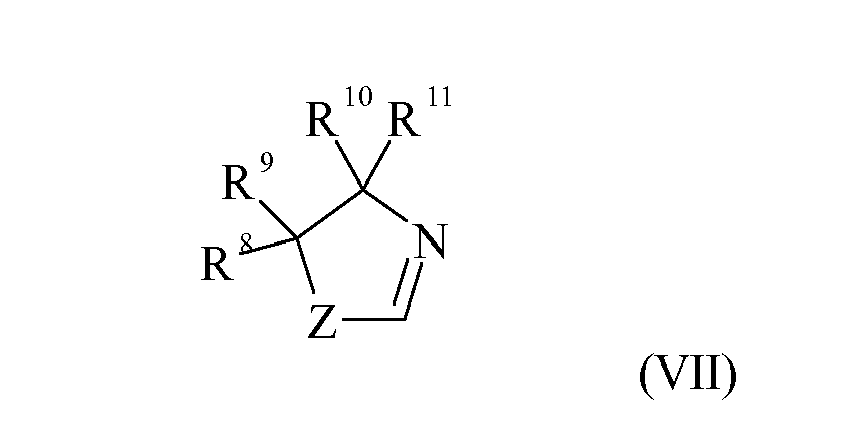
- When R is halogen, in particular bromo or chloro, conversion to a cyano may be carried out as described in
US 4,136,193 ,WO 00/13648 WO 00/11926 WO 01/02383 - According to
US 4,136,193 conversion of a bromo group to a cyano group, is carried out by reaction with CuCN. -
WO 00/13648 WO 00/11926 - Other processes for the conversion of a bromo compound to the corresponding cyano derivative involve reaction of the bromo compound with magnesium to form a Grignard reagent, followed by reaction with a formamide to form an aldehyde. The aldehyde is converted to an oxime or a hydrazone which is converted to a cyano group by dehydration and oxidation, respectively.
- Alternatively, the bromo compound is reacted with magnesium to form a Grignard reagent, followed by reaction with a compound containing a CN group bound to a leaving group.
- A detailed description of the above two procedures may be found in
WO 01/02383 - Compounds wherein the group R is -CHO, may be converted to the corresponding compounds wherein R is cyano by methods analogous to those described in
WO 99/00210 - Compounds wherein the group R is NHR12, wherein R12 is hydrogen or alkylcarbonyl, may be converted to the corresponding compounds wherein the group R is cyano by methods analogous to those described in
WO 98/19512 - Compounds wherein R is a -COOR6 group, may be converted to the corresponding compound wherein R is cyano by conversion to the amide via the corresponding acid chloride or an ester thereof followed by dehydration of the amide.
WO 01/68632 - Alternatively, a compound where R is -COOH may be reacted with chlorosulfonyl isocyanate in order to form the nitrile, or treated with a dehydrating agent and a sulfonamide as described in
WO 00/44738 - Compounds wherein the group R is -CONR13R14, wherein R13 and R14 are selected from hydrogen optionally substituted alkyl, aralkyl or aryl may be converted to the corresponding cyano compound by methods analogous to those described in
WO 98/00081 WO 98/19511 - Compounds wherein the group R is a group of formula (VII) may be converted to the corresponding cyano compound by methods analogous to those described in
WO 00/23431 - Compounds wherein R is OH, -CH2OH, -CH2NH2, -CH2NO2, -CH2Cl, -CH2Br, -CH3 or any of the groups above, may be converted to the corresponding cyano compounds by methods analogous to those described in
WO 01/68632 - Racemic compounds of formula (II) may be prepared by the methods described in the above mentioned patents or by the alkylation method described in
US patent No. 4.136.193 or the double grignard reaction described inEP 171 943 - In some cases the racemic compound of formula (II) may be available in the form of an acid addition salt, such as the sulphate salt, and in this case a free base of the compound of formula (II) may be obtained by treating the salt with a base in a mixture or water and an organic solvent, to transfer the compound of formula (II) into the organic phase.
- Preferably, R is cyano in the compounds of romula (II), (IIs), (IIr), (IV) (IVs) (IVr) and (V). If R is not cyano, conversion of the group R to a cyano group is suitably carried out after ringclosure to form a compound of formula (V).
- Preferably, Hal is fluoro in the compounds of romula (II), (IIs), (IIr), (IV) (IVs) (IVr) and (V).If Hal is not fluoro, conversion of the group Hal to a fluoro is suitably carried out after ringclosure to form a compound of formula (V). A procedure for carrying out this conversion is described in Speciality Chemicals Magazine, April 2003, page 36-38.
- Z groups which may be converted to dimethylaminomethyl are groups such as -CH2-L, -CH2-NO2, -MgHal, cyano, aldehyde, -CH2-O-Pg, -CH2-NPg1Pg2 , -CH2-NMePg1, -CH2-NHCH3, -CH2-NH2, -CO-N(CH3)2, -CH(A1R12)(A1R13), -(A1R14)(A2R15)(A3R16), -COOR17,-CH2-CO-NH2, -CH=CH-R18 or -CONHR19, wherein Pg is a protection group for an alcohol group, Pg1 and Pg2 are protection groups for an amino group, R12 and R13 are independently selected from C1-6 alkyl, C2-6 alkenyl, C2-6 alkynyl and optionally alkyl substituted aryl or aralkyl groups or R12 and R13 together form a chain of 2 to 4 carbon atoms, each of R14 - R18 are independently selected from C1-6 alkyl, C2-6 alkenyl, 21-6 alkynyl and optionally C1-6 alkyl substituted aryl or aryl-C1-6 alkyl, R19 is hydrogen or methyl and A1, A2 and A3 are selected form O and S; L is a leaving group, such as halogen or -O-SO2-A wherein A is C1-6 alkyl, C2-6 alkenyl, C2-6 alkynyl or optionally C1-6 alkyl substituted aryl or aryl-C1-6 alkyl.
- In one embodiment of the invention Z is dimethylaminomethyl, -CH2-L, -CH2-NPg1Pg2 , -CH2-NMePg1, -CH2-NHCH3, -CH2-NH2, -CO-N(CH3)2, aldehyde or -COOR17 in the compounds of formula (II), (IIs), (IIr), (IV) (IVs) (IVr) and (V).
- Compounds wherein Z is -CH2-O-Pg may be converted to the corresponding compounds wherein Z is dimethylaminomethyl by removal of the protection group to form the corresponding alcohol and thereafter conversion of the alcohol group to a feasible leaving group and reaction of the resulting compound with
- a) dimethylamine or a salt thereof,
- b) methylamine followed by methylation or reductive amination, or
- c) with an azide followed by reduction to form the corresponding amine and thereafter methylation or reductive amination, as described in
WO 01/43525 WO 01/51478 WO 01/68631 - Compounds wherein Z is -CH2-L, wherein L is a leaving group, may be converted to a dimethylaminomethyl group in the same manner.
- Compounds wherein Z is -CO-N(CH3)2 and -CO-NHR19, wherein R19 is hydrogen or methyl, may be converted to the corresponding compounds wherein Z is dimethylaminomethyl by reduction of the amide and if a primary or secondary amine is formed, followed by methylation or reductive amination to form a dimethylaminomethyl group as described in
WO 01/43525 WO 01/68631 - Compounds wherein Z is -CH2-NMe(Pg1) or -CH2-N(Pg1)(Pg2) may be converted to the corresponding compound wherein Z is dimethylaminomethyl by removal of the protection groups, i.e. to obtain compounds wherein Z is -CH2-NH2 or -CH2-NMe and thereafter methylation of the amino group or reductive amination to form a dimethyaminomethyl group as described in
WO 01/43525 WO 01/68631 - Compounds wherein Z is -CH(A1R12)(A2R13) may be converted to the corresponding compounds wherein Z is dimethylaminomethyl by deprotection to form an aldehyde (compounds where Z is -CH2-CA1H) followed reductive amination with dimethylamine to form a dimethylaminomethyl group as described in
WO 01/43525 WO 01/68631 - Compounds wherein Z is -C(A1R14)(A2R15)(A3R16) may be converted to the corresponding compounds wherein Z is dimethylaminomethyl
- i) by hydrolysis to form a carboxylic acid or an ester thereof and thereafter reduction to form an alcohol and thereafter conversion of the alcohol group to a feasible leaving group, followed by replacement of the leaving group with a dimethylamino group as described above, or
- ii) conversion of the carboxylic acid or an ester thereof to an amide by reaction with an amine of NH(Me)2, NH2Me, NH3 or a salt thereof followed by, in either order, reduction of the amide and if necessary methylation or reductive amination to form a dimethylamino group as described in
WO 01/68631 - Compounds wherein Z is -COOR17 may be converted to the corresponding compounds wherein Z is dimethylaminomethyl as described above, starting with the carboxylic acid ester.
- Compounds wherein Z is -CH2-CONH2 may be converted to the corresponding compound wherein Z is dimethylaminomethyl by treatment with hypohalide to form a primary amine followed by methylation of the free amino group or reductive amination to form a dimethylaminomethyl group as described in
WO 01/43525 WO 01/68631 - Compounds wherein Z is -CH=CHR18 may be converted to the corresponding compound wherein Z is dimethylaminomethyl by oxidation to form an aldehyde which may be converted to dimethylaminomethyl by reductive amination as described in
WO 01/43525 WO 01/68631 - Compounds wherein Z is cyano or -CH2-NO2 may be converted to the corresponding compound wherein Z is dimethylaminomethyl by reduction followed by methylation or reductive amination of the free of the amino group formed to form dimethylaminomethyl as described in
WO 01/68629 - Compounds wherein Z is -MgHal may be converted to the corresponding compound wherein Z is dimethylaminomethyl by reaction with dimethylaminomethyl alkyl ether of formula (CH3)2NCH2O-alkyl as described in
WO 01/68629 - Preferably, Z is dimethylaminomethyl. If Z is not dimethylaminomethyl, conversion of Z to a dimethylaminomethyl group is suitably carried out after ringclosure.
- Suitably, Z is dimethylaminomethyl, -CH2-L, -CH2-NPg1Pg2 , -CH2-NMePg1, -CH2-NHCH3, -CH2-NH2, aldehyde, -CO-N(CH3)2, -COOR17 when the dotted line represents a bond.
- Compounds of formula (II) or (IV) wherein Z is dimethylaminomethyl, CH2-NPg1Pg2 ,-CH2-NMePg1, -CH2-NHCH3, or -CH2-NH2, in particular compounds wherein Z is dimethylaminomethyl, -CH2-NHCH3, or -CH2-NH2, are particularly well suited for the method of purification isolation according to the invention, wherein the compounds of formula (II) and (IV) are separated.
- In the compounds of romula (II), (IIs), (IIr), (IV) (IVs) (IVr) and (V), the dotted line is preferably a single bond. Compounds wherein the dotted line represents a double bond may be converted to the corresponding compound wherein the dotted line is a single bond by the methods described in
WO 0168630 - Enantioselective ring-closure of the compounds of formula (IVs) or (IIs) to form the compounds of formula (V) may suitably be carried out by treatment of a labile ester derivative of the compound with a base such as KOC(CH3)3 and other alkoxides, NaH and other hydrides, triethylamine, ethyldiisopropylamine or pyridine, at low temperatures in an inert organic solvent, such as tetrahydrofuran, toluene, DMSO, DMF, t-butyl methyl ether, dimethoxyethane, dimethoxymethane, dioxane, acetonitrile or dichloromethane. This process is described in
US patent No. 4,943,590 . - Ringclosure of the compound of formula (IIs), is suitably carried out by treatment with a base as described above in presence of an agent capable of forming a labile group with the primary alcohol of the diol, such as methanesulfonyloxy, p-toluenesulfonyloxy, 10-camphorsulfonyloxy, trifluoroacetyloxy and trifluoromethanesulfonyloxy and halogen.
- In some cases, it may be advantageous to exchange the -W-R3 group in the compound of formula (IVs), for a more labile group before ringclosure is carried out. Such labile groups (leaving groups) could typically be a group selected from methanesulfonyloxy, p-toluenesulfonyloxy, 10-camphorsulfonyloxy, trifluoroacetyloxy and trifluoromethanesulfonyloxy or halogen.
- Typically, the compound of formula (IVs) is subjected to hydrolysis to form the compound of formula (IIs) with aquesous base, such as NaOH, KOH or LiOH in water or alcohol or a mixture thereof and then reacted with an activated leaving group, such as for example mesylchloride or tosylchloride in an organic solvent in the presence of an organic base.
- The optical purity of the escitalopram product may have to be improved after ringclosure. Improvement of the optical purity may be obtained by chromatography on a chiral stationary phase or by crystallisation of racemic citalopram base or a salt thereof according to the methods described in
WO 03/000672 - The R-enantiomer of the compounds of formula (II) and (IV) obtained according to the invention may be used to prepare racemic citalopram and escitalopram by ring closure in acidic environment according to the method described in
WO 03/000672 - Thus in another embodiment, the invention relates to a process for the preparation of racemic citalopram and /or escitalopram or a pharmaceutically acceptable salt thereof comprising preparation of the R-enantiomer of a diol having the formula

or the R-enantiomer of an acylated diol having the formula

- Suitably, the above method for conversion of R-diol to escitalopram, is used for the preparation of escitalopram.
- The conversion of of the group R to a cyano group, reduction of a double bond represented by the dotted line to a single bond, conversion of the group Z to a dimethylaminomethyl group and conversion of Hal to a fluoro group may be carried out as described above.
- According to one embodiment of the above method for the preparation of escitalopram the mixture of the R- or S-enantiomer of a compound of formula (II) and the opposite enantiomer of the compound of formula (IV) obtained by enzymatic acylation has been separated from each other by the isolation and purification process according one of the above methods for isolation and purification. According to another embodiment, the mixture has been separated by the other of the above methods for isolation and purification.
- According to still another embodiment of the above method for the preparation of escitalopram the mixture of the R- or S-enantiomer of a compound of formula (II) and the opposite enantiomer of the compound of formula (IV) obrtained by enzymatic deacylation has been separated from each other by the isolation and purification process according one of the above methods for isolation and purification. According to another embodiment, the mixture has been separated by the other of the above methods for isolation and purification.
- According to another embodiment of the invention, the S-enantiomer of formula (IIr) above or the S-enantiomer of formula (IVr) used for the preparation of escitalopram is not separated form the R-enantiomer of formula (IV) and (II) respectively, before ringclosure.
- The optical purity of the escitalopram product may have to be improved after ringclosure. Improvement of the optical purity may be obtained by chromatography on a chiral stationary phase or by crystallisation of racemic citalopram base or a salt thereof according to the methods described in
WO 03/000672 - As used herein, the term C1-10-alkyl refers to a branched or unbranched alkyl group having from one to ten carbon atoms inclusive, such as methyl, ethyl, 1-propyl, 2-propyl, 1-butyl, 2-butyl, 2-methyl-2-propyl, 2-methyl-1-propyl, pentyl, hexyl and heptyl. C1-6-alkyl refers to a branched or unbranched alkyl group having from one to six carbon atoms inclusive, such as methyl, ethyl, 1-propyl, 2-propyl, 1-butyl, 2-butyl, 2-methyl-2-propyl, 2-methyl-l-propyl, pentyl and hexyl. C1-4-alkyl refers to a branched or unbranched alkyl group having from one to four carbon atoms inclusive, such as methyl, ethyl, 1-propyl, 2-propyl, 1-butyl, 2-butyl, 2-methyl-2-propyl and 2-methyl-1-propyl. C1-3-alkyl refers to a branched or unbranched alkyl group having from one to three carbon atoms inclusive, such as methyl, ethyl, 1-propyl, 2-propyl.
- Similarly, C2-10-alkenyl and C2-10-alkynyl designate branched or unbranched alkenyl and alkynyl groups, respectively, having from two to ten carbon atoms, including one double bond and one triple bond respectively, such as ethenyl, propenyl, butenyl, ethynyl, propynyl and butynyl. C2-6-alkenyl and C2-6-alkynyl designate branched or unbranched alkenyl and alkynyl groups, respectively, having from two to six carbon atoms, including one double bond and one triple bond respectively, such as ethenyl, propenyl, butenyl, ethynyl, propynyl and butynyl. C2-4-alkenyl and C2-4-alkynyl designate branched or unbranched alkenyl and alkynyl groups, respectively, having from two to four carbon atoms, including one double bond and one triple bond respectively, such as ethenyl, propenyl, butenyl, ethynyl, propynyl and butynyl. C2_3-alkenyl and C2-3-alkynyl designate branched or unbranched alkenyl and alkynyl groups, respectively, having from two to three carbon atoms, including one double bond and one triple bond respectively, such as ethenyl, propenyl, ethynyl and propynyl.
- The terms CI-10 alkoxy, C1-lo alkylthio, CI-10 alkylamino and di-(C1-10-alkyl)amino etc. designate such groups in which the alkyl group is C1-10 alkyl as defined above. The terms C1-6 alkoxy, C1-6 alkylthio, C1-6 alkylamino and di-(C 1 _6-alkyl)amino etc. designate such groups in which the alkyl group is CI-6 alkyl as defined above. The terms C1-4 alkoxy, C1-4 alkylthio, C1-4 alkylamino and di-(C1-4-alkyl)amino etc. designate such groups in which the alkyl group is C1-4 alkyl as defined above. The terms C1-3 alkoxy, C1-3 alkylthio, C1-3 alkylamino and di-(C1-3-alkyl)amino etc. designate such groups in which the alkyl group is CI-3 alkyl as defined above.
- Halogen means fluoro, chloro, bromo or iodo.
- The term aryl refers to a mono or bicyclic carbocyclic aromatic group, such as phenyl, or naphthyl, in particular phenyl.
- Aryloxy, arylthio refers to such a group wherein aryl is as defined above.
- The term heteroaryl refers to a 5 or 6 membered monocyclic heteroaromatic group or a bicyclic heteroaromatic group. Suitable the heteroaryl group contains 1-3 heteroatoms selected from 0, S and N.
- Ro and R1 may together form a chain of 3 to 5 carbon atoms, thus forming an anhydride.
- When Z is -CH2-N(R'R") wherein R'and R" connected to each other to form a cyclic structure including the N-atom to which they are attached, the cyclic structure form groups, such as groups include piperidin, pyrrolidin, morpholinyl and piperazinyl.
- HOBt means hydroxybenzotriazol and pfp means pentafluorophenol.
- In the following examples % conversion and optical purity were measured and calculated as described below:
- HPLC analysis condition (for conversion rate) used for examples 1-28:
- Column: YMC-Pack ODS-A 0.46 cm I.D. x 25 cm (made by YMC Co., LTD.)
- Eluent: 25 mM Phosphate buffer / Acetonitrile = 60 / 40
- Flow rate: 1.Oml/min
- Temperature: 40°C
- Detector wavelength: 237 nm
- HPLC analysis condition (for conversion rate) used for examples 29-42:
- Column: A Lichrospher RP-8 column, 250 x 4 mm (5 µm particle size)
- Eluent: Buffered MeOH/water prepared as follows: 1,1 ml Et3N added to 150 ml water, 10% H3PO4(aq) is added to pH=7 and water is added to a total of 200 ml. The mixture is added to 1,8 L MeOH.
- Temperature: 35°C
- Flow rate: 1 mL/min
- Pressure: 16,0 MPa
- Detection: UV 254 nm
- Injection volume: 10 microL
- Conversion rate (%) = P/(S+P) x 100, (P: amount of product, S: amount of residual substrate).
- HPLC analysis condition (for optical purity) used for examples 1-28:
- Column: Chiralpak AD 0.46 cm I.D. x 25 cm (made by DAICEL CHEMICAL INDUSTRIES, LTD.)
- Eluent: Heptane / methanol / ethanol / diethylamine = 85 / 7.5 / 7.5 / 0.1 I
- Flow rate: 1.Oml/min
- Temperature: 30°C
- Detector wavelength: 240 nm
- Conversion rate (%) = P/(S+P) x 100, (P: amount of product, S: amount of residual substrate)
- Super critical fluid chromatogeaphy. Analysis condition (for optical purity) used for examples 29-42:
Column: Daicel AD column with the dimensions 250 x 4,6 mm (5 µm particle size) Mobile phase: Carbon dioxide
Modifier: Methanol with diethylamine (0.5%) and trifluoroacetic acid (0.5%).Modifier gradient: 1-2% in 4 minutes 2-4% in 4 minutes 4-8% in 4 minutes 8-16% in 4minutes 16-32% in 4 minutes 32-45% in 1,62 minutes
Flow rate: 2 mL/min
Pressure: 20 mPa
Detection: UV 230 nm and 254 nm
Injection volume: 10 microL
Optical purity (% ee) = (A-B) / (A+B) x 100, (A and B represent corresponding stereo isomer, A>B)
E-value = In ((1-c/100) x (1-Es/100)) / In ((1-c/100) x (I+Es/100))
(c: convertion ratio, Es: optical purity of residual substrate) - Water (200.7 g) and toluene (440.8 g) was added to (+)-4-[4-dimethylamino- 1 -(4'-fluorophenyl)-1-hydroxybutyl]-3-hydroxymethylbenzonitrile, 1/2 sulfuric acid salt (100.4 g, 0.257 mol), then stirred for 15 minutes and the temperature thereof was raised up to 60°C. Subsequently, 30% NaOH (34.5 g, 0.259 mol) was added dropwise over 5 minutes until pH of aqueous layer reached 11.4, and stirred for 30 minutes. After stirring, the mixture was allowed to stand for 5 minutes, and separated. The aqueous layer was discarded, and thus-obtained organic layer was washed with 220.0 g of water, and further, concentrated under reduced pressure at 60°C to remove away the remaining moisture. The concentration was adjusted by addition of toluene, to thereby obtain 583.1 g of a solution of 4-[4-dimethylamino-1-(4'-fluorophenyl)-1-hydroxybutyl]-3-hydroxymethylbenzonitrile in toluene (content of pure 4-[4-dimethylamino-1 -(4'-fluorophenyl)-1 -hydroxybutyl]-3-hydroxymethylbenzonitrile: 87.6 g, yield: 99.7%, 0.256 mol). Then, 52.5 g of toluene was poured onto 17.5 g of an immobilized enzyme (Novozym 435), then 583.1 g of the solution of 4-[4-dimethylamino-1 -(4'-fluorophenyl)-1 -hydroxybutyl]-3-hydroxymethylbenzonitrile in toluene was added, and the temperature of the mixture was controlled to 40°C. Subsequently, a mixed solution containing pivalic acid (28.7 g, 0.281 mol), vinyl butyrate (29.2 gm 0,256 mol) and toluene (28.8 g) was added into the above mixture over 20 minutes, and the mixture was stirred at 40°C for 12 hours under a slight flow of nitrogen. After cooling the mixture over 2 hours so as to be 20°C, the mixture was stirred for 1 hour at the same temperature, and stirring was stopped. The enzyme was filtrated, and then the enzyme was washed twice with 105 g of toluene, and these toluene layers were combined. The toluene layer contained 583.1 g of a solution of 4-[4-dimethylamino-1 -(4'-fluorophenyl)-1 -hydroxybutyl]-3-hydroxymethylbenzonitrile in toluene (content of pure (S)-4-[4-dimethylamino- I -(4'-fluorophenyl)- I - hydroxybutyl]-3-hydroxymethylbenzonitrile: 36.0 g, yield through the enzymatic resolution process: 41.1%, 0.105 mol).
- A mixed solution containing the supernatant and washing fluid was extracted three times with water (438 g, 263 g x 2), and 1005.4 g of the obtained aqueous layer was washed with 79 g of toluene for five times. As a result, it was obtained 985.2 g of an aqueous solution of (S)-4-[4-dimethylamino-1-(4'-fluorophenyl)-1-hydroxybutyl]-3-hydroxymethylbenzonitrile, pivalic acid salt {content of pure (S)-4-[4-dimethylamino-1-(4'-fluorophenyl)-1-hydroxybutyl]-3-hydroxymethylbenzonitrile: 32.6 g, yield (through the process from the extraction with water to washing with toluene): 90.6 %, 0.0952 mol}. To thus-obtained 985.2 g of an aqueous solution of (S)-4-[4-dimethylamino-1-(4'-fluorophenyl)-1-hydroxybutyl]-3-hydroxymethylbenzonitrile, pivalic acid salt was added 218.2 g of toluene. Subsequently, 30% NaOH (13.3 g, 0.0998 mol) was slowly added to the mixture with stirring, until pH of aqueous layer reached 11.9, and the mixture was kept stirred for 30 minutes. After stirring, the mixture was allowed to stand 30 minutes and the toluene layer was separated, and the remaining aqueous layer was re-extracted with 142.5 g of toluene. The combined toluene layer was washed twice with 169.0 g of water, concentrated at 60°C under reduced pressure, to thereby obtain 64.0 g of a solution of (S)-4-[4-dimethylamino-1-(4'-fluorophenyl)-1-hydroxybutyl]-3-hydroxymethylbenzonitrile in toluene. Said toluene solution contained 32.0 g (0.0935 mol) of (S)-4-[4-dimethylamino-1-(4'-fluorophenyl)-1-hydroxybutyl]-3-hydroxymethylbenzonitrile. Overall yield was 36.4%. The optical purity determined by HPLC was 98.7 % ee, and chemical purity was 99.9 area %, {(R)-5-cyano-2-[dimethylamino- (4'-fluorophenyl)-hydroxybutyl] benzyl butyrate: 0.04 area %.
- In the above system, the above "chemical purity" is represented by the following equation.
(Chemical purity) = [Area value of 4-[ 4-dimethylamino-1-( 4'- fluorophenyl)-l-hydroxybutyl]-3-hydroxymethylbenzonitrile] / [(Area value of all detected compounds) - (Area value of toluene) - (Area value derived from the system)] x 100 (area %) - A test tube equipped with a stopper was charged with 50 mg (0.146 m mol ) of(±)-4-[4-dimethylamino-1 -(4'-fluorophenyl)-1 -hydroxybutyl]-3-hydroxymethylbenzonitrile, 25 mg of various kinds of lipases, 33 mg ( 0.29 m mol) of vinyl butyrate and 1 ml of toluene, and stirred at 40°C for 16 hours. For the substrate with the optical purity of at least 50% ee, E-values were calculated. The results are shown in Table 1.
Table 1 Enzyme Origin Conversion Optical purity Configuration E-value (%) (%e.e.) Lipozyme TL IM (made by Novozymes A/S j Thermomyces lanuginosus 97,8 62,7 (R ) 1 Novozym 435 (made by Novozymes A/S j Candida antarctica 59,7 96,4 (S) 18 None 1,16 - A test tube equipped with a stopper was charged with 10 to 100 mg ( 0.029 to 0.29 m mol) of (±)-4-[4-dimethylamino-1-( 4'-fluorophenyl)-1-hydroxybutyl]-3-hydroxymethylbenzonitrile, 10 to 100 mg of Novozym 435 (product of Novozymes, E/S ratio = 1.0), 33 to 333 mg (10 eq.) of vinyl butyrate and 1 ml of toluene, and stirred at 30°C for 16 hours. The results are shown in Table 2.
Table 2 Concentration Conversion Optical purity Configuration E-value (%) (%) (%e.e.) 1 52,9 93,7 (S) 38 2 54,2 88,6 (S) 20 5 63,1 87,9 (S) 9 10 65,0 92,6 (S) 9 - A test tube equipped with a stopper was charged with 100 mg (0.292 m mol ) of(±)-4-[4-dimethylamino-1-(4'-fluorophenyl)-1-hydroxybutyl)-3-hydroxymethylbenzonitrile, 50 mg of Novozym 435 (product of Novozymes), 333 mg (2.92 m mol ) of vinyl butyrate, 0.292 m mol of various kinds of additives and 1 ml of toluene, and stirred at the temperature of 40°C for 16 hours. The results are shown in Table 3.
Table 3 Additive Conversion Optical purity Configuration E-value (%) (%e.e.) Sulfric acid 39,8 14,7 (S) 2 Acetic acid 34,4 46,0 (S) 24 Hydrochloric acid 27,1 16,2 (S) 3 Benzoic acid 62,9 98,2 (S) 16 Triethylamine 74,8 99,7 (S) 11 Pyridine 65,4 96,5 (S) 11 Benzoic acid ATriethylamine 66,0 92,0 (S) 8 Benzoic acid APyridine 58,1 97,3 (S) 23 None 73,5 97,4 (S) 8 - In a 200-ml four-necked flask equipped with a stirrer and a thermometer, 1.5 g ( 4.38 8 m mol ) of (+)-4- [4-dimethylamino- 1 -(4'-fluorophenyl)- I -hydroxybutyl] -3 - hydroxymethylbenzonitrile was dissolved in 30 ml of toluene, then 0.45 g of Novozym 435 (product ofNovozymes), 0.347 g ( 4.38 m mol) of pyridine, 4.38 m mol of various kinds of acids and 1.00 g ( 8.76 m mol ) of vinyl butyrate were added, and stirred at 40°C for between 16 and 21.5 hours. The result is shown in Table 4.
Table 4 Acid Conversion Optical purity Configuration E-value (%) (%e.e.) Salicylic acid 54,7 95,9 (S) 33 p-Ethylbenzoic acid 64,9 97,5 (S) 13 o-Toluic acid 64,5 97,3 (S) 13 m -Toluic acid 66,3 96,6 (S) 11 p-Toluic acid 55,4 98,9 (S) 44 o-Anisic acid 59,3 94,9 (S) 17 4-Chlorophenylacetic acid 59,5 96,3 (S) 18 3-Phenylpropionic acid 46,2 74,4 (S) 31 1-Naphthoic acid 67,8 83,3 (S) 6 Benzoic acid 59,7 99,9 (S) 37 Butyric acid 53,7 89,6 (S) 24 Isobutyric acid 61,8 97,1 (S) 16 Isovaleric acid 55,3 94,8 (S) 27 Pivafic acid 58,2 97,8 (S) 25 Caproic acid 60,3 96,1 (S) 17 Cyclohexanecarboxylic acid 55,2 95,4 (S) 30 None 59,1 95,5 (S) 18 - In a 200-ml four-necked flask equipped with a stirrer and a thermometer, 3.0 g (8.76 m mol) of (+)-4- [4-dimethylamino- 1 -(4'-fluorophenyl)- I -hydroxybutyl] -3 - hydroxymethylbenzonitrile was dissolved in 30 ml of toluene, then 0.9 g of Novozym 435 (product ofNovozymes), 0.693 g (8.76 m mol) of pyridine, 8.76 m mol of various kinds of acids and 2.00 g (17.52 m mol) of vinyl butyrate were added, and stirred at 40°C for between 15.5 and 16.5 hours. The results are shown in Table 5.
Table 5 Acid Reaction time Conversion Optical purity Configuration E-value (hrs) (%) (%e.e.) o -Toluic acid 16,5 59,8 97,9 (S) 21 p -Toluic acid 19,5 35,8 29,8 (S) 4 Benzoic acid 17 25,6 28,4 (S) 14 Pivalic acid 15 62,4 99,6 (S) 23 Cyclohexanecarboxylic acid 16,5 59,4 97,0 (S) 20 - In a 200-ml four-necked flask equipped with a stirrer and a thermometer, 4.5 g (13.1 I m mol) of (+)-4- [4-dimethylamino- 1 -(4'-fluorophenyl)- I -hydroxybutyl] -3 - hydroxymethylbenzonitrile was dissolved in 30 ml of toluene, then 0.90 g of Novozym 435 (product ofNovozymes), 2.68 g (26.2 m mol) ofpivalic acid and 0.900 to 1.500 g (0.6 to 1.0 eq.) of vinyl butyrate were added, and stirred at 40°C for 24 hours. The results are shown in Table 6.
Table 6 Equivalent of Vinyl butyrate Conversion Optical purity Configuration E-value (%) (%e.e.) 0,6 45,8 73,8 (S) 32 0,8 54,4 95,9 (S) 35 1,0 54,8 96,5 (S) 35 - In a 500-ml separable flask equipped with a stirrer and a thermometer, 20.0 g (58.4 mmol) of (±)-4-( 4-dimethylamino-1-( 4'- fluorophenyl )-1- hydroxybutyl)- 3-hydroxymethylbenzonitrile was dissolved in 144 ml of toluene, then pivalic acid (1.l I to 3 eq.), 4.0 g of Novozym 435 (product of Novozymes) and 6.67 g (58.4 m mol) of vinyl butyrate were added, and stirred at 40°C for 20 to 24 hours in a flow of nitrogen (5 ml/min). The results are shown in Table 7.
Table 7 Equivalent of Pivalic acid Reaction time Conversion Optical purity Configuration E-value (hrs) (%) (%e.e.) 0 21,5 70,7 98,0 (S) 9 1,1 21 59,9 98,2 (S) 21 1,5 20 58,0 98,0 (S) 26 2,0 21 56,9 98,0 (S) 31 3,0 24 55,2 97,3 (S) 35 - A test tube equipped with a stopper was charged with 10 mg (0.029 m mol) of(±)-4-[4-dimethylamino-1-(4'-fluorophenyl)-1-hydroxybutyl]-3-hydroxymethylbenzonitrile, 10 mg of Novozym 435 (product of Novozymes), 0.29 m mol of various kinds of acyl donor and 1 ml of diisopropyl ether, and stirred at 30°C for 16 hours. For the substrate with the optical purity of at least 30% ee, E-values were calculated. The results are shown in Table 8.
Table 8 Acyl donor Conversion Optical purity Configuration E-value (%) (%e.e.) Vinyl acetate 55,0 35,9 (S) 3 Vinyl propionate 46,8 53,9 (S) 7 Vinyl butyrate 66,3 98,3 (S) 13 Vinyl caproate 4,6 n-Butyric anhydride 69,0 76,7 (S) 4 iso-Valeric anhydride 38,6 5,80 (S) iso-Butyric anhydride 32,5 3,30 (S) - A test tube equipped with a stopper was charged with 10 mg ( 0.029 m mol) of(±)-4-[4-dimethylamino-1-(4'-fluorophenyl)-1-hydroxybutyl]-3-hydroxymethylbenzonitrile, 10 mg ofNovozym 435 (product of Novozymes), 33 mg (0.29 m mol) of vinyl butyrate and 1 ml of various kinds of solvents, and stirred at 30°C for 16 hours. After the reaction, converted ratios and optical purities were analyzed and E-values were calculated. The results are shown in Table 9.
Table 9 Solvent Conversion Optical purity Configuration E-value (%) (%e.e.) tert -Butyl methyl ether 59,3 91,8 (S) 14 1,4-Dioxane 11,1 Tetrahydro furan 6,19 Diisopropyl ether 66,3 98,3 (S) 13 Diethyl ether 59,7 95,8 (S) 17 Acetone 11,8 Methyl isobutyl ketone 33,0 Ethanol 7,09 Butanol 6,56 Ethyl acetate 10,8 Butyl acetate 11,7 Toluene 52,9 93,7 (S) 38 Hexane 40,7 Dichloroethane 13,8 Acetonitrile 25,5 Dimethylformamide 5,83 Dimethylsulfoxide 8,78 Vinylbutyrate 57,0 95,0 (S) 22 - A 200-ml four-necked flask equipped with stirrer and thermometer was charged with 0.9 to 1.35 g (E/S ratios are 0.2 to 0.3) of Novozym 435 (product of Novozym). A solution of 4.5 g (13.1 mmol) of(±)-4-[4-dimethylamino-l-(4'-fluorophenyl)-l-hydroxybutyl]-3-hydroxymethylbenzonitrile in 30 ml of toluene, 2.01 g of pivalic acid (19.7 m mol), and 1.50 g (13.1 m mol) of vinyl butyrate was added into the flask, and stirred at between 35 and 45°C for 21 hours. After the reaction, reaction fluid was separated by decantation, and the remaining enzyme was washed with 30 ml of toluene and recovered. The same operation as described above except for using the recovered enzyme was repeated four times to carry out the recycle reaction. Enzyme activities were calculated according to the following equation. The results are shown in Table 10.

Table 10 Batches Enzyme activity (U/g) 35 °C (E/S=0.30) 40 °C (E/S=0.25) 45 °C (E/S=0.20) 1 8,61 12,75 17,37 2 10,31 12,93 17,70 3 9,75 12,50 15,48 4 9,39 12,16 15,06 5 9,01 11,14 13,10 - A four-necked flask equipped with stirrer and thermometer was charged with 66.6 g of a solution of 10.0 g (0.029 mol) of (±)-4-[4-dimethylamino-1-(4'-fluorophenyl)-1-hydroxybutyl]-3-hydroxymethylbenzonitrile in toluene, and the temperature thereof was controlled so as to be 40°C. Then, 2.27 g (0.029 mol) of pyridine, 2.98 g (0.029 mol) of pivalic acid, 3.35 g (0.029 mol) of vinyl butyrate, and 2.0 g of an immobilized enzyme (Novozym 435) was added into the above mixture. The reaction mixture was stirred at 40°C for 15 hours under a slight flow of nitrogen and stirring was stopped. The enzyme was filtrated from the reaction mixture with Kiriyama funnel, and the enzyme was washed with 21.6 g of toluene. As a result, it was obtained (S)- 4-[4-dimethylamino-1 -(4'-fluorophenyl)-1 -hydroxybutyl]-3-hydroxymethylbenzonitrile (3.6 g, 0.011 mol, yield: 36.0%, optical purity: 98.5 %ee), pivalic acid salt.
- The combined toluene layer was washed three times with water (50 ml, 30 ml, 30 ml) at 20°C, and an aqueous layer containing (S)-4-[4-dimethylamino-1-(4'-fluorophenyl)-1-hydroxybutyl]-3-hydroxymethylbenzonitrile (3.5 g, 0.011 mol, extraction yield: 95%), pivalic acid salt was obtained.
- A four-necked flask equipped with stirrer and thermometer was charged with 66.7 g of a solution of 20.0 g (0.058 mol) of (:J::)-4-[4-dimethylamino-1-(4'-fluorophenyl)-1-hydroxybutyl]-3-hydroxymethylbenzonitrile in toluene, and the temperature thereof was controlled so as to be 40°C. Then, 5.93 g (0.058 mol) ofpivalic acid, 6.62 g (0.058 mol) of vinyl butyrate, and 4.1 g of an immobilized enzyme (Novozym 435) was added into the above mixture. The reaction mixture was stirred at 40°C for 18 hours under a slight flow of nitrogen and stirring was stopped. The enzyme was filtrated from the reaction mixture with Kiriyama funnel, and the enzyme was washed with 41.3 g of toluene. As a result, 6.7 g (0.020 mol) of (S)-4-[4-dimethylamino-1-(4'-fluorophenyl)-1-hydroxybutyl]-3-hydroxymethylbenzonitrile, pivalic acid salt was obtained in the toluene solution, with a yield of 33.5% and an optical purity of 99.7 %ee.
- A four-necked flask equipped with stirrer and thermometer was charged with 250.0 g of a solution of 25.0 g (0.073 mol) of (:J::)-4-[4-dimethylamino-1-(4'-fluorophenyl)-1-hydroxybutyl]-3-hydroxymethylbenzonitrile in toluene, and the temperature thereof was controlled so as to be 40°C. Then, 5.77 g (0.073 mol) of pyridine, 8.33 g (0.073 mol) of vinyl butyrate, 9.52 g (0.073 mol) of cyclohexanecarboxylic acid, and 5.0 g of an immobilized enzyme (Novozym 435) was added into the above mixture. The reaction mixture was stirred at 40°C for 17.5 hours under a slight flow of nitrogen and stirring was stopped. The enzyme was filtrated, and washed with 54.1 g of toluene. As a result, a toluene layer containing (S)-4-[4-dimethylamino-1-(4'-fluorophenyl)-1-hydroxybutyl]-3-hydroxymethylbenzonitrile (8.6 g, 0.025 mol, yield: 34.4%, optical purity: 98.7% ee), cyclohexanecarboxylic acid salt was obtained.
- The combined toluene layer was washed five times with water (187.5 ml x 5) at 20°C, and an aqueous layer containing (S)-4-[4-dimethylamino-1-(4'-fluorophenyl)-1-hydroxybutyl]-3-hydroxymethylbenzonitrile (7.6 g, 0.0221 mol, extraction yield: 89%), cyclohexanecarboxylic acid salt was obtained.
- A four-necked flask equipped with stirrer and thermometer was charged with 250.0 g of a solution of 25.0 g (0.073 mol) of (:J::)-4-[4-dimethylamino-1-(4'-fluorophenyl)-1-hydroxybutyl]-3-hydroxymethylbenzonitrile in toluene, and the temperature thereof was controlled so as to be 40°C. Then, 5.77 g (0.073 mol) of pyridine, 8.33 g (0.073 mol) of vinyl butyrate, 9.93 g (0.073 mol) of o-toluic acid, and 5.0 g of an immobilized enzyme (Novozym 435) was added into the above mixture. The reaction mixture was stirred at 40°C for 21 hours under a slight flow of nitrogen, and then stirring was stopped. The enzyme was filtrated from the reaction mixture with Kiriyama funnel, and washed with 54.1 g of toluene. As a result, a toluene layer containing (S)-4-[4-dimethylamino-1-(4'-fluorophenyl)-1-hydroxybutyl]-3-hydroxymethylbenzonitrile (9.7 g, 0.028 mol, yield: 38.8%, optical purity: 97.8% ee), o-toluic acid salt was obtained.
- The combined toluene layer was washed three times with water (250 ml, 63 ml, 63 ml) at 60°C, and an aqueous layer containing (S)-4-[4-dimethylamino-1-(4'-fluorophenyl)-1-hydroxybutyl]-3-hydroxymethylbenzonitrile (7.8 g, 0.0228 mol, extraction yield: 80%), o-toluic acid salt was obtained.
- A four-necked flask equipped with stirrer and thermometer was charged with 33.3 g of a solution of 10.0 g (0.029 mol) of (±)-4-[4-dimethylamino-1-(4'-fluorophenyl)-1-hydroxybutyl]-3-hydroxymethylbenzonitrile in toluene, and the temperature thereof was controlled so as to be 40°C. Then, 2.29 g (0.029 mol) of pyridine, 2.57 g (0.029 mol) of iso-butyric acid, 3.33 g (0.029 mol) of vinyl butyrate, and 2.0 g of an immobilized enzyme (Novozym 435) was added into the above mixture. The reaction mixture was stirred at 40°C for 24 hours under a slight flow of nitrogen and stirring was stopped. The enzyme was filtrated off from the reaction mixture with Kiriyama funnel, and washed with 21.6 g of toluene. As a result, a toluene layer containing (S)-4- [4-dimethylamino- 1 -(4'-fluorophenyl)- I -hydroxybutyl] - 3-hydroxymethylbenzonitrile (3.8 g, 0.011 mol, yield: 38.0%, optical purity: 95.9% ee), isobutyric acid salt was obtained.
- A four-necked flask equipped with stirrer and thermometer was charged with 250.0 g of a solution of 50.0 g (0.146 mol) of (:J::)-4-[4-dimethylamino-1-(4'-fluorophenyl)-1-hydroxybutyl]-3-hydroxymethylbenzonitrile in toluene, and the temperature thereof was controlled so as to be 40°C. Then, 11.5 g (0.146 mol) ofpyridine, 33.2 g (0.291 mol) of vinyl butyrate, 17.8 g (0.146 mol) of benzoic acid, and 10.0 g of an immobilized enzyme (Novozym 435) was added into the above mixture. The reaction mixture was stirred at 40°C for 20 hours under a slight flow of nitrogen, and then stirring was stopped. The enzyme was filtrated from the reaction mixture with Kiriyama funnel, and washed with 108 g of toluene. As a result, a toluene layer containing (S)-4-[4-dimethylamino-1-(4'-fluorophenyl)-1-hydroxybutyl]-3-hydroxymethylbenzonitrile (22.0 g, 0.064 mol, yield: 44.0%, optical purity: 99.0% ee), benzoic acid salt was obtained.
- The combined toluene layer was washed three times with water (500 ml x 3) at 60°C, and an aqueous layer containing (S)-4-[4-dimethylamino-1-(4'-fluorophenyl)-1-hydroxybutyl]-3-hydroxymethylbenzonitrile (21.0 g, 0.0614 mol, extraction yield: 96%), benzoic acid salt was obtained.
- The following examples 18 to 28 illustrate the separation of S-diol from the reaction mixture.
- A test tube equipped with a stopper was charged with 4.3 mg (0.0126 mmol) of (S)-4-[4-dimethylamino-1-(4'-fluorophenyl)-1-hydroxybutyl]-3-hydroxymethylbenzonitrile (compound A), 6.8 mg (0.0165 mmol) of (R)-5-cyano-2-[4-dimethylamino-l-(4'-fluorophenyl)-1-hydroxybutyl]-benzyl butyrate (compound B), 1 ml of toluene, 1 ml of water, and 0.291 m mol of various kinds of acids (in the case of a dibasic acid, 0.146 m mol is used), and stirred at 40°C for 1 hour. Thus-obtained mixed solvent was separated into aqueous layer and toluene layer, and then the concentrations of compound A and B in each layer were measured. Partition coefficients Ka or Kb are calculated according to the following equation. The results are shown in Table 1l.


Table 11 Acid Partition coefficient Ka/Kb Ka Kb o -Nitrobenzoic acid 30,7 0,45 68,3 m -Nitrobenzoic acid 19,5 0,08 237 Salicylic acid 13,0 0,06 212 p -Hydroxybenzoic acid 70,8 0,31 226 o -Chlorobenzoic acid 22,8 0,30 76,7 m -Chlorobenzoic acid 4,98 0,04 122 p -Chlorobenzoic acid 7,01 0,06 123 p-Fluorobenzoic acid 14,4 0,12 120 p -Ethylbenzoic acid 2,28 0,03 73,0 o-Toluic acid 9,11 0,05 172 m -Toluic acid 6,00 0,03 215 p -Toluic acid 5,97 0,02 249 o-Methoxybenzoic acid 27,1 0,38 71,1 m -Methoxybenzoic acid 9,23 0,07 136 p-Methoxybenzoic acid 12,3 0,10 122 4-Biphenylcarboxylic acid 0,87 0,04 24,9 3-Phenylpropionic acid 5,67 0,02 229 Benzoic acid 18,4 0,08 244 Isobutyric acid 39,2 0,17 225 Isovaleric acid 24,4 0,10 241 Pivalic acid 9,03 0,10 92,6 Caproic acid 5,04 0,03 181 Cyclohexanecarboxylic acid 3,89 0,03 168 Phthalic acid 20,8 0,33 63,8 Isophthalic acid 7,43 0,29 25,4 Terephthalic acid 16,8 0,15 113 p -Toluenesulfonic acid 164 3,61 45,4 Malonic acid 38,5 1,29 29,8 Oxalic acid 1092 5,73 190 Succinic acid 24,1 0,44 54,6 Maleic acid 31,1 1,03 30,0 None 0,17 0,08 2,2 - The enzyme was filtrated from the enzyme reaction mixture obtained by the method according to Example 1, and washed twice with toluene. Thus-obtained 1174.3 g of a toluene solution containing (S)- 4-[4-dimethylamino-1-(4'-ftuorophenyl)-1-hydroxybutyl]-3-hydroxymethylbenzonitrile (44.8 g, 0.131 mol), pivalic acid salt was added 600.3 g of water and extracted. Further twice extraction with 359.7 g of water gave 1375.9 g of an aqueous solution of (S)-4-[4-dimethylamino-1-(4'-fluorophenyl)-1-hydroxybutyl]-3-hydroxymethylbenzonitrile, pivalic acid salt. The aqueous solution contained 43.8 g (0.128 mol, yield: 97.8%) of (S)-4-[4-dimethylamino-1-(4'-fluorophenyl)-1-hydroxybutyl]-3-hydroxymethylbenzonitrile. Optical purity: 98.4%ee, (R)-5-cyano-2-[dimethylamino-(4'-fluorophenyl)-hydroxybutyl] benzyl butyrate: 10.7 area%.
- To 12.6 g of an aqueous solution of (S)-4-[4-dimethylamino-1-(4'-fluorophenyl)-1-hydroxybutyl]-3-hydroxymethylbenzonitrile pivalic acid salt {content of (S)-4-[4-dimethylamino-1 -(4'-fluorophenyl)-1 -hydroxybutyl]-3-hydroxymethylbenzonitrile: 0.4 g, 1.168 mmol}, which was separately obtained according to the method of Example 19, was added with 1.4 g (0.018 mol) of ammonium acetate. Then 1.0 g of toluene was added therein and the mixture was stirred for 10 minutes. After standing for 30 minutes, the organic layer was discarded by separating the mixture solution, and an aqueous layer containing (S)-4-[4-dimethylamino-1-(4'-ftuorophenyl)-1-hydroxybutyl]-3-hydroxymethylbenzonitrile (0.389 g, 1.136 mmol, yield: 97.3%), pivalic acid salt was obtained. By HPLC analysis, it was found that chemical purity was 97.3 area % and (R)-5-cyano-2-[dimethylamino- (4'-fluorophenyl)-hydroxybutyl] benzyl butyrate: 1.5 area % was contained.
- To 12.6 g of an aqueous solution of (S)-4-[4-dimethylamino-1-(4'-fluorophenyl)-1-hydroxybutyl]-3-hydroxymethylbenzonitrile pivalic acid salt { content of (S)-4-[4-dimethylamino-1-(4'-fluorophenyl)-1-hydroxybutyl]-3-hydroxymethylbenzonitrile: 0.4 g, 1.168 mmol}, which was separately obtained according to the method of Example 19, was added with 1.4 g (0.013 mol) of lithium sulfate. Then 1.0 g of toluene was added therein and the mixture was stirred for 10 minutes. After standing for 30 minutes, the organic layer was discarded by separating the mixture solution, and an aqueous layer containing (S)-4-[4-dimethylamino-1-(4'-ftuorophenyl)-1-hydroxybutyl]-3-hydroxymethylbenzonitrile, pivalic acid salt (0.394 g, 1.151 mmol, yield: 98.5%) was obtained. By HPLC analysis, it was found that chemical purity was 93.7 area % and (R)-5-cyano-2- [dimethylamino- (4'-fluorophenyl)-hydroxybutyl] benzyl butyrate: 5.5 area % was contained.
- To 12.6 g of an aqueous solution of (S)-4-[4-dimethylamino-1-(4'-ftuorophenyl)-1-hydroxybutyl]-3-hydroxymethylbenzonitrile pivalic acid salt {content of (S)-4-[4-dimethylamino-1 -(4'-fluorophenyl)-1 -hydroxybutyl]-3-hydroxymethylbenzonitrile: 0.4 g, 1.168 mmol}, which was separately obtained according to the method of Example 19, was added with 1.4 g (0.011 mol) of ammonium sulfate. Then 1.0 g of toluene was added therein and the mixture was stirred for 10 minutes. After standing for 30 minutes, the organic layer was discarded by separating the mixture solution, and an aqueous layer containing (S)-4-[4-dimethylamino-1-(4'-ftuorophenyl)-1-hydroxybutyl]-3-hydroxymethylbenzonitrile, pivalic acid salt (0.397 g, 1.159 mmol, yield: 99.3%) was obtained. By HPLC analysis, it was found that chemical purity was 94.7 area % and (R)-5-cyano-2- [dimethylamino- (4'-fluorophenyl)-hydroxybutyl] benzyl butyrate: 4.5 area%, was contained.
- To 12.6 g of an aqueous solution of (S)-4-[4-dimethylamino-1-(4'-fluorophenyl)-1-hydroxybutyl]-3-hydroxymethylbenzonitrile pivalic acid salt {content of (S)-4-[4-dimethylamino-1-(4'-fluorophenyl)-1-hydroxybutyl]-3-hydroxymethylbenzonitrile: 0.4 g, 1.168 mmol}, which was separately obtained according to the method of Example 19, was added with 1.4 g (0.0099 mol) of sodium sulfate. Then 1.0 g of toluene was added therein and the mixture was stirred for 10 minutes. After standing for 30 minutes, the organic layer was discarded by separating the mixture solution, and an aqueous layer containing pivalic acid salt of (S)-4-[4-dimethylamino-1-(4'-fluorophenyl)-1-hydroxybutyl]-3-hydroxymethylbenzonitrile (0.391 g, 1.142 mmol, yield: 97.8%) was obtained. By HPLC analysis, it was found that chemical purity was 94.5 area % and (R)-5-cyano-2- [dimethylamino- (4'-fluorophenyl)-hydroxybutyl] benzyl butyrate: 4.7 area % was contained.
- To 12.6 g of an aqueous solution of (S)-4-[4-dimethylamino-1-(4'-ftuorophenyl)-1-hydroxybutyl]-3-hydroxymethylbenzonitrile pivalic acid salt {content of (S)-4-[4-dimethylamino-1-(4'-fluorophenyl)-1-hydroxybutyl]-3-hydroxymethylbenzonitrile: 0.4 g, 1.168 mmol}, which was separately obtained according to the method of Example 19, was added with 0.7 g (0.012 mol)of sodium chloride. Then 1.0 g of toluene was added therein and the mixture was stirred for 10 minutes. After standing for 30 minutes, the organic layer was discarded by separating the mixture solution, and an aqueous layer containing pivalic acid salt of (S)-4-[4-dimethylamino-1-(4'-fluorophenyl)-1-hydroxybutyl]-3-hydroxymethylbenzonitrile (0.397 g, 1.159 mmol, yield 99.3%) was obtained. By HPLC analysis, it was found that chemical purity was 93.3 area % and (R)-5-cyano-2-[dimethylamino- (4'-fluorophenyl)-hydroxybutyl] benzyl butyrate: 5.8 area % was contained.
- Example 20-24 compared to example 19 show that the separation improves by the addition of salts.
- The enzyme was filtrated from the enzyme reaction mixture obtained by the method according to Example l, and washed twice with toluene. Thus-obtained 19.4 g of a toluene solution containing 1.0 g (2.92 mmol) of (S)-4-[4-dimethylamino-1-(4'-fluorophenyl)-1-hydroxybutyl]-3-hydroxymethylbenzonitrile, pivalic acid was adjusted so as to be 40 °C and 13 mL of water was added to the solution and extracted. The solution was further extracted twice with 7.5 mL of water, to obtain a solution of (S)-4-[4-dimethylamino-1-(4'-fluorophenyl)-1-hydroxybutyl]-3-hydroxymethylbenzonitrile, pivalic acid salt. In the above aqueous solution, 0.886 g (2.588 mmol, yield: 88.6%) of (S)-4-[4-dimethylamino-1-(4'-fluorophenyl)-1-hydroxybutyl]-3-hydroxymethylbenzonitrile was contained.
- The enzyme was filtrated from the enzyme reaction mixture obtained by the method according to Example l, and washed twice with toluene. Thus-obtained 19.4 g of a toluene solution containing 1.0 g (2.920 mmol) of (S)-4-[4-dimethylamino-1-(4'-fluorophenyl)-1-hydroxybutyl]-3-hydroxymethylbenzonitrile, pivalic acid was adjusted so as to be 40°C and 11.6 mL of water was added to the solution and extracted. The solution was extracted further three times with 5.8 mL of water to obtain a solution of (S)-4-[4-dimethylamino-1-(4'-fluorophenyl)-1-hydroxybutyl]-3-hydroxymethylbenzonitrile, pivalic acid salt. In the above aqueous solution, 0.879 g (2.567 mmol, yield 87.9%) of (S)-4-[4-dimethylamino-1-(4'-fluorophenyl)-1-hydroxybutyl]-3-hydroxymethylbenzonitrile was contained.
- The enzyme was filtrated from the enzyme reaction mixture obtained by the method according to Example l, and washed twice with toluene. Thus-obtained 10.4 g of toluene solution containing 1.0 g (2.92 mmol) of (S)-4-[4-dimethylamino-1-(4'-fluorophenyl)-1-hydroxybutyl]-3-hydroxymethylbenzonitrile, pivalic acid was added 13.0 mL of water and extracted. The solution was extracted further twice with 7.5 mL of water to obtain an aqueous solution of (S)-4-[4-dimethylamino-1-(4'-fluorophenyl)-1-hydroxybutyl]-3-ydroxymethylbenzonitrile, pivalic acid salt. In the above aqueous solution, 0.954 g (2.786 mmol, yield 95.4%) of (S)-4-[4-dimethylamino-1-(4'-fluorophenyl)-1-hydroxybutyl]-3-hydroxymethylbenzonitrile was contained.
- The enzyme was filtrated from the enzyme reaction mixture obtained by the method according to Example l, and washed twice with toluene. Thus-obtained 19.4 g of a toluene solution containing 1.0 g (2.90 mmol) of (S)-4-[4-dimethylamino-1-(4'-fluorophenyl)-1-hydroxybutyl]-3-hydroxymethylbenzonitrile, pivalic acid salt was added with 0.43 g (4.210 mmol) of pivalic acid and the mixture was extracted with 13.0 mL of water. The solution was further extracted twice with 7.5 mL of water to obtain an aqueous solution of (S)-4-[4-dimethylamino-1-(4'-fluorophenyl)-1-hydroxybutyl]-3-hydroxymethylbenzonitrile, pivalic acid salt. In the above aqueous solution, 0.947 g (2.766 mmol, yield: 94.7%) of (S)-4-[4-dimethylamino-1-(4'-fluorophenyl)-1-hydroxybutyl]-3-hydroxymethylbenzonitrile was contained.
- A comparison of example 25, 26, 27 and 28 show that an improved separation is obtained by addition of pivalic acid whereas more washings and regulation of the temperature does not have great influence on the separation.
- To a stirred solution of racemic 4-[4-Dimethylamino-1-(4-fluoro-phenyl)-1-hydroxybutyl]-3-hydroxymethyl-benzonitrile (0,29 mmol, 100 mg) and vinylbutyrate (3,9 mmol, 0,5 ml) in anhydrous 1,4-dioxane (2,5 ml) is added lipoprotein lipase pseudomonas sp. (160 U, 5 mg). The reaction is heated to 37 °C and followed by HPLC. After 162 hours (at a conversion of 33,9%) the enzyme is filtered off and washed with a small amount of 1,4-dioxane. The combined organic phases are evaporated in vacuo and subsequently analyzed on super critical fluid chromatography to give (R)-butyrate ester with 72% ee and (S)-diol with 28% ee.
- To a stirred solution of racemic 4-[4-Dimethylamino-1-(4-fluoro-phenyl)-1-hydroxybutyl]-3-hydroxymethyl-benzonitrile (0,29 mmol, 100 mg) and vinylbutyrate (0,58 mmol, 73,6 µl) in anhydrous 1,4-dioxane (3,0 ml) is added lipoprotein lipase pseudomonas sp. (160 U, 4 mg). The reaction is heated to 37 °C and followed by HPLC. After 194 hours at a conversion of 18,7 %, the enzyme is filtered off and washed with a small amount of 1,4-dioxane. The combined organic phases are evaporated in vacuo and subsequently analyzed on super critical fluid chromatography to give (R)-butyrate ester with 92% ee and (S)-diol with 14% ee. The reaction was also monitored using 1, 4 and 8 equivalent vinylbutyrate as shown in table 12.
Table 12 (Numbers in brackets are conversion without enzyme) Ester Diol Entry Vinylbutyrate Time (h) Conversion (%) % EE Configuration % EE Configuration 1 1 eq. 194 6,2 (0,5) 79 (R) 5 (S) 2 2 eq. 194 18,7 (1,0) 92 (R) 14 (S) 3 4 eq. 194 19,1 (2,0) 86 (R) 14 (S) 4 8 eq. 194 22,6 (4,0) 86 (R) Is 5 (S) - To a stirred solution of racemic 4-[4-Dimethylamino-1-(4-fluoro-phenyl)-1-hydroxybutyl]-3-hydroxymethyl-benzonitrile (0,29 mmol, 100 mg) and vinylbutyrate (0,59 mmol, 75 µl) in anhydrous 1,4-dioxane (2,925 ml) is added lipoprotein lipase pseudomonas sp. (160 U, 5 mg). The reaction is heated to 50 °C and followed by HPLC. After 165 hours at a conversion of 30,4 %, the enzyme is filtered off and washed with a small amount of 1,4-dioxane. The combined organic phases are evaporated in vacuo and subsequently analyzed on super critical fluid chromatography to give (R)-butyrate ester with 98,1% ee and (S)-diol with 30,3% ee. The reaction was also monitored at 25, 37 and 65 °C as shown in table 13.
Table 13 (Numbers in brackets are conversion without enzyme) Ester Diol Entry Temp Time (h) Conversion (%) % EE Configuration % EE Configuration 1 25°C 238 5,8 (0,5) 97,9 (R) 5,1 (S) 2 37°C 238 12,5 (1,4) 99,1 (R) 8,5 (S) 3 50°C 165 30,4 (1,9) 98,1 (R) 30,3 (S) 4 50°C 238 32,2 (3,0) 97,3 (R) 32,1 (S) 5 65°C 238 26,3 (7,6) 64,1 (R) 21,9 (S) - To a stirred solution of racemic 4-[4-Dimethylamino-1-(4-fluoro-phenyl)-1-hydroxybutyl]-3-hydroxymethyl-benzonitrile (0,29 mmol, 100 mg) and vinylbutyrate (0,59 mmol, 75 µl, 2. eq.) in anhydrous 1,4-dioxane (2,925 ml) is added lipoprotein lipase pseudomonas sp. (160 U, 4,5 mg). The reaction is heated to 50 °C and followed by HPLC. After 209 hours, the enzyme is filtered off and washed with a small amount of 1,4-dioxane. The combined organic phases are evaporated in vacuo and subsequently analyzed on super critical fluid chromatography to give (R)-butyrate ester and (S)-diol. The reaction was also monitored with (200 mg, 500 mg and 1000 mg diol and respectively 150 1, 375 µl and 750 µl vinylbutyrate and 2,85 ml, 2,625 ml and 2,25 ml 1,4-dioxane as shown in table 14.
Tabel 14 Ester Diol Entry Conc. Time (h) Conversion (%) % EE Configuration % EE Configuration 1 0,1 M 209 30,6 (2,6) g4,1 (R) 33,1 (S) 2 0,2 M 209 32,5 (4,9) 62,9 (R) 28,7 (S) 3 0,5 M 209 50,6 (29,6) 32,3 (R) 29,1 (S) 4 1,0 M 209 69,3 (66,3) 8,7 (R) 24,9 (S) - To a stirred solution of racemic 4-[4-Dimethylamino-1-(4-fluoro-phenyl)-1-hydroxybutyl]-3-hydroxymethyl-benzonitrile (0,29 mmol, 100 mg) and vinylbutyrate (0,59 mmol, 75 µl) in anhydrous 1,4-dioxane (2,925 ml) is added lipoprotein lipase pseudomonas sp. (160 U, 4 mg). The reaction is heated to 50 °C and followed by HPLC. After 473 hours, the enzyme is filtered off and washed with a small amount of 1,4-dioxane. The combined organic phases are evaporated in vacuo and subsequently analyzed HPLC. The result is shown in table 15.
Table 15 5 Entry Added water %(w/w) Time (h) Conversion (%) 1 0 473 33,9 2 0,1 473 20,1 3 1,0 473 0,1 4 10 473 0 - To a stirred solution of racemic 4-[4-Dimethylamino-1-(4-fluoro-phenyl)-1-hydroxybutyl]-3-hydroxymethyl-benzonitrile (2,9 mmol, 1000 mg) and vinylbutyrate (5,9 mmol, 750 µl) in anhydrous 1,4-dioxane (14,25 ml) is added lipoprotein lipase pseudomonas sp. (160 U, 20 mg). The reaction is heated to 50 °C and followed by HPLC. After 139 hours, additional 5 mg lipase was added. After 155 hours, additional 15 mg lipase was added. After 399 hours, at a conversion of 55,7 % a sample was collected. The enzyme is filtered off and washed with a small amount of 1,4-dioxane. The combined organic phases are evaporated in vacuo and subsequently analyzed on super critical fluid chromatography. After 560 hours at a conversion of 62,8 %, the reaction was stopped. The enzyme is filtered off and washed with a small amount of 1,4-dioxane. The combined organic phases are evaporated in vacuo and subsequently analyzed on super critical fluid chromatography. The obtained ee-values are shown in table 16.
Table 16 Ester Diol Entry Time (h) Conversion (%) % EE Configuration % EE Configuration 1 399 55,7 75,7 (R) 79,5 (S) 2 560 62,8 59,5 (R) 94,5 (S) - To a stirred solution of racemic citalopram diol analogue (0,29 mmol, 100 mg) and vinylbutyrate (0,29 mmol, 37 µl) in anhydrous 1-4-dioxane (2,925 ml) is added 4-10 mg PspLL. The reaction is heated to 50 degrees celcius and followed by HPLC. After reaction was stopped, the enzyme is filtered off and washed with a small amount of toluene. The combined organic phases are evaporated in vacuo and subsequently analyzed on super critical fluid chromatography. Result is shown in table 17.
Table 17 (Numbers in brackets are conversion without enzyme) Ester Diol Entry Analogue Time (h) Conversion (%) % EE Conf % EE Conf 1 5-Bromo 409 56,4 (8,9) 67,1 R 46,3 S 2 5- Carboxamide 456 20,5 (5,0) 11,7 R 20,5 S 3 5-Iodo 143 28,0 (1,9) 98,9 R 29,9 S 4 5-Chloro 244 30,5 (4,6) 54,7 R 24,3 S 5 5-Formyl 244 33,9 (8,3) 88,5 R 13,9 S - To a stirred solution of racemic 4-[4-Dimethylamino-1-(4-fluoro-phenyl)-1-hydroxybutyl]-3-hydroxymethyl-benzonitrile (29 mmol, 10 g) and vinylbutyrate (58 mmol, 7,5 ml) in anhydrous 1,4-dioxane (142,5 ml) is added lipoprotein lipase pseudomonas sp. (160 U, 250 mg). The reaction is heated to 50 °C and followed by HPLC. After 192 hours at a conversion of 41%, additional 250 mg lipase was added. After 504 hours, at a conversion of 63 % the reaction was stopped. The enzyme is filtered off and washed with a small amount of 1,4-dioxane. The combined organic phases are evaporated in vacuo and subsequently analyzed on super critical fluid chromatography. Obtained EE-value ((S-diol) = 95% (S-diol/R-diol = 40:1).
- A mixture of 372 mg S-citalopram diol with ee-value 94,5% and 628 mg R-citalopram diol butyrate ester with ee-value 59,5% was dissolved in a minimum of ethylacetate/heptane 4:1 with 4% triethylamine. The S-citalopram diol was isolated using flash-chromatography in ethylacetate/heptane 4:1 with 4% triethylamine to obtained 120 mg S-citalopram diol (ee-value 94,5%).
- To a mixture of S-citalopram diol and R-citalopram diol butyrate ester (0,3g each) was added 24 ml heptane and 66 ml water/methanol (2:1). The clear solution was transferred to a separation funnel and organic phase was collected. Additional 10 ml heptane was added to aqueous phase and mixed thoroughly. Organic phase was collected. Ekstraction repeated additional 4 times. The combined heptane phases were ekstracted with 20 ml water/methanol (2:1) and aqueous phases were combined and evaporated to half volume and extracted with 3 times 10 ml ethylacetate. The combined ethylacetate phases were dried with Na2SO4, filtered and dried in vacuo to obtaine 0,15 g S-citalopram diol containing 2% R-citalopram diol butyrate ester.
- To a stirred solution of racemic citalopram diol analogue (0,29 mmol, 100 mg) and vinylbutyrate (0,29 mmol, 37 µl) in anhydrous toluene (2,925 ml) is added 0,2 mg Novozymes 435 and (0,32 mmol, 33 mg) pivalic acid. The reaction is heated to 40 degrees celcius and followed by HPLC. After reaction was stopped, the enzyme is filtered off and washed with a small amount of toluene. The combined organic phases are evaporated in vacuo and subsequently analyzed on super critical fluid chromatography. Result is shown in table 18.
Table 18 Ester Diol Entry Analogue Time (h) Conversion (%) % EE Conf % EE Conf 1 5-Bromo 24 54 74,9 R 97,1 S 2 5- Carboxamide 96 33 81,3 R 41,7 S 3 5-Iodo 24 54 99,9 R 99,5 S 4 5-Chloro 24 51 74,9 R 96,3 S 5 5-Formyl 24 33 61,1 R 21,5 S - To a stirred solution of racemic 4-[4-Dimethylamino-1-(4-fluoro-phenyl)-1-hydroxybutyl]-3-hydroxymethyl-benzonitrile (0,29 mmol, 100 mg) and vinylbutyrate (0,29 mmol, 37 µl) in anhydrous toluene (2,925 ml) is added Novozymes 435, (0,2 mg) and 1,1 eq. Carboxylic acid. The reaction is heated to 40 degrees celcius and followed by HPLC. The enzyme is filtered off and washed with a small amount of toluene. The combined organic phases are evaporated in vacuo and subsequently analyzed on super critical fluid chromatography. Result is shown in table 19.
Table 19 Ester Diol Entry Carboxylic acid Time (h) Conversion (%) % EE Conf % EE Conf 1 Acetic acid 24 18 92,1 R 65,7 S 2 Propionic acid 24 34 89,7 R 94,7 S 3 Pivalic acid 24 55 88,3 R 85,5 S 4 Cyclohexancar boxylic acid 24 55 84,5 R 99,7 S 5 Benzoic acid 72 50 92,3 R 86,7 S 6 Hydrocinnamic acid 72 48 94,1 R 84,3 S 7 Isovaleric acid 48 51 88,3 R 90,7 S 8 Decanoic acid 72 53 82,9 R 86,9 S 9 Isobutyric acid 48 53 86,9 R 92,7 S 10 Crotonic acid 72 54 82,9 R 95,1 S 11 2-ethylbutyric acid 24 50 87,1 R 94,3 S 12 Palmitic acid 48 54 71,3 R 93,3 S - A four-necked flask equipped with stirrer and thermometer was charged with 219 g of a solution containing 21.9 g (0.064 mol) of(±)-4-[4-dimethylamino-l- (4'-fluorophenyl)-1-hydroxybutyl]-3-hydroxymethylbenzonitrile in toluene. Then, 14.6 g (0.128 mmol) of vinyl butyrate, 5.07 g (0.128 mol) of pyridine, 7.89 g (0.064 mol) of benzoic acid and 2.19 g of an immobilized enzyme (Novozym 435) were added into the above mixture. The reaction mixture was allowed to warm up to 60 °C and stirred for 15 hours under a slight flow of nitrogen and stirring was stopped. The enzyme was filtrated off from the reaction mixture with Kiriyama funnel, and washed with 50 g of toluene. The combined toluene layer was washed twice with water (255 ml, 265 ml) and concentrated to give 14.9 g of (R)-5-Cyano-2- [dimethylamino- (4'-fluorophenyl)-hydroxybutyl] benzyl butyrate benzoic acid salt.
- To a mixture of 4.0 g of (R)-5-Cyano-2- [dimethylamino- (4'-fluorophenyl)-hydroxybutyl] benzyl butyrate benzoic acid salt (7.48 mmol), 40 ml of water and 40 ml of toluene were added 1.26 g of 30% sodium hydroxide (9.45 mol) with stirring, the mixture was kept stirring for 30 minutes. After stirring, the mixture was allowed to stand and the toluene layer was separated. The toluene layer was washed with 40 ml of water and concentrated at 40 °C under reduced pressure, to thereby obtain 2.7 g of (R)-5-Cyano-2- [dimethylamino- (4'-fluorophenyl)-hydroxybutyl] benzyl butyrate. 1H NMR (400 MHz. CDC13) a(ppm) : 7.69 (1H, s), 7.68-7.56 (2H, m), 7.36-7.23 (2H, m), 7.02-6.90 (2H, m), 5.41 (1H, d, J = 14.9 Hz), 4.99 (1H, d, J = 14.6 Hz), 2.59-2.42 (1H, m), 2.40-2.30 (3H, m),2.26 (2H, dt, J= 7.3 Hz, 1.5 Hz), 2.18 (6H, s), 1.68-1.57 (2H, m), 1.67-1.46 (2H, m), 0.93 (3H, t, J = 7.6 Hz).
- (S)-4-(4-Dimethylamino)-1 -(4 '-fluorophenyl)-1 -hydroxybutyl)-3-hydroxymethylbenzonitrile (15.8 g, 46.2 mmol) having a chemical purity of 99% and an ee of 98.7% as determined by Chiral Supercritical Fluid Chromatography, was dissolved in toluene (100 mL). Triethylamine (13.0 mL, 93.2 mmol) was added followed by slow addition of a solution of tosyl chloride (9.4 g, 49.4 mmol) in toluene (100mL). The resulting solution was stirred at room temperature for 20 min. then added water (50 mL) and conc. Ammonia (25 mL). The mixture was stirred at 45 °C for 2 min, transferred to a separatory funnel. The phases were separated and the organic phase was washed with water (50 mL), dried with MgS04, filtered and concentrated under reduced pressure to give the crude product (14.2 g) in 95% yield. The crude product was dissolved in ethanol (17 mL) and was added a solution of oxalic acid (3.95 g, 43.9 mmol) in ethanol (27 mL). The precipitate was collected by filtration to give Escitalopram, oxalate (14.0 g), which was re-crystallised from ethanol (85 mL) to give the final product (12.2 g). The purity was determined to be 99.65% by HPLC. The ee was 98.5% determined by Chiral Supercritical Fluid Chromatography.
Claims (15)
- A method for the preparation of the S- or R-enantiomer of a diol having the formula

enantiomer of an acylated diol having the formula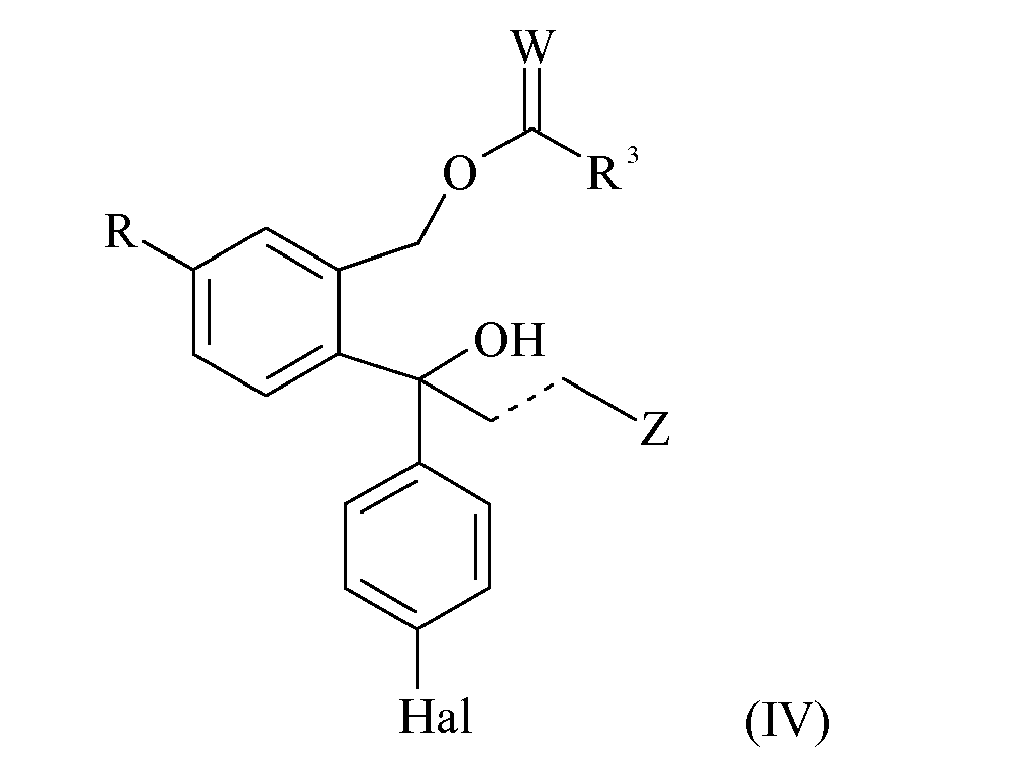 a) subjecting a racemic compound of formula

wherein X is 0 or S; W is O or S; U is 0 or S, V is halogen;
R0 is Cl-lo-alkyl, C2-10-alkenyl or C2-io-alkynyl all of which may optionally be substituted one or more times with substituents selected from C1-lo-alkoxy, C1-lo-alkylthio, hydroxy, halogen, amino, nitro, cyano, Cl-lo-alkylamino, di-(C1-10-alkyl)amino, aryl, aryloxy, arylthio and heteroaryl, or R0 is aryl, wherein any of the aryl and heteroaryl groups may optionally be substituted one or more times with substituents selected from C1-10-alkyl, C2-io-alkenyl, C2-10-alkynyl, C1-lo-alkoxy, C1-10-alkylthio, hydroxy, halogen, amino, nitro, cyano, C1-10-alkylamino and di-(C1-10-alkyl)amino;
R' is as defined for R0;
R2 is as defined for Ro, or R2 is a suitable leaving group;
or R0 and R' together form a chain of 3 to 5 carbon atoms;
provided that W and U is not S when X is S; to form a mixture of the starting material of formula (II) in either the R- or the S-form and opposite enantiomer of a compound having the formula b) subjecting a racemic compound of formula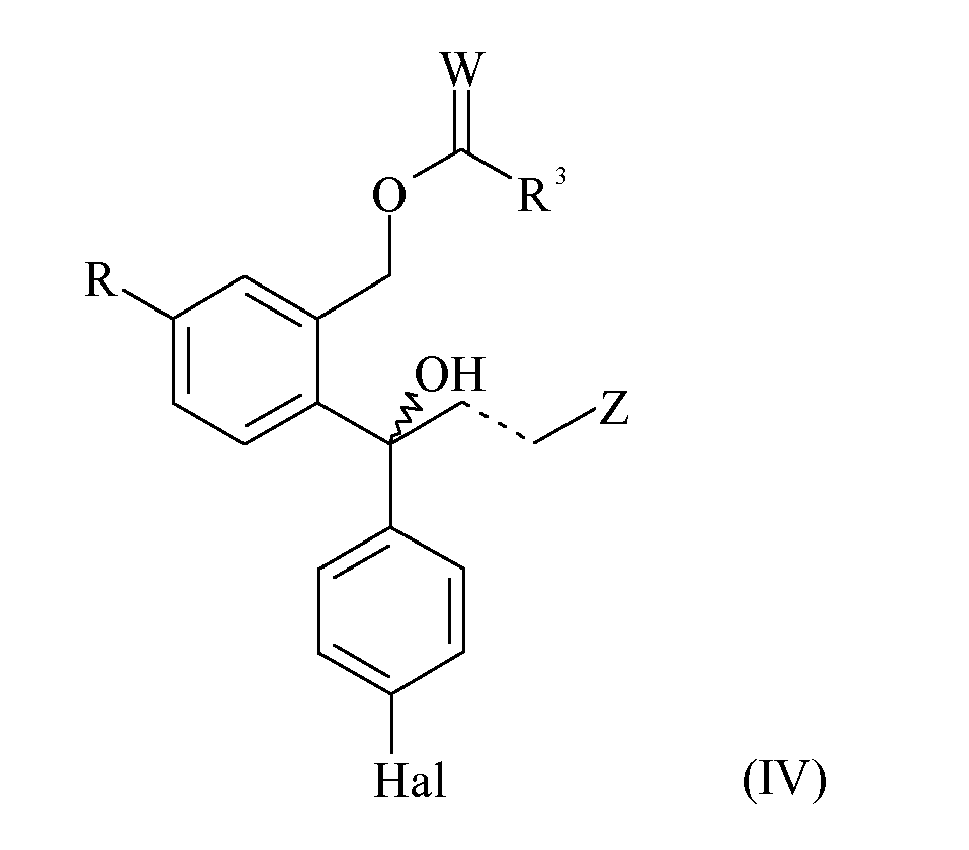

optionally followed by, in either order, isolation of the S- or R-enantiomer of the compound of formula (II) and/or the opposite enantiomer of the compound of formula (IV) or a salt thereof. - The method according to claim 1 a).
- The method according to claim 1 b).
- The method according to any of claims 1-2 wherein the acylation of the compound of formula (II) results in a mixture containing the compound of formula (II) in the S-form and the compound of formula (IV) in the R-form.
- The method according to any of claims 1-2 wherein the acylation of the compound of formula (II) results in a mixture containing the compound of formula (II) in the R-form and the compound of formula (IV) in the S-form.
- The method according to any of claims 1 and 3 wherein the deacylation of the compound of formula (IV) results in a mixture containing the compound of formula (IV) in the S-form and the compound of formula (II) in the R-form.
- The method according to any of claims 1 and 3 wherein the deacylation of the compound of formula (IV) results in a mixture containing the compound of formula (IV) in the R-form and the compound of formula (II) in the S-form.
- The method according to any of claims 1-2 and 4-5 wherein the enzymatic acylation is performed with a hydrolase, such as a lipase, an esterase, an acylase or a protease.
- The method according to any of claims 1, 3 and 6-7 wherein the enzymatic deacylation is performed with a hydrolase, such as a lipase, an esterase, an acylase or a protease.
- The method according to any of claims 8-9 wherein the hydrolase is used in the form of an immobilized enzyme or Cross-Linked Enzyme Crystal (CLEC) enzymes.
- The method according to any of claims 8-10wherein the enzyme used is selected from Pseudomonas sp. lipoprotein lipase, Candida antartica lipase B and Thermomyces lanuginosus lipase or a mutant or variant of these enzymes.
- The method according to any of claims 8-11 wherein the enzyme is Candida antartica lipase B or a mutant or variant of Candida antartica lipase B.
- The method according to claim 12 wherein the enzyme is Candida antartica lipase B.
- The S- or R-enantiomer of a compound having the formula (IV)

- A method for the isolation and purification of the compound having the formula

and/or the diol of formula a) treating said mixture containing the compound of formula (IV) and the diol of formula (II) in a mixture of water and an organic solvent in the presence of an acid;b) separating the aqueous phase containing the diol of formula (II) as a salt of said acid from the organic phase to obtain an organic phase containing the compound of formula (IV) as a salt of said acid; andoptionally isolating the compound of formula (II) as the base or as a salt thereof and optionally isolation of the compound of formula (IV) as the base or a salt thereof.
Applications Claiming Priority (3)
| Application Number | Priority Date | Filing Date | Title |
|---|---|---|---|
| US40308802P | 2002-08-12 | 2002-08-12 | |
| DKPA200201201 | 2002-08-12 | ||
| EP03783962A EP1534654A1 (en) | 2002-08-12 | 2003-08-12 | Method for the separation of intermediates which may be used for the preparation of escitalopram |
Related Parent Applications (1)
| Application Number | Title | Priority Date | Filing Date |
|---|---|---|---|
| EP03783962.8 Division | 2003-08-12 |
Publications (1)
| Publication Number | Publication Date |
|---|---|
| EP2360150A1 true EP2360150A1 (en) | 2011-08-24 |
Family
ID=34717090
Family Applications (2)
| Application Number | Title | Priority Date | Filing Date |
|---|---|---|---|
| EP03783962A Withdrawn EP1534654A1 (en) | 2002-08-12 | 2003-08-12 | Method for the separation of intermediates which may be used for the preparation of escitalopram |
| EP11165320A Withdrawn EP2360150A1 (en) | 2002-08-12 | 2003-08-12 | Method for the separation of intermediates which may be used for the preparation of escitalopram |
Family Applications Before (1)
| Application Number | Title | Priority Date | Filing Date |
|---|---|---|---|
| EP03783962A Withdrawn EP1534654A1 (en) | 2002-08-12 | 2003-08-12 | Method for the separation of intermediates which may be used for the preparation of escitalopram |
Country Status (23)
| Country | Link |
|---|---|
| US (2) | US20070129561A1 (en) |
| EP (2) | EP1534654A1 (en) |
| JP (3) | JP4694837B2 (en) |
| KR (1) | KR20050053618A (en) |
| CN (2) | CN100548939C (en) |
| AR (1) | AR040970A1 (en) |
| AU (1) | AU2003250321B2 (en) |
| BR (1) | BR0313114A (en) |
| CA (1) | CA2495118C (en) |
| EA (1) | EA011762B1 (en) |
| IL (1) | IL166319A0 (en) |
| IS (1) | IS7642A (en) |
| ME (1) | MEP1608A (en) |
| MX (1) | MXPA05001400A (en) |
| NO (1) | NO20051292L (en) |
| NZ (1) | NZ537785A (en) |
| PE (1) | PE20040991A1 (en) |
| PL (1) | PL374835A1 (en) |
| RS (1) | RS20050092A (en) |
| TW (1) | TWI306846B (en) |
| UA (1) | UA78840C2 (en) |
| WO (1) | WO2004014821A1 (en) |
| ZA (1) | ZA200500728B (en) |
Families Citing this family (16)
| Publication number | Priority date | Publication date | Assignee | Title |
|---|---|---|---|---|
| TR200504022T1 (en) * | 2003-03-24 | 2006-08-21 | Hetero Drugs Limited | New liquid crystal forms of (S) -sitalopram oxalate. |
| ES2228274B1 (en) * | 2003-09-24 | 2006-06-01 | Astur Pharma, S.A. | CHEMIOENZYMATIC SYNTHESIS OF (+) - CITALOPRAM AND (-) - CITALOPRAM. |
| TWI339651B (en) * | 2004-02-12 | 2011-04-01 | Lundbeck & Co As H | Method for the separation of intermediates which may be used for the preparation of escitalopram |
| BRPI0508266A (en) * | 2004-03-05 | 2007-07-31 | Lundbeck & Co As H | escitalopram oxalate crystalline particles, solid single dosage form, and methods for the manufacture of escitalopram oxalate crystalline particles and for reducing the amount of hydroxyl containing impurities in citalopram, escitalopram or a non-racemic mixture of r- and s -citalopram |
| US20050196453A1 (en) | 2004-03-05 | 2005-09-08 | H. Lundbeck A/S | Crystalline composition containing escitalopram |
| ITMI20040717A1 (en) * | 2004-04-09 | 2004-07-09 | Adorkem Technology Spa | CHEMO-ENZYMATIC PROCEDURE FOR THE PREPARATION OF ESCITALOPRAM |
| ITMI20041872A1 (en) * | 2004-10-01 | 2005-01-01 | Adorkem Technology Spa | PROCESS FOR THE PREPARATION OF CITALOPRAM AND SCITALOPRAM |
| EP1736550A1 (en) * | 2005-06-22 | 2006-12-27 | Adorkem Technology SpA | Chemoenzymatic process for the synthesis of escitalopram |
| GB0601286D0 (en) | 2006-01-23 | 2006-03-01 | Sandoz Ag | Asymmetric synthesis |
| WO2008059514A2 (en) * | 2006-07-31 | 2008-05-22 | Cadila Healthcare Limited | Process for preparing escitalopram |
| US7686946B2 (en) | 2007-08-17 | 2010-03-30 | Uop Llc | Method of altering a feed to a reaction zone |
| CN100548974C (en) * | 2007-10-11 | 2009-10-14 | 浙江大学 | The extraction separation method of citalopram intermediate |
| EP2250143B1 (en) * | 2008-01-25 | 2016-04-20 | XenoPort, Inc. | Method for the enzymatic kinetic resolution of acyloxyalkyl thiocarbonates used for the synthesis of acyloxyalkyl carbamates |
| ITMI20120448A1 (en) | 2012-01-30 | 2013-07-31 | Carthesia Sas | LIOFILIZED COMPOSITION OF ESCITALOPRAM OXALATE FOR SUBLINGUAL ADMINISTRATION |
| ES2554563B2 (en) * | 2014-05-05 | 2016-08-16 | Universidad De Sevilla | Bacterial strains and their uses in acylation and / or deacilation reactions |
| WO2017009866A1 (en) * | 2015-07-11 | 2017-01-19 | Ipca Laboratories Limited | Novel recovery and recycling process of racemic 4-(4-dimethylamino)-1-(4'-fluorophenyl)-1-(hydroxybutyl)-3-(hydroxymethyl)-benzonitrile |
Citations (24)
| Publication number | Priority date | Publication date | Assignee | Title |
|---|---|---|---|---|
| DE2657013A1 (en) | 1976-01-14 | 1977-07-28 | Kefalas As | PHTHALANE DERIVATIVES AND PROCESS FOR THEIR PRODUCTION AND PHARMACEUTICAL PRODUCTS CONTAINING THESE |
| EP0171943A1 (en) | 1984-08-06 | 1986-02-19 | H. Lundbeck A/S | Novel intermediate and method for its preparation |
| EP0347066A1 (en) * | 1988-06-14 | 1989-12-20 | H. Lundbeck A/S | New enantiomers and their isolation |
| WO1998000081A1 (en) | 1996-06-28 | 1998-01-08 | Sca Hygiene Products Ab | Absorbent bodies in absorbent articles having improved liquid acquisition properties |
| WO1998019511A2 (en) | 1997-11-10 | 1998-05-14 | H. Lundbeck A/S | Method for the preparation of citalopram |
| WO1998019512A2 (en) | 1997-11-11 | 1998-05-14 | H. Lundbeck A/S | Method for the preparation of citalopram |
| WO1999000210A1 (en) | 1997-06-26 | 1999-01-07 | Emilio Brocco | Sawing machine for dividing blocks of stone material into slabs |
| WO2000011926A2 (en) | 1999-06-25 | 2000-03-09 | H. Lundbeck A/S | Method for the preparation of citalopram |
| WO2000012044A2 (en) * | 1999-10-25 | 2000-03-09 | H. Lundbeck A/S | Method for the preparation of citalopram |
| WO2000013648A2 (en) | 1999-06-25 | 2000-03-16 | H. Lundbeck A/S | Method for the preparation of citalopram |
| WO2000023431A1 (en) | 1998-10-20 | 2000-04-27 | H. Lundbeck A/S | Method for the preparation of citalopram |
| WO2000044738A1 (en) | 1999-01-29 | 2000-08-03 | H. Lundbeck A/S | Method for the preparation of 5-cyanophthalide |
| WO2001002383A2 (en) | 1999-07-06 | 2001-01-11 | Lundbeck Pharmaceuticals Italy S.P.A. | Process for the synthesis of citalopram |
| WO2001043525A2 (en) | 2000-02-24 | 2001-06-21 | H. Lundbeck A/S | Method for the preparation of citalopram |
| WO2001051478A1 (en) | 2000-03-03 | 2001-07-19 | H. Lundbeck A/S | Method for the preparation of citalopram |
| WO2001068632A1 (en) | 2000-03-16 | 2001-09-20 | H. Lundbeck A/S | Method for the preparation of 5-cyano-1-(4-fluorophenyl)-1,3-dihydroisobenzofurans |
| WO2001068629A1 (en) | 2000-03-13 | 2001-09-20 | H. Lundbeck A/S | Stepwise alkylation of 5-substituted 1-(4-fluorophenyl)-1,3-dihydroisobenzofurans |
| WO2001068630A1 (en) | 2000-03-14 | 2001-09-20 | H. Lundbeck A/S | Method for the preparation of citalopram |
| WO2001068631A1 (en) | 2000-03-13 | 2001-09-20 | H. Lundbeck A/S | Method for the preparation of citalopram |
| WO2003000672A1 (en) | 2001-06-25 | 2003-01-03 | H. Lundbeck A/S | Process for the preparation of racemic citalopram and/or s- or r-citalopram by separation of a mixture of r- and s-citalopram |
| WO2003006449A1 (en) | 2001-07-13 | 2003-01-23 | H. Lundbeck A/S | Method for the preparation of escitalopram |
| WO2003011278A1 (en) | 2001-07-31 | 2003-02-13 | H. Lundbeck A/S | Crystalline composition containing escitalopram |
| EP1298124A1 (en) * | 1999-10-25 | 2003-04-02 | H. Lundbeck A/S | Method For the Preparation of Citalopram |
| WO2003087081A1 (en) * | 2002-04-09 | 2003-10-23 | Torcan Chemical Ltd. | Process and intermediates for preparing escitalopram |
Family Cites Families (9)
| Publication number | Priority date | Publication date | Assignee | Title |
|---|---|---|---|---|
| JP3097145B2 (en) * | 1991-02-27 | 2000-10-10 | 日産化学工業株式会社 | Optical resolution method of corey lactone diol |
| JPH1129418A (en) * | 1998-06-12 | 1999-02-02 | Takeda Chem Ind Ltd | Insecticidal composition for agricultural and horticultural use |
| DE19832547A1 (en) * | 1998-07-21 | 2000-01-27 | Basf Ag | Production of enzyme-containing polymers useful as biocatalysts with longer activity stability |
| US6294571B1 (en) * | 1998-09-11 | 2001-09-25 | Independent Ink, Inc. | Method for using neem extracts and derivatives for protecting wood and other cellulosic composites |
| NZ514671A (en) * | 1999-04-14 | 2003-10-31 | H | Method for the preparation of citalopram |
| GB0005477D0 (en) * | 2000-03-07 | 2000-04-26 | Resolution Chemicals Limited | Process for the preparation of citalopram |
| IL144817A0 (en) * | 2000-08-18 | 2002-06-30 | Lundbeck & Co As H | Method for the preparation of citalopram |
| IS7239A (en) * | 2001-12-14 | 2004-04-29 | H. Lundbeck A/S | Process for the production of acitalopram |
| CN1510024A (en) * | 2002-12-24 | 2004-07-07 | 北京德众万全药物技术开发有限公司 | Compound for preparing citalopram enantiomer and its production |
-
2003
- 2003-08-11 AR ARP030102904A patent/AR040970A1/en unknown
- 2003-08-11 PE PE2003000799A patent/PE20040991A1/en not_active Application Discontinuation
- 2003-08-11 TW TW092121967A patent/TWI306846B/en not_active IP Right Cessation
- 2003-08-12 NZ NZ537785A patent/NZ537785A/en unknown
- 2003-08-12 IL IL16631903A patent/IL166319A0/en unknown
- 2003-08-12 EP EP03783962A patent/EP1534654A1/en not_active Withdrawn
- 2003-08-12 CA CA2495118A patent/CA2495118C/en not_active Expired - Fee Related
- 2003-08-12 BR BR0313114-9A patent/BR0313114A/en not_active Application Discontinuation
- 2003-08-12 PL PL03374835A patent/PL374835A1/en unknown
- 2003-08-12 KR KR1020057002554A patent/KR20050053618A/en not_active Ceased
- 2003-08-12 JP JP2004526641A patent/JP4694837B2/en not_active Expired - Lifetime
- 2003-08-12 AU AU2003250321A patent/AU2003250321B2/en not_active Ceased
- 2003-08-12 US US10/524,937 patent/US20070129561A1/en not_active Abandoned
- 2003-08-12 EA EA200500349A patent/EA011762B1/en not_active IP Right Cessation
- 2003-08-12 WO PCT/DK2003/000537 patent/WO2004014821A1/en not_active Ceased
- 2003-08-12 ME MEP-16/08A patent/MEP1608A/en unknown
- 2003-08-12 MX MXPA05001400A patent/MXPA05001400A/en active IP Right Grant
- 2003-08-12 CN CNB03819001XA patent/CN100548939C/en not_active Expired - Lifetime
- 2003-08-12 RS YUP-2005/0092A patent/RS20050092A/en unknown
- 2003-08-12 CN CN2007101018055A patent/CN101045664B/en not_active Expired - Lifetime
- 2003-08-12 EP EP11165320A patent/EP2360150A1/en not_active Withdrawn
- 2003-12-08 UA UAA200501846A patent/UA78840C2/en unknown
-
2005
- 2005-01-12 IS IS7642A patent/IS7642A/en unknown
- 2005-01-25 ZA ZA200500728A patent/ZA200500728B/en unknown
- 2005-03-14 NO NO20051292A patent/NO20051292L/en not_active Application Discontinuation
-
2010
- 2010-02-17 JP JP2010032381A patent/JP5520077B2/en not_active Expired - Lifetime
- 2010-05-17 US US12/781,026 patent/US8067640B2/en not_active Expired - Fee Related
- 2010-11-25 JP JP2010262040A patent/JP2011055842A/en active Pending
Patent Citations (27)
| Publication number | Priority date | Publication date | Assignee | Title |
|---|---|---|---|---|
| DE2657013A1 (en) | 1976-01-14 | 1977-07-28 | Kefalas As | PHTHALANE DERIVATIVES AND PROCESS FOR THEIR PRODUCTION AND PHARMACEUTICAL PRODUCTS CONTAINING THESE |
| US4136193A (en) | 1976-01-14 | 1979-01-23 | Kefalas A/S | Anti-depressive substituted 1-dimethylaminopropyl-1-phenyl phthalans |
| EP0171943A1 (en) | 1984-08-06 | 1986-02-19 | H. Lundbeck A/S | Novel intermediate and method for its preparation |
| EP0347066A1 (en) * | 1988-06-14 | 1989-12-20 | H. Lundbeck A/S | New enantiomers and their isolation |
| US4943590A (en) | 1988-06-14 | 1990-07-24 | H. Lundbeck A/S | Pharmaceutically useful (+)-1-(3-dimethylaminopropyl)-1-(4'-fluorophenyl)-1,3-dihydrosobenzofuran-5-carbonitrile and non-toxic acid addition salts thereof |
| EP0347066B1 (en) | 1988-06-14 | 1995-03-15 | H. Lundbeck A/S | New enantiomers and their isolation |
| WO1998000081A1 (en) | 1996-06-28 | 1998-01-08 | Sca Hygiene Products Ab | Absorbent bodies in absorbent articles having improved liquid acquisition properties |
| WO1999000210A1 (en) | 1997-06-26 | 1999-01-07 | Emilio Brocco | Sawing machine for dividing blocks of stone material into slabs |
| WO1998019511A2 (en) | 1997-11-10 | 1998-05-14 | H. Lundbeck A/S | Method for the preparation of citalopram |
| WO1998019512A2 (en) | 1997-11-11 | 1998-05-14 | H. Lundbeck A/S | Method for the preparation of citalopram |
| WO2000023431A1 (en) | 1998-10-20 | 2000-04-27 | H. Lundbeck A/S | Method for the preparation of citalopram |
| WO2000044738A1 (en) | 1999-01-29 | 2000-08-03 | H. Lundbeck A/S | Method for the preparation of 5-cyanophthalide |
| WO2000013648A2 (en) | 1999-06-25 | 2000-03-16 | H. Lundbeck A/S | Method for the preparation of citalopram |
| WO2000011926A2 (en) | 1999-06-25 | 2000-03-09 | H. Lundbeck A/S | Method for the preparation of citalopram |
| WO2001002383A2 (en) | 1999-07-06 | 2001-01-11 | Lundbeck Pharmaceuticals Italy S.P.A. | Process for the synthesis of citalopram |
| WO2000012044A2 (en) * | 1999-10-25 | 2000-03-09 | H. Lundbeck A/S | Method for the preparation of citalopram |
| EP1298124A1 (en) * | 1999-10-25 | 2003-04-02 | H. Lundbeck A/S | Method For the Preparation of Citalopram |
| WO2001043525A2 (en) | 2000-02-24 | 2001-06-21 | H. Lundbeck A/S | Method for the preparation of citalopram |
| WO2001051478A1 (en) | 2000-03-03 | 2001-07-19 | H. Lundbeck A/S | Method for the preparation of citalopram |
| WO2001068629A1 (en) | 2000-03-13 | 2001-09-20 | H. Lundbeck A/S | Stepwise alkylation of 5-substituted 1-(4-fluorophenyl)-1,3-dihydroisobenzofurans |
| WO2001068631A1 (en) | 2000-03-13 | 2001-09-20 | H. Lundbeck A/S | Method for the preparation of citalopram |
| WO2001068630A1 (en) | 2000-03-14 | 2001-09-20 | H. Lundbeck A/S | Method for the preparation of citalopram |
| WO2001068632A1 (en) | 2000-03-16 | 2001-09-20 | H. Lundbeck A/S | Method for the preparation of 5-cyano-1-(4-fluorophenyl)-1,3-dihydroisobenzofurans |
| WO2003000672A1 (en) | 2001-06-25 | 2003-01-03 | H. Lundbeck A/S | Process for the preparation of racemic citalopram and/or s- or r-citalopram by separation of a mixture of r- and s-citalopram |
| WO2003006449A1 (en) | 2001-07-13 | 2003-01-23 | H. Lundbeck A/S | Method for the preparation of escitalopram |
| WO2003011278A1 (en) | 2001-07-31 | 2003-02-13 | H. Lundbeck A/S | Crystalline composition containing escitalopram |
| WO2003087081A1 (en) * | 2002-04-09 | 2003-10-23 | Torcan Chemical Ltd. | Process and intermediates for preparing escitalopram |
Non-Patent Citations (1)
| Title |
|---|
| SPECIALITY CHEMICALS MAGAZINE, April 2003 (2003-04-01), pages 36 - 38 |
Also Published As
Similar Documents
| Publication | Publication Date | Title |
|---|---|---|
| US8067640B2 (en) | Method for the separation of intermediates which may be used for the preparation of escitalopram | |
| EP1716108B1 (en) | Method for the separation of intermediates which may be used for the preparation of escitalopram | |
| US5534436A (en) | Enzymatic resolution of asymmetric alcohols by means of vinyl esters of polybasic carboxylic acids | |
| US7470526B2 (en) | Chemo-enzymatic process for the preparation of escitalopram | |
| US20100015675A1 (en) | Process for the production of fluorine containing alpha-hydroxy carboxylic acids | |
| HK1083828B (en) | Method for the separation of intermediates which may be used for the preparation of escitalopram | |
| HK1131514B (en) | Method of isolation and purification | |
| HK1100922B (en) | Method for the separation of intermediates which may be used for the preparation of escitalopram | |
| HK1101827B (en) | Chemo-enzymatic process for preparing escitalopram |
Legal Events
| Date | Code | Title | Description |
|---|---|---|---|
| PUAI | Public reference made under article 153(3) epc to a published international application that has entered the european phase |
Free format text: ORIGINAL CODE: 0009012 |
|
| 17P | Request for examination filed |
Effective date: 20110509 |
|
| AC | Divisional application: reference to earlier application |
Ref document number: 1534654 Country of ref document: EP Kind code of ref document: P |
|
| AK | Designated contracting states |
Kind code of ref document: A1 Designated state(s): AT BE BG CH CY CZ DE DK EE ES FI FR GB GR HU IE IT LI LU MC NL PT RO SE SI SK TR |
|
| AX | Request for extension of the european patent |
Extension state: AL LT LV MK |
|
| 17Q | First examination report despatched |
Effective date: 20110804 |
|
| STAA | Information on the status of an ep patent application or granted ep patent |
Free format text: STATUS: THE APPLICATION IS DEEMED TO BE WITHDRAWN |
|
| 18D | Application deemed to be withdrawn |
Effective date: 20120215 |