EP2359860A2 - Polymer micelle composition for treatment of resistant cancer cells - Google Patents
Polymer micelle composition for treatment of resistant cancer cells Download PDFInfo
- Publication number
- EP2359860A2 EP2359860A2 EP09827766A EP09827766A EP2359860A2 EP 2359860 A2 EP2359860 A2 EP 2359860A2 EP 09827766 A EP09827766 A EP 09827766A EP 09827766 A EP09827766 A EP 09827766A EP 2359860 A2 EP2359860 A2 EP 2359860A2
- Authority
- EP
- European Patent Office
- Prior art keywords
- composition
- cyclosporin
- polymer micelle
- taxane
- treatment
- Prior art date
- Legal status (The legal status is an assumption and is not a legal conclusion. Google has not performed a legal analysis and makes no representation as to the accuracy of the status listed.)
- Granted
Links
Images

Classifications
-
- A—HUMAN NECESSITIES
- A61—MEDICAL OR VETERINARY SCIENCE; HYGIENE
- A61K—PREPARATIONS FOR MEDICAL, DENTAL OR TOILETRY PURPOSES
- A61K31/00—Medicinal preparations containing organic active ingredients
- A61K31/33—Heterocyclic compounds
- A61K31/335—Heterocyclic compounds having oxygen as the only ring hetero atom, e.g. fungichromin
-
- A—HUMAN NECESSITIES
- A61—MEDICAL OR VETERINARY SCIENCE; HYGIENE
- A61K—PREPARATIONS FOR MEDICAL, DENTAL OR TOILETRY PURPOSES
- A61K47/00—Medicinal preparations characterised by the non-active ingredients used, e.g. carriers or inert additives; Targeting or modifying agents chemically bound to the active ingredient
- A61K47/30—Macromolecular organic or inorganic compounds, e.g. inorganic polyphosphates
- A61K47/36—Polysaccharides; Derivatives thereof, e.g. gums, starch, alginate, dextrin, hyaluronic acid, chitosan, inulin, agar or pectin
- A61K47/40—Cyclodextrins; Derivatives thereof
-
- A—HUMAN NECESSITIES
- A61—MEDICAL OR VETERINARY SCIENCE; HYGIENE
- A61K—PREPARATIONS FOR MEDICAL, DENTAL OR TOILETRY PURPOSES
- A61K9/00—Medicinal preparations characterised by special physical form
- A61K9/10—Dispersions; Emulsions
- A61K9/107—Emulsions ; Emulsion preconcentrates; Micelles
- A61K9/1075—Microemulsions or submicron emulsions; Preconcentrates or solids thereof; Micelles, e.g. made of phospholipids or block copolymers
-
- A—HUMAN NECESSITIES
- A61—MEDICAL OR VETERINARY SCIENCE; HYGIENE
- A61K—PREPARATIONS FOR MEDICAL, DENTAL OR TOILETRY PURPOSES
- A61K9/00—Medicinal preparations characterised by special physical form
- A61K9/10—Dispersions; Emulsions
- A61K9/127—Synthetic bilayered vehicles, e.g. liposomes or liposomes with cholesterol as the only non-phosphatidyl surfactant
-
- A—HUMAN NECESSITIES
- A61—MEDICAL OR VETERINARY SCIENCE; HYGIENE
- A61P—SPECIFIC THERAPEUTIC ACTIVITY OF CHEMICAL COMPOUNDS OR MEDICINAL PREPARATIONS
- A61P35/00—Antineoplastic agents
-
- A—HUMAN NECESSITIES
- A61—MEDICAL OR VETERINARY SCIENCE; HYGIENE
- A61P—SPECIFIC THERAPEUTIC ACTIVITY OF CHEMICAL COMPOUNDS OR MEDICINAL PREPARATIONS
- A61P43/00—Drugs for specific purposes, not provided for in groups A61P1/00-A61P41/00
Definitions
- the present disclosure relates to a polymer micelle composition for treatment of resistant cancer and a method for preparing the same.
- Taxane anti-cancer agents are successfully used in the treatment of breast cancer, ovarian cancer, lung cancer, prostate cancer, or the like.
- the taxane anti-cancer agents paclitaxel and docetaxel are very poorly soluble in water, they need to be solubilized, for example, by a nonionic surfactant.
- the agents are commercially available as Taxol® or Taxotere®, which are solubilized by a nonionic surfactant such as Cremophor and polysorbate.
- Taxol® and Taxotere® show superior anti-cancer effects, they have side effects such as hypersensitive reactions caused by the use of the solubilizer. Thus, researches are ongoing about new agents with no side effect.
- Verapamil, ketoconazole, cyclosporin, etc. are known as typical P-glycoprotein inhibitors. These substances are studied as P-glycoprotein inhibitor for resolving the reduced oral bioavailability problem of the anti-cancer agent due to the overexpression of P-glycoprotein.
- Cyclosporin is a poorly soluble drug.
- a composition using Cremophor as a solubilizer is marketed under the brand name Sandimmune® as a formulation for intravenous injection and oral administration.
- an orally-administered microemulsion formulation is available under the brand name Neoral®.
- the cyclosporin formulation for intravenous injection includes Cremophor as the solubilizer.
- Cremophor is associated with the side effect due to hypersensitive reaction. For this reason, it is very difficult to apply a combination therapy of the taxane anti-cancer agent Taxol® or Taxotere® together with the cyclosporin formulation for intravenous injection Sandimmune® for treating resistant cancer.
- the drug when cyclosporin is administered non-specifically, e.g. via intravenous injection, the drug may be delivered to the systemic circulation, resulting in declined immunity of the cancer patient who already has weakened immunity.
- the present disclosure is directed to providing a polymer micelle composition for treatment of resistant cancer comprising an amphiphilic diblock copolymer and active ingredients, wherein said active ingredients are taxane and a P-glycoprotein inhibitor, the P-glycoprotein inhibitor being cyclosporine.
- the present disclosure is also directed to providing a method for preparing a polymer micelle composition for treatment of resistant cancer comprising an amphiphilic diblock copolymer and active ingredients, wherein said active ingredients are taxane and a P-glycoprotein inhibitor, the P-glycoprotein inhibitor being cyclosporine
- the present disclosure provides a polymer micelle composition for treatment of resistant cancer comprising an amphiphilic diblock copolymer and active ingredients, wherein said active ingredients are taxane and a P-glycoprotein inhibitor, the P-glycoprotein inhibitor being cyclosporine.
- the present disclosure provides a method for preparing the polymer micelle composition for treatment of resistant cancer.
- the polymer micelle composition disclosure for treatment of resistant cancer which comprises the amphiphilic diblock copolymer and, optionally, the polylactic acid alkali metal salt having at least one terminal carboxyl group, can be accumulated in cancer tissue at high concentrations because of the enhanced permeability and retention (EPR) effect. Since it comprises taxane as well as the P-glycoprotein inhibitor, it exhibits superior anti-cancer effects for the cancer cells exhibiting resistance due to overexpression of P-glycoprotein by a taxane anti-cancer agent in the cancer tissue. Furthermore, it does not cause hypersensitive reactions due to the use of a solubilizer. In addition, it can reduce the side effect caused by systemic circulation of cyclosporin by allowing cyclosporin to be predominantly distributed in the cancer tissue.
- EPR enhanced permeability and retention
- the present disclosure a polymer micelle composition for treatment of resistant cancer comprising an amphiphilic diblock copolymer and active ingredients, wherein said active ingredients are taxane and a P-glycoprotein inhibitor, the P-glycoprotein inhibitor being cyclosporine.
- the polymer micelle composition for treatment of resistant cancer may comprise taxane, cyclosporin and an amphiphilic diblock copolymer to solubilize the taxane and cyclosporin.
- the polymer micelle may be a nanoparticle.
- the micelle or nanoparticle may have a particle diameter of 10-200 nm.
- taxane and cyclosporin are both poorly soluble in water, special technique and composition for solubilization are required for administration to the human body.
- the organic solvent ethanol and the surfactant Cremophor or polysorbate are used to solubilize the drugs.
- the two surfactants may cause severe hypersensitive reaction when administered, for example, intravenously, caution and pretreatment are required.
- the present disclosure provides a composition with no side effect such as hypersensitive reaction even when taxane and cyclosporin are administered together intravenously.
- resistant cancer as used in the present disclosure collectively refers to a cancer that has developed resistance to an anti-cancer agent due to its use. More specifically, it refers to a cancer that has developed resistance due to overexpression of P-glycoprotein.
- the cancer includes all type of cancers, e.g. breast cancer, ovarian cancer, lung cancer, prostate cancer, etc., without any special restriction.
- nanoparticle refers to a particle having a nano-scale particle diameter. It may include a micelle-structured particle.
- mixed used to describe “mixed micelle”, “mixed nanoparticle”, “mixed micelle or nanoparticle”, or the kind of micelle in the present disclosure refers to a state wherein one drug is encapsulated in one micelle or nanoparticle, and a taxane-containing micelle and a cyclosporin-containing micelle are mixed.
- the mixed micelle or nanoparticle may be obtained by preparing a taxane-containing micelle and a cyclosporin-containing micelle or nanoparticle separately and then mixing them.
- complex used to describe “complex micelle”, “complex nanoparticle”, “complex micelle or nanoparticle”, or the kind of micelle in the present disclosure refers to a state wherein taxane and cyclosporin are encapsulated together in one micelle or nanoparticle.
- the complex micelle or nanoparticle may be obtained encapsulating the two drugs in a micelle or nanoparticle core at the same time.
- the polymer micelle composition according to the present disclosure includes both the mixed and complex polymer micelles encapsulating taxane and cyclosporin.
- the anti-cancer agent composition for treatment of resistant cancer may comprise the active ingredients taxane and cyclosporin encapsulated in a micelle formed from an amphiphilic diblock copolymer.
- the composition may be either a complex micelle form wherein taxane and cyclosporin are encapsulated together in one micelle formed from the amphiphilic diblock copolymer, or a mixed form wherein taxane and cyclosporin are encapsulated in different micelles.
- the composition may be a mixture of: a composition comprising taxane and cyclosporin together in one micelle; and a composition comprising a mixture of a taxane-containing polymer micelle and a cyclosporin-containing polymer micelle.
- the taxane may be paclitaxel, docetaxel, 7-epipaclitaxel, t-acetyl paclitaxel, 10-desacetyl paclitaxel, 10-desacetyl-7-epipaclitaxel, 7-xylosyl paclitaxel, 10-desacetyl-7-glutaryl paclitaxel, 7-N,N-dimethylglycyl paclitaxel, 7-L-alanyl paclitaxel or a mixture thereof.
- it may be paclitaxel or docetaxel.
- the taxane may be either amorphous or crystalline. Further, it may be either an anhydride or a hydrate. In another embodiment, the taxane may be an anhydride of paclitaxel or docetaxel.
- the cyclosporin serves to suppress overexpression of P-glycoprotein.
- Cyclosporin A, B, C or D may be used.
- the cyclosporin may be cyclosporin A.
- Cyclosporin A is a cyclic peptide consisting of 11 amino acids, and has various physiological activities including anti-bacterial, anti-parasitic, and immune-suppressing activities.
- cyclosporin A is widely used for tissue or organ transplantation and treatment of autoimmune diseases because of its immunosuppressing ability.
- the weight ratio of taxane to cyclosporin may be from 0.1 to 2.0, more specifically from 0.8 to 1.5. Within this weight ratio range, the effect of taxane as the anti-cancer agent and the effect of cyclosporin as the P-glycoprotein inhibitor may be optimized.
- the combined content of taxane and cyclosporin may be 0.1-20 wt%, specifically 0.2-10 wt%, based on the total weight of the composition. Since taxane and cyclosporin are encapsulated in the polymer micelle, the content of taxane and cyclosporin that can be encapsulated in the polymer micelle is limited. In an embodiment of the present disclosure, taxane may be included in an amount of 0.01-10 wt%, specifically 0.01-5 wt%, and cyclosporin may be included in an amount of 0.01-10 wt%, specifically 0.01-5 wt%, based on the total weight of the composition.
- the amphiphilic diblock copolymer may be an A-B type diblock copolymer comprising a hydrophilic block A and a hydrophobic block B.
- the hydrophilic block A may be polyethylene glycol
- the hydrophobic block B may be polylactic acid or a derivative thereof.
- the polyethylene glycol as the hydrophilic block A may be one or more selected from a group consisting of polyethylene glycol and methoxypolyethylene glycol, but without being limited thereto. Specifically, it may be methoxypolyethylene glycol.
- the polylactic acid or its derivative as the hydrophobic block B may be one or more selected from a group consisting of polylactic acid, polylactide, polyglycolide, polymandelic acid, polycaprolactone, polydioxan-2-one, polyamino acid, polyorthoester, polyanhydride and a copolymer thereof. Specifically, it may be polylactic acid, polylactide, polyglycolide, polymandelic acid, polycaprolactone or polydioxan-2-one.
- the polylactic acid or its derivative may be one or more selected from a group consisting of polylactic acid, polylactide, polycaprolactone, a copolymer of lactic acid and mandelic acid, a copolymer of lactic acid and glycolic acid, a copolymer of lactic acid and caprolactone, and a copolymer of lactic acid and 1,4-dioxan-2-one.
- the hydrophilic block A may have a number average molecular weight of 500-20,000 daltons, more specifically 1,000-10,000 daltons.
- the hydrophobic block B may have a number average molecular weight of 500-10,000 daltons.
- the content of the hydrophilic block A may be 40-70 wt%, more specifically 50-65 wt%, based on the total weight of the diblock copolymer. Within this range, the micelle of the amphiphilic diblock copolymer can be maintained stably.
- the amount of the amphiphilic diblock copolymer may be 80-99.9 wt%, more specifically 40-90 wt%, based on the total weight of the composition.
- the composition may comprise: 0.01-10 wt% of taxane; 0.01-10 wt% of cyclosporin; and 80-99.8 wt% of an amphiphilic diblock copolymer, based on the total weight of the composition.
- the composition may comprise: 0.01-10 wt% of taxane; 0.01-10 wt% of cyclosporin; 40-90 wt% of an amphiphilic diblock copolymer; and 10-50 wt% of a polylactic acid alkali metal salt having a terminal carboxyl group.
- the complex amphiphilic diblock copolymer micelle composition in which taxane and cyclosporin are encapsulated together may have a particle size of 10-200 nm in an aqueous solution, and may be in solid state when freeze dried.
- the polymer micelle composition for treatment of resistant cancer may further comprise a polylactic acid alkali metal salt having at least one terminal carboxyl group, in addition to the taxane, the cyclosporin and the amphiphilic diblock copolymer.
- the polylactic acid alkali metal salt keeps the inside of the micelle core in which the drug is incorporated strongly and thus improves the encapsulation efficiency.
- the present disclosure provides a polymer micelle composition for treatment of resistant cancer comprising taxane, cyclosporin, an amphiphilic diblock copolymer, and a polylactic acid alkali metal salt having at least one terminal carboxyl group.
- the polylactic acid alkali metal salt refers to a salt formed by an ionic bonding between the terminal carboxyl group and an alkali metal ion.
- polylactic acid alkali metal salt having at least one terminal carboxyl group may be represented by Chemical Formula 1: wherein
- the polylactic acid alkali metal salt may have one terminal carboxyl group.
- the other terminus of the polylactic acid alkali metal salt may be substituted with a substituent selected from a group consisting of hydroxyl, acetoxy, benzoyloxy, decanoyloxy, palmitoyloxy and alkoxy.
- the polylactic acid alkali metal salt is dissolved in an aqueous solution and forms a micelle as the hydrophilic (carboxylate) moiety and the hydrophobic (polylactic acid) moiety of the polylactic acid alkali metal salt keep balance.
- the micelle may not be formed easily since the carboxylates of the hydrophilic moieties aggregate together.
- the polylactic acid alkali metal salt may have a number average molecular weight of 500-2,500 daltons, specifically 1,000-2,000 daltons. When the molecular weight is smaller than 500 daltons, the polylactic acid alkali metal salt may be completely dissolved in water and thus the micelle may not be formed. And, when the molecular weight exceeds 2,500 daltons, the polylactic acid alkali metal salt may not be dissolved well in an aqueous solution, making the formation of the micelle difficult.
- the alkali metal of the polylactic acid alkali metal salt may be a monovalent metal such as sodium, potassium or lithium.
- the polymer micelle composition may comprise: 0.1-20 wt%, specifically 0.2-10 wt%, of taxane and cyclosporin, respectively; 40-90 wt%, specifically 45-74 wt%, of an amphiphilic diblock copolymer; and 10-50 wt%, specifically 25-45 wt%, of a polylactic acid alkali metal salt having at least one terminal carboxyl group, based on the total weight of the composition.
- a divalent or trivalent metal ion may be added to the micelle composition to further stabilize the polymer micelle formed by mixing the amphiphilic diblock copolymer with the polylactic acid derivative.
- the divalent or trivalent metal ion is bound to the terminal carboxyl group of the polylactic acid derivative and thus forms a polymer nanoparticle to which the divalent or trivalent metal ion is bound.
- the present disclosure provides a nanoparticle composition for treatment of resistant cancer comprising taxane, cyclosporin, an amphiphilic diblock copolymer and a polylactic acid having a carboxyl terminus to which a divalent or trivalent metal ion is bound.
- the divalent or trivalent metal ion substitutes the monovalent metal cation at the carboxyl terminal group of the polylactic acid in the polymer micelle and forms an ionic bonding.
- the ionic bonding formed by the metal ion further stabilizes the polymer micelle with the strong binding force.
- the divalent or trivalent metal ion may be selected from calcium, magnesium, barium, chromium, iron, manganese, nickel, copper, zinc, aluminum, etc. More specifically, it may be calcium or magnesium.
- the metal ion may be added to the polymer micelle composition in the form of sulfate, hydrochloride, carbonate, phosphate or hydrate.
- calcium chloride, magnesium chloride, zinc chloride, aluminum chloride, iron chloride, calcium carbonate, magnesium carbonate, calcium phosphate, magnesium phosphate, aluminum phosphate, magnesium sulfate, calcium hydroxide, magnesium hydroxide, aluminum hydroxide or zinc hydroxide may be added.
- the content of the divalent or trivalent metal ion may be controlled according to the desired release rate of the drug encapsulated in the polymer nanoparticle. Specifically, when the metal ion is included in the polymer nanoparticle composition in an amount less than 1 equivalent based on the carboxyl group of the polylactic acid alkali metal salt, the drug is released quickly. And, when it is included in an amount of 1 equivalent or more based on the carboxyl group of the polylactic acid alkali metal salt, the drug is released slowly.
- the composition may comprise: 0.1-20 wt%, specifically 0.2-10 wt%, of taxane and cyclosporin, respectively; 40-90 wt%, specifically 45-74 wt%, of an amphiphilic diblock copolymer; and 10-50 wt%, specifically 25-45 wt%, of a polylactic acid salt having at least one terminal carboxyl group, including the divalent or trivalent metal ion in an amount of 0.01-10 equivalents, specifically 1-2 equivalents, based on the terminal carboxyl group of the polylactic acid salt, based on the total weight of the composition.
- composition for treatment of resistant cancer of the present disclosure may comprise the amphiphilic diblock copolymer alone, a polymer mixture comprising the amphiphilic diblock copolymer and the polylactic acid alkali metal salt, a polymer mixture comprising the amphiphilic diblock copolymer and the polylactic acid salt having a carboxyl terminus to which the divalent or trivalent metal ion is bound, or a polymer mixture thereof.
- the micelle or nanoparticle composition of the present disclosure may be a mixed or complex micelle or nanoparticle composition.
- the composition of the present disclosure may comprise a micelle comprising an amphiphilic diblock copolymer, a micelle comprising an amphiphilic diblock copolymer and a polylactic acid alkali metal salt, a micelle comprising an amphiphilic diblock copolymer and a polylactic acid salt having a carboxyl terminus to which a divalent or trivalent metal ion is bound, or a mixture thereof.
- a method for preparing a polymer micelle composition for treatment of resistant cancer comprising taxane and cyclosporin as active ingredients may comprise: (a) solubilizing taxane, cyclosporin and an amphiphilic diblock copolymer in an organic solvent; (b) evaporating the organic solvent to prepare a mixture wherein taxane, cyclosporin and the polymer are uniformly mixed; and (c) adding an aqueous solution to the mixture prepared in the step (b) to prepare a polymer micelle wherein taxane and cyclosporin are encapsulated.
- a method for preparing a polymer micelle composition for treatment of resistant cancer comprising taxane and cyclosporin as active ingredients may comprise: (a) solubilizing taxane, cyclosporin, an amphiphilic diblock copolymer and a polylactic acid alkali metal salt having at least one terminal carboxyl group in an organic solvent; (b) evaporating the organic solvent to prepare a mixture wherein taxane, cyclosporin and the polymer are uniformly mixed; and (c) adding an aqueous solution to the mixture prepared in the step (b) to prepare a polymer micelle wherein taxane and cyclosporin are encapsulated.
- Taxane and cyclosporin may be separately solubilized together with the polymer in different organic solvents, and then a resulting taxane-containing polymer micelle composition and a cyclosporin-containing polymer micelle composition thus prepared may be mixed to prepare the mixed micelle composition.
- the anti-cancer agent composition according to the present disclosure may be either a complex type wherein taxane and cyclosporin are encapsulated together in the polymer micelle or nanoparticle, or a mixture of a taxane-containing polymer micelle or nanoparticle with a cyclosporin-containing polymer micelle or nanoparticle. More specifically, the two types of compositions may be prepared as follows.
- composition is a complex type wherein taxane and cyclosporin are encapsulated together in one micelle or nanoparticle.
- a method for preparing a complex anti-cancer agent polymer micelle composition wherein taxane and cyclosporin are encapsulated together as active ingredients may comprise:
- the preparation method may further comprise, after the step (c):
- an aqueous solution containing 0.001-2 M of a divalent or trivalent metal ion may be added to the aqueous solution of the complex polymer micelle, and the resultant mixture may be slowly stirred at room temperature for 0.1-1 hour to bind the metal ion to the terminal group of the polylactic acid salt via ionic bonding.
- preparation method may further comprise, after the step (c) or (c-1):
- the aqueous solution may be sterilized by filtering through a sterilizing filter.
- the organic solvent in the step (b), may be evaporated by a commonly employed method. Specifically, it may be evaporated by using a vacuum evaporator.
- the aqueous solution used in the step (c) may be distilled water, physiological saline, or an aqueous solution of a freeze-drying adjuvant.
- step (f) one or more selected from a group consisting of mannitol, sorbitol, lactic acid, trehalose and sucrose may be used as a freeze-drying adjuvant. Specifically, mannitol may be used.
- a micelle comprising an amphiphilic diblock copolymer, a micelle comprising an amphiphilic diblock copolymer and a polylactic acid alkali metal salt, a micelle comprising an amphiphilic diblock copolymer and a polylactic acid salt having a carboxyl terminus to which a divalent or trivalent metal ion is bound, or a mixture thereof can be prepared.
- composition is a mixed type wherein a taxane-containing polymer micelle or nanoparticle and a cyclosporin-containing polymer micelle or nanoparticle are uniformly mixed.
- the mixed micelle composition is prepared by mixing the polymer micelle compositions containing the respective drugs.
- a method for preparing an anti-cancer agent composition comprising a mixture of a taxane-containing polymer micelle composition and a cyclosporin-containing polymer micelle composition may comprise:
- the preparation method may further comprise, after the step (c):
- an aqueous solution containing 0.001-2 M of a divalent or trivalent metal ion may be added to the aqueous solution of the mixed polymer micelle, and the resultant mixture may be slowly stirred at room temperature for 0.1-1 hour to bind the metal ion to the terminal group of the polylactic acid salt via ionic bonding.
- preparation method may further comprise, after the step (c):
- the steps (d) through (f) are post-treatment processes of the prepared composition.
- the organic solvent may be evaporated by a commonly employed method. Specifically, it may be evaporated by using a vacuum evaporator.
- the aqueous solution used in the step (c) may be distilled water, physiological saline, or an aqueous solution of a freeze-drying adjuvant.
- step (f) one or more selected from a group consisting of mannitol, sorbitol, lactic acid, trehalose and sucrose may be used as a freeze-drying adjuvant. Specifically, mannitol may be used.
- a micelle comprising an amphiphilic diblock copolymer, a micelle comprising an amphiphilic diblock copolymer and a polylactic acid alkali metal salt, a micelle comprising an amphiphilic diblock copolymer and a polylactic acid salt having a carboxyl terminus to which a divalent or trivalent metal ion is bound, or a mixture thereof can be prepared.
- the anti-cancer agent composition for treatment of resistant cancer may further comprise a pharmaceutical adjuvant such as an antiseptic, a stabilizer, a hydration agent, an emulsion accelerator, a salt and/or buffer for osmotic pressure control, etc. or other therapeutically useful substances, and may be prepared into formulations for oral or parenteral administration according to commonly employed methods.
- a pharmaceutical adjuvant such as an antiseptic, a stabilizer, a hydration agent, an emulsion accelerator, a salt and/or buffer for osmotic pressure control, etc. or other therapeutically useful substances, and may be prepared into formulations for oral or parenteral administration according to commonly employed methods.
- Formulations for parenteral administration may be administered rectally, topically, transdermally, intravenously, intramuscularly, intraabdominally, subcutaneously, or the like.
- a typical example is an isotonic aqueous solution or suspension for injection.
- the anti-cancer agent composition for treatment of resistant cancer may be prepared into a freeze-dried formulation and may be administered by intravenous injection after reconstructing in distilled water for injection, 5% glucose solution, physiological saline, or the like.
- Formulations for oral administration include, for example, tablet, pill, had and soft capsule, liquid, suspension, emulsion, syrup, granule, or the like. These formulations may comprise, in addition to the active ingredients, a diluent (e.g., lactose, dextrose, sucrose, mannitol, sorbitol, cellulose and glycine) and a lubricant (e.g., silica, talc, stearic acid and its magnesium or calcium salt, and polyethylene glycol).
- a diluent e.g., lactose, dextrose, sucrose, mannitol, sorbitol, cellulose and glycine
- a lubricant e.g., silica, talc, stearic acid and its magnesium or calcium salt, and polyethylene glycol.
- a tablet may further comprise a binder such as magnesium aluminum silicate, starch paste, gelatin, tragacanth, methyl cellulose, sodium carboxymethyl cellulose and polyvinylpyrrolidone, and, optionally, a pharmaceutical additive such as a disintegrant like starch, agar, alginic acid or its sodium salt, an absorbent, a colorant, a flavor, a sweetener, or the like.
- a binder such as magnesium aluminum silicate, starch paste, gelatin, tragacanth, methyl cellulose, sodium carboxymethyl cellulose and polyvinylpyrrolidone
- a pharmaceutical additive such as a disintegrant like starch, agar, alginic acid or its sodium salt, an absorbent, a colorant, a flavor, a sweetener, or the like.
- the tablet may be prepared by a commonly employed mixing, granulation or coating method.
- An acceptable dose of cyclosporin for human is 190-230 mg/m 3 /day, and it may be administered slowly via intravenous dropwise injection.
- Taxol® may be administered slowly via intravenous dropwise injection (175 mg/m 3 over 3 hours)
- Abraxane® may be administered slowly via intravenous dropwise injection (300 mg/m 3 over 3 hours).
- the anti-cancer agent composition according to the present disclosure which is a complex or mixed polymer composition comprising taxane effective for resistant cancer caused by overexpression of P-glycoprotein and cyclosporin as a P-glycoprotein inhibitor, exhibits a significantly improved effect on resistant cancer in a resistant cancer-transplanted animal.
- An amphiphilic diblock copolymer and a polylactic acid alkali metal salt having at least one terminal carboxyl group were prepared according to the method disclosed in Korean Patent Application NO. 2005-7020313 .
- Example 1 Preparation of complex anti-cancer agent micelle composition comprising amphiphilic diblock copolymer wherein paclitaxel and cyclosporin are encapsulated together
- a complex anti-cancer agent composition for treatment of resistant cancer comprising an amphiphilic monomethoxypolyethylene glycol-polylactide (mPEG-PLA) diblock copolymer wherein paclitaxel and cyclosporin are encapsulated together was prepared.
- mPEG-PLA amphiphilic monomethoxypolyethylene glycol-polylactide
- Example 2 Preparation of complex anti-cancer agent micelle composition comprising amphiphilic diblock copolymer and polylactic acid alkali metal salt wherein paclitaxel and cyclosporin are encapsulated together
- a complex anti-cancer agent micelle composition for treatment of resistant cancer comprising an amphiphilic mPEG-PLA diblock copolymer and a polylactic acid sodium salt (PLA-COONa) wherein paclitaxel and cyclosporin are encapsulated together was prepared.
- the organic solvent was evaporated using a vacuum evaporator to prepare a composition wherein paclitaxel, cyclosporin and the polymer are uniformly mixed.
- an aqueous solution was added so that the final concentration of paclitaxel was 3 mg/mL to prepare a complex polymer micelle composition wherein paclitaxel and cyclosporin are encapsulated together.
- the resulting composition was filtered through a sterilizing filter, transferred to a glass vial, and then free dried after adding 100 mg of mannitol.
- a micelle composition comprising an amphiphilic diblock copolymer and a polylactic acid alkali metal salt wherein docetaxel and cyclosporin are encapsulated together was prepared in the same manner as in Examples 1 and 2, except for using docetaxel instead of paclitaxel. Details are shown in Table 3. Table 3 mPEG-PLA (mg) Docetaxel (DTX, mg) CyA (mg) DTX/CyA Composition 6 577.8 10 20 0.5 Composition 7 400 10 10 10 1.0
- the mixture was solubilized in ethanol and then the organic solvent was evaporated using a vacuum evaporator. Then, an aqueous solution was added so that the final concentration of cyclosporin was 3 mg/mL to prepare a cyclosporin-containing polymer micelle composition.
- the mixture was solubilized in ethanol and then the organic solvent was evaporated using a vacuum evaporator. Then, an aqueous solution was added so that the final concentration of paclitaxel was 3 mg/mL to prepare a paclitaxel-containing polymer micelle composition.
- a mixed polymer micelle composition was prepared by mixing the paclitaxel-containing polymer micelle composition and the cyclosporin-containing polymer micelle composition in an aqueous solution so that the weight proportion of paclitaxel/cyclosporin was 1.0.
- a nanoparticle to which a divalent metal ion is bound was prepared as follows. A mixture comprising the followings was prepared. Cyclosporin 20 mg mPEG-PLA (2,000-1,500 daltons) 300 mg D,L-PLA-COONa (1,300 daltons) 60 mg
- the mixture was solubilized in ethanol in the same manner as in Example 2 and then the organic solvent was evaporated using a vacuum evaporator. An aqueous solution was added to the resultant so that the final concentration of cyclosporin was 3 mg/mL. Then, 3.9 mg of CaCl 2 was added to prepare a cyclosporin-containing polymer nanoparticle composition.
- Docetaxel was completely dissolved in ethanol. Then, after adding the polymer, the resulting mixture was solubilized until complete dissolution. Then, after adding an aqueous solution of 10.89 mg of CaCl 2 , the mixture was completely mixed using an electromagnetic mixer.
- a mixed polymer nanoparticle composition was prepared by mixing the docetaxel-containing polymer nanoparticle composition and the cyclosporin-containing polymer nanoparticle composition in an aqueous solution so that the weight proportion of docetaxel/cyclosporin was 1.0.
- Composition 5 of Example 2 was reconstructed in physiological saline so that the final concentration of paclitaxel was 3 mg/mL and then diluted 20 times with the same solvent to prepare a sample for particle size measurement.
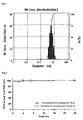
- the particle size of the diluted Composition 5 solution was measured using a particle size analyzer. The result is shown in FIG. 1 .
- the polymer micelle had a particle size of 40-50 nm.
- the polymer micelle had a very uniform particle size distribution with a polydispersity index smaller than 0.200.
- the Composition 5 solution diluted in Test Example 1 was allowed to stand at room temperature for 24 hours in order to evaluate the stability of the solution.
- the concentration of paclitaxel and cyclosporin was measured by high-performance liquid chromatography (HPLC). The result is shown in FIG. 2 and the specific HPLC condition is as follows.
- the release volume of paclitaxel and cyclosporin can be calculated by measuring their concentration in the polymer micelle. As seen from FIG. 2 , the concentration of paclitaxel and cyclosporin was maintained above 98%, indicating that the two drugs were released within 2%.
- Composition 5 wherein paclitaxel and cyclosporin are encapsulated together and delivery of paclitaxel to the brain were evaluated.
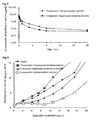
- Composition 5 of Example 2 Composition 12 of Example 5, or commercially available Taxol® for injection was injected to the tail vein, at a dose of 5 mg/kg based on paclitaxel. 10 and 30 minutes and 1, 5, 10, 24 and 48 hours after the injection, whole blood and brain tissue samples were taken from the mouse.
- the whole blood sample was centrifuged and 0.1 mL of clear serum (supernatant) was put in a covered glass tube.
- the brain tissue sample was added to ultrapure water of about 4 times its weight, homogenized using a tissue homogenizer, and the same volume as that of the serum was put in a covered glass tube.
- 0.1 mL of an acetonitrile solution containing an internal standard was added to each sample.
- centrifugation was performed at 2,500 ppm for 10 minutes.
- the organic solvent was completely evaporated at 40 °C under nitrogen flow.
- HPLC HPLC condition was as follows. The concentration of paclitaxel in the serum is shown in FIG. 3 , and the delivery of the drug to the brain tissue is shown in FIG. 4 .
- the IC 50 value of paclitaxel in DLD-1 colon cancer cells treated with 1.88 ⁇ g/mL cyclosporin which is the concentration exhibiting the maximum P-glycoprotein inhibition effect without affecting cytotoxicity, decreased 15 times (from 160 ng/mL to 11 ng/mL) as compared to when paclitaxel was administered alone.
- Composition 13 showed longer retention in bloodstream than Composition 12. This reveals that cyclosporin keeps the concentration of paclitaxel in blood higher.
- PBS phosphate buffered saline
- a cell suspension containing 7x10 6 human resistant colon cancer cells (DLD-1) was subcutaneously injected to the right flank of a healthy athymic nude (nu/nu) mouse (20-25 g, 8 weeks old). After the cancer had grown to a certain size, xenotransplantation was performed 3 times to form a xenograft of 3-4 mm. The xenograft was subcutaneously injected to the right flank of a healthy athymic nude (nu/nu) mouse (20-25 g, 8 weeks old) using a 12-gauge troca needle. After the tumor volume reached 100-300 m 3 , the drug was administered. The day on which the drug was administered was recorded as day 0.
- DLD-1 human resistant colon cancer cells
- mice On day 0, the mice were divided into 5 groups. On days 0, 3 and 6, the cyclosporin-containing polymer micelle composition (Composition 11), the paclitaxel-containing polymer micelle composition (Composition 12) and the mixed polymer micelle composition (Composition 13) were each administered through the tail vein at a dose of 35 mg/kg paclitaxel and 35 mg/kg cyclosporin.
- Tumor volume TV W 2 ⁇ L / 2 L : major axis , W : minor axis
- Relative tumor volume V t / V o x 100 % V t : TV on day t , V o : TV on day 0
- mice were used per treatment and at least 4 tumors were used per group.
- the tumor size was 4 mm in diameter and 30 mm 3 in volume.
- the animals that died within 2 weeks after the final drug administration were regarded as toxified death and excluded from the evaluation.
- the groups with more than one death out of 3 animals, attributable to toxified death, or the groups including animals that had an average body weight decrease of more than 15% and did not show signs of thorough recovery were considered to have no anti-cancer activity. The result is shown in FIG. 6 .
- the group treated with the cyclosporin-containing polymer micelle composition had no effect on the anti-cancer activity.
- the tumor volume increased when compared to the control group.
- the groups treated with the paclitaxel-containing polymer micelle composition (Composition 12) or the mixed polymer micelle composition (Composition 13) showed improved inhibitory activity against cancer growth compared with the control group.
- the group treated with the mixed polymer micelle composition (Composition 13) showed better inhibitory activity against cancer growth than the group treated with the paclitaxel-containing polymer micelle composition (Composition 12).
Landscapes
- Health & Medical Sciences (AREA)
- Chemical & Material Sciences (AREA)
- Life Sciences & Earth Sciences (AREA)
- Animal Behavior & Ethology (AREA)
- Veterinary Medicine (AREA)
- Medicinal Chemistry (AREA)
- Public Health (AREA)
- General Health & Medical Sciences (AREA)
- Pharmacology & Pharmacy (AREA)
- Epidemiology (AREA)
- Dispersion Chemistry (AREA)
- Molecular Biology (AREA)
- Nuclear Medicine, Radiotherapy & Molecular Imaging (AREA)
- General Chemical & Material Sciences (AREA)
- Organic Chemistry (AREA)
- Chemical Kinetics & Catalysis (AREA)
- Biophysics (AREA)
- Engineering & Computer Science (AREA)
- Bioinformatics & Cheminformatics (AREA)
- Inorganic Chemistry (AREA)
- Pharmaceuticals Containing Other Organic And Inorganic Compounds (AREA)
- Medicinal Preparation (AREA)
- Medicines That Contain Protein Lipid Enzymes And Other Medicines (AREA)
Abstract
Description
- The present disclosure relates to a polymer micelle composition for treatment of resistant cancer and a method for preparing the same.
- Taxane anti-cancer agents are successfully used in the treatment of breast cancer, ovarian cancer, lung cancer, prostate cancer, or the like. However, since the taxane anti-cancer agents paclitaxel and docetaxel are very poorly soluble in water, they need to be solubilized, for example, by a nonionic surfactant. The agents are commercially available as Taxol® or Taxotere®, which are solubilized by a nonionic surfactant such as Cremophor and polysorbate. Although Taxol® and Taxotere® show superior anti-cancer effects, they have side effects such as hypersensitive reactions caused by the use of the solubilizer. Thus, researches are ongoing about new agents with no side effect.
- Although many anti-cancer agents including taxanes are widely used because of their superior anti-cancer effect, resistance to the anti-cancer agents causes problems. There are various mechanisms by which cancer cells exhibit resistance to the anti-cancer agents. One of the well-known mechanisms is the exocytosis of the anti-cancer agent due to overexpression of P-glycoprotein. In order to overcome the cancer resistance caused by P-glycoprotein overexpression, use of an inhibitor of P-glycoprotein is studied.
- Verapamil, ketoconazole, cyclosporin, etc. are known as typical P-glycoprotein inhibitors. These substances are studied as P-glycoprotein inhibitor for resolving the reduced oral bioavailability problem of the anti-cancer agent due to the overexpression of P-glycoprotein. Cyclosporin is a poorly soluble drug. A composition using Cremophor as a solubilizer is marketed under the brand name Sandimmune® as a formulation for intravenous injection and oral administration. Also, an orally-administered microemulsion formulation is available under the brand name Neoral®.
- The cyclosporin formulation for intravenous injection includes Cremophor as the solubilizer. However, Cremophor is associated with the side effect due to hypersensitive reaction. For this reason, it is very difficult to apply a combination therapy of the taxane anti-cancer agent Taxol® or Taxotere® together with the cyclosporin formulation for intravenous injection Sandimmune® for treating resistant cancer. In addition, when cyclosporin is administered non-specifically, e.g. via intravenous injection, the drug may be delivered to the systemic circulation, resulting in declined immunity of the cancer patient who already has weakened immunity.
- Nothing is known about a composition containing both a taxane compound and a P-glycoprotein inhibitor. Moreover, nothing is known about a composition for treating resistant cancer by inhibiting P-glycoprotein.
- The present disclosure is directed to providing a polymer micelle composition for treatment of resistant cancer comprising an amphiphilic diblock copolymer and active ingredients, wherein said active ingredients are taxane and a P-glycoprotein inhibitor, the P-glycoprotein inhibitor being cyclosporine.
- The present disclosure is also directed to providing a method for preparing a polymer micelle composition for treatment of resistant cancer comprising an amphiphilic diblock copolymer and active ingredients, wherein said active ingredients are taxane and a P-glycoprotein inhibitor, the P-glycoprotein inhibitor being cyclosporine
- In one general aspect, the present disclosure provides a polymer micelle composition for treatment of resistant cancer comprising an amphiphilic diblock copolymer and active ingredients, wherein said active ingredients are taxane and a P-glycoprotein inhibitor, the P-glycoprotein inhibitor being cyclosporine. In another general aspect, the present disclosure provides a method for preparing the polymer micelle composition for treatment of resistant cancer.
- Other features and aspects will be apparent from the following detailed description, the drawings, and the claims.
- The polymer micelle composition disclosure for treatment of resistant cancer according to the present, which comprises the amphiphilic diblock copolymer and, optionally, the polylactic acid alkali metal salt having at least one terminal carboxyl group, can be accumulated in cancer tissue at high concentrations because of the enhanced permeability and retention (EPR) effect. Since it comprises taxane as well as the P-glycoprotein inhibitor, it exhibits superior anti-cancer effects for the cancer cells exhibiting resistance due to overexpression of P-glycoprotein by a taxane anti-cancer agent in the cancer tissue. Furthermore, it does not cause hypersensitive reactions due to the use of a solubilizer. In addition, it can reduce the side effect caused by systemic circulation of cyclosporin by allowing cyclosporin to be predominantly distributed in the cancer tissue.
- The above and other objects, features and advantages of the present disclosure will become apparent from the following description of certain exemplary embodiments given in conjunction with the accompanying drawings, in which:
-
FIG. 1 shows a result of analyzing the particle size of a polymer micelle in which paclitaxel and cyclosporin are encapsulated together in an aqueous solution by dynamic light scattering as a weight average distribution; -
FIG. 2 shows a result of measuring the concentration of paclitaxel and cyclosporin for a polymer micelle in which paclitaxel and cyclosporin are encapsulated together by high-performance liquid chromatography (HPLC); -
FIGS. 3 and 4 show the concentration of paclitaxel in blood and brain tissue for a polymer micelle in which paclitaxel and cyclosporin are encapsulated together; -
FIG. 5 shows the concentration of paclitaxel in blood for a composition containing a mixture of a paclitaxel-containing polymer micelle and a cyclosporin-containing polymer micelle; and -
FIG. 6 shows a result of comparing the anti-cancer effect of polymer micelle compositions. - The present disclosure a polymer micelle composition for treatment of resistant cancer comprising an amphiphilic diblock copolymer and active ingredients, wherein said active ingredients are taxane and a P-glycoprotein inhibitor, the P-glycoprotein inhibitor being cyclosporine. In an embodiment of the present disclosure, the polymer micelle composition for treatment of resistant cancer may comprise taxane, cyclosporin and an amphiphilic diblock copolymer to solubilize the taxane and cyclosporin.
- In another embodiment, the polymer micelle may be a nanoparticle. Specifically, the micelle or nanoparticle may have a particle diameter of 10-200 nm.
- Since taxane and cyclosporin are both poorly soluble in water, special technique and composition for solubilization are required for administration to the human body. Usually, the organic solvent ethanol and the surfactant Cremophor or polysorbate are used to solubilize the drugs. However, since the two surfactants may cause severe hypersensitive reaction when administered, for example, intravenously, caution and pretreatment are required. The present disclosure provides a composition with no side effect such as hypersensitive reaction even when taxane and cyclosporin are administered together intravenously.
- The term "resistant cancer" as used in the present disclosure collectively refers to a cancer that has developed resistance to an anti-cancer agent due to its use. More specifically, it refers to a cancer that has developed resistance due to overexpression of P-glycoprotein. The cancer includes all type of cancers, e.g. breast cancer, ovarian cancer, lung cancer, prostate cancer, etc., without any special restriction.
- The term "nanoparticle" as used in the present disclosure refers to a particle having a nano-scale particle diameter. It may include a micelle-structured particle.
- The term "mixed" used to describe "mixed micelle", "mixed nanoparticle", "mixed micelle or nanoparticle", or the kind of micelle in the present disclosure refers to a state wherein one drug is encapsulated in one micelle or nanoparticle, and a taxane-containing micelle and a cyclosporin-containing micelle are mixed. The mixed micelle or nanoparticle may be obtained by preparing a taxane-containing micelle and a cyclosporin-containing micelle or nanoparticle separately and then mixing them.
- The expression "complex" used to describe "complex micelle", "complex nanoparticle", "complex micelle or nanoparticle", or the kind of micelle in the present disclosure refers to a state wherein taxane and cyclosporin are encapsulated together in one micelle or nanoparticle. The complex micelle or nanoparticle may be obtained encapsulating the two drugs in a micelle or nanoparticle core at the same time.
- The polymer micelle composition according to the present disclosure includes both the mixed and complex polymer micelles encapsulating taxane and cyclosporin. In an embodiment, the anti-cancer agent composition for treatment of resistant cancer may comprise the active ingredients taxane and cyclosporin encapsulated in a micelle formed from an amphiphilic diblock copolymer. Specifically, the composition may be either a complex micelle form wherein taxane and cyclosporin are encapsulated together in one micelle formed from the amphiphilic diblock copolymer, or a mixed form wherein taxane and cyclosporin are encapsulated in different micelles. In another embodiment, the composition may be a mixture of: a composition comprising taxane and cyclosporin together in one micelle; and a composition comprising a mixture of a taxane-containing polymer micelle and a cyclosporin-containing polymer micelle.
- In an embodiment, the taxane may be paclitaxel, docetaxel, 7-epipaclitaxel, t-acetyl paclitaxel, 10-desacetyl paclitaxel, 10-desacetyl-7-epipaclitaxel, 7-xylosyl paclitaxel, 10-desacetyl-7-glutaryl paclitaxel, 7-N,N-dimethylglycyl paclitaxel, 7-L-alanyl paclitaxel or a mixture thereof. Specifically, it may be paclitaxel or docetaxel. The taxane may be either amorphous or crystalline. Further, it may be either an anhydride or a hydrate. In another embodiment, the taxane may be an anhydride of paclitaxel or docetaxel.
- The cyclosporin serves to suppress overexpression of P-glycoprotein. Cyclosporin A, B, C or D may be used. In an embodiment, the cyclosporin may be cyclosporin A. Cyclosporin A is a cyclic peptide consisting of 11 amino acids, and has various physiological activities including anti-bacterial, anti-parasitic, and immune-suppressing activities. Especially, cyclosporin A is widely used for tissue or organ transplantation and treatment of autoimmune diseases because of its immunosuppressing ability.
- In an anti-cancer agent composition according to an embodiment of the present disclosure, the weight ratio of taxane to cyclosporin (weight of taxane / weight of cyclosporin) may be from 0.1 to 2.0, more specifically from 0.8 to 1.5. Within this weight ratio range, the effect of taxane as the anti-cancer agent and the effect of cyclosporin as the P-glycoprotein inhibitor may be optimized.
- In another embodiment, the combined content of taxane and cyclosporin may be 0.1-20 wt%, specifically 0.2-10 wt%, based on the total weight of the composition. Since taxane and cyclosporin are encapsulated in the polymer micelle, the content of taxane and cyclosporin that can be encapsulated in the polymer micelle is limited. In an embodiment of the present disclosure, taxane may be included in an amount of 0.01-10 wt%, specifically 0.01-5 wt%, and cyclosporin may be included in an amount of 0.01-10 wt%, specifically 0.01-5 wt%, based on the total weight of the composition.
- In an embodiment, the amphiphilic diblock copolymer may be an A-B type diblock copolymer comprising a hydrophilic block A and a hydrophobic block B. The hydrophilic block A may be polyethylene glycol, and the hydrophobic block B may be polylactic acid or a derivative thereof.
- The polyethylene glycol as the hydrophilic block A may be one or more selected from a group consisting of polyethylene glycol and methoxypolyethylene glycol, but without being limited thereto. Specifically, it may be methoxypolyethylene glycol.
- The polylactic acid or its derivative as the hydrophobic block B may be one or more selected from a group consisting of polylactic acid, polylactide, polyglycolide, polymandelic acid, polycaprolactone, polydioxan-2-one, polyamino acid, polyorthoester, polyanhydride and a copolymer thereof. Specifically, it may be polylactic acid, polylactide, polyglycolide, polymandelic acid, polycaprolactone or polydioxan-2-one. More specifically, the polylactic acid or its derivative may be one or more selected from a group consisting of polylactic acid, polylactide, polycaprolactone, a copolymer of lactic acid and mandelic acid, a copolymer of lactic acid and glycolic acid, a copolymer of lactic acid and caprolactone, and a copolymer of lactic acid and 1,4-dioxan-2-one.
- In an embodiment, the hydrophilic block A may have a number average molecular weight of 500-20,000 daltons, more specifically 1,000-10,000 daltons. The hydrophobic block B may have a number average molecular weight of 500-10,000 daltons. In another embodiment, the content of the hydrophilic block A may be 40-70 wt%, more specifically 50-65 wt%, based on the total weight of the diblock copolymer. Within this range, the micelle of the amphiphilic diblock copolymer can be maintained stably.
- The amount of the amphiphilic diblock copolymer may be 80-99.9 wt%, more specifically 40-90 wt%, based on the total weight of the composition. In an embodiment, the composition may comprise: 0.01-10 wt% of taxane; 0.01-10 wt% of cyclosporin; and 80-99.8 wt% of an amphiphilic diblock copolymer, based on the total weight of the composition. In another embodiment, the composition may comprise: 0.01-10 wt% of taxane; 0.01-10 wt% of cyclosporin; 40-90 wt% of an amphiphilic diblock copolymer; and 10-50 wt% of a polylactic acid alkali metal salt having a terminal carboxyl group.
- The complex amphiphilic diblock copolymer micelle composition in which taxane and cyclosporin are encapsulated together may have a particle size of 10-200 nm in an aqueous solution, and may be in solid state when freeze dried.
- In another embodiment of the present disclosure, the polymer micelle composition for treatment of resistant cancer may further comprise a polylactic acid alkali metal salt having at least one terminal carboxyl group, in addition to the taxane, the cyclosporin and the amphiphilic diblock copolymer. The polylactic acid alkali metal salt keeps the inside of the micelle core in which the drug is incorporated strongly and thus improves the encapsulation efficiency. Accordingly, the present disclosure provides a polymer micelle composition for treatment of resistant cancer comprising taxane, cyclosporin, an amphiphilic diblock copolymer, and a polylactic acid alkali metal salt having at least one terminal carboxyl group. The polylactic acid alkali metal salt refers to a salt formed by an ionic bonding between the terminal carboxyl group and an alkali metal ion.
- Specifically, the polylactic acid alkali metal salt having at least one terminal carboxyl group may be represented by Chemical Formula 1:

- R is hydrogen, acetyl, benzoyl, decanoyl, palmitoyl, methyl or ethyl,
- M is sodium, potassium or lithium, and
- n is an integer from 5 to 35, specifically from 10 to 30.
- Specifically, the polylactic acid alkali metal salt may have one terminal carboxyl group.
- The other terminus of the polylactic acid alkali metal salt may be substituted with a substituent selected from a group consisting of hydroxyl, acetoxy, benzoyloxy, decanoyloxy, palmitoyloxy and alkoxy. The polylactic acid alkali metal salt is dissolved in an aqueous solution and forms a micelle as the hydrophilic (carboxylate) moiety and the hydrophobic (polylactic acid) moiety of the polylactic acid alkali metal salt keep balance. Thus, when the molecular weight of the hydrophobic moiety is too large, the micelle may not be formed easily since the carboxylates of the hydrophilic moieties aggregate together. And, when the molecular weight is too small, the polylactic acid alkali metal salt may be completely dissolved in water and thus the micelle may not be formed. In an embodiment, the polylactic acid alkali metal salt may have a number average molecular weight of 500-2,500 daltons, specifically 1,000-2,000 daltons. When the molecular weight is smaller than 500 daltons, the polylactic acid alkali metal salt may be completely dissolved in water and thus the micelle may not be formed. And, when the molecular weight exceeds 2,500 daltons, the polylactic acid alkali metal salt may not be dissolved well in an aqueous solution, making the formation of the micelle difficult.
- In an embodiment of the present disclosure, the alkali metal of the polylactic acid alkali metal salt may be a monovalent metal such as sodium, potassium or lithium.
- The polymer micelle composition may comprise: 0.1-20 wt%, specifically 0.2-10 wt%, of taxane and cyclosporin, respectively; 40-90 wt%, specifically 45-74 wt%, of an amphiphilic diblock copolymer; and 10-50 wt%, specifically 25-45 wt%, of a polylactic acid alkali metal salt having at least one terminal carboxyl group, based on the total weight of the composition.
- In an embodiment, a divalent or trivalent metal ion may be added to the micelle composition to further stabilize the polymer micelle formed by mixing the amphiphilic diblock copolymer with the polylactic acid derivative. The divalent or trivalent metal ion is bound to the terminal carboxyl group of the polylactic acid derivative and thus forms a polymer nanoparticle to which the divalent or trivalent metal ion is bound. Accordingly, the present disclosure provides a nanoparticle composition for treatment of resistant cancer comprising taxane, cyclosporin, an amphiphilic diblock copolymer and a polylactic acid having a carboxyl terminus to which a divalent or trivalent metal ion is bound. The divalent or trivalent metal ion substitutes the monovalent metal cation at the carboxyl terminal group of the polylactic acid in the polymer micelle and forms an ionic bonding. The ionic bonding formed by the metal ion further stabilizes the polymer micelle with the strong binding force.
- Specifically, the divalent or trivalent metal ion may be selected from calcium, magnesium, barium, chromium, iron, manganese, nickel, copper, zinc, aluminum, etc. More specifically, it may be calcium or magnesium.
- The metal ion may be added to the polymer micelle composition in the form of sulfate, hydrochloride, carbonate, phosphate or hydrate. Specifically, calcium chloride, magnesium chloride, zinc chloride, aluminum chloride, iron chloride, calcium carbonate, magnesium carbonate, calcium phosphate, magnesium phosphate, aluminum phosphate, magnesium sulfate, calcium hydroxide, magnesium hydroxide, aluminum hydroxide or zinc hydroxide may be added.
- The content of the divalent or trivalent metal ion may be controlled according to the desired release rate of the drug encapsulated in the polymer nanoparticle. Specifically, when the metal ion is included in the polymer nanoparticle composition in an amount less than 1 equivalent based on the carboxyl group of the polylactic acid alkali metal salt, the drug is released quickly. And, when it is included in an amount of 1 equivalent or more based on the carboxyl group of the polylactic acid alkali metal salt, the drug is released slowly.
- When the divalent or trivalent metal ion is bound to the terminal carboxyl group of the polylactic acid salt, the composition may comprise: 0.1-20 wt%, specifically 0.2-10 wt%, of taxane and cyclosporin, respectively; 40-90 wt%, specifically 45-74 wt%, of an amphiphilic diblock copolymer; and 10-50 wt%, specifically 25-45 wt%, of a polylactic acid salt having at least one terminal carboxyl group, including the divalent or trivalent metal ion in an amount of 0.01-10 equivalents, specifically 1-2 equivalents, based on the terminal carboxyl group of the polylactic acid salt, based on the total weight of the composition.
- The composition for treatment of resistant cancer of the present disclosure may comprise the amphiphilic diblock copolymer alone, a polymer mixture comprising the amphiphilic diblock copolymer and the polylactic acid alkali metal salt, a polymer mixture comprising the amphiphilic diblock copolymer and the polylactic acid salt having a carboxyl terminus to which the divalent or trivalent metal ion is bound, or a polymer mixture thereof.
- The micelle or nanoparticle composition of the present disclosure may be a mixed or complex micelle or nanoparticle composition. Also, the composition of the present disclosure may comprise a micelle comprising an amphiphilic diblock copolymer, a micelle comprising an amphiphilic diblock copolymer and a polylactic acid alkali metal salt, a micelle comprising an amphiphilic diblock copolymer and a polylactic acid salt having a carboxyl terminus to which a divalent or trivalent metal ion is bound, or a mixture thereof.
- The present disclosure further provides a method for preparing an anti-cancer agent composition for treatment of resistant cancer. A method for preparing a polymer micelle composition for treatment of resistant cancer comprising taxane and cyclosporin as active ingredients according to an embodiment of the present disclosure may comprise: (a) solubilizing taxane, cyclosporin and an amphiphilic diblock copolymer in an organic solvent; (b) evaporating the organic solvent to prepare a mixture wherein taxane, cyclosporin and the polymer are uniformly mixed; and (c) adding an aqueous solution to the mixture prepared in the step (b) to prepare a polymer micelle wherein taxane and cyclosporin are encapsulated.
- A method for preparing a polymer micelle composition for treatment of resistant cancer comprising taxane and cyclosporin as active ingredients according to another embodiment of the present disclosure may comprise: (a) solubilizing taxane, cyclosporin, an amphiphilic diblock copolymer and a polylactic acid alkali metal salt having at least one terminal carboxyl group in an organic solvent; (b) evaporating the organic solvent to prepare a mixture wherein taxane, cyclosporin and the polymer are uniformly mixed; and (c) adding an aqueous solution to the mixture prepared in the step (b) to prepare a polymer micelle wherein taxane and cyclosporin are encapsulated.
- Taxane and cyclosporin may be separately solubilized together with the polymer in different organic solvents, and then a resulting taxane-containing polymer micelle composition and a cyclosporin-containing polymer micelle composition thus prepared may be mixed to prepare the mixed micelle composition.
- Accordingly, the anti-cancer agent composition according to the present disclosure may be either a complex type wherein taxane and cyclosporin are encapsulated together in the polymer micelle or nanoparticle, or a mixture of a taxane-containing polymer micelle or nanoparticle with a cyclosporin-containing polymer micelle or nanoparticle. More specifically, the two types of compositions may be prepared as follows.
- This composition is a complex type wherein taxane and cyclosporin are encapsulated together in one micelle or nanoparticle.
- A method for preparing a complex anti-cancer agent polymer micelle composition wherein taxane and cyclosporin are encapsulated together as active ingredients may comprise:
- (a) solubilizing taxane, cyclosporin, an amphiphilic diblock copolymer and, optionally, a polylactic acid alkali metal salt having at least one terminal carboxyl group in an organic solvent selected from a group consisting of ethanol, methanol, propanol, acetone, acetonitrile, dichloromethane, chloroform, methyl ethyl ketone and ethyl acetate;
- (b) evaporating the organic solvent to prepare a mixture wherein taxane, cyclosporin, the polymer and, optionally, the polylactic acid alkali metal salt having at least one terminal carboxyl group are uniformly mixed; and
- (c) adding an aqueous solution to the mixture prepared in the step (b) to prepare a polymer micelle composition wherein taxane and cyclosporin are encapsulated in a core.
- In an embodiment, when a polylactic acid alkali metal salt having at least one terminal carboxyl group is used to prepare a nanoparticle to which a divalent or trivalent metal ion is bound, the preparation method may further comprise, after the step (c):
- (c-1) adding a divalent or trivalent metal ion to the polymer micelle so that it is bound to the terminal group of the polylactic acid salt.
- In the step (c-1), an aqueous solution containing 0.001-2 M of a divalent or trivalent metal ion may be added to the aqueous solution of the complex polymer micelle, and the resultant mixture may be slowly stirred at room temperature for 0.1-1 hour to bind the metal ion to the terminal group of the polylactic acid salt via ionic bonding.
- In another embodiment, the preparation method may further comprise, after the step (c) or (c-1):
- (d) sterilizing the resulting micelle composition;
- (e) filling the sterilized micelle composition in a container; and
- (f) freeze drying the micelle composition filled in the container.
- In the step (d), the aqueous solution may be sterilized by filtering through a sterilizing filter.
- In an embodiment, in the step (b), the organic solvent may be evaporated by a commonly employed method. Specifically, it may be evaporated by using a vacuum evaporator.
- In an embodiment, the aqueous solution used in the step (c) may be distilled water, physiological saline, or an aqueous solution of a freeze-drying adjuvant.
- In the step (f), one or more selected from a group consisting of mannitol, sorbitol, lactic acid, trehalose and sucrose may be used as a freeze-drying adjuvant. Specifically, mannitol may be used.
- In accordance with the preparation method according to this embodiment, a micelle comprising an amphiphilic diblock copolymer, a micelle comprising an amphiphilic diblock copolymer and a polylactic acid alkali metal salt, a micelle comprising an amphiphilic diblock copolymer and a polylactic acid salt having a carboxyl terminus to which a divalent or trivalent metal ion is bound, or a mixture thereof can be prepared.
- This composition is a mixed type wherein a taxane-containing polymer micelle or nanoparticle and a cyclosporin-containing polymer micelle or nanoparticle are uniformly mixed.
- The mixed micelle composition is prepared by mixing the polymer micelle compositions containing the respective drugs.
- A method for preparing an anti-cancer agent composition comprising a mixture of a taxane-containing polymer micelle composition and a cyclosporin-containing polymer micelle composition may comprise:
- (a) solubilizing taxane and cyclosporin respectively together with an amphiphilic diblock copolymer and, optionally, a polylactic acid alkali metal salt having at least one terminal carboxyl group in an organic solvent selected from a group consisting of ethanol, methanol, propanol, acetone, acetonitrile, dichloromethane, chloroform, methyl ethyl ketone and ethyl acetate;
- (b) evaporating the organic solvent from the respective resulting solutions to prepare a mixture wherein taxane and the polymer are uniformly mixed and a mixture wherein cyclosporin and the polymer are uniformly mixed; and
- (c) adding an aqueous solution to the respective mixtures prepared in the step (b) to prepare a taxane-containing polymer micelle composition and a cyclosporin-containing polymer micelle composition, and then mixing the micelle compositions to prepare a mixed micelle composition.
- In an embodiment, when a polylactic acid alkali metal salt having at least one terminal carboxyl group is used to prepare a nanoparticle to which a divalent or trivalent metal ion is bound, the preparation method may further comprise, after the step (c):
- (c-1) adding a divalent or trivalent metal ion to the mixed polymer micelle so that it is bound to the terminal group of the polylactic acid salt.
- In the step (c-1), an aqueous solution containing 0.001-2 M of a divalent or trivalent metal ion may be added to the aqueous solution of the mixed polymer micelle, and the resultant mixture may be slowly stirred at room temperature for 0.1-1 hour to bind the metal ion to the terminal group of the polylactic acid salt via ionic bonding.
- In another embodiment, the preparation method may further comprise, after the step (c):
- (d) sterilizing the resulting mixed micelle composition;
- (e) filling the sterilized mixed micelle composition in a container; and
- (f) freeze drying the mixed micelle composition filled in the container.
- The steps (d) through (f) are post-treatment processes of the prepared composition.
- In the step (b), the organic solvent may be evaporated by a commonly employed method. Specifically, it may be evaporated by using a vacuum evaporator.
- In an embodiment, the aqueous solution used in the step (c) may be distilled water, physiological saline, or an aqueous solution of a freeze-drying adjuvant.
- In the step (f), one or more selected from a group consisting of mannitol, sorbitol, lactic acid, trehalose and sucrose may be used as a freeze-drying adjuvant. Specifically, mannitol may be used.
- In accordance with the preparation method according to this embodiment, a micelle comprising an amphiphilic diblock copolymer, a micelle comprising an amphiphilic diblock copolymer and a polylactic acid alkali metal salt, a micelle comprising an amphiphilic diblock copolymer and a polylactic acid salt having a carboxyl terminus to which a divalent or trivalent metal ion is bound, or a mixture thereof can be prepared.
- The anti-cancer agent composition for treatment of resistant cancer may further comprise a pharmaceutical adjuvant such as an antiseptic, a stabilizer, a hydration agent, an emulsion accelerator, a salt and/or buffer for osmotic pressure control, etc. or other therapeutically useful substances, and may be prepared into formulations for oral or parenteral administration according to commonly employed methods.
- Formulations for parenteral administration may be administered rectally, topically, transdermally, intravenously, intramuscularly, intraabdominally, subcutaneously, or the like. A typical example is an isotonic aqueous solution or suspension for injection. In an embodiment of the present disclosure, the anti-cancer agent composition for treatment of resistant cancer may be prepared into a freeze-dried formulation and may be administered by intravenous injection after reconstructing in distilled water for injection, 5% glucose solution, physiological saline, or the like.
- Formulations for oral administration include, for example, tablet, pill, had and soft capsule, liquid, suspension, emulsion, syrup, granule, or the like. These formulations may comprise, in addition to the active ingredients, a diluent (e.g., lactose, dextrose, sucrose, mannitol, sorbitol, cellulose and glycine) and a lubricant (e.g., silica, talc, stearic acid and its magnesium or calcium salt, and polyethylene glycol). A tablet may further comprise a binder such as magnesium aluminum silicate, starch paste, gelatin, tragacanth, methyl cellulose, sodium carboxymethyl cellulose and polyvinylpyrrolidone, and, optionally, a pharmaceutical additive such as a disintegrant like starch, agar, alginic acid or its sodium salt, an absorbent, a colorant, a flavor, a sweetener, or the like. The tablet may be prepared by a commonly employed mixing, granulation or coating method.
- An acceptable dose of cyclosporin for human is 190-230 mg/m3/day, and it may be administered slowly via intravenous dropwise injection. For paclitaxel as an example of the taxane, Taxol® may be administered slowly via intravenous dropwise injection (175 mg/m3 over 3 hours), and Abraxane® may be administered slowly via intravenous dropwise injection (300 mg/m3 over 3 hours).
- The anti-cancer agent composition according to the present disclosure, which is a complex or mixed polymer composition comprising taxane effective for resistant cancer caused by overexpression of P-glycoprotein and cyclosporin as a P-glycoprotein inhibitor, exhibits a significantly improved effect on resistant cancer in a resistant cancer-transplanted animal.
- The examples and experiments will now be described. The following examples and experiments are for illustrative purposes only and not intended to limit the scope of this disclosure.
- An amphiphilic diblock copolymer and a polylactic acid alkali metal salt having at least one terminal carboxyl group were prepared according to the method disclosed in Korean Patent Application NO.
2005-7020313 - A complex anti-cancer agent composition for treatment of resistant cancer comprising an amphiphilic monomethoxypolyethylene glycol-polylactide (mPEG-PLA) diblock copolymer wherein paclitaxel and cyclosporin are encapsulated together was prepared.
- After solubilizing the substances described in Table 1 in 10 mL of an organic solvent mixture comprising dichloromethane and methanol (1:1), the organic solvent was evaporated using a vacuum evaporator to prepare a composition wherein paclitaxel, cyclosporin and the polymer are uniformly mixed. To thus prepared composition, an aqueous solution was added so that the final concentration of paclitaxel was 3 mg/mL to prepare a polymer micelle composition wherein paclitaxel and cyclosporin are encapsulated together. The resulting composition was filtered through a sterilizing filter, transferred to a glass vial, and then free dried after adding 100 mg of mannitol.
Table 1 mPEG-PLA
(mg)Paclitaxel
(PTX, mg)Cyclosporin
(CyA, mg)PTX/ CyA Composition 1 577.8 10 20 0.5 Composition 2 400 10 10 1.0 Number average molecular weight of mPEG-PLA = 2,000-1,500 daltons - A complex anti-cancer agent micelle composition for treatment of resistant cancer comprising an amphiphilic mPEG-PLA diblock copolymer and a polylactic acid sodium salt (PLA-COONa) wherein paclitaxel and cyclosporin are encapsulated together was prepared.
- After solubilizing the substances described in Table 2 in an organic solvent mixture comprising dichloromethane, and methanol.(1:1), the organic solvent was evaporated using a vacuum evaporator to prepare a composition wherein paclitaxel, cyclosporin and the polymer are uniformly mixed. To thus prepared composition, an aqueous solution was added so that the final concentration of paclitaxel was 3 mg/mL to prepare a complex polymer micelle composition wherein paclitaxel and cyclosporin are encapsulated together. The resulting composition was filtered through a sterilizing filter, transferred to a glass vial, and then free dried after adding 100 mg of mannitol.
Table 2 mPEG-PLA
(mg)PLA-COONa
(mg)PTX (mg) CyA (mg) PTX/ CyA Composition 3 400 177.78 10 20 0.5 Composition 4276.9 123.11 10 10 1.0 Composition 5400 177.78 20 10 2.0 Number average molecular weight of mPEG-PLA = 2,000-1,500 daltons
Number average molecular weight of PLA-COONa = 1,300 daltons - A micelle composition comprising an amphiphilic diblock copolymer and a polylactic acid alkali metal salt wherein docetaxel and cyclosporin are encapsulated together was prepared in the same manner as in Examples 1 and 2, except for using docetaxel instead of paclitaxel. Details are shown in Table 3.
Table 3 mPEG-PLA
(mg)Docetaxel
(DTX, mg)CyA (mg) DTX/ CyA Composition 6 577.8 10 20 0.5 Composition 7 400 10 10 1.0 - After solubilizing the substances described in Table 4 in an organic solvent mixture comprising dichloromethane and methanol (1:1), the organic solvent was evaporated using a vacuum evaporator to prepare a composition wherein docetaxel, cyclosporin and the polymer are uniformly mixed. To thus prepared composition, an aqueous solution was added so that the final concentration of docetaxel was 3 mg/mL to prepare a complex polymer micelle composition wherein docetaxel and cyclosporin are encapsulated together. Then, after adding an aqueous solution of 0.2 M anhydrous calcium chloride, the mixture was stirred at room temperature for 20 minutes. Thus prepared nanoparticle composition was filtered through a sterilizing filter, transferred to a glass vial, and then free dried after adding 100 mg of mannitol.
Table 4 mPEG-PLA
(mg)PLA-COONa
(mg)DTX
(mg)CyA
(mg)CaCl2
(mg)DTX/ CyA Composition 8 400 177.78 10 20 11.54 0.5 Composition 9276.9 123.11 10 10 8.03 1.0 Composition 10400 177.78 20 10 11.54 2.0 Number average molecular weight of mPEG-PLA = 2,000-1,500 daltons
Number average molecular weight of PLA-COONa = 1,300 daltons - After preparing polymer micelle compositions wherein paclitaxel and cyclosporin are encapsulated respectively, the two micelle compositions were mixed to prepare an anti-cancer agent composition for treatment of resistant cancer
- A mixture comprising the followings was prepared.
Cyclosporin 50 mg mPEG-PLA (2,000-1,500 daltons) 750 mg PLA-COONa (1,300 daltons) 250 mg - The mixture was solubilized in ethanol and then the organic solvent was evaporated using a vacuum evaporator. Then, an aqueous solution was added so that the final concentration of cyclosporin was 3 mg/mL to prepare a cyclosporin-containing polymer micelle composition.
-
Paclitaxel 50 mg mPEG-PLA (2,000-1,500 daltons) 2,500 mg - The mixture was solubilized in ethanol and then the organic solvent was evaporated using a vacuum evaporator. Then, an aqueous solution was added so that the final concentration of paclitaxel was 3 mg/mL to prepare a paclitaxel-containing polymer micelle composition.
- A mixed polymer micelle composition was prepared by mixing the paclitaxel-containing polymer micelle composition and the cyclosporin-containing polymer micelle composition in an aqueous solution so that the weight proportion of paclitaxel/cyclosporin was 1.0.
- Thus prepared mixed polymer micelle composition was filtered through a sterilizing filter, transferred to a glass vial, and then free dried after adding 100 mg of mannitol.
- Particle size of the prepared composition was measured. The result is given in Table 5.
Table 5 Composition 11Ex. 5, a) Cyclosporin-containing polymer micelle composition Particle size: 20-30 nm Composition 12 Ex. 5, b) Paclitaxel-containing polymer micelle composition Particle size: 17-24 nm Composition 13 Ex. 5, c) Mixed micelle composition of paclitaxel-containing polymer micelle composition and cyclosporin-containing polymer micelle composition Particle size: 17-30 nm - After preparing polymer nanoparticle compositions wherein docetaxel and cyclosporin are encapsulated respectively, the two nanoparticle compositions were mixed to prepare mixed polymer nanoparticle composition.
- A nanoparticle to which a divalent metal ion is bound was prepared as follows. A mixture comprising the followings was prepared.
Cyclosporin 20 mg mPEG-PLA (2,000-1,500 daltons) 300 mg D,L-PLA-COONa (1,300 daltons) 60 mg - The mixture was solubilized in ethanol in the same manner as in Example 2 and then the organic solvent was evaporated using a vacuum evaporator. An aqueous solution was added to the resultant so that the final concentration of cyclosporin was 3 mg/mL. Then, 3.9 mg of CaCl2 was added to prepare a cyclosporin-containing polymer nanoparticle composition.
-
Docetaxel 20 mg mPEG-PLA (2,000-1,500 daltons) 500 mg D,L-PLA-COONa (1,300 daltons) 167 mg - Docetaxel was completely dissolved in ethanol. Then, after adding the polymer, the resulting mixture was solubilized until complete dissolution. Then, after adding an aqueous solution of 10.89 mg of CaCl2, the mixture was completely mixed using an electromagnetic mixer.
- A mixed polymer nanoparticle composition was prepared by mixing the docetaxel-containing polymer nanoparticle composition and the cyclosporin-containing polymer nanoparticle composition in an aqueous solution so that the weight proportion of docetaxel/cyclosporin was 1.0.
- Thus prepared mixed polymer nanoparticle composition was filtered through a sterilizing filter, transferred to a glass vial, and then free dried after adding 100 mg of mannitol. Particle size of the prepared composition was measured. The result is given in Table 6.
Table 6 Composition 14 Ex. 6, a) Cyclosporin-containing polymer nanoparticle composition Particle size: 20-30 nm Composition 15 Ex. 6, b) Docetaxel-containing polymer nanoparticle composition Particle size: 17-20 nm Composition 16 Ex. 6, c) Mixed nanoparticle composition of docetaxel-containing polymer nanoparticle composition and cyclosporin-containing polymer nanoparticle composition Particle size: 17-30 nm -
Composition 5 of Example 2 was reconstructed in physiological saline so that the final concentration of paclitaxel was 3 mg/mL and then diluted 20 times with the same solvent to prepare a sample for particle size measurement. The particle size of the dilutedComposition 5 solution was measured using a particle size analyzer. The result is shown inFIG. 1 . - As seen from
FIG. 1 , the polymer micelle had a particle size of 40-50 nm. The polymer micelle had a very uniform particle size distribution with a polydispersity index smaller than 0.200. - The
Composition 5 solution diluted in Test Example 1 was allowed to stand at room temperature for 24 hours in order to evaluate the stability of the solution. During the test period, the concentration of paclitaxel and cyclosporin was measured by high-performance liquid chromatography (HPLC). The result is shown inFIG. 2 and the specific HPLC condition is as follows.Condition for paclitaxel concentration measurement Condition for cyclosporin concentration measurement Injection volume: 0.010 mL Injection volume: 0.020 mL Flow rate: 1.5 mL/min Flow rate: 2 mL/min Wavelength: 227 nm Wavelength: 215 nm Mobile phase: acetonitrile 55% + ultrapure water 45% Mobile phase: acetonitrile 70% + ultrapure water 30%Column: 4.6 x 250 mm (C18, Vydac, USA) Column: 4.6 x 150 mm (C18, Zorbax SB-CN, USA) Drug peak: 4.52 min Column temperature: 60 °C Drug peak: 1.376 min - The release volume of paclitaxel and cyclosporin can be calculated by measuring their concentration in the polymer micelle. As seen from
FIG. 2 , the concentration of paclitaxel and cyclosporin was maintained above 98%, indicating that the two drugs were released within 2%. - Retention of
Composition 5 wherein paclitaxel and cyclosporin are encapsulated together and delivery of paclitaxel to the brain were evaluated. - For animal test, 8-week-old ICR mice weighing 20-25 g were used, five per each group.
Composition 5 of Example 2,Composition 12 of Example 5, or commercially available Taxol® for injection was injected to the tail vein, at a dose of 5 mg/kg based on paclitaxel. 10 and 30 minutes and 1, 5, 10, 24 and 48 hours after the injection, whole blood and brain tissue samples were taken from the mouse. - The whole blood sample was centrifuged and 0.1 mL of clear serum (supernatant) was put in a covered glass tube. The brain tissue sample was added to ultrapure water of about 4 times its weight, homogenized using a tissue homogenizer, and the same volume as that of the serum was put in a covered glass tube. To each sample, 0.1 mL of an acetonitrile solution containing an internal standard was added. After adding 10 mL of ethyl acetate to the solution and vigorously stirring the mixture for 30 seconds, centrifugation was performed at 2,500 ppm for 10 minutes. After transferring the whole ethyl acetate layer to a test tube, the organic solvent was completely evaporated at 40 °C under nitrogen flow. After adding 0.1 mL of a 40% (v/v) acetonitrile solution and vigorously stirring the mixture for 30 seconds, HPLC was carried out. The HPLC condition was as follows. The concentration of paclitaxel in the serum is shown in
FIG. 3 , and the delivery of the drug to the brain tissue is shown inFIG. 4 . - Injection volume: 0.075 mL
- Flow rate: 1.0 mL/min
- Wavelength: 227 nm
- Mobile phase: 24% acetonitrile aqueous solution for 5 minutes, increased to 58% for 16 minutes, increased to 70% for 2 minutes, decreased to 34% for 4 minutes, and maintained for 5 minutes
- Column: 4.6 x 250 mm (C18, Vydac, USA).
- The IC50 value of paclitaxel in DLD-1 colon cancer cells treated with 1.88 µg/mL cyclosporin, which is the concentration exhibiting the maximum P-glycoprotein inhibition effect without affecting cytotoxicity, decreased 15 times (from 160 ng/mL to 11 ng/mL) as compared to when paclitaxel was administered alone.
- Retention of
Composition 12 andComposition 13 of Example 5 copolymer in bloodstream was compared. - For animal test, male Sprague-Dawley rats weighing 210-250 g were used. After intravenous injection at a dose of 5 mg/kg based on paclitaxel, 0.3 mL of whole blood sample was taken from the tail artery at 5, 15 and 30 minutes and 1, 3, 6, 8 and 20 hours after the injection. The whole blood sample was centrifuged and 0.1 mL of clear serum (supernatant) was put in a covered glass tube, and 0.1 mL of an acetonitrile solution containing an internal standard was added. After adding 10 mL of ethyl acetate to the solution and vigorously stirring the mixture for 30 seconds, centrifugation was performed at 2,500 ppm for 10 minutes. After transferring the whole ethyl acetate layer to a test tube, the organic solvent was completely evaporated at 40 °C under nitrogen flow. After adding 0.1 mL of a 40% (v/v) acetonitrile solution and vigorously stirring the mixture for 30 seconds, HPLC was carried out. The HPLC condition was as follows. The concentration of paclitaxel in the serum is shown in
FIG. 5 . - Injection volume: 0.075 mL
- Flow rate: 1.0 mL/min
- Wavelength: 227 nm
- Mobile phase: 24% acetonitrile aqueous solution for 5 minutes, increased to 58% for 16 minutes, increased to 70% for 2 minutes, decreased to 34% for 4 minutes, and maintained for 5 minutes
- Column: 4.6 x 250 mm (C18, Vydac, USA)
- As seen from
FIG. 5 ,Composition 13 showed longer retention in bloodstream thanComposition 12. This reveals that cyclosporin keeps the concentration of paclitaxel in blood higher. - Anti-cancer activity of Compositions 11-13 of Example 5 was examined.
- Cells that had been stored in liquid nitrogen were cultured in a test tube. The cells were harvested and washed with sterilized phosphate buffered saline (PBS). Then, the number of living cells was counted, and the cells were resuspended in sterilized PBS at a concentration of 7x10⁷ cells/mL.
- 0.1 mL of a cell suspension containing 7x10⁶ human resistant colon cancer cells (DLD-1) was subcutaneously injected to the right flank of a healthy athymic nude (nu/nu) mouse (20-25 g, 8 weeks old). After the cancer had grown to a certain size, xenotransplantation was performed 3 times to form a xenograft of 3-4 mm. The xenograft was subcutaneously injected to the right flank of a healthy athymic nude (nu/nu) mouse (20-25 g, 8 weeks old) using a 12-gauge troca needle. After the tumor volume reached 100-300 m3, the drug was administered. The day on which the drug was administered was recorded as
day 0. Onday 0, the mice were divided into 5 groups. Ondays - The tumor volume was measured with time. The tumor volume was calculated according to
Equation 1.
- For evaluation of therapeutic effect, the relative tumor volume was calculated according to Equation 2.

- In order to recognize the validity of the experiments, at least 4 mice were used per treatment and at least 4 tumors were used per group. At the starting point of the treatment, the tumor size was 4 mm in diameter and 30 mm3 in volume. The animals that died within 2 weeks after the final drug administration were regarded as toxified death and excluded from the evaluation. The groups with more than one death out of 3 animals, attributable to toxified death, or the groups including animals that had an average body weight decrease of more than 15% and did not show signs of thorough recovery were considered to have no anti-cancer activity. The result is shown in
FIG. 6 . - As seen from
FIG. 6 , the group treated with the cyclosporin-containing polymer micelle composition (Composition 11) had no effect on the anti-cancer activity. On the contrary, the tumor volume increased when compared to the control group. In contrast, the groups treated with the paclitaxel-containing polymer micelle composition (Composition 12) or the mixed polymer micelle composition (Composition 13) showed improved inhibitory activity against cancer growth compared with the control group. Especially, the group treated with the mixed polymer micelle composition (Composition 13) showed better inhibitory activity against cancer growth than the group treated with the paclitaxel-containing polymer micelle composition (Composition 12).
Claims (18)
- A polymer micelle composition for treatment of resistant cancer comprising an amphiphilic diblock copolymer and active ingredients,
wherein said active ingredients are taxane and a P-glycoprotein inhibitor, the P-glycoprotein inhibitor being cyclosporine. - The polymer micelle composition for treatment of resistant cancer according to claim 1, wherein the composition further comprises a polylactic acid alkali metal salt having a terminal carboxyl group.
- The polymer micelle composition for treatment of resistant cancer according to claim 1, wherein the composition further comprises a polylactic acid having a carboxyl terminus to which a divalent or trivalent metal ion is bound.
- The polymer micelle composition for treatment of resistant cancer according to claim 1, wherein the composition comprises taxane and cyclosporin together in one micelle.
- The polymer micelle composition for treatment of resistant cancer according to claim 1, wherein the composition comprises a mixture of a taxane-containing polymer micelle and a cyclosporin-containing polymer micelle.
- The polymer micelle composition for treatment of resistant cancer according to claim 1, wherein the composition comprises a mixture of:a composition comprising taxane and cyclosporin together in one micelle; anda composition comprising a mixture of a taxane-containing polymer micelle and a cyclosporin-containing polymer micelle.
- The polymer micelle composition for treatment of resistant cancer according to any one of claims 1 to 6, wherein the taxane is paclitaxel, docetaxel, 7-epipaclitaxel, t-acetyl paclitaxel, 10-desacetyl paclitaxel, 10-desacetyl-7-epipaclitaxel, 7-xylosyl paclitaxel, 10-desacetyl-7-glutaryl paclitaxel, 7-N,N-dimethylglycyl paclitaxel, 7-L-alanyl paclitaxel or a mixture thereof.
- The polymer micelle composition for treatment of resistant cancer according to claim 1, wherein the amphiphilic diblock copolymer is a diblock copolymer comprising a hydrophilic block and a hydrophobic block, wherein the hydrophilic block is one or more selected from a group consisting of polyethylene glycol and methoxypolyethylene glycol, and the hydrophobic block is one or more selected from a group consisting of polylactic acid, polylactide, polyglycolide, polymandelic acid, polycaprolactone, polydioxan-2-one, polyamino acid, polyorthoester, polyanhydride and a copolymer thereof.
- The polymer micelle composition for treatment of resistant cancer according to claim 8, wherein the hydrophilic block has a number average molecular weight of 500-20,000 daltons, the hydrophobic block has a number average molecular weight of 500-10,000 daltons, and the content of the hydrophilic block is 40-70 wt% based on the total weight of the diblock copolymer.
- The polymer micelle composition for treatment of resistant cancer according to claim 1, wherein the weight ratio of taxane to cyclosporin is from 0.1 to 2.0.
- The polymer micelle composition for treatment of resistant cancer according to claim 1, wherein the combined content of taxane and cyclosporin is 0.1-20 wt% based on the total weight of the composition.
- The method for preparing a polymer micelle composition for treatment of resistant cancer according to claim 1, wherein the composition comprises:0.01-10 wt% of taxane;0.01-10 wt% of cyclosporin; and80-99.8 wt% of an amphiphilic diblock copolymer,based on the total weight of the composition.
- The method for preparing a polymer micelle composition for treatment of resistant cancer according to claim 1, wherein the composition comprises:0.01-10 wt% of taxane;0.01-10 wt% of cyclosporin;40-90 wt% of an amphiphilic diblock copolymer; and10-50 wt% of a polylactic acid alkali metal salt having a terminal carboxyl group,based on the total weight of the composition.
- A method for preparing a polymer micelle composition for treatment of resistant cancer comprising taxane and cyclosporin as active ingredients, comprising:solubilizing taxane, cyclosporin and an amphiphilic diblock copolymer in an organic solvent;evaporating the organic solvent to prepare a mixture wherein taxane, cyclosporin and the polymer are uniformly mixed; andadding an aqueous solution to the mixture to prepare a polymer micelle wherein taxane and cyclosporin are encapsulated.
- A method for preparing a polymer micelle composition for treatment of resistant cancer comprising taxane and cyclosporin as active ingredients, comprising:solubilizing taxane, cyclosporin, an amphiphilic diblock copolymer and a polylactic acid alkali metal salt having at least one terminal carboxyl group in an organic solvent;evaporating the organic solvent to prepare a mixture wherein taxane, cyclosporin and the polymer are uniformly mixed; andadding an aqueous solution to the mixture to prepare a polymer micelle wherein taxane and cyclosporin are encapsulated.
- The method for preparing a polymer micelle composition for treatment of resistant cancer according to claim 14 or 15, which further comprises, after said preparing the polymer micelle, adding a divalent or trivalent metal ion to the polymer micelle so that it is bound to a terminal group of the polylactic acid salt.
- The method for preparing a polymer micelle composition for treatment of resistant cancer according to claim 14 or 15, wherein the weight ratio of taxane to cyclosporin is from 0.1 to 2.0.
- The method for preparing a polymer micelle composition for treatment of resistant cancer according to claim 14 or 15, which further comprises, after said preparing the polymer micelle, freeze drying the resulting micelle composition.
Applications Claiming Priority (2)
| Application Number | Priority Date | Filing Date | Title |
|---|---|---|---|
| KR20080116141 | 2008-11-21 | ||
| PCT/KR2009/006882 WO2010059001A2 (en) | 2008-11-21 | 2009-11-23 | Polymer micelle composition for treatment of resistant cancer cells |
Publications (3)
| Publication Number | Publication Date |
|---|---|
| EP2359860A2 true EP2359860A2 (en) | 2011-08-24 |
| EP2359860A4 EP2359860A4 (en) | 2012-04-25 |
| EP2359860B1 EP2359860B1 (en) | 2014-08-06 |
Family
ID=42198692
Family Applications (1)
| Application Number | Title | Priority Date | Filing Date |
|---|---|---|---|
| EP09827766.8A Active EP2359860B1 (en) | 2008-11-21 | 2009-11-23 | Polymer micelle composition for treatment of resistant cancer cells |
Country Status (6)
| Country | Link |
|---|---|
| US (1) | US20110224151A1 (en) |
| EP (1) | EP2359860B1 (en) |
| JP (1) | JP5449388B2 (en) |
| KR (1) | KR20110091515A (en) |
| CN (1) | CN102292109A (en) |
| WO (1) | WO2010059001A2 (en) |
Cited By (2)
| Publication number | Priority date | Publication date | Assignee | Title |
|---|---|---|---|---|
| WO2014001904A1 (en) * | 2012-06-27 | 2014-01-03 | Medincell | Biodegradable drug delivery for hydrophobic compositions |
| US12558309B2 (en) | 2015-11-16 | 2026-02-24 | Medincell S.A. | Method for morselizing and/or targeting pharmaceutically active principles to synovial tissue |
Families Citing this family (8)
| Publication number | Priority date | Publication date | Assignee | Title |
|---|---|---|---|---|
| CN102920649B (en) * | 2012-08-24 | 2014-07-02 | 中国科学院深圳先进技术研究院 | Drug-loading nano-micelles, and preparation method and application thereof |
| PL405241A1 (en) | 2013-09-04 | 2015-03-16 | Wrocławskie Centrum Badań Eit + Spółka Z Ograniczoną Odpowiedzialnością | Polymer micelle, method of producing and application |
| CN104758256B (en) * | 2014-02-14 | 2016-05-04 | 苏州海特比奥生物技术有限公司 | A kind of docetaxel nanometer polymer micelle lyophilized formulations and preparation method thereof |
| US10765753B2 (en) | 2014-12-30 | 2020-09-08 | Samyang Biopharmaceuticals Corporation | Polymer nanoparticle freeze-dried product, and preparation method therefor |
| CN110538328A (en) * | 2018-05-28 | 2019-12-06 | 中国科学院宁波材料技术与工程研究所 | polypeptide compound, drug-loaded nanoparticle, preparation method of polypeptide compound and drug-loaded nanoparticle, drug composition and application of drug composition |
| CN112999151B (en) * | 2019-12-19 | 2024-03-19 | 鲁南制药集团股份有限公司 | Paclitaxel composite micelle for oral administration |
| CN114246840B (en) * | 2020-09-22 | 2024-10-11 | 鲁南制药集团股份有限公司 | Paclitaxel capsule for oral administration |
| WO2025160108A1 (en) * | 2024-01-22 | 2025-07-31 | Sapu Nano Limited | Compositions for cancer therapeutics |
Family Cites Families (3)
| Publication number | Priority date | Publication date | Assignee | Title |
|---|---|---|---|---|
| KR0180334B1 (en) * | 1995-09-21 | 1999-03-20 | 김윤 | Drug messenger using el-2l-2 micelle and method for sealing drug to it |
| US7217770B2 (en) * | 2000-05-17 | 2007-05-15 | Samyang Corporation | Stable polymeric micelle-type drug composition and method for the preparation thereof |
| DE60222007T2 (en) * | 2001-10-18 | 2008-05-15 | Samyang Corp. | POLYMERMICELLA COMPOSITION WITH IMPROVED STABILITY |
-
2009
- 2009-11-23 WO PCT/KR2009/006882 patent/WO2010059001A2/en not_active Ceased
- 2009-11-23 CN CN2009801550218A patent/CN102292109A/en active Pending
- 2009-11-23 EP EP09827766.8A patent/EP2359860B1/en active Active
- 2009-11-23 KR KR1020117011336A patent/KR20110091515A/en not_active Ceased
- 2009-11-23 JP JP2011537369A patent/JP5449388B2/en active Active
- 2009-11-23 US US13/130,259 patent/US20110224151A1/en not_active Abandoned
Cited By (3)
| Publication number | Priority date | Publication date | Assignee | Title |
|---|---|---|---|---|
| WO2014001904A1 (en) * | 2012-06-27 | 2014-01-03 | Medincell | Biodegradable drug delivery for hydrophobic compositions |
| EA031522B1 (en) * | 2012-06-27 | 2019-01-31 | Мединселл | Biodegradable drug delivery composition (variants) and method for preparing the biodegradable composition (variants) |
| US12558309B2 (en) | 2015-11-16 | 2026-02-24 | Medincell S.A. | Method for morselizing and/or targeting pharmaceutically active principles to synovial tissue |
Also Published As
| Publication number | Publication date |
|---|---|
| US20110224151A1 (en) | 2011-09-15 |
| EP2359860A4 (en) | 2012-04-25 |
| WO2010059001A3 (en) | 2010-09-10 |
| EP2359860B1 (en) | 2014-08-06 |
| JP5449388B2 (en) | 2014-03-19 |
| CN102292109A (en) | 2011-12-21 |
| WO2010059001A2 (en) | 2010-05-27 |
| KR20110091515A (en) | 2011-08-11 |
| JP2012509318A (en) | 2012-04-19 |
Similar Documents
| Publication | Publication Date | Title |
|---|---|---|
| EP2359860B1 (en) | Polymer micelle composition for treatment of resistant cancer cells | |
| JP5539993B2 (en) | Nanocarriers for drug delivery | |
| US9173841B2 (en) | Polymer nanoparticle injection formulation composition containing rapamycin with improved water solubility, preparation method thereof, and anticancer composition for combined use with radiotherapy | |
| CN109771663B (en) | Preparation and application of acid-responsive anticancer nano-drug | |
| KR101180558B1 (en) | Anti-cancer medicine both for diagnosing and treating cancer | |
| Wei et al. | Janus nanogels of PEGylated Taxol and PLGA–PEG–PLGA copolymer for cancer therapy | |
| TWI572369B (en) | Preparation of acid-base responsive nanoparticles and use thereof for preparing medicaments for promoting the transmission and deep penetration of anticancer drugs in tumors | |
| Chen et al. | Synergistic antitumor efficacy of doxorubicin and gambogic acid-encapsulated albumin nanocomposites | |
| KR20110056042A (en) | Nanoparticles for tumor cell targeting and preparation method thereof | |
| EP2792348A2 (en) | Composition of an aqueous solution of polymeric nanoparticles and method for preparing same | |
| EP2242514A2 (en) | Intralymphatic chemotherapy drug carriers | |
| KR20190018052A (en) | Targeted therapeutic nanoparticles and methods of making and using same | |
| Lv et al. | “Carrier–drug” layer-by-layer hybrid assembly of biocompatible polydopamine nanoparticles to amplify photo-chemotherapy | |
| AU2019446285B2 (en) | Pharmaceutical compositions containing mixed polymeric micelles | |
| CN110538328A (en) | polypeptide compound, drug-loaded nanoparticle, preparation method of polypeptide compound and drug-loaded nanoparticle, drug composition and application of drug composition | |
| US10864280B2 (en) | Nanodroplet compositions for the efficient delivery of anti-cancer agents | |
| EP2934593B1 (en) | Cabazitaxel composition | |
| KR20180101462A (en) | Therapeutic nanoparticles comprising therapeutic agents and methods for their manufacture and use | |
| CN113307824A (en) | Amphiphilic material and application thereof in preparation of liposome | |
| KR101435261B1 (en) | Anticancer Agent-Linker-Albumin Conjugate, Preparation Method Thereof and Drug Delivery Composition Comprising the Conjugate | |
| CN115551917B (en) | Sequential targeting of cross-linked nanotherapeutics for treating brain tumors | |
| EP3395370B1 (en) | Liposome and liposome composition | |
| EP4417204A1 (en) | Composition containing antitumor drug, and preparation method therefor and use thereof | |
| KR102377334B1 (en) | A Composition for Solubilizing Fingolimod derivative compound and Uses Thereof | |
| CN121943800A (en) | A nano-mixed micelle carrier system for poorly soluble drugs and its preparation method |
Legal Events
| Date | Code | Title | Description |
|---|---|---|---|
| PUAI | Public reference made under article 153(3) epc to a published international application that has entered the european phase |
Free format text: ORIGINAL CODE: 0009012 |
|
| 17P | Request for examination filed |
Effective date: 20110617 |
|
| AK | Designated contracting states |
Kind code of ref document: A2 Designated state(s): AT BE BG CH CY CZ DE DK EE ES FI FR GB GR HR HU IE IS IT LI LT LU LV MC MK MT NL NO PL PT RO SE SI SK SM TR |
|
| DAX | Request for extension of the european patent (deleted) | ||
| A4 | Supplementary search report drawn up and despatched |
Effective date: 20120323 |
|
| RIC1 | Information provided on ipc code assigned before grant |
Ipc: A61K 31/335 20060101ALI20120319BHEP Ipc: A61K 47/30 20060101AFI20120319BHEP Ipc: A61P 35/00 20060101ALI20120319BHEP |
|
| RAP1 | Party data changed (applicant data changed or rights of an application transferred) |
Owner name: SAMYANG BIOPHARMACEUTICALS CORPORATION |
|
| GRAP | Despatch of communication of intention to grant a patent |
Free format text: ORIGINAL CODE: EPIDOSNIGR1 |
|
| INTG | Intention to grant announced |
Effective date: 20140227 |
|
| GRAS | Grant fee paid |
Free format text: ORIGINAL CODE: EPIDOSNIGR3 |
|
| GRAA | (expected) grant |
Free format text: ORIGINAL CODE: 0009210 |
|
| AK | Designated contracting states |
Kind code of ref document: B1 Designated state(s): AT BE BG CH CY CZ DE DK EE ES FI FR GB GR HR HU IE IS IT LI LT LU LV MC MK MT NL NO PL PT RO SE SI SK SM TR |
|
| REG | Reference to a national code |
Ref country code: GB Ref legal event code: FG4D |
|
| REG | Reference to a national code |
Ref country code: AT Ref legal event code: REF Ref document number: 680689 Country of ref document: AT Kind code of ref document: T Effective date: 20140815 Ref country code: CH Ref legal event code: EP |
|
| REG | Reference to a national code |
Ref country code: IE Ref legal event code: FG4D |
|
| REG | Reference to a national code |
Ref country code: DE Ref legal event code: R096 Ref document number: 602009025864 Country of ref document: DE Effective date: 20140918 |
|
| REG | Reference to a national code |
Ref country code: AT Ref legal event code: MK05 Ref document number: 680689 Country of ref document: AT Kind code of ref document: T Effective date: 20140806 |
|
| REG | Reference to a national code |
Ref country code: NL Ref legal event code: VDEP Effective date: 20140806 |
|
| REG | Reference to a national code |
Ref country code: LT Ref legal event code: MG4D |
|
| PG25 | Lapsed in a contracting state [announced via postgrant information from national office to epo] |
Ref country code: NO Free format text: LAPSE BECAUSE OF FAILURE TO SUBMIT A TRANSLATION OF THE DESCRIPTION OR TO PAY THE FEE WITHIN THE PRESCRIBED TIME-LIMIT Effective date: 20141106 Ref country code: SE Free format text: LAPSE BECAUSE OF FAILURE TO SUBMIT A TRANSLATION OF THE DESCRIPTION OR TO PAY THE FEE WITHIN THE PRESCRIBED TIME-LIMIT Effective date: 20140806 Ref country code: FI Free format text: LAPSE BECAUSE OF FAILURE TO SUBMIT A TRANSLATION OF THE DESCRIPTION OR TO PAY THE FEE WITHIN THE PRESCRIBED TIME-LIMIT Effective date: 20140806 Ref country code: BG Free format text: LAPSE BECAUSE OF FAILURE TO SUBMIT A TRANSLATION OF THE DESCRIPTION OR TO PAY THE FEE WITHIN THE PRESCRIBED TIME-LIMIT Effective date: 20141106 Ref country code: GR Free format text: LAPSE BECAUSE OF FAILURE TO SUBMIT A TRANSLATION OF THE DESCRIPTION OR TO PAY THE FEE WITHIN THE PRESCRIBED TIME-LIMIT Effective date: 20141107 Ref country code: ES Free format text: LAPSE BECAUSE OF FAILURE TO SUBMIT A TRANSLATION OF THE DESCRIPTION OR TO PAY THE FEE WITHIN THE PRESCRIBED TIME-LIMIT Effective date: 20140806 Ref country code: PT Free format text: LAPSE BECAUSE OF FAILURE TO SUBMIT A TRANSLATION OF THE DESCRIPTION OR TO PAY THE FEE WITHIN THE PRESCRIBED TIME-LIMIT Effective date: 20141209 Ref country code: LT Free format text: LAPSE BECAUSE OF FAILURE TO SUBMIT A TRANSLATION OF THE DESCRIPTION OR TO PAY THE FEE WITHIN THE PRESCRIBED TIME-LIMIT Effective date: 20140806 |
|
| PG25 | Lapsed in a contracting state [announced via postgrant information from national office to epo] |
Ref country code: LV Free format text: LAPSE BECAUSE OF FAILURE TO SUBMIT A TRANSLATION OF THE DESCRIPTION OR TO PAY THE FEE WITHIN THE PRESCRIBED TIME-LIMIT Effective date: 20140806 Ref country code: PL Free format text: LAPSE BECAUSE OF FAILURE TO SUBMIT A TRANSLATION OF THE DESCRIPTION OR TO PAY THE FEE WITHIN THE PRESCRIBED TIME-LIMIT Effective date: 20140806 Ref country code: HR Free format text: LAPSE BECAUSE OF FAILURE TO SUBMIT A TRANSLATION OF THE DESCRIPTION OR TO PAY THE FEE WITHIN THE PRESCRIBED TIME-LIMIT Effective date: 20140806 Ref country code: IS Free format text: LAPSE BECAUSE OF FAILURE TO SUBMIT A TRANSLATION OF THE DESCRIPTION OR TO PAY THE FEE WITHIN THE PRESCRIBED TIME-LIMIT Effective date: 20141206 Ref country code: AT Free format text: LAPSE BECAUSE OF FAILURE TO SUBMIT A TRANSLATION OF THE DESCRIPTION OR TO PAY THE FEE WITHIN THE PRESCRIBED TIME-LIMIT Effective date: 20140806 Ref country code: CY Free format text: LAPSE BECAUSE OF FAILURE TO SUBMIT A TRANSLATION OF THE DESCRIPTION OR TO PAY THE FEE WITHIN THE PRESCRIBED TIME-LIMIT Effective date: 20140806 Ref country code: NL Free format text: LAPSE BECAUSE OF FAILURE TO SUBMIT A TRANSLATION OF THE DESCRIPTION OR TO PAY THE FEE WITHIN THE PRESCRIBED TIME-LIMIT Effective date: 20140806 |
|
| PG25 | Lapsed in a contracting state [announced via postgrant information from national office to epo] |
Ref country code: SK Free format text: LAPSE BECAUSE OF FAILURE TO SUBMIT A TRANSLATION OF THE DESCRIPTION OR TO PAY THE FEE WITHIN THE PRESCRIBED TIME-LIMIT Effective date: 20140806 Ref country code: CZ Free format text: LAPSE BECAUSE OF FAILURE TO SUBMIT A TRANSLATION OF THE DESCRIPTION OR TO PAY THE FEE WITHIN THE PRESCRIBED TIME-LIMIT Effective date: 20140806 Ref country code: EE Free format text: LAPSE BECAUSE OF FAILURE TO SUBMIT A TRANSLATION OF THE DESCRIPTION OR TO PAY THE FEE WITHIN THE PRESCRIBED TIME-LIMIT Effective date: 20140806 Ref country code: IT Free format text: LAPSE BECAUSE OF FAILURE TO SUBMIT A TRANSLATION OF THE DESCRIPTION OR TO PAY THE FEE WITHIN THE PRESCRIBED TIME-LIMIT Effective date: 20140806 Ref country code: DK Free format text: LAPSE BECAUSE OF FAILURE TO SUBMIT A TRANSLATION OF THE DESCRIPTION OR TO PAY THE FEE WITHIN THE PRESCRIBED TIME-LIMIT Effective date: 20140806 Ref country code: RO Free format text: LAPSE BECAUSE OF FAILURE TO SUBMIT A TRANSLATION OF THE DESCRIPTION OR TO PAY THE FEE WITHIN THE PRESCRIBED TIME-LIMIT Effective date: 20140806 |
|
| REG | Reference to a national code |
Ref country code: DE Ref legal event code: R097 Ref document number: 602009025864 Country of ref document: DE |
|
| PLBE | No opposition filed within time limit |
Free format text: ORIGINAL CODE: 0009261 |
|
| STAA | Information on the status of an ep patent application or granted ep patent |
Free format text: STATUS: NO OPPOSITION FILED WITHIN TIME LIMIT |
|
| PG25 | Lapsed in a contracting state [announced via postgrant information from national office to epo] |
Ref country code: MC Free format text: LAPSE BECAUSE OF FAILURE TO SUBMIT A TRANSLATION OF THE DESCRIPTION OR TO PAY THE FEE WITHIN THE PRESCRIBED TIME-LIMIT Effective date: 20140806 Ref country code: BE Free format text: LAPSE BECAUSE OF NON-PAYMENT OF DUE FEES Effective date: 20141130 Ref country code: LU Free format text: LAPSE BECAUSE OF FAILURE TO SUBMIT A TRANSLATION OF THE DESCRIPTION OR TO PAY THE FEE WITHIN THE PRESCRIBED TIME-LIMIT Effective date: 20141123 |
|
| REG | Reference to a national code |
Ref country code: CH Ref legal event code: PL |
|
| 26N | No opposition filed |
Effective date: 20150507 |
|
| PG25 | Lapsed in a contracting state [announced via postgrant information from national office to epo] |
Ref country code: CH Free format text: LAPSE BECAUSE OF NON-PAYMENT OF DUE FEES Effective date: 20141130 Ref country code: LI Free format text: LAPSE BECAUSE OF NON-PAYMENT OF DUE FEES Effective date: 20141130 |
|
| REG | Reference to a national code |
Ref country code: IE Ref legal event code: MM4A |
|
| PG25 | Lapsed in a contracting state [announced via postgrant information from national office to epo] |
Ref country code: IE Free format text: LAPSE BECAUSE OF NON-PAYMENT OF DUE FEES Effective date: 20141123 |
|
| PG25 | Lapsed in a contracting state [announced via postgrant information from national office to epo] |
Ref country code: SI Free format text: LAPSE BECAUSE OF FAILURE TO SUBMIT A TRANSLATION OF THE DESCRIPTION OR TO PAY THE FEE WITHIN THE PRESCRIBED TIME-LIMIT Effective date: 20140806 |
|
| PG25 | Lapsed in a contracting state [announced via postgrant information from national office to epo] |
Ref country code: SM Free format text: LAPSE BECAUSE OF FAILURE TO SUBMIT A TRANSLATION OF THE DESCRIPTION OR TO PAY THE FEE WITHIN THE PRESCRIBED TIME-LIMIT Effective date: 20140806 |
|
| PG25 | Lapsed in a contracting state [announced via postgrant information from national office to epo] |
Ref country code: BE Free format text: LAPSE BECAUSE OF FAILURE TO SUBMIT A TRANSLATION OF THE DESCRIPTION OR TO PAY THE FEE WITHIN THE PRESCRIBED TIME-LIMIT Effective date: 20140806 Ref country code: MT Free format text: LAPSE BECAUSE OF FAILURE TO SUBMIT A TRANSLATION OF THE DESCRIPTION OR TO PAY THE FEE WITHIN THE PRESCRIBED TIME-LIMIT Effective date: 20140806 Ref country code: TR Free format text: LAPSE BECAUSE OF FAILURE TO SUBMIT A TRANSLATION OF THE DESCRIPTION OR TO PAY THE FEE WITHIN THE PRESCRIBED TIME-LIMIT Effective date: 20140806 Ref country code: HU Free format text: LAPSE BECAUSE OF FAILURE TO SUBMIT A TRANSLATION OF THE DESCRIPTION OR TO PAY THE FEE WITHIN THE PRESCRIBED TIME-LIMIT; INVALID AB INITIO Effective date: 20091123 |
|
| REG | Reference to a national code |
Ref country code: FR Ref legal event code: PLFP Year of fee payment: 8 |
|
| REG | Reference to a national code |
Ref country code: FR Ref legal event code: PLFP Year of fee payment: 9 |
|
| PG25 | Lapsed in a contracting state [announced via postgrant information from national office to epo] |
Ref country code: MK Free format text: LAPSE BECAUSE OF FAILURE TO SUBMIT A TRANSLATION OF THE DESCRIPTION OR TO PAY THE FEE WITHIN THE PRESCRIBED TIME-LIMIT Effective date: 20140806 |
|
| REG | Reference to a national code |
Ref country code: FR Ref legal event code: PLFP Year of fee payment: 10 |
|
| REG | Reference to a national code |
Ref country code: DE Ref legal event code: R081 Ref document number: 602009025864 Country of ref document: DE Owner name: SAMYANG HOLDINGS CORPORATION, KR Free format text: FORMER OWNER: SAMYANG BIOPHARMACEUTICALS CORP., SEOUL, KR |
|
| REG | Reference to a national code |
Ref country code: GB Ref legal event code: 732E Free format text: REGISTERED BETWEEN 20220526 AND 20220601 |
|
| P01 | Opt-out of the competence of the unified patent court (upc) registered |
Effective date: 20230602 |
|
| PGFP | Annual fee paid to national office [announced via postgrant information from national office to epo] |
Ref country code: GB Payment date: 20250909 Year of fee payment: 17 |
|
| PGFP | Annual fee paid to national office [announced via postgrant information from national office to epo] |
Ref country code: FR Payment date: 20250909 Year of fee payment: 17 |
|
| PGFP | Annual fee paid to national office [announced via postgrant information from national office to epo] |
Ref country code: DE Payment date: 20250908 Year of fee payment: 17 |