EP2358342B2 - Cleansing composition - Google Patents
Cleansing composition Download PDFInfo
- Publication number
- EP2358342B2 EP2358342B2 EP09765045.1A EP09765045A EP2358342B2 EP 2358342 B2 EP2358342 B2 EP 2358342B2 EP 09765045 A EP09765045 A EP 09765045A EP 2358342 B2 EP2358342 B2 EP 2358342B2
- Authority
- EP
- European Patent Office
- Prior art keywords
- glyceryl
- hair
- sodium
- acid
- peg
- Prior art date
- Legal status (The legal status is an assumption and is not a legal conclusion. Google has not performed a legal analysis and makes no representation as to the accuracy of the status listed.)
- Active
Links
Classifications
-
- A—HUMAN NECESSITIES
- A61—MEDICAL OR VETERINARY SCIENCE; HYGIENE
- A61K—PREPARATIONS FOR MEDICAL, DENTAL OR TOILETRY PURPOSES
- A61K8/00—Cosmetics or similar toiletry preparations
- A61K8/18—Cosmetics or similar toiletry preparations characterised by the composition
- A61K8/30—Cosmetics or similar toiletry preparations characterised by the composition containing organic compounds
- A61K8/40—Cosmetics or similar toiletry preparations characterised by the composition containing organic compounds containing nitrogen
- A61K8/44—Aminocarboxylic acids or derivatives thereof, e.g. aminocarboxylic acids containing sulfur; Salts; Esters or N-acylated derivatives thereof
-
- A—HUMAN NECESSITIES
- A61—MEDICAL OR VETERINARY SCIENCE; HYGIENE
- A61K—PREPARATIONS FOR MEDICAL, DENTAL OR TOILETRY PURPOSES
- A61K8/00—Cosmetics or similar toiletry preparations
- A61K8/18—Cosmetics or similar toiletry preparations characterised by the composition
- A61K8/30—Cosmetics or similar toiletry preparations characterised by the composition containing organic compounds
- A61K8/33—Cosmetics or similar toiletry preparations characterised by the composition containing organic compounds containing oxygen
- A61K8/39—Derivatives containing from 2 to 10 oxyalkylene groups
-
- A—HUMAN NECESSITIES
- A61—MEDICAL OR VETERINARY SCIENCE; HYGIENE
- A61K—PREPARATIONS FOR MEDICAL, DENTAL OR TOILETRY PURPOSES
- A61K8/00—Cosmetics or similar toiletry preparations
- A61K8/18—Cosmetics or similar toiletry preparations characterised by the composition
- A61K8/30—Cosmetics or similar toiletry preparations characterised by the composition containing organic compounds
- A61K8/40—Cosmetics or similar toiletry preparations characterised by the composition containing organic compounds containing nitrogen
- A61K8/44—Aminocarboxylic acids or derivatives thereof, e.g. aminocarboxylic acids containing sulfur; Salts; Esters or N-acylated derivatives thereof
- A61K8/442—Aminocarboxylic acids or derivatives thereof, e.g. aminocarboxylic acids containing sulfur; Salts; Esters or N-acylated derivatives thereof substituted by amido group(s)
-
- A—HUMAN NECESSITIES
- A61—MEDICAL OR VETERINARY SCIENCE; HYGIENE
- A61K—PREPARATIONS FOR MEDICAL, DENTAL OR TOILETRY PURPOSES
- A61K8/00—Cosmetics or similar toiletry preparations
- A61K8/18—Cosmetics or similar toiletry preparations characterised by the composition
- A61K8/30—Cosmetics or similar toiletry preparations characterised by the composition containing organic compounds
- A61K8/60—Sugars; Derivatives thereof
- A61K8/604—Alkylpolyglycosides; Derivatives thereof, e.g. esters
-
- A—HUMAN NECESSITIES
- A61—MEDICAL OR VETERINARY SCIENCE; HYGIENE
- A61Q—SPECIFIC USE OF COSMETICS OR SIMILAR TOILETRY PREPARATIONS
- A61Q5/00—Preparations for care of the hair
- A61Q5/02—Preparations for cleaning the hair
-
- A—HUMAN NECESSITIES
- A61—MEDICAL OR VETERINARY SCIENCE; HYGIENE
- A61K—PREPARATIONS FOR MEDICAL, DENTAL OR TOILETRY PURPOSES
- A61K2800/00—Properties of cosmetic compositions or active ingredients thereof or formulation aids used therein and process related aspects
- A61K2800/40—Chemical, physico-chemical or functional or structural properties of particular ingredients
- A61K2800/59—Mixtures
- A61K2800/596—Mixtures of surface active compounds
Definitions
- the present invention is related to an aqueous cleansing composition for keratin fibres, especially human hair, comprising at least two anionic surfactants comprising at least one amide group in their molecules.
- Cleansing compositions have been known for many years. Many patent applications and scientific publications deal with such compositions aiming at cleansing, especially improved conditioning effects after cleansing. Cleansing compositions wash out dirt on the hair and at the same time dyestuffs deposited onto or into hair are also washed out, which leads to shorter colour durability after coloration services and is not economical in terms of frequent hair dressing need and also health of hair. Attempts have been made to reduce colour wash out from coloured hair with various ways. One of them is so called colour sealing which requires application of an additional mostly hydrophobic and/or cationic composition right after colouring hair so that the dyes are not easily solubilised by the high surfactant content of cleansing compositions. The other approach has been to use a special surfactant combination which interacts with dyestuff molecules and also with hair in a lesser extent. None of the approaches are optimal for variably coloured hair and, therefore, there is a great need for further improvements in the field.
- Aim of the present invention is to provide an aqueous cleansing composition having optimal benefits in terms of foam properties such as its volume and creaminess as well as improved conditioning effects on keratin fibres, especially human hair, in terms of combability, smoothness, elasticity, softness, volume and body and at the same time washes out artificial hair colour in a lesser extend so that the coloured hair keeps its colour and therefore shiny and healthy / natural appearance.
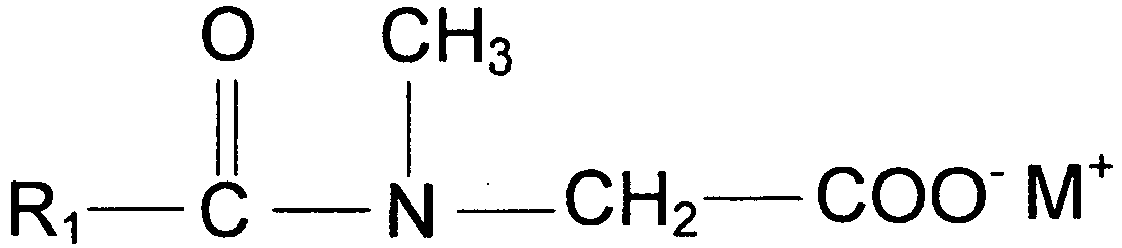
- an aqueous cleansing composition comprising at least one glutamate surfactant according to the general formula wherein R 1 is a saturated or unsaturated, straight or branched alkyl chain with 7 to 17 C atoms, preferably 9 to 13 C atoms, and M is H, sodium or potassium, and at least one sarcosinate surfactant according to the general formula wherein R 1 is a saturated or unsaturated, straight or branched alkyl chain with 7 to 17 C atoms, preferably 9 to 13 C atoms and M is H, sodium or potassium and free from alkyl sulphate and alkyl ether sulphate type of surfactants washes less colour out from hair so that long lasting colours are achieved and also provides excellent foam and conditioning properties to hair.
- the first object of the present invention is an aqueous cleansing composition according to claim 1 comprising at least one glutamate surfactant according to the general formula wherein R 1 is a saturated or unsaturated, straight or branched alkyl chain with 7 to 17 C atoms, and preferably 9 to 13 C atoms, and M is H, sodium or potassium, and at least one sarcosinate surfactant according to the general formula wherein R 1 is a saturated or unsaturated, straight or branched alkyl chain with 7 to 17 C atoms, and preferably 9 to 13 C atoms and M is H, sodium or potassium and free from alkyl sulphate and alkyl ether sulphate type of surfactants.
- glutamate surfactant according to the general formula wherein R 1 is a saturated or unsaturated, straight or branched alkyl chain with 7 to 17 C atoms, and preferably 9 to 13 C atoms, and M is H, sodium or potassium and free from alkyl sulphate and al
- aqueous cleansing composition of the present invention for cleansing and reducing colour wash out from artificially coloured hair.
- the cleansing composition of the present invention is reducing colour wash out from artificially coloured hair, it is beneficial to include the cleansing composition of the present invention in a colouring process wherein hair is washed with a cleansing composition.
- further object of the present invention is a process for colouring hair wherein a colouring composition is applied onto hair and after a processing of 1 to 45 min rinsed off from hair and subsequently washed with a cleansing composition of the present invention.
- still another object of the present invention is a hair colouring kit comprising one or more colouring composition and comprising an aqueous cleansing composition of the present invention.
- the concentration of amino acid surfactant is from 5 to 15% by weight, calculated to total composition.
- concentrations mentioned here are total concentration ranges in case more than one amino acid surfactant is present.
- Suitable glutamate surfactants are according to the general formula wherein R 1 is a saturated or unsaturated, straight or branched alkyl chain with 7 to 17 C atoms, preferably 9 to 13 C atoms, and M H, sodium or potassium.
- Suitable examples are dipotassium capryloyl glutamate, dipotassium undecylenoyl glutamate, disodium capryloyl glutamate, disodium cocoyl glutamate, disodium lauroyl glutamate, disodium stearoyl glutamate, disodium undecylenoyl glutamate, potassium capryloyl glutamate, potassium cocoyl glutamate, potassium lauroyl glutamate, potassium myristoyl glutamate, potassium stearoyl glutamate, potassium undecylenoyl glutamate, sodium capryloyl glutamate, sodium cocoyl glutamate, sodium lauroyl glutamate, sodium myristoyl glutamate, potassium
- disodium capryloyl glutamate disodium cocoyl glutamate, disodium lauroyl glutamate, potassium capryloyl glutamate, potassium cocoyl glutamate, potassium lauroyl glutamate, sodium capryloyl glutamate, sodium cocoyl glutamate, and sodium lauroyl glutamate and mixtures thereof.
- Suitable sarcosinate surfactants are according to the general formula wherein R 1 is a saturated or unsaturated, straight or branched alkyl chain with 7 to 17 C atoms, preferably 9 to 13 C atoms, and M is H, sodium or potassium. Suitable examples are potassium lauroyl sarcosinate, potassium cocoyl sarcosinate, sodium cocoyl sarcosinate, sodium lauroyl sarcosinate, sodium myristoyl sarcosinate, and sodium palmitoyl sarcosinate and mixtures thereof.
- potassium lauroyl sarcosinate potassium cocoyl sarcosinate, sodium cocoyl sarcosinate, and sodium lauroyl sarcosinate and mixtures thereof. More preferred are sodium cocoyl sarcosinate, and sodium lauroyl sarcosinate and mixtures thereof.
- aqueous cleansing composition comprise at least one sarcosinate and at least one glutamate surfactant mentioned above.
- at least one sarcosinate surfactant is selected from sodium cocoyl sarcosinate, and sodium lauroyl sarcosinate and mixtures thereof
- glutamate surfactant is selected from disodium cocoyl glutamate, disodium lauroyl glutamate, sodium capryloyl glutamate, sodium cocoyl glutamate, and sodium lauroyl glutamate and mixtures thereof.
- cleansing composition of the present invention comprises additionally at least one amphoteric surfactant.
- Amphoteric surfactants are present at a concentration of 0.5% to 20 %, preferably 1% to 15%, more preferably 1 to 12.5% and most preferably 2 to 10% by weight, calculated to the total composition. It has especially been found out that addition of amphoteric surfactants enhances foam feeling in terms of creaminess, foam volume and as well as skin compatibility are also improved.
- betaines such as alkyl betaines, fatty acid amidoalkyl betaines and sulfobetaines, for example, lauryl hydroxysulfobetaine; long-chain alkyl amino acids, such as cocoaminoacetate, cocoaminopropionate and sodium cocoamphopropionate and -acetate have also proven suitable.
- suitable betaine surfactants are of general structure wherein R 10 is a C 8 -C 18 -alkyl group and n is 1 to 3; sulfobetaines of the structure wherein R 10 and n are same as above; and amidoalkyl betaines of the structure wherein R 10 and n are same as above.
- amphoteric surfactants are alkyl betaines such as lauryl betaine and alkyl amido betaines such as cocamidopropyl betaine.
- cleansing composition comprises additionally at least one non-ionic surfactant especially an alkyl polyglucoside type.
- Concentration of at least one non-ionic surfactant is in the range of 0.1 to 15%, more preferably 0.2 to 12.5%, more preferably 0.2 to 10% and most preferably 0.5 to 7.5% by weight calculated to total composition.
- Nonionic surfactants especially suited in the cleansing compositions according to the invention are alkyl polyglucosides of the general formula R 8 -O-(R 9 O) n -Z x , wherein R 8 is an alkyl group with 8 to 18 carbon atoms, R 9 is an ethylene or propylene group, Z is a saccharide group with 5 to 6 carbon atoms, n is a number from 0 to 10 and x is a number between 1 and 5.
- alkyl polyglucosides are known in particular as excellent skin-compatible, foam improving agents in liquid detergents and body cleansing compositions. Mixtures of anionic surfactants and alkyl polyglucosides as well as the use thereof in liquid body cleansing compositions are already known, for example, from EP-A 70 074 .
- the alkyl polyglucosides disclosed therein are basically also suited within the scope of the present invention; as well as the mixtures of sulfosuccinates and alkyl polyglucosides disclosed in EP-A 358 216 .
- nonionic surfactants are, suitable for the cleansing compositions of the present invention, long-chain fatty acid dialkanolamides, such as coco fatty acid diethanolamide and myristic fatty acid diethanolamide.
- nonionic surfactants are, for example, the various sorbitan esters, such as polyethylene glycol sorbitan stearic acid ester, fatty acid polyglycol esters or poly-condensates of ethyleneoxide and propyleneoxide, as they are on the market, for example, under the trade name "Pluronics R ", as well as fatty alcohol ethoxylates.
- sorbitan esters such as polyethylene glycol sorbitan stearic acid ester, fatty acid polyglycol esters or poly-condensates of ethyleneoxide and propyleneoxide, as they are on the market, for example, under the trade name "Pluronics R ", as well as fatty alcohol ethoxylates.
- amineoxides are state of the art, for example C 12 -C 18 - alkyl dimethyl amineoxides such as lauryl dimethyl amineoxide, C 12 -C 18 - alkyl amidopropyl or -ethyl amineoxides, C 12 -C 18 -alkyl di(hydroxyethyl) or (hydroxypropyl) amineoxides, or also amineoxides with ethyleneoxide and/or propyleneoxide groups in the alkyl chain.
- Such amineoxides are on the market, for example, under the trade names "Ammonyx ® ", "Aromox ® " or "Genaminox ® ".
- nonionic surfactants useful in the compositions according to invention are C 10 -C 22 -fatty alcohol ethoxylate.
- C 10 -C 22 -fatty alcohol ethers the alkyl polyglycol ethers known by the generic terms "Laureth”, “Myristeth”, “Oleth”, “Ceteth”, “Deceth”, “Steareth” and “Ceteareth” according to the CTFA nomenclature, including addition of the number of ethylene oxide molecules, e.g., "Laureth-16”: The average degree of ethoxylation thereby ranges between about 2.5 and about 25, preferably about 10 and about 20.
- non-ionic surfactants are alkyl polyglucosides such as decyl, cocoyl polyglucoside and ethoxylated fatty alcohols such as laureth-16.
- Cleansing composition of the present invention is substantially free of alkyl sulphate and alkyl ether sulphate surfactants but can comprise other anionic surfactants.
- Suitable surfactants of the carboxylate type are alkyl polyether carboxylic acids and the salts thereof of the formula R 7 -(C 2 H 4 O) n -O-CH 2 COOX, wherein R 7 is a C 8 -C 20 -alkyl group, preferably a C 12 -C 14 -alkyl group, n is a number from 1 to 20, preferably 2 to 17, and X is H or preferably a cation of the group sodium, potassium, magnesium and ammonium, which can optionally be hydroxyalkyl-substituted, as well as alkyl amido polyether carboxylic acids of the general formula wherein R and X have the above meanings, and n is in particular a number from 1 to 10, preferably 2.5 to 5.
- Concentration of the additional anionic surfactants is in the range of 0.1 to 5% by weight calculated to total composition.
- Cleansing compositions of the present invention comprise surfactants at a total concentration of 5 to 50%, preferably 5 to 40% and more preferably 5 to 30% and most preferably 7.5 to 25% by weight calculated to the total composition.
- the cleansing composition of the present invention comprises hair-conditioning agents according to claim 1.
- the cationic polymers also include the qpaternized products of graft polymers from organopolysiloxanes and polyethyl oxazolines described in EP-A 524 612 and EP-A 640 643 .
- cleansing compositions of the present invention may comprise additionally one or more cationic surfactant(s) as conditioner presented with the general formula where R 13 is a saturated or unsaturated, branched or non-branched alkyl chain with 8-24 C atoms or R 17 CONH(CH 2 ) n where R 17 is saturated or unsaturated, branched or non-branched alkyl chain with 7-21 C atoms and n has value of 1 - 4, or R 18 COO(CH 2 ) n where R 18 is saturated or unsaturated, branched or non-branched alkyl chain with 7-21 C atoms and n has value of 1 - 4, and
- R 14 is hydrogen or unsaturated or saturated, branched or non-branched alkyl chain with 1 - 24 C atoms or R 17 CONH(CH 2 ) n or R 18 COO(CH 2 ) n where R 17 , R 18 and n are same as above.
- R 15 and R 16 are hydrogen or lower alkyl chain with 1 to 4 carbon atoms which may be substituted with one or more hydroxyl groups, and X is anion such as chloride, bromide, methosulfate.
- Typical examples of those ingredients are cetyl trimethly ammonium chloride, stear trimonium chloride, behentrimonium chloride, stearamidopropyl trimonuim chloride, dioleoylethyl dimethyl ammonium methosulfate, dioleoylethyl hydroxyethylmonium methosulfate.
- compositions according to the invention may also comprise further conditioning substances such as protein hydrolyzates and polypeptides, e.g., keratin hydrolyzates, collagen hydrolyzates of the type “Nutrilan R " or elastin hydrolyzates, as well as also in particular plant protein hydrolyzates, optionally, cationized protein hydrolyzates, e.g., "Gluadin R ".
- protein hydrolyzates and polypeptides e.g., keratin hydrolyzates, collagen hydrolyzates of the type "Nutrilan R " or elastin hydrolyzates
- plant protein hydrolyzates e.g., cationized protein hydrolyzates, e.g., "Gluadin R ".
- Typical concentration range for any of those conditioners of cationic polymers, silicone oil and derivatives and cationic surfactants is in the range of 0.01 to 5% by weight, preferably 0.01 to 3.5% by weight, more preferably 0.05 to 2.5% and most preferably 0.1 to 1.5% by weight calculated to the total composition.
- Most preferred conditioning agents are cationic polymers.
- aqueous cleansing composition comprises at least one organic solvent such as ethanol, propanol, isopropanol, benzyl alcohol, benzyloxyethanol, ethoxydiglycol, alkylene carbonates such as ethylene carbonate and propylene carbonate, phenoxyethanol, butanol, isobutanol, cyclohexane, cyclohexanol, hexyleneglycol, ethylenecarbonate, propyleneglycol, polypropyleneglycols, ethyleneglycol monoethylether, ethylene glycol monobutyl ether, ethylene glycol monophenyl ether, 1-phenylethylalcohol, 2-phenylethylalcohol, o-methoxyphenol.
- organic solvent such as ethanol, propanol, isopropanol, benzyl alcohol, benzyloxyethanol, ethoxydiglycol, alkylene carbonates such as ethylene carbonate and propylene carbon
- Total concentration of organic solvents in the shampoo composition should not exceed 5% by weight, preferably in the range of 0.1 to 3%, more preferably 0.5 to 2.5% by weight calculated to total composition.
- Further conditioning additives are hair conditioning and/or styling polymers. These may be nonionic polymers, preferably alcohol- and/or water-soluble vinyl pyrrolidone polymers, such as a vinyl pyrrolidone homopolymers or copolymers, in particular with vinyl acetate.
- Useful vinyl pyrrolidone polymers are, e.g., those known by the trade name “Luviskol ® ", for example, the homopolymers "Luviskol ® K 30, K 60 and K 90", as well as the water-or alcohol-soluble copolymers from vinyl pyrrolidone and vinyl acetate, distributed by BASF AG under the trade name "Luviskol ® VA 55 respectively VA 64".
- nonionic polymers are vinyl pyrrolidone/vinyl acetate/vinyl propionate copolymers such as "Luviskol ® VAP 343", vinyl pyrrolidone/(meth)acrylic acid ester copolymers, as well as chitosan derivatives.
- Amphoteric polymers are found to be useful in conditioning shampoo composition of the present invention. They are incorporated alone or in admixture with at least one additional cationic, nonionic or anionic polymer, particularly copolymers of N-octyl acrylamide, (meth)acrylic acid and tert.-butyl aminoethyl methacrylate of the type "Amphomer ® "; copolymers from methacryl oylethyl betaine and alkyl methacrylates of the type "Yukaformer ® ", e.g., the butyl methacrylate copolymer "Yukaformer ® Am75”; copolymers from monomers containing carboxyl groups and sulfonic groups, e.g., (meth)acrylic acid and itaconic acid, with monomers such as mono- or dialkyl amino alkyl(meth)acrylates or mono- or dialkyl aminoalkyl (meth)acrylamides containing basic groups
- Aqueous cleansing composition of the present invention may comprise at least one glyceryl ether of the following formula wherein R 4 is straight or branched, saturated or unsaturated alkyl chain with 4 to 24 C atoms, preferably 4 to 18 and more preferably 4 to 12 C atoms and R 5 is H, or straight or branched, saturated or unsaturated alkyl chain with 4 to 24 C atoms, 4 to 18 and more preferably 4 to 12 C atoms and most preferably R 5 is H, at a concentration of 0.1 to 15%, preferably 0.1 to 10% and more preferably 0.25 to 7.5% and most preferably 0.5 to 5% by weight calculated to total composition.
- Suitable unlimited examples are glyceryl butyl ether, glyceryl isobutyl ether, glyceryl tert-butyl ether, glyceryl pentyl ether, glyceryl isopentyl ether, glyceryl hexyl ether, glyceryl isohexyl ether, glyceryl heptyl ether, glyceryl octyl ether, glyceryl ethylhexyl ether, glyceryl nonyl ether, glyceryl decyl ether, glyceryl isodecyl ether, glyceryl lauryl ether, glyceryl myristyl ether, glyceryl palmityl ether, glyceryl stearyl ether and glyceryl behenyl ether and their mixtures.
- glyceryl butyl ether glyceryl isobutyl ether, glyceryl tert-butyl ether, glyceryl pentyl ether, glyceryl isopentyl ether, glyceryl hexyl ether, glyceryl isohexyl ether, glyceryl heptyl ether, glyceryl octyl ether, glyceryl ethylhexyl ether, glyceryl nonyl ether, glyceryl decyl ether, glyceryl isodecyl ether are glyceryl lauryl ether, and their mixtures.
- glyceryl decyl ether is used as synonym of decyl glycerine.
- decyl glycerine is used as synonym of decyl glycerine.
- Aqueous cleansing composition of the present invention may further comprise at least one fatty alcohol of the following formula R 6 -OH wherein R 6 is straight or branched, saturated or unsaturated alkyl chain with 8 to 24, preferably 10 to 22, more preferably 12 to 18 and most preferably 12 to 16C atoms at a concentration of 0.1 to 5%, preferably 0.1 to 4% and more preferably 0.25 to 3% and most preferably 0.5 to 2.5% by weight calculated to total composition.
- R 6 is straight or branched, saturated or unsaturated alkyl chain with 8 to 24, preferably 10 to 22, more preferably 12 to 18 and most preferably 12 to 16C atoms at a concentration of 0.1 to 5%, preferably 0.1 to 4% and more preferably 0.25 to 3% and most preferably 0.5 to 2.5% by weight calculated to total composition.
- Suitable non-limiting preferred examples are decyl alcohol, myristyl alcohol, lauryl alcohol, cetyl alcohol, stearyl alcohol, behenyl alcohol, and arachidyl alcohol and their mixtures. More preferred are decyl alcohol, myristyl alcohol, lauryl alcohol, cetyl alcohol, and stearyl alcohol. Most preferred are decyl alcohol, myristyl alcohol and lauryl alcohol, and their mixtures.
- Cleansing composition of the present invention is preferably pearly. Pearl-shiny appearance is achieved with those dispersed in cleansing conditioning compositions in crystalline form, i.e. so called pearl-shine or pearlizing agents.
- the preferred once are PEG-3 distearate and ethylene glycol distearate.
- the concentration of those can typically be from 0.1 to 3%, preferably 0.5 to 2% by weight, calculated to the total composition.
- These compounds are preferably added to the compositions in admixture with anionic, nonionic and/or amphoteric surfactants. Such kinds of mixtures are available commercially.
- Solubilizers may be added to the compositions especially when oily substances are chosen as conditioning agents and fragrance oils with highly lipophilic properties.
- Typical solubilizers may be hydrogenated castor oil known with the trade mark Cremophor CO series from BASF. It should be noted that as well the surfactant mixture can be a good solubilizer for fragrance oils.
- Typical concentration of the solubilizers can be in the range of 0.01 - 2% by weight, preferably 0.1 - 1% by weight, calculated to total composition.
- the cleansing composition may contain active ingredients selected from UV filters, moisturisers, sequestering agents, and natural ingredients.
- the moisturizing agents are selected from panthenol, polyols, such as glycerol, polyethylene glycols with molecular weight 200 to 20,000.
- the moisturizing ingredients can be included in the conditioner compositions at a concentration range of 0.01 - 2.5% by weight calculated to the total composition.
- the sequestering agents are preferably selected from polycarboxy acids.
- the preferred one is ethylene diamine tetraacetic acid, EDTA.
- Typical useful concentration range for sequestering agents is of 0.01 - 2.5% by weight calculated to the total composition.
- the UV filters are that oil and water soluble ones for the purpose of protecting hair and hair colour.
- anionic and non-ionic, oily, UV filters are suitably used in the compositions of the present invention.
- Suitable UV-absorbing substances is are: 4-Aminobenzoic acid and the esters and salts thereof, 2-phenyl benzimidazole-5-sulfonic acid and the alkali and amine salts thereof, 4-dimethyl aminobenzoic acid and the esters and salts thereof, cinnamic acid and the esters and salts thereof, 4-methoxycinnamic acid and the esters and salts thereof, salicylic acid and the esters and salts thereof, 2.4-dihydroxybenzophenone, 2.2'.4.4'-tetrahydroxybenzophenone, 2-hydroxy-4-methoxybenzophenone and its 5-sulfonic acid or the sodium salt thereof, 2.2'-dihydroxy-4.4'-dimethoxybenzophenone, 2-hydroxy-5-chlorobenzophen
- Natural plant extracts are incorporated usually in an amount of about 0.01 % to about 10 %, preferably 0.05 % to 7.5 %, in particular 0.1 % to 5 % by weight, calculated as dry residue thereof to the total composition.
- Suitable aqueous e.g.
- alcoholic or hydro-alcoholic plant extracts known per se are in particular extracts from leaves, fruits, blossoms, roots, rinds or stems of aloe, pineapple, artichoke, arnica, avocado, valerian, bamboo, henbane, birch, stinging nettle, echinacea, ivy, wild angelica, gentian, ferns, pine needles, silver weed, ginseng, broom, oat, rose hip, hamamelis, hay flowers, elderberry, hop, coltsfoot, currants, chamomile, carrots, chestnuts, clover, burr root, cocoanut, cornflower, lime blossom, lily of the valley, marine algae, balm, mistletoe, passion flower, ratanhia, marigold, rosemary, horse chestnut, pink hawthorn, sage, horsetail, yarrow, primrose, nettle, thyme, walnut, wine leaves, white hawthorn, etc.
- compositions of the present invention may comprise further at least one compound according to the formula where n is a number from 1 to 10.
- compositions of the present invention can certainly comprise more than one ubichinone.
- Preferred ubichinones are the ones where n is a number between 6 and 10 and especially preferred is Ubichinone 50 where n is 10, also known as Coenzyme Q10.
- Concentration ubichinone of the above formula in the compositions is from 0.0001 to 1%, preferably from 0.0002 to 0.75%, more preferably from 0.0002 to 0.5% and most preferably from 0.0005 to 0.5% by weight, calculated to total composition.
- Cleansing compositions of the present invention can also comprise synthetic mica as a further shine enhancer.
- Suitable metal oxide or oxides for coating synthetic mica are titanium dioxide, chromium oxide, ferric oxide or mixtures thereof.
- the preferred is synthetic mice coated with titanium dioxide.
- Such materials are commercially available from Sun Chemical Corporation and known with their INCI names Synthetic Fluorphologopite.
- the particle size distribution of synthetic mica coated with a metal oxide or oxides is in the range of 1 to 750 ⁇ m, preferably 1 to 250 ⁇ m, more preferably 1 to 100 ⁇ m and most preferably 20 to 95 ⁇ m.
- the particle sizes referred are relating to the volume particle size distribution meaning that particles found in the coated synthetic mica having volume particle size in the given ranges.
- Concentration of synthetic mica coated with at least metal oxide or oxides is from 0.001 to 10%, preferably 0.05 to 7.5%, more preferably 0.1 to 5% and most preferably 0.20 to 2.5% by weight calculated to total composition.
- compositions comprise at least one direct dye and as well deposit dyestuffs on the hair.
- Suitable direct dyes are of cationic, anionic and neutral nitro dyes. It should be noted that they can also be used in combination with each other.
- a composition according to present invention can comprise an anionic and a cationic dye as well as an anionic and a nitro dye or a cationic and a nitro dye.
- Any cationic direct dye is in principal suitable for the compositions.
- Examples are Basic Blue 6, Basic Blue 7, Basic Blue 9, Basic Blue 26, Basic Blue 41, Basic Blue 99, Basic Brown 4, Basic Brown 16, Basic Brown 17, Natural Brown 7, Basic Green 1, Basic Orange 31, Basic Red 2, Basic Red 12 Basic Red 22, Basic Red 51, Basic Red 76, Basic Violet 1, Basic Violet 2, Basic Violet 3, Basic Violet 10, Basic Violet 14, Basic Yellow 57 and Basic Yellow 87, and mixtures thereof
- Any anionic dye is in principal suitable for the compositions. Suitable examples are such as Acid Black 1, Acid Blue 1, Acid Blue 3, Food Blue 5, Acid Blue 7, Acid Blue 9, Acid Blue 74, Acid Orange 3, Acid Orange 6, Acid Orange 7, Acid Orange 10, Acid Red 1, Acid Red 14, Acid Red 18, Acid Red 27, Acid Red 50, Acid Red 52, Acid Red 73, Acid Red 87, Acid Red 88, Acid Red 92, Acid Red 155, Acid Red 180, Acid Violet 9, Acid Violet 43, Acid Violet 49, Acid Yellow 1, Acid Yellow 23, Acid Yellow 3, Food Yellow No. 8, D&C Brown No. 1, D&C Green No. 5, D&C Green No. 8, D&C Orange No. 4, D&C Orange No. 10, D&C Orange No. 11, D&C Red No. 21, D&C Red No. 27, D&C Red No.
- the preferred anionic dyestuffs are Acid Red 52, Acid Violet 2, Acid Red 33, Acid Orange 4, Acid Red 27 and Acid Yellow 10 and their salts, and mixtures thereof.
- the most preferred anionic dyes are Acid Red 52, Acid Violet 2, Acid Red 33, Acid Orange 4 and Acid Yellow 10, and their salts, and mixtures thereof.
- Neutral dyes so called nitro dyes for shading purposes are also optionally contained in the compositions. Suitable ones are HC Blue No.2, HC Blue No.4, HC Blue No.5, HC Blue No.6, HC Blue No.7, HC Blue No.8, HC Blue No.9, HC Blue No.10, HC Blue No.11, HC Blue No.12, HC Blue No.13, HC Brown No.1, HC Brown No.2, HC Green No.1, HC Orange No.1, HC Orange No.2, HC Orange No.3, HC Orange No.5, HC Red BN, HC Red No.1, HC Red No.3, HC Red No.7, HC Red No.8, HC Red No.9, HC Red No.10, HC Red No.11, HC Red No.13, HC Red No.54, HC Red No.14, HC Violet BS, HC Violet No.1, HC Violet No.2, HC Yellow No.2, HC Yellow No.4, HC Yellow No.5, HC Yellow No
- Concentration of one or more direct dyes in total is in the range of 0.001 to 5% by weight, preferably 0.01 to 4% more preferably 0.05 to 3% and most preferably 0.1 to 2.5% by weight calculated to total composition.
- the most preferred among the direct dyes is cationic direct dyes.
- the shampoos according to the invention may comprise other substances customarily used in such compositions such as preservatives, fragrances.
- the pH of the compositions according to the present invention is suitably between 2 and 8.0, preferably in the range of 2.5 to 7.0, more preferably 3 to 6.5 and most preferably 4 to 5.5 measured at ambient temperature with a suitable pH meter.
- Acidic compounds can be inorganic and organic acid or their mixtures.
- Nonlimiting suitable examples are citric acid, lactic acid, glycolic acid, hydroxyacrylic acid, glyceric acid, malic acid and tartaric acid and of the dicarboxylic acids are malonic acid, succinic acid, glutaric acid, adipic acid, maleic acid, fumaric acid and phtalic acid.
- Alkaline compounds such as sodium hydroxide can be used to adjust the pH of the compositions.
- Cleansing compositions of the present invention can be in the form of conventional liquid thickened shampoo, as well in the form of ready to use foam, delivered either from a pump-foamer or from an aerosol bottle.
- propellant gas must be added to the formulation.
- the suitable propellant gasses are carbondioxide, dimethylether and alkanes such as butane propane or their mixtures.
- Viscosity of shampoo compositions can be adjusted with known viscosity enhancers.
- the preferred ones are monoglycerides such as glyceryl laurate, oleate, and PEG-18 glyceryl oleate/cocoate known with the trade names Antil R 141 and 171, respectively and PEG-160 sorbitan triisostearate known with a trade name Rheodol R .
- glyceryl laurate, oleate, and PEG-18 glyceryl oleate/cocoate known with the trade names Antil R 141 and 171, respectively and PEG-160 sorbitan triisostearate known with a trade name Rheodol R .
- those compositions should not be thickened and have a viscosity value not more than 500 mPa.s, more preferably 250 mPa.s measured as mentioned above at room temperature.
- Cleansing compositions of the present invention preferably has a viscosity in the range of 500 to 20,000 mPa.s, more preferably 1,000 to 15,000 mPa.s and most preferably 1,500 to 10,000 mPa.s measured at 20°C with a Brookfield viscosimeter using fro example Spindle 5 at appropriate rotation speed.
- Aqueous cleansing composition of the present invention can comprises at least one ethoxylated monoglyceride as preferred thickener according to the above general formula wherein R 15 is a saturated or unsaturated and branched or straight alkyl chain with a chain length of 7 to 21 C atoms and x+y+z has a value of 3 to 200.
- R 15 is a saturated or unsaturated and branched or straight alkyl chain with a chain length of 11 to 17 C atoms, more preferably 13 to 17 C atoms and most preferably 15 to 17 C atoms and x+y+z has preferably a value of 10 to 150, more preferably 20 to 100 and most preferably 40 to 90.
- Ethoxalted monogylcerides are known for their thickening ability in the area of hair cleansing compositions.
- WO 03/063818 A1 discloses ethoxylated glycerides as thickening agents in combination with ethoxylated fatty alcohol and ethoxylated partial gylcerides.
- WO 2004/024110 A1 and WO 03/013467 A1 disclose cleansing compositions comprising an ethoxylated monogylceride.
- Non-limiting suitable examples of ethoxylated monoglycerides are PEG-6 glyceryl caprate, PEG-3 glyceryl cocoate, PEG-7 glyceryl cocoate, PEG-30 glyceryl cocoate, PEG-40 glyceryl cocoate, PEG-78 glyceryl cocoate, PEG-80 glyceryl cocoate, PEG-3 glyceryl isostearate, PEG-5 glyceryl isostearate, PEG-6 glyceryl isostearate, PEG-8 glyceryl isostearate, PEG-9 glyceryl isostearate, PEG-10 glyceryl isostearate, PEG-15 glyceryl isostearate, PEG-20 glyceryl isostearate, PEG-25 glyceryl isostearate, PEG-30 glyceryl isostearate, PEG-40 glyceryl isostearate, PEG-50 glyceryl isostearate, P
- fatty acid chain of laurate, isostearate, oleate and stearate are preferred. More preferred are with fatty acid chain of isostearate, oleate and stearate. The most preferred are with fatty acid chain of isostearate and stearate. Especially preferred is with fatty acid chain of isostearate.
- the especially preferred ethoxylated monoglyceride is PEG-90 glyceryl isostearate which is available from Zschimmer & Schwarz under the trade name Oxetal VD 92.
- Concentration of ethoxylated monoglyceride in the compositions of the present invention is in the range of 0.1 to 20%, preferably 0.25 to 15%, more preferably 0.5 to 10% and most preferably 1 to 7.5% by weight, calculated to total composition.
- compositions according to the invention are prepared by mixing the individual components in water, whereby it is also possible to use pre-mixtures of various ingredients.
- Shampoo compositions B and E are according to the invention and A, C and D represents comparative compositions.
- Hair tresses were coloured with a commercially available oxidative colouring composition comprising oxidative and direct dyes.
- the tresses so coloured were washed 10 times with above compositions and before starting the test and afterwards L, a and b values were measured. With the help of the known equation ⁇ E values were calculated to present colour difference numerically.
- cleansing composition comprising two anionic surfactants with amide group in their molecules and substantially free of sulphate surfactant produces lower ⁇ E values.
- compositions delivered similar colour wash out data.
- the above shampoo was judged to have rich and creamy foam and washing out less colour from hair in a monadic test by the volunteers. It was furthermore mentioned that it foams very quickly. Additionally, the hair washed was excellently combable and had good shine.
- composition has excellent creamy rich foam and conditions hair excellently in terms of combability and soft hair feeling and coloured hair was reported to last longer compared to the hair washed with a conventional sulphate surfactant comprising composition.
- fragrance q.s Water to 100 * Synthetic fluorphologopite used is commercially available from Sun Chemical Corporation under the trade name SunShine Glitter White with a particle size distribution in the range of 20 to 95 ⁇ m.
Landscapes
- Health & Medical Sciences (AREA)
- Life Sciences & Earth Sciences (AREA)
- Animal Behavior & Ethology (AREA)
- General Health & Medical Sciences (AREA)
- Public Health (AREA)
- Veterinary Medicine (AREA)
- Birds (AREA)
- Epidemiology (AREA)
- Emergency Medicine (AREA)
- Cosmetics (AREA)
Description
- The present invention is related to an aqueous cleansing composition for keratin fibres, especially human hair, comprising at least two anionic surfactants comprising at least one amide group in their molecules.
- Cleansing compositions have been known for many years. Many patent applications and scientific publications deal with such compositions aiming at cleansing, especially improved conditioning effects after cleansing. Cleansing compositions wash out dirt on the hair and at the same time dyestuffs deposited onto or into hair are also washed out, which leads to shorter colour durability after coloration services and is not economical in terms of frequent hair dressing need and also health of hair. Attempts have been made to reduce colour wash out from coloured hair with various ways. One of them is so called colour sealing which requires application of an additional mostly hydrophobic and/or cationic composition right after colouring hair so that the dyes are not easily solubilised by the high surfactant content of cleansing compositions. The other approach has been to use a special surfactant combination which interacts with dyestuff molecules and also with hair in a lesser extent. None of the approaches are optimal for variably coloured hair and, therefore, there is a great need for further improvements in the field.
- Aim of the present invention is to provide an aqueous cleansing composition having optimal benefits in terms of foam properties such as its volume and creaminess as well as improved conditioning effects on keratin fibres, especially human hair, in terms of combability, smoothness, elasticity, softness, volume and body and at the same time washes out artificial hair colour in a lesser extend so that the coloured hair keeps its colour and therefore shiny and healthy / natural appearance.
- Present inventors have surprisingly found that an aqueous cleansing composition comprising at least one glutamate surfactant according to the general formula

- Accordingly, the first object of the present invention is an aqueous cleansing composition according to claim 1 comprising at least one glutamate surfactant according to the general formula


- Further object of the present invention is the use of an aqueous cleansing composition of the present invention for cleansing and reducing colour wash out from artificially coloured hair.
- Since the effect of the cleansing composition of the present invention is reducing colour wash out from artificially coloured hair, it is beneficial to include the cleansing composition of the present invention in a colouring process wherein hair is washed with a cleansing composition. Accordingly, further object of the present invention is a process for colouring hair wherein a colouring composition is applied onto hair and after a processing of 1 to 45 min rinsed off from hair and subsequently washed with a cleansing composition of the present invention. Furthermore, still another object of the present invention is a hair colouring kit comprising one or more colouring composition and comprising an aqueous cleansing composition of the present invention.
- The concentration of amino acid surfactant is from 5 to 15% by weight, calculated to total composition. The concentrations mentioned here are total concentration ranges in case more than one amino acid surfactant is present.
- Suitable glutamate surfactants are according to the general formula

- Suitable sarcosinate surfactants are according to the general formula

- As mentioned above, in the aqueous cleansing composition comprise at least one sarcosinate and at least one glutamate surfactant mentioned above. In particular at least one sarcosinate surfactant is selected from sodium cocoyl sarcosinate, and sodium lauroyl sarcosinate and mixtures thereof and glutamate surfactant is selected from disodium cocoyl glutamate, disodium lauroyl glutamate, sodium capryloyl glutamate, sodium cocoyl glutamate, and sodium lauroyl glutamate and mixtures thereof.
- In a further preferred embodiment of the present invention, cleansing composition of the present invention comprises additionally at least one amphoteric surfactant. Amphoteric surfactants, are present at a concentration of 0.5% to 20 %, preferably 1% to 15%, more preferably 1 to 12.5% and most preferably 2 to 10% by weight, calculated to the total composition. It has especially been found out that addition of amphoteric surfactants enhances foam feeling in terms of creaminess, foam volume and as well as skin compatibility are also improved.
- Useful as such are in particular the various known betaines such as alkyl betaines, fatty acid amidoalkyl betaines and sulfobetaines, for example, lauryl hydroxysulfobetaine; long-chain alkyl amino acids, such as cocoaminoacetate, cocoaminopropionate and sodium cocoamphopropionate and -acetate have also proven suitable.
- In detail, suitable betaine surfactants are of general structure


sulfobetaines of the structure
and amidoalkyl betaines of the structure
- The most preferred amphoteric surfactants are alkyl betaines such as lauryl betaine and alkyl amido betaines such as cocamidopropyl betaine.
- In a further preferred form of the present invention, cleansing composition comprises additionally at least one non-ionic surfactant especially an alkyl polyglucoside type. Concentration of at least one non-ionic surfactant is in the range of 0.1 to 15%, more preferably 0.2 to 12.5%, more preferably 0.2 to 10% and most preferably 0.5 to 7.5% by weight calculated to total composition.
- Nonionic surfactants especially suited in the cleansing compositions according to the invention are alkyl polyglucosides of the general formula
R8-O-(R9O)n-Zx,
wherein R8 is an alkyl group with 8 to 18 carbon atoms, R9 is an ethylene or propylene group, Z is a saccharide group with 5 to 6 carbon atoms, n is a number from 0 to 10 and x is a number between 1 and 5. - These alkyl polyglucosides are known in particular as excellent skin-compatible, foam improving agents in liquid detergents and body cleansing compositions. Mixtures of anionic surfactants and alkyl polyglucosides as well as the use thereof in liquid body cleansing compositions are already known, for example, from
EP-A 70 074 EP-A 358 216 - Further nonionic surfactants are, suitable for the cleansing compositions of the present invention, long-chain fatty acid dialkanolamides, such as coco fatty acid diethanolamide and myristic fatty acid diethanolamide.
- Further additionally useful nonionic surfactants are, for example, the various sorbitan esters, such as polyethylene glycol sorbitan stearic acid ester, fatty acid polyglycol esters or poly-condensates of ethyleneoxide and propyleneoxide, as they are on the market, for example, under the trade name "PluronicsR", as well as fatty alcohol ethoxylates.
- Further suitable nonionic surfactants are amineoxides. Such amineoxides are state of the art, for example C12-C18- alkyl dimethyl amineoxides such as lauryl dimethyl amineoxide, C12-C18- alkyl amidopropyl or -ethyl amineoxides, C12-C18 -alkyl di(hydroxyethyl) or (hydroxypropyl) amineoxides, or also amineoxides with ethyleneoxide and/or propyleneoxide groups in the alkyl chain. Such amineoxides are on the market, for example, under the trade names "Ammonyx®", "Aromox®" or "Genaminox®".
- Further nonionic surfactants useful in the compositions according to invention are C10-C22-fatty alcohol ethoxylate. Especially suited are C10-C22-fatty alcohol ethers, the alkyl polyglycol ethers known by the generic terms "Laureth", "Myristeth", "Oleth", "Ceteth", "Deceth", "Steareth" and "Ceteareth" according to the CTFA nomenclature, including addition of the number of ethylene oxide molecules, e.g., "Laureth-16":
The average degree of ethoxylation thereby ranges between about 2.5 and about 25, preferably about 10 and about 20. - The most preferred non-ionic surfactants are alkyl polyglucosides such as decyl, cocoyl polyglucoside and ethoxylated fatty alcohols such as laureth-16.
- Cleansing composition of the present invention is substantially free of alkyl sulphate and alkyl ether sulphate surfactants but can comprise other anionic surfactants.
- Suitable surfactants of the carboxylate type are alkyl polyether carboxylic acids and the salts thereof of the formula
R7-(C2H4O)n-O-CH2COOX,
wherein R7 is a C8-C20-alkyl group, preferably a C12-C14-alkyl group, n is a number from 1 to 20, preferably 2 to 17, and X is H or preferably a cation of the group sodium, potassium, magnesium and ammonium, which can optionally be hydroxyalkyl-substituted, as well as alkyl amido polyether carboxylic acids of the general formula
- Such products have been known for some time and are on the market, for example, under the trade name "AKYPO®" and "AKYPO-SOFT®".
- Concentration of the additional anionic surfactants is in the range of 0.1 to 5% by weight calculated to total composition.
- Cleansing compositions of the present invention comprise surfactants at a total concentration of 5 to 50%, preferably 5 to 40% and more preferably 5 to 30% and most preferably 7.5 to 25% by weight calculated to the total composition.
- According to the invention the cleansing composition of the present invention comprises hair-conditioning agents according to claim 1.
- The cationic polymers also include the qpaternized products of graft polymers from organopolysiloxanes and polyethyl oxazolines described in
EP-A 524 612 EP-A 640 643 - Although less preferred, cleansing compositions of the present invention may comprise additionally one or more cationic surfactant(s) as conditioner presented with the general formula

R17CONH(CH2)n
where R17 is saturated or unsaturated, branched or non-branched alkyl chain with 7-21 C atoms and n has value of 1 - 4, or
R18COO(CH2)n
where R18 is saturated or unsaturated, branched or non-branched alkyl chain with 7-21 C atoms and n has value of 1 - 4, and - R14 is hydrogen or unsaturated or saturated, branched or non-branched alkyl chain with 1 - 24 C atoms or
R17CONH(CH2)n
or
R18COO(CH2)n
where R17, R18 and n are same as above. - R15 and R16 are hydrogen or lower alkyl chain with 1 to 4 carbon atoms which may be substituted with one or more hydroxyl groups, and X is anion such as chloride, bromide, methosulfate.
- Typical examples of those ingredients are cetyl trimethly ammonium chloride, stear trimonium chloride, behentrimonium chloride, stearamidopropyl trimonuim chloride, dioleoylethyl dimethyl ammonium methosulfate, dioleoylethyl hydroxyethylmonium methosulfate.
- The compositions according to the invention may also comprise further conditioning substances such as protein hydrolyzates and polypeptides, e.g., keratin hydrolyzates, collagen hydrolyzates of the type "NutrilanR" or elastin hydrolyzates, as well as also in particular plant protein hydrolyzates, optionally, cationized protein hydrolyzates, e.g., "GluadinR".
- Typical concentration range for any of those conditioners of cationic polymers, silicone oil and derivatives and cationic surfactants is in the range of 0.01 to 5% by weight, preferably 0.01 to 3.5% by weight, more preferably 0.05 to 2.5% and most preferably 0.1 to 1.5% by weight calculated to the total composition. Most preferred conditioning agents are cationic polymers.
- In another preferred form of the invention, aqueous cleansing composition comprises at least one organic solvent such as ethanol, propanol, isopropanol, benzyl alcohol, benzyloxyethanol, ethoxydiglycol, alkylene carbonates such as ethylene carbonate and propylene carbonate, phenoxyethanol, butanol, isobutanol, cyclohexane, cyclohexanol, hexyleneglycol, ethylenecarbonate, propyleneglycol, polypropyleneglycols, ethyleneglycol monoethylether, ethylene glycol monobutyl ether, ethylene glycol monophenyl ether, 1-phenylethylalcohol, 2-phenylethylalcohol, o-methoxyphenol. The most preferred ones are benzyl alcohol and polypropylene glycols. Total concentration of organic solvents in the shampoo composition should not exceed 5% by weight, preferably in the range of 0.1 to 3%, more preferably 0.5 to 2.5% by weight calculated to total composition.
- Further conditioning additives are hair conditioning and/or styling polymers. These may be nonionic polymers, preferably alcohol- and/or water-soluble vinyl pyrrolidone polymers, such as a vinyl pyrrolidone homopolymers or copolymers, in particular with vinyl acetate. Useful vinyl pyrrolidone polymers are, e.g., those known by the trade name "Luviskol®", for example, the homopolymers "Luviskol® K 30, K 60 and K 90", as well as the water-or alcohol-soluble copolymers from vinyl pyrrolidone and vinyl acetate, distributed by BASF AG under the trade name "Luviskol® VA 55 respectively VA 64". Further possible nonionic polymers are vinyl pyrrolidone/vinyl acetate/vinyl propionate copolymers such as "Luviskol® VAP 343", vinyl pyrrolidone/(meth)acrylic acid ester copolymers, as well as chitosan derivatives.
- Amphoteric polymers are found to be useful in conditioning shampoo composition of the present invention. They are incorporated alone or in admixture with at least one additional cationic, nonionic or anionic polymer, particularly copolymers of N-octyl acrylamide, (meth)acrylic acid and tert.-butyl aminoethyl methacrylate of the type "Amphomer®"; copolymers from methacryl oylethyl betaine and alkyl methacrylates of the type "Yukaformer®", e.g., the butyl methacrylate copolymer "Yukaformer® Am75"; copolymers from monomers containing carboxyl groups and sulfonic groups, e.g., (meth)acrylic acid and itaconic acid, with monomers such as mono- or dialkyl amino alkyl(meth)acrylates or mono- or dialkyl aminoalkyl (meth)acrylamides containing basic groups, in particular amino groups; copolymers from N-octyl acrylamide, methyl methacrylate, hydroxypropyl methacrylate, N-tert.-butyl aminoethyl - methacrylate and acrylic acid, as well as the copolymers known from
US-A 3,927,199 , are applicable. - Aqueous cleansing composition of the present invention may comprise at least one glyceryl ether of the following formula

- Suitable unlimited examples are glyceryl butyl ether, glyceryl isobutyl ether, glyceryl tert-butyl ether, glyceryl pentyl ether, glyceryl isopentyl ether, glyceryl hexyl ether, glyceryl isohexyl ether, glyceryl heptyl ether, glyceryl octyl ether, glyceryl ethylhexyl ether, glyceryl nonyl ether, glyceryl decyl ether, glyceryl isodecyl ether, glyceryl lauryl ether, glyceryl myristyl ether, glyceryl palmityl ether, glyceryl stearyl ether and glyceryl behenyl ether and their mixtures. Most preferred are glyceryl butyl ether, glyceryl isobutyl ether, glyceryl tert-butyl ether, glyceryl pentyl ether, glyceryl isopentyl ether, glyceryl hexyl ether, glyceryl isohexyl ether, glyceryl heptyl ether, glyceryl octyl ether, glyceryl ethylhexyl ether, glyceryl nonyl ether, glyceryl decyl ether, glyceryl isodecyl ether are glyceryl lauryl ether, and their mixtures.
- It should be noted that within the disclosure of the present description, glyceryl decyl ether is used as synonym of decyl glycerine. For the other compounds in the above paragraph the same is valid.
- Aqueous cleansing composition of the present invention may further comprise at least one fatty alcohol of the following formula
R6-OH
wherein R6 is straight or branched, saturated or unsaturated alkyl chain with 8 to 24, preferably 10 to 22, more preferably 12 to 18 and most preferably 12 to 16C atoms at a concentration of 0.1 to 5%, preferably 0.1 to 4% and more preferably 0.25 to 3% and most preferably 0.5 to 2.5% by weight calculated to total composition. - Suitable non-limiting preferred examples are decyl alcohol, myristyl alcohol, lauryl alcohol, cetyl alcohol, stearyl alcohol, behenyl alcohol, and arachidyl alcohol and their mixtures. More preferred are decyl alcohol, myristyl alcohol, lauryl alcohol, cetyl alcohol, and stearyl alcohol. Most preferred are decyl alcohol, myristyl alcohol and lauryl alcohol, and their mixtures.
- Cleansing composition of the present invention is preferably pearly. Pearl-shiny appearance is achieved with those dispersed in cleansing conditioning compositions in crystalline form, i.e. so called pearl-shine or pearlizing agents. The preferred once are PEG-3 distearate and ethylene glycol distearate. The concentration of those can typically be from 0.1 to 3%, preferably 0.5 to 2% by weight, calculated to the total composition. These compounds are preferably added to the compositions in admixture with anionic, nonionic and/or amphoteric surfactants. Such kinds of mixtures are available commercially.
- Solubilizers may be added to the compositions especially when oily substances are chosen as conditioning agents and fragrance oils with highly lipophilic properties. Typical solubilizers may be hydrogenated castor oil known with the trade mark Cremophor CO series from BASF. It should be noted that as well the surfactant mixture can be a good solubilizer for fragrance oils. Typical concentration of the solubilizers can be in the range of 0.01 - 2% by weight, preferably 0.1 - 1% by weight, calculated to total composition.
- The cleansing composition may contain active ingredients selected from UV filters, moisturisers, sequestering agents, and natural ingredients.
- The moisturizing agents are selected from panthenol, polyols, such as glycerol, polyethylene glycols with molecular weight 200 to 20,000. The moisturizing ingredients can be included in the conditioner compositions at a concentration range of 0.01 - 2.5% by weight calculated to the total composition.
- The sequestering agents are preferably selected from polycarboxy acids. The preferred one is ethylene diamine tetraacetic acid, EDTA. Typical useful concentration range for sequestering agents is of 0.01 - 2.5% by weight calculated to the total composition.
- The UV filters are that oil and water soluble ones for the purpose of protecting hair and hair colour. In other words, anionic and non-ionic, oily, UV filters are suitably used in the compositions of the present invention. Suitable UV-absorbing substances is are: 4-Aminobenzoic acid and the esters and salts thereof, 2-phenyl benzimidazole-5-sulfonic acid and the alkali and amine salts thereof, 4-dimethyl aminobenzoic acid and the esters and salts thereof, cinnamic acid and the esters and salts thereof, 4-methoxycinnamic acid and the esters and salts thereof, salicylic acid and the esters and salts thereof, 2.4-dihydroxybenzophenone, 2.2'.4.4'-tetrahydroxybenzophenone, 2-hydroxy-4-methoxybenzophenone and its 5-sulfonic acid or the sodium salt thereof, 2.2'-dihydroxy-4.4'-dimethoxybenzophenone, 2-hydroxy-5-chlorobenzophenone, 2.2'-dihydroxy-4-methoxybenzophenone, 2.2'-dihydroxy-4.4'-dimethoxy-5.5'-disulfobenzo-phenone or the sodium salt thereof, 2-hydroxy-4-octyloxybenzophenone, 2-hydroxy-4-methoxy-4'-methylbenzophenone, 3-benzyl-idenecampher, 3-(4'-sulfo)-benzyl-idenebornane-2-one and the salts thereof, 3-(4'-methyl benzylidene)-DL-campher, and/or polysilicone-15. The amount of the UV-absorber ranges typically from about 0.01 % to 2.5%, more preferably from 0.05 % to 1 % by weight, calculated to the total composition.
- Natural plant extracts are incorporated usually in an amount of about 0.01 % to about 10 %, preferably 0.05 % to 7.5 %, in particular 0.1 % to 5 % by weight, calculated as dry residue thereof to the total composition. Suitable aqueous (e.g. steam-distilled) alcoholic or hydro-alcoholic plant extracts known per se are in particular extracts from leaves, fruits, blossoms, roots, rinds or stems of aloe, pineapple, artichoke, arnica, avocado, valerian, bamboo, henbane, birch, stinging nettle, echinacea, ivy, wild angelica, gentian, ferns, pine needles, silver weed, ginseng, broom, oat, rose hip, hamamelis, hay flowers, elderberry, hop, coltsfoot, currants, chamomile, carrots, chestnuts, clover, burr root, cocoanut, cornflower, lime blossom, lily of the valley, marine algae, balm, mistletoe, passion flower, ratanhia, marigold, rosemary, horse chestnut, pink hawthorn, sage, horsetail, yarrow, primrose, nettle, thyme, walnut, wine leaves, white hawthorn, etc. Suitable trade products are, for example, various "Extrapone®" products, and "HerbasolR". Extracts and the preparation thereof are also described in "Hagers Handbuch der pharmazeutischen Praxis", 4th Ed..
- Compositions of the present invention may comprise further at least one compound according to the formula

- The compounds of the above formula are known as Ubiquinone, and also are known as Coenzyme. It should be noted that the compositions of the present invention can certainly comprise more than one ubichinone. Preferred ubichinones are the ones where n is a number between 6 and 10 and especially preferred is Ubichinone 50 where n is 10, also known as Coenzyme Q10. Concentration ubichinone of the above formula in the compositions is from 0.0001 to 1%, preferably from 0.0002 to 0.75%, more preferably from 0.0002 to 0.5% and most preferably from 0.0005 to 0.5% by weight, calculated to total composition.
- Cleansing compositions of the present invention can also comprise synthetic mica as a further shine enhancer.
- Suitable metal oxide or oxides for coating synthetic mica are titanium dioxide, chromium oxide, ferric oxide or mixtures thereof. In the present invention the preferred is synthetic mice coated with titanium dioxide. Such materials are commercially available from Sun Chemical Corporation and known with their INCI names Synthetic Fluorphologopite.
- The particle size distribution of synthetic mica coated with a metal oxide or oxides is in the range of 1 to 750 µm, preferably 1 to 250 µm, more preferably 1 to 100 µm and most preferably 20 to 95 µm. The particle sizes referred are relating to the volume particle size distribution meaning that particles found in the coated synthetic mica having volume particle size in the given ranges.
- Concentration of synthetic mica coated with at least metal oxide or oxides is from 0.001 to 10%, preferably 0.05 to 7.5%, more preferably 0.1 to 5% and most preferably 0.20 to 2.5% by weight calculated to total composition.
- It has further been found out that deposition of especially direct dyes onto hair is also surprisingly very good so that the compositions comprising two anionic surfactants comprising at least one amide group in their molecules and free of alkyl sulphate and alkyl ether sulphate surfactants can also be used colour enhancing cleansing composition. Therefore, in another preferred embodiment of the present invention, compositions comprise at least one direct dye and as well deposit dyestuffs on the hair. Suitable direct dyes are of cationic, anionic and neutral nitro dyes. It should be noted that they can also be used in combination with each other. In other words a composition according to present invention can comprise an anionic and a cationic dye as well as an anionic and a nitro dye or a cationic and a nitro dye. Certainly the combination of all three dyestuff categories is also possible.
- Any cationic direct dye is in principal suitable for the compositions. Examples are Basic Blue 6, Basic Blue 7, Basic Blue 9, Basic Blue 26, Basic Blue 41, Basic Blue 99, Basic Brown 4, Basic Brown 16, Basic Brown 17, Natural Brown 7, Basic Green 1, Basic Orange 31, Basic Red 2, Basic Red 12 Basic Red 22, Basic Red 51, Basic Red 76, Basic Violet 1, Basic Violet 2, Basic Violet 3, Basic Violet 10, Basic Violet 14, Basic Yellow 57 and Basic Yellow 87, and mixtures thereof
- Any anionic dye is in principal suitable for the compositions. Suitable examples are such as Acid Black 1, Acid Blue 1, Acid Blue 3, Food Blue 5, Acid Blue 7, Acid Blue 9, Acid Blue 74, Acid Orange 3, Acid Orange 6, Acid Orange 7, Acid Orange 10, Acid Red 1, Acid Red 14, Acid Red 18, Acid Red 27, Acid Red 50, Acid Red 52, Acid Red 73, Acid Red 87, Acid Red 88, Acid Red 92, Acid Red 155, Acid Red 180, Acid Violet 9, Acid Violet 43, Acid Violet 49, Acid Yellow 1, Acid Yellow 23, Acid Yellow 3, Food Yellow No. 8, D&C Brown No. 1, D&C Green No. 5, D&C Green No. 8, D&C Orange No. 4, D&C Orange No. 10, D&C Orange No. 11, D&C Red No. 21, D&C Red No. 27, D&C Red No. 33, D&C Violet 2, D&C Yellow No. 7, D&C Yellow No. 8, D&C Yellow No. 10, FD&C Red 2, FD&C Red 40, FD&C Red No. 4, FD&C Yellow No. 6, FD&C Blue 1, Food Black 1, Food Black 2, Disperse Black 9 and Disperse Violet 1 and their alkali metal salts such as sodium, potassium, and mixtures thereof.
- Among those, the preferred anionic dyestuffs are Acid Red 52, Acid Violet 2, Acid Red 33, Acid Orange 4, Acid Red 27 and Acid Yellow 10 and their salts, and mixtures thereof. The most preferred anionic dyes are Acid Red 52, Acid Violet 2, Acid Red 33, Acid Orange 4 and Acid Yellow 10, and their salts, and mixtures thereof.
- Neutral dyes, so called nitro dyes for shading purposes are also optionally contained in the compositions. Suitable ones are HC Blue No.2, HC Blue No.4, HC Blue No.5, HC Blue No.6, HC Blue No.7, HC Blue No.8, HC Blue No.9, HC Blue No.10, HC Blue No.11, HC Blue No.12, HC Blue No.13, HC Brown No.1, HC Brown No.2, HC Green No.1, HC Orange No.1, HC Orange No.2, HC Orange No.3, HC Orange No.5, HC Red BN, HC Red No.1, HC Red No.3, HC Red No.7, HC Red No.8, HC Red No.9, HC Red No.10, HC Red No.11, HC Red No.13, HC Red No.54, HC Red No.14, HC Violet BS, HC Violet No.1, HC Violet No.2, HC Yellow No.2, HC Yellow No.4, HC Yellow No.5, HC Yellow No.6, HC Yellow No.7, HC Yellow No.8, HC Yellow No.9, HC Yellow No.10, HC Yellow No.11, HC Yellow No.12, HC Yellow No.13, HC Yellow No.14, HC Yellow No.15, 2- Amino-6-chloro-4-nitrophenol, picramic acid, 1,2-Diamino-4-nitrobenzol, 1,4-Diamino-2-nitrobenzol, 3-Nitro-4-aminophenol, 1-Hydroxy-2-amino-3-nitrobenzol and 2-hydroxyethylpicramic acid, and mixtures thereof.
- Concentration of one or more direct dyes in total is in the range of 0.001 to 5% by weight, preferably 0.01 to 4% more preferably 0.05 to 3% and most preferably 0.1 to 2.5% by weight calculated to total composition. The most preferred among the direct dyes is cationic direct dyes.
- It is self-understood that the shampoos according to the invention may comprise other substances customarily used in such compositions such as preservatives, fragrances.
- The pH of the compositions according to the present invention is suitably between 2 and 8.0, preferably in the range of 2.5 to 7.0, more preferably 3 to 6.5 and most preferably 4 to 5.5 measured at ambient temperature with a suitable pH meter.
- pH of the compositions is adjusted with acidic and alkaline compounds. Acidic compounds can be inorganic and organic acid or their mixtures. Nonlimiting suitable examples are citric acid, lactic acid, glycolic acid, hydroxyacrylic acid, glyceric acid, malic acid and tartaric acid and of the dicarboxylic acids are malonic acid, succinic acid, glutaric acid, adipic acid, maleic acid, fumaric acid and phtalic acid. Alkaline compounds such as sodium hydroxide can be used to adjust the pH of the compositions.
- Cleansing compositions of the present invention can be in the form of conventional liquid thickened shampoo, as well in the form of ready to use foam, delivered either from a pump-foamer or from an aerosol bottle. In the case that an aerosol foam preparation is preferred, propellant gas must be added to the formulation. The suitable propellant gasses are carbondioxide, dimethylether and alkanes such as butane propane or their mixtures.
- Viscosity of shampoo compositions can be adjusted with known viscosity enhancers. The preferred ones are monoglycerides such as glyceryl laurate, oleate, and PEG-18 glyceryl oleate/cocoate known with the trade names AntilR 141 and 171, respectively and PEG-160 sorbitan triisostearate known with a trade name RheodolR. It should be noted that in the case that a composition are delivered in the form of a foam from a pump-foamer and/or aerosol can, those compositions should not be thickened and have a viscosity value not more than 500 mPa.s, more preferably 250 mPa.s measured as mentioned above at room temperature.
- Cleansing compositions of the present invention preferably has a viscosity in the range of 500 to 20,000 mPa.s, more preferably 1,000 to 15,000 mPa.s and most preferably 1,500 to 10,000 mPa.s measured at 20°C with a Brookfield viscosimeter using fro example Spindle 5 at appropriate rotation speed.
- Aqueous cleansing composition of the present invention can comprises at least one ethoxylated monoglyceride as preferred thickener according to the above general formula

- Ethoxalted monogylcerides are known for their thickening ability in the area of hair cleansing compositions. For example
WO 03/063818 A1 WO 2004/024110 A1 andWO 03/013467 A1 - Non-limiting suitable examples of ethoxylated monoglycerides are PEG-6 glyceryl caprate, PEG-3 glyceryl cocoate, PEG-7 glyceryl cocoate, PEG-30 glyceryl cocoate, PEG-40 glyceryl cocoate, PEG-78 glyceryl cocoate, PEG-80 glyceryl cocoate, PEG-3 glyceryl isostearate, PEG-5 glyceryl isostearate, PEG-6 glyceryl isostearate, PEG-8 glyceryl isostearate, PEG-9 glyceryl isostearate, PEG-10 glyceryl isostearate, PEG-15 glyceryl isostearate, PEG-20 glyceryl isostearate, PEG-25 glyceryl isostearate, PEG-30 glyceryl isostearate, PEG-40 glyceryl isostearate, PEG-50 glyceryl isostearate, PEG-60 glyceryl isostearate, PEG-90 glyceryl isostearate, PEG-7 glyceryl laurate, PEG-8 glyceryl laurate, PEG-12 glyceryl laurate, PEG-15 glyceryl laurate, PEG-20 glyceryl laurate, PEG-23 glyceryl laurate, PEG-30 glyceryl laurate, PEG-5 glyceryl oleate, PEG-10 glyceryl oleate, PEG-15 glyceryl oleate, PEG-20 glyceryl oleate, PEG-25 glyceryl oleate, PEG-30 glyceryl oleate, PEG-15 glyceryl ricinoleate, PEG-20 glyceryl ricinoleate, PEG-5 glyceryl sesquioleate, PEG-7 glyceryl soyate, PEG-30 glyceryl soyate, PEG-5 glyceryl stearate, PEG-10 glyceryl stearate, PEG-15 glyceryl stearate, PEG-20 glyceryl stearate, PEG-25 glyceryl stearate, PEG-30 glyceryl stearate, PEG-40 glyceryl stearate, PEG-60 glyceryl stearate, PEG-120 glyceryl stearate, PEG-200 glyceryl stearate, PEG-28 glyceryl tallowate, PEG-80 glyceryl tallowate, PEG-82 glyceryl tallowate, PEG-130 glyceryl tallowate and PEG-200 glyceryl tallowate.
- Among the ethoxylated monogylcerides, with fatty acid chain of laurate, isostearate, oleate and stearate are preferred. More preferred are with fatty acid chain of isostearate, oleate and stearate. The most preferred are with fatty acid chain of isostearate and stearate. Especially preferred is with fatty acid chain of isostearate.
- The especially preferred ethoxylated monoglyceride is PEG-90 glyceryl isostearate which is available from Zschimmer & Schwarz under the trade name Oxetal VD 92.
- Concentration of ethoxylated monoglyceride in the compositions of the present invention is in the range of 0.1 to 20%, preferably 0.25 to 15%, more preferably 0.5 to 10% and most preferably 1 to 7.5% by weight, calculated to total composition.
- The following examples are to illustrate the invention, but not to limit. The compositions according to the invention are prepared by mixing the individual components in water, whereby it is also possible to use pre-mixtures of various ingredients.
-
Table I: Comparative aqueous cleansing compositions % by weight A B C D E Sodium laureth sulfate 4 - - - - Cocamidopropyl betaine 6 7 8.5 8.5 8.5 Coco glucoside 1 1.5 2.5 2.5 2.5 Sodium cocoyl glutamate 2 3.5 7 - 3.5 Sodium lauroyl sarcosinate 5 6 - 7 3.5 Polyqaurternium-10 1 1 1 1 1 Citric acid q.s to pH 5.0 Preservative, fragrance q.s. Water q.s. to 100 - Shampoo compositions B and E are according to the invention and A, C and D represents comparative compositions.
- Hair tresses were coloured with a commercially available oxidative colouring composition comprising oxidative and direct dyes. The tresses so coloured were washed 10 times with above compositions and before starting the test and afterwards L, a and b values were measured. With the help of the known equation ΔE values were calculated to present colour difference numerically.
- Results are presented in Table II.
Table II: Results of colour wash out test. Composition ΔE A 17.26 B 10.01 C 16.93 D 14.92 E 11.25 - It should be noted that the higher the ΔE value the larger the colour difference between the two tresses. In the opposite, the smaller the ΔE value the smaller the colour difference between the two tresses. From the above results, it is clear that cleansing composition comprising two anionic surfactants with amide group in their molecules and substantially free of sulphate surfactant produces lower ΔE values.
- The following compositions delivered similar colour wash out data.
-
% by weight Cocamidopropyl betaine 7.0 Sodium lauroyl glutamate 3.5 Sodium cocoyl sarcosinate 6.0 Decyl glucoside 2.0 Polyquaternium-6 0.5 Benzophenone-3 0.3 PEG-90 glyceryl isostearate 3.0 Citric acid/sodium hydroxide q.s. to pH 5.5 Preservative, fragrance q.s Water to 100 - The above shampoo was judged to have rich and creamy foam and washing out less colour from hair in a monadic test by the volunteers. It was furthermore mentioned that it foams very quickly. Additionally, the hair washed was excellently combable and had good shine.
-
% by weight Sodium lauroyl sarcosinate 9.0 Cocyl glucoside 2.0 Sodium lauroyl glutamate 4.0 Ethylhexyl glycerine 0.8 Dimethicone 0.2 Hydroxypropylguarhydroxy-propyltrimonium chloride 0.7 PEG-18 Glyceryl oleate/cocoate 1.0 Citric acid/sodium hydroxide q.s. to pH 5.5 Preservative, fragrance q.s Water to 100 - The above composition has excellent creamy rich foam and conditions hair excellently in terms of combability and soft hair feeling and coloured hair was reported to last longer compared to the hair washed with a conventional sulphate surfactant comprising composition.
- Similar results were obtained with the compositions in the examples below.
-
% by weight Cocyl glucoside 3.0 Cocoyl betaine 5.0 Sodium lauroyl glutamate 4.0 Sodium lauroyl sarcosinate 5.0 Ethylhexyl glycerine 1.5 Lauryl alcohol 0.7 Polyquaternium-10 0.5 Dimethicone 0.5 Ubiquinone 0.1 PEG-90 glyceryl isostearate 1.2 PPG-9 2.0 Citric acid/sodium hydroxide q.s. to pH 5.0 Preservative, fragrance q.s Water to 100 -
% by weight Sodium lauroyl sarcosinate 8.0 Cocoyl polyglucoside 1.5 Cocamidopropyl betaine 4.0 Sodium cocoyl glutamate 2.0 Decyl glycerine 1.0 Decyl alcohol 1.0 Polyquaternium-6 0.8 Dimethicone 0.5 PEG-160 sorbitan triisostearate 1.0 PPG-9 1.2 Basic red 51 0.1 Citric acid/sodium hydroxide q.s. to pH 5.5 Preservative, fragrance q.s Water to 100 -
% by weight Sodium lauroyl sarcosinate 9.0 Decyl glucoside 3.0 Cocoyl betaine 2.0 Sodium cocoyl glutamate 2.0 Guarhydroxypropyltrimonium chloride 0.2 Polyqauternium-10 0.2 PEG-18 Glyceryl oleate/cocoate 1.0 Heptyl glycerine 0.7 Myristyl alcohol 0.5 PPG-9 1.0 Trimethyl pentaphenyl trisiloxane 0.3 Basic yellow 87 0.08 Basic red 76 0.001 Citric acid/sodium hydroxide q.s. to pH 5.0 Preservative, fragrance q.s Water to 100 -
% by weight Sodium lauroyl sarcosinate 8.0 Cocyl glucoside 2.0 Lauryl betaine 3.0 Sodium cocoyl glutamate 2.0 Sodium cocoyl taurate 2.0 Polyqauternium-87 1.0 PEG-80 glyceryl oleate/cocoate 1.0 Ethylhexyl glycerine 1.0 Myristyl alcohol 1.0 PPG-9 1.0 Trimethyl pentaphenyl trisiloxane 0.3 Basic red 51 0.1 Basic orange 31 0.05 Citric acid/sodium hydroxide q.s. to pH 5.0 Preservative, fragrance q.s Water to 100 -
% by weight Sodium lauroyl sarcosinate 9.0 Decyl glucoside 1.0 Laureth - 16 3.0 Cocoyl betaine 2.0 Sodium cocoyl glutamate 2.0 Sodium lauroyl glycine 1.0 Ethylhexyl glycerine 1.0 Myristyl alcohol 1.0 Polyquaternium-10 0.3 Polyqauternium-6 0.2 PEG-90 glyceryl isostearate 3.5 PPG-9 0.7 Carbopol Aqua CC 5.0 Synthetic fluorphologopite* 0.5 Citric acid/sodium hydroxide q.s. to pH 4.7 Preservative, fragrance q.s Water to 100 *: Synthetic fluorphologopite used is commercially available from Sun Chemical Corporation under the trade name SunShine Glitter White with a particle size distribution in the range of 20 to 95 µm. -
% by weight Sodium lauroyl sarcosinate 6.0 Cocoyl betaine 2.0 Decyl glucoside 1.5 Sodium cocoyl glutamate 4.0 Ethylhexyl glycerine 1.0 Myristyl alcohol 1.0 Quaternium 80 0.5 Polyquaternium-87 0.2 PEG-90 glyceryl isostearate 1.0 Citric acid/sodium hydroxide q.s. to pH 5.0 Preservative, fragrance q.s Water to 100 -
% by weight Sodium lauroyl sarcosinate 8.0 Sodium cocoyl glutamate 2.0 Sodium lauroyl aspartate 1.0 Cocoyl polyglucoside 2.0 Cocamidopropyl betaine 6.0 Trimethyl pentaphenyl trisiloxane 0.3 Polyquaternium-6 0.2 Polyquaternium-10 0.2 PEG-18 Glyceryl oleate/cocoate 3.0 Citric acid/sodium hydroxide q.s. to pH 5.2 Preservative, fragrance q.s Water to 100 -
% by weight Sodium lauroyl sarcosinate 8.0 Sodium lauroyl glutamate 3.0 Cocoyl glucoside 2.0 Cocamidopropyl betaine 4.0 Sodium cocoyl alaninate 2.0 Amodimethicone 1.0 Myristyl alcohol 1.0 Polyquaternium-10 1.0 PEG-90 glyceryl isostearate 1.5 Citric acid/sodium hydroxide q.s. to pH 5.2 Preservative, fragrance q.s Water to 100 -
% by weight Sodium lauroyl sarcosinate 5.0 Sodium lauryl ether carboxylate 3.0 Laureth - 16 3.0 Cocoyl betaine 2.0 Sodium cocoyl glutamate 5.0 Sodium lauroyl sarcosinate 1.0 Polyquaternium-10 0.5 Dimethicone 0.5 Ubiquinone 0.1 PEG-18 Glyceryl oleate/cocoate 1.2 Citric acid/sodium hydroxide q.s. to pH 5.0 Preservative, fragrance q.s Water to 100 -
% by weight Sodium lauroyl sarcosinate 3.0 Sodium lauryl ether carboxylate 6.0 Cocoyl polyglucoside 3.0 Sodium cocyl glutamate 2.0 Cocoyl betaine 3.0 Caesalpinia spinosa hydroxypropyltrimonium chloride 0.8 Dimethicone 0.5 PEG-90 glyceryl isostearate 3.0 Basic red 51 0.1 Citric acid/sodium hydroxide q.s. to pH 5.5 Preservative, fragrance q.s Water to 100 -
% by weight Sodium lauroyl sarcosionate 9.0 Decyl glucoside 3.0 Cocoyl betaine 2.0 Sodium lauroyl glutamate 2.0 Ethylhexyl glycerine 1.0 Caesalpinia spinosa hydroxypropyltrimonium chloride 1.0 PEG-90 glyceryl isostearate 2.3 Trimethyl pentaphenyl trisiloxane 0.2 Basic yellow 87 0.10 Basic red 76 0.01 Citric acid/sodium hydroxide q.s. to pH 6.0 Preservative, fragrance q.s Water to 100 -
% by weight Sodium lauroyl sarcosinate 5.0 Sodium lauryl ether carboxylate 5.0 Laureth - 16 3.0 Cocoyl betaine 2.0 Sodium lauroyl glutamate 3.0 Polyqauternium-6 0.7 Guarhydroxypropyltrimonium chloride 1.0 PEG-120 glyceryl stearate 1.8 Basic red 51 0.1 Basic orange 31 0.05 Citric acid/sodium hydroxide q.s. to pH 5.7 Preservative, fragrance q.s Water to 100 - An excellent red shine were observed on medium blond hair.
-
% by weight Sodium cocoyl sarcosinate 10.0 Cocoyl betaine 5.0 Sodium lauroyl glutamate 5.0 Polyquaternium-10 1.0 Polysilicone-15 0.35 Dimethicone 0.5 Ubiquinone 0.1 PEG-90 glyceryl isostearate 3.0 PPG-9 0.2 Citric acid/sodium hydroxide q.s. to pH 4.8 Preservative, fragrance q.s Water to 100
Claims (10)
- Aqueous cleansing composition for keratin fibres especially for human hair characterised in that it comprises at least one glutamate surfactant according to the general formula
 at least one sarcosinate surfactants according to the general formula
 whereby the total concentration of amino acid surfactant is from 5 to 15%, by weight, calculated to total composition,and free from alkyl sulphate and alkyl ether sulphate type or surfactants,wherein the composition comprises one or more conditioning agent, wherein the conditioning agent is cationic polymer selected from cationic cellulose and its derivatives, cationic guar gum and its derivatives, cationic Caesalpinia spinosa gum and its derivatives, polyquaternium 6, polyquaternium 67, polyquaternium 70 and polyquaternium-87.
 - Composition according to claim 1 characterised in that it comprises at least one amphoteric surfactant.
- Composition according to any of the preceding claims characterised in that it comprises at least one non-ionic surfactant, preferably selected from surfactants of the general structure
R8-O-(R9O)n-Zx,
wherein R8 is an alkyl group with 8 to 18 carbon atoms, R9 is an ethylene or propylene group, Z is a saccharide group with 5 to 6 carbon atoms, n is a number from 0 to 10 and x is a number between 1 and 5. - Composition according to any of the preceding claims characterised in that it comprises at least one additional anionic surfactant.
- Composition according to any of the preceding claims characterised in that it comprises at least one UV filter.
- Composition according to any of the preceding claims characterised in that it comprises at least one direct dye.
- Composition according to any of the preceding claims characterised in that it comprises at least one thickener, preferably according to general formula

- Use of a composition according to claims 1 to 7 for reducing colour wash-out from artificially coloured hair.
- Process for colouring hair characterised in that a hair colouring composition is applied onto hair and processed for predetermined period such as 5 to 45 min and rinsed off from hair and washed with a cleansing composition according to claims 1 to 7.
- Kit for hair colouring characterized in that it comprises one or more hair colouring compositions and a composition according to claims 1 to 7.
Priority Applications (1)
| Application Number | Priority Date | Filing Date | Title |
|---|---|---|---|
| EP09765045.1A EP2358342B2 (en) | 2008-12-15 | 2009-12-09 | Cleansing composition |
Applications Claiming Priority (3)
| Application Number | Priority Date | Filing Date | Title |
|---|---|---|---|
| EP08021718A EP2196186A1 (en) | 2008-12-15 | 2008-12-15 | Cleansing composition |
| EP09765045.1A EP2358342B2 (en) | 2008-12-15 | 2009-12-09 | Cleansing composition |
| PCT/EP2009/008771 WO2010069500A1 (en) | 2008-12-15 | 2009-12-09 | Cleansing composition |
Publications (3)
| Publication Number | Publication Date |
|---|---|
| EP2358342A1 EP2358342A1 (en) | 2011-08-24 |
| EP2358342B1 EP2358342B1 (en) | 2017-06-28 |
| EP2358342B2 true EP2358342B2 (en) | 2023-06-07 |
Family
ID=40637022
Family Applications (2)
| Application Number | Title | Priority Date | Filing Date |
|---|---|---|---|
| EP08021718A Withdrawn EP2196186A1 (en) | 2008-12-15 | 2008-12-15 | Cleansing composition |
| EP09765045.1A Active EP2358342B2 (en) | 2008-12-15 | 2009-12-09 | Cleansing composition |
Family Applications Before (1)
| Application Number | Title | Priority Date | Filing Date |
|---|---|---|---|
| EP08021718A Withdrawn EP2196186A1 (en) | 2008-12-15 | 2008-12-15 | Cleansing composition |
Country Status (3)
| Country | Link |
|---|---|
| US (2) | US20110232668A1 (en) |
| EP (2) | EP2196186A1 (en) |
| WO (1) | WO2010069500A1 (en) |
Families Citing this family (72)
| Publication number | Priority date | Publication date | Assignee | Title |
|---|---|---|---|---|
| EP2415455A1 (en) * | 2010-08-05 | 2012-02-08 | KPSS-Kao Professional Salon Services GmbH | Conditioning composition for hair |
| JP6004940B2 (en) * | 2010-08-31 | 2016-10-12 | 大塚製薬株式会社 | Scalp and hair cleaning composition |
| EP2471505A1 (en) * | 2010-12-28 | 2012-07-04 | KPSS-Kao Professional Salon Services GmbH | Cleansing composition especially for artificially coloured hair |
| CN102167996B (en) * | 2011-04-21 | 2012-10-03 | 许昌恒源发制品股份有限公司 | Wig shampoo, preparation process thereof, and method for clearing up wig |
| EP2532345A1 (en) * | 2011-06-10 | 2012-12-12 | KPSS-Kao Professional Salon Services GmbH | Process for treating hair |
| GB201117252D0 (en) * | 2011-10-06 | 2011-11-16 | Croda Int Plc | Improved treatment of hard surfaces |
| US9724283B2 (en) * | 2011-12-01 | 2017-08-08 | L'oreal | Hair cleansing composition |
| EP2682161B1 (en) * | 2012-05-16 | 2016-07-06 | Sabine Fitzner | Liquid cleaning and care agent |
| JP6155024B2 (en) * | 2012-12-28 | 2017-06-28 | 花王株式会社 | Aerosol cosmetics |
| US9006162B1 (en) | 2013-12-09 | 2015-04-14 | L'oreal | Cleansing composition with increased conditioning effect |
| US9084733B2 (en) | 2013-12-09 | 2015-07-21 | L'oreal | Cleansing composition with cationic silanes and silicones |
| US9066859B1 (en) | 2013-12-09 | 2015-06-30 | L'oreal | Viscoelastic cleansing gel |
| US9018150B1 (en) | 2013-12-09 | 2015-04-28 | L'oreal | Cleansing composition with cationic surfactants |
| FR3018044A1 (en) * | 2014-02-28 | 2015-09-04 | M & L Lab | BASE OF FOAMING COSMETIC FORMULATION |
| CN107072909B (en) | 2014-11-18 | 2021-02-23 | 荷兰联合利华有限公司 | Compositions comprising acylglutamates as primary surfactant or primary anionic surfactant and specific structuring polymer |
| CN107072908B (en) | 2014-11-18 | 2021-03-02 | 荷兰联合利华有限公司 | Low pH compositions containing specific preservation systems |
| WO2016079007A1 (en) | 2014-11-18 | 2016-05-26 | Unilever Plc | Composition comprising salt of acyl glutamate as primary surfactant or primary anionic surfactant |
| JP6394357B2 (en) * | 2014-12-16 | 2018-09-26 | 日油株式会社 | Surfactant composition |
| WO2016107793A1 (en) | 2014-12-31 | 2016-07-07 | Unilever N.V. | Cleaning composition |
| SG10201906570YA (en) * | 2015-01-30 | 2019-09-27 | Lubrizol Corp | Composition for cleaning gasoline engine fuel delivery systems, air intake systems, and combustion chambers |
| US11291616B2 (en) | 2015-04-23 | 2022-04-05 | The Procter And Gamble Company | Delivery of surfactant soluble anti-dandruff agent |
| US10675236B2 (en) | 2015-09-01 | 2020-06-09 | L'oreal | Composition comprising at least one anionic surfactant, at least one nonionic surfactant, at least one amphoteric surfactant, at least one cationic polymer and at least one amphoteric polymer |
| KR102418098B1 (en) * | 2015-09-23 | 2022-07-08 | (주)아모레퍼시픽 | A transparent composition for hair |
| EP3416615B1 (en) * | 2016-02-16 | 2020-01-01 | Rhodia Operations | Sulfate-free personal care compositions and methods for using such compositions |
| US11090245B2 (en) | 2016-02-16 | 2021-08-17 | Rhodia Operations | Personal care compositions and methods for using such compositions |
| WO2017140799A1 (en) * | 2016-02-16 | 2017-08-24 | Rhodia Operations | Personal care compositions and methods for using such compositions |
| JP6987770B2 (en) | 2016-02-16 | 2022-01-05 | ローディア オペレーションズ | Sulfate-free personal care composition and how to use the composition |
| BR112018067494B1 (en) | 2016-03-03 | 2022-05-10 | The Procter & Gamble Company | Aerosol anti-dandruff composition |
| EP3432776B1 (en) | 2016-03-23 | 2023-03-29 | The Procter & Gamble Company | Imaging method for determining stray fibers |
| MX378103B (en) * | 2016-04-07 | 2025-03-10 | Unilever Ip Holdings B V | Aqueous foaming cleansing compositions comprising n-acyl salts of polycarboxlic acids and plant microfibers |
| CN109862944A (en) | 2016-10-21 | 2019-06-07 | 宝洁公司 | Foam dosage forms for delivering the dosage form volume and surfactant dosage required by the consumer in an optimal formulation space |
| EP3528896A1 (en) | 2016-10-21 | 2019-08-28 | The Procter & Gamble Company | Concentrated shampoo dosage of foam for providing hair care benefits |
| EP3528897A1 (en) | 2016-10-21 | 2019-08-28 | The Procter & Gamble Company | Dosage of foam for delivering consumer desired dosage volume, surfactant amount, and scalp health agent amount in an optimal formulation space |
| CN109715131B (en) | 2016-10-21 | 2022-04-26 | 宝洁公司 | Low viscosity hair care compositions |
| EP3528774A1 (en) | 2016-10-21 | 2019-08-28 | The Procter and Gamble Company | Concentrated shampoo dosage of foam designating hair volume benefits |
| JP6952768B2 (en) | 2016-10-21 | 2021-10-20 | ザ プロクター アンド ギャンブル カンパニーThe Procter & Gamble Company | Stable compact shampoo product with low viscosity and containing viscosity reducing agent |
| EP3528894A1 (en) | 2016-10-21 | 2019-08-28 | The Procter and Gamble Company | Concentrated shampoo dosage of foam for providing hair care benefits |
| US11154467B2 (en) | 2016-10-21 | 2021-10-26 | The Procter And Gamble Plaza | Concentrated shampoo dosage of foam designating hair conditioning benefits |
| CN110300572B (en) * | 2017-02-16 | 2023-01-24 | 罗地亚经营管理公司 | Sulfate-free formulations |
| WO2018184824A1 (en) | 2017-04-07 | 2018-10-11 | Unilever Plc | Cleaning composition with a second dispersed phase |
| US11224567B2 (en) | 2017-06-06 | 2022-01-18 | The Procter And Gamble Company | Hair compositions comprising a cationic polymer/silicone mixture providing improved in-use wet feel |
| US11141370B2 (en) | 2017-06-06 | 2021-10-12 | The Procter And Gamble Company | Hair compositions comprising a cationic polymer mixture and providing improved in-use wet feel |
| US11679073B2 (en) | 2017-06-06 | 2023-06-20 | The Procter & Gamble Company | Hair compositions providing improved in-use wet feel |
| WO2019074989A1 (en) * | 2017-10-10 | 2019-04-18 | The Procter & Gamble Company | Compact shampoo composition containing sulfate-free surfactants |
| EP4400092A3 (en) * | 2017-10-10 | 2024-10-16 | The Procter & Gamble Company | Compact shampoo composition with amino acid based anionic surfactants and cationic polymers |
| JP6974928B2 (en) * | 2017-10-10 | 2021-12-01 | ザ プロクター アンド ギャンブル カンパニーThe Procter & Gamble Company | Compact shampoo composition |
| US10426713B2 (en) | 2017-10-10 | 2019-10-01 | The Procter And Gamble Company | Method of treating hair or skin with a personal care composition in a foam form |
| DE102017223420B4 (en) * | 2017-12-20 | 2025-05-28 | Henkel Ag & Co. Kgaa | Improved tinting shampoos |
| CN111556743B (en) | 2017-12-20 | 2023-07-18 | 宝洁公司 | Clarifying shampoo composition comprising silicone polymer |
| JP6957342B2 (en) * | 2017-12-26 | 2021-11-02 | 株式会社ファンケル | Hair cleaning composition |
| FR3077491B1 (en) * | 2018-02-08 | 2020-10-02 | Oreal | COMPOSITION CONSISTING OF AT LEAST TWO ANIONIC SURFACTANTS, ONE AMPHOTERIC SURFACTANT AND A LIQUID BODY FAT |
| FR3077492B1 (en) * | 2018-02-08 | 2021-01-01 | Oreal | COMPOSITION COMPRISING ANIONIC NON-SULPHATED SURFACTANTS, AN AMPHOTERIC SURFACTANT AND A LIQUID FATTY BODY |
| EP3813774A1 (en) | 2018-06-29 | 2021-05-05 | The Procter & Gamble Company | Low surfactant aerosol antidandruff composition |
| EP3598967B2 (en) | 2018-07-26 | 2026-07-22 | The Procter & Gamble Company | Personal cleansing compositions, methods and uses |
| MX2021001078A (en) * | 2018-07-30 | 2021-03-31 | Unilever Ip Holdings B V | COMPOSITION FOR CLEANSING THE HAIR. |
| WO2020033649A1 (en) | 2018-08-10 | 2020-02-13 | The Procter & Gamble Company | Rinse-off cleansing compositions |
| FR3087090A1 (en) * | 2018-10-12 | 2020-04-17 | Societe D'exploitation De Produits Pour Les Industries Chimiques Seppic | COMPOSITION FOR DECONTAMINATION OF SOLID SURFACES |
| US12226505B2 (en) | 2018-10-25 | 2025-02-18 | The Procter & Gamble Company | Compositions having enhanced deposition of surfactant-soluble anti-dandruff agents |
| US12378503B1 (en) * | 2019-10-18 | 2025-08-05 | Ethox Chemicals, Llc | General purpose glyceride-based cleaner system |
| WO2021113583A1 (en) | 2019-12-06 | 2021-06-10 | The Procter & Gamble Company | Sulfate free composition with enhanced deposition of scalp active |
| WO2021173203A1 (en) | 2020-02-27 | 2021-09-02 | The Procter & Gamble Company | Anti-dandruff compositions with sulfur having enhanced efficacy and aesthetics |
| WO2022109094A1 (en) | 2020-11-23 | 2022-05-27 | The Procter & Gamble Company | Personal care compositions free of sulfated surfactants |
| JP7768985B2 (en) | 2020-12-04 | 2025-11-12 | ザ プロクター アンド ギャンブル カンパニー | Hair care compositions containing malodor-reducing substances |
| US12409125B2 (en) | 2021-05-14 | 2025-09-09 | The Procter & Gamble Company | Shampoo compositions containing a sulfate-free surfactant system and sclerotium gum thickener |
| JP7741647B2 (en) * | 2021-05-31 | 2025-09-18 | サカタインクス株式会社 | cleaning solution |
| US11986543B2 (en) * | 2021-06-01 | 2024-05-21 | The Procter & Gamble Company | Rinse-off compositions with a surfactant system that is substantially free of sulfate-based surfactants |
| WO2023009428A1 (en) * | 2021-07-29 | 2023-02-02 | The Procter & Gamble Company | Personal care composition based on amino acid surfactants |
| US12576019B2 (en) | 2021-10-29 | 2026-03-17 | The Procter & Gamble Company | Personal cleansing composition with an organic acid having a pKa greater than 2.7 |
| CA3235522A1 (en) | 2021-12-09 | 2023-06-15 | The Procter & Gamble Company | Sulfate free personal cleansing composition comprising effective preservation |
| MY202817A (en) * | 2021-12-15 | 2024-05-23 | Petroliam Nasional Berhad Petronas | Hair care composition |
| FR3148526A1 (en) * | 2023-05-12 | 2024-11-15 | L'oreal | A CLEANSING COMPOSITION FOR KERATINOUS SURFACE AND ITS METHODS |
| CN120112264A (en) * | 2022-12-26 | 2025-06-06 | 莱雅公司 | A cleaning composition and method for keratin surfaces |
Citations (10)
| Publication number | Priority date | Publication date | Assignee | Title |
|---|---|---|---|---|
| WO1991014759A1 (en) † | 1990-03-27 | 1991-10-03 | The Procter & Gamble Company | Foaming personal cleansing product with foam enhancing polymer |
| US5190747A (en) † | 1989-11-06 | 1993-03-02 | Lion Corporation | Oral or detergent composition comprising a nonionic surface active agent |
| DE19937917A1 (en) † | 1999-08-11 | 2001-02-15 | Kao Corp | Aqueous hair wash containing a nonionic surfactant and a lower alkylacrylate/di(m)ethylaminoethyl (meth)acrylate/alkylpolyethylene glycol-itaconate terpolymer is viscosity stable and gives improved foam |
| US20020122783A1 (en) † | 2000-11-16 | 2002-09-05 | Ursula Hehner | Method and composition adjusted to the isoelectric point of hair for conditioning of oxidatively dyed hair |
| JP2005179197A (en) † | 2003-12-16 | 2005-07-07 | Lion Corp | Hair cosmetics |
| WO2005107682A2 (en) † | 2004-04-30 | 2005-11-17 | The Procter & Gamble Company | Process and kit-of-parts for improved hair conditioning after coloring, bleaching or perming |
| WO2007017123A1 (en) † | 2005-07-28 | 2007-02-15 | Schwan-Stabilo Cosmetics Gmbh & Co. Kg | Foamed preparation |
| EP1795173A1 (en) † | 2005-12-07 | 2007-06-13 | L'Oréal | Soluble foaming cosmetic article |
| US20080008672A1 (en) † | 2006-07-07 | 2008-01-10 | Ajinomoto Co. Inc. | Low temperature-stable creamy wash composition |
| WO2009125367A1 (en) † | 2008-04-10 | 2009-10-15 | Zschimmer & Schwarz Italiana S.P.A. | Concentrated base for detergent products and products for personal care and hygiene comprising a combination of at least three non-ethoxylated surfactants |
Family Cites Families (17)
| Publication number | Priority date | Publication date | Assignee | Title |
|---|---|---|---|---|
| US3927199A (en) | 1972-04-14 | 1975-12-16 | Nat Starch Chem Corp | Hair fixing compositions containing N-alkyl acrylamide or methacrylamide interpolymer |
| IT1050562B (en) | 1974-05-16 | 1981-03-20 | Oreal | COSMETIC AGENT BASED ON QUATERNIZED POLYMERS |
| LU76955A1 (en) | 1977-03-15 | 1978-10-18 | ||
| DE3044738C2 (en) | 1979-11-28 | 1994-09-15 | Oreal | Preparations and methods for the treatment of human hair |
| LU83349A1 (en) | 1981-05-08 | 1983-03-24 | Oreal | AEROSOL FOAM COMPOSITION BASED ON CATIONIC POLYMER AND ANIONIC POLYMER |
| GR76189B (en) | 1981-07-13 | 1984-08-03 | Procter & Gamble | |
| MY105119A (en) | 1988-04-12 | 1994-08-30 | Kao Corp | Low irritation detergent composition. |
| US5015414A (en) | 1988-09-08 | 1991-05-14 | Kao Corporation | Low-irritant detergent composition containing alkyl saccharide and sulfosuccinate surfactants |
| JPH0525025A (en) | 1991-07-22 | 1993-02-02 | Kao Corp | Hair cosmetics |
| EP0640643B1 (en) | 1993-08-10 | 2000-04-26 | Kao Corporation | Organopolysiloxanes and a method of setting hair using the same |
| US5672576A (en) * | 1996-03-15 | 1997-09-30 | The Procter & Gamble Co. | High lather styling shampoos |
| JP2001131034A (en) * | 1999-11-02 | 2001-05-15 | Nakano Seiyaku Kk | Shampoo composition |
| EP1418886A1 (en) | 2001-08-10 | 2004-05-19 | Beiersdorf AG | Cosmetic cleansing formulations, based on a combination of sodium laureth sulphate and alkyl polyamphopolycarboxy glycinates |
| DE10239712A1 (en) | 2002-08-29 | 2004-03-11 | Beiersdorf Ag | Shaving and cosmetic formulations are based on microemulsion containing primary surfactant, cosurfactant, oil phase, glycerol polyglycol ether isostearate and optionally water/oil emulsifier and/or salt |
| DE10301841A1 (en) * | 2003-01-20 | 2004-07-29 | Beiersdorf Ag | Cosmetic composition for impregnating cleansing wipes comprises cocoamidopropyl betaine, sodium laureth sulfate, sodium lauroyl glutamate, sodium lauroyl sarcosinate and polyethylene glycol 9 cocoglyceride |
| EP1656967B1 (en) * | 2004-11-09 | 2011-03-30 | KPSS-Kao Professional Salon Services GmbH | Color enhancing shampoo composition |
| CA2603598A1 (en) * | 2005-04-07 | 2006-10-12 | Unilever Plc | Hair treatment compositions |
-
2008
- 2008-12-15 EP EP08021718A patent/EP2196186A1/en not_active Withdrawn
-
2009
- 2009-12-09 WO PCT/EP2009/008771 patent/WO2010069500A1/en not_active Ceased
- 2009-12-09 US US13/132,199 patent/US20110232668A1/en not_active Abandoned
- 2009-12-09 EP EP09765045.1A patent/EP2358342B2/en active Active
-
2018
- 2018-07-17 US US16/037,737 patent/US20180318194A1/en not_active Abandoned
Patent Citations (10)
| Publication number | Priority date | Publication date | Assignee | Title |
|---|---|---|---|---|
| US5190747A (en) † | 1989-11-06 | 1993-03-02 | Lion Corporation | Oral or detergent composition comprising a nonionic surface active agent |
| WO1991014759A1 (en) † | 1990-03-27 | 1991-10-03 | The Procter & Gamble Company | Foaming personal cleansing product with foam enhancing polymer |
| DE19937917A1 (en) † | 1999-08-11 | 2001-02-15 | Kao Corp | Aqueous hair wash containing a nonionic surfactant and a lower alkylacrylate/di(m)ethylaminoethyl (meth)acrylate/alkylpolyethylene glycol-itaconate terpolymer is viscosity stable and gives improved foam |
| US20020122783A1 (en) † | 2000-11-16 | 2002-09-05 | Ursula Hehner | Method and composition adjusted to the isoelectric point of hair for conditioning of oxidatively dyed hair |
| JP2005179197A (en) † | 2003-12-16 | 2005-07-07 | Lion Corp | Hair cosmetics |
| WO2005107682A2 (en) † | 2004-04-30 | 2005-11-17 | The Procter & Gamble Company | Process and kit-of-parts for improved hair conditioning after coloring, bleaching or perming |
| WO2007017123A1 (en) † | 2005-07-28 | 2007-02-15 | Schwan-Stabilo Cosmetics Gmbh & Co. Kg | Foamed preparation |
| EP1795173A1 (en) † | 2005-12-07 | 2007-06-13 | L'Oréal | Soluble foaming cosmetic article |
| US20080008672A1 (en) † | 2006-07-07 | 2008-01-10 | Ajinomoto Co. Inc. | Low temperature-stable creamy wash composition |
| WO2009125367A1 (en) † | 2008-04-10 | 2009-10-15 | Zschimmer & Schwarz Italiana S.P.A. | Concentrated base for detergent products and products for personal care and hygiene comprising a combination of at least three non-ethoxylated surfactants |
Non-Patent Citations (5)
| Title |
|---|
| ANONYMOUS: "Artec 8oz Orange Marigold Shampoo", EPINIONS, 12 January 2005 (2005-01-12), pages 1 - 7, Retrieved from the Internet <URL:http://www.epinions.comlreview/Artec_8oz_Oranqe Mariqold_Shampoo/content_16822170 7908?sb=1> † |
| DATABASE Database GNPD April 2007 (2007-04-01), MINTEL: "Colour Care Shampoo", Database accession no. 694777 † |
| DATABASE GNPD [O] 15 February 2008 (2008-02-15), "Daily Shampoo", retrieved from MINTEL Database accession no. 865201 † |
| DATABASE GNPD 19 December 2008 (2008-12-19), "Herbs Shampoo", retrieved from Mintel Database accession no. 1019779 † |
| DATABASE GNPD January 2008 (2008-01-01), MINTEL: "Color Violet Shampoo", Database accession no. 841637 † |
Also Published As
| Publication number | Publication date |
|---|---|
| WO2010069500A1 (en) | 2010-06-24 |
| EP2358342B1 (en) | 2017-06-28 |
| EP2196186A1 (en) | 2010-06-16 |
| US20180318194A1 (en) | 2018-11-08 |
| EP2358342A1 (en) | 2011-08-24 |
| US20110232668A1 (en) | 2011-09-29 |
Similar Documents
| Publication | Publication Date | Title |
|---|---|---|
| EP2358342B1 (en) | Cleansing composition | |
| EP2376057B1 (en) | Cleansing composition | |
| EP2717840B1 (en) | Hair cleansing composition | |
| EP2320862B1 (en) | Cleansing composition | |
| EP2130529B1 (en) | Volume giving cleansing composition | |
| US20120034181A1 (en) | Aqueous cleansing composition | |
| EP2512426B1 (en) | Cleansing composition | |
| EP2512425B1 (en) | Cleansing composition | |
| EP2358336B1 (en) | Cleansing composition | |
| EP2320863B1 (en) | Cleansing composition | |
| EP2658514B2 (en) | Cleansing composition especially for artificially coloured hair | |
| WO2012168061A1 (en) | Cleansing composition | |
| EP2600827B1 (en) | Cleansing composition | |
| EP1925286A1 (en) | Cleansing composition |
Legal Events
| Date | Code | Title | Description |
|---|---|---|---|
| PUAI | Public reference made under article 153(3) epc to a published international application that has entered the european phase |
Free format text: ORIGINAL CODE: 0009012 |
|
| 17P | Request for examination filed |
Effective date: 20110617 |
|
| AK | Designated contracting states |
Kind code of ref document: A1 Designated state(s): AT BE BG CH CY CZ DE DK EE ES FI FR GB GR HR HU IE IS IT LI LT LU LV MC MK MT NL NO PL PT RO SE SI SK SM TR |
|
| DAX | Request for extension of the european patent (deleted) | ||
| 17Q | First examination report despatched |
Effective date: 20120316 |
|
| R17C | First examination report despatched (corrected) |
Effective date: 20120316 |
|
| RAP1 | Party data changed (applicant data changed or rights of an application transferred) |
Owner name: KAO GERMANY GMBH |
|
| GRAP | Despatch of communication of intention to grant a patent |
Free format text: ORIGINAL CODE: EPIDOSNIGR1 |
|
| STAA | Information on the status of an ep patent application or granted ep patent |
Free format text: STATUS: GRANT OF PATENT IS INTENDED |
|
| RIC1 | Information provided on ipc code assigned before grant |
Ipc: A61K 8/39 20060101ALI20170210BHEP Ipc: A61K 8/60 20060101ALI20170210BHEP Ipc: A61K 8/44 20060101AFI20170210BHEP Ipc: A61Q 5/02 20060101ALI20170210BHEP |
|
| INTG | Intention to grant announced |
Effective date: 20170309 |
|
| GRAS | Grant fee paid |
Free format text: ORIGINAL CODE: EPIDOSNIGR3 |
|
| GRAA | (expected) grant |
Free format text: ORIGINAL CODE: 0009210 |
|
| STAA | Information on the status of an ep patent application or granted ep patent |
Free format text: STATUS: THE PATENT HAS BEEN GRANTED |
|
| AK | Designated contracting states |
Kind code of ref document: B1 Designated state(s): AT BE BG CH CY CZ DE DK EE ES FI FR GB GR HR HU IE IS IT LI LT LU LV MC MK MT NL NO PL PT RO SE SI SK SM TR |
|
| REG | Reference to a national code |
Ref country code: GB Ref legal event code: FG4D |
|
| REG | Reference to a national code |
Ref country code: CH Ref legal event code: EP |
|
| REG | Reference to a national code |
Ref country code: AT Ref legal event code: REF Ref document number: 904240 Country of ref document: AT Kind code of ref document: T Effective date: 20170715 |
|
| REG | Reference to a national code |
Ref country code: IE Ref legal event code: FG4D |
|
| REG | Reference to a national code |
Ref country code: DE Ref legal event code: R096 Ref document number: 602009046873 Country of ref document: DE |
|
| PG25 | Lapsed in a contracting state [announced via postgrant information from national office to epo] |
Ref country code: FI Free format text: LAPSE BECAUSE OF FAILURE TO SUBMIT A TRANSLATION OF THE DESCRIPTION OR TO PAY THE FEE WITHIN THE PRESCRIBED TIME-LIMIT Effective date: 20170628 Ref country code: NO Free format text: LAPSE BECAUSE OF FAILURE TO SUBMIT A TRANSLATION OF THE DESCRIPTION OR TO PAY THE FEE WITHIN THE PRESCRIBED TIME-LIMIT Effective date: 20170928 Ref country code: HR Free format text: LAPSE BECAUSE OF FAILURE TO SUBMIT A TRANSLATION OF THE DESCRIPTION OR TO PAY THE FEE WITHIN THE PRESCRIBED TIME-LIMIT Effective date: 20170628 Ref country code: LT Free format text: LAPSE BECAUSE OF FAILURE TO SUBMIT A TRANSLATION OF THE DESCRIPTION OR TO PAY THE FEE WITHIN THE PRESCRIBED TIME-LIMIT Effective date: 20170628 Ref country code: GR Free format text: LAPSE BECAUSE OF FAILURE TO SUBMIT A TRANSLATION OF THE DESCRIPTION OR TO PAY THE FEE WITHIN THE PRESCRIBED TIME-LIMIT Effective date: 20170929 |
|
| REG | Reference to a national code |
Ref country code: NL Ref legal event code: MP Effective date: 20170628 |
|
| REG | Reference to a national code |
Ref country code: LT Ref legal event code: MG4D |
|
| REG | Reference to a national code |
Ref country code: AT Ref legal event code: MK05 Ref document number: 904240 Country of ref document: AT Kind code of ref document: T Effective date: 20170628 |
|
| PG25 | Lapsed in a contracting state [announced via postgrant information from national office to epo] |
Ref country code: NL Free format text: LAPSE BECAUSE OF FAILURE TO SUBMIT A TRANSLATION OF THE DESCRIPTION OR TO PAY THE FEE WITHIN THE PRESCRIBED TIME-LIMIT Effective date: 20170628 Ref country code: BG Free format text: LAPSE BECAUSE OF FAILURE TO SUBMIT A TRANSLATION OF THE DESCRIPTION OR TO PAY THE FEE WITHIN THE PRESCRIBED TIME-LIMIT Effective date: 20170928 Ref country code: SE Free format text: LAPSE BECAUSE OF FAILURE TO SUBMIT A TRANSLATION OF THE DESCRIPTION OR TO PAY THE FEE WITHIN THE PRESCRIBED TIME-LIMIT Effective date: 20170628 Ref country code: LV Free format text: LAPSE BECAUSE OF FAILURE TO SUBMIT A TRANSLATION OF THE DESCRIPTION OR TO PAY THE FEE WITHIN THE PRESCRIBED TIME-LIMIT Effective date: 20170628 |
|
| REG | Reference to a national code |
Ref country code: FR Ref legal event code: PLFP Year of fee payment: 9 |
|
| PG25 | Lapsed in a contracting state [announced via postgrant information from national office to epo] |
Ref country code: RO Free format text: LAPSE BECAUSE OF FAILURE TO SUBMIT A TRANSLATION OF THE DESCRIPTION OR TO PAY THE FEE WITHIN THE PRESCRIBED TIME-LIMIT Effective date: 20170628 Ref country code: AT Free format text: LAPSE BECAUSE OF FAILURE TO SUBMIT A TRANSLATION OF THE DESCRIPTION OR TO PAY THE FEE WITHIN THE PRESCRIBED TIME-LIMIT Effective date: 20170628 Ref country code: CZ Free format text: LAPSE BECAUSE OF FAILURE TO SUBMIT A TRANSLATION OF THE DESCRIPTION OR TO PAY THE FEE WITHIN THE PRESCRIBED TIME-LIMIT Effective date: 20170628 Ref country code: EE Free format text: LAPSE BECAUSE OF FAILURE TO SUBMIT A TRANSLATION OF THE DESCRIPTION OR TO PAY THE FEE WITHIN THE PRESCRIBED TIME-LIMIT Effective date: 20170628 Ref country code: SK Free format text: LAPSE BECAUSE OF FAILURE TO SUBMIT A TRANSLATION OF THE DESCRIPTION OR TO PAY THE FEE WITHIN THE PRESCRIBED TIME-LIMIT Effective date: 20170628 |
|
| PG25 | Lapsed in a contracting state [announced via postgrant information from national office to epo] |
Ref country code: ES Free format text: LAPSE BECAUSE OF FAILURE TO SUBMIT A TRANSLATION OF THE DESCRIPTION OR TO PAY THE FEE WITHIN THE PRESCRIBED TIME-LIMIT Effective date: 20170628 Ref country code: IS Free format text: LAPSE BECAUSE OF FAILURE TO SUBMIT A TRANSLATION OF THE DESCRIPTION OR TO PAY THE FEE WITHIN THE PRESCRIBED TIME-LIMIT Effective date: 20171028 Ref country code: PL Free format text: LAPSE BECAUSE OF FAILURE TO SUBMIT A TRANSLATION OF THE DESCRIPTION OR TO PAY THE FEE WITHIN THE PRESCRIBED TIME-LIMIT Effective date: 20170628 Ref country code: SM Free format text: LAPSE BECAUSE OF FAILURE TO SUBMIT A TRANSLATION OF THE DESCRIPTION OR TO PAY THE FEE WITHIN THE PRESCRIBED TIME-LIMIT Effective date: 20170628 Ref country code: IT Free format text: LAPSE BECAUSE OF FAILURE TO SUBMIT A TRANSLATION OF THE DESCRIPTION OR TO PAY THE FEE WITHIN THE PRESCRIBED TIME-LIMIT Effective date: 20170628 |
|
| PGFP | Annual fee paid to national office [announced via postgrant information from national office to epo] |
Ref country code: CH Payment date: 20171221 Year of fee payment: 9 |
|
| REG | Reference to a national code |
Ref country code: DE Ref legal event code: R026 Ref document number: 602009046873 Country of ref document: DE |
|
| PLBI | Opposition filed |
Free format text: ORIGINAL CODE: 0009260 |
|
| PLAX | Notice of opposition and request to file observation + time limit sent |
Free format text: ORIGINAL CODE: EPIDOSNOBS2 |
|
| 26 | Opposition filed |
Opponent name: THE PROCTER & GAMBLE COMPANY Effective date: 20180321 |
|
| PG25 | Lapsed in a contracting state [announced via postgrant information from national office to epo] |
Ref country code: DK Free format text: LAPSE BECAUSE OF FAILURE TO SUBMIT A TRANSLATION OF THE DESCRIPTION OR TO PAY THE FEE WITHIN THE PRESCRIBED TIME-LIMIT Effective date: 20170628 |
|
| PLBB | Reply of patent proprietor to notice(s) of opposition received |
Free format text: ORIGINAL CODE: EPIDOSNOBS3 |
|
| PG25 | Lapsed in a contracting state [announced via postgrant information from national office to epo] |
Ref country code: SI Free format text: LAPSE BECAUSE OF FAILURE TO SUBMIT A TRANSLATION OF THE DESCRIPTION OR TO PAY THE FEE WITHIN THE PRESCRIBED TIME-LIMIT Effective date: 20170628 |
|
| REG | Reference to a national code |
Ref country code: IE Ref legal event code: MM4A |
|
| PG25 | Lapsed in a contracting state [announced via postgrant information from national office to epo] |
Ref country code: MT Free format text: LAPSE BECAUSE OF NON-PAYMENT OF DUE FEES Effective date: 20171209 Ref country code: LU Free format text: LAPSE BECAUSE OF NON-PAYMENT OF DUE FEES Effective date: 20171209 |
|
| REG | Reference to a national code |
Ref country code: BE Ref legal event code: MM Effective date: 20171231 |
|
| PG25 | Lapsed in a contracting state [announced via postgrant information from national office to epo] |
Ref country code: IE Free format text: LAPSE BECAUSE OF NON-PAYMENT OF DUE FEES Effective date: 20171209 |
|
| PG25 | Lapsed in a contracting state [announced via postgrant information from national office to epo] |
Ref country code: BE Free format text: LAPSE BECAUSE OF NON-PAYMENT OF DUE FEES Effective date: 20171231 |
|
| PG25 | Lapsed in a contracting state [announced via postgrant information from national office to epo] |
Ref country code: MC Free format text: LAPSE BECAUSE OF FAILURE TO SUBMIT A TRANSLATION OF THE DESCRIPTION OR TO PAY THE FEE WITHIN THE PRESCRIBED TIME-LIMIT Effective date: 20170628 Ref country code: HU Free format text: LAPSE BECAUSE OF FAILURE TO SUBMIT A TRANSLATION OF THE DESCRIPTION OR TO PAY THE FEE WITHIN THE PRESCRIBED TIME-LIMIT; INVALID AB INITIO Effective date: 20091209 |
|
| REG | Reference to a national code |
Ref country code: CH Ref legal event code: PL |
|
| PLAB | Opposition data, opponent's data or that of the opponent's representative modified |
Free format text: ORIGINAL CODE: 0009299OPPO |
|
| R26 | Opposition filed (corrected) |
Opponent name: THE PROCTER & GAMBLE COMPANY Effective date: 20180321 |
|
| APBM | Appeal reference recorded |
Free format text: ORIGINAL CODE: EPIDOSNREFNO |
|
| APBP | Date of receipt of notice of appeal recorded |
Free format text: ORIGINAL CODE: EPIDOSNNOA2O |
|
| PG25 | Lapsed in a contracting state [announced via postgrant information from national office to epo] |
Ref country code: CY Free format text: LAPSE BECAUSE OF NON-PAYMENT OF DUE FEES Effective date: 20170628 |
|
| APAH | Appeal reference modified |
Free format text: ORIGINAL CODE: EPIDOSCREFNO |
|
| APAW | Appeal reference deleted |
Free format text: ORIGINAL CODE: EPIDOSDREFNO |
|
| PG25 | Lapsed in a contracting state [announced via postgrant information from national office to epo] |
Ref country code: MK Free format text: LAPSE BECAUSE OF FAILURE TO SUBMIT A TRANSLATION OF THE DESCRIPTION OR TO PAY THE FEE WITHIN THE PRESCRIBED TIME-LIMIT Effective date: 20170628 |
|
| APBQ | Date of receipt of statement of grounds of appeal recorded |
Free format text: ORIGINAL CODE: EPIDOSNNOA3O |
|
| APBQ | Date of receipt of statement of grounds of appeal recorded |
Free format text: ORIGINAL CODE: EPIDOSNNOA3O |
|
| PG25 | Lapsed in a contracting state [announced via postgrant information from national office to epo] |
Ref country code: CH Free format text: LAPSE BECAUSE OF NON-PAYMENT OF DUE FEES Effective date: 20181231 Ref country code: LI Free format text: LAPSE BECAUSE OF NON-PAYMENT OF DUE FEES Effective date: 20181231 |
|
| PG25 | Lapsed in a contracting state [announced via postgrant information from national office to epo] |
Ref country code: TR Free format text: LAPSE BECAUSE OF FAILURE TO SUBMIT A TRANSLATION OF THE DESCRIPTION OR TO PAY THE FEE WITHIN THE PRESCRIBED TIME-LIMIT Effective date: 20170628 |
|
| PG25 | Lapsed in a contracting state [announced via postgrant information from national office to epo] |
Ref country code: PT Free format text: LAPSE BECAUSE OF FAILURE TO SUBMIT A TRANSLATION OF THE DESCRIPTION OR TO PAY THE FEE WITHIN THE PRESCRIBED TIME-LIMIT Effective date: 20170628 |
|
| APBU | Appeal procedure closed |
Free format text: ORIGINAL CODE: EPIDOSNNOA9O |
|
| PUAH | Patent maintained in amended form |
Free format text: ORIGINAL CODE: 0009272 |
|
| STAA | Information on the status of an ep patent application or granted ep patent |
Free format text: STATUS: PATENT MAINTAINED AS AMENDED |
|
| 27A | Patent maintained in amended form |
Effective date: 20230607 |
|
| AK | Designated contracting states |
Kind code of ref document: B2 Designated state(s): AT BE BG CH CY CZ DE DK EE ES FI FR GB GR HR HU IE IS IT LI LT LU LV MC MK MT NL NO PL PT RO SE SI SK SM TR |
|
| REG | Reference to a national code |
Ref country code: DE Ref legal event code: R102 Ref document number: 602009046873 Country of ref document: DE |
|
| P01 | Opt-out of the competence of the unified patent court (upc) registered |
Effective date: 20230426 |
|
| PGFP | Annual fee paid to national office [announced via postgrant information from national office to epo] |
Ref country code: GB Payment date: 20251218 Year of fee payment: 17 |
|
| PGFP | Annual fee paid to national office [announced via postgrant information from national office to epo] |
Ref country code: FR Payment date: 20251218 Year of fee payment: 17 |
|
| PGFP | Annual fee paid to national office [announced via postgrant information from national office to epo] |
Ref country code: DE Payment date: 20251222 Year of fee payment: 17 |