EP2357553A1 - Program generation device, program generation method, and program - Google Patents
Program generation device, program generation method, and program Download PDFInfo
- Publication number
- EP2357553A1 EP2357553A1 EP10190828A EP10190828A EP2357553A1 EP 2357553 A1 EP2357553 A1 EP 2357553A1 EP 10190828 A EP10190828 A EP 10190828A EP 10190828 A EP10190828 A EP 10190828A EP 2357553 A1 EP2357553 A1 EP 2357553A1
- Authority
- EP
- European Patent Office
- Prior art keywords
- display
- size
- image
- screen
- specific image
- Prior art date
- Legal status (The legal status is an assumption and is not a legal conclusion. Google has not performed a legal analysis and makes no representation as to the accuracy of the status listed.)
- Withdrawn
Links
Images



Classifications
-
- G—PHYSICS
- G06—COMPUTING OR CALCULATING; COUNTING
- G06F—ELECTRIC DIGITAL DATA PROCESSING
- G06F8/00—Arrangements for software engineering
- G06F8/30—Creation or generation of source code
- G06F8/34—Graphical or visual programming
-
- G—PHYSICS
- G06—COMPUTING OR CALCULATING; COUNTING
- G06F—ELECTRIC DIGITAL DATA PROCESSING
- G06F8/00—Arrangements for software engineering
- G06F8/30—Creation or generation of source code
- G06F8/38—Creation or generation of source code for implementing user interfaces
-
- G—PHYSICS
- G06—COMPUTING OR CALCULATING; COUNTING
- G06F—ELECTRIC DIGITAL DATA PROCESSING
- G06F9/00—Arrangements for program control, e.g. control units
- G06F9/06—Arrangements for program control, e.g. control units using stored programs, i.e. using an internal store of processing equipment to receive or retain programs
- G06F9/44—Arrangements for executing specific programs
- G06F9/448—Execution paradigms, e.g. implementations of programming paradigms
- G06F9/4494—Execution paradigms, e.g. implementations of programming paradigms data driven
-
- G—PHYSICS
- G06—COMPUTING OR CALCULATING; COUNTING
- G06T—IMAGE DATA PROCESSING OR GENERATION, IN GENERAL
- G06T5/00—Image enhancement or restoration
- G06T5/90—Dynamic range modification of images or parts thereof
- G06T5/92—Dynamic range modification of images or parts thereof based on global image properties
Definitions
- the present invention relates to a technology for compiling a program.
- a number of pixels that can be displayed on a display screen at one time (hereinafter, "screen size") varies depending on a type of a terminal. Therefore, it is necessary that a number of pixels of an image (hereinafter, "image size”) to be displayed on a display screen of a terminal be converted according to the size of the display screen used, so that a layout is correctly maintained.
- image size a number of pixels of an image
- Such a technology for converting an image size according to a screen size is disclosed in JP2004-133532A and 3P10-326169A , for example.
- a terminal having a display screen such as a mobile phone, can implement a variety of functions by executing a control program.
- a commonly used function is that of displaying an image on a display screen.
- a control program having such a function is generated for respective terminals having different screen sizes, such that the control program converts an image size according to a screen size of each terminal before each image is displayed.
- a conversion process is performed on image data that has been compiled together with the control program, to convert an image size into a size appropriate for the screen size before each image is displayed. Therefore, a processing load for executing the conversion tends to be large, and this leads to decreased operation speed.
- the present invention is made in view of the background described above, and an object of the present invention is, when a control program for displaying an image in different image display sizes is generated, to reduce an amount of image data used with the control program, while at the same time reducing a processing load on a terminal that executes the control program.
- a program generation device that generates a control program, which, when executed by a display device having a display screen, causes the display device to implement a function of displaying a plurality of images using an item of image data representing a specific image having a specific image size, as a series of displays shown on the display screen, wherein at least one of the plurality of images is obtained by converting the specific image having the specific image size such that the at least one of the plurality of images has an image size different from the specific image size
- the program generation device comprising: an image data acquisition means for acquiring an item of image data representing the specific image having a predetermined image size; a display control means for causing a screen area, which resembles the display screen of the display device, to be displayed on a display screen of a device that is different from the display device; a designation means for designating a plurality of areas in the screen area caused to be displayed by the display control means, each of the plurality
- the determination means determines the specific image size such that a sum of an amount of data of the control program generated by the generation means and an amount of data of the item of image data converted by the conversion means does not exceed a predetermined value.
- the determination means determines a plurality of specific image sizes based on the display sizes of the plurality of areas calculated by the calculation means
- the conversion means converts the item of image data acquired by the image data acquisition means into a plurality of items of image data representing the specific image in respective ones of the plurality of specific image sizes determined by the determination means
- the generation means uses the plurality of items of image data generated by the conversion means.
- the determination means determines a number of the plurality of specific image sizes such that a sum of an amount of data of the control program generated by the generation means and an amount of data of the plurality of items of image data converted by the conversion means does not exceed a predetermined value.
- the determination means determines the specific image size as a size having a height and a width that respectively are an integer multiple or an integer fraction of a height and a width of the display size of each of the plurality of areas.
- the designation means further designates a trimming range of the specific image for each of the plurality of areas
- the generation means generates a control program for causing the display device to display the specific image in the trimming range designated by the designation means at the display position corresponding to each of the plurality of areas calculated by the calculation means, after converting the specific image in the trimming range to have an image size equal to the display size calculated by the calculation means.
- the specific image size determined by the determination means is smaller than the predetermined image size of the specific image represented by the item of image data acquired by the image data acquisition means.
- the determination means determines the specific image size as one of the display sizes of the plurality of areas calculated by the calculation means.
- the determination means determines the specific image size as a size other than the display sizes of the plurality of areas calculated by the calculation means.
- a program for causing a computer to generate a control program which, when executed by a display device having a display screen, causes the display device to implement a function of displaying a plurality of images using an item of image data representing a specific image having a specific image size, as a series of displays shown on the display screen, wherein at least one of the plurality of images is obtained by converting the specific image having the specific image size such that the at least one of the plurality of images has an image size different from the specific image size
- the program causing the computer to function as: an image data acquisition means for acquiring an item of image data representing the specific image having a predetermined image size; a display control means for causing a screen area, which resembles the display screen of the display device, to be displayed on a display screen of a device that is different from the display device; a designation means for designating a plurality of areas in the screen area caused to be displayed by the display control means, each of the plurality of areas corresponding to
- a program generation method of generating a control program which, when executed by a display device having a display screen, causes the display device to implement a function of displaying a plurality of images using an item of image data representing a specific image having a specific image size, as a series of displays shown on the display screen, wherein at least one of the plurality of images is obtained by converting the specific image having the specific image size such that the at least one of the plurality of images has an image size different from the specific image size
- the method comprising: an image data acquisition step for acquiring an item of image data representing the specific image having a predetermined image size; a display control step for causing a screen area, which resembles the display screen of the display device, to be displayed on a display screen of a device that is different from the display device; a designation step for designating a plurality of areas in the screen area caused to be displayed by the display control step, each of the plurality of areas corresponding to a position and a display
- the present invention when a control program for displaying an image in different image display sizes is generated, it is possible to reduce an amount of image data used with the control program, while at the same time reducing a processing load on a terminal that executes the control program.
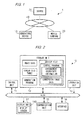
- FIG. 1 is a block diagram showing a configuration of program-providing system 1 according to an exemplary embodiment of the present invention.
- Program-providing system 1 includes generating device 10, server 20, mobile terminal 30, and communication network 40 that connects these devices so that they can communicate with one another.
- Mobile terminal 30, such as a mobile phone, a PDA (Personal Digital Assistant), or the like, is an example of a display device having a display screen.
- Generating device 10 generates a control program that is to be executed in mobile terminal 30 or the like, and compiles the control program together with data relating to the control program (in this example, image data or the like) to form an archive file, which is uploaded to server 20.
- This archive file corresponds to a JAR (Java ARchive) file used in a JAVA (registered trademark) environment, for example.
- the control program may be any program written in a programming language, and particularly, may be a program written in a simple programming language such as a script language.
- Mobile terminal 30 downloads an archive file corresponding to the model of mobile terminal 30 from among the archive files uploaded to server 20, and executes the control program included in the archive file.
- mobile terminal 30 displays images on its display screen 300 (see FIG. 9 ) according to arrangement coordinate information included in the control program, in a series of displays shown as a result of the execution of the control program.
- a screen size of display screen 300 may vary depending on the model of mobile terminal 30. It is to be noted that, although a single mobile terminal 30 is connected to communication network 40 in FIG. 1 , multiple mobile terminals may be connected. Next, explanation will be given of a configuration of generating device 10.
- FIG. 2 is a block diagram showing a configuration of generating device 10 according to the exemplary embodiment of the invention.
- Generating device 10 includes control unit 11, storage unit 12, operation unit 13, display unit 14, communication unit 15, and interface 16, which are connected with one another via a bus.
- Control unit 11 includes a CPU (Central Processing Unit), a ROM (Read Only Memory), a RAM (Random Access Memory), and so on.
- the CPU loads a generation program stored in storage unit 12 to the RAM and executes the same, thereby to control respective units of generating device 10 via the bus to implement a program generation function, which will be described later. Further, the CPU loads various programs stored in the ROM to the RAM and executes them to implement various functions.
- the RAM not only serves as a work area when the CPU processes various items of data, but also is used as a buffer memory for items of coordinate information, which will be described later.
- Storage unit 12 is a storage means such as a non-volatile memory or a hard disk, for example, and stores various items of information described in detail below. It is to be noted that storage unit 12 may be an external storage medium, such as a non-volatile memory, that is connected via a connection interface. In this example, the information stored in storage unit 12 includes items of image data representing images, a generation program for implementing a program generation function, an archive file(s) as described above, and a screen size table.
- Image data is data that represents images used when a control program is generated by the program generation function, and these images have varying image sizes depending on respective items of image data.
- an image size represents a number of pixels of an image, and in this example, is expressed by a number of pixels in width and height. For example, for an image having a width of 1,000 pixels and a height of 500 pixels, the image size is expressed as "1,000 X 500.”
- An archive file is constituted of a control program generated by the program generation function and conversion image data to be used by the control program, where the control program is compiled together with the conversion image data.
- the control program includes arrangement coordinate information that specifies a display position, a display size, and so on of each image represented by the conversion image data. The conversion image data and the arrangement coordinate information will be described later.
- FIG. 3 is a diagram for explaining a screen size table.
- a screen size table is a table that associates a screen size of display screen 300 of mobile terminal 30 with a model of mobile terminal 30.
- the screen size is "480 X 640,” which indicates that, in this example, a number of pixels that can be displayed by the display screen at one time is 480 pixels in width and 640 pixels in height, i.e., a VGA (Video Graphics Array) having a longer side extending in the vertical direction.
- VGA Video Graphics Array
- Operation unit 13 includes an input device such as a keyboard, a mouse, or the like, and in response to an operation of the input device by a user, outputs data representing content of the operation to control unit 11.
- an input device such as a keyboard, a mouse, or the like
- control unit 11 By operating the input device, a user can designate and determine a display position and a display size of an image, designate a model of a mobile terminal corresponding to the control program to be generated, and make various kinds of settings during execution of the program generation function.
- Display unit 14 is a display device, such as a liquid crystal display, having display screen 140 for displaying an image.
- Display unit 14 causes display screen 140 to display an image according to control of control unit 11.
- control unit 112 which will be described later.
- various modes of display such as display in response to a user's operation, display of a menu, display of a setting screen, etc. may be carried out.
- generating device 10 includes display unit 14 in the illustrated embodiment, a display device having a display screen may be connected via an interface.
- Communication unit 15 communicates with server 20 via communication network 40 under control of control unit 11, and in this example, uploads an archive file to server 20.
- Interface 16 is a connection terminal or the like for a wired connection with an external device for transmission/reception of a variety of information with the external device. The foregoing is a description of the configuration of generating device 10.
- the program generation function is a function of generating a control program to be executed in mobile terminal 30, and generating an archive file in which the control program and data used with the control program are compiled. It is to be noted that each functional unit of the program generation function, which unit will be described below, may be provided as hardware.
- FIG. 4 is a block diagram showing a program generation function according to the exemplary embodiment of the present invention.
- the program generation function there are used screen size acquisition unit 110, image data acquisition unit 111, display control unit 112, area/image designation unit 113, area/image acquisition unit 114, display size calculation unit 115, display size determination unit 116, image data conversion unit 117, and program generation unit 118.
- screen size acquisition unit 110 acquires a screen size corresponding to the model by referring to the screen size table, and outputs screen size information representing the screen size to display control unit 112 and display size calculation unit 115. This operation by a user can be performed prior to operation of each unit for the program generation function.
- Image data acquisition unit 111 acquires image data stored in storage unit 12, and outputs the data to display control unit 112. Further, image data acquisition unit 111 outputs the image data to image data conversion unit 117 in response to a request from image data conversion unit 117.
- display control unit 112 controls content displayed on display screen 140 of display unit 14.
- This displayed content is a setting screen for allowing a user to set content that will be displayed on display screen 300 of mobile terminal 30 when a generated control program is executed in mobile terminal 30, and examples of which displayed content are shown in FIGS. 5A and 5B .
- FIGS. 5A and 5B are each a diagram for explaining content caused to be displayed by the program generation function according to the exemplary embodiment of the present invention.
- display screen 140 shows window W1 that is used in the program generation function.
- window W1 there are shown selection boxes SB1 and SB2, sub-windows Ws1 and Ws2, pointer PT, and so on.
- Sub-window Ws1 is a display for setting content to be displayed on display screen 300 of mobile terminal 30.
- the aspect ratio of this sub-window Ws1 is the same as that of the screen size acquired by screen size acquisition unit 110; that is, sub-window Ws1 resembles display screen 300 of mobile terminal 30 whose screen size was acquired by screen size acquisition unit 110.
- image G1 in FIG. 5A is an image of an icon representing "A.”
- Sub-window Ws2 shows images represented by the image data output from image data acquisition unit 111, i.e., the image data stored in storage unit 12.
- a display size of each image displayed in this sub-window Ws2 may not be the same as the image size, and is adjusted appropriately so that each image is shown within sub-window Ws2. It is to be noted, however, that the display size of an image displayed in sub-window Ws2 may be the same as the image size.
- Selection box SB1 is used when a user designates a model of mobile terminal 30, based on which screen size acquisition unit 110 acquires a screen size, as described above.
- Selection box SB1 is a pull-down menu for allowing a user to select a model from the models registered in the screen size table stored in storage unit 12. Upon selection of a model by a user using selection box SB1 to designate the model, the above-described process of screen size acquisition unit 110 is conducted.
- Selection box SB2 is a pull-down menu for switching between pages of the screen for which display content is set.
- a "page” here is a part of a series of displays that may be shown on display screen 300 of mobile terminal 30 when a generated control program is executed by mobile terminal 30, and is based on a screen displayed on display screen 300.
- display content of sub-window Ws1 is switched to that corresponding to the designated page.
- FIG. 5A shows display content of sub-window Ws 1 corresponding to page "P1," and when the page is switched to page "P2," the display content of sub-window Ws1 is switched to that shown in FIG. 5B , which, in this example, includes image G3 (an image of an icon representing "C") shown in an enlarged state.
- each of a series of displays consists of display content set for a respective page.
- Pointer PT is an operator displayed on display screen 140 and controllable by an operation of operation unit 13 by a user.
- a user can perform the above-described selection using selection boxes SB1 and SB2 by operating operation unit 13 to manipulate the operator.
- a user can operate operation unit 13 to manipulate the operator to drag an image in sub-window Ws2 (image G2 of an icon representing "K” in the example shown in FIG. 5A ) to within sub-window Ws1, and adjust a size (hereinafter, "display size") of the image by shrinking or enlarging the image, thereby to set the content to be displayed on display screen 300 of mobile terminal 30.
- display size a size of the image by shrinking or enlarging the image
- a user may operate a keyboard of operation unit 13 to input numbers indicating a position and/or a display size of an image, for example, to achieve the adjustment. Switching of these adjustment means may be made in response to a predetermined operation.
- display control unit 112 When an instruction of area/image determination is received from area/image designation unit 113, display control unit 112 outputs to area/image acquisition unit 114 information for designating areas in a screen area of sub-window Ws1 of each page in which images are located, and for designating the images located in these areas. Further, display control unit 112 outputs screen area size information that represents a size of a screen area of sub-window Ws1 (hereinafter, "screen area size") to display size calculation unit 115.
- screen area size represents a size of a screen area of sub-window Ws1
- Area/image designation unit 113 provides instruction of area determination to display control unit 112 in response to a user's operation of operation unit 13 to determine the display content set for each page, so that information for designating areas in sub-window Ws1 in which images are located is forwarded to area/image acquisition unit 114, as described above.
- area/image acquisition unit 114 Upon acquisition from display control unit 112 of information for designating an area of each image located in the screen area of sub-window Ws1 of each page, area/image acquisition unit 114 generates area coordinate information based on the acquired information, and outputs the area coordinate information to display size calculation unit 115.
- the area coordinate information is information that represents a position and a size of each of the areas in the screen area of sub-window Ws1 in which respective images are located. Detailed explanation will be given of the area coordinate information with reference to FIGS. 6 and 7 .
- FIG. 6 is a diagram for explaining a definition of a coordinate indicated by each item of coordinate information.
- a coordinate indicated in each item of coordinate information is obtained with the upper left position of the screen area of sub-window Ws1 being origin P0, the rightward direction being the positive x-direction, and the downward direction being the positive y-direction.
- the upper left position of an image located in sub-window Ws 1 is display position Ps of the image
- a display size of the image is represented by a horizontal length (width) and a vertical length (height) from display position Ps. These lengths are represented by a number of pixels when the image is displayed on display screen 140.
- FIG. 7 is a diagram for explaining the area coordinate information.
- Area coordinate information (1) and (2) shown in FIG. 7 respectively correspond to pages "P1" and "P2" explained with reference to FIG. 5 .
- Each set of area coordinate information sets forth a correspondence relationship between a sequential number assigned to each image ("No.”), display position Ps ("position"), a display size of each image (“display size”), and a name of an item of image data ("data name”). For example, area coordinate information.
- Display size calculation unit 115 acquires the area coordinate information output from area/image acquisition unit 114, the screen area size information output from display control unit 112, and the screen size information output from screen size acquisition unit 110, and based on all of this information, generates calculated coordinate information, which is output to display size determination unit 116 and program generation unit 118.
- FIG. 8 is a diagram for explaining the calculated coordinate information.
- Calculated coordinate information (1) and (2) are generated in correspondence with area coordinate information (1) and (2), respectively.
- the calculated coordinate information represents the arrangement of each image after conversion of the content of the area coordinate information in accordance with coordinate axes based on the screen size indicated by the screen size information output from screen size acquisition unit 110.
- the screen size has a width and a height that are a half of a width and a height of the screen area size, and accordingly, the "position" and the "display size” indicated in the calculated coordinate information are obtained by halving the position (more specifically the numeral coordinate indicating the position) and the display size indicated in the area coordinate information.
- FIG. 9 is a diagram for explaining content of a display of mobile terminal 30, which is an example (page "P2") in which images arranged as described are displayed on display screen 300 of mobile terminal 30 whose screen size is "480 X 640.”
- Calculated coordinate information (2) corresponding to this page represents an arrangement of each image with respect to the coordinate system based on the screen size ("480X 640" in this example) of display screen 300 of mobile terminal 30 of the designated model.
- Display size determination unit 116 acquires the calculated coordinate information from display size calculation unit 115, and executes the following determination process to instruct image data conversion unit 117 to convert an image size of image data. In the following, explanation will be given of the determination process with reference to FIG. 10 .
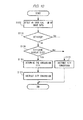
- FIG. 10 is a flowchart showing a flow of the determination process.
- display size determination unit 116 refers to "data names" in calculated coordinate information of each of the acquired pages, to detect, for each item of image data, another identical item(s) of image data (step S100), based on presence/absence of an image(s) arranged using the identical item of image data.
- step S100 For an item of image data for which no another identical item of image data is detected (step S110; No), display size determination unit 116 outputs to image data conversion unit 117 an instruction to convert the item of image data such that the image size becomes equal to the corresponding display size in the calculated coordinate information (step S120).
- display size determination unit 116 refers to the calculated coordinate information of each of the acquired pages to determine whether, of the identical items of image data, there are any that are associated with different display sizes (step S 130).
- step S130 If each of the identical items of image data is associated with the same display size (step S130; No), display size determination unit 116 outputs to image data conversion unit 117 an instruction to convert the item of image data such that the image size becomes equal to the display size (step S120). If there are identical items of image data associated with different display sizes (step S130; Yes), display size determination unit 116 determines a conversion image size based on these different display sizes (step S140). In this embodiment, the maximum one of the different display sizes is determined as the conversion image size. Then, display size determination unit 116 outputs to image data conversion unit 117 an instruction to convert the item of image data such that the image size becomes equal to the determined image size (step S 150).
- display size determination unit 116 outputs an instruction to convert the item of image data such that the image size becomes equal to the display size "(dx5, dy5).”
- image data conversion unit 117 Upon receipt of an instruction to convert each item of image data from display size determination unit 116, image data conversion unit 117 acquires each item of image data from image data acquisition unit 111 by sending a request for the item of image data to the same. Then, image data conversion unit 117 converts each acquired item of image data into an item of image data representing an image having an image size according to the respective instruction of conversion. It is to be noted that, in a case where the image display size after conversion would be larger than the image display size before the conversion, the conversion may not be performed. Thereafter, image data conversion unit 117 provides to program generation unit 118 the items of converted image data (hereinafter, "conversion image data").
- the "data name" of an item of conversion image data is changed from that assigned to the corresponding item of image data before conversion, so that they can be distinguished from one another (for example, for the item of image data before conversion whose "data name” is "C.jpg," the corresponding item of conversion image data is assigned a data name "Ct.jpg”).
- Program generation unit 118 generates a control program for use in mobile terminal 30 of the designated model by using the calculated coordinate information output from display size calculation unit 115 and the conversion image data output from image data conversion unit 117, and compiles the control program together with the conversion image data to generate an archive file, which is stored in storage unit 12.
- This archive file includes information for identifying the designated model. After the archive file is stored in storage unit 12, the stored archive file is uploaded to server 20 by control of control unit 11 or in response to a user's instruction input via operation unit 13.
- the control program generated by program generation unit 118 includes a program that controls content displayed on display screen 300 of mobile terminal 30, which has been determined as described above, for each page of a series of displays shown on display screen 300 when the program is executed.
- the control program also includes arrangement coordinate information that represents an arrangement of each displayed image.
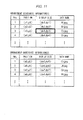
- FIG. 11 is a diagram for explaining the arrangement coordinate information.
- program generation unit 118 After acquiring the calculated coordinate information, program generation unit 118 replaces the "data name" with that indicating the conversion image data, thereby to generate the arrangement coordinate information.
- Arrangement coordinate information (1) and (2) are generated from calculated coordinate information (1) and (2), respectively.
- the control program generated by program generation unit 118 causes an image(s) represented by the conversion image data to be displayed in accordance with the arrangement coordinate information.
- control program when executed by mobile terminal 30, the control program causes mobile terminal 30 to implement a function of causing display screen 300 to show a series of displays (display of each page), in which the conversion image data is used to display an image(s) represented by the conversion image data at the display position and in the display size set forth in the arrangement coordinate information.
- the item of conversion image data whose "data name” is "At.jpg” has an image size that is already converted to be equal to the display size set forth in arrangement coordinate information (1), and therefore, this image can be displayed on display screen 300 without image size conversion being conducted in mobile terminal 30.
- the item of conversion image data whose "data name” is "Ct.jpg” has an image size that is already converted to be equal to the display size set forth in arrangement coordinate information (2), and therefore, when this image is displayed according to arrangement coordinate information (2), the image can be displayed on display screen 300 without image size conversion being conducted in mobile terminal 30, in the same manner as with "At.jpg.”
- the image size of the item of conversion image data whose "data name” is "Ct.jpg” is different from the display size set forth in arrangement coordinate information (1), and therefore, when this image is displayed according to arrangement coordinate information (1), the image size "(dx5, dy5)” is converted into the display size "(dx3, dy3)" in mobile terminal 30, and thereafter, the image is displayed on display screen 300.
- the image data is converted in advance so as to have an image size corresponding to the display size of the image, instead of using the original image data as it is. Therefore, in mobile terminal 30 that executes the control program, it is not necessary to conduct conversion of image size of the image data, and thus, a processing load on mobile terminal 30 can be reduced and an operation speed can be increased.
- the item of image data is converted into an item(s) of image data corresponding to a part of the different display sizes before compiling, and therefore, an amount of data included in the generated archive file can be reduced.
- step S140 in FIG. 10 when a conversion image size is determined (step S140 in FIG. 10 ) in a case where there are multiple images of different display sizes generated from the same image data, display size determination unit 116 selects the largest one of the display sizes as the conversion image size.
- the conversion image size may be determined in another mode, so long as the conversion image size is determined based on the multiple display sizes. Described in the following are examples of other modes of determining the conversion image size.
- display size determination unit 116 may select, as the conversion image size, a display size in a predetermined order among the multiple display sizes, such as the second largest, the third largest, or the like.
- display size determination unit 116 may determine multiple conversion image sizes. For example, in a case where there are three different display sizes, display size determination unit 116 may select multiple display sizes, such as the maximum display size and the minimum display size, from all of the display sizes, as the conversion image sizes. In such a case, the data names of the items of conversion image data should be determined such that they can be distinguished from one another, such as "Ctl.jpg" and "Ct2.jpg,” and one of them is specified as the "data name" associated with a respective image in the arrangement coordinate information. Namely, for a respective image, an item of image data that can be displayed without image size conversion is associated with the image at the highest priority. If image size conversion is necessary, an item of image data having the maximum image size may be associated with the image, or an item of image data satisfying a relationship with the image as described below with respect to a third mode may be associated with the image.
- the conversion image size may be determined as a size that is an integer multiple or an integer fraction of the multiple display sizes. In this way, the speed of image size conversion conducted in mobile terminal 30 when displaying an image on display screen 300 can be increased.
- the third mode concrete examples of the third mode will be described with reference to FIGS. 12A-12C .
- FIGS. 12A-12C are each a diagram showing a concrete example (third mode) of a conversion image size(s) according to Modification 1.
- FIGS. 12A and 12B show examples in which the multiple display sizes are "300X300,” “200X200,” “150X150,” and "50X50.”
- a conversion image size(s) according to the third mode multiple image sizes (i.e., "300 X300” and "200X200") may be determined as shown in FIG. 12A , or a single image size, i.e., "50X 50,” may be determined as shown in FIG. 12B .
- FIG. 12C shows an example in which the multiple display sizes are "300 X300,” “200 X 200,” and “50 X 50,” and an image size (such as "100 X 100") that is different from any of these display sizes is determined as a conversion image size.
- the mode in which the conversion image size(s) is determined can be set in display size determination unit 116 in advance by a user operation of operation unit 13 or the like. Further, when multiple cases are conceivable in each mode, one of the cases may be selected for use according to a predetermined algorithm. For example, a degree of priority for image quality, a degree of priority for speed, a degree of priority for amount of data, and so on may be set in advance by a user operation of operation unit 13 or the like. When the degree of priority for image quality is high, the algorithm should be adapted such that many items of conversion image data tend to be generated to decrease a number of occasions that would require image size conversion conducted in mobile terminal 30.
- the algorithm When the degree of priority for image quality is high, the algorithm should be adapted such that items of conversion image data having a large image size tend to be generated. When the degree of priority for amount of data is high, the algorithm should be adapted to generate items of conversion image data that minimize a total amount of conversion image data compiled into an archive file.
- an upper limit of an amount of data may be set, and the image sizes and the number of items of conversion image data generated may be determined such that an amount of data of an archive file does not exceed the upper limit.
- an instruction for conversion of an image quality and a format JPEG (Joint Photographic Experts Group), TIFF (Tagged Image File Format), GIF (Graphic Interchange Format), etc.
- JPEG Joint Photographic Experts Group
- TIFF Tagged Image File Format
- GIF Graphic Interchange Format
- the same image (an image of an icon representing "C") is used in different pages in a series of displays shown on display screen 300 of mobile terminal 30.
- the present invention is not limited to such an embodiment where the same image is used in different pages, and the same image may be used in different display sizes in the same page.
- a control program and an archive file corresponding to mobile terminal 30 of a pre-designated model are generated.
- control programs and archive files for models with screen sizes having the same aspect ratio may be generated at the same time.
- generating device 10 should be adapted to allow for designation of multiple models with screen sizes having the same aspect ratio, and each unit in the program generation function should be adapted to execute the processes for the multiple models, i.e., for the multiple screen sizes, in parallel.
- a displayed image is constituted of an entire part of an image represented by an item of image data.
- a displayed image may be constituted of a trimmed part of an image represented by an item of image data.
- each item of coordinate information may be associated with information specifying a trimming range of an image represented by an item of image data.
- extraction of the trimming range may be performed together with the image size conversion.
- the trimming range can be included in the instruction of conversion provided from display size determination unit 116. It is to be noted that, in a case where there are multiple trimming ranges specified for the same image, a part of the image covering all of these ranges may be extracted in the process of extraction of the trimming range. Particularly, a minimum part of the image covering all of the multiple ranges may be extracted.
- the process in the exemplary embodiment or Modification 1 may be performed using a display size of an image that would be displayed if the trimming were not executed. For example, in a case where an image obtained by trimming has an image size with a height and a width that are a quarter of those of an original image, the conversion image size corresponding to the trimmed image may be determined based on a display size obtained by multiplying the height and the width of the display size specified in the calculated coordinate information by four.
- each display size in the arrangement coordinate information is expressed as a number of pixels.
- the display size may be expressed as information that specifies the number by which the height and the width of an image represented by an item of conversion image data are multiplied.
- mobile terminal 30 downloads an archive file to execute a control program.
- the present invention is not limited to a mobile terminal such as a mobile phone, a PDA, or the like, but may be applied to any display device having a display screen, such as a television, a personal computer, or the like.
- mobile terminal 30 is an example of a display device. It is to be noted that, in case of a personal computer or the like, if a monitor providing a display screen is a separate member from the computer itself, so long as the content displayed on the monitor is controlled by the computer, it is considered that the computer and the monitor in combination constitute a display device.
- the generation program in the foregoing exemplary embodiment may be provided in a state stored in a computer-readable storage medium such as a magnetic storage medium (a magnetic tape, a magnetic disk, or the like), an optical storage medium (an optical disk, or the like), a magneto-optical storage medium, a semiconductor memory, and so on.
- a computer-readable storage medium such as a magnetic storage medium (a magnetic tape, a magnetic disk, or the like), an optical storage medium (an optical disk, or the like), a magneto-optical storage medium, a semiconductor memory, and so on.
- the program also may be downloaded via a network.
Landscapes
- Engineering & Computer Science (AREA)
- Software Systems (AREA)
- Theoretical Computer Science (AREA)
- General Engineering & Computer Science (AREA)
- Physics & Mathematics (AREA)
- General Physics & Mathematics (AREA)
- Human Computer Interaction (AREA)
- User Interface Of Digital Computer (AREA)
- Controls And Circuits For Display Device (AREA)
- Telephone Function (AREA)
- Information Transfer Between Computers (AREA)
- Stored Programmes (AREA)
- Digital Computer Display Output (AREA)
Abstract
Description
- The present invention relates to a technology for compiling a program.
- Various types of terminals having a display screen, such as mobile phones, are widely used. A number of pixels that can be displayed on a display screen at one time (hereinafter, "screen size") varies depending on a type of a terminal. Therefore, it is necessary that a number of pixels of an image (hereinafter, "image size") to be displayed on a display screen of a terminal be converted according to the size of the display screen used, so that a layout is correctly maintained. Such a technology for converting an image size according to a screen size is disclosed in
JP2004-133532A 3P10-326169A - A terminal having a display screen, such as a mobile phone, can implement a variety of functions by executing a control program. A commonly used function is that of displaying an image on a display screen. A control program having such a function is generated for respective terminals having different screen sizes, such that the control program converts an image size according to a screen size of each terminal before each image is displayed.
When a control program corresponding to each terminal is executed, a conversion process is performed on image data that has been compiled together with the control program, to convert an image size into a size appropriate for the screen size before each image is displayed. Therefore, a processing load for executing the conversion tends to be large, and this leads to decreased operation speed. - On the other hand, to avoid a necessity of conducting conversion of an image size in each terminal, it may be conceived to convert image sizes of the images to be displayed in advance, and to compile image data representing the images of the converted image sizes. However, in a case where the same image is displayed multiple times in varying image display sizes, it is necessary to generate image data representing the same image in different image display sizes, and therefore, an amount of image data to be compiled tends to be very large, though the processing load may be decreased.
- The present invention is made in view of the background described above, and an object of the present invention is, when a control program for displaying an image in different image display sizes is generated, to reduce an amount of image data used with the control program, while at the same time reducing a processing load on a terminal that executes the control program.
- To achieve the above-mentioned object, according to one aspect of the present invention, there is provided a program generation device that generates a control program, which, when executed by a display device having a display screen, causes the display device to implement a function of displaying a plurality of images using an item of image data representing a specific image having a specific image size, as a series of displays shown on the display screen, wherein at least one of the plurality of images is obtained by converting the specific image having the specific image size such that the at least one of the plurality of images has an image size different from the specific image size, the program generation device comprising: an image data acquisition means for acquiring an item of image data representing the specific image having a predetermined image size; a display control means for causing a screen area, which resembles the display screen of the display device, to be displayed on a display screen of a device that is different from the display device; a designation means for designating a plurality of areas in the screen area caused to be displayed by the display control means, each of the plurality of areas corresponding to a position and a display size at and in which the specific image is to be displayed in the series of displays; an area acquisition means for acquiring a display position and a display size of each of the plurality of areas in the screen area designated by the designation means; a screen size acquisition means for acquiring a screen size representing a number of pixels that can be displayed on the display screen of the display device at a time; a calculation means for, based on the display position and the display size of each of the plurality of areas in the screen area acquired by the area acquisition means and the screen size acquired by the screen size acquisition means, calculating a display position and a display size of each of the plurality of areas in the display screen having the screen size; a determination means for determining the specific image size based on the display sizes of the plurality of areas calculated by the calculation means; a conversion means for converting the item of image data acquired by the image data acquisition means into an item of image data representing the specific image having the specific image size determined by the determination means; and a generation means for generating a control program for causing the display device to display the specific image by using the item of image data converted by the conversion means, such that, in a series of displays shown on the display screen of the display device, the specific image is displayed at the position of each of the plurality of areas calculated by the calculation means and in the size calculated by the same.
- In a preferred embodiment of the present invention, the determination means determines the specific image size such that a sum of an amount of data of the control program generated by the generation means and an amount of data of the item of image data converted by the conversion means does not exceed a predetermined value.
- In another preferred embodiment of the present invention, the determination means determines a plurality of specific image sizes based on the display sizes of the plurality of areas calculated by the calculation means, the conversion means converts the item of image data acquired by the image data acquisition means into a plurality of items of image data representing the specific image in respective ones of the plurality of specific image sizes determined by the determination means, and the generation means uses the plurality of items of image data generated by the conversion means.
- In another preferred embodiment of the present invention, the determination means determines a number of the plurality of specific image sizes such that a sum of an amount of data of the control program generated by the generation means and an amount of data of the plurality of items of image data converted by the conversion means does not exceed a predetermined value.
- In another preferred embodiment of the present invention, the determination means determines the specific image size as a size having a height and a width that respectively are an integer multiple or an integer fraction of a height and a width of the display size of each of the plurality of areas.
- In another preferred embodiment of the present invention, the designation means further designates a trimming range of the specific image for each of the plurality of areas, and the generation means generates a control program for causing the display device to display the specific image in the trimming range designated by the designation means at the display position corresponding to each of the plurality of areas calculated by the calculation means, after converting the specific image in the trimming range to have an image size equal to the display size calculated by the calculation means.
- In another preferred embodiment of the present invention, the specific image size determined by the determination means is smaller than the predetermined image size of the specific image represented by the item of image data acquired by the image data acquisition means.
- In another preferred embodiment of the present invention, the determination means determines the specific image size as one of the display sizes of the plurality of areas calculated by the calculation means.
- In another preferred embodiment of the present invention, the determination means determines the specific image size as a size other than the display sizes of the plurality of areas calculated by the calculation means.
- According to another aspect of the present invention, there is provided a program for causing a computer to generate a control program, which, when executed by a display device having a display screen, causes the display device to implement a function of displaying a plurality of images using an item of image data representing a specific image having a specific image size, as a series of displays shown on the display screen, wherein at least one of the plurality of images is obtained by converting the specific image having the specific image size such that the at least one of the plurality of images has an image size different from the specific image size, the program causing the computer to function as: an image data acquisition means for acquiring an item of image data representing the specific image having a predetermined image size; a display control means for causing a screen area, which resembles the display screen of the display device, to be displayed on a display screen of a device that is different from the display device; a designation means for designating a plurality of areas in the screen area caused to be displayed by the display control means, each of the plurality of areas corresponding to a position and a display size at and in which the specific image is to be displayed in the series of displays; an area acquisition means for acquiring a display position and a display size of each of the plurality of areas in the screen area designated by the designation means; a screen size acquisition means for acquiring a screen size representing a number of pixels that can be displayed on the display screen of the display device at a time; a calculation means for, based on the display position and the display size of each of the plurality of areas in the screen area acquired by the area acquisition means and the screen size acquired by the screen size acquisition means, calculating a display position and a display size of each of the plurality of areas in the display screen having the screen size; a determination means for determining the specific image size based on the display sizes of the plurality of areas calculated by the calculation means; a conversion means for converting the item of image data acquired by the image data acquisition means into an item of image data representing the specific image having the specific image size determined by the determination means; and a generation means for generating a control program for causing the display device to display the specific image by using the item of image data converted by the conversion means, such that, in a series of displays shown on the display screen of the display device, the specific image is displayed at the position of each of the plurality of areas calculated by the calculation means and in the size calculated by the same.
According to yet another aspect of the present invention, there is provided a program generation method of generating a control program, which, when executed by a display device having a display screen, causes the display device to implement a function of displaying a plurality of images using an item of image data representing a specific image having a specific image size, as a series of displays shown on the display screen, wherein at least one of the plurality of images is obtained by converting the specific image having the specific image size such that the at least one of the plurality of images has an image size different from the specific image size, the method comprising: an image data acquisition step for acquiring an item of image data representing the specific image having a predetermined image size; a display control step for causing a screen area, which resembles the display screen of the display device, to be displayed on a display screen of a device that is different from the display device; a designation step for designating a plurality of areas in the screen area caused to be displayed by the display control step, each of the plurality of areas corresponding to a position and a display size at and in which the specific image is to be displayed in the series of displays; an area acquisition step for acquiring a display position and a display size of each of the plurality of areas in the screen area designated by the designation unit; a screen size acquisition step for acquiring a screen size representing a number of pixels that can be displayed on the display screen of the display device at a time; a calculation step for, based on the display position and the display size of each of the plurality of areas in the screen area acquired by the area acquisition step and the screen size acquired by the screen size acquisition step, calculating a display position and a display size of each of the plurality of areas in the display screen having the screen size; a determination step for determining the specific image size based on the display sizes of the plurality of areas calculated by the calculation step; a conversion step for converting the item of image data acquired by the image data acquisition step into an item of image data representing the specific image having the specific image size determined by the determination step; and a generation step for generating a control program for causing the display device to display the specific image by using the item of image data converted by the conversion step, such that, in a series of displays shown on the display screen of the display device, the specific image is displayed at the position of each of the plurality of areas calculated by the calculation step and in the size calculated by the same. - According to the present invention, when a control program for displaying an image in different image display sizes is generated, it is possible to reduce an amount of image data used with the control program, while at the same time reducing a processing load on a terminal that executes the control program.
- Exemplary embodiments of the present invention will now be described in detail with reference to the following figures, wherein:
-
-
FIG. 1 is a block diagram showing a configuration of a program-providing system according to an exemplary embodiment of the present invention; -
FIG. 2 is a block diagram showing a configuration of a generating device according to the exemplary embodiment of the present invention; -
FIG. 3 is a diagram for explaining an image size table stored in the generating device according to the exemplary embodiment of the present invention; -
FIG 4 is a block diagram showing a program generation function according to the exemplary embodiment of the present invention; -
FIGS. 5A and 5B are each a diagram for explaining content caused to be displayed by the program generation function according to the exemplary embodiment of the present invention; -
FIG. 6 is a diagram for explaining coordinate information according to the exemplary embodiment of the present invention; -
FIG. 7 is a diagram for explaining area coordinate information according to the exemplary embodiment of the present invention; -
FIG. 8 is a diagram for explaining calculated coordinate information according to the exemplary embodiment of the present invention; -
FIG. 9 is a diagram for explaining content displayed on a mobile terminal according to the exemplary embodiment of the present invention; -
FIG. 10 is a flowchart showing a flow of a determination process according to the exemplary embodiment of the present invention; -
FIG. 11 is a diagram for explaining arrangement coordinate information according to the exemplary embodiment of the present invention; and -
FIGS. 12A-12C are each a diagram showing a concrete example (third mode) of a conversion image size(s) according toModification 1. -
FIG. 1 is a block diagram showing a configuration of program-providingsystem 1 according to an exemplary embodiment of the present invention. Program-providingsystem 1 includes generatingdevice 10,server 20,mobile terminal 30, andcommunication network 40 that connects these devices so that they can communicate with one another.Mobile terminal 30, such as a mobile phone, a PDA (Personal Digital Assistant), or the like, is an example of a display device having a display screen.
Generatingdevice 10 generates a control program that is to be executed inmobile terminal 30 or the like, and compiles the control program together with data relating to the control program (in this example, image data or the like) to form an archive file, which is uploaded toserver 20. This archive file corresponds to a JAR (Java ARchive) file used in a JAVA (registered trademark) environment, for example. It is to be noted that the control program may be any program written in a programming language, and particularly, may be a program written in a simple programming language such as a script language. -
Mobile terminal 30 downloads an archive file corresponding to the model ofmobile terminal 30 from among the archive files uploaded toserver 20, and executes the control program included in the archive file. When the control program is executed,mobile terminal 30 displays images on its display screen 300 (seeFIG. 9 ) according to arrangement coordinate information included in the control program, in a series of displays shown as a result of the execution of the control program.
A screen size ofdisplay screen 300 may vary depending on the model ofmobile terminal 30. It is to be noted that, although a singlemobile terminal 30 is connected tocommunication network 40 inFIG. 1 , multiple mobile terminals may be connected.
Next, explanation will be given of a configuration of generatingdevice 10. -
FIG. 2 is a block diagram showing a configuration of generatingdevice 10 according to the exemplary embodiment of the invention.Generating device 10 includescontrol unit 11,storage unit 12,operation unit 13,display unit 14,communication unit 15, andinterface 16, which are connected with one another via a bus. -
Control unit 11 includes a CPU (Central Processing Unit), a ROM (Read Only Memory), a RAM (Random Access Memory), and so on. The CPU loads a generation program stored instorage unit 12 to the RAM and executes the same, thereby to control respective units of generatingdevice 10 via the bus to implement a program generation function, which will be described later. Further, the CPU loads various programs stored in the ROM to the RAM and executes them to implement various functions. The RAM not only serves as a work area when the CPU processes various items of data, but also is used as a buffer memory for items of coordinate information, which will be described later. -
Storage unit 12 is a storage means such as a non-volatile memory or a hard disk, for example, and stores various items of information described in detail below. It is to be noted thatstorage unit 12 may be an external storage medium, such as a non-volatile memory, that is connected via a connection interface.
In this example, the information stored instorage unit 12 includes items of image data representing images, a generation program for implementing a program generation function, an archive file(s) as described above, and a screen size table. - Image data is data that represents images used when a control program is generated by the program generation function, and these images have varying image sizes depending on respective items of image data. As described above, an image size represents a number of pixels of an image, and in this example, is expressed by a number of pixels in width and height. For example, for an image having a width of 1,000 pixels and a height of 500 pixels, the image size is expressed as "1,000 X 500."
An archive file is constituted of a control program generated by the program generation function and conversion image data to be used by the control program, where the control program is compiled together with the conversion image data. The control program includes arrangement coordinate information that specifies a display position, a display size, and so on of each image represented by the conversion image data. The conversion image data and the arrangement coordinate information will be described later. -
FIG. 3 is a diagram for explaining a screen size table. A screen size table is a table that associates a screen size ofdisplay screen 300 of mobile terminal 30 with a model ofmobile terminal 30. For example, for model A, the screen size is "480 X 640," which indicates that, in this example, a number of pixels that can be displayed by the display screen at one time is 480 pixels in width and 640 pixels in height, i.e., a VGA (Video Graphics Array) having a longer side extending in the vertical direction. -
Operation unit 13 includes an input device such as a keyboard, a mouse, or the like, and in response to an operation of the input device by a user, outputs data representing content of the operation to controlunit 11. By operating the input device, a user can designate and determine a display position and a display size of an image, designate a model of a mobile terminal corresponding to the control program to be generated, and make various kinds of settings during execution of the program generation function. -
Display unit 14 is a display device, such as a liquid crystal display, havingdisplay screen 140 for displaying an image.Display unit 14 causesdisplay screen 140 to display an image according to control ofcontrol unit 11. For example, when the program generation function is implemented, content displayed ondisplay screen 140 is controlled bydisplay control unit 112, which will be described later. Further, under the control ofcontrol unit 11, various modes of display such as display in response to a user's operation, display of a menu, display of a setting screen, etc. may be carried out.
It is to be noted that, though generatingdevice 10 includesdisplay unit 14 in the illustrated embodiment, a display device having a display screen may be connected via an interface. -
Communication unit 15 communicates withserver 20 viacommunication network 40 under control ofcontrol unit 11, and in this example, uploads an archive file toserver 20.
Interface 16 is a connection terminal or the like for a wired connection with an external device for transmission/reception of a variety of information with the external device. The foregoing is a description of the configuration of generatingdevice 10. - Next, explanation will be given of a program generation function implemented by execution of a generation program by
control unit 11 of generatingdevice 10. The program generation function is a function of generating a control program to be executed inmobile terminal 30, and generating an archive file in which the control program and data used with the control program are compiled. It is to be noted that each functional unit of the program generation function, which unit will be described below, may be provided as hardware. -
FIG. 4 is a block diagram showing a program generation function according to the exemplary embodiment of the present invention. To carry out the program generation function, there are used screensize acquisition unit 110, imagedata acquisition unit 111,display control unit 112, area/image designation unit 113, area/image acquisition unit 114, displaysize calculation unit 115, displaysize determination unit 116, imagedata conversion unit 117, andprogram generation unit 118. - When a model of mobile terminal 30 corresponding to a control program to be generated is designated by an operation of
operation unit 13 by a user, screensize acquisition unit 110 acquires a screen size corresponding to the model by referring to the screen size table, and outputs screen size information representing the screen size to displaycontrol unit 112 and displaysize calculation unit 115. This operation by a user can be performed prior to operation of each unit for the program generation function.
Imagedata acquisition unit 111 acquires image data stored instorage unit 12, and outputs the data to displaycontrol unit 112. Further, imagedata acquisition unit 111 outputs the image data to imagedata conversion unit 117 in response to a request from imagedata conversion unit 117. - As is described above,
display control unit 112 controls content displayed ondisplay screen 140 ofdisplay unit 14. This displayed content is a setting screen for allowing a user to set content that will be displayed ondisplay screen 300 of mobile terminal 30 when a generated control program is executed inmobile terminal 30, and examples of which displayed content are shown inFIGS. 5A and 5B . -
FIGS. 5A and 5B are each a diagram for explaining content caused to be displayed by the program generation function according to the exemplary embodiment of the present invention. As shown inFIG. 5A ,display screen 140 shows window W1 that is used in the program generation function. In window W1, there are shown selection boxes SB1 and SB2, sub-windows Ws1 and Ws2, pointer PT, and so on. - Sub-window Ws1 is a display for setting content to be displayed on
display screen 300 ofmobile terminal 30. The aspect ratio of this sub-window Ws1 is the same as that of the screen size acquired by screensize acquisition unit 110; that is, sub-window Ws1 resemblesdisplay screen 300 of mobile terminal 30 whose screen size was acquired by screensize acquisition unit 110. By operatingoperation unit 13 to arrange images in this sub-window Ws1, a user can set content to be displayed ondisplay screen 300 ofmobile terminal 30. For example, image G1 inFIG. 5A is an image of an icon representing "A."
Sub-window Ws2 shows images represented by the image data output from imagedata acquisition unit 111, i.e., the image data stored instorage unit 12. A display size of each image displayed in this sub-window Ws2 may not be the same as the image size, and is adjusted appropriately so that each image is shown within sub-window Ws2. It is to be noted, however, that the display size of an image displayed in sub-window Ws2 may be the same as the image size. - Selection box SB1 is used when a user designates a model of
mobile terminal 30, based on which screensize acquisition unit 110 acquires a screen size, as described above. Selection box SB1 is a pull-down menu for allowing a user to select a model from the models registered in the screen size table stored instorage unit 12. Upon selection of a model by a user using selection box SB1 to designate the model, the above-described process of screensize acquisition unit 110 is conducted. - Selection box SB2 is a pull-down menu for switching between pages of the screen for which display content is set. A "page" here is a part of a series of displays that may be shown on
display screen 300 of mobile terminal 30 when a generated control program is executed bymobile terminal 30, and is based on a screen displayed ondisplay screen 300. Upon selection of a page by a user using selection box SB2 to designate the page, display content of sub-window Ws1 is switched to that corresponding to the designated page.FIG. 5A shows display content ofsub-window Ws 1 corresponding to page "P1," and when the page is switched to page "P2," the display content of sub-window Ws1 is switched to that shown inFIG. 5B , which, in this example, includes image G3 (an image of an icon representing "C") shown in an enlarged state. Thus, each of a series of displays consists of display content set for a respective page. - Pointer PT is an operator displayed on
display screen 140 and controllable by an operation ofoperation unit 13 by a user. A user can perform the above-described selection using selection boxes SB1 and SB2 by operatingoperation unit 13 to manipulate the operator.
Also, a user can operateoperation unit 13 to manipulate the operator to drag an image in sub-window Ws2 (image G2 of an icon representing "K" in the example shown inFIG. 5A ) to within sub-window Ws1, and adjust a size (hereinafter, "display size") of the image by shrinking or enlarging the image, thereby to set the content to be displayed ondisplay screen 300 ofmobile terminal 30. It is to be noted that, instead of manipulating pointer PT to adjust a position and/or display size of an image, a user may operate a keyboard ofoperation unit 13 to input numbers indicating a position and/or a display size of an image, for example, to achieve the adjustment. Switching of these adjustment means may be made in response to a predetermined operation. - When an instruction of area/image determination is received from area/
image designation unit 113,display control unit 112 outputs to area/image acquisition unit 114 information for designating areas in a screen area of sub-window Ws1 of each page in which images are located, and for designating the images located in these areas. Further,display control unit 112 outputs screen area size information that represents a size of a screen area of sub-window Ws1 (hereinafter, "screen area size") to displaysize calculation unit 115. - Explanation will be continued referring again to
FIG. 4 . Area/image designation unit 113 provides instruction of area determination to displaycontrol unit 112 in response to a user's operation ofoperation unit 13 to determine the display content set for each page, so that information for designating areas in sub-window Ws1 in which images are located is forwarded to area/image acquisition unit 114, as described above. - Upon acquisition from
display control unit 112 of information for designating an area of each image located in the screen area of sub-window Ws1 of each page, area/image acquisition unit 114 generates area coordinate information based on the acquired information, and outputs the area coordinate information to displaysize calculation unit 115. The area coordinate information is information that represents a position and a size of each of the areas in the screen area of sub-window Ws1 in which respective images are located. Detailed explanation will be given of the area coordinate information with reference toFIGS. 6 and 7 . -
FIG. 6 is a diagram for explaining a definition of a coordinate indicated by each item of coordinate information. As shown inFIG. 6 , a coordinate indicated in each item of coordinate information is obtained with the upper left position of the screen area of sub-window Ws1 being origin P0, the rightward direction being the positive x-direction, and the downward direction being the positive y-direction. Also, the upper left position of an image located insub-window Ws 1 is display position Ps of the image, and a display size of the image is represented by a horizontal length (width) and a vertical length (height) from display position Ps. These lengths are represented by a number of pixels when the image is displayed ondisplay screen 140. -
FIG. 7 is a diagram for explaining the area coordinate information. Area coordinate information (1) and (2) shown inFIG. 7 respectively correspond to pages "P1" and "P2" explained with reference toFIG. 5 . Each set of area coordinate information sets forth a correspondence relationship between a sequential number assigned to each image ("No."), display position Ps ("position"), a display size of each image ("display size"), and a name of an item of image data ("data name").
For example, area coordinate information. (1) shows, relative to an image whose sequential number is "3," that the "data name" is "Cjpg," the located "position" is "(sx3, sy3)", and the "display size" is "(dsx3, dsy3)." In other words, it is shown that, in page "P1," an image represented by "C.jpg" is located at a position apart from origin P0, which is the upper left position of the screen area of sub-window Ws1, by "sx3" in the positive x-direction and by "sy3" in the positive y-direction, and has a display size with a horizontal length (width) "dsx3" and a vertical length (height) "dsy3."
In the following, explanation will be continued where area coordinate information (1) and (2) shown inFIG. 7 have already been generated by area/image acquisition unit 114. - Explanation will be continued referring again to
FIG. 4 . Displaysize calculation unit 115 acquires the area coordinate information output from area/image acquisition unit 114, the screen area size information output fromdisplay control unit 112, and the screen size information output from screensize acquisition unit 110, and based on all of this information, generates calculated coordinate information, which is output to displaysize determination unit 116 andprogram generation unit 118. -
FIG. 8 is a diagram for explaining the calculated coordinate information. Calculated coordinate information (1) and (2) are generated in correspondence with area coordinate information (1) and (2), respectively. In contrast to the area coordinate information, which represents an arrangement of each image with respect to coordinate axes based on the screen area size of sub-window Ws1, the calculated coordinate information represents the arrangement of each image after conversion of the content of the area coordinate information in accordance with coordinate axes based on the screen size indicated by the screen size information output from screensize acquisition unit 110.
For example, in a case where the screen area size is "960 X 1,280" and the screen size is "480 X 640," the screen size has a width and a height that are a half of a width and a height of the screen area size, and accordingly, the "position" and the "display size" indicated in the calculated coordinate information are obtained by halving the position (more specifically the numeral coordinate indicating the position) and the display size indicated in the area coordinate information. That is, in the illustrated example, calculated coordinate information (1) shows, relative to an image with the sequential number ("No.") "3," that the display position Ps is "(x3, y3)" and the size is "(dx3, dy3)," and these display position and display size are obtained by converting the corresponding content of area coordinate information (1), based on the following relationships: x3=(sx3)/2; y3=(sy3)/2; dx3=(dsx3)/2; and dy3=(dsy3)/2. -
FIG. 9 is a diagram for explaining content of a display ofmobile terminal 30, which is an example (page "P2") in which images arranged as described are displayed ondisplay screen 300 of mobile terminal 30 whose screen size is "480 X 640." Calculated coordinate information (2) corresponding to this page represents an arrangement of each image with respect to the coordinate system based on the screen size ("480X 640" in this example) ofdisplay screen 300 ofmobile terminal 30 of the designated model. - Explanation will be continued referring again to
FIG. 4 . Displaysize determination unit 116 acquires the calculated coordinate information from displaysize calculation unit 115, and executes the following determination process to instruct imagedata conversion unit 117 to convert an image size of image data. In the following, explanation will be given of the determination process with reference toFIG. 10 . -
FIG. 10 is a flowchart showing a flow of the determination process. First, displaysize determination unit 116 refers to "data names" in calculated coordinate information of each of the acquired pages, to detect, for each item of image data, another identical item(s) of image data (step S100), based on presence/absence of an image(s) arranged using the identical item of image data. For an item of image data for which no another identical item of image data is detected (step S110; No), displaysize determination unit 116 outputs to imagedata conversion unit 117 an instruction to convert the item of image data such that the image size becomes equal to the corresponding display size in the calculated coordinate information (step S120).
On the other hand, for an item of image data for which another identical item of image data is detected (step S110; Yes), displaysize determination unit 116 refers to the calculated coordinate information of each of the acquired pages to determine whether, of the identical items of image data, there are any that are associated with different display sizes (step S 130). - If each of the identical items of image data is associated with the same display size (step S130; No), display
size determination unit 116 outputs to imagedata conversion unit 117 an instruction to convert the item of image data such that the image size becomes equal to the display size (step S120). If there are identical items of image data associated with different display sizes (step S130; Yes), displaysize determination unit 116 determines a conversion image size based on these different display sizes (step S140). In this embodiment, the maximum one of the different display sizes is determined as the conversion image size. Then, displaysize determination unit 116 outputs to imagedata conversion unit 117 an instruction to convert the item of image data such that the image size becomes equal to the determined image size (step S 150). - Explanation will now be given of the determination process with the calculated coordinate information shown in
FIG. 8 being taken as an example. With regard to an item of image data whose "data name" is "A.jpg," for example, only one such item of image data is present in calculated coordinate information (1), and thus, for this item of image data, displaysize determination unit 116 outputs an instruction to convert the item of image data such that the image size becomes equal to the corresponding image display size "(dx1, dy1)."
On the other hand, with regard to an item of image data whose "data name" is "C.jpg," this item of image data is used in each of calculated coordinate information (1) and (2), and is associated with display sizes "(dx3, dy3)" and "(dx5, dy5)," respectively. As shown inFIGS. 5A and 5B , the latter display size is larger than the former one, and thus, for this item of image data, displaysize determination unit 116 outputs an instruction to convert the item of image data such that the image size becomes equal to the display size "(dx5, dy5)." The foregoing is a description of the determination process. - Explanation will be continued referring again to
FIG. 4 . Upon receipt of an instruction to convert each item of image data from displaysize determination unit 116, imagedata conversion unit 117 acquires each item of image data from imagedata acquisition unit 111 by sending a request for the item of image data to the same. Then, imagedata conversion unit 117 converts each acquired item of image data into an item of image data representing an image having an image size according to the respective instruction of conversion. It is to be noted that, in a case where the image display size after conversion would be larger than the image display size before the conversion, the conversion may not be performed.
Thereafter, imagedata conversion unit 117 provides to programgeneration unit 118 the items of converted image data (hereinafter, "conversion image data"). It is to be noted here that the "data name" of an item of conversion image data is changed from that assigned to the corresponding item of image data before conversion, so that they can be distinguished from one another (for example, for the item of image data before conversion whose "data name" is "C.jpg," the corresponding item of conversion image data is assigned a data name "Ct.jpg"). -
Program generation unit 118 generates a control program for use inmobile terminal 30 of the designated model by using the calculated coordinate information output from displaysize calculation unit 115 and the conversion image data output from imagedata conversion unit 117, and compiles the control program together with the conversion image data to generate an archive file, which is stored instorage unit 12. This archive file includes information for identifying the designated model. After the archive file is stored instorage unit 12, the stored archive file is uploaded toserver 20 by control ofcontrol unit 11 or in response to a user's instruction input viaoperation unit 13. - The control program generated by
program generation unit 118 includes a program that controls content displayed ondisplay screen 300 ofmobile terminal 30, which has been determined as described above, for each page of a series of displays shown ondisplay screen 300 when the program is executed. The control program also includes arrangement coordinate information that represents an arrangement of each displayed image. -
FIG. 11 is a diagram for explaining the arrangement coordinate information. After acquiring the calculated coordinate information,program generation unit 118 replaces the "data name" with that indicating the conversion image data, thereby to generate the arrangement coordinate information. Arrangement coordinate information (1) and (2) are generated from calculated coordinate information (1) and (2), respectively.
When executed bymobile terminal 30, the control program generated byprogram generation unit 118 causes an image(s) represented by the conversion image data to be displayed in accordance with the arrangement coordinate information. That is, when the control program is executed bymobile terminal 30, the control program causesmobile terminal 30 to implement a function of causingdisplay screen 300 to show a series of displays (display of each page), in which the conversion image data is used to display an image(s) represented by the conversion image data at the display position and in the display size set forth in the arrangement coordinate information. - In the example that uses the arrangement coordinate information shown in
FIG. 11 , the item of conversion image data whose "data name" is "At.jpg" has an image size that is already converted to be equal to the display size set forth in arrangement coordinate information (1), and therefore, this image can be displayed ondisplay screen 300 without image size conversion being conducted inmobile terminal 30.
Also, the item of conversion image data whose "data name" is "Ct.jpg" has an image size that is already converted to be equal to the display size set forth in arrangement coordinate information (2), and therefore, when this image is displayed according to arrangement coordinate information (2), the image can be displayed ondisplay screen 300 without image size conversion being conducted inmobile terminal 30, in the same manner as with "At.jpg."
On the other hand, the image size of the item of conversion image data whose "data name" is "Ct.jpg" is different from the display size set forth in arrangement coordinate information (1), and therefore, when this image is displayed according to arrangement coordinate information (1), the image size "(dx5, dy5)" is converted into the display size "(dx3, dy3)" inmobile terminal 30, and thereafter, the image is displayed ondisplay screen 300. - As is described in the foregoing, in generating
device 10 according to an exemplary embodiment of the present invention, when a control program and image data used by the control program are compiled, the image data is converted in advance so as to have an image size corresponding to the display size of the image, instead of using the original image data as it is. Therefore, inmobile terminal 30 that executes the control program, it is not necessary to conduct conversion of image size of the image data, and thus, a processing load onmobile terminal 30 can be reduced and an operation speed can be increased. Further, in a case where the same image is displayed multiple times in different display sizes, instead of converting an item of image data representing the image into items of image data having image sizes corresponding to all of the different display sizes before compiling, the item of image data is converted into an item(s) of image data corresponding to a part of the different display sizes before compiling, and therefore, an amount of data included in the generated archive file can be reduced. - An exemplary embodiment of the present invention has been described in the foregoing. However, the present invention may be practiced in a variety of embodiments, as described below.
- In the foregoing exemplary embodiment, when a conversion image size is determined (step S140 in
FIG. 10 ) in a case where there are multiple images of different display sizes generated from the same image data, displaysize determination unit 116 selects the largest one of the display sizes as the conversion image size. However, the conversion image size may be determined in another mode, so long as the conversion image size is determined based on the multiple display sizes. Described in the following are examples of other modes of determining the conversion image size. - In a first mode, display
size determination unit 116 may select, as the conversion image size, a display size in a predetermined order among the multiple display sizes, such as the second largest, the third largest, or the like. - In a second mode, display
size determination unit 116 may determine multiple conversion image sizes. For example, in a case where there are three different display sizes, displaysize determination unit 116 may select multiple display sizes, such as the maximum display size and the minimum display size, from all of the display sizes, as the conversion image sizes. In such a case, the data names of the items of conversion image data should be determined such that they can be distinguished from one another, such as "Ctl.jpg" and "Ct2.jpg," and one of them is specified as the "data name" associated with a respective image in the arrangement coordinate information.
Namely, for a respective image, an item of image data that can be displayed without image size conversion is associated with the image at the highest priority. If image size conversion is necessary, an item of image data having the maximum image size may be associated with the image, or an item of image data satisfying a relationship with the image as described below with respect to a third mode may be associated with the image. - In the third mode, the conversion image size may be determined as a size that is an integer multiple or an integer fraction of the multiple display sizes. In this way, the speed of image size conversion conducted in
mobile terminal 30 when displaying an image ondisplay screen 300 can be increased. In the following, concrete examples of the third mode will be described with reference toFIGS. 12A-12C . -
FIGS. 12A-12C are each a diagram showing a concrete example (third mode) of a conversion image size(s) according toModification 1.FIGS. 12A and 12B show examples in which the multiple display sizes are "300X300," "200X200," "150X150," and "50X50." As a conversion image size(s) according to the third mode, multiple image sizes (i.e., "300 X300" and "200X200") may be determined as shown inFIG. 12A , or a single image size, i.e., "50X 50," may be determined as shown inFIG. 12B .
On the other hand,FIG. 12C shows an example in which the multiple display sizes are "300 X300," "200 X 200," and "50 X 50," and an image size (such as "100 X 100") that is different from any of these display sizes is determined as a conversion image size. - The mode in which the conversion image size(s) is determined can be set in display
size determination unit 116 in advance by a user operation ofoperation unit 13 or the like. Further, when multiple cases are conceivable in each mode, one of the cases may be selected for use according to a predetermined algorithm.
For example, a degree of priority for image quality, a degree of priority for speed, a degree of priority for amount of data, and so on may be set in advance by a user operation ofoperation unit 13 or the like. When the degree of priority for image quality is high, the algorithm should be adapted such that many items of conversion image data tend to be generated to decrease a number of occasions that would require image size conversion conducted inmobile terminal 30. When the degree of priority for image quality is high, the algorithm should be adapted such that items of conversion image data having a large image size tend to be generated. When the degree of priority for amount of data is high, the algorithm should be adapted to generate items of conversion image data that minimize a total amount of conversion image data compiled into an archive file. - It is to be noted here that in the algorithm above, an upper limit of an amount of data may be set, and the image sizes and the number of items of conversion image data generated may be determined such that an amount of data of an archive file does not exceed the upper limit. Further, in generation of conversion image data, an instruction for conversion of an image quality and a format (JPEG (Joint Photographic Experts Group), TIFF (Tagged Image File Format), GIF (Graphic Interchange Format), etc.) may be issued in addition to conversion of the image size, to adjust an amount of the conversion image data.
- In the foregoing exemplary embodiment, the same image (an image of an icon representing "C") is used in different pages in a series of displays shown on
display screen 300 ofmobile terminal 30. However, the present invention is not limited to such an embodiment where the same image is used in different pages, and the same image may be used in different display sizes in the same page. - In the foregoing exemplary embodiment, a control program and an archive file corresponding to
mobile terminal 30 of a pre-designated model are generated. However, control programs and archive files for models with screen sizes having the same aspect ratio may be generated at the same time. In such a case, generatingdevice 10 should be adapted to allow for designation of multiple models with screen sizes having the same aspect ratio, and each unit in the program generation function should be adapted to execute the processes for the multiple models, i.e., for the multiple screen sizes, in parallel. - In the foregoing exemplary embodiment, a displayed image is constituted of an entire part of an image represented by an item of image data. However, a displayed image may be constituted of a trimmed part of an image represented by an item of image data. In such a case, each item of coordinate information may be associated with information specifying a trimming range of an image represented by an item of image data.
When image data conversion is performed by imagedata conversion unit 117, extraction of the trimming range may be performed together with the image size conversion. The trimming range can be included in the instruction of conversion provided from displaysize determination unit 116. It is to be noted that, in a case where there are multiple trimming ranges specified for the same image, a part of the image covering all of these ranges may be extracted in the process of extraction of the trimming range. Particularly, a minimum part of the image covering all of the multiple ranges may be extracted. - Further, in the determination process performed by display
size determination unit 116, for a display size for which a trimming range is specified, the process in the exemplary embodiment orModification 1 may be performed using a display size of an image that would be displayed if the trimming were not executed. For example, in a case where an image obtained by trimming has an image size with a height and a width that are a quarter of those of an original image, the conversion image size corresponding to the trimmed image may be determined based on a display size obtained by multiplying the height and the width of the display size specified in the calculated coordinate information by four. - In the foregoing exemplary embodiment, each display size in the arrangement coordinate information is expressed as a number of pixels. However, the display size may be expressed as information that specifies the number by which the height and the width of an image represented by an item of conversion image data are multiplied.
- In the foregoing exemplary embodiment,
mobile terminal 30 downloads an archive file to execute a control program. However, the present invention is not limited to a mobile terminal such as a mobile phone, a PDA, or the like, but may be applied to any display device having a display screen, such as a television, a personal computer, or the like. Namely,mobile terminal 30 is an example of a display device. It is to be noted that, in case of a personal computer or the like, if a monitor providing a display screen is a separate member from the computer itself, so long as the content displayed on the monitor is controlled by the computer, it is considered that the computer and the monitor in combination constitute a display device. - The generation program in the foregoing exemplary embodiment may be provided in a state stored in a computer-readable storage medium such as a magnetic storage medium (a magnetic tape, a magnetic disk, or the like), an optical storage medium (an optical disk, or the like), a magneto-optical storage medium, a semiconductor memory, and so on. The program also may be downloaded via a network.
Claims (11)
- A program generation device that generates a control program, which, when executed by a display device having a display screen, causes the display device to implement a function of displaying a plurality of images using an item of image data representing a specific image having a specific image size, as a series of displays shown on the display screen, wherein at least one of the plurality of images is obtained by converting the specific image having the specific image size such that the at least one of the plurality of images has an image size different from the specific image size, the program generation device comprising:an image data acquisition means for acquiring an item of image data representing the specific image having a predetermined image size;a display control means for causing a screen area, which resembles the display screen of the display device, to be displayed on a display screen of a device that is different from the display device;a designation means for designating a plurality of areas in the screen area caused to be displayed by the display control means, each of the plurality of areas corresponding to a position and a display size at and in which the specific image is to be displayed in the series of displays;an area acquisition means for acquiring a display position and a display size of each of the plurality of areas in the screen area designated by the designation means;a screen size acquisition means for acquiring a screen size representing a number of pixels that can be displayed on the display screen of the display device at a time;a calculation means for, based on the display position and the display size of each of the plurality of areas in the screen area acquired by the area acquisition means and the screen size acquired by the screen size acquisition means, calculating a display position and a display size of each of the plurality of areas in the display screen having the screen size;a determination means for determining the specific image size based on the display sizes of the plurality of areas calculated by the calculation means;a conversion means for converting the item of image data acquired by the image data acquisition means into an item of image data representing the specific image having the specific image size determined by the determination means; anda generation means for generating a control program for causing the display device to display the specific image by using the item of image data converted by the conversion means, such that, in a series of displays shown on the display screen of the display device, the specific image is displayed at the position of each of the plurality of areas calculated by the calculation means and in the size calculated by the same.
- The program generation device according to claim 1, wherein the determination means determines the specific image size such that a sum of an amount of data of the control program generated by the generation means and an amount of data of the item of image data converted by the conversion means does not exceed a predetermined value.
- The program generation device according to claim 1 or 2, wherein
the determination means determines a plurality of specific image sizes based on the display sizes of the plurality of areas calculated by the calculation means,
the conversion means converts the item of image data acquired by the image data acquisition means into a plurality of items of image data representing the specific image in respective ones of the plurality of specific image sizes determined by the determination means, and
the generation means uses the plurality of items of image data generated by the conversion means. - The program generation device according to claim 3, wherein the determination means determines a number of the plurality of specific image sizes such that a sum of an amount of data of the control program generated by the generation means and an amount of data of the plurality of items of image data converted by the conversion means does not exceed a predetermined value.
- The program generation device according to claim 1 or 2, wherein the determination means determines the specific image size as a size having a height and a width that respectively are an integer multiple or an integer fraction of a height and a width of the display size of each of the plurality of areas.
- The program generation device according to claim 1 or 2, wherein
the designation means further designates a trimming range of the specific image for each of the plurality of areas, and
the generation means generates a control program for causing the display device to display the specific image in the trimming range designated by the designation means at the display position corresponding to each of the plurality of areas calculated by the calculation means, after converting the specific image in the trimming range to have an image size equal to the display size calculated by the calculation means. - The program generation device according to claim 1 or 2, wherein the specific image size determined by the determination means is smaller than the predetermined image size of the specific image represented by the item of image data acquired by the image data acquisition means.
- The program generation device according to claim 1 or 2, wherein the determination means determines the specific image size as one of the display sizes of the plurality of areas calculated by the calculation means.
- The program generation device according to claim 1 or 2, wherein the determination means determines the specific image size as a size other than the display sizes of the plurality of areas calculated by the calculation means.
- A program for causing a computer to generate a control program, which, when executed by a display device having a display screen, causes the display device to implement a function of displaying a plurality of images using an item of image data representing a specific image having a specific image size, as a series of displays shown on the display screen, wherein at least one of the plurality of images is obtained by converting the specific image having the specific image size such that the at least one of the plurality of images has an image size different from the specific image size, the program causing the computer to function as:an image data acquisition means for acquiring an item of image data representing the specific image having a predetermined image size;a display control means for causing a screen area, which resembles the display screen of the display device, to be displayed on a display screen of a device that is different from the display device;a designation means for designating a plurality of areas in the screen area caused to be displayed by the display control means, each of the plurality of areas corresponding to a position and a display size at and in which the specific image is to be displayed in the series of displays;an area acquisition means for acquiring a display position and a display size of each of the plurality of areas in the screen area designated by the designation means;a screen size acquisition means for acquiring a screen size representing a number of pixels that can be displayed on the display screen of the display device at a time;a calculation means for, based on the display position and the display size of each of the plurality of areas in the screen area acquired by the area acquisition means and the screen size acquired by the screen size acquisition means, calculating a display position and a display size of each of the plurality of areas in the display screen having the screen size;a determination means for determining the specific image size based on the display sizes of the plurality of areas calculated by the calculation means;a conversion means for converting the item of image data acquired by the image data acquisition means into an item of image data representing the specific image having the specific image size determined by the determination means; anda generation means for generating a control program for causing the display device to display the specific image by using the item of image data converted by the conversion means, such that, in a series of displays shown on the display screen of the display device, the specific image is displayed at the position of each of the plurality of areas calculated by the calculation means and in the size calculated by the same.
- A program generation method of generating a control program, which, when executed by a display device having a display screen, causes the display device to implement a function of displaying a plurality of images using an item of image data representing a specific image having a specific image size, as a series of displays shown on the display screen, wherein at least one of the plurality of images is obtained by converting the specific image having the specific image size such that the at least one of the plurality of images has an image size different from the specific image size, the method comprising:an image data acquisition step for acquiring an item of image data representing the specific image having a predetermined image size;a display control step for causing a screen area, which resembles the display screen of the display device, to be displayed on a display screen of a device that is different from the display device;a designation step for designating a plurality of areas in the screen area caused to be displayed by the display control step, each of the plurality of areas corresponding to a position and a display size at and in which the specific image is to be displayed in the series of displays;an area acquisition step for acquiring a display position and a display size of each of the plurality of areas in the screen area designated by the designation unit;a screen size acquisition step for acquiring a screen size representing a number of pixels that can be displayed on the display screen of the display device at a time;a calculation step for, based on the display position and the display size of each of the plurality of areas in the screen area acquired by the area acquisition step and the screen size acquired by the screen size acquisition step, calculating a display position and a display size of each of the plurality of areas in the display screen having the screen size;a determination step for determining the specific image size based on the display sizes of the plurality of areas calculated by the calculation step;a conversion step for converting the item of image data acquired by the image data acquisition step into an item of image data representing the specific image having the specific image size determined by the determination step; anda generation step for generating a control program for causing the display device to display the specific image by using the item of image data converted by the conversion step, such that, in a series of displays shown on the display screen of the display device, the specific image is displayed at the position of each of the plurality of areas calculated by the calculation step and in the size calculated by the same.
Applications Claiming Priority (1)
| Application Number | Priority Date | Filing Date | Title |
|---|---|---|---|
| JP2009258823A JP4927155B2 (en) | 2009-11-12 | 2009-11-12 | Program generating apparatus and program |
Publications (1)
| Publication Number | Publication Date |
|---|---|
| EP2357553A1 true EP2357553A1 (en) | 2011-08-17 |
Family
ID=43973845
Family Applications (1)
| Application Number | Title | Priority Date | Filing Date |
|---|---|---|---|
| EP10190828A Withdrawn EP2357553A1 (en) | 2009-11-12 | 2010-11-11 | Program generation device, program generation method, and program |
Country Status (5)
| Country | Link |
|---|---|
| US (1) | US8638345B2 (en) |
| EP (1) | EP2357553A1 (en) |
| JP (1) | JP4927155B2 (en) |
| KR (1) | KR101191019B1 (en) |
| CN (1) | CN102063296A (en) |
Families Citing this family (8)
| Publication number | Priority date | Publication date | Assignee | Title |
|---|---|---|---|---|
| JP5706637B2 (en) * | 2010-07-21 | 2015-04-22 | キヤノン株式会社 | Information processing apparatus and control method thereof, display apparatus and control method thereof, and image transfer system |
| WO2014032713A1 (en) * | 2012-08-30 | 2014-03-06 | Siemens Aktiengesellschaft | Production of a graphical user interface |
| CN103338235B (en) * | 2013-06-06 | 2016-05-11 | 天津华永无线科技有限公司 | On mobile phone, realize the method for dynamic wallpaper interactive mode, personalized creation |
| CN103546715A (en) * | 2013-10-30 | 2014-01-29 | 乐视致新电子科技(天津)有限公司 | Method and device for adjusting proportion of picture of smart television |
| CN104994314B (en) * | 2015-08-10 | 2019-04-09 | 优酷网络技术(北京)有限公司 | Pass through the method and system of gesture control PIP video on mobile terminals |
| JP6661940B2 (en) * | 2015-09-29 | 2020-03-11 | 株式会社リコー | Communication terminal, communication system, control method, and program |
| KR102425638B1 (en) * | 2018-02-05 | 2022-07-27 | 미스미 코포레이숀 | Design assistance system |
| JP7376806B2 (en) * | 2021-01-21 | 2023-11-09 | キヤノンマーケティングジャパン株式会社 | Information processing system, its control method and program |
Citations (4)
| Publication number | Priority date | Publication date | Assignee | Title |
|---|---|---|---|---|
| JPH10326169A (en) | 1997-05-27 | 1998-12-08 | Toshiba Corp | Information processing apparatus, display control method, and recording medium recording display control program |
| JP2004133532A (en) | 2002-10-08 | 2004-04-30 | Neu & Computing Inc | Information conversion system |
| EP2042985A2 (en) * | 2003-09-02 | 2009-04-01 | Research In Motion Limited | Method and data structure for user interface customization |
| US20090265660A1 (en) * | 2008-04-17 | 2009-10-22 | Seiko Epson Corporation | Image transmission device, display system, image transmission program, and recording medium |
Family Cites Families (12)
| Publication number | Priority date | Publication date | Assignee | Title |
|---|---|---|---|---|
| JP2947704B2 (en) * | 1994-03-04 | 1999-09-13 | 株式会社ピーエフユー | Display screen creation method and display screen creation device |
| JPH11136764A (en) * | 1997-10-31 | 1999-05-21 | Toshiba Corp | Mobile communication terminal |
| JP2001117761A (en) * | 1999-10-21 | 2001-04-27 | Nec Corp | Method and device for manufacturing picture program and recording medium stored with picture program manufacturing program |
| US6983424B1 (en) * | 2000-06-23 | 2006-01-03 | International Business Machines Corporation | Automatically scaling icons to fit a display area within a data processing system |
| US7106479B2 (en) * | 2000-10-10 | 2006-09-12 | Stryker Corporation | Systems and methods for enhancing the viewing of medical images |
| JP2003323456A (en) * | 2002-04-30 | 2003-11-14 | C Image:Kk | Image display device and image display method |
| JP2004151284A (en) | 2002-10-30 | 2004-05-27 | Fuji Photo Film Co Ltd | Method and device for image processing, and program |
| JP2004312430A (en) * | 2003-04-08 | 2004-11-04 | Sharp Corp | Image data creation / display method and image data creation / display device, and image data creation / display program and program recording medium |
| JP2007226341A (en) * | 2006-02-21 | 2007-09-06 | Matsushita Electric Works Ltd | Content display system |
| WO2008115188A2 (en) * | 2006-05-08 | 2008-09-25 | C. R. Bard, Inc. | User interface and methods for sonographic display device |
| US20090043199A1 (en) * | 2007-08-10 | 2009-02-12 | Laurent Pelissier | Wireless network having portable ultrasound devices |
| US20110009188A1 (en) * | 2007-11-20 | 2011-01-13 | Adiraju Srinivyasa M | Controlling wagering transactions for multi-provider game content |
-
2009
- 2009-11-12 JP JP2009258823A patent/JP4927155B2/en not_active Expired - Fee Related
-
2010
- 2010-11-11 EP EP10190828A patent/EP2357553A1/en not_active Withdrawn
- 2010-11-11 CN CN2010105468518A patent/CN102063296A/en active Pending
- 2010-11-12 US US12/945,148 patent/US8638345B2/en not_active Expired - Fee Related
- 2010-11-12 KR KR1020100112513A patent/KR101191019B1/en not_active Expired - Fee Related
Patent Citations (4)
| Publication number | Priority date | Publication date | Assignee | Title |
|---|---|---|---|---|
| JPH10326169A (en) | 1997-05-27 | 1998-12-08 | Toshiba Corp | Information processing apparatus, display control method, and recording medium recording display control program |
| JP2004133532A (en) | 2002-10-08 | 2004-04-30 | Neu & Computing Inc | Information conversion system |
| EP2042985A2 (en) * | 2003-09-02 | 2009-04-01 | Research In Motion Limited | Method and data structure for user interface customization |
| US20090265660A1 (en) * | 2008-04-17 | 2009-10-22 | Seiko Epson Corporation | Image transmission device, display system, image transmission program, and recording medium |
Non-Patent Citations (1)
| Title |
|---|
| ANONYMOUS: "Space-time tradeoff", WIKIPEDIA, 26 April 2009 (2009-04-26), pages 1 - 2, XP002646675, Retrieved from the Internet <URL:http://en.wikipedia.org/w/index.php?title=Space-time_tradeoff&oldid=286306150> [retrieved on 20110630] * |
Also Published As
| Publication number | Publication date |
|---|---|
| CN102063296A (en) | 2011-05-18 |
| US8638345B2 (en) | 2014-01-28 |
| US20110109647A1 (en) | 2011-05-12 |
| KR101191019B1 (en) | 2012-10-16 |
| JP2011107748A (en) | 2011-06-02 |
| JP4927155B2 (en) | 2012-05-09 |
| KR20110052524A (en) | 2011-05-18 |
Similar Documents
| Publication | Publication Date | Title |
|---|---|---|
| EP2357553A1 (en) | Program generation device, program generation method, and program | |
| US8184128B2 (en) | Data distribution system and method therefor | |
| JP4970714B2 (en) | Extract metadata from a specified document area | |
| US20070279437A1 (en) | Method and apparatus for displaying document image, and information processing device | |
| US8576233B2 (en) | Program generation device, program generation method, and computer-readable storage medium | |
| JP5508521B2 (en) | Optimizing data visualization platform performance | |
| JP2012033190A (en) | Digital document processing | |
| EP3309695A1 (en) | Information processing apparatus, document display method, document display system, and program | |
| US7853873B2 (en) | Data processing apparatus, data processing method, and computer program for generating electronic data from a paper document | |
| JP4776995B2 (en) | Computer apparatus and control method and program thereof | |
| CN1924794B (en) | Digital document processing system, data processing system and peripheral equipment | |
| JP2008245151A (en) | Imaging apparatus, image processing apparatus, image processing system, control method thereof, and program | |
| KR20120075626A (en) | Apparatus and method for processing electric navigational chart in web-based service | |
| JP7581306B2 (en) | CLIENT TERMINAL, CONTROL METHOD AND PROGRAM FOR CLIENT TERMINAL | |
| CN117936038A (en) | Reading method supporting multiple pathological image formats | |
| JP2017027319A (en) | Display/editing/storage method, device, and processing program of document documentation data | |
| JP2019020954A (en) | Information processing device, control method for information processing device, and program | |
| JP2015019316A (en) | Image processing device, image processing method, and program | |
| KR101785845B1 (en) | Device and method for dynamic display controller to provide a plurality of monitoring images | |
| JP2017126229A (en) | Method, device, and processing program for displaying, editing, and storing form document data | |
| JP4381484B2 (en) | Image display control apparatus and method | |
| CN119917082B (en) | Intelligent configuration methods, devices, electronic equipment, and storage media for large data dashboards | |
| US9990338B2 (en) | Display device for controlling enlargement of displayed image data, and data processing device and non-transitory computer readable medium | |
| CN114627197B (en) | Image file optimization method and related equipment | |
| JP2024096557A (en) | Information processing method, information processing system, and information processing program |
Legal Events
| Date | Code | Title | Description |
|---|---|---|---|
| PUAI | Public reference made under article 153(3) epc to a published international application that has entered the european phase |
Free format text: ORIGINAL CODE: 0009012 |
|
| 17P | Request for examination filed |
Effective date: 20101111 |
|
| AK | Designated contracting states |
Kind code of ref document: A1 Designated state(s): AL AT BE BG CH CY CZ DE DK EE ES FI FR GB GR HR HU IE IS IT LI LT LU LV MC MK MT NL NO PL PT RO RS SE SI SK SM TR |
|
| AX | Request for extension of the european patent |
Extension state: BA ME |
|
| 17Q | First examination report despatched |
Effective date: 20110810 |
|
| GRAP | Despatch of communication of intention to grant a patent |
Free format text: ORIGINAL CODE: EPIDOSNIGR1 |
|
| RIC1 | Information provided on ipc code assigned before grant |
Ipc: G06F 8/34 20180101AFI20180129BHEP Ipc: G06F 8/38 20180101ALI20180129BHEP |
|
| INTG | Intention to grant announced |
Effective date: 20180214 |
|
| STAA | Information on the status of an ep patent application or granted ep patent |
Free format text: STATUS: THE APPLICATION IS DEEMED TO BE WITHDRAWN |
|
| 18D | Application deemed to be withdrawn |
Effective date: 20180626 |
|
| RIC1 | Information provided on ipc code assigned before grant |
Ipc: G06F 8/34 20180101AFI20180129BHEP Ipc: G06F 8/38 20180101ALI20180129BHEP |