EP2355552B1 - Hearing aid and handling tool - Google Patents
Hearing aid and handling tool Download PDFInfo
- Publication number
- EP2355552B1 EP2355552B1 EP11151864A EP11151864A EP2355552B1 EP 2355552 B1 EP2355552 B1 EP 2355552B1 EP 11151864 A EP11151864 A EP 11151864A EP 11151864 A EP11151864 A EP 11151864A EP 2355552 B1 EP2355552 B1 EP 2355552B1
- Authority
- EP
- European Patent Office
- Prior art keywords
- hearing aid
- tool
- handling tool
- magnet
- ear canal
- Prior art date
- Legal status (The legal status is an assumption and is not a legal conclusion. Google has not performed a legal analysis and makes no representation as to the accuracy of the status listed.)
- Not-in-force
Links
Images










Classifications
-
- H—ELECTRICITY
- H04—ELECTRIC COMMUNICATION TECHNIQUE
- H04R—LOUDSPEAKERS, MICROPHONES, GRAMOPHONE PICK-UPS OR LIKE ACOUSTIC ELECTROMECHANICAL TRANSDUCERS; ELECTRIC HEARING AIDS; PUBLIC ADDRESS SYSTEMS
- H04R25/00—Electric hearing aids
- H04R25/55—Electric hearing aids using an external connection, either wireless or wired
- H04R25/556—External connectors, e.g. plugs or modules
-
- H—ELECTRICITY
- H04—ELECTRIC COMMUNICATION TECHNIQUE
- H04R—LOUDSPEAKERS, MICROPHONES, GRAMOPHONE PICK-UPS OR LIKE ACOUSTIC ELECTROMECHANICAL TRANSDUCERS; ELECTRIC HEARING AIDS; PUBLIC ADDRESS SYSTEMS
- H04R2225/00—Details of deaf aids covered by H04R25/00, not provided for in any of its subgroups
- H04R2225/023—Completely in the canal [CIC] hearing aids
-
- H—ELECTRICITY
- H04—ELECTRIC COMMUNICATION TECHNIQUE
- H04R—LOUDSPEAKERS, MICROPHONES, GRAMOPHONE PICK-UPS OR LIKE ACOUSTIC ELECTROMECHANICAL TRANSDUCERS; ELECTRIC HEARING AIDS; PUBLIC ADDRESS SYSTEMS
- H04R2225/00—Details of deaf aids covered by H04R25/00, not provided for in any of its subgroups
- H04R2225/31—Aspects of the use of accumulators in hearing aids, e.g. rechargeable batteries or fuel cells
-
- H—ELECTRICITY
- H04—ELECTRIC COMMUNICATION TECHNIQUE
- H04R—LOUDSPEAKERS, MICROPHONES, GRAMOPHONE PICK-UPS OR LIKE ACOUSTIC ELECTROMECHANICAL TRANSDUCERS; ELECTRIC HEARING AIDS; PUBLIC ADDRESS SYSTEMS
- H04R2460/00—Details of hearing devices, i.e. of ear- or headphones covered by H04R1/10 or H04R5/033 but not provided for in any of their subgroups, or of hearing aids covered by H04R25/00 but not provided for in any of its subgroups
- H04R2460/17—Hearing device specific tools used for storing or handling hearing devices or parts thereof, e.g. placement in the ear, replacement of cerumen barriers, repair, cleaning hearing devices
-
- H—ELECTRICITY
- H04—ELECTRIC COMMUNICATION TECHNIQUE
- H04R—LOUDSPEAKERS, MICROPHONES, GRAMOPHONE PICK-UPS OR LIKE ACOUSTIC ELECTROMECHANICAL TRANSDUCERS; ELECTRIC HEARING AIDS; PUBLIC ADDRESS SYSTEMS
- H04R25/00—Electric hearing aids
- H04R25/55—Electric hearing aids using an external connection, either wireless or wired
-
- H—ELECTRICITY
- H04—ELECTRIC COMMUNICATION TECHNIQUE
- H04R—LOUDSPEAKERS, MICROPHONES, GRAMOPHONE PICK-UPS OR LIKE ACOUSTIC ELECTROMECHANICAL TRANSDUCERS; ELECTRIC HEARING AIDS; PUBLIC ADDRESS SYSTEMS
- H04R25/00—Electric hearing aids
- H04R25/65—Housing parts, e.g. shells, tips or moulds, or their manufacture
- H04R25/652—Ear tips; Ear moulds
Definitions
- the invention regards the problem which arises when a hearing aid is provided wherein all parts thereof are provided inside the ear canal and no elements extends outside the ear canal. Especially if it is wished that the user shall be empowered to extract and insert such a hearing aid into and out of the ear canal.
- a removal tool which comprises a shaft adapted to be grasped in the hand and a plurality of hooks coupled to a first end of the shaft.
- the hooks are configured to detachably engage a loop structure of the hearing aid device.
- Prior art document US 5 003 608 shows a hearing aid with a pull out part, which is to be gripped by the fingers of a user.
- the pull out part is movable between a first position where it is inserted inside the hearing aid and a further position where it extends away from the outer surface of the hearing aid.
- the movement between the two positions may be accomplished by magnetic forces from a magnet associated with a hand held tool. This allows a pull out string to be in-conspicuous, however it does not provide a good association between a tool part and the hearing aid, such that the user may carry the hearing aid in or fastened to the tool part.
- US 4756312 discloses a hearing aid and extraction tool, where the tool comprises a magnetisable iron part and the hearing aid comprises a magnetic part, where a movable magnetic element in the tool may in a first position thereof magnetize the magnetisable part in a first polarity causing attraction between this part and the magnet of the hearing aid, and in a second position thereof magnetize the magnetisable part in a reverse direction causing repulsion between the magnetisable part and the magnet in the hearing aid.
- US 6055319 shows an exchangeable handle adapted to be attached to a hearing aid sitting deep in the ear canal.
- the handle has means for locking tightly with the hearing aid.
- a hearing aid and handling tool is desired, which allows both insertion, pull out and handling outside the ear canal of the hearing aid.
- a secure attachment between the tool and the hearing aid is thus required, however such that the hearing aid may be detached from the handling tool once it is correctly inserted into the ear canal of a user.
- connection or “coupled” as used herein may include wirelessly connected or coupled.
- the term “and/or” includes any and all combinations of one or more of the associated listed items. The steps of any method disclosed herein do not have to be performed in the exact order disclosed, unless expressly stated otherwise.
- a hearing aid and handling tool according to the invention are defined in claim 1.
- the retention element and the sound exit defines a first end of the hearing aid which is to face the tympanic membrane of a user when the hearing aid is inserted into the ear canal of a user.
- the opposite end of the hearing aid is to face the surroundings and at this end connection parts are provided, such that a stable connection between the handling tool and the hearing aid may be established.
- This allows the hearing aid to be safely inserted and extracted from the ear canal, and at the same time the complementary connection at the handling tool and the hearing aid allows safe and secure handling of the hearing aid once the hearing aid is out of the ear. This is important as hearing aids of this kind by nature has to be very small, and handling such hearing aids with the fingers is difficult or possibly impossible for elderly users with poor dexterity.
- the hearing aid itself will comprise the usual parts which constitutes a hearing aid: a microphone for sensing sounds from the surroundings and transforming the sounds into electrical signals, a signal processing means which may enhance the sound content of the microphone signal according to the users liking and need, an output device adapted to deliver a signal to the user which is perceivable as sound. Also the hearing aid will comprise a battery for delivery of electrical power to the transducers and circuitry.
- the output device is a speaker (usually called a receiver) which delivers a sound signal to the users ear drum.
- the retention element may comprise a sealing property and is provided between the hearing aid casing part and the internal wall of the ear canal.
- the hearing aid and the handling tool gains electrical contact over two separate contact points when the mechanical connection points interact for handling of the hearing aid.
- charging of a rechargeable battery in the hearing aid may be accomplished via the handling tool.
- the tool may comprise a battery or a set of further connection points.
- the further connection point come into play when the tool with the hearing aid attached thereto is inserted into a charging device such that power may be supplied from the charging device via the further electrical connection of the handling tool and to the hearing aid.
- the complementary connection parts of the handling tool or the hearing aid comprise an actuator adapted to generate a magnetic field extending outside a connection part such that the actuator is switchable between a field generating state and a state where no field is generated.
- Such switchable magnetic field greatly facilitates insertion of the hearing aid into the ear, as the magnetic field extending outside the tool part may be used to secure the hearing aid to the tool, and by switching off this magnetic field the hearing aid may be released from the tool once inserted into the ear canal.
- the magnetic actuator comprise either a ferromagnetic part or a permanent magnetic part arranged to move in either translational or rotational fashion to produce the magnetic field outside a surface part of the connection parts of the handling tool.
- Movable magnetic or ferromagnetic parts are very simple mechanical devices which may readily be provided in the tool part to control the magnetic field outside of the tool part.
- the tool comprise a cylinder adapted for insertion into the ear canal and a magnetic plunger arranged slidable inside the cylinder and a shaft connected to the plunger such that the position of the plunger in the cylinder is controllable by manual operation of the shaft.
- the shaft may extend sideways out of the cylinder or it may extend out of an end part of the cylinder.
- the plunger is movable in a direction towards and away from an end part of the tool, by way of the shaft, whereby the magnetic field outside the tool part is controllable.
- the tool comprises a first permanent magnet with a first polarization and a second permanent magnet, arranged proximal to the first magnet, whereby the second magnet is mounted in order to slide or rotate with respect to the first magnet, such that the two magnets in a first position of the movable magnet have magnetic fields mutually enforcing each other and in a second position have magnetic fields which cancel each other.
- This embodiment is advantageous in that a very strong magnetic field reaching out of the tool part may be switched on or of respectively.
- a guiding magnet is provided at either the tool part or the hearing aid connection part to facilitate correct positioning of the tool part with respect to the hearing aid connection part.
- a guiding magnet may aid the user in a big way to have the tool correctly placed relative to the hearing aid inside the ear, as the tool cannot be observed during insertion and extraction of the hearing aid.
- a flexible link is provided between the connection means and the hearing aid or the tool part respectively.
- Such a link will aid in providing a reliable connection between the hearing aid and the handling tool when the ear canal of the wearer is not straight but has a marked bend.
- the tool tip may be manoeuvred inside the ear canal to the right position relative to the hearing aid.
- the handling tool comprise a handle part and a first connection part extending from the handle part and a second connection part opposed to the first connection part. Having two connection parts extending from one and the same handle part allows the user to use the one and same tool for extracting a hearing aid from each of his ears.
- the tool part comprise an extending element shaped to enter into the ear canal of a hearing aid wearer and stop element proximal to the extending element and shaped to prevent extension thereof into the ear canal.
- This security measure aids to prevent pain or damage to the ear canal and the tympanic membrane when the user attempts to extract a hearing aid.
- the length of the extending element is adjustable, such that it may be customized to the individual user.
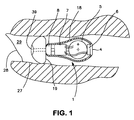
- a hearing aid 1 is shown in fig. 1 alone and without the handling tool.
- the hearing aid is shaped with an outer casing 18 which is sized to enter deep into the ear canal 29 of most hearing aid users.
- the various components of the hearing aid 1 are provided: a battery 5 for power delivery, a microphone 6 which transforms surrounding sounds into an electrical signal, a signal processing device 7 which processes the electrical signal from the microphone and provides a processed electrical signal which is served at a receiver 8.
- the receiver 8 has a sound producing opening or sound exit 39 which will produce sound in the vicinity of the tympanic membrane 28, when the hearing aid is placed inside the ear canal 29 of a user.
- a dome 19 or sealing element is provided for sealing the space between the hearing aid casing 18 and the internal wall 27 of the ear canal 29 of a user.
- the dome 19 may be an open dome and mainly function as retention element.
- the hearing aid has all parts thereof inside the ear canal.
- Mechanical connection parts 4 are provided at an opposed side of the sealing element 19.
- complementary mechanical connection parts are provided at the handling tool, such that the user may extract the hearing aid from the ear and also insert it to the correct position with the sound exit 39 close to the tympanic membrane 28.
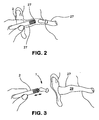
- figs 2 and 3 a general outline of the hearing aid and tool is shown.
- the handling tool 2 is to be held by the fingers of the user, and the hearing aid shall be releasable adhered to a tip portion of the tool as shown in fig. 2 .
- the tool tip is adapted to be inserted into the ear canal 29.
- the hearing aid is to be inserted it is initially fastened to the tool tip as shown in fig. 3 and the hearing aid and tool are inserted to the position as shown in fig. 2 , and here the hearing aid is released from the tip of the tool, and the tool 2 is taken out of the ear.
- the tool When the tool is used for extraction, it is inserted into the ear canal to a position adjacent to or abutting the hearing aid 1, and the hearing aid becomes attached or adhered to the tool tip, such that the hearing aid may be extracted from the ear canal 29 along with the tool 2.
- the tool During daily use it must be ensured, that the tool is never inserted too deep into the ear canal, which might cause injury or pain, and it must be ensured that the user is capable of safe removal and safe insertion of the hearing aid.
- a reliable release and adherence mechanism is to be ensured by the invention.
- a charger 40 is shown wherein the hearing aid 1 may be seated for recharging of a rechargeable battery in the hearing aid 1.
- the charger 40 comprises a power source 42 for establishing charging power at charging points 43.
- the power source 42 may comprise a larger battery or it may be in the form of a transformer being connected to a power line as is well known in connection with re-chargeable batteries.
- fig. 4A the corresponding hearing aid 1 is shown, with charging contacts 3, and a ferromagnetic or permanent magnetic plate 4.
- the hearing aid in fig. 4A may be seated in the charger 40.
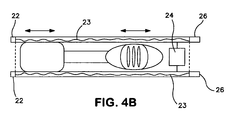
- connection points 22 which are arranged to contact the connection points 3 of the hearing aid 1 when the hearing aid is seated in the tool.
- Leads 23 are provided inside the tool to provide contact between the contact points 22 and further contact points 26 at the rear end of the tool.
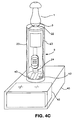
- a hearing aid is shown seated in a handling tool 2.
- Two separate electrical connections 3 are provided at the hearing aid; and at the handling tool corresponding connections 22 are provided which are in contact with each other whenever the hearing aid 1 is seated in the handling tool.
- the charger 40 is shown, and as seen the connection tool 2 is seated therein and electrical connections 26 at the one end of the handling tool contacts the charging points 43 thereof, and through the leads 23 in the handling tool 2, the charging points 43 of the charger gains contact with the rechargeable battery in the hearing aid 1.
- the handling tool 2 may comprise a rechargeable battery 24 of its own, such that the hearing aid may be charged therefrom. Thus, for a shorter duration of time, the hearing aid user may travel without the charging box, as long as the handling tool 2 is within reach. Charging the hearing aid through the tool may be accomplished with any of the tools disclosed in this application.
- an electromagnetic device 50 is shown which may form part of the tool.
- the electromagnetic device is essentially an iron core 51 with an electric lead 52 wound around the core 51.
- the winding may be powered by a battery 53 and the device is controlled by a switch 54, which controls the electromagnetic device.
- An external button 56 may be provided for the control of the switch 54.
- the battery 53 may be a re-chargeable battery and charging poles 55 will in this case have to be provided for recharging the battery.
- the electromagnet shown in fig. 5 may be employed in the tool at any point in this description where a magnetic or ferromagnetic device is mentioned.
- a tool which comprise a cylinder 62, adapted for insertion into the ear canal, and a magnetic plunger 61 arranged to slide inside the cylinder 62.
- a shaft 63 is connected to the plunger 61 such that the position of the plunger 61 in the cylinder 62 is controllable by manual operation of the shaft 63. This is possible in a simple manner by a knob 64 connected to the shaft.
- the hearing aid connection part (which in this case will comprise a ferromagnetic element) will be obtained, such that by pulling the tool out of the ear, the hearing aid will follow magnetically coupled to the tool.
- the hearing aid is placed at the tool and inserted with the tool into the ear canal, and following insertion the plunger is pulled back by pulling at the knob 64, whereby the magnet 61 is pulled away from the hearing aid.
- the edge parts 65 of the tool will ensure that the hearing aid stays inside the ear canal when the magnetic plunger 61 is pulled back.
- the tool comprises a first permanent magnet 71 with a first polarization indicated by letters "S" and N" and a second permanent magnet 72, arranged proximal to the first magnet.
- the second magnet 72 is mounted in order to rotate with respect to the first magnet 71, such that the two magnets in a first position of the movable magnet have magnetic fields mutually enforcing each other as shown in fig. 7 . In this position the magnetic field outside the tool end at 73 will be stronger and this is used for extraction or insertion of the hearing aid.
- the second magnet 72 is placed in a second position in order that the two magnets have magnetic fields which cancel each other.
- the second magnet 72 is turned by means of a simple screw 74 which is rotated by way of a simple cam impeller (not shown) which is manoeuvred by a slidable button 75.
- the magnets 71,72 are rotated with respect to each other in the above example of the invention, but a similar effect may be realized with two or more magnets arranged slidable with respect to each other. This is shown in more detail in fig. 7B .
- the annular magnet 71 in fig.
- the magnet 76 is arranged permanently at the end of the tool, and the magnet 76 is arranged slidable within the tube shaped by the annular magnet 71.
- the magnet 76 is moved by slider 77 from a position wherein the two magnets 71 and 76 co-operate in generating a magnetic field outside of the tool 2 and to a position where the two magnets are arrange to cancel out their respective magnetic fields.
- a guiding magnet could be provided at either the tool part or the hearing aid connection part to facilitate correct positioning of the tool part at any of the embodiments of the invention even if not specifically mentioned.
- a hearing aid and handling tool wherein a flexible link 161 is provided between the connection means 162 and the tool part is provided.
- the tool part in fig. 16 comprises a handle 163.
- a connection means 162 is provided, whereby the connection at the first end comprise a large magnet 164 adapted for pulling out the hearing aid (not shown in fig. 16 ) and at the other end comprise a small magnet 165 adapted for insertion of a hearing aid.
- the smaller magnet 165 provides only a weak attraction which is just sufficient for keeping the hearing aid in place at the tool, and when pushed into the ear canal the hearing aid cannot be re-extracted using this magnet.
- the sealing or retention element will make sure that there is at least some friction force between the hearing aid and the ear canal which will ensure, that the hearing aid stays in place and cannot be re-extracted with the week magnet.
- the tool end with the large magnet 164 is used, and this magnet has a holding force large enough to overcome the friction forces otherwise keeping the hearing aid in place in the ear.
- the flexible link 161 is shaped as a ball joint, whereas the link in fig. 16 is realized by a flexible material such a flexible polymer.
- the flexible link disclosed in connection with the embodiments of fig. 16 and 16A may be realized with any of the presented embodiments.
- a link may be associated in the same manner with the hearing aid between the connection parts and the remaining hearing aid.
- the tool 2 comprise an extending element 170 shaped to enter into the ear canal of a hearing aid wearer and stop element 171 proximal to the extending element 170 and shaped to prevent extension thereof into the ear canal.
- the stop element is provided with a size which prohibits the extension thereof into the ear canal, and in this way it is ensured that the extending element 170 is not inadvertently inserted to deep into an ear canal.
- a shaft part 173 of the extending element may be secured lengthwise to the handle part 175 of the tool 2, and by way of this arrangement the extension length of the extending part 170 may be adjustable to the individual hearing aid user.
- a releasable grip between the hearing aid 1 and the extending part is schematically shown, but any kind of releasable grip could be used.
- the tool 2 comprises a tip part which is to enter into the ear, and a mounted slidably onto the tip part, a stop element 181 is provided.
- the stop element 181 has a size which prohibits the extension thereof into the ear canal.
- the hearing aid 1 is shown schematically adhered to the tip of the tool 2.
- Fig. 18A shows a ratchet mechanism 182 provided at the tool tip part in order to adjust the position of the stop element 181.
- the handling tool which comprises a cover 191.
- the attachment part 192 of the tool may be retracted into the cover 191 with the hearing aid 1 attached thereto. This may be realized in a simple manner by a slidable knob 193 being in operational connection with the attachment part 192.
- leads 23 and charging points 26 are schematically shown.
- the option of a cover which is part of the handling tool may be combined with any of the other described embodiments disclosed in this application.
- the handling tool 2 which comprise a handle part and a first connection part 202 extending from the handle part 201 and a second connection part 203 opposed to the first connection part.
- a hearing aid 1 may be adhered.
- charging leads 23 and charging points 26 are schematically shown such that the user may charge the hearing aid batteries by mounting the handle onto a charging unit (not shown).
- the handling tool may comprise a rechargeable battery 24 of its own as previously mentioned. The option of a handling tool with two hearing aids may be combined with any of the other described embodiment disclosed in this application.
Landscapes
- Engineering & Computer Science (AREA)
- Computer Networks & Wireless Communication (AREA)
- Health & Medical Sciences (AREA)
- General Health & Medical Sciences (AREA)
- Neurosurgery (AREA)
- Otolaryngology (AREA)
- Physics & Mathematics (AREA)
- Acoustics & Sound (AREA)
- Signal Processing (AREA)
- Measurement Of The Respiration, Hearing Ability, Form, And Blood Characteristics Of Living Organisms (AREA)
- Battery Mounting, Suspending (AREA)
Description
- The invention regards the problem which arises when a hearing aid is provided wherein all parts thereof are provided inside the ear canal and no elements extends outside the ear canal. Especially if it is wished that the user shall be empowered to extract and insert such a hearing aid into and out of the ear canal.
- From prior art document
WO 2005/077011 a removal tool is known, which comprises a shaft adapted to be grasped in the hand and a plurality of hooks coupled to a first end of the shaft. The hooks are configured to detachably engage a loop structure of the hearing aid device. With this removal tool it is possible to safely remove the hearing aid from a position deep within the ear canal, but the tool does not facilitate insertion of the hearing aid, as detaching the hooks from the loop structure is not possible when the hearing aid is inside the ear canal. - Prior art document
US 5 003 608 shows a hearing aid with a pull out part, which is to be gripped by the fingers of a user. The pull out part is movable between a first position where it is inserted inside the hearing aid and a further position where it extends away from the outer surface of the hearing aid. The movement between the two positions may be accomplished by magnetic forces from a magnet associated with a hand held tool. This allows a pull out string to be in-conspicuous, however it does not provide a good association between a tool part and the hearing aid, such that the user may carry the hearing aid in or fastened to the tool part. -
US 4756312 discloses a hearing aid and extraction tool, where the tool comprises a magnetisable iron part and the hearing aid comprises a magnetic part, where a movable magnetic element in the tool may in a first position thereof magnetize the magnetisable part in a first polarity causing attraction between this part and the magnet of the hearing aid, and in a second position thereof magnetize the magnetisable part in a reverse direction causing repulsion between the magnetisable part and the magnet in the hearing aid. -
DE 296 08 352 U1 shows a range of different mechanical releasable connections between a handling tool and a hearing aid, based on tool parts moving transversely to the hearing aid length axis and attaching to abutments/grooves at a rear end of the hearing aid. -
US 6055319 shows an exchangeable handle adapted to be attached to a hearing aid sitting deep in the ear canal. The handle has means for locking tightly with the hearing aid. - A hearing aid and handling tool is desired, which allows both insertion, pull out and handling outside the ear canal of the hearing aid. A secure attachment between the tool and the hearing aid is thus required, however such that the hearing aid may be detached from the handling tool once it is correctly inserted into the ear canal of a user.
- Further objects of the invention are achieved by the embodiments defined in the dependent claims and in the detailed description of the invention.
- As used herein, the singular forms "a," "an," and "the" are intended to include the plural forms as well (i.e. to have the meaning "at least one"), unless expressly stated otherwise. It will be further understood that the terms "includes," "comprises," "including," and/or "comprising," when used in this specification, specify the presence of stated features, integers, steps, operations, elements, and/or components, but do not preclude the presence or addition of one or more other features, integers, steps, operations, elements, components, and/or groups thereof. It will be understood that when an element is referred to as being "connected" or "coupled" to another element, it can be directly connected or coupled to the other element or intervening elements maybe present, unless expressly stated otherwise. Furthermore, "connected" or "coupled" as used herein may include wirelessly connected or coupled. As used herein, the term "and/or" includes any and all combinations of one or more of the associated listed items. The steps of any method disclosed herein do not have to be performed in the exact order disclosed, unless expressly stated otherwise.
- A hearing aid and handling tool according to the invention are defined in
claim 1. - The retention element and the sound exit defines a first end of the hearing aid which is to face the tympanic membrane of a user when the hearing aid is inserted into the ear canal of a user. The opposite end of the hearing aid is to face the surroundings and at this end connection parts are provided, such that a stable connection between the handling tool and the hearing aid may be established. This allows the hearing aid to be safely inserted and extracted from the ear canal, and at the same time the complementary connection at the handling tool and the hearing aid allows safe and secure handling of the hearing aid once the hearing aid is out of the ear. This is important as hearing aids of this kind by nature has to be very small, and handling such hearing aids with the fingers is difficult or possibly impossible for elderly users with poor dexterity.
- The hearing aid itself will comprise the usual parts which constitutes a hearing aid: a microphone for sensing sounds from the surroundings and transforming the sounds into electrical signals, a signal processing means which may enhance the sound content of the microphone signal according to the users liking and need, an output device adapted to deliver a signal to the user which is perceivable as sound. Also the hearing aid will comprise a battery for delivery of electrical power to the transducers and circuitry. The output device is a speaker (usually called a receiver) which delivers a sound signal to the users ear drum. In order to isolate the microphone from the sounds produced from the receiver, the retention element may comprise a sealing property and is provided between the hearing aid casing part and the internal wall of the ear canal.
- In an embodiment of the invention the hearing aid and the handling tool gains electrical contact over two separate contact points when the mechanical connection points interact for handling of the hearing aid. In this way charging of a rechargeable battery in the hearing aid may be accomplished via the handling tool. The tool may comprise a battery or a set of further connection points. The further connection point come into play when the tool with the hearing aid attached thereto is inserted into a charging device such that power may be supplied from the charging device via the further electrical connection of the handling tool and to the hearing aid.
- The complementary connection parts of the handling tool or the hearing aid comprise an actuator adapted to generate a magnetic field extending outside a connection part such that the actuator is switchable between a field generating state and a state where no field is generated. Such switchable magnetic field greatly facilitates insertion of the hearing aid into the ear, as the magnetic field extending outside the tool part may be used to secure the hearing aid to the tool, and by switching off this magnetic field the hearing aid may be released from the tool once inserted into the ear canal.
- In an embodiment the magnetic actuator comprise either a ferromagnetic part or a permanent magnetic part arranged to move in either translational or rotational fashion to produce the magnetic field outside a surface part of the connection parts of the handling tool. Movable magnetic or ferromagnetic parts are very simple mechanical devices which may readily be provided in the tool part to control the magnetic field outside of the tool part.
- In an embodiment the tool comprise a cylinder adapted for insertion into the ear canal and a magnetic plunger arranged slidable inside the cylinder and a shaft connected to the plunger such that the position of the plunger in the cylinder is controllable by manual operation of the shaft. The shaft may extend sideways out of the cylinder or it may extend out of an end part of the cylinder. In both instances, the plunger is movable in a direction towards and away from an end part of the tool, by way of the shaft, whereby the magnetic field outside the tool part is controllable.
- The tool comprises a first permanent magnet with a first polarization and a second permanent magnet, arranged proximal to the first magnet, whereby the second magnet is mounted in order to slide or rotate with respect to the first magnet, such that the two magnets in a first position of the movable magnet have magnetic fields mutually enforcing each other and in a second position have magnetic fields which cancel each other. This embodiment is advantageous in that a very strong magnetic field reaching out of the tool part may be switched on or of respectively.
- In a preferred embodiment a guiding magnet is provided at either the tool part or the hearing aid connection part to facilitate correct positioning of the tool part with respect to the hearing aid connection part. Such a guiding magnet may aid the user in a big way to have the tool correctly placed relative to the hearing aid inside the ear, as the tool cannot be observed during insertion and extraction of the hearing aid.
- In yet an embodiment a flexible link is provided between the connection means and the hearing aid or the tool part respectively. Such a link will aid in providing a reliable connection between the hearing aid and the handling tool when the ear canal of the wearer is not straight but has a marked bend. With a flexible link the tool tip may be manoeuvred inside the ear canal to the right position relative to the hearing aid.
- In an embodiment the handling tool comprise a handle part and a first connection part extending from the handle part and a second connection part opposed to the first connection part. Having two connection parts extending from one and the same handle part allows the user to use the one and same tool for extracting a hearing aid from each of his ears.
- In an embodiment the tool part comprise an extending element shaped to enter into the ear canal of a hearing aid wearer and stop element proximal to the extending element and shaped to prevent extension thereof into the ear canal. This security measure aids to prevent pain or damage to the ear canal and the tympanic membrane when the user attempts to extract a hearing aid.
- Preferably the length of the extending element is adjustable, such that it may be customized to the individual user.
-
-
Fig. 1 shows a hearing aid according to the invention, -
Fig. 2 a hearing aid and handling tool partly inside the ear canal of a user, -
Fig. 3 a hearing aid being extracted/inserted from the ear canal of a user, -
Fig. 4 a charger for the hearing aid or the handling tool according to the invention, -
Fig. 4A is side view of a hearing aid according to the invention shown form two sides -
Fig. 4B is a partial sectional view of a handling tool, -
Fig. 4C is a hearing aid, a handling tool, and a charging unit according to the invention -
Fig. 5 shows an electromagnetic device with a control element, -
Fig. 6 is a handling tool in a side view, -
Fig. 7 is a sectional view of a further embodiment of a handling tool, -
Fig. 7A is a sectional view of the handling tool infig. 7 , -
Fig. 7B is a sectional view of a further embodiment of the handling tool, -
Fig. 16 and16A shows further examples of a handling tool, -
Fig. 17 shows a further example of a hearing aid and handling tool according to the invention, -
Fig. 18 ,18A and 18B shows a further example of a hearing aid and handling tool according to the invention, -
Fig. 19 ,19A shows a further example of a hearing aid and handling tool according to the invention, -
Fig. 20 shows a further example of a hearing aid and handling tool according to the invention. - The figures are schematic and simplified for clarity, and they just show details which are essential to the understanding of the invention, while other details are left out. Throughout, the same reference numerals are used for identical or corresponding parts. Further scope of applicability of the present invention will become apparent from the detailed description given hereinafter. However, it should be understood that the detailed description and specific examples, while indicating preferred embodiments of the invention, are given by way of illustration only, since various changes and modifications within the scope of the invention will become apparent to those skilled in the art from this detailed description.
- A
hearing aid 1 is shown infig. 1 alone and without the handling tool. The hearing aid is shaped with anouter casing 18 which is sized to enter deep into theear canal 29 of most hearing aid users. Internally of thecasing 18 the various components of thehearing aid 1 are provided: abattery 5 for power delivery, amicrophone 6 which transforms surrounding sounds into an electrical signal, asignal processing device 7 which processes the electrical signal from the microphone and provides a processed electrical signal which is served at areceiver 8. Thereceiver 8 has a sound producing opening orsound exit 39 which will produce sound in the vicinity of thetympanic membrane 28, when the hearing aid is placed inside theear canal 29 of a user. Adome 19 or sealing element is provided for sealing the space between thehearing aid casing 18 and theinternal wall 27 of theear canal 29 of a user. Thedome 19 may be an open dome and mainly function as retention element. As seen infig. 1 the hearing aid has all parts thereof inside the ear canal.Mechanical connection parts 4 are provided at an opposed side of the sealingelement 19. And as explained in the following complementary mechanical connection parts are provided at the handling tool, such that the user may extract the hearing aid from the ear and also insert it to the correct position with thesound exit 39 close to thetympanic membrane 28. - In
figs 2 and 3 a general outline of the hearing aid and tool is shown. Thehandling tool 2 is to be held by the fingers of the user, and the hearing aid shall be releasable adhered to a tip portion of the tool as shown infig. 2 . As seen infig. 2 the tool tip is adapted to be inserted into theear canal 29. When the hearing aid is to be inserted it is initially fastened to the tool tip as shown infig. 3 and the hearing aid and tool are inserted to the position as shown infig. 2 , and here the hearing aid is released from the tip of the tool, and thetool 2 is taken out of the ear. When the tool is used for extraction, it is inserted into the ear canal to a position adjacent to or abutting thehearing aid 1, and the hearing aid becomes attached or adhered to the tool tip, such that the hearing aid may be extracted from theear canal 29 along with thetool 2. During daily use it must be ensured, that the tool is never inserted too deep into the ear canal, which might cause injury or pain, and it must be ensured that the user is capable of safe removal and safe insertion of the hearing aid. Thus a reliable release and adherence mechanism is to be ensured by the invention. - In
fig. 4 acharger 40 is shown wherein thehearing aid 1 may be seated for recharging of a rechargeable battery in thehearing aid 1. Thecharger 40 comprises apower source 42 for establishing charging power at chargingpoints 43. Thepower source 42 may comprise a larger battery or it may be in the form of a transformer being connected to a power line as is well known in connection with re-chargeable batteries. - In
fig. 4A thecorresponding hearing aid 1 is shown, with chargingcontacts 3, and a ferromagnetic or permanentmagnetic plate 4. The hearing aid infig. 4A may be seated in thecharger 40. - In
fig. 4B the handling tool is shown having electric connection points 22 which are arranged to contact the connection points 3 of thehearing aid 1 when the hearing aid is seated in the tool. Leads 23 are provided inside the tool to provide contact between the contact points 22 and further contact points 26 at the rear end of the tool. - In
fig. 4C a hearing aid is shown seated in ahandling tool 2. Two separateelectrical connections 3 are provided at the hearing aid; and at the handlingtool corresponding connections 22 are provided which are in contact with each other whenever thehearing aid 1 is seated in the handling tool. Further, infig. 4C thecharger 40 is shown, and as seen theconnection tool 2 is seated therein andelectrical connections 26 at the one end of the handling tool contacts the charging points 43 thereof, and through theleads 23 in thehandling tool 2, the charging points 43 of the charger gains contact with the rechargeable battery in thehearing aid 1. This aids the hearing aid user, who does not have to handle the very small hearing aid alone, as he can do with handling the assembly of hearing aid and handling tool, also when the hearing aid is to be seated for recharging. Thehandling tool 2 may comprise arechargeable battery 24 of its own, such that the hearing aid may be charged therefrom. Thus, for a shorter duration of time, the hearing aid user may travel without the charging box, as long as thehandling tool 2 is within reach. Charging the hearing aid through the tool may be accomplished with any of the tools disclosed in this application. - In
fig. 5 an electromagnetic device 50 is shown which may form part of the tool. The electromagnetic device is essentially an iron core 51 with anelectric lead 52 wound around the core 51. The winding may be powered by abattery 53 and the device is controlled by aswitch 54, which controls the electromagnetic device. Anexternal button 56 may be provided for the control of theswitch 54. Thebattery 53 may be a re-chargeable battery and chargingpoles 55 will in this case have to be provided for recharging the battery. The electromagnet shown infig. 5 may be employed in the tool at any point in this description where a magnetic or ferromagnetic device is mentioned. - In
fig. 6 a tool is disclosed which comprise acylinder 62, adapted for insertion into the ear canal, and amagnetic plunger 61 arranged to slide inside thecylinder 62. Ashaft 63 is connected to theplunger 61 such that the position of theplunger 61 in thecylinder 62 is controllable by manual operation of theshaft 63. This is possible in a simple manner by aknob 64 connected to the shaft. When the hearing aid is to be extracted from the ear canal, theplunger 61 is placed in the foremost position in the cylinder as shown infig. 6 and the tool is inserted into the ear and as a result of the position of the magnet a good grip on the hearing aid connection part (which in this case will comprise a ferromagnetic element) will be obtained, such that by pulling the tool out of the ear, the hearing aid will follow magnetically coupled to the tool. When the hearing aid is to be inserted the hearing aid is placed at the tool and inserted with the tool into the ear canal, and following insertion the plunger is pulled back by pulling at theknob 64, whereby themagnet 61 is pulled away from the hearing aid. Theedge parts 65 of the tool will ensure that the hearing aid stays inside the ear canal when themagnetic plunger 61 is pulled back. - In
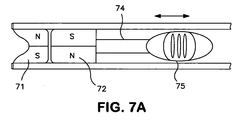
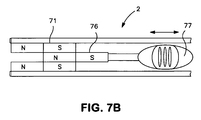
figs. 7 and7A the tool comprises a firstpermanent magnet 71 with a first polarization indicated by letters "S" and N" and a secondpermanent magnet 72, arranged proximal to the first magnet. Thesecond magnet 72 is mounted in order to rotate with respect to thefirst magnet 71, such that the two magnets in a first position of the movable magnet have magnetic fields mutually enforcing each other as shown infig. 7 . In this position the magnetic field outside the tool end at 73 will be stronger and this is used for extraction or insertion of the hearing aid. And as shown infig. 7A thesecond magnet 72 is placed in a second position in order that the two magnets have magnetic fields which cancel each other. Whereby the magnetic force outside the tool end will be weak and this is used when the hearing aid is to be released from thetool 2, such as when the tool is to be extracted after insertion of a hearing aid. Thesecond magnet 72 is turned by means of asimple screw 74 which is rotated by way of a simple cam impeller (not shown) which is manoeuvred by aslidable button 75. Themagnets fig. 7B . Theannular magnet 71 infig. 7B is arranged permanently at the end of the tool, and themagnet 76 is arranged slidable within the tube shaped by theannular magnet 71. Themagnet 76 is moved byslider 77 from a position wherein the twomagnets tool 2 and to a position where the two magnets are arrange to cancel out their respective magnetic fields. - A guiding magnet could be provided at either the tool part or the hearing aid connection part to facilitate correct positioning of the tool part at any of the embodiments of the invention even if not specifically mentioned.
- In
fig. 16 a hearing aid and handling tool is shown, wherein aflexible link 161 is provided between the connection means 162 and the tool part is provided. The tool part infig. 16 comprises ahandle 163. At both ends of the handle a connection means 162 is provided, whereby the connection at the first end comprise alarge magnet 164 adapted for pulling out the hearing aid (not shown infig. 16 ) and at the other end comprise asmall magnet 165 adapted for insertion of a hearing aid. Thesmaller magnet 165 provides only a weak attraction which is just sufficient for keeping the hearing aid in place at the tool, and when pushed into the ear canal the hearing aid cannot be re-extracted using this magnet. The sealing or retention element will make sure that there is at least some friction force between the hearing aid and the ear canal which will ensure, that the hearing aid stays in place and cannot be re-extracted with the week magnet. When the hearing aid is to be extracted from the ear canal the tool end with thelarge magnet 164 is used, and this magnet has a holding force large enough to overcome the friction forces otherwise keeping the hearing aid in place in the ear. InFig. 16A theflexible link 161 is shaped as a ball joint, whereas the link infig. 16 is realized by a flexible material such a flexible polymer. - The flexible link disclosed in connection with the embodiments of
fig. 16 and16A may be realized with any of the presented embodiments. A link may be associated in the same manner with the hearing aid between the connection parts and the remaining hearing aid. - In
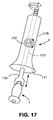
fig. 17 thetool 2 comprise an extendingelement 170 shaped to enter into the ear canal of a hearing aid wearer and stopelement 171 proximal to the extendingelement 170 and shaped to prevent extension thereof into the ear canal. The stop element is provided with a size which prohibits the extension thereof into the ear canal, and in this way it is ensured that the extendingelement 170 is not inadvertently inserted to deep into an ear canal. By way of a screw 172 ashaft part 173 of the extending element may be secured lengthwise to thehandle part 175 of thetool 2, and by way of this arrangement the extension length of the extendingpart 170 may be adjustable to the individual hearing aid user. A releasable grip between thehearing aid 1 and the extending part is schematically shown, but any kind of releasable grip could be used. - In
fig. 18 a further example of a security measure is disclosed. Thetool 2 comprises a tip part which is to enter into the ear, and a mounted slidably onto the tip part, astop element 181 is provided. Thestop element 181 has a size which prohibits the extension thereof into the ear canal. Thehearing aid 1 is shown schematically adhered to the tip of thetool 2. -
Fig. 18A shows aratchet mechanism 182 provided at the tool tip part in order to adjust the position of thestop element 181. - In
fig. 18B a further adjustment means is disclosed, and here an adjustment wheel 83 is shown, by way of which the stop element may be moved away from or towards the tip of thetool 2. - In
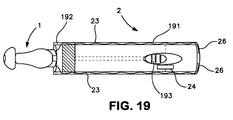
figs. 19 and19A the handling tool is shown which comprises acover 191. Theattachment part 192 of the tool may be retracted into thecover 191 with thehearing aid 1 attached thereto. This may be realized in a simple manner by aslidable knob 193 being in operational connection with theattachment part 192. In the embodiment shown leads 23 and chargingpoints 26 are schematically shown. The option of a cover which is part of the handling tool may be combined with any of the other described embodiments disclosed in this application. - In
fig. 20 an example of thehandling tool 2 is disclosed which comprise a handle part and afirst connection part 202 extending from thehandle part 201 and asecond connection part 203 opposed to the first connection part. At bothconnection parts 202, 203 ahearing aid 1 may be adhered. In this way a hearing aid user has only one tool for handling the hearing aids in both ears. This greatly simplifies the handling of the two hearing aids. Also in this embodiment charging leads 23 and chargingpoints 26 are schematically shown such that the user may charge the hearing aid batteries by mounting the handle onto a charging unit (not shown). Also the handling tool may comprise arechargeable battery 24 of its own as previously mentioned. The option of a handling tool with two hearing aids may be combined with any of the other described embodiment disclosed in this application.
Claims (9)
- Hearing aid and handling tool whereby the hearing aid (1) has all parts thereof inside the ear canal and comprise a casing part (18) with a retention element (19) extending radially between the casing part (18) and the circumference of an ear canal of a user, whereby a sound exit (39) is provided at a first side of the retention element (19) and mechanical connection parts (4) are provided at an opposed side of the retention element wherein complementary mechanical connection parts are provided at the handling tool (2), wherein the complementary connection parts of the handling tool (2) or the hearing aid (1) include an actuator adapted to generate a magnetic field extending outside a connection part wherein the actuator is switchable between a field generating state and a state where no field is generated wherein the tool comprises a first permanent magnet (71) with a first polarization and a second permanent magnet (76, 72), arranged proximal to the first magnet, whereby the second magnet (76, 72) is mounted in order to slide or rotate with respect to the first magnet (71), such that the two magnets (71,76,72) in a first position of the movable magnet have magnetic fields mutually enforcing each other and in a second position have magnetic fields which cancel each other.
- Hearing aid and handling tool as claimed in claim 1 wherein at least two separate electrical connections are provided at the hearing aid and the handling tool wherein further the two electrical connections at the handling tool (22) gain contact with the respective connections (3) at the hearing aid when the complementary connections at the handling tool and the hearing aid are caused to interact.
- Hearing aid and handling tool as claimed in claim 1, wherein the tool comprise a cylinder adapted for insertion into the ear canal and a magnetic plunger (72) arranged slidable inside the cylinder and a shaft (74) connected to the plunger such that the position of the plunger in the cylinder is controllable by manual operation of the shaft.
- Hearing aid and handling tool as claimed in any of claims 1 - 3 wherein a guiding magnet is provided at either the tool part or the hearing aid connection part to facilitate correct positioning of the tool part with respect to the hearing aid connection part.
- Hearing aid and handling tool as claimed in any of the above claims, wherein a flexible link (161) is provided between the connection means and the hearing aid or the tool part respectively.
- Hearing aid and handling tool as claimed in any of the above claims wherein the handling tool (2) comprise a handle part (201) and a first connection part (202) extending from the handle part and a second connection part (203) opposed to the first connection part (202).
- Hearing aid and handling tool as claimed in any of the above claims, wherein the tool part comprise an extending element (170) shaped to enter into the ear canal of a hearing aid wearer and a stop element (171) proximal to the extending element and shaped to prevent extension thereof into the ear canal.
- Hearing aid and handling tool as claimed in claim 7 wherein the length of the extending (171) element is adjustable.
- Hearing aid and handling tool as claimed in any of the above claims wherein the handling tool comprises a battery (24,53).
Priority Applications (1)
| Application Number | Priority Date | Filing Date | Title |
|---|---|---|---|
| EP11151864A EP2355552B1 (en) | 2010-01-29 | 2011-01-24 | Hearing aid and handling tool |
Applications Claiming Priority (2)
| Application Number | Priority Date | Filing Date | Title |
|---|---|---|---|
| EP10152161 | 2010-01-29 | ||
| EP11151864A EP2355552B1 (en) | 2010-01-29 | 2011-01-24 | Hearing aid and handling tool |
Publications (2)
| Publication Number | Publication Date |
|---|---|
| EP2355552A1 EP2355552A1 (en) | 2011-08-10 |
| EP2355552B1 true EP2355552B1 (en) | 2012-11-21 |
Family
ID=42246243
Family Applications (1)
| Application Number | Title | Priority Date | Filing Date |
|---|---|---|---|
| EP11151864A Not-in-force EP2355552B1 (en) | 2010-01-29 | 2011-01-24 | Hearing aid and handling tool |
Country Status (5)
| Country | Link |
|---|---|
| US (1) | US20110206225A1 (en) |
| EP (1) | EP2355552B1 (en) |
| CN (1) | CN102196351A (en) |
| AU (1) | AU2011200362A1 (en) |
| DK (1) | DK2355552T3 (en) |
Families Citing this family (42)
| Publication number | Priority date | Publication date | Assignee | Title |
|---|---|---|---|---|
| USD668341S1 (en) * | 2011-01-06 | 2012-10-02 | Hearing Technologies International, Inc. | Hearing aid insertion tool |
| US9161142B1 (en) | 2012-01-17 | 2015-10-13 | Dennis Wagner | Push button insertion tool systems |
| WO2013126749A1 (en) * | 2012-02-25 | 2013-08-29 | Aria Innovations, Inc. | Hearing aid insertion, positioning and removal apparatus and system |
| US8798301B2 (en) * | 2012-05-01 | 2014-08-05 | iHear Medical, Inc. | Tool for removal of canal hearing device from ear canal |
| US9002046B2 (en) | 2012-06-29 | 2015-04-07 | iHear Medical, Inc. | Method and system for transcutaneous proximity wireless control of a canal hearing device |
| US8867768B2 (en) | 2012-11-30 | 2014-10-21 | iHear Medical, Inc. | Earpiece assembly with foil clip |
| US9078075B2 (en) * | 2012-11-30 | 2015-07-07 | iHear Medical, Inc. | Tool for insertion of canal hearing device into the ear canal |
| US9185504B2 (en) | 2012-11-30 | 2015-11-10 | iHear Medical, Inc. | Dynamic pressure vent for canal hearing devices |
| US9031247B2 (en) | 2013-07-16 | 2015-05-12 | iHear Medical, Inc. | Hearing aid fitting systems and methods using sound segments representing relevant soundscape |
| US9439008B2 (en) | 2013-07-16 | 2016-09-06 | iHear Medical, Inc. | Online hearing aid fitting system and methods for non-expert user |
| US10129669B2 (en) | 2014-01-14 | 2018-11-13 | Axil, Llc | Personal hearing device |
| DK2922312T3 (en) * | 2014-03-17 | 2017-03-20 | Oticon As | Device for insertion or extraction of a hearing aid |
| EP2930944A1 (en) * | 2014-04-07 | 2015-10-14 | Oticon A/s | Hearing aid comprising a flexible connection member |
| DK3180927T3 (en) | 2014-08-15 | 2020-05-04 | Ihear Medical Inc | CHANNEL HEARING AND PROCEDURES FOR WIRELESS REMOTE CONTROL OF A DEVICE |
| US9769577B2 (en) | 2014-08-22 | 2017-09-19 | iHear Medical, Inc. | Hearing device and methods for wireless remote control of an appliance |
| US9807524B2 (en) | 2014-08-30 | 2017-10-31 | iHear Medical, Inc. | Trenched sealing retainer for canal hearing device |
| US20160066822A1 (en) | 2014-09-08 | 2016-03-10 | iHear Medical, Inc. | Hearing test system for non-expert user with built-in calibration and method |
| US9788126B2 (en) | 2014-09-15 | 2017-10-10 | iHear Medical, Inc. | Canal hearing device with elongate frequency shaping sound channel |
| US10097933B2 (en) | 2014-10-06 | 2018-10-09 | iHear Medical, Inc. | Subscription-controlled charging of a hearing device |
| US20160134742A1 (en) | 2014-11-11 | 2016-05-12 | iHear Medical, Inc. | Subscription-based wireless service for a canal hearing device |
| US10085678B2 (en) | 2014-12-16 | 2018-10-02 | iHear Medical, Inc. | System and method for determining WHO grading of hearing impairment |
| US10045128B2 (en) | 2015-01-07 | 2018-08-07 | iHear Medical, Inc. | Hearing device test system for non-expert user at home and non-clinical settings |
| US9860653B2 (en) | 2015-04-20 | 2018-01-02 | Oticon A/S | Hearing aid device with positioning guide and hearing aid device system |
| US10489833B2 (en) | 2015-05-29 | 2019-11-26 | iHear Medical, Inc. | Remote verification of hearing device for e-commerce transaction |
| EP3113512A1 (en) * | 2015-06-29 | 2017-01-04 | Oticon A/s | Coupling device |
| EP3384686A4 (en) | 2015-12-04 | 2019-08-21 | Ihear Medical Inc. | Self-fitting of a hearing device |
| US11564042B2 (en) | 2016-12-01 | 2023-01-24 | Earplace Inc. | Apparatus for manipulation of ear devices |
| EP3586524B1 (en) * | 2017-02-23 | 2023-06-07 | Sonova AG | A module of a hearing device, a removal tool, a hearing device and a method of separating a module from a housing |
| DE102018207922A1 (en) * | 2018-05-18 | 2019-11-21 | Vibrosonic Gmbh | Multi-part eardrum contact hearing aid placed deep in the ear canal |
| EP3557883A1 (en) * | 2018-09-28 | 2019-10-23 | Oticon A/s | Insertion and removal tool for a hearing aid |
| US10986433B2 (en) * | 2018-09-28 | 2021-04-20 | Apple Inc. | Eartips for coupling via wireform attachment mechanisms |
| EP3557886A1 (en) * | 2018-11-14 | 2019-10-23 | Oticon A/s | Hearing aid for deep-in-canal insertion |
| US11067644B2 (en) | 2019-03-14 | 2021-07-20 | Bose Corporation | Wearable audio device with nulling magnet |
| US11076214B2 (en) | 2019-03-21 | 2021-07-27 | Bose Corporation | Wearable audio device |
| US11061081B2 (en) * | 2019-03-21 | 2021-07-13 | Bose Corporation | Wearable audio device |
| US11272282B2 (en) | 2019-05-30 | 2022-03-08 | Bose Corporation | Wearable audio device |
| USD938589S1 (en) * | 2019-10-10 | 2021-12-14 | Charlie Little | Hearing aid tool |
| USD975279S1 (en) * | 2022-01-12 | 2023-01-10 | P&D Gustafson Inventions, LLC | Hearing aid insert |
| WO2023230655A1 (en) * | 2022-05-31 | 2023-12-07 | Robert Pace | A hearing aid insertion tool |
| DE102022211218A1 (en) * | 2022-10-21 | 2024-05-02 | Vibrosonic Gmbh | System with magnetic connection |
| US20250228710A1 (en) * | 2024-01-16 | 2025-07-17 | J3 Group, Llc | Earplug insertion device loading |
| DE102024205306A1 (en) * | 2024-06-07 | 2025-12-11 | Vibrosonic Gmbh | Removable ear canal component |
Family Cites Families (10)
| Publication number | Priority date | Publication date | Assignee | Title |
|---|---|---|---|---|
| US4756312A (en) * | 1984-03-22 | 1988-07-12 | Advanced Hearing Technology, Inc. | Magnetic attachment device for insertion and removal of hearing aid |
| US5003608A (en) | 1989-09-22 | 1991-03-26 | Resound Corporation | Apparatus and method for manipulating devices in orifices |
| US5553152A (en) * | 1994-08-31 | 1996-09-03 | Argosy Electronics, Inc. | Apparatus and method for magnetically controlling a hearing aid |
| DE29608352U1 (en) * | 1996-05-08 | 1996-10-02 | Incase B.V., Tilburg | Hearing aid for insertion into the auditory canal and handling device for holding the hearing aid |
| US6055319A (en) * | 1997-11-06 | 2000-04-25 | Decibel Instruments, Inc. | Selectable handle for hearing devices |
| US7016511B1 (en) * | 1998-10-28 | 2006-03-21 | Insound Medical, Inc. | Remote magnetic activation of hearing devices |
| US6179085B1 (en) * | 1999-09-30 | 2001-01-30 | Sonic Innovations | Retention and extraction device for a hearing aid |
| WO2005077011A2 (en) | 2004-02-06 | 2005-08-25 | Insound Medical, Inc, | Removal tool and method for extended wear canal devices |
| DE102006049470B4 (en) * | 2006-10-16 | 2011-06-22 | Siemens Audiologische Technik GmbH, 91058 | Hearing aid with a mounting device for a component of a hearing device and corresponding method |
| US7555135B1 (en) * | 2008-02-08 | 2009-06-30 | Harb Mitchell A | Tool for hearing aid adjustment |
-
2011
- 2011-01-24 EP EP11151864A patent/EP2355552B1/en not_active Not-in-force
- 2011-01-24 DK DK11151864.3T patent/DK2355552T3/en active
- 2011-01-26 US US12/929,465 patent/US20110206225A1/en not_active Abandoned
- 2011-01-28 AU AU2011200362A patent/AU2011200362A1/en not_active Abandoned
- 2011-01-28 CN CN2011100622928A patent/CN102196351A/en active Pending
Also Published As
| Publication number | Publication date |
|---|---|
| DK2355552T3 (en) | 2013-02-18 |
| CN102196351A (en) | 2011-09-21 |
| US20110206225A1 (en) | 2011-08-25 |
| AU2011200362A1 (en) | 2011-08-18 |
| EP2355552A1 (en) | 2011-08-10 |
Similar Documents
| Publication | Publication Date | Title |
|---|---|---|
| EP2355552A1 (en) | Hearing aid and handling tool | |
| US9860653B2 (en) | Hearing aid device with positioning guide and hearing aid device system | |
| US5003608A (en) | Apparatus and method for manipulating devices in orifices | |
| US11583677B2 (en) | Cochlear implant headpiece | |
| EP3585063B1 (en) | Portable charging unit with accelerated charging for hearing assistance devices | |
| US8798301B2 (en) | Tool for removal of canal hearing device from ear canal | |
| US9088852B2 (en) | Disengagement tool for a modular canal hearing device and systems including same | |
| US8649541B2 (en) | Hearing aid with magnetostrictive electroactive sensor | |
| US9060233B2 (en) | Rechargeable canal hearing device and systems | |
| US8953827B2 (en) | Hearing aid with integrated telecoil and battery recharge coil | |
| US20200260176A1 (en) | Hearing device charger with insertion/ejection control | |
| US20110286616A1 (en) | Hearing device with a passive unit seated deep in the auditory canal | |
| AU2009314158A1 (en) | Integrated cochlear implant headpiece | |
| EP3892013B1 (en) | Ear-wearable device having tunnel with receiver coil | |
| US20220109941A1 (en) | Hearing instrument and charger | |
| AU2015314139B2 (en) | Hearing instrument with power supply unit, and power supply unit for a hearing instrument | |
| WO2010133702A2 (en) | Partially implantable hearing instrument | |
| EP2922312B1 (en) | A device for inserting or withdrawing a hearing aid | |
| US12279093B2 (en) | Hearing device chargers and hearing devices for use with same | |
| US12418188B2 (en) | Hearing device chargers | |
| US20240322615A1 (en) | Hearing device chargers and hearing devices for use with same | |
| EP4456098A2 (en) | Implantable hearing aid system comprising a wireless transcutaneous link | |
| US20130077808A1 (en) | Ite hearing instrument with programming connector | |
| EP3573351B1 (en) | Hearing aid with hinge less battery drawer | |
| EP3557884A1 (en) | Insertion and removal tool for a hearing aid |
Legal Events
| Date | Code | Title | Description |
|---|---|---|---|
| PUAI | Public reference made under article 153(3) epc to a published international application that has entered the european phase |
Free format text: ORIGINAL CODE: 0009012 |
|
| AK | Designated contracting states |
Kind code of ref document: A1 Designated state(s): AL AT BE BG CH CY CZ DE DK EE ES FI FR GB GR HR HU IE IS IT LI LT LU LV MC MK MT NL NO PL PT RO RS SE SI SK SM TR |
|
| AX | Request for extension of the european patent |
Extension state: BA ME |
|
| 17P | Request for examination filed |
Effective date: 20120210 |
|
| GRAP | Despatch of communication of intention to grant a patent |
Free format text: ORIGINAL CODE: EPIDOSNIGR1 |
|
| GRAS | Grant fee paid |
Free format text: ORIGINAL CODE: EPIDOSNIGR3 |
|
| GRAA | (expected) grant |
Free format text: ORIGINAL CODE: 0009210 |
|
| AK | Designated contracting states |
Kind code of ref document: B1 Designated state(s): AL AT BE BG CH CY CZ DE DK EE ES FI FR GB GR HR HU IE IS IT LI LT LU LV MC MK MT NL NO PL PT RO RS SE SI SK SM TR |
|
| REG | Reference to a national code |
Ref country code: GB Ref legal event code: FG4D |
|
| REG | Reference to a national code |
Ref country code: CH Ref legal event code: EP |
|
| REG | Reference to a national code |
Ref country code: AT Ref legal event code: REF Ref document number: 585594 Country of ref document: AT Kind code of ref document: T Effective date: 20121215 |
|
| REG | Reference to a national code |
Ref country code: IE Ref legal event code: FG4D |
|
| REG | Reference to a national code |
Ref country code: CH Ref legal event code: NV Representative=s name: FIAMMENGHI-FIAMMENGHI, CH |
|
| REG | Reference to a national code |
Ref country code: DE Ref legal event code: R096 Ref document number: 602011000460 Country of ref document: DE Effective date: 20130117 |
|
| REG | Reference to a national code |
Ref country code: DK Ref legal event code: T3 |
|
| REG | Reference to a national code |
Ref country code: NL Ref legal event code: VDEP Effective date: 20121121 |
|
| REG | Reference to a national code |
Ref country code: AT Ref legal event code: MK05 Ref document number: 585594 Country of ref document: AT Kind code of ref document: T Effective date: 20121121 |
|
| REG | Reference to a national code |
Ref country code: LT Ref legal event code: MG4D |
|
| PG25 | Lapsed in a contracting state [announced via postgrant information from national office to epo] |
Ref country code: NO Free format text: LAPSE BECAUSE OF FAILURE TO SUBMIT A TRANSLATION OF THE DESCRIPTION OR TO PAY THE FEE WITHIN THE PRESCRIBED TIME-LIMIT Effective date: 20130221 Ref country code: FI Free format text: LAPSE BECAUSE OF FAILURE TO SUBMIT A TRANSLATION OF THE DESCRIPTION OR TO PAY THE FEE WITHIN THE PRESCRIBED TIME-LIMIT Effective date: 20121121 Ref country code: LT Free format text: LAPSE BECAUSE OF FAILURE TO SUBMIT A TRANSLATION OF THE DESCRIPTION OR TO PAY THE FEE WITHIN THE PRESCRIBED TIME-LIMIT Effective date: 20121121 Ref country code: ES Free format text: LAPSE BECAUSE OF FAILURE TO SUBMIT A TRANSLATION OF THE DESCRIPTION OR TO PAY THE FEE WITHIN THE PRESCRIBED TIME-LIMIT Effective date: 20130304 Ref country code: SE Free format text: LAPSE BECAUSE OF FAILURE TO SUBMIT A TRANSLATION OF THE DESCRIPTION OR TO PAY THE FEE WITHIN THE PRESCRIBED TIME-LIMIT Effective date: 20121121 |
|
| PG25 | Lapsed in a contracting state [announced via postgrant information from national office to epo] |
Ref country code: BE Free format text: LAPSE BECAUSE OF FAILURE TO SUBMIT A TRANSLATION OF THE DESCRIPTION OR TO PAY THE FEE WITHIN THE PRESCRIBED TIME-LIMIT Effective date: 20121121 Ref country code: PT Free format text: LAPSE BECAUSE OF FAILURE TO SUBMIT A TRANSLATION OF THE DESCRIPTION OR TO PAY THE FEE WITHIN THE PRESCRIBED TIME-LIMIT Effective date: 20130321 Ref country code: SI Free format text: LAPSE BECAUSE OF FAILURE TO SUBMIT A TRANSLATION OF THE DESCRIPTION OR TO PAY THE FEE WITHIN THE PRESCRIBED TIME-LIMIT Effective date: 20121121 Ref country code: GR Free format text: LAPSE BECAUSE OF FAILURE TO SUBMIT A TRANSLATION OF THE DESCRIPTION OR TO PAY THE FEE WITHIN THE PRESCRIBED TIME-LIMIT Effective date: 20130222 Ref country code: LV Free format text: LAPSE BECAUSE OF FAILURE TO SUBMIT A TRANSLATION OF THE DESCRIPTION OR TO PAY THE FEE WITHIN THE PRESCRIBED TIME-LIMIT Effective date: 20121121 Ref country code: PL Free format text: LAPSE BECAUSE OF FAILURE TO SUBMIT A TRANSLATION OF THE DESCRIPTION OR TO PAY THE FEE WITHIN THE PRESCRIBED TIME-LIMIT Effective date: 20121121 |
|
| PG25 | Lapsed in a contracting state [announced via postgrant information from national office to epo] |
Ref country code: AT Free format text: LAPSE BECAUSE OF FAILURE TO SUBMIT A TRANSLATION OF THE DESCRIPTION OR TO PAY THE FEE WITHIN THE PRESCRIBED TIME-LIMIT Effective date: 20121121 |
|
| PG25 | Lapsed in a contracting state [announced via postgrant information from national office to epo] |
Ref country code: BG Free format text: LAPSE BECAUSE OF FAILURE TO SUBMIT A TRANSLATION OF THE DESCRIPTION OR TO PAY THE FEE WITHIN THE PRESCRIBED TIME-LIMIT Effective date: 20130221 Ref country code: CZ Free format text: LAPSE BECAUSE OF FAILURE TO SUBMIT A TRANSLATION OF THE DESCRIPTION OR TO PAY THE FEE WITHIN THE PRESCRIBED TIME-LIMIT Effective date: 20121121 Ref country code: RS Free format text: LAPSE BECAUSE OF FAILURE TO SUBMIT A TRANSLATION OF THE DESCRIPTION OR TO PAY THE FEE WITHIN THE PRESCRIBED TIME-LIMIT Effective date: 20121121 Ref country code: EE Free format text: LAPSE BECAUSE OF FAILURE TO SUBMIT A TRANSLATION OF THE DESCRIPTION OR TO PAY THE FEE WITHIN THE PRESCRIBED TIME-LIMIT Effective date: 20121121 Ref country code: SK Free format text: LAPSE BECAUSE OF FAILURE TO SUBMIT A TRANSLATION OF THE DESCRIPTION OR TO PAY THE FEE WITHIN THE PRESCRIBED TIME-LIMIT Effective date: 20121121 |
|
| PG25 | Lapsed in a contracting state [announced via postgrant information from national office to epo] |
Ref country code: RO Free format text: LAPSE BECAUSE OF FAILURE TO SUBMIT A TRANSLATION OF THE DESCRIPTION OR TO PAY THE FEE WITHIN THE PRESCRIBED TIME-LIMIT Effective date: 20121121 Ref country code: IT Free format text: LAPSE BECAUSE OF FAILURE TO SUBMIT A TRANSLATION OF THE DESCRIPTION OR TO PAY THE FEE WITHIN THE PRESCRIBED TIME-LIMIT Effective date: 20121121 Ref country code: MC Free format text: LAPSE BECAUSE OF NON-PAYMENT OF DUE FEES Effective date: 20130131 Ref country code: NL Free format text: LAPSE BECAUSE OF FAILURE TO SUBMIT A TRANSLATION OF THE DESCRIPTION OR TO PAY THE FEE WITHIN THE PRESCRIBED TIME-LIMIT Effective date: 20121121 |
|
| PLBE | No opposition filed within time limit |
Free format text: ORIGINAL CODE: 0009261 |
|
| STAA | Information on the status of an ep patent application or granted ep patent |
Free format text: STATUS: NO OPPOSITION FILED WITHIN TIME LIMIT |
|
| REG | Reference to a national code |
Ref country code: IE Ref legal event code: MM4A |
|
| 26N | No opposition filed |
Effective date: 20130822 |
|
| REG | Reference to a national code |
Ref country code: DE Ref legal event code: R097 Ref document number: 602011000460 Country of ref document: DE Effective date: 20130822 |
|
| PG25 | Lapsed in a contracting state [announced via postgrant information from national office to epo] |
Ref country code: HR Free format text: LAPSE BECAUSE OF FAILURE TO SUBMIT A TRANSLATION OF THE DESCRIPTION OR TO PAY THE FEE WITHIN THE PRESCRIBED TIME-LIMIT Effective date: 20130731 Ref country code: AL Free format text: LAPSE BECAUSE OF FAILURE TO SUBMIT A TRANSLATION OF THE DESCRIPTION OR TO PAY THE FEE WITHIN THE PRESCRIBED TIME-LIMIT Effective date: 20121121 Ref country code: IE Free format text: LAPSE BECAUSE OF NON-PAYMENT OF DUE FEES Effective date: 20130124 |
|
| PG25 | Lapsed in a contracting state [announced via postgrant information from national office to epo] |
Ref country code: MT Free format text: LAPSE BECAUSE OF FAILURE TO SUBMIT A TRANSLATION OF THE DESCRIPTION OR TO PAY THE FEE WITHIN THE PRESCRIBED TIME-LIMIT Effective date: 20121121 |
|
| PG25 | Lapsed in a contracting state [announced via postgrant information from national office to epo] |
Ref country code: SM Free format text: LAPSE BECAUSE OF FAILURE TO SUBMIT A TRANSLATION OF THE DESCRIPTION OR TO PAY THE FEE WITHIN THE PRESCRIBED TIME-LIMIT Effective date: 20121121 |
|
| PG25 | Lapsed in a contracting state [announced via postgrant information from national office to epo] |
Ref country code: CY Free format text: LAPSE BECAUSE OF FAILURE TO SUBMIT A TRANSLATION OF THE DESCRIPTION OR TO PAY THE FEE WITHIN THE PRESCRIBED TIME-LIMIT Effective date: 20121121 Ref country code: TR Free format text: LAPSE BECAUSE OF FAILURE TO SUBMIT A TRANSLATION OF THE DESCRIPTION OR TO PAY THE FEE WITHIN THE PRESCRIBED TIME-LIMIT Effective date: 20121121 |
|
| PG25 | Lapsed in a contracting state [announced via postgrant information from national office to epo] |
Ref country code: MK Free format text: LAPSE BECAUSE OF FAILURE TO SUBMIT A TRANSLATION OF THE DESCRIPTION OR TO PAY THE FEE WITHIN THE PRESCRIBED TIME-LIMIT Effective date: 20121121 Ref country code: HU Free format text: LAPSE BECAUSE OF FAILURE TO SUBMIT A TRANSLATION OF THE DESCRIPTION OR TO PAY THE FEE WITHIN THE PRESCRIBED TIME-LIMIT; INVALID AB INITIO Effective date: 20110124 Ref country code: LU Free format text: LAPSE BECAUSE OF NON-PAYMENT OF DUE FEES Effective date: 20130124 |
|
| REG | Reference to a national code |
Ref country code: FR Ref legal event code: PLFP Year of fee payment: 6 |
|
| PG25 | Lapsed in a contracting state [announced via postgrant information from national office to epo] |
Ref country code: IS Free format text: LAPSE BECAUSE OF FAILURE TO SUBMIT A TRANSLATION OF THE DESCRIPTION OR TO PAY THE FEE WITHIN THE PRESCRIBED TIME-LIMIT Effective date: 20121121 |
|
| REG | Reference to a national code |
Ref country code: FR Ref legal event code: PLFP Year of fee payment: 7 |
|
| REG | Reference to a national code |
Ref country code: FR Ref legal event code: PLFP Year of fee payment: 8 |
|
| PGFP | Annual fee paid to national office [announced via postgrant information from national office to epo] |
Ref country code: GB Payment date: 20190115 Year of fee payment: 9 Ref country code: CH Payment date: 20190118 Year of fee payment: 9 Ref country code: DE Payment date: 20190116 Year of fee payment: 9 Ref country code: FR Payment date: 20190114 Year of fee payment: 9 |
|
| PGFP | Annual fee paid to national office [announced via postgrant information from national office to epo] |
Ref country code: DK Payment date: 20190114 Year of fee payment: 9 |
|
| REG | Reference to a national code |
Ref country code: DE Ref legal event code: R119 Ref document number: 602011000460 Country of ref document: DE |
|
| REG | Reference to a national code |
Ref country code: DK Ref legal event code: EBP Effective date: 20200131 Ref country code: CH Ref legal event code: PL |
|
| GBPC | Gb: european patent ceased through non-payment of renewal fee |
Effective date: 20200124 |
|
| PG25 | Lapsed in a contracting state [announced via postgrant information from national office to epo] |
Ref country code: DE Free format text: LAPSE BECAUSE OF NON-PAYMENT OF DUE FEES Effective date: 20200801 Ref country code: FR Free format text: LAPSE BECAUSE OF NON-PAYMENT OF DUE FEES Effective date: 20200131 Ref country code: GB Free format text: LAPSE BECAUSE OF NON-PAYMENT OF DUE FEES Effective date: 20200124 |
|
| PG25 | Lapsed in a contracting state [announced via postgrant information from national office to epo] |
Ref country code: CH Free format text: LAPSE BECAUSE OF NON-PAYMENT OF DUE FEES Effective date: 20200131 Ref country code: LI Free format text: LAPSE BECAUSE OF NON-PAYMENT OF DUE FEES Effective date: 20200131 |
|
| PG25 | Lapsed in a contracting state [announced via postgrant information from national office to epo] |
Ref country code: DK Free format text: LAPSE BECAUSE OF NON-PAYMENT OF DUE FEES Effective date: 20200131 |