EP2355162A1 - Compositions for forming wavelength-converting membranes for photovoltaic devices, wavelength-converting membranes for photovoltaic devices, and photovoltaic devices - Google Patents
Compositions for forming wavelength-converting membranes for photovoltaic devices, wavelength-converting membranes for photovoltaic devices, and photovoltaic devices Download PDFInfo
- Publication number
- EP2355162A1 EP2355162A1 EP09823576A EP09823576A EP2355162A1 EP 2355162 A1 EP2355162 A1 EP 2355162A1 EP 09823576 A EP09823576 A EP 09823576A EP 09823576 A EP09823576 A EP 09823576A EP 2355162 A1 EP2355162 A1 EP 2355162A1
- Authority
- EP
- European Patent Office
- Prior art keywords
- wavelength conversion
- conversion film
- photovoltaic device
- forming
- composition
- Prior art date
- Legal status (The legal status is an assumption and is not a legal conclusion. Google has not performed a legal analysis and makes no representation as to the accuracy of the status listed.)
- Withdrawn
Links
- KUSDXLLJSFGOHJ-UHFFFAOYSA-N OC(c1c(C=CCC2)c2cc2c1cccc2)O Chemical compound OC(c1c(C=CCC2)c2cc2c1cccc2)O KUSDXLLJSFGOHJ-UHFFFAOYSA-N 0.000 description 1
Images
Classifications
-
- H—ELECTRICITY
- H10—SEMICONDUCTOR DEVICES; ELECTRIC SOLID-STATE DEVICES NOT OTHERWISE PROVIDED FOR
- H10F—INORGANIC SEMICONDUCTOR DEVICES SENSITIVE TO INFRARED RADIATION, LIGHT, ELECTROMAGNETIC RADIATION OF SHORTER WAVELENGTH OR CORPUSCULAR RADIATION
- H10F77/00—Constructional details of devices covered by this subclass
- H10F77/40—Optical elements or arrangements
- H10F77/42—Optical elements or arrangements directly associated or integrated with photovoltaic cells, e.g. light-reflecting means or light-concentrating means
- H10F77/45—Wavelength conversion means, e.g. by using luminescent material, fluorescent concentrators or up-conversion arrangements
-
- H—ELECTRICITY
- H10—SEMICONDUCTOR DEVICES; ELECTRIC SOLID-STATE DEVICES NOT OTHERWISE PROVIDED FOR
- H10F—INORGANIC SEMICONDUCTOR DEVICES SENSITIVE TO INFRARED RADIATION, LIGHT, ELECTROMAGNETIC RADIATION OF SHORTER WAVELENGTH OR CORPUSCULAR RADIATION
- H10F10/00—Individual photovoltaic cells, e.g. solar cells
-
- C—CHEMISTRY; METALLURGY
- C08—ORGANIC MACROMOLECULAR COMPOUNDS; THEIR PREPARATION OR CHEMICAL WORKING-UP; COMPOSITIONS BASED THEREON
- C08J—WORKING-UP; GENERAL PROCESSES OF COMPOUNDING; AFTER-TREATMENT NOT COVERED BY SUBCLASSES C08B, C08C, C08F, C08G or C08H
- C08J5/00—Manufacture of articles or shaped materials containing macromolecular substances
- C08J5/18—Manufacture of films or sheets
-
- C—CHEMISTRY; METALLURGY
- C08—ORGANIC MACROMOLECULAR COMPOUNDS; THEIR PREPARATION OR CHEMICAL WORKING-UP; COMPOSITIONS BASED THEREON
- C08L—COMPOSITIONS OF MACROMOLECULAR COMPOUNDS
- C08L101/00—Compositions of unspecified macromolecular compounds
- C08L101/02—Compositions of unspecified macromolecular compounds characterised by the presence of specified groups, e.g. terminal or pendant functional groups
-
- C—CHEMISTRY; METALLURGY
- C09—DYES; PAINTS; POLISHES; NATURAL RESINS; ADHESIVES; COMPOSITIONS NOT OTHERWISE PROVIDED FOR; APPLICATIONS OF MATERIALS NOT OTHERWISE PROVIDED FOR
- C09K—MATERIALS FOR MISCELLANEOUS APPLICATIONS, NOT PROVIDED FOR ELSEWHERE
- C09K11/00—Luminescent materials, e.g. electroluminescent or chemiluminescent
- C09K11/06—Luminescent materials, e.g. electroluminescent or chemiluminescent containing organic luminescent materials
-
- C—CHEMISTRY; METALLURGY
- C08—ORGANIC MACROMOLECULAR COMPOUNDS; THEIR PREPARATION OR CHEMICAL WORKING-UP; COMPOSITIONS BASED THEREON
- C08J—WORKING-UP; GENERAL PROCESSES OF COMPOUNDING; AFTER-TREATMENT NOT COVERED BY SUBCLASSES C08B, C08C, C08F, C08G or C08H
- C08J2300/00—Characterised by the use of unspecified polymers
- C08J2300/10—Polymers characterised by the presence of specified groups, e.g. terminal or pendant functional groups
-
- C—CHEMISTRY; METALLURGY
- C09—DYES; PAINTS; POLISHES; NATURAL RESINS; ADHESIVES; COMPOSITIONS NOT OTHERWISE PROVIDED FOR; APPLICATIONS OF MATERIALS NOT OTHERWISE PROVIDED FOR
- C09K—MATERIALS FOR MISCELLANEOUS APPLICATIONS, NOT PROVIDED FOR ELSEWHERE
- C09K2211/00—Chemical nature of organic luminescent or tenebrescent compounds
- C09K2211/14—Macromolecular compounds
- C09K2211/1408—Carbocyclic compounds
- C09K2211/1416—Condensed systems
-
- C—CHEMISTRY; METALLURGY
- C09—DYES; PAINTS; POLISHES; NATURAL RESINS; ADHESIVES; COMPOSITIONS NOT OTHERWISE PROVIDED FOR; APPLICATIONS OF MATERIALS NOT OTHERWISE PROVIDED FOR
- C09K—MATERIALS FOR MISCELLANEOUS APPLICATIONS, NOT PROVIDED FOR ELSEWHERE
- C09K2211/00—Chemical nature of organic luminescent or tenebrescent compounds
- C09K2211/14—Macromolecular compounds
- C09K2211/1441—Heterocyclic
- C09K2211/145—Heterocyclic containing oxygen as the only heteroatom
-
- Y—GENERAL TAGGING OF NEW TECHNOLOGICAL DEVELOPMENTS; GENERAL TAGGING OF CROSS-SECTIONAL TECHNOLOGIES SPANNING OVER SEVERAL SECTIONS OF THE IPC; TECHNICAL SUBJECTS COVERED BY FORMER USPC CROSS-REFERENCE ART COLLECTIONS [XRACs] AND DIGESTS
- Y02—TECHNOLOGIES OR APPLICATIONS FOR MITIGATION OR ADAPTATION AGAINST CLIMATE CHANGE
- Y02E—REDUCTION OF GREENHOUSE GAS [GHG] EMISSIONS, RELATED TO ENERGY GENERATION, TRANSMISSION OR DISTRIBUTION
- Y02E10/00—Energy generation through renewable energy sources
- Y02E10/50—Photovoltaic [PV] energy
- Y02E10/52—PV systems with concentrators
-
- Y—GENERAL TAGGING OF NEW TECHNOLOGICAL DEVELOPMENTS; GENERAL TAGGING OF CROSS-SECTIONAL TECHNOLOGIES SPANNING OVER SEVERAL SECTIONS OF THE IPC; TECHNICAL SUBJECTS COVERED BY FORMER USPC CROSS-REFERENCE ART COLLECTIONS [XRACs] AND DIGESTS
- Y02—TECHNOLOGIES OR APPLICATIONS FOR MITIGATION OR ADAPTATION AGAINST CLIMATE CHANGE
- Y02E—REDUCTION OF GREENHOUSE GAS [GHG] EMISSIONS, RELATED TO ENERGY GENERATION, TRANSMISSION OR DISTRIBUTION
- Y02E10/00—Energy generation through renewable energy sources
- Y02E10/50—Photovoltaic [PV] energy
- Y02E10/542—Dye sensitized solar cells
Definitions
- the present invention relates to a composition for forming a wavelength conversion film to be provided in photovoltaic devices such as solar cells, in which conversion efficiency from light energy to electric power is improved.
- the present invention also relates to a wavelength conversion film that is formed using the composition.
- solar cells having a wavelength conversion function to convert, among incident light wavelengths, a wavelength (one in ultraviolet range, for example) that does not contribute to photoelectric conversion to a wavelength (one in visible light range, for example) that contributes to photoelectric conversion have been considered.
- Such solar cells are disclosed in, for example, Patent Documents 1 to 10 listed below.
- Patent Document 1 suggests a wavelength conversion layer containing another substance (transparent resin, etc) in which a single or a plurality of wavelength conversion substances are dispersed, as well as a wavelength conversion layer consisting of the wavelength conversion substance.
- the present invention provides a composition for forming a wavelength conversion film for a photovoltaic device that contains a polymer or an oligomer having a fluorescent moiety (a fluorescence emitting moiety) and a solvent.
- the fluorescent moiety in the polymer or the oligomer contained in the composition for forming a wavelength conversion film according to the present invention is incorporated in a main chain or a side chain of the polymer or the oligomer, and specific examples thereof include anthracene and derivatives thereof, coumarin and derivatives thereof, fluorescein and derivatives thereof, rhodamine, eosin, perylene and derivatives thereof, fluorene and derivatives thereof, and stilbene and derivatives thereof.
- Examples of the polymer or the oligomer contained in the composition for forming a wavelength conversion film according to the present invention include acrylic resins, methacrylate resins, novolac resins, aminoplast polymers, polyamides, polyimides, polyesters, polyfluorene, polyfluorene derivatives, polysiloxanes, polysilane, and polycarbosilanes.
- the number average molecular weight Mn of the polymer or the oligomer is, for example, within the range of 500 to 50,000.
- Examples of the solvent contained in the composition for forming a wavelength conversion film according to the present invention include organic solvents such as propylene glycol monomethyl ether acetate (PGMEA), propylene glycol monomethyl ether (PGME), propylene glycol monoethyl ether, ethyl lactate, cyclohexanone, cyclohexanol, ⁇ -butyrolactone, diethylene glycol, propylene glycol, dipropylene glycol, 2,3-butanediol, triethylene glycol, diethylene glycol monoethyl ether acetate, diethylene glycol monobutyl ether acetate, diethylene glycol monoethyl ether, diethylene glycol monoethyl ether, diethylene glycol monobutyl ether, diethylene glycol dibutyl ether, dipropylene glycol monomethyl ether, glycerin, butyl acetate, hexyl acetate, diacetone alcohol, propylene
- the solvent may be a combination of two or more organic solvents.
- the ratio of the solid content in the composition is, for example, 3 to 40% by mass, and preferably, 7 to 30% by mass.
- the polymer or the oligomer contained in the composition for forming a wavelength conversion film according to the present invention may further have a crosslinked moiety.
- the crosslinked moiety include hydroxy groups, carboxy groups, epoxy groups, amino groups, silanol groups, and alkynyl groups.
- the composition for forming a wavelength conversion film according to the present invention may further contain a crosslinking agent. In the case where a crosslinked moiety is provided or a crosslinking agent is incorporated, and where the stability (in particular, heat resistance and light resistance) of the polymer or the oligomer is inadequate, the stability can be improved by crosslinking.
- crosslinking agent examples include hexamethoxymethylmelamine, tetramethoxymethylbenzoguanamine, 1,3,4,6-tetrakis(methoxymethyl)glycoluril, 1,3,4,6-tetrakis(butoxymethyl)glycoluril, 1,3,4,6-tetrakis(hydroxymethyl)glycoluril, 1,3-bis(hydroxymethyl)urea, 1,1,3,3-tetrakis(butoxymethyl)urea, 1,1,3,3-tetrakis(methoxymethyl)urea, blocked isocyanate (a compound that is 4,4'-diphenylmethane diisocyanate, polymethylene polyphenyl polyisocyanate, tolylene diisocyanate, hexamethylene diisocyanate, isophorone diisocyanate, tetramethyl xylylene diisocyanate, and the like protected by alcohols such as methanol, ethanol, propanol, isopropy
- the composition for forming a wavelength conversion film according to the present invention may further contain an antioxidant and/or a radical scavenger as an additive.
- the antioxidant and the radical scavenger may be known compounds and can improve the stability (in particular, heat resistance and light resistance) of the polymer or the oligomer if the stability is inadequate.
- Such an additive may or may not be used in combination with a crosslinking agent, and may or may not be used in combination with the polymer or the oligomer having a crosslinked moiety.
- the present invention is also directed to a wavelength conversion film for a photovoltaic device that is formed of the composition for forming a wavelength conversion film.
- the wavelength conversion film according to the present invention can be easily formed by various coating methods such as spin-coating, spraying, and dipping, and can be formed at relatively low temperatures of around 160°C (for example, 100°C to 220°C).
- the wavelength conversion film for a photovoltaic device thus obtained can be used in solar cells.
- a wavelength conversion film can be obtained by coating a film that is a base material with the composition for forming a wavelength conversion film according to the present invention.
- a wavelength conversion film can also be formed by stretching or a similar method using the composition for forming a wavelength conversion film according to the present invention as a raw material.
- the composition for forming a wavelength conversion film for a photovoltaic device of the present invention makes it possible to provide a wavelength conversion film for a photovoltaic device at low cost, and therefore makes it possible to expect improvement in photoelectric conversion efficiency of a solar cell at low cost.
- a larger amount of fluorescent moieties can be incorporated into the film than that of fluorescent substance in the case of incorporating the fluorescent substance by using a film in which a wavelength conversion substance (a fluorescent substance) is dispersed, and the stability of the wavelength conversion film to be formed improves.
- further improvement in photoelectric conversion efficiency of various solar cells can be expected by selecting a suitable fluorescent moiety.
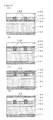
- FIGS. 1A to 1D each shows an example of applying a wavelength conversion film that is formed of the composition for forming a wavelength conversion film according to the present invention in a silicon solar cell.
- Examples of the polymer or the oligomer contained in the composition for forming a wavelength conversion film according to the present invention include acrylic resins, methacrylate resins, novolac resins, aminoplast polymers, polyamides, polyimides, and polyesters.
- the novolac resin may be either phenol novolac or cresol novolac.
- polyfluorene or a derivative thereof, polysiloxane, polysilane, or polycarbosilane may be used as the polymer or the oligomer.
- Examples of the fluorescent moiety (the fluorescence emitting moiety) in the polymer or the oligomer include anthracene and derivatives thereof (2-anthracenecarboxylic acid, 9-anthracenecarboxylic acid, 2-vinylanthracene, 9-vinylanthracene, 9-hydroxymethylanthracene, and the like), coumarin and derivatives thereof (4-hydroxycoumarin, 7-hydroxycoumarin, and the like), fluorescein and derivatives thereof (fluorescein isothiocyanate and the like), rhodamine (rhodamine B, rhodamine 6G, and the like), eosin (eosin-Y, eosin-B, and the like), perylene and derivatives thereof (3,4,9,10-perylenetetracarboxylic dianhydride and the like), fluorene and derivatives thereof (9-fluorenol, 1-fluorene carboxylic acid, 9-flu
- the fluorescent moiety (the fluorescence emitting moiety) is, for example, incorporated into a side chain of the polymer or the oligomer, or may be contained in a main chain of the polymer or the oligomer. Incorporation of the fluorescent moiety (the fluorescence emitting moiety) into a side chain of the polymer or the oligomer can be performed by graft polymerization, for example.
- the incorporation ratio of the fluorescent moiety is not particularly limited and may be any ratio higher than 0 mol% relative to the polymer or the oligomer.
- the wavelength conversion film according to the present invention has a function to convert a wavelength that does not contribute to photoelectric conversion to a wavelength that contributes to photoelectric conversion. Specifically, the wavelength conversion film according to the present invention converts a certain wavelength to a longer wavelength, for example, a wavelength shorter than 370 nm to a wavelength of 370 nm or longer. In particular, the wavelength conversion film according to the present invention converts a wavelength in ultraviolet range (10 nm to 365 nm) to a wavelength in visible light range (370 nm to 800 nm). The range of the wavelength that contributes to photoelectric conversion varies depending on the type of solar cell and, for example, the range varies even among silicon solar cells depending on the crystal morphology of the silicon to be used.
- the range is considered to be about 400 nm to about 700 nm for amorphous silicon solar cells, and about 600 nm to about 1100 nm for polycrystalline silicon solar cells. Therefore, the wavelength that contributes to photoelectric conversion is not necessarily a wavelength in visible light range.
- a solar cell to which the wavelength conversion film according to the present invention is applied is not limited to a particular type, and examples thereof include silicon solar cells in which amorphous silicon, polycrystalline silicon, and the like are used, compound semiconductor solar cells in which GaAs, CIS, CIGS, and the like are used, organic solar cells such as organic thin-film solar cells, dye-sensitized solar cells, quantum dot solar cells, and the like.
- the arrangement of the wavelength conversion film is not particularly limited, and may be any arrangement provided that the wavelength conversion film is provided in a light receiving area of a solar cell.
- GPC gel permeation chromatography
- Epoxy values shown in the present specification are results from measurement by titration. Devices used, conditions, and the like are as follows.
- the average molecular weight measured by GPC of the polymer was 36,000 as the weight average molecular weight in terms of standard polystyrene.
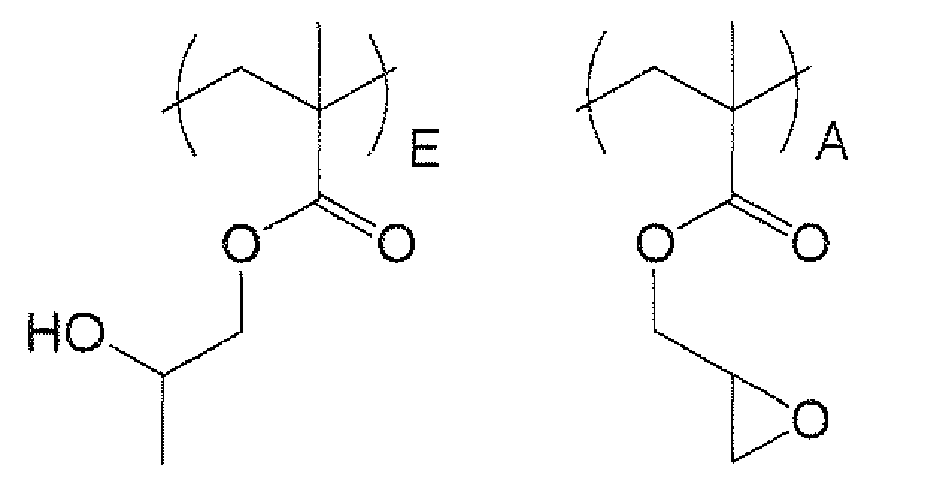
- the polymer of Formula (7) is obtained by polymerizing hydroxypropyl methacrylate and glycidyl methacrylate at a molar ratio of 0.65:0.35 using ⁇ , ⁇ '-azobisisobutyronitrile as a radical initiator and then, to the resultant polymer of Formula below, adding 9-anthracenecarboxylic acid (of Formula (2) above).
- a solution containing a polymer having the unit structure of Formula (8) was prepared.
- the average molecular weights measured by GPC of the polymer were 6,100 as the weight average molecular weight and 2,700 as the number average molecular weight in terms of standard polystyrene.
- the polymer of Formula (8) is obtained by adding 9-anthracenecarboxylic acid to epoxy cresol novolac.
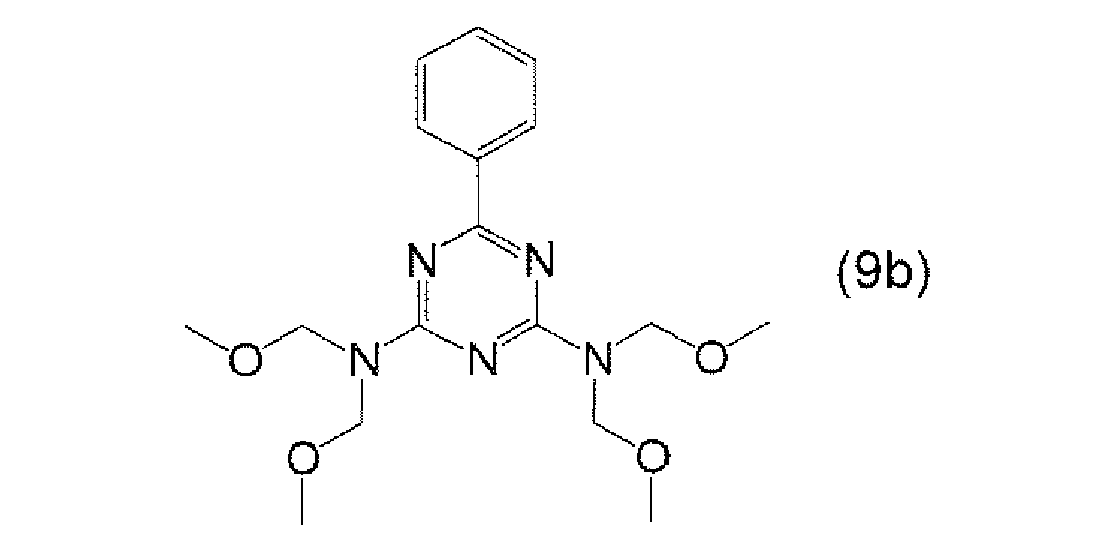
- a solution containing the polymer obtained according to Example 3 (Formulation I) described in Japanese Translation of PCT International Application No. 2003-531252 using CYMEL [registered trademark] 303 (hexamethoxymethylmelamine) of Formula (9a) and CYMEL [registered trademark] 1123 (tetramethoxymethylbenzoguanamine) of Formula (9b) (both are from Cytec Industries Inc.) was prepared.
- the polymer is an aminoplast polymer, and the average molecular weights thereof by GPC were 11,000 as the weight average molecular weight and 2,200 as the number average molecular weight in terms of standard polystyrene.
- a benzoguanamine unit structure derived from Formula (9b) is estimated to be a fluorescent moiety.
- the coatings formed in the Examples above have a wavelength conversion function, and therefore are useful as a wavelength conversion film to be installed in a photovoltaic device (a solar cell). Furthermore, a solar cell including the wavelength conversion film is expected to be improved in photoelectric conversion efficiency.
- the coatings formed in Example 1, 3, 6, 7, and 8 can convert a wavelength in ultraviolet range to a wavelength in visible light range, and therefore are useful in a solar cell that is less sensitive to light of a wavelength in ultraviolet range and highly sensitive to light of a wavelength in visible light range.
- FIG. 1A shows a cross-sectional structure of a solar cell in which a p-layer 102, an n-layer 103, and an anti-reflective film 104 are laminated on a back electrode 101, a surface electrode 105 is formed to be connected to the n-layer 103, and a covering material 106 is further provided.
- a sealing material (not shown) is further provided between the surface electrode 105 or the anti-reflective film 104 and the covering material 106, and a sealing material and a back sheet (not shown) are further provided on the outside of the back electrode 101.
- the surface electrode 105 is also represented as a light-receiving surface electrode.
- the covering material 106 is made of glass or resin and, in the former case, it is called a cover glass.
- a wavelength conversion film 100 is provided between the n-layer 103 and the anti-reflective film 104.
- FIG. 1B shows an example in which, in contrast to the example in FIG. 1A , the wavelength conversion film 100 is provided between the anti-reflective film 104 and the covering material 106.
- the covering material 106 may be omitted (see FIG. 1C ).
- the covering material 106 having the wavelength conversion film 100 may be a detachable structure.
- the wavelength conversion film 100 having a function as a covering material may be a detachable structure.
- FIG. 1D shows an example in which, in contrast to the examples in FIGS. 1A to 1C , the wavelength conversion film 100 is provided on the covering material 106.
- the covering material 106 having the wavelength conversion film 100 may be a detachable structure.
Landscapes
- Chemical & Material Sciences (AREA)
- Engineering & Computer Science (AREA)
- Organic Chemistry (AREA)
- Materials Engineering (AREA)
- Manufacturing & Machinery (AREA)
- Health & Medical Sciences (AREA)
- Chemical Kinetics & Catalysis (AREA)
- Medicinal Chemistry (AREA)
- Polymers & Plastics (AREA)
- Photovoltaic Devices (AREA)
- Compositions Of Macromolecular Compounds (AREA)
Abstract
Description
- The present invention relates to a composition for forming a wavelength conversion film to be provided in photovoltaic devices such as solar cells, in which conversion efficiency from light energy to electric power is improved. The present invention also relates to a wavelength conversion film that is formed using the composition.
- Various solar cells such as ones of a pn junction type and ones of a dye-sensitization type have been studied and brought into actual use. However, conventional solar cells in actual use cannot be said to have sufficiently high photoelectric conversion efficiency.
- In order to improve conversion efficiency, solar cells having a wavelength conversion function to convert, among incident light wavelengths, a wavelength (one in ultraviolet range, for example) that does not contribute to photoelectric conversion to a wavelength (one in visible light range, for example) that contributes to photoelectric conversion have been considered. Such solar cells are disclosed in, for example,
Patent Documents 1 to 10 listed below. -
- Patent Document 1: Japanese Patent Application Publication No.
JP-A-7-142752 - Patent Document 2: Japanese Patent Application Publication No.
JP-A-9-230396 - Patent Document 3: Japanese Patent Application Publication No.
JP-A-2000-313877 - Patent Document 4: Japanese Patent Application Publication No.
JP-A-2001-308365 - Patent Document 5: Japanese Patent Application Publication No.
JP-A-2003-243682 - Patent Document 6: Japanese Patent Application Publication No.
JP-A-2004-297025 - Patent Document 7: Japanese Patent Application Publication No.
JP-A-2006-173545 - Patent Document 8: Japanese Patent Application Publication No.
JP-A-2006-269373 - Patent Document 9: Japanese Patent Application Publication No.
JP-A-2006-303033 - Patent Document 10: Japanese Patent Application Publication No.
JP-A-2007-265629 - As described in
Patent Documents 1 to 10 listed above, the solar cells having a wavelength conversion function that have been previously suggested have a characteristic to have a film in which a wavelength conversion substance, that is to say a fluorescent substance, is dispersed.Patent Document 1 suggests a wavelength conversion layer containing another substance (transparent resin, etc) in which a single or a plurality of wavelength conversion substances are dispersed, as well as a wavelength conversion layer consisting of the wavelength conversion substance. In Examples inPatent Document 1, however, the former, namely, a wavelength conversion layer in which N-methyl-2-anilino-naphthalene-6-sulfonic acid is dispersed in polymethyl methacrylate or a p-type silicon layer, is solely described, and production of a wavelength conversion layer consisting of a wavelength conversion substance is not specifically described. - As for a film having a wavelength conversion function and having a fluorescent substance dispersed therein, in the case of incorporating excessive amounts of the fluorescent substance into the film in order to enhance a wavelength conversion effect, there would be problems that the quality of the film alters due to aggregation of the fluorescent substance or the like, uniform dispersion of the fluorescent substance in the film becomes difficult, and the like. Furthermore, in the case where a rare earth element such as europium (Eu) and terbium (Tb) or a rare earth complex is used as a fluorescent substance, there would also be a problem that because of growing demand for rare earth compounds in recent years and a rise in prices thereof due to uneven distribution of resources, cost reduction is difficult to be achieved.
It is an object of the present invention to obtain a composition for forming a wavelength conversion film for a photovoltaic device that can be expected to improve photoelectric conversion efficiency of wavelength conversion as well as can promote cost reduction. It is another object of the present invention to provide a wavelength conversion film for a photovoltaic device that is formed of the composition, and a photovoltaic device that includes the conversion film. - The present invention provides a composition for forming a wavelength conversion film for a photovoltaic device that contains a polymer or an oligomer having a fluorescent moiety (a fluorescence emitting moiety) and a solvent.
- The fluorescent moiety in the polymer or the oligomer contained in the composition for forming a wavelength conversion film according to the present invention is incorporated in a main chain or a side chain of the polymer or the oligomer, and specific examples thereof include anthracene and derivatives thereof, coumarin and derivatives thereof, fluorescein and derivatives thereof, rhodamine, eosin, perylene and derivatives thereof, fluorene and derivatives thereof, and stilbene and derivatives thereof.
- Examples of the polymer or the oligomer contained in the composition for forming a wavelength conversion film according to the present invention include acrylic resins, methacrylate resins, novolac resins, aminoplast polymers, polyamides, polyimides, polyesters, polyfluorene, polyfluorene derivatives, polysiloxanes, polysilane, and polycarbosilanes. The number average molecular weight Mn of the polymer or the oligomer is, for example, within the range of 500 to 50,000.
- Examples of the solvent contained in the composition for forming a wavelength conversion film according to the present invention include organic solvents such as propylene glycol monomethyl ether acetate (PGMEA), propylene glycol monomethyl ether (PGME), propylene glycol monoethyl ether, ethyl lactate, cyclohexanone, cyclohexanol, γ-butyrolactone, diethylene glycol, propylene glycol, dipropylene glycol, 2,3-butanediol, triethylene glycol, diethylene glycol monoethyl ether acetate, diethylene glycol monobutyl ether acetate, diethylene glycol monoethyl ether, diethylene glycol monoethyl ether, diethylene glycol monobutyl ether, diethylene glycol dibutyl ether, dipropylene glycol monomethyl ether, glycerin, butyl acetate, hexyl acetate, diacetone alcohol, propylene carbonate, tetrahydrofurfuryl alcohol, acetylacetone, toluene, N,N-dimethylformamide, and N-methyl-2-pyrrolidone (NMP). The solvent may be a combination of two or more organic solvents. Regarding components that remain after removing a solvent from the composition for forming a wavelength conversion film according to the present invention as a solid content, the ratio of the solid content in the composition is, for example, 3 to 40% by mass, and preferably, 7 to 30% by mass.
- The polymer or the oligomer contained in the composition for forming a wavelength conversion film according to the present invention may further have a crosslinked moiety. Examples of the crosslinked moiety include hydroxy groups, carboxy groups, epoxy groups, amino groups, silanol groups, and alkynyl groups.
The composition for forming a wavelength conversion film according to the present invention may further contain a crosslinking agent. In the case where a crosslinked moiety is provided or a crosslinking agent is incorporated, and where the stability (in particular, heat resistance and light resistance) of the polymer or the oligomer is inadequate, the stability can be improved by crosslinking. Examples of the crosslinking agent include hexamethoxymethylmelamine, tetramethoxymethylbenzoguanamine, 1,3,4,6-tetrakis(methoxymethyl)glycoluril, 1,3,4,6-tetrakis(butoxymethyl)glycoluril, 1,3,4,6-tetrakis(hydroxymethyl)glycoluril, 1,3-bis(hydroxymethyl)urea, 1,1,3,3-tetrakis(butoxymethyl)urea, 1,1,3,3-tetrakis(methoxymethyl)urea, blocked isocyanate (a compound that is 4,4'-diphenylmethane diisocyanate, polymethylene polyphenyl polyisocyanate, tolylene diisocyanate, hexamethylene diisocyanate, isophorone diisocyanate, tetramethyl xylylene diisocyanate, and the like protected by alcohols such as methanol, ethanol, propanol, isopropyl alcohol, butanol, 2-ethylhexanol, and cyclohexanol, phenols, active methylenes such as dimethyl malonate and ethyl acetoacetate, oximes such as methyl ethyl ketone oxime, acetone oxime, cyclohexanone oxime, acetophenone oxime, and benzophenone oxime, and lactams such as ε-caprolactam, γ-caprolactam, and β-propiolactam). - The composition for forming a wavelength conversion film according to the present invention may further contain an antioxidant and/or a radical scavenger as an additive. The antioxidant and the radical scavenger may be known compounds and can improve the stability (in particular, heat resistance and light resistance) of the polymer or the oligomer if the stability is inadequate. Such an additive may or may not be used in combination with a crosslinking agent, and may or may not be used in combination with the polymer or the oligomer having a crosslinked moiety.
- The present invention is also directed to a wavelength conversion film for a photovoltaic device that is formed of the composition for forming a wavelength conversion film. The wavelength conversion film according to the present invention can be easily formed by various coating methods such as spin-coating, spraying, and dipping, and can be formed at relatively low temperatures of around 160°C (for example, 100°C to 220°C).
The wavelength conversion film for a photovoltaic device thus obtained can be used in solar cells.
A wavelength conversion film can be obtained by coating a film that is a base material with the composition for forming a wavelength conversion film according to the present invention.
A wavelength conversion film can also be formed by stretching or a similar method using the composition for forming a wavelength conversion film according to the present invention as a raw material. - Because of containing no rare earth compound, the composition for forming a wavelength conversion film for a photovoltaic device of the present invention makes it possible to provide a wavelength conversion film for a photovoltaic device at low cost, and therefore makes it possible to expect improvement in photoelectric conversion efficiency of a solar cell at low cost.
Furthermore, by forming a film using a polymer or an oligomer to which a fluorescent moiety (a fluorescence emitting moiety) is chemically bonded, a larger amount of fluorescent moieties (fluorescence emitting moieties) can be incorporated into the film than that of fluorescent substance in the case of incorporating the fluorescent substance by using a film in which a wavelength conversion substance (a fluorescent substance) is dispersed, and the stability of the wavelength conversion film to be formed improves. In addition, further improvement in photoelectric conversion efficiency of various solar cells can be expected by selecting a suitable fluorescent moiety. - [
FIG. 1] FIGS. 1A to 1D each shows an example of applying a wavelength conversion film that is formed of the composition for forming a wavelength conversion film according to the present invention in a silicon solar cell. - Examples of the polymer or the oligomer contained in the composition for forming a wavelength conversion film according to the present invention include acrylic resins, methacrylate resins, novolac resins, aminoplast polymers, polyamides, polyimides, and polyesters. The novolac resin may be either phenol novolac or cresol novolac. As the polymer or the oligomer, polyfluorene or a derivative thereof, polysiloxane, polysilane, or polycarbosilane may be used.
- Examples of the fluorescent moiety (the fluorescence emitting moiety) in the polymer or the oligomer include anthracene and derivatives thereof (2-anthracenecarboxylic acid, 9-anthracenecarboxylic acid, 2-vinylanthracene, 9-vinylanthracene, 9-hydroxymethylanthracene, and the like), coumarin and derivatives thereof (4-hydroxycoumarin, 7-hydroxycoumarin, and the like), fluorescein and derivatives thereof (fluorescein isothiocyanate and the like), rhodamine (rhodamine B, rhodamine 6G, and the like), eosin (eosin-Y, eosin-B, and the like), perylene and derivatives thereof (3,4,9,10-perylenetetracarboxylic dianhydride and the like), fluorene and derivatives thereof (9-fluorenol, 1-fluorene carboxylic acid, 9-fluorene carboxylic acid, 9,9-bis (4-hydroxyphenyl) fluorene, and the like), and stilbene and derivatives thereof (4,4'-stilbene dicarboxylic acid and the like). The fluorescent moiety (the fluorescence emitting moiety) is, for example, incorporated into a side chain of the polymer or the oligomer, or may be contained in a main chain of the polymer or the oligomer. Incorporation of the fluorescent moiety (the fluorescence emitting moiety) into a side chain of the polymer or the oligomer can be performed by graft polymerization, for example. The incorporation ratio of the fluorescent moiety is not particularly limited and may be any ratio higher than 0 mol% relative to the polymer or the oligomer.
- The wavelength conversion film according to the present invention has a function to convert a wavelength that does not contribute to photoelectric conversion to a wavelength that contributes to photoelectric conversion. Specifically, the wavelength conversion film according to the present invention converts a certain wavelength to a longer wavelength, for example, a wavelength shorter than 370 nm to a wavelength of 370 nm or longer. In particular, the wavelength conversion film according to the present invention converts a wavelength in ultraviolet range (10 nm to 365 nm) to a wavelength in visible light range (370 nm to 800 nm). The range of the wavelength that contributes to photoelectric conversion varies depending on the type of solar cell and, for example, the range varies even among silicon solar cells depending on the crystal morphology of the silicon to be used. For example, the range is considered to be about 400 nm to about 700 nm for amorphous silicon solar cells, and about 600 nm to about 1100 nm for polycrystalline silicon solar cells. Therefore, the wavelength that contributes to photoelectric conversion is not necessarily a wavelength in visible light range.
- A solar cell to which the wavelength conversion film according to the present invention is applied is not limited to a particular type, and examples thereof include silicon solar cells in which amorphous silicon, polycrystalline silicon, and the like are used, compound semiconductor solar cells in which GaAs, CIS, CIGS, and the like are used, organic solar cells such as organic thin-film solar cells, dye-sensitized solar cells, quantum dot solar cells, and the like. The arrangement of the wavelength conversion film is not particularly limited, and may be any arrangement provided that the wavelength conversion film is provided in a light receiving area of a solar cell.
- The present invention will be specifically described. The present invention is not limited to the description of the following Synthesis Examples and Examples.
- Average molecular weights of polymers shown in the present specification are results from measurement by gel permeation chromatography (hereinafter, abbreviated as GPC). Devices used, conditions, and the like are as follows.
-
- GPC device: HLC-8220GPC (manufactured by Tosoh Corporation)
- GPC column: Asahipak [registered trademark] GF510HQ (manufactured by Showa Denko K.K.)
- Column temperature: 40°C
- Solvent: 10 mmol/L lithium bromide monohydrate in dimethylformamide (DMF) solution
- Flow rate: 0.6 ml/minute
- Standard sample: polystyrene (manufactured by Showa Denko K.K.)
- Synthesis Examples 7, 8, and 10
- GPC device: HLC-8220GPC (manufactured by Tosoh Corporation)
- GPC column: Shodex [registered trademark] KF803L, KF802, and KF801 (manufactured by Showa Denko K.K.)
- Column temperature: 40°C
- Solvent: tetrahydrofuran (THF)
- Flow rate: 1.0 ml/minute
- Standard sample: polystyrene (manufactured by Showa Denko K.K.)
- Epoxy values shown in the present specification are results from measurement by titration.
Devices used, conditions, and the like are as follows. - Titrator: automatic titrator GT- 100 (manufactured by Mitsubishi Chemical Corporation)
- Titration reagent: 0.1 mol/L perchloric acid in acetic acid solution
- Solvent: propylene glycol monomethyl ether
- Into a reaction vessel the inside of which is replaced with nitrogen, 40 g of the monomer of Formula (1):

- To 3.00 g of the polymer obtained in Synthesis Example 1, 0.46 g of the monomer of Formula (2):


- To 3.00 g of the polymer obtained in Synthesis Example 1, 0.34 g of the monomer of Formula (3):


- To 3.00 g of the polymer obtained in Synthesis Example 1, 0.34 g of the monomer of Formula (4):


- To 3.00 g of the polymer obtained in Synthesis Example 1, 0.99 g of the monomer of Formula (5):

- To 3.00 g of the polymer obtained in Synthesis Example 1, 0.69 g of the monomer of Formula (6):

- A solution containing the polymer of Formula (7) that is a copolymer having the unit structure E and the unit structure B at a molar ratio of E:B=0.65:0.35 was prepared. The average molecular weight measured by GPC of the polymer was 36,000 as the weight average molecular weight in terms of standard polystyrene.

- A solution containing a polymer having the unit structure of Formula (8) was prepared. The average molecular weights measured by GPC of the polymer were 6,100 as the weight average molecular weight and 2,700 as the number average molecular weight in terms of standard polystyrene.

- A solution containing the polymer obtained according to Example 3 (Formulation I) described in Japanese Translation of PCT International Application No.
2003-531252 
- To 24.80 g of a cation exchange resin (trade name: AMBERLYST 15JWET, manufactured by Rohm and Haas), 3.96 g, 2.96 g, 5.45 g, and 48.71 g, respectively, of monomers of Formula (10), Formula (11), Formula (12), and Formula (13):


Me-Si(OMe)3 (12)
Si(OMe)4 (13)
(all of these are manufactured by Tokyo Chemical Industry Co., Ltd.), 21.61 g of water, and 61.09 g of propylene glycol monomethyl ether were added, and the mixture was stirred at room temperature for 48 hours. - Subsequently, the ion exchange resin was removed by filtration. The filtrate was added dropwise to 143.79 g of propylene glycol monomethyl ether acetate that was heated to 80°C, the mixture was stirred for 4 hours, and then propylene glycol monomethyl ether, a byproduct methanol, and water were distilled off under reduced pressure. The average molecular weights measured by GPC of the reaction product obtained (a polymer or an oligomer) were 1,500 as the weight average molecular weight and 1,100 as the number average molecular weight in terms of standard polystyrene. In the polymer or the oligomer obtained in this Synthesis Example, Ph-Si (phenylsilyl) derived from Formula (10) above is estimated to be a fluorescent moiety.
- To 1.00 g of the polymer obtained in Synthesis Example 2, 2.16 g of propylene glycol monomethyl ether acetate and 1.08 g of N,N-dimethylformamide were added as solvents. A quartz substrate was coated with the solution using a spinner, and then baked on a hot plate at 205°C for 1 minute. Fluorescence of the coating obtained by baking was measured using Fluorescence Spectrophotometer F-7000 (manufactured by Hitachi High-Technologies Corporation), and the excitation wavelength was 365 nm and the fluorescence wavelength was 450 nm.
- To 1.00 g of the polymer obtained in Synthesis Example 3, 2.16 g of propylene glycol monomethyl ether acetate and 1.08 g of N,N-dimethylformamide were added as solvents. A quartz substrate was coated with the solution using a spinner, and then baked on a hot plate at 205°C for 1 minute. Fluorescence of the coating obtained by baking was measured using Fluorescence Spectrophotometer F-7000 (manufactured by Hitachi High-Technologies Corporation), and the excitation wavelength was 276 nm and the fluorescence wavelength was 370 nm.
- To 1.00 g of the polymer obtained in Synthesis Example 4, 2.16 g of propylene glycol monomethyl ether acetate and 1.08 g of N,N-dimethylformamide were added as solvents. A quartz substrate was coated with the solution using a spinner, and then baked on a hot plate at 205°C for 1 minute. Fluorescence of the coating obtained by baking was measured using Fluorescence Spectrophotometer F-7000 (manufactured by Hitachi High-Technologies Corporation), and the excitation wavelength was 322 nm and the fluorescence wavelength was 388 nm.
- To 1.00 g of the polymer obtained in Synthesis Example 5, 2.16 g of propylene glycol monomethyl ether acetate and 1.08 g of N,N-dimethylformamide were added as solvents. A quartz substrate was coated with the solution using a spinner, and then baked on a hot plate at 205°C for 1 minute. Fluorescence of the coating obtained by baking was measured using Fluorescence Spectrophotometer F-7000 (manufactured by Hitachi High-Technologies Corporation), and the excitation wavelength was 565 nm and the fluorescence wavelength was 587 nm.
- To 1.00 g of the polymer obtained in Synthesis Example 6, 2.16 g of propylene glycol monomethyl ether acetate and 1.08 g of N,N-dimethylformamide were added as solvents. A quartz substrate was coated with the solution using a spinner, and then baked on a hot plate at 205°C for 1 minute. Fluorescence of the coating obtained by baking was measured using Fluorescence Spectrophotometer F-7000 (manufactured by Hitachi High-Technologies Corporation), and the excitation wavelength was 360 nm and the fluorescence wavelength was 526 nm.
- To 5.00 g of a solution containing the polymer described in Synthesis Example 7, 5.00 g of propylene glycol monomethyl ether acetate was added as a solvent. A quartz substrate was coated with the solution using a spinner, and then baked on a hot plate at 205°C for 1 minute. Fluorescence of the coating was measured using Fluorescence Spectrophotometer F-7000 (manufactured by Hitachi High-Technologies Corporation), and the excitation wavelength was 366 nm and the fluorescence wavelength was 465 nm.
- To 5.00 g of a solution containing the polymer described in Synthesis Example 8, 5.00 g of propylene glycol monomethyl ether acetate was added as a solvent. A quartz substrate was coated with the solution using a spinner, and then baked on a hot plate at 205°C for 1 minute. Fluorescence of the coating was measured using Fluorescence Spectrophotometer F-7000 (manufactured by Hitachi High-Technologies Corporation), and the excitation wavelength was 325 nm and the fluorescence wavelength was 460 nm.
- To 5.00 g of a solution containing the polymer described in Synthesis Example 9, 5.00 g of propylene glycol monomethyl ether acetate was added as a solvent. A quartz substrate was coated with the solution using a spinner, and then baked on a hot plate at 205°C for 1 minute. Fluorescence of the coating was measured using Fluorescence Spectrophotometer F-7000 (manufactured by Hitachi High-Technologies Corporation), and the excitation wavelength was 260 nm and the fluorescence wavelength was 390 nm.
- To 5.00 g of a solution containing the polymer or the oligomer obtained in Synthesis Example 10, 5.00 g of propylene glycol monomethyl ether acetate was added as a solvent. A quartz substrate was coated with the solution using a spinner, and then baked on a hot plate at 205°C for 1 minute. Fluorescence of the coating was measured using Fluorescence Spectrophotometer F-7000 (manufactured by Hitachi High-Technologies Corporation), and the excitation wavelength was 263 nm and the fluorescence wavelength was 296 nm.
- All the coatings formed in the Examples above have a wavelength conversion function, and therefore are useful as a wavelength conversion film to be installed in a photovoltaic device (a solar cell). Furthermore, a solar cell including the wavelength conversion film is expected to be improved in photoelectric conversion efficiency. For example, the coatings formed in Example 1, 3, 6, 7, and 8 can convert a wavelength in ultraviolet range to a wavelength in visible light range, and therefore are useful in a solar cell that is less sensitive to light of a wavelength in ultraviolet range and highly sensitive to light of a wavelength in visible light range.
- To 3.00 g of the polymer obtained in Synthesis Example 1, 0.46 g of the monomer of Formula (2):

- An example in which the wavelength conversion film according to the present invention is installed in a silicon solar cell is shown in
FIG. 1. FIG. 1A shows a cross-sectional structure of a solar cell in which a p-layer 102, an n-layer 103, and ananti-reflective film 104 are laminated on aback electrode 101, asurface electrode 105 is formed to be connected to the n-layer 103, and a coveringmaterial 106 is further provided. Usually, a sealing material (not shown) is further provided between thesurface electrode 105 or theanti-reflective film 104 and the coveringmaterial 106, and a sealing material and a back sheet (not shown) are further provided on the outside of theback electrode 101. On the outside of the back sheet, a total-reflection layer may be provided. Thesurface electrode 105 is also represented as a light-receiving surface electrode. The coveringmaterial 106 is made of glass or resin and, in the former case, it is called a cover glass. In this example, awavelength conversion film 100 is provided between the n-layer 103 and theanti-reflective film 104. -
FIG. 1B shows an example in which, in contrast to the example inFIG. 1A , thewavelength conversion film 100 is provided between theanti-reflective film 104 and the coveringmaterial 106. When thewavelength conversion film 100 has a function as a covering material as well, the coveringmaterial 106 may be omitted (seeFIG. 1C ). In the example ofFIG. 1B , the coveringmaterial 106 having thewavelength conversion film 100 may be a detachable structure. Similarly, in the example ofFIG. 1C , thewavelength conversion film 100 having a function as a covering material may be a detachable structure. -
FIG. 1D shows an example in which, in contrast to the examples inFIGS. 1A to 1C , thewavelength conversion film 100 is provided on the coveringmaterial 106. The coveringmaterial 106 having thewavelength conversion film 100 may be a detachable structure. -
- 100
- Wavelength conversion film
- 101
- Back electrode
- 102
- p-layer
- 103
- n-layer
- 104
- Anti-reflective film
- 105
- Surface electrode
- 106
- Covering material
Claims (11)
- A composition for forming a wavelength conversion film for a photovoltaic device, comprising:a polymer or an oligomer including a fluorescent moiety; anda solvent.
- The composition for forming a wavelength conversion film for a photovoltaic device according to claim 1, wherein the fluorescent moiety is incorporated in a main chain or a side chain of the polymer or the oligomer.
- The composition for forming a wavelength conversion film for a photovoltaic device according to claim 1 or 2, wherein the fluorescent moiety is anthracene or a derivative thereof, coumarin or a derivative thereof, fluorescein or a derivative thereof, rhodamine, eosin, perylene or a derivative thereof, fluorene or a derivative thereof, or stilbene or a derivative thereof.
- The composition for forming a wavelength conversion film for a photovoltaic device according to any one of claims 1 to 3, wherein the polymer or the oligomer is an acrylic resin, a methacrylate resin, a novolac resin, an aminoplast polymer, a polyamide, a polyimide, a polyester, polyfluorene, a polyfluorene derivative, a polysiloxane, polysilane, or a polycarbosilane.
- The composition for forming a wavelength conversion film for a photovoltaic device according to any one of claims 1 to 4, wherein the solvent is at least one organic solvent selected from a group consisting of propylene glycol monomethyl ether acetate, propylene glycol monomethyl ether, ethyl lactate, cyclohexanone, γ-butyrolactone, diethylene glycol monobutyl ether acetate, diethylene glycol monobutyl ether, diethylene glycol dibutyl ether, acetylacetone, toluene, and N,N-dimethylformamide.
- The composition for forming a wavelength conversion film for a photovoltaic device according to any one of claims 1 to 5, wherein the polymer or the oligomer further includes a crosslinked moiety.
- The composition for forming a wavelength conversion film for a photovoltaic device according to any one of claims 1 to 6, further comprising a crosslinking agent.
- The composition for forming a wavelength conversion film for a photovoltaic device according to any one of claims 1 to 7, further comprising an antioxidant and/or a radical scavenger.
- A wavelength conversion film for a photovoltaic device that is formed from the composition for forming a wavelength conversion film as claimed in any one of claims 1 to 8.
- The wavelength conversion film for a photovoltaic device according to claim 9, wherein the wavelength conversion film for a photovoltaic device is used to convert a wavelength in ultraviolet range to a wavelength in visible light range.
- A solar cell comprising the wavelength conversion film for a photovoltaic device as claimed in claim 9 or 10.
Applications Claiming Priority (3)
| Application Number | Priority Date | Filing Date | Title |
|---|---|---|---|
| JP2008281183 | 2008-10-31 | ||
| JP2009090392 | 2009-04-02 | ||
| PCT/JP2009/068396 WO2010050466A1 (en) | 2008-10-31 | 2009-10-27 | Compositions for forming wavelength-converting membranes for photovoltaic devices, wavelength-converting membranes for photovoltaic devices, and photovoltaic devices |
Publications (2)
| Publication Number | Publication Date |
|---|---|
| EP2355162A1 true EP2355162A1 (en) | 2011-08-10 |
| EP2355162A4 EP2355162A4 (en) | 2012-08-22 |
Family
ID=42128827
Family Applications (1)
| Application Number | Title | Priority Date | Filing Date |
|---|---|---|---|
| EP09823576A Withdrawn EP2355162A4 (en) | 2008-10-31 | 2009-10-27 | COMPOSITIONS FOR MANUFACTURING WAVELENGTH CONVERSION MEMBERS FOR PV MODULES, WAVELENGTH CONVERSION MEMBRANES FOR PV MODULES AND PV MODULES |
Country Status (7)
| Country | Link |
|---|---|
| US (1) | US20110204292A1 (en) |
| EP (1) | EP2355162A4 (en) |
| JP (1) | JPWO2010050466A1 (en) |
| KR (1) | KR20110079904A (en) |
| CN (1) | CN102203951A (en) |
| TW (1) | TW201036176A (en) |
| WO (1) | WO2010050466A1 (en) |
Cited By (6)
| Publication number | Priority date | Publication date | Assignee | Title |
|---|---|---|---|---|
| WO2013052381A3 (en) * | 2011-10-05 | 2013-08-15 | Nitto Denko Corporation | Wavelength conversion film having pressure sensitive adhesive layer to enhance solar harvesting efficiency |
| WO2013172930A1 (en) * | 2012-05-15 | 2013-11-21 | Illinois Tool Works Inc. | Replaceable solar wavelength - converting film |
| US9287419B2 (en) | 2011-01-05 | 2016-03-15 | Nitto Denko Corporation | Wavelength conversion perylene diester chromophores and luminescent films |
| US9382424B2 (en) | 2011-09-26 | 2016-07-05 | Nitto Denko Corporation | Highly-fluorescent and photo-stable chromophores for enhanced solar harvesting efficiency |
| US9399730B2 (en) | 2011-12-06 | 2016-07-26 | Nitto Denko Corporation | Wavelength conversion material as encapsulate for solar module systems to enhance solar harvesting efficiency |
| US10005881B2 (en) | 2014-10-31 | 2018-06-26 | Industrial Technology Research Institute | Wavelength-converting polymers, method for fabricating the same, and wavelength-converting devices employing the same |
Families Citing this family (9)
| Publication number | Priority date | Publication date | Assignee | Title |
|---|---|---|---|---|
| KR101613998B1 (en) | 2008-11-13 | 2016-04-21 | 코닌클리케 필립스 엔.브이. | Device for adaptable wavelength conversion and a solar cell |
| JP5783384B2 (en) * | 2010-12-02 | 2015-09-24 | 日産化学工業株式会社 | Film forming material |
| CN107463066B (en) * | 2011-10-11 | 2020-10-30 | 日产化学工业株式会社 | Cured film-forming composition, alignment material, and phase difference material |
| CN105985661A (en) * | 2012-02-01 | 2016-10-05 | 日东电工株式会社 | Wavelength conversion layer on a glass plate to enhance solar harvesting efficiency |
| FR2996356B1 (en) * | 2012-09-28 | 2015-08-07 | Centre Nat Rech Scient | PHOTOVOLTAIC COMPONENT WITH HIGH CONVERSION EFFICIENCY |
| KR101638106B1 (en) * | 2014-07-02 | 2016-07-11 | 충남대학교 산학협력단 | Fluorescent Poly(N-isopropyl acrylamide) Microgel, method for preparing of the same and sensor including the same |
| JP6446868B2 (en) * | 2014-07-11 | 2019-01-09 | 大日本印刷株式会社 | SEALING MATERIAL SHEET FOR SOLAR CELL MODULE AND METHOD FOR PRODUCING THE SAME |
| CN108624046B (en) * | 2017-03-24 | 2021-05-25 | 张家港康得新光电材料有限公司 | Polyimide composition, polyimide film and preparation method and application thereof |
| CN110407970A (en) * | 2019-07-19 | 2019-11-05 | 深圳市华星光电技术有限公司 | Preparation method, pure color material and the liquid crystal display device of dye stuff of rhodamine kinds monomeric oligomeric conjunction object |
Family Cites Families (22)
| Publication number | Priority date | Publication date | Assignee | Title |
|---|---|---|---|---|
| GB1141147A (en) * | 1964-12-22 | 1969-01-29 | Dainichiseika Color Chem | Fluorescent copolymers |
| SU1728253A1 (en) * | 1989-04-27 | 1992-04-23 | Научно-исследовательский физико-химический институт им.Л.Я.Карпова | Linked fluorescing copolymers |
| JPH07142752A (en) | 1993-06-16 | 1995-06-02 | Nikon Corp | Solar cell with wavelength conversion function |
| JP3458498B2 (en) * | 1994-12-01 | 2003-10-20 | チッソ株式会社 | White light emitting element |
| PL326841A1 (en) * | 1995-12-01 | 1998-10-26 | Ciba Geigy Ag | Poly (9,9'-spirodiffluorenes), their production and application |
| JPH09230396A (en) | 1996-02-26 | 1997-09-05 | Kinya Adachi | Production of light-modulation sensitization type solar cell using rare earth complex composite light-emitting material |
| JP2000313877A (en) | 1999-04-28 | 2000-11-14 | Sumitomo Osaka Cement Co Ltd | Fluorescent transparent film and solar battery using the same |
| US6323310B1 (en) | 2000-04-19 | 2001-11-27 | Brewer Science, Inc. | Anti-reflective coating compositions comprising polymerized aminoplasts |
| JP2001308365A (en) | 2000-04-20 | 2001-11-02 | Sumitomo Osaka Cement Co Ltd | Solar cell |
| JP2003243682A (en) | 2002-02-19 | 2003-08-29 | Sumitomo Bakelite Co Ltd | Solar cell |
| JP4479879B2 (en) * | 2002-05-10 | 2010-06-09 | 日産化学工業株式会社 | Poly (5-aminoquinoxaline) and use thereof |
| US6822069B2 (en) * | 2002-05-10 | 2004-11-23 | Nissan Chemical Industries, Ltd. | Poly (5-aminoquinoxalines) and use thereof |
| US6894105B2 (en) * | 2002-07-26 | 2005-05-17 | 3M Innovatives Properties Company | Dyed fluoropolymers |
| JP2004297025A (en) * | 2003-03-27 | 2004-10-21 | Science Univ Of Tokyo | High efficiency solar cells |
| TW200517469A (en) * | 2003-10-30 | 2005-06-01 | Nissan Chemical Ind Ltd | Charge-transporting compound, charge-transporting material, charge-transporting varnish, charge-transporting thin film, and organic electroluminescent device |
| JP2005239790A (en) * | 2004-02-24 | 2005-09-08 | Sanyo Electric Co Ltd | Organic material for organic electroluminescent element and organic electroluminescent element |
| JP4925569B2 (en) * | 2004-07-08 | 2012-04-25 | ローム株式会社 | Organic electroluminescent device |
| JP2006173545A (en) | 2004-12-13 | 2006-06-29 | Sc Technology Kk | Solar cell structure and solar cell module structure having rare earth dope calcium fluoride layer |
| JP4397884B2 (en) | 2004-12-28 | 2010-01-13 | シャープ株式会社 | Method for forming fine pattern, method for manufacturing master for optical memory device, master for optical memory device, stamper for optical memory device, and optical memory device |
| JP4791743B2 (en) * | 2005-03-25 | 2011-10-12 | 国立大学法人大阪大学 | Dye-sensitized solar cell |
| JP2006303033A (en) | 2005-04-18 | 2006-11-02 | National Institute Of Advanced Industrial & Technology | Solar cell module |
| KR100794527B1 (en) * | 2006-07-05 | 2008-01-17 | 연세대학교 산학협력단 | Photoactive Aromatic Polymer and Method for Preparing the Same |
-
2009
- 2009-10-27 WO PCT/JP2009/068396 patent/WO2010050466A1/en not_active Ceased
- 2009-10-27 US US13/126,675 patent/US20110204292A1/en not_active Abandoned
- 2009-10-27 EP EP09823576A patent/EP2355162A4/en not_active Withdrawn
- 2009-10-27 CN CN200980143218XA patent/CN102203951A/en active Pending
- 2009-10-27 KR KR1020117011591A patent/KR20110079904A/en not_active Withdrawn
- 2009-10-27 JP JP2010535798A patent/JPWO2010050466A1/en active Pending
- 2009-10-30 TW TW098136985A patent/TW201036176A/en unknown
Cited By (7)
| Publication number | Priority date | Publication date | Assignee | Title |
|---|---|---|---|---|
| US9287419B2 (en) | 2011-01-05 | 2016-03-15 | Nitto Denko Corporation | Wavelength conversion perylene diester chromophores and luminescent films |
| US9382424B2 (en) | 2011-09-26 | 2016-07-05 | Nitto Denko Corporation | Highly-fluorescent and photo-stable chromophores for enhanced solar harvesting efficiency |
| WO2013052381A3 (en) * | 2011-10-05 | 2013-08-15 | Nitto Denko Corporation | Wavelength conversion film having pressure sensitive adhesive layer to enhance solar harvesting efficiency |
| US9394479B2 (en) | 2011-10-05 | 2016-07-19 | Nitto Denko Corporation | Wavelength conversion film having pressure sensitive adhesive layer to enhance solar harvesting efficiency |
| US9399730B2 (en) | 2011-12-06 | 2016-07-26 | Nitto Denko Corporation | Wavelength conversion material as encapsulate for solar module systems to enhance solar harvesting efficiency |
| WO2013172930A1 (en) * | 2012-05-15 | 2013-11-21 | Illinois Tool Works Inc. | Replaceable solar wavelength - converting film |
| US10005881B2 (en) | 2014-10-31 | 2018-06-26 | Industrial Technology Research Institute | Wavelength-converting polymers, method for fabricating the same, and wavelength-converting devices employing the same |
Also Published As
| Publication number | Publication date |
|---|---|
| TW201036176A (en) | 2010-10-01 |
| WO2010050466A1 (en) | 2010-05-06 |
| CN102203951A (en) | 2011-09-28 |
| KR20110079904A (en) | 2011-07-11 |
| JPWO2010050466A1 (en) | 2012-03-29 |
| EP2355162A4 (en) | 2012-08-22 |
| US20110204292A1 (en) | 2011-08-25 |
Similar Documents
| Publication | Publication Date | Title |
|---|---|---|
| US20110204292A1 (en) | Compositions for forming wavelength conversion films for photovoltaic devices, wavelength conversion films for photovoltaic devices, and photovoltaic devices | |
| KR101807163B1 (en) | Organosiloxane block copolymer | |
| CN102459415B (en) | Polymer containing triazine ring and film-forming composition comprising same | |
| US9695274B2 (en) | Polymers containing 2,7-pyrene structural units | |
| US8847414B2 (en) | Resin for transparent encapsulation material, and associated encapsulation material and electronic device | |
| TW201037001A (en) | Polyimide resin, curable resin composition and cured product | |
| CN107674201A (en) | Polymer containing triazine ring and the film-forming composition containing it | |
| US20140020758A1 (en) | Adhesive for solar battery backsheet | |
| JP2009544829A (en) | 1,4-bis (2-thienylvinyl) benzene derivative and use thereof | |
| CN105684163B (en) | Wavelength converting encapsulating material composition, wavelength converting encapsulating material layer, and solar cell module using same | |
| Tsai et al. | Transparent low moisture permeable coating for perovskite solar cell encapsulation | |
| EP2358765B1 (en) | Imidized polymers containing luminescent groups and method for obtaining them | |
| JP2012533661A (en) | Materials for electronic devices | |
| KR101091731B1 (en) | Siloxane-silazane modified acrylate compound, preparation method thereof, and the use thereof | |
| US20130210982A1 (en) | Silicone resin composition having high refractive index | |
| JP2016115852A (en) | Solar battery module | |
| TWI529197B (en) | Film forming material | |
| CN116574261B (en) | High-performance large Stokes displacement luminous polyimide, preparation method, photoluminescent material and converter | |
| US20250388710A1 (en) | Encapsulant and Encapsulation Film Formed From the Same | |
| WO2019126156A1 (en) | Crack-resistant polysiloxane dielectric planarizing compositions, methods and films | |
| WO2015064688A1 (en) | Wavelength-conversion encapsulant composition, wavelength-conversion encapsulant layer, and solar cell module using same | |
| Geervliet | NEW DESIGNS OF LUMINESCENT SOLAR CONCENTRATORS | |
| WO2011093148A1 (en) | Composition for formation of insulating film, and insulating film |
Legal Events
| Date | Code | Title | Description |
|---|---|---|---|
| PUAI | Public reference made under article 153(3) epc to a published international application that has entered the european phase |
Free format text: ORIGINAL CODE: 0009012 |
|
| 17P | Request for examination filed |
Effective date: 20110520 |
|
| AK | Designated contracting states |
Kind code of ref document: A1 Designated state(s): AT BE BG CH CY CZ DE DK EE ES FI FR GB GR HR HU IE IS IT LI LT LU LV MC MK MT NL NO PL PT RO SE SI SK SM TR |
|
| DAX | Request for extension of the european patent (deleted) | ||
| RIC1 | Information provided on ipc code assigned before grant |
Ipc: C08L 101/02 20060101ALI20120710BHEP Ipc: H01L 31/04 20060101AFI20120710BHEP Ipc: C08J 5/18 20060101ALI20120710BHEP Ipc: C09K 11/06 20060101ALI20120710BHEP |
|
| A4 | Supplementary search report drawn up and despatched |
Effective date: 20120720 |
|
| STAA | Information on the status of an ep patent application or granted ep patent |
Free format text: STATUS: THE APPLICATION IS DEEMED TO BE WITHDRAWN |
|
| 18D | Application deemed to be withdrawn |
Effective date: 20130219 |