EP2354504A2 - Exhaust emission control device for internal combustion engine - Google Patents
Exhaust emission control device for internal combustion engine Download PDFInfo
- Publication number
- EP2354504A2 EP2354504A2 EP11150699A EP11150699A EP2354504A2 EP 2354504 A2 EP2354504 A2 EP 2354504A2 EP 11150699 A EP11150699 A EP 11150699A EP 11150699 A EP11150699 A EP 11150699A EP 2354504 A2 EP2354504 A2 EP 2354504A2
- Authority
- EP
- European Patent Office
- Prior art keywords
- temperature
- catalyst
- hydrocarbon
- occluding
- hydrocarbons
- Prior art date
- Legal status (The legal status is an assumption and is not a legal conclusion. Google has not performed a legal analysis and makes no representation as to the accuracy of the status listed.)
- Granted
Links
Images





Classifications
-
- F—MECHANICAL ENGINEERING; LIGHTING; HEATING; WEAPONS; BLASTING
- F02—COMBUSTION ENGINES; HOT-GAS OR COMBUSTION-PRODUCT ENGINE PLANTS
- F02D—CONTROLLING COMBUSTION ENGINES
- F02D41/00—Electrical control of supply of combustible mixture or its constituents
- F02D41/02—Circuit arrangements for generating control signals
- F02D41/021—Introducing corrections for particular conditions exterior to the engine
- F02D41/0235—Introducing corrections for particular conditions exterior to the engine in relation with the state of the exhaust gas treating apparatus
- F02D41/027—Introducing corrections for particular conditions exterior to the engine in relation with the state of the exhaust gas treating apparatus to purge or regenerate the exhaust gas treating apparatus
-
- F—MECHANICAL ENGINEERING; LIGHTING; HEATING; WEAPONS; BLASTING
- F01—MACHINES OR ENGINES IN GENERAL; ENGINE PLANTS IN GENERAL; STEAM ENGINES
- F01N—GAS-FLOW SILENCERS OR EXHAUST APPARATUS FOR MACHINES OR ENGINES IN GENERAL; GAS-FLOW SILENCERS OR EXHAUST APPARATUS FOR INTERNAL-COMBUSTION ENGINES
- F01N13/00—Exhaust or silencing apparatus characterised by constructional features
- F01N13/009—Exhaust or silencing apparatus characterised by constructional features having two or more separate purifying devices arranged in series
-
- F—MECHANICAL ENGINEERING; LIGHTING; HEATING; WEAPONS; BLASTING
- F01—MACHINES OR ENGINES IN GENERAL; ENGINE PLANTS IN GENERAL; STEAM ENGINES
- F01N—GAS-FLOW SILENCERS OR EXHAUST APPARATUS FOR MACHINES OR ENGINES IN GENERAL; GAS-FLOW SILENCERS OR EXHAUST APPARATUS FOR INTERNAL-COMBUSTION ENGINES
- F01N3/00—Exhaust or silencing apparatus having means for purifying, rendering innocuous, or otherwise treating exhaust
- F01N3/08—Exhaust or silencing apparatus having means for purifying, rendering innocuous, or otherwise treating exhaust for rendering innocuous
- F01N3/0807—Exhaust or silencing apparatus having means for purifying, rendering innocuous, or otherwise treating exhaust for rendering innocuous by using absorbents or adsorbents
- F01N3/0814—Exhaust or silencing apparatus having means for purifying, rendering innocuous, or otherwise treating exhaust for rendering innocuous by using absorbents or adsorbents combined with catalytic converters, e.g. NOx absorption/storage reduction catalysts
-
- F—MECHANICAL ENGINEERING; LIGHTING; HEATING; WEAPONS; BLASTING
- F01—MACHINES OR ENGINES IN GENERAL; ENGINE PLANTS IN GENERAL; STEAM ENGINES
- F01N—GAS-FLOW SILENCERS OR EXHAUST APPARATUS FOR MACHINES OR ENGINES IN GENERAL; GAS-FLOW SILENCERS OR EXHAUST APPARATUS FOR INTERNAL-COMBUSTION ENGINES
- F01N3/00—Exhaust or silencing apparatus having means for purifying, rendering innocuous, or otherwise treating exhaust
- F01N3/08—Exhaust or silencing apparatus having means for purifying, rendering innocuous, or otherwise treating exhaust for rendering innocuous
- F01N3/0807—Exhaust or silencing apparatus having means for purifying, rendering innocuous, or otherwise treating exhaust for rendering innocuous by using absorbents or adsorbents
- F01N3/0828—Exhaust or silencing apparatus having means for purifying, rendering innocuous, or otherwise treating exhaust for rendering innocuous by using absorbents or adsorbents characterised by the absorbed or adsorbed substances
- F01N3/0835—Hydrocarbons
-
- F—MECHANICAL ENGINEERING; LIGHTING; HEATING; WEAPONS; BLASTING
- F01—MACHINES OR ENGINES IN GENERAL; ENGINE PLANTS IN GENERAL; STEAM ENGINES
- F01N—GAS-FLOW SILENCERS OR EXHAUST APPARATUS FOR MACHINES OR ENGINES IN GENERAL; GAS-FLOW SILENCERS OR EXHAUST APPARATUS FOR INTERNAL-COMBUSTION ENGINES
- F01N3/00—Exhaust or silencing apparatus having means for purifying, rendering innocuous, or otherwise treating exhaust
- F01N3/08—Exhaust or silencing apparatus having means for purifying, rendering innocuous, or otherwise treating exhaust for rendering innocuous
- F01N3/10—Exhaust or silencing apparatus having means for purifying, rendering innocuous, or otherwise treating exhaust for rendering innocuous by thermal or catalytic conversion of noxious components of exhaust
- F01N3/103—Oxidation catalysts for HC and CO only
-
- F—MECHANICAL ENGINEERING; LIGHTING; HEATING; WEAPONS; BLASTING
- F01—MACHINES OR ENGINES IN GENERAL; ENGINE PLANTS IN GENERAL; STEAM ENGINES
- F01N—GAS-FLOW SILENCERS OR EXHAUST APPARATUS FOR MACHINES OR ENGINES IN GENERAL; GAS-FLOW SILENCERS OR EXHAUST APPARATUS FOR INTERNAL-COMBUSTION ENGINES
- F01N2560/00—Exhaust systems with means for detecting or measuring exhaust gas components or characteristics
- F01N2560/06—Exhaust systems with means for detecting or measuring exhaust gas components or characteristics the means being a temperature sensor
-
- F—MECHANICAL ENGINEERING; LIGHTING; HEATING; WEAPONS; BLASTING
- F01—MACHINES OR ENGINES IN GENERAL; ENGINE PLANTS IN GENERAL; STEAM ENGINES
- F01N—GAS-FLOW SILENCERS OR EXHAUST APPARATUS FOR MACHINES OR ENGINES IN GENERAL; GAS-FLOW SILENCERS OR EXHAUST APPARATUS FOR INTERNAL-COMBUSTION ENGINES
- F01N2560/00—Exhaust systems with means for detecting or measuring exhaust gas components or characteristics
- F01N2560/14—Exhaust systems with means for detecting or measuring exhaust gas components or characteristics having more than one sensor of one kind
-
- F—MECHANICAL ENGINEERING; LIGHTING; HEATING; WEAPONS; BLASTING
- F01—MACHINES OR ENGINES IN GENERAL; ENGINE PLANTS IN GENERAL; STEAM ENGINES
- F01N—GAS-FLOW SILENCERS OR EXHAUST APPARATUS FOR MACHINES OR ENGINES IN GENERAL; GAS-FLOW SILENCERS OR EXHAUST APPARATUS FOR INTERNAL-COMBUSTION ENGINES
- F01N2900/00—Details of electrical control or of the monitoring of the exhaust gas treating apparatus
- F01N2900/06—Parameters used for exhaust control or diagnosing
- F01N2900/16—Parameters used for exhaust control or diagnosing said parameters being related to the exhaust apparatus, e.g. particulate filter or catalyst
- F01N2900/1618—HC-slip from catalyst
-
- F—MECHANICAL ENGINEERING; LIGHTING; HEATING; WEAPONS; BLASTING
- F01—MACHINES OR ENGINES IN GENERAL; ENGINE PLANTS IN GENERAL; STEAM ENGINES
- F01N—GAS-FLOW SILENCERS OR EXHAUST APPARATUS FOR MACHINES OR ENGINES IN GENERAL; GAS-FLOW SILENCERS OR EXHAUST APPARATUS FOR INTERNAL-COMBUSTION ENGINES
- F01N2900/00—Details of electrical control or of the monitoring of the exhaust gas treating apparatus
- F01N2900/06—Parameters used for exhaust control or diagnosing
- F01N2900/16—Parameters used for exhaust control or diagnosing said parameters being related to the exhaust apparatus, e.g. particulate filter or catalyst
- F01N2900/1621—Catalyst conversion efficiency
-
- F—MECHANICAL ENGINEERING; LIGHTING; HEATING; WEAPONS; BLASTING
- F02—COMBUSTION ENGINES; HOT-GAS OR COMBUSTION-PRODUCT ENGINE PLANTS
- F02D—CONTROLLING COMBUSTION ENGINES
- F02D2200/00—Input parameters for engine control
- F02D2200/02—Input parameters for engine control the parameters being related to the engine
- F02D2200/08—Exhaust gas treatment apparatus parameters
- F02D2200/0802—Temperature of the exhaust gas treatment apparatus
Definitions
- the present invention relates to an exhaust emission control device for an internal combustion engine that estimates a quantity of hydrocarbon occluded in an occluding agent of an exhaust system.
- an exhaust emission control system that purifies hydrocarbon emitted from an internal combustion engine includes catalytic converter rhodium, an oxidation catalyst, or the like, provided in a vehicle exhaust system is know.
- the catalyst includes a supported precious metal component exhibiting oxidation, such as platinum, palladium, and rhodium, and efficient hydrocarbon purification is implemented.
- hydrocarbon oxidation effected by precious metal requires a predetermined catalyst temperature. Sufficient performance cannot be exhibited at cold start of an internal combustion engine during which a catalyst is cold. Accordingly, there has been developed a technique of using in combination an occluding member having a feature of temporarily occluding hydrocarbon emitted when an activating temperature of a catalyst is not reached, thereby enhancing emission purification performance.
- JP-A-2005-240726 includes a description about an occluding catalyst (an HC trap catalyst) including a combination of catalytic converter rhodium with an occluding material (an HC trap material) that adsorbs or desorbs hydrocarbon emitted from an internal combustion engine.
- an occluding catalyst adsorbs (traps) hydrocarbon when the catalyst is at a comparatively low temperature.
- the catalyst oxidizes the hydrocarbon while desorbing the same, thereby purifying emissions.
- a general hydrocarbon occluding member has a ceiling on the quantity of hydrocarbon capable of being occluded, and a predetermined quantity of hydrocarbon or more cannot be occluded. Accordingly, operation for periodically desorbing the occluded hydrocarbon is required.
- hydrocarbon occluding member is applied to an exhaust system of a diesel engine, hydrocarbon is likely to be excessively stored during idling operation performed at an extremely low emission temperature. Therefore, delayed desorbing operation may result in deterioration of the occluding member. Consequently, it is important to accurately ascertain the quantity of hydrocarbon in an occluding member and perform desorbing operation without a delay.
- the technique described in connection with JP-A-2005-240726 provides a description including detecting combustion-related fuel property pertaining to a state of an internal combustion engine, calculating a quantity of hydrocarbon in emissions appropriate for the fuel property, and estimating a quantity of hydrocarbon occluded. Such control is said to make it possible to desorb hydrocarbon at appropriate timing from an occluding catalyst.
- a desorbing characteristic of the hydrocarbon occluded in the occluding member varies according to the temperature at which the hydrocarbon was trapped. Specifically, a wide variety of types of hydrocarbon having different boiling points are occluded in the occluding member. A distribution of boiling points of these types of hydrocarbons is dependent on temperature conditions employed during trapping operation as well as on a distribution of boiling points of hydrocarbons in emissions. Provided that the quantity of occluded hydrocarbon is calculated without taking into account such temperature conditions and that an estimated quantity of desorbed hydrocarbon is simply subtracted from the thus-calculated quantity of occluded hydrocarbon, a quantity of hydrocarbon that has a high boiling point and that would not originally be desorbed will also be subtracted. Therefore, the quantity of occluded hydrocarbon is often underestimated, and desorbing operation cannot be performed at accurate timing.
- One of objects of the present invention has been conceived in light of such a problem and is to enhance accuracy of estimation of a quantity of hydrocarbon occluded in an occluding member.
- an exhaust emission control device for an internal combustion engine comprising: an occluding member that is provided in an exhaust system of an internal combustion engine and that traps and desorbs a plurality of types of hydrocarbons having different boiling points in emissions; first calculation means that estimates a distribution of presence of each type of the hydrocarbons to be trapped by the occluding member and that calculates an occlusion quantity of the occluding member for each type of the hydrocarbons from the quantity of trapped hydrocarbons; and control means that performs control operation for purifying the hydrocarbons occluded in the occluding member according to the occlusion quantity calculated by the first calculation means.
- the exhaust emission control device for an internal combustion engine may further have second calculation means that subtracts in sequence a quantity of the hydrocarbon desorbed from the occluding member from the quantity of occluded hydrocarbon having a lower boiling point among the occlusion quantities calculated by the first calculation means, thereby calculating the quantity of hydrocarbon occluded in the occluding member.
- the exhaust emission control device for an internal combustion engine may also be configured so as to further have first catalyst temperature detection means for detecting a first catalyst temperature that is a catalyst temperature of the occluding member, and the first calculation means may calculate a quantity of trapped hydrocarbon having a boiling point that is equal to or higher than the first catalyst temperature detected by the first catalyst temperature detection means.
- the second calculation means may also be configured so as to subtract the desorption quantity solely from the quantity of occluded hydrocarbon having a boiling point that is less than the first catalyst temperature detected by the first catalyst temperature detection means.
- the exhaust emission control device for an internal combustion engine has an oxidation catalyst provided in an upstream position with reference to an occluding catalyst in the exhaust and second catalyst temperature detection means that detects a catalyst temperature of the oxidation catalyst as a second catalyst temperature.
- the first calculation means may also be configured so as to calculate a quantity of trapped hydrocarbon having a boiling point that is equal to or higher than either the first catalyst temperature detected by the first catalyst temperature detection means or the second catalyst temperature detected by the second catalyst temperature detection means, whichever is higher.
- the exhaust emission control device for an internal combustion engine of the present invention makes it possible to enhance accuracy of estimation of an occlusion quantity by estimating a distribution of presence of a trapped hydrocarbon according to a distribution of boiling points of hydrocarbons included in emissions flowing into an occluding member.
- An engine 1 (an internal combustion engine) shown in Fig. 1 is a diesel engine that takes light oil containing various hydrocarbons (HC) as fuel.
- An exhaust passageway 6 and an intake passageway 7 are connected to the engine 1.
- Intake air is introduced into combustion chambers of cylinders of the engine 1 by way of the intake passageway 7, and an exhaust gas (hereinafter referred to simply as an "emission") resulting from combustion is discharged outside of the vehicle by way of the exhaust passageway 6.
- Hydrocarbons having a plurality of carbon numbers are mixedly present in the fuel of the engine 1.
- a plurality of types of hydrocarbons having different boiling points also mixedly exist in hydrocarbons contained in the emissions.
- a controller 10 controls a fuel-air ratio, a quantity of intake air, a quantity of fuel injection, fuel injection timing, a quantity of post fuel injection, and others, that are related to combustion reaction occurred in the combustion chambers of the engine 1.
- the controller 10 is a so-called ECU (Electric Control Unit).
- An oxidation catalyst 3 and an occluding catalyst 2 are placed in the exhaust passageway 6 in a decreasing sequence of emission flow from an upstream position.
- the occluding catalyst 2 (an occluding member) is a catalyst unit that has an occluding layer provided on a surface of a catalyst support. In some instance, the unit additionally has a precious metal catalyst layer.
- the occluding layer is a layer containing various types of zeolites having a characteristic of occluding hydrocarbons contained in emissions.
- the precious metal catalyst layer is a layer that contains active alumina carrying a precious metal component for enhancing a hydrocarbon oxidation function.
- the occluding catalyst 2 traps hydrocarbon at a low catalyst temperature, and the thus-trapped hydrocarbon is occluded in the occluding layer. As the catalyst temperature increases, the occluding catalyst 2 desorbs the trapped hydrocarbon, and the precious metal catalyst layer eliminates the hydrocarbon through oxidation.
- a regeneration temperature T c is set as a target value of a catalyst temperature to be operated for desorbing hydrocarbon from the occluding catalyst 2.
- the regeneration temperature T c is a catalyst temperature that makes it possible to desorb nearly all occluded hydrocarbon without involvement of deterioration of the occluding catalyst 2, thereby purifying the occluding catalyst.
- the regeneration temperature T c is set to; for instance, 400 [°C] or thereabouts.
- purge control controlling an exhaust temperature in such a way that the catalyst temperature of the occluding catalyst 2 reaches the regeneration temperature T c is called purge control.
- the controller 10 to be described later implements purge control.
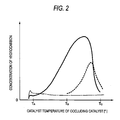
- a hydrocarbon desorbing characteristic of the occluding catalyst 2 is now described by reference to Fig. 2 .
- a solid-line plot in Fig. 2 denotes a test result showing a concentration of hydrocarbon detected at a downstream position with respect to the catalyst when the catalyst temperature of the occluding catalyst 2, which occludes hydrocarbon as a result of the engine 1 having continually performed idling operation for a predetermined time while the catalyst temperature is held at a predetermined temperature T A [°C], is changed from a low temperature to a high temperature.
- a broken-line plot in the drawing denotes a test result yielded when the idling operation is shortened while the catalyst temperature is maintained at a predetermined temperature T B [°C] by means of changing conditions for letting the occluding catalyst 2 of the same type occlude hydrocarbon.
- a dashed line in the drawing denotes a reference line showing a concentration of hydrocarbon detected at an upstream position with respect to the catalyst.
- the solid-line plot in Fig. 2 shows that hydrocarbon is desorbed over an entire temperature range from the predetermined temperature T A employed during trapping operation to the regeneration temperature T C . Even in a broken-line graph, hydrocarbons are desorbed over an entire temperature range from the predetermined temperature T B employed during trapping operation to the regeneration temperature T C . In short, when a catalyst temperature employed during trapping operation is constantly maintained, only hydrocarbons having boiling points that are equal to or higher than the catalyst temperature are occluded in the occluding catalyst 2, and hydrocarbons having boiling points that are less than the catalyst temperature are not occluded in the occluding catalyst 2.
- the regeneration temperature T c can be considered to be the maximum value of a boiling point of the hydrocarbon trapped in the occluding catalyst 2.
- the oxidation catalyst 3 is a catalyst that carries on its surface a precious metal component and has an ability to oxidize various components in emissions. Components in emissions purified by the oxidation catalyst 3 include carbon monoxide (CO), hydrocarbons, and others.
- the oxidation catalyst 3 in a diesel engine exhaust system in which a fuel-air ratio in emissions is set to a lean atmosphere oxidizes nitrogen monoxide, carbon monoxide, and hydrocarbon, thereby producing nitrogen dioxide, carbon dioxide, and a moisture.
- the catalyst temperature of the oxidation catalyst 3 is less than the predetermined activating temperature, hydrocarbon is not purified and captured by the occluding catalyst 2 disposed downstream.
- a first temperature sensor 4 (first catalyst temperature detection means) is disposed downstream of the occluding catalyst 2, and a second temperature sensor 5 (second catalyst temperature detection means) is disposed downstream of the oxidation catalyst 3.
- the first temperature sensor 4 detects a catalyst temperature of the occluding catalyst 2
- the second temperature sensor 5 detects a catalyst temperature of the oxidation catalyst 3.
- the catalyst temperature of the occluding catalyst 2 is hereunder called a "first catalyst temperature T 1 ”
- the catalyst temperature of the oxidation catalyst 3 is hereunder called a "second catalyst temperature T 2 .”
- the first catalyst temperature T 1 detected by the first temperature sensor 4 and the second catalyst temperature T 2 detected by the second temperature sensor 5 are input to the controller 10.
- the engine 1 is also equipped, side by side, with an engine speed sensor 21 for detecting an engine speed N E , an engine coolant temperature sensor 22 for detecting a temperature T HW of an engine coolant, and a torque sensor 25 for detecting torque T OR of a drive shaft of the engine 1.
- a linear fuel-air ratio sensor 23 for detecting a fuel-air ratio R A/F is disposed on the exhaust passageway 6, and an intake temperature sensor 24 for detecting a temperature T HA of an intake air is disposed on the intake passageway 7.
- the engine speed N E , the engine coolant temperature T HW , the engine torque T OR , the fuel-air ratio R A/F , and the intake temperature T HA detected by the various sensors are input to the controller 10.
- a vehicle speed sensor 26 for detecting a vehicle speed V is provided at an arbitrary position on a vehicle. The thus-detected vehicle speed V is also input to the controller 10.
- the controller 10 is an electronic controller offered as an LSI device that results from integration of known microprocessors, ROM, RAM, and the like.
- the engine speed sensor 21, the engine coolant temperature sensor 22, the linear fuel-air ratio sensor 23, the intake temperature sensor 24, the torque sensor 25, the vehicle speed sensor 26, the first temperature sensor 4, and the second temperature sensor 5 are connected to an input side of the controller 10. According to input information from these sensors, the controller 10 performs occlusion quantity estimation control and purge control.
- Occlusion quantity estimation control is control operation for calculating, in an estimating manner, the quantity Q of hydrocarbon occluded in the occluding catalyst 2.
- the occlusion quantity Q is calculated according to the engine speed N E , the engine coolant temperature T HW , the fuel-air ratio R A/F , the intake temperature T HA , the engine torque T OR , the vehicle speed V, the first catalyst temperature T 1 , and the second catalyst temperature T 2 .
- Basic idea of occlusion quantity estimation control is described by reference to Fig. 3 .
- a relationship, such as that designated by a solid line in Fig. 3 , is assumed to exist between the catalyst temperature of the occluding catalyst 2 and a desorption speed V de of hydrocarbon. Namely, when a catalyst temperature T is less than a predetermined temperature T 01 , the desorption speed comes to V de 0, so that hydrocarbon is not desorbed. When the catalyst temperature is the predetermined temperature T 01 or more, hydrocarbon is desorbed.
- the desorption speed V de corresponds to a desorption quantity achieved per unit time.
- the desorption speed V de is assumed to linearly increase within a range where the catalyst temperature T changes from the predetermined temperature T 01 to a regeneration temperature T 03 .
- the regeneration temperature T 03 signifies a catalyst temperature identical with the regeneration temperature T c .
- the desorption speed V de achieved when the catalyst temperature T is a predetermined temperature T 02 is assumed to be a predetermined speed V 1 .
- hydrocarbons whose boiling points fall within a temperature range from the predetermined temperature T 01 to the predetermined temperature T 02 are assumed to be desorbed, and hydrocarbons whose boiling points fall within a temperature range from the predetermined temperature T 02 to the regeneration temperature T 03 are assumed to be trapped.
- hydrocarbons whose boiling points fall within a temperature range A shown in Fig. 3 are considered to be untrapped, and hydrocarbons whose boiling points fall within a temperature range B are considered to be trapped.
- the hydrocarbons whose boiling points fall within the temperature range A are considered to be desorbed, and the hydrocarbons whose boiling points fall within the temperature range B are considered not to be desorbed.
- hydrocarbons are classified into a plurality of types having different boiling points, and a trap quantity and a desorption quantity are calculated for each type.
- a boiling point distribution model for hydrocarbons contained in the emissions flowing into the occluding catalyst 2.
- Hydrocarbons are herein supposed to have boiling points that range from a first temperature B 1 to a third temperature B 3 .
- a distribution profile assumes a shape of an isosceles triangle.
- hydrocarbons having higher boiling points are distributed so as to become larger in quantity.
- hydrocarbons having lower boiling points are distributed so as to become larger in quantity.
- the distribution of boiling points of hydrocarbons trapped in the occluding catalyst 2 is assumed to imitate the foregoing distribution patterns in a range in excess of a catalyst temperature of the occluding catalyst 2.
- hydrocarbons trapped in the occluding catalyst 2 are first assumed to be limited to hydrocarbons having boiling points that are equal to or higher than the catalyst temperature T achieved at that time.
- a quantity of trapped hydrocarbons is now calculated on the basis of assumptions provided below. In relation to hydrocarbons having boiling points that fall within a range from the first temperature B 1 to the second temperature B 2 , hydrocarbons having higher boiling points are trapped in larger quantity.
- hydrocarbons having lower boiling points are trapped in larger quantity.
- hydrocarbons having lower boiling points among the hydrocarbons occluded in the occluding catalyst 2 are considered to be desorbed in an increasing sequence from a lower boiling point within a temperature range under the catalyst temperature of the occluding catalyst 2.
- the reason for this is that a degree of reactivity of desorption from the occluding catalyst 2 is dependent on a boiling point of hydrocarbon.
- Purge control is for forcefully desorbing and purifying the hydrocarbons occluded in the occluding catalyst 2. Purge control is performed when the occlusion quantity Q estimated by means of occlusion quantity estimation control has exceeded a predetermined threshold value Q TH .
- the predetermined threshold value Q TH is set to an arbitrary value in a range that is the hydrocarbon quantity Q MAX of the occluding catalyst 2 or less.
- An exhaust temperature is regulated by purge control in such a way that the catalyst temperature of the occluding catalyst 2 is maintained at the regeneration temperature T C for a predetermined period of time.
- One of objectives of purge control is to desorb hydrocarbons before the hydrocarbon occlusion quantity Q reaches the hydrocarbon quantity Q max .
- the objective becomes easier to attain, so long as the predetermined threshold value Q TH is set to a lower value. Namely, the objective becomes easier to attain with an increase in frequency of performance of purge control.
- purge control is performed so as to make an exhaust temperature higher than the exhaust temperature achieved during normal idling operation. For this reason, an increase in frequency of performance of purge control results in deterioration of fuel efficiency.
- Occlusion quantity estimation control of the present embodiment can also be said to be control for effecting estimated operation of an occlusion quantity Q with high accuracy from the foregoing viewpoint.
- the controller 10 has an estimation control block 11 and a purge control block 17 (control means) as a software configuration for implementing the respective control operations.
- These software programs are recorded in unillustrated memory and an unillustrated storage device. Functions which will be described below are implemented by reading the software program into a CPU, as required.
- the estimation control block 11 is assigned the previously described occlusion quantity estimation control and calculates, in an estimating manner, the hydrocarbon occlusion quantity Q in the occluding catalyst 2, as necessary.
- the estimation control block 11 is equipped with first calculation means including a trap quantity calculation block 12 and a distribution block 13; second calculation means including a desorption quantity calculation block 14 and a subtraction block 15; and a determination block 16.
- the trap quantity calculation block 12 is for calculating a quantity M hcad [g/sec]of hydrocarbon trapped in the occluding catalyst 2 per unit time.
- the trap quantity M hcad is given by the following equation.
- M hcad K adsorp ⁇ M hcin
- K adsorp is a trapping coefficient.
- M hcin is a quantity of inflow hydrocarbon.
- the trapping coefficient K adsorp designates a ratio of hydrocarbon trapped into the occluding catalyst 2 from emissions and is set according to the first catalyst temperature T 1 (the catalyst temperature of the occluding catalyst 2) and a characteristic of the occluding catalyst 2.
- the characteristic of the occluding catalyst 2 includes; for instance, a type, a composition, a structure, and the like, of a catalytic material.
- a predetermined value K 1 is given as the trapping coefficient K adsorp .
- the specific predetermined temperature T 12 may be determined according to a trapping characteristic of the occluding catalyst 2. For instance, a temperature of about 250 [°C] is conceivable for the predetermined temperature T 12 .
- M hcin K OXI ⁇ M hceng
- K OXI is an upstream slip coefficient.
- M hceng is an engine discharge.
- the upstream slip coefficient K OXI designates a ratio of hydrocarbon flowing into the occluding catalyst 2 without being purified by the oxidation catalyst 3 and is determined by the second catalyst temperature T 2 that is a catalyst temperature of the oxidation catalyst 3 and the characteristic of the oxidation catalyst 3.
- K OXI 1
- K OXI K 2
- T 21 ⁇ T 22 the coefficient gradually decreases with an increase in the second catalyst temperature T 2 .
- the upstream slip coefficient K OXI is set according to hydrocarbon purification efficiency of the oxidation catalyst 3. For instance, when the purification efficiency of the oxidation catalyst 3 reached the activating temperature is 90[%], the coefficient K 2 is set to 0.1 in a range that is equal to or higher than the second catalyst temperature T 2 equivalent to the activating temperature. It is desirable to set the predetermined temperatures T 21 and T 22 such that the upstream slip coefficient K OXI changes in a neighborhood of the activating temperature.
- the engine discharge M hceng [g/sec] designates a quantity of hydrocarbon discharged per unit time from the engine 1 and is given by the following equation.
- M hceng M hceng ⁇ 0 ⁇ K THW ⁇ K THA
- M hceng0 designates a basic discharge.
- K THW is a water temperature correction coefficient.
- K THA is an intake temperature correction coefficient.
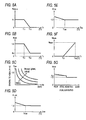
- the basic discharge M hceng0 designates a standard hydrocarbon discharge per unit time estimated from an operating state of the engine 1. As shown in Fig. 5C , the basic discharge M hceng0 is calculated according to a map pertaining to the engine speed N E detected by the engine speed sensor 21 and the engine torque T OR detected by the torque sensor 25. The basic discharge M hceng0 is set so as to become greater with an increase in the engine speed N E or engine torque T OR . Specifically, the basic discharge M hceng0 is set so as to increase as an output of the engine 1 becomes greater.
- the predetermined temperature T HW1 is set to; for instance, 85[°C].
- the intake temperature correction coefficient K THA is a hydrocarbon discharge correction gain based on the intake temperature T HA .
- the intake temperature correction coefficient K THA is set so as to increase as the intake temperature is lower.
- the predetermined temperature T HA1 is set to; for instance, 25[°C].
- the distribution block 13 classifies trapped hydrocarbon into a plurality of types of hydrocarbon having different boiling points and calculates a trap quantity M hcad according to the types of hydrocarbon.
- the trap quantity M hcad calculated by the trap quantity calculation block 12 is distributed for each of the boiling points.
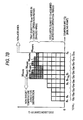
- Fig. 6A illustrates a distribution model of the trap quantity M hcad previously recorded in the distribution block 13.
- a horizontal axis shown in Fig. 6A represents temperatures corresponding to boiling points of trapped hydrocarbons.
- a width of an individual temperature zone corresponds to a width of a boiling point of hydrocarbon classified into the zone.
- a vertical axis shown in the drawing represents a distribution ratio of the trap quantity M hcad .
- a distribution ratio for each temperature zone is proportional to an area of the temperature zone.
- a range from the first temperature B 1 to the third temperature B 3 is divided at uniform intervals into eleven areas along the vertical axis, whereby a plurality of strip-shaped temperature zones are formed.
- the distribution ratio is determined in such a way that the largest quantity of hydrocarbon is distributed to the temperature zone including the second temperature B 2 .
- the hydrocarbon trapped into the occluding catalyst 2 exhibits a boiling point distribution analogous to the boiling point distribution of hydrocarbon in emissions flowing into the occluding catalyst 2. Therefore, the distribution model is formed into a shape that imitates an isosceles triangle taking a neighborhood of the second temperature B 2 as an apex, so as to follow a boiling point distribution of hydrocarbon in emissions shown in Fig. 4 .
- the distribution block 13 distributes the trap quantity M hcad , which is calculated by the trap quantity calculation block 12, to the respective temperature zones that are distribution targets while taking the distribution model as a sample.
- a temperature zone to become a distribution target is a temperature zone that is equal to or higher than either the first catalyst temperature T 1 or the second catalyst temperature T 2 , whichever is higher.
- Hydrocarbon having a boiling point belonging to temperature zones that are lower than the temperature zone including a higher catalyst temperature [i.e., left-side temperature zones in Fig. 6A ] is considered not to be trapped by the occluding catalyst 2 (or is considered not to flow into the occluding catalyst 2).
- Temperature areas that are equal to or higher than the third temperature B 3 are non-add areas to which the trap quantity M hcad is not distributed. Specifically, hydrocarbon having a boiling point that is the third temperature B 3 or more is also considered not to be trapped by the occluding catalyst 2.
- Fig. 6A shows a case where both the first catalyst temperature T 1 and the second catalyst temperature T 2 are less than the first temperature B 1 .
- the temperature zone to become a distribution target corresponds to an entire range from the first temperature B 1 to the third temperature B 3 . Therefore, a distribution ratio for a temperature zone sandwiched between the first temperature B 1 and a fourth temperature B 4 comes to 1/36.
- Fractions shown in Fig. 6A mean distribution ratios for respective temperature zones.
- Fig. 6B shows a case where the first catalyst temperature T 1 is a fifth temperature B 5 and where the second catalyst temperature T 2 is a sixth temperature B 6 .
- temperature zones that are higher than the higher sixth temperature B 6 become a distribution target of the trap quantity M hcad .
- temperature zones from the first temperature B 1 to the fifth temperature B 5 are excluded from the distribution target, so that the area of the distribution target is diminished. Consequently, a distribution ratio of a temperature zone sandwiched between the sixth temperature B 6 and a seventh temperature B 7 comes to 6/21.
- Fractions shown in Fig. 6B mean distribution ratios for respective temperature zones. The distribution ratios for the respective temperature zones increase with the first catalyst temperature T 1 and the second catalyst temperature T 2 become higher.
- the distribution block 13 subsequently calculates a trap quantity distributed to each of the temperature zones.
- the respective temperature zones are assigned numbers from the lowest temperature zone by use of an ordinal number "n."
- a trap quantity distributed to each of the temperature zones is labeled M hcad(n) .
- the distribution block 13 multiplies the trap quantity M hcad , which has been calculated by the trap quantity calculation block 12, by the distribution ratio, to thus calculate the trap quantity M hcad(n) for each of the temperature zones.
- a total of distribution ratios for all of the temperature zones set in the distribution model comes to one. Therefore, the trap quantity M hcad calculated by the trap quantity calculation block 12 is distributed, by means of the operation, according to a ratio of an area of a corresponding temperature zone.
- a trap quantity M hcad(1) distributed to the temperature zone sandwiched between the first temperature B 1 and the fourth temperature B 4 is given M hncad ⁇ (1/36).
- a trap quantity M hcad(5) distributed to a temperature zone sandwiched between the fifth temperature B 5 and the sixth temperature B 6 is M hcad ⁇ (5/36).
- a trap quantity M hcad(6) distributed to a temperature zone sandwiched between the sixth temperature B 6 and the seventh temperature B 7 comes to M hcad ⁇ (6/21).
- the distribution block 13 further adds the trap quantity M hcad(n) distributed to each of the temperature zones to the occlusion quantity Q of hydrocarbon acquired by a previous operation period. Quantities of hydrocarbons occluded in each of the temperature zones are labeled Q( n ) by use of the same ordinal numbers "n" as those of the trap quantity M hcad(n) .
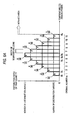
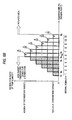
- Figs. 7A and 7B show a distribution image of the occlusion quantities Q(n) added with the distributed occluding quantity M hcad(n) .
- Fig. 7A is a distribution image to which the trap quantity M hcad(1) distributed at the distribution ratio shown in Fig. 6A is added.
- Fig. 7B is a distribution image to which the trap quantity M hcad(1) distributed at the distribution ratio shown in Fig. 6B is added.
- Fig. 7B shows a state in which the trap quantity M hcad(n) is added to only temperature zones to become distribution targets.
- the desorption quantity calculation block 14 calculates a quantity M hcde [g/sec] of hydrocarbon desorbed from the occluding catalyst 2 per unit time.
- the desorption quantity M hcde is determined according to the first catalyst temperature T 1 and the characteristic of the occluding catalyst 2. For instance, settings shown in Fig. 5F are made in light of the desorption characteristic of the occluding catalyst 2, such as that shown in Fig. 3 .
- the desorption quantity M hcde is set to a predetermined desorption quantity M hcde1 .
- the first catalyst temperature T 1 is the predetermined temperature T 01 or more and under the regeneration temperature T 03 , settings are made in such a way that the desorption quantity M hcde increases in a range that is the predetermined desorption quantity M hcde1 or less as the first catalyst temperature T 1 increases.
- the subtraction block 15 subtracts the desorption quantity M hcde calculated by the desorption quantity calculation block 14 from the occlusion quantities Q (n) added with the trap quantity M hcad(n) by means of the distribution block 13.
- the desorption quantity M hcde is subtracted, in an increasing sequence of a boiling point, from each of the trap quantities on the low boiling point side among the occlusion quantities Q (n) .
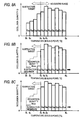
- the subtraction technique is now described by reference to Fig. 8A .
- the subtraction block 15 subjects a temperature zone, which is to become a subtraction target, to subtraction in sequence from a low temperature zone.
- the temperature zone that is to become a subtraction target is a temperature zone that is less than the first catalyst temperature T 1 (a temperature zone that is located on a lower boiling point side as compared with the temperature zone corresponding to the first catalyst temperature T 1 ).
- hydrocarbons having boiling points belonging to the temperature zone that is the first catalyst temperature T 1 or more are deemed to still remain trapped in the occluding catalyst 2 without desorption.
- the subtraction block 15 subtracts the hydrocarbons for the description quantity M hcde from the occlusion quantities Q (n) for the hydrocarbons occluded in the respective temperature zones on the lower boiling point side, thereby calculating an occlusion quantity Q that is a total of the occlusion quantities Q (n) .
- An image of distribution of the occlusion quantities Q (n) acquired after subtraction, such as those shown in Figs. 8B and 8C reflects on a boiling point distribution in which quantities of hydrocarbons actually occluded in the occluding catalyst 2 are classified according to a boiling point. The total area of the entire occlusion quantities corresponds to the occlusion quantity Q.
- the method for calculating the occlusion quantity Q is generalized as follows.
- a term ⁇ T [sec] is a period for calculating the trap quantity M hcad and the desorption quantity M hcde .
- the determination block 16 controls setting or clearing of a purge control flag.
- the purge control block 17 makes a reference to the thus-set purge request flag.
- the purge control block 17 performs purge control, thereby forcefully desorbing and eliminating the hydrocarbon occluded in the occlusion catalyst 2. Requirements for commencing purge control are mentioned below.
- the purge control block 17 commences purge control, thereby regulating the exhaust temperature in such a way that the catalyst temperature of the occlusion catalyst 2 is maintained at the regeneration temperature T c .
- Commencement requirements pertaining to the second catalyst temperature T 2 and the vehicle speed V are requirements for determining whether or not the current state is an operating state that allows an increase in exhaust temperature which would be caused by purge control.
- a specific technique for regulating an exhaust temperature under purge control is arbitrary.
- a conceivable technique includes changing of; for instance, a fuel-air ratio, an intake air quantity, a fuel injection quantity, fuel injection timing, a post injection quantity, and the like, that are relevant to combustion reaction occurred in the combustion chambers of the engine 1.
- a requirement to complete purge control is that the first catalyst temperature T 1 becomes continually equal to or higher than the regeneration temperature T c for a predetermined period of time.
- the predetermined period of time is set to; for instance, several minutes.
- Preferable completion requirements are that hydrocarbon is deemed to be desorbed and purified substantially completely from the occlusion catalyst 2.
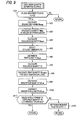
- Fig. 9 is a flowchart showing example occlusion quantity estimation control.
- Fig. 10 is a flowchart showing example purge control. Processing pertaining to these flows are concurrently in progress, thereby attempting to synchronize control specifics by way of the two types of flags F 1 and F 2 .
- a calculation period of an occlusion quantity estimation control flow is ⁇ T.
- the estimation control block 11 performs occlusion quantity estimation control.
- the estimation control block 11 determines a state of the purge implement flag F 2 .
- processing pertaining to the flow ends as it does, whereby occlusion quantity estimation control is suspended.
- the trap quantity calculation block 12 performs control operation pertaining to steps A20 to A40.
- step A20 the engine discharge M hceng is calculated by means of Equation 3.
- step A30 the hydrocarbon inflow quantity M hcin is calculated by means of Equation 2.
- step A40 the trap quantity M hcad is calculated by means of Equation 1.
- the distribution block 13 performs control processing pertaining to steps A50 to 70.
- step A50 either the first catalyst temperature T 1 or the second catalyst temperature T 2 , whichever is higher, is selected.
- the minimum value of the temperature zone that is to become a distribution target of the trap quantity M hcad is determined by the thus-selected temperature.
- step A60 the trap quantity M hcad is distributed to each of the temperature zones as shown in Figs. 6A and 6B .
- step A70 the trap quantity M hcad(n) distributed to each of the temperature zones is added to the hydrocarbon occlusion quantity Q acquired so far in the previous operation period, as shown in Figs. 7A and 7B .
- step A80 the desorption quantity calculation block 14 calculates the desorption quantity M hcde according to the first catalyst temperature T 1 .
- the subtraction block 15 performs processing pertaining to subsequent steps A90 and A100.
- step A90 temperature zones located on a lower boiling point side with reference to the temperature zones of the first catalyst temperature T 1 or more are determined as subtraction targets. Specifically, the maximum value for zones that become subtraction targets is determined by the first catalyst temperature T 1 .
- step A100 the desorption quantity M hcde is subtracted from the temperature zones located on the lower boiling point side in increasing sequence from a low boiling point.
- a distribution of occlusion quantities Q (n) of the hydrocarbon actually occluded in the occluding catalyst 2 for respective temperature zones is thereby acquired.
- the occlusion quantity Q is calculated by addition of all of the occlusion quantities Q (n) for respective temperature zones.
- step A110 the determination block 16 determines whether or not the occlusion quantity Q is a predetermined threshold value Q TH or less.
- Q ⁇ Q TH processing pertaining to the flow ends as it does.
- the purge control block 17 performs purge control.
- step B10 a state of the purge request flag F 1 is determined.
- step B20 remaining initiation requirements for purge control are determined.
- the second catalyst temperature T 2 is a predetermined temperature or less and when the vehicle speed V is a predetermined speed or higher, purge control initiation requirements are fulfilled, and processing proceeds to step B30.
- the initiation requirements are not fulfilled, processing pertaining to the flow ends as it does.
- the purge implement flag F 2 acts to let the estimation control block 11 suspend performance of occlusion quantity estimation control.
- step B40 purge control is performed.
- the temperature of emissions flowing into the occluding catalyst 2 is thereby regulated, so that the first catalyst temperature T 1 is maintained at the regeneration temperature T c .
- step B50 completion requirements for purge control are determined.
- the first catalyst temperature T 1 is continually equal to or higher than the regeneration temperature T c for a predetermined period of time
- completion requirements for purge control are fulfilled, whereupon processing proceeds to step B60.
- processing proceeds to step B50, and purge control is continually performed until the completion requirements are fulfilled.
- the trap quantity M hcad is distributed solely to temperature zones that are higher than either the first catalyst temperature T 1 or the second catalyst temperature T 2 , whichever is higher.
- the trap quantity can be distributed by eliminating the hydrocarbons having low boiling points that should not have flowed into the occluding catalyst 2 or the hydrocarbons having low boiling points that should not be trapped by the occluding catalyst 2, whereby occurrence of miscalculation is prevented. Consequently, it is possible to accurately ascertain the occlusion quantity Q of hydrocarbons having high boiling points.
- control is implemented by means of a simple configuration based on the catalyst temperature of the occluding catalyst 2 and the catalyst temperature of the oxidation catalyst 3, so that the accuracy of estimation of an occlusion quantity can be enhanced without involvement of an increase in system cost.
- the occluding catalyst 2 is situated at a downstream position on the exhaust passageway 6 with respect to the oxidation catalyst 3. Therefore, the first catalyst temperature T 1 is likely to be lower than the second catalyst temperature T 2 . Temperature zones that are to become distribution targets correspond to temperature zones on a high temperature boiling point side with reference to the first catalyst temperature T 1 . Therefore, it is possible to make a comparatively small estimate of the quantity of trapped hydrocarbon on the low boiling point side. Such a control configuration can also be said to contribute to accurate estimation of the trap quantity M hcad and the occlusion quantity Q.
- the distribution block 13 estimates a distribution of presence of hydrocarbons trapped by the occluding catalyst 2 for each type of hydrocarbon by means of taking as a model the distribution model imitating a boiling point distribution of hydrocarbons in emissions.
- a model that takes as a model the boiling point distribution of hydrocarbons in emissions flowing into the occluding catalyst 2 is taken as a distribution model of the trap quantity M hcad .
- the desorption quantity M hcde is subtracted solely from the temperature zones on the lower boiling point side than from the temperature zones corresponding to the first catalyst temperature T 1 . Therefore, the quantities of hydrocarbons having high boiling points that should not originally be desorbed are not subtracted, and the occlusion quantity Q of hydrocarbons having high boiling points can be maintained from a calculation viewpoint, so that underestimation of the occlusion quantity Q can be inhibited.
- purge control is performed according to an accurate estimation of the occlusion quantity Q, it is possible to minimize an increase in fuel consumption while deterioration of the occluding catalyst 2 is prevented, and also to enhance efficiency of emission purification.
- the present invention can be implemented in various forms without departing the gist of the invention.
- the respective configurations of the embodiment can be adopted or rejected, as required, or used in combination if necessary.
- the occluding catalyst 2 has exemplified the occluding catalyst 2 as a catalyst unit having a hydrocarbon occluding layer and a precious metal catalyst layer.
- the precious metal catalyst layer is not an indispensable element. The minimum requirement is that a layer should trap and desorb hydrocarbons included in emission and trap and desorb a plurality of types of hydrocarbons having different boiling points.
- a catalyst configuration of a specific exhaust system is not confined to the foregoing embodiment.
- the oxidation catalyst 3 can also be omitted, or the layout of the catalyst on the exhaust passageway 6 can also be changed. If the oxidation catalyst 3 is omitted, the second temperature sensor 5 will become unnecessary. Further, the upstream slip coefficient K OXI will become unnecessary for calculation of the quantity M hcin of inflow hydrocarbon.
- another catalyst or filter may also be interposed at a position on the exhaust passageway 6 between the occluding catalyst 2 and the oxidation catalyst 3.
- a nitrogen oxide occluding catalyst is interposed between the occluding catalyst 2 and the oxidation catalyst 3, it is preferable to add to calculation of the engine discharge M hceng a quantity of hydrocarbon serving as an additive used for reducing reaction in the nitrogen oxide occluding catalyst.
- a quantity of hydrocarbon serving as an additive used for reducing reaction in the nitrogen oxide occluding catalyst.
- a conceivable way is to set a fuel-air ratio correction coefficient K NOP according to a state of a fuel-air ratio, and a right side of Equation 3 is multiplied by the coefficient, thereby correcting the engine discharge M hceng .
- the operation makes it possible to accurately ascertain the quantity of hydrocarbon flowing into the occluding catalyst 2, whereby the precision of assumption of the hydrocarbon occlusion quantity Q can be further enhanced.
- the embodiment has illustrated a simplified illustration of a distribution model of boiling points of hydrocarbons included in emissions and a simplified illustration of a distribution model of the trap quantity M hcad .
- Specific shapes of the models are arbitrary.
- the distribution model of boiling points and the distribution model of the trap quantity M hcad are considered to be set, as required, according to the property of a fuel used in the engine 1, a structure and shape of an exhaust system, a configuration of the catalyst, and the like.
- models that have previously been set by means of tests, or the like may also be used for the distribution model of boiling points of hydrocarbons and the distribution model of the trap quantity M hcad .
- Classification of types of hydrocarbons performed during estimation and calculation of the occlusion quantity is based on boiling points in the embodiment. However, classification may also be performed according to the number of carbons or according to a molecular structure instead. Specifically, conceivable classification is based on a physical quantity correlating with boiling points. So long as the quantity Q of hydrocarbons occluded in the occluding catalyst 2 is classified at least by use of a physical quantity correlating with boiling points, control analogous to that described in connection with the embodiment is implemented, so that accuracy of estimation of the occlusion quantity can be enhanced.
- the first temperature sensor 4 provided downstream of the occluding catalyst 2 detects the first catalyst temperature T 1
- the second temperature sensor 5 provided downstream of the oxidation catalyst 3 detects the second catalyst temperature T 2 .
- a technique for ascertaining the first catalyst temperature T 1 and the second catalyst temperature T 2 is not limited to that mentioned above.
- another catalyst temperature may also be estimated from one catalyst temperature.
- the technique for calculating engine torque is not limited to the thus-exemplified technique.
- a combustion pressure sensor for detecting combustion pressure in cylinders may also be used.
- a torque estimation value calculated by an unillustrated engine ECU may also be utilized.
- the disclosed exhaust emission control device of an internal combustion engine can be applied to both a diesel engine and a gasoline engine.
Landscapes
- Engineering & Computer Science (AREA)
- Chemical & Material Sciences (AREA)
- Combustion & Propulsion (AREA)
- Mechanical Engineering (AREA)
- General Engineering & Computer Science (AREA)
- Chemical Kinetics & Catalysis (AREA)
- Materials Engineering (AREA)
- Health & Medical Sciences (AREA)
- Toxicology (AREA)
- Exhaust Gas After Treatment (AREA)
- Combined Controls Of Internal Combustion Engines (AREA)
Abstract
Description
- The present invention relates to an exhaust emission control device for an internal combustion engine that estimates a quantity of hydrocarbon occluded in an occluding agent of an exhaust system.
- Conventionally, an exhaust emission control system that purifies hydrocarbon emitted from an internal combustion engine includes catalytic converter rhodium, an oxidation catalyst, or the like, provided in a vehicle exhaust system is know. The catalyst includes a supported precious metal component exhibiting oxidation, such as platinum, palladium, and rhodium, and efficient hydrocarbon purification is implemented. Meanwhile, hydrocarbon oxidation effected by precious metal requires a predetermined catalyst temperature. Sufficient performance cannot be exhibited at cold start of an internal combustion engine during which a catalyst is cold. Accordingly, there has been developed a technique of using in combination an occluding member having a feature of temporarily occluding hydrocarbon emitted when an activating temperature of a catalyst is not reached, thereby enhancing emission purification performance.
- For instance,
JP-A-2005-240726 - Incidentally, a general hydrocarbon occluding member has a ceiling on the quantity of hydrocarbon capable of being occluded, and a predetermined quantity of hydrocarbon or more cannot be occluded. Accordingly, operation for periodically desorbing the occluded hydrocarbon is required. In particular, when a hydrocarbon occluding member is applied to an exhaust system of a diesel engine, hydrocarbon is likely to be excessively stored during idling operation performed at an extremely low emission temperature. Therefore, delayed desorbing operation may result in deterioration of the occluding member. Consequently, it is important to accurately ascertain the quantity of hydrocarbon in an occluding member and perform desorbing operation without a delay.
- In relation to the problem, the technique described in connection with
JP-A-2005-240726 - Since an overlap exists between a temperature range in which an occluding member induces reaction for trapping hydrocarbon and a temperature range in which the occluding member induces reaction for desorbing hydrocarbon, the temperature ranges cannot explicitly be separated from each other while a single threshold value is taken as a boundary between the temperature ranges. There is a case where hydrocarbon is slightly desorbed even when the occluding member is at a comparatively low temperature. Conversely, there is also a case where hydrocarbon is slightly trapped even when the occluding member is at a comparatively high temperature. Therefore, the quantity of hydrocarbon desorbed from the occluding member cannot be ascertained by means of the technique, such as that mentioned in connection with
JP-A-2005-240726 - A desorbing characteristic of the hydrocarbon occluded in the occluding member varies according to the temperature at which the hydrocarbon was trapped. Specifically, a wide variety of types of hydrocarbon having different boiling points are occluded in the occluding member. A distribution of boiling points of these types of hydrocarbons is dependent on temperature conditions employed during trapping operation as well as on a distribution of boiling points of hydrocarbons in emissions. Provided that the quantity of occluded hydrocarbon is calculated without taking into account such temperature conditions and that an estimated quantity of desorbed hydrocarbon is simply subtracted from the thus-calculated quantity of occluded hydrocarbon, a quantity of hydrocarbon that has a high boiling point and that would not originally be desorbed will also be subtracted. Therefore, the quantity of occluded hydrocarbon is often underestimated, and desorbing operation cannot be performed at accurate timing.
- One of objects of the present invention has been conceived in light of such a problem and is to enhance accuracy of estimation of a quantity of hydrocarbon occluded in an occluding member.
- According to the present invention, there is provided an exhaust emission control device for an internal combustion engine comprising: an occluding member that is provided in an exhaust system of an internal combustion engine and that traps and desorbs a plurality of types of hydrocarbons having different boiling points in emissions; first calculation means that estimates a distribution of presence of each type of the hydrocarbons to be trapped by the occluding member and that calculates an occlusion quantity of the occluding member for each type of the hydrocarbons from the quantity of trapped hydrocarbons; and control means that performs control operation for purifying the hydrocarbons occluded in the occluding member according to the occlusion quantity calculated by the first calculation means.
- The exhaust emission control device for an internal combustion engine may further have second calculation means that subtracts in sequence a quantity of the hydrocarbon desorbed from the occluding member from the quantity of occluded hydrocarbon having a lower boiling point among the occlusion quantities calculated by the first calculation means, thereby calculating the quantity of hydrocarbon occluded in the occluding member.
- The exhaust emission control device for an internal combustion engine may also be configured so as to further have first catalyst temperature detection means for detecting a first catalyst temperature that is a catalyst temperature of the occluding member, and the first calculation means may calculate a quantity of trapped hydrocarbon having a boiling point that is equal to or higher than the first catalyst temperature detected by the first catalyst temperature detection means.
- The second calculation means may also be configured so as to subtract the desorption quantity solely from the quantity of occluded hydrocarbon having a boiling point that is less than the first catalyst temperature detected by the first catalyst temperature detection means.
- The exhaust emission control device for an internal combustion engine has an oxidation catalyst provided in an upstream position with reference to an occluding catalyst in the exhaust and second catalyst temperature detection means that detects a catalyst temperature of the oxidation catalyst as a second catalyst temperature. The first calculation means may also be configured so as to calculate a quantity of trapped hydrocarbon having a boiling point that is equal to or higher than either the first catalyst temperature detected by the first catalyst temperature detection means or the second catalyst temperature detected by the second catalyst temperature detection means, whichever is higher.
- The exhaust emission control device for an internal combustion engine of the present invention makes it possible to enhance accuracy of estimation of an occlusion quantity by estimating a distribution of presence of a trapped hydrocarbon according to a distribution of boiling points of hydrocarbons included in emissions flowing into an occluding member.
- In the following preferred embodiments of the present invention are described with reference to the drawings, in which:
-
Fig. 1 is a schematic diagram showing a vehicle intake and exhaust system to which there is applied an exhaust emission control device for an internal combustion engine of an embodiment; -
Fig. 2 is a graph showing a hydrocarbon desorbing characteristic of an occluding catalyst in the exhaust emission control device of the internal combustion engine; -
Fig. 3 is a conceptual rendering for describing a basic concept of the exhaust emission control device of the internal combustion engine; -
Fig. 4 is a boiling point distribution diagram showing a modeled distribution ratio of hydrocarbon trapped into an occluding catalyst of the exhaust emission control device of the internal combustion engine; -
Fig. 5A is a graph showing a trapping coefficient Kadsorp for explaining calculation performed by the exhaust emission control device of the internal combustion engine; -
Fig. 5B is a graph showing an upstream slip coefficient Koxi for explaining calculation performed by the exhaust emission control device of the internal combustion engine; -
Fig. 5C is a graph showing a fundamental quantity of emitted hydrocarbon Mhceng0 for explaining calculation performed by the exhaust emission control device of the internal combustion engine; -
Fig. 5D is a graph showing a water temperature correction coefficient KTHW for explaining calculation performed by the exhaust emission control device of the internal combustion engine; -
Fig. 5E is a graph showing an intake air temperature correction coefficient KTHA for explaining calculation performed by the exhaust emission control device of the internal combustion engine; -
Fig. 5F is a graph showing a quantity of desorbed hydrocarbon Mhcde for explaining calculation performed by the exhaust emission control device of the internal combustion engine; -
Fig. 5G is a graph explaining a fuel-air ratio correction coefficient KNOP for explaining calculation performed by the exhaust emission control device of the internal combustion engine; -
Fig. 6A is a pattern diagram of a distribution model of a quantity of trapped hydrocarbon that is calculated at a comparatively low temperature by the exhaust emission control device of the internal combustion engine; -
Fig. 6B is a pattern diagram of a distribution model of a quantity of trapped hydrocarbon that is calculated at a comparatively high temperature by the exhaust emission control device of the internal combustion engine; -
Fig. 7A is a pattern diagram of a method for adding, at a comparatively low temperature, the quantity of trapped hydrocarbon calculated by the exhaust emission control device of the internal combustion engine; -
Fig. 7B is a pattern diagram of a method for adding, at a comparatively high temperature, the quantity of trapped hydrocarbon calculated by the exhaust emission control device of the internal combustion engine; -
Fig. 8A is a pattern diagram that graphically represents a method for subtracting a quantity of desorbed hydrocarbon calculated by the exhaust emission control device of the internal combustion engine, the diagram showing an image of distribution of quantities of occluded hydrocarbons Q(n) acquired before subtraction; -
Figs. 8B and 8C are pattern diagrams that graphically represent the method for subtracting the quantity of desorbed hydrocarbon calculated by the exhaust emission control device of the internal combustion engine, the diagrams showing an image of distribution of the quantities of occluded hydrocarbons Q(n) acquired after subtraction; -
Fig. 9 is a flowchart illustrating procedures for controlling estimation of the quantity of occluded hydrocarbon that are performed by the exhaust emission control device of the internal combustion engine; and -
Fig. 10 is a flowchart illustrating procedures of purge control operation performed by the exhaust emission control device of the internal combustion engine. - An embodiment of an exhaust emission control device for an internal combustion engine is hereunder described by reference to the drawings. The embodiment provided below is a mere illustration and is not intended to eliminate various modifications and application of technology that are not expressly described in the embodiment provided blow.
- An engine 1 (an internal combustion engine) shown in
Fig. 1 is a diesel engine that takes light oil containing various hydrocarbons (HC) as fuel. Anexhaust passageway 6 and anintake passageway 7 are connected to theengine 1. Intake air is introduced into combustion chambers of cylinders of theengine 1 by way of theintake passageway 7, and an exhaust gas (hereinafter referred to simply as an "emission") resulting from combustion is discharged outside of the vehicle by way of theexhaust passageway 6. Hydrocarbons having a plurality of carbon numbers are mixedly present in the fuel of theengine 1. A plurality of types of hydrocarbons having different boiling points also mixedly exist in hydrocarbons contained in the emissions. - A controller 10 (control means) to be described later controls a fuel-air ratio, a quantity of intake air, a quantity of fuel injection, fuel injection timing, a quantity of post fuel injection, and others, that are related to combustion reaction occurred in the combustion chambers of the
engine 1. Thecontroller 10 is a so-called ECU (Electric Control Unit). - An
oxidation catalyst 3 and an occludingcatalyst 2 are placed in theexhaust passageway 6 in a decreasing sequence of emission flow from an upstream position. - The occluding catalyst 2 (an occluding member) is a catalyst unit that has an occluding layer provided on a surface of a catalyst support. In some instance, the unit additionally has a precious metal catalyst layer. The occluding layer is a layer containing various types of zeolites having a characteristic of occluding hydrocarbons contained in emissions. The precious metal catalyst layer is a layer that contains active alumina carrying a precious metal component for enhancing a hydrocarbon oxidation function. The occluding
catalyst 2 traps hydrocarbon at a low catalyst temperature, and the thus-trapped hydrocarbon is occluded in the occluding layer. As the catalyst temperature increases, the occludingcatalyst 2 desorbs the trapped hydrocarbon, and the precious metal catalyst layer eliminates the hydrocarbon through oxidation. - In the present embodiment, a state in which the hydrocarbon trapped by the occluding
catalyst 2 is kept until it desorbs from the catalyst is called "occlusion," and the word "occlusion" is used as distinguished from the word "trap." The quantity of hydrocarbon acquired when hydrocarbon existing in the emissions is trapped by the occluding layer of the occludingcatalyst 2 is called a "trap quantity." In a case where the hydrocarbon trapped in the occluding layer of the occludingcatalyst 2 is discharged into emissions or eliminated through oxidation, the quantity of hydrocarbon thus discharged or eliminated is called a "desorption quantity." Further, a quantity of hydrocarbon held by the occludingcatalyst 2 is called an "occlusion quantity Q." The occlusion quantity Q is assumed to be given as an integration of values that have been determined by subtraction of the desorption quantities from the trap quantities. The quantity of hydrocarbon that can be occluded in the occludingcatalyst 2 is finite. A maximum value of the occlusion quantity Q is called a "hydrocarbon quantity QMAX." - When the hydrocarbon occlusion quantity Q has reached the hydrocarbon quantity QMAX, any further trapping of hydrocarbon is not expected. Therefore, there is generally required operation for forcefully desorbing hydrocarbon before the occlusion quantity Q reaches the hydrocarbon quantity QMAX. In the present embodiment, a regeneration temperature Tc is set as a target value of a catalyst temperature to be operated for desorbing hydrocarbon from the occluding
catalyst 2. The regeneration temperature Tc is a catalyst temperature that makes it possible to desorb nearly all occluded hydrocarbon without involvement of deterioration of the occludingcatalyst 2, thereby purifying the occluding catalyst. The regeneration temperature Tc is set to; for instance, 400 [°C] or thereabouts. Moreover, controlling an exhaust temperature in such a way that the catalyst temperature of the occludingcatalyst 2 reaches the regeneration temperature Tc is called purge control. Thecontroller 10 to be described later implements purge control. - A hydrocarbon desorbing characteristic of the occluding
catalyst 2 is now described by reference toFig. 2 . A solid-line plot inFig. 2 denotes a test result showing a concentration of hydrocarbon detected at a downstream position with respect to the catalyst when the catalyst temperature of the occludingcatalyst 2, which occludes hydrocarbon as a result of theengine 1 having continually performed idling operation for a predetermined time while the catalyst temperature is held at a predetermined temperature TA [°C], is changed from a low temperature to a high temperature. Further, a broken-line plot in the drawing denotes a test result yielded when the idling operation is shortened while the catalyst temperature is maintained at a predetermined temperature TB [°C] by means of changing conditions for letting the occludingcatalyst 2 of the same type occlude hydrocarbon. A dashed line in the drawing denotes a reference line showing a concentration of hydrocarbon detected at an upstream position with respect to the catalyst. - The solid-line plot in
Fig. 2 shows that hydrocarbon is desorbed over an entire temperature range from the predetermined temperature TA employed during trapping operation to the regeneration temperature TC. Even in a broken-line graph, hydrocarbons are desorbed over an entire temperature range from the predetermined temperature TB employed during trapping operation to the regeneration temperature TC. In short, when a catalyst temperature employed during trapping operation is constantly maintained, only hydrocarbons having boiling points that are equal to or higher than the catalyst temperature are occluded in the occludingcatalyst 2, and hydrocarbons having boiling points that are less than the catalyst temperature are not occluded in the occludingcatalyst 2. A correlation is acknowledged from these facts to exist between the catalyst temperature employed during trapping operation and boiling points of hydrocarbons actually occluded in the occludingcatalyst 2. Moreover, when hydrocarbon is not desorbed within a temperature range that is equal to or higher than the regeneration temperature Tc, the regeneration temperature Tc can be considered to be the maximum value of a boiling point of the hydrocarbon trapped in the occludingcatalyst 2. - The
oxidation catalyst 3 is a catalyst that carries on its surface a precious metal component and has an ability to oxidize various components in emissions. Components in emissions purified by theoxidation catalyst 3 include carbon monoxide (CO), hydrocarbons, and others. - In general, when the catalyst temperature is a predetermined activating temperature or more, the
oxidation catalyst 3 in a diesel engine exhaust system in which a fuel-air ratio in emissions is set to a lean atmosphere oxidizes nitrogen monoxide, carbon monoxide, and hydrocarbon, thereby producing nitrogen dioxide, carbon dioxide, and a moisture. In the meantime, when the catalyst temperature of theoxidation catalyst 3 is less than the predetermined activating temperature, hydrocarbon is not purified and captured by the occludingcatalyst 2 disposed downstream. - In the
exhaust passageway 6, a first temperature sensor 4 (first catalyst temperature detection means) is disposed downstream of the occludingcatalyst 2, and a second temperature sensor 5 (second catalyst temperature detection means) is disposed downstream of theoxidation catalyst 3. Thefirst temperature sensor 4 detects a catalyst temperature of the occludingcatalyst 2, and thesecond temperature sensor 5 detects a catalyst temperature of theoxidation catalyst 3. The catalyst temperature of the occludingcatalyst 2 is hereunder called a "first catalyst temperature T1," and the catalyst temperature of theoxidation catalyst 3 is hereunder called a "second catalyst temperature T2." The first catalyst temperature T1 detected by thefirst temperature sensor 4 and the second catalyst temperature T2 detected by thesecond temperature sensor 5 are input to thecontroller 10. - The
engine 1 is also equipped, side by side, with anengine speed sensor 21 for detecting an engine speed NE, an enginecoolant temperature sensor 22 for detecting a temperature THW of an engine coolant, and atorque sensor 25 for detecting torque TOR of a drive shaft of theengine 1. A linear fuel-air ratio sensor 23 for detecting a fuel-air ratio RA/F is disposed on theexhaust passageway 6, and anintake temperature sensor 24 for detecting a temperature THA of an intake air is disposed on theintake passageway 7. The engine speed NE, the engine coolant temperature THW, the engine torque TOR, the fuel-air ratio RA/F, and the intake temperature THA detected by the various sensors are input to thecontroller 10. Avehicle speed sensor 26 for detecting a vehicle speed V is provided at an arbitrary position on a vehicle. The thus-detected vehicle speed V is also input to thecontroller 10. - The
controller 10 is an electronic controller offered as an LSI device that results from integration of known microprocessors, ROM, RAM, and the like. Theengine speed sensor 21, the enginecoolant temperature sensor 22, the linear fuel-air ratio sensor 23, theintake temperature sensor 24, thetorque sensor 25, thevehicle speed sensor 26, thefirst temperature sensor 4, and thesecond temperature sensor 5 are connected to an input side of thecontroller 10. According to input information from these sensors, thecontroller 10 performs occlusion quantity estimation control and purge control. - Occlusion quantity estimation control is control operation for calculating, in an estimating manner, the quantity Q of hydrocarbon occluded in the occluding
catalyst 2. The occlusion quantity Q is calculated according to the engine speed NE, the engine coolant temperature THW, the fuel-air ratio RA/F, the intake temperature THA, the engine torque TOR, the vehicle speed V, the first catalyst temperature T1, and the second catalyst temperature T2. Basic idea of occlusion quantity estimation control is described by reference toFig. 3 . - A relationship, such as that designated by a solid line in
Fig. 3 , is assumed to exist between the catalyst temperature of the occludingcatalyst 2 and a desorption speed Vde of hydrocarbon. Namely, when a catalyst temperature T is less than a predetermined temperature T01, the desorption speed comes to Vde = 0, so that hydrocarbon is not desorbed. When the catalyst temperature is the predetermined temperature T01 or more, hydrocarbon is desorbed. The desorption speed Vde corresponds to a desorption quantity achieved per unit time. The desorption speed Vde is assumed to linearly increase within a range where the catalyst temperature T changes from the predetermined temperature T01 to a regeneration temperature T03. The regeneration temperature T03 signifies a catalyst temperature identical with the regeneration temperature Tc. The desorption speed Vde achieved when the catalyst temperature T is a predetermined temperature T02 is assumed to be a predetermined speed V1. - When the catalyst temperature of the occluding
catalyst 2 is the predetermined temperature T02, hydrocarbons whose boiling points fall within a temperature range from the predetermined temperature T01 to the predetermined temperature T02 are assumed to be desorbed, and hydrocarbons whose boiling points fall within a temperature range from the predetermined temperature T02 to the regeneration temperature T03 are assumed to be trapped. Specifically, in relation to trapping of hydrocarbon by the occludingcatalyst 2, hydrocarbons whose boiling points fall within a temperature range A shown inFig. 3 are considered to be untrapped, and hydrocarbons whose boiling points fall within a temperature range B are considered to be trapped. Further, in relation to desorption of hydrocarbons from the occludingcatalyst 2, the hydrocarbons whose boiling points fall within the temperature range A are considered to be desorbed, and the hydrocarbons whose boiling points fall within the temperature range B are considered not to be desorbed. - In connection with estimated calculation of a specific quantity of occluded hydrocarbon, hydrocarbons are classified into a plurality of types having different boiling points, and a trap quantity and a desorption quantity are calculated for each type.
- As shown in
Fig. 4 , on occasion of calculation of a trap quantity, there is used a boiling point distribution model for hydrocarbons contained in the emissions flowing into the occludingcatalyst 2. Hydrocarbons are herein supposed to have boiling points that range from a first temperature B1 to a third temperature B3. A distribution profile assumes a shape of an isosceles triangle. In relation to hydrocarbons having boiling points that fall within a range from the first temperature B1 to the second temperature B2, hydrocarbons having higher boiling points are distributed so as to become larger in quantity. By contrast, in relation to hydrocarbons having boiling points that fall within a range from the second temperature B2 to the third temperature B3, hydrocarbons having lower boiling points are distributed so as to become larger in quantity. - In the present embodiment, the distribution of boiling points of hydrocarbons trapped in the occluding
catalyst 2 is assumed to imitate the foregoing distribution patterns in a range in excess of a catalyst temperature of the occludingcatalyst 2. Specifically, hydrocarbons trapped in the occludingcatalyst 2 are first assumed to be limited to hydrocarbons having boiling points that are equal to or higher than the catalyst temperature T achieved at that time. Next, a quantity of trapped hydrocarbons is now calculated on the basis of assumptions provided below. In relation to hydrocarbons having boiling points that fall within a range from the first temperature B1 to the second temperature B2, hydrocarbons having higher boiling points are trapped in larger quantity. By contrast, in relation to hydrocarbons having boiling points that fall within a range from the second temperature B2 to the third temperature B3, hydrocarbons having lower boiling points are trapped in larger quantity. - In relation to calculation of a desorption quantity, hydrocarbons having lower boiling points among the hydrocarbons occluded in the occluding
catalyst 2 are considered to be desorbed in an increasing sequence from a lower boiling point within a temperature range under the catalyst temperature of the occludingcatalyst 2. The reason for this is that a degree of reactivity of desorption from the occludingcatalyst 2 is dependent on a boiling point of hydrocarbon. - Purge control is for forcefully desorbing and purifying the hydrocarbons occluded in the occluding
catalyst 2. Purge control is performed when the occlusion quantity Q estimated by means of occlusion quantity estimation control has exceeded a predetermined threshold value QTH. The predetermined threshold value QTH is set to an arbitrary value in a range that is the hydrocarbon quantity QMAX of the occludingcatalyst 2 or less. An exhaust temperature is regulated by purge control in such a way that the catalyst temperature of the occludingcatalyst 2 is maintained at the regeneration temperature TC for a predetermined period of time. - One of objectives of purge control is to desorb hydrocarbons before the hydrocarbon occlusion quantity Q reaches the hydrocarbon quantity Qmax. The objective becomes easier to attain, so long as the predetermined threshold value QTH is set to a lower value. Namely, the objective becomes easier to attain with an increase in frequency of performance of purge control. However, purge control is performed so as to make an exhaust temperature higher than the exhaust temperature achieved during normal idling operation. For this reason, an increase in frequency of performance of purge control results in deterioration of fuel efficiency.
- Therefore, it is preferable to set the predetermined threshold value QTH to a high level within a range where any practical inconvenience is not caused; therefore, highly accurate estimation of the occlusion quantity Q is desired. Occlusion quantity estimation control of the present embodiment can also be said to be control for effecting estimated operation of an occlusion quantity Q with high accuracy from the foregoing viewpoint.
- As shown in
Fig. 1 , thecontroller 10 has anestimation control block 11 and a purge control block 17 (control means) as a software configuration for implementing the respective control operations. These software programs are recorded in unillustrated memory and an unillustrated storage device. Functions which will be described below are implemented by reading the software program into a CPU, as required. - The
estimation control block 11 is assigned the previously described occlusion quantity estimation control and calculates, in an estimating manner, the hydrocarbon occlusion quantity Q in the occludingcatalyst 2, as necessary. Theestimation control block 11 is equipped with first calculation means including a trapquantity calculation block 12 and adistribution block 13; second calculation means including a desorptionquantity calculation block 14 and asubtraction block 15; and adetermination block 16. - The trap
quantity calculation block 12 is for calculating a quantity Mhcad [g/sec]of hydrocarbon trapped in the occludingcatalyst 2 per unit time. The trap quantity Mhcad is given by the following equation.
- The term Kadsorp is a trapping coefficient. Further, the term Mhcin is a quantity of inflow hydrocarbon.
- The trapping coefficient Kadsorp designates a ratio of hydrocarbon trapped into the occluding
catalyst 2 from emissions and is set according to the first catalyst temperature T1 (the catalyst temperature of the occluding catalyst 2) and a characteristic of the occludingcatalyst 2. The characteristic of the occludingcatalyst 2 includes; for instance, a type, a composition, a structure, and the like, of a catalytic material. As shown inFig. 5A , when the first catalyst temperature T1 is under a predetermined temperature T11, a predetermined value K1 is given as the trapping coefficient Kadsorp. When the first catalyst temperature T1 is a predetermined temperature T12 or more, the trapping coefficient is set to Kadsorp = 0. The predetermined value K1 is given as; for instance, K1 = 0.6, where T10 < T11. When the first catalyst temperature T1 is the predetermined temperature T11 or more and under the predetermined temperature T12, settings are made in such a way that the coefficient becomes gradually smaller as the first catalyst temperature T1 increases. Namely, when the catalyst temperature of the occludingcatalyst 2 is the predetermined temperature T12 or more, hydrocarbons are not trapped from a calculation viewpoint. The specific predetermined temperature T12 may be determined according to a trapping characteristic of the occludingcatalyst 2. For instance, a temperature of about 250 [°C] is conceivable for the predetermined temperature T12. - The inflow hydrocarbon quantity Mhcin [g/sec] denotes a quantity of hydrocarbon flowing into the occluding
catalyst 2 per unit time and is given by the following equation.
- The term KOXI is an upstream slip coefficient. The term Mhceng is an engine discharge.
- The upstream slip coefficient KOXI designates a ratio of hydrocarbon flowing into the occluding
catalyst 2 without being purified by theoxidation catalyst 3 and is determined by the second catalyst temperature T2 that is a catalyst temperature of theoxidation catalyst 3 and the characteristic of theoxidation catalyst 3. As shown inFig. 5B , when the second catalyst temperature T2 is under a predetermined temperature T21, KOXI = 1 is given. When the second catalyst temperature T2 is a predetermined temperature T22 or more, KOXI = K2 is given, where T21 < T22. Moreover, settings are also made such that, when the second catalyst temperature T2 is the predetermined temperature T21 or more and under the predetermined temperature T22, the coefficient gradually decreases with an increase in the second catalyst temperature T2. - The upstream slip coefficient KOXI is set according to hydrocarbon purification efficiency of the
oxidation catalyst 3. For instance, when the purification efficiency of theoxidation catalyst 3 reached the activating temperature is 90[%], the coefficient K2 is set to 0.1 in a range that is equal to or higher than the second catalyst temperature T2 equivalent to the activating temperature. It is desirable to set the predetermined temperatures T21 and T22 such that the upstream slip coefficient KOXI changes in a neighborhood of the activating temperature. - The engine discharge Mhceng [g/sec] designates a quantity of hydrocarbon discharged per unit time from the
engine 1 and is given by the following equation.
- The term Mhceng0 designates a basic discharge. Further, the term KTHW is a water temperature correction coefficient. The term KTHA is an intake temperature correction coefficient.
- The basic discharge Mhceng0 [g/sec] designates a standard hydrocarbon discharge per unit time estimated from an operating state of the
engine 1. As shown inFig. 5C , the basic discharge Mhceng0 is calculated according to a map pertaining to the engine speed NE detected by theengine speed sensor 21 and the engine torque TOR detected by thetorque sensor 25. The basic discharge Mhceng0 is set so as to become greater with an increase in the engine speed NE or engine torque TOR. Specifically, the basic discharge Mhceng0 is set so as to increase as an output of theengine 1 becomes greater. - The water temperature correction coefficient KTHW is a hydrocarbon discharge correction gain based on the engine coolant temperature THW. As shown in
Fig. 5D , when the engine coolant temperature THW is a predetermined temperature THW1 or more, the water temperature correction coefficient KTHW is set to KTHW = 1. Further, when the engine coolant temperature THW is less than the predetermined temperature THW1, the water temperature correction coefficient KTHW is set so as to increase as the temperature of the engine coolant is lower. The predetermined temperature THW1 is set to; for instance, 85[°C]. - The intake temperature correction coefficient KTHA is a hydrocarbon discharge correction gain based on the intake temperature THA. As shown in
Fig. 5E , when the intake temperature THA is a predetermined temperature THA1 or more (e.g., 25[°C] or more), the intake temperature correction coefficient KTHA is set to KTHA = 1. Further, when the intake temperature THA is less than the predetermined temperature THA1, the intake temperature correction coefficient KTHA is set so as to increase as the intake temperature is lower. The predetermined temperature THA1 is set to; for instance, 25[°C]. - The
distribution block 13 classifies trapped hydrocarbon into a plurality of types of hydrocarbon having different boiling points and calculates a trap quantity Mhcad according to the types of hydrocarbon. The trap quantity Mhcad calculated by the trapquantity calculation block 12 is distributed for each of the boiling points. -
Fig. 6A illustrates a distribution model of the trap quantity Mhcad previously recorded in thedistribution block 13. A horizontal axis shown inFig. 6A represents temperatures corresponding to boiling points of trapped hydrocarbons. A width of an individual temperature zone corresponds to a width of a boiling point of hydrocarbon classified into the zone. Further, a vertical axis shown in the drawing represents a distribution ratio of the trap quantity Mhcad. A distribution ratio for each temperature zone is proportional to an area of the temperature zone. - In the embodiment, a range from the first temperature B1 to the third temperature B3 is divided at uniform intervals into eleven areas along the vertical axis, whereby a plurality of strip-shaped temperature zones are formed. Moreover, the distribution ratio is determined in such a way that the largest quantity of hydrocarbon is distributed to the temperature zone including the second temperature B2. The hydrocarbon trapped into the occluding
catalyst 2 exhibits a boiling point distribution analogous to the boiling point distribution of hydrocarbon in emissions flowing into the occludingcatalyst 2. Therefore, the distribution model is formed into a shape that imitates an isosceles triangle taking a neighborhood of the second temperature B2 as an apex, so as to follow a boiling point distribution of hydrocarbon in emissions shown inFig. 4 . - The
distribution block 13 distributes the trap quantity Mhcad, which is calculated by the trapquantity calculation block 12, to the respective temperature zones that are distribution targets while taking the distribution model as a sample. A temperature zone to become a distribution target is a temperature zone that is equal to or higher than either the first catalyst temperature T1 or the second catalyst temperature T2, whichever is higher. Hydrocarbon having a boiling point belonging to temperature zones that are lower than the temperature zone including a higher catalyst temperature [i.e., left-side temperature zones inFig. 6A ] is considered not to be trapped by the occluding catalyst 2 (or is considered not to flow into the occluding catalyst 2). Temperature areas that are equal to or higher than the third temperature B3 are non-add areas to which the trap quantity Mhcad is not distributed. Specifically, hydrocarbon having a boiling point that is the third temperature B3 or more is also considered not to be trapped by the occludingcatalyst 2. - For instance,
Fig. 6A shows a case where both the first catalyst temperature T1 and the second catalyst temperature T2 are less than the first temperature B1. In this case, the temperature zone to become a distribution target corresponds to an entire range from the first temperature B1 to the third temperature B3. Therefore, a distribution ratio for a temperature zone sandwiched between the first temperature B1 and a fourth temperature B4 comes to 1/36. Fractions shown inFig. 6A mean distribution ratios for respective temperature zones. - In the meantime,
Fig. 6B shows a case where the first catalyst temperature T1 is a fifth temperature B5 and where the second catalyst temperature T2 is a sixth temperature B6. In this case, temperature zones that are higher than the higher sixth temperature B6 become a distribution target of the trap quantity Mhcad. Specifically, temperature zones from the first temperature B1 to the fifth temperature B5 are excluded from the distribution target, so that the area of the distribution target is diminished. Consequently, a distribution ratio of a temperature zone sandwiched between the sixth temperature B6 and a seventh temperature B7 comes to 6/21. Fractions shown inFig. 6B mean distribution ratios for respective temperature zones. The distribution ratios for the respective temperature zones increase with the first catalyst temperature T1 and the second catalyst temperature T2 become higher. - The
distribution block 13 subsequently calculates a trap quantity distributed to each of the temperature zones. Now, the respective temperature zones are assigned numbers from the lowest temperature zone by use of an ordinal number "n." A trap quantity distributed to each of the temperature zones is labeled Mhcad(n). Thedistribution block 13 multiplies the trap quantity Mhcad, which has been calculated by the trapquantity calculation block 12, by the distribution ratio, to thus calculate the trap quantity Mhcad(n) for each of the temperature zones. A total of distribution ratios for all of the temperature zones set in the distribution model comes to one. Therefore, the trap quantity Mhcad calculated by the trapquantity calculation block 12 is distributed, by means of the operation, according to a ratio of an area of a corresponding temperature zone. - In the case of the distribution ratios shown in
Fig. 6A , a trap quantity Mhcad(1) distributed to the temperature zone sandwiched between the first temperature B1 and the fourth temperature B4 is given Mhncad×(1/36). Further, a trap quantity Mhcad(5) distributed to a temperature zone sandwiched between the fifth temperature B5 and the sixth temperature B6 is Mhcad×(5/36). In the case of the distribution ratios shown inFig. 6B , for instance a trap quantity Mhcad(6) distributed to a temperature zone sandwiched between the sixth temperature B6 and the seventh temperature B7 comes to Mhcad×(6/21). - The
distribution block 13 further adds the trap quantity Mhcad(n) distributed to each of the temperature zones to the occlusion quantity Q of hydrocarbon acquired by a previous operation period. Quantities of hydrocarbons occluded in each of the temperature zones are labeled Q(n) by use of the same ordinal numbers "n" as those of the trap quantity Mhcad(n).Figs. 7A and7B show a distribution image of the occlusion quantities Q(n) added with the distributed occluding quantity Mhcad(n). -
Fig. 7A is a distribution image to which the trap quantity Mhcad(1) distributed at the distribution ratio shown inFig. 6A is added.Fig. 7B is a distribution image to which the trap quantity Mhcad(1) distributed at the distribution ratio shown inFig. 6B is added.Fig. 7B shows a state in which the trap quantity Mhcad(n) is added to only temperature zones to become distribution targets. - The desorption
quantity calculation block 14 calculates a quantity Mhcde [g/sec] of hydrocarbon desorbed from the occludingcatalyst 2 per unit time. The desorption quantity Mhcde is determined according to the first catalyst temperature T1 and the characteristic of the occludingcatalyst 2. For instance, settings shown inFig. 5F are made in light of the desorption characteristic of the occludingcatalyst 2, such as that shown inFig. 3 . When the first catalyst temperature T1 is less than the predetermined temperature T01, the desorption quantity Mhcde is set to Mhcde = 0. Further, when the first catalyst temperature T1 is the regeneration temperature T03 or more, the desorption quantity Mhcde is set to a predetermined desorption quantity Mhcde1. When the first catalyst temperature T1 is the predetermined temperature T01 or more and under the regeneration temperature T03, settings are made in such a way that the desorption quantity Mhcde increases in a range that is the predetermined desorption quantity Mhcde1 or less as the first catalyst temperature T1 increases. - As shown in
Fig. 5A , when the first catalyst temperature T1 is less than the predetermined temperature T12, hydrocarbon is trapped by the occludingcatalyst 2. Further, as shown inFig. 5F , when the first catalyst temperature T1 is the predetermined temperature T01 or more, hydrocarbon desorbs from the occludingcatalyst 2. In connection with a relationship between the predetermined temperature T12 pertaining to the trapping characteristic and the predetermined temperature T01 pertaining to the desorption characteristic, the hydrocarbon desorbed from the occludingcatalyst 2 is presumed not to be occluded again by the occludingcatalyst 2, and the predetermined temperature T12 is set so as to become smaller than the predetermined temperature T01 in the embodiment. Therefore, when the first catalyst temperature T1 is T12 < T1 < T01, a state in which trapping reaction and desorbing reaction occur simultaneously is simulated from a calculation viewpoint. - The
subtraction block 15 subtracts the desorption quantity Mhcde calculated by the desorptionquantity calculation block 14 from the occlusion quantities Q(n) added with the trap quantity Mhcad(n) by means of thedistribution block 13. The desorption quantity Mhcde is subtracted, in an increasing sequence of a boiling point, from each of the trap quantities on the low boiling point side among the occlusion quantities Q(n). - The subtraction technique is now described by reference to
Fig. 8A . Thesubtraction block 15 subjects a temperature zone, which is to become a subtraction target, to subtraction in sequence from a low temperature zone. At a point in time when a total cumulative quantity determined by subtraction has matched the desorption quantity Mhcde, subtraction operation ends. The temperature zone that is to become a subtraction target is a temperature zone that is less than the first catalyst temperature T1 (a temperature zone that is located on a lower boiling point side as compared with the temperature zone corresponding to the first catalyst temperature T1). Specifically, hydrocarbons having boiling points belonging to the temperature zone that is the first catalyst temperature T1 or more are deemed to still remain trapped in the occludingcatalyst 2 without desorption. - For instance, when the first catalyst temperature T1 is the fifth temperature B5, temperature zones located on a lower boiling point side (on a left side with reference to a broken line in
Fig. 8A ) with reference to the fifth temperature B5 become subtraction targets. Hydrocarbons for the desorption quantity Mhcde calculated by the desorptionquantity calculation block 14 are subtracted from the range. When a total occlusion quantity of hydrocarbons Q(1) + Q(2) + Q(3) + Q(4) having boiling points in a range from the first temperature B1 to the fifth temperature B5 is greater than the desorption quantity Mhcde calculated by the desorptionquantity calculation block 14, an occlusion quantity Q(n) located on the lower boiling point side with reference to the fifth temperature B5 remains as shown inFig. 8B . - By contrast, when the total Q(1) + Q(2) + Q(3) + Q(4) is less than the desorption quantity Mhcde, all of the hydrocarbons having lower boiling points with reference to the fifth temperature B5 are deemed to have desorbed as shown in
Fig. 8C , so that there are assured the occlusion quantities Q(n) located on the high boiling point side with reference to the fifth temperature B5. In this case, the subtraction quantity becomes smaller than the desorption quantity Mhcde calculated by the desorptionquantity calculation block 14 from a calculation viewpoint. - As mentioned above, the
subtraction block 15 subtracts the hydrocarbons for the description quantity Mhcde from the occlusion quantities Q(n) for the hydrocarbons occluded in the respective temperature zones on the lower boiling point side, thereby calculating an occlusion quantity Q that is a total of the occlusion quantities Q(n). An image of distribution of the occlusion quantities Q(n) acquired after subtraction, such as those shown inFigs. 8B and 8C , reflects on a boiling point distribution in which quantities of hydrocarbons actually occluded in the occludingcatalyst 2 are classified according to a boiling point. The total area of the entire occlusion quantities corresponds to the occlusion quantity Q. - The method for calculating the occlusion quantity Q is generalized as follows. A term ΔT [sec] is a period for calculating the trap quantity Mhcad and the desorption quantity Mhcde. When the total of occlusion quantities Q(n) of the temperature zones that are to become subtraction targets is equal to or greater than the desorption quantity Mhcde, the left side of
Equation 4 and the right side of the same become equal to each other.
- According to the occlusion quantities Q acquired as a result of subtraction of the desorption quantity Mhcde by the
subtraction block 15, thedetermination block 16 controls setting or clearing of a purge control flag. When the occlusion quantity Q is the predetermined threshold value QTH or less, purge control is determined to be unnecessary, and a purge request flag F1 is set to F1 = 0 (off). In the meantime, when the occlusion quantity Q has exceeded the predetermined threshold value QTH, the purge request flag F1 is set to F1 = 1 (on). Thepurge control block 17 makes a reference to the thus-set purge request flag. - The
purge control block 17 performs purge control, thereby forcefully desorbing and eliminating the hydrocarbon occluded in theocclusion catalyst 2. Requirements for commencing purge control are mentioned below. - The purge request flag F1 is F1 = 1 (on).
- The second catalyst temperature T2 is a predetermined temperature or less.
- The vehicle speed V is a predetermined speed or higher.
- When all of these requirements are fulfilled, the
purge control block 17 commences purge control, thereby regulating the exhaust temperature in such a way that the catalyst temperature of theocclusion catalyst 2 is maintained at the regeneration temperature Tc. Commencement requirements pertaining to the second catalyst temperature T2 and the vehicle speed V are requirements for determining whether or not the current state is an operating state that allows an increase in exhaust temperature which would be caused by purge control. - A specific technique for regulating an exhaust temperature under purge control is arbitrary. A conceivable technique includes changing of; for instance, a fuel-air ratio, an intake air quantity, a fuel injection quantity, fuel injection timing, a post injection quantity, and the like, that are relevant to combustion reaction occurred in the combustion chambers of the
engine 1. A requirement to complete purge control is that the first catalyst temperature T1 becomes continually equal to or higher than the regeneration temperature Tc for a predetermined period of time. The predetermined period of time is set to; for instance, several minutes. Preferable completion requirements are that hydrocarbon is deemed to be desorbed and purified substantially completely from theocclusion catalyst 2. - Since hydrocarbon occluded in the occluding
catalyst 2 is eliminated under purge control, calculation of the occlusion quantity Q is unnecessary. In the embodiment, thepurge control block 17 sets a purge implement flag F2 to F2 = 1 (on) at the start of purge control, thereby letting theestimation control block 11 suspend estimation operation. The purge implement flag F2 is assumed to be set to F2 = 0 (off) at the end of purge control. Thepurge control block 17 resets the occlusion quantities Q, which has been totalized by means of occlusion quantity estimation control performed by theestimation control block 11, to Q = 0 at the end of purge control. -
Fig. 9 is a flowchart showing example occlusion quantity estimation control.Fig. 10 is a flowchart showing example purge control. Processing pertaining to these flows are concurrently in progress, thereby attempting to synchronize control specifics by way of the two types of flags F1 and F2. A calculation period of an occlusion quantity estimation control flow is ΔT. - The
estimation control block 11 performs occlusion quantity estimation control. In step A10, theestimation control block 11 determines a state of the purge implement flag F2. When the purge implement flag F2 is F2 = 1, processing pertaining to the flow ends as it does, whereby occlusion quantity estimation control is suspended. Alternatively, when the purge implement flag F2 comes to F2 = 0, processing proceeds to step A20. - The trap
quantity calculation block 12 performs control operation pertaining to steps A20 to A40. First, in step A20 the engine discharge Mhceng is calculated by means ofEquation 3. In step A30 the hydrocarbon inflow quantity Mhcin is calculated by means ofEquation 2. Further, in step A40 the trap quantity Mhcad is calculated by means ofEquation 1. - The
distribution block 13 performs control processing pertaining to steps A50 to 70. In step A50, either the first catalyst temperature T1 or the second catalyst temperature T2, whichever is higher, is selected. The minimum value of the temperature zone that is to become a distribution target of the trap quantity Mhcad is determined by the thus-selected temperature. In step A60, the trap quantity Mhcad is distributed to each of the temperature zones as shown inFigs. 6A and6B . In step A70, the trap quantity Mhcad(n) distributed to each of the temperature zones is added to the hydrocarbon occlusion quantity Q acquired so far in the previous operation period, as shown inFigs. 7A and7B . - In step A80 the desorption
quantity calculation block 14 calculates the desorption quantity Mhcde according to the first catalyst temperature T1. Thesubtraction block 15 performs processing pertaining to subsequent steps A90 and A100. In step A90, temperature zones located on a lower boiling point side with reference to the temperature zones of the first catalyst temperature T1 or more are determined as subtraction targets. Specifically, the maximum value for zones that become subtraction targets is determined by the first catalyst temperature T1. - In step A100, the desorption quantity Mhcde is subtracted from the temperature zones located on the lower boiling point side in increasing sequence from a low boiling point. A distribution of occlusion quantities Q(n) of the hydrocarbon actually occluded in the occluding
catalyst 2 for respective temperature zones is thereby acquired. As shown inFigs. 8B and 8C , the occlusion quantity Q is calculated by addition of all of the occlusion quantities Q(n) for respective temperature zones. - In step A110, the
determination block 16 determines whether or not the occlusion quantity Q is a predetermined threshold value QTH or less. When Q ≤ QTH, processing pertaining to the flow ends as it does. When Q > QTH, processing proceeds to step A120, where thedetermination block 16 sets the purge request flag F1 to F1 = 1 (on). - The
purge control block 17 performs purge control. In step B10, a state of the purge request flag F1 is determined. When the purge request flag F1 is F1 = 0, processing pertaining to the flow ends as it does. By contrast, when the purge request flag F1 comes to F1 = 1, processing proceeds to step B20. - In step B20, remaining initiation requirements for purge control are determined. When the second catalyst temperature T2 is a predetermined temperature or less and when the vehicle speed V is a predetermined speed or higher, purge control initiation requirements are fulfilled, and processing proceeds to step B30. When the initiation requirements are not fulfilled, processing pertaining to the flow ends as it does.
- In step B30, the purge implement flag F2 is set to F2 = 1. The purge implement flag F2 acts to let the
estimation control block 11 suspend performance of occlusion quantity estimation control. In step B40, purge control is performed. The temperature of emissions flowing into the occludingcatalyst 2 is thereby regulated, so that the first catalyst temperature T1 is maintained at the regeneration temperature Tc. - In step B50, completion requirements for purge control are determined. When the first catalyst temperature T1 is continually equal to or higher than the regeneration temperature Tc for a predetermined period of time, completion requirements for purge control are fulfilled, whereupon processing proceeds to step B60. When the completion requirements are not successfully fulfilled, processing proceeds to step B50, and purge control is continually performed until the completion requirements are fulfilled.
- In step B60, the occlusion quantity Q totalized through occlusion quantity estimation control is reset to Q = 0. In subsequent step B70, both the purge request flag F1 and the purge implement flag F2 are set to F1 = F2 = 0, whereby purge control is completed.
- In occlusion quantity estimation control, at the time of addition of the trap quantity Mhcad of hydrocarbon trapped by the occluding
catalyst 2, the trap quantity Mhcad is distributed solely to temperature zones that are higher than either the first catalyst temperature T1 or the second catalyst temperature T2, whichever is higher. The trap quantity can be distributed by eliminating the hydrocarbons having low boiling points that should not have flowed into the occludingcatalyst 2 or the hydrocarbons having low boiling points that should not be trapped by the occludingcatalyst 2, whereby occurrence of miscalculation is prevented. Consequently, it is possible to accurately ascertain the occlusion quantity Q of hydrocarbons having high boiling points. Further, control is implemented by means of a simple configuration based on the catalyst temperature of the occludingcatalyst 2 and the catalyst temperature of theoxidation catalyst 3, so that the accuracy of estimation of an occlusion quantity can be enhanced without involvement of an increase in system cost. - In the present embodiment, the occluding
catalyst 2 is situated at a downstream position on theexhaust passageway 6 with respect to theoxidation catalyst 3. Therefore, the first catalyst temperature T1 is likely to be lower than the second catalyst temperature T2. Temperature zones that are to become distribution targets correspond to temperature zones on a high temperature boiling point side with reference to the first catalyst temperature T1. Therefore, it is possible to make a comparatively small estimate of the quantity of trapped hydrocarbon on the low boiling point side. Such a control configuration can also be said to contribute to accurate estimation of the trap quantity Mhcad and the occlusion quantity Q. - The
distribution block 13 estimates a distribution of presence of hydrocarbons trapped by the occludingcatalyst 2 for each type of hydrocarbon by means of taking as a model the distribution model imitating a boiling point distribution of hydrocarbons in emissions. As shownFig. 4 and6A , a model that takes as a model the boiling point distribution of hydrocarbons in emissions flowing into the occludingcatalyst 2 is taken as a distribution model of the trap quantity Mhcad. Hence, it is possible to accurately ascertain the boiling point distribution of hydrocarbons trapped by the occludingcatalyst 2. It is possible to accurately ascertain types of hydrocarbons on the occludingcatalyst 2 and the occlusion quantity Q of each of the hydrocarbons. - At the time of subtraction of the quantity Mhcde of hydrocarbons desorbed from the occluding
catalyst 2, the desorption quantity Mhcde is subtracted solely from the temperature zones on the lower boiling point side than from the temperature zones corresponding to the first catalyst temperature T1. Therefore, the quantities of hydrocarbons having high boiling points that should not originally be desorbed are not subtracted, and the occlusion quantity Q of hydrocarbons having high boiling points can be maintained from a calculation viewpoint, so that underestimation of the occlusion quantity Q can be inhibited. - Since the sequence of subtraction originates from a trap quantity of a hydrocarbon having a low boiling point toward a trap quantity of a hydrocarbon having a high boiling point, it is possible to accurately ascertain the distribution of occlusion quantities Q(n) of hydrocarbons actually occluded in the occluding
catalyst 2. Therefore, the accuracy of estimation of the occlusion quantity Q can be enhanced. - Further, since purge control is performed according to an accurate estimation of the occlusion quantity Q, it is possible to minimize an increase in fuel consumption while deterioration of the occluding
catalyst 2 is prevented, and also to enhance efficiency of emission purification. - Regardless of the embodiments, the present invention can be implemented in various forms without departing the gist of the invention. The respective configurations of the embodiment can be adopted or rejected, as required, or used in combination if necessary.
- The foregoing embodiment has exemplified the occluding
catalyst 2 as a catalyst unit having a hydrocarbon occluding layer and a precious metal catalyst layer. In lieu of the configuration, there may also be adopted a configuration equipped solely with an occluding member, which acts as an occluding layer, in theexhaust passageway 6. Specifically, the precious metal catalyst layer is not an indispensable element. The minimum requirement is that a layer should trap and desorb hydrocarbons included in emission and trap and desorb a plurality of types of hydrocarbons having different boiling points. - A catalyst configuration of a specific exhaust system is not confined to the foregoing embodiment. For instance, the
oxidation catalyst 3 can also be omitted, or the layout of the catalyst on theexhaust passageway 6 can also be changed. If theoxidation catalyst 3 is omitted, thesecond temperature sensor 5 will become unnecessary. Further, the upstream slip coefficient KOXI will become unnecessary for calculation of the quantity Mhcin of inflow hydrocarbon. Alternatively, another catalyst or filter may also be interposed at a position on theexhaust passageway 6 between the occludingcatalyst 2 and theoxidation catalyst 3. - When a nitrogen oxide occluding catalyst is interposed between the occluding
catalyst 2 and theoxidation catalyst 3, it is preferable to add to calculation of the engine discharge Mhceng a quantity of hydrocarbon serving as an additive used for reducing reaction in the nitrogen oxide occluding catalyst. As shown in; for instance,Fig. 5G , a conceivable way is to set a fuel-air ratio correction coefficient KNOP according to a state of a fuel-air ratio, and a right side ofEquation 3 is multiplied by the coefficient, thereby correcting the engine discharge Mhceng. The operation makes it possible to accurately ascertain the quantity of hydrocarbon flowing into the occludingcatalyst 2, whereby the precision of assumption of the hydrocarbon occlusion quantity Q can be further enhanced. - As shown in
Figs. 4 and6 , the embodiment has illustrated a simplified illustration of a distribution model of boiling points of hydrocarbons included in emissions and a simplified illustration of a distribution model of the trap quantity Mhcad. Specific shapes of the models are arbitrary. The distribution model of boiling points and the distribution model of the trap quantity Mhcad are considered to be set, as required, according to the property of a fuel used in theengine 1, a structure and shape of an exhaust system, a configuration of the catalyst, and the like. Moreover, models that have previously been set by means of tests, or the like, may also be used for the distribution model of boiling points of hydrocarbons and the distribution model of the trap quantity Mhcad. Alternatively, there may also be adopted a model that is equipped with a sensor for detecting the property of a fuel, an operating condition of a system, or the like, and that is set or changed according to information from the sensor. - Classification of types of hydrocarbons performed during estimation and calculation of the occlusion quantity is based on boiling points in the embodiment. However, classification may also be performed according to the number of carbons or according to a molecular structure instead. Specifically, conceivable classification is based on a physical quantity correlating with boiling points. So long as the quantity Q of hydrocarbons occluded in the occluding
catalyst 2 is classified at least by use of a physical quantity correlating with boiling points, control analogous to that described in connection with the embodiment is implemented, so that accuracy of estimation of the occlusion quantity can be enhanced. - In the embodiment, the
first temperature sensor 4 provided downstream of the occludingcatalyst 2 detects the first catalyst temperature T1, and thesecond temperature sensor 5 provided downstream of theoxidation catalyst 3 detects the second catalyst temperature T2. However, a technique for ascertaining the first catalyst temperature T1 and the second catalyst temperature T2 is not limited to that mentioned above. For instance, there may also be used a technique for estimating the first catalyst temperature T1 and the second catalyst temperature T2 according to a property of any exhaust. Alternatively, another catalyst temperature may also be estimated from one catalyst temperature. - Although the embodiment provided an exemplification of use of the
torque sensor 25 for detection of torque of the drive shaft of theengine 1, the technique for calculating engine torque is not limited to the thus-exemplified technique. For instance, a combustion pressure sensor for detecting combustion pressure in cylinders may also be used. Alternatively, a torque estimation value calculated by an unillustrated engine ECU may also be utilized. - The disclosed exhaust emission control device of an internal combustion engine can be applied to both a diesel engine and a gasoline engine.
Claims (5)
- An exhaust emission control device for an internal combustion engine comprising:an occluding member that is provided in an exhaust system of an internal combustion engine and that traps and desorbs a plurality of types of hydrocarbons having different boiling points in emissions;a first calculation means that estimates a distribution of presence of each type of the hydrocarbons to be trapped by the occluding member and that calculates an occlusion quantity of the occluding member for each type of the hydrocarbons from the quantity of trapped hydrocarbons; anda control means that performs control operation for purifying the hydrocarbons occluded in the occluding member according to the occlusion quantity calculated by the first calculation means.
- The exhaust emission control device as set forth in Claim 1, further comprising:a second calculation means that subtracts in sequence a quantity of the hydrocarbon desorbed from the occluding member from the quantity of occluded hydrocarbon having a lower boiling point among the occlusion quantities calculated by the first calculation means, thereby calculating the quantity of hydrocarbon occluded in the occluding member.
- The exhaust emission control device as set forth in Claim 2, further comprising:a first catalyst temperature detection means for detecting a first catalyst temperature that is a catalyst temperature of the occluding member,wherein the first calculation means calculates a quantity of trapped hydrocarbon having a boiling point that is equal to or higher than the first catalyst temperature detected by the first catalyst temperature detection means.
- The exhaust emission control device as set forth in Claim 3, wherein
the second calculation means subtracts the desorption quantity solely from the quantity of occluded hydrocarbon having a boiling point that is less than the first catalyst temperature detected by the first catalyst temperature detection means. - The exhaust emission control device as set forth in Claims 3 or 4, further comprising:an oxidation catalyst provided in an upstream position with reference to an occluding catalyst in the exhaust; anda second catalyst temperature detection means that detects a second catalyst temperature that is a catalyst temperature of the oxidation catalyst,wherein the first calculation means calculates a quantity of trapped hydrocarbon having a boiling point that is equal to or higher than either the first catalyst temperature detected by the first catalyst temperature detection means or the second catalyst temperature detected by the second catalyst temperature detection means, whichever is higher.
Applications Claiming Priority (1)
| Application Number | Priority Date | Filing Date | Title |
|---|---|---|---|
| JP2010026667A JP5348001B2 (en) | 2010-02-09 | 2010-02-09 | Exhaust gas purification device for internal combustion engine |
Publications (3)
| Publication Number | Publication Date |
|---|---|
| EP2354504A2 true EP2354504A2 (en) | 2011-08-10 |
| EP2354504A3 EP2354504A3 (en) | 2014-09-03 |
| EP2354504B1 EP2354504B1 (en) | 2016-09-07 |
Family
ID=43868739
Family Applications (1)
| Application Number | Title | Priority Date | Filing Date |
|---|---|---|---|
| EP11150699.4A Not-in-force EP2354504B1 (en) | 2010-02-09 | 2011-01-12 | Exhaust emission control device for internal combustion engine |
Country Status (2)
| Country | Link |
|---|---|
| EP (1) | EP2354504B1 (en) |
| JP (1) | JP5348001B2 (en) |
Cited By (1)
| Publication number | Priority date | Publication date | Assignee | Title |
|---|---|---|---|---|
| JP2015519518A (en) * | 2012-06-13 | 2015-07-09 | マック トラックス インコーポレイテッド | Method for monitoring parts of exhaust aftertreatment system, exhaust aftertreatment system, and control device for exhaust aftertreatment system |
Citations (1)
| Publication number | Priority date | Publication date | Assignee | Title |
|---|---|---|---|---|
| JP2005240726A (en) | 2004-02-27 | 2005-09-08 | Nissan Motor Co Ltd | Exhaust gas purification device for internal combustion engine |
Family Cites Families (8)
| Publication number | Priority date | Publication date | Assignee | Title |
|---|---|---|---|---|
| JPH0627502B2 (en) * | 1986-01-27 | 1994-04-13 | トヨタ自動車株式会社 | Exhaust purification device |
| JP3264522B2 (en) * | 1991-09-06 | 2002-03-11 | 株式会社豊田中央研究所 | Hydrocarbon component trapper device, evaporative fuel absorption device, and exhaust gas purification device |
| JPH0693846A (en) * | 1992-09-14 | 1994-04-05 | Nissan Motor Co Ltd | Exhaust gas purification device for internal combustion engine |
| JP3712314B2 (en) * | 1997-08-08 | 2005-11-02 | 株式会社日本自動車部品総合研究所 | Hydrocarbon adsorption detector for exhaust gas purification catalyst |
| JP2001159360A (en) * | 1999-12-02 | 2001-06-12 | Nissan Motor Co Ltd | Diesel engine fuel control system |
| JP2004108320A (en) * | 2002-09-20 | 2004-04-08 | Isuzu Motors Ltd | Exhaust gas purification method and system |
| JP5608962B2 (en) * | 2008-07-25 | 2014-10-22 | いすゞ自動車株式会社 | Exhaust gas purification system |
| US8375701B2 (en) * | 2008-07-30 | 2013-02-19 | Ford Global Technologies, Llc | Hydrocarbon retaining and purging system |
-
2010
- 2010-02-09 JP JP2010026667A patent/JP5348001B2/en not_active Expired - Fee Related
-
2011
- 2011-01-12 EP EP11150699.4A patent/EP2354504B1/en not_active Not-in-force
Patent Citations (1)
| Publication number | Priority date | Publication date | Assignee | Title |
|---|---|---|---|---|
| JP2005240726A (en) | 2004-02-27 | 2005-09-08 | Nissan Motor Co Ltd | Exhaust gas purification device for internal combustion engine |
Cited By (1)
| Publication number | Priority date | Publication date | Assignee | Title |
|---|---|---|---|---|
| JP2015519518A (en) * | 2012-06-13 | 2015-07-09 | マック トラックス インコーポレイテッド | Method for monitoring parts of exhaust aftertreatment system, exhaust aftertreatment system, and control device for exhaust aftertreatment system |
Also Published As
| Publication number | Publication date |
|---|---|
| EP2354504A3 (en) | 2014-09-03 |
| JP5348001B2 (en) | 2013-11-20 |
| JP2011163208A (en) | 2011-08-25 |
| EP2354504B1 (en) | 2016-09-07 |
Similar Documents
| Publication | Publication Date | Title |
|---|---|---|
| US6990800B2 (en) | Diesel aftertreatment systems | |
| US10161845B2 (en) | Method for monitoring a particulate filter | |
| US6990854B2 (en) | Active lean NOx catalyst diagnostics | |
| US6826902B2 (en) | Method and apparatus for estimating oxygen storage capacity and stored NOx in a lean NOx trap (LNT) | |
| EP0972927A2 (en) | Engine exhaust purification system and method | |
| US20110153260A1 (en) | Method for diagnosing a catalytic device of an engine exhaust gas after-treatment system | |
| CN109690043B (en) | Control device and control method for internal combustion engine | |
| JP2009203827A (en) | Exhaust emission control device and emission control method of internal combustion engine | |
| JP5007845B2 (en) | Exhaust gas purification device for internal combustion engine | |
| US8820048B2 (en) | System and method for detecting pollution by poisonous material for air exhauster of vehicle | |
| JP2003083042A (en) | Diagnostic device for internal combustion engine | |
| EP3382172B1 (en) | Abnormality diagnosis apparatus for exhaust gas purification apparatus | |
| EP3401522B1 (en) | Exhaust gas control system for internal combustion engine and method of controlling exhaust gas control system for internal combustion engine | |
| US20170074137A1 (en) | Method of operating an aftertreatment system of an internal combustion engine | |
| EP3267002B1 (en) | Internal combustion engine control device | |
| JP6248978B2 (en) | Control device for internal combustion engine | |
| EP2354504B1 (en) | Exhaust emission control device for internal combustion engine | |
| CN108442998A (en) | The control method of internal combustion engine and internal combustion engine | |
| KR101480644B1 (en) | METHOD FOR DETECTING AGED OF LEAN NOx TRAP CATALYST | |
| KR20060028776A (en) | Method of estimating the mass of nitrogen oxides stored in the catalyst capture device of a vehicle | |
| JP4193790B2 (en) | Exhaust gas purification device for internal combustion engine | |
| EP3431728B1 (en) | Abnormality diagnosis system for exhaust gas purification apparatus | |
| JP2017129037A (en) | Abnormality diagnosis device of nox occlusion reduction-type catalyst | |
| JP4692906B2 (en) | NOx catalyst deterioration diagnosis device | |
| JP7124771B2 (en) | Lambda sensor response diagnostic method and exhaust purification system |
Legal Events
| Date | Code | Title | Description |
|---|---|---|---|
| PUAI | Public reference made under article 153(3) epc to a published international application that has entered the european phase |
Free format text: ORIGINAL CODE: 0009012 |
|
| 17P | Request for examination filed |
Effective date: 20110209 |
|
| AK | Designated contracting states |
Kind code of ref document: A2 Designated state(s): AL AT BE BG CH CY CZ DE DK EE ES FI FR GB GR HR HU IE IS IT LI LT LU LV MC MK MT NL NO PL PT RO RS SE SI SK SM TR |
|
| AX | Request for extension of the european patent |
Extension state: BA ME |
|
| PUAL | Search report despatched |
Free format text: ORIGINAL CODE: 0009013 |
|
| AK | Designated contracting states |
Kind code of ref document: A3 Designated state(s): AL AT BE BG CH CY CZ DE DK EE ES FI FR GB GR HR HU IE IS IT LI LT LU LV MC MK MT NL NO PL PT RO RS SE SI SK SM TR |
|
| AX | Request for extension of the european patent |
Extension state: BA ME |
|
| RIC1 | Information provided on ipc code assigned before grant |
Ipc: F01N 3/08 20060101ALI20140729BHEP Ipc: F01N 3/10 20060101ALI20140729BHEP Ipc: F02D 41/02 20060101AFI20140729BHEP |
|
| 17Q | First examination report despatched |
Effective date: 20150720 |
|
| GRAP | Despatch of communication of intention to grant a patent |
Free format text: ORIGINAL CODE: EPIDOSNIGR1 |
|
| INTG | Intention to grant announced |
Effective date: 20160329 |
|
| GRAS | Grant fee paid |
Free format text: ORIGINAL CODE: EPIDOSNIGR3 |
|
| GRAA | (expected) grant |
Free format text: ORIGINAL CODE: 0009210 |
|
| AK | Designated contracting states |
Kind code of ref document: B1 Designated state(s): AL AT BE BG CH CY CZ DE DK EE ES FI FR GB GR HR HU IE IS IT LI LT LU LV MC MK MT NL NO PL PT RO RS SE SI SK SM TR |
|
| REG | Reference to a national code |
Ref country code: GB Ref legal event code: FG4D |
|
| REG | Reference to a national code |
Ref country code: CH Ref legal event code: EP |
|
| REG | Reference to a national code |
Ref country code: IE Ref legal event code: FG4D |
|
| REG | Reference to a national code |
Ref country code: AT Ref legal event code: REF Ref document number: 827103 Country of ref document: AT Kind code of ref document: T Effective date: 20161015 |
|
| REG | Reference to a national code |
Ref country code: DE Ref legal event code: R096 Ref document number: 602011030011 Country of ref document: DE |
|
| REG | Reference to a national code |
Ref country code: LT Ref legal event code: MG4D |
|
| REG | Reference to a national code |
Ref country code: NL Ref legal event code: MP Effective date: 20160907 |
|
| REG | Reference to a national code |
Ref country code: FR Ref legal event code: PLFP Year of fee payment: 7 |
|
| PG25 | Lapsed in a contracting state [announced via postgrant information from national office to epo] |
Ref country code: NO Free format text: LAPSE BECAUSE OF FAILURE TO SUBMIT A TRANSLATION OF THE DESCRIPTION OR TO PAY THE FEE WITHIN THE PRESCRIBED TIME-LIMIT Effective date: 20161207 Ref country code: LT Free format text: LAPSE BECAUSE OF FAILURE TO SUBMIT A TRANSLATION OF THE DESCRIPTION OR TO PAY THE FEE WITHIN THE PRESCRIBED TIME-LIMIT Effective date: 20160907 Ref country code: HR Free format text: LAPSE BECAUSE OF FAILURE TO SUBMIT A TRANSLATION OF THE DESCRIPTION OR TO PAY THE FEE WITHIN THE PRESCRIBED TIME-LIMIT Effective date: 20160907 Ref country code: RS Free format text: LAPSE BECAUSE OF FAILURE TO SUBMIT A TRANSLATION OF THE DESCRIPTION OR TO PAY THE FEE WITHIN THE PRESCRIBED TIME-LIMIT Effective date: 20160907 Ref country code: FI Free format text: LAPSE BECAUSE OF FAILURE TO SUBMIT A TRANSLATION OF THE DESCRIPTION OR TO PAY THE FEE WITHIN THE PRESCRIBED TIME-LIMIT Effective date: 20160907 |
|
| REG | Reference to a national code |
Ref country code: AT Ref legal event code: MK05 Ref document number: 827103 Country of ref document: AT Kind code of ref document: T Effective date: 20160907 |
|
| PG25 | Lapsed in a contracting state [announced via postgrant information from national office to epo] |
Ref country code: NL Free format text: LAPSE BECAUSE OF FAILURE TO SUBMIT A TRANSLATION OF THE DESCRIPTION OR TO PAY THE FEE WITHIN THE PRESCRIBED TIME-LIMIT Effective date: 20160907 Ref country code: LV Free format text: LAPSE BECAUSE OF FAILURE TO SUBMIT A TRANSLATION OF THE DESCRIPTION OR TO PAY THE FEE WITHIN THE PRESCRIBED TIME-LIMIT Effective date: 20160907 Ref country code: SE Free format text: LAPSE BECAUSE OF FAILURE TO SUBMIT A TRANSLATION OF THE DESCRIPTION OR TO PAY THE FEE WITHIN THE PRESCRIBED TIME-LIMIT Effective date: 20160907 Ref country code: ES Free format text: LAPSE BECAUSE OF FAILURE TO SUBMIT A TRANSLATION OF THE DESCRIPTION OR TO PAY THE FEE WITHIN THE PRESCRIBED TIME-LIMIT Effective date: 20160907 Ref country code: GR Free format text: LAPSE BECAUSE OF FAILURE TO SUBMIT A TRANSLATION OF THE DESCRIPTION OR TO PAY THE FEE WITHIN THE PRESCRIBED TIME-LIMIT Effective date: 20161208 |
|
| PG25 | Lapsed in a contracting state [announced via postgrant information from national office to epo] |
Ref country code: EE Free format text: LAPSE BECAUSE OF FAILURE TO SUBMIT A TRANSLATION OF THE DESCRIPTION OR TO PAY THE FEE WITHIN THE PRESCRIBED TIME-LIMIT Effective date: 20160907 Ref country code: RO Free format text: LAPSE BECAUSE OF FAILURE TO SUBMIT A TRANSLATION OF THE DESCRIPTION OR TO PAY THE FEE WITHIN THE PRESCRIBED TIME-LIMIT Effective date: 20160907 |
|
| PG25 | Lapsed in a contracting state [announced via postgrant information from national office to epo] |
Ref country code: SK Free format text: LAPSE BECAUSE OF FAILURE TO SUBMIT A TRANSLATION OF THE DESCRIPTION OR TO PAY THE FEE WITHIN THE PRESCRIBED TIME-LIMIT Effective date: 20160907 Ref country code: PT Free format text: LAPSE BECAUSE OF FAILURE TO SUBMIT A TRANSLATION OF THE DESCRIPTION OR TO PAY THE FEE WITHIN THE PRESCRIBED TIME-LIMIT Effective date: 20170109 Ref country code: PL Free format text: LAPSE BECAUSE OF FAILURE TO SUBMIT A TRANSLATION OF THE DESCRIPTION OR TO PAY THE FEE WITHIN THE PRESCRIBED TIME-LIMIT Effective date: 20160907 Ref country code: BE Free format text: LAPSE BECAUSE OF FAILURE TO SUBMIT A TRANSLATION OF THE DESCRIPTION OR TO PAY THE FEE WITHIN THE PRESCRIBED TIME-LIMIT Effective date: 20160907 Ref country code: AT Free format text: LAPSE BECAUSE OF FAILURE TO SUBMIT A TRANSLATION OF THE DESCRIPTION OR TO PAY THE FEE WITHIN THE PRESCRIBED TIME-LIMIT Effective date: 20160907 Ref country code: CZ Free format text: LAPSE BECAUSE OF FAILURE TO SUBMIT A TRANSLATION OF THE DESCRIPTION OR TO PAY THE FEE WITHIN THE PRESCRIBED TIME-LIMIT Effective date: 20160907 Ref country code: IS Free format text: LAPSE BECAUSE OF FAILURE TO SUBMIT A TRANSLATION OF THE DESCRIPTION OR TO PAY THE FEE WITHIN THE PRESCRIBED TIME-LIMIT Effective date: 20170107 Ref country code: BG Free format text: LAPSE BECAUSE OF FAILURE TO SUBMIT A TRANSLATION OF THE DESCRIPTION OR TO PAY THE FEE WITHIN THE PRESCRIBED TIME-LIMIT Effective date: 20161207 Ref country code: SM Free format text: LAPSE BECAUSE OF FAILURE TO SUBMIT A TRANSLATION OF THE DESCRIPTION OR TO PAY THE FEE WITHIN THE PRESCRIBED TIME-LIMIT Effective date: 20160907 |
|
| REG | Reference to a national code |
Ref country code: DE Ref legal event code: R097 Ref document number: 602011030011 Country of ref document: DE |
|
| PG25 | Lapsed in a contracting state [announced via postgrant information from national office to epo] |
Ref country code: IT Free format text: LAPSE BECAUSE OF FAILURE TO SUBMIT A TRANSLATION OF THE DESCRIPTION OR TO PAY THE FEE WITHIN THE PRESCRIBED TIME-LIMIT Effective date: 20160907 |
|
| PLBE | No opposition filed within time limit |
Free format text: ORIGINAL CODE: 0009261 |
|
| STAA | Information on the status of an ep patent application or granted ep patent |
Free format text: STATUS: NO OPPOSITION FILED WITHIN TIME LIMIT |
|
| PG25 | Lapsed in a contracting state [announced via postgrant information from national office to epo] |
Ref country code: DK Free format text: LAPSE BECAUSE OF FAILURE TO SUBMIT A TRANSLATION OF THE DESCRIPTION OR TO PAY THE FEE WITHIN THE PRESCRIBED TIME-LIMIT Effective date: 20160907 |
|
| 26N | No opposition filed |
Effective date: 20170608 |
|
| PG25 | Lapsed in a contracting state [announced via postgrant information from national office to epo] |
Ref country code: SI Free format text: LAPSE BECAUSE OF FAILURE TO SUBMIT A TRANSLATION OF THE DESCRIPTION OR TO PAY THE FEE WITHIN THE PRESCRIBED TIME-LIMIT Effective date: 20160907 |
|
| REG | Reference to a national code |
Ref country code: CH Ref legal event code: PL |
|
| GBPC | Gb: european patent ceased through non-payment of renewal fee |
Effective date: 20170112 |
|
| PG25 | Lapsed in a contracting state [announced via postgrant information from national office to epo] |
Ref country code: MC Free format text: LAPSE BECAUSE OF FAILURE TO SUBMIT A TRANSLATION OF THE DESCRIPTION OR TO PAY THE FEE WITHIN THE PRESCRIBED TIME-LIMIT Effective date: 20160907 |
|
| PG25 | Lapsed in a contracting state [announced via postgrant information from national office to epo] |
Ref country code: CH Free format text: LAPSE BECAUSE OF NON-PAYMENT OF DUE FEES Effective date: 20170131 Ref country code: LI Free format text: LAPSE BECAUSE OF NON-PAYMENT OF DUE FEES Effective date: 20170131 |
|
| REG | Reference to a national code |
Ref country code: IE Ref legal event code: MM4A |
|
| PG25 | Lapsed in a contracting state [announced via postgrant information from national office to epo] |
Ref country code: GB Free format text: LAPSE BECAUSE OF NON-PAYMENT OF DUE FEES Effective date: 20170112 Ref country code: LU Free format text: LAPSE BECAUSE OF NON-PAYMENT OF DUE FEES Effective date: 20170112 |
|
| REG | Reference to a national code |
Ref country code: FR Ref legal event code: PLFP Year of fee payment: 8 |
|
| PG25 | Lapsed in a contracting state [announced via postgrant information from national office to epo] |
Ref country code: IE Free format text: LAPSE BECAUSE OF NON-PAYMENT OF DUE FEES Effective date: 20170112 |
|
| PG25 | Lapsed in a contracting state [announced via postgrant information from national office to epo] |
Ref country code: MT Free format text: LAPSE BECAUSE OF NON-PAYMENT OF DUE FEES Effective date: 20170112 |
|
| PG25 | Lapsed in a contracting state [announced via postgrant information from national office to epo] |
Ref country code: AL Free format text: LAPSE BECAUSE OF FAILURE TO SUBMIT A TRANSLATION OF THE DESCRIPTION OR TO PAY THE FEE WITHIN THE PRESCRIBED TIME-LIMIT Effective date: 20160907 |
|
| PGFP | Annual fee paid to national office [announced via postgrant information from national office to epo] |
Ref country code: FR Payment date: 20181213 Year of fee payment: 9 |
|
| PGFP | Annual fee paid to national office [announced via postgrant information from national office to epo] |
Ref country code: DE Payment date: 20190102 Year of fee payment: 9 |
|
| PG25 | Lapsed in a contracting state [announced via postgrant information from national office to epo] |
Ref country code: HU Free format text: LAPSE BECAUSE OF FAILURE TO SUBMIT A TRANSLATION OF THE DESCRIPTION OR TO PAY THE FEE WITHIN THE PRESCRIBED TIME-LIMIT; INVALID AB INITIO Effective date: 20110112 |
|
| PG25 | Lapsed in a contracting state [announced via postgrant information from national office to epo] |
Ref country code: CY Free format text: LAPSE BECAUSE OF NON-PAYMENT OF DUE FEES Effective date: 20160907 |
|
| PG25 | Lapsed in a contracting state [announced via postgrant information from national office to epo] |
Ref country code: MK Free format text: LAPSE BECAUSE OF FAILURE TO SUBMIT A TRANSLATION OF THE DESCRIPTION OR TO PAY THE FEE WITHIN THE PRESCRIBED TIME-LIMIT Effective date: 20160907 |
|
| PG25 | Lapsed in a contracting state [announced via postgrant information from national office to epo] |
Ref country code: TR Free format text: LAPSE BECAUSE OF FAILURE TO SUBMIT A TRANSLATION OF THE DESCRIPTION OR TO PAY THE FEE WITHIN THE PRESCRIBED TIME-LIMIT Effective date: 20160907 |
|
| REG | Reference to a national code |
Ref country code: DE Ref legal event code: R119 Ref document number: 602011030011 Country of ref document: DE |
|
| PG25 | Lapsed in a contracting state [announced via postgrant information from national office to epo] |
Ref country code: DE Free format text: LAPSE BECAUSE OF NON-PAYMENT OF DUE FEES Effective date: 20200801 Ref country code: FR Free format text: LAPSE BECAUSE OF NON-PAYMENT OF DUE FEES Effective date: 20200131 |