EP2354200B1 - Primer and laminate including resin film formed from the primer - Google Patents
Primer and laminate including resin film formed from the primer Download PDFInfo
- Publication number
- EP2354200B1 EP2354200B1 EP20090817677 EP09817677A EP2354200B1 EP 2354200 B1 EP2354200 B1 EP 2354200B1 EP 20090817677 EP20090817677 EP 20090817677 EP 09817677 A EP09817677 A EP 09817677A EP 2354200 B1 EP2354200 B1 EP 2354200B1
- Authority
- EP
- European Patent Office
- Prior art keywords
- laminate
- unsaturated
- primer
- compound
- main component
- Prior art date
- Legal status (The legal status is an assumption and is not a legal conclusion. Google has not performed a legal analysis and makes no representation as to the accuracy of the status listed.)
- Active
Links
Images

Classifications
-
- C—CHEMISTRY; METALLURGY
- C09—DYES; PAINTS; POLISHES; NATURAL RESINS; ADHESIVES; COMPOSITIONS NOT OTHERWISE PROVIDED FOR; APPLICATIONS OF MATERIALS NOT OTHERWISE PROVIDED FOR
- C09D—COATING COMPOSITIONS, e.g. PAINTS, VARNISHES OR LACQUERS; FILLING PASTES; CHEMICAL PAINT OR INK REMOVERS; INKS; CORRECTING FLUIDS; WOODSTAINS; PASTES OR SOLIDS FOR COLOURING OR PRINTING; USE OF MATERIALS THEREFOR
- C09D5/00—Coating compositions, e.g. paints, varnishes or lacquers, characterised by their physical nature or the effects produced; Filling pastes
- C09D5/002—Priming paints
-
- C—CHEMISTRY; METALLURGY
- C08—ORGANIC MACROMOLECULAR COMPOUNDS; THEIR PREPARATION OR CHEMICAL WORKING-UP; COMPOSITIONS BASED THEREON
- C08G—MACROMOLECULAR COMPOUNDS OBTAINED OTHERWISE THAN BY REACTIONS ONLY INVOLVING UNSATURATED CARBON-TO-CARBON BONDS
- C08G18/00—Polymeric products of isocyanates or isothiocyanates
- C08G18/06—Polymeric products of isocyanates or isothiocyanates with compounds having active hydrogen
- C08G18/08—Processes
- C08G18/0804—Manufacture of polymers containing ionic or ionogenic groups
- C08G18/0819—Manufacture of polymers containing ionic or ionogenic groups containing anionic or anionogenic groups
- C08G18/0823—Manufacture of polymers containing ionic or ionogenic groups containing anionic or anionogenic groups containing carboxylate salt groups or groups forming them
-
- C—CHEMISTRY; METALLURGY
- C08—ORGANIC MACROMOLECULAR COMPOUNDS; THEIR PREPARATION OR CHEMICAL WORKING-UP; COMPOSITIONS BASED THEREON
- C08G—MACROMOLECULAR COMPOUNDS OBTAINED OTHERWISE THAN BY REACTIONS ONLY INVOLVING UNSATURATED CARBON-TO-CARBON BONDS
- C08G18/00—Polymeric products of isocyanates or isothiocyanates
- C08G18/06—Polymeric products of isocyanates or isothiocyanates with compounds having active hydrogen
- C08G18/28—Polymeric products of isocyanates or isothiocyanates with compounds having active hydrogen characterised by the compounds used containing active hydrogen
- C08G18/40—High-molecular-weight compounds
- C08G18/62—Polymers of compounds having carbon-to-carbon double bonds
- C08G18/6216—Polymers of alpha-beta ethylenically unsaturated carboxylic acids or of derivatives thereof
- C08G18/625—Polymers of alpha-beta ethylenically unsaturated carboxylic acids; hydrolyzed polymers of esters of these acids
- C08G18/6254—Polymers of alpha-beta ethylenically unsaturated carboxylic acids and of esters of these acids containing hydroxy groups
-
- C—CHEMISTRY; METALLURGY
- C08—ORGANIC MACROMOLECULAR COMPOUNDS; THEIR PREPARATION OR CHEMICAL WORKING-UP; COMPOSITIONS BASED THEREON
- C08G—MACROMOLECULAR COMPOUNDS OBTAINED OTHERWISE THAN BY REACTIONS ONLY INVOLVING UNSATURATED CARBON-TO-CARBON BONDS
- C08G18/00—Polymeric products of isocyanates or isothiocyanates
- C08G18/06—Polymeric products of isocyanates or isothiocyanates with compounds having active hydrogen
- C08G18/28—Polymeric products of isocyanates or isothiocyanates with compounds having active hydrogen characterised by the compounds used containing active hydrogen
- C08G18/40—High-molecular-weight compounds
- C08G18/62—Polymers of compounds having carbon-to-carbon double bonds
- C08G18/6216—Polymers of alpha-beta ethylenically unsaturated carboxylic acids or of derivatives thereof
- C08G18/6262—Polymers of nitriles derived from alpha-beta ethylenically unsaturated carboxylic acids
-
- C—CHEMISTRY; METALLURGY
- C08—ORGANIC MACROMOLECULAR COMPOUNDS; THEIR PREPARATION OR CHEMICAL WORKING-UP; COMPOSITIONS BASED THEREON
- C08G—MACROMOLECULAR COMPOUNDS OBTAINED OTHERWISE THAN BY REACTIONS ONLY INVOLVING UNSATURATED CARBON-TO-CARBON BONDS
- C08G18/00—Polymeric products of isocyanates or isothiocyanates
- C08G18/06—Polymeric products of isocyanates or isothiocyanates with compounds having active hydrogen
- C08G18/70—Polymeric products of isocyanates or isothiocyanates with compounds having active hydrogen characterised by the isocyanates or isothiocyanates used
- C08G18/72—Polyisocyanates or polyisothiocyanates
- C08G18/74—Polyisocyanates or polyisothiocyanates cyclic
- C08G18/75—Polyisocyanates or polyisothiocyanates cyclic cycloaliphatic
- C08G18/751—Polyisocyanates or polyisothiocyanates cyclic cycloaliphatic containing only one cycloaliphatic ring
- C08G18/752—Polyisocyanates or polyisothiocyanates cyclic cycloaliphatic containing only one cycloaliphatic ring containing at least one isocyanate or isothiocyanate group linked to the cycloaliphatic ring by means of an aliphatic group
- C08G18/753—Polyisocyanates or polyisothiocyanates cyclic cycloaliphatic containing only one cycloaliphatic ring containing at least one isocyanate or isothiocyanate group linked to the cycloaliphatic ring by means of an aliphatic group containing one isocyanate or isothiocyanate group linked to the cycloaliphatic ring by means of an aliphatic group having a primary carbon atom next to the isocyanate or isothiocyanate group
- C08G18/755—Polyisocyanates or polyisothiocyanates cyclic cycloaliphatic containing only one cycloaliphatic ring containing at least one isocyanate or isothiocyanate group linked to the cycloaliphatic ring by means of an aliphatic group containing one isocyanate or isothiocyanate group linked to the cycloaliphatic ring by means of an aliphatic group having a primary carbon atom next to the isocyanate or isothiocyanate group and at least one isocyanate or isothiocyanate group linked to a secondary carbon atom of the cycloaliphatic ring, e.g. isophorone diisocyanate
-
- C—CHEMISTRY; METALLURGY
- C08—ORGANIC MACROMOLECULAR COMPOUNDS; THEIR PREPARATION OR CHEMICAL WORKING-UP; COMPOSITIONS BASED THEREON
- C08G—MACROMOLECULAR COMPOUNDS OBTAINED OTHERWISE THAN BY REACTIONS ONLY INVOLVING UNSATURATED CARBON-TO-CARBON BONDS
- C08G18/00—Polymeric products of isocyanates or isothiocyanates
- C08G18/06—Polymeric products of isocyanates or isothiocyanates with compounds having active hydrogen
- C08G18/70—Polymeric products of isocyanates or isothiocyanates with compounds having active hydrogen characterised by the isocyanates or isothiocyanates used
- C08G18/72—Polyisocyanates or polyisothiocyanates
- C08G18/74—Polyisocyanates or polyisothiocyanates cyclic
- C08G18/76—Polyisocyanates or polyisothiocyanates cyclic aromatic
- C08G18/7614—Polyisocyanates or polyisothiocyanates cyclic aromatic containing only one aromatic ring
- C08G18/7628—Polyisocyanates or polyisothiocyanates cyclic aromatic containing only one aromatic ring containing at least one isocyanate or isothiocyanate group linked to the aromatic ring by means of an aliphatic group
- C08G18/7642—Polyisocyanates or polyisothiocyanates cyclic aromatic containing only one aromatic ring containing at least one isocyanate or isothiocyanate group linked to the aromatic ring by means of an aliphatic group containing at least two isocyanate or isothiocyanate groups linked to the aromatic ring by means of an aliphatic group having a primary carbon atom next to the isocyanate or isothiocyanate groups, e.g. xylylene diisocyanate or homologues substituted on the aromatic ring
-
- C—CHEMISTRY; METALLURGY
- C08—ORGANIC MACROMOLECULAR COMPOUNDS; THEIR PREPARATION OR CHEMICAL WORKING-UP; COMPOSITIONS BASED THEREON
- C08G—MACROMOLECULAR COMPOUNDS OBTAINED OTHERWISE THAN BY REACTIONS ONLY INVOLVING UNSATURATED CARBON-TO-CARBON BONDS
- C08G18/00—Polymeric products of isocyanates or isothiocyanates
- C08G18/06—Polymeric products of isocyanates or isothiocyanates with compounds having active hydrogen
- C08G18/70—Polymeric products of isocyanates or isothiocyanates with compounds having active hydrogen characterised by the isocyanates or isothiocyanates used
- C08G18/72—Polyisocyanates or polyisothiocyanates
- C08G18/80—Masked polyisocyanates
- C08G18/8003—Masked polyisocyanates masked with compounds having at least two groups containing active hydrogen
- C08G18/8006—Masked polyisocyanates masked with compounds having at least two groups containing active hydrogen with compounds of C08G18/32
- C08G18/8009—Masked polyisocyanates masked with compounds having at least two groups containing active hydrogen with compounds of C08G18/32 with compounds of C08G18/3203
- C08G18/8022—Masked polyisocyanates masked with compounds having at least two groups containing active hydrogen with compounds of C08G18/32 with compounds of C08G18/3203 with polyols having at least three hydroxy groups
- C08G18/8025—Masked aliphatic or cycloaliphatic polyisocyanates
-
- C—CHEMISTRY; METALLURGY
- C08—ORGANIC MACROMOLECULAR COMPOUNDS; THEIR PREPARATION OR CHEMICAL WORKING-UP; COMPOSITIONS BASED THEREON
- C08L—COMPOSITIONS OF MACROMOLECULAR COMPOUNDS
- C08L33/00—Compositions of homopolymers or copolymers of compounds having one or more unsaturated aliphatic radicals, each having only one carbon-to-carbon double bond, and only one being terminated by only one carboxyl radical, or of salts, anhydrides, esters, amides, imides or nitriles thereof; Compositions of derivatives of such polymers
- C08L33/04—Homopolymers or copolymers of esters
- C08L33/06—Homopolymers or copolymers of esters of esters containing only carbon, hydrogen and oxygen, which oxygen atoms are present only as part of the carboxyl radical
- C08L33/10—Homopolymers or copolymers of methacrylic acid esters
- C08L33/12—Homopolymers or copolymers of methyl methacrylate
-
- C—CHEMISTRY; METALLURGY
- C08—ORGANIC MACROMOLECULAR COMPOUNDS; THEIR PREPARATION OR CHEMICAL WORKING-UP; COMPOSITIONS BASED THEREON
- C08L—COMPOSITIONS OF MACROMOLECULAR COMPOUNDS
- C08L33/00—Compositions of homopolymers or copolymers of compounds having one or more unsaturated aliphatic radicals, each having only one carbon-to-carbon double bond, and only one being terminated by only one carboxyl radical, or of salts, anhydrides, esters, amides, imides or nitriles thereof; Compositions of derivatives of such polymers
- C08L33/18—Homopolymers or copolymers of nitriles
- C08L33/20—Homopolymers or copolymers of acrylonitrile
-
- C—CHEMISTRY; METALLURGY
- C09—DYES; PAINTS; POLISHES; NATURAL RESINS; ADHESIVES; COMPOSITIONS NOT OTHERWISE PROVIDED FOR; APPLICATIONS OF MATERIALS NOT OTHERWISE PROVIDED FOR
- C09D—COATING COMPOSITIONS, e.g. PAINTS, VARNISHES OR LACQUERS; FILLING PASTES; CHEMICAL PAINT OR INK REMOVERS; INKS; CORRECTING FLUIDS; WOODSTAINS; PASTES OR SOLIDS FOR COLOURING OR PRINTING; USE OF MATERIALS THEREFOR
- C09D133/00—Coating compositions based on homopolymers or copolymers of compounds having one or more unsaturated aliphatic radicals, each having only one carbon-to-carbon double bond, and at least one being terminated by only one carboxyl radical, or of salts, anhydrides, esters, amides, imides, or nitriles thereof; Coating compositions based on derivatives of such polymers
- C09D133/04—Homopolymers or copolymers of esters
- C09D133/06—Homopolymers or copolymers of esters of esters containing only carbon, hydrogen and oxygen, the oxygen atom being present only as part of the carboxyl radical
- C09D133/062—Copolymers with monomers not covered by C09D133/06
- C09D133/066—Copolymers with monomers not covered by C09D133/06 containing -OH groups
-
- C—CHEMISTRY; METALLURGY
- C09—DYES; PAINTS; POLISHES; NATURAL RESINS; ADHESIVES; COMPOSITIONS NOT OTHERWISE PROVIDED FOR; APPLICATIONS OF MATERIALS NOT OTHERWISE PROVIDED FOR
- C09D—COATING COMPOSITIONS, e.g. PAINTS, VARNISHES OR LACQUERS; FILLING PASTES; CHEMICAL PAINT OR INK REMOVERS; INKS; CORRECTING FLUIDS; WOODSTAINS; PASTES OR SOLIDS FOR COLOURING OR PRINTING; USE OF MATERIALS THEREFOR
- C09D133/00—Coating compositions based on homopolymers or copolymers of compounds having one or more unsaturated aliphatic radicals, each having only one carbon-to-carbon double bond, and at least one being terminated by only one carboxyl radical, or of salts, anhydrides, esters, amides, imides, or nitriles thereof; Coating compositions based on derivatives of such polymers
- C09D133/04—Homopolymers or copolymers of esters
- C09D133/14—Homopolymers or copolymers of esters of esters containing halogen, nitrogen, sulfur or oxygen atoms in addition to the carboxy oxygen
-
- C—CHEMISTRY; METALLURGY
- C09—DYES; PAINTS; POLISHES; NATURAL RESINS; ADHESIVES; COMPOSITIONS NOT OTHERWISE PROVIDED FOR; APPLICATIONS OF MATERIALS NOT OTHERWISE PROVIDED FOR
- C09D—COATING COMPOSITIONS, e.g. PAINTS, VARNISHES OR LACQUERS; FILLING PASTES; CHEMICAL PAINT OR INK REMOVERS; INKS; CORRECTING FLUIDS; WOODSTAINS; PASTES OR SOLIDS FOR COLOURING OR PRINTING; USE OF MATERIALS THEREFOR
- C09D175/00—Coating compositions based on polyureas or polyurethanes; Coating compositions based on derivatives of such polymers
- C09D175/04—Polyurethanes
-
- C—CHEMISTRY; METALLURGY
- C09—DYES; PAINTS; POLISHES; NATURAL RESINS; ADHESIVES; COMPOSITIONS NOT OTHERWISE PROVIDED FOR; APPLICATIONS OF MATERIALS NOT OTHERWISE PROVIDED FOR
- C09D—COATING COMPOSITIONS, e.g. PAINTS, VARNISHES OR LACQUERS; FILLING PASTES; CHEMICAL PAINT OR INK REMOVERS; INKS; CORRECTING FLUIDS; WOODSTAINS; PASTES OR SOLIDS FOR COLOURING OR PRINTING; USE OF MATERIALS THEREFOR
- C09D201/00—Coating compositions based on unspecified macromolecular compounds
- C09D201/02—Coating compositions based on unspecified macromolecular compounds characterised by the presence of specified groups, e.g. terminal or pendant functional groups
-
- C—CHEMISTRY; METALLURGY
- C09—DYES; PAINTS; POLISHES; NATURAL RESINS; ADHESIVES; COMPOSITIONS NOT OTHERWISE PROVIDED FOR; APPLICATIONS OF MATERIALS NOT OTHERWISE PROVIDED FOR
- C09J—ADHESIVES; NON-MECHANICAL ASPECTS OF ADHESIVE PROCESSES IN GENERAL; ADHESIVE PROCESSES NOT PROVIDED FOR ELSEWHERE; USE OF MATERIALS AS ADHESIVES
- C09J133/00—Adhesives based on homopolymers or copolymers of compounds having one or more unsaturated aliphatic radicals, each having only one carbon-to-carbon double bond, and at least one being terminated by only one carboxyl radical, or of salts, anhydrides, esters, amides, imides, or nitriles thereof; Adhesives based on derivatives of such polymers
- C09J133/04—Homopolymers or copolymers of esters
- C09J133/06—Homopolymers or copolymers of esters of esters containing only carbon, hydrogen and oxygen, the oxygen atom being present only as part of the carboxyl radical
- C09J133/062—Copolymers with monomers not covered by C09J133/06
- C09J133/066—Copolymers with monomers not covered by C09J133/06 containing -OH groups
-
- C—CHEMISTRY; METALLURGY
- C08—ORGANIC MACROMOLECULAR COMPOUNDS; THEIR PREPARATION OR CHEMICAL WORKING-UP; COMPOSITIONS BASED THEREON
- C08K—Use of inorganic or non-macromolecular organic substances as compounding ingredients
- C08K5/00—Use of organic ingredients
- C08K5/16—Nitrogen-containing compounds
- C08K5/205—Compounds containing groups, e.g. carbamates
-
- Y—GENERAL TAGGING OF NEW TECHNOLOGICAL DEVELOPMENTS; GENERAL TAGGING OF CROSS-SECTIONAL TECHNOLOGIES SPANNING OVER SEVERAL SECTIONS OF THE IPC; TECHNICAL SUBJECTS COVERED BY FORMER USPC CROSS-REFERENCE ART COLLECTIONS [XRACs] AND DIGESTS
- Y10—TECHNICAL SUBJECTS COVERED BY FORMER USPC
- Y10T—TECHNICAL SUBJECTS COVERED BY FORMER US CLASSIFICATION
- Y10T428/00—Stock material or miscellaneous articles
- Y10T428/31504—Composite [nonstructural laminate]
- Y10T428/31551—Of polyamidoester [polyurethane, polyisocyanate, polycarbamate, etc.]
- Y10T428/31591—Next to cellulosic
-
- Y—GENERAL TAGGING OF NEW TECHNOLOGICAL DEVELOPMENTS; GENERAL TAGGING OF CROSS-SECTIONAL TECHNOLOGIES SPANNING OVER SEVERAL SECTIONS OF THE IPC; TECHNICAL SUBJECTS COVERED BY FORMER USPC CROSS-REFERENCE ART COLLECTIONS [XRACs] AND DIGESTS
- Y10—TECHNICAL SUBJECTS COVERED BY FORMER USPC
- Y10T—TECHNICAL SUBJECTS COVERED BY FORMER US CLASSIFICATION
- Y10T428/00—Stock material or miscellaneous articles
- Y10T428/31504—Composite [nonstructural laminate]
- Y10T428/31551—Of polyamidoester [polyurethane, polyisocyanate, polycarbamate, etc.]
- Y10T428/31605—Next to free metal
Definitions
- the present invention relates to the use of a primer composition for a laminate for packaging which has excellent adhesive properties and heat resistance, and high definition printability, and is used in particular in soft package fields such as food products, and medicaments; and a laminate including a coating film containing the primer.
- the base for a package is required to have heat resistance, retort resistance, water resistance, gas barrier properties, etc. in order to protect the contents therein.
- a method for improving the print suitability there is a method (1) in which adhesion and transfer properties of the printing ink are improved by improving the surface of the base by a corona discharge treatment, a frame treatment, or a plasma treatment, and a method (2) in which the print suitability and adhesive properties are improved by forming a resin layer for providing high adhesive properties to the surface of the base.
- the method (1) for improving the surface conditions by the corona discharge treatment, the frame treatment, or the plasma treatment is widely used, due to ease of the method (1), and popularization of the device used.
- a urethane-based resin for example, Patent Documents Nos. 1 and 2
- a polyester-based resin for example, Patent Documents Nos. 3 and 4
- an acryl polyol-based resin for example, Patent Document No. 5
- an epoxy-based curing agent or an isocyanate-based curing agent is often used.
- the corona discharge treatment, or the frame treatment when used, the effects for improving the surface are decreased over time.
- the adhesive properties are insufficient under high humidities.
- the wettability at the surface of the film is about 50 mN/m just after the treatment.
- the wettability decreases to about 40 mN/m. Due to this, adhesive properties of the printing ink and dot reproducibility are often decreased.
- the wettability at the surface of the base is improved to 70 mN/m or more by bonding an aminosilane with the surface of the base.
- the method can achieve beautiful and high definition printing.
- the treated surface has inferior rub resistance, hot water resistance, and adhesive properties under highly humid conditions.
- a printing ink and an adhesive used are required to have a hydrophilic group.
- a method in which a resin layer for providing high adhesive properties is made by combination between acryl polyol and an isocyanate-based curing agent improves adhesive properties between the base and a deposition layer by using an acryl resin (Patent Document No.5).
- the resin layer for providing high adhesive properties may be dissolved by the printing ink containing an organic solvent, because the resin layer has insufficient solvent resistance. Due to this, printed images may be deteriorated.
- an aqueous primer composition comprising: (A) an aqueous dispersion of a non-chlorine-based modified polyolefin comprising the dispersion of an unsaturated carboxylic acid- or acid anhydride-modified polyolefin (a), having a melting point of 120 °C or lower and a weight average molecular weight within the range of 50,000 to 150,000, in an aqueous medium; (B) a water-soluble or water-dispersible polyol resin; and (C) a pigment, wherein the solid content weight ratio of component (A) to component (B) is within the range of 20/80 to 85/15, and component (C) is contained within the range of 0.5 to 200 parts by weight based on 100 parts by weight of the total resin solid content in the composition; and a method for coating a plastic molded product using the aqueous primer composition.
- Patent Document No. 7 ( US 4 952 475 A ) describes an electrophotographic photoreceptor comprising a support having provided thereon at least one photoconductive layer containing at least inorganic photoconductive particles and a binder resin, wherein said binder resin comprises (1) at least one resin (A) containing at least one acidic group selected from -PO 3 H 2 , -SO 3 H, -COOH, and wherein R represents a hydrocarbon group, at the terminal of the polymer main chain thereof, and (2) at least one of a thermosetting resin (B) containing a crosslinking functional group and a crosslinking agent.
- the photoreceptor exhibits improved electrostatic characteristics.
- Patent Document No. 8 JP H01-282271 A relates to the problem to obtain a composition capable of providing a coating film excellent in film hardness, stain and weather resistance, mechanical properties, etc., by mixing a specified polyester resin with a copolymer containing glycidyl groups, a block isocyanate and an aliphatic dibasic acid.
- composition containing (A) a polyester resin with 5-100, preferably 8-25 mg KOH/g acid value, 5-100, preferably 10-25 mg KOH/g hydroxyl value, 80-150 °C softening point and 1000-10000, preferably 2000-5000 number-average molecular weight mixed with (B) a copolymer with 300-8000, preferably 500-6000 number-average molecular weight obtained by copolymerization between 10-95 wt.%, preferably 20-60 wt.% vinyl monomer selected from a group consisting of glycidyl (meth)acrylate and beta-methylglycidyl (meth)acrylate, 0-60 wt.%, preferably 0-20 wt.% vinyl monomer containing a hydroxyl group and 5-90 wt.%, preferably 40-80 wt.% another vinyl monomer, (C) a block isocyanate and (D) an aliphatic dibasic acid to provide the objective
- Patent Document No. 9 ( EP 2 332 724 A1 ) describes a gas barrier film comprising a base film of polyester provided, on at least one of its surfaces, with a deposited layer of an inorganic compound and a gas barrier layer of a copolymer resin composition formed on the former, wherein said gas barrier layer is produced from a mixture of a base material composed at least of the two components of (a) an unsaturated nitrile that accounts for 10% to 30% by mass of the copolymer and (b) an unsaturated compound with a hydroxyl group that accounts for 30% to 70% by mass of the copolymer; (c) a curing agent that contains a compound with an isocyanate group; and (d) a compound that has either two or more carboxylic acid groups or one or more carboxylic anhydride groups.
- a first problem to be solved by the present invention is to provide a primer for a laminate (for packaging) having print suitability, such as excellent transfer properties of printing ink and dot reproducibility, high adhesive properties, excellent storage stability for a long period of time under highly humid conditions, and acid resistance, which are obtained by improving adhesion between the base layer, a printing ink layer, a coating layer, and an adhesive layer.
- a second problem to be solved by the present invention is to provide a laminate (for packaging) including a primer layer containing the primer.
- the present inventors achieved a primer having high adhesion, print suitability, excellent storage stability for a long period of time under highly humid conditions, and acid resistance by adding a compound (C) having 2 or more of a carboxylic acid group or 1 or more of an anhydrous carboxylic acid group in the molecule to a primer which contains a main component (A) containing a copolymer having a specific unsaturated compound and a curing agent (B) containing a compound having an isocyanate group.
- the present inventors also found that when the primer contains unsaturated nitrile (c) as a monomer constituting the copolymer contained in the main component (A), high definition printing properties can be obtained.
- the present invention provides the use of a primer composition containing:
- the present invention provides a laminate including a resin coating layer obtained by the main component (A), the curing agent (B), and the compound (C) having 2 or more of a carboxylic acid group or 1 or more of an anhydrous carboxylic acid group, on a base layer, wherein the laminate includes (i) an ink layer, an adhesive layer, and a sealant layer, in this order, on the resin coating layer, and optionally another resin coating layer on the resin coating layer; or (ii) an inorganic thin film layer on the resin coating layer.
- the present invention can provide a laminate (for packaging) which has improved adhesion between the base layer, a printing ink layer, a coating layer, and an adhesive layer, and thereby having both print suitability, such as excellent transfer properties of printing ink and dot reproducibility, and high adhesive properties.
- the present invention can provide a laminate having high hot water resistance, excellent storage stability for a long period of time under highly humid conditions, and acid resistance by using a base having high hot water resistance, excellent storage stability for a long period of time under highly humid conditions, and acid resistance.
- the present invention provides the use of a primer composition for a package to obtain a laminate for packaging having print suitability, such as excellent transfer properties of printing ink and dot reproducibility, and high adhesive properties, which are obtained by improving adhesion between the base layer, a printing ink layer, a coating layer, and an adhesive layer.
- the primer composition used according to the present invention contains:
- the composition which contains the main component (A) containing a copolymer containing, as a monomer, (a) an unsaturated compound having a hydroxyl group, and at least one unsaturated compound (b) selected from the group consisting of unsaturated carboxylate, styrene, unsaturated carboxylic acid, unsaturated hydrocarbon, vinyl ester, and a halogenated vinyl compound; and the curing agent (B) containing a compound having an isocyanate group, is a primer having improved adhesive properties to ink, adhesive, and various coating agents, improved print suitability, and improved ink adhesion.
- the adhesion between the primer and the base may be decreased.
- the adhesion is remarkably decreased under acidic conditions having pH 5 or less.
- the primer contains essentially an unsaturated compound (a) having a hydroxyl group. The larger an amount of the hydroxyl group, the lower the adhesion, because water or the acidic substance easily enters between the base and the primer.
- a compound (C) having 2 or more of a carboxylic acid group or 1 or more of an anhydrous carboxylic acid group is further added and mixed in the composition, which contains the main component (A) containing a copolymer containing, as a monomer, an unsaturated compound (a) having a hydroxyl group, and at least one unsaturated compound (b) selected from the group consisting of unsaturated carboxylate, styrene, unsaturated carboxylic acid, unsaturated hydrocarbon, vinyl ester, and a halogenated vinyl compound; and the curing agent (B) containing a compound having an isocyanate group.
- the primer for a laminate (for packaging) which has excellent storage stability for a long period of time under highly humid conditions, and acid resistance, as well as print suitability, such as excellent transfer properties of printing ink and dot reproducibility, and high adhesive properties, can be obtained.
- This is caused by the effects that water or the acidic substance does not readily enter between the base and the primer by coordinating locally the compound (C) having 2 or more of a carboxylic acid group or 1 or more of an anhydrous carboxylic acid group on the surface of the base.
- it is also possible to achieve high definition printability having excellent ink-dot reproducibility by laminating the primer containing a copolymer having unsaturated nitrile (c) as a monomer.
- the primer composition used according to the present invention is used to form a resin coating film for a laminate, which is formed on the base and can be obtained by the main component (A), the curing agent (B), and the compound (C) having 2 or more of a carboxylic acid group or 1 or more of an anhydrous carboxylic acid group.
- the compound (C) may be mixed with the main component (A), or the curing agent (B), in advance. In addition, it is also possible to mix the main component (A), the curing agent (B), and the compound (C) before coating.
- the laminate obtained can be used in high definition printing.
- the laminate can be widely used as various excellent packages having excellent design.
- Examples of the unsaturated compound (a) having a hydroxyl group include C2-C8 hydroxyalkyl (meth)acrylates, such as ⁇ -hydroxyethyl (meth)acrylate, ⁇ -hydroxypropyl (meth)acrylate, ⁇ -hydroxypropyl (meth)acrylate and hydroxybutyl (meth)acrylate, (meth)acrylate having a hycroxyl group such as allyl alcohol, and modified ⁇ -caprolactone with C2-C8 hydroxyalkyl (meth)acrylate, (meth)acrylate having a polyoxyethylene chain and including a hydroxyl group at the end of the backborn chain, ⁇ -hydroxyvinyl ether, polyethylene glycol (meth)acrylate, and polypropylene glycol mono(meth)acrylate.
- ⁇ -hydroxyethyl (meth)acrylate is preferably used.
- “(meth)acrylate” means acrylate and
- ⁇ -hydroxyethyl (meth)acrylate is preferable, and ⁇ -hydroxyethyl methacrylate is most preferable.
- the content of the unsaturated compound (a) having a hydroxyl group in the copolymer, which is converted to nonvolatile components be in a range from 10 to 70% by mass.
- the content of the unsaturated compound (a) having a hydroxyl group in the copolymer is less than 10% by mass, a sufficient crosslink structure is not readily formed, and thereby, a sufficient coating film strength and adhesion to the base may be decreased.
- it exceeds 70% by mass it is necessary to use a large amount of the curing agent having an isocyanate group because of properties of the primer. Thereby, the surface of the primer just after coating may be sticky or the ink-dot reproducibility may decrease.
- the primer composition used according to the present invention contains essentially, as a monomer, at least one unsaturated compound (b) selected from the group consisting of unsaturated carboxylate, styrene, unsaturated carboxylic acid, unsaturated hydrocarbon, vinyl ester, and a halogenated vinyl compound, in order to obtain polymerization stability, film forming-properties and water resistance of the coating film.
- unsaturated compound (b) selected from the group consisting of unsaturated carboxylate, styrene, unsaturated carboxylic acid, unsaturated hydrocarbon, vinyl ester, and a halogenated vinyl compound
- Examples of the unsaturated carboxylate include methyl (meth)acrylate, ethyl (meth)acrylate, n-propyl (meth)acrylate, isopropyl (meth)acrylate, n-butyl (meth)acrylate, isobutyl (meth)acrylate, sec-butyl (meth)acrylate, tert-butyl (meth)acrylate, n-amyl (meth)acrylate, n-octyl (meth)acrylate, 2-ethylhexyl (meth)acrylate, lauryl (meth)acrylate, stearyl (meth)acrylate, 2-methoxyethyl (meth)acrylate, 2-ethoxyethyl (meth)acrylate, and 2-(n-propoxy)ethyl (meth)acrylate.
- methyl(meth)acrylate isobutyl (meth)acrylate, sec-butyl (meth)acrylate
- unsaturated carboxylic acid examples include (meth)acrylic acid, crotonic acid, cinnamic acid, itaconic acid, itaconic anhydride, maleic acid, maleic anhydride, fumaric acid, citraconic acid, and mesaconic acid.
- Examples of the unsaturated hydrocarbon include ethylene, propylene, isobutylene, 1-butene, and 1-pentene.
- vinyl ester examples include vinyl formate, vinyl acetate, vinyl propionate, vinyl butyrate, vinyl pivalate, vinyl versatate, and vinyl stearate.
- halogenated vinyl compound examples include vinyl chloride, vinylidene chloride, and vinyl fluoride.
- methyl (meth)acrylate is more preferable, and methyl methacrylate is most preferable.
- the content of the unsaturated compound (b) selected from the group consisting of unsaturated carboxylate, styrene, unsaturated carboxylic acid, unsaturated hydrocarbon, vinyl ester, and a halogenated vinyl compound in the copolymer, which is converted in a nonvolatile component be in a range from 20 to 55% by mass.
- the content of the unsaturated compound (b) in the copolymer is less than 20% by mass, the relative amount of the unsaturated nitrile (c) and the unsaturated compound (a) having a hydroxyl group is larger, and solubility in a solvent tends to decrease.
- the content of acrylic acid or methacrylic acid in the copolymer, which is converted in nonvolatile components, is preferably in a range from 0.05 to 3% by mass.
- the content of styrene in the copolymer, which is converted in nonvolatile components is preferably in a range from 0.01 to 30% by mass, and more preferably in a range from 0.05 to 10% by mass.
- the content of butyl (meth)acrylate in the copolymer, which is converted in nonvolatile components, is preferably in a range from 0.01 to 30% by mass.
- the main component (A) constituting the primer composition used according to the present invention contains the copolymer containing, as a monomer, the unsaturated compound (a) having a hydroxyl group, and at least one unsaturated compound (b) selected from the group consisting of unsaturated carboxylate, styrene, unsaturated carboxylic acid, unsaturated hydrocarbon, vinyl ester, and a halogenated vinyl compound. It is also possible to add the unsaturated nitrile (c) as a monomer in the main component (A) containing the copolymer containing the abovementioned unsaturated compound.
- Examples of the unsaturated nitrile (c) include (meth)acrylonitrile, ⁇ -chloroacryonitrile, ⁇ -chloromethyl acrylonitrile, ⁇ -methoxyacrylonitrile, and ⁇ -ethoxyacrylonitrile.
- (meth)acrylonitrile is preferable.
- the content of the unsaturated nitrile (c) in the copolymer is preferably in a range from 0 to 50% by mass, and more preferably in a range from 10 to 50% by mass.
- the content of the unsaturated nitrile (c) in the copolymer exceeds 50% by mass, the solubility of the copolymer in an organic solvent decreases, and this tends to prevent an increase of molecules during polymerization. Due to this, coating is not readily obtained. As a result, transparency of the primer is inferior, smoothness is insufficient, and the ink-dot reproducibility tends to be decreased.
- the content of the unsaturated nitrile (c) in the copolymer is 10% by mass or more, the ink-dot reproducibility remarkably increases.
- the unsaturated nitrile (c) makes a crosslinking structure with the curing agent (B) to improve the coating film strength and hot water resistance. Therefore, the copolymer in the main component (A) is required to have a hydroxyl group. In order to achieve this, the unsaturated compound (a) having a hydroxyl group is used.
- Examples of the solvent used in the main component (A) in the primer composition used according to the present invention include toluene, methyl ethyl ketone (MEK), cyclohexanone, SolvesSo ®, isophorone, xylene, methyl isobutyl ketone (MIBK), ethyl acetate, butyl acetate, n-propyl alcohol, isopropyl alcohol, ethyl alcohol, methanol, propylene glycol, ethylene glycol, propylene glycol monomethyl ether, and propylene glycol methyl ether acetate.
- the solvent used is not limited to these solvents.
- the primer composition used according to the present invention is a primer for a laminate (for packaging) having both long-term storage stability under highly humid conditions, and acid resistance as well as adhesion, and print suitability by forming a crosslinked coating film by the reaction between the main component (A) and the curing agent (B), and adding the compound (C) having 2 or more of a carboxylic acid group or 1 or more of an anhydrous carboxylic acid group in the molecule to the coating film.
- Examples of the curing agent (B) include compounds having an isocyanate group, which reacts with the hydroxyl group in a side chain of the copolymer contained in the main component (A).
- Examples of the compound having an isocyanate group include aromatic diisocyanates, such as 2,4-tolylene diisocyanate, 2,6-tolylene diisocyanate, 4,4'-diphenyl methane diisocyanate, 2,4'-diphenyl methane diisocyanate, 2,2'-diphenyl methane diisocyanate, 1,5-naphthylene diisocyanate, 1,4-naphthylene diisocyanate, p-phenylene diisocyanate, m-phenylene diisocyanate, o-xylylene diisocyanate, m-xylylene diisocyanate, p-xylylene diisocyanate, tetramethyl xylylene diisocyanate, 4,4'-diphenyl ether diisocyanate, 2-nitrodiphenyl 4,4'-diisocyanate, 2,2'-diphenyl propane-4,4'-d
- aliphatic diisocyanates such as tetramethylene diisocyanate, hexamethylene diisocyanate, 2-methyl-1,5-pentane diisocyanate, 3-methyl-1,5-pentane diisocyanate, lysine diisocyanate, and 2,2,4-trimethyl hexamethylene diisocyanate;
- alicycle diisocyanates such as isophorone diisocyanate, hydrogenated tolylene diisocyanate, hydrogenated diphenyl methane diisocyanate, hydrogenated xylylene diisocyanate, hydrogenated tetramethyl xylylene diisocyanate, and cyclohexyl diisocyanate;
- urethant-modified products allophanate-modified products, urea-modified
- urethant-modified products allophanate-modified products, urea-modified
- biuret-modified products urethodione-modified products
- urethoimine-modified products isocyanurate-modified products
- carbodiimide-modified products of these organic isocyanates may be used alone or in combination.
- aromatic isocyanates of which an isocyanate group is not directly bonded to the aromatic ring such as o-xylylene diisocyanate, m-xylylene diisocyanate, p-xylylene diisocyanate, and tetramethyl xylylene diisocyanate; aliphatic diisocyanates such as tetramethylene diisocyanate, hexamethylene diisocyanate, 2-methyl-1,5-pentane diisocyanate, 3-methyl-1,5-pentane diisocyanate, lysine diisocyanate, and 2,2,4-trimethyl hexamethylene diisocyanate; and alicyclic diisocyanates, such as isophorone diisocyanate, hydrogenated tolylene diisocyanate, hydrogenated diphenyl methane diisocyanate, hydrogenated xylylene diisocyanate, hydrogenated tetramethyl xylylene diisocyanate
- Examples of the solvent used in the curing agent (B) include toluene, methyl ethyl ketone (MEK), cyclohexanone, SolvesSo ®, isophorone, xylene, methyl isobutyl ketone (MIBK), ethyl acetate, butyl acetate, propylene glycol monomethyl ether, and propylene glycol methyl ether acetate.
- the solvent used is not limited to these solvents.
- the main component (A), the curing agent (B), and the compound (C) are mixed when coating the base.
- the mixing ratio between the main component (A) and the curing agent (B) is preferably adjusted so that the amount of the NCO group in the curing agent (B) exceeds the amount of the hydroxyl group in the main component (A). That is, the mixing ratio of the curing agent (B) to the main component (A) is preferably about 50% to about 200%.
- the compound (C) may be mixed in the main component (A) or the curing agent (B) in advance. In addition, the main component (A), the curing agent (B), and the compound (C) may be mixed before coating.
- the compound (C) having 2 or more of a carboxylic acid group or 1 or more of an anhydrous carboxylic acid group in the molecule is used essentially.
- Examples of the compound (C) having 2 or more of a carboxylic acid group or 1 or more of an anhydrous carboxylic acid group in the molecule include phthalic acid, terephthalic acid, isophthalic acid, sebacic acid, azelaic acid, adipic acid, trimellitic acid, 2,6-naphthalene dicarboxylic acid, meleic acid, succinic acid, malic acid, citric acid, isocitric acid, and tartaric acid.
- Examples of the compound having 1 or more of an acid anhydride include maleic anhydride, succinic anhydride, trimellitic anhydride, and tetrabasic acid anhydrides.
- a base having a high polarity such as a metal base
- compounds having two or more of anhydric acids such as tetrabasic acid anhydrides are preferably used.
- tetrabasic acid anhydride examples include benzophenone tetracarboxylic anhydride, 2,3,6,7-naphthalene tetracarboxylic dianhydride, and 5-(2,5-dioxotetrahydro-3-furanyl)-3-methyl-3-cyclohexene-1,2-dicarboxylic anhydride.
- a polymer containing the compound (C) having 2 or more of a carboxylic acid group or 1 or more of an anhydrous carboxylic acid group in the molecule can also be used.
- the number average molecular weight of the compound (C) having 2 or more of a carboxylic acid group or 1 or more of an anhydrous carboxylic acid group in the molecule is preferably 1,000 or less.
- the content of the compound (C) having 2 or more of a carboxylic acid group or 1 or more of an anhydrous carboxylic acid group in the molecule in the primer, which is converted in nonvolatile components, is preferably in a range from 5 to 50% by mass.
- the primer composition used according to the present invention can contain a well-known curing accelerator, bulking agent, softener, antiaging agent, stabilizer, adhesion accelerator, leveling agent, defoaming agent, plasticizer, inorganic filler, organic filler, resin for providing adhesive properties, fiber, pigment, dye, and extender for operating life, etc. in addition to the abovementioned components.
- silane-based coupling agents, titanium-based coupling agents, aluminum-based coupling agents, zirconium-based coupling agents, etc. can also be used. Any silane-based coupling agents, titanium-based coupling agents, aluminum-based coupling agents, zirconium-based coupling agents can be used.
- silane-based coupling agent examples include vinyl trichlorosilane, hydrochloride of vinyl trimethoxysilane, vinyl triethoxysilane, 2-(3,4-epoxycyclohexyl) ethyl trimethoxysilane, 3-glycidoxypropyl trimethoxysilane, 3-glycidoxy propyl methyl diethoxysilane, 3-glycidoxypropyl triethoxysilane, p-styryl trimethoxysilane, 3-methacryloxypropyl methyl dimethoxysilane, 3-methacryloxy propyl trimethoxysilane, 3-methacryloxy propyl methyl diethoxysilane, 3-methacryloxypropyl triethoxysilane, 3-acryloxypropyl trimethoxysilane, N-(2-aminoethyl)-3-aminopropyl methyl dimethoxysilane, N-(2-aminoeth
- titanium-based coupling agent examples include titanium acetylacetonate, titanium octyl glycolate, titanium tetraacetyl acetonate, titanium ethyl acetoacetate, titanium acylate (acyloxytitanate), polyhydroxytitanium stearate, titanium lactate, titanium triethanol aminate, tetraisopropyl titanate, tetranormalbutyl titanate, butyl titanate dimer, and tetraoctyl titanate.
- titanium acetylacetonate examples include titanium acetylacetonate, titanium octyl glycolate, titanium tetraacetyl acetonate, titanium ethyl acetoacetate, titanium acylate (acyloxytitanate), polyhydroxytitanium stearate, titanium lactate, titanium triethanol aminate, tetraisopropyl titanate, tetranormalbutyl titanate, butyl titan
- aluminum-based coupling agent examples include aluminum alcoholates, such as aluminum isopropylate, mono sec-butoxyaluminum diisopropylate, aluminum sec-butyrate, and aluminum ethylate; alkyl acetate aluminum diisopropylates, such as ethyl acetoacetate aluminum diisopropyl; and aluminum tris(ethyl acetoacetate), aluminum monoacetyl acetonate bis(ethyl acetoacetate), aluminum tris(acetyl acetonate), aluminum mono-isopropoxy monooleoxyethyl acetoacetate, and diisopropoxy aluminum lauryl acetoacetate.
- aluminum alcoholates such as aluminum isopropylate, mono sec-butoxyaluminum diisopropylate, aluminum sec-butyrate, and aluminum ethylate
- alkyl acetate aluminum diisopropylates such as ethyl acetoacetate aluminum diisopropy
- zirconium-based coupling agent examples include zirconium tetraacetyl acetonate, zirconium tributoxyacetyl acetonate, zirconium tributoxystearate, tetra-normal-propoxyzirconium, and tetra-normal-butoxyzirconium.
- epoxy resin oligomers can also be used.
- Example of the epoxy resin include epoxy resin obtained by the condensation reaction between epichlorohydrin and various phenol compounds, such as bisphenol A, bisphenol S, novolac, o-cresol novolac, and p-alkyl phenol novolac.
- the primer composition used according to the present invention is basically evaluated as a laminate which is obtained by coating the primer on various base.
- the adhesive properties of the primer to the base, printing suitability such as adhesion of ink printed on a coated film made of the primer after curing, dot reproducibility, ink transfer properties are evaluated.
- strength of a laminate which is produced by attaching the primer on a first base film to a second base film using an adhesive, and heat resistance of the laminate after retort are also evaluated. For example, the following laminates are produced for evaluation.
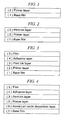
- the laminate 1 is shown in Fig. 1 .
- the laminate 2 is shown in Fig. 2 .
- a film (5) such as an unstretched polypropylene film (abbreviated as "PP film” below)
- PP film unstretched polypropylene film
- the laminate 4 is shown in Fig. 4 .
- the laminate 5 is shown in Fig. 5 .
- a laminate which is obtained by coating the primer by various coating methods to produce the primer layer (2) on the surface of the deposition layer (6) of the laminate 5 (which is obtained by forming an aluminum oxide deposition layer (6) having a thickness of 50 nm on the surface of the laminate 1 by an evaporation method using an oxidation reaction, which is obtained by coating the primer on a base film (1), such as a PET film, by various coating methods to produce the primer layer (2)).
- the laminate 6 is shown in Fig. 6 .
- the laminate 7 is shown in Fig. 7 .
- the laminate 8 is shown in Fig. 8 .
- the base film examples include a PET film which is subjected to corona treatment, a deposit aluminum oxide PET film, a deposit silica PEF film, and a polyactic acid-based biodegradable film.
- an unstretched PP film is mainly used as the film (5) for sealant in the laminates.
- a gravure coater In order to coat the primer on the base film or various layers, a gravure coater, a gravure reverse coater, a micro gravure coater, a flexo coater, a blanket coater, a lip coater, a spin coater, a slot die coater, a roll coater, a knife coater, an air knife coater, a kiss touch coater, a comma coater, etc. can be used.
- a gravure coater, a gravure reverse coater, or a micro gravure coater is used, a uniform continuous thin film can be produced.
- the thickness of the coated film is in a range from about 0.1 to 10 g/m 2 (dry), and preferably in a range from 0.3 to 3 g/m 2 (dry).
- the solvent used contains MEK, ethyl acetate, and propylene glycol monomethyl ether at 70: 14:16 in volume.
- the content of nonvolatile components in the solvent was adjusted to 10% by volume.
- primer 1 to 7 (Examples 1 to 7) and the comparative primer 1 to 7 (Comparative Examples 1 to 7) were prepared adding the curing agent (B) and the compound (C) having 2 or more of a carboxylic acid group or 1 or more of an anhydrous carboxylic acid group in the molecule in the main component solution (A) so as to have the composition shown in Table 1.
- the laminate in Examples 8 to 14 which has the same structure as that of the laminate Structure 1, was produced in a manner identical to the manner explained above, except that an aluminum foil having a thickness of 30 ⁇ m (soft aluminum, marketed by Toyo Aluminum K.K.) was used as the base film.
- an aluminum foil having a thickness of 30 ⁇ m soft aluminum, marketed by Toyo Aluminum K.K.
- the laminate in Comparative Examples 8 to 14 which has the same structure as that of the laminate Structure 1, was produced in a manner identical to the manner explained above, except that an aluminum foil having a thickness of 30 ⁇ m (soft aluminum, marketed by Toyo Aluminum K.K.) was used as the base film.
- an aluminum foil having a thickness of 30 ⁇ m soft aluminum, marketed by Toyo Aluminum K.K.
- Example laminate 1 to 7 and the Comparative laminate 1 to 7 were evaluated as shown below. The results are shown in Table 2.
- the transmittance of the laminates produced was measured in the accordance with ASTM D 1003, using a haze/ transmittance measurement device (Haze-guard II; marketed by Toyo Seiki Seisaku-sho Ltd.).
- the haze of the laminates produced was measured in the accordance with ASTM D 1003, using a haze/ transmittance measurement device (Haze-guard II; marketed by Toyo Seiki Seisaku-sho Ltd.).
- a cellophane adhesive tape having a width of 15 mm marketed by Nichiban Co., Ltd. was adhered to the surface to be printed of the primer layer.
- the laminate having the same structure as that of the laminate Structure 2 was produced by printing gravure ink (Univure A; 407 middle chrome yellow, 105 red, 507 primary indigo, 805 black (sumi), 793 white; marketed by DIC Corporation) on the surface of the primer layer, which had been dried and cured, in the laminate of the Examples 1 to 14. Moreover, when printing, 3 parts of CVL curing agent #10 was added in 100 parts of Univure A, which is gravure ink marketed by DIC Corporation. Then, after coating the gravure ink, the obtained print ink layer was subjected to aging to be cured at 40°C for 48 hours.
- gravure ink Univure A; 407 middle chrome yellow, 105 red, 507 primary indigo, 805 black (sumi), 793 white; marketed by DIC Corporation
- the laminate including no primer layer in Comparative Example 43 was produced by printing the gravure ink to form the print ink layer on the treated surface of the PET film (PET film having one surface treated with corona; ESTER® film E5100; marketed by TYOBO. CO., LTD.).
- the laminate including no primer layer in Comparative Example 44 was produced by printing the gravure ink to form the print ink layer on the non-treated surface of the PET film (PET film having one surface treated with corona; ESTER® film E5100; marketed by TYOBO. CO., LTD.).
- the laminate including no primer layer in Comparative Example 45 was produced by printing the gravure ink to form the print ink layer on the deposit surface of the deposit aluminum oxide PET film (BARRIALOX® VM-PET1011 (HG), marketed by Toray Advanced Film Co., Ltd.)
- Example laminate 15 to 28, the Comparative laminate 15 to 28, and the Comparative laminate 43 to 45 were evaluated as shown below. The results are shown in Tables 4 and 5.
- Gravure ink containing a solvent was printed on the primer layer in the laminate with a printing speed of 40 m/min. When printing, a plate for solid printing was used. Moreover, the evaluation was carried out by magnifying the surface of the primer layer 400 times using a microscope (VH-8000, marketed by Keyence Corporation), and observing with eyes.
- Gravure ink containing a solvent was printed on the primer layer in the laminate with a printing speed of 40 m/min.
- a plate for gradation printing, and a plate for solid printing were used. Then, existence or non-existence of tone jump, and highlight, and transfer of the solid portion were observed with the naked eye.
- a cellophane adhesive tape having a width of 15 mm marketed by Nichiban Co., Ltd. was adhered to the surface of the print ink layer, and peeled.
- the laminate having the same structure as that of the laminate Structure 3 was produced by adhering the unstretched PP film (ZK-93KM, marketed by Toray Advanced Film Co., Ltd.) to the print ink layer of the laminate in Examples 15 to 28 using an adhesive (DICDRY® LX-963, marketed by DIC Corporation). Thereby, Example Laminates 29 to 42 were produced.
- the laminate having the same structure as that of the laminate Structure 3 was produced by adhering the unstretched PP film (ZK-93KM, marketed by Toray Advanced Film Co., Ltd.) to the print ink layer of the laminate in Comparative Examples 15 to 28 using an adhesive (DICDRY® LX-963, marketed by DIC Corporation). Thereby, Comparative Laminates 29 to 42 were produced.
- the adhesive used is an adhesive for dry-laminate, and the composition of the adhesive used is shown below.
- DICDRY® LX-963:DICDRY® LX-963/KO-40 8/1
- the peeled surfaces at the interface between the unstretched PP film and the adhesive layer were observed using an IR spectrometer.
- the laminate was cured at 40°C for 72 hours, and then the laminate strength was measured by carrying out 180° Peeling Test with a peeling speed of 200 mm/min, in accordance with JIS K6854.
- the laminate After producing the laminate having the laminate structure 3, the laminate was cured at 42°C for 72 hours. Then, a pouch having a height of 290 mm and width of 210 mm was produced using the cured laminate. After that water, or cereal vinegar (marketed by Mizkan Group Corporation) was filled in the pouch, and was subjected to a retort test at 121°C for 30 minutes. After sufficiently cooling, the laminate strength was measured in accordance with JIS K6854, 180° Peel Test with a peeling speed of 200 mm/min.
- the laminate was cured at 40°C for 72 hours. Then, the laminate was stored at 40°C, 90% humidity for 14 days. Then, the laminate strength of the laminate was measured in accordance with JIS K6854, 180° Peel Test with a peeling speed of 200 mm/min.
- Laminate Structure 3 Base film Deposit Alumina PET Evaluation Item Adhesion of Adhesive Laminate Strength Laminate Strength after storing 40°C, 90% humidity for 14 days Comparative Example 29 Excellent 4.0 0.0 Comparative Example 30 Excellent 3.0 0.0 Comparative Example 31 Excellent 3.5 0.0 Comparative Example 32 Good 1.9 0.0 Comparative Example 33 Excellent 2.6 0.0 Comparative Example 34 Excellent 4.0 0.0 Comparative Example 35 Excellent 2.9 0.0 Example 29 Excellent 4.1 3.7 Example 30 Excellent 4.0 3.9 Example 31 Excellent 4.2 4.0 Example 32 Good 1.9 2.5 Example 33 Excellent 3.2 3.0 Example 34 Excellent 4.2 4.0 Example 35 Excellent 3.0 3.2 [Table 7] Laminate Structure 3 Base film Aluminum Foil Evaluation Item Adhesion of Adhesive Laminate Strength Laminate Strength after Retort Test using Vineger Comparative Example 36 Excellent 3.5 0.0 Comparative Example 37 Excellent 2.9 0.0 Comparative Example 38 Excellent 3.2 0.0 Comparative Example 39 Good 2.0 0.0 Comparative Example 40 Excellent 2.9 0.0 Comparative Example 41 Excellent 4.3 0.0 Comparative Example 42 Excellent 3.1 0.0 Comparative
- the solvent used contains MEK, ethyl acetate, and propylene glycol monomethyl ether at 70: 14:16 in volume.
- the content of nonvolatile components in the solvent was adjusted to 10% by volume.
- Example primers 8 to 14 were prepared by adding the curing agent (B) and the compound (C) having 2 or more of a carboxylic acid group or 1 or more of an anhydrous carboxylic acid group in the molecule in the main component solution (A) so as to have the composition shown in Table 8.
- the Example laminate 46 to 52 which has the same structure as that of the laminate Structure 1, was produced by coating the Example Primer 8 to 14 containing the components (A), (B), and (C), of which the composition is shown in Table 8, on an alumina deposition layer of the deposit aluminum oxide PET film having a thickness of 12 ⁇ m ("BARRIALOX®-VM-PET1011(HG)" marketed by Toray Advanced Film Co., Ltd.) as the base film by a direct gravure method so that the coated amount after drying be 1.0 g/m 2 .
- the laminate having the same structure as that of the laminate Structure 2 was produced by coating gravure ink (Univure A; 407 middle chrome yellow, 105 red, 507 primary indigo, 805 black (sumi), 793 white; marketed by DIC Corporation) on the surface of the primer, which had been dried and cured, in the laminate of the Example 46 to 52. Moreover, when printing, 3 parts of CVL curing agent #10 was added in 100 parts of Univure A, which is gravure ink marketed by DIC Corporation. Then, after coating the gravure ink, the obtained laminate was subjected to aging to be cured at 40°C for 48 hours.
- gravure ink Univure A; 407 middle chrome yellow, 105 red, 507 primary indigo, 805 black (sumi), 793 white; marketed by DIC Corporation
- the laminate having the same structure as that of the laminate Structure 3 was produced by adhering the unstretched PP film (ZK-93KM, marketed by Toray Advanced Film Co., Ltd.) to the print ink layer of the laminate in Examples 53 to 59 using an adhesive (DICDRY® LX-963, marketed by DIC Corporation) in Examples 60 to 66.
- the laminate in Examples 67 to 71 which has the same structure as that of the laminate Structure 1, was produced by coating the Example Primer 5 containing the components (A), (B), and (C), of which the composition is shown in Table 1, on a PET film having a thickness of 12 ⁇ m (E5100, marketed by TOYOBO Co., Ltd.), a deposit silica PET film having a thickness of 12 ⁇ m (GL-E, marketed by Toppan printing Co., Ltd.), a deposit aluminum oxide PET film having a thickness of 12 ⁇ m (IB-PET-PC, marketed by Dai Nippon Printing Co., Ltd.), a polyactic acid-based biodegradable film (TERRAMAC®TF, marketed by Unitika Ltd.), or a stretched PP film having a thickness of 30 ⁇ m (FOR, marketed by Futamura Chemical Co., Ltd.) as the base film by a direct gravure method so that the coated amount after drying was 1.0 g/m 2 .
- Example 72 which has the same structure as that of the laminate Structure 1, was produced in a manner identical to the manner explained above, except that a pure white print paper (Hamayu, marketed by Kishu Paper Co., Ltd.) was used as the base film, and the Example Primer 5 was coated so that the coated amount after drying was 3.0 g/m 2 .
- the coated amount of the Example Primer 5 was adjusted by considering the penetration of ink into paper.
- Example 73 The laminate in Example 73 was produced by coating the Example Primer 5 shown in Table 1 on a PET film having a thickness of 12 ⁇ m (E5100, marketed by TOYOBO Co., Ltd.) by a reverse gravure method so that the coated amount after drying was 1.0 g/m 2 .
- Example 74 the laminate in Example 74 was produced by depositing aluminum oxide on the primer layer by the oxidation reaction deposition method such that the thickness was 50 nm.
- Example 75 was produced by coating the Example Primer 5 on the deposit layer by reverse gravure method again so that the coated amount after drying was 0.5 g/m 2 .
- Example 76 was produced by printing gravure ink (Univure A; 407 middle chrome yellow, 105 red, 507 primary indigo, 805 black (sumi), 793 white; marketed by DIC Corporation) on the surface of the primer layer.
- gravure ink (Univure A; 407 middle chrome yellow, 105 red, 507 primary indigo, 805 black (sumi), 793 white; marketed by DIC Corporation) on the surface of the primer layer.
- Example 77 was produced by dry-laminating a unstretched PP film (ZK-93KM, marketed by Toray Advanced Film Co., Ltd.) to the print ink layer using an adhesive (DICDRY® LX-963, marketed by DIC Corporation).
- Laminate Strength* After Storing means the laminate strength of the laminate after storing at 40°C at 90% humidity for 14 days.
- the primer composition used according to the present invention has superior adhesion between the inorganic deposit coating and the urethane-based gravure ink.
- the primer composition used according to the present invention has excellent hot water resistance (121°C, for 30 minutes) and storing stability under highly humid conditions.
- Example Laminate 73 Example Laminate 74
- Example Laminate 75 Example Laminate 76
- Example Laminate 77 Laminate Structure 1 5 6 7 8
- the primer composition used according to the present invention can be used as a primer for a package which has improved adhesion between the base layer, a printing ink layer, a coating layer, and an adhesive layer, and thereby having print suitability, such as excellent transfer properties of printing ink and dot reproducibility, high adhesive properties, excellent storage stability for a long period of time under highly humid conditions, and acid resistance. Thereby, it is possible to print highly defined images having excellent design on a surface of various kinds of packages, which were not readily printed with high definition.
- the primer composition used according to the present invention can be used widely in packages.
Landscapes
- Chemical & Material Sciences (AREA)
- Organic Chemistry (AREA)
- Health & Medical Sciences (AREA)
- Polymers & Plastics (AREA)
- Medicinal Chemistry (AREA)
- Chemical Kinetics & Catalysis (AREA)
- Engineering & Computer Science (AREA)
- Materials Engineering (AREA)
- Wood Science & Technology (AREA)
- Life Sciences & Earth Sciences (AREA)
- Manufacturing & Machinery (AREA)
- Laminated Bodies (AREA)
- Paints Or Removers (AREA)
- Wrappers (AREA)
Description
- The present invention relates to the use of a primer composition for a laminate for packaging which has excellent adhesive properties and heat resistance, and high definition printability, and is used in particular in soft package fields such as food products, and medicaments; and a laminate including a coating film containing the primer.
- Recently, various bases are printed. However, not all bases have excellent print suitability and further beautiful and high definition printing is required.- At the same time, the base for a package is required to have heat resistance, retort resistance, water resistance, gas barrier properties, etc. in order to protect the contents therein.
- As a method for improving the print suitability, there is a method (1) in which adhesion and transfer properties of the printing ink are improved by improving the surface of the base by a corona discharge treatment, a frame treatment, or a plasma treatment, and a method (2) in which the print suitability and adhesive properties are improved by forming a resin layer for providing high adhesive properties to the surface of the base. In order to improve the printing properties of a plastic base, the method (1) for improving the surface conditions by the corona discharge treatment, the frame treatment, or the plasma treatment is widely used, due to ease of the method (1), and popularization of the device used.
- On the other hand, in the method (2), a urethane-based resin (for example, Patent Documents Nos. 1 and 2), a polyester-based resin (for example, Patent Documents Nos. 3 and 4), or an acryl polyol-based resin (for example, Patent Document No. 5), etc. is used to form a resin layer for applying the high adhesive properties. At the same time, an epoxy-based curing agent or an isocyanate-based curing agent is often used.
- However, when the corona discharge treatment, or the frame treatment is used, the effects for improving the surface are decreased over time. In addition, the adhesive properties are insufficient under high humidities. Specifically, when an OPP film is subjected to the corona discharge treatment, or an ordinary frame treatment, the wettability at the surface of the film is about 50 mN/m just after the treatment. However, after six months, the wettability decreases to about 40 mN/m. Due to this, adhesive properties of the printing ink and dot reproducibility are often decreased.
- In addition, as a special frame treatment, there is a method using silicic acid flame. In this method, the wettability at the surface of the base is improved to 70 mN/m or more by bonding an aminosilane with the surface of the base. The method can achieve beautiful and high definition printing. However, the treated surface has inferior rub resistance, hot water resistance, and adhesive properties under highly humid conditions. In addition, a printing ink and an adhesive used are required to have a hydrophilic group.
- In the method using a urethane-based resin layer as a resin layer for providing high adhesive properties, adhesive properties are insufficient under highly humid conditions. As the method using a polyester-based resin layer as a resin layer for providing high adhesive properties, a method in which a high crystalline polyester and a low crystalline polyester are mixed or a high melting point-polyester and a low melting point-polyester are mixed is normally used. However, the former has a problem in that the adhesive properties are unstable, and resistance to hot water is insufficient.
- When a urethane resin is formed on a PET film as a resin layer for providing high adhesive properties, adhesion of a urethane-based gravure ink for packages is remarkably improved. However, the adhesion of other resins, such as an acryl-based resin and the dot reproducibility are inferior.
- A method in which a resin layer for providing high adhesive properties is made by combination between acryl polyol and an isocyanate-based curing agent improves adhesive properties between the base and a deposition layer by using an acryl resin (Patent Document No.5). However, the resin layer for providing high adhesive properties may be dissolved by the printing ink containing an organic solvent, because the resin layer has insufficient solvent resistance. Due to this, printed images may be deteriorated. When the resin layer for providing high adhesive properties containing acryl polyol and an isocyanate-based curing agent is formed on a base having a high polarity, or the base having a high polarity is formed on the resin, and the laminate obtained is stored under highly humid conditions for a long period of time or immersed in water, the adhesive properties between the resin layer for providing high adhesive properties and the base may be decreased. In addition, when the adhesive interface in the laminate is wet with water in a short time, adhesive properties may be deteriorated. In particular, the adhesion is remarkably decreased under acidic
conditions having pH 5 or less.
Patent Document No. 6 (EP 1 780 249 A1
Patent Document No. 7 (US 4 952 475 A ) describes an electrophotographic photoreceptor comprising a support having provided thereon at least one photoconductive layer containing at least inorganic photoconductive particles and a binder resin, wherein said binder resin comprises (1) at least one resin (A) containing at least one acidic group selected from -PO3H2, -SO3H, -COOH, and wherein R represents a hydrocarbon group, at the terminal of the polymer main chain thereof, and (2) at least one of a thermosetting resin (B) containing a crosslinking functional group and a crosslinking agent. The photoreceptor exhibits improved electrostatic characteristics. The photoreceptor provides an electrophotographic lithographic printing plate precursor which exhibits excellent image reproducibility irrespective of a variation of environmental condition at the time of electrophotographic processing and produces a printing plate having improved printing durability and causing no background stains.
Patent Document No. 8 (JP H01-282271 A
Patent Document No. 9 (EP 2 332 724 A1 -
- [Patent Document No. 1] Japanese Unexamined Patent Application, First Publication No.
H11-20103 - [Patent Document No. 2] Japanese Unexamined Patent Application, First Publication No.
2002-80705 - [Patent Document No. 3] Japanese Examined Patent Application, Second Publication No.
S64-10118 - [Patent Document No. 4] Japanese Unexamined Patent Application, First Publication No.
H4-33853 - [Patent Document No. 5] Japanese Unexamined Patent Application, First Publication No.
2006-116704 - [Patent Document No. 6] European Unexamined Patent Application, First Publication No.
EP 1 780 249 A1 - [Patent Document No. 7]
US Patent No. 4 952 475 - [Patent Document No. 8] Japanese Unexamined Patent Application, First Publication No.
H01-282271 A - [Patent Document No. 9] European Unexamined Patent Application, First Publication No.
EP 2 332 724 A1 - A first problem to be solved by the present invention is to provide a primer for a laminate (for packaging) having print suitability, such as excellent transfer properties of printing ink and dot reproducibility, high adhesive properties, excellent storage stability for a long period of time under highly humid conditions, and acid resistance, which are obtained by improving adhesion between the base layer, a printing ink layer, a coating layer, and an adhesive layer.
- A second problem to be solved by the present invention is to provide a laminate (for packaging) including a primer layer containing the primer.
- As a result of intensive study, the present inventors achieved a primer having high adhesion, print suitability, excellent storage stability for a long period of time under highly humid conditions, and acid resistance by adding a compound (C) having 2 or more of a carboxylic acid group or 1 or more of an anhydrous carboxylic acid group in the molecule to a primer which contains a main component (A) containing a copolymer having a specific unsaturated compound and a curing agent (B) containing a compound having an isocyanate group.
- In addition, the present inventors also found that when the primer contains unsaturated nitrile (c) as a monomer constituting the copolymer contained in the main component (A), high definition printing properties can be obtained.
- In other words, first, the present invention provides the use of a primer composition containing:
- a main component (A) containing a copolymer containing, as a monomer, an unsaturated compound (a) having a hydroxyl group, and at least one unsaturated compound (b) selected from the group consisting of unsaturated carboxylate, styrene, unsaturated carboxylic acid, unsaturated hydrocarbon, vinyl ester, and a halogenated vinyl compound;
- a curing agent (B) containing a compound having an isocyanate group; and
- a compound (C) having 2 or more of a carboxylic acid group or 1 or more of an anhydrous carboxylic acid group; for a laminate for packaging.
- Secondly, the present invention provides a laminate including a resin coating layer obtained by the main component (A), the curing agent (B), and the compound (C) having 2 or more of a carboxylic acid group or 1 or more of an anhydrous carboxylic acid group, on a base layer, wherein the laminate includes (i) an ink layer, an adhesive layer, and a sealant layer, in this order, on the resin coating layer, and optionally another resin coating layer on the resin coating layer; or (ii) an inorganic thin film layer on the resin coating layer.
- The present invention can provide a laminate (for packaging) which has improved adhesion between the base layer, a printing ink layer, a coating layer, and an adhesive layer, and thereby having both print suitability, such as excellent transfer properties of printing ink and dot reproducibility, and high adhesive properties. In particular, the present invention can provide a laminate having high hot water resistance, excellent storage stability for a long period of time under highly humid conditions, and acid resistance by using a base having high hot water resistance, excellent storage stability for a long period of time under highly humid conditions, and acid resistance.
-
- [
Fig. 1] Fig. 1 is a sectional view showing a laminate (structure 1) obtained by using the primer composition according to the present invention. - [
Fig. 2] Fig. 2 is a sectional view showing a laminate (structure 2) obtained by using the primer composition according to the present invention. - [
Fig. 3] Fig. 3 is a sectional view showing a laminate (structure 3) according to the present invention. - [
Fig. 4] Fig. 4 is a sectional view showing a laminate (structure 4) obtained by using the primer composition according to the present invention. - [
Fig. 5] Fig. 5 is a sectional view showing a laminate (structure 5) according to the present invention. - [
Fig. 6] Fig. 6 is a sectional view showing a laminate (structure 6) according to the present invention. - [
Fig. 7] Fig. 7 is a sectional view showing a laminate (structure 7) according to the present invention. - [
Fig. 8] Fig. 8 is a sectional view showing a laminate (structure 8) according to the present invention. - As explained above, the present invention provides the use of a primer composition for a package to obtain a laminate for packaging having print suitability, such as excellent transfer properties of printing ink and dot reproducibility, and high adhesive properties, which are obtained by improving adhesion between the base layer, a printing ink layer, a coating layer, and an adhesive layer.
- The primer composition used according to the present invention contains:
- a main component (A) containing a copolymer containing, as a monomer, an unsaturated compound (a) having a hydroxyl group, and at least one unsaturated compound (b) selected from the group consisting of unsaturated carboxylate, styrene, unsaturated carboxylic acid, unsaturated hydrocarbon, vinyl ester, and a halogenated vinyl compound;
- a curing agent (B) containing a compound having an isocyanate group; and
- a compound (C) having 2 or more of a carboxylic acid group or 1 or more of an anhydrous carboxylic acid group.
- It is also possible to add unsaturated nitrile (c), as a monomer, in the main component (A) containing a copolymer containing the above-mentioned specific unsaturated compounds.
- The composition, which contains the main component (A) containing a copolymer containing, as a monomer, (a) an unsaturated compound having a hydroxyl group, and at least one unsaturated compound (b) selected from the group consisting of unsaturated carboxylate, styrene, unsaturated carboxylic acid, unsaturated hydrocarbon, vinyl ester, and a halogenated vinyl compound; and the curing agent (B) containing a compound having an isocyanate group, is a primer having improved adhesive properties to ink, adhesive, and various coating agents, improved print suitability, and improved ink adhesion. However, when the primer is formed on a base having a high polarity, or the base having a high polarity is formed on the primer, and the laminate obtained is stored under highly humid conditions for a long period of time or immersed in water, the adhesion between the primer and the base may be decreased. In particular, the adhesion is remarkably decreased under acidic
conditions having pH 5 or less. The primer contains essentially an unsaturated compound (a) having a hydroxyl group. The larger an amount of the hydroxyl group, the lower the adhesion, because water or the acidic substance easily enters between the base and the primer. - In the present invention, a compound (C) having 2 or more of a carboxylic acid group or 1 or more of an anhydrous carboxylic acid group is further added and mixed in the composition, which contains the main component (A) containing a copolymer containing, as a monomer, an unsaturated compound (a) having a hydroxyl group, and at least one unsaturated compound (b) selected from the group consisting of unsaturated carboxylate, styrene, unsaturated carboxylic acid, unsaturated hydrocarbon, vinyl ester, and a halogenated vinyl compound; and the curing agent (B) containing a compound having an isocyanate group. Thereby, the primer for a laminate (for packaging), which has excellent storage stability for a long period of time under highly humid conditions, and acid resistance, as well as print suitability, such as excellent transfer properties of printing ink and dot reproducibility, and high adhesive properties, can be obtained. This is caused by the effects that water or the acidic substance does not readily enter between the base and the primer by coordinating locally the compound (C) having 2 or more of a carboxylic acid group or 1 or more of an anhydrous carboxylic acid group on the surface of the base. In addition, it is also possible to achieve high definition printability having excellent ink-dot reproducibility by laminating the primer containing a copolymer having unsaturated nitrile (c) as a monomer.
- The primer composition used according to the present invention is used to form a resin coating film for a laminate, which is formed on the base and can be obtained by the main component (A), the curing agent (B), and the compound (C) having 2 or more of a carboxylic acid group or 1 or more of an anhydrous carboxylic acid group. The compound (C) may be mixed with the main component (A), or the curing agent (B), in advance. In addition, it is also possible to mix the main component (A), the curing agent (B), and the compound (C) before coating.
- The laminate obtained can be used in high definition printing. For example, the laminate can be widely used as various excellent packages having excellent design.
- Examples of the unsaturated compound (a) having a hydroxyl group include C2-C8 hydroxyalkyl (meth)acrylates, such as β-hydroxyethyl (meth)acrylate, β-hydroxypropyl (meth)acrylate, γ-hydroxypropyl (meth)acrylate and hydroxybutyl (meth)acrylate, (meth)acrylate having a hycroxyl group such as allyl alcohol, and modified ε-caprolactone with C2-C8 hydroxyalkyl (meth)acrylate, (meth)acrylate having a polyoxyethylene chain and including a hydroxyl group at the end of the backborn chain, β-hydroxyvinyl ether, polyethylene glycol (meth)acrylate, and polypropylene glycol mono(meth)acrylate. When reactivity and the hydroxyl value are concerned, β-hydroxyethyl (meth)acrylate is preferably used. Moreover, "(meth)acrylate" means acrylate and/or methacrylate.
- In addition, from the viewpoint of obtaining polymerization stability and high reactivity with an isocyanate group, β-hydroxyethyl (meth)acrylate is preferable, and β-hydroxyethyl methacrylate is most preferable.
- It is preferable that the content of the unsaturated compound (a) having a hydroxyl group in the copolymer, which is converted to nonvolatile components, be in a range from 10 to 70% by mass. When the content of the unsaturated compound (a) having a hydroxyl group in the copolymer is less than 10% by mass, a sufficient crosslink structure is not readily formed, and thereby, a sufficient coating film strength and adhesion to the base may be decreased. In contrast, when it exceeds 70% by mass, it is necessary to use a large amount of the curing agent having an isocyanate group because of properties of the primer. Thereby, the surface of the primer just after coating may be sticky or the ink-dot reproducibility may decrease.
- The primer composition used according to the present invention contains essentially, as a monomer, at least one unsaturated compound (b) selected from the group consisting of unsaturated carboxylate, styrene, unsaturated carboxylic acid, unsaturated hydrocarbon, vinyl ester, and a halogenated vinyl compound, in order to obtain polymerization stability, film forming-properties and water resistance of the coating film.
- Examples of the unsaturated carboxylate include methyl (meth)acrylate, ethyl (meth)acrylate, n-propyl (meth)acrylate, isopropyl (meth)acrylate, n-butyl (meth)acrylate, isobutyl (meth)acrylate, sec-butyl (meth)acrylate, tert-butyl (meth)acrylate, n-amyl (meth)acrylate, n-octyl (meth)acrylate, 2-ethylhexyl (meth)acrylate, lauryl (meth)acrylate, stearyl (meth)acrylate, 2-methoxyethyl (meth)acrylate, 2-ethoxyethyl (meth)acrylate, and 2-(n-propoxy)ethyl (meth)acrylate. Among these, when coating suitability, hot water resistance, and the glass transition point (Tg) are concerned, methyl(meth)acrylate is more preferable, and methyl methacrylate is most preferable.
- Examples of the unsaturated carboxylic acid include (meth)acrylic acid, crotonic acid, cinnamic acid, itaconic acid, itaconic anhydride, maleic acid, maleic anhydride, fumaric acid, citraconic acid, and mesaconic acid.
- Examples of the unsaturated hydrocarbon include ethylene, propylene, isobutylene, 1-butene, and 1-pentene.
- Examples of the vinyl ester include vinyl formate, vinyl acetate, vinyl propionate, vinyl butyrate, vinyl pivalate, vinyl versatate, and vinyl stearate.
- Examples of the halogenated vinyl compound include vinyl chloride, vinylidene chloride, and vinyl fluoride.
- Among these, methyl (meth)acrylate is more preferable, and methyl methacrylate is most preferable.
- It is preferable that the content of the unsaturated compound (b) selected from the group consisting of unsaturated carboxylate, styrene, unsaturated carboxylic acid, unsaturated hydrocarbon, vinyl ester, and a halogenated vinyl compound in the copolymer, which is converted in a nonvolatile component, be in a range from 20 to 55% by mass. When the content of the unsaturated compound (b) in the copolymer is less than 20% by mass, the relative amount of the unsaturated nitrile (c) and the unsaturated compound (a) having a hydroxyl group is larger, and solubility in a solvent tends to decrease. In contrast, when it exceeds 55% by mass, the relative amount of the unsaturated nitrile (c) and the unsaturated compound (a) having a hydroxyl group is smaller, crosslinking structure is insufficient. Due to this, the ink-dot reproducibility tends to decrease, together with insufficiency of coating film strength and hot water resistance.
- When the unsaturated compound (b) contains acrylic acid or methacrylic acid as the unsaturated carboxylic acid, the content of acrylic acid or methacrylic acid in the copolymer, which is converted in nonvolatile components, is preferably in a range from 0.05 to 3% by mass.
- When the unsaturated compound (b) contains styrene, the content of styrene in the copolymer, which is converted in nonvolatile components, is preferably in a range from 0.01 to 30% by mass, and more preferably in a range from 0.05 to 10% by mass.
- When the unsaturated compound (b) contains butyl (meth)acrylate as the unsaturated carboxylate, the content of butyl (meth)acrylate in the copolymer, which is converted in nonvolatile components, is preferably in a range from 0.01 to 30% by mass.
- The main component (A) constituting the primer composition used according to the present invention contains the copolymer containing, as a monomer, the unsaturated compound (a) having a hydroxyl group, and at least one unsaturated compound (b) selected from the group consisting of unsaturated carboxylate, styrene, unsaturated carboxylic acid, unsaturated hydrocarbon, vinyl ester, and a halogenated vinyl compound. It is also possible to add the unsaturated nitrile (c) as a monomer in the main component (A) containing the copolymer containing the abovementioned unsaturated compound.
- Examples of the unsaturated nitrile (c) include (meth)acrylonitrile, α-chloroacryonitrile, α-chloromethyl acrylonitrile, α-methoxyacrylonitrile, and α-ethoxyacrylonitrile. When reactivity is concerned, (meth)acrylonitrile is preferable.
- The content of the unsaturated nitrile (c) in the copolymer is preferably in a range from 0 to 50% by mass, and more preferably in a range from 10 to 50% by mass. When the content of the unsaturated nitrile (c) in the copolymer exceeds 50% by mass, the solubility of the copolymer in an organic solvent decreases, and this tends to prevent an increase of molecules during polymerization. Due to this, coating is not readily obtained. As a result, transparency of the primer is inferior, smoothness is insufficient, and the ink-dot reproducibility tends to be decreased. When the content of the unsaturated nitrile (c) in the copolymer is 10% by mass or more, the ink-dot reproducibility remarkably increases.
- The unsaturated nitrile (c) makes a crosslinking structure with the curing agent (B) to improve the coating film strength and hot water resistance. Therefore, the copolymer in the main component (A) is required to have a hydroxyl group. In order to achieve this, the unsaturated compound (a) having a hydroxyl group is used.
- Examples of the solvent used in the main component (A) in the primer composition used according to the present invention include toluene, methyl ethyl ketone (MEK), cyclohexanone, SolvesSo ®, isophorone, xylene, methyl isobutyl ketone (MIBK), ethyl acetate, butyl acetate, n-propyl alcohol, isopropyl alcohol, ethyl alcohol, methanol, propylene glycol, ethylene glycol, propylene glycol monomethyl ether, and propylene glycol methyl ether acetate. The solvent used is not limited to these solvents.
- The primer composition used according to the present invention is a primer for a laminate (for packaging) having both long-term storage stability under highly humid conditions, and acid resistance as well as adhesion, and print suitability by forming a crosslinked coating film by the reaction between the main component (A) and the curing agent (B), and adding the compound (C) having 2 or more of a carboxylic acid group or 1 or more of an anhydrous carboxylic acid group in the molecule to the coating film.
- Examples of the curing agent (B) include compounds having an isocyanate group, which reacts with the hydroxyl group in a side chain of the copolymer contained in the main component (A).
- Examples of the compound having an isocyanate group include aromatic diisocyanates, such as 2,4-tolylene diisocyanate, 2,6-tolylene diisocyanate, 4,4'-diphenyl methane diisocyanate, 2,4'-diphenyl methane diisocyanate, 2,2'-diphenyl methane diisocyanate, 1,5-naphthylene diisocyanate, 1,4-naphthylene diisocyanate, p-phenylene diisocyanate, m-phenylene diisocyanate, o-xylylene diisocyanate, m-xylylene diisocyanate, p-xylylene diisocyanate, tetramethyl xylylene diisocyanate, 4,4'-diphenyl ether diisocyanate, 2-
nitrodiphenyl 4,4'-diisocyanate, 2,2'-diphenyl propane-4,4'-diisocyanate, 3,3'-dimethyl diphenyl methane-4,4'-diisocyanate, 4,4'-diphenyl propane diisocyanate, and 3,3'-dimethoxydiphenyl-4,4'-diisocyanate; - aliphatic diisocyanates, such as tetramethylene diisocyanate, hexamethylene diisocyanate, 2-methyl-1,5-pentane diisocyanate, 3-methyl-1,5-pentane diisocyanate, lysine diisocyanate, and 2,2,4-trimethyl hexamethylene diisocyanate;
- alicycle diisocyanates, such as isophorone diisocyanate, hydrogenated tolylene diisocyanate, hydrogenated diphenyl methane diisocyanate, hydrogenated xylylene diisocyanate, hydrogenated tetramethyl xylylene diisocyanate, and cyclohexyl diisocyanate;
- urethant-modified products, allophanate-modified products, urea-modified [0043] urethant-modified products, allophanate-modified products, urea-modified products, biuret-modified products, urethodione-modified products, urethoimine-modified products, isocyanurate-modified products, and carbodiimide-modified products of these organic isocyanates. These isocyanate compounds may be used alone or in combination.
- In order to obtain excellent hot water resistance, aromatic isocyanates of which an isocyanate group is not directly bonded to the aromatic ring, such as o-xylylene diisocyanate, m-xylylene diisocyanate, p-xylylene diisocyanate, and tetramethyl xylylene diisocyanate; aliphatic diisocyanates such as tetramethylene diisocyanate, hexamethylene diisocyanate, 2-methyl-1,5-pentane diisocyanate, 3-methyl-1,5-pentane diisocyanate, lysine diisocyanate, and 2,2,4-trimethyl hexamethylene diisocyanate; and alicyclic diisocyanates, such as isophorone diisocyanate, hydrogenated tolylene diisocyanate, hydrogenated diphenyl methane diisocyanate, hydrogenated xylylene diisocyanate, hydrogenated tetramethyl xylylene diisocyanate, and cyclohexyl diisocyanate are preferably used among these isocyanate compounds.
- Examples of the solvent used in the curing agent (B) include toluene, methyl ethyl ketone (MEK), cyclohexanone, SolvesSo ®, isophorone, xylene, methyl isobutyl ketone (MIBK), ethyl acetate, butyl acetate, propylene glycol monomethyl ether, and propylene glycol methyl ether acetate. The solvent used is not limited to these solvents.
- The main component (A), the curing agent (B), and the compound (C) are mixed when coating the base. The mixing ratio between the main component (A) and the curing agent (B) is preferably adjusted so that the amount of the NCO group in the curing agent (B) exceeds the amount of the hydroxyl group in the main component (A). That is, the mixing ratio of the curing agent (B) to the main component (A) is preferably about 50% to about 200%. The compound (C) may be mixed in the main component (A) or the curing agent (B) in advance. In addition, the main component (A), the curing agent (B), and the compound (C) may be mixed before coating.
- In the present invention, in order to maintain adhesion or improve the adhesion, the compound (C) having 2 or more of a carboxylic acid group or 1 or more of an anhydrous carboxylic acid group in the molecule is used essentially.
- Examples of the compound (C) having 2 or more of a carboxylic acid group or 1 or more of an anhydrous carboxylic acid group in the molecule include phthalic acid, terephthalic acid, isophthalic acid, sebacic acid, azelaic acid, adipic acid, trimellitic acid, 2,6-naphthalene dicarboxylic acid, meleic acid, succinic acid, malic acid, citric acid, isocitric acid, and tartaric acid.
- Examples of the compound having 1 or more of an acid anhydride include maleic anhydride, succinic anhydride, trimellitic anhydride, and tetrabasic acid anhydrides. When the primer is coated on a base having a high polarity, such as a metal base, in particular, compounds having two or more of anhydric acids such as tetrabasic acid anhydrides are preferably used. Examples of the tetrabasic acid anhydride include benzophenone tetracarboxylic anhydride, 2,3,6,7-naphthalene tetracarboxylic dianhydride, and 5-(2,5-dioxotetrahydro-3-furanyl)-3-methyl-3-cyclohexene-1,2-dicarboxylic anhydride. In addition, a polymer containing the compound (C) having 2 or more of a carboxylic acid group or 1 or more of an anhydrous carboxylic acid group in the molecule can also be used.
- The number average molecular weight of the compound (C) having 2 or more of a carboxylic acid group or 1 or more of an anhydrous carboxylic acid group in the molecule is preferably 1,000 or less.
- The content of the compound (C) having 2 or more of a carboxylic acid group or 1 or more of an anhydrous carboxylic acid group in the molecule in the primer, which is converted in nonvolatile components, is preferably in a range from 5 to 50% by mass.
- The primer composition used according to the present invention can contain a well-known curing accelerator, bulking agent, softener, antiaging agent, stabilizer, adhesion accelerator, leveling agent, defoaming agent, plasticizer, inorganic filler, organic filler, resin for providing adhesive properties, fiber, pigment, dye, and extender for operating life, etc. in addition to the abovementioned components.
- It is also possible to use various well-known coupling agents, epoxy resin, etc. as the adhesion accelerator. In particular, in order to improve adhesion to the surface of the base, silane-based coupling agents, titanium-based coupling agents, aluminum-based coupling agents, zirconium-based coupling agents, etc. can also be used. Any silane-based coupling agents, titanium-based coupling agents, aluminum-based coupling agents, zirconium-based coupling agents can be used.
- Examples of the silane-based coupling agent include vinyl trichlorosilane, hydrochloride of vinyl trimethoxysilane, vinyl triethoxysilane, 2-(3,4-epoxycyclohexyl) ethyl trimethoxysilane, 3-glycidoxypropyl trimethoxysilane, 3-glycidoxy propyl methyl diethoxysilane, 3-glycidoxypropyl triethoxysilane, p-styryl trimethoxysilane, 3-methacryloxypropyl methyl dimethoxysilane, 3-methacryloxy propyl trimethoxysilane, 3-methacryloxy propyl methyl diethoxysilane, 3-methacryloxypropyl triethoxysilane, 3-acryloxypropyl trimethoxysilane, N-(2-aminoethyl)-3-aminopropyl methyl dimethoxysilane, N-(2-aminoethyl)-3-aminopropyl trimethoxysilane, N-(2-aminoethyl)-3-aminopropyl triethoxysilane, 3-aminopropyl trimethoxysilane, 3-aminopropyl triethoxysilane, 3-triethoxysilyl-N-(1,3-dimethyl-butylidene) propylamine, N-phenyl-3-aminopropyl trimethoxysilane, and N-(vinyl benzyl)-2-aminoethyl-3-aminopropyl trimethoxysilane, 3-ureidopropyl triethoxysilane 3-chloropropyl trimethoxysilane, 3-mercaptopropyl methyl dimethoxysilane, 3-mercaptopropyl trimethoxysilane, bis(triethoxysilyl propyl) tetrasulfide, 3-isocyanatepropyl triethoxysilane, tetramethoxysilane, methyl trimethoxysilane, dimethyl dimethoxysilane, phenyl trimethoxysilane, diphenyl dimethoxysilane, tetraethoxysilane, methyl triethoxysilane, dimethyl diethoxysilane, phenyl triethoxysilane, diphenyl diethoxysilane, hexyl trimethoxysilane, hexyl triethoxysilane, decyl trimethoxysilane, decyl triethoxysilane, trifluoropropyl trimethoxysilane, and hexamethyl disilazane.
- Examples of the titanium-based coupling agent include titanium acetylacetonate, titanium octyl glycolate, titanium tetraacetyl acetonate, titanium ethyl acetoacetate, titanium acylate (acyloxytitanate), polyhydroxytitanium stearate, titanium lactate, titanium triethanol aminate, tetraisopropyl titanate, tetranormalbutyl titanate, butyl titanate dimer, and tetraoctyl titanate.
- Examples of the aluminum-based coupling agent include aluminum alcoholates, such as aluminum isopropylate, mono sec-butoxyaluminum diisopropylate, aluminum sec-butyrate, and aluminum ethylate;
alkyl acetate aluminum diisopropylates, such as ethyl acetoacetate aluminum diisopropyl; and
aluminum tris(ethyl acetoacetate), aluminum monoacetyl acetonate bis(ethyl acetoacetate), aluminum tris(acetyl acetonate), aluminum mono-isopropoxy monooleoxyethyl acetoacetate, and diisopropoxy aluminum lauryl acetoacetate. - Examples of the zirconium-based coupling agent include zirconium tetraacetyl acetonate, zirconium tributoxyacetyl acetonate, zirconium tributoxystearate, tetra-normal-propoxyzirconium, and tetra-normal-butoxyzirconium.
- These coupling agents can be used alone or in combination based on the kind of the base.
- As the epoxy resin, oligomers can also be used. Example of the epoxy resin include epoxy resin obtained by the condensation reaction between epichlorohydrin and various phenol compounds, such as bisphenol A, bisphenol S, novolac, o-cresol novolac, and p-alkyl phenol novolac.
- The primer composition used according to the present invention is basically evaluated as a laminate which is obtained by coating the primer on various base. The adhesive properties of the primer to the base, printing suitability such as adhesion of ink printed on a coated film made of the primer after curing, dot reproducibility, ink transfer properties are evaluated. In addition, strength of a laminate which is produced by attaching the primer on a first base film to a second base film using an adhesive, and heat resistance of the laminate after retort are also evaluated. For example, the following laminates are produced for evaluation.
- A laminate which is obtained by coating the primer on a base film (1), such as a polyethylene terephthalate film (abbreviated as "PET film" below) by various coating methods, and drying the primer to be cured, and thereby, a primer layer (2) is produced on the base film (1). The
laminate 1 is shown inFig. 1 . - A laminate which is obtained by printing ink, such as gravure ink, on the primer layer (2) in the
laminate 1, and thereby producing a print ink layer (3) on the primer layer (2). Thelaminate 2 is shown inFig. 2 . - A laminate which is obtained by laminating a film (5), such as an unstretched polypropylene film (abbreviated as "PP film" below), on the print ink layer (3) in the laminate 2 (which is obtained by printing ink, such as gravure ink, on the primer layer (2) in the laminate 1), via an adhesive layer (4). The
laminate 3 is shown inFig. 3 . - A laminate which is obtained by coating the primer on an aluminum oxide deposition layer (6) on the base film (1), such as a PET film by various coating methods, and drying the primer to be cured, and thereby, a primer layer (2) is produced on the aluminum oxide deposition layer (6); forming the print ink layer (3) using printing ink, such as gravure ink on the primer layer (2); and laminating the film (5), such as an unstretched PP film, on the print ink layer (3) via the adhesive layer (4). The
laminate 4 is shown inFig. 4 . - A laminate which is obtained by forming an aluminum oxide deposition layer (6) having a thickness of 50 nm on the primer layer (2) in the laminate 1 (which is obtained by coating the primer on a base film (1), such as a PET film, by various coating methods to produce the primer layer (2)) by an evaporation method using an oxidation reaction. The
laminate 5 is shown inFig. 5 . - A laminate which is obtained by coating the primer by various coating methods to produce the primer layer (2) on the surface of the deposition layer (6) of the laminate 5 (which is obtained by forming an aluminum oxide deposition layer (6) having a thickness of 50 nm on the surface of the
laminate 1 by an evaporation method using an oxidation reaction, which is obtained by coating the primer on a base film (1), such as a PET film, by various coating methods to produce the primer layer (2)). Thelaminate 6 is shown inFig. 6 . - A laminate which is obtained by forming the print ink layer (3) using printing ink, such as gravure ink, on the primer layer (2) in the laminate 6 [which is obtained by coating the primer by various coating methods to produce the primer layer (2) on the deposition surface of the laminate 5 (which is obtained by forming an aluminum oxide deposition layer (6) having a thickness of 50 nm on the surface of the
laminate 1 by an evaporation method using an oxidation reaction, which is obtained by coating the primer on a base film (1), such as a PET film, by various coating methods to produce the primer layer (2))]. The laminate 7 is shown inFig. 7 . - A laminate which is obtained by laminating a film (5), such as an unstretched polypropylene film, via an adhesive layer (4), on the print ink layer (3) in the laminate 7 [which is obtained by forming the print ink layer (3) using printing ink, such as gravure ink on the primer layer (2) in the
laminate 6, which is obtained by coating the primer by various coating methods to produce the primer layer (2) on the deposition surface of the laminate 5 (which is obtained by forming an aluminum oxide deposition layer (6) having a thickness of 50 nm on the surface of thelaminate 1 by an evaporation method using an oxidation reaction, which is obtained by coating the primer on a base film (1), such as a PET film, by various coating methods, to produce the primer layer (2))]. The laminate 8 is shown inFig. 8 . - Examples of the base film include a PET film which is subjected to corona treatment, a deposit aluminum oxide PET film, a deposit silica PEF film, and a polyactic acid-based biodegradable film.
- As the film (5) for sealant in the laminates, an unstretched PP film is mainly used.
- In order to coat the primer on the base film or various layers, a gravure coater, a gravure reverse coater, a micro gravure coater, a flexo coater, a blanket coater, a lip coater, a spin coater, a slot die coater, a roll coater, a knife coater, an air knife coater, a kiss touch coater, a comma coater, etc. can be used. When a gravure coater, a gravure reverse coater, or a micro gravure coater is used, a uniform continuous thin film can be produced.
- The thickness of the coated film is in a range from about 0.1 to 10 g/m2 (dry), and preferably in a range from 0.3 to 3 g/m2 (dry).
- The present invention is explained in detail referring to Examples and Comparative Examples.
- The main component solution (A), of which the monomer composition is shown in Table 1, was prepared. The solvent used contains MEK, ethyl acetate, and propylene glycol monomethyl ether at 70: 14:16 in volume. The content of nonvolatile components in the solvent was adjusted to 10% by volume.
- In addition, the
primer 1 to 7 (Examples 1 to 7) and thecomparative primer 1 to 7 (Comparative Examples 1 to 7) were prepared adding the curing agent (B) and the compound (C) having 2 or more of a carboxylic acid group or 1 or more of an anhydrous carboxylic acid group in the molecule in the main component solution (A) so as to have the composition shown in Table 1.[Table 1] Main component solution (A) Compound (C) Curing agent (B) MMA AN β-HEMA St BA MMA DFMCDA XDI-TMP IPDI- TMP Comparative Primer 1 20 10 70 0.05 0.05 100 Comparative Primer 245 35 20 0.05 0.05 50 Comparative Primer 350 20 30 0.05 0.05 50 Comparative Primer 440 49 10 0.05 0.05 1.00 50 Comparative Primer 530 20 50 0.05 0.05 50 50 Comparative Primer 630 - 70 0.05 0.05 100 Comparative Primer 7 80 - 20 0.05 0.05 50 Example Primer 120 10 70 0.05 0.05 90 100 Example Primer 245 35 20 0.05 0.05 10 50 Example Primer 350 20 30 0.05 0.05 10 50 Example Primer 440 49 10 0.05 0.05 1.00 10 50 Example Primer 530 20 50 0.05 0.05 20 50 50 Example Primer 630 - 70 0.05 0.05 20 100 Example Primer 7 80 - 20 0.05 0.05 20 50 - In Table 1, the abbreviations denote:
- MMA:
- methyl methacrylate
- AN:
- acrylonitrile
- β-HEMA:
- β-hydroxyethyl methacrylate ("β" is abbreviated in Table 1)
- ST:
- styrene
- BA:
- butyl acrylate
- BMA:
- butyl methacrylate
- MAA:
- methacrylic acid
- XDI:
- xylene diisocyanate
- IPDI:
- isophorone diisocyanate
- TMP:
- trimethylol propane
- XDI-TMP:
- adduct of XDI-TMP
- IPDI-TMP:
- adduct of IPDI-TMP
- FMCDA:
- 5-(2,5-dioxotetrahydro-3-furanyl)-3-methyl-3-cyclohexene-1,2-dicarboxylic anhydride
- VMCH:
- vinyl chloride-vinyl acetate-maleic acid terpolymer resin, marketed by Dow Chemical Company
- 353S:
- Auroren® 353S, acrylic modified α-olefin resin, marketed by Nippon Paper Chemicals Co., Ltd.
- The laminate in Examples 1 to 7, which has the same structure as that of the
laminate Structure 1, was produced by coating theExample Primer 1 to 7 containing the components (A), (B), and (C), of which the composition is shown in Table 1, on a deposit aluminum oxide PET film having a thickness of 12 µm ("BARRIALOX®-VM-PET1011(HG)" marketed by Toray Advanced Film Co., Ltd.) as the base film by a direct gravure method so that the coated amount after drying be 1.0 g/m2. - Similarly, the laminate in Examples 8 to 14, which has the same structure as that of the
laminate Structure 1, was produced in a manner identical to the manner explained above, except that an aluminum foil having a thickness of 30 µm (soft aluminum, marketed by Toyo Aluminum K.K.) was used as the base film. - The laminate in Comparative Examples 1 to 7, which has the same structure as that of the
laminate Structure 1, was produced by coating theComparative Example Primer 1 to 7 containing the components (A) and (B), of which the composition is shown in Table 1, on a deposit aluminum oxide PET film having a thickness of 12 µm ("BARRIALOX®-VM-PET1011(HG)" marketed by Toray Advanced Film Co., Ltd.) as the base film by a direct gravure method so that the coated amount after drying be 1.0 g/m2, and aging the obtained laminate at 40°C for 48 hours to be cured. - Similarly, the laminate in Comparative Examples 8 to 14, which has the same structure as that of the
laminate Structure 1, was produced in a manner identical to the manner explained above, except that an aluminum foil having a thickness of 30 µm (soft aluminum, marketed by Toyo Aluminum K.K.) was used as the base film. - The
Example laminate 1 to 7 and theComparative laminate 1 to 7 were evaluated as shown below. The results are shown in Table 2. - The transmittance of the laminates produced was measured in the accordance with ASTM D 1003, using a haze/ transmittance measurement device (Haze-guard II; marketed by Toyo Seiki Seisaku-sho Ltd.).
- The haze of the laminates produced was measured in the accordance with ASTM D 1003, using a haze/ transmittance measurement device (Haze-guard II; marketed by Toyo Seiki Seisaku-sho Ltd.).
- After coating the primer on the base film, a cellophane adhesive tape having a width of 15 mm marketed by Nichiban Co., Ltd. was adhered to the surface to be printed of the primer layer.
-
- Excellent:
- Ink is never peeled
- Good
- Ink is slightly peeled
- Inferior
- Less than 20% of Ink was peeled
- Poor
- 20% or more of Ink was peeled
- In the laminate obtained in Examples 8 to 14 and Comparative Examples 8 to 14, only adhesive properties of the primer were evaluated. The results are shown in Table 3.
[Table 3] Laminate Structure 1Base film Aluminum foil Evaluation Item Primer Adhesion Comparative Example 8 Excellent Comparative Example 9 Excellent Comparative Example 10 Excellent Comparative Example 11 Good Comparative Example 12 Excellent Comparative Example 13 Excellent Comparative Example 14 Excellent Example 8 Excellent Example 9 Excellent Example 10 Excellent Example 11 Good Example 12 Excellent Example 13 Excellent Example 14 Excellent - The laminate having the same structure as that of the
laminate Structure 2 was produced by printing gravure ink (Univure A; 407 middle chrome yellow, 105 red, 507 primary indigo, 805 black (sumi), 793 white; marketed by DIC Corporation) on the surface of the primer layer, which had been dried and cured, in the laminate of the Examples 1 to 14. Moreover, when printing, 3 parts of CVL curing agent #10 was added in 100 parts of Univure A, which is gravure ink marketed by DIC Corporation. Then, after coating the gravure ink, the obtained print ink layer was subjected to aging to be cured at 40°C for 48 hours. - Similarly to Examples 15 to 28, the laminate including no primer layer in Comparative Example 43 was produced by printing the gravure ink to form the print ink layer on the treated surface of the PET film (PET film having one surface treated with corona; ESTER® film E5100; marketed by TYOBO. CO., LTD.).
- Similarly to Examples 15 to 28, the laminate including no primer layer in Comparative Example 44 was produced by printing the gravure ink to form the print ink layer on the non-treated surface of the PET film (PET film having one surface treated with corona; ESTER® film E5100; marketed by TYOBO. CO., LTD.).
- Similarly to Examples 15 to 28, the laminate including no primer layer in Comparative Example 45 was produced by printing the gravure ink to form the print ink layer on the deposit surface of the deposit aluminum oxide PET film (BARRIALOX® VM-PET1011 (HG), marketed by Toray Advanced Film Co., Ltd.)
- The Example laminate 15 to 28, the Comparative laminate 15 to 28, and the Comparative laminate 43 to 45 were evaluated as shown below. The results are shown in Tables 4 and 5.
- Gravure ink containing a solvent was printed on the primer layer in the laminate with a printing speed of 40 m/min.. When printing, a plate for solid printing was used. Moreover, the evaluation was carried out by magnifying the surface of the primer layer 400 times using a microscope (VH-8000, marketed by Keyence Corporation), and observing with eyes.
-
- Excellent:
- No shedding and no-printed spots were observed
- Good
- No shedding but slight no-printed spots in 20% cells were observed
- Inferior
- No shedding but many no-printed spots in 20% cells were observed
- Poor
- Much shedding and many no-printed spots in 20% cells were observed
- Gravure ink containing a solvent was printed on the primer layer in the laminate with a printing speed of 40 m/min. When printing, a plate for gradation printing, and a plate for solid printing were used. Then, existence or non-existence of tone jump, and highlight, and transfer of the solid portion were observed with the naked eye.
-
- Excellent:
- No tone jump was observed
- Good
- Tone jump was observed in 40% cells
- Inferior
- Tone jump was observed in 60% cells
- Poor
- Tone jump was observed in 80% cells
- After printing the ink, a cellophane adhesive tape having a width of 15 mm marketed by Nichiban Co., Ltd. was adhered to the surface of the print ink layer, and peeled.
-
- Excellent:
- Ink is never peeled
- Good
- Ink is slightly peeled.
- Inferior
- Less than 20% of ink was peeled
- Poor
- 20% or more of ink was peeled
- The laminate having the same structure as that of the
laminate Structure 3 was produced by adhering the unstretched PP film (ZK-93KM, marketed by Toray Advanced Film Co., Ltd.) to the print ink layer of the laminate in Examples 15 to 28 using an adhesive (DICDRY® LX-963, marketed by DIC Corporation). Thereby, Example Laminates 29 to 42 were produced. - The laminate having the same structure as that of the
laminate Structure 3 was produced by adhering the unstretched PP film (ZK-93KM, marketed by Toray Advanced Film Co., Ltd.) to the print ink layer of the laminate in Comparative Examples 15 to 28 using an adhesive (DICDRY® LX-963, marketed by DIC Corporation). Thereby, Comparative Laminates 29 to 42 were produced. - Moreover, the adhesive used is an adhesive for dry-laminate, and the composition of the adhesive used is shown below. DICDRY® LX-963:DICDRY® LX-963/KO-40 = 8/1
- The adhesion of the adhesive and laminate strength of the laminate in Examples 29 to 42 and Comparative Examples 29 to 42 were evaluated.
- Moreover, in the laminate in Examples 29 to 35 and Comparative Examples 29 to 35, the laminate strength of the laminate, which had been obtained just after storing the laminate at 40°C at 90% humidity for 14 days.
- In the laminate in Examples 36 to 42 and Comparative Examples 36 to 42, the laminate strength of the laminate was evaluated after a retort test by pouring cereal vinegar (marketed by Mizkan Group Corporation) for 1 day. The results are shown in Tables 6 and 7.
- When measuring the laminate strength, the peeled surfaces at the interface between the unstretched PP film and the adhesive layer were observed using an IR spectrometer.
-
- Excellent:
- No peeling was observed at the interface
- Good
- Slight peeling was observed at the interface
- Inferior
- Peeling was observed at less than 20% of the interface
- Poor
- Peeling was observed 20% or more of the interface
- After producing the laminate having the
laminate structure 3, the laminate was cured at 40°C for 72 hours, and then the laminate strength was measured by carrying out 180° Peeling Test with a peeling speed of 200 mm/min, in accordance with JIS K6854. - After producing the laminate having the
laminate structure 3, the laminate was cured at 42°C for 72 hours. Then, a pouch having a height of 290 mm and width of 210 mm was produced using the cured laminate. After that water, or cereal vinegar (marketed by Mizkan Group Corporation) was filled in the pouch, and was subjected to a retort test at 121°C for 30 minutes. After sufficiently cooling, the laminate strength was measured in accordance with JIS K6854, 180° Peel Test with a peeling speed of 200 mm/min. - After producing the laminate having the
laminate structure 3, the laminate was cured at 40°C for 72 hours. Then, the laminate was stored at 40°C, 90% humidity for 14 days. Then, the laminate strength of the laminate was measured in accordance with JIS K6854, 180° Peel Test with a peeling speed of 200 mm/min.[Table 6] Laminate Structure 3Base film Deposit Alumina PET Evaluation Item Adhesion of Adhesive Laminate Strength Laminate Strength after storing 40°C, 90% humidity for 14 days Comparative Example 29 Excellent 4.0 0.0 Comparative Example 30 Excellent 3.0 0.0 Comparative Example 31 Excellent 3.5 0.0 Comparative Example 32 Good 1.9 0.0 Comparative Example 33 Excellent 2.6 0.0 Comparative Example 34 Excellent 4.0 0.0 Comparative Example 35 Excellent 2.9 0.0 Example 29 Excellent 4.1 3.7 Example 30 Excellent 4.0 3.9 Example 31 Excellent 4.2 4.0 Example 32 Good 1.9 2.5 Example 33 Excellent 3.2 3.0 Example 34 Excellent 4.2 4.0 Example 35 Excellent 3.0 3.2 [Table 7] Laminate Structure 3Base film Aluminum Foil Evaluation Item Adhesion of Adhesive Laminate Strength Laminate Strength after Retort Test using Vineger Comparative Example 36 Excellent 3.5 0.0 Comparative Example 37 Excellent 2.9 0.0 Comparative Example 38 Excellent 3.2 0.0 Comparative Example 39 Good 2.0 0.0 Comparative Example 40 Excellent 2.9 0.0 Comparative Example 41 Excellent 4.3 0.0 Comparative Example 42 Excellent 3.1 0.0 Example 36 Excellent 3.7 3.5 Example 37 Excellent 3.5 3.9 Example 38 Excellent 3.2 3.5 Example 39 Good 2.5 2.5 Example 40 Excellent 3.2 3.0 Example 41 Excellent 4.0 4.0 Example 42 Excellent 3.4 3.2 - The main component solution (A), of which the monomer composition is shown in Table 8, was prepared. The solvent used contains MEK, ethyl acetate, and propylene glycol monomethyl ether at 70: 14:16 in volume. The content of nonvolatile components in the solvent was adjusted to 10% by volume.
- In addition, the Example primers 8 to 14 were prepared by adding the curing agent (B) and the compound (C) having 2 or more of a carboxylic acid group or 1 or more of an anhydrous carboxylic acid group in the molecule in the main component solution (A) so as to have the composition shown in Table 8.
[Table 8] Main component solution (A) Compound (C) Curing agent (B) MMA AN β-HEMA St BA BMA MAA DFMCDA XDI-TMP IPDI-TMP Example Primer 8 50 20 30 0.05 0.05 - - Trimellitic anhydride: 5 50 50 Example Primer 9 80 - 20 0.05 0.05 - - Pyromellitic anhydride: 20 50 50 Example Primer 10 10 30 30 - - 30 - Maleic acid: 3 50 50 Example Primer 11 60 - 20 - 20 - - Malic acid: 1 50 50 Example Primer 12 - 35 30 - - 32 3 Pyromellitic anhydride: 10 50 50 Example Primer 13 10 30 30 - - 30 - VMCH: 10 50 50 Example Primer 14 10 30 30 - - 30 - 353S: 10 50 50 - The Example laminate 46 to 52, which has the same structure as that of the
laminate Structure 1, was produced by coating the Example Primer 8 to 14 containing the components (A), (B), and (C), of which the composition is shown in Table 8, on an alumina deposition layer of the deposit aluminum oxide PET film having a thickness of 12 µm ("BARRIALOX®-VM-PET1011(HG)" marketed by Toray Advanced Film Co., Ltd.) as the base film by a direct gravure method so that the coated amount after drying be 1.0 g/m2. - The primer adhesion of the Example laminate 46 to 52 was evaluated. The results are shown in Table 9.
[Table 9] Laminate Structure 1Adhesion of the Primer to the Deposit Alumina PET Example Laminate 46 Excellent Example Laminate 47 Excellent Example Laminate 48 Excellent Example Laminate 49 Excellent Example Laminate 50 Excellent Example Laminate 51 Excellent Example Laminate 52 Excellent - The laminate having the same structure as that of the
laminate Structure 2 was produced by coating gravure ink (Univure A; 407 middle chrome yellow, 105 red, 507 primary indigo, 805 black (sumi), 793 white; marketed by DIC Corporation) on the surface of the primer, which had been dried and cured, in the laminate of the Example 46 to 52. Moreover, when printing, 3 parts of CVL curing agent #10 was added in 100 parts of Univure A, which is gravure ink marketed by DIC Corporation. Then, after coating the gravure ink, the obtained laminate was subjected to aging to be cured at 40°C for 48 hours. - The adhesion, and transfer properties of ink, and ink reproducibility of the Example laminates 53 to 59 were evaluated.
[Table 10] Laminate Structure 2Base film Deposit Alumina PET Evaluation Item Ink Reproducibility Ink Transfer Properties Adhesion of Ink Example Laminate 53 Excellent Excellent Excellent Example Laminate 54 Good Excellent Excellent Example Laminate 55 Excellent Excellent Excellent Example Laminate 56 Good Excellent Excellent Example Laminate 57 Excellent Excellent Excellent Example Laminate 58 Excellent Excellent Excellent Example Laminate 59 Excellent Excellent Excellent - The laminate having the same structure as that of the
laminate Structure 3 was produced by adhering the unstretched PP film (ZK-93KM, marketed by Toray Advanced Film Co., Ltd.) to the print ink layer of the laminate in Examples 53 to 59 using an adhesive (DICDRY® LX-963, marketed by DIC Corporation) in Examples 60 to 66. - The adhesive adhesion, laminate strength, and laminate strength after the storing the laminate at 40°C at 90% humidity for 14 days of the obtained laminates were evaluated. The results are shown in Table 11.
[Table 11] Laminate Structure 3Base film Deposit Alumina PET Evaluation Item Adhesion of Adhesive Laminate Strength Laminate Strength after storing 40°C, 90% humidity for 14 days Example 60 Excellent 4.0 2.9 Example 61 Excellent 4.1 3.8 Example 62 Excellent 4.2 3.0 Example 63 Excellent 4.0 1.2 Example 64 Excellent 4.2 3.8 Example 65 Excellent 4.2 3.8 Example 66 Excellent 4.2 3.8 - The laminate in Examples 67 to 71, which has the same structure as that of the
laminate Structure 1, was produced by coating theExample Primer 5 containing the components (A), (B), and (C), of which the composition is shown in Table 1, on a PET film having a thickness of 12 µm (E5100, marketed by TOYOBO Co., Ltd.), a deposit silica PET film having a thickness of 12 µm (GL-E, marketed by Toppan printing Co., Ltd.), a deposit aluminum oxide PET film having a thickness of 12 µm (IB-PET-PC, marketed by Dai Nippon Printing Co., Ltd.), a polyactic acid-based biodegradable film (TERRAMAC®TF, marketed by Unitika Ltd.), or a stretched PP film having a thickness of 30 µm (FOR, marketed by Futamura Chemical Co., Ltd.) as the base film by a direct gravure method so that the coated amount after drying was 1.0 g/m2. - Similarly, the laminate in Example 72, which has the same structure as that of the
laminate Structure 1, was produced in a manner identical to the manner explained above, except that a pure white print paper (Hamayu, marketed by Kishu Paper Co., Ltd.) was used as the base film, and theExample Primer 5 was coated so that the coated amount after drying was 3.0 g/m2. The coated amount of theExample Primer 5 was adjusted by considering the penetration of ink into paper. - The adhesion of the primer in the Example laminates 67 to 72 was evaluated. The results are shown in Table 12.
[Table 12] Laminate Structure 1Base film Adhesion of Primer to Base Film Example Laminate 67 GL-E, PET film having a thickness of 12 µm Excellent Example Laminate 68 GL-E, Deposit Silica PET film having a thickness of 12 µm Excellent Example Laminate 69 IB-PET-PC, Deposit Alumina PET film having a thickness of 12 µm Excellent Example Laminate 70 TERRAMAC®TF, Polyactic Acid-Based Biodegradable Film Excellent Example Laminate 71 FOR, Stretched PP Film having a thickness of 30 µm Excellent Example Laminate 72 Hamayu, Pure White Print Paper Excellent - The laminate in Example 73 was produced by coating the
Example Primer 5 shown in Table 1 on a PET film having a thickness of 12 µm (E5100, marketed by TOYOBO Co., Ltd.) by a reverse gravure method so that the coated amount after drying was 1.0 g/m2. - Then, the laminate in Example 74 was produced by depositing aluminum oxide on the primer layer by the oxidation reaction deposition method such that the thickness was 50 nm.
- In addition, the laminate in Example 75 was produced by coating the
Example Primer 5 on the deposit layer by reverse gravure method again so that the coated amount after drying was 0.5 g/m2. - In addition, the laminate in Example 76 was produced by printing gravure ink (Univure A; 407 middle chrome yellow, 105 red, 507 primary indigo, 805 black (sumi), 793 white; marketed by DIC Corporation) on the surface of the primer layer.
- In addition, the laminate in Example 77 was produced by dry-laminating a unstretched PP film (ZK-93KM, marketed by Toray Advanced Film Co., Ltd.) to the print ink layer using an adhesive (DICDRY® LX-963, marketed by DIC Corporation).
- The items shown in Table 13 of the laminates obtained were evaluated. The results are shown in Table 13.
- Moreover, "Laminate Strength* After Storing" means the laminate strength of the laminate after storing at 40°C at 90% humidity for 14 days.
- It is clear from Table 13 that the primer composition used according to the present invention has superior adhesion between the inorganic deposit coating and the urethane-based gravure ink. In addition, the primer composition used according to the present invention has excellent hot water resistance (121°C, for 30 minutes) and storing stability under highly humid conditions.
[Table 13] Example Laminate 73 Example Laminate 74 Example Laminate 75 Example Laminate 76 Example Laminate 77 Laminate Structure 1 5 6 7 8 Adhesion of Primer Excellent - Excellent - - Adhesion Properties of Deposit layer - Excellent - - - Ink Adhesion - - - Excellent - Ink Transfer Properties - - - Excellent - Ink Dot Reproducibility - - - Excellent - Adhesive adhesion - - - Excellent Laminate Strength - - - - 3.8 Laminate Strength after retort - - - - 3.9 Laminate Strength After Storing* - - - - 3.6 - The primer composition used according to the present invention can be used as a primer for a package which has improved adhesion between the base layer, a printing ink layer, a coating layer, and an adhesive layer, and thereby having print suitability, such as excellent transfer properties of printing ink and dot reproducibility, high adhesive properties, excellent storage stability for a long period of time under highly humid conditions, and acid resistance. Thereby, it is possible to print highly defined images having excellent design on a surface of various kinds of packages, which were not readily printed with high definition. The primer composition used according to the present invention can be used widely in packages.
-
- 1
- base
- 2
- primer layer which is dried and cured
- 3
- print ink layer
- 4
- adhesive layer
- 5
- film (sealant layer)
- 6
- deposition layer
| |
|||
| Base film | Deposit Alumina PET | ||
| Evaluation Item | Transmission | Haze | Primer Adhesion |
| Comparative Example 1 | 91.2 | 1.7 | Excellent |
| Comparative Example 2 | 91.2 | 1.7 | Excellent |
| Comparative Example 3 | 91.2 | 1.7 | Excellent |
| Comparative Example 4 | 90 | 6.8 | Excellent |
| Comparative Example 5 | 91.4 | 1.6 | Excellent |
| Comparative Example 6 | 91.1 | 1.7 | Excellent |
| Comparative Example 7 | 91.2 | 1.9 | Excellent |
| Example 1 | 91.2 | 1.7 | Excellent |
| Example 2 | 91.3 | 1.7 | Excellent |
| Example 3 | 91.2 | 1.8 | Excellent |
| Example 4 | 88 | 7.3 | Excellent |
| Example 5 | 91.1 | 1.8 | Excellent |
| Example 6 | 91.1 | 1.7 | Excellent |
| Example 7 | 91.4 | 1.7 | Excellent |
| |
|||
| Base film | Deposit Alumina PET | ||
| Evaluation Item | Ink Reproducibility | Ink Transfer Properties | Ink Adhesion |
| Comparative Example 15 | Good | Excellent | Excellent |
| Comparative Example 16 | Excellent | Excellent | Excellent |
| Comparative Example 17 | Excellent | Excellent | Excellent |
| Comparative Example 18 | Excellent | Inferior | Excellent |
| Comparative Example 19 | Excellent | Excellent | Excellent |
| Comparative Example 20 | Good | Excellent | Excellent |
| Comparative Example 21 | Good | Excellent | Excellent |
| Example 15 | Good | Excellent | Excellent |
| Example 16 | Excellent | Excellent | Excellent |
| Example 17 | Excellent | Excellent | Excellent |
| Example 18 | Excellent | Inferior | Excellent |
| Example 19 | Excellent | Excellent | Excellent |
| Example 20 | Good | Excellent | Excellent |
| Example 21 | Good | Excellent | Excellent |
| Comparative Example 43 | Good | Excellent | Excellent |
| Comparative Example 44 | Poor | Inferior | Inferior |
| Comparative Example 45 | Inferior | Good | Excellent |
| |
|||
| Base film | Alumina foil | ||
| Evaluation Item | Ink Reproducibility | Ink Transfer Properties | Ink Adhesion |
| Comparative Example 22 | Good | Excellent | Excellent |
| Comparative Example 23 | Excellent | Excellent | Excellent |
| Comparative Example 24 | Excellent | Excellent | Excellent |
| Comparative Example 25 | Excellent | Inferior | Excellent |
| Comparative Example 26 | Excellent | Excellent | Excellent |
| Comparative Example 27 | Good | Excellent | Excellent |
| Comparative Example 28 | Good | Excellent | Excellent |
| Example 22 | Good | Excellent | Excellent |
| Example 23 | Excellent | Excellent | Excellent |
| Example 24 | Excellent | Excellent | Excellent |
| Example 25 | Excellent | Inferior | Excellent |
| Example 26 | Excellent | Excellent | Excellent |
| Example 27 | Good | Excellent | Excellent |
| Example 28 | Good | Excellent | Excellent |
| Comparative Example 43 | Good | Excellent | Excellent |
| Comparative Example 44 | Poor | Inferior | Inferior |
| Comparative Example 45 | Inferior | Good | Excellent |
Claims (14)
- Use of a primer composition containing:a main component (A) containing a copolymer containing, as a monomer, an unsaturated compound (a) having a hydroxyl group, and at least one unsaturated compound (b) selected from the group consisting of unsaturated carboxylate, styrene, unsaturated carboxylic acid, unsaturated hydrocarbon, vinyl ester, and a halogenated vinyl compound;a curing agent (B) containing a compound having an isocyanate group; anda compound (C) having 2 or more of a carboxylic acid group or 1 or more of an anhydrous carboxylic acid group; for a laminate for packaging.
- The use according to claim 1, wherein the copolymer in the main component (A) contains, as a monomer, unsaturated nitrile (c), in addition to an unsaturated compound (a) having a hydroxyl group; and at least one unsaturated compound (b) selected from the group consisting of unsaturated carboxylate, styrene, unsaturated carboxylic acid, unsaturated hydrocarbon, vinyl ester, and a halogenated vinyl compound.
- The use according to claim 1 or 2, wherein the number average molecular weight of the compound (C) having 2 or more of a carboxylic acid group or 1 or more of an anhydrous carboxylic acid group is 1,000 or less.
- The use according to any one of claims 1 to 3, wherein the content of the compound (C) having 2 or more of a carboxylic acid group or 1 or more of an anhydrous carboxylic acid group in the primer, which is converted to nonvolatile components, is in a range from 0.5 to 50% by mass.
- The use according to any one of claims 1 to 4, wherein the compound (C) having 2 or more of a carboxylic acid group or 1 or more of an anhydrous carboxylic acid group is tetrabasic acid anhydride.
- The use according to any one of claims 2 to 5, wherein the unsaturated nitrile (c) in the main component (A) contains acrylonitrile, and the content of the acrylonitrile in the main component (A), which is converted to nonvolatile components, is in a range from 10 to 50% by mass.
- The use according to any one of claims 1 to 6, wherein the content of the unsaturated compound (a) having a hydroxyl group in the main component (A), which is converted to nonvolatile components, is in a range from 10 to 70% by mass.
- The use according to any one of claims 1 to 7, wherein the unsaturated compound (a) having a hydroxyl group in the main component (A) contains β-hydroxyethyl methacrylate, and the content of the β-hydroxyethyl methacrylate in the main component (A), which is converted to nonvolatile components, is in a range from 10 to 70% by mass.
- The use according to any one of claims 1 to 8, wherein the unsaturated compound (b) in the main component (A) contains methyl methacyrlate as the unsaturated carboxylate, and the content of methyl methacrylate in the main component (A), which is converted to nonvolatile components, is in a range from 20 to 55% by mass.
- The use according to any one of claims 1 to 9, wherein the unsaturated compound (b) in the main component (A) contains acrylic acid or methacylic acid as the unsaturated carboxylic acid, and the content of acrylic acid or methacylic acid in the main component (A), which is converted to nonvolatile components, is in a range from 0.05 to 3% by mass.
- The use according to any one of claims 1 to 10, wherein the unsaturated compound (b) in the main component (A) contains styrene, and the content of styrene in the main component (A), which is converted to nonvolatile components, is in a range from 0.01 to 30% by mass.
- The use according to any one of claims 1 to 11, wherein the unsaturated compound (b) in the main component (A) contains butyl acrylate or butyl methacrylate as the unsaturated carboxylate, and the content of butyl acrylate or butyl methacrylate in the main component (A), which is converted to nonvolatile components, is in a range from 0.01 to 30% by mass.
- A laminate containing a resin coating layer obtained by the primer composition according to any one of claims 1 to 12 on a base, wherein the laminate includes (i) an ink layer, an adhesive layer, and a sealant layer, in this order, on the resin coating layer, and optionally another resin coating layer on the resin coating layer; or (ii) an inorganic thin film layer on the resin coating layer.
- The laminate according to claim 13, wherein the base is at least one selected from the group consisting of a paper base, a metal base, a glass base, and a plastic base.
Applications Claiming Priority (2)
| Application Number | Priority Date | Filing Date | Title |
|---|---|---|---|
| JP2008256221 | 2008-10-01 | ||
| PCT/JP2009/066481 WO2010038643A1 (en) | 2008-10-01 | 2009-09-24 | Primer and laminate including resin film formed from the primer |
Publications (3)
| Publication Number | Publication Date |
|---|---|
| EP2354200A1 EP2354200A1 (en) | 2011-08-10 |
| EP2354200A4 EP2354200A4 (en) | 2013-07-10 |
| EP2354200B1 true EP2354200B1 (en) | 2015-03-04 |
Family
ID=42073408
Family Applications (1)
| Application Number | Title | Priority Date | Filing Date |
|---|---|---|---|
| EP20090817677 Active EP2354200B1 (en) | 2008-10-01 | 2009-09-24 | Primer and laminate including resin film formed from the primer |
Country Status (6)
| Country | Link |
|---|---|
| US (1) | US8440749B2 (en) |
| EP (1) | EP2354200B1 (en) |
| JP (1) | JP4645777B2 (en) |
| KR (1) | KR101679436B1 (en) |
| CN (1) | CN102137903B (en) |
| WO (1) | WO2010038643A1 (en) |
Families Citing this family (19)
| Publication number | Priority date | Publication date | Assignee | Title |
|---|---|---|---|---|
| JP2010131756A (en) * | 2008-12-02 | 2010-06-17 | Toray Advanced Film Co Ltd | Gas barrier film |
| JP5889611B2 (en) * | 2011-11-25 | 2016-03-22 | ヘンケルジャパン株式会社 | Adhesive for solar battery backsheet |
| JP5841893B2 (en) | 2012-04-23 | 2016-01-13 | ヘンケルジャパン株式会社 | Adhesive for laminated sheet |
| JP2015134841A (en) * | 2012-03-27 | 2015-07-27 | 日本ペイントホールディングス株式会社 | Curable resin composition for forming adhesive layer and method for integrating substrate and substrate to be adhered |
| JP6001331B2 (en) * | 2012-05-28 | 2016-10-05 | ヘンケルジャパン株式会社 | Adhesive for laminated sheet |
| JP6001332B2 (en) * | 2012-05-30 | 2016-10-05 | ヘンケルジャパン株式会社 | Adhesive for laminated sheet |
| JP6095297B2 (en) * | 2012-08-24 | 2017-03-15 | ヘンケルジャパン株式会社 | Adhesive for laminated sheet |
| WO2014148330A1 (en) * | 2013-03-22 | 2014-09-25 | Dic株式会社 | Resin composition, primer coating material, and plastic molded article coated with such coating material |
| JP6194190B2 (en) * | 2013-05-16 | 2017-09-06 | ヘンケルジャパン株式会社 | Adhesive for solar cell protection sheet |
| WO2016042683A1 (en) | 2014-09-16 | 2016-03-24 | 互応化学工業株式会社 | Primer composition and layered member |
| BR112018003499A2 (en) | 2015-10-23 | 2018-09-18 | Hp Indigo Bv | flexible printed material |
| WO2017162305A1 (en) | 2016-03-24 | 2017-09-28 | Hp Indigo B.V. | Printing substrates |
| CN109074012B (en) | 2016-07-21 | 2022-04-08 | 惠普印迪戈股份公司 | Label |
| KR102545653B1 (en) * | 2016-09-29 | 2023-06-20 | 주식회사 케이씨씨 | Urethane Paint Composition |
| CN109790255A (en) * | 2016-09-29 | 2019-05-21 | 巴斯夫欧洲公司 | Aqueous polymer dispersion and its purposes as solid black priming paint |
| WO2022009829A1 (en) | 2020-07-06 | 2022-01-13 | 三井化学株式会社 | Coating composition and multilayer body |
| JPWO2022054727A1 (en) * | 2020-09-14 | 2022-03-17 | ||
| CN116710277A (en) * | 2021-01-13 | 2023-09-05 | 凸版印刷株式会社 | Containers and bags for heating |
| CN117845654B (en) * | 2024-01-09 | 2025-07-25 | 广东玉兰集团股份有限公司 | Flexible wallpaper base material, production method and application |
Family Cites Families (16)
| Publication number | Priority date | Publication date | Assignee | Title |
|---|---|---|---|---|
| JPS59102107A (en) | 1982-12-03 | 1984-06-13 | Fujitsu Ltd | Automatic wiring device |
| JPH0699665B2 (en) * | 1986-11-28 | 1994-12-07 | 日本油脂株式会社 | Paint composition |
| US4952475A (en) * | 1988-02-09 | 1990-08-28 | Fuji Photo Film Co., Ltd. | Electrophotographic photoreceptor comprising binder resin containing terminal acidic groups |
| JP2822386B2 (en) | 1988-05-09 | 1998-11-11 | 大日本インキ化学工業株式会社 | Resin composition for powder coating |
| JP2569905B2 (en) | 1990-05-30 | 1997-01-08 | 東レ株式会社 | Laminated polyester film |
| JP3283075B2 (en) | 1992-11-12 | 2002-05-20 | 大日本インキ化学工業株式会社 | High solid content resin composition, high solid content type paint using the same, and method of applying and baking paint using the same |
| JPH10147744A (en) | 1996-11-20 | 1998-06-02 | Kansai Paint Co Ltd | Curable coating composition method for forming finish coating film |
| JPH1120103A (en) | 1997-06-30 | 1999-01-26 | Unitika Ltd | Easily-printable biaxially oriented polyamide film |
| JP2002080705A (en) | 2000-09-11 | 2002-03-19 | Unitika Ltd | Readily tearable polyester film with excellent adhesion, and packaging material or packaging bag by using the same |
| JP2002138246A (en) | 2000-11-01 | 2002-05-14 | Kansai Paint Co Ltd | Powder primer for aluminum foil |
| CN101006147B (en) * | 2004-08-19 | 2010-11-10 | 关西涂料株式会社 | Waterborne Primer Composition |
| JP2006116704A (en) | 2004-10-19 | 2006-05-11 | Dainippon Printing Co Ltd | Barrier film and laminated material using the same |
| JP2008013647A (en) | 2006-07-05 | 2008-01-24 | Kansai Paint Co Ltd | Coating composition and method for forming coating film |
| JP5151209B2 (en) * | 2007-03-29 | 2013-02-27 | Dic株式会社 | Laminate having a primer and a resin coating film comprising the primer |
| JP5540704B2 (en) * | 2008-10-01 | 2014-07-02 | 東レ株式会社 | Gas barrier film |
| US8803920B2 (en) | 2011-12-12 | 2014-08-12 | Google Inc. | Pre-fetching map tile data along a route |
-
2009
- 2009-09-24 US US13/122,066 patent/US8440749B2/en active Active
- 2009-09-24 WO PCT/JP2009/066481 patent/WO2010038643A1/en not_active Ceased
- 2009-09-24 KR KR1020117004429A patent/KR101679436B1/en not_active Expired - Fee Related
- 2009-09-24 JP JP2010518452A patent/JP4645777B2/en active Active
- 2009-09-24 CN CN200980133911.9A patent/CN102137903B/en active Active
- 2009-09-24 EP EP20090817677 patent/EP2354200B1/en active Active
Also Published As
| Publication number | Publication date |
|---|---|
| CN102137903A (en) | 2011-07-27 |
| US8440749B2 (en) | 2013-05-14 |
| EP2354200A4 (en) | 2013-07-10 |
| WO2010038643A1 (en) | 2010-04-08 |
| JP4645777B2 (en) | 2011-03-09 |
| KR20110060890A (en) | 2011-06-08 |
| EP2354200A1 (en) | 2011-08-10 |
| US20110177345A1 (en) | 2011-07-21 |
| CN102137903B (en) | 2014-04-23 |
| KR101679436B1 (en) | 2016-11-24 |
| JPWO2010038643A1 (en) | 2012-03-01 |
Similar Documents
| Publication | Publication Date | Title |
|---|---|---|
| US8440749B2 (en) | Primer and laminate including resin coating film containing the same | |
| JP5645455B2 (en) | Laminated polyester film | |
| JP5151209B2 (en) | Laminate having a primer and a resin coating film comprising the primer | |
| CN101522415A (en) | Laminate comprising polycarbonate resin | |
| US20180223131A1 (en) | Adhesive film | |
| US20130095325A1 (en) | Laminated polyester film | |
| JP2006103169A (en) | Polycarbonate resin laminate for liquid crystal display cover | |
| JP4956384B2 (en) | Protective film for display screen and manufacturing method thereof | |
| JP5260259B2 (en) | Optical filter for display screen | |
| JP2014030984A (en) | Laminated film | |
| JP5778471B2 (en) | Polyester film for surface protective film and surface protective film | |
| JP6030843B2 (en) | Flexographic printing sheet and method for producing the same | |
| WO2018159248A1 (en) | Laminated film | |
| JP6184700B2 (en) | Printing sheet and manufacturing method thereof | |
| JP2018159929A (en) | Optical member | |
| JP5210602B2 (en) | Double-sided pressure-sensitive adhesive sheet, method for producing the same, and method for using the same | |
| JP2008056835A (en) | Coating agent composition for vapor deposition film | |
| JP2011077320A (en) | Back protective sheet for solar cell module, and solar cell module | |
| JP5203073B2 (en) | Upper electrode for touch panel | |
| JP5203072B2 (en) | Upper electrode for touch panel | |
| JP5210580B2 (en) | Double-sided pressure-sensitive adhesive sheet, method for producing the same, and method for using the same | |
| JP4365007B2 (en) | Overcoat composition for laminated film of packaging material | |
| JP5989026B2 (en) | Laminated polyester film | |
| JP5782717B2 (en) | Ink jet recording medium and method of manufacturing ink jet recording medium | |
| JP2002256247A (en) | Thermosetting adhesive |
Legal Events
| Date | Code | Title | Description |
|---|---|---|---|
| PUAI | Public reference made under article 153(3) epc to a published international application that has entered the european phase |
Free format text: ORIGINAL CODE: 0009012 |
|
| 17P | Request for examination filed |
Effective date: 20110408 |
|
| AK | Designated contracting states |
Kind code of ref document: A1 Designated state(s): AT BE BG CH CY CZ DE DK EE ES FI FR GB GR HR HU IE IS IT LI LT LU LV MC MK MT NL NO PL PT RO SE SI SK SM TR |
|
| DAX | Request for extension of the european patent (deleted) | ||
| RIC1 | Information provided on ipc code assigned before grant |
Ipc: B32B 27/30 20060101ALI20130524BHEP Ipc: C09D 5/00 20060101ALI20130524BHEP Ipc: C09D 133/20 20060101ALI20130524BHEP Ipc: C09D 133/14 20060101ALI20130524BHEP Ipc: C09D 125/04 20060101ALI20130524BHEP Ipc: C09D 133/10 20060101ALI20130524BHEP Ipc: C09D 201/08 20060101ALI20130524BHEP Ipc: C09D 175/04 20060101AFI20130524BHEP Ipc: C09D 133/02 20060101ALI20130524BHEP Ipc: C09D 7/12 20060101ALI20130524BHEP Ipc: C09D 133/08 20060101ALI20130524BHEP Ipc: C09D 201/06 20060101ALI20130524BHEP Ipc: C09D 133/12 20060101ALI20130524BHEP Ipc: C09D 201/04 20060101ALI20130524BHEP |
|
| A4 | Supplementary search report drawn up and despatched |
Effective date: 20130606 |
|
| 17Q | First examination report despatched |
Effective date: 20140203 |
|
| REG | Reference to a national code |
Ref country code: DE Ref legal event code: R079 Ref document number: 602009029855 Country of ref document: DE Free format text: PREVIOUS MAIN CLASS: C09D0175040000 Ipc: C09D0005000000 |
|
| GRAP | Despatch of communication of intention to grant a patent |
Free format text: ORIGINAL CODE: EPIDOSNIGR1 |
|
| RIC1 | Information provided on ipc code assigned before grant |
Ipc: C09D 5/00 20060101AFI20140923BHEP Ipc: C08G 18/80 20060101ALI20140923BHEP Ipc: C09D 133/06 20060101ALI20140923BHEP Ipc: C09J 133/06 20060101ALI20140923BHEP Ipc: C08G 18/76 20060101ALI20140923BHEP Ipc: C09D 133/14 20060101ALI20140923BHEP Ipc: C08G 18/08 20060101ALI20140923BHEP Ipc: C08G 18/75 20060101ALI20140923BHEP Ipc: C08G 18/62 20060101ALI20140923BHEP Ipc: C09D 175/04 20060101ALI20140923BHEP |
|
| INTG | Intention to grant announced |
Effective date: 20141015 |
|
| GRAS | Grant fee paid |
Free format text: ORIGINAL CODE: EPIDOSNIGR3 |
|
| GRAA | (expected) grant |
Free format text: ORIGINAL CODE: 0009210 |
|
| AK | Designated contracting states |
Kind code of ref document: B1 Designated state(s): AT BE BG CH CY CZ DE DK EE ES FI FR GB GR HR HU IE IS IT LI LT LU LV MC MK MT NL NO PL PT RO SE SI SK SM TR |
|
| REG | Reference to a national code |
Ref country code: GB Ref legal event code: FG4D |
|
| REG | Reference to a national code |
Ref country code: CH Ref legal event code: EP |
|
| REG | Reference to a national code |
Ref country code: IE Ref legal event code: FG4D |
|
| REG | Reference to a national code |
Ref country code: AT Ref legal event code: REF Ref document number: 713880 Country of ref document: AT Kind code of ref document: T Effective date: 20150415 |
|
| REG | Reference to a national code |
Ref country code: DE Ref legal event code: R096 Ref document number: 602009029855 Country of ref document: DE Effective date: 20150416 |
|
| REG | Reference to a national code |
Ref country code: NL Ref legal event code: VDEP Effective date: 20150304 |
|
| REG | Reference to a national code |
Ref country code: FR Ref legal event code: PLFP Year of fee payment: 7 |
|
| PG25 | Lapsed in a contracting state [announced via postgrant information from national office to epo] |
Ref country code: HR Free format text: LAPSE BECAUSE OF FAILURE TO SUBMIT A TRANSLATION OF THE DESCRIPTION OR TO PAY THE FEE WITHIN THE PRESCRIBED TIME-LIMIT Effective date: 20150304 Ref country code: NO Free format text: LAPSE BECAUSE OF FAILURE TO SUBMIT A TRANSLATION OF THE DESCRIPTION OR TO PAY THE FEE WITHIN THE PRESCRIBED TIME-LIMIT Effective date: 20150604 Ref country code: SE Free format text: LAPSE BECAUSE OF FAILURE TO SUBMIT A TRANSLATION OF THE DESCRIPTION OR TO PAY THE FEE WITHIN THE PRESCRIBED TIME-LIMIT Effective date: 20150304 Ref country code: LT Free format text: LAPSE BECAUSE OF FAILURE TO SUBMIT A TRANSLATION OF THE DESCRIPTION OR TO PAY THE FEE WITHIN THE PRESCRIBED TIME-LIMIT Effective date: 20150304 Ref country code: ES Free format text: LAPSE BECAUSE OF FAILURE TO SUBMIT A TRANSLATION OF THE DESCRIPTION OR TO PAY THE FEE WITHIN THE PRESCRIBED TIME-LIMIT Effective date: 20150304 Ref country code: FI Free format text: LAPSE BECAUSE OF FAILURE TO SUBMIT A TRANSLATION OF THE DESCRIPTION OR TO PAY THE FEE WITHIN THE PRESCRIBED TIME-LIMIT Effective date: 20150304 |
|
| REG | Reference to a national code |
Ref country code: LT Ref legal event code: MG4D |
|
| PG25 | Lapsed in a contracting state [announced via postgrant information from national office to epo] |
Ref country code: GR Free format text: LAPSE BECAUSE OF FAILURE TO SUBMIT A TRANSLATION OF THE DESCRIPTION OR TO PAY THE FEE WITHIN THE PRESCRIBED TIME-LIMIT Effective date: 20150605 Ref country code: LV Free format text: LAPSE BECAUSE OF FAILURE TO SUBMIT A TRANSLATION OF THE DESCRIPTION OR TO PAY THE FEE WITHIN THE PRESCRIBED TIME-LIMIT Effective date: 20150304 |
|
| PG25 | Lapsed in a contracting state [announced via postgrant information from national office to epo] |
Ref country code: NL Free format text: LAPSE BECAUSE OF FAILURE TO SUBMIT A TRANSLATION OF THE DESCRIPTION OR TO PAY THE FEE WITHIN THE PRESCRIBED TIME-LIMIT Effective date: 20150304 |
|
| PG25 | Lapsed in a contracting state [announced via postgrant information from national office to epo] |
Ref country code: SK Free format text: LAPSE BECAUSE OF FAILURE TO SUBMIT A TRANSLATION OF THE DESCRIPTION OR TO PAY THE FEE WITHIN THE PRESCRIBED TIME-LIMIT Effective date: 20150304 Ref country code: RO Free format text: LAPSE BECAUSE OF FAILURE TO SUBMIT A TRANSLATION OF THE DESCRIPTION OR TO PAY THE FEE WITHIN THE PRESCRIBED TIME-LIMIT Effective date: 20150304 Ref country code: PT Free format text: LAPSE BECAUSE OF FAILURE TO SUBMIT A TRANSLATION OF THE DESCRIPTION OR TO PAY THE FEE WITHIN THE PRESCRIBED TIME-LIMIT Effective date: 20150706 Ref country code: EE Free format text: LAPSE BECAUSE OF FAILURE TO SUBMIT A TRANSLATION OF THE DESCRIPTION OR TO PAY THE FEE WITHIN THE PRESCRIBED TIME-LIMIT Effective date: 20150304 Ref country code: CZ Free format text: LAPSE BECAUSE OF FAILURE TO SUBMIT A TRANSLATION OF THE DESCRIPTION OR TO PAY THE FEE WITHIN THE PRESCRIBED TIME-LIMIT Effective date: 20150304 |
|
| PG25 | Lapsed in a contracting state [announced via postgrant information from national office to epo] |
Ref country code: PL Free format text: LAPSE BECAUSE OF FAILURE TO SUBMIT A TRANSLATION OF THE DESCRIPTION OR TO PAY THE FEE WITHIN THE PRESCRIBED TIME-LIMIT Effective date: 20150304 Ref country code: IS Free format text: LAPSE BECAUSE OF FAILURE TO SUBMIT A TRANSLATION OF THE DESCRIPTION OR TO PAY THE FEE WITHIN THE PRESCRIBED TIME-LIMIT Effective date: 20150704 |
|
| REG | Reference to a national code |
Ref country code: DE Ref legal event code: R097 Ref document number: 602009029855 Country of ref document: DE |
|
| PG25 | Lapsed in a contracting state [announced via postgrant information from national office to epo] |
Ref country code: IT Free format text: LAPSE BECAUSE OF FAILURE TO SUBMIT A TRANSLATION OF THE DESCRIPTION OR TO PAY THE FEE WITHIN THE PRESCRIBED TIME-LIMIT Effective date: 20150304 |
|
| PLBE | No opposition filed within time limit |
Free format text: ORIGINAL CODE: 0009261 |
|
| STAA | Information on the status of an ep patent application or granted ep patent |
Free format text: STATUS: NO OPPOSITION FILED WITHIN TIME LIMIT |
|
| PG25 | Lapsed in a contracting state [announced via postgrant information from national office to epo] |
Ref country code: DK Free format text: LAPSE BECAUSE OF FAILURE TO SUBMIT A TRANSLATION OF THE DESCRIPTION OR TO PAY THE FEE WITHIN THE PRESCRIBED TIME-LIMIT Effective date: 20150304 |
|
| 26N | No opposition filed |
Effective date: 20151207 |
|
| PG25 | Lapsed in a contracting state [announced via postgrant information from national office to epo] |
Ref country code: SI Free format text: LAPSE BECAUSE OF FAILURE TO SUBMIT A TRANSLATION OF THE DESCRIPTION OR TO PAY THE FEE WITHIN THE PRESCRIBED TIME-LIMIT Effective date: 20150304 |
|
| PG25 | Lapsed in a contracting state [announced via postgrant information from national office to epo] |
Ref country code: LU Free format text: LAPSE BECAUSE OF FAILURE TO SUBMIT A TRANSLATION OF THE DESCRIPTION OR TO PAY THE FEE WITHIN THE PRESCRIBED TIME-LIMIT Effective date: 20150924 Ref country code: MC Free format text: LAPSE BECAUSE OF FAILURE TO SUBMIT A TRANSLATION OF THE DESCRIPTION OR TO PAY THE FEE WITHIN THE PRESCRIBED TIME-LIMIT Effective date: 20150304 |
|
| REG | Reference to a national code |
Ref country code: CH Ref legal event code: PL |
|
| REG | Reference to a national code |
Ref country code: IE Ref legal event code: MM4A |
|
| PG25 | Lapsed in a contracting state [announced via postgrant information from national office to epo] |
Ref country code: LI Free format text: LAPSE BECAUSE OF NON-PAYMENT OF DUE FEES Effective date: 20150930 Ref country code: CH Free format text: LAPSE BECAUSE OF NON-PAYMENT OF DUE FEES Effective date: 20150930 Ref country code: IE Free format text: LAPSE BECAUSE OF NON-PAYMENT OF DUE FEES Effective date: 20150924 |
|
| REG | Reference to a national code |
Ref country code: FR Ref legal event code: PLFP Year of fee payment: 8 |
|
| PG25 | Lapsed in a contracting state [announced via postgrant information from national office to epo] |
Ref country code: BE Free format text: LAPSE BECAUSE OF FAILURE TO SUBMIT A TRANSLATION OF THE DESCRIPTION OR TO PAY THE FEE WITHIN THE PRESCRIBED TIME-LIMIT Effective date: 20150304 |
|
| REG | Reference to a national code |
Ref country code: AT Ref legal event code: UEP Ref document number: 713880 Country of ref document: AT Kind code of ref document: T Effective date: 20150304 |
|
| PG25 | Lapsed in a contracting state [announced via postgrant information from national office to epo] |
Ref country code: MT Free format text: LAPSE BECAUSE OF FAILURE TO SUBMIT A TRANSLATION OF THE DESCRIPTION OR TO PAY THE FEE WITHIN THE PRESCRIBED TIME-LIMIT Effective date: 20150304 |
|
| PG25 | Lapsed in a contracting state [announced via postgrant information from national office to epo] |
Ref country code: BG Free format text: LAPSE BECAUSE OF FAILURE TO SUBMIT A TRANSLATION OF THE DESCRIPTION OR TO PAY THE FEE WITHIN THE PRESCRIBED TIME-LIMIT Effective date: 20150304 Ref country code: HU Free format text: LAPSE BECAUSE OF FAILURE TO SUBMIT A TRANSLATION OF THE DESCRIPTION OR TO PAY THE FEE WITHIN THE PRESCRIBED TIME-LIMIT; INVALID AB INITIO Effective date: 20090924 Ref country code: SM Free format text: LAPSE BECAUSE OF FAILURE TO SUBMIT A TRANSLATION OF THE DESCRIPTION OR TO PAY THE FEE WITHIN THE PRESCRIBED TIME-LIMIT Effective date: 20150304 |
|
| PG25 | Lapsed in a contracting state [announced via postgrant information from national office to epo] |
Ref country code: CY Free format text: LAPSE BECAUSE OF FAILURE TO SUBMIT A TRANSLATION OF THE DESCRIPTION OR TO PAY THE FEE WITHIN THE PRESCRIBED TIME-LIMIT Effective date: 20150304 |
|
| REG | Reference to a national code |
Ref country code: FR Ref legal event code: PLFP Year of fee payment: 9 |
|
| PG25 | Lapsed in a contracting state [announced via postgrant information from national office to epo] |
Ref country code: TR Free format text: LAPSE BECAUSE OF FAILURE TO SUBMIT A TRANSLATION OF THE DESCRIPTION OR TO PAY THE FEE WITHIN THE PRESCRIBED TIME-LIMIT Effective date: 20150304 |
|
| PG25 | Lapsed in a contracting state [announced via postgrant information from national office to epo] |
Ref country code: MK Free format text: LAPSE BECAUSE OF FAILURE TO SUBMIT A TRANSLATION OF THE DESCRIPTION OR TO PAY THE FEE WITHIN THE PRESCRIBED TIME-LIMIT Effective date: 20150304 |
|
| REG | Reference to a national code |
Ref country code: FR Ref legal event code: PLFP Year of fee payment: 10 |
|
| P01 | Opt-out of the competence of the unified patent court (upc) registered |
Effective date: 20230324 |
|
| PGFP | Annual fee paid to national office [announced via postgrant information from national office to epo] |
Ref country code: DE Payment date: 20250820 Year of fee payment: 17 |
|
| PGFP | Annual fee paid to national office [announced via postgrant information from national office to epo] |
Ref country code: GB Payment date: 20250820 Year of fee payment: 17 |
|
| PGFP | Annual fee paid to national office [announced via postgrant information from national office to epo] |
Ref country code: FR Payment date: 20250821 Year of fee payment: 17 Ref country code: AT Payment date: 20250822 Year of fee payment: 17 |