EP2351747B1 - Fungicide n-cycloalkyl-benzyl-amide derivatives - Google Patents
Fungicide n-cycloalkyl-benzyl-amide derivatives Download PDFInfo
- Publication number
- EP2351747B1 EP2351747B1 EP11163592.6A EP11163592A EP2351747B1 EP 2351747 B1 EP2351747 B1 EP 2351747B1 EP 11163592 A EP11163592 A EP 11163592A EP 2351747 B1 EP2351747 B1 EP 2351747B1
- Authority
- EP
- European Patent Office
- Prior art keywords
- same
- different
- halogen atoms
- alkyl
- cyclopropyl
- Prior art date
- Legal status (The legal status is an assumption and is not a legal conclusion. Google has not performed a legal analysis and makes no representation as to the accuracy of the status listed.)
- Active
Links
- 0 CCc1c(C)[o]c(*)c1C Chemical compound CCc1c(C)[o]c(*)c1C 0.000 description 11
Classifications
-
- C—CHEMISTRY; METALLURGY
- C07—ORGANIC CHEMISTRY
- C07D—HETEROCYCLIC COMPOUNDS
- C07D333/00—Heterocyclic compounds containing five-membered rings having one sulfur atom as the only ring hetero atom
- C07D333/02—Heterocyclic compounds containing five-membered rings having one sulfur atom as the only ring hetero atom not condensed with other rings
- C07D333/04—Heterocyclic compounds containing five-membered rings having one sulfur atom as the only ring hetero atom not condensed with other rings not substituted on the ring sulphur atom
- C07D333/26—Heterocyclic compounds containing five-membered rings having one sulfur atom as the only ring hetero atom not condensed with other rings not substituted on the ring sulphur atom with hetero atoms or with carbon atoms having three bonds to hetero atoms with at the most one bond to halogen, e.g. ester or nitrile radicals, directly attached to ring carbon atoms
- C07D333/38—Carbon atoms having three bonds to hetero atoms with at the most one bond to halogen, e.g. ester or nitrile radicals
-
- C—CHEMISTRY; METALLURGY
- C07—ORGANIC CHEMISTRY
- C07D—HETEROCYCLIC COMPOUNDS
- C07D307/00—Heterocyclic compounds containing five-membered rings having one oxygen atom as the only ring hetero atom
- C07D307/02—Heterocyclic compounds containing five-membered rings having one oxygen atom as the only ring hetero atom not condensed with other rings
- C07D307/34—Heterocyclic compounds containing five-membered rings having one oxygen atom as the only ring hetero atom not condensed with other rings having two or three double bonds between ring members or between ring members and non-ring members
- C07D307/38—Heterocyclic compounds containing five-membered rings having one oxygen atom as the only ring hetero atom not condensed with other rings having two or three double bonds between ring members or between ring members and non-ring members with substituted hydrocarbon radicals attached to ring carbon atoms
- C07D307/40—Radicals substituted by oxygen atoms
- C07D307/46—Doubly bound oxygen atoms, or two oxygen atoms singly bound to the same carbon atom
-
- A—HUMAN NECESSITIES
- A61—MEDICAL OR VETERINARY SCIENCE; HYGIENE
- A61P—SPECIFIC THERAPEUTIC ACTIVITY OF CHEMICAL COMPOUNDS OR MEDICINAL PREPARATIONS
- A61P17/00—Drugs for dermatological disorders
-
- A—HUMAN NECESSITIES
- A61—MEDICAL OR VETERINARY SCIENCE; HYGIENE
- A61P—SPECIFIC THERAPEUTIC ACTIVITY OF CHEMICAL COMPOUNDS OR MEDICINAL PREPARATIONS
- A61P31/00—Antiinfectives, i.e. antibiotics, antiseptics, chemotherapeutics
- A61P31/10—Antimycotics
-
- C—CHEMISTRY; METALLURGY
- C07—ORGANIC CHEMISTRY
- C07D—HETEROCYCLIC COMPOUNDS
- C07D207/00—Heterocyclic compounds containing five-membered rings not condensed with other rings, with one nitrogen atom as the only ring hetero atom
- C07D207/02—Heterocyclic compounds containing five-membered rings not condensed with other rings, with one nitrogen atom as the only ring hetero atom with only hydrogen or carbon atoms directly attached to the ring nitrogen atom
- C07D207/30—Heterocyclic compounds containing five-membered rings not condensed with other rings, with one nitrogen atom as the only ring hetero atom with only hydrogen or carbon atoms directly attached to the ring nitrogen atom having two double bonds between ring members or between ring members and non-ring members
- C07D207/34—Heterocyclic compounds containing five-membered rings not condensed with other rings, with one nitrogen atom as the only ring hetero atom with only hydrogen or carbon atoms directly attached to the ring nitrogen atom having two double bonds between ring members or between ring members and non-ring members with hetero atoms or with carbon atoms having three bonds to hetero atoms with at the most one bond to halogen, e.g. ester or nitrile radicals, directly attached to ring carbon atoms
-
- C—CHEMISTRY; METALLURGY
- C07—ORGANIC CHEMISTRY
- C07D—HETEROCYCLIC COMPOUNDS
- C07D231/00—Heterocyclic compounds containing 1,2-diazole or hydrogenated 1,2-diazole rings
- C07D231/02—Heterocyclic compounds containing 1,2-diazole or hydrogenated 1,2-diazole rings not condensed with other rings
- C07D231/10—Heterocyclic compounds containing 1,2-diazole or hydrogenated 1,2-diazole rings not condensed with other rings having two or three double bonds between ring members or between ring members and non-ring members
- C07D231/14—Heterocyclic compounds containing 1,2-diazole or hydrogenated 1,2-diazole rings not condensed with other rings having two or three double bonds between ring members or between ring members and non-ring members with hetero atoms or with carbon atoms having three bonds to hetero atoms with at the most one bond to halogen, e.g. ester or nitrile radicals, directly attached to ring carbon atoms
-
- C—CHEMISTRY; METALLURGY
- C07—ORGANIC CHEMISTRY
- C07D—HETEROCYCLIC COMPOUNDS
- C07D233/00—Heterocyclic compounds containing 1,3-diazole or hydrogenated 1,3-diazole rings, not condensed with other rings
- C07D233/54—Heterocyclic compounds containing 1,3-diazole or hydrogenated 1,3-diazole rings, not condensed with other rings having two double bonds between ring members or between ring members and non-ring members
- C07D233/66—Heterocyclic compounds containing 1,3-diazole or hydrogenated 1,3-diazole rings, not condensed with other rings having two double bonds between ring members or between ring members and non-ring members with hetero atoms or with carbon atoms having three bonds to hetero atoms with at the most one bond to halogen, e.g. ester or nitrile radicals, directly attached to ring carbon atoms
- C07D233/90—Carbon atoms having three bonds to hetero atoms with at the most one bond to halogen, e.g. ester or nitrile radicals
-
- C—CHEMISTRY; METALLURGY
- C07—ORGANIC CHEMISTRY
- C07D—HETEROCYCLIC COMPOUNDS
- C07D249/00—Heterocyclic compounds containing five-membered rings having three nitrogen atoms as the only ring hetero atoms
- C07D249/02—Heterocyclic compounds containing five-membered rings having three nitrogen atoms as the only ring hetero atoms not condensed with other rings
- C07D249/04—1,2,3-Triazoles; Hydrogenated 1,2,3-triazoles
-
- C—CHEMISTRY; METALLURGY
- C07—ORGANIC CHEMISTRY
- C07D—HETEROCYCLIC COMPOUNDS
- C07D261/00—Heterocyclic compounds containing 1,2-oxazole or hydrogenated 1,2-oxazole rings
- C07D261/02—Heterocyclic compounds containing 1,2-oxazole or hydrogenated 1,2-oxazole rings not condensed with other rings
- C07D261/06—Heterocyclic compounds containing 1,2-oxazole or hydrogenated 1,2-oxazole rings not condensed with other rings having two or more double bonds between ring members or between ring members and non-ring members
- C07D261/10—Heterocyclic compounds containing 1,2-oxazole or hydrogenated 1,2-oxazole rings not condensed with other rings having two or more double bonds between ring members or between ring members and non-ring members with hetero atoms or with carbon atoms having three bonds to hetero atoms with at the most one bond to halogen, e.g. ester or nitrile radicals, directly attached to ring carbon atoms
- C07D261/18—Carbon atoms having three bonds to hetero atoms, with at the most one bond to halogen
-
- C—CHEMISTRY; METALLURGY
- C07—ORGANIC CHEMISTRY
- C07D—HETEROCYCLIC COMPOUNDS
- C07D263/00—Heterocyclic compounds containing 1,3-oxazole or hydrogenated 1,3-oxazole rings
- C07D263/02—Heterocyclic compounds containing 1,3-oxazole or hydrogenated 1,3-oxazole rings not condensed with other rings
- C07D263/30—Heterocyclic compounds containing 1,3-oxazole or hydrogenated 1,3-oxazole rings not condensed with other rings having two or three double bonds between ring members or between ring members and non-ring members
- C07D263/34—Heterocyclic compounds containing 1,3-oxazole or hydrogenated 1,3-oxazole rings not condensed with other rings having two or three double bonds between ring members or between ring members and non-ring members with hetero atoms or with carbon atoms having three bonds to hetero atoms with at the most one bond to halogen, e.g. ester or nitrile radicals, directly attached to ring carbon atoms
-
- C—CHEMISTRY; METALLURGY
- C07—ORGANIC CHEMISTRY
- C07D—HETEROCYCLIC COMPOUNDS
- C07D275/00—Heterocyclic compounds containing 1,2-thiazole or hydrogenated 1,2-thiazole rings
- C07D275/02—Heterocyclic compounds containing 1,2-thiazole or hydrogenated 1,2-thiazole rings not condensed with other rings
- C07D275/03—Heterocyclic compounds containing 1,2-thiazole or hydrogenated 1,2-thiazole rings not condensed with other rings with hetero atoms or with carbon atoms having three bonds to hetero atoms with at the most one bond to halogen, e.g. ester or nitrile radicals, directly attached to ring carbon atoms
-
- C—CHEMISTRY; METALLURGY
- C07—ORGANIC CHEMISTRY
- C07D—HETEROCYCLIC COMPOUNDS
- C07D277/00—Heterocyclic compounds containing 1,3-thiazole or hydrogenated 1,3-thiazole rings
- C07D277/02—Heterocyclic compounds containing 1,3-thiazole or hydrogenated 1,3-thiazole rings not condensed with other rings
- C07D277/20—Heterocyclic compounds containing 1,3-thiazole or hydrogenated 1,3-thiazole rings not condensed with other rings having two or three double bonds between ring members or between ring members and non-ring members
- C07D277/32—Heterocyclic compounds containing 1,3-thiazole or hydrogenated 1,3-thiazole rings not condensed with other rings having two or three double bonds between ring members or between ring members and non-ring members with hetero atoms or with carbon atoms having three bonds to hetero atoms with at the most one bond to halogen, e.g. ester or nitrile radicals, directly attached to ring carbon atoms
- C07D277/56—Carbon atoms having three bonds to hetero atoms with at the most one bond to halogen
-
- C—CHEMISTRY; METALLURGY
- C07—ORGANIC CHEMISTRY
- C07D—HETEROCYCLIC COMPOUNDS
- C07D285/00—Heterocyclic compounds containing rings having nitrogen and sulfur atoms as the only ring hetero atoms, not provided for by groups C07D275/00 - C07D283/00
- C07D285/01—Five-membered rings
- C07D285/02—Thiadiazoles; Hydrogenated thiadiazoles
- C07D285/04—Thiadiazoles; Hydrogenated thiadiazoles not condensed with other rings
- C07D285/06—1,2,3-Thiadiazoles; Hydrogenated 1,2,3-thiadiazoles
-
- C—CHEMISTRY; METALLURGY
- C07—ORGANIC CHEMISTRY
- C07D—HETEROCYCLIC COMPOUNDS
- C07D307/00—Heterocyclic compounds containing five-membered rings having one oxygen atom as the only ring hetero atom
- C07D307/02—Heterocyclic compounds containing five-membered rings having one oxygen atom as the only ring hetero atom not condensed with other rings
- C07D307/34—Heterocyclic compounds containing five-membered rings having one oxygen atom as the only ring hetero atom not condensed with other rings having two or three double bonds between ring members or between ring members and non-ring members
- C07D307/56—Heterocyclic compounds containing five-membered rings having one oxygen atom as the only ring hetero atom not condensed with other rings having two or three double bonds between ring members or between ring members and non-ring members with hetero atoms or with carbon atoms having three bonds to hetero atoms with at the most one bond to halogen, e.g. ester or nitrile radicals, directly attached to ring carbon atoms
- C07D307/68—Carbon atoms having three bonds to hetero atoms with at the most one bond to halogen
Definitions
- the present invention relates to N-cycloalkyl-benzyl-amide derivatives, their process of preparation, their use as fungicide active agents, particularly in the form of fungicide compositions, and methods for the control of phytopathogenic fungi, notably of plants, using these compounds or compositions.
- any of the compounds according to the invention can exist in one or more optical or chiral isomer forms depending on the number of asymmetric centres in the compound
- the invention thus relates equally to all the optical isomers and to their racemic or scalemie mixtures (the term "scalemic” denotes a mixture of enantiomers in different proportions), and to the mixtures of all the possible stereoisomers, in all proportions.
- the diastereoisomers and/or the optical isomers can be separated according to the methods which are known perse by the man ordinary skilled in the art.
- any of the compounds according to the invention can also exist in one or more geometric isomer forms depending on the number of double bonds in the compound.
- the invention thus relates equally to all geometric isomers and to all possible mixtures, in all proportions.
- the geometric isomers can be separated according to general methods, which are known perse by the man ordinary skilled in the art.
- halogen means either one of fluorine, bromine, chloride or iodine and heteroatom can be nitrogen, oxygen or sulfur.
- Preferred compounds according to the invention are compounds of formula (I) wherein A is selected in the list consisting of
- More preferred compounds according to the invention are compounds of formula (I) wherein A is selected in the list consisting of A 2 ; A 6 ; A 10 and A 13 as herein-defined.
- Z 1 represents a non substituted C 3 -C 7 -cycloalkyl ; more preferably Z 1 represents cyclopropyl.
- Other preferred compounds according to the invention are compounds of formula (I) wherein Z 1 represents a C 3 -C 7 cycloalkyl substituted by up to 10 groups or atoms which can be the same or different and which can be selected ion in the list consisting of halogen atoms ; C 1 -C 8 -alkyl C 1 -C 8 -halogenoalkyl comprising up to 9 halogen atoms which can be the same or different ; C 1 -C 8 -alkoxy or C 1 -C 8 -halogenoalkoxy comprising up to 9 halogen atoms which can be the same or different
- X which can be the same or different, represents a halogen atom ; C 1 -C 8 -alkyl ; C 1 -C 8 -halogenoalkyl comprising up to 9 halogen atoms which can be the same or different ; C 1 -C 8 -alkoxy or C 1 -C 8 -halogenoalkoxy compnsing up to 9 halogen atoms which can be the same or different
- More preferred compounds according to the invention are compounds of formula (I) wherein two consecutive substituents X together with the phenyl ring form a substituted or non substituted 1,3-benzodioxolyl ; 1,2,3,4-tetrahydro-quinoxalinyl ; 3,4-dihydro-2H-1,4-benzoxazinyl ; 1,4-benzodioxanyl , indanyl ; 2,3-dihydrobenzofur
- R which can be the same or different, represents a hydrogen atom ; halogen atom , cyano , C 1 -C 8 -alkylamino ; di-C 1 -C 8 -alkylamino ; tri(C 1 -C 8 -alkyl)silyl ; C 1 -C 8 -alkyl , C 1 -C 8 -halogenoalkyl comprising up to 9 halogen atoms which can be the same or different ; C 1 -C 8 -alkoxy ; C 1 -C 8 -halogenoalkoxy comprising up to 9 halogen atoms which can be the same or different, C 1 -C 8 -alkylsulfanyl ; amino, hydroxyl , nitro ; C 1 -C 8 -alkoxycarbonyl ; C 2 -C 8 -alkynyloxy.
- the said preferred features can also be selected among the more preferred features of each of A, Z 1 Z 3 , Z 3 , X, n, R and Q so as to form most preferred subclasses of compounds according to the invention.
- the present invention also relates to a process for the preparation of compounds of formula (I).
- a process P1 for the preparation of compound of formula (I) as herein-defined as illustrated by the following reaction scheme : wherein A, Z 1 , Z 2 , Z 3 , X and n are as herein-defined ; Y 1 represents a halogen or a hydroxyl.
- a process P2 for the preparation of compound of formula (I) as herein-defined as illustrated by the following reaction scheme : wherein A, Z 1 , Z 2 , Z 3 , X and n are as herein-defined ; Y 1 represents a halogen or a hydroxyl ; Y 2 represents a halogen or a leaving group like a tosylate group.
- step 1 may be performed if appropriate in the presence of a solvent and if appropriate in the presence of an acid binder.
- step 2 may be performed if appropriate in the presence of a solvent and if appropriate in the presence of an acid binder.
- N-cycloalkyl-amine derivatives of formula (II) are known or can be prepared by known processes ( J. Het. Chem., 1983, p1031-6 ; J. Am. Chem. Soc., 2004, p5192-5201 ; Synt. Comm. 2003, p3419-25 ).
- Carboxylic acid derivatives of formula (III) are known or can be prepared by known processes ( WO-93/11117 ; EP-A 0 545 099 ; Nucleosides & Nucleotides, 1987, p737-759 , Bioorg. Med. Chem., 2002, p2105-2108 ).
- Process P1 and P2 according to the invention for the preparation of compound of formula (I) may optionally be completed by a further step.
- Process P3 according to the invention of such a step can be illustrated by the following reaction scheme : wherein A, Z 1 , Z 2 , Z 3 , X, Q and n are as herein-defined ; y3 represents a halogen atom ; Y 4 represents sulphur, oxygen or C 1 -C 5 -alkylamino.
- Process P3 according to the invention may be performed in the presence of a acid binder and if appropriate in the presence of a solvent;
- Phenol, thiophenol or aniline derivatives of formula (VIII) are known.
- Suitable acid binder for carrying out processes P1, P2 and P3 according to the invention are in each case all inorganic and organic bases which are customary for such reactions.
- alkaline earth metal alkali metal hydride, alkali metal hydroxides or alkali metal alkoxydes, such as sodium hydroxide, sodium hydride, calcium hydroxide, potassium hydroxide, potassium tert-butoxide or other ammonium hydroxide
- alkali metal carbonates such as sodium carbonate, potassium carbonate, potassium bicarbonate, sodium bicarbonate
- alkali metal or alkaline earth metal acetates such as sodium acetate, potassium acetate, calcium acetate
- ternary amines such as trimethylamine, triethylamine, tributylamine, N,N-dimethylaniline, pyridine, N-methylpiperidine, N,N-dimethylaminopyridine, diazabicyclooctane (DABCO), diazab
- Suitable solvents for carrying out processes P1, P2 and P3 according to the invention are in each case all customary inert organic solvents.
- Process P3 according to the invention is preferably carried out in the presence of a catalyst, such as a metal salt or complex.
- a catalyst such as a metal salt or complex.
- Suitable metal for this purpose are preferably copper or palladium.
- Suitable salts or complexes for this purpose are copper chloride, copper iodide, copper oxide, palladium chloride, palladium acetate, tetrakis(triphenylphosphine)palladium, bis(triphenylphosphine)palladium dichloride or 1,1'-bis(diphenylphosphino) ferrocenepalladium(II) chloride.
- a palladium complex in the reaction mixture by separate addition of a palladium salt and a complex ligand, such as triethylphosphine, tri-tert-butylphosphine, tricyclohexylphosphine, 2-(dicyclohexylphosphine)biphenyl, 2-(di-tert-butylphosphine)biphenyl, 2-(dicyclohexylphosphine)-2'-(N,N-dimethylamino)biphenyl, triphenylphosphine, tris-(o-tolyl)phosphine, sodium 3-(diphenylphosphino)benzenesulphonate, tris-2-(methoxyphenyl)-phosphine, 2,2'-bis(diphenylphosphine)-1,1'-binaphthyl, 1,4-bis(diphenylphosphine)butane
- reaction temperatures can independently be varied within a relatively wide range.
- processes according to the invention are carried out at temperatures between 0°C and 160°C, preferably between 10°C and 120°C.
- Processes P1, P2 and P3 according to the invention are generally independently carried out under atmospheric pressure. However, in each case, it is also possible to operate under elevated or reduced pressure.
- step 1 of processes P1 or P2 When carrying out step 1 of processes P1 or P2 according to the invention, generally 1 mol or other an excess of the acid derivative of formula (III) and from 1 to 3 mol of acid binder are employed per mole of amine of formula (II) or (IV). It is also possible to employ the reaction components in other ratios.
- reaction mixture is treated with water and the organic phase is separated off and, after drying, concentrated under reduced pressure. If appropriate, the remaining residue can be freed by customary methods, such as chromatography or recrystallization, from any impurities that may still be present.
- step 2 of process P2 When carrying out step 2 of process P2 according to the invention, generally 1 mol or other an excess of benzyl derivative of formula (V) and from 1 to 3 mol of acid binder are employed per mole of amide of formula (VI). It is also possible to employ the reaction components in other ratios.
- reaction mixture is treated with water and the organic phase is separated off and, after drying, concentrated under reduced pressure. If appropriate, the remaining residue can, be freed by customary methods, such as chromatography or recrystallization, from any impurities that may still be present.
- reaction mixture is concentrated under reduced pressure. If appropriate, the remaining residue can, be freed by customary methods, such as chromatography or recrystallization, from any impurities that may still be present.
- the present invention also relates to a fungicide composition
- a fungicide composition comprising an effective and non-phytotoxic amount of an active compound of formula (I).
- an effective and non-phytotoxic amount means an amount of composition according to the invention which is sufficient to control or destroy the fungi present or liable to appear on the crops, and which does not entail any appreciable symptom of phytotoxicity for the said crops. Such an amount can vary within a wide range depending on the fungus to be controlled, the type of crop, the climatic conditions and the compounds included in the fungicide composition according to the invention.
- fungicide composition comprising, as an active ingredient, an effective amount of a compound of formula (I) as herein defined and an agriculturally acceptable support, carrier or filler.
- the term "support” denotes a natural or synthetic, organic or inorganic compound with which the active compound of formula (I) is combined or associated to make it easier to apply, notably to the parts of the plant.
- This support is thus generally inert and should be agriculturally acceptable.
- the support may be a solid or a liquid.
- suitable supports include clays, natural or synthetic silicates, silica, resins, waxes, solid fertilisers, water, alcohols, in particular butanol, organic solvents, mineral and plant oils and derivatives thereof. Mixtures of such supports may also be used.
- composition according to the invention may also comprise additional components.
- the composition may further comprise a surfactant.
- the surfactant can be an emulsifier, a dispersing agent or a wetting agent of ionic or non-ionic type or a mixture of such surfactants.
- the presence of at least one surfactant is generally essential when the active compound and/or the inert support are water-insoluble and when the vector agent for the application is water.
- surfactant content may be comprised from 5% to 40% by weight of the composition.
- additional components may also be included, e.g. protective colloids, adhesives, thickeners, thixotropic agents, penetration agents, stabilisers, sequestering agents.
- protective colloids e.g. adhesives, thickeners, thixotropic agents, penetration agents, stabilisers, sequestering agents.
- the active compounds can be combined with any solid or liquid additive, which complies with the usual formulation techniques.
- composition according to the invention may contain from 0.05 to 99% by weight of active compound, preferably 10 to 70% by weight.
- compositions according to the invention can be used in various forms such as aerosol dispenser, capsule suspension, cold fogging concentrate, dustable powder, emulsifiable concentrate, emulsion oil in water, emulsion water in oil, encapsulated granule, fine granule, flowable concentrate for seed treatment, gas (under pressure),gas generating product, granule, hot fogging concentrate, macrogranule, microgranule, oil dispersible powder, oil miscible flowable concentrate, oil miscible liquid, paste, plant rodlet, powder for dry seed treatment, seed coated with a pesticide, soluble concentrate, soluble powder, solution for seed treatment, suspension concentrate (flowable concentrate), ultra low volume (ULV) liquid, ultra low volume (ULV) suspension, water dispersible granules or tablets, water dispersible powder for slurry treatment, water soluble granules or tablets, water soluble powder for seed treatment and wettable powder.
- UUV ultra low volume
- UAV ultra low volume
- compositions include not only compositions which are ready to be applied to the plant or seed to be treated by means of a suitable device, such as a spraying or dusting device, but also concentrated commercial compositions which must be diluted before application to the crop.
- the compounds according to the invention can also be mixed with one or more insecticide, fungicide, bactericide, attractant, acaricide or pheromone active substance or other compounds with biological activity. The mixtures thus obtained have a broadened spectrum of activity. The mixtures with other fungicide compounds are particularly advantageous.
- fungicide mixing partners may be selected in the following lists :
- composition according to the invention comprising a mixture of a compound of formula (I) with a bactericide compound may also be particularly advantageous.
- suitable bactericide mixing partners may be selected in the following list : bronopol, dichlorophen, nitrapyrin, nickel dimethyldithiocarbamate, kasugamycin, octhilinone, furancarboxylic acid, oxytetracycline, probenazole, streptomycin, tecloftalam, copper sulphate and other copper preparations.
- the compound of formula (I) and the fungicide composition according to the invention can be used to curatively or preventively control the phytopathogenic fungi of plants or crops.
- a method for curatively or preventively controlling the phytopathogenic fungi of plants or crops characterised in that a compound of formula (I) or a fungicide composition according to the invention is applied to the seed, the plant or to the fruit of the plant or to the soil wherein the plant is growing or wherein it is desired to grow.
- the method of treatment according to the invention may also be useful to treat propagation material such as tubers or rhizomes, but also seeds, seedlings or seedlings pricking out and plants or plants pricking out. This method of treatment can also be useful to treat roots.
- the method of treatment according to the invention can also be useful to treat the overground parts of the plant such as trunks, stems or stalks, leaves, flowers and fruit of the concerned plant.
- cotton ; flax ; vine ; fruit or vegetable crops such as Rosaceae sp . (for instance pip fruit such as apples and pears, but also stone fruit such as apricots, almonds and peaches), Ribesioidae sp. , Juglandaceae sp. , Betulaceae sp. , Anacardiaceae sp. , Fagaceae sp. , Moraceae sp. , Oleaceae sp. , Actinidaceae sp. , Lauraceae sp. , Musaceae sp .
- Rosaceae sp for instance pip fruit such as apples and pears, but also stone fruit such as apricots, almonds and peaches
- Ribesioidae sp. Juglandaceae sp.
- Betulaceae sp. Anacardiaceae sp.
- Graminae sp. for instance maize, lawn or cereals such as wheat, rice, barley and triticale
- Asteraceae sp . for instance sunflower
- Cruciferae sp. for instance colza
- Fabacae sp . for instance peanuts
- Papilionaceae sp. for instance soybean
- Solanaceae sp . for instance potatoes
- Chenopodiaceae sp . for instance beetroots
- horticultural and forest crops as well as genetically modified homologues of these crops.
- the fungicide composition according to the invention may also be used against fungal diseases liable to grow on or inside timber.
- the term "timber" means all types of species of wood, and all types of working of this wood intended for construction, for example solid wood, high-density wood, laminated wood, and plywood.
- the method for treating timber according to the invention mainly consists in contacting one or more compounds according to the invention, or a composition according to the invention ; this includes for example direct application, spraying, dipping, injection or any other suitable means.
- the dose of active compound usually applied in the method of treatment according to the invention is generally and advantageously from 10 to 800 g/ha, preferably from 50 to 300 g/ha for applications in foliar treatment.
- the dose of active substance applied is generally and advantageously from 2 to 200 g per 100 kg of seed, preferably from 3 to 150 g per 100 kg of seed in the case of seed treatment.
- the fungicide composition according to the invention may also be used in the treatment of genetically modified organisms with the compounds according to the invention or the agrochemical compositions according to the invention.
- Genetically modified plants are plants into genome of which a heterologous gene encoding a protein of interest has been stably integrated.
- the expression "heterologous gene encoding a protein of interest” essentially means genes which give the transformed plant new agronomic properties, or genes for improving the agronomic quality of the modified plant.
- the compounds or mixtures according to the invention may also be used for the preparation of composition useful to curatively or preventively treat human or animal fungal diseases such as, for example, mycoses, dermatoses, trichophyton diseases and candidiases or diseases caused by Aspergillus spp., for example Aspergillus fumigatus.
- human or animal fungal diseases such as, for example, mycoses, dermatoses, trichophyton diseases and candidiases or diseases caused by Aspergillus spp., for example Aspergillus fumigatus.
- the following tables illustrate in a non-limiting manner examples of compounds according to the invention.
- the compound example tables display compounds according to the invention of specific formulae (I-A') to (I-A 22 ).
- M+H means the molecular ion peak, plus or minus 1 a.m.u. (atomic mass unit) respectively, as observed in mass spectroscopy and M (Apcl+) means the molecular ion peak as it was found via positive atmospheric pressure chemical ionisation in mass spectroscopy.
- logP values were determined in accordance with EEC Directive 79/831 Annex V.A8 by HPLC (High Performance Liquid Chromatography) on a reversed-phase column (C 18), using the method described below :
- Calibration was carried out using unbranched alkan-2-ones (comprising 3 to 16 carbon atoms) with known logP values (determination of the logP values by the retention times using linear interpolation between two successive alkanones).
- the active ingredients tested are prepared by homogenisation in a mixture of acetone/tween/DMSO, and then diluted with water to obtain the desired active material concentration.
- Radish plants (Pernot variety) in starter cups, sown on a 50/50 peat soil-pozzolana substrate and grown at 18-20°C, are treated at the cotyledon stage by spraying with the active ingredient prepared as described above.
- Plants, used as controls, are treated with the mixture of acetone/tween/DMSO/water not containing the active material.
- the plants are contaminated by spraying them with an aqueous suspension of Alternaria brassicae spores (40,000 spores per cm3).
- the spores are collected from a 12 to 13 days-old culture.
- the contaminated radish plants are incubated for 6-7 days at about 18°C, under a humid atmosphere.
- the active ingredients tested are prepared by homogenisation in a mixture of acetone/tween/DMSO, then diluted with water to obtain the desired active material concentration.
- Barley plants (Express variety) in starter cups, sown on a 50/50 peat soil-pozzolana substrate and grown at 12°C, are treated at the 1-leaf stage (10 cm tall) by spraying with the active ingredient prepared as described above. Plants, used as controls, are treated with the mixture of acetone/tween/DMSO/water not containing the active material.
- the plants are contaminated by spraying them with an aqueous suspension of Pyrenophora teres spores (12,000 spores per ml).
- the spores are collected from a 12-day-old culture.
- the contaminated barley plants are incubated for 24 hours at about 20°C and at 100% relative humidity, and then for 12 days at 80% relative humidity.
- the active ingredients tested are prepared by homogenisation in a mixture of acetone/tween/DMSO, then diluted with water to obtain the desired active material concentration.
- Gherkin plants (Vert petit de Paris variety) in starter cups, sown on a 50/50 peat soil-pozzolana substrate and grown at 20°C/23°C, are treated at the 2-leaves stage by spraying with the aqueous suspension described above Plants, used as controls, are treated with the mixture of acetone/tween/DMSO/water not containing the active material.
- the plants are contaminated by spraying them with an aqueous suspension of Sphaerotheca fuliginea spores (100,000 spores per ml).
- the spores are collected from a contaminated plants .
- the contaminated gherkin plants are incubated at about 20°C/25°C and at 60/70% relative humidity.
- the active ingredients tested are prepared by homogenisation in a mixture of acetone/tween/DMSO, and then diluted with water to obtain the desired active material concentration.
- Wheat plants (Scipion variety), sown on a 50/50 peat soil-pozzolana substrate in starter cups and grown at 12°C, are treated at the 1-leaf stage (10 cm tall) by spraying with the active ingredient prepared as described above.
- Plants, used as controls, are treated with the mixture of acetone/tween/DMSO/water not containing the active material.
- the plants are contaminated by spraying them with an aqueous suspension of Mycosphaerella graminicola spores (500,000 spores per ml).
- the spores are collected from a 7-day-old culture .
- the contaminated wheat plants are incubated for 72 hours at 18°C and at 100% relative humidity, and then for 21 to 28 days at 90% relative humidity.
Landscapes
- Chemical & Material Sciences (AREA)
- Organic Chemistry (AREA)
- Health & Medical Sciences (AREA)
- Veterinary Medicine (AREA)
- Public Health (AREA)
- General Chemical & Material Sciences (AREA)
- Medicinal Chemistry (AREA)
- Nuclear Medicine, Radiotherapy & Molecular Imaging (AREA)
- Chemical Kinetics & Catalysis (AREA)
- Pharmacology & Pharmacy (AREA)
- Life Sciences & Earth Sciences (AREA)
- Animal Behavior & Ethology (AREA)
- General Health & Medical Sciences (AREA)
- Bioinformatics & Cheminformatics (AREA)
- Communicable Diseases (AREA)
- Engineering & Computer Science (AREA)
- Oncology (AREA)
- Dermatology (AREA)
- Agricultural Chemicals And Associated Chemicals (AREA)
- Plural Heterocyclic Compounds (AREA)
- Pharmaceuticals Containing Other Organic And Inorganic Compounds (AREA)
- Organic Low-Molecular-Weight Compounds And Preparation Thereof (AREA)
- Thiazole And Isothizaole Compounds (AREA)
- Nitrogen- Or Sulfur-Containing Heterocyclic Ring Compounds With Rings Of Six Or More Members (AREA)
- Furan Compounds (AREA)
- Heterocyclic Carbon Compounds Containing A Hetero Ring Having Nitrogen And Oxygen As The Only Ring Hetero Atoms (AREA)
- Pyrrole Compounds (AREA)
- Heterocyclic Compounds Containing Sulfur Atoms (AREA)
Description
- The present invention relates to N-cycloalkyl-benzyl-amide derivatives, their process of preparation, their use as fungicide active agents, particularly in the form of fungicide compositions, and methods for the control of phytopathogenic fungi, notably of plants, using these compounds or compositions.
- US patent
US-4314839 generically discloses 1,2,3-methyl-thiadiazole-5-carboxylic acid amide derivatives that can include a phenyl group and wherein the nitrogen atom can be substituted by a cyclohoxyl group These compounds largely differ from the compounds according to the invention, either in their chemical structure or in their properties. - It is always of high-interest in agriculture to use novel pesticide compounds in order to avoid or to control the development of resistant strains to the active ingredients, It is also of high-interest to use novel compounds being more active than those already known, with the aim of decreasing the amounts of active compound to be used, whilst at the same time maintaining effectiveness at least equivalent to the already known compounds.
We have now found a new family of compounds which possess the above mentioned effects or advantages - Accordingly, the present invention provides N-cycloalkyl-benzyl-amide derivatives of formula (I):

- A represents
- a heterocycle of formula (A1)

- R1 to R3 which can be the same or different represent a hydrogen atom ; a halogen atom ; C1-C5-alkyl ; C1-C5-halogenoalkyl comprising up to 9 halogen atoms which can be the same or different ; C1-C5-alkoxy or C1-C6-halogenoalkoxy comprising up to 9 halogen atoms which can be the same or different;
- a heterocycle of formula (A2)

- R4 to R6 which can be the same or different represent a hydrogen atom ; a halogen atom ; C1-C5-alkyl ; C1-C5-halogenoalkyl comprising up to 9 halogen atoms which can be the same or different ; C1-C6-alkoxy or C1-C5-halogenoalkoxy comprising up to 9 halogen atoms which can be the same or different ;
- a heterocycle of formula (A3)

- R7 represents a hydrogen atom ; a halogen atom ; C1-C5-alkyl ; C1-C5-halogenoalkyl comprising up to 9 halogen atoms which can be the same or different; C1-C5-alkoxy or C1-C5-halogenoalkoxy comprising up to 9 halogen atoms which can be the same or different ;
- R8 represents a hydrogen atom or a C1-C5-alkyl ;
- a heterocycle of formula (A4)

- R9 to R11 which can be the same or different represent a hydrogen atom ; a halogen atom ; C1-C5-alkyl ; amino ; C1-C5-alkoxy ; C1-C5-alkylthio C1-C5-halogenoalkyl comprising up to 9 halogen atoms which can be the same or different or C1-C5-halogenoalkoxy comprising up to 9 halogen atoms which can be the same or different;
- a heterocycle of formula (A5)

- R12 and R13 which can be the same or different represent a hydrogen atom ; a halogen atom ; C1-C5-alkyl ; C1-C5-alkoxy ; amino ; C1-C5-halogenoalkyl comprising up to 9 halogen atoms which can be the same or different or C1-C5-halogenoalkoxy comprising up to 9 halogen atoms which can be the same or different;
- R14 represents a hydrogen atom ; a halogen atom ; C1-C5-alkyl ; C1-C5-alkoxy; amino ; C1-C5-halogenoalkyl comprising up to 9 halogen atoms which can be the same or different or C1-C5-halogehoalkoxy comprising up to 9 halogen atoms which can be the same or different ;
- a heterocycle of formule (A6)

- R15 represents a hydrogen atom ; a halogen atom ; a cyano ; C1-C5-alkyl ; C1-C5-alkoxy ; C1-C5-halogenoalkoxy comprising up to 9 halogen atoms which can be the same or different or C1-C5-halogenoalkyl comprising up to 9 halogen atoms which can be the same or different ;
- R16 and R18 which can be the same or different represent a hydrogen atom ; a halogen atom ; C1-C6-alkoxycarbonyl , C1-C6-alkyl ; C1-C5-halogenoalkoxy comprising up to 9 halogen atoms which can be the same or different or C1-C5-halogenoalkyl comprising up to 9 halogen atoms which can be the same or different;
- R17 represent a hydrogen atom or C1-C5-alkyl ;
- a heterocycle of formula (A7)

- R19 represents a hydrogen atom or a C1-C5-alkyl ;
- R20 to R22 which can be the same or different represent a hydrogen atom ; a halogen atom ; C1-C6-alkyl or C1-C5-halogenoalkyl comprising up to 9 halogen atoms which can be the same or different;
- a heterocycle of formula (A8)

- R23 represents a hydrogen atom ; a halogen atom ; C1-C5-alkyl or C1-C6-halogenoalkyl comprising up to 9 halogen atoms which can be the same or different;
- R24 represents a hydrogen atom or C1-C5-alkyl or C1-C5-halogenoalkyl comprising up to 9 halogen atoms which can be the same or different ;
- a heterocycle of formula (A9)

- R25 represents a hydrogen atom ; a halogen atom ; C1-C5-alkyl or C1-C5-halogenoalkyl comprising up to 9 halogen atoms which can be the same or different;
- R26 represents a hydrogen atom ; C1-C5-alkyl or C1-C5-halogenoalkyl comprising up to 9 halogen atoms which can be the same or different ;
- a heterocycle of formula (A10)

- R27 represents a hydrogen atom ; a halogen atom ; C1-C6-alkyl or C1-C5-halogenoalkyl comprising up to 9 halogen atoms which can be the same or different;
- R28 represents a hydrogen atom ; a halogen atom ; amino ; C1-C5-alkyl or C1-C5-halogenoalkyl comprising up to 9 Halogen atoms which can be the same or different ;
- a heterocycle of formula (A11)

- R29 represents a hydrogen atom ; a halogen atom ; C1-C6-alkyl ; C1-C5-alkoxy ; C1-C5-halogenoalkoxy comprising up to 9 halogen atoms which can be the same or different or C1-C5-halogenoalkyl comprising up to 9 halogen atoms which can be the same or different ;
- R30 represents a hydrogen atom ; a bromine atom ; a fluorine atoms ; an iodine atom ; C1-C5-alkyl ; C1-C5-halogenoalkyl comprising up to 9 halogen atoms which can be the same or different ; C1-C5-halogenoalkoxy comprising up to 9 halogen atoms which can be the same or different ; amino ; C1-C5-alkylamino or di-C1-C5-alkylamino ;
- a heterocycle of formula (A12)

- R31 represents a hydrogen atom ; a halogen atom or a C1-C6-alkyl ;
- R32 represents a hydrogen atom ; a halogen atom ; C1-C5-alkyl or C1-C6-halogenoalkyl comprising up to 9 halogen atoms which can be the same or different;
- R33 represents a hydrogen atom ; a halogen atom ; a nitro ; C1-C5-alkyl ; C1-C5-alkoxy ; C1-C5-halogenoalkoxy comprising up to 9 halogen atoms which can be the same or different or C1-C5-halogenoalkyl comprising up to 9 halogen atoms which can be the same or different ;
- a heterocycle of formula (A13)

- R34 represents a hydrogen atom ; a halogen atom ; C1-C5-alkyl ; C3-C5-cycloalkyl ; C1-C5-halogenoalkyl comprising up to 9 halogen atoms which can be the same or different ; C1-C5-alkoxy ; C2-C5-alkynyloxy or C1-C5-halogenoalkoxy comprising up to 9 halogen atoms which can be the same or different;
- R35represents a hydrogen atom ; a halogen atom ; C1-C5-alkyl a cyano ; C1-C5-alkoxy C1-C5-alkylthio ; C1-C5-halogenoalkyl comprising up to 9 halogen atoms which can be the same or different ; C1-C5-halogenoalkoxy comprising up to 9 halogen atoms which can be the same or different ; amino ; C1-C5-alkylamino or di(C1-C5-alkyllamino ;
- R36 represents a hydrogen atom or C1-C5-alkyl ;
- a heterocycle of formula (A14)

- R37 and R39 which can be the same or different represent a hydrogen atom ; a halogen atom ; C1-C5-alkyl or C1-C5-halogenoalkyl comprising up to 9 halogen atoms which can be the same or different;
- R38 represents a hydrogen atom or C1-C5-alkyl ;
- a heterocycle of formula (A15)

- R40 and R41 which can be the same or different represent a hydrogen atom ; a halogen atom ; C1-C5-alkyl or C1-C5-halogenoalkyl comprising up to 9 halogen atoms which can be the same or different ;
- a heterocycle of formula (A16)

- R42 and R43 which can be the same or different represent a hydrogen atom ; a halogen atom ; C1-C6-alkyl ; C1-C6-halogenoalkyl comprising up to 9 halogen atoms which can be the same or different or amino ;
- a heterocycle of formula (A18)

- R47 represents a hydrogen atom ; a halogen atom ; C1-C5-alkyl or C1-C5-halogenoalkyl comprising up to 9 halogen atoms which can be the same or different;
- R48 represents a hydrogen atom ; a halogen atom ; C1-C5-alkyl ; C1-C5-halogenoalkyl comprising up to 9 halogen atoms which can be the same or different or C1-C5-alkylsulfanyl ;
- a heterocycle of formula (A19)


- R49 and R50 which can be the same or different represent a hydrogen atom ; a halogen atom ; C1-C5-alkyl ; C1-C5-alkoxy ; C1-C5-halogenoalkoxy comprising up to 9 halogen atoms which can be the same or different or C1-C5-halogenoalkyl comprising up to 9 halogen atoms which can be the same or different ;
- a heterocycle of formula (A21)

- R52 and R53 which can be the same or different represent a hydrogen atom ; a halogen atom ; C1-C5-alkyl ; C1-C5-halogenoalkyl comprising up to 9 halogen atoms which can be the same or different ; C1C5-alkoxy or a C1-C5-alkylthio ;
- R54 represents a hydrogen atom or C1-C5-aikyl ;
- a heterocycle of formula (A22)

- R55 and R56 which can be the same or different represent a hydrogen atom ; a halogen atom ; C1-C5-alkyl or C1-C5-halogenoalkyl comprising up to 9 halogen atoms which can be the same or different;
- R57 represents a hydrogen atom or C1-C5-alkyl ;
- Z1 represents a non substituted C3-C7-cycloalkyl or a C3-C7 cycloalkyl substituted by up to 10 atoms or groups which can be the same or different and which can be selected in the list consisting of halogen atoms ; cyano ; C1-C8-alkyl ; C1-C8-halogenoalkyl comprising up to 9 halogen atoms which can be the same or different; C1-C8-alkoxy ; C1-C8-halogenoalkoxy comprising up to 9 halogen atoms which can be the same or different ; C1-C8-alkoxycarbonyl ; C1-C8-halogenoalkoxycarbonyl comprising up to 9 halogen atoms which can be the same or different, C1-C8-alkylaminocarbonyl , di-C1-C8-alkylaminocarbonyl ;
- Z2 and Z3, which can be the same or different, represent a hydrogen atom , C1-C8-alkyl ; cyano ; C1-C8-alkoxycarbonyl ;
- X, which can be the same or different, represents a halogen atom , nitro ; cyano ; hydroxyl ; sulfanyl ; amino ; pentafluoro-λ6-sulfanyl ; C1-C8-alkyl ; C1-C8-halogenoalkyl comprising up to 9 halogen atoms which can be the same or different ; C1-C8-alkylamino ; di-C1-C8-alkylamino C1-C8-alkoxy ; C1-C8-halogenoalkoxy comprising up to 9 halogen atoms which can be the same or different; C1-C8-alkoxy-C1-C8-alkyl ; C1-C8-alkylsulfanyl ; C1-C8-halogenoalkylsulfanyl comprising up to 9 halogen atoms which can be the same or different ; C2-C8-alkenyl ; C2-C8-halogenoalkenyl comprising up to 9 halogen atoms which can be the same or different ; C2-C8-alkynyl ; C2-C8-halogenoalkynyl comprising up to 9 halogen atoms which can be the same or different C2-C8-alkenyloxy ; C2-C8-halogenoalkenyloxy comprising up to 9 halogen atoms which can be the same or different ; C2-C8-alkinyloxy ; C2-C8-halogenoalkinyloxy comprising up to 9 halogen atoms which can be the same or different ; C3-C7-cycloalkyl ; C3-C7-cycloalkyl-C1-C8-alkyl ; C3-C7-halogenocycloalkyl comprising up to 9 halogen atoms which can be the same or different ; formyl ; formyloxy ; formylamino ; carboxy ; carbamoyl , N-hydroxycarbamoyl ; carbamate , (hydroxyimino)-C1-C8-alkyl ; C1-C8-alkylcarbonyl ; C1-C8-halogenoalkylcarbonyl comprising up to 9 halogen atoms which can be the same or different ; C1-C8-alkylcarbamoyl ; di-C1-C8-alkylcarbamoyl ; N-C1-C8-alkyloxycarbamoyl ; C1-C8-alkoxycarbamoyl ; N-C1-C8-alkyl-C1-C8-alkoxycarbamoyl ; C1-C8-alkoxycarbonyl ; C1-C8-halogenoalkoxycarbonyl comprising up to 9 halogen atoms which can be the same or different ; C1-C8-alkylaminocarbonyl ; di-C1-C6-alkylaminocarbonyl ; C1-C8-alkylcarbonyloxy ; C1-C8-halogenoalkylcarbonyloxy comprising up to 9 halogen atoms which can be the same or different , C1-C8-alkylcarbonylamino ; C1-C8-halogenoalkylcarbonylamino comprising up to 9 halogen atoms which can be the same or different ; C1-C8-alkylaminocarbonyloxy ; di-C1-C8-alkylaminocarbonyloxy ; C1-C8-alkyloxycarbonyloxy, C1-C8-alkylsulphenyl, C1-C8-halogenoalkylsulphenyl comprising up to 9 halogen atoms which can be the same or different, C1-C8-alkylsulphinyl, C1-C8-halogenoalkylsulphinyl comprising up to 9 halogen atoms which can be the same or different, C1-C8-alkylsulphonyl, C1-C8-halogenoalkylsulphonyl comprising up to 9 halogen atoms which can be the same or different, C1-C8-alkoxyimino, (C1-C8-alkoxyimino)- C1-C8-alkyl, (C1-C8-alkenyloxyimino)- C1-C8-alkyl, (C1-C8-alkynyloxyimino)- C1-C8-alkyl, a (benzyloxyimino)- C1-C8-alkyl ; tri(C1-C8-alkyl)silyl ; tri(C1-C8-alkyl)sllyl- C1-C8-alkyl ; benzyloxy which can be substituted by up to 5 groups Q ; benzylsulfanyl which can be substituted by up to 5 groups Q ; benzylamino which can be substituted by up to 5 groups Q ; naphtyl which can be substituted by up to 6 groups Q ; phenoxy which can be substituted by up to 5 groups Q ; phenylamino which can be substituted by up to 5 groups Q ; phenylsulfanyl which can be substituted by up to 5 groups Q ; phenylmethylene which can be substituted by up to 5 groups Q ; pyridinyl which can be substituted by up to four groups Q and pyridinyloxy which can be substituted by up to four groups Q ;
- two substituents X together with the consecutive carbon atoms to which they are linked can form a 5- or 6-membered, saturated, carbo- or hetero-cycle, which can be substituted by up to four groups Q which can be the same or different,
- n represents 1,2, 3, 4 or 5 ;
- Q, which can be the same or different, represents a halogen atom ; cyan ; nitro ; C1-C8-alkyl ; C1-C8-alkoxy ; C1-C8-alkylsulfanyl , C1-C8-halogenoalkyl comprising up to 9 halogen atoms which can be the same or different, C1-C8-halogenoalkoxy comprising up to 9 halogen atoms which can be the same or different; tri(C1-C8)alkylsilyl and tri(C1-C8)alkylsllyl-C1-C8-alkyl ;
- a heterocycle of formula (A1)
- Any of the compounds according to the invention can exist in one or more optical or chiral isomer forms depending on the number of asymmetric centres in the compound The invention thus relates equally to all the optical isomers and to their racemic or scalemie mixtures (the term "scalemic" denotes a mixture of enantiomers in different proportions), and to the mixtures of all the possible stereoisomers, in all proportions. The diastereoisomers and/or the optical isomers can be separated according to the methods which are known perse by the man ordinary skilled in the art.
- Any of the compounds according to the invention can also exist in one or more geometric isomer forms depending on the number of double bonds in the compound. The invention thus relates equally to all geometric isomers and to all possible mixtures, in all proportions. The geometric isomers can be separated according to general methods, which are known perse by the man ordinary skilled in the art.
- For the compounds according to the invention, halogen means either one of fluorine, bromine, chloride or iodine and heteroatom can be nitrogen, oxygen or sulfur.
- Preferred compounds according to the invention are compounds of formula (I) wherein A is selected in the list consisting of
- a heterocycle of formula (A1)

- R1 to R3 which can be the same or different represent a hydrogen atom ; a halogen atom , C1-C5-alkyl ; C1-C5-halogenoalkyl comprising up to 9 halogen atoms which can be the same or different ; C1-C5-alkoxy or C1-C5-halogenoalkoxy comprising up to 9 halogen atoms which can be the same or different ;
- a heterocycle of formula (A2)

- R4 to R6 which can be the same or different represent a hydrogen atom , a halogen atom ; C1-C5-alkyl ; C1-C5-halogenoalkyl comprising up to 9 halogen atoms which can be the same or different ; C1-C5-alkoxy or C1-C5-halogenoalkoxy comprising up to 9 halogen atoms which can be the same or different ;
- - a heterocycle of formula (A3)

- R7 represents hydrogen atom ; a halogen atom ; C1-C5-alkyl ; C1-C5-halogenoalkyl comprisng up to 9 halogen atoms which can be the same or different ; C1-C5-alkoxy or C1-C5-halogenoalkoxy comprising up to 9 halogen atoms which can be the same or different ;
- R8 represents a hydrogen atom or a C1-C5-alkyl ;
- - a heterocycle of formula (A4)

- R9 to R11 which can be the same or different represent a hydrogen atom ; a halogen atom ; C1-C5-alkyl ; amino ; C1-C5-alkoxy ; C1-C5-alkylthio C1-C5-halogenoalkyl comprising up to 9 halogen atoms which can be the same or different or C1-C5-halogenoalkoxy comprising up to 9 halogen atoms which can be the same or different ;
- - a heterocycle of formula (A5)
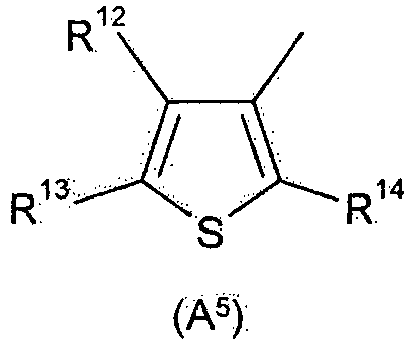
- R12 and R13 which can be the same or different represent a hydrogen atom ; a halogen atom ; C1-C5-alkyl ; C1-C5-alkoxy ; amino ; C1-C5-halogenoalkyl comprising up to 9 halogen atoms which can be the same or different or C1-C5-halogenoalkoxy comprising up to 9 halogen atoms which can be the same or different;
- R14 represents a hydrogen atom ; a halogen atom ; C1-C5-alkyl ; C1-C5-alkoxy ; amino ; C1-C5-halogenoalkyl comprising up to 9 halogen atoms which can be the same or different or C1-C5-halogenoalkoxy comprising up to 9 halogen atoms which can be the same or different ;
- - a heterocycle of formula (A6)

- R15 represents a hydrogen atom ; a halogen atom ; a cyano ; C1-C5-alkyl ; C1-C5-alkoxy ; C1-C5-halogeenoalkoxy comprising up to 9 halogen atoms which can be the same or different or C1-C5-halogenoalkyl comprising up to 9 halogen atoms which can be the same or different ;
- R16 and R18 which can be the same or different represent a hydrogen atom ; a halogen atom ; C1-C5-alkoxycarbonyl ; C1-C5-alkyl ; C1-C5-halogenoalkoxy comprising up to 9 halogen atoms which can be the same or different or C1-C5-halogenoalkyl comprising up to 9 halogen atoms which can be the same or different;
- R17 represent a hydrogen atom or C1-C5-alkyl ;
- - a heterocycle of formula (A8)

- R23 represents a hydrogen atom ; a halogen atom ; C1-C5-alkyl or C1-C5-halogenoalkyl comprising up to 9 halogen atoms which can be the same or different;
- R24 represents a hydrogen atom or C1-C5-alkyl or C1-C5-halogenoalkyl comprising up to 9 halogen atoms which can be the same or different ;
- - a heterocycle of formula (A9)

- R25 represents a hydrogen atom ; a halogen atom ; C1-C6-alkyl or C1-C5-halogenoalkyl comprising up to 9 halogen atoms which can be the same or different ;
- R26 represents a hydrogen atom ; C1-C5-alkyl or C1-C5-halogenoalkyl comprising up to 9 halogen atoms which can be the same or different ;
- - a heterocycle of formula (A10)

- R27 represents a hydrogen atom ; a halogen atom ; C1-C5-alkyl or C1-C5-halogenoalkyl comprising up to 9 halogen atoms which can be the same or different;
- R28 represents a hydrogen atom ; a halogen atom , amino ; C1-C5-alkyl or C1-C5-halogenoalkyl comprising up to 9 halogen atoms which can be the same or different ;
- - a heterocycle of formula (A12)

- R31 represents a hydrogen atom a halogen atom or a C1-C5-alkyl
- R32 represents a hydrogen atom ; a halogen atom ; C1-C5-alkyl or C1-C5-halogenoalkyl comprising up to 9 halogen atoms which can be the same or different,
- R33 represents a hydrogen atom ; a halogen atom ; a nitro ; C1-C5-alkyl ; C1-C5-alkoxy ; C1-C5-halogenoalkoxy comprising up to 9 halogen atoms which can be the same or different or C1-C5-halogeneralkyl comprising up to 9 halogen atoms which can be the same or different ;
- - a heterocycle of formula (A13)


- R34 represents a hydrogen atom , a halogen atom , C1-C5-alkyl ; C3-C5-cycloalkyl ; C1-C5-halogenoalkyl comprising up to 9 halogen atoms which can be the same or different ; C1-C5-alkoxy , C2-C5-alkynyloxy or C1-C5-halogenoalkoxy comprising up to 9 halogen atoms which can be the same or different ;
- R35 represents a hydrogen atom ; a halogen atom ; C1-C5-alkyl, a cyano ; C1-C5-alkoxy ; C1-C5-alkylthio ; C1-C5-halogenoalkyl comprising up to 9 halogen atoms which can be the same or different, C1-C5-halogenoalkoxy comprising up to 9 Halogen atoms which can be the same or different ; amino ; C1-C5-alkylamino or di(C1-C5-alkyl)amino
- R36 represents a hydrogen atom or C1-C5-alkyl ;
- - a heterocycle of formule (A15)

- R40 and R41 which can be the same or different represent a hydrogen atom ; a halogen atom , C1-C5-alkyl or C1-C5-halogenoalkyl comprising up to 9 halogen atoms which can be the same or different ,
- - a heterocycle of formula (A16)

- R42 and R43 which can be the same or different represent a hydrogen atom ; a halogen atom ; C1-C5-alkyl ; C1-C5-halogenoalkyl comprising up to 9 halogen atoms which can be the same or different or amino ;
- - a heterocycle of formula (A19)


- R49 and R50 which can be the same or different represent a hydrogen atom ; a halogen atom ; C1-C5-alkyl ; C1-C5-alkoxy ; C1-C5-halogenoalkoxy comprising up to 9 halogen atoms which can be the same or different or C1-C5-halogenoalkyl comprising up to 9 halogen atoms which can be the same or different ;
- More preferred compounds according to the invention are compounds of formula (I) wherein A is selected in the list consisting of A2 ; A6 ; A10 and A13 as herein-defined.
- Other preferred compounds according to the invention are compounds of formula (I) wherein Z1 represents a non substituted C3-C7-cycloalkyl ; more preferably Z1 represents cyclopropyl. Other preferred compounds according to the invention are compounds of formula (I) wherein Z1 represents a C3-C7 cycloalkyl substituted by up to 10 groups or atoms which can be the same or different and which can be selected ion in the list consisting of halogen atoms ; C1-C8-alkyl C1-C8-halogenoalkyl comprising up to 9 halogen atoms which can be the same or different ; C1-C8-alkoxy or C1-C8-halogenoalkoxy comprising up to 9 halogen atoms which can be the same or different
- Other preferred compounds according to the invention are compounds of formula (I) wherein X, which can be the same or different, represents a halogen atom ; C1-C8-alkyl ; C1-C8-halogenoalkyl comprising up to 9 halogen atoms which can be the same or different ; C1-C8-alkoxy or C1-C8-halogenoalkoxy compnsing up to 9 halogen atoms which can be the same or different
More preferred compounds according to the invention are compounds of formula (I) wherein two consecutive substituents X together with the phenyl ring form a substituted or non substituted 1,3-benzodioxolyl ; 1,2,3,4-tetrahydro-quinoxalinyl ; 3,4-dihydro-2H-1,4-benzoxazinyl ; 1,4-benzodioxanyl , indanyl ; 2,3-dihydrobenzofuranyl ; indolinyl. - Other preferred compounds according to the invention are compounds of formula (I) wherein R, which can be the same or different, represents a hydrogen atom ; halogen atom , cyano , C1-C8-alkylamino ; di-C1-C8-alkylamino ; tri(C1-C8-alkyl)silyl ; C1-C8-alkyl , C1-C8-halogenoalkyl comprising up to 9 halogen atoms which can be the same or different ; C1-C8-alkoxy ; C1-C8-halogenoalkoxy comprising up to 9 halogen atoms which can be the same or different, C1-C8-alkylsulfanyl ; amino, hydroxyl , nitro ; C1-C8-alkoxycarbonyl ; C2-C8-alkynyloxy.
- The above mentioned preferences with regard to the substituents of the compounds according to the invention can be combined in various manners These combinations of preferred features thus provide sub-classes of compounds according to the invention Examples of such subclasses of preferred compounds according to the invention can combined
- preferred features of A with preferred features of Z1 ;
- preferred features of A with preferred features of Z2 or Z3 ;
- preferred features of A with preferred features of X and n ;
- preferred features of A with preferred features of R or Q ;
- preferred features of A with preferred features of Z1 and Z2 or Z3
- preferred features of A with preferred features of Z1 and X and n ;
- preferred features of A with preferred features Z1 and R or Q ;
- preferred features of Z1 with preferred features of Z2 or Z3
- preferred features of Z1 with preferred features of X and n ;
- preferred features of Z1 with preferred features of R or Q ;
- preferred features of Z2 or Z3 with preferred features of X and n ;
- preferred features of Z2 or Z3 with preferred features of R or Q.
- In these combinations of preferred features of the substituents of the compounds according to the invention, the said preferred features can also be selected among the more preferred features of each of A, Z1 Z3, Z3, X, n, R and Q so as to form most preferred subclasses of compounds according to the invention.
- The present invention also relates to a process for the preparation of compounds of formula (I). Thus according to a further aspect of the present invention there is provided a process P1 for the preparation of compound of formula (I) as herein-defined, as illustrated by the following reaction scheme :

A, Z1, Z2, Z3, X and n are as herein-defined ;
Y1 represents a halogen or a hydroxyl. - According to a further aspect of the present invention there is provided a process P2 for the preparation of compound of formula (I) as herein-defined, as illustrated by the following reaction scheme :

A, Z1, Z2, Z3, X and n are as herein-defined ;
Y1 represents a halogen or a hydroxyl ;
Y2 represents a halogen or a leaving group like a tosylate group. - In processes P1 and P2 according to the invention, step 1 may be performed if appropriate in the presence of a solvent and if appropriate in the presence of an acid binder.
- In processes P2 according to the invention, step 2 may be performed if appropriate in the presence of a solvent and if appropriate in the presence of an acid binder.
- N-cycloalkyl-amine derivatives of formula (II) are known or can be prepared by known processes (J. Het. Chem., 1983, p1031-6 ; J. Am. Chem. Soc., 2004, p5192-5201 ; Synt. Comm. 2003, p3419-25).
- Carboxylic acid derivatives of formula (III) are known or can be prepared by known processes (
WO-93/11117 EP-A 0 545 099 ; Nucleosides & Nucleotides, 1987, p737-759, Bioorg. Med. Chem., 2002, p2105-2108). - Benzyl derivatives of formula (V) and cycloalkylamine derivatives of formula (IV) are known.
- When X represents a halogen atom, processes P1 and P2 according to the invention for the preparation of compound of formula (I) may optionally be completed by a further step. Process P3 according to the invention of such a step can be illustrated by the following reaction scheme :

A, Z1, Z2, Z3, X, Q and n are as herein-defined ;
y3 represents a halogen atom ;
Y4 represents sulphur, oxygen or C1-C5-alkylamino. - Process P3 according to the invention may be performed in the presence of a acid binder and if appropriate in the presence of a solvent;
- Phenol, thiophenol or aniline derivatives of formula (VIII) are known.
- Suitable acid binder for carrying out processes P1, P2 and P3 according to the invention are in each case all inorganic and organic bases which are customary for such reactions. Preference is given to using alkaline earth metal, alkali metal hydride, alkali metal hydroxides or alkali metal alkoxydes, such as sodium hydroxide, sodium hydride, calcium hydroxide, potassium hydroxide, potassium tert-butoxide or other ammonium hydroxide, alkali metal carbonates, such as sodium carbonate, potassium carbonate, potassium bicarbonate, sodium bicarbonate, alkali metal or alkaline earth metal acetates, such as sodium acetate, potassium acetate, calcium acetate, and also ternary amines, such as trimethylamine, triethylamine, tributylamine, N,N-dimethylaniline, pyridine, N-methylpiperidine, N,N-dimethylaminopyridine, diazabicyclooctane (DABCO), diazabicyclononene (DBN) or diazabicycloundecene (DBU).
- It is also possible to work in the absence of an additional condensing agent or to employ an excess of the amine component, so that it simultaneously acts as acid binder agent.
- Suitable solvents for carrying out processes P1, P2 and P3 according to the invention are in each case all customary inert organic solvents. Preference is given to using optionally halogenated aliphatic, alicyclic or aromatic hydrocarbons, such as petroleum ether, hexane, heptane, cyclohexane, methylcyclohexane, benzene, toluene, xylene or decalin; chlorobenzene, dichlorobenzene, dichloromethane, chloroform, carbon tetrachloride, dichlorethane or trichlorethane; ethers, such as diethyl ether, diisopropyl ether, methyl t-butyl ether, methyl t-amyl ether, dioxane, tetrahydrofuran, 1,2-dimethoxyethane, 1,2-diethoxyethane or anisole; nitriles, such as acetonitrile, propionitrile, n- or i-butyronitrile or benzonitrile; amides, such as N,N-dimethylformamide, N,N-dimethylacetamide, N-methylformanilide, N-methylpyrrolidone or hexamethylphosphoric triamide; esters, such as methyl acetate or ethyl acetate, sulphoxides, such as dimethyl sulphoxide, or sulphones, such as sulpholane.
- Process P3 according to the invention is preferably carried out in the presence of a catalyst, such as a metal salt or complex. Suitable metal for this purpose are preferably copper or palladium. Suitable salts or complexes for this purpose are copper chloride, copper iodide, copper oxide, palladium chloride, palladium acetate, tetrakis(triphenylphosphine)palladium, bis(triphenylphosphine)palladium dichloride or 1,1'-bis(diphenylphosphino) ferrocenepalladium(II) chloride.
- It is also possible to generate a palladium complex in the reaction mixture by separate addition of a palladium salt and a complex ligand, such as triethylphosphine, tri-tert-butylphosphine, tricyclohexylphosphine, 2-(dicyclohexylphosphine)biphenyl, 2-(di-tert-butylphosphine)biphenyl, 2-(dicyclohexylphosphine)-2'-(N,N-dimethylamino)biphenyl, triphenylphosphine, tris-(o-tolyl)phosphine, sodium 3-(diphenylphosphino)benzenesulphonate, tris-2-(methoxyphenyl)-phosphine, 2,2'-bis(diphenylphosphine)-1,1'-binaphthyl, 1,4-bis(diphenylphosphine)butane, 1,2-bis(diphenylphosphine)ethane, 1,4-bis(dicyclohexylphosphine)butane, 1,2-bis(dicyclo-hexylphosphine)ethane, 2-(dicyclohexylphosphine)-2'-(N,N-dimethylamino)-biphenyl, bis(diphenylphosphino)ferrocene or tris-(2,4-tert-butylphenyl)phosphite to the reaction.
- When carrying out processes P1, P2 and P3 according to the invention, the reaction temperatures can independently be varied within a relatively wide range. Generally, processes according to the invention are carried out at temperatures between 0°C and 160°C, preferably between 10°C and 120°C.
- Processes P1, P2 and P3 according to the invention are generally independently carried out under atmospheric pressure. However, in each case, it is also possible to operate under elevated or reduced pressure.
- When carrying out step 1 of processes P1 or P2 according to the invention, generally 1 mol or other an excess of the acid derivative of formula (III) and from 1 to 3 mol of acid binder are employed per mole of amine of formula (II) or (IV). It is also possible to employ the reaction components in other ratios.
- Work-up is carried out by customary methods. Generally, the reaction mixture is treated with water and the organic phase is separated off and, after drying, concentrated under reduced pressure. If appropriate, the remaining residue can be freed by customary methods, such as chromatography or recrystallization, from any impurities that may still be present.
- When carrying out step 2 of process P2 according to the invention, generally 1 mol or other an excess of benzyl derivative of formula (V) and from 1 to 3 mol of acid binder are employed per mole of amide of formula (VI). It is also possible to employ the reaction components in other ratios.
- Work-up is carried out by customary methods. Generally, the reaction mixture is treated with water and the organic phase is separated off and, after drying, concentrated under reduced pressure. If appropriate, the remaining residue can, be freed by customary methods, such as chromatography or recrystallization, from any impurities that may still be present.
- When carrying out process P3 according to the invention, generally 1 mol or other of an excess of the phenol, thiophenol or aniline derivative of formula (VIII) and from 1 to 10 mol of acid binder and from 0.5 to 5 mol percent of a catalyst are employed per mole of amide derivative of formula (I'). It is also possible to employ the reaction components in other ratios.
- Work-up is carried out by customary methods. Generally, the reaction mixture is concentrated under reduced pressure. If appropriate, the remaining residue can, be freed by customary methods, such as chromatography or recrystallization, from any impurities that may still be present.
- Compounds according to the invention can be prepared according to the above described processes. It will nevertheless be understood that, on the basis of his general knowledge and of available publications, the skilled worker will be able to adapt these processes according to the specifics of each of the compounds according to the invention that is desired to be synthesised.
- In a further aspect, the present invention also relates to a fungicide composition comprising an effective and non-phytotoxic amount of an active compound of formula (I).
- The expression "effective and non-phytotoxic amount" means an amount of composition according to the invention which is sufficient to control or destroy the fungi present or liable to appear on the crops, and which does not entail any appreciable symptom of phytotoxicity for the said crops. Such an amount can vary within a wide range depending on the fungus to be controlled, the type of crop, the climatic conditions and the compounds included in the fungicide composition according to the invention.
- This amount can be determined by systematic field trials, which are within the capabilities of a person skilled in the art.
- Thus, according to the invention, there is provided a fungicide composition comprising, as an active ingredient, an effective amount of a compound of formula (I) as herein defined and an agriculturally acceptable support, carrier or filler.
- According to the invention, the term "support" denotes a natural or synthetic, organic or inorganic compound with which the active compound of formula (I) is combined or associated to make it easier to apply, notably to the parts of the plant. This support is thus generally inert and should be agriculturally acceptable. The support may be a solid or a liquid. Examples of suitable supports include clays, natural or synthetic silicates, silica, resins, waxes, solid fertilisers, water, alcohols, in particular butanol, organic solvents, mineral and plant oils and derivatives thereof. Mixtures of such supports may also be used.
- The composition according to the invention may also comprise additional components. In particular, the composition may further comprise a surfactant. The surfactant can be an emulsifier, a dispersing agent or a wetting agent of ionic or non-ionic type or a mixture of such surfactants. Mention may be made, for example, of polyacrylic acid salts, lignosulphonic acid salts, phenolsulphonic or naphthalenesulphonic acid salts, polycondensates of ethylene oxide with fatty alcohols or with fatty acids or with fatty amines, substituted phenols (in particular alkylphenols or arylphenols), salts of sulphosuccinic acid esters, taurine derivatives (in particular alkyl taurates), phosphoric esters of polyoxyethylated alcohols or phenols, fatty acid esters of polyols, and derivatives of the above compounds containing sulphate, sulphonate and phosphate functions. The presence of at least one surfactant is generally essential when the active compound and/or the inert support are water-insoluble and when the vector agent for the application is water. Preferably, surfactant content may be comprised from 5% to 40% by weight of the composition.
- Optionally, additional components may also be included, e.g. protective colloids, adhesives, thickeners, thixotropic agents, penetration agents, stabilisers, sequestering agents. More generally, the active compounds can be combined with any solid or liquid additive, which complies with the usual formulation techniques.
- In general, the composition according to the invention may contain from 0.05 to 99% by weight of active compound, preferably 10 to 70% by weight.
- Compositions according to the invention can be used in various forms such as aerosol dispenser, capsule suspension, cold fogging concentrate, dustable powder, emulsifiable concentrate, emulsion oil in water, emulsion water in oil, encapsulated granule, fine granule, flowable concentrate for seed treatment, gas (under pressure),gas generating product, granule, hot fogging concentrate, macrogranule, microgranule, oil dispersible powder, oil miscible flowable concentrate, oil miscible liquid, paste, plant rodlet, powder for dry seed treatment, seed coated with a pesticide, soluble concentrate, soluble powder, solution for seed treatment, suspension concentrate (flowable concentrate), ultra low volume (ULV) liquid, ultra low volume (ULV) suspension, water dispersible granules or tablets, water dispersible powder for slurry treatment, water soluble granules or tablets, water soluble powder for seed treatment and wettable powder.
- These compositions include not only compositions which are ready to be applied to the plant or seed to be treated by means of a suitable device, such as a spraying or dusting device, but also concentrated commercial compositions which must be diluted before application to the crop. The compounds according to the invention can also be mixed with one or more insecticide, fungicide, bactericide, attractant, acaricide or pheromone active substance or other compounds with biological activity. The mixtures thus obtained have a broadened spectrum of activity. The mixtures with other fungicide compounds are particularly advantageous.
- Examples of suitable fungicide mixing partners may be selected in the following lists :
- B1) a compound capable to inhibit the nucleic acid synthesis like benalaxyl, benalaxyl-M, bupirimate, chiralaxyl, clozylacon, dimethirimol, ethirimol, furalaxyl, hymexazol, metalaxyl, metalaxyl-M, ofurace, oxadixyl, oxolinic acid ;
- B2) a compound capable to inhibit the mitosis and cell division like benomyl, carbendazim, diethofencarb, fuberidazole, pencycuron, thiabendazole thiophanate-methyl, zoxamide ;
- B3) a compound capable to inhibit the respiration for example
as Cl-respiration inhibitor like diflumetorim ;
as CII-respiration inhibitor like boscalid, carboxin, fenfuram, flutolanil, furametpyr, mepronil, oxycarboxine, penthiopyrad, thifluzamide ;
as CIII-respiration inhibitor like azoxystrobin, cyazofamid, dimoxystrobin, enestrobin, famoxadone, fenamidone, fluoxastrobin, kresoxim-methyl, metominostrobin, orysastrobin, pyraclostrobin, pyribencarb, picoxystrobin, trifloxystrobin ; - B4) a compound capable of to act as an uncoupler like dinocap, fluazinam ;
- B5) a compound capable to inhibit ATP production like fentin acetate, fentin chloride, fentin hydroxide, silthiofam ;
- B6) a compound capable to inhibit AA and protein biosynthesis like andoprim, blasticidin-S, cyprodinil, kasugamycin, kasugamycin hydrochloride hydrate, mepanipyrim, pyrimethanil ;
- B7) a compound capable to inhibit the signal transduction like fenpiclonil, fludioxonil, quinoxyfen ;
- B8) a compound capable to inhibit lipid and membrane synthesis like chlozolinate, iprodione, procymidone, vinclozolin, pyrazophos, edifenphos, iprobenfos (IBP), isoprothiolane, tolclofos-methyl, biphenyl, iodocarb, propamocarb, propamocarb-hydrochloride ;
- B9) a compound capable to inhibit ergosterol biosynthesis like fenhexamid, azaconazole, bitertanol, bromuconazole, cyproconazole, diclobutrazole, difenoconazole, diniconazole, diniconazole-M, epoxiconazole, etaconazole, fenbuconazole, fluquinconazole, flusilazole, flutriafol, furconazole, furconazole-cis, hexaconazole, imibenconazole, ipconazole, metconazole, myclobutanil, paclobutrazol, penconazole, propiconazole, prothioconazole, simeconazole, tebuconazole, tetraconazole, triadimefon, triadimenol, triticonazole, uniconazole, voriconazole, imazalil, imazalil sulfate, oxpoconazole, fenarimol, flurprimidol, nuarimol, pyrifenox, triforine, pefurazoate, prochloraz, triflumizole, viniconazole, aldimorph, dodemorph, dodemorph acetate, fenpropimorph, tridemorph, fenpropidin, spiroxamine, naftifine, pyributicarb, terbinafine ;
- B11) a compound capable to inhibit melanine biosynthesis like carprop
- B10) a compound capable to inhibit cell wall synthesis like benthiavalicarb, bialaphos, dimethomorph, flumorph, iprovalicarb, polyoxins, polyoxorim, validamycin A ; amid, diclocymet, fenoxanil, phtalide, pyroquilon, tricyclazole ;
- B12) a compound capable to induce a host defence like acibenzolar-S-methyl, probenazole, tiadinil ;
- B13) a compound capable to have a multisite action like captafol, captan, chlorothalonil, copper preparations such as copper hydroxide, copper naphthenate, copper oxychloride, copper sulphate, copper oxide, oxine-copper and Bordeaux mixture, dichlofluanid, dithianon, dodine, dodine free base, ferbam, fluorofolpet, folpet, guazatine, guazatine acetate, iminoctadine, iminoctadine albesilate, iminoctadine triacetate, mancopper, mancozeb, maneb, metiram, metiram zinc, propineb, sulphur and sulphur preparations including calcium polysulphide, thiram, tolylfluanid, zineb, ziram ;
- B14) a compound selected in the following list: amibromdole, benthiazole, bethoxazin, capsimycin, carvone, chinomethionat, chloropicrin, cufraneb, cyflufenamid, cymoxanil, dazomet, debacarb, diclomezine, dichlorophen, dicloran, difenzoquat, difenzoquat methylsulphate, diphenylamine, ethaboxam, ferimzone, flumetover, flusulfamide, fosetyl-aluminium, fosetyl-calcium, fosetyl-sodium, fluopicolide, fluoroimide, hexachlorobenzene, 8-hydroxyquinoline sulfate, irumamycin, methasulphocarb, metrafenone, methyl isothiocyanate, mildiomycin, natamycin, nickel dimethyldithiocarbamate, nitrothal-isopropyl,octhilinone, oxamocarb, oxyfenthiin, pentachlorophenol and salts, 2-phenylphenol and salts, phosphorous acid and its salts, piperalin, propanosine-sodium, proquinazid, pyrrolnitrine, quintozene, tecloftalam, tecnazene, triazoxide, trichlamide, valiphenal, zarilamid and 2,3,5,6-tetrachloro-4-(methylsulfonyl)-pyridine, N-(4-Chloro-2-nitrophenyl)-N-ethyl-4-methyl-benzenesulfonamide, 2-amino-4-methyl-N-phenyl-5-thiazolecarboxamide, 2-chloro-N-(2,3-dihydro-1,1,3-trimethyl-1 H-inden-4-yl)-3-pyridincarboxamide, 3-[5-(4-chlorophenyl)-2,3-dimethylisoxazolidin-3-yl]pyridine, cis-1-(4-chlorophenyl)-2-(1H-1,2,4-triazole-1-yl)-cycloheptanol, methyl 1-(2,3-dihydro-2,2-dimethyl-1 H-inden-1-yl)-1H-imidazole-5-carboxylate, 3,4,5-trichloro-2,6-pyridinedicarbonitrile, methyl 2-[[[cyclopropyl[(4-methoxyphenyl)imino]methyl]thio]methyl]-.alpha.-(methoxymethylene)-benzeneacetate, 4-Chloro-alpha-propynyloxy-N-[2-[3-methoxy-4-(2-propynyloxy)phenyl]ethyl]-benzeneacetamide, (2S)-N-[2-[4-[[3-(4-chlorophenyl)-2-propynyl]oxy]-3-methoxyphenyl]ethyl]- 3-methyl-2-[(methylsulfonyl)amino]-butanamide, 5-chloro-7-(4-methylpiperidin-1-yl)-6-(2,4,6-trifluorophenyl)[1,2,4]triazolo[1,5-a]pyrimidine, 5-chloro-6-(2,4,6-trifluorophenyl)-N-[(1 R)-1,2,2-trimethylpropyl][1,2,4]triazolo[1,5-a]pyrimidin-7-amine, 5-chloro-N-[(1 R)-1,2-dimethylpropyl]-6-(2,4,6-trifluorophenyl)[1,2,4]triazolo[1,5-a]pyrimidin-7-amine, N-[1-(5-bromo-3-chloropyridin-2-yl)ethyl]-2,4-dichloronicotinamide, N-(5-bromo-3-chloropyridin-2-yl)methyl-2,4-dichloronicotinamide, 2-butoxy-6-iodo-3-propyl-benzopyranon-4-one, N-{(Z)-[(cyclopropylmethoxy)imino][6-(difluoromethoxy)-2,3-difluorophenyl]methyl}-2-phenylacetamide, N-(3-ethyl-3,5,5-trimethyl-cyclohexyl)-3-formylamino-2-hydroxy-benzamide, 2-[[[[1-[3(1Fluoro-2-phenylethyl)oxy]phenyl]ethylidene]amino]oxy]methyl]-alpha-(methoxyimino)-N-methyl-alphaE-benzeneacetamide, N-{2-[3-chloro-5-(trifluoromethyl)pyridin-2-yl]ethyl}-2-(trifluoromethyl)benzamide, N-(3',4'-dichloro-5-fluorobiphenyl-2-yl)-3-(difluoromethyl)-1-methyl-1H-pyrazole-4-carboxamide, 2-(2-{[6-(3-chloro-2-methylphenoxy)-5-fluoropyrimidin-4-yl]oxy}phenyl)-2-(methoxyimino)-N-methylacetamide , 1-[(4-methoxyphenoxy)methyl]-2,2-dimethylpropyl-1H-imidazole-1- carboxylic acid, O-[1-[(4-methoxyphenoxy)methyl]-2,2-dimethylpropyl]-1H-imidazole- 1- carbothioic acid, N-{2-[1,1'-bi(cyclopropyl)-2-yl]phenyl}-3-(difluoromethyl)-1-methyl-1H-pyrazole-4-carboxamide, N'-{5-(difluoromethyl)-2-methyl-4-[3-(trimethylsilyl)propoxy]phenyl}-N-ethyl-N-methylimidoformamide, N'-{5-(trifluoromethyl)-2-methyl-4-[3-(trimethylsilyl)propoxy]phenyl}-N-ethyl-N-methylimidoformamide.
- The composition according to the invention comprising a mixture of a compound of formula (I) with a bactericide compound may also be particularly advantageous. Examples of suitable bactericide mixing partners may be selected in the following list : bronopol, dichlorophen, nitrapyrin, nickel dimethyldithiocarbamate, kasugamycin, octhilinone, furancarboxylic acid, oxytetracycline, probenazole, streptomycin, tecloftalam, copper sulphate and other copper preparations.
- The compound of formula (I) and the fungicide composition according to the invention can be used to curatively or preventively control the phytopathogenic fungi of plants or crops.
- Thus, according to a further aspect of the invention, there is provided a method for curatively or preventively controlling the phytopathogenic fungi of plants or crops characterised in that a compound of formula (I) or a fungicide composition according to the invention is applied to the seed, the plant or to the fruit of the plant or to the soil wherein the plant is growing or wherein it is desired to grow.
- The method of treatment according to the invention may also be useful to treat propagation material such as tubers or rhizomes, but also seeds, seedlings or seedlings pricking out and plants or plants pricking out. This method of treatment can also be useful to treat roots. The method of treatment according to the invention can also be useful to treat the overground parts of the plant such as trunks, stems or stalks, leaves, flowers and fruit of the concerned plant.
- Among the plants that can be protected by the method according to the invention, mention may be made of cotton ; flax ; vine ; fruit or vegetable crops such as Rosaceae sp. (for instance pip fruit such as apples and pears, but also stone fruit such as apricots, almonds and peaches), Ribesioidae sp., Juglandaceae sp., Betulaceae sp., Anacardiaceae sp., Fagaceae sp., Moraceae sp., Oleaceae sp., Actinidaceae sp., Lauraceae sp., Musaceae sp. (for instance banana trees and plantins), Rubiaceae sp., Theaceae sp., Sterculiceae sp., Rutaceae sp. (for instance lemons, oranges and grapefruit) ; Solanaceae sp. (for instance tomatoes), Liliaceae sp., Asteraceae sp. (for instance lettuces), Umbelliferae sp., Cruciferae sp., Chenopodiaceae sp., Cucurbitaceae sp., Papilionaceae sp. (for instance peas), Rosaceae sp. (for instance strawberries) ; major crops such as Graminae sp. (for instance maize, lawn or cereals such as wheat, rice, barley and triticale), Asteraceae sp. (for instance sunflower), Cruciferae sp. (for instance colza), Fabacae sp. (for instance peanuts), Papilionaceae sp. (for instance soybean), Solanaceae sp. (for instance potatoes), Chenopodiaceae sp. (for instance beetroots) ; horticultural and forest crops ; as well as genetically modified homologues of these crops.
- Among the diseases of plants or crops that can be controlled by the method according to the invention, mention may be made of :
- Powdery mildew diseases such as :
- Blumeria diseases, caused for example by Blumeria graminis ;
- Podosphaera diseases, caused for example by Podosphaera leucotricha ;
- Sphaerotheca diseases, caused for example by Sphaerotheca fuliginea ;
- Uncinula diseases, caused for example by Uncinula necator ;
- Rust diseases such as :
- Gymnosporangium diseases, caused for example by Gymnosporangium sabinae ;
- Hemileia diseases, caused for example by Hemileia vastatrix ;
- Phakopsora diseases, caused for example by Phakopsora pachyrhizi or Phakopsora
- meibomiae ;
- Puccinia diseases, caused for example by Puccinia recondita ;
- Uromyces diseases, caused for example by Uromyces appendiculatus ;
- Oomycete diseases such as :
- Bremia diseases, caused for example by Bremia lactucae ;
- Peronospora diseases, caused for example by Peronospora pisi or P. brassicae ;
- Phytophthora diseases, caused for example by Phytophthora infestans ;
- Plasmopara diseases, caused for example by Plasmopara viticola ;
- Pseudoperonospora diseases, caused for example by Pseudoperonospora humuli or
- Pseudoperonospora cubensis ;
- Pythium diseases, caused for example by Pythium ultimum ;
- Leafspot, leaf blotch and leaf blight diseases such as :
- Alternaria diseases, caused for example by Alternaria solani ;
- Cercospora diseases, caused for example by Cercospora beticola ;
- Cladiosporum diseases, caused for example by Cladiosporium cucumerinum ;
- Cochliobolus diseases, caused for example by Cochliobolus sativus ;
- Colletotrichum diseases, caused for example by Colletotrichum lindemuthanium ;
- Cycloconium diseases, caused for example by Cycloconium oleaginum ;
- Diaporthe diseases, caused for example by Diaporthe citri ;
- Elsinoe diseases, caused for example by Elsinoe fawcettii ;
- Gloeosporium diseases, caused for example by Gloeosporium laeticolor ;
- Glomerella diseases, caused for example by Glomerella cingulata ;
- Guignardia diseases, caused for example by Guignardia bidwelli ;
- Leptosphaeria diseases, caused for example by Leptosphaeria maculans ; Leptosphaeria
- nodorum ;
- Magnaporthe diseases, caused for example by Magnaporthe grisea ;
- Mycosphaerella diseases, caused for example by Mycosphaerella graminicola ;
- Mycosphaerella arachidicola ; Mycosphaerella fijiensis ;
- Phaeosphaeria diseases, caused for example by Phaeosphaeria nodorum ;
- Pyrenophora diseases, caused for example by Pyrenophora teres ;
- Ramularia diseases, caused for example by Ramularia collo-cygni ;
- Rhynchosporium diseases, caused for example by Rhynchosporium secalis ;
- Septoria diseases, caused for example by Septoria apii or Septoria lycopercisi ;
- Typhula diseases, caused for example by Typhula incarnata ;
- Venturia diseases, caused for example by Venturia inaequalis ;
- Root and stem diseases such as :
- Corticium diseases, caused for example by Corticium graminearum ;
- Fusarium diseases, caused for example by Fusarium oxysporum ;
- Gaeumannomyces diseases, caused for example by Gaeumannomyces graminis ;
- Rhizoctonia diseases, caused for example by Rhizoctonia solani ;
- Tapesia diseases, caused for example by Tapesia acuformis ;
- Thielaviopsis diseases, caused for example by Thielaviopsis basicola ;
- Ear and panicle diseases such as :
- Alternaria diseases, caused for example by Alternaria spp. ;
- Aspergillus diseases, caused for example by Aspergillus flavus ;
- Cladosporium diseases, caused for example by Cladosporium spp. ;
- Claviceps diseases, caused for example by Claviceps putpurea ;
- Fusarium diseases, caused for example by Fusarium culmorum ;
- Gibberella diseases, caused for example by Gibberella zeae ;
- Monographella diseases, caused for example by Monographella nivalis ;
- Smut and bunt diseases such as :
- Sphacelotheca diseases, caused for example by Sphacelotheca reiliana ;
- Tilletia diseases, caused for example by Tilletia caries ;
- Urocystis diseases, caused for example by Urocystis occulta ;
- Ustilago diseases, caused for example by Ustilago nuda ;
- Fruit rot and mould diseases such as :
- Aspergillus diseases, caused for example by Aspergillus flavus ;
- Botrytis diseases, caused for example by Botrytis cinerea ;
- Penicillium diseases, caused for example by Penicillium expansum ;
- Sclerotinia diseases, caused for example by Sclerotinia sclerotiorum ;
- Verticilium diseases, caused for example by Verticilium alboatrum ;
- Seed and soilborne decay, mould, wilt, rot and damping-off diseases :
- Fusarium diseases, caused for example by Fusarium culmorum ;
- Phytophthora diseases, caused for example by Phytophthora cactorum ;
- Pythium diseases, caused for example by Pythium ultimum ;
- Rhizoctonia diseases, caused for example by Rhizoctonia solani ;
- Sclerotium diseases, caused for example by Sclerotium rolfsii ;
- Microdochium diseases, caused for example by Microdochium nivale ;
- Canker, broom and dieback diseases such as :
- Nectria diseases, caused for example by Nectria galligena ;
- Blight diseases such as :
- Monilinia diseases, caused for example by Monilinia laxa ;
- Leaf blister or leaf curl diseases such as :
- Taphrina diseases, caused for example by Taphrina deformans ;
- Decline diseases of wooden plants such as :
- Esca diseases, caused for example by Phaemoniella clamydospora ;
- Eutypa dyeback, caused for example by Eutypa lata ;
- Dutch elm disease, caused for example by Ceratocystsc ulmi ;
- Diseases of flowers and Seeds such as :
- Botrytis diseases, caused for example by Botrytis cinerea ;
- Diseases of tubers such as :
- Rhizoctonia diseases, caused for example by Rhizoctonia solani.
- The fungicide composition according to the invention may also be used against fungal diseases liable to grow on or inside timber. The term "timber" means all types of species of wood, and all types of working of this wood intended for construction, for example solid wood, high-density wood, laminated wood, and plywood. The method for treating timber according to the invention mainly consists in contacting one or more compounds according to the invention, or a composition according to the invention ; this includes for example direct application, spraying, dipping, injection or any other suitable means.
- The dose of active compound usually applied in the method of treatment according to the invention is generally and advantageously from 10 to 800 g/ha, preferably from 50 to 300 g/ha for applications in foliar treatment. The dose of active substance applied is generally and advantageously from 2 to 200 g per 100 kg of seed, preferably from 3 to 150 g per 100 kg of seed in the case of seed treatment.
- It is clearly understood that the doses indicated herein are given as illustrative examples of the method according to the invention. A person skilled in the art will know how to adapt the application doses, notably according to the nature of the plant or crop to be treated.
- The fungicide composition according to the invention may also be used in the treatment of genetically modified organisms with the compounds according to the invention or the agrochemical compositions according to the invention. Genetically modified plants are plants into genome of which a heterologous gene encoding a protein of interest has been stably integrated. The expression "heterologous gene encoding a protein of interest" essentially means genes which give the transformed plant new agronomic properties, or genes for improving the agronomic quality of the modified plant.
- The compounds or mixtures according to the invention may also be used for the preparation of composition useful to curatively or preventively treat human or animal fungal diseases such as, for example, mycoses, dermatoses, trichophyton diseases and candidiases or diseases caused by Aspergillus spp., for example Aspergillus fumigatus.
- The various aspects of the invention will now be illustrated with reference to the following tables of compound examples and the following preparation or efficacy examples.
- The following tables illustrate in a non-limiting manner examples of compounds according to the invention. The compound example tables display compounds according to the invention of specific formulae (I-A') to (I-A22).
- In the following compound examples, M+H (or M-H) means the molecular ion peak, plus or minus 1 a.m.u. (atomic mass unit) respectively, as observed in mass spectroscopy and M (Apcl+) means the molecular ion peak as it was found via positive atmospheric pressure chemical ionisation in mass spectroscopy.
- In the following examples, the logP values were determined in accordance with EEC Directive 79/831 Annex V.A8 by HPLC (High Performance Liquid Chromatography) on a reversed-phase column (C 18), using the method described below :
- Temperature: 40°C ; Mobile phases : 0.1% aqueous formic acid and acetonitrile ; linear gradient from 10% acetonitrile to 90% acetonitrile.
- Calibration was carried out using unbranched alkan-2-ones (comprising 3 to 16 carbon atoms) with known logP values (determination of the logP values by the retention times using linear interpolation between two successive alkanones).
- The lambda max values were determined in the maxima of the chromatographic signals using the UV spectra from 190nm to 400nm.
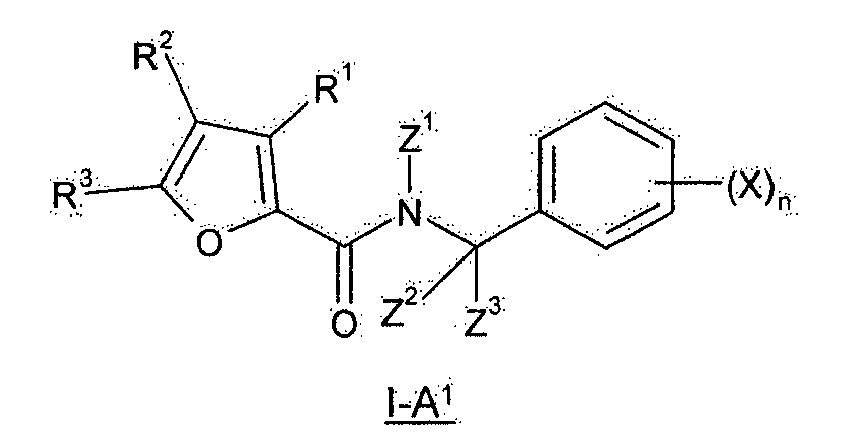
N° R1 R2 R3 Z2 Z3 Z1 (X)n LogP M+H 1 Me H H H H Cyclopropyl 2-Cl-4-Cl 324 2 Me H H H H Cyclopropyl 2-Cl-4-CF3 3 H H H H H Cyclopropyl 2-Cl-4-Cl 310 4 H H H H H Cyclopropyl 2-Cl-4-CF3 5 Me H H H H Cyclopropyl 2-Cl-4-Cl-6-Cl 358 6 H H H H H Cyclopropyl 2-Cl-4-Cl-6-Cl 344 7 Me H H H H 3,5,5-trimethylcyclohexyl 2-Cl-4-Cl-6-Cl 8 Me H H H H cycloheptyl 2-Cl-4-Cl-6-Cl 
N° R4 R6 R5 Z2 Z3 Z1 (X)n LogP M+H 9 Me H H H H Cyclopropyl 2-Cl-4-CF3 10 CF3 Me H H H Cyclopropyl 2-Cl-4-CF3 11 Me H H H H Cyclopropyl 2-Cl-4-Cl 3,77 12 CF3 Me H H H Cyclopropyl 2-Cl-4-Cl 4,6 13 Me H H H H Cyclopropyl 2-Cl-4-Cl-6-Cl 4,09 14 CF3 Me H H H Cyclopropyl 2-Cl-4-Cl-6-Cl 4,91 15 Me H H H H Cyclopropyl 4-CF3 3,43 16 CF3 Me H H H Cyclopropyl 4-CF3 4,18 17 Me H H Me H Cyclopropyl 4-CF3 338 18 CF3 Me H Me H Cyclopropyl 4-CF3 406 19 Me H H H H Cyclopropyl 4-OPh 348 20 CF3 Me H H H Cyclopropyl 4-OPh 416 21 Me H H H H Cyclopropyl 4-O(2-Cl-4-Cl-Ph) 416 22 I H H H H Cyclopropyl 2-Cl-4-Cl 23 I H H H H Cyclopropyl 2-Cl-4-CF3 24 Me Me H H H Cyclopropyl 2-Cl-4-Cl 338 25 Me Me H H H Cyclopropyl 2-Cl-4-CF3 372 26 I H H H H cyclopropyl 2-Cl-4-Cl-6-Cl 27 Me Me H H H Cyclopropyl 2-Cl-4-Cl-6-Cl 372 28 Me Me H H H Cyclopropyl 2-OMe-5-Ac 342 29 Me Me H H H Cyclopropyl 3-Cl-5-Cl 338 30 Me Me H H H Cyclopropyl 3-Me 284 31 Me Me H H H Cyclopropyl 3-Me-4-Me 32 Me Me H H H Cyclopropyl 4-i-Pr 312 33 Me Me H H H Cyclopropyl 2-CN 34 Me Me H H H Cyclopropyl 4-CN 295 35 Me Me H H H Cyclopropyl 2-OMe 299 36 Me Me H H H Cyclopropyl 2-Me-4-Me-6-Me 37 Me Me H H H Cyclopropyl 3,4-Methylenedioxy 38 Me Me H H H Cyclopropyl 2-OMe-5-OMe 39 Me Me H H H Cyclopropyl 3-OCF3 354 40 Me Me H H H Cyclopropyl 2-Cl-4,6-Methylenedioxy 348 41 Me Me H Me H Cyclopropyl 2-Cl-4-Cl 352 42 Me Me H Et H Cyclopropyl 2-Cl-4-Cl 366 43 Me Me H H H 3,5,5-trimethyl-cyclohexyl 2-Cl-4-Cl-6-Cl 44 Me Me H H H cycloheptyl 2-Cl-4-Cl-6-Cl 45 I H H H H 3,5,5-trimethylcyclohexyl 2-Cl-4-Cl-6-Cl 46 I H H H H cycloheptyl 2-Cl-4-Cl-6-Cl 47 Me Me H n-Pr H Cyclopropyl 2-Cl-4-Cl 380 48 Me Me H Me H Cyclopropyl 2-Cl-5-CF3 386 49 Me Me H H H Cyclopropyl 2-Cl-5-CF3 372 50 Me Me H H H Cyclopropyl 2-CF3-5-Cl 372 51 Me Me H Me H Cyclopropyl 4-CF3 352 52 I H H H H Cyclopentyl 2-Cl-4-Cl-6-Cl 
N° R7 R8 Z2 Z3 Z1 (X)n LogP M+H 53 CF3 Me H H Cyclopropyl 2-Cl-4-CF3 54 CF3 Me H H Cyclopropyl 2-Cl-4-Cl 393 55 CF3 Me H H Cyclopropyl 2-Cl-4-Cl-6-Cl 56 CF3 Me H H Cyclopropyl 3-OPh-4-F 435 
N° R9 R10 R11 Z2 Z3 Z1 (X)n LogP M+H 57 H H I H H Cyclopropyl 2-Cl-4-CF3 58 H H I H H Cyclopropyl 2-Cl-4-Cl 4,48 59 H H I H H Cyclopropyl 2-Cl-4-Cl-6-Cl 4,86 60 H H I H H Cyclopropyl 4-CF3 4,04 61 H H I Me H Cyclopropyl 4-CF3 466 62 H H I H H Cyclopropyl 4-OPh 476 63 H H I H H 3,5,5-trimethyl-cyclohexyl 2-Cl-4-Cl-6-Cl 64 H H I H H cycloheptyl 2-Cl-4-Cl-6-Cl 
N° R12 R13 R14 Z2 Z3 Z1 (X)n LogP M+H 65 H H I H H Cyclopropyl 2-Cl-6-Cl 452 66 OMe H H H H Cyclopropyl 2-Cl-4-Cl 67 OMe H H H H Cyclopropyl 2-Cl-4-CF3 68 OMe H H H H Cyclopropyl 2-Cl-4-Cl-6-Cl 69 H H I H H Cyclopropyl 2-OMe-5-Acetyl 456 70 H H I H H Cyclopropyl 3-Cl-5-Cl 452 71 H H I H H Cyclopropyl 3-Me 398 72 H H I H H Cyclopropyl 3-Me-4-Me 73 H H I H H Cyclopropyl 4-i-Pr 426 74 H H I H H Cyclopropyl 2-CN 75 H H I H H Cyclopropyl 4-CN 409 76 H H I H H Cyclopropyl 2-OMe 77 H H I H H Cyclopropyl 2-Me-4-Me-6-Me 426 78 H H I H H Cyclopropyl 3,4-Methylenedioxy 79 H H I H H Cyclopropyl 2-OMe-5-OMe 80 H H I H H Cyclopropyl 3-OCF3 81 H H I H H Cyclopropyl 2-Cl-4,5-Methylenedioxy 462 82 H H I Me H Cyclopropyl 2-Cl-4-Cl 466 83 H H I Et H Cyclopropyl 2-Cl-4-Cl 480 84 H H I H H Cyclopropyl 2-Cl-4-Cl 452 85 H H I H H Cyclopropyl 2-Cl-4-CF3 86 H H I H H Cyclopropyl 2-Cl-4-Cl-6-Cl 87 H H I H H Cyclopropyl 2-Cl-4-CF3-6-Cl 520 88 H H I H H Cyclopropyl 2-Cl-4-Cl-6-Cl 486 89 H H I Me H Cyclopropyl 2-Cl-5-CF3 500 90 H H I H H Cyclopropyl 2-Cl-5-CF3 486 91 H H I Me H Cyclopropyl 4-CF3 466 92 H H I n-Pr H Cyclopropyl 2-Cl-4-Cl 494 93 H H I H H Cyclopropyl 3-OPh-4-F 494 94 H H I H H Cyclopropyl 2-CI-6-CF3 486 95 H H I H H Cyclopropyl 2-F-6-CF3 470 96 H H I H H Cyclohexyl 2-Cl-4-Cl 
N° R15 R16 R17 R18 Z2 Z3 Z1 (X)n LogP M+H 97 CF3 H Me H H H Cyclopropyl 2-Cl-4-CF3 425 98 CF3 H Me H H H Cyclopropyl 2-Cl-4-Cl 3,88 99 CF3 H Me H H H Cyclopropyl 2-Cl-4-Cl-6-Cl 4,08 100 CF3 H Me H H H Cyclopropyl 4-CF3 3,55 101 CF3 H Me H H H Cyclopropyl 4-OPh 415 102 CF3 H Me H H H Cyclopropyl 2-OMe-5-Ac 395 103 CF3 H Me H H H Cyclopropyl 3-Cl-5-Cl 391 104 CF3 H Me H H H Cyclopropyl 3-Me 337 105 CF3 H Me H H H Cyclopropyl 3-Me-4-Me 351 106 CF3 H Me H H H Cyclopropyl 4-i-Pr 365 107 CF3 H Me H H H Cyclopropyl 2-CN 108 CF3 H Me H H H Cyclopropyl 4-CN 348 109 CF3 H Me H H H Cyclopropyl 2-OMe 353 110 CF3 H Me H H H Cyclopropyl 2-Me-4-Me-6-Me 365 111 CF3 H Me H H H Cyclopropyl 3,4-Methylenedioxy 367 112 CF3 H Me H H H Cyclopropyl 2-OMe-5-OMe 383 113 CF3 H Me H H H Cyclopropyl 3-OCF3 407 114 CF3 H Me H H H Cyclopropyl 2-Cl-4,5-Methylenedioxy 401 115 CF3 H Me H Me H Cyclopropyl 2-Cl-4-Cl 405 116 CF3 H Me H Et H Cyclopropyl 2-Cl-4-Cl 419 117 CF3 H Me H Me H Cyclopropyl 4-CF3 405 118 CF3 H Me H H H Cyclopropyl 4-O(2-Cl-4-Cl-Ph) 483 119 CF3 H Me H H H 3,5,5-trimethyl-cyclohexyl 2-Cl-4-Cl-6-Cl 120 CF3 H Me H H H Cycloheptyl 2-Cl-4-Cl-6-Cl 121 CF3 H Me H H H Cyclopropyl 2-Cl-5-CF3 425 122 CF3 H Me H H H Cyclopropyl 2-Cl-6-CF3 123 CF3 H Me H CO2Me H Cyclopropyl 2-Cl-5-CF3 483 124 CF3 H Me H Me H Cyclopropyl 2-Cl-5-CF3 439 125 CF3 H Me H CO2Me H Cyclopropyl 3-Cl-5-Cl 449 126 CF3 H Me H Me H Cyclopropyl 3-Cl-5-Cl 405 127 CF3 H Me H H H Cyclopropyl 2-Cl-4-CF3-6-Cl 459 128 CF3 H Me H H H Cyclopropyl 2-Cl-3-Cl-4-Cl 425 129 CF3 H Me H CO2Me H Cyclopropyl 2-Cl-4-Cl 449 130 CF3 H Me H n-Pr H Cyclopropyl 2-Cl-4-Cl 433 131 CF3 H Me H CN H Cyclopropyl 4-Cl 382 132 CF3 H Me H CO2Me H Cyclopropyl 4-Cl 415 133 CF3 H Me H H H Cyclopropyl 3-OPh-4-F 433 134 CF3 H Me H H H Cyclopropyl 2-CF3 391 135 CF3 H Me H CO2Me H Cyclopropyl 2-CH2OMe 425 136 CF3 H Me H H H Cyclopropyl 2-Cl-6-CF3 425 137 CF3 H Me H H H Cyclopropyl 2-Cl-6-Cl 391 138 CF3 H Me H CO2Me H Cyclopropyl 2-Cl 415 139 CF3 H Me H CN H Cyclopropyl 3-OPh 440 140 CF3 H Me H H H Cyclopropyl 2-Me-6-Me 351 141 CF3 H Me H CN H Cyclopropyl 2,3-(difluoro methylenedioxy) 428 142 CF3 H Me H CN H Cyclopropyl 2-OMe 378 143 CF3 H Me H CN H Cyclopropyl 2-OPh 440 144 CF3 H Me H H H Cyclopropyl 4-OCF3 407 145 CF3 H Me H CN H Cyclopropyl 3,4-Methylenedioxy 392 146 CF3 H Me H CO2Et H Cyclopropyl 2-OMe-5-OMe 455 
N° R19 R20 R21 R22 Z2 Z3 Z1 (X)n LogP M+H 147 Me H H H H H cyclopropyl 2-Cl-4-Cl 148 Me H H H H H cyclopropyl 2-Cl-4-CF3 149 Me H H H H H cyclopropyl 2-Cl-4-Cl-6-Cl 
N° R23 R24 Z2 Z3 Z1 (X)n LogP M+H 150 Me H H H cyclopropyl 2-Cl-4-Cl 325 151 Me H H H cyclopropyl 2-Cl-4-CF3 152 Me Me H H cyclopropyl 2-Cl-4-Cl 153 Me Me H H cyclopropyl 2-Cl-4-CF3 154 Me H H H cyclopropyl 2-Cl-4-Cl-6-Cl 359 155 Me Me H H cyclopropyl 2-Cl-4-Cl-6-Cl 156 Me H H H 3,5,5-trimethyl-cyclohexyl 2-Cl-4-Cl-6-Cl 157 Me H H H cycloheptyl 2-Cl-4-Cl-6-Cl 
N° R25 R26 Z2 Z3 Z1 (X)n LogP M+H 158 Me Me H H Cyclopropyl 2-Cl-4-Cl 339 159 Me Me H H Cyclopropyl 2-Cl-4-CF3 160 Me Me H H Cyclopropyl 2-Cl-4-Cl-6-Cl 373 161 Me Me H H 3,5,5-trimethyl-cyclohexyl 2-Cl-4-Cl-6-Cl 162 Me Me H H cycloheptyl 2-Cl-4-Cl-6-Cl 163 CF3 Me H H Cyclopropyl 2-Cl-4-Cl 164 CF3 Me H H Cyclopropyl 2-Cl-4-CF3 165 CF3 Me H H Cyclopropyl 2-Cl-4-Cl-6-Cl 
N° R27 R28 Z2 Z3 Z1 (X)n LogP M+H 166 CF3 Me H H Cyclopropyl 2-Cl-4-CF3 167 CHF2 Me H H Cyclopropyl 2-Cl-4-CF3 168 CF3 Me H H Cyclopropyl 2-Cl-4-Cl 4,19 169 CHF2 Me H H Cyclopropyl 2-Cl-4-Cl 3,74 170 CF3 Me H H cyclopropyl 2-Cl-4-Cl-6-Cl 4,52 171 CHF2 Me H H Cyclopropyl 2-Cl-4-Cl-6-Cl 4,1 172 CHF2 Me H H Cyclopropyl 4-CF3 3,37 173 CHF2 Me Me H Cyclopropyl 2-Cl-4-Cl 3,9 174 CF3 Me Me H Cyclopropyl 4-CF3 423 175 CHF2 Me Me H Cyclopropyl 4-CF3 405 176 CHF2 Me H H Cyclopropyl 4-OPh 415 177 CF3 Me H H Cyclopropyl 4-CF3 409 178 CF3 Me Me H Cyclopropyl 2-Cl-4-Cl 423 179 CHF2 Me H H Cyclopropyl 2-OMe-5-Acetyl 395 180 CHF2 Me H H Cyclopropyl 3-Cl-5-Cl 391 181 CHF2 Me H H Cyclopropyl 3-Me 337 182 CHF2 Me H H Cyclopropyl 3-Me-4-Me 183 CHF2 Me H H Cyclopropyl 4-i-Pr 365 184 CHF2 Me H H Cyclopropyl 2-CN 185 CHF2 Me H H Cyclopropyl 4-CN 348 186 CHF2 Me H H Cyclopropyl 2-OMe 187 CHF2 Me H H Cyclopropyl 2-Me-4-Me-6-Me 365 188 CHF2 Me H H Cyclopropyl 3,4-Methylenedioxy 189 CHF2 Me H H Cyclopropyl 2-OMe-5-OMe 190 CHF2 Me H H Cyclopropyl 3-OCF3 407 191 CHF2 Me H H Cyclopropyl 2-Cl-4,5-Methylenedioxy 192 CHF2 Me Me H Cyclopropyl 2-Cl-4-Cl 193 CHF2 Me Et H Cyclopropyl 2-Cl-4-Cl 419 194 CF3 Me H H Cyclopropyl 4-OPh 433 195 CF3 Me H H Cyclopropyl 4-O(2-Cl-4-Cl-Ph) 501 196 CHF2 Me H H Cyclopropyl 4-O(2-Cl-4-Cl-Ph) 483 197 CF3 Me H H 3,5,5-trimethylcyclohexyl 2-Cl-4-Cl-6-Cl 198 CHF2 Me H H Cycloheptyl 2-Cl-4-Cl-6-Cl 199 CF3 Me H H 3,5,5-trimethyl-cyclohexyl 2-Cl-4-Cl-6-Cl 200 CHF2 Me H H Cycloheptyl 2-Cl-4-Cl-6-Cl 201 CHF2 Me H H Cyclopropyl 2-Cl-5-CF3 202 CHF2 Me H H Cyclopropyl 2-Cl-6-CF3 203 CF3 Me H H Cyclopropyl 2-Cl-5-CF3 204 CF3 Me H H Cyclopropyl 2-Cl-6-CF3 205 CF3 Me H H Cyclopropyl 3-OPh-4-F 451 206 CHF2 Me Me H Cyclopropyl 2-Cl-5-CF3 439 207 CHF2 Me H H Cyclopropyl 2-Cl-5-CF3 425 208 CHF2 Me H H Cyclopropyl 2-Cl-3-Cl-4-Cl 425 209 CHF2 Me CN H Cyclopropyl 2-Cl-4-Cl 3,61 210 CHF2 Me n-Pr H Cyclopropyl 2-Cl-4-Cl 433 211 CHF2 Me H H Cyclopropyl 3-OPh-4-F 433 212 CHF2 Me CN H Cyclopropyl 2-CF3 416 213 CHF2 Me CN H Cyclopropyl 2-Cl-6-Cl 3,14 214 CHF2 Me H H Cyclopropyl 2-Cl-6-Cl 391 215 CHF2 Me H H Cyclopropyl 4-OCF3 407 216 CF3 Me H H Cyclopentyl 2-Cl-4-Cl-6-Cl 217 CF3 Me H H 2-Me-cyclopropyl 2-Cl-6-Cl 218 CF3 Me H H 2-F-cyclopropyl 2-Cl-6-Cl 219 CF3 Me H H 1-Me-cyclopropyl 2-Cl-6-Cl 220 CHF2 Me H H Cyclopentyl 2-Cl-4-Cl-6-Cl 221 CHF2 Me H H 2-Me-cyclopropyl 2-Cl-6-Cl 222 CHF2 Me H H 2-F-cyclopropyl 2-Cl-6-Cl 223 CHF2 Me H H 1-Me-cyclopropyl 2-Cl-6-Cl 224 CHF2 Me H H 2-F-cyclopropyl 2-Cl-4-Cl-6-Cl 225 CHF2 Me H H 1-Me-cyclopropyl 2-Cl-4-Cl-6-Cl 
N° R31 R32 R33 Z2 Z3 Z1 (X)n LogP M+H 226 Me Me H H H Cyclopropyl 2-Cl-4-Cl 338 227 Me Me H H H Cyclopropyl 2-Cl-4-CF3 228 Me Me H H H Cyclopropyl 2-Cl-4-Cl-6-Cl 372 229 Me Me H H H Cyclopropyl 2-Cl-6-CF3 230 Me Me H Me H Cyclopropyl 2-Cl-4-Cl 231 Me Me H H H Cyclopentyl 2-Cl-4-Cl 232 Me Me H H H Cyclohexyl 2-Cl-4-Cl 233 Me Me H H H Cyclopentyl 2-Cl-4-Cl-6-Cl 234 Me Me H H H Cyclohexyl 2-Cl-4-Cl-6-Cl 235 Me F Me H H Cyclopropyl 2-Cl-4-CF3 390 236 Me F Me H H Cyclopropyl 2-Cl-4-Cl 3,04 237 Me F Me H H Cyclopropyl 4-CF3 2,8 238 Me F Me H H Cyclopropyl 2-Cl-4-Cl-6-Cl 3,32 239 Me F Me H H Cyclopropyl 4-OPh 380 240 CHF2 H Me H H Cyclopropyl 2-Cl-4-CF3 408 241 CHF2 H Me H H Cyclopropyl 2-Cl-4-Cl 3,27 242 CHF2 H Me H H Cyclopropyl 4-CF3 2,98 243 CHF2 H Me H H Cyclopropyl 2-Cl-4-Cl-6-Cl 3,46 244 CHF2 H Me H H Cyclopropyl 4-OPh 3,37 245 CHF2 H Me Me H Cyclopropyl 2-Cl-4-Cl 3,31 246 CHF2 H Me Me H Cyclopropyl 4-CF3 3,27 247 OMe H Me H H Cyclopropyl 2-Cl-4-CF3 388 248 CF3 H Me H H Cyclopropyl 2-Cl-4-CF3 426 249 OEt H Me H H Cyclopropyl 2-Cl-4-CF3 250 I H Me H H Cyclopropyl 2-Cl-4-CF3 484 251 OMe H Me H H Cyclopropyl 2-Cl-4-Cl 2,81 252 CF3 H Me H H Cyclopropyl 2-Cl-4-Cl 3,58 253 OEt H Me H H Cyclopropyl 2-Cl-4-Cl 3,22 254 I H Me H H Cyclopropyl 2-Cl-4-Cl 3,15 255 OMe H Me H H Cyclopropyl 2-Cl-4-Cl-6-Cl 2,97 256 CF3 H Me H H Cyclopropyl 2-Cl-4-Cl-6-Cl 3,78 257 OEt H Me H H Cyclopropyl 2-Cl-4-Cl-6-Cl 3,35 258 I H Me H H Cyclopropyl 2-Cl-4-Cl-6-Cl 3,34 259 OMe H Me H H Cyclopropyl 4-CF3 2,61 260 CF3 H Me H H Cyclopropyl 4-CF3 3,29 261 OEt H Me H H Cyclopropyl 4-CF3 2,92 262 I H Me H H Cyclopropyl 4-CF3 2,92 263 Me F Me Me H Cyclopropyl 2-Cl-4-Cl 3,19 264 OMe H Me Me H Cyclopropyl 2-Cl-4-Cl 2,83 265 OEt H Me Me H Cyclopropyl 2-Cl-4-Cl 3,19 266 I H Me Me H Cyclopropyl 2-Cl-4-Cl 3,22 267 OEt H Me Me H Cyclopropyl 4-CF3 382 268 OMe H Me H H Cyclopropyl 4-OPh 378 269 CF3 H Me H H Cyclopropyl 4-OPh 416 270 OEt H Me H H Cyclopropyl 4-OPh 392 271 OMe H Me H H Cyclopropyl 4-O(2-Cl-4-Cl-Ph) 446 272 CF3 H Me H H Cyclopropyl 4-O(2-Cl-4-Cl-Ph) 484 273 OEt H Me H H Cyclopropyl 4-O(2-Cl-4-Cl-Ph) 460 274 Me F Me H H Cyclopropyl 2-Cl-3-Cl-4-Cl 390 275 CHF2 H Me H H Cyclopropyl 2-Cl-3-Cl-4-Cl 408 276 CF3 H Me Me H Cyclopropyl 2-Cl-4-Cl 406 N° R34 R35 R36 Z2 Z3 Z1 (X)n LogP M+H 277 Me F Me H H Cyclopropyl 2-OMe-5-Ac 278 CHF2 H Me H H Cyclopropyl 2-OMe-5-Ac 378 279 OMe H Me H H Cyclopropyl 2-OMe-5-Ac 358 280 Me F Me H H Cyclopropyl 3-Cl-5-Cl 356 281 CHF2 H Me H H Cyclopropyl 3-Cl-5-Cl 374 282 OMe H Me H H Cyclopropyl 3-Cl-5-Cl 354 283 Me F Me H H Cyclopropyl 3-Me 302 284 CHF2 H Me H H Cyclopropyl 3-Me 320 285 OMe H Me H H Cyclopropyl 3-Me 300 286 Me F Me H H Cyclopropyl 3-Me-4-Me 316 287 CHF2 H Me H H Cyclopropyl 3-Me-4-Me 334 288 OMe H Me H H Cyclopropyl 3-Me-4-Me 289 Me F Me H H Cyclopropyl 4-i-Pr 330 290 CHF2 H Me H H Cyclopropyl 4-i-Pr 291 OMe H Me H H cyclopropy 4-i-Pr 292 Me F Me H H Cyclopropyl 2-CN 293 CHF2 H Me H H Cyclopropyl 2-CN 294 OMe H Me H H Cyclopropyl 2-CN 295 Me F Me H H Cyclopropyl 4-CN 313 296 CHF2 H Me H H Cyclopropyl 4-CN 297 OMe H Me H H Cyclopropyl 4-CN 311 298 Me F Me H H Cyclopropyl 2-OMe 318 299 CHF2 H Me H H Cyclopropyl 2-OMe 336 300 OMe H Me H H Cyclopropyl 2-OMe 316 301 Me F Me H H Cyclopropyl 2-Me-4-Me-6-Me 330 302 CHF2 H Me H H Cyclopropyl 2-Me-4-Me-6-Me 348 303 OMe H Me H H Cyclopropyl 2-Me-4-Me-6-Me 328 304 Me F Me H H Cyclopropyl 3,4-Methylenedioxy 332 305 CHF2 H Me H H Cyclopropyl 3,4-Methylenedioxy 350 306 OMe H Me H H Cyclopropyl 3,4-Methylenedioxy 330 307 Me F Me H H Cyclopropyl 2-OMe-5-OMe 348 308 Me F Me H H Cyclopropyl 3-OCF3 372 309 CHF2 H Me H H Cyclopropyl 2-OMe-5-OMe 366 310 CHF2 H Me H H Cyclopropyl 3-OCF3 390 311 OMe H Me H H Cyclopropyl 2-OMe-5-OMe 346 312 OMe H Me H H Cyclopropyl 3-OCF3 370 313 Me F Me H H Cyclopropyl 2-Cl-4,5-Methylenedioxy 366 314 Me F Me Me H Cyclopropyl 4-Cl-6-Cl 315 Me F Me Me H Cyclopropyl 4-Cl-6-Cl 316 CHF2 H Me H H Cyclopropyl 2-Cl-4,5-Methylenedioxy 317 CHF2 H Me Me H Cyclopropyl 4-Cl-6-Cl 318 CHF2 H Me Me H Cyclopropyl 4-Cl-6-Cl 319 OMe H Me H H Cyclopropyl 2-Cl-4,5-Methylenedioxy 364 320 OMe H Me Me H Cyclopropyl 4-Cl-6-Cl 321 OMe H Me Me H Cyclopropyl 4-Cl-6-Cl 322 Et F Me H H Cyclopropyl 2-Cl-4-Cl 370 323 Et F Me H H Cyclopropyl 2-Cl-4-CF3 404 324 Me H Me H H Cyclopropyl 2-Cl-4-Cl 338 325 Me H Me H H Cyclopropyl 2-Cl-4-CF3 326 H H H H H Cyclopropyl 2-Cl-4-Cl 327 H H H H H Cyclopropyl 2-Cl-4-CF3 328 Et F Me H H Cyclopropyl 2-Cl-4-Cl-6-Cl 404 329 Me H Me H H Cyclopropyl 2-Cl-4-Cl-6-Cl 372 330 H H H H H Cyclopropyl 2-Cl-4-Cl-6-Cl 331 CF3 H Me H H Cyclopropyl 2-OMe-5-Ac 396 332 CF3 H Me H H Cyclopropyl 3-Cl-5-Cl 392 333 CF3 H Me H H Cyclopropyl 3-Me 338 334 CF3 H Me H H Cyclopropyl 3-Me-4-Me 335 CF3 H Me H H Cyclopropyl 4-i-Pr 366 336 CF3 H Me H H Cyclopropyl 2-CN 337 CF3 H Me H H Cyclopropyl 4-CN 349 338 CF3 H Me H H Cyclopropyl 2-OMe 353 339 CF3 H Me H H Cyclopropyl 2-Me-4-Me-6-Me 340 Me F Me H H Cyclopentyl 2-Cl-4-Cl-6-Cl 341 Me F Me H H 2-F-cyclopropyl 2-Cl-4-Cl-6-Cl 342 Me F Me H H 1-Me-cyclopropyl 2-Cl-4-Cl-6-Cl 343 Me F Me H H Cyclopentyl 2-Cl-6-CF3 344 CF3 H Me H H Cyclopropyl 3,4-Methylenedioxy 345 CF3 H Me H H Cyclopropyl 2-OMe-5-OMe 346 CF3 H Me H H Cyclopropyl 3-OCF3 407 347 CF3 H Me H H Cyclopropyl 2-Cl-4,5-Methylenedioxy 402 348 CF3 H Me Me H Cyclopropyl 4-Cl-6-Cl 349 CF3 H Me Me H Cyclopropyl 4-Cl-6-Cl 350 Me F Me CO2Me H Cyclopropyl 3-Cl-5-Cl 351 Me F Me H H Cyclopropyl 2-Cl-4-CF3-6-Cl 424 352 Me F Me H H Cyclopropyl 2-Cl-6-Cl 356 353 CHF2 H Me H H Cyclopropyl 2-Cl-4-CF3-6-Cl 442 354 CHF2 H Me H H Cyclopropyl 2-Cl-6-Cl 374 355 Me F Me Me H Cyclopropyl 4-CF3 370 356 OMe H Me Me H Cyclopropyl 4-CF3 368 357 CF3 H Me Me H Cyclopropyl 4-CF3 406 358 Me F Me H H Cyclopropyl 4-O(2-Cl-4-Cl-Ph) 448 359 Me F Me H H Cyclopropyl 2-OMe-5-Ac 360 360 Me F Me H H 3,5,5-trimethyl-cyclohexyl 2-Cl-4-Cl-6-Cl 361 CHF2 H Me H H 3,5,5-trimethyl-cyclohexyl 2-Cl-4-Cl-6-Cl 362 OMe H Me H H 3,5,5-trimethyl-cyclohexyl 2-Cl-4-Cl-6-Cl 363 Me F Me H H Cycloheptyl 2-Cl-4-Cl-6-Cl 364 CHF2 H Me H H Cycloheptyl 2-Cl-Cl-6-Cl 365 OMe H Me H H Cycloheptyl 2-Cl-4-Cl-6-Cl 366 Me F Me H H Cyclopropyl 2-Cl-5-CF3 367 CHF2 H Me H H Cyclopropyl 2-Cl-5-CF3 368 OMe H Me H H Cyclopropyl 2-Cl-5-CF3 369 Me F Me H H Cyclopropyl 2-Cl-6-CF3 370 CHF2 H Me H H Cyclopropyl 2-Cl-6-CF3 371 OMe H Me H H Cyclopropyl 2-Cl-6-CF3 372 Me H Me H H Cyclopropyl 2-Cl-5-CF3 372 373 Me H Me Me H Cyclopropyl 2-Cl-4-Cl 352 374 Me H Me H H Cyclopropyl 3-OPh-4-F 380 375 Me H Me H H Cyclopropyl 2-Cl-6-CF3 372 376 Me H Me H H Cyclopropyl 2-Cl-6-Cl 338 377 Me H Me H H Cyclopropyl 2-Me-4-Me-6-Me 312 378 Me F Me H H Cyclopropyl 2-Br 366 379 Me F Me Me H Cyclopropyl 2-CF3 370 380 Me F Me H H Cyclopropyl 2-CF3 356 381 Me F Me H H Cyclopropyl 2-CF3-5-CF3 424 382 Me F Me CO2Me H Cyclopropyl 2-CH2OMe 390 383 Me F Me CO2Me H Cyclopropyl 2-Cl 2,57 384 Me F Me H H Cyclopropyl 2-Cl 322 385 Me F Me CN H Cyclopropyl 2-Cl-4-Cl 3,15 386 Me F Me Et H Cyclopropyl 2-Cl-4-Cl 3,53 387 Me F Me n-Pr H Cyclopropyl 2-Cl-4-Cl 398 388 Me F Me n-Bu H Cyclopropyl 2-Cl-4-Cl 412 389 Me F Me CO2Me H Cyclopropyl 2-Cl-4-Cl 414 390 Me F Me Me H Cyclopropyl 2-Cl-5-CF3 404 391 Me F Me CO2Me H Cyclopropyl 2-Cl-5-CF3 448 392 CHF2 H Me H H 2-Me-cyclopropyl 2-Cl-6-Cl 393 CHF2 H Me H H 2-F-cyclopropyl 2-Cl-6-Cl 394 CHF2 H Me H H 1-Me-cyclopropyl 2-Cl-6-Cl 395 Me F Me H H Cyclopropyl 2-Cl-5-CF3 390 396 Me F Me H H Cyclopropyl 2-Cl-5-Cl 356 397 Me F Me H H Cyclopropyl 2-Cl-6-CF3 390 398 Me F Me CN H Cyclopropyl 2-CN 338 399 Me F Me H H Cyclopropyl 2-Cyclohexyl 370 400 Me F Me H H Cyclopropyl 2-F-4-Br 384 401 Me F Me H H Cyclopropyl 2-F-4-O-(3-Cl-4-F-Ph) 434 402 Me F Me H H Cyclopropyl 2-I 414 403 Me F Me H H Cyclopropyl 2-Me-5-Me 316 404 Me F Me CN H Cyclopropyl 2-OMe 343 405 Me F Me H H Cyclopropyl 2-OMe-5-C(NOEt)Me 389 406 Me F Me H H Cyclopropyl 2-OMe-5-C(NOEt)Me 403 407 Me F Me H H Cyclopropyl 2-OMe-5-C(NOiBu)Me 431 408 Me F Me H H Cyclopropyl 2-OMe-5-C(NOiPr)Me 417 409 Me F Me H H Cyclopropyl 2-OMe-5-C(NOtBu)Me 431 410 Me F Me CO2Et H Cyclopropyl 2-OMe-5-OMe 420 411 Me F Me CN H Cyclopropyl 2-OPh 405 412 Me F Me H H Cyclopropyl 3-Br 2,66 413 Me F Me H H Cyclopropyl 3-Br-5-Br 444 414 Me F Me Me H Cyclopropyl 3-Cl-5-Cl 370 415 Me F Me Et H Cyclopropyl 3-Cl-5-Cl 384 416 Me F Me H H Cyclopentyl 2-Cl-4-Cl-6-Cl 417 Me F Me H H 2-Me-cyclopropyl 2-Cl-6-Cl 369 418 Me F Me H H 2-F-cyclopropyl 2-Cl-6-Cl 419 Me F Me H H 1-Me-cyclopropyl 2-Cl-6-Cl 420 Me F Me Me H Cyclopropyl 3-OPh-4-F 412 421 Me F Me H H Cyclopropyl 3-OPh-4-F 398 422 Me F Me H H Cyclopropyl 4-Br 2,67 423 Me F Me Et H Cyclopropyl 4-CF3 384 424 Me F Me n-Bu H Cyclopropyl 4-CF3 412 425 Me F Me H H Cyclopropyl 4-CH2OH 318 426 Me F Me CO2Me H Cyclopropyl 4-Cl 380 427 Me F Me CN H Cyclopropyl 4-Cl 347 428 Me F Me H H Cyclopropyl 4-CHNOiPr 373 429 Me F Me CO2Et H Cyclopropyl 4-i-Bu 416 430 Me F Me H H Cyclopropyl 4-O-(3-Cl-4-F-Ph) 416 431 Me F Me H H Cyclopropyl 4-O-(4-CF3-Ph) 448 432 Me F Me H H Cyclopropyl 4-O-(4-Cl-Ph) 414 433 Me F Me H H Cyclopropyl 4-OCF3 372 434 Me F Et H H Cyclopropyl 2-Cl-4-CF3 404 435 Me F Et H H Cyclopropyl 2-Cl-4-Cl 370 436 Me F Et Me H Cyclopropyl 2-Cl-4-Cl 384 437 Me F Et H H Cyclopropyl 2-Cl-4-Cl-6-Cl 404 438 Me F Et H H Cyclopropyl 2-Cl-6-CF3 404 439 Me F Et H H Cyclopropyl 2-Cl-6-Cl 370 440 Me F Et Me H Cyclopropyl 4-CF3 384 441 OMe H Me CO2Me H Cyclopropyl 2-CH2OMe 388 442 OMe H Me CO2Me H Cyclopropyl 2-Cl 378 443 OMe H Me H H Cyclopropyl 2-Cl-3-Cl-4-Cl 388 444 OMe H Me CO2Me H Cyclopropyl 2-Cl-4-Cl 412 445 OMe H Me Et H Cyclopropyl 2-Cl-4-Cl 382 446 OMe H Me n-Pr H Cyclopropyl 2-Cl-4-Cl 396 447 OMe H Me CO2Me H Cyclopropyl 2-Cl-5-CF3 446 448 OMe H Me Me H Cyclopropyl 2-Cl-5-CF3 402 449 OMe H Me H H Cyclopropyl 2-Cl-5-CF3 388 450 OMe H Me H H Cyclopropyl 2-Cl-6-CF3 388 451 OMe H Me CN H Cyclopropyl 2-Cl-6-Cl 379 452 OMe H Me H H Cyclopropyl 2-Cl-6-Cl 354 453 OMe H Me CN H Cyclopropyl 2-OCF2O-3-OCF2O 391 454 OMe H Me CN H Cyclopropyl 2-OMe 341 455 OMe H Me CO2Et H Cyclopropyl 2-OMe-5-OMe 418 456 OMe H Me CN H Cyclopropyl 2-OPh 403 457 OMe H Me CO2Me H Cyclopropyl 3-Cl-5-Cl 412 458 OMe H Me CN H Cyclopropyl 3-OCH2O-4-OCH2O 355 459 OMe H Me CN H Cyclopropyl 3-OPh 403 460 OMe H Me H H Cyclopropyl 3-OPh-4-F 396 461 OMe H Me CN H Cyclopropyl 4-Cl 345 462 OMe H Me CO2Me H Cyclopropyl 4-Cl 378 463 OMe H Me H H Cyclopropyl 4-OCF3 370 464 H Cl Me Me H Cyclopropyl 2-Cl-4-Cl 372 465 H Cl Me H H Cyclopropyl 2-Cl-4-Cl 358 466 H Cl Me H H Cyclopropyl 2-Cl-4-Cl-6-Cl 392 467 CHF2 H CH2OMe H H Cyclopropyl 2-Cl-6-CF3 438 468 CF3 H Me n-Bu H Cyclopropyl 4-CF3 430 469 CF3 H Me CN H Cyclopropyl 2-CF3 417 470 CF3 H Me H H Cyclopropyl 2-CF3 392 471 CF3 H Me CO2Me H Cyclopropyl 2-CH2OMe 426 472 CF3 H Me CO2Me H Cyclopropyl 2-Cl 416 473 CF3 H Me H H Cyclopropyl 2-Cl-3-Cl-4-Cl 474 CF3 H Me H H Cyclopropyl 2-Cl-4-CF3-6-Cl 460 475 CF3 H Me CO2Me H Cyclopropyl 2-Cl-4-Cl 450 476 CF3 H Me Et H Cyclopropyl 2-Cl-4-Cl 420 477 CF3 H Me n-Pr H Cyclopropyl 2-Cl-4-Cl 434 478 CF3 F Me H H Cyclopropyl 2-Cl-4-CF3 444 479 CF3 F Me H H Cyclopropyl 2-Cl-4-Cl 410 480 CF3 F Me Me H Cyclopropyl 2-Cl-4-Cl 424 481 CF3 F Me H H Cyclopropyl 2-Cl-4-Cl-6-Cl 482 CHF2 H Me H H Cyclopropyl 2-CF3-5-CF3 442 483 CHF2 H Me CO2Me H Cyclopropyl 2-CH2OMe 408 484 CHF2 H Me CO2Me H Cyclopropyl 2-Cl 398 485 CHF2 H Me H H Cyclopropyl 2-Cl 340 486 CHF2 H Me CN H Cyclopropyl 2-Cl-4-Cl 487 CHF2 H Me H H Cyclopropyl 4-O-(3-Cl-4-F-Ph) 434 488 CHF2 H Me H H Cyclopropyl 4-O-(4-CF3-Ph) 466 489 CHF2 H Me H H Cyclopropyl 4-O-(4-Cl-Ph) 432 490 CHF2 H Me H H Cyclopropyl 2-F-4-Br 491 CHF2 H Me H H Cyclopropyl 2-F-4-O-(3-Cl-4-F-Ph) 452 492 CHF2 H Me CO2Et H Cyclopropyl 2-OMe-5-OMe 438 493 CHF2 H Me Me Me Cyclopropyl 2-Cl-4-Cl 494 CHF2 H Me Me Me Cyclopropyl 4-CF3 495 CHF2 H Me Me Me Cyclopropyl 2-CF3 496 Me F Me Me Me Cyclopropyl 2-Cl-4-Cl 497 Me F Me Me Me Cyclopropyl 4-CF3 498 Me F Me Me Me Cyclopropyl 2-CF3 499 CHF2 H Me OMe H Cyclopropyl 2-Cl-4-Cl 500 Me F Me OMe H Cyclopropyl 2-Cl-4-Cl 2,96 501 CHF2 H Me OEt H Cyclopropyl 2-Cl-4-Cl 502 Me F Me OEt H Cyclopropyl 2-Cl-4-Cl 
N° R37 R38 R39 Z2 Z3 Z1 (X)n LogP M+H 503 H Me H H H cyclopropyl 2-Cl-4-Cl-6-Cl 2,40 504 H Me H H H cyclopropyl 2-Cl-4-CF3 505 H Me H H H cyclopropyl 2-Cl-4-Cl 506 H Me H H H cyclopropyl 4-CF3 507 H Me H H H cyclopropyl 4-OPh 
N° R40 R41 Z2 Z3 Z1 (X)n LogP M+H 508 Me H H H cyclopropyl 2-Cl-4-Cl 325 509 Me H H H cyclopropyl 2-Cl-4-CF3 510 Me H H H cyclopropyl 2-Cl-4-Cl-6-Cl 359 
N° R42 R43 Z2 Z3 Z1 (X)n LogP M+H 511 Me Me H H Cyclopropyl 2-Cl-4-Cl 339 512 Me Me H H Cyclopropyl 2-Cl-4-CF3 513 Me Me H H Cyclopropyl 2-Cl-4-Cl-6-Cl 373 514 Me CF3 H H Cyclopropyl 2-Cl-4-Cl 515 Me CF3 H H Cyclopropyl 2-Cl-4-CF3 516 Me CF3 H H Cyclopropyl 2-Cl-4-Cl-6-Cl 517 CF3 Me H H Cyclopropyl 2-Cl-4-Cl 518 CF3 Me H H Cyclopropyl 2-Cl-6-CF3 519 CF3 Me H H Cyclopropyl 2-Cl-4-Cl-6-Cl 520 Me Me Me H Cyclopropyl 2-Cl-4-Cl 353 
N° R47 R48 Z2 Z3 Z1 (X)n LogP M+H 524 Me NH2 H H cyclopropyl 2-Cl-4-Cl 525 Me NH2 H H cyclopropyl 2-Cl-4-CF3 526 Me NH2 H H cyclopropyl 2-Cl-4-Cl-6-Cl 
N° R49 R50 Z2 Z3 Z1 (X)n LogP M+H 527 Cl Cl H H Cyclopropyl 2-Cl-4-Cl 395 528 Cl Cl H H Cyclopropyl 2-Cl-4-CF3 529 Cl Cl H H Cyclopropyl 2-Cl-4-Cl-6-Cl 429 530 Cl Cl H H 3,5,5-trimethylcyclohexyl 2-Cl-4-Cl-6-Cl 531 Cl Cl H H cycloheptyl 2-Cl-4-Cl-6-Cl 532 Cl Cl Me H Cyclopropyl 2-Cl-4-Cl 409 533 H H H H Cyclopropyl 2-Cl-4-Cl-6-Cl 345 534 H H H H Cyclopropyl 2-Cl-4-Cl 311 535 H H Me H Cyclopropyl 2-Cl-4-Cl 325 
No R52 R53 R54 Z2 Z3 Z1 (X)n LogP M+H 539 Me Br Et H H cyclopropyl 2-Cl-4-Cl 540 Me Br Et H H cyclopropyl 2-Cl-4-CF3 541 Me Br Et H H Cyclopropyl 2-Cl-4-Cl-6-Cl 2,4 
N° R55 R56 R57 Z2 Z3 Z1 (X)n LogP M+H 542 H H Me H H cyclopropyl 2-Cl-4-Cl 543 H H Me H H cyclopropyl 2-Cl-4-CF3 544 H H Me H H cyclopropyl 2-Cl-4-Cl-6-Cl - The following examples illustrate in a non-limiting manner the preparation and efficacy of the compounds of formula (I) according to the invention,
- A solution of 0.25g (0.99 mmol) of N-(4-trifluoromethyl-benzyl) cyclopropylamine hydrochloride, 0.17g (0.99 mmol) of 5-fluoro-1,3-dimethyl-1H-pyrazole-4-carbonyl chloride and 0 2g (1 9 mmol) of triethylamine in THF (10 ml) is stirred at room temperature for 3hours.
Solvent is removed under reduced pressure. Residue is partitioned between water and ethylacetate Organic phase is separated, dried over magnesium sulfate and solvent evaporated The resulting viscous oil was purified by flash chromatography using 1:1 heptane/ethyl acetate as eluent to yield 0.31g of desired N-(4-trifluoromethyl-benzyl)-N-cyclopropyl-5-fluoro-1,3-dimethyl-1H-pyrazole-4-carboxamide as a white solid (LogP = 2.8). - The active ingredients tested are prepared by homogenisation in a mixture of acetone/tween/DMSO, and then diluted with water to obtain the desired active material concentration.
- Radish plants (Pernot variety) in starter cups, sown on a 50/50 peat soil-pozzolana substrate and grown at 18-20°C, are treated at the cotyledon stage by spraying with the active ingredient prepared as described above.
- Plants, used as controls, are treated with the mixture of acetone/tween/DMSO/water not containing the active material.
- After 24 hours, the plants are contaminated by spraying them with an aqueous suspension of Alternaria brassicae spores (40,000 spores per cm3). The spores are collected from a 12 to 13 days-old culture.
- The contaminated radish plants are incubated for 6-7 days at about 18°C, under a humid atmosphere.
- Grading is carried out 6 to 7 days after the contamination, in comparison with the control plants.
- Under these conditions, good (at least 70%) or total protection is observed at a dose of 500 ppm with the following compounds: 27, 58, 59, 99, 100, 137, 160, 173, 187, 238, 243, 245, 246, 251, 255, 256, 258, 263, 264, 266, 274, 275, 301, 303, 308, 310, 322, 324, 328, 329, 351,352, 353, 354, 373, 380, 386, 387, 389, 390, 395, 397, 400, 420, 421, 422, 423, 431, 432, 433, 438, 439, 452, 478, 479, 480, 481, 484, 486 and 534.
- The active ingredients tested are prepared by homogenisation in a mixture of acetone/tween/DMSO, then diluted with water to obtain the desired active material concentration.
- Barley plants (Express variety) in starter cups, sown on a 50/50 peat soil-pozzolana substrate and grown at 12°C, are treated at the 1-leaf stage (10 cm tall) by spraying with the active ingredient prepared as described above. Plants, used as controls, are treated with the mixture of acetone/tween/DMSO/water not containing the active material.
- After 24 hours, the plants are contaminated by spraying them with an aqueous suspension of Pyrenophora teres spores (12,000 spores per ml). The spores are collected from a 12-day-old culture. The contaminated barley plants are incubated for 24 hours at about 20°C and at 100% relative humidity, and then for 12 days at 80% relative humidity.
- Grading is carried out 12 days after the contamination, in comparison with the control plants.
- Under these conditions, good (at least 70%) or total protection is observed at a dose of 500 ppm with the following compounds: 16, 24, 25, 27, 40, 41, 51, 65, 77, 87, 88, 94, 97, 100, 110, 113, 114, 116, 117, 128, 144, 168, 171, 172, 173, 178, 181, 187, 190, 196, 208, 209, 235, 236, 237, 238, 239, 240, 241, 242, 243, 245, 246, 248, 256, 258, 260, 262, 263, 264, 266, 274, 275, 276, 286, 298, 301, 302, 303, 307, 308, 310, 312, 313, 319, 324, 329, 351, 352, 353, 354, 355, 356, 357, 358, 379, 380, 387, 388, 390, 395, 397, 400, 404, 414, 415, 420, 421, 422, 423, 424, 431, 432, 433, 443, 463, 473, 478, 479, 480, 481 and 484.
- The active ingredients tested are prepared by homogenisation in a mixture of acetone/tween/DMSO, then diluted with water to obtain the desired active material concentration.
- Gherkin plants (Vert petit de Paris variety) in starter cups, sown on a 50/50 peat soil-pozzolana substrate and grown at 20°C/23°C, are treated at the 2-leaves stage by spraying with the aqueous suspension described above Plants, used as controls, are treated with the mixture of acetone/tween/DMSO/water not containing the active material.
- After 24 hours, the plants are contaminated by spraying them with an aqueous suspension of Sphaerotheca fuliginea spores (100,000 spores per ml). The spores are collected from a contaminated plants .The contaminated gherkin plants are incubated at about 20°C/25°C and at 60/70% relative humidity.
- Grading (% of efficacy) is carried out 21 days after the contamination, in comparison with the control plants.
- Under these conditions, good (at least 70%) or total protection is observed at a dose of 500 ppm with the following compounds: 24, 27, 35, 83, 87, 97, 98, 99, 100, 103, 105, 113, 114, 117, 124, 128, 130, 137, 144, 158, 160, 168, 169, 172, 173, 178, 209, 211, 212, 213, 228, 235, 238, 240, 243, 245, 246, 247, 248, 251, 252, 254, 255, 256, 258, 260, 264, 265, 266, 268, 275, 276, 280, 285, 287, 298, 299, 300, 301, 302, 305, 307, 309, 310, 312, 313, 319, 322, 323, 324, 328, 329, 338, 346, 351, 352, 353, 354, 355, 356, 357, 358, 372, 374, 375, 376, 379, 380, 382, 383, 385, 386, 387, 388, 389, 390, 391, 395, 397, 404, 414, 415, 420, 421, 423, 424, 434, 435, 436, 437, 438, 439, 440, 443, 445, 446, 449, 452, 460, 463, 468, 478, 479, 480, 481, 484, 486 and 490.
- The active ingredients tested are prepared by homogenisation in a mixture of acetone/tween/DMSO, and then diluted with water to obtain the desired active material concentration.
- Wheat plants (Scipion variety), sown on a 50/50 peat soil-pozzolana substrate in starter cups and grown at 12°C, are treated at the 1-leaf stage (10 cm tall) by spraying with the active ingredient prepared as described above.
- Plants, used as controls, are treated with the mixture of acetone/tween/DMSO/water not containing the active material.
- After 24 hours, the plants are contaminated by spraying them with an aqueous suspension of Mycosphaerella graminicola spores (500,000 spores per ml). The spores are collected from a 7-day-old culture .The contaminated wheat plants are incubated for 72 hours at 18°C and at 100% relative humidity, and then for 21 to 28 days at 90% relative humidity.
- Grading (% of efficacy) is carried out 21 to 28 days after the contamination, in comparison with the control plants.
- Under these conditions, good (at least 70%) or total protection is observed at a dose of 500 ppm with the following compounds: 5, 13, 14, 16, 20, 24, 27, 35, 39, 41, 49, 54, 56, 58, 65, 77, 81, 84, 87, 88, 97, 99, 100, 101, 103, 104, 105, 106, 108, 109, 110, 111, 112, 113, 114, 117, 118, 121, 128, 133, 137, 141, 144, 150, 154, 158, 160, 171, 173, 176, 178, 180, 183, 187, 194, 196, 205, 209, 211, 212, 213, 228, 235, 236, 237, 238, 239, 240, 241, 242, 243, 244, 245, 246, 247, 248, 250, 256, 257, 258, 259, 260, 261, 263, 271, 274, 275, 276, 280, 282, 283, 285, 286, 287, 289, 295, 297, 298, 299, 300, 301, 303, 304, 305, 306, 308, 310, 312, 313, 319, 322, 323, 324, 328, 329, 332, 333, 335, 337, 338, 346, 347, 351, 352, 353, 354, 355, 356, 357, 358, 372, 374, 375, 376, 379, 383, 386, 387, 388, 389, 390, 391, 395, 397, 400, 404, 410, 415, 420, 421, 422, 423, 424, 426, 427, 433, 434, 436, 437, 438, 439, 443, 445, 446, 460, 463, 464, 465, 466, 468, 473, 478, 479, 480, 481, 484, 486, 488, 489, 490, 492, 508, 511, 513, 520, 529, 532 and 535.
Claims (14)
- A compound of formula (I)
 A representsas well as salts, N-oxydes, and optically active or geometric isomers thereof; with the exception of 2-furancarboxamide,N-(1,3-benzodioxol-5-ylmethyl)-N-cyclopentyl-5-methyl and 2-furancarboxamide,N-(1,3-benzodioxol-5-ylmethyl)-N-cyclopentyl-2,5-dimethyl.- a heterocycle of formula (A1)
 R1 to R3 which can be the same or different represent a hydrogen atom ; a halogen atom ; C1-C5-alkyl ; C1-C5-halogenoalkyl comprising up to 9 halogen atoms which can be the same or different ; C1-C5-alkoxy or C1-C5-halogenoalkoxy comprising up to 9 halogen atoms which can be the same or different;- a heterocycle of formula (A2)
 R4 to R6 which can be the same or different represent a hydrogen atom ; a halogen atom ; C1-C5-alkyl ; C1-C5-halogenoalkyl comprising up to 9 halogen atoms which can be the same or different ; C1-C5-alkoxy or C1-C5-halogenoalkoxy comprising up to 9 halogen atoms which can be the same or different;- a heterocycle of formula (A3)
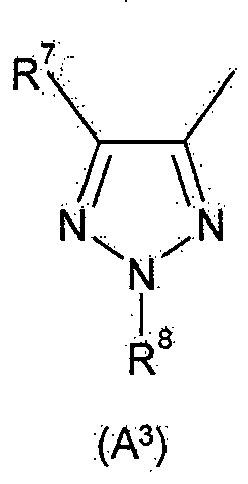 R7 represents a hydrogen atom ; a halogen atom ; C1-C5-alkyl , C1-C5-halogenoalkyl comprising up to 9 halogen atoms which can be the same or different ; C1-C5-alkoxy or C1-C5-halogenoalkoxy comprising up to 9 halogen atoms which can be the same or different ;R8 represents a hydrogen atom or a C1-C5-alkyl ;- a heterocycle of formula (A4)
 R9 to R11 which can be the same or different represent a hydrogen atom ; a halogen atom , C1-C5-alkyl ; amino ; C1-C5-alkoxy ; C1-C5-alkylthio C1-C5-halogenoalkyl comprising up to 9 halogen atoms which can be the same or different or C1-C5-halogenoalkoxy comprising up to 9 halogen atoms which can be the same or different ;- a heterocycle of formula (A5)
 R12 and R13 which can be the same or different represent a hydrogen atom ; a halogen atom ; C1-C5-alkyl ; C1-C5-alkoxy ; amino ; C1-C5-halogenoalkyl comprising up to 9 halogen atoms which can be the same or different or C1-C5-halogenoalkoxy comprising up to 9 halogen atoms which can be the same or different ;R14 represents a hydrogen atom ; a halogen atom ; C1-C5-alkyl , C1-C5-alkoxy ; amino ; C1-C5-halogenoalkyl comprising up to 9 halogen atoms which can be the same or different or C1-C5-halogenoalkoxy comprising up to 9 halogen atoms which can be the same or different ;- a heterocycle of formula (A6)
 R15 represents a hydrogen atom ; a halogen atom , a cyano ; C1-C5-alkyl ; C1-C5-alkoxy ; C1-C5-halogenoalkoxy comprising up to 9 halogen atoms which can be the same or different or C1-C5-halogenoalkyl comprising up to 9 halogen atoms which can be the same or different ,R16 and R18 which can be the same or different represent a hydrogen atom ; a halogen atom ; C1-C5-alkoxycarbonyl ; C1-C5-alkyl ; C1-C5-halogenoalkoxy comprising up to 9 halogen atoms which can be the same or different or C1-C5-halogenoalkyl comprising up to 9 halogen atoms which can be the same or different,R17 represent a hydrogen atom or C1-C5-alkyl ;- a heterocycle of formula (A7)
 R19 represents a hydrogen atom or a C1-C5-alkyl ;R20 to R22 which can be the same or different represent a hydrogen atom ; a halogen atom , C1-C5-alkyl or C1-C5-halogenoalkyl comprising up to 9 halogen atoms which can be the same or different ;- a heterocycle of formula (A8)
 R23 represents a hydrogen atom ; a halogen atom ; C1-C5-alkyl or C1-C5-halogenoalkyl comprising up to 9 halogen atoms which can be the same or different ;R24 represents a hydrogen atom or C1-C5-alkyl or C1-C5-halogenoalkyl comprising up to 9 halogen atoms which can be the same or different,- a heterocyde of formula (A9)
 R25 represents a hydrogen atom ; a halogen atom ; C1-C5-alkyl or C1-C5-halogenoalkyl comprising up to 9 halogen atoms which can be the same or different ;R26 represents a hydrogen atom , C1-C5-alkyl or C1-C5-halogenoalkyl comprising up to 9 halogen atoms which can be the same or different- a heterocycle of formula (A10)
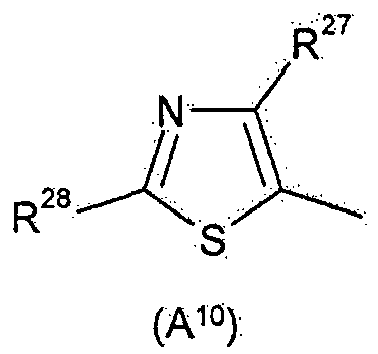 R27 represents a hydrogen atom ; a halogen atom , C1-C5-alkyl or C1-C5-halogenoalkyl comprising up to 9 halogen atoms which can be the same or different ;R28 represents a hydrogen atom ; a halogen atom ; amino ; C1-C5-alkyl or C1-C5-halogenoalkyl comprising up to 9 halogen atoms which can be the same or different ;- a heterocycle of formula (A11)
 R29 represents a hydrogen atom ; a halogen atom , C1-C5-alkyl ; C1-C5-alkoxy ; C1-C5-halogeno-alkoxy comprising up to 9 halogen atoms which can be the same or different or C1-C5-halogenoalkyl comprising up to 9 halogen atoms which can be the same or different,R30 represents a hydrogen atom , a bromine atom ; a fluorine atom ; an iodine atom ; C1-C5-alkyl ; C1-C5-halogenoalkyl comprising up to 9 halogen atoms which can be the same or different ; C1-C5-halogenoalkoxy comprising up to 9 halogen atoms which can be the same or different ; amino ; C1-C5-alkylamino or di-C1-C5-alkylamino ;- a heterocycle of formula (A12)
 R31 represents a hydrogen atom , a halogen atom or a C1-C5-alkyl ;R32 represents a hydrogen atom ; a halogen atom ; C1-C5-alkyl or C1-C5-halogenoalkyl comprising up to 9 halogen atoms which can be the same or different ;R33 represents a hydrogen atom ; a halogen atom ; a nitro ; C1-C5-alkyl ; C1-C5-alkoxy ; C1-C5-halo9enoalkoxy comprising up to 9 halogen atoms which can be the same or different or C1-C5-halogenoalkyl comprising up to 9 halogen atoms which can be the same or different ;- a heterocycle of formula (A13)
 R34 represents a hydrogen atom ; a halogen atom , C1-C5-alkyl C3-C5-cycloalkyl ; C1-C5-halogenoalkyl comprising up to 9 halogen atoms which can be the same or different ; C1-C5-alkoxy ; C2-C5-alkynyloxy or C1-C5-halogenoalkoxy comprising up to 9 halogen atoms which can be the same or different ;R35 represents a hydrogen atom , a halogen atom , C1-C5-alkyl ; a cyano ; C1-C5-alkoxy ; C1-C5-alkylthio ; C1-C5-halogenoalkyl comprising up to 9 halogen atoms which can be the same or different ; C1-C5-halogenoalkoxy comprising up to 9 halogen atoms which can be the same or different ; amino ; C1-C5-alkylamino or di(C1-C5-alkyl)amino ;R36 represents a hydrogen atom or C1-C5-alkyl ;- a heterocycle of formula (A14)
 R37 and R39 which can be the same or different represent a hydrogen atom ; a halogen atom ; C1-C5-alkyl or C1-C5-halogenoalkyl comprising up to 9 halogen atoms which can be the same or different ;R38 represents a hydrogen atom or C1-C5-alkyl ;- a heterocycle of formula (A15)
 R40 and R41 which can be the same or different represent a hydrogen atom ; a halogen atom ; C1-C5-alkyl or C1-C5-halogenoalkyl comprising up to 9 halogen atoms which can be the same or different ;- a heterocycle of formula (A16)
 R42 and R43 which can be the same or different represent a hydrogen atom ; a halogen atom ; C1-C5-alkyl ; C1-C5-halogenoalkyl comprising up to 9 halogen atoms which can be the same or different or amino ;- a heterocycle of formula (A18)
 R47 represents a hydrogen atom , a halogen atom , C1-C5-alkyl or C1-C5-halogenoalkyl comprising up to 9 halogen atoms which can be the same or different ;R48 represents a hydrogen atom , a halogen atom , C1-C5-alkyl ; C1-C5-halogenoalkyl comprising up to 9 halogen atoms which can be the same or different or C1-C5-alkylsulfanyl ;- a heterocycle of formula (A19)
 R49 and R50 which can be the same or different represent a hydrogen atom ; a halogen atom ; C1-C5-alkyl ; C1-C5-alkoxy ; C1-C5-halogenoalkoxy comprising up to 9 halogen atoms which can be the same or different or C1-C5-halogenoalkyl comprising up to 9 halogen atoms which can be the same or different ;- a heterocycle of formula (A21)
 R52 and R53 which can be the same or different represent a hydrogen atom , a halogen atom , C1-C5-alkyl ; C1-C5-halogenoalkyl comprising up to 9 halogen atoms which can be the same or different ; C1-C5-alkoxy or a C1-C5-alkylthio ;R54 represents a hydrogen atom or C1-C5-alkyl ;- a heterocycle of formula (A22)
 R55 and R56 which can be the same or different represent a hydrogen atom ; a halogen atom ; C1-C6-alkyl or C1-C5-halogenoalkyl comprising up to 9 halogen atoms which can be the same or different,R57 represents a hydrogen atom or C1-C5-alkyl ;• Z1 represents a non substituted C3-C7-cycloalkyl or a C3-C7 cycloalkyl substituted by up to 10 atoms or groups which can be the same or different and which can be selected in the list consisting of halogen atoms , cyano , C1-C8-alkyl ; C1-C8-halogenoalkyl comprising up to 9 halogen atoms which can be the same or different ; C1-C8-alkoxy ; C1-C8-halogenoalkoxy comprising up to 9 halogen atoms which can be the same or different ; C1-C8-alkoxycarbonyl ; C1-C8-halogenoalkoxycarbonyl comprising up to 9 halogen atoms which can be the same or different ; C1-C8-alkylaminocarbonyl ; di-C1-C8-alkylaminocarbonyl ;• Z2 and Z3, which can be the same or different, represent a hydrogen atom ; C1-C8-alkyl ; cyano , C1-C8-alkoxycarbonyl or N-C1-C8-alkyl-C1-C8-alkoxycarbamoyl ;• X, which can be the same or different, represents a halogen atom ; nitro ; cyano , hydroxyl ; sulfanyl ; amino ; pentafluoro-λ6-sulfanyl ; C1-C8-alkyl ; C1-C8-halogenoalkyl comprising up to 9 halogen atoms which can be the same or different ; C1-C8-alkylamino ; di-C1-C8-alkylamino ; C1-C8-alkoxy ; C1-C8-halogenoalkoxy comprising up to 9 halogen atoms which can be the same or different C1-C8-alkoxy-C1-C8.alkyl ; C1-C8-alkylsulfanyl ; C1-C8-halogenoalkylsulfanyl comprising up to 9 halogen atoms which can be the same or different , C2-C8-alkenyl ; C2-C8-halogenoalkenyl comprising up to 9 halogen atoms which can be the same or different ; C2-C8-alkynyl ; C2-C8-halogenoalkynyl comprising up to 9 halogen atoms which can be the same or different C2-C8-alkenyloxy ; C2-C8-halogenoalkenyloxy comprising up to 9 halogen atoms which can be the same or different; C2-C8-alkinyloxy ; C2-C8-halogenoalkinyloxy comprising up to 9 halogen atoms which can be the same or different , C3-C7-cycloalkyl ; C3-C7-cycloalkyl-C1-C8-alkyl ; C3-C7-halogenocycloalkyl comprising up to 9 halogen atoms which can be the same or different ; formyl ; formyloxy ; formylamino ; carboxy ; carbamoyl ; N-hydroxycarbamoyl ; carbamate ; (hydroxyimino)-C1-C8-alkyl ; C1-C8-alkylcarbonyl ; C1-C8-halogenoalkylcarbonyl comprising up to 9 halogen atoms which can be the same or different ; C1-C8-alkylcarbamoyl ; di-C1-C8-alkylcarbamoyl ; N-C1-C8-alkyloxyoarbamoyl ; C1-C8-alkoxycarbamoyl ; N-C1-C8-alkyl-C1-C8-alkoxycarbamoyl ; C1-C8-alkoxycarbonyl ; C1-C8-halogenoalkoxycarbonyl comprising up to 9 halogen atoms which can be the same or different , C1-C8-alkylaminocarbonyl ; di-C1-C8-alkylaminocarbonyl ; C1-C8-alkylcarbonyloxy ; C1-C8-halogenoalkylcarbonyloxy comprising up to 9 halogen atoms which can be the same or different , C1-C8-alkylcarbonylamino ; C1-C8-halogenoalkylcarbonylamino comprising up to 9 halogen atoms which can be the same or different ; C1-C8-alkylaminocarbonyloxy ; di-C1-C8-alkylaminocarbonyloxy ; C1-C8-alkyloxycarbonyloxy, C1-C8-alkylsulphenyl, C1-C8-halogenoalkylsulphenyl comprising up to 9 halogen atoms which can be the same or different, C1-C8-alkylsulphinyl, C1-C8-halogenoalkylsulphinyl comprising up to 9 halogen atoms which can be the same or different, C1-C8-alkylsulphonyl, C1-C8-halogenoalkylsulphonyl comprising up to 9 halogen atoms which can be the same or different, C1-C8-alkoxyimino, (C1-C8-alkoxyimino)- C1-C8-alkyl, (C1-C8-alkenyloxyimino)- C1-C8-alkyl, (C1-C8-alkynyloxyimino)- C1-C8-alkyl, a (benzyloxyimino)- C1-C8-alkyl ; tri(C1-C8-alkyl)silyl ; tri(C1-C8-alkyl)silyl- C1-C8-alkyl ; benzyloxy which can be substituted by up to 5 groups Q ; benzylsulfanyl which can be substituted by up to 5 groups Q ; benzylamino which can be substituted by up to 5 groups Q ; naphtyl which can be substituted by up to 6 groups Q ; phenoxy which can be substituted by up to 5 groups Q phenylamino which can be substituted by up to 5 groups Q ; phenylsulfanyl which can be substituted by up to 5 groups Q phenylmethylene which can be substituted by up to 5 groups Q ; pyridinyl which can be substituted by up to four groups Q and pyrdinyloxy which can be substituted by up to four groups Q ;• two substituents X together with the consecutive carbon atoms to which they are linked can form a 5- or 6-membered, saturated, carbo- or hetero-cycle, which can be substituted by up to four groups Q which can be the same or different ;• n represents 1, 2, 3, 4 or 5 ;• Q, which can be the same or different, represents a halogen atom ; cyano , nitro C1-C8-alkyl ; C1-C8-alkoxy C1-C8-alkylsulfanyl ; C1-C8-halogenoalkyl comprising up to 9 halogen atoms which can be the same or different ; C1-C8-halogenoalkoxy comprising up to 9 halogen atoms which can be the same or different , tri(C1-C8)alkylsilyl and tri(C1-C8)alkylsilyl-C1-C8-alkyl ;
 - A compound according to claim 1 wherem A is selected in the list consisting of A1, A2, A3, A4, A5, A6, A8, A9, A10, A12, A13, A15, A16, or A19
- A compound according to claim 2 wherem A is selected in the list consisting of A2 ; A6 ; A10 and A13.
- A compound according to claim 3 wherein A is A13, and R34 represents C1-C5-alkyl C1-C5-halogenoalkyl comprising up to 9 halogen atoms which can be the same or different, R35 represents a hydrogen or a fluorine atom , R36 represents methyl ;
- A compound according to claims 1 to 4 wherein Z1 represents a non substituted C3-C7-cycloalkyl
- A compound according to claims 1 to 5 wherein Z1 represents cyclopropyl.
- A compound according to claims 1 to 6 wherein Z1 represents a C3-C7 cycloalkyl substituted by up to 10 groups or atoms which can be the same or different and which can be selected ion in the list consisting of halogen atoms ; C1-C8-alkyl ; C1-C8-halogenoalkyl comprising up to 9 halogen atoms which can be the same or different, C1-C8-alkoxy or C1-C8-halogenoalkoxy comprising up to 9 halogen atoms which can be the same or different.
- A compound according to claims 1 to 7 wherein X, which can be the same or different, represents a halogen atom ; C1-C8-alkyl ; C1-C8-halogenoalkyl comprising up to 9 halogen atoms which can be the same or different ; C1-C8-alkoxy or C1-C8-halogenoalkoxy comprising up to 9 halogen atoms which can be the same or different
- A compound according to claims 1 to 7 wherein two consecutive substituents X together with the phenyl ring form a substituted or non substituted 1,3-benzodioxolyl ; 1,2,3,4-tetrahydro-quinoxalinyl ; 3,4-dihydro-2H-1,4-benzoxazinyl ; 1,4-benzodioxanyl ; indanyl ; 2,3-dihydrobenzofuranyl ; indolinyl
- A fungicide composition comprising, as an active ingredient, an effective amount of a compound of formula (I) according to claims 1 to 9 and an agriculturally acceptable support, carrier or filler.
- A process for the preparation of a compound of formula (I) according to claims 1 to 9 according to the following scheme :
 A, Z1, Z2, Z3, X and n are as defined in claims 1 to 9 ;Y1 represents a halogen or a hydroxyl.
 - A process for the preparation of a compound of formula (I) according to claims 1 to 9 according to the following scheme :
 A, Z1, Z2, Z3, X and n are as defined in claims 1 to 9 ;Y1 represents a halogen or a hydroxyl ;Y2 represents a halogen or a leaving group like a tosylate group.
 - A process for the preparation of a compound of formula (I) according to claims 1 to 9 according to the following scheme :
 A, Z1, Z2, Z3, X, Q and n are as defined in claims 1 to 9 ;Y3 represents a halogen atom ;Y4 represents sulphur, oxygen or C1-C5-alkylamino.
 - A method for controlling phytopathogenic fungi of crops, characterized in that an agronomically effective and substantially non-phytotoxic quantity of a compound according to claims 1 to 9 or a composition according to claim 10 is applied to the soil where plants grow or are capable of growing, to the leaves and/or the fruit of plants or to the seeds of plants.
Priority Applications (2)
| Application Number | Priority Date | Filing Date | Title |
|---|---|---|---|
| PL11163592T PL2351747T3 (en) | 2006-02-01 | 2006-11-15 | Fungicide n-cycloalkyl-benzyl-amide derivatives |
| EP11163592.6A EP2351747B1 (en) | 2006-02-01 | 2006-11-15 | Fungicide n-cycloalkyl-benzyl-amide derivatives |
Applications Claiming Priority (3)
| Application Number | Priority Date | Filing Date | Title |
|---|---|---|---|
| EP06356008 | 2006-02-01 | ||
| EP06807817.9A EP1981866B8 (en) | 2006-02-01 | 2006-11-15 | N-cyclopropyl-N-benzylamides as fungicides |
| EP11163592.6A EP2351747B1 (en) | 2006-02-01 | 2006-11-15 | Fungicide n-cycloalkyl-benzyl-amide derivatives |
Related Parent Applications (2)
| Application Number | Title | Priority Date | Filing Date |
|---|---|---|---|
| EP06807817.9A Division EP1981866B8 (en) | 2006-02-01 | 2006-11-15 | N-cyclopropyl-N-benzylamides as fungicides |
| EP06807817.9 Division | 2006-11-15 |
Publications (2)
| Publication Number | Publication Date |
|---|---|
| EP2351747A1 EP2351747A1 (en) | 2011-08-03 |
| EP2351747B1 true EP2351747B1 (en) | 2014-07-02 |
Family
ID=36579250
Family Applications (2)
| Application Number | Title | Priority Date | Filing Date |
|---|---|---|---|
| EP11163592.6A Active EP2351747B1 (en) | 2006-02-01 | 2006-11-15 | Fungicide n-cycloalkyl-benzyl-amide derivatives |
| EP06807817.9A Active EP1981866B8 (en) | 2006-02-01 | 2006-11-15 | N-cyclopropyl-N-benzylamides as fungicides |
Family Applications After (1)
| Application Number | Title | Priority Date | Filing Date |
|---|---|---|---|
| EP06807817.9A Active EP1981866B8 (en) | 2006-02-01 | 2006-11-15 | N-cyclopropyl-N-benzylamides as fungicides |
Country Status (17)
| Country | Link |
|---|---|
| US (1) | US8088927B2 (en) |
| EP (2) | EP2351747B1 (en) |
| JP (1) | JP5052531B2 (en) |
| KR (1) | KR101312761B1 (en) |
| CN (1) | CN101360730B (en) |
| AR (1) | AR056882A1 (en) |
| AU (1) | AU2006337483B2 (en) |
| BR (1) | BRPI0620513B1 (en) |
| CA (1) | CA2632870C (en) |
| DK (1) | DK2351747T3 (en) |
| ES (2) | ES2405304T3 (en) |
| PL (2) | PL2351747T3 (en) |
| PT (2) | PT2351747E (en) |
| RU (1) | RU2419616C2 (en) |
| UA (1) | UA95796C2 (en) |
| WO (1) | WO2007087906A1 (en) |
| ZA (1) | ZA200805608B (en) |
Families Citing this family (60)
| Publication number | Priority date | Publication date | Assignee | Title |
|---|---|---|---|---|
| AU2004315596B2 (en) | 2003-08-29 | 2011-11-24 | President And Fellows Of Harvard College | Inhibitors of cellular necrosis |
| UY30892A1 (en) | 2007-02-07 | 2008-09-02 | Smithkline Beckman Corp | AKT ACTIVITY INHIBITORS |
| CL2008002241A1 (en) * | 2007-07-31 | 2009-12-28 | Bayer Cropscience Sa | N-substituted 6-membered fused (hetero) aryl-methylene-n-cycloalkyl carboxamide derivatives; fungicidal composition comprising one of said compounds; and method for the control of phytopathogenic fungi of agricultural crops. |
| WO2009024342A2 (en) * | 2007-08-23 | 2009-02-26 | Syngenta Participations Ag | Novel microbiocides |
| CN101250168B (en) * | 2008-03-28 | 2011-12-14 | 南开大学 | Thiadiazoles imine derivative as well as synthesis and uses thereof |
| EP2310360B1 (en) | 2008-08-01 | 2012-08-29 | Bayer CropScience AG | Fungicide n-cycloalkyl-n-biphenylmethyl-carboxamide derivatives |
| WO2010075561A1 (en) | 2008-12-23 | 2010-07-01 | President And Fellows Of Harvard College | Small molecule inhibitors of necroptosis |
| BRPI1004930B1 (en) * | 2009-01-28 | 2017-10-17 | Bayer Intellectual Property Gmbh | Compounds, fungicidal composition and method for controlling phytopathogenic fungi of crops. |
| EP2251331A1 (en) | 2009-05-15 | 2010-11-17 | Bayer CropScience AG | Fungicide pyrazole carboxamides derivatives |
| AR076839A1 (en) * | 2009-05-15 | 2011-07-13 | Bayer Cropscience Ag | FUNGICIDE DERIVATIVES OF PIRAZOL CARBOXAMIDAS |
| WO2010134634A1 (en) * | 2009-05-20 | 2010-11-25 | 住友化学株式会社 | Amide compound and use thereof for control of plant diseases |
| WO2010134631A1 (en) * | 2009-05-20 | 2010-11-25 | 住友化学株式会社 | Amide compound and use thereof for control of plant diseases |
| WO2010134636A1 (en) * | 2009-05-20 | 2010-11-25 | 住友化学株式会社 | Amide compound and use thereof for control of plant diseases |
| WO2010134629A1 (en) * | 2009-05-20 | 2010-11-25 | 住友化学株式会社 | Amide compound and use thereof for control of plant diseases |
| JP2011001353A (en) * | 2009-05-20 | 2011-01-06 | Sumitomo Chemical Co Ltd | Amide compound and use thereof |
| JP2011001354A (en) * | 2009-05-20 | 2011-01-06 | Sumitomo Chemical Co Ltd | Amide compound, and use thereof in controlling plant disease |
| EP2470507B1 (en) | 2009-08-25 | 2014-03-26 | Syngenta Participations AG | N-Alkoxycarboxamides and their use as microbiocides |
| EP2325173A1 (en) | 2009-11-19 | 2011-05-25 | Bayer CropScience AG | Method for producing 5-fluor-1-alkyl-3-fluoralkyl-1H-pyrazol-4-carboxylic acid chlorides |
| CN103140477B (en) | 2010-04-23 | 2015-07-15 | 拜耳知识产权股份有限公司 | Process for preparing 5-fluoro-1-alkyl-3-fluoroalkyl-1h-pyrazole-4-carbonyl chlorides and fluorides |
| EP2617715A4 (en) * | 2010-09-17 | 2014-02-26 | Taisho Pharmaceutical Co Ltd | GLYCINE TRANSPORTER INHIBITOR |
| BR112013009580B1 (en) | 2010-10-21 | 2018-06-19 | Bayer Intellectual Property Gmbh | FORMULA COMPOUND (I), FUNGICIDE COMPOSITION AND METHOD FOR CONTROLING PHYTOPATHOGENIC FUNGES |
| CA2815117A1 (en) | 2010-11-02 | 2012-05-10 | Bayer Intellectual Property Gmbh | N-hetarylmethyl pyrazolylcarboxamides |
| CN102464618B (en) | 2010-11-03 | 2014-07-23 | 中国中化股份有限公司 | Pyrazolecarboxamide compound and application thereof |
| TWI562977B (en) | 2010-11-05 | 2016-12-21 | Bayer Ip Gmbh | Process for the preparation of substituted n-(benzyl)cyclopropanamines by imine hydrogenation |
| JP5870185B2 (en) * | 2011-04-22 | 2016-02-24 | バイエル・インテレクチュアル・プロパティ・ゲゼルシャフト・ミット・ベシュレンクテル・ハフツングBayer Intellectual Property GmbH | Active compound combination comprising (thio) carboxamide derivative and insecticidal active compound or acaricidal active compound or nematicidal active compound |
| ES2561296T3 (en) * | 2011-04-22 | 2016-02-25 | Bayer Intellectual Property Gmbh | Combinations of an active compound comprising a carboximide derivative and a fungicidal compound |
| JP6456145B2 (en) * | 2012-01-21 | 2019-01-23 | バイエル・インテレクチュアル・プロパティ・ゲゼルシャフト・ミット・ベシュレンクテル・ハフツングBayer Intellectual Property GmbH | Use of host defense inducers to control bacterial harmful microorganisms in useful plants |
| EP2831048B1 (en) | 2012-03-26 | 2017-04-26 | Bayer Intellectual Property GmbH | Fungicide n-cycloalkyl-n-bicyclicmethylene-carboxamide derivatives |
| JP2015514079A (en) | 2012-03-26 | 2015-05-18 | バイエル・インテレクチュアル・プロパティ・ゲゼルシャフト・ミット・ベシュレンクテル・ハフツングBayer Intellectual Property GmbH | N-cycloalkyl-N-[(cycloalkenylphenyl) methylene]-(thio) carboxamide derivatives |
| JP2015516396A (en) | 2012-04-20 | 2015-06-11 | バイエル・クロップサイエンス・アーゲーBayer Cropscience Ag | N-cycloalkyl-N-[(trisubstituted silylphenyl) methylene]-(thio) carboxamide derivatives |
| KR102062517B1 (en) | 2012-04-20 | 2020-01-06 | 바이엘 크롭사이언스 악티엔게젤샤프트 | N-cycloalkyl-n-[(heterocyclylphenyl)methylene]-(thio)carboxamide derivatives |
| MX348074B (en) | 2012-04-26 | 2017-05-25 | Bayer Cropscience Ag | Process for preparing n-(5-chloro-2-isopropylbenzyl)cyclopropanam ine. |
| DK2850066T3 (en) | 2012-05-14 | 2016-04-25 | Bayer Cropscience Ag | PROCESS FOR THE PREPARATION OF 1-alkyl-3-fluoroalkyl-1H-pyrazole-4-carboxylic acid chlorides |
| MX380476B (en) * | 2012-10-19 | 2025-03-12 | Bayer Cropscience Ag | METHOD OF PLANT GROWTH PROMOTION USING CARBOXAMIDE DERIVATIVES. |
| AU2013333847B2 (en) | 2012-10-19 | 2017-04-20 | Bayer Cropscience Ag | Method for treating plants against fungi resistant to fungicides using carboxamide or thiocarboxamide derivatives |
| CA2888600C (en) | 2012-10-19 | 2021-08-10 | Bayer Cropscience Ag | Active compound combinations comprising carboxamide derivatives |
| US9439426B2 (en) * | 2012-10-19 | 2016-09-13 | Bayer Cropscience Ag | Active compound combinations comprising carboxamide derivatives and a biological control agent |
| CA2888559C (en) * | 2012-10-19 | 2021-03-02 | Bayer Cropscience Ag | Method for enhancing tolerance to abiotic stress in plants using carboxamide or thiocarboxamide derivatives |
| CN109503485A (en) * | 2012-11-13 | 2019-03-22 | 拜耳作物科学股份公司 | The method for producing carboxylic acid amides |
| WO2014145022A1 (en) | 2013-03-15 | 2014-09-18 | President And Fellows Of Harvard College | Hybrid necroptosis inhibitors |
| US9770022B2 (en) | 2013-06-26 | 2017-09-26 | Bayer Cropscience Ag | N-cycloalkyl-N-[(bicyclylphenyl)methylene]-(thio)carboxamide derivatives |
| BR112015031331A2 (en) | 2013-06-26 | 2017-07-25 | Bayer Cropscience Ag | n-cycloalkyl-n - [(phenylfused) methylene] - (thio) carboxamide derivatives |
| BR112016007643B1 (en) | 2013-10-16 | 2021-03-23 | Bayer Cropscience Aktiengesellschaft | FUNGICIDAL COMPOSITIONS WITH CARBOXAMIDE DERIVATIVE AND FUNGICIDE COMPOUND, THEIR PRODUCTION PROCESSES, THEIR USES AND METHOD FOR THE CONTROL OF PHYTOPATHOGENIC HARMFUL FUNGI |
| TW201609661A (en) | 2013-12-05 | 2016-03-16 | 拜耳作物科學公司 | N-cycloalkyl-N-{[2-(1-substitutedcycloalkyl)phenyl]methylene}-(thio)carboxamide derivatives |
| EP3077377B1 (en) * | 2013-12-05 | 2020-01-22 | Bayer CropScience Aktiengesellschaft | N-cycloalkyl-n-{[2-(1-substitutedcycloalkyl)phenyl]methylene}-(thio)carboxamide derivatives |
| JP6331075B2 (en) * | 2014-04-11 | 2018-05-30 | アグロカネショウ株式会社 | 3-Amino-1H-pyrazole-4-carboxylic acid benzyl ester derivatives and fungicides containing the same as active ingredients |
| WO2016094846A1 (en) | 2014-12-11 | 2016-06-16 | President And Fellows Of Harvard College | Inhibitors of cellular necrosis and related methods |
| AR104687A1 (en) | 2015-05-19 | 2017-08-09 | Bayer Cropscience Ag | METHOD FOR TREATING ROYA COFFEE DISEASES, BLACK MANCHA OF THE CITRUS, SARNA OF THE CITRUS AND SIGATOKA BLACK OF THE BANANA |
| UY36964A (en) | 2015-10-27 | 2017-05-31 | Bayer Cropscience Ag | COMBINATIONS OF ACTIVE PRINCIPLES THAT INCLUDE A DERIVATIVE OF (UNCLE) CARBOXAMIDE AND A FUNGUITED COMPOUND |
| WO2018109062A1 (en) | 2016-12-16 | 2018-06-21 | Bayer Cropscience Aktiengesellschaft | Method for the control of plant bacterial diseases using carboxamide derivatives |
| JP7037507B2 (en) | 2017-01-26 | 2022-03-16 | 三井化学アグロ株式会社 | Pyridone compound and agricultural and horticultural fungicides containing it as an active ingredient |
| CA3059675A1 (en) | 2017-04-10 | 2018-10-18 | Mitsui Chemicals Agro, Inc. | Pyridone compounds and agricultural and horticultural fungicides comprising the same as active ingredients |
| TWI793113B (en) | 2017-04-10 | 2023-02-21 | 日商三井化學Agro股份有限公司 | Pyridone compound, and agricultural and horticultural fungicide using same as active ingredient |
| KR102498819B1 (en) | 2017-04-11 | 2023-02-10 | 미쓰이가가쿠 아그로 가부시키가이샤 | Pyridone compound and agricultural and horticultural fungicide containing it as an active ingredient |
| US11117863B2 (en) | 2017-06-08 | 2021-09-14 | Mitsui Chemicals Agro, Inc. | Pyridone compounds and agricultural and horticultural fungicides containing the same as active ingredients |
| CN108409684B (en) * | 2018-04-26 | 2022-04-12 | 上海晓明检测技术服务有限公司 | N- (2-cyclohexyloxyphenyl) amide compound and preparation method and application thereof |
| EP3828177B1 (en) | 2018-07-25 | 2023-11-29 | Mitsui Chemicals Crop & Life Solutions, Inc. | Pyridone compound and agricultural and horticultural fungicide having this as active component |
| CN109169693B (en) * | 2018-08-29 | 2021-03-16 | 浙江工业大学 | Application of a novel pyrazole ring-containing amide compound in the preparation of herbicides |
| CN109156471B (en) * | 2018-08-29 | 2020-12-15 | 浙江工业大学 | Application of a 1,3-dimethyl-1H-pyrazole-4-amide derivative in the preparation of herbicides |
| WO2025206002A1 (en) * | 2024-03-28 | 2025-10-02 | 日本曹達株式会社 | Triazole compound and microbicide for agricultural or horticultural use |
Family Cites Families (9)
| Publication number | Priority date | Publication date | Assignee | Title |
|---|---|---|---|---|
| AU2241677A (en) * | 1976-03-12 | 1978-08-24 | Bayer Ag | 4,5-dichloroimidazole-2-carboxylic acid derivatives |
| DE2728523C2 (en) * | 1977-06-23 | 1986-02-27 | Schering AG, 1000 Berlin und 4709 Bergkamen | 4-Methyl-1,2,3-thiadiazole-5-carboxylic acid (cyclohexylmethyl) amide, agents having a herbicidal and growth-regulating action, containing this compound and a process for its preparation |
| DE2913977A1 (en) | 1979-04-05 | 1980-10-23 | Schering Ag | 1,2,3-THIADIAZOLE-5-CARBONIC ACID AMIDE DERIVATIVES, METHOD FOR PRODUCING THESE COMPOUNDS, AND THEIR CONTAINING AGENTS WITH HERBICIDES, GROWTH REGULATIVE AND DEBELIFIERING AND FUNGICIDAL EFFECT |
| JPH04128275A (en) * | 1990-09-19 | 1992-04-28 | Mitsubishi Kasei Corp | N-benzylamides and insecticidal miticide containing the compound as active component |
| IL103614A (en) | 1991-11-22 | 1998-09-24 | Basf Ag | Carboxamides for controlling botrytis and certain novel such compounds |
| US5223526A (en) | 1991-12-06 | 1993-06-29 | Monsanto Company | Pyrazole carboxanilide fungicides and use |
| DE19629828A1 (en) * | 1996-07-24 | 1998-01-29 | Bayer Ag | Carbanilides |
| JP4128275B2 (en) * | 1998-07-06 | 2008-07-30 | オリンパス株式会社 | Camera with translation function |
| US7786040B2 (en) * | 2005-02-24 | 2010-08-31 | Nihon Nohyaku Co., Ltd. | 4-cyclopropyl-1,2,3,-thiadiazole compound, agrohorticultural plant disease controlling agent and method of using the same |
-
2006
- 2006-11-14 AR ARP060104983A patent/AR056882A1/en active IP Right Grant
- 2006-11-15 DK DK11163592.6T patent/DK2351747T3/en active
- 2006-11-15 BR BRPI0620513-5A patent/BRPI0620513B1/en active IP Right Grant
- 2006-11-15 RU RU2008135317/04A patent/RU2419616C2/en active
- 2006-11-15 CN CN2006800510597A patent/CN101360730B/en active Active
- 2006-11-15 ES ES06807817T patent/ES2405304T3/en active Active
- 2006-11-15 EP EP11163592.6A patent/EP2351747B1/en active Active
- 2006-11-15 PT PT111635926T patent/PT2351747E/en unknown
- 2006-11-15 JP JP2008552700A patent/JP5052531B2/en active Active
- 2006-11-15 WO PCT/EP2006/068478 patent/WO2007087906A1/en not_active Ceased
- 2006-11-15 CA CA2632870A patent/CA2632870C/en active Active
- 2006-11-15 EP EP06807817.9A patent/EP1981866B8/en active Active
- 2006-11-15 AU AU2006337483A patent/AU2006337483B2/en not_active Ceased
- 2006-11-15 PL PL11163592T patent/PL2351747T3/en unknown
- 2006-11-15 PT PT68078179T patent/PT1981866E/en unknown
- 2006-11-15 US US12/223,105 patent/US8088927B2/en active Active
- 2006-11-15 ES ES11163592.6T patent/ES2504066T3/en active Active
- 2006-11-15 PL PL06807817T patent/PL1981866T3/en unknown
- 2006-11-15 KR KR1020087017816A patent/KR101312761B1/en active Active
- 2006-11-15 UA UAA200810688A patent/UA95796C2/en unknown
-
2008
- 2008-06-26 ZA ZA2008/05608A patent/ZA200805608B/en unknown
Also Published As
| Publication number | Publication date |
|---|---|
| RU2008135317A (en) | 2010-03-10 |
| EP1981866A1 (en) | 2008-10-22 |
| BRPI0620513A2 (en) | 2011-11-16 |
| AR056882A1 (en) | 2007-10-31 |
| WO2007087906A1 (en) | 2007-08-09 |
| EP1981866B8 (en) | 2013-04-10 |
| JP5052531B2 (en) | 2012-10-17 |
| ZA200805608B (en) | 2009-12-30 |
| ES2504066T3 (en) | 2014-10-08 |
| CA2632870C (en) | 2015-03-24 |
| AU2006337483B2 (en) | 2012-05-10 |
| DK2351747T3 (en) | 2014-09-29 |
| JP2009525290A (en) | 2009-07-09 |
| US20100286221A1 (en) | 2010-11-11 |
| CN101360730B (en) | 2012-06-27 |
| CA2632870A1 (en) | 2007-08-09 |
| PL2351747T3 (en) | 2014-12-31 |
| US8088927B2 (en) | 2012-01-03 |
| BRPI0620513B1 (en) | 2018-05-15 |
| RU2419616C2 (en) | 2011-05-27 |
| PT1981866E (en) | 2013-05-08 |
| KR101312761B1 (en) | 2013-09-27 |
| PL1981866T3 (en) | 2013-07-31 |
| EP1981866B1 (en) | 2013-02-27 |
| ES2405304T3 (en) | 2013-05-30 |
| AU2006337483A1 (en) | 2007-08-09 |
| CN101360730A (en) | 2009-02-04 |
| PT2351747E (en) | 2014-09-23 |
| EP2351747A1 (en) | 2011-08-03 |
| UA95796C2 (en) | 2011-09-12 |
| KR20080090438A (en) | 2008-10-08 |
Similar Documents
| Publication | Publication Date | Title |
|---|---|---|
| EP1981866B1 (en) | N-cyclopropyl-N-benzylamides as fungicides | |
| EP1928830B1 (en) | Fungicide pyridinyloxy substituted phenylamidine derivatives | |
| EP2125740B1 (en) | Fungicide n-(3-phenylpropyl)carboxamide derivatives | |
| US7727986B2 (en) | Pesticide pyrimidinyloxy substituted phenylamidine derivatives | |
| EP1928818B1 (en) | Pesticide benzyloxy- and phenetyl-substituted phenyl-amidine derivatives | |
| US8314269B2 (en) | N-(1-methyl-2phenylethyl)benzamide derivatives | |
| EP1881978B1 (en) | Fungicide 2-pyridyl-methylene-carboxamide derivatives | |
| EP1871744B1 (en) | New heterocyclylethylbenzamide derivatives | |
| US20080033020A1 (en) | 3-Pyridinylethylbenzamide Derivatives as Fungicides | |
| US20100063155A1 (en) | N-(3-phenylpropyl)benzamide derivatives | |
| EP1937637B1 (en) | New n-alkyl-heterocyclyl carboxamide derivatives | |
| US20090054235A1 (en) | Benzoheterocyclylethylbenzamide derivatives | |
| US20100324102A1 (en) | N-(3-pyridin-2-ylpropyl) benzamide derivatives as fungicides | |
| WO2008081016A1 (en) | New n-alkynylbenzamide derivatives |
Legal Events
| Date | Code | Title | Description |
|---|---|---|---|
| PUAI | Public reference made under article 153(3) epc to a published international application that has entered the european phase |
Free format text: ORIGINAL CODE: 0009012 |
|
| AC | Divisional application: reference to earlier application |
Ref document number: 1981866 Country of ref document: EP Kind code of ref document: P |
|
| AK | Designated contracting states |
Kind code of ref document: A1 Designated state(s): AT BE BG CH CY CZ DE DK EE ES FI FR GB GR HU IE IS IT LI LT LU LV MC NL PL PT RO SE SI SK TR |
|
| AX | Request for extension of the european patent |
Extension state: AL BA HR MK RS |
|
| RIN1 | Information on inventor provided before grant (corrected) |
Inventor name: VILLIER, ALAIN Inventor name: DESBORDES, PHILIPPE Inventor name: GROSJEAN-COURNOYER, MARIE-CLAIRE Inventor name: DUNKEL, RALF Inventor name: MANSFIELD, DARREN Inventor name: VORS, JEAN-PIERRE Inventor name: TUCH, AROUNARITH Inventor name: CARBONNE, STEPHANE Inventor name: COQUERON, PIERRE-YVES Inventor name: GARY, STEPHANIE |
|
| 17P | Request for examination filed |
Effective date: 20120203 |
|
| 17Q | First examination report despatched |
Effective date: 20120424 |
|
| RAP1 | Party data changed (applicant data changed or rights of an application transferred) |
Owner name: BAYER INTELLECTUAL PROPERTY GMBH |
|
| REG | Reference to a national code |
Ref country code: DE Ref legal event code: R079 Ref document number: 602006042182 Country of ref document: DE Free format text: PREVIOUS MAIN CLASS: C07D0307460000 Ipc: C07D0275030000 |
|
| GRAP | Despatch of communication of intention to grant a patent |
Free format text: ORIGINAL CODE: EPIDOSNIGR1 |
|
| RIC1 | Information provided on ipc code assigned before grant |
Ipc: C07D 275/02 20060101ALI20140115BHEP Ipc: A01N 43/78 20060101ALI20140115BHEP Ipc: A01N 43/56 20060101ALI20140115BHEP Ipc: C07D 249/04 20060101ALI20140115BHEP Ipc: A01N 43/36 20060101ALI20140115BHEP Ipc: C07D 277/56 20060101ALI20140115BHEP Ipc: A01N 43/10 20060101ALI20140115BHEP Ipc: A01N 43/76 20060101ALI20140115BHEP Ipc: A01N 43/80 20060101ALI20140115BHEP Ipc: C07D 307/46 20060101ALI20140115BHEP Ipc: A01N 43/50 20060101ALI20140115BHEP Ipc: C07D 285/06 20060101ALI20140115BHEP Ipc: C07D 275/03 20060101AFI20140115BHEP Ipc: C07D 207/34 20060101ALI20140115BHEP Ipc: A01N 43/707 20060101ALI20140115BHEP Ipc: C07D 261/18 20060101ALI20140115BHEP Ipc: C07D 233/90 20060101ALI20140115BHEP Ipc: A01N 43/08 20060101ALI20140115BHEP Ipc: C07D 231/14 20060101ALI20140115BHEP Ipc: C07D 263/34 20060101ALI20140115BHEP Ipc: C07D 333/38 20060101ALI20140115BHEP |
|
| INTG | Intention to grant announced |
Effective date: 20140204 |
|
| GRAS | Grant fee paid |
Free format text: ORIGINAL CODE: EPIDOSNIGR3 |
|
| GRAA | (expected) grant |
Free format text: ORIGINAL CODE: 0009210 |
|
| AC | Divisional application: reference to earlier application |
Ref document number: 1981866 Country of ref document: EP Kind code of ref document: P |
|
| AK | Designated contracting states |
Kind code of ref document: B1 Designated state(s): AT BE BG CH CY CZ DE DK EE ES FI FR GB GR HU IE IS IT LI LT LU LV MC NL PL PT RO SE SI SK TR |
|
| REG | Reference to a national code |
Ref country code: GB Ref legal event code: FG4D |
|
| REG | Reference to a national code |
Ref country code: AT Ref legal event code: REF Ref document number: 675856 Country of ref document: AT Kind code of ref document: T Effective date: 20140715 Ref country code: CH Ref legal event code: EP |
|
| REG | Reference to a national code |
Ref country code: IE Ref legal event code: FG4D |
|
| REG | Reference to a national code |
Ref country code: DE Ref legal event code: R096 Ref document number: 602006042182 Country of ref document: DE Effective date: 20140814 |
|
| REG | Reference to a national code |
Ref country code: PT Ref legal event code: SC4A Free format text: AVAILABILITY OF NATIONAL TRANSLATION Effective date: 20140917 |
|
| REG | Reference to a national code |
Ref country code: DK Ref legal event code: T3 Effective date: 20140923 |
|
| REG | Reference to a national code |
Ref country code: ES Ref legal event code: FG2A Ref document number: 2504066 Country of ref document: ES Kind code of ref document: T3 Effective date: 20141008 |
|
| REG | Reference to a national code |
Ref country code: NL Ref legal event code: T3 |
|
| REG | Reference to a national code |
Ref country code: EE Ref legal event code: FG4A Ref document number: E009755 Country of ref document: EE Effective date: 20140918 |
|
| REG | Reference to a national code |
Ref country code: PL Ref legal event code: T3 |
|
| PG25 | Lapsed in a contracting state [announced via postgrant information from national office to epo] |
Ref country code: BG Free format text: LAPSE BECAUSE OF FAILURE TO SUBMIT A TRANSLATION OF THE DESCRIPTION OR TO PAY THE FEE WITHIN THE PRESCRIBED TIME-LIMIT Effective date: 20141002 Ref country code: SE Free format text: LAPSE BECAUSE OF FAILURE TO SUBMIT A TRANSLATION OF THE DESCRIPTION OR TO PAY THE FEE WITHIN THE PRESCRIBED TIME-LIMIT Effective date: 20140702 Ref country code: GR Free format text: LAPSE BECAUSE OF FAILURE TO SUBMIT A TRANSLATION OF THE DESCRIPTION OR TO PAY THE FEE WITHIN THE PRESCRIBED TIME-LIMIT Effective date: 20141003 |
|
| PG25 | Lapsed in a contracting state [announced via postgrant information from national office to epo] |
Ref country code: CY Free format text: LAPSE BECAUSE OF FAILURE TO SUBMIT A TRANSLATION OF THE DESCRIPTION OR TO PAY THE FEE WITHIN THE PRESCRIBED TIME-LIMIT Effective date: 20140702 Ref country code: IS Free format text: LAPSE BECAUSE OF FAILURE TO SUBMIT A TRANSLATION OF THE DESCRIPTION OR TO PAY THE FEE WITHIN THE PRESCRIBED TIME-LIMIT Effective date: 20141102 |
|
| REG | Reference to a national code |
Ref country code: DE Ref legal event code: R097 Ref document number: 602006042182 Country of ref document: DE |
|
| PG25 | Lapsed in a contracting state [announced via postgrant information from national office to epo] |
Ref country code: RO Free format text: LAPSE BECAUSE OF FAILURE TO SUBMIT A TRANSLATION OF THE DESCRIPTION OR TO PAY THE FEE WITHIN THE PRESCRIBED TIME-LIMIT Effective date: 20140702 Ref country code: SK Free format text: LAPSE BECAUSE OF FAILURE TO SUBMIT A TRANSLATION OF THE DESCRIPTION OR TO PAY THE FEE WITHIN THE PRESCRIBED TIME-LIMIT Effective date: 20140702 |
|
| PLBE | No opposition filed within time limit |
Free format text: ORIGINAL CODE: 0009261 |
|
| STAA | Information on the status of an ep patent application or granted ep patent |
Free format text: STATUS: NO OPPOSITION FILED WITHIN TIME LIMIT |
|
| 26N | No opposition filed |
Effective date: 20150407 |
|
| PG25 | Lapsed in a contracting state [announced via postgrant information from national office to epo] |
Ref country code: LU Free format text: LAPSE BECAUSE OF FAILURE TO SUBMIT A TRANSLATION OF THE DESCRIPTION OR TO PAY THE FEE WITHIN THE PRESCRIBED TIME-LIMIT Effective date: 20141115 Ref country code: MC Free format text: LAPSE BECAUSE OF FAILURE TO SUBMIT A TRANSLATION OF THE DESCRIPTION OR TO PAY THE FEE WITHIN THE PRESCRIBED TIME-LIMIT Effective date: 20140702 |
|
| REG | Reference to a national code |
Ref country code: IE Ref legal event code: MM4A |
|
| REG | Reference to a national code |
Ref country code: HU Ref legal event code: AG4A Ref document number: E023556 Country of ref document: HU |
|
| REG | Reference to a national code |
Ref country code: FR Ref legal event code: PLFP Year of fee payment: 10 |
|
| PG25 | Lapsed in a contracting state [announced via postgrant information from national office to epo] |
Ref country code: IE Free format text: LAPSE BECAUSE OF NON-PAYMENT OF DUE FEES Effective date: 20141115 |
|
| PG25 | Lapsed in a contracting state [announced via postgrant information from national office to epo] |
Ref country code: SI Free format text: LAPSE BECAUSE OF FAILURE TO SUBMIT A TRANSLATION OF THE DESCRIPTION OR TO PAY THE FEE WITHIN THE PRESCRIBED TIME-LIMIT Effective date: 20140702 |
|
| REG | Reference to a national code |
Ref country code: FR Ref legal event code: PLFP Year of fee payment: 11 |
|
| REG | Reference to a national code |
Ref country code: FR Ref legal event code: PLFP Year of fee payment: 12 |
|
| REG | Reference to a national code |
Ref country code: FR Ref legal event code: PLFP Year of fee payment: 13 |
|
| REG | Reference to a national code |
Ref country code: HU Ref legal event code: FH1C Free format text: FORMER REPRESENTATIVE(S): SCHLAEFER LASZLO, DANUBIA SZABADALMI ES JOGI IRODA KFT., HU Representative=s name: DANUBIA SZABADALMI ES JOGI IRODA KFT., HU Ref country code: HU Ref legal event code: GB9C Owner name: BAYER CROPSCIENCE AKTIENGESELLSCHAFT, DE Free format text: FORMER OWNER(S): BAYER INTELLECTUAL PROPERTY GMBH, DE |
|
| REG | Reference to a national code |
Ref country code: CH Ref legal event code: PUE Owner name: BAYER CROPSCIENCE AKTIENGESELLSCHAFT, DE Free format text: FORMER OWNER: BAYER INTELLECTUAL PROPERTY GMBH, DE |
|
| REG | Reference to a national code |
Ref country code: EE Ref legal event code: GB1A Ref document number: E009755 Country of ref document: EE |
|
| REG | Reference to a national code |
Ref country code: GB Ref legal event code: 732E Free format text: REGISTERED BETWEEN 20190207 AND 20190213 |
|
| REG | Reference to a national code |
Ref country code: ES Ref legal event code: PC2A Owner name: BAYER CROPSCIENCE AKTIENGESELLSCHAFT Effective date: 20190305 |
|
| REG | Reference to a national code |
Ref country code: DE Ref legal event code: R081 Ref document number: 602006042182 Country of ref document: DE Owner name: BAYER CROPSCIENCE AKTIENGESELLSCHAFT, DE Free format text: FORMER OWNER: BAYER INTELLECTUAL PROPERTY GMBH, 40789 MONHEIM, DE |
|
| REG | Reference to a national code |
Ref country code: NL Ref legal event code: PD Owner name: BAYER CROPSCIENCE AKTIENGESELLSCHAFT; DE Free format text: DETAILS ASSIGNMENT: CHANGE OF OWNER(S), ASSIGNMENT; FORMER OWNER NAME: BAYER INTELLECTUAL PROPERTY GMBH Effective date: 20190208 |
|
| REG | Reference to a national code |
Ref country code: BE Ref legal event code: FP Effective date: 20140918 Ref country code: BE Ref legal event code: PD Owner name: BAYER CROPSCIENCE AKTIENGESELLSCHAFT; DE Free format text: DETAILS ASSIGNMENT: CHANGE OF OWNER(S), CESSION; FORMER OWNER NAME: BAYER INTELLECTUAL PROPERTY GMBH Effective date: 20190221 |
|
| REG | Reference to a national code |
Ref country code: AT Ref legal event code: PC Ref document number: 675856 Country of ref document: AT Kind code of ref document: T Owner name: BAYER CROPSCIENCE AKTIENGESELLSCHAFT, DE Effective date: 20190405 |
|
| REG | Reference to a national code |
Ref country code: EE Ref legal event code: HC1A Ref document number: E009755 Country of ref document: EE |
|
| P01 | Opt-out of the competence of the unified patent court (upc) registered |
Effective date: 20230507 |
|
| PGFP | Annual fee paid to national office [announced via postgrant information from national office to epo] |
Ref country code: NL Payment date: 20241024 Year of fee payment: 19 |
|
| PGFP | Annual fee paid to national office [announced via postgrant information from national office to epo] |
Ref country code: PT Payment date: 20241113 Year of fee payment: 19 |
|
| PGFP | Annual fee paid to national office [announced via postgrant information from national office to epo] |
Ref country code: HU Payment date: 20241112 Year of fee payment: 19 |
|
| PGFP | Annual fee paid to national office [announced via postgrant information from national office to epo] |
Ref country code: LT Payment date: 20241021 Year of fee payment: 19 |
|
| PGFP | Annual fee paid to national office [announced via postgrant information from national office to epo] |
Ref country code: DE Payment date: 20241023 Year of fee payment: 19 |
|
| PGFP | Annual fee paid to national office [announced via postgrant information from national office to epo] |
Ref country code: DK Payment date: 20241118 Year of fee payment: 19 |
|
| PGFP | Annual fee paid to national office [announced via postgrant information from national office to epo] |
Ref country code: BE Payment date: 20241027 Year of fee payment: 19 Ref country code: FI Payment date: 20241121 Year of fee payment: 19 Ref country code: PL Payment date: 20241106 Year of fee payment: 19 |
|
| PGFP | Annual fee paid to national office [announced via postgrant information from national office to epo] |
Ref country code: GB Payment date: 20241017 Year of fee payment: 19 |
|
| PGFP | Annual fee paid to national office [announced via postgrant information from national office to epo] |
Ref country code: EE Payment date: 20241021 Year of fee payment: 19 Ref country code: LV Payment date: 20241021 Year of fee payment: 19 |
|
| PGFP | Annual fee paid to national office [announced via postgrant information from national office to epo] |
Ref country code: FR Payment date: 20241021 Year of fee payment: 19 Ref country code: AT Payment date: 20241025 Year of fee payment: 19 |
|
| PGFP | Annual fee paid to national office [announced via postgrant information from national office to epo] |
Ref country code: CZ Payment date: 20241030 Year of fee payment: 19 |
|
| PGFP | Annual fee paid to national office [announced via postgrant information from national office to epo] |
Ref country code: IT Payment date: 20241028 Year of fee payment: 19 Ref country code: ES Payment date: 20241209 Year of fee payment: 19 |
|
| PGFP | Annual fee paid to national office [announced via postgrant information from national office to epo] |
Ref country code: CH Payment date: 20241201 Year of fee payment: 19 |
|
| PGFP | Annual fee paid to national office [announced via postgrant information from national office to epo] |
Ref country code: TR Payment date: 20241025 Year of fee payment: 19 |
|
| REG | Reference to a national code |
Ref country code: DE Ref legal event code: R119 Ref document number: 602006042182 Country of ref document: DE |
|
| REG | Reference to a national code |
Ref country code: LT Ref legal event code: MM4D Effective date: 20251115 |
|
| REG | Reference to a national code |
Ref country code: DK Ref legal event code: EBP Effective date: 20251130 |
|
| REG | Reference to a national code |
Ref country code: CH Ref legal event code: H13 Free format text: ST27 STATUS EVENT CODE: U-0-0-H10-H13 (AS PROVIDED BY THE NATIONAL OFFICE) Effective date: 20260623 |
|
| REG | Reference to a national code |
Ref country code: NL Ref legal event code: MM Effective date: 20251201 |
|
| PG25 | Lapsed in a contracting state [announced via postgrant information from national office to epo] |
Ref country code: PT Free format text: LAPSE BECAUSE OF FAILURE TO SUBMIT A TRANSLATION OF THE DESCRIPTION OR TO PAY THE FEE WITHIN THE PRESCRIBED TIME-LIMIT Effective date: 20251117 |
|
| PG25 | Lapsed in a contracting state [announced via postgrant information from national office to epo] |
Ref country code: LT Free format text: LAPSE BECAUSE OF NON-PAYMENT OF DUE FEES Effective date: 20251115 |
|
| PG25 | Lapsed in a contracting state [announced via postgrant information from national office to epo] |
Ref country code: FI Free format text: LAPSE BECAUSE OF NON-PAYMENT OF DUE FEES Effective date: 20251115 Ref country code: AT Free format text: LAPSE BECAUSE OF NON-PAYMENT OF DUE FEES Effective date: 20251115 |
|
| REG | Reference to a national code |
Ref country code: AT Ref legal event code: MM01 Ref document number: 675856 Country of ref document: AT Kind code of ref document: T Effective date: 20251115 |
|
| PG25 | Lapsed in a contracting state [announced via postgrant information from national office to epo] |
Ref country code: CH Free format text: LAPSE BECAUSE OF NON-PAYMENT OF DUE FEES Effective date: 20251130 Ref country code: HU Free format text: LAPSE BECAUSE OF NON-PAYMENT OF DUE FEES Effective date: 20251116 |
|
| PG25 | Lapsed in a contracting state [announced via postgrant information from national office to epo] |
Ref country code: EE Free format text: LAPSE BECAUSE OF NON-PAYMENT OF DUE FEES Effective date: 20251130 |
|
| PG25 | Lapsed in a contracting state [announced via postgrant information from national office to epo] |
Ref country code: PT Free format text: LAPSE BECAUSE OF NON-PAYMENT OF DUE FEES Effective date: 20260515 |
|
| PG25 | Lapsed in a contracting state [announced via postgrant information from national office to epo] |
Ref country code: CZ Free format text: LAPSE BECAUSE OF NON-PAYMENT OF DUE FEES Effective date: 20251115 |
|
| PG25 | Lapsed in a contracting state [announced via postgrant information from national office to epo] |
Ref country code: LV Free format text: LAPSE BECAUSE OF NON-PAYMENT OF DUE FEES Effective date: 20251115 |