EP2351731A1 - A group of amino substituted benzoyl derivatives and their preparation and their use - Google Patents
A group of amino substituted benzoyl derivatives and their preparation and their use Download PDFInfo
- Publication number
- EP2351731A1 EP2351731A1 EP09817185A EP09817185A EP2351731A1 EP 2351731 A1 EP2351731 A1 EP 2351731A1 EP 09817185 A EP09817185 A EP 09817185A EP 09817185 A EP09817185 A EP 09817185A EP 2351731 A1 EP2351731 A1 EP 2351731A1
- Authority
- EP
- European Patent Office
- Prior art keywords
- och
- amino
- compounds
- compound
- nmr
- Prior art date
- Legal status (The legal status is an assumption and is not a legal conclusion. Google has not performed a legal analysis and makes no representation as to the accuracy of the status listed.)
- Granted
Links
- 0 CCC(Nc1cc(C(Nc2ccc(*)c(F)c2)=O)ccc1*)=O Chemical compound CCC(Nc1cc(C(Nc2ccc(*)c(F)c2)=O)ccc1*)=O 0.000 description 3
Classifications
-
- C—CHEMISTRY; METALLURGY
- C07—ORGANIC CHEMISTRY
- C07C—ACYCLIC OR CARBOCYCLIC COMPOUNDS
- C07C327/00—Thiocarboxylic acids
- C07C327/20—Esters of monothiocarboxylic acids
- C07C327/28—Esters of monothiocarboxylic acids having sulfur atoms of esterified thiocarboxyl groups bound to carbon atoms of hydrocarbon radicals substituted by singly-bound oxygen atoms
-
- A—HUMAN NECESSITIES
- A61—MEDICAL OR VETERINARY SCIENCE; HYGIENE
- A61K—PREPARATIONS FOR MEDICAL, DENTAL OR TOILETRY PURPOSES
- A61K31/00—Medicinal preparations containing organic active ingredients
- A61K31/16—Amides, e.g. hydroxamic acids
- A61K31/165—Amides, e.g. hydroxamic acids having aromatic rings, e.g. colchicine, atenolol, progabide
-
- A—HUMAN NECESSITIES
- A61—MEDICAL OR VETERINARY SCIENCE; HYGIENE
- A61P—SPECIFIC THERAPEUTIC ACTIVITY OF CHEMICAL COMPOUNDS OR MEDICINAL PREPARATIONS
- A61P31/00—Antiinfectives, i.e. antibiotics, antiseptics, chemotherapeutics
- A61P31/12—Antivirals
-
- C—CHEMISTRY; METALLURGY
- C07—ORGANIC CHEMISTRY
- C07C—ACYCLIC OR CARBOCYCLIC COMPOUNDS
- C07C229/00—Compounds containing amino and carboxyl groups bound to the same carbon skeleton
- C07C229/52—Compounds containing amino and carboxyl groups bound to the same carbon skeleton having amino and carboxyl groups bound to carbon atoms of six-membered aromatic rings of the same carbon skeleton
-
- C—CHEMISTRY; METALLURGY
- C07—ORGANIC CHEMISTRY
- C07C—ACYCLIC OR CARBOCYCLIC COMPOUNDS
- C07C229/00—Compounds containing amino and carboxyl groups bound to the same carbon skeleton
- C07C229/52—Compounds containing amino and carboxyl groups bound to the same carbon skeleton having amino and carboxyl groups bound to carbon atoms of six-membered aromatic rings of the same carbon skeleton
- C07C229/54—Compounds containing amino and carboxyl groups bound to the same carbon skeleton having amino and carboxyl groups bound to carbon atoms of six-membered aromatic rings of the same carbon skeleton with amino and carboxyl groups bound to carbon atoms of the same non-condensed six-membered aromatic ring
- C07C229/60—Compounds containing amino and carboxyl groups bound to the same carbon skeleton having amino and carboxyl groups bound to carbon atoms of six-membered aromatic rings of the same carbon skeleton with amino and carboxyl groups bound to carbon atoms of the same non-condensed six-membered aromatic ring with amino and carboxyl groups bound in meta- or para- positions
-
- C—CHEMISTRY; METALLURGY
- C07—ORGANIC CHEMISTRY
- C07C—ACYCLIC OR CARBOCYCLIC COMPOUNDS
- C07C233/00—Carboxylic acid amides
- C07C233/01—Carboxylic acid amides having carbon atoms of carboxamide groups bound to hydrogen atoms or to acyclic carbon atoms
- C07C233/16—Carboxylic acid amides having carbon atoms of carboxamide groups bound to hydrogen atoms or to acyclic carbon atoms having the nitrogen atom of at least one of the carboxamide groups bound to a carbon atom of a hydrocarbon radical substituted by singly-bound oxygen atoms
- C07C233/24—Carboxylic acid amides having carbon atoms of carboxamide groups bound to hydrogen atoms or to acyclic carbon atoms having the nitrogen atom of at least one of the carboxamide groups bound to a carbon atom of a hydrocarbon radical substituted by singly-bound oxygen atoms with the substituted hydrocarbon radical bound to the nitrogen atom of the carboxamide group by a carbon atom of a six-membered aromatic ring
- C07C233/25—Carboxylic acid amides having carbon atoms of carboxamide groups bound to hydrogen atoms or to acyclic carbon atoms having the nitrogen atom of at least one of the carboxamide groups bound to a carbon atom of a hydrocarbon radical substituted by singly-bound oxygen atoms with the substituted hydrocarbon radical bound to the nitrogen atom of the carboxamide group by a carbon atom of a six-membered aromatic ring having the carbon atom of the carboxamide group bound to a hydrogen atom or to a carbon atom of an acyclic saturated carbon skeleton
-
- C—CHEMISTRY; METALLURGY
- C07—ORGANIC CHEMISTRY
- C07C—ACYCLIC OR CARBOCYCLIC COMPOUNDS
- C07C233/00—Carboxylic acid amides
- C07C233/01—Carboxylic acid amides having carbon atoms of carboxamide groups bound to hydrogen atoms or to acyclic carbon atoms
- C07C233/30—Carboxylic acid amides having carbon atoms of carboxamide groups bound to hydrogen atoms or to acyclic carbon atoms having the nitrogen atom of at least one of the carboxamide groups bound to a carbon atom of a hydrocarbon radical substituted by doubly-bound oxygen atoms
- C07C233/33—Carboxylic acid amides having carbon atoms of carboxamide groups bound to hydrogen atoms or to acyclic carbon atoms having the nitrogen atom of at least one of the carboxamide groups bound to a carbon atom of a hydrocarbon radical substituted by doubly-bound oxygen atoms with the substituted hydrocarbon radical bound to the nitrogen atom of the carboxamide group by a carbon atom of a six-membered aromatic ring
-
- C—CHEMISTRY; METALLURGY
- C07—ORGANIC CHEMISTRY
- C07C—ACYCLIC OR CARBOCYCLIC COMPOUNDS
- C07C233/00—Carboxylic acid amides
- C07C233/01—Carboxylic acid amides having carbon atoms of carboxamide groups bound to hydrogen atoms or to acyclic carbon atoms
- C07C233/34—Carboxylic acid amides having carbon atoms of carboxamide groups bound to hydrogen atoms or to acyclic carbon atoms having the nitrogen atom of at least one of the carboxamide groups bound to a carbon atom of a hydrocarbon radical substituted by amino groups
- C07C233/42—Carboxylic acid amides having carbon atoms of carboxamide groups bound to hydrogen atoms or to acyclic carbon atoms having the nitrogen atom of at least one of the carboxamide groups bound to a carbon atom of a hydrocarbon radical substituted by amino groups with the substituted hydrocarbon radical bound to the nitrogen atom of the carboxamide group by a carbon atom of a six-membered aromatic ring
- C07C233/43—Carboxylic acid amides having carbon atoms of carboxamide groups bound to hydrogen atoms or to acyclic carbon atoms having the nitrogen atom of at least one of the carboxamide groups bound to a carbon atom of a hydrocarbon radical substituted by amino groups with the substituted hydrocarbon radical bound to the nitrogen atom of the carboxamide group by a carbon atom of a six-membered aromatic ring having the carbon atom of the carboxamide group bound to a hydrogen atom or to a carbon atom of a saturated carbon skeleton
-
- C—CHEMISTRY; METALLURGY
- C07—ORGANIC CHEMISTRY
- C07C—ACYCLIC OR CARBOCYCLIC COMPOUNDS
- C07C233/00—Carboxylic acid amides
- C07C233/01—Carboxylic acid amides having carbon atoms of carboxamide groups bound to hydrogen atoms or to acyclic carbon atoms
- C07C233/45—Carboxylic acid amides having carbon atoms of carboxamide groups bound to hydrogen atoms or to acyclic carbon atoms having the nitrogen atom of at least one of the carboxamide groups bound to a carbon atom of a hydrocarbon radical substituted by carboxyl groups
- C07C233/53—Carboxylic acid amides having carbon atoms of carboxamide groups bound to hydrogen atoms or to acyclic carbon atoms having the nitrogen atom of at least one of the carboxamide groups bound to a carbon atom of a hydrocarbon radical substituted by carboxyl groups with the substituted hydrocarbon radical bound to the nitrogen atom of the carboxamide group by a carbon atom of a six-membered aromatic ring
- C07C233/54—Carboxylic acid amides having carbon atoms of carboxamide groups bound to hydrogen atoms or to acyclic carbon atoms having the nitrogen atom of at least one of the carboxamide groups bound to a carbon atom of a hydrocarbon radical substituted by carboxyl groups with the substituted hydrocarbon radical bound to the nitrogen atom of the carboxamide group by a carbon atom of a six-membered aromatic ring having the carbon atom of the carboxamide group bound to a hydrogen atom or to a carbon atom of a saturated carbon skeleton
-
- C—CHEMISTRY; METALLURGY
- C07—ORGANIC CHEMISTRY
- C07C—ACYCLIC OR CARBOCYCLIC COMPOUNDS
- C07C237/00—Carboxylic acid amides, the carbon skeleton of the acid part being further substituted by amino groups
- C07C237/28—Carboxylic acid amides, the carbon skeleton of the acid part being further substituted by amino groups having the carbon atom of at least one of the carboxamide groups bound to a carbon atom of a non-condensed six-membered aromatic ring of the carbon skeleton
- C07C237/42—Carboxylic acid amides, the carbon skeleton of the acid part being further substituted by amino groups having the carbon atom of at least one of the carboxamide groups bound to a carbon atom of a non-condensed six-membered aromatic ring of the carbon skeleton having nitrogen atoms of amino groups bound to the carbon skeleton of the acid part, further acylated
-
- C—CHEMISTRY; METALLURGY
- C07—ORGANIC CHEMISTRY
- C07C—ACYCLIC OR CARBOCYCLIC COMPOUNDS
- C07C237/00—Carboxylic acid amides, the carbon skeleton of the acid part being further substituted by amino groups
- C07C237/28—Carboxylic acid amides, the carbon skeleton of the acid part being further substituted by amino groups having the carbon atom of at least one of the carboxamide groups bound to a carbon atom of a non-condensed six-membered aromatic ring of the carbon skeleton
- C07C237/44—Carboxylic acid amides, the carbon skeleton of the acid part being further substituted by amino groups having the carbon atom of at least one of the carboxamide groups bound to a carbon atom of a non-condensed six-membered aromatic ring of the carbon skeleton having carbon atoms of carboxamide groups, amino groups and singly-bound oxygen atoms bound to carbon atoms of the same non-condensed six-membered aromatic ring
-
- C—CHEMISTRY; METALLURGY
- C07—ORGANIC CHEMISTRY
- C07C—ACYCLIC OR CARBOCYCLIC COMPOUNDS
- C07C255/00—Carboxylic acid nitriles
- C07C255/49—Carboxylic acid nitriles having cyano groups bound to carbon atoms of six-membered aromatic rings of a carbon skeleton
- C07C255/57—Carboxylic acid nitriles having cyano groups bound to carbon atoms of six-membered aromatic rings of a carbon skeleton containing cyano groups and carboxyl groups, other than cyano groups, bound to the carbon skeleton
-
- C—CHEMISTRY; METALLURGY
- C07—ORGANIC CHEMISTRY
- C07C—ACYCLIC OR CARBOCYCLIC COMPOUNDS
- C07C309/00—Sulfonic acids; Halides, esters, or anhydrides thereof
- C07C309/63—Esters of sulfonic acids
- C07C309/72—Esters of sulfonic acids having sulfur atoms of esterified sulfo groups bound to carbon atoms of six-membered aromatic rings of a carbon skeleton
- C07C309/76—Esters of sulfonic acids having sulfur atoms of esterified sulfo groups bound to carbon atoms of six-membered aromatic rings of a carbon skeleton containing nitrogen atoms, not being part of nitro or nitroso groups, bound to the carbon skeleton
-
- C—CHEMISTRY; METALLURGY
- C07—ORGANIC CHEMISTRY
- C07C—ACYCLIC OR CARBOCYCLIC COMPOUNDS
- C07C311/00—Amides of sulfonic acids, i.e. compounds having singly-bound oxygen atoms of sulfo groups replaced by nitrogen atoms, not being part of nitro or nitroso groups
- C07C311/01—Sulfonamides having sulfur atoms of sulfonamide groups bound to acyclic carbon atoms
- C07C311/02—Sulfonamides having sulfur atoms of sulfonamide groups bound to acyclic carbon atoms of an acyclic saturated carbon skeleton
- C07C311/08—Sulfonamides having sulfur atoms of sulfonamide groups bound to acyclic carbon atoms of an acyclic saturated carbon skeleton having the nitrogen atom of at least one of the sulfonamide groups bound to a carbon atom of a six-membered aromatic ring
-
- C—CHEMISTRY; METALLURGY
- C07—ORGANIC CHEMISTRY
- C07C—ACYCLIC OR CARBOCYCLIC COMPOUNDS
- C07C311/00—Amides of sulfonic acids, i.e. compounds having singly-bound oxygen atoms of sulfo groups replaced by nitrogen atoms, not being part of nitro or nitroso groups
- C07C311/22—Sulfonamides, the carbon skeleton of the acid part being further substituted by singly-bound oxygen atoms
- C07C311/29—Sulfonamides, the carbon skeleton of the acid part being further substituted by singly-bound oxygen atoms having the sulfur atom of at least one of the sulfonamide groups bound to a carbon atom of a six-membered aromatic ring
-
- C—CHEMISTRY; METALLURGY
- C07—ORGANIC CHEMISTRY
- C07C—ACYCLIC OR CARBOCYCLIC COMPOUNDS
- C07C311/00—Amides of sulfonic acids, i.e. compounds having singly-bound oxygen atoms of sulfo groups replaced by nitrogen atoms, not being part of nitro or nitroso groups
- C07C311/30—Sulfonamides, the carbon skeleton of the acid part being further substituted by singly-bound nitrogen atoms, not being part of nitro or nitroso groups
- C07C311/37—Sulfonamides, the carbon skeleton of the acid part being further substituted by singly-bound nitrogen atoms, not being part of nitro or nitroso groups having the sulfur atom of at least one of the sulfonamide groups bound to a carbon atom of a six-membered aromatic ring
- C07C311/38—Sulfonamides, the carbon skeleton of the acid part being further substituted by singly-bound nitrogen atoms, not being part of nitro or nitroso groups having the sulfur atom of at least one of the sulfonamide groups bound to a carbon atom of a six-membered aromatic ring having sulfur atoms of sulfonamide groups and amino groups bound to carbon atoms of six-membered rings of the same carbon skeleton
- C07C311/44—Sulfonamides, the carbon skeleton of the acid part being further substituted by singly-bound nitrogen atoms, not being part of nitro or nitroso groups having the sulfur atom of at least one of the sulfonamide groups bound to a carbon atom of a six-membered aromatic ring having sulfur atoms of sulfonamide groups and amino groups bound to carbon atoms of six-membered rings of the same carbon skeleton having the nitrogen atom of at least one of the sulfonamide groups bound to a carbon atom of a six-membered aromatic ring
-
- C—CHEMISTRY; METALLURGY
- C07—ORGANIC CHEMISTRY
- C07C—ACYCLIC OR CARBOCYCLIC COMPOUNDS
- C07C311/00—Amides of sulfonic acids, i.e. compounds having singly-bound oxygen atoms of sulfo groups replaced by nitrogen atoms, not being part of nitro or nitroso groups
- C07C311/30—Sulfonamides, the carbon skeleton of the acid part being further substituted by singly-bound nitrogen atoms, not being part of nitro or nitroso groups
- C07C311/45—Sulfonamides, the carbon skeleton of the acid part being further substituted by singly-bound nitrogen atoms, not being part of nitro or nitroso groups at least one of the singly-bound nitrogen atoms being part of any of the groups, X being a hetero atom, Y being any atom, e.g. N-acylaminosulfonamides
- C07C311/46—Y being a hydrogen or a carbon atom
-
- C—CHEMISTRY; METALLURGY
- C07—ORGANIC CHEMISTRY
- C07D—HETEROCYCLIC COMPOUNDS
- C07D207/00—Heterocyclic compounds containing five-membered rings not condensed with other rings, with one nitrogen atom as the only ring hetero atom
- C07D207/02—Heterocyclic compounds containing five-membered rings not condensed with other rings, with one nitrogen atom as the only ring hetero atom with only hydrogen or carbon atoms directly attached to the ring nitrogen atom
- C07D207/30—Heterocyclic compounds containing five-membered rings not condensed with other rings, with one nitrogen atom as the only ring hetero atom with only hydrogen or carbon atoms directly attached to the ring nitrogen atom having two double bonds between ring members or between ring members and non-ring members
- C07D207/34—Heterocyclic compounds containing five-membered rings not condensed with other rings, with one nitrogen atom as the only ring hetero atom with only hydrogen or carbon atoms directly attached to the ring nitrogen atom having two double bonds between ring members or between ring members and non-ring members with hetero atoms or with carbon atoms having three bonds to hetero atoms with at the most one bond to halogen, e.g. ester or nitrile radicals, directly attached to ring carbon atoms
- C07D207/36—Oxygen or sulfur atoms
-
- C—CHEMISTRY; METALLURGY
- C07—ORGANIC CHEMISTRY
- C07D—HETEROCYCLIC COMPOUNDS
- C07D213/00—Heterocyclic compounds containing six-membered rings, not condensed with other rings, with one nitrogen atom as the only ring hetero atom and three or more double bonds between ring members or between ring members and non-ring members
- C07D213/02—Heterocyclic compounds containing six-membered rings, not condensed with other rings, with one nitrogen atom as the only ring hetero atom and three or more double bonds between ring members or between ring members and non-ring members having three double bonds between ring members or between ring members and non-ring members
- C07D213/04—Heterocyclic compounds containing six-membered rings, not condensed with other rings, with one nitrogen atom as the only ring hetero atom and three or more double bonds between ring members or between ring members and non-ring members having three double bonds between ring members or between ring members and non-ring members having no bond between the ring nitrogen atom and a non-ring member or having only hydrogen or carbon atoms directly attached to the ring nitrogen atom
- C07D213/60—Heterocyclic compounds containing six-membered rings, not condensed with other rings, with one nitrogen atom as the only ring hetero atom and three or more double bonds between ring members or between ring members and non-ring members having three double bonds between ring members or between ring members and non-ring members having no bond between the ring nitrogen atom and a non-ring member or having only hydrogen or carbon atoms directly attached to the ring nitrogen atom with hetero atoms or with carbon atoms having three bonds to hetero atoms with at the most one bond to halogen, e.g. ester or nitrile radicals, directly attached to ring carbon atoms
- C07D213/72—Nitrogen atoms
- C07D213/75—Amino or imino radicals, acylated by carboxylic or carbonic acids, or by sulfur or nitrogen analogues thereof, e.g. carbamates
-
- C—CHEMISTRY; METALLURGY
- C07—ORGANIC CHEMISTRY
- C07D—HETEROCYCLIC COMPOUNDS
- C07D239/00—Heterocyclic compounds containing 1,3-diazine or hydrogenated 1,3-diazine rings
- C07D239/02—Heterocyclic compounds containing 1,3-diazine or hydrogenated 1,3-diazine rings not condensed with other rings
- C07D239/24—Heterocyclic compounds containing 1,3-diazine or hydrogenated 1,3-diazine rings not condensed with other rings having three or more double bonds between ring members or between ring members and non-ring members
- C07D239/28—Heterocyclic compounds containing 1,3-diazine or hydrogenated 1,3-diazine rings not condensed with other rings having three or more double bonds between ring members or between ring members and non-ring members with hetero atoms or with carbon atoms having three bonds to hetero atoms with at the most one bond to halogen, directly attached to ring carbon atoms
- C07D239/32—One oxygen, sulfur or nitrogen atom
- C07D239/42—One nitrogen atom
-
- C—CHEMISTRY; METALLURGY
- C07—ORGANIC CHEMISTRY
- C07D—HETEROCYCLIC COMPOUNDS
- C07D239/00—Heterocyclic compounds containing 1,3-diazine or hydrogenated 1,3-diazine rings
- C07D239/02—Heterocyclic compounds containing 1,3-diazine or hydrogenated 1,3-diazine rings not condensed with other rings
- C07D239/24—Heterocyclic compounds containing 1,3-diazine or hydrogenated 1,3-diazine rings not condensed with other rings having three or more double bonds between ring members or between ring members and non-ring members
- C07D239/28—Heterocyclic compounds containing 1,3-diazine or hydrogenated 1,3-diazine rings not condensed with other rings having three or more double bonds between ring members or between ring members and non-ring members with hetero atoms or with carbon atoms having three bonds to hetero atoms with at the most one bond to halogen, directly attached to ring carbon atoms
- C07D239/46—Two or more oxygen, sulphur or nitrogen atoms
- C07D239/47—One nitrogen atom and one oxygen or sulfur atom, e.g. cytosine
-
- C—CHEMISTRY; METALLURGY
- C07—ORGANIC CHEMISTRY
- C07D—HETEROCYCLIC COMPOUNDS
- C07D239/00—Heterocyclic compounds containing 1,3-diazine or hydrogenated 1,3-diazine rings
- C07D239/02—Heterocyclic compounds containing 1,3-diazine or hydrogenated 1,3-diazine rings not condensed with other rings
- C07D239/24—Heterocyclic compounds containing 1,3-diazine or hydrogenated 1,3-diazine rings not condensed with other rings having three or more double bonds between ring members or between ring members and non-ring members
- C07D239/28—Heterocyclic compounds containing 1,3-diazine or hydrogenated 1,3-diazine rings not condensed with other rings having three or more double bonds between ring members or between ring members and non-ring members with hetero atoms or with carbon atoms having three bonds to hetero atoms with at the most one bond to halogen, directly attached to ring carbon atoms
- C07D239/46—Two or more oxygen, sulphur or nitrogen atoms
- C07D239/52—Two oxygen atoms
-
- C—CHEMISTRY; METALLURGY
- C07—ORGANIC CHEMISTRY
- C07D—HETEROCYCLIC COMPOUNDS
- C07D307/00—Heterocyclic compounds containing five-membered rings having one oxygen atom as the only ring hetero atom
- C07D307/02—Heterocyclic compounds containing five-membered rings having one oxygen atom as the only ring hetero atom not condensed with other rings
- C07D307/34—Heterocyclic compounds containing five-membered rings having one oxygen atom as the only ring hetero atom not condensed with other rings having two or three double bonds between ring members or between ring members and non-ring members
- C07D307/56—Heterocyclic compounds containing five-membered rings having one oxygen atom as the only ring hetero atom not condensed with other rings having two or three double bonds between ring members or between ring members and non-ring members with hetero atoms or with carbon atoms having three bonds to hetero atoms with at the most one bond to halogen, e.g. ester or nitrile radicals, directly attached to ring carbon atoms
- C07D307/66—Nitrogen atoms
Definitions
- This invention further provides the anti-virus application of said amino-benzoyl derivatives and their pharmaceutically salts, especially in the treatment of HIV infection, including the applications combined with other anti-virus chemotherapy drugs.
- This invention also provides the test results about pharmaceutical effect researches on said compounds.
- Compound 353 is synthesized following a similar method as in Example 1 and using 3-amino-4-methoxy benzoic acid, trifluoroacetyl chloride and 3,4,5-trimethoxyphenol as materials. Total yield of the two steps: 40%.
- Relative fluorescence intensity fluorescence intensity of a test sample group / fluorescence intensity of the positive control group x 100%
Landscapes
- Chemical & Material Sciences (AREA)
- Organic Chemistry (AREA)
- Health & Medical Sciences (AREA)
- Life Sciences & Earth Sciences (AREA)
- Pharmacology & Pharmacy (AREA)
- Veterinary Medicine (AREA)
- Public Health (AREA)
- General Health & Medical Sciences (AREA)
- Animal Behavior & Ethology (AREA)
- Medicinal Chemistry (AREA)
- Communicable Diseases (AREA)
- Nuclear Medicine, Radiotherapy & Molecular Imaging (AREA)
- General Chemical & Material Sciences (AREA)
- Chemical Kinetics & Catalysis (AREA)
- Oncology (AREA)
- Virology (AREA)
- Epidemiology (AREA)
- Acyclic And Carbocyclic Compounds In Medicinal Compositions (AREA)
- Pharmaceuticals Containing Other Organic And Inorganic Compounds (AREA)
- Organic Low-Molecular-Weight Compounds And Preparation Thereof (AREA)
- Pyridine Compounds (AREA)
- Furan Compounds (AREA)
- Pyrrole Compounds (AREA)
Abstract
Description
- This invention involves a group of amino substituted benzoyl derivatives, the preparation methods of said derivatives and their applications in anti-virus, as well as the pharmaceutical compositions of said derivatives.
- Presently, all the targets of clinically applied anti-virus drugs are viral proteins. The functioning mechanism of these drugs is to inhibit the replication of the virus or to block the invasion of the virus. The viruses are "moving targets", they will perpetually vary themselves to elude the attack of the drugs. It is a world scale conundrum that the variations of viruses induced by the drugs targeting the viral proteins and resulting in the resistance to drugs. In the same way, the targets of the anti-AIDS virus drugs using currently in common clinic are the HIV viral proteins too. They will cause severe problem of the resistance to drugs and subsequently failure of the remedy. Multidrug therapy (MDT, cocktail therapy) can greatly decrease virus stock and retard the occurrence of resistance to drugs, however, still the occurrence of resistance to drugs will finally be inevasible. The newly marketed variety of drugs has possessed some advantages against the virus strains with resistance to drugs, nevertheless, as prolonged application in clinic, the resistance to drugs is still unavoidable. Therefore, it is a presently primary topic to tackle the problem of resistance to drugs.
- Along with ever-deepening development of the researches on virology and cell biology, vast amount of research results demonstrated that the host cells universally form their own defending system against different pathologic viruses during the endless course of organic evolution, and the viruses form also specific antagonistic mechanism for their own to evade the inhibition effect from the host cells. Presently, the relationships of mutual dependence and antagonism between viruses and host cells, especially those relating to HIV-1 cytokines, have become the leading edge and most rapidly developing area in the researches of fundamentals and applications of medical chemistry.
- Vif (virion infectivity factor) is the viral protein coded by HIV-1 genome, it plays a key role in HIV-1 replication and infection. Recent researches have demonstrated that hA3G related closely to the biological function of Vif. hA3G is a kind of RNA/DNA editing enzyme expressed in human lymphocytes and is a member of the APOBEC protein superfamily. APOBEC3G belongs to APOBEC family. The most recent results of research showed that APOBEC3G protein may induce G to A hypermutability of HIV-1 virus genome and inhibit virus replication with high efficiency. It is an anti-virus cellular factor naturally produced in host cells.
- Anti-virusantiviral screening researches using hA3G/Vif interaction as target demonstrated that 3-amino benzoyl derivatives have the activity to inhibit the interaction process of hA3G/Vif and the replication of the viruses. These compounds put forward in this invention and their functions have not been found in the literature in China and abroad up to now. The development of new anti-virus compounds aiming at a newnovel drug target hA3G may make a breakthrough at solving the problem about HIV with resistance to drugs, thereby can provide more effective new anti-virusantiviral drugs for clinic.
- A main object of this invention is to screen out a new kind of anti-virus compounds and their pharmaceutically salts aiming at hA3G/Vif interaction as the target via the structure-activity research on a group of amino benzoyl derivatives. Not only this kind of compounds inhibits the hA3G/Vif conjugation interaction binding, but it possesses significant anti-virus activity.
- This invention provides a group of amino-benzoyl derivatives.
- This invention provides the methods for preparing said derivatives.
- This invention provides the pharmaceutical compositions containing said amino-benzoyl derivatives as the active components.
- This invention further provides the anti-virus application of said amino-benzoyl derivatives and their pharmaceutically salts, especially in the treatment of HIV infection, including the applications combined with other anti-virus chemotherapy drugs.
- This invention firstly provides the amino-benzoyl derivatives with following general formula (I) and their pharmaceutically salts.

R1 is H, or one or more of the following groups on the benzene ring: nitro-, halido-, cyano-, ester-, amido-, hydroxo-, mercapto-, substituted or non-substituted low alkyl-, low alkoxy- or aryloxy-, low alkylthio- or arylthio-, amino- or substituted amino groups and so on;
R2, R3 may be identical or different, they may individually be H, low alkyl, carbonyl or sulfonyl groups;
X is O, S, NH, NR5, CH2 or CHR6;
Y is C, S or SO;
R4 and R5 individually is H, low alkyl, hydroxyl, aryl or substituted aryl groups; - The amino substituted derivatives of this invention according to the general formula (I) include their salts with acids. The examples of the salts are those formed by the said compounds with inorganic acids, such as chloride, bromide and sulfate, etc, or with organic acids, such as acetate, lactate, succinate, fumarate, maleate, citrate, benzoate, methanesulfonate and p-benzoate and so on.
- The amino substituted-benzoyl derivatives defmed in this invention are screened out from large amount of candidate compounds, the non-limited examples of the structures is as follows:


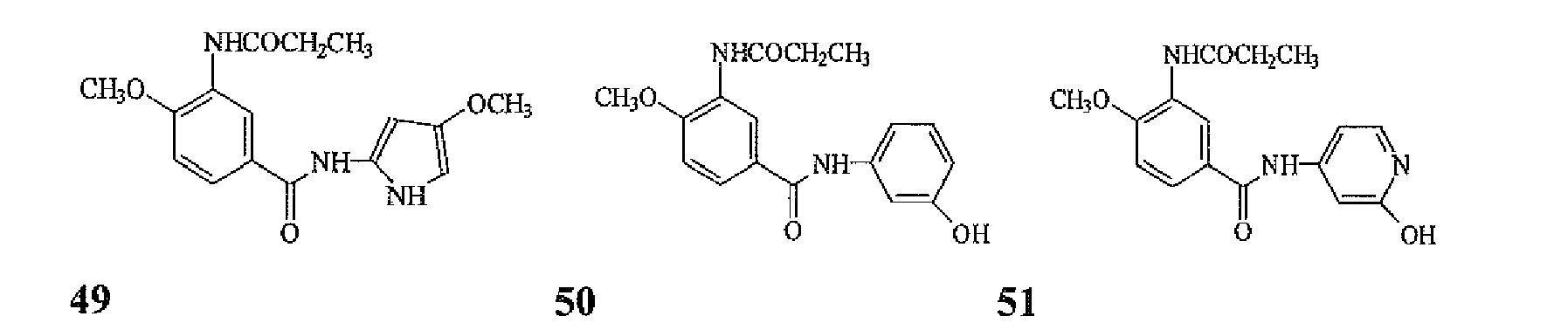


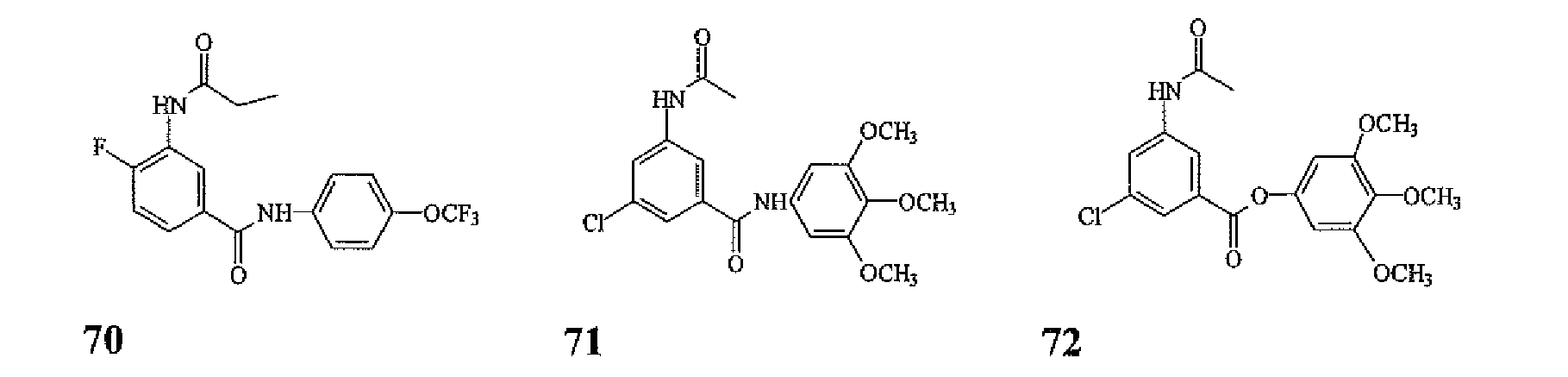


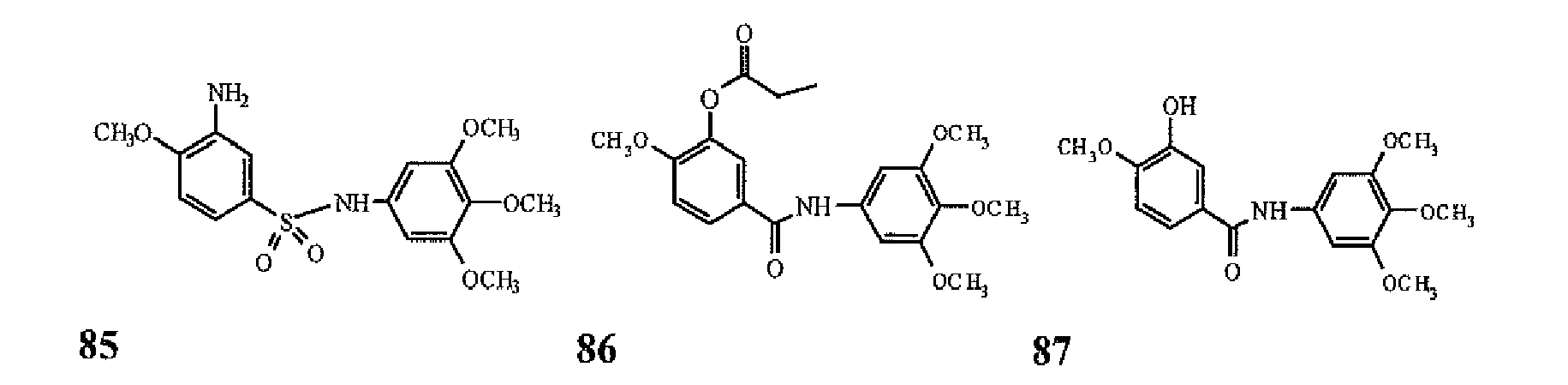

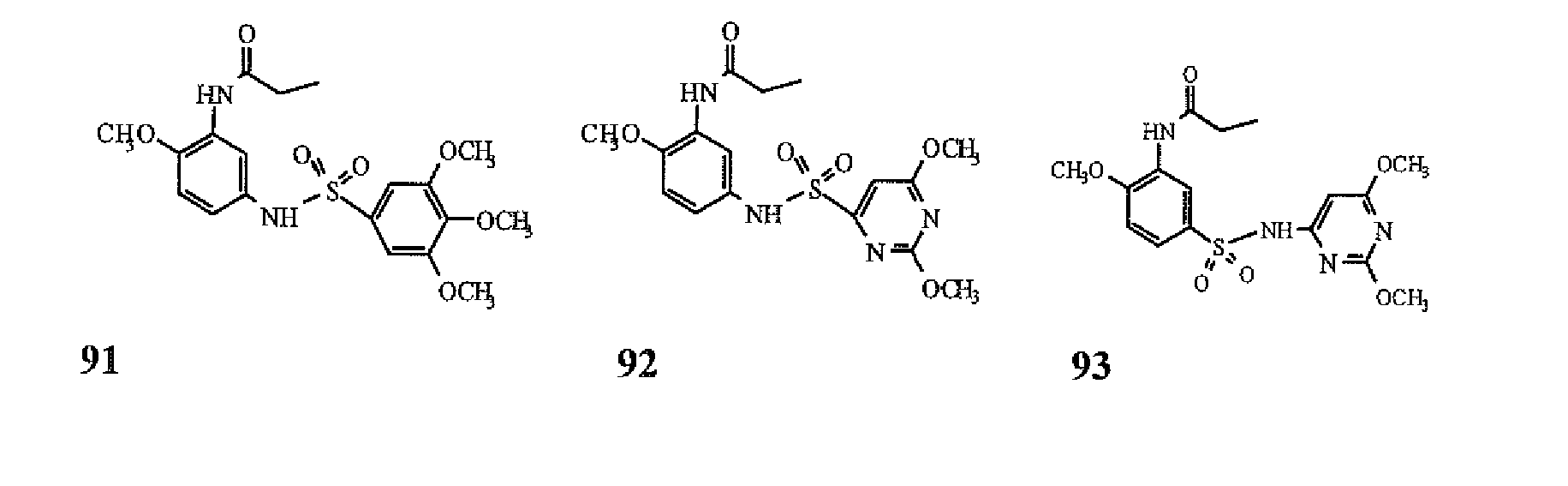


- This invention further provides the application of said 3-amino benzoyl derivatives and their salts as hA3G/Vif conjugation inhibitor, as well as their application in the preparation of anti-virus drugs.
- Besides, this invention provides anti-virus drug compositions, which contain pharmaceutically effective amounts of said 3-amino- benzoyl derivatives or their pharmaceutical salts, mixed with pharmaceutically acceptable adjuvants, diluters etc. The compositions can orally be administered in the forms of pills, capsules, granules, powder or syrupy, or non-orally administered in the form of injections.
- The aforementioned preparations of 3-amino benzoyl derivatives can be prepared with the pharmaceutically conventional methods. The pharmaceutical adjuvants that can be used include excipients (e.g. saccharide derivatives such as lactose, sucrose, mannitol and sorbitol; starch and starch derivatives such as corn starch, potato starch, dextrin and carboxymethylstarch; cellulose and its derivatives such as crystalline cellulose, hydroxypropylcellulose, carboxymethylcellulose, calcium carboxymethylcellulose, sodium carboxymethylcellulose; acacia; dextran; silicate derivatives such as aluminum magnesium metasilicate; phosphates such as calcium phosphate; carbonates such as calcium carbonate; sulfates such as calcium sulfate, etc.); adhesives (e.g. gelatin, polyvinylpyrrolidone and polyethylene glycol); disintegrating agents (e.g. cellulose derivatives such as sodium carboxymethylcellulose, polyvinylpyrrolidone); lubricants (e.g. talc, calcium stearate, magnesium stearate, spermaceti wax, boric acid, sodium benzoate, leucine etc.), stabilizers (methyl parahydroxybenzoate, propyl parahydroxybenzoate etc.); correctives ( e.g. common sweeteners, sour agents and spices etc.); dilutants and solvents for injections (e.g. water, ethanol and glycerol etc.)
- In this invention, the starting materials and reactants for the production of the proposed 3-amino benzoyl derivatives and their pharmaceutical salts are determined according to the structures of X and Y in the target compounds. For instance, when X=O, S or NH; Y= carbonyl or sulfonic, various 3-amino benzoyl derivatives can be produced by condensation of different substituted 3-amino benzoic (benzenesulfonic) acids with aromatic amines or phenols.
- The embodiment of the processes may be:
- Protected or acylated compound A is mixed with HOBT (1-hydroxyl benzotriazole) and DIC (N, N'-diisopropyl carbodiimide) in appropriate proportion, then the mixture is dissolved into DMF (N, N -dimethyl sulfoxide). About 0.5 h after mixing, B is added into the mixture and the resulted mixture is allowed to react for 24 h at room temperature. The product is purified by means of column chromatography.

X=O, S or NH;
Y=C, S or SO;
R1, R2, R3 and R4 are the same as above. - In the aforementioned process, the starting material 3-amino benzoic (benzenesulfonic) acids and compound HX-R4 (e.g. aromatic amines, phenols or benzyl alcohols) can be purchased or produced using different known methods.
- This invention also provides the test results about pharmaceutical effect researches on said compounds.
- Based on the advances making research on the hA3G degradation mediated by HIV-1 Vif, this invention establishes a high throughput anti-HIV-1 drug screening model using hA3G degradation mediated by HIV-1 Vif as target, to screen small molecule active compounds capable of inhibiting this degradation process. The function principle of this model is that HIV-1 Vif protein and hA3G fused yellow fluorescent protein (YFP) co-expressed in the cells, then the intracellular fluorescence intensity (at 530 nm) decreases owing to the degradation of hA3G caused by Vif and subsequent degradation of YEP fused on hA3G. By means of measuring the change of fluorescent intensity, the influence of the screened compounds on the degradation of hA3G caused by Vif can quantitatively be analyzed. Simultaneously, to differentiate the non-specific inhibitory effect of diverse ubiquitin degradation route in the samples, this invention establishes a recheck model based on the detection of P53 degradation caused by the product of adenovirus early gene, to assure that the positive samples screened out by the proposed model can specifically block the degradation of hA3G caused by Vif. The results are shown in Table 1.
- The inhibitory activities of the compounds proposed in this invention to HIV-1 were measured using HIV-1 P24 antigen kit. The results are shown in Table 2.
Table 1 the up-regulation activity of the compounds in this invention to hA3G No. of the
compoundsMolecular formula and
molecular weighthA3G up-regulation activity
(%)1 C19H21ClN2O6 408.83 36.3 262 C17H20N2O5 36.2 332.35 3 C15H18N4O4 20.2 318.33 4 C17H19NO6 1.6 333.34 5 C17H19NO5S 14.4 349.4 6 C18H21NO5 28.7 331.36 261 C20H24N2O6 43.9 388.41 351 C20R23NO7 36.7 389.4 352 C22H27NO8 37.0 433.45 353 C19H18F3NO7 39.0 429.34 9 C20H23NO6S 46.5 405.46 10 C21H25NO6 28.9 387.43 11 C19H22N2O6 22.2 374.39 12 C19H21NO7 31.6 375.37 13 C20H23NO6 42.1 373.4 14 C20H23ClN2O6 11.2 422.86 15 C20H22ClNO6S 19.4 439.91 16 C21H24ClNO6 17.3 421.87 17 C19H21FN2O6 31.1 392.38 18 C19H20FNO7 34.5 393.36 19 C19H20FNO6S 44.3 409.43 20 C20H22FNO6 56.0 391.39 21 C20H22FNO6S 21.1 423.46 22 C19H21NO6S 24.6 391.44 23 C20H23FN2O6 29.3 406.4 24 C20H22FNO7 18.6 407.39 25 C21H24FNO6 19.4 405.42 26 C20H23BrN2O6 42.7 467.31 2612 C17H17N3O5 22.3 343.33 27 C19H20ClNO7 32.1 409.82 28 C20H22ClNO6 33.6 407.84 29 C19H21BrN2O6 25.3 453.28 30 C19H20BrNO7 15.2 454.27 31 C21H25BrN2O6 26.4 481.34 32 C21H27NO6 17.6 389.44 33 C17H20N4O5 21.5 360.36 34 C17H20N2O5 38.3 332.35 35 C20H22BrNO7 44.9 468.3 36 C18H22N2O4 8.6 330.38 37 C17H20N2O3 7.7 300.35 38 C20H25NO5 17.4 359.42 40 C17H20N2O4 12.7 316.35 41 C18H22N2O4 21.8 330.38 42 C17H20N2O3 34.3 300.35 43 C18H22N2O3 26.4 314.38 45 C18H24N2O4 27.6 332.39 46 C18H20N2O4 29.1 328.36 47 C16H18N4O4 18.2 330.34 48 C16H18N2O5 16.4 318.32 49 C16H19N3O4 9.8 317.34 50 C17H18N2O4 -3.1 314.34 51 C16H17N3O4 0.9 315.32 52 C20H23FN2O6 10.1 406.4 53 C18H19FN2O4 13.3 346.35 54 C16H18N2O3 28.7 286.33 55 C15H16N2O3 35.5 272.3 56 C15H16N2O2 41.1 256.3 57 C19H22N2O4 24.0 342.39 58 C19H22N2O6 16.6 374.39 59 C20H24N2O6 19.8 388.41 60 C17H18N2O3 16.3 298.34 61 C15H16N4O3 11.8 300.31 62 C20H23NO7 40.1 389.4 63 C20H24N2O6 21.3 388.41 64 C20H24N2O6 11.7 388.41 67 C18H17F3N2O4 11.3 382.33 68 C19H18N2O5 9.8 342.35 69 C18H17F3N2O3 31.2 366.33 70 C17H14F4N2O3 24.7 370.3 71 C18H19ClN2O5 30.1 378.81 72 C18H18ClNO6 24.3 379.79 73 C19H18F3NO6 29.0 413.34 74 C19H19F3N2O5 8.5 412.36 75 C20H23FN2O6 -1.1 406.4 76 C20H21F3N2O5 16.7 426.39 77 C20H23FN2O6 14.9 406.4 78 C18H19FN2O4 8.8 346.35 79 C20H23FN2O6 21.6 406.4 80 C17H18FN3O3 37.1 331.34 81 C20H25N3o5 14.4 387.43 82 C19H24N2O6S 28.5 408.47 83 C19H24N2O7S 31.0 424.47 84 C19H23NO8S 9.0 425.45 85 C16H20N2O6S 6.8 368.4 86 C20H23NO7 20.3 389.4 87 C17H19NO6 19.7 333.34 88 C19H22N2O6 24.8 374.39 89 C19H25N3O5 31.3 375.42 90 C16H19NO7S 28.2 369.39 91 C19H24N2O7S 16.6 424.47 92 C16H20N4O6S 23.7 396.42 93 C16H20N4O6S 34.2 396.42 94 C18H22N2O6S 16.1 394.44 95 C18H21FN2O6S 8.7 412.43 96 C18H23N3O5S 6.9 393.46 97 C18H21N3O6S 6.4 407.44 98 C15H16FN3O4S 5.8 353.37 99 C18H21N3O6S 23.6 407.44 100 C17H18FN3O5S 13.6 395.41 101 C18H22N2O7S 22.1 410.44 102 C17H20N2O6S 10.3 380.42 103 C18H21NO8S 26.1 411.43 2611 C18H20N2O4 28.9 328.36 2613 C17H17ClN2O3 27.8 332.78 2621 C15H16N2O3 36.2 272.3 263 C19H19F3N2O6 24.4 428.36 Table 2 inhibitory activity of the compounds in the invention to HJV-1 compounds IC50 (µg/ml) 26 0.0203 261 0.0227 262 0.0244 263 <0.0137 2611 0.017□ 2613 0.0138 2621 <0.0137 35 0.0223 351 0.0299 352 0.0554 AZT 5.78×10⁻⁵ - The above results preliminarily validated the inhibitory effect of the compounds and their pharmaceutically salts according to this invention on the conjugation of hA3G/Vif, as well as their anti-virus effect. These lay the foundation for the development and application of anti-virus drugs.
- By way of the following examples which follow, the technicians in this specialty are expected to understand this invention more comprehensively, however, none of which are intended to limit the scope of the invention.
- Synthesis of N-(3',4',5'-trimethoxyphenyl) 3-propionamido-4-methoxybenzamide (261)
- 0.6g 3-amino-4-methoxybenzoic acid (1.0g, 6mmol) is dissolved in dry THF (tetrahydrofuran) in a 25ml flask, triethylamine (1.2my, 12mmol) is subsequently added to obtain transparent yellow solution. The mixture is stirred under nitrogen protection, propionyl chloride (0.78ml, 9mmol) is added into the flask in an ice-water bath. After fmishing addition of propionyl chloride the mixture is naturally raised to room temperature. The reacted mixture is filtered, the filtrate is evaporated to dryness and separated using a silica column to obtain 3-propionamido-4-methoxybenzoic acid 1.3g (yield: 67%).
- 100mg of the aforementioned product is mixed with 53mg (mmol) HOBT and 0.03ml (mmol) DIC, dissolved into dry DMF in a flask in ice-water bath. The mixture is stirred for 30 min under N2 protection, 72mg 3,4,5-trimethoxyaniline (mmol) is subsequently added, then the mixture is naturally raised to room temperature and stirred overnight. The reacted mixture is evaporated to dryness and the residue is dissolved into ethyl acetate and subsequently filtered, the filtrate is evaporated to dryness and separated using a preparatory thin layer silica plate to obtain 40mg compound 261 (yield: 30%).
- 1H NMR (CDCl3, δ) 1.3 (t, 3H, CH3), 2.5 (q, 2H, CH2), 3.82 (s, 3H, 4'-OCH3), 3.9 (s, 6H, 3', 5'-OCH3), 3.95 (s, 3H, 4-OCH3), 6.98 (s, 2H, 2', 6'-H), 7.0 (d, 1H, 5-H), 7.8 (dd, 1H, 6-H), 7.9 (br, 2H, NH), 8.9 (d, 1H, 2-H)
- Synthesis of 3',4',5'-trimethoxyphenyl 3-propionamido-4-methoxybenzoate (351)
- Compound 351 is synthesized following a similar method as in Example 1 and using 3-amino-4-methoxy benzoic acid, propionyl chloride and 3,4,5-trimethoxy phenol as materials. Total yield ofthe two steps: 30%.
- 1H NMR (CDCl3, δ) 1.3 (t, 3H, CH3), 2.5 (q, 2H, CH2), 3.8 (s, 9H, 4', 5', 6'-OCH3), 3.95 (s, 3H, 4-OCH3), 6.44 (s, 2H, 2', 6'-H), 6.98 (d, 1H, 5-H), 7.76 (br, 1H, 3-NHCO), 7.9 (dd, 1H, 6-H), 7.9 (br, 1H, 1-CONH), 9.2 (d, 1H, 2-H)
- Synthesis of N-(3',4',5'-trimethoxyphenyl)-3-trifluoroacetamido -4-methoxybenzamide (263)
- Compound 263 is synthesized following a similar method as in Example 1 and using 3-amino-4-methoxy benzoic acid, trifluoroacetyl chloride and 3,4,5-trimethoxyaniline as materials. Total yield of the two steps: 50%.
- 1H NMR (CDCl3, δ) 3.84 (s, 9H, 4', 5', 6'-OCH3), 4.0 (s, 3H, 4-OCH3), 6.97 (s, 2H, 2', 6'-H), 7.03 (d, 1H, 5-H), 7.86 (d, 1H, 6-H), 7.9 (s, 1H, 3-NHCOR), 8.6 (s, 1H, 1-CONH), 8.75 (s, 1H, 2-H)
- Synthesis of 3,4,5-trimethoxyphenyl 3-trifluoroacetamido-4-methoxybenzoate (353).
- Compound 353 is synthesized following a similar method as in Example 1 and using 3-amino-4-methoxy benzoic acid, trifluoroacetyl chloride and 3,4,5-trimethoxyphenol as materials. Total yield of the two steps: 40%.
- 1H NMR (CDCl3, δ) 3.85 (s, 9H, 4', 5', 6'-OCH3), 4.0 (s, 3H, 4-OCH3), 6.46 (s, 2H, 2', 6'-H), 7.05 (d, 1H, 5-H), 8.07 (dd, 1H, 6-H), 8.54 (s, 1H, 3-NHCOR), 9.12 (s, 1H, 2-H)
- Synthesis of N-(4'-chlorophenyl)-3-propionamido-4-methoxybenzamide (2613).
- Compound 2613 is synthesized following a similar method as in Example 1 and using 3-arnino-4..methoxybenzoic acid, propionyl chloride and 4-chloroaniline as materials. Total yield of the two steps: 30%.
- 1H NMR (CDCl3, δ) 1.28 (t, 3H, CH3), 2.48 (q, 2H, CH2), 3.96 (s, 3H, 4'-OCH3), 6.98 (d, 1H, 5-H), 7.33 (d, 2H, 2', 6'-H), 7.6 (d, 2H, 3', 5'-H), 7.77 (dd, 1H, 6-H), 7.8 (s, 1H, 3-NHCOR), 8.0 (br, 1H, 1-CONH), 8.87 (s, 1H, 2-H)
- Synthesis of N-(4'-methoxyphenyl)-3-propionamido-4-methoxybenzamide (2611).
- Compound 2611 is synthesized following a similar method as in Example 1 and using 3-amino-4-methoxybenzoic acid, propionyl chloride and 4-methoxyaniline as materials. Total yield of the two steps: 70%.
- 1H NMR (DMSO-d6, δ) 1.07 (t, 3H, CH3), 2.4 (q, 2H, CH2), 3.73 (s, 3H, 4'-OCH3), 3.89 (s, 3H, 4-OCH3), 6.89 (d, 2H, 2', 6'-H), 7.1 (d, 1H, 5-H), 7.6 (d, 2H, 3', 5'-H), 7.7 (dd, 1H, 6-H), 8.48 (br, 1H, 3-NHCOR), 9.15 (s, 1H, 2-H), 10.0 (s, 1H, 1-CONH)
- Synthesis of N-(3,4',5'-trimethoxyphenyl)-3-(2-chloroacetamido)-4-methoxybenzamide (1).
- Compound 1 is synthesized following a similar method as in Example 1 and using 3-amino-4-methoxybenzoic acid, 2-chloroacetyl chloride and 3,4,5-trimethoxyaniline as materials. Total yield of the two steps: 56%.
- 1H NMR (CDCl3, δ) 4.5 (s, 2H, CH2), 3.82 (s, 3H, 4'-OCH3), 3.9 (s, 6H, 3', 5'-OCH3), 3.95 (s, 3H, 4-OCH3), 6.98 (s, 2H, 2', 6'-H), 7.0 (d, 1H, 5-H), 7.8 (dd, 1H, 6-H), 7.9 (br, 2H, NH), 8.9 (d, 1H, 2-H)
- Synthesis of S-(3',4',5'-trimethoxyphenyl) 3-propionamido-4-methoxybenzenecarbothiolate (9).
- Compound 9 is synthesized following a similar method as in Example 1 and using 3-amino-4-methoxybenzoic acid, propionyl chloride and 3,4,5-trimethoxythiophenol as materials. Total yield of the two steps: 50%.
- 1H NMR (CDCl3, δ) 1.3 (t, 3H, CH3), 2.5 (q, 2H, CH2), 3.8 (s, 9H, 4', 5', 6'-OCH3), 3.95 (s, 3H, 4-OCH3), 6.44 (s, 2H, 2', 6'-H), 6.98 (d, 1H, 5-H), 7.76 (br, 1H, NH), 7.9 (dd, 1H, 6-H), 7.9 (br, 2H, NH), 9.2 (d, 1H, 2-H)
- S-(3',4',5'-trimethoxyphenyl)3-(2-fluoropropionamido)-4-methoxybenzenecarbothiolate (21).
- Compound 21 is synthesized following a similar method as in Example 1 and using 3-amino-4-methoxybenzoic acid, 2-fluoropropionyl chloride and 3,4,5-trimethoxythiophenol as materials. Total yield of the two steps: 54%.
- 1NMR (CDCl3, δ) 1.3 (d, 3H, CH3), 4.5 (q, 1H, CH), 3.8 (s, 9H, 4', 5', 6'-OCH3), 3.95 (s, 3H, 4-OCH3), 6.44 (s, 2H, 2', 6'-H), 6.98 (d, 1H, 5-H), 7.76 (br, 1H, NH), 7.9 (dd, 1H, 6-H), 7.9 (br, 2H, NH), 9.2 (d, 1H, 2-H)
- Synthesis of N-(3',4',5'-trimethoxyphenyl)-3-methoxy-4-propionamidobenzamide (64).
- Compound 64 is synthesized following a similar method as in Example 1 and using 3-methoxy-4-aminobenzoic acid, propionyl chloride and 3,4,5-trimethoxyaniline as materials. Total yield of the two steps: 57%.
- 1H NMR (CDCl3) δ 1.3 (t, 3H, CH3), 2.5 (q, 2H, CH2), 3.82 (s, 3H, 4'-OCH3), 3.9 (s, 6H, 3', 5'-OCH3), 3.95 (s, 3H, 4-OCH3), 6.98 (s, 2H, 2', 6'-H), 7.0 (d, 1H, 2-H), 7.8 (dd, 1H, 6-H), 7.9 (br, 2H, NH), 8.0 (d, 1H, 5-H)
- Synthesis of N-(4'-methoxyfuryl-2'-)-4-methoxy-3-propionamidobenzamide (48).
- Compound 48 is synthesized following a similar method as in Example 1 and using 3-amino-4-methoxybenzoic acid, propionyl chloride and 2-amino-4-methoxyfuran as materials. Total yield ofthe two steps: 70%.
- 1H NMR (DMSO-d6, δ) 1.07 (t, 3H, CH3), 2.4 (q, 2H, CH2), 3.89 (s, 3H, 4-OCH3), 4.73 (s, 3H, 4'-OCH3), 6.89 (s, 1H, 5'-H), 7.6 (d, 1H, 5-H), 7.7 (dd, 1H, 6-H), 7.89 (s, 1H, 3'-H), 8.48 (br, 1H, 3-NHCOR), 9.15 (s, 1H, 2-H), 10.0 (s, 1H, 1-CONH)
- Synthesis of N-(4'-methoxypyrryl-2'-)-4-methoxy-3-propionamidobenzamide (49).
- Compound 49 is synthesized following a similar method as in Example 1 and using 3-amino-4-methoxybenzoic acid, propionyl chloride and 2-amino-4-methoxypyrrole as materials. Total yield of the two steps: 68%.
- 1H NMR (DMSO-d6, δ) 1.07 (t, 3H, CH3), 2.4 (q, 2H, CH2), 3.89 (s, 3H, 4-OCH3), 4.73 (s, 3H, 4'-OCH3), 6.76 (s, 1H, 5'-H), 7.6 (d, 1H, 5-H), 7.7 (dd, 1H, 6-H), 7.72 (s, 1H, 3'-H), 8.48 (br, 1H, 3-NHCOR), 9.15 (s, 1H, 2-H), 10.0 (s, 1H, 1-CONH)
- Synthesis of N-(pyrimidyl-4'-)-4-methoxy-3-propionamidobenzamide (61).
- Compound 49 is synthesized following a similar method as in Example 1 and using 3-amino-4-methoxybenzoic acid, propionyl chloride and 4-aminopyrimidine as materials. Total yield of the two steps: 47%.
- 1H NMR (DMSO-d6, δ) 1.07 (t, 3H, CH3), 2.4 (q, 2H, CH2), 3.89 (s, 3H, 4-OCH3), 6.76 (d, 1H, 5'-H), 7.2 (d, 1H, 5-H), 7.6 (d, 1H, 5-H), 7.7 (dd, 1H, 6-H), 8.2 (s, 1H, 3'-H), 8.48 (br, 1H, 3-NHCOR), 9.15 (s, 1H, 2-H), 10.0 (s, 1H, 1-CONH)
- Synthesis of N-(3',4',5'-trimethoxyphenyl)-2-propionamido-4-methoxybenzamide (63).
- Compound 63 is synthesized following a similar method as in Example 1 and using 2-amino-4-methoxybenzoic acid, propionyl chloride and 3,4,5-trimethoxyaniline as materials. Total yield of the two steps: 64%.
- 1H NMR (CDCl3, δ) 1.3 (t, 3H, CH3), 2.5 (q, 2H, CH2), 3.82 (s, 3H, 4'-OCH3), 3.9 (s, 6H, 3', 5'-OCH3), 3.95 (s, 3H, 4-OCH3), 6.98 (s, 2H, 2', 6'-H), 7.0 (d, 1H, 3-H), 7.8 (dd, 1H, 6-H), 7.9 (br, 2H, NH), 8.0 (d, 1H, 5-H)
- Synthesis of N-(4'-trifluoromethoxyphenyl)-3-propionamido-4-methylbenzamide (69).
- Compound 69 is synthesized following a similar method as in Example 1 and using 3-amino-4-methylbenzoic acid, propionyl chloride and 4-trifluoromethoxyaniline as materials. Total yield of the two steps: 49%.
- 1H NMR (DMSO-d6, δ) 1.07 (t, 3H, CH3), 2.4 (q, 2H, CH2), 2.5 (s, 3H, 4-CH3), 3.89 (s, 3H, 4-OCH3), 6.89 (d, 2H, 2', 6'-H), 7.1 (d, 1H, 5-H), 7.6 (d, 2H, 3', 5'-H), 7.7 (dd, 1H, 6-H), 8.48 (br, 1H, 3-NHCOR), 9.15 (s, 1H, 2-H), 10.0 (s, 1H, 1-CONH)
- Synthesis of 3',4',5'-trimethoxyphenyl 3-acetamido-5-trifluoromethylbenzoate (73).
- Compound 73 is synthesized following a similar method as in Example 1 and using 3-amino-5-trifluoromethylbenzoic acid, acetyl chloride and 3,4,5-trimethoxyphenol materials. Total yield ofthe two steps: 61%.
- 1H NMR (CDCl3, δ) 2.3 (s, 3H, CH3), 3.8 (s, 9H, 4', 5', 6'-OCH3), 6.44 (s, 2H, 2', 6'-H), 6.98 (d, 1H, 5-H), 7.76 (br, 1H, NH), 7.9 (dd, 1H, 6-H), 7.9 (br, 2H, NH), 9.2 (d, 1H, 2-H)
- Synthesis of N-(3',4,'5'-trimethoxyphenyl)-3-propionamido-4-fluoro-5-methoxybenzamide (75).
- Compound 75 is synthesized following a similar method as in Example 1 and using 3-amino-4-fluoro-5-methoxybenzoic acid, propionyl chloride and 3,4,5-trimethoxyaniline as materials. Total yield of the two steps: 76%.
- 1H NMR (CDCl3, δ) 2.3 (s, 3H, CH3), 3.8 (s, 9H, 4', 5', 6'-OCH3), 3.97 (s, 3H, 5-OCH3), 6.44 (s, 2H, 2', 6'-H), 7.76 (br, 1H, NH), 7.9 (d, 1H, 6-H), 7.9 (br, 1H, NH), 9.2 (d, 1H, 2-H)
- Synthesis of N-(3',4',5'-trimethoxyphenyl)-3-propionamido-4-methoxy-6-fluorobenzamide (79).
- Compound 79 is synthesized following a similar method as in Example 1 and using 3-amino-4-methoxy-6-fluorobenzoic acid, propionyl chloride and 3,4,5-trimethoxyaniline as materials. Total yield of the two steps: 66%.
- 1H NMR (CDCl3, δ) 1.07 (t, 3H, CH3), 2.3 (q, 2H, CH2), 3.8 (s, 9H, 4', 5', 6'-OCH3), 3.97 (s, 3H, 4-OCH3), 6.44 (s, 2H, 2', 6'-H), 7.76 (br, 1H, NH), 7.9 (s, 1H, 5-H), 7.9 (br, 1H, NH), 9.2 (s, 1H, 2-H)
- Synthesis of N-(3'-fluoro-4'-aminophenyl)-3-propionamido-4-methoxybenzamide (80).
- Compound 80 is synthesized following a similar method as in Example 1 and using 3-amino-4-methoxybenzoic acid, propionyl chloride and 3-fluoro-4-aminoaniline as materials. Total yield of the two steps: 60%.
- 1H NMR (CDCl3, δ) 1.07 (t, 3H, CH3), 2.4 (q, 2H, CH2), 3.89 (s, 3H, 4-OCH3), 6.89 (d, 2H, 2', 6'-H), 7.1 (d, 1H, 5-H), 7.6 (d, 1H, 5'-H), 7.7 (dd, 1H, 6-H), 8.3 (d, 1H, 6'-H), 8.48 (br, 1H, 3-NHCOR), 9.15 (s, 1H, 2-H), 9.3 (s, 1H, 2'-H), 10.0 (s, 1H, 1-CONH)
- Synthesis of N-(3',4',5'-trimethoxyphenylt) 3-propionamido-4-methoxybenzenesulfamide (83).
- Compound 83 is synthesized following a similar method as in Example 1 and using 3-amino-4-methoxybenzenesulfonic acid, propionyl chloride and 3,4,5-trimethoxyaniline as materials. Total yield of the two steps: 63%.
- 1H NMR (DMSO-d6, δ) 1.03 (t, 3H, CH3), 2.5 (q, 2H, CH2), 3.8 (s, 9H, 4', 5', 6'-OCH3), 3.95 (s, 3H, 4-OCH3), 6.7 (s, 2H, 2', 6'-H), 7.3 (d, 1H, 5-H), 7.7 (br, 1H, CONH) 7.9 (dd, 1H, 6-H), 8.8 (br, 1H, S02NH), 9.2 (d, 1H, 2-H).
- Synthesis of 3',4',5'-trimethoxyphenyl 3-propionamido-4-methoxybenzenesulfonate (84).
- Compound 84 is synthesized following a similar method as in Example 1 and using 3-amino-4-methoxybenzenesulfonic acid, propionyl chloride and 3,4,5-trimethoxyphenol as materials. Total yield of the two steps: 53%.
- 1H NMR (CDCl3, δ) 1.03 (t, 3H, CH3), 2.5 (q, 2H, CH2), 3.8 (s, 9H, 4', 5', 6'-OCH3), 3.95 (s, 3H, 4-OCH3), 6.7 (s, 2H, 2', 6'-H), 7.3 (d, 1H, 5-H), 7.7 (br, 1H, CONH) 7.9 (dd, 1H, 6-H), 9.2 (d, 1H, 2-H)
- Synthesis of N-(3'-propionamido-4'-methoxyphenyl)-(3,4,5-trimethoxy) benzenesulfonamide (91).
- Compound 91 is synthesized following a similar method as in Example 1 and using 3-propionamido-4-methoxyaniline and 3,4,5-trimethoxybenzenesulfonic acid as materials. Total yield of the two steps: 40%.
- 1H NMR (DMSO-d6, δ) 1.03 (t, 3H, CH3), 2.5 (q, 2H, CH2), 3.8 (s, 9H, 3', 4', 5' -OCH3), 3.95 (s, 3H, 4-OCH3), 6.3 (d, 1H, 6-H), 6.7 (br, 1H, CONH) 6.9 (dd, 1H, 5-H), 7.7 (s, 2H, 2', 6'-H), 8.8 (br, 1H, SO2NH), 9.2 (d, 1H, 2-H)
- Synthesis of 3',4,'5'-trimethoxyphenyl 3-methanesulfamido-4-methoxybenzoate (103).
- Compound 103 is synthesized following a similar method as in Example 1 and using 3-amino-4-methoxybenzoic acid, methanesulfonyl chloride and 3,4,5-trimethoxyphenol as materials. Total yield of the two steps: 52%.
- 1H NMR (DMSO-d6, δ) 2.5 (s, 3H, CH3), 3.8 (s, 9H, 3', 4', 5' -OCH3), 3.95 (s, 3H, 4-OCH3), 6.7 (s, 2H, 2', 6'-H), 7.3 (d, 1H, 5-H), 7.7 (br, 1H, CONH) 7.9 (dd, 1H, 6-H), 9.2 (d, 1H, 2-H)
- Synthesis of 3',4',5'-trimethoxyphenyl 3-trifluoroacetamido-4-methoxybenzoate (103).
- Compound 353 is synthesized following a similar method as in Example 1 and using 3-amino-4-methoxybenzoic acid, trifluoroacetyl chloride and 3,4,5-trimethoxyphenol as materials. Total yield of the two steps: 46%.
- 1H NMR (CDCl3, δ) 3.8 (s, 9H, 3', 4', 5' -OCH3), 6.44 (s, 2H, 2', 6'-H), 6.98 (d, 1H, 5-H), 7.76 (br, 1H, NH), 7.9 (dd, 1H, 6-H), 9.2 (d, 1H, 2-H)
- Synthesis of N-(4'-nitrophenyl)-3-propionamido-4-methoxybenzamide (2612).
- Compound 2612 is synthesized following a similar method as in Example 1 and using 3-amino-4-methoxybenzoic acid, propionyl chloride and 4-nitroaniline as materials. Total yield of the two steps: 53%.
- 1H NMR (DMSO-d6, δ) 1.07 (t, 3H, CH3), 2.4 (q, 2H, CH2), 3.73 (s, 3H, 4'-OCH3), 3.89 (s, 3H, 4-OCH3), 6.89 (d, 2H, 2', 6'-H), 7.1 (d, 1H, 5-H), 7.7 (dd, 1H, 6-H), 8.3 (d, 2H, 3', 5'-H), 8.48 (br, 1H, 3-NHCOR), 9.15 (s, 1H, 2-H), 10.0 (s, 1H, 1-CONH)
- Synthesis of N-(4'-chlorophenyl)-3-propionamido-4-methoxybenzamide (2613).
- Compound 2613 is synthesized following a similar method as in Example 1 and using 3-amino-4-methoxybenzoic acid, propionyl chloride and 4-chloroaniline as materials. Total yield of the two steps: 56%.
- 1NMR (DMSO-d6, δ) 1.07 (t, 3H, CH3), 2.4 (q, 2H, CH2), 3.73 (s, 3H, 4'-OCH3), 3.89 (s, 3H, 4-OCH3), 6.6 (d, 2H, 2', 6'-H), 7.1 (d, 1H, 5-H), 7.7 (dd, 1H, 6-H), 8.2 (d, 2H, 3', 5'-H), 8.48 (br, 1H, 3-NHCOR), 9.15 (s, 1H, 2-H), 10.0 (s, 1H, 1-CONH)
- Synthesis of N-(3',4',5'-trimethoxyphenyl)-3-cyano-4-methoxybenzamide (68).
- Compound 68 is synthesized following a similar method as in Example 1 and using 3-cyano-4-methoxybenzoic acid and 3,4,5-trimethoxyaniline as materials. Total yield of the two steps: 60%.
- 1H NMR (CDCl3, δ) 3.82 (s, 3H, 4'-OCH3), 3.9 (s, 6H, 3', 5'-OCH3), 3.95 (s, 3H, 4-OCH3), 6.68 (s, 2H, 2', 6'-H), 6.8 (d, 1H, 5-H), 7.0 (dd, 1H, 6-H), 7.9 (br, 2H, NH), 8.9 (d, 1H, 2-H)
- Following a similar method as in Example 1, compounds 11, 12, 14, 15, 17, 18, 19, 21, 22, 23, 24, 26, 27, 29, 30, 31, 33, 35, 46, 47, 50, 51, 52, 53, 57, 58, 59, 60, 62, 67, 70, 71, 72, 74, 76, 77, 78, 81, 82, 86, 88, 89, 92, 93, 94, 95, 96, 97, 99, 100, 101, 102, 104 are also obtained.
- Synthesis of N-(3',4',5'-trimethoxyphenyl) 3-amino-4-methoxybenzamide (262).
- 1) 1.0g (6mmol) 3-amino-4-methoxybenzoic acid is dissolved in 10ml 4N NaOH aqueous solution, 2.5ml (11mmol) tert-butyric anhydride is slowly dropped into the solution. The mixture is heated up to 50°C until the reaction finishes and the resulted alkaline solution is quickly acidified to pH=2 using 1 N hydrochloric acid and extracted three times using chloroform. The chloroform extract is pooled and desiccated with anhydrate sodium sulfate, subsequently condensed to dryness to obtain 0.8g off-white solid, yield: 50%.
- 2) 200mg (0.8mmol) of the product from step 1) is mixed with 120mg (0.9mmol) HOBT and 0.06ml (0.6mmol) DIC in dry DMF under ice-water bath condition. The mixture is stirred for 30 min. under N2 protection, then 160mg (0.9mmol) 3,4,5-trimethoxyaniline is subsequently added, the mixture is let to naturally resume room temperature and stirred overnight. The resulted reactant is evaporated to dryness under reduced pressure, the residue is dissolved in ethyl acetate and subsequently filtered, the filtrate is evaporated to dryness, separated using preparatory thin layer silica plate to obtain 180mg product, yield: 55.6%.
- 3) 160mg of the product from step 2) is dissolved into 6ml methanol, 0.12ml acetyl chloride is dropped into the solution, reacting until all of the tert-butyryl protective group is removed, subsequently, the reactant is evaporated to dryness, the residue is evenly mixed with 10ml methylene chloride, filtered to obtain 60mg white solid (262), yield: 49%.
- 1H NMR (DMSO-d6, δ) 3.62 (s, 3H, 4'-OCH3), 3.78 (s, 6H, 3', 5'-OCH3), 3.95 (s, 3H, 4-OCH3), 4.5 (br, 2H, -NH2), 7.1 (d, 1H, 5-H), 7.2 (s, 2H, 2', 6'-H), 7.6 (s, 1H, 6-H), 7.7 (s, 1H, 2-H), 10.0 (s, 1H, 1-CONH)
- Synthesis of 3-amino-4-methoxybenzanilide (2621).
- Using 3-amino-4-methoxybenzoic acid and aniline as materials, compound 2621 is synthesized following a similar method as in Example 28. Yield: 37%.
- 1H NMR (DMSO-d6, δ) 3.55 (s, 3H, 4-OCH3), 4.5 (br, 2H, -NH2), 7.0 (m, 1H, 4'-H), 7.1 (d, 1H, 5-H), 7.2 (d, 2H, 2', 6'-H), 7.4 (dd, 2H, 3', 5'-H), 7.6 (d, 1H, 6-H), 7.7 (s, 1H, 2-H), 10.0 (s, 1H, 1-CONH)
- Synthesis of N-(3'-fluoro-4'-aminosulfonylphenyl)- 3-methylamino-4-methoxybenzamide (98).
- Using 3-methylamino-4-methoxybenzoic acid and 3-fluoro-4- aminosulfonylaniline as materials, compound 98 is synthesized following a similar method as in Example 28. Yield: 52%.
- 1H NMR (DMSO-d6, δ) 2.5 (br, 2H, -NH2), 2.8 (d, 3H, 3-CH3), 3.75 (s, 3H, 4-OCH3), 4.5 (br, 1H, 3-NH), 6.5 (m, 1H, 6'-H), 6.67 (s, 1H, 2'-H), 6.8 (d, 1H, 5-H), 7.2 (d, 1H, 5'-H), 7.4 (dd, 2H, 3', 5'-H), 7.6 (d, 1H, 6-H), 7.7 (s, 1H, 2-H), 10.0 (s, 1H, 1-CONH)
- Synthesis of N-(2',6'-dimethoxypyrimidinyl-4'-) 3-methylamino-4-hydroxylbenzamide (3).
- Using 3-methylamino-4-hydroxylbenzoic acid and 2,6-dimethoxy-4-aminopyrimidine as materials, compound 3 is synthesized following a similar method as in Example 28. Yield: 67%.
- 1H NMR (DMSO-d6, δ) 2.8 (d, 3H, 3-CH3), 3.73 (s, 3H, 6'-OCH3), 3.77 (s, 3H, 2'-OCH3), 4.4 (br, 1H, 3-NH), 5.1 (br, 1H, 4-OH), 6.8 (d, 1H, 5-H), 7.2 (d, 1H, 5'-H), 7.6 (d, 1H, 6-H), 7.7 (s, 1H, 2-H), 9.2 (s, 1H, 1-CONH)
- Synthesis of S-(3',4',5'-trimethoxyphenyl) 3-amino-4-methoxybenzenecarbothioate (5).
- Using 3-amino-4-methoxybenzoic acid and 3, 4, 5-trimethoxyphenylmercaptan as materials, compound 5 is synthesized following a similar method as in Example 28. Yield: 47%.
- 1H NMR (DMSO-d6, δ) 3.62 (s, 3H, 4'-OCH3), 3.78 (s, 6H, 3', 5'-OCH3), 3.95 (s, 3H, 4-OCH3), 4.2 (br, 2H, -NH2), 7.1 (d, 1H, 5-H), 7.3 (s, 2H, 2', 6'-H), 7.6 (s, 1H, 6-H), 7.7 (s, 1H, 2-H)
- Synthesis of N-(3',5'-dimethoxyphenyl)-3-methylamino-4-methoxybenzamide(40)
- Using 3-methylamino-4-methoxybenzoic acid and 3,5-dimethoxyaniline as materials, compound 40 is synthesized following a similar method as in Example 28. Yield: 50%.
- 1H NMR (DMSO-d6, δ) 2.4 (d, 3H, 3-CH3), 3.75 (s, 3H, 4-OCH3), 3.8 (s, 6H, 3', 5'-OCH3), 5.0 (br, 1H, 3-NH), 6.5 (s, 2H, 2', 6'-H), 6.8 (d, 1H, 5-H), 7.6 (d, 1H, 6-H), 7.7 (s, 1H, 2-H), 9.4 (s, 1H, 1-CONH)
- Synthesis of N-(3',4',5'-trimethoxyphenyl)- 3-amino-4-methoxybenzenesulfonamide (85).
- Using 3-methylamino-4-methoxybenzoic acid and 3,4,5-trimethoxyaniline as materials, compound 85 is synthesized following a similar method as in Example 28. Yield: 52%.
- 1H NMR (DMSO-d6) δ 3.62 (s, 9H, 3', 4', 5'-OCH3), 3.78 (s, 3H, 4-OCH3), 4.2 (br, 2H, -NH2), 7.1 (d, 1H, 5-H), 7.3 (s, 2H, 2', 6'-H), 7.6 (s, 1H, 6-H), 7.7 (s, 1H, 2-H), 8.5 (br, 1H, -SO2NH)
- Synthesis of N-(3',4',5'-trimethoxyphenyl)-3-hydroxyl-4-methoxybenzamide (87).
- Using 3-hydroxyl-4-methoxybenzoic acid and 3,4,5-trimethoxyaniline as materials, compound 87 is synthesized following a similar method as in Example 28. Yield: 34%.
- 1H NMR (DMSO-d6, δ) 3.62 (s, 9H, 3', 4', 5'-OCH3), 3.78 (s, 3H, 4-OCH3), 5.2 (br, 1H, -OH), 7.1 (d, 1H, 5-H), 7.3 (s, 2H, 2', 6'-H), 7.6 (s, 1H, 6-H), 7.7 (s, 1H, 2-H), 8.9 (br, 1H, -CONH)
- Synthesis of 3',4',5'-trimethoxyphenyl 3-amino-4-methoxybenzoate (352).
- Using 3-amino-4-methoxybenzoic acid and 3,4,5-trimethoxyphenol as materials, compound 352 is synthesized following a similar method as in Example 28. Yield: 30%.
- 1H NMR (DMSO-d6, δ) 3.65 (s, 3H, 4'-OCH3), 3.75 (s, 6H, 3', 5'-OCH3), 3.85 (s, 3H, 4-OCH3), 5.05 (br, 2H, -NH2), 6.56 (s, 2H, 2', 6'-H), 6.94 (d, 1H, 5-H), 7.35 (d, 1H, 6-H), 7.38 (s, 1H, 2-H)
- Following a similar method as in Example 28, compounds 4, 6, 34, 36, 37, 41, 42, 43, 45, 54, 55, 56, 90 are also synthesized.
- Synthesis of 1'-(3-propionamido-4-methoxy-benzoyl)methylene-3',4',5'-trimethoxybenzene (10).
- 0.6g 3-amino-4-methoxybenzoic acid (1.0g, 6mmol) is dissolved in dry tetrahydrofuran in a 25 ml flask, triethylamine (1.2ml, 12mmol) is added into the solution to obtain a transparent yellow solution. The flask in placed in an ice-water bath, the mixture is stirred under nitrogen protection, propionyl chloride (0.78ml, 9mmol) is added drop wise into the mixture. After drop wise addition, the mixture stands at room temperature and is allowed to react. The resulted reactant is subsequently filtered, the filtrate is evaporated to dryness and the residue is separated in a silica column to obtain 1.3g 3-propionamido-4-methoxybenzoic acid.
- 1.3g 3-propionamido-4-methoxybenzoic acid is mixed with 10ml dichlorosulfoxide and the mixture is stirred for more than 1 h at room temperature. The excessive dichlorosulfoxide is evaporated with additions of toluene in the mixture for several times to ensure thorough removal of dichlorosulfoxide. The residue is dissolved into anhydrous ethyl ether, equivalent amount of 3,4, 5-trimethoxybenzyl cadmium is added into the mixture under ice-water cooling and reacted for more than 1 h with the temperature maintained within 0~-5°C. The reaction are carried out under normal Grignard reaction conditions, to obtain 1.2g target compound (10) (yield: 52%) .
- 1H NMR (CDCl3, δ) 1.03 (t, 3H, CH3), 2.5 (q, 2H, CH2), 3.4 (s, 2H, -COCH2), 3.8 (s, 9H, 4', 5', 6'-OCH3), 3.95 (s, 3H, 4-OCH3), 6.7 (s, 2H, 2', 6'-H), 7.3 (d, 1H, 5-H), 7.4 (s, 1H, 3-NHCO), 7.9 (dd, 1H, 6-H), 8.4 (s, 1H, 1-CONH), 9.2 (s, 1H, 2-H)
- 3-(2"-fluoropropionamido)-4-methoxybenzoylmethylene-3',4',5'-trimethoxybenzene (25).
- Using 3-hydroxyl-4-methoxybenzoic acid, 2-fluoropropionyl chloride and 3,4,5-tribenzyl cadmium as materials, compound 25 is synthesized following a similar method as in Example 37. Yield: 57%.
- 1H NMR (CDCl3, δ) 1.3 (d, 3H, CH3), 3.2 (s, 2H, -COCH2), 3.8 (s, 9H, 4', 5', 6'-OCH3), 3.95 (s, 3H, 4-OCH3), 4.5 (q, 1H, CHF), 6.44 (s, 2H, 2', 6'-H), 6.98 (d, 1H, 5-H), 7.16 (br, 1H, 3-NHCO), 7.4 (dd, 1H, 6-H), 7.9 (br, 1H, 1-CONH), 9.2 (d, 1H, 2-H)
- Synthesis of 1-(3'-propionamido-4'-methoxyphenyl)-2-(3",4",5"-trimethoxyphenyl) ethanol (32).
- The product (25) obtained from Example 38 is dissolved into methanol, appropriate amount of NaBH4 is added to reduce product (25), terminate the reaction when the material is depleted, the mixture is separated to obtain the target compound 32 (yield: 86).
- 1H NMR (DMSO-d6, δ) 1.03 (t, 3H, CH3), 2.5 (q, 2H, CH2), 3.8 (s, 9H, 4', 5', 6'-OCH3), 3.95 (s, 3H, 4-CH3), 4.4 (d, 2H, 2-CH2), 5.0 (t, 1H, 1-CH), 6.7 (s, 2H, 2", 6"-H), 7.3 (d, 1H, 5'-H), 7.4 (s, 1H, 3'-NHCO), 7.9 (dd, 1H, 6'-H), 9.2 (s, 1H, 2'-H)
- Following a similar method as in Example 37, compounds 13, 16, 20, 28 are also obtained.
- The cells are picked up and cultured a culture bottle. When the cells grow full of the culture bottle, old culture medium is discarded and the cells are digested with digestion medium. When the cells turn round, the digestion medium is discarded and the culture medium is added in at once, the bottom of the bottle is gently blown with a pipette to make the cells disengage the bottle bottom and disperse into single cell suspension. After counting the cells using blood cell counting chamber, the cell suspension is inoculated into a culture dish for transfection. The medium containing the plasmid to be transfected and the transfection reagents is gently mixed up and incubated at room temperature. The medium is then added into the supernatant of the cell culture and cultured for a certain period of time. The old culture medium is then sucked out, the cells are digested with digestive medium, the digestive medium is subsequently discarded and culture medium is immediately added. The medium is gently blown to disperse the cells into single cell suspension. After counting the cells using blood cell counting chamber, the cells are ready for inoculation.
- Samples of compounds : Pure tested compounds are dissolved in DMSO, the solution is diluted with equal proportional distilled water. The diluent is used to test the cell systems.
- Sample solution of different concentration is added into the supernatant of a cell culture. After the cells are continuously cultured, old culture medium is sucked out and the cells are blown with PBS buffer until the cells completely disengage from the culture bottle.
- The fluorescence intensity values of the cell suspension with test compound samples, positive control samples and negative control samples are respectively measured with fluorometer, the excitation wavelength is 485nm and the detection wavelength 520nm. Averages of duplicated measurements are taken as the results.
- The measured fluorescence intensity values of the negative control samples (blink sample) subtracted from those of test compound samples, the results are taken as YFP fluorescence of different groups.
- Relative fluorescence intensity = fluorescence intensity of a test sample group / fluorescence intensity of the positive control group x 100%
- Inhibition rate of degradation = (test sample group -negative control group) / (positive control group - negative control group) x 100%
- The results of the screening are shown in Table 1.
- DMSO solutions of samples of test compounds listed in Table 2 diluted to 8 different concentrations and the solution of the positive control AZT (azidothymidine, 0.15ng/ml) are respectively added into 96 well plates, duplications are set for each of the dilutions, and negative control samples are also made. Aliquots of 100µl 2×10⁵cell/ml suspension are inoculated onto the 96 well cell culture plates and cultured in an incubator under a condition of 37°C, 5%CO2 and saturated humidity. The pathologic changes of the cells are observed every day. The HIV-I P24 antigen contents in supernatant cells are measured in 4 days (96 h) after addition of the test compounds according to the operation procedure provided by the HIV-I P24 antigen kit. The inhibition activity of the compounds on the virus is then calculated, the results are listed in Table 2.
Claims (7)
- . A series of amino-benzoyl derivatives, whose structures are shown in Formula (I):

R1 is H, or one or more of the following groups on the benzene ring: nitro-, halido-, cyano-, ester-, amido-, hydroxo-, mercapto-, substituted or non-substituted low alkyl-, low alkoxy- or aryloxy-, low alkylthio- or arylthio-, amino- or substituted amino groups and so on;
R2, R3 may be identical or different, they may individually be H, low alkyl, carbonyl or sulfonyl groups;
X is O, S, NH, NR5, CH2 or CHR6;
Y is C, S or SO;
R4 and R5 is individually H, low alkyl, hydroxyl, aryl or substituted aryl groups. - . A method for preparing said compounds shown in Formula (I), wherein the reaction procedure is as follows: the protected or acylated compound A mixed with 1-hydroxybenzotriazole and N,N'-di-isopropylcarbodiimide, the mixture dissolved into DMF at a molar ratio of 1:0.5∼3, then B is added into the mixture at 0.5 h later and reacted for 24 h at room temperature and the product is separated and purified by means of column chromatography.

X=O, S or NH; Y=C, S or SO;
R1, R2, R3 and R4 are the same as in Claim 1. - . The pharmaceutically acceptable salts of said compounds defined in Claim 1.
- . The pharmaceutical compositions of the compounds defined in Claim 1, wherein the compositions contain the said compounds with therapeutically effective amount as active components and one or more pharmaceutically acceptable carriers.
- . The application of the compounds defined in Claim 1 in the preparation of anti-virus drugs.
- . The pharmaceutically acceptable salts defined in Claim 3 in the preparation of anti-virus drugs.
- . The pharmaceutical compositions defined in Claim 4 in the preparation of anti-virus drugs.
Applications Claiming Priority (2)
| Application Number | Priority Date | Filing Date | Title |
|---|---|---|---|
| CN2008101688244A CN101367749B (en) | 2008-09-28 | 2008-09-28 | A set of mesidino mesitoyl derivant, preparation and application thereof |
| PCT/CN2009/001094 WO2010037271A1 (en) | 2008-09-28 | 2009-09-28 | A group of amino substituted benzoyl derivatives and their preparation and their use |
Publications (3)
| Publication Number | Publication Date |
|---|---|
| EP2351731A1 true EP2351731A1 (en) | 2011-08-03 |
| EP2351731A4 EP2351731A4 (en) | 2012-03-14 |
| EP2351731B1 EP2351731B1 (en) | 2016-02-10 |
Family
ID=40411776
Family Applications (1)
| Application Number | Title | Priority Date | Filing Date |
|---|---|---|---|
| EP09817185.3A Not-in-force EP2351731B1 (en) | 2008-09-28 | 2009-09-28 | A group of amino substituted benzoyl derivatives and their preparation and their use |
Country Status (12)
| Country | Link |
|---|---|
| US (1) | US8710098B2 (en) |
| EP (1) | EP2351731B1 (en) |
| JP (1) | JP2012503607A (en) |
| KR (1) | KR20110053379A (en) |
| CN (1) | CN101367749B (en) |
| AU (1) | AU2009299062A1 (en) |
| BR (1) | BRPI0913730A2 (en) |
| CA (1) | CA2738256A1 (en) |
| IL (1) | IL211864A0 (en) |
| RU (1) | RU2011115572A (en) |
| WO (1) | WO2010037271A1 (en) |
| ZA (1) | ZA201103077B (en) |
Cited By (1)
| Publication number | Priority date | Publication date | Assignee | Title |
|---|---|---|---|---|
| EP3339287A4 (en) * | 2015-08-18 | 2019-01-16 | Institute of Medicinal Biotechnology, Chinese Academy of Medical Sciences | NEW TYPE OF ANTIVIRAL COMPOUND |
Families Citing this family (12)
| Publication number | Priority date | Publication date | Assignee | Title |
|---|---|---|---|---|
| CN102206172B (en) * | 2010-03-30 | 2015-02-25 | 中国医学科学院医药生物技术研究所 | Substituted diaryl compound and preparation method and antiviral application thereof |
| WO2015130947A1 (en) * | 2014-02-26 | 2015-09-03 | Howard University | Benzende sulfonamide derivatives as hiv integrase inhibitors |
| MX2018002744A (en) * | 2015-09-04 | 2018-04-13 | Tocagen Inc | Recombinant vectors comprising 2a peptide. |
| JP6750177B2 (en) * | 2015-12-11 | 2020-09-02 | ロート製薬株式会社 | Anthranilamide derivative and therapeutic agent for diseases involving TLR3 containing the same |
| CN106083632B (en) * | 2016-06-29 | 2017-08-18 | 舟山欧莱克化工有限公司 | A kind of synthetic method of dye composition fast red KD base |
| CN108129366B (en) * | 2017-11-08 | 2020-11-03 | 南京大学 | Antiviral compounds, methods of preparation and uses thereof |
| CN109503518B (en) * | 2018-11-15 | 2021-03-30 | 中国医学科学院医药生物技术研究所 | A kind of substituted bis-aromatic amide compound and its preparation method and application |
| CN109438249A (en) * | 2018-12-03 | 2019-03-08 | 南方医科大学 | A kind of benzoic acid derivative and application thereof |
| US11263780B2 (en) * | 2019-01-14 | 2022-03-01 | Sony Group Corporation | Apparatus, method, and program with verification of detected position information using additional physical characteristic points |
| CN113045461B (en) * | 2021-05-31 | 2021-09-21 | 天津瑞普生物技术股份有限公司 | Stilbene type compound and synthesis method and application thereof |
| CN117186011A (en) * | 2023-09-07 | 2023-12-08 | 浙江师范大学 | A class of compounds acting on APOBEC3G and their application in the preparation of antiviral drugs |
| CN118851934B (en) * | 2024-06-28 | 2025-10-17 | 武汉大学 | Aminobenzoic acid derivative, pharmaceutically acceptable salt, antiviral drug and application |
Family Cites Families (8)
| Publication number | Priority date | Publication date | Assignee | Title |
|---|---|---|---|---|
| US5521658A (en) * | 1994-07-08 | 1996-05-28 | Donohoe; Vincent | Optical aspect ratio control for video projection |
| US6268387B1 (en) * | 1997-12-23 | 2001-07-31 | Warner-Lambert Company | Thiourea and benzamide compounds, compositions and methods of treating or preventing inflammatory diseases and atherosclerosis |
| US6521658B1 (en) * | 1999-05-28 | 2003-02-18 | Abbott Laboratories | Cell proliferation inhibitors |
| DE19930075A1 (en) | 1999-06-30 | 2001-01-04 | Bayer Ag | New amino and amidosulfonamides as antiviral agents |
| CN1944398A (en) * | 2005-01-11 | 2007-04-11 | 中国医学科学院药物研究所 | New benzoyl amide compounds and its preparing method and medicine use |
| EP2027113A1 (en) * | 2005-07-09 | 2009-02-25 | AstraZeneca AB | Heteroaryl benzamide derivatives for use as glk activators in the treatment of diabetes |
| BRPI0617548A2 (en) * | 2005-10-13 | 2017-10-03 | Devgen Nv | KINASE INHIBITORS |
| CN1850794A (en) * | 2006-05-30 | 2006-10-25 | 中国医学科学院医药生物技术研究所 | 3-amido substituted nenzoyl urea compound, and its antitumor action |
-
2008
- 2008-09-28 CN CN2008101688244A patent/CN101367749B/en not_active Expired - Fee Related
-
2009
- 2009-09-28 CA CA2738256A patent/CA2738256A1/en not_active Abandoned
- 2009-09-28 BR BRPI0913730A patent/BRPI0913730A2/en not_active IP Right Cessation
- 2009-09-28 KR KR1020117007501A patent/KR20110053379A/en not_active Ceased
- 2009-09-28 US US12/998,210 patent/US8710098B2/en active Active
- 2009-09-28 AU AU2009299062A patent/AU2009299062A1/en not_active Abandoned
- 2009-09-28 JP JP2011528163A patent/JP2012503607A/en active Pending
- 2009-09-28 RU RU2011115572/04A patent/RU2011115572A/en unknown
- 2009-09-28 WO PCT/CN2009/001094 patent/WO2010037271A1/en not_active Ceased
- 2009-09-28 EP EP09817185.3A patent/EP2351731B1/en not_active Not-in-force
-
2011
- 2011-03-22 IL IL211864A patent/IL211864A0/en unknown
- 2011-04-26 ZA ZA2011/03077A patent/ZA201103077B/en unknown
Cited By (1)
| Publication number | Priority date | Publication date | Assignee | Title |
|---|---|---|---|---|
| EP3339287A4 (en) * | 2015-08-18 | 2019-01-16 | Institute of Medicinal Biotechnology, Chinese Academy of Medical Sciences | NEW TYPE OF ANTIVIRAL COMPOUND |
Also Published As
| Publication number | Publication date |
|---|---|
| US20110178108A1 (en) | 2011-07-21 |
| RU2011115572A (en) | 2012-11-10 |
| KR20110053379A (en) | 2011-05-20 |
| US8710098B2 (en) | 2014-04-29 |
| EP2351731A4 (en) | 2012-03-14 |
| ZA201103077B (en) | 2012-01-25 |
| IL211864A0 (en) | 2011-06-30 |
| CN101367749B (en) | 2013-04-24 |
| CN101367749A (en) | 2009-02-18 |
| CA2738256A1 (en) | 2010-04-08 |
| WO2010037271A1 (en) | 2010-04-08 |
| BRPI0913730A2 (en) | 2015-10-13 |
| EP2351731B1 (en) | 2016-02-10 |
| JP2012503607A (en) | 2012-02-09 |
| AU2009299062A1 (en) | 2010-04-08 |
Similar Documents
| Publication | Publication Date | Title |
|---|---|---|
| EP2351731B1 (en) | A group of amino substituted benzoyl derivatives and their preparation and their use | |
| CN114989147B (en) | Benzopyrimidine compound or pharmaceutically acceptable salt thereof, and preparation method and application thereof | |
| Pignatello et al. | Schiff bases of N-hydroxy-N′-aminoguanidines as antiviral, antibacterial and anticancer agents | |
| EP1776336B1 (en) | 2-phenylpropionic acid derivatives and pharmaceutical compositions containing them | |
| CN102206172B (en) | Substituted diaryl compound and preparation method and antiviral application thereof | |
| TWI794433B (en) | Crystal form, salt type of pyridinopyrazole compound and preparation method thereof | |
| CN112592331B (en) | A kind of oseltamivir PROTAC compound and its preparation method and application in anti-influenza virus drug | |
| EA032362B1 (en) | Indole derivatives as dengue viral replication inhibitors | |
| CN109824756A (en) | Contain 4-(benzenesulfonyl) phenylalanine derivative and the preparation method and application thereof of piperazine -2- ketone | |
| CN108033952A (en) | Phenylalanine derivative containing triazole ring and preparation method and application | |
| CN112028836B (en) | Diarylpyrimidine derivative containing six-membered nitrogen heterocycle and preparation method and application thereof | |
| JPH03255073A (en) | Novel peptide, preparation thereof and use thereof as drug | |
| CN108558808B (en) | Amide derivative or pharmaceutically acceptable salt thereof, and preparation method and application thereof | |
| CN111675661B (en) | A kind of diarylpyrimidine HIV-1 reverse transcriptase inhibitor containing trans double bond and preparation method and application thereof | |
| JPH02218654A (en) | Benzoic acid derivative, production thereof and drug containing the same | |
| CN109761982A (en) | 12N- replaces amine formyl matrine derivative and its preparation method and application | |
| CN114230630B (en) | Triptolide derivative and application thereof | |
| CN115677545B (en) | An anti-HBV sulfabenzamide derivative and its preparation method and application | |
| CN110330477A (en) | A kind of tolylthiophene sulfamide compound, pharmaceutical composition, preparation method and application | |
| CN114507218A (en) | Indole piperidine pyrimidine derivatives, and preparation method and application thereof | |
| CN114014866A (en) | 5, 7-dihydrofuro [3,4-d ] pyrimidine compound and preparation method and application thereof | |
| CN118742547A (en) | A method for preparing nitrogen-containing heterocyclic compound | |
| CN103508920B (en) | A kind of preparation method and its usage of optical isomer of phenylalaninol compound | |
| CN116444442B (en) | 2-(5-Fluoro-2,4-dioxo-3,4-dihydropyrimidin-1(2H)-yl)-N-arylacetamide derivatives, their preparation methods and applications | |
| US11174270B2 (en) | Crystal form of 3,4-dihydrothieno[3,2-d]pyrimidine compound and preparation method thereof |
Legal Events
| Date | Code | Title | Description |
|---|---|---|---|
| PUAI | Public reference made under article 153(3) epc to a published international application that has entered the european phase |
Free format text: ORIGINAL CODE: 0009012 |
|
| 17P | Request for examination filed |
Effective date: 20110421 |
|
| AK | Designated contracting states |
Kind code of ref document: A1 Designated state(s): AT BE BG CH CY CZ DE DK EE ES FI FR GB GR HR HU IE IS IT LI LT LU LV MC MK MT NL NO PL PT RO SE SI SK SM TR |
|
| DAX | Request for extension of the european patent (deleted) | ||
| A4 | Supplementary search report drawn up and despatched |
Effective date: 20120214 |
|
| RIC1 | Information provided on ipc code assigned before grant |
Ipc: A61P 31/12 20060101ALI20120208BHEP Ipc: C07C 303/26 20060101ALI20120208BHEP Ipc: C07C 237/42 20060101ALI20120208BHEP Ipc: A61K 31/255 20060101ALI20120208BHEP Ipc: C07C 237/44 20060101AFI20120208BHEP Ipc: C07C 233/33 20060101ALI20120208BHEP Ipc: C07C 233/12 20060101ALI20120208BHEP Ipc: C07C 229/54 20060101ALI20120208BHEP Ipc: C07C 233/43 20060101ALI20120208BHEP Ipc: C07C 233/54 20060101ALI20120208BHEP Ipc: C07C 327/16 20060101ALI20120208BHEP Ipc: C07C 307/02 20060101ALI20120208BHEP Ipc: C07C 229/60 20060101ALI20120208BHEP Ipc: C07D 239/52 20060101ALI20120208BHEP Ipc: C07C 233/25 20060101ALI20120208BHEP Ipc: A61K 31/21 20060101ALI20120208BHEP Ipc: C07C 255/57 20060101ALI20120208BHEP Ipc: A61K 31/165 20060101ALI20120208BHEP |
|
| 17Q | First examination report despatched |
Effective date: 20130927 |
|
| RIC1 | Information provided on ipc code assigned before grant |
Ipc: C07D 213/75 20060101ALI20150714BHEP Ipc: C07C 309/76 20060101ALI20150714BHEP Ipc: C07C 229/60 20060101ALI20150714BHEP Ipc: A61K 31/16 20060101ALI20150714BHEP Ipc: C07C 255/57 20060101ALI20150714BHEP Ipc: C07D 307/66 20060101ALI20150714BHEP Ipc: C07D 239/47 20060101ALI20150714BHEP Ipc: A61K 31/167 20060101ALI20150714BHEP Ipc: C07D 239/52 20060101ALI20150714BHEP Ipc: A61P 31/12 20060101ALI20150714BHEP Ipc: C07C 311/46 20060101ALI20150714BHEP Ipc: C07C 233/54 20060101ALI20150714BHEP Ipc: C07C 233/43 20060101ALI20150714BHEP Ipc: C07D 207/36 20060101ALI20150714BHEP Ipc: C07C 327/28 20060101ALI20150714BHEP Ipc: C07C 237/44 20060101AFI20150714BHEP |
|
| GRAP | Despatch of communication of intention to grant a patent |
Free format text: ORIGINAL CODE: EPIDOSNIGR1 |
|
| INTG | Intention to grant announced |
Effective date: 20150903 |
|
| GRAS | Grant fee paid |
Free format text: ORIGINAL CODE: EPIDOSNIGR3 |
|
| GRAA | (expected) grant |
Free format text: ORIGINAL CODE: 0009210 |
|
| AK | Designated contracting states |
Kind code of ref document: B1 Designated state(s): AT BE BG CH CY CZ DE DK EE ES FI FR GB GR HR HU IE IS IT LI LT LU LV MC MK MT NL NO PL PT RO SE SI SK SM TR |
|
| REG | Reference to a national code |
Ref country code: GB Ref legal event code: FG4D |
|
| REG | Reference to a national code |
Ref country code: AT Ref legal event code: REF Ref document number: 774587 Country of ref document: AT Kind code of ref document: T Effective date: 20160215 Ref country code: CH Ref legal event code: EP |
|
| REG | Reference to a national code |
Ref country code: IE Ref legal event code: FG4D |
|
| REG | Reference to a national code |
Ref country code: DE Ref legal event code: R096 Ref document number: 602009036257 Country of ref document: DE |
|
| REG | Reference to a national code |
Ref country code: LT Ref legal event code: MG4D |
|
| REG | Reference to a national code |
Ref country code: NL Ref legal event code: MP Effective date: 20160210 |
|
| REG | Reference to a national code |
Ref country code: AT Ref legal event code: MK05 Ref document number: 774587 Country of ref document: AT Kind code of ref document: T Effective date: 20160210 |
|
| PG25 | Lapsed in a contracting state [announced via postgrant information from national office to epo] |
Ref country code: ES Free format text: LAPSE BECAUSE OF FAILURE TO SUBMIT A TRANSLATION OF THE DESCRIPTION OR TO PAY THE FEE WITHIN THE PRESCRIBED TIME-LIMIT Effective date: 20160210 Ref country code: IT Free format text: LAPSE BECAUSE OF FAILURE TO SUBMIT A TRANSLATION OF THE DESCRIPTION OR TO PAY THE FEE WITHIN THE PRESCRIBED TIME-LIMIT Effective date: 20160210 Ref country code: NO Free format text: LAPSE BECAUSE OF FAILURE TO SUBMIT A TRANSLATION OF THE DESCRIPTION OR TO PAY THE FEE WITHIN THE PRESCRIBED TIME-LIMIT Effective date: 20160510 Ref country code: FI Free format text: LAPSE BECAUSE OF FAILURE TO SUBMIT A TRANSLATION OF THE DESCRIPTION OR TO PAY THE FEE WITHIN THE PRESCRIBED TIME-LIMIT Effective date: 20160210 Ref country code: HR Free format text: LAPSE BECAUSE OF FAILURE TO SUBMIT A TRANSLATION OF THE DESCRIPTION OR TO PAY THE FEE WITHIN THE PRESCRIBED TIME-LIMIT Effective date: 20160210 Ref country code: GR Free format text: LAPSE BECAUSE OF FAILURE TO SUBMIT A TRANSLATION OF THE DESCRIPTION OR TO PAY THE FEE WITHIN THE PRESCRIBED TIME-LIMIT Effective date: 20160511 |
|
| PG25 | Lapsed in a contracting state [announced via postgrant information from national office to epo] |
Ref country code: SE Free format text: LAPSE BECAUSE OF FAILURE TO SUBMIT A TRANSLATION OF THE DESCRIPTION OR TO PAY THE FEE WITHIN THE PRESCRIBED TIME-LIMIT Effective date: 20160210 Ref country code: PT Free format text: LAPSE BECAUSE OF FAILURE TO SUBMIT A TRANSLATION OF THE DESCRIPTION OR TO PAY THE FEE WITHIN THE PRESCRIBED TIME-LIMIT Effective date: 20160613 Ref country code: LV Free format text: LAPSE BECAUSE OF FAILURE TO SUBMIT A TRANSLATION OF THE DESCRIPTION OR TO PAY THE FEE WITHIN THE PRESCRIBED TIME-LIMIT Effective date: 20160210 Ref country code: IS Free format text: LAPSE BECAUSE OF FAILURE TO SUBMIT A TRANSLATION OF THE DESCRIPTION OR TO PAY THE FEE WITHIN THE PRESCRIBED TIME-LIMIT Effective date: 20160610 Ref country code: NL Free format text: LAPSE BECAUSE OF FAILURE TO SUBMIT A TRANSLATION OF THE DESCRIPTION OR TO PAY THE FEE WITHIN THE PRESCRIBED TIME-LIMIT Effective date: 20160210 Ref country code: PL Free format text: LAPSE BECAUSE OF FAILURE TO SUBMIT A TRANSLATION OF THE DESCRIPTION OR TO PAY THE FEE WITHIN THE PRESCRIBED TIME-LIMIT Effective date: 20160210 Ref country code: LT Free format text: LAPSE BECAUSE OF FAILURE TO SUBMIT A TRANSLATION OF THE DESCRIPTION OR TO PAY THE FEE WITHIN THE PRESCRIBED TIME-LIMIT Effective date: 20160210 Ref country code: AT Free format text: LAPSE BECAUSE OF FAILURE TO SUBMIT A TRANSLATION OF THE DESCRIPTION OR TO PAY THE FEE WITHIN THE PRESCRIBED TIME-LIMIT Effective date: 20160210 |
|
| REG | Reference to a national code |
Ref country code: FR Ref legal event code: PLFP Year of fee payment: 8 |
|
| PG25 | Lapsed in a contracting state [announced via postgrant information from national office to epo] |
Ref country code: DK Free format text: LAPSE BECAUSE OF FAILURE TO SUBMIT A TRANSLATION OF THE DESCRIPTION OR TO PAY THE FEE WITHIN THE PRESCRIBED TIME-LIMIT Effective date: 20160210 Ref country code: EE Free format text: LAPSE BECAUSE OF FAILURE TO SUBMIT A TRANSLATION OF THE DESCRIPTION OR TO PAY THE FEE WITHIN THE PRESCRIBED TIME-LIMIT Effective date: 20160210 |
|
| REG | Reference to a national code |
Ref country code: DE Ref legal event code: R097 Ref document number: 602009036257 Country of ref document: DE |
|
| PG25 | Lapsed in a contracting state [announced via postgrant information from national office to epo] |
Ref country code: CZ Free format text: LAPSE BECAUSE OF FAILURE TO SUBMIT A TRANSLATION OF THE DESCRIPTION OR TO PAY THE FEE WITHIN THE PRESCRIBED TIME-LIMIT Effective date: 20160210 Ref country code: SM Free format text: LAPSE BECAUSE OF FAILURE TO SUBMIT A TRANSLATION OF THE DESCRIPTION OR TO PAY THE FEE WITHIN THE PRESCRIBED TIME-LIMIT Effective date: 20160210 Ref country code: SK Free format text: LAPSE BECAUSE OF FAILURE TO SUBMIT A TRANSLATION OF THE DESCRIPTION OR TO PAY THE FEE WITHIN THE PRESCRIBED TIME-LIMIT Effective date: 20160210 Ref country code: RO Free format text: LAPSE BECAUSE OF FAILURE TO SUBMIT A TRANSLATION OF THE DESCRIPTION OR TO PAY THE FEE WITHIN THE PRESCRIBED TIME-LIMIT Effective date: 20160210 |
|
| PLBE | No opposition filed within time limit |
Free format text: ORIGINAL CODE: 0009261 |
|
| STAA | Information on the status of an ep patent application or granted ep patent |
Free format text: STATUS: NO OPPOSITION FILED WITHIN TIME LIMIT |
|
| PG25 | Lapsed in a contracting state [announced via postgrant information from national office to epo] |
Ref country code: BE Free format text: LAPSE BECAUSE OF FAILURE TO SUBMIT A TRANSLATION OF THE DESCRIPTION OR TO PAY THE FEE WITHIN THE PRESCRIBED TIME-LIMIT Effective date: 20160210 |
|
| 26N | No opposition filed |
Effective date: 20161111 |
|
| PG25 | Lapsed in a contracting state [announced via postgrant information from national office to epo] |
Ref country code: SI Free format text: LAPSE BECAUSE OF FAILURE TO SUBMIT A TRANSLATION OF THE DESCRIPTION OR TO PAY THE FEE WITHIN THE PRESCRIBED TIME-LIMIT Effective date: 20160210 Ref country code: BG Free format text: LAPSE BECAUSE OF FAILURE TO SUBMIT A TRANSLATION OF THE DESCRIPTION OR TO PAY THE FEE WITHIN THE PRESCRIBED TIME-LIMIT Effective date: 20160510 |
|
| PG25 | Lapsed in a contracting state [announced via postgrant information from national office to epo] |
Ref country code: MC Free format text: LAPSE BECAUSE OF FAILURE TO SUBMIT A TRANSLATION OF THE DESCRIPTION OR TO PAY THE FEE WITHIN THE PRESCRIBED TIME-LIMIT Effective date: 20160210 |
|
| REG | Reference to a national code |
Ref country code: CH Ref legal event code: PL |
|
| REG | Reference to a national code |
Ref country code: IE Ref legal event code: MM4A |
|
| PG25 | Lapsed in a contracting state [announced via postgrant information from national office to epo] |
Ref country code: IE Free format text: LAPSE BECAUSE OF NON-PAYMENT OF DUE FEES Effective date: 20160928 Ref country code: CH Free format text: LAPSE BECAUSE OF NON-PAYMENT OF DUE FEES Effective date: 20160930 Ref country code: LI Free format text: LAPSE BECAUSE OF NON-PAYMENT OF DUE FEES Effective date: 20160930 |
|
| PG25 | Lapsed in a contracting state [announced via postgrant information from national office to epo] |
Ref country code: LU Free format text: LAPSE BECAUSE OF NON-PAYMENT OF DUE FEES Effective date: 20160928 |
|
| REG | Reference to a national code |
Ref country code: FR Ref legal event code: PLFP Year of fee payment: 9 |
|
| PG25 | Lapsed in a contracting state [announced via postgrant information from national office to epo] |
Ref country code: HU Free format text: LAPSE BECAUSE OF FAILURE TO SUBMIT A TRANSLATION OF THE DESCRIPTION OR TO PAY THE FEE WITHIN THE PRESCRIBED TIME-LIMIT; INVALID AB INITIO Effective date: 20090928 Ref country code: CY Free format text: LAPSE BECAUSE OF FAILURE TO SUBMIT A TRANSLATION OF THE DESCRIPTION OR TO PAY THE FEE WITHIN THE PRESCRIBED TIME-LIMIT Effective date: 20160210 |
|
| PG25 | Lapsed in a contracting state [announced via postgrant information from national office to epo] |
Ref country code: TR Free format text: LAPSE BECAUSE OF FAILURE TO SUBMIT A TRANSLATION OF THE DESCRIPTION OR TO PAY THE FEE WITHIN THE PRESCRIBED TIME-LIMIT Effective date: 20160210 Ref country code: MK Free format text: LAPSE BECAUSE OF FAILURE TO SUBMIT A TRANSLATION OF THE DESCRIPTION OR TO PAY THE FEE WITHIN THE PRESCRIBED TIME-LIMIT Effective date: 20160210 Ref country code: MT Free format text: LAPSE BECAUSE OF NON-PAYMENT OF DUE FEES Effective date: 20160930 |
|
| REG | Reference to a national code |
Ref country code: FR Ref legal event code: PLFP Year of fee payment: 10 |
|
| PGFP | Annual fee paid to national office [announced via postgrant information from national office to epo] |
Ref country code: FR Payment date: 20210930 Year of fee payment: 13 |
|
| PGFP | Annual fee paid to national office [announced via postgrant information from national office to epo] |
Ref country code: GB Payment date: 20210928 Year of fee payment: 13 Ref country code: DE Payment date: 20210908 Year of fee payment: 13 |
|
| REG | Reference to a national code |
Ref country code: DE Ref legal event code: R119 Ref document number: 602009036257 Country of ref document: DE |
|
| GBPC | Gb: european patent ceased through non-payment of renewal fee |
Effective date: 20220928 |
|
| PG25 | Lapsed in a contracting state [announced via postgrant information from national office to epo] |
Ref country code: FR Free format text: LAPSE BECAUSE OF NON-PAYMENT OF DUE FEES Effective date: 20220930 Ref country code: DE Free format text: LAPSE BECAUSE OF NON-PAYMENT OF DUE FEES Effective date: 20230401 |
|
| PG25 | Lapsed in a contracting state [announced via postgrant information from national office to epo] |
Ref country code: GB Free format text: LAPSE BECAUSE OF NON-PAYMENT OF DUE FEES Effective date: 20220928 |