EP2350036B1 - Derives de methylene furanone et utilisation de ces derives en tant qu'agent photoprotecteur ou antioxydant ou depigmentant dans des compositions a usage cosmetique ou dermatologique. - Google Patents
Derives de methylene furanone et utilisation de ces derives en tant qu'agent photoprotecteur ou antioxydant ou depigmentant dans des compositions a usage cosmetique ou dermatologique. Download PDFInfo
- Publication number
- EP2350036B1 EP2350036B1 EP09815693.8A EP09815693A EP2350036B1 EP 2350036 B1 EP2350036 B1 EP 2350036B1 EP 09815693 A EP09815693 A EP 09815693A EP 2350036 B1 EP2350036 B1 EP 2350036B1
- Authority
- EP
- European Patent Office
- Prior art keywords
- radical
- methylene
- furan
- represent
- alkyl
- Prior art date
- Legal status (The legal status is an assumption and is not a legal conclusion. Google has not performed a legal analysis and makes no representation as to the accuracy of the status listed.)
- Not-in-force
Links
- OHUBPYGSLGHDBR-UHFFFAOYSA-N 3-methylidenefuran-2-one Chemical class C=C1C=COC1=O OHUBPYGSLGHDBR-UHFFFAOYSA-N 0.000 title claims description 42
- 239000000203 mixture Substances 0.000 title claims description 42
- 239000003963 antioxidant agent Substances 0.000 title claims description 15
- 239000003795 chemical substances by application Substances 0.000 title claims description 14
- 230000003711 photoprotective effect Effects 0.000 title claims description 11
- 239000002537 cosmetic Substances 0.000 title claims description 10
- 230000035614 depigmentation Effects 0.000 title claims 3
- 230000003078 antioxidant effect Effects 0.000 title description 8
- VIHAEDVKXSOUAT-UHFFFAOYSA-N but-2-en-4-olide Chemical compound O=C1OCC=C1 VIHAEDVKXSOUAT-UHFFFAOYSA-N 0.000 claims description 53
- 238000000034 method Methods 0.000 claims description 52
- 125000000217 alkyl group Chemical group 0.000 claims description 46
- 229910052739 hydrogen Inorganic materials 0.000 claims description 38
- 125000002887 hydroxy group Chemical group [H]O* 0.000 claims description 25
- 239000001257 hydrogen Substances 0.000 claims description 21
- CIUQDSCDWFSTQR-UHFFFAOYSA-N [C]1=CC=CC=C1 Chemical group [C]1=CC=CC=C1 CIUQDSCDWFSTQR-UHFFFAOYSA-N 0.000 claims description 19
- 238000005859 coupling reaction Methods 0.000 claims description 16
- 125000003277 amino group Chemical group 0.000 claims description 14
- 125000002816 methylsulfanyl group Chemical group [H]C([H])([H])S[*] 0.000 claims description 14
- 150000002431 hydrogen Chemical group 0.000 claims description 13
- 238000006161 Suzuki-Miyaura coupling reaction Methods 0.000 claims description 10
- OXCGHDNCMSOEBZ-UHFFFAOYSA-N 2-methoxyfuran Chemical compound COC1=CC=CO1 OXCGHDNCMSOEBZ-UHFFFAOYSA-N 0.000 claims description 9
- 150000002576 ketones Chemical class 0.000 claims description 7
- RUVINXPYWBROJD-UHFFFAOYSA-N para-methoxyphenyl Natural products COC1=CC=C(C=CC)C=C1 RUVINXPYWBROJD-UHFFFAOYSA-N 0.000 claims description 6
- 230000018044 dehydration Effects 0.000 claims description 5
- 238000006297 dehydration reaction Methods 0.000 claims description 5
- 125000004435 hydrogen atom Chemical group [H]* 0.000 claims description 5
- GKIFVTKRRBVVCO-UHFFFAOYSA-N 3,4-dibromo-3h-furan-2-one Chemical class BrC1C(Br)=COC1=O GKIFVTKRRBVVCO-UHFFFAOYSA-N 0.000 claims description 4
- 238000011065 in-situ storage Methods 0.000 claims description 4
- 239000000546 pharmaceutical excipient Substances 0.000 claims description 4
- 125000004178 (C1-C4) alkyl group Chemical group 0.000 claims 9
- 229910052736 halogen Inorganic materials 0.000 claims 9
- 150000002367 halogens Chemical class 0.000 claims 9
- 125000000229 (C1-C4)alkoxy group Chemical group 0.000 claims 8
- 125000003545 alkoxy group Chemical group 0.000 claims 1
- 239000006071 cream Substances 0.000 claims 1
- 239000000499 gel Substances 0.000 claims 1
- 239000007921 spray Substances 0.000 claims 1
- YRQMBQUMJFVZLF-UHFFFAOYSA-N tert-butyl n-(4-hydroxyphenyl)carbamate Chemical compound CC(C)(C)OC(=O)NC1=CC=C(O)C=C1 YRQMBQUMJFVZLF-UHFFFAOYSA-N 0.000 claims 1
- OFBQJSOFQDEBGM-UHFFFAOYSA-N Pentane Chemical compound CCCCC OFBQJSOFQDEBGM-UHFFFAOYSA-N 0.000 description 76
- VYPSYNLAJGMNEJ-UHFFFAOYSA-N Silicium dioxide Chemical compound O=[Si]=O VYPSYNLAJGMNEJ-UHFFFAOYSA-N 0.000 description 58
- YXFVVABEGXRONW-UHFFFAOYSA-N Toluene Chemical compound CC1=CC=CC=C1 YXFVVABEGXRONW-UHFFFAOYSA-N 0.000 description 36
- XEKOWRVHYACXOJ-UHFFFAOYSA-N Ethyl acetate Chemical compound CCOC(C)=O XEKOWRVHYACXOJ-UHFFFAOYSA-N 0.000 description 31
- 239000000377 silicon dioxide Substances 0.000 description 28
- 239000007787 solid Substances 0.000 description 25
- 238000005160 1H NMR spectroscopy Methods 0.000 description 23
- 238000001644 13C nuclear magnetic resonance spectroscopy Methods 0.000 description 22
- LFQSCWFLJHTTHZ-UHFFFAOYSA-N Ethanol Chemical compound CCO LFQSCWFLJHTTHZ-UHFFFAOYSA-N 0.000 description 22
- 239000012429 reaction media Substances 0.000 description 22
- 239000000243 solution Substances 0.000 description 20
- 230000015572 biosynthetic process Effects 0.000 description 17
- 239000003480 eluent Substances 0.000 description 17
- XLYOFNOQVPJJNP-UHFFFAOYSA-N water Chemical compound O XLYOFNOQVPJJNP-UHFFFAOYSA-N 0.000 description 17
- 150000001875 compounds Chemical class 0.000 description 16
- KDLHZDBZIXYQEI-UHFFFAOYSA-N palladium Substances [Pd] KDLHZDBZIXYQEI-UHFFFAOYSA-N 0.000 description 16
- -1 bis (3,4-dimethoxyphenyl) methylene Chemical group 0.000 description 15
- 239000002904 solvent Substances 0.000 description 15
- RTZKZFJDLAIYFH-UHFFFAOYSA-N Diethyl ether Chemical compound CCOCC RTZKZFJDLAIYFH-UHFFFAOYSA-N 0.000 description 14
- FAPWRFPIFSIZLT-UHFFFAOYSA-M Sodium chloride Chemical compound [Na+].[Cl-] FAPWRFPIFSIZLT-UHFFFAOYSA-M 0.000 description 14
- 125000003118 aryl group Chemical group 0.000 description 14
- 238000006243 chemical reaction Methods 0.000 description 13
- 238000010168 coupling process Methods 0.000 description 13
- BDLMXHQRTQCETQ-UHFFFAOYSA-N 5-(dibromomethylidene)furan-2-one Chemical compound BrC(Br)=C1OC(=O)C=C1 BDLMXHQRTQCETQ-UHFFFAOYSA-N 0.000 description 12
- 230000008878 coupling Effects 0.000 description 12
- 238000003786 synthesis reaction Methods 0.000 description 12
- 235000019439 ethyl acetate Nutrition 0.000 description 11
- 239000000047 product Substances 0.000 description 11
- DPGLBHQUHFJRJS-RQOWECAXSA-N (5z)-4-bromo-5-(bromomethylidene)furan-2-one Chemical compound Br\C=C1/OC(=O)C=C1Br DPGLBHQUHFJRJS-RQOWECAXSA-N 0.000 description 10
- CSCPPACGZOOCGX-UHFFFAOYSA-N Acetone Chemical compound CC(C)=O CSCPPACGZOOCGX-UHFFFAOYSA-N 0.000 description 10
- 239000012298 atmosphere Substances 0.000 description 10
- 239000012074 organic phase Substances 0.000 description 10
- HXITXNWTGFUOAU-UHFFFAOYSA-N phenylboronic acid Chemical compound OB(O)C1=CC=CC=C1 HXITXNWTGFUOAU-UHFFFAOYSA-N 0.000 description 10
- QAOWNCQODCNURD-UHFFFAOYSA-N sulfuric acid Substances OS(O)(=O)=O QAOWNCQODCNURD-UHFFFAOYSA-N 0.000 description 10
- WJBYRLPTCCHXFM-UHFFFAOYSA-N 3,5-dibromo-4-oxopentanoic acid Chemical compound OC(=O)CC(Br)C(=O)CBr WJBYRLPTCCHXFM-UHFFFAOYSA-N 0.000 description 9
- OKKJLVBELUTLKV-UHFFFAOYSA-N Methanol Chemical compound OC OKKJLVBELUTLKV-UHFFFAOYSA-N 0.000 description 9
- CIWBSHSKHKDKBQ-JLAZNSOCSA-N Ascorbic acid Chemical compound OC[C@H](O)[C@H]1OC(=O)C(O)=C1O CIWBSHSKHKDKBQ-JLAZNSOCSA-N 0.000 description 8
- 238000010521 absorption reaction Methods 0.000 description 8
- 235000006708 antioxidants Nutrition 0.000 description 8
- VNFWTIYUKDMAOP-UHFFFAOYSA-N sphos Chemical compound COC1=CC=CC(OC)=C1C1=CC=CC=C1P(C1CCCCC1)C1CCCCC1 VNFWTIYUKDMAOP-UHFFFAOYSA-N 0.000 description 8
- XDTMQSROBMDMFD-UHFFFAOYSA-N Cyclohexane Chemical compound C1CCCCC1 XDTMQSROBMDMFD-UHFFFAOYSA-N 0.000 description 7
- 239000011780 sodium chloride Substances 0.000 description 7
- HEDRZPFGACZZDS-UHFFFAOYSA-N Chloroform Chemical compound ClC(Cl)Cl HEDRZPFGACZZDS-UHFFFAOYSA-N 0.000 description 6
- GLEVLJDDWXEYCO-UHFFFAOYSA-N Trolox Chemical compound O1C(C)(C(O)=O)CCC2=C1C(C)=C(C)C(O)=C2C GLEVLJDDWXEYCO-UHFFFAOYSA-N 0.000 description 6
- 230000000694 effects Effects 0.000 description 6
- VLKZOEOYAKHREP-UHFFFAOYSA-N n-Hexane Chemical compound CCCCCC VLKZOEOYAKHREP-UHFFFAOYSA-N 0.000 description 6
- BEORTUKVCZJEAV-UHFFFAOYSA-N phenyl-(3,3,4,4-tetramethoxycyclohexa-1,5-dien-1-yl)methanone Chemical compound COC1(OC)C(OC)(OC)C=CC(C(=O)C=2C=CC=CC=2)=C1 BEORTUKVCZJEAV-UHFFFAOYSA-N 0.000 description 6
- 229920006395 saturated elastomer Polymers 0.000 description 6
- YMWUJEATGCHHMB-UHFFFAOYSA-N Dichloromethane Chemical compound ClCCl YMWUJEATGCHHMB-UHFFFAOYSA-N 0.000 description 5
- 125000005843 halogen group Chemical group 0.000 description 5
- 238000002360 preparation method Methods 0.000 description 5
- 125000002924 primary amino group Chemical group [H]N([H])* 0.000 description 5
- 239000011541 reaction mixture Substances 0.000 description 5
- 238000012360 testing method Methods 0.000 description 5
- BUPCJFKHMSPLAS-UHFFFAOYSA-N 3-(bromomethylidene)furan-2-one Chemical compound BrC=C1C=COC1=O BUPCJFKHMSPLAS-UHFFFAOYSA-N 0.000 description 4
- JOOXCMJARBKPKM-UHFFFAOYSA-N 4-oxopentanoic acid Chemical compound CC(=O)CCC(O)=O JOOXCMJARBKPKM-UHFFFAOYSA-N 0.000 description 4
- NWFFMECHJOGSCW-UHFFFAOYSA-N 5-[bis(3,4-dihydroxyphenyl)methylidene]furan-2-one Chemical compound C1=C(O)C(O)=CC=C1C(C=1C=C(O)C(O)=CC=1)=C1C=CC(=O)O1 NWFFMECHJOGSCW-UHFFFAOYSA-N 0.000 description 4
- XKRFYHLGVUSROY-UHFFFAOYSA-N Argon Chemical compound [Ar] XKRFYHLGVUSROY-UHFFFAOYSA-N 0.000 description 4
- QUMCIHKVKQYNPA-RUZDIDTESA-N C1(CCCCC1)CN1[C@@H](C=2N(C=3C=NC(=NC1=3)NC1=C(C=C(C(=O)NC3CCN(CC3)C)C=C1)OC)C(=NN=2)C)CC Chemical compound C1(CCCCC1)CN1[C@@H](C=2N(C=3C=NC(=NC1=3)NC1=C(C=C(C(=O)NC3CCN(CC3)C)C=C1)OC)C(=NN=2)C)CC QUMCIHKVKQYNPA-RUZDIDTESA-N 0.000 description 4
- 108020004414 DNA Proteins 0.000 description 4
- YLQBMQCUIZJEEH-UHFFFAOYSA-N Furan Chemical compound C=1C=COC=1 YLQBMQCUIZJEEH-UHFFFAOYSA-N 0.000 description 4
- 238000005481 NMR spectroscopy Methods 0.000 description 4
- 102000003425 Tyrosinase Human genes 0.000 description 4
- 108060008724 Tyrosinase Proteins 0.000 description 4
- 230000008033 biological extinction Effects 0.000 description 4
- ILAHWRKJUDSMFH-UHFFFAOYSA-N boron tribromide Chemical compound BrB(Br)Br ILAHWRKJUDSMFH-UHFFFAOYSA-N 0.000 description 4
- ZADPBFCGQRWHPN-UHFFFAOYSA-N boronic acid Chemical compound OBO ZADPBFCGQRWHPN-UHFFFAOYSA-N 0.000 description 4
- GDTBXPJZTBHREO-UHFFFAOYSA-N bromine Substances BrBr GDTBXPJZTBHREO-UHFFFAOYSA-N 0.000 description 4
- 229910052794 bromium Inorganic materials 0.000 description 4
- RHDGNLCLDBVESU-UHFFFAOYSA-N but-3-en-4-olide Chemical compound O=C1CC=CO1 RHDGNLCLDBVESU-UHFFFAOYSA-N 0.000 description 4
- 239000013078 crystal Substances 0.000 description 4
- 150000002596 lactones Chemical class 0.000 description 4
- HWYHZTIRURJOHG-UHFFFAOYSA-N luminol Chemical compound O=C1NNC(=O)C2=C1C(N)=CC=C2 HWYHZTIRURJOHG-UHFFFAOYSA-N 0.000 description 4
- 238000003756 stirring Methods 0.000 description 4
- QNMBSXGYAQZCTN-UHFFFAOYSA-N thiophen-3-ylboronic acid Chemical compound OB(O)C=1C=CSC=1 QNMBSXGYAQZCTN-UHFFFAOYSA-N 0.000 description 4
- YRTILRUXZAZBNQ-UHFFFAOYSA-N 3-(dibromomethylidene)furan-2-one Chemical compound BrC(Br)=C1C=COC1=O YRTILRUXZAZBNQ-UHFFFAOYSA-N 0.000 description 3
- 125000001541 3-thienyl group Chemical group S1C([H])=C([*])C([H])=C1[H] 0.000 description 3
- 0 COc1cccc(OC)c1-c1ccccc1* Chemical compound COc1cccc(OC)c1-c1ccccc1* 0.000 description 3
- ZZZCUOFIHGPKAK-UHFFFAOYSA-N D-erythro-ascorbic acid Natural products OCC1OC(=O)C(O)=C1O ZZZCUOFIHGPKAK-UHFFFAOYSA-N 0.000 description 3
- 102000004190 Enzymes Human genes 0.000 description 3
- 108090000790 Enzymes Proteins 0.000 description 3
- UFHFLCQGNIYNRP-UHFFFAOYSA-N Hydrogen Chemical compound [H][H] UFHFLCQGNIYNRP-UHFFFAOYSA-N 0.000 description 3
- WTDRDQBEARUVNC-UHFFFAOYSA-N L-Dopa Natural products OC(=O)C(N)CC1=CC=C(O)C(O)=C1 WTDRDQBEARUVNC-UHFFFAOYSA-N 0.000 description 3
- OUYCCCASQSFEME-QMMMGPOBSA-N L-tyrosine Chemical compound OC(=O)[C@@H](N)CC1=CC=C(O)C=C1 OUYCCCASQSFEME-QMMMGPOBSA-N 0.000 description 3
- MZRVEZGGRBJDDB-UHFFFAOYSA-N N-Butyllithium Chemical compound [Li]CCCC MZRVEZGGRBJDDB-UHFFFAOYSA-N 0.000 description 3
- HEMHJVSKTPXQMS-UHFFFAOYSA-M Sodium hydroxide Chemical compound [OH-].[Na+] HEMHJVSKTPXQMS-UHFFFAOYSA-M 0.000 description 3
- 229930003268 Vitamin C Natural products 0.000 description 3
- 238000000862 absorption spectrum Methods 0.000 description 3
- 229910052786 argon Inorganic materials 0.000 description 3
- 239000002585 base Substances 0.000 description 3
- 238000011156 evaluation Methods 0.000 description 3
- 150000002241 furanones Chemical class 0.000 description 3
- 230000003902 lesion Effects 0.000 description 3
- 125000000956 methoxy group Chemical group [H]C([H])([H])O* 0.000 description 3
- 125000001639 phenylmethylene group Chemical group [H]C(=*)C1=C([H])C([H])=C([H])C([H])=C1[H] 0.000 description 3
- 239000000843 powder Substances 0.000 description 3
- 239000002244 precipitate Substances 0.000 description 3
- 239000012047 saturated solution Substances 0.000 description 3
- HPALAKNZSZLMCH-UHFFFAOYSA-M sodium;chloride;hydrate Chemical class O.[Na+].[Cl-] HPALAKNZSZLMCH-UHFFFAOYSA-M 0.000 description 3
- 235000019154 vitamin C Nutrition 0.000 description 3
- 239000011718 vitamin C Substances 0.000 description 3
- AQRMNFRKTHSEIQ-SQFISAMPSA-N (5z)-5-[phenyl(thiophen-3-yl)methylidene]furan-2-one Chemical compound C1=CC(=O)O\C1=C(C=1C=CC=CC=1)/C1=CSC=C1 AQRMNFRKTHSEIQ-SQFISAMPSA-N 0.000 description 2
- IGVKWAAPMVVTFX-BUHFOSPRSA-N (e)-octadec-5-en-7,9-diynoic acid Chemical compound CCCCCCCCC#CC#C\C=C\CCCC(O)=O IGVKWAAPMVVTFX-BUHFOSPRSA-N 0.000 description 2
- DPZNOMCNRMUKPS-UHFFFAOYSA-N 1,3-Dimethoxybenzene Chemical compound COC1=CC=CC(OC)=C1 DPZNOMCNRMUKPS-UHFFFAOYSA-N 0.000 description 2
- DPGLBHQUHFJRJS-UHFFFAOYSA-N 4-bromo-5-bromomethylene-5H-furan-2-one Natural products BrC=C1OC(=O)C=C1Br DPGLBHQUHFJRJS-UHFFFAOYSA-N 0.000 description 2
- JMCPOSYCVQWXIP-UHFFFAOYSA-N 5-[bis(2,4-dihydroxyphenyl)methylidene]furan-2-one Chemical compound OC1=CC(O)=CC=C1C(C=1C(=CC(O)=CC=1)O)=C1C=CC(=O)O1 JMCPOSYCVQWXIP-UHFFFAOYSA-N 0.000 description 2
- DPQIYOQLNIYCQE-UHFFFAOYSA-N 5-[bis(2,4-dimethoxyphenyl)methylidene]furan-2-one Chemical compound COC1=CC(OC)=CC=C1C(C=1C(=CC(OC)=CC=1)OC)=C1C=CC(=O)O1 DPQIYOQLNIYCQE-UHFFFAOYSA-N 0.000 description 2
- WFTGLLSKZTZCKD-UHFFFAOYSA-N 5-[bis(3,4,5-trihydroxyphenyl)methylidene]furan-2-one Chemical compound OC1=C(O)C(O)=CC(C(=C2C=CC(=O)O2)C=2C=C(O)C(O)=C(O)C=2)=C1 WFTGLLSKZTZCKD-UHFFFAOYSA-N 0.000 description 2
- FSFGSWNHHBEFBN-UHFFFAOYSA-N 5-[bis(3,4,5-trimethoxyphenyl)methylidene]furan-2-one Chemical compound COC1=C(OC)C(OC)=CC(C(=C2C=CC(=O)O2)C=2C=C(OC)C(OC)=C(OC)C=2)=C1 FSFGSWNHHBEFBN-UHFFFAOYSA-N 0.000 description 2
- GKZGXFGLXGRNCM-UHFFFAOYSA-N 5-[bis(4-fluorophenyl)methylidene]furan-2-one Chemical compound C1=CC(F)=CC=C1C(C=1C=CC(F)=CC=1)=C1C=CC(=O)O1 GKZGXFGLXGRNCM-UHFFFAOYSA-N 0.000 description 2
- ZKYXPVNHLAORIE-UHFFFAOYSA-N 5-[bis(4-hydroxy-3,5-dimethoxyphenyl)methylidene]furan-2-one Chemical compound COC1=C(O)C(OC)=CC(C(=C2C=CC(=O)O2)C=2C=C(OC)C(O)=C(OC)C=2)=C1 ZKYXPVNHLAORIE-UHFFFAOYSA-N 0.000 description 2
- UUSQTJXTWGWUSY-UHFFFAOYSA-N 5-[bis(4-hydroxy-3,5-dimethylphenyl)methylidene]furan-2-one Chemical compound CC1=C(O)C(C)=CC(C(=C2C=CC(=O)O2)C=2C=C(C)C(O)=C(C)C=2)=C1 UUSQTJXTWGWUSY-UHFFFAOYSA-N 0.000 description 2
- IUVKOECQMMDIJQ-UHFFFAOYSA-N 5-[bis(4-hydroxy-3-methoxyphenyl)methylidene]furan-2-one Chemical compound C1=C(O)C(OC)=CC(C(=C2C=CC(=O)O2)C=2C=C(OC)C(O)=CC=2)=C1 IUVKOECQMMDIJQ-UHFFFAOYSA-N 0.000 description 2
- BJCMJGAJKSJZKW-UHFFFAOYSA-N 5-[bis(4-hydroxyphenyl)methylidene]furan-2-one Chemical compound C1=CC(O)=CC=C1C(C=1C=CC(O)=CC=1)=C1C=CC(=O)O1 BJCMJGAJKSJZKW-UHFFFAOYSA-N 0.000 description 2
- LJGDYFXAQGFLGY-UHFFFAOYSA-N 5-[bis(4-methyl-2,3-dihydro-1,4-benzoxazin-7-yl)methylidene]furan-2-one Chemical compound C=1C=C2N(C)CCOC2=CC=1C(C=1C=C2OCCN(C)C2=CC=1)=C1OC(=O)C=C1 LJGDYFXAQGFLGY-UHFFFAOYSA-N 0.000 description 2
- URUIKISJMQDEGX-UHFFFAOYSA-N 5-[bis(4-methylsulfanylphenyl)methylidene]furan-2-one Chemical compound C1=CC(SC)=CC=C1C(C=1C=CC(SC)=CC=1)=C1C=CC(=O)O1 URUIKISJMQDEGX-UHFFFAOYSA-N 0.000 description 2
- JMMRDRKTQDVRRZ-UHFFFAOYSA-N 5-[bis[4-(dimethylamino)phenyl]methylidene]furan-2-one Chemical compound C1=CC(N(C)C)=CC=C1C(C=1C=CC(=CC=1)N(C)C)=C1C=CC(=O)O1 JMMRDRKTQDVRRZ-UHFFFAOYSA-N 0.000 description 2
- XTIKIVWSYBVJJK-UHFFFAOYSA-N 5-bromo-4-oxopentanoic acid Chemical compound OC(=O)CCC(=O)CBr XTIKIVWSYBVJJK-UHFFFAOYSA-N 0.000 description 2
- ULDYDZUVHCEGDK-UHFFFAOYSA-N 5-fluoren-9-ylidenefuran-2-one Chemical compound C1=CC(=O)OC1=C1C2=CC=CC=C2C2=CC=CC=C21 ULDYDZUVHCEGDK-UHFFFAOYSA-N 0.000 description 2
- IJGRMHOSHXDMSA-UHFFFAOYSA-N Atomic nitrogen Chemical compound N#N IJGRMHOSHXDMSA-UHFFFAOYSA-N 0.000 description 2
- BPYKTIZUTYGOLE-IFADSCNNSA-N Bilirubin Chemical compound N1C(=O)C(C)=C(C=C)\C1=C\C1=C(C)C(CCC(O)=O)=C(CC2=C(C(C)=C(\C=C/3C(=C(C=C)C(=O)N\3)C)N2)CCC(O)=O)N1 BPYKTIZUTYGOLE-IFADSCNNSA-N 0.000 description 2
- NLZUEZXRPGMBCV-UHFFFAOYSA-N Butylhydroxytoluene Chemical compound CC1=CC(C(C)(C)C)=C(O)C(C(C)(C)C)=C1 NLZUEZXRPGMBCV-UHFFFAOYSA-N 0.000 description 2
- CSNNHWWHGAXBCP-UHFFFAOYSA-L Magnesium sulfate Chemical compound [Mg+2].[O-][S+2]([O-])([O-])[O-] CSNNHWWHGAXBCP-UHFFFAOYSA-L 0.000 description 2
- TZCCKCLHNUSAMQ-DUGSHLAESA-N NC(=O)C[C@H](NC(=O)[C@H](CCCNC(=N)N)NC(=O)[C@@H]1CCCN1C(=O)[C@H](CCCNC(=N)N)NC(=O)[C@H](Cc2ccc(F)cc2)NC(=O)[C@H](Cc3c[nH]c4ccccc34)NC(=O)Cc5cccs5)C(=O)N Chemical compound NC(=O)C[C@H](NC(=O)[C@H](CCCNC(=N)N)NC(=O)[C@@H]1CCCN1C(=O)[C@H](CCCNC(=N)N)NC(=O)[C@H](Cc2ccc(F)cc2)NC(=O)[C@H](Cc3c[nH]c4ccccc34)NC(=O)Cc5cccs5)C(=O)N TZCCKCLHNUSAMQ-DUGSHLAESA-N 0.000 description 2
- UFWIBTONFRDIAS-UHFFFAOYSA-N Naphthalene Chemical compound C1=CC=CC2=CC=CC=C21 UFWIBTONFRDIAS-UHFFFAOYSA-N 0.000 description 2
- KDFOOZWUOAFRNI-UHFFFAOYSA-N O=C(C=C1)OC1=C[S+]1SC=CN1 Chemical compound O=C(C=C1)OC1=C[S+]1SC=CN1 KDFOOZWUOAFRNI-UHFFFAOYSA-N 0.000 description 2
- AKQOBHZKBDHWQI-BZEFIUHZSA-N O[C@H]1C[C@@H](CCC1)N1C(C2(C3=C1N=C(N=C3)NC1=CC=C(C=C1)S(=O)(=O)NC([2H])([2H])[2H])CC2)=O Chemical compound O[C@H]1C[C@@H](CCC1)N1C(C2(C3=C1N=C(N=C3)NC1=CC=C(C=C1)S(=O)(=O)NC([2H])([2H])[2H])CC2)=O AKQOBHZKBDHWQI-BZEFIUHZSA-N 0.000 description 2
- OUUQCZGPVNCOIJ-UHFFFAOYSA-M Superoxide Chemical compound [O-][O] OUUQCZGPVNCOIJ-UHFFFAOYSA-M 0.000 description 2
- YTPLMLYBLZKORZ-UHFFFAOYSA-N Thiophene Chemical compound C=1C=CSC=1 YTPLMLYBLZKORZ-UHFFFAOYSA-N 0.000 description 2
- 239000002250 absorbent Substances 0.000 description 2
- 230000002745 absorbent Effects 0.000 description 2
- 150000001336 alkenes Chemical class 0.000 description 2
- 125000005620 boronic acid group Chemical class 0.000 description 2
- 125000001246 bromo group Chemical group Br* 0.000 description 2
- CZBZUDVBLSSABA-UHFFFAOYSA-N butylated hydroxyanisole Chemical compound COC1=CC=C(O)C(C(C)(C)C)=C1.COC1=CC=C(O)C=C1C(C)(C)C CZBZUDVBLSSABA-UHFFFAOYSA-N 0.000 description 2
- 229910052799 carbon Inorganic materials 0.000 description 2
- 230000015556 catabolic process Effects 0.000 description 2
- HVYWMOMLDIMFJA-DPAQBDIFSA-N cholesterol Chemical compound C1C=C2C[C@@H](O)CC[C@]2(C)[C@@H]2[C@@H]1[C@@H]1CC[C@H]([C@H](C)CCCC(C)C)[C@@]1(C)CC2 HVYWMOMLDIMFJA-DPAQBDIFSA-N 0.000 description 2
- 229940127108 compound 5g Drugs 0.000 description 2
- 238000001816 cooling Methods 0.000 description 2
- 238000006731 degradation reaction Methods 0.000 description 2
- 239000007854 depigmenting agent Substances 0.000 description 2
- RMMZGPSYPUIIRO-UHFFFAOYSA-N di(thiophen-3-yl)methanone Chemical compound C1=CSC=C1C(=O)C=1C=CSC=1 RMMZGPSYPUIIRO-UHFFFAOYSA-N 0.000 description 2
- MHUWZNTUIIFHAS-CLFAGFIQSA-N dioleoyl phosphatidic acid Chemical compound CCCCCCCC\C=C/CCCCCCCC(=O)OCC(COP(O)(O)=O)OC(=O)CCCCCCC\C=C/CCCCCCCC MHUWZNTUIIFHAS-CLFAGFIQSA-N 0.000 description 2
- GUTQMBQKTSGBPQ-UHFFFAOYSA-N dithiophen-2-ylmethanone Chemical compound C=1C=CSC=1C(=O)C1=CC=CS1 GUTQMBQKTSGBPQ-UHFFFAOYSA-N 0.000 description 2
- 230000005281 excited state Effects 0.000 description 2
- 239000000284 extract Substances 0.000 description 2
- 230000005764 inhibitory process Effects 0.000 description 2
- 229960004502 levodopa Drugs 0.000 description 2
- 229940040102 levulinic acid Drugs 0.000 description 2
- 239000003446 ligand Substances 0.000 description 2
- 238000004519 manufacturing process Methods 0.000 description 2
- 125000000325 methylidene group Chemical group [H]C([H])=* 0.000 description 2
- 238000013508 migration Methods 0.000 description 2
- 230000005012 migration Effects 0.000 description 2
- 239000003921 oil Substances 0.000 description 2
- 235000019198 oils Nutrition 0.000 description 2
- JRZJOMJEPLMPRA-UHFFFAOYSA-N olefin Natural products CCCCCCCC=C JRZJOMJEPLMPRA-UHFFFAOYSA-N 0.000 description 2
- 229910052760 oxygen Inorganic materials 0.000 description 2
- BWHMMNNQKKPAPP-UHFFFAOYSA-L potassium carbonate Chemical compound [K+].[K+].[O-]C([O-])=O BWHMMNNQKKPAPP-UHFFFAOYSA-L 0.000 description 2
- 230000008569 process Effects 0.000 description 2
- RNYZJZKPGHQTJR-UHFFFAOYSA-N protoanemonin Chemical compound C=C1OC(=O)C=C1 RNYZJZKPGHQTJR-UHFFFAOYSA-N 0.000 description 2
- 210000003491 skin Anatomy 0.000 description 2
- 239000007858 starting material Substances 0.000 description 2
- 239000000758 substrate Substances 0.000 description 2
- 229960004441 tyrosine Drugs 0.000 description 2
- MSMJEQQYVMQBSR-UHFFFAOYSA-N (4-hydroxyphenyl)carbamic acid Chemical compound OC(=O)NC1=CC=C(O)C=C1 MSMJEQQYVMQBSR-UHFFFAOYSA-N 0.000 description 1
- VUDZSIYXZUYWSC-DBRKOABJSA-N (4r)-1-[(2r,4r,5r)-3,3-difluoro-4-hydroxy-5-(hydroxymethyl)oxolan-2-yl]-4-hydroxy-1,3-diazinan-2-one Chemical compound FC1(F)[C@H](O)[C@@H](CO)O[C@H]1N1C(=O)N[C@H](O)CC1 VUDZSIYXZUYWSC-DBRKOABJSA-N 0.000 description 1
- RQFYDYMMVXKTBY-BNNQUZSASA-N (5z)-4-(3,5-dibromo-4-hydroxyphenyl)-5-[(3,5-dibromo-4-hydroxyphenyl)methylidene]furan-2-one Chemical compound C1=C(Br)C(O)=C(Br)C=C1\C=C/1C(C=2C=C(Br)C(O)=C(Br)C=2)=CC(=O)O\1 RQFYDYMMVXKTBY-BNNQUZSASA-N 0.000 description 1
- QBELEDRHMPMKHP-UHFFFAOYSA-N 1-bromo-2-chlorobenzene Chemical compound ClC1=CC=CC=C1Br QBELEDRHMPMKHP-UHFFFAOYSA-N 0.000 description 1
- 125000004198 2-fluorophenyl group Chemical group [H]C1=C([H])C(F)=C(*)C([H])=C1[H] 0.000 description 1
- WGLQHUKCXBXUDV-UHFFFAOYSA-N 3-aminophthalic acid Chemical compound NC1=CC=CC(C(O)=O)=C1C(O)=O WGLQHUKCXBXUDV-UHFFFAOYSA-N 0.000 description 1
- TWDMVZSYTMJVEK-UHFFFAOYSA-N 3-benzylideneoxolan-2-one Chemical class O=C1OCCC1=CC1=CC=CC=C1 TWDMVZSYTMJVEK-UHFFFAOYSA-N 0.000 description 1
- OWZLIKZXKNYOOO-UHFFFAOYSA-N 5-[bis(2-fluorophenyl)methylidene]furan-2-one Chemical compound FC1=CC=CC=C1C(C=1C(=CC=CC=1)F)=C1C=CC(=O)O1 OWZLIKZXKNYOOO-UHFFFAOYSA-N 0.000 description 1
- RWJWVNRAEGCXCF-UHFFFAOYSA-N 5-[bis(3,4-dimethoxyphenyl)methylidene]furan-2-one Chemical compound C1=C(OC)C(OC)=CC=C1C(C=1C=C(OC)C(OC)=CC=1)=C1C=CC(=O)O1 RWJWVNRAEGCXCF-UHFFFAOYSA-N 0.000 description 1
- QTZKDBLTDWDMDX-UHFFFAOYSA-N 5-[di(thiophen-3-yl)methylidene]furan-2-one Chemical compound C1=CC(=O)OC1=C(C1=CSC=C1)C1=CSC=C1 QTZKDBLTDWDMDX-UHFFFAOYSA-N 0.000 description 1
- UFMQJYHLIUACCG-UHFFFAOYSA-N 8-nitroindolo[2,1-b]quinazoline-6,12-dione Chemical compound C1=CC=C2C(=O)N3C4=CC=C([N+](=O)[O-])C=C4C(=O)C3=NC2=C1 UFMQJYHLIUACCG-UHFFFAOYSA-N 0.000 description 1
- 102000009027 Albumins Human genes 0.000 description 1
- 108010088751 Albumins Proteins 0.000 description 1
- 240000007087 Apium graveolens Species 0.000 description 1
- 235000015849 Apium graveolens Dulce Group Nutrition 0.000 description 1
- 235000010591 Appio Nutrition 0.000 description 1
- 229910015845 BBr3 Inorganic materials 0.000 description 1
- WKBOTKDWSSQWDR-UHFFFAOYSA-N Bromine atom Chemical compound [Br] WKBOTKDWSSQWDR-UHFFFAOYSA-N 0.000 description 1
- OKTJSMMVPCPJKN-UHFFFAOYSA-N Carbon Chemical compound [C] OKTJSMMVPCPJKN-UHFFFAOYSA-N 0.000 description 1
- 102000030523 Catechol oxidase Human genes 0.000 description 1
- 108010031396 Catechol oxidase Proteins 0.000 description 1
- PMPVIKIVABFJJI-UHFFFAOYSA-N Cyclobutane Chemical compound C1CCC1 PMPVIKIVABFJJI-UHFFFAOYSA-N 0.000 description 1
- ZAKOWWREFLAJOT-CEFNRUSXSA-N D-alpha-tocopherylacetate Chemical compound CC(=O)OC1=C(C)C(C)=C2O[C@@](CCC[C@H](C)CCC[C@H](C)CCCC(C)C)(C)CCC2=C1C ZAKOWWREFLAJOT-CEFNRUSXSA-N 0.000 description 1
- 102000053602 DNA Human genes 0.000 description 1
- AHMIDUVKSGCHAU-UHFFFAOYSA-N Dopaquinone Natural products OC(=O)C(N)CC1=CC(=O)C(=O)C=C1 AHMIDUVKSGCHAU-UHFFFAOYSA-N 0.000 description 1
- 101100536354 Drosophila melanogaster tant gene Proteins 0.000 description 1
- 206010015150 Erythema Diseases 0.000 description 1
- 208000031448 Genomic Instability Diseases 0.000 description 1
- WTDRDQBEARUVNC-LURJTMIESA-N L-DOPA Chemical compound OC(=O)[C@@H](N)CC1=CC=C(O)C(O)=C1 WTDRDQBEARUVNC-LURJTMIESA-N 0.000 description 1
- AHMIDUVKSGCHAU-LURJTMIESA-N L-dopaquinone Chemical compound [O-]C(=O)[C@@H]([NH3+])CC1=CC(=O)C(=O)C=C1 AHMIDUVKSGCHAU-LURJTMIESA-N 0.000 description 1
- TZYWCYJVHRLUCT-VABKMULXSA-N N-benzyloxycarbonyl-L-leucyl-L-leucyl-L-leucinal Chemical compound CC(C)C[C@@H](C=O)NC(=O)[C@H](CC(C)C)NC(=O)[C@H](CC(C)C)NC(=O)OCC1=CC=CC=C1 TZYWCYJVHRLUCT-VABKMULXSA-N 0.000 description 1
- 235000019502 Orange oil Nutrition 0.000 description 1
- 102000004316 Oxidoreductases Human genes 0.000 description 1
- 108090000854 Oxidoreductases Proteins 0.000 description 1
- CBENFWSGALASAD-UHFFFAOYSA-N Ozone Chemical compound [O-][O+]=O CBENFWSGALASAD-UHFFFAOYSA-N 0.000 description 1
- NFHFRUOZVGFOOS-UHFFFAOYSA-N Pd(PPh3)4 Substances [Pd].C1=CC=CC=C1P(C=1C=CC=CC=1)C1=CC=CC=C1.C1=CC=CC=C1P(C=1C=CC=CC=1)C1=CC=CC=C1.C1=CC=CC=C1P(C=1C=CC=CC=1)C1=CC=CC=C1.C1=CC=CC=C1P(C=1C=CC=CC=1)C1=CC=CC=C1 NFHFRUOZVGFOOS-UHFFFAOYSA-N 0.000 description 1
- 101150003085 Pdcl gene Proteins 0.000 description 1
- 206010063493 Premature ageing Diseases 0.000 description 1
- 208000032038 Premature aging Diseases 0.000 description 1
- CMFBGFRHPQTELQ-JQIJEIRASA-N Pulvinic acid Chemical compound C=1C=CC=CC=1/C(C(=O)O)=C(C=1O)\OC(=O)C=1C1=CC=CC=C1 CMFBGFRHPQTELQ-JQIJEIRASA-N 0.000 description 1
- CMFBGFRHPQTELQ-UHFFFAOYSA-N Pulvinicsaeure Natural products C=1C=CC=CC=1C(C(=O)O)=C(C=1O)OC(=O)C=1C1=CC=CC=C1 CMFBGFRHPQTELQ-UHFFFAOYSA-N 0.000 description 1
- 108091093078 Pyrimidine dimer Proteins 0.000 description 1
- RQFYDYMMVXKTBY-UHFFFAOYSA-N Rubrolide A Natural products C1=C(Br)C(O)=C(Br)C=C1C=C1C(C=2C=C(Br)C(O)=C(Br)C=2)=CC(=O)O1 RQFYDYMMVXKTBY-UHFFFAOYSA-N 0.000 description 1
- 208000000453 Skin Neoplasms Diseases 0.000 description 1
- VMHLLURERBWHNL-UHFFFAOYSA-M Sodium acetate Chemical compound [Na+].CC([O-])=O VMHLLURERBWHNL-UHFFFAOYSA-M 0.000 description 1
- 206010042496 Sunburn Diseases 0.000 description 1
- 240000008042 Zea mays Species 0.000 description 1
- 239000006096 absorbing agent Substances 0.000 description 1
- ASJWEHCPLGMOJE-LJMGSBPFSA-N ac1l3rvh Chemical class N1C(=O)NC(=O)[C@@]2(C)[C@@]3(C)C(=O)NC(=O)N[C@H]3[C@H]21 ASJWEHCPLGMOJE-LJMGSBPFSA-N 0.000 description 1
- 239000003513 alkali Substances 0.000 description 1
- 125000000746 allylic group Chemical group 0.000 description 1
- 238000004458 analytical method Methods 0.000 description 1
- 230000000844 anti-bacterial effect Effects 0.000 description 1
- 230000000843 anti-fungal effect Effects 0.000 description 1
- 230000000845 anti-microbial effect Effects 0.000 description 1
- 239000008346 aqueous phase Substances 0.000 description 1
- 235000010323 ascorbic acid Nutrition 0.000 description 1
- 239000011668 ascorbic acid Substances 0.000 description 1
- 229960005070 ascorbic acid Drugs 0.000 description 1
- QVGXLLKOCUKJST-UHFFFAOYSA-N atomic oxygen Chemical compound [O] QVGXLLKOCUKJST-UHFFFAOYSA-N 0.000 description 1
- 230000004071 biological effect Effects 0.000 description 1
- 229910000085 borane Inorganic materials 0.000 description 1
- 230000031709 bromination Effects 0.000 description 1
- 238000005893 bromination reaction Methods 0.000 description 1
- OWIUPIRUAQMTTK-UHFFFAOYSA-N carbazic acid Chemical group NNC(O)=O OWIUPIRUAQMTTK-UHFFFAOYSA-N 0.000 description 1
- 239000011203 carbon fibre reinforced carbon Substances 0.000 description 1
- 239000003054 catalyst Substances 0.000 description 1
- 210000004027 cell Anatomy 0.000 description 1
- 230000002032 cellular defenses Effects 0.000 description 1
- 239000007795 chemical reaction product Substances 0.000 description 1
- AKJFBIZAEPTXIL-UHFFFAOYSA-N chloro(dicyclohexyl)phosphane Chemical compound C1CCCCC1P(Cl)C1CCCCC1 AKJFBIZAEPTXIL-UHFFFAOYSA-N 0.000 description 1
- 235000012000 cholesterol Nutrition 0.000 description 1
- 229940126136 compound 5i Drugs 0.000 description 1
- 239000000470 constituent Substances 0.000 description 1
- XUJNEKJLAYXESH-UHFFFAOYSA-N cysteine Natural products SCC(N)C(O)=O XUJNEKJLAYXESH-UHFFFAOYSA-N 0.000 description 1
- 235000018417 cysteine Nutrition 0.000 description 1
- ZAKOWWREFLAJOT-UHFFFAOYSA-N d-alpha-Tocopheryl acetate Natural products CC(=O)OC1=C(C)C(C)=C2OC(CCCC(C)CCCC(C)CCCC(C)C)(C)CCC2=C1C ZAKOWWREFLAJOT-UHFFFAOYSA-N 0.000 description 1
- 239000012024 dehydrating agents Substances 0.000 description 1
- 238000006356 dehydrogenation reaction Methods 0.000 description 1
- 230000002939 deleterious effect Effects 0.000 description 1
- 210000004207 dermis Anatomy 0.000 description 1
- 238000001514 detection method Methods 0.000 description 1
- 238000011161 development Methods 0.000 description 1
- 230000018109 developmental process Effects 0.000 description 1
- 230000002500 effect on skin Effects 0.000 description 1
- 239000012039 electrophile Substances 0.000 description 1
- 230000007613 environmental effect Effects 0.000 description 1
- 238000006911 enzymatic reaction Methods 0.000 description 1
- 210000002615 epidermis Anatomy 0.000 description 1
- 231100000321 erythema Toxicity 0.000 description 1
- 150000002148 esters Chemical class 0.000 description 1
- 238000007429 general method Methods 0.000 description 1
- 238000010438 heat treatment Methods 0.000 description 1
- 238000003919 heteronuclear multiple bond coherence Methods 0.000 description 1
- SIZKDIQMNFWPBD-UHFFFAOYSA-N hydroxy(phenyl)carbamic acid Chemical compound OC(=O)N(O)C1=CC=CC=C1 SIZKDIQMNFWPBD-UHFFFAOYSA-N 0.000 description 1
- JGPMMRGNQUBGND-UHFFFAOYSA-N idebenone Chemical compound COC1=C(OC)C(=O)C(CCCCCCCCCCO)=C(C)C1=O JGPMMRGNQUBGND-UHFFFAOYSA-N 0.000 description 1
- 229960004135 idebenone Drugs 0.000 description 1
- 230000028993 immune response Effects 0.000 description 1
- 230000028709 inflammatory response Effects 0.000 description 1
- 239000003112 inhibitor Substances 0.000 description 1
- 229910052500 inorganic mineral Inorganic materials 0.000 description 1
- 210000002510 keratinocyte Anatomy 0.000 description 1
- AGBQKNBQESQNJD-UHFFFAOYSA-M lipoate Chemical compound [O-]C(=O)CCCCC1CCSS1 AGBQKNBQESQNJD-UHFFFAOYSA-M 0.000 description 1
- 235000019136 lipoic acid Nutrition 0.000 description 1
- DLEDOFVPSDKWEF-UHFFFAOYSA-N lithium butane Chemical compound [Li+].CCC[CH2-] DLEDOFVPSDKWEF-UHFFFAOYSA-N 0.000 description 1
- 238000004020 luminiscence type Methods 0.000 description 1
- 229910052943 magnesium sulfate Inorganic materials 0.000 description 1
- 235000019341 magnesium sulphate Nutrition 0.000 description 1
- 238000005259 measurement Methods 0.000 description 1
- 238000010907 mechanical stirring Methods 0.000 description 1
- 210000002752 melanocyte Anatomy 0.000 description 1
- 230000003061 melanogenesis Effects 0.000 description 1
- 210000002780 melanosome Anatomy 0.000 description 1
- 239000011707 mineral Substances 0.000 description 1
- 235000010755 mineral Nutrition 0.000 description 1
- 231100000219 mutagenic Toxicity 0.000 description 1
- 230000003505 mutagenic effect Effects 0.000 description 1
- JBLLRCOZJMVOAE-HSQYWUDLSA-N n-[(2s)-1-[[(2s)-1-(1,3-benzothiazol-2-yl)-1-oxo-3-[(3s)-2-oxopyrrolidin-3-yl]propan-2-yl]amino]-4-methyl-1-oxopentan-2-yl]-4-methoxy-1h-indole-2-carboxamide Chemical compound C([C@H](NC(=O)[C@H](CC(C)C)NC(=O)C=1NC=2C=CC=C(C=2C=1)OC)C(=O)C=1SC2=CC=CC=C2N=1)[C@@H]1CCNC1=O JBLLRCOZJMVOAE-HSQYWUDLSA-N 0.000 description 1
- 229910052757 nitrogen Inorganic materials 0.000 description 1
- 230000020520 nucleotide-excision repair Effects 0.000 description 1
- 239000010502 orange oil Substances 0.000 description 1
- 125000002524 organometallic group Chemical group 0.000 description 1
- 230000003647 oxidation Effects 0.000 description 1
- 238000007254 oxidation reaction Methods 0.000 description 1
- 230000001590 oxidative effect Effects 0.000 description 1
- 239000001301 oxygen Substances 0.000 description 1
- 150000002940 palladium Chemical class 0.000 description 1
- YJVFFLUZDVXJQI-UHFFFAOYSA-L palladium(ii) acetate Chemical compound [Pd+2].CC([O-])=O.CC([O-])=O YJVFFLUZDVXJQI-UHFFFAOYSA-L 0.000 description 1
- 230000000149 penetrating effect Effects 0.000 description 1
- 150000002989 phenols Chemical class 0.000 description 1
- XMGMFRIEKMMMSU-UHFFFAOYSA-N phenylmethylbenzene Chemical group C=1C=CC=CC=1[C]C1=CC=CC=C1 XMGMFRIEKMMMSU-UHFFFAOYSA-N 0.000 description 1
- 231100000589 photocarcinogenesis Toxicity 0.000 description 1
- 238000006552 photochemical reaction Methods 0.000 description 1
- 230000002165 photosensitisation Effects 0.000 description 1
- 239000003504 photosensitizing agent Substances 0.000 description 1
- 239000000049 pigment Substances 0.000 description 1
- 230000019612 pigmentation Effects 0.000 description 1
- 238000006116 polymerization reaction Methods 0.000 description 1
- 229910000027 potassium carbonate Inorganic materials 0.000 description 1
- 239000013635 pyrimidine dimer Substances 0.000 description 1
- DKGDFQNNQSTBHA-UHFFFAOYSA-N pyrimidine;1h-pyrimidin-2-one Chemical compound C1=CN=CN=C1.O=C1N=CC=CN1 DKGDFQNNQSTBHA-UHFFFAOYSA-N 0.000 description 1
- 230000005855 radiation Effects 0.000 description 1
- 230000008439 repair process Effects 0.000 description 1
- 238000007363 ring formation reaction Methods 0.000 description 1
- 229930000044 secondary metabolite Natural products 0.000 description 1
- 230000035945 sensitivity Effects 0.000 description 1
- 239000000741 silica gel Substances 0.000 description 1
- 229910002027 silica gel Inorganic materials 0.000 description 1
- 241000894007 species Species 0.000 description 1
- 238000001228 spectrum Methods 0.000 description 1
- 230000002269 spontaneous effect Effects 0.000 description 1
- 230000035882 stress Effects 0.000 description 1
- HIFJUMGIHIZEPX-UHFFFAOYSA-N sulfuric acid;sulfur trioxide Chemical compound O=S(=O)=O.OS(O)(=O)=O HIFJUMGIHIZEPX-UHFFFAOYSA-N 0.000 description 1
- 230000000475 sunscreen effect Effects 0.000 description 1
- 239000000516 sunscreening agent Substances 0.000 description 1
- 239000000725 suspension Substances 0.000 description 1
- RLNWRDKVJSXXPP-UHFFFAOYSA-N tert-butyl 2-[(2-bromoanilino)methyl]piperidine-1-carboxylate Chemical compound CC(C)(C)OC(=O)N1CCCCC1CNC1=CC=CC=C1Br RLNWRDKVJSXXPP-UHFFFAOYSA-N 0.000 description 1
- 125000000999 tert-butyl group Chemical group [H]C([H])([H])C(*)(C([H])([H])[H])C([H])([H])[H] 0.000 description 1
- MUQQCORWVQNCIK-UHFFFAOYSA-N tert-butyl n-hydroxy-n-phenylcarbamate Chemical compound CC(C)(C)OC(=O)N(O)C1=CC=CC=C1 MUQQCORWVQNCIK-UHFFFAOYSA-N 0.000 description 1
- 229960002663 thioctic acid Drugs 0.000 description 1
- ARYHTUPFQTUBBG-UHFFFAOYSA-N thiophen-2-ylboronic acid Chemical compound OB(O)C1=CC=CS1 ARYHTUPFQTUBBG-UHFFFAOYSA-N 0.000 description 1
- 229930192474 thiophene Natural products 0.000 description 1
- 229940042585 tocopherol acetate Drugs 0.000 description 1
- 230000000699 topical effect Effects 0.000 description 1
- 230000017105 transposition Effects 0.000 description 1
- UORVGPXVDQYIDP-UHFFFAOYSA-N trihydridoboron Substances B UORVGPXVDQYIDP-UHFFFAOYSA-N 0.000 description 1
- 239000013638 trimer Substances 0.000 description 1
- LWIHDJKSTIGBAC-UHFFFAOYSA-K tripotassium phosphate Chemical compound [K+].[K+].[K+].[O-]P([O-])([O-])=O LWIHDJKSTIGBAC-UHFFFAOYSA-K 0.000 description 1
- 229910000404 tripotassium phosphate Inorganic materials 0.000 description 1
- OUYCCCASQSFEME-UHFFFAOYSA-N tyrosine Natural products OC(=O)C(N)CC1=CC=C(O)C=C1 OUYCCCASQSFEME-UHFFFAOYSA-N 0.000 description 1
- 238000005406 washing Methods 0.000 description 1
Images

Classifications
-
- C—CHEMISTRY; METALLURGY
- C07—ORGANIC CHEMISTRY
- C07D—HETEROCYCLIC COMPOUNDS
- C07D307/00—Heterocyclic compounds containing five-membered rings having one oxygen atom as the only ring hetero atom
- C07D307/02—Heterocyclic compounds containing five-membered rings having one oxygen atom as the only ring hetero atom not condensed with other rings
- C07D307/34—Heterocyclic compounds containing five-membered rings having one oxygen atom as the only ring hetero atom not condensed with other rings having two or three double bonds between ring members or between ring members and non-ring members
- C07D307/56—Heterocyclic compounds containing five-membered rings having one oxygen atom as the only ring hetero atom not condensed with other rings having two or three double bonds between ring members or between ring members and non-ring members with hetero atoms or with carbon atoms having three bonds to hetero atoms with at the most one bond to halogen, e.g. ester or nitrile radicals, directly attached to ring carbon atoms
- C07D307/58—One oxygen atom, e.g. butenolide
-
- A—HUMAN NECESSITIES
- A61—MEDICAL OR VETERINARY SCIENCE; HYGIENE
- A61K—PREPARATIONS FOR MEDICAL, DENTAL OR TOILETRY PURPOSES
- A61K8/00—Cosmetics or similar toiletry preparations
- A61K8/18—Cosmetics or similar toiletry preparations characterised by the composition
- A61K8/30—Cosmetics or similar toiletry preparations characterised by the composition containing organic compounds
- A61K8/49—Cosmetics or similar toiletry preparations characterised by the composition containing organic compounds containing heterocyclic compounds
-
- A—HUMAN NECESSITIES
- A61—MEDICAL OR VETERINARY SCIENCE; HYGIENE
- A61K—PREPARATIONS FOR MEDICAL, DENTAL OR TOILETRY PURPOSES
- A61K8/00—Cosmetics or similar toiletry preparations
- A61K8/18—Cosmetics or similar toiletry preparations characterised by the composition
- A61K8/30—Cosmetics or similar toiletry preparations characterised by the composition containing organic compounds
- A61K8/49—Cosmetics or similar toiletry preparations characterised by the composition containing organic compounds containing heterocyclic compounds
- A61K8/4973—Cosmetics or similar toiletry preparations characterised by the composition containing organic compounds containing heterocyclic compounds with oxygen as the only hetero atom
-
- A—HUMAN NECESSITIES
- A61—MEDICAL OR VETERINARY SCIENCE; HYGIENE
- A61P—SPECIFIC THERAPEUTIC ACTIVITY OF CHEMICAL COMPOUNDS OR MEDICINAL PREPARATIONS
- A61P17/00—Drugs for dermatological disorders
- A61P17/18—Antioxidants, e.g. antiradicals
-
- A—HUMAN NECESSITIES
- A61—MEDICAL OR VETERINARY SCIENCE; HYGIENE
- A61Q—SPECIFIC USE OF COSMETICS OR SIMILAR TOILETRY PREPARATIONS
- A61Q17/00—Barrier preparations; Preparations brought into direct contact with the skin for affording protection against external influences, e.g. sunlight, X-rays or other harmful rays, corrosive materials, bacteria or insect stings
- A61Q17/04—Topical preparations for affording protection against sunlight or other radiation; Topical sun tanning preparations
-
- C—CHEMISTRY; METALLURGY
- C07—ORGANIC CHEMISTRY
- C07D—HETEROCYCLIC COMPOUNDS
- C07D409/00—Heterocyclic compounds containing two or more hetero rings, at least one ring having sulfur atoms as the only ring hetero atoms
- C07D409/02—Heterocyclic compounds containing two or more hetero rings, at least one ring having sulfur atoms as the only ring hetero atoms containing two hetero rings
- C07D409/04—Heterocyclic compounds containing two or more hetero rings, at least one ring having sulfur atoms as the only ring hetero atoms containing two hetero rings directly linked by a ring-member-to-ring-member bond
-
- C—CHEMISTRY; METALLURGY
- C07—ORGANIC CHEMISTRY
- C07D—HETEROCYCLIC COMPOUNDS
- C07D409/00—Heterocyclic compounds containing two or more hetero rings, at least one ring having sulfur atoms as the only ring hetero atoms
- C07D409/02—Heterocyclic compounds containing two or more hetero rings, at least one ring having sulfur atoms as the only ring hetero atoms containing two hetero rings
- C07D409/06—Heterocyclic compounds containing two or more hetero rings, at least one ring having sulfur atoms as the only ring hetero atoms containing two hetero rings linked by a carbon chain containing only aliphatic carbon atoms
-
- A—HUMAN NECESSITIES
- A61—MEDICAL OR VETERINARY SCIENCE; HYGIENE
- A61K—PREPARATIONS FOR MEDICAL, DENTAL OR TOILETRY PURPOSES
- A61K2800/00—Properties of cosmetic compositions or active ingredients thereof or formulation aids used therein and process related aspects
- A61K2800/40—Chemical, physico-chemical or functional or structural properties of particular ingredients
- A61K2800/52—Stabilizers
- A61K2800/522—Antioxidants; Radical scavengers
Definitions
- the present invention relates to methylene furanone derivatives, their synthesis, and their use as photoprotective agent or antioxidant or depigmenting in compositions for cosmetic or dermatological use.
- Methylene furanone derivatives are very abundant molecules in nature. They are found, for example, in the constituents of the odor of celery in the form of alkylidene-benzofuranone ( a ). They are also represented in lichens by pulvinic acid ( b ) responsible for their yellow pigmentation. They are also known to present a wide variety of biological activities. Thus, protoanemonin ( c ) has antimicrobial and antifungal properties, rubrolide A ( d ) has antibacterial properties and dihydroxelurin ( e ) inhibits cholesterol synthesis.
- US 6,258,963 B1 discloses benzylidene-gamma-butyrolactone derivatives as a UV absorber for pharmaceutical or cosmetic use.
- the invention also relates to dermocosmetic compositions comprising a cosmetically acceptable excipient and a methylene furanone derivative as defined above as photoprotective agent or antioxidant agent.
- the invention relates to dermocosmetic compositions containing a methylene furanone derivative as defined above as a depigmenting agent in combination with a cosmetically acceptable excipient.
- the synthesis strategy adopted consists of converting 3,5-dibromolevulinic acid 1 ( Manny, AJ; Kjelleberg, S.; Kumar, N.; from Nys, R.; Read, RW; Steinberg, P., Tetrahedron 1997, 53, 158813-15826 .) in dibromofuranones 2 and 3.
- Their formation is depending on the conditions used: at 110 ° C in concentrated sulfuric acid 2 will be obtained mainly, and 3 by treatment in oleum at 65 ° C.
- bromine atoms are substituted by aromatic groups (concomitantly or sequentially) by Suzuki-Miyaura coupling.
- the Suzuki-Miyaura coupling catalyzes the formation of carbon-carbon bonds between an organoboron compound (carrying a sp, sp 2 or sp 3 carbon) and different electrophiles, catalyzed by palladium complexes, in the presence of a base.
- bases depends on the organoboron species and the electrophilic partner used. These are mainly mineral bases, such as: Na 2 CO 3 , NaOH, K 2 CO 3 , NaHCO 3 , K 3 PO 4 , NaOAc, CsF ...
- boronic acids are poorly sensitive to air. In addition a very large number is commercially available. On the other hand, these acids form cyclic trimers (boroxins) in situ , and they must in general be used in excess.
- the boronic esters can be employed in a stoichiometric amount. Borane alkyls are also in common use.
- the most commonly used catalysts in Suzuki-Miyaura coupling are: Pd (PPh 3 ) 4 , Pd (OAc) 2 , Pd (dba) 2 , Pd 2 (dba) 3 , PdCl 2 .
- bromolactones 2 and 3 The synthesis of bromolactones 2 and 3 is carried out from 3,5-dibromolevulinic acid 1, itself obtained by bromination of levulinic acid. In the presence of hot concentrated sulfuric acid, dibromomethylenefuranone 2 is predominantly obtained with a yield of 35%.
- the preparation of dibromomethylenefuranone 3 requires the presence of a mixture of oleum and concentrated sulfuric acid. The yield of this reaction is only 20%. These low yields can be explained by the stringent conditions used and the average stability of these brominated compounds. This is the only known method to synthesize them.
- the first common intermediate A of this reaction is derived from the cyclization of 3,5-dibromolevulinic acid.
- the concentrated sulfuric acid route can then give the substrate 2 by dehydrogenation.
- the presence of oleum allows the formation of an allylic carbocation B and thus causes the transposition of bromine (intermediate C ).
- the migration of the double bond gives compound D which, under the influence of the oxidizing character of sulfuric acid, leads to dibromomethylenefuranone 3.
- HMBC proton-carbon 2D study allowed us to easily determine the regiochemistry of the reaction during the first organometallic coupling and confirms that it is the 6 position that has been substituted.
- the starting ketone 10 is obtained according to the conditions described in the literature. ( Eur. J. Org. Chem., 2004, 2381 )
- the ketone 10 was then engaged in the next reaction to give the olefin 5d directly .
- Compound 5d was treated with boron tribromide ( Tet., 2005, 2055 ) to provide the 5g phenol derivative (73%) as a green solid.
- the compound was obtained in a single step in 52% yields from 2-methoxyfuran and di-2-thienyl ketone.
- Levulinic acid (12 g, 0.103 mol) is dissolved in chloroform (60 mL).
- Br 2 27.7 mL, 0.226 mol
- Chloroform 80 ml
- HBr is flushed out by a stream of nitrogen.
- reaction medium is cooled to 0 ° C.
- the precipitate is filtered and washed with chloroform to give a white solid with 53% yield (15 g, 0.054 mol).
- Method A In a Schlenk tube, under an inert atmosphere, containing the brominated derivative (150 mg, 0.59 mmol), boronic acid (1.77 mmol, 3.00 eq.), Na 2 CO 3 (1 77 mmol, 3.00 eq.) And Pd (PPh 3 ) 4 (0.017 mmol, 3 mol%) are added toluene (3 mL), H 2 O (1.5 mL) and ethanol (0 , 75 mL). The Schlenk tube is then clogged with a septum, and the reaction medium heated to 90 ° C. for 4 hours. After returning to ambient temperature, water (30 ml) is added to the reaction medium. It is extracted with CH 2 Cl 2 (3 ⁇ 30 mL). The combined organic phases are washed with 30 ml of a saturated solution of NaCl water and dried over Na 2 SO 4 . The solvents are evaporated on a rotary evaporator and the residue is chromatographed on silica.
- Method B In a Schlenk tube, under an inert atmosphere, containing the brominated derivative (150 mg, 0.59 mmol), boronic acid (1.77 mmol, 3.00 eq.), K 3 PO 4 (1.77 mmol, 3.00 eq.), S-Phos 10 (0.012 mmol, 2 mol%) and Pd (OAc) 2 (0.006 mmol, 1 mol%) is added toluene (3 mL). The Schlenk tube is then clogged with a septum, and the reaction medium heated to 100 ° C. for 4 h. After cooling to room temperature, CH 2 Cl 2 (30 mL) is added to the reaction medium. It is filtered on a sinter containing silica. The solvents are evaporated on a rotary evaporator and the residue is chromatographed on silica.
- UV (CH 2 Cl 2 ): ⁇ max ( ⁇ ) 279 (21,000), 352 nm (22,000 Lmol -1 cm -1 ).
- Method A The synthesis is carried out starting from 1 g of (Z) -4-bromo-5- (bromomethylene) furan-2 ( 5H ) -one 2 .
- the product obtained is purified on silica eluting with a CH 2 Cl 2 / AcOEt mixture (93/7) and then recrystallized from an AcOEt / cyclohexane mixture to give green crystals with 47% yield (691 mg, 1.87 mmol). ).
- R f 0.66 (CH 2 Cl 2 / EtOAc, 93: 7), mp 165-167 ° C.
- Method B The product obtained is purified on silica with CH 2 Cl 2 / pentane (50/50) as eluent, to give a white solid with 71% yield (119 mg, 0.42 mmol).
- R f 0.48 (CH 2 Cl 2 / pentane, 50:50), mp 151-153 ° C.
- 1 H-NMR (CDCl 3 ): ⁇ 6.20 (s, 1H, 3-H), 6.83 (s, 1H, 6-H), 7.29-7.46 (m, 5H, ArH ), 7.63-7.65 (m, 2H, ArH), 8.08-8.14 (m, 1H, H ArH) ppm.
- Method A 66% yield (338 mg, 1.3 mmol); method B: is prepared from 500 mg of 5- (dibromomethylene) furan-2 ( 5H ) one 3, after column the product is recrystallized from a mixture CH 2 Cl 2 / Et 2 O): 40% yield (205 mg, 0.78 mmol).
- R f 0.50 (CH 2 Cl 2 / pentane, 70:30), mp 122-124 ° C.
- Compound (5d) is prepared according to methods A and B, and purified on silica with CH 2 Cl 2 / Et 2 O (92/8) as eluent, to give a yellow oil.
- Method A 50% yield (107 mg, 0.29 mmol); method B: 25% yield (51 mg, 0.14 mmol).
- n-BuLi (2.5M in hexane, 3.44 mL, 8.64 mmol) is added to a solution of 2-methoxyfuran (0.80 mL, 8.64 mmol, 1.3 eq.) in 30 mL of anhydrous THF at -20 °. C and under argon.
- the pale yellow solution is stirred 1H30 at -20 ° C.
- the orange solution obtained is then cooled to -78 ° C. and a solution of the ketone (2.00 g, 6.61 mmol, 1.0 eq., Eur J Org Chem , 2004, 2381) in 40 ml of anhydrous THF is added drop by drop. The bath is then removed and the mixture is stirred at room temperature overnight.
- reaction is stopped by adding 1N HCl solution and left stirring for one hour.
- product is then extracted with ethyl acetate.
- Method B prepared from 200 mg of 5- (dibromomethylene) furan-2 (5H) -one 3.
- the product obtained is purified on silica with CH 2 Cl 2 / AcOEt (90/10) as eluent, to give a yellow solid with 86% yield (319 mg, 0.67 mmol).
- R f 0.51 (CH 2 Cl 2 / EtOAc, 95: 5), mp 138-140 ° C.
- Method B The product obtained is purified on silica with CH 2 Cl 2 / pentane (70/30) as eluent, to give a white solid with 80% yield (122 mg, 0.43 mmol).
- R f 0.45 (CH 2 Cl 2 / pentane, 70:30), mp 138-139 ° C.
- UV (CH 2 Cl 2 ): ⁇ max ( ⁇ ) 244 (15,300), 328 nm (19,300 Lmol -1 cm -1 ).
- the Schlenk tube is then clogged with a septum, and the reaction medium heated to 90 ° C. for 6 h. After returning to ambient temperature, water (30 ml) is added to the reaction medium. It is extracted with CH 2 Cl 2 (3 ⁇ 20 mL). The combined organic phases are washed with 20 ml of a solution of water saturated with NaCl and dried over Na 2 SO 4 . The solvents are evaporated on a rotary evaporator and the residue is chromatographed on silica with Et 2 O / pentane (10/90) as eluent. A pale pink solid is obtained with 48% yield (45 mg, 0.18 mmol).
- UV (CH 2 Cl 2 ): ⁇ max ( ⁇ ) 242 (10,700), 351 nm (31,900 Lmol -1 cm -1 ).
- UV (CH 2 Cl 2 ): ⁇ max ( ⁇ ) 254 (9,000), 354 nm (19,000 Lmol -1 cm -1 ).
- the skin is a direct target of many environmental agents including ultraviolet light types A and B, the UVC being stopped by the ozone layer.
- UVB (5% of terrestrial UV energy) reaches the skin epidermis whereas UVA (95% of terrestrial energy) is more penetrating since it reaches the dermal dermis.
- UVA 95% of terrestrial energy
- UVA and UVB through different access routes, disrupt genomic stability.
- the UVB are mainly absorbed by the DNA molecule and mainly generate bulky lesions such as pyrimidine dimers of cyclobutane type and 6-4 pyrimidine-pyrimidone type. These photoproducts are specifically repaired by cellular defense systems, such as nucleotide excision repair.
- UVA is absorbed mainly by molecules other than DNA, called chromophores, thus generating the production of oxygen free radicals capable of attacking DNA and creating numerous lesions, such as strand breaks, direct or due to labile alkali sites.
- the cell also has specific repair systems for these lesions on DNA.
- UVA and UVB radiation may be mutagenic and potentially potential promoters of cutaneous photocarcinogenesis. It therefore seems imperative to protect the skin from the deleterious effects of ultraviolet light by topical sunscreens with powerful UVA and / or UVB filters.
- the methylene furanone derivatives of general formula (I) of the present invention were thus evaluated in order to determine their photoprotective power by determining their UV absorption characteristics: molar extinction coefficient ⁇ , critical wavelength ( ⁇ c) and UVA / UVB ratio.
- the measurement of the antioxidant power of 10 molecules was carried out by trapping the superoxide anion: 5d, 9a, 5b, 5a, 5e, 4d, 5f, 5g, 5h, 5j.
- the method consists in generating free radicals by a photochemical signal.
- the intensity of the oxidation is 1000 times higher than those obtained under normal conditions.
- Detection is by chemiluminescence. It allows the evaluation of water-soluble and liposoluble antioxidant molecules or extracts.
- Tyrosinase is a limiting enzyme in melanogenesis.
- the substrate L-tyrosine is converted into L-DOPA.
- the enzymatic reaction is stopped at this stage.
- the DOPA produced is determined by an external calibration (0.005 to 0.1 mM). The final result is a percent inhibition over a maximum activity without inhibitor or extract.
- the compound 5g inhibits the activity of the enzyme MPMO by 65.93%.
- the MPMO enzyme inhibition test demonstrated the depigmenting properties of methylene furanone (poly) hydroxyl compounds.
Landscapes
- Chemical & Material Sciences (AREA)
- Organic Chemistry (AREA)
- Health & Medical Sciences (AREA)
- Life Sciences & Earth Sciences (AREA)
- Veterinary Medicine (AREA)
- Animal Behavior & Ethology (AREA)
- General Health & Medical Sciences (AREA)
- Public Health (AREA)
- Epidemiology (AREA)
- Birds (AREA)
- Dermatology (AREA)
- General Chemical & Material Sciences (AREA)
- Engineering & Computer Science (AREA)
- Bioinformatics & Cheminformatics (AREA)
- Chemical Kinetics & Catalysis (AREA)
- Biochemistry (AREA)
- Medicinal Chemistry (AREA)
- Nuclear Medicine, Radiotherapy & Molecular Imaging (AREA)
- Pharmacology & Pharmacy (AREA)
- Plural Heterocyclic Compounds (AREA)
- Pharmaceuticals Containing Other Organic And Inorganic Compounds (AREA)
- Furan Compounds (AREA)
- Cosmetics (AREA)
Description
- La présente invention concerne des dérivés de méthylène furanone, leur synthèse, ainsi que leur utilisation en tant qu'agent photoprotecteur ou antioxydant ou dépigmentant dans des compositions à usage cosmétique ou dermatologique.
- Les dérivés de méthylène furanone sont des molécules très abondantes dans la nature. On les retrouve par exemple dans les constituants de l'odeur de céleri sous forme d'alkylidène-benzofuranone (a). Ils sont également représentés dans les lichens par l'acide pulvinique (b) responsable de leur pigmentation jaune. Ils sont également connus pour présenter une grande variété d'activités biologiques. Ainsi, la protoanémonine (c), possède des propriétés antimicrobiennes et antifongiques, le rubrolide A (d) des propriétés antibactériennes et la dihydroxélurine (e) inhibe la synthèse du cholestérol.


-
US 6,258,963 B1 décrit des dérivés de benzylidène-gamma-butyrolactones comme absorbeur UV pour utilisation pharmaceutique ou cosmétique. - La présente invention concerne les dérivés de méthylène furanone de formule générale (I)

dans laquelle R3 représente un hydrogène et où : - R1 et R2 sont identiques et représentent
- un radical phényle substitué par un ou plusieurs radicaux
- ∘ alkyl(C1-5), alkyl(C1-4)oxy,
- ∘ hydroxy,
- ∘ méthylthio,
- ∘ halogéno, ou
- ∘ un groupement amino éventuellement substitué par un radical alkyl(C1-4), alkyl(C1-4)oxycarbonyle,
- un radical thiophényle,
- un radical thionaphtènyle,
- un radical thiazolyle,
- un radical pyridinyle,
- un radical benzomorpholinyle,
- un radical naphtyle
- un radical phényle substitué par un ou plusieurs radicaux
- L'invention concerne également les dérivés de méthylène furanone de formule générale (I), sous leurs formes isomères (E) ou (Z), pures ou en mélange, dans laquelle :
- R3 représente un hydrogène
- R1 et R2 sont identiques et représentent
- un radical phényle substitué par un ou plusieurs radicaux
- alkyl(C1-4)oxy,
- hydroxy,
- un radical thiophényle,
- un radical phényle substitué par un ou plusieurs radicaux
- L'invention s'étend également aux dérivés de méthylène furanone de formule générale (I), sous leurs formes isomères (E) ou (Z), pures ou en mélange, dans laquelle :
- R3 représente un hydrogène
- R1 et R2 sont identiques et représentent
- un radical phényle substitué par un ou plusieurs radicaux
- hydroxy
- un radical phényle substitué par un ou plusieurs radicaux
- Plus particulièrement, l'invention concerne les composés suivants, dérivés de méthylène furanone de formule générale (I), sous leurs formes isomères (E) ou (Z), pures ou en mélange, , choisis parmi :
- 5-(bis(3,4-diméthoxyphényl)méthylène)furane-2(5H)-one ;
- 5-(dithiophène-3-ylméthylène)furane-2(5H)-one ;
- 5-bis(4-hydroxyphénylcarbamate de tert-butyl)furane-2(5H)-one ;
- 5-(bis(2-fluorophényl)méthylène)furane-2(5H)-one ;
- 5-(bis(4-(méthylthio)phényl)méthylène)furan-2(5H)-one
- 5-(bis(4-(diméthylamino)phényl)méthylène)furan-2(5H)-one
- 5-(bis(4-méthyl-3,4-dihydro-2H-benzo[b][1,4]oxazin-7-yl)méthylène)furan-2(5H)-one
- 5-(dithiazol-2-ylméthylène)furan-2(5H)-one
- 5-(bis(4-fluorophényl)méthylène)furan-2(5H)-one
- 5-(bis(4-hydroxy-3,5-diméthylphényl)méthylène)furan-2(5H)-one
- 5-(bis(3,4,5-trihydroxyphényl)méthylène)furan-2(5H)-one
- 5-(bis(3,4-dihydroxyphényl)méthylène)furan-2(5H)-one
- 5-(bis(4-hydroxy-3-méthoxyphényl)méthylène)furan-2(5H)-one
- 5-(bis(4-hydroxy-3,5-diméthoxyphényl)méthylène)furan-2(5H)-one
- 5-(bis(4-hydroxyphényl)méthylène)furan-2(5H)-one
- 5-(bis(2,4-dimethoxyphenyl)methylene)furan-2(5H)-one
- 5-(bis(2,4-dihydroxyphenyl)methylene)furan-2(5H)-one
- L'invention concerne encore des compositions dermocosmétiques comprenant un excipient cosmétiquement acceptable et un dérivé de méthylène furanone tel que défini ci-dessus en tant qu'agent photoprotecteur ou agent antioxydant.
- L'invention concerne également des dérivés de formule générale (I) :

- un radical phényle éventuellement substitué par un ou plusieurs radicaux
- ∘ alkyl(C1-5), alkyl(C1-4)oxy,
- ∘ hydroxy,
- ∘ méthylthio,
- ∘ halogéno, ou
- ∘ un groupement amino éventuellement substitué par un radical alkyl(C1-4), alkyl(C1-4)oxycarbonyle,
- un radical thiophényle,
- un radical thionaphtènyle,
- un radical thiazolyle,
- un radical pyridinyle,
- un radical benzomorpholinyle,
- un radical naphtyle.
- R1 et R2 sont reliés entre eux et représentent un radical fluorenyl
- Pour leur utilisation dermatologique en tant qu'agent photoprotecteur, ou agent antioxydant, ainsi que l'utilisation cosmétique des mêmes dérivés en tant qu'agent photoprotecteur, ou agent antioxydant
- Dans une mise en oeuvre particulière de l'invention les dits dérivés de formule générale (I) sont sous leurs formes isomères (E) ou (Z), pures ou en mélange, tels que
- R3 représente un hydrogène, et
- R1 et R2 sont identiques ou différents et représentent
- un radical phényle éventuellement substitué par un ou plusieurs radicaux
- ∘ alkyl(C1-5), alkyl(C1-4)oxy,
- ∘ hydroxy,
- ∘ méthylthio,
- ∘ halogéno, ou
- ∘ un groupement amino éventuellement substitué par un radical alkyl(C1-4), alkyl(C1-4)oxycarbonyle,
- un radical thiophényle,
- un radical thionaphtènyle,
- un radical thiazolyle,
- un radical pyridinyle,
- un radical benzomorpholinyle,
- un radical naphtyle.
- R1 et R2 sont reliés entre eux et représentent un radical fluorenyl.
- un radical phényle éventuellement substitué par un ou plusieurs radicaux
- L'invention concerne également l'utilisation de dérivés de formule générale (I) sous leurs formes isomères (E) ou (Z), pures ou en mélange, tels que :
- R3 représente un hydrogène
- R1 et R2 sont identiques et représentent
- un radical phényle substitué par un ou plusieurs radicaux hydroxy en tant qu'agent dépigmentant.
- L'invention concerne des compositions dermocosmétiques contenant un dérivé de méthylène furanone tel que défini ci-dessus en tant qu' agent dépigmentant en association avec un excipient cosmétiquement acceptable.
- Les composés de formule générale (I) selon l'invention peuvent être préparés selon les schémas de synthèse ci-dessous.
- Afin d'obtenir les dérivés de méthylène furanone 4 et 5 la stratégie de synthèse retenue consiste à transformer l'acide 3,5-dibromolévulinique 1 (Manny, A. J. ; Kjelleberg, S. ; Kumar, N. ; de Nys, R. ; Read, R. W. ; Steinberg, P., Tetrahedron 1997, 53, 158813-15826.) en dibromofuranones 2 et 3. Leur formation est dépendante des conditions employées : à 110°C dans l'acide sulfurique concentré 2 sera obtenue majoritairement, et 3 par traitement dans l'oléum à 65°C.

- Puis les atomes de brome sont substitués par des groupes aromatiques (de manière concomitante ou séquentielle) par un couplage de Suzuki-Miyaura.
- Le couplage de Suzuki-Miyaura catalyse la formation de liaisons carbone-carbone entre un composé organoboré (porteur d'un carbone sp, sp2 ou sp3) et différents électrophiles, catalysés par des complexes au palladium, en présence d'une base.
- Le choix des bases dépend de l'espèce organoborée et du partenaire électrophile utilisé. Ce sont principalement des bases minérales, telles que : Na2CO3, NaOH, K2CO3, NaHCO3, K3PO4, NaOAc, CsF...
- Les acides boroniques les plus couramment employés sont peu sensibles à l'air. De plus un très grand nombre est disponible commercialement. Par contre ces acides forment in situ des trimères cycliques (boroxines), et il faut en général les utiliser en excès.
- Les esters boroniques peuvent être employés en quantité stoechiométrique. Les alkyles boranes sont également d'usage courant. Les catalyseurs les plus couramment utilisés dans le couplage de Suzuki-Miyaura sont : Pd(PPh3)4, Pd(OAc)2, Pd(dba)2, Pd2(dba)3, PdCl2.
- La synthèse des bromolactones 2 et 3 est réalisée à partir de l'acide 3,5-dibromolévulinique 1, lui même obtenu par bromation de l'acide lévulinique. En présence d'acide sulfurique concentré à chaud, la dibromométhylènefuranone 2 est obtenue majoritairement avec un rendement de 35 %. La préparation de dibromométhylènefuranone 3 nécessite la présence d'un mélange d'oléum et d'acide sulfurique concentré. Le rendement de cette réaction est seulement de 20 %. Ces faibles rendements peuvent être expliqués par les conditions drastiques utilisées et la stabilité moyenne de ces composés bromés. C'est à ce jour la seule méthode connue pour les synthétiser.

- Le premier intermédiaire commun A de cette réaction est issu de la cyclisation de l'acide 3,5-dibromolévulinique. La voie acide sulfurique concentré peut alors donner le substrat 2 par déshydrogénation. Pour la seconde voie, la présence d'oléum permet la formation d'un carbocation allylique B et provoque ainsi la transposition du brome (intermédiaire C). Ensuite la migration de la double liaison donne le composé D qui, sous l'influence du caractère oxydant de l'acide sulfurique, conduit à la dibromométhylènefuranone 3.
- La mise en oeuvre du couplage de Suzuki-Miyaura sur les furanones bromées 2 et 3 nous a permis de réaliser deux familles de dérivés de méthylène furanone, l'une disubstituée par des aromatiques identiques et l'autre disubstituée par des aromatiques différents.
- Pour réaliser ces couplages deux méthodes peuvent être appliquées :
- Méthode A
ArB(OH)3, 3 éq.
Pd(PPh3)4, 3 mol %.
K2CO3, 3 éq.
toluène/H2O/EtOH
100°C, 4 h - Méthode B
ArB(OH)3, 3 éq.
Pd(OAc)2 1 mol %,
S-Phos 2-10 2 mol %
K3PO4, 3 éq.
toluène, 100°C, 4 h

- Les deux méthodes employées ont été comparées, les résultats sont rapportés ci-dessous.
Lactones Substituants Méthode A Rendements (%) Méthode B Rendements (%) 4a C6H5- 74 55 4b 3-thiényl- 52 72 4c naphtyl- 63 35 4d 3-MeO,4-MeO-C6H3- 47 -a 4e p-NBoc-C6H4- 52 25 4f o-F-C6H5- - 71 5a C6H5- 62 83 5b 3-thiényl- 66 40 5c naphtyl- 57 88 5d 3-MeO,4-MeO-C6H3- 50 25 5e p-NBoc-C6H4- - 86 5f o-F-C6H5- - 80 5h 3,4,5-tri-MeO- C6H2- 70 - 5j 4-MeS- C6H4- 60 - a : absence de réaction
Rendements obtenus pour les couplages sur les lactones bromées 2 et 3 - Nous avons étudié la régioséléctivité de cette réaction en couplant un seul groupe aryle par dérivé dibromé. Pour ce faire, nous avons utilisé les mêmes conditions opératoires (méthodes A et B) mais à température ambiante pour éviter la disubstitution et avec 1,1 équivalent d'acide boronique (l'utilisation d'un nombre d'équivalents supérieur mène majoritairement à une disubstitution). Dans chacun des cas testés, nous avons observé la formation d'un seul régioisomère (6 et 7).


- Les rendements de cette réaction sont faibles à moyens ce qui semble principalement dû à une dégradation du produit de départ dans le milieu réactionnel. Effectivement dans la majorité des cas il n'en reste que des traces en fin de réaction. De plus, la formation de composés secondaires disubstitués est très faible, sauf pour 6b (méthodes A et B) et 6a (méthode B). Cette réaction apparaît donc assez délicate.
Bromométhylène furanone Méthode A Rendements (%) Méthode B Rendements (%) 6a 
48 10 6b 
15 27 7a 
45 48 7b 
40 - A partir des bromométhylène furanones 6 et 7, le second couplage de Suzuki-Miyaura a été entrepris, en employant d'autres acides boroniques, de manière à obtenir les dérivés de méthylène furanone 8 et 9 substitués par deux aromatiques différents. Les conditions expérimentales utilisées se réfèrent toujours aux méthodes A et B avec cette fois 1,5 équivalent d'acide boronique à 100°C. Les rendements de cette réaction apparaissent également moyens, bien que la conversion des produits de départ soit totale.
Dérivés de méthylène furanone Méthode A Rendements (%) Méthode B Rendements (%) 8a 
48 8b 
66 9a 
48 9b 
42 a : Les aromatiques en gras sont issus du second couplage. - Afin de déterminer la structure des composés issus d'un monocouplage régiosélectif, nous avons réalisé une étude RMN sur un composé de chaque série : série furanone disubstituée en 4 et 5 : composé 6a, et série furanone gem-disubstituée en 5 : composé 9b.
- L'étude 2D proton-carbone HMBC nous a permis de déterminer facilement la régiochimie de la réaction lors du premier couplage organométallique et confirme que c'est bien la position 6 qui a été substituée.
- Nous avons tout d'abord effectué la comparaison des donnés RMN du composé 7a avec les données de la littérature (Sorg, A. Siegel, K. ; Brückner, R. Synlett 2004, 2, 231-325.). Celles-ci indiquent que nous serions en présence du stéréoisomère Z.. Pour le composé 9b nous avons réalisé une étude NOESY. Le composé 9b est issu d'un premier couplage avec un acide thiophèneboronique, puis d'un couplage avec l'acide phénylboronique. Nous observons bien une corrélation entre le proton H4 et les protons du thiophène, ce qui confirme bien la stéréochimie Z du composé issu du premier couplage.

- D'après la littérature, deux étapes : addition du lithien du 2-méthoxyfurane sur la cétone (JACS, 1986, 7055 et Synth. Comm., 2008, 212) puis déshydratation de l'alcool obtenu (JACS, 1986, 7055) :

- Cependant, la déshydratation est parfois spontanée et l'oléfine est alors directement isolée sans passer par l'alcool.
- L'exemple connu dans la littérature est le suivant (JACS, 1986, 7055) :

- La cétone de départ 10 est obtenue suivant les conditions décrites dans la littérature. (Eur. J. Org. Chem., 2004, 2381)
- La cétone 10 a ensuite été engagée dans la réaction suivante pour donner directement l'oléfine 5d. Le composé 5d a été traité avec du tribromure de bore (Tet., 2005, 2055) pour offrir le dérivé phénolique 5g (73%) sous forme de solide vert.

- Le composé a été obtenu en une seule étape avec un rendements de 52%, à partir du 2-méthoxyfurane et de la cétone di-2-thienyl.

- Le composé 5b (34%) a été obtenu en une seule étape à partir du 2-méthoxyfurane et de la cétone di-3-thienyl préparée suivant la procédure décrite (Synthesis 2000 1253)

- La présente invention concerne donc également un procédé de préparation de dérivés de méthylène furanone de formule générale (I), sous leurs formes isomères (E) ou (Z), pures ou en mélange :
- avec nécessairement R3 représente un hydrogène,
- dans lesquels R1,et R2, sont identiques et représentent :
- un radical phényle substitué par un ou plusieurs radicaux
- ∘ alkyl(C1-5), alkyl(C1-4)oxy,
- ∘ hydroxy,
- ∘ méthylthio,
- ∘ halogéno, ou
- ∘ un groupement amino éventuellement substitué par un radical alkyl(C1-4), alkyl(C1-4)oxycarbonyle,
- un radical thiophényle,
- un radical thionaphtènyle,
- un radical thiazolyle,
- un radical pyridinyle
- un radical benzomorpholinyle,
- un radical naphtyle,
- un radical phényle substitué par un ou plusieurs radicaux
- La présente invention concerne également un procédé de synthèse des dérivés de méthylène furanone de formule générale (I), sous leurs formes isomères (E) ou (Z), pures ou en mélange :
- avec nécessairement R3 représente un hydrogène,
- dans lesquels R1,et R2, sont identiques et représentent :
- un radical phényle substitué par un ou plusieurs radicaux
- ∘ alkyl(C1-5), alkyl(C1-4)oxy,
- ∘ hydroxy,
- ∘ méthylthio,
- ∘ halogéno, ou
- ∘ un groupement amino éventuellement substitué par un radical alkyl(C1-4), alkyl(C1-4)oxycarbonyle,
- un radical thiophényle,
- un radical thionaphtènyle,
- un radical thiazolyle,
- un radical pyridinyle
- un radical benzomorpholinyle,
- un radical naphtyle,
- un radical phényle substitué par un ou plusieurs radicaux
- La présente invention sera décrite ci-après plus en détail à la lumière des exemples de préparation indiqués ci-après à titre d'illustrations non limitatifs.
-

- L'acide lévulinique (12 g, 0,103 mol) est dissous dans du chloroforme (60 mL). Le Br2 (27.7 mL, 0.226 mol) est ajouté très lentement (2 h 30) à température ambiante. Du chloroforme (80 mL) est rajouté au milieu réactionnel pour aider à l'agitation. HBr est chassé par un courant d'azote.
- Une heure et trente minutes après la fin de l'ajout de brome, le milieu réactionnel est refroidi à 0°C. Le précipité est filtré et lavé au chloroforme pour donner un solide blanc avec 53 % de rendement (15 g, 0,054 mol).
- P.f. : 110-112 °C; CCM : (hexane/MeOH 50/50) R f = 0,25 ; 1H-RMN (CDCl3) : δ = 3,05 (dd, 1H, J = 17,8, 5,9 Hz, H2), 3,38 (dd, 1H, J = 17,8, 8,5 Hz, H2), 4,17 (d, 1H, J = 13,1 Hz, H5), 4,38 (d, 1H, J = 13,1 Hz, H5), 5,01 (dd, 1H, J = 8,5, 5,9 Hz, H3) ppm.
-

- Une suspension d'acide 3,5-bromolévulinique 1 (1,00 g, 3,65 mmol) dans l'acide sulfurique (98 %, 5 mL) est agitée à 105°C pendant 20 min. Une fois revenue à température ambiante, la solution brune obtenue est versée sur de la glace, et extraite avec du CH2Cl2 (2 fois, 30 mL). Les phases organiques réunies sont lavées avec une solution d'eau saturée en NaCl et séchées sur Na2SO4. Les solvants sont évaporés à l'évaporateur rotatif, le résidu brun obtenu est chromatographié sur silice et élué avec un mélange pentane/Et2O (90/10). Des cristaux blancs crème sont obtenus avec 35 % de rendement (0,33 g, 128 mmol).
R f = 0,58 (Et2O/pentane, 10:90), p. f. 97-98°C. 1H-RMN (CDCl3) : δ = 6,50 (s, 1H, 3-H), 6,42 (s, 1 H, 6-H) ppm. 13C-RMN (CDCl3) : δ = 93,7 (C-6), 121,0 (C-3), 135,3 (C-4), 165,4 (C-2) ppm. IR (KBr) : ν = 3129, 3080, 1809 (C=O), 1771 (C=O), 1642, 1553, 1552, 1438, 1311, 1247, 1167, 1118, 1085, 1006, 977, 928, 904, 845, 812, 788, 754, 718, 646, 538 cm-1. -

- A l'acide 3,5-bromolévulinique 1 (2,37 g, 8,65 mmol) est ajouté un mélange d'oléum (acide sulfurique fumant à 65 % de SO3, 4 mL) et d'acide sulfurique (98 %, 2 mL) à température ambiante. Après chauffage à 60-65°C pendant 6 min, le milieu réactionnel est ramené à température ambiante et versé sur 100 g de glace. Un précipité jaune apparaît et le mélange est extrait avec du CH2Cl2 (6 fois, 50 mL). Les phases organiques réunies sont lavées avec une solution d'eau saturée en NaCl, et séchées sur Na2SO4. Le solvant est évaporé à l'évaporateur rotatif, et le résidu brun obtenu est chromatographié sur silice avec comme éluant un mélange pentane/Et2O (75/25). Des cristaux blancs sont obtenus avec 31 % de rendement (0,29 g, 1,13 mmol).
R f = 0,64 (Et2O/pentane, 25:75), p. f. 133-135°C. 1H-RMN (CDCl3) : δ = 6,42 (d, 1H, J = 5,4 Hz, 3-H). 7,68 (d, 1H, J= 5,6 Hz, 4-H) ppm. IR (KBr) : ν = 3128, 3099, 3065, 1890, 1786 (C=O), 1763 (C=O), 1651, 1611, 1547, 1455, 1345, 1257, 1124, 1097, 961, 892, 830, 774, 702, 529 cm-1. -

- A une solution de 1,3-diméthoxybenzène (2 mL, 15,30 mmol) dans du THF anhydre (35 mL) à 0°C, est ajouté nBuLi (6,2 mL, 15,50 mmol) à l'ampoule à addition pendant 5 min. Le milieu réactionnel est agité à température ambiante pendant 3 h 30, puis le 2-bromochlorobenzène (1,6 mL, 13,70 mmol) est ajouté à la seringue, au goutte-à-goutte, à 0°C, pendant 30 min. Après 15 min d'agitation, le milieu réactionnel est refroidi à -78°C et nBuLi (6,20 mL, 15,50 mmol) ajouté à l'ampoule à addition au goutte-à-goutte pendant 5 min. Après 30 min, la chlorodicyclohexylphosphine (3,03 mL, 13,70 mmol) est ajoutée. Le milieu réactionnel est maintenu à -78°C pendant 1 h, sous vive agitation (agitation mécanique). Après retour à température ambiante, le précipité obtenu est filtré sur un fritté contenant de la silice surmontée d'une couche de Célite, avec 600 mL d'acétate d'éthyle. Les solvants sont évaporés à l'évaporateur rotatif, et l'huile orange obtenue est recristallisée dans l'acétone pour obtenir le ligand S-Phos sous forme de cristaux blancs avec 36 % de rendement (1,22 g, 2,97 mmol).
P.f. : 163-165°C (Lit.32 p. f. 162,0-162,5°C) ; CCM : (AcOEt/cyclohexane 10/90). R f = 0,65 ; 1H-RMN (CDCl3) : δ = 0,99-1,26 (m, 10H, H(Cy)), 1,60-1,77 (m, 12H, H(Cy)), 3,67 (s, 6H, Me), 6,58 (d, 2H, J = 8,2 Hz, H3' et H5'), 7,15-7,18 (m, 1H, H(Ar)), 7,18-7,42 (m, 3H, H(Ar)), 7,57 (d, 1H, J = 7,4 Hz, H(Ar)) ppm ; 13C-RMN (CDCl3) : δ = 26,5, 27,3, 27,4, 27,6, 29,0, 29,1, 29,8, 30,1, 33,8, 34,0 (C(Cy)), 55,3 (Cb), 103,1 (Ca), 126,2, 128,2, 128,8 (C3', C4', C5'), 130,9, 131,00, 132,4, 135,8 (C3, C4, C5, C6), 135,8, 136,1, 142,7, 143,1, 157,4 (C2', C6') ppm; IR (KBr) : ν = 3000, 2923, 2851, 1588, 1471, 1442, 1428, 1108 cm-1. - Méthode A : Dans un tube de Schlenk, sous atmosphère inerte, contenant le dérivé bromé (150 mg, 0,59 mmol), l'acide boronique (1,77 mmol, 3,00 éq.), Na2CO3 (1,77 mmol, 3,00 éq.) et Pd(PPh3)4 (0,017mmol, 3 mol %) sont ajoutés du toluène (3 mL), H2O (1,5 mL) et de l'éthanol (0,75 mL). Le tube de Schlenk est ensuite bouché avec un septum, et le milieu réactionnel porté à 90°C pour 4 h. Après retour à température ambiante, de l'eau (30 mL) est ajoutée au milieu réactionnel. Il est extrait avec du CH2Cl2 (3 × 30 mL). Les phases organiques réunies sont lavées avec 30 mL d'une solution d'eau saturée en NaCl et séchées sur Na2SO4. Les solvants sont évaporés à l'évaporateur rotatif et le résidu est chromatographié sur silice.
- Méthode B : Dans un tube de Schlenk, sous atmosphère inerte, contenant le dérivé bromé (150 mg, 0,59 mmol), l'acide boronique (1,77 mmol, 3,00 éq.), K3PO4 (1,77 mmol, 3,00 éq.), S-Phos 10 (0,012 mmol, 2 mol %) et Pd(OAc)2 (0,006 mmol, 1 mol %) est ajouté du toluène (3 mL). Le tube de Schlenk est ensuite bouché avec un septum, et le milieu réactionnel porté à 100°C pour 4 h. Après retour à température ambiante, du CH2Cl2 (30 mL) est ajouté au milieu réactionnel. Il est filtré sur un fritté contenant de la silice. Les solvants sont évaporés à l'évaporateur rotatif et le résidu est chromatographié sur silice.
-

R f = 0,58 (CH2Cl2/pentane, 80:20), p. f. 124-125°C. 1H-RMN (CDCl3) : δ = 6,18 (s, 1H, 3-H ou 6-H), 6,21 (s, 1H, 3-H ou 6-H), 7,33 (t, 1H, J = 7,3 Hz, a-H), 7,39 (dd, 2H, J = 7,8 Hz, J = 7,3 Hz, c-H, e-H), 7,54-7,51 (m, 5H, b'-H, c'-H, d'-H, e'-H, f'-H), 7,81 (d, 2H, J = 7,8 Hz, b-H, f-H) ppm. 13C-RMN (CDCl3) : δ = 113,9, 114,5 (C-3, C-6), 128,5, 128,8, 129,1, 129,3, 130,4, 130,5, 130,8, 132,9, 147,9 (C-5), 158,8 (C-4), 168,8 (C-2) ppm. IR (KBr) : ν = 3105, 3056, 1757 (C=O), 1645, 1606, 1585, 1568, 1491, 1449, 1348, 1309, 1218, 1184, 1158, 1088, 1075, 1029, 1000, 954, 914, 867, 840, 815, 757, 690, 658, 638 cm-1. UV (CH2Cl2) : λmax (ε) = 238 (11 100), 339 nm (19 200 Lmol-1cm-1). SMRH (EI) : calculé pour C17H12O2: 248,0837 ; trouvé 248,0832 ; C17H12O2 (248,28) : C 82,24, H 4,87 ; trouvé C 82,06, H 4,96. -

R f = 0,49 (CH2Cl2/pentane, 70:30), p. f. 104-106°C. 1H-RMN (CDCl3) : δ = 6,17 (d, 1H, J = 0,8 Hz, 6-H), 6,42 (s, 1H, 3-H), 7,29 (dd, 1H, J= 5,1 Hz, J= 1,3 Hz, c'-H), 7,36 (dd, 1H, J = 4,9 Hz, J= 2,8 Hz, d-H), 7,52 (dd, 1H, J= 5,0 Hz, J= 2,9 Hz, d'-H), 7,57 (dd, 1H, J = 5,1 Hz, J= 1,3 Hz, c-H), 7,64 (dd, 1H, J= 2,9 Hz, J= 1,4 Hz, b-H), 7,79-7,80 (m, 1H, b'-H) ppm. 13C-RMN (CDCl3) : δ = 107,4 (C-6), 113,2 (C-3), 126,2, 126,5, 127,4, 127,5, 128,8, 129,0, 130,9, 134,4, 146,9 (C-5), 152,4 (C-4), 168,8 (C-2) ppm. IR (KBr) : ν = 3100, 3073, 1749 (C=O), 1740 (C=O), 1647, 1591, 1501, 1409, 1333, 1300, 1234, 1093, 979, 955, 934, 881, 867, 860, 831, 801, 785, 763, 688, 674, 628, 609, 602 cm-1. UV (CH2Cl2) : λmax (ε) = 229 (13 100), 287 nm (12 300 Lmol-1cm-1). SMRH (EI): calculé pour C13H8O2S2: 259,9966 ; trouvé 259,9969 ; C13H8O2S2 (260,33) : C 59,98 ; H 3,10 ; trouvé C 59,90, H 3,13. -

R f = 0,46 (CH2Cl2/pentane, 70:30), p. f. 173-174°C. 1H RMN (CDCl3) : δ = 6,32 (s, 1H, 3-H ou 6-H), 6,42 (s, 1H, 3-H ou 6-H),7,46-7,53 (m, 2H, ArH), 7,58-7,65 (m, 3H, ArH), 7,80-7,87 (m, 3H, ArH), 7,93-8,03 (m, 5H, ArH), 8,21 (s, 1H, ArH) ppm. 13C-RMN (CDCl3) : δ = 114,3, 114,6 (C-3, C-6), 125,5, 126,5, 127,2, 127,2, 127,4, 127,7, 127,9, 128,5, 128,5, 128,6, 128,7, 129,0, 130,6, 131,2, 132,9, 133,3, 133,4, 133,9, 148,3 (C-5), 158,9 (C-4), 169,0 (C-2) ppm. IR (KBr) : ν = 3094, 3048, 1775 (C=O), 1643, 1628, 1607, 1581, 1565, 1506, 1371, 1343, 1315, 1272, 1187, 1130, 1082, 977, 942, 920, 898, 886, 856, 848, 821, 814, 790, 769, 740 cm-1. UV (CH2Cl2) : λmax (ε) = 279 (21 000), 352 nm (22 000 Lmol-1cm-1). SMRH (EI) : calculé pour C25H16O2 : 348,1150 ; trouvé 348,1136 ; C25H16O2 (348,39) : C 86,19, H 4,63 ; trouvé C 85,98 ; H 4,80. -

- Méthode A : La synthèse est réalisée à partir d'1 g de (Z)-4-bromo-5-(bromométhylène)furane-2(5H)-one 2. Le produit obtenu est purifié sur silice avec comme éluant un mélange CH2Cl2/AcOEt (93/7), puis recristallisé dans un mélange AcOEt/cyclohexane pour donner des cristaux verts avec 47 % de rendement (691 mg, 1,87 mmol).
R f = 0,66 (CH2Cl2/EtOAc, 93:7), p. f. 165-167°C. 1H-RMN (CDCl3) : δ = 6.12 (s, 1H, 3-H), 6,18 (s, 1H, 6-H), 6,88 (d, 1H, J = 8,5 Hz, e-H), 6,99 (d, 1H, J = 1,8 Hz, b'-H), 7,01 (d, 1H, J = 8,2 Hz, e'-H), 7,12 (dd, 1H, J = 8,2 Hz, J = 2,1 Hz, f'-H), 7,32 (dd, 1H, J = 8,5 Hz, J = 2,1Hz, f-H), 7,48 (d, 1H, J = 2,1 Hz, b-H) ppm. 13C-RMN (CDCl3) : δ = 55,9, 56,0, 56,1, 56,2, 111,0, 111,3, 111,5, 112,4, 112,6 (C-3), 112,9, 113,9, 114,0 (C-6), 121,6, 123,1, 124,9, 126,2, 146,1, 146,8 (C-5), 149,3, 150,3, 150,9, 158,5 (C-4), 169,2 (C-2) ppm. IR (KBr) : ν = 2935, 2837, 1749 (C=O), 1646, 1581, 1510, 1424, 1329, 1243, 1167, 1144, 1025, 930, 876, 811, 765, 750, 597 cm-1. UV (CH2Cl2): λmax (ε) = 263 (16 400), 373 nm (20 700 Lmol-1cm-1). SMRH (EI) : calculé pour C21H20O6 : 368,1259 ; trouvé 368,1248 ; C21H20O6 (368,38) : C 68,47, H 5,47 ; trouvé C 67,31, H 5,49. -

R f = 0,68 (Et2O/pentane, 60:40), p. f. 140-142°C déc. 1H-RMN (CDCl3) : δ = 1,53 (s, 9H, CH3), 1,55 (s, 9H, CH3), 6,13 (s, 1H, 3-H ou 6-H), 6,14 (s, 1H, 3-H ou 6-H), 6,62 (s, 1H, h-H ou h'-H), 7,41 (d, 2H, J= 8,9 Hz, b-H, f-H ou b'-H, f'-H), 7,45 (d, 2H, J = 8,9 Hz, b-H, f-H ou b'-H, f'-H), 7,53 (d, 2H, J = 8,6 Hz, c-H, e-H ou c'-H, e'-H), 7,75 (d, 2H, J= 8,6 Hz, b-H, f-H ou b'-H, f'-H) ppm. 13C-RMN (CDCl3) : δ = 28,3 (CH3), 81,0, 81,4, 112,8 (C-6 ou C-3), 113,6 (C-6 ou C-3), 118,2, 118,6, 124,9, 127,8, 129,4, 131,9, 139,4, 140,6 147,1 (C-5), 152,4, 152,5, 158,3 (C-4), 169,2 (C-2) ppm. IR (KBr) : ν = 3298, 2982, 1737 (C=O), 1694 (C=O), 1592, 1522, 1413, 1319, 1238, 1158, 1054, 956, 930, 838, 522 cm-1. UV (CH2Cl2): λmax (ε) = 249 (25000), 351 nm (20 600 Lmol-1cm-1). SMRH (EI) : calculé pour C27H30N2O6: 378,1580 ; trouvé 378,1587 (M-CO2-C4H8 +) ; C27H30N2O6 (478,54) : C 67,77, H 6,32, N 5,85 ; trouvé C 67,50, H 6,57, N 5,61. -

- Méthode B : Le produit obtenu est purifié sur silice avec comme éluant un mélange CH2Cl2/pentane (50/50), pour donner un solide blanc avec 71 % de rendement (119 mg, 0,42 mmol).
R f = 0,48 (CH2Cl2/pentane, 50:50), p. f. 151-153°C. 1H-RMN (CDCl3) : δ = 6,20 (s, 1H, 3-H), 6,83 (s, 1H, 6-H), 7,29-7,46 (m, 5H, ArH), 7,63-7,65 (m, 2H, ArH), 8,08-8,14 (m, 1H, H ArH) ppm. 13C-RMN (CDCl3) : δ = 104,5 (d, J3 F-C = 8 Hz, C-6), 115,3 (d, J2 F-C = 22 Hz, C-b ou C-b'), 116,7 (d, J2 F-C = 22 Hz, C-b ou C-b'), 117,6 (d, J3 F-C = 3 Hz, C-c ou C-c' ou C-e ou C-e'), 117,9 (d, J2 F-C = 15 Hz, C-f ou C-f' ), 124,6 (C-3), 124,7 (d, J3 F-C = 3 Hz, C-c ou C-c' or C-e ou C-e'), 130,5 (d, J4 F-C = 2 Hz, C-d ou C-d'), 131,00 (d, J3 F-C = 9 Hz, C-c ou C-c' or C-e ou C-e'), 131,6 (d, J4 F-C = 1 Hz, C-d ou C-d'), 132,3 (d, J3 F-C = 8 Hz, C-c ou C-c' ou C-e ou C-e'), 150,3, 152,1 (C-4, C-5), 158,34 (d, J1 F-C = 78 Hz, C-a ou C-a'), 162,1 (d, J1 F-C = 80 Hz, C-a ou C-a'), 168,5 (C-2) ppm. IR (KBr) : ν = 3104, 1777 (C=O), 1621, 1573, 1481, 1455, 1343, 1235, 1208, 1116, 1079, 964, 927, 873, 848, 825, 805, 793, 760, 750, 679, 462 cm-1. UV (CH2Cl2) : λmax (ε) = 238 (15 000), 341 nm (30 300 Lmol-1cm-1). SMRH (EI) : calculé pour C17H10F2O2: 284,0649 ; trouvé 284,0628 ; C17H10F2O2 (284,06) : C 71,83, H 3,55 ; trouvé C 71,60, H 3,62. -

- Le brut réactionnel obtenu est purifié sur gel de silice avec comme éluant un mélange CH2Cl2/pentane (70/30), pour donner un solide blanc. Méthode A : 62 % de rendement (90 mg, 0,36 mmol) ; méthode B : 83 % de rendement (162 mg, 0,65 mmol).
R f = 0,51 (CH2Cl2/pentane, 70:30), p. f. 110-112°C. 1H-RMN (CDCl3) : δ = 6,21 (d, 1H, J = 5,4 Hz, 3-H), 7,26-7,52 (m, 11H, 4-H, b-H, c-H, d-H, e-H, f-H, b'-H, c'-H, d'-H, e'-H, f'-H) ppm. 13C-RMN (CDCl3) : δ = 118,6 (C-3), 128,2, 128,5, 128,9, 129,1, 131,2, 136,5, 137,9 (C-6), 143,9 (C-4), 147,12 (C-5), 170,5 (C-2) ppm. IR (KBr) : ν = 3096, 1767 (C=O), 1745 (C=O), 1546, 1490, 1443, 1230, 1114, 1085, 957, 932, 877, 823, 774, 719, 697 cm-1. UV (CH2Cl2) : λmax (ε) = 245 (13 500), 344 nm (22 200 Lmol-1cm-1). SMRH (EI) : calculé pour C17H12O2 : 248,0837 ; trouvé 248,0835 ; C17H12O2 (248,28) : C 82,24, H 4,87 ; trouvé : C 82,08, H 4,92. -

R f = 0,50 (CH2Cl2/pentane, 70:30), p. f. 122-124°C. 1H-RMN (CDCl3) : δ = 6,16 (d, 1H, J = 5,4 Hz, 3-H), 7,10 (dd, 1H, J = 4,9 Hz, J = 1,3 Hz), 7,32-7,35 (m, 2H,), 7,43 (dd, 1H, J = 4,9 Hz, J = 3,1 Hz), 7,46 (d, 1H, J = 5,4 Hz, 4-H), 7,52 (dd, 1H, J= 5,1 Hz, J = 1,3 Hz), 7,55 (dd, 1H J= 2,8 Hz, J= 1,3 Hz) ppm. 13C-RMN (CDCl3) : δ = 117,8 (C-3), 118,0 (C-6), 125,5, 126,2, 126,7, 129,4, 129,6, 129,8, 136,7, 137,3, 143,6 (C-4), 146,4 (C-5), 170,2 (C-2) ppm. IR (KBr) : ν = 3109, 1761 (C=O), 1740 (C=O), 1608, 1540, 1507, 1420, 1293, 1234, 1197, 1158, 1113, 1069, 994, 978, 909, 894, 841, 745, 705, 685, 620, 521 cm-1. UV (CH2Cl2) : λmax (ε) = 229 (15 300), 359 nm (24 900 Lmol-1cm-1). SMRH (EI) : calculé pour C13H8O2S2 : 259,9966 ; trouvé 259,9969 ; C13H8O2S2 (260,33) :C 59,98, H 3,10 ; trouvé C 59,89, H 3,05. -

R f = 0,63 (CH2Cl2/pentane, 70:30), p. f. 138-140°C. 1H-RMN (CDCl3) : δ = 6,25 (d, 1H, J = 5,6 Hz, 3-H), 7,33-7,93 (m, 15H) ppm. 13C-RMN (CDCl3) : δ = 118,6 (C-3, C-6), 126,4, 126,9, 127,1, 127,2, 127,6, 127,8, 128,1, 128,2, 128,3, 128,5, 128,9, 130,8, 131,7, 132,9, 132,9, 133,3, 133,3, 134,0, 134,7, 144,0 (C-4), 147,7, (C-5), 170,5 (C-2) ppm. IR (KBr) : ν = 3054, 1777 (C=O), 1752 (C=O), 1597, 1544, 1503, 1357, 1244, 1190, 1109, 938, 888, 821, 749, 709, 476 cm-1. UV (CH2Cl2) : λmax(ε) = 230 (48 600), 238 (49 800), 256 (45 900), 363 nm (27 600 Lmol-1cm-1). SMRH (EI) : calculé pour C25H16O2 : 348,1150 ; trouvé 348,1140. C25H16O2 (348,39) : C 86,19, H 4.63 ; trouvé C 86,03, H 4,75. -

- Le composé (5d) est préparé conformément aux méthodes A et B, et purifié sur silice avec comme éluant un mélange CH2Cl2/Et2O (92/8), pour donner une huile jaune. Méthode A : 50 % de rendement (107 mg, 0,29 mmol) ; méthode B : 25 % de rendement (51 mg, 0,14 mmol).
R f = 0,52 (CH2Cl2/Et2O, 92:8), Rf (EtOAc/cyclohexane 1:2) = 0.21 p. f. 160-162°C. 1H-RMN (CDCl3): δ = 3,83 (s, 3H, g-H, h-H, g'-H, ou h'-H), 3,84 (s, 3H, g-H, h-H, g'-H, ou h'-H), 3,92 (s, 3H, g-H, h-H, g'-H, ou h'-H), 3,96 (s, 3H, g-H, h-H, g'-H, ou h'-H), 6,15 (d, 1H, J= 5,4 Hz, 3-H), 6,76 (d, 1H, J= 1,8 Hz, b'-H), 6,85 (d, 1H, J = 8,5 Hz, e-H), 6,86-6,95 (m, 2H, f-H, e'-H), 7,07 (dd, 1H, J = 8,5 Hz, J = 2,0 Hz, f-H), 7,17 (d, 1H, J = 2,0 Hz, b-H), 7,41 (d, 1H, J= 5,4 Hz, 4-H) ppm. 13C-RMN (CDCl3) : δ = 55,9, 56,0, 56,0, 110,7, 110,7, 114,2, 114,3, 117,3 (C-3), 124,3, 125,3, 128,6 (C-6), 129,3, 129,8, 114,0 (C-4), 146,3 (C-5), 148,5, 148,8, 149,8, 150,1, 170,7 (C-2) ppm. IR (KBr) : ν = 3132, 3107, 3059, 2999, 2957, 2934, 2910, 2836, 1778 (C=O), 1747 (C=O), 1595, 1577, 1538, 1511, 1462, 1413, 1349, 1321, 1306, 1252, 1239, 1211, 1171, 1140, 1111, 1069, 1023, 999, 981, 895, 862, 810, 761, 734, 710, 688 cm-1. UV (CH2Cl2): λmax (ε) = 263 (17 700), 384 nm (19 900 Lmol-1cm-1). SMRH (EI) : calculé pour C21H20O6 : 368,1260; trouvé 368,1248 ; C21H20O6 (368,38) : C 68,47, H 5,47 ; trouvé C 68,28, H 5,64. -

- n-BuLi (2,5M dans hexane, 3,44 mL, 8,64 mmol) est ajouté à une solution de 2-méthoxyfurane (0.80 mL, 8.64 mmol, 1.3 eq.) dans 30 mL de THF anhydre à -20°C et sous argon. La solution jaune pâle est agitée 1H30 à -20°C. La solution orange obtenue est alors refroidie à -78°C et une solution de la cétone 10 (2.00 g, 6.61 mmol, 1.0 eq., Eur. J. Org. Chem., 2004, 2381) dans 40 mL de THF anhydre est ajoutée goutte à goutte. La bain est alors retiré et le mélange est agité à température ambiante pour la nuit.
- La réaction est stoppée par addition d'une solution d'HCl 1N et laissée agitée pour une heure. Le produit est ensuite extrait à l'acétate d'éthyle.
- Le solvant est évaporé pour conduire à un solide. Après lavage à l'éther, le produit est obtenu sous la forme d'un solide jaune avec un rendement de 83% (2,04 g).
-

- Méthode B : Est préparé à partir de 200 mg de 5-(dibromométhylène)furane-2(5H)one 3. Le produit obtenu est purifié sur silice avec comme éluant un mélange CH2Cl2/AcOEt (90/10), pour donner un solide jaune avec 86 % de rendement (319 mg, 0,67 mmol).
R f = 0,51 (CH2Cl2/EtOAc, 95:5), p. f. 138-140°C. 1H-RMN (CDCl3) : δ = 1,52 (s, 9H, O-CH3), 1,54 (s, 9H, O-CH3), 6,16 (d, 1H, J = 5,4 Hz, 3-H), 6,67 (s, 1H, N-H), 6,70 (s, 1H, N-H), 7,16 (s, 1H), 7,19 (s, 1H), 7,34-7,46 (m, 7H), 7,40 (d, 1H, J = 5,4 Hz, 4-H) ppm. 13C-RMN (CDCl3) : δ = 28,3 (CH3), 80,9, 81,0, 117,5 (C-3), 117,8, 118,2, 128,3 (C-6), 131,1, 131,6, 132,1, 132,4, 139,2, 139,25, 143,8 (C-4), 146,5 (C-5), 152,4, 152,6, 170,8 (C-2) ppm. IR (KBr) : ν = 3322 (N-H), 2977, 1773 (C=O), 1735 (C=O), 1708 (C=O), 1586, 1521, 1408, 1392, 1367, 1315, 1232, 1157, 1052, 1016, 961, 923, 882, 842, 809, 771, 708 cm-1. UV (CH2Cl2): λmax (ε) = 259 (22 600), 377 nm (24 900 Lmol-1cm-1). C27H30N2O6 (478,54) : C 67,77, H 6,32, N 5,85 ; trouvé C 67,61, H 6,41, N 5,84. -

- Méthode B : Le produit obtenu est purifié sur silice avec comme éluant un mélange CH2Cl2/pentane (70/30), pour donner un solide blanc avec 80 % de rendement (122 mg, 0,43 mmol).
R f = 0,45 (CH2Cl2/pentane, 70:30), p. f. 138-139°C. 1H-RMN (CDCl3) : δ = 6,29 (d, 1 H, J = 5,6 Hz, 3-H), 7,05-7,44 (m, 9H) ppm. 13C-RMN (CDCl3) : δ = 116,0 (d, J2 F-C = 46 Hz, C-b ou C-b'), 116,3 (d, J2 F-C = 46 Hz, C-b ou C-b'), 120,7 (C-3), 124,1 (dd, J2 F-C = 82 Hz, J4 F-C = 14 Hz, C-f ou C-f'), 130,8 (d, J3 F-C = 29 Hz, C-c, C-e, C-c', C-e'), 130,9 (d, J3 F-C = 27 Hz, C-c, C-e, C-c', C-e'), 131,7 (d ,J4 F-C = 11 Hz, C-d ou C-d'), 132,5 (d, J4 F-C = 8 Hz, C-d ou C-d'), 142,4 (C-6), 142,4 (C-4), 149,0 (C-5), 158,3 (d, J1 F-C = 91 Hz, C-a ou C-a'), 162,0 (d, J1 F-C = 80 Hz, C-a ou C-a'), 169,5 (C-2) ppm. IR (KBr) ν = 3146, 3123, 3078, 3039, 1779 (C=O), 1752 (C=O), 1641, 1608, 1577, 1552, 1485, 1444, 1258, 1244, 1225, 1183, 1117, 1074, 1033, 971, 958, 886, 813, 771, 742, 647, 621, 538 cm-1. UV (CH2Cl2) : λmax (ε) = 244 (15 300), 328 nm (19 300 Lmol-1cm-1). SMRH (El): calculé pour C17H10O2F2 : 284,0649; trouvé 284,0628 ; C17H10O2F2 (284,26) : C 71,83, H 3,55 ; trouvé C 71,66, H, 3,67. -

- Le composé 5h est préparé conformément à la méthode A et purifié sur silice avec comme éluant un mélange Cyclohexane/Acétate d'éthyle (1/1), pour donner un solide jaune. Avec un rendement de 70 % de rendement.
Rf (EtOAc/cyclohexane 1:1) = 0.51
HRMS calc. for M+ 428.1471, found 428.1471.
δH (270 MHz, CDCl3): 7.46 (1H, d, J = 5.38 Hz, ,1H olefinic), 6.78 (2H, s, 2H aromatic), 6.51 (2H, s, 2H aromatic), 6.20 (1H, d, J = 5.38 Hz, 1H olefinic), 3.93 (3H, s, OMe), 3.90 (3H, s, OMe), 3.84 (6H, s, 2 x OMe), 3.81 (6H, s, 2 x OMe).
δC (67.80 MHz, CDCl3): 170.24, 153.03, 152.76, 146.78, 143.95, 132.32, 131.50, 128.35, 118.04, 109.07, 108.78, 56.31. -

- A une solution du composé 5d (400 mg, 1,08 mmol) dans 15 mL de dichlorométhane anhydre sous argon, est ajouté le BBr3 (1M dans DCM, 10,86 mL, 10,86 mmol, 10 eq) à 0°C. La solution rouge est alors agitée 1 heure à 0°C puis la réaction est stoppée par addition d'une solution d'HCl 1N puis la phase aqueuse est extraite à l'acétate d'éthyle. La phase organique est lavée à l'eau, puis par une solution saturée en NaCL et enfin séchée sur MgSO4. Le solvant est évaporé puis le solide obtenu est lavé à l'ether et séché sous vide pour conduire à un solide vert pale avec un rendement de 73% (249 mg)
Rf (EtOAc/MeOH 95:5) = 0.75
HRMS calc. for M+ 366.1943
δH (270 MHz, acetone): 8.39 (1H, bs, 1 x OH), 8.37 (1H, bs, 1 x OH), 8.29 (1H, bs, 1 x OH), 8.26 (1H, bs, 1 x OH), 7.56 (1H, d, J = 5.44 Hz, H furan), 7.09 (1H, d, J = 1.86 Hz, H aromatic), 6.92 (1H, d, J = 8.05 Hz, H aromatic), 6.87-6.86 (2H, m, H aromatic), 6.76 (1H, d, J = 2.01 Hz, H aromatic), 6.67 (1H, dd, J = 2.08 and 8.05 Hz, H aromatic), 6.21 (1H, d, J = 5.41 Hz, H furan).
δC (67.80 MHz, acetone): 172.14, 148.37, 147.99, 147.67, 146.76, 146.35, 146.29, 130.99, 130.85, 130.46, 126.00, 125.22, 120.15, 120.12, 118.29, 116.89, 116.75. -

- Le composé 5i est préparé conformément à la méthode utilisée pour la synthèse du composé 5g en partant de 200 mg de 5h avec un rendement de 93 % (159 mg, solide bleu vert)
Rf (EtOAc/MeOH 90:10) = 0.70;
HRMS calc. for M+ 344.0532,
δH (270 MHz, acetone): 8.12 (3H ,d ,3 x OH), 7.73 (1H, d, 1 x OH), 7.56 (1H, d, J= 5.38 Hz, 1H olefinic), 6.64 (2H, s, 2H aromatic), 6.33 (2H, s, 2H aromatic), 6.17 (1H, d, J= 5.63 Hz, 1H olefinic), 2.19 (1H, bs, 1 x OH);
δC (67.80 MHz, acetone): 171.16, 146.65, 146.18, 145.82, 145.46, 135.35, 134.57, 129.62, 129.17, 128.71, 117.04, 111.83, 111.55. -

- Dans un tube de Schlenk, sous atmosphère inerte, contenant 2 (200 mg, 0,78 mmol), l'acide phénylboronique (122 mg, 1,18 mmol), Na2CO3 (167 mg, 1,57 mmol) et Pd(PPh3)4 (27 mg, 3 mol %), sont ajoutés du toluène (4 mL), H2O (2 mL) et de l'éthanol (1 mL). Le tube de Schlenk est ensuite bouché avec un septum, et le milieu réactionnel est agité pendant 2 jours à température ambiante. De l'eau (10 mL) est ensuite ajoutée, et le milieu réactionnel est extrait avec de l'éther (3 × 30 mL). Les phases organiques réunies sont lavées avec une solution d'eau saturée en NaCl et séchées sur Na2SO4. Les solvants sont évaporés à l'évaporateur rotatif, et le résidu est chromatographié sur silice, avec comme éluant un mélange Et2O/pentane (5/95). Un solide jaune orange est obtenu avec 47 % de rendement (94 mg, 0,37 mmol).
R f = 0,84 (CH2Cl2/pentane, 50:50), p. f. 68-70°C. 1H-RMN (CDCl3) δ = 6,37 (s, 1H, 6-H), 6,42 (s, 1H, 3-H), 7,37-7,46 (m, 3H, c-H, d-H, e-H), 7,80 (d, 1H, J = 1,3 Hz, b-H ou f-H), 7,83 (d, 1H, J = 1,6 Hz, b-H ou f-H) ppm. 13C-RMN (CDCl3): δ = 113,5 (C-6), 118,8 (C-3), 129,0, 129,9, 131,0, 138,5, 138,5 (C-5), 146,6 (C-4), 167,1 (C-2) ppm. IR (KBr) : ν = 3503, 3137, 3051, 3023, 2925, 1761 (C=O), 1645 (C=C), 1595, 1550, 1525, 1490, 1447, 1352, 1322, 1300, 1285, 1214, 1179, 1105, 1075, 1032, 999, 968, 911, 866, 848, 815, 753, 687, 668, 626, 613, 528 cm-1. UV (CH2Cl2): λmax (ε) = 341 nm (29 800 Lmol-1cm-1). C11H7O2Br (251,08) : C 52,62, H 2,81 ; trouvé C 52,82, H 3,02. -

- Le tube de Schlenk est ensuite bouché avec un septum, et le milieu réactionnel porté à 90°C pendant 6 h. Après retour à température ambiante, de l'eau (30 mL) est ajoutée au milieu réactionnel. Il est extrait avec du CH2Cl2 (3 × 20 mL). Les phases organiques réunies sont lavées avec 20 mL d'une solution d'eau saturée en NaCl et séchées sur Na2SO4. Les solvants sont évaporés à l'évaporateur rotatif, et le résidu est chromatographié sur silice avec comme éluant un mélange Et2O/pentane (10/90). Un solide rose pâle est obtenu avec 48 % de rendement (45 mg, 0,18 mmol). R f = 0,55 (Et2O/pentane, 20:80), p. f. 87-89°C. 1H-RMN (CDCl3) : δ = 6,21 (s, 1H, 3-H), 6,34 (s, 1H, 6-H), 7,31 (dd, 1H, J = 4,9 Hz, J = 1,3 Hz, c'-H), 7,39 (m, 3H, c-H, d-H, e-H), 7,53 (dd, 1H, J= 5,0 Hz, J= 2,9 Hz, d'-H),7,65 (dd, 1H, J= 2,9 Hz, J = 1,4 Hz, b'-H), 7,82 (d, 1H, J= 1,0 Hz, b-H ou f-H), 7,84 (1H, J= 1,8 Hz, b-H ou f-H) ppm. 13C-RMN (CDCl3): δ = 113,4 (C-6, C-3), 126,6, 127,5, 128,8, 129,3, 130,8, 130,9, 132,9, 147,8 (C-5), 152,9 (C-4), 169,0 (C-2) ppm. IR (KBr) : ν = 3100, 3063, 1753 (C=O), 1712, 1681, 1591, 1503, 1493, 1447, 1421, 1305, 1223, 1184, 1093, 978, 939, 922, 871, 830, 802, 767, 756, 690, 678, 650, 610, 552, 534 cm-1. UV (CH2Cl2) : λmax (ε) = 236 (14 700), 339 nm (24 200 Lmol-1cm-1). SMRH (EI) : calculé pour C15H10O2S : 254,0401 ; trouvé : 254,0398 ; C15H10O2S (254,31): C 70,84, H 3,96 ; trouvé C 70,73, H 4,05.
-
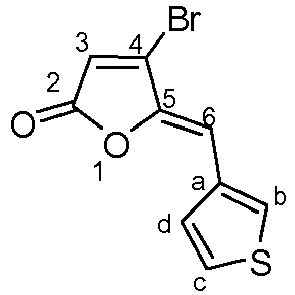
- Dans un tube de Schlenk, sous atmosphère inerte, contenant 2 (200 mg, 0,78 mmol), l'acide thiophène-3-boronique (110 mg, 0,86 mmol), K3PO4 (334 mg, 1,57 mmol), S-Phos 10 (6 mg, 2 mol %) et Pd(OAc)2 (27 mg, 3 mol %), est ajouté du toluène (3 mL). Le tube de Schlenk est ensuite bouché avec un septum, et le milieu réactionnel est agité pendant 5 h à température ambiante. Du CH2Cl2 (30 mL) est ajouté au milieu réactionnel qui est ensuite filtré sur un fritté contenant un peu de silice. Les solvants sont évaporés à l'évaporateur rotatif, et le résidu est chromatographié sur silice, avec comme éluant un mélange CH2Cl2/pentane (50/50). Un solide jaune est obtenu avec 27 % de rendement (54 mg, 0,21 mmol).
R f = 0,78 (CH2Cl2/pentane 50:50), p. f. 68-70°C. 1H-RMN (CDCl3) : δ = 6,38 (s, 1H, 6-H), 6,45 (s, 1H, 3-H), 7,37 (dd, 1H, J= 5,1 Hz, J= 2,8 Hz, d-H), 7,56 (d, 1H, J = 5,1 Hz, c-H), 7,82 (d, 1H, J= 1,8 Hz, b-H) ppm. 13C-RMN (CDCl3) : δ = 107,6 (C-6), 118,6 (C-3), 126,5, 128,7, 129,8, 133,6, 137,9 (C-5), 145,8 (C-4), 167,0 (C-2) ppm. IR (KBr) ν = 3122, 3062, 2924, 1752 (C=O), 1650, 1545, 1508, 1414, 1385, 1333, 1288, 1243, 1222, 1192, 1173, 1148, 1110, 1080, 976, 951, 939, 910, 881, 852, 835, 821, 795, 776, 709, 662, 629 cm-1. UV (CH2Cl2) : λmax (ε) = 242 (10 700), 351 nm (31 900 Lmol-1cm-1). SMRH (EI) : calculé pour C9H5O2BrS : 255,9194 ; trouvé 255,9202 ; C9H5O2BrS (257,10) : C 42,04, H 1,96 ; trouvé C 42,16, H 2,04. -

- Dans un tube de Schlenk, sous atmosphère inerte, contenant 6b (101 mg, 0,39 mmol), l'acide phénylboronique (70 mg, 0,58 mmol), K3PO4 (123 mg, 0,58 mmol), S-Phos 10 (3 mg, 2 mol %) et Pd(OAc)2 (8 mg, 3 mol %), est ajouté du toluène (3 mL). Le tube de Schlenk est ensuite bouché avec un septum, et le milieu réactionnel est agité pendant 24 h à 110°C. Après retour à température ambiante, du CH2Cl2 (30 mL) est ajouté au milieu réactionnel qui est ensuite filtré sur un fritté contenant un peu de silice. Les solvants sont évaporés à l'évaporateur rotatif et le résidu est chromatographié sur silice, avec comme éluant un mélange CH2Cl2/pentane (50/50). Un solide jaune est obtenu avec 66 % de rendement (66 mg, 0,26 mmol).
R f = 0,65 (CH2Cl2/pentane, 60:40), p. f. 70-72°C. 1H-RMN (CDCl3) : δ = 6,19 (d, 1H, J= 0,6 Hz, 3-H), 6,28 (s, 1H, 6-H), 7,35 (dd, 1H, J= 5,1 Hz, J= 3,0 Hz, d'-H), 7,48-7,57 (m, 6H, c'-H, b-H, c-H, d-H, e-H, f-H), 7,77 (dd, 1H, J = 2,9 Hz, J= 0,6 Hz, b'-H) ppm. 13C-RMN (CDCl3) : δ = 107,9 (C-6), 114,3 (C-3), 126,2, 128,4, 128,7, 129,0, 129,1, 130,4, 134,4, 147,0 (C-5), 158,3 (C-4), 168,6 (C-2) ppm. IR (KBr) : ν = 3101, 1759 (C=O), 1644, 1570, 1514, 1489, 1414, 1348, 1248, 1196, 1085, 937, 917, 875, 837, 812, 771, 703, 665, 636 cm-1. UV (CH2Cl2) : λmax (ε) = 228 (11 400), 351 nm (17 000 Lmol-1cm-1). SMRH (El): calculé pour C15H10O2S : 254,0401 ; trouvé 254,0374 ; C15H10O2S (254,04) : C 70,84, H 3,96 ; trouvé C 70,68, H 4,03. -

- Dans un tube de Schlenk, sous atmosphère inerte, contenant 3 (180 mg, 0,71 mmol), l'acide phénylboronique (129 mg, 1,06 mmol), Na2CO3 (150 mg, 1,42 mmol) et Pd(PPh3)4 (24 mg, 3 mol %) sont ajoutés du toluène (3 mL), H2O (1,5 mL) et de l'éthanol (0,9 mL). Le tube de Schlenk est ensuite bouché avec un septum, et le milieu réactionnel est agité pendant 24 h à température ambiante. De l'eau (30 mL) est ensuite ajoutée au milieu réactionnel. Il est extrait avec de l'éther (3 ×20 mL). Les phases organiques réunies sont lavées avec une solution d'eau saturée en NaCl et séchées sur Na2SO4. Les solvants sont évaporés à l'évaporateur rotatif, et le résidu est chromatographié sur silice avec comme éluant un mélange Et2O/pentane (25/75). Un solide blanc crème est obtenu avec 48 % de rendement (94 mg, 0,37 mmol).
Rf = 0,45 (Et2O/pentane, 75:25), p. f. < 50°C. 1H-RMN (CDCl3) : δ = 6,32 (d, 1H, J = 5,4 Hz, 3-H), 7,43-7,46 (m, 6H, H4, ArH) ppm. 13C-RMN (CDCl3) : δ = 110,9 (C-6), 120,8 (C-3), 128,8, 130,1, 130,2, 135,4, 140,9 (C-4), 149,1 (C-5), 168,5 (C-2) ppm. IR (KBr) : ν = 3135, 3096, 3031, 1788 (C=O), 1774 (C=O), 1628, 1612, 1548, 1540, 1486, 1443, 1230, 1106, 1072, 956, 920, 901, 863, 860, 817, 806, 749, 711, 689, 625, 535 cm-1. UV (CH2Cl2) : λmax (ε) = 321 nm (20 400 Lmol-1cm-1). SMRH (El): calculé pour BrC11H7O2 : 249,9630; trouvé 249,9628; BrC11H7O2 (251,08) : C 52,62, H 2,81 ; trouvé C 52,61, H, 2,90. -

- Dans un tube de Schlenk, sous atmosphère inerte, contenant 7a (480 mg, 1,91 mmol), l'acide thiophène-3-boronique (366 mg, 2,86 mmol), Na2CO3 (404 mg, 3,82 mmol), Pd(PPh3)4 (66 mg, 3 mol %) sont ajoutés du toluène (10 mL), H2O (5 mL) et de l'éthanol (2,5 mL). Le tube de Schlenk est ensuite bouché avec un septum, et le milieu réactionnel porté à 80°C pendant 2,5 h. Après retour à température ambiante, de l'eau (50 mL) est ajoutée au milieu réactionnel. Il est extrait avec de l'éther (3 × 20 mL). Les phases organiques réunies sont lavées avec 50 mL d'une solution d'eau saturée en NaCl et séchées sur Na2SO4. Les solvants sont évaporés à l'évaporateur rotatif et le résidu est chromatographié sur silice avec comme éluant un mélange CH2Cl2/pentane (70/30).Un solide jaune pâle est obtenu avec 48 % de rendement (233 mg, 0,92 mmol).
R f = 0,50 (CH2Cl2/pentane, 70:30). 1H-RMN (CDCl3) : δ = 5,71 (d, 1H, J = 5,4 Hz, 3-H), 7,28-7,37 (m, 3H, b'-H, c'-H, d'-H), 7,40-7,52 (m, 5H, 4-H, b-H, c-H, d-H, eH, f-H) ppm. 13C-RMN (CDCl3) : δ = 117,8 (C-3), 123,1 (C-6), 125,5, 128,4, 128,9, 129,5, 129,9, 130,8, 136,5, 137,7, 143,9 (C-4), 146,2 (C-5), 170,2 (C-2) ppm. IR : ν = 3133, 3106, 3057, 2926, 1777 (C=O), 1752 (C=O), 1607, 1544, 1504, 1442, 1410, 1372, 1337, 1301, 1235, 1216, 1166, 1108, 1068, 1000, 979, 954, 892, 849, 807, 746, 712, 699, 682 cm-1. UV (CH2Cl2) : λmax (ε) = 254 (9 000), 354 nm (19 000 Lmol-1cm-1). SMRH (EI) : calculé pour C15H10O2S: 254,0401 ; trouvé 254,0398 ; C15H10O2S (254,30) : C 70,84, H 3,96 ; trouvé C 70,66, H 3,91. -

- Dans un tube de Schlenk, sous atmosphère inerte, contenant 2 (245 mg, 0,96 mmol), l'acide thiophène-3-boronique (185 mg, 1,44 mmol), Na2CO3 (204 mg, 1,93 mmol), Pd(PPh3)4 (33 mg, 3 mol %), sont ajoutés du toluène (5 mL), H2O (2,45 mL) et de l'éthanol (1,22 mL). Le tube de Schlenk est ensuite bouché avec un septum, et le milieu réactionnel est agité pendant 3 jours à température ambiante. De l'eau (30 mL) est ensuite ajoutée au milieu réactionnel. Il est extrait avec de l'éther (3 × 20 mL). Les phases organiques réunies sont lavées avec 30 mL d'une solution d'eau saturée en NaCl et séchées sur Na2SO4. Les solvants sont évaporés à l'évaporateur rotatif et le résidu est chromatographié sur silice avec comme éluant un mélange Et2O/pentane (35/65). Un solide jaune pâle est obtenu avec 40 % de rendement (99 mg, 0,38 mmol).
Rf = 0,65 (Et2O/pentane, 75:25), p. f. 65-67°C. 1H-RMN (CDCl3) : δ = 6,33 (d, 1H, J = 5,6 Hz, 3-H), 7,25 (dd, 1H, J= 6,4 Hz, J= 1,3 Hz, d-H), 7,43 (dd, 1H, J= 4,9 Hz, J= 3,1 Hz, c-H), 7,47 (dd, 1H, J = 2,9 Hz, J= 1,4 Hz, b-H), 7,59 (d, 1H, J= 5,4 Hz, 4-H) ppm. 13C-RMN (CDCl3) : δ = 105,2 (C-6), 120,6 (C-3), 127,1, 127,4, 128,6, 136,0, 140,6 (C-4), 148,9 (C-5), 168,4 (C-2) ppm. IR (KBr) : ν = 3135, 3107, 2916, 2848, 1781 (C=O), 1756 (C=O), 1621, 1546, 1512, 1410, 1366, 1335, 1261, 1230, 1181, 1108, 1070, 991, 928, 890, 839, 807, 781, 748, 696 cm-1. UV (CH2Cl2) : λmax (ε) = 255 (9 100), 334 nm (20 400 Lmol-1cm-1). SMRH (El): calculé pour BrC9H5O2S : 255,9194 ; trouvé 255,9202 ; BrC9H5O2S (257,10) : C 42,04, H 1,96 ; trouvé C 42,12, H 2,02. -

- Dans un tube de Schlenk, sous atmosphère inerte, contenant 7b (76 mg, 0,29 mmol), l'acide phénylboronique (54 mg, 0,44 mmol), Na2CO3 (62 mg, 0,59 mmol) et Pd(PPh3)4 (13 mg, 3 mol %), sont ajoutés du toluène (2 mL), H2O (1 mL) et de l'éthanol (0,5 mL). Le tube de Schlenk est ensuite bouché avec un septum, et le milieu réactionnel porté à 80°C pendant 5 h. Après retour à température ambiante, de l'eau (5 mL) est ajoutée au milieu réactionnel. Il est extrait avec de l'éther (3 × 15 mL). Les phases organiques réunies sont lavées avec une solution d'eau saturée en NaCl et séchées sur Na2SO4. Les solvants sont évaporés à l'évaporateur rotatif et le résidu est chromatographié sur silice avec comme éluant un mélange Et2O/pentane (30/70). Une huile jaune est obtenue avec 42 % de rendement (31 mg, 0,12 mmol).
Rf = 0,39 (Et2O/pentane, 25:75), p. f. 118-119°C. 1H-RMN (CDCl3) : δ = 6,22 (d, 1H, J = 5,6 Hz, H-3), 6,98 (dd, 1H, J = 4,9 Hz, J = 1,3 Hz, d'-H), 7,31 (dd, 1H, J = 3,1 Hz, J = 1,3 Hz, b'-H), 7,35-7,42 (m, 4H, c'-H et b-H ou c-H ou d-H ou e-H ou f-H), 7,49-7,53 (m, 2H, b-H ou c-H ou d-H ou e-H ou f-H), 7,62 (d, 1H, J = 5,6 Hz, 4-H) ppm. 13C-RMN (CDCl3) : δ = 118,5 (C-3), 123,6 (C-6), 126,3, 127,2, 128,2, 129,2, 129,8, 130,9, 136,1, 137,6, 143,5 (C-4), 147,2 (C-5), 170,4 (C-2) ppm. IR 3132, 3102, 3049, 1771 (C=O), 1755 (C=O), 1617, 1573, 1540, 1489, 1444, 1416, 1233, 1166, 1103, 1084, 990, 897, 874, 850, 816, 792, 750, 694, 671, 656, 613 cm-1. UV (CH2Cl2) : λmax (ε) = 250 (10 900), 352 nm (21 400 Lmol-1cm-1). SMRH (EI) : calculé pour C15H10O2S : 254,0401 ; trouvé 254,0398 ; C15H10O2S (254,31): C 70,84, H 3,96 ; trouvé C 70,71, H 3,99. -

HRMS calc. M+ 246.0681, trouvée 246.0667.
δH (270 MHz, CDCl3): 8.36-8.34 (2H, m, H aromatique), 7.73-7.68 (3H, m, 2H aromatique and 1H olefinique), 7.39-7.25 (4H, m, H aromatique), 6.48 (1H, d, J = 5.38 Hz, 1H olefinique).
δC (67.80 MHz, CDCl3): 170.65, 147.60, 141.80, 140.80, 140.55, 135.85, 135.44, 129.93, 129.39, 128.38, 128.10, 127.36, 123.70, 120.79, 120.58, 119.79. - Les présents inventeurs ont démontré que l'ensemble des dérivés de méthylène furanone de formule générale (I), tels que revendiqués dans la présente invention, possèdent une activité photoprotectrice et antioxydante.
- Il est connu que la peau constitue une cible directe de nombreux agents environnementaux dont les rayons ultraviolets de types A et B, les UVC étant arrêtés par la couche d'ozone.
- Les UVB (5 % de l'énergie UV terrestre) atteignent l'épiderme cutané tandis que les UVA (95 % de l'énergie terrestre) sont plus pénétrants puisqu'ils atteignent le derme cutané. Les conséquences biologiques de ce stress UV sont décrites comme une augmentation de la réponse inflammatoire et le développement d'un érythème, une modulation de la réponse immune et, à plus long terme, un vieillissement prématuré et la promotion de cancers cutanés.
- Les UVA et UVB, par des voies d'accès différentes, perturbent la stabilité génomique. Les UVB sont principalement absorbés par la molécule d'ADN et génèrent majoritairement des lésions encombrantes comme les dimères de pyrimidine de type cyclobutane et de type 6-4 pyrimidine-pyrimidone. Ces photoproduits sont réparés spécifiquement par des systèmes de défense cellulaires, tels que la réparation par excision de nucléotides.
- Les UVA sont absorbés principalement par d'autres molécules que l'ADN, dites chromophores, générant ainsi la production de radicaux libres oxygénés capables d'attaquer l'ADN et créant de nombreuses lésions, telles que des cassures de brins, directes ou dues aux sites alcali labiles. La cellule possède également des systèmes de réparation spécifiques de ces lésions sur l'ADN.
- Aujourd'hui, il est clairement admis que les rayonnements UVA et UVB peuvent être mutagènes et constituer des promoteurs potentiels de la photocarcinogénèse cutanée. Il semble donc impératif de protéger la peau des effets délétères des ultraviolets par des écrans solaires topiques possédant des filtres puissants contre les UVA et/ou les UVB.
- Les dérivés de méthylène furanone de formule générale (I) de la présente invention ont ainsi été évalués afin de déterminer leur pouvoir photoprotecteur par détermination de leurs caractéristiques d'absorption UV : coefficient d'extinction molaire ε, longueur d'onde critique (λc) et rapport UVA/UVB.
- Les résultats obtenus montrent que les coefficients d'extinction molaire de nos composés s'échelonnent de 12 300 L.mol-1.cm-1 à 31 900 L.mol-1.cm-1 dont une large majorité au-dessus de 20 000 L.mol-1.cm-1, ce qui est tout à fait dans la gamme des produits utilisés dans l'industrie cosmétique. Mis à part 4b et 4c dont le maximum est en UVB, ils possèdent tous un maximum d'absorption en UVA. La longueur d'onde critique confirme cette observation ; effectivement celle-ci est supérieure à 370 nm pour la majorité des molécules. Le ratio UVA/UVB nous indique que nous pourrions être en présence de filtres larges (R ≥ 1,5), qui couvrent bien les UVA mais également une partie des UVB.
- En regroupant toutes ces informations et en comparant l'allure des spectres d'absorption UV, nous pouvons classer ces molécules en trois catégories :
- Catégorie UVA stricte (voir
figure 1 en annexe)
(molécules absorbant uniquement en UVA) :
5a, 4c, 6b, 9b, 9a, 5b, 4d, 5e, 5d

Dans cette catégorie seuls 5a et 6b possèdent un λc < 370 (respectivement 367 et 355 nm). Toutes ces molécules absorbent dans les UVA longs (340-400 nm) ce qui est intéressant car peu de filtres commerciaux, actuellement, couvrent cette zone. On peut également remarquer que les composés substitués par des groupements donneurs absorbent en général à plus haute longueur d'onde. - Catégorie UVA étendue vers B (voir
figure 2 en annexe)
(molécules absorbant majoritairement
en UVA et minoritairement en UVB) :
7a, 5f, 7b, 4a, 8a, 6a, 4f, 8b, 5c

Comme indiqué sur le spectre d'absorption ci-dessus en exemple, ces molécules possèdent un maximum d'absorption en UVA mais couvrent également une partie importante des UVB. Ceci est confirmé par la valeur du rapport UVA/UVB, qui est comprise entre 1,5 et 3 pour 8 de ces 9 composés. Une majorité de ces molécules absorbe également dans les UVA longs (4a, 8a, 6a, 4f, 8b, 5c). - Catégorie UVA + B (voir
figure 3 en annexe)
(molécules ayant un maximum d'absorption en UVA et en UVB) :
4b, 4c

- Ces deux molécules possèdent également des propriétés intéressantes, puisqu'elles absorbent en UVA et en UVB, et plus particulièrement 4c avec un bon coefficient d'extinction molaire de 22 000 L.mol-1.cm-1.
- Des tests de photostabilité ont été effectués sur sept molécules à savoir (4d, 5a, 5b, 5d, 5e et 9a (UVA strict) ainsi que 5f (UVA étendu vers B):


- Pour cette étude il a été choisi d'irradier les échantillons, sous forme de poudre ou en solution dans l'éthanol, avec 10 DEM (Dose Erythémale Minimale : dose d'ensoleillement minimale provoquant l'apparition d'un coup de soleil). L'évaluation de la dégradation est estimée par l'allure des spectres d'absorption UV avant et après irradiation.
Molécules En solution En poudre 4d moyennement stable stable 5a stable stable 5b stable stable 5d stable pas stable 5e stable stable 9a stable stable 5f stable stable - Les résultats rassemblés dans le tableau ci-dessus indiquent que cinq des sept composés testés présentent une très bonne photostabilité. Seul 4d est moyennement stable en solution, et 5d est totalement instable sous forme de poudre.
- La mesure du pouvoir antioxydant de 10 molécules a été réalisée par piégeage de l'anion superoxyde : 5d, 9a, 5b, 5a, 5e, 4d, 5f, 5g, 5h, 5j.
- La méthode consiste à générer des radicaux libres par un signal photochimique. L'intensité de l'oxydation est 1000 fois supérieure à celles obtenues en conditions normales.
- Ainsi le radical superoxyde : O2 - est généré par une réaction photochimique :
L + hv (UV) + O2 → L*O2 → L +O2-
- L* : luminol à l'état excité
- L + : radical luminol
- La détection se fait par chimioluminescence. Elle permet l'évaluation de molécules ou extraits antioxydants hydrosolubles et liposolubles.
- Une partie des anions superoxides est quenchée par les antioxydants. Les radicaux libres restants sont quantifiés par chimioluminescence.
L+ + O2 - → N2 + AP*2- → AP2-+ hv (luminescence)
AP*2- : aminophtalate à l'état excité - Les résultats sont exprimés respectivement en quantité équivalente de vitamine C ou de Trolox (acide 6-hydroxy-2,5,7,8-tétraméthylchroman-2-carboxylique). La sensibilité est de l'ordre de la nanomole.
Nom Conditions Photosensibilisant Anti-oxydant Blanc 100% O2 - générés + - Standards Gamme standard: de 1 à 3 nmol + Vitamine C ou Trolox Essai +/- O2 - générés + Molécule x - L'analyse des résultats dépend de deux critères : de l'allure de la courbe et de la valeur numérique donnée par le logiciel.
- Les résultats seront exprimés en µg d'échantillon nécessaire pour obtenir une activité équivalente à l'activité détectée pour 1 µg de standard (acide ascorbique ou Trolox).
Produits µg d'échantillon pour1 µg de Trolox Vitamine C 0,451 Trolox 1,067 Butylhydroxyanisole (BHA) 2,650 Bilirubine 4,18 Butylhydroxytoluène (BHT) 7,26 Idébénone 10,10 α-tocophérol-acétate 140 Cystéine 698 Albumine 3069 Acide Lipoïque NEGATIF Echantillon ACL µg d'échantillon pour 1 µg de Trolox 5d 12,7 9a 21,6 5b 28,0 5a 43,0 5e 46,3 4d 50,2 5f 88,3 5g 0,03 5h 30 5i 1,5 - La tyrosinase est une enzyme limitante dans la mélanogénèse.
- Elle appartient à la famille des oxydoréductases. Elle possède notamment la fonction : monophenol mono oxygenase et polyphenol oxydase.
- Elle est synthétisée au niveau des mélanocytes. Elle est activée lors de sa migration vers les kératinocytes via les mélanosomes. Elle transforme la tyrosine en DOPA puis dopaquinone, ce qui conduit in fine à une polymérisation soit une production de pigments
- C'est la fonction monophenol monooxygenase qui est mesurée dans ce test. Nous mesurons une activité tyrosinase : MPMO stricto sensus.
- Le substrat : la L-tyrosine est transformée en L-DOPA. La réaction enzymatique est stoppée à ce stade. La DOPA produite est déterminée par une calibration externe (0,005 à 0,1 mM). Le résultat final est un pourcentage d'inhibition par rapport à une activité maximum sans inhibiteur ou extrait.
- Pour une quantité de 50 µM, le composé 5g inhibe de 65, 93% l'activité de l'enzyme MPMO.
- Les tests basés sur les données d'absorption UV ont montré que ces nouveaux dérivés de méthylène furanone absorbent principalement en UVA avec de bons coefficients d'extinction molaire. L'allure des spectres a permis, de les classer en trois catégories : UVA strict, UVA étendu vers B, et UVA + B. Les méthylène furanones gem-disusbtitués sont majoritairement présentes dans la catégorie UVA strict. L'introduction d'aromatiques portant des groupes méthoxy ou aminocarbamate attracteurs semblent responsable d'un effet bathochrome car certaines des molécules absorbent dans les UVA longs vers 380 nm.
- Les tests réalisés sur ces lactones indiquent que la plupart de ces molécules sont photostables et que ce sont également de bons antioxydants. Ces composés présentent donc des capacités photoprotectrices et antioxydantes intéressantes qui justifient leur utilisation dans des compositions dermo-cosmétiques.
- Le test d'inhibition de l'enzyme MPMO a permis de démontrer les propriétés dépigmentantes des composés méthylène furanone (poly)hydroxylés.
à la condition toutefois que R1 et R2 ne représentent pas simultanément un radical paraméthoxyphényle.
à la condition toutefois que R1 et R2 ne représentent pas simultanément un radical paraméthoxyphényle
caractérisé en ce qu'il implique une réaction de couplage de Suzuki-Myaura à partir de dérivés dibromofuranones de formule générale (II), sous leurs formes isomères (E) ou (Z), pures ou en mélange :
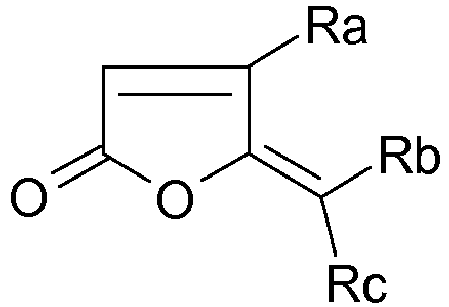
Ra représente un hydrogène et Rb, Rc représente un radical bromo.
à la condition toutefois que R1 et R2 ne représentent pas simultanément un radical paraméthoxyphényle
caractérisé en ce qu'il implique une réaction de couplage du 2-méthoxyfurane avec une cétone suivie d'une déshydratation in situ ou avec un agent de déshydratation.
Claims (18)
- Dérivés de méthylène furanone de formule générale (I) :
 - R3 représente un hydrogène- R1 et R2 sont identiques et représententet- un radical phényle substitué par un ou plusieurs radicaux∘ alkyl(C1-5), alkyl(C1-4)oxy,∘ hydroxy,∘ méthylthio,∘ halogéno, ou∘ un groupement amino éventuellement substitué par un radical alkyl(C1-4), alkyl(C1-4)oxycarbonyle,- un radical thiophényle,- un radical thionaphtènyle,- un radical thiazolyle,- un radical pyridinyle,- un radical benzomorpholinyle,- un radical naphtyle
à la condition toutefois que R1 et R2 ne représentent pas simultanément un radical paraméthoxyphényle. - Dérivés de méthylène furanone de formule générale (I) selon la revendication (1) caractérisés en ce que :- R3 représente un hydrogène- R1 et R2 sont identiques et représentent- un radical phényle substitué par un ou plusieurs radicaux- alkyl(C1-4)oxy,- hydroxy,- un radical thiophényle,et à la condition toutefois que R1 et R2 ne représentent pas simultanément un radical paraméthoxyphényle.
- Dérivés de méthylène furanone de formule générale (I) selon l'une des revendications 1 à 2 caractérisés en ce que :- R3 représente un hydrogène- R1 et R2 sont identiques et représentent- un radical phényle substitué par un ou plusieurs radicaux- hydroxy
- Dérivés de méthylène furanone de formule générale (I) selon l'une des revendications 1 à 3, sous leurs formes isomères (E) ou (Z), pures ou en mélange,
choisis parmi :- 5-(bis(3,4-diméthoxyphényl)méthylène)furane-2(5H)-one ;- 5-(dithiophène-3-ylméthylène)furane-2(5H)-one ;- 5-bis(4-hydroxyphénylcarbamate de tert-butyl)furane-2(5H)-one ;- 5-(bis(2-fluorophényl)méthylène)furane-2(5H)-one ;- 5-(bis(4-(méthylthio)phényl)méthylène)furan-2(5H)-one- 5-(bis(4-(diméthylamino)phényl)méthylène)furan-2(5H)-one- 5-(bis(4-méthyl-3,4-dihydro-2H-benzo[b][1,4]oxazin-7-yl)méthylène)furan-2(5H)-one- 5-(dithiazol-2-ylméthylène)furan-2(5H)-one- 5-(bis(4-fluorophényl)méthylène)furan-2(5H)-one- 5-(bis(4-hydroxy-3,5-diméthylphényl)méthylène)furan-2(5H)-one- 5-(bis(3,4,5-trihydroxyphényl)méthylène)furan-2(5H)-one- 5-(bis(3,4-dihydroxyphényl)méthylène)furan-2(5H)-one- 5-(bis(4-hydroxy-3-méthoxyphényl)méthylène)furan-2(5H)-one- 5-(bis(4-hydroxy-3,5-diméthoxyphényl)méthylène)furan-2(5H)-one- 5-(bis(4-hydroxyphényl)méthylène)furan-2(5H)-one- 5-(bis(2,4-dimethoxyphenyl)methylene)furan-2(5H)-one- 5-(bis(2,4-dihydroxyphenyl)methylene)furan-2(5H)-one - Utilisation cosmétique de dérivés de méthylène furanone de formule générale (I):

dans laquelle
l'un des radicaux R1 et R3 représente nécessairement un hydrogène,
et R1, R2, R3 sont identiques ou différents et représentent :- un radical phényle éventuellement substitué par un ou plusieurs radicaux∘ alkyl(C1-5 ), alkyl(C1-4)oxy,∘ hydroxy,∘ méthylthio,∘ halogéno, ou∘ un groupement amino éventuellement substitué par un radical alkyl(C1-4), alkyl(C1-4)oxycarbonyle,- un radical thiophényle,- un radical thionaphtènyle,- un radical thiazolyle,- un radical pyridinyle,- un radical benzomorpholinyle,- un radical naphtyle,- R1 et R2 sont reliés entre eux et représentent un radical fluorenylen tant qu'agent photoprotecteur. - Utilisation cosmétique selon la revendication 5, caractérisée en ce que les dérivés de méthylène furanone de formule générale (I), sont sous leurs formes isomères (E) ou (Z), pures ou en mélange,
et caractérisée en ce que- R3 représente un hydrogène, et- R1 et R2 sont identiques ou différents et représentent- un radical phényle éventuellement substitué par un ou plusieurs radicaux∘ alkyl(C1-5 ), alkyl(C1-4)oxy,∘ hydroxy,∘ méthylthio,∘ halogéno, ou∘ un groupement amino éventuellement substitué par un radical alkyl(C1-4), alkyl(C1-4)oxycarbonyle,- un radical thiophényle,- un radical thionaphtènyle,- un radical thiazolyle,- un radical pyridinyle,- un radical benzomorpholinyle,- un radical naphtyle,- R1 et R2 sont reliés entre eux et représentent un radical fluorenyl. - Dérivés de méthylène furanone de formule générale (I):

dans laquelle
l'un des radicaux R1 et R3 représente nécessairement un hydrogène,
et R1, R2, R3 sont identiques ou différents et représentent :- un radical phényle éventuellement substitué par un ou plusieurs radicaux∘ alkyl(C1-5 ), alkyl(C1-4)oxy,∘ hydroxy,∘ méthylthio,∘ halogéno, ou∘ un groupement amino éventuellement substitué par un radical alkyl(C1-4), alkyl(C1-4)oxycarbonyle,- un radical thiophényle,- un radical thionaphtènyle,- un radical thiazolyle,- un radical pyridinyle,- un radical benzomorpholinyle,- un radical naphtyle,- R1 et R2 sont reliés entre eux et représentent un radical fluorenylpour utilisation dermatologique en tant qu'agent photoprotecteur. - Dérivés pour utilisation selon la revendication 7, caractérisé en ce que les dérivés de méthylène furanone de formule générale (I), sont sous leurs formes isomères (E) ou (Z), pures ou en mélange,
et caractérisé en ce que- R3 représente un hydrogène, et- R1 et R2 sont identiques ou différents et représententR1 et R2 sont reliés entre eux et représentent un radical fluorenyl.- un radical phényle éventuellement substitué par un ou plusieurs radicaux∘ alkyl(C1-5 ), alkyl(C1-4)oxy,∘ hydroxy,∘ méthylthio,∘ halogéno, ou∘ un groupement amino éventuellement substitué par un radical alkyl(C1-4), alkyl(C1-4)oxycarbonyle,- un radical thiophényle,- un radical thionaphtènyle,- un radical thiazolyle,- un radical pyridinyle,- un radical benzomorpholinyle,- un radical naphtyle, - Utilisation cosmétique de dérivés de méthylène furanone de formule générale (I) :

dans laquelle
l'un des radicaux R1 et R3 représente nécessairement un hydrogène et R1, R2, R3 sont identiques ou différents et représentent :- un radical phényle éventuellement substitué par un ou plusieurs radicaux∘ alkyl(C1-5 ), alkyl(C1-4)oxy,∘ hydroxy,∘ méthylthio,∘ halogéno, ou∘ un groupement amino éventuellement substitué par un radical alkyl(C1-4), alkyl(C1-4)oxycarbonyle,- un radical thiophényle,- un radical thionaphtènyle,- un radical thiazolyle,- un radical pyridinyle,- un radical benzomorpholinyle,- un radical naphtyle,- R1 et R2 sont reliés entre eux et représentent un radical fluorenylen tant qu'agent antioxydant. - Utilisation cosmétique selon la revendication 9, caractérisée en ce que les dérivés de méthylène furanone de formule générale (I) sont sous leurs formes isomères (E) ou (Z), pures ou en mélange,
et caractérisée en ce que- R3 représente un hydrogène, et- R1 et R2 sont identiques ou différents et représentent- un radical phényle éventuellement substitué par un ou plusieurs radicaux∘ alkyl(C1-5 ), alkyl(C1-4)oxy,∘ hydroxy,∘ méthylthio,∘ halogéno, ou∘ un groupement amino éventuellement substitué par un radical alkyl(C1-4), alkyl(C1-4)oxycarbonyle,- un radical thiophényle,- un radical thionaphtènyle,- un radical thiazolyle,- un radical pyridinyle,- un radical benzomorpholinyle,- un radical naphtyle,- R1 et R2 sont reliés entre eux et représentent un radical fluorenyl. - Dérivés de méthylène furanone de formule générale (I) :

dans laquelle
l'un des radicaux R1 et R3 représente nécessairement un hydrogène et R1, R2, R3 sont identiques ou différents et représentent :- un radical phényle éventuellement substitué par un ou plusieurs radicaux∘ alkyl(C1-5 ), alkyl(C1-4)oxy,∘ hydroxy,∘ méthylthio,∘ halogéno, ou∘ un groupement amino éventuellement substitué par un radical alkyl(C1-4), alkyl(C1-4)oxycarbonyle,- un radical thiophényle,- un radical thionaphtènyle,- un radical thiazolyle,- un radical pyridinyle,- un radical benzomorpholinyle,- un radical naphtyle,- R1 et R2 sont reliés entre eux et représentent un radical fluorenylpour utilisation dermatologique en tant qu'agent antioxydant. - Dérivés pour utilisation selon la revendication 11, caractérisée en ce que les dérivés de méthylène furanone de formule générale (I) sont sous leurs formes isomères (E) ou (Z), pures ou en mélange,
et caractérisée en ce que- R3 représente un hydrogène, et- R1 et R2 sont identiques ou différents et représententR1 et R2 sont reliés entre eux et représentent un radical fluorenyl- un radical phényle éventuellement substitué par un ou plusieurs radicaux∘ alkyl(C1-5 ), alkyl(C1-4)oxy,∘ hydroxy,∘ méthylthio,∘ halogéno, ou∘ un groupement amino éventuellement substitué par un radical alkyl(C1-4), alkyl(C1-4)oxycarbonyle,- un radical thiophényle,- un radical thionaphtènyle,- un radical thiazolyle,- un radical pyridinyle,- un radical benzomorpholinyle,- un radical naphtyle, - Utilisation de dérivés de méthylène furanone de formule générale (I) selon la revendication 3 en tant qu'agent dépigmentant.
- Composition dermocosmétique comprenant un excipient cosmétiquement acceptable et un dérivé de méthylène furanone selon l'une quelconque des revendications 1 à 4 en tant qu'agent photoprotecteur ou agent antioxydant.
- Composition dermocosmétique comprenant un excipient cosmétiquement acceptable et un dérivé de méthylène furanone selon la revendication 3 en tant qu'agent dépigmentant.
- Composition dermocosmétique selon l'une des revendications 14 et 15 caractérisée en ce que la composition se présente sous forme de crème, gel ou spray.
- Procédé de préparation de dérivés de méthylène furanone de formule générale (I) selon l'une quelconque des revendications 1 à 4
caractérisé en ce qu'il implique une réaction de couplage de Suzuki-Myaura à partir de dérivés dibromofuranones de formule générale (II) :
dans laquelle
Ra représente un hydrogène et Rb, Rc représente un radical bromo. - Procédé de préparation des dérives de méthylène furanone de formule générale (I) tels que définis selon l'une des revendications 1 à 3 caractérisés en ce qu'il implique une réaction de couplage du 2-methoxy-furane avec une cétone suivie d'une déshydratation in situ ou avec un agent de déshydratation.

Applications Claiming Priority (2)
| Application Number | Priority Date | Filing Date | Title |
|---|---|---|---|
| FR0856441A FR2936244B1 (fr) | 2008-09-25 | 2008-09-25 | Derives de methylene furanone et utilisation de ces derives en tant qu'agent photoprotecteur ou antioxydant |
| PCT/EP2009/062476 WO2010034827A1 (fr) | 2008-09-25 | 2009-09-25 | Derives de methylene furanone et utilisation de ces derives en tant qu'agent photoprotecteur ou antioxydant ou depigmentant dans des compositions a usage cosmetique ou dermatologique. |
Publications (2)
| Publication Number | Publication Date |
|---|---|
| EP2350036A1 EP2350036A1 (fr) | 2011-08-03 |
| EP2350036B1 true EP2350036B1 (fr) | 2015-04-15 |
Family
ID=40527516
Family Applications (1)
| Application Number | Title | Priority Date | Filing Date |
|---|---|---|---|
| EP09815693.8A Not-in-force EP2350036B1 (fr) | 2008-09-25 | 2009-09-25 | Derives de methylene furanone et utilisation de ces derives en tant qu'agent photoprotecteur ou antioxydant ou depigmentant dans des compositions a usage cosmetique ou dermatologique. |
Country Status (5)
| Country | Link |
|---|---|
| US (1) | US8563548B2 (fr) |
| EP (1) | EP2350036B1 (fr) |
| JP (1) | JP5646488B2 (fr) |
| FR (1) | FR2936244B1 (fr) |
| WO (1) | WO2010034827A1 (fr) |
Families Citing this family (1)
| Publication number | Priority date | Publication date | Assignee | Title |
|---|---|---|---|---|
| CN109503453B (zh) * | 2019-01-16 | 2020-05-22 | 山东大学 | 一种细菌群体感应抑制剂及其制备方法和应用 |
Family Cites Families (2)
| Publication number | Priority date | Publication date | Assignee | Title |
|---|---|---|---|---|
| DE19857252A1 (de) * | 1998-12-11 | 2000-06-15 | Haarmann & Reimer Gmbh | Benzyliden-gamma-butyrolactone, Verfahren zu ihrer Herstellung und ihre Verwendung als UV-Absorber |
| AU2007304839A1 (en) * | 2006-10-06 | 2008-04-10 | Unilever Plc | Furanone compounds and lactam analogues thereof |
-
2008
- 2008-09-25 FR FR0856441A patent/FR2936244B1/fr not_active Expired - Fee Related
-
2009
- 2009-09-25 JP JP2011528350A patent/JP5646488B2/ja not_active Expired - Fee Related
- 2009-09-25 EP EP09815693.8A patent/EP2350036B1/fr not_active Not-in-force
- 2009-09-25 WO PCT/EP2009/062476 patent/WO2010034827A1/fr not_active Ceased
- 2009-09-25 US US13/120,822 patent/US8563548B2/en not_active Expired - Fee Related
Non-Patent Citations (2)
| Title |
|---|
| ERGIN VOLKAN ET AL: "Carbonyl Stress in Aging Process: Role of Vitamins and Phytochemicals as Redox Regulators", AGING AND DISEASE, vol. 4, no. 5, October 2013 (2013-10-01), pages 276 - 294, ISSN: 2152-5250(print) * |
| GANDHI SONIA ET AL: "Mechanism of Oxidative Stress in Neurodegeneration", OXIDATIVE MEDICINE AND CELLULAR LONGEVITY, 2012, pages Article No.: 428010, ISSN: 1942-0900(print) * |
Also Published As
| Publication number | Publication date |
|---|---|
| US20110184059A1 (en) | 2011-07-28 |
| JP5646488B2 (ja) | 2014-12-24 |
| FR2936244B1 (fr) | 2011-04-01 |
| WO2010034827A1 (fr) | 2010-04-01 |
| EP2350036A1 (fr) | 2011-08-03 |
| FR2936244A1 (fr) | 2010-03-26 |
| JP2012503635A (ja) | 2012-02-09 |
| US8563548B2 (en) | 2013-10-22 |
Similar Documents
| Publication | Publication Date | Title |
|---|---|---|
| Singh et al. | Novel 3-alkanoyl/aroyl/heteroaroyl-2H-chromene-2-thiones: Synthesis and evaluation of their antioxidant activities | |
| FR2841900A1 (fr) | Nouveaux derives de 1,3-diphenylprop-2-en-1-one substitues, preparation et utilisations | |
| Pasha et al. | Amberlyst-15 catalyzed Povarov reaction of N-arylidene-1H-indazol-6-amines and indoles: a greener approach to the synthesis of exo-1, 6, 7, 7a, 12, 12a-hexahydroindolo [3, 2-c] pyrazolo [3, 4-f] quinolines as potential sirtuin inhibitors | |
| EP0350386A1 (fr) | Nouveaux dérivés insaturés liposolubles des benzalmalonates et leur utilisation en tant qu'absorbeurs du rayonnement ultra-violet en cosmétique | |
| Hadjipavlou-Litina et al. | Aryl-acetic and cinnamic acids as lipoxygenase inhibitors with antioxidant, anti-inflammatory, and anticancer activity | |
| JP2648581B2 (ja) | コウジ酸誘導体 | |
| EP2350036A1 (fr) | Derives de methylene furanone et utilisation de ces derives en tant qu'agent photoprotecteur ou antioxydant ou depigmentant dans des compositions a usage cosmetique ou dermatologique. | |
| FR2521998A1 (fr) | Pyrido (3,4-c) psoralenes, obtention, applications en cosmetologie et a titre de medicaments et compositions cosmetiques et pharmaceutiques les contenant | |
| Rosenau et al. | Synthesis and Oxidation Behavior of 2, 4, 5, 7, 8-Pentamethyl-4 H-1, 3-benzodioxin-6-ol, a Multifunctional Oxatocopherol-Type Antioxidant | |
| FR2712590A1 (fr) | Nouveaux dérivés de l'acide kojique. | |
| Iyer et al. | Silver (I) Oxide Catalyzed Oxidation of o-Allyl-and o-(1-Propenyl) phenols. | |
| EP0685473B1 (fr) | Composés benzohétérocycliques, en tant qu'antioxydants | |
| KR100270410B1 (ko) | 타이로시네이즈 활성 저해능을 갖는 신규 1,3-디페닐프로판 유도체 및 그의 제조방법 | |
| Daquino et al. | Coupling and fast decarboxylation of aryloxyl radicals of 4-hydroxycinnamic acids with formation of stable p-quinomethanes | |
| KR100365072B1 (ko) | 신규 코지산 이합체 및 이의 제조방법 | |
| KR101841349B1 (ko) | 2-하이드록시벤조페논 화합물의 신규한 합성방법 및 이의 용도 | |
| CN114773277B (zh) | 柠檬醛含氮衍生物及其制备方法和应用 | |
| CN114805222B (zh) | 一种柠檬醛衍生物及其制备方法和应用 | |
| Adelwöhrer et al. | Synthesis of novel 3-oxa-chromanol type antioxidants | |
| EP3901129B1 (fr) | Procede de synthese de nouveaux composes derives d'acide 3-hydroxy-cyclopentyl acetique | |
| Rao et al. | Synthesis and Photochromic Properties of Spirobiindane Based Bis-coumarins | |
| Yaragatti et al. | Synthesis of isomeric naphthofuranyl coumarins as anti-inflammatory and analgesic agents | |
| Gabbutt et al. | Synthesis and photochromic properties of symmetrical aryl ether linked bi-and tri-naphthopyrans | |
| EP0813537B1 (fr) | Derives phosphoryles de nitrones, leur procede de preparation et compositions les contenant | |
| EP1525191B1 (fr) | Nouveau procede de preparation de derives styryle pyrazoles, isoxazoles et isothiazoles |
Legal Events
| Date | Code | Title | Description |
|---|---|---|---|
| PUAI | Public reference made under article 153(3) epc to a published international application that has entered the european phase |
Free format text: ORIGINAL CODE: 0009012 |
|
| 17P | Request for examination filed |
Effective date: 20110422 |
|
| AK | Designated contracting states |
Kind code of ref document: A1 Designated state(s): AT BE BG CH CY CZ DE DK EE ES FI FR GB GR HR HU IE IS IT LI LT LU LV MC MK MT NL NO PL PT RO SE SI SK SM TR |
|
| DAX | Request for extension of the european patent (deleted) | ||
| 17Q | First examination report despatched |
Effective date: 20130718 |
|
| GRAP | Despatch of communication of intention to grant a patent |
Free format text: ORIGINAL CODE: EPIDOSNIGR1 |
|
| INTG | Intention to grant announced |
Effective date: 20141030 |
|
| GRAS | Grant fee paid |
Free format text: ORIGINAL CODE: EPIDOSNIGR3 |
|
| GRAA | (expected) grant |
Free format text: ORIGINAL CODE: 0009210 |
|
| AK | Designated contracting states |
Kind code of ref document: B1 Designated state(s): AT BE BG CH CY CZ DE DK EE ES FI FR GB GR HR HU IE IS IT LI LT LU LV MC MK MT NL NO PL PT RO SE SI SK SM TR |
|
| REG | Reference to a national code |
Ref country code: GB Ref legal event code: FG4D Free format text: NOT ENGLISH Ref country code: CH Ref legal event code: EP |
|
| REG | Reference to a national code |
Ref country code: IE Ref legal event code: FG4D Free format text: LANGUAGE OF EP DOCUMENT: FRENCH |
|
| REG | Reference to a national code |
Ref country code: AT Ref legal event code: REF Ref document number: 721880 Country of ref document: AT Kind code of ref document: T Effective date: 20150515 |
|
| REG | Reference to a national code |
Ref country code: DE Ref legal event code: R096 Ref document number: 602009030716 Country of ref document: DE Effective date: 20150528 |
|
| REG | Reference to a national code |
Ref country code: NL Ref legal event code: VDEP Effective date: 20150415 |
|
| REG | Reference to a national code |
Ref country code: AT Ref legal event code: MK05 Ref document number: 721880 Country of ref document: AT Kind code of ref document: T Effective date: 20150415 |
|
| REG | Reference to a national code |
Ref country code: LT Ref legal event code: MG4D |
|
| PG25 | Lapsed in a contracting state [announced via postgrant information from national office to epo] |
Ref country code: NL Free format text: LAPSE BECAUSE OF FAILURE TO SUBMIT A TRANSLATION OF THE DESCRIPTION OR TO PAY THE FEE WITHIN THE PRESCRIBED TIME-LIMIT Effective date: 20150415 |
|
| PG25 | Lapsed in a contracting state [announced via postgrant information from national office to epo] |
Ref country code: PT Free format text: LAPSE BECAUSE OF FAILURE TO SUBMIT A TRANSLATION OF THE DESCRIPTION OR TO PAY THE FEE WITHIN THE PRESCRIBED TIME-LIMIT Effective date: 20150817 Ref country code: ES Free format text: LAPSE BECAUSE OF FAILURE TO SUBMIT A TRANSLATION OF THE DESCRIPTION OR TO PAY THE FEE WITHIN THE PRESCRIBED TIME-LIMIT Effective date: 20150415 Ref country code: LT Free format text: LAPSE BECAUSE OF FAILURE TO SUBMIT A TRANSLATION OF THE DESCRIPTION OR TO PAY THE FEE WITHIN THE PRESCRIBED TIME-LIMIT Effective date: 20150415 Ref country code: FI Free format text: LAPSE BECAUSE OF FAILURE TO SUBMIT A TRANSLATION OF THE DESCRIPTION OR TO PAY THE FEE WITHIN THE PRESCRIBED TIME-LIMIT Effective date: 20150415 Ref country code: NO Free format text: LAPSE BECAUSE OF FAILURE TO SUBMIT A TRANSLATION OF THE DESCRIPTION OR TO PAY THE FEE WITHIN THE PRESCRIBED TIME-LIMIT Effective date: 20150715 Ref country code: HR Free format text: LAPSE BECAUSE OF FAILURE TO SUBMIT A TRANSLATION OF THE DESCRIPTION OR TO PAY THE FEE WITHIN THE PRESCRIBED TIME-LIMIT Effective date: 20150415 |
|
| PG25 | Lapsed in a contracting state [announced via postgrant information from national office to epo] |
Ref country code: LV Free format text: LAPSE BECAUSE OF FAILURE TO SUBMIT A TRANSLATION OF THE DESCRIPTION OR TO PAY THE FEE WITHIN THE PRESCRIBED TIME-LIMIT Effective date: 20150415 Ref country code: AT Free format text: LAPSE BECAUSE OF FAILURE TO SUBMIT A TRANSLATION OF THE DESCRIPTION OR TO PAY THE FEE WITHIN THE PRESCRIBED TIME-LIMIT Effective date: 20150415 Ref country code: GR Free format text: LAPSE BECAUSE OF FAILURE TO SUBMIT A TRANSLATION OF THE DESCRIPTION OR TO PAY THE FEE WITHIN THE PRESCRIBED TIME-LIMIT Effective date: 20150716 Ref country code: IS Free format text: LAPSE BECAUSE OF FAILURE TO SUBMIT A TRANSLATION OF THE DESCRIPTION OR TO PAY THE FEE WITHIN THE PRESCRIBED TIME-LIMIT Effective date: 20150815 |
|
| REG | Reference to a national code |
Ref country code: DE Ref legal event code: R097 Ref document number: 602009030716 Country of ref document: DE |
|
| PG25 | Lapsed in a contracting state [announced via postgrant information from national office to epo] |
Ref country code: EE Free format text: LAPSE BECAUSE OF FAILURE TO SUBMIT A TRANSLATION OF THE DESCRIPTION OR TO PAY THE FEE WITHIN THE PRESCRIBED TIME-LIMIT Effective date: 20150415 Ref country code: DK Free format text: LAPSE BECAUSE OF FAILURE TO SUBMIT A TRANSLATION OF THE DESCRIPTION OR TO PAY THE FEE WITHIN THE PRESCRIBED TIME-LIMIT Effective date: 20150415 |
|
| PLBE | No opposition filed within time limit |
Free format text: ORIGINAL CODE: 0009261 |
|
| STAA | Information on the status of an ep patent application or granted ep patent |
Free format text: STATUS: NO OPPOSITION FILED WITHIN TIME LIMIT |
|
| PG25 | Lapsed in a contracting state [announced via postgrant information from national office to epo] |
Ref country code: PL Free format text: LAPSE BECAUSE OF FAILURE TO SUBMIT A TRANSLATION OF THE DESCRIPTION OR TO PAY THE FEE WITHIN THE PRESCRIBED TIME-LIMIT Effective date: 20150415 Ref country code: SK Free format text: LAPSE BECAUSE OF FAILURE TO SUBMIT A TRANSLATION OF THE DESCRIPTION OR TO PAY THE FEE WITHIN THE PRESCRIBED TIME-LIMIT Effective date: 20150415 Ref country code: RO Free format text: LAPSE BECAUSE OF NON-PAYMENT OF DUE FEES Effective date: 20150415 Ref country code: CZ Free format text: LAPSE BECAUSE OF FAILURE TO SUBMIT A TRANSLATION OF THE DESCRIPTION OR TO PAY THE FEE WITHIN THE PRESCRIBED TIME-LIMIT Effective date: 20150415 |
|
| 26N | No opposition filed |
Effective date: 20160118 |
|
| PG25 | Lapsed in a contracting state [announced via postgrant information from national office to epo] |
Ref country code: MC Free format text: LAPSE BECAUSE OF FAILURE TO SUBMIT A TRANSLATION OF THE DESCRIPTION OR TO PAY THE FEE WITHIN THE PRESCRIBED TIME-LIMIT Effective date: 20150415 Ref country code: IT Free format text: LAPSE BECAUSE OF FAILURE TO SUBMIT A TRANSLATION OF THE DESCRIPTION OR TO PAY THE FEE WITHIN THE PRESCRIBED TIME-LIMIT Effective date: 20150415 Ref country code: LU Free format text: LAPSE BECAUSE OF FAILURE TO SUBMIT A TRANSLATION OF THE DESCRIPTION OR TO PAY THE FEE WITHIN THE PRESCRIBED TIME-LIMIT Effective date: 20150925 |
|
| REG | Reference to a national code |
Ref country code: CH Ref legal event code: PL |
|
| PG25 | Lapsed in a contracting state [announced via postgrant information from national office to epo] |
Ref country code: SI Free format text: LAPSE BECAUSE OF FAILURE TO SUBMIT A TRANSLATION OF THE DESCRIPTION OR TO PAY THE FEE WITHIN THE PRESCRIBED TIME-LIMIT Effective date: 20150415 |
|
| REG | Reference to a national code |
Ref country code: IE Ref legal event code: MM4A |
|
| PG25 | Lapsed in a contracting state [announced via postgrant information from national office to epo] |
Ref country code: CH Free format text: LAPSE BECAUSE OF NON-PAYMENT OF DUE FEES Effective date: 20150930 Ref country code: LI Free format text: LAPSE BECAUSE OF NON-PAYMENT OF DUE FEES Effective date: 20150930 Ref country code: IE Free format text: LAPSE BECAUSE OF NON-PAYMENT OF DUE FEES Effective date: 20150925 |
|
| REG | Reference to a national code |
Ref country code: FR Ref legal event code: PLFP Year of fee payment: 8 |
|
| PGFP | Annual fee paid to national office [announced via postgrant information from national office to epo] |
Ref country code: GB Payment date: 20160916 Year of fee payment: 8 Ref country code: DE Payment date: 20160914 Year of fee payment: 8 |
|
| PGFP | Annual fee paid to national office [announced via postgrant information from national office to epo] |
Ref country code: FR Payment date: 20160928 Year of fee payment: 8 |
|
| PG25 | Lapsed in a contracting state [announced via postgrant information from national office to epo] |
Ref country code: MT Free format text: LAPSE BECAUSE OF FAILURE TO SUBMIT A TRANSLATION OF THE DESCRIPTION OR TO PAY THE FEE WITHIN THE PRESCRIBED TIME-LIMIT Effective date: 20150415 |
|
| PG25 | Lapsed in a contracting state [announced via postgrant information from national office to epo] |
Ref country code: BG Free format text: LAPSE BECAUSE OF FAILURE TO SUBMIT A TRANSLATION OF THE DESCRIPTION OR TO PAY THE FEE WITHIN THE PRESCRIBED TIME-LIMIT Effective date: 20150415 Ref country code: SM Free format text: LAPSE BECAUSE OF FAILURE TO SUBMIT A TRANSLATION OF THE DESCRIPTION OR TO PAY THE FEE WITHIN THE PRESCRIBED TIME-LIMIT Effective date: 20150415 Ref country code: HU Free format text: LAPSE BECAUSE OF FAILURE TO SUBMIT A TRANSLATION OF THE DESCRIPTION OR TO PAY THE FEE WITHIN THE PRESCRIBED TIME-LIMIT; INVALID AB INITIO Effective date: 20090925 |
|
| PG25 | Lapsed in a contracting state [announced via postgrant information from national office to epo] |
Ref country code: CY Free format text: LAPSE BECAUSE OF FAILURE TO SUBMIT A TRANSLATION OF THE DESCRIPTION OR TO PAY THE FEE WITHIN THE PRESCRIBED TIME-LIMIT Effective date: 20150415 Ref country code: SE Free format text: LAPSE BECAUSE OF FAILURE TO SUBMIT A TRANSLATION OF THE DESCRIPTION OR TO PAY THE FEE WITHIN THE PRESCRIBED TIME-LIMIT Effective date: 20150415 |
|
| PG25 | Lapsed in a contracting state [announced via postgrant information from national office to epo] |
Ref country code: BE Free format text: LAPSE BECAUSE OF NON-PAYMENT OF DUE FEES Effective date: 20150930 |
|
| PG25 | Lapsed in a contracting state [announced via postgrant information from national office to epo] |
Ref country code: TR Free format text: LAPSE BECAUSE OF FAILURE TO SUBMIT A TRANSLATION OF THE DESCRIPTION OR TO PAY THE FEE WITHIN THE PRESCRIBED TIME-LIMIT Effective date: 20150415 |
|
| REG | Reference to a national code |
Ref country code: DE Ref legal event code: R119 Ref document number: 602009030716 Country of ref document: DE |
|
| GBPC | Gb: european patent ceased through non-payment of renewal fee |
Effective date: 20170925 |
|
| PG25 | Lapsed in a contracting state [announced via postgrant information from national office to epo] |
Ref country code: MK Free format text: LAPSE BECAUSE OF FAILURE TO SUBMIT A TRANSLATION OF THE DESCRIPTION OR TO PAY THE FEE WITHIN THE PRESCRIBED TIME-LIMIT Effective date: 20150415 |
|
| REG | Reference to a national code |
Ref country code: FR Ref legal event code: ST Effective date: 20180531 |
|
| PG25 | Lapsed in a contracting state [announced via postgrant information from national office to epo] |
Ref country code: DE Free format text: LAPSE BECAUSE OF NON-PAYMENT OF DUE FEES Effective date: 20180404 Ref country code: GB Free format text: LAPSE BECAUSE OF NON-PAYMENT OF DUE FEES Effective date: 20170925 |
|
| PG25 | Lapsed in a contracting state [announced via postgrant information from national office to epo] |
Ref country code: FR Free format text: LAPSE BECAUSE OF NON-PAYMENT OF DUE FEES Effective date: 20171002 |