EP2348019A1 - 1,2-diazetidin-3-one derivative and pharmaceutical agent comprising same - Google Patents
1,2-diazetidin-3-one derivative and pharmaceutical agent comprising same Download PDFInfo
- Publication number
- EP2348019A1 EP2348019A1 EP09823304A EP09823304A EP2348019A1 EP 2348019 A1 EP2348019 A1 EP 2348019A1 EP 09823304 A EP09823304 A EP 09823304A EP 09823304 A EP09823304 A EP 09823304A EP 2348019 A1 EP2348019 A1 EP 2348019A1
- Authority
- EP
- European Patent Office
- Prior art keywords
- diazetidin
- dimethyl
- adamantan
- group
- carbonyl
- Prior art date
- Legal status (The legal status is an assumption and is not a legal conclusion. Google has not performed a legal analysis and makes no representation as to the accuracy of the status listed.)
- Withdrawn
Links
- 0 CC(C)(*(Cc(cc1)ccc1N)*1C2C3CC45C2CC4CC5C3)C1=O Chemical compound CC(C)(*(Cc(cc1)ccc1N)*1C2C3CC45C2CC4CC5C3)C1=O 0.000 description 9
- TXWPGTKUTSTCOK-UHFFFAOYSA-N CC(C)(C)C(N(C1C2CC(C3)CC1CC3C2)NC(c(cccc1)c1[N+]([O-])=O)=O)=O Chemical compound CC(C)(C)C(N(C1C2CC(C3)CC1CC3C2)NC(c(cccc1)c1[N+]([O-])=O)=O)=O TXWPGTKUTSTCOK-UHFFFAOYSA-N 0.000 description 1
- MKCBMKVLCSVMHB-UHFFFAOYSA-N CC(C)(C)c1ccc(CN(C2(C)C)N(C(C(CC3C4)C5)C6CC35C4C6)C2=O)cc1 Chemical compound CC(C)(C)c1ccc(CN(C2(C)C)N(C(C(CC3C4)C5)C6CC35C4C6)C2=O)cc1 MKCBMKVLCSVMHB-UHFFFAOYSA-N 0.000 description 1
- SURACOYVIYBJGC-IPIHIKRFSA-N CC(C)(N1)N(c2ccccc2OC)N([C@H]([C@@H](CC(C2)C3)C4)C2C[C@]34O)C1=O Chemical compound CC(C)(N1)N(c2ccccc2OC)N([C@H]([C@@H](CC(C2)C3)C4)C2C[C@]34O)C1=O SURACOYVIYBJGC-IPIHIKRFSA-N 0.000 description 1
- DGDCXMHUEMVMFM-UHFFFAOYSA-N CC(CC=C1N(C2(C)C)N(C(C(CC3C4)C5)C6CC35C4C6)C2=O)C(Cl)=C1Cl Chemical compound CC(CC=C1N(C2(C)C)N(C(C(CC3C4)C5)C6CC35C4C6)C2=O)C(Cl)=C1Cl DGDCXMHUEMVMFM-UHFFFAOYSA-N 0.000 description 1
- PWFGYBZUYYTOSP-UHFFFAOYSA-N CC1(C)N(C(NC(C=C2)=CCC2Cl)=O)N(C(C(CC2C3)C4)C5CC24C3C5)C1=O Chemical compound CC1(C)N(C(NC(C=C2)=CCC2Cl)=O)N(C(C(CC2C3)C4)C5CC24C3C5)C1=O PWFGYBZUYYTOSP-UHFFFAOYSA-N 0.000 description 1
- UYHAGVIQUVPYPM-UHFFFAOYSA-N CC1(C)N(C(c(cc2)ccc2N)=O)N(C2C3C45C2CC4CC5C3)C1=O Chemical compound CC1(C)N(C(c(cc2)ccc2N)=O)N(C2C3C45C2CC4CC5C3)C1=O UYHAGVIQUVPYPM-UHFFFAOYSA-N 0.000 description 1
- UCYVQFRUIBIPAN-UHFFFAOYSA-N CC1(C)N(C(c(ccc(F)c2)c2F)=O)N(C(C2CC3CC4)C5CC23C4C5)C1=O Chemical compound CC1(C)N(C(c(ccc(F)c2)c2F)=O)N(C(C2CC3CC4)C5CC23C4C5)C1=O UCYVQFRUIBIPAN-UHFFFAOYSA-N 0.000 description 1
- YEAUOXZGVBLIHJ-UHFFFAOYSA-N CC1(C)N(C(c2cccc(F)c2F)=O)N(C2C3CC(C4)CC2CC4C3)C1=O Chemical compound CC1(C)N(C(c2cccc(F)c2F)=O)N(C2C3CC(C4)CC2CC4C3)C1=O YEAUOXZGVBLIHJ-UHFFFAOYSA-N 0.000 description 1
- LBXLWOPSSQVZHD-UHFFFAOYSA-N CC1(C)N(C(c2ccccc2C(F)(F)F)=O)N(C2C3=CC(C4)CC2CC4C3)C1=O Chemical compound CC1(C)N(C(c2ccccc2C(F)(F)F)=O)N(C2C3=CC(C4)CC2CC4C3)C1=O LBXLWOPSSQVZHD-UHFFFAOYSA-N 0.000 description 1
- CJTTYNIIXZBLPZ-UHFFFAOYSA-N CC1(C)N(C(c2cccnc2)=O)N(C(C(CC2C3)C4)C5CC24C3C5)C1=O Chemical compound CC1(C)N(C(c2cccnc2)=O)N(C(C(CC2C3)C4)C5CC24C3C5)C1=O CJTTYNIIXZBLPZ-UHFFFAOYSA-N 0.000 description 1
- XIIHGJLCBICXPB-UHFFFAOYSA-N CC1(C)N(Cc(cc2)cc(F)c2F)N(C2C3CC(C4)CC2CC4C3)C1=O Chemical compound CC1(C)N(Cc(cc2)cc(F)c2F)N(C2C3CC(C4)CC2CC4C3)C1=O XIIHGJLCBICXPB-UHFFFAOYSA-N 0.000 description 1
- WXSQMMXMIKNGRD-UHFFFAOYSA-N CC1(C)N(Cc2c(C)c(F)ccc2)N(C2C3CC(C4)CC2CC4C3)C1=O Chemical compound CC1(C)N(Cc2c(C)c(F)ccc2)N(C2C3CC(C4)CC2CC4C3)C1=O WXSQMMXMIKNGRD-UHFFFAOYSA-N 0.000 description 1
- RLHIURRNYOWWOD-UHFFFAOYSA-N CC1(C)N(Cc2cc([NH+](C)[O-])ccc2)N(C2C3CC(C4)CC2CC4C3)C1=O Chemical compound CC1(C)N(Cc2cc([NH+](C)[O-])ccc2)N(C2C3CC(C4)CC2CC4C3)C1=O RLHIURRNYOWWOD-UHFFFAOYSA-N 0.000 description 1
- HAWDTDSOGHGYTL-DRYCHILFSA-N CC1(C)N(c(cccc2)c2OCOC)N([C@H](C(CC(C2)C3)C4)C2C[C@]34O)C1=O Chemical compound CC1(C)N(c(cccc2)c2OCOC)N([C@H](C(CC(C2)C3)C4)C2C[C@]34O)C1=O HAWDTDSOGHGYTL-DRYCHILFSA-N 0.000 description 1
- VPEATOQSYQNFQX-UHFFFAOYSA-N CC1(C)N(c2cc(F)ccc2)N(C2C3CC(C4)CC2CC4C3)C1=O Chemical compound CC1(C)N(c2cc(F)ccc2)N(C2C3CC(C4)CC2CC4C3)C1=O VPEATOQSYQNFQX-UHFFFAOYSA-N 0.000 description 1
- PUFPVGRVYNOWMO-UHFFFAOYSA-N CC1(C)N(c2ccc(C)cc2)N(C2C3CC(C4)CC2CC4C3)C1=O Chemical compound CC1(C)N(c2ccc(C)cc2)N(C2C3CC(C4)CC2CC4C3)C1=O PUFPVGRVYNOWMO-UHFFFAOYSA-N 0.000 description 1
- GZJFOHOTAGIIHW-UHFFFAOYSA-N CC1(C)N(c2ccc3OCOc3c2)N(C2C3CC(C4)CC2CC4C3)C1=O Chemical compound CC1(C)N(c2ccc3OCOc3c2)N(C2C3CC(C4)CC2CC4C3)C1=O GZJFOHOTAGIIHW-UHFFFAOYSA-N 0.000 description 1
- WMMOUHBPJJPVOP-UHFFFAOYSA-N CC1(C)N(c2cccc(C)c2C)N(C2C3C(C4)CC2CC4C3)C1=O Chemical compound CC1(C)N(c2cccc(C)c2C)N(C2C3C(C4)CC2CC4C3)C1=O WMMOUHBPJJPVOP-UHFFFAOYSA-N 0.000 description 1
- HBMWBSLMENXOCD-NPGLMIRSSA-N CC1(C)N(c2cccc(Cl)c2Cl)N([C@H](C(CC(C2)C3)C4)C2C[C@]34Cl)C1=O Chemical compound CC1(C)N(c2cccc(Cl)c2Cl)N([C@H](C(CC(C2)C3)C4)C2C[C@]34Cl)C1=O HBMWBSLMENXOCD-NPGLMIRSSA-N 0.000 description 1
- MMYYRNACTAUWOA-JJHCLMPVSA-N CC1(C)N(c2ccccc2)N([C@@H](C(CC2C3)C4)C(C5)CC24[C@@]35O)C1=O Chemical compound CC1(C)N(c2ccccc2)N([C@@H](C(CC2C3)C4)C(C5)CC24[C@@]35O)C1=O MMYYRNACTAUWOA-JJHCLMPVSA-N 0.000 description 1
- ZKHADRCPBKBPFG-PGCXOTJKSA-N CC1(N(/C2=C/C)N(C3C4CC(C5)CC3CC5C4)C1=O)O/C2=C/C Chemical compound CC1(N(/C2=C/C)N(C3C4CC(C5)CC3CC5C4)C1=O)O/C2=C/C ZKHADRCPBKBPFG-PGCXOTJKSA-N 0.000 description 1
- DPLQFTYJBYRBPJ-UHFFFAOYSA-N CCc(cccc1)c1C(N(C1(C)C)N(C2C3CC(C4)CC2CC4C3)C1=O)=O Chemical compound CCc(cccc1)c1C(N(C1(C)C)N(C2C3CC(C4)CC2CC4C3)C1=O)=O DPLQFTYJBYRBPJ-UHFFFAOYSA-N 0.000 description 1
- MXCHGXAEEOTQEC-ZUNBRJIESA-N C[C@@H](CCC1)CC1N(C(C)(C)C)N(C1C2CC(C3)CC1CC3C2)C=O Chemical compound C[C@@H](CCC1)CC1N(C(C)(C)C)N(C1C2CC(C3)CC1CC3C2)C=O MXCHGXAEEOTQEC-ZUNBRJIESA-N 0.000 description 1
- FPVSKPZJHWMSKE-UHFFFAOYSA-N Cc(cc1)ccc1S(N(C1)N(C2C3CC(C4)CC2CC4C3)C1=O)(=O)=O Chemical compound Cc(cc1)ccc1S(N(C1)N(C2C3CC(C4)CC2CC4C3)C1=O)(=O)=O FPVSKPZJHWMSKE-UHFFFAOYSA-N 0.000 description 1
Classifications
-
- C—CHEMISTRY; METALLURGY
- C07—ORGANIC CHEMISTRY
- C07D—HETEROCYCLIC COMPOUNDS
- C07D229/00—Heterocyclic compounds containing rings of less than five members having two nitrogen atoms as the only ring hetero atoms
-
- A—HUMAN NECESSITIES
- A61—MEDICAL OR VETERINARY SCIENCE; HYGIENE
- A61P—SPECIFIC THERAPEUTIC ACTIVITY OF CHEMICAL COMPOUNDS OR MEDICINAL PREPARATIONS
- A61P3/00—Drugs for disorders of the metabolism
- A61P3/04—Anorexiants; Antiobesity agents
-
- A—HUMAN NECESSITIES
- A61—MEDICAL OR VETERINARY SCIENCE; HYGIENE
- A61P—SPECIFIC THERAPEUTIC ACTIVITY OF CHEMICAL COMPOUNDS OR MEDICINAL PREPARATIONS
- A61P3/00—Drugs for disorders of the metabolism
- A61P3/06—Antihyperlipidemics
-
- A—HUMAN NECESSITIES
- A61—MEDICAL OR VETERINARY SCIENCE; HYGIENE
- A61P—SPECIFIC THERAPEUTIC ACTIVITY OF CHEMICAL COMPOUNDS OR MEDICINAL PREPARATIONS
- A61P3/00—Drugs for disorders of the metabolism
- A61P3/08—Drugs for disorders of the metabolism for glucose homeostasis
- A61P3/10—Drugs for disorders of the metabolism for glucose homeostasis for hyperglycaemia, e.g. antidiabetics
-
- A—HUMAN NECESSITIES
- A61—MEDICAL OR VETERINARY SCIENCE; HYGIENE
- A61P—SPECIFIC THERAPEUTIC ACTIVITY OF CHEMICAL COMPOUNDS OR MEDICINAL PREPARATIONS
- A61P43/00—Drugs for specific purposes, not provided for in groups A61P1/00-A61P41/00
-
- A—HUMAN NECESSITIES
- A61—MEDICAL OR VETERINARY SCIENCE; HYGIENE
- A61P—SPECIFIC THERAPEUTIC ACTIVITY OF CHEMICAL COMPOUNDS OR MEDICINAL PREPARATIONS
- A61P9/00—Drugs for disorders of the cardiovascular system
- A61P9/12—Antihypertensives
-
- C—CHEMISTRY; METALLURGY
- C07—ORGANIC CHEMISTRY
- C07D—HETEROCYCLIC COMPOUNDS
- C07D401/00—Heterocyclic compounds containing two or more hetero rings, having nitrogen atoms as the only ring hetero atoms, at least one ring being a six-membered ring with only one nitrogen atom
- C07D401/02—Heterocyclic compounds containing two or more hetero rings, having nitrogen atoms as the only ring hetero atoms, at least one ring being a six-membered ring with only one nitrogen atom containing two hetero rings
- C07D401/04—Heterocyclic compounds containing two or more hetero rings, having nitrogen atoms as the only ring hetero atoms, at least one ring being a six-membered ring with only one nitrogen atom containing two hetero rings directly linked by a ring-member-to-ring-member bond
-
- C—CHEMISTRY; METALLURGY
- C07—ORGANIC CHEMISTRY
- C07D—HETEROCYCLIC COMPOUNDS
- C07D401/00—Heterocyclic compounds containing two or more hetero rings, having nitrogen atoms as the only ring hetero atoms, at least one ring being a six-membered ring with only one nitrogen atom
- C07D401/02—Heterocyclic compounds containing two or more hetero rings, having nitrogen atoms as the only ring hetero atoms, at least one ring being a six-membered ring with only one nitrogen atom containing two hetero rings
- C07D401/06—Heterocyclic compounds containing two or more hetero rings, having nitrogen atoms as the only ring hetero atoms, at least one ring being a six-membered ring with only one nitrogen atom containing two hetero rings linked by a carbon chain containing only aliphatic carbon atoms
-
- C—CHEMISTRY; METALLURGY
- C07—ORGANIC CHEMISTRY
- C07D—HETEROCYCLIC COMPOUNDS
- C07D401/00—Heterocyclic compounds containing two or more hetero rings, having nitrogen atoms as the only ring hetero atoms, at least one ring being a six-membered ring with only one nitrogen atom
- C07D401/02—Heterocyclic compounds containing two or more hetero rings, having nitrogen atoms as the only ring hetero atoms, at least one ring being a six-membered ring with only one nitrogen atom containing two hetero rings
- C07D401/12—Heterocyclic compounds containing two or more hetero rings, having nitrogen atoms as the only ring hetero atoms, at least one ring being a six-membered ring with only one nitrogen atom containing two hetero rings linked by a chain containing hetero atoms as chain links
-
- C—CHEMISTRY; METALLURGY
- C07—ORGANIC CHEMISTRY
- C07D—HETEROCYCLIC COMPOUNDS
- C07D403/00—Heterocyclic compounds containing two or more hetero rings, having nitrogen atoms as the only ring hetero atoms, not provided for by group C07D401/00
- C07D403/02—Heterocyclic compounds containing two or more hetero rings, having nitrogen atoms as the only ring hetero atoms, not provided for by group C07D401/00 containing two hetero rings
- C07D403/06—Heterocyclic compounds containing two or more hetero rings, having nitrogen atoms as the only ring hetero atoms, not provided for by group C07D401/00 containing two hetero rings linked by a carbon chain containing only aliphatic carbon atoms
-
- C—CHEMISTRY; METALLURGY
- C07—ORGANIC CHEMISTRY
- C07D—HETEROCYCLIC COMPOUNDS
- C07D405/00—Heterocyclic compounds containing both one or more hetero rings having oxygen atoms as the only ring hetero atoms, and one or more rings having nitrogen as the only ring hetero atom
- C07D405/02—Heterocyclic compounds containing both one or more hetero rings having oxygen atoms as the only ring hetero atoms, and one or more rings having nitrogen as the only ring hetero atom containing two hetero rings
- C07D405/04—Heterocyclic compounds containing both one or more hetero rings having oxygen atoms as the only ring hetero atoms, and one or more rings having nitrogen as the only ring hetero atom containing two hetero rings directly linked by a ring-member-to-ring-member bond
-
- C—CHEMISTRY; METALLURGY
- C07—ORGANIC CHEMISTRY
- C07D—HETEROCYCLIC COMPOUNDS
- C07D405/00—Heterocyclic compounds containing both one or more hetero rings having oxygen atoms as the only ring hetero atoms, and one or more rings having nitrogen as the only ring hetero atom
- C07D405/02—Heterocyclic compounds containing both one or more hetero rings having oxygen atoms as the only ring hetero atoms, and one or more rings having nitrogen as the only ring hetero atom containing two hetero rings
- C07D405/06—Heterocyclic compounds containing both one or more hetero rings having oxygen atoms as the only ring hetero atoms, and one or more rings having nitrogen as the only ring hetero atom containing two hetero rings linked by a carbon chain containing only aliphatic carbon atoms
-
- C—CHEMISTRY; METALLURGY
- C07—ORGANIC CHEMISTRY
- C07D—HETEROCYCLIC COMPOUNDS
- C07D409/00—Heterocyclic compounds containing two or more hetero rings, at least one ring having sulfur atoms as the only ring hetero atoms
- C07D409/02—Heterocyclic compounds containing two or more hetero rings, at least one ring having sulfur atoms as the only ring hetero atoms containing two hetero rings
- C07D409/04—Heterocyclic compounds containing two or more hetero rings, at least one ring having sulfur atoms as the only ring hetero atoms containing two hetero rings directly linked by a ring-member-to-ring-member bond
Definitions
- the present invention relates to a novel 1,2-diazetidin-3-one derivative having an 11 ⁇ -hydroxysteroid dehydrogenase 1-inhibitory activity and a medicine comprising the same.
- ⁇ -hydroxysteroid dehydrogenase (hereinafter, abbreviated as 11 ⁇ -HSD)1 is an enzyme that converts in cells an inactive form of glucocorticoid (cortisone or 11-dehydrocorticosterone) into an active form of glucocorticoid (cortisol or 11 ⁇ -corticosterone), and is found to be expressed on the liver, central nerves and the like as well as subcutaneous fat and visceral fat (non-patent documents 1 and 2). Meanwhile, in cells, enzyme 11 ⁇ -HSD2 is also present that converts an active form of glucocorticoid into an inactivated form.
- glucocorticoid An active form of glucocorticoid is converted in cells from inactive precursor by the action of 11 ⁇ -HSD1, thereby exercises its effect.
- Glucocorticoid has been reported to be involved in adipocyte differentiation and to inhibit glycolipid metabolism that is helped by insulin (non-patent document 3).
- 11 ⁇ -HSD1 activity and expression level in adipose tissues positively correlate with body-mass index (BMI) or insulin resistance (non-patent document 4).
- a transgenic mouse over-expressing 11 ⁇ -HSD1 specifically in adipose tissues exhibits a phenotype comprising a combination of major factors of metabolic syndrome, such as visceral fat accumulation, insulin resistance, dyslipidemia, hypertension and fatty liver (non-patent documents 5 and 6).
- an inactive form cannot be converted to an active form and as a result, the induction of the group of gluconeogenic enzymes attributable to the burden of high-fat food does not occur in the liver, which acts suppressively on hyperglycaemia due to obesity (non-patent document 7).
- the examples of reported compounds include compounds having a spiro structure (patent documents 1 to 4), adamantane derivative (patient document 5), sulfonamide derivative (patent document 6), pyrazole derivative (patent document 7), isooxazole derivative (patent document 8), triazole derivative (patent document 9), tetrazole derivative (patent document 10), pyridine derivative (patent document 11), pyrimidine derivative (patent document 12), piperidine derivative (patent document 13), pyridazine derivative (patent document 14), pyrrolidine derivative (patent document 15), thiazole derivative (patent document 16), thiophene derivative (patent document 17), lactam derivative (patent document 18) and the like.
- 1,2-diazetidin-3-one skeleton related to the present invention is a skeleton which has not been much studied, and most of the documents disclosing the backbone are related to syntheses and reactions. Informations on bioactivity are fewer, and there are only descriptions that it is useful as an antifungal drug (patent document 19), useful as a differentiating agent for leukemia cells (non-patent document 9), and useful as an antitumor agent (patent document 20).
- a compound having 1,2-diazetidin-3-one skeleton inhibits 11 ⁇ -HSD1 activity, and it has not been known at all that a 1,2-diazetidin-3-one skeleton compound is useful as an agent for preventing and/or treating diabetes, insulin resistance, diabetes complication, obesity, dyslipidemia, hypertension, fatty liver, or metabolic syndrome.
- the object of the present invention is to provide a novel compound that inhibits 11 ⁇ -HSD1 selectively, and is useful as a medicine.
- a compound having 1,2-diazetidin-3-one skeleton represented by the following formula (1) is a compound that inhibits 11 ⁇ -HSD1 selectively and thus completed the present invention. More specifically, the present invention relates to : [1] a 1,2-diazetidin-3-one derivative represented by the following general formula (1) or salt thereof, or their solvate:
- a ring represents a saturated C 3-10 carbocyclic group
- B ring represents a C 3-8 cycloalkyl group, C 3-8 cycloalkenyl group, C 6-14 aryl group or a 5-to 14-membered heteroaryl group
- R 1 , R 2 and R 3 represent the same or different and are a hydrogen atom, halogen atom, hydroxyl group, carboxyl group, carbamoyl group or C 1-6 alkyl group
- R 4 and R 5 represent the same or different and are a hydrogen atom or C 1-6 alkyl group
- R 6 , R 7 and R 8 represent the same or different and are a hydrogen atom, halogen atom, hydroxyl group, nitro group, cyano group, amino group (that may be substituted with a sulfonyl group or acyl group), C 1-6 alkyl group, halo C 1-6 alkyl group, C 1-6 alkoxy group (that may be substituted with a C
- [4] a pharmaceutical composition consisting of the 1,2-diazetidin-3-one derivative or salt thereof, or their solvate according to any one of [1] to [3], and a pharmaceutically acceptable carrier;
- an agent for preventing and/or treating diabetes, insulin resistance, diabetes complication, obesity, dyslipidemia, hypertension, fatty liver, or metabolic syndrome which agent comprises the 1,2-diazetidin-3-one derivative or salt thereof, or their solvate according to any one of [1] to [3] as an active ingredient;
- [10] a method for preventing and/or treating diabetes, insulin resistance, diabetes complication, obesity, dyslipidemia, hypertension, fatty liver, or metabolic syndrome, which method comprises administering an effective amount of the 1,2-diazetidin-3-one derivative or salt thereof, or their solvate according to any one of [1] to [3].
- a 1,2-diazetidin-3-one derivative or salt thereof, or their solvate of the present invention shows a superior inhibitory effect of 11 ⁇ -hydroxysteroid dehydrogenase 1, and is useful as an agent for preventing or treating a disease that involves 11 ⁇ -hydroxysteroid dehydrogenase 1 (in particular, diabetes, insulin resistance, diabetes complication, obesity, dyslipidemia, hypertension, fatty liver, or metabolic syndrome).
- a disease that involves 11 ⁇ -hydroxysteroid dehydrogenase 1 in particular, diabetes, insulin resistance, diabetes complication, obesity, dyslipidemia, hypertension, fatty liver, or metabolic syndrome.
- saturated carbocycle means a monocyclic, cross-linked cyclic or spiro cyclic hydrocarbon group formed only with a single bond.
- saturated C 3-10 carbocyclic group specifically include a “C 3-8 cycloalkyl group”, “C 4-10 cross-linked cyclic hydrocarbon group” and “C 5-10 spiro cyclic hydrocarbon group”, etc.
- saturated C 3-8 cycloalkyl group include a cyclopropyl group, cyclobutyl group, cyclopentyl group, cyclohexyl group, cycloheptyl group and cyclooctyl group, etc.
- C 4-10 cross-linked cyclic hydrocarbon group examples include a bicyclobutyl group, bicyclopentyl group, bicyclohexyl group, bicycloheptyl group, bicyclooctyl group, bicyclononyl group, bicyclodecyl group and adamantyl group, etc.
- C 5-10 spiro cyclic hydrocarbon group examples include a spiropentyl group, spirohexyl group, spiroheptyl group, spirooctyl group, spirononyl group and spirodecyl group, etc.
- cycloalkenyl means a cyclic alkyl group, wherein one or more single bond constitu t ing the ring has become a double bond. Therefore, examples of “C 3-8 cycloalkenyl group” include a monocyclic cycloalkenyl group having 3 to 8 carbons such as cyelopropenyl group, cyclobutenyl group, cyclopentenyl group, cyclohexenyl group, cyclohexane dienyl group, cycloheptenyl group and cyclooctenyl group, etc.
- aryl means a monocyclic or condensed ring aromatic hydrocarbon ring. Therefore, examples of “C 6-14 aryl group” include a phenyl group, naphthyl group (naphthalen-1-yl group, naphthalen-2-yl group), anthryl group, azulenyl group, fluorenyl group and phenanthryl group, etc. Further, examples of “C 6-10 aryl group” include a phenyl group, naphthyl group (naphthalen-1-yl group, naphthalen-2-yl group) and azulenyl group, etc.
- 5- to 14-membered heteroaryl group means a 5- to 14-membered monocyclic aromatic heterocyclic group or condensed aromatic heterocyclic group containing 1 to 4 heteroatoms selected from a nitrogen atom, oxygen atom and sulfur atom in addition to a carbon atom as atoms constituting the ring.
- Examples of monocyclic aromatic heterocyclic group include a 2-furyl group, 3-furyl group, 2-thienyl group, 3-thienyl group, pyrrol-1-yl group, pyrrol-2-yl group, pyrrol-3-yl group, pyridin-2-yl group, pyridin-3-yl group, pyridin-4-yl group, pyrazin-2-yl group, pyrimidin-2-yl group, pyrimidin-4-yl group, pyrimidin-5-yl group, pyridazin-3-yl group, pyridazin-4-yl group, imidazol-1-yl group, imidazol-2-yl group, imidazol-4-yl group, pyrazol-1-yl group, pyrazol-3-yl group, pyrazol-4-yl group, thiazol-2-yl group, thiazol-4-yl group, thiazol-5-yl group, oxa
- condensed aromatic heterocyclic group examples include a benzofuran-2-yl group, benzofuran-3-yl group, benzofuran-4-yl group, benzofuran-5-yl group, benzofuran-6-yl group, benzafuran-7-yl group, benzothiophen-2-yl group, benzothiophen-3-yl group, benzothiophen-4-yl group, benzothiophen-5-yl group, benzothiophen-6-yl group, benzothiophen-7-yl group, quinoxalin-2-yl group, quinoxalin-5-yl group, quinoxalin-6-yl group, indol-1-yl group, indol-2-yl group, indol-3-yl group, indol-4-yl group, indol-5-yl group, indol-6-yl group, indol-7-yl group, isoindol-1-yl group, isoin
- halogen represents a halogeno group, and examples include a fluorine atom, chlorine atom, bromine atom and iodine atom, etc.
- alkyl means a straight-chained or branched-chained saturated hydrocarbon group. Therefore, examples of “C 1-6 alkyl group” include a methyl group, ethyl group, propyl group, isopropyl group, butyl group, isobutyl group, sec-butyl group, tert-butyl group, pentyl group, isopentyl group, neopentyl group, hexyl group and isohexyl group, etc.
- sulfonyl in “amino group (that may substituted with a sulfonyl group or acyl group)” means a group wherein a substituted or unsubstituted C 1-6 alkyl group is bound to a sulfonyl group (SO 2 ), or a group wherein a substituted or unsubstituted C 6-10 aryl group is bound to a sulfonyl group (SO 2 ).
- sulfonyl group examples include a methanesulfonyl group, ethanesulfonyl group, trifluoromethanesulfonyl group, benzenesulfonyl group, p-toluenesulfonyl group, p-fluorophenylsulfonyl group and 1-naphthalenesulfonyl group, etc.
- acyl means an aliphatic acyl group or aromatic acyl group that may be branched, wherein a saturated or unsaturated hydrocarbon group is bound to a carbonyl group (CO).
- aliphatic acyl group include an acetyl group, propionyl group, butyryl group, isobutyryl group, valeryl group, isovaleryl group, pivaloyl group and hexanoyl group, acryloyl group, methacryloyl group and crotonoyl group, etc.
- aromatic acyl group examples include an arylcarbonyl group such as a benzoyl group, ⁇ -naphthoyl group and ⁇ -naphthoyl group, halogenated arylcarbonyl group such as 2-bromobenzoyl group or 4-chlorobenzoyl group, alkylated arylcarbonyl group such as 2,4,6-trimethylbenzoyl group or 4-toluoyl group, alkoxycarbonylated arylcarbonyl group such as 2-(methoxycarbonyl)benzoyl group and arylated arylcarbonyl group such as 4-phenylbenzoyl group.
- arylcarbonyl group such as a benzoyl group, ⁇ -naphthoyl group and ⁇ -naphthoyl group
- halogenated arylcarbonyl group such as 2-bromobenzoyl group or 4-chlorobenzoyl group
- amino group that may be substituted with a sulfonyl group or acyl group
- amino group means an unsubstituted amino group, or an amino group wherein 1 to 2 sulfonyl group or acyl group mentioned above which is same or different, is bound on a nitrogen atom
- examples include unsubstituted amino group, acylated amino groups such as acetylamino group, propionylamino group, butyrylamlno group, valerylamino group, pivaloylamino group, hexanoylamino group, benzoylamino group or di(acetyl)amino group; sulfonylated amino groups such as methylsulfonylamino group, ethylsulfonylamino group, propylsulfonylamino group, butylsulfonylamino group, pentylsulfonylamino group,
- haloalkyl is an alkyl group substituted with one to the maximum number of substitutable halogen atoms, which is the same or different. Therefore, examples of “halo C 1-6 alkyl group” include a monofluoromehtyl group, difluoromethyl group, trifluoromethyl group, monochloromethyl group, monobromomethyl group, monoiodomethyl group and 2,2,2-trifluoroethyl group, etc.
- alkoxy may be straight-chained or branched-chained alkoxy group. Therefore, examples of “C 1-6 alkoxy group” specifically include a methoxy group, ethoxy group, propoxy group, isopropoxy group, butoxy group, isobutoxy group, sec-butoxy group, tert-butoxy group, pentoxy group, isopentoxy group, neopentoxy group, hexyloxy group and isohexyloxy group, etc.
- C 1-6 alkoxy group (that may be substituted with a C 1-6 alkoxy group)" means an unsubstituted C 1-6 alkoxy group or an C 1-6 alkoxy group substituted with a C 1-6 alkoxy group, and examples of a C 1-6 alkoxy group substituted with a C 1-6 alkoxy group include a methoxymethyloxy group, ethoxymethyloxy group and ethoxyethyloxy group, etc.
- alkanoyloxy means a group wherein an alkanoyl group (saturated aliphatic acyl group) is bound to an oxygen atom. Therefore, examples of “C 2-6 alkanoyloxy group” include an acetyloxy group, propionyloxy group, butyryloxy group, isobutyryloxy group, valeryloxy group, isovaleryloxy group, pivaloyloxy group and hexanoyloxy group, etc.
- alkylthio means a group wherein a straight-chained or branched-chained alkyl group is bound to a sulfur atom. Therefore, examples of “C 1-6 alkylthio group” include a methylthio group, ethylthio group, propylthio group, isopropylthio group, butylthio group, isobutylthio group, sec-butylthio group, tert-butylthio group, pentylthio group, isopentylthio group, neopentylthio group, hexylthio group and isohexylthio group, etc.
- alkylsulfinyl means a group wherein a straight-chained or branched-chained alkyl group is bound to a sulfinyl group (SO). Therefore, examples of “C 1-6 alkylsulfinyl group” include a methylsulfinyl group, ethylsulfinyl group, propylsulfinyl group, isopropylsulfinyl group, butylsulfinyl group, isobutylsulfinyl group, sec-butylsulfinyl group, tert-butylsulfinyl group, pentylsulfinyl group, isopentylsulfinyl group, neopentylsulfinyl group, hexylsulfinyl group and isohexylsulfinyl group, etc.
- alkylsulfonyl means a group wherein a straight-chained or branched-chained alkyl group is bound to a sulfonyl group (SO 2 ). Therefore, examples of “C 1-6 alkylsulfonyl group” include a methylsulfonyl group, ethylsulfonyl group, propylsulfonyl group, isopropylsulfonyl group, butylsulfonyl group, isobutylsulfonyl group, sec-butylsulfonyl group, tert-butylsulfonyl group, pentylsulfonyl group, isopentylsulfonyl group, neopentylsulfonyl group, hexylsulfonyl group and isohexylsulfonyl group, etc.
- alkylene means a divalent hydrocarbon chain having a straight-chain or branched-chain. Therefore, examples of “C 1-6 alkylene chain” include a methylene chain, ethylene chain, propylene chain, methylethylene chain, butylene chain, 1,2-dimethylethylene chain, pentylene chain, 1-methylbutylene chain, 2-methylbutylene chain and hexylene chain, etc.
- C 1-3 alkylenedioxy group examples include a methylenedioxy group, ethylenedioxy group, 1,3-propylenedioxy group and 2,2-propylenedioxy group, etc.
- alkenylene means a divalent hydrocarbon chain having a straight-chain or branched-chain with a carbon-carbon double bond to any one or more sites on the bonds of the above alkyl chain. Therefore, examples of “C 2-6 alkenylene chain” include an ethenylene chain, propenylene chain, methylvinylene chain, butenylene chain, 1,2-dimethyl vinylene chain, pentenylene chain, 1-methylbutenylene chain, 2-methylbutenylene chain and hexenylene chain, etc.
- -(C 1-6 alkylene)-O- means a chain wherein the above C 1-6 alkylene is bound to an oxygen atom, and examples include -(methylene)-O-, -(ethylene)-O-, -(propylene)-O-, -(butylene)-O-, -(pentylene)-O- and -(hexylene)-O-, etc.
- -(C 1-6 alkylene)-O-(C 1-6 alkylene)- means a chain wherein the above C 1-6 alkylene is bound to both ends of an oxygen atom, and examples include -(methylene)-O-(methylene)-, -(cthylene)-O-(ethylene)-, -(methylene)-O-(ethylene)-, -(ethylene)-O-(methylene)-, -(propylene)-O-(propylene)-, -(butylene)-O-(butylene)-, -(pentylene)-O-(pentylene)- and -(hexylene)-O-(hexylene)-, etc.
- -(C 1-6 alkylene)-S- means a chain wherein the above C 1-6 alkylene is bound to a sulfur atom, and examples include -(methylene)-S-, -(ethylene-S-, -(propylene)-S-, -(butylene)-S-, -(pentylene)-S- and -(hexylene)-S-, etc.
- a saturated C 3-10 carbocyclic group of A ring is preferably a C 3-8 cycloalkyl group or C 4-10 cross-linked cyclic hydrocarbon group.
- C 3-8 cycloalkyl group is more preferably a cyclohexyl group, cycloheptyl group or cyclooctyl group.
- C 4-10 cross-linked cyclic hydrocarbon group is preferably a bicycloheptyl group (bicyclo[2.2.1]heptyl group, etc.) or tricyclodecyl group (adamantyl group, etc.).
- a C 3-8 cycloalkyl group of B ring is preferably a C 3-6 cycloalkyl group, and more preferably a cyclopropyl group or cyclohexyl group.
- a C 3-8 cycloalkenyl group of B ring is preferably a 2-eyclohexen-1-yl group.
- a C 6-14 aryl group of B ring is preferably a C 6-10 aryl group, and more preferably a phenyl group or naphthyl group (naphthalen-1-yl group, naphthalen-2-yl group, etc.).
- a 5- to 14-membered heteroaryl group of B ring is preferably a quinoxalinyl group (quinoxalin-2-yl group, etc.), benzothiophenyl group (benzothiophen-3-yl group, etc.) or pyridinyl group (pyridin-2-yl group, pyridin-3-yl group, pyridin-4-yl group, etc.).
- a halogen atom of R 1 , R 2 and R 3 is preferably a fluorine atom or chlorine atom.
- a halogen atom of R 6 , R 7 and R 8 is preferably a fluorine atom, chlorine atom, bromine atom or iodine atom.
- an amino group (that may be substituted with a sulfonyl group or acyl group) of R 6 , R 7 and R 8 is preferably an unsubstituted amino group, acetylamino group, methylsulfonylamino group, p-fluorophenyl sulfonylamino group, or di(methylsulfonyl)amino group.
- a C 1-6 alkyl group of R 6 , R 7 and R 8 is preferably a C 1-4 alkyl group, and more preferably a methyl group, ethyl group, or isopropyl group.
- a halo C 1-6 alkyl group of R 6 , R 7 and R 8 is preferably a halo C 1-4 alkyl group, and more preferably a trifluoromethyl group.
- a C 1-6 alkoxy group (that may be substituted with a C 1-6 alkoxy group) of R 6, R 7 and R 8 is preferably a C 1-4 alkoxy group (that may be substituted with a C 1-4 alkoxy group), and more preferably a methoxy group and methoxymethyloxy group.
- a C 6-10 aryl group of R 6 R 7 and R 8 is preferably a phenyl group.
- a C 2-6 alkanoyloxy group of R 6 , R 7 and R 8 is preferably a C 2-4 alkanoyloxy group, and more preferably an acetoxy group.
- a C 1-6 alkylthio group of R 6 , R 7 and R 8 is preferably a C 1-4 alkylthio group, and more preferably a methylthio group.
- a C 1-6 alkyl sulfonyl group of R 6 , R 7 and R 8 is preferably a C 1-4 alkylsulfonyl group, and more preferably a methylsulfonyl group.
- a C 1-3 alkylenedioxy group of R 6 , R 7 and R 8 is preferably a methylenedioxy group or ethylenedioxy group.
- a C 1-6 alkylene chain of L is preferably a C 1-4 alkylene chain, and more preferably a methylene chain, ethylene chain or propylene chain.
- a C 2-6 alkenylene chain of L is preferably a C 2-4 alkenylene chain, and more preferably an ethenylene chain or propenylene chain.
- -(C 1-6 alkylene)-O- of X is preferably -CH 2 -O- or -C(CH 3 ) 2 -O-.
- -(C 1-6 alkylene)-O-(C 1-6 alkylene)- of X is preferably -CH 2 -O-CH 2 -.
- -(C 1-6 alkylene)-S- of X is preferably -CH 2 -S-.
- C 1-6 alkylene chain of Y is preferably a C 1-4 alkylene chain, and more preferably a methylene chain.
- a particularly preferred combination is a 1,2-diazetidin-3-one derivative, salt thereof, or their solvates wherein at least one of R 4 and R 5 is a methyl group, and L is a single bond, C 1-6 alkylene chain, C 1-6 alkenylene chain or -CO-.
- 1,2-diazetidin-3-one derivative shown by general formula (1) of the present invention the following compounds, pharmaceutically acceptable thereof, or their solvates are particularly preferred.
- the present invention also encompasses various hydrates or solvates of the 1,2-diazetidin-3-one derivative shown by general formula (1) or pharmaceutically acceptable acid-addition salt thereof, and a crystal polymorphic substance of the same.
- Examples of pharmaceutically acceptable salt of the 1,2-diazetidin-3-one derivative shown by general formula (1) specifically include acid-addition salt treated with an inorganic acid (for example, a hydrochloric acid, hydrobromic acid, hydroiodic acid, sulfuric acid, nitric acid and phosphoric acid, etc.) or an organic acid (for example, a formic acid, acetic acid, propionic acid, oxalic acid, malonic acid, succinic acid, fumaric acid, maleic acid, lactic acid, malic acid, tartaric acid, citric acid, methanesulfonic acid, ethanesulfonic acid, p-toluenesulfonic acid, asparaginic acid and glutamic acid, etc.), and base-addition salt and the like treated with inorganic bases (alkali metals such as sodium and potassium; alkaline earth metals such as calcium and magnesium), or organic bases (trialkylamine), etc.
- inorganic acid for
- solvates of the 1,2-diazetidin-3-one derivative shown by general formula (1) or pharmaceutically acceptable salt thereof include hydrates or various solvates (for example, a solvate with alcohol such as ethanol).
- the 1,2-diazetidin-3-one derivative represented by the general formula (1), salt thereof, or their solvate of the present invention can be prepared by the following method or similar method.
- R 1 , R 2 , R 3 , R 4 , R 5 , R 6 , R 7 , R 8 , A ring, B ring and L show the same things as they show in the above, X 1 represents a hydroxyl group, formyl group or halogen atom)
- a reactive derivative (III) wherein L is a C 1-6 alkylene chain or C 1-6 alkenylene chain and X 1 is a halogen atom and a cyclic amine compound (II) can be conducted in a solvent, in the presence of a base.
- a solvent is not particularly limited, and for example, the followings can be used independently or in combination: 1.2-dichloroethane, chloroform, dichloromethane, ethyl acetate, isopropyl acetate, toluene, benzene, tetrahydrofuran, dioxane, acetonitrile, propionitrile and N,N-dimethylformamide, etc.
- a base is not particularly limited, and for example, the followings can be used independently or in combination: organic bases such as pyridine, N,N-dimethylaminopyridine (DMAP), collidine, lutidine, 1,8-diazabicyclo[5.4.0]undecene (DBU), 1,5-diazabicyclo[4,3,0]nonene (DBN), 1,4-diazabicyclo[2.2.2]octane (DABCO), triethylamine, 2,6-di-t-butylpyridine, diisopropylethylamine, diisopropylpentylamine, N-methylmorpholine and trimethylamine; alkali metal hydrides such as lithium hydride, sodium hydride and potassium hydride; alkali metal hydroxides such as lithium hydroxide, sodium hydroxide and potassium hydroxide; alkali metal carbonates such as lithium carbonate, sodium carbonate, potassium carbonate and cesium carbonate; alkali metal bicarbon
- the reaction condition varies depending on the materials used, but generally, the 1,2-diazetidin-3-one derivative (I) of interest is obtained by conducting the reaction at -20 to 150°C, preferably at 0 to 100°C for 5 minutes to 48 hours, preferably for 2 hours to 24 hours.
- the 1,2-diazetidin-3-one derivative (I) wherein L is a C 1-6 alkenylene chain can be also obtained by a technique of reductive amination of a cyclic amine compound (II), with an aldehyde derivative having a corresponding skeleton.
- L is a C 1-6 alkenylene chain, it can be converted to a corresponding C 1-6 alkylene chain by using a general catalytic hydrogenation reaction.
- a solvent is not particularly limited, and for example, the followings can be used independently or in combination: tetrahydrofuran, toluene, dioxane, N,N-dimethylfonnamide, N-methylpyrrolidone, dichloromethane, chloroform, acetonitrile and propionitrile, etc.
- a base is not particularly limited, and for example, the followings can be used independently or in combination: organic bases such as pyridine, DMAP, collidine, lutidine, DBU, DBN, DABCO, triethylamine, diisopropylethylamine, diisopropylpentylamine and trimethylamine; alkali metal hydrides such as lithium hydride, sodium hydride and potassium hydride; alkali metal hydroxides such as lithium hydroxide, sodium hydroxide and potassium hydroxide; alkali metal carbonates such as lithium carbonate, sodium carbonate, potassium carbonate and cesium carbonate.
- organic bases such as pyridine, DMAP, collidine, lutidine, DBU, DBN, DABCO, triethylamine, diisopropylethylamine, diisopropylpentylamine and trimethylamine
- alkali metal hydrides such as lithium hydride, sodium hydride and potassium hydride
- the reaction condition varies depending on the materials used, but generally, a 1,2-diazetidin-3-one derivative (I) of interest is obtained by conducting the reaction at -20 to 100°C, preferably at 15 to 80°C for 5 minutes to 24 hours, preferably for 1 hour to 12 hours.
- a solvent is not particularly limited, and for example, the followings can be used: 1,2-dichloroethane, chloroform, dichloromethane, ethyl acetate, isopropyl acetate, toluene, benzene, tetrahydrofuran, dioxane, acetonitrile, propionitrile, N,N-dimethylformamide and N-methylpyrrolidone, etc.
- a base is not particularly limited, and for example, the followings can be used: organic bases such as pyridine, DMAP, collidine, lutidine, DBU, DBN, DABCO, triethylamine, diisopropylethylamine, diisopropylpentylamine and trimethylamine; alkali metal hydrides such as lithium hydride, sodium hydride and potassium hydride; alkali metal hydroxides such as lithium hydroxide, sodium hydroxide and potassium hydroxide; alkali metal carbonates such as lithium carbonate, sodium carbonate, potassium carbonate and cesium carbonate; alkali metal bicarbonates such as sodium hydrogen carbonate and potassium hydrogen carbonate.
- organic bases such as pyridine, DMAP, collidine, lutidine, DBU, DBN, DABCO, triethylamine, diisopropylethylamine, diisopropylpentylamine and trimethylamine
- alkali metal hydrides such as lithium hydride, sodium
- a condensation accelerator is not particularly limited, and for example, the followings can be used: DMAP, 1-hydroxy-7-azabenzotriazole (HOAt), 1-hydroxybenzotriazole (HOBt), 3-hydroxy-3,4-dihydro-4-oxo-1,2,3-benzotriazole (HODhbt), N-hydroxy-5-norbomene-2,3-dicarboxyimide (HONB), pentafluorophenol (HOPfp), N-hydroxyphthalimide (HOPht) and N-hydroxysuccinimide (HOSu).
- a condensation agent is not particularly limited, and for example, the followings can be used: N,N'-dicyclohexylcarbodiimide (DCC), N,N'-diisopropylcarbodiimide (DIPCI), 1-ethyl-3-(3-dimethylaminopropyl)carbodiimide (WSCI), 1-ethyl-3-(3-dimethylaminapropyl)carbodiimide hydrochloride (WSC ⁇ HCl), diethyl cyanophosphate (DEPC), benzotriazol-1-yloxy-tris(dimethylamino)phosphonium hexafluorophosphate (BOP), benzotriazol-1-yloxy-tris(pyrrolidinylamino)phosphonium hexafluorophosphate (PyBOP) and 2-(1H-benzotriazol-1-yl)-1,1,3,3-tetramethyluronium tetrafluorobo
- the reaction condition varies depending on the materials used, but generally, a 1,2-diazetidin-3-one derivative (I) of interest is obtained by conducting the reaction at -20 to 100°C, preferably at 0 to 40°C for 5 minutes to 30 hours, preferably for 2 hours to 20 hours.
- the carboxylic acid derivative (III) used herein can be reacted with a cyclic amine compound (II) after inducing to an acid halide.
- reaction of a reactive derivative (III) wherein L is -SO 2 -Y- and X 1 is a halogen atom and a cyclic amine compound (II) can be conducted in a solvent, in the presence of a base.
- a solvent is not particularly limited, and for example, the followings can be used independently or in combination: tetrahydrofuran, toluene, dioxane, N,N-dimethylfbrmamide, N-methylpyrrolidone, dichloromethane, chloroform, acetonitrile and propionitrile, etc.
- a base is not particularly limited, and for example, the followings can be used independently or in combination: organic bases such as pyridine, DMAP, collidine, lutidine, DBU, DBN, DABCO, triethylamine, diisopropylethylamine, diisopropylpentylamine and triethylamine; alkali metal hydrides such as lithium hydride, sodium hydride and potassium hydride; alkali metal hydroxides such as lithium hydroxide, sodium hydroxide and potassium hydroxide; alkali metal carbonates such as lithium carbonate, sodium carbonate, potassium carbonate and cesium carbonate.
- organic bases such as pyridine, DMAP, collidine, lutidine, DBU, DBN, DABCO, triethylamine, diisopropylethylamine, diisopropylpentylamine and triethylamine
- alkali metal hydrides such as lithium hydride, sodium hydride and potassium hydride
- the reaction condition varies depending on the materials used, but generally, a 1,2-diazetidin-3-one derivative (I) of interest is obtained by conducting the reaction at -20 to 100°C, preferably at 15 to 80°C for 5 minutes to 24 hours, preferably for 5 hours to 12 hours.
- reaction of a reactive derivative (III) wherein L is a single bond and X 1 is a halogen atom and a cyclic amine compound (II) can be conducted in a solvent, in the presence or absence of a base, by applying a reaction technique of aryl halide and amines conducted in the presence of a metal catalyst. At that time, microwave irradiation can be carried out.
- a solvent is not particularly limited, and for example, the followings can be used independently or in combination: tetrahydrofuran, toluene, dioxane, N,N-dimethylformamide, N-methylpyrrolidone and water, etc.
- a base is not particularly limited, and for example, the followings can be used: alkali metal hydrides such as lithium hydride, sodium hydride and potassium hydride; alkali metals such as metal lithium, metal sodium and metal potassium; alkali metal hydroxides such as lithium hydroxide, sodium hydroxide and potassium hydroxide; alkali metal carbonates such as lithium carbonate, sodium carbonate, potassium carbonate and cesium carbonate; lithium diisopropylamide, sodium diisopropylamide, potassium diisopropylamide, lithium hexamethyldisilazide, sodium hexamethyldisilazide, potassium hexamethyldisilazide, t-butoxysodium, t-butoxypotassium, n-butyllithium, s-butyllithium and t-butyllitlzium.
- alkali metal hydrides such as lithium hydride, sodium hydride and potassium hydride
- alkali metals such as
- a metal catalyst for example, palladium acetate (II), tris(dibenzylideneacetone)dipalladium (0), tris(dibenzylideneacetone)(chloroform)dipalladium (0), [1,1'-bis(diphenylphosphino)ferrocene]dichloropalladium (II), tetrakis(triphenylphosphine)palladium can be used independently, but ligands such as (2-biphenyl)di-t-butylphosphine and (2-biphenyl)dicyclohexylphosphine, trimethylphosphine, tri-t-butylphosphine can be used in combination.
- ligands such as (2-biphenyl)di-t-butylphosphine and (2-biphenyl)dicyclohexylphosphine, trimethylphosphine, tri-t-butyl
- the reaction condition varies depending on the materials used, but generally, an intended substance is obtained by conducting the reaction at 0 to 180°C, preferably at 80 to 160°C for 5 minutes to 72 hours, preferably for 10 minutes to 24 hours.
- a 1,2-diazetidin-3-one derivative (I) of interest is obtained by conducting the reaction at 0 to 1804°C, preferably at 80 to 120°C for 1 minute to 12 hours, preferably for 1 minute to 2 hours.
- R 1 , R 2 , R 3 , R 6 , R 7 and R 8 are hydroxyl group or amino group
- each substituent thereof can be protected and deprotected with a commonly used protective group.
- each hydroxyl group and amino group can be modified with the commonly used acylation and sulfonylation condition.
- R 6 , R 7 and R 8 are a nitro group, it can be converted into an amino group by using a general reduction reaction of a nitro group.
- R 6 , R 7 and R 8 are a C 1-6 alkylthio group
- the corresponding sulfur atom can be oxidized by using a general oxidation reaction of a sulfur atom.
- a cyclic amine compound (II) used in the above preparation method can be prepared by a method known in a reference, or similar method, for example according to the following reaction formula.
- R 10 is a protective group of an amino group
- X 2 and X 3 represent a halogen atom
- the reaction of a carbonyl compound (IV) and a hydrazine derivative (V) can be conducted in a solvent, in the presence or absence of an acid catalyst.
- a solvent is not particularly limited, and for example, the followings can be used independently or in combination: tetrahydrofuran, toluene, acetonitrile, methanol and ethanol.
- An acid catalyst is not particularly limited, and for example, the followings can be used: toluenesulfonic acid, alminium tricchloride, titanium tetrachloride, titanium tetraisopropoxide, scandium triflate and ytterbium triflate.
- the reaction condition varies depending on the materials used, but generally, an imine derivative (VI) is obtained by conducting the reaction at 0 to 1504°C, preferably at 15 to 90°C for 5 minutes to 24 hours, preferably for 30 minutes to 15 hours.
- the reduction reaction of the compound obtained by the above method, imine derivative (VI), can be conducted in a solvent, in the presence of a reductant.
- a reductant is not particularly limited, and for example, sodium borohydride, sodium cyanoborohydride, sodium triacetoxyborohydride, lithium aluminium hydride, diborane and diisobutylaluminium hydride can be used.
- a solvent is not particularly limited, and for example, the followings can be used independently or in combination: tetrahydrofuran, diethylether, dioxane, toluene, dichloromethane, methanol and ethanol. Further, an acid can be used as an additive.
- An acid used is not particularly limited, and for example, acetic acid, toluenesulfonic acid, aluminium trichloride, titanium tetrachloride, titanium tetraisopropoxide, scandium triflate and ytterbium triflate can be used.
- the reaction condition varies depending on the materials used, but generally, a hydrazine derivative (VII) is obtained by conducting the reaction at -20 to 150°C, preferably at 15 to 60°C for 5 minutes to 24 hours, preferably for 30 minutes to 15 hours.
- the condensation reaction of the hydrazine derivative (VII) obtained by the above method and a reactive derivative (VIII) can be conducted in a solvent, in the presence or absence of a base.
- a solvent is not particularly limited, and for example, the followings can be used independently or in combination: tetrahydrofuran, toluene, dioxane, N,N-dirnethylforrnamide. N-methylpyrrolidone, dichloromethane, chloroform, acetonitrile and propionitrile.
- a base is not particularly limited, and for example, the followings can be used independently or in combination: organic bases such as pyridine, DMAP, collidine, lutidine, DBU, DBN, DABCO, triethylamine, diisopropylethylamine, diisopropylpentylamine and trimethylamine; alkali metal hydrides such as lithium hydride, sodium hydride and potassium hydride; alkali metal hydroxides such as lithium hydroxide, sodium hydroxide and potassium hydroxide; alkali metal carbonates such as lithium carbonate, sodium carbonate, potassium carbonate and cesium carbonate; and sodium hydrogen carbonate.
- organic bases such as pyridine, DMAP, collidine, lutidine, DBU, DBN, DABCO, triethylamine, diisopropylethylamine, diisopropylpentylamine and trimethylamine
- alkali metal hydrides such as lithium hydride, sodium hydride and potassium hydride
- the cyclization reaction of an amide derivative (IX) obtained by the above method can be conducted in a solvent, in the presence of a base or acid.
- a solvent is not particularly limited, and for example, the followings can be used independently or in combination: tetrahydrofuran, toluene, dioxane, N,N-dimethylformamide, N-methylpyrrolidone, dichloromethane and acetonitrile, etc.
- a base is not particularly limited, and for example, the followings can be used: alkali metal hydrides such as lithium hydride, sodium hydride and potassium hydride; alkali metal hydroxides such as lithium hydroxide, sodium hydroxide and potassium hydroxide; alkali metal carbonates such as lithium carbonate, sodium carbonate, potassium carbonate and cesium carbonate; sodium hydrogen carbonate, lithium diisopropylamide, sodium diisopropylamide, potassium diisopropylamide, lithium hexamethyldisilazide, sodium hexamethyldisilazide, potassium hexamethyldisilazide, t-butoxysodium, t-butoxypotassium, n-butyllithium, s-butyllithium and t-butyllithium.
- alkali metal hydrides such as lithium hydride, sodium hydride and potassium hydride
- alkali metal hydroxides such as lithium hydroxide, sodium hydroxide and potassium
- An acid is not particularly limited, and the followings can be used: hydrochloric acid, sulfuric acid, acetic acid, trifluoroacetic acid and p-toluenesiilfonic acid.
- the reaction condition varies depending on the materials used, but generally, a cyclic compound (X) is obtained by conducting the reaction at -20 to 1004°C, preferably at 0 to 80°C for 5 minutes to 24 hours, preferably for 30 minutes to 12 hours.
- the deprotection of the protective group R 10 of a cyclic compound (X) obtained by the above method is not particularly limited, but it can be conducted by referring to a method generally used as a deprotection condition of the protective group ( Protective Groups in Organic Synthesis Third Edition, John Wiley & Sons, Inc. ).
- the protective group is not particularly limited, and for example, the followings can be used: benzyl group, 9-fluorenylmethyloxycarbonyl group (Fmoc group), 2,2,2-trichloroethyloxycarbonyl group (Troc group), 2-trimethylsilylethyloxycarbonyl group (Teoc group), t-butyloxycarbonyl group (Boc group), allyloxycarbonyl group (Alloc group), vinyloxycarbonyl group, benzyloxycarbonyl group (Cbz group), p-methoxybenzyloxycarbonyl group, p-nitrobenzyloxycarbonyl group, allyl group, [2-(trimethylsilyl)ethoxy]methyl group (SEM group), 4-methoxybenzyl group, triphenylmethyl group, benzenesulfonyl group and o-nitrobenzenesulfonyl group.
- Fmoc group 9-fluorenylmethyloxycarbony
- a commercially available reagent may be used for the above compound (IV).
- Examples of the commercially available reagent include 2-adamantanone, 5-hydroxy-2-adamantanone, 5-chloro-2-adamantanone, cyclohexanone, cycloheptanone and cyclooctanone, bicyclo[2.2.1]heptan-2-one, etc., but it is not limited to these.
- the above compound (IV) can be prepared by a known method.
- A is an adamantane ring and any one of R 1 R 2 and R 3 is a methoxycarbonyl group, it may be referred to the method described in US Patent Publication No. US2006/0 148871 .
- a compound shown by formula (XI) among the compounds (I) can also be prepared by the following method, but it is not limited to this method.
- the reaction of a carbonyl compound (IV) and hydrazine derivative (XII) can be conducted in a solvent, in the presence or absence of an acid catalyst.
- a solvent is not particularly limited, and for example, the followings can be used independently or in combination: tetrahydrofuran, toluene, acetonitrile, methanol and ethanol, etc.
- An acid catalyst is not particularly limited, and for example, the followings can be used: toluenesulfonic acid, aluminium trichloride, titanium tetrachloride, titanium tetraisopropoxide, scandium triflate and ytterbium triflate, etc.
- reaction condition varies depending on the materials used, but generally, an imine derivative (XIII) is obtained by conducting the reaction at 0 to 4°C, preferably at 15 to 90°C for 5 minutes to 24 hours, preferably for 30 minutes to 15 hours.
- imine derivative (XIII) those commercially available from Aldrich can be used.
- the reduction reaction of the compound obtained by the above method, imine derivative (XIII), can be conducted in a solvent, in the presence of a reductant.
- a reductant is not particularly limited, and for example, sodium borohydride, sodium cyanoborohydride, sodium triacetoxyborohydride, lithium aluminium hydride, diborane, and diisobutylaluminium hydride, etc. can be used.
- a solvent is not particularly limited, and for example, the followings can be used independently or in combination: tetrahydrofuran, diethylether, dioxane, toluene, dichloromethane, methanol and ethanol, etc.
- reaction condition varies depending on the materials used, but generally, a hydrazine derivative (XIV) is obtained by conducting the reaction at -20 to 150°C, preferably at 15 to 60°C for 5 minutes to 24 hours, preferably for 30 minutes to 15 hours.
- the condensation reaction of a hydrazine derivative (XIV) obtained by the above method and a reactive derivative (VIII) can be conducted in a solvent, in the presence or absence of a base.
- a solvent is not particularly limited, and for example, the followings can be used independently or in combination: tetrahydrofuran, toluene, dioxane, N,N-dimethylformamide, N-methylpyrrolidone, dichloromethane, chloroform, acetonitrile and propionitrile, etc.
- a base is not particularly limited, and for example, the followings can be used: organic bases such as pyridine, DMAP, collidine, lutidine, DBU, DBN, DABCO, triethylamine, diisopropylethylamine, diisopropylpentylamine and trimethylamine; alkali metal hydrides such as lithium hydride, sodium hydride and potassium hydride; alkali metal hydroxides such as lithium hydroxide, sodium hydroxide and potassium hydroxide; alkali metal carbonates such as lithium carbonate, sodium carbonate, potassium carbonate and cesium carbonate; and sodium hydrogen carbonate.
- organic bases such as pyridine, DMAP, collidine, lutidine, DBU, DBN, DABCO, triethylamine, diisopropylethylamine, diisopropylpentylamine and trimethylamine
- alkali metal hydrides such as lithium hydride, sodium hydride and potassium hydride
- the cyclization reaction of the amide derivative (XV) obtained by the above method can be conducted in a solvent, in the presence of a base.
- a solvent is not particularly limited, and for example, the followings can be used independently or in combination: tetrahydrofuran, toluene, dioxane, N,N-dimethylformamide, N-methylpyrrolidone, dichloromethane and acetonitrile, etc.
- a base is not particularly limited, and for example, the followings can be used: alkali metal hydrides such as lithium hydride, sodium hydride and potassium hydride; alkali metal hydroxides such as lithium hydroxide, sodium hydroxide and potassium hydroxide; alkali metal carbonates such as lithium carbonate, sodium carbonate, potassium carbonate and cesium carbonate; sodium hydrogen carbonate, lithium diisopropylamide, sodium diisopropylamide, potassium diisopropylamide, lithium hexamethyldisilazide, sodium hexamethyldisilazide, potassium hexamethyldisilazide, t-butaxysoditun, t-butoxypotassium, n-butyllithium, s-butyllithium and t-butyllithium.
- alkali metal hydrides such as lithium hydride, sodium hydride and potassium hydride
- alkali metal hydroxides such as lithium hydroxide, sodium hydro
- the reaction condition varies depending on the materials used, but generally, a cyclic compound (XI) is obtained by conducting the reaction at -20 to 100°C, preferably at 15 to 80°C for 5 minutes to 24 hours, preferably for 30 minutes to 12 hours.
- a nitro group, which is a substituent can be converted into an amino group by using a general reduction reaction of a nitro group. Further, an amino group thus obtained can be further modified under a general acylation and sulfonylation condition.
- a compound shown by formula (XVI) among the compounds (I) can be prepared by the following method, but it is not limited to this method.
- R 4 , R 5 , R 6 , R 7 , R 8 , B ring and L show the same things as they show in the above, and R 11 represents a lower alkyl group
- a carboxylic acid derivative (XVIII) By subjecting a carboxylic acid ester derivative (XVII) to a general hydrolysis reaction, a carboxylic acid derivative (XVIII) can be obtained.
- the reaction can be conducted in a solvent, in the presence of a base or acid.
- a solvent is not particularly limited, and for example, the followings can be used independently or in combination: tetrahydrofuran, dioxane, methanol, ethanol and water, etc.
- a base is not particularly limited, and for example, the followings can be used: alkali metal hydroxides such as sodium hydroxide and potassium hydroxide; alkali metal carbonates such as lithium carbonate, sodium carbonate, potassium carbonate and cesium carbonate; and trimethylsilyloxy potassium.
- An acid is not particularly limited, and the followings can be used: hydrochloric acid, acetic acid, trifluoroacetic acid, boron tribromide and aluminium trichloride, etc.
- the reaction condition varies depending on the materials used, but generally, an carboxylic acid derivative (XVIII) is obtained by conducting the reaction at -20 to 1004°C, preferably at 15 to 80°C for 5 minutes to 1 day, preferably for 30 minutes to 13 hours.
- the dehydration-condensation reaction of a carboxylic acid derivative (XVIII) and ammonia can be conducted in a solvent, in the presence or absence of a base, in the presence or absence of a condensation accelerator, by using a condensation agent.
- a solvent is not particularly limited, and for example, the followings can be used independently or in combination: 1,2-dichloroethane, chloroform, dichloromethane, ethyl acetate, isopropyl acetate, toluene, benzene, tetrahydrofuran, dioxane, acetonitrile, propionitrile, N,N-dimethylformamide, N-methylpyrrolidone and water, etc.
- a base is not particularly limited, and for example, the followings can be used: organic bases such as pyridine, DMAP, collidine, lutidine, DBU, DBN, DABCO, triethylamine, diisopropylethylamine, diisopropylpentylamine and trimethylamine; alkali metal hydrides such as lithium hydride, sodium hydride and potassium hydride; alkali metal hydroxides such as lithium hydroxide, sodium hydroxide and potassium hydroxide; alkali metal carbonates such as lithium carbonate, sodium carbonate, potassium carbonate and cesium carbonate; alkali metal bicarbonates such as sodium hydrogen carbonate and potassium hydrogen carbonate.
- organic bases such as pyridine, DMAP, collidine, lutidine, DBU, DBN, DABCO, triethylamine, diisopropylethylamine, diisopropylpentylamine and trimethylamine
- alkali metal hydrides such as lithium hydride, sodium
- a condensation accelerator is not particularly limited, and DMAP, HOAt, HOBt, HODhbt, HONB, HOPfp, HOPht and HOSu, etc. can be used.
- a condensation agent is not particularly limited, and for example, DCC, DIPCI, WSCI, WSC-HCl, DEPC, BOP, PyBOP and TBTU, etc. can be used.
- the reaction condition varies depending on the materials used, but generally, a compound of interest (XVI) is obtained by conducting the reaction at -20 to 100°C, preferably at 0 to 40°C for 5 minutes to 1 day, preferably for 30 minutes to 12 hours.
- R 6 , R 7 and R 8 are hydroxyl group or amino group
- each substituent thereof can be protected and deprotected with a commonly used protective group. Further, each hydroxyl group and amino group can be modified with a commonly used acylation and sulfonylation condition.
- R 6 , R 7 and R 8 are a nitro group, it can be converted into an amino group by using a general reduction reaction of a nitro group.
- R 6 , R 7 and R 8 are a C 1-6 alkylthio group
- the corresponding sulfur atom can be oxidized by using a general oxidation reaction of a sulfur atom.
- a compound shown by formula (XIX) among the compounds (I) can be prepared by the following method, but it is not limited to this method.
- a compound of interest (XIX) By reacting a compound (XX) having a hydroxyl group on an adamantly group with a fluorinating agent, a compound of interest (XIX) can be obtained.
- the reaction can be conducted in a solvent, in the presence of a fluorinating agent.
- the fluorinating agent is not particularly limited, and for example, (diethylamino)sulfur trifluoride, potassium fluoride and pyridinium poly(hydrogen fluoride) can be used.
- a solvent is not particularly limited, and for example, the followings can be used independently or in combination: tetrahydrofuran, dioxane, diethylether, dichloromethane and chloroform.
- the reaction condition varies depending on the materials used, but generally, a compound of interest (XIX) of interest is obtained by conducting the reaction at -78 to 1004°C, preferably at -10 to 50°C for 5 minutes to 1 day, preferably for 1 hour to 12 hours.
- R 6 , R 7 and R 8 are hydroxyl group or amino group, each substituent thereof can be protected and deprotected with a commonly used protective group. Further, each hydroxyl group and amino group can be modified with a commonly used acylation and sulfonylation condition.
- R 6 . R 7 and R 8 are a nitro group, it can be converted into an amino group by using a general reduction reaction of a nitro group.
- R 6 , R 7 and R 8 are a C 1-6 alkylthio group, the corresponding sulfur atom can be oxidized by using a general oxidation reaction of a sulfur atom.
- a compound shown by formula (XXI) among the compounds (I) can be prepared by the following method, but it is not limited to this method.
- reaction of an amine compound (II) and isocyanate (XXII) can be conducted in a solvent, in the presence of a base.
- a solvent is not particularly limited, and for example, the followings can be used independently or in combination: tetrahydrofuran, toluene, dioxane, N,N-dimethylformamide, N-methylpyrrolidone, dichloromethane, chloroform, acetonitrile and propionitrile, etc.
- a base is not particularly limited, and for example, the followings can be used independently or in combination; organic bases such as pyridine, DMAP, collidine, lutidine, DBU, DBN, DABCO, triethylamine, diisopropylethylamine, diisopropylpentylamine and trimethylamine; alkali metal hydrides such as lithium hydride, sodium hydride and potassium hydride; alkali metal hydroxides such as lithium hydroxide, sodium hydroxide and potassium hydroxide; alkali metal carbonates such as lithium carbonate, sodium carbonate, potassium carbonate and cesium carbonate.
- organic bases such as pyridine, DMAP, collidine, lutidine, DBU, DBN, DABCO, triethylamine, diisopropylethylamine, diisopropylpentylamine and trimethylamine
- alkali metal hydrides such as lithium hydride, sodium hydride and potassium hydride
- the reaction condition varies depending on the materials used, but generally, a 1,2-diazetidin-3-one derivative (XXI) of interest is obtained by conducting the reaction at -20 to 1004°C, preferably at 15 to 40°C for 5 minutes to 24 hours, preferably for 1 hour to 12 hours.
- R 1 , R 2 , R 3 , R 6 , R 7 and R 8 are a hydroxyl group or amino group, each substituent thereof can be protected and deprotected with a commonly used protective group. Further, each hydroxyl group and amino group can be modified with a commonly used acylation and sulfonylation condition.
- R 6 , R 7 and R 8 are a nitro group, it can be converted into an amino group by using a general reduction reaction of a nitro group.
- R 6 , R 7 and R 8 are a C 1-6 alkylthio group, the corresponding sulfur atom can be oxidized by using a general oxidation reaction of a sulfur atom.
- a compound shown by formula (XXIII) among the compounds (I) can be prepared by the following method, but it is not limited to this method.
- R 1 , R 2 , R 3 , R 4 , R 5 , R 6 , R 7 , R 8 , A ring and X 2 show the same things as they show in the above, R 12 represents a protective group, and X 4 represents a halogen atom)
- reaction of an amine compound (II) and a reactive derivative (XXIV) can be conducted in a solvent, in the presence of a base.
- a solvent is not particularly limited, and for example, the followings can be used independently or in combination: tetrahydrofuran, toluene, dioxane, N,N-dimethylformamide, N-methylpyrrolidone, dichloromethane, chloroform, acetonitrile and propionitrile, etc.
- a base is not particularly limited, and for example, the followings can be used independently or in combination: organic bases such as pyridine, DMAP, collidine, lutidine, DBU, DBN, DABCO, triethylamine, diisopropylethylamine, diisopropylpentylamine and trimethylamine; alkali metal hydrides such as lithium hydride, sodium hydride and potassium hydride; alkali metal hydroxides such as lithium hydroxide, sodium hydroxide and potassium hydroxide; alkali metal carbonates such as lithium carbonate, sodium carbonate, potassium carbonate and cesium carbonate.
- organic bases such as pyridine, DMAP, collidine, lutidine, DBU, DBN, DABCO, triethylamine, diisopropylethylamine, diisopropylpentylamine and trimethylamine
- alkali metal hydrides such as lithium hydride, sodium hydride and potassium hydride
- the reaction condition varies depending on the materials used, but generally, a derivative (XXV) of interest is obtained by conducting the reaction at -20 to 1004°C, preferably at 15 to 80°C for 5 minutes to 24 hours, preferably for 1 hour to 12 hours.
- R 1 , R 2 , R 3 , R 6 , R 7 and R 8 are a hydroxyl group or amino group, each substituent thereof can be protected and deprotected with a commonly used protective group. Further, each hydroxyl group and amino group can be modified with a commonly used acylation and sulfonylation condition.
- R 6 , R 7 and R 8 are a nitro group, it can be converted into an amino group by using a general reduction reaction of a nitro group.
- R 6 , R 7 and R 8 are a C 1-6 alkylthio group, the corresponding sulfur atom can be oxidized by using a general oxidation reaction of a sulfur atom.
- the deprotection of the protective group R 12 of the cyclic compound (XXV) obtained by the above method is not particularly limited, and can be conducted by referring to a commonly used method as a deprotection condition of the protective group ( Protective Groups in Organic Synthesis Third Edition, John Wiley & Sons, Inc. ).
- the protective group is not particularly limited, and for example, methyl group, methoxymethyl group, henzyoxymethyl group, t-butyl group, allyl group and benzyl group can be used. Particularly, benzyl group is preferred.
- a solvent is not particularly limited, and for example, the followings can be used independently or in combination: 1,2-dichloroethane, chloroform, dichloromethane, ethyl acetate, isopropyl acetate, toluene, benzene, tetrahydrofuran, dioxane, acetonitrile, propionitrile and N,N-dimethylformamide, etc.
- a base is not particularly limited, and for example, the followings can be used independently or in combination: organic bases such as pyridine, DMAP, collidine, lutidine, DBU, DBN, DABCO, triethylamine, 2,6-di-t-butylpyridine, diisopropylethylamine, diisopropylpentylamine, N-methylmorpholine and trimethylamine; alkali metal hydrides such as lithium hydride, sodium hydride and potassium hydride; alkali metal hydroxides such as lithium hydroxide, sodium hydroxide and potassium hydroxide; alkali metal carbonates such as lithium carbonate, sodium carbonate, potassium carbonate and cesium carbonate; metal bicarbonates such as sodium hydrogen carbonate and potassium hydrogen carbonate; lithium diisopropylamide, sodium diisopropylamide, potassium diisopropylamide, lithium hexametlayadisilazide, sodium hexamethyldisilazide, potassium hex
- the reaction condition varies depending on the materials used, but generally, a 1,2-diazetidin-3-one derivative (XXIII) of interest is obtained by conducting the reaction at -20 to 150°C, preferably at 0 to 80°C for 5 minutes to 48 hours, preferably for 1 hour to 12 hours.
- R 1 , R 2 , R 3 , R 6 , R 7 and R 8 are a hydroxyl group or amino group, each substituent thereof can be protected and deprotected with a commonly used protective group. Further, each hydroxyl group and amino group can be modified with a commonly used acylation and sulfonylation condition.
- R 6 , R 7 and R 8 are a nitro group, it can be converted into an amino group by using a general reduction reaction of a nitro group.
- R 6 , R 7 and R 8 are a C 1-6 alkylthio group, the corresponding sulfur atom can be oxidized by using a general oxidation reaction of a sulfur atom.
- a compound shown by formula (XXVIII) among the compounds (I) can be prepared by the following method, but it is not limited to this method.
- a solvent is not particularly limited, and for example, the followings can be used independently or in combination: 1,2-dichloroethane, chloroform, dichloromethane, ethyl acetate, isopropyl acetate, toluene, benzene, tetrahydrofuran, dioxane, acetonitrile, propionitrile and N,N-dimethylformamide, etc.
- a base is not particularly limited, and for example, the followings can be used independently or in combination: organic bases such as pyridine, DMAP, collidine, lutidine, DBU, DBN, DABCO, triethylamine, 2,6-di-t-butylpyridine, diisopropylethylamine, diisopropylpentylamine, N-methylmorpholine and trimethylamine; alkali metal hydrides such as lithium hydride, sodium hydride and potassium hydride; alkali metal hydroxides such as lithium hydroxide, sodium hydroxide and potassium hydroxide; alkali metal carbonates such as lithium carbonate, sodium carbonate, potassium carbonate and cesium carbonate; alkali metal bicarbonates such as sodium hydrogen carbonate and potassium hydrogen carbonate; lithium diisopropylamide, sodium diisopropylamide, potassium diisopropylamide, lithium hexamethyldisilazide, sodium hexamethyldisilazide, potassium he
- the reaction condition varies depending on the materials used, but generally, a derivative of interest (XXX) is obtained by conducting the reaction at -20 to 150°C, preferably at 0 to 80°C for 5 minutes to 48 hours, preferably for 1 hour to to 24 hours.
- R 1 , R 2 , R 3 , R 6 , R 7 and R 8 are hydroxyl group or amino group, each substituent thereof can be protected and deprotected with a commonly used protective group. Further, each hydroxyl group and amino group can be modified with a commonly used acylation and sulfonylation condition.
- R 6 , R 7 and R 8 are a nitro group, it can be converted into an amino group by using a general reduction reaction of a nitro group. "When R 6 , R 7 and R 8 are a C 1-6 alkylthio group, the corresponding sulfur atom can be oxidized by using a general oxidation reaction of a sulfur atom.
- the reduction reaction of the obtained derivative (XXX) can be conducted in a solvent, in the presence of a reductant.
- a reductant is not particularly limited, and for example, the followings can be used: sodium borohydride, lithium borohydride, lithium aluminium hydride and diisobutylaluminium hydride.
- a solvent is not particularly limited, and for example, the followings can be used independently or in combination: tetrahydrofuran, diethylether, dioxane, toluene, dichloromethane, methanol, ethanol and water.
- the reaction condition varies depending on the materials used, but generally, a derivative of interest (XXXI) is obtained by conducting the reaction at -20 to 150°C, preferably at 15 to 60°C for 5 minutes to 24 hours, preferably for 30 minutes to 10 hours.
- a solvent is not particularly limited, and for example, the followings can be used independently or in combination: 1,2-dichloroethane, chloroform, dichloromethane, ethyl acetate, isopropyl acetate, toluene, benzene, tetrahydrofuran, dioxane, acetonitrile, propionitrile and N,N-dimethylformamide, etc.
- a base is not particularly limited, and for example, the followings can be used independently or in combination: organic bases such as pyridine, DMAP, collidine, lutidine, DBU, DBN, DABCO, triethylamine, 2,6-di-t-butylpyridine, diisopropylethylamine, diisopropylpentylamine, N-methylmorpholine and triethylamine; alkali metal hydrides such as lithium hydride, sodium hydride and potassium hydride; alkali metal hydroxides such as lithium hydroxide, sodium hydroxide and potassium hydroxide; alkali metal carbonates such as lithium carbonate, sodium carbonate, potassium carbonate and cesium carbonate; alkali metal bicarbonates such as sodium hydrogen carbonate and potassium hydrogen carbonate; lithium diisopropylamide, sodium diisopropylamide, potassium diisopropylamide, lithium hexamethyldisilazide, sodium hexamethyldisilazide,
- the reaction condition varies depending on the materials used, but generally, a 1,2-diazetidin-3-one derivative (XXVIII) of interest is obtained by conducting the reaction at -20 to 150°C, preferably at 0 to 80°C for 5 minutes to 48 hours, preferably for 1 hour to 12 hours.
- R 1 , R 2 , R 3 , R 6 , R 7 and R 8 are hydroxyl group or amino group, each substituent thereof can be protected and deprotected with a commonly used protective group. Further, each hydroxyl group and amino group can be modified with a commonly used acylation and sulfonylation condition.
- R 6 , R 7 and R 8 are a nitro group, it can be converted into an amino group by using a general reduction reaction of a nitro group.
- R 6 , R 7 and R 8 are a C 1-6 alkylthio group, the corresponding sulfur atom can be oxidized by using a general oxidation reaction of a sulfur atom.
- the intermediates and substances of interest obtained in each of the above reactions can be isolated and purified as desired by subjecting to a purification method that are used routinely in the field of organic synthetic chemistry, for example, filtration, neutralization, extraction, washing, drying, condensation, distillation, recrystallization, various types of chromatography and the like.
- a purification method that are used routinely in the field of organic synthetic chemistry, for example, filtration, neutralization, extraction, washing, drying, condensation, distillation, recrystallization, various types of chromatography and the like.
- the intermediate can be used for next reactions without a particular purification.
- various isomers can be isolated by applying a routine procedure utilizing the difference in physical-chemical property between the isomers.
- a racemic mixture can be led to optically-pure isomers by a common racemic resolution method such as an optical resolution method comprising leading a mixture to diastereomeric salt with a common optically-active acid such as tartaric acid, or a method using optically-active column chromatography.
- a diastereomeric mixture can be separated by a fractional crystallization, various types of chromatography or the like.
- an optically-active compound can be produced by using an appropriate optically-active material.
- the pharmaceutical composition of the present invention comprises the 1,2-diazetidin-3-one derivative shown by general formula (1), pharmaceutically acceptable salt thereof, or their solvate as an active ingredient.
- the compound of the present invention can be used independently, but generally, the compound is used in combination with a pharmaceutically acceptable carrier and/or diluent.
- Examples of an administration form of a medicine that comprises 1,2-diazetidin-3-one derivative of the present invention or salt thereof, or their solvate as an active ingredient include an oral administration by a tablet, capsule, granules, powder, syrup or the like; or a parenteral administration by an intravenous injection, intramuscular injection, suppository, inhaler, percutaneous absorption, eye-drops, nasal preparation or the like.
- the active ingredient can be prepared independently or as a pharmaceutical composition where appropriate, by combining with other pharmaceutically acceptable carriers, specifically an excipient, binder, extender, disintegrant, surfactant, lubricant, dispersant, buffer, preservative, flavoring agent, flavor, coating agent, diluent or the like.
- other pharmaceutically acceptable carriers specifically an excipient, binder, extender, disintegrant, surfactant, lubricant, dispersant, buffer, preservative, flavoring agent, flavor, coating agent, diluent or the like.
- 1,2-diazetidin-3-one derivative represented by general formula (1) can be administered in an amount of 0.1 to 1000 mg, preferably 1 to 300 mg a day, as a single or several separate doses either orally or parenterally.
- IR (ATR); 2912, 1758, 1731, 1510, 1223, 823 cm -1 .
- t-Butyl carbazate was used in place of benzylcarbazate for a similar reaction and treatment as Process 1 of Example 1, and t-butyl 2-(adamantan-2-ylidene)hydrazinecarboxylate was obtained as a colorless oil.
- t-Butyl 2-(adamantan-2-ylidene)hydrazinecarboxylate was used for a similar reaction and treatment as Process 2 of Example 1, and t-butyl 2-(adamantan-2-yl)hydrazinecarboxylate was obtained as a colorless oil.
- Benzyl 2-(2-bromo-3-methylbutanoyl)-2-(adamantan-2-yl)hydrazinecarboxylate was used for a similar reaction and treatment as Process 4 of Example 1, and benzyl 2-(adamantan-2-yl)-4-(propan-2-yl)-3-oxo-1,2-diazetidine-1-carboxylate was obtained as a colorless oil.
- Benzyl 2-(2-bromo-hexanoyl)-2-(adamantan-2-yl)hydrazinecarboxylate was used for a similar reaction and treatment as Process 4 of Example 1, and benzyl 2-(adamantan-2-yl)-4-butyl-3-oxo-1,2-diazetidine-1-carboxylate was obtained as a colorless oil.
- Benzyl 2-(2-bromoisobutyryl)-2-(adamantan-2-yl)hydrazinecarboxylate was used for a similar reaction and treatment as Process 4 of Example 1, and benzyl 2-(adamantan-2-yl)-4,4-dimethyl-3-oxo-1,2-diazetidine-1-carboxylate was obtained as a colorless oil.
- IR (ATR); 2924, 2905, 1743, 1731, 1510, 1224,811 cm -1 .
- IR (ATR); 2917, 1743, 1731, 1322, 1161, 1129, 1069, 826 cm -1 .
- IR (ATR); 2929, 1746, 1434, 1323, 1190, 1086, 784, 762 cm -1 .
- IR (ATR); 2911, 1755, 1316, 1216, 1163, 1048, 907, 743 cm -1 .
- IR (ATR); 2915, 1742, 1457, 1246, 1060, 928, 774 cm -1 .
- IR (ATR); 2908,1730, 1491, 1444, 1250, 1039, 930, 811 cm -1 .
- Benzyl 2-(5-hydroxyadamantan-2-ylidene)hydrazinecarboxylate was used for a similar reaction and treatment as Process 2 of Example 1, the resultant two geometric isomers were separated by silica gel chromatography, and benzyl trans -2-(5-hydroxyadamantan-2-yl)hydrazinecarboxylate was obtained as a colorless amorphous solid.
- Benzyl trans -2-(5-hydroxyadamantan-2-yl)hydrazinecarboxylate and 2-bromoisobutyryl bromide were used for a similar reaction and treatment as Process 3 of Example 1, and benzyl trans -2-(2-bromoisobutyryl)-2-(5-hydroxyadamantan-2-yl)hydrazinecarboxylate was obtained as a colorless oil.
- Benzyl trans -2-(2-bromoisobutyryl)-2-(5-hydroxyadamantan-2-yl)hydrazniecarboxylate was used for a similar reaction and treatment as Process 4 of Example 1, and benzyl trans -2-(5-hydroxyadamantan-2-yl)-4,4-dimethyl-3-oxo-1,2-diazetidine-1-carboxylate was obtained as a colorless amorphous solid.
- Cyclohexanone was used in place of 2-adamantanone for a similar reaction and treatment as Process 1 of Example 1, and benzyl 2-cyclohexylidene hydrazinecarboxylate was obtained as a pale yellow crystalline powder.
- Benzyl 2-cyclohexylidenehydrazinecarboxylate was used for a similar reaction and treatment as Process 2 of Example 1, and benzyl 2-cyclohexylhydrazinecarboxylate was obtained as a white crystalline powder.
- Benzyl 2-cyclohexylhydrazinecarboxylate and 2-bromoisobutyryl bromide were used for a similar reaction and treatment as Process 3 of Example 1, and benzyl 2-(2-bromoisobutyryl)-2-cyclohexylhydraznecarboxylate was obtained as a white oil.
- Benzyl 2-(2-bromoisobutyryl)-2-cyclohexylhydrazinecarboxylate was used for a similar reaction and treatment as Process 4 of Example 1, and benzoyl 2-cyclohexyl-4,4-dimethyl-3-oxo-1,2-diazetidine-1-carboxylate was obtained as a pale yellow oil.
- IR (ATR); 2933, 1763, 1650, 1464, 1333, 1093, 812 cm- 1 .
- IR (ATR); 2935, 1763, 1651, 1470, 1266, 1050, 813 cm -1 .
- IR (ATR); 2934, 1763, 1605, 1491, 1233, 1043, 906 cm 1 .
- Cyclooctanone was used in place of 2-adamantanone for a similar reaction and treatment as Process 1 of Example 1, and benzyl 2-cyclooctylidenehydrazinecarboxylate was obtained as a white crystalline powder.
- Benzyl 2-cyclooctylidenehydrazinecarboxylate was used for a similar reaction and treatment as Process 2 of Example 1, and benzyl 2-cyclooctylhydrazinecarboxylate was obtained as a white crystalline powder.
- Benzyl 2-cyclooctylhydrazinecarboxylate and 2-bromoisobutyryl bromide were used for a similar reaction and treatment as Process 3 of Example 1, and benzyl 2-(2-bromoisobutyryl)-2-cyclooctylhydrazinecarboxylate was obtained as a pale yellow oil.
- Benzyl 2-(2-bromoisobutyryl)-2-cyclooetylhydrazinecarboxylate was used for a similar reaction and treatment as Process 4 of Example 1, and benzyl 2-cydooctyl-4,4-dimethyl-3-oxo-1,2-diazetidine-1-carboxylate was obtained as a pale yellow oil.
- IR (ATR); 2926, 1760, 1471, 1267, 1148, 1051, 812 cm -1 .
- Bicyclo[2.2.1]-2-heptanone was used in place of 2-adamantanone for a similar reaction and treatment as Process 1 of Example 1, and benzyl 2-(bicyclo[2.2.1]heptan-2-ylidene)hydrazinecarboxylate was obtained as a pale yellow oil.
- Benzyl 2-(bicyclo[2.2.1]heptan-2-ylidene)hydrazinecarboxylate was used for a similar reaction and treatment as Process 2 of Example 1, and benzyl 2-(bicyclo[2.2.1]heptan-2-yl)hydrazinecarboxylate was obtained as a pale yellow crystalline powder.
- Benzyl 2-(bieyclo[2.2.1]heptan-2-yl)hydrazinecarboxylate and 2-bromoisobutyryl bromide were used for a similar reaction and treatment as Process 3 of Example 1, and benzyl 2-(bicyclo[2.2.1.]heptan-2-yl)-2-(2-bromoisobutyryl)hydrazinecarboxylate was obtained as a white crystalline powder.
- Benzyl 2-(bicyclo[2.2.1]heptal-2-yl)-2-(2-bromoisobutyryl)hydrazinecarboxylate was used for a similar reaction and treatment as Process 4 of Example 1, and benzyl 2-(bicyclo[2.2.1]heptan-2-y1)-4,4-dimethyl-3-oxo-1,2-diazetidine-1-carboxylate was obtained as a pale yellow oil.
- IR (ATR); 2958, 1753, 1605, 1491, 1232, 1042, 906, 857 cm -1 .
- Benzyl 2-cycloheptylidene hydrazinecarboxylate obtained by using Cycloheptanone in place of 2-adamantanone for a similar reaction and treatment as Process 1 of Example 1, was used for a similar reaction and treatment as Process 2 of Example 1, and benzyl 2-cycloheptylhydrazinecarboxylate was obtained as a white crystalline powder.
- Benzyl 2-cycloheptylhydrazinecarboxylate and 2-bromoisobutyryl bromide were used for a similar reaction and treatment as Process 3 of Example 1, and benzyl 2-(2-bromoisobutyryl)-2-cycloheptylhydrazinecarboxylate was obtained as a yellow oil.
- Benzyl 2-(2-bromoisobutyryl)-2-cycloheptylhydrazinecarboxylate was used for a similar reaction and treatment as Process 4 of Example 1, and benzyl 2-cycloheptyl-4,4-dimethyl-3-oxo-1,2-diazetidine-1-carboxylate was obtained as a pale yellow oil.
- IR (ATR); 2929, 1760, 1491, 1233, 1043, 906, 858 cm -1 .
- Methyl 4-adamantanone-1-carboxylate prepared with the method described in US2006/0148871 was used for a similar reaction and treatment as Process 1 of Example 1, and benzyl 2-(5-methoxycarbonyladamantan-2-ylidene)hydrazinecarboxylate was obtained as a pale yellow oil.
- Benzyl 2-(5-methoxycarbonyladamantan-2-ylidene)hydrazinecarboxylate was used for a similar reaction and treatment as Process 2 of Example 1, and benzyl 2-(5-methoxycarbonyladamantan-2-yl)hydrazinecarboxylate was obtained as a colorless oil.
- Benzyl 2-(5-methoxycarbonyladamantan-2-yl)hydrazinecarboxylate and 2-bromoisobutyrylbromide were used for a similar reaction and treatment as Process 3 of Example 1, and benzyl 2-(2-bromoisobutyryl)-2-(5-methoxycarbonyladamantan-2-yl)hydrazinecarboxylate was obtained as a colorless oil.
- Benzyl 2-(2-bromoisobutyryl)-2-(5-methoxycarbonyladamantan-2-yl)hydrazinecarboxylate was used for a similar reaction and treatment as Process 4 of Example 1, and benzyl 2-(5-methoxycarbonyladamantan-2-yl)-4,4-dimethyl-3-oxo-1,2-diazetidine-1-carboxylate was obtained as a colorless oil.
- IR (ATR); 2920, 1722, 1694, 1609, 1222, 1080, 829 cm -1 .
- Methyl 4-(3,3-dimethyl-4-oxo-1,2-diazetidin-1-yl)adamantane-1-carboxylate prepared in Process of Example 90, and 2-chlorobenzyl bromide were used for a similar reaction and treatment as Process 6 of Example 1, and methyl 4-[2-(2-chlorobenzyl)-3,3-dimethyl-4-oxo-1,2-diazetidin-1-yl]admnantane-1-carboxylate was obtained as a pale yellow oil.
Landscapes
- Chemical & Material Sciences (AREA)
- Organic Chemistry (AREA)
- Health & Medical Sciences (AREA)
- Public Health (AREA)
- Pharmacology & Pharmacy (AREA)
- Bioinformatics & Cheminformatics (AREA)
- Veterinary Medicine (AREA)
- Diabetes (AREA)
- General Health & Medical Sciences (AREA)
- Chemical Kinetics & Catalysis (AREA)
- General Chemical & Material Sciences (AREA)
- Medicinal Chemistry (AREA)
- Nuclear Medicine, Radiotherapy & Molecular Imaging (AREA)
- Animal Behavior & Ethology (AREA)
- Engineering & Computer Science (AREA)
- Life Sciences & Earth Sciences (AREA)
- Obesity (AREA)
- Hematology (AREA)
- Emergency Medicine (AREA)
- Endocrinology (AREA)
- Cardiology (AREA)
- Heart & Thoracic Surgery (AREA)
- Child & Adolescent Psychology (AREA)
- Pharmaceuticals Containing Other Organic And Inorganic Compounds (AREA)
- Plural Heterocyclic Compounds (AREA)
- Indole Compounds (AREA)
Abstract
Description
- The present invention relates to a novel 1,2-diazetidin-3-one derivative having an 11β-hydroxysteroid dehydrogenase 1-inhibitory activity and a medicine comprising the same.
- β-hydroxysteroid dehydrogenase (hereinafter, abbreviated as 11β-HSD)1 is an enzyme that converts in cells an inactive form of glucocorticoid (cortisone or 11-dehydrocorticosterone) into an active form of glucocorticoid (cortisol or 11β-corticosterone), and is found to be expressed on the liver, central nerves and the like as well as subcutaneous fat and visceral fat (non-patent documents 1 and 2). Meanwhile, in cells, enzyme 11β-HSD2 is also present that converts an active form of glucocorticoid into an inactivated form. An active form of glucocorticoid is converted in cells from inactive precursor by the action of 11β-HSD1, thereby exercises its effect. Glucocorticoid has been reported to be involved in adipocyte differentiation and to inhibit glycolipid metabolism that is helped by insulin (non-patent document 3). 11β-HSD1 activity and expression level in adipose tissues positively correlate with body-mass index (BMI) or insulin resistance (non-patent document 4). Further, it is reported that a transgenic mouse over-expressing 11β-HSD1 specifically in adipose tissues exhibits a phenotype comprising a combination of major factors of metabolic syndrome, such as visceral fat accumulation, insulin resistance, dyslipidemia, hypertension and fatty liver (non-patent documents 5 and 6). By contrast, it is reported that, in an 11β-HSD1 knockout mouse, an inactive form cannot be converted to an active form and as a result, the induction of the group of gluconeogenic enzymes attributable to the burden of high-fat food does not occur in the liver, which acts suppressively on hyperglycaemia due to obesity (non-patent document 7). It is also reported that decreased blood triglyceride, elevated HDL cholesterol, and improved insulin resistance were observed (non-patent document 8). From these findings, active form of glucocorticoid produced excessively by 11β-HSD1 is considered to cause the onset of a metabolic disease such as diabetes, insulin resistance, diabetes complication, obesity, dyslipidemia (hyperlipidemia), hypertension, and fatty liver, or a metabolic syndrome pathology which comprises a series of these metabolic diseases. Therefore, a selective inhibitor of 11β-HSD1 is believed to be useful for treating or preventing the above pathologies.
- Heretofore, many compounds have been reported for the purpose of inhibiting 11β-HSD1 activity. The examples of reported compounds include compounds having a spiro structure (patent documents 1 to 4), adamantane derivative (patient document 5), sulfonamide derivative (patent document 6), pyrazole derivative (patent document 7), isooxazole derivative (patent document 8), triazole derivative (patent document 9), tetrazole derivative (patent document 10), pyridine derivative (patent document 11), pyrimidine derivative (patent document 12), piperidine derivative (patent document 13), pyridazine derivative (patent document 14), pyrrolidine derivative (patent document 15), thiazole derivative (patent document 16), thiophene derivative (patent document 17), lactam derivative (patent document 18) and the like.
- On the other hand, 1,2-diazetidin-3-one skeleton related to the present invention is a skeleton which has not been much studied, and most of the documents disclosing the backbone are related to syntheses and reactions. Informations on bioactivity are fewer, and there are only descriptions that it is useful as an antifungal drug (patent document 19), useful as a differentiating agent for leukemia cells (non-patent document 9), and useful as an antitumor agent (patent document 20). Therefore, there is no description nor suggestion that a compound having 1,2-diazetidin-3-one skeleton inhibits 11β-HSD1 activity, and it has not been known at all that a 1,2-diazetidin-3-one skeleton compound is useful as an agent for preventing and/or treating diabetes, insulin resistance, diabetes complication, obesity, dyslipidemia, hypertension, fatty liver, or metabolic syndrome.
-
- [Patent document 1]
WO2005/110992 - [Patent document 2]
WO2006/040329 - [Patent document 3]
WO2006/053024 - [Patent document 4]
WO2006/05752 - [Patent document 5]
WO2005/10836 - [Patent document 6]
WO2006/134467 - [Patent document 7]
WO2006/132436 - [Patent document 8]
WO2006/132197 - [Patent document 9]
WO2007/007688 - [Patent document 10]
WO2007/02901 - [Patent document 11]
WO2006/010546 - [Patent document 12]
WO2006/000371 - [Patent document 13]
WO2005/046685 - [Patent document 14]
WO2007/003521 - [Patent document 15]
WO2004/037251 - [Patent document 16]
WO2006/051662 - [Patent document 17]
WO2004/11277 - [Patent document 18]
WO2006/049952 - [Patent document 19]
US Patent No. 4826971 - [Patent document 20] Japanese Laid-Open Patent Application No.
60-239420 -
- [Non-Patent document 1] J.Mol.Endocrinol.,37:327-340 (2006)
- [Non-Patent document 2] Ender.Rev.,25:831-866 (2004)
- [Non-Patent document 3] Rinsho-i, vol.30 No.9,:1782-1757(2004)
- [Non-Patent document 4] J.Clin.Endocrinol.Metab.,88:2738-2744 (2003)
- [Non-Patent document 5] Science 294:2166-2170 (2001)
- [Non-Patent document 6] J.Clin.Invest. 112:83-90 (2003)
- [Non-Patent document 7] Proc.Natl.Acad.Sci.USA, 94:14924-14929 (1997)
- [Non-Patent document 8] J.Biol.Chem.,276-41293-4130 (2001)
- [Non-Patent document 9] Agricultual and Biological Chemistry,50,:1757-1764 (1986)
- The object of the present invention is to provide a novel compound that inhibits 11β-HSD1 selectively, and is useful as a medicine.
- The present inventors made a keen study to find a compound that selectively inhibits 11β-HSD1. Consequently, the present inventors have found that a compound having 1,2-diazetidin-3-one skeleton represented by the following formula (1) is a compound that inhibits 11β-HSD1 selectively and thus completed the present invention. More specifically, the present invention relates to :
[1] a 1,2-diazetidin-3-one derivative represented by the following general formula (1) or salt thereof, or their solvate: -


- [wherein A ring represents a saturated C3-10 carbocyclic group,
B ring represents a C3-8 cycloalkyl group, C3-8 cycloalkenyl group, C6-14 aryl group or a 5-to 14-membered heteroaryl group,
R1, R2 and R3 represent the same or different and are a hydrogen atom, halogen atom, hydroxyl group, carboxyl group, carbamoyl group or C1-6 alkyl group,
R4 and R5 represent the same or different and are a hydrogen atom or C1-6 alkyl group,
R6, R7 and R8 represent the same or different and are a hydrogen atom, halogen atom, hydroxyl group, nitro group, cyano group, amino group (that may be substituted with a sulfonyl group or acyl group), C1-6alkyl group, halo C1-6alkyl group, C1-6alkoxy group (that may be substituted with a C1-6 alkoxy group), C6-10 aryl group, C2-6 alkanoyloxy group, C1-6alkylthio group, C1-6alkylsulfinyl group or C1-6 alkylsulfonyl group, or R6 and R7 may together form a C1-3 alkylenedioxy group,
L represents a single bond, C1-6 alkylene chain, C2-6 alkenylene chain, -(C1-6 alkylene)-O-, -CC3-X- or -SO2-Y-,
X represents a single bond, -N(R9)-, -O-(C1-6 alkylene)-, -(C1-6 alkylene)-O-, -(C1-6 alkylene)-O-(C1-6alkylene)- or -(C1-6 alkylene)-S-,
R9 represents a hydrogen atom, C1-6 alkyl group or acyl group, and
Y represents a single bond or C1-6 alkylene chain]; - [2] the 1,2-diazetidin-3-one derivative or salt thereof, or their solvate according to [1], wherein the saturated C3-10 carbocyclic group in the A ring of general formula (1) is a "C3-8 cycloalkyl group" or "C4-10 cross-linked cyclic hydrocarbon group";
- [3] the 1,2-diazetidin-3-one derivative or salt thereof, or their solvate according to [1] or [2], wherein the compound represented by general formula (1) is: 1-benxyl-4-methyl-2-(adamantan-2-yl)-1,2-diazetidin-3-one, 1-(4-chlorobenzyl)-4-methyl-2-(adamantan-2-yl)-1,2-diazetidin-3-one, 1-benzyl-4,4-dimethyl-2-(adamantan-2-yl)-1,2-diazetidin-3-one, 1-(4-chlorobeazyl)-4,4-dimethyl-2-(adamantan-2-yl)-1,2-diazetidin-3-one, 4,4-dimethyl-1-(4-methylbenzyl)-2-(adamantan-2-yl)-1,2-diazetidin-3-one, 1-(4-fluorobenzyl)-4,4-dimethyl-2-(adamantan-2-yl)-1,2-diazetidin-3-one, 1-(3,4-difluorobeinzyl)-4,4-dimethyl-2-(adamantan-2-yl)-1,2-diazetidin-3-one, 1-(2,4-difluorobenzyl)-4,4-dimethyl-2-(adamantan-2-yl)-1,2-diazetidin-3-one, 1-(3,5-difluorobenzyl)-4,4-dimethyl-2-(adamantan-2-yl)-1,2-diazetidin-3-one, 1-(2,3-difluorobenzyl)-4,4-dimethyl-2-(adamanttan-2-yl)-1,2-diazetidin-3-one, 1-(2,5-difluorobenzyl)-4,4-dimethyl-2-(adamantan-2-yl)-1,2-diazetidin-3-one, 1-(3-fluorobenzyl)-4,4-dimethyl-2-(adamantan-2-yl)-1,2-diazetidin-3-one, 1-(3,5-dimethoxybenzyl)-4,4-dimethyl-2-(adamantan-2-yl)-1,2-diazetidin-3-one, 1-(2-chlorobenzyl)-4,4-dimethyl-2-(adamantan-2-yl)-1,2-diazetidin-3-one, 1-(3-chlorobenzyl)-4,4-dimethyl-2-(adamantan-2-yl)-1,2-diazetidm-3-one, 4,4-dimethyl-1-(3-nitrobenzyl)-2-(adamantan-2-yl)-1,2-diazetidin-3-one, 4,4-dimethyl-1-(2-methylbenzyl)-2-(adamantan-2-yl)-1,2-diazetidin-3-one, 4,4-dimethyl-1-(4-nitrobenzyl)-2-(adamantan-2-yl)-1,2-diazetidin-3-one, 4,4-dimethyl-1-(3-methylbenzyl)-2-(adamantan-2-yl)-1,2-diazetidin-3-one, 1-(3-bromobenzyl)-4,4-dimethyl-2-(adamantan-2-yl)-1,2-diazetidin-3-one, 1-(3-iodobenzyl)-4,4-dimethyl-2-(adamantan-2-yl)-1,2-diazetidin-3-one, 4,4-dimethyl-2-(adamantan-2-yl)-1-[4-(trifluoromethyl)benzyl]-1,2-diazetidin-3-one, 1-(2,6-dichlorobenzyl)-4,4-dimethyl-2-(adamantan-2-yl)-1,2-diazetidin-3-one, 1-(2-fluorobenzyl)-4,4-dimethyl-2-(adamantan-2-yl)-1,2-diazetidin-3-one, 1-(2-bromobenzyl)-4,4-dimethyl-2-(adamantan-2-yl)-1,2-diazetidin-3-one, 1-(2-iodobenzyl)-4,4-dimethyl-2-(adamantan-2-yl)-1,2-diazetidin-3-one, 1-(2-chloro-5-fluorobenzyl)-4,4-dimethyl-2-(adamantan-2-yl)-1,2-diazetidin-3-one, 4,4-dimethyl-2-(adammitan-2-yl)-1-[2-(trifluoromethyl)benzyl]-1,2-diazetidin-3-one, 1-(2,3-dichlorobenzyl)-4,4-dimethyl-2-(adamantan-2-yl)-1,2-diazetidin-3-one, 1-(2,5-dichlorobenzyl)-4,4-dimethyl-2-(adamantan-2-yl)-1,2-diazetidin-3-one, 1-(2-chloro-4-fluorobenzyl)-4,4dimethyl-2-(adamantan-2-yl)-1,2-diazetidin-3-one, 1-(2-chloro-6-fluorobenzyl)-4,4-dimethyl-2-(adamantan-2-yl)-1,2-diazetidin-3-one, 4,4-dimethyl-1-(2-nitrobenzyl)-2-(adamantan-2-yl)-1,2-diazetidin-3-one, 1-[4-fluoro-2-(trifluoromethyl)benayl]-4,4-dimethyl-2-(adamantan-2-yl)-1,2-diazetidin-3 -one, 1-(biphenyl-2-ylmethyl)-4,4-dimethyl-2-(adamantan-2-yl)-1,2-diazetidin-3-one, 1-(2-ethylbenzyl)-4,4-dimethyl-2-(adamantan-2-yl)-1,2-diazetidin-3-one, 1-(2-methoxybenzyl)-4,4-dimethyl-2-(adamantan-2-yl)-1,2-diazetidin-3-one, 1-(2,4-dichlorobenzyl)-4,4-dimethyl-2-(adamantan-2-yl)-1,2-diazetidin-3-one, 1-(4-bromobenzyl)-4,4-dimetliyl-2-(adamantan-2-yl)-1,2-diazetidin-3-one, 1-(3-methoxybenzyl)-4,4-dimethyl-2-(adamantan-2-yl)-1,2-diazetidin-3 -one, 1-(2,4-dimethylbenzyl)-4,4-dimethyl-2-(adamantan-2-yl)-1,2-diazetidin-3-one, 1-(2-,5-dimethylbenzyl)-4,4-dimethyl-2-(adamantan-2-yl)-1,2-diazetidin-3-one, 1-(3-fluoro-2-methylbenzyl)-4,4-dimethyl-2-(adamantan-2-yl)-1,2-diazetidin-33-one, 1-(3-chloro-2-fluorobenzyl)-4,4-dimethyl-2-(adamantan-2-yl)-1,2-diazetidin-3-one, 4,4-dimethyl-1-[2-(methylthio)benzyl]-2-(adamantan-2-yl)-1,2-diazetidin-3-one, 1-(1,3-benzodioxol-4-ylmethyl)-4,4-dimethyl-2-(adamantan-2-yl)-1,2-diazetidin-3-one, 4,4-dimethyl-1-(naphthalen-1-ylmethyl)-2-(adamantan-2-yl)-1,2-diazetidin-3-one, 4,4-dimethyl-1-(naphthalen-2-ylmethyl)-2-(adamantan-2-yl)-1,2-diazetidin-3-one, trans-1-(2-chlorobenzyl)-2-(5-hydroxyadamantan-2-yl)-4,4-dimethyl-1,2-diazetidin-3-on e, trans-2-(5-hydroxyadamantan-2-yl)-4,4-dimethyl-1-[2-(trifluoromethyl)benzyl]-1,2-diaz etidin-3-one, trans-1-(2-chloro-5-fluorobenzyl)-2-(5-hydroxyadamantan-2-yl)-4,4-dimethyl-1,2-diazeti din-3-one, 1-(2-chlorobenzyl)-2-cyclohexyl-4,4-dimethyl-1,2-diazetidin-3-one, 2-cyclohexyl-1-(2,3-dichlorobenzyl)-4,4-dimethyl-1,2-diazetidin-3-one, 2-cyclohexyl-1-(2,5-dichlorobenzyl)-4,4-dimethyl-1,2-diazetidin-3-one, 1-(2-chloro-5-fluorobenzyl)-2-cyclohexyl-4,4-dimethyl-1,2-diazetidin-3-one, 1-(2-chloro-4-fluorobenzyl)-2-cyclohexyl-4,4-dimethyl-4,4-diazetidin-3-one, 1-(2-chlorobenzyl)-2-cyclooctyl-4,4-dimethyl-1,2-diazetidin-3-one, 2-cyclooctyl-1-(2,3-dichlorabeazyl)-4,4-dimethyl-1,2-diazetidin-3-one, 2-cyclooctyl-1-(2,5-dichlorobenzyl)-4,4-dimethyl-1,2-diazetidin-3-one, 1-(2-chloro-4-fluorobenzyl)-2-cycloactyl-4,4-dimethyl-1,2-diazetidin-3-one, 1-(2-chloro-5-fluorobenzyl)-2-cyclooctyl-4,4-dimethyl-1,2-diazetidin-3-one, 2-(bicyclo[2.2.1]heptan-2-y1)-1-(2-chlorobenzyl)-4,4-dimethyl-1,2-diazetidin-3-one, 2-(bicyclo[2.2.1]heptan-2-yl)-1-(2,3-dichlorobenzyl)-4,4-dimethyl-1,2-diazetidin-3-one, 2-(bicyclo[2.2.1]heptan-2-yl)-1-(2,5-dichlorobenzyl)-4,4-dimethyl-1,2-diazetidin-3-one, 2-(bicyclo[2.2.1]heptan-2-yl)-1-(2-chloro-4-fluorobenzyl)-4,4-dimethyl-1,2-diazetidin-3-one, 2-(bicyclo[2.2.1]heptan-2-yl)-1-(2-chloro-5-fluorobenzyl)-4,4-dimethyl-1,2-diazetidin-3-one, 1-(2-chlorobenzyl)-2-cycloheptyl-4,4-dimethyl-1,2-diazetidin-3-one, 2-cycloheptyl-1-(2,3-dichlorobenzyl)-4,4-dimethyl-1,2-diazetidin-3-one, 2-cycloheptyl-1-(2,5-dichlorobeozyl)-4,4-dimethyl-1,2-diazetidin-3-one, 1-(2-chloro-4-fluorobenzyl)-2-cycloheptyl-4,4-dimethyl-1,2-diazetidin-3-one, 1-(2-chloro-5-fluorobenzyl)-2-cycloheptyl-4,4-dimethyl-1,2-diazetidin-3-one, 1-(cyclohexa-2-en-1-yl)-4,4-dimethyl-2-(adamantan-2-yl)-1,2-diazetidin-3-one, 1-cyclohexyl-4,4-dimethyl-2-(adamantan-2-yl)-1,2-diazetidin-3-one, 4-[2-(2-chlorobenzyl)-3,3-dimethyl-4-oxo-1,2-diazetidin-1-yl]adamantane-1-carboxamid e, 4,4-dimethyl-1-(phenylcarbonyl)-2-(adamantan-2-yl)-1,2-diazetidin-3-one, 4,4-dimethyl-2-(adamantan-2-yl)-1-{[2-(trifluoromethyl)phenyl]carbonyl}-1,2-diazetidin -3-one, 1-[(4-bromophenyl)carbonyl]-4,4-dimethyl-2-(adamantan-2-yl)-1,2-diazetidin-3-one, 4,4-dimethyl-1-[(3-methylphenyl)carbonyl]-2-(adamantan-2-yl)-1,2-diazetidin-3-one, 1-[(3-bromophenyl)carbonyl-4,4-dimethyl-2-(adamanta-2-yl)-1,2-diazetidin-3-one, 4,4-dimethyl-l-[(4-methylphenyl)carbonyl]-2-(adamantan-2-yl)-1,2-diazetidin-3-one, 4,4-dimethyl-1-[(2-methylphenyl)carbonyl]-2-(adamantan-2-yl)-1,2-diazetidin-3-one, 1-[(3,5-dichlorophenyl)carbonyl]-4,4-dimethyl-2-(adamantan-2-yl)-1,2-diazetidin-3-one, 1-[(2-fluorophenyl)carbonyl]-4,4-dimethyl-2-(adamantan-2-yl)-1,2-diazetidin-3-one, 1-[(2-bromophenyl)carbonyl]-4,4-dimethyl-2-(adamantan-2-yl)-1,2-diazetidin-3-one, 1-[(2-iodophenyl)carbonyl]-4,4-dimethyl-2-(adamantan-2-yl)-1,2-diazetidin-3-one, 1-[(2,5-dichlorophenyl)carbonyl]-4,4-dimethyl-2-(adamantan-2-yl)-1,2-diazetidin-3-one, 1-[(5-fluoro-2-methylphenyl)carbonyl]-4,4-dimethyl-2-(adamantan-2-yl)-1,2-diazetidin-3 -one, 1-[(2-ethylphenyl)carbonyl]-4,4-dimethyl-2-(adamantan-2-yl)-1,2-diazetidin-3-one, 1-[(3-chlorophenyl)carbonyl]-4,4-dimethyl-2-(adamantan-2-yl)-1,2-diazetidin-3-one, 1-[(4-fluoro-2-trifluoromethylphenyl)carbonyl]-4,4-dimethyl-2-(adamantan-2-yl)-1,2-dia zetidin-3-one, 1-(1,3-benzodioxol-5-ylcarbonyl)-4,4-dimethyl-2-(adamantan-2-yl)-1,2-diazetidin-3-one, 1-[(2-aminophenyl)carbonyl]-4,4-dimethyl-2-(adamantan-2-yl)-1,2-diazetidin-3-one, 1-[(2-hydroxyphenyl)carbonyl]-4,4-dimethyl-2-(adamantan-2-yl)-1,2-diazetidin-3-one, 1-[(4-aminophenyl)carbonyl]-4,4-dimethyl-2-(adamantan-2-yl)-1,2-diazetidin-3-one, 4,4-dimethyl-1-(naphthalen-1-ylcarbonyl)-2-(adamantan-2-yl)-1,2-diazetidin-3-one, 2-cyclohexyl-1-[(2,5-dimethylphenyl)carbonyl]-4,4-dimethyl-1,2-diazetidin-3-one, 1-[(3-chlorophenyl)carbonyl]-2-cyclooctyl-4,4-dimethyl-1,2-diazetidin--one, 2-cyclooctyl-4,4-dimethyl-1-[(3-methylphenyl)carbonyl]-1,2-diazetidin-3-one, 2-cyclooctyl-4,4-dimethyl-1-[(2-methylphenyl)carbonyl]-1,2-diazetidin-3-one, 1-[(2-aminophenyl)carbonyl]-2-cyclooctyl-4,4-dimethyl-1,2-diazetidin-3-one, 2-cyclooctyl-4,4-dimethyl-1-(naphthalen-1-ylcarbonyl)-1,2-diazetidin-3-one, 1-[(3-fluoro-2-methylphenyl)carbonyl]-4,4-dimethyl-2-(adamantan-2-yl)-1,2-diazetidin-3 -one, 1-[(2,4-dimethylphenyl)carbonyl]-4,4-dimethyl-2-(adamantan-2-yl)-1,2-diazetidin-3-one, 1-[(2,5-dimethylphenyl)carbonyl]-4,4-dimetyl-2-(adamantan-2-yl)-1,2-diazetidin-3-one, 1-[(2-bromo-5-chlorophenyl)carbonyl]-4,4-dimethyl-2-(adamantan-2-yl)-1,2-diazetidin-3 -one, 4,4-dimethyl-1-{[2-(methylthio)phenyl]carbonyl}-2-(adamantan-2-yl)-1,2-diazetidin-3-o ne, 2-cyclooctyl-4,4-dimethyl-1-{[2-(methylthio)phenyl]carbonyl}-1,2-diazetidin-3-one, 4,4-dimethyl-1-phenyl-2-(adamantan-2-yl)-1,2-diazetidin-3-one, 1-(4-aminophenyl)-4,4-dimethyl-2-(adamantan-2-yl)-1,2-diazetidin-3-one, 4,4-dimethyl-1-(2-nitrophenyl)-2-(adamantan-2-yl)-1,2-diazetidin-3-one, 1-(2-chlorophenyl)-4,4-dimethyl-2-(adamantan-2-yl)-1,2-diazetidin-3-one, 1-(3-chlorophenyl)-4,4-dimethyl-2-(adamantan-2-yl)-1,2-diazetidin-3-one, 4,4-dimethyl-1-(2-methylphenyl)-2-(adamantan-2-yl)-1,2-diazetidin-3-one, 4,4-dimethyl-1-(3-methylphenyl)-2-(adamantan-2-yl)-1,2-diazetidin-3-one, 1-(3,5-difluorophenyl)-4,4-dimethyl-2-(adamantan-2-yl)-1,2-diazetidin-3-one, 1-(1,3-benzodioxol-5-yl)-4,4-dimethyl-2-(adamantan-2-yl)-1,2-diazetidin-3-one, 1-(3-fluorophenyl)-4,4-dimethyl-2-(adamantan-2-yl)-1,2-diazetidin-3-one, 1-(4-fluorophenyl)-4,4-dimethyl-2-(adamantan-2-yl)-1,2-diazetidin-3-one, 1-(3,5-dichlorophenyl)-4,4-dimethyl-2-(adamantyl)-1,2-diazetidin-3-one, 1-(4-methoxyphenyl)-4,4-dimethyl-2-(adamantan-2-yl)-1,2-diazetidin-3-one, 1-(3-methoxyphenyl)-4,4-dimethyl-2-(adamantan-2-yl)-1,2-diazetidin-3-one, 1-(2-methoxyphenyl)-4,4-dimethyl-2-(adamantan-2-yl)-1,2-diazetidin-3-one, 1-(2,3-dichlorophenyl)-4,4-dimethyl-2-(adamantan-2-yl)-1,2-diazetidin-3-one, 1-(2,3-dimethylphenyl)-4,4-dimethyl-2-(adamantan-2-yl)-1,2-diazetidin-3-one, 1-(2,4-dichlorophenyl)-4,4-dimethyl-2-(adamantan-2-yl)-1,2-diazetidin-3-one, 1-(2,5-dichlorophenyl)-4,4-dimethyl-2-(adamantan-2-yl)-1,2-diazetidin-3-one, 1-(1-benzothiophen-3-yl)-4,4-dimethyl-2-(adamantan-2-yl)-1,2-diazetidin-3-one, 4,4-dimethyl-1-(naphthalen-1-yl)-2-(adamantan-2-yl)-1,2-diazetidin-3-one, 1-[4-(methoxymethoxy)phenyl]-4,4-dimethyl-2-(adamantan-2-yl)-1,2-diazetidin-3-one, 4,4-dimethyl-1-(4-hydroxyphenyl)-2-(adamantan-2-yl)-1,2-diazetidin-3-one, 1-[3-(methoxymethoxy)phenyl]-4,4-dimethyl-2-(adamantan-2-yl)-1,2-diazetidin-3-one, 1-[2-(methoxymethoxy)phenyl]-4,4-dimethyl-2-(adamantan-2-yl)-1,2-diazetidin-3-one, 1-(2-hydroxyphenyl)-4,4-dimethyl-2-(adamantan-2-yl)-1,2-diazetidin-3-one, 2-cyclooctyl-1-(2-methoxyphenyl)-4,4-dimethyl-1,2-diazetidin-3-one, 2-cyclooctyl-1-(2,3-dichlorophenyl)-4,4-dimethyl-1,2-diazetidin-3-one, 2-cyclooctyl-4,4-dimethyl-1-(naphthalen-1-yl)-1,2-diazetidin-3-one, 2-(bicyclo[2.2.1]heptan-2-yl)-1-(2-methoxyphenyl)-4,4-dimethyl-1,2-diazetidin-3-one, 2-(bicyclo[2.2.1]heptan-2-yl)-1-(2,3-dichlorophenyl)-4,4-dimethyl-1,2-diazetidin-3-one, 2-(bicyclo[2.2.1]heptan-2-yl)-4,4-dimethyl-1-(naphthalen-1-yl)-1,2-diazetidin-3-one, trans-2-(5-hydroxyadamantan-2-yl)-4,4-dimethyl-1-phenyl-1,2-diazetidin-3-one, trans-1-(2-chlorophenyl)-2-(5-hydroxyadamantan-2-yl)-4,4-dimethyl-1,2-diazetidin-3-on e, trans-2-(5-hydroxyadamantan-2-yl)-1-(4-methoxyphenyl)-4,4-dimethyl-1,2-diazetidin-3-one, trans-1-(2,3-dichlorophenyl)-2-(5-hydroxyadamantan-2-yl)-4,4-dimethyl-1,2-diazetidin-3-one, trans-1-(2-hydroxyphenyl)-2-(5-hydroxyadamantan-2-yl)-4,4-dimethyl-1,2-diazetidin-3-one, trans-1-(4-aminophenyl)-2-(5-hydroxyadamantan-2-yl)-4,4-dimethyl-1,2-diazetidin-3-on e, trans-2-(5-hydroxyadamantan-2-yl)-4,4-dimethyl-1-(naphthalen-1-yl)-1,2-diazetidin-3-o ne, trans-1-(4-fluoronaphthalen-1-yl)-2-(5-hydroxyadamantan-2-yl)-4,4-dimethyl-1,2-diazeti din-3-one, cis-2-(5-hydroxyadamantan-2-yl)-1-(4-methoxyphenyl)-4,4-dimethyl-1,2-diazetidin-3-on e, cis-2-(5-hydroxyadamantan-2-yl)-4,4-dimethyl-1-(2-methylphenyl)-1,2-diazetidin-3-one, cis-1-(2-hydroxyphenyl)-2-(5-hydroxyadamantan-2-yl)-4,4-dimethyl-1,2-diazetidin-3-on e, cis-1-(4-aminophenyl)-2-(5-hydroxyadamantan-2-yl)-4,4-dimethyl-1,2-diazetidin-3-one, cis-2-(5-hydroxyadamantan-2-yl)-4,4-dimethyl-1-(naphthalen-1-yl)-1,2-diazetidin-3-one, cis-2-(5-hydroxyadamantan-2-yl)-4,4-dimethyl-1-(naphthalen-2-yl)-1,2-diazetidin-3-one, cis-1-(4-fluoronaphthalen-1-yl)-2-(5-hydroxyadamantan-2-yl)-4,4-dimethyl-1,2-diazetidi n-3-one, trans-2-(5-chloroadamantan-2-yl)-1-(2-methoxyphenyl)-4,4-dimethyl-1,2-diazetidin-3-o ne, trans-2-(5-chloroadamantan-2-yl)-1-(2,3-dichlorophenyl)-4,4-dimethyl-1,2-diazetidin-3-one, trans-2-(5-chloroadamantan-2-yl)-1-[2-(methoxymethoxyl)phenyl]-4,4-dimethyl-1,2-diaz etidin-3-one, trans-2-(5-chloroadamantan-2-yl)-1-(2-hydroxyphenyl)-4,4-dimethyl-1,2-diazetidin-3-on e, trans-2-(5-chloroadamantan-2-yl)-4,4-dimethyl-1-(naphthalen-1-yl)-1,2-diazetidin-3-one, trans-2-(5-chloroadamantan-2-yl)-1-(4-fluoronaphthalen-1-yl)-4,4-dimethyl-1,2-diazetidi n-3-one, cis-2-(5-chloroadamantan-2-yl)-1-(2,3-dichlorophnyl)-4,4-dimethyl-1,2-diazetidin-3-on e, cis-2-(5-chloroadamantan-2-yl)-4,4-dimethyl-1-(naphthalen-1-yl)-1,2-diazetidin-3-one, 1-(1,3-benzodioxol-4-yl)-4,4-dimethyl-2-(adamantan-2-yl)-1,2-diazetidin-3-one, 4,4-dimethyl-1-(3-phenylpropyl)-2-(adamantan-2-yl)-1,2-diazetidin-3-one, 4,4-dimethyl-1-[(E)-2-phenylethenyl]-2-(adamantan-2-yl)-1,2-diazetidin-3-one, 4,4-dimethyl-1-(2-phenylethyl)-2-(adamantan-2-yl)-1,2-diazetidin-3-one, trans-4-[2-(naphthalen-1-yl)-3,3-dimethyl-4-oxo-1,2-diazetidin-1-yl]adamantane-1-carbo xylic acid, trans-4-[2-(naphthalen-1-yl)-3,3-dimethyl-4-oxo-1,2-diazetidin-1-yl]adamantane-1-carbo xamide, cis-4-[2-(naphthalen-1-yl)-3,3-dimethyl-4-oxo-1,2-diazetidin-1-yl]adamantane-1-carboxy lic acid, cis-4-[2-(naphthalen-1-yl)-3,3-dimethyl-4-oxo-1,2-diazetidin-1-yl]adamantane-1-carboxa mide, trans-4-[2-(2,3-dichlorophenyl)-3,3-dimethyl-4-oxo-1,2-diazetidin-1-yl]adamantane-1-ca rboxamide, or cis-4-[2-(2,3-dichlorophenyl)-3,3-dimethyl-4-oxo-1,2-diazetidin-1-yl]adamantane-1-carb oxamide;
- [4] a pharmaceutical composition consisting of the 1,2-diazetidin-3-one derivative or salt thereof, or their solvate according to any one of [1] to [3], and a pharmaceutically acceptable carrier;
- [5] an inhibitor of 11β-hydroxysteroid dehydrogenase 1, comprising the 1,2-diazetidin-3-one derivative or salt thereof, or their solvate according to any one of [1] to [3] as an active ingredient;
- [6] an agent for preventing and/or treating diabetes, insulin resistance, diabetes complication, obesity, dyslipidemia, hypertension, fatty liver, or metabolic syndrome, which agent comprises the 1,2-diazetidin-3-one derivative or salt thereof, or their solvate according to any one of [1] to [3] as an active ingredient;
- [7] use of the 1,2-diazetidin-3-one or salt thereof, or their solvate according to any one of [1] to [3] for producing a formulation for inhibiting 11β-hydroxysteroid dehydrogenase 1;
- [8] use of the 1,2-diazetidin-3-one derivative or salt thereof, or their solvate according to any one of [1] to [3] for producing a formulation for preventing and/or treating diabetes, insulin resistance, diabetes complication, obesity, dyslipidemia, hypertension, fatty liver, or metabolic syndrome;
- [9] a method for inhibiting 11β-hydroxysteroid dehydrogenase 1, which method comprises administering an effective amount of the 1,2-diazetidin-3-one derivative or salt thereof, or their solvate according to any one of [1] to [3]; and
- [10] a method for preventing and/or treating diabetes, insulin resistance, diabetes complication, obesity, dyslipidemia, hypertension, fatty liver, or metabolic syndrome, which method comprises administering an effective amount of the 1,2-diazetidin-3-one derivative or salt thereof, or their solvate according to any one of [1] to [3].
- A 1,2-diazetidin-3-one derivative or salt thereof, or their solvate of the present invention shows a superior inhibitory effect of 11β-hydroxysteroid dehydrogenase 1, and is useful as an agent for preventing or treating a disease that involves 11β-hydroxysteroid dehydrogenase 1 (in particular, diabetes, insulin resistance, diabetes complication, obesity, dyslipidemia, hypertension, fatty liver, or metabolic syndrome).
- In the following, the present invention will be explained in detail.
- Herein, "saturated carbocycle" means a monocyclic, cross-linked cyclic or spiro cyclic hydrocarbon group formed only with a single bond. Examples of "saturated C3-10 carbocyclic group" specifically include a "C3-8 cycloalkyl group", "C4-10 cross-linked cyclic hydrocarbon group" and "C5-10 spiro cyclic hydrocarbon group", etc. Examples of "C3-8 cycloalkyl group" include a cyclopropyl group, cyclobutyl group, cyclopentyl group, cyclohexyl group, cycloheptyl group and cyclooctyl group, etc. Examples of "C4-10 cross-linked cyclic hydrocarbon group" include a bicyclobutyl group, bicyclopentyl group, bicyclohexyl group, bicycloheptyl group, bicyclooctyl group, bicyclononyl group, bicyclodecyl group and adamantyl group, etc. Examples of "C5-10 spiro cyclic hydrocarbon group", include a spiropentyl group, spirohexyl group, spiroheptyl group, spirooctyl group, spirononyl group and spirodecyl group, etc.
- Herein, "cycloalkenyl" means a cyclic alkyl group, wherein one or more single bond constitu t ing the ring has become a double bond. Therefore, examples of "C3-8 cycloalkenyl group" include a monocyclic cycloalkenyl group having 3 to 8 carbons such as cyelopropenyl group, cyclobutenyl group, cyclopentenyl group, cyclohexenyl group, cyclohexane dienyl group, cycloheptenyl group and cyclooctenyl group, etc.
- Herein, "aryl" means a monocyclic or condensed ring aromatic hydrocarbon ring. Therefore, examples of "C6-14 aryl group" include a phenyl group, naphthyl group (naphthalen-1-yl group, naphthalen-2-yl group), anthryl group, azulenyl group, fluorenyl group and phenanthryl group, etc. Further, examples of "C6-10 aryl group" include a phenyl group, naphthyl group (naphthalen-1-yl group, naphthalen-2-yl group) and azulenyl group, etc.
- Herein, "5- to 14-membered heteroaryl group" means a 5- to 14-membered monocyclic aromatic heterocyclic group or condensed aromatic heterocyclic group containing 1 to 4 heteroatoms selected from a nitrogen atom, oxygen atom and sulfur atom in addition to a carbon atom as atoms constituting the ring. Examples of monocyclic aromatic heterocyclic group include a 2-furyl group, 3-furyl group, 2-thienyl group, 3-thienyl group, pyrrol-1-yl group, pyrrol-2-yl group, pyrrol-3-yl group, pyridin-2-yl group, pyridin-3-yl group, pyridin-4-yl group, pyrazin-2-yl group, pyrimidin-2-yl group, pyrimidin-4-yl group, pyrimidin-5-yl group, pyridazin-3-yl group, pyridazin-4-yl group, imidazol-1-yl group, imidazol-2-yl group, imidazol-4-yl group, pyrazol-1-yl group, pyrazol-3-yl group, pyrazol-4-yl group, thiazol-2-yl group, thiazol-4-yl group, thiazol-5-yl group, oxazol-2-yl-group, oxazol-4-yl group, oxazol-5-yl group, isooxazol-3-yl group, isooxazol-4-yl group, isooxazol-5-yl group, 1,3,4-thiadiazol-2-yl group, 1,2,3-triazol-1-yl group, 1,2,3-triazol-4-yl group, 1.2,4-triazol-1-yl group, 1,2,4-triazol-3-yl group, 1,2,4-triazol-4-yl group, tetrazol-1-yl group and tetrazol-5-yl group, etc. Examples of condensed aromatic heterocyclic group include a benzofuran-2-yl group, benzofuran-3-yl group, benzofuran-4-yl group, benzofuran-5-yl group, benzofuran-6-yl group, benzafuran-7-yl group, benzothiophen-2-yl group, benzothiophen-3-yl group, benzothiophen-4-yl group, benzothiophen-5-yl group, benzothiophen-6-yl group, benzothiophen-7-yl group, quinoxalin-2-yl group, quinoxalin-5-yl group, quinoxalin-6-yl group, indol-1-yl group, indol-2-yl group, indol-3-yl group, indol-4-yl group, indol-5-yl group, indol-6-yl group, indol-7-yl group, isoindol-1-yl group, isoindol-2-yl group, isoindol-4-yl group, isoindol-5-yl group, isobenzofuran-1-yl group, isobenzofuran-4-yl group, isabenzofuran-5-yl group, chromen-2-yl group, chromen-3-yl group, chromen-4-yl group, chromen-5-yl group, chromen-6-yl group, chromen-7-yl group, chromen-8-yl group, benzoimidazol-1-yl group, benzoimidazol-2-yl group, benzoimidazol-4-yl group, benzoimidazol-5-yl group, benzothiazol-2-yl group, benzothiazol-4-yl group, benzothiazol-5-yl group, benzooxazol-2-yl group, benzooxazol-4-yl group, benzooxazol-5-yl group, quinolin-2-yl group, quinolin-3-yl group, quinolin-4-yl group, quinolin-5-yl group, quinolin-6-yl group, quinolin-7-yl group, quinolin-8-yl group, isoquinolin-1-yl group, isoquinolin-3-yl group, isoquinolin-4-yl group, isoquinolin-5-yl group, isoquinolin-6-yl group, isoquinolin-7-yl group and isoquinolin-8-yl group, etc.
- Herein, a "halogen" represents a halogeno group, and examples include a fluorine atom, chlorine atom, bromine atom and iodine atom, etc.
- Herein "alkyl", means a straight-chained or branched-chained saturated hydrocarbon group. Therefore, examples of "C1-6alkyl group" include a methyl group, ethyl group, propyl group, isopropyl group, butyl group, isobutyl group, sec-butyl group, tert-butyl group, pentyl group, isopentyl group, neopentyl group, hexyl group and isohexyl group, etc.
- Herein, "sulfonyl" in "amino group (that may substituted with a sulfonyl group or acyl group)" means a group wherein a substituted or unsubstituted C1-6alkyl group is bound to a sulfonyl group (SO2), or a group wherein a substituted or unsubstituted C6-10 aryl group is bound to a sulfonyl group (SO2). Therefore, examples of "sulfonyl group" include a methanesulfonyl group, ethanesulfonyl group, trifluoromethanesulfonyl group, benzenesulfonyl group, p-toluenesulfonyl group, p-fluorophenylsulfonyl group and 1-naphthalenesulfonyl group, etc.
- Herein, "acyl" means an aliphatic acyl group or aromatic acyl group that may be branched, wherein a saturated or unsaturated hydrocarbon group is bound to a carbonyl group (CO). Examples of aliphatic acyl group include an acetyl group, propionyl group, butyryl group, isobutyryl group, valeryl group, isovaleryl group, pivaloyl group and hexanoyl group, acryloyl group, methacryloyl group and crotonoyl group, etc. Further, examples of aromatic acyl group include an arylcarbonyl group such as a benzoyl group, α-naphthoyl group and β-naphthoyl group, halogenated arylcarbonyl group such as 2-bromobenzoyl group or 4-chlorobenzoyl group, alkylated arylcarbonyl group such as 2,4,6-trimethylbenzoyl group or 4-toluoyl group, alkoxycarbonylated arylcarbonyl group such as 2-(methoxycarbonyl)benzoyl group and arylated arylcarbonyl group such as 4-phenylbenzoyl group.
- Herein, "amino group (that may be substituted with a sulfonyl group or acyl group)" means an unsubstituted amino group, or an amino group wherein 1 to 2 sulfonyl group or acyl group mentioned above which is same or different, is bound on a nitrogen atom, and examples include unsubstituted amino group, acylated amino groups such as acetylamino group, propionylamino group, butyrylamlno group, valerylamino group, pivaloylamino group, hexanoylamino group, benzoylamino group or di(acetyl)amino group; sulfonylated amino groups such as methylsulfonylamino group, ethylsulfonylamino group, propylsulfonylamino group, butylsulfonylamino group, pentylsulfonylamino group, hexylsulfonylamino group, benzenesulfonylamino group, p-toluenesulfonylamino group, p-chlorobenzenesulfonylamino group, p-fluorobenzenesulfonylamino group and di(methylsulfonyl)amino group, etc.
- Herein, "haloalkyl" is an alkyl group substituted with one to the maximum number of substitutable halogen atoms, which is the same or different. Therefore, examples of "halo C1-6 alkyl group" include a monofluoromehtyl group, difluoromethyl group, trifluoromethyl group, monochloromethyl group, monobromomethyl group, monoiodomethyl group and 2,2,2-trifluoroethyl group, etc.
- Herein, "alkoxy" may be straight-chained or branched-chained alkoxy group. Therefore, examples of "C1-6 alkoxy group" specifically include a methoxy group, ethoxy group, propoxy group, isopropoxy group, butoxy group, isobutoxy group, sec-butoxy group, tert-butoxy group, pentoxy group, isopentoxy group, neopentoxy group, hexyloxy group and isohexyloxy group, etc.
- Herein, "C1-6alkoxy group (that may be substituted with a C1-6alkoxy group)" means an unsubstituted C1-6alkoxy group or an C1-6 alkoxy group substituted with a C1-6 alkoxy group, and examples of a C1-6 alkoxy group substituted with a C1-6 alkoxy group include a methoxymethyloxy group, ethoxymethyloxy group and ethoxyethyloxy group, etc.
- Herein, "alkanoyloxy" means a group wherein an alkanoyl group (saturated aliphatic acyl group) is bound to an oxygen atom. Therefore, examples of "C2-6 alkanoyloxy group" include an acetyloxy group, propionyloxy group, butyryloxy group, isobutyryloxy group, valeryloxy group, isovaleryloxy group, pivaloyloxy group and hexanoyloxy group, etc.
- Herein, "alkylthio" means a group wherein a straight-chained or branched-chained alkyl group is bound to a sulfur atom. Therefore, examples of "C1-6 alkylthio group" include a methylthio group, ethylthio group, propylthio group, isopropylthio group, butylthio group, isobutylthio group, sec-butylthio group, tert-butylthio group, pentylthio group, isopentylthio group, neopentylthio group, hexylthio group and isohexylthio group, etc.
- Herein, "alkylsulfinyl" means a group wherein a straight-chained or branched-chained alkyl group is bound to a sulfinyl group (SO). Therefore, examples of "C1-6 alkylsulfinyl group" include a methylsulfinyl group, ethylsulfinyl group, propylsulfinyl group, isopropylsulfinyl group, butylsulfinyl group, isobutylsulfinyl group, sec-butylsulfinyl group, tert-butylsulfinyl group, pentylsulfinyl group, isopentylsulfinyl group, neopentylsulfinyl group, hexylsulfinyl group and isohexylsulfinyl group, etc.
- Herein, "alkylsulfonyl" means a group wherein a straight-chained or branched-chained alkyl group is bound to a sulfonyl group (SO2). Therefore, examples of "C1-6 alkylsulfonyl group" include a methylsulfonyl group, ethylsulfonyl group, propylsulfonyl group, isopropylsulfonyl group, butylsulfonyl group, isobutylsulfonyl group, sec-butylsulfonyl group, tert-butylsulfonyl group, pentylsulfonyl group, isopentylsulfonyl group, neopentylsulfonyl group, hexylsulfonyl group and isohexylsulfonyl group, etc.
- Herein, "alkylene" means a divalent hydrocarbon chain having a straight-chain or branched-chain. Therefore, examples of "C1-6 alkylene chain" include a methylene chain, ethylene chain, propylene chain, methylethylene chain, butylene chain, 1,2-dimethylethylene chain, pentylene chain, 1-methylbutylene chain, 2-methylbutylene chain and hexylene chain, etc.
- Herein, examples of "C1-3 alkylenedioxy group" include a methylenedioxy group, ethylenedioxy group, 1,3-propylenedioxy group and 2,2-propylenedioxy group, etc.
- Herein, "alkenylene" means a divalent hydrocarbon chain having a straight-chain or branched-chain with a carbon-carbon double bond to any one or more sites on the bonds of the above alkyl chain. Therefore, examples of "C2-6 alkenylene chain" include an ethenylene chain, propenylene chain, methylvinylene chain, butenylene chain, 1,2-dimethyl vinylene chain, pentenylene chain, 1-methylbutenylene chain, 2-methylbutenylene chain and hexenylene chain, etc.
- Herein, "-(C1-6alkylene)-O-" means a chain wherein the above C1-6alkylene is bound to an oxygen atom, and examples include -(methylene)-O-, -(ethylene)-O-, -(propylene)-O-, -(butylene)-O-, -(pentylene)-O- and -(hexylene)-O-, etc.
- Herein, "-(C1-6 alkylene)-O-(C1-6 alkylene)-" means a chain wherein the above C1-6 alkylene is bound to both ends of an oxygen atom, and examples include -(methylene)-O-(methylene)-, -(cthylene)-O-(ethylene)-, -(methylene)-O-(ethylene)-, -(ethylene)-O-(methylene)-, -(propylene)-O-(propylene)-, -(butylene)-O-(butylene)-, -(pentylene)-O-(pentylene)- and -(hexylene)-O-(hexylene)-, etc.
- Herein, "-(C1-6 alkylene)-S-" means a chain wherein the above C1-6 alkylene is bound to a sulfur atom, and examples include -(methylene)-S-, -(ethylene-S-, -(propylene)-S-, -(butylene)-S-, -(pentylene)-S- and -(hexylene)-S-, etc.
- In general formula (1), a saturated C3-10carbocyclic group of A ring is preferably a C3-8 cycloalkyl group or C4-10 cross-linked cyclic hydrocarbon group. C3-8 cycloalkyl group is more preferably a cyclohexyl group, cycloheptyl group or cyclooctyl group. C4-10 cross-linked cyclic hydrocarbon group is preferably a bicycloheptyl group (bicyclo[2.2.1]heptyl group, etc.) or tricyclodecyl group (adamantyl group, etc.).
- In general formula (1), a C3-8 cycloalkyl group of B ring is preferably a C3-6 cycloalkyl group, and more preferably a cyclopropyl group or cyclohexyl group.
- In general formula (1), a C3-8 cycloalkenyl group of B ring is preferably a 2-eyclohexen-1-yl group.
- In general formula (1), a C6-14 aryl group of B ring is preferably a C6-10 aryl group, and more preferably a phenyl group or naphthyl group (naphthalen-1-yl group, naphthalen-2-yl group, etc.).
- In general formula (1), a 5- to 14-membered heteroaryl group of B ring is preferably a quinoxalinyl group (quinoxalin-2-yl group, etc.), benzothiophenyl group (benzothiophen-3-yl group, etc.) or pyridinyl group (pyridin-2-yl group, pyridin-3-yl group, pyridin-4-yl group, etc.).
- In general formula (1), a halogen atom of R1, R2 and R3 is preferably a fluorine atom or chlorine atom.
- In general formula (1), a halogen atom of R6, R7 and R8 is preferably a fluorine atom, chlorine atom, bromine atom or iodine atom.
- In general formula (1), an amino group (that may be substituted with a sulfonyl group or acyl group) of R6, R7and R8 is preferably an unsubstituted amino group, acetylamino group, methylsulfonylamino group, p-fluorophenyl sulfonylamino group, or di(methylsulfonyl)amino group.
- In general formula (1), a C1-6 alkyl group of R6, R7 and R8 is preferably a C1-4 alkyl group, and more preferably a methyl group, ethyl group, or isopropyl group.
- In general formula (1), a halo C1-6alkyl group of R6, R7 and R8 is preferably a halo C1-4 alkyl group, and more preferably a trifluoromethyl group.
- In general formula (1), a C1-6alkoxy group (that may be substituted with a C1-6 alkoxy group) of R6, R7 and R8 is preferably a C1-4alkoxy group (that may be substituted with a C1-4alkoxy group), and more preferably a methoxy group and methoxymethyloxy group.
- In general formula (1), a C6-10 aryl group of R6 R7 and R8 is preferably a phenyl group.
- In general formula (1), a C2-6 alkanoyloxy group of R6, R7 and R8 is preferably a C2-4 alkanoyloxy group, and more preferably an acetoxy group.
- In general formula (1), a C1-6 alkylthio group of R6, R7 and R8 is preferably a C1-4 alkylthio group, and more preferably a methylthio group.
- In general formula (1), a C1-6 alkyl sulfonyl group of R6, R7 and R8 is preferably a C1-4 alkylsulfonyl group, and more preferably a methylsulfonyl group.
- In general formula (1), a C1-3 alkylenedioxy group of R6, R7 and R8 is preferably a methylenedioxy group or ethylenedioxy group.
- In general formula (1), a C1-6 alkylene chain of L is preferably a C1-4 alkylene chain, and more preferably a methylene chain, ethylene chain or propylene chain.
- In general formula (1), a C2-6 alkenylene chain of L is preferably a C2-4 alkenylene chain, and more preferably an ethenylene chain or propenylene chain.
- In general formula (1), -(C1-6 alkylene)-O- of X is preferably -CH2-O- or -C(CH3)2-O-.
- In general formula (1), -(C1-6 alkylene)-O-(C1-6 alkylene)- of X is preferably -CH2-O-CH2-.
- In general formula (1), -(C1-6alkylene)-S- of X is preferably -CH2-S-.
- In general formula (1), C1-6 alkylene chain of Y is preferably a C1-4 alkylene chain, and more preferably a methylene chain.
- As a 1,2-diazetidin-3-one derivative shown by general formula (1) of the present invention, a particularly preferred combination is a 1,2-diazetidin-3-one derivative, salt thereof, or their solvates wherein at least one of R4 and R5 is a methyl group, and L is a single bond, C1-6 alkylene chain, C1-6 alkenylene chain or -CO-.
- As a 1,2-diazetidin-3-one derivative shown by general formula (1) of the present invention, the following compounds, pharmaceutically acceptable thereof, or their solvates are particularly preferred. 1-benzyl-4-methyl-2-(adamantan-2-yl)-1,2-diazetidin-3-one, 1-(4-chlorabenzyl)-4-methyl-2-(adamantan-2-yl)-1,2-diazetidin-3-one, 1-benzyl-4,4-dimethyl-2-(adamantan-2-yl)-1,2-diazetidin-3-one, 1-(4-ehlorobenzyl)-4,4-dimethyl-2-(adamantan-2-yl)-1,2-diazetzdin-3-one, 4,4-dimethyl-1-(4-methylbenzyl)-2-(adamantan-2-yl)-1,2-diazetidin-3-one, 1-(4-fluorobenzyl)-4,4-dimethyl-2-(adamantan-2-yl)-1,2-diazetidin-3-one, 1-{3,4-difluorobenzyl}-4.,4-dimethyl-2-(adamantan-2-yl)-1,2-diazetidin-3-one, 1-(2,4-difluorobenzyl)-4,4-dimethyl-2-(adamantan-2-yl)-1,2-diazetidin-3-one, 1-(3,5-difluorobenzyl)-4,4-dimethyl-2-(adamantan-2-yl)-1,2-diazetidin-3-one, 1-(2,3-difluorobenzyl)-4,4-dimethyl-2-(adamantan-2-yl)-1,2-diazetidin-3-one, 1-(2,5-difluorobenzyl)-4,4dimethyl-2-(adalnantan-2-yl)-1,2-diazetidin-3-one, 1-(3-fluorobenzyl)-4,4-dimethyl-2-(adamantan-2-yl)-1,2-diazetidin-3-one, 1-(3,5-dimethoxybenzyl)-4,4-dimethyl-2-(adamantan-2-yl)-1,2-diazetidin-3-one, 1-(2-chlorobenzyl)-4,4-dimethyl-2-(adamantan-2-yl)-1 ,2-diazetidin-3-one, 1-(3-chlorobenzyl)-4,4-dimethyl-2-(adamantan-2-yl)-1,2-diazetidin-3-one, 4,4-dimethyl-1-(3-nitrobenzyl)-2-(adamantan-2-yl)-1,2-diazetidin-1-one, 4,4-dimethyl-1-(2-methylbenzyl)-2-(adamantan-2-yl)-1,2-diazetidin-3-one, 4,4-dimethyl-1-(4-nitrobenzyl)-2-(adamantan-2-yl)-1,2-diazetidin-3-one, 4,4-dimethyl-1-(3-methylbenzyl)-2-(adamantan-2-yl)-1,2-diazetidin-3-one, 1-(3-bromobenzyl)-4,4-dimethyl-2-(adamantan-2-yl)-1,2-diazetidin-3-one, 1-(3-iodobenzyl)-4,4-dimethyl-2-(adamantan-2-yl)-1,2-diazetidin-3-one, 4,4-dimethyl-2-(adamantan-2-yl)-1-[4-(trifluoromethyl)benzyl]-1,2-diazetidin-3-one, 1-(2,6-dichlorobenzyl)-4,4-dimethyl-2-(adalnantan-2-yl)-1,2-diazetidin-3-one, 1-(2-fluorobenzyl)-4,4-dimethyl-2-(adamantan-2-yl)-1,2-diazetidin--one, 1-(2-bromobenzyl)-4,4-dimethyl-2-(adamantan-2-yl)-1,2-diazetidin--one, 1-(2-iodobenzyl)-4,4-dimethyl- 2-(adamantan-2-yl)-1,2-diazetidin-3-one, 1-(2-chloro-5-fluorobenzyl)-4,4-dimethyl-2-(adamantan-2-yl)-1,2-diazetidine-3-one, 4,4-dimethyl-2-(adamantan-2-yl)-1-[2-(trifluoromethyl)benzyl]-1,2-diazetidin-3-one, 1-(2,3-dichlorobenzyl)-4,4-dimethyl-2-(adamantan-2-yl)-1,2-diazetidin-3-one, 1-(2,5-dichlorobenyl)-4,4-dimethyl-2-(adamantan-2-yl)-1,2-diazetidin-3-one, 1-(2-chloro-4-fluorobenzyl)-4,4-dimethyl-2-(adamantan-2-yl)-1,2-diazetidin-3-one, 1-(2-chloro-6-fluorobenzyl)-4,4-dimethyl-2-(adamantan-2-yl)-1,2-diazetidin-3-one, 4,4-dimethyl -1-(2-nitrobenzyl)-2-(adamantan-2-yl)-1,2-diazetidin-3-one, 1-[4-fluoro-2-(trifluoromethyl)benzyl]-4,4-dimethyl-2-(adamantan-2-yl)-1,2-diazetidine-3 -one, 1-(biphenyl-2-ylmethyl)-4,4-dimethyt-2-(adamantan-2-yl)-1,2-diazetidin-3-one, 1-(2-ethylbenzyl)-4,4-dimethyl-2-(adamantan-2-yl)-1,2-diazetidin-3-one, 1-(2-methoxybenzyl)-4,4-dimethyl-2-(adamantan-2-yl)-1,2-diazetidin-3-one, 1-(2,4-dichlorobenzyl)-4,4-dimethyl-2-(adamantan-2-yl)-1,2-diazetidin-3-one, 1-(4-bromobenzyl)-4,4-dimetliyl-2-(adamantan-2-yl)-1,2-diazetidin-3-one, 1-(3-methoxybenzyl)-4,4-dimethyl-2-(adamantan-2-yl)-1,2-diazetidin-3-one, 1-(2,4-dimethylbenzyl)-4,4-dimethyl-2-(adamantan-2-yl)-1,2-diazetidin-3-one, 1-(2,5-dimethylbenzyl)-4,4-dimethyl-2-(adamantan-2-yl)-1,2-diazetidin-3-one, 1-(3-fluoro-2-methylbenzyl)-4,4-dimethyl-2-(adamantan-2-yl)-1,2-diazetidin-3-one, 1-(3-chloro-2-fluorobenzyl)-4,4-dimethyl-2-(adamantan-2-yl)-1,2-diazetidin-3-one, 4,4-dimethyl-1-[2-(methylthio)benzy]-2-(adamantan-2-yl)-1,2-diazetidin-3-one, 1-(1,3-benzodioxol-4-yl)methyl)-4,4-dimethyl-2-(adamantan-2-yl)-1,2-diazetidin-3-one, 4,4-dimethyl-1-(naphthalen-1-ylmethyl)-2-(adamantan-2-yl)-1,2-diazetidin-3 -one, 4,4-dimethyl-1-(naphthalen-2-ylmethyl)-2-(adamantan-2-yl)-1,2-diazetidin-3-one; trans-1-(2-chlorobenzyl)-2-{5-hydroxyadamantan-2-yl)-4,4-dimethyl-1,2-diazetidin-3-on e, trans-2-(5-hydroxyadamantan-2-yl)-4,4-dimethyl-1-[2-(trifluoromethyl)benzyl]-1,2-diaz etidin-3-one, trans-1-(2-chloro-5-fluorobenzyl)-2-(5-hydroxyadamantan-2-yl)-4,4-dimethyl-1,2-diazeti din-3-one, 1-(2-chlorobenzyl)-2-cyclohexyl-4,4-dimethyl-1,2-diazetidin-3-one, 2-cyclohexyl-1-(2,3-dichlorobenzyl)-4,4-dimethyl-1,2-diazetidin-3-one, 2-cyclohexyl-1-(2,5-dichlorobenzyl)-4,4-dimethyl-1,2-diazetidin-3-one, 1-(2-chloro-5-fluorobenzyl)-2-cyclohexyl-4,4-dimethyl-1,2-diazetidin-3-one, 1-(2-chloro-4-fluorobenzyl)-2-cyclohexyl-4,4-dimethyl-1,2-diazetidin-3-one, 1-(2-chlorobenzyl)-2-cyclooctyl-4,4-dimethyl-1,2-diazetidin-3-one, 2-cyclooctyl-1-(2,3-dichlorobenzyl)-4,4-dimethyl-1,2-diazetidin-3-one, 2-cyclooctyl-1-(2,5-dichlorobenzyl)-4,4-dimethyl-1,2-diazetidin-3-one, 1-(2-chloro-4-fluorobenzyl)-2-cyclooctyl-4,4-dimethyl-1,2-diazetidin-3-one, 1-(2-chloro-5-fluorobenzyl)-2-cyclooctyl-4,4-dimethyl-1,2-diazetidin-3-one, 2-(bicyclo[2.2.1]heptan-2-yl)-1-(2-chlorobenzyl)-4,4-dimethyl-1,2-diazetidin-3-one, 2-(bicyclo [2.2.1]heptan-2-yl)-1-(2,3-dichlorobenzyl)-4,4-dimethyl-1,2-diazetidin-3-one, 2-(bicyclo[2.2.1]heptan-2-yl}-1-(2,5-dichlorobenzyl)-4,4-dimethyl-1,2-diazetidin-3-one, 2-(bicyclo[2.2.1]heptan-2-yl)-1-(2-chloro-4-fluorobenzyl)-4,4-dimethyl-1,2-diazetidin-3-one, 2-(bicyclo[2.2.1]heptan-2-yl)-1-(2-chloro-5-fluorobenzyl)-4,4-dimethyl-1,2-diazetidin-3-one, 1-(2-chlorobenzyl)-2-cycloheptyl-4,4-dimethyl-1,2-diazetidin-3-one, 2-cycloheptyl-1-(2,3-dichlorobenzyl}-4,4-dimethyl-1,2-diazetidin-3-one, 2-cycloheptyl-1-(2,5-dichlorobenzyl)-4,4-dimethyl-1,2-diazetidin-3-one, 1-(2-chloro-4-fluorobenyl)-2-cycloheptyl-4,4-dimethyl-1,2-diazetidin-3-one, 1-(2-chloro-5-fluorobenzyl)-2-cycloheptyl-4,4-dimethyl-1,2-diazetidin-3-one, 1-(cyclohexa-2-en-1-yl)-4,4-dimethyl-2-(adamantan-2-yl)-1,2-diazetidin-3-one, 1-cyclohexyl-4,4-dimethyl-2-(adamantan-2-yl)-1,2-diazetidin-3-one, 4-[2-(2-chlorobenzyl)-3,3-dimethyl-4-oxo-1,2-diazetidin-1-yl]adamantane-1-carboxamid e, 4,4-dimethyl-1-(phenylcarbonyl)-2-(adamantan-2-yl)-1,2-diazetidin-3-one, 4,4-dimethyl-2-(adamantan-2-yl)-1-{[2-(trifluoromethyl)phenyl]carbonyl}-1,2-diazetidin -3-one, 1-[(4-bromophenyl)carbonyl]-4,4-dimethyl-2-(adamantan-2-yl)-1,2-diazetidin-3-one, 4,4-dimethyl-1-[(3-methylphenyl)carbonyl]-2-(adamantan-2-yl)-1,2-diazetidin-3-one, 1-[(3-bromophenyl)carbonyl]-4,4-dimethyl-2-(adamantan-2-yl)-1,2-diazetidin-3-one, 4,4-dimethyl-1-[(4-methylphenyl)carbonyl]-2-(adamantan-2-yl)-1,2-diazetidin-3-one, 4,4-dimethyl-1-[(2-methylphenyl)carbonyl]-2-(adamantan-2-yl)-1,2-diazetidin-3-one, 1-[(3,5-dichlorophenyl)carbonyl]-4,4-dimethyl-2-(adamantan-2-yl)-1,2-diazetidin-3-one, 1-[(2-fluorophenyl)carbonyl]-4,4-dimethyl-2-(adamantan-2-yl)- 1,2-diazetidin-3-one, 1-[(2-bromophenyl)carbonyl]-4,4-dimethyl-2-(adamantan-2-yl)-1,2-diazetidin-3-one, 1-[(2-iodophenyl)carbonyl]-4,4-dimethyl-2-(adamanatan-2-yl)-1,2-diazetidin-3-one, 1-[(2,5-dichlorophenyl)carbonyl]-4,4-dimethyl-2-(adamantan-2-yl)-1,2-diazetidin-3-one, 1-[(5-fluoro-2-methylphenyl)carbonyl]-4,4-dimethyl-2-(adamantan-2-yl)-1,2-diazetidin-3--one, 1-[(2-ethylphenyl)carbonyl]-4,4-dimethyl-2-(adamantan-2-yl)-1,2-diazetidin-3-one, 1-[(3-chlorophenyl)carbonyl]-4,4-dimethyl-2-(adamantan-2-yl)-1,2-diazetidin-3-one, 1-[(4-fluoro-2-trifluoromethylphenyl)carbonyl]-4,4-dimethyl-2-(adamatan-2-yl)-1,2-dia zetidin-3-one, 1-(1,3-benzadioxol-5-ylcarbonyl)-4,4-dimethyl-2-(adamanatan-2-yl)-1,2-diazetidin-3-one, 1-[(2-aminophenyl)carbonyl]-4,4-dirnethyl-2-(adamantan-2-yl)-1,2-diazetidin-3-one, 1-[(2-hydroxyphenyl)carbonyl]-4,4-dimethyl-2-(adamantan-2-yl)-1,2-diazetidin-3-one, 1-[(4-aminopbenyl)carbonyl]-4,4-dimethyl-2-(adamantan-2-yl)-1,2-diazetidin-3-one, 4,4-dimethyl-1-(naphthalen-1-ylcarbonyl)-2-(adamantan-2-yl)-1,2-diazetidin-3-one, 2-cyclohexyl-1-[(2,5-dimethylphenyl)carhomyl]-4,4-dimethyl-1,2-diazetidin-3-one, 1-[(3-chlorophenyl)carbonyl]-2-cyclotyl-4,4-dimethyl-1,2-diazetidin-3-one, 2-cyclooctyl-4,4dimethyl-1-[(3-methyphenyl)carbonyl]-1,2-diazetidin-3-one; 2-cyclooctyl-4,4-dimethyl-1-[(2-methylphenyl)carbonyl]-1,2-diazetidin-3-one, 1-[(2-aminophenyl)caxbonyl]-2-cyclooctyl-4,4-dimethyl-1,2-diazetidin-3-one, 2-cyclooctyl,1-4,4-dimethyl-1-(naphthalen-1-ylcarbonyl)-1,2-diazetidin-3-one, 1-[(3-fluoro-2-methylphenyl)carbonyl]-4,4-dimethyl-2-(adamantan-2-yl)-1,2-diazetidin-3 -one, 1-[(2,4-dimethylphenyl)carbonyl]-4,4-dimethyl-2-(adamantan-2-yl)-1,2-diazetidin-3-one, 1-[(2,5-dimethylphenyl)carbonyl]-4,4-dimethyl-2-(adamantan-2-yl)-1,2-diazetidin-3-one, 1-[(2-bromo-5-chlorophenyl)carbonyl]-4,4-dimethyl-2-(adamantan-2-yl)-1,2-diazetidin-3 -one, 4,4-dimethyl-1-{[2-(methylthio)phenyl]carbonyl}-2-(adamantan-2-yl)-1,2-diazetidin-3-o ne, 2-cyclooctyl-4,4-dimethyl-1-{[2-(methylthio)phenyl]carbanyl}-1,2-diazetidin-3-one, 4,4-dimethyl-1-phenyl-2-(adamantan-2-yl)-1,2-diazetidin-3-one, 1-(4-aminophenyl)-4,4-dimethyl-2-(adamantan-2-yl)-1,2-diazetidin-3-one, 4,4-dimethyl-1-(2-nitrophenyl)-2-(adamantan-2-yl)-1,2-diazetidin-3-one, 1-(2-chlorophenyl)-4,4-dimethyl-2-(adamantan-2-yl)-1,2-diazetidin-3-one, 1-(3-chlorophenyl)-4,4-dimethyl-2-(adamantan-2-yl)-1,2-diazetidin-3-one, 4,4-dimethyl-1-(2-mediylphenyl)-2-(adamantan-2-yl)-1,2-diazetidin-3-one, 4,4-dimethyl-1-(3-methylphenyl)-2-(adamantan-2-yl)-1,2-diazetidin-3-one, 1-(3,5-difluorophenyl)-4,4-dimethyl-2-(adamantan-2-yl)-1,2-diazetidin-3-one, 1-(1,3-benzodioxol-5-yl)-4,4-dimethyl-2-(adamantan-2-yl)-1,2-diazetidin-3-one, 1-(3-fluorophenyl)-4,4-dimethyl-2-(adamantan-2-yl)-1,2-diazetidin-3-one, 1-(4-fluorophenyl)-4,4-dimethyl-2-(adamantan-2-yl)-1,2-diazetidin-3-one, 1-(3,5-dichlorophenyl)-4,4-dimethyl-2-(adamantyl)-1,2-diazetidin-3-one, 1-(4-methoxyphenyl)-4,4-dimethyl-2-(adamantan-2-yl)-1,2-diazetidin- 3-one, 1-(3-methoxyphenyl)-4,4-dimethyl-2-(adamantan-2-yl)-1,2-diazetidin-3-one, 1-(2-methoxyphenyl)-4,4-dimethyl-2-(adamantan-2-yl)-1,2-diazetidin-3-one, 1-(2,3-dichlorophenyl)-4,4-dimethyl-2-(adamantan-2-yl)-1,2-diazetidin-3-one, 1-(2,3-dimethylphenyl)-4,4-dimethyl-2-(adamantan-2-yl)-1,2-diazetidin-3-one, 1-(2,4-dichlorophenyl)-4,4-dimethyl-2-(adamantan-2-yl)-1,2-diazetidin-3-one, 1-(2,5-dichlorophenyl)-4,4-dimethyl-2-(adamantan-2-yl)-1,2-diazetidin-3-one, 1-(1-benzothiophen-3-yl)-4,4-dimethyl-2-(adamantan-2-yl)-1,2-diazetidin-3-one. 4,4-dimethyl-1-(naphthalen-1-yl)-2-(adamantan-2-yl)-1,2-diazetidin-3-one, 1-[4-(methoxymethoxy)phenyl]-4,4-dimethyl-2-(adamantan-2-yl)-1,2-diazetidin-3-one, 4,4-dimethyl-1-(4-hydroxyphenyl)-2-(adamantan-2-yl)-1,2-diazetidin-3-one, 1-[3-(methoxymethoxy)phenyl]-4,4-dimethyl-2-(adamantan-2-yl)-1,2-diazetidin-3-one, 1-[2-(methoxymethoxy)phenyl]-4,4-dimethyl-2-(adamantan-2-yl)-1,2-diazetidin-3-one, 1-(2-hydroxyphenyl)-4,4-dimethyl-2-(adamantan-2-yl)-1,2-diazetidin-3-one, 2-cyclooctyl-1-(2-methoxyphenyl)-4,4-dimethyl-1,2-diazetidin-3-one, 2-cyclooctyl-1-(2,3-dichlorophenyl)-4,4-dimethyl-1,2-diazetidin-3-one, 2-cyclooctyl-4,4-dimethyl-1-(naphthalen-1-yl)-1,2-diazetidin-3-one, 2-(bicyclo[2.2.1]heptan-2-yl)-1-(2-methoxyphenyl)-4,4-dimethyl-1,2-diazetidin-3-one, 2-(bicyclo[2.2.1]heptan-2-yl)-1-(2,3-dichlorophenyl)-4,4-dimethyl-1,2-diazetidin-3-one, 2-(bicycle[2.2.1]heptan-2-yl)-4,4-dimethyl-1-(naphthalen-1-yl)-1,2-diazetidin-3-one, trans-2-(5-hydroxyadamantan-2-yl)-4,4-dimethyl-1-phenyl-1,2-diazetidin-3-one, trans-1-(2-chlorophenyl)-2-(5-hydroxyadamantan-2-yl)-4,4-dimethyl-1,2-diazetidin-3-on e. trans-2-(5-hydroxyadamantan-2-yl)-1-(4-methoxyphenyl)4,4-dimethyl-1,2-diazetidin-3-one, trans-1-(2,3-dichlorophenyl)-2-(5-hydroxyadamantan-2-yl)-4,4-dimethyl-1,2-diazetidin-3-one, trans-1-(2-hydroxyphenyl)-2-(5-hydroxyadamanantan-2-yl)-4,4-dimethyl-1,2-diazetidin-3-one, trans-1-(4-amiiiophenyl)-2-(5-hydroxyadaniantan-2-yl)-4,4-diinethyl-1,2-diazetidin-3-on e, trans-2-(5-hydroxyadamantan-2-yl)-4,4-dimethyl-1-(naphthalen-1-yl)-1,2-diazetidin-3-o ne, trans-1-(4-fluoronaphthalen-1-yl)-2-(5-hydroxyadamantan-2-yl)-4,4-dimethyl-1,2-diazeti din-3-one, cis-2-(5-hydroxyadamantan-2-yl)-1-(4-methoxyphenyl)-4,4-dimethyl-1,2-diazetidin-3-on e, cis-2-(5-hydroxyadamantan-2-yl)-4,4-dimethyl-1-(2-methylphenyl)-1,2-diazetidin-3-one, cis-1-(2-hydroxyphenyl)-2-(5-hydroxyadamantan-2-yl)-4,4-dimethyl-1,2-diazetidin-3-on e, cis-1-(4-aminophenyl)-2-(5-hydroxyadamantan-2-yl)-4,4-dimethyl-1,2-diazetidin-3-one, cis-2-(5-hydroxyadamantan-2-yl)-4,4-dimethyl-1-(naphthalen-1-yl)-1,2-diazetidin-3-one, cis-2-(5-hydroxyadamantan-2-yl)-4,4-dimethyl-1-(naphthalen-2-yl)-1,2-diazetidin-3-one, cis-1-(4-fluoranaphthalen-1-yl)-2-(5-hydroxyadamantan-2-yl)-4,4-dimethyl-1,2-diazetidi n-3-one, trans-2-(5-chloroadamantan-2-yl)-1-(2-methoxyphenyl)-4,4-dimethyl-1,2-diazetidin-3-o ne, trans-2-(5-chloroadamantan-2-yl)-1-(2,3-dichlorophenyl)-4,4-dimethyl-1,2-diazetidin-3-one, trans-2-(5-chloroadamantan-2-yl)-1-[2-(methoxymethoxy)phenyl]-4,4-dimethyl-1,2-diaz etidin-3-one, trans-2-(5-chloroadamantan-2-yl)-1-(2-hydroxyphenyl)-4,4-dimethyl-1,2-diazetidin-3-on e, trans-2-(5-chloroadamantan-2-yl)-4,4-dimethyl-1-(naphthalen-1-yl)-1,2-diazetidin-3-one, trans-2-(5-chloroadamantan-2-yl)-1-(4-fluoronaphthalen-1-yl)-4,4-dimethyl-1,2-diazetidi n-3-one, cis-2-(5-chloroadamantan-2-yl)-1-(2,3-dichlorophenyl)-4,4-dimethyl-1,2-diazetidin-3-on e, cis-2-(5-chloroadamantan-2-yl)-4,4-dimethyl-1-(naphthalen-1-yl)-1,2-diazetidin-3-one, 1-(1,3-benzodioxol-4-yl)-4,4-dimethyl-2-(adamantan-2-yl)-1,2-diazetidin-3-one, 4,4-dimethyl-1-(3-phenylpropyl)-2-(adamantan-2-yl)-1,2-diazetidin-3-one, 4,4-dimethyl-1-[(E)-2-phenylethenyl]-2-(adamantan-2-yl)-1,2-diazetidin-3-one, 4,4-dimethyl-1-(2-phenylethyl)-2-(adamantan-2-yl)-1,2-diazetidin-3-one, trans-4-[2-(naphthalen-1-yl)-3,3-dimethyl-4-oxo-1,2-diazetidin-1-yl]adamantane-1-carbo xylic acid, trans-4-[2-(naplithalen-1-yl)-3,3-dimethyl-4-oxo-1,2-diazetidin-1-yl]adamantane-1-carbo xamide, cis-4-[2-(naphthalen-1-yl)-3,3-dimethyl-4-oxo-1,2-diazetidin-1-yl]adamantane-1-carboxy lic acid. cis-4-[2-(naphthalen-1-yl)-3,3-dimethyl-4-oxo-1,2-diazetidin-1-yl]adamantane-1-carboxa mide, trans-4-[2-(2-3-dichlorophenyl)-3,3-dimethyl-4-oxo-1,2-diazetidin-1-yl]adamantane-1-ca rboxamide, or cis-4-[2-(2,3-dichlorophenyl)-3,3-dimethyl-4-oxo-1,2-diazetidin-1-yl]adamante-1-carb oxamide.
- When an asymmetric carbon atom is present in the 1,2-diazetidin-3-one derivative shown by general formula (1) of the present invention, there exists an optical isomer, and the present invention encompasses all those optical isomers or any mixtures comprising racemate and the like.
- The present invention also encompasses various hydrates or solvates of the 1,2-diazetidin-3-one derivative shown by general formula (1) or pharmaceutically acceptable acid-addition salt thereof, and a crystal polymorphic substance of the same.
- Examples of pharmaceutically acceptable salt of the 1,2-diazetidin-3-one derivative shown by general formula (1) specifically include acid-addition salt treated with an inorganic acid (for example, a hydrochloric acid, hydrobromic acid, hydroiodic acid, sulfuric acid, nitric acid and phosphoric acid, etc.) or an organic acid (for example, a formic acid, acetic acid, propionic acid, oxalic acid, malonic acid, succinic acid, fumaric acid, maleic acid, lactic acid, malic acid, tartaric acid, citric acid, methanesulfonic acid, ethanesulfonic acid, p-toluenesulfonic acid, asparaginic acid and glutamic acid, etc.), and base-addition salt and the like treated with inorganic bases (alkali metals such as sodium and potassium; alkaline earth metals such as calcium and magnesium), or organic bases (trialkylamine), etc.
- Examples of solvates of the 1,2-diazetidin-3-one derivative shown by general formula (1) or pharmaceutically acceptable salt thereof include hydrates or various solvates (for example, a solvate with alcohol such as ethanol).
- The 1,2-diazetidin-3-one derivative represented by the general formula (1), salt thereof, or their solvate of the present invention can be prepared by the following method or similar method.
- By reacting cyclic amines represented by general formula (II) and a reactive derivative represented by general formula (III), a 1,2-diazetidin-3-one derivative (I) of interest can be prepared.
The reaction path is shown by the following chemical formula. -

- (wherein R1, R2, R3, R4, R5, R6, R7, R8, A ring, B ring and L show the same things as they show in the above, X1 represents a hydroxyl group, formyl group or halogen atom)
- The reaction of a reactive derivative (III) wherein L is a C1-6 alkylene chain or C1-6 alkenylene chain and X1 is a halogen atom and a cyclic amine compound (II) can be conducted in a solvent, in the presence of a base. A solvent is not particularly limited, and for example, the followings can be used independently or in combination: 1.2-dichloroethane, chloroform, dichloromethane, ethyl acetate, isopropyl acetate, toluene, benzene, tetrahydrofuran, dioxane, acetonitrile, propionitrile and N,N-dimethylformamide, etc. A base is not particularly limited, and for example, the followings can be used independently or in combination: organic bases such as pyridine, N,N-dimethylaminopyridine (DMAP), collidine, lutidine, 1,8-diazabicyclo[5.4.0]undecene (DBU), 1,5-diazabicyclo[4,3,0]nonene (DBN), 1,4-diazabicyclo[2.2.2]octane (DABCO), triethylamine, 2,6-di-t-butylpyridine, diisopropylethylamine, diisopropylpentylamine, N-methylmorpholine and trimethylamine; alkali metal hydrides such as lithium hydride, sodium hydride and potassium hydride; alkali metal hydroxides such as lithium hydroxide, sodium hydroxide and potassium hydroxide; alkali metal carbonates such as lithium carbonate, sodium carbonate, potassium carbonate and cesium carbonate; alkali metal bicarbonates such as sodium hydrogen carbonate and potassium hydrogen carbonate; lithium diisopropylamide, sodium diisopropylamide, potassium diisopropylamide, lithium hexamethyldisilazide, sodium hexamethyldisilazide, potassium hexamethyldisilazide, t-butoxysodium, t-butoxypotassium, n-butyllithium, s-butyllithium and t-butyllithium, etc. The reaction condition varies depending on the materials used, but generally, the 1,2-diazetidin-3-one derivative (I) of interest is obtained by conducting the reaction at -20 to 150°C, preferably at 0 to 100°C for 5 minutes to 48 hours, preferably for 2 hours to 24 hours. Further, the 1,2-diazetidin-3-one derivative (I) wherein L is a C1-6alkenylene chain can be also obtained by a technique of reductive amination of a cyclic amine compound (II), with an aldehyde derivative having a corresponding skeleton. Further, when L is a C1-6 alkenylene chain, it can be converted to a corresponding C1-6 alkylene chain by using a general catalytic hydrogenation reaction.
- The reaction of a reactive derivative (III) wherein L is -CO-X- (with the proviso that X is a single bond, -(C1-6 alkylene)-O-, -(C1-6 alkylene)-O-(C1-6 alkylene)- or -(C1-6 alkylene)-S-), and X1 is a halogen atom and a cyclic amine compound (II) can be conducted in a solvent, in the presence of a base. A solvent is not particularly limited, and for example, the followings can be used independently or in combination: tetrahydrofuran, toluene, dioxane, N,N-dimethylfonnamide, N-methylpyrrolidone, dichloromethane, chloroform, acetonitrile and propionitrile, etc. A base is not particularly limited, and for example, the followings can be used independently or in combination: organic bases such as pyridine, DMAP, collidine, lutidine, DBU, DBN, DABCO, triethylamine, diisopropylethylamine, diisopropylpentylamine and trimethylamine; alkali metal hydrides such as lithium hydride, sodium hydride and potassium hydride; alkali metal hydroxides such as lithium hydroxide, sodium hydroxide and potassium hydroxide; alkali metal carbonates such as lithium carbonate, sodium carbonate, potassium carbonate and cesium carbonate. The reaction condition varies depending on the materials used, but generally, a 1,2-diazetidin-3-one derivative (I) of interest is obtained by conducting the reaction at -20 to 100°C, preferably at 15 to 80°C for 5 minutes to 24 hours, preferably for 1 hour to 12 hours.
- The reaction of a reactive derivative (III) wherein L is -CO-X- (with the proviso that X is a single bond, -(C1-6alkylene)-O-, -(C1-6alkylene)-O-(C1-6alkylene)- or -(C1-6alkylene)-S-) and X1 is a hydroxyl group and a cyclic amine compound (II) can be conducted in a solvent, in the presence or absence of a base, in the presence or absence of a condensation accelerator using a condensation agent. A solvent is not particularly limited, and for example, the followings can be used: 1,2-dichloroethane, chloroform, dichloromethane, ethyl acetate, isopropyl acetate, toluene, benzene, tetrahydrofuran, dioxane, acetonitrile, propionitrile, N,N-dimethylformamide and N-methylpyrrolidone, etc. A base is not particularly limited, and for example, the followings can be used: organic bases such as pyridine, DMAP, collidine, lutidine, DBU, DBN, DABCO, triethylamine, diisopropylethylamine, diisopropylpentylamine and trimethylamine; alkali metal hydrides such as lithium hydride, sodium hydride and potassium hydride; alkali metal hydroxides such as lithium hydroxide, sodium hydroxide and potassium hydroxide; alkali metal carbonates such as lithium carbonate, sodium carbonate, potassium carbonate and cesium carbonate; alkali metal bicarbonates such as sodium hydrogen carbonate and potassium hydrogen carbonate. A condensation accelerator is not particularly limited, and for example, the followings can be used: DMAP, 1-hydroxy-7-azabenzotriazole (HOAt), 1-hydroxybenzotriazole (HOBt), 3-hydroxy-3,4-dihydro-4-oxo-1,2,3-benzotriazole (HODhbt), N-hydroxy-5-norbomene-2,3-dicarboxyimide (HONB), pentafluorophenol (HOPfp), N-hydroxyphthalimide (HOPht) and N-hydroxysuccinimide (HOSu). A condensation agent is not particularly limited, and for example, the followings can be used: N,N'-dicyclohexylcarbodiimide (DCC), N,N'-diisopropylcarbodiimide (DIPCI), 1-ethyl-3-(3-dimethylaminopropyl)carbodiimide (WSCI), 1-ethyl-3-(3-dimethylaminapropyl)carbodiimide hydrochloride (WSC·HCl), diethyl cyanophosphate (DEPC), benzotriazol-1-yloxy-tris(dimethylamino)phosphonium hexafluorophosphate (BOP), benzotriazol-1-yloxy-tris(pyrrolidinylamino)phosphonium hexafluorophosphate (PyBOP) and 2-(1H-benzotriazol-1-yl)-1,1,3,3-tetramethyluronium tetrafluoroborate (TBTU), etc. The reaction condition varies depending on the materials used, but generally, a 1,2-diazetidin-3-one derivative (I) of interest is obtained by conducting the reaction at -20 to 100°C, preferably at 0 to 40°C for 5 minutes to 30 hours, preferably for 2 hours to 20 hours. Further, the carboxylic acid derivative (III) used herein, can be reacted with a cyclic amine compound (II) after inducing to an acid halide.
- The reaction of a reactive derivative (III) wherein L is -SO2-Y- and X1 is a halogen atom and a cyclic amine compound (II) can be conducted in a solvent, in the presence of a base. A solvent is not particularly limited, and for example, the followings can be used independently or in combination: tetrahydrofuran, toluene, dioxane, N,N-dimethylfbrmamide, N-methylpyrrolidone, dichloromethane, chloroform, acetonitrile and propionitrile, etc. A base is not particularly limited, and for example, the followings can be used independently or in combination: organic bases such as pyridine, DMAP, collidine, lutidine, DBU, DBN, DABCO, triethylamine, diisopropylethylamine, diisopropylpentylamine and triethylamine; alkali metal hydrides such as lithium hydride, sodium hydride and potassium hydride; alkali metal hydroxides such as lithium hydroxide, sodium hydroxide and potassium hydroxide; alkali metal carbonates such as lithium carbonate, sodium carbonate, potassium carbonate and cesium carbonate. The reaction condition varies depending on the materials used, but generally, a 1,2-diazetidin-3-one derivative (I) of interest is obtained by conducting the reaction at -20 to 100°C, preferably at 15 to 80°C for 5 minutes to 24 hours, preferably for 5 hours to 12 hours.
- The reaction of a reactive derivative (III) wherein L is a single bond and X1 is a halogen atom and a cyclic amine compound (II) can be conducted in a solvent, in the presence or absence of a base, by applying a reaction technique of aryl halide and amines conducted in the presence of a metal catalyst. At that time, microwave irradiation can be carried out. A solvent is not particularly limited, and for example, the followings can be used independently or in combination: tetrahydrofuran, toluene, dioxane, N,N-dimethylformamide, N-methylpyrrolidone and water, etc. A base is not particularly limited, and for example, the followings can be used: alkali metal hydrides such as lithium hydride, sodium hydride and potassium hydride; alkali metals such as metal lithium, metal sodium and metal potassium; alkali metal hydroxides such as lithium hydroxide, sodium hydroxide and potassium hydroxide; alkali metal carbonates such as lithium carbonate, sodium carbonate, potassium carbonate and cesium carbonate; lithium diisopropylamide, sodium diisopropylamide, potassium diisopropylamide, lithium hexamethyldisilazide, sodium hexamethyldisilazide, potassium hexamethyldisilazide, t-butoxysodium, t-butoxypotassium, n-butyllithium, s-butyllithium and t-butyllitlzium. As a metal catalyst, for example, palladium acetate (II), tris(dibenzylideneacetone)dipalladium (0), tris(dibenzylideneacetone)(chloroform)dipalladium (0), [1,1'-bis(diphenylphosphino)ferrocene]dichloropalladium (II), tetrakis(triphenylphosphine)palladium can be used independently, but ligands such as (2-biphenyl)di-t-butylphosphine and (2-biphenyl)dicyclohexylphosphine, trimethylphosphine, tri-t-butylphosphine can be used in combination. The reaction condition varies depending on the materials used, but generally, an intended substance is obtained by conducting the reaction at 0 to 180°C, preferably at 80 to 160°C for 5 minutes to 72 hours, preferably for 10 minutes to 24 hours. When irradiating microwave, a 1,2-diazetidin-3-one derivative (I) of interest is obtained by conducting the reaction at 0 to 1804°C, preferably at 80 to 120°C for 1 minute to 12 hours, preferably for 1 minute to 2 hours.
- Meanwhile, when R1, R2, R3, R6, R7 and R8 are hydroxyl group or amino group, each substituent thereof can be protected and deprotected with a commonly used protective group. Further, each hydroxyl group and amino group can be modified with the commonly used acylation and sulfonylation condition. When R6, R7 and R8 are a nitro group, it can be converted into an amino group by using a general reduction reaction of a nitro group. Further, when R6, R7 and R8 are a C1-6 alkylthio group, the corresponding sulfur atom can be oxidized by using a general oxidation reaction of a sulfur atom.
- A cyclic amine compound (II) used in the above preparation method can be prepared by a method known in a reference, or similar method, for example according to the following reaction formula.
-

- (wherein R1, R2, R3, R4, R5 and A ring show the same things as they show in the above, R10 is a protective group of an amino group, and X2 and X3 represent a halogen atom)
- The reaction of a carbonyl compound (IV) and a hydrazine derivative (V) can be conducted in a solvent, in the presence or absence of an acid catalyst. A solvent is not particularly limited, and for example, the followings can be used independently or in combination: tetrahydrofuran, toluene, acetonitrile, methanol and ethanol. An acid catalyst is not particularly limited, and for example, the followings can be used: toluenesulfonic acid, alminium tricchloride, titanium tetrachloride, titanium tetraisopropoxide, scandium triflate and ytterbium triflate. The reaction condition varies depending on the materials used, but generally, an imine derivative (VI) is obtained by conducting the reaction at 0 to 1504°C, preferably at 15 to 90°C for 5 minutes to 24 hours, preferably for 30 minutes to 15 hours.
- The reduction reaction of the compound obtained by the above method, imine derivative (VI), can be conducted in a solvent, in the presence of a reductant. A reductant is not particularly limited, and for example, sodium borohydride, sodium cyanoborohydride, sodium triacetoxyborohydride, lithium aluminium hydride, diborane and diisobutylaluminium hydride can be used. A solvent is not particularly limited, and for example, the followings can be used independently or in combination: tetrahydrofuran, diethylether, dioxane, toluene, dichloromethane, methanol and ethanol. Further, an acid can be used as an additive. An acid used is not particularly limited, and for example, acetic acid, toluenesulfonic acid, aluminium trichloride, titanium tetrachloride, titanium tetraisopropoxide, scandium triflate and ytterbium triflate can be used. The reaction condition varies depending on the materials used, but generally, a hydrazine derivative (VII) is obtained by conducting the reaction at -20 to 150°C, preferably at 15 to 60°C for 5 minutes to 24 hours, preferably for 30 minutes to 15 hours.
- The condensation reaction of the hydrazine derivative (VII) obtained by the above method and a reactive derivative (VIII) can be conducted in a solvent, in the presence or absence of a base. A solvent is not particularly limited, and for example, the followings can be used independently or in combination: tetrahydrofuran, toluene, dioxane, N,N-dirnethylforrnamide. N-methylpyrrolidone, dichloromethane, chloroform, acetonitrile and propionitrile. A base is not particularly limited, and for example, the followings can be used independently or in combination: organic bases such as pyridine, DMAP, collidine, lutidine, DBU, DBN, DABCO, triethylamine, diisopropylethylamine, diisopropylpentylamine and trimethylamine; alkali metal hydrides such as lithium hydride, sodium hydride and potassium hydride; alkali metal hydroxides such as lithium hydroxide, sodium hydroxide and potassium hydroxide; alkali metal carbonates such as lithium carbonate, sodium carbonate, potassium carbonate and cesium carbonate; and sodium hydrogen carbonate. The reaction condition varies depending on the materials used, but generally, an amide derivative (IX) is obtained by conducting the reaction at -20 to 100°C, preferably at 15 to 80°C for 5 minutes to 24 hours, preferably for 1 hour to 12 hours.
- The cyclization reaction of an amide derivative (IX) obtained by the above method can be conducted in a solvent, in the presence of a base or acid. A solvent is not particularly limited, and for example, the followings can be used independently or in combination: tetrahydrofuran, toluene, dioxane, N,N-dimethylformamide, N-methylpyrrolidone, dichloromethane and acetonitrile, etc. A base is not particularly limited, and for example, the followings can be used: alkali metal hydrides such as lithium hydride, sodium hydride and potassium hydride; alkali metal hydroxides such as lithium hydroxide, sodium hydroxide and potassium hydroxide; alkali metal carbonates such as lithium carbonate, sodium carbonate, potassium carbonate and cesium carbonate; sodium hydrogen carbonate, lithium diisopropylamide, sodium diisopropylamide, potassium diisopropylamide, lithium hexamethyldisilazide, sodium hexamethyldisilazide, potassium hexamethyldisilazide, t-butoxysodium, t-butoxypotassium, n-butyllithium, s-butyllithium and t-butyllithium. An acid is not particularly limited, and the followings can be used: hydrochloric acid, sulfuric acid, acetic acid, trifluoroacetic acid and p-toluenesiilfonic acid. The reaction condition varies depending on the materials used, but generally, a cyclic compound (X) is obtained by conducting the reaction at -20 to 1004°C, preferably at 0 to 80°C for 5 minutes to 24 hours, preferably for 30 minutes to 12 hours.
- The deprotection of the protective group R10 of a cyclic compound (X) obtained by the above method is not particularly limited, but it can be conducted by referring to a method generally used as a deprotection condition of the protective group (Protective Groups in Organic Synthesis Third Edition, John Wiley & Sons, Inc.). The protective group is not particularly limited, and for example, the followings can be used: benzyl group, 9-fluorenylmethyloxycarbonyl group (Fmoc group), 2,2,2-trichloroethyloxycarbonyl group (Troc group), 2-trimethylsilylethyloxycarbonyl group (Teoc group), t-butyloxycarbonyl group (Boc group), allyloxycarbonyl group (Alloc group), vinyloxycarbonyl group, benzyloxycarbonyl group (Cbz group), p-methoxybenzyloxycarbonyl group, p-nitrobenzyloxycarbonyl group, allyl group, [2-(trimethylsilyl)ethoxy]methyl group (SEM group), 4-methoxybenzyl group, triphenylmethyl group, benzenesulfonyl group and o-nitrobenzenesulfonyl group. Among these, particularly, Fmoc group, Boc group and Cbz group are preferred.
- A commercially available reagent may be used for the above compound (IV). Examples of the commercially available reagent include 2-adamantanone, 5-hydroxy-2-adamantanone, 5-chloro-2-adamantanone, cyclohexanone, cycloheptanone and cyclooctanone, bicyclo[2.2.1]heptan-2-one, etc., but it is not limited to these.
- The above compound (IV) can be prepared by a known method. For example, when A is an adamantane ring and any one of R1 R2 and R3 is a methoxycarbonyl group, it may be referred to the method described in US Patent Publication No.
US2006/0 148871 . - Further, a compound shown by formula (XI) among the compounds (I) can also be prepared by the following method, but it is not limited to this method.
-

- (wherein R1, R2, R3, R4, R5 and A ring show the same things as they show in the above, and X2 and X3 represent a halogen atom)
- The reaction of a carbonyl compound (IV) and hydrazine derivative (XII) can be conducted in a solvent, in the presence or absence of an acid catalyst. A solvent is not particularly limited, and for example, the followings can be used independently or in combination: tetrahydrofuran, toluene, acetonitrile, methanol and ethanol, etc. An acid catalyst is not particularly limited, and for example, the followings can be used: toluenesulfonic acid, aluminium trichloride, titanium tetrachloride, titanium tetraisopropoxide, scandium triflate and ytterbium triflate, etc. The reaction condition varies depending on the materials used, but generally, an imine derivative (XIII) is obtained by conducting the reaction at 0 to 4°C, preferably at 15 to 90°C for 5 minutes to 24 hours, preferably for 30 minutes to 15 hours. As a hydrazine derivative (XII), those commercially available from Aldrich can be used.
- The reduction reaction of the compound obtained by the above method, imine derivative (XIII), can be conducted in a solvent, in the presence of a reductant. A reductant is not particularly limited, and for example, sodium borohydride, sodium cyanoborohydride, sodium triacetoxyborohydride, lithium aluminium hydride, diborane, and diisobutylaluminium hydride, etc. can be used. A solvent is not particularly limited, and for example, the followings can be used independently or in combination: tetrahydrofuran, diethylether, dioxane, toluene, dichloromethane, methanol and ethanol, etc. The reaction condition varies depending on the materials used, but generally, a hydrazine derivative (XIV) is obtained by conducting the reaction at -20 to 150°C, preferably at 15 to 60°C for 5 minutes to 24 hours, preferably for 30 minutes to 15 hours.
- The condensation reaction of a hydrazine derivative (XIV) obtained by the above method and a reactive derivative (VIII) can be conducted in a solvent, in the presence or absence of a base. A solvent is not particularly limited, and for example, the followings can be used independently or in combination: tetrahydrofuran, toluene, dioxane, N,N-dimethylformamide, N-methylpyrrolidone, dichloromethane, chloroform, acetonitrile and propionitrile, etc. A base is not particularly limited, and for example, the followings can be used: organic bases such as pyridine, DMAP, collidine, lutidine, DBU, DBN, DABCO, triethylamine, diisopropylethylamine, diisopropylpentylamine and trimethylamine; alkali metal hydrides such as lithium hydride, sodium hydride and potassium hydride; alkali metal hydroxides such as lithium hydroxide, sodium hydroxide and potassium hydroxide; alkali metal carbonates such as lithium carbonate, sodium carbonate, potassium carbonate and cesium carbonate; and sodium hydrogen carbonate. The reaction condition varies depending on the materials used, but generally, an amide derivative (XV) is obtained by conducting the reaction at -20 to 100°C, preferably at 15 to 80°C for 5 minutes to 24 hours, preferably for 5 hours to 12 hours.
- The cyclization reaction of the amide derivative (XV) obtained by the above method can be conducted in a solvent, in the presence of a base. A solvent is not particularly limited, and for example, the followings can be used independently or in combination: tetrahydrofuran, toluene, dioxane, N,N-dimethylformamide, N-methylpyrrolidone, dichloromethane and acetonitrile, etc. A base is not particularly limited, and for example, the followings can be used: alkali metal hydrides such as lithium hydride, sodium hydride and potassium hydride; alkali metal hydroxides such as lithium hydroxide, sodium hydroxide and potassium hydroxide; alkali metal carbonates such as lithium carbonate, sodium carbonate, potassium carbonate and cesium carbonate; sodium hydrogen carbonate, lithium diisopropylamide, sodium diisopropylamide, potassium diisopropylamide, lithium hexamethyldisilazide, sodium hexamethyldisilazide, potassium hexamethyldisilazide, t-butaxysoditun, t-butoxypotassium, n-butyllithium, s-butyllithium and t-butyllithium. The reaction condition varies depending on the materials used, but generally, a cyclic compound (XI) is obtained by conducting the reaction at -20 to 100°C, preferably at 15 to 80°C for 5 minutes to 24 hours, preferably for 30 minutes to 12 hours. A nitro group, which is a substituent can be converted into an amino group by using a general reduction reaction of a nitro group. Further, an amino group thus obtained can be further modified under a general acylation and sulfonylation condition.
- Further, a compound shown by formula (XVI) among the compounds (I) can be prepared by the following method, but it is not limited to this method.
-

- (wherein R4, R5, R6, R7, R8, B ring and L show the same things as they show in the above, and R11 represents a lower alkyl group)
- By subjecting a carboxylic acid ester derivative (XVII) to a general hydrolysis reaction, a carboxylic acid derivative (XVIII) can be obtained. The reaction can be conducted in a solvent, in the presence of a base or acid. A solvent is not particularly limited, and for example, the followings can be used independently or in combination: tetrahydrofuran, dioxane, methanol, ethanol and water, etc. A base is not particularly limited, and for example, the followings can be used: alkali metal hydroxides such as sodium hydroxide and potassium hydroxide; alkali metal carbonates such as lithium carbonate, sodium carbonate, potassium carbonate and cesium carbonate; and trimethylsilyloxy potassium. An acid is not particularly limited, and the followings can be used: hydrochloric acid, acetic acid, trifluoroacetic acid, boron tribromide and aluminium trichloride, etc. The reaction condition varies depending on the materials used, but generally, an carboxylic acid derivative (XVIII) is obtained by conducting the reaction at -20 to 1004°C, preferably at 15 to 80°C for 5 minutes to 1 day, preferably for 30 minutes to 13 hours.
- The dehydration-condensation reaction of a carboxylic acid derivative (XVIII) and ammonia can be conducted in a solvent, in the presence or absence of a base, in the presence or absence of a condensation accelerator, by using a condensation agent. A solvent is not particularly limited, and for example, the followings can be used independently or in combination: 1,2-dichloroethane, chloroform, dichloromethane, ethyl acetate, isopropyl acetate, toluene, benzene, tetrahydrofuran, dioxane, acetonitrile, propionitrile, N,N-dimethylformamide, N-methylpyrrolidone and water, etc. A base is not particularly limited, and for example, the followings can be used: organic bases such as pyridine, DMAP, collidine, lutidine, DBU, DBN, DABCO, triethylamine, diisopropylethylamine, diisopropylpentylamine and trimethylamine; alkali metal hydrides such as lithium hydride, sodium hydride and potassium hydride; alkali metal hydroxides such as lithium hydroxide, sodium hydroxide and potassium hydroxide; alkali metal carbonates such as lithium carbonate, sodium carbonate, potassium carbonate and cesium carbonate; alkali metal bicarbonates such as sodium hydrogen carbonate and potassium hydrogen carbonate. A condensation accelerator is not particularly limited, and DMAP, HOAt, HOBt, HODhbt, HONB, HOPfp, HOPht and HOSu, etc. can be used. A condensation agent is not particularly limited, and for example, DCC, DIPCI, WSCI, WSC-HCl, DEPC, BOP, PyBOP and TBTU, etc. can be used. The reaction condition varies depending on the materials used, but generally, a compound of interest (XVI) is obtained by conducting the reaction at -20 to 100°C, preferably at 0 to 40°C for 5 minutes to 1 day, preferably for 30 minutes to 12 hours. When R6, R7 and R8 are hydroxyl group or amino group, each substituent thereof can be protected and deprotected with a commonly used protective group. Further, each hydroxyl group and amino group can be modified with a commonly used acylation and sulfonylation condition. When R6, R7 and R8 are a nitro group, it can be converted into an amino group by using a general reduction reaction of a nitro group. When R6, R7 and R8 are a C1-6 alkylthio group, the corresponding sulfur atom can be oxidized by using a general oxidation reaction of a sulfur atom.
- Further, a compound shown by formula (XIX) among the compounds (I) can be prepared by the following method, but it is not limited to this method.
-

- (wherein R4, R5, R6, R7, R8, B ring and L show the same things as they show in the above)
- By reacting a compound (XX) having a hydroxyl group on an adamantly group with a fluorinating agent, a compound of interest (XIX) can be obtained. The reaction can be conducted in a solvent, in the presence of a fluorinating agent. The fluorinating agent is not particularly limited, and for example, (diethylamino)sulfur trifluoride, potassium fluoride and pyridinium poly(hydrogen fluoride) can be used. A solvent is not particularly limited, and for example, the followings can be used independently or in combination: tetrahydrofuran, dioxane, diethylether, dichloromethane and chloroform. The reaction condition varies depending on the materials used, but generally, a compound of interest (XIX) of interest is obtained by conducting the reaction at -78 to 1004°C, preferably at -10 to 50°C for 5 minutes to 1 day, preferably for 1 hour to 12 hours. When R6, R7 and R8 are hydroxyl group or amino group, each substituent thereof can be protected and deprotected with a commonly used protective group. Further, each hydroxyl group and amino group can be modified with a commonly used acylation and sulfonylation condition. When R6. R7 and R8 are a nitro group, it can be converted into an amino group by using a general reduction reaction of a nitro group. When R6, R7 and R8 are a C1-6alkylthio group, the corresponding sulfur atom can be oxidized by using a general oxidation reaction of a sulfur atom.
- Further, a compound shown by formula (XXI) among the compounds (I) can be prepared by the following method, but it is not limited to this method.
-

- (wherein R1, R2, R3, R4, R5, R6, R7, R8 and A ring show the same things as they show in the above)
- The reaction of an amine compound (II) and isocyanate (XXII) can be conducted in a solvent, in the presence of a base. A solvent is not particularly limited, and for example, the followings can be used independently or in combination: tetrahydrofuran, toluene, dioxane, N,N-dimethylformamide, N-methylpyrrolidone, dichloromethane, chloroform, acetonitrile and propionitrile, etc. A base is not particularly limited, and for example, the followings can be used independently or in combination; organic bases such as pyridine, DMAP, collidine, lutidine, DBU, DBN, DABCO, triethylamine, diisopropylethylamine, diisopropylpentylamine and trimethylamine; alkali metal hydrides such as lithium hydride, sodium hydride and potassium hydride; alkali metal hydroxides such as lithium hydroxide, sodium hydroxide and potassium hydroxide; alkali metal carbonates such as lithium carbonate, sodium carbonate, potassium carbonate and cesium carbonate. The reaction condition varies depending on the materials used, but generally, a 1,2-diazetidin-3-one derivative (XXI) of interest is obtained by conducting the reaction at -20 to 1004°C, preferably at 15 to 40°C for 5 minutes to 24 hours, preferably for 1 hour to 12 hours. When R1, R2, R3, R6, R7 and R8 are a hydroxyl group or amino group, each substituent thereof can be protected and deprotected with a commonly used protective group. Further, each hydroxyl group and amino group can be modified with a commonly used acylation and sulfonylation condition. When R6, R7 and R8 are a nitro group, it can be converted into an amino group by using a general reduction reaction of a nitro group. When R6, R7 and R8 are a C1-6 alkylthio group, the corresponding sulfur atom can be oxidized by using a general oxidation reaction of a sulfur atom.
- Further, a compound shown by formula (XXIII) among the compounds (I) can be prepared by the following method, but it is not limited to this method.
-

- (wherein R1, R2, R3, R4, R5, R6, R7, R8, A ring and X2 show the same things as they show in the above, R12 represents a protective group, and X4 represents a halogen atom)
- The reaction of an amine compound (II) and a reactive derivative (XXIV) can be conducted in a solvent, in the presence of a base. A solvent is not particularly limited, and for example, the followings can be used independently or in combination: tetrahydrofuran, toluene, dioxane, N,N-dimethylformamide, N-methylpyrrolidone, dichloromethane, chloroform, acetonitrile and propionitrile, etc. A base is not particularly limited, and for example, the followings can be used independently or in combination: organic bases such as pyridine, DMAP, collidine, lutidine, DBU, DBN, DABCO, triethylamine, diisopropylethylamine, diisopropylpentylamine and trimethylamine; alkali metal hydrides such as lithium hydride, sodium hydride and potassium hydride; alkali metal hydroxides such as lithium hydroxide, sodium hydroxide and potassium hydroxide; alkali metal carbonates such as lithium carbonate, sodium carbonate, potassium carbonate and cesium carbonate. The reaction condition varies depending on the materials used, but generally, a derivative (XXV) of interest is obtained by conducting the reaction at -20 to 1004°C, preferably at 15 to 80°C for 5 minutes to 24 hours, preferably for 1 hour to 12 hours. When R1, R2, R3, R6, R7 and R8 are a hydroxyl group or amino group, each substituent thereof can be protected and deprotected with a commonly used protective group. Further, each hydroxyl group and amino group can be modified with a commonly used acylation and sulfonylation condition. When R6, R7 and R8 are a nitro group, it can be converted into an amino group by using a general reduction reaction of a nitro group. When R6, R7 and R8 are a C1-6 alkylthio group, the corresponding sulfur atom can be oxidized by using a general oxidation reaction of a sulfur atom.
- The deprotection of the protective group R12 of the cyclic compound (XXV) obtained by the above method is not particularly limited, and can be conducted by referring to a commonly used method as a deprotection condition of the protective group (Protective Groups in Organic Synthesis Third Edition, John Wiley & Sons, Inc.). The protective group is not particularly limited, and for example, methyl group, methoxymethyl group, henzyoxymethyl group, t-butyl group, allyl group and benzyl group can be used. Particularly, benzyl group is preferred.
- The reaction of a cyclic compound (XXVI) obtained by the above method and a reactive derivative (XXVII) can be conducted in a solvent, in the presence of a base. A solvent is not particularly limited, and for example, the followings can be used independently or in combination: 1,2-dichloroethane, chloroform, dichloromethane, ethyl acetate, isopropyl acetate, toluene, benzene, tetrahydrofuran, dioxane, acetonitrile, propionitrile and N,N-dimethylformamide, etc. A base is not particularly limited, and for example, the followings can be used independently or in combination: organic bases such as pyridine, DMAP, collidine, lutidine, DBU, DBN, DABCO, triethylamine, 2,6-di-t-butylpyridine, diisopropylethylamine, diisopropylpentylamine, N-methylmorpholine and trimethylamine; alkali metal hydrides such as lithium hydride, sodium hydride and potassium hydride; alkali metal hydroxides such as lithium hydroxide, sodium hydroxide and potassium hydroxide; alkali metal carbonates such as lithium carbonate, sodium carbonate, potassium carbonate and cesium carbonate; metal bicarbonates such as sodium hydrogen carbonate and potassium hydrogen carbonate; lithium diisopropylamide, sodium diisopropylamide, potassium diisopropylamide, lithium hexametlayadisilazide, sodium hexamethyldisilazide, potassium hexamethyldisilazide, t-butoxysodium, t-butoxypotassiunm, n-butyllithium, s-butyllithium and t-butyllithium. The reaction condition varies depending on the materials used, but generally, a 1,2-diazetidin-3-one derivative (XXIII) of interest is obtained by conducting the reaction at -20 to 150°C, preferably at 0 to 80°C for 5 minutes to 48 hours, preferably for 1 hour to 12 hours. When R1, R2, R3, R6, R7 and R8 are a hydroxyl group or amino group, each substituent thereof can be protected and deprotected with a commonly used protective group. Further, each hydroxyl group and amino group can be modified with a commonly used acylation and sulfonylation condition. When R6, R7 and R8 are a nitro group, it can be converted into an amino group by using a general reduction reaction of a nitro group. When R6, R7 and R8 are a C1-6 alkylthio group, the corresponding sulfur atom can be oxidized by using a general oxidation reaction of a sulfur atom.
- Further, a compound shown by formula (XXVIII) among the compounds (I) can be prepared by the following method, but it is not limited to this method.
-
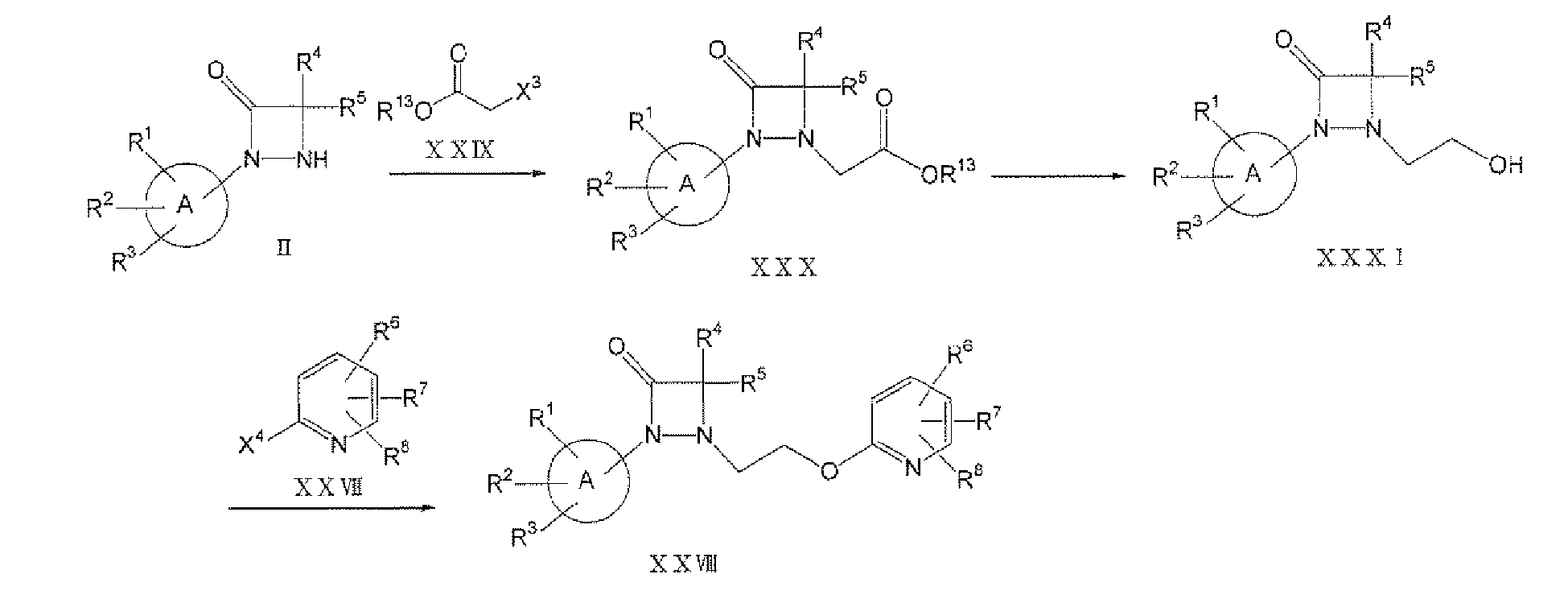
- (wherein R1, R2, R3, R4, R5, R6, R7, R8, A ring, X3 and X4 show the same things as they show in the above, and R13 represents a lower alkyl group).
- The reaction of an amine compound (II) and a reactive derivative (XXIX) can be conducted in a solvent, in the presence of a base. A solvent is not particularly limited, and for example, the followings can be used independently or in combination: 1,2-dichloroethane, chloroform, dichloromethane, ethyl acetate, isopropyl acetate, toluene, benzene, tetrahydrofuran, dioxane, acetonitrile, propionitrile and N,N-dimethylformamide, etc. A base is not particularly limited, and for example, the followings can be used independently or in combination: organic bases such as pyridine, DMAP, collidine, lutidine, DBU, DBN, DABCO, triethylamine, 2,6-di-t-butylpyridine, diisopropylethylamine, diisopropylpentylamine, N-methylmorpholine and trimethylamine; alkali metal hydrides such as lithium hydride, sodium hydride and potassium hydride; alkali metal hydroxides such as lithium hydroxide, sodium hydroxide and potassium hydroxide; alkali metal carbonates such as lithium carbonate, sodium carbonate, potassium carbonate and cesium carbonate; alkali metal bicarbonates such as sodium hydrogen carbonate and potassium hydrogen carbonate; lithium diisopropylamide, sodium diisopropylamide, potassium diisopropylamide, lithium hexamethyldisilazide, sodium hexamethyldisilazide, potassium hexamethyldisilazide, t-butoxy sodium, t-butoxypotassium, n-butyllithium, s-butyllithium and t-butyllithium. The reaction condition varies depending on the materials used, but generally, a derivative of interest (XXX) is obtained by conducting the reaction at -20 to 150°C, preferably at 0 to 80°C for 5 minutes to 48 hours, preferably for 1 hour to to 24 hours. When R1, R2, R3, R6, R7 and R8 are hydroxyl group or amino group, each substituent thereof can be protected and deprotected with a commonly used protective group. Further, each hydroxyl group and amino group can be modified with a commonly used acylation and sulfonylation condition. When R6, R7 and R8 are a nitro group, it can be converted into an amino group by using a general reduction reaction of a nitro group. "When R6, R7 and R8 are a C1-6 alkylthio group, the corresponding sulfur atom can be oxidized by using a general oxidation reaction of a sulfur atom.
- The reduction reaction of the obtained derivative (XXX) can be conducted in a solvent, in the presence of a reductant. A reductant is not particularly limited, and for example, the followings can be used: sodium borohydride, lithium borohydride, lithium aluminium hydride and diisobutylaluminium hydride. A solvent is not particularly limited, and for example, the followings can be used independently or in combination: tetrahydrofuran, diethylether, dioxane, toluene, dichloromethane, methanol, ethanol and water. The reaction condition varies depending on the materials used, but generally, a derivative of interest (XXXI) is obtained by conducting the reaction at -20 to 150°C, preferably at 15 to 60°C for 5 minutes to 24 hours, preferably for 30 minutes to 10 hours.
- The reaction of a derivative (XXXI) obtained by the above method and a reactive derivative (XXVII) can be conducted in a solvent, in the presence of a base. A solvent is not particularly limited, and for example, the followings can be used independently or in combination: 1,2-dichloroethane, chloroform, dichloromethane, ethyl acetate, isopropyl acetate, toluene, benzene, tetrahydrofuran, dioxane, acetonitrile, propionitrile and N,N-dimethylformamide, etc. A base is not particularly limited, and for example, the followings can be used independently or in combination: organic bases such as pyridine, DMAP, collidine, lutidine, DBU, DBN, DABCO, triethylamine, 2,6-di-t-butylpyridine, diisopropylethylamine, diisopropylpentylamine, N-methylmorpholine and triethylamine; alkali metal hydrides such as lithium hydride, sodium hydride and potassium hydride; alkali metal hydroxides such as lithium hydroxide, sodium hydroxide and potassium hydroxide; alkali metal carbonates such as lithium carbonate, sodium carbonate, potassium carbonate and cesium carbonate; alkali metal bicarbonates such as sodium hydrogen carbonate and potassium hydrogen carbonate; lithium diisopropylamide, sodium diisopropylamide, potassium diisopropylamide, lithium hexamethyldisilazide, sodium hexamethyldisilazide, potassium hexamethyldisilazide, t-butoxysodium, t-butoxypotassium, n-butyllithium, s-butyllithium and t-butyllithium. The reaction condition varies depending on the materials used, but generally, a 1,2-diazetidin-3-one derivative (XXVIII) of interest is obtained by conducting the reaction at -20 to 150°C, preferably at 0 to 80°C for 5 minutes to 48 hours, preferably for 1 hour to 12 hours. When R1, R2, R3, R6, R7 and R8 are hydroxyl group or amino group, each substituent thereof can be protected and deprotected with a commonly used protective group. Further, each hydroxyl group and amino group can be modified with a commonly used acylation and sulfonylation condition. When R6, R7 and R8 are a nitro group, it can be converted into an amino group by using a general reduction reaction of a nitro group. When R6, R7 and R8 are a C1-6 alkylthio group, the corresponding sulfur atom can be oxidized by using a general oxidation reaction of a sulfur atom.
- The intermediates and substances of interest obtained in each of the above reactions can be isolated and purified as desired by subjecting to a purification method that are used routinely in the field of organic synthetic chemistry, for example, filtration, neutralization, extraction, washing, drying, condensation, distillation, recrystallization, various types of chromatography and the like. Alternatively, the intermediate can be used for next reactions without a particular purification.
- Further, various isomers can be isolated by applying a routine procedure utilizing the difference in physical-chemical property between the isomers. For examples, a racemic mixture can be led to optically-pure isomers by a common racemic resolution method such as an optical resolution method comprising leading a mixture to diastereomeric salt with a common optically-active acid such as tartaric acid, or a method using optically-active column chromatography. Further, a diastereomeric mixture can be separated by a fractional crystallization, various types of chromatography or the like. Alternatively, an optically-active compound can be produced by using an appropriate optically-active material.
- The pharmaceutical composition of the present invention comprises the 1,2-diazetidin-3-one derivative shown by general formula (1), pharmaceutically acceptable salt thereof, or their solvate as an active ingredient. The compound of the present invention can be used independently, but generally, the compound is used in combination with a pharmaceutically acceptable carrier and/or diluent.
- Examples of an administration form of a medicine that comprises 1,2-diazetidin-3-one derivative of the present invention or salt thereof, or their solvate as an active ingredient include an oral administration by a tablet, capsule, granules, powder, syrup or the like; or a parenteral administration by an intravenous injection, intramuscular injection, suppository, inhaler, percutaneous absorption, eye-drops, nasal preparation or the like. Further, to prepare a pharmaceutical formulation in such various forms, the active ingredient can be prepared independently or as a pharmaceutical composition where appropriate, by combining with other pharmaceutically acceptable carriers, specifically an excipient, binder, extender, disintegrant, surfactant, lubricant, dispersant, buffer, preservative, flavoring agent, flavor, coating agent, diluent or the like.
- The dose of the medicine of the present invention varies depending on weight, age, sex, symptoms and the like of the patient, but generally, in a case of an adult, 1,2-diazetidin-3-one derivative represented by general formula (1) can be administered in an amount of 0.1 to 1000 mg, preferably 1 to 300 mg a day, as a single or several separate doses either orally or parenterally.
- The present invention will be further described with reference to the following examples, while the scope of the present invention will not be limited to these examples.
-

- Under an argon atmosphere, a solution of 2-adamantanone (1.00 g, 6.70 mmol) in ethanol (40 mL) was added with benzylcarbazate (1.11 g, 6.70 mmol) at room temperature and the resultant was stirred at 80°C for 12 hours. The reaction solution was concentrated in vacuo, and benzyl 2-(adamantan-2-ylidene)hydrazinecarboxylate (2.03 g, quant.) was obtained as a white crystalline powder.
- 1H-NMR (400 MHz, CDCl3) δ; 1.60-2.01 (m, 12H), 2.77 (s, 1H), 2.89 (s, 1H), 5.25 (s, 2H), 7.31-7.41 (m, 5H), 7.69 (s, 1H).
- Under an argon atmosphere, a solution of benzyl 2-(adamantan-2-ylidene)hydrazinecarboxylate (1.60 g, 5.40 mmol) in tetrahydrofuran (54 mL) was added with sodium cyanoborohydride (370 mg, 5.90 mmol) at room temperature, to which a solution of p-toluenesulfonic acid monohydrate (190 mg, 1.00 mmol) in tetrahydrofuran (10 mL) was dropped. The resultant was stirred at the same temperature for 5 hours. The reaction solution was added with a saturated aqueous solution of sodium hydrogen carbonate and extracted with ethyl acetate. The organic layer was dried over anhydrous sodium sulfate, concentrated in vacuo, and benzyl 2-(adamantan-2-yl)hydrazinecarboxylate (1.54 g, 94.9%) was obtained as a white crystalline powder.
- 1H-NMR (400 MHz, CDCl3) δ; 1.30-2.09 (m, 13H), 2.54 (s, 1H), 3.13 (s, 1H), 3.90 (s, 1H), 5.24 (s, 2H), 6.20 (s, 1H), 7.32-7.39 (m, 5H).
- Under an argon atmosphere, a solution of 2-(adamantan-2-yl)hydrazinecarboxylate (800 mg, 2.66 mmol) in dichloromethane (30 mL) was added with sodium hydrogen carbonate (450 mg, 5.40 mmol) and chloroacetic acid chloride (300 mg, 2.66 mmol) were added at 0°C, and the resultant was stirred at room temperature for 3 hours. The reaction solution was added with water and extracted with chloroform. The organic layer was dried over anhydrous sodium sulfate, concentrated in vacuo, and benzyl 2-(2-chloroacetyl)-2-(adamantan-2-yl)hydrazinecarboxylate (726 mg, 72.4%) was obtained as a white crystalline powder.
- 1H-NMR (400 MHz, CDCl3) δ; 1.56-1.93 (m, 12H), 2.29-2.54 (m, 2H), 3.98 (d, J= 13.8 Hz, 1H), 4.17 (d, J= 13.8 Hz, 1H), 4.33 (s, 1H), 5.22 (s, 2H), 6.90 (s, 1H), 7.29-7.40 (m, 5H).
- Under an argon atmosphere, a solution of benzyl 2-(2-chloroacetyl)-2-(adamantan-2-yl)hydrazinecarboxylate (726 mg,1.93 mmol) in tetrahydrofuran (20 mL) was added at 0°C with potassium-t-butoxide (238 mg, 2.12 mmol), and the resultant was stirred at the same temperature for 1 hour. The reaction solution was added with a saturated aqueous solution of ammonium chloride, and extracted with ethyl acetate. The organic layer was dried over anhydrous sodium sulfate, concentrated in vacuo, the obtained residue was purified by silica gel chromatography (hexane : ethyl acetate = 3 :1), and benzyl 2-(adamantan-2-yl)-3-oxo-1,2-diazetidine-1-carboxylate (463 mg, 70.4%) was obtained as a colorless oil.
- 1H-NMR (400 MHz, CDCl3) δ; 1.47-2.04 (m, 12H), 2.17 (s, 1H), 2.44 (s, 1H), 4.00 (s, 1H), 4.58 (s, 2H), 5.18 (s, 2H), 7.35-7.37 (m, 5H).
- A solution of benzyl 2-(adamantan-2-yl)-3-oxo-1,2-diazetidine-1-carboxylate (100mg, 0.29 mmol) in tetrahydrofuran (5 mL) was added with 10% palladium carbon (catalyst amount), and under a hydrogen atmosphere, the resultant was stirred at room temperature for 10 hours. The reaction solution was filtered using celite, concentrated in vacuo, and the obtained residue was purified by silica gel chromatography (hexane : ethyl acetate = 1:1), and 2-(adamantan-2-yl)-1,2-diazetidin-3-one (34.0 mg, 56.8%)was obtained as a colorless oil.
- 1H-NMR (400 MHz, CDCl3) δ; 1.46-2.10 (m, 12H), 2.55 (s, 2H), 3.40 (s, 1H), 4.25 (s, 2H).
- Under an argon atmosphere, a solution of 2-(adamantan-2-yl)-1,2-diazetidin-3-one (10.2 mg, 0.05 mmol) in N,N-dimethylformamide (1 mL), potassium carbonate (28.0 mg, 0.100 mmol) and benzyl bromide (35.0 mg, 0.100 mmol) were added at room temperature, and the resultant was stirred at the same temperature for 24 hours. The reaction solution was added with water and extracted with diethyl ether. The organic layer was dried over anhydrous sodium sulfate, concentrated in vacuo, the obtained residue was purified by Preparative Thin-Layer chromatography (hexane : ethyl acetate = 2:1), and the title compound (7.60 mg, 48.6%) was obtained as a colorless oil.
- 1H-NMR (400 MHz, CDCl3) δ; 1.56-1.91 (m, 10H), 2.17-2.26 (m, 2H), 2.40 (s, 1H), 2.48 (s, 1H), 3.50 (d, J= 12.0 Hz, 1H), 3.59 (d, J= 13.7 Hz, 1H), 3.76 (s, 1H), 4.12 (d, J= 13.7 Hz, 1H), 4.38 (d, J= 12.0 Hz, 1H), 7.30-7.35 (m, 5H).
- IR (ATR); 2917,1736,1322, 731 cm-1.
- EI-MS m/z; 296 (M+).
- 4-Chlorobenzylbromide was used in place of benzyl bromide for a similar reaction and treatment as Process 6 of Example 1, and the title compound was obtained as a white amorphous solid.
-

- 1H-NMR (400 MHz, CDCl3) δ; 1.55-1.88 (m, 10H), 2.13-2.24 (m, 2H), 2.38 (s, 1H), 2.48 (s, 1H), 3.50 (d, J= 11.9 Hz, 1H), 3.54 (d, J= 13.5 Hz, 1H), 3.76 (s, 1H), 4.12 (d, J= 13.5 Hz, 1H), 4.33 (d,J= 11.9 Hz, 1H), 7.26 (d, J= 8.1 Hz, 2H), 7.31 (d,J=8.1 Hz,2H).
- IR(ATR); 2915, 2852, 1736, 1322, 1100,714 cm-1.
- EI-MS m/z; 330 (M+).
- 4-Methylbenzyl bromide was used in place of benzyl bromide for a similar reaction and treatment as Process 6 of Example 1, and the title compound was obtained as a white amorphous solid.
-

- 1H-NMR (400 MHz, CDCl3) δ; 1.52-1.91 (m, 10H), 2.16-2.19 (m, 1H), 2.22-2.26 (m, 1H), 2.34 (s, 3H), 2.40 (s, 1H), 2.49 (s, 1H), 3.45 (d, J= 11.7 Hz, 1H), 3.57 (d, J= 13.7 Hz, 1H), 3.77 (s, 1H), 4.09 (d, J= 13.7 Hz, 1H), 4.34 (d, J= 11.7 Hz, 1H), 7.14 (d, J= 7.8 Hz, 2H), 7.20 (d, J= 7.8 Hz, 2H).
- IR (ATR); 2908,1757,1288,1230,774 cm-1.
- EI-MS m/z; 310 (M+).
- 4-Methoxybenzyl bromide was used in place of benzyl bromide for a similar reaction and treatment as Process 6 of Example 1, and the title compound was obtained as a white amorphous solid.
-

- 1H-NMR (400 MHz, CDCl3) δ; 1.59-1.90 (m, 10H), 2.14-2.25 (m, 2H), 2.40 (s, 1H), 2.48 (s, 1H), 3.43 (d, J= 11.6 Hz, 1H), 3.58 (d, J= 13.5 Hz, 1H), 3.76 (s, 1H), 3.81 (s, 3H), 4.07 (d, J= 13.5 Hz, 1H), 4.30 (d, J= 11.6 Hz, 1H), 6.87 (d, J= 8.6 Hz, 2H), 7.24 (d, J= 8.6 Hz, 2H).
- IR (ATR); 2912,2852,1758,1511, 1248,1039,775 cm-1.
- EI-MS m/z; 326 (M+).
- 4-Fluorobenzyl bromide was used in place of benzyl bromide for a similar reaction and treatment as Process 6 of Example 1, and the title compound was obtained as a white amorphous solid.
-

- 1H-NMR (400 MHz, CDCl3) δ; 1.64-1.91 (m, 10H), 2.13-2.25 (m, 2H), 2.38 (s, 1H), 2.47 (s, 1H), 3.47 (d, J= 12.1 Hz, 1H), 3.54 (d, J= 13.5 Hz, 1H), 3.75 (s, 1H), 4.11 (d, J= 13.5 Hz, 1H), 4.32 (d, J= 12.1 Hz, 1H), 7.03 (t, J= 8.6 Hz, 2H), 7.29 (dd, J= 5.7, 8.6 Hz, 2H).
- IR (ATR); 2912, 1758, 1731, 1510, 1223, 823 cm-1.
- EI-MS m/z, 314 (M+).
- 4-Trifluoromethylbenzyl bromide was used in place of benzyl bromide for a similar reaction and treatment as Process 6 of Example 1, and the title compound was obtained as a white amorphous solid.
-

- 1H-NMR (400 MHz, CDCl3) δ; 1.60-1.93 (m, 10H), 2.14-2.25 (m, 2H), 2.38 (s, 1H), 2.47 (s, 1H), 3.54 (d, J= 12.4 Hz, 1H), 3.58 (d, J= 13.5 Hz, 1H), 3.76 (s, 1H), 4.16 (d, J= 13.5 Hz, 1H), 4.42 (d, J= 12.4 Hz, 1H), 7.45 (d, J= 8. 1Hz, 2H), 7.60 (d, J= 8.1 Hz, 2H).
- IR (ATR); 2915,1758,1742,1325, 1166,1118, 1066, 733 cm-1.
- EI-MS m/z; 364 (M+).
- 4-Nitrobenzyl bromide was used in place of benzyl bromide for a similar reaction and treatment as Process 6 of Example 1, and the title compound was obtained as a pale yellow crystalline powder.
-

- 1H-NMR (400 MHz, CDCl3) δ; 1.60-1.90 (m, 10H), 2.14-2.25 (m, 2H), 2.36 (s, 1H), 2.48 (s, 1H), 3.52 (d, J= 12.7 Hz, 1H), 3.64 (d, J= 13.5 Hz, 1H), 3.76 (s, 1H), 4.20 (d, J= 13.5 Hz, 1H), 4.44 (d, J= 12.7 Hz, 1H), 7.51 (d, J= 8.6 Hz, 2H), 8.20 (d, J= 8.6 Hz, 2H).
- IR (ATR); 2911, 1736, 1524, 1344, 734 cm-1.
- EI-MS m/z; 341 (M+).
-

- t-Butyl carbazate was used in place of benzylcarbazate for a similar reaction and treatment as Process 1 of Example 1, and t-butyl 2-(adamantan-2-ylidene)hydrazinecarboxylate was obtained as a colorless oil.
- 1H-NMR (400 MHz, CDCl3) δ; 1.51 (s, 9H), 1.60-2.01 (m, 12H), 2.74 (s, 1H), 2.90)s, 1H), 7.44 (s, 1H).
- t-Butyl 2-(adamantan-2-ylidene)hydrazinecarboxylate was used for a similar reaction and treatment as Process 2 of Example 1, and t-butyl 2-(adamantan-2-yl)hydrazinecarboxylate was obtained as a colorless oil.
- 1H-NMR (400 MHz, CDCl3) δ; 1.42 (s, 9H), 1.66-2.06 (m, 13H), 2.51 (s, 1H), 3.02 (s, 1H), 3.83 (s, 1H), 6.30 (s, 1H).
- 2-Chloropropionyl chloride was used in place of chloroacetic acid chloride for a similar reaction and treatment as Process 3 of Example 1, and t-butyl 2-(2-chloropropanoyl)-2-(adamantan-2-yl)hydrazinecarboxylate was obtained as a colorless oil.
- 1H-NMR (400 MHz, CDCl3) δ; 1.49 (s, 9H), 1.54-2.02 (m, 16H), 2.33 (s, 1H), 4.36 (s. 1H), 4.52 (m,1H), 6.72 (s, 1H).
- A solution of t-butyl 2-(2-chloropropanoyl)-2-(adamantan-2-yl)hydrazinecarboxylate (200 mg, 0.560 mmol) in dichloromethane (3 mL) was added with trifluoroacetic acid (3 mL) at room temperature, and the resultant was stirred at the same temperature for 1 hour. The reaction solution was concentrated, and the obtained residue was purified by silica gel chromatography (hexane : ethyl acetate = 1:1), 2-(adamantan-2-yl)-4-methyl-1,2-diazetidin-3-one (66.3 mg, 53.7%) was obtained as a colorless oil.
- 1H-NMR (400 MHz, CDCl3) δ; 1.48 (d, J= 7.1 Hz, 3H), 1.63-2.05 (m, 12H), 2.26 (s, 1H), 2.39 (s, 1H), 3.74 (s, 1H), 4.44 (q, J= 7.1 Hz, 1H).
- 2-(Adamantan-2-yl)-4-methyl-1,2-diazetidin-3-one was used for a similar reaction and treatment as Process 6 of Example 1, and the title compound was obtained as a colorless oil.
- 1H-NMR (400 MHz, CDCl3) δ; 1.13 (d, J= 7.1 Hz, 3H), 1.64-1.90 (m, 10H), 2.17-2.27 (m, 2H), 2.41 (s, 1H), 2.47 (s, 1H), 3.53 (d, J= 11.7 Hz, 1H), 3.67 (q, J= 7.1 Hz, 1H), 3.74 (s, 1H), 4.34 (d, J= 11.7 Hz, 1H), 7.29-7.35 (m, 5H).
- IR (ATR); 2909, 2853, 1752, 1452, 731 cm-1.
- EI-MS m/z; 310 (M+).
- Except using 4-chlorobenzyl bromide in place of benzyl bromide, similar reaction and treatment were carried out as Process 2 of Example 8, and the title compound was obtained as a colorless oil.
-

- 1H-NMR (400 MHz, CDCl3) δ; 1.15 (d, J= 7.1 Hz, 3H), 1.62-1.90 (m, 10H), 2.15-2.24 (m, 2H), 2.40 (s, 1H), 2.45 (s, 1H), 3.51 (d, J= 12.0 Hz, 1H), 3.62 (q, J= 7.1 Hz, 1H), 3.72 (s, 1H), 4.30 (d, J= 12.0 Hz, 1H), 7.28 (d, J= 8.8 Hz, 2H), 7.31 (d, J= 8.8 Hz, 2H).
- IR (ATR); 2909, 2853, 1752,1491, 756 cm-1.
- EI-MS m/z; 345 (M+).
-

- 2-Bromoisovaleryl chloride was used in place of chloroacetic acid chloride for a similar reaction and treatment as Process 3 of Example 1, and benzyl 2-(2-bromo-3-methylbutanoyl)-2-(adamantan-2-yl)hydrazinecarboxylate was obtained as a colorless oil.
- 1H-NMR (400 MHz, CDCl3) δ; 0.91 (d, J= 6.8 Hz, 3H), 1.06 (d, J= 6.8 Hz. 3H), 1.55-2.30 (m, 15H), 3.99 (d, J= 9.5 Hz, 1H), 4.38 (s, 1H), 5.20 (s, 2H), 6.87 (s, 1H), 7.36-7.40 (m, 5H).
- Benzyl 2-(2-bromo-3-methylbutanoyl)-2-(adamantan-2-yl)hydrazinecarboxylate was used for a similar reaction and treatment as Process 4 of Example 1, and benzyl 2-(adamantan-2-yl)-4-(propan-2-yl)-3-oxo-1,2-diazetidine-1-carboxylate was obtained as a colorless oil.
- 1H-NMR (400 MHz, CDCl3) δ; 1.09 (d, J= 6.8 Hz, 3H), 1.11 (d, J= 6.8 Hz, 3H), 1.55-.80 (m, 10H), 21.98-2.02 (m, 1H), 2.22-2.17 (m, 2H), 2.30 (s, 1H), 2.58 (s, 1H), 4.02 (s, 1H), 4.23 (d, J= 7.1 Hz, 1H), 5.12 (d, J= 12.2 Hz, 1H), 5.21 (d, J= 12.2 Hz, 1H), 7.34-7.37 (m, 5H).
- Benzyl 2-(adamantan-2-yl)-4-(propan-2-yl)-3-oxo-1,2-diazetidine-1-carboxylate was used for a similar reaction and treatment as Process 5 of Example 1, and 2-(adamantan-2-yl)-4-(propan-2-yl)-1,2-diazetidin-3-one was obtained as a colorless oil.
- 1H-NMR (400 MHz, CDCl3) δ; 1.04 (d, J= 6.8 Hz, 3H), 1.07 (d, J= 6.8 Hz, 3H), 1.62-2.38 (m, 15H), 3.73 (s, 1H), 4.15 (d, J= 7.1 Hz, 1H).
- 2-(Adamantan-2-yl)-4-(propan-2-yl)-1,2-diazetidin-3-one was used for a similar reaction and treatment as Process 6 of Example 1, and the title compound was obtained as a white crystalline powder.
- 1H-NMR (400 MHz, CDCl3) δ; 0.68 (d, J= 6.8 Hz, 3H), 0.73 (d, J= 6.8 Hz, 3H), 1.57-1.87 (m, 11H), 2.17-2.27 (m, 2H), 2.38-2.42 (m, 2H), 3.44-3.51 (m, 2H), 3.71 (s, 1H), 4.27 (d, J= 11.6 Hz, 1H), 7.28-7.33 (m, 5H).
- IR(ATR); 2913,2851,1753,1742,737 cm-1.
- EI-MS m/z; 338 (M+),
-

- 2-Bromohexanoyl bromide was used in place of chloroacetic acid chloride for a similar reaction and treatment as Process 3 of Example 1, and benzyl 2-(2-bromo-hexanoyl)-2-(adamantan-2-yl)hydrazinecarboxylate was obtained as a colorless oil.
- 1H-NMR (400 MHz, CDCl3) δ; 0.82-0.95 (m, 3H), 1.22-2.36 (m, 20H), 4.26 (t, J= 7.0 Hz, 1H), 4.37 (s, 1H), 5.20 (s, 2H), 6.65-6.89 (m, 1H), 7.34-7.38 (m, 5H).
- Benzyl 2-(2-bromo-hexanoyl)-2-(adamantan-2-yl)hydrazinecarboxylate was used for a similar reaction and treatment as Process 4 of Example 1, and benzyl 2-(adamantan-2-yl)-4-butyl-3-oxo-1,2-diazetidine-1-carboxylate was obtained as a colorless oil.
- 1H-NMR (400 MHz, CDCl3) δ; 0.88 (t, J= 7.9 Hz, 3H), 1.32-2.13 (m, 18H), 2.28 (s, 1H), 2.57 (s, 1H), 4.01 (s, 1H), 4.57 (t. J= 7.4 Hz, 1H), 5.13 (d, J= 12.0 Hz, 1H), 5.22 (d, J= 12.0 Hz, 1H), 7.34-7.40 (m, 5H).
- Benzyl 2-(adamantyl-2-yl)-4-butyl-3-oxo-1,2-diazetidine-1-carboxylate was used for a similar reaction and treatment as Process 5 of Example 1, and 2-(adamantan-2-yl)-4-butyl-1,2-diazetidin-3-one was obtained as a colorless oil.
- 1H-NMR (400 MHz, CDCl3) δ; 0.92 (t, J= 7.8 Hz, 3H), 1.35-1.47 (m, 4H), 1.63-2.40 (m, 17H), 3.73 (s, 1H), 4.37 (t, J= 7.9 Hz, 1H).
- 2-(Adamantan-2-yl)-4-butyl-1,2-diazetidin-3-one and 2-(trifluoromethyl)benzyl bromide were used for a similar reaction and treatment as Process 6 of Example 1, and the title compound was obtained as a white crystalline powder.
- 1H-NMR (400 MHz, CDCl3) δ 0.73 (t, J= 7.0 Hz, 3H), 1.18-0.99 (m, 4H), 1.93-1.52 (m, 12H), 2.28-2.15 (m, 2H), 2.44-2.38 (m, 2H), 3.65 (t, J= 6.5 Hz, 1H), 3.70 (br, 1H), 3.83 (d, J= 13.2 Hz, 1H), 4.39 (d, J= 13.2 Hz, 1H), 7.40 (t, J= 7.6 Hz, 1H), 7.54 (t, J= 7.6 Hz, 1 H), 7.66 (d, J= 7.8 Hz, 1H), 7.76 (d, J= 7.8 Hz, 1H).
-

- 2-Bromoisobutyryl bromide was used in place of chloroacetic acid chloride, for a similar reaction and treatment as Process 3 of Example 1, and benzyl 2-(2-bromoisobutyryl)-2-(adamantan-2-yl)hydrazinecarboxylate was obtained as a colorless oil.
- 1H-NMR (400 MHz, CDCl3) δ 1-58 (s, 6H), 1.62-1.98 (m, 13H), 2.37 (s, 1H), 4.17-4.37 (m, 1H), 5.09-5.27 (m, 2H), 6.79-7.00 (m, 1H), 7.34-7.38 (m, 5H).
- Benzyl 2-(2-bromoisobutyryl)-2-(adamantan-2-yl)hydrazinecarboxylate was used for a similar reaction and treatment as Process 4 of Example 1, and benzyl 2-(adamantan-2-yl)-4,4-dimethyl-3-oxo-1,2-diazetidine-1-carboxylate was obtained as a colorless oil.
- 1H-NMR (400 MHz, CDCl3) δ; 1.49 (s, 6H), 1.62-2.03 (m, 12H), 2.38 (s, 2H), 4.02 (s, 1H), 5.18 (s, 2H), 7.34-7.41 (m, 5H).
- Benzyl 2-(adamantan-2-yl)-4,4-dimethyl-3 -oxo-1,2-diazetidine-1-carboxylate was used for a similar reaction and treatment as Process 5 of Example 1, and 2-(adamantan-2-yl)-4,4-dimethyl-1,2-diazetidin-3-one was obtained as a colorless oil.
- 1H-NMR (400 MHz, CDCl3) δ; 1.41 (s, 3H), 1.55 (s, 3H), 1.63-2.13 (m, 13H), 2.54 (s, 1H), 3.71 (s, 1H), 3.97 (s, 1H).
- 2-(Adamantan-2-yl)-4,4-dimethyl-1,2-diazetidin-3-one was used for a similar reaction and treatment as Process 6 of Example 1, and the title compound was obtained as a white crystalline powder.
- 1H-NMR (400 MHz, CDCl3) δ; 1.25 (s, 3H), 1.38 (s, 3H), 1.53-1.89 (m, 10H), 2.13-2.14 (m, 1H), 2.29-2.32 (m, 2H), 2.39 (s, 1H), 3.57 (s, 1H), 3.87 (d, J= 13.9 Hz, 1H), 4.15 (d, J= 13.9 Hz, 1H), 7.24-7.40 (m, 5H).
- EI-MS m/z; 324 (M+).
- 2-(Adamantan-2-yl)-4,4-dimethyl-1,2-diazetidin-3-one prepared in Process 3 of Example 12, and 4-chlorobenzyl bromide were used for a similar reaction and treatment as Process 6 of Example 1,and the title compound was obtained as a white crystalline powder.
-

- 1H-NMR (400 MHz, CDCl3) δ; 1.24 (s, 3H), 1.37 (s, 3H), 1.57-1.89 (m, 10H), 2.12-2.14 (m, 1H), 2.29-2.35 (m, 2H), 2.37 (s, 1H), 3.57 (s, 1H), 3.84 (d, J= 13.9 Hz, 1H), 4.10 (d, J= 13.9 Hz, 1H), 7.28 (d, J= 8.6 Hz, 2H), 7.33 (d, J= 8.6 Hz, 2H).
- EI-MS m/z; 359 (M+).
- 2-(Adamantan-2-yl)-4,4-dimethyl-1,2-diazetidin-3-one and 4-methylbenzyl bromide were used for a similar reaction and treatment as Process 6 of Example 1, and the title compound was obtained as a white crystalline powder.
-
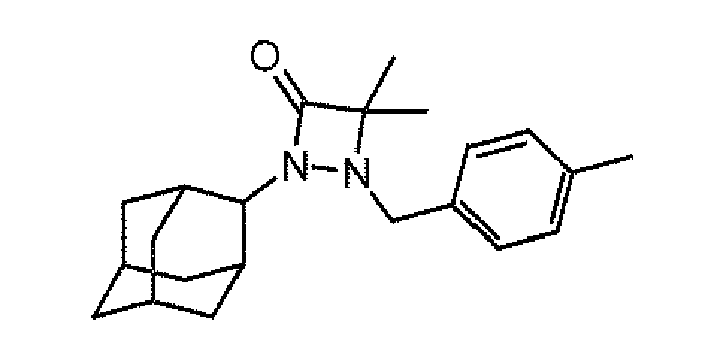
- 1H-NMR (400 MHz, CDCl3) δ; 1.25 (s, 3H), 1.37 (s, 3H), 1.57-1.89 (m, 10H), 2.13-2.16 (m, 1H), 2.30-2.40 (m, 6H), 3.58 (s, 1H), 3.82 (d, J= 13.7 Hz, 1H), 4.12 (d, J= 13.7 Hz, 1H), 7.11 (d, J= 7.8 Hz, 2H), 7.26 (d, J= 7.8 Hz, 2H).
- IR (ATR); 2909,2853,1751, 808 cm-1.
- EI-MS m/z; 338 (M+).
- 2-(Adamantan-2-yl)-4,4-dimethyl-1,2-diazetidin-3-one and 4-fluorobenzyl bromide were used for a similar reaction and treatment as Process 6 of Example 1, and the title compound was obtained as a white crystalline powder.
-

- 1H-NMR (400 MHz, CDCl3) δ; 1.24 (s, 3H), 1.37 (s, 3H), 1.55-1.89 (m, 10H), 2.07-2.11 (m, 1H), 2.20-2.28 (, 2H), 2.38 (s, 1H), 3.56 (s, 1H), 3.85 (d, J= 13.7 Hz, 1H), 4.13 (d, J= 13.7 Hz, 1H), 7.00 (t, J= 8.8 Hz, 2H), 7.37 (dd, J= 5.8, 8.8 Hz, 2H).
- IR (ATR); 2924, 2905, 1743, 1731, 1510, 1224,811 cm-1.
- EI-MS m/z; 342 (M+).
- 2-(Adamantan-2-yl)-4,4-dimethyl-1,2-diazetidm-3-one and 3,4-difluorobenzyl bromide were used for a similar reaction and treatment as Process 6 of Example 1, and the title compound was obtained as a white crystalline powder.
-
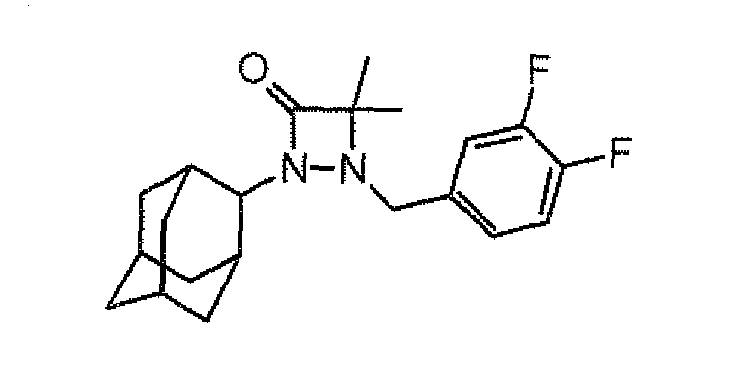
- 1H-NMR (400 MHz, CDCl3) δ; 1.24 (s, 3H), 1.39 (s, 3H), 1.58-1.90 (m, 10H), 2.12 (d, J= 12.7 Hz, 1H), 2.25 (d, J= 12.7 Hz, 1H), 2.30 (s, 1H), 2.36 (s, 1H), 3.57 (s, 1H), 3.83 (d, J= 14.0 Hz, 1H), 4.08 (d, J= 14.0 Hz, 1H), 7.08-7.14 (m, 2H), 7.27 (t, J= 9.2 Hz, 1H).
- IR (ATR); 2908, 1725, 1520, 1291, 1206, 774 cm-1.
- EI-MS m/z; 360 (M+).
- 2-(Adamantan-2-yl)-4,4-dimethyl-1,2-diazetidin-3-one and 2,4-difluorobenzyl bromide were used for a similar reaction and treatment as Process 6 of Example 1, and the title compound was obtained as a white crystalline powder.
-

- 1H-NMR (400 MHz, CDCl3) δ; 1.27 (s, 3H), 1.38 (s, 3H), 1.58-1.89 (m, 10H), 2.11 (d, J= 12.2 Hz, 1H), 2.26 (d, J= 12.2 Hz, 1H), 2.28 (s, 1H), 2.39 (s, 1H), 3.60 (s, 1H), 3.97 (d, J= 14.2 Hz, 1H), 4.02 (d, J= 14.2 Hz, 1H), 6.76-6.81 (m, 1H), 6.87 (dt, J= 1.7, 8.4 Hz, 1H), 7.55 (q, J= 7.8 Hz, 1H).
- IR (ATR); 2916,1733, 1506,1276,1139, 962 cm-1.
- FAB-MS m/z; 361 (M+H)+.
- 2-(Adamantan-2-yl)-4,4-dimethyl-1,2-diazetidin-3-one and 3,5-difluorobenzyl bromide were used for a similar reaction and treatment as Process 6 of Example 1, and the title compound was obtained as a white crystalline powder.
-

- 1H-NMR (400 MHz, CDCl3) δ; 1.25 (s, 3H), 1.42 (s, 3H), 1.60-1.90 (m, 10H), 2.13 (d, J-12.6 Hz, 1H), 2.25 (d, J= 12.6 Hz, 1H), 2.33 (d, J=13.3 Hz, 2H), 3.58 (s, 1H), 3.86 (d, J= 14.5 Hz, 1H), 4.11 (d, J= 14.5 Hz, 1H), 6.68-6.73 (m, 1H), 6.94-6.96 (m, 2H).
- IR (ATR); 2909, 1733, 1593, 1113, 850 cm-1.
- FAB-MS m/z; 361 (M+H)+.
- 2-(Adamantan-2-yl)-4,4-dimethyl-1,2-diazetidin-3-one and 2,3-difluorobenzyl bromide were used for a similar reaction and treatment as Process 6 of Example 1, and the title compound was obtained as a white crystalline powder.
-

- 1H-NMR (400 MHz, CDCl3) δ; 1.28 (s, 3H), 1.40 (s, 3H), 1.60-1.90 (m, 10H), 2.12 (d, J= 12.7 Hz, 1H), 2.26 (d, J= 12.7 Hz, 1H), 2.28 (s, 1H), 2.39 (s, 1H), 3.61 (s, 1H), 4.02 (d, J= 14.6 Hz, 1H), 4.08 (d, J= 14.6 Hz, 1H), 7.05-7.10 (m, 2H), 7.31-7.34 (m, 1H).
- IR (ATR); 2915,1734, 1487, 1280, 781 cm-1.
- FAB-MS m/z; 361 (M+H)+.
- 2-(Adamantan-2-yl)-4,4-dimethyl-1,2-diazetidin-3-one and 2,3-difluorobenzyl bromide were used for a similar reaction and treatment as Process 6 of Example 1, and the title compound was obtained as a white crystalline powder.
-

- 1H-NMR (400 MHz, CDCl3) δ; 1.26 (s, 3H), 1.42 (s, 3H), 1.58-1.90 (m, 10H), 2.13 (d, J= 12.8 Hz, 1H), 2.26 (d, J= 12.8 Hz, 1H), 2.30 (s, 1H), 2.38 (s, 1H), 3.62 (s, 1H), 3.99 (d, J= 14.8 Hz, 1H), 4.04 (d, J= 14.8 Hz, 1H), 6.89-7.02 (m, 2H), 7.29-7.33 (m, 1H).
- IR (ATR); 2917, 1735, 1492, 1237, 818 cm-1.
- FAB-MS m/z; 361 (M+H)+.
- 2-(Adamantan-2-yl)-4,4-dimethyl-1,2-diazetidin-3-one and 2,6-difluorobenzyl bromide were used for a similar reaction and treatment as Process 6 of Example 1, and the title compound was obtained as a white crystalline powder.
-

- 1H-NMR (400 MHz, CDCl3) δ; 1.36 (s, 3H), 1.43 (s, 3H), 1.52-1.87 (m, 10H), 1.99 (d, J= 13.1 Hz, 1H), 2.05 (s, 1H), 2.28 (d, J= 13.1 Hz, 1H), 2.45 (s, 1H), 3.56 (s, 1H), 3.99 (d, J= 13.5 Hz, 1H), 4.03 (d, J= 13.5 Hz, 1H), 6.85-6.91 (m, 2H), 7.21-7.29 (m, 1H).
- IR (ATR); 2910,1743,1470,1046, 797 cm-1.
- FAB-MS m/z; 3 61 (M+H)+.
- 2-(Adamantan-2-yl)-4,4-dimethyl-1,2-diazetidin-3-one and 3-fluorobenzyl bromide were used for a similar reaction and treatment as Process 6 of Example 1, and the title compound was obtained as a white crystalline powder.
-
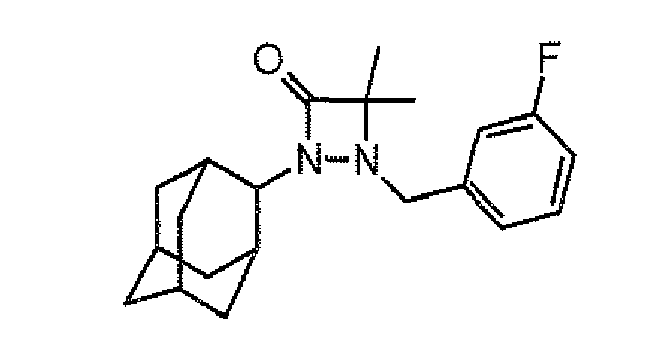
- 1H-NMR (400 MHz, CDCl3) δ; 1.25 (s, 3H), 1.40 (s, 3H), 1.57-1.90 (m, 10H), 2.13 (d, J= 13.2 Hz, 1H), 2.27 (d, J= 13.2 Hz, 1H), 2.31 (s, 1H), 2.37 (s, 1H), 3.58 (s, 1H), 3.87 (d, J= 14.0 Hz, 1H, 4.14 (d, J= 14.0 Hz, 1H), 6.92-6.97(m, 1H), 7.15 (d, J= 8.0 Hz, 1H), 7.25-7.30 (m, 1H).
- IR (ATR); 2918,1732, 1335 1254, 782 cm-1.
- FAB-MS m/z; 343 (M+H)+.
- 2-(Adamantan-2-yl)-4,4-dimethyl-1,2-diazetidin-3-one and 3,5-dimethoxybenzyl bromide were used for a similar reaction and treatment as Process 6 of Example 1, and the title compound was obtained as a white crystalline powder.
-

- 1H-NMR (400 MHz, CDCl3) δ; 1.25 (s, 3H), 1.39 (s, 3H), 1.59-1.89 (m, 10H), 2.15 (d, J= 12.6 Hz, 1H), 2.27 (d, J= 12.6 Hz, 1H), 2.36 (d, J= 15.6 Hz, 2H), 3.60 (s, 1H), 3.79 (s, 6H), 3.81 (d, J= 14.5 Hz, 1H), 4.12 (d, J= 14.5 Hz, 1H), 6.35 (t, J= 2.2 Hz, 1H), 6.56 (d, J= 2.2 Hz, 2H).
- IR (ATR); 2916, 1740, 1598, 1202,1145, 829 cm-1.
- EI-MS m/z; 384 (M+).
- 2-(Adamantan-2-yl)-4,4-dimethyl-1,2-diazetidin-3-one and 3-(trifluoromethyl)benzyl bromide were used for a similar reaction and treatment as Process 6 of Example 1, and the title compound was obtained as a colorless oil.
-

- 1H-NMR (400 MHz, CDCl3) δ; 1.24 (s, 3H), 1.39 (s, 3H), 1.53-1.90 (m, 10H), 2.14 (d, J= 13.1 Hz, 1H), 2.27 (d, J= 13.1 Hz, 1H), 2.29 (s, 1H), 2.35 (s, 1H), 3.56 (s, 1H), 3.95 (d, J= 14.2 Hz. 1H), 4.19 (d, J= 14.2 Hz, 1H), 7.44 (t, J= 7.7 Hz, 1H), 7.52 (t, J= 7.7 Hz, 1H), 7.59 (t, J= 7.7 Hz, 1H), 7.69 (s, 1H).
- IR (ATR); 2911, 1728, 1328,1165,1126,1076 cm-1.
- EI-MS m/z; 392 (M+).
- 2-(Adamantan-2-yl)-4,4-dimethyl-1,2-diazetidin-3-one and 3-fluoro-5-(trifluoromethyl)benzyl bromide were used for a similar reaction and treatment as Process 6 of Example 1, and the title compound was obtained as a colorless oil.
-

- 1H-NMR (400 MHz, CDCl3) δ; 1.25 (s, 3H), 1.41 (s, 3H), 1.57-1.91 (m, 10H), 2.13 (d, J= 12.9 Hz, 1H), 2.26 (d, J= 12.9 Hz, 1H), 2.32 (s, 2H), 3.57 (s, 1H), 3.95 (d, J= 14.4 Hz, 1H), 4.17 (d, J= 14.4 Hz, 1H), 7.23 (d, J= 8.3 Hz, 1H), 7.35 (d, J= 9.3 Hz, 1H), 7.47 (s, 1H).
- IR (ATR); 2918,1737,1340,1144, 868 cm-1.
- 2-(Adamantan-2-yl)-4,4-dimethyl-1,2-diazetidin-3-one and 3,5-bis(trifluoromemyl)benzyl bromide were used for a similar reaction and treatment as Process 6 of Example 1, and the title compound was obtained as a white crystalline powder.
-

- 1H-NMR (400 MHz, CDCl3) δ; 1.25 (s, 3H), 1.41 (s, 3H), 1.53-1.91 (m, 10H), 2.13 (d, J= 13.2 Hz, 1H), 2.26 (d, J= 13.2 Hz, 1H), 2.30 (s, 2H), 3.55 (s, 1H), 4.04 (d, J= 14.6 Hz, 1H), 4.23 (d, J= 14.6 Hz, 1H), 7.79 (s, 1H), 7.88 (s, 2H).
- IR (ATR); 2914, 1748, 1278, 1166, 1130, 897 cm-1.
- EI-MS m/z; 460 (M+).
- 2-(Adamantan-2-yl)-4,4-dimethyl-1,2-diazetidin-3-one and 2-chlorobenzyl bromide were used for a similar reaction and treatment as Process 6 of Example 1,and the title compound was obtained as a white crystalline powder.
-

- 1H-NMR (400 MHz, CDCl3) δ; 1.23 (s, 3H), 1.46 (s, 3H), 1.57-1.90 (m, 10H), 2.13 (d, J=13.0 Hz, 1H), 2.26 (s, 1H), 2.29 (d, J= 13.0 Hz, 1H), 2.41 (s, 1H), 3.62 (s, 1H), 4.07 (d, J= 15.2 Hz, 1H), 4.15 (d, J= 15.2 Hz, 1H), 7.17-7.30 (m, 2H), 7.34 (dd, J= 1.5, 7.8 Hz, 1H), 7.64 (d, J= 7.6 Hz, 1H).
- EI-MS m/z; 358 (M+).
- 2-(Adamantan-2-yl)-4,4-dimethyl-1,2-diazetidin-3-one and 3-chlorobenzyl bromide were used for a similar reaction and treatment as Process 6 of Example 1, and the title compound was obtained as a white crystalline powder.
-

- 1H-NMR (400 MHz, CDCl3) δ; 1.25 (s, 3H), 1.40 (s, 3H), 1.56-1.90 (m, 10H), 2.13 (d, J= 12.6 Hz, 1H), 2.25 (d, J= 12.6 Hz, 1H), 2.30 (s, 1H), 2.36 (s, 1H), 3.57 (s, 1H), 3.85 (d, J= 14.0 Hz, 1H), 4.12 (d, J= 14.0 Hz, 1H), 7.23-7.27 (m, 3H), 7.42 (s, 1H).
- IR (ATR); 2908, 1734, 1334, 1078, 783 cm-1.
- EI-MS m/z; 358 (M+).
- 2-(Adamantan-2-yl)-4,4-dimethyl-1,2-diazetidin-3-one and 3-nitrobenzyl bromide were used for a similar reaction and treatment as Process 6 of Example 1, and the title compound was obtained as a yellow oil.
-

- 1H-NMR (400 MHz, CDCl3) δ; 1.26 (s, 3H), 1.42 (s, 3H), 1.57-1.91 (m, 10H), 2.12-2.16 (m, 3H), 2.25-2.35 (m, 1H), 3.58 (s, 1H), 4.01 (d, J= 14.4 Hz, 1H), 4.21 (d, J= 14.4 Hz, 1H), 7.51 (t, J= 7.8 Hz, 1H), 7.75 (d, J= 7.8 Hz, 1H), 8.13 (d, J= 7.8 Hz, 1H), 8.30 (s, 1H).
- IR (ATR); 2909, 1749, 1529, 1349, 755 cm-1.
- EI-MS m/z; 369 (M+).
- 2-(Adamantan-2-yl)-4,4-dimethyl-1,2-diazetidin-3-one and 2-methylbenzyl bromide were used for a similar reaction and treatment as Process 6 of Example 1, and the title compound was obtained as a white crystalline powder.
-

- 1H-NMR (400 MHz, CDCl3) δ; 1.26 (s, 3H), 1.44-1.48 (m, 4H), 1.60-1.87 (m, 9H), 2.04-2.07 (m, 2H), 2.27-2.42 (m, 5H), 3.54 (s, 1H), 3.94 (d, J= 14.2 Hz, 1H), 4.00 (d, J= 14.2 Hz, 1H), 7.12-7.26 (m, 3H), 7.45 (m, 1H).
- IR (ATR); 2890,1731,1474,1334, 743 cm-1.
- EI-MS m/z; 338 (M+).
- 2-(Adamantan-2-yl)-4,4-dimethyl-1,2-diazetidin-3-one and 4-nitrobenzyl bromide were used for a similar reaction and treatment as Process 6 of Example 1, and the title compound was obtained as a yellow crystalline powder.
-

- 1H-NMR (400 MHz, CDCl3) δ; 1.24 (s, 3H), 1.40 (s, 3H), 1.56-1.91 (m, 10H), 2.12-2.35 (m, 4H), 3.59 (s, 1H), 4.00 (d, J= 14.6 Hz, 1H), 4.22 (d, J= 14.6 Hz, 1H), 7.60 (d, J= 8.8 Hz, 2H), 8.19 (d, J= 8.8 Hz, 2H).
- IR (ATR); 2913, 1731, 1522, 1345, 732 cm-1.
- EI-MS m/z; 369 (M+).
- 2-(Adamantan-2-yl)-4,4-dimethyl-1,2-diazetidin-3-one and 3-methylbenzyl bromide were used for a similar reaction and treatment as Process 6 of Example 1, and the title compound was obtained as a white crystalline powder.
-

- 1H-NMR (400 MHz, CDCl3) δ; 1.25 (s, 3H), 1.39 (s, 3H), 1.57-1.89 (m, 10H), 2.14 (d, J= 12.0 Hz. 1H), 2.21-2.39 (m, 6H), 3.57 (s, 1H), 3.84 (d, J= 13.6 Hz, 1H), 4.12 (d, J= 13.6 Hz, 1H), 7.04-7.08 (m, 1H), 7.18-7.19 (m, 3H).
- IR (ATR); 2910, 1749, 1335, 780 cm-1.
- EI-MS m/z; 338 (M+).
- 2-(Adamantan-2-yl)-4,4-dimethyl-1,2-diazetidin-3-one and 3-bromobenzyl bromide were used for a similar reaction and treatment as Process 6 of Example 1, and the title compound was obtained as a colorless oil.
-

- 1H-NMR (400 MHz, CDCl3) δ; 1.25 (s, 3H), 1.40 (s, 3H), 1.56-1.90 (m, 10H), 2.13 (d, J= 12.7 Hz, 1H), 2.25-2.36 (m, 3H), 3.56 (s, 1H), 3.85 (d, J= 13.9 Hz, 1H), 4.12 (d, J= 13.9 Hz, 1H), 7.18 (t, 7.8 Hz, 1H), 7.31 (d, J= 7.8 Hz, 1H), 7.39 (d, J= 7.8 Hz, 1H), 7.57 (s, 1H).
- IR (ATR); 2908, 1750, 1247, 779 cm-1.
- EI-MS m/z; 402 (M+).
- 2-(Adamantan-2-yl)-4,4-dimethyl-1,2-diazetidin-3-one and 4-t-butylbenzyl bromide were used for a similar reaction and treatment as Process 6 of Example 1, and the title compound was obtained as a white crystalline powder.
-

- 1H-NMR (270 MHz, CDCl3) δ; 1.28 (s, 3H), 1.31 (s, 9H), 1.40 (s, 3H), 1.47-1.87 (m, 10H), 2.09-2.3 9 (m, 4H), 3.55 (s, 1H), 3.87 (d, J= 20.0 Hz, 1H), 4.10 (d, J= 20.0 Hz, 1H), 7.27-7.36 (m, 4H).
- IR (ATR); 2912, 1766, 1752, 823 cm-1.
- EI-MS m/z; 380 (M+).
- 2-(Adamantan-2-yl)-4,4-dimethyl-1,2-diazetidin-3-one and 3-iodobenzyl bromide were used for a similar reaction and treatment as Process 6 of Example 1, and the title compound was obtained as a colorless oil.
-

- 1H-NMR (400 MHz, CDCl3) δ; 1.25 (s, 3H), 1.39 (s, 3H), 1.55-1.90 (m, 10H), 2.12 (d, 12.2 Hz, 1H), 2.25-2.35 (m, 3H), 3.55 (s, 1H), 3.82 (d, J= 14.0 Hz, 1H), 4.09 (d, J= 14.0 Hz, 1H), 7.05 (t, J= 7.8 Hz, 1H), 7.35 (d, J= 7.8 Hz, 1H), 7.59 (d, J= 7.8, 1H), 7.77 (s, 1H).
- IR (ATR); 2907, 1748, 778 cm-1.
- EI-MS m/z; 450 (M+).
- 2-(Adamantan-2-yl)-4,4-dimethyl-1,2-diazetidin-3-one and 4-(trifluoromethyl)benzyl bromide were used for a similar reaction and treatment as Process 6 of Example 1, and the title compound was obtained as a white crystalline powder.
-

- 1H-NMR (400 MHz, CDCl3) δ; 1.25 (s, 6H), 1.39 (s, 3H), 1.55-1.90 (m, 10H), 1.23 (d, J= 12.7 Hz, 1H), 2.25-2.37 (m, 3H), 3.58 (s, 1H), 3.94 (d, J= 14.2 Hz, 1H), 4.19 (d, 14.2 Hz, 1H), 7.53 (d, J= 8.0 Hz, 2H), 7.58 (d, J= 8.0 Hz, 2H).
- IR (ATR); 2917, 1743, 1731, 1322, 1161, 1129, 1069, 826 cm-1.
- EI-MS m/z; 392 (M+).
- 2-(Adamantan-2-yl)-4,4-dimethyl-1,2-diazetidin-3-one and 2,6-dichlorobenzyl bromide were used for a similar reaction and treatment as Process 6 of Example 1, and the title compound was obtained as a white crystalline powder.
-

- 1H-NMR (400 MHz, CDCl3) δ; 1.07 (d, J= 12.4 Hz, 1H), 1.38-1.82 (m, 17H), 2.32 (d, J= 13.2 Hz, 1H), 2.48 (s, 1H), 3.45 (s, 1H), 4.12 (d, J= 13.7 Hz, 1H), 4.25 (d, 13.7 Hz, 1H), 7.14-7.18 (m, 1H), 7.31 (d, J= 8.1 Hz, 2H).
- IR (ATR); 2929, 1746, 1434, 1323, 1190, 1086, 784, 762 cm-1.
- EI-MS m/z; 393 (M+).
- 2-(Adamantan-2-yl)-4,4-dimethyl-1,2-diazetidin-3-one and 2-fluorobenzyl bromide were used for a similar reaction and treatment as Process 6 of Example 1, and the title compound was obtained as a white crystalline powder.
-

- 1H-NMR (400 MHz, CDCl3) δ; 1.27 (s, 3H), 1.40 (s, 3H), 1.57-1.89 (m, 10H), 2.13 (d, J= 12.2 Hz, 1H), 2.27 (d, J= 12.2 Hz, 1H), 2.29 (s, 1H), 2.41 (s, 1H), 3.61 (s, 1H), 4.05 (s, 2H), 7.02 (t, J= 8.7 Hz, 1H), 7.11 (t, J= 7.4 Hz, 1H), 7.21-7.25 (m, 1H), 7.56 (t, J= 7.4 Hz, 1H).
- IR (ATR); 2917, 1732, 1333, 1229, 1098, 756 cm-1.
- EI-MS m/z; 342 (M+).
- 2-(Adamantan-2yl)-4,4-dimethyl-1,2-diazetidin-3-one and 2-bromobenzyl bromide were used for a similar reaction and treatment as Process 6 of Example 1, and the title compound was obtained as a white crystalline powder.
-

- 1H-NMR (400 MHz, CDCl3) δ; 1.23 (s, 3H), 1.47 (s, 3H), 1.57-1.90 (m, 10H), 2.13 (d, J= 12.8 Hz, 1H), 2.29 (d, J= 12.8 Hz, 1H), 2.24 (s, 1H), 2.41 (s, 1H), 3.62 (s, 1H), 4.06 (d, J= 15.3 Hz, 1H), 4.12 (d, J= 15.3 Hz, 1H), 7.11 (t, J= 7.8 Hz, 1H), 7.29 (t, J= 7.8 Hz, 1H), 7.54 (d, J= 7.8 Hz, 1H), 7.64 (d, J= 7.8 Hz, 1H).
- IR (ATR); 2911, 1761, 1244, 1025, 762 cm-1.
- EI-MS m/z; 402 (M+).
- 2-(Adamantan-2-yl)-4,4-dimethyl-1,2-diazetidin-3-one and 2-iodobenzyl bromide were used for a similar reaction and treatment as Process 6 of Example 1, and the title compound was obtained as a white crystalline powder.
-

- 1H-NMR (400 MHz, CDCl3) δ; 1.24 (s, 3H), 1.48 (s, 3H), 1.54-1.89 (m, 10H), 2.12 (d, J= 12.6 Hz, 1H), 2.20 (s, 1H), 2.29 (d, J= 12.6 Hz, 1H), 2.41 (s, 1H), 3.60 (s, 1H), 3.99 (d, J= 15.1 Hz, 1H), 4.05 (d, J= 15.1 Hz, 1H), 6.96 (t, J= 6.8 Hz, 1H), 7.32 (t, J= 7.8 Hz, 1H), 7.59 (d, J= 6.8 Hz, 1H), 7.82 (d, J= 7.8 Hz, 1H).
- IR (ATR); 2915, 1740, 1327, 1015, 764 cm-1.
- EI-MS m/z; 450 (M+).
- 2-(Adamantan-2-yl)-4,4-dimethyl-1,2-diazetidin-3-one and 2-chloro-5-fluorobenzyl bromide were used for a similar reaction and treatment as Process 6 of Example 1, and the title compound was obtained as a white crystalline powder.
-

- 1H-NMR (270 MHz, CDCl3) δ; 1.22 (s, 3H), 1.48 (s, 3H), 1.53-1.87 (m, 10H), 2.05-2.38 (m, 4H), 3.63 (s, 1H), 4.02 (d, J= 23.2 Hz, 1H), 4.11 (d, J= 23.2 Hz, 1H), 6.88-6.95 (m, 1H), 7.26-7.33 (m, 1H), 7.39-7.43 (dd, J= 14.2, 3.9 Hz, 1H).
- IR (ATR); 2910,1761,1473,1245,1150,1077, 817 cm-1.
- EI-MS m/z; 376 (M+).
- 2-(Adamantan-2-yl)-4,4-dimethyl-1,2-diazetidin-3-one and 2-(trifluoromethyl)benzyl bromide were used for a similar reaction and treatment as Process 6 of Example 1, and the title compound was obtained as a white crystalline powder.
-

- 1H-NMR (400 MHz, CDCl3) δ; 1.19 (s, 3H), 1.49-1.91 (m, 13H), 2.13-2.38 (m, 4H), 3.60 (s, 1H), 4.14-4.23 (m, 2H), 7.36 (t, J= 7.5 Hz, 1H), 7.53 (t, J= 7.5 Hz, 1H), 7.64 (d, J= 7.5 Hz, 1H), 7.95 (d, J= 7.5 Hz, 1H).
- IR (ATR); 2911,1755,1455,1312,1160,1119,1037, 771 cm-1.
- EI-MS m/z; 392 (M+).
- 2-(Adamantan-2-yl)-4,4-dimethyl-1,2-diazetidin-3-one and 2,3-dichlorobenzyl bromide were used for a similar reaction and treatment as Process 6 of Example 1, and the title compound was obtained as a white crystalline powder.
-

- 1H-NMR (400 MHz, CDCl3) δ; 1.24 (s, 3H), 1.46 (s, 3H), 1.58-1.90 (m, 10H), 2.11-2.23 (m, 3H), 2.39 (s, 1H), 3.62 (s, 1H), 4.08 (d, J= 1.5.6 Hz, 1H), 4.17 (d, J= 15.6 Hz, 1H), 7.20 (t, J= 7.8 Hz, 1H), 7.37-7.39 (m, 1H), 7.57-7.59 (m, 1H).
- IR (ATR); 2916,1736,784 cm-1.
- EI-MS m/z; 392 (M+).
- 2-(Adaniantan-2-yl)-4,4-dimethyl-1,2-diazetidin-3-one and 2,5-dichlorobenzyl bromide were used for a similar reaction and treatment as Process 6 of Example 1, and the title compound was obtained as a white crystalline powder.
-

- 1H-NMR (400 MHz, CDCl3) δ; 1.23 (s, 3H), 1.48 (s, 3H), 1.66-1.91 (m, 10H), 2.12-2.37 (m, 4H), 3.62 (s, 1H), 4.02 (d, J=15.4 Hz, 1H), 4.11 (d, J= 15.4 Hz, 1H), 7.18 (dd, J= 8.3, 2.2 Hz, 1H), 7.27-7.29 (m, 1H), 7.66 (d, J= 2.2 Hz, 1H).
- IR (ATR); 2909,1753,1464,1244,1092,1043, 812 cm-1.
- EI-MS m/z; 392 (M+).
- 2-(Adamantan-2-yl)-4,4'dimethyl-1,2-diazetidin-3-one and 2-chloro-4-fluorobenzyl bromide were used for a similar reaction and treatment as Process 6 of Example 1, and the title compound was obtained as a white crystalline powder.
-

- 1H-NMR (400 MHz, CDCl3) δ; 1.23 (s, 3H), 1.43 (s, 3H), 1.58-1.90 (m, 10H), 2.12 (d, J= 12.9 Hz, 1H), 2.25-2.29 (m, 2H), 2.39 (s, 1H), 3.61 (s, 1H), 4.01 (d, 15.1 Hz, 1H), 4.10 (d, J= 15.1 Hz, 1H), 6.96-7.01 (m, 1H), 7.11 (dd, J= 8.4, 2.7 Hz, 1H), 7.62-7.65 (m, 1H).
- IR (ATR); 2909,1752,1604,1490,1232, 906, 857, 753 cm-1.
- EI-MS m/z; 376 (M+).
- 2-(Adamantan-2-yl)-4,4-dimethyl-1,2-diazetidin-3-one and 2-chloro-6-fluorobenzyl bromide were used for a similar reaction and treatment as Process 6 of Example 1, and the title compound was obtained as a white crystalline powder.
-

- 1H-NMR (400 MHz, CDCl3) δ; 1.24-1.27 (m, 1H), 1.43 (s, 3H), 1.48 (s, 3H), 1.56-1.91 (m, 11H), 2.31 (m, 1H), 2.46 (s, 1H), 3.49 (s, 1H), 4.08 (s, 2H), 6.96-7.00 (m, 1H), 7.19-7.22 (m, 2H).
- IR (ATR); 2916, 1746, 1453, 1240, 784 cm-1.
- EI-MS m/z; 376 (M+).
- 2-(Adamantan-2-yl)-4,4-dimethyl-1,2-diazetidin-3-one and 2-nitrobenzyl bromide were used for a similar reaction and treatment as Process 6 of Example 1, and the title compound was obtained as a yellow oil.
-

- 1H-NMR (400 MHz, CDCl3) δ; 1.23 (s, 3H), 1.40 (s, 3H), 1.47-1.93 (m, 10H), 2.03-2.14 (m, 2H), 2.26-2.31 (m, 2H), 3.50 (s, 1H), 4.27 (d, J= 15.6 Hz, 1H), 4.36 (d, J= 15.6 Hz, 1H), 7.43 (t, J= 7.8 Hz, 1H), 7.57 (dt, J= 7.8 1.2 Hz, 1H), 7.73 (d, J= 7.8 Hz, 1H), 7.88 (dt, J= 7.8, 1.2 Hz, 1H).
- IR (ATR); 2909, 1750, 1527, 2361, 729 cm-1.
- EI-MS m/z; 369 (M+).
- 2-(Admnantan-2-yl)-4,4-dimethyl-1,2-diazetidin-3-one and 4-fluoro-2-(trifluorormethyl)benzyl bromide were used for a similar reaction and treatment as Process 6 of Example 1, and the title compound was obtained as a colorless oil.
-

- 1H-NMR (270 MHz, CDCl3) δ; 1.19 (s, 3H), 1.48 (s, 3H), 1.58-1.86 (m, 10H), 2.11-2.36 (m, 4H), 3.59 (s, 1H), 4.14 (s, 2H), 7.22-7.26 (m, 1H), 7.36 (dd, J= 9.2, 4.0 Hz, 1H), 7.93-7.98 (m, 1H).
- IR (ATR); 2910,1748,750, 702 cm-1.
- EI-MS m/z; 410 (M+).
- 2-(Adamantan-2-yl)-4,4-dimethyl-1,2-diazetidin-3-one and 2-phenylbenzyl bromide were used for a similar reaction and treatment as Process 6 of Example 1, and the title compound was obtained as a colorless oil.
-

- 1H-NMR (400 MHz, CDCl3) δ; 0.98 (s, 3H), 1.34 (s, 3H), 1.52-1.85 (m, 10H), 2.03-2.20 (m, 3H), 2.33 (s, 1H), 3.47 (s, 1H), 3.78 (d, J= 14.2 Hz, 1H), 4.06 (d, J= 14.2 Hz, 1H), 7.22-7.44 (m, 8H), 7.22-7.26 (m, 1H), 7.36 (dd, J= 9.2, 4.0 Hz, 1H), 7.72-7.74 (m, 1H).
- IR (ATR); 2911, 1755, 1316, 1216, 1163, 1048, 907, 743 cm-1.
- EI-MS m/z; 400 (M+).
- 2-(Adamantan-2-yl)-4,4-dimethyl-1,2-diazetidin-3-one and 2-ethylbenzyl bromide were used for a similar reaction and treatment as Process 6 of Example 1, and the title compound was obtained as a colorless oil.
-

- 1H-NMR (400 MHz, CDCl3) δ; 1.22 (t, J= 7.6 Hz, 3H), 1.27 (s, 3H), 1.45 (s, 3H), 1.65-1.75 (m, 7H), 1.82-1.88 (m, 3H), 2.07-2.11 (m, 2H), 2.28 (d, J=12.9 Hz, 1H), 2.42 (s, 1H), 2.71 (q, J= 7.6 Hz, 2H). 3.54 (s, 1H), 3.99 (d, J= 14.2 Hz, 1H), 4.03 (d, J= 14.2 Hz, 1H), 7.13-7.24 (m, 3H), 7.49 (d, J=7.6 Hz, 1H).
- IR (ATR); 2908, 1751, 1452, 758 cm-1.
- EI-MS m/z; 352 (M+).
- 2-(Adamantan-2-yl)-4,4-dimethyl-1,2-diazetidin-3-one and 2-methoxybenzyl bromide were used for a similar reaction and treatment as Process 6 of Example 1, and the title compound was obtained as a colorless oil.
-

- 1H-NMR (400 MHz, CDCl3) δ; 1.21 (s, 3H), 1.45 (s, 3H), 1.53-1.89 (m, 10H), 2.15 (d, J= 14.4 Hz, 1H), 2.28 (s, 2H), 2.43 (s, 1H), 3.63 (s, 1H), 3.83 (s, 3H), 3.98 (d, J= 14.9 Hz, 1H), 4.05 (d, J= 14.9 Hz, 1H), 6.84 (d, J= 8.3 Hz, 1H), 6.93 (t, J= 7.6 Hz, 1H), 7.20-7.24 (m, 1H), 7.52 (d, J= 7.6 Hz, 1H).
- IR (ATR); 2909, 1749, 1243, 754 cm-1.
- EL-MS m/z; 354 (M+).
- 2-(Adamantan-2-yl)-4,4-dimethyl-1,2-diazetidin-3-one and 2,4-dichlorobenzyl bromide were used for a similar reaction and treatment as Process 6 of Example 1, and the title compound was obtained as a colorless oil.
-

- 1H-NMR (400 MHz, CDCl3) δ; 1.22 (s, 3H), 1.44 (s, 3H), 1.58-1.90 (m, 10H), 2.12 (d, J= 12.7 Hz, 1H), 2.26 (s, 2H), 2.39 (s, 1H), 3.61 (s, 1H), 4.01 (d, J= 15.1 Hz, 1H), 4.10 (d, J= 15.1 Hz, 1H), 7.24 (dd, J= 8.3, 2.2 Hz, 1H), 7.37 (d, J= 2.2 Hz, 1H), 7.60 (d, J= 8.3 Hz, 1H).
- IR (ATR); 2914, 1752, 1468, 755 cm-1.
- EI-MS m/z; 393 (M+).
- 2-(Adamantan-2-yl)-4,4-dimethyl-1,2-diazetidm-3-one and 4-bromobenzyl bromide were used for a similar reaction and treatment as Process 6 of Example 1, and the title compound was obtained as a white crystalline powder.
-

- 1H-NMR (400 MHz, CDCl3) δ; 1.24 (s, 3H), 1.38 (s, 3H), 1.53-1.90 (m, 10H), 2.15 (d, J= 11.7 Hz, 1H), 2.24-2.37 (m, 3H), 3.57 (s, 1H), 3.83 (d, J= 13.9 Hz, 1H), 4.09 (d, J= 13.9 Hz, 1H), 7.28 (d, J= 8.6 Hz, 2H), 7.44 (d, J= 8.6 Hz, 2H).
- IR (AIR); 2922,1769,1246,1217, 809, 772 cm-1
- EI-MS m/z; 402 (M+).
- 2-(Adamantan-2-yl)-4,4-dimethyl-1,2-diazetidin-3-one and 3-methoxybenzyl bromide were used for a similar reaction and treatment as Process 6 of Example 1, and the title compound was obtained as a white crystalline powder.
-

- 1H-NMR (400 MHz, CDCl3) δ; 1.25 (s, 3H), 1.42 (s, 3H), 1.57-1.89 (m, 10H), 2.13-2.17 (m, 1H), 2.28 (d, J= 13.4 Hz, 1H), 2.32-2.39 (m, 2H), 3.59 (s, 1H), 3.81 (s, 3H), 3.85 (d, J= 13.9 Hz, 1H), 4.15 (d, J= 13.9 Hz, 1H), 6.79 (dd, J= 8.1, 2.2 Hz, 1H), 6.95-6.97 (m, 2H), 7.22 (d, J=8,1 Hz, 1H).
- IR (ATR); 2907, 1743, 1604, 1267, 1176, 1043, 780 cm-1.
- EI-MS m/z; 354 (M+).
- 2-(Adamantan-2-yl)-4,4-dimethyl-1,2-diazetidin-3-one and 2,4-dimethylbenzyl bromide were used for a similar reaction and treatment as Process 6 of Example 1, and the title compound was obtained as a white crystalline powder.
-

- 1H-NMR (400 MHz, CDCl3) δ; 1.25 (s, 3H), 1.43-1.50 (m, 4H), 1.56-1.74 (m, 6H), 1.82-1.87 (m, 3H), 2.07-2.13 (m, 2H), 2.26-2.34 (m, 7H), 2.42 (s, 1H), 3.55 (s, 1H), 3.90 (d, J= 13.9 Hz, 1H), 3.97 (d, J= 13.9 Hz, 1H), 6.94-6.96 (m, 2H), 7.32 (d, J= 8.3 Hz, 1H).
- IR (ATR); 2909, 1750, 816, 754 cm-1.
- EI-MS m/z; 352 (M+).
- 2-(Adamantan-2-yl)-4,4-dimethyl-1,2-diazetidin-3-one and 2,5-dimethylbenzyl bromide were used for a similar reaction and treatment as Process 6 of Example 1, and the title compound was obtained as a white crystalline powder.
-

- 1H-NMR (400 MHz, CDCl3) δ; 1.27 (s, 3H), 1.43-1.47 (m, 4H), 1.57-1.72 (m, 6H), 1.82-1.87 (m, 3H), 2.08-2.12 (m, 2H), 2.27-2.33 (m, 7H), 2.41 (s, 1H), 3.53 (s, 1H), 3.90 (d, J= 14.2 Hz, 1H), 3.96 (d, J= 14.2 Hz, 1H), 6.96 (d, J= 7.8 Hz, 1H), 7.02 (d, J= 7.8 Hz, 1H), 7.26 (s, 1H).
- IR (ATR); 2901, 1732, 1328, 808, 755 cm-1.
- EI-MS m/z; 352 (M+).
- 2-(Adamantan-2-yl)-4,4-dimethyl-1,2-diazetidin-3-one and 2,3-dimethylbenzyl bromide were used for a similar reaction and treatment as Process 6 of Example 1, and the title compound was obtained as a white crystalline powder.
-

- 1H-NMR (400 MHz, CDCl3) δ; 1.26 (s, 3H), 1.44-1.47 (m, 4H), 1.55-1.71 (m, 6H), 1.81-1.87 (m, 3H), 2.07-2.10 (m, 2H), 2.25-2.34 (m, 7H), 2.42 (s, 1H), 3.52 (s, 1H), 3.95-4.03 (m, 2H), 7.01-7.11 (m, 2H), 7.28-7.31 (m, 1H).
- IR (ATR); 2904, 1730, 1473, 334, 777 cm-1.
- EI-MS m/z; 352 (M+).
- 2-(Adamantan-2-yl)-4,4-dimethyl-1,2-diazetidin-3-one and 3-fluoro-2-methylbenzyl bromide were used for a similar reaction and treatment as Process 6 of Example 1, and the title compound was obtained as a white crystalline powder.
-

- 1H-NMR (400 MHz, CDCl3) δ; 1.26 (s, 3H), 1.40-1.49 (m, 4H), 1.57-1.6a (m, 6H), 1.82-1.88 (m, 3H), 2.06-2.11 (m, 2H), 2.28-2.33 (m, 4H), 2.40 (s, 1H), 3.53 (s, 1H), 3.95 (d, J= 14.4 Hz, 1H), 4.00 (d, J= 14.4 Hz, 1H), 6.94 (t, J= 8.8 Hz, 1H), 7.08-7.13 (m, 1H), 7.24 (d, J=7.6 Hz, 1H).
- IR (ATR); 2905, 1731, 1472, 1334, 1240, 783 cm-1.
- EI-MS m/z; 356 (M+).
- 2-(Adamantan-2-yl)-4,4-dimethyl-1,2-diazetidin-3-one and 3-chloro-2-fluorobenzyl bromide were used for a similar reaction and treatment as Process 6 of Example 1, and the title compound was obtained as a white crystalline powder.
-

- 1H-NMR (400 MHz, CDCl3) δ; 1.25 (s, 3H), 1.40 (s, 3H), 1.56-1.90 (m, 10H), 2.13 (d, J= 12.7 Hz, 1H), 2.25-2.36 (m, 3H), 3.57 (s, 1H), 3.87 (d, J= 14.2 Hz, 1H), 4.12 (d, J= 14.2 Hz, 1H), 7.23-7.25 (m, 2H), 7.41 (s, 1H).
- IR (ATR); 2908, 1733, 1334, 783 cm-1.
- EI-MS m/z; 376 (M+).
- 2-(Adamantan-2-yl)-4,4-dimethyl-1,2-diazetidin-3-one and 2-(methylthio)benzyl bromide were used for a similar reaction and treatment as Process 6 of Example 1, and the title compound was obtained as a white crystalline powder.
-

- 1H-NMR (400 MHz, CDCl3) δ; 1.25 (s, 3H), 1.45 (s, 3H), 1.54-1.76 (m, 7H), 1.82-1.88 (m, 3H), 2.09-2.31 (m, 3H), 2.43-2.52 (m, 4H), 3.60 (s, 1H), 4.00 (d, J= 14.4 Hz, 1H), 4.10 (d, J= 14.4 Hz, 1H), 7.11-7.29 (m, 3H), 7.53 (d, J= 7.3 Hz, 1H).
- IR (ATR); 2910,1748, 747 cm-1.
- EI-MS m/z; 370 (M+).
- 2-(Adamantan-2-yl)-4,4-dimethyl-1,2-diazetidin-3-one and 2,3-(methylenedioxy)benzyl bromide were used for a similar reaction and treatment as Process 6 of Example 1, and the title compound was obtained as a white crystalline powder.
-

- 1H-NMR (270 MHz, CDCl3) δ; 1.29 (s, 3H), 1.39 (s, 3H), 1.61-1.87 (m, 10H), 2.10-2.40 (m, 4H), 3.62 (s, 1H), 3.92 (d, J= 20.4 Hz, 1H), 4.02 (d, J= 20.4 Hz, 1H), 5.95 (s, 2H), 6.72-6.84 (m, 2H), 7.01 (d, J= 11.2 Hz, 1H).
- IR (ATR); 2915, 1742, 1457, 1246, 1060, 928, 774 cm-1.
- EI-MS m/z; 368 (M+).
- 2-(Adamantan-2-yl)-4,4-dimethyl-1,2-diazetidin-3-one and 3,4-(methylenedioxy)benzyl bromide were used for a similar reaction and treatment as Process 6 of Example 1, and the title compound was obtained as a brown oil.
-

- 1H-NMR (400 MHz, CDCl3) δ; 1.27 (s, 3H), 1.38 (s, 3H), 1.60-1.89 (m, 10H), 2.11-2.14 (m, 1H), 2.25-2.39 (m, 3H), 3.58 (s, 1H), 3.78 (d, J= 13.7 Hz, 1H), 4.05 (d, J= 13.7 Hz, 1H), 5.94 (s, 1H), 5.95 (s, 1H), 6.74 (d, J= 7.8 Hz, 1H), 6.81 (d, J= 7.8 Hz, 1H), 6.93 (s, 1H).
- IR (ATR); 2908,1730, 1491, 1444, 1250, 1039, 930, 811 cm-1.
- 2-(Adamantan-2-yl)-4,4-dimethyl-1,2-diazetidin-3-one and 1-(bromomethyl)naphthalene were used for a similar reaction and treatment as Process 6 of Example 1, and the title compound was obtained as a colorless oil.
-

- 1H-NMR (270 MHz, CDCl3) δ; 1.28 (s, 3H), 1.48 (s, 3H), 1.54-1.87 (m, 10H), 2.05-2.14 (m, 2H), 2.29-2.34 (m, 1H), 2.46 (s, 1H), 3.62 (s, 1H), 4.40-4.52 (m, 2H), 7.39-7.56 (m, 3H), 7.64 (d, J= 10.6 Hz, 1H), 7.77 (d, J= 12.0 Hz, 1H), 7.84-7.88 (m, 1H), 8.17 (d, J= 10.6 Hz, 1H).
- IR (ATR); 2908,1749, 1241, 793, 776 cm-1.
- EI-MS m/z; 374 (M+).
- 2-(Adamantan-2-yl)-4,4-dimethyl-1,2-diazetidin-3-one and 2-(bromomethyl)naphthalene were used for a similar reaction and treatment as Process 6 of Example 1, and the title compound was obtained as a white crystalline powder.
-
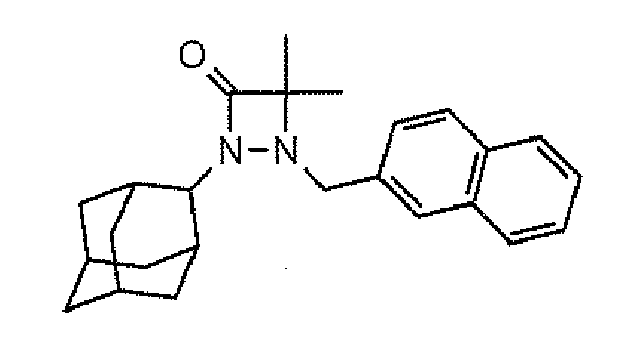
- 1H-NMR (270 MHz, CDCl3) δ; 1.27 (s, 3H), 1.39 (s, 3H), 1.51-1.91 (m, 10H), 2.16-2.43 (m, 4H), 3.64 (s, 1H), 4.02 (d, J= 20.3 Hz, 1H), 4.32 (d, J= 20.3 Hz, 1H), 7.43-7.55 (m, 3H), 7.78-7.82 (m, 4H).
- IR (ATR); 2904,1770, 819, 736 cm-1.
- FAB-MS m/z; 374 (M+).
-

- 5-Hydroxy-2-adamantanone was used in place of 2-adamantanone for a similar reaction and treatment as Process 1 of Example 1, and benzyl 2-(5-hydroxyadamantan-2-ylidene)hydrazinecarboxylate was obtained as a colorless oil.
- 1H-NMR (400 MHz, CDCl3) δ; 1.58-1.99 (m, 11H), 2.31 (s, 1H), 2.92 (s, 1H), 3.03 (s, 1H), 5.24 (s, 2H), 7.33-7.42 (m, 5H), 7.66 (br, 1H).
- Benzyl 2-(5-hydroxyadamantan-2-ylidene)hydrazinecarboxylate was used for a similar reaction and treatment as Process 2 of Example 1, the resultant two geometric isomers were separated by silica gel chromatography, and benzyl trans-2-(5-hydroxyadamantan-2-yl)hydrazinecarboxylate was obtained as a colorless amorphous solid.
- 1H-NMR (400 MHz, CDCl3) δ; 1.31 (d, J= 12.0 Hz, 2H), 1.72 (d, J= 6.6 Hz, 7H), 2.00-2.08 (m, 5H), 3.11 (s, 1H), 3.93 (br, 1H), 5.13 (s, 2H), 6.24 (br, 1H), 7.30-7.39 (m, 5H).
- Benzyl trans-2-(5-hydroxyadamantan-2-yl)hydrazinecarboxylate and 2-bromoisobutyryl bromide were used for a similar reaction and treatment as Process 3 of Example 1, and benzyl trans-2-(2-bromoisobutyryl)-2-(5-hydroxyadamantan-2-yl)hydrazinecarboxylate was obtained as a colorless oil.
- 1H-NMR (400 MHz. CDCl3) δ; 1.48 (d, J= 11.7 Hz, 2H), 1.60-1.95 (m, 16H), 2.14-2.22 (m, 2H), 2.58 (br, 1H), 4.11 (br, 0.4H), 4.31 (br, 0.6H), 5.07-5.30 (m, 2H), 7.34-7.37 (m, 5H).
- Benzyl trans-2-(2-bromoisobutyryl)-2-(5-hydroxyadamantan-2-yl)hydrazniecarboxylate was used for a similar reaction and treatment as Process 4 of Example 1, and benzyl trans-2-(5-hydroxyadamantan-2-yl)-4,4-dimethyl-3-oxo-1,2-diazetidine-1-carboxylate was obtained as a colorless amorphous solid.
- 1H-NMR (400 MHz, CDCl3) δ; 1.43-1.97 (m, 11H), 1.49 (s, 6H), 2.15 (s, 1H), 2.58 (s, 2H), 3.94 (s, 1H), 5.18 (s, 2H), 7.34-7.39 (m, 5H).
- Benzyl trans-2-(5-hydroxyadamantan-2-yl)-4,4-dimethyl-3-oxo-1,2-diazetidine-1-carboxylate was used for a similar reaction and treatment as Process 5 of Example 1, and trans-2-(5-hydroxyadamantan-2-yl)-4,4-dimethyl-1,2-diazetidin-1-one was obtained as a pale yellow amorphous solid.
- 1H-NMR (400 MHz, CDCl3) δ; 1.49-2.05 (m, 18H), 2.17 (s, 1H), 2.57 (br, 1H), 3.64 (s, 1H), 3.88 (br, 1H).
- trans-2-(5-Hydroxyadamantan-2-yl)-4,4-dimethyl-1,2-diazetidin-3-one and 2-chlorobenzyl bromide were used for a similar reaction and treatment as Process 6 of Example 1, and the title compound was obtained as a colorless oil.
- 1H-NMR (400 MHz, CDCl3) δ; 1.26 (s, 3H), 1.46 (s, 3H), 1.49-1.74 (m, 9H), 2.12 (d. J= 13.0 Hz, 1H), 2.19 (s, 1H), 2.21 (d, J= 13.0 Hz, 1H), 2.43 (s, 1H), 2.58 (s, 1H), 3.53 (s, 1H), 4.06 (d, J= 15.0 Hz, 1H), 4.15 (d, J= 15.0 Hz, 1H), 7.18-7.31 (m, 2H), 7.35 (d, J= 7.6 Hz, 1H), 7.62 (d, J= 7.6 Hz, 1H).
- IR (ATR); 3676, 2923, 1736, 1354, 1116, 750 cm-1.
- EI-MS m/z; 374 (M+).
- 2-(Trifluoromethyl)benzyl bromide was used in place of 2-chlorobenzyl bromide for a similar reaction and treatment as Process 6 of Example 65, and the title compound was obtained as a colorless oil.
-

- 1H-NMR (400 MHz, CDCl3) δ; 1.21 (s, 3H), 1.49 (s, 3H), 1.51-1.77 (m, 9H), 2.06 (d, J= 13.2 Hz, 1H), 2.19 (s, 1H), 2.21 (d, J= 13.2 Hz, 1H), 2.48 (s, 1H), 2.54 (s, 1H), 3.51 (s, 1H), 4.19(s, 2H), 7.37 (t, J= 7.6 Hz, 1H), 7.53 (t, J= 7.6 Hz, 1H), 7.65 (d, J= 7.6 Hz, 1H), 7.93 (d, J= 7.6 Hz, 1H).
- IR (ATR); 2927, 1736, 1313, 1161, 1115, 771 cm-1.
- EI-MS m/z; 408 (M+).
- 2-Chloro-5-fluorobenzyl bromide was used in place of 2-chlorobenzyl bromide for a similar reaction and treatment as Process 6 of Example 65, and the title compound was obtained as a colorless amorphous solid.
-
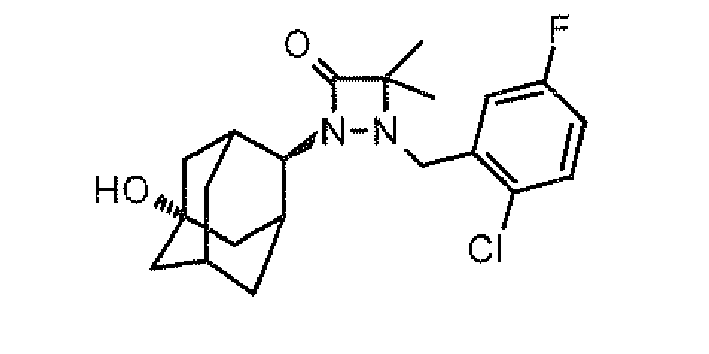
- 1H-NMR (400 MHz, CDCl3) δ; 1.24 (s, 3H), 1.48 (s, 3H), 1.52-1.78 (m, 9H), 2.05 (d, J= 12.9 Hz, 1H), 2.18-2.21 (m, 2H), 2.49 (s, 1H), 2.56 (s, 1H), 3.55 (s, 1H), 4.03 (d, J= 15.6 Hz, 1H), 4.12 (d, J= 15.6 Hz, 1H), 6.93 (dt, J= 3.0, 8.2 Hz, 1H), 7.32 (dd, J= 5.1, 8.8 Hz, 1H), 7.40 (dd, J= 2.9, 9.5 Hz, 1H).
- IR (ATR); 3650, 2925, 1736, 1474, 1264, 1115, 756cm-1
- EI-MS m/z; 392 (M+).
-

- Cyclohexanone was used in place of 2-adamantanone for a similar reaction and treatment as Process 1 of Example 1, and benzyl 2-cyclohexylidene hydrazinecarboxylate was obtained as a pale yellow crystalline powder.
- 1H-NMR (400 MHz, CDCl3) δ; 1.62-1.74 (m, 611), 2.20 (t, J= 6.0 Hz, 2H), 2.37 (t, J= 6.2 Hz, 2H), 5.24 (s, 2H), 7.32-7.41 (m, 5H), 7.68 (s, 1H).
- Benzyl 2-cyclohexylidenehydrazinecarboxylate was used for a similar reaction and treatment as Process 2 of Example 1, and benzyl 2-cyclohexylhydrazinecarboxylate was obtained as a white crystalline powder.
- 1H-NMR (400 MHz, CDCl3) δ; 1.13-2.12 (m, 10H), 3.13-3.22 (m, 1H), 5.25 (dd, J= 12.1, 14.3 Hz, 2H), 6.38 (d, J=6.8 Hz, 1H), 6.66 (s, 1H), 7.35-7.40 (m, 5H).
- Benzyl 2-cyclohexylhydrazinecarboxylate and 2-bromoisobutyryl bromide were used for a similar reaction and treatment as Process 3 of Example 1, and benzyl 2-(2-bromoisobutyryl)-2-cyclohexylhydraznecarboxylate was obtained as a white oil.
- 1H-NMR (400 MHz, CDCl3) δ; 1.05-2.04 (m, 10H), 2.01 (s, 3H), 2.08 (s, 3H), 4.11 (s, 1H), 5.17 (s, 2H), 7.00 (br, 1H), 7.34-7.36 (m, 5H).
- Benzyl 2-(2-bromoisobutyryl)-2-cyclohexylhydrazinecarboxylate was used for a similar reaction and treatment as Process 4 of Example 1, and benzoyl 2-cyclohexyl-4,4-dimethyl-3-oxo-1,2-diazetidine-1-carboxylate was obtained as a pale yellow oil.
- 1H-NMR (400 MHz, CDCl3) δ; 1.14-1.28 (m, 3H), 1.43-1.81 (m, 5H), 1.46 (s, 6H), 2.03-2.06 (m, 2H), 3.54 (dt, J= 3.8,11.8 Hz, 1H), 5.21 (s, 2H), 7.34-7.40 (m, 5H).
- Benzyl 2-(2-bromoisobutyryl)-2-cyclohexylhydraznecarboxylate was used for a similar reaction and treatment as Process 5 of Example 1, and 2-cyclohexyl-4,4-dimethyl-1.2-diazetidin-3-one was obtained as a pale yellow oil.
- 1H-NMR (400 MHz, CDCl3) δ; 1.12-1.92 (m, 10H), 1.47 (s, 6H), 3.56 (dt, J= 3.8, 11.1 Hz, 1H), 3.92 (br, 1H).
- 2-Cyclohexyl-4,4-dimethyl-1,2-diazetidin-3-one and 2-chlorobenzyl bromide were used for a similar reaction and treatment as Process 6 of Example 1, and the title compound was obtained as a pale yellow oil.
- 1H-NMR (400 MHz, CDC13) δ; 1.07-1.21 (m, 3H), 1.30 (s, 3H), 1.33-1.42 (m, 1H), 1.37 (s, 3H), 1.55-1.62 (m, 1H), 1.73-1.85 (m, 3H), 1.94-2.02 (m, 2H), 3.12 (tt, J= 3.8, 11.7 Hz, 1H), 4.03 (d, J= 15.0 Hz, 1H), 4.12 (d, J= 15.0 Hz, 1H), 7.18-7.29 (m, 2H), 7.36 (dd, J= 1.5, 7.8 Hz, 1H). 7.63 (dd, J= 1.5, 7.8 Hz, 1H).
- IR (ATR); 2934, 1762, 1649, 1446, 1335, 1051, 755 cm-1.
- FAB-MS m/z; 307 (M+H)+.
- 2-Cyclohexyl-4,4-dimethyl-1,2-diazetidin-3-one prepared in Process 5 of Example 68, and 2,3-dichlorobenzyl bromide were used for a similar reaction and treatment as Process 6 of Example 1, and the title compound was obtained as a pale yellow oil.
-

- 1H-NMR (400 MHz, CDCl3) δ; 1.08-1.21 (m, 3H), 1.29 (s, 3H), 1.35-1.45 (m, 1H), 1.38 (s, 3H), 1.59-1.60 (m, 1H), 1.74-1.85 (m, 3H), 1.94-2.03 (m, 2H), 3.13 (tt, J= 3.7, 11.7 Hz, 1H). 4.04 (d, J= 15.4 Hz, 1H), 4.15 (d, ,J= 15.4 Hz, 1H), 7.19-7.25 (m, 1H), 7.36 (dd, J= 1.5, 8.0 Hz, 1H), 7.58 (d, J= 8.0 Hz, 1H).
- IR (ATR); 2934, 1763, 1650, 1451, 1333, 1154, 1047, 777 cm-1.
- FAB-MS m/z; 341 (M+H)+.
- 2-Cyclohexyl-4,4-dimethyl-1,2-diazetidin-3-one and 2,5-dichlorobenzyl bromide were used for a similar reaction and treatment as Process 6 of Example 1, and the title compound was obtained as a pale yellow oil.
-

- 1H-NMR (400 MHz, CDCl3) δ; 1.06-1.22 (m, 3H), 1.29 (s, 3H), 1.35-1.45 (m, 1H), 1.39 (s, 3H.), 1.56-1.64 (m, 1H), 1.71-1.84 (m, 3H), 1.94-2.03 (m. 2H), 3.15 (tt, J= 3.8, 11.7 Hz, 1H), 3.99 (d, J= 15.5 Hz, 1H), 4.08 (d, J= 15.5 Hz, 1H), 7.19 (dd, J= 2.4. 8.6 Hz, 1H), 7.25-7.34 (m, 1H), 7.66 (d, J= 2.4 Hz, 1H).
- IR (ATR); 2933, 1763, 1650, 1464, 1333, 1093, 812 cm-1.
- FAB-MS m/z: 341 (M+H)+ .
- 2-Cyclohexyl-4,4-dimethyl-1,2-diazetidin-3-one and 2-chloro-5-fluorobenzyl bromide were used for a similar reaction and treatment as Process 6 of Example 1, and the title compound was obtained as a colorless oil.
-

- 1H-NMR (400 MHz, CDCl3) δ; 1.06-1.23 (m, 3H), 1.29 (s, 3H), 1.36-1.45 (m, 1H), 1.39 (s, 3H), 1.58-1.62 (m, 1H), 1.75-1.84 (m, 3H), 1.94-2.04 (m, 2H), 3.18 (tt, J= 3.7, 11.7 Hz, 1H), 3.99 (d, J= 15.6 Hz, 1H), 4.10 (d, J= 15.6 Hz, 1H), 6.93 (dt, J= 2.9, 8.2 Hz, 1H), 7.32 (dd, J= 5.1, 8.8 Hz, 1H), 7.41 (dd, J= 2.9, 9.8 Hz, 1H).
- IR (ATR); 2935, 1763, 1651, 1470, 1266, 1050, 813 cm-1.
- FAB-MS m/z; 325 (M+H)+.
- 2-Cyclohexyl-4,4-dimethyl-1,2-diazetidin-3-one and 2-chloro-4-fluorobenzyl bromide were used for a similar reaction and treatment as Process 6 of Example 1, and the title compound was obtained as a colorless oil.
-

- 1H-NMR (400 MHz, CDCl3) δ; 1.08-1.20 (m, 3H), 1.30 (s, 3H), 1.35 (s, 3H), 1.36-1.43 (m, 1H), 1.51-1.60 (m, 1H), 1.73-1.83 (m, 3H), 1.93-2.01 (m, 2H), 3.11 (tt, J= 3.7, 11.5 Hz, 1H), 3.98 (d, J= 14.8 Hz, 1H), 4.07 (d, J= 14.8 Hz, 1H), 6.99 (dt, J= 2.6., 8.5 Hz, 1H), 7.12 (dd, J= 2.6, 8.5 Hz, 1H), 7.62 (dd, J= 6.2, 8.5 Hz, 1H).
- IR (ATR); 2934, 1763, 1605, 1491, 1233, 1043, 906 cm1.
- FAB-MS m/z; 325 (M+H)+.
-

- Cyclooctanone was used in place of 2-adamantanone for a similar reaction and treatment as Process 1 of Example 1, and benzyl 2-cyclooctylidenehydrazinecarboxylate was obtained as a white crystalline powder.
- 1H-NMR (400 MHz, CDCl3 δ; 1.43-1.56 (m, 6H), 1.69-1.78 (m, 4H), 2.28 (t, J= 6.3 Hz, 2H), 2.45 (t, J= 6.3 Hz, 2H), 5.24 (s, 2H), 7.33-7.42 (m, 5H), 7.70 (s, 1H).
- Benzyl 2-cyclooctylidenehydrazinecarboxylate was used for a similar reaction and treatment as Process 2 of Example 1, and benzyl 2-cyclooctylhydrazinecarboxylate was obtained as a white crystalline powder.
- 1H-NMR (400 MHz, CDCl3) δ; 1.41-2.05 (m, 14H), 3.40-3.47 (m, 1H), 5.26 (s, 2H), 6.35 (d, J-6.8 Hz, 1H), 6.63 (s, 1H), 7.36-7.42 (m, 5H).
- Benzyl 2-cyclooctylhydrazinecarboxylate and 2-bromoisobutyryl bromide were used for a similar reaction and treatment as Process 3 of Example 1, and benzyl 2-(2-bromoisobutyryl)-2-cyclooctylhydrazinecarboxylate was obtained as a pale yellow oil.
- 1H-NMR (400 MHz, CDCl3) δ; 1.55-2.01 (m, 20H), 4.50 (br, 1H). 5.18 (s, 2H), 6.91 (br, 1H), 7.29-7.37 (m, 5H).
- Benzyl 2-(2-bromoisobutyryl)-2-cyclooetylhydrazinecarboxylate was used for a similar reaction and treatment as Process 4 of Example 1, and benzyl 2-cydooctyl-4,4-dimethyl-3-oxo-1,2-diazetidine-1-carboxylate was obtained as a pale yellow oil.
- 1H-NMR (400 MHz, CDCl3) δ; 1.46 (s, 6H), 1.49-2.04 (m, 14H). 3.76 (quint, J= 6.8 Hz, 1H), 5.20 (s, 2H), 7.30-7.40 (m, 5H).
- Benzyl 2-cyclooctyl-4,4-dimethyl-3-oxo-1,2-diazetidine-1-carboxylate was used for a similar reaction and treatment as Process 5 of Example 1, and 2-cyclooctyl-4,4-dimethyl-1,2-diazetidm-3-one was obtained as a pale yellow oil.
- 1H-NMR (400 MHz, CDCl3) δ, 1.46-1.59 (m, 20H), 3.78 (quint, 1H), 3.80 (br, 1H).
- 2-Cyclooctyl-4.4-dimethyl-1,2-diazetidin-3-one and 2-chlorobenzyl bromide were used for a similar reaction and treatment as Process 6 of Example 1, and the title compound was obtained as a colorless oil.
- 1H-NMR (400 MHz, CDCl3) δ; 1.29-1.52 (m, 8H), 1.33 (s, 3H), 1.36 (s, 3H), 1.63-1.76 (m, 3H), 1.87-2.00 (m, 2H), 2.04-2.13 (m, 1H), 3.15-3.22 (m, 1H), 4.04 (s, 2H), 7.19-7.27 (m, 2H), 7.36 (d, J= 7.6 Hz, 1H), 7.62 (d, J= 7.6 Hz, 1H).
- IR (ATR); 2924, 1759, 1468, 1276, 1051, 753 cm-1.
- EL-MS m/z; 334 (M+).
- 2-Cyclooctyl-4,4-dimethyl-1,2-diazetidin-3-one prepared in Process 5 of Example 73 and 2,3-dichlorobenzyl bromide were used for a similar reaction and treatment as Process 6 of Example 1, and the title compound was obtained as a colorless oil.
-

- 1H-NMR (400 MHz, CDCl3) δ; 1.29-1.53 (m, 8H), 1.32 (s, 3H), 1.38 (s, 3H), 1.63-1.78 (m, 3H), 1.88-2.44 (m, 2H), 2.04-2.13 (m, 1H), 3.16-3.23 (m, 1H), 4.04 (d, J= 15.0 Hz, 1H), 4.09 (d, J= 15.0 Hz, 1H), 7.21 (t, J= 7.8 Hz, 1H), 7.40 (dd, J= 1.5, 7.8 Hz, 1H), 7.5 (d, J= 7.8 Hz, 1H).
- IR (ATR); 2925, 1760,1422, 1275, 1048, 779 cm-1.
- EL-MS m/z; 368 (M+).
- 2-Cyclooctyl-4,4-dimethyl-1,2-diazetidin-3-one and 2,5-dichlorobenzyl bromide were used for a similar reaction and treatment as Process 6 of Example 1, and the title compound was obtained as a colorless oil.
-

- 1H-NMR (400 MHz, CDCl3 δ; 1.30-1.55 (in, 8H), 1.33 (s, 3H), 1.39 (s, 3H), 1.64-1.78 (m, 3H), 1.89-2.or (m, 2H), 2.03-2.12 (m, 1H), 3.17-3.24 (m, 1H), 3.98 (d, J= 14.9 Hz, 1H), 4.02 (d, J= 14.9 Hz, 1H), 7.19 (dd, J= 2.4, 8.5 Hz, 1H). 7.30 (d, J= 8.5 Hz, 1H), 7.65 (d, J= 2.4 Hz, 1H).
- IR (ATR); 2925, 1759, 1464, 1275, 1092, 813 cm-1.
- El-MS m/z; 368 (M+).
- 2-Cyclooctyl-4,4-dimethyl-1,2-diazetidin-3-one and 2-chloro-4-fluorobenzyl bromide were used for a similar reaction and treatment as Process 6 of Example 1, and the title compound was obtained as a colorless crystalline powder.
-

- 1H-NMR (400 MHz, CDCl3) δ; 1.29-1.55 (m, 8H), 1.33 (s, 3H), 1.35 (s, 3H), 1.61-1.78 (m, 3H), 1.86-1.99 (m, 2H), 2.03-2.12 (m, 1H), 3.15-3.21 (m, 1H), 3.97 (d, J= 14.4 Hz, 1H), 4.02 (d, J= 14.4 Hz, 1H), 6.99 (dt, J= 2.5, 8.3 Hz, 1H), 7.13 (dd, J= 2.5, 8.5 Hz, 1H), 7.60 (dd, J= 6.2, 8.5 Hz, 1H).
- IR (ATR); 2926, 1746, 1494, 1231, 1048, 891 cm-1.
- EI-MS m/z; 352 (M+).
- 2-Cyclooctyl-4,4-dimethyl-1,2-diazetidin-3-one and 2-chloro-5-fluorobenzyl bromide were used for a similar reaction and treatment as Process 6 of Example 1, and the title compound was obtained as a colorless oil.
-

- 1H-NMR (400 MHz, CDCl3) δ; 1.28-1.56 (m, 8H), 1.32 (s, 3H), 1.39 (s, 3H), 1.65-1.78 (m, 3H), 1.89-2.00 (m, 2H), 2.10-2.13 (m, 1H), 3.21-3.28 (m, 1H), 3.99 (d, J= 14.9 Hz, 1H), 4.04 (d, J= 14.9 Hz, 1H), 6.93 (dt, J= 2.9, 8.3 Hz, 1H), 7.32 (dd, J= 5.3, 8.9 Hz, 1H), 7.40 (dd, J= 3.2, 9.5 Hz, 1H).
- IR (ATR); 2926, 1760, 1471, 1267, 1148, 1051, 812 cm-1.
- EL-MS m/z; 352 (M+).
-

- Bicyclo[2.2.1]-2-heptanone was used in place of 2-adamantanone for a similar reaction and treatment as Process 1 of Example 1, and benzyl 2-(bicyclo[2.2.1]heptan-2-ylidene)hydrazinecarboxylate was obtained as a pale yellow oil.
- 1H-NMR (400 MHz, CDCl3) δ; 1.24-1.53 (m, 4H), 1.65-1.82 (m, 3H), 2.03-2.11 (m, 1H), 2.58 (s, 1H), 2.98 (s, 2H), 5.23 (s, 2H). 7.33-7.40 (m, 6H).
- Benzyl 2-(bicyclo[2.2.1]heptan-2-ylidene)hydrazinecarboxylate was used for a similar reaction and treatment as Process 2 of Example 1, and benzyl 2-(bicyclo[2.2.1]heptan-2-yl)hydrazinecarboxylate was obtained as a pale yellow crystalline powder.
- 1H-NMR (400 MHz, CDCl3) δ; 1.08-2.68 (m, 10H), 3.52-3.62 (m, 1H), 5.26 (s. 2H), 5.50-6.75 (m, 2H), 7.35-7.39 (m, 5H).
- Benzyl 2-(bieyclo[2.2.1]heptan-2-yl)hydrazinecarboxylate and 2-bromoisobutyryl bromide were used for a similar reaction and treatment as Process 3 of Example 1, and benzyl 2-(bicyclo[2.2.1.]heptan-2-yl)-2-(2-bromoisobutyryl)hydrazinecarboxylate was obtained as a white crystalline powder.
- 1H-NMR (400 MHz, CDCl3) δ; 1.09-2.20 (m, 15H), 2.76-2.80 (m, 1H), 4.43-4.58 (m, 1H), 5.17 (s, 2H). 6.94-7.02 (m, 1H), 7.28-7.44 (m, 5H).
- Benzyl 2-(bicyclo[2.2.1]heptal-2-yl)-2-(2-bromoisobutyryl)hydrazinecarboxylate was used for a similar reaction and treatment as Process 4 of Example 1, and benzyl 2-(bicyclo[2.2.1]heptan-2-y1)-4,4-dimethyl-3-oxo-1,2-diazetidine-1-carboxylate was obtained as a pale yellow oil.
- 1H-NMR (400 MHz, CDCl3) δ; 1.32 (s, 2H), 1.43-1.64 (m, 4H), 1.47 (s, 3H), 1.53 (s, 3H), 1.81-1.89 (m, 1H), 2.26 (s, 1H), 2.56 (s, 1H), 4.01-4.06 (m, 1H), 5.16 (d, J= 12.2 Hz, 1H), 5.12 (d, J= 12.2 Hz, 1H), 7.33-7.41 (m, 5H).
- Benzyl 2-(bicyclo[2.2.1]heptan-2-yl)-4,4-dimethyl-3-oxo-1,2-diazetidine-1-carboxylate was used for a similar reaction and treatment as Process 5 of Example 1, and 2-(bicyclo[2,2.1]heptan-2-yl)-4,4-dimethyl-1,2-diazetidin-3-one was obtained as a pale yellow oil.
- 1H-NMR (400 MHz, CDCl3) δ; 1.30-1.85 (m, 14H), 2.26 (s, 1H), 2.48 (s, 1H), 3.80-3.90 (m, 2H).
- 2-(Bicyclo[2.2.1]heptan-2-yl)-4,4-dunethyl-1.2-diazetidin-3-one and 2-chlorobenzyl bromide were used for a similar reaction and treatment as Process 6 of Example 1, and the title compound was obtained as a colorless oil.
- 1H-NMR (400 MHz, CDCl3) δ; 1.19-1.56 (m, 11H), 1.70-1.83 (m, 2H), 2.00-2.39 (m, 3H), 3.44-3.63 (m, 1H), 3.99-4.15 (m, 2H), 7.18-7.25 (m, 1H), 7.35 (d, J= 7.6 Hz, 1H), 7.65 (d, J= 7.3 Hz, 1H).
- IR (ATR); 2962, 1736, 1469, 1346, 1052, 758 cm-1.
- EL-MS m/z; 318 (M+).
- 2-(Bicyclo[2.2.1]heptan-2-yl)-4,4-dimethyl-1,2-diazetidin-3-one prepared in Process 5 of Example 78 and 2,3-dichlorobenzyl bromide were used for a similar reaction and treatment as Process 6 of Example 1, and the title compound was obtained as a colorless oil.
-

- 1H-NMR (400 MHz, CDCl3) δ; 1.21-1.56 (m, 11H), 1.64-1.83 (m, 2H), 2.00-2.40 (m, 3H), 3.43-3.63 (m, 1H), 4.02-4.1.3 (m, 2H), 7.20 (t, J= 7.8 Hz, 1H), 7.39 (d, J= 7.1 Hz, 1H), 7.59 (d, J= 7.8 Hz, 1H).
- IR (ATR); 2959, 1753, 1421, 1338, 1180, 1046, 779 cm-1.
- EL-MS mlz: 352 (M+).
- 2-(Bicyclo[2.2.1]heptan-2-yl)-4,4-dimethyl-1,2-diazetidin-3-one and 2,5-dichlorobenzyl bromide were used for a similar reaction and treatment as Process 6 of Example 1. and the title compound was obtained as a colorless oil.
-

- 1H-NMR (400 MHz, CDCl3) δ; 1.21-1.57 (m, 11H), 1.70-1.86 (m, 2H), 2.01-2.43 (m, 3H), 3.41-3.63 (m, 1H), 3.95-4.10 (m, 2H), 7.19 (dd, J= 2.6, 8.5 Hz, 1H), 7.29 (d, J= 8.5 Hz, 1H), 7.68 (s, 1H).
- IR (ATR); 2959, 1753, 1464, 1339, 1092, 1042, 812 cm-1.
- EL-MS m/z; 352 (M+).
- 2-(Bicyclo[2.2.1]heptan-2-yl)-4,4-dimethyl-1,2-diazetidin-3-one and 2-chloro-4-fluorobenzyl bromide were used for a similar reaction and treatment as Process 6 of Example 1, and the title compound was obtained as a colorless oil.
-

- 1H-NMR (400 MHz, CDCl3) δ; 1.19-1.53 (m, 11H), 1.67-1.83 (m, 2H), 2.00-2.37 (m, 3H), 3.40-3.61 (m, 1H), 3.95-4.10 (m, 2H), 6.99 (dt, J= 2.6, 8.3 Hz, 1H), 7.11 (dd, J= 2.4, 8.6 Hz, 1H), 7.61-7.66 (m, 1 H).
- IR (ATR); 2958, 1753, 1605, 1491, 1232, 1042, 906, 857 cm-1.
- El-MS m/z; 336 (M+).
- 2-(Bicyclo[2.2.1]heptan-2-yl)-4,4-dimethyl-1,2-diazetidin-3-one and 2-chloro-5-fluorobenzyl bromide were used for a similar reaction and treatment as Process 6 of Example 1, and the title compound was obtained as a colorless oil.
-

- 1H-NMR (400 MHz, CDCl3) δ; 1.21-1.57 (m, 11H), 1.64-1.86 (m, 2H), 2.01-2.43 (m, 3H), 3.42-3.63 (m, 1H), 3.96-4.11 (m, 2H), 6.92 (dt, J= 5.0, 8.2 Hz, 1H), 7.31. (dd, J= 5.0, 8.8 Hz, 1H), 7.43 (d, J= 9.5 Hz, 1H).
- IR (ATR); 2958, 1754, 1471, 1265, 1148, 1049, 813 cm-1.
- EI-MS m/z; 336 (M+).
-

- Benzyl 2-cycloheptylidene hydrazinecarboxylate obtained by using Cycloheptanone in place of 2-adamantanone for a similar reaction and treatment as Process 1 of Example 1, was used for a similar reaction and treatment as Process 2 of Example 1, and benzyl 2-cycloheptylhydrazinecarboxylate was obtained as a white crystalline powder.
- 1H-NMR (400 MHz, CDCl3) δ; 1.40-2.07 (m, 12H), 3.32 (s, 1H), 5.25 (dd, J= 12.0, 15.6 Hz, 2H), 6.57 (d, J= 6.6 Hz, 1H), 6.84 (s, 1H), 7.36-7.41 (m, 5H).
- Benzyl 2-cycloheptylhydrazinecarboxylate and 2-bromoisobutyryl bromide were used for a similar reaction and treatment as Process 3 of Example 1, and benzyl 2-(2-bromoisobutyryl)-2-cycloheptylhydrazinecarboxylate was obtained as a yellow oil.
- 1H-NMR (400 MHz, CDCl3) δ; 1.47-2.13 (m, 12H), 2. 02 (s, 3H), 2.09 (s, 3H), 4.41 (br, 1H), 5.18 (s, 2H), 7.00 (br, 1H), 7.30-7.38 (m, 5H).
- Benzyl 2-(2-bromoisobutyryl)-2-cycloheptylhydrazinecarboxylate was used for a similar reaction and treatment as Process 4 of Example 1, and benzyl 2-cycloheptyl-4,4-dimethyl-3-oxo-1,2-diazetidine-1-carboxylate was obtained as a pale yellow oil.
- 1H-NMR (270 MHz, CDCl3) δ; 1.33-2.10 (m, 12H), 1.49 (s, 6H), 3.63-3.73 (m, 1H), 5.20 (s, 2H), 7.33-7.42 (m, 5H).
- 2-Cycloheptyl-4,4-dimethyl-1,2-diazetidin-3-one was used for a similar reaction and treatment as Process 5 of Example 1, and 2-cycloheptyl-4,4-dimethyl-1,2-diazetidin-3-one was obtained as a colorless oil.
- 1H-NMR (400 MHz, CDCl3) δ; 1.41-1.99 (m, 18H), 3.73 (sept, J= 4.7 Hz, 1H), 3.84 (br, 1H).
- 2-Cycloheptyl-4,4-dimethyl-1,2-diazetidin-3-one and 2-chlorobenzyl bromide were used for a similar reaction and treatment as Process 6 of Example 1, and the title compound was obtained as a colorless oil.
- 1H-NMR (270 MHz, CDCl3) δ; 1.21-1.43 (m, 6H), 1.36 (s, 3H), 1.40 (s, 3H), 1.56-1.73 (m, 3H), 1.96-2.06 (m, 3H), 3.15-3.26 (m, 1H), 4.02 (d, J= 14.9 Hz, 1H), 4.09 (d, J= 14.9 Hz, 1H), 7.17-7.28 (m, 2H), 7.35 (dd, J= 1.8, 7.4 Hz, 1H), 7.62 (dd, J= 1.8, 7.4 Hz, 1H).
- IR (ATR); 2927, 1759, 1464, 1268, 1051, 755 cm-1.
- EI-MS m/z; 320 (M+).
- 2-Cycloheptyl-4,4-dimethyl-1,2-diazetidin-3-one prepared in Process 4 of Example 83 and 2,3-dichlorobenzyl bromide were used for a similar reaction and treatment as Process 6 of Example 1, and the title compound was obtained as a colorless oil.
-

- 1H-NMR (400 MHz, CDCl3) δ; 1.24-1.49 (m, 6H), 1.31 (s, 3H), 1.37 (s, 3H), 1.60-1.71 (m, 3H), 1.99-2.06 (m, 3H), 3.18-3.26 (m, 1H), 4.04 (d, J= 15.4 Hz, 1H), 4.12 (d, J= 15.4 Hz, 11-1), 7.21 (t, J= 7.8 Hz, 1H), 7.40 (dd, J= 1.5, 8.0 Hz, 1H), 7.57 (d, J= 7.8 Hz, 1H).
- IR (ATR): 2928, 1760, 422, 1267, 1047, 778 cm-1.
- EI-MS m/z; 354 (M+).
- 2-Cycloheptyl-4,4-dirrzethyl-1,2-diazetidin-3-one and 2,5-dichlorobenzyl bromide were used for a similar reaction and treatment as Process 6 of Example 1, and the title compound was obtained as a colorless oil.
-

- 1H-NMR (400 MHz, CDCl3) δ; 1.23-1.55 (m, 6H), 1.31 (s, 3H), 1.39 (s, 3H), 1.58-1.73 (m, 3H), 1.98-2.06 (m, 3H), 3.19-3.26 (m, 1H), 3.99 (d, J= 15.4 Hz, 1H), 4.05 (d, J= 15.4 Hz, 1H), 7.19 (dd, J= 2.3, 8.5 Hz, 1H), 7.29 (d, J= 8.5 Hz, 1H), 7.66 (d, J= 2.3 Hz, 1H).
- IR (ATR); 2928, 1761, 1463, 1266 1091, 1043, 813 cm-1.
- EI-MS m/z; 354 (M+).
- 2-Cydoheptyl-4,4dimethyl-1,2-diazetidin-3-one and 2-chloro-4-fluorobenzyl bromide were used for a similar reaction and treatment as Process 6 of Example 1, and the title compound was obtained as a colorless oil.
-

- 1H-NMR (270 MHz, CDCl3) δ; 1.24-1.49 (m, 6H), 1.31 (s, 3H), 1.35 (s, 3H), 1.60-1.72 (m, 3H), 1.97-2.06 (m, 3H), 3.15-3.26 (m, 1H), 3.97 (d, J= 14.7 Hz, 1H), 4.05 (d, J= 14.7 Hz, 1H), 6.99 (dt, J= 2.6, 8.6 Hz, 1H), 7.12 (dd, J= 2.6, 8.6 Hz, 1H), 7.61 (dd, J= 6.2, 8.6 Hz, 1H).
- IR (ATR); 2929, 1760, 1491, 1233, 1043, 906, 858 cm-1.
- EI-MS m/z; 338 (M+).
- 2-Cycloheptyl-4,4-dimethyl-1,2-diazetidin-3-one and 2-chloro-5-fluorobenzyl bromide were used for a similar reaction and treatment as Process 6 of Example 1, and the title compound was obtained as a colorless oil.
-

- 1H-NMR (270 MHz, CDCl3) δ; 1.25-1.50 (m, 6H), 1.30 (s, 3H), 1.39 (s, 3H), 1.61-1.71 (m, 3H), 2.02-2.07 (m, 3H), 3.21-3.32 (m, 1H), 3.99 (d, J= 15.5 Hz, 1H), 4.07 (d, J= 15.5 Hz, 1H), 6.93 (dt, J= 3.0, 8.2 Hz, 1H), 7.32 (dd, J= 5.3, 8.8 Hz, 1H), 7.41 (dd, J= 3.2, 9.7 Hz, 1H).
- IR (AIR); 2929, 1760, 1469, 1265, 1148, 1050, 812 cm-1.
- EI-MS m/z; 338 (M+).
- 2-(Adamantan-2-yl)-4,4-dimethyl-1,2-diazetidin-3-one prepared in Process 3 of Example 12, and 2-(bromomethyl)pyridine hydrobromide were used for a similar reaction and treatment as Process 6 of Example 1, and the title compound was obtained as a pale yellow crystalline powder.
-

- 1H-NMR (400 MHz, CDCl3) δ; 1.28 (s, 3H), 1.45 (s, 3H), 1.50-1.89 (m, 10H), 2.13 (d, J= 12.7 Hz, 1H). 2.26-2.35 (m, 3H), 3.60 (s, 1H), 4.11 (d, J= 14.8 Hz, 1H), 4.25 (d, J= 14.8 Hz, 1H), 7.17-7.20 (m, 1H), 7.51 (d, J= 8.1 Hz, 1H), 7.67 (dt, J= 1.7, 7.7 Hz, 1H), 8.54 (d, J= 4.6 Hz, 1H).
- IR (ATR); 2912, 1734, 429, 1336, 774 cm-1.
- EI-MS m/z; 325 (M+).
- 2-(Adamantan-2-yl)-4,4-dimethyl-1,2-diazetidin-3-one and cyclopropylmethyl bromide were used for a similar reaction and treatment as Process 6 of Example 1, and the title compound was obtained as a colorless oil.
-

- 1H-NMR (400 MHz. CDCl3) δ; 0.143-0.271 (m, 2H), 0.527-0.589 (m, 2H), 0.730-0.783 (m, 1H), 1.38 (s, 3H), 1.46 (s. 3H), 1.55-1.74 (m, 6H), 182-1.87 (m, 4H), 2.08-2.11 (m, 1H), 2.20-2.23 (m, 1H), 2.37-2.44 (m, 3H), 2.90 (dd, J= 12.7, 5.1 Hz, 1H), 3.61 (s, 1H).
- IR (ATR); 2908, 1752, 1452, 1018, 772 cm-1.
- EI-MS m/z; 354 (M+).
-

- Methyl 4-adamantanone-1-carboxylate prepared with the method described in
US2006/0148871 was used for a similar reaction and treatment as Process 1 of Example 1, and benzyl 2-(5-methoxycarbonyladamantan-2-ylidene)hydrazinecarboxylate was obtained as a pale yellow oil. - 1H-NMR (400 MHz, CDCl3) δ; 1.55-2.22 (m, 13H), 3.66 (s, 3H), 5.24 (s, 2H), 7.33-7.42 (m, 5H), 7.73 (s, 1H).
- Benzyl 2-(5-methoxycarbonyladamantan-2-ylidene)hydrazinecarboxylate was used for a similar reaction and treatment as Process 2 of Example 1, and benzyl 2-(5-methoxycarbonyladamantan-2-yl)hydrazinecarboxylate was obtained as a colorless oil.
- 1H-NMR (400 MHz, CDCl3) δ; 1.28-2.24 (m, 13H), 3.12 (s, 1H), 3.66 (s, 3H), 5.13 (s, 2H), 6.22 (s, 1H), 7.30-7.35 (m, 5H).
- Benzyl 2-(5-methoxycarbonyladamantan-2-yl)hydrazinecarboxylate and 2-bromoisobutyrylbromide were used for a similar reaction and treatment as Process 3 of Example 1, and benzyl 2-(2-bromoisobutyryl)-2-(5-methoxycarbonyladamantan-2-yl)hydrazinecarboxylate was obtained as a colorless oil.
- 1H-NMR (400 MHz, CDCl3) δ; 1.59-2.07 (m, 19H), 2.50 (s, 1H), 3.65 (s, 3H), 4.32 (s, 1H), 5.24 (s, 2H), 7.34-7.37 (m, 5H).
- Benzyl 2-(2-bromoisobutyryl)-2-(5-methoxycarbonyladamantan-2-yl)hydrazinecarboxylate was used for a similar reaction and treatment as Process 4 of Example 1, and benzyl 2-(5-methoxycarbonyladamantan-2-yl)-4,4-dimethyl-3-oxo-1,2-diazetidine-1-carboxylate was obtained as a colorless oil.
- 1H-NMR (400 MHz, CDCl3) δ; 1.49-2.52 (m, 19H), 3.64 (s, 3H), 3.97-3.99 (m, 1H), 5.16 (s, 2H), 7.38-7.40 (m, 5H).
- Benzyl 2-(5-methoxycarbonyladamantan-2-yl)-4,4-dimethyl-3-oxo-1,2-diazetidine-1-carboxylate was used for a similar reaction and treatment as Process 5 of Example 1, and methyl 4-(3,3-dimethyl-4-oxo-1,2-diazetidin-1-yl)adamantane-1-carboxylate was obtained as a colorless oil.
- 1H-NMR (400 MHz, CDCl3) δ; 1.40-2.42 (m, 19H), 3.68-3.70 (m, 4H).
- Methyl 4-(3,3-dimethyl-4-oxo-1,2-diazetidin-1-yl)adamantane-1-carboxylate and 4-fluorobenzyl bromide were used for a similar reaction and treatment as Process 6 of Example 1, and methyl 4-[2-(4-fluorobenzyl)-3,3-dimethyl-4-oxo-1,2-diazetidin-1-yl]adamantane-1-carboxylate was obtained as a colorless oil.
- 1H-NMR (400 MHz, CDCl3) δ; 1.23-2.47 (m, 19H), 3.50 (s, 1H), 3.59 (s, 3H), 3,89 (d, J= 8.0 Hz, 1H), 4.02 (d, J= 8.0 Hz, 1H), 6.97-6.99 (m, 2H), 7.31-7.34 (m, 2H).
- A solution of methyl 4-[2-(4-fluorobenzyl)-3,3-dimethyl-4-oxo-1,2-diazetidin-1-yl]adamantane-1-carboxylate (40.0 mg, 0.100 mmol) in tetrahydrofuran-methanol (1:1, 1 mL) was added with 2M aqueous solution of sodium hydrate (1 mL) at room temperature, and the resultant was stirred at 80°C for 30 minutes. The reaction solution was neutralized with 4M hydrochloric acid, and extracted with chloroform. The organic layer was dried over anhydrous sodium sulfate and concentrated in vacuo. The obtained residue was purified by Preparative Thin-Layer chromatography (hexane : ethyl acetate = 1:2), and the title compound (24.5 mg, 63.4%) was obtained as a white crystalline powder.
- 1H-NMR (400 MHz, CDCl3) δ; 1.25-1.26 (m, 3H), 1.37-1.38 (m, 3H), 1.52-2.45 (m, 13H), 3.53 (s, 1H), 3.87 (d, J= 13.8 Hz, 1H), 4.08 (d, J= 13.8 Hz, 1H), 7.01 (t, J= 8.9 Hz, 2H), 7.36 (dd, J= 5.1, 8.9 Hz, 2H).
- IR (ATR); 2920, 1722, 1694, 1609, 1222, 1080, 829 cm-1.
- EI-MS m/z; 386 (M+).
-

- A solution of 4-[2-(4-fluorobenzyl)-3,3-dimethyl-4-oxo-1,2-diazetidin-1-yl]adamantane-1-carboxylic acid (20.0 mg, 0.0520 mmol) prepared in Example 90 in dichloromethane (1 mL) was added with hydroxybenzotriazole monohydrate (12.0 mg, 0.0890 mmol), WSC·HCl (20.0 mg, 0.100 mmol), 30% aqueous solution of ammonia (0.1 mL) at room temperature, and the resultant was stirred at the same temperature for 30 minutes. The reaction solution was added with water and extracted with chloroform. The organic layer was dried over anhydrous sodium sulfate and concentrated in vacuo. The obtained residue was purified by Preparative Thin-Layer chromatography (ethyl acetate), and the title compound (5.00 mg, 24.9%) was obtained as a white crystalline powder.
- 1H-NMR (400 MHz, CDCl3) δ; 1.27-1.28 (m, 3H), 1.37-1.38 (m, 3H), 1.52-2.55 (m, 13H), 3.36 (s, 0.4H), 3.55 (s, 0.6H), 3.86 (d, J= 13.8 Hz, 1H), 4.00-4.08 (m, 1H), 6.98-7.05 (m, 2H), 7.33-7.38 (m, 2H).
- IR (ATR); 3350, 2917, 2858, 1740, 1661, 1509, 1222, 755 cm-1.
- EI-MS m/z; 385 (M+).
- 2-(Adamantan-2-yl)-4,4-dimethyl-1,2-diazetidin-3-one prepared in Process 3 of Example 12, and 3-bromocyclohexene were used for a similar reaction and treatment as Process 6 of Example 1, and the title compound was obtained as a colorless oil.
-
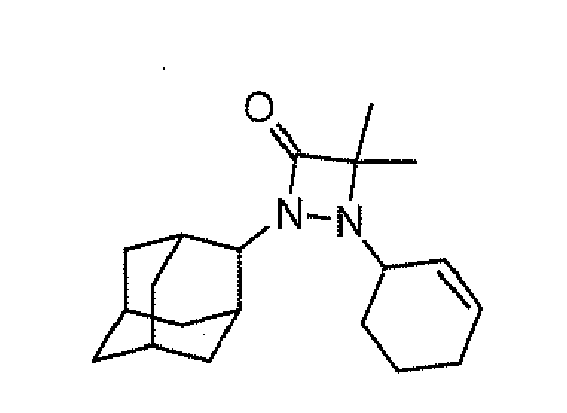
- 1H-NMR (400 MHz, CDCl3) δ; 1.45-2.51 (m, 26H), 3.49-3.63 (m, 2H), 5.79-5.85 (m, 2H).
- EI-MS m/z; 314 (M+).
-

- A solution of 1-(cyclohexa-2-ene-1-yl)-4,4-dimethyl-2-(adamantan-2-yl)-1,2-diazetidin-3-one (3.20 mg, 0.0100 mmol) in ethanol (2 mL) was added with 10% palladium carbon (catalyst amount), and under hydrogen atmosphere, the resultant was stirred at room temperature for 2 hours. The reaction solution was filtered using celite and concentrated in vacuo. The obtained residue was purified by Preparative Thin-Layer chromatography (hexane : ethyl acetate = 3:1), and the title compound (3.2 mg, quant.) was obtained as a colorless oil.
- 1H-NMR (400 MHz, CDCl3) δ; 1.16-1.88 (m, 26H), 2.10-2.12 (m, 1H), 2.33-2.35 (m, 1H), 2.45 (s, 2H), 2.72 (s, 1H), 3.51 (s, 1H).
- IR (ATR); 2907, 2854, 1758 cm-1.
- EI-MS m/z; 316 (M+).
-

- A solution of 4,4-dimethyl-1-[2-(methylthio)benzyl]-2-(adamantan-2-yl)-1,2-diazetidin-3-one (7.20 mg, 0.0186 mmol) prepared in Example 60 in methanol was added sequentially with tantalum pentachloride (3.30 mg, 0.00930 mmol) and hydrogen peroxide water (5.70 mg, 0.0558 mmol) at room temperature, and the resultant was stirred at the same temperature for 36.5 hours. The reaction solution was added with water and extracted with diethyl ether. The organic layer was dried over anhydrous sodium sulfate and concentrated in vacuo. The obtained residue was purified by Preparative Thin-Layer chromatography (hexane : ethyl acetate = 1:5), and the title compound (2.40 mg, 32.0%) was obtained as a white crystalline powder.
- 1H-NMR (270 MHz, CDCl3) δ; 1.43 (s, 3H), 1.53 (s, 3H), 1.58-2.47 (m, 14H), 3.31 (s, 3H), 3.48 (s, 1H), 3.94 (d, J= 20.8 Hz, 1H), 4.97 (d, J= 20.8 Hz, 1H), 7.47-7.61 (m, 3H), 8.10 (d, J= 10.4 Hz, 1H).
- IR (ATR); 2909, 1747, 1307, 1151, 750 cm-1.
- EI-MS m/z; 402 (M+).
-

- Methyl 4-(3,3-dimethyl-4-oxo-1,2-diazetidin-1-yl)adamantane-1-carboxylate prepared in Process of Example 90, and 2-chlorobenzyl bromide were used for a similar reaction and treatment as Process 6 of Example 1, and methyl 4-[2-(2-chlorobenzyl)-3,3-dimethyl-4-oxo-1,2-diazetidin-1-yl]admnantane-1-carboxylate was obtained as a pale yellow oil.
- 1H-NMR (400 MHz, CDCl3) δ; 1.46-2.55 (m, 19H), 3.58 (s, 1H), 4.06 (d, J= 16.0 Hz, 1H), 4.16 (d, J= 16.0 Hz, 1H), 7.20-7.65 (m, 4H).
- Methyl 4-[2-(2-chlorobenzyl)-3,3-dimethyl-4-oxo-1,2-diazetidin-1-yl]adamantane-1-carboxylate was used for a similar reaction and treatment as Process 7 of Example 90 and 4-[2-(2-chlorobenzyl)-3,3-dimethyl-4-oxo-1,2-diazetidin-1-yl]adamantane-1-carboxylic acid was obtained as a colorless oil.
- 1H-NMR (400 MHz, CDCl3) δ; 1.42 (s, 6H), 1.56-2.58 (m, 13H), 3.58 (s, 1H), 4.06 (d, J= 14.8 Hz, 1H), 4.14 (d, J= 14.8 Hz, 1H), 7.19-7.37 (m, 3H), 7.62-7.64 (m, 1H).
- 4-[2-(2-chlorobenzyl)-3,3-dimethyl-4-oxo-1,2-diazetidin-1-yl]adamantane-1-car boxylic acid was used for a similar reaction and treatment as Example 91, and the title compound was obtained as a colorless amorphous solid.
- 1H-NMR (400 MHz, CDCl3) δ; 1.29-1.26 (m, 3H), 1.47-1.44 (m, 3H), 2.58-1.50 (m, 13H), 3.61-3.42 (m, 1H), 4.18-3.95 (m, 2H), 5.29 (br, 2H), 7.30-7.18 (m, 2H), 7.38-7.34 (m, 1H), 7.64-7.60 (m, 1H).
-

- A solution of 2-(adamantan-2-yl)-4,4-dimethyl-1,2-diazetidin-3-one (33.6 mg, 0.140 mmol) prepared in Process 3 of Example 12 in dichloromethane (2 mL) was added sequentially with benzoyl chloride (40.0 mg, 0.280 mmol), triethylamine (56.6 mg, 0.560 mmol), and DMAP (catalyst amount) at room temperature, and the resultant was stirred at the same temperature for 1.5 hours. The reaction solution was added with water and extracted with chloroform. The organic layer was dried over anhydrous sodium sulfate and concentrated in vacuo. The obtained residue was purified by Preparative Thin-Layer chromatography (hexane : ethyl acetate = 3:1), and the title compound (40.4 mg, 85.3%) was obtained as a white crystalline powder.
- 1H-NMR (400 MHz, CDCl3) δ; 1.40 (s, 6H), 1.69-1.92 (m, 10H), 2.07-2.10 (m, 2H), 2.43 (s, 2H), 4.34 (s, 1H), 7.47 (t, J= 7.3 Hz, 2H), 7.58 (t, J= 7.3 Hz, 1H), 7.77 (d, J= 7.3 Hz, 2H).
- IR (ATR); 2915, 1770, 1675, 1397, 1310, 1306, 1264, 698 cm-1.
- EI-MS m/z; 338 (M+).
- 2-(Adamantan-2-yl)-4-(propan-2-yl)-1,2-diazetidin-3-one prepared in Process 3 of Example 10 and 2-methylbenzoyl chloride were used for a similar reaction and treatment as Example 96, and the title compound was obtained as a colorless oil.
-

- 1H-NMR (400 MHz, CDCl3) δ; 0.93 (d, J= 6.8 Hz, 3H), 1.06 (d, J= 6.8 Hz, 3H), 1.62-1.91 (m, 13H), 2.14 (s, 1H), 2.27 (s, 1H), 2.43 (s, 3H), 4.32 (d, J= 4.6 Hz, 1H), 4.43 (s, 1H), 7.19-7.42 (m,4H).
- EI-MS m/z; 366 (M+).
- 3-Fluorobenzoyl chloride was used in place of benzoyl chloride for a similar reaction and treatment as Example 96, and the title compound was obtained as a white crystalline powder.
-

- 1H-NMR (400 MHz, CDCl3) δ; 1.42 (s, 6H), 1.68-1.89 (m, 10H), 2.03-2.08 (m, 2H), 2.40 (s, 2H), 4.32 (s, 1H), 7.26-7.32 (m, 1H), 7.42-7.48 (m, 2H), 7.55-7.57 (m, 1H).
- IR (ATR); 2910, 1773, 1679, 1588, 1442, 1307, 1263, 768 cm-1.
- EI-MS m/z; 356 (M+).
- 3,4-Dichlorobenzoyl chloride was used in place of benzoyl chloride for a similar reaction and treatment as Example 96, and the title compound was obtained as a white crystalline powder.
-

- 1H-NMR (400 MHz, CDCl3) δ; 1.43 (s, 6H), 1.64-2.07 (m, 12H), 2.38 (s, 2H), 4.30 (s, 1H), 7.55 (d, J=8.1 Hz, 1H), 7.61 (d, J= 8.1 Hz, 1H), 7.85 (s, 1H).
- IR (ATR); 2912, 1774, 1678, 1306, 1032, 762 cm-1.
- EI-MS m/z; 407 (M+).
- 2-(Trifluoromethyl)benzoyl chloride was used in place of benzoyl chloride for a similar reaction and treatment as Example 96, and the title compound was obtained as a white crystalline powder.
-
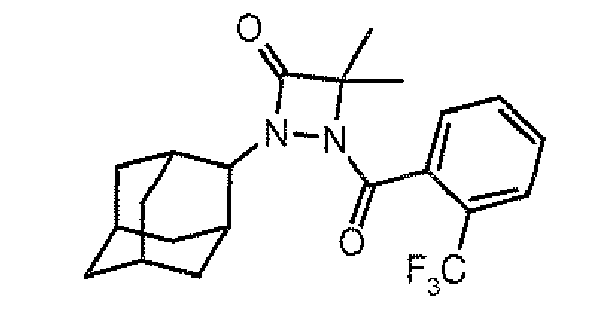
- 1H-NMR (400 MHz, CDCl3) δ; 1.38 (s, 6H), 1.70-1.90 (m, 10H), 2.04-2.09 (m, 2H), 2.45 (s, 2H), 4.46 (s, 1H), 7.63-7.84 (m, 4H).
- IR (ATR); 2910, 1776, 1680, 1311, 1164, 1143, 772, 681 cm-1.
- EI-MS m/z; 406 (M+).
- 2-Methoxybenzoyl chloride was used in place of benzoyl chloride for a similar reaction and treatment as Example 96, and the title compound was obtained as a white crystalline powder.
-

- 1H-NMR (400 MHz, CDCl3) δ; 1.35 (s, 6H), 1.69-1.90 (m, 10H), 2.08 (d, J= 12.9 Hz, 2H), 2.45 (s, 2H), 3.87 (s, 3H), 4.42 (s, 1H), 6.96-7.00 (m, 2H), 7.44-7.48 (m, 2H).
- IR (ATR); 2923, 1780, 1667, 1280, 1018, 942, 769 cm-1.
- FAB-MS m/z; 369 (M+H)+.
- 3-Methoxybenzoyl chloride was used in place of benzoyl chloride for a similar reaction and treatment as Example 96, and the title compound was obtained as a white crystalline powder.
-

- 1H-NMR (400 MHz, CDCl3) δ; 1.42 (s, 6H), 1.68-1.92 (m, 10H), 2.07 (d, J= 12.4 Hz, 2H), 2.42 (s, 2H), 3.88 (s, 3H), 4.33 (s, 1H), 7.11 (dt, J= 2.4, 7.1 Hz, 1H), 7.27-7.39 (m, 3H).
- IR (ATR); 2908, 1773, 1669, 1298, 1264, 1039, 774 cm-1.
- FAB-MS m/z; 369 (M+H)+.
- 4-Chlorobenzoyl chloride was used in place of benzoyl chloride for a similar reaction and treatment as Example 96, and the title compound was obtained as a white crystalline powder.
-

- 1H-NMR (400 MHz, CDCl3) δ; 1.41 (s, 6H), 1.68-1.92 (m, 10H), 2.06 (d, J= 12.9 Hz, 2H), 2.40 (s, 2H), 4.31 (s, 1H), 7.44-7.47 (m, 2H), 7.71-7.74 (m, 2H).
- IR (ATR); 2929, 1777, 1668, 1306, 1087, 852, 776 cm-1.
- FAB-MS m/z; 373 (M+H)+.
- 4-Fluorobenzoyl chloride was used in place of benzoyl chloride for a similar reaction and treatment as Example 96, and the title compound was obtained as a white crystalline powder.
-

- 1H-NMR (400 MHz, CDCl3) δ; 1.41 (s, 6H), 1.68-1.89 (m, 10H), 2.04-2.09 (m, 2H), 2.40 (s, 2H), 4.31 (s, 1H), 7.16 (t, J= 8.6 Hz, 2H), 7.80 (dd, J= 5.7, 8.6 Hz, 2H).
- EI-MS m/z; 356 (M+).
- 4-t-Butylbenzoyl chloride was used in place of benzoyl chloride for a similar reaction and treatment as Example 96, and the title compound was obtained as a white crystalline powder.
-

- 1H-NMR (400 MHz, CDCl3) δ; 1.34 (s, 9H), 1.42 (s, 6H), 1.68-1.91 (m, 10H), 2.06-2.10 (m, 2H), 2.41 (s, 2H), 4.32 (s, 1H), 7.47 (d, J= 8.6 Hz, 2H), 7.72 (d, J= 8.6 Hz, 2H).
- IR (ATR); 2912, 1764, 1673, 1314, 702 cm-1.
- EI-MS m/z; 394 (M+).
- 4-Bromobenzoyl chloride was used in place of benzoyl chloride for a similar reaction and treatment as Example 96, and the title compound was obtained as a white crystalline powder.
-

- 1H-NMR(400 MHz, CDCl3) δ; 1.40 (s, 6H), 1.68-1.92 (m, 10H), 2.05-2.07 (m, 2H), 2.40 (s, 2H), 4.31 (s, 1H), 7.60-7.66 (m, 4H).
- IR (ATR); 2923, 1777, 1672, 1395, 1318, 1260, 773 cm-1.
- EI-MS m/z; 416 (M+).
- 4-Nitrobenzoyl chloride was used in place of benzoyl chloride for a similar reaction and treatment as Example 96, and the title compound was obtained as a yellow crystalline powder.
-

- 1H-NMR (400 MHz, CDCl3) δ; 1.42 (s, 6H), 1.71-1.94 (m, 10H), 2.05-2.08 (m, 2H), 2.41 (s, 2H), 4.34 (s, 1H), 7.94 (d, J =8.8 Hz, 2H), 8.34 (d, J= 8.8 Hz, 2 H).
- IR (ATR); 2928, 1778, 1673, 1603, 1522, 1346, 1305, 1260, 743 cm-1.
- EI-MS m/z; 383 (M+).
- 3-Nitrobenzoyl chloride was used in place of benzoyl chloride for a similar reaction and treatment as Example 96, and the title compound was obtained as a white crystalline powder.
-

- 1H-NMR (270 MHz, CDCl3) δ; 1.45 (s, 6H), 1.62-1.94 (m, 10H), 2.07 (d, J= 13.0 Hz, 2H), 2.40 (s, 2H), 4.34 (s, 1H), 7.71 (t, J= 7.8 Hz, 1H), 8.13 (d, J= 7.8 Hz, 1H), 8.45 (d, J= 7.8 Hz, 1H), 8.60 (s, 1H).
- IR (ATR); 2913, 1775, 1678, 1531, 1347, 963, 714 cm-1.
- 3-Methylbenzoyl chloride was used in place of benzoyl chloride for a similar reaction and treatment as Example 96, and the title compound was obtained as a white crystalline powder.
-

- 1H-NMR (270 MHz, CDCl3) δ; 1.39 (s, 6H), 1.67-1.88 (m, 10H), 2.07 (d, J= 13.0 Hz, 2H), 2.41 (s, 5H), 4.33 (s, 1H), 7.30-7.40 (m, 2H), 7.54-7.57 (m, 2H).
- IR (ATR); 2911, 1774, 1666, 1308, 963, 770 cm-1.
- 3,5-bis(Trifluoromethyl)benzoyl chloride was used in place of benzoyl chloride for a similar reaction and treatment as Example 96, and the title compound was obtained as a white crystalline powder.
-

- 1H-NMR (270 MHz, CDCl3) δ; 1.43 (s, 6H), 1.61-1.91 (m, 10H), 2.06 (d, J= 12.7 Hz, 2H), 2.40 (s, 2H), 4.34 (s, 1H), 8.09 (s, 1H), 8.22 (s, 2H).
- IR (ATR); 2913, 1777, 1680, 1280, 1178, 1134, 908 cm-1.
- 2,4-Dichlorobenzoyl chloride was used in place of benzoyl chloride for a similar reaction and treatment as Example 96, and the title compound was obtained as a white crystalline powder.
-
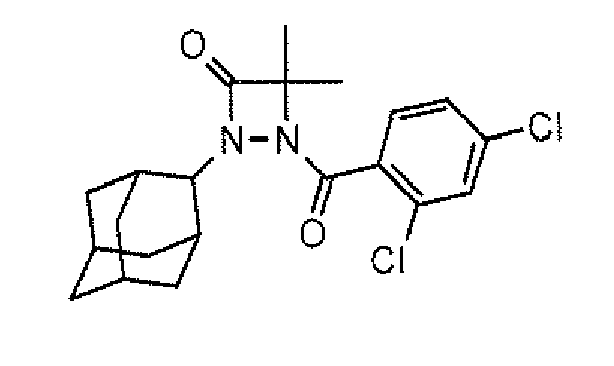
- 1H-NMR (400 MHz, CDCl3) δ; 1.38 (s, 6H), 1.70-1.91 (m, 10H), 2.03-2.07 (m, 2H), 2.43 (s, 2H), 4.40 (s, 1H), 7.32-7.34 (m, 1H), 7.47-7.53 (m, 2H).
- IR (ATR); 2917, 1781, 1683, 1307, 945 cm-1.
- EI-MS m/z; 407 (M+).
- 4-Iodobenzoyl chloride was used in place of benzoyl chloride for a similar reaction and treatment as Example 96, and the title compound was obtained as a white crystalline powder.
-

- 1H-NMR (400 MHz, CDCl3) δ; 1.40 (s, 6H), 1.68-1.91 (m, 10H), 2.04-2.07 (m, 2H), 2.39 (s, 2H), 4.31 (s, 1H), 7.49 (d, J= 8.6 Hz, 2H), 7.83 (d, J= 8.6 Hz, 2H).
- IR (ATR); 2907, 1670, 1581, 1305, 772 cm-1.
- FAB-MS m/z; 464 (M+).
- 3-Bromobenzoyl chloride was used in place of benzoyl chloride for a similar reaction and treatment as Example 96, and the title compound was obtained as a white crystalline powder.
-

- 1H-NMR (400 MHz, CDCl3) δ; 1.41 (s, 6H), 1.69-1.92 (m, 10H), 2.05-2.08 (m, 2H), 2.40 (s, 2H), 4.32 (s, 1H), 7.36 (t, J= 7.8 Hz, 1H), 7.70-7.73 (m, 2H), 7.90-7.91 (m, 1H).
- IR (ATR); 2916, 1779, 1660, 1312, 720 cm-1.
- FAB-MS m/z; 417 (M+).
- 4-Methylbenzoyl chloride was used in place of benzoyl chloride for a similar reaction and treatment as Example 96, and the title compound was obtained as a white crystalline powder.
-

- 1H-NMR (270 MHz, CDCl3) δ; 1.39 (s, 6H), 1.63-1.90 (m, 10H), 2.05-2.10 (m, 2H), 2.42 (m, 5H), 4.32 (s, 1H), 7.25 (d, J= 10.8 Hz, 2H), 7.66 (d, J= 12.4 Hz, 2H).
- IR (ATR); 2923, 1769, 1668, 1607,1454, 1397, 1313, 766 cm-1.
- FAB-MS m/z; 352 (M+).
- 4-(Trifluoromethyl)benzoyl chloride was used in place of benzoyl chloride for a similar reaction and treatment as Example 96, and the title compound was obtained as a white crystalline powder.
-

- 1H-NMR (400 MHz, CDCl3) δ; 1.42 (s, 6H), 1.70-1.93 (m, 10H), 2.05-2.09 (m, 2H), 2.42 (s, 2H), 4.34 (s, 1H), 7.74 (d, J= 8.0 Hz, 2H), 7.89 (d, J= 8.0 Hz, 2H).
- IR (ATR); 2923, 1770, 1672, 1325, 1168, 1128, 1065, 865 cm-1.
- FAB-MS m/z; 406 (M+).
- 2-Methylbenzoyl chloride was used in place of benzoyl chloride for a similar reaction and treatment as Example 96, and the title compound was obtained as a white crystalline powder.
-

- 1H-NMR (400 MHz, CDCl3) δ; 1.33 (s, 6H), 1.61-1.92 (m, 10H), 2.06 (d, J= 8.3 Hz, 2H), 2.45-2.47 (m, 5H), 4.38 (s, 1H), 7.22-7.29 (m, 2H), 7.38-7.42 (m, 1H), 7.54 (d, J= 6.6 Hz, 1H).
- IR (ATR); 2911, 1770, 1671, 1454, 1398, 1321, 752 cm-1.
- EI-MS m/z; 352 (M+).
- 3,5-Dichlorobenzoyl chloride was used in place of benzoyl chloride for a similar reaction and treatment as Example 96, and the title compound was obtained as a white crystalline powder.
-

- 1H-NMR (400 MHz, CDCl3) δ; 1.44 (s, 6H), 1.70-1.93 (m, 10H), 2.05 (m, 2H), 2.38 (s, 2H), 4.31 (s, 1H), 7.57 (t, J= 2.0 Hz, 1H), 7.64 (d, J= 2.0 Hz, 2H).
- IR (ATR); 2917, 1772, 1679, 567,1296,1260, 747 cm-1.
- FAB-MS m/z; 407 (M+).
- 2-Chlorobenzoyl chloride was used in place of benzoyl chloride for a similar reaction and treatment as Example 96, and the title compound was obtained as a white crystalline powder.
-

- 1H-NMR (400 MHz, CDCl3) δ; 1.37 (s, 6H), 1.70-1.92 (m, 10H), 2.05-2.09 (m, 2H), 2.46 (s, 2H), 4.43 (s, 1H), 7.32-7.36 (m, 1H), 7.42-7.55 (m, 3H).
- IR (ATR); 2912, 1774, 1678, 1319, 756 cm-1.
- FAB-MS m/z; 372 (M+).
- 2-Fluorobenzoyl chloride was used in place of benzoyl chloride for a similar reaction and treatment as Example 96, and the title compound was obtained as a white crystalline powder.
-

- 1H-NMR (400 MHz, CDCl3) δ; 1.40 (s, 6H), 1.66-1.92 (m, 10H), 2.05-2.09 (m, 2H), 2.45 (s, 2H), 4.37 (s, 1H), 7.15-7.27 (m, 2H), 7.50-7.53 (m, 1H), 7.58-7.62 (m, 1H).
- IR (ATR); 2916, 1773, 1678, 1320, 775, 762 cm-1.
- FAB-MS m/z; 356 (M+).
- 2-Bromobenzoyl chloride was used in place of benzoyl chloride for a similar reaction and treatment as Example 96, and the title compound was obtained as a white crystalline powder.
-

- 1H-NMR (400 MHz, CDCl3) δ; 1.40 (s, 6H), 1.67-1.91 (m, 10H), 2.06-2.09 (m, 2H), 2.46 (s, 2H), 4.45 (s, 1H), 7.34-7.41 (m, 2H), 7.52-7.55 (m, 1H), 7.69-7.71 (m, 1H).
- IR (ATR); 2913, 1772, 1670, 1314, 785, 758 cm-1.
- FAB-MS m/z; 416 (M+).
- 2-Iodobenzoyl chloride was used in place of benzoyl chloride for a similar reaction and treatment as Example 96, and the title compound was obtained as a white crystalline powder.
-

- 1H-NMR (400 MHz, CDCl3) δ; 1.40 (s, 6H), 1.65-1.92 (m, 10H), 2.05-2.09 (m, 2H), 2.45 (s, 2H), 4.46 (s, 1H), 7.20 (dt, J= 7.8,1.7 Hz, 1H), 7.42 (dt, J= 7.8, 1.2 Hz, 1H), 7.52 (dd, 7.8, 1.7 Hz, 1H), 8.01 (dd, J= 7.8, 1.2 Hz, 1H).
- IR (ATR); 2912, 1771, 1658, 1314, 754 4 cm-1.
- FAB-MS m/z; 464 (M+).
- 2,5-Dichlorobenzoyl chloride was used in place of benzoyl chloride for a similar reaction and treatment as Example 96, and the title compound was obtained as a white crystalline powder.
-
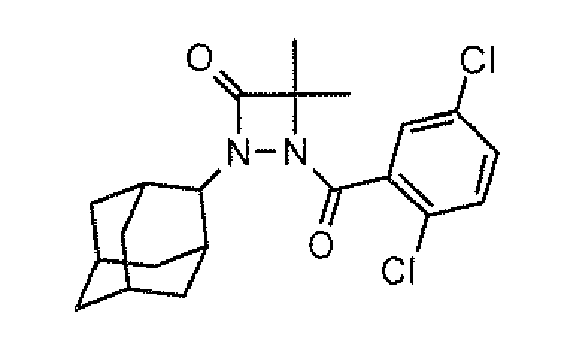
- 1H-NMR (400 MHz, CDCl3) δ; 1.41 (s, 6H), 1.72-1.93 (m, 10H), 2.05-2.07 (m, 2H), 2.44 (s, 2H), 4.42 (s, 1H), 7.41-7.43 (m, 2H), 7.50 (d, J= 1.5 Hz, 1H).
- IR (ATR); 2908, 1771, 661, 1395, 1102, 817 cm-1.
- 2,6-Dichlorobenzoyl chloride was used in place of benzoyl chloride for a similar reaction and treatment as Example 96, and the title compound was obtained as a white crystalline powder.
-

- 1H-NMR (270 MHz, CDCl3) δ; 1.45 (s, 6H), 1.69-1.93 (m, 10H), 2.08-2.12 (m, 2H), 2.53 (s, 2H), 4.56 (s, 1H), 7.27-7.41 (m, 3H).
- IR (ATR); 2908, 1774, 1658, 1430, 795 cm-1.
- 2-Nitrobenzoyl chloride was used in place of benzoyl chloride for a similar reaction and treatment as Example 96, and the title compound was obtained as a white crystalline powder.
-

- 1H-NMR (400 MHz, CDCl3) δ; 1.40 (s, 6H), 1.71-1.91 (m, 10H), 2.02-2.05 (m, 2H), 2.44 (s, 2H), 4.41 (s, 1H), 7.64-7.73 (m, 3H), 7.93-7.96 (m, 1H).
- IR. (ATR); 2907, 1777, 1674, 1538, 1360, 1320, 789, 742 cm-1,
- FAB-MS m/z; 383 (M+).
- 5-Fluoro-2-methylbenzoyl chloride was used in place of benzoyl chloride for a similar reaction and treatment as Example 96, and the title compound was obtained as a white crystalline powder.
-

- 1H-NMR (400 MHz, CDCl3) δ; 1.36 (s, 6H), 1.71-1.93 (m, 10H), 2.06 (d, J= 14.2 Hz, 2H), 2.44(m, 5H), 4.37 (s, 1H), 7.12 (dt, J= 8.3 2.7 Hz, 1H), 7.23-7.27 (m, 2H).
- IR (ATR); 2917, 1772, 1674, 1498, 1398, 1225, 830, 789 cm-1.
- EI-MS m/z; 370 (M+).
- 2-Ethylbenzoyl chloride was used in place of benzoyl chloride for a similar reaction and treatment as Example 96, and the title compound was obtained as a white crystalline powder.
-

- 1H-NMR (400 MHz, CDCl3) δ; 1.29 (t, J= 7.6 Hz, 3H), 1.32 (s, 6H), 1.71-1.91 (m, 10H), 2.08 (d, J= 12.7 Hz, 2H), 2.46 (s, 2H), 2.82 (q, J= 7.6 Hz, 2H), 4.39 (s, 1H), 7.23 (t, J= 6.5 Hz, 1H), 7.35 (d, J= 7.8 Hz, 1H), 7.43-7.47 (m, 1H), 7.53 (d, J= 6.5 Hz, 1H).
- IR (ATR); 2913, 1770, 1664, 1315, 944, 758 cm-1.
- FAB-MS m/z; 366 (M+).
- 2,3-Difluorobenzoyl chloride was used in place of benzoyl chloride for a similar reaction and treatment as Example 96, and the title compound was obtained as a white crystalline powder.
-

- 1H-NMR (400 MHz, CDCl3) δ; 1.42 (s, 6H), 1.70-1.91 (m, 10H), 2.05-2.08 (m, 2H), 2.43 (s, 2H), 4.36 (s, 1H), 7.16-7.22 (m, 1H), 7.32-7.39 (m, 2H).
- IR (ATR); 2913, 1775, 1670, 1480, 1323, 1271, 756 cm-1.
- FAB-MS m/z; 374 (M+).
- 3-Chlorobenzoyl chloride was used in place of benzoyl chloride for a similar reaction and treatment as Example 96, and the title compound was obtained as a white crystalline powder.
-

- 1H-NMR (270 MHz, CDCl3) δ; 1.41 (s, 6H), 1.62-1.89 (m, 10H), 2.03-2.08 (m, 2H), 2.40 (s, 2H), 4.31 (s, 1H), 7.41 (t, J= 11.6 Hz, 1H), 7.56 (d, J= 11.6 Hz, 1H), 7.65 (d, J= 11.6 Hz, 1H), 7.74 (s, 1H).
- IR (ATR); 2916, 1780, 1663, 1313, 768, 742 cm-1.
- FAB-MS m/z; 372 (M+).
- 3-(Trifluorometyl)benzoyl chloride was used in place of benzoyl chloride for a similar reaction and treatment as Example 96, and the title compound was obtained as a white crystalline powder.
-

- 1H-NMR (270 MHz, CDCl3) δ; 1.41 (s, 6H), 1.67-1.90 (m, 10H), 2.04-2.09 (m, 2H), 2.41 (m, 2H), 4.34 (s, 1H), 7.64 (t, J= 11.6 Hz, 1H), 7.85 (d, J= 11.6 Hz, 1H), 7.98 (d, J= 11.6 Hz, 1H), 8.02 (s, 1H).
- IR (ATR); 2986, 1774, 1666, 1344, 1312, 1164, 1132, 1071, 758, 707 cm-1.
- FAB-MS m/z; 406 (M+).
- 2,4-Difluorobenzoyl chloride was used in place of benzoyl chloride for a similar reaction and treatment as Example 96, and the title compound was obtained as a white crystalline powder.
-
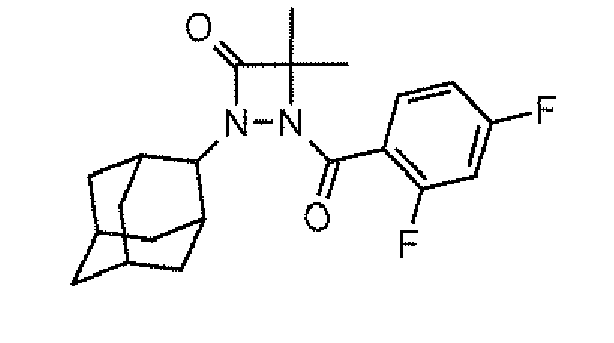
- 1H-NMR (270 MHz, CDCl3)δ; 1.40 (s, 6H), 1.73-1.90 (m, 10H), 2.03-2.07 (m, 2H), 2.42 (s, 2H), 4.34 (s, 1H), 6.90-7.00 (m, 2H), 7.59-7.67 (m, 1H).
- IR (ATR); 2917, 1774, 1666, 1618, 972, 854, 773 C111-1.
- FAB-MS m/z; 374 (M+).
- 2,5-Difluorobenzoyl chloride was used in place of benzoyl chloride for a similar reaction and treatment as Example 96, and the title compound was obtained as a white crystalline powder.
-

- 1H-NMR (270 MHz, CDCl3) δ; 1.43 (s. 6H), 1.67-1.92 (m, 10H), 2.05-2.08 (m, 2H), 2.43 (s, 2H), 4.35 (s, 1H), 7.13-7.25 (m, 2H), 7.28-7.34 (m, 1H).
- IR (ATR); 2919, 1775, 1686, 1494, 1321, 844, 758 cm-1.
- FAB-MS m/z; 374 (M+).
- 4-Fluoro-2-(trifluoromethyl)benzoyl chloride was used in place of benzoyl chloride for a similar reaction and treatment as Example 96, and the title compound was obtained as a white crystalline powder.
-

- 1H-NMR (400 MHz, CDCl3) δ; 1.39 (s, 6H), 1.71-1.92 (m, 10H), 2.05 (d, J= 13.0 Hz, 2H), 2.42 (s, 2H), 4.43 (s, 1H), 7.33 (dt, J= 8.1, 2.7 Hz, 1H), 7.55 (dd, J= 8.8, 2.7 Hz, 1H), 7.73-7.77 (m, 1H).
- IR (ATR); 2919, 1779, 1677, 1307, 1265, 1189, 1164, 862 cm-1.
- EI-MS m/z; 424 (M+).
- 2-Chloro-4-fluorobenzoyl chloride was used in place of benzoyl chloride for a similar reaction and treatment as Example 96, and the title compound was obtained as a white crystalline powder.
-
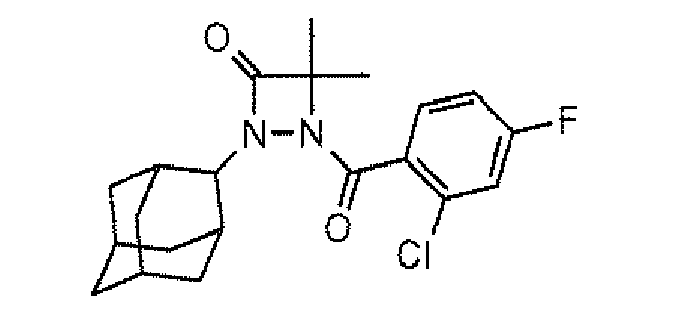
- 1H-NMR (400 MHz, CDCl3) δ; 1.38 (s, 6H), 1.70-1.91 (m, 10H), 2.05-2.07 (m, 2H), 2.43 (s, 2H), 4.40 (s, 1H), 7.04-7.08 (m, 1H), 7.24-7.27 (m, 1H), 7.54-7.58 (m, 1H).
- IR (ATR); 2909,1775, 1674, 1601,1318, 1263, 1219 9 cm-1.
- FAB-MS m/z; 390 (M+).
- 2,3-Methylenedioxybenzoyl chloride was used in place of benzoyl chloride for a similar reaction and treatment as Example 96, and the title compound was obtained as a white crystalline powder.
-

- 1H-NMR (400 MHz, CDCl3) δ; 1.45 (s, 6H), 1.68-1.90 (m, 10H), 2.05-2.08 (m, 2H), 2.42 (s, 2H), 4.34 (s, 1H), 6.09 (s, 2 H), 6.85-6.90 (m, 1H), 6.96-6.98 (m, 1H), 7.09-7.11 (m, 1H).
- IR (ATR); 2916, 1776, 1670, 1450, 1302, 1253, 1051, 931, 765 cm-1.
- FAB-MS m/z; 382 (M+).
- 3,4-Methylenedioxybenzoyl chloride was used in place of benzoyl chloride for a similar reaction and treatment as Example 96, and the title compound was obtained as a white crystalline powder.
-

- 1H-NMR (270 MHz, CDCl3) δ; 1.42 (s, 6H), 1.58-1.90 (m, 10H), 2.04-2.09 (m, 2H), 2.39 (s, 2H), 4.29 (s, 1H), 6.07 (s, 2H), 6.87 (d, J= 12.0 Hz, 1H), 7.23 (d, J= 2.4 Hz, 1H), 7.37 (dd, J= 12.0, 2.4 Hz, 1H).
- IR (ATR); 2919, 1772, 1670, 1487, 1439, 1359, 1298, 1096, 1038 cm-3.
-

- A solution of 4,4-dimethyl-1-[(2-nitrophenyl)carbonyl]-2-(adamantan-2-yl)-1,2-diazetidin-3-one (16.7 mg, 0.0436 mmol) prepared in Example 124 in ethanol-tetrahydrofuran was added with 10% palladium carbon (catalyst amount), and under a hydrogen atmosphere, the resultant was stirred at room temperature for 1 hour. The reaction solution was filtered using celite and concentrated in vacuo. The obtained residue was purified by Preparative Thin-Layer chromatography (hexane : ethyl acetate =2:1), and the title compound (14.8 mg, 96.1%) was obtained as a white crystalline solid.
- 1H-NMR (400 MHz, CDCl3) δ; 1.44 (s, 6H), 1.68-1.92 (m, 10H), 2.06-2.09 (m, 2H), 2.42 (s, 2H), 4.26 (s, 1H), 5.42 (s, 2H), 6.64-6.70 (m, 2H), 7.55 (dd, J= 6.6 1.5 Hz, 1H), 7.28 (m, 1H).
- IR (ATR); 3363, 2922, 1771, 1618, 1453, 1397, 1321, 1263, 750 cm-1.
- FAB-MS m/z; 353 (M+).
- O-acetylsalicyloyl chloride was used in place of benzyl chloride for a similar reaction and treatment as Example 96, and the title compound was obtained as a white crystalline powder.
-

- 1H-NMR (400 MHz, CDCl3) δ; 1.37 (s, 6H), 1.69-1.91 (m, 10H), 2.03-2.06 (m, 2H), 2.32 (s, 3H), 2.42 (s, 2H), 4.33 (s, 1H), 7.18 (dd, J= 7.8, 1.0 Hz, 1H), 7.32 (dt, J= 7.8, 1.0 Hz, 1H), 7.56 (dt, J= 7.8,1.7 Hz, 1H), 7.66 (dd, J= 7.8, 1.7 Hz, 1H).
- IR (ATR); 2921, 1769, 1679, 1183, 1168, 906, 754 cm-1.
- FAB-MS m/z; 396 (M+).
-

- A solution of 2-{[4,4-dimethyl-3-oxo-2-(adamantan-2-yl)-1,2-diazetidin-1-yl]carbonyl}phenyl acetate (15.0 mg, 0.0378 mmol) prepared in Example 137 in methanol-tetrahydrofuran was dropped with saturated sodium bicarbonate water (0.5 mL), and the resultant was stirred at room temperature for 4.5 hours. The reaction solution was added with water and extracted with ethyl acetate. The organic layer was dried over anhydrous sodium sulfate and concentrated in vacuo. The obtained residue was purified by Preparative Thin-Layer chromatography (hexane : ethyl acetate = 2:1), and the title compound (9.80 mg, 73.7%) was obtained as a white crystalline powder.
- 1H-NMR (400 MHz, CDCl3) δ; 1.48 (s, 6H), 1.66-1.91 (m, 10H), 2.03-2.06 (m, 2H), 2.40 (s, 2H), 4.26 (s, 1H), 6.91 (dt, J= 8.3, 1.2 Hz, 1H), 7.02 (dd, J= 8.3, 1.0 Hz, 1H), 7.48 (dt, J= 7.8, 1.7 Hz, 1H), 7.58 (dd, J= 7.8, 1.2 Hz, 1H), 10.73 (s, 1H).
- IR (ATR); 2918, 1770, 1645, 1603, 1480, 1255, 761 cm-1.
- FAB-MS m/z; 354 (M+).
- 4,4-Dimethyl-1-[(4-nitrophenyl)carbonyl]-2-(adamantan-2-yl)-1,2-diazetidin-3-one prepared in Example 107 was used for a similar reaction and treatment as Example 136, and the title compound was obtained as a white crystalline powder.
-

- 1H-NMR (270 MHz, CDCl3) δ; 1.41 (s, 6H), 1.61-1.89 (m, 10H), 2.05-2.09 (m, 2H), 2.40 (s, 2H), 4.11 (m, 2H), 4.28 (s, 1H), 6.67 (d, J= 12.4 Hz, 2H), 7.62 (d, J=12.4 Hz, 2H).
- IR (ATR); 3352, 2910, 1760, 1602, 1311, 1177, 769 cm-1.
-

- A solution of 1-[(4-aminophenyl)carbonyl]-4,4-dimethyl-2-(adamantan-2-yl)-1,2-diazetidin-3-one (5.00 mg, 0.0141 mmol) prepared in Example 139 in dichloromethane was added sequentially with 4-fluorobenzene sulfonyl chloride (3.30 mg, 0.0169 mmol) and triethylamine (2..90 mg, 0.0282 mmol) at room temperature, and the resultant was stirred at 50°C for 1 hour. The reaction solution was added with water and extracted with chloroform. The organic layer was dried over anhydrous sodium sulfate and concentrated in vacuo. The obtained residue was purified by Preparative Thin-Layer chromatography (hexane : ethyl acetate = 2:1), and the title compound (3.30 mg, 45.8%) was obtained as a white crystalline powder.
- 1H-NMR (270 MHz, CDCl3) δ; 1.42 (s, 6H), 1.68-1.90 (m, 10H), 2.03-2.08 (m, 2H), 2.40 (s, 2H), 4.33 (s, 1H), 7.13 (d, J= 12.8 Hz, 2H), 7.78 (d, J= 12.8 Hz, 2H), 7.92-7.97 (m, 4H).
- IR (ATR); 2925, 1770, 1675, 1592, 1492, 1380, 1242, 1175, 1154, 1083, 914, 835 cm-1.
- FAB-MS m/z; 511 (M+).
- 1-Naphthoyl chloride was used in place of benzoyl chloride for a similar reaction and treatment as Example 96, and the title compound was obtained as a white crystalline powder.
-

- 1H-NMR (270 MHz, CDCl3) δ; 1.29 (s, 6H), 1.61-1.92 (m, 10H), 2.11-2.16 (m, 2H), 2.52 (s, 2H), 4.47 (s, 1H), 7.48-7.59 (m, 3H), 7.81-7.89 (m, 2H), 8.01 (d, 12.2 Hz, 1H), 8.45 (d, J= 11.2 Hz, 1H).
- IR (ATR); 2916, 1779, 1657, 1307, 813, 787 cm-1.
- FAB-MS m/z; 388 (M+).
- 2-Naphthoyl chloride was used in place of benzoyl chloride for a similar reaction and treatment as Example 96, and the title compound was obtained as a white crystalline powder.
-

- 1H-NMR (400 MHz, CDCl3) δ; 1.43 (s, 6H), 1.72-1.95 (m, 10H), 2.11-2.14 (m, 2H), 2.47 (s, 2H), 4.38 (s, 1H), 7.56-7.64 (m, 2H), 7.81 (dd, J= 8.5, 2.7 Hz, 1H), 7.90-7.97 (m, 3H), 8.31 (s, 1H).
- IR (ATR); 3363, 2922, 1771, 1618, 750 cm-1.
- FAB-MS m/z; 388 (M+).
- 2-quinoxaloyl chloride was used in place of benzoyl chloride for a similar reaction and treatment as Example 96, and the title compound was obtained as a yellow crystalline powder.
-

- 1H-NMR (400 MHz, CDCl3) δ; 1.53 (d, J= 13.4 Hz, 1H). 1.70 (s, 6H), 1.73-1.92 (m, 9H), 2.11-2.15 (m, 2H), 2.47 (s, 2H), 4.49 (s, 1H), 7.88-7.94 (m, 2H), 8.16-8.21 (m, 2H).
- IR (ATR); 2912, 1771, 1654, 1392, 364, 942, 788 cm-1.
- EI-MS m/z; 390 (M+).
- Cyclohexanecarbonyl chloride was used in place of benzoyl chloride for a similar reaction and treatment as Example 96, and the title compound was obtained as a yellow crystalline powder.
-

- 1H-NMR (270 MHz, CDCl3) δ; 1.15-1.34 (m, 3H), 1.51-2.04 (m, 26H), 2.28 (s, 2H), 4.21 (s, 1H).
- 1R (ATR); 2907, 1770, 1692, 1088, 765 cm-1.
- Nicotinoyl chloride hydrochloride was used in place of benzoyl chloride for a similar reaction and treatment as Example 96, and the title compound was obtained as a yellow crystalline powder.
-

- 1H-NMR (400 MHz, CDCl3) δ; 1.44 (s, 6H), 1.70-1.90 (m, 10H), 2.05-2.09 (m, 2H), 2.41 (s, 2H), 4.33 (s, 1H), 7.43-7.46 (m, 1H), 8.06-8.10 (m, 1H), 8.82 (dd, J= 4.9, 1.9 Hz. 1H), 8.99 (d, J= 1.9 Hz, 1H).
- IR (ATR); 2903, 1791, 1682, 1584, 1302, 1235, 747 cm-1.
- FAB-MS m/z; 339 (M+).
- Isonicotinoyl chloride hydrochloride was used in place of benzoyl chloride for a similar reaction and treatment as Example 96, and the title compound was obtained as a yellow crystalline powder.
-

- 1H-NMR (400 MHz, CDCl3) δ; 1.44 (s, 6H), 1.70-1.93 (m, 10H), 2.04-2.07 (m, 2H), 2.41 (s, 2H), 4.34 (s, 1H), 7.60 (dd, J= 4.4, 1.7 Hz, 2H), 8.80 (dd, J= 4.4, 1.7 Hz, 2H).
- IR (ATR); 2914, 1774, 1675, 1561, 1317 cm-1.
- FAB-MS m/z; 339 (M+).
- 2-Cyclohexyl-4,4-dimethyl-1,2-diazetidin-3-one prepared in Process 5 of Example 68 and 2-methylbenzoyl chloride were used for a similar reaction and treatment as Example 96, and the title compound was obtained as a colorless oil.
-

- 1H-NMR (400 MHz, CDCl3) δ; 1.21-1.35 (m, 3H), 1.29 (s, 6H), 1.63-1.67 (m, 2H), 1.74-1.85 (m, 3H), 2.18 (d, J= 11.2 Hz, 2H), 2.47 (s, 2H), 3.75-3.86 (m, 1H), 7.23 (t, J= 7.6 Hz, 1H), 7.28 (d, J= 7.8 Hz, 1H), 7.39 (d, J= 7.6 Hz, 1H), 7.48 (d, J= 7.8 Hz, 1H).
- IR (ATR); 2932, 1782, 1673, 1308, 948, 750 cm-1.
- EI-MS m/z; 300 (M+).
- 2-Cyclohexyl-4,4-dimethyl-1,2-diazetidin-3-one and 2,4-dimethylbenzoyl chloride were used for a similar reaction and treatment as Example 96, and the title compound was obtained as a colorless oil.
-

- 1H-NMR (400 MHz, CDCl3) δ; 1.16-1.35 (m, 3H), 1.29 (s, 6H), 1.63-1.66 (m, 2H), 1.73-1.85 (m, 3H), 2.18 (d, J= 12.0 Hz, 2H), 2.36 (s, 3H), 2.43 (s, 3H), 3.72-3.83 (m, 1H), 7.02 (d, J= 7.8 Hz, 1H), 7.09 (s, 1H), 7.39 (d, J= 7.8 Hz, 1H).
- IR (ATR); 2930, 1781, 1674, 1307, 956, 776 cm-1.
- FAB-MS m/z; 315 (M+H)+.
- 2-Cyclohexyl-4,4-dimethyl-1,2-diazetidin-3-one and 2,5-dimethylbenzoyl chloride were used for a similar reaction and treatment as Example 96, and the title compound was obtained as a white crystalline powder.
-

- 1H-NMR (400 MHz, CDCl3) δ; 1.20-1.31 (m, 3H), 1.28 (s, 6H), 1.61-1.67 (m, 2H), 1.74-1.85 (m, 3H), 2.19 (d, J= 11.5 Hz, 2H), 2.35 (s, 3H), 2.41 (s, 3H), 3.72-3.83 (m, 1H), 7.15-7.21 (m, 2H), 7.29 (s, 1H).
- IR (ATR); 2927, 1773, 1662, 1317, 1047, 962, 836 cm-1.
- EI-MS m/z. 314 (M+).
- 2-Cyclooctyl-4,4-dimethyl-1,2-diazetidin-3-onc prepared in Process 5 of Example 73 and 3-chlorobenzoyl chloride were used for a similar reaction and treatment as Example 96, and the title compound was obtained as a white crystalline powder.
-

- 1H-NMR (270 MHz, CDCl3) δ; 1.37 (s, 6H), 1.49-1.64 (m, 8H), 1.73-1.80 (m, 2H), 2.03-2.18 (m, 4H), 3.90-4.00 (m, 1H), 7.41 (t, J= 11.6 Hz, 1H), 7.53-7.57 (m, 1H), 7.60-7.64 (m, 1H), 7.70 (t, J= 2.4 Hz, 1H).
- IR (ATR); 2925, 1787, 1659, 1572, 1302, 1274, 1252, 777, 759 cm-1.
- FAB-MS m/z; 348 (M+).
- 2-Cyclooctyl-4,4-dimethyl-1,2-diazetidin-3-one and 3-methylbenzoyl chloride were used used for a similar reaction and treatment as Example 96, and the title compound was obtained as a colorless oil.
-

- 1H-NMR (270 MHz, CDCl2) δ; 1.29-1.77 (m, 16H), 1.98-2.21 (m, 4H), 2.41 (s, 3H), 3.94 (br, 1H), 7.25-7.54 (m, 4H).
- IR (ATR); 2922, 1775, 1676, 1311, 755 cm-1.
- FAB-MS m/z; 328 (M+).
- 2-Cyclooctyl-4,4-dimethyl-1,2-diazetidin-3-one and 2-methylbenzoyl chloride were used for a similar reaction and treatment as Example 96, and the title compound was obtained as a white crystalline powder.
-

- 1H-NMR (270 MHz, CDCl3) δ; 1.29 (s, 6H), 1.57-1.79 (m, 10H), 2.01-2.24 (m, 4H), 2.47 (s, 3H), 4.06 (br, 1H). 7.20-7.29 (m, 2H). 7.37-7.42 (m, 1H), 7.49 (d, J= 11.2 Hz, 1H).
- IR (ATR); 2926, 1771, 1670, 1388, 1313, 751 cm-1.
- FAB-MS m/z; 328 (M+),
-

- 2-Cyclooctyl-4,4-dimethyl-1,2-diazetidin-3-one prepared in Process 5 of Example 73 amd 2-nitorbenzoyl chloride were used for a similar reaction and treatment as Example 96, and 2-cyclooctyl-4,4-dimethyl-1-[(2-nitrophenyl)carbonyl]-1,2-diazetidin-3-one was obtained as a pale yellow oil.
- 1H-NMR (270 MHz, CDCl3) δ; 1.25-2.09 (m, 20H), 4.19 (s, 1H), 7.52-7.82 (m, 4H).
- A solution of 2-cyclooctyl-4,4-dimethyl-1-[(2-nitrophenyl)carbonyl]-1,2-diazetidin-3-one (22.3 mg, 0.0620 mmol) in methanol was added with 10% palladium carbon (catalyst amount), and under a hydrogen atmosphere, the resultant was stirred at room temperature for 30 minutes. The reaction solution was filtered using celite, concentrated in vacuo, and the obtained residue was purified by Preparative Thin-Layer chromatography (hexane : ethyl acetate = 2:1), and the title compound. (14.7 mg, 72.1%) was obtained as a colorless oil.
- 1H-NMR (270 MHz, CDCl3) δ; 1.37 (s, 6H), 1.47-1.59 (m, 8H), 1.74-1.82 (m, 2H), 2.05-2.20 (m, 4H), 3.81-3.91 (m, 1H), 5.35 (br, 2H), 6.63-6.70 (m, 2H), 7.24-7.31 (m, 1H), 7.51 (dd, J= 11.6, 2.4 Hz, 1H).
- IR (ATR); 3460, 3350, 2925, 1754, 1659, 1617, 1301, 1247, 752 cm-1.
- 2-Cyclooctyl-4,4-dimethyl-1,2-diazetidin-3-one and 1-naphtoyl chloride were used for a similar reaction and treatment as Example 96, and the title compound was obtained as a colorless oil.
-

- 1H-NMR (400 MHz, CDCl3) δ; 1.24 (s, 6H), 1.45-1.73 (m, 8H), 1.75-1.89 (m, 2H), 2.11-2.27 (m, 4H), 4.15 (br, 1H), 7.47-7.62 (m, 3H), 7.77 (d, J= 6.6 Hz, 1H), 7.89-7.91 (m, 1H), 8.01 (d, J= 8.3 Hz, 1H), 8.39 (d, J= 8.0 Hz, 1H).
- IR (ATR); 2925, 1777, 1669, 1299, 1252, 786, 753 cm-1.
- Preparation of trans-1-[(4-fluorophenyl)carbonyl]-2-(5-hydroxyadamantan-2-yl)-4,4-dimethyl-1,2-diaze tidin-3-one: trans-2-(5-hydroxyadamantan-2-yl)-4,4-dimethyl-1,2-diazetidin-3-one prepared in Process 5 of Exmaple 65 and 4-fluorobenzoyl chloride were used for a similar reaction and treatment as Example 96, and the title compound was obtained as a white crystalline powder.
-

- 1H-NMR (270 MHz, CDCl3) δ; 1.40 (s, 6H), 1.56 (d, J= 12.7 Hz, 2H), 1.79-1.85 (m, 6H), 1.98 (d, J= 13.2 Hz, 2H), 2.20 (s, 1H), 2.60 (s, 2H), 3.21 (br, 1H), 7.09-7.18 (m, 2H), 7.76-7.82 (m, 2H).
- IR (ATR); 3440, 2925, 1767, 1663, 1229, 1117, 860 cm-1.
- EI-MS m/z; 372 (M+).
-

- Under an argon atmosphere, a solution of trans-1-[(4-fluorophenyl)carbonyl]-2-(5-hydroxyadamantan-2-yl)-4,4-dimethyl-1,2-diaze tidin-3-one (4.00 mg, 0.0100 mmol) prepared in Example 155 in dichloromethane (1 mL) was added with (diethylamino)sulfur trifluoride (24.2 mg, 0.150 mmol) at 0°C, and the resultant was stirred at the same temperature for 1 hour. The reaction solution was added with water and extracted with chloroform. The organic layer was dried over anhydrous sodium sulfate, concentrated in vacuo, and the title compound (4.20 mg, quant.) was obtained as a colorless oil.
- 1H-NMR (400 MHz, CDCl3) δ; 1.41 (s, 6H), 1.72 (s, 4H), 1.84-1.92 (m, 4H), 2.20-2.26 (m, 3H), 2.95- 3.00 (m, 2H), 4.18 (s, 1H), 7.17 (t, J= 8.8 Hz, 2H), 7.80 (dd, J= 5.4, 8.8 Hz, 2H).
- IR (ATR); 2931, 1772, 1677, 1602, 1507, 1308, 1297, 1230, 779 cm-1.
- EI-MS m/z; 374 (M+).
-

- A solution of 2-(adamantan-2-yl)-4,4-dimethyl-1,2-diazetidin-3-one (50.0 mg, 0.213 mmol) prepared in Process 3 of Example 12 in dichloromethane was added with 3-fluoro-2-methylbenzoic acid (32.8 mg, 0.213 mmol), diisopropylethylamine (82.6 mg, 0.639 mmol) and PyBOP (133 mg, 0.256 mmol) at room temperature, and the resultant was stirred at the same temperature for 18 hours. The reaction solution was added with water and extracted with chloroform. The organic layer was dried over anhydrous sodium sulfate, concentrated in vacuo, the obtained residue was purified by Preparative Thin-Layer chromatography (hexane : ethyl acetate = 2:1), and the title compound (6.90 mg, 8.70%) was obtained as a white crystalline solid.
- 1H-NMR (400 MHz, CDCl3) δ; 1.35 (s, 6H), 1.71-1.92 (m, 10H), 2.06 (d, J= 13.2 Hz, 2H), 2.38-2.44 (m, 5H), 4.38 (s, 1H), 7.16-7.25 (m, 3H), 7.33 (dd, J= 7.1,1.5 Hz, 1H).
- IR (ATR); 2915, 1771, 1671, 1317, 760 cm-1.
- FAB-MS m/z; 370 (M+).
- 4-Fluoro-2-methylbenzoic acid was used in place of 3-fluoro-2-methylbenzoic acid for a similar reaction and treatment as Example 157, and the title compound was obtained as a white crystalline powder.
-

- 1H-NMR (400 MHz, CDCl3) δ; 1.35 (s, 6H), 1.71-1.91 (m, 10H), 2.05-2.08 (m, 2H), 2.43 (s, 2H), 2.49 (s, 3H), 4.36 (s, 1H), 6.93 (dt, J= 8.6, 2.4 Hz, 1H), 7.00 (dd, J= 9.5, 2.4 Hz, 1H), 7.55-7.58 (m, 1H).
- IR (ATR); 2918, 1772, 1677, 1312, 1238, 964, 772 cm-1.
- 2,3-Dimethylbenzoic acid was used in place of 3-fluoro-2-methylbenzoic acid for a similar reaction and treatment as Example 157, and the title compound was obtained as a white crystalline powder.
-

- 1H-NMR (400 MHz, CDC13) δ; 1.33 (s, 6H), 1.68-1.91 (m, 10H), 2.07-2.10 (m, 2H), 2.32 (s, 3H), 2.36 (s, 3H), 2.46 (s, 2H), 4.40 (s, 1H), 7.13 (t, J= 7.6 Hz, 1H), 7.29 (d, J= 7.6 Hz, 1H), 7.36 (d, J=7.6 Hz, 1H).
- IR (ATR); 2912, 1777, 1666, 1317, 960, 769 cm-1.
- FAB-MS m/z; 366 (M+).
- 2,4-Dimethylbenzoic acid was used in place of 3-fluoro-2-methylbenzoic acid for a similar reaction and treatment as Example 157, and the title compound was obtained as a white crystalline powder.
-

- 1H-NMR (400 MHz, CDCl3) δ; 1.33 (s, 6H), 1.67-1.92 (m, 10H), 2.06-2.09 (m, 2H), 2.36 (s, 3H), 2.45 (m, 5H), 4.36 (s, 1H), 7.03 (d, J= 7.8 Hz, 1H), 7.09 (s, 1H), 7.45 (d, J=7.8 Hz, 1h).
- IR (ATR); 2919, 1770, 1670, 1396, 1310 cm-1.
- FAB-MS m/z; 366 (M+).
- 2,5-Dimethylbenzoic acid was used in place of 3-fluoro-2-methylbenzoic acid for a similar reaction and treatment as Example 157, and the title compound was obtained as a white crystalline powder.
-

- 1H-NMR (400 MHz, CDCl3) δ; 1.33 (s, 6H), 1.68-1.93 (m, 10H), 2.08-2.11 (m, 2H), 2.35 (s, 3H), 2.43 (s, 3H), 2.46 (s, 2H), 4.38 (s, 1H), 7.16 (d, J= 7.8 Hz, 1H), 7.21 (d, J= 8.1 Hz, 1H), 7.33 (s, 1H).
- IR (ATR); 2922, 1771, 1318, 783 cm-1.
- FAB-MS m/z; 366 (M+).
- 2-Bromo-5-fluorobenzoic acid was used in place of 3-fluoro-2-methylbenzoic acid for a similar reaction and treatment as Example 157, and the title compound was obtained as a white crystalline powder.
-

- 1H-NMR (400 MHz, CDCl3) δ; 1.42 (s, 6H), 1.72-1.92 (m, 10H), 2.04-2.08 (m, 2H), 2.44 (s, 2H), 4.43 (s, 1H), 7.08-7.13 (m, 1H), 7.24-7.27 (m, 1H), 7.65-7.68 (m, 1H).
- IR (ATR); 2916, 1773, 1655, 1261, 828 cm-1.
- FAB-MS m/z; 434 (M+).
- 2-Bromo-5-chlorobenzoic acid was used in place of 3-fluoro-2-methylbenzoic acid for a similar reaction and treatment as Example 157, and the title compound was obtained as a white crystalline powder.
-

- 1H-NMR (400 MHz, CDCl3) δ; 1.42 (s, 6H), 1.72-1.90 (m, 10H), 2.05-2.08 (m, 2H), 2.44 (s, 2H), 4.43 (s, 1H), 7.34 (dd, J= 8.6, 2.7 Hz, 1H), 7.48 (d, J= 2.7 Hz, 1H), 7.63 (d, J= 8.6 Hz,1H).
- IR (ATR); 2908, 1772, 1660, 1101, 815 cm-1.
- FAB-MS m/z; 450 (M+).
- 3-Chloro-2-fluorobenzoic acid was used in place of 3-fluoro-2-methylbenzoic acid for a similar reaction and treatment as Example 157, and the title compound was obtained as a white crystalline powder.
-

- 1H-NMR (400 MHz, CDCl3) δ; 1.40 (s, 6H), 1.70-1.91 (m, 10H), 2.05-2.08 (m, 2H), 2.43 (s,2H), 4.36 (s, 1H), 7.19 (dt, J= 7.8,1.2 Hz, 1H), 7.47-7.51 (m, 1H), 7.57-7.60 (m, 1H).
- IR (ATR); 2913, 1775, 1663, 1454, 1323, 749 cm-1.
- FAB-MS m/z; 391 (M+).
- 2-(Methylthio)benzoic acid was used in place of 3-fluoro-2-methylbenzoic acid for a similar reaction and treatment as Example 157, and the title compound was obtained as a white crystalline powder.
-
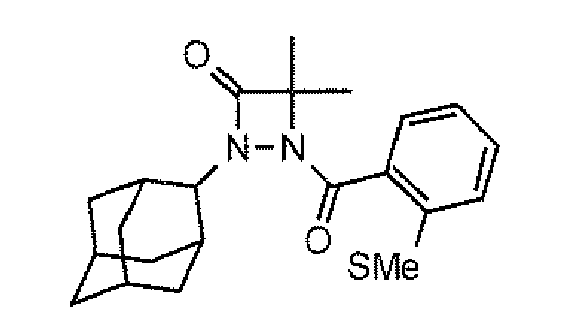
- 1H-NMR (400 MHz, CDCl3) δ; 1.38 (s, 6H), 1.69-1.91 (m, 10H), 2.07-2.09 (m, 2H), 2.42-2.49 (m, 5H), 4.42 (s, 1H), 7.14-7.18 (m, 1H), 7.32 (d, J= 8.1 Hz, 1H), 7.59 (dd, J= 7.6, 1.2 Hz, 1H), 7.45-7.49 (m, 1H).
- IR (ATR); 2912, 1762, 1671, 1312, 1258, 945, 796, 770 cm-1.
- FAB-MS m/z; 384 (M+).
- 5-Chloro-2-fluorobenzoic acid was used in place of 3-fluoro-2-methylbenzoic acid for a similar reaction and treatment as Example 157, and the title compound was obtained as a white crystalline powder.
-

- 1H-NMR (400 MHz, CDCl3) δ; 1.42 (s, 6H), 1.70-1.92 (m, 10H), 2.05-2.08 (m, 2H), 2.42 (s, 2H), 4.35 (s, 1H), 7.14 (t, J= 9.0 Hz, 1H), 7.46-7.50 (m, 1H), 7.54-7.56 (m, 1H).
- IR (ATR); 2917, 1774, 1686, 1482, 1397, 1307, 1260, 962, 843, 743 cm-1.
- FAB-MS m/z; 390 (M+).
- 2-Methylnicotinic acid was used in place of 3-fluoro-2-methylbenzoic acid for a similar reaction and treatment as Example 157, and the title compound was obtained as a white crystalline powder.
-

- 1H-NMR (400 MHz, CDCl3) δ; 1.34 (s, 6H), 1.71-1.92 (m, 10H), 2.05-2.09 (m, 2H), 2.44-2.50 (m, 5H), 4.39 (s, 1H), 7.19 (t, J= 7.8 Hz, 1H), 7.42 (d, J= 7.8 Hz, 1H), 7.51 (d, J= 7.8 Hz, 1H).
- IR (ATR); 2913, 1770, 1668, 1316, 736 cm~1.
- 2-Cyclooctyl-4,4-dimethyl-1,2-diazetidin-3-one prepared in Process 5 of Example 73 and 2-methylthiobenzoic acid were used for a similar reaction and treatment as Example 157, and the title compound was obtained as a colorless oil.
-

- 1H-NMR (270 MHz, CDCl3) δ; 1.33 (s, 6H), 1.43-1.67 (m, 8H), 1.70-1.86 (m, 2H), 1.98-2.23 (m, 4H), 2.46 (s, 3H), 4.03 (br, 1H), 7.14-7.20 (m, 1H), 7.32 (d, J= 11.2 Hz, 1H), 7.43-7.54 (m, 2H).
- IR (ATR); 2923, 1777, 1672, 1435, 1311, 1252, 751 cm-1.
-

- A solution of 2-(adamantan-2-yl)-1,2-diazetidin-3-one (5.00 mg, 0.0240 mmol)prepared in Process 5 of Example 1 in dichloromethane (1 mL) was added with diisopropylethylamine (9.30 mg, 0.0720 mmol) and p-toluenesulfonyl chloride (6.80 mg, 0.0360 mmol) at room temperature, and the resultant was stirred at the same temperature for 12 hours. The reaction solution was added with water and extracted with chloroform. The organic layer was dried over anhydrous sodium sulfate, concentrated in vacuo, the obtained residue was purified by Preparative Thin-Layer chromatography (hexane : ethyl acetate = 2:1), and the title compound (7.40 mg, 83.3%) was obtained as a white crystalline powder.
- 1H-NMR (400 MHz, CDCl3) δ; 1.62-2.03 (m, 12H), 2.52 (s, 3H), 2.62 (s, 2H), 3.96 (s, 1H), 4.27 (s, 2H), 7.45 (d, J= 12.8 Hz, 2H), 7.79 (d, J= 12.8 Hz, 2H).
- IR (ATR); 2903, 1782, 1352, 1164, 604 cm-1.
- EI-MS m/z; 360 (M+).
- Benzenesulfonyl chloride was used in place of p-toluenesulfonyl chloride for a similar reaction and treatment as Example 169, and the title compound was obtained as a white crystalline powder.
-

- 1H-NMR (400 MHz, CDCl3) δ 1.53-2.00 (m, 12H), 2.57 (s, 2H), 3.93 (s, 1H), 4.25 (br, 2H), 7.65 (t, J= 7.6 Hz, 2H), 7.76 (t, J= 7.6 Hz,1H), 7.89 (d, J= 7.6 Hz, 2H).
- IR (ATR); 2010, 1780, 1349, 1325, 1173, 1087, 760, 735, 691 cm-1.
- 4-Chlorobenzene sulfonyl chloride was used in place of p-toluenesulfonyl chloride for a similar reaction and treatment as Example 169, and the title compound was obtained as a white crystalline powder.
-

- 1H-NMR (400 MHz, CDCl3) δ; 1.52-2.00 (m, 12H), 2.57 (s, 2H), 3.91 (s, 1H), 4.25 (br, 2H), 7.62 (d, J= 8.3 Hz, 2H), 7.81 (d, J= 8.3 Hz, 2H).
- IR (ATR); 2908, 1778, 1362, 1179, 1165, 1088, 759 cm-1.
- 4-Methoxybenzene sulfonyl chloride was used in place of p-toluenesulfonyl chloride for a similar reaction and treatment as Example 169, and the title compound was obtained as a white crystalline powder.
-

- 1H-NMR (400 MHz, CDCl3) δ; 1.52-2.00 (m, 12H), 2.59 (s, 2H), 3.91 (s, 4H), 4.21 (br, 2H), 7.07 (d, J= 8.9 Hz, 2H), 7.80 (d, J= 8.9 Hz, 2H).
- IR (ATR); 2905, 1777, 1596, 1356, 1266, 1161, 1089, 1019, 697 cm-1.
- 2-(Adamantan-2-yl)-4,4-dimethyl-1,2-diazetidin-3-one prepared in Process 5 of Example 12 and 4-chlorobenzene sulfonyl chloride were used for a similar reaction and treatment as Example 169, and the title compound was obtained as a colorless crystalline powder.
-

- 1H-NMR (400 MHz, CDCl3) δ; 1.39-1.42 (m, 2H), 1.57 (s, 3H), 1.59-1.84 (m, 8H), 1.65 (s, 3H), 2.08-2.11 (m, 4H), 3.53 (s, 1H), 7.54-7.56 (m, 2H), 7.87-7.90 (m, 2H).
- 2-(Adamantan-2-yl)-4,4-dimethyl-1,2-diazetidin-3-one and benzene sulfonyl chloride were used for a similar reaction and treatment as Example 169, and the title compound was obtained as a colorless crystalline powder.
-

- 1H-NMR (400 MHz, CDCl3) δ; 1.28-1.37 (m, 2H), 1.53-1.85 (m, 14H), 2.03-2.09 (m, 4H). 3.51 (s, 1H), 7.54-7.67 (m, 3H), 7.94 (d, J= 7.6 Hz, 2H).
- 2-(Adamantan-2-yl)-4,4-dimethyl-1,2-diazetidin-3-one and o-toluenesulfonyl chloride were used for a similar reaction and treatment as Example 169, and the title compound was obtained as a white crystalline powder.
-

- 1H-NMR (400 MHz, CDCl3) δ; 1.07 (d, J= 12.0 Hz, 2H), 1.48-1.79 (m, 16H), 2.03-2.07 (m, 2H), 2.73 (s, 3H), 3.22 (s, 1H), 7.34-7.39 (m, 2H), 7.54 (t, J= 7.8 Hz, 1H), 8.05 (d, J= 7.8Hz, 1H).
- IR (ATR); 2908, 1770, 1333, 1160, 761 cm-1.
- FAB-MS m/z; 388 (M+).
- 2-(Adamantan-2-yl)-4,4-dimethyl-1,2-diazetidin-3-one and 2-chlorobenzene sulfonyl chloride were used for a similar reaction and treatment as Example 169, and the title compound was obtained as a white crystalline powder.
-

- 1H-NMR (400 MHz, CDCl3) δ; 1.09 (d, J= 11.9 Hz, 2H), 1.53-1.69 (m. 7H), 1.80-1.86 (m, 9H), 2.08 (d, J=11.9 Hz, 2H), 3.24 (s, 1H), 7.44-7.49 (m, 1H), 7.58-7.61 (m, 2H), 8.13-8.15 (m, 1H).
- IR (ATR); 2905, 1774, 1342, 1158, 1045, 769 cm-1.
- FAB-MS m/z; 408 (M+).
- Benzylsulfonyl chloride was used in place of p-toluenesulfonyl chloride for a similar reaction and treatment as Example 169, and the title compound was obtained as a white crystalline powder.
-

- 1H-NMR (400 MHz, CDCl3) δ; 1,52-2-00 (m, 12H), 2.46 (s, 2H), 3.64 (s, 1H), 4.33 (s, 2H), 4.43 (s, 2H), 7.41-7.43 (m, 5H).
- IR (ATR); 2901, 1773, 1349, 1158, 773, 695 cm-1.
- 2-(Adamantan-2-yl)-4,4-dimethyl-1,2-diazetidin-3-one prepared in Process 5 of Example 12 and 3-chlorobenzen sulfonyl chloride were used for a similar reaction and treatment as Example 169, and the title compound was obtained as a white crystalline powder.
-

- 1H-NMR (400 MHz, CDCl3) δ; 1.39 (d, J= 12.9 Hz, 2H), 1.56-1.59 (m, 3H), 1.78-1.84 (m, 11H), 2.08-2.12 (m, 4H), 3.51 (s, 1H), 7.52 (t, J= 7.8 Hz, 1H), 7.63-7.65 (m, 1H), 7.83-7.84 (m, 1H), 7.93 (t, J= 1.7 Hz, 1H).
- IR (ATR); 2910, 1773, 1352, 1164, 792 cm-1.
- FAB-MS m/z; 408 (M+).
- 2-(Adamantan-2-yl)-4,4-dimethyl-1,2-diazetidin-3-one and 2-fluorobenzenesulfonyl chloride were used for a similar reaction and treatment as Example 169, and the title compound was obtained as a white crystalline powder.
-

- 1H-NMR (400 MHz, CDCl3) δ; 1.25 (d, J= 7.1 Hz, 2H), 1.56 (d, J= 11.7 Hz, 2H), 1.63-1.78 (m, 11H), 1.83 (s, 1H), 2.08-2.13 (m, 4H), 3.51 (s, 1H), 7.23-7.28 (m, 1H), 7.31-7.42 (m, 1H). 7.65-7.71 (m, 1H), 7.92-8.00 (m, 1H).
- IR (ATR); 2909, 1767, 1596, 1476, 1167, 1155, 767, 701 cm-1.
- FAB-MS m/z; 392 (M+).
-

- 2-Nitrophenylhydrazine was used in place of benzylcarbazate for a similar reaction and treatment as Process 1 of Example 1, and 1-(adamantan-2-ylidene)-2-(2-nitrophenyl)hydrazine was obtained as a brown crystalline powder.
- 1H-NMR (400 MHz, CDCl3) δ; 1.71-2.10 (m, 12H), 2.75 (s, 1H), 3.21 (s, 1H), 6.73 (t, J= 8.1 Hz, 1H), 7.48 (t, J= 8.1 Hz, 1H), 7.89 (d, J= 8.1 Hz, 1H), 8.13 (d, J= 8.1 Hz, 1H), 10.83 (s, 1H).
- 1-(Adamantan-2-ylidene)-2-(2-nitrophenyl)hydrazine was used for a similar reaction and treatment as Process 2 of Example 1, and 1-(adamantan-2-yl)-2-(2-nitrophenyl)hydrazine was obtained as a yellow oil.
- 1H-NMR (400 MHz, CDCl3) δ; 1.39-2.12 (m, 14H), 3.07 (s, 1H), 3.87 (s, 1H), 6.63 (t, J= 8.1 Hz, 1H), 7.43 (t, J= 8.1 Hz, 1H), 7.77 (d, J= 8.1 Hz, 1H), 8.09 (d, J= 8.1 Hz, 1H), 8.80 (s, 1H).
- 1-(Adamantan-2-yl)-2-(2-mitrophenyl)hydrazine and bromoacetyl bromide were used for a similar reaction and treatment as Process 3 of Example 1, and 1-(2-bromoacetyl)-1-(adamantan-2-yl)-2-(2-nitrophenyl)hydrazine was obtained as a yellow oil.
- 1H-NMR (400 MHz, CDCl3) δ; 1.56-1.90 (m, 13H), 2.54 (s, 1H), 3.71 (d, J= 11.0 Hz, 1H), 3.90 (d, J= 11.0 Hz, 1H), 4.51 (s, 1H), 6.89-6.94 (m, 2H), 7.55 (t, J= 8.1 Hz, 1H), 8.24 (d, J= 8.1 Hz, 1H), 9.59 (s, 1H).
- 1-(2-Bromoacetyl)-1-(adamantan-2-yl)-2-(2-nitrophenyl)hydrazine was used for a similar reaction and treatment as Process 4 of Example 1, and the title compound was obtained as a pale yellow oil.
- 1H-NMR (400 MHz, CDCl3) δ; 1.57-2.52 (m, 14H), 3.71 (s, 1H), 4.12 (br, 1H), 5.10 (br, 1H), 7.31 (t, J= 8.1 Hz, 1H), 7.95 (d, J= 8.1 Hz, 1H), 7.58-7.67 (m, 2H).
- IR (ATR); 2907, 2360, 2342, 1761, 1603, 1513, 1344, 752 cm-1.
- EI-MS m/z; 327 (M+),
-

- Under an argon atmosphere, a solution of 2-(adamantan-2-yl)-4,4-dimethyl-1,2-diazetidin-3-one (50.0 mg, 0.213 mmol) prepared in Process 3 of Example 12 in toluene (1 mL) was added with palladium acetate (II) (1.00 mg, 0.00445 mmol), tri-t-butylphosphine (0.700 mg, 0.00346 mmol), sodium t-butoxide (30.8 mg, 0.320 mmol) and bromobenzene (67.0 mg, 0.427 mmol) sequentially at room temperature, and the resultant was stirred under microwave irradiation at 110°C for 1 hour. The reaction solution was added with water and extracted with ethyl acetate. The organic layer was dried over anhydrous sodium sulfate, concentrated in vacuo, the obtained residue was purified by Preparative Thin-Layer chromatography (hexane : ethyl acetate =5:1), and the title compound (42.0 mg, 64.4%) was obtained as a pale yellow amorphous solid.
- 1H-NMR (400 MHz, CDCl3) δ; 0.80-1.95 (m, 18H), 2.24 (d, J= 12.2 Hz, 2H), 3.77 (s, 1H), 7.00 (d, J= 7.6 Hz, 2H), 7.12 (t, J= 7.6 Hz, 1H), 7.33 (d, J= 7.6 Hz, 2H).
- IR (ATR); 2923, 1754, 1323, 775 cm-1.
- EI-MS m/z; 310 (M+).
-

- 4-Nitrophenylhydrazine was used in place of benzylcarbazate for a similar reaction and treatment as Process 1 of Example 1, and 1-(adamantan-2-ylidene)-2-(2-nitrophenyl)hydrazine was obtained as a brown crystalline powder.
- 1H-NMR (400 MHz, CDCl3) δ; 1.84-2.17 (m, 12H), 2.70 (s, 1H), 3.09 (s, 1H), 7.02 (d, J= 9.0 Hz, 2H), 7.56 (s, 1H), 8.13 (d, J= 9.1 Hz, 2H).
- 1-(Adamantan-2-ylidene)-2-(4-nitrophenyl)hydrazine was used for a similar reaction and treatment as Process 2 of Example 1, and 1-(adamantan-2-yl)-2-(4-nitrophenyl)hydrazine was obtained as a yellow oil.
- 1H-NMR (400 MHz, CDCl3) δ; 1.51-2.27 (m, 14H), 2.98 (s, 1H), 3.75 (s, 1H), 5.64 (s, 1H), 6.87 (d, J= 9.0 Hz, 2H), 8.08 (d, J= 9.0 Hz, 2H).
- 1-(Adalnantan-2-yl)-2-(4-nitrophenyl)hydrazine and 2-bromoisobutyrylbromide were used for a similar reaction and treatment as Process 3 of Example 1, and 2-bromo-N-(adamantan-2-yl)-2-methyl-N'-(4-nitrophenyl)propane hydrazide was obtained as a yellow oil.
- 1H-NMR (400 MHz, CDCl3) δ; 1.46-1.90 (m, 13H), 2.46 (s, 1H), 4.51 (s, 1H), 6.60 (s, 1H), 6.68 (d, J= 9.0 Hz, 2H), 8.22 (d, J= 9.0 Hz, 2H).
- 2-Bromo-N-(adamantan-2-yl)-2-methyl-N'-(4-nitrophenyl)propane hydrazide was used for a similar reaction and treatment as Process 4 of Example 1, and the title compound was obtained as a pale yellow oil.
- 1H-NMR (400 MHz, CDCl3) δ; 1.35 (s, 6H), 1.64-1.89 (m, 10H), 2.15-2.18 (m, 2H), 2.35 (s, 1H), 3.81 (s, 1 H), 7.03 (d, J= 8.3 Hz, 2H), 8.22 (d, J= 8.3 Hz, 2H).
- IR (ATR); 2913, 1764, 1591, 1514, 1341, 1110, 754 cm-1.
- EI-MS m/z; 355 (M+).
-

- A solution of 4,4-dimethyl-1-(4-nitrophenyl)-2-(adamantan-2-yl)-1,2-diazetidin-3-one (15.3 mg, 0.0430 mmol) prepared in Example 182 in ethanol (2 mL) was added with 10% palladium carbon (catalyst amount), and under a hydrogen atmosphere the resultant was stirred at room temperature for 20 minutes. The reaction solution was filtered using celite, concentrated in vacuo, the obtained residue was purified by Preparative Thin-Layer chromatography (hexane : ethyl acetate =1:1), and the title compound (14.2 m, quant.) was obtained as a colorless oil.
- 1H-NMR (400 MHz, CDCl3) δ; 0.87 (br, 3H), 1.43-1.89 (m, 14H), 2.17-2.28 (m, 2H), 2.61 (br, 1H), 3.69 (s, 1H), 6.65 (d, J= 8.8 Hz, 2H), 6.87 (d, J= 8.8 Hz, 2H).
- IR (ATR); 3342, 2908, 2853, 2359, 1744, 1655, 1545, 1508, 1221, 750 cm-1.
- EI-MS m/z; 325 (M+).
-

- Under an argon atmosphere, a solution of 1-(4-aminophenyl)-4,4-dimethyl-2-(adamantan-2-yl)-1;2-diazetidin-3-one (30.0 mg. 0.0920 mmol) prepared in Example 183 in dichloromethane (1 mL) was added with triethylamine (18.6 mg, 0.184 mmol) and methanesulfonyl chloride (15.8 mg, 0.138 mmol) at room temperature, and the resultant was stirred at the same temperature for 3 hours. The reaction solution was added with water and extracted with chloroform. The organic layer was dried over anhydrous sodium sulfate, concentrated in vacuo, the obtained residue was purified by Preparative Thin-Layer chromatography (hexane : ethyl acetate = 1:1), and the title compound (6.80 mg, 18.3%) was obtained as a brown amorphous solid.
- 1H-NMR (400 MHz, CDCl3) δ; 1.33 (s, 6H), 1.52-1.84 (m, 12H), 2.19-2.23 (m, 2H), 3.02 (s, 3H), 3.73 (s, 1H), 6.44 (s, 1H), 7.00 (d, J= 8.8 Hz, 2H), 7.20 (d, J= 8.8 Hz, 2H).
- IR (ATR); 2912, 2360, 2342, 1740, 1505, 1328, 1155, 968, 754 cm-1.
- EI-MS m/z; 403 (M+).
- The same reaction and treatment were conducted as Example 184 except that an excessive amount of methane sulfonyl chloride was used, and the title compound was obtained as a brown amorphous solid.
-

- 1H-NMR (400 MHz, CDCl3) δ; 1.26 (s, 6H), 1.54-1.84 (m, 11H), 2.19-2.36 (m, 3H), 3.41 (s, 6H), 3.74 (s, 1H), 7.02 (d, J= 8.5 Hz, 2H), 7.30 (d, J= 8.5 Hz, 2H).
- IR (ATR); 2912, 1757, 1500, 1368, 1353, 1161, 977, 904, 758 cm-1.
- EI-MS m/z; 481 (M+).
- Benzoyl chloride was used in place of methanesulfonyl chloride for a similar reaction and treatment as Example 184, and the title compound was obtained as a yellow amorphous solid.
-

- 1H-NMR (400 MHz, CDCl3) δ; 1.23 (br, 6H), 1.62-2.25 (m, 14H), 3.76 (s, 1H), 7.03 (d, J= 8.6 Hz, 2H), 7.45-7.57 (m, 3H), 7.62 (d, J= 8.6 Hz, 2H), 7.87 (d, J= 7.3 Hz, 2H), 7.95 (s, 1H).
- IR (ATR); 3308, 2912, 2855, 1740, 1652, 1602, 1530, 1506, 1407, 1316, 846, 754, 706 cm-1.
- EI-MS m/z; 429 (M+).
- Acethyl chloride was used in place of methanesulfonyl chloride for a similar reaction and treatment as Example 184, and the title compound was obtained as a yellow amorphous solid.
-

- 1H-NMR (400 MHz, CDCl3) δ; 1.31 (br, 6H), 1.51-2.08 (m, 14H), 2.18 (s, 3H), 3.73 (s, 1H), 6.97 (d. J= 8.6 Hz, 2H), 7.43 (s, 1H), 7.47 (d, J= 8.6 Hz, 2H).
- IR (ATR); 3309, 2931, 2855, 1742, 1668, 1540, 1507, 1314, 848, 752 cm-1.
- EI-VIS m/z; 367 (M+).
-

- 1-(Adamantan-2-yl)-2-(2-nitrophenyl)hydrazine prepared in Processes 1 and 2 in Example 180 and 2-bromoisobutyryl bromide were used for a similar reaction and treatment as Process 3 of Example 1, and 2-bromo-N-(adamantan-2-yl)-2-methyl-N'-(2-nitrophenyl)propane hydrazide was obtained as a yellow oil.
- 1H-NMR (400 MHz, CDCl3) δ; 1.56-1.98 (m, 19H), 2.54 (s, 1H), 4.49 (s, 1H), 6.86-6.89 (m, 2H), 7.50 (t, J= 8.1 Hz, 1H), 8.21 (d, J= 8.1 Hz, 1H), 9.78 (s, 1H).
- 2- Bromo-N-(adamantan-2-yl)-2-methyl-N'-(2-nitrophenyl)propane hydrazide was used for a similar reaction and treatment as Process 4 of Example 1, and the title compound was obtained as a pale yellow oil.
- 1H-NMR (400 MHz, CBCl3) δ; 1.09 (s, 3H), 1.50-1.55 (m, 2H), x.S6 (s, 3H), 1.60-1.88 (m, 9H), 2.03-2.06 (m, 1H), 2.17-2.23 (m, 1H), 2.64 (s, 1H), 3.60 (s, 1H), 7.29 (t, J= 8.0 Hz, 1H), 7.48 (d, J= 8.0 Hz, 1H). 7.62 (t, J= 8,0 Hz, 1H), 7.81 (d, J= 8.0 Hz, 1H).
- IR (ATR); 2911, 2856, 1762, 1530, 1381, 1361, 1100, 764 cm-1.
- EI-MS m/z; 355 (M+).
- 1-Bromo-2-chlorobenzene was used in place of bromobenzene for a similar reaction and treatment as Example 181, and the title compound was obtained as a pale yellow amorphous solid.
-

- 1H-NMR (400 MHz, CDCl3) δ; 0.99 (s, 3H), 1.55-1.93 (m, 11H), 1.79 (s, 3H), 2.20 (d, J= 13.1 Hz, 1H), 2.32 (d, J= 13.1 Hz, 1H), 2.69 (s, 1H), 3.71 (s, 1H), 7.06 (t, J= 7.6 Hz, 1H), 7.20 (d, J= 7.6 Hz, 1H), 7.27 (t, J= 7.6 Hz, 1H), 7.38 (d, J= 7.6 Hz, 1H).
- IR(ATR); 2911, 1751, 1468, 1039, 767 cm-1.
- EI-MS m/z; 344 (M+).
- 1-Bromo-3-chlorobenzene was used in place of bromobenzene for a similar reaction and treatment as Example 181, and the title compound was obtained as a pale yellow oil.
-
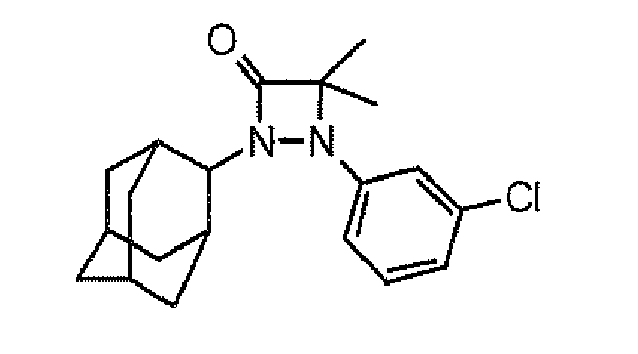
- 1H-NMR (400 MHz, CDCl3) δ; 1.05-2.55 (m, 20H), 3.74 (s, 1H), 6.89 (d, J= 7.8 Hz, 1H), 7.00 (s, 1H), 7.10 (d, J= 7.8 Hz, 1H), 7.26 (t, J= 7.8 Hz, 1H).
- IR(ATR); 2911, 1762, 1590, 1471, 1072, 752 cm-1.
- EI-MS m/z; 344 (M+).
- 1-Bromo-4-chlorobenzene was used in place of bromobenzene for a similar reaction and treatment as Example 181, and the title compound was obtained as a pale yellow oil.
-

- 1H-NMR (400 MHz, CDCl3) δ; 0.80-2.52 (m, 20H), 3.73 (s, 1H), 6.95 (d, J= 8.5 Hz, 2H), 7.30 (d, J= 8.5 Hz, 2H).
- IR (ATR); 2911, 1760, 1485, 1090, 842, 756 cm-1.
- EI-MS m/z; 344 (M+).
- 2-Bromotoluene was used in place of bromobenzene for a similar reaction and treatment as Example 181, and the title compound was obtained as a white crystalline powder.
-

- 1H-NMR (400 MHz, CDCl3) δ; 0.89 (s, 3H), (m, 11H), 1.70 (s, 3H), 2.18-2.32 (m, 2H), 2.28 (s, 3H), 2.72 (s, 1H), 3.69 (s, 1H), 7.05 (t, J= 7.3 Hz, 1H), 7.13-7.22 (m, 3H).
- IR(ATR); 2910, 1751, 1451, 1330, 773 cm-1.
- EI-MS m/z; 324 (M+).
- 3-Bromotoluene was used in place of bromobenzene for a similar reaction and treatment as Example 181, and the title compound was obtained as a colorless oil.
-

- 1H-NMR (400 MHz, CDCl3) δ; 0.85-2.51 (m, 20H), 2.35 (s, 3H), 3.75 (s. 1H), 6.80-6.82 (m, 2H), 6.93 (d, J= 7.8 Hz, 1H), 7.21 (t, J= 7.8 Hz, 1H).
- IR (ATR); 2911, 1760, 1453, 1322, 787 cm-1.
- EI-MS m/z; 324 (M+).
- 4-Bromotoluene was used in place of bromobenzene for a similar reaction and treatment as Example 181, and the title compound was obtained as a colorless oil.
-

- 1H-NMR (400 MHz, CDCl3) δ; 0.85-2.75 (m, 20H), 2.32 (s, 3H), 3.74 (s, 1H), 6.91 (d, J= 8.3 Hz, 1H), 7.13 (t, J= 8.3 Hz, 2H).
- IR (ATR); 2911, 1759, 1506, 1322, 837 cm-1.
- EI-MS m/z; 324 (M+).
- 1-Bromo-2,4-difluorobenzene was used in place of bromobenzene for a similar reaction and treatment as Example 181, and the title compound was obtained as a colorless oil.
-

- 1H-NMR (400 MHz, CDCl3) δ; 1.00-2.32 (m, 19H), 2.55-2.64 (m, 1H), 3.72 (s, 1H), 6.83-6.88 (m, 2H), 7.06-7.12 (m, 1H).
- 1-Bromo-2,5-difluorobenzene was used in place of bromobenzene for a similar reaction and treatment as Example 181, and the title compound was obtained as a colorless oil.
-

- 1H-NMR (400 MHz, CDCl3) δ; 1.06-2.27 (m, 19H), 2.65-2.70 (m, 1H), 3.74 (m, 1H), 6.70-6.76 (m, 1H), 6.81-6.86 (m, 1H), 6.99-7.05 (m. 1H).
- IR (ATR); 2910, 1770, 1496, 1244, 1159, 1004, 762 cm-1.
- EI-MS m/z; 346 (M+).
- 1-Bromo-2,3-difluorobenzene was used in place of bromobenzene for a similar reaction and treatment as Example 181, and the title compound was obtained as a pale yellow crystalline powder.
-

- 1H-NMR (400 MHz, CDCl3) δ; 1.02-2.55 (m, 20H), 3.71 (s, 1H), 6.75-6.77 (m, 1H), 6.85-6.89 (m, 1H), 7.13 (dd, J= 8.8,18.6 Hz, 1H).
- IR (ATR); 2913, 1760, 1511, 1211, 1100, 772 cm-1.
- EI-MS m/z; 346 (M+).
- 1-Bromo-3,5-difluorobenzene was used in place of bromobenzene for a similar reaction and treatment as Example 181, and the title compound was obtained as a pale yellow crystalline powder.
-

- 1H-NMR (400 MHz, CDCl3) δ; 1.26-1.91 (m, 18H), 2.18 (d, J= 11.7 Hz, 1H), 2.34 (s, 1H), 3.73 (s, 1H), 6.52-6.60 (m, 3H).
- IR(ATR); 2916, 1758, 1621, 1456, 1113, 821 cm-1.
- EI-MS m/z; 346 (M+).
- 1-Bromo-3,4-(methylenedioxy)benzene was used in place of bromobenzene for a similar reaction and treatment as Example 181, and the title compound was obtained as a pale yellow amorphous solid.
-

- 1H-NMR (400 MHz, CDCl3) δ; 0.92 (s, 3H), 1.57-1.90 (m, 14H), 2.04-2.20 (m, 2H), 2.50-2.65 (m, 1H), 3.69 (s, 1H), 5.96 (s, 2H), 6.52 (d, J= 8.2 Hz, 1H), 6.59 (s, 1H), 6.76 (d, J= 8.2 Hz, 1H).
- IR(ATR); 2909, 1755, 1482, 1241, 1037, 755 cm-1.
- EI-MS m/z; 354 (M+).
- 1-Bromo-3-fluorobenzene was used in place of bromobenzene for a similar reaction and treatment as Example 181, and the title compound was obtained as a white crystalline powder.
-

- 1H-NMR (400 MHz, CDCl3) δ; 1.15-1.50 (m, 3H), 1.56-1.91 (m, 14H), 2.20-2.54 (m, 3H), 3.75 (s, 1H), 6.71-6.84 (m, 3H), 7.25-7.31 (m, 1H).
- IR (ATR); 2912, 1758, 1613, 1485, 1148, 862 cm-1.
- EI-MS m/z; 328 (M+).
- 1-Bromo-4-fluorobenzene was used in place of bromobenzene for a similar reaction and treatment as Example 181, and the title compound was obtained as a pale yellow oil.
-

- 1H-NMR (400 MHz, CDCl3) δ; 0.85-1.20 (m, 3H), 1.42-1.90 (m, 14H), 2.02-2.30 (m, 3H), 3.71 (s, 1H), 6.98-7.05 (m, 4H).
- IR (ATR); 2911, 1759, 1501, 1212, 1100, 845 cm-1.
- EI-MS m/z; 328 (M+).
- 1-Bromo-3,5-dichlorobenzene was used in place of bromobenzene for a similar reaction and treatment as Example 181, and the title compound was obtained as a white crystalline powder.
-

- 1H-NMR (400 MHz, CDCl3) δ; 1.21-2.32 (m, 24H), 3.72 (s, 1H), 6.89 (s, 2H), 7.12 (t, J= 1.7Hz,1H).
- IR (ATR); 2914, 1757, 1582, 1312, 843,759 cm-1.
- EI-MS m/z; 379 (M+).
- 1-Bromo-4-methoxybenzene was used in place of bromobenzene for a similar reaction and treatment as Example 181, and the title compound was obtained as a yellow oil.
-
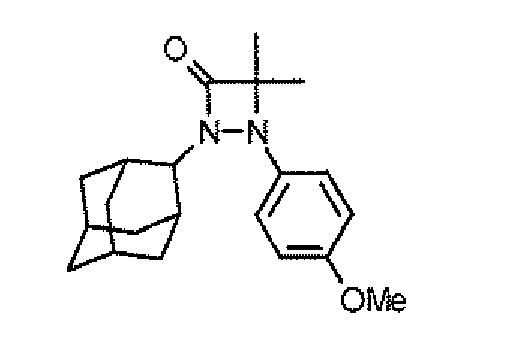
- 1H-NMR (400 MHz, CDCl3) δ; 0.69-1.12 (m, 3H), 1.59-1.90 (m, 14H), 2.04-2.22 (m, 2H), 2.63 (br, 1H), 3.71 (s, 1H), 3.80 (s, 3H), 6.87 (d, J=8.8 Hz, 2H), 6.98 (d, J= 8.8 Hz, 2H).
- IR (ATR); 2910, 1755, 1504, 1244, 1036, 841, 731 cm-1.
- EI-MS m/z; 340 (M+),
- 1-Bromo-3-methoxybenzene was used in place of bromobenzene for a similar reaction and treatment as Example 181, and the title compound was obtained as a yellow oil.
-

- 1H-NMR (400 MHz, CDCl3) δ; 1.22-1.91 (m, 18H), 2.23 (d, J= 12.7 Hz, 2H), 3.76 (s, 1H), 3.81 (s, 3H), 6.55 (s, 1H), 6.60 (d, J= 7.8 Hz, 1H), 6.67-6.68 (m, 1H), 7.23 (t, J= 8.0 Hz, 1H).
- IR (ATR); 2911, 1759, 1601, 1484, 1153, 1047, 753 cm-1.
- EI-MS m/z; 340 (M+).
- 1-Bromo-2-methoxybenzene was used in place of bromobenzene for a similar reaction and treatment as Example 181, and the title compound was obtained as a brown oil.
-

- 1H-NMR (400 MHz, CDCl3) δ; 0.94 (s, 3H), 1.57-1.78 (m, 10H), 2.11 (s, 1H), 2.24 (d, J= 12.7 Hz, 1H), 2.3 (d, J= 12.7 Hz, 1H), 2.67 (s, 1H), 3.75 (s, 1H), 3.84 (s, 3H), 6.88 (d, J= 7.8 Hz, 1H), 6.94 (t, J= 7.8 Hz, 1H), 7.01-7.07 (m, 2H).
- IR (ATR); 2910, 1758, 1491, 1454, 1244, 753 cm-1.
- EI-MS m/z; 340 (M+).
- 1-Bromo-2,3-dichlorobenzene was used in place of bromobenzene for a similar reaction and treatment as Example 181, and the title compound was obtained as a colorless oil.
-

- 1H-NMR (400 MHz, CDCl3) δ; 1.00 (s, 3H), 1.55-1.61 (m, 2H), 1.69-1.77 (m, 5H), 1.81 (s, 3H), 1.87-1.91 (m, 3H), 2.69 (s, 1H), 3.69 (s, 1H), 7.12 (dd, J= 1.9, 7.6 Hz, 1H), 7.19-7.26 (m, 2H).
- IR (ATR); 2915, 1755, 576, 1446, 1057, 753 cm-1.
- EI-MS m/z; 378 (M+).
- 3-Bromo-o-xylene was used in place of bromobenzene for a similar reaction and treatment as Example 181, and the title compound was obtained as a colorless oil.
-

- 2H-NMR (400 MHz, CDCl3) δ: 0.86 (s, 3H), 1.59 (s, 3H), 1.66-1.76 (m, 7H), 1.84-1.90 (m, 4H), 2.19-2.22 (m, 4H), 2.27-2.31 (m, 4H), 2.73 (s, 1H), 3.69 (s, 1H), 6.96 (d, J= 7.3 Hz, 1H), 7.01 (d, J= 7.3 Hz, 1H), 7.10 (t, J= 7.6 Hz, 1H).
- IR (ATR); 2912, 1757, 754 cm-1.
- EI-MS m/z; 338 (M+).
- 1-Bromo-2,4-dichlorobenzene was used in place of bromobenzene for a similar reaction and treatment as Example 181, and the title compound was obtained as a colorless oil.
-

- 1H-NMR (400 MHz, CDCl3) δ; 1.00 (s, 3H), 1.56-1.62 (m, 3H), 1.68-1.74 (m, 5H), 1.78 (s, 3H), 1.87-1.91 (m, 3H), 2.14 (d, J= 12.9 Hz, 1H), 2.27 (d, J= 12.9 Hz, 1H), 2.66 (s, 1H), 3.67 (s, 1H), 7.14 (d, J= 8.5 Hz, 1H), 7.25 (dd, J= 2.4, 8.5 Hz, 1H), 7.40 (d, J= 2.4 Hz, 1H).
- IR (ATR); 2912, 2855, 1764, 1468, 1102, 756 cm-1.
- EI-MS m/z; 378 (M+).
- 1 -Bromo-2,5-dichlorobenzene was used in place of bromobenzene for a similar reaction and treatment as Example 181, and the title compound was obtained as a colorless oil.
-

- 1H-NMR (400 MHz, CDCl3) δ; 1.02 (s, 3H), 1.50-1.76 (m, 8H), 1.79 (s, 3H), 1.87-1.91 (m, 3H), 2.14 (d, J= 12.7 Hz, 1H), 2.27 (d, J= 12.7 Hz, 1H), 2.66 (s, 1H), 3.69 (s, 1H), 7.04 (dd, J= 2.2,8.6 Hz, 1H), 7.19 (d, J= 2.2 Hz, 1H), 7.30 (d, J= 8.6 Hz, 1H).
- IR (ATR); 2910, 2854, 1768, 1466, 806 cm-1.
- EI-MS m/z; 378 (M+).
- 3-Bromobenzothiophene was used in place of bromobenzene for a similar reaction and treatment as Example 181, and the title compound was obtained as a red-brown oil.
-

- 1H-NMR (400 MHz, CDCl3) δ; 1.00 (s, 3H), 1.56 (s, 3H), 1.72-1.91 (m, 10H), 2.10-2.34 (m, 3H), 2.70 (s, 1H), 3.81 (s, 1H), 6.89 (s, 1H), 7.36-7.40 (m, 2H), 7.73-7.75 (m, 1H), 7.79-7.82 (m, 1H).
- IR (ATR); 2912, 1759, 755 cm-1.
- EI-MS m/z; 366 (M+).
- 2-Bromopyridine was used in place of bromobenzene for a similar reaction and treatment as Example 181, and the title compound was obtained as a white crystalline powder.
-

- 1H-NMR (400 MHz, CDCl3) δ; 1.36 (s, 6H), 1.63-1.92 (m, 10H), 2.19 (d, J= 12.7 Hz, 2H), 2.38 (s, 2H), 4.11 (s, 1H).
- IR (ATR); 2910, 1753, 1430, 1295, 796 cm-1.
- EI-MS m/z; 311 (M+).
- 1-Bromonaphtalene was used in place of bromobenzene for a similar reaction and treatment as Example 181, and the title compound was obtained as a yellow oil.
-

- 1H-NMR (400 MHz, CDCl3) δ;0.81 (s, 3H), 1.53-1.57 (m, 3H), 1.64-1.93 (m, 11H), 2.28 (d, J= 12.9 Hz, 1H), 2.37 (d, J= 13.2 Hz, 1H), 2.79 (s, 1H), 3.82 (s, 1H), 7.25-7.27 (m, 1H), 7.43-7.53 (m, 3H), 7.64 (d, J= 8.3 Hz, 1H), 7.82-7.86 (m, 1H), 8.26-8.29 (m, 1H).
- IR (ATR); 2912, 1756, 1390, 775, 753 cm-1.
- EI-MS m/z; 360 (M+).
- 2-Bromonaphthalene was used in place of bromobenzene for a similar reaction and treatment as Example 181, and the title compound was obtained as a white crystalline powder.
-
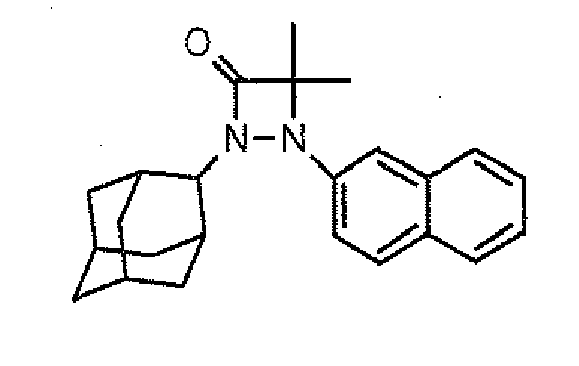
- 1H-NMR (400 MHz, CDCl3) δ; 1.46-2.31 (m, 20H), 3.89 (s, 1H), 7.14 (s, 1H), 7.40-7.44 (m, 2H), 7.48 (dt, J= 6.8,1.2 Hz, 1H), 7.78-7.82 (m, 3H).
- IR (ATR); 2924, 1754, 860, 754 cm-1.
- EI-MS m/z; 360 (M+).
- 1-Bromo-4-(methoxymethoxy)benzene was used in place of bromobenzene for a similar reaction and treatment as Example 181, and the title compound was obtained as a white amorphous solid.
-

- 1H-NMR (400 MHz, CDCl3) δ; 0.89 (s, 3H), 1.61-2.31 (m, 17H), 3.50 (s, 3H), 3.87 (s, 1H), 5.15 (s, 2H), 6.97-7.21 (m, 4H).
- IR (ATR); 2913, 1752, 1502, 1150, 1078, 991, 843 cm-1.
- EI-MS m/z; 370 (M+).
-

- A solution of 1-[4-(methoxymethoxy)phenyl]-4,4-dimethyl-2-(adamantan-2-yl)-1,2-diazetidin-3-one (62.5 mg, 0.169 mmol) prepared in Example 214 in methanol was added with concentrated hydrochloric acid (0.3 mL) under ice-cold conditions , and the resultant was stirred at 50°C for 30 minutes. The reaction solution was added under ice-cold conditions with a saturated aqueous solution of ammonium chloride, extracted with chloroform, and concentrated in vacuo. The obtained residue was purified by Preparatory Thin-Layer chromatography (chloroform : methanol = 10:1), and the title compound (38.0 mg, 68.8%) was obtained as a white crystalline solid.
- 1H-NMR (400 MHz, CDCl3) δ; 0.85 (br, 3H), 1.59-1.93 (m, 14H), 2.01 (s, 1H), 2.17-2.32 (m, 1H), 2.66 (s, 1H), 3.72 (s, 1H), 6.67 (br, 1H), 6.83 (d, J= 8.5 Hz, 2H), 6.91 (d, J= 8.5 Hz, 2H).
- IR(ATR); 3302, 2913, 1724, 1507, 1453, 1219, 843, 754 cm-1.
- EI-MS m/z; 326 (M+).
- 1-Bromo-3-(methoxymethoxy)benzene was used in place of bromobenzene for a similar reaction and treatment as Example 181, and the title compound was obtained as a red-brown oil.
-

- 1H-NMR (270 MHz, CDCl3) δ; 1.26-2.31 (m, 20H), 3.48 (s, 3H), 3.77 (s, 1H), 5.17 (s, 2H), 6.62-6.69 (m, 2H), 6.78-6.81 (m, 1H), 7.22 (t, J= 11.6 Hz, 1H).
- IR (ATR); 2909, 1760, 1597, 1483, 1148, 1077, 1016, 755 cm-1.
- EI-MS m/z; 370 (M+).
- 1-[3-(Methoxymethoxy)phenyl]-4,4-dimethyl-2-(adamantan-2-yl)-1,2-diazetidin -3-one prepared in Example 216 was used for a similar reaction and treatment as Example 215, and the title compound was obtained as a white amorphous solid.
-

- 1H-NMR (270 MHz, CDCl3) δ; 1.73-2.31 (m, 20H), 3.80 (s, 1H), 6.48-6.65 (m, 3H), 7.06-7.34 (m, 2H).
- IR (ATR); 2924, 1754, 860, 754 cm-1.
- EI-MS m/z; 326 (M+).
- 1-Bromo-2-(methoxymethoxy)bezene was used in place of bromobenzene for a similar reaction and treatment as Example 181, and the title compound was obtained as a yellow oil.
-

- 1H-NMR (400 MHz, CDCl3) δ; 0.99 (s, 3H), 1.57 (s, 3H), 1.70-1.78 (m, 7H), 1.86-1.91 (m, 3H), 2.00 (s, 1H), 2.22 (d, J= 12.7 Hz, 1H), 2.31 (d, J= 13.4 Hz, 1H), 2.75 (s. 1H), 3.53 (s, 3H),3.76 (s, 1H), 5.18 (d, J= 4.6 Hz, 2H), 7.00-7.10 (m, 4H).
- IR (ATR); 2910, 1759, 1489, 1240, 1155, 993, 754 cm-1.
- EI-MS m/z; 370 (M+).
- 1-[2-(Methoxymethoxy)phenyl]-4,4-dimethyl-2-(adamantan-2-yl)-1,2-diazetidin -3-one prepared in Example 218 was used for a similar reaction and treatment as Example215, and the title compound was obtained as a green amorphous solid.
-
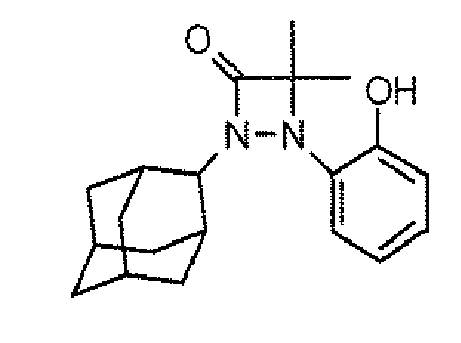
- 1H-NMR (400 MHz, CDCl3) δ; 1.00 (s, 3H), 1.54-1.97 (m, 14H), 2.10 (d, J= 12.7 Hz, 1H), 2.23 (d, J= 13.2 Hz, 1H), 2.56 (s, 1H), 3.64 (s, 1H), 6.36 (s, 1H), 6.89-6.96 (m, 2H), 7.09-7.13 (m, 1H), 7.18 (dd, J= 7.8,1.2 Hz, 1H).
- IR (ATR); 3266, 2910, 1726, 1592, 1455, 758 cm-1.
- EI-MS m/z; 326 (M+).
- 2-Cyclooctyl-4,4-dimethyl-1,2-diazetidin-3-one prepared in Process 5 of Example 73 and 1-bromo-2-methoxybenzene was used for a similar reaction and treatment as Example 181, and the title compound was obtained as a pale yellow oil.
-

- 1H-NMR (400 MHz, CDCl3) δ; 0.98 (s, 3H), 1.43-1.65 (m, 14H), 1.77-1.86 (m, 1H), 1.95-2.16 (m, 1H), 2.18-2.35 (m, 1H), 3.22-3.28 (m, 1H), 3.85 (s, 3H), 6.89 (d, J= 8.1 Hz, 1H), 6.96-6.99 (m, 2H), 7.04-7.09 (m, 1H).
- IR (ATR); 2925, 1767, 1492, 1246, 1028, 745 cm-1.
- EI-MS m/z; 316 (M+).
- 2-Cyclooctyl-4,4-dimethyl-1,2-diazetidin-3-one and 1-bromo-2,3-dichlorobenzene were used for a similar reaction and treatment as Example 181, and the title compound was obtained as a pale yellow oil.
-

- 1H-NMR (400 MHz, CDCl3) δ; 1.04 (s, 3H), 1.41-1.65 (m, 8H), 1.73 (s, 1H), 1.74-1.85 (m, 2H), 1.90-2.07 (m, 2H), 2.15-2.20 (m, 1H), 2.25-2.34 (m, 1H), 3.18-3.25 (m, 1H), 7.07-7.12 (m, 1H), 7.20-7.25 (m, 2H).
- IR (ATR); 2926, 1771, 1576, 1445, 1274. 1056, 788 cm-1.
- EI-MS m/z; 354 (M+).
- 2-Cyclooctyl-4,4-dimethyl-1,2-diazetidin-3-one and 1-bromonaphtalene were used for a similar reaction and treatment as Example 181, and the title compound was obtained as a pale yellow oil.
-

- 1H-NMR (400 MHz, CDCl3) δ; 0.82 (s, 3H), 1.40-1.62 (m, 8H), 1.71-1.90 (m, 2H), 1.79 (s, 3H), 1.97-2.11 (m, 2H), 2.23-2.41 (m, 2H), 3.35-3.41 (m, 1H), 7.25-7.27 (m, 1H), 7.45-7.53 (m, 3H), 7.63 (d, J= 8.3 Hz, 1H), 7.84-7.86 (m, 1H), 8.22-8.24 (m, 1H).
- IR (ATR); 2925, 1764, 1390, 1278, 775 cm-1.
- EI-MS m/z; 336 (M+).
- 2-(Bicyclo[2.2.1]heptan-2-yl)-4,4-dimethyl-1,2-diazetidin-3-one prepared in Process 5 of Example 78 and 1-bromo-2-methoxybenzene were used for a similar reaction and treatment as Example 181, and the title compound was obtained as a pale yellow oil.
-

- 1H-NMR (400 MHz, CDCl3) δ; 0.95 (s, 3H), 1.27-1.34 (m, 2H), 1.55-1.91 (m, 8H), 2.03-2.28 (m, 2H), 2.60-2.75 (m, 1H), 3.63-3-75 (m, 1H), 3.85 (s, 3H), 6.89 (d, J= 8.0 Hz, 1H), 6.96 (t, J= 7.1 Hz, 1H), 7.10-7.09 (m, 2H).
- IR (ATR); 2954, 1760, 1492,1245, 1027,748 cm-1.
- EI-MS m/z; 300 (M+).
- 2-(Bicyclo[2.2.1]heptan-2-yl)-4,4-dimethyl-1,2-diazetidin-3-one and1-bromo-2,3-dichlorobenzene were used for a similar reaction and treatment as Example 18.1, and the title compound was obtained as a pale yellow crystalline powder.
-

- 1H-NMR (400 MHz, CDCl3) δ: 1.01 (s, 3H), 1.26-1.35 (m, 2H), 1.51-1.61 (m, 4H), 1.73-2.01 (m, 5H), 2.20-2.30 (m, 1H), 2.54-2.71 (m, 1H), 3.50-3.78 (m, 1H), 7.06-7.14 (m, 1H), 7.18-7.26 (m, 2H).
- IR (ATR); 2969, 1755, 1574, 1420, 1335, 1053, 784 cm-1.
- EI-MS m/z; 338 (M+).
- 2-(Bicyclo[2.2.1]heptan-2-yl)-4,4-dimethyl-l,2-diazetidin-3-one and 1-bromonaphtalene were used for a similar reaction and treatment as Example 181, and the title compound was obtained as a pale yellow crystalline powder.
-
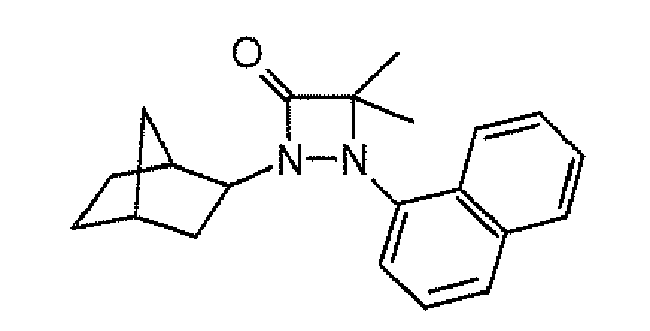
- 1H-NMR (400 MHz, CDCl3) δ; 0.81 (d, J= 7.3 Hz, 3H), 1.24-1.32 (m, 2H), 1.47-1.65 (m, 4H), 1.86 (d, J= 11.2 Hz, 3H), 1.92-1.97 (m, 1 H), 1.99-1.97 (m, 1H), 2.31-2.36 (m, 1H), 2.51-2.81 (m, 1H), 3.64-3.92 (m, 1H), 7.20-7.27 (m, 2H), 7.42-7.51 (m, 3H) 7.62-7.65 (m, 1H), 7.83-7.86 (m, 1H).
- IR (ATR) 2967, 1753, 1389, 808, 778 cm-1.
- EI-MS m/z; 320 (M+).
- trans-2-(5-Hydroxyadamantan-2-yl)-4,4-dimethyl-1,2-diazetidin-3-one prepared in Process 5 of Example 65 was used for a similar reaction and treatment as Example 181, and the title compound was obtained as a colorless oil.
-

- 1H-NMR (400 MHz, CDCl3) δ; 0.77-1.95 (m, 17H), 2.16 (s, 1H), 2.19 (s, 2H), 3.70 (s, 1 H), 7.00 (d, J= 7.6 Hz, 2H), 7.14 (t, J= 7.6 Hz, 1H), 7.34 (d, J= 7.6 Hz, 2H).
- EI-MS m/z; 326 (M+).
- trans-2-(5-Hydroxyadamantan-2-yl)-4,4-dimethyl-1,2-diazetidin-3 -one and 1-bromo-2-chlorobenzene were used for a similar reaction and treatment as Example 181, and the title compound was obtained as a pale yellow oil.
-

- 1H-NMR (400 MHz, CDCl3) δ; 0.99 (s, 3H), 1.42-1.79 (m, 12H), 2.11-2.25 (m, 4H), 2.89 (s, 1H), 3.65 (s, 1H), 7.09 (t, J= 7.2 Hz, 1H), 7.18 (d, J= 7.2 Hz, 1H), 7.28 (t, J= 7.2 Hz, 1H), 7.39 (d, J= 7.2 Hz, 1H).
- EI-MS m/z; 360 (M+).
- trans-2-(5-Hydroxyadamantan-2-yl)-4,4-dimethyl-1,2-diazetidin-3-one and 1-bromo-2-methoxybenzene were used for a similar reaction and treatment as Example 181, and the title compound was obtained as a colorless oil.
-

- 1H-NMR (400 MHz, CDCl3) δ; 0.95 (s, 3H), 1.39-1.80 (m. 12H), 2.16-2.32 (m, 4H), 2.85 (s, 1H), 3.69 (s,1H), 3.84 (s, 3H), 6.88 (d, J= 8.8 Hz, 1H), 6.97 (d, J= 8.8 Hz, 1H), 7.00 (d, J= 8.8 Hz, 1H), 7.07 (t, J= 8.8 Hz, 1H).
- IR (ATR); 3422, 2926, 2859, 2359, 2746, 1492, 1456, 1245, 1120, 1027, 754 cm-1.
- EI-MS m/z; 356 (M+).
- trans-2-(5-Hydroxyadamantan-2-yl)-4,4-dimethyl-1,2-diazetidin-3-one and 1-bromo-3-methoxybenzene were used for a similar reaction and treatment as Example 181, and the title compound was obtained as a colorless oil.
-

- 1H-NMR (400 MHz, CDCl3) δ; 0.99-1.86 (m, 15H), 2.12-2.30 (m, 4H), 2.60 (br, 1H), 3.70 (s, 1H), 3.81 (s, 3H), 6.55 (s, 1H), 6.60 (d, J= 7.3 Hz, 1H), 6.68 (d, J= 7.3 Hz, 1H), 7.24 (t, J= 7.3 Hz, 1H).
- IR (ATR); 3404,2925,2859, 1747,1602, 1485,1286,1152, 753 cm-1.
- EI-MS m/z; 356 (M+).
- trans-2-(5-Hydroxyadamantan-2-yl)-4,4-dimethyl-1,2-diazetidin-3-one and 1-bromo-4-methoxybenzene were used for a similar reaction and treatment as Example 181, and the title compound was obtained as a colorless oil.
-

- 1H-NMR (400 MHz, CDCl3) δ; 0.87 (br, 3H), 1.46-1.71 (m, 12H), 2.08-2.32 (m, 4H), 2.81 (br, 1H), 3.65 (s, 1H), 3.80 (s, 3H), 6.87 (d, J= 9.0 Hz, 2H), 6.98 (d, J= 9.0 Hz, 2H).
- TR (ATR) 3408, 2925, 2858, 1745, 1504, 1244,1117,1034,844, 756 cm-1.
- EI-MS m/z; 356 (M+).
- trans-2-(5-Hydroxyadamantan-2-yl)-4,4-dimethyl-1,2-diazetidin-3-one and 1-bromo-2,3-dichlorobenzene were used for a similar reaction and treatment as Example 181, and the title compound was obtained as a colorless oil.
-

- 1H-NMR (400 MHz, CDCl3) δ; 1.01 (s, 3H), 1.43-1.75 (m, 9H), 1.81 (s, 3H), 2.11-2.20 (m, 4H), 2.88 (s, 1H), 3.63 (s, 1H), 7.10 (d, J= 8.0 Hz, 1H), 7.23-7.28 (m, 2H).
- IR (ATR); 3391, 2927,2859, 1755, 1576, 1446, 1355, 1116,754 cm-1.
- EI-MS m/z; 394 (M+).
- trans-2-(5-Hydroxyadamantan-2-yl)-4,4-dimethyl-1,2-diazetidin-3-one and 1-bromo-2-(methoxymethoxy)benzene were used for a similar reaction and treatment as Example 181, and the title compound was obtained as a colorless oil.
-

- 1H-NMR (400 MHz, CDCl3) δ; 0.99 (s, 3H), 1.41-1.44 (m, 1H), 1.56-1.59 (m, 1H), 1.70 (s, 3H), 1,73-1.80 (m, 7H), 2.13-2.25 (m, 4H), 2.93 (s, 1H), 3.52 (s, 3H), 3.70 (s, 1H), 5.19 (s, 2H), 7.02-7.10 (m, 4H).
- IR (ATR); 3418,2928,1748,1489,1239,1155,1117,1079,993, 925, 750 cm-1.
- EI-MS m/z; 386 (M+).
- trans-2-(5-Hydroxyadamantan-2-yl)-1-[2-(methoxymethoxy)phenyl]-4,4-dimeth yl-1,2-diazetidin-3-one prepared in Example 232 was used for a similar reaction and treatment as Example 215, and the title compound was obtained as a green amorphous solid.
-

- 1H-NMR (400 MHz, CDCl3) δ; 1.01 (s, 3H), 1.47-1.65 (m, 5H), 1.69 (s, 3H), 1.73-1.77 (m, 4H), 2.02-2.20 (m, 4H), 2.72 (s, 1H), 3.57 (s, 1H), 6.25 (s, 1H), 6.91-6.97 (m, 2H), 7.13 (t, J= 7.8 Hz, 1H), 7.18 (d, J= 7.8 Hz, 1H).
- EI-MS m/z; 342 (M+).
- trans-2-(5-Hydroxyadamantan-2-yl)-4,4-dimethyl-1,2-diazetidin-3-one and 1-bromo-4-nitrobenzene were used for a similar reaction and treatment as Example 181, and the title compound was obtained as a yellow oil.
-

- 1H-NMR (400 MHz, CDCl3) δ; 1.35 (s, 6H), 1.51-1.55 (m, 1H), 1.69-1.86 (m, 7H), 2.09-2.25 (m, 4H), 2.55 (s, 2H), 3.85 (s, 1H), 7.04 (d, J= 8.2 Hz, 2H), 8.23 (d, J= 8.2 Hz, 2H).
- IR (ATR); 3382,2927,2859,1757,1592,1515,1342,1310,1 1111, 752 cm-1.
- EI-MS m/z; 371 (M+).
- trans-2-(5-Hydroxyadamantan-2-yl)-4,4-dimethyl-1-(4-nitrophenyl)-1,2-diazeti din-3-one prepared in Example 234 was used for a similar reaction and treatment as Example 183, and the title compound was obtained as a brown oil.
-

- 1H-NMR (400 MHz, CDCl3) δ 0.88 (br, 3H), 1.25-1.76 (m, 12H), 2.09-2.26 (m, 4H), 2.80 (br, 1H), 3.63 (s, 1H), 3.28 (br, 2H), 6.66 (d, J= 8.8 Hz, 2H), 6.87 (d, J= 8.8 Hz, 2H).
- IR (ATR); 3351,2919,2856,2360,2342,1743,1653,1549, 1513,1223,1114, 1083, 752 cm-1.
- EI-MS m/z; 341 (M+).
- trans-2-(5-Hydroxyadamantan-2-yl)-4,4-dimethyl-1,2-diazetidin-3-one prepared in Process 5 of Example 65 and1-bromonaphtalene were used for a similar reaction and treatment as Example 181, and the title compound was obtained as a colorless oil.
-

- 1H-NMR (400 MHz, CDCl3) δ; 0.80 (s, 3H), 1.37-1.83 (m, 9H). 1.86 (s, 3H), 2.22-2.31 (m, 4H), 2.98 (s, 1H), 3.75 (s, 1H),7.22-7.24 (m, 1H), 7.45-7.52 (m, 3H), 7.65 (d, J= 8.3 Hz, 1H), 7.84-7.87 (m, 1H), 8.25-8.27 (m, 1H).
- IR (ATR); 3545, 2922, 1749, 1731, 1358, 1121, 804, 778 cm-1.
- EI-MS m/z; 376 (M+).
- trans-2-(5-Hydroxyadamantan-2-yl)-4,4-dimethyl-1,2-diazetidin-3 -one and 2-bromonaphthalene were used in place of bromobenzene for a similar reaction and treatment as Example 181, and the title compound was obtained as a colorless oil.
-

- 1H-NMR (400 MHz, CDCl3) δ; 0.83-1.80 (m, 15H), 2.12-2.30 (m, 4H), 2.88 (br, 1H), 3.70 (s, 1H), 7.14 (br, 1H), 7.41-7.51 (m, 3H), 7.79-7.82 (m, 3H).
- IR (ATR); 3420, 2925, 2859, 1748, 1353, 116, 750 cm-1.
- EI-MS m/z; 376 (M+).
- trans-2-(5-Hydroxyadamantan-2-yl)-4,4-dimethyl-1,2-diazetidin-3 -one and 1-bromo-4-fluoronaphthalene were used for a similar reaction and treatment as Example 181, and the title compound was obtained as a colorless oil.
-

- 1H-NMR (400 MHz, CDCl3) δ; 0.81 (s, 3H), 1.44-1.45 (m, 1H), 1.55-1.62 (m, 1H), 1.70-1.81 (m, 7H), 1.84 (s, 3H), 2.13-2.28 (m, 4H), 2.94 (s, 1H), 3.71 (s, 1H), 7.12-7.20 (m, 2H), 7.55-7.61 (m, 2H), 8.09-8.13 (m, 1H), 8.26-8.28 (m, 1H).
- IR (ATR); 3401,2926,2859,1746, 1460,1391, 754 cm-1.
- EI-MS m/z; 394 (M+).
-

- Benzyl 2-(5-hydroxyadamantan-2-ylidene)hydrazinecarboxylate prepared in Process 1 of Example 65 was used for a similar reaction and treatment as Process 2 of Example 1, and the resultant two geometric isomers were separated by silica gel chromatography, and benzyl cis-2-(5-hydroxyadamantan-2-yl)hydrazinecarboxylate was obtained as a colorless amorphous solid.
- 1H-NMR (400 MHz, CDCl3) δ; 1.43 (d, J= 11.2 Hz, 2H), 1.67-1.74 (m, 6H), 2.04-2.11 (m, 6H), 3.03 (s, 1H), 3.85 (br, 1H), 5.13 (s, 2H), 6.21 (s, 1H), 7.30-7.37 (m, 5H).
- Benzyl cis-2-(5-hydroxyadamantan-2-yl)hydrazinecarboxylate and 2-bromoisobutyryl bromide were used for a similar reaction and treatment as Process 3 of Example 1, and benzyl cis-2-(2-bromoisobutyryl)-2-(5-hydroxyadamantan-2-yl)hydrazinecarboxylate was obtained as a colorless oil.
- 1H-NMR (400 MHz, CDCl3) δ; 1.50-2.22 (m, 20H), 2.61 (br, 1H), 4.03 (br, 0.25H), 4.23 (br, 0.75H), 5.07-5.28 (m, 2H), 7.34-738 (m, 5H).
- Benzyl cis- 2-(2- bromoisobutyry l)- 2-(5-hydroxyadamantan-2-yl)hydrazinecarboxylate was used for a similar reaction and treatment as Process 4 of Example 1, and benzyl cis-2-(5-hydroxyadamantan-2-yl)-4,4-dimethyl-3-oxo-1,2-diazetidine-1-carboxylate was obtained as a colorless amorphous solid.
- 1H-NMR (400 MHz, CDCl3) δ; 1.49 (s, 6H), 1.60-2.01 (m, 12H), 2.13 (s, 1H), 2.64 (s, 1H), 3.87 (s, 1H), 5.19 (s, 2H), 7.35-7.39 (m, 5H).
- Benzyl cis-2-(5-hydroxyadamantan-2-yl)-4,4-dimethyl-3-oxo-1,2-diazetidine-1-carboxylate was used for a similar reaction and treatment as Process 5 of Example 1, and cis-2-(5-hydroxyadamantan-2-yl)-4,4-dimethyl-1,2-diazetidin-3 -one was obtained as a pale yellow amorphous solid.
- 1H-NMR (400 MHz, CDCl3) δ; 1.49-1.75 (m, 18H), 1.99 (s, 1H), 2.15 (s, 1H), 2.38-2.76 (m, 1H), 3.58 (s, 1H), 3.87 (br, 1H).
- cis-2-(5-Hydroxyadamantan-2-yl)-4,4-dimethyl-1,2-diazetidin-3-one and 1 -bromo-2-methoxybenzene were used for a similar reaction and treatment as Example 181, and the title compound was obtained as a colorless oil.
- 1H-NMR (400 MHz, CDCl3) δ; 0.88 (s, 3H), 1.51-1.73 (m, 13H), 1.90-2.45 (m, 3H), 2.91 (s, 1H), 3.60 (s, 1H), 3.84 (s, 3H), 6.88 (d, J= 8.1 Hz, 1H), 6.95 (t, J= 8.1 Hz, 1H), 7.01 (d, J= 8.1 Hz, 1H), 7.07 (t, J= 8.1 Hz, 1H).
- IR (ATR);3413,2919,2857,2360,2342, 1755, 1492, 1454, 1246, 1120, 1099, 1027,758 cm-1.
- EI-MS m/z; 356 (M+).
- cis-2-(5-Hydroxyadamantan-2-yl)-4,4-dimethyl-1,2-diazetidin-3-one prepared in Process 4 of Example 239 and 1-bromo-4-methoxybenzene were used for a similar reaction and treatment as Example 181, and the title compound was obtained as a colorless oil.
-

- 1H-NMR (400 MHz, CDCl3) δ; 0.87 (s, 3H), 1.51-1.75 (m, 13H), 2.10-2.33 (m, 3H), 2.86 (br, 1H), 3.56 (s, 1H), 3.84 (s, 3H), 6.87 (d, J= 9.0 Hz, 2H), 6.98 (d, J= 9.0 Hz, 2H).
- IR(ATR); 3423, 2922, 2858, 2360, 1743, 1504,1243, 1115, 1099,1035, 834, 753 cm-1.
- EI-MS m/z; 356 (M+).
- cis-2-(5-Hydroxyadamantan-2-yl)-4,4-dimethyl-1,2-diazetidin-3-one and 1-bromo-3-methoxybenzene were used for a similar reaction and treatment as Example 181, and the title compound was obtained as a colorless oil.
-

- 1H-NMR (400 MHz, CDCl3) δ; 1.21 (s, 3H), 1.25 (s, 3H), 1.54-2.35 (m, 13H), 2.67 (br, 1H), 3.61 (s, 1H), 3.81 (s, 3H), 6.55 (s, 1H), 6.60 (d, J= 7.8 Hz, 1H), 6.68 (d, J= 7.8 Hz, 1H), 7.24 (t, J= 7.8 Hz, 1H).
- IR (ATR); 3388,2972,2927, 2359,2342, 1735,1602, 1485, 1149, 1124, 982, 787 cm-1.
- EI-MS m/z; 356 (M+).
- cis-2-(5-Hydroxyadamantan-2-yl)-4,4-dimethyl-1,2-diazetidin-3-one and 2-bromotoluene were used for a similar reaction and treatment as Example 181, and the title compound was obtained as a pale yellow oil.
-

- 1H-NMR (400 MHz, CDCl3) δ; 0.90 (s, 3H), 1.44-1.68 (m, 9H), 1.70 (s, 3H), 2.10-2.27 (m, 4H), 2.29 (s, 3H), 2.98 (s, 1H), 3.54 (s, 1H), 7.06 (t, J= 6.8 Hz, 1H), 7.13 (d, J= 6.8 Hz, 1H), 7.18-7.23 (m, 2H).
- 1R (ATR); 3229,2915, 2856,2360,1756, 1113,1099, 768 cm-1.
- EI-MS m/z; 340 (M+).
- cis-2-(5-Hydroxyadamantan-2-yl)-4,4-dimethyl- 1,2-diazetidin-3 -one and 1-bromo-2-(methoxymethoxy)benzene were used for a similar reaction and treatment as Example 181, and the title compound was obtained as a colorless oil.
-

- 1H-NMR (400 MHz, CDCl3) δ; 0.83 (s, 3H), 1.54-2.20 (m, 14H), 2.29-2.33 (m, 2H), 2.99 (s, 1H), 3.52 (s, 3H), 3.60 (s, 1H), 5.20 (s, 2H), 7.03-7.11 (m, 4H).
- IR (ATR); 3407, 2922, 2858, 1758, 1489, 1453, 1242, 1155, 1118, 1079, 987, 927, 758 cm-1.
- EI-MS m/z; 386 (M+).
- cis-2-(5-Hydroxyadamantan-2-yl)-1-[2-(methoxymethoxy)phenyl]-4,4-dimethyl -1,2-diazetidin-3-one prepared in Example 243 was used for a similar reaction and treatment as Example 215, and the title compound was obtained as a colorless oil.
-

- 1H-NMR (400 MHz, CDCl3) δ; 1.00 (s, 3H), 1.46-1.49 (m, 1H), 1.59-1.65 (m, 8H), 1.70 (s, 3H), 2.07-2.29 (m, 4H), 2.77 (s, 1H), 3.56 (s, 1H), 6.27 (s, 1H), 6.91-6.97 (m, 2H), 7.13 (t, J= 8.0 Hz, 1H), 7.18 (d, J= 8.0 Hz, 1H).
- EI-MS m/z; 342 (M+).
- cis-2-(5-Hydroxyadamantan-2-yl)-4,4-dimethyl-1,2-diazetidin-3-one and 1-bromo-4-nitrobenzene were used for a similar reaction and treatment as Example 181, and the title compound was obtained as a yellow oil.
-

- 1H-NMR (400 MHz, CDCl3) δ; 1.35 (s, 6H), 1.61-1.73 (m, 9H), 2.14 (s, 1H), 2.17 (s, 2H), 2.62 (s, 2H), 3.65 (s, 1H), 7.05 (d, J= 8.3 Hz, 2H), 8.23 (d, J= 8.3 Hz, 2H).
- IR (ATR); 3400,2923, 2859,1758,1591,1513,1340,1111,1099,851,755 cm-1.
- EI-MS m/z; 371 (M+).
- cis-2-(5-Hydroxyadamantan-2-yl)-4,4-dimethyl-1-(4-nitrophenyl)-1,2-diazetidin -3-one prepared in Example 245 was used for a similar reaction and treatment as Example 183, and the title compound was obtained as a brown oil.
-

- 1H-NMR (400 MHz, CDCl3) δ; 0.87 (br, 3H), 1.42-1.77 (m, 11H), 2.10-2.33 (m, 5H), 2.85 (s, 1H), 3.54 (s, 1H), 3.60 (br, 2H), 6.66 (d, J= 8.8 Hz, 2H), 6.88 (d, J= 8.8 Hz, 2H).
- IR(ATR); 3333,2918,2857,2360,2341, 1741, 1652, 1509, 1113, 754 cm-1.
- EI-MS m/z; 341 (M+).
- cis-2-(5-Hydroxyadamantan-2-yl)-4,4-dimethyl-1,2-diazetidin-3-one prepared in Process 4 of Example 239 and 1-bromonaphtalene were used for a similar reaction and treatment as Example 181, and the title compound was obtained as a pale yellow oil.
-

- 1H-NMR (400 MHz, CDCl3) δ; 0.80 (s, 3H), 1.43-1.80 (m, 9H), 1.87 (s, 3H), 2.10-2.36 (m, 4H), 3.05 (s, 1H), 3.66 (s, 1H), 7.24 (d, J= 7.1 Hz, 1H), 7.44-7.54 (m, 3H), 7.64 (d, J= 8.3 Hz, 1H), 7.84-7.87 (m, 1H), 8.26-8.28 (m, 1H).
- IR (ATR); 3409, 2923, 2858, 1744, 1390, 1115, 776, 752 cm-1.
- EI-MS m/z; 376 (M+).
- cis-2-(5-Hydroxyadamantan-2-yl)-4,4-dimethyl-1,2-diazetidin-3-one and 2-bromonaphthalene were used for a similar reaction and treatment as Example 181, and the title compound was obtained as a colorless oil.
-

- 1H-NMR (400 MHz, CDCl3) δ; 1.21 (s, 3H), 1.25 (s, 3H), 1.50-2.20 (m, 13H), 2.80 (br, 1H), 3.72 (s, 1H), 7.14 (br, 1H), 7.41-7.52 (m, 3H), 7.91-7.83 (m, 3H).
- IR (ATR); 3401, 2921, 2859, 1751, 1629, 1454, 1217, 1119, 1097, 980, 821, 751 cm-1,
- EI-MS m/z; 376 (M+).
- cis-2-(5-Hydroxyadamantan-2-yl)-4,4-dimethyl-1,2-diazetidin-3-one and 1-bromo-4-fluoronaphthalene were used for a similar reaction and treatment as Example 181, and the title compound was obtained as a colorless oil.
-

- 1H-NMR (400 MHz, CDCl3) δ; 0.81 (s, 3H), 1.42-1.53 (m, 2H), 1.68-1.73 (m, 5H), 1.85 (s, 3H), 2.10-2.12 (m, 1H), 2.20-2.24 (m, 2H), 2.31-2.34 (m, 1H), 3.01 (s, 1H), 3.62 (s, 1H), 7.11-7.20 (m, 2H), 7.55-7.62 (m, 2H), 8.09-8.12 (m, 1H), 8.26-8.29 (m, 1H).
- IR (ATR); 3398, 2920, 2861, 1752, 1601, 1461, 1391, 983, 753 cm-1.
- EI-MS m/z; 394 (M+).
-

- 5-Chloro-2-adamantanone was used in place of 2-adamantanone for a similar reaction and treatment as Process 1 of Example 1, and benzyl 2-(5-chloroadamantan-2-ylidene)hydrazinecarboxylate was obtained as a white crystalline powder.
- 1H-NMR (400 MHz, CDCl3) δ; 1.72-1.75 (m, 1H), 1.84-1.91 (m, 3H), 2.16-2.29 (m, 7H), 2.93 (s, 1H), 3.03 (s, 1H), 5.24 (s, 2H), 7.34-7.42 (m, 5H), 7.65 (s, 1H).
- Benzyl 2-(5-chloroadamantan-2-ylidene)hydrazinecarboxylate was used for a similar reaction and treatment as Process 2 of Example 1, the resultant two geometric isomers were separated by silica gel chromatography, and benzyl trans-2-(5-chloroadamantan-2-yl)hydrazinecarboxylate was obtained as a colorless amorphous solid.
- 1H-NMR (400 MHz, CDCl3) δ; 1.37-2.70 (m, 12H), 3.16 (s, 1H), 3.95 (br, 1H), 5.12 (s, 2H), 5.24 (s, 1H), 6.28 (s, 1H), 7.32-7.38 (m, 5H).
- Benzyl trans-2-(5-chloroadamantan-2-yl)hydrazinecarboxylate and 2-bromoisobutyryl bromide were used for a similar reaction and treatment as Process 3 of Example 1, and benzyl trans-2-(2-bromoisobutyryl)-2-(5-chloroadamantan-2-yl)hydrazinecarboxylate was obtained as a colorless amorphous solid.
- 1H-NMR (400 MHz, CDCl3) δ; 1.54-2.27 (m, 18H), 2.60 (s, 1H), 4.13-4.35 (m, 1H), 5.07-5.30 (m, 2H), 6.81-7.09 (m, 1H), 7.34-7.37 (m, 5H).
- Benzyl trans-2-(2-bromoisobutyryl)-2-(5-chloroadamantan-2-yl)hydrazinecarboxylate was used for a similar reaction and treatment as Process 4 of Example 1, and benzyl trans-2-(5-chloroadamantan-2-yl)-4,4-dimethyl-3-oxo-1,2-diazetidine-1-carboxylate was obtained as a colorless oil.
- 1H-NMR (400 MHz, CDCl3) δ; 1.48 (s, 6H), 1.54-2.27 (m, 12H), 2.58 (s, 1H), 3.99 (s, 1H), 5.18 (s, 2H), 7.37-7.41 (m, 5H).
- Benzyl trans-2-(5-chloroadalualitan-2-yl)-4,4-dimethyl-3-oxo-1,2-diazetidine-1-carboxylate was used for a similar reaction and treatment as Process 5 of Example 1, and trans-2-(5-chloroadamantan-2-yl)-4,4-dimethyl-1,2-diazetidin-3-one was obtained as a white crystalline powder.
- 1H-NMR (400 MHz, CDCl3) δ; 1.44-2.8 (m, 18H), 2.76 (s, 1H), 3.69 (s, 1H), 3.84 (s, 1H).
- trans-2-(5-Chloroadamantan-2-yl)-4,4-dimethyl-1,2-diazetidin-3-one and 1-bromo-2-methoxybenzene were used for a similar reaction and treatment as Example 181, and the title compound was obtained as a colorless oil.
- 1H-NMR (400 MHz, CDCl3) δ; 0.95 (s, 3H), 1.53-1.63 (m, 2H), 1.67 (s.3H), 2.08-2.36 (m, 10H), 2.85 (s, 1H), 3.74 (s, 1H), 3.83 (s, 3H), 6.88 (d, J= 8.0 Hz, 1H), 6.94-7.00 m, 2H), 7.07 (t, J= 8.0 Hz, 1H).
- IR (ATR); 2935,1759,1589,1492,1246,1027,829,755 cm-1.
- EI-MS m/z; 374 (M+).
- trans-2-(5-Chloroadwnantan-2-yl)-4,4-dimethyl- 1,2-diazetidin-3-one prepared in Process 5 of Example 250 and 1-bromo-2,3-dichlorobenzene were used for a similar reaction and treatment as Example 181, and the title compound was obtained as a colorless oil.
-

- 1H-NMR (400 MHz, CDCl3) δ; 1.01 (s. 3H), 1.51-1.54 (m, 1H), 1.63-1.66 (m, 1H), 1.80 (s, 3H), 1.99-2.26 (m, 10H), 2.87 (s, 1H), 3.68 (s, 1H), 7.09 (dd, J= 2.0,8.0 Hz, 1H), 7.23 (t, J= 8.0 Hz, 1H), 7.26 (dd, J= 2.0, 8.0 Hz, 1H).
- IR (ATR); 2935,1763,1576,1446,1421,1029,830,754 cm-1.
- EI-MS m/z; 414 (M+).
- trans-2-(5 -Chloroadamatan-2-yl)-4,4-dimethyl-1,2-diazetidin-3-one and 1-bromo-2-(methoxymethoxy)benzene were used for a similar reaction and treatment as Example 181, and the title compound was obtained as a colorless oil,
-

- 1H-NMR (400 MHz, CDCl3) δ; 0.99 (s, 3H), 1.49-1.54 (m, 1H), 1.64-1.67 (m, 1H), 1.69 (s, 1H), 2.07-2.30 (m, 10H), 2.91 (s, 1H), 3.58 (s, 3H), 3.76 (s, 1H), 5.18 (s, 2H), 7.01-7.14 (m, 4H).
- IR (ATR); 2935,2864,1761,1489,1155, 994,759 cm-1.
- EI-MS m/z; 404 (M+).
- trans-2-(5-Chloroadarnantan-2-yl)-1-[2-(methoxymethoxy)phenyl]-4,4-dimethyl -1,2-diazetidin-3-one prepared in Example 252 was used for a similar reaction and treatment as Example 215, and the title compounds was obtained as a white crystalline powder.
-

- 1H-NMR (400 MHz, CDCl3) δ; 1.01 (s, 3H), 1.56-1.58 (m,2H), 1.59 (s, 3H), 1.98-2.22 (m, 10H), 2.68 (s, 1H), 3.63 (s, 1 H), 6.21 (s, 1H), 6.91 (t, J= 7.6 Hz, 1 H), 6.95 (d, J= 7.6 Hz, 1H), 7.13 (t, J= 7.6 Hz, 1H), 7.17 (d, J= 7.6 Hz, 1H).
- IR (ATR); 3417,2922,2359,1744,1488,1255,1031,829,750 cm-1.
- EI-MS m/z; 360 (M+).
- trans-2-(5-Cliloroadamantan-2-yl)-4,4-dimethyl-1,2-diazetidin-3-one prepared in Process 5 of Example 250 and 1-bromonaphtalene were used for a similar reaction and treatment as Example 181, and the title compound was obtained as a pale yellow oil.
-
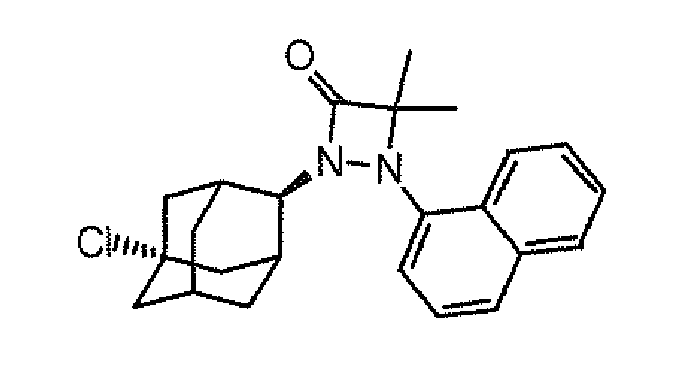
- 1H-NMR (400 MHz, CDCl3) δ; 0.80 (s, 3H), 1.48-1.51 (m, 1H), 1.59-1.61 (m, 1H), 1.85 (s, 3H), 2.00-2.37 (m, 10H), 2.97 (s, 1H), 3.81 (s, 1H), 7.23 (d, J= 7.4 Hz, 1H), 7.46-7.52 (m, 3H), 7.65 (d, J= 8.1 Hz, 1H), 7.84-7.86 (m, 1H), 8.23-8.26 (m, 1H).
- IR (ATR); 2935, 2863, 1756, 1390, 1025, 776, 755 cm-1.
- EI-MS m/z; 394 (M+).
- trans-2-(5-Chloroadamantan-2-yl)-4,4-dimethyl-1,2-diazetidin-3-one and 1-bromo-4-fluoronaphtalene were used for a similar reaction and treatment as Example 181, and the title compound was obtained as a colorless oil.
-

- 1H-NMR (400 MHz, CDCl3) δ; 0.81 (s, 3H), 1.50-1.53 (m, 1H), 1.66-1.69 (m, 1H), 1.83 (s, 3H), 2.00-2.38 (m, 10H), 2.92 (s, 1H), 3.77 (s, 1H), 7.11-7.19 (m, 2H), 7.52-7.61 (m, 1H), 8.09-8.12 (m, 1H), 8.24-8.27 (m, 1H).
- IR (ATR); 2936, 2864, 1758, 1391, 1262, 763 cm-1.
- EI-MS m/z, 412 (M+).
-

- Benzyl 2-(5-chloroadamantan-2-ylidene)hydrazinecarboxylate prepared in Process 1 of Example 250 was used for a similar reaction and treatment as Process 2 of Example 1, the resultant two geometric isomers were separated by silica gel chromatography, and benzyl cis-2-(5-chloroadamantan-1-2-yl)hydrazinearboxylate was obtained as a colorless amorphous solid.
- 1H-NMR (400 MHz, CDCl3) δ; 1.62 (d, J= 11.7 Hz, 2H), 1.75 (d, J= 12.7 Hz, 2H), 1.84 (d, J= 11.7 Hz, 2H), 2.05-2.18 (m, 5H), 2.48 (d, J= 11.7 Hz, 2H), 3.09 (s, 1H), 3.88 (s, 1H), 5.12 (s, 2H), 6.26 (s, 1H), 7.32-7.39 (m, 5H).
- Benzyl cis-2-(5-chloroadamantan-2-yl)hydrazinecarboxylate and 2-bromoisobutyryl bromide were used for a similar reaction and treatment as Process 3 of Example 1, and benzyl cis-2-(2-bromoisobutyryl)-2-(5-chloroadamantan-2-yl)hydrazinecarboxylate was obtained as a colorless amorphous solid.
- 1H-NMR (400 MHz, CDCl3) δ; 1.65-1.79 (m, 7H), 1.93-2.24 (m, 11H), 2.60 (s, 1H), 4.03-4.25 (m, 1H), 5.08-5.29 (m, 2H), 6.88-7.17 (m, 1H), 7.35-7.38 (m, 5H).
- Benzyl cis- 2-(2-bromoisobutyryl)-2-(5-chloroadamantan-2-yl)hydrazinecarboxylate was used for a similar reaction and treatment as Process 4 of Example 1, and benzyl cis-2-(5-chloroadamanta,n-2-yl)-4,4-dimethyl-3-oxo-1,2-diazetidine-1-carboxylate was obtained as a colorless oil.
- 1H-NMR (400 MHz, CDCl3) δ; 1.50 (s, 6H), 1.63-2.42 (m, 11H), 2.64 (s, 2H), 3.89 (s, 1H), 5.19 (s, 2H), 7.30-7.38 (m, 5H).
- Benzyl cis-2-(5-chloroadamantan-2-yl)-4,4-dimethyl-3-oxo-1,2-diazetidine-1-carboxylate was used for a similar reaction and treatment as Process 5 of Example 1, and cis-2-(5-chloroadamantan-2-yl)-4,4-dimethyl-1,2-diazetidin-3-one was obtained as a colorless oil.
- 1H-NMR (400 MHz, CDCl3) δ; 1.51-2.56 (m, 19H), 3.61 (s, 1H), 3.88 (br, 1H).
- cis-2-(5-Chloroadamantan-2-yl)-4,4-dimetlayl-1,2-diazetidin-3-one and 1-bromo-2,3-dichlorobenzene were used for a similar reaction and treatment as Example 181, and the title compound was obtained as a colorless oil.
- 1H-NMR (400 MHz, CDCl3) δ; 1.01 (s, 3H), 1.51-1.81 (m, 4H), 1.83 (s, 3H), 1.95-1.98 (m, 1H), 2.05-2.12 (m, 5H), 2.56-2.63 (m, 2H), 32.95 (s, 1H), 3.58 (s, 1H), 7.10 (dd, J= 1.7, 8.1 Hz, 1H), 7.22 (t, J= 8.1 Hz, 1H), 7.26 (dd, J= 1.7, 8.1 Hz, 1H).
- IR (ATR); 2928,2861,1763,1576, 1446, 1421, 1029, 754 cm-1.
- EI-MS m/z; 414 (M+).
- cis-2-(5-Chloroadamantan-2-yl)-4,4-dimethyl-1,2-diazetidin-3-one prepared in Process 4 of Example 256 and 1-bromonaphtalene were used for a similar reaction and treatment as Example 181, and the title compound was obtained as a colorless oil.
-

- 1H-NMR (400 MHz, CDCl3) δ; 0.81 (s, 3H), 1.47-1.50 (m, 1H), 1.58-1.72 (m, 2H), 1.81-1.84 (m, 1H), 1.89 (s, 3H), 1.94-1.97 (m, 1H), 2.06-2.16 (m, 5H), 2.68-2.72 (m, 2H), 3.08 (s, 1H), 3.72 (s, 1H), 7.23 (d, J= 7.3 Hz, 1H), 7.46 (t, J= 8.0 Hz, 1H), 7.51-7.54 (m, 2H), 7.65 (d, J= 8.0 Hz, 1H), 7.83-7.87 (m, 1H), 8.25-8.28 (m, 1H).
- IR (ATR); 2928, 2861, 1756, 1390, 800, 776 cm-1.
- EI-MS m/z; 394 (M+).
- 1-Bromo-2,3-(methylenedioxy)benzene was used in place of bromobenzene for a similar reaction and treatment as Example 181, and the title compound was obtained as a pale yellow amorphous.
-

- 1H-NMR (400 MHz, CDCl3) δ; 1.07-2.62 (m, 14H), 3.76 (s, 1H), 5.96 (s, 2H), 6.64 (d, J= 8.0 Hz, 2H), 6.82 (t, J= 8.0 Hz, 1H).
- IR (ATR); 2910, 2856, 1759, 1457, 774 cm-1.
- EI-MS m/z; 354 (M+).
- trans-2-(5-Hydroxyadamantan-2-yl)-4,4-dimetliyl-1,2-diazetidin-3-one prepared in Process 5 of Example 65 and 1-bromo-2,3-(methylenedioxy)benzene were used for a similar reaction and treatment as Example 181, and the title compound was obtained as a pale yellow amorphous.
-

- 1H-NMR (400 MHz, CDCl3;) δ; 1.07-2.20 (m, 13H), 2.81 (br, 1H), 3.69 (s, 1H), 5.97 (s, 2H), 6.64 (dd, J= 8.0, 11.3 Hz, 2H), 6.83 (t, J= 8.0 Hz, 1H).
- IR (ATR); 3409, 2924,2859, 1751, 1458, 1068, 774 cm-1.
- EI-MS m/z; 370 (M+).
- 2-(Adamantan-2-yl)-4,4-dimethyl-1,2-diazetidin-3-one prepared in Process 3 of Example 12 and cynnamylbromide were used for a similar reaction and treatment as Process 6 of Example 1, and the title compound was obtained as a colorless oil.
-

- 1H-NMR (400 MHz, CDCl3) δ; 1.41 (s, 3H), 1.47 (s, 3H), 1.58-1.82 (m, 10H), 2.10 (d, J= 12.7 Hz, 1H), 2.23 (d, J= 12.7 Hz, 1H), 2.40-2.43 (m, 2H), 3.57-3.68 (m, 3H), 6.19-6.27 (m, 1H), 6.58 (d, J= 16.1 Hz, 1H), 7.25-7.37 (m, 5H).
- IR (ATR); 2908,2852,1749,1450,1322, 968, 758, 734, 692 cm-1.
- EI-MS m/z; 350 (M+).
-
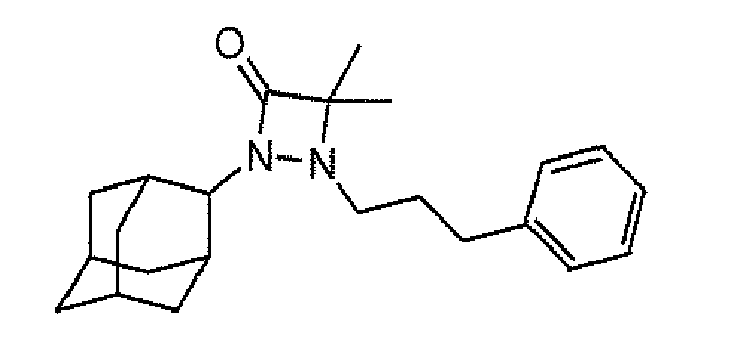
- A solution of 4,4-dimethyl-1-[(2E)-3-phenylprop-2-en-1-yl]-2-(adamantan-2-yl)-1,2-diazetidin-3 -one( 30.0 mg, 0.0860 mmol) prepared in Example 260 in ethyl acetate (2 mL) was added with 10% palladium carbon (catalyst amount), and under a hydrogen atmosphere the resultant was stirred at room temperature for 1 hour. The reaction solution was filtered using celite, concentrated in vacuo, and the title compound (24.3 mg, 80.2%) was obtained as a colorless oil.
- 1H-NMR (270 MHz, CDCl3) δ; 1.33 (s, 3H), 1.43 (s, 3H), 1.54-1.83 (m, 12H), 2.04-2.05 (m, 1H), 2.10-2.11 (m, 1H), 2.29-2.33 (m, 2H), 2.62-2.84 (m, 4H), 3.54 (s, 1H), 7.16-7.31 (m, 5H).
- IR (ATR); 2909, 2853, 1750, 1454, 1381, 1362, 1323, 1245, 700 cm-1.
- EI-MS m/z; 352 (M+).
- Phenoxyacetyl chloride was used in place of benzoyl chloride for a similar reaction and treatment as Example 96, and the title compound was obtained as a colorless oil.
-
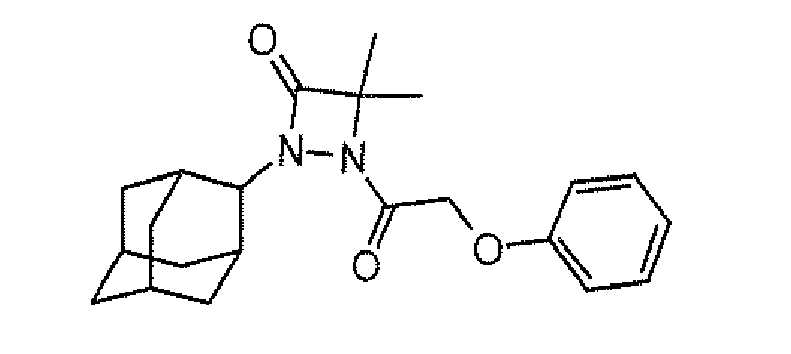
- 1H-NMR (400 MHz, CDCl3) δ; 1.58-1.63 (m, 2H), 1.69 (s, 6H), 1.73-1.88 (10H), 2.34 (s, 2H), 4.27 (s, 1H), 4.59 (s, 2H), 6.90 (d, J= 7.3 Hz, 2H), 7.03 (t, J= 7.3 Hz, 1H), 7.32 (t, J= 7.3 Hz, 2H).
- IR (ATR); 2916,1760, 1676, 1.491, 1227, 760 cm-1.
- EI-MS m/z; 368 (M+).
- Benzyloxyacetyl chloride was used in place of benzoyl chloride for a similar reaction and treatment as Example 96, and the title compound was obtained as a colorless oil.
-

- 1H-NMR (400 MHz, CDCl3) δ; 1.56 (s, 6H), 1.66-2.02 (m, 12H), 2.36 (s, 2H), 4.10 (s, 2H), 4.27 (s. 1H), 4.59 (s, 2H), 7.33-7.37 (m, 5H).
- IR (ATR); 2911, 1772, 1677, 1452, 1093, 987, 756, 708 cm-1.
- EI-MS m/z; 382 (M+).
- (Phenylthio)acetyl chloride was used in place of benzoyl chloride for a similar reaction and treatment as Example 96, and the title compound was obtained as a white amorphous solid.
-

- 1H-NMR (400 MHz, CDCl3) δ; 1.54 (s, 6H), 1.58-1.86 (m, 12H), 2.19 (s, 2H), 3.55 (s, 2H), 4.22 (s, 1H), 7.25-7.33 (m, 3H), 7.45 (d, J= 7.1 Hz, 2H).
- IR (ATR); 2914,1767,1668,1088, 745 cm-1.
- EI-MS m/z; 384 (M+).
-

- A solution of 2-(adamantan-2-yl)-4,4-dimethyl-1,2-diazetidin-3-one (50.0 mg, 0.213 mmol) prepared in Process 3 of Example 12 in chloroform (3 mL) was added sequentially with phenylacetaldehyde (25.6 mg, 0.213 mmol), sodium triacetoxyborohydride (67.8 mg, 0.320 mmol) and acetic acid (15.4 mg, 0.256 nmol) at room temperature, and the resultant was stirred at the same temperature for 2 hours. The reaction solution was added with water and extracted with chloroform. The organic layer was dried over anhydrous sodium sulfate, concentrated in vacuo, the obtained residue was purified by Preparatory Thin-Layer chromatography (hexane : ethyl acetate = 4: 1), and the title compound (3.70 mg, 5.20 %) was obtained as a colorless oil.
- 1H-NMR (400 MHz, CDCl3) δ; 1.44 (s, 6H), 1.64-1.91 (m, 10H), 2.17 (d, J= 12.0 Hz, 2H), 2.45 (s, 2H), 3.81 (s, 1H), 6.11 (d, J=14.0 Hz, 1H), 6.62 (d, J= 14.0Hz, 1H), 7.18-7.22 (m, 1H), 7.27-7.32 (m,4H).
- EI-MS m/z; 336 (M+).
-

- A solution of 4,4-dimethyl-1-[(E)-2-phenylethenyl]-2-(adamantan-2-yl)-1,2-diazetidin-3-one (38.4 mg, 0.103 mmol) prepared in Example 265 in methanol (2 mL) was added with 10% palladium carbon (catalyst amount), and the resultant was stirred at room temperature for 40 minutes under a hydrogen atmosphere. The reaction solution was filtered using celite, concentrated in vacuo, the obtained residue was purified by Preparatory Thin-Layer chromatography (hexane : ethyl acetate = 2:1), and the title compound (1.80 mg, 5.20%) was obtained as a white crystalline powder.
- 1H-NMR (400 MHz, CDCl3) δ; 1.45 (s, 3H), 1.48 (s, 3H), 1.52-1.87 (m, 10H), 2.09 (d, J= 12.9 Hz, 1H), 2.19 (d, J= 12.6 Hz, 1H), 2.34 (m, 2H), 2.61-2.68 (m. 1H), 2.75-2.82 (m, 1H), 2.97-3.11 (m, 2H), 3.58 (s, 1H), 7.19-7.32 (m, 5H).
- IR (ATR); 2913, 1763, 1250,754,700 cm-1.
- EI-MS m/z; 338 (M+).
-

- A solution of 2-trifluoromethylphenol (300 mg, 1.85 mmol) in N,N-dimethylformamide (5 mL) was added with bromoethylacetate (340 mg, 2.04 mmol) and potassium carbonate (384 mg, 2.78 mmol) at room temperature, and the resultant was stirred at the same temperature for 15 hours. The reaction solution was added with water and extracted with ethyl acetate. The organic layer was washed with brine, dried with anhydrous sodium sulfate, concentrated in vacuo, the obtained residue was purified by silica gel chromatography (hexane : ethyl acetate = 2:1), and 2-trifluoromethyl phenoxyehtyl acetate (430 mg, 100%) was obtained as a colorless oil.
- 1H-NMR (400 MHz, CDCl3) δ; 1.28 (t, J= 7.1 Hz, 3H), 4.26 (q, J= 7.1 Hz, 2H), 4.72 (s, 2H), 6.88 (d, J= 7.8 Hz, 1H), 7.06 (t, J= 7.8 Hz, 1H), 7.47 (t, J= 7.8 Hz, 1H), 7.60 (d, J=7.8 Hz, 1H).
- A solution of 2-trifluoromethylphenoxy ethyl acetate (429 mg, 1.85 mmol) in ethanol (4 mL) was added with an aqueous solution of 4N-sodium hydroxide (1 mL) at room temperature, and the resultant was stirred at the same temperature for 1.5 hours. The reaction solution was concentrated in vacuo, the residue was added with 2N-hydrochloric acid, and extrated with chloroform. The organic layer was dried over anhydrous sodium sulfate, concentrated in vacuo, 2-trifluoromethyl phenoxyacetic acid (376 mg, 92.3%) was obtained as a white crystalline powder.
- 1H-NMR (400 MHz, CDCl3) δ; 4.79 (s, 2H), 7.04-7.10 (m, 2H), 7.54 (t, J= 7.8 Hz, 1H), 7.59 (d, J=7.8 Hz, 1H).
- 2-Trifluoromethyl phenoxyacetic acid was used in place of 3-fluoro-2-methylbenzoic acid for a similar reaction and treatment as Example 157, and the title compound was obtained as a colorless oil.
- 1H-NMR (400 MHz, CDCl3) δ; 1.61 (s, 6H), 1.66-1.80 (m, 12H), 2.36 (s, 2H), 4.29 (s, 1H), 4.67 (s, 2H). 6.95 (d, J= 8.3 Hz, 1H), 7.12 (t, J= 8.3 Hz. 1H), 7.49 (t, J= 8.3 Hz, 1H), 7.61 (d, J= 8.3 Hz, 1H).
- IR (ATR); 2914, 2855, 2360, 2342,1775,1684,1.496.1461,1321,1132,1119,1039,761 cm-1.
- EI-MS m/z; 436 (M+).
-

- A solution of 2-(trifluoromethyl)phenol (3.20 g, 20.0 mmol) in acetone (20 mL) was added with 1,1,1-trichloro-2-methyl-2-propanol 0.5 hydrate (7.82 g, 40.0 mmol) and sodium hydrate (3.20 g, 80.0 mmol) at 0°C, and the resultant was stirred at room temperature for 20 hours. The reaction solution was concentrated in vacuo, added with water, and washed with diethylether. The aqueous layer was neutralized with concentrated hydrochloric acid, and extracted with chloroform. The organic layer was dried over anhydrous sodium sulfate, concentrated in vacuo, and 2-methyl-2-[2-(trifluoromethyl)phenoxy]propionic acid (1.35 g, 27.2%) was obtained as a white amorphous solid.
- 1H-NMR (400 MHz, CDCl3) δ; 1.67 (s, 6H), 6.97 (d, J= 8.3 Hz, 1H), 7.10 (t, J= 8.3 Hz, 1H), 7.45 (t, J= 8.3 Hz, 1H), 7.60 (d, J= 8.3 Hz, 1H).
- A solution of 2-methyl-2-[2-(trifluoromethyl)phenoxy]propionic acid (50.0 mg, 0.200 mmol) in dichloromethane (1 mL) was added with oxalyl chloride (50.3 mg, 0.400 mmol) and N,N-dimethylformamide (catalyst amount) at room temperature, and the resultant was stirred at the same temperature for 30 minutes. The reaction solution was concentrated in vacuo to make a solution of dichloromethane (1 mL), added with diisopropylethylamine (78.0 mg, 0.600 mmol), and 2-(adamantan-2-yl)-4,4-dimethyl-1,2-diazetidin-3-one (46.9 mg, 0.200 mmol) at room temperature , and the resultant was stirred at the same temperature for 20 hours. The reaction solution was added with water and extracted with chloroform. The organic layer was dried over anhydrous sodium sulfate, concentrated in vacuo, the obtained residue was purified by Preparatory Thin-Layer chromatography (hexane : ethyl acetate = 4:1), and the title compound (38.9 mg, 83.7%) was obtained as a colorless oil.
- 1H-NMR (400 MHz, CDCl3) δ; 1.52 (s, 6H), 1.60 (s, 6H), 1.73-2.05 (m, 12H), 2.36 (s, 2H), 4.32 (s, 1H), 7.14 (t, J= 7.8 Hz, 1H), 7.25 (d, J= 7.8 Hz, 1H), 7.43 (t, J= 7.8 Hz, 1H), 7.60 (d, J= 7.8 Hz, 1H).
- IR (ATR); 2912, 2856, 1775, 1675, 1491, 1319, 156, 132, 1113, 1056, 762 cm-1.
-

- A solution of 2-(adamantan-2-yl)-4,4-dimethyl-1,2-diazetidin-3-one (30.0 mg, 0.128 mmol) prepared in Process 3 of Example 12 in dichloromethane (3 mL) was added sequentially with 4-chlorophenyl isocyanate (19.7 mg, 0.128 mmol), triethylamine (19.4 mg, 0.192 mmol), DMAP (catalyst amount) at room temperature, and thre resultant was stirred at the same temperature for 1.5 hours. The reaction solution was filtered using celite, concentrated in vacuo, and the obtained residue was purified by Preparatory Thin-Layer chromatography (hexane : ethyl acetate = 2:Ij, and the title compound (49.7 mg, 100%) was obtained as a white crystalline powder.
- 1H-NMR (400 MHz, CD3OD) δ; 1.54 (s, 6H), 1.67 (d, J= 12.7 Hz, 2H), 1.78-1.91 (m, 8H), 2.09 (d, J= 12.7 Hz, 2H), 2.33 (s, 2H), 4.04 (s, 1H), 7.27-7.31 (m, 2H), 7.45-7.50 (m, 2H).
- IR (ATR); 3258, 2907, 1736, 1711, 1492, 1225, 823 cm-1.
- EI-MS m/z; 387 (M+).
-

- A solution of 1-[(benzyloxy)acetyl]-4,4-dimethyl-2-(adamantan-2-yl)-1,2-diazetidin-3-one (151 mg, 0.400 mmol) prepared in Example 263 in ethanol (3 mL) was added with 10% palladium carbon (catalyst amount), and under a hydrogen atmosphere the resultant was stirred at room temperature for 20 hours. The reaction solution was filtered using celite, concentrated in vacuo, the obtained residue was purified by silica gel chromatography (hexane : ethyl acetate = 2:1), and 4,4-dimethyl-1-(hydroxyacctyl)-2-(adamantan-2-yl)-1,2-diazetidin-3-one (52,0 mg, 44.5%) was obtained as a white crystalline powder.
- 1H-NMR (400 MHz, CDCl3) δ; 1.62 (s, 6H), 1.65-1.88 (m, 10H), 1.98-2.01 (m, 2H), 2.35 (s, 2H), 4.09 (s, 2H), 4.26 (s, 1H).
- Under an argon atmosphere, a solution of 4,4-dimethyl-1-(hydroxyacetyl)-2-(adamantan-2-yl)-1,2-diazetidm-3-one (14.0 mg, 0.0480 mmol) in N,N-dimethylformamide (0.5 mL) was added with sodium hydroxide (exess amount) and 5-bromo-2-fluoropyridine (26.4 mg, 0.150 mmol) at room temperature, and the resultant was stirred at the same temperature for 1 hour. The reaction solution was added with water and extracted with diethyl ether. The organic layer was dried over anhydrous sodium sulfate, concentrated in vacuo, the obtained residue was purified by Preparatory Thin-Layer chromatography (hexane : ethyl acetate = 2:1), and the title compound (2.20 mg, 10.2%) was obtained as a colorless oil.
- 1H-NMR (400 MHz, CDCl3) δ; 1.47-1.59 (m., 2H), 1.64 (s, 6H), 1.72-1.84 (m, 10H), 2.33 (s, 2H), 4.23 (s, 1H), 4.83 (s, 2H), 6.76 (d, J= 8.6 Hz, 1H), 7.71 (dd, J= 2.4 Hz, 1H), 8.14 (d, J= 2.4 Hz, 1H).
- EI-MS m/z; 448 (M+).
-

- Under an argon atmosphere, a solution of 2-(adamantan-2-yl)-4,4-dirnethyl-l,2-diazetidin-3-one (234 mg, 1.00 mmol) prepared in Process 3 of Example 12 in N,N-dimethylformamide (2 mL) was added with potassium carbonate (277 mg, 2.00 mmol) and ethylbromoacetate (167 mg, 1.00 mmol) at room temperature, and the resultant was stirred at 80°C for 20 hours. The reaction solution was added with water and extracted with diethyl ether. The organic layer was dried over anhydrous sodium sulfate, concentrated in vacuo, the obtained residue was purified by silica gel chromatography (hexane : ethyl acetate = 2:1), and ethyl [4,4-dimethyl-3-oxo-2-(adamantan-2-yl)-1,2-diazetidin-1-yl]acetate (190 mg, 59.4%) was obtained as a colorless oil.
- 1H-NMR (400 MHz, CDCl3) δ; 1.28-1.86 (m, 19H), 2.11-2.50 (m, 4H), 3.58 (d, J= 17.1 Hz, 1H), 3.78 (d, J= 17.1 Hz, 1H), 4.18-4.24 (m, 3H).
- Under an argon atmosphere, a mixed solution of ehtyl [4,4-dimethyl-3-oxo-2-(adamantan-2-yl)-1,2-diazetidin-1-yl] acetate (150 mg, 0.470 mmol) in tetrahydrofuran-methanol-water (10:1:1, 4mL) was added with lithium borohydride (80.8 mg, 3.76 mmol) at room temperature, and the resultant was stirred at the same temperature for 1 hour. The reaction solution was added with a saturated aqueous solution of ammonium chloride, and extracted with chloroform. The organic layer was dried over anhydrous sodium sulfate, concentrated in vacuo, the obtained residue was purified by silica gel chromatography (hexane : ethyl acetate = 2:1), and 4,4-dimethyl-1-(2-hydroxyethyl)-2-(adamantan-2-yl)-1,2-diazetidin-3-one (163 mg, 78.7%) was obtained as a colorless oil.
- 1H-NMR (400 MHz, CDCl3) δ; 1.38 (s, 3H), 1.46 (s, 3H), 1.59-1.89 (m, 10H), 2.06-2.09 (m, 1H), 2.20-2.23 (m, 1H), 2.39 (s, 2H), 2.45 (s, 1H), 2.98-3.08 (m, 2H), 3.58-3.66 (m, 3H).
- Under an argon atmosphere, a mixed solution of 4,4-dimethyl-1-(2-hydroxyethyl)-2-(adamantan-2-yl)-1,2-diazetidin-3-one (27.8 mg, 0.100 mmol) in tetrahydrofuran-N,N -dimethyl-formamide (2:1, 1 mL) was added with sodium hydride (10.0 mg, 0.200 mmol) and 6-chloro-3-pyridine carbonitrile (27.7 mg, 0.200 mmol), and the resultant was stirred at the same temperature for 1 hour. The reaction solution was added with water and extracted with diethyl ether. The organic layer was dried over anhydrous sodium sulfate, concentrated in vacuo, the obtained residue was purified by Preparatory Thin-Layer chromatography (hexane: ethyl acetate = 1:1), and the title compound (38.1 mg, quant.) was obtained as a white crystalline powder.
- 1H-NMR (400 MHz, CDCl3) δ; 1.43 (s, 6H), 1.62-1.88 (m, 10H), 2.05-2.09 (m, 1H), 2.20-2.23 (m, 1H), 2.38 (s, 2H), 3.16-3.27 (m, 2H), 3.63 (s, 1H), 4.36-4.46 (m, 2H), 6.83 (d, J= 8.8 Hz, 1H), 7.80 (dd, J= 2.4, 8.8 Hz, 1H), 8.47 (d, J= 2.4 Hz, 1H).
- IR (ATR); 2916, 1742, 1601, 1489, 1403, 1290, 837 cm-1.
- EI-MS m/z; 380 (M+).
-

- Benzyl 2-(5-methoxycarbonyladamantan-2-yl)hydrazinecarboxylate prepared in Process 2 of Example 90 and 2-bromoisobutyryl bromide were used for a similar reaction and treatment as Process 3 of Example 1, the resultant two geometric isomers were separated by silica gel chromatography, and benzyl cis-2-(2-bromoisobutyryl)-2-(5-methoxycarbonyladamantan-2-yl)hydrazinecarboxylate was obtained as a colorless amorphous solid.
- 1H-NMR (400 MHz, CDCl3) δ: 1.66-2.09 (m, 18H), 2.50 (s, 1H), 3.65 (s, 3H), 4.11 (s, 0.3H), 4.31 (s, 0.7H), 5.08-5.25 (m, 2H), 7.11 (s, 0.3H), 7.18 (s, 0.7H), 7.34-7.37 (m, 5H).
- Benzyl cis-2-(2-bromoisobutyryl)-2-(5-methoxycarbonyladamantan-2-yl)hydrazinecarboxylate was used for a similar reaction and treatment as Process 4 of Example 1, and benzyl cis-2-(5-methoxycarbonyladamantan-2-yl)-4,4-dimethyl-3-oxo-1,2-diazetidine-1-carboxy late was obtained as a colorless oil.
- 1H-NMR (400 MHz, CDCl3) δ; 1.49 (s, 6H), 1.59-2.19 (m, 11H), 2.53 (s, 2H), 3.64 (s, 3H), 3.95 (s, 1H), 5.19 (s, 2H), 7.34-7.40 (m, 5H).
- Benzyl cis-2-(5-methoxycarbonyladamantan-2-yl)-4,4-dimethyl- 3-oxo-1,2-diazetidine-1-carboxy late was used for a similar reaction and treatment as Process 5 of Example 1, and methyl cis-4-(3,3-dimethyl-4-oxo-1,2-diazetidin-1-yl)adamantane-1-carboxylate was obtained as a colorless oil.
- 1H-NMR (400 MHz, CDCl3) δ; 1.49 (s, 6H), 1.71-2.15 (m, 11H), 2.45 (s, 2H), 3.66 (s, 3H), 3.84 (br, 1H).
- Methyl cis-4-(3,3 -dimethyl-4-oxo-1,2-diazetidin-1-yl)adamantane-1-carboxylate and 1-bromonaphtalene were used for a similar reaction and treatment as Example 181, and methyl cis-4-[2-(naphthalen-1-yl)-3,3-dimethyl-4-oxa-1,2-diazetidin- yl]adamantane-1-carboxy late was obtained as a pale yellow oil.
- 1H-NMR (400 MHz, CDCl3) δ; 0.80 (s, 3H), 1.54-2.04 (m, 10H), 1.87 (s, 3H). 2.46-2.50 (m, 2H), 2.96 (s, 1H), 3.67 (s, 3 H), 3.79 (s, 1H), 7.24 (s, 1H), 7.46 (t, J= 7.8 Hz, 1H), 7.50-7.53 (m, 2H), 7.64 (d, J= 8.4 Hz, 1H), 7.83-7.86 (m, 1H), 8.26-8.29 (m, 1H).
- A solution of methyl cis-4-[2-(naphthalen-1-yl)-3,3-dimethyl-4-oxo-1,2-diazetidin-1-yl]adamantane-1-carboxy late (49.0 mg, 0.117 mmol) in methanol (2 mL) was added with an aqueous solution of 4N-sodium hydroxide (0.5 mL) at room temperature, and the resultant was stirred at the same temperature for 13 hours. The reaction solution was concentrated in vacuo, the obtained residue was dissolved in water, and washed with diethylether. The aqueous layer was adjusted to pH= 1.0 with 4N-hydrochlorid acid, and extracted with chloroform. The organic layer was dried over anhydrous sodium sulfate, concentrated in vacuo, the obtained residue was purified by Preparatory Thin-Layer chromatography (hexane : ethyl acetate = 1:1), and the title compound (32.9 mg, 67.8%) was obtained as a pale yellow oil.
- 1H-NMR (400 MHz, CDCl3) δ; 0.80 (s, 3H), 1.52-2.09 (m, 10H), 1.89 (s, 3H), 2.48-2.57 (m, 2H), 3.00 (s, 1H), 3.00 (s, 3 H), 3.79 (s, 1H), 7.24 (s, 1H), 7.46 (t, J= 7.8 Hz, 1H), 7.50-7.53 (m, 2H), 7.65 (d, J= 8.0 Hz, 1H), 7.83-7.86 (m, 1H), 8.26-8.29 (m, 1H).
- cis-4-[2-(Naphthalen-1-yl)-3 ,3-dimethyl-4-oxo-1,2-diazetidin-1-yl]adamantane-1-carboxylic acid prepared in Example 272 was used for a similar reaction and treatment as Example 91, and the title compound was obtained as a pale yellow amorphous solid.
-

- 1H-NMR (400 MHz, CDCl3) δ; 0.82 (s, 3H), 1.54-1.58 (m, 1H), 1.66-1.77 (m, 4H), 1.84-1.93 (m, 3H), 1.86 (s, 3H), 2.02-2.04 (m, 1H), 2.24 (s, 1H), 2.39-2.42 (m, 1H), 2.69-2.72 (m, 1H), 2.84 (s, 1H), 3.67 (s, 1H), 5.33 (br, 1H), 5.85 (br, 1H), 7.25 (d, 1=1.0, 7.3 Hz, 1H), 7.47 (t, J= 7.8 Hz, 1H), 7.50-7.53 (m, 2H), 7.66 (d, J= 8.3 Hz, 1H), 7.84-7.87 (m, 1H), 8.23-8.26 (m, 1H).
- IR (ATR); 3344, 2918, 1748, 1666, 1390, 752 cm-1.
- EI-MS m/z; 403 (M+).
-

- Benzyl 2-(5-methoxycarbonyladamantan-2-yl)hydrazinecarboxylate prepared in Process 2 of Example 90 and 2-bromoisobutyryl bromide were used for a similar reaction and treatment as Process 3 of Example 1, and the resultant two geometric isomers were separated by silica gel chromatography, and benzyl trans-2-(2-bromoisobutyryl)-2-(5-methoxycarbonyladamantan-2-yl)hydrazinecarboxylat e was obtained as a colorless amorphous solid.
- 1H-NMR (400 MHz, CDCl3) δ; 1.55-1.59 (m, 2H), 1.76-2.06 (m, 16H), 2.51 (s, 1H), 3.65 (s, 3H), 4.13 (s, 0.3H), 4.33 (s, 0.7H), 5.09-5.27 (m, 2H), 6.87 (s, 0.3H), 7.11 (s, 0.7H), 7.34-7.37 (m, 5H).
- Benzyl trans-2-(2-bromoisobutyryl)-2-(5-methoxycarbonyladamantan-2-yl)hydrazincearboxylat e was used for a similar reaction and treatment as Process 4 of Example 1, and benzoyl trans-2-(methoxycarbonyladamantan-2-yl)-4,4-dimethyl-3-oxo-1,2-diazetidine-1-carbo xylate was obtained as a colorless oil.
- 1H-NMR (400 MHz, CDCl3) δ; 1.49 (s, 6H), 1.57-1.61 (m, 2H), 1.76-2.04 (m, 9H), 2.49 (s, 2H), 3.66 (s, 3H), 3.98 (s, 1H), 5.19 (s, 2H), 7.34-7.40 (m, 5H).
- Benzyl trans-2-(5-methoxycarbonyladamantan-2-yl)-4,4-dimethyl-3-oxo-1,2-diazetidine-1-carbo xylate was used for a similar reaction and treatment as Process 5 of Example 1, and methyl trans-4-(3,3-dimethyl-4-oxo-1,2-diazetidin-1-yl)adamantane-1-carboxylate was obtained as a colorless oil.
- 1H-NMR (400 MHz, CDCl3) δ; 1.50 (s, 6H), 1.60 (d, J= 13.4 Hz, 2H), 1.89-2.02 (m, 9H), 2.42 (s, 2H), 3.66 (s, 3H), 3.84 (br, 1H).
- Methyl trans-4-(3,3-dimethyl-4-oxo-1,2-diazetidin-1-yl)adamantane-1-carboxylate and 1-bromonaphtalene were used for a similar reaction and treatment as Example 181, and methyl trans-4-[2-(naphthalen-1-yl)-3,3-dimethyl-4-oxa-1,2-dzazetidin-1-yl]adamantane-1-carbo xylate was obtained as a pale yellow oil.
- 1H-NMR (400 MHz, CDCl3) δ; 0.80 (s, 3H), 1.45-1.53 (m, 1H), 1.69-2.07 (m, 9H), 1.87 (s, 3H), 2.26-2.37 (m, 2H), 2.91 (s, 1H), 3.62 (s, 3 H), 3.81 (s, 1H), 7.24 (d, J= 7.3 Hz, 1H), 7.45 (t, J= 7.8 Hz, 1H), 7.48-7.53 (m, 2H), 7.64 (d, J= 8.3 Hz, 1H), 7.83-7.86 (m, 1H), 8.25-8.28 (m, 1H).
- Methyl trans-4-[2-(naphthalen-1-yl)-3,3-dimethyl-4-oxo-1,2-diazetidin-1-yl]adamantane-1-carbo xylate was used in place of methyl cis-4-[2-(naphthalen-1-yl)-3,3-dimethyl-4-oxo-1,2-diazetidin-1-yl]adamantane-1-carboxy late for a similar reaction and treatment as Process 2 of Example 272, and the title compound was obtained as a pale yellow amorphous solid.
- 1H-NMR (400 MHz, CDCl3) δ; 0.80 (s, 3H), 1.49-1.52 (m, 1H), 1.68-2.08 (m, 9H), 1.86 (s, 3H), 2.25-2.36 (m, 2H), 2.91 (s, 1H), 3.80 (s, 1 H), 7.23 (d, J= 7.3 Hz, 1H), 7.45 (t, J= 7.8 Hz, 1H), 7.48-7.53 (m, 2H). 7.64 (d, J= 8.1 Hz, 1H), 7.83-7.86 (m, 1H), 8.24-8.27 (m, 1H).
- trans-4-[2-(Naphthalen-1-yl)-3,3-dimethyl-4-oxo-1,2-diazetidin-1-yl]adamantan e-1-carboxylic acid prepared in Example 274 was used for a similar reaction and treatment as Example 91, and the title compound was obtained as a pale yellow oil.
-

- 1H-NMR (400 MHz, CDCl3) δ; 0.81 (s, 3H), 1.50-1.75 (m, 7H), 1.87 (s, 3H), 1.99 (s, 1H), 2.08-2.11 (m, 2H), 2.28-2.40 (m, 2H), 2.93 (s, 1H), 3.82 (s, 1 H), 5.23 (br, 1H), 5.51 (br, 1H), 7.24 (d, J= 7.3 Hz, 1H), 7.45 (t, J= 7.8 Hz, 1H), 7.50-7.52 (m, 2H), 7.65 (d, J= 8.1 Hz, 1H), 7.84-7.86 (m, 1H), 8.24-8.27 (m, 1H).
-

- Methyl cis-4-(3,3-dimethyl-4-oxo-1,2-diazetidin-1-yl)adamantane-1-carboxylate prepared in Process 3 of Example 272 and 1-bromo-2,3-dichlorobenzene were used for a similar reaction and treatment as Example 181, and methyl cis-4-[2-(2,3-dichlorophenyl)-3,3-dimethyl-4-oxo-1,2-diazetidin-1-yl]adamantane-1-carb oxylate was obtained as a pale yellow oil.
- 1H-NMR (400 MHz, CDCl3) δ; 0.90 (s, 3H), 1.52-2.05 (m, 10H), 1.82 (s, 3H), 2.33-2.42 (m, 2H), 2.84 (s, 1H), 3.66 (s, 1H), 3.67 (s, 3H), 7.12 (dd, J= 2.0, 7.8 Hz, 1H), 7.22 (t, J= 7.8 Hz, 1H), 7.24-7.27 (m, 1H).
- Methyl cis-4-[2-(2,3-dichlorophenyl)-3,3-dimethyl-4-oxo-1,2-diazetidin-1,2-yl]adamantane-1-carb oxylate was used for a similar reaction and treatment as Process 5 of Example 272, and cis-4-[2-(2,3-dichlorophenyl)-3,3-dimethyl-4-oxo-1,2-diazetidin-1-yl]adamantane-1-carb oxylic acid was obtained as a white crystalline powder.
- 1H-NMR (400 MHz, CDCl3) δ; 1.01 (s, 3H), 1.57-2.02 (m, 10H), 1.83 (s, 3H), 2.40-2.44 (m, 2H), 2.87 (s, 1H), 3.66 (s, 1 H), 7.11 (dd, J= 1.8, 7.8 Hz, 1H), 7.22 (t, J= 7.8 Hz, 1H), 7.24-7.27 (m, 1H).
- cis-4-[2-(2,3-Dichlorophenyl)-3,3-dimethyl-4-oxo-1,2-diazetidin-1-yl]adamanta ne-1-carboxylic acid was used for a similar reaction and treatment as Example 91, and the title compound was obtained as a white crystalline powder.
- 1H-NMR (400 MHz, CDCl3) δ; 1.02 (s, 3H), 1.54-1.96 (m, 10H), 1.80 (s, 3H), 2.04-2.05 (m, 1H), 2.23 (s, 1H), 2.29-2.32 (m, 1H), 3.52 (s, 1 H), 5.30 (br, 1H), 5.86 (br, 1H), 7.10 (dd, J= 1.7, 7.8 Hz, 1H), 7.23 (t, J= 7.8 Hz, 1H), 7.26-7.30 (m, 1H).
- IR (ATR); 3345, 2918, 1756, 1576, 1446, 752 cm-1.
- EI-MS m/z; 421 (M+).
-

- Methyl trans-4-[2-(2,3-dichlorophenyl)-3,3-dimethyl-4-oxo-1,2-diazetidin-1-yl]adamantane-1-ca rboxylate obtained by using methyl trans-4-(3,3-dimethyl-4-oxo-1,2-diazetidin-1-yl)adamantane-1-carboxylate prepared in Process 3 of Example 274 and 1-bromo-2,3-dichlorobenzene for a similar reaction and treatment as Example 181, was used for a similar reaction and treatment as Process 5 of Example 272, and trans-4-[2-(2,3-dichlorophenyl)-3,3-dimethyl-4-oxo-1,2-diazetidin-1-yl]adamantane-1-ca rboxylic acid was obtained as a colorless oil.
- 1H-NMR (400 MHz, CDCl3) δ; 1.01 (s, 3H), 1.52-2.26 (m, 11H), 1.81 (s, 3H), 2.61 (s, 1H), 2.81 (s, 1H), 3.67 (s, 1 H), 7.11 (dd, J= 1.8, 7.8 Hz, 1H), 7.22 (t, J= 7.8 Hz, 1H), 7.25-7.27 (m, 1H).
- trans-4-[2-(2,3-Dichlorophenyl)-3,3-dimethyl-4-oxo-1,2-diazetidin-1-yl]adaman tane-1-carboxylic acid was used for a similar reaction and treatment as Example 91, and the title compound was obtained as a pale yellow crystalline powder.
- 1H-NMR (400 MHz, CDCl3) δ; 1.02 (s, 3H), 1.53-2.32 (m, 12H), 1.81 (s, 3H), 2.84 (s, 1H), 3.70 (s, 1 H), 5.29 (br, 1H), 5.54 (br, 1H), 7.10 (dd, J= 1.7, 7.8 Hz, 1H), 7.22 (t, J= 8.1 Hz, 1H), 7.25-7.27 (m, 1H).
- Human 11β-HSD1-, human 11β-HSD2-, and mouse 11β-HSD1-gene clonings were conducted using as a template a reverse transcription product of human-liver RNA, human-kidney RNA (CELL APPLICATIONS), and mouse-kidney RNA respectively, by means of PCR cloning with reference to nucleotide sequences of Genbank Accession Nos. NM_005525, NM_000196, and NM_008288. The obtained PCR products of about 0.9 kbp, 1.2 kbp, and 0.9 kbp were subcloned into an expression vector pcDNA3.1+/Zeo (Invitrogen).
- Human 11β-HSD1- and human 11β-HSD2-expressing vectors were transfected into human kidney-derived cell line, HEK293 cells, using a transfection reagent, jet PEI (Funakoshi). Mouse 11β-HSD1 was transfected to Chinese hamster ovary-derived cell line, CHO-K1 cells. Selection was conducted with 200-400 µg/mL of zeocine (Invitrogen) to provide stably expressing-cell clones. The stably expressing cells were suspended in buffer solution A (20 mmol/L Tris-HCl, pH 7.4, 250 mmol/L sucrose, 1 mmol/L EGTA, 1 mmol/L EDTA, 1 mmol/L MgCl2), sonicated, and then stored at -80°C.
- An enzymatic reaction was conducted using a polystyrene 96-well plate. Each well was added with 1 µL of a test agent dissolved in DMSO and then diluted (0.003 to 3 mmol/L), and further added with 10 µL of cell lysate diluted to a concentration of 0.1 mg/mL to 0.4 mg/mL. Next, 90 µL of buffer solution A containing substrate (100 nmol/L cortisone or cortisol) and coenzyme (400 µmol/L NADPH or NAD+) was added and the mixture was incubated at 37°C for 1 hour. The enzymatic reaction was stopped by treating at 95°C for 3 minutes. Cortisol that was present in the reaction solution was determined by a competitive ELISA shown below.
Anti-rabbit IgG antibody (Chemi-con) diluted to 2 µg/mL with carbonate buffer solution (pH 9.6) was added in 100 µL each to a 96-well immuno plate (Nunc) and immobilized by an incubation at 4°C overnight. 50 µL of enzymatic reaction solution was put onto the plates, and further, anti-cortisol antibody (Cosmo Bio) and HRP-labeled cortisol (Cosmo Bio), diluted with buffer solution B (25 mmol/L Tris-HCl pH 7.4, 137 mmol/L NaCl, 2.68 mmol/L KCl), were added in 50 µL respectively and incubated at 4°C overnight. After washed three times with buffer solution B containing 0.05% Tween 20, the plates were allowed to develop color by adding 100 µL of color reagent, TMB (Moss). The color reaction was stopped by 25 µL of 1 mol/L sulfuric acid and the absorbance was determined at 450 nm with a microplate reader (Molecular Device, VersaMax). - The values of human 11β-HSD1, human 11β-HSD2, and mouse 11β-HSD1 activities were subtracted from 100, and the resultant values were regarded as the respective 11β-HSD inhibition rates of example compounds. For each example compound, the value of 50% inhibitory concentration (IC50) was calculated from 11β-HSD inhibition rates at plural concentrations, for 11β-HSD1 and 11β-HSD2 activities. The comparison of human 11β-HSD1 and human 11β-HSD2 inhibiting activities is shown in Table 1, and the comparison of human 11β-HSD1 and mouse 11β-HSD1 inhibiting activities is shown in Table 2.
-
[Table 1] Enzyme inhibitory selectivity 1 of human 11β-HSD1 and human 11β-HSD2 No. in vitro assay (IC 50 µM) No. in vitro assay (IC 50 µM) No. in vitro assay (IC 50 µM) h HSD1 h HSD2 h HSD1 h HSD2 h HSD1 h HSD2 39 0.015 3.0 151 0.81 NA 225 0.036 NA 40 0.012 10 152 0.23 NA 226 0.95 30 41 0.023 3.2 153 0.14 NA 227 0.023 3-30 42 0.025 30 154 0.036 NA 230 0.54 NA 48 D.D31 >30 157 0.44 30 231 0.088 >30 49 0.80 NA 160 0.52 30 236 0.095 NA 50 0.042 6.6 161 0.50 >30 238 0.020 NA 52 0.078 9.5 163 0.72 NA 240 0.32 NA 60 0.0082 1.1 165 0.096 30 242 0.076 NA 66 0.09 NA 168 0.11 NA 244 0.81 NA 74 0.046 3-30 181 0.062 3-30 247 0.027 NA 76 0.031 4.8 188 0.082 >30 248 0.028 3-30 77 0.016 2.0 189 0.022 3-30 249 0.013 NA 116 0.13 30 190 0.093 3-30 250 0.042 >30 119 0.72 >30 203 0.026 >30 251 0.030 3-30 120 0.27 >30 204 0.16 30 252 0.034 NA 121 0.07 NA 205 0.10 30 253 0.013 3-30 122 0.32 NA 206 0.0061 3-30 254 0.012 NA 125 0.47 NA 208 0.02 3-30 255 0.003 30 126 0.11 NA 212 0.032 3-30 256 0.26 NA 128 0.50 NA 214 0.041 NA 257 0.24 NA 132 0.66 NA 215 0.023 4.5 265 0.036 19 136 0.14 NA 218 0.81 >30 272 0.050 >30 138 0.22 30 220 0.056 NA 273 0.020 NA 139 0.79 NA 221 0.023 3-30 274 0.011 NA 141 0.071 14 222 0.019 5.5 275 0.011 NA 149 0.90 NA 223 0.68 NA 276 0.007 NA 150 0.84 NA 224 0.044 NA 277 0.007 NA Note) hHSD1 and hHSD2 denote human HSD1 and HSD2, respectively. - As it is shown in Table 1, it has been confirmed that the compound of the present invention has an activity to strongly and selectively inhibit human 11β-HSD1.
-
[Table 2] Enzyme inhibitory activity of human 11β-HSD1 and mouse 11β-HSD1 No. in vitro assay (IC 50 uM) No. in vitro assay (IC 50 uM) No. in vitro assay (IC 50 µM) hHSD1 m HSD1 h HSD1 m HSD1 h HSD1 m HSD1 8 0.79 0.18 60 0.0082 0.15 183 0.057 0.76 9 0.68 0.24 61 0.23 0.30 188 0.082 0.76 12 0.047 0.023 63 0.015 0.41 192 0.49 0.03 13 0.058 0.025 64 0.60 0.041 193 0.86 0.36 14 0.84 0.088 65 0.50 0.47 204 0.16 0.42 15 0.36 0.084 66 0.09 0.57 205 0.10 0.20 16 0.80 0.10 67 0.12 0.29 206 0.0061 0.44 17 0.71 0.23 73 0.021 0.11 207 0.61 0.054 19 0.47 0.27 74 0.046 0.13 210 0.44 0.16 20 0.35 0.20 75 0.038 0.15 212 0.032 0.089 22 0.64 0.079 76 0.031 0.14 215 0.023 0.54 27 0.03 0.094 77 0.016 0.092 218 0.81 0.57 28 0.44 0.073 78 0.15 0.64 219 0.56 0.23 29 0.60 0.37 79 0.22 0.36 220 0.056 0.088 30 0.047 0.10 80 0.13 0.39 221 0.023 0.29 31 0.96 0.30 83 0.092 0.66 222 0.019 0.087 32 0.25 0.054 84 0.13 0.61 224 0.044 0.34 33 0.38 0.086 85 0.053 0.37 225 0.036 0.012 35 0.44 0.15 86 0.14 0.49 227 0.023 0.95 36 0.69 0.21 87 0.10 0.85 233 0.18 0.27 38 0.25 0.10 95 0.13 0.35 235 0.056 0.75 39 0.01 0.04 96 0.80 0.22 236 0.095 0.31 40 0.012 0.084 106 0.75 0.17 238 0.02 0.38 41 0.023 0.13 109 0.75 0.20 247 0.027 0.26 42 0.025 0.24 113 0.42 0.12 249 0.013 0.78 43 0.072 0.074 114 0.54 0.11 250 0.042 0.13 44 0.044 0.073 116 0.13 0.15 251 0.03 0.61 45 0.079 0.14 117 0.98 0.39 252 0.034 0.24 46 0.23 0.45 125 0.47 0.42 253 0.013 0.15 47 0.20 0.58 128 0.50 0.10 254 0.012 0.075 48 0.031 0.50 135 0.76 0.11 255 0.003 0.18 49 0.80 0.31 138 0.22 0.24 257 0.24 0.24 50 0.042 0.16 139 0.79 0.36 261 0.45 0.70 51 0.082 0.58 150 0.84 0.43 266 0.55 0.47 52 0.078 0.16 151 0.81 0.30 272 0.05 0.90 53 0.35 0.06 152 0.23 0.54 273 0.02 0.10 54 0.30 0.036 153 0.14 0.032 274 0.011 0.25 55 0.067 0.069 157 0.44 0.15 275 0.011 0.25 56 0.054 0.052 160 0.52 0.16 276 0.007 0.40 58 0.026 0.061 161 0.50 0.23 277 0.007 0.40 59 0.25 0.064 Note) mHSD1 denotes mouse HSD1. - For medicine development, it is required to make a dosage selection for clinical experiments by extrapolating data which have been accumulated with animal models to human. Sometimes, the difference of enzyme species becomes an issue for evaluating an inhibitor targeting a certain enzyme, such as the compound of the present invention. Specifically, as rodents such as mouse are generally used as an animal model, a compound having an inhibitory activity to mouse type enzyme as well as human type enzyme, has an advantageous property for evaluating usefulness as medicine. As it is shown in Table 2, the compound of the present invention has been confirmed to have an inhibitory effect to mouse 11β-HSD1 as well.
Claims (10)
- A 1,2-diazetidin-3-one derivative represented by the following general formula (1) or salt thereof, or their solvate:
 [wherein A ring represents a saturated C3-10 carbocyclic group,B ring represents a C3-8 cycloalkyl group, C3-8 cycloalkenyl group, C6-14 aryl group or a 5-to 14-membered heteroaryl group,R1, R2 and R3 represent the same or different and are a hydrogen atom, halogen atom, hydroxyl group, carboxyl group, carbamoyl group or C1-6 alkyl group,R4 and R5 represent the same or different and are a hydrogen atom or C1-6 alkyl group, R6, R7 and R8 represent the same or different and are a hydrogen atom, halogen atom, hydroxyl group, nitro group, cyano group, amino group (that may be substituted with a sulfonyl group or acyl group), C1-6 alkyl group, halo C1-6 alkyl group, C1-6 alkoxy group (that may be substituted with a C1-6 alkoxy group), C6-10 aryl group, C2-6 alkanoyloxy group, C1-6 alkylthio group, C1-6 alkylsulfinyl group or C1-6 alkylsulfonyl group, or R6 and R7 may together form a C1-3 alkylenedioxy group,L represents a single bond, C1-6 alkylene chain, C2-6 alkenylene chain, -(C1-6 alkylene)-O-, -CO-X- or -SO2-Y-,X represents a single bond, -N(R9)-, -O-(C1-6 alkylene)-, -(C1-6 alkylene)-O-, -(C1-6 alkylene)-O-(C1-6 alkylene)- or -(C1-6 alkylene)-S-,R9 represents a hydrogen atom, C1-6 alkyl group or acyl group, andY represents a single bond or C1-6 alkylene chain].
 - The 1.2-diazetidin-3-one derivative or salt thereof, or their solvate according to claim 1, wherein the saturated C3-10 carbocyclic group in the A ring of general formula (1) is a "C3-8 cycloalkyl group" or "C4-10 cross-linked cyclic hydrocarbon group".
- The 1,2-diazetidin-3-one derivative or salt thereof, or their solvate according to claim 1 or 2, wherein the compound represented by general formula (1) is:1-benzyl-4-methyl--2-(adamantan-2-yl)-1,2-diazetidin-3-one, 1-(4-chlorobenzyl)-4-methyl-2-(adamantan-2-yl)-1,2-diazetidin-3-one, 1-benzyl-4,4-dimethyl-2-(adamantan-2-yl)-1,2-diazetidin-3-one, 1-(4-chlorobenzyl)-4,4-dimethyl-2-(adamantan-2-yl)-1,2-diazetidin-3-one, 4,4-dimethyl-1-(4-methylbenzyl)-2-(adamantan-2-yl)-1 ,2-diazetidin-3-one, 1-(4-fluorobenzyl)-4,4-dimethyl-2-(adamantan-2-yl)-1,2-diazetidin-3-one, 1-(3,4-difluorobenzyl)-4,4-dimethyl-2-(adamantan-2-yl)-1,2-diazetidin-3-one, 1-(2,4-difluorobenzyl)-4,4-dimethyl-2-(adamantan-2-yl)-1,2-diazetidin-3-one, 1-(3,5-difluorobenzyl)-4,4-dimethyl-2-(adamantan-2-yl)-1,2-diazetidin-3-one, 1-(2,3-difluorobenyl)-4,4-dimethyl-2-(adamantan-2-yl)-1,2-diazetidin-3-one, 1-(2,5-difluorobenzyl)-4,4-dimethyl-2-(adamantan-2-yl)-1,2-diazetidin-3-one, 1-(3-fluorobenzyl)-4,4-dimethyl-2-(adamantan-2-yl)-1,2-diazetidin-a-one, 1-(3,5-dimethoxybenzyl)-4,4-dimethyl-2-(adamantan-2-yl)-1,2-diazetidin-3-one, 1-(2-chlorobenzyl)-4,4-dimethyl-2-(adamantan-2-yl)-1,2-diazetidin-3-one, 1-(3-chlorobenzyl)-4,4-dimethyl-2-(adamantan-2-yl)-1,2-diazetidin-3-one, 4,4-dimethyl-1-(3-nitrobenzyl)-2-(adamantan-2-yl)-1,2-diazetidin-3-one, 4,4-dimethyl-1-(2-methylbenzyl)-2-(adamantan-2-yl)-1,2-diazetidin-3-one, 4,4-dimethyl-1-(4-nitrobenzyl)-2-(adamantan-2-yl)-1,2-diazetidin-3-one, 4,4-dimethyl-1-(3-methylbenzyl)-2-(adamantan-2-yl)-1,2-diazetidin-3-one, 1-(3-bromobenzyl)-4,4-dimethyl-2-(adamantan-2-yl)-1,2-diazetidin-3-one, 1-(3-iodobenzyl)-4,4-dimethyl-2-(adamantan-2-yl)-1,2-diazetidin-3-one, 4,4-dimethyl-2-(adamantan-2-yl)-1-[4-(trifluoromethyl)benzyl]-1,2-diazetidin-3-one, 1-(2,6-dichlorobenzyl)-4,4-dimethyl-2-(adamantan-2-yl)-1,2-diazetidin-3-one, 1-(2-fluorobenzyl)-4,4-dimethyl-2-(adamantan-2-yl)-1,2-diazetidin-3-one, 1-(2-bromobenzyl)-4,4-dimethyl-2-(adamantan-2-yl)-1,2-diazetidin-3-one, 1-(2-iadobenzyl)-4,4-dimethyl-2-(adamantan-2-yl)-1,2-diazetidin-3-one, 1-(2-chloro-5 -fluorobenzyl)-4,4-dimethyl-2-(adamantan-2-yl)-1,2-diazetidin-3-one; 4,4-dimethyl-2-(adamantan-2-yl)-1-[2-(trifluoromethyl)benzyl]-1,2-diazetidin-3-one, 1-(2,3-dichlorobenzyl)-4,4-dimethyl-2-(adamantan-2-yl)-1,2-diazetidin-3-one, 1-(2,5-dichlorobenzyl)-4,4-dimethyl-2-(adamantan-2-yl)-1,2-diazetidin-3-one, 1-(2-chloro-4-fluorobenzyl)-4,4-dimethyl-2-(adamantan-2-yl)-1,2-diazetidin-3-one, 1-(2-chloro-6-fluorobenzyl)-4,4-dimethyl-2-(adamantan-2-yl)-1,2-diazetidin-3-one, 4,4-dimethyl-1-(2-nitrobenzyl)-2-(adamantan-2-yl)-1,2-diazetidin-3-one, 1-[4-fluoro-2-(trifluoromethyl)benzyl]-4,4-dimethyl-2-(adamantan-2-yl)-1,2-diazetidin-3 -one, 1-(biphenyl-2-ylmethyl)-4,4-dimethyl-2-(adamantan-2-yl)-1,2-diazetidin-3-one, 1-(2-ethylbenzyl)-4,4-dimethyl-2-(adamantan-2-yl)-1,2-diazetidin-3-one, 1-(2-methoxybenzyl)-4,4-dimethyl-2-(adamantan-2-yl)-1,2-diazetidin-3-one, 1 -(2,4-dichlorobenzyl)-4,4-dimethyl-2-(adamantan-2-yl)-1,2-diazetidin-3-one; 1-(4-bromobenzyl)-4,4-dimethyl-2-(adamantan-2-yl)-1,2-diazetidin-3-one, 1-(3-methoxybenzyl)-4,4-dimethyl-2-(adamantan-2-yl)-1,2-diazetidin-3 -one, 1-(2,4-dimethylbenzyl)-4,4-dimethyl-2-(adamantan-2-yl)-1,2-diazetidin-3-one, 1-(2,5-dimethylbenzyl)-4,4-dimethyl-2-(adamantan-2-yl)-1,2-diazetidin-3-one, 1-(3-fluoro-2-methylbenzyl)-4,4-dimethyl-2-(adamantan-2-yl)-1,2-diazetidin-3-one, 1-(3-chloro-2-fluorobenzyl)-4,4-dimethyl-2-(adamantan-2-yl)-1,2-diazetidin-3-one, 4,4-dimethyl-1-[2-(methylthio)benzyl]-2-(adamantan-2-yl)-1,2-diazetidin-3-one, 1-(1,3-benzodioxol-4-ylmethyl)-4,4-dimethyl-2-(adamantan-2-yl)-1,2-diazetidin-3-one, 4,4-dimethyl-1-(naphthalen-1-ylmethyl)-2-(adamantan-2-yl)-1,2-diazetidin-3-one, 4,4-dimethyl-1-(naphthalen-2-ylmethyl)-2-(adamantan-2-yl)-1,2-diazetidin-3-one, trans-1-(2-chlorobenzyl)-2-(5-hydroxyadamantan-2-yl)-4,4-dimethyl-1,2-diazetidin-3-one, trans-2-(5-hydroxyadamantan-2-yl)-4,4-dimethyl-1-[2-(trifluoromethyl)benzyl]-1,2-diaz etidin-3-one, trans-1-(2-chloro-5-fluorobenzyl)-2-(5-hydroxyadamantan-2-yl)-4,4-dimethyl-1,2-diazeti din-3-one, 1-(2-chlorobenzyl)-2-cyclohexyl-4,4-dimethyl-1,2-diazetidin-3-one, 2-cyclohexyl-1-(2,3-dichlorobenzyl)-4,4-dimethyl-1,2-diazetidin-3-one; 2-cyclohexyl-1-(2,5-dichlorobenzyl)-4,4-dimethyl-1,2-diazetidin-3 -one, 1-(2-chloro-5-fluorobenzyl)-2-cyclohexyl-4,4-dimethyl-1,2-diazetidin-3-one; 1-(2-chloro-4- fluorobenzyl)-2-cyclohexyl-4,4-dimethyl-1,2-diazetidin-3-one, 1-(2-chlorobenzyl)-2-cyclooctyrl-4,4-dimethyl-1,2-diazetidin-3-one, 2-cyclooctyl-1-(2,3-dichlorobenzyl)-4,4-dimethyl-1,2-diazetidin-3-one, 2-cyclooctyl-1-(2,5-dichlorobenzyl)-4,4-dimethyl-1,2-diazetidin-3-one; 1-(2-chloro-4-ftuorobenzyl)-2-cyclooctyl-4,4-dimethyl-1,2-diazetidin-3-one, 1-(2-chloro-5-fluorobenzyl)-2-cyclooctyl-4,4-dimethyl-1,2-diazetidin-3-one, 2-(bicyclo[2.2.1]heptan-2-yl)-1-(2-chlorobenzyl)-4,4-dimethyl-1,2-diazetidin-3-one, 2-(bicyclo[2.2.1]heptan-2-yl)-1-(2,3-dichlorobenzyl)-4,4-dimethyl-1,2-diazetidin-3-one, 2-(bicycle[2.2. 1] heptan-2-yl)-1-(2,5-dichlorobenzyl)-4,4-dimethyl-1,2-diazetidin-3-one, 2-(bicyclo[2.2.1]heptan-2-yl)-1-(2-chloro-4-fluorobenzyl)-4,4-dimethyl-1,2-diazetidin-3-one, 2-(bicyclo[2.2.1]heptan-2-yl)-1-(2-chloro-5-fluorobenzyl)-4,4-dimethyl-1,2-diazetidin-3-one, 1-(2-chlorobenzyl)-2-cycloheptyl-4,4-dimethyl-1,2-diazetidin-3-one, 2-cycloheptyl-1-(2,3-dichlorobenzyl)-4,4-dimethyl-1,2-diazetidin-3 -one, 2-cycloheptyl-1-(2,5-dichlorobenzyl)-4,4-dimethyl-1,2-diazetidin-3-one. 1-(2-chloro-4-fluorobenzyl)-2-cycloheptyl-4,4-dimethyl-1,2-diazetidin-3-one, 1-(2-chloro-5-fluorobenzyl)-2-cycloheptyl-4,4-dimethyl-1,2-diazetidin-3-one, 1-(cycbhexa-2-en-1-yl)-4,4-dimethyl-2-(adamantan-2-yl)-1,2-diazetidin-3-one, 1-cyclohexyl-4,4-dimethyl-2-(adamantan-2-yl)-1,2-diazetidin-3-one, 4-[2-(2-chlorobenzyl)-3,3-dimethyl-4-oxo-1,2-diazetidin-1-yl]adamantane-1-carboxamide 4,4-dimethyl-1-(phenylcarbonyl)-2-(adamantan-2-yl)-1,2-diazetidin-3-one, 4,4-dimethyl-2-(adamantan-2-yl)-1-{[2-(trifluoromethyl)phenyl]carbonyl} -1,2-diazetidin -3-one, 1-[(4-bromophenyl)carbonyl]-4,4-dimethyl-2-(adamantan-2-yl)-1,2-diazetidin-3-one, 4,4-dimethyl-1-[(3-methytphenyl)carbonyl]-2-(adamantan-2-yl)-1,2-diazetidin-3-one, 1-[(3-bromophenyl)carbonyl]-4,4-dimethyl-2-(adamantan-2-yl)-1,2-diazetidin-3-one, 4,4-dimetllyl-1-[(4-methylphenyl)carbonyl]-2-(adamantan-2-yl)-1,2-diazetidin-3-one, 4,4-dimethyl-1-[(2-methylphenyl)carbonyl]-2-(adamantan-2-yl)-1,2-diazetidin-3-one, 1-[(3,5-dichlorophenyl)carbonyl]-4,4-dimethyl-2-(adamantan-2-yl)-1,2-diazetidin-3-one, 1-[(2-fluorophenyl)carbonyl]-4,4-dimethyl-2-(adamantan-2-yl)-1,2-diazetidin-3-one, 1-[(2-bromophenyl)carbonyl]-4,4-dimethyl-2-(adaman-2-yl)-1,2-diazetidin-3-one, 1-[(2-iodophenyl)carbonyl]-4,4-dimethyl-2-(adamatan-2-yl)-1,2-diazetidin-3-one, 1-[(2,5-dichlorophenyl)carbonyl]-4,4-dimethyl-2-(adamantan-2-yl)-1,2-diazetidin-3-one, 1-[(5-fluoro-2-methylphenyl)carbonyl]-4,4-dimethyl-2-(adamantan-2-yl)-1,2-diazetidin-3 -one, 1-[(2-ethylphenyl)carbonyl]-4,4-dimethyl-2-(adamantan-2-yl)-1,2-diazetidin-3-one, 1-[(3-chlorophenyl)carbonyl]-4,4-dimethyl-2-(adamantan-2-yl)-1,2-diazetidin-3-one, 1-[(4-fluoro-2-trifluoromethylphenyl)carbonyl]-4,4-dimethyl-2-(adamantan-2-yl)-1,2-dia zetidin-3-one, 1-(1,3-benzodioxol-5-ylcarbonyl)-4,4-dimethyl-2-(adamantan-2-yl)-1,2-diazetidin-3 -one, 1-[(2-aminophenyl)carbonyl]-4,4-dimethyl-2-(adamantan-2-yl)-1,2-diazetidin-3-one, 1-[(2-hydroxyphenyl)carbonyl] -4,4-dimethyl-2-(adamantan-2-yl)-1,2-diazetidin-3-one, 1-[(4-aminophenyl)carbonyl]-4,4-dimethyl-2-(adamantan-2-yl)-1,2-diazetidin-3-one, 4,4-dimethyl-1-(naphthalen-1-ylcarbonyl)-2-(adamantan-2-yl)-1,2-diazetidin-3-one, 2-cyclohexyl-1-[(2,5-dimethylphenyl)carbonyl]-4,4-dimethyl-1,2-diazetidin-3-one, 1-[(3-chlorophenyl)carbonyl]-2-cyclooctyl-4,4-dimethyl-1,2-diazetidin-3-one, 2-cyclooctyl-4,4-dimethyl-1-[(3-methylphenyl)carbonyl]-1,2-diazetidin-3-one, 2-cyclooctyl-4,4-dimethyl-1-[(2-methylphenyl)carbonyl]-1,2-diazetidin-3-one, 1-[(2-aminophenyl)carbonyl]-2-cyclooctyl-4,4-dimethyl-1,2-diazetidin-3-one, 2-cyclooctyl-4,4-dimethyl-1-(naphthalen-1-ylcarbonyl)-1,2-diazetidin-3-one, 1-[(3-fluoro-2-methylphenyl)carbonyl]-4,4-dimethyl-2-(adamantan-2-yl)-1,2-diazetidin-3 -one, 1-[(2,4-dimethylphenyl)carbonyl]-4,4-dimethyl-2-(adamantan-2-yl)-1,2-diazetidin-3-one, 1-[(2,5-dimethylphenyl)carbonyl]-4,4-dimethyl-2-(adamantan-2-yl)-1,2-diazetidin-3-one, 1-[(2-bromo-5-chlorophenyl)carbonyl]-4,4-dimethyl-2-(adamantan-2-yl)-1,2-diazetidin-3 -one, 4,4-dimethyl-1-{[2-(methylthio)phenyl]carbonyl}-2-(adamantan-2-yl)-1,2-diazetidin-3-o ne, 2-cyclooctyl-4,4-dimethyl-1-{[2-(methylthio)phenyl]carbonyl}-1,2-diazetidin-3-one, 4,4-dimethyl-1-phenyl-2-(adamantan-2-yl)-1,2-diazetidin-3-one, 1-(4-aminophenyl)-4,4-dimethyl-2-(adamantan-2-yl)-1,2-diazetidin-3-one, 4,4-dimethyl-1-(2-nitrophenyl)-2-(adamantan-2-yl)-1,2-diazetidin-3-one, 1-(2-chlorophenyl)-4,4-dimethyl-2-(adamantan-2-yl)-1,2-diazetidin-3-one, 1-(3-chlorophenyl)-4,4-dimethyl-2-(adamantan-2-yl)-1,2-diazetidin-3-one, 4,4-dimethyl-1-(2-methylphenyl)-2-(adamantan-2-yl)-1,2-diazetidin-3-one, 4,4-dimethyl-1-(3-methylphenyl)-2-(adamantan-2-yl)-1,2-diazetidin-3-one, 1-(3,5-difluorophenyl)-4,4-dimethyl-2-(adamantan-2-yl)-1,2-diazetidin-3-one, 1-(1,3-benzodioxol-5-yl)-4,4-dimethyl-2-(adamantan-2-yl)-1,2-diazetidin-3-one, 1-(3-fluorophenyl)-4,4-dimethyl-2-(adamantan-2-yl)-1,2-diazetidin-3-one, 1-(4-fluorophenyl)-4,4-dimethyl-2-(adamantan-2-yl)-1,2-diazetidin-3-one, 1-(3,5-dichlorophenyl)-4,4-dimethyl-2-(adamantyl)-1,2-diazetidin-3-one, 1-(4-methoxyphenyl)-4,4-dimethyl-2-(adamantan-2-yl)-1,2-diazetidin-3-one, 1-(3-methoxyphenyl)-4,4-dimethyl-2-(adamantan-2-yl)-1,2-diazetidin-3-one, 1-(2-methoxyphenyl)-4,4-dimethyl-2-(adamantan-2-yl)-1,2-diazetidin-3-one, 1-(2,3-dichlorophenyl)-4,4-dimethyl-2-(adamantan-2-yl)-1,2-diazetidin-3-one, 1-(2,3-dimethylphenyl)-4,4-dimethyl-2-(adamantan-2-yl)-1,2-diazetidin-3-one, 1-(2,4-dichlorophenyl)-4,4-dimethyl-2-(adamantan-2-yl)-1,2-diazetidin-3-one, 1-(2,5-dichlorophenyl)-4,4-dimethyl-2-(adamantan-2-yl)-1,2-diazetidin-3-one, 1-(1-benzothiophen-3-yl)-4,4-dimethyl-2-(adamantan-2-yl)-1,2-diazetidin-3-one, 4,4-dimethyl-1-(naphthalen-1-yl)-2-(adamantan-2-yl)1,2-diazetidin-3-one, 1-[4-(methoxymethoxy)phenyl]-4,4-dimethyl-2-(adamantan-2-yl)-1,2-diazetidin-3-one, 4,4-dimethyl-1-(4-hydroxyphenyl)-2-(adamantan-2-yl)-1,2-diazetidin-3-one, 1-[3-(methoxymethoxy)phenyl]-4,4-dimethyl-2-(adamantan-2-yl)-1,2-diazetidin-3-one, 1-[2-(methoxymethoxy)phenyl]-4,4-dimethyl-2-(adamantan-2-yl)-1,2-diazetidin-3-one, 1-(2-hydroxyphenyl)-4,4-dimethyl-2-(adamantan-2-yl)1,2-diazetidin-3-one, 2-cyclooctyl-1-(2-methoxyphenyl)-4,4-dimethyl-1,2-diazetidin-3-one, 2-cydooctyl-1-(2,3-dichlorophenyl)-4,4-dimethyl-1,2-diazetidin-3-one, 2-cyclooctyl-4,4-dimethyl-l-(naphthalen-1-yl)-1,2-diazetidin-3-one, 2-(bicyclo[2.2.1]heptan-2-yl)-1-(2-methoxyphenyl)-4,4-dimethyl-1,2-diazetidin-3-one, 2-(bicycto[2.2.1]heptan-2-yl)-1-(2,3-dichlorophenyl)-4,4-dimethyl-1,2-diazetidin-3-one, 2-(bicyclo[2.2.1]heptan-2-yl)-4,4-dimethyl-1-(naphthalen-1-yl)-1,2-diazetidin-3-one, trans-2-(5-hydroxyadamantan-2-yl)-4,4-dimethyl-1-phenyl-1,2-diazetidin-3-one, trans-1-(2-chlorophenyl)-2-(5-hydroxyadamantan-2-yl)-4,4-dimethyl-1,2-diazetidin-3-one, trans-2-(5-hydroxyadamantan-2-yl)-1-(4-methoxyphenyl)-4,4-dimethyl-1,2-diazetidin-3-one, trans-1-(2,3-dichlorophenyl)-2-(5-hydroxyadamantan-2-yl)-4,4-dimethyl-1,2-diazetidin-3-one, trans-1-(2-hydroxyphenyl)-2-(5-hydroxyadamantan-2-yl)-4,4-dimethyl-1,2-diazetidin-3-one, trans-1-(4-aminophenyl)-2-(5-hydroxyadamantan-2-yl)-4,4-dimethyl-1,2-diazetidin-3-on e, trans-2-(5-hydroxyadamantan-2-yl)-4,4-dimethyl-1-(naphthalen-1-yl)-1,2-diazetidin-3-o ne, trans-1-(4-fluoronaphthalen-1-yl)-2-(5-hydroxyadamantan-2-yl)-4,4-dimethyl-1,2-diazeti din-3-one, cis-2-(5-hydroxyadamantan-2-yl)-1-(4-methoxyphenyl)-4,4-dimethyl-1,2-diazetidin-3-on e, cis-2-(5-hydroxyadamantan-2-yl)-4,4-dimethyl-1]-(2-methylphenyl)-1,2-diazetidin-3-one, cis-1-(2-hydroxyphenyl)-2-(5-hydroxyadamantan-2-yl)-4,4-dimethyl-1,2-diazetidin-3-on e, cis-1-(4-aminophenyl)-2-(5-hydroxyadamantan-2-yl)-4,4-dimethyl-1,2-diazetidin-3-one, cis-2-(5-hydroxyadamantan-2-yl)-4,4-dimethyl-1-(naphthalen-1-yl)-1,2-diazetidin-3-one, cis-2-(5-hydroxyadamantan-2-yl)-4,4-dimethyl-1-(naphthalen-2-yl)-1,2-diazetidin-3-one, cis-1-(4-fluoronaphthalen-1-yl)-2-(5-hydroxyadamantan-2-yl)-4,4-dimethyl-1,2-diazetidi n-3-one, trans-2-(5-chloroadamantan-2-yl)-1-(2-methoxyphenyl)-4,4-dimethyl-1,2-diazetidin-3-o ne, trans-2-(5-chloroadamantan-2-yl)-1-(2,3-dichlorophenyl)-4,4-dimethyl-1,2-diazetidin-3-one, trans-2-(5-chloroadamantan-2-yl)-1-[2-(methoxymethoxy)phenyl]-4,4-dimethyl-1,2-diaz etidin-3-one, trans-2-(5-chloroadamantan-2-yl)-1-(2-hydroxyphenyl)-4,4-dimethyl-1,2-diazetidin-3-on e, trans-2-(5-chloroadamantan-2-yl)-4,4-dimethyl-1-(naphthalen-1-yl)-1,2-diazetidin-3-one, trans-2-(5-chloroadamantan-2-yl)-1-(4-fluoronaphthalen-1-yl)-4,4-dimethyl-1,2-diazetidi n-3-one, cis-2-(5-chloroadamantan-2-yl)-1-(2,3-dichlorophenyl)-4,4-dimethyl-1,2-diazetidin-3-on e, cis-2-(5-chloroadamantan-2-yl)-4,4-dimethyl-1-(naphthalen-1-yl)-1,2-diazetidin-3-one, 1-(1,3-benzodioxol-4-yl)-4,4-dimethyl-2-(adamantan-2-yl)-1,2-diazetidin-3-one, 4,4-dimethyl-1-(3-phenylpropyl)-2-(adamantan-2-yl)-1,2-diazetidin-3-one, 4,4-dimethyl-1-[(E)-2-phenylethenyl]-2-(adamantan-2-yl)-1,2-diazetidin-3-one; 4,4-dimethyl-1-(2-phenylethyl)-2-(adamantan-2-yl)-1,2-diazetidin-3-one, trans-4-[2-(naphthalen-1-yl)-3,3-dimethyl-4-oxo-1,2-diazetidin-1-yl]adamantane-1-carbo xylic acid, trans-4-[2-(naphthalen-1-yl)-3,3-dimethyl-4-oxo-1,2-diazetidin-1-yl]adamantane-1-carbo xamide, cis-4-[2-(naphthalen-1-yl)-3,3-dimethyl-4-oxo-1,2-diazetidin-1-yl]adamantane-1-carboxy lic acid, cis-4-[2-(naphthalen-1-yl)-3,3-dimethyl-4-oxo-1,2-diazetidin-1-yl]adamantane-1-carboxa mide, trans-4-[2-(2,3-dichlorophenyl)-3,3-dimethyl-4-oxo-1,2-diazetidin-1-yl]adamantane-1-ca rboxamide, or cis-4-[2-(2,3-dichlorophenyl)-3,3-dimethyl-4-oxo-1,2-diazetidin-1-yl]adamantane-1-carb oxamide.
- A pharmaceutical composition consisting of the 1,2-diazetidin-3-one derivative or salt thereof, or their solvate according to any one of claims 1 to 3, and a pharmaceutically acceptable carrier;
- An inhibitor of 11β-hydroxysteroid dehydrogenase 1, comprising the 1.2-diazetidin-3-one derivative or salt thereof, or their solvate according to any one of claims 1 to 3 as an active ingredient;
- An agent for preventing and/or treating diabetes, insulin resistance, diabetes complication, obesity, dyslipidemia, hypertension, fatty liver, or metabolic syndrome, which agent comprises the 1,2-diazetidin-3-one derivative or salt thereof, or their solvate according to any one of claims 1 to 3 as an active ingredient.
- Use of the 1,2-diazetidin-3-one or salt thereof or their solvate according to any one of claims 1 to 3 for producing a formulation for inhibiting 11β-hydroxysteroid dehydrogenase 1.
- Use of the 1,2-diazetidin-3-one derivative or salt thereof, or their solvate according to any one of claims 1 to 3 for producing a formulation for preventing and/or treating diabetes, insulin resistance, diabetes complication, obesity, dyslipidemia, hypertension, fatty liver, or metabolic syndrome.
- A method for inhibiting 11β-hydroxysteroid dehydrogenase 1, which method comprises administering an effective amount of the 1,2-diazetidin-3-one derivative or salt thereof, or their solvate according to any one of claims 1 to 3.
- A method for preventing and/or treating diabetes, insulin resistance, diabetes complication, obesity, dyslipidemia, hypertension, fatty liver, or metabolic syndrome, which method comprises administering an effective amount of the 1,2-diazetidin-3-one derivative or salt thereof, or their solvate according to any one of claims 1 to 3.
Applications Claiming Priority (2)
| Application Number | Priority Date | Filing Date | Title |
|---|---|---|---|
| US10933208P | 2008-10-29 | 2008-10-29 | |
| PCT/JP2009/005679 WO2010050191A1 (en) | 2008-10-29 | 2009-10-28 | 1,2-diazetidin-3-one derivative and pharmaceutical agent comprising same |
Publications (2)
| Publication Number | Publication Date |
|---|---|
| EP2348019A1 true EP2348019A1 (en) | 2011-07-27 |
| EP2348019A4 EP2348019A4 (en) | 2012-10-31 |
Family
ID=42128562
Family Applications (1)
| Application Number | Title | Priority Date | Filing Date |
|---|---|---|---|
| EP09823304A Withdrawn EP2348019A4 (en) | 2008-10-29 | 2009-10-28 | 1,2-DIAZETTIDIN-3-ONE DERIVATIVE AND PHARMACEUTICAL AGENT COMPRISING SAME |
Country Status (5)
| Country | Link |
|---|---|
| US (1) | US8252781B2 (en) |
| EP (1) | EP2348019A4 (en) |
| JP (1) | JP5477973B2 (en) |
| TW (1) | TW201022210A (en) |
| WO (1) | WO2010050191A1 (en) |
Families Citing this family (3)
| Publication number | Priority date | Publication date | Assignee | Title |
|---|---|---|---|---|
| JP5477973B2 (en) | 2008-10-29 | 2014-04-23 | 興和株式会社 | 1,2-diazetidin-3-one derivative and medicament containing the same |
| WO2016172607A1 (en) | 2015-04-24 | 2016-10-27 | Articular Spine Fix, Inc. | Vertebral fixation devices, systems, and methods |
| FR3107708B1 (en) | 2020-02-28 | 2025-03-07 | Alganelle | Recombinant microalgae capable of producing KTTKS peptides, polypeptides and proteins and their derivatives, and their associated methods and uses |
Family Cites Families (26)
| Publication number | Priority date | Publication date | Assignee | Title |
|---|---|---|---|---|
| JPS60239420A (en) | 1984-05-11 | 1985-11-28 | Ajinomoto Co Inc | Antitumor agent |
| US4826971A (en) | 1984-06-28 | 1989-05-02 | American Home Products Corporation | 1-diarylmethyl-1,2-diozetidin-3-one derivatives |
| WO2004037251A1 (en) | 2002-10-24 | 2004-05-06 | Sterix Limited | Inhibitors of 11-beta-hydroxy steroid dehydrogenase type 1 and type 2 |
| SE0301888D0 (en) | 2003-06-25 | 2003-06-25 | Biovitrum Ab | New use VII |
| US7504506B2 (en) | 2003-11-04 | 2009-03-17 | Elixir Pharmaceuticals, Inc. | Therapeutic compounds and uses thereof |
| GB0326029D0 (en) | 2003-11-07 | 2003-12-10 | Astrazeneca Ab | Chemical compounds |
| US20050245534A1 (en) * | 2004-04-29 | 2005-11-03 | Link James T | Inhibitors of the 11-beta-hydroxysteroid dehydrogenase Type 1 enzyme |
| TWI350168B (en) | 2004-05-07 | 2011-10-11 | Incyte Corp | Amido compounds and their use as pharmaceuticals |
| CA2571361C (en) | 2004-06-28 | 2011-07-26 | F. Hoffmann-La Roche Ag | Pyrimidine derivatives as 11beta-hsd1 inhibitors |
| EP1789041B1 (en) | 2004-07-28 | 2008-07-09 | F. Hoffmann-Roche AG | Aryl-pyridine derivatives as 11-beta-hsd1 inhibitors |
| EP1802623A1 (en) | 2004-10-12 | 2007-07-04 | Novo Nordisk A/S | 11beta-hydroxysteroid dehydrogenase type 1 active spiro compounds |
| US7713979B2 (en) * | 2004-10-29 | 2010-05-11 | Eli Lilly And Company | Cycloalkyl lactam derivatives as inhibitors of 11-beta-hydroxysteroid dehydrogenase 1 |
| WO2006051662A1 (en) | 2004-11-09 | 2006-05-18 | Taisho Pharmaceutical Co., Ltd. | Thiazole derivative |
| ES2547724T3 (en) | 2004-11-10 | 2015-10-08 | Incyte Corporation | Lactam compounds and their use as pharmaceutical products |
| CN101103016A (en) | 2004-11-18 | 2008-01-09 | 因塞特公司 | 11-beta hydroxysteroid dehydrogenase type 1 inhibitors and methods of use thereof |
| US20060148871A1 (en) | 2005-01-05 | 2006-07-06 | Rohde Jeffrey J | Metabolic stabilization of substituted adamantane |
| TW200716576A (en) | 2005-06-07 | 2007-05-01 | Shionogi & Co | Heterocyclic derivatives as inhibitors of 11-beta-hydroxysteroid dehydrogenase 1 |
| KR100970294B1 (en) | 2005-06-08 | 2010-07-15 | 니뽄 다바코 산교 가부시키가이샤 | Heterocyclic compounds |
| JP4137956B2 (en) * | 2005-06-08 | 2008-08-20 | 日本たばこ産業株式会社 | Heterocyclic compounds |
| CA2610903A1 (en) | 2005-06-16 | 2006-12-21 | Pfizer Inc. | N-(pyridin-2-yl)-sulfonamide derivatives |
| CN101528713B (en) | 2005-07-05 | 2013-05-22 | 霍夫曼-拉罗奇有限公司 | Pyridazine derivatives as 11β-hydroxysteroid dehydrogenase type 1 inhibitors |
| WO2007007688A1 (en) | 2005-07-08 | 2007-01-18 | Mochida Pharmaceutical Co., Ltd. | 3,5-diamino-1,2,4-triazole derivative |
| GB2429975A (en) | 2005-09-08 | 2007-03-14 | Univ Edinburgh | 1,5-substituted-1H-tetrazole 11beta-hydroxysteroid dehydrogenase type 1 inhibitors |
| EP1935420A1 (en) * | 2006-12-21 | 2008-06-25 | Merck Sante | 2-Adamantyl-butyramide derivatives as selective 11beta-HSD1 inhibitors |
| US8236789B2 (en) * | 2008-08-29 | 2012-08-07 | Kowa Company, Ltd. | 1-adamantyl azetidin-2-one derivatives and drugs containing same |
| JP5477973B2 (en) | 2008-10-29 | 2014-04-23 | 興和株式会社 | 1,2-diazetidin-3-one derivative and medicament containing the same |
-
2009
- 2009-10-28 JP JP2010535665A patent/JP5477973B2/en not_active Expired - Fee Related
- 2009-10-28 US US12/607,650 patent/US8252781B2/en not_active Expired - Fee Related
- 2009-10-28 WO PCT/JP2009/005679 patent/WO2010050191A1/en not_active Ceased
- 2009-10-28 TW TW098136539A patent/TW201022210A/en unknown
- 2009-10-28 EP EP09823304A patent/EP2348019A4/en not_active Withdrawn
Also Published As
| Publication number | Publication date |
|---|---|
| US20100144694A1 (en) | 2010-06-10 |
| US8252781B2 (en) | 2012-08-28 |
| JP5477973B2 (en) | 2014-04-23 |
| TW201022210A (en) | 2010-06-16 |
| EP2348019A4 (en) | 2012-10-31 |
| JPWO2010050191A1 (en) | 2012-03-29 |
| WO2010050191A1 (en) | 2010-05-06 |
Similar Documents
| Publication | Publication Date | Title |
|---|---|---|
| EP3362445B1 (en) | Oxadiazole amine derivative compounds as histone deacetylase 6 inhibitor, and the pharmaceutical composition comprising the same | |
| US6511997B1 (en) | Aminopyrazole derivatives | |
| EP2090570B1 (en) | Imidazole derivative | |
| AU745845B2 (en) | Potassium channel inhibitors | |
| EP2424842B1 (en) | Dual mechanism inhibitors for the treatment of disease | |
| EP0930298B1 (en) | Fluorinated 1,4-disubstituted piperidine derivatives | |
| HK1049839A1 (en) | Quinoline and quinazoline derivatives and drugs containing the same | |
| EP1506190B1 (en) | (imidazol-1-yl-methyl)-pyridazine as nmda receptor blocker | |
| JP2012505920A (en) | Sphingosine 1-phosphate receptor antagonist | |
| EP3124480A1 (en) | Amide compound | |
| EP2486925A1 (en) | Therapeutic agent for cerebral infarction | |
| EP0344577A2 (en) | Butenoic or propenoic acid derivatives | |
| EP2348019A1 (en) | 1,2-diazetidin-3-one derivative and pharmaceutical agent comprising same | |
| JP2003527395A (en) | Fused imidazoles as histamine H3 receptor ligands | |
| EP2322505A1 (en) | 1-adamantylazetidin-2-one derivative and pharmaceutical preparation comprising same | |
| EP3459941A1 (en) | Pyrrolidine derivative | |
| EP2995611B1 (en) | Alpha-substituted glycineamide derivative | |
| KR20080089413A (en) | 4,5-dihydro- (1H) -pyrazole derivatives as cannabinoid CX1 receptor modulators | |
| FR2846654A1 (en) | New dihydro-4(1H)-pyridinone derivatives are useful in the treatment of cognitive disorders, neurodegenerative diseases and pain | |
| HK1018065B (en) | Substituted 4-(1h-benzimidazol-2-yl-amino)piperidines useful for the treatment of allergic diseases | |
| HK1018065A1 (en) | Substituted 4-(1h-benzimidazol-2-yl-amino)piperidines useful for the treatment of allergic diseases | |
| HK1232220B (en) | 5-benzylisoquinoline derivatives for the treatment of cardiovascular diseases | |
| EP1939183A1 (en) | Novel nitrogenated heterocyclic compound | |
| HK1258617B (en) | Dual mechanism inhibitors for the treatment of disease | |
| HK40033315B (en) | Prodrugs of ketamine, compositions and uses thereof |
Legal Events
| Date | Code | Title | Description |
|---|---|---|---|
| PUAI | Public reference made under article 153(3) epc to a published international application that has entered the european phase |
Free format text: ORIGINAL CODE: 0009012 |
|
| 17P | Request for examination filed |
Effective date: 20110420 |
|
| AK | Designated contracting states |
Kind code of ref document: A1 Designated state(s): AT BE BG CH CY CZ DE DK EE ES FI FR GB GR HR HU IE IS IT LI LT LU LV MC MK MT NL NO PL PT RO SE SI SK SM TR |
|
| AX | Request for extension of the european patent |
Extension state: AL BA RS |
|
| DAX | Request for extension of the european patent (deleted) | ||
| A4 | Supplementary search report drawn up and despatched |
Effective date: 20120928 |
|
| RIC1 | Information provided on ipc code assigned before grant |
Ipc: C07D 403/06 20060101ALI20120924BHEP Ipc: A61K 31/4427 20060101ALI20120924BHEP Ipc: A61K 31/506 20060101ALI20120924BHEP Ipc: A61P 3/04 20060101ALI20120924BHEP Ipc: C07D 401/06 20060101ALI20120924BHEP Ipc: A61P 43/00 20060101ALI20120924BHEP Ipc: C07D 229/00 20060101AFI20120924BHEP Ipc: C07D 401/12 20060101ALI20120924BHEP Ipc: A61P 9/12 20060101ALI20120924BHEP Ipc: A61K 31/397 20060101ALI20120924BHEP Ipc: C07D 405/06 20060101ALI20120924BHEP Ipc: A61P 3/10 20060101ALI20120924BHEP Ipc: C07D 409/04 20060101ALI20120924BHEP |
|
| STAA | Information on the status of an ep patent application or granted ep patent |
Free format text: STATUS: THE APPLICATION IS DEEMED TO BE WITHDRAWN |
|
| 18D | Application deemed to be withdrawn |
Effective date: 20130427 |