EP2346590B1 - Multi-phase filter medium - Google Patents
Multi-phase filter medium Download PDFInfo
- Publication number
- EP2346590B1 EP2346590B1 EP09752519.0A EP09752519A EP2346590B1 EP 2346590 B1 EP2346590 B1 EP 2346590B1 EP 09752519 A EP09752519 A EP 09752519A EP 2346590 B1 EP2346590 B1 EP 2346590B1
- Authority
- EP
- European Patent Office
- Prior art keywords
- fibers
- phase
- pluralities
- article
- filter
- Prior art date
- Legal status (The legal status is an assumption and is not a legal conclusion. Google has not performed a legal analysis and makes no representation as to the accuracy of the status listed.)
- Revoked
Links
Images


Classifications
-
- B—PERFORMING OPERATIONS; TRANSPORTING
- B01—PHYSICAL OR CHEMICAL PROCESSES OR APPARATUS IN GENERAL
- B01D—SEPARATION
- B01D39/00—Filtering material for liquid or gaseous fluids
- B01D39/14—Other self-supporting filtering material ; Other filtering material
- B01D39/16—Other self-supporting filtering material ; Other filtering material of organic material, e.g. synthetic fibres
- B01D39/1607—Other self-supporting filtering material ; Other filtering material of organic material, e.g. synthetic fibres the material being fibrous
- B01D39/1615—Other self-supporting filtering material ; Other filtering material of organic material, e.g. synthetic fibres the material being fibrous of natural origin
-
- B—PERFORMING OPERATIONS; TRANSPORTING
- B01—PHYSICAL OR CHEMICAL PROCESSES OR APPARATUS IN GENERAL
- B01D—SEPARATION
- B01D35/00—Filtering devices having features not specifically covered by groups B01D24/00 - B01D33/00, or for applications not specifically covered by groups B01D24/00 - B01D33/00; Auxiliary devices for filtration; Filter housing constructions
- B01D35/06—Filters making use of electricity or magnetism
-
- B—PERFORMING OPERATIONS; TRANSPORTING
- B01—PHYSICAL OR CHEMICAL PROCESSES OR APPARATUS IN GENERAL
- B01D—SEPARATION
- B01D39/00—Filtering material for liquid or gaseous fluids
- B01D39/08—Filter cloth, i.e. woven, knitted or interlaced material
-
- B—PERFORMING OPERATIONS; TRANSPORTING
- B01—PHYSICAL OR CHEMICAL PROCESSES OR APPARATUS IN GENERAL
- B01D—SEPARATION
- B01D39/00—Filtering material for liquid or gaseous fluids
- B01D39/14—Other self-supporting filtering material ; Other filtering material
- B01D39/16—Other self-supporting filtering material ; Other filtering material of organic material, e.g. synthetic fibres
-
- B—PERFORMING OPERATIONS; TRANSPORTING
- B01—PHYSICAL OR CHEMICAL PROCESSES OR APPARATUS IN GENERAL
- B01D—SEPARATION
- B01D39/00—Filtering material for liquid or gaseous fluids
- B01D39/14—Other self-supporting filtering material ; Other filtering material
- B01D39/16—Other self-supporting filtering material ; Other filtering material of organic material, e.g. synthetic fibres
- B01D39/1607—Other self-supporting filtering material ; Other filtering material of organic material, e.g. synthetic fibres the material being fibrous
- B01D39/1623—Other self-supporting filtering material ; Other filtering material of organic material, e.g. synthetic fibres the material being fibrous of synthetic origin
-
- B—PERFORMING OPERATIONS; TRANSPORTING
- B01—PHYSICAL OR CHEMICAL PROCESSES OR APPARATUS IN GENERAL
- B01D—SEPARATION
- B01D39/00—Filtering material for liquid or gaseous fluids
- B01D39/14—Other self-supporting filtering material ; Other filtering material
- B01D39/16—Other self-supporting filtering material ; Other filtering material of organic material, e.g. synthetic fibres
- B01D39/1607—Other self-supporting filtering material ; Other filtering material of organic material, e.g. synthetic fibres the material being fibrous
- B01D39/1623—Other self-supporting filtering material ; Other filtering material of organic material, e.g. synthetic fibres the material being fibrous of synthetic origin
- B01D39/163—Other self-supporting filtering material ; Other filtering material of organic material, e.g. synthetic fibres the material being fibrous of synthetic origin sintered or bonded
-
- B—PERFORMING OPERATIONS; TRANSPORTING
- B01—PHYSICAL OR CHEMICAL PROCESSES OR APPARATUS IN GENERAL
- B01D—SEPARATION
- B01D46/00—Filters or filtering processes specially modified for separating dispersed particles from gases or vapours
- B01D46/02—Particle separators, e.g. dust precipitators, having hollow filters made of flexible material
-
- B—PERFORMING OPERATIONS; TRANSPORTING
- B01—PHYSICAL OR CHEMICAL PROCESSES OR APPARATUS IN GENERAL
- B01D—SEPARATION
- B01D46/00—Filters or filtering processes specially modified for separating dispersed particles from gases or vapours
- B01D46/02—Particle separators, e.g. dust precipitators, having hollow filters made of flexible material
- B01D46/06—Particle separators, e.g. dust precipitators, having hollow filters made of flexible material with means keeping the working surfaces flat
- B01D46/08—Particle separators, e.g. dust precipitators, having hollow filters made of flexible material with means keeping the working surfaces flat the working surfaces forming a star shape
-
- B—PERFORMING OPERATIONS; TRANSPORTING
- B01—PHYSICAL OR CHEMICAL PROCESSES OR APPARATUS IN GENERAL
- B01D—SEPARATION
- B01D2239/00—Aspects relating to filtering material for liquid or gaseous fluids
- B01D2239/06—Filter cloth, e.g. knitted, woven non-woven; self-supported material
- B01D2239/0604—Arrangement of the fibres in the filtering material
- B01D2239/0636—Two or more types of fibres present in the filter material
-
- Y—GENERAL TAGGING OF NEW TECHNOLOGICAL DEVELOPMENTS; GENERAL TAGGING OF CROSS-SECTIONAL TECHNOLOGIES SPANNING OVER SEVERAL SECTIONS OF THE IPC; TECHNICAL SUBJECTS COVERED BY FORMER USPC CROSS-REFERENCE ART COLLECTIONS [XRACs] AND DIGESTS
- Y10—TECHNICAL SUBJECTS COVERED BY FORMER USPC
- Y10T—TECHNICAL SUBJECTS COVERED BY FORMER US CLASSIFICATION
- Y10T442/00—Fabric [woven, knitted, or nonwoven textile or cloth, etc.]
- Y10T442/60—Nonwoven fabric [i.e., nonwoven strand or fiber material]
- Y10T442/659—Including an additional nonwoven fabric
-
- Y—GENERAL TAGGING OF NEW TECHNOLOGICAL DEVELOPMENTS; GENERAL TAGGING OF CROSS-SECTIONAL TECHNOLOGIES SPANNING OVER SEVERAL SECTIONS OF THE IPC; TECHNICAL SUBJECTS COVERED BY FORMER USPC CROSS-REFERENCE ART COLLECTIONS [XRACs] AND DIGESTS
- Y10—TECHNICAL SUBJECTS COVERED BY FORMER USPC
- Y10T—TECHNICAL SUBJECTS COVERED BY FORMER US CLASSIFICATION
- Y10T442/00—Fabric [woven, knitted, or nonwoven textile or cloth, etc.]
- Y10T442/60—Nonwoven fabric [i.e., nonwoven strand or fiber material]
- Y10T442/659—Including an additional nonwoven fabric
- Y10T442/664—Including a wood fiber containing layer
-
- Y—GENERAL TAGGING OF NEW TECHNOLOGICAL DEVELOPMENTS; GENERAL TAGGING OF CROSS-SECTIONAL TECHNOLOGIES SPANNING OVER SEVERAL SECTIONS OF THE IPC; TECHNICAL SUBJECTS COVERED BY FORMER USPC CROSS-REFERENCE ART COLLECTIONS [XRACs] AND DIGESTS
- Y10—TECHNICAL SUBJECTS COVERED BY FORMER USPC
- Y10T—TECHNICAL SUBJECTS COVERED BY FORMER US CLASSIFICATION
- Y10T442/00—Fabric [woven, knitted, or nonwoven textile or cloth, etc.]
- Y10T442/60—Nonwoven fabric [i.e., nonwoven strand or fiber material]
- Y10T442/695—Including a wood containing layer
Definitions
- This disclosure relates to multi-phase filter media, as well as related articles, components, filter elements, and methods.
- Filter media are used in a variety of systems.
- the media are typically used to remove undesirable materials (e.g., particles) from a liquid or gas by passing the liquid or gas through the media.
- US 6 183 536 discloses a vacuum filter bag constructed of layers which include a high air permeability multipurpose layer positioned upstream in the direction of air flow of a second filtration layer.
- the second filtration layer can be a wet-laid filter paper, a dry-laid filter paper or a spunbond nonwoven.
- the multipurpose layer can be made of high bulk meltblown nonwoven, dry-laid or wet-laid high dust holding capacity paper spunblown modular or microdenier spunbond.
- the high dust capacity papers are characterized by greater thickness and higher air permeability than is normally used in traditional filter layers of vacuum cleaner bag structures. These characteristics allow the high capacity papers to filter large dirt particles and to capture within their pores large amounts of dust particles. This protects the downstream second filtration layer from shock loading and enables the composite structure to pass air at high rate at low pressure differential for much longer than conventional vacuum cleaner bags.
- crankcase ventilation filter including:
- US 3 353 682 discloses various microporous fluid-permeable materials.
- the present invention relates to:
- the pressure drop of the first plurality of fibers is lower than the pressure drop of the second plurality of fibers.
- the pressure drop of the third plurality of fibers is lower than the pressure drop of the fourth plurality of fibers.
- the pressure drop of the fibers is defined in the Detailed Description section below.
- the first phase includes a first plurality of softwood fibers.
- the second phase includes a first plurality of hardwood fibers.
- the first plurality of fibers are prepared from a material (e.g., softwood fibers) different from a material (e.g., hardwood fibers or a different type of softwood fibers) used to prepare the second plurality of fibers.
- the third plurality of fibers are prepared from a material (e.g., softwood fibers) different from a material (e.g., hardwood fibers or a different type of softwood fibers) used to prepare the fourth plurality of fibers.
- the first plurality of fibers are prepared from a material (e.g., softwood fibers) different from a material (e.g., hardwood fibers or a different type of softwood fibers) used to prepare the second plurality of fibers.
- the third plurality of fibers are prepared from a material (e.g., softwood fibers) different from a material (e.g., hardwood fibers or a different type of softwood fibers) used to prepare the fourth plurality of fibers.
- the pressure drop of the first plurality of fibers is lower than the pressure drop of the second plurality of fibers.
- the pressure drop of the third plurality of fibers is lower than the pressure drop of the fourth plurality of fibers.
- the air permeability of the first plurality of fibers is higher than the air permeability of the second plurality of fibers.
- the air permeability of the third plurality of fibers is higher than the air permeability of the fourth plurality of fibers.
- the first phase has a higher air permeability than the second phase.
- this disclosure features a filter element that includes one of the articles described above.
- this disclosure features a method that includes (1) disposing through a wet laid process a first dispersion containing first and second pluralities of fibers described above in a first solvent onto a wire to form a first phase, (2) while the first and second pluralities of fibers are on the wire, disposing a second dispersion containing third and fourth pluralities of fibers described above in a second solvent onto the first and second pluralities of fibers to form a second phase, and (3) at least partially removing the first and second solvents, thereby resulting in one of the articles described above.
- Embodiments can include one or more of the following features.
- the air permeability of the first or third plurality of fibers can be from about 50 CFM to about 350 CFM (e.g., from about 100 CFM to about 200 CFM).
- the air permeability of the second or fourth plurality of fibers can be from about 5 CFM to about 50 CFM (e.g., from about 15 CFM to about 25 CFM).
- the weight ratio of the first and second pluralities of fibers is from about 50:50 to about 90:10 (e.g., from about 50:50 to about 70:30 or from about 60:40 to about 70:30).
- the weight ratio of the third and fourth pluralities of fibers is from about 10:90 to about 50:50 (e.g., from about 25:75 to about 50:50 or from about 30:70 to about 50:50).
- the pressure drop of the first or third plurality of fibers can be from about 5 Pa to about 300 Pa (e.g., from about 20 Pa to about 100 Pa).
- the pressure drop of the second or fourth plurality of fibers can be from about 300 Pa to about 1,000 Pa (e.g., from about 250 Pa to about 500 Pa).
- the first or third plurality of fibers can have an average fiber length from about 1.5 mm to about 6 mm.
- the second or fourth plurality of fibers can have an average fiber length from about 0.5 mm to about 2 mm.
- the first or third plurality of fibers can include softwood fibers (e.g., fibers obtained from mercerized southern pine, northern bleached softwood kraft, southern bleached softwood kraft, or chemically treated mechanical pulps), cotton fibers, polyester fibers, polyvinyl alcohol binder fibers, or rayon fibers.
- the second or fourth plurality of fibers can include hardwood fibers (e.g., fibers obtained from Eucalyptus), polyethylene fibers, or polypropylene fibers.
- the basis weight ratio of the first and second phases is from about 30:70 to about 70:30, or from about 40:60 to about 60:40. In certain embodiments, the basis weight ratio of the first and second phases is about 30:70 or greater (e.g., about 40:60 or greater, about 50:50 or greater, or about 60:40 or greater). In some cases, the first phase has a higher air permeability than the second phase.
- the article can further include a binder (e.g., polyvinyl acetate, an epoxy, a polyester, a polyvinyl alcohol, an acrylic such as a styrene acrylic, or a phenolic resin).
- a binder e.g., polyvinyl acetate, an epoxy, a polyester, a polyvinyl alcohol, an acrylic such as a styrene acrylic, or a phenolic resin.
- the binder can be at least about 2% or at most about 35% of the basis weight of the article.
- the article can have an average pore size from about 3 microns to about 1,000 microns (e.g., from about 25 microns to about 125 microns).
- the article can have a dust holding capacity from about 0.3 g to about 3 g (e.g., from about 1 g to about 3 g) measured according to a Palas flat sheet test.
- the article can have an initial dust capture efficiency from about 25% to about 99.5% (e.g., from about 60% to about 99.5%).
- the first and third pluralities of fibers can be prepared from the same material; the second and fourth pluralities of fibers can be prepared from the same material.
- the first and second pluralities of fibers can be prepared from the same material; the third and fourth pluralities of fibers can be prepared from the same material.
- the first plurality of fibers can be prepared from a material different from a material used to prepare the second plurality of fibers; the third plurality of fibers can be prepared from a material different from a material used to prepare the fourth plurality of fibers.
- Each of the first, second, third, and fourth pluralities of fibers can be made from an organic polymeric material.
- the first or second phase can include one or more additional pluralities of fibers.
- the interface between the first and second phases can be substantially non-linear or substantially free of an adhesive.
- the filter element can include a radial filter element, a panel filter element, or a channel flow element.
- the filter element can include a gas turbine filter element, a dust collector element, a heavy duty air filter element (e.g., containing a filter medium in which the weight ratio of the first and second pluralities of fibers is from about 85:15, and the weight ratio of the third and fourth pluralities of fibers is from about 49:51), an automotive air filter element (e.g., containing a filter medium in which the first phase includes three pluralities of fibers with a weight ratio of about 83:10:7, and the second phase includes three pluralities of fibers with a weight ratio of about 40:35:25), a HVAC air filter element, a HEPA filter element, a vacuum bag filter element, a fuel filter element, or an oil filter element.
- a gas turbine filter element e.g., containing a filter medium in which the weight ratio of the first and second pluralities of fibers is from about 85:15, and the weight ratio of the third and fourth pluralities of fibers is from about 49:51
- an automotive air filter element e.g.
- the first phase can further include a second plurality of hardwood fibers, the second plurality of hardwood fibers being the same as or different from the first plurality of hardwood fibers.
- the second phase can further include a second plurality of softwood fibers, the second plurality of softwood fibers being the same as or different from the first plurality of softwood fibers.
- Embodiments can provide one or more of the following advantages.
- a filter medium having a multi-phase structure e.g., having phases with different air permeabilities and/or pressure drops
- significantly improved dust holding capacity and/or dust capture efficiency without substantial degradation in mechanical strength compared to a filter medium having a single phase structure (e.g., having a uniform air permeability and/or pressure drop within the structure).
- Fig. 1 is a cross-sectional view of an exemplary filter medium 10 that includes a first phase 12 and a second phase 16.
- Fig. 2 depicts a typical pleated configuration of filter medium 10.
- Fig. 3 shows a cut-away perspective of an exemplary filter element 100 including a filter housing 101, a filter cartridge 102, an inner screen 108 and an outer screen 103. Filter medium 10 is disposed in filter cartridge 102.
- a gas or liquid enters element 100 via an opening 104 and then passes through inner screen 108, filter medium 10 and outer screen 103. The gas or liquid then exits filter element 100 via opening 106.
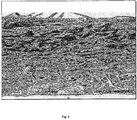
- Fig. 4 is a scanning electron microscope graph illustrating a cross-sectional view of an exemplary filter medium 10.
- filter medium 10 includes a first phase 12 and a second phase 16.
- first phase 12 has a larger air permeability and/or a smaller pressure drop than those of second phase 16.
- Such a phase 12 is hereinafter referred to as an open phase, and such a phase 16 is hereinafter referred to as a tight phase.
- the order of open and tight phases in filter medium 10 is not critical.
- first phase 12 can be a tight phase and second phase 16 can be an open phase.
- a filter medium having a multi-phase structure exhibits significantly improved dust holding capacity and/or dust capture efficiency compared to a filter medium having a single-phase structure (e.g., having a uniform air permeability and/or pressure drop within the structure).
- An open phase in filter medium 10 typically includes a first plurality of fibers and a second plurality of fibers, although in some embodiments, only a first plurality of fibers is used to form the open phase.
- the first plurality of fibers have an air permeability larger than that of the second plurality of fibers.
- the first plurality of fibers can have an air permeability from about 50 cubic feet per minute ("CFM") to about 350 CFM (e.g., from about 100 CFM to about 200 CFM), and the second plurality of fibers can have an air permeability from about 5 CFM to about 50 CFM (e.g., from about 8 CFM to about 37 CFM or from about 15 CFM to about 25 CFM).
- air permeability of fibers is determined by measuring the air permeability of a hand sheet produced exclusively by such fibers and having a basis weight of 100 g/m 2 according to ISO 9237.
- the first plurality of fibers have a pressure drop smaller than that of the second plurality of fibers.
- the first plurality of fibers can have a pressure drop from about 5 Pascals ("Pa") to about 300 Pa (e.g., from about 10 Pa to about 250 Pa or from about 20 Pa to about 100 Pa), and the second plurality of fibers can have a pressure drop from about 300 Pa to about 1,000 Pa (e.g., from about 350 Pa to about 500 Pa).
- pressure drop of fibers is determined by using a gas having a face velocity of 40 cm/s on a hand sheet produced exclusively by such fibers and having a basis weight of 100 g/m 2 according to ASTM F778-88.
- the first plurality of fibers have an average fiber length larger than that of the second plurality of fibers.
- the first plurality of fibers can have an average fiber length from about 1.5 mm to about 6 mm (e.g., from about 2.5 mm to about 4.5 mm)
- the second plurality of fibers can have an average fiber length from about 0.5 mm to about 2 mm (e.g., from about 0.7 mm to about 1.5 mm).
- the materials that can be used to form the first and second pluralities of fibers can vary as desired.
- the first plurality of fibers are made from softwood fibers, cotton fibers, glass fibers, polyester fibers, polyvinyl alcohol binder fibers, or rayon fibers.
- Exemplary softwood fibers include fibers obtained from mercerized southern pine ("mercerized southern pine fibers or HPZ fibers"), northern bleached softwood kraft (e.g., fibers obtained from Robur Flash (“Robur Flash fibers”)), southern bleached softwood kraft (e.g., fibers obtained from Brunswick pine (“Brunswick pine fibers”)), or chemically treated mechanical pulps ("CTMP fibers”).
- HPZ fibers can be obtained from Buckeye Technologies, Inc., Memphis, TN
- Robur Flash fibers can be obtained from Rottneros AB, Sweden
- Brunswick pine fibers can be obtained from Georgia-Pacific, Atlanta, GA.
- the second plurality of fibers are made from hardwood fibers, polyethylene fibers, or polypropylene fibers.
- Exemplary hardwood fibers include fibers obtained from Eucalyptus ("Eucalyptus fibers"). Eucalyptus fibers are commercially available from, e.g., (1) Suzano Group, Suzano, Brazil (“Suzano fibers”), (2) Group Portucel Soporcel, Cacia, Portugal (“Cacia fibers”), (3) Tembec, Inc., Temiscaming, QC, Canada (“Tarascon fibers”), (4) Kartonimex Intercell, Duesseldorf, Germany, (“Acacia fibers”), (5) Mead-Westvaco, Stamford, CT (“Westvaco fibers”), and (6) Georgia-Pacific, Atlanta, GA (“Leaf River fibers”).
- softwood fibers have a relatively large air permeability, small pressure drop, and large average fiber length compared to hardwood fibers.
- an open phase can include a mixture of softwood fibers and hardwood fibers.
- the open phase can include only one type of fibers (e.g., softwood fibers) uniformly distributed within the open phase.
- an open phase can include a mixture of fibers with different characteristics (e.g., different air permeabilities and/or pressure drops). Fibers with different characteristics can be made from one material (e.g., by using different process conditions) or different materials.
- the first plurality of fibers can be formed from a material identical to the material used to form the second plurality of fibers.
- the first and second pluralities of fibers can be prepared by using different preparation methods, or different conditions in the same preparation method, such that they have different characteristics (e.g., different air permeabilities or pressure drops).
- the first and second pluralities of fibers can be formed of the same material and also have the same characteristics.
- the first plurality of fibers can be formed from a material different from the material used to form the second plurality of fibers.
- the weight ratio of the first and second plurality of fibers is in the range about 50:50 to about 90:10 and can vary depending on the desired properties of filter medium 10.
- An open phase in filter medium 10 typically includes fibers with a larger air permeability and/or a smaller pressure drop in an amount larger than the amount of fibers with a smaller air permeability and/or a larger pressure drop.
- a weight ratio of the first and second pluralities of fibers described above can range from about 50:50 to about 70:30 or from about 60:40 to about 70:30).
- the weight of the first or second plurality of fibers refers to the initial weight of each group of fibers in a composition (e.g., a pulp) used to prepare the open phase.
- an open phase in filter medium 10 can include fibers with a larger air permeability and/or a smaller pressure drop in an amount equal to or smaller than the amount of fibers with a smaller air permeability and/or a larger pressure drop.
- an open phase can include one or more pluralities of fibers in addition to the first and second pluralities of fibers.
- Each of the additional pluralities of fibers can have characteristics (e.g., air permeability and/or pressure drop) different from the first or second plurality of fibers, or can be prepared from a material different from those used to prepare the first or second plurality of fibers.
- an additional plurality of fibers can be prepared from a material identical to a material used to form one of the first and second pluralities of fibers, but still have characteristics different from those of the first or second plurality of fibers.
- a tight phase in filter medium 10 typically includes a third plurality of fibers and a fourth plurality of fibers.
- the third plurality of fibers can have the same characteristics (e.g., air permeability and/or pressure drop) or be made from the same type of material as the first or second plurality of fibers described above, and the fourth plurality of fibers can have the same characteristics or be made from the same type of material as the first or second plurality of fibers described above.
- the third plurality of fibers can have one or more characteristics (e.g., air permeability and/or pressure drop), or be made from a type of material, different from those of the first or second plurality of fibers
- the fourth plurality of fibers can have one or more characteristics, or be made from a type of material, different from those of the first or second plurality of fibers.
- a tight phase can include a mixture of softwood fibers and hardwood fibers.
- the tight phase can include only one type of fibers (e.g., hardwood fibers) uniformly distributed within the tight phase.
- a tight phase can include a mixture of fibers with different characteristics (e.g., different air permeabilities and/or pressure drops). Fibers with different characteristics can be made from one material (e.g., by using different process conditions) or different materials.
- the third plurality of fibers can be formed from a material identical to the material used to form the fourth plurality of fibers.
- the third and fourth pluralities of fibers can be prepared by using different preparation methods, or different conditions in the same preparation method, such that they have different characteristics (e.g., different air permeability or pressure drop).
- the third and fourth pluralities of fibers can be formed of the same material and also have the same characteristics.
- the third plurality of fibers can be formed from a material different from the material used to form the fourth plurality of fibers.
- the weight ratio of the third and fourth plurality of fibers can vary depending on the desired properties of filter medium 10 or its intended uses but is within the range about 10:90 to 50:50.
- a tight phase in filter medium 10 typically includes fibers with a higher air permeability and/or a smaller pressure drop in an amount smaller than the amount of fibers with a smaller air permeability and/or a larger pressure drop.
- a weight ratio of the third and fourth pluralities of fibers described above can range from about 25:75 to about 50:50 or from about 30:70 to about 50:50).
- the weight of the third or fourth plurality of fibers refers to the initial weight of each group of fibers in a composition (e.g., a pulp) used to prepare the tight phase.
- a tight phase in filter medium 10 can include fibers with a higher air permeability and/or a smaller pressure drop in an amount larger than or equal to the amount of fibers with a smaller air permeability and/or a larger pressure drop.
- a tight phase can include one or more pluralities of fibers in addition to the third and fourth pluralities of fibers.
- Each of the additional pluralities of fibers can have characteristics (e.g., air permeability or pressure drop) different from the third or fourth plurality of fibers, or can be prepared from a material different from those used to prepare the third or fourth plurality of fibers.
- an additional plurality of fibers can be prepared from a material identical to a material used to form one of the third and fourth pluralities of fibers, but still have characteristics different from those of the third or fourth plurality of fibers.
- the weight ratio of the open and tight phases in filter medium 10 can vary as desired but it is within the range from about 30:70 to about 70:30, e.g. from about 40:60 to about 60:40.
- the basis weight ratio of the open and tight phases is about 30:70 to about 70:30 (e.g., the lower limit being about 40:60, about 50:50 , or about 60:40).
- basis weight of an open or tight phase refers to the weight of the phase over a unit area (e.g., per square meter).
- the basis weight of an open or tight phase can have a unit of grams per square meter.
- filter medium 10 can vary as desired.
- filter medium 10 can have a thickness from 100 microns to 2,000 microns (e.g., from 300 microns to 1,000 microns or from 400 microns to 750 microns). The thickness may be determined according to the standard TAPPI T411.
- filter medium 10 can have any desired basis weight.
- filter medium 10 can have a basis weight of at least about 10 g/m 2 (e.g., at least about 50 g/m 2 or at least about 100 g/m 2 ) and/or at most about 500 g/m 2 (e.g. at most about 250 g/m 2 or at most about 200 g/m 2 ).
- basis weight of a filter medium refers to the weight of the medium over a unit area (e.g., per square meter). A typical unit for the basis weight is g/m 2 .
- the air permeability of filter medium 10 can usually be selected as desired.
- the air permeability of filter medium 10 can be at least about 2 CFM (e.g., at least about 5 CFM, at least.about 10 CFM, or at least about 30 CFM) and/or at most about 200 CFM (e.g., at most about 160 CFM, at most about 120 CFM, or at most about 80 CFM).
- air permeability of a filter medium is determined according to ISO 9237.
- the average pore size of filter medium 10 can vary as desired.
- filter medium 10 can have an average pore size from at least about 3 microns (e.g., at least about 10 microns, at least about 25 microns, or at least about 100 microns) and/or at most about 1,000 microns (e.g., at most about 500 microns, or at most about 125 microns).
- the average pore size refers to the mean flow pore size measured by using a Coulter Porometer as described in ASTM F316-03.
- Filter medium 10 can exhibit good ability to capture dust.
- filter medium 10 can have an initial dust capture efficiency of at least about 25% (e.g., at least about 60%, at least about 80%, at least about 85%, or at least about 90%) and/or at most about 99.5% (e.g., at most about 98% or at most about 95%) measured according to a Palas flat sheet test.
- An initial dust capture efficiency of at least about 25% (e.g., at least about 60%, at least about 80%, at least about 85%, or at least about 90%) and/or at most about 99.5% (e.g., at most about 98% or at most about 95%) measured according to a Palas flat sheet test.
- a description of the Palas flat sheet test used to determine an initial dust capture efficiency is provided in the test protocol section below.
- Filter medium 10 can also have good dust holding properties.
- filter medium 10 can have a dust holding capacity (DHC) of at least about 0.3 g (e.g., at least about 1 g or at least about 2 g) and/or at most about 3 g (e.g., at most about 2.5 g or at most about 2 g) according to a Palas flat sheet test.
- DHC dust holding capacity
- a description of the Palas flat sheet test to determine a dust holding capacity is provided in the test protocol section below.
- filter medium 10 can have a specific dust holding capacity of at least about 0.001 g/g (e.g., at least about 0.004 g/g) and/or at most about 1.0 g/g (e.g., at most about 0.9 g/g).
- specific dust holding capacity can be calculated by dividing a DHC of a filter medium over a unit weight (e.g., per gram) of the filter medium.
- specific dust holding capacity can be calculated by dividing a DHC of a filter medium over a unit thickness (e.g., per millimeter) of the filter medium.
- filter medium 10 has both good dust capture and good dust holding properties.
- filter medium 10 can have an initial dust capture efficiency of at least about 25% (e.g., at least about 60%, at least about 80%, at least about 85%, or at least about 90%) and a dust holding capacity of at least about 0.3 g (e.g., at least about 1 g or at least about 2 g).
- At least the first and third pluralities of fibers described above are made from an organic polymeric material (e.g., softwood fibers, cotton fibers, hardwood fibers, or synthetic organic polymers such as polyester or rayon).
- an organic polymeric material e.g., softwood fibers, cotton fibers, hardwood fibers, or synthetic organic polymers such as polyester or rayon.
- two, three, or all of the first, second, third and fourth pluralities of fibers are made from an organic polymeric material.
- filter medium 10 can further include a binder distributed throughout the filter medium.
- a binder in a filter medium can significantly increase its strength (e.g., tensile strength measured according to ISO 1924-2 or Mullen Burst strength measured according to DIN 53113).
- the binder can include a polymeric material, such as polyvinyl acetate, an epoxy, a polyester, a polyvinyl alcohol, an acrylic (e.g., a styrene acrylic), or a phenolic resin.
- the binder can be at least about 2% and/or at most about 35% (e.g., at most about 25%, at most about 15%, or at most about 5%) of the basis weight of filter medium 10.
- the binder can be present in filter medium 10 with out without the presence of cross-linking agents (e.g., melamine, hexamine, or an epoxy hardener) or other additives (e.g., silicones, fluorocarbons, or catalysts such as ammonium chloride).
- cross-linking agents e.g., melamine, hexamine, or an epoxy hardener
- other additives e.g., silicones, fluorocarbons, or catalysts such as ammonium chloride.
- Filter medium 10 typically includes an interface between first phase 12 and second phase 16.
- the interface can take the form of a transition phase which includes at least a portion of each of the first, second, third, and fourth pluralities of fibers intermingled with each other.
- the interface in filter medium 10 prepared by such a process can be substantially non-linear due to the interaction between the fibers in first phase 12 and second phase 16.
- Fig. 4 shows a scanning electron microscope graph of a dual phase filter medium, in which the interface is substantially non-linear.
- first and second phases which include an interface that is substantially free of an adhesive may be joined by, for example, physical interactions between the fibers in each of the phases, or by other suitable methods that do not involve the use of an adhesive to join the phases. In some cases, first and second phases which include an interface that is substantially free of an adhesive are not joined by lamination.
- filter medium 10 can include one or more phases in additional to first phase 12 and second phase 16.
- An additional phase can be the same as or different from first phase 12 or second phase 16.
- Filter element 100 can be any of a variety of filter elements.
- filter elements include gas turbine filter elements, dust collector elements, heavy duty air filter elements, automotive air filter elements, HVAC air filter elements, HEPA filter elements, vacuum bag filter elements, fuel filter elements, and oil filter elements (e.g., lube oil filter elements or heavy duty lube oil filter elements).
- Filter element 100 can also be in any suitable form, such as radial filter elements, panel filter elements, or channel flow elements.
- a radial filter element can include pleated filter media that are constrained within two open wire meshes in a cylindrical shape. During use, fluids can flow from the outside through the pleated media to the inside of the radial element.
- each of the open and tight phases in a single filter medium 10 can include a mixture of softwood fibers (e.g., Robur Flash fibers) and hardwood fibers (e.g., Suzano fibers).
- the weight ratio of the open and tight phases can be about 30:70 or greater.
- the weight ratio of the softwood fibers and hardwood fibers in the open phase can be, for example, about 85:15, and the weight ratio of the softwood fibers and hardwood fibers in the tight phase can be, for example, about 49:51.
- each of the open and tight phases in a single filter medium 10 can include a mixture of softwood fibers and hardwood fibers (e.g., Suzano fibers).
- the weight ratio of the open and tight phases can be about 50:50.
- the weight ratio of the softwood fibers and hardwood fibers in the open phase can be about 93:7, and the weight ratio of the softwood fibers and hardwood fibers in the tight phase can be about 65:35.
- Each of the open and tight phases can be made from two types of different softwood fibers (e.g., Robur Flash fibers and HPZ fibers).
- the weight ratio of the two types of different softwood fibers in the open phase can be about 83:10 (e.g., about 83% mercerized southern pine fibers and about 10% of Robur Flash fibers).
- the weight ratio of the two types of different softwood fibers in the tight phase can be about 40:25 (e.g., about 40% HPZ fibers and about 25% of Robur Flash fibers).
- each of the open and tight phases in a single filter medium 10 can include a mixture of softwood fibers and hardwood fibers.
- the weight ratio of the open and tight phases can be about 50:50.
- the weight ratio of the softwood fibers and hardwood fibers in the open phase can be about 60:40, and the weight ratio of the softwood fibers and hardwood fibers in the tight phase can be about 6:94.
- the open phase can be made from two types of different softwood fibers with a weight ratio of about 40:20 (e.g., about 40% HPZ fibers and about 20% of Robur Flash), and a type of hardwood fibers (e.g., about 40% of Suzano fibers).
- the tight phase can be made of three types of different hardwood fibers with a weight ratio of about 48:36:10 (e.g., about 48% Suzano fibers, about 36% of Tarascon fibers, and about 10% Acacia fibers) and a type of softwood fibers (e.g., about 6% HPZ fibers).
- second phase 16 is upstream of first phase 12 in the direction of gas flow through a filter element. In certain embodiments, second phase 16 is downstream of first phase 12 in the direction of gas flow through a filter element. As an example, when the gas filter element is a gas turbine filter element or a heavy duty air filter element, second phase 16 can be upstream of first phase 12 in the direction of gas flow through the filter element. As another example, when improved depth filtration is desired, second phase 16 can be downstream of first phase 12 in the direction of gas flow through the filter element.
- filter medium 10 can be made by any suitable methods.
- filter medium 10 can be prepared by a wet laid process as follows: First, a first dispersion (e.g., a pulp) containing first and second pluralities of fibers in a solvent (e.g., an aqueous solvent such as water) can be applied onto a wire conveyor in a papermaking machine (e.g., a fourdrinier or a rotoformer) to form first phase 12 supported by the wire conveyor. A second dispersion (e.g., another pulp) containing third and fourth pluralities of fibers in a solvent (e.g., an aqueous solvent such as water) is then applied onto first phase 12.
- a first dispersion e.g., a pulp
- a solvent e.g., an aqueous solvent such as water
- first phase 12 and second phase 16 in a multi-phase filter medium 10 do not have macroscopic phase separation as shown in a conventional multi-layer filter medium (e.g., where one layer is laminated onto another layer in the filter medium), but instead contain an interface in which microscopic phase transition occurs depending on the fibers used or the forming process (e.g., how much vacuum is applied).
- a polymeric material can be impregnated into filter medium 10 either during or after filter medium 10 is being manufactured on a papermaking machine.
- a polymeric material in a water based emulsion or an organic solvent based solution can be adhered to an application roll and then applied to the article under a controlled pressure by using a size press or gravure saturator.
- the amount of the polymeric material impregnated into filter medium 10 typically depends on the viscosity, solids content, and absorption rate of filter medium 10.
- filter medium 10 after filter medium 10 is formed, it can be impregnated with a polymeric material by using a reverse roll applicator following the just-mentioned method and/or by using a dip and squeeze method (e.g., by dipping a dried filter media into a polymer emulsion or solution and then squeezing out the excess polymer by using a nip).
- a polymeric material can also be applied to filter medium 10 by other methods known in the art, such as spraying or foaming.
- filter medium 10 can be prepared by a continuous manufacturing process (e.g., a roll-to-roll manufacturing process) or can be prepared in a noncontinuous, batch-to-batch manner.
- a 100 cm 2 surface area of a filter medium was challenged with a fine dust (0.1-80 ⁇ M) at a concentration of 200 mg/cm 3 with a face velocity of 20 cm/s for one minute.
- the dust capture efficiency was measured using a Palas MFP2000 fractional efficiency photodetector.
- the dust capture efficiency was [(1 -[C/C0])*100%], where C was the dust particle concentration after passage through the filter and C0 was the particle concentration before passage through the filter.
- the dust capture efficiency was measured after one minute and is referred to herein as the initial dust capture efficiency.
- the dust holding capacity is measured when the pressure reaches 1,800 Pa, and is the difference in the weight of the filter medium before the exposure to the fine dust and the weight of the filter medium after the exposure to the fine dust. This test is referred to herein as a Palas flat sheet test.
- an A2 fine dust is fed at a rate of 0.3 liters per minute into Mobil MIL-H-5606 fuel for a total flow rate of 1.7 liters per minute to contact a filter medium per ISO 16889 until a terminal pressure of 174 KPa above the baseline filter pressure drop is obtained.
- Particle counts particles per milliliter are taken at the particle sized selected (in this case 4, 5, 7, 10, 15, 20, 25 and 30 microns). The particle counts are taken upstream and downstream of the media at ten points equally divided over the time of the test. The average of upstream and downstream particle counts are taken at each selected particle size.
- the liquid filtration efficiency test value for each particle size selected is determined by the relationship [(100 -[C/C 0 ])*100%].
- the liquid filtration retention efficiency as a function of time and particle size can also be measured by comparing the upstream and downstream particle counts (and determining efficiency [(100 -[C/C0])*100%]) at the sequential ten points in the test. This test is referred to herein as a multi-pass flat sheet test.
- Single phase and dual phase filter media were prepared on a trial paper machine (TPM).
- the single phase filter media were prepared using a blend of HPZ fibers and Suzano fibers.
- the weight ratios of the HPZ fibers and Suzano fibers in the blend were 90/10, 70/30, and 50/50, respectively.
- the dual phase filter media were prepared using HPZ fibers to form an open phase and Suzano fibers to form a tight phase, in which the weight ratios of the HPZ fibers and Suzano fibers were also 90/10, 70/30, and 50/50, respectively.
- a flow separation insert was used to separate the pulp containing HPZ fibers from the pulp containing Suzano fibers.
- the open phase was formed on the bottom of a dual phase filter medium and the tight phase was formed at the top.
- the dual phase filter media thus formed had a density equivalent to the single phase filter media. Both the single and dual phase filter media were not saturated with a resin for improving the strength of the media.
- the filter media were refined by passing the pulps used to form the filter media twice through a refiner with a load energy of 35 Amps to meet specific air permeability target for each grade. Each type of filter medium was replicated three times. The filter media were then tested for their capacity performance using a Palas air stand according to the Palas flat sheet test described above, tested for their Mullen Burst strength according to DIN 53113, and tested for their tensile strength according to ISO 1924-2.
- filter media 1, 2, and 3 Three types of automotive air filter media (i.e., filter media 1, 2, and 3) in both single phase and dual phase of a sufficient size to allow for saturation and element testing were produced on a fourdrinier in a manner similar to that described in Example 1.
- the single phase filter media were prepared using a blend of fibers. Specifically, single phase filter media 1 contained a blend of about 47 wt% of HPZ fibers and about 53 wt% of Cacia fibers, single phase filter media 2 contained a blend of about 70 wt% HPZ fibers and about 30 wt% of Suzano fibers, and single phase filter media 3 contained a blend of about 81 wt% HPZ fibers, about 9.5 wt% Leaf River fibers, and about 9.5 wt% Cacia fibers.
- the dual phase filter media were prepared using HPZ fibers to form an open phase and Suzano, Cacia, or Leaf River fibers to form a tight phase.
- dual phase filter media 1 contained about 47 wt% of HPZ fibers in the open phase and about 53 wt% of Cacia fibers in the tight phase
- dual phase filter media 2 contained about 70 wt% HPZ fibers in the open phase and about 30 wt% of Suzano fibers in the tight phase
- dual phase filter media 3 contained about 81 wt% HPZ fibers in the open phase, and about 9.5 wt% Leaf River fibers and about 9.5 wt% Cacia fibers in the tight phase.
- the above filter media were subsequently saturated with an epoxy resin by using an impregnation machine.
- the filter media were refined in the same manner as described in Example 1 to meet specific air permeability target for each grade.
- Panel air elements and cylindrical elements containing each type of filter medium were produced. Specifically, a panel air element was produced by assembling a pleated filter medium between a molded silicone elastomer which holds the filter medium around the edges. A cylindrical element was produced by wrapping a pleated medium around a center tube, placing the article thus formed into a can, and sealing the can. The panel air element is generally used for high CFM automotive air, while the cylindrical element is generally used for low CFM heavy duty Air.
- Mullen Burst and tensile strength of the single phase and dual phase filter media prepared above were measured. The results showed that the dual phase filter media exhibited a reduction in strength compared to the single phase filter media. The impact of the reduction was however less after the filter media was saturated with the epoxy resin.
- the Mullen Burst strength of the dual phase filter media was an average of about 80% of that of the single phase filter media depending upon the grade. Tensile strength comparisons between the two types of filter media showed a similar trend. In all cases, enough strength was present to effectively process the dual phase filter media.
- an interlayer design was used to produce dual phase filter media 4 using a rotoformer.
- an interlayer design refers to a design that include a mixture of fibers with different characteristics in one or both of the open and tight phases.
- dual phase filter media 4 contained about 45 wt% bottom phase (a tight phase) that included about 72 wt% Suzano fibers and about 28 wt% Robur Flash fibers, and about 55 wt% top phase (an open phase) that included about 15 wt% Suzano fibers and about 85 wt% Robur Flash fibers.
- Single phase filter media 4 were produced using about 40 wt% of Suzano fibers and about 60 wt% Robur Flash fibers.
- the performance of the filter media thus prepared are summarized in Table 1. Each value is an average of three tests per sample. After the filter media were formed, they were corrugated by compressing the media between two grooved corrugator rolls using sufficient pressure to result in machine directional grooves or corrugations in the filter media.
- dual phase filter media 4 exhibited significant improvement in DHC (about 26%) and specific DHC (from about 14-33%) compared to single phase filter media 4 when measured using the Palas flat sheet test described above. Further, dual phase filter media 4 showed little strength degradation compared to single phase filter media 4. It is believed that the interlayer design effectively addressed the strength loss issue observed in Examples 1 and 2.
- Single phase (SP) filter media 5 contained a blend of about 28 wt% HPZ fibers, about 48 wt% Cacia fibers, and about 30 wt% Robur Flash fibers.
- Dual phase (DP) filter media 5 contained about 50 wt% of a tight phase and about 50 wt% of an open phase.
- the tight phase included about 12 wt% HPZ fibers, about 68 wt% Cacia fibers, and about 20 wt% Robur Flash fibers.
- the open phase included about 40 wt% HPZ fibers, about 30 wt% Cacia fibers, and about 30 wt% Robur Flash fibers.
- Single phase filter media 6 contained a blend of about 58.2 wt% HPZ fibers and about 41.8 wt% of Suzano fibers. Dual phase filter media 6 contained 80 wt% of a tight phase and about 20 wt% of an open phase.
- the tight phase included about 52 wt% HPZ fibers, about 48 wt% Suzano fibers.
- the open phase included about 83 wt% HPZ fibers, about 17 wt% Robur Flash fibers.
- Single phase filter media 7 contained a blend of about 24.5 wt% polyester fibers, about 43.7 wt% HPZ fibers, about 28.9 wt% Suzano fibers, and about 3 wt% CTMP fibers.
- Dual phase filter media 7 contained about 70 wt% of a tight phase and about 30 wt% of an open phase.
- the tight phase included about 26 wt% polyester fibers, about 37 wt% HPZ fibers, and about 37 wt% of Suzano fibers.
- the open phase included about 21 wt% polyester fibers, about 59 wt% HPZ fibers, about 10 wt% Suzano fibers, and about 10 wt% CTMP fibers.
- the dual phase filter media exhibited significant improvement in DHC when measured using the PALAS flat sheet test described above.
- Dual phase and single phase filter media were produced to target specifications using a rotoformer. Specifically, the following filter media were produced in the same manner as that described in Examples 3 and 4: (1) dual phase filter media 8, 9, and 10, and (2) single phase filter media 12 and 13 as controls. An interlayer approach was used to produce dual phase filter media. The compositions of these dual phase and single phase filter media are summarized in Table 3 below. In the dual phase filter media, the bottom phase was a tight phase and the top phase was an open phase.
- DP 8 and DP 9 exhibited at least 20% improvement in DHC and at least 15% improvement in specific DHC compared to SP 12.
- DP 10 also exhibited about 10% improvement in DHC and about 17% improvement in specific DHC compared to SP 11.
- the strength of the filter media above were also tested. The results showed that the strength of the dual phase filter media was about 10% lower than that of the single phase filter media, and was more significant for DP10 as compared to SP11.
- DP 8 and SP 12 were incorporated into radial filter elements and tested using a radial element test designed to simulate heavy duty air face velocity of 8 ft/min. Compared to elements containing SP 12, elements containing DP 8 exhibited about 23% improvement in DHC and specific DHC calculated based on per square meter of a filter medium.
- the optimized dual phase filter media showed from about 23% to about 52% increase in DHC and specific DHC compared to the single phase filter media, while strength loss in the dual phase filter media averaged about 10% compared to the single phase filter media.
Landscapes
- Chemical & Material Sciences (AREA)
- Chemical Kinetics & Catalysis (AREA)
- Engineering & Computer Science (AREA)
- Water Supply & Treatment (AREA)
- Textile Engineering (AREA)
- Filtering Materials (AREA)
- Lubrication Details And Ventilation Of Internal Combustion Engines (AREA)
- Networks Using Active Elements (AREA)
- Laminated Bodies (AREA)
Description
- This disclosure relates to multi-phase filter media, as well as related articles, components, filter elements, and methods.
- Filter media are used in a variety of systems. The media are typically used to remove undesirable materials (e.g., particles) from a liquid or gas by passing the liquid or gas through the media.
-
US 6 183 536 discloses a vacuum filter bag constructed of layers which include a high air permeability multipurpose layer positioned upstream in the direction of air flow of a second filtration layer. The second filtration layer can be a wet-laid filter paper, a dry-laid filter paper or a spunbond nonwoven. The multipurpose layer can be made of high bulk meltblown nonwoven, dry-laid or wet-laid high dust holding capacity paper spunblown modular or microdenier spunbond. The high dust capacity papers are characterized by greater thickness and higher air permeability than is normally used in traditional filter layers of vacuum cleaner bag structures. These characteristics allow the high capacity papers to filter large dirt particles and to capture within their pores large amounts of dust particles. This protects the downstream second filtration layer from shock loading and enables the composite structure to pass air at high rate at low pressure differential for much longer than conventional vacuum cleaner bags. -
US 2008/245037 discloses a crankcase ventilation filter including: - (a) a first, wet laid, media stage comprising:
- (i) at least 30% by weight, based on total weight of fiber material in the stage, bicomponent fiber material having an average largest fiber cross-sectional dimension of at least 10 microns and average length of 1-20 mm, inclusive; and
- (ii) at least 30% by weight, based on total weight of fiber material in the stage, secondary fiber material having an average largest fiber cross-sectional dimension of at least 1 micron and average length of 1 to 20 mm, inclusive; and
- (b) the first, wet laid, media stage having:
- (i) calculated pore size, X-Y direction, of 12 to 50 microns, inclusive; and
- (ii) an added binder resin content, if any, of no greater than 7% by total weight of fiber material.
-
US 3 353 682 discloses various microporous fluid-permeable materials. - The present invention relates to:
- An article, comprising:
- a first phase comprising a first plurality of fibers and a second plurality of fibers different from the first plurality of fibers;
- a second phase comprising a third plurality of fibers and a fourth plurality of fibers different from the third plurality of fibers, the third plurality of fibers being the same as or different from the first or second plurality of fibers and the fourth plurality of fibers being the same as or different from the first or second plurality of fibers; and
- a transition phase between the first and second phases, wherein the transition phase comprises at least a portion of the first plurality of fibers, at least a portion of the second plurality of fibers, at least a portion of the third plurality of fibers, and at least a portion of the fourth plurality of fibers, and wherein at least a portion of the first plurality of fibers, at least a portion of the second plurality of fibers, at least a portion of the third plurality of fibers, and at least a portion of the fourth plurality of fibers are intermingled with each other,
- wherein the air permeability of the first plurality of fibers is higher than the air permeability of the second plurality of fibers, and the air permeability of the third plurality of fibers is higher than the air permeability of the fourth plurality of fibers, wherein the air permeability is determined using a handsheet produced exclusively by such fibers and having a basis weight of 100 g/m2 according to the standard ISO 9237,
- wherein the first and third pluralities of fibers are made from an organic polymeric material,
- wherein a weight ratio of the first and second pluralities of fibers is from about 50:50 to about 90:10, and a weight ratio of the third and fourth pluralities of fibers is from about 10:90 to about 50:50,wherein the basis weight ratio of the first phase to the second phase is from 30:70 to 70:30, and
- wherein the first and second phases form a wet laid structure that is configured as a filter medium.
- In one aspect of the invention, the pressure drop of the first plurality of fibers is lower than the pressure drop of the second plurality of fibers. The pressure drop of the third plurality of fibers is lower than the pressure drop of the fourth plurality of fibers. The pressure drop of the fibers is defined in the Detailed Description section below.
- In another aspect, the first phase includes a first plurality of softwood fibers. The second phase includes a first plurality of hardwood fibers.
- In another aspect, the first plurality of fibers are prepared from a material (e.g., softwood fibers) different from a material (e.g., hardwood fibers or a different type of softwood fibers) used to prepare the second plurality of fibers. The third plurality of fibers are prepared from a material (e.g., softwood fibers) different from a material (e.g., hardwood fibers or a different type of softwood fibers) used to prepare the fourth plurality of fibers. In still another aspect, the first plurality of fibers are prepared from a material (e.g., softwood fibers) different from a material (e.g., hardwood fibers or a different type of softwood fibers) used to prepare the second plurality of fibers. The third plurality of fibers are prepared from a material (e.g., softwood fibers) different from a material (e.g., hardwood fibers or a different type of softwood fibers) used to prepare the fourth plurality of fibers. The pressure drop of the first plurality of fibers is lower than the pressure drop of the second plurality of fibers. The pressure drop of the third plurality of fibers is lower than the pressure drop of the fourth plurality of fibers. In another aspect, the air permeability of the first plurality of fibers is higher than the air permeability of the second plurality of fibers. The air permeability of the third plurality of fibers is higher than the air permeability of the fourth plurality of fibers. The first phase has a higher air permeability than the second phase.
- In yet another aspect, this disclosure features a filter element that includes one of the articles described above.
- In a further aspect, this disclosure features a method that includes (1) disposing through a wet laid process a first dispersion containing first and second pluralities of fibers described above in a first solvent onto a wire to form a first phase, (2) while the first and second pluralities of fibers are on the wire, disposing a second dispersion containing third and fourth pluralities of fibers described above in a second solvent onto the first and second pluralities of fibers to form a second phase, and (3) at least partially removing the first and second solvents, thereby resulting in one of the articles described above.
- Embodiments can include one or more of the following features.
- The air permeability of the first or third plurality of fibers can be from about 50 CFM to about 350 CFM (e.g., from about 100 CFM to about 200 CFM). The air permeability of the second or fourth plurality of fibers can be from about 5 CFM to about 50 CFM (e.g., from about 15 CFM to about 25 CFM).
- The weight ratio of the first and second pluralities of fibers is from about 50:50 to about 90:10 (e.g., from about 50:50 to about 70:30 or from about 60:40 to about 70:30). The weight ratio of the third and fourth pluralities of fibers is from about 10:90 to about 50:50 (e.g., from about 25:75 to about 50:50 or from about 30:70 to about 50:50).
- The pressure drop of the first or third plurality of fibers can be from about 5 Pa to about 300 Pa (e.g., from about 20 Pa to about 100 Pa). The pressure drop of the second or fourth plurality of fibers can be from about 300 Pa to about 1,000 Pa (e.g., from about 250 Pa to about 500 Pa).
- The first or third plurality of fibers can have an average fiber length from about 1.5 mm to about 6 mm. The second or fourth plurality of fibers can have an average fiber length from about 0.5 mm to about 2 mm.
- The first or third plurality of fibers can include softwood fibers (e.g., fibers obtained from mercerized southern pine, northern bleached softwood kraft, southern bleached softwood kraft, or chemically treated mechanical pulps), cotton fibers, polyester fibers, polyvinyl alcohol binder fibers, or rayon fibers. The second or fourth plurality of fibers can include hardwood fibers (e.g., fibers obtained from Eucalyptus), polyethylene fibers, or polypropylene fibers.
- The basis weight ratio of the first and second phases is from about 30:70 to about 70:30, or from about 40:60 to about 60:40. In certain embodiments, the basis weight ratio of the first and second phases is about 30:70 or greater (e.g., about 40:60 or greater, about 50:50 or greater, or about 60:40 or greater). In some cases, the first phase has a higher air permeability than the second phase.
- The article can further include a binder (e.g., polyvinyl acetate, an epoxy, a polyester, a polyvinyl alcohol, an acrylic such as a styrene acrylic, or a phenolic resin). The binder can be at least about 2% or at most about 35% of the basis weight of the article.
- The article can have an average pore size from about 3 microns to about 1,000 microns (e.g., from about 25 microns to about 125 microns).
- The article can have a dust holding capacity from about 0.3 g to about 3 g (e.g., from about 1 g to about 3 g) measured according to a Palas flat sheet test.
- The article can have an initial dust capture efficiency from about 25% to about 99.5% (e.g., from about 60% to about 99.5%).
- The first and third pluralities of fibers can be prepared from the same material; the second and fourth pluralities of fibers can be prepared from the same material. The first and second pluralities of fibers can be prepared from the same material; the third and fourth pluralities of fibers can be prepared from the same material.
- The first plurality of fibers can be prepared from a material different from a material used to prepare the second plurality of fibers; the third plurality of fibers can be prepared from a material different from a material used to prepare the fourth plurality of fibers.
- Each of the first, second, third, and fourth pluralities of fibers can be made from an organic polymeric material.
- The first or second phase can include one or more additional pluralities of fibers.
- The interface between the first and second phases can be substantially non-linear or substantially free of an adhesive.
- The filter element can include a radial filter element, a panel filter element, or a channel flow element.
- The filter element can include a gas turbine filter element, a dust collector element, a heavy duty air filter element (e.g., containing a filter medium in which the weight ratio of the first and second pluralities of fibers is from about 85:15, and the weight ratio of the third and fourth pluralities of fibers is from about 49:51), an automotive air filter element (e.g., containing a filter medium in which the first phase includes three pluralities of fibers with a weight ratio of about 83:10:7, and the second phase includes three pluralities of fibers with a weight ratio of about 40:35:25), a HVAC air filter element, a HEPA filter element, a vacuum bag filter element, a fuel filter element, or an oil filter element.
- The first phase can further include a second plurality of hardwood fibers, the second plurality of hardwood fibers being the same as or different from the first plurality of hardwood fibers.
- The second phase can further include a second plurality of softwood fibers, the second plurality of softwood fibers being the same as or different from the first plurality of softwood fibers.
- Embodiments can provide one or more of the following advantages.
- Without wishing to be bound by theory, it is believed that, by blending fibers with different characteristics in one or more phases, one can obtain a filter medium having a multi-phase structure (e.g., having phases with different air permeabilities and/or pressure drops) with significantly improved dust holding capacity and/or dust capture efficiency without substantial degradation in mechanical strength compared to a filter medium having a single phase structure (e.g., having a uniform air permeability and/or pressure drop within the structure).
- Other features, objects, and advantages of the invention will be apparent from the description, drawings, and claims.
-
-
Fig. 1 is a cross-sectional view of a filter medium; -
Fig. 2 is a cross-sectional view of a pleated filter medium; -
Fig. 3 is partial cut-away perspective view of a filter element including a filter medium. -
Fig. 4 is a scanning electron microscope graph illustrating a cross-sectional view of a dual phase filter medium. - Like reference symbols in the various drawings indicate like elements.
- This disclosure relates to multi-phase filter media, as well as related articles, components, filter elements, and methods.
Fig. 1 is a cross-sectional view of an exemplary filter medium 10 that includes afirst phase 12 and asecond phase 16.Fig. 2 depicts a typical pleated configuration offilter medium 10.Fig. 3 shows a cut-away perspective of anexemplary filter element 100 including afilter housing 101, afilter cartridge 102, aninner screen 108 and anouter screen 103.Filter medium 10 is disposed infilter cartridge 102. During use, a gas or liquid enterselement 100 via anopening 104 and then passes throughinner screen 108,filter medium 10 andouter screen 103. The gas or liquid then exitsfilter element 100 viaopening 106.Fig. 4 is a scanning electron microscope graph illustrating a cross-sectional view of anexemplary filter medium 10. - As shown in
Fig. 1 ,filter medium 10 includes afirst phase 12 and asecond phase 16. In some embodiments,first phase 12 has a larger air permeability and/or a smaller pressure drop than those ofsecond phase 16. Such aphase 12 is hereinafter referred to as an open phase, and such aphase 16 is hereinafter referred to as a tight phase. The order of open and tight phases infilter medium 10 is not critical. In some embodiment,first phase 12 can be a tight phase andsecond phase 16 can be an open phase. - Without wishing to be bound by theory, it is believed that a filter medium having a multi-phase structure (e.g., having phases with different air permeabilities and/or pressure drops) exhibits significantly improved dust holding capacity and/or dust capture efficiency compared to a filter medium having a single-phase structure (e.g., having a uniform air permeability and/or pressure drop within the structure).
- An open phase in
filter medium 10 typically includes a first plurality of fibers and a second plurality of fibers, although in some embodiments, only a first plurality of fibers is used to form the open phase. - The first plurality of fibers have an air permeability larger than that of the second plurality of fibers. For example, the first plurality of fibers can have an air permeability from about 50 cubic feet per minute ("CFM") to about 350 CFM (e.g., from about 100 CFM to about 200 CFM), and the second plurality of fibers can have an air permeability from about 5 CFM to about 50 CFM (e.g., from about 8 CFM to about 37 CFM or from about 15 CFM to about 25 CFM). As used herein, air permeability of fibers is determined by measuring the air permeability of a hand sheet produced exclusively by such fibers and having a basis weight of 100 g/m2 according to ISO 9237.
- In some embodiments, the first plurality of fibers have a pressure drop smaller than that of the second plurality of fibers. For example, the first plurality of fibers can have a pressure drop from about 5 Pascals ("Pa") to about 300 Pa (e.g., from about 10 Pa to about 250 Pa or from about 20 Pa to about 100 Pa), and the second plurality of fibers can have a pressure drop from about 300 Pa to about 1,000 Pa (e.g., from about 350 Pa to about 500 Pa). As used herein, pressure drop of fibers is determined by using a gas having a face velocity of 40 cm/s on a hand sheet produced exclusively by such fibers and having a basis weight of 100 g/m2 according to ASTM F778-88.
- In some embodiments, the first plurality of fibers have an average fiber length larger than that of the second plurality of fibers. For example, the first plurality of fibers can have an average fiber length from about 1.5 mm to about 6 mm (e.g., from about 2.5 mm to about 4.5 mm), and the second plurality of fibers can have an average fiber length from about 0.5 mm to about 2 mm (e.g., from about 0.7 mm to about 1.5 mm).
- In general, the materials that can be used to form the first and second pluralities of fibers can vary as desired. In some embodiments, the first plurality of fibers are made from softwood fibers, cotton fibers, glass fibers, polyester fibers, polyvinyl alcohol binder fibers, or rayon fibers. Exemplary softwood fibers include fibers obtained from mercerized southern pine ("mercerized southern pine fibers or HPZ fibers"), northern bleached softwood kraft (e.g., fibers obtained from Robur Flash ("Robur Flash fibers")), southern bleached softwood kraft (e.g., fibers obtained from Brunswick pine ("Brunswick pine fibers")), or chemically treated mechanical pulps ("CTMP fibers"). For example, HPZ fibers can be obtained from Buckeye Technologies, Inc., Memphis, TN; Robur Flash fibers can be obtained from Rottneros AB, Stockholm, Sweden; and Brunswick pine fibers can be obtained from Georgia-Pacific, Atlanta, GA.
- In some embodiments, the second plurality of fibers are made from hardwood fibers, polyethylene fibers, or polypropylene fibers. Exemplary hardwood fibers include fibers obtained from Eucalyptus ("Eucalyptus fibers"). Eucalyptus fibers are commercially available from, e.g., (1) Suzano Group, Suzano, Brazil ("Suzano fibers"), (2) Group Portucel Soporcel, Cacia, Portugal ("Cacia fibers"), (3) Tembec, Inc., Temiscaming, QC, Canada ("Tarascon fibers"), (4) Kartonimex Intercell, Duesseldorf, Germany, ("Acacia fibers"), (5) Mead-Westvaco, Stamford, CT ("Westvaco fibers"), and (6) Georgia-Pacific, Atlanta, GA ("Leaf River fibers"). In general, softwood fibers have a relatively large air permeability, small pressure drop, and large average fiber length compared to hardwood fibers.
- In some embodiments, an open phase can include a mixture of softwood fibers and hardwood fibers. In certain embodiments, the open phase can include only one type of fibers (e.g., softwood fibers) uniformly distributed within the open phase.
- In some embodiments, an open phase can include a mixture of fibers with different characteristics (e.g., different air permeabilities and/or pressure drops). Fibers with different characteristics can be made from one material (e.g., by using different process conditions) or different materials.
- In some embodiments, the first plurality of fibers can be formed from a material identical to the material used to form the second plurality of fibers. In such embodiments, the first and second pluralities of fibers can be prepared by using different preparation methods, or different conditions in the same preparation method, such that they have different characteristics (e.g., different air permeabilities or pressure drops). In certain embodiments, the first and second pluralities of fibers can be formed of the same material and also have the same characteristics. In some embodiments, the first plurality of fibers can be formed from a material different from the material used to form the second plurality of fibers.
- The weight ratio of the first and second plurality of fibers is in the range about 50:50 to about 90:10 and can vary depending on the desired properties of
filter medium 10. An open phase infilter medium 10 typically includes fibers with a larger air permeability and/or a smaller pressure drop in an amount larger than the amount of fibers with a smaller air permeability and/or a larger pressure drop. For example, a weight ratio of the first and second pluralities of fibers described above can range from about 50:50 to about 70:30 or from about 60:40 to about 70:30). As used herein, the weight of the first or second plurality of fibers refers to the initial weight of each group of fibers in a composition (e.g., a pulp) used to prepare the open phase. In certain embodiments, an open phase infilter medium 10 can include fibers with a larger air permeability and/or a smaller pressure drop in an amount equal to or smaller than the amount of fibers with a smaller air permeability and/or a larger pressure drop. - In some embodiments, an open phase can include one or more pluralities of fibers in addition to the first and second pluralities of fibers. Each of the additional pluralities of fibers can have characteristics (e.g., air permeability and/or pressure drop) different from the first or second plurality of fibers, or can be prepared from a material different from those used to prepare the first or second plurality of fibers. In some embodiments, an additional plurality of fibers can be prepared from a material identical to a material used to form one of the first and second pluralities of fibers, but still have characteristics different from those of the first or second plurality of fibers.
- A tight phase in
filter medium 10 typically includes a third plurality of fibers and a fourth plurality of fibers. - In some embodiments, the third plurality of fibers can have the same characteristics (e.g., air permeability and/or pressure drop) or be made from the same type of material as the first or second plurality of fibers described above, and the fourth plurality of fibers can have the same characteristics or be made from the same type of material as the first or second plurality of fibers described above.
- In some embodiments, the third plurality of fibers can have one or more characteristics (e.g., air permeability and/or pressure drop), or be made from a type of material, different from those of the first or second plurality of fibers, and the fourth plurality of fibers can have one or more characteristics, or be made from a type of material, different from those of the first or second plurality of fibers.
- In some embodiments, a tight phase can include a mixture of softwood fibers and hardwood fibers. In certain embodiments, the tight phase can include only one type of fibers (e.g., hardwood fibers) uniformly distributed within the tight phase.
- In some embodiments, a tight phase can include a mixture of fibers with different characteristics (e.g., different air permeabilities and/or pressure drops). Fibers with different characteristics can be made from one material (e.g., by using different process conditions) or different materials.
- In some embodiments, the third plurality of fibers can be formed from a material identical to the material used to form the fourth plurality of fibers. In such embodiments, the third and fourth pluralities of fibers can be prepared by using different preparation methods, or different conditions in the same preparation method, such that they have different characteristics (e.g., different air permeability or pressure drop). In certain embodiments, the third and fourth pluralities of fibers can be formed of the same material and also have the same characteristics. In some embodiments, the third plurality of fibers can be formed from a material different from the material used to form the fourth plurality of fibers.
- Generally, the weight ratio of the third and fourth plurality of fibers can vary depending on the desired properties of
filter medium 10 or its intended uses but is within the range about 10:90 to 50:50. A tight phase infilter medium 10 typically includes fibers with a higher air permeability and/or a smaller pressure drop in an amount smaller than the amount of fibers with a smaller air permeability and/or a larger pressure drop. For example, a weight ratio of the third and fourth pluralities of fibers described above can range from about 25:75 to about 50:50 or from about 30:70 to about 50:50). As used herein, the weight of the third or fourth plurality of fibers refers to the initial weight of each group of fibers in a composition (e.g., a pulp) used to prepare the tight phase. In some embodiments, a tight phase infilter medium 10 can include fibers with a higher air permeability and/or a smaller pressure drop in an amount larger than or equal to the amount of fibers with a smaller air permeability and/or a larger pressure drop. - In some embodiments, a tight phase can include one or more pluralities of fibers in addition to the third and fourth pluralities of fibers. Each of the additional pluralities of fibers can have characteristics (e.g., air permeability or pressure drop) different from the third or fourth plurality of fibers, or can be prepared from a material different from those used to prepare the third or fourth plurality of fibers. In some embodiments, an additional plurality of fibers can be prepared from a material identical to a material used to form one of the third and fourth pluralities of fibers, but still have characteristics different from those of the third or fourth plurality of fibers.
- In general, the weight ratio of the open and tight phases in
filter medium 10 can vary as desired but it is within the range from about 30:70 to about 70:30, e.g. from about 40:60 to about 60:40. The basis weight ratio of the open and tight phases is about 30:70 to about 70:30 (e.g., the lower limit being about 40:60, about 50:50 , or about 60:40). As used herein, basis weight of an open or tight phase refers to the weight of the phase over a unit area (e.g., per square meter). For example, the basis weight of an open or tight phase can have a unit of grams per square meter. - In general, the thickness of
filter medium 10 can vary as desired. For example,filter medium 10 can have a thickness from 100 microns to 2,000 microns (e.g., from 300 microns to 1,000 microns or from 400 microns to 750 microns). The thickness may be determined according to the standard TAPPI T411. - Generally, filter medium 10 can have any desired basis weight. For example,
filter medium 10 can have a basis weight of at least about 10 g/m2 (e.g., at least about 50 g/m2 or at least about 100 g/m2) and/or at most about 500 g/m2 (e.g. at most about 250 g/m2 or at most about 200 g/m2). As used herein, basis weight of a filter medium refers to the weight of the medium over a unit area (e.g., per square meter). A typical unit for the basis weight is g/m2. - The air permeability of
filter medium 10 can usually be selected as desired. For example, the air permeability offilter medium 10 can be at least about 2 CFM (e.g., at least about 5 CFM, at least.about 10 CFM, or at least about 30 CFM) and/or at most about 200 CFM (e.g., at most about 160 CFM, at most about 120 CFM, or at most about 80 CFM). As used herein, air permeability of a filter medium is determined according to ISO 9237. - The average pore size of
filter medium 10 can vary as desired. For example,filter medium 10 can have an average pore size from at least about 3 microns (e.g., at least about 10 microns, at least about 25 microns, or at least about 100 microns) and/or at most about 1,000 microns (e.g., at most about 500 microns, or at most about 125 microns). As used herein, the average pore size refers to the mean flow pore size measured by using a Coulter Porometer as described in ASTM F316-03. -
Filter medium 10 can exhibit good ability to capture dust. For example,filter medium 10 can have an initial dust capture efficiency of at least about 25% (e.g., at least about 60%, at least about 80%, at least about 85%, or at least about 90%) and/or at most about 99.5% (e.g., at most about 98% or at most about 95%) measured according to a Palas flat sheet test. A description of the Palas flat sheet test used to determine an initial dust capture efficiency is provided in the test protocol section below. -
Filter medium 10 can also have good dust holding properties. For example,filter medium 10 can have a dust holding capacity (DHC) of at least about 0.3 g (e.g., at least about 1 g or at least about 2 g) and/or at most about 3 g (e.g., at most about 2.5 g or at most about 2 g) according to a Palas flat sheet test. A description of the Palas flat sheet test to determine a dust holding capacity is provided in the test protocol section below. As another example,filter medium 10 can have a specific dust holding capacity of at least about 0.001 g/g (e.g., at least about 0.004 g/g) and/or at most about 1.0 g/g (e.g., at most about 0.9 g/g). As used herein, specific dust holding capacity can be calculated by dividing a DHC of a filter medium over a unit weight (e.g., per gram) of the filter medium. Alternatively, specific dust holding capacity can be calculated by dividing a DHC of a filter medium over a unit thickness (e.g., per millimeter) of the filter medium. - In some embodiments,
filter medium 10 has both good dust capture and good dust holding properties. As an example,filter medium 10 can have an initial dust capture efficiency of at least about 25% (e.g., at least about 60%, at least about 80%, at least about 85%, or at least about 90%) and a dust holding capacity of at least about 0.3 g (e.g., at least about 1 g or at least about 2 g). - At least the first and third pluralities of fibers described above are made from an organic polymeric material (e.g., softwood fibers, cotton fibers, hardwood fibers, or synthetic organic polymers such as polyester or rayon). In certain embodiments, two, three, or all of the first, second, third and fourth pluralities of fibers are made from an organic polymeric material.
- In some embodiments, filter medium 10 can further include a binder distributed throughout the filter medium. In general, including a binder in a filter medium can significantly increase its strength (e.g., tensile strength measured according to ISO 1924-2 or Mullen Burst strength measured according to DIN 53113). The binder can include a polymeric material, such as polyvinyl acetate, an epoxy, a polyester, a polyvinyl alcohol, an acrylic (e.g., a styrene acrylic), or a phenolic resin. In some embodiments, the binder can be at least about 2% and/or at most about 35% (e.g., at most about 25%, at most about 15%, or at most about 5%) of the basis weight of
filter medium 10. In general, the binder can be present infilter medium 10 with out without the presence of cross-linking agents (e.g., melamine, hexamine, or an epoxy hardener) or other additives (e.g., silicones, fluorocarbons, or catalysts such as ammonium chloride). -
Filter medium 10 typically includes an interface betweenfirst phase 12 andsecond phase 16. In some embodiments, whenfilter medium 10 is prepared in a continuous wet laid process (e.g., formingfirst phase 12 andsecond phase 16 in a continuous liquid-based coating process), the interface can take the form of a transition phase which includes at least a portion of each of the first, second, third, and fourth pluralities of fibers intermingled with each other. Without wishing to be bound by theory, it is believed that the interface infilter medium 10 prepared by such a process can be substantially non-linear due to the interaction between the fibers infirst phase 12 andsecond phase 16. For example,Fig. 4 shows a scanning electron microscope graph of a dual phase filter medium, in which the interface is substantially non-linear. Further, as no adhesive is typically used in a wet laid process, the interface is typically substantially free of any adhesive. First and second phases which include an interface that is substantially free of an adhesive may be joined by, for example, physical interactions between the fibers in each of the phases, or by other suitable methods that do not involve the use of an adhesive to join the phases. In some cases, first and second phases which include an interface that is substantially free of an adhesive are not joined by lamination. - In some embodiments, filter medium 10 can include one or more phases in additional to
first phase 12 andsecond phase 16. An additional phase can be the same as or different fromfirst phase 12 orsecond phase 16. -
Filter element 100 can be any of a variety of filter elements. Examples of filter elements include gas turbine filter elements, dust collector elements, heavy duty air filter elements, automotive air filter elements, HVAC air filter elements, HEPA filter elements, vacuum bag filter elements, fuel filter elements, and oil filter elements (e.g., lube oil filter elements or heavy duty lube oil filter elements). -
Filter element 100 can also be in any suitable form, such as radial filter elements, panel filter elements, or channel flow elements. A radial filter element can include pleated filter media that are constrained within two open wire meshes in a cylindrical shape. During use, fluids can flow from the outside through the pleated media to the inside of the radial element. - When
filter element 100 is a heavy duty air filter element, each of the open and tight phases in asingle filter medium 10 can include a mixture of softwood fibers (e.g., Robur Flash fibers) and hardwood fibers (e.g., Suzano fibers). The weight ratio of the open and tight phases can be about 30:70 or greater. The weight ratio of the softwood fibers and hardwood fibers in the open phase can be, for example, about 85:15, and the weight ratio of the softwood fibers and hardwood fibers in the tight phase can be, for example, about 49:51. - When
filter element 100 is an automotive air filter element, each of the open and tight phases in asingle filter medium 10 can include a mixture of softwood fibers and hardwood fibers (e.g., Suzano fibers). The weight ratio of the open and tight phases can be about 50:50. The weight ratio of the softwood fibers and hardwood fibers in the open phase can be about 93:7, and the weight ratio of the softwood fibers and hardwood fibers in the tight phase can be about 65:35. Each of the open and tight phases can be made from two types of different softwood fibers (e.g., Robur Flash fibers and HPZ fibers). The weight ratio of the two types of different softwood fibers in the open phase can be about 83:10 (e.g., about 83% mercerized southern pine fibers and about 10% of Robur Flash fibers). The weight ratio of the two types of different softwood fibers in the tight phase can be about 40:25 (e.g., about 40% HPZ fibers and about 25% of Robur Flash fibers). - When
filter element 100 is a fuel filter element, each of the open and tight phases in asingle filter medium 10 can include a mixture of softwood fibers and hardwood fibers. The weight ratio of the open and tight phases can be about 50:50. The weight ratio of the softwood fibers and hardwood fibers in the open phase can be about 60:40, and the weight ratio of the softwood fibers and hardwood fibers in the tight phase can be about 6:94. The open phase can be made from two types of different softwood fibers with a weight ratio of about 40:20 (e.g., about 40% HPZ fibers and about 20% of Robur Flash), and a type of hardwood fibers (e.g., about 40% of Suzano fibers). The tight phase can be made of three types of different hardwood fibers with a weight ratio of about 48:36:10 (e.g., about 48% Suzano fibers, about 36% of Tarascon fibers, and about 10% Acacia fibers) and a type of softwood fibers (e.g., about 6% HPZ fibers). - The orientation of
filter medium 10 relative to gas flow through a filter element/filter system can generally be selected as desired. In some embodiments,second phase 16 is upstream offirst phase 12 in the direction of gas flow through a filter element. In certain embodiments,second phase 16 is downstream offirst phase 12 in the direction of gas flow through a filter element. As an example, when the gas filter element is a gas turbine filter element or a heavy duty air filter element,second phase 16 can be upstream offirst phase 12 in the direction of gas flow through the filter element. As another example, when improved depth filtration is desired,second phase 16 can be downstream offirst phase 12 in the direction of gas flow through the filter element. - In general,
filter medium 10 can be made by any suitable methods. - In some embodiments, filter medium 10 can be prepared by a wet laid process as follows: First, a first dispersion (e.g., a pulp) containing first and second pluralities of fibers in a solvent (e.g., an aqueous solvent such as water) can be applied onto a wire conveyor in a papermaking machine (e.g., a fourdrinier or a rotoformer) to form
first phase 12 supported by the wire conveyor. A second dispersion (e.g., another pulp) containing third and fourth pluralities of fibers in a solvent (e.g., an aqueous solvent such as water) is then applied ontofirst phase 12. Vacuum is continuously applied to the first and second dispersions of fibers during the above process to remove the solvent from the fibers, thereby resulting in an article containingfirst phase 12 andsecond phase 16. The article thus formed is then dried and, if necessary, further processed (e.g., calendered) by using known methods to formmulti-phase filter medium 10. In some embodiments,first phase 12 andsecond phase 16 in amulti-phase filter medium 10 do not have macroscopic phase separation as shown in a conventional multi-layer filter medium (e.g., where one layer is laminated onto another layer in the filter medium), but instead contain an interface in which microscopic phase transition occurs depending on the fibers used or the forming process (e.g., how much vacuum is applied). - In some embodiments, a polymeric material can be impregnated into
filter medium 10 either during or afterfilter medium 10 is being manufactured on a papermaking machine. For example, during the manufacturing process described above, after the article containingfirst phase 12 andsecond phase 16 is formed and dried, a polymeric material in a water based emulsion or an organic solvent based solution can be adhered to an application roll and then applied to the article under a controlled pressure by using a size press or gravure saturator. The amount of the polymeric material impregnated intofilter medium 10 typically depends on the viscosity, solids content, and absorption rate offilter medium 10. As another example, afterfilter medium 10 is formed, it can be impregnated with a polymeric material by using a reverse roll applicator following the just-mentioned method and/or by using a dip and squeeze method (e.g., by dipping a dried filter media into a polymer emulsion or solution and then squeezing out the excess polymer by using a nip). A polymeric material can also be applied to filter medium 10 by other methods known in the art, such as spraying or foaming. - In general,
filter medium 10 can be prepared by a continuous manufacturing process (e.g., a roll-to-roll manufacturing process) or can be prepared in a noncontinuous, batch-to-batch manner. - The following examples are illustrative only and not intended as limiting.
- A 100 cm2 surface area of a filter medium was challenged with a fine dust (0.1-80 µM) at a concentration of 200 mg/cm3 with a face velocity of 20 cm/s for one minute. The dust capture efficiency was measured using a Palas MFP2000 fractional efficiency photodetector. The dust capture efficiency was [(1 -[C/C0])*100%], where C was the dust particle concentration after passage through the filter and C0 was the particle concentration before passage through the filter. The dust capture efficiency was measured after one minute and is referred to herein as the initial dust capture efficiency. The dust holding capacity is measured when the pressure reaches 1,800 Pa, and is the difference in the weight of the filter medium before the exposure to the fine dust and the weight of the filter medium after the exposure to the fine dust. This test is referred to herein as a Palas flat sheet test.
- Using a FTI Multipass Filter Test Stand (Fluid Technologies Inc., Stillwater, OK), an A2 fine dust is fed at a rate of 0.3 liters per minute into Mobil MIL-H-5606 fuel for a total flow rate of 1.7 liters per minute to contact a filter medium per ISO 16889 until a terminal pressure of 174 KPa above the baseline filter pressure drop is obtained. Particle counts (particles per milliliter) are taken at the particle sized selected (in this
case 4, 5, 7, 10, 15, 20, 25 and 30 microns). The particle counts are taken upstream and downstream of the media at ten points equally divided over the time of the test. The average of upstream and downstream particle counts are taken at each selected particle size. From the average particle count upstream (injected -C0) and the average particle count downstream (passed thru-C) the liquid filtration efficiency test value for each particle size selected is determined by the relationship [(100 -[C/C0])*100%]. The liquid filtration retention efficiency as a function of time and particle size can also be measured by comparing the upstream and downstream particle counts (and determining efficiency [(100 -[C/C0])*100%]) at the sequential ten points in the test. This test is referred to herein as a multi-pass flat sheet test. - Single phase and dual phase filter media were prepared on a trial paper machine (TPM). The single phase filter media were prepared using a blend of HPZ fibers and Suzano fibers. The weight ratios of the HPZ fibers and Suzano fibers in the blend were 90/10, 70/30, and 50/50, respectively. The dual phase filter media were prepared using HPZ fibers to form an open phase and Suzano fibers to form a tight phase, in which the weight ratios of the HPZ fibers and Suzano fibers were also 90/10, 70/30, and 50/50, respectively. To form a dual phase filter medium, a flow separation insert was used to separate the pulp containing HPZ fibers from the pulp containing Suzano fibers. The open phase was formed on the bottom of a dual phase filter medium and the tight phase was formed at the top. The dual phase filter media thus formed had a density equivalent to the single phase filter media. Both the single and dual phase filter media were not saturated with a resin for improving the strength of the media.
- The filter media were refined by passing the pulps used to form the filter media twice through a refiner with a load energy of 35 Amps to meet specific air permeability target for each grade. Each type of filter medium was replicated three times. The filter media were then tested for their capacity performance using a Palas air stand according to the Palas flat sheet test described above, tested for their Mullen Burst strength according to DIN 53113, and tested for their tensile strength according to ISO 1924-2.
- The results showed that the dual phase filter media exhibited from 30% to 100% increase in their specific dust holding capacity (DHC) compared to the single phase filter media. The results also showed that the dual phase filter media exhibited about 20% loss in strength compared to the single phase filter media.
- Three types of automotive air filter media (i.e., filter media 1, 2, and 3) in both single phase and dual phase of a sufficient size to allow for saturation and element testing were produced on a fourdrinier in a manner similar to that described in Example 1.
- The single phase filter media were prepared using a blend of fibers. Specifically, single phase filter media 1 contained a blend of about 47 wt% of HPZ fibers and about 53 wt% of Cacia fibers, single phase filter media 2 contained a blend of about 70 wt% HPZ fibers and about 30 wt% of Suzano fibers, and single phase filter media 3 contained a blend of about 81 wt% HPZ fibers, about 9.5 wt% Leaf River fibers, and about 9.5 wt% Cacia fibers.
- The dual phase filter media were prepared using HPZ fibers to form an open phase and Suzano, Cacia, or Leaf River fibers to form a tight phase. Specifically, dual phase filter media 1 contained about 47 wt% of HPZ fibers in the open phase and about 53 wt% of Cacia fibers in the tight phase, dual phase filter media 2 contained about 70 wt% HPZ fibers in the open phase and about 30 wt% of Suzano fibers in the tight phase, and dual phase filter media 3 contained about 81 wt% HPZ fibers in the open phase, and about 9.5 wt% Leaf River fibers and about 9.5 wt% Cacia fibers in the tight phase.
- The above filter media were subsequently saturated with an epoxy resin by using an impregnation machine. The filter media were refined in the same manner as described in Example 1 to meet specific air permeability target for each grade.
- Panel air elements and cylindrical elements containing each type of filter medium were produced. Specifically, a panel air element was produced by assembling a pleated filter medium between a molded silicone elastomer which holds the filter medium around the edges. A cylindrical element was produced by wrapping a pleated medium around a center tube, placing the article thus formed into a can, and sealing the can. The panel air element is generally used for high CFM automotive air, while the cylindrical element is generally used for low CFM heavy duty Air.
- The performance of panel air elements was measured according to a standard method SAE J726. The results showed that elements containing the dual phase filter media exhibited an average 25% increase in DHC compared to elements containing the single phase filter media. Elements containing the dual phase filter media also exhibited about 3% increase in initial dust capture efficiency.
- The performance of cylindrical elements was also measured according to the standard method SAE J726. Elements containing the dual phase filter media exhibited an average of 7% increase in overall DHC compared to elements containing the single phase filter media.
- Mullen Burst and tensile strength of the single phase and dual phase filter media prepared above were measured. The results showed that the dual phase filter media exhibited a reduction in strength compared to the single phase filter media. The impact of the reduction was however less after the filter media was saturated with the epoxy resin. The Mullen Burst strength of the dual phase filter media was an average of about 80% of that of the single phase filter media depending upon the grade. Tensile strength comparisons between the two types of filter media showed a similar trend. In all cases, enough strength was present to effectively process the dual phase filter media.
- An interlayer design was used to produce dual phase filter media 4 using a rotoformer. As used herein, an interlayer design refers to a design that include a mixture of fibers with different characteristics in one or both of the open and tight phases. Specifically, dual phase filter media 4 contained about 45 wt% bottom phase (a tight phase) that included about 72 wt% Suzano fibers and about 28 wt% Robur Flash fibers, and about 55 wt% top phase (an open phase) that included about 15 wt% Suzano fibers and about 85 wt% Robur Flash fibers. Single phase filter media 4 were produced using about 40 wt% of Suzano fibers and about 60 wt% Robur Flash fibers. The performance of the filter media thus prepared are summarized in Table 1. Each value is an average of three tests per sample. After the filter media were formed, they were corrugated by compressing the media between two grooved corrugator rolls using sufficient pressure to result in machine directional grooves or corrugations in the filter media.
- As shown in Table 1, dual phase filter media 4 exhibited significant improvement in DHC (about 26%) and specific DHC (from about 14-33%) compared to single phase filter media 4 when measured using the Palas flat sheet test described above. Further, dual phase filter media 4 showed little strength degradation compared to single phase filter media 4. It is believed that the interlayer design effectively addressed the strength loss issue observed in Examples 1 and 2.
Table 1 Single phase filter media 4 Dual phase filter media 4 Units Basis weight 115 108 g/m2 (average) Basis weight 110 102 g/m2 (min.) Basis weight 120 115 g/m2 (max.) Basis weight 70.7 66.4 lbs ./ 3000ft2 Caliper 0.55 0.62 mm @2N/cm2 (average) Caliper 0.53 0.5 mm @2N/cm2 (min.) Caliper 0.59 0.85 mm @2N/cm2 (max.) Caliper 21.7 24.4 mils Corrugation depth 0.21 0.22 mm @ 1,76 N/cm2 Air resistance 7.44 7.92 mbar @ 40cm/s Air permeability 135 130 l/s m2 @ 200 Pa Air permeability 17.0 16.3 cfm @ ½"WG max. pore 44.3 39.3 µm (IPA) many pores 33.7 33.7 µm (IPA) Burst strength 267 235 kPa Burst strength 38.7 34.1 psi Tensile strength MD 89 78 N/15 mm Tensile strength CD 60 43.4 N/15 mm CD / MD ratio 1.48 1.80 CD=1:MD Tensile strength MD 33.2 29.1 lbs / inch Tensile strength CD 22.4 16.2 lbs / inch Elongation 4.1 3 % Elongation 10 7.3 % Initial Pressure Drop 390 438 Pa Initial Efficiency 94.7 94.9 % Final Efficiency 100 100 % Dust Holding Capacity, DHC 0.76 0.96 g Specific DHC - g/g 0.33 0.44 g dust/g media Specific DHC- g/mm 1.36 1.55 g dust/mm media - An interlayer approach was used to produce unsaturated single and dual phase filter media 5, 6, and 7 using a rotoformer.
- Single phase (SP) filter media 5 contained a blend of about 28 wt% HPZ fibers, about 48 wt% Cacia fibers, and about 30 wt% Robur Flash fibers. Dual phase (DP) filter media 5 contained about 50 wt% of a tight phase and about 50 wt% of an open phase. The tight phase included about 12 wt% HPZ fibers, about 68 wt% Cacia fibers, and about 20 wt% Robur Flash fibers. The open phase included about 40 wt% HPZ fibers, about 30 wt% Cacia fibers, and about 30 wt% Robur Flash fibers.
- Single phase filter media 6 contained a blend of about 58.2 wt% HPZ fibers and about 41.8 wt% of Suzano fibers. Dual phase filter media 6 contained 80 wt% of a tight phase and about 20 wt% of an open phase. The tight phase included about 52 wt% HPZ fibers, about 48 wt% Suzano fibers. The open phase included about 83 wt% HPZ fibers, about 17 wt% Robur Flash fibers.
- Single phase filter media 7 contained a blend of about 24.5 wt% polyester fibers, about 43.7 wt% HPZ fibers, about 28.9 wt% Suzano fibers, and about 3 wt% CTMP fibers. Dual phase filter media 7 contained about 70 wt% of a tight phase and about 30 wt% of an open phase. The tight phase included about 26 wt% polyester fibers, about 37 wt% HPZ fibers, and about 37 wt% of Suzano fibers. The open phase included about 21 wt% polyester fibers, about 59 wt% HPZ fibers, about 10 wt% Suzano fibers, and about 10 wt% CTMP fibers.
- The performance of the filter media thus prepared are summarized in Table 2. Each value is an average of three tests per sample.
Table 2 SP 5 DP 5 SP 6 DP 6 SP 7 DP 7 unit Basis weight 97 103 119 115 115 127 g/m2 (average) Basis weight 97 101 118 111 113 125 g/m2 (min.) Basis weight 98 105 121 122 116 130 g/m2 (max.) Basis weight 59.6 63.3 73.1 70.7 70.7 78.1 lbs ./ 3000ft2 Caliper 0.47 0.66 0.69 0.64 0.75 0.91 mm @2N/cm2 (average) Caliper 0.46 0.5 0.67 0.58 0.72 0.61 mm @2N/cm2 (min.) Caliper 0.49 0.91 0.72 0.67 0.8 1.27 mm @2N/cm2 (max.) Caliper 18.5 26.0 27.2 25.2 29.6 35.9 mils Corrugation depth 0 0 0 0 0 0 mm @ 1,76 N/cm2 Air resistance 4.82 6.54 2.28 2.38 1.27 1.52 mbar @ 40cm/s Air permeability 198 156 400 387 701 605 l/s m2 @ 200 Pa Air permeability 25.1 19.7 51.4 49.7 91.2 78.4 cfm @ ½"WG max. pore 46 45.2 62.4 65.2 78.7 67.2 µm (IPA) many pores 40 34.9 54.9 52.9 70.4 61.9 µm (IPA) Burst strength 77 73 55 57 49 46 kPa Burst strength 11.2 10.6 8.0 8.3 7.1 6.7 psi Tensile strength MD 22.5 25.6 16.1 16.7 11.5 11.9 N/15 mm Tensile strength CD 18.4 17.3 11.6 11.3 7.6 8.1 N/15 mm CD / MD ratio 1.22 1.48 1.39 1.48 1.51 1.47 CD=1:MD Tensile strength MD 8.4 9.6 6.0 6.2 4.3 4.4 lbs / inch Tensile strength CD 6.9 6.5 4.3 4.2 2.8 3.0 lbs / inch Elongation 1.2 1.4 1.6 1.2 1.2 1.1 % Elongation 1.6 2.8 2.5 2.8 1.6 1.6 % Initial Pressure Drop 249 333 104 118 Pa Initial Efficiency 93.3 96.6 78 82.5 % Final Efficiency 100 100 100 99.8 % Dust Holding Capacity, DHC 1.1 1.37 1.88 2.07 5.51* 5.05* g Specific DHC - g/g 0.56 0.66 0.79 0.9 g dust/g media Specific DHC-g/mm 2.34 2.07 2.72 3.23 1.6* g dust/mm media * These values were measured by using a multi-pass flat sheet test. - As shown in Table 2, the dual phase filter media exhibited significant improvement in DHC when measured using the PALAS flat sheet test described above.
- Dual phase and single phase filter media were produced to target specifications using a rotoformer. Specifically, the following filter media were produced in the same manner as that described in Examples 3 and 4: (1) dual
phase filter media 8, 9, and 10, and (2) singlephase filter media 12 and 13 as controls. An interlayer approach was used to produce dual phase filter media. The compositions of these dual phase and single phase filter media are summarized in Table 3 below. In the dual phase filter media, the bottom phase was a tight phase and the top phase was an open phase.Table 3 Single phase (SP) SP 12SP 11 Robur Flash - 60 wt% Robur Flash - 32.5 wt% Suzano - 40 wt% Suzano - 29 wt% Westvaco HW - 38.5 wt% Dual phase (DP) DP 8 DP 9 DP 10Bottom Phase - 70 wt% Bottom Phase - 70 wt% Bottom Phase - 70 wt% Robur Flash - 49 wt% Robur Flash - 43 wt% Robur Flash - 10 wt% Suzano - 51 wt% Suzano - 57 wt% Suzano - 35 wt% Top Phase - 30 wt% Top Phase - 30 wt% Westvaco HW - 55 wt% Robur Flash - 85 wt% Robur Flash - 100 wt% Top Phase - 30 wt% Suzano - 15 wt% Suzano - 0 wt% Robur Flash - 85 wt% Suzano - 15 wt% - The performance of these filter media were measured using the Palas flat sheet test described above. The results are summarized in Table 4 below.
Table 4 Trial # Initial Efficiency (%) Final Efficiency (%) Initial DP (Pa) DHC (g) Specific DHC (g/g) Specific DHC (g/mm) DP 8 88.50 99.99 415 1.352 0.60725 4.9746 DP 9 92.13 99.99 438 1.000 0.45514 3.1073 DP 1091.84 100.00 465 1.064 0.50212 3.4908 SP 11 92.07 100.00 451 0.920 0.42112 2.9376 SP 1290.11 100.00 421 0.824 0.36320 2.7034 - As shown in Table 4, DP 8 and DP 9 exhibited at least 20% improvement in DHC and at least 15% improvement in specific DHC compared to
SP 12.DP 10 also exhibited about 10% improvement in DHC and about 17% improvement in specific DHC compared to SP 11. - The strength of the filter media above were also tested. The results showed that the strength of the dual phase filter media was about 10% lower than that of the single phase filter media, and was more significant for DP10 as compared to SP11.
- Additional testing of DP 8 and
SP 12 prepared in Example 5 were carried out as follows. - High pressure flat sheet testing of DP 8 and
SP 12 were carried out using the Palas flat sheet test described above except that a higher terminal pressure of 4,500 Pa was applied. The results are summarized in Table 5 below. As shown in Table 5, DP 8 exhibited at least about 40% improvement in DHC and specific DHC compared toSP 12.Table 5 Type Trial # Initial dP (Pa) Initial Eff. (%) Final Eff. (%) DHC (g) Specific DHC/mm (g/mm) Specific DHC/g (g/g) Single phase SP 12 383 89.3 100 2.06 2.75 0.91 Dual phase DP 8 379 84.8 100 2.87 4.33 1.29 - DP 8 and
SP 12 were incorporated into radial filter elements and tested using a radial element test designed to simulate heavy duty air face velocity of 8 ft/min. Compared toelements containing SP 12, elements containing DP 8 exhibited about 23% improvement in DHC and specific DHC calculated based on per square meter of a filter medium. - A series of short trials were completed using a TPM to optimize the DHC of dual phase filter media.
Filter media 13, 14, 15, 16, and 17 were produced. For each type of filter media, a single phase version (i.e., SP) and two dual phase versions (i.e., DP1 and DP2) were produced. For filter media 14, an addition dual phase version (i.e., DP2vv) with a tight phase at the bottom was produced. All of the dual phase filter media were produced by an interlayer design. The compositions of these filter media are summarized in Table 6 and the performance of the filter media are summarized in Tables 7 and 8.Table 6 Filter media 13 (wt%) Filter media 14 (wt%) Filter media 15 (wt%) Filter media 16 (wt%) Filter media 17 (wt%) Single phase (SP) HPZ - 28% HPZ - 71% Polyester - 23% HPZ - 64% HPZ-19% Cacia-48% Suzano - 29% HPZ - 49% Brunswick Pine - 26% Suzano - 63% Robur Flash - 24% Suzano - 22% Tarascon - 18% CTMP - 6% Cacia - 10% Dual phase (DP1) Open Phase-50% Open Phase - 50% Open Phase - 50% Open Phase - 50% Open Phase - 50% HPZ - 40% HPZ - 83% HPZ - 60% HPZ - 85% HPZ - 35% Cacia - 20% Suzano - 17% Polyester - 30% Brunswick Pine - 10% Suzano - 65% Robur Flash - 40% Tight Phase - - 50% Suzano - 10% Tight Phase-50% Tight Phase - 50% Cacia - 5% Tight Phase - 50% HPZ - 60% Tight Phase - 50% HPZ - 10% Suzano - 40% HPZ - 32% Suzano - 54% HPZ - 0% Polyester - 16% HPZ - 42.5% Tarascan - 36% Cacia - 68% Suzano - 32% Brunswick Pine - 42.5% Robur Flash - 32% CTMP - 20% Cacia - 15% Dual phase (DP2) Open Phase - 50% Open Phase - 50% Open Phase - 50% Open Phase - 70% Open Phase - 50% HPZ - 56% HPZ - 83% HPZ - 50% HPZ - 87% HPZ - 40% Cacia - 30% Suzano - 7% Polyester - 30% Brunswick Pine Suzano - 50% Robur Flash - 14% Robur Flash - 10% Robur Flash - 20% - 13% Robur Flash - 10% Tight Phase - 50% Tight Phase - 50% Tight Phase - 50% Tight Phase - 30% Tight Phase - 50% HPZ - 0% HPZ - 40% HPZ - 32% HPZ - 9% Suzano - 54% Cacia - 68% Suzano - 35% Polyester - 16% Brunswick Pine - 55% Tarascan - 36% Robur Flash - 32% Robur Flash - 25% Suzano - 32% Acacia - 10 % Robur Flash - 20% Cacia - 36% Table 7 Samples test results Palas Multipass g/m2 [g/m2] mm @ 2 N/cm2 l/m2s @ 200Pa Burst Strength initial efficiency initial pressure DHC [mg/c m2] efficiency efficiency DHC [g/200cm2] 50% [µm] 90% [µm] Filter media 14 SP 119 0.60 507 90 63.9 107 8.36 DP 1 117 0.59 494 83 72.4 83 7.88 DP 2 117 0.58 507 72 59.2 84 9.56 DP 2vv 109 0.56 514 77 69.6 95 11.96 Filter media 13 DP 1 105 0.43 125 138 87.2 319 8.12 DP2 108 0.47 160 120 89 319 7.88 SP 107 0.45 176 132 89.1 319 6.44 Filter media 15 DP 1 119 0.64 608 50 18.1 26.6 3.72 DP 2 121 0.66 627 60 20.3 30.1 4.91 SP 124 0.67 662 56 20.6 31.2 4.26 Filter media 16 DP 1 162 0.81 396 118 19.2 30 4.28 DP 2 164 0.80 355 71 18.3 26.4 4.25 SP 164 0.79 403 132 20.6 30.2 3.57 Filter media 17 DP 1 186 0.45 19 299 DP 1 187 0.43 16 319 3.7 5.25 0.62 DP 2 181 0.45 15 280 4 5.5 0.6 SP 189 0.47 16 288 4 5.5 0.38 Table 8 Grade Single Phase DHC / g Dual Phase 2 DHC / g DHC increase / % Filter media 14 8.36 11.96 43.06 Filter media 13 6.44 7.88 22.36 Filter media 15 4.26 4.91 15.26 Filter media 16 3.57 4.25 19.05 Filter media 17 0.38 0.60 57.89 - As shown in Tables 7 and 8, interlayer designs in the dual phase filter media showed positive results (i.e., with significantly improved DHC and strength properties maintained) as compared to the single phase filter media. The DP2 version of each type of filter media yielded the most improvement in DHC compared to its corresponding single phase control. In filter media 14, DP2vv, which contained a tight phase on the bottom, showed a 43% improvement in DHC. This approach appeared to yield the highest DHC improvement.
- Trial production was carried out to optimize dual phase filter media prepared in Example 7. Specifically, optimized versions of filter media 13 (for use in a heavy duty air filter element), 14 (for use in an automotive air filter element), 15 (for use in lube oil filter element), 16 (for use in a heavy duty lube oil filter element), and 17 (for use in a fuel filter element) were produced. For each type of filter media, a single phase version and a dual phase version of each grade of filter media were produced. A fourdrinier and an impregnator were used to produce single and dual phase filter media, which were saturated with a solvent based phenolic resin. All dual phase filter media were produced with a tight phase on the bottom using an interlayer design. The compositions of these filter media are summarized in Table 9 and the performance of the filter media are summarized in Tables 10 and 11.
Table 9 Filter media 13 (wt%) Filter media 14 (wt%) Filter media 15 (wt%) Filter media 16 (wt%) Filter media 17 (wt%) Single phase HPZ - 28% HPZ-71% Polyester - 23% HPZ - 64% HPZ - 19% Cacia - 48% Suzano - 29% HPZ - 49% Brunswick Pine - 26% Suzano - 63% Robur Flash - 24% Suzano - 22% Tarascon - 18% CTMP - 6% Cacia- 10% Dual phase Open Phase - 50% Open Phase - 50% Open Phase - 50% Open Phase - 50% Open Phase - 50% HPZ - 56% HPZ - 83% HPZ - 50% HPZ - 85% HPZ - 40% Cacia - 30% Suzano - 7% Polyester - 30% Brunswick Pine - 10% Suzano - 40% Robur Flash - 14% Robur Flash - 10% Robur Flash - 20% Robur Flash - 20% Cacia - 5% Tight Phase - 50% Tight Phase - 50% Tight Phase - 50% Tight Phase - 50% Tight Phase - 50% HPZ - 0% HPZ - 40% HPZ - 32% HPZ - 42.5% HPZ - 6% Cacia - 68% Suzano - 35% Polyester - 16% Brunswick Pine -42.5% Suzano - 48% Robur Flash - 32% Robur Flash - 25% Suzano - 32% Tarascan - 36% Robur Flash - 20% Cacia - 15% Acacia - 10 % Table 10 Palas Flat Sheet Test Results Samples Initial Efficiency (%) DHC (g) Specific DHC (g/g) Specific DHC (g/mm) Filter media 13 Single phase 87.5 0.60 0.46 1.36 Dual phase 87.2 0.44 0.62 1.73 Dual phase change (%) -0.3 28.57 33.15 27.32 Filter media 14 Single phase 58.1 0.76 0.54 1.38 Dual phase 59.4 1.04 0.73 1.76 Dual phase change (%) 2.2 36.84 35.77 27.93 Table 11 Multi-pass flat sheet Test Results Samples Initial Efficiency (%) DHC (g) Specific DHC (g/g) Specific DHC (g/mm) Filter media 15 Single phase 13.0 4.28 1.43 6.47 Dual phase 18.5 5.24 1.91 8.04 Dual phase change (%) 42.3 22.6 33.6 24.3 Filter media 16 Single phase 22.5 3.60 0.90 4.94 Dual phase 17.0 5.50 1.37 6.59 Dual phase change (%) -24.4 52.8 52.2 33.4 Filter media 17 Single phase 99.7 0.36 0.09 0.80 Dual phase 99.2 0.55 0.13 1.15 Dual phase change (%) -.05 52.8 50.0 43.8 - The optimized dual phase filter media showed from about 23% to about 52% increase in DHC and specific DHC compared to the single phase filter media, while strength loss in the dual phase filter media averaged about 10% compared to the single phase filter media.
Claims (20)
- An article, comprising:a first phase comprising a first plurality of fibers and a second plurality of fibers different from the first plurality of fibers;a second phase comprising a third plurality of fibers and a fourth plurality of fibers different from the third plurality of fibers, the third plurality of fibers being the same as or different from the first or second plurality of fibers and the fourth plurality of fibers being the same as or different from the first or second plurality of fibers; anda transition phase between the first and second phases, wherein the transition phase comprises at least a portion of the first plurality of fibers, at least a portion of the second plurality of fibers, at least a portion of the third plurality of fibers, and at least a portion of the fourth plurality of fibers, and wherein at least a portion of the first plurality of fibers, at least a portion of the second plurality of fibers, at least a portion of the third plurality of fibers, and at least a portion of the fourth plurality of fibers are intermingled with each other,wherein the air permeability of the first plurality of fibers is higher than the air permeability of the second plurality of fibers, and the air permeability of the third plurality of fibers is higher than the air permeability of the fourth plurality of fibers, wherein the air permeability is determined using a handsheet produced exclusively by such fibers and having a basis weight of 100 g/m2 according to the standard ISO 9237,wherein the first and third pluralities of fibers are made from an organic polymeric material,wherein a weight ratio of the first and second pluralities of fibers is from about 50:50 to about 90:10, and a weight ratio of the third and fourth pluralities of fibers is from about 10:90 to about 50:50,wherein the basis weight ratio of the first phase to the second phase is from 30:70 to 70:30, andwherein the first and second phases form a wet laid structure that is configured as a filter medium.
- The article of claim 1, wherein the air permeability of the first or third plurality of fibers is:a) from about 24 l/s (50 CFM) to about 165 l/s (350 CFM); orb) from about 47 l/s (100 CFM) to about 94 l/s (200 CFM).
- The article of claim 1, wherein the air permeability of the second or fourth plurality of fibers is:a) from about 2 l/s (5 CFM) to about 24 l/s (50 CFM); orb) from about 7 l/s (15 CFM) to about 12 l/s (25 CFM).
- The article of claim 1, wherein:a) a weight ratio of the first and second pluralities of fibers is from about 50:50 to about 70:30, and a weight ratio of the third and fourth pluralities of fibers is from about 25:75 to about 50:50; orb) a weight ratio of the first and second pluralities of fibers is from about 60:40 to about 70:30, and a weight ratio of the third and fourth pluralities of fibers is from about 30:70 to about 50:50.
- The article of claim 1, wherein:a) the pressure drop of the first or third plurality of fibers is from about 5 Pa to about 300 Pa; orb) the pressure drop of the first or third plurality of fibers is from about 20 Pa to about 100 Pa, wherein the pressure drop is determined by using a gas having a face velocity of 40 cm/s on a handsheet produced exclusively by such fibers and having a basis weight of 100 g/m2 according to ASTM F778-88.
- The article of claim 1, wherein:a) the pressure drop of the second or fourth plurality of fibers is from about 300 Pa to about 1,000 Pa; orb) the pressure drop of the second or fourth plurality of fibers is from about 250 Pa to about 500 Pa, wherein the pressure drop is determined by using a gas having a face velocity of 40 cm/s on a handsheet produced exclusively by such fibers and having a basis weight of 100 g/m2 according to ASTM F778-88.
- The article of claim 1, wherein:a) the first or third plurality of fibers have an average fiber length from about 1.5 mm to about 6 mm, orb) the second or fourth plurality of fibers have an average fiber length from about 0.5 mm to about 2 mm.
- The article of claim 1, wherein the first or third plurality of fibers comprise softwood fibers, cotton fibers, polyester fibers, polyvinyl alcohol binder fibers, or rayon fibers, and the second or fourth plurality of fibers comprise hardwood fibers, polyethylene fibers, or polypropylene fibers; optionally, wherein the softwood fibers comprise fibers obtained from mercerized southern pine, northern bleached softwood kraft, southern bleached softwood kraft, or chemically treated mechanical pulps, and the hardwood fibers comprise fibers obtained from Eucalyptus.
- The article of claim 8, wherein:a) a weight ratio of the first and second pluralities of fibers is from about 50:50 to about 70:30, and a weight ratio of the third and fourth pluralities of fibers is from about 25:75 to about 50:50; orb) a weight ratio of the first and second pluralities of fibers is from about 60:40 to about 70:30, and a weight ratio of the third and fourth pluralities of fibers is from about 30:70 to about 50:50.
- The article of claim 1, whereina) the first phase has a higher air permeability than the second phase; orb) a basis weight ratio of the first and second phases is from about 40:60 to about 60:40; orc) the article has an air permeability between about 1 l/s (2 CFM) and about 94 l/s (200 CFM).
- The article of claim 1, wherein the article further comprises a binder, optionally,a) wherein the binder comprises polyvinyl acetate, an epoxy, a polyester, a polyvinyl alcohol, an acrylic, or a phenolic resin; orb) wherein the binder is at least about 2% of the basis weight of the article; orc) wherein the binder is at most about 35% of the basis weight of the article.
- The article of claim 1, wherein the article has:a) an average pore size from about 3 microns to about 1,000 microns; orb) an average pore size from about 25 microns to about 125 microns; orc) an average pore size from about 10 microns to about 500 microns, wherein the average pore size refers to the mean flow pore size measured by using a Coulter Porometer as described in ASTM F316-03; ord) a basis weight of at least about 10 g/m2; optionally at least about 50 g/m2 or at least about 100 g/m2; and at most about 500 g/m2; optionally at most about 250 g/m2 or at most about 200 g/m2.
- The article of claim 1, wherein:a) the article has a dust holding capacity from about 0.3 g to about 3 g measured according to a Palas flat sheet test; orb) the article has a dust holding capacity from about 1 g to about 3 g measured according to a Palas flat sheet test; orc) the article has an initial dust capture efficiency from about 25% to about 99.5%; ord) the article has an initial dust capture efficiency from about 60% to about 99.5%.
- The article of claim 1, wherein:a) the first and third pluralities of fibers are prepared from the same material, or the second and fourth pluralities of fibers are prepared from the same material; orb) the first and second pluralities of fibers are prepared from the same material, or the third and fourth pluralities of fibers are prepared from the same material; orc) the first plurality of fibers are prepared from a material different from a material used to prepare the second plurality of fibers, or the third plurality of fibers are prepared from a material different from a material used to prepare the fourth plurality of fibers; ord) each of the first, second, third, and fourth pluralities of fibers is made from an organic polymeric material; ore) the first or second phase comprises one or more additional pluralities of fibers.
- The article of claim 1, wherein the interface between the first and second phases is substantially free of an adhesive; optionally, wherein the first and second phases are not joined by lamination.
- The article of claim 1, wherein the article is formed by:disposing through a wet laid process a first dispersion containing first and second pluralities of fibers in a first solvent onto a wire to form a first phase;while the first and second pluralities of fibers are on the wire, disposing a second dispersion containing third and fourth pluralities of fibers in a second solvent onto the first and second pluralities of fibers to form a second phase;at least partially removing the first and second solvents, thereby resulting in a filter medium containing the first and second phases.
- The article of claim 1, wherein the first plurality of fibers are hardwood or softwood fibers, and the fourth plurality of fibers are hardwood or softwood fibers.
- The article of claim 1 having a thickness from 100 microns to 2,000 microns; optionally, from 300 microns to 1,000 microns; or optionally, from 400 microns to 750 microns.
- A filter element, comprising one or more articles of claim 1.
- A method, comprising:disposing through a wet laid process a first dispersion containing first and second pluralities of fibers in a first solvent onto a wire to form a first phase;while the first and second pluralities of fibers are on the wire, disposing a second dispersion containing third and fourth pluralities of fibers in a second solvent onto the first and second pluralities of fibers to form a second phase;at least partially removing the first and second solvents, thereby resulting in an article of claim 1.
Applications Claiming Priority (3)
| Application Number | Priority Date | Filing Date | Title |
|---|---|---|---|
| US11261708P | 2008-11-07 | 2008-11-07 | |
| US12/488,033 US8357220B2 (en) | 2008-11-07 | 2009-06-19 | Multi-phase filter medium |
| PCT/US2009/005963 WO2010053537A2 (en) | 2008-11-07 | 2009-11-04 | Multi-phase filter medium |
Publications (2)
| Publication Number | Publication Date |
|---|---|
| EP2346590A2 EP2346590A2 (en) | 2011-07-27 |
| EP2346590B1 true EP2346590B1 (en) | 2016-08-10 |
Family
ID=41528595
Family Applications (1)
| Application Number | Title | Priority Date | Filing Date |
|---|---|---|---|
| EP09752519.0A Revoked EP2346590B1 (en) | 2008-11-07 | 2009-11-04 | Multi-phase filter medium |
Country Status (6)
| Country | Link |
|---|---|
| US (4) | US8357220B2 (en) |
| EP (1) | EP2346590B1 (en) |
| KR (1) | KR101752922B1 (en) |
| CN (1) | CN102223938B (en) |
| BR (1) | BRPI0919632A2 (en) |
| WO (1) | WO2010053537A2 (en) |
Families Citing this family (34)
| Publication number | Priority date | Publication date | Assignee | Title |
|---|---|---|---|---|
| US8986432B2 (en) | 2007-11-09 | 2015-03-24 | Hollingsworth & Vose Company | Meltblown filter medium, related applications and uses |
| EP2227308A2 (en) * | 2007-11-09 | 2010-09-15 | Hollingsworth & Vose Company | Meltblown filter medium |
| US8357220B2 (en) * | 2008-11-07 | 2013-01-22 | Hollingsworth & Vose Company | Multi-phase filter medium |
| US8950587B2 (en) | 2009-04-03 | 2015-02-10 | Hollingsworth & Vose Company | Filter media suitable for hydraulic applications |
| US20100314333A1 (en) * | 2009-06-10 | 2010-12-16 | Hollingsworth & Vose Company | Flutable fiber webs with low surface electrical resistivity for filtration |
| US8236082B2 (en) * | 2009-06-19 | 2012-08-07 | Hollingsworth & Vose Company | Flutable fiber webs with high dust holding capacity |
| US8679218B2 (en) | 2010-04-27 | 2014-03-25 | Hollingsworth & Vose Company | Filter media with a multi-layer structure |
| US10155186B2 (en) | 2010-12-17 | 2018-12-18 | Hollingsworth & Vose Company | Fine fiber filter media and processes |
| US20120152821A1 (en) | 2010-12-17 | 2012-06-21 | Hollingsworth & Vose Company | Fine fiber filter media and processes |
| US20120190264A1 (en) * | 2011-01-24 | 2012-07-26 | Shamsheer Mahammad | Self-adhesive fiber mat |
| CN104379233B (en) * | 2012-05-15 | 2017-03-01 | 卡菲尔有限公司 | Multiple layer filter media |
| US11090590B2 (en) | 2012-11-13 | 2021-08-17 | Hollingsworth & Vose Company | Pre-coalescing multi-layered filter media |
| US9149749B2 (en) | 2012-11-13 | 2015-10-06 | Hollingsworth & Vose Company | Pre-coalescing multi-layered filter media |
| US9149748B2 (en) | 2012-11-13 | 2015-10-06 | Hollingsworth & Vose Company | Multi-layered filter media |
| EP2958652A4 (en) * | 2013-02-25 | 2017-02-22 | Hollingsworth & Vose Company | Multi-layered filter media |
| KR102254682B1 (en) * | 2013-05-09 | 2021-05-21 | 더 프록터 앤드 갬블 캄파니 | Methods of filtering air |
| US9694306B2 (en) | 2013-05-24 | 2017-07-04 | Hollingsworth & Vose Company | Filter media including polymer compositions and blends |
| CN103638747B (en) * | 2013-12-04 | 2015-05-20 | 桐乡曾韩净化技术有限公司 | High dust holding filter material for filter bag |
| CA3190408A1 (en) * | 2014-05-05 | 2015-11-12 | Synexis Llc | Purified hydrogen peroxide gas generation methods and devices |
| US10195542B2 (en) | 2014-05-15 | 2019-02-05 | Hollingsworth & Vose Company | Surface modified filter media |
| US10399024B2 (en) | 2014-05-15 | 2019-09-03 | Hollingsworth & Vose Company | Surface modified filter media |
| US10343095B2 (en) | 2014-12-19 | 2019-07-09 | Hollingsworth & Vose Company | Filter media comprising a pre-filter layer |
| US10828587B2 (en) | 2015-04-17 | 2020-11-10 | Hollingsworth & Vose Company | Stable filter media including nanofibers |
| CN104841201B (en) * | 2015-04-29 | 2016-09-21 | 安徽天诚环保机械有限公司 | A kind of active carbon air filtering material adding cork composition and preparation method thereof |
| CN105421152A (en) * | 2015-11-05 | 2016-03-23 | 义乌市义南纸业有限公司 | High-temperature edible oil filter paper and preparation method thereof |
| US10625196B2 (en) | 2016-05-31 | 2020-04-21 | Hollingsworth & Vose Company | Coalescing filter media |
| US12420221B2 (en) | 2016-07-01 | 2025-09-23 | Hollingsworth & Vose Company | Multi-layered electret-containing filtration media |
| US10543441B2 (en) | 2016-12-15 | 2020-01-28 | Hollingsworth & Vose Company | Filter media including adhesives and/or oleophobic properties |
| US10898838B2 (en) | 2016-12-15 | 2021-01-26 | Hollingsworth & Vose Company | Filter media including adhesives |
| US11547963B2 (en) | 2017-03-29 | 2023-01-10 | Knowlton Technologies, Llc | High efficiency synthetic filter media |
| US11452959B2 (en) * | 2018-11-30 | 2022-09-27 | Hollingsworth & Vose Company | Filter media having a fine pore size distribution |
| EP4097298B8 (en) * | 2020-01-30 | 2025-01-08 | Ahlstrom Oyj | Paper aimed at forming a u-straw |
| AU2021306961A1 (en) * | 2020-07-10 | 2023-03-02 | Kimberly-Clark Worldwide, Inc. | Absorbent product with improved capillary pressure and saturation capacity |
| EP4741035A1 (en) | 2024-11-07 | 2026-05-13 | Neenah Gessner GmbH | Pulse filter |
Citations (9)
| Publication number | Priority date | Publication date | Assignee | Title |
|---|---|---|---|---|
| US2928765A (en) | 1957-02-11 | 1960-03-15 | C H Dexter & Sons Inc | Air filter paper and method of making same |
| US3158532A (en) | 1960-12-06 | 1964-11-24 | Pall Corp | Tapered pore filter elements |
| US3353682A (en) * | 1966-02-28 | 1967-11-21 | Pall Corp | Fluid-permeable fibrous multilayer materials and process of making the same |
| US4033881A (en) | 1975-01-06 | 1977-07-05 | Pall Corporation | Multilayer paper sheet filter cartridges |
| US4661255A (en) | 1982-10-22 | 1987-04-28 | Gessner & Co. Gmbh | Multilayer filter material, process for its manufacture and the use thereof |
| US6139883A (en) | 1995-07-29 | 2000-10-31 | J. R. Crompton Limited | Porous web material |
| US20030119409A1 (en) | 2000-01-21 | 2003-06-26 | Helen Viazmensky | Improved dry crimp strength in non-heat seal infusion package material |
| EP1325979A1 (en) | 2002-01-03 | 2003-07-09 | Ahlstrom Windsor Locks LLC | Non-heat seal infusion package material |
| US20060144532A1 (en) | 2004-10-29 | 2006-07-06 | Shaver Linnea J | Mercerization process of pulp to produce high porous material |
Family Cites Families (111)
| Publication number | Priority date | Publication date | Assignee | Title |
|---|---|---|---|---|
| US853981A (en) | 1906-05-29 | 1907-05-21 | George Kneuper | Filtering material. |
| US2196821A (en) | 1938-05-14 | 1940-04-09 | Motor Improvements Inc | Filter |
| US2392901A (en) | 1943-03-20 | 1946-01-15 | Cleo E Brown | Filter |
| DE2165073A1 (en) | 1971-12-28 | 1973-07-12 | Sartorius Membranfilter Gmbh | MULTI-LAYER FILTER MEMBRANES, METHOD OF MANUFACTURING AND USING THEREOF |
| US4018646A (en) * | 1973-05-09 | 1977-04-19 | Johnson & Johnson | Nonwoven fabric |
| US3944686A (en) | 1974-06-19 | 1976-03-16 | Pfizer Inc. | Method for vapor depositing pyrolytic carbon on porous sheets of carbon material |
| US4048953A (en) | 1974-06-19 | 1977-09-20 | Pfizer Inc. | Apparatus for vapor depositing pyrolytic carbon on porous sheets of carbon material |
| JPS5190072A (en) | 1975-01-06 | 1976-08-06 | ||
| US4455195A (en) | 1982-01-05 | 1984-06-19 | James River Corporation | Fibrous filter media and process for producing same |
| EP0109282B1 (en) | 1982-11-16 | 1988-09-21 | Whatman Reeve Angel Plc | Paper and method of making it |
| US4483771A (en) | 1983-08-08 | 1984-11-20 | Elizabeth Koch | Multi-layer filter |
| DE3341486A1 (en) | 1983-11-17 | 1985-05-30 | Erich W. 5000 Köln Schröder | Air filter |
| US4765915A (en) * | 1985-05-23 | 1988-08-23 | The Dow Chemical Company | Porous filter media and membrane support means |
| US4904385A (en) * | 1985-05-23 | 1990-02-27 | The Dow Chemical Company | Porous filter media and membrane support means |
| JPS62123662A (en) | 1985-11-25 | 1987-06-04 | Kureha Chem Ind Co Ltd | Electrode substrate for fuel cell |
| US4701197A (en) * | 1986-10-07 | 1987-10-20 | Allied Corp. | Molded panel filter |
| JPS63254669A (en) | 1987-04-10 | 1988-10-21 | Toray Ind Inc | Electrode substrate for fuel cell |
| US4765812A (en) | 1987-10-30 | 1988-08-23 | Allied-Signal Inc. | Air laid filtering material |
| EP0330124A3 (en) | 1988-02-24 | 1991-06-12 | Toray Industries, Inc. | Electroconductive integrated substrate and process for producing the same |
| EP0393723B1 (en) * | 1989-04-21 | 1997-07-16 | Asahi Kogaku Kogyo Kabushiki Kaisha | A functional paper and its use as a deodorant, filtering medium or adsorbent |
| US5167765A (en) | 1990-07-02 | 1992-12-01 | Hoechst Celanese Corporation | Wet laid bonded fibrous web containing bicomponent fibers including lldpe |
| DE69013168T2 (en) | 1990-07-05 | 1995-02-23 | Ahlstroem Oy | METHOD AND DEVICE FOR PRODUCING A MULTIPLE FILTER MATERIAL. |
| US5108474A (en) * | 1991-01-03 | 1992-04-28 | W. L. Gore & Associates, Inc. | Smoke filter |
| JPH04313313A (en) | 1991-04-12 | 1992-11-05 | Mitsubishi Paper Mills Ltd | Filter medium for liquid filtering |
| US5443606A (en) | 1992-03-26 | 1995-08-22 | The University Of Tennessee Reserch Corporation | Post-treatment of laminated nonwoven cellulosic fiber webs |
| US5580459A (en) | 1992-12-31 | 1996-12-03 | Hoechst Celanese Corporation | Filtration structures of wet laid, bicomponent fiber |
| EP0651452A1 (en) | 1993-11-01 | 1995-05-03 | Osaka Gas Co., Ltd. | Porous carbonaceous material and a method for producing the same |
| CA2116609C (en) * | 1993-11-12 | 2003-09-09 | Troy Alan Sprang | Adsorbent fibrous nonwoven composite structure |
| JP4045365B2 (en) * | 1993-11-15 | 2008-02-13 | 株式会社日本吸収体技術研究所 | Antibacterial composite nonwoven fabric and method for producing the same |
| DE4401761C2 (en) * | 1994-01-22 | 1997-04-24 | Voith Gmbh J M | Method and device for improving the paper quality of multilayer and multilayer papers |
| DE4402273C2 (en) * | 1994-01-27 | 1995-11-23 | Voith Gmbh J M | Paper machine for the production of multilayer paper webs |
| DE4411681A1 (en) * | 1994-04-05 | 1995-10-12 | Hoechst Ag | Process for the preparation of low molecular weight polysaccharide ethers |
| US5952251A (en) | 1995-06-30 | 1999-09-14 | Kimberly-Clark Corporation | Coformed dispersible nonwoven fabric bonded with a hybrid system |
| US6171684B1 (en) * | 1995-11-17 | 2001-01-09 | Donaldson Company, Inc. | Filter material construction and method |
| US5672399A (en) | 1995-11-17 | 1997-09-30 | Donaldson Company, Inc. | Filter material construction and method |
| WO1997021865A1 (en) * | 1995-12-15 | 1997-06-19 | The Dexter Corporation | Abrasive nonwoven web and method of manufacture |
| IT1287629B1 (en) | 1996-03-06 | 1998-08-06 | Universal Filter Spa | PROCESS FOR MANUFACTURE OF FILTER MEDIA, MEDIA SO MANUFACTURED, AND FILTERS USING SAID MEDIA |
| US5679042A (en) * | 1996-04-25 | 1997-10-21 | Kimberly-Clark Worldwide, Inc. | Nonwoven fabric having a pore size gradient and method of making same |
| FR2757078B1 (en) | 1996-12-12 | 1999-02-26 | Elf Antar France | LOW-CHARGED WATER PURIFICATION DEVICE |
| FR2757080B1 (en) | 1996-12-12 | 1999-02-26 | Elf Antar France | GAS FILTRATION LOAD PAPER |
| FR2757079B1 (en) | 1996-12-12 | 1999-02-26 | Elf Antar France | FILLED LIQUID FILTERING PAPER |
| US5785725A (en) | 1997-04-14 | 1998-07-28 | Johns Manville International, Inc. | Polymeric fiber and glass fiber composite filter media |
| DE19752143A1 (en) | 1997-11-25 | 1999-05-27 | Mann & Hummel Filter | Filter element |
| US6576323B2 (en) | 1998-03-11 | 2003-06-10 | Procter & Gamble | Fabric cleaning article with texturing and/or a tackiness agent |
| EP0955087B1 (en) * | 1998-05-08 | 2008-12-24 | Toyobo Co., Ltd. | Gas adsorption sheet and air-purifying filter |
| US6183536B1 (en) | 1998-05-11 | 2001-02-06 | Airflo Europe, N.V. | Enhanced performance vacuum cleaner bag and method of operation |
| US6261679B1 (en) * | 1998-05-22 | 2001-07-17 | Kimberly-Clark Worldwide, Inc. | Fibrous absorbent material and methods of making the same |
| KR100525140B1 (en) | 1998-05-27 | 2005-11-01 | 도레이 가부시끼가이샤 | Carbon Fiber Paper for Solid Polymer Fuel Cells |
| JP2000071371A (en) | 1998-08-28 | 2000-03-07 | Malden Mills Ind Inc | Windshield and water-resistant composite cloth |
| DE19854565A1 (en) | 1998-11-26 | 2000-05-31 | Mann & Hummel Filter | Multi-layer filter element |
| US20030226792A1 (en) | 1998-11-26 | 2003-12-11 | Filterwerk Mann & Hummel Gmbh | Multilayer filter element |
| DE19922326B4 (en) | 1999-05-14 | 2004-02-19 | Mann + Hummel Gmbh | Multi-layer filter medium |
| US6251224B1 (en) | 1999-08-05 | 2001-06-26 | Owens Corning Fiberglass Technology, Inc. | Bicomponent mats of glass fibers and pulp fibers and their method of manufacture |
| US6267252B1 (en) * | 1999-12-08 | 2001-07-31 | Kimberly-Clark Worldwide, Inc. | Fine particle filtration medium including an airlaid composite |
| KR20010112912A (en) | 2000-01-27 | 2001-12-22 | 나가이 야타로 | Porous Carbon Electrode Substrate and Its Production Method and Carbon Fiber Paper |
| JP4746181B2 (en) | 2000-05-22 | 2011-08-10 | 株式会社リコー | Method for producing heat-sensitive stencil sheet and heat-sensitive stencil sheet |
| FR2812825B1 (en) | 2000-08-14 | 2003-04-18 | Ahlstrom Paper Group Res And C | FILTER MEDIA BASED ON PHOTOCATALYZERS AND ACTIVE CARBON |
| US6673136B2 (en) * | 2000-09-05 | 2004-01-06 | Donaldson Company, Inc. | Air filtration arrangements having fluted media constructions and methods |
| DE10051186B4 (en) | 2000-10-16 | 2005-04-07 | Fibermark Gessner Gmbh & Co. Ohg | Dust filter bag with highly porous carrier material layer |
| CA2428868C (en) * | 2000-11-14 | 2007-03-13 | Lydall, Inc. | Air laid/wet laid gas filtration media |
| US20020193030A1 (en) | 2001-04-20 | 2002-12-19 | Li Yao | Functional fibers and fibrous materials |
| FR2828114B1 (en) | 2001-07-31 | 2004-04-02 | Ahlstrom Res And Competence Ct | MATERIAL BASED ON ORGANIC AND / OR INORGANIC FIBERS HAVING GERMICIDE PROPERTIES AND APPLICATIONS |
| US20030082979A1 (en) | 2001-10-31 | 2003-05-01 | Kimberly-Clark Worldwide, Inc. | Pulp and conjugate glass fiber composite with enhanced stiffness and permeability |
| US7655112B2 (en) * | 2002-01-31 | 2010-02-02 | Kx Technologies, Llc | Integrated paper comprising fibrillated fibers and active particles immobilized therein |
| DE10221694B4 (en) * | 2002-05-16 | 2018-07-12 | Branofilter Gmbh | Multi-layer filter construction, use of such a multi-layer filter assembly, dust filter bag, bag filter bag, pleated filter, surface exhaust filter and air filter for motor vehicles |
| US20040038014A1 (en) | 2002-08-20 | 2004-02-26 | Donaldson Company, Inc. | Fiber containing filter media |
| FR2845621B1 (en) | 2002-10-10 | 2004-12-10 | Ahlstrom Research & Services | IMPROVED FILTER MEDIA AND USE OF SAID FILTER MEDIA FOR DEPOLLUTION OF LAGOONS |
| US20040116026A1 (en) * | 2002-12-05 | 2004-06-17 | Filter Materials, Inc. | Charged synthetic nonwoven filtration media and method for producing same |
| EP1604717A1 (en) * | 2003-03-20 | 2005-12-14 | Ambic Co., Ltd. | Nonwoven fabric air filter for internal combustion engine |
| US7008465B2 (en) | 2003-06-19 | 2006-03-07 | Donaldson Company, Inc. | Cleanable high efficiency filter media structure and applications for use |
| FI117192B (en) | 2003-06-26 | 2006-07-31 | Ahlstrom Oyj | Process for making filter material and filter material |
| US7051883B2 (en) * | 2003-07-07 | 2006-05-30 | Reemay, Inc. | Wetlaid-spunbond laminate membrane support |
| US20050006303A1 (en) * | 2003-07-11 | 2005-01-13 | Sanders Robert G. | Atmospheric plasma treatment of meltblown fibers used in filtration |
| US20050026526A1 (en) * | 2003-07-30 | 2005-02-03 | Verdegan Barry M. | High performance filter media with internal nanofiber structure and manufacturing methodology |
| US7097694B1 (en) | 2003-12-04 | 2006-08-29 | Fleetguard, Inc. | High performance, high efficiency filter |
| GB0413324D0 (en) * | 2004-06-15 | 2004-07-21 | Johnson Matthey Plc | Gas diffusion substrate |
| GB0417683D0 (en) * | 2004-08-09 | 2004-09-08 | C13 Ltd | Sensor |
| US7390760B1 (en) | 2004-11-02 | 2008-06-24 | Kimberly-Clark Worldwide, Inc. | Composite nanofiber materials and methods for making same |
| CN101098741B (en) * | 2004-11-05 | 2012-10-10 | 唐纳森公司 | Filter Media and Construction |
| US8021457B2 (en) * | 2004-11-05 | 2011-09-20 | Donaldson Company, Inc. | Filter media and structure |
| ES2772198T3 (en) | 2004-11-05 | 2020-07-07 | Donaldson Co Inc | Filter medium and structure |
| EP1671693A3 (en) * | 2004-12-07 | 2009-02-18 | National Starch and Chemical Investment Holding Corporation | Filter and method of making said filter |
| US20060137317A1 (en) * | 2004-12-28 | 2006-06-29 | Bryner Michael A | Filtration media for filtering particulate material from gas streams |
| BRPI0606842A2 (en) | 2005-02-04 | 2009-07-21 | Donaldson Co Inc | aerosol separator |
| US7717975B2 (en) * | 2005-02-16 | 2010-05-18 | Donaldson Company, Inc. | Reduced solidity web comprising fiber and fiber spacer or separation means |
| US7709405B2 (en) * | 2005-05-17 | 2010-05-04 | Milliken & Company | Non-woven composite |
| US20060277877A1 (en) * | 2005-06-10 | 2006-12-14 | Lydall, Inc. | High efficiency fuel filter |
| JP4782489B2 (en) * | 2005-06-27 | 2011-09-28 | トヨタ紡織株式会社 | Filter media for filters |
| US20070084786A1 (en) * | 2005-10-14 | 2007-04-19 | General Electric Company | Filter, filter media, and methods for making same |
| US20070163218A1 (en) * | 2005-12-22 | 2007-07-19 | Lydall, Inc. | Composite dual layer HEPA filter |
| MX2008009176A (en) * | 2006-01-18 | 2008-09-25 | Buckeye Technologies Inc | Tacky allergen trap and filter medium, and method for containing allergens. |
| US20070175192A1 (en) * | 2006-02-01 | 2007-08-02 | Advanced Flow Engineering, Inc. | Pleated hybrid air filter |
| US7390351B2 (en) * | 2006-02-09 | 2008-06-24 | 3M Innovative Properties Company | Electrets and compounds useful in electrets |
| US20070220852A1 (en) * | 2006-03-27 | 2007-09-27 | Hollingsworth And Vose Company | High Capacity Filter Medium |
| US7582132B2 (en) * | 2006-05-24 | 2009-09-01 | Johns Manville | Nonwoven fibrous mat for MERV filter and method |
| CA2653445C (en) | 2006-05-26 | 2015-10-06 | Propex Inc. | Hot gas filtration fabrics with silica and flame resistant fibers |
| US7485592B2 (en) | 2006-09-13 | 2009-02-03 | E.I. Du Pont De Nemours And Company | Bag filter comprising polyphenylene sulfide and acrylic fiber |
| US20100000693A1 (en) | 2006-10-31 | 2010-01-07 | Basf Se | Method for producing a multi layer fiber web from cellulose fibers |
| US7838111B2 (en) * | 2007-01-25 | 2010-11-23 | Weyerhaeuser Nr Company | Cellulose pulp particle and product to promote fluid flow |
| WO2008103821A2 (en) | 2007-02-23 | 2008-08-28 | Donaldson Company, Inc. | Formed filter element |
| US8308834B2 (en) | 2007-03-05 | 2012-11-13 | Bha Group, Inc. | Composite filter media |
| US9890478B2 (en) | 2007-04-17 | 2018-02-13 | Teijin Fibers Limited | Wet type nonwoven fabric and filter |
| CN101939469B (en) | 2007-08-02 | 2012-07-04 | 北卡罗来纳州立大学 | Mixed fibers and nonwoven fabrics made from the same |
| US8906815B2 (en) * | 2007-12-28 | 2014-12-09 | 3M Innovative Properties Company | Composite nonwoven fibrous webs and methods of making and using the same |
| BRPI0821499A2 (en) * | 2007-12-31 | 2015-06-16 | 3M Innovative Properties Co | Fluid filtration articles and methods of preparation and use thereof |
| US7930760B2 (en) * | 2008-04-01 | 2011-04-19 | Microsoft Corporation | Centralized enforcement of name-based computer system security rules |
| US20090266759A1 (en) * | 2008-04-24 | 2009-10-29 | Clarcor Inc. | Integrated nanofiber filter media |
| US8142535B2 (en) * | 2008-08-05 | 2012-03-27 | Johns Manville | High dust holding capacity filter media |
| US8357220B2 (en) | 2008-11-07 | 2013-01-22 | Hollingsworth & Vose Company | Multi-phase filter medium |
| US9885154B2 (en) | 2009-01-28 | 2018-02-06 | Donaldson Company, Inc. | Fibrous media |
| US8679218B2 (en) | 2010-04-27 | 2014-03-25 | Hollingsworth & Vose Company | Filter media with a multi-layer structure |
-
2009
- 2009-06-19 US US12/488,033 patent/US8357220B2/en active Active
- 2009-11-04 KR KR1020117012762A patent/KR101752922B1/en active Active
- 2009-11-04 WO PCT/US2009/005963 patent/WO2010053537A2/en not_active Ceased
- 2009-11-04 BR BRPI0919632A patent/BRPI0919632A2/en not_active IP Right Cessation
- 2009-11-04 CN CN200980144542.3A patent/CN102223938B/en active Active
- 2009-11-04 EP EP09752519.0A patent/EP2346590B1/en not_active Revoked
-
2011
- 2011-11-27 US US13/304,678 patent/US8545587B2/en active Active
-
2013
- 2013-08-28 US US14/012,711 patent/US20140060762A1/en not_active Abandoned
-
2019
- 2019-09-25 US US16/582,483 patent/US20200122070A1/en not_active Abandoned
Patent Citations (9)
| Publication number | Priority date | Publication date | Assignee | Title |
|---|---|---|---|---|
| US2928765A (en) | 1957-02-11 | 1960-03-15 | C H Dexter & Sons Inc | Air filter paper and method of making same |
| US3158532A (en) | 1960-12-06 | 1964-11-24 | Pall Corp | Tapered pore filter elements |
| US3353682A (en) * | 1966-02-28 | 1967-11-21 | Pall Corp | Fluid-permeable fibrous multilayer materials and process of making the same |
| US4033881A (en) | 1975-01-06 | 1977-07-05 | Pall Corporation | Multilayer paper sheet filter cartridges |
| US4661255A (en) | 1982-10-22 | 1987-04-28 | Gessner & Co. Gmbh | Multilayer filter material, process for its manufacture and the use thereof |
| US6139883A (en) | 1995-07-29 | 2000-10-31 | J. R. Crompton Limited | Porous web material |
| US20030119409A1 (en) | 2000-01-21 | 2003-06-26 | Helen Viazmensky | Improved dry crimp strength in non-heat seal infusion package material |
| EP1325979A1 (en) | 2002-01-03 | 2003-07-09 | Ahlstrom Windsor Locks LLC | Non-heat seal infusion package material |
| US20060144532A1 (en) | 2004-10-29 | 2006-07-06 | Shaver Linnea J | Mercerization process of pulp to produce high porous material |
Non-Patent Citations (6)
| Title |
|---|
| "Textiles- Determination of the permeability of fabrics to air", BS EN ISO 9237-1995, 1995, XP055380527 |
| ASTM: "Standard Test Methods for Pore Size Characteristics of Membrane Filters by Bubble Point and Mean Flow Pore Test", ASTM F316-03, 2011, pages 1 - 7, XP055380537 |
| G. A. SMOOK: "Handbook for Pulp & Paper Technologist. 2nd ed.", 1992, ANGUS WILDE, article "Table 2-3", pages: 15, XP055380529 |
| IRVIN M. HUTTEN: "Handbook of Nonwoven Filter Media. 1st ed.", 2007, BH, pages: 115,128,131,151, XP055380525 |
| PALAS: "MFP 2000", PALAS DATASHEET, 28 April 2017 (2017-04-28), pages 1 - 8, XP055380534 |
| PURCHAS, D.B. ET AL.: "Handbook of filter media. 2nd ed.", 2002, ELSEVIER, pages: 457, XP055380530 |
Also Published As
| Publication number | Publication date |
|---|---|
| WO2010053537A9 (en) | 2010-10-21 |
| BRPI0919632A2 (en) | 2015-12-01 |
| KR20110095291A (en) | 2011-08-24 |
| US8545587B2 (en) | 2013-10-01 |
| US20140060762A1 (en) | 2014-03-06 |
| EP2346590A2 (en) | 2011-07-27 |
| KR101752922B1 (en) | 2017-07-11 |
| US20100116138A1 (en) | 2010-05-13 |
| US8357220B2 (en) | 2013-01-22 |
| US20200122070A1 (en) | 2020-04-23 |
| WO2010053537A2 (en) | 2010-05-14 |
| CN102223938A (en) | 2011-10-19 |
| WO2010053537A3 (en) | 2010-09-02 |
| US20120067814A1 (en) | 2012-03-22 |
| CN102223938B (en) | 2014-08-27 |
Similar Documents
| Publication | Publication Date | Title |
|---|---|---|
| US20200122070A1 (en) | Multi-phase filter medium | |
| US12274968B2 (en) | Filter media comprising a pre-filter layer | |
| EP2563493B1 (en) | Filter media with a multi-layer structure and manufacturing method | |
| CN103619437B (en) | Filter media for hydraulic applications | |
| EP2864019B1 (en) | Fibrillated fibers for liquid filtration media | |
| EP3416735B1 (en) | Filter media including a filtration layer comprising synthetic fibers | |
| CN102458602B (en) | Filter media for hydraulic applications | |
| CN105828903B (en) | Filter media with fine short fibers | |
| EP3538247B1 (en) | Filter media having a density variation | |
| US20230056539A1 (en) | Articles comprising binders, cross-linking agents and/or other components, and related methods | |
| WO2015000806A1 (en) | Filter medium | |
| WO2018064500A1 (en) | Filter media including flame retardant fibers |
Legal Events
| Date | Code | Title | Description |
|---|---|---|---|
| PUAI | Public reference made under article 153(3) epc to a published international application that has entered the european phase |
Free format text: ORIGINAL CODE: 0009012 |
|
| 17P | Request for examination filed |
Effective date: 20110503 |
|
| AK | Designated contracting states |
Kind code of ref document: A2 Designated state(s): AT BE BG CH CY CZ DE DK EE ES FI FR GB GR HR HU IE IS IT LI LT LU LV MC MK MT NL NO PL PT RO SE SI SK SM TR |
|
| AX | Request for extension of the european patent |
Extension state: AL BA RS |
|
| RIN1 | Information on inventor provided before grant (corrected) |
Inventor name: SNYDER, MARK Inventor name: GUIMOND, DOUGLAS, M. |
|
| DAX | Request for extension of the european patent (deleted) | ||
| 17Q | First examination report despatched |
Effective date: 20120720 |
|
| GRAP | Despatch of communication of intention to grant a patent |
Free format text: ORIGINAL CODE: EPIDOSNIGR1 |
|
| INTG | Intention to grant announced |
Effective date: 20160218 |
|
| GRAS | Grant fee paid |
Free format text: ORIGINAL CODE: EPIDOSNIGR3 |
|
| GRAA | (expected) grant |
Free format text: ORIGINAL CODE: 0009210 |
|
| AK | Designated contracting states |
Kind code of ref document: B1 Designated state(s): AT BE BG CH CY CZ DE DK EE ES FI FR GB GR HR HU IE IS IT LI LT LU LV MC MK MT NL NO PL PT RO SE SI SK SM TR |
|
| REG | Reference to a national code |
Ref country code: GB Ref legal event code: FG4D |
|
| REG | Reference to a national code |
Ref country code: AT Ref legal event code: REF Ref document number: 818458 Country of ref document: AT Kind code of ref document: T Effective date: 20160815 Ref country code: CH Ref legal event code: EP |
|
| REG | Reference to a national code |
Ref country code: IE Ref legal event code: FG4D |
|
| REG | Reference to a national code |
Ref country code: DE Ref legal event code: R096 Ref document number: 602009040253 Country of ref document: DE |
|
| REG | Reference to a national code |
Ref country code: FR Ref legal event code: PLFP Year of fee payment: 8 |
|
| REG | Reference to a national code |
Ref country code: LT Ref legal event code: MG4D |
|
| REG | Reference to a national code |
Ref country code: NL Ref legal event code: MP Effective date: 20160810 |
|
| REG | Reference to a national code |
Ref country code: AT Ref legal event code: MK05 Ref document number: 818458 Country of ref document: AT Kind code of ref document: T Effective date: 20160810 |
|
| PG25 | Lapsed in a contracting state [announced via postgrant information from national office to epo] |
Ref country code: NL Free format text: LAPSE BECAUSE OF FAILURE TO SUBMIT A TRANSLATION OF THE DESCRIPTION OR TO PAY THE FEE WITHIN THE PRESCRIBED TIME-LIMIT Effective date: 20160810 Ref country code: IS Free format text: LAPSE BECAUSE OF FAILURE TO SUBMIT A TRANSLATION OF THE DESCRIPTION OR TO PAY THE FEE WITHIN THE PRESCRIBED TIME-LIMIT Effective date: 20161210 Ref country code: IT Free format text: LAPSE BECAUSE OF FAILURE TO SUBMIT A TRANSLATION OF THE DESCRIPTION OR TO PAY THE FEE WITHIN THE PRESCRIBED TIME-LIMIT Effective date: 20160810 Ref country code: LT Free format text: LAPSE BECAUSE OF FAILURE TO SUBMIT A TRANSLATION OF THE DESCRIPTION OR TO PAY THE FEE WITHIN THE PRESCRIBED TIME-LIMIT Effective date: 20160810 Ref country code: NO Free format text: LAPSE BECAUSE OF FAILURE TO SUBMIT A TRANSLATION OF THE DESCRIPTION OR TO PAY THE FEE WITHIN THE PRESCRIBED TIME-LIMIT Effective date: 20161110 Ref country code: HR Free format text: LAPSE BECAUSE OF FAILURE TO SUBMIT A TRANSLATION OF THE DESCRIPTION OR TO PAY THE FEE WITHIN THE PRESCRIBED TIME-LIMIT Effective date: 20160810 |
|
| PG25 | Lapsed in a contracting state [announced via postgrant information from national office to epo] |
Ref country code: GR Free format text: LAPSE BECAUSE OF FAILURE TO SUBMIT A TRANSLATION OF THE DESCRIPTION OR TO PAY THE FEE WITHIN THE PRESCRIBED TIME-LIMIT Effective date: 20161111 Ref country code: PT Free format text: LAPSE BECAUSE OF FAILURE TO SUBMIT A TRANSLATION OF THE DESCRIPTION OR TO PAY THE FEE WITHIN THE PRESCRIBED TIME-LIMIT Effective date: 20161212 Ref country code: LV Free format text: LAPSE BECAUSE OF FAILURE TO SUBMIT A TRANSLATION OF THE DESCRIPTION OR TO PAY THE FEE WITHIN THE PRESCRIBED TIME-LIMIT Effective date: 20160810 Ref country code: PL Free format text: LAPSE BECAUSE OF FAILURE TO SUBMIT A TRANSLATION OF THE DESCRIPTION OR TO PAY THE FEE WITHIN THE PRESCRIBED TIME-LIMIT Effective date: 20160810 Ref country code: SE Free format text: LAPSE BECAUSE OF FAILURE TO SUBMIT A TRANSLATION OF THE DESCRIPTION OR TO PAY THE FEE WITHIN THE PRESCRIBED TIME-LIMIT Effective date: 20160810 Ref country code: AT Free format text: LAPSE BECAUSE OF FAILURE TO SUBMIT A TRANSLATION OF THE DESCRIPTION OR TO PAY THE FEE WITHIN THE PRESCRIBED TIME-LIMIT Effective date: 20160810 Ref country code: BE Free format text: LAPSE BECAUSE OF NON-PAYMENT OF DUE FEES Effective date: 20161130 Ref country code: ES Free format text: LAPSE BECAUSE OF FAILURE TO SUBMIT A TRANSLATION OF THE DESCRIPTION OR TO PAY THE FEE WITHIN THE PRESCRIBED TIME-LIMIT Effective date: 20160810 |
|
| PG25 | Lapsed in a contracting state [announced via postgrant information from national office to epo] |
Ref country code: RO Free format text: LAPSE BECAUSE OF FAILURE TO SUBMIT A TRANSLATION OF THE DESCRIPTION OR TO PAY THE FEE WITHIN THE PRESCRIBED TIME-LIMIT Effective date: 20160810 Ref country code: EE Free format text: LAPSE BECAUSE OF FAILURE TO SUBMIT A TRANSLATION OF THE DESCRIPTION OR TO PAY THE FEE WITHIN THE PRESCRIBED TIME-LIMIT Effective date: 20160810 |
|
| REG | Reference to a national code |
Ref country code: DE Ref legal event code: R026 Ref document number: 602009040253 Country of ref document: DE |
|
| PLBI | Opposition filed |
Free format text: ORIGINAL CODE: 0009260 |
|
| PG25 | Lapsed in a contracting state [announced via postgrant information from national office to epo] |
Ref country code: BE Free format text: LAPSE BECAUSE OF FAILURE TO SUBMIT A TRANSLATION OF THE DESCRIPTION OR TO PAY THE FEE WITHIN THE PRESCRIBED TIME-LIMIT Effective date: 20160810 Ref country code: CZ Free format text: LAPSE BECAUSE OF FAILURE TO SUBMIT A TRANSLATION OF THE DESCRIPTION OR TO PAY THE FEE WITHIN THE PRESCRIBED TIME-LIMIT Effective date: 20160810 Ref country code: SK Free format text: LAPSE BECAUSE OF FAILURE TO SUBMIT A TRANSLATION OF THE DESCRIPTION OR TO PAY THE FEE WITHIN THE PRESCRIBED TIME-LIMIT Effective date: 20160810 Ref country code: SM Free format text: LAPSE BECAUSE OF FAILURE TO SUBMIT A TRANSLATION OF THE DESCRIPTION OR TO PAY THE FEE WITHIN THE PRESCRIBED TIME-LIMIT Effective date: 20160810 Ref country code: BG Free format text: LAPSE BECAUSE OF FAILURE TO SUBMIT A TRANSLATION OF THE DESCRIPTION OR TO PAY THE FEE WITHIN THE PRESCRIBED TIME-LIMIT Effective date: 20161110 Ref country code: DK Free format text: LAPSE BECAUSE OF FAILURE TO SUBMIT A TRANSLATION OF THE DESCRIPTION OR TO PAY THE FEE WITHIN THE PRESCRIBED TIME-LIMIT Effective date: 20160810 |
|
| 26 | Opposition filed |
Opponent name: AHLSTROM FILTRATION LLC Effective date: 20170510 |
|
| PLAX | Notice of opposition and request to file observation + time limit sent |
Free format text: ORIGINAL CODE: EPIDOSNOBS2 |
|
| REG | Reference to a national code |
Ref country code: CH Ref legal event code: PL |
|
| PG25 | Lapsed in a contracting state [announced via postgrant information from national office to epo] |
Ref country code: CH Free format text: LAPSE BECAUSE OF NON-PAYMENT OF DUE FEES Effective date: 20161130 Ref country code: LI Free format text: LAPSE BECAUSE OF NON-PAYMENT OF DUE FEES Effective date: 20161130 |
|
| REG | Reference to a national code |
Ref country code: IE Ref legal event code: MM4A |
|
| PG25 | Lapsed in a contracting state [announced via postgrant information from national office to epo] |
Ref country code: SI Free format text: LAPSE BECAUSE OF FAILURE TO SUBMIT A TRANSLATION OF THE DESCRIPTION OR TO PAY THE FEE WITHIN THE PRESCRIBED TIME-LIMIT Effective date: 20160810 |
|
| PG25 | Lapsed in a contracting state [announced via postgrant information from national office to epo] |
Ref country code: LU Free format text: LAPSE BECAUSE OF NON-PAYMENT OF DUE FEES Effective date: 20161130 |
|
| PLBB | Reply of patent proprietor to notice(s) of opposition received |
Free format text: ORIGINAL CODE: EPIDOSNOBS3 |
|
| REG | Reference to a national code |
Ref country code: FR Ref legal event code: PLFP Year of fee payment: 9 |
|
| PG25 | Lapsed in a contracting state [announced via postgrant information from national office to epo] |
Ref country code: IE Free format text: LAPSE BECAUSE OF NON-PAYMENT OF DUE FEES Effective date: 20161104 |
|
| PG25 | Lapsed in a contracting state [announced via postgrant information from national office to epo] |
Ref country code: CY Free format text: LAPSE BECAUSE OF FAILURE TO SUBMIT A TRANSLATION OF THE DESCRIPTION OR TO PAY THE FEE WITHIN THE PRESCRIBED TIME-LIMIT Effective date: 20160810 Ref country code: HU Free format text: LAPSE BECAUSE OF FAILURE TO SUBMIT A TRANSLATION OF THE DESCRIPTION OR TO PAY THE FEE WITHIN THE PRESCRIBED TIME-LIMIT; INVALID AB INITIO Effective date: 20091104 |
|
| PG25 | Lapsed in a contracting state [announced via postgrant information from national office to epo] |
Ref country code: TR Free format text: LAPSE BECAUSE OF FAILURE TO SUBMIT A TRANSLATION OF THE DESCRIPTION OR TO PAY THE FEE WITHIN THE PRESCRIBED TIME-LIMIT Effective date: 20160810 Ref country code: MC Free format text: LAPSE BECAUSE OF FAILURE TO SUBMIT A TRANSLATION OF THE DESCRIPTION OR TO PAY THE FEE WITHIN THE PRESCRIBED TIME-LIMIT Effective date: 20160810 Ref country code: MK Free format text: LAPSE BECAUSE OF FAILURE TO SUBMIT A TRANSLATION OF THE DESCRIPTION OR TO PAY THE FEE WITHIN THE PRESCRIBED TIME-LIMIT Effective date: 20160810 |
|
| PG25 | Lapsed in a contracting state [announced via postgrant information from national office to epo] |
Ref country code: MT Free format text: LAPSE BECAUSE OF NON-PAYMENT OF DUE FEES Effective date: 20161104 |
|
| RDAF | Communication despatched that patent is revoked |
Free format text: ORIGINAL CODE: EPIDOSNREV1 |
|
| STAA | Information on the status of an ep patent application or granted ep patent |
Free format text: STATUS: THE PATENT HAS BEEN GRANTED |
|
| APBM | Appeal reference recorded |
Free format text: ORIGINAL CODE: EPIDOSNREFNO |
|
| APBP | Date of receipt of notice of appeal recorded |
Free format text: ORIGINAL CODE: EPIDOSNNOA2O |
|
| APAH | Appeal reference modified |
Free format text: ORIGINAL CODE: EPIDOSCREFNO |
|
| APBQ | Date of receipt of statement of grounds of appeal recorded |
Free format text: ORIGINAL CODE: EPIDOSNNOA3O |
|
| APAH | Appeal reference modified |
Free format text: ORIGINAL CODE: EPIDOSCREFNO |
|
| APBU | Appeal procedure closed |
Free format text: ORIGINAL CODE: EPIDOSNNOA9O |
|
| PLAB | Opposition data, opponent's data or that of the opponent's representative modified |
Free format text: ORIGINAL CODE: 0009299OPPO |
|
| R26 | Opposition filed (corrected) |
Opponent name: AHLSTROM FILTRATION LLC Effective date: 20170510 |
|
| RDAD | Information modified related to despatch of communication that patent is revoked |
Free format text: ORIGINAL CODE: EPIDOSCREV1 |
|
| APAH | Appeal reference modified |
Free format text: ORIGINAL CODE: EPIDOSCREFNO |
|
| APBM | Appeal reference recorded |
Free format text: ORIGINAL CODE: EPIDOSNREFNO |
|
| APBP | Date of receipt of notice of appeal recorded |
Free format text: ORIGINAL CODE: EPIDOSNNOA2O |
|
| APBQ | Date of receipt of statement of grounds of appeal recorded |
Free format text: ORIGINAL CODE: EPIDOSNNOA3O |
|
| P01 | Opt-out of the competence of the unified patent court (upc) registered |
Effective date: 20230523 |
|
| PGFP | Annual fee paid to national office [announced via postgrant information from national office to epo] |
Ref country code: DE Payment date: 20241127 Year of fee payment: 16 |
|
| PGFP | Annual fee paid to national office [announced via postgrant information from national office to epo] |
Ref country code: FI Payment date: 20241126 Year of fee payment: 16 |
|
| PGFP | Annual fee paid to national office [announced via postgrant information from national office to epo] |
Ref country code: GB Payment date: 20241127 Year of fee payment: 16 |
|
| PGFP | Annual fee paid to national office [announced via postgrant information from national office to epo] |
Ref country code: FR Payment date: 20241126 Year of fee payment: 16 |
|
| REG | Reference to a national code |
Ref country code: DE Ref legal event code: R064 Ref document number: 602009040253 Country of ref document: DE Ref country code: DE Ref legal event code: R103 Ref document number: 602009040253 Country of ref document: DE |
|
| APBU | Appeal procedure closed |
Free format text: ORIGINAL CODE: EPIDOSNNOA9O |
|
| RDAG | Patent revoked |
Free format text: ORIGINAL CODE: 0009271 |
|
| STAA | Information on the status of an ep patent application or granted ep patent |
Free format text: STATUS: PATENT REVOKED |
|
| REG | Reference to a national code |
Ref country code: CH Ref legal event code: PL |
|
| 27W | Patent revoked |
Effective date: 20250708 |
|
| GBPR | Gb: patent revoked under art. 102 of the ep convention designating the uk as contracting state |
Effective date: 20250708 |
|
| PG25 | Lapsed in a contracting state [announced via postgrant information from national office to epo] |
Ref country code: FR Free format text: LAPSE BECAUSE OF NON-PAYMENT OF DUE FEES Effective date: 20250708 |