EP2343401A1 - Hydrophobic surface - Google Patents
Hydrophobic surface Download PDFInfo
- Publication number
- EP2343401A1 EP2343401A1 EP10192348A EP10192348A EP2343401A1 EP 2343401 A1 EP2343401 A1 EP 2343401A1 EP 10192348 A EP10192348 A EP 10192348A EP 10192348 A EP10192348 A EP 10192348A EP 2343401 A1 EP2343401 A1 EP 2343401A1
- Authority
- EP
- European Patent Office
- Prior art keywords
- anodised
- group
- article
- pores
- surface layer
- Prior art date
- Legal status (The legal status is an assumption and is not a legal conclusion. Google has not performed a legal analysis and makes no representation as to the accuracy of the status listed.)
- Withdrawn
Links
- 230000005661 hydrophobic surface Effects 0.000 title description 5
- 238000000576 coating method Methods 0.000 claims abstract description 47
- 239000011248 coating agent Substances 0.000 claims abstract description 45
- 239000011148 porous material Substances 0.000 claims abstract description 28
- 239000010410 layer Substances 0.000 claims abstract description 27
- 239000002344 surface layer Substances 0.000 claims abstract description 27
- 238000009736 wetting Methods 0.000 claims abstract description 20
- RTAQQCXQSZGOHL-UHFFFAOYSA-N Titanium Chemical compound [Ti] RTAQQCXQSZGOHL-UHFFFAOYSA-N 0.000 claims abstract description 15
- 239000010936 titanium Substances 0.000 claims abstract description 15
- 229910052719 titanium Inorganic materials 0.000 claims abstract description 15
- 229910001069 Ti alloy Inorganic materials 0.000 claims abstract description 11
- 230000002209 hydrophobic effect Effects 0.000 claims abstract description 9
- 238000009825 accumulation Methods 0.000 claims abstract description 7
- -1 polytetrafluoroethylene Polymers 0.000 claims description 23
- 229920001343 polytetrafluoroethylene Polymers 0.000 claims description 22
- 238000007743 anodising Methods 0.000 claims description 17
- 238000000034 method Methods 0.000 claims description 17
- 239000002245 particle Substances 0.000 claims description 15
- 229920002313 fluoropolymer Polymers 0.000 claims description 7
- 230000000149 penetrating effect Effects 0.000 claims description 5
- 239000000725 suspension Substances 0.000 claims description 5
- 229910045601 alloy Inorganic materials 0.000 claims description 3
- 239000000956 alloy Substances 0.000 claims description 3
- 239000000203 mixture Substances 0.000 claims description 3
- 235000011149 sulphuric acid Nutrition 0.000 claims description 3
- NBIIXXVUZAFLBC-UHFFFAOYSA-N Phosphoric acid Chemical compound OP(O)(O)=O NBIIXXVUZAFLBC-UHFFFAOYSA-N 0.000 claims 4
- 239000004810 polytetrafluoroethylene Substances 0.000 claims 4
- QAOWNCQODCNURD-UHFFFAOYSA-N Sulfuric acid Chemical compound OS(O)(=O)=O QAOWNCQODCNURD-UHFFFAOYSA-N 0.000 claims 2
- 229910000147 aluminium phosphate Inorganic materials 0.000 claims 2
- 239000001117 sulphuric acid Substances 0.000 claims 2
- 238000010438 heat treatment Methods 0.000 claims 1
- 125000000623 heterocyclic group Chemical group 0.000 description 26
- 125000000217 alkyl group Chemical group 0.000 description 25
- 125000003118 aryl group Chemical group 0.000 description 20
- 125000005843 halogen group Chemical group 0.000 description 19
- XLYOFNOQVPJJNP-UHFFFAOYSA-N water Substances O XLYOFNOQVPJJNP-UHFFFAOYSA-N 0.000 description 16
- 125000000962 organic group Chemical group 0.000 description 15
- 125000003342 alkenyl group Chemical group 0.000 description 13
- 229920000642 polymer Polymers 0.000 description 13
- 125000004435 hydrogen atom Chemical group [H]* 0.000 description 10
- 125000006413 ring segment Chemical group 0.000 description 10
- 125000000304 alkynyl group Chemical group 0.000 description 9
- 239000007789 gas Substances 0.000 description 9
- 230000003075 superhydrophobic effect Effects 0.000 description 9
- BLRPTPMANUNPDV-UHFFFAOYSA-N Silane Chemical compound [SiH4] BLRPTPMANUNPDV-UHFFFAOYSA-N 0.000 description 8
- 229910000077 silane Inorganic materials 0.000 description 8
- 125000000547 substituted alkyl group Chemical group 0.000 description 8
- 125000005842 heteroatom Chemical group 0.000 description 7
- 125000001424 substituent group Chemical group 0.000 description 7
- 239000002105 nanoparticle Substances 0.000 description 6
- 230000008569 process Effects 0.000 description 6
- 239000000758 substrate Substances 0.000 description 6
- 238000004381 surface treatment Methods 0.000 description 6
- CERQOIWHTDAKMF-UHFFFAOYSA-M Methacrylate Chemical compound CC(=C)C([O-])=O CERQOIWHTDAKMF-UHFFFAOYSA-M 0.000 description 5
- 125000002947 alkylene group Chemical group 0.000 description 5
- 125000001153 fluoro group Chemical group F* 0.000 description 5
- 239000007788 liquid Substances 0.000 description 5
- 239000000463 material Substances 0.000 description 5
- 125000005007 perfluorooctyl group Chemical group FC(C(C(C(C(C(C(C(F)(F)F)(F)F)(F)F)(F)F)(F)F)(F)F)(F)F)(F)* 0.000 description 5
- 150000004756 silanes Chemical class 0.000 description 5
- 239000000126 substance Substances 0.000 description 5
- 125000003277 amino group Chemical group 0.000 description 4
- 150000001721 carbon Chemical group 0.000 description 4
- 229910052799 carbon Inorganic materials 0.000 description 4
- 239000000919 ceramic Substances 0.000 description 4
- 150000002148 esters Chemical class 0.000 description 4
- 125000001072 heteroaryl group Chemical group 0.000 description 4
- 150000002430 hydrocarbons Chemical class 0.000 description 4
- PQNFLJBBNBOBRQ-UHFFFAOYSA-N indane Chemical compound C1=CC=C2CCCC2=C1 PQNFLJBBNBOBRQ-UHFFFAOYSA-N 0.000 description 4
- 125000002496 methyl group Chemical group [H]C([H])([H])* 0.000 description 4
- 229910052757 nitrogen Inorganic materials 0.000 description 4
- 230000003068 static effect Effects 0.000 description 4
- CXWXQJXEFPUFDZ-UHFFFAOYSA-N tetralin Chemical compound C1=CC=C2CCCCC2=C1 CXWXQJXEFPUFDZ-UHFFFAOYSA-N 0.000 description 4
- 125000000391 vinyl group Chemical group [H]C([*])=C([H])[H] 0.000 description 4
- UHOVQNZJYSORNB-UHFFFAOYSA-N Benzene Chemical compound C1=CC=CC=C1 UHOVQNZJYSORNB-UHFFFAOYSA-N 0.000 description 3
- RGSFGYAAUTVSQA-UHFFFAOYSA-N Cyclopentane Chemical compound C1CCCC1 RGSFGYAAUTVSQA-UHFFFAOYSA-N 0.000 description 3
- SIKJAQJRHWYJAI-UHFFFAOYSA-N Indole Chemical compound C1=CC=C2NC=CC2=C1 SIKJAQJRHWYJAI-UHFFFAOYSA-N 0.000 description 3
- JUJWROOIHBZHMG-UHFFFAOYSA-N Pyridine Chemical compound C1=CC=NC=C1 JUJWROOIHBZHMG-UHFFFAOYSA-N 0.000 description 3
- HEMHJVSKTPXQMS-UHFFFAOYSA-M Sodium hydroxide Chemical compound [OH-].[Na+] HEMHJVSKTPXQMS-UHFFFAOYSA-M 0.000 description 3
- WYURNTSHIVDZCO-UHFFFAOYSA-N Tetrahydrofuran Chemical compound C1CCOC1 WYURNTSHIVDZCO-UHFFFAOYSA-N 0.000 description 3
- 125000002723 alicyclic group Chemical group 0.000 description 3
- 125000001931 aliphatic group Chemical group 0.000 description 3
- 150000008064 anhydrides Chemical class 0.000 description 3
- 125000005488 carboaryl group Chemical group 0.000 description 3
- 125000004432 carbon atom Chemical group C* 0.000 description 3
- 125000001309 chloro group Chemical group Cl* 0.000 description 3
- 125000004093 cyano group Chemical group *C#N 0.000 description 3
- 125000004122 cyclic group Chemical group 0.000 description 3
- 125000000753 cycloalkyl group Chemical group 0.000 description 3
- 230000003628 erosive effect Effects 0.000 description 3
- 125000004185 ester group Chemical group 0.000 description 3
- 125000001495 ethyl group Chemical group [H]C([H])([H])C([H])([H])* 0.000 description 3
- DMEGYFMYUHOHGS-UHFFFAOYSA-N heptamethylene Natural products C1CCCCCC1 DMEGYFMYUHOHGS-UHFFFAOYSA-N 0.000 description 3
- 150000002391 heterocyclic compounds Chemical class 0.000 description 3
- 238000012986 modification Methods 0.000 description 3
- 230000004048 modification Effects 0.000 description 3
- 125000002950 monocyclic group Chemical group 0.000 description 3
- 229920002493 poly(chlorotrifluoroethylene) Polymers 0.000 description 3
- XSCHRSMBECNVNS-UHFFFAOYSA-N quinoxaline Chemical compound N1=CC=NC2=CC=CC=C21 XSCHRSMBECNVNS-UHFFFAOYSA-N 0.000 description 3
- 229920002379 silicone rubber Polymers 0.000 description 3
- 239000004945 silicone rubber Substances 0.000 description 3
- 125000003107 substituted aryl group Chemical group 0.000 description 3
- 125000003396 thiol group Chemical class [H]S* 0.000 description 3
- IANQTJSKSUMEQM-UHFFFAOYSA-N 1-benzofuran Chemical compound C1=CC=C2OC=CC2=C1 IANQTJSKSUMEQM-UHFFFAOYSA-N 0.000 description 2
- FCEHBMOGCRZNNI-UHFFFAOYSA-N 1-benzothiophene Chemical compound C1=CC=C2SC=CC2=C1 FCEHBMOGCRZNNI-UHFFFAOYSA-N 0.000 description 2
- CTMHWPIWNRWQEG-UHFFFAOYSA-N 1-methylcyclohexene Chemical compound CC1=CCCCC1 CTMHWPIWNRWQEG-UHFFFAOYSA-N 0.000 description 2
- YBYIRNPNPLQARY-UHFFFAOYSA-N 1H-indene Chemical compound C1=CC=C2CC=CC2=C1 YBYIRNPNPLQARY-UHFFFAOYSA-N 0.000 description 2
- VEPOHXYIFQMVHW-XOZOLZJESA-N 2,3-dihydroxybutanedioic acid (2S,3S)-3,4-dimethyl-2-phenylmorpholine Chemical compound OC(C(O)C(O)=O)C(O)=O.C[C@H]1[C@@H](OCCN1C)c1ccccc1 VEPOHXYIFQMVHW-XOZOLZJESA-N 0.000 description 2
- 125000003903 2-propenyl group Chemical group [H]C([*])([H])C([H])=C([H])[H] 0.000 description 2
- 125000001494 2-propynyl group Chemical group [H]C#CC([H])([H])* 0.000 description 2
- JZIBVTUXIVIFGC-UHFFFAOYSA-N 2H-pyrrole Chemical compound C1C=CC=N1 JZIBVTUXIVIFGC-UHFFFAOYSA-N 0.000 description 2
- JVQIKJMSUIMUDI-UHFFFAOYSA-N 3-pyrroline Chemical compound C1NCC=C1 JVQIKJMSUIMUDI-UHFFFAOYSA-N 0.000 description 2
- KDCGOANMDULRCW-UHFFFAOYSA-N 7H-purine Chemical compound N1=CNC2=NC=NC2=C1 KDCGOANMDULRCW-UHFFFAOYSA-N 0.000 description 2
- UJOBWOGCFQCDNV-UHFFFAOYSA-N 9H-carbazole Chemical compound C1=CC=C2C3=CC=CC=C3NC2=C1 UJOBWOGCFQCDNV-UHFFFAOYSA-N 0.000 description 2
- IJGRMHOSHXDMSA-UHFFFAOYSA-N Atomic nitrogen Chemical compound N#N IJGRMHOSHXDMSA-UHFFFAOYSA-N 0.000 description 2
- 239000004593 Epoxy Substances 0.000 description 2
- YNAVUWVOSKDBBP-UHFFFAOYSA-N Morpholine Chemical compound C1COCCN1 YNAVUWVOSKDBBP-UHFFFAOYSA-N 0.000 description 2
- UFWIBTONFRDIAS-UHFFFAOYSA-N Naphthalene Chemical compound C1=CC=CC2=CC=CC=C21 UFWIBTONFRDIAS-UHFFFAOYSA-N 0.000 description 2
- PCNDJXKNXGMECE-UHFFFAOYSA-N Phenazine Natural products C1=CC=CC2=NC3=CC=CC=C3N=C21 PCNDJXKNXGMECE-UHFFFAOYSA-N 0.000 description 2
- XYFCBTPGUUZFHI-UHFFFAOYSA-N Phosphine Chemical compound P XYFCBTPGUUZFHI-UHFFFAOYSA-N 0.000 description 2
- GLUUGHFHXGJENI-UHFFFAOYSA-N Piperazine Chemical compound C1CNCCN1 GLUUGHFHXGJENI-UHFFFAOYSA-N 0.000 description 2
- NQRYJNQNLNOLGT-UHFFFAOYSA-N Piperidine Chemical compound C1CCNCC1 NQRYJNQNLNOLGT-UHFFFAOYSA-N 0.000 description 2
- SMWDFEZZVXVKRB-UHFFFAOYSA-N Quinoline Chemical compound N1=CC=CC2=CC=CC=C21 SMWDFEZZVXVKRB-UHFFFAOYSA-N 0.000 description 2
- XUIMIQQOPSSXEZ-UHFFFAOYSA-N Silicon Chemical group [Si] XUIMIQQOPSSXEZ-UHFFFAOYSA-N 0.000 description 2
- 229910000831 Steel Inorganic materials 0.000 description 2
- PPBRXRYQALVLMV-UHFFFAOYSA-N Styrene Chemical compound C=CC1=CC=CC=C1 PPBRXRYQALVLMV-UHFFFAOYSA-N 0.000 description 2
- YPWFISCTZQNZAU-UHFFFAOYSA-N Thiane Chemical compound C1CCSCC1 YPWFISCTZQNZAU-UHFFFAOYSA-N 0.000 description 2
- ISAKRJDGNUQOIC-UHFFFAOYSA-N Uracil Chemical compound O=C1C=CNC(=O)N1 ISAKRJDGNUQOIC-UHFFFAOYSA-N 0.000 description 2
- CWRYPZZKDGJXCA-UHFFFAOYSA-N acenaphthene Chemical compound C1=CC(CC2)=C3C2=CC=CC3=C1 CWRYPZZKDGJXCA-UHFFFAOYSA-N 0.000 description 2
- DZBUGLKDJFMEHC-UHFFFAOYSA-N acridine Chemical compound C1=CC=CC2=CC3=CC=CC=C3N=C21 DZBUGLKDJFMEHC-UHFFFAOYSA-N 0.000 description 2
- MWPLVEDNUUSJAV-UHFFFAOYSA-N anthracene Chemical compound C1=CC=CC2=CC3=CC=CC=C3C=C21 MWPLVEDNUUSJAV-UHFFFAOYSA-N 0.000 description 2
- CUFNKYGDVFVPHO-UHFFFAOYSA-N azulene Chemical compound C1=CC=CC2=CC=CC2=C1 CUFNKYGDVFVPHO-UHFFFAOYSA-N 0.000 description 2
- 230000008901 benefit Effects 0.000 description 2
- IOJUPLGTWVMSFF-UHFFFAOYSA-N benzothiazole Chemical compound C1=CC=C2SC=NC2=C1 IOJUPLGTWVMSFF-UHFFFAOYSA-N 0.000 description 2
- 238000005219 brazing Methods 0.000 description 2
- 239000011203 carbon fibre reinforced carbon Substances 0.000 description 2
- WCZVZNOTHYJIEI-UHFFFAOYSA-N cinnoline Chemical compound N1=NC=CC2=CC=CC=C21 WCZVZNOTHYJIEI-UHFFFAOYSA-N 0.000 description 2
- 150000001875 compounds Chemical class 0.000 description 2
- 238000001723 curing Methods 0.000 description 2
- 125000001651 cyanato group Chemical group [*]OC#N 0.000 description 2
- 125000000392 cycloalkenyl group Chemical group 0.000 description 2
- HGCIXCUEYOPUTN-UHFFFAOYSA-N cyclohexene Chemical compound C1CCC=CC1 HGCIXCUEYOPUTN-UHFFFAOYSA-N 0.000 description 2
- LPIQUOYDBNQMRZ-UHFFFAOYSA-N cyclopentene Chemical compound C1CC=CC1 LPIQUOYDBNQMRZ-UHFFFAOYSA-N 0.000 description 2
- OPTASPLRGRRNAP-UHFFFAOYSA-N cytosine Chemical compound NC=1C=CNC(=O)N=1 OPTASPLRGRRNAP-UHFFFAOYSA-N 0.000 description 2
- TXCDCPKCNAJMEE-UHFFFAOYSA-N dibenzofuran Chemical compound C1=CC=C2C3=CC=CC=C3OC2=C1 TXCDCPKCNAJMEE-UHFFFAOYSA-N 0.000 description 2
- IYYZUPMFVPLQIF-UHFFFAOYSA-N dibenzothiophene Chemical compound C1=CC=C2C3=CC=CC=C3SC2=C1 IYYZUPMFVPLQIF-UHFFFAOYSA-N 0.000 description 2
- QWHNJUXXYKPLQM-UHFFFAOYSA-N dimethyl cyclopentane Natural products CC1(C)CCCC1 QWHNJUXXYKPLQM-UHFFFAOYSA-N 0.000 description 2
- 238000009826 distribution Methods 0.000 description 2
- 230000000694 effects Effects 0.000 description 2
- HQQADJVZYDDRJT-UHFFFAOYSA-N ethene;prop-1-ene Chemical group C=C.CC=C HQQADJVZYDDRJT-UHFFFAOYSA-N 0.000 description 2
- 125000002534 ethynyl group Chemical group [H]C#C* 0.000 description 2
- 239000004811 fluoropolymer Substances 0.000 description 2
- UYTPUPDQBNUYGX-UHFFFAOYSA-N guanine Chemical compound O=C1NC(N)=NC2=C1N=CN2 UYTPUPDQBNUYGX-UHFFFAOYSA-N 0.000 description 2
- 125000001188 haloalkyl group Chemical group 0.000 description 2
- 238000010348 incorporation Methods 0.000 description 2
- 125000000555 isopropenyl group Chemical group [H]\C([H])=C(\*)C([H])([H])[H] 0.000 description 2
- AWJUIBRHMBBTKR-UHFFFAOYSA-N isoquinoline Chemical compound C1=NC=CC2=CC=CC=C21 AWJUIBRHMBBTKR-UHFFFAOYSA-N 0.000 description 2
- 230000008018 melting Effects 0.000 description 2
- 238000002844 melting Methods 0.000 description 2
- BDJAEZRIGNCQBZ-UHFFFAOYSA-N methylcyclobutane Chemical compound CC1CCC1 BDJAEZRIGNCQBZ-UHFFFAOYSA-N 0.000 description 2
- UAEPNZWRGJTJPN-UHFFFAOYSA-N methylcyclohexane Chemical compound CC1CCCCC1 UAEPNZWRGJTJPN-UHFFFAOYSA-N 0.000 description 2
- GDOPTJXRTPNYNR-UHFFFAOYSA-N methylcyclopentane Chemical compound CC1CCCC1 GDOPTJXRTPNYNR-UHFFFAOYSA-N 0.000 description 2
- 150000002825 nitriles Chemical class 0.000 description 2
- 125000004433 nitrogen atom Chemical group N* 0.000 description 2
- WPHGSKGZRAQSGP-UHFFFAOYSA-N norcarane Chemical compound C1CCCC2CC21 WPHGSKGZRAQSGP-UHFFFAOYSA-N 0.000 description 2
- YNPNZTXNASCQKK-UHFFFAOYSA-N phenanthrene Chemical compound C1=CC=C2C3=CC=CC=C3C=CC2=C1 YNPNZTXNASCQKK-UHFFFAOYSA-N 0.000 description 2
- RDOWQLZANAYVLL-UHFFFAOYSA-N phenanthridine Chemical compound C1=CC=C2C3=CC=CC=C3C=NC2=C1 RDOWQLZANAYVLL-UHFFFAOYSA-N 0.000 description 2
- 125000001997 phenyl group Chemical group [H]C1=C([H])C([H])=C(*)C([H])=C1[H] 0.000 description 2
- BBEAQIROQSPTKN-UHFFFAOYSA-N pyrene Chemical compound C1=CC=C2C=CC3=CC=CC4=CC=C1C2=C43 BBEAQIROQSPTKN-UHFFFAOYSA-N 0.000 description 2
- 230000002829 reductive effect Effects 0.000 description 2
- 239000010959 steel Substances 0.000 description 2
- 125000005017 substituted alkenyl group Chemical group 0.000 description 2
- 125000000999 tert-butyl group Chemical group [H]C([H])([H])C(*)(C([H])([H])[H])C([H])([H])[H] 0.000 description 2
- YLQBMQCUIZJEEH-UHFFFAOYSA-N tetrahydrofuran Natural products C=1C=COC=1 YLQBMQCUIZJEEH-UHFFFAOYSA-N 0.000 description 2
- RWQNBRDOKXIBIV-UHFFFAOYSA-N thymine Chemical compound CC1=CNC(=O)NC1=O RWQNBRDOKXIBIV-UHFFFAOYSA-N 0.000 description 2
- 229930195735 unsaturated hydrocarbon Natural products 0.000 description 2
- OFZYBEBWCZBCPM-UHFFFAOYSA-N 1,1-dimethylcyclobutane Chemical compound CC1(C)CCC1 OFZYBEBWCZBCPM-UHFFFAOYSA-N 0.000 description 1
- PBIJFSCPEFQXBB-UHFFFAOYSA-N 1,1-dimethylcyclopropane Chemical compound CC1(C)CC1 PBIJFSCPEFQXBB-UHFFFAOYSA-N 0.000 description 1
- FNQJDLTXOVEEFB-UHFFFAOYSA-N 1,2,3-benzothiadiazole Chemical compound C1=CC=C2SN=NC2=C1 FNQJDLTXOVEEFB-UHFFFAOYSA-N 0.000 description 1
- JYEUMXHLPRZUAT-UHFFFAOYSA-N 1,2,3-triazine Chemical compound C1=CN=NN=C1 JYEUMXHLPRZUAT-UHFFFAOYSA-N 0.000 description 1
- KTZQTRPPVKQPFO-UHFFFAOYSA-N 1,2-benzoxazole Chemical compound C1=CC=C2C=NOC2=C1 KTZQTRPPVKQPFO-UHFFFAOYSA-N 0.000 description 1
- PUAKTHBSHFXVAG-UHFFFAOYSA-N 1,2-dimethylcyclobutene Chemical compound CC1=C(C)CC1 PUAKTHBSHFXVAG-UHFFFAOYSA-N 0.000 description 1
- SZZWLAZADBEDQP-UHFFFAOYSA-N 1,2-dimethylcyclopentene Chemical compound CC1=C(C)CCC1 SZZWLAZADBEDQP-UHFFFAOYSA-N 0.000 description 1
- CIISBYKBBMFLEZ-UHFFFAOYSA-N 1,2-oxazolidine Chemical compound C1CNOC1 CIISBYKBBMFLEZ-UHFFFAOYSA-N 0.000 description 1
- BGJSXRVXTHVRSN-UHFFFAOYSA-N 1,3,5-trioxane Chemical compound C1OCOCO1 BGJSXRVXTHVRSN-UHFFFAOYSA-N 0.000 description 1
- FTNJQNQLEGKTGD-UHFFFAOYSA-N 1,3-benzodioxole Chemical compound C1=CC=C2OCOC2=C1 FTNJQNQLEGKTGD-UHFFFAOYSA-N 0.000 description 1
- BCMCBBGGLRIHSE-UHFFFAOYSA-N 1,3-benzoxazole Chemical compound C1=CC=C2OC=NC2=C1 BCMCBBGGLRIHSE-UHFFFAOYSA-N 0.000 description 1
- WNXJIVFYUVYPPR-UHFFFAOYSA-N 1,3-dioxolane Chemical compound C1COCO1 WNXJIVFYUVYPPR-UHFFFAOYSA-N 0.000 description 1
- OGYGFUAIIOPWQD-UHFFFAOYSA-N 1,3-thiazolidine Chemical compound C1CSCN1 OGYGFUAIIOPWQD-UHFFFAOYSA-N 0.000 description 1
- YNGDWRXWKFWCJY-UHFFFAOYSA-N 1,4-Dihydropyridine Chemical compound C1C=CNC=C1 YNGDWRXWKFWCJY-UHFFFAOYSA-N 0.000 description 1
- RYHBNJHYFVUHQT-UHFFFAOYSA-N 1,4-Dioxane Chemical compound C1COCCO1 RYHBNJHYFVUHQT-UHFFFAOYSA-N 0.000 description 1
- VMLKTERJLVWEJJ-UHFFFAOYSA-N 1,5-naphthyridine Chemical compound C1=CC=NC2=CC=CN=C21 VMLKTERJLVWEJJ-UHFFFAOYSA-N 0.000 description 1
- FLBAYUMRQUHISI-UHFFFAOYSA-N 1,8-naphthyridine Chemical compound N1=CC=CC2=CC=CN=C21 FLBAYUMRQUHISI-UHFFFAOYSA-N 0.000 description 1
- MUPYMRJBEZFVMT-UHFFFAOYSA-N 1-chloro-4-dimethoxyphosphorylsulfanylbenzene Chemical compound COP(=O)(OC)SC1=CC=C(Cl)C=C1 MUPYMRJBEZFVMT-UHFFFAOYSA-N 0.000 description 1
- AVPHQXWAMGTQPF-UHFFFAOYSA-N 1-methylcyclobutene Chemical compound CC1=CCC1 AVPHQXWAMGTQPF-UHFFFAOYSA-N 0.000 description 1
- ATQUFXWBVZUTKO-UHFFFAOYSA-N 1-methylcyclopentene Chemical compound CC1=CCCC1 ATQUFXWBVZUTKO-UHFFFAOYSA-N 0.000 description 1
- SHDPRTQPPWIEJG-UHFFFAOYSA-N 1-methylcyclopropene Chemical compound CC1=CC1 SHDPRTQPPWIEJG-UHFFFAOYSA-N 0.000 description 1
- 125000006017 1-propenyl group Chemical group 0.000 description 1
- WJFKNYWRSNBZNX-UHFFFAOYSA-N 10H-phenothiazine Chemical compound C1=CC=C2NC3=CC=CC=C3SC2=C1 WJFKNYWRSNBZNX-UHFFFAOYSA-N 0.000 description 1
- TZMSYXZUNZXBOL-UHFFFAOYSA-N 10H-phenoxazine Chemical compound C1=CC=C2NC3=CC=CC=C3OC2=C1 TZMSYXZUNZXBOL-UHFFFAOYSA-N 0.000 description 1
- HYZJCKYKOHLVJF-UHFFFAOYSA-N 1H-benzimidazole Chemical compound C1=CC=C2NC=NC2=C1 HYZJCKYKOHLVJF-UHFFFAOYSA-N 0.000 description 1
- BAXOFTOLAUCFNW-UHFFFAOYSA-N 1H-indazole Chemical compound C1=CC=C2C=NNC2=C1 BAXOFTOLAUCFNW-UHFFFAOYSA-N 0.000 description 1
- MFJCPDOGFAYSTF-UHFFFAOYSA-N 1H-isochromene Chemical compound C1=CC=C2COC=CC2=C1 MFJCPDOGFAYSTF-UHFFFAOYSA-N 0.000 description 1
- AAQTWLBJPNLKHT-UHFFFAOYSA-N 1H-perimidine Chemical compound N1C=NC2=CC=CC3=CC=CC1=C32 AAQTWLBJPNLKHT-UHFFFAOYSA-N 0.000 description 1
- IEMAOEFPZAIMCN-UHFFFAOYSA-N 1H-pyrazole Chemical compound C=1C=NNC=1.C=1C=NNC=1 IEMAOEFPZAIMCN-UHFFFAOYSA-N 0.000 description 1
- MREIFUWKYMNYTK-UHFFFAOYSA-N 1H-pyrrole Chemical compound C=1C=CNC=1.C=1C=CNC=1 MREIFUWKYMNYTK-UHFFFAOYSA-N 0.000 description 1
- SVUOLADPCWQTTE-UHFFFAOYSA-N 1h-1,2-benzodiazepine Chemical compound N1N=CC=CC2=CC=CC=C12 SVUOLADPCWQTTE-UHFFFAOYSA-N 0.000 description 1
- HUEXNHSMABCRTH-UHFFFAOYSA-N 1h-imidazole Chemical compound C1=CNC=N1.C1=CNC=N1 HUEXNHSMABCRTH-UHFFFAOYSA-N 0.000 description 1
- AWBOSXFRPFZLOP-UHFFFAOYSA-N 2,1,3-benzoxadiazole Chemical compound C1=CC=CC2=NON=C21 AWBOSXFRPFZLOP-UHFFFAOYSA-N 0.000 description 1
- FJRPOHLDJUJARI-UHFFFAOYSA-N 2,3-dihydro-1,2-oxazole Chemical compound C1NOC=C1 FJRPOHLDJUJARI-UHFFFAOYSA-N 0.000 description 1
- ZABMHLDQFJHDSC-UHFFFAOYSA-N 2,3-dihydro-1,3-oxazole Chemical compound C1NC=CO1 ZABMHLDQFJHDSC-UHFFFAOYSA-N 0.000 description 1
- FLNPFFMWAPTGOT-UHFFFAOYSA-N 2,3-dihydro-1h-pyrazole Chemical compound C1NNC=C1.C1NNC=C1 FLNPFFMWAPTGOT-UHFFFAOYSA-N 0.000 description 1
- JKTCBAGSMQIFNL-UHFFFAOYSA-N 2,3-dihydrofuran Chemical compound C1CC=CO1 JKTCBAGSMQIFNL-UHFFFAOYSA-N 0.000 description 1
- UXGVMFHEKMGWMA-UHFFFAOYSA-N 2-benzofuran Chemical compound C1=CC=CC2=COC=C21 UXGVMFHEKMGWMA-UHFFFAOYSA-N 0.000 description 1
- VSWICNJIUPRZIK-UHFFFAOYSA-N 2-piperideine Chemical compound C1CNC=CC1 VSWICNJIUPRZIK-UHFFFAOYSA-N 0.000 description 1
- RSEBUVRVKCANEP-UHFFFAOYSA-N 2-pyrroline Chemical compound C1CC=CN1 RSEBUVRVKCANEP-UHFFFAOYSA-N 0.000 description 1
- BQTJMKIHKULPCZ-UHFFFAOYSA-N 2H-indene Chemical compound C1=CC=CC2=CCC=C21 BQTJMKIHKULPCZ-UHFFFAOYSA-N 0.000 description 1
- VHMICKWLTGFITH-UHFFFAOYSA-N 2H-isoindole Chemical compound C1=CC=CC2=CNC=C21 VHMICKWLTGFITH-UHFFFAOYSA-N 0.000 description 1
- MGADZUXDNSDTHW-UHFFFAOYSA-N 2H-pyran Chemical compound C1OC=CC=C1 MGADZUXDNSDTHW-UHFFFAOYSA-N 0.000 description 1
- CMLFRMDBDNHMRA-UHFFFAOYSA-N 2h-1,2-benzoxazine Chemical compound C1=CC=C2C=CNOC2=C1 CMLFRMDBDNHMRA-UHFFFAOYSA-N 0.000 description 1
- QMEQBOSUJUOXMX-UHFFFAOYSA-N 2h-oxadiazine Chemical compound N1OC=CC=N1 QMEQBOSUJUOXMX-UHFFFAOYSA-N 0.000 description 1
- BCHZICNRHXRCHY-UHFFFAOYSA-N 2h-oxazine Chemical compound N1OC=CC=C1 BCHZICNRHXRCHY-UHFFFAOYSA-N 0.000 description 1
- BOLMDIXLULGTBD-UHFFFAOYSA-N 3,4-dihydro-2h-oxazine Chemical compound C1CC=CON1 BOLMDIXLULGTBD-UHFFFAOYSA-N 0.000 description 1
- VXIKDBJPBRMXBP-UHFFFAOYSA-N 3H-pyrrole Chemical compound C1C=CN=C1 VXIKDBJPBRMXBP-UHFFFAOYSA-N 0.000 description 1
- RELAJOWOFXGXHI-UHFFFAOYSA-N 3h-oxathiole Chemical compound C1SOC=C1 RELAJOWOFXGXHI-UHFFFAOYSA-N 0.000 description 1
- ZBWXZZIIMVVCNZ-UHFFFAOYSA-N 4,5-dihydroacephenanthrylene Chemical compound C1=CC(CC2)=C3C2=CC2=CC=CC=C2C3=C1 ZBWXZZIIMVVCNZ-UHFFFAOYSA-N 0.000 description 1
- GDRVFDDBLLKWRI-UHFFFAOYSA-N 4H-quinolizine Chemical compound C1=CC=CN2CC=CC=C21 GDRVFDDBLLKWRI-UHFFFAOYSA-N 0.000 description 1
- NJBMMMJOXRZENQ-UHFFFAOYSA-N 6H-pyrrolo[2,3-f]quinoline Chemical compound c1cc2ccc3[nH]cccc3c2n1 NJBMMMJOXRZENQ-UHFFFAOYSA-N 0.000 description 1
- PQJUJGAVDBINPI-UHFFFAOYSA-N 9H-thioxanthene Chemical compound C1=CC=C2CC3=CC=CC=C3SC2=C1 PQJUJGAVDBINPI-UHFFFAOYSA-N 0.000 description 1
- GJCOSYZMQJWQCA-UHFFFAOYSA-N 9H-xanthene Chemical compound C1=CC=C2CC3=CC=CC=C3OC2=C1 GJCOSYZMQJWQCA-UHFFFAOYSA-N 0.000 description 1
- 239000005964 Acibenzolar-S-methyl Substances 0.000 description 1
- NIXOWILDQLNWCW-UHFFFAOYSA-M Acrylate Chemical compound [O-]C(=O)C=C NIXOWILDQLNWCW-UHFFFAOYSA-M 0.000 description 1
- GFFGJBXGBJISGV-UHFFFAOYSA-N Adenine Chemical compound NC1=NC=NC2=C1N=CN2 GFFGJBXGBJISGV-UHFFFAOYSA-N 0.000 description 1
- 229930024421 Adenine Natural products 0.000 description 1
- NOWKCMXCCJGMRR-UHFFFAOYSA-N Aziridine Chemical compound C1CN1 NOWKCMXCCJGMRR-UHFFFAOYSA-N 0.000 description 1
- 239000004215 Carbon black (E152) Substances 0.000 description 1
- 235000005979 Citrus limon Nutrition 0.000 description 1
- 244000131522 Citrus pyriformis Species 0.000 description 1
- PMPVIKIVABFJJI-UHFFFAOYSA-N Cyclobutane Chemical compound C1CCC1 PMPVIKIVABFJJI-UHFFFAOYSA-N 0.000 description 1
- XDTMQSROBMDMFD-UHFFFAOYSA-N Cyclohexane Chemical compound C1CCCCC1 XDTMQSROBMDMFD-UHFFFAOYSA-N 0.000 description 1
- LVZWSLJZHVFIQJ-UHFFFAOYSA-N Cyclopropane Chemical compound C1CC1 LVZWSLJZHVFIQJ-UHFFFAOYSA-N 0.000 description 1
- WQZGKKKJIJFFOK-CBPJZXOFSA-N D-Gulose Chemical compound OC[C@H]1OC(O)[C@H](O)[C@H](O)[C@H]1O WQZGKKKJIJFFOK-CBPJZXOFSA-N 0.000 description 1
- WQZGKKKJIJFFOK-WHZQZERISA-N D-aldose Chemical compound OC[C@H]1OC(O)[C@@H](O)[C@@H](O)[C@H]1O WQZGKKKJIJFFOK-WHZQZERISA-N 0.000 description 1
- WQZGKKKJIJFFOK-IVMDWMLBSA-N D-allopyranose Chemical compound OC[C@H]1OC(O)[C@H](O)[C@H](O)[C@@H]1O WQZGKKKJIJFFOK-IVMDWMLBSA-N 0.000 description 1
- HMFHBZSHGGEWLO-AGQMPKSLSA-N D-lyxofuranose Chemical compound OC[C@H]1OC(O)[C@@H](O)[C@H]1O HMFHBZSHGGEWLO-AGQMPKSLSA-N 0.000 description 1
- WQZGKKKJIJFFOK-QTVWNMPRSA-N D-mannopyranose Chemical compound OC[C@H]1OC(O)[C@@H](O)[C@@H](O)[C@@H]1O WQZGKKKJIJFFOK-QTVWNMPRSA-N 0.000 description 1
- HMFHBZSHGGEWLO-SOOFDHNKSA-N D-ribofuranose Chemical compound OC[C@H]1OC(O)[C@H](O)[C@@H]1O HMFHBZSHGGEWLO-SOOFDHNKSA-N 0.000 description 1
- XTAHYROJKCXMOF-UHFFFAOYSA-N Dihydroaceanthrylene Chemical compound C1=CC=C2C(CCC3=CC=C4)=C3C4=CC2=C1 XTAHYROJKCXMOF-UHFFFAOYSA-N 0.000 description 1
- BUDQDWGNQVEFAC-UHFFFAOYSA-N Dihydropyran Chemical compound C1COC=CC1 BUDQDWGNQVEFAC-UHFFFAOYSA-N 0.000 description 1
- VGGSQFUCUMXWEO-UHFFFAOYSA-N Ethene Chemical compound C=C VGGSQFUCUMXWEO-UHFFFAOYSA-N 0.000 description 1
- 239000005977 Ethylene Substances 0.000 description 1
- IAYPIBMASNFSPL-UHFFFAOYSA-N Ethylene oxide Chemical compound C1CO1 IAYPIBMASNFSPL-UHFFFAOYSA-N 0.000 description 1
- PXGOKWXKJXAPGV-UHFFFAOYSA-N Fluorine Chemical compound FF PXGOKWXKJXAPGV-UHFFFAOYSA-N 0.000 description 1
- WQZGKKKJIJFFOK-GASJEMHNSA-N Glucose Chemical compound OC[C@H]1OC(O)[C@H](O)[C@@H](O)[C@@H]1O WQZGKKKJIJFFOK-GASJEMHNSA-N 0.000 description 1
- LELOWRISYMNNSU-UHFFFAOYSA-N Hydrocyanic acid Natural products N#C LELOWRISYMNNSU-UHFFFAOYSA-N 0.000 description 1
- WQZGKKKJIJFFOK-YIDFTEPTSA-N IDOSE Chemical compound OC[C@H]1OC(O)[C@@H](O)[C@H](O)[C@H]1O WQZGKKKJIJFFOK-YIDFTEPTSA-N 0.000 description 1
- WRYCSMQKUKOKBP-UHFFFAOYSA-N Imidazolidine Chemical compound C1CNCN1 WRYCSMQKUKOKBP-UHFFFAOYSA-N 0.000 description 1
- WQZGKKKJIJFFOK-VSOAQEOCSA-N L-altropyranose Chemical compound OC[C@@H]1OC(O)[C@H](O)[C@@H](O)[C@H]1O WQZGKKKJIJFFOK-VSOAQEOCSA-N 0.000 description 1
- HMFHBZSHGGEWLO-HWQSCIPKSA-N L-arabinofuranose Chemical compound OC[C@@H]1OC(O)[C@H](O)[C@H]1O HMFHBZSHGGEWLO-HWQSCIPKSA-N 0.000 description 1
- ZCQWOFVYLHDMMC-UHFFFAOYSA-N Oxazole Chemical compound C1=COC=N1 ZCQWOFVYLHDMMC-UHFFFAOYSA-N 0.000 description 1
- WYNCHZVNFNFDNH-UHFFFAOYSA-N Oxazolidine Chemical compound C1COCN1 WYNCHZVNFNFDNH-UHFFFAOYSA-N 0.000 description 1
- GNSXDDLDAGAXTL-UHFFFAOYSA-N S1OCCCC1.O1SCCCC1 Chemical compound S1OCCCC1.O1SCCCC1 GNSXDDLDAGAXTL-UHFFFAOYSA-N 0.000 description 1
- BQCADISMDOOEFD-UHFFFAOYSA-N Silver Chemical compound [Ag] BQCADISMDOOEFD-UHFFFAOYSA-N 0.000 description 1
- FZWLAAWBMGSTSO-UHFFFAOYSA-N Thiazole Chemical compound C1=CSC=N1 FZWLAAWBMGSTSO-UHFFFAOYSA-N 0.000 description 1
- GWEVSGVZZGPLCZ-UHFFFAOYSA-N Titan oxide Chemical compound O=[Ti]=O GWEVSGVZZGPLCZ-UHFFFAOYSA-N 0.000 description 1
- DGEZNRSVGBDHLK-UHFFFAOYSA-N [1,10]phenanthroline Chemical compound C1=CN=C2C3=NC=CC=C3C=CC2=C1 DGEZNRSVGBDHLK-UHFFFAOYSA-N 0.000 description 1
- OBNDGIHQAIXEAO-UHFFFAOYSA-N [O].[Si] Chemical compound [O].[Si] OBNDGIHQAIXEAO-UHFFFAOYSA-N 0.000 description 1
- GXVKHKJETWAWRR-UHFFFAOYSA-N a805143 Chemical compound C1CCNC1.C1CCNC1 GXVKHKJETWAWRR-UHFFFAOYSA-N 0.000 description 1
- HXGDTGSAIMULJN-UHFFFAOYSA-N acetnaphthylene Natural products C1=CC(C=C2)=C3C2=CC=CC3=C1 HXGDTGSAIMULJN-UHFFFAOYSA-N 0.000 description 1
- 125000003668 acetyloxy group Chemical group [H]C([H])([H])C(=O)O[*] 0.000 description 1
- 125000004423 acyloxy group Chemical group 0.000 description 1
- 229960000643 adenine Drugs 0.000 description 1
- 239000000853 adhesive Substances 0.000 description 1
- 230000001070 adhesive effect Effects 0.000 description 1
- 125000003282 alkyl amino group Chemical group 0.000 description 1
- 238000005275 alloying Methods 0.000 description 1
- WQZGKKKJIJFFOK-PHYPRBDBSA-N alpha-D-galactose Chemical compound OC[C@H]1O[C@H](O)[C@H](O)[C@@H](O)[C@H]1O WQZGKKKJIJFFOK-PHYPRBDBSA-N 0.000 description 1
- HSFWRNGVRCDJHI-UHFFFAOYSA-N alpha-acetylene Natural products C#C HSFWRNGVRCDJHI-UHFFFAOYSA-N 0.000 description 1
- 230000004075 alteration Effects 0.000 description 1
- 150000001408 amides Chemical class 0.000 description 1
- XQJHRCVXRAJIDY-UHFFFAOYSA-N aminophosphine Chemical compound PN XQJHRCVXRAJIDY-UHFFFAOYSA-N 0.000 description 1
- 125000002490 anilino group Chemical group [H]N(*)C1=C([H])C([H])=C([H])C([H])=C1[H] 0.000 description 1
- 238000000137 annealing Methods 0.000 description 1
- 150000001491 aromatic compounds Chemical class 0.000 description 1
- XYOVOXDWRFGKEX-UHFFFAOYSA-N azepine Chemical compound N1C=CC=CC=C1 XYOVOXDWRFGKEX-UHFFFAOYSA-N 0.000 description 1
- HONIICLYMWZJFZ-UHFFFAOYSA-N azetidine Chemical compound C1CNC1 HONIICLYMWZJFZ-UHFFFAOYSA-N 0.000 description 1
- 229940049706 benzodiazepine Drugs 0.000 description 1
- BNBQRQQYDMDJAH-UHFFFAOYSA-N benzodioxan Chemical compound C1=CC=C2OCCOC2=C1 BNBQRQQYDMDJAH-UHFFFAOYSA-N 0.000 description 1
- QRUDEWIWKLJBPS-UHFFFAOYSA-N benzotriazole Chemical compound C1=CC=C2N[N][N]C2=C1 QRUDEWIWKLJBPS-UHFFFAOYSA-N 0.000 description 1
- 239000012964 benzotriazole Substances 0.000 description 1
- 125000001797 benzyl group Chemical group [H]C1=C([H])C([H])=C(C([H])=C1[H])C([H])([H])* 0.000 description 1
- 125000000649 benzylidene group Chemical group [H]C(=[*])C1=C([H])C([H])=C([H])C([H])=C1[H] 0.000 description 1
- SHOMMGQAMRXRRK-UHFFFAOYSA-N bicyclo[3.1.1]heptane Chemical compound C1C2CC1CCC2 SHOMMGQAMRXRRK-UHFFFAOYSA-N 0.000 description 1
- 238000009739 binding Methods 0.000 description 1
- 230000027455 binding Effects 0.000 description 1
- 239000011230 binding agent Substances 0.000 description 1
- 230000015572 biosynthetic process Effects 0.000 description 1
- 125000004369 butenyl group Chemical group C(=CCC)* 0.000 description 1
- 125000000484 butyl group Chemical group [H]C([*])([H])C([H])([H])C([H])([H])C([H])([H])[H] 0.000 description 1
- 150000001720 carbohydrates Chemical class 0.000 description 1
- 150000007942 carboxylates Chemical class 0.000 description 1
- 125000003262 carboxylic acid ester group Chemical class [H]C([H])([*:2])OC(=O)C([H])([H])[*:1] 0.000 description 1
- 125000002091 cationic group Chemical group 0.000 description 1
- 230000008859 change Effects 0.000 description 1
- VZWXIQHBIQLMPN-UHFFFAOYSA-N chromane Chemical compound C1=CC=C2CCCOC2=C1 VZWXIQHBIQLMPN-UHFFFAOYSA-N 0.000 description 1
- QZHPTGXQGDFGEN-UHFFFAOYSA-N chromene Chemical compound C1=CC=C2C=C[CH]OC2=C1 QZHPTGXQGDFGEN-UHFFFAOYSA-N 0.000 description 1
- 239000008199 coating composition Substances 0.000 description 1
- 239000002131 composite material Substances 0.000 description 1
- CFBGXYDUODCMNS-UHFFFAOYSA-N cyclobutene Chemical compound C1CC=C1 CFBGXYDUODCMNS-UHFFFAOYSA-N 0.000 description 1
- OOXWYYGXTJLWHA-UHFFFAOYSA-N cyclopropene Chemical compound C1C=C1 OOXWYYGXTJLWHA-UHFFFAOYSA-N 0.000 description 1
- 229940104302 cytosine Drugs 0.000 description 1
- 230000003247 decreasing effect Effects 0.000 description 1
- 125000004663 dialkyl amino group Chemical group 0.000 description 1
- 238000009792 diffusion process Methods 0.000 description 1
- 239000004205 dimethyl polysiloxane Substances 0.000 description 1
- HGGNZMUHOHGHBJ-UHFFFAOYSA-N dioxepane Chemical compound C1CCOOCC1 HGGNZMUHOHGHBJ-UHFFFAOYSA-N 0.000 description 1
- 238000007598 dipping method Methods 0.000 description 1
- 239000002270 dispersing agent Substances 0.000 description 1
- 239000006185 dispersion Substances 0.000 description 1
- 230000009977 dual effect Effects 0.000 description 1
- 230000007613 environmental effect Effects 0.000 description 1
- 125000004705 ethylthio group Chemical group C(C)S* 0.000 description 1
- GVEPBJHOBDJJJI-UHFFFAOYSA-N fluoranthrene Natural products C1=CC(C2=CC=CC=C22)=C3C2=CC=CC3=C1 GVEPBJHOBDJJJI-UHFFFAOYSA-N 0.000 description 1
- RMBPEFMHABBEKP-UHFFFAOYSA-N fluorene Chemical compound C1=CC=C2C3=C[CH]C=CC3=CC2=C1 RMBPEFMHABBEKP-UHFFFAOYSA-N 0.000 description 1
- 229910052731 fluorine Inorganic materials 0.000 description 1
- 239000011737 fluorine Substances 0.000 description 1
- 125000003709 fluoroalkyl group Chemical group 0.000 description 1
- NBVXSUQYWXRMNV-UHFFFAOYSA-N fluoromethane Chemical compound FC NBVXSUQYWXRMNV-UHFFFAOYSA-N 0.000 description 1
- WCVXAYSKMJJPLO-UHFFFAOYSA-N furan Chemical compound C=1C=COC=1.C=1C=COC=1 WCVXAYSKMJJPLO-UHFFFAOYSA-N 0.000 description 1
- 150000002243 furanoses Chemical class 0.000 description 1
- 229960003082 galactose Drugs 0.000 description 1
- 125000005155 haloalkylene group Chemical group 0.000 description 1
- 125000003187 heptyl group Chemical group [H]C([*])([H])C([H])([H])C([H])([H])C([H])([H])C([H])([H])C([H])([H])C([H])([H])[H] 0.000 description 1
- 125000006038 hexenyl group Chemical group 0.000 description 1
- 125000004051 hexyl group Chemical group [H]C([H])([H])C([H])([H])C([H])([H])C([H])([H])C([H])([H])C([H])([H])* 0.000 description 1
- 229930195733 hydrocarbon Natural products 0.000 description 1
- 239000001257 hydrogen Substances 0.000 description 1
- 229910052739 hydrogen Inorganic materials 0.000 description 1
- 230000007062 hydrolysis Effects 0.000 description 1
- 238000006460 hydrolysis reaction Methods 0.000 description 1
- MTNDZQHUAFNZQY-UHFFFAOYSA-N imidazoline Chemical compound C1CN=CN1 MTNDZQHUAFNZQY-UHFFFAOYSA-N 0.000 description 1
- PZOUSPYUWWUPPK-UHFFFAOYSA-N indole Natural products CC1=CC=CC2=C1C=CN2 PZOUSPYUWWUPPK-UHFFFAOYSA-N 0.000 description 1
- RKJUIXBNRJVNHR-UHFFFAOYSA-N indolenine Natural products C1=CC=C2CC=NC2=C1 RKJUIXBNRJVNHR-UHFFFAOYSA-N 0.000 description 1
- HOBCFUWDNJPFHB-UHFFFAOYSA-N indolizine Chemical compound C1=CC=CN2C=CC=C21 HOBCFUWDNJPFHB-UHFFFAOYSA-N 0.000 description 1
- 230000008595 infiltration Effects 0.000 description 1
- 238000001764 infiltration Methods 0.000 description 1
- 230000000977 initiatory effect Effects 0.000 description 1
- 125000000959 isobutyl group Chemical group [H]C([H])([H])C([H])(C([H])([H])[H])C([H])([H])* 0.000 description 1
- HEBMCVBCEDMUOF-UHFFFAOYSA-N isochromane Chemical compound C1=CC=C2COCCC2=C1 HEBMCVBCEDMUOF-UHFFFAOYSA-N 0.000 description 1
- GWVMLCQWXVFZCN-UHFFFAOYSA-N isoindoline Chemical compound C1=CC=C2CNCC2=C1 GWVMLCQWXVFZCN-UHFFFAOYSA-N 0.000 description 1
- 125000001972 isopentyl group Chemical group [H]C([H])([H])C([H])(C([H])([H])[H])C([H])([H])C([H])([H])* 0.000 description 1
- 125000001449 isopropyl group Chemical group [H]C([H])([H])C([H])(*)C([H])([H])[H] 0.000 description 1
- ZLTPDFXIESTBQG-UHFFFAOYSA-N isothiazole Chemical compound C=1C=NSC=1 ZLTPDFXIESTBQG-UHFFFAOYSA-N 0.000 description 1
- CTAPFRYPJLPFDF-UHFFFAOYSA-N isoxazole Chemical compound C=1C=NOC=1 CTAPFRYPJLPFDF-UHFFFAOYSA-N 0.000 description 1
- QDLAGTHXVHQKRE-UHFFFAOYSA-N lichenxanthone Natural products COC1=CC(O)=C2C(=O)C3=C(C)C=C(OC)C=C3OC2=C1 QDLAGTHXVHQKRE-UHFFFAOYSA-N 0.000 description 1
- 230000000670 limiting effect Effects 0.000 description 1
- 238000004519 manufacturing process Methods 0.000 description 1
- 230000007246 mechanism Effects 0.000 description 1
- 239000000155 melt Substances 0.000 description 1
- 229910052751 metal Inorganic materials 0.000 description 1
- 239000002184 metal Substances 0.000 description 1
- 125000000956 methoxy group Chemical group [H]C([H])([H])O* 0.000 description 1
- GYNNXHKOJHMOHS-UHFFFAOYSA-N methyl-cycloheptane Natural products CC1CCCCCC1 GYNNXHKOJHMOHS-UHFFFAOYSA-N 0.000 description 1
- VNXBKJFUJUWOCW-UHFFFAOYSA-N methylcyclopropane Chemical compound CC1CC1 VNXBKJFUJUWOCW-UHFFFAOYSA-N 0.000 description 1
- 125000002816 methylsulfanyl group Chemical group [H]C([H])([H])S[*] 0.000 description 1
- 239000000178 monomer Substances 0.000 description 1
- 125000004108 n-butyl group Chemical group [H]C([H])([H])C([H])([H])C([H])([H])C([H])([H])* 0.000 description 1
- 125000003136 n-heptyl group Chemical group [H]C([H])([H])C([H])([H])C([H])([H])C([H])([H])C([H])([H])C([H])([H])C([H])([H])* 0.000 description 1
- 125000001280 n-hexyl group Chemical group C(CCCCC)* 0.000 description 1
- 125000004123 n-propyl group Chemical group [H]C([H])([H])C([H])([H])C([H])([H])* 0.000 description 1
- 125000001971 neopentyl group Chemical group [H]C([*])([H])C(C([H])([H])[H])(C([H])([H])[H])C([H])([H])[H] 0.000 description 1
- UMRZSTCPUPJPOJ-KNVOCYPGSA-N norbornane Chemical compound C1C[C@H]2CC[C@@H]1C2 UMRZSTCPUPJPOJ-KNVOCYPGSA-N 0.000 description 1
- 230000006911 nucleation Effects 0.000 description 1
- 238000010899 nucleation Methods 0.000 description 1
- NIHNNTQXNPWCJQ-UHFFFAOYSA-N o-biphenylenemethane Natural products C1=CC=C2CC3=CC=CC=C3C2=C1 NIHNNTQXNPWCJQ-UHFFFAOYSA-N 0.000 description 1
- 125000002347 octyl group Chemical group [H]C([*])([H])C([H])([H])C([H])([H])C([H])([H])C([H])([H])C([H])([H])C([H])([H])C([H])([H])[H] 0.000 description 1
- GHCAUEMXBSLMGU-UHFFFAOYSA-N oxadiazole;1,2,5-oxadiazole Chemical compound C=1C=NON=1.C1=CON=N1 GHCAUEMXBSLMGU-UHFFFAOYSA-N 0.000 description 1
- GUVKYQNSMXSMMU-UHFFFAOYSA-N oxane Chemical compound C1CCOCC1.C1CCOCC1 GUVKYQNSMXSMMU-UHFFFAOYSA-N 0.000 description 1
- NFBOHOGPQUYFRF-UHFFFAOYSA-N oxanthrene Chemical compound C1=CC=C2OC3=CC=CC=C3OC2=C1 NFBOHOGPQUYFRF-UHFFFAOYSA-N 0.000 description 1
- AZHVQJLDOFKHPZ-UHFFFAOYSA-N oxathiazine Chemical compound O1SN=CC=C1 AZHVQJLDOFKHPZ-UHFFFAOYSA-N 0.000 description 1
- CQDAMYNQINDRQC-UHFFFAOYSA-N oxatriazole Chemical compound C1=NN=NO1 CQDAMYNQINDRQC-UHFFFAOYSA-N 0.000 description 1
- ATYBXHSAIOKLMG-UHFFFAOYSA-N oxepin Chemical compound O1C=CC=CC=C1 ATYBXHSAIOKLMG-UHFFFAOYSA-N 0.000 description 1
- AHHWIHXENZJRFG-UHFFFAOYSA-N oxetane Chemical compound C1COC1 AHHWIHXENZJRFG-UHFFFAOYSA-N 0.000 description 1
- 125000000466 oxiranyl group Chemical group 0.000 description 1
- 125000005740 oxycarbonyl group Chemical group [*:1]OC([*:2])=O 0.000 description 1
- 229910052760 oxygen Inorganic materials 0.000 description 1
- 238000010422 painting Methods 0.000 description 1
- 235000012736 patent blue V Nutrition 0.000 description 1
- 230000035515 penetration Effects 0.000 description 1
- 125000002255 pentenyl group Chemical group C(=CCCC)* 0.000 description 1
- 125000001147 pentyl group Chemical group C(CCCC)* 0.000 description 1
- 125000005010 perfluoroalkyl group Chemical group 0.000 description 1
- 230000000737 periodic effect Effects 0.000 description 1
- XDJOIMJURHQYDW-UHFFFAOYSA-N phenalene Chemical compound C1=CC(CC=C2)=C3C2=CC=CC3=C1 XDJOIMJURHQYDW-UHFFFAOYSA-N 0.000 description 1
- 229950000688 phenothiazine Drugs 0.000 description 1
- GJSGGHOYGKMUPT-UHFFFAOYSA-N phenoxathiine Chemical compound C1=CC=C2OC3=CC=CC=C3SC2=C1 GJSGGHOYGKMUPT-UHFFFAOYSA-N 0.000 description 1
- FVZVCSNXTFCBQU-UHFFFAOYSA-N phosphanyl Chemical group [PH2] FVZVCSNXTFCBQU-UHFFFAOYSA-N 0.000 description 1
- 235000011007 phosphoric acid Nutrition 0.000 description 1
- 150000003016 phosphoric acids Chemical class 0.000 description 1
- 229910000073 phosphorus hydride Inorganic materials 0.000 description 1
- LFSXCDWNBUNEEM-UHFFFAOYSA-N phthalazine Chemical compound C1=NN=CC2=CC=CC=C21 LFSXCDWNBUNEEM-UHFFFAOYSA-N 0.000 description 1
- 239000004033 plastic Substances 0.000 description 1
- 229920003023 plastic Polymers 0.000 description 1
- 229920000435 poly(dimethylsiloxane) Polymers 0.000 description 1
- 229920001296 polysiloxane Polymers 0.000 description 1
- 125000002924 primary amino group Chemical group [H]N([H])* 0.000 description 1
- 230000000750 progressive effect Effects 0.000 description 1
- 125000006238 prop-1-en-1-yl group Chemical group [H]\C(*)=C(/[H])C([H])([H])[H] 0.000 description 1
- 125000001436 propyl group Chemical group [H]C([*])([H])C([H])([H])C([H])([H])[H] 0.000 description 1
- 125000004805 propylene group Chemical group [H]C([H])([H])C([H])([*:1])C([H])([H])[*:2] 0.000 description 1
- CPNGPNLZQNNVQM-UHFFFAOYSA-N pteridine Chemical compound N1=CN=CC2=NC=CN=C21 CPNGPNLZQNNVQM-UHFFFAOYSA-N 0.000 description 1
- 150000003215 pyranoses Chemical class 0.000 description 1
- CRTBNOWPBHJICM-UHFFFAOYSA-N pyrazine Chemical compound C1=CN=CC=N1.C1=CN=CC=N1 CRTBNOWPBHJICM-UHFFFAOYSA-N 0.000 description 1
- UBRJWPDONDYLLX-UHFFFAOYSA-N pyrazolidine Chemical compound C1CNNC1.C1CNNC1 UBRJWPDONDYLLX-UHFFFAOYSA-N 0.000 description 1
- IOXGEAHHEGTLMQ-UHFFFAOYSA-N pyridazine Chemical compound C1=CC=NN=C1.C1=CC=NN=C1 IOXGEAHHEGTLMQ-UHFFFAOYSA-N 0.000 description 1
- UMJSCPRVCHMLSP-UHFFFAOYSA-N pyridine Natural products COC1=CC=CN=C1 UMJSCPRVCHMLSP-UHFFFAOYSA-N 0.000 description 1
- YMXFJTUQQVLJEN-UHFFFAOYSA-N pyrimidine Chemical compound C1=CN=CN=C1.C1=CN=CN=C1 YMXFJTUQQVLJEN-UHFFFAOYSA-N 0.000 description 1
- ZVJHJDDKYZXRJI-UHFFFAOYSA-N pyrroline Natural products C1CC=NC1 ZVJHJDDKYZXRJI-UHFFFAOYSA-N 0.000 description 1
- JWVCLYRUEFBMGU-UHFFFAOYSA-N quinazoline Chemical compound N1=CN=CC2=CC=CC=C21 JWVCLYRUEFBMGU-UHFFFAOYSA-N 0.000 description 1
- 238000009419 refurbishment Methods 0.000 description 1
- 230000001846 repelling effect Effects 0.000 description 1
- 230000000717 retained effect Effects 0.000 description 1
- 230000002441 reversible effect Effects 0.000 description 1
- 229930195734 saturated hydrocarbon Natural products 0.000 description 1
- 125000002914 sec-butyl group Chemical group [H]C([H])([H])C([H])([H])C([H])(*)C([H])([H])[H] 0.000 description 1
- 125000005372 silanol group Chemical group 0.000 description 1
- 229910052709 silver Inorganic materials 0.000 description 1
- 239000004332 silver Substances 0.000 description 1
- 238000005245 sintering Methods 0.000 description 1
- 239000007921 spray Substances 0.000 description 1
- 238000005507 spraying Methods 0.000 description 1
- 239000007858 starting material Substances 0.000 description 1
- 239000010902 straw Substances 0.000 description 1
- 125000004426 substituted alkynyl group Chemical group 0.000 description 1
- 229910052717 sulfur Inorganic materials 0.000 description 1
- IFLREYGFSNHWGE-UHFFFAOYSA-N tetracene Chemical compound C1=CC=CC2=CC3=CC4=CC=CC=C4C=C3C=C21 IFLREYGFSNHWGE-UHFFFAOYSA-N 0.000 description 1
- KHVCOYGKHDJPBZ-WDCZJNDASA-N tetrahydrooxazine Chemical compound OC[C@H]1ONC[C@@H](O)[C@@H]1O KHVCOYGKHDJPBZ-WDCZJNDASA-N 0.000 description 1
- 150000003536 tetrazoles Chemical class 0.000 description 1
- 238000001029 thermal curing Methods 0.000 description 1
- GVIJJXMXTUZIOD-UHFFFAOYSA-N thianthrene Chemical compound C1=CC=C2SC3=CC=CC=C3SC2=C1 GVIJJXMXTUZIOD-UHFFFAOYSA-N 0.000 description 1
- CBDKQYKMCICBOF-UHFFFAOYSA-N thiazoline Chemical compound C1CN=CS1 CBDKQYKMCICBOF-UHFFFAOYSA-N 0.000 description 1
- JWCVYQRPINPYQJ-UHFFFAOYSA-N thiepane Chemical compound C1CCCSCC1 JWCVYQRPINPYQJ-UHFFFAOYSA-N 0.000 description 1
- XSROQCDVUIHRSI-UHFFFAOYSA-N thietane Chemical compound C1CSC1 XSROQCDVUIHRSI-UHFFFAOYSA-N 0.000 description 1
- VOVUARRWDCVURC-UHFFFAOYSA-N thiirane Chemical compound C1CS1 VOVUARRWDCVURC-UHFFFAOYSA-N 0.000 description 1
- BQAJJINKFRRSFO-UHFFFAOYSA-N thiolane Chemical compound C1CCSC1.C1CCSC1 BQAJJINKFRRSFO-UHFFFAOYSA-N 0.000 description 1
- BRNULMACUQOKMR-UHFFFAOYSA-N thiomorpholine Chemical compound C1CSCCN1 BRNULMACUQOKMR-UHFFFAOYSA-N 0.000 description 1
- 125000005505 thiomorpholino group Chemical group 0.000 description 1
- WEMNATFLVGEPEW-UHFFFAOYSA-N thiophene Chemical compound C=1C=CSC=1.C=1C=CSC=1 WEMNATFLVGEPEW-UHFFFAOYSA-N 0.000 description 1
- 229940113082 thymine Drugs 0.000 description 1
- OGIDPMRJRNCKJF-UHFFFAOYSA-N titanium oxide Inorganic materials [Ti]=O OGIDPMRJRNCKJF-UHFFFAOYSA-N 0.000 description 1
- 238000012876 topography Methods 0.000 description 1
- 150000003852 triazoles Chemical class 0.000 description 1
- QRPMCZNLJXJVSG-UHFFFAOYSA-N trichloro(1,1,2,2,3,3,4,4,5,5,6,6,7,7,8,8,9,9,10,10,10-henicosafluorodecyl)silane Chemical compound FC(F)(F)C(F)(F)C(F)(F)C(F)(F)C(F)(F)C(F)(F)C(F)(F)C(F)(F)C(F)(F)C(F)(F)[Si](Cl)(Cl)Cl QRPMCZNLJXJVSG-UHFFFAOYSA-N 0.000 description 1
- 125000000725 trifluoropropyl group Chemical group [H]C([H])(*)C([H])([H])C(F)(F)F 0.000 description 1
- 229940035893 uracil Drugs 0.000 description 1
- 229920002554 vinyl polymer Polymers 0.000 description 1
Images


Classifications
-
- C—CHEMISTRY; METALLURGY
- C25—ELECTROLYTIC OR ELECTROPHORETIC PROCESSES; APPARATUS THEREFOR
- C25D—PROCESSES FOR THE ELECTROLYTIC OR ELECTROPHORETIC PRODUCTION OF COATINGS; ELECTROFORMING; APPARATUS THEREFOR
- C25D11/00—Electrolytic coating by surface reaction, i.e. forming conversion layers
- C25D11/02—Anodisation
- C25D11/26—Anodisation of refractory metals or alloys based thereon
-
- C—CHEMISTRY; METALLURGY
- C25—ELECTROLYTIC OR ELECTROPHORETIC PROCESSES; APPARATUS THEREFOR
- C25D—PROCESSES FOR THE ELECTROLYTIC OR ELECTROPHORETIC PRODUCTION OF COATINGS; ELECTROFORMING; APPARATUS THEREFOR
- C25D11/00—Electrolytic coating by surface reaction, i.e. forming conversion layers
- C25D11/02—Anodisation
- C25D11/04—Anodisation of aluminium or alloys based thereon
- C25D11/18—After-treatment, e.g. pore-sealing
-
- F—MECHANICAL ENGINEERING; LIGHTING; HEATING; WEAPONS; BLASTING
- F01—MACHINES OR ENGINES IN GENERAL; ENGINE PLANTS IN GENERAL; STEAM ENGINES
- F01D—NON-POSITIVE DISPLACEMENT MACHINES OR ENGINES, e.g. STEAM TURBINES
- F01D5/00—Blades; Blade-carrying members; Heating, heat-insulating, cooling or antivibration means on the blades or the members
- F01D5/12—Blades
- F01D5/28—Selecting particular materials; Particular measures relating thereto; Measures against erosion or corrosion
- F01D5/288—Protective coatings for blades
-
- F—MECHANICAL ENGINEERING; LIGHTING; HEATING; WEAPONS; BLASTING
- F02—COMBUSTION ENGINES; HOT-GAS OR COMBUSTION-PRODUCT ENGINE PLANTS
- F02C—GAS-TURBINE PLANTS; AIR INTAKES FOR JET-PROPULSION PLANTS; CONTROLLING FUEL SUPPLY IN AIR-BREATHING JET-PROPULSION PLANTS
- F02C7/00—Features, components parts, details or accessories, not provided for in, or of interest apart form groups F02C1/00 - F02C6/00; Air intakes for jet-propulsion plants
- F02C7/04—Air intakes for gas-turbine plants or jet-propulsion plants
-
- C—CHEMISTRY; METALLURGY
- C25—ELECTROLYTIC OR ELECTROPHORETIC PROCESSES; APPARATUS THEREFOR
- C25D—PROCESSES FOR THE ELECTROLYTIC OR ELECTROPHORETIC PRODUCTION OF COATINGS; ELECTROFORMING; APPARATUS THEREFOR
- C25D11/00—Electrolytic coating by surface reaction, i.e. forming conversion layers
- C25D11/02—Anodisation
- C25D11/024—Anodisation under pulsed or modulated current or potential
-
- C—CHEMISTRY; METALLURGY
- C25—ELECTROLYTIC OR ELECTROPHORETIC PROCESSES; APPARATUS THEREFOR
- C25D—PROCESSES FOR THE ELECTROLYTIC OR ELECTROPHORETIC PRODUCTION OF COATINGS; ELECTROFORMING; APPARATUS THEREFOR
- C25D11/00—Electrolytic coating by surface reaction, i.e. forming conversion layers
- C25D11/02—Anodisation
- C25D11/04—Anodisation of aluminium or alloys based thereon
- C25D11/18—After-treatment, e.g. pore-sealing
- C25D11/24—Chemical after-treatment
-
- F—MECHANICAL ENGINEERING; LIGHTING; HEATING; WEAPONS; BLASTING
- F05—INDEXING SCHEMES RELATING TO ENGINES OR PUMPS IN VARIOUS SUBCLASSES OF CLASSES F01-F04
- F05D—INDEXING SCHEME FOR ASPECTS RELATING TO NON-POSITIVE-DISPLACEMENT MACHINES OR ENGINES, GAS-TURBINES OR JET-PROPULSION PLANTS
- F05D2300/00—Materials; Properties thereof
- F05D2300/40—Organic materials
- F05D2300/43—Synthetic polymers, e.g. plastics; Rubber
- F05D2300/432—PTFE [PolyTetraFluorEthylene]
-
- F—MECHANICAL ENGINEERING; LIGHTING; HEATING; WEAPONS; BLASTING
- F05—INDEXING SCHEMES RELATING TO ENGINES OR PUMPS IN VARIOUS SUBCLASSES OF CLASSES F01-F04
- F05D—INDEXING SCHEME FOR ASPECTS RELATING TO NON-POSITIVE-DISPLACEMENT MACHINES OR ENGINES, GAS-TURBINES OR JET-PROPULSION PLANTS
- F05D2300/00—Materials; Properties thereof
- F05D2300/50—Intrinsic material properties or characteristics
- F05D2300/512—Hydrophobic, i.e. being or having non-wettable properties
-
- Y—GENERAL TAGGING OF NEW TECHNOLOGICAL DEVELOPMENTS; GENERAL TAGGING OF CROSS-SECTIONAL TECHNOLOGIES SPANNING OVER SEVERAL SECTIONS OF THE IPC; TECHNICAL SUBJECTS COVERED BY FORMER USPC CROSS-REFERENCE ART COLLECTIONS [XRACs] AND DIGESTS
- Y02—TECHNOLOGIES OR APPLICATIONS FOR MITIGATION OR ADAPTATION AGAINST CLIMATE CHANGE
- Y02T—CLIMATE CHANGE MITIGATION TECHNOLOGIES RELATED TO TRANSPORTATION
- Y02T50/00—Aeronautics or air transport
- Y02T50/60—Efficient propulsion technologies, e.g. for aircraft
Definitions
- the present invention relates to an article having a hydrophobic surface to restrict accumulation of ice.
- Hydrophobic and super-hydrophobic surfaces have applications in numerous fields.
- airframe and aeroengine components can be susceptible to ice build up.
- Providing hydrophobic or super-hydrophobic surfaces on such components can increase the run off of undercooled water droplets allowing them to re-entrain into the airflow before they nucleate and freeze.
- the surfaces can also alter the nucleation density and growth morphology of the ice that does form on the surfaces.
- a benefit of such surfaces is that they can reduce the rate of ice accretion on a surface and alter the morphology of the ice to a structure that is more readily and predictably shed.
- air speeds can be in the range 100-200 m/s.
- Fine (about 20 ⁇ m) water droplets are rapidly accelerated by the air and impact e.g. the fan, engine section stator vanes and variable inlet guide vanes with considerable force.
- Polymer based coating systems are likely to erode rapidly, losing the superhydrophobic properties of the coating.
- US 2008/145528 describes a method of applying a nano-textured surface to a metallic substrate using a metallic braze as the binder for ceramic nanoparticles.
- the textured braze is then overlaid with an appropriate fluorocarbon or hydrocarbon coating in order to impart a high water contact angle.
- brazing is a high temperature process that involves melting or partially melting a metal on the surface of the substrate. Such processes can alter the microstructure of the underlying substrate by altering the grain size due to local annealing and/or surface alloying as the braze melts or diffuses into the substrate.
- the application of a braze interspersed with hard, brittle ceramic particles may undermine the fatigue life of a component, as the ceramic particles can act as local stress raisers and crack under load. Once a crack is initiated, it can continue to grow through the braze and substrate during subsequent stress cycles.
- an article having:
- anodised alloy surface layer containing pores which form recesses opening to the outside of the layer surface textures can be formed which reduces the amount of intimate surface contact between a water droplet and the surface. For example, the area fraction of the surface in actual contact with the water droplet may be reduced because the water droplet may not penetrate the recesses. In combination with the wetting-resistant coating, this can lead to a hydrophobic surface which restricts accumulation of ice.
- the textured surface does not require the incorporation of interspersed hard brittle materials, such as ceramic particles, or brazing, problems of surface crack initiation and growth, and microstructural alteration can be avoided or reduced.
- the article may include any one or any combination of the following optional features.
- the anodised surface layer has roughness on both a nano length scale and micro length scale. Such dual scale roughness is believed to improve surface hydrophobicity.
- the pores can occupy at least 30 volume %, and preferably at least 70%, of the anodised surface layer.
- the layer may comprise a pattern of (e.g. columnar) asperities of anodised oxide surrounded by interconnected open porosity.
- the anodised surface layer may have a thickness in the range from 2nm to 2 ⁇ m. Preferably the pores extend transversely across the layer from its outer surface to its inner interface.
- the layer comprises a pattern of (e.g. columnar) asperities of anodised oxide surrounded by interconnected open porosity, the average spacing between nearest-neighbour asperities may be in the range from 1 to 50nm.
- the wetting-resistant coating may have a thickness of at least 0.5 nm, and preferably of at least 10nm.
- the wetting resistant coating may follow the contour of the pores.
- the hydrophobic surface is superhydrophobic.
- the wetting-resistant coating may comprise a fluorinated polymer.
- the fluorinated polymer may be a poly(haloalkylene) polymer, or a polymer comprising poly(haloalkylene).
- the fluorinated polymer is a poly(haloalkylene) polymer.
- the polymer may be linear or branched, and may be crosslinked.
- the haloalkylene may be an alkylene group substituted with one or more halo groups.
- the haloalkylene is an alkylene group substituted with at least two halo groups.
- the haloalkylene group may be linear or branched, where appropriate.
- the haloalkylene may be a perhaloalkylene, where each hydrogen group in a alkylene is formally replaced with a halo group, as for example, in FEP (perfluoro(ethylene/propylene) and poly(tetrafluoroethylene).
- FEP perfluoro(ethylene/propylene) and poly(tetrafluoroethylene).
- the halo group may be fluoro and/or chloro.
- the poly(haloalkylene) may comprise one, two or three different haloalkylene units. Where the polymer comprises two of more different alkylene units, these units may be arranged within the polymer in any arrangement, including block, random, periodic and alternate arrangements.
- the haloalkylene units may differ with regards to the number and/or nature of the halo group, and/or the identity of the alkylene group.
- the polymer comprises one or more ethylene and/or propylene units.
- the fluorinated polymer may be selected from poly(tetrafluoroethylene) (PTFE), poly(perfluoro(ethylene/propylene) (FEP), poly(chlorotrifluoroethylene) (PCTFE) or poly(hexafluoropropylene).
- the coating comprises poly(tetrafluoroethylene).
- the wetting-resistant coating may comprise organosilesquioxane.
- Organosilesquioxanes are silicon-oxygen based frameworks having the general formula (RSiO 1 . 5 ) n in which n is an even number ⁇ 2, and preferably ⁇ 4. Organosilesquioxane having an odd number of silicon atoms are also available, including those having 7 silicon atoms, such as frameworks of formula R 7 Si 7 O 9 (OH) 3 . Organosilesquioxanes which have a very specific structure, for example a compound having the formula (RSiO 1.5 ) 8 has an octahedral cage structure, are referred to in the field as organooligosilsequioxanes or polyhedral oligomeric silsesquiloxanes. Other examples include those compounds where n is 10 or 12.
- R is at least one organic group and may optionally include a hydrogen group.
- the organic group is selected from optionally substituted alkyl (including cycloalkyl and aliphatic alkyl), optionally substituted alkenyl, optionally substituted alkynyl, optionally substituted aryl (including carboaryl and heteroaryl), optionally substituted heterocyclyl, halo, amide, ester, amino, phosphine, nitrile, cyanato and isocyanato, mercapto, anhydride, and mixtures thereof.
- the R group may be selected so as to provide an organosilesquioxane that is liquid at ambient temperature.
- organosilesquioxane allow easy application of the organosilesquioxane as a coating composition.
- the R group is preferably stable to hydrolysis.
- the organic group may be selected from optionally substituted alkyl, optionally substituted aryl, halo and ester.
- the organic group may be selected from optionally substituted alkyl, optionally substituted aryl, halo and methacrylate.
- the organic group may be selected from methyl, phenyl, and methacrylate.
- the organic group may be or comprise a halo group.
- the halo group may be fluorine.
- the organosilesquioxane is said to comprise halogenated organic groups, such as fluorinated organic groups.
- the water contact angle of the surface may be increased and/or the surface energy may be lowered by incorporation of a halo atom into the organic group of the organosilesquioxane.
- the organic group may be an alkyl group substituted with one, or more, halo groups, preferably substituted with one or more fluoro groups, most preferably three fluoro groups. Such groups may be referred to as haloalkyl groups.
- the alkyl group may be a fluoroalkyl group, such as a trifluoropropyl group.
- the organic group is a 3,3,3-trifluoropropyl group.
- the alkyl group may be a perhaloalkyl group, preferably a perfluoroalkyl group, and most preferably a perfluorooctyl group.
- the organosilesquioxane may be a crosslinked organosilesquioxane.
- the crosslinks may be formed between organic groups in the organosilesquioxane. Additionally or alternatively the crosslinks may be formed between residual silanol groups in the organosilesquioxane.
- Organosilesquioxanes may comprise two or more different organic groups. Such organosilesquioxanes may be prepared from monomer starting materials having different organic groups as is known in the art.
- the organosilesquioxane may comprise an alkyl group substituted with one, or more, halo groups and an ester group.
- the organosilesquioxane may comprise a haloalkyl group, such as a perfluorooctyl group, and a methacrylate group.
- the organosilesquioxane may formed by replacing about 3% of methacrylate groups with perfluorooctyl groups.
- Suitable organosilesquioxanes for use in the wetting-resistant coating include those available under the name Vitolane (TM) from TWI, Cambridge, UK. Also suitable are the POSS (TM) range of organosilesquioxanes available from Hybrid Plastics, Hattiesburg, MS, USA.
- organosilesquioxanes The manufacture and modification of organosilesquioxanes is described in WO 2007/060387 and the references cited therein, which are incorporated by reference herein.
- the organosilesquioxane may also be used as a component of a wetting-resistant coating.
- the wetting-resistant coating may comprise a silicone rubber.
- a silicone rubber is a polysiloxane, such as a poly(disubstitutedsiloxane).
- Suitable substituents may include optionally substituted alkyl, heterocyclyl and aryl groups.
- the substituent may be an optionally substituted heterocyclyl group, for example an epoxy (oxirane) group.
- the wetting-resistant coating may comprise a halogenated silane.
- the halogenated silane is a fluorinated silane.
- the silane may be a silane of formula SiR' 4 , where each R' is independently selected from halo and optionally substituted alkyl, heterocyclyl and aryl, wherein at least one group R' is halo, and at least one group R' is selected from optionally substituted alkyl, heterocyclyl and aryl.
- R' may be selected from alkyl, heterocyclyl and aryl having one or more halo substituents, and optionally further substituted.
- R' is independently selected from halo and optionally substituted alkyl.
- the alkyl group is alkyl having one or more halo substituents, and optionally further substituted.
- the alkyl group is a perhaloalkyl group.
- the halo group may be fluoro and/or chloro.
- the silane may be perfluorodecyltrichlorosilane.
- the R' group is selected so as to provide a silane that is liquid at ambient temperature.
- silanes allow easy application of the silane by penetration into the pores of the anodised surface.
- the silane may be chemically bonded to the surface of the porous anodised titanium or titanium alloy surface layer using curing techniques well known in the art.
- the article may be an article that is susceptible in use to ice build-up.
- the article may be a component of a gas turbine engine.
- the component may be a fan blade, a compressor inlet guide vane (such as a VIGV (variable inlet guide vane) or ESS (engine section stator)), a fan outlet guide vane, a compressor blade or a compressor vane (such as a VSV (variable stator vane)).
- the article may be a component of an aircraft, such as a wing leading edge, control surface, landing gear.
- the article may be a propeller on an open rotor engine or on a turbo-prop engine.
- the article may be any component or structure that is susceptible to unwanted ice accretion, such as an item of ship superstructure or deck machinery (for ships operating in extreme northerly or southerly latitudes), satellite dishes, telecommunication aerials, radar domes, wind turbine components (e.g. blade pitching mechanisms, anenometers, instrumentation packs) structures operating at high altitude (e.g. airship, hot air balloon, unmanned air vehicle or rocket structures,), titanium heat exchangers prone to icing (e.g. a liquid nitrogen liquid-to-air heat exchanger for bulk N 2 gas supply), winter sports equipment (e.g. snow board or ski bindings, ice screws) etc.
- wind turbine components e.g. blade pitching mechanisms, anenometers, instrumentation packs
- high altitude e.g. airship, hot air balloon, unmanned air vehicle or rocket structures
- titanium heat exchangers prone to icing e.g. a liquid nitrogen liquid-to-air heat exchanger for bulk N 2 gas supply
- winter sports equipment
- the article is formed of steel, composite or another non-titanium material, it may be clad with titanium or titanium alloy (e.g. by diffusion bonding, adhesives etc) and then anodised and coated.
- titanium or titanium alloy e.g. by diffusion bonding, adhesives etc
- a second aspect of the invention provides a method of surface treating an article having a titanium or titanium alloy surface, the method comprising the steps of:
- the method can be used to produce an article according to the previous aspect, the article optionally including any one or any combination of the optional features described above in relation to the first aspect.
- the wetting-resistant coating can be formed by, for example, dipping, roll-coating, spraying or painting liquid or a solution containing the coating material onto the anodised surface layer. This can be followed by curing (e.g. thermal curing).
- a suspension of PTFE particles can be applied to the anodised surface layer (e.g. by immersing the article in the suspension), the PTFE particles infiltrating the pores, and the article can then be heated to fuse the infiltrating PTFE particles into a coating which penetrates the pores but retains the recesses.
- the present invention by providing an anodised titanium or titanium alloy surface layer with open pores and a wetting-resistant coating, can create a robust, engineered, hydrophobic or superhydrophobic surface.
- the combination of the anodised surface layer and coating can generate the low surface energies required to impart very high water contact angles, and hence hydrophobicity or superhydrophobicity to the surface. These angles can be in excess of 120°.
- This type of surface treatment can impart good ice-phobic characteristics to gas turbine inlet components.
- the surface treatment is well suited to titanium or titanium alloy components, or components which can be clad with titanium or titanium alloy used in gas turbines.
- the surface treatment can encourage ice shedding on both rotating components (e.g. fan blades and compressor blades) and static components (e.g. engine section stators, variable inlet guide vanes, outlet guide vanes) which are susceptible to ice build-up.
- rotating components e.g. fan blades and compressor blades
- static components e.g. engine section stators, variable inlet guide vanes, outlet guide vanes
- Such components are shaded in the schematic longitudinal cross-section through the front of a gas turbine engine shown in Figure 1 .
- the improved ice shedding characteristics that can be achieved allows these and associated components to be better optimised for aerodynamic performance and less consideration given to ice shedding and ice impact tolerance.
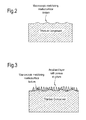
- Figure 2 shows schematically a cross-section through the surface of a titanium component in the as machined and polished condition.
- the surface has some macroscopic texture.
- a first stage in producing a hydrophobic surface is anodising the titanium substrate of the component.
- the component can be arranged to be the anode in a bath of anodising solution (typically Sulphuric or phosphoric acids or some mixture of these or sodium hydroxide) at room temperature ( ⁇ 20°C).
- Anodising conditions can be arranged such that an oxide layer is grown with an open, porous structure as shown schematically in Figure 3 , the pores forming recesses which open to the outside of the layer. This can be achieved by using an anodising voltage of between 1 and 75 Volts AC with higher voltages used for a thicker anodised layer or more rapid layer growth.
- the anodising voltage may be between 1 and 10 V , peak 20A.
- a voltage of 4V may be used.
- the time required for anodising can be short. For example, 10 to 15 seconds of anodising can yield an anodised layer of 2 to 800nm thickness depending on the surface condition of the work piece. Generally the thickness varies linearly with the voltage applied and colour may provide an indication of coating thickness.
- Applied voltage (V) Color Calculated film thickness (A) 3 Silver 6 Light brown 241 10 Golden brown 362 15 Purple blue 491 20 Dark blue 586 25 Sky blue 702 30 Pale blue 815 35 Steel blue 926 40 Lights slave 1036 45 Greenish yellow 1147 50 Lemon yellow 1246 55 Golden 1319 60 Pink 1410 65 Light purple 1573 75 blue 1769
- the anodising conditions can also be changed to produce desired oxide layer morphologies. For example, the amount of porosity can be controlled in this way. The oxide can be encouraged to adopt a columnar habit, the length, width and spacing of the columns being controlled by varying the anodising conditions.
- the anodised component can be immersed in a bath containing a suspension of e.g. PTFE nanoparticles.
- the PTFE particle size distribution can be about 10 to 110nm (e.g. commercially available DuPont Zonyl MP5070A-N). Other particle diameters can be used appropriate to the pore size of the anodised oxide.
- the PTFE particles penetrate the pores of the oxide and remain entrapped in the pores when the material is removed from the bath of suspended PTFE particles, as shown schematically in Figure 4 .
- the component can then be heated to between about 300 and 350°C in order to sinter the PTFE particles together and fuse them to and coat the walls of the pores in which they are contained, as shown schematically in Figure 5 .
- This allows the anodised layer to retain the surface texture imparted by the anodising process while imparting fluoropolymer functionality over the surface.
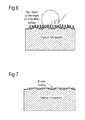
- the combination of the PTFE coating and the anodised layer help to ensure that even if the coating erodes the texture and chemical functionality is substantially retained, giving good coating service life.
- Figure 7 shows schematically the eroded surface still offering a degree of surface texture and chemical functionality imparted by the exposure of fresh PTFE.
- nanoparticles can be dispersed in the anodising bath and co-deposited with the growing anodised film. This can give enhanced performance of the coating in erosive conditions where hydrophobicity may otherwise be rapidly distorted or lost.
- the anodised layer could alternatively be infiltrated with a liquid fluorinated silane, such as2H-perfluorodecyltrichlorosilane, mono-epoxy-functionalized polydimethylsiloxane or perfluoralkyl silane, or with an organosilesquioxane. This can then be cured appropriately to secure the silane or organosilesquioxane to the nano-textured titanium oxide of the anodised layer.
- a liquid fluorinated silane such as2H-perfluorodecyltrichlorosilane, mono-epoxy-functionalized polydimethylsiloxane or perfluoralkyl silane, or with an organosilesquioxane.
- the anodising process generally imparts a colour change to the surface. As the layer thickens, this typically progresses through straw brown, yellow, blue to purple.
- the colour is linked to the thickness of the oxide layer and associated refraction of light. Changes in layer colour can be used as a measure of erosion (e.g. at a fan blade leading edge) and can indicate when an article requires replacement or refurbishment and/or when the surface treatment may no longer be effective.
- hydrophobic as used herein, pertains to a surface which in air at room temperature and at atmospheric pressure has a contact angle of greater than 90° with a static droplet of pure water.
- substituted refers to a parent group which bears one or more substituents.
- substituted is used herein in the conventional sense and refers to a chemical moiety which is covalently attached to, or if appropriate, fused to, a parent group.
- substituents are well known, and methods for their formation and introduction into a variety of parent groups are also well known.
- Alkyl refers to a monovalent moiety obtained by removing a hydrogen atom from a carbon atom of a saturated hydrocarbon compound, which may be aliphatic or alicyclic (cycloalkyl).
- the alkyl group may be a C 1-20 , C 1-10 , C 3-20 , C 3-10 , C 1-8 , C 3-8 , C 1-6 or C 3-6 alkyl group.
- alkyl groups include, but are not limited to, methyl (C 1 ), ethyl (C 2 ), propyl (C 3 ), butyl (C 4 ), pentyl (C 5 ), hexyl (C 6 ), heptyl (C 7 ) and octyl (C 8 ).
- An example of a substituted alkyl group includes, but is not limited to, perfluorooctyl (C 8 F 17 ).
- linear alkyl groups include, but are not limited to, methyl (C 1 ), ethyl (C 2 ), n-propyl (C 3 ), n-butyl (C 4 ), n-pentyl (amyl) (C 5 ), n-hexyl (C 6 ), n-heptyl (C 7 ) and n-octyl (C 8 ).
- branched alkyl groups include iso-propyl (C 3 ), iso-butyl (C 4 ), sec-butyl (C 4 ), tert-butyl (C 4 ), iso-pentyl (C 5 ), and neo-pentyl (C 5 ).
- cycloalkyl groups include, but are not limited to, those derived from:
- cycloalkenyl groups include, but are not limited to, those derived from cyclopropene (C 3 ), cyclobutene (C 4 ), cyclopentene (C 5 ), cyclohexene (C 6 ), methylcyclopropene (C 4 ), dimethylcyclopropene (C 5 ), methylcyclobutene (C 5 ), dimethylcyclobutene (C 6 ), methylcyclopentene (C 6 ), dimethylcyclopentene (C 7 ) and methylcyclohexene (C 7 ).
- Alkynyl refers to a monovalent moiety obtained by removing a hydrogen atom from a carbon atom of an unsaturated hydrocarbon compound having one or more carbon-carbon triple bonds, which may be aliphatic or alicyclic (cycloalkynyl).
- the alkynyl group may be a C 2-20 , C 2-10 , C 3-20 , C 3-10 , C 2-6 or C 3-6 alkenyl group.
- Heterocyclyl refers to a monovalent moiety obtained by removing a hydrogen atom from a ring atom of a heterocyclic compound.
- the heterocyclyl group may be a C 3-20 heterocyclyl group of which from 1 to 10 are ring heteroatoms, a C 3-7 heterocyclyl group of which from 1 to 4 are ring heteroatoms, or a C 5-6 heterocyclyl group of which 1 or 2 are ring heteroatoms.
- the heterocyclyl group is a C 3 heterocyclyl group.
- the heterocyclyl group is epoxy.
- the heterocyclyl group is obtained by removing a hydrogen atom from a ring carbon atom of a heterocyclic compound.
- the heteroatoms may be selected from O, N or S.
- the heterocyclyl group is obtained by removing a hydrogen atom from a ring nitrogen atom, where present, of a heterocyclic compound.
- the prefixes e.g. C 3-20 , C 3-7 , C 5-6 , etc.
- the term "C 5-6 heterocyclyl”, as used herein, pertains to a heterocyclyl group having 5 or 6 ring atoms.
- monocyclic heterocyclyl groups include, but are not limited to, those derived from:
- substituted monocyclic heterocyclyl groups include those derived from saccharides, in cyclic form, for example, furanoses (C 5 ), such as arabinofuranose, lyxofuranose, ribofuranose, and xylofuranse, and pyranoses (C 6 ), such as allopyranose, altropyranose, glucopyranose, mannopyranose, gulopyranose, idopyranose, galactopyranose, and talopyranose.
- furanoses C 5
- arabinofuranose such as arabinofuranose, lyxofuranose, ribofuranose, and xylofuranse
- pyranoses C 6
- allopyranose altropyranose
- glucopyranose glucopyranose
- mannopyranose gulopyranose
- idopyranose galactopyranose
- Aryl refers to a monovalent moiety obtained by removing a hydrogen atom from an aromatic ring atom of an aromatic compound.
- the aryl group may be a C 3-20 , C 5-7 or C 5-6 aryl group.
- the prefixes e.g. C 3-20 , C 5-7 , C 5-6 , etc.
- the term "C 5-6 aryl” as used herein, pertains to an aryl group having 5 or 6 ring atoms.
- the ring atoms may be all carbon atoms, as in "carboaryl groups".
- carboaryl groups include, but are not limited to, those derived from benzene (i.e. phenyl) (C 6 ), naphthalene (C 10 ), azulene (C 10 ), anthracene (C 14 ), phenanthrene (C 14 ), naphthacene (C 18 ), and pyrene (C 16 ).
- benzene i.e. phenyl
- C 10 naphthalene
- azulene C 10
- anthracene C 14
- phenanthrene C 14
- naphthacene C 18
- pyrene C 16
- aryl groups which comprise fused rings include, but are not limited to, groups derived from indane (e.g.2,3-dihydro-1H-indene) (C 9 ), indene (C 9 ), isoindene (C 9 ), tetraline (1,2,3,4-tetrahydronaphthalene (C 10 ), acenaphthene (C 12 ), fluorene (C 13 ), phenalene (C 13 ), acephenanthrene (C 15 ), and aceanthrene (C 16 ).
- indane e.g.2,3-dihydro-1H-indene
- indene C 9
- isoindene C 9
- tetraline (1,2,3,4-tetrahydronaphthalene C 10
- acenaphthene C 12
- fluorene C 13
- phenalene C 13
- acephenanthrene C 15
- aceanthrene
- the ring atoms may include one or more heteroatoms, as in "heteroaryl groups".
- monocyclic heteroaryl groups include, but are not limited to, those derived from: N 1 : pyrrole (azole) (C 5 ), pyridine (azine) (C 6 ); O 1 : furan (oxole) (C 5 ); S 1 : thiophene (thiole) (C 5 ); N 1 O 1 :oxazole (C 5 ), isoxazole (C 5 ), isoxazine (C 6 ); N 2 O 1 : oxadiazole (furazan) (C 5 ); N 3 O 1 : oxatriazole (C 5 ); N 1 S 1 : thiazole (C 5 ), isothiazole (C 5 ); N 2 : imidazole (1,3-diazole) (C 5 ), pyrazole (1,2-diazole) (C 5 ); N
- heteroaryl which comprise fused rings include, but are not limited to: C 9 (with 2 fused rings) derived from benzofuran (O 1 ), isobenzofuran (O 1 ), indole (N 1 ), isoindole (N 1 ), indolizine (N 1 ), indoline (N 1 ), isoindoline (N 1 ), purine (N 4 ) (e.g., adenine, guanine), benzimidazole (N 2 ), indazole (N 2 ), benzoxazole (N 1 O 1 ), benzisoxazole (N 1 O 1 ), benzodioxole (O 2 ), benzofurazan (N 2 O 1 ), benzotriazole (N 3 ), benzothiofuran (S 1 ), benzothiazole (N 1 S 1 ), benzothiadiazole (N 2 S); C 10 (with 2 fused rings) derived from chromene (O 1
- R is an ester substituent, for example, an alkyl group, an alkenyl group, an alkynyl group, a heterocyclyl group, or an aryl group, preferably an alkyl group or an alkenyl group, most preferably an alkenyl group.
- R 1 and R 2 are independently amino substituents, for example, hydrogen, an alkyl group (also referred to as alkylamino or dialkylamino), an alkenyl group, an alkynyl group, a heterocyclyl group, or an aryl group, preferably H or an alkyl group, or, in the case of a "cyclic" amino group, R 1 and R 2 , taken together with the nitrogen atom to which they are attached, form a heterocyclic ring having from 4 to 8 ring atoms.
- an alkyl group also referred to as alkylamino or dialkylamino
- an alkenyl group an alkynyl group
- a heterocyclyl group preferably H or an alkyl group
- R 1 and R 2 taken together with the nitrogen atom to which they are attached, form a heterocyclic ring having from 4 to 8 ring atoms.
- Amino groups may be primary (-NH 2 ), secondary (-NHR 1 ), or tertiary (-NHR 1 R 2 ), and in cationic form, may be quaternary (- + NR 1 R 2 R 3 ).
- Examples of amino groups include, but are not limited to, -NH 2 , -NHCH 3 , -NHC(CH 3 ) 2 , -N(CH 3 ) 2 , -N(CH 2 CH 3 ) 2 , and -NHPh.
- Examples of cyclic amino groups include, but are not limited to, aziridino, azetidino, pyrrolidino, piperidino, piperazino, morpholino, and thiomorpholino.
- R is a phosphino substituent, for example, -H, an alkyl group, an alkenyl group, an alkynyl group, a heterocyclyl group, or an aryl group, preferably -H, an alkyl group, or an aryl group.
- Examples of phosphino groups include, but are not limited to, -PH 2 , -P(CH 3 ) 2 , -P(CH 2 CH 3 ) 2 , -P(t-Bu) 2 , and -P(Ph) 2 .
- R is a mercapto substituent, for example, -H, an alkyl group, an alkenyl group, an alkynyl group, a heterocyclyl group, or an aryl group, preferably -H, an alkyl group, or an aryl group.
- mercapto groups include, but are not limited to, -SH, -SCH 3 , -SCH 2 CH 3 , -S-t-Bu, and -SPh.
Landscapes
- Engineering & Computer Science (AREA)
- Chemical & Material Sciences (AREA)
- Materials Engineering (AREA)
- Combustion & Propulsion (AREA)
- Chemical Kinetics & Catalysis (AREA)
- Electrochemistry (AREA)
- Metallurgy (AREA)
- Organic Chemistry (AREA)
- Mechanical Engineering (AREA)
- General Engineering & Computer Science (AREA)
- Application Of Or Painting With Fluid Materials (AREA)
Abstract
Description
- The present invention relates to an article having a hydrophobic surface to restrict accumulation of ice.
- Hydrophobic and super-hydrophobic surfaces have applications in numerous fields. For example, airframe and aeroengine components can be susceptible to ice build up. Providing hydrophobic or super-hydrophobic surfaces on such components can increase the run off of undercooled water droplets allowing them to re-entrain into the airflow before they nucleate and freeze. The surfaces can also alter the nucleation density and growth morphology of the ice that does form on the surfaces.
- Thus a benefit of such surfaces is that they can reduce the rate of ice accretion on a surface and alter the morphology of the ice to a structure that is more readily and predictably shed.
- Several polymer-based commercial coatings are available which are specifically designed to generate high water contact angles in order to improve ice shedding behaviour. For example, Luna Innovations Inc. have developed a superhydrophobic coating that can be spray coated onto large areas. Also available is HiRec 1450, a superhydrophobic coating that imparts both a nanoscale topography (from a nano-dispersion of PTFE spheres) and a chemical functionality (from a fluoropolymer) to give very large contact angles. However, both of these coatings are conceived for static applications that are subject to environmental icing, such as microwave antennae, aerials, satellite dishes, etc., and may not be able to withstand the erosive forces to which airframe and aeroengine components can be subject. For example, in gas turbines air speeds can be in the range 100-200 m/s. Fine (about 20µm) water droplets are rapidly accelerated by the air and impact e.g. the fan, engine section stator vanes and variable inlet guide vanes with considerable force. Polymer based coating systems are likely to erode rapidly, losing the superhydrophobic properties of the coating.
-
US 2008/145528 describes a method of applying a nano-textured surface to a metallic substrate using a metallic braze as the binder for ceramic nanoparticles. The textured braze is then overlaid with an appropriate fluorocarbon or hydrocarbon coating in order to impart a high water contact angle. - Although this is an attempt to provide a nano-textured surface that is robust enough to survive in the harsh operating environment of a gas turbine intake, there are several disadvantages to using a braze.
- Firstly, brazing is a high temperature process that involves melting or partially melting a metal on the surface of the substrate. Such processes can alter the microstructure of the underlying substrate by altering the grain size due to local annealing and/or surface alloying as the braze melts or diffuses into the substrate.
- Secondly, the application of a braze interspersed with hard, brittle ceramic particles may undermine the fatigue life of a component, as the ceramic particles can act as local stress raisers and crack under load. Once a crack is initiated, it can continue to grow through the braze and substrate during subsequent stress cycles.
- Thus, there remains a need for wetting-resistant surface treatments that can withstand the harsh environment found in e.g. a gas turbine intake.
- According to a first aspect of the invention, there is provided an article having:
- an anodised titanium or titanium alloy surface layer containing pores which form recesses opening to the outside of the layer, and
- a wetting-resistant coating formed on the anodised surface layer, the coating penetrating the pores but retaining the recesses to make the surface of the article hydrophobic and thereby restrict accumulation of ice.
- By having an anodised alloy surface layer containing pores which form recesses opening to the outside of the layer, surface textures can be formed which reduces the amount of intimate surface contact between a water droplet and the surface. For example, the area fraction of the surface in actual contact with the water droplet may be reduced because the water droplet may not penetrate the recesses. In combination with the wetting-resistant coating, this can lead to a hydrophobic surface which restricts accumulation of ice. However, as the textured surface does not require the incorporation of interspersed hard brittle materials, such as ceramic particles, or brazing, problems of surface crack initiation and growth, and microstructural alteration can be avoided or reduced.
- The article may include any one or any combination of the following optional features.
- Preferably the anodised surface layer has roughness on both a nano length scale and micro length scale. Such dual scale roughness is believed to improve surface hydrophobicity.
- The pores can occupy at least 30 volume %, and preferably at least 70%, of the anodised surface layer. Particularly when the pores occupy a high volume percent of the anodised surface layer, the layer may comprise a pattern of (e.g. columnar) asperities of anodised oxide surrounded by interconnected open porosity.
- The anodised surface layer may have a thickness in the range from 2nm to 2µm. Preferably the pores extend transversely across the layer from its outer surface to its inner interface. When the layer comprises a pattern of (e.g. columnar) asperities of anodised oxide surrounded by interconnected open porosity, the average spacing between nearest-neighbour asperities may be in the range from 1 to 50nm.
- The wetting-resistant coating may have a thickness of at least 0.5 nm, and preferably of at least 10nm. The wetting resistant coating may follow the contour of the pores.
- Preferably the hydrophobic surface is superhydrophobic.
- The wetting-resistant coating may comprise a fluorinated polymer.
- The fluorinated polymer may be a poly(haloalkylene) polymer, or a polymer comprising poly(haloalkylene). Preferably the fluorinated polymer is a poly(haloalkylene) polymer. The polymer may be linear or branched, and may be crosslinked.
- The haloalkylene may be an alkylene group substituted with one or more halo groups. Preferably, the haloalkylene is an alkylene group substituted with at least two halo groups.
- The haloalkylene group may be linear or branched, where appropriate.
- The haloalkylene may be a perhaloalkylene, where each hydrogen group in a alkylene is formally replaced with a halo group, as for example, in FEP (perfluoro(ethylene/propylene) and poly(tetrafluoroethylene).
- The halo group may be fluoro and/or chloro.
- The poly(haloalkylene) may comprise one, two or three different haloalkylene units. Where the polymer comprises two of more different alkylene units, these units may be arranged within the polymer in any arrangement, including block, random, periodic and alternate arrangements. The haloalkylene units may differ with regards to the number and/or nature of the halo group, and/or the identity of the alkylene group.
- Preferably, the polymer comprises one or more ethylene and/or propylene units.
- The fluorinated polymer may be selected from poly(tetrafluoroethylene) (PTFE), poly(perfluoro(ethylene/propylene) (FEP), poly(chlorotrifluoroethylene) (PCTFE) or poly(hexafluoropropylene).
- Preferably, the coating comprises poly(tetrafluoroethylene).
- Additionally or alternatively the wetting-resistant coating may comprise organosilesquioxane.
- Organosilesquioxanes are silicon-oxygen based frameworks having the general formula (RSiO1.5)n in which n is an even number ≥ 2, and preferably ≥ 4. Organosilesquioxane having an odd number of silicon atoms are also available, including those having 7 silicon atoms, such as frameworks of formula R7Si7O9(OH)3. Organosilesquioxanes which have a very specific structure, for example a compound having the formula (RSiO1.5)8 has an octahedral cage structure, are referred to in the field as organooligosilsequioxanes or polyhedral oligomeric silsesquiloxanes. Other examples include those compounds where n is 10 or 12.
- R is at least one organic group and may optionally include a hydrogen group. Preferably the organic group is selected from optionally substituted alkyl (including cycloalkyl and aliphatic alkyl), optionally substituted alkenyl, optionally substituted alkynyl, optionally substituted aryl (including carboaryl and heteroaryl), optionally substituted heterocyclyl, halo, amide, ester, amino, phosphine, nitrile, cyanato and isocyanato, mercapto, anhydride, and mixtures thereof.
- The R group may be selected so as to provide an organosilesquioxane that is liquid at ambient temperature. Such organosilesquioxane allow easy application of the organosilesquioxane as a coating composition.
- The R group is preferably stable to hydrolysis.
- The organic group may be selected from optionally substituted alkyl, optionally substituted aryl, halo and ester. The organic group may be selected from optionally substituted alkyl, optionally substituted aryl, halo and methacrylate. The organic group may be selected from methyl, phenyl, and methacrylate.
- The organic group may be or comprise a halo group. The halo group may be fluorine. Where the organic group is substituted with a halo group, such as a fluoro group, the organosilesquioxane is said to comprise halogenated organic groups, such as fluorinated organic groups.
- The water contact angle of the surface may be increased and/or the surface energy may be lowered by incorporation of a halo atom into the organic group of the organosilesquioxane.
- The organic group may be an alkyl group substituted with one, or more, halo groups, preferably substituted with one or more fluoro groups, most preferably three fluoro groups. Such groups may be referred to as haloalkyl groups. For example, the alkyl group may be a fluoroalkyl group, such as a trifluoropropyl group. In a preferred embodiment, the organic group is a 3,3,3-trifluoropropyl group.
- The alkyl group may be a perhaloalkyl group, preferably a perfluoroalkyl group, and most preferably a perfluorooctyl group.
- The organosilesquioxane may be a crosslinked organosilesquioxane. The crosslinks may be formed between organic groups in the organosilesquioxane. Additionally or alternatively the crosslinks may be formed between residual silanol groups in the organosilesquioxane.
- Organosilesquioxanes may comprise two or more different organic groups. Such organosilesquioxanes may be prepared from monomer starting materials having different organic groups as is known in the art.
- The organosilesquioxane may comprise an alkyl group substituted with one, or more, halo groups and an ester group.
- The organosilesquioxane may comprise a haloalkyl group, such as a perfluorooctyl group, and a methacrylate group. For example, the organosilesquioxane may formed by replacing about 3% of methacrylate groups with perfluorooctyl groups.
- Suitable organosilesquioxanes for use in the wetting-resistant coating include those available under the name Vitolane (TM) from TWI, Cambridge, UK. Also suitable are the POSS (TM) range of organosilesquioxanes available from Hybrid Plastics, Hattiesburg, MS, USA.
- The manufacture and modification of organosilesquioxanes is described in
WO 2007/060387 and the references cited therein, which are incorporated by reference herein. - The organosilesquioxane may also be used as a component of a wetting-resistant coating.
- Additionally or alternatively, the wetting-resistant coating may comprise a silicone rubber. Generally, a silicone rubber is a polysiloxane, such as a poly(disubstitutedsiloxane). Suitable substituents may include optionally substituted alkyl, heterocyclyl and aryl groups. The substituent may be an optionally substituted heterocyclyl group, for example an epoxy (oxirane) group.
- Additionally or alternatively, the wetting-resistant coating may comprise a halogenated silane. Preferably, the halogenated silane is a fluorinated silane. The silane may be a silane of formula SiR'4, where each R' is independently selected from halo and optionally substituted alkyl, heterocyclyl and aryl, wherein at least one group R' is halo, and at least one group R' is selected from optionally substituted alkyl, heterocyclyl and aryl.
- R' may be selected from alkyl, heterocyclyl and aryl having one or more halo substituents, and optionally further substituted.
- Preferably, R' is independently selected from halo and optionally substituted alkyl.
- Preferably the alkyl group is alkyl having one or more halo substituents, and optionally further substituted. In one embodiment, the alkyl group is a perhaloalkyl group.
- The halo group may be fluoro and/or chloro.
- The silane may be perfluorodecyltrichlorosilane.
- Preferably, the R' group is selected so as to provide a silane that is liquid at ambient temperature. Such silanes allow easy application of the silane by penetration into the pores of the anodised surface.
- The silane may be chemically bonded to the surface of the porous anodised titanium or titanium alloy surface layer using curing techniques well known in the art.
- The article may be an article that is susceptible in use to ice build-up.
- The article may be a component of a gas turbine engine. For example, the component may be a fan blade, a compressor inlet guide vane (such as a VIGV (variable inlet guide vane) or ESS (engine section stator)), a fan outlet guide vane, a compressor blade or a compressor vane (such as a VSV (variable stator vane)).
- The article may be a component of an aircraft, such as a wing leading edge, control surface, landing gear. The article may be a propeller on an open rotor engine or on a turbo-prop engine.
- Indeed, the article may be any component or structure that is susceptible to unwanted ice accretion, such as an item of ship superstructure or deck machinery (for ships operating in extreme northerly or southerly latitudes), satellite dishes, telecommunication aerials, radar domes, wind turbine components (e.g. blade pitching mechanisms, anenometers, instrumentation packs) structures operating at high altitude (e.g. airship, hot air balloon, unmanned air vehicle or rocket structures,), titanium heat exchangers prone to icing (e.g. a liquid nitrogen liquid-to-air heat exchanger for bulk N2 gas supply), winter sports equipment (e.g. snow board or ski bindings, ice screws) etc.
- Where the article is formed of steel, composite or another non-titanium material, it may be clad with titanium or titanium alloy (e.g. by diffusion bonding, adhesives etc) and then anodised and coated.
- A second aspect of the invention provides a method of surface treating an article having a titanium or titanium alloy surface, the method comprising the steps of:
- anodising the surface of the alloy to produce an anodised surface layer containing pores which form recesses opening to the outside of the layer, and
- forming a wetting-resistant coating on the anodised surface layer, the coating penetrating the pores but retaining the recesses to make the surface hydrophobic and thereby restrict accumulation of ice.
- Thus the method can be used to produce an article according to the previous aspect, the article optionally including any one or any combination of the optional features described above in relation to the first aspect.
- The wetting-resistant coating can be formed by, for example, dipping, roll-coating, spraying or painting liquid or a solution containing the coating material onto the anodised surface layer. This can be followed by curing (e.g. thermal curing).
- For example, a suspension of PTFE particles can be applied to the anodised surface layer (e.g. by immersing the article in the suspension), the PTFE particles infiltrating the pores, and the article can then be heated to fuse the infiltrating PTFE particles into a coating which penetrates the pores but retains the recesses.
- Embodiments of the invention will now be described by way of example with reference to the accompanying drawings in which:
-
Figure 1 shows a longitudinal cross-section through the front of a gas turbine engine; -
Figure 2 shows schematically a cross-section through the surface of a titanium component in the as machined and polished condition; -
Figure 3 the cross-section ofFigure 2 with a porous, anodised surface layer; -
Figure 4 shows the cross-section ofFigure 3 with PTFE nanoparticles penetrating the pores of the anodised surface layer; and -
Figure 5 shows the cross-section ofFigure 4 after the PTFE nanoparticles are sintererd to form a coating on the anodised surface layer; -
Figure 6 shows the cross-section ofFigure 5 with a water droplet on the treated surface; and -
Figure 7 shows the cross-section ofFigure 5 after the surface has been eroded. - The present invention, by providing an anodised titanium or titanium alloy surface layer with open pores and a wetting-resistant coating, can create a robust, engineered, hydrophobic or superhydrophobic surface.
- The combination of the anodised surface layer and coating can generate the low surface energies required to impart very high water contact angles, and hence hydrophobicity or superhydrophobicity to the surface. These angles can be in excess of 120°. This type of surface treatment can impart good ice-phobic characteristics to gas turbine inlet components.
- The surface treatment is well suited to titanium or titanium alloy components, or components which can be clad with titanium or titanium alloy used in gas turbines. For example, the surface treatment can encourage ice shedding on both rotating components (e.g. fan blades and compressor blades) and static components (e.g. engine section stators, variable inlet guide vanes, outlet guide vanes) which are susceptible to ice build-up. Such components are shaded in the schematic longitudinal cross-section through the front of a gas turbine engine shown in
Figure 1 . Advantageously, the improved ice shedding characteristics that can be achieved, allows these and associated components to be better optimised for aerodynamic performance and less consideration given to ice shedding and ice impact tolerance. -
Figure 2 shows schematically a cross-section through the surface of a titanium component in the as machined and polished condition. The surface has some macroscopic texture. - A first stage in producing a hydrophobic surface is anodising the titanium substrate of the component. The component can be arranged to be the anode in a bath of anodising solution (typically Sulphuric or phosphoric acids or some mixture of these or sodium hydroxide) at room temperature (∼20°C). Anodising conditions can be arranged such that an oxide layer is grown with an open, porous structure as shown schematically in
Figure 3 , the pores forming recesses which open to the outside of the layer. This can be achieved by using an anodising voltage of between 1 and 75 Volts AC with higher voltages used for a thicker anodised layer or more rapid layer growth. In one embodiment the anodising voltage may be between 1 and 10 V , peak 20A. A voltage of 4V may be used. - The time required for anodising can be short. For example, 10 to 15 seconds of anodising can yield an anodised layer of 2 to 800nm thickness depending on the surface condition of the work piece. Generally the thickness varies linearly with the voltage applied and colour may provide an indication of coating thickness.
Applied voltage (V) Color Calculated film thickness (A) 3 Silver 6 Light brown 241 10 Golden brown 362 15 Purple blue 491 20 Dark blue 586 25 Sky blue 702 30 Pale blue 815 35 Steel blue 926 40 Lights slave 1036 45 Greenish yellow 1147 50 Lemon yellow 1246 55 Golden 1319 60 Pink 1410 65 Light purple 1573 75 blue 1769 - Longer times and progressive ramping of the voltage up to the set point may be necessary with some titanium alloys (e.g. those with a coarse second phase distribution and/or a thick oxide film). The anodising conditions can also be changed to produce desired oxide layer morphologies. For example, the amount of porosity can be controlled in this way. The oxide can be encouraged to adopt a columnar habit, the length, width and spacing of the columns being controlled by varying the anodising conditions.
- Next, the anodised component can be immersed in a bath containing a suspension of e.g. PTFE nanoparticles. The PTFE particle size distribution can be about 10 to 110nm (e.g. commercially available DuPont Zonyl MP5070A-N). Other particle diameters can be used appropriate to the pore size of the anodised oxide. The PTFE particles penetrate the pores of the oxide and remain entrapped in the pores when the material is removed from the bath of suspended PTFE particles, as shown schematically in
Figure 4 . - The component can then be heated to between about 300 and 350°C in order to sinter the PTFE particles together and fuse them to and coat the walls of the pores in which they are contained, as shown schematically in
Figure 5 . This allows the anodised layer to retain the surface texture imparted by the anodising process while imparting fluoropolymer functionality over the surface. - Trials show that such a coating can give the low surface energies required to impart very high water contact angles, typically in excess of 120° and thereby making the surface superhydrophobic. The effect of the surface modification on the water contact angle (θ) is shown schematically in
Figure 6 . - Advantageously, the combination of the PTFE coating and the anodised layer help to ensure that even if the coating erodes the texture and chemical functionality is substantially retained, giving good coating service life.
Figure 7 shows schematically the eroded surface still offering a degree of surface texture and chemical functionality imparted by the exposure of fresh PTFE. - In a development of the process, using a suitable dispersant, nanoparticles can be dispersed in the anodising bath and co-deposited with the growing anodised film. This can give enhanced performance of the coating in erosive conditions where hydrophobicity may otherwise be rapidly distorted or lost.
- As an alternative to PTFE, other low surface energy polymers such as FEP, PCTFE particles or silicone rubber could be used to achieve the same effect, although sintering temperatures and infiltration processes would need to be adjusted according to the polymer properties.
- Indeed, instead of using a polymer suspension, functionalised polymer nanoparticles could be bonded, infiltrated or adhered to the anodised layer in other ways known to the skilled person.
- The anodised layer could alternatively be infiltrated with a liquid fluorinated silane, such as2H-perfluorodecyltrichlorosilane, mono-epoxy-functionalized polydimethylsiloxane or perfluoralkyl silane, or with an organosilesquioxane. This can then be cured appropriately to secure the silane or organosilesquioxane to the nano-textured titanium oxide of the anodised layer.
- The anodising process generally imparts a colour change to the surface. As the layer thickens, this typically progresses through straw brown, yellow, blue to purple.
- The colour is linked to the thickness of the oxide layer and associated refraction of light. Changes in layer colour can be used as a measure of erosion (e.g. at a fan blade leading edge) and can indicate when an article requires replacement or refurbishment and/or when the surface treatment may no longer be effective.
- Advantages of the surface treatment of the present invention are:
- ● The depth of the surface texture can be controlled and readily increased or decreased easily as required.
- ● Even if the surface is substantially eroded, it can maintain both micro and nano scale roughness and chemical functionality to give high water contact angles.
- ● The wetting-resistant coating and anodised layer can be co-continuous and interpenetrating, making the surface effective at repelling water even when damaged or partially eroded.
- ● The anodised layer and coating do not add significant weight to the article because the anodised layer is provided by the parent material.
- While the invention has been described in conjunction with the exemplary embodiments described above, many equivalent modifications and variations will be apparent to those skilled in the art when given this disclosure. Accordingly, the exemplary embodiments of the invention set forth above are considered to be illustrative and not limiting. Various changes to the described embodiments may be made without departing from the spirit and scope of the invention.
- The term "hydrophobic" as used herein, pertains to a surface which in air at room temperature and at atmospheric pressure has a contact angle of greater than 90° with a static droplet of pure water.
- The term "superhydrophobic" as used herein, pertains to a surface which in air at room temperature and at atmospheric pressure has a contact angle of greater than 120° with a static droplet of pure water.
- The phrase "optionally substituted" as used herein, pertains to a parent group which may be unsubstituted or which may be substituted.
- Unless otherwise specified, the term "substituted" as used herein, pertains to a parent group which bears one or more substituents. The term "substituent" is used herein in the conventional sense and refers to a chemical moiety which is covalently attached to, or if appropriate, fused to, a parent group. A wide variety of substituents are well known, and methods for their formation and introduction into a variety of parent groups are also well known.
- Alkyl: The term "alkyl" as used herein, pertains to a monovalent moiety obtained by removing a hydrogen atom from a carbon atom of a saturated hydrocarbon compound, which may be aliphatic or alicyclic (cycloalkyl). The alkyl group may be a C1-20, C1-10, C3-20, C3-10, C1-8, C3-8, C1-6 or C3-6 alkyl group.
- Examples of alkyl groups include, but are not limited to, methyl (C1), ethyl (C2), propyl (C3), butyl (C4), pentyl (C5), hexyl (C6), heptyl (C7) and octyl (C8).
- An example of a substituted alkyl group includes, but is not limited to, perfluorooctyl (C8F17).
- Examples of linear alkyl groups include, but are not limited to, methyl (C1), ethyl (C2), n-propyl (C3), n-butyl (C4), n-pentyl (amyl) (C5), n-hexyl (C6), n-heptyl (C7) and n-octyl (C8).
- Examples of branched alkyl groups include iso-propyl (C3), iso-butyl (C4), sec-butyl (C4), tert-butyl (C4), iso-pentyl (C5), and neo-pentyl (C5).
- Examples of cycloalkyl groups include, but are not limited to, those derived from:
- saturated monocyclic hydrocarbon compounds:
- cyclopropane (C3), cyclobutane (C4), cyclopentane (C5), cyclohexane (C6), cycloheptane (C7), methyl cyclopropane (C4), dimethylcyclopropane (C5), methylcyclobutane (C5), dimethylcyclobutane (C6), methylcyclopentane (C6), dimethylcyclopentane (C7) and methylcyclohexane (C7); and saturated polycyclic hydrocarbon compounds: norcarane (C7), norpinane (C7), norbornane (C7).
- Alkenyl: The term "alkenyl" as used herein, pertains to a monovalent moiety obtained by removing a hydrogen atom from a carbon atom of an unsaturated hydrocarbon compound having one or more carbon-carbon double bonds, which may be aliphatic or alicyclic (cycloalkenyl). The alkenyl group may be a C2-20, C2-10, C3-20, C3-10, C2-6 or C3-6 alkenyl group.
- Examples of alkenyl groups include, but are not limited to, ethenyl (vinyl, -CH=CH2), 1-propenyl (-CH=CH-CH3), 2-propenyl (allyl, -CH-CH=CH2), isopropenyl (1-methylvinyl, -C(CH3)=CH2), butenyl (C4), pentenyl (C5), and hexenyl (C6).
- An example of a substituted alkenyl group includes, but is not limited to, styrene (-CH=CHPh or -C(Ph)=CH2).
- Examples of cycloalkenyl groups include, but are not limited to, those derived from cyclopropene (C3), cyclobutene (C4), cyclopentene (C5), cyclohexene (C6), methylcyclopropene (C4), dimethylcyclopropene (C5), methylcyclobutene (C5), dimethylcyclobutene (C6), methylcyclopentene (C6), dimethylcyclopentene (C7) and methylcyclohexene (C7).
- Alkynyl: The term "alkynyl" as used herein, pertains to a monovalent moiety obtained by removing a hydrogen atom from a carbon atom of an unsaturated hydrocarbon compound having one or more carbon-carbon triple bonds, which may be aliphatic or alicyclic (cycloalkynyl). The alkynyl group may be a C2-20, C2-10, C3-20, C3-10, C2-6 or C3-6 alkenyl group.
- Examples of alkynyl groups include, but are not limited to, ethynyl (ethinyl, -C=CH) and 2-propynyl (propargyl, -CH2-C=CH).
- Heterocyclyl: The term "heterocyclyl" as used herein, pertains to a monovalent moiety obtained by removing a hydrogen atom from a ring atom of a heterocyclic compound. The heterocyclyl group may be a C3-20 heterocyclyl group of which from 1 to 10 are ring heteroatoms, a C3-7 heterocyclyl group of which from 1 to 4 are ring heteroatoms, or a C5-6 heterocyclyl group of which 1 or 2 are ring heteroatoms. In one embodiment, the heterocyclyl group is a C3 heterocyclyl group. In one embodiment, the heterocyclyl group is epoxy. In one embodiment, the heterocyclyl group is obtained by removing a hydrogen atom from a ring carbon atom of a heterocyclic compound.
- In one embodiment, the heteroatoms may be selected from O, N or S. In one embodiment the heterocyclyl group is obtained by removing a hydrogen atom from a ring nitrogen atom, where present, of a heterocyclic compound.
- In this context, the prefixes (e.g. C3-20, C3-7, C5-6, etc.) denote the number of ring atoms, or range of number of ring atoms, whether carbon atoms or heteroatoms. For example, the term "C5-6heterocyclyl", as used herein, pertains to a heterocyclyl group having 5 or 6 ring atoms.
- Examples of monocyclic heterocyclyl groups include, but are not limited to, those derived from:
- N1: aziridine (C3), azetidine (C4), pyrrolidine (tetrahydropyrrole) (C5), pyrroline (e.g., 3-pyrroline, 2,5-dihydropyrrole) (C5), 2H-pyrrole or 3H-pyrrole (isopyrrole, isoazole) (C5), piperidine (C6), dihydropyridine (C6), tetrahydropyridine (C6), azepine (C7); O1: oxirane (C3), oxetane (C4), oxolane (tetrahydrofuran) (C5), oxole (dihydrofuran) (C5), oxane (tetrahydropyran) (C6), dihydropyran (C6), pyran (C6), oxepin (C7); S1: thiirane (C3), thietane (C4), thiolane (tetrahydrothiophene) (C5), thiane (tetrahydrothiopyran) (C6), thiepane (C7); O2: dioxolane (C5), dioxane (C6), and dioxepane (C7); O3: trioxane (C6); N2: imidazolidine (C5), pyrazolidine (diazolidine) (C5), imidazoline (C5), pyrazoline (dihydropyrazole) (C5), piperazine (C6); N1O1: tetrahydrooxazole (C5), dihydrooxazole (C5), tetrahydroisoxazole (C5), dihydroisoxazole (C5), morpholine (C6), tetrahydrooxazine (C6), dihydrooxazine (C6), oxazine (C6); N1S1 :thiazoline (C5), thiazolidine (C5), thiomorpholine (C6); N2O1: oxadiazine (C6); O1S1 : oxathiole (C5) and oxathiane (thioxane) (C6); and, N1O1S1: oxathiazine (C6).
- Examples of substituted monocyclic heterocyclyl groups include those derived from saccharides, in cyclic form, for example, furanoses (C5), such as arabinofuranose, lyxofuranose, ribofuranose, and xylofuranse, and pyranoses (C6), such as allopyranose, altropyranose, glucopyranose, mannopyranose, gulopyranose, idopyranose, galactopyranose, and talopyranose.
- Aryl: The term "aryl", as used herein, pertains to a monovalent moiety obtained by removing a hydrogen atom from an aromatic ring atom of an aromatic compound. The aryl group may be a C3-20, C5-7 or C5-6 aryl group.
- In this context, the prefixes (e.g. C3-20, C5-7, C5-6, etc.) denote the number of ring atoms, or range of number of ring atoms, whether carbon atoms or heteroatoms. For example, the term "C5-6 aryl" as used herein, pertains to an aryl group having 5 or 6 ring atoms.
- The ring atoms may be all carbon atoms, as in "carboaryl groups".
- Examples of carboaryl groups include, but are not limited to, those derived from benzene (i.e. phenyl) (C6), naphthalene (C10), azulene (C10), anthracene (C14), phenanthrene (C14), naphthacene (C18), and pyrene (C16).
- Examples of aryl groups which comprise fused rings, at least one of which is an aromatic ring, include, but are not limited to, groups derived from indane (e.g.2,3-dihydro-1H-indene) (C9), indene (C9), isoindene (C9), tetraline (1,2,3,4-tetrahydronaphthalene (C10), acenaphthene (C12), fluorene (C13), phenalene (C13), acephenanthrene (C15), and aceanthrene (C16).
- Alternatively, the ring atoms may include one or more heteroatoms, as in "heteroaryl groups". Examples of monocyclic heteroaryl groups include, but are not limited to, those derived from: N1: pyrrole (azole) (C5), pyridine (azine) (C6); O1: furan (oxole) (C5); S1: thiophene (thiole) (C5); N1O1 :oxazole (C5), isoxazole (C5), isoxazine (C6); N2O1: oxadiazole (furazan) (C5); N3O1: oxatriazole (C5); N1S1 : thiazole (C5), isothiazole (C5); N2: imidazole (1,3-diazole) (C5), pyrazole (1,2-diazole) (C5), pyridazine (1,2-diazine) (C6), pyrimidine (1,3-diazine) (C6) (e.g., cytosine, thymine, uracil), pyrazine (1,4-diazine) (C6); N3: triazole (C5), triazine (C6); and, N4: tetrazole (C5).
- Examples of heteroaryl which comprise fused rings, include, but are not limited to: C9 (with 2 fused rings) derived from benzofuran (O1), isobenzofuran (O1), indole (N1), isoindole (N1), indolizine (N1), indoline (N1), isoindoline (N1), purine (N4) (e.g., adenine, guanine), benzimidazole (N2), indazole (N2), benzoxazole (N1O1), benzisoxazole (N1O1), benzodioxole (O2), benzofurazan (N2O1), benzotriazole (N3), benzothiofuran (S1), benzothiazole (N1S1), benzothiadiazole (N2S); C10 (with 2 fused rings) derived from chromene (O1), isochromene (O1), chroman (O1), isochroman (O1), benzodioxan (O2), quinoline (N1), isoquinoline (N1), quinolizine (N1), benzoxazine (N1O1), benzodiazine (N2), pyridopyridine (N2), quinoxaline (N2), quinazoline (N2), cinnoline (N2), phthalazine (N2), naphthyridine (N2), pteridine (N4); C11 (with 2 fused rings) derived from benzodiazepine (N2); C13 (with 3 fused rings) derived from carbazole (N1), dibenzofuran (O1), dibenzothiophene (S1), carboline (N2), perimidine (N2), pyridoindole (N2); and, C14 (with 3 fused rings) derived from acridine (N1), xanthene (O1), thioxanthene (S1), oxanthrene (O2), phenoxathiin (O1S1), phenazine (N2), phenoxazine (N1O1), phenothiazine (N1S1), thianthrene (S2), phenanthridine (N1), phenanthroline (N2), phenazine (N2).
- The above groups, whether alone or part of another substituent, may themselves optionally be substituted with one or more groups selected from themselves and the substituents listed below.
Halo: -F, -Cl, -Br, and -I. - Ester: -C(=O)OR (carboxylate, carboxylic acid ester, oxycarbonyl) or -OC(=O)R (acyloxy, reverse eter), wherein R is an ester substituent, for example, an alkyl group, an alkenyl group, an alkynyl group, a heterocyclyl group, or an aryl group, preferably an alkyl group or an alkenyl group, most preferably an alkenyl group.
- Examples of ester groups include, but are not limited to, -C(=O)OCH3, -C(=O)OCH2CH3, -C(=O)OC(CH3)3, and -C(=O)OPh.
- Other examples of ester groups include, but are not limited to, -OC(=O)CH3 (acetoxy), -OC(=O)CH2CH3, -OC(=O)C(CH3)3, -OC(=O)Ph, -OC(=O)CH2Ph, -OC(=O)CH=CH2 (acrylate) and -OC(=O)C(CH3)=CH2 (methacrylate).
- Amino: -NR1R2, wherein R1 and R2 are independently amino substituents, for example, hydrogen, an alkyl group (also referred to as alkylamino or dialkylamino), an alkenyl group, an alkynyl group, a heterocyclyl group, or an aryl group, preferably H or an alkyl group, or, in the case of a "cyclic" amino group, R1 and R2, taken together with the nitrogen atom to which they are attached, form a heterocyclic ring having from 4 to 8 ring atoms. Amino groups may be primary (-NH2), secondary (-NHR1), or tertiary (-NHR1R2), and in cationic form, may be quaternary (-+NR1R2R3). Examples of amino groups include, but are not limited to, -NH2, -NHCH3, -NHC(CH3)2, -N(CH3)2, -N(CH2CH3)2, and -NHPh. Examples of cyclic amino groups include, but are not limited to, aziridino, azetidino, pyrrolidino, piperidino, piperazino, morpholino, and thiomorpholino.
- Anhydride: -C(=O)OC(=O)R, wherein R is independently an anhydride substituent, for example an alkyl group, an alkenyl group, an alkynyl group, a heterocyclyl group, or an aryl group, preferably an alkyl group.
- Cyanato: -OCN.
- lsocyanato: -NCO.
- Cyano (nitrile, carbonitrile): -CN.
- Phosphino (phosphine): -PR2, wherein R is a phosphino substituent, for example, -H, an alkyl group, an alkenyl group, an alkynyl group, a heterocyclyl group, or an aryl group, preferably -H, an alkyl group, or an aryl group. Examples of phosphino groups include, but are not limited to, -PH2, -P(CH3)2, -P(CH2CH3)2, -P(t-Bu)2, and -P(Ph)2.
- Mercapto: -SR, wherein R is a mercapto substituent, for example, -H, an alkyl group, an alkenyl group, an alkynyl group, a heterocyclyl group, or an aryl group, preferably -H, an alkyl group, or an aryl group. Examples of mercapto groups include, but are not limited to, -SH, -SCH3, -SCH2CH3, -S-t-Bu, and -SPh.
Claims (15)
Applications Claiming Priority (1)
| Application Number | Priority Date | Filing Date | Title |
|---|---|---|---|
| GBGB0922308.2A GB0922308D0 (en) | 2009-12-22 | 2009-12-22 | Hydrophobic surface |
Publications (1)
| Publication Number | Publication Date |
|---|---|
| EP2343401A1 true EP2343401A1 (en) | 2011-07-13 |
Family
ID=41717310
Family Applications (1)
| Application Number | Title | Priority Date | Filing Date |
|---|---|---|---|
| EP10192348A Withdrawn EP2343401A1 (en) | 2009-12-22 | 2010-11-24 | Hydrophobic surface |
Country Status (3)
| Country | Link |
|---|---|
| US (1) | US20110147219A1 (en) |
| EP (1) | EP2343401A1 (en) |
| GB (1) | GB0922308D0 (en) |
Cited By (6)
| Publication number | Priority date | Publication date | Assignee | Title |
|---|---|---|---|---|
| EP2915854A1 (en) | 2014-03-06 | 2015-09-09 | MTU Aero Engines GmbH | Anti-ice coating for compressor blades |
| CN105114180A (en) * | 2015-08-26 | 2015-12-02 | 成都博世德能源科技股份有限公司 | Heat preservation type air inlet system used for gas turbine |
| CN105696056A (en) * | 2016-03-22 | 2016-06-22 | 苏州蓝锐纳米科技有限公司 | Heat exchanger with condensate drop self-repelling function nanolayer |
| CN105836103A (en) * | 2016-03-22 | 2016-08-10 | 苏州蓝锐纳米科技有限公司 | Aircraft wing with condensate drop self-dispersing functional nanolayer |
| EP3279086A1 (en) * | 2016-08-04 | 2018-02-07 | Safran Landing Systems UK Limited | Aircraft landing gear shock absorber strut |
| WO2023012214A1 (en) | 2021-08-05 | 2023-02-09 | Irt Antoine De Saint Exupéry | Article for an anti-icing application |
Families Citing this family (21)
| Publication number | Priority date | Publication date | Assignee | Title |
|---|---|---|---|---|
| EP2677068A4 (en) * | 2011-02-18 | 2016-10-05 | Aisin Keikinzoku Co Ltd | Surface treatment method for metal member and metal member obtained by same |
| KR101260455B1 (en) * | 2011-07-21 | 2013-05-07 | 포항공과대학교 산학협력단 | Method for fabricating super-hydrophobic surface and evaporator having the super-hydrophobic surface |
| US9187947B2 (en) | 2011-12-05 | 2015-11-17 | Rayotek Scientific, Inc. | Method of forming a vacuum insulated glass panel spacer |
| US9410358B2 (en) | 2011-12-05 | 2016-08-09 | Rayotek Scientific, Inc. | Vacuum insulated glass panel with spacers coated with micro particles and method of forming same |
| WO2013085480A1 (en) * | 2011-12-05 | 2013-06-13 | Rayotek Scientific, Inc. | Vacuum insulated glass panel with spacers having improved characteristics and method of forming same |
| US10011916B2 (en) * | 2012-10-19 | 2018-07-03 | Ut-Battelle, Llc | Superhydrophobic anodized metals and method of making same |
| WO2014085319A1 (en) * | 2012-11-30 | 2014-06-05 | Eaton Corporation | Multilayer coatings systems and methods |
| WO2014123841A1 (en) | 2013-02-10 | 2014-08-14 | United Technologies Corporation | Removable film for airfoil surfaces |
| FR3004165B1 (en) * | 2013-04-09 | 2015-03-27 | Aircelle Sa | AIRCRAFT ELEMENT REQUIRING TREATMENT AGAINST FROZEN |
| US9759131B2 (en) * | 2013-12-06 | 2017-09-12 | General Electric Company | Gas turbine engine systems and methods for imparting corrosion resistance to gas turbine engines |
| CN104907697B (en) * | 2015-05-28 | 2017-09-01 | 湖北工业大学 | A method for preparing titanium alloy superhydrophobic frost-resistant surface by ultrafast laser |
| US20170122115A1 (en) * | 2015-10-29 | 2017-05-04 | General Electric Company | Systems and methods for superhydrophobic surface enhancement of turbine components |
| WO2017222516A1 (en) * | 2016-06-22 | 2017-12-28 | Siemens Aktiengesellschaft | Method and system for reducing liquid droplet impact damage by superhydrophobic surfaces |
| BE1024827B1 (en) | 2016-12-15 | 2018-07-17 | Safran Aero Boosters S.A. | AUB GLACIOPHOBE OF AXIAL TURBOMACHINE COMPRESSOR |
| EP3431637A1 (en) * | 2017-07-18 | 2019-01-23 | IMEC vzw | Porous solid materials and methods for fabrication |
| US20190054571A1 (en) | 2017-08-21 | 2019-02-21 | University Of Iowa Research Foundation | Nanosecond laser-based high-throughput surface nano-structuring (nhsn) process |
| WO2019155446A1 (en) * | 2018-02-12 | 2019-08-15 | Ypf Tecnología S.A. | Method of preparation of new super-hydrophobic membranes and membranes obtained by said method |
| CN108580227B (en) * | 2018-04-20 | 2020-06-09 | 清华大学 | Rapid preparation method of super-hydrophobic paint surface |
| JP6789543B2 (en) * | 2019-05-11 | 2020-11-25 | 熊本県 | Aluminum material and its manufacturing method |
| US11032930B2 (en) * | 2019-05-28 | 2021-06-08 | Apple Inc. | Titanium surfaces with improved color consistency and resistance to color change |
| US12054638B2 (en) | 2019-08-01 | 2024-08-06 | The Boeing Company | Transparent hydrophobic and icephobic compositions, coatings, and methods |
Citations (9)
| Publication number | Priority date | Publication date | Assignee | Title |
|---|---|---|---|---|
| GB774598A (en) * | 1954-10-15 | 1957-05-15 | Ici Ltd | Improvements relating to titanium or titanium base alloys |
| DE2010488A1 (en) * | 1970-03-05 | 1971-09-23 | Gen Magnaplate Corp | Protective coatings for titanium bodies |
| DE4239391A1 (en) * | 1991-11-27 | 1993-06-09 | Electro Chemical Engineering Gmbh, Zug, Ch | Aluminium magnesium, titanium wear resistant rotor - comprises oxide ceramic layer with fluoro polymer, e.g. poly:tetra:fluoroethylene, for resistance to corrosion for turbo mol. pump |
| US5547769A (en) * | 1992-10-05 | 1996-08-20 | Siemens Aktiengesellschaft | Method and coating for protecting against corrosive and erosive attacks |
| EP1085172A2 (en) * | 1999-09-17 | 2001-03-21 | General Electric Company | Composite blade root attachment |
| WO2006047500A2 (en) * | 2004-10-25 | 2006-05-04 | Henkel Kommanditgesellschaft Auf Aktien | Article of manufacture and process for anodically coating an aluminum substrate with ceramic oxides prior to organic or inorganic coating |
| WO2006126993A1 (en) * | 2005-05-24 | 2006-11-30 | Honeywell International Inc. | Turbocharger compressor having improved erosion-corrosion resistance |
| WO2007060387A1 (en) | 2005-11-28 | 2007-05-31 | The Welding Institute | Process for the production of organosilsesquioxanes |
| US20080145528A1 (en) | 2006-12-14 | 2008-06-19 | General Electric Company | Methods of preparing wetting-resistant surfaces and articles incorporating the same |
Family Cites Families (4)
| Publication number | Priority date | Publication date | Assignee | Title |
|---|---|---|---|---|
| IL99216A (en) * | 1991-08-18 | 1995-12-31 | Yahalom Joseph | Protective coating for metal parts to be used at high temperatures |
| US6033582A (en) * | 1996-01-22 | 2000-03-07 | Etex Corporation | Surface modification of medical implants |
| US7578921B2 (en) * | 2001-10-02 | 2009-08-25 | Henkel Kgaa | Process for anodically coating aluminum and/or titanium with ceramic oxides |
| US7695767B2 (en) * | 2005-01-06 | 2010-04-13 | The Boeing Company | Self-cleaning superhydrophobic surface |
-
2009
- 2009-12-22 GB GBGB0922308.2A patent/GB0922308D0/en not_active Ceased
-
2010
- 2010-11-24 EP EP10192348A patent/EP2343401A1/en not_active Withdrawn
- 2010-11-24 US US12/954,032 patent/US20110147219A1/en not_active Abandoned
Patent Citations (9)
| Publication number | Priority date | Publication date | Assignee | Title |
|---|---|---|---|---|
| GB774598A (en) * | 1954-10-15 | 1957-05-15 | Ici Ltd | Improvements relating to titanium or titanium base alloys |
| DE2010488A1 (en) * | 1970-03-05 | 1971-09-23 | Gen Magnaplate Corp | Protective coatings for titanium bodies |
| DE4239391A1 (en) * | 1991-11-27 | 1993-06-09 | Electro Chemical Engineering Gmbh, Zug, Ch | Aluminium magnesium, titanium wear resistant rotor - comprises oxide ceramic layer with fluoro polymer, e.g. poly:tetra:fluoroethylene, for resistance to corrosion for turbo mol. pump |
| US5547769A (en) * | 1992-10-05 | 1996-08-20 | Siemens Aktiengesellschaft | Method and coating for protecting against corrosive and erosive attacks |
| EP1085172A2 (en) * | 1999-09-17 | 2001-03-21 | General Electric Company | Composite blade root attachment |
| WO2006047500A2 (en) * | 2004-10-25 | 2006-05-04 | Henkel Kommanditgesellschaft Auf Aktien | Article of manufacture and process for anodically coating an aluminum substrate with ceramic oxides prior to organic or inorganic coating |
| WO2006126993A1 (en) * | 2005-05-24 | 2006-11-30 | Honeywell International Inc. | Turbocharger compressor having improved erosion-corrosion resistance |
| WO2007060387A1 (en) | 2005-11-28 | 2007-05-31 | The Welding Institute | Process for the production of organosilsesquioxanes |
| US20080145528A1 (en) | 2006-12-14 | 2008-06-19 | General Electric Company | Methods of preparing wetting-resistant surfaces and articles incorporating the same |
Cited By (8)
| Publication number | Priority date | Publication date | Assignee | Title |
|---|---|---|---|---|
| EP2915854A1 (en) | 2014-03-06 | 2015-09-09 | MTU Aero Engines GmbH | Anti-ice coating for compressor blades |
| DE102014204075A1 (en) | 2014-03-06 | 2015-09-10 | MTU Aero Engines AG | Anti - ice coating for compressor blades |
| CN105114180A (en) * | 2015-08-26 | 2015-12-02 | 成都博世德能源科技股份有限公司 | Heat preservation type air inlet system used for gas turbine |
| CN105696056A (en) * | 2016-03-22 | 2016-06-22 | 苏州蓝锐纳米科技有限公司 | Heat exchanger with condensate drop self-repelling function nanolayer |
| CN105836103A (en) * | 2016-03-22 | 2016-08-10 | 苏州蓝锐纳米科技有限公司 | Aircraft wing with condensate drop self-dispersing functional nanolayer |
| EP3279086A1 (en) * | 2016-08-04 | 2018-02-07 | Safran Landing Systems UK Limited | Aircraft landing gear shock absorber strut |
| WO2023012214A1 (en) | 2021-08-05 | 2023-02-09 | Irt Antoine De Saint Exupéry | Article for an anti-icing application |
| FR3125981A1 (en) * | 2021-08-05 | 2023-02-10 | Irt Antoine De Saint Exupéry | Item for anti-icing application |
Also Published As
| Publication number | Publication date |
|---|---|
| GB0922308D0 (en) | 2010-02-03 |
| US20110147219A1 (en) | 2011-06-23 |
Similar Documents
| Publication | Publication Date | Title |
|---|---|---|
| EP2343401A1 (en) | Hydrophobic surface | |
| EP2343400A1 (en) | Hydrophobic Surface | |
| CN104263238B (en) | One is fluorinated POSS composite organic coating and preparation method and ice-covering-proof application | |
| Bing et al. | Small structure, large effect: Functional surfaces inspired by salvinia leaves | |
| Chen et al. | Robust and superhydrophobic polydimethylsiloxane/Ni@ Ti3C2T x nanocomposite coatings with assembled eyelash-like microstructure array: a new approach for effective passive anti-icing and active photothermal deicing | |
| CN102169912B (en) | Mo/Ag laminated metal matrix composite for solar cell interconnected sheet and preparation process thereof | |
| Ali et al. | Techniques for the fabrication of super-hydrophobic surfaces and their heat transfer applications | |
| US20110287223A1 (en) | Metallic articles with hydrophobic surfaces | |
| WO2011147757A1 (en) | Articles with super-hydrophobic and/or self-cleaning surfaces and method of making same | |
| Do et al. | Fabrication of large-scale, flexible, and robust superhydrophobic composite films using hydrophobic fumed silica nanoparticles and polydimethylsiloxane | |
| CN1900360A (en) | Process for preparing magnesium alloy surface function gradient film | |
| Li et al. | Durable and flexible hydrophobic surface with a micropatterned composite metal–polymer structure | |
| Fu et al. | Rational regulation and one-step electrodeposition realization of surface textures and free energy to create mechanochemically durable superhydrophobicity for the enhanced anti-icing properties | |
| Nam et al. | Comparative study of copper oxidation schemes and their effects on surface wettability | |
| Xu et al. | Robust photo/electrothermal synergistically all-weather anti/de-icing superhydrophobic composite coating based on modified graphene | |
| JP2713458B2 (en) | Method for producing electrically deposited high temperature gas corrosion resistant layer | |
| Si et al. | Adjustable oil adhesion on superamphiphobic copper surfaces for controlled oil droplet transport | |
| Nazari et al. | A review of photothermal and superhydrophobic polymer nanocomposites as anti‐icing nanocoatings | |
| Zhang et al. | Multienergy barrier anti-/deicing surface with excellent photothermal effect | |
| Sun et al. | Enhanced superhydrophobicity of acrylic polyurethane coatings by femtosecond laser ablation | |
| Zhang et al. | Investigation of self-propelled droplet migration and heat transfer characteristics on non-uniform wettability wedge-patterned surfaces: preparation, characterization, and condensation experiment | |
| Ben Ayed et al. | Design strategies in developing MXene-based anti-icing/deicing coatings: toward energy-efficient and durable solutions | |
| Sarkar et al. | One-step deposition process to obtain nanostructured superhydrophobic thin films by galvanic exchange reactions | |
| CN105887153B (en) | Precision size and Part Surface Roughness for the part of Ra≤0.8 local electrochemical enamelizing method | |
| Yao et al. | Sandpaper‐Inspired Scalable and Robust Solar Thermal Superhydrophobic Surface for Durable Anti‐Icing/Deicing |
Legal Events
| Date | Code | Title | Description |
|---|---|---|---|
| PUAI | Public reference made under article 153(3) epc to a published international application that has entered the european phase |
Free format text: ORIGINAL CODE: 0009012 |
|
| AK | Designated contracting states |
Kind code of ref document: A1 Designated state(s): AL AT BE BG CH CY CZ DE DK EE ES FI FR GB GR HR HU IE IS IT LI LT LU LV MC MK MT NL NO PL PT RO RS SE SI SK SM TR |
|
| AX | Request for extension of the european patent |
Extension state: BA ME |
|
| 17P | Request for examination filed |
Effective date: 20120112 |
|
| RIC1 | Information provided on ipc code assigned before grant |
Ipc: C25D 11/26 20060101AFI20140606BHEP Ipc: C25D 11/24 20060101ALN20140606BHEP Ipc: F02C 7/04 20060101ALI20140606BHEP Ipc: F01D 5/28 20060101ALI20140606BHEP Ipc: C25D 11/02 20060101ALN20140606BHEP Ipc: C25D 11/18 20060101ALI20140606BHEP |
|
| 17Q | First examination report despatched |
Effective date: 20140702 |
|
| STAA | Information on the status of an ep patent application or granted ep patent |
Free format text: STATUS: THE APPLICATION IS DEEMED TO BE WITHDRAWN |
|
| 18D | Application deemed to be withdrawn |
Effective date: 20150113 |