EP2343273A1 - Novel type i natural ceramide derivative and method for producing same - Google Patents
Novel type i natural ceramide derivative and method for producing same Download PDFInfo
- Publication number
- EP2343273A1 EP2343273A1 EP09817797A EP09817797A EP2343273A1 EP 2343273 A1 EP2343273 A1 EP 2343273A1 EP 09817797 A EP09817797 A EP 09817797A EP 09817797 A EP09817797 A EP 09817797A EP 2343273 A1 EP2343273 A1 EP 2343273A1
- Authority
- EP
- European Patent Office
- Prior art keywords
- ceramide
- natural ceramide
- natural
- derivative
- type
- Prior art date
- Legal status (The legal status is an assumption and is not a legal conclusion. Google has not performed a legal analysis and makes no representation as to the accuracy of the status listed.)
- Withdrawn
Links
- 0 CC*OCC[C@@](*C=CI)*C(N)=O Chemical compound CC*OCC[C@@](*C=CI)*C(N)=O 0.000 description 1
Classifications
-
- A—HUMAN NECESSITIES
- A61—MEDICAL OR VETERINARY SCIENCE; HYGIENE
- A61Q—SPECIFIC USE OF COSMETICS OR SIMILAR TOILETRY PREPARATIONS
- A61Q19/00—Preparations for care of the skin
-
- A—HUMAN NECESSITIES
- A61—MEDICAL OR VETERINARY SCIENCE; HYGIENE
- A61K—PREPARATIONS FOR MEDICAL, DENTAL OR TOILETRY PURPOSES
- A61K8/00—Cosmetics or similar toiletry preparations
- A61K8/18—Cosmetics or similar toiletry preparations characterised by the composition
- A61K8/30—Cosmetics or similar toiletry preparations characterised by the composition containing organic compounds
- A61K8/68—Sphingolipids, e.g. ceramides, cerebrosides, gangliosides
-
- A—HUMAN NECESSITIES
- A61—MEDICAL OR VETERINARY SCIENCE; HYGIENE
- A61P—SPECIFIC THERAPEUTIC ACTIVITY OF CHEMICAL COMPOUNDS OR MEDICINAL PREPARATIONS
- A61P17/00—Drugs for dermatological disorders
-
- A—HUMAN NECESSITIES
- A61—MEDICAL OR VETERINARY SCIENCE; HYGIENE
- A61P—SPECIFIC THERAPEUTIC ACTIVITY OF CHEMICAL COMPOUNDS OR MEDICINAL PREPARATIONS
- A61P17/00—Drugs for dermatological disorders
- A61P17/16—Emollients or protectives, e.g. against radiation
-
- C—CHEMISTRY; METALLURGY
- C07—ORGANIC CHEMISTRY
- C07C—ACYCLIC OR CARBOCYCLIC COMPOUNDS
- C07C235/00—Carboxylic acid amides, the carbon skeleton of the acid part being further substituted by oxygen atoms
- C07C235/02—Carboxylic acid amides, the carbon skeleton of the acid part being further substituted by oxygen atoms having carbon atoms of carboxamide groups bound to acyclic carbon atoms and singly-bound oxygen atoms bound to the same carbon skeleton
- C07C235/04—Carboxylic acid amides, the carbon skeleton of the acid part being further substituted by oxygen atoms having carbon atoms of carboxamide groups bound to acyclic carbon atoms and singly-bound oxygen atoms bound to the same carbon skeleton the carbon skeleton being acyclic and saturated
- C07C235/08—Carboxylic acid amides, the carbon skeleton of the acid part being further substituted by oxygen atoms having carbon atoms of carboxamide groups bound to acyclic carbon atoms and singly-bound oxygen atoms bound to the same carbon skeleton the carbon skeleton being acyclic and saturated having the nitrogen atom of at least one of the carboxamide groups bound to an acyclic carbon atom of a hydrocarbon radical substituted by singly-bound oxygen atoms
-
- C—CHEMISTRY; METALLURGY
- C07—ORGANIC CHEMISTRY
- C07B—GENERAL METHODS OF ORGANIC CHEMISTRY; APPARATUS THEREFOR
- C07B2200/00—Indexing scheme relating to specific properties of organic compounds
- C07B2200/07—Optical isomers
Definitions
- the present invention relates to a novel type I natural ceramides derivative and a method for producing the same.
- Type I natural ceramides exist in human skin stratum corneum in a high proportion. The proportion of type I natural ceramides, however, is found to significantly decrease in the stratum corneum of people suffering from, particularly, atopic dermatitis. Type I natural ceramides are a very vital component in maintaining skin homeostasis, and they have been drawing attention as a moisturizer in recent years.
- a generally known type I natural ceramide is a compound having a structure represented by the following formula (4):
- Patent Document 1 in which sphingosine is linked to an ⁇ -acyloxy long-chain carboxylic acid via an amide bond.
- Patent Document 1 Also known in the art is a ceramide derivative composed of phytosphingosine and an ⁇ -acyloxy long-chain carboxylic acid, as represented by the following formula (5).
- Patent Documents 1 and 2 This derivative has been regarded as a type I natural ceramide (Patent Documents 1 and 2).
- Type I natural ceramides are generally known to have a structure represented by the formula (4).
- This compound is neither easily available nor easily synthesizable.
- the comparatively easily synthesizable compound represented by formula (5) which is composed of phytosphingosine and an ⁇ -acyloxy long-chain carboxylic acid, has been marketed as a type I natural ceramide.
- the compound represented by formula (5) has a different number of hydroxyl groups in the sphingosine skeleton and a different number of carbon atoms in the N-acyl moiety, compared to the type I natural ceramide represented by formula (4). Accordingly, a method has been desired which enables easy synthesis of a type I natural ceramide having a structure more similar to the structure represented by formula (4) at a low cost.
- the present invention has an object to provide a novel type I natural ceramide derivative having a structure more similar to the structure represented by formula (4), and a method for producing the same.
- the present invention relates to a novel type I natural ceramide derivative represented by formula (1) :
- R 3 represents a substituted or unsubstituted C1 to C30 alkyl group, or a substituted or unsubstituted C7 to C20 aralkyl group.
- the present invention also relates to a composition comprising the novel type I natural ceramide derivative represented by formula (1).
- the present invention also relates to an external preparation for skin, comprising the novel type I natural ceramide derivative represented by formula (1).
- the present invention relates to a moisturizer comprising the novel type I natural ceramide derivative represented by formula (1).
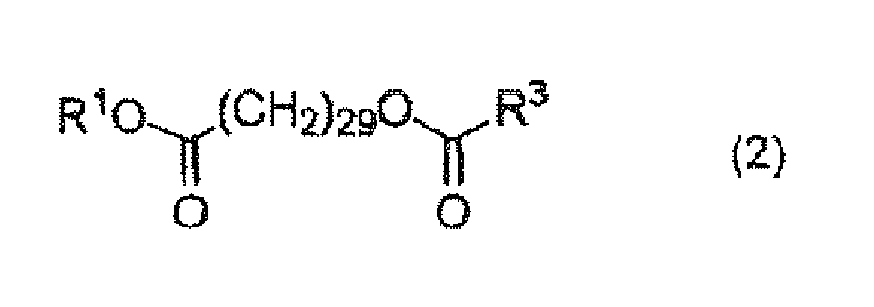
- the present invention relates to a method for producing the novel type natural ceramide derivative represented by formula (1), comprising reacting an ⁇ -acyloxy long-chain fatty acid derivative represented by formula (2):
- R 1 represents a substituted or unsubstituted C1 to C18 alkyl group, a substituted or unsubstituted C6 to C20 aryl group, a substituted or unsubstituted C7 to C20 aralkyl group, or hydrogen
- R 3 is the same as defined above, with dihydrosphingosine represented by formula (3):
- the method according to the present invention enables easy synthesis of a type I natural ceramide having a structure more similar to that of the type I natural ceramide represented by formula (4).
- the thus produced novel type I natural ceramide derivative when combined with other ceramides, can significantly improve the compatibility of ceramides, which facilitates preparation of a composition containing ceramides, such as a moisturizer or a cosmetic, and also increases the storage stability of the composition.
- R 3 represents a substituted or unsubstituted C1 to C30 alkyl group, or a substituted or unsubstituted C7 to C20 aralkyl group.
- substituents include an alkyl group, an aryl group, an aralkyl group, an amino group, a nitro group, a sulfonyl group, a halogen atom, a hydroxyl group, an acyloxy group, and an alkoxy group.
- Examples of the C1 to C30 alkyl group which may be substituted include methyl, ethyl, propyl, isopropyl, isobutyl, tert-butyl, cyclopentyl, cyclohexyl, 1-hydroxypentadecyl, dodecyl, pentadecyl, and heptadecanyl.
- examples include octadecanoyl, oleoyl, linoleoyl, and linolenoyl.
- Examples of the C7 to C20 aralkyl group which may be substituted include benzyl.
- the COR 3 group formed with an adjacent carbonyl group is an octadecanoyl group, an oleoyl group, a linoleoyl group, or a linolenoyl group.
- the COR 3 group formed with an adjacent carbonyl group is an octadecanoyl group.
- the novel type I natural ceramide derivative represented by formula (1) can be produced by reacting an ⁇ -acyloxy long-chain fatty acid derivative (hereinafter also referred to as " ⁇ -acyloxy long-chain fatty acid derivative (2)”) represented by formula (2):
- R 1 represents a substituted or unsubstituted C1 to C18 alkyl group, a substituted or unsubstituted C6 to C20 aryl group, a substituted or unsubstituted C7 to C20 aralkyl group, or hydrogen.
- a substituent for R 1 include the same substituents mentioned for R 3 .
- Examples of the C1 to C18 alkyl group which may be substituted include methyl, ethyl, propyl, isopropyl, isobutyl, tert-butyl, cyclopentyl, cyclohexyl, pentadecyl, 1-hydroxypentadecyl, and dodecyl.
- Examples of the C6 to C20 aryl group which may be substituted include phenyl, p-methoxyphenyl, p-chlorophenyl, p-nitrophenyl, p-trifluoromethylphenyl, p-tolyl, and naphthyl.
- Examples of the C7 to C20 aralkyl group which may be substituted include benzyl.
- a methyl group, an ethyl group, a propyl group, an isopropyl group, a phenyl group, a p-nitrophenyl group, a p-trifluorophenyl group, a benzyl group, and hydrogen are preferable, a p-nitrophenyl group and hydrogen are more preferable, and hydrogen is most preferable.
- R 3 is the same as defined in the formula (1).
- the ⁇ -acyloxy long-chain fatty acid derivative represented by formula (2) can be synthesized by, for example, a method of causing a coupling reaction of a C15 ⁇ -hydroxy long-chain fatty acid derivative synthesized by hydrolysis of pentadecanolide with an enamine derived from cyclododecanone, and then causing a ring-opening reaction and a reduction of ketone ( JP 3782102 B ); or a method of coupling, in the presence of a copper catalyst, a C15 ⁇ -hydroxy long-chain fatty acid ester derivative synthesized by hydrolysis of pentadecanolide with a Grignard reagent prepared from an ⁇ -hydroxy- ⁇ -haloalkane derivative that is synthesized also from pentadecanolide ( JP 2618283 B ).
- the dihydrosphingosine represented by formula (3) may be used having a free amino group, or may be used in the form of a salt at the amino group thereof.
- the salt include inorganic salts such as hydrochloride and sulfate, and organic salts such as methanesulfonate, p-toluenesulfonate, acetate, trifluoroacetate, mandelate, tartrate, and lactate.
- Preferable are free dihydrosphingosine, and hydrochloride thereof.
- the dihydrosphingosine represented by formula (3) can be synthesized by an existing method.
- the dihydrosphingosine can be produced by reducing a (2R,3R)-2-acetamino-3-hydroxyalkanoic acid ester with sodium borohydride, and then hydrolyzing the reduction product, in accordance with JP 3797695 B .
- the amount of dihydrosphingosine may generally be 1 equivalent or more, preferably 1 to 10 equivalents, and more preferably 1 to 3 equivalents, of the ⁇ -acyloxy long-chain fatty acid derivative (2).
- an activator is preferably also used for promoting the reaction.
- the activator examples include acid chlorides such as pivalic acid chloride, isobutyloyl chloride, isopropyloyl chloride, trichloroacetic acid chloride, and acetyl chloride; chloroformates such as methyl, chloroformate, t-butyl chloroformate, isobutyl chloroformate, and isopropyl chloroformate; sulfonic acid chlorides such as methanesulfonyl chloride, p-toluenesulfonyl chloride, and benzenesulphonyl chloride; and carbodiimides such as DCC (N,N-dicyclohexylcarbodiimide), EDC (1-ethyl-3-(3-dimethylaminopropyl) carbodiimide), and EDC hydrochloride.
- acid chlorides such as pivalic acid chloride, isobutyloyl chloride, isopropylo
- the amount of activator may generally be 1 equivalent or more, preferably 1 to 10 equivalents, and more preferably 1 to 5 equivalents, of the ⁇ -acyloxy long-chain fatty acid derivative (2).
- an additive generally used in the peptide synthesis such as 1-hydroxybenzotriazole (HOBt), N-hydroxysuccinimide (HOSu), or 1-hydroxy-7-azabenzotriazole (HOAt), may also be used.
- the amount of additive may generally be 1 equivalent or more, preferably 1 to 10 equivalents, and more preferably 1 to 5 equivalents, of the ⁇ -acyloxy long-chain fatty acid derivative (2).
- a base is preferably also used for promoting the reaction.
- the base to be used may be an inorganic base or an organic base.
- Examples of the inorganic base include metal hydroxides such as sodium hydroxide, potassium hydroxide, lithium hydroxide, magnesium hydroxide, and barium hydroxide; and carbonates such as sodium carbonate, potassium carbonate, and sodium hydrogencarbonate.
- metal hydroxides such as sodium hydroxide, potassium hydroxide, lithium hydroxide, magnesium hydroxide, and barium hydroxide
- carbonates such as sodium carbonate, potassium carbonate, and sodium hydrogencarbonate.
- the organic base is preferably a tertiary amine.
- tertiary amine examples include C1 to C12 trialkylamines such as trimethylamine, triethylamine, and ethyldiisopropylamine; tertiary amines containing a C1 to C4 alkyl group and a phenyl group, such as N,N-dimethylaniline, N,N-diethylaniline, and N,N-dimethylaminopyridine; nitrogen-containing organic bases such as pyridine, picoline, and lutidine; and C1 to C10 N,N,N,N-tetramethyl- ⁇ , ⁇ -alkyldiamines such as N,N,N,N-tetramethyl-1,2-ethylenediamine, N,N,N,N-tetramethyl-1,3-propanediamine, and N,N,N,N-tetramethyl-1,6-hexanediamine. Each of these amines may be used alone, or two or more of these may be used in combination
- the amount of base may generally be 1 equivalent or more, preferably 1 to 10 equivalents, and more preferably 1 to 5 equivalents, of the ⁇ -acyloxy long-chain fatty acid derivative (2).
- reaction solvent examples thereof include polar aprotic solvents such as N,N-dimethylformamide (DMF), dimethyl sulfoxide (DMSO), N-methylpyrrolidone, and hexamethylphosphoric triamide; hydrocarbon solvents such as hexamethylbenzene, toluene, n-hexane, and cyclohexane; ether solvents such as diethyl ether, tetrahydrofuran (THF), diisopropyl ether, methyl tert-butyl ether, and dimethoxyethane; halogenated solvents such as chlorobenzene, methylene chloride, chloroform, and 1,1,1-trichloroethane; ester solvents such as ethyl acetate and butyl acetate; nitrile solvents such as acetonitrile and butyronitrile; alcohols such as methanol, ethanol, isoprop
- Each of these solvents may be used alone, or two or more of these may be used in combination.
- halogenated solvents having high solubility for the ⁇ -acyloxy long-chain fatty acid derivative (2) are preferable, and chlorobenzene is more preferable.
- the reaction temperature is generally in the range of -20°C to 120°C, preferably -10°C to 80°C, and more preferably 0°C to 0°C .
- a general work-up process may be performed in order to obtain a product from the reaction mixture.
- water or the like is added to the reaction mixture after completion of the reaction, and then extraction is performed with use of a common extraction solvent such as ethyl acetate, diethyl ether, methylene chloride, toluene, or hexane.
- the reaction solvent and the extraction solvent are removed from the obtained extract by an operation such as heating under reduced pressure, and thereby the desired compound can be obtained.
- the reaction solvent may be first removed by an operation such as heating under reduced pressure, followed by the above procedure.
- the desired compound obtained by the above-mentioned method is almost pure, and may be further purified by a general method such as crystallization purification, fractional distillation, or column chromatography, for a higher purity.
- the product may alternatively be recovered by a method of adding a poor solvent, such as hexane, to the reaction mixture, and then directly cooling the mixture for crystallization, without the above post treatment.
- a poor solvent such as hexane
- the thus synthesized novel type I natural ceramide derivative may be incorporated into a composition such as an external preparation for skin (e.g. moisturizer, cosmetic, etc.)
- a composition such as an external preparation for skin (e.g. moisturizer, cosmetic, etc.)
- novel type I natural ceramide derivative may be incorporated alone or in combination with at least one other ceramide into a composition such as an external preparation for skin.
- a ceramide is incorporated into a composition such as an external preparation for skin
- the composition is generally used in the form of a ceramide-containing emulsion.
- Ceramides are a compound having high crystallinity and a high melting point of generally 100°C or higher. Ceramides also have a specific amphiphilic structure, and therefore have a very low solubility in most of oil-soluble and/or water-soluble materials. Accordingly, preparation of a ceramide-containing emulsion has been difficult, and even if the emulsion is prepared, the emulsion has a problem of low stability which results, for example, in crystallization of ceramides after long-time storage.
- the present inventors have now found that blending a small amount of the novel type I natural ceramide derivative according to the present invention with other ceramides significantly improves the compatibility of the ceramides and thus enables easy emulsification and formulation.
- the other ceramide are not particularly limited, and examples thereof include type II to type VII natural ceramides, ceramides of plant origin, and pseudoceramides.
- the type II to type VII natural ceramides are compounds in which sphingosine, dihydrosphingosine, phytosphingosine, or sphingadienine is amidated. Specific examples thereof include compounds described in, for example, Journal of Lipid Research 1983, 24, 759 ; Journal of Lipid Research 1994, 35, 2069 ; and JP 2007-191443 A .
- Examples of commercially available natural ceramides include Ceramide I, Ceramide III, Ceramide IIIA, Ceramide IIIB, Ceramide IIIC, Ceramide VI (products of Cosmoferm), Ceramide TIC-001 (product of Takasago International Corporation), and (Ceramide II (product of Quest International).
- ceramides of plant origin examples include ceramides of wheat origin, konjac origin, soybean origin, corn origin, fungal origin, and rice origin.
- the pseudoceramides are not particularly limited, and examples thereof include hydroxyethyl palmityl oxyhydroxypropyl palmitamide (Ceramide SL), trihydroxy palmitamide hydroxypropyl myristyl ether (Ceramide H03), N-(hexadecyloxyhydroxypropyl)-N-hydroxyethyl decanamide, and N-(hexadecyloxyhydroxypropyl)-N-hydroxyethyl hexadecanamide.
- Ceramide SL hydroxyethyl palmityl oxyhydroxypropyl palmitamide
- Ceramide H03 trihydroxy palmitamide hydroxypropyl myristyl ether
- N-(hexadecyloxyhydroxypropyl)-N-hydroxyethyl decanamide N-(hexadecyloxyhydroxypropyl)-N-hydroxyethyl hexadecanamide.
- natural ceramides are preferable, type II natural ceramides and type III natural ceramides are more preferable, and type II natural ceramides are most preferable.
- type II natural ceramides are most preferable.
- Each of these other ceramides may be used alone, or two or more of these may be used in admixture.
- the proportion of other ceramides may be freely determined.
- the weight ratio of the novel type I natural ceramide derivative to other ceramides is preferably in the range of 0.1:99.9 to 50.0:50.0, more preferably 1.0:99.0 to 20.0:80.0, and particularly preferably 5.0:95.0 to 20.0:80.0.
- any material generally used for preparing products such as cosmetics may be used.
- examples thereof include lower alcohols such as methanol, ethanol, isopropanol, and n-butanol; higher alcohols such as isostearyl alcohol, cetanol, stearyl alcohol, oleyl alcohol, and behenyl alcohol; polyhydric alcohols such as glycerin and 1,3-butanediol; long-chain fatty acids such as stearic acid, isostearic acid, palmitic acid, and lanolin acid; lower esters, higher esters, and polyhydric alcohol esters of the long-chain fatty acids; and hydrocarbons such as paraffin, liquid paraffin, and squalane.
- lower alcohols such as methanol, ethanol, isopropanol, and n-butanol
- higher alcohols such as isostearyl alcohol, cetanol, stearyl alcohol, oleyl alcohol, and behenyl alcohol
- lower alcohols higher alcohols, long-chain fatty acids, and long-chain fatty acid esters are preferable.
- Each of these materials may be used alone, or two or more of these may be used in combination. It is to be appreciated that ingredients other than the above materials may be further incorporated.
- the amount of material used for blending the ceramides may be appropriately set according to the purpose, and the material may be used in any proportion.
- the amount of material is preferably 1 to 100000 times, and more preferably 1 to 10000 times the weight of the novel type I natural ceramide derivative.
- the temperature at the time of blending is not particularly limited. Generally, the temperature is preferably 100°C or lower, and more preferably 90°C or lower, for blending without any special equipment.
- the addition order and the like conditions may be appropriately determined according to the kind of the material to be used.
- a type II natural ceramide and a material were mixed at a weight ratio of 50:50 in a test tube, and the mixture was stirred in a constant-temperature bath at 70°C. After 20 minutes, the mixture was visually observed to determine whether the contents were in solution or not. The same test was then performed in the constant-temperature bath at 75°C, 80°C, 85°C, 90°C, 95°C, and 100°C. Table 1 shows the results.
- a type II natural ceramide (TIC-001, product of Takasago International Corporation), a novel type I natural ceramide produced in the following Example 6, and a material were mixed at a weight ratio of 45:5:50 in a test tube, and the mixture was stirred in a constant-temperature bath at 70°C. After 20 minutes, the mixture was visually observed to determine whether the contents were in solution or not. The same test was then performed in the constant-temperature bath at 75°C, 80°C, 85°C, 90°C, 95°C, and 100°C. Table 1 shows the results.
Landscapes
- Health & Medical Sciences (AREA)
- Life Sciences & Earth Sciences (AREA)
- Chemical & Material Sciences (AREA)
- Organic Chemistry (AREA)
- Animal Behavior & Ethology (AREA)
- General Health & Medical Sciences (AREA)
- Public Health (AREA)
- Veterinary Medicine (AREA)
- Dermatology (AREA)
- Epidemiology (AREA)
- General Chemical & Material Sciences (AREA)
- Birds (AREA)
- Biophysics (AREA)
- Engineering & Computer Science (AREA)
- Bioinformatics & Cheminformatics (AREA)
- Chemical Kinetics & Catalysis (AREA)
- Molecular Biology (AREA)
- Medicinal Chemistry (AREA)
- Nuclear Medicine, Radiotherapy & Molecular Imaging (AREA)
- Pharmacology & Pharmacy (AREA)
- Toxicology (AREA)
- Organic Low-Molecular-Weight Compounds And Preparation Thereof (AREA)
- Cosmetics (AREA)
- Acyclic And Carbocyclic Compounds In Medicinal Compositions (AREA)
Abstract
Description
- The present invention relates to a novel type I natural ceramides derivative and a method for producing the same.
- Type I natural ceramides exist in human skin stratum corneum in a high proportion. The proportion of type I natural ceramides, however, is found to significantly decrease in the stratum corneum of people suffering from, particularly, atopic dermatitis. Type I natural ceramides are a very vital component in maintaining skin homeostasis, and they have been drawing attention as a moisturizer in recent years.
- A generally known type I natural ceramide is a compound having a structure represented by the following formula (4):
-
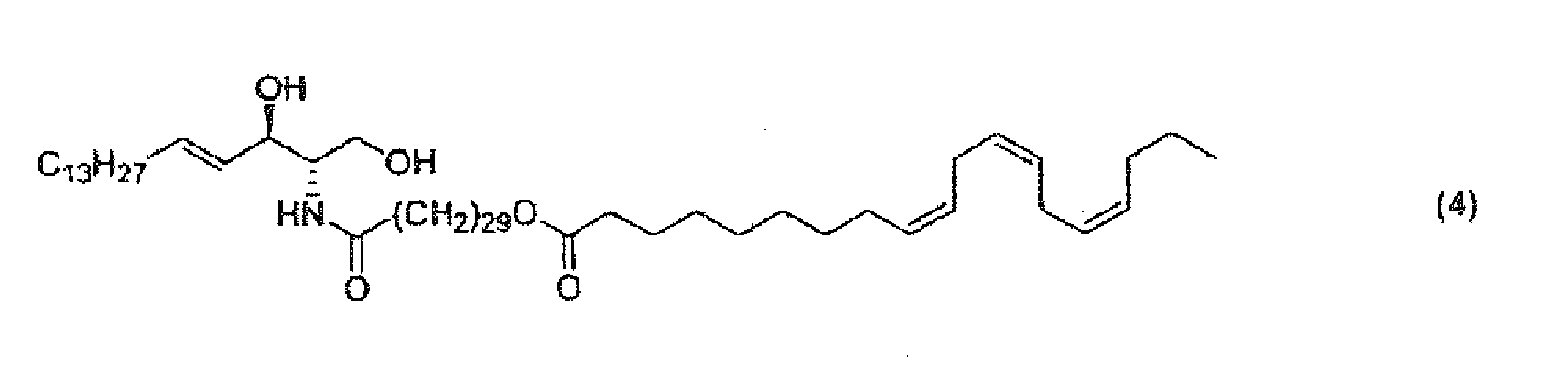
- in which sphingosine is linked to an ω-acyloxy long-chain carboxylic acid via an amide bond (Patent Document 1). Also known in the art is a ceramide derivative composed of phytosphingosine and an ω-acyloxy long-chain carboxylic acid, as represented by the following formula (5).
-

- This derivative has been regarded as a type I natural ceramide (Patent Documents 1 and 2).
-
- Patent Document 1:
JP 3782101 B - Patent Document 2:
JP H08-502961 T - Type I natural ceramides are generally known to have a structure represented by the formula (4). This compound, however, is neither easily available nor easily synthesizable. For this reason, the comparatively easily synthesizable compound represented by formula (5), which is composed of phytosphingosine and an ω-acyloxy long-chain carboxylic acid, has been marketed as a type I natural ceramide. However, the compound represented by formula (5) has a different number of hydroxyl groups in the sphingosine skeleton and a different number of carbon atoms in the N-acyl moiety, compared to the type I natural ceramide represented by formula (4). Accordingly, a method has been desired which enables easy synthesis of a type I natural ceramide having a structure more similar to the structure represented by formula (4) at a low cost.
- The present invention has an object to provide a novel type I natural ceramide derivative having a structure more similar to the structure represented by formula (4), and a method for producing the same.
- As a result of eager examination, the present inventors have found a novel type I natural ceramide derivative having a structure more similar to the structure represented by formula (4), and a method for producing the same.
- That is, the present invention relates to a novel type I natural ceramide derivative represented by formula (1) :
-

- wherein R3 represents a substituted or unsubstituted C1 to C30 alkyl group, or a substituted or unsubstituted C7 to C20 aralkyl group.
- The present invention also relates to a composition comprising the novel type I natural ceramide derivative represented by formula (1).
- The present invention also relates to an external preparation for skin, comprising the novel type I natural ceramide derivative represented by formula (1).
- Further, the present invention relates to a moisturizer comprising the novel type I natural ceramide derivative represented by formula (1).
- Furthermore, the present invention relates to a method for producing the novel type natural ceramide derivative represented by formula (1), comprising
reacting an ω-acyloxy long-chain fatty acid derivative represented by formula (2): -

- wherein R1 represents a substituted or unsubstituted C1 to C18 alkyl group, a substituted or unsubstituted C6 to C20 aryl group, a substituted or unsubstituted C7 to C20 aralkyl group, or hydrogen, and R3 is the same as defined above,
with dihydrosphingosine represented by formula (3): -

- or a salt thereof.
- The method according to the present invention enables easy synthesis of a type I natural ceramide having a structure more similar to that of the type I natural ceramide represented by formula (4). The thus produced novel type I natural ceramide derivative, when combined with other ceramides, can significantly improve the compatibility of ceramides, which facilitates preparation of a composition containing ceramides, such as a moisturizer or a cosmetic, and also increases the storage stability of the composition.
- Hereinafter, the present invention will be described in detail.
- First, the novel type I natural ceramide derivative represented by formula (1):
-

- is described.
- In the formula (1), R3 represents a substituted or unsubstituted C1 to C30 alkyl group, or a substituted or unsubstituted C7 to C20 aralkyl group. Examples of a substituent include an alkyl group, an aryl group, an aralkyl group, an amino group, a nitro group, a sulfonyl group, a halogen atom, a hydroxyl group, an acyloxy group, and an alkoxy group.
- Examples of the C1 to C30 alkyl group which may be substituted include methyl, ethyl, propyl, isopropyl, isobutyl, tert-butyl, cyclopentyl, cyclohexyl, 1-hydroxypentadecyl, dodecyl, pentadecyl, and heptadecanyl. Also, as a COR3 group formed with an adjacent carbonyl group, examples include octadecanoyl, oleoyl, linoleoyl, and linolenoyl.
- Examples of the C7 to C20 aralkyl group which may be substituted include benzyl.
- Among these, unsubstituted alkyl groups are preferable. More preferably, the COR3 group formed with an adjacent carbonyl group is an octadecanoyl group, an oleoyl group, a linoleoyl group, or a linolenoyl group. Most preferably, the COR3 group formed with an adjacent carbonyl group is an octadecanoyl group.
- Next, the method for producing the novel type I natural ceramide derivative represented by formula (1) is described.
- The novel type I natural ceramide derivative represented by formula (1) can be produced by reacting an ω-acyloxy long-chain fatty acid derivative (hereinafter also referred to as "ω-acyloxy long-chain fatty acid derivative (2)") represented by formula (2):
-
- with dihydrosphingosine represented by formula (3):
-

- or a salt thereof.
- In the formula (2), R1 represents a substituted or unsubstituted C1 to C18 alkyl group, a substituted or unsubstituted C6 to C20 aryl group, a substituted or unsubstituted C7 to C20 aralkyl group, or hydrogen. Examples of a substituent for R1 include the same substituents mentioned for R3.
- Examples of the C1 to C18 alkyl group which may be substituted include methyl, ethyl, propyl, isopropyl, isobutyl, tert-butyl, cyclopentyl, cyclohexyl, pentadecyl, 1-hydroxypentadecyl, and dodecyl.
- Examples of the C6 to C20 aryl group which may be substituted include phenyl, p-methoxyphenyl, p-chlorophenyl, p-nitrophenyl, p-trifluoromethylphenyl, p-tolyl, and naphthyl.
- Examples of the C7 to C20 aralkyl group which may be substituted include benzyl.
- Among these, a methyl group, an ethyl group, a propyl group, an isopropyl group, a phenyl group, a p-nitrophenyl group, a p-trifluorophenyl group, a benzyl group, and hydrogen are preferable, a p-nitrophenyl group and hydrogen are more preferable, and hydrogen is most preferable.
- In the formula (2), R3 is the same as defined in the formula (1).
- The ω-acyloxy long-chain fatty acid derivative represented by formula (2) can be synthesized by, for example, a method of causing a coupling reaction of a C15 ω-hydroxy long-chain fatty acid derivative synthesized by hydrolysis of pentadecanolide with an enamine derived from cyclododecanone, and then causing a ring-opening reaction and a reduction of ketone (
JP 3782102 B JP 2618283 B - The dihydrosphingosine represented by formula (3) may be used having a free amino group, or may be used in the form of a salt at the amino group thereof. Examples of the salt include inorganic salts such as hydrochloride and sulfate, and organic salts such as methanesulfonate, p-toluenesulfonate, acetate, trifluoroacetate, mandelate, tartrate, and lactate. Preferable are free dihydrosphingosine, and hydrochloride thereof.
- The dihydrosphingosine represented by formula (3) can be synthesized by an existing method. For example, the dihydrosphingosine can be produced by reducing a (2R,3R)-2-acetamino-3-hydroxyalkanoic acid ester with sodium borohydride, and then hydrolyzing the reduction product, in accordance with
JP 3797695 B - Next, reaction conditions are described.
- The amount of dihydrosphingosine may generally be 1 equivalent or more, preferably 1 to 10 equivalents, and more preferably 1 to 3 equivalents, of the ω-acyloxy long-chain fatty acid derivative (2).
- In the case that R1 is hydrogen in the present reaction, an activator is preferably also used for promoting the reaction.
- Examples of the activator include acid chlorides such as pivalic acid chloride, isobutyloyl chloride, isopropyloyl chloride, trichloroacetic acid chloride, and acetyl chloride; chloroformates such as methyl, chloroformate, t-butyl chloroformate, isobutyl chloroformate, and isopropyl chloroformate; sulfonic acid chlorides such as methanesulfonyl chloride, p-toluenesulfonyl chloride, and benzenesulphonyl chloride; and carbodiimides such as DCC (N,N-dicyclohexylcarbodiimide), EDC (1-ethyl-3-(3-dimethylaminopropyl) carbodiimide), and EDC hydrochloride.
- The amount of activator may generally be 1 equivalent or more, preferably 1 to 10 equivalents, and more preferably 1 to 5 equivalents, of the ω-acyloxy long-chain fatty acid derivative (2).
- In the case of using a carbodiimide as an activator, an additive generally used in the peptide synthesis, such as 1-hydroxybenzotriazole (HOBt), N-hydroxysuccinimide (HOSu), or 1-hydroxy-7-azabenzotriazole (HOAt), may also be used.
- The amount of additive may generally be 1 equivalent or more, preferably 1 to 10 equivalents, and more preferably 1 to 5 equivalents, of the ω-acyloxy long-chain fatty acid derivative (2).
- In the present reaction, a base is preferably also used for promoting the reaction.
- The base to be used may be an inorganic base or an organic base.
- Examples of the inorganic base include metal hydroxides such as sodium hydroxide, potassium hydroxide, lithium hydroxide, magnesium hydroxide, and barium hydroxide; and carbonates such as sodium carbonate, potassium carbonate, and sodium hydrogencarbonate.
- The organic base is preferably a tertiary amine.
- Examples of the tertiary amine include C1 to C12 trialkylamines such as trimethylamine, triethylamine, and ethyldiisopropylamine; tertiary amines containing a C1 to C4 alkyl group and a phenyl group, such as N,N-dimethylaniline, N,N-diethylaniline, and N,N-dimethylaminopyridine; nitrogen-containing organic bases such as pyridine, picoline, and lutidine; and C1 to C10 N,N,N,N-tetramethyl-α,ω-alkyldiamines such as N,N,N,N-tetramethyl-1,2-ethylenediamine, N,N,N,N-tetramethyl-1,3-propanediamine, and N,N,N,N-tetramethyl-1,6-hexanediamine. Each of these amines may be used alone, or two or more of these may be used in combination. In terms of economical efficiency, triethylamine is particularly preferable.
- The amount of base may generally be 1 equivalent or more, preferably 1 to 10 equivalents, and more preferably 1 to 5 equivalents, of the ω-acyloxy long-chain fatty acid derivative (2).
- Any reaction solvent may be used for the reaction, and examples thereof include polar aprotic solvents such as N,N-dimethylformamide (DMF), dimethyl sulfoxide (DMSO), N-methylpyrrolidone, and hexamethylphosphoric triamide; hydrocarbon solvents such as hexamethylbenzene, toluene, n-hexane, and cyclohexane; ether solvents such as diethyl ether, tetrahydrofuran (THF), diisopropyl ether, methyl tert-butyl ether, and dimethoxyethane; halogenated solvents such as chlorobenzene, methylene chloride, chloroform, and 1,1,1-trichloroethane; ester solvents such as ethyl acetate and butyl acetate; nitrile solvents such as acetonitrile and butyronitrile; alcohols such as methanol, ethanol, isopropanol, butanol, and octanol; and water. Each of these solvents may be used alone, or two or more of these may be used in combination. Among these, halogenated solvents having high solubility for the ω-acyloxy long-chain fatty acid derivative (2) are preferable, and chlorobenzene is more preferable.
- The reaction temperature is generally in the range of -20°C to 120°C, preferably -10°C to 80°C, and more preferably 0°C to 0°C .
- After the reaction, a general work-up process may be performed in order to obtain a product from the reaction mixture. For example, water or the like is added to the reaction mixture after completion of the reaction, and then extraction is performed with use of a common extraction solvent such as ethyl acetate, diethyl ether, methylene chloride, toluene, or hexane. The reaction solvent and the extraction solvent are removed from the obtained extract by an operation such as heating under reduced pressure, and thereby the desired compound can be obtained. Alternatively, after completion of the reaction, the reaction solvent may be first removed by an operation such as heating under reduced pressure, followed by the above procedure.
- The desired compound obtained by the above-mentioned method is almost pure, and may be further purified by a general method such as crystallization purification, fractional distillation, or column chromatography, for a higher purity.
- The product may alternatively be recovered by a method of adding a poor solvent, such as hexane, to the reaction mixture, and then directly cooling the mixture for crystallization, without the above post treatment.
- When applied, the thus synthesized novel type I natural ceramide derivative may be incorporated into a composition such as an external preparation for skin (e.g. moisturizer, cosmetic, etc.)
- The novel type I natural ceramide derivative may be incorporated alone or in combination with at least one other ceramide into a composition such as an external preparation for skin.
- In the case that a ceramide is incorporated into a composition such as an external preparation for skin, the composition is generally used in the form of a ceramide-containing emulsion. Ceramides, however, are a compound having high crystallinity and a high melting point of generally 100°C or higher. Ceramides also have a specific amphiphilic structure, and therefore have a very low solubility in most of oil-soluble and/or water-soluble materials. Accordingly, preparation of a ceramide-containing emulsion has been difficult, and even if the emulsion is prepared, the emulsion has a problem of low stability which results, for example, in crystallization of ceramides after long-time storage. The present inventors have now found that blending a small amount of the novel type I natural ceramide derivative according to the present invention with other ceramides significantly improves the compatibility of the ceramides and thus enables easy emulsification and formulation.
- The other ceramide are not particularly limited, and examples thereof include type II to type VII natural ceramides, ceramides of plant origin, and pseudoceramides.
- The type II to type VII natural ceramides are compounds in which sphingosine, dihydrosphingosine, phytosphingosine, or sphingadienine is amidated. Specific examples thereof include compounds described in, for example, Journal of Lipid Research 1983, 24, 759; Journal of Lipid Research 1994, 35, 2069; and
JP 2007-191443 A - Examples of commercially available natural ceramides include Ceramide I, Ceramide III, Ceramide IIIA, Ceramide IIIB, Ceramide IIIC, Ceramide VI (products of Cosmoferm), Ceramide TIC-001 (product of Takasago International Corporation), and (Ceramide II (product of Quest International).
- Examples of the ceramides of plant origin include ceramides of wheat origin, konjac origin, soybean origin, corn origin, fungal origin, and rice origin.
- The pseudoceramides are not particularly limited, and examples thereof include hydroxyethyl palmityl oxyhydroxypropyl palmitamide (Ceramide SL), trihydroxy palmitamide hydroxypropyl myristyl ether (Ceramide H03), N-(hexadecyloxyhydroxypropyl)-N-hydroxyethyl decanamide, and N-(hexadecyloxyhydroxypropyl)-N-hydroxyethyl hexadecanamide.
- Among the ceramides, natural ceramides are preferable, type II natural ceramides and type III natural ceramides are more preferable, and type II natural ceramides are most preferable. Each of these other ceramides may be used alone, or two or more of these may be used in admixture.
- The proportion of other ceramides may be freely determined. The weight ratio of the novel type I natural ceramide derivative to other ceramides is preferably in the range of 0.1:99.9 to 50.0:50.0, more preferably 1.0:99.0 to 20.0:80.0, and particularly preferably 5.0:95.0 to 20.0:80.0.
- When blending the ceramides with one another, any material generally used for preparing products such as cosmetics may be used. Examples thereof include lower alcohols such as methanol, ethanol, isopropanol, and n-butanol; higher alcohols such as isostearyl alcohol, cetanol, stearyl alcohol, oleyl alcohol, and behenyl alcohol; polyhydric alcohols such as glycerin and 1,3-butanediol; long-chain fatty acids such as stearic acid, isostearic acid, palmitic acid, and lanolin acid; lower esters, higher esters, and polyhydric alcohol esters of the long-chain fatty acids; and hydrocarbons such as paraffin, liquid paraffin, and squalane. Among these, lower alcohols, higher alcohols, long-chain fatty acids, and long-chain fatty acid esters are preferable. Each of these materials may be used alone, or two or more of these may be used in combination. It is to be appreciated that ingredients other than the above materials may be further incorporated.
- The amount of material used for blending the ceramides may be appropriately set according to the purpose, and the material may be used in any proportion. The amount of material is preferably 1 to 100000 times, and more preferably 1 to 10000 times the weight of the novel type I natural ceramide derivative.
- The temperature at the time of blending is not particularly limited. Generally, the temperature is preferably 100°C or lower, and more preferably 90°C or lower, for blending without any special equipment.
- The addition order and the like conditions may be appropriately determined according to the kind of the material to be used.
- Hereinafter, the present invention will be described in more detail with reference to Examples. The present invention is not limited to these Examples.
- A type II natural ceramide and a material were mixed at a weight ratio of 50:50 in a test tube, and the mixture was stirred in a constant-temperature bath at 70°C. After 20 minutes, the mixture was visually observed to determine whether the contents were in solution or not. The same test was then performed in the constant-temperature bath at 75°C, 80°C, 85°C, 90°C, 95°C, and 100°C. Table 1 shows the results.
- A type II natural ceramide (TIC-001, product of Takasago International Corporation), a novel type I natural ceramide produced in the following Example 6, and a material were mixed at a weight ratio of 45:5:50 in a test tube, and the mixture was stirred in a constant-temperature bath at 70°C. After 20 minutes, the mixture was visually observed to determine whether the contents were in solution or not. The same test was then performed in the constant-temperature bath at 75°C, 80°C, 85°C, 90°C, 95°C, and 100°C. Table 1 shows the results.
-
[Table 1] Entry Maternal Weight ratio in mixture Bath temperature (+: voluble, -: insoluble) Type II natural ceramide : Novel type I natural ceramide ; Maternal) 70°C 75°C 80°C 85°c 90°C 95°C 100°C Comparative Example 1 Palmitic acid 50:0:50 - - - - + + + Examples 1 Palmitic acid 45:5:50 - + + + + + + Comparative Example 2 nBuOH 50:0:50 - - - - + + + Example 2 nBuOH 45:5:50 + + + + + + Comparative Example 3 Ethyl stearate 50:0:50 - - - - - - - Example 3 Ethyl stearate 45:5:50 - - - - - + + Comparative Example 4 Oleyl alcohol 50:0:50 - - - - + + + Example 4 Oleyl alcohol 45:5:50 - - + + + + + Comparative Example 5 Squalane 50:0:50 - - - - - - - Example 5 Squalane 45:5:50 - - - - - + + - The results show that blending the novel type I natural ceramide with the type II natural ceramide improved the compatibility of the ceramides and decreased the melting point of the mixture.
- A chlorobenzene (3 mL) suspension containing 30-stearoyloxytriacontanoic acid (70 mg, 0.095 mmol), dihydrosphingosine hydrochloride (48.2 mg, 0.243 mmol), triethylamine (28.8 mg, 0.285 mmol), 1-hydroxybenzotriazole (HOBt) (35.9 mg, 0.266 mmol), and 1-ethyl-3-(3-dimethylaminopropyl) carbodiimide (EDC) (17.4 mg, 0.143 mmol) was stirred while being heated for six hours at a bath temperature of 40°C. Then, 2-propanol (3 mL) was added to the reaction mixture at the same temperature, and the mixture was left to cool so that the internal temperature thereof would be 21°C. From the mixture, a solid was recovered by filtration, and then the solid was dried under reduced pressure (40°C/1 mmHg), whereby the desired compound was produced (86.6 mg, yield: 89.5%).
1H NMR (400 MHz, CDCl3:CD3OD=4:1/ppm) : δ 0.88 (t, 6H), 1.11-1.31 (m, 1.04H) , 1.51-1.64 (m, 8H), 2.22 (t, 2H), 2.33 (t, 2H), 3.63-3.69 (m, 2H), 3.77-3.86 (m, 2H), 4.06 (t, 2H).
Claims (11)
- A novel type I natural ceramide derivative represented by formula (1):

- A composition comprising the novel type I natural ceramide derivative according to claim 1.
- The composition according to claim 2, further comprising at least one other ceramide.
- The composition according to claim 3,
wherein a weight ratio of the novel type I natural ceramide derivative to the at least one other ceramide is 1:99 to 20:80. - The composition according to claim 4,
wherein the weight ratio of the novel type I natural ceramide derivative to the at least one other ceramide is 5:95 to 20:80. - The composition according to any one of claims 3 to 5,
wherein the at least one other ceramide is a natural ceramide. - The composition according to claim 6, wherein the natural ceramide is a type II natural ceramide and/or a type III natural ceramide.
- The composition according to claim 7, wherein the natural ceramide is a type II natural ceramide.
- An external preparation for skin, comprising the composition according to any one of claims 2 to 8.
- A moisturizer comprising the composition according to any one of claims 2 to 8.
- A method for producing the novel type I natural ceramide derivative according to claim 1, comprising
reacting an ω-acyloxy long-chain fatty acid derivative represented by formula (2):
with dihydrosphingosine represented by formula (3):
Applications Claiming Priority (2)
| Application Number | Priority Date | Filing Date | Title |
|---|---|---|---|
| JP2008254125 | 2008-09-30 | ||
| PCT/JP2009/067008 WO2010038765A1 (en) | 2008-09-30 | 2009-09-30 | Novel type i natural ceramide derivative and method for producing same |
Publications (2)
| Publication Number | Publication Date |
|---|---|
| EP2343273A1 true EP2343273A1 (en) | 2011-07-13 |
| EP2343273A4 EP2343273A4 (en) | 2014-04-23 |
Family
ID=42073525
Family Applications (1)
| Application Number | Title | Priority Date | Filing Date |
|---|---|---|---|
| EP09817797.5A Withdrawn EP2343273A4 (en) | 2008-09-30 | 2009-09-30 | NEW TYPE I NATURAL CERAMIDE DERIVATIVE AND PROCESS FOR PRODUCING THE SAME |
Country Status (4)
| Country | Link |
|---|---|
| US (1) | US8436196B2 (en) |
| EP (1) | EP2343273A4 (en) |
| JP (1) | JP5513397B2 (en) |
| WO (1) | WO2010038765A1 (en) |
Cited By (1)
| Publication number | Priority date | Publication date | Assignee | Title |
|---|---|---|---|---|
| US20180077946A1 (en) * | 2015-03-19 | 2018-03-22 | National University Corporation Hokkaido University | Oxidation inhibitor, and food and drink containing fats and oils using same |
Families Citing this family (5)
| Publication number | Priority date | Publication date | Assignee | Title |
|---|---|---|---|---|
| JP6356446B2 (en) * | 2014-03-14 | 2018-07-11 | 富士フイルム株式会社 | Ceramide dispersion composition |
| JP6356457B2 (en) * | 2014-03-28 | 2018-07-11 | 小林製薬株式会社 | Ceramide-containing external preparation composition |
| KR102417302B1 (en) * | 2017-08-09 | 2022-07-06 | (주)아모레퍼시픽 | Composition for external application containing a ceramide, a derivative thereof and an extract of Hibisci Cortex |
| CN115894270B (en) * | 2022-10-10 | 2024-09-06 | 深圳市迪克曼生物科技有限公司 | A kind of ceramide and its preparation method and application |
| KR20250112263A (en) * | 2022-11-25 | 2025-07-23 | 썬전 디커만 바이오테크놀로지 컴퍼니 리미티드 | Plant oil ceramides and their synthesis methods and uses |
Family Cites Families (3)
| Publication number | Priority date | Publication date | Assignee | Title |
|---|---|---|---|---|
| ES2123066T3 (en) * | 1992-11-03 | 1999-01-01 | Unilever Nv | PROCEDURE FOR SYNTHESIZING CERAMIDES CONTAINING PHYTOSPHINGOSIN AND COSMETIC COMPOSITIONS CONTAINING THEM. |
| AU8105594A (en) | 1993-10-28 | 1995-05-22 | Gist-Brocades N.V. | Phytosphingosine-based ceramide i analogs |
| FR2855048B1 (en) * | 2003-05-19 | 2006-07-21 | Oreal | COMPOSITION COMPRISING A PHYTOSPHINGOSIN-BASED CERAMIDE PRECURSOR AND AN ACTIVATOR OF THE 4-HYDROXYLASE PATHWAY, USE FOR ENHANCING THE BARRIER FUNCTION OF THE SKIN |
-
2009
- 2009-09-30 US US13/121,094 patent/US8436196B2/en not_active Expired - Fee Related
- 2009-09-30 EP EP09817797.5A patent/EP2343273A4/en not_active Withdrawn
- 2009-09-30 JP JP2010531870A patent/JP5513397B2/en not_active Expired - Fee Related
- 2009-09-30 WO PCT/JP2009/067008 patent/WO2010038765A1/en not_active Ceased
Cited By (2)
| Publication number | Priority date | Publication date | Assignee | Title |
|---|---|---|---|---|
| US20180077946A1 (en) * | 2015-03-19 | 2018-03-22 | National University Corporation Hokkaido University | Oxidation inhibitor, and food and drink containing fats and oils using same |
| US11252974B2 (en) * | 2015-03-19 | 2022-02-22 | National University Corporation Hokkaido University | Oxidation inhibitor, and food and drink containing fats and oils using same |
Also Published As
| Publication number | Publication date |
|---|---|
| EP2343273A4 (en) | 2014-04-23 |
| JP5513397B2 (en) | 2014-06-04 |
| WO2010038765A1 (en) | 2010-04-08 |
| US8436196B2 (en) | 2013-05-07 |
| US20110213031A1 (en) | 2011-09-01 |
| JPWO2010038765A1 (en) | 2012-03-01 |
Similar Documents
| Publication | Publication Date | Title |
|---|---|---|
| US8436196B2 (en) | Type I natural ceramide derivative and method for producing same | |
| EP2813488B1 (en) | Amphoteric ion-type basic amino acid derivative | |
| US7087646B2 (en) | Composition for external application | |
| US6187955B1 (en) | Guanidine derivatives and process for their production | |
| EP1408045B1 (en) | Novel galactosylceramide analogs and beta-glucocerebrosidase activators,external skin preparations and method of activating beta-glucocerebrosidase using the analogs | |
| EP2927211A1 (en) | Novel pseudoceramide compound and production method for same | |
| KR101827469B1 (en) | Novel Pseudoceramides, cosmetic composition and pharmaceutical composition comprising same | |
| FR2946341A1 (en) | NOVEL N-PHENYL ACETAMIDE DERIVATIVES, ENZYME INHIBITORS SOAT-1, PHARMACEUTICAL AND COSMETIC COMPOSITIONS CONTAINING SAME | |
| JP4070357B2 (en) | Skin preparation | |
| KR20130097465A (en) | Glycosyl ceramide compounds and preparation method thereof | |
| KR101433913B1 (en) | Glycosyl ceramide compound, and composition comprising the compound | |
| KR102014964B1 (en) | Novel pseudo-ceramide compound and method for preparing the same | |
| JP2011079772A5 (en) | ||
| KR101051812B1 (en) | Novel ceramide derivatives and preparation method thereof | |
| JP4631463B2 (en) | Novel carnosine ester compounds | |
| KR20140077515A (en) | Conjugate of vitamin C with vitamin E and antioxidant comprising the same | |
| KR101969345B1 (en) | Composition Comprising Stabilized Ascorbic Acid Derivatives with Peptide for Alleviating Inflammation | |
| KR101491728B1 (en) | Conjugate of vitamin C with vitamin B3 and antioxidant comprising the same | |
| US9783489B2 (en) | Pseudo ceramide compound, and pharmaceutical composition and cosmetic composition comprising same | |
| EP1480947B1 (en) | Novel pseudoceramides and cosmetic compositions comprising the same | |
| CN121378034A (en) | A branched-chain ceramide with excellent solubility, its preparation method and application | |
| Kaplánek et al. | Perfluoroalkylated derivatives of 6-deoxy-6-ethylamino-d-galactose, 1-deoxy-1-methylamino-d-glucitol, and 1-amino-1-deoxy-d-glucitol: syntheses, hemocompatibility, and effect on perfluorocarbon emulsion | |
| KR101936685B1 (en) | Pseudo glycosyl ceramide compounds, preparation method thereof, and cosmetic composition containing the same | |
| JPH09176097A (en) | Production of (2s,3s)-2-aminoalkane-1,3-diols | |
| JP4457132B2 (en) | Topical skin preparation |
Legal Events
| Date | Code | Title | Description |
|---|---|---|---|
| PUAI | Public reference made under article 153(3) epc to a published international application that has entered the european phase |
Free format text: ORIGINAL CODE: 0009012 |
|
| 17P | Request for examination filed |
Effective date: 20110407 |
|
| AK | Designated contracting states |
Kind code of ref document: A1 Designated state(s): AT BE BG CH CY CZ DE DK EE ES FI FR GB GR HR HU IE IS IT LI LT LU LV MC MK MT NL NO PL PT RO SE SI SK SM TR |
|
| AX | Request for extension of the european patent |
Extension state: AL BA RS |
|
| DAX | Request for extension of the european patent (deleted) | ||
| RAP1 | Party data changed (applicant data changed or rights of an application transferred) |
Owner name: KANEKA CORPORATION |
|
| A4 | Supplementary search report drawn up and despatched |
Effective date: 20140321 |
|
| RIC1 | Information provided on ipc code assigned before grant |
Ipc: A61K 8/68 20060101ALI20140317BHEP Ipc: C07C 231/02 20060101ALI20140317BHEP Ipc: C07C 235/08 20060101AFI20140317BHEP Ipc: C07C 231/16 20060101ALI20140317BHEP Ipc: A61K 31/23 20060101ALI20140317BHEP Ipc: A61P 17/16 20060101ALI20140317BHEP Ipc: A61Q 19/00 20060101ALI20140317BHEP |
|
| 17Q | First examination report despatched |
Effective date: 20151203 |
|
| STAA | Information on the status of an ep patent application or granted ep patent |
Free format text: STATUS: THE APPLICATION IS DEEMED TO BE WITHDRAWN |
|
| 18D | Application deemed to be withdrawn |
Effective date: 20161222 |