EP2341107A2 - Novel organic dye and method for preparing same - Google Patents
Novel organic dye and method for preparing same Download PDFInfo
- Publication number
- EP2341107A2 EP2341107A2 EP09773690A EP09773690A EP2341107A2 EP 2341107 A2 EP2341107 A2 EP 2341107A2 EP 09773690 A EP09773690 A EP 09773690A EP 09773690 A EP09773690 A EP 09773690A EP 2341107 A2 EP2341107 A2 EP 2341107A2
- Authority
- EP
- European Patent Office
- Prior art keywords
- chemical formula
- compound
- dye
- following chemical
- preparing
- Prior art date
- Legal status (The legal status is an assumption and is not a legal conclusion. Google has not performed a legal analysis and makes no representation as to the accuracy of the status listed.)
- Granted
Links
- 0 CCCCCCC(C=C(CCC)c1c2OCC*c2c(*)[s]1)=C Chemical compound CCCCCCC(C=C(CCC)c1c2OCC*c2c(*)[s]1)=C 0.000 description 1
Classifications
-
- C—CHEMISTRY; METALLURGY
- C09—DYES; PAINTS; POLISHES; NATURAL RESINS; ADHESIVES; COMPOSITIONS NOT OTHERWISE PROVIDED FOR; APPLICATIONS OF MATERIALS NOT OTHERWISE PROVIDED FOR
- C09B—ORGANIC DYES OR CLOSELY-RELATED COMPOUNDS FOR PRODUCING DYES, e.g. PIGMENTS; MORDANTS; LAKES
- C09B49/00—Sulfur dyes
-
- C—CHEMISTRY; METALLURGY
- C09—DYES; PAINTS; POLISHES; NATURAL RESINS; ADHESIVES; COMPOSITIONS NOT OTHERWISE PROVIDED FOR; APPLICATIONS OF MATERIALS NOT OTHERWISE PROVIDED FOR
- C09B—ORGANIC DYES OR CLOSELY-RELATED COMPOUNDS FOR PRODUCING DYES, e.g. PIGMENTS; MORDANTS; LAKES
- C09B57/00—Other synthetic dyes of known constitution
- C09B57/008—Triarylamine dyes containing no other chromophores
-
- C—CHEMISTRY; METALLURGY
- C09—DYES; PAINTS; POLISHES; NATURAL RESINS; ADHESIVES; COMPOSITIONS NOT OTHERWISE PROVIDED FOR; APPLICATIONS OF MATERIALS NOT OTHERWISE PROVIDED FOR
- C09B—ORGANIC DYES OR CLOSELY-RELATED COMPOUNDS FOR PRODUCING DYES, e.g. PIGMENTS; MORDANTS; LAKES
- C09B23/00—Methine or polymethine dyes, e.g. cyanine dyes
- C09B23/0008—Methine or polymethine dyes, e.g. cyanine dyes substituted on the polymethine chain
-
- C—CHEMISTRY; METALLURGY
- C09—DYES; PAINTS; POLISHES; NATURAL RESINS; ADHESIVES; COMPOSITIONS NOT OTHERWISE PROVIDED FOR; APPLICATIONS OF MATERIALS NOT OTHERWISE PROVIDED FOR
- C09B—ORGANIC DYES OR CLOSELY-RELATED COMPOUNDS FOR PRODUCING DYES, e.g. PIGMENTS; MORDANTS; LAKES
- C09B23/00—Methine or polymethine dyes, e.g. cyanine dyes
- C09B23/10—The polymethine chain containing an even number of >CH- groups
- C09B23/105—The polymethine chain containing an even number of >CH- groups two >CH- groups
-
- C—CHEMISTRY; METALLURGY
- C09—DYES; PAINTS; POLISHES; NATURAL RESINS; ADHESIVES; COMPOSITIONS NOT OTHERWISE PROVIDED FOR; APPLICATIONS OF MATERIALS NOT OTHERWISE PROVIDED FOR
- C09B—ORGANIC DYES OR CLOSELY-RELATED COMPOUNDS FOR PRODUCING DYES, e.g. PIGMENTS; MORDANTS; LAKES
- C09B23/00—Methine or polymethine dyes, e.g. cyanine dyes
- C09B23/14—Styryl dyes
- C09B23/148—Stilbene dyes containing the moiety -C6H5-CH=CH-C6H5
-
- C—CHEMISTRY; METALLURGY
- C09—DYES; PAINTS; POLISHES; NATURAL RESINS; ADHESIVES; COMPOSITIONS NOT OTHERWISE PROVIDED FOR; APPLICATIONS OF MATERIALS NOT OTHERWISE PROVIDED FOR
- C09B—ORGANIC DYES OR CLOSELY-RELATED COMPOUNDS FOR PRODUCING DYES, e.g. PIGMENTS; MORDANTS; LAKES
- C09B49/00—Sulfur dyes
- C09B49/12—Sulfur dyes from other compounds, e.g. other heterocyclic compounds
-
- C—CHEMISTRY; METALLURGY
- C09—DYES; PAINTS; POLISHES; NATURAL RESINS; ADHESIVES; COMPOSITIONS NOT OTHERWISE PROVIDED FOR; APPLICATIONS OF MATERIALS NOT OTHERWISE PROVIDED FOR
- C09B—ORGANIC DYES OR CLOSELY-RELATED COMPOUNDS FOR PRODUCING DYES, e.g. PIGMENTS; MORDANTS; LAKES
- C09B57/00—Other synthetic dyes of known constitution
-
- H—ELECTRICITY
- H01—ELECTRIC ELEMENTS
- H01G—CAPACITORS; CAPACITORS, RECTIFIERS, DETECTORS, SWITCHING DEVICES, LIGHT-SENSITIVE OR TEMPERATURE-SENSITIVE DEVICES OF THE ELECTROLYTIC TYPE
- H01G9/00—Electrolytic capacitors, rectifiers, detectors, switching devices, light-sensitive or temperature-sensitive devices; Processes of their manufacture
- H01G9/20—Light-sensitive devices
- H01G9/2059—Light-sensitive devices comprising an organic dye as the active light absorbing material, e.g. adsorbed on an electrode or dissolved in solution
-
- H—ELECTRICITY
- H10—SEMICONDUCTOR DEVICES; ELECTRIC SOLID-STATE DEVICES NOT OTHERWISE PROVIDED FOR
- H10K—ORGANIC ELECTRIC SOLID-STATE DEVICES
- H10K85/00—Organic materials used in the body or electrodes of devices covered by this subclass
- H10K85/10—Organic polymers or oligomers
- H10K85/111—Organic polymers or oligomers comprising aromatic, heteroaromatic, or aryl chains, e.g. polyaniline, polyphenylene or polyphenylene vinylene
- H10K85/113—Heteroaromatic compounds comprising sulfur or selene, e.g. polythiophene
- H10K85/1135—Polyethylene dioxythiophene [PEDOT]; Derivatives thereof
-
- H—ELECTRICITY
- H10—SEMICONDUCTOR DEVICES; ELECTRIC SOLID-STATE DEVICES NOT OTHERWISE PROVIDED FOR
- H10K—ORGANIC ELECTRIC SOLID-STATE DEVICES
- H10K85/00—Organic materials used in the body or electrodes of devices covered by this subclass
- H10K85/60—Organic compounds having low molecular weight
- H10K85/631—Amine compounds having at least two aryl rest on at least one amine-nitrogen atom, e.g. triphenylamine
- H10K85/633—Amine compounds having at least two aryl rest on at least one amine-nitrogen atom, e.g. triphenylamine comprising polycyclic condensed aromatic hydrocarbons as substituents on the nitrogen atom
-
- H—ELECTRICITY
- H10—SEMICONDUCTOR DEVICES; ELECTRIC SOLID-STATE DEVICES NOT OTHERWISE PROVIDED FOR
- H10K—ORGANIC ELECTRIC SOLID-STATE DEVICES
- H10K85/00—Organic materials used in the body or electrodes of devices covered by this subclass
- H10K85/60—Organic compounds having low molecular weight
- H10K85/649—Aromatic compounds comprising a hetero atom
- H10K85/655—Aromatic compounds comprising a hetero atom comprising only sulfur as heteroatom
-
- H—ELECTRICITY
- H10—SEMICONDUCTOR DEVICES; ELECTRIC SOLID-STATE DEVICES NOT OTHERWISE PROVIDED FOR
- H10K—ORGANIC ELECTRIC SOLID-STATE DEVICES
- H10K85/00—Organic materials used in the body or electrodes of devices covered by this subclass
- H10K85/60—Organic compounds having low molecular weight
- H10K85/649—Aromatic compounds comprising a hetero atom
- H10K85/657—Polycyclic condensed heteroaromatic hydrocarbons
- H10K85/6572—Polycyclic condensed heteroaromatic hydrocarbons comprising only nitrogen in the heteroaromatic polycondensed ring system, e.g. phenanthroline or carbazole
-
- Y—GENERAL TAGGING OF NEW TECHNOLOGICAL DEVELOPMENTS; GENERAL TAGGING OF CROSS-SECTIONAL TECHNOLOGIES SPANNING OVER SEVERAL SECTIONS OF THE IPC; TECHNICAL SUBJECTS COVERED BY FORMER USPC CROSS-REFERENCE ART COLLECTIONS [XRACs] AND DIGESTS
- Y02—TECHNOLOGIES OR APPLICATIONS FOR MITIGATION OR ADAPTATION AGAINST CLIMATE CHANGE
- Y02E—REDUCTION OF GREENHOUSE GAS [GHG] EMISSIONS, RELATED TO ENERGY GENERATION, TRANSMISSION OR DISTRIBUTION
- Y02E10/00—Energy generation through renewable energy sources
- Y02E10/50—Photovoltaic [PV] energy
- Y02E10/542—Dye sensitized solar cells
-
- Y—GENERAL TAGGING OF NEW TECHNOLOGICAL DEVELOPMENTS; GENERAL TAGGING OF CROSS-SECTIONAL TECHNOLOGIES SPANNING OVER SEVERAL SECTIONS OF THE IPC; TECHNICAL SUBJECTS COVERED BY FORMER USPC CROSS-REFERENCE ART COLLECTIONS [XRACs] AND DIGESTS
- Y02—TECHNOLOGIES OR APPLICATIONS FOR MITIGATION OR ADAPTATION AGAINST CLIMATE CHANGE
- Y02E—REDUCTION OF GREENHOUSE GAS [GHG] EMISSIONS, RELATED TO ENERGY GENERATION, TRANSMISSION OR DISTRIBUTION
- Y02E10/00—Energy generation through renewable energy sources
- Y02E10/50—Photovoltaic [PV] energy
- Y02E10/549—Organic PV cells
-
- Y—GENERAL TAGGING OF NEW TECHNOLOGICAL DEVELOPMENTS; GENERAL TAGGING OF CROSS-SECTIONAL TECHNOLOGIES SPANNING OVER SEVERAL SECTIONS OF THE IPC; TECHNICAL SUBJECTS COVERED BY FORMER USPC CROSS-REFERENCE ART COLLECTIONS [XRACs] AND DIGESTS
- Y02—TECHNOLOGIES OR APPLICATIONS FOR MITIGATION OR ADAPTATION AGAINST CLIMATE CHANGE
- Y02P—CLIMATE CHANGE MITIGATION TECHNOLOGIES IN THE PRODUCTION OR PROCESSING OF GOODS
- Y02P70/00—Climate change mitigation technologies in the production process for final industrial or consumer products
- Y02P70/50—Manufacturing or production processes characterised by the final manufactured product
Definitions
- the present invention relates to novel organic dye use for a dye-sensitized solar cell(DSSC) and a method for preparing the same.
- the dye-sensitized solar cell is a photoelectrochemical solar cell mainly comprising dye molecules capable of absorbing visible rays to generate electron-hole pair, and transition metal oxide for transmitting the generated electrons.
- ruthenium metal complex which shows high photoelectric transformation efficiency has been widely used.
- ruthenium metal complex is too expensive.
- organic dyes which do not comprise metal and show excellent properties in terms of absorption efficiency, oxidation reduction stability, and intramolecular charge-transfer(CT) absorption may be used for dye for a solar cell replacing expensive ruthenium metal complex.
- CT intramolecular charge-transfer
- Organic dyes are generally comprised of electron donor-electron acceptor residue connected by ⁇ -bond unit.
- amine derivatives function as electron-donor
- 2-cyanoacrylic acid or rhodanine residue functions as electron-acceptor, and they are connected by ⁇ -bond system such as methaine unit or thiophene chain.
- organic dye represented by the following Chemical Formula 1: wherein
- the present invention also provides a method for preparing organic dye of the following Chemical Formula 1-1(a compound of the Chemical Formula 1 wherein m' is 0) comprising:
- X, Y, R1 to R5, Ar, Z, m and n are as defined above.
- the present invention also provides a method for preparing organic dye of the following Chemical Formula 1-2(a compound of the Chemical Formula 1 wherein m' is not 0) comprising:
- the present invention also provides a dye-sensitized photoelectric transformation element comprising oxide semiconductor particles where the compound of the Chemical Formula 1 is supported.
- the present invention also provides a dye-sensitized solar cell comprising the dye-sensitized photoelectric transformation element.
- the dye compound of the present invention if used for a dye-sensitized solar cell(DSSC), shows improved molar absorption coefficient, J sc (shortcircuit photocurrent density) and photoelectric transformation efficiency compared to the existing dyes, thus largely improving solar cell efficiency, and it may be purified without expensive column thus remarkably lowering dye synthesis cost.
- the organic dye of the present invention is represented by the following Chemical Formula 1, preferably one of the following Chemical Formula 1a to 1x.
- R1 to R5 Ar, Z, Z', m, n and m' are as defined above.
- the present invention also provides a method for preparing organic dye of the following Chemical Formula 1-1 wherein m' is 0, which comprises (1) preparing a compound of the following Chemical Formula 4 by Suzuki coupling reaction of a compound of the following Chemical Formula 2 with a compound of the following Chemical Formula 3, (2) preparing a compound of the following Chemical Formula 5 by reacting the compound of the Chemical Formula 4 with POCl3 in an organic solvent, (3) reacting the compound of the Chemical Formula 5 with cyanoacetic acid or a compound of the following Chemical Formula 6 in CH3CN in the presence of piperidine.
- Equation 1 a compound of the Chemical Formula 1a
- Equation 2 a compound of the Chemical Formula 1b
- Equation 3 a compound of the Chemical Formula 1 e
- Equation 4 a compound of the Chemical Formula 1f
- R2 to R5 X, Y, Ar, Z, m and n are as defined above.
- the present invention also provides a method for preparing organic dye of the following Chemical Formula 1-2 wherein m' is not 0, which comprises (i) preparing a compound of the following Chemical Formula 4 by Suzuki coupling reaction of a compound of the following Chemical Formula 2 with a compound of the following Chemical Formula 3, (ii) preparing a compound of the following Chemical Formula 7 by reacting the compound of the Chemical Formula 4 with N-bromostyrene in an organic solvent (e.g., tetrahydrufuran), (iii) preparing a compound of the following Chemical Formula 9 by Suzuki coupling reaction of the compound of the Chemical Formula 7 with a compound of the following Chemical Formula 8, (iv) preparing a compound of the following Chemical Formula 10 by reacting the compound of the Chemical Formula 9 with POCl3 in an organic solvent (e.g., dimethylformamide), and (v) reacting the compound of the Chemical Formula 10 with cyanoacetic acid or a compound of the following Chemical Formula 6 in CH3CN in the presence of piperidine.
- Equation 5 a compound of the Chemical Formula 1n
- Equation 6 a compound of the Chemical Formula 1 r
- Equation 7 a compound of the Chemical Formula 1 q
- Equation 8 a compound of the Chemical Formula 1 m
- Equation 9 a compound of the Chemical Formula 1w
- Equation 10 a compound of the Chemical Formula 1u
- R2 to R5, X, Y, Ar, Z, Z', m, n and a are as defined above.
- compounds of the Chemical Formulae 2a, 2b, 2e, 2f, 2n and 2r, and 3, which are used as a starting material for preparing the dye of the Chemical Formula 1, may be prepared by common methods or purchased.
- the present invention also provides a dye-sensitized photoelectric transformation element wherein the dye represented by the Chemical Formula 1 is supported on oxide semiconductor particles.
- the photoelectric transformation element of the present invention may be prepared by a process for preparing dye-sensitized photoelectric transformation element for solar cell of the prior art, except using the dye of the Chemical Formula 1.
- the photoelectric transformation element of the present invention is prepared by forming oxide semiconductor thin film on a substrate and then supporting the dye of the present invention on the thin film.
- the substrate on which the oxide semiconductor thin film is formed preferably has a conductive surface, and is available on the market.
- a conductive metal oxide film such as indium, fluorine, antimony doped tin oxide, etc. or metal film such as steel, silver, gold, etc. on the surface of glass or on the surface of transparent polymer such as polyethyleneterephthalate or polyethersulfone, etc.
- it may have conductivity of 1000 ⁇ or less, more preferably 100 ⁇ or less.
- metal oxide is preferable. Specific examples may include titanium, tin, zinc, tungsten, zirconium, gallium, indium, yttrium, niobium, tantalum, vanadium oxide, etc. Preferably, titanium, tin, zinc, niobium, or indium oxide may be used, titanium oxide, zinc oxide or tin oxide may be more preferable, and titanium oxide may be most preferable.
- the oxide semiconductor may be used alone or in a combination, or it may be coated on the surface of semiconductor.
- the oxide semiconductor particles may preferably have the average diameter of 1 ⁇ 500 nm, more preferably 1 - 100 nm. And, those having large diameter and those having small diameter may be mixed, or used in multi-layers.
- the oxide semiconductor thin film may be prepared by spraying oxide semiconductor particles to form a thin film thereof directly on a substrate; electrically depositing a semiconductor particle thin film using a substrate as an electrode; or, applying semiconductor particle slurry or paste containing particles obtained by hydrolysis of semiconductor particle precursor such as semiconductor alkoxide, etc. on a substrate, and drying, curing or sintering.
- paste may be applied on a substrate, and in this case, slurry may be obtained by dispersing secondary coagulated oxide semiconductor particles in a dispersion medium to a first particle diameter of 1 - 200 nm by a common method.
- dispersion medium those capable of dispersing semiconductor particles may be used without limitation.
- Specific examples may include water, alcohol such as ethanol, ketone such as acetone, acetylaetone, or hydrocarbon such as hexane, and a combination thereof. Water may be preferable because it minimizes change in viscosity of slurry.
- a dispersion stabilizer may be used in order to stabilize the dispersion of the oxide semiconductor particles.
- the dispersion stabilizer may include acid such as acetic acid, hydrochloric acid, nitric acid, etc., or acetylacetone, acrylic acid, polyethyleneglycol, polyvinylalcohol, etc.
- the substrate on which slurry is applied may be sintered, and the sintering temperature may be 100°C or more, preferably 200°C or more, and the upper limit of the sintering temperature may be melting point(softening point) of the substrate, commonly 900°C, preferably 600°C.
- the sintering time may not be specifically limited, but preferably within 4 hours.
- Thickness of the thin film on the substrate may be 1 - 200 ⁇ m, preferably 1 - 50 ⁇ m.
- an oxide semiconductor particle thin layer may be partly welded, but such welding may not cause any influences in the present invention.
- the oxide semiconductor thin film may be subjected to a secondary treatment.
- the thin film may be immersed in a solution of alkoxide, chloride, nitride, sulfide, etc. of the metal identical to the semiconductor, and dried or re-sintered, thereby improving the property of the thin film.
- the metal alkoxide may include titanium ethoxide, titanium isoproepoxide, titanium t-butoxide, n-dibutyl-diacetyl tin, etc., and an alcohol solution thereof may be used.
- the chloride may include titanium tetrachloride, tin tetrachloride, zinc chloride, etc., and an aqueous solution thereof may be used.
- oxide semiconductor thin film may be comprised of oxide semiconductor particles.
- the method for supporting dye on oxide semiconductor particles in the form of a thin film may not be specifically limited, and for example, a substrate having the oxide semiconductor thin film formed thereon may be immersed in a solution obtained by dissolving the dye represented by the above Chemical Formula 1 in a solvent capable of dissolving the same, or in a dispersion obtained by dispersing the dye.
- concentration of the solution or dispersion may be appropriately determined.
- Immersion temperature may be from room temperature to boiling point of the solvent, and immersion time may be about 1 minute to 48 hours.
- the solvent used for dissolving the dye may include methanol, ethanol, acetonitrile, dimethylsulfoxide, dimethylformamide, acetone, t-butanol, etc.
- the concentration of the solution may be commonly 1 x 10 -6 M to 1 M, preferably 1 x 10 -5 M to 1 x 10 -1 M.
- a dye-sensitized photoelectric transformation element comprising oxide semiconductor particles on a dye-sensitized thin film may be obtained.
- One kind of the dye represented by the Chemical Formula 1 may be used or several kinds of the dyes may be used in combination. In case several kinds of dyes are used in combination, only dyes according to the present invention may be used, or the dyes according to the present invention may be mixed with other dyes or metal complex dyes.
- the metal complex dyes that may be mixed may include, although not specifically limited, ruthenium complex or quaternary salt thereof, phthalocyanin, porphyrin, etc.; and the organic dye that may be mixed may include metal-free phthalocyanin, porphyrin, cyanin, merocyanin, oxonol, or triphenylmethane dye, methyne dye such as acrylate dye described in WO2002/011213 , xanthenes, azo, anthraquinone, perylene dye(See M.K.Nazeeruddin, A.Kay, I.Rodicio, R.Humphry-Baker, E.Muller, P.Liska, N.Vlachopoulos, M.Gratzel, J. Am. Chem. Soc., Vol.115, p 6382(1993 )). In case two or more kinds of dyes are used in combination, they may be sequentially absorbed in a semiconductor thin
- the inclusion compound may include cholic acid such as deoxycholic acid, dehydrodeoxycholic acid, kenodeoxycholic acid, cholic acid methyl ester, cholic acid sodium, etc., steroid compounds such as cholic acid, polyethyleneoxide, etc., crown ether, cyclodextrin, calyxarene, polyethyleneoxide, etc.
- the surface of a semiconductor electrode may be treated with an amine compound such as 4-t-butyl pyridine, or a compound having acid group such as acetic acid, propionic acid, etc.
- an amine compound such as 4-t-butyl pyridine
- a compound having acid group such as acetic acid, propionic acid, etc.
- a substrate having a dye-supported semiconductor particle thin film formed thereon may be immersed in an ethanol solution of amine.
- the present invention also provides a dye-sensitized solar cell comprising the dye-sensitized photoelectric transformation element. It may be prepared by common method of preparing a solar cell using photoelectric transformation element of the prior art, except using a dye-sensitized photoelectric transformation element comprising oxide semiconductor particles where the dye of the Chemical Formula 1 is supported.
- the dye-sensitized solar cell may be comprised of a photoelectric transformation element electrode (negative electrode) wherein the dye represented by the Chemical Formula 1 is supported on the oxide semiconductor particles, a counter electrode(positive electrode), redox electrolyte, hole-transport material or p-type semiconductor, etc.
- the dye-sensitized solar cell of the present invention may be prepared by coating titanium oxide paste on a transparent conductive substrate; sintering the coated substrate to form a titanium oxide thin film; immersing the substrate having titanium oxide thin film formed thereon in a mixed solution in which the dye represented by the Chemical Formula 1 is dissolved, so as to form a dye-absorbed titanium oxide film electrode; providing a second glass substrate having a counter electrode formed thereon; forming a hole penetrating the second glass substrate and the counter electrode; placing thermoplastic polymer film between the counter electrode and the dye-absorbed titanium oxide film electrode and heat-pressing them to join the counter electrode and the titanium oxide film electrode; injecting electrolyte into the thermoplastic polymer film placed between the counter electrode and the titanium oxide film electrode through the hole; and, sealing the thermoplastic polymer.
- the redox electrolyte, hole-transport material, or p-type semiconductor may be liquid, a coagulated form(gel and gel phase), solid, etc.
- the liquid may include those obtained by dissolving redox electrolyte, dissolved salt, hole-transport material, or p-type semiconductor in a solvent, and a room temperature dissolved salt.
- the coagulated form(gel and gel phase) may include those obtained by including redox electrolyte, a dissolved salt, hole-transport material, or p-type semiconductor in a polymer matrix or low molecular gellant, etc.
- the solid may include redox electrolyte, a dissolved salt, hole-transport material, or p-type semiconductor.
- the hole-transport material may include amine derivatives, conductive polymer such as polyacetylene, polyaniline, polythiophene, etc., or those using discotic liquid crystal phase such as triphenylene.
- the p-type semiconductor may include Cul, CuSCN, etc.
- As the counter electrode those having conductivity and catalytic function on reduction of redox electrolyte may be preferably used, and, for example, those obtained by depositing platinum, carbon, rhodium, ruthenium, etc. on a glass or a polymer film, or applying conductive particles thereon may be used.
- the redox electrolyte used in the solar cell of the present invention may include halogen redox electrolyte consisting of halogen compound comprising halogen ion as a counter ion and a halogen molecule, metal redox electrolyte such as ferrocyanide-ferrocyanide or ferrocene-ferricynium ion, metal complex such as cobalt complex, etc., organic redox electrolyte such as alkylthio-alkyldisulfide, viologen dye, hydroquinone-quinone, etc., and halogen redox electrolyte may be preferable.
- halogen redox electrolyte consisting of halogen compound comprising halogen ion as a counter ion and a halogen molecule
- metal redox electrolyte such as ferrocyanide-ferrocyanide or ferrocene-ferricynium ion
- metal complex such as cobalt
- halogen molecule comprised in the halogen redox electrolyte
- an iodine molecule may be preferable.
- a halogenated metal salt such as Lil, Nal, Kl, Cal 2 , Mgl 2 , Cul, etc.
- an organic ammonium salt of halogen such as tetraalkylammonium iodide, imidazolium iodide, pyridium iodide, etc. or l 2 may be used.
- an electrochemically inert solvent may be used.
- an electrochemically inert solvent may be used.
- acetonitrile, propylenecarbonate, ethylenecarbonate, 3-methoxypropionitrile, ethyleglycol, 3-methoxy-oxazolidin-2-on, or butyrolactone may be preferable. These solvent may be used alone or in combination.
- a gel phase positive electrolyte those obtained by including electrolyte or electrolyte solution in oligomer or polymer matrix, or including electrolyte or electrolyte solution in a starch gellant may be used.
- the concentration of the redox electrolyte may be preferably 0.01 - 99 wt%, and more preferably 0.1 - 30 wt%.
- the solar cell of the present invention may be obtained by disposing a photoelectric transformation element(negative electrode) wherein dye is supported on oxide semiconductor particles on a substrate and a counter electrode(positive electrode) opposite thereto, and filling a redox electrolyte containing solution therebetween.
- a solar cell was manufactured using a TiO2 transparent film with a thickness of 7 or 8 ⁇ m.
- a TiO2 paste(Solaronix, 13nm paste) was screen-printed to prepare a TiO2 transparent film with thickness of 7 or 8 ⁇ m.
- the TiO2 film was treated with a 40mM TiCl4 solution and dried at 500 ⁇ for 30 minutes.
- Photoelectrochemical characteristics of the solar cell prepared using each of the dye compounds 1 a, 1b, 1e and 1f of the present invention were measured and shown in the following Table 1.
- the photoelectrochemical characteristics of the solar cell were measured by Keithley M 236 source measurement unit, and as a light source, a 300 W Xe lamp equipped with an AM 1.5 filter(Oriel) was used, and the size of the electrode was set to 0.4 ⁇ 0.4 cm 2 , and light intensity was set to 1 sun(100 mW/cm 2 ). Light intensity was controlled using an Si solar cell.
- J sc indicates short-circuit photocurrent density
- Voc indicates open circuit photovoltage
- FF indiates fill factor
- the dye compound of the present invention when used for a dye-sensitized solar cell(DSSC), shows improved molar absorption coefficient, J sc (short circuit photocurrent density) and photoelectric transformation efficiency, compared to dyes of the prior art, thus largely improving solar cell efficiency, and it may be purified without expensive column thus remarkably lowering dye synthesis cost.
Landscapes
- Chemical & Material Sciences (AREA)
- Engineering & Computer Science (AREA)
- Organic Chemistry (AREA)
- Materials Engineering (AREA)
- Physics & Mathematics (AREA)
- Spectroscopy & Molecular Physics (AREA)
- Power Engineering (AREA)
- Microelectronics & Electronic Packaging (AREA)
- Hybrid Cells (AREA)
- Photovoltaic Devices (AREA)
Abstract
Description
- The present invention relates to novel organic dye use for a dye-sensitized solar cell(DSSC) and a method for preparing the same.
- Since a dye-sensitized nanoparticle titanium oxide solar cell was developed by Michael Gratzel et al. of Swiss Federal Institute of Technology Lausanne(EPFL) at the year of 1991, many studies on this field are under progress. Because the dye-sensitized solar cell has high efficiency and remarkably low manufacture cost compared to the existing silicon solar cell, it may replace the existing amorphous silicon solar cell. The dye-sensitized solar cell is a photoelectrochemical solar cell mainly comprising dye molecules capable of absorbing visible rays to generate electron-hole pair, and transition metal oxide for transmitting the generated electrons.
- As dyes for dye-sensitized solar cell, ruthenium metal complex which shows high photoelectric transformation efficiency has been widely used. However, ruthenium metal complex is too expensive.
- Recently, it has been found that organic dyes which do not comprise metal and show excellent properties in terms of absorption efficiency, oxidation reduction stability, and intramolecular charge-transfer(CT) absorption may be used for dye for a solar cell replacing expensive ruthenium metal complex. Thus, studies focus on organic dyes free of metal.
- Organic dyes are generally comprised of electron donor-electron acceptor residue connected by π-bond unit. For most organic dyes, amine derivatives function as electron-donor, and 2-cyanoacrylic acid or rhodanine residue functions as electron-acceptor, and they are connected by π-bond system such as methaine unit or thiophene chain.
- Generally, structural change of electron-donor amine unit brings change in electron properties, for example blue-shifted absorption spectrum, and change in π-bond length to control absorption spectrum and redox potential.
- However, most organic dyes known so far have low transformation efficiency and driving stability compared to ruthenium metal complex dyes. Therefore, there have been continuous attempts to develop novel dyes having improved molar absorption coefficient and high photoelectric transformation efficiency compared to the existing organic dyes by changing the kinds of electron-donor and electron-acceptor or the length of π-bond.
- Accordingly, it is an object of the present invention to provide organic dye which exhibits improved molar absorption coefficient and photoelectric transformation efficiency thus largely improving solar cell efficiency, and a method for preparing the same.
- It is another object of the present invention to provide a dye-sensitized photoelectric transformation element comprising the above dye, which shows excellent photoelectric transformation efficiency, Jsc(short circuit photocurrent density) and molar absorption coefficient, and a solar cell having remarkably improved efficiency.
- In order to achieve the object, the present invention provides organic dye represented by the following Chemical Formula 1:

- R1 is or

- R2 to R5 are independently hydrogen, substituted or unsubstituted C1-30 alkyl or C1-30 alkoxy;
- Ar is C6-50 aryl or heteroaryl optionally substituted by at least one of C1-30 alkyl, C1-30 alkoxy, halogen, amide, cyano, hydroxyl, nitro, acyl, C6-30 aryl or heteroaryl, preferably


- Z and Z' are independently C1-6 alkyl;
- n is an integer of from 1 to 10;
- m and m' are independently an integer of from 0 to 5, provided that both m and m' are not simultaneously 0, and preferably 1 or 2.
- The present invention also provides a method for preparing organic dye of the following Chemical Formula 1-1(a compound of the Chemical Formula 1 wherein m' is 0) comprising:
- (1) preparing a compound of the following Chemical Formula 4 by Suzuki coupling reaction of a compound of the following Chemical Formula 2 with a compound of the following Chemical Formula 3,
- (2) preparing a compound of the following Chemical Formula 5 by reacting the compound of the Chemical Formula 4 with POCl3 in an organic solvent,
- (3) reacting the compound of the Chemical Formula 5 with cyanoacetic acid or a compound of the following Chemical Formula 6 in CH3CN in the presence of piperidine.
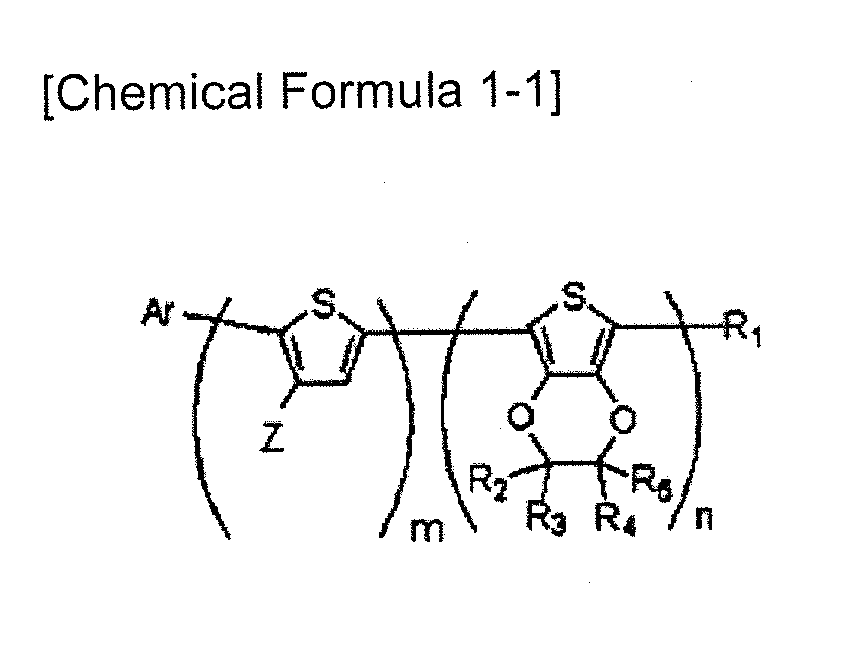


- Wherein, X, Y, R1 to R5, Ar, Z, m and n are as defined above.
- The present invention also provides a method for preparing organic dye of the following Chemical Formula 1-2(a compound of the Chemical Formula 1 wherein m' is not 0) comprising:
- (i) preparing a compound of the following Chemical Formula 4 by Suzuki coupling reaction of a compound of the following Chemical Formula 2 with a compound of the following Chemical Formula 3,
- (ii) preparing a compound of the following Chemical Formula 7 by reacting the compound of the Chemical Formula 4 with N-bromostyrene in an organic solvent,
- (iii) preparing a compound of the following Chemical Formula 9 by Suzuki coupling reaction of the compound of the Chemical Formula 7 with a compound of the following Chemical Formula 8,
- (iv) preparing a compound of the following Chemical Formula 10 by reacting the compound of the Chemical Formula 9 with POCl3 in an organic solvent, and
- (v) reacting the compound of the Chemical Formula 10 with cyanoacetic acid or a compound of the following Chemical Formula 6 in CH3CN in the presence of piperidine:

- The present invention also provides a dye-sensitized photoelectric transformation element comprising oxide semiconductor particles where the compound of the Chemical Formula 1 is supported.
- The present invention also provides a dye-sensitized solar cell comprising the dye-sensitized photoelectric transformation element.
- The dye compound of the present invention, if used for a dye-sensitized solar cell(DSSC), shows improved molar absorption coefficient, Jsc(shortcircuit photocurrent density) and photoelectric transformation efficiency compared to the existing dyes, thus largely improving solar cell efficiency, and it may be purified without expensive column thus remarkably lowering dye synthesis cost.
- The inventors confirmed that when a compound of the Chemical Formula 1 which uses 2,3-dihydrothieno[3,4-b][1,4]dioxin, introduces a thiophene unit in the intermediate bonding part for increasing molar absorption coefficient and device stability, and uses cyanoacrylic acid well adapted to TiO2 modification and having most excellent electron transferring capability as electron acceptor is supported in an oxide semiconductor particles to prepare a dye-sensitized solar cell, high photoelectric transformation efficiency, Jsc(shortcircuit photocurrent density) and molar absorption coefficient may be obtained to show excellent efficiency compared to the existing dye-sensitized solar cell, and completed the invention.
- The organic dye of the present invention is represented by the following Chemical Formula 1, preferably one of the following Chemical Formula 1a to 1x.


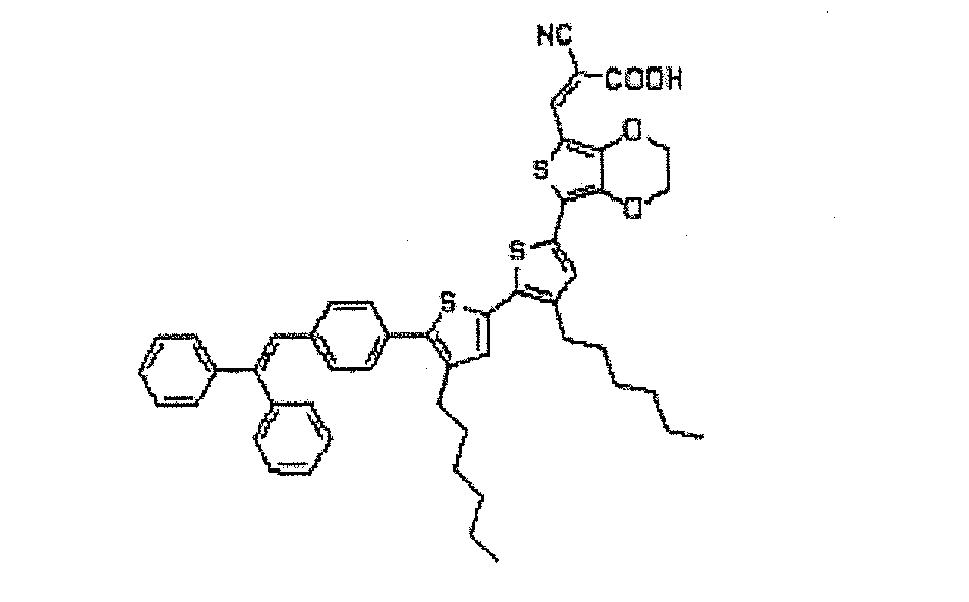


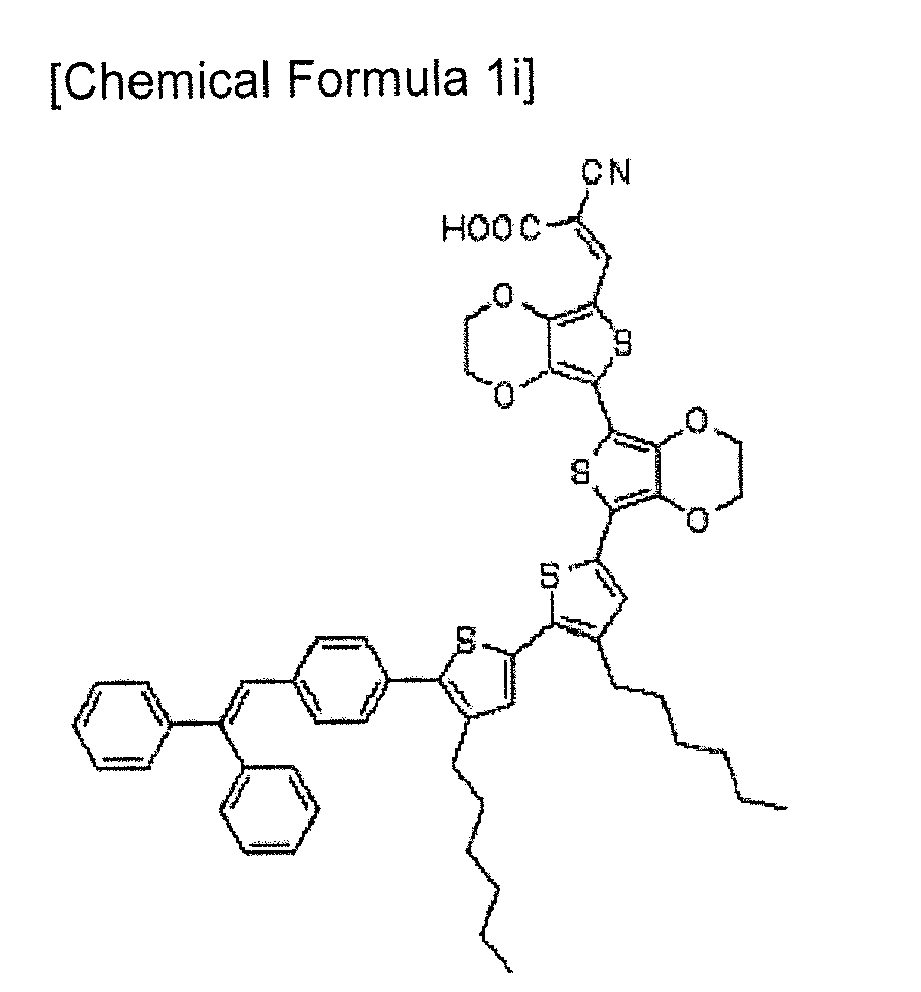


- Wherein, R1 to R5, Ar, Z, Z', m, n and m' are as defined above.
- The present invention also provides a method for preparing organic dye of the following Chemical Formula 1-1 wherein m' is 0, which comprises (1) preparing a compound of the following Chemical Formula 4 by Suzuki coupling reaction of a compound of the following Chemical Formula 2 with a compound of the following Chemical Formula 3, (2) preparing a compound of the following Chemical Formula 5 by reacting the compound of the Chemical Formula 4 with POCl3 in an organic solvent, (3) reacting the compound of the Chemical Formula 5 with cyanoacetic acid or a compound of the following Chemical Formula 6 in CH3CN in the presence of piperidine. Specific example of the method may be represented by the following Equations 1 to 4 (Equation 1: a compound of the Chemical Formula 1a, Equation 2: a compound of the Chemical Formula 1b, Equation 3: a compound of the Chemical Formula 1 e, Equation 4: a compound of the Chemical Formula 1f).


- The present invention also provides a method for preparing organic dye of the following Chemical Formula 1-2 wherein m' is not 0, which comprises (i) preparing a compound of the following Chemical Formula 4 by Suzuki coupling reaction of a compound of the following Chemical Formula 2 with a compound of the following Chemical Formula 3, (ii) preparing a compound of the following Chemical Formula 7 by reacting the compound of the Chemical Formula 4 with N-bromostyrene in an organic solvent (e.g., tetrahydrufuran), (iii) preparing a compound of the following Chemical Formula 9 by Suzuki coupling reaction of the compound of the Chemical Formula 7 with a compound of the following Chemical Formula 8, (iv) preparing a compound of the following Chemical Formula 10 by reacting the compound of the Chemical Formula 9 with POCl3 in an organic solvent (e.g., dimethylformamide), and (v) reacting the compound of the Chemical Formula 10 with cyanoacetic acid or a compound of the following Chemical Formula 6 in CH3CN in the presence of piperidine. Specific example of the method may be represented by the following Equations 5 to 10 (Equation 5: a compound of the Chemical Formula 1n, Equation 6: a compound of the Chemical Formula 1 r, Equation 7: a compound of the Chemical Formula 1 q, Equation 8: a compound of the Chemical Formula 1 m, Equation 9: a compound of the Chemical Formula 1w, Equation 10: a compound of the Chemical Formula 1u).


- In the above Equations, compounds of the Chemical Formulae 2a, 2b, 2e, 2f, 2n and 2r, and 3, which are used as a starting material for preparing the dye of the Chemical Formula 1, may be prepared by common methods or purchased.
- The present invention also provides a dye-sensitized photoelectric transformation element wherein the dye represented by the Chemical Formula 1 is supported on oxide semiconductor particles. The photoelectric transformation element of the present invention may be prepared by a process for preparing dye-sensitized photoelectric transformation element for solar cell of the prior art, except using the dye of the Chemical Formula 1. Preferably, the photoelectric transformation element of the present invention is prepared by forming oxide semiconductor thin film on a substrate and then supporting the dye of the present invention on the thin film.
- The substrate on which the oxide semiconductor thin film is formed preferably has a conductive surface, and is available on the market. For example, those prepared by forming a conductive metal oxide film such as indium, fluorine, antimony doped tin oxide, etc. or metal film such as steel, silver, gold, etc. on the surface of glass or on the surface of transparent polymer such as polyethyleneterephthalate or polyethersulfone, etc. may be used. Preferably, it may have conductivity of 1000Ω or less, more preferably 100Ω or less.
- As the oxide semiconductor particles, metal oxide is preferable. Specific examples may include titanium, tin, zinc, tungsten, zirconium, gallium, indium, yttrium, niobium, tantalum, vanadium oxide, etc. Preferably, titanium, tin, zinc, niobium, or indium oxide may be used, titanium oxide, zinc oxide or tin oxide may be more preferable, and titanium oxide may be most preferable. The oxide semiconductor may be used alone or in a combination, or it may be coated on the surface of semiconductor.
- The oxide semiconductor particles may preferably have the average diameter of 1 ∼ 500 nm, more preferably 1 - 100 nm. And, those having large diameter and those having small diameter may be mixed, or used in multi-layers.
- The oxide semiconductor thin film may be prepared by spraying oxide semiconductor particles to form a thin film thereof directly on a substrate; electrically depositing a semiconductor particle thin film using a substrate as an electrode; or, applying semiconductor particle slurry or paste containing particles obtained by hydrolysis of semiconductor particle precursor such as semiconductor alkoxide, etc. on a substrate, and drying, curing or sintering. Preferably, paste may be applied on a substrate, and in this case, slurry may be obtained by dispersing secondary coagulated oxide semiconductor particles in a dispersion medium to a first particle diameter of 1 - 200 nm by a common method.
- As the dispersion medium, those capable of dispersing semiconductor particles may be used without limitation. Specific examples may include water, alcohol such as ethanol, ketone such as acetone, acetylaetone, or hydrocarbon such as hexane, and a combination thereof. Water may be preferable because it minimizes change in viscosity of slurry. And, a dispersion stabilizer may be used in order to stabilize the dispersion of the oxide semiconductor particles. Specific examples of the dispersion stabilizer may include acid such as acetic acid, hydrochloric acid, nitric acid, etc., or acetylacetone, acrylic acid, polyethyleneglycol, polyvinylalcohol, etc.
- The substrate on which slurry is applied may be sintered, and the sintering temperature may be 100°C or more, preferably 200°C or more, and the upper limit of the sintering temperature may be melting point(softening point) of the substrate, commonly 900°C, preferably 600°C. The sintering time may not be specifically limited, but preferably within 4 hours.
- Thickness of the thin film on the substrate may be 1 - 200 µm, preferably 1 - 50 µm. In case sintering is conducted, an oxide semiconductor particle thin layer may be partly welded, but such welding may not cause any influences in the present invention.
- And, the oxide semiconductor thin film may be subjected to a secondary treatment. For example, the thin film may be immersed in a solution of alkoxide, chloride, nitride, sulfide, etc. of the metal identical to the semiconductor, and dried or re-sintered, thereby improving the property of the thin film. The metal alkoxide may include titanium ethoxide, titanium isoproepoxide, titanium t-butoxide, n-dibutyl-diacetyl tin, etc., and an alcohol solution thereof may be used. The chloride may include titanium tetrachloride, tin tetrachloride, zinc chloride, etc., and an aqueous solution thereof may be used. Thus obtained oxide semiconductor thin film may be comprised of oxide semiconductor particles.
- The method for supporting dye on oxide semiconductor particles in the form of a thin film may not be specifically limited, and for example, a substrate having the oxide semiconductor thin film formed thereon may be immersed in a solution obtained by dissolving the dye represented by the above Chemical Formula 1 in a solvent capable of dissolving the same, or in a dispersion obtained by dispersing the dye. The concentration of the solution or dispersion may be appropriately determined. Immersion temperature may be from room temperature to boiling point of the solvent, and immersion time may be about 1 minute to 48 hours. The solvent used for dissolving the dye may include methanol, ethanol, acetonitrile, dimethylsulfoxide, dimethylformamide, acetone, t-butanol, etc. The concentration of the solution may be commonly 1 x 10⁻⁶ M to 1 M, preferably 1 x 10⁻⁵ M to 1 x 10⁻¹ M. Thus, a dye-sensitized photoelectric transformation element comprising oxide semiconductor particles on a dye-sensitized thin film may be obtained.
- One kind of the dye represented by the Chemical Formula 1 may be used or several kinds of the dyes may be used in combination. In case several kinds of dyes are used in combination, only dyes according to the present invention may be used, or the dyes according to the present invention may be mixed with other dyes or metal complex dyes. The metal complex dyes that may be mixed may include, although not specifically limited, ruthenium complex or quaternary salt thereof, phthalocyanin, porphyrin, etc.; and the organic dye that may be mixed may include metal-free phthalocyanin, porphyrin, cyanin, merocyanin, oxonol, or triphenylmethane dye, methyne dye such as acrylate dye described in
WO2002/011213 , xanthenes, azo, anthraquinone, perylene dye(See M.K.Nazeeruddin, A.Kay, I.Rodicio, R.Humphry-Baker, E.Muller, P.Liska, N.Vlachopoulos, M.Gratzel, J. Am. Chem. Soc., Vol.115, p 6382(1993)). In case two or more kinds of dyes are used in combination, they may be sequentially absorbed in a semiconductor thin layer, or mixed, dissolved and absorbed. - When the dye is supported on the oxide semiconductor particle thin film, in order to prevent bonding between dyes, it may be preferable to support dye in the presence of an inclusion compound. The inclusion compound may include cholic acid such as deoxycholic acid, dehydrodeoxycholic acid, kenodeoxycholic acid, cholic acid methyl ester, cholic acid sodium, etc., steroid compounds such as cholic acid, polyethyleneoxide, etc., crown ether, cyclodextrin, calyxarene, polyethyleneoxide, etc.
- After the dye is supported, the surface of a semiconductor electrode may be treated with an amine compound such as 4-t-butyl pyridine, or a compound having acid group such as acetic acid, propionic acid, etc. For example, a substrate having a dye-supported semiconductor particle thin film formed thereon may be immersed in an ethanol solution of amine.
- The present invention also provides a dye-sensitized solar cell comprising the dye-sensitized photoelectric transformation element. It may be prepared by common method of preparing a solar cell using photoelectric transformation element of the prior art, except using a dye-sensitized photoelectric transformation element comprising oxide semiconductor particles where the dye of the Chemical Formula 1 is supported. The dye-sensitized solar cell may be comprised of a photoelectric transformation element electrode (negative electrode) wherein the dye represented by the Chemical Formula 1 is supported on the oxide semiconductor particles, a counter electrode(positive electrode), redox electrolyte, hole-transport material or p-type semiconductor, etc.
- Preferably, the dye-sensitized solar cell of the present invention may be prepared by coating titanium oxide paste on a transparent conductive substrate; sintering the coated substrate to form a titanium oxide thin film; immersing the substrate having titanium oxide thin film formed thereon in a mixed solution in which the dye represented by the Chemical Formula 1 is dissolved, so as to form a dye-absorbed titanium oxide film electrode; providing a second glass substrate having a counter electrode formed thereon; forming a hole penetrating the second glass substrate and the counter electrode; placing thermoplastic polymer film between the counter electrode and the dye-absorbed titanium oxide film electrode and heat-pressing them to join the counter electrode and the titanium oxide film electrode; injecting electrolyte into the thermoplastic polymer film placed between the counter electrode and the titanium oxide film electrode through the hole; and, sealing the thermoplastic polymer.
- The redox electrolyte, hole-transport material, or p-type semiconductor may be liquid, a coagulated form(gel and gel phase), solid, etc. The liquid may include those obtained by dissolving redox electrolyte, dissolved salt, hole-transport material, or p-type semiconductor in a solvent, and a room temperature dissolved salt. The coagulated form(gel and gel phase) may include those obtained by including redox electrolyte, a dissolved salt, hole-transport material, or p-type semiconductor in a polymer matrix or low molecular gellant, etc. The solid may include redox electrolyte, a dissolved salt, hole-transport material, or p-type semiconductor.
- The hole-transport material may include amine derivatives, conductive polymer such as polyacetylene, polyaniline, polythiophene, etc., or those using discotic liquid crystal phase such as triphenylene. The p-type semiconductor may include Cul, CuSCN, etc. As the counter electrode, those having conductivity and catalytic function on reduction of redox electrolyte may be preferably used, and, for example, those obtained by depositing platinum, carbon, rhodium, ruthenium, etc. on a glass or a polymer film, or applying conductive particles thereon may be used.
- The redox electrolyte used in the solar cell of the present invention may include halogen redox electrolyte consisting of halogen compound comprising halogen ion as a counter ion and a halogen molecule, metal redox electrolyte such as ferrocyanide-ferrocyanide or ferrocene-ferricynium ion, metal complex such as cobalt complex, etc., organic redox electrolyte such as alkylthio-alkyldisulfide, viologen dye, hydroquinone-quinone, etc., and halogen redox electrolyte may be preferable. As the halogen molecule comprised in the halogen redox electrolyte, an iodine molecule may be preferable. As the halogen compounds comprising halogen ion as counter ion, a halogenated metal salt such as Lil, Nal, Kl, Cal2, Mgl2, Cul, etc., or an organic ammonium salt of halogen such as tetraalkylammonium iodide, imidazolium iodide, pyridium iodide, etc. or l2 may be used.
- In case the redox electrolyte is in the form of a solution comprising the same, an electrochemically inert solvent may be used. For example, acetonitrile, propylenecarbonate, etylenecarbonate, 3-methoxypropionitrile, methoxyacetonitrile, ethyleneglycol, propyleneglycol, diethyleneglycol, triethyleneglycol, butyrolactone, dimethoxyethane, dimethylcarbonate, 1,3-dioxolane, methylformate, 2-methyltetrahydrofurane, 3-methoxy-oxazolidin-2-on, sulforane, tetrahydrofurane, water, etc. may be used, and acetonitrile, propylenecarbonate, ethylenecarbonate, 3-methoxypropionitrile, ethyleglycol, 3-methoxy-oxazolidin-2-on, or butyrolactone may be preferable. These solvent may be used alone or in combination. As a gel phase positive electrolyte, those obtained by including electrolyte or electrolyte solution in oligomer or polymer matrix, or including electrolyte or electrolyte solution in a starch gellant may be used. The concentration of the redox electrolyte may be preferably 0.01 - 99 wt%, and more preferably 0.1 - 30 wt%.
- The solar cell of the present invention may be obtained by disposing a photoelectric transformation element(negative electrode) wherein dye is supported on oxide semiconductor particles on a substrate and a counter electrode(positive electrode) opposite thereto, and filling a redox electrolyte containing solution therebetween.
- All the reactions were performed under argon atmosphere, and a solvent was distilled with an appropriate reagent purchased from Sigma-Aldrich Company. 1 H NMR spectrum was measured by Varian Mercury 300 spectrometer. Absorption and emission spectrums were respectively measured by Perkin-Elmer Lambda 2S UV-visible spectrometer and Perkin LS fluorescent spectrometer.
-
- (1-1) 2,3-dihydrothieno[3,4-b][1,4]dioxin-5-yl)trimethylstannan (0.40g 1.34mmol), a compound of the Chemical Formula 2a (0.75g, 1.12mmol), and Pd(PPh3)4 (0.065g, 0.056mmol) were dissolved in THF (40ml), and then, refluxed under nitrogen atmosphere for 8 hours. Subsequently, an organic layer was extracted with water and methylene chloride and distilled, and column chromatography was performed (eluent - MC : Hx = 1 : 4) to synthesize a compound of the Chemical Formula 4a.
1H NMR(CDCl3) : [ppm] = 0.96(m, 6H), 1.29(m, 4H), 1.96(m, 4H), 2.55(m, 8H), 2.62(m, 4H), 4.68(s, 2H), 4.71(s, 2H), 6.71(m, 2H), 6.96(s, 1H), 7.08(s, 1H), 7.18(m, 4H), 7.38(m, 2H), 7.45(m, 6H), 7.55(d, 3JHH = 8.8Hz, 2H). - (1-2) The compound of the Chemical Formula 4a (0.87g, 1.2mmol) was dissolved in DMF (20ml), and then, POCl3 (0.13ml 1.44mmol) was slowly added at 0°C and the reaction mixture was agitated at 80°C for 4 hours. After agitation, an organic layer was extracted with methylene chloride and water and distilled, and column chromatography was performed (eluent - EA : Hx = 1 : 2) to synthesize a compound of the Chemical Formula 5a.
1H NMR(CDCl3) : [ppm] = 0.96(m, 6H), 1.29(m, 4H), 1.96(m, 4H), 2.55(m, 8H), 2.62(m, 4H), 4.68(s, 2H), 4.71 (s, 2H), 6.71 (m, 2H), 7.08(s, 1H), 7.18(m, 4H), 7.38(m, 2H), 7.45(m, 6H), 7.53(d, 3JHH = 8.8Hz, 2H), 9.54(s, 1H). - (1-3) The compound of the Chemical Formula 5a (0.58g, 0.77mmol), cyanoacetic acid (0.08g, 0.93mmol), and piperidine (0.92ml, 0.93mmol) were dissolved in acetonitrile (20ml), and then, the reaction mixture was refluxed under nitrogen atmosphere for 4 hours. Subsequently, an organic layer was extracted with methylene chloride and water and distilled, and column chromatography was performed (eluent - EA : EtOH = 10 : 1) to synthesize a compound of the Chemical Formula 1a.
1H NMR(DMSO) : [ppm] = 0.96(m, 6H), 1.29(m, 4H), 1.44(s, 12H), 1.96(m, 4H), 2.55(m, 8H), 2.62(m, 4H), 4.68(s, 2H), 4.71 (s, 2H), 6.98(m, 2H), 7.08(s, 1H), 7.2(m, 4H), 7.39(m, 2H), 7.42(m, 6H), 7.53(d, 3JHH = 8.8Hz, 2H), 11.48(s, 1H). -
- (2-1) (2,3-dihydrothieno[3,4-b][1,4]dioxin-5-yl)trimethylstannan (0.40g 1.34mmol), a compound of the Chemical Formula 2b (1 g, 1.12mmol), and Pd(PPh3)4 (0.065g, 0.056mmol) were dissolved in THF (40ml), and then refluxed under nitrogen atmosphere for 8 hours. Subsequently, an organic layer was extracted with methylene chloride and water and distilled, and column chromatography was performed (eluent - MC : Hx = 1 : 4) to synthesize a compound of the Chemical Formula 4b.
1H NMR(CDCl3) : [ppm] = 0.96(m, 6H), 1.29(m, 4H), 1.44(s, 12H), 1.96(m, 4H), 2.55(m, 8H), 2.62(m, 4H), 4.68(s, 2H), 4.71(s, 2H), 6.91(s, 1H), 6.96(s, 1H), 7.08(s, 1H), 7.18(m, 6H), 7.38(m, 6H), 7.55(m, 4H), 7.82(d, 3JHH = 8.8Hz, 2H). - (2-2) The compound of the Chemical Formula 4b (1.14g, 1.2mmol) was dissolved in DMF (20ml), and then POCl3 (0.13ml 1.44mmol) was slowly added at 0°C and the reaction mixture was agitated at 80°C for 4 hours. After agitation, an organic layer was extracted with methylene chloride and water and distilled, and column chromatography was performed (eluent - EA : Hx = 1 : 2) to synthesize a compound of the Chemical Formula 5b.
1H NMR(CDCl3) : [ppm] = 0.96(m, 6H), 1.29(m, 4H), 1.44(s, 12H), 1.96(m, 4H), 2.55(m, 8H), 2.62(m, 4H), 4.68(s, 2H), 4.71(s, 2H), 6.93(s, 1H), 7.08(s, 1H), 7.18(m, 6H), 7.38(m, 6H), 7.55(m, 4H), 7.82(d, 3JHH = 8.8Hz, 2H), 9.51 (s, 1H). - (2-3) The compound of the Chemical Formula 5b (0.75g, 0.77mmol), cyanoacetic acid (0.08g, 0.93mmol), and piperidine (0.92ml, 0.93mmol) were dissolved in acetonitrile (20ml), and then, the reaction mixture was refluxed under nitrogen atmosphere for 4 hours. Subsequently, an organic layer was extracted with methylene chloride and water and distilled, and column chromatography was performed (eluent - EA : EtOH = 10 : 1) to synthesize a compound of the Chemical Formula 1 b.
1H NMR(DMSO) : [ppm] = 0.96(m, 6H), 1.29(m, 4H), 1.44(s, 12H), 1.96(m, 4H), 2.55(m, 8H), 2.62(m, 4H), 4.68(s, 2H), 4.71(s, 2H), 6.98(m, 2H), 7.08(s, 1H), 7.15(m, 6H), 7.32(m, 6H), 7.55(m, 4H), 7.80 (d, 3JHH = 8.8Hz, 2H), 11.51 (s, 1H). -
- (3-1) (2,3-dihydrothieno[3,4-b][1,4]dioxin-5-yl)trimethylstannan (0.40g 1.34mmol), 5-bromo-2-(4-(2,2-diphenylvinyl)phenyl)-3-hexylthiophene(a compound of the Chemical Formula 2e (0.67g, 1.34mmol), and Pd(PPh3)4 (0.065g, 0.056mmol) were dissolved in THF (40ml), and then refluxed under nitrogen atmosphere for 8 hours. Subsequently, an organic layer was extracted with methylene chloride and water and distilled, and column chromatography was performed (eluent - MC : Hx = 1 : 4) to synthesize a compound of the Chemical Formula 4e.
1H NMR(CDCl3) : [ppm] = 0.88(m, 3H), 1.29(m, 2H), 1.86(m, 2H), 2.55(m, 4H), 2.62(m, 2H), 4.68(s, 2H), 4.71 (s, 2H), 6.71 (s, 1H), 6.96(s, 1H), 7.08(s, 1H), 7.18(m, 4H), 7.38(m, 2H), 7.45(m, 6H), 7.55(d, 3JHH = 8.8Hz, 2H). - (3-2) The compound of the Chemical Formula 4e (1.14g, 1.2mmol) was dissolved in DMF (20ml), and then POCl3 (0.13ml 1.44mmol) was slowly added at 0°C and the reaction mixture was agitated at 80°C for 4 hours. After agitation, an organic layer was extracted with methylene chloride and water and distilled, and column chromatography was performed (eluent - EA : Hx = 1 : 2) to synthesize a compound of the Chemical Formula 5e.
1H NMR(CDCl3) : [ppm] = 0.92(m, 3H), 1.31(m, 2H), 1.86(m, 2H), 2.58(m, 4H), 2.65(m, 2H), 4.68(s, 2H), 4.73(s, 2H), 6.71 (s, 1H), 6.96(s, 1H), 7.18(m, 4H), 7.42(m, 2H), 7.48(m, 6H), 7.55(d, 3JHH = 8.8Hz, 2H), 9.56(s, 1H). - (3-3) The compound of the Chemical Formula 5e (0.75g, 0.77mmol), cyanoacetic acid (0.08g, 0.93mmol), and piperidine (0.92ml, 0.93mmol) were dissolved in acetonitrile (20ml), and then, the reaction mixture was refluxed under nitrogen atmosphere for 4 hours. Subsequently, an organic layer was extracted with methylene chloride and water and distilled, and column chromatography was performed (eluent - EA : EtOH = 10 : 1) to synthesize a compound of the Chemical Formula 1e.
1H NMR(DMSO) : [ppm] = 0.96(m, 3H), 1.29(m, 2H), 1.96(m, 2H), 2.55(m, 4H), 2.62(m, 2H), 4.68(s, 2H), 4.71(s, 2H), 6.98(m, 2H), 7.08(s, 1H), 7.18(m, 4H), 7.42(m, 2H), 7.51 (m, 6H), 7.58(d, 3JHH = 8.8Hz, 2H), 11.54(s, 1H). -
- (4-1) (2,3-dihydrothieno[3,4-b][1,4]dioxin-5-yl)trimethylstannan (0.40g 1.34mmol),
N-(4-(5-bromo-3-hexylthiophene-2-yl)phenyl)-N-(9,9-dimethyl-9H-fluorene-2-yl)-9.9-dimethyl-9H-fluorene-2-amine (a compound of the Chemical Formula 2f (0.97g, 1.34mmol), and Pd(PPh3)4 (0.065g, 0.056mmol) were dissolved in THF (40ml), and then refluxed under nitrogen atmosphere for 8 hours. Subsequently, an organic layer was extracted with methylene chloride and water and distilled, and column chromatography was performed (eluent - MC : Hx = 1 : 4) to synthesize a compound of the Chemical Formula 4f.
1H NMR(CDCl3) : [ppm] = 0.89(m, 3H), 1.29(m, 4H), 1.47(s, 12H), 1.52(m, 4H), 2.52(m, 2H), 4.68(s, 2H), 4.71 (s, 2H), 6.93 (s, 1H), 6.98(s, 1H), 7.09(m, 4H), 7.31 (m, 4H), 7.38(m, 4H), 7.58(d, 3JHH = 11.6Hz, 2H), 7.62.(m, 4H). - (4-2) The compound of the Chemical Formula 4f (1.14g, 1.2mmol) was dissolved in DMF (20ml), and then POCl3 (0.13ml 1.44mmol) was slowly added at 0°C and the reaction mixture was agitated at 80°C for 4 hours. After agitation, an organic layer was extracted with methylene chloride and water and distilled, and column chromatography was performed (eluent - EA : Hx = 1 : 2) to synthesize a compound of the Chemical Formula 5f.
1H NMR(CDCl3) : [ppm] = 0.89(m, 3H), 1.29(m, 4H), 1.47(s, 12H), 1.52(m, 4H), 2.52(m, 2H), 4.68(s, 2H), 4.71 (s, 2H), 6.93 (s, 1H), 7.09(m, 4H), 7.31(m, 4H), 7.38(m, 4H), 7.58(d, 3JHH = 11.6Hz, 2H), 7.62.(m, 4H), 9.51 (s, 1H). - (4-3) The compound of the Chemical Formula 5f (0.75g, 0.77mmol), cyanoacetic acid (0.08g, 0.93mmol), and piperidine (0.92ml, 0.93mmol) were dissolved in acetonitrile (20ml), and then, the reaction mixture was refluxed under nitrogen atmosphere for 4 hours. Subsequently, an organic layer was extracted with methylene chloride and water and distilled, and column chromatography was performed (eluent - EA : EtOH = 10 : 1) to synthesize a compound of the Chemical Formula 1f.
1H NMR(DMSO) : [ppm] = 0.96(m, 3H), 1.29(m, 2H), 1.44(s, 12H), 1.96(m, 2H), 2.55(m, 4H), 2.62(m, 2H), 4.68(s, 2H), 4.71(s, 2H), 6.96(s, 1H), 7.08(s, 1H), 7.15(m, 6H), 7.32(m, 6H), 7.55(m, 4H), 7.80 (d, 3JHH = 8.8Hz, 2H), 11.51 (s, 1H). -
- (5-1) (2,3-dihydrothieno[3,4-b][1,4]dioxin-5-yl)trimethylstannan (0.81g 2.66mmol),
N-(4-bromophenyl)-N-(9,9-dimethyl-9H-fluorene-2-yl)-9,9-dimethyl-9H-fluorene-2-amine(a compound of the Chemical Formula 2n) (1.78g, 3.2mmol), and Pd(PPh3)4 (0.15g, 0.13mmol) were dissolved in THF (40ml), and then refluxed under nitrogen atmosphere for 8 hours. Subsequently, an organic layer was extracted with methylene chloride and water and distilled, and column chromatography was performed (eluent - MC : Hx = 1 : 4) to synthesize a compound of the Chemical Formula 4n.
1H NMR(CDCl3) : [ppm] = 1.47(s, 12H), 4.68(s, 2H), 4.71(s, 2H), 6.98(s, 1H), 7.09(m, 4H), 7.31(m, 4H), 7.38(m, 4H), 7.58(d, 3JHH = 11.6Hz, 2H), 7.62.(m, 4H). - (5-2) The compound of the Chemical Formula 4n (N-(4-(2,3-dihydrothieno[3,4-b][1,4]dioxin-5-yl)phenyl)-N-(9,9-dimethyl-9H-fluore ne-2-yl)-9,9-dimethyl-9H-fluorene-2-amine) (1.84g, 2.98mmol) and N-bromostyrene (0.64g, 3.57mmol) were dissolved in THF 30ml, and then, the reaction mixture was agitated under nitrogen atmosphere. Subsequently, an organic layer was extracted with methylene chloride and water and distilled to obtain
N-(4-(7-bromo-2,3-dihydrothieno[3,4-b][1,4]dioxin-5-yl)phenyl)-N-(9,9-dimethyl-9 H-fluorene-2-yl)-9,9-dimethyl-9H-fluorene-2-amine) (a compound of the Chemical Formula 7n). The compound of the Chemical Formula 7n (1.95g, 2.8mmol), 3',4-dihexyl-2,2'-bithiophene-5-ylboronic acid (0.88g, 2.33mmol), K2CO3 (0.64g, 4.66mmol), and Pd(PPh3)4 (0.13g, 0.12mmol) were dissolved in DMF (40ml), and then, the reaction mixture was refluxed under nitrogen atmosphere for 8 hours. Subsequently, an organic layer was extracted with methylenechloride and water and distilled, and column chromatography was performed (eluent - Mc : Hx = 1 : 4) to synthesize a compound of the Chemical Formula 9n.
1H NMR(CDCl3) : [ppm] = 0.98(m, 6H), 1.28(m, 4H), 1.44(s, 12H), 1.96(m, 4H), 2.55(m, 8H), 2.62(m, 4H), 4.64(s, 2H), 4.70(s, 2H), 6.92(s, 1H), 6.96(s, 1H), 7.10(s, 1H), 7.18(m, 6H), 7.38(m, 6H), 7.56(m, 4H), 7.84(d, 3JHH = 8.8Hz, 2H). - (5-3) The compound of the Chemical Formula 9n (N-(4-(7-(3',4-dihexyl-2,2'-bithiophene-5-yl)-2,3-dihydrothieno[3,4-b][1,4]dioxin-5 -yl)phenyl)-N-(9,9-dimethyl-9H-fluorene-2-yl)-9,9-dimethyl-9H-fluorene-2-amine) (1.06g, 1.12mmol) was dissolved in DMF (20ml), and then, POCl3 (0.13ml 1.44mmol) was slowly added at 0°C, and the reaction mixture was agitated at 80°C for 4 hours. After agitation, an organic layer was extracted with methylene chloride and water and distilled, and column chromatography was performed (eluent - EA : Hx = 1 : 2) to synthesize a compound of the Chemical Formula 10n.
1H NMR(CDCl3) : [ppm] = 0.96(m, 6H), 1.29(m, 4H), 1.44(s, 12H), 1.96(m, 4H), 2.55(m, 8H), 2.62(m, 4H), 4.68(s, 2H), 4.71(s, 2H), 6.93(s, 1H), 7.08(s, 1H), 7.18(m, 6H), 7.38(m, 6H), 7.55(m, 4H), 7.82(d, 3JHH = 8.8Hz, 2H). 9.54(s, 1H). - (5-4) The compound of the Chemical Formula 10n (5'-(7-(4-bis(9,9-dimethyl-9H-fluorene-2-yl)amino)phenyl)-2,3-dihydrothieno[3,4-b][1,4]dioxin-5-yl)-3,4'-dihexyl-2,2'-bithiophene-5-carbaldehyde)(0.75g, 0.77mmol), cyanoacetic acid (0.08g, 0.93mmol), and piperidine (0.92ml, 0.93mmol) were dissolved in acetonitrile (20ml), and then the reaction mixture was agitated under nitrogen atmosphere for 4 hours. Subsequently, an organic layer was extracted with methylene chloride and water and distilled, and column chromatography was performed (eluent - EA : EtOH = 10 : 1) to synthesize a compound of the Chemical Formula 1 n.
1H NMR(DMSO) : [ppm] = 0.94(m, 6H), 1.28(m, 4H), 1.42(s, 12H), 1.98(m, 4H), 2.56(m, 8H), 2.62(m, 4H), 4.68(s, 2H), 4.74(s, 2H), 6.98(m, 2H), 7.11 (s, 1H), 7.20(m, 6H), 7.34(m, 6H), 7.56(m, 4H), 7.82 (d, 3JHH= 8.8Hz, 2H), 11.54(s, 1H). -
- (6-1) (2,3-dihydrothieno[3,4-b][1,4]dioxin-5-yl)trimethylstannan (0.81g 2.66mmol), 1-bromo-4-(2,2-diphenylvinyl)benzene (a compound of the Chemical Formula 2r) (1.7g, 3.2mmol), and Pd(PPh3)4 (0.15g, 0.13mmol) were dissolved in toluene (40ml), and then refluxed under nitrogen atmosphere for 8 hours. Subsequently, an organic layer was extracted with methylene chloride and water and distilled, and column chromatography was performed (eluent - MC : Hx = 1 : 4) to synthesize a compound of the Chemical Formula 4r.
1H NMR(CDCl3) : [ppm] = 4.68(s, 2H), 4.72(s, 2H), 6.71(s, 1H), 6.96(s, 1H), 7.08(s, 1H), 7.18(m, 4H), 7.40(m, 2H), 7.48(m, 6H), 7.56(d, 3JHH = 8.8Hz, 2H). - (6-2) The compound of the Chemical Formula 4r (5-(4-(2,2-diphenylvinyl)phenyl-2,3-dihydrothieno[3,4-b][1,4]dioxin) (1.18g, 3.00mmol) and N-bromostyrene (0.64g, 3.57mmol) were dissolved in THF 30ml, and then, the reaction mixture was agitated under nitrogen atmosphere. Subsequently, an organic layer was extracted with methylene chloride and water and distilled to obtain 5-bromo-7-(4-(2,2-diphenylvinyl)phenyl)-2,3-dihydrothieno[3,4-b][1,4]dioxin (a compound of the Chemical Formula 7r) (1.33g, 2.8mmol). The compound of the Chemical Formula 7r (1.33g, 2.8mmol), 3',4-dihexyl-2,2'-bithiophene-5-ylboronic acid (0.88g, 2.33mmol), K2CO3 (0.64g, 4.66mmol), and Pd(PPh3)4 (0.13g, 0.12mmol) were dissolved in DMF (40ml), and then refluxed under nitrogen atmosphere for 8 hours. Subsequently, an organic layer was extracted with methylene chloride and water and distilled, and column chromatography was performed (eluent - MC : Hx = 1 : 4) to synthesize a compound of the Chemical Formula 9r.
1H NMR(CDCl3) : [ppm] = 0.96(m, 6H), 1.29(m, 4H), 1.96(m, 4H), 2.55(m, 8H), 2.62(m, 4H), 4.68(s, 2H), 4.71 (s, 2H), 6.71 (m, 2H), 6.96(s, 1H), 7.08(s, 1H), 7.18(m, 4H), 7.38(m, 2H), 7.45(m, 6H), 7.55(d, 3JHH = 8.8Hz, 2H). - (6-3) The compound of the Chemical Formula 9r (5-(3',4-dihexyl-2,2'-bithiophene-5-yl)-7-(4-(2,2-diphenylvinyl)phenyl)-2,3-dihydr othieno[3,4-b][1,4]dioxin) (0.87g, 1.2mmol) was dissolve din DMF (20ml), and then, POCl3 (0.13ml 1.44mmol) was slowly added at 0°C and the reaction mixture was agitated at 80°C for 4 hours. After agitation, an organic layer was extracted with methylene chloride and water and distilled, and column chromatography was performed (eluent - EA : Hx = 1 : 2) to synthesize a compound of the Chemical Formula 10r.
1H NMR(CDCl3) : [ppm] = 0.96(m, 6H), 1.29(m, 4H), 1.96(m, 4H), 2.55(m, 8H), 2.62(m, 4H), 4.68(s, 2H), 4.71(s, 2H), 6.72(m, 2H), 7.10(s, 1H), 7.18(m, 4H), 7.38(m, 2H), 7.45(m, 6H), 7.54(d, 3JHH = 8.8Hz, 2H), 9.54(s, 1H). - (6-4) The compound of the Chemical Formula 10r (5-(7-(4-(2,2-diphenylvinyl)phenyl)-2,3-dihydrothieno[3,4-b][1,4]dioxin-5-yl)-3',4-dihexyl-2,2'-bithiophene-5-carbaldehyde) (0.58g, 0.77mmol), cyanoacetic acid (0.08g, 0.93mmol), and piperidine (0.92ml, 0.93mmol) were dissolved in acetonitrile (20ml), and then, the reaction mixture was refluxed under nitrogen atmosphere for 4 hours. Subsequently, an organic layer was extracted with methylene chloride and water and distilled, and column chromatography was performed (eluent - EA : EtOH = 10 : 1) to synthesize a compound of the Chemical Formula 1r.
1H NMR(DMSO) : [ppm] = 0.96(m, 6H), 1.29(m, 4H), 1.44(s, 12H), 1.96(m, 4H), 2.55(m, 8H), 2.62(m, 4H), 4.68(s, 2H), 4.71(s, 2H), 6.98(m, 2H), 7.08(s, 1H), 7.2(m, 4H), 7.39(m, 2H), 7.42(m, 6H), 7.53(d, 3JHH = 8.8Hz, 2H), 11.48(s, 1H). -
- (7-1) The compound of the Chemical Formula 7r obtained in the Example 6, (6-2) (1.2g, 2.52mmol), 3-hexylthiophene-2-ylboronic acid (0.44g, 2.1mmol), K2CO3 (0.58g, 4.2mmol), and Pd(PPh3)4 (0.12g, 0.105mmol) were dissolved in DMF (30ml), and then, the reaction mixture was refluxed under nitrogen atmosphere for 8 hours. Subsequently, an organic layer was extracted with methylene chloride and water and distilled, and column chromatography was performed (eluent - MC : Hx = 1 : 4) to synthesize a compound of the Chemical Formula 9r'.
1H NMR(CDCl3) : [ppm] = 0.88(m, 3H), 1.29(m, 2H), 1.86(m, 2H),2.55(m, 4H), 2.62(m, 2H), 4.64(s, 2H), 4.70(s, 2H), 6.72(s, 1H), 6.96(s, 1H), 7.08(s, 1H), 7.18(m, 4H), 7.38(m, 2H), 7.44(m, 6H), 7.54(d, 3JHH = 8.8Hz, 2H). - (7-2) The compound of the Chemical Formula 9r' (5-(4-(2,2-diphenylvinyl)phenyl)-7-(3-hexylthiophene-2-yl)-2,3-dihydrothieno[3,4-b][1,4]dioxin) (0.98g, 1.2mmol) was dissolved in DMF (20ml), and then, POCl3 (0.13ml 1.44mmol) was slowly added at 0°C and the reaction mixture was agitated at 80°C for 4 hours. After agitation, an organic layer was extracted with methylene chloride and water and distilled, and column chromatography was performed (eluent - EA : Hx = 1 : 2) to synthesize a compound of the Chemical Formula 10r'.
1H NMR(CDCl3) : [ppm] = 0.88(m, 3H), 1.30(m, 2H), 1.86(m, 2H), 2.58(m, 4H), 2.65(m, 2H), 4.68(s, 2H), 4.73(s, 2H), 6.71 (s, 1H), 6.96(s, 1H), 7.18(m, 4H), 7.42(m, 2H), 7.50(m, 6H), 7.56(d, 3JHH = 8.8Hz, 2H), 9.58(s, 1H). - (7-3) The compound of the Chemical Formula 10r' (5-(7-(4-(2,2-diphenylvinyl)phenyl)-2,3-dihydrothieno[3,4-b][1,4]dioxin-5-yl)-4-he xylthiophene-2-carbaldehyde) (0.75g, 0.77mmol), cyanoacetic acid (0.08g, 0.93mmol), and piperidine (0.92ml, 0.93mmol) were dissolved in acetonitrile (20ml), and then, the reaction mixture was refluxed under nitrogen atmosphere for 4 hours. Subsequently, an organic layer was extracted with methylene chloride and water and distilled, and column chromatography was performed (eluent - EA : EtOH = 10 : 1) to synthesize a compound of the Chemical Formula 1 q.
1H NMR(DMSO) : [ppm] = 0.94(m, 3H), 1.29(m, 2H), 1.95(m, 2H), 2.56(m, 4H), 2.64(m, 2H), 4.68(s, 2H), 4.72(s, 2H), 6.98(m, 2H), 7.11 (s, 1H), 7.20(m, 4H), 7.42(m, 2H), 7.51 (m, 6H), 7.58(d, 3JHH = 8.8Hz, 2H), 11.54(s, 1H). -
- (8-1) The compound of Chemical Formula 7n obtained in the Example 5, (5-2) (1.92g, 1.34mmol), 3-hexylthiophene-2-ylboronic acid (0.28g, 1.34mmol), K2CO3 (0.64g, 4.66mmol), and Pd(PPh3)4 (0.13g, 0.12mmol) were dissolved in DMF (40ml), and then, the reaction mixture was refluxed under nitrogen atmosphere for 8 hours. Subsequently, an organic layer was extracted with methylene chloride and water and distilled, and column chromatography was performed (eluent - MC : Hx = 1 : 4) to synthesize a compound of the Chemical Formula 9n'.
1H NMR(CDCl3) : [ppm] = 0.89(m, 3H), 1.29(m, 4H), 1.47(s, 12H), 1.52(m, 4H), 2.52(m, 2H), 4.68(s, 2H), 4.71 (s, 2H), 6.93 (s, 1H), 6.98(s, 1H), 7.09(m, 4H), 7.31 (m, 4H), 7.38(m, 4H), 7.58(d, 3JHH = 11.6Hz, 2H), 7.62.(m, 4H). - (8-2) The compound of the Chemical Formula 9n' (N-(9,9-dimethyl-9H-fluorene-2-yl)-N-(4-(7-(3-hexylthiophene-2-yl)-2,3-dihydroth ieno[3,4-b][1,4]dioxin-5-yl)phenyl)-9,9-dimethyl-9H-fluorene-2-amine) (0.88g, 1.12mmol) was dissolved in DMF (20ml), and then, POCl3 (0.13ml 1.44mmol) was slowly added at 0°C and the reaction mixture was agitated at 80°C for 4 hours. After agitation, an organic layer was extract with methylene chloride and water and distilled, and column chromatography was performed (eluent - EA : Hx = 1 : 2) to synthesize a compound of the Chemical Formula 10n'.
1H NMR(CDCl3) : [ppm] = 0.89(m, 3H), 1.29(m, 4H), 1.47(s, 12H), 1.52(m, 4H), 2.52(m, 2H), 4.68(s, 2H), 4.74(s, 2H), 6.94 (s, 1H), 7.12(m, 4H), 7.32(m, 4H), 7.40(m, 4H), 7.56(d, 3JHH = 11.6Hz, 2H), 7.62.(m, 4H), 9.54(s, 1H). - (8-3) The compound of the Chemical Formula 10n' (5-(7-(4-(bis(9,9-dimehtyl-9H-fluorene-2-yl)amino)phenyl)-2,3-dihydrothieno[3,4-b][1,4]dioxin-5-yl)-4-hexylthiophene-5-carbaldehyde) (0.75g, 0.77mmol), cyanoacetic acid (0.08g, 0.93mmol), and piperidine (0.92ml, 0.93mmol) were dissolved in acetonitrile (20ml), and then, the reaction mixture was refluxed under nitrogen atmosphere for 4 hours. Subsequently, an organic layer was extracted with methylene chloride and water and distilled, and then, column chromatography was performed (eluent - EA : EtOH = 10 : 1) to synthesize a compound of the Chemical Formula 1n.
1H NMR(DMSO) : [ppm] = 0.96(m, 3H), 1.29(m, 2H), 1.44(s, 12H), 1.96(m, 2H), 2.55(m, 4H), 2.62(m, 2H), 4.68(s, 2H), 4.71(s, 2H), 6.98(s, 1H), 7.11 (s, 1H), 7.20(m, 6H), 7.42(m, 6H), 7.58(m, 4H), 7.80 (d, 3JHH = 8.8Hz, 2H), 11.52(s, 1H). -
- (9-1) The compound of the Chemical Formula 4e obtained in the Example 3 (3-1)
(5-(5-(4-(2,2-diphenylvinyl)phenyl)-4-hexylthiophene-2-yl)-2,3-dihydrothieno[3,4-b][1,4]dioxin)) (1.2g, 2.13mmol) and N-bromostyrene (0.45g, 2.56mmol) were dissolved in THF 30ml, and then, the reaction mixture was agitated under nitrogen atmosphere for 4 hours. Subsequently, an organic layer was extract with methylene chloride and water and distilled to obtain 5-bromo-7-(5-(4-(2,2-diphenylvinyl)phenyl)-4-hexylthiophene-2-yl)-2,3-dihydrothi eno[3,4-b][1,4]dioxin (a compound of the Chemical Formula 7w). The compound of the Chemical Formula 7w (1.15g, 1.8mmol), 3-hexylthiophene-2-ylboronic acid (0.32g, 1.5mmol), K2CO3 (0.42g, 3mmol), and Pd(PPh3)4 (0.086g, 0.075mmol) were dissolved in DMF (30ml), and then, the reaction mixture was refluxed under nitrogen atmosphere for 8 hours. Subsequently, an organic layer was extracted with methylene chloride and water and distilled, and column chromatograph was performed (eluent - MC : Hx = 1 : 4) to synthesize a compound of the Chemical Formula 9w.
1H NMR(CDCl3) : [ppm] = 0.94(m, 6H), 1.28(m, 4H), 1.44(s, 12H), 1.98(m, 4H), 2.55(m, 8H), 2.64(m, 4H), 4.64(s, 2H), 4.72(s, 2H), 6.72(m, 2H), 6.98(s, 1H), 7.10(s, 1H), 7.20(m, 4H), 7.40(m, 2H), 7.48(m, 6H), 7.55(d, 3JHH = 8.8Hz, 2H). - (9-2) The compound of the Chemical Formula 9w (5-(5-(4-(2,2-diphenylvinyl)phenyl)-4-hexylthiophene-2-yl)-7-(3-hexylthiophene-2 -yl)-2,3-dihydrothieno[3,4-b][1,4]dioxin) (1.14g, 1.2mmol) was dissolved in DMF (15ml), and then, POCl3 (0.13ml 1.44mmol) was slowly added at 0°C, and the reaction mixture was agitated at 80°C for 4 hours. After agitation, an organic layer was extracted with methylene chloride and water and distilled, and column chromatography was performed (eluent - EA : Hx = 1 : 2) to synthesize a compound of the Chemical Formula 10w.
1H NMR(CDCl3) : [ppm] = 0.94(m, 6H), 1.29(m, 4H), 1.44(s, 12H), 1.98(m, 4H), 2.55(m, 8H), 2.64(m, 4H), 4.64(s, 2H), 4.72(s, 2H), 6.71(m, 2H), 7.18(m, 5H), 7.38(m, 2H), 7.45(m, 6H), 7.53(d, 3JHH = 8.8Hz, 2H), 9.54(s, 1H). - (9-3) The compound of the Chemical Formula 10w (5-(7-(5-(4-(2,2-diphenylvinyl)phenyl)-4-hexylthiophene-2-yl)-2,3-dihydrothieno[3 ,4-b][1,4]dioxin-5-yl)-4-hexylthiophene-2-carbadaldehyde) (1.05g, 0.8mmol), cyanoacetic acid (0.08g, 0.93mmol), and piperidine (0.92ml, 0.93mmol) were dissolved in acetonitrile (20ml), and then, the reaction mixture was refluxed under nitrogen atmosphere for 4 hours. Subsequently, an organic layer was extracted with methylene chloride and water and distilled, and column chromatography was performed (eluent - EA :EtOH = 10 : 1) to synthesize a compound of the Chemical Formula 1w.
1H NMR(DMSO) : [ppm] = 0.96(m, 6H), 1.29(m, 4H), 1.44(s, 12H), 1.96(m, 4H), 2.55(m, 8H), 2.62(m, 4H), 4.68(s, 2H), 4.71(s, 2H), 6.98(m, 2H), 7.06(s, 1H), 7.20(m, 6H), 7.36(m, 6H), 7.52(m, 4H), 7.84 (d, 3JHH = 8.8Hz, 2H), 11.50(s, 1H). -
- (10-1) The compound of the Chemical Formula 4f obtained in the Example 4 (4-1)
(N-(4-(5-(2,3-dihydrothieno[3,4-b][1,4]dioxin-5-yl)-3-hexylthiophene-2-yl)phenyl )-N-(9,9-dimethyl-9H-fluorene-2-yl)-9,9-dimethyl-9H-fluorene-2-amine) (1.64g, 2.10mmol) and N-bromostyrene (0.44g, 2.54mmol) were dissolved in THF 30ml, and then, the reaction mixture was agitated under nitrogen atmosphere for 4 hours. Subsequently, an organic layer was extracted with methylene chloride and water and distilled to obtain N-(4-(5-(7-bromo-2,3-dihydrothieno[3,4-b][1,4]dioxin-5-yl)-3-hexylthiophene-2-yl)phenyl)-N-(9,9-dimethyl-9H-fluorene-2-yl)-9,9-dimethyl-9H-fluorene-2-amine (a compound of the Chemical Formula 7u). The compound of the Chemical Formula 7u (1.53g, 1.78mmol), 3-hexylthiophene-2-ylboronic acid (0.32g, 1.5mmol), K2CO3 (0.42g, 3mmol), and Pd(PPh3)4 (0.086g, 0.075mmol) were dissolved in DMF (30ml), and then, the reaction mixture was refluxed under nitrogen atmosphere for 8 hours. Subsequently, an organic layer was extracted with methlyene chloride and water and distilled, and column chromatography was performed (eluent - MC : Hx = 1 : 4) to synthesize a compound of the Chemical Formula 9u.
1H NMR(CDCl3) : [ppm] = 0.94(m, 6H), 1.28(m, 4H), 1.44(s, 12H), 1.96(m, 4H), 2.55(m, 8H), 2.62(m, 4H), 4.68(s, 2H), 4.71 (s, 2H), 6.90(s, 1H), 6.98(s, 1H), 7.10(s, 1H), 7.20(m, 6H), 7.40(m, 6H), 7.56(m, 4H), 7.84(d, 3JHH = 8.8Hz, 2H). - (10-2) The compound of the Chemical Formula 9u (N-(9,9-dimethyl-9H-fluorene-2-yl)-N-(4-(3-hexyl-5-(7-(3-heyxlthiophene-2-yl)-2, 3-dihydrothieno[3,4-b][1,4]dioxin-5-yl)thiophene-2-yl)phenyl)-9,9-dimethyl-9H-flu orene-2-amine) (1.14g, 1.2mmol) was dissolved in DMF (20ml), and then, POCl3 (0.13ml 1.44mmol) was slowly added at 0°C, and the reaction mixture was agitated at 80°C for 4 hours. After agitation, an organic layer was extracted with methylene chloride and water and distilled, and column chromatography was performed (eluent - EA : Hx = 1 : 2) to synthesize a compound of the Chemical Formula 10u.
1H NMR(CDCl3) : [ppm] = 0.96(m, 6H), 1.29(m, 4H), 1.44(s, 12H), 1.96(m, 4H), 2.55(m, 8H), 2.62(m, 4H), 4.68(s, 2H), 4.71 (s, 2H), 6.93(s, 1H), 7.08(s, 1H), 7.18(m, 6H), 7.38(m, 6H), 7.55(m, 4H), 7.82(d, 3JHH = 8.8Hz, 2H). 9.51(s, 1H). - (10-3) The compound of the Chemical Formula 10u (5-(7-(5-(4-(bis(9,9-dimethyl-9H-fluorene-2-yl)amino)phenyl)-4-hexylthiophene-2 -yl)-2,3-dihydrothieno[3,4-b][1,4]dioxin-5-yl)-4-hexylthiophene-2-carbaldehyde) (0.75g, 0.77mmol), cyanoacetic acid (0.08g, 0.93mmol), and piperidine (0.92ml, 0.93mmol) were dissolved in acetonitrile (20ml), and then, the reaction mixture was refluxed under nitrogen atmosphere for 4 hours. Subsequently, an organic layer was extracted with methlyene chloride and water and distilled, and column chromatography was performed (eluent - EA : EtOH = 10 : 1) to synthesize a compound of the Chemical Formula 1u.
1H NMR(DMSO) : [ppm] = 0.96(m, 6H), 1.29(m, 4H), 1.44(s, 12H), 1.96(m, 4H), 2.55(m, 8H), 2.62(m, 4H), 4.68(s, 2H), 4.71(s, 2H), 6.98(m, 2H), 7.08(s, 1H), 7.15(m, 6H), 7.32(m, 6H), 7.55(m, 4H), 7.80 (d, 3JHH = 8.8Hz, 2H), 11.51 (s, 1H). - To evaluate current-voltage properties of a dye compound, a solar cell was manufactured using a TiO2 transparent film with a thickness of 7 or 8 µm. A TiO2 paste(Solaronix, 13nm paste) was screen-printed to prepare a TiO2 transparent film with thickness of 7 or 8 µm. The TiO2 film was treated with a 40mM TiCl4 solution and dried at 500□ for 30 minutes. The treated film was cooled to 60□, and then, impregnated with each solution of the dye compounds 1 a, 1b, 1e and 1f of the present invention prepared in the Example 1 to 4 (0.3 mM dye in 10 mM mixture of ethanol and methylene chloride containing kenodioxycholic acid (MC:EtOH=1:1)) (for compounds 1a and 1b, 7 µm TiO2 transparent film, for compounds 1e and 1fm, 8 µm TiO2 transparent film). Between the dye-absorbed TiO2 electrode and a Platinum-counter electrode, a high temperature melting film Surlyn 1702, thickness of 25 µm) was placed as a spacer and heated to assemble a sealed sandwich cell. An electrolyte solution obtained by dissolving 0.6 M of 3-hexyl-1,2-dimethylimidazolium iode, 0.04 M l2, 0.025 M Lil and 0.28 M tert-butylpyridine in acetonitrile was used.
- Photoelectrochemical characteristics of the solar cell prepared using each of the dye compounds 1 a, 1b, 1e and 1f of the present invention were measured and shown in the following Table 1. The photoelectrochemical characteristics of the solar cell were measured by Keithley M 236 source measurement unit, and as a light source, a 300 W Xe lamp equipped with an AM 1.5 filter(Oriel) was used, and the size of the electrode was set to 0.4 × 0.4 cm2, and light intensity was set to 1 sun(100 mW/cm2). Light intensity was controlled using an Si solar cell.
[Table 1] Voc (V) Jsc (mA/cm2) FF (%) Photoelectric Transformation Efficiency (%) Compound 1a 0.6769 12.547 64.56 5.48 Compound 1b 0.688 15.09 69.4 7.2 Compound 1e 0.605 6.54 69.62 2.75 Compound 1f 0.5936 6.791 68.44 2.76 - In the Table 1, Jsc indicates short-circuit photocurrent density, Voc indicates open circuit photovoltage, and FF indiates fill factor.
- The dye compound of the present invention, when used for a dye-sensitized solar cell(DSSC), shows improved molar absorption coefficient, Jsc(short circuit photocurrent density) and photoelectric transformation efficiency, compared to dyes of the prior art, thus largely improving solar cell efficiency, and it may be purified without expensive column thus remarkably lowering dye synthesis cost.


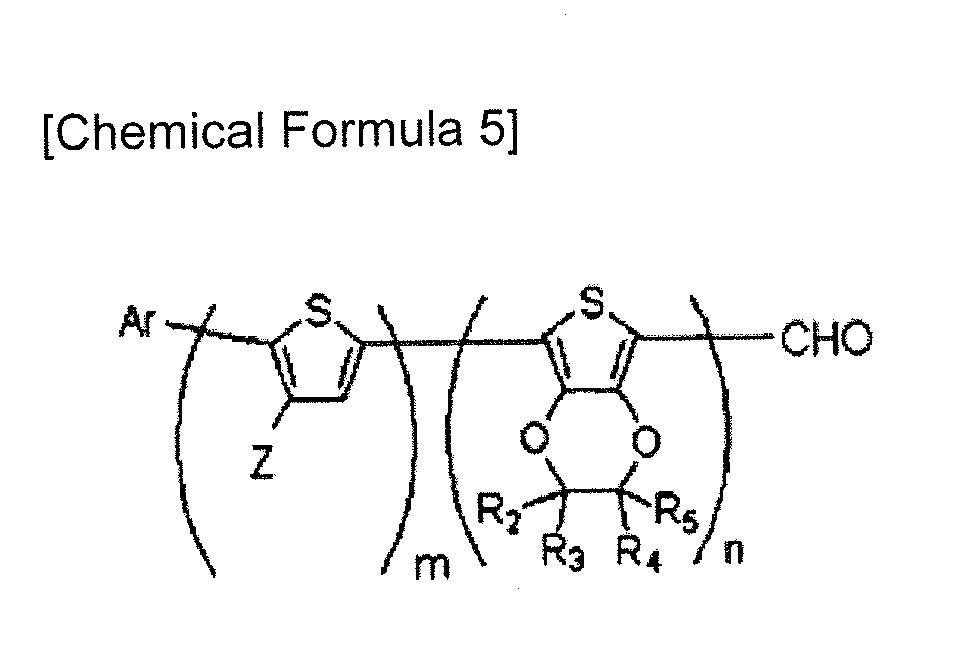

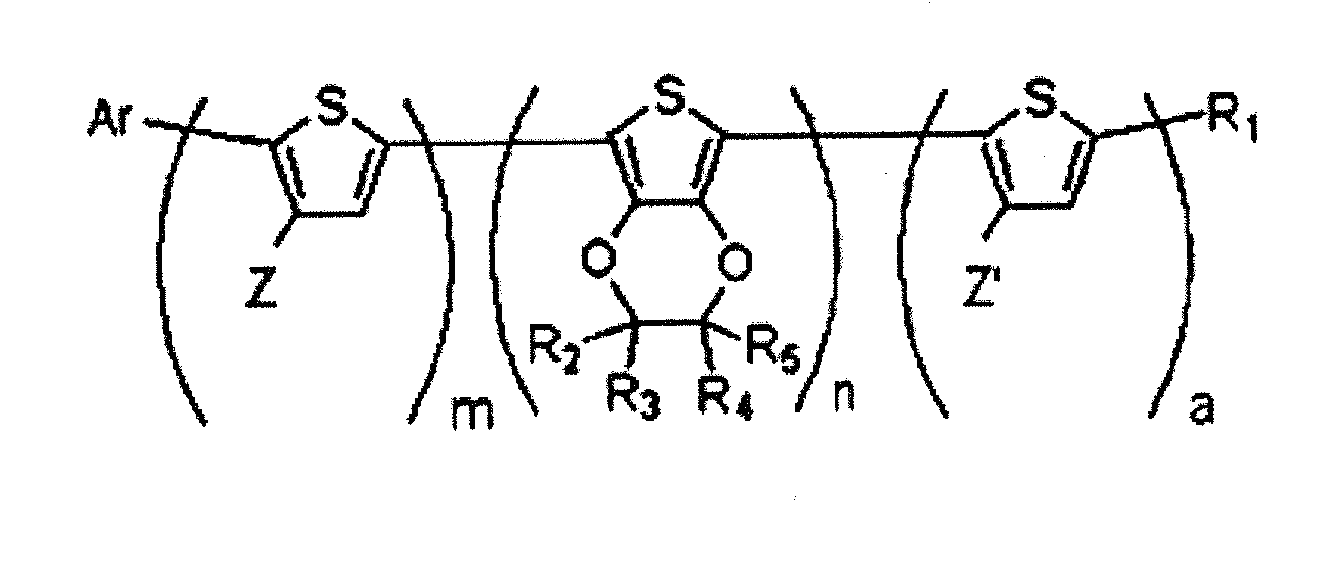


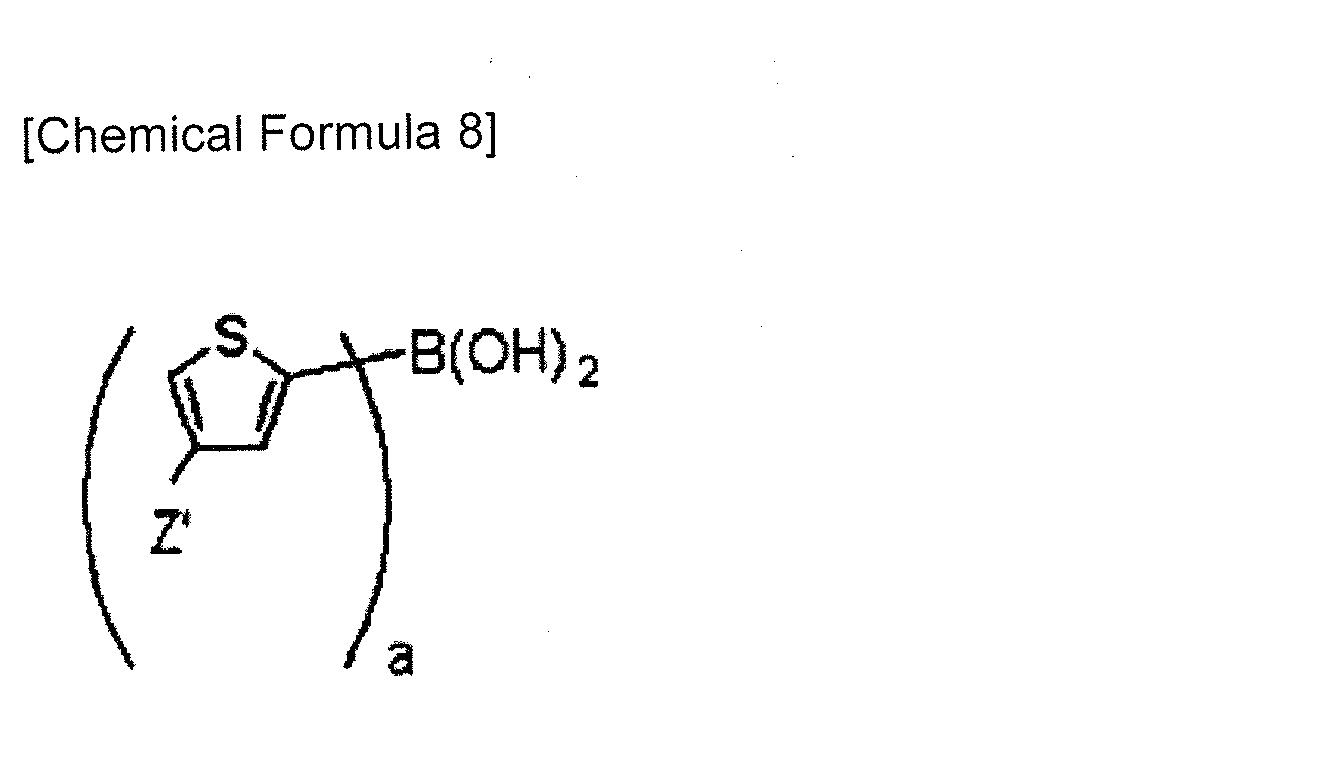


Claims (10)
- Organic dye represented by the following Chemical Formula 1:
 R1 is or
 R2 to R5 are independently hydrogen, substituted or unsubstituted C1-30 alkyl or C1-30 alkoxy;Ar is C6-50 aryl or heteroaryl optionally substituted by at least one of C1-30 alkyl, C1-30 alkoxy, halogen, amide, cyano, hydroxyl, nitro, acyl, C6-30 aryl or heteroaryl,Z and Z' are independently C1-6 alkyl;n is an integer of from 1 to 10;m and m' are independently an integer of from 0 to 5, provided that both m and m' are not simultaneously 0.
 - The organic dye according to claim 1, wherein the dye is represented by one of the following Chemical Formulae 1a to 1x:





- A method for preparing organic dye of the following Chemical Formula 1-1 comprising:(1) preparing a compound of the following Chemical Formula 4 by Suzuki coupling reaction of a compound of the following Chemical Formula 2 with a compound of the following Chemical Formula 3,(2) preparing a compound of the following Chemical Formula 5 by reacting the compound of the Chemical Formula 4 with POCl3 in an organic solvent,(3) reacting the compound of the Chemical Formula 5 with cyanoacetic acid or a compound of the following Chemical Formula 6 in CH3CN in the presence of piperidine:


- A method for preparing organic dye of the following Chemical Formula 1-2 comprising:(i) preparing a compound of the following Chemical Formula 4 by Suzuki coupling reaction of a compound of the following Chemical Formula 2 with a compound of the following Chemical Formula 3,(ii) preparing a compound of the following Chemical Formula 7 by reacting the compound of the Chemical Formula 4 with N-bromostyrene in an organic solvent,(iii) preparing a compound of the following Chemical Formula 9 by Suzuki coupling reaction of the compound of the Chemical Formula 7 with a compound of the following Chemical Formula 8,(iv) preparing a compound of the following Chemical Formula 10 by reacting the compound of the Chemical Formula 9 with POCl3 in an organic solvent, and(v) reacting the compound of the Chemical Formula 10 with cyanoacetic acid or a compound of the following Chemical Formula 6 in CH3CN in the presence of piperidine:


- A dye-sensitized photoelectric transformation element comprising oxide semiconductor particles where the organic dye of claim 1 is supported.
- The dye-sensitized photoelectric transformation element according to claim 5, wherein the organic dye is supported in the oxide semiconductor particles in the presence of an inclusion compound.
- The dye-sensitized photoelectric transformation element according to claim 5, wherein the oxide semiconductor particles essentially comprise titanium dioxide.
- The dye-sensitized photoelectric transformation element according to claim 5, wherein the oxide semiconductor particle has an average particle diameter of 1 - 500 nm.
- A dye-sensitized solar cell comprising the dye-sensitized photoelectric transformation element of claim 5 as an electrode.
- The dye-sensitized solar cell according to claim, wherein the dye-sensitized solar cell is prepared by coating titanium oxide paste on a transparent conductive substrate; sintering the coated substrate to form a titanium oxide thin film; immersing the substrate having titanium oxide thin film formed thereon in a mixed solution in which the dye represented by the Chemical Formula 1 is dissolved, so as to form a dye-absorbed titanium oxide film electrode; providing a second glass substrate having a counter electrode formed thereon; forming a hole penetrating the second glass substrate and the counter electrode; placing a thermoplastic polymer film between the counter electrode and the dye-absorbed titanium oxide film electrode and heat-pressing them to join the counter electrode and the titanium oxide film electrode; injecting electrolyte into the thermoplastic polymer film placed between the counter electrode and the titanium oxide film electrode through the hole; and, sealing the thermoplastic polymer.
Applications Claiming Priority (3)
| Application Number | Priority Date | Filing Date | Title |
|---|---|---|---|
| KR20080062487 | 2008-06-30 | ||
| KR1020090057534A KR101320999B1 (en) | 2008-06-30 | 2009-06-26 | Novel organic dye and preparation thereof |
| PCT/KR2009/003500 WO2010002154A2 (en) | 2008-06-30 | 2009-06-29 | Novel organic dye and method for preparing same |
Publications (3)
| Publication Number | Publication Date |
|---|---|
| EP2341107A2 true EP2341107A2 (en) | 2011-07-06 |
| EP2341107A4 EP2341107A4 (en) | 2012-01-25 |
| EP2341107B1 EP2341107B1 (en) | 2014-07-30 |
Family
ID=41813126
Family Applications (1)
| Application Number | Title | Priority Date | Filing Date |
|---|---|---|---|
| EP09773690.4A Not-in-force EP2341107B1 (en) | 2008-06-30 | 2009-06-29 | Novel organic dye and method for preparing same |
Country Status (7)
| Country | Link |
|---|---|
| US (1) | US20110094588A1 (en) |
| EP (1) | EP2341107B1 (en) |
| JP (1) | JP5623396B2 (en) |
| KR (1) | KR101320999B1 (en) |
| CN (1) | CN102076781A (en) |
| TW (1) | TWI461490B (en) |
| WO (1) | WO2010002154A2 (en) |
Cited By (2)
| Publication number | Priority date | Publication date | Assignee | Title |
|---|---|---|---|---|
| CN102675898A (en) * | 2012-04-18 | 2012-09-19 | 复旦大学 | Organic dye with double donor-pi-acceptor electron groups and preparation method and application of organic dye |
| ITMI20131899A1 (en) * | 2013-11-15 | 2015-05-16 | C N R S Ct Nat De La Rec Herche Scienti | ORGANIC COLORING FOR A SOLAR SENSITIZED COLORING CELL |
Families Citing this family (10)
| Publication number | Priority date | Publication date | Assignee | Title |
|---|---|---|---|---|
| TWI458787B (en) | 2009-05-15 | 2014-11-01 | Ind Tech Res Inst | Organic dyes and photoelectric conversion devices |
| JP5791995B2 (en) * | 2011-08-02 | 2015-10-07 | 株式会社Adeka | Novel compound, photoelectric conversion material and photoelectric conversion element |
| CN102604415B (en) * | 2012-02-28 | 2014-02-05 | 大连理工大学 | A preparation method of thienopyrazine dyes and its application in dye-sensitized solar cells |
| JP2013181108A (en) * | 2012-03-01 | 2013-09-12 | Kanto Natural Gas Development Co Ltd | Highly-active complete organic dye compound for dye-sensitized photoelectric conversion element, and photoelectric conversion element using the same |
| CN104254576A (en) * | 2012-03-30 | 2014-12-31 | 巴斯夫欧洲公司 | Quinolinium dyes with fluorinated counter anion for dye sensitized solar cells |
| ITMI20120674A1 (en) * | 2012-04-23 | 2013-10-24 | Cnrs Ct Nat De La Rech He Scient | ORGANIC COLORING FOR SOLAR CELL SENSITIVE TO DYES |
| CN103408963B (en) * | 2013-08-08 | 2014-08-27 | 陕西师范大学 | Double bridged chain organic dyestuff adopting urea as donor and application of dyestuff |
| CN103450700B (en) * | 2013-08-23 | 2015-12-02 | 中山大学 | A kind of tree-shaped organic dye based on carbazole or triphenylamine derivative and preparing the application in dye sensitization solar battery |
| CN104086561A (en) * | 2014-07-08 | 2014-10-08 | 国家纳米科学中心 | Soluble organic photovoltaic micromolecule material with high fill factor, preparation method and application of material |
| WO2023219042A1 (en) * | 2022-05-10 | 2023-11-16 | 富士フイルム株式会社 | Photoelectric conversion device, imaging device, photosensor, and compound |
Family Cites Families (9)
| Publication number | Priority date | Publication date | Assignee | Title |
|---|---|---|---|---|
| JP2000106223A (en) * | 1998-09-29 | 2000-04-11 | Fuji Photo Film Co Ltd | Photoelectric conversion element |
| DE60140752D1 (en) | 2000-07-27 | 2010-01-21 | Nippon Kayaku Kk | COLOR-SENSITIVATED PHOTOELECTRIC TRANSFORMER |
| JP4270381B2 (en) * | 2003-02-28 | 2009-05-27 | 国立大学法人京都大学 | Conductive polymer, method for producing the same, and organic solar cell using the same |
| WO2004082061A1 (en) * | 2003-03-14 | 2004-09-23 | Nippon Kayaku Kabushiki Kaisha | Dye-sensitized photoelectric conversion device |
| JP2005135656A (en) | 2003-10-28 | 2005-05-26 | Shozo Yanagida | Photoelectric conversion element |
| KR101317533B1 (en) | 2006-03-02 | 2013-10-15 | 니폰 가야꾸 가부시끼가이샤 | Dye-sensitized photoelectric conversion device |
| JP4925224B2 (en) * | 2006-03-31 | 2012-04-25 | 独立行政法人産業技術総合研究所 | Organic compound and semiconductor thin film electrode, photoelectric conversion element and photoelectrochemical solar cell using the same |
| US8653279B2 (en) * | 2006-04-17 | 2014-02-18 | Samsung Sdi Co., Ltd. | Dye for dye-sensitized solar cell, and solar cell prepared from same |
| KR101223558B1 (en) * | 2006-04-17 | 2013-01-17 | 삼성에스디아이 주식회사 | Photosensitizer for photovoltaic cell, and photovoltaic cell prepared from same |
-
2009
- 2009-06-26 KR KR1020090057534A patent/KR101320999B1/en not_active Expired - Fee Related
- 2009-06-29 WO PCT/KR2009/003500 patent/WO2010002154A2/en not_active Ceased
- 2009-06-29 US US13/000,807 patent/US20110094588A1/en not_active Abandoned
- 2009-06-29 EP EP09773690.4A patent/EP2341107B1/en not_active Not-in-force
- 2009-06-29 TW TW098121887A patent/TWI461490B/en not_active IP Right Cessation
- 2009-06-29 JP JP2011516139A patent/JP5623396B2/en not_active Expired - Fee Related
- 2009-06-29 CN CN2009801250355A patent/CN102076781A/en active Pending
Cited By (4)
| Publication number | Priority date | Publication date | Assignee | Title |
|---|---|---|---|---|
| CN102675898A (en) * | 2012-04-18 | 2012-09-19 | 复旦大学 | Organic dye with double donor-pi-acceptor electron groups and preparation method and application of organic dye |
| ITMI20131899A1 (en) * | 2013-11-15 | 2015-05-16 | C N R S Ct Nat De La Rec Herche Scienti | ORGANIC COLORING FOR A SOLAR SENSITIZED COLORING CELL |
| WO2015071864A1 (en) * | 2013-11-15 | 2015-05-21 | Eni S.P.A. | Organic dye for a dye-sensitized solar cell |
| US10465073B2 (en) | 2013-11-15 | 2019-11-05 | Eni S.P.A. | Organic dye for dye-sensitized solar cell |
Also Published As
| Publication number | Publication date |
|---|---|
| KR20100003215A (en) | 2010-01-07 |
| WO2010002154A2 (en) | 2010-01-07 |
| US20110094588A1 (en) | 2011-04-28 |
| EP2341107A4 (en) | 2012-01-25 |
| EP2341107B1 (en) | 2014-07-30 |
| TW201009026A (en) | 2010-03-01 |
| KR101320999B1 (en) | 2013-10-23 |
| CN102076781A (en) | 2011-05-25 |
| JP5623396B2 (en) | 2014-11-12 |
| WO2010002154A3 (en) | 2010-04-22 |
| JP2011526643A (en) | 2011-10-13 |
| TWI461490B (en) | 2014-11-21 |
Similar Documents
| Publication | Publication Date | Title |
|---|---|---|
| EP2341107B1 (en) | Novel organic dye and method for preparing same | |
| KR101352024B1 (en) | Novel thiophene-based dye and preparation thereof | |
| KR100969675B1 (en) | Novel N-arylcarbazole residue-containing organic dyes and preparation methods thereof | |
| KR20100136929A (en) | New organic dyes and preparation methods thereof | |
| KR20070061810A (en) | Dye-sensitized photoelectric conversion element | |
| WO2009082163A2 (en) | Novel ru-type sensitizers and method of preparing the same | |
| KR101250403B1 (en) | Novel organic dye incorporating a benzothiadiazole chromophore and preparation thereof | |
| Yang et al. | Efficient and stable organic DSSC sensitizers bearing quinacridone and furan moieties as a planar π-spacer | |
| KR20100136931A (en) | New organic dyes and preparation methods thereof | |
| JP4230228B2 (en) | Dye-sensitized photoelectric conversion element | |
| KR100969676B1 (en) | Novel Julolidine-Based Dye and Method for Preparing the Same | |
| EP2386607A2 (en) | Novel organic dye containing trialkoxysilyl group and method for preparing same | |
| KR101173248B1 (en) | Ruthenium dye for dye sensitized solar cell | |
| KR100996236B1 (en) | Novel ruthenium-based dyes and preparation methods thereof | |
| KR20100128094A (en) | Novel Julolidine-Based Dye and Method for Preparing the Same | |
| KR20090083863A (en) | Novel organic dyes and preparation methods thereof | |
| KR20100128096A (en) | Novel ruthenium-based dyes and preparation methods thereof | |
| KR20100128258A (en) | Novel ruthenium-based dyes and preparation methods thereof | |
| KR20100128255A (en) | Novel spirobifluorene dyes and preparation method thereof | |
| KR101173658B1 (en) | Squaraine dye for dye sensitized solar cell | |
| KR101940491B1 (en) | A NOBLE Ru-TYPE SENSITIZERS AND METHOD FOR PREPARING OF IT | |
| KR101827546B1 (en) | Novel organic dye and preparation thereof | |
| KR101633150B1 (en) | Fluorene derivatives and salts thereof |
Legal Events
| Date | Code | Title | Description |
|---|---|---|---|
| PUAI | Public reference made under article 153(3) epc to a published international application that has entered the european phase |
Free format text: ORIGINAL CODE: 0009012 |
|
| 17P | Request for examination filed |
Effective date: 20110119 |
|
| AK | Designated contracting states |
Kind code of ref document: A2 Designated state(s): AT BE BG CH CY CZ DE DK EE ES FI FR GB GR HR HU IE IS IT LI LT LU LV MC MK MT NL NO PL PT RO SE SI SK TR |
|
| AX | Request for extension of the european patent |
Extension state: AL BA RS |
|
| DAX | Request for extension of the european patent (deleted) | ||
| REG | Reference to a national code |
Ref country code: DE Ref legal event code: R079 Ref document number: 602009025691 Country of ref document: DE Free format text: PREVIOUS MAIN CLASS: C09B0049000000 Ipc: C09B0057000000 |
|
| A4 | Supplementary search report drawn up and despatched |
Effective date: 20111227 |
|
| RIC1 | Information provided on ipc code assigned before grant |
Ipc: C09B 23/14 20060101ALI20111220BHEP Ipc: C09B 57/00 20060101AFI20111220BHEP Ipc: H01G 9/20 20060101ALI20111220BHEP Ipc: C09B 23/00 20060101ALI20111220BHEP Ipc: H01L 51/00 20060101ALI20111220BHEP |
|
| GRAP | Despatch of communication of intention to grant a patent |
Free format text: ORIGINAL CODE: EPIDOSNIGR1 |
|
| INTG | Intention to grant announced |
Effective date: 20140225 |
|
| GRAS | Grant fee paid |
Free format text: ORIGINAL CODE: EPIDOSNIGR3 |
|
| GRAA | (expected) grant |
Free format text: ORIGINAL CODE: 0009210 |
|
| AK | Designated contracting states |
Kind code of ref document: B1 Designated state(s): AT BE BG CH CY CZ DE DK EE ES FI FR GB GR HR HU IE IS IT LI LT LU LV MC MK MT NL NO PL PT RO SE SI SK TR |
|
| REG | Reference to a national code |
Ref country code: GB Ref legal event code: FG4D |
|
| REG | Reference to a national code |
Ref country code: CH Ref legal event code: EP |
|
| REG | Reference to a national code |
Ref country code: AT Ref legal event code: REF Ref document number: 679987 Country of ref document: AT Kind code of ref document: T Effective date: 20140815 |
|
| REG | Reference to a national code |
Ref country code: IE Ref legal event code: FG4D |
|
| REG | Reference to a national code |
Ref country code: DE Ref legal event code: R096 Ref document number: 602009025691 Country of ref document: DE Effective date: 20140911 |
|
| REG | Reference to a national code |
Ref country code: AT Ref legal event code: MK05 Ref document number: 679987 Country of ref document: AT Kind code of ref document: T Effective date: 20140730 |
|
| REG | Reference to a national code |
Ref country code: NL Ref legal event code: VDEP Effective date: 20140730 |
|
| REG | Reference to a national code |
Ref country code: LT Ref legal event code: MG4D |
|
| PG25 | Lapsed in a contracting state [announced via postgrant information from national office to epo] |
Ref country code: SE Free format text: LAPSE BECAUSE OF FAILURE TO SUBMIT A TRANSLATION OF THE DESCRIPTION OR TO PAY THE FEE WITHIN THE PRESCRIBED TIME-LIMIT Effective date: 20140730 Ref country code: FI Free format text: LAPSE BECAUSE OF FAILURE TO SUBMIT A TRANSLATION OF THE DESCRIPTION OR TO PAY THE FEE WITHIN THE PRESCRIBED TIME-LIMIT Effective date: 20140730 Ref country code: NO Free format text: LAPSE BECAUSE OF FAILURE TO SUBMIT A TRANSLATION OF THE DESCRIPTION OR TO PAY THE FEE WITHIN THE PRESCRIBED TIME-LIMIT Effective date: 20141030 Ref country code: ES Free format text: LAPSE BECAUSE OF FAILURE TO SUBMIT A TRANSLATION OF THE DESCRIPTION OR TO PAY THE FEE WITHIN THE PRESCRIBED TIME-LIMIT Effective date: 20140730 Ref country code: PT Free format text: LAPSE BECAUSE OF FAILURE TO SUBMIT A TRANSLATION OF THE DESCRIPTION OR TO PAY THE FEE WITHIN THE PRESCRIBED TIME-LIMIT Effective date: 20141202 Ref country code: BG Free format text: LAPSE BECAUSE OF FAILURE TO SUBMIT A TRANSLATION OF THE DESCRIPTION OR TO PAY THE FEE WITHIN THE PRESCRIBED TIME-LIMIT Effective date: 20141030 Ref country code: LT Free format text: LAPSE BECAUSE OF FAILURE TO SUBMIT A TRANSLATION OF THE DESCRIPTION OR TO PAY THE FEE WITHIN THE PRESCRIBED TIME-LIMIT Effective date: 20140730 Ref country code: GR Free format text: LAPSE BECAUSE OF FAILURE TO SUBMIT A TRANSLATION OF THE DESCRIPTION OR TO PAY THE FEE WITHIN THE PRESCRIBED TIME-LIMIT Effective date: 20141031 |
|
| PG25 | Lapsed in a contracting state [announced via postgrant information from national office to epo] |
Ref country code: IS Free format text: LAPSE BECAUSE OF FAILURE TO SUBMIT A TRANSLATION OF THE DESCRIPTION OR TO PAY THE FEE WITHIN THE PRESCRIBED TIME-LIMIT Effective date: 20141130 Ref country code: PL Free format text: LAPSE BECAUSE OF FAILURE TO SUBMIT A TRANSLATION OF THE DESCRIPTION OR TO PAY THE FEE WITHIN THE PRESCRIBED TIME-LIMIT Effective date: 20140730 Ref country code: NL Free format text: LAPSE BECAUSE OF FAILURE TO SUBMIT A TRANSLATION OF THE DESCRIPTION OR TO PAY THE FEE WITHIN THE PRESCRIBED TIME-LIMIT Effective date: 20140730 Ref country code: AT Free format text: LAPSE BECAUSE OF FAILURE TO SUBMIT A TRANSLATION OF THE DESCRIPTION OR TO PAY THE FEE WITHIN THE PRESCRIBED TIME-LIMIT Effective date: 20140730 Ref country code: LV Free format text: LAPSE BECAUSE OF FAILURE TO SUBMIT A TRANSLATION OF THE DESCRIPTION OR TO PAY THE FEE WITHIN THE PRESCRIBED TIME-LIMIT Effective date: 20140730 Ref country code: CY Free format text: LAPSE BECAUSE OF FAILURE TO SUBMIT A TRANSLATION OF THE DESCRIPTION OR TO PAY THE FEE WITHIN THE PRESCRIBED TIME-LIMIT Effective date: 20140730 Ref country code: HR Free format text: LAPSE BECAUSE OF FAILURE TO SUBMIT A TRANSLATION OF THE DESCRIPTION OR TO PAY THE FEE WITHIN THE PRESCRIBED TIME-LIMIT Effective date: 20140730 |
|
| PG25 | Lapsed in a contracting state [announced via postgrant information from national office to epo] |
Ref country code: RO Free format text: LAPSE BECAUSE OF FAILURE TO SUBMIT A TRANSLATION OF THE DESCRIPTION OR TO PAY THE FEE WITHIN THE PRESCRIBED TIME-LIMIT Effective date: 20140730 Ref country code: EE Free format text: LAPSE BECAUSE OF FAILURE TO SUBMIT A TRANSLATION OF THE DESCRIPTION OR TO PAY THE FEE WITHIN THE PRESCRIBED TIME-LIMIT Effective date: 20140730 Ref country code: CZ Free format text: LAPSE BECAUSE OF FAILURE TO SUBMIT A TRANSLATION OF THE DESCRIPTION OR TO PAY THE FEE WITHIN THE PRESCRIBED TIME-LIMIT Effective date: 20140730 Ref country code: DK Free format text: LAPSE BECAUSE OF FAILURE TO SUBMIT A TRANSLATION OF THE DESCRIPTION OR TO PAY THE FEE WITHIN THE PRESCRIBED TIME-LIMIT Effective date: 20140730 Ref country code: SK Free format text: LAPSE BECAUSE OF FAILURE TO SUBMIT A TRANSLATION OF THE DESCRIPTION OR TO PAY THE FEE WITHIN THE PRESCRIBED TIME-LIMIT Effective date: 20140730 Ref country code: IT Free format text: LAPSE BECAUSE OF FAILURE TO SUBMIT A TRANSLATION OF THE DESCRIPTION OR TO PAY THE FEE WITHIN THE PRESCRIBED TIME-LIMIT Effective date: 20140730 |
|
| REG | Reference to a national code |
Ref country code: DE Ref legal event code: R097 Ref document number: 602009025691 Country of ref document: DE |
|
| PLBE | No opposition filed within time limit |
Free format text: ORIGINAL CODE: 0009261 |
|
| STAA | Information on the status of an ep patent application or granted ep patent |
Free format text: STATUS: NO OPPOSITION FILED WITHIN TIME LIMIT |
|
| 26N | No opposition filed |
Effective date: 20150504 |
|
| PG25 | Lapsed in a contracting state [announced via postgrant information from national office to epo] |
Ref country code: SI Free format text: LAPSE BECAUSE OF FAILURE TO SUBMIT A TRANSLATION OF THE DESCRIPTION OR TO PAY THE FEE WITHIN THE PRESCRIBED TIME-LIMIT Effective date: 20140730 |
|
| PG25 | Lapsed in a contracting state [announced via postgrant information from national office to epo] |
Ref country code: MC Free format text: LAPSE BECAUSE OF FAILURE TO SUBMIT A TRANSLATION OF THE DESCRIPTION OR TO PAY THE FEE WITHIN THE PRESCRIBED TIME-LIMIT Effective date: 20140730 |
|
| REG | Reference to a national code |
Ref country code: CH Ref legal event code: PL |
|
| GBPC | Gb: european patent ceased through non-payment of renewal fee |
Effective date: 20150629 |
|
| PG25 | Lapsed in a contracting state [announced via postgrant information from national office to epo] |
Ref country code: LU Free format text: LAPSE BECAUSE OF FAILURE TO SUBMIT A TRANSLATION OF THE DESCRIPTION OR TO PAY THE FEE WITHIN THE PRESCRIBED TIME-LIMIT Effective date: 20150629 |
|
| REG | Reference to a national code |
Ref country code: IE Ref legal event code: MM4A |
|
| REG | Reference to a national code |
Ref country code: FR Ref legal event code: ST Effective date: 20160229 |
|
| PG25 | Lapsed in a contracting state [announced via postgrant information from national office to epo] |
Ref country code: CH Free format text: LAPSE BECAUSE OF NON-PAYMENT OF DUE FEES Effective date: 20150630 Ref country code: GB Free format text: LAPSE BECAUSE OF NON-PAYMENT OF DUE FEES Effective date: 20150629 Ref country code: LI Free format text: LAPSE BECAUSE OF NON-PAYMENT OF DUE FEES Effective date: 20150630 Ref country code: IE Free format text: LAPSE BECAUSE OF NON-PAYMENT OF DUE FEES Effective date: 20150629 |
|
| PG25 | Lapsed in a contracting state [announced via postgrant information from national office to epo] |
Ref country code: FR Free format text: LAPSE BECAUSE OF NON-PAYMENT OF DUE FEES Effective date: 20150630 |
|
| PG25 | Lapsed in a contracting state [announced via postgrant information from national office to epo] |
Ref country code: BE Free format text: LAPSE BECAUSE OF FAILURE TO SUBMIT A TRANSLATION OF THE DESCRIPTION OR TO PAY THE FEE WITHIN THE PRESCRIBED TIME-LIMIT Effective date: 20140730 |
|
| PG25 | Lapsed in a contracting state [announced via postgrant information from national office to epo] |
Ref country code: MT Free format text: LAPSE BECAUSE OF FAILURE TO SUBMIT A TRANSLATION OF THE DESCRIPTION OR TO PAY THE FEE WITHIN THE PRESCRIBED TIME-LIMIT Effective date: 20140730 |
|
| PG25 | Lapsed in a contracting state [announced via postgrant information from national office to epo] |
Ref country code: HU Free format text: LAPSE BECAUSE OF FAILURE TO SUBMIT A TRANSLATION OF THE DESCRIPTION OR TO PAY THE FEE WITHIN THE PRESCRIBED TIME-LIMIT; INVALID AB INITIO Effective date: 20090629 |
|
| PG25 | Lapsed in a contracting state [announced via postgrant information from national office to epo] |
Ref country code: TR Free format text: LAPSE BECAUSE OF FAILURE TO SUBMIT A TRANSLATION OF THE DESCRIPTION OR TO PAY THE FEE WITHIN THE PRESCRIBED TIME-LIMIT Effective date: 20140730 |
|
| PG25 | Lapsed in a contracting state [announced via postgrant information from national office to epo] |
Ref country code: MK Free format text: LAPSE BECAUSE OF FAILURE TO SUBMIT A TRANSLATION OF THE DESCRIPTION OR TO PAY THE FEE WITHIN THE PRESCRIBED TIME-LIMIT Effective date: 20140730 |
|
| PGFP | Annual fee paid to national office [announced via postgrant information from national office to epo] |
Ref country code: DE Payment date: 20190618 Year of fee payment: 11 |
|
| REG | Reference to a national code |
Ref country code: DE Ref legal event code: R119 Ref document number: 602009025691 Country of ref document: DE |
|
| PG25 | Lapsed in a contracting state [announced via postgrant information from national office to epo] |
Ref country code: DE Free format text: LAPSE BECAUSE OF NON-PAYMENT OF DUE FEES Effective date: 20210101 |