EP2339903A2 - Lead plate and protection circuit module having the same - Google Patents
Lead plate and protection circuit module having the same Download PDFInfo
- Publication number
- EP2339903A2 EP2339903A2 EP10195485A EP10195485A EP2339903A2 EP 2339903 A2 EP2339903 A2 EP 2339903A2 EP 10195485 A EP10195485 A EP 10195485A EP 10195485 A EP10195485 A EP 10195485A EP 2339903 A2 EP2339903 A2 EP 2339903A2
- Authority
- EP
- European Patent Office
- Prior art keywords
- lead plate
- mounting portion
- joint portion
- mounting
- protection circuit
- Prior art date
- Legal status (The legal status is an assumption and is not a legal conclusion. Google has not performed a legal analysis and makes no representation as to the accuracy of the status listed.)
- Granted
Links
Images




Classifications
-
- H—ELECTRICITY
- H01—ELECTRIC ELEMENTS
- H01M—PROCESSES OR MEANS, e.g. BATTERIES, FOR THE DIRECT CONVERSION OF CHEMICAL ENERGY INTO ELECTRICAL ENERGY
- H01M50/00—Constructional details or processes of manufacture of the non-active parts of electrochemical cells other than fuel cells, e.g. hybrid cells
- H01M50/50—Current conducting connections for cells or batteries
- H01M50/543—Terminals
-
- H—ELECTRICITY
- H01—ELECTRIC ELEMENTS
- H01M—PROCESSES OR MEANS, e.g. BATTERIES, FOR THE DIRECT CONVERSION OF CHEMICAL ENERGY INTO ELECTRICAL ENERGY
- H01M10/00—Secondary cells; Manufacture thereof
- H01M10/05—Accumulators with non-aqueous electrolyte
- H01M10/052—Li-accumulators
-
- H—ELECTRICITY
- H01—ELECTRIC ELEMENTS
- H01M—PROCESSES OR MEANS, e.g. BATTERIES, FOR THE DIRECT CONVERSION OF CHEMICAL ENERGY INTO ELECTRICAL ENERGY
- H01M50/00—Constructional details or processes of manufacture of the non-active parts of electrochemical cells other than fuel cells, e.g. hybrid cells
- H01M50/10—Primary casings; Jackets or wrappings
- H01M50/147—Lids or covers
-
- H—ELECTRICITY
- H01—ELECTRIC ELEMENTS
- H01M—PROCESSES OR MEANS, e.g. BATTERIES, FOR THE DIRECT CONVERSION OF CHEMICAL ENERGY INTO ELECTRICAL ENERGY
- H01M50/00—Constructional details or processes of manufacture of the non-active parts of electrochemical cells other than fuel cells, e.g. hybrid cells
- H01M50/50—Current conducting connections for cells or batteries
- H01M50/528—Fixed electrical connections, i.e. not intended for disconnection
-
- H—ELECTRICITY
- H01—ELECTRIC ELEMENTS
- H01M—PROCESSES OR MEANS, e.g. BATTERIES, FOR THE DIRECT CONVERSION OF CHEMICAL ENERGY INTO ELECTRICAL ENERGY
- H01M50/00—Constructional details or processes of manufacture of the non-active parts of electrochemical cells other than fuel cells, e.g. hybrid cells
- H01M50/50—Current conducting connections for cells or batteries
- H01M50/572—Means for preventing undesired use or discharge
-
- H—ELECTRICITY
- H05—ELECTRIC TECHNIQUES NOT OTHERWISE PROVIDED FOR
- H05K—PRINTED CIRCUITS; CASINGS OR CONSTRUCTIONAL DETAILS OF ELECTRIC APPARATUS; MANUFACTURE OF ASSEMBLAGES OF ELECTRICAL COMPONENTS
- H05K3/00—Apparatus or processes for manufacturing printed circuits
- H05K3/30—Assembling printed circuits with electric components, e.g. with resistors
- H05K3/32—Assembling printed circuits with electric components, e.g. with resistors electrically connecting electric components or wires to printed circuits
- H05K3/34—Assembling printed circuits with electric components, e.g. with resistors electrically connecting electric components or wires to printed circuits by soldering
- H05K3/3405—Edge mounted components, e.g. terminals
-
- H—ELECTRICITY
- H05—ELECTRIC TECHNIQUES NOT OTHERWISE PROVIDED FOR
- H05K—PRINTED CIRCUITS; CASINGS OR CONSTRUCTIONAL DETAILS OF ELECTRIC APPARATUS; MANUFACTURE OF ASSEMBLAGES OF ELECTRICAL COMPONENTS
- H05K3/00—Apparatus or processes for manufacturing printed circuits
- H05K3/30—Assembling printed circuits with electric components, e.g. with resistors
- H05K3/32—Assembling printed circuits with electric components, e.g. with resistors electrically connecting electric components or wires to printed circuits
- H05K3/34—Assembling printed circuits with electric components, e.g. with resistors electrically connecting electric components or wires to printed circuits by soldering
- H05K3/341—Surface mounted components
- H05K3/3421—Leaded components
- H05K3/3426—Leaded components characterised by the leads
-
- H—ELECTRICITY
- H05—ELECTRIC TECHNIQUES NOT OTHERWISE PROVIDED FOR
- H05K—PRINTED CIRCUITS; CASINGS OR CONSTRUCTIONAL DETAILS OF ELECTRIC APPARATUS; MANUFACTURE OF ASSEMBLAGES OF ELECTRICAL COMPONENTS
- H05K2201/00—Indexing scheme relating to printed circuits covered by H05K1/00
- H05K2201/10—Details of components or other objects attached to or integrated in a printed circuit board
- H05K2201/10227—Other objects, e.g. metallic pieces
- H05K2201/1034—Edge terminals, i.e. separate pieces of metal attached to the edge of the printed circuit board [PCB]
-
- H—ELECTRICITY
- H05—ELECTRIC TECHNIQUES NOT OTHERWISE PROVIDED FOR
- H05K—PRINTED CIRCUITS; CASINGS OR CONSTRUCTIONAL DETAILS OF ELECTRIC APPARATUS; MANUFACTURE OF ASSEMBLAGES OF ELECTRICAL COMPONENTS
- H05K2201/00—Indexing scheme relating to printed circuits covered by H05K1/00
- H05K2201/10—Details of components or other objects attached to or integrated in a printed circuit board
- H05K2201/10613—Details of electrical connections of non-printed components, e.g. special leads
- H05K2201/10742—Details of leads
- H05K2201/1075—Shape details
- H05K2201/10757—Bent leads
-
- H—ELECTRICITY
- H05—ELECTRIC TECHNIQUES NOT OTHERWISE PROVIDED FOR
- H05K—PRINTED CIRCUITS; CASINGS OR CONSTRUCTIONAL DETAILS OF ELECTRIC APPARATUS; MANUFACTURE OF ASSEMBLAGES OF ELECTRICAL COMPONENTS
- H05K2201/00—Indexing scheme relating to printed circuits covered by H05K1/00
- H05K2201/10—Details of components or other objects attached to or integrated in a printed circuit board
- H05K2201/10613—Details of electrical connections of non-printed components, e.g. special leads
- H05K2201/10742—Details of leads
- H05K2201/1075—Shape details
- H05K2201/1084—Notched leads
-
- Y—GENERAL TAGGING OF NEW TECHNOLOGICAL DEVELOPMENTS; GENERAL TAGGING OF CROSS-SECTIONAL TECHNOLOGIES SPANNING OVER SEVERAL SECTIONS OF THE IPC; TECHNICAL SUBJECTS COVERED BY FORMER USPC CROSS-REFERENCE ART COLLECTIONS [XRACs] AND DIGESTS
- Y02—TECHNOLOGIES OR APPLICATIONS FOR MITIGATION OR ADAPTATION AGAINST CLIMATE CHANGE
- Y02E—REDUCTION OF GREENHOUSE GAS [GHG] EMISSIONS, RELATED TO ENERGY GENERATION, TRANSMISSION OR DISTRIBUTION
- Y02E60/00—Enabling technologies; Technologies with a potential or indirect contribution to GHG emissions mitigation
- Y02E60/10—Energy storage using batteries
-
- Y—GENERAL TAGGING OF NEW TECHNOLOGICAL DEVELOPMENTS; GENERAL TAGGING OF CROSS-SECTIONAL TECHNOLOGIES SPANNING OVER SEVERAL SECTIONS OF THE IPC; TECHNICAL SUBJECTS COVERED BY FORMER USPC CROSS-REFERENCE ART COLLECTIONS [XRACs] AND DIGESTS
- Y02—TECHNOLOGIES OR APPLICATIONS FOR MITIGATION OR ADAPTATION AGAINST CLIMATE CHANGE
- Y02P—CLIMATE CHANGE MITIGATION TECHNOLOGIES IN THE PRODUCTION OR PROCESSING OF GOODS
- Y02P70/00—Climate change mitigation technologies in the production process for final industrial or consumer products
- Y02P70/50—Manufacturing or production processes characterised by the final manufactured product
Definitions
- Example embodiments relate to a lead plate of a secondary battery and a protection circuit module having the same. More particularly, example embodiments relate to a lead plate and a protection circuit module having the same, which can enhance the performance and reliability of a secondary battery by improving the assembled structure of the secondary battery.
- a secondary battery is a battery that can be repeatedly charged and discharged.
- Secondary batteries may be classified into nickel-cadmium (Ni-Cd) secondary batteries, nickel-hydrogen (Ni-MH) secondary batteries, lithium secondary batteries, and the like.
- Ni-Cd nickel-cadmium
- Ni-MH nickel-hydrogen
- lithium secondary batteries may be divided into lithium ion secondary batteries using a liquid electrolyte and lithium polymer secondary batteries using a polymer electrolyte, depending on the kind of electrolyte used.
- the lithium secondary batteries may be divided into a prismatic type, a cylinder type, a pouch type, and the like, depending on their shapes.
- a battery pack using a lithium secondary battery may typically include a bare cell and a protection circuit module.
- the bare cell refers to a basic structure of the battery, including an electrode assembly, an electrolyte, and an outer case in which the electrode assembly and the electrolyte are accommodated.
- the protection circuit module (PCM) protects the bare cell from overcharge or overdischarge when the bare cell is charged or discharged.
- Embodiments are therefore directed to a lead plate of a secondary battery and a protection circuit module, which substantially overcome one or more of the problems due to the limitations and disadvantages of the related art.
- a lead plate for connecting a printed circuit board (PCB) of a secondary battery to a bare cell
- the lead plate including a mounting portion to be connected to the PCB, a joint portion to be connected to the bare cell, the mounting portion being configured to be heavier than the joint portion, and a step portion connecting the mounting portion and the joint portion to each other.
- PCB printed circuit board
- the lead plate may be made of a single material and the volume of the joint portion is smaller than the volume of the mounting portion.
- the mounting portion has a mounting face for the connection to the PCB and the joint portion has a mounting face to be connected to the bare cell, the area of the mounting face of the joint portion being smaller than the area of the mounting face of the mounting portion.
- the mounting portion may be divided into a contact region at which it comes in contact with one surface of the protection circuit module and a non-contact region, and the area of the contact region is formed smaller than that of the mounting face of the joint portion.
- the boundary portion between the mounting portion and the step portion and the boundary portion between the step portion and the joint portion may be bent, and a notch may be formed in at least one region of the bending portion between the mounting portion and the step portion and the bending portion between the step portion and the joint portion.
- the thickness of at least one portion of the mounting portion may be greater than that of the joint portion.
- the non-contact region of the mounting portion may be formed to extend outward from at least one surface of the contact region.
- the width of the mounting portion may be wider than that of the joint portion.
- the mounting portion may have a notch.
- the joint portion may have a punch or opening.
- the non-contact region may have a wing portion bent and extending outward from the contact region.
- the length of the wing portion extending from the mounting portion may be shorter than that of the step portion extending between the mounting portion and the joint portion.
- the width of the wing portion may be decreased in a direction extending outward from the contact region so that the wing portion is spaced apart from the step portion at a predetermined interval.
- a protection circuit module including a PCB, a safety element and an external connection terminal, mounted on the PCB, and a lead plate as defined above and joined with the PCB.
- FIG. 1A illustrates a schematic perspective view of a protection circuit module according to an embodiment
- FIG. 1B illustrates a side view of the protection circuit module of FIG. 1A ;
- FIG. 2A illustrates a schematic, enlarged side view of a lead plate according to an embodiment
- FIG. 2B illustrates a side view of a base material of the lead plate of FIG. 2A ;
- FIG. 2C illustrates a plan view of the base material of FIG. 2B ;
- FIG. 3 illustrates a side view of a joined state of the lead plate of FIG. 2A ;
- FIG. 4 illustrates a plan view of a base material of a lead plate according to another embodiment
- FIG. 5 illustrates a side view of a base material of a lead plate according to still another embodiment
- FIG. 6 illustrates a plan view of a base material of a lead plate according to still another embodiment
- FIG. 7 illustrates a plan view of a base material of a lead plate according to still another embodiment
- FIG. 8A illustrates a plan view of a base material of a lead plate according to still another embodiment
- FIG. 8B illustrates a perspective view of the lead plate made of the base material of FIG. 8A ;
- FIG. 9A illustrates a plan view of a base material of a lead plate according to still another embodiment
- FIG. 9B illustrates a perspective view of the lead plate made of the base material of FIG. 9A ;
- FIG. 10A illustrates a plan view of a base material of a lead plate according to still another embodiment
- FIG. 10B illustrates a perspective view of the lead plate made of the base material of FIG. 10A ;
- FIGS. 11A and 11B illustrate perspective, sequential views of processes in a method of manufacturing a battery pack according to an embodiment.
- FIG. 1A illustrates a schematic perspective view of a protection circuit module according to an embodiment
- FIG. 1B illustrates a schematic side view of the protection circuit module of FIG. 1A
- the protection circuit module 10 includes a substrate 20, safety elements 32 and 34 on the substrate 20, an external connection terminal 40 on the substrate 20, and a lead plate 50 connected to the substrate 20.
- the substrate 20 includes a printed circuit board (PCB) having interconnection patterns formed therein.
- the substrate 20 has a shape of a plate having a length that is a few times or a few tens of time longer than its width or thickness.
- the substrate 20 is provided with a hole 22 passing through an approximate center portion thereof.
- the hole 22 is used as a passage through which a welding rod is inserted to weld an electrode terminal (see 120 of FIG. 11A ) of the bare cell and an electrode terminal, e.g., a second terminal 35b in FIG. 1B , of the safety element 34.
- the safety elements 32 and 34 may refer to a protection module 32 and a temperature sensor 34.
- the safety elements 32 and 34 are here mounted on a first surface, i.e., a bottom surface, of the substrate 20.
- the protection module 32 may control the charge/discharge operation of a battery pack for which the protection circuit module 10 is used, and may protect the battery pack from overcharge, overdischarge, overcurrent, and the like.
- the temperature sensor 34 may include a positive temperature coefficient (PTC) thermistor.
- PTC positive temperature coefficient
- the external connection terminal 40 is on a second surface of the substrate 20, i.e., on a surface opposite the first surface, and forms a current path between the bare cell and an external system, e.g., a load, charging system or the like, after the protection circuit module 10 is connected to the bare cell.
- the external connection terminal 40 may include at least two or more terminals including positive and negative terminals respectively connected to positive and negative electrodes of the bare cell.
- the external connection terminal 40 is here mounted on the second surface, i.e., a top surface, of the substrate 20.
- the lead plate 50 includes a mounting portion 52 mounted on a bottom surface of the substrate 20, a joint portion 54 welded to a bare cell, e.g., the bare cell 100 of figures 11A and 11B , and a step portion 56 for connecting the mounting portion 52 and the joint portion 54 to each other, so that a step is formed between the bare cell and the protection circuit module 10.
- the lead plate 50 is formed to have a proper strength or elasticity for correcting a margin that may occur during the manufacturing process of the battery pack, e.g., a margin of the length of the bare cell, or the like.
- an area of the mounting portion 52 facing the protection circuit module 10 (mounting face of the mounting portion) is larger than an area of the joint portion 54 facing the bare cell (mounting face of the joint portion), e.g., the bare cell 100 of figures 11A and 11B , so that a weight of the mounting portion 52 in the lead plate 50 is greater than that of the joint portion 54. Accordingly, it may be possible to prevent one side of the joint portion 54 from being inclined or lifted, e.g., separated, away from the bare cell, when a compression force is applied to join the protection circuit module 10 with the bare cell.
- a joint portion 54 is inclined away from the surface of the bare cell to be welded, a hole may be produced by laser in the joining process, e.g., a laser welding, or the joint portion 54 may not be appropriately welded to the surface of the bare cell. As such, if the welding is performed in the state that one side of the joint portion 54 is inclined or lifted with respect to the surface of the bare cell, it may be difficult to ensure a welding strength.
- one end portion of the lead plate 50 is formed in a curved shape, e.g., the joint portion 54 may be curved as illustrated in FIG. 2C .
- the joint portion 54 may be curved as illustrated in FIG. 2C .
- other geometrical configurations of the lead plate 50 are not excluded from example embodiments, e.g., an end portion of the lead plate 50 may have a rectangular shape such as a surface of a rectangular parallelepiped.
- the protection circuit module 10 has here a pair of lead plates 50 at both ends in the length direction thereof.
- the protection circuit module 10 may have a dummy plate 51 at any one of both the ends.
- the dummy plate 51 may be identical to the lead plate 50, except that the dummy plate 51 may not be used as a current path through which the protection circuit module 10 is connected to the bare cell, e.g., when the protection circuit module 10 is used in a battery pack.
- FIG. 2A illustrates a side view of the lead plate 50 according to an embodiment
- FIG. 2B illustrates a side view of a base material of the lead plate of 50
- FIG. 2C illustrates a plan view of the base material of FIG. 2B .
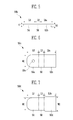
- the lead plate 50 includes the mounting portion 52 having a first length L1, the joint portion 54 having a second length L2, and the step portion 56 having a third length L3 to connect the mounting portion 52 and the joint portion 54 to each other in one direction.
- the first length L1 is longer than the second length L2.
- the mounting portion 52 corresponds to a portion of the lead plate 50 that is joined with the substrate 20, e.g., through a reflow soldering process.
- the joint portion 54 corresponds to a portion of the lead plate 50 that contacts the bare cell when the protection circuit module 10 having the lead plate 50 is joined with the bare cell, e.g., by welding.
- the step portion 56 corresponds to a portion of the lead plate 50 that connects the mounting portion 52 and the joint portion 54.
- the step portion 56 forms a step with a predetermined height between the bare cell and the protection circuit module 10, when the protection circuit module 10 is joined with the bare cell.
- the step formed by the step portion 56 between the bare cell and the protection circuit module 10 provides a space for forming the safety elements 32 and 34 on the protection circuit module 10.
- the lead plate 50 is here formed by bending a conductive or metallic plate.
- the conductive/metallic plate may be formed of nickel or a nickel alloy.
- a conductive or metallic plate having an initial linear, flat structure is bent twice in different directions from the length direction in order to form the lead plate 50 in FIG. 2A .
- the conductive/metallic plate in FIG. 2B is bent twice in order to form the mounting portion 52 and the joint portion 54 that are bent relatively to the step portion 56 of the lead plate 50 in FIG. 2A .
- the metallic plate has a substantially uniform thickness t1 and a length (L1+L2+L3). Further, as illustrated in FIG.
- the metallic plate may have a width W1. If the lead plate 50 is formed by bending the metallic plate twice in different directions, it has a step shape. Thus, in the state that the mounting portion 52 is joined with the substrate 20, the joint portion 54 may be welded to the bare cell, e.g., to an external surface of a bare cell extending along a length direction of the substrate 20.
- the joint portion 54 of the lead plate 50 is bent outward (left in the figure) at an obtuse angle with respect to the step portion 56. That is, the joint portion 54 is positioned at a predetermined angle ⁇ 1 with respect to a normal to the step portion 56, so an angle between the step portion 56 and the joint portion 54 is larger than a right angle by the predetermined angle ⁇ 1, i.e., an angle between the joint portion 54 and an extension of the step portion 56 is smaller than a right angle by the predetermined angle ⁇ 1.
- the mounting portion 52 is bent inward (right in the figure) to be approximately perpendicular to the step portion 56. According to such bent angles, when the mounting portion 52 is joined with the protection circuit module 10, as illustrated in FIGS. 1A and 1B , the joint portion 54 is bent away from the protection circuit module 10, e.g., extend in the direction of about 8 o'clock while being inclined by the angle ⁇ 1 in the extension direction of the mounting portion 52.
- the area at which the mounting portion 52 is connected to the protection circuit module 10 is larger than the area at which the joint portion 54 is connected to the bare cell, so that the weight of the mounting portion 52 is greater than that of the joint portion 54.
- the mounting portion 52 and the joint portion 54 are formed of a same material and have a substantially same width and thickness, so the mounting portion 52 is heavier than the joint portion 54 due to the larger length L1 of the mounting portion 52.
- FIG. 3 illustrates a side view of a joined state of the lead plate 50.
- the lead plate 50 is compressed with a predetermined pressure on one surface of the bare cell 100 to weld the lead plate 50 to the bare cell 100.
- the mounting portion 52 of the lead plate 50 is previously attached to the protection circuit module 10, e.g., an entire surface of the mounting portion 52 facing the substrate 20 of the protection circuit module 10 is in direct contact therewith. Further, pressure is applied to an interface between the joint portion 54 of the lead plate 50 and the bare cell 100, so the joint portion 54 is attached parallel to the surface of the bare cell 100, as illustrated in FIG. 3 .
- the mounting portion 52 is joined parallel to one surface of the protection circuit module 10, and the joint portion 54 is welded to the bare cell 100 by being attached parallel to the surface of the bare cell 100.
- the step portion 56 is formed to connect in the vertical direction between the mounting portion 52 and the joint portion 54, which extend parallel to each other, i.e., in the joined state.
- the joint state exhibits excellent reliability in the drop test of the battery pack.
- a protection circuit module is welded to a bare cell by using a conventional lead plate, e.g., a lead plate including a joint portion that is longer than a mounting portion
- the weight of the longer joint portion is larger than that of the shorter mounting portion.
- an edge of the longer joint portion may be inclined away from the bare cell, so weldability of the conventional lead plate to the bare cell 100 may be poor due to the larger weight of the joint portion.
- a centroid i.e., a center of mass, of the lead plate is positioned at a boundary between the joint portion and a step portion.
- the other end portion of the joint portion may be lifted to a predetermined height from the surface of the bare cell due to the strength or elasticity of the joint portion itself.
- a hole may be produced in the joint portion of the lead plate, or the welding may not be properly performed. Therefore, a welding failure may easily occur.
- the area of the mounting portion 52 facing the protection circuit module 10 is larger than that of the joint portion 54, so that the weight of the mounting portion 52 is greater than that of the joint portion 54.
- a center of mass of the lead plate 50 is positioned between the boundary portion of the mounting portion 52 and the step portion 56, i.e., one end portion of the mounting portion 52, and the other end portion of the mounting portion 52.
- a base material of a lead plate is referred to as a lead plate manufactured by the base material, and is designated by reference numeral (one of 50a to 50g).
- FIG. 4 illustrates a plan view of a base material of a lead plate according to another embodiment.
- a lead plate 50a includes a mounting portion 52a having the first length L1, a joint portion 54a having the second length L2, a step portion 56a having a third length L3 to connect the mounting portion 52a and the joint portion 54a to each other, and at least one notch, e.g., first notch 58a and/or second notch 58b.
- the width and thickness of the lead plate 50a are constant, and the first length L1 is longer than the second length L2.
- the first notch 58a is positioned at one end or both ends in the width direction of the base material of the lead plate 50a, i.e., on a boundary portion (or first bending portion) of the mounting portion 52a and the step portion 56a.
- the second notch 58b is positioned at one end or both ends in the width direction of the base material of the lead plate 50a on a boundary portion (or second bending portion) of the joint portion 54a and the step portion 56a.
- the first notch 58a facilitates the bending of the mounting portion 52a and the step portion 56a
- the second notch 58b facilitates the bending of the joint portion 54a and the step portion 56a.
- FIG. 5 illustrates a side view of a base material of a lead plate according to still another embodiment.
- a lead plate 50b includes a mounting portion 52b having a first length L1a, the joint portion 54 having the second length L2, and the step portion 56 having the third length L3 to connect to the mounting portion 52b and the joint portion 54 to each other.
- the mounting portion 52b has a non-uniform thickness, so a first portion having a first thickness t1 may be thinner than a second portion having a second thickness t2. It is noted that thicknesses of the joint portion 54 and step portion 56 are here substantially uniform, and have the first thickness t1.
- the weight of the mounting portion 52b may be greater than that of the joint portion 54 due to the different thicknesses of the mounting portion 52b.
- a larger thickness of the mounting portion 52b is used, so that the weight of the mounting portion 52b is greater than that of the joint portion 54.
- FIG. 6 illustrates a plan view of a base material of a lead plate according to still another embodiment.
- a lead plate 50c includes a mounting portion 52c having the first length L1a, a joint portion 54c having the second length L2, and the step portion 56 having the third length L3 to connect the mounting portion 52c and the joint portion 54c to each other.
- the joint portion 54c has an opening 55c, i.e., a portion of the joint portion 54c is removed.
- the weight of the mounting portion 52c is greater than that of the joint portion 54c due to the opening 55c.
- a contact area of the mounting portion 52c with the protection circuit module 10 is larger than the area of the joint portion 54c by forming the opening 55c.
- the opening 55c of the joint portion 54c is used, so that the weight of the mounting portion 52c is greater than that of the joint portion 54c. It will be apparent that the shape and the position of the opening 55c may be arbitrarily controlled considering the welding point of the joint portion 54c.
- FIG. 7 illustrates a plan view of a base material of a lead plate according to still another embodiment.
- a lead plate 50d includes a mounting portion 52d having a first length L1b, the joint portion 54 having the second length L2, and the step portion 56 having the third length L3 to connect the mounting portion 52d and the joint portion 54.
- a width W2 of the mounting portion 52d is wider than the width W1 of the joint portion 54.
- the weight of the mounting portion 52d is greater than that of the joint portion 54 due to the width difference.
- the width of the mounting portion 52d which is wider than that of the joint portion 54, is used so that the weight of the mounting portion 52d is greater than that of the joint portion 54.
- the mounting portion 52d When the width of the mounting portion 52d is wider than that of the joint portion 54, a portion extending outward from the protection circuit module 10 does not contact the protection circuit module 10.
- the mounting portion 52d is divided into a contact region at which it comes in contact with the protection circuit module 10 and a non-contact region at which it does not come in contact with the protection circuit module 10.
- an area of the contact region of the mounting portion 52d with the protection circuit module 10 may be the same as or smaller than that of the joint portion 54, an entire area of the mounting portion 52d is larger than that of the joint portion 54. Therefore, the weight of the mounting portion 52d is greater than that of the joint portion 54. That is, in this embodiment, when the mounting portion 52d is divided into a contact region at which it comes in contact with the protection circuit module 10 and a non-contact region that is extended outward from the protection circuit module 10 and not coming in contact with the protection circuit module 10, the contact area of the mounting portion 52d is the same as or smaller than that of the joint portion 54.
- the area of the contact region of the mounting portion 52d may be relatively smaller than that of the joint portion 54, thereby preventing problems, e.g., welding failures.
- the non-contact region of the mounting portion 52d is formed so that the entire area of the mounting portion 52d is larger than that of the joint portion 54, i.e., so that the weight of the mounting portion 52d is greater than that of the joint portion 54, thereby enhancing the joint strength of the protection circuit module 10.
- the reliability of the battery pack is enhanced.
- the first length L1b may be formed slightly shorter than the second length L2.
- FIG. 8A illustrates a plan view of a base material of a lead plate according to still another embodiment.
- FIG. 8B illustrates a perspective view of the lead plate made of the base material of FIG. 8A .
- a lead plate 50e includes a mounting portion 52e having the first length L1b, the joint portion 54 having the second length L2, and the step portion 56 having the third length L3 to connect the mounting portion 52e and the joint portion 54 to each other.
- the width W2 of the mounting portion 52e is wider than the width W1 of the joint portion 54.
- the mounting portion 52e has at least one notch 53e positioned at one end or both ends in the width direction of the lead plate 50e.
- the entire area of the mounting portion 52e is greater than that of the joint portion 54, and therefore, the weight of the mounting portion 52e is different from that of the joint portion 54.
- the notch 53e is provided to enhance the joining of the mounting portion 52e. That is, when the mounting portion 52e is joined with the protection circuit module 10 by a reflow soldering method, the notch 53e increases the tension of the mounting portion 52e so that the lead plate 50e can be well welded to the protection circuit module.
- FIG. 9A illustrates a plan view of a base material of a lead plate according to still another embodiment.
- FIG. 9B illustrates a perspective view of the lead plate made of the base material of FIG. 9A .
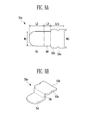
- a lead plate 50f includes a mounting portion 52f having a first length L4, the joint portion 54 having the second length L2, and the step portion 56 having the third length L3 to connect the mounting portion 52f and the joint portion 54 to each other.
- the lead plate 50f also includes a wing portion 53f having a fourth length L5 in the length direction and a fifth length L6 in the width direction of the mounting portion 52f.
- the wing portion 53f is a non-contact region bent to extend outward from a contact region at which the mounting portion 52f comes in contact with the protection circuit module 10 in the entire area of the mounting portion 52f.
- the wing portion 53f is folded once in the folded direction of the step portion 56 from one end of the mounting portion 52f, and the fifth length L6 is formed shorter than the third length L3 of the step portion 56.
- the fourth length L5 of the wing portion 53f may be identical to or slightly shorter than the first length L4 of the mounting portion 52f. Since the wing portion 53f is connected only to the mounting portion 52f, it functions to increase the weight of the mounting portion 52f. In practice, the surface area of the mounting face of the mounting portion 52f with its wing portions 53f is formed larger that that of the mounting face of the joint portion 54 joined with the bare cell.
- the weight of the mounting portion 52f connected to the wing portion 53f is greater than that of the joint portion 54, even when the thickness of the lead plate 50f is substantially constant and the first length L4 is identical to or slightly shorter than the second length L2. Further, in this embodiment, it is possible to prevent the lead plate 50f from being collapsed by the wing portion 53f of the lead plate 50f, even when an impact is applied to a corner portion of the battery pack in the drop test of the battery pack, in which the bare cell and the protection circuit module are joined together using the lead plate 50f.
- FIG. 10A illustrates a plan view of a base material of a lead plate according to still another embodiment.
- FIG. 10B illustrates a perspective view of the lead plate made of the base material of FIG. 10A .
- a lead plate 50g includes a mounting portion 52g having the first length L4, the joint portion 54 having the second length L2, and the step portion 56 having the third length L3 to connect the mounting portion 52g and the joint portion 54 to each other.
- the lead plate 50g also includes a wing portion 53g having a sixth length L7 in the length direction and the fifth length L6 in the width direction of the mounting portion 52g.
- the wing portion 53g Since the wing portion 53g is connected only to the mounting portion 52g, it functions to increase the weight of the mounting portion 52g.
- the weight of the mounting portion 52g connected to the wing portion 53g is greater than that of the joint portion 54, even when the thickness of the lead plate 50g is substantially constant and the first length L4 is identical to or slightly shorter than the second length L2 so that the entire area is changed.
- the wing portion 53g is folded once in the folded direction of the step portion 56 from one end of the mounting portion 52g, and the fifth length L6 of the wing portion 53g is formed shorter than the third length L3 of the step portion 56.
- the wing portion 53g has a slope portion 59 formed at the side adjacent to the step portion 56. The slope portion 59 is formed so that the length of the wing portion 53g in the length direction of the lead plate 50g is decreased from the length identical to or slightly shorter than the first length L4 of the mounting portion 52g to the sixth length L7, while extending in the width direction of the lead plate 50g from the mounting portion 52g.
- the slope portion 59 functions to prevent the interference between the step portion 56 and the wing portion 53g.
- the weight of the mounting portion is greater than that of the joint portion, so that it is possible to prevent the joint portion from being inclined from the surface of the bare cell due to the movement of a centroid of the lead plate to the joint portion when the protection circuit module is welded to the bare cell. That is, according to example embodiments, the welding strength of the lead plate may be increased, so that it may be possible to prevent the lead plate from being collapsed or to prevent a welding portion from easily coming off by an impact applied to the corner portion of the battery pack in the drop test.
- FIGS. 11A and 11B illustrate perspective views of sequential processes in a method of manufacturing a battery pack according to an embodiment.
- a protection circuit module 10 is prepared.
- the lead plate 50 and the dummy plate 51 are connected to the protection circuit module 10.
- the bare cell 100 is also prepared.
- the lead plate 50 and dummy plate 51 of the protection circuit module 10 correspond to the lead plates described with reference to FIGS. 1A and 1B .
- Each of the lead plate 50 and the dummy plate 51 may be replaced with any one of the lead plates 50a to 50g of the aforementioned embodiments or a combination thereof.
- the protection circuit module 10 is laser-welded to the top surface of the bare cell 100. Welding points 140 are formed on the lead plate 50 and the dummy plate 51 by the laser welding.
- the top surface of the bare cell 100 corresponds to a side surface on which a negative electrode terminal 120 and an electrolyte injection hole 130 are formed.
- the electrolyte injection hole 130 is sealed after an electrolyte is injected into the bare cell 100 therethrough.
- the joint portion of each of the lead plate 50 and the dummy plate are not inclined or lifted from the top surface of the bare cell 100.
- the welding process is stably performed.
- the bare cell 100 includes here a can type case 110, and an electrode assembly (not shown) and an electrolyte (not shown) accommodated in the case.
- a safety vent 112 for discharging an internal gas in case of an increase of internal pressure is formed at one side surface of the case 110.
- the electrode assembly is formed by using a stacked body or winding the stacked body.
- the stacked body is formed by sequentially stacking a positive electrode plate, a separator, and a negative electrode plate.
- the electrolyte assembly has positive and negative electrode tabs respectively attached to the positive and negative electrode plates.
- the positive electrode tab is electrically connected to the case 110, and the negative electrode tab is electrically connected to the electrode terminal 120.
- the electrolyte may be a solid polymer electrolyte or gel polymer electrolyte.
- the positive electrode plate may have a sheet-shaped positive electrode collector and a positive electrode active material coated on the positive electrode collector.
- the negative electrode plate may have a sheet-shaped negative electrode collector and a negative electrode active material coated on the negative electrode collector.
- the positive electrode active material may include a transition metal oxide containing lithium, representative of metal oxides, e.g., LiCoO 2 LiNiO 2 , LiMnO 2 , LiMn 2 O 4 and LiNi 1-x-y Co x MyO 2 (0 ⁇ x ⁇ 1, 0 ⁇ y ⁇ 1, 0 ⁇ x+y ⁇ 1, and M is a metal, such as Al, Sr, Mg or La), or a lithium chalcogenide compound.
- the negative electrode active material may be a carbon material, e.g., crystalline carbon, amorphous carbon, carbon composite or carbon fiber, a lithium metal or a lithium alloy.
- the positive and negative electrode collectors may be formed of one or more of stainless steel, nickel, copper, aluminum and alloy thereof. In order to maximize efficiency, the positive electrode collector may be formed of aluminum or aluminum alloy, and the negative electrode collector may be formed of copper or copper alloy.
- the separator is positioned between the positive and negative electrode plates.
- the separator is formed to prevent an electrical short circuit between the positive and negative electrode plates and to allow the movements of lithium ions.
- the separator may be formed of a polymer film, e.g., polyethylene (PE), polypropylene (PP), polyolefin, or a multi-layered film thereof.
- the battery pack of this embodiment includes a holder frame for supporting the protection circuit module 10 at one side of the bare cell 100, a cover frame fixed to the holder frame while surrounding the protection circuit module 10, and an outer label for surrounding the bare cell 100 and the holder frame.
- a water sensitive paper may be provided to the cover frame.
- a protection circuit module or a battery pack having the same it is possible to enhance the joint strength between a bare cell and the protection circuit module by using a lead plate having a mounting portion that is heavier than the joint portion. Further, a joining process of the bare cell and the protection circuit module is easily performed by a laser soldering method, and the failure rate in the joining process is decreased. Furthermore, the joint strength between the bare cell and the protection circuit module is improved, thereby enhancing the drop reliability of the battery pack. In addition, the joining between the bare cell and a lead plate, e.g., a nickel tab, serving as a current path of the protection circuit module is improved, thereby enhancing the performance and reliability of the battery pack.
- a lead plate e.g., a nickel tab
Landscapes
- Engineering & Computer Science (AREA)
- Chemical & Material Sciences (AREA)
- Chemical Kinetics & Catalysis (AREA)
- Electrochemistry (AREA)
- General Chemical & Material Sciences (AREA)
- Manufacturing & Machinery (AREA)
- Microelectronics & Electronic Packaging (AREA)
- Battery Mounting, Suspending (AREA)
- Connection Of Batteries Or Terminals (AREA)
Abstract
Description
- Example embodiments relate to a lead plate of a secondary battery and a protection circuit module having the same. More particularly, example embodiments relate to a lead plate and a protection circuit module having the same, which can enhance the performance and reliability of a secondary battery by improving the assembled structure of the secondary battery.
- A secondary battery is a battery that can be repeatedly charged and discharged. Secondary batteries may be classified into nickel-cadmium (Ni-Cd) secondary batteries, nickel-hydrogen (Ni-MH) secondary batteries, lithium secondary batteries, and the like. For example, lithium secondary batteries may be divided into lithium ion secondary batteries using a liquid electrolyte and lithium polymer secondary batteries using a polymer electrolyte, depending on the kind of electrolyte used. In addition, the lithium secondary batteries may be divided into a prismatic type, a cylinder type, a pouch type, and the like, depending on their shapes.
- A battery pack using a lithium secondary battery may typically include a bare cell and a protection circuit module. The bare cell refers to a basic structure of the battery, including an electrode assembly, an electrolyte, and an outer case in which the electrode assembly and the electrolyte are accommodated. The protection circuit module (PCM) protects the bare cell from overcharge or overdischarge when the bare cell is charged or discharged.
- Embodiments are therefore directed to a lead plate of a secondary battery and a protection circuit module, which substantially overcome one or more of the problems due to the limitations and disadvantages of the related art.
- It is therefore a feature of an embodiment to provide a lead plate having a structure capable of enhancing a joint strength between a protection circuit module and a bare cell.
- It is therefore another feature of an embodiment to provide a protection circuit module having the aforementioned lead plate, which can facilitate a laser soldering process, reduce failures in a joining process, and enhance reliability of a battery.
- At least one of the above and other features and advantages may be realized by providing a lead plate for connecting a printed circuit board (PCB) of a secondary battery to a bare cell, the lead plate including a mounting portion to be connected to the PCB, a joint portion to be connected to the bare cell, the mounting portion being configured to be heavier than the joint portion, and a step portion connecting the mounting portion and the joint portion to each other.
- The lead plate may be made of a single material and the volume of the joint portion is smaller than the volume of the mounting portion. In one embodiment, the mounting portion has a mounting face for the connection to the PCB and the joint portion has a mounting face to be connected to the bare cell, the area of the mounting face of the joint portion being smaller than the area of the mounting face of the mounting portion.
- The mounting portion may be divided into a contact region at which it comes in contact with one surface of the protection circuit module and a non-contact region, and the area of the contact region is formed smaller than that of the mounting face of the joint portion.
- The boundary portion between the mounting portion and the step portion and the boundary portion between the step portion and the joint portion may be bent, and a notch may be formed in at least one region of the bending portion between the mounting portion and the step portion and the bending portion between the step portion and the joint portion.
- The thickness of at least one portion of the mounting portion may be greater than that of the joint portion.
- The non-contact region of the mounting portion may be formed to extend outward from at least one surface of the contact region.
- The width of the mounting portion may be wider than that of the joint portion.
- The mounting portion may have a notch. The joint portion may have a punch or opening.
- The non-contact region may have a wing portion bent and extending outward from the contact region. The length of the wing portion extending from the mounting portion may be shorter than that of the step portion extending between the mounting portion and the joint portion. Alternatively, the width of the wing portion may be decreased in a direction extending outward from the contact region so that the wing portion is spaced apart from the step portion at a predetermined interval.
- At least one of the above and other features and advantages may also be realized by providing a protection circuit module including a PCB, a safety element and an external connection terminal, mounted on the PCB, and a lead plate as defined above and joined with the PCB.
- The above and other features and advantages will become more apparent to those of ordinary skill in the art by describing in detail exemplary embodiments with reference to the attached drawings, in which:
-
FIG. 1A illustrates a schematic perspective view of a protection circuit module according to an embodiment; -
FIG. 1B illustrates a side view of the protection circuit module ofFIG. 1A ; -
FIG. 2A illustrates a schematic, enlarged side view of a lead plate according to an embodiment; -
FIG. 2B illustrates a side view of a base material of the lead plate ofFIG. 2A ; -
FIG. 2C illustrates a plan view of the base material ofFIG. 2B ; -
FIG. 3 illustrates a side view of a joined state of the lead plate ofFIG. 2A ; -
FIG. 4 illustrates a plan view of a base material of a lead plate according to another embodiment; -
FIG. 5 illustrates a side view of a base material of a lead plate according to still another embodiment; -
FIG. 6 illustrates a plan view of a base material of a lead plate according to still another embodiment; -
FIG. 7 illustrates a plan view of a base material of a lead plate according to still another embodiment; -
FIG. 8A illustrates a plan view of a base material of a lead plate according to still another embodiment; -
FIG. 8B illustrates a perspective view of the lead plate made of the base material ofFIG. 8A ; -
FIG. 9A illustrates a plan view of a base material of a lead plate according to still another embodiment; -
FIG. 9B illustrates a perspective view of the lead plate made of the base material ofFIG. 9A ; -
FIG. 10A illustrates a plan view of a base material of a lead plate according to still another embodiment; -
FIG. 10B illustrates a perspective view of the lead plate made of the base material ofFIG. 10A ; and -
FIGS. 11A and11B illustrate perspective, sequential views of processes in a method of manufacturing a battery pack according to an embodiment. - Example embodiments will now be described more fully hereinafter with reference to the accompanying drawings; however, they may be embodied in different forms and should not be construed as limited to the embodiments set forth herein. Rather, these embodiments are provided so that this disclosure will be thorough and complete, and will fully convey the scope of the invention to those skilled in the art.
- In the drawing figures, the dimensions of elements and regions may be exaggerated for clarity of illustration. It will also be understood that when a layer or element is referred to as being "on" another element or substrate, it can be directly on the other element or substrate, or intervening elements may also be present. In addition, it will also be understood that when an element is referred to as being "between" two elements, it can be the only element between the two elements, or one or more intervening elements may also be present. Like reference numerals refer to like elements throughout.
-
FIG. 1A illustrates a schematic perspective view of a protection circuit module according to an embodiment, andFIG. 1B illustrates a schematic side view of the protection circuit module ofFIG. 1A . Referring toFIGS. 1A and 1B , theprotection circuit module 10 includes asubstrate 20,safety elements substrate 20, anexternal connection terminal 40 on thesubstrate 20, and alead plate 50 connected to thesubstrate 20. - The
substrate 20 includes a printed circuit board (PCB) having interconnection patterns formed therein. For example, thesubstrate 20 has a shape of a plate having a length that is a few times or a few tens of time longer than its width or thickness. As illustrated inFIG. 1 , thesubstrate 20 is provided with ahole 22 passing through an approximate center portion thereof. When theprotection circuit module 10 is joined with a bare cell, thehole 22 is used as a passage through which a welding rod is inserted to weld an electrode terminal (see 120 ofFIG. 11A ) of the bare cell and an electrode terminal, e.g., asecond terminal 35b inFIG. 1B , of thesafety element 34. - The
safety elements protection module 32 and atemperature sensor 34. Thesafety elements substrate 20. Theprotection module 32 may control the charge/discharge operation of a battery pack for which theprotection circuit module 10 is used, and may protect the battery pack from overcharge, overdischarge, overcurrent, and the like. Thetemperature sensor 34 may include a positive temperature coefficient (PTC) thermistor. Thetemperature sensor 34 is here connected to theprotection module 32 through afirst terminal 35a, and to the electrode terminal (see 120 ofFIG. 11A ) of the bare cell through thesecond terminal 35b. - The
external connection terminal 40 is on a second surface of thesubstrate 20, i.e., on a surface opposite the first surface, and forms a current path between the bare cell and an external system, e.g., a load, charging system or the like, after theprotection circuit module 10 is connected to the bare cell. Theexternal connection terminal 40 may include at least two or more terminals including positive and negative terminals respectively connected to positive and negative electrodes of the bare cell. Theexternal connection terminal 40 is here mounted on the second surface, i.e., a top surface, of thesubstrate 20. - The
lead plate 50 includes a mountingportion 52 mounted on a bottom surface of thesubstrate 20, ajoint portion 54 welded to a bare cell, e.g., thebare cell 100 offigures 11A and11B , and astep portion 56 for connecting the mountingportion 52 and thejoint portion 54 to each other, so that a step is formed between the bare cell and theprotection circuit module 10. In an embodiment, when theprotection circuit module 10 is welded to the bare cell, thelead plate 50 is formed to have a proper strength or elasticity for correcting a margin that may occur during the manufacturing process of the battery pack, e.g., a margin of the length of the bare cell, or the like. - In the embodiment, an area of the mounting
portion 52 facing the protection circuit module 10 (mounting face of the mounting portion) is larger than an area of thejoint portion 54 facing the bare cell (mounting face of the joint portion), e.g., thebare cell 100 offigures 11A and11B , so that a weight of the mountingportion 52 in thelead plate 50 is greater than that of thejoint portion 54. Accordingly, it may be possible to prevent one side of thejoint portion 54 from being inclined or lifted, e.g., separated, away from the bare cell, when a compression force is applied to join theprotection circuit module 10 with the bare cell. - In contrast, if a
joint portion 54 is inclined away from the surface of the bare cell to be welded, a hole may be produced by laser in the joining process, e.g., a laser welding, or thejoint portion 54 may not be appropriately welded to the surface of the bare cell. As such, if the welding is performed in the state that one side of thejoint portion 54 is inclined or lifted with respect to the surface of the bare cell, it may be difficult to ensure a welding strength. - In an embodiment, one end portion of the
lead plate 50 is formed in a curved shape, e.g., thejoint portion 54 may be curved as illustrated inFIG. 2C . However, other geometrical configurations of thelead plate 50 are not excluded from example embodiments, e.g., an end portion of thelead plate 50 may have a rectangular shape such as a surface of a rectangular parallelepiped. - The
protection circuit module 10 has here a pair oflead plates 50 at both ends in the length direction thereof. Alternatively, theprotection circuit module 10 may have adummy plate 51 at any one of both the ends. Thedummy plate 51 may be identical to thelead plate 50, except that thedummy plate 51 may not be used as a current path through which theprotection circuit module 10 is connected to the bare cell, e.g., when theprotection circuit module 10 is used in a battery pack. - Hereinafter, the
lead plate 50 will be described in more detail with reference toFIGS. 2A-2C. FIG. 2A illustrates a side view of thelead plate 50 according to an embodiment,FIG. 2B illustrates a side view of a base material of the lead plate of 50, andFIG. 2C illustrates a plan view of the base material ofFIG. 2B . - Referring to
FIG. 2A , thelead plate 50 includes the mountingportion 52 having a first length L1, thejoint portion 54 having a second length L2, and thestep portion 56 having a third length L3 to connect the mountingportion 52 and thejoint portion 54 to each other in one direction. In this embodiment, the first length L1 is longer than the second length L2. - The mounting
portion 52 corresponds to a portion of thelead plate 50 that is joined with thesubstrate 20, e.g., through a reflow soldering process. Thejoint portion 54 corresponds to a portion of thelead plate 50 that contacts the bare cell when theprotection circuit module 10 having thelead plate 50 is joined with the bare cell, e.g., by welding. Thestep portion 56 corresponds to a portion of thelead plate 50 that connects the mountingportion 52 and thejoint portion 54. Thestep portion 56 forms a step with a predetermined height between the bare cell and theprotection circuit module 10, when theprotection circuit module 10 is joined with the bare cell. The step formed by thestep portion 56 between the bare cell and theprotection circuit module 10 provides a space for forming thesafety elements protection circuit module 10. - The
lead plate 50 is here formed by bending a conductive or metallic plate. For example, the conductive/metallic plate may be formed of nickel or a nickel alloy. For example, as illustrated inFIG. 2B , a conductive or metallic plate having an initial linear, flat structure is bent twice in different directions from the length direction in order to form thelead plate 50 inFIG. 2A . In other words, the conductive/metallic plate inFIG. 2B is bent twice in order to form the mountingportion 52 and thejoint portion 54 that are bent relatively to thestep portion 56 of thelead plate 50 inFIG. 2A . As illustrated inFIG. 2B , the metallic plate has a substantially uniform thickness t1 and a length (L1+L2+L3). Further, as illustrated inFIG. 2C , the metallic plate may have a width W1. If thelead plate 50 is formed by bending the metallic plate twice in different directions, it has a step shape. Thus, in the state that the mountingportion 52 is joined with thesubstrate 20, thejoint portion 54 may be welded to the bare cell, e.g., to an external surface of a bare cell extending along a length direction of thesubstrate 20. - As further illustrated in
FIG. 2A , thejoint portion 54 of thelead plate 50 is bent outward (left in the figure) at an obtuse angle with respect to thestep portion 56. That is, thejoint portion 54 is positioned at a predetermined angle θ1 with respect to a normal to thestep portion 56, so an angle between thestep portion 56 and thejoint portion 54 is larger than a right angle by the predetermined angle θ1, i.e., an angle between thejoint portion 54 and an extension of thestep portion 56 is smaller than a right angle by the predetermined angle θ1. The mountingportion 52 is bent inward (right in the figure) to be approximately perpendicular to thestep portion 56. According to such bent angles, when the mountingportion 52 is joined with theprotection circuit module 10, as illustrated inFIGS. 1A and 1B , thejoint portion 54 is bent away from theprotection circuit module 10, e.g., extend in the direction of about 8 o'clock while being inclined by the angle θ1 in the extension direction of the mountingportion 52. - According to this embodiment, the area at which the mounting
portion 52 is connected to theprotection circuit module 10 is larger than the area at which thejoint portion 54 is connected to the bare cell, so that the weight of the mountingportion 52 is greater than that of thejoint portion 54. In other words, the mountingportion 52 and thejoint portion 54 are formed of a same material and have a substantially same width and thickness, so the mountingportion 52 is heavier than thejoint portion 54 due to the larger length L1 of the mountingportion 52. Thus, when theprotection circuit module 10 having thelead plate 50 is welded to the bare cell, it is possible to prevent one side of thejoint portion 54 from being inclined or lifted with respect to the joint surface. That is, weldability is improved by using thelead plate 50 of this embodiment. -
FIG. 3 illustrates a side view of a joined state of thelead plate 50. When theprotection circuit module 10 is joined with a bare cell, e.g., abare cell 100, via thelead plate 50, thelead plate 50 is compressed with a predetermined pressure on one surface of thebare cell 100 to weld thelead plate 50 to thebare cell 100. In detail, the mountingportion 52 of thelead plate 50 is previously attached to theprotection circuit module 10, e.g., an entire surface of the mountingportion 52 facing thesubstrate 20 of theprotection circuit module 10 is in direct contact therewith. Further, pressure is applied to an interface between thejoint portion 54 of thelead plate 50 and thebare cell 100, so thejoint portion 54 is attached parallel to the surface of thebare cell 100, as illustrated inFIG. 3 . - That is, in the joint state of the
lead plate 50 according to example embodiments, the mountingportion 52 is joined parallel to one surface of theprotection circuit module 10, and thejoint portion 54 is welded to thebare cell 100 by being attached parallel to the surface of thebare cell 100. Further, thestep portion 56 is formed to connect in the vertical direction between the mountingportion 52 and thejoint portion 54, which extend parallel to each other, i.e., in the joined state. The joint state exhibits excellent reliability in the drop test of the battery pack. - In contrast, when a protection circuit module is welded to a bare cell by using a conventional lead plate, e.g., a lead plate including a joint portion that is longer than a mounting portion, the weight of the longer joint portion is larger than that of the shorter mounting portion. As such, an edge of the longer joint portion may be inclined away from the bare cell, so weldability of the conventional lead plate to the
bare cell 100 may be poor due to the larger weight of the joint portion. In other words, if the weight of the joint portion is greater than that of the mounting portion, a centroid, i.e., a center of mass, of the lead plate is positioned at a boundary between the joint portion and a step portion. Therefore, when a force is applied to the boundary portion between the joint portion and the step portion, i.e., one end portion of the joint portion, in the length direction of the step portion during welding, the other end portion of the joint portion may be lifted to a predetermined height from the surface of the bare cell due to the strength or elasticity of the joint portion itself. In this case, when the conventional lead plate is joined with thebare cell 100 by a laser welding method, a hole may be produced in the joint portion of the lead plate, or the welding may not be properly performed. Therefore, a welding failure may easily occur. - Therefore, in the
lead plate 50 according to example embodiments, the area of the mountingportion 52 facing theprotection circuit module 10 is larger than that of thejoint portion 54, so that the weight of the mountingportion 52 is greater than that of thejoint portion 54. In this case, a center of mass of thelead plate 50 is positioned between the boundary portion of the mountingportion 52 and thestep portion 56, i.e., one end portion of the mountingportion 52, and the other end portion of the mountingportion 52. Thus, when a compression force is applied in the length direction of thestep portion 56 when thelead plate 50 is welded to thebare cell 100, the compression force applied to one end portion of thejoint portion 54 is distributed over the entirejoint portion 54, as the center of mass is positioned on the mountingportion 52. Accordingly, it is possible to prevent the other portion of thejoint portion 54 from being inclined. - In the following embodiments, various shapes of lead plates will be described. For convenience of illustration, in some embodiments, a base material of a lead plate is referred to as a lead plate manufactured by the base material, and is designated by reference numeral (one of 50a to 50g).
-
FIG. 4 illustrates a plan view of a base material of a lead plate according to another embodiment. Referring toFIG. 4 , alead plate 50a includes a mountingportion 52a having the first length L1, ajoint portion 54a having the second length L2, astep portion 56a having a third length L3 to connect the mountingportion 52a and thejoint portion 54a to each other, and at least one notch, e.g.,first notch 58a and/orsecond notch 58b. In this embodiment, the width and thickness of thelead plate 50a are constant, and the first length L1 is longer than the second length L2. - In detail, the
first notch 58a is positioned at one end or both ends in the width direction of the base material of thelead plate 50a, i.e., on a boundary portion (or first bending portion) of the mountingportion 52a and thestep portion 56a. Thesecond notch 58b is positioned at one end or both ends in the width direction of the base material of thelead plate 50a on a boundary portion (or second bending portion) of thejoint portion 54a and thestep portion 56a. Thefirst notch 58a facilitates the bending of the mountingportion 52a and thestep portion 56a, and thesecond notch 58b facilitates the bending of thejoint portion 54a and thestep portion 56a. -
FIG. 5 illustrates a side view of a base material of a lead plate according to still another embodiment. Referring toFIG. 5 , alead plate 50b includes a mountingportion 52b having a first length L1a, thejoint portion 54 having the second length L2, and thestep portion 56 having the third length L3 to connect to the mountingportion 52b and thejoint portion 54 to each other. The mountingportion 52b has a non-uniform thickness, so a first portion having a first thickness t1 may be thinner than a second portion having a second thickness t2. It is noted that thicknesses of thejoint portion 54 andstep portion 56 are here substantially uniform, and have the first thickness t1. In this embodiment, when assuming that the width of thelead plate 50b is constant and the first and second lengths L1a and L2 are identical to each other, the weight of the mountingportion 52b may be greater than that of thejoint portion 54 due to the different thicknesses of the mountingportion 52b. In other words, according to this embodiment, a larger thickness of the mountingportion 52b is used, so that the weight of the mountingportion 52b is greater than that of thejoint portion 54. -
FIG. 6 illustrates a plan view of a base material of a lead plate according to still another embodiment. Referring toFIG. 6 , alead plate 50c includes a mountingportion 52c having the first length L1a, a joint portion 54c having the second length L2, and thestep portion 56 having the third length L3 to connect the mountingportion 52c and the joint portion 54c to each other. The joint portion 54c has anopening 55c, i.e., a portion of the joint portion 54c is removed. In this embodiment, when assuming that the width of thelead plate 50c is constant and the first and second lengths L1a and L2 are identical to each other, the weight of the mountingportion 52c is greater than that of the joint portion 54c due to theopening 55c. In other words, a contact area of the mountingportion 52c with theprotection circuit module 10 is larger than the area of the joint portion 54c by forming theopening 55c. - According to this embodiment, the
opening 55c of the joint portion 54c is used, so that the weight of the mountingportion 52c is greater than that of the joint portion 54c. It will be apparent that the shape and the position of theopening 55c may be arbitrarily controlled considering the welding point of the joint portion 54c. -
FIG. 7 illustrates a plan view of a base material of a lead plate according to still another embodiment. Referring toFIG. 7 , alead plate 50d includes a mountingportion 52d having a first length L1b, thejoint portion 54 having the second length L2, and thestep portion 56 having the third length L3 to connect the mountingportion 52d and thejoint portion 54. A width W2 of the mountingportion 52d is wider than the width W1 of thejoint portion 54. In this embodiment, when assuming that the thickness of thelead plate 50 is substantially constant and the first and second lengths L1b and L2 are identical to each other, the weight of the mountingportion 52d is greater than that of thejoint portion 54 due to the width difference. In other words, according to this embodiment, the width of the mountingportion 52d, which is wider than that of thejoint portion 54, is used so that the weight of the mountingportion 52d is greater than that of thejoint portion 54. - When the width of the mounting
portion 52d is wider than that of thejoint portion 54, a portion extending outward from theprotection circuit module 10 does not contact theprotection circuit module 10. Here, the mountingportion 52d is divided into a contact region at which it comes in contact with theprotection circuit module 10 and a non-contact region at which it does not come in contact with theprotection circuit module 10. - Although an area of the contact region of the mounting
portion 52d with theprotection circuit module 10 may be the same as or smaller than that of thejoint portion 54, an entire area of the mountingportion 52d is larger than that of thejoint portion 54. Therefore, the weight of the mountingportion 52d is greater than that of thejoint portion 54. That is, in this embodiment, when the mountingportion 52d is divided into a contact region at which it comes in contact with theprotection circuit module 10 and a non-contact region that is extended outward from theprotection circuit module 10 and not coming in contact with theprotection circuit module 10, the contact area of the mountingportion 52d is the same as or smaller than that of thejoint portion 54. For example, the area of the contact region of the mountingportion 52d may be relatively smaller than that of thejoint portion 54, thereby preventing problems, e.g., welding failures. Further, the non-contact region of the mountingportion 52d is formed so that the entire area of the mountingportion 52d is larger than that of thejoint portion 54, i.e., so that the weight of the mountingportion 52d is greater than that of thejoint portion 54, thereby enhancing the joint strength of theprotection circuit module 10. Thus, the reliability of the battery pack is enhanced. In this embodiment, assuming that the weight of the mountingportion 52d is greater than that of thejoint portion 54, the first length L1b may be formed slightly shorter than the second length L2. -
FIG. 8A illustrates a plan view of a base material of a lead plate according to still another embodiment.FIG. 8B illustrates a perspective view of the lead plate made of the base material ofFIG. 8A . - Referring to
FIGS. 8A and 8B , alead plate 50e includes a mountingportion 52e having the first length L1b, thejoint portion 54 having the second length L2, and thestep portion 56 having the third length L3 to connect the mountingportion 52e and thejoint portion 54 to each other. The width W2 of the mountingportion 52e is wider than the width W1 of thejoint portion 54. The mountingportion 52e has at least onenotch 53e positioned at one end or both ends in the width direction of thelead plate 50e. In this embodiment, when assuming that the thickness of thelead plate 50e is substantially constant, and the first and second lengths L1b and L2 are identical to each other, the entire area of the mountingportion 52e is greater than that of thejoint portion 54, and therefore, the weight of the mountingportion 52e is different from that of thejoint portion 54. - The
notch 53e is provided to enhance the joining of the mountingportion 52e. That is, when the mountingportion 52e is joined with theprotection circuit module 10 by a reflow soldering method, thenotch 53e increases the tension of the mountingportion 52e so that thelead plate 50e can be well welded to the protection circuit module. -
FIG. 9A illustrates a plan view of a base material of a lead plate according to still another embodiment.FIG. 9B illustrates a perspective view of the lead plate made of the base material ofFIG. 9A . - Referring to
FIGS. 9A and 9B , alead plate 50f includes a mountingportion 52f having a first length L4, thejoint portion 54 having the second length L2, and thestep portion 56 having the third length L3 to connect the mountingportion 52f and thejoint portion 54 to each other. Thelead plate 50f also includes awing portion 53f having a fourth length L5 in the length direction and a fifth length L6 in the width direction of the mountingportion 52f. As described previously, thewing portion 53f is a non-contact region bent to extend outward from a contact region at which the mountingportion 52f comes in contact with theprotection circuit module 10 in the entire area of the mountingportion 52f. - The
wing portion 53f is folded once in the folded direction of thestep portion 56 from one end of the mountingportion 52f, and the fifth length L6 is formed shorter than the third length L3 of thestep portion 56. The fourth length L5 of thewing portion 53f may be identical to or slightly shorter than the first length L4 of the mountingportion 52f. Since thewing portion 53f is connected only to the mountingportion 52f, it functions to increase the weight of the mountingportion 52f. In practice, the surface area of the mounting face of the mountingportion 52f with itswing portions 53f is formed larger that that of the mounting face of thejoint portion 54 joined with the bare cell. - In this embodiment, the weight of the mounting
portion 52f connected to thewing portion 53f is greater than that of thejoint portion 54, even when the thickness of thelead plate 50f is substantially constant and the first length L4 is identical to or slightly shorter than the second length L2. Further, in this embodiment, it is possible to prevent thelead plate 50f from being collapsed by thewing portion 53f of thelead plate 50f, even when an impact is applied to a corner portion of the battery pack in the drop test of the battery pack, in which the bare cell and the protection circuit module are joined together using thelead plate 50f. -
FIG. 10A illustrates a plan view of a base material of a lead plate according to still another embodiment.FIG. 10B illustrates a perspective view of the lead plate made of the base material ofFIG. 10A . - Referring to
FIGS. 10A and 10B , alead plate 50g includes a mountingportion 52g having the first length L4, thejoint portion 54 having the second length L2, and thestep portion 56 having the third length L3 to connect the mountingportion 52g and thejoint portion 54 to each other. Thelead plate 50g also includes awing portion 53g having a sixth length L7 in the length direction and the fifth length L6 in the width direction of the mountingportion 52g. - Since the
wing portion 53g is connected only to the mountingportion 52g, it functions to increase the weight of the mountingportion 52g. In this embodiment, the weight of the mountingportion 52g connected to thewing portion 53g is greater than that of thejoint portion 54, even when the thickness of thelead plate 50g is substantially constant and the first length L4 is identical to or slightly shorter than the second length L2 so that the entire area is changed. - The
wing portion 53g is folded once in the folded direction of thestep portion 56 from one end of the mountingportion 52g, and the fifth length L6 of thewing portion 53g is formed shorter than the third length L3 of thestep portion 56. Thewing portion 53g has aslope portion 59 formed at the side adjacent to thestep portion 56. Theslope portion 59 is formed so that the length of thewing portion 53g in the length direction of thelead plate 50g is decreased from the length identical to or slightly shorter than the first length L4 of the mountingportion 52g to the sixth length L7, while extending in the width direction of thelead plate 50g from the mountingportion 52g. - When the bending portion of the
joint portion 54 and thestep portion 56 is folded at an acute angle, i.e., smaller than 90 degrees, because a compression force applied to the lead plate is slightly large when the protection circuit module is joined with the bare cell, theslope portion 59 functions to prevent the interference between thestep portion 56 and thewing portion 53g. - According to the
lead plates 50a to 50g of the aforementioned embodiments, the weight of the mounting portion is greater than that of the joint portion, so that it is possible to prevent the joint portion from being inclined from the surface of the bare cell due to the movement of a centroid of the lead plate to the joint portion when the protection circuit module is welded to the bare cell. That is, according to example embodiments, the welding strength of the lead plate may be increased, so that it may be possible to prevent the lead plate from being collapsed or to prevent a welding portion from easily coming off by an impact applied to the corner portion of the battery pack in the drop test. -
FIGS. 11A and11B illustrate perspective views of sequential processes in a method of manufacturing a battery pack according to an embodiment. Referring toFIGS. 11A and11B , aprotection circuit module 10 is prepared. Here, thelead plate 50 and thedummy plate 51 are connected to theprotection circuit module 10. Thebare cell 100 is also prepared. - The
lead plate 50 anddummy plate 51 of theprotection circuit module 10 correspond to the lead plates described with reference toFIGS. 1A and 1B . Each of thelead plate 50 and thedummy plate 51 may be replaced with any one of thelead plates 50a to 50g of the aforementioned embodiments or a combination thereof. - The
protection circuit module 10 is laser-welded to the top surface of thebare cell 100. Welding points 140 are formed on thelead plate 50 and thedummy plate 51 by the laser welding. The top surface of thebare cell 100 corresponds to a side surface on which anegative electrode terminal 120 and anelectrolyte injection hole 130 are formed. Theelectrolyte injection hole 130 is sealed after an electrolyte is injected into thebare cell 100 therethrough. - According to this embodiment, when the top surface of the
bare cell 100 is compressed by theprotection circuit module 10 in the laser welding, the joint portion of each of thelead plate 50 and the dummy plate are not inclined or lifted from the top surface of thebare cell 100. Thus, the welding process is stably performed. - The
bare cell 100 includes here a can typecase 110, and an electrode assembly (not shown) and an electrolyte (not shown) accommodated in the case. Asafety vent 112 for discharging an internal gas in case of an increase of internal pressure is formed at one side surface of thecase 110. - The electrode assembly is formed by using a stacked body or winding the stacked body. Here, the stacked body is formed by sequentially stacking a positive electrode plate, a separator, and a negative electrode plate. The electrolyte assembly has positive and negative electrode tabs respectively attached to the positive and negative electrode plates. The positive electrode tab is electrically connected to the
case 110, and the negative electrode tab is electrically connected to theelectrode terminal 120. The electrolyte may be a solid polymer electrolyte or gel polymer electrolyte. - The positive electrode plate may have a sheet-shaped positive electrode collector and a positive electrode active material coated on the positive electrode collector. The negative electrode plate may have a sheet-shaped negative electrode collector and a negative electrode active material coated on the negative electrode collector.
- The positive electrode active material may include a transition metal oxide containing lithium, representative of metal oxides, e.g., LiCoO2 LiNiO2, LiMnO2, LiMn2O4 and LiNi1-x-yCoxMyO2 (0≤x≤1, 0≤y≤1, 0≤x+y≤1, and M is a metal, such as Al, Sr, Mg or La), or a lithium chalcogenide compound. The negative electrode active material may be a carbon material, e.g., crystalline carbon, amorphous carbon, carbon composite or carbon fiber, a lithium metal or a lithium alloy.
- The positive and negative electrode collectors may be formed of one or more of stainless steel, nickel, copper, aluminum and alloy thereof. In order to maximize efficiency, the positive electrode collector may be formed of aluminum or aluminum alloy, and the negative electrode collector may be formed of copper or copper alloy.
- The separator is positioned between the positive and negative electrode plates. The separator is formed to prevent an electrical short circuit between the positive and negative electrode plates and to allow the movements of lithium ions. The separator may be formed of a polymer film, e.g., polyethylene (PE), polypropylene (PP), polyolefin, or a multi-layered film thereof.
- The battery pack of this embodiment includes a holder frame for supporting the
protection circuit module 10 at one side of thebare cell 100, a cover frame fixed to the holder frame while surrounding theprotection circuit module 10, and an outer label for surrounding thebare cell 100 and the holder frame. A water sensitive paper may be provided to the cover frame. - According to example embodiments, in a protection circuit module or a battery pack having the same, it is possible to enhance the joint strength between a bare cell and the protection circuit module by using a lead plate having a mounting portion that is heavier than the joint portion. Further, a joining process of the bare cell and the protection circuit module is easily performed by a laser soldering method, and the failure rate in the joining process is decreased. Furthermore, the joint strength between the bare cell and the protection circuit module is improved, thereby enhancing the drop reliability of the battery pack. In addition, the joining between the bare cell and a lead plate, e.g., a nickel tab, serving as a current path of the protection circuit module is improved, thereby enhancing the performance and reliability of the battery pack.
- Exemplary embodiments have been disclosed herein, and although specific terms are employed, they are used and are to be interpreted in a generic and descriptive sense only and not for purpose of limitation. Accordingly, it will be understood by those of ordinary skill in the art that various changes in form and details may be made without departing from the present invention as set forth in the following claims.
Claims (15)
- A lead plate (50 ; 50a - 50g) for connecting a printed circuit board (PCB) of a secondary battery to a bare cell, the lead plate comprising:a mounting portion (52, 52a - 52g) to be connected to the PCB;a joint portion (54, 54a, 54c) to be connected to the bare cell, the mounting portion being configured to be heavier than the joint portion; anda step portion (56, 56a) connecting the mounting portion and the joint portion to each other.
- The lead plate as claimed in claim 1, made of a single material,
wherein the volume of the joint portion is smaller than the volume of the mounting portion. - The lead plate as claimed in claim 1 or 2, wherein the mounting portion has a mounting face for the connection to the PCB and the joint portion has a mounting face to be connected to the bare cell, the area of the mounting face of the joint portion being smaller than the area of the mounting face of the mounting portion.
- The lead plate as claimed in claim 3, wherein the mounting portion includes a contact region and a non-contact region, the contact region contacting a surface of the PCB in the mounted state, and the area of the contact region being smaller than the area of the mounting face of the joint portion.
- The lead plate as claimed in claim 4, wherein the non-contact region of the mounting portion extends outward from at least one surface of the contact region.
- The lead plate as claimed in claim 4, wherein the non-contact region has a wing portion bent and extending outward from the contact region.
- The lead plate as claimed in claim 6, wherein a length of the wing portion is shorter than that of the step portion.
- The lead plate as claimed in claim 6, wherein a width of the wing portion (53 g) decreases in a direction extending outward from the contact region, so that the wing portion is spaced apart from the step portion at a predetermined interval.
- The lead plate as claimed in anyone of claims 1 to 8, wherein a first boundary portion between the mounting portion and the step portion and a second boundary portion between the step portion and the joint portion are bent.
- The lead plate as claimed in claim 9, further including a notch (58a, 58b) in at least one of the first and second boundary portions.
- The lead plate as claimed in claim 1, wherein the mounting portion includes a first portion having a first thickness (t1) and a second portion having a second thickness (t2) different than the first thickness, at least one of the first and second portions of the mounting portion being thicker than the joint portion.
- The lead plate as claimed in claim 1, wherein a width of the mounting portion is larger than a width of the joint portion.
- The lead plate as claimed in claim 12, wherein the mounting portion has a notch (53c).
- The lead plate as claimed in claim 1, wherein the joint portion includes an opening (55c) or a punch.
- A protection circuit module, comprising:a printed circuit board (PCB);a safety element and an external connection terminal on the PCB (10) ; anda lead plate (50) joined with the PCB, as defined in anyone of claims 1 to 14.
Applications Claiming Priority (1)
| Application Number | Priority Date | Filing Date | Title |
|---|---|---|---|
| KR1020090126076A KR101100993B1 (en) | 2009-12-17 | 2009-12-17 | Lead plate and protective circuit board having same |
Publications (3)
| Publication Number | Publication Date |
|---|---|
| EP2339903A2 true EP2339903A2 (en) | 2011-06-29 |
| EP2339903A3 EP2339903A3 (en) | 2011-09-07 |
| EP2339903B1 EP2339903B1 (en) | 2013-07-17 |
Family
ID=43618240
Family Applications (1)
| Application Number | Title | Priority Date | Filing Date |
|---|---|---|---|
| EP10195485.7A Not-in-force EP2339903B1 (en) | 2009-12-17 | 2010-12-16 | Lead plate and protection circuit module having the same |
Country Status (4)
| Country | Link |
|---|---|
| US (2) | US8118624B2 (en) |
| EP (1) | EP2339903B1 (en) |
| KR (1) | KR101100993B1 (en) |
| CN (1) | CN102104175A (en) |
Cited By (2)
| Publication number | Priority date | Publication date | Assignee | Title |
|---|---|---|---|---|
| FR2981536A1 (en) * | 2011-10-12 | 2013-04-19 | Bilal Manai | Method for forming battery pack used in e.g. mobile phone, involves connecting printed circuit board against upper face of battery, and performing spot welding across through-opening from face of electronic board opposite to face of battery |
| EP3229566A1 (en) * | 2016-04-08 | 2017-10-11 | BIOTRONIK SE & Co. KG | Connection element for an electronic component arrangement and process to produce the same, electronic component arrangement and process to produce the same |
Families Citing this family (11)
| Publication number | Priority date | Publication date | Assignee | Title |
|---|---|---|---|---|
| KR100971336B1 (en) * | 2008-06-09 | 2010-07-20 | 삼성에스디아이 주식회사 | Protective circuit module and secondary battery including same |
| EP2328210B1 (en) * | 2009-11-25 | 2014-07-30 | Samsung SDI Co., Ltd. | A protection circuit module for a secondary battery |
| CN103318766B (en) * | 2012-09-24 | 2015-01-21 | 上海振华重工(集团)股份有限公司 | Electric guide plate and torque protection device thereof |
| KR20140109696A (en) | 2013-03-06 | 2014-09-16 | 삼성에스디아이 주식회사 | Rechargeable battery pack |
| KR101502900B1 (en) * | 2013-07-09 | 2015-03-16 | 삼성에스디아이 주식회사 | Battery Pack |
| JP6443104B2 (en) * | 2015-02-13 | 2018-12-26 | 株式会社村田製作所 | Coil parts |
| KR102545560B1 (en) * | 2016-04-26 | 2023-06-20 | 삼성에스디아이 주식회사 | Battery pack |
| KR102409424B1 (en) * | 2017-08-29 | 2022-06-15 | 주식회사 엘지에너지솔루션 | Battery module, manufacturing method the same |
| KR102203250B1 (en) * | 2017-11-29 | 2021-01-13 | 주식회사 엘지화학 | Battery Module Having End Frame |
| US10873067B2 (en) * | 2018-08-22 | 2020-12-22 | Microsoft Technology Licensing, Llc | Folding tab for ultra-thin battery cell connection |
| CN119543813B (en) * | 2025-01-22 | 2025-05-02 | 浙江雷亚电子有限公司 | Photovoltaic all-in-one machine |
Family Cites Families (15)
| Publication number | Priority date | Publication date | Assignee | Title |
|---|---|---|---|---|
| JP3625778B2 (en) * | 2001-03-30 | 2005-03-02 | 三洋電機株式会社 | Printed circuit board for mounting coin-type electrical elements |
| KR100897638B1 (en) * | 2004-11-25 | 2009-05-14 | 파나소닉 주식회사 | Method of producing coin-shaped electrochemical element and coin-shaped electrochemical element |
| JP2007335113A (en) | 2006-06-12 | 2007-12-27 | Sony Corp | Electrode tab and battery pack |
| KR100870349B1 (en) * | 2007-03-16 | 2008-11-25 | 삼성에스디아이 주식회사 | Connection terminal of protective circuit board and secondary battery using same |
| JP5031423B2 (en) * | 2007-03-28 | 2012-09-19 | 三洋電機株式会社 | Mounting board |
| KR101156955B1 (en) | 2007-06-14 | 2012-06-20 | 주식회사 엘지화학 | Electrode Assembly of Improved Stability and Secondary Battery Comprising the Same |
| KR20090009054A (en) | 2007-07-19 | 2009-01-22 | 주식회사 코리아나화장품 | Cosmetic composition containing nanovegetal vitatox having antioxidant effect and wrinkle improvement |
| JP5236265B2 (en) | 2007-11-29 | 2013-07-17 | 京セラ株式会社 | battery |
| KR100959871B1 (en) | 2007-12-17 | 2010-05-27 | 삼성에스디아이 주식회사 | Protective circuit board and battery pack having same |
| KR20090090546A (en) | 2008-02-21 | 2009-08-26 | 삼성에스디아이 주식회사 | Protective circuit board and battery pack having same |
| KR100973313B1 (en) * | 2008-03-28 | 2010-07-30 | 삼성에스디아이 주식회사 | Protective circuit board and battery pack having same |
| KR100973314B1 (en) * | 2008-04-11 | 2010-07-30 | 삼성에스디아이 주식회사 | Protective circuit assembly and battery pack having same |
| KR100973316B1 (en) * | 2008-05-09 | 2010-07-30 | 삼성에스디아이 주식회사 | Battery pack |
| KR100965685B1 (en) * | 2008-06-05 | 2010-06-24 | 삼성에스디아이 주식회사 | Battery pack |
| KR100933865B1 (en) * | 2008-06-09 | 2009-12-24 | 삼성에스디아이 주식회사 | Protective circuit module and secondary battery including same |
-
2009
- 2009-12-17 KR KR1020090126076A patent/KR101100993B1/en not_active Expired - Fee Related
-
2010
- 2010-09-10 CN CN2010102812250A patent/CN102104175A/en active Pending
- 2010-09-28 US US12/923,563 patent/US8118624B2/en not_active Expired - Fee Related
- 2010-12-16 EP EP10195485.7A patent/EP2339903B1/en not_active Not-in-force
-
2012
- 2012-01-06 US US13/344,831 patent/US8216005B2/en not_active Expired - Fee Related
Non-Patent Citations (1)
| Title |
|---|
| None |
Cited By (3)
| Publication number | Priority date | Publication date | Assignee | Title |
|---|---|---|---|---|
| FR2981536A1 (en) * | 2011-10-12 | 2013-04-19 | Bilal Manai | Method for forming battery pack used in e.g. mobile phone, involves connecting printed circuit board against upper face of battery, and performing spot welding across through-opening from face of electronic board opposite to face of battery |
| EP3229566A1 (en) * | 2016-04-08 | 2017-10-11 | BIOTRONIK SE & Co. KG | Connection element for an electronic component arrangement and process to produce the same, electronic component arrangement and process to produce the same |
| US10535933B2 (en) | 2016-04-08 | 2020-01-14 | Biotronik Se & Co. Kg | Connection element for an electronic component arrangement and process to produce the same |
Also Published As
| Publication number | Publication date |
|---|---|
| US8118624B2 (en) | 2012-02-21 |
| EP2339903B1 (en) | 2013-07-17 |
| EP2339903A3 (en) | 2011-09-07 |
| US20120107648A1 (en) | 2012-05-03 |
| US20110151730A1 (en) | 2011-06-23 |
| CN102104175A (en) | 2011-06-22 |
| KR20110069367A (en) | 2011-06-23 |
| KR101100993B1 (en) | 2011-12-29 |
| US8216005B2 (en) | 2012-07-10 |
Similar Documents
| Publication | Publication Date | Title |
|---|---|---|
| EP2339903B1 (en) | Lead plate and protection circuit module having the same | |
| KR101075304B1 (en) | Battery pack and manufacture method thereof | |
| JP5618515B2 (en) | battery | |
| JP5537094B2 (en) | battery | |
| CN111971840B (en) | Electrode assembly and secondary battery including the same | |
| US8697265B2 (en) | Protection circuit module for secondary battery and battery pack having the same | |
| US20090197160A1 (en) | Stack type battery | |
| EP1530246B1 (en) | Laminated battery | |
| CN109428043B (en) | Secondary battery | |
| JP4749130B2 (en) | Secondary battery and method for forming the same | |
| EP2083460A1 (en) | Battery pack | |
| US8546005B2 (en) | Cap assembly and secondary battery having the same | |
| CN105917512A (en) | Secondary battery and secondary battery production method | |
| US20060093902A1 (en) | Lithium secondary battery and method for manufacturing the same | |
| US20110076544A1 (en) | Stack type battery | |
| US20090155684A1 (en) | Protection circuit assembly and battery pack having the same | |
| US8691436B2 (en) | Battery module and its method of manufacture | |
| KR20160013758A (en) | Battery pack | |
| KR101156331B1 (en) | Electrode assembly, method for fabricating the electrode assembly and secondary battery including the electrode assembly | |
| US12021267B2 (en) | Battery and method of manufacturing same | |
| JP7249984B2 (en) | battery | |
| KR100824867B1 (en) | Can-type and pouch-type secondary batteries with PTC elements mounted on a protective circuit board | |
| KR20180035510A (en) | Electrode assembly and rechargeable battery including the same | |
| KR101264440B1 (en) | Secondary battery | |
| US20250149725A1 (en) | Rechargeable battery |
Legal Events
| Date | Code | Title | Description |
|---|---|---|---|
| PUAI | Public reference made under article 153(3) epc to a published international application that has entered the european phase |
Free format text: ORIGINAL CODE: 0009012 |
|
| 17P | Request for examination filed |
Effective date: 20101216 |
|
| AK | Designated contracting states |
Kind code of ref document: A2 Designated state(s): AL AT BE BG CH CY CZ DE DK EE ES FI FR GB GR HR HU IE IS IT LI LT LU LV MC MK MT NL NO PL PT RO RS SE SI SK SM TR |
|
| AX | Request for extension of the european patent |
Extension state: BA ME |
|
| PUAL | Search report despatched |
Free format text: ORIGINAL CODE: 0009013 |
|
| AK | Designated contracting states |
Kind code of ref document: A3 Designated state(s): AL AT BE BG CH CY CZ DE DK EE ES FI FR GB GR HR HU IE IS IT LI LT LU LV MC MK MT NL NO PL PT RO RS SE SI SK SM TR |
|
| AX | Request for extension of the european patent |
Extension state: BA ME |
|
| RIC1 | Information provided on ipc code assigned before grant |
Ipc: H05K 1/18 20060101AFI20110803BHEP Ipc: H01M 2/22 20060101ALI20110803BHEP Ipc: H01M 2/04 20060101ALI20110803BHEP |
|
| RIC1 | Information provided on ipc code assigned before grant |
Ipc: H01M 2/22 20060101ALI20120615BHEP Ipc: H01M 2/04 20060101ALI20120615BHEP Ipc: H05K 1/18 20060101AFI20120615BHEP Ipc: H05K 3/34 20060101ALI20120615BHEP |
|
| GRAP | Despatch of communication of intention to grant a patent |
Free format text: ORIGINAL CODE: EPIDOSNIGR1 |
|
| GRAS | Grant fee paid |
Free format text: ORIGINAL CODE: EPIDOSNIGR3 |
|
| GRAP | Despatch of communication of intention to grant a patent |
Free format text: ORIGINAL CODE: EPIDOSNIGR1 |
|
| GRAA | (expected) grant |
Free format text: ORIGINAL CODE: 0009210 |
|
| AK | Designated contracting states |
Kind code of ref document: B1 Designated state(s): AL AT BE BG CH CY CZ DE DK EE ES FI FR GB GR HR HU IE IS IT LI LT LU LV MC MK MT NL NO PL PT RO RS SE SI SK SM TR |
|
| REG | Reference to a national code |
Ref country code: GB Ref legal event code: FG4D |
|
| REG | Reference to a national code |
Ref country code: CH Ref legal event code: EP |
|
| REG | Reference to a national code |
Ref country code: IE Ref legal event code: FG4D |
|
| REG | Reference to a national code |
Ref country code: AT Ref legal event code: REF Ref document number: 622849 Country of ref document: AT Kind code of ref document: T Effective date: 20130815 |
|
| REG | Reference to a national code |
Ref country code: DE Ref legal event code: R096 Ref document number: 602010008592 Country of ref document: DE Effective date: 20130912 |
|
| REG | Reference to a national code |
Ref country code: AT Ref legal event code: MK05 Ref document number: 622849 Country of ref document: AT Kind code of ref document: T Effective date: 20130717 |
|
| REG | Reference to a national code |
Ref country code: NL Ref legal event code: VDEP Effective date: 20130717 |
|
| REG | Reference to a national code |
Ref country code: LT Ref legal event code: MG4D |
|
| PG25 | Lapsed in a contracting state [announced via postgrant information from national office to epo] |
Ref country code: PT Free format text: LAPSE BECAUSE OF FAILURE TO SUBMIT A TRANSLATION OF THE DESCRIPTION OR TO PAY THE FEE WITHIN THE PRESCRIBED TIME-LIMIT Effective date: 20131118 Ref country code: LT Free format text: LAPSE BECAUSE OF FAILURE TO SUBMIT A TRANSLATION OF THE DESCRIPTION OR TO PAY THE FEE WITHIN THE PRESCRIBED TIME-LIMIT Effective date: 20130717 Ref country code: IS Free format text: LAPSE BECAUSE OF FAILURE TO SUBMIT A TRANSLATION OF THE DESCRIPTION OR TO PAY THE FEE WITHIN THE PRESCRIBED TIME-LIMIT Effective date: 20131117 Ref country code: HR Free format text: LAPSE BECAUSE OF FAILURE TO SUBMIT A TRANSLATION OF THE DESCRIPTION OR TO PAY THE FEE WITHIN THE PRESCRIBED TIME-LIMIT Effective date: 20130717 Ref country code: SE Free format text: LAPSE BECAUSE OF FAILURE TO SUBMIT A TRANSLATION OF THE DESCRIPTION OR TO PAY THE FEE WITHIN THE PRESCRIBED TIME-LIMIT Effective date: 20130717 Ref country code: NO Free format text: LAPSE BECAUSE OF FAILURE TO SUBMIT A TRANSLATION OF THE DESCRIPTION OR TO PAY THE FEE WITHIN THE PRESCRIBED TIME-LIMIT Effective date: 20131017 Ref country code: BE Free format text: LAPSE BECAUSE OF FAILURE TO SUBMIT A TRANSLATION OF THE DESCRIPTION OR TO PAY THE FEE WITHIN THE PRESCRIBED TIME-LIMIT Effective date: 20130717 Ref country code: CY Free format text: LAPSE BECAUSE OF FAILURE TO SUBMIT A TRANSLATION OF THE DESCRIPTION OR TO PAY THE FEE WITHIN THE PRESCRIBED TIME-LIMIT Effective date: 20130724 Ref country code: AT Free format text: LAPSE BECAUSE OF FAILURE TO SUBMIT A TRANSLATION OF THE DESCRIPTION OR TO PAY THE FEE WITHIN THE PRESCRIBED TIME-LIMIT Effective date: 20130717 |
|
| PG25 | Lapsed in a contracting state [announced via postgrant information from national office to epo] |
Ref country code: GR Free format text: LAPSE BECAUSE OF FAILURE TO SUBMIT A TRANSLATION OF THE DESCRIPTION OR TO PAY THE FEE WITHIN THE PRESCRIBED TIME-LIMIT Effective date: 20131018 Ref country code: ES Free format text: LAPSE BECAUSE OF FAILURE TO SUBMIT A TRANSLATION OF THE DESCRIPTION OR TO PAY THE FEE WITHIN THE PRESCRIBED TIME-LIMIT Effective date: 20131028 Ref country code: SI Free format text: LAPSE BECAUSE OF FAILURE TO SUBMIT A TRANSLATION OF THE DESCRIPTION OR TO PAY THE FEE WITHIN THE PRESCRIBED TIME-LIMIT Effective date: 20130717 Ref country code: PL Free format text: LAPSE BECAUSE OF FAILURE TO SUBMIT A TRANSLATION OF THE DESCRIPTION OR TO PAY THE FEE WITHIN THE PRESCRIBED TIME-LIMIT Effective date: 20130717 Ref country code: NL Free format text: LAPSE BECAUSE OF FAILURE TO SUBMIT A TRANSLATION OF THE DESCRIPTION OR TO PAY THE FEE WITHIN THE PRESCRIBED TIME-LIMIT Effective date: 20130717 Ref country code: LV Free format text: LAPSE BECAUSE OF FAILURE TO SUBMIT A TRANSLATION OF THE DESCRIPTION OR TO PAY THE FEE WITHIN THE PRESCRIBED TIME-LIMIT Effective date: 20130717 Ref country code: FI Free format text: LAPSE BECAUSE OF FAILURE TO SUBMIT A TRANSLATION OF THE DESCRIPTION OR TO PAY THE FEE WITHIN THE PRESCRIBED TIME-LIMIT Effective date: 20130717 |
|
| PG25 | Lapsed in a contracting state [announced via postgrant information from national office to epo] |
Ref country code: CY Free format text: LAPSE BECAUSE OF FAILURE TO SUBMIT A TRANSLATION OF THE DESCRIPTION OR TO PAY THE FEE WITHIN THE PRESCRIBED TIME-LIMIT Effective date: 20130717 |
|
| PG25 | Lapsed in a contracting state [announced via postgrant information from national office to epo] |
Ref country code: RO Free format text: LAPSE BECAUSE OF FAILURE TO SUBMIT A TRANSLATION OF THE DESCRIPTION OR TO PAY THE FEE WITHIN THE PRESCRIBED TIME-LIMIT Effective date: 20130717 Ref country code: CZ Free format text: LAPSE BECAUSE OF FAILURE TO SUBMIT A TRANSLATION OF THE DESCRIPTION OR TO PAY THE FEE WITHIN THE PRESCRIBED TIME-LIMIT Effective date: 20130717 Ref country code: DK Free format text: LAPSE BECAUSE OF FAILURE TO SUBMIT A TRANSLATION OF THE DESCRIPTION OR TO PAY THE FEE WITHIN THE PRESCRIBED TIME-LIMIT Effective date: 20130717 Ref country code: EE Free format text: LAPSE BECAUSE OF FAILURE TO SUBMIT A TRANSLATION OF THE DESCRIPTION OR TO PAY THE FEE WITHIN THE PRESCRIBED TIME-LIMIT Effective date: 20130717 Ref country code: SK Free format text: LAPSE BECAUSE OF FAILURE TO SUBMIT A TRANSLATION OF THE DESCRIPTION OR TO PAY THE FEE WITHIN THE PRESCRIBED TIME-LIMIT Effective date: 20130717 |
|
| PLBE | No opposition filed within time limit |
Free format text: ORIGINAL CODE: 0009261 |
|
| STAA | Information on the status of an ep patent application or granted ep patent |
Free format text: STATUS: NO OPPOSITION FILED WITHIN TIME LIMIT |
|
| PG25 | Lapsed in a contracting state [announced via postgrant information from national office to epo] |
Ref country code: IT Free format text: LAPSE BECAUSE OF FAILURE TO SUBMIT A TRANSLATION OF THE DESCRIPTION OR TO PAY THE FEE WITHIN THE PRESCRIBED TIME-LIMIT Effective date: 20130717 |
|
| 26N | No opposition filed |
Effective date: 20140422 |
|
| REG | Reference to a national code |
Ref country code: DE Ref legal event code: R097 Ref document number: 602010008592 Country of ref document: DE Effective date: 20140422 |
|
| PG25 | Lapsed in a contracting state [announced via postgrant information from national office to epo] |
Ref country code: MC Free format text: LAPSE BECAUSE OF FAILURE TO SUBMIT A TRANSLATION OF THE DESCRIPTION OR TO PAY THE FEE WITHIN THE PRESCRIBED TIME-LIMIT Effective date: 20130717 Ref country code: LU Free format text: LAPSE BECAUSE OF FAILURE TO SUBMIT A TRANSLATION OF THE DESCRIPTION OR TO PAY THE FEE WITHIN THE PRESCRIBED TIME-LIMIT Effective date: 20131216 |
|
| REG | Reference to a national code |
Ref country code: IE Ref legal event code: MM4A |
|
| PG25 | Lapsed in a contracting state [announced via postgrant information from national office to epo] |
Ref country code: IE Free format text: LAPSE BECAUSE OF NON-PAYMENT OF DUE FEES Effective date: 20131216 |
|
| PG25 | Lapsed in a contracting state [announced via postgrant information from national office to epo] |
Ref country code: SM Free format text: LAPSE BECAUSE OF FAILURE TO SUBMIT A TRANSLATION OF THE DESCRIPTION OR TO PAY THE FEE WITHIN THE PRESCRIBED TIME-LIMIT Effective date: 20130717 |
|
| PG25 | Lapsed in a contracting state [announced via postgrant information from national office to epo] |
Ref country code: TR Free format text: LAPSE BECAUSE OF FAILURE TO SUBMIT A TRANSLATION OF THE DESCRIPTION OR TO PAY THE FEE WITHIN THE PRESCRIBED TIME-LIMIT Effective date: 20130717 |
|
| PG25 | Lapsed in a contracting state [announced via postgrant information from national office to epo] |
Ref country code: MK Free format text: LAPSE BECAUSE OF FAILURE TO SUBMIT A TRANSLATION OF THE DESCRIPTION OR TO PAY THE FEE WITHIN THE PRESCRIBED TIME-LIMIT Effective date: 20130717 Ref country code: RS Free format text: LAPSE BECAUSE OF FAILURE TO SUBMIT A TRANSLATION OF THE DESCRIPTION OR TO PAY THE FEE WITHIN THE PRESCRIBED TIME-LIMIT Effective date: 20131017 Ref country code: HU Free format text: LAPSE BECAUSE OF FAILURE TO SUBMIT A TRANSLATION OF THE DESCRIPTION OR TO PAY THE FEE WITHIN THE PRESCRIBED TIME-LIMIT; INVALID AB INITIO Effective date: 20101216 Ref country code: BG Free format text: LAPSE BECAUSE OF FAILURE TO SUBMIT A TRANSLATION OF THE DESCRIPTION OR TO PAY THE FEE WITHIN THE PRESCRIBED TIME-LIMIT Effective date: 20130717 |
|
| REG | Reference to a national code |
Ref country code: CH Ref legal event code: PL |
|
| PG25 | Lapsed in a contracting state [announced via postgrant information from national office to epo] |
Ref country code: MT Free format text: LAPSE BECAUSE OF FAILURE TO SUBMIT A TRANSLATION OF THE DESCRIPTION OR TO PAY THE FEE WITHIN THE PRESCRIBED TIME-LIMIT Effective date: 20130717 |
|
| PG25 | Lapsed in a contracting state [announced via postgrant information from national office to epo] |
Ref country code: CH Free format text: LAPSE BECAUSE OF NON-PAYMENT OF DUE FEES Effective date: 20141231 Ref country code: LI Free format text: LAPSE BECAUSE OF NON-PAYMENT OF DUE FEES Effective date: 20141231 |
|
| REG | Reference to a national code |
Ref country code: FR Ref legal event code: PLFP Year of fee payment: 6 |
|
| PGFP | Annual fee paid to national office [announced via postgrant information from national office to epo] |
Ref country code: GB Payment date: 20151216 Year of fee payment: 6 Ref country code: DE Payment date: 20151208 Year of fee payment: 6 |
|
| PGFP | Annual fee paid to national office [announced via postgrant information from national office to epo] |
Ref country code: FR Payment date: 20151123 Year of fee payment: 6 |
|
| REG | Reference to a national code |
Ref country code: DE Ref legal event code: R119 Ref document number: 602010008592 Country of ref document: DE |
|
| GBPC | Gb: european patent ceased through non-payment of renewal fee |
Effective date: 20161216 |
|
| REG | Reference to a national code |
Ref country code: FR Ref legal event code: ST Effective date: 20170831 |
|
| PG25 | Lapsed in a contracting state [announced via postgrant information from national office to epo] |
Ref country code: FR Free format text: LAPSE BECAUSE OF NON-PAYMENT OF DUE FEES Effective date: 20170102 |
|
| PG25 | Lapsed in a contracting state [announced via postgrant information from national office to epo] |
Ref country code: GB Free format text: LAPSE BECAUSE OF NON-PAYMENT OF DUE FEES Effective date: 20161216 Ref country code: DE Free format text: LAPSE BECAUSE OF NON-PAYMENT OF DUE FEES Effective date: 20170701 |
|
| PG25 | Lapsed in a contracting state [announced via postgrant information from national office to epo] |
Ref country code: AL Free format text: LAPSE BECAUSE OF FAILURE TO SUBMIT A TRANSLATION OF THE DESCRIPTION OR TO PAY THE FEE WITHIN THE PRESCRIBED TIME-LIMIT Effective date: 20130717 |