EP2337122A1 - Nonaqueous electrolyte secondary battery - Google Patents
Nonaqueous electrolyte secondary battery Download PDFInfo
- Publication number
- EP2337122A1 EP2337122A1 EP09816096A EP09816096A EP2337122A1 EP 2337122 A1 EP2337122 A1 EP 2337122A1 EP 09816096 A EP09816096 A EP 09816096A EP 09816096 A EP09816096 A EP 09816096A EP 2337122 A1 EP2337122 A1 EP 2337122A1
- Authority
- EP
- European Patent Office
- Prior art keywords
- positive electrode
- active material
- electrode active
- amorphous carbon
- aqueous electrolyte
- Prior art date
- Legal status (The legal status is an assumption and is not a legal conclusion. Google has not performed a legal analysis and makes no representation as to the accuracy of the status listed.)
- Withdrawn
Links
- 239000011255 nonaqueous electrolyte Substances 0.000 title claims abstract description 50
- 239000007774 positive electrode material Substances 0.000 claims abstract description 89
- 239000006258 conductive agent Substances 0.000 claims abstract description 41
- 239000002194 amorphous carbon material Substances 0.000 claims abstract description 39
- WHXSMMKQMYFTQS-UHFFFAOYSA-N Lithium Chemical compound [Li] WHXSMMKQMYFTQS-UHFFFAOYSA-N 0.000 claims abstract description 30
- 229910052744 lithium Inorganic materials 0.000 claims abstract description 30
- 229910052723 transition metal Inorganic materials 0.000 claims abstract description 23
- 150000003624 transition metals Chemical class 0.000 claims abstract description 23
- 239000002905 metal composite material Substances 0.000 claims abstract description 21
- 229910001416 lithium ion Inorganic materials 0.000 claims abstract description 13
- HBBGRARXTFLTSG-UHFFFAOYSA-N Lithium ion Chemical compound [Li+] HBBGRARXTFLTSG-UHFFFAOYSA-N 0.000 claims abstract description 10
- 239000002245 particle Substances 0.000 claims abstract description 9
- 239000007773 negative electrode material Substances 0.000 claims abstract description 8
- 229910006809 Li1+xNiaMnbCoc Inorganic materials 0.000 claims abstract description 7
- 239000002131 composite material Substances 0.000 claims description 22
- 239000011230 binding agent Substances 0.000 claims description 9
- 229910005565 NiaMnb Inorganic materials 0.000 claims description 4
- 239000003792 electrolyte Substances 0.000 claims 1
- 229910052759 nickel Inorganic materials 0.000 abstract description 15
- 229910052748 manganese Inorganic materials 0.000 abstract description 14
- PXHVJJICTQNCMI-UHFFFAOYSA-N Nickel Chemical compound [Ni] PXHVJJICTQNCMI-UHFFFAOYSA-N 0.000 description 47
- 230000000052 comparative effect Effects 0.000 description 44
- 239000011572 manganese Substances 0.000 description 38
- 229910003481 amorphous carbon Inorganic materials 0.000 description 34
- OKTJSMMVPCPJKN-UHFFFAOYSA-N Carbon Chemical compound [C] OKTJSMMVPCPJKN-UHFFFAOYSA-N 0.000 description 16
- 238000000034 method Methods 0.000 description 13
- 239000002134 carbon nanofiber Substances 0.000 description 11
- PWHULOQIROXLJO-UHFFFAOYSA-N Manganese Chemical compound [Mn] PWHULOQIROXLJO-UHFFFAOYSA-N 0.000 description 10
- 229910017052 cobalt Inorganic materials 0.000 description 9
- 239000010941 cobalt Substances 0.000 description 9
- GUTLYIVDDKVIGB-UHFFFAOYSA-N cobalt atom Chemical group [Co] GUTLYIVDDKVIGB-UHFFFAOYSA-N 0.000 description 9
- 229910002804 graphite Inorganic materials 0.000 description 8
- 239000010439 graphite Substances 0.000 description 8
- 239000000463 material Substances 0.000 description 7
- 239000003125 aqueous solvent Substances 0.000 description 6
- 238000002360 preparation method Methods 0.000 description 6
- 239000002002 slurry Substances 0.000 description 6
- 239000003575 carbonaceous material Substances 0.000 description 5
- 229910003002 lithium salt Inorganic materials 0.000 description 5
- 159000000002 lithium salts Chemical class 0.000 description 5
- 150000001450 anions Chemical class 0.000 description 4
- 229910021383 artificial graphite Inorganic materials 0.000 description 4
- 229910052799 carbon Inorganic materials 0.000 description 4
- 230000004048 modification Effects 0.000 description 4
- 238000012986 modification Methods 0.000 description 4
- -1 LiPF6 Chemical class 0.000 description 3
- 150000005678 chain carbonates Chemical class 0.000 description 3
- 150000005676 cyclic carbonates Chemical class 0.000 description 3
- 238000007599 discharging Methods 0.000 description 3
- 238000001035 drying Methods 0.000 description 3
- 230000000694 effects Effects 0.000 description 3
- 239000012046 mixed solvent Substances 0.000 description 3
- KMTRUDSVKNLOMY-UHFFFAOYSA-N Ethylene carbonate Chemical compound O=C1OCCO1 KMTRUDSVKNLOMY-UHFFFAOYSA-N 0.000 description 2
- 229910006057 Li1.06Ni0.47 Inorganic materials 0.000 description 2
- 229910001290 LiPF6 Inorganic materials 0.000 description 2
- SECXISVLQFMRJM-UHFFFAOYSA-N N-Methylpyrrolidone Chemical compound CN1CCCC1=O SECXISVLQFMRJM-UHFFFAOYSA-N 0.000 description 2
- 239000004698 Polyethylene Substances 0.000 description 2
- 229910052782 aluminium Inorganic materials 0.000 description 2
- XAGFODPZIPBFFR-UHFFFAOYSA-N aluminium Chemical compound [Al] XAGFODPZIPBFFR-UHFFFAOYSA-N 0.000 description 2
- 239000010406 cathode material Substances 0.000 description 2
- 125000002091 cationic group Chemical group 0.000 description 2
- 238000000975 co-precipitation Methods 0.000 description 2
- 230000007547 defect Effects 0.000 description 2
- IEJIGPNLZYLLBP-UHFFFAOYSA-N dimethyl carbonate Chemical compound COC(=O)OC IEJIGPNLZYLLBP-UHFFFAOYSA-N 0.000 description 2
- JBTWLSYIZRCDFO-UHFFFAOYSA-N ethyl methyl carbonate Chemical compound CCOC(=O)OC JBTWLSYIZRCDFO-UHFFFAOYSA-N 0.000 description 2
- 229910052731 fluorine Inorganic materials 0.000 description 2
- 239000007770 graphite material Substances 0.000 description 2
- 239000003273 ketjen black Substances 0.000 description 2
- 229910052808 lithium carbonate Inorganic materials 0.000 description 2
- 238000004519 manufacturing process Methods 0.000 description 2
- 239000002931 mesocarbon microbead Substances 0.000 description 2
- 229910052751 metal Inorganic materials 0.000 description 2
- 239000002184 metal Substances 0.000 description 2
- 229910044991 metal oxide Inorganic materials 0.000 description 2
- 150000004706 metal oxides Chemical class 0.000 description 2
- 229920000573 polyethylene Polymers 0.000 description 2
- ZZXUZKXVROWEIF-UHFFFAOYSA-N 1,2-butylene carbonate Chemical compound CCC1COC(=O)O1 ZZXUZKXVROWEIF-UHFFFAOYSA-N 0.000 description 1
- VAYTZRYEBVHVLE-UHFFFAOYSA-N 1,3-dioxol-2-one Chemical compound O=C1OC=CO1 VAYTZRYEBVHVLE-UHFFFAOYSA-N 0.000 description 1
- XMWRBQBLMFGWIX-UHFFFAOYSA-N C60 fullerene Chemical compound C12=C3C(C4=C56)=C7C8=C5C5=C9C%10=C6C6=C4C1=C1C4=C6C6=C%10C%10=C9C9=C%11C5=C8C5=C8C7=C3C3=C7C2=C1C1=C2C4=C6C4=C%10C6=C9C9=C%11C5=C5C8=C3C3=C7C1=C1C2=C4C6=C2C9=C5C3=C12 XMWRBQBLMFGWIX-UHFFFAOYSA-N 0.000 description 1
- 229920000049 Carbon (fiber) Polymers 0.000 description 1
- OIFBSDVPJOWBCH-UHFFFAOYSA-N Diethyl carbonate Chemical compound CCOC(=O)OCC OIFBSDVPJOWBCH-UHFFFAOYSA-N 0.000 description 1
- 229910016855 F9SO2 Inorganic materials 0.000 description 1
- YCKRFDGAMUMZLT-UHFFFAOYSA-N Fluorine atom Chemical compound [F] YCKRFDGAMUMZLT-UHFFFAOYSA-N 0.000 description 1
- RAXXELZNTBOGNW-UHFFFAOYSA-O Imidazolium Chemical compound C1=C[NH+]=CN1 RAXXELZNTBOGNW-UHFFFAOYSA-O 0.000 description 1
- 229910000552 LiCF3SO3 Inorganic materials 0.000 description 1
- 229910032387 LiCoO2 Inorganic materials 0.000 description 1
- 229910013131 LiN Inorganic materials 0.000 description 1
- 229910014094 LiNi1-xMnxO2 Inorganic materials 0.000 description 1
- 229910014891 LiNi1−xMnxO2 Inorganic materials 0.000 description 1
- 229910003005 LiNiO2 Inorganic materials 0.000 description 1
- 229910002097 Lithium manganese(III,IV) oxide Inorganic materials 0.000 description 1
- 229910005564 NiaMnbCoc Inorganic materials 0.000 description 1
- MUBZPKHOEPUJKR-UHFFFAOYSA-N Oxalic acid Chemical compound OC(=O)C(O)=O MUBZPKHOEPUJKR-UHFFFAOYSA-N 0.000 description 1
- 239000002033 PVDF binder Substances 0.000 description 1
- 239000004743 Polypropylene Substances 0.000 description 1
- 230000001070 adhesive effect Effects 0.000 description 1
- 239000000956 alloy Substances 0.000 description 1
- 238000005275 alloying Methods 0.000 description 1
- 230000005540 biological transmission Effects 0.000 description 1
- 229910052796 boron Inorganic materials 0.000 description 1
- 239000004917 carbon fiber Substances 0.000 description 1
- 239000002041 carbon nanotube Substances 0.000 description 1
- 229910021393 carbon nanotube Inorganic materials 0.000 description 1
- 239000007833 carbon precursor Substances 0.000 description 1
- 230000015556 catabolic process Effects 0.000 description 1
- 230000001413 cellular effect Effects 0.000 description 1
- 238000007600 charging Methods 0.000 description 1
- 238000006243 chemical reaction Methods 0.000 description 1
- 229910052801 chlorine Inorganic materials 0.000 description 1
- 239000000571 coke Substances 0.000 description 1
- 238000010277 constant-current charging Methods 0.000 description 1
- 230000003247 decreasing effect Effects 0.000 description 1
- 238000006731 degradation reaction Methods 0.000 description 1
- 230000006866 deterioration Effects 0.000 description 1
- 238000011161 development Methods 0.000 description 1
- 230000018109 developmental process Effects 0.000 description 1
- QHGJSLXSVXVKHZ-UHFFFAOYSA-N dilithium;dioxido(dioxo)manganese Chemical compound [Li+].[Li+].[O-][Mn]([O-])(=O)=O QHGJSLXSVXVKHZ-UHFFFAOYSA-N 0.000 description 1
- 239000011737 fluorine Substances 0.000 description 1
- 239000011888 foil Substances 0.000 description 1
- 229910003472 fullerene Inorganic materials 0.000 description 1
- 238000007306 functionalization reaction Methods 0.000 description 1
- 229910021385 hard carbon Inorganic materials 0.000 description 1
- 150000003949 imides Chemical class 0.000 description 1
- 230000002401 inhibitory effect Effects 0.000 description 1
- 239000002608 ionic liquid Substances 0.000 description 1
- XGZVUEUWXADBQD-UHFFFAOYSA-L lithium carbonate Chemical compound [Li+].[Li+].[O-]C([O-])=O XGZVUEUWXADBQD-UHFFFAOYSA-L 0.000 description 1
- 229910001540 lithium hexafluoroarsenate(V) Inorganic materials 0.000 description 1
- MHCFAGZWMAWTNR-UHFFFAOYSA-M lithium perchlorate Chemical compound [Li+].[O-]Cl(=O)(=O)=O MHCFAGZWMAWTNR-UHFFFAOYSA-M 0.000 description 1
- 229910001486 lithium perchlorate Inorganic materials 0.000 description 1
- 229910001496 lithium tetrafluoroborate Inorganic materials 0.000 description 1
- ACFSQHQYDZIPRL-UHFFFAOYSA-N lithium;bis(1,1,2,2,2-pentafluoroethylsulfonyl)azanide Chemical compound [Li+].FC(F)(F)C(F)(F)S(=O)(=O)[N-]S(=O)(=O)C(F)(F)C(F)(F)F ACFSQHQYDZIPRL-UHFFFAOYSA-N 0.000 description 1
- WPBNNNQJVZRUHP-UHFFFAOYSA-L manganese(2+);methyl n-[[2-(methoxycarbonylcarbamothioylamino)phenyl]carbamothioyl]carbamate;n-[2-(sulfidocarbothioylamino)ethyl]carbamodithioate Chemical compound [Mn+2].[S-]C(=S)NCCNC([S-])=S.COC(=O)NC(=S)NC1=CC=CC=C1NC(=S)NC(=O)OC WPBNNNQJVZRUHP-UHFFFAOYSA-L 0.000 description 1
- 238000002844 melting Methods 0.000 description 1
- 230000008018 melting Effects 0.000 description 1
- 239000011302 mesophase pitch Substances 0.000 description 1
- 229910052987 metal hydride Inorganic materials 0.000 description 1
- VNWKTOKETHGBQD-UHFFFAOYSA-N methane Chemical compound C VNWKTOKETHGBQD-UHFFFAOYSA-N 0.000 description 1
- 238000002156 mixing Methods 0.000 description 1
- 239000000203 mixture Substances 0.000 description 1
- 229910021382 natural graphite Inorganic materials 0.000 description 1
- 229910052757 nitrogen Inorganic materials 0.000 description 1
- 229910052760 oxygen Inorganic materials 0.000 description 1
- 229910052698 phosphorus Inorganic materials 0.000 description 1
- 229920001155 polypropylene Polymers 0.000 description 1
- 229920002981 polyvinylidene fluoride Polymers 0.000 description 1
- 239000012255 powdered metal Substances 0.000 description 1
- RUOJZAUFBMNUDX-UHFFFAOYSA-N propylene carbonate Chemical compound CC1COC(=O)O1 RUOJZAUFBMNUDX-UHFFFAOYSA-N 0.000 description 1
- JUJWROOIHBZHMG-UHFFFAOYSA-O pyridinium Chemical compound C1=CC=[NH+]C=C1 JUJWROOIHBZHMG-UHFFFAOYSA-O 0.000 description 1
- 125000001453 quaternary ammonium group Chemical group 0.000 description 1
- 229910052596 spinel Inorganic materials 0.000 description 1
- 239000011029 spinel Substances 0.000 description 1
- 238000006467 substitution reaction Methods 0.000 description 1
- 229910052717 sulfur Inorganic materials 0.000 description 1
Images
Classifications
-
- H—ELECTRICITY
- H01—ELECTRIC ELEMENTS
- H01M—PROCESSES OR MEANS, e.g. BATTERIES, FOR THE DIRECT CONVERSION OF CHEMICAL ENERGY INTO ELECTRICAL ENERGY
- H01M10/00—Secondary cells; Manufacture thereof
- H01M10/05—Accumulators with non-aqueous electrolyte
- H01M10/052—Li-accumulators
-
- H—ELECTRICITY
- H01—ELECTRIC ELEMENTS
- H01M—PROCESSES OR MEANS, e.g. BATTERIES, FOR THE DIRECT CONVERSION OF CHEMICAL ENERGY INTO ELECTRICAL ENERGY
- H01M4/00—Electrodes
- H01M4/02—Electrodes composed of, or comprising, active material
- H01M4/13—Electrodes for accumulators with non-aqueous electrolyte, e.g. for lithium-accumulators; Processes of manufacture thereof
- H01M4/131—Electrodes based on mixed oxides or hydroxides, or on mixtures of oxides or hydroxides, e.g. LiCoOx
-
- H—ELECTRICITY
- H01—ELECTRIC ELEMENTS
- H01M—PROCESSES OR MEANS, e.g. BATTERIES, FOR THE DIRECT CONVERSION OF CHEMICAL ENERGY INTO ELECTRICAL ENERGY
- H01M4/00—Electrodes
- H01M4/02—Electrodes composed of, or comprising, active material
- H01M4/36—Selection of substances as active materials, active masses, active liquids
- H01M4/48—Selection of substances as active materials, active masses, active liquids of inorganic oxides or hydroxides
- H01M4/52—Selection of substances as active materials, active masses, active liquids of inorganic oxides or hydroxides of nickel, cobalt or iron
- H01M4/525—Selection of substances as active materials, active masses, active liquids of inorganic oxides or hydroxides of nickel, cobalt or iron of mixed oxides or hydroxides containing iron, cobalt or nickel for inserting or intercalating light metals, e.g. LiNiO2, LiCoO2 or LiCoOxFy
-
- H—ELECTRICITY
- H01—ELECTRIC ELEMENTS
- H01M—PROCESSES OR MEANS, e.g. BATTERIES, FOR THE DIRECT CONVERSION OF CHEMICAL ENERGY INTO ELECTRICAL ENERGY
- H01M4/00—Electrodes
- H01M4/02—Electrodes composed of, or comprising, active material
- H01M4/62—Selection of inactive substances as ingredients for active masses, e.g. binders, fillers
- H01M4/624—Electric conductive fillers
- H01M4/625—Carbon or graphite
-
- Y—GENERAL TAGGING OF NEW TECHNOLOGICAL DEVELOPMENTS; GENERAL TAGGING OF CROSS-SECTIONAL TECHNOLOGIES SPANNING OVER SEVERAL SECTIONS OF THE IPC; TECHNICAL SUBJECTS COVERED BY FORMER USPC CROSS-REFERENCE ART COLLECTIONS [XRACs] AND DIGESTS
- Y02—TECHNOLOGIES OR APPLICATIONS FOR MITIGATION OR ADAPTATION AGAINST CLIMATE CHANGE
- Y02E—REDUCTION OF GREENHOUSE GAS [GHG] EMISSIONS, RELATED TO ENERGY GENERATION, TRANSMISSION OR DISTRIBUTION
- Y02E60/00—Enabling technologies; Technologies with a potential or indirect contribution to GHG emissions mitigation
- Y02E60/10—Energy storage using batteries
Definitions
- the present invention relates to a non-aqueous electrolyte secondary battery comprising a positive electrode containing a positive electrode active material, a negative electrode containing a negative electrode active material and a non-aqueous electrolyte having lithium ion conductivity. More particularly, the invention relates to a non-aqueous electrolyte secondary battery employing lithium-containing transition metal composite oxide which has a layer structure containing a lot of nickel and manganese and is inexpensive as a positive electrode active material of positive electrode and to improve the positive electrode, so that high output characteristics under a low temperature environment are attained.
- a nickel-metal hydride battery As a power supply for such a hybrid electric vehicle, generally, a nickel-metal hydride battery has been widely used. On the other hand, a non-aqueous electrolyte secondary battery has been examined as a power supply having higher capacity and higher output characteristics.
- lithium-containing transition metal composite oxide of which main component is cobalt such as lithium cobaltate LiCoO 2 , has been generally used.
- cobalt used in such a positive electrode active material is a rare resource, so it leads to problems of cost increase and a stable supply is difficult. Particularly, in a case where cobalt is used as the power supply for the hybrid electric vehicle, a large amount of cobalt is required and its cost as the power supply is remarkably increased.
- lithium nickelate LiNiO 2 having a layer structure has been expected as a material being capable of obtaining high discharge capacity.
- it has defects that thermal stability is degraded, safety is low and overvoltage is high.
- lithium manganate LiMn 2 O 4 having a spinel structure is one of abundant resources and therefore is a low-cost material.
- it has defects that energy density is small and manganese is eluted in the non-aqueous electrolyte under high temperature environment.
- lithium-containing transition metal composite oxide employing two elements of nickel and manganese as a main component of the transition metal and having a layer structure has drawn attention.
- lithium composite oxide having a rhombohedral structure and being represented by LiNi 1-x Mn x O 2 wherein an error of ratio of the nickel element and the manganese element is 10 atomic % or less is used as a positive electrode active material having a high capacity and an excellent thermal stability (See patent document 1).
- a fibrous carbon is used as a conductive agent in a positive electrode containing a positive electrode active material wherein one part of nickel and manganese is substituted with cobalt for the purpose of improving low temperature characteristics of a non-aqueous electrolyte secondary battery (See patent document 3).
- a fibrous carbon is contained in a conductive agent in a positive electrode while a lithium salt having oxalate complex as an anion is added to a non-aqueous electrolyte, for the purpose of obtaining superior output characteristics under low temperature environment (See patent document 4).
- a positive electrode active material covering 15 % or more of apparent surface of a positive electrode active material body of powdered metal oxide in a thickness of 0.01 ⁇ m to 0.03 ⁇ m with a carbon material having specific surface area of 150 m 2 /g or more for the purpose of improving initial capacity and cycle characteristics. Also, it has been disclosed a conductive agent of graphite powder is interposed among positive electrode materials (See patent document 5).
- the invention is directed to solution to the aforementioned problems of non-aqueous electrolyte secondary battery comprising a positive electrode containing a positive electrode active material, a negative electrode containing a negative electrode active material and a non-aqueous electrolyte having lithium ion conductivity.
- Examples of usable positive electrode active material represented by the general formula Li 1+x Ni a Mn b CO c O 2+d wherein c is not 0 and Co is contained include Li 1.06 Ni 0.33 Mn 0.28 Co 0.33 O 2 , Li 1.06 Ni 0.38 Mn 0.37 CO 0.19 O 2 , Li 1.06 Ni 0.47 Mn 0.28 Co 0.19 O 2 , Li 1.06 Ni 0.37 Mn 0.48 CO 0.09 O 2 , and Li 1.07 Ni 0.56 Mn 0.28 CO 0.09 O 2 .
- lithium-containing transition metal composite oxide having a layer structure and being represented by hi 1+x Ni a Mn b O 2+d may be used.
- examples of such a usable positive electrode active material which does not contain Co include Li 1.06 Ni 0.56 Mn 0.38 O 2 , Li 1.06 Ni 0.52 Mn 0.42 O 2 and the like.
- an amorphous carbon material having a specific surface area of 100 m 2 /g or more may be preferably used.
- the above described amorphous carbon material is called a carbon precursor, which has a crystallite size Lc being smaller than crystalline carbon at c-axis direction and having several nm, generally 5 nm or less.
- the positive electrode uses a positive electrode composite comprising the positive electrode active material covered with the amorphous carbon material, the conductive agent of the amorphous carbon material, and the binding agent
- the amount of the amorphous carbon material in the positive electrode composite is too small, output characteristics are not sufficiently improved under the low temperature environment.
- the amount of the amorphous carbon material is excessive, the adhesive property between the positive electrode composite and the positive electrode current collector is degraded and a variety of battery characteristics are deteriorated. Therefore, it may be preferable that the total amount of the amorphous carbon material in the positive electrode composite be within 2 to 10 mass %.
- a variety of apparatuses for mixing particles in dry process utilizing mechanochemical force function may be used. Specifically, Nanocular, Nobilta and Mechanofusion made by HOSOKAWA MICRON CORPORATION, which have commonly been used as a dry process surface modification machine, may be used.
- any negative electrode active material being capable of storing and releasing lithium reversibly may be used and type thereof is not particularly limited.
- examples of usable negative electrode active material include a carbon material, a metal or an alloy material alloying with lithium, and a metal oxide.
- a carbon material may preferably be used as the negative electrode active material.
- examples of usable carbon material include natural graphite, artificial graphite, graphitized mesophase pitch carbon fiber (MCF), meso-carbon microbeads (MCMB), coke, hard carbon, fullerene, and carbon nanotube.
- a carbon material covering graphite material with low crystallinity carbon may preferably be used.
- any know non-aqueous electrolyte dissolving a solute in a non-aqueous solvent may be used.
- non-aqueous solvent used for the non-aqueous electrolyte any known non-aqueous solvent which has generally been employed in a non-aqueous electrolyte secondary battery may be used.
- usable non-aqueous solvent include cyclic carbonate such as ethylene carbonate, propylene carbonate, butylene carbonate and vinylene carbonate, and chain carbonate such as dimethyl carbonate, methyl ethyl carbonate and diethyl carbonate.
- a mixed solvent of the cyclic carbonate and the chain carbonate may preferably be used as a non-aqueous solvent of low viscosity and low melting point with high lithium ion conductivity.
- the volume ratio of cyclic carbonate and chain carbonate in the mixed solvent be within the range of 2/8 to 5/5.
- an ionic liquid may be used as the non-aqueous solvent for non-aqueous electrolyte.
- a kind of an anion type and a cationic type is not particularly limited. Particularly, in view of low viscosity, electrochemical stability and hydrophobicity, a combination wherein pyridinium cation, imidazolium cation and quaternary ammonium cation is employed as cationic type and fluorine-containing imide type anion is employed as anion type may preferably be used.
- any known lithium salt which has generally been employed in a non-aqueous electrolyte secondary battery may be used.
- a lithium salt containing at least one of P, B, F, O, S, N, and Cl may be used.
- a lithium salt such as LiPF 6 , LiBF 4 , LiCF 3 SO 3 , LiN (CF 3 SO) 2 , LiN (C 2 F 5 SO 2 ) 2 , LiN (CF 3 SO 2 ) (C 4 F 9 SO 2 ), LiC (C 2 F 5 SO2) 3 , LiAsF 6 , and LiClO 4 may preferably be used alone or in combination.
- any material capable of inhibiting a short circuit caused by contact of the positive electrode and the negative electrode and capable of impregnating the non-aqueous electrolyte for obtaining lithium ion conductivity may be used.
- a separator made of polypropylene or polyethylene, and a multilayer separator made of polypropylene-polyethylene may be used.
- the non-aqueous electrolyte secondary battery according to the invention features high output characteristics under low temperature environment and may be suitably used as power supply for a hybrid electric vehicle.
- lithium-containing transitionmetal composite oxide having a layer structure and being represented by Li 1+x Ni a Mn b O 2+d is used as a positive electrode active material represented by the general formula Li 1+x Ni a Mn b Co c O 2+d wherein c defining the amount of Co is 0, when the surface of positive electrode active material is covered with an amorphous carbon material and a conductive agent of amorphous carbon material is inserted between particles of positive electrode active material, high output characteristics may be obtained under low temperature environment. Further, in a case where the lithium-containing transition metal composite oxide comprised of Ni and Mn without containing Co which is rare material and expensive is used, production costs of positive electrode active material are reduced. As a result, a non-aqueous electrolyte secondary battery which is preferably used as the power supply for the hybrid electric vehicle may be produced at low costs.
- the inventors of the invention conceive that a reaction resistance on the interface between the positive electrode active material and the non-aqueous electrolyte is decreased by covering of the positive electrode active material surface with the amorphous carbon material and that lithium ion is satisfactorily diffused under low temperature environment by the use of the conductive agent of the amorphous carbon material having a higher liquid-retaining property than graphite material, so that supply of lithium ion to the interface between the positive electrode active material and the non-aqueous electrolyte becomes smooth.
- non-aqueous electrolyte secondary battery according to the invention will hereinbelow be described in detail by way of examples thereof.
- comparative examples are also cited to clarify that the non-aqueous electrolyte secondary battery according to the examples of the invention shows improved output characteristics under various temperature environments.
- non-aqueous electrolyte secondary battery according to the invention is not limited to the following examples and may be practiced with suitable modifications made thereto so long as such modifications do not deviate from the scope of the invention.
- Example 1 a positive electrode active material was prepared as follows. Li 2 Co 3 and Ni 0.35 Mn 0.30 Co 0.35 (OH) 2 obtained by a co-precipitation method were mixed at a prescribed ratio, heated to 900°C and burned to prepare a positive electrode active material having a layer structure and being represented by a formula Li 1.06 Ni 0.33 Mn 0.28 Co 0.33 O 2 . An average particle diameter of the resultant positive electrode active material was about 12 ⁇ m.
- the positive electrode active material and an amorphous carbon having a specific surface area of 800 m 2 /g were processed using a dry process surface modification machine (Nobilta NOB-130 made by HOSOKAWA MICRON CORPORATION) so as to cover the surface of the positive electrode active material with the amorphous carbon material.
- a ratio of the amorphous carbon covering the positive electrode active material against the positive electrode active material was 3 mass %.
- the positive electrode active material having the surface covered with the amorphous carbon was observed by a scanning transmission electron microscope (SEM). According to the results of observation, the surface of positive electrode active material is uniformly covered with the amorphous carbon.
- the same amorphous carbon having the specific surface area of 800 m 2 /g (Ketjen black EC made by Ketjen Black International Company) covering the positive electrode active material surface was used.
- the positive electrode active material having the surface covered with the amorphous carbon, the conductive agent of the amorphous carbon, and a solution dissolving polyvinylidene fluoride as a binder in N-methyl-2-pyrrolidone were mixed together to give positive electrode composite slurry.
- the mass ratio in the mixture of the positive electrode active material, the conductive agent and the binding agent was 95:2:3.
- the resultant positive electrode composite slurry was applied on a positive electrode current collector of an aluminum foil and dried. Subsequently, the positive electrode current collector was rolled by a roller and a current collector tab of aluminum was installed thereto. Thus, a positive electrode was prepared.
- the total amount of amorphous carbon in the positive electrode composite slurry was about 4.9 mass %.
- Example 2 in preparation of the positive electrode of Example 1, an amorphous carbon having a specific surface area of 39 m 2 /g (HS-100 made by DENKI KAGAKU KOGYO K.K.) was used as the conductive agent. Except for the above, the same procedure of Example 1 was used to fabricate a positive electrode and a three-electrode cell of Example 2. Here, the total amount of amorphous carbon in the positive electrode composite slurry was about 4.9 mass %.
- Comparative Example 1 the above conductive agent was not added in preparation of the positive electrode of Example 1. Except for the above, the same procedure of Example 1 was used to fabricate a positive electrode and a three-electrode cell of Comparative Example 1.
- Comparative Example 2 scale-shaped graphite having a specific surface area of 8.3 m 2 /g (UP-10 made by Nippon Graphite Industries, Co., Ltd.) was used as the conductive agent in preparation of the positive electrode of Example 1. Except for the above, the same procedure of Example 1 was used to fabricate a positive electrode and a three-electrode cell of Comparative Example 2.
- Comparative Example 3 artificial graphite having a specific surface area of 260 m 2 /g (SP-300S made by Nippon Graphite Industries, Co., Ltd.) was used as the conductive agent in preparation of the positive electrode of Example 1. Except for the above, the same procedure of Example 1 was used to fabricate a positive electrode and a three-electrode cell of Comparative Example 3.
- vapor-grown carbon fiber (VGCF made by Showa Denko K.K.) was used as the conductive agent in preparation of the positive electrode of Example 1. Except for the above, the same procedure of Example 1 was used to fabricate a positive electrode and a three-electrode cell of
- Comparative Example 5 the surface of positive electrode active material represented by the formula Li 1.06 Ni 0.03 Mn 0.28 Co 0.33 O 2 was not covered with the amorphous carbon, and the vapor-grown carbon fiber (VGCF made by Showa Denko K.K.) of Comparative Example 4 was used as the conductive agent. Further, the positive electrode active material, the conductive agent and the binding agent were mixed in a volume ratio of 92:5:3 to prepare positive electrode composite slurry. Except for the above, the same procedure of Example 1 was used to fabricate a positive electrode and a three-electrode cell of Comparative Example 5.
- VGCF vapor-grown carbon fiber
- each of the three-electrode cells of Examples 1 and 2 and Comparative Examples 1 to 5 was subjected to a charging and discharging under a temperature environment of 25°C.
- Each of the three-electrode cells was subjected to constant current charging at a current density of 0.2 mA/cm 2 until a voltage became 4.3 V (vs. Li/Li + ).
- each three-electrode cell was charged at a constant voltage of 4.3 V (vs. Li/Li + ) until a current density became 0.04 mA/cm 2 .
- each three-electrode cell was subjected to constant current discharging at the current density of 0.2 mA/cm 2 until the voltage became 2.5 V (vs. Li/Li + ).
- a discharge capacity of this time was determined as a rated capacity of each of the three-electrode cells.
- each three-electrode cell of Examples 1 and 2 and Comparative Examples 1 to 5 was charged until each rated capacity became 50 % so that a state of charge (SOC) was 50 %. Then, each three-electrode cell was left in a homeothermal container of -30°C for 5 hours. After that, each open-circuit voltage was measured. Next, each three-electrode cell was discharged at each current density of 0.08 mA/cm 2 , 0.4 mA/cm 2 , 0.8 mA/cm 2 , 1. 2 mA/cm 2 , 1.6 mA/cm 2 , and 2.4 mA/cm 2 for 10 seconds and each battery voltage after 10 seconds was determined.
- SOC state of charge
- each value of current and battery voltage was plotted and each of I-V characteristics at discharging was determined. Further, each current when each battery voltage was 2. 5 V was measured, and each output (mW/cm 2 ) of 50% of state of charge (SOC) under low temperature environment of -30°C was calculated. Then, as to each three-electrode cell of Examples 1 and 2 and Comparative Examples 1 to 4, an increment ratio of output under low temperature environment of -30°C against output of three-electrode cell of Comparative Example 5 was calculated. The results were shown in Table 1.
- Positive electrode active material Li 1.06 Ni 0.33 Mn 0.28 Co 0.33 O 2 Covering material of positive electrode active material Conductive agent Increment ratio of output under -30°C (%) Type Specific surface area (m 2 /g) Type Specific surface area (m 2 /g)
- Example 1 Amorphous carbon 800 Amorphous carbon 800 14.3
- Example 2 Amorphous carbon 800 Amorphous carbon 39 8.4 Comp.Ex.1 Amorphous carbon 800 - - 4.5 Comp.Ex.2 Amorphous carbon 800 Scale-shaped graphite 8.3 -1.7 Comp.Ex.3 Amorphous carbon 800 Artificial graphite 260 -1.7 Comp.Ex.4 Amorphous carbon 800 Vapor-grown carbon fiber - 1.8 Comp.Ex.5 - - Vapor-grown carbon fiber - Base
- the three-electrode cell of Example 1 wherein the amorphous carbon having the specific surface area of 100 m 2 /g or more was added as the conductive agent exhibited more improved output characteristics under the environment of -30°C than the three-electrode cell of Example 2 wherein the amorphous carbon material having the specific surface area of 100 m 2 /g or less was added.
- the positive electrode active material represented by the formula Li 1.06 Ni 0.33 Mn 0.28 CO 0.33 O 2 was used in Examples 1 and 2, in a case where Li 1.06 Ni 0.38 Mn 0.37 CO 0.19 O 2 , Li 1.06 Ni 0.47 Mn 0.28 Co 0.19 O 2 , Li 1.06 Ni 0.37 Mn 0.48 Co 0.09 O 2 , and Li 1.07 Ni 0.56 Mn 0.28 Co 0.09 O 2 were used as a positive electrode active material containing Co and being represented by the above general formula, the same effect may be obtained.
- Example 3 in preparation of the positive electrode active material of lithium-containing transition metal composite oxide, Li 2 C O3 and Ni 0.60 Mn 0.40 (OH) 2 obtained by the co-precipitation method were mixed at a prescribed ratio, heated to 1000°C and burned to prepare a positive electrode active material having a layer structure and being represented by a formula Li 1.06 Ni 0.56 Mn 0.38 O 2 .
- An average particle diameter of the resultant positive electrode active material was about 6 ⁇ m.
- Example 3 Except for the use of the above positive electrode active material, the same procedure of Example 1 was used to fabricate a positive electrode and a three-electrode cell of Example 3.
- Example 4 the positive electrode active material of Example 3 represented by the formula Li 1.06 Ni 0.56 Mn 0.38 O 2 , was used and the amorphous carbon of Example 2 having the specific surface area of 39 m 2 /g (has-100 made by DENKI KAGAKU KOGYO K. K.) was used as the conductive agent. Except for the above, the same procedure of Example 1 was used to fabricate a positive electrode and a three-electrode cell of Example 4.
- Comparative Example 6 the positive electrode active material of Example 3 represented by the formula Li 1.06 Ni 0.56 Mn 0.38 O 2 was used and the conductive agent was not added as the same as Comparative Example 1. Except for the above, the same procedure of Example 1 was used to fabricate a positive electrode and a three-electrode cell of Comparative Example 6.
- Comparative Example 7 the positive electrode active material of Example 3 represented by the formula Li 1.06 Ni 0 . 56 Mn 0.38 O 2 was used and the scale-shaped graphite of Comparative Example 2 having the specific surface area of 8.3 m 2 /g (UP-10 made by Nippon Graphite Industries, Co., Ltd.) was used as the conductive agent. Except for the above, the same procedure of Example 1 was used to fabricate a positive electrode and a three-electrode cell of Comparative Example 7.
- the positive electrode active material of Example 3 represented by the formula Li 1.06 Ni 0.56 Mn 0.38 O 2 was used and the surface of the positive electrode active material was not covered with the amorphous carbon as the same as Comparative Example 5.
- the conductive agent the vapor-grown carbon fiber (VGCF made by Showa Denko K.K.) was used as the same as Comparative Example 4. Then, the positive electrode active material, the conductive agent and the binding agent were mixed in a volume ratio of 92:5:3 to prepare positive electrode composite slurry. Except for the above, the same procedure was used to fabricate a positive electrode and a three-electrode cell of Comparative Example 8.
- each output (mW/cm 2 ) of 50 % of state of charge (SOC) under low temperature environment of -30°C was calculated.
- SOC state of charge
- Positive electrode active material Li 1.06 Ni 0.56 Mn 0.38 O 2 Covering material of positive electrode active material Conductive agent Increment ratio of output under -30°C (%) Type Specific surface area (m 2 /g) Type Specific surface area (m 2 /g)
- Example 3 Amorphous carbon 800 Amorphous carbon 800 58.3
- Example 4 Amorphous carbon 800 Amorphous carbon 39 27.7 Comp.Ex.6 Amorphous carbon 800 - - 14.5 Comp.Ex.7 Amorphous carbon 800 Scale-shaped graphite 8.3 5.8 Comp.Ex.8 - - Vapor-grown carbon fiber - Base
- the positive electrode active material of lithium-containing transition metal composite oxide composed of Ni and Mn not containing Co represented by the formula Li 1.06 Ni 0.56 Mn 0.38 O 2 was used in Examples 3 and 4, any positive electrode active material may be used if being represented by the above general formula, for example, in a case where the positive electrode active material represented by Li 1.06 Ni 0.52 Mn 0.42 O 2 is used, the same effect may be obtained.
Landscapes
- Chemical & Material Sciences (AREA)
- Chemical Kinetics & Catalysis (AREA)
- Electrochemistry (AREA)
- General Chemical & Material Sciences (AREA)
- Engineering & Computer Science (AREA)
- Materials Engineering (AREA)
- Manufacturing & Machinery (AREA)
- Inorganic Chemistry (AREA)
- Battery Electrode And Active Subsutance (AREA)
- Secondary Cells (AREA)
Abstract
Description
- The present invention relates to a non-aqueous electrolyte secondary battery comprising a positive electrode containing a positive electrode active material, a negative electrode containing a negative electrode active material and a non-aqueous electrolyte having lithium ion conductivity. More particularly, the invention relates to a non-aqueous electrolyte secondary battery employing lithium-containing transition metal composite oxide which has a layer structure containing a lot of nickel and manganese and is inexpensive as a positive electrode active material of positive electrode and to improve the positive electrode, so that high output characteristics under a low temperature environment are attained.
- In recent years, miniaturization and weight saving of mobile computing devices, such as a cellular phone, notebook computer, and PDA have been remarkably advanced. Further, power consumption has also been increasing associated with multi-functionalization. As a result, demands for miniaturization and weight saving in a non-aqueous electrolyte secondary battery used as these power supplies have been increasing.
- Further, in recent years, developments of a hybrid electric vehicle using both a gasoline engine of vehicle and an electric motor have been advanced in order to solve environment problems caused by emission gas discharged from vehicles.
- As a power supply for such a hybrid electric vehicle, generally, a nickel-metal hydride battery has been widely used. On the other hand, a non-aqueous electrolyte secondary battery has been examined as a power supply having higher capacity and higher output characteristics.
- In such a non-aqueous electrolyte secondary battery, as a positive electrode active material of positive electrode, lithium-containing transition metal composite oxide of which main component is cobalt, such as lithium cobaltate LiCoO2, has been generally used.
- However, cobalt used in such a positive electrode active material is a rare resource, so it leads to problems of cost increase and a stable supply is difficult. Particularly, in a case where cobalt is used as the power supply for the hybrid electric vehicle, a large amount of cobalt is required and its cost as the power supply is remarkably increased.
- Therefore, in recent years, as a low-cost positive electrode active material being capable of stable supply, instead of cobalt, the use of the positive electrode of which main component is nickel or manganese has been examined.
- For example, lithium nickelate LiNiO2 having a layer structure has been expected as a material being capable of obtaining high discharge capacity. On the other hand, it has defects that thermal stability is degraded, safety is low and overvoltage is high.
- For example, lithium manganate LiMn2O4 having a spinel structure is one of abundant resources and therefore is a low-cost material. On the other hand, it has defects that energy density is small and manganese is eluted in the non-aqueous electrolyte under high temperature environment.
- Therefore, recently, in view of low-cost and excellent thermal stability, the use of lithium-containing transition metal composite oxide employing two elements of nickel and manganese as a main component of the transition metal and having a layer structure has drawn attention.
- For example, it has been disclosed that lithium composite oxide having a rhombohedral structure and being represented by LiNi1-xMnxO2 wherein an error of ratio of the nickel element and the manganese element is 10 atomic % or less is used as a positive electrode active material having a high capacity and an excellent thermal stability (See patent document 1).
- However, in such a lithium composite oxide disclosed in
patent document 1, high rate charge-discharge performances are low and output characteristics under low temperature environment are degraded. As a result, it has been difficult to use such a lithium composite oxide as the power supply for hybrid electric vehicle. - Also, in the lithium-containing transition metal composite oxide having the layer structure containing at least one of nickel and manganese, it has been proposed to use a single phase cathode material wherein one part of nickel and manganese is substituted with cobalt (See patent document 2).
- However, in the single phase cathode material proposed in
patent document 2, an excessive amount of cobalt to be substituted for one part of nickel and manganese leads to a problem of cost increase. On the other hand, a small amount of cobalt for substitution leads a problem of great degradation of high rate charge-discharge performances and great deterioration of output characteristics under low temperature. - It has been disclosed that a fibrous carbon is used as a conductive agent in a positive electrode containing a positive electrode active material wherein one part of nickel and manganese is substituted with cobalt for the purpose of improving low temperature characteristics of a non-aqueous electrolyte secondary battery (See patent document 3).
- It has been disclosed a fibrous carbon is contained in a conductive agent in a positive electrode while a lithium salt having oxalate complex as an anion is added to a non-aqueous electrolyte, for the purpose of obtaining superior output characteristics under low temperature environment (See patent document 4).
- Further, it has been proposed to use a positive electrode active material covering 15 % or more of apparent surface of a positive electrode active material body of powdered metal oxide in a thickness of 0.01 µm to 0.03 µm with a carbon material having specific surface area of 150 m2/g or more for the purpose of improving initial capacity and cycle characteristics. Also, it has been disclosed a conductive agent of graphite powder is interposed among positive electrode materials (See patent document 5).
- However, even in
patent documents 3 to 5, in a case where the lithium-containing transition metal composite oxide having the layer structure containing a lot of nickel and manganese and being low-cost is used as the positive electrode active material, the output characteristics under low temperature environment are not still sufficient. As a result, such a non-aqueous electrolyte secondary battery is difficult to be used as power supply for the hybrid electric vehicle and the like. -
- [Patent Document 1]
JP-B 3890185 - [Patent Document 2]
JP-B 3571671 - [Patent Document 3]
JP-A 2006-278079 - [Patent Document 4]
JP-A 2007-250440 - [Patent Document 5]
JP-A 9-92265 - The invention is directed to solution to the aforementioned problems of non-aqueous electrolyte secondary battery comprising a positive electrode containing a positive electrode active material, a negative electrode containing a negative electrode active material and a non-aqueous electrolyte having lithium ion conductivity.
- Specifically, it is an object of the invention to improve a positive electrode of a non-aqueous electrolyte secondary battery using lithium-containing transition metal composite oxide having a layer structure and containing a lot of nickel and manganese as a positive electrode active material in order to obtain high output characteristics under low temperature environment for the purpose of utilising the non-aqueous electrolyte secondary battery suitably as a power supply for a hybrid electric vehicle.
- According to the present invention, in order to solve the above mentioned problems, a non-aqueous electrolyte secondary battery provided with a positive electrode containing a positive electrode active material, a negative electrode containing a negative electrode active material and a non-aqueous electrolyte having lithium ion conductivity uses lithium-containing transition metal composite oxide having a layer structure and being represented by a general formula Ll1+xNiaMnbCOcO2+d wherein x, a, b, c and d satisfy x+a+b+c=1, 0.25≤ a ≤0.60, 0.25≤ b ≤0.60, 0≤ c ≤0.40, 0≤ x ≤0.10, 0.7≤ a/b ≤ 2.0 and -0.1≤ d ≤0.1 as the positive electrode active material of positive electrode. Further, the surface of the positive electrode active material is covered with an amorphous carbon material and a conductive agent of amorphous carbon material is inserted between particles of positive electrode active material.
- Examples of usable positive electrode active material represented by the general formula Li1+xNiaMnbCOcO2+d wherein c is not 0 and Co is contained include Li1.06Ni0.33Mn0.28Co0.33O2, Li1.06Ni0.38Mn0.37CO0.19O2, Li1.06Ni0.47Mn0.28Co0.19O2, Li1.06Ni0.37Mn0.48CO0.09O2, and Li1.07Ni0.56Mn0.28CO0.09O2.
- Further, as the positive electrode active material represented by the general formula Li1+xNiaHnbCocO2+d wherein c defining the amount of Co is 0, lithium-containing transition metal composite oxide having a layer structure and being represented by hi1+xNiaMnbO2+d may be used. Examples of such a usable positive electrode active material which does not contain Co include Li1.06Ni0.56Mn0.38O2, Li1.06Ni0.52Mn0.42O2 and the like.
- As the conductive agent of amorphous carbon material which is added to the positive electrode, an amorphous carbon material having a specific surface area of 100 m2/g or more may be preferably used.
- Here, the above described amorphous carbon material is called a carbon precursor, which has a crystallite size Lc being smaller than crystalline carbon at c-axis direction and having several nm, generally 5 nm or less.
- Further, in a case where the positive electrode uses a positive electrode composite comprising the positive electrode active material covered with the amorphous carbon material, the conductive agent of the amorphous carbon material, and the binding agent, when the amount of the amorphous carbon material in the positive electrode composite is too small, output characteristics are not sufficiently improved under the low temperature environment. On the other hand, when the amount of the amorphous carbon material is excessive, the adhesive property between the positive electrode composite and the positive electrode current collector is degraded and a variety of battery characteristics are deteriorated. Therefore, it may be preferable that the total amount of the amorphous carbon material in the positive electrode composite be within 2 to 10 mass %.
- In covering the surface of the positive electrode active material with the amorphous carbon material, a variety of apparatuses for mixing particles in dry process utilizing mechanochemical force function may be used. Specifically, Nanocular, Nobilta and Mechanofusion made by HOSOKAWA MICRON CORPORATION, which have commonly been used as a dry process surface modification machine, may be used.
- According to the non-aqueous electrolyte secondary battery of the present invention, any negative electrode active material being capable of storing and releasing lithium reversibly may be used and type thereof is not particularly limited. Examples of usable negative electrode active material include a carbon material, a metal or an alloy material alloying with lithium, and a metal oxide. In view of material cost, as the negative electrode active material, a carbon material may preferably be used. Examples of usable carbon material include natural graphite, artificial graphite, graphitized mesophase pitch carbon fiber (MCF), meso-carbon microbeads (MCMB), coke, hard carbon, fullerene, and carbon nanotube. Particularly, in view of improvement of high rate charge-discharge performances, a carbon material covering graphite material with low crystallinity carbon may preferably be used.
- According to the non-aqueous electrolyte secondary battery of the invention, as the non-aqueous electrolyte having lithium ion conductivity, any know non-aqueous electrolyte dissolving a solute in a non-aqueous solvent may be used.
- As the non-aqueous solvent used for the non-aqueous electrolyte, any known non-aqueous solvent which has generally been employed in a non-aqueous electrolyte secondary battery may be used. Examples of usable non-aqueous solvent include cyclic carbonate such as ethylene carbonate, propylene carbonate, butylene carbonate and vinylene carbonate, and chain carbonate such as dimethyl carbonate, methyl ethyl carbonate and diethyl carbonate. Particularly, as a non-aqueous solvent of low viscosity and low melting point with high lithium ion conductivity, a mixed solvent of the cyclic carbonate and the chain carbonate may preferably be used. Further, it may be preferable that the volume ratio of cyclic carbonate and chain carbonate in the mixed solvent be within the range of 2/8 to 5/5.
- Also, as the non-aqueous solvent for non-aqueous electrolyte, an ionic liquid may be used. In this case, a kind of an anion type and a cationic type is not particularly limited. Particularly, in view of low viscosity, electrochemical stability and hydrophobicity, a combination wherein pyridinium cation, imidazolium cation and quaternary ammonium cation is employed as cationic type and fluorine-containing imide type anion is employed as anion type may preferably be used.
- As the solute for non-aqueous electrolyte, any known lithium salt which has generally been employed in a non-aqueous electrolyte secondary battery may be used. Further, as such a lithium salt, a lithium salt containing at least one of P, B, F, O, S, N, and Cl may be used. Specifically, a lithium salt such as LiPF6, LiBF4, LiCF3SO3, LiN (CF3SO)2, LiN (C2F5SO2)2, LiN (CF3SO2) (C4F9SO2), LiC (C2F5SO2)3, LiAsF6, and LiClO4 may preferably be used alone or in combination.
- According to the non-aqueous electrolyte secondary battery of the invention, as the separator interposed between the positive electrode and the negative electrode, any material capable of inhibiting a short circuit caused by contact of the positive electrode and the negative electrode and capable of impregnating the non-aqueous electrolyte for obtaining lithium ion conductivity may be used. For example, a separator made of polypropylene or polyethylene, and a multilayer separator made of polypropylene-polyethylene may be used.
- In a non-aqueous electrolyte secondary battery according to the present invention, as a positive electrode active material of a positive electrode, lithium-containing transition metal composite oxide having a layer structure and being represented by the general formula Li1+xNiaMnbCocO2+d wherein x, a, b, c and d satisfy x+a+b+c=1, 0.25≤ a ≤0.60, 0.25≤ b ≤0. 60, 0≤ c ≤0.40, 0≤ x ≤0.10, 0.7≤ a/
b ≤ 2. 0 and -0.1≤ d ≤0.1 is used and the surface of positive electrode active material is covered with an amorphous carbon material, and a conductive agent of amorphous carbon material is inserted between particles of positive electrode active material. As a result, the non-aqueous electrolyte secondary battery according to the invention features high output characteristics under low temperature environment and may be suitably used as power supply for a hybrid electric vehicle. - Also, in a case where lithium-containing transitionmetal composite oxide having a layer structure and being represented by Li1+xNiaMnbO2+d is used as a positive electrode active material represented by the general formula Li1+xNiaMnbCocO2+d wherein c defining the amount of Co is 0, when the surface of positive electrode active material is covered with an amorphous carbon material and a conductive agent of amorphous carbon material is inserted between particles of positive electrode active material, high output characteristics may be obtained under low temperature environment. Further, in a case where the lithium-containing transition metal composite oxide comprised of Ni and Mn without containing Co which is rare material and expensive is used, production costs of positive electrode active material are reduced. As a result, a non-aqueous electrolyte secondary battery which is preferably used as the power supply for the hybrid electric vehicle may be produced at low costs.
- As is mentioned as above, in a case where the surface of lithium-containing transition metal composite oxide having the layer structure and being represented by the above formula used as positive electrode active material is covered with the amorphous carbon material and the conductive agent of amorphous carbon material is inserted between the particles of positive electrode active material, output characteristics under low temperature environment are improved. With regard to the reason why such an improvement is attained, although the details are not clear, the inventors of the invention conceive that a reaction resistance on the interface between the positive electrode active material and the non-aqueous electrolyte is decreased by covering of the positive electrode active material surface with the amorphous carbon material and that lithium ion is satisfactorily diffused under low temperature environment by the use of the conductive agent of the amorphous carbon material having a higher liquid-retaining property than graphite material, so that supply of lithium ion to the interface between the positive electrode active material and the non-aqueous electrolyte becomes smooth.
-
-
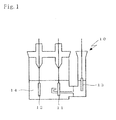
Fig. 1 is a schematic explanatory view illustrating a three-electrode test cell using a positive electrode as working electrode fabricated in Examples and Comparative Examples of the present invention. - A non-aqueous electrolyte secondary battery according to the invention will hereinbelow be described in detail by way of examples thereof. In addition, comparative examples are also cited to clarify that the non-aqueous electrolyte secondary battery according to the examples of the invention shows improved output characteristics under various temperature environments. It is to be noted that non-aqueous electrolyte secondary battery according to the invention is not limited to the following examples and may be practiced with suitable modifications made thereto so long as such modifications do not deviate from the scope of the invention.
- In Example 1, a positive electrode active material was prepared as follows. Li2Co3 and Ni0.35Mn0.30Co0.35 (OH) 2 obtained by a co-precipitation method were mixed at a prescribed ratio, heated to 900°C and burned to prepare a positive electrode active material having a layer structure and being represented by a formula Li1.06Ni0.33Mn0.28Co0.33O2. An average particle diameter of the resultant positive electrode active material was about 12 µm.
- Next, the positive electrode active material and an amorphous carbon having a specific surface area of 800 m2/g (Ketjen black EC made by Ketjen black International company) were processed using a dry process surface modification machine (Nobilta NOB-130 made by HOSOKAWA MICRON CORPORATION) so as to cover the surface of the positive electrode active material with the amorphous carbon material. A ratio of the amorphous carbon covering the positive electrode active material against the positive electrode active material was 3 mass %. The positive electrode active material having the surface covered with the amorphous carbon was observed by a scanning transmission electron microscope (SEM). According to the results of observation, the surface of positive electrode active material is uniformly covered with the amorphous carbon.
- Further, as a conductive agent, the same amorphous carbon having the specific surface area of 800 m2/g (Ketjen black EC made by Ketjen Black International Company) covering the positive electrode active material surface was used. The positive electrode active material having the surface covered with the amorphous carbon, the conductive agent of the amorphous carbon, and a solution dissolving polyvinylidene fluoride as a binder in N-methyl-2-pyrrolidone were mixed together to give positive electrode composite slurry. The mass ratio in the mixture of the positive electrode active material, the conductive agent and the binding agent was 95:2:3.
- The resultant positive electrode composite slurry was applied on a positive electrode current collector of an aluminum foil and dried. Subsequently, the positive electrode current collector was rolled by a roller and a current collector tab of aluminum was installed thereto. Thus, a positive electrode was prepared. Here, the total amount of amorphous carbon in the positive electrode composite slurry was about 4.9 mass %.
- As illustrated in
Fig.1 , while the positive electrode fabricated above was used as a working electrode 11, metal lithium was used as a counter electrode 12 of negative electrode and a reference electrode 13. Further, LiPF6 was dissolved in a concentration of 1 mol/l in a mixed solvent wherein ethylene carbonate, methyl ethyl carbonate and dimethyl carbonate were mixed at a volume ratio of 3:3:4 to prepare anon-aqueous electrolyte 14. Thus, a three-electrode cell 10 was fabricated. - In Example 2, in preparation of the positive electrode of Example 1, an amorphous carbon having a specific surface area of 39 m2/g (HS-100 made by DENKI KAGAKU KOGYO K.K.) was used as the conductive agent. Except for the above, the same procedure of Example 1 was used to fabricate a positive electrode and a three-electrode cell of Example 2. Here, the total amount of amorphous carbon in the positive electrode composite slurry was about 4.9 mass %.
- In Comparative Example 1, the above conductive agent was not added in preparation of the positive electrode of Example 1. Except for the above, the same procedure of Example 1 was used to fabricate a positive electrode and a three-electrode cell of Comparative Example 1.
- In Comparative Example 2, scale-shaped graphite having a specific surface area of 8.3 m2/g (UP-10 made by Nippon Graphite Industries, Co., Ltd.) was used as the conductive agent in preparation of the positive electrode of Example 1. Except for the above, the same procedure of Example 1 was used to fabricate a positive electrode and a three-electrode cell of Comparative Example 2.
- In Comparative Example 3, artificial graphite having a specific surface area of 260 m2/g (SP-300S made by Nippon Graphite Industries, Co., Ltd.) was used as the conductive agent in preparation of the positive electrode of Example 1. Except for the above, the same procedure of Example 1 was used to fabricate a positive electrode and a three-electrode cell of Comparative Example 3.
- In Comparative Example 4, vapor-grown carbon fiber (VGCF made by Showa Denko K.K.) was used as the conductive agent in preparation of the positive electrode of Example 1. Except for the above, the same procedure of Example 1 was used to fabricate a positive electrode and a three-electrode cell of
- In Comparative Example 5, the surface of positive electrode active material represented by the formula Li1.06Ni0.03Mn0.28Co0.33O2 was not covered with the amorphous carbon, and the vapor-grown carbon fiber (VGCF made by Showa Denko K.K.) of Comparative Example 4 was used as the conductive agent. Further, the positive electrode active material, the conductive agent and the binding agent were mixed in a volume ratio of 92:5:3 to prepare positive electrode composite slurry. Except for the above, the same procedure of Example 1 was used to fabricate a positive electrode and a three-electrode cell of Comparative Example 5.
- Next, each of the three-electrode cells of Examples 1 and 2 and Comparative Examples 1 to 5 was subjected to a charging and discharging under a temperature environment of 25°C. Each of the three-electrode cells was subjected to constant current charging at a current density of 0.2 mA/cm2 until a voltage became 4.3 V (vs. Li/Li+). Next, each three-electrode cell was charged at a constant voltage of 4.3 V (vs. Li/Li+) until a current density became 0.04 mA/cm2. After that, each three-electrode cell was subjected to constant current discharging at the current density of 0.2 mA/cm2 until the voltage became 2.5 V (vs. Li/Li+). A discharge capacity of this time was determined as a rated capacity of each of the three-electrode cells.
- Further, each three-electrode cell of Examples 1 and 2 and Comparative Examples 1 to 5 was charged until each rated capacity became 50 % so that a state of charge (SOC) was 50 %. Then, each three-electrode cell was left in a homeothermal container of -30°C for 5 hours. After that, each open-circuit voltage was measured. Next, each three-electrode cell was discharged at each current density of 0.08 mA/cm2, 0.4 mA/cm2, 0.8 mA/cm2, 1. 2 mA/cm2, 1.6 mA/cm2, and 2.4 mA/cm2 for 10 seconds and each battery voltage after 10 seconds was determined.
- Next, as to each three-electrode cell of Examples 1 and 2 and Comparative Examples 1 to 5, each value of current and battery voltage was plotted and each of I-V characteristics at discharging was determined. Further, each current when each battery voltage was 2. 5 V was measured, and each output (mW/cm2) of 50% of state of charge (SOC) under low temperature environment of -30°C was calculated. Then, as to each three-electrode cell of Examples 1 and 2 and Comparative Examples 1 to 4, an increment ratio of output under low temperature environment of -30°C against output of three-electrode cell of Comparative Example 5 was calculated. The results were shown in Table 1.
-
[TABLE 1] Positive electrode active material: Li1.06Ni0.33Mn0.28Co0.33O2 Covering material of positive electrode active material Conductive agent Increment ratio of output under -30°C (%) Type Specific surface area (m2/g) Type Specific surface area (m2/g) Example 1 Amorphous carbon 800 Amorphous carbon 800 14.3 Example 2 Amorphous carbon 800 Amorphous carbon 39 8.4 Comp.Ex.1 Amorphous carbon 800 - - 4.5 Comp.Ex.2 Amorphous carbon 800 Scale-shaped graphite 8.3 -1.7 Comp.Ex.3 Amorphous carbon 800 Artificial graphite 260 -1.7 Comp.Ex.4 Amorphous carbon 800 Vapor-grown carbon fiber - 1.8 Comp.Ex.5 - - Vapor-grown carbon fiber - Base - As a result, in each of the three-electrode cells of Examples 1 and 2 using the positive electrode wherein the surface of positive electrode active material represented by the formula Ll1+xNiaMnbCocO2+d was covered with the amorphous carbon and the conductive agent of amorphous carbon was added, the output characteristics under the environment of -30°C were remarkably improved as compared with the three-electrode cell of Comparative Example 1 using the positive electrode wherein the conductive agent was not added. Further, as compared with each three-electrode cell of Comparative Examples 2-4 wherein the scale-shaped graphite, the artificial graphite, or the vapor-grown carbon fiber was added as the conductive agent and the three-electrode cell of Comparative Example 5 wherein the surface of the positive electrode active material was not covered with amorphous carbon and the vapor-grown carbon fiber was added as the conductive agent, output characteristics were remarkably improved under the low temperature environment of -30°C in each three-electrode cell of Examples 1 and 2.
- Further, in comparison between the three-electrode cells of Examples 1 and 2, the three-electrode cell of Example 1 wherein the amorphous carbon having the specific surface area of 100 m2/g or more was added as the conductive agent exhibited more improved output characteristics under the environment of -30°C than the three-electrode cell of Example 2 wherein the amorphous carbon material having the specific surface area of 100 m2/g or less was added.
- Although the positive electrode active material represented by the formula Li1.06Ni0.33Mn0.28CO0.33O2 was used in Examples 1 and 2, in a case where Li1.06Ni0.38Mn0.37CO0.19O2, Li1.06Ni0.47Mn0.28Co0.19O2, Li1.06Ni0.37Mn0.48Co0.09O2, and Li1.07Ni0.56Mn0.28Co0.09O2 were used as a positive electrode active material containing Co and being represented by the above general formula, the same effect may be obtained.
- In Example 3, in preparation of the positive electrode active material of lithium-containing transition metal composite oxide, Li2CO3 and Ni0.60Mn0.40(OH)2 obtained by the co-precipitation method were mixed at a prescribed ratio, heated to 1000°C and burned to prepare a positive electrode active material having a layer structure and being represented by a formula Li1.06Ni0.56Mn0.38O2. An average particle diameter of the resultant positive electrode active material was about 6 µm.
- Except for the use of the above positive electrode active material, the same procedure of Example 1 was used to fabricate a positive electrode and a three-electrode cell of Example 3.
- In Example 4, the positive electrode active material of Example 3 represented by the formula Li1.06Ni0.56Mn0.38O2, was used and the amorphous carbon of Example 2 having the specific surface area of 39 m2/g (has-100 made by DENKI KAGAKU KOGYO K. K.) was used as the conductive agent. Except for the above, the same procedure of Example 1 was used to fabricate a positive electrode and a three-electrode cell of Example 4.
- In Comparative Example 6, the positive electrode active material of Example 3 represented by the formula Li1.06Ni0.56Mn0.38O2 was used and the conductive agent was not added as the same as Comparative Example 1. Except for the above, the same procedure of Example 1 was used to fabricate a positive electrode and a three-electrode cell of Comparative Example 6.
- In Comparative Example 7, the positive electrode active material of Example 3 represented by the formula Li1.06Ni0.56Mn0.38O2 was used and the scale-shaped graphite of Comparative Example 2 having the specific surface area of 8.3 m2/g (UP-10 made by Nippon Graphite Industries, Co., Ltd.) was used as the conductive agent. Except for the above, the same procedure of Example 1 was used to fabricate a positive electrode and a three-electrode cell of Comparative Example 7.
- In Comparative Example 8, the positive electrode active material of Example 3 represented by the formula Li1.06Ni0.56Mn0.38O2 was used and the surface of the positive electrode active material was not covered with the amorphous carbon as the same as Comparative Example 5. Further, as the conductive agent, the vapor-grown carbon fiber (VGCF made by Showa Denko K.K.) was used as the same as Comparative Example 4. Then, the positive electrode active material, the conductive agent and the binding agent were mixed in a volume ratio of 92:5:3 to prepare positive electrode composite slurry. Except for the above, the same procedure was used to fabricate a positive electrode and a three-electrode cell of Comparative Example 8.
- Next, as to each three-electrode cell of Examples 3 and 4 and Comparative Examples 6 to 8, each output (mW/cm2) of 50 % of state of charge (SOC) under low temperature environment of -30°C was calculated. Then, as to each three-electrode cell of Examples 3 and 4 and Comparative Examples 6 and 7, an increment ratio of output against output of three-electrode cell of Comparative Example 8 under low temperature environment of -30°C was calculated. The results were shown in Table 2.
-
[TABLE 2] Positive electrode active material: Li1.06Ni0.56Mn0.38O2 Covering material of positive electrode active material Conductive agent Increment ratio of output under -30°C (%) Type Specific surface area (m2/g) Type Specific surface area (m2/g) Example 3 Amorphous carbon 800 Amorphous carbon 800 58.3 Example 4 Amorphous carbon 800 Amorphous carbon 39 27.7 Comp.Ex.6 Amorphous carbon 800 - - 14.5 Comp.Ex.7 Amorphous carbon 800 Scale-shaped graphite 8.3 5.8 Comp.Ex.8 - - Vapor-grown carbon fiber - Base - As a result, in each of the three-electrode cells of Examples 3 and 4 using the positive electrode wherein the surface of positive electrode active material represented by the formula Li1+xNiaMnbCocO2+d was covered with the amorphous carbon and the conductive agent of amorphous carbon was added, the output characteristics under the low temperature environment of -30°C were remarkably improved as compared with each of the three-electrode cells of Comparative Examples 6 to 8.
- Further, in comparison between the three-electrode cells of Examples 3 and 4, in the three-electrode cell of Example 3 wherein the amorphous carbon having the specific surface area of 100 m2/g or more was used, the output characteristics under the low temperature environment of -30°C were much more improved as compared with the three-electrode cell of Example 4.
- In the three-electrode cells of Examples 3 and 4 using the positive electrode active material of lithium-containing transition metal composite oxide composed of Ni and Mn not containing Co, the output characteristics under low temperature environment of -30°C was much more improved as compared with the three-electrode cells of Comparative Examples 6 and 8 and the three-electrode cells of Examples 1 and 2 using the positive electrode active material of lithium-containing transition metal composite oxide containing Co.
- Further, as compared with the positive electrode active material of lithium-containing transition metal composite oxide containing Co used in Examples 1 and 2, in a case where the positive electrode active material of lithium-containing transition metal composite oxide composed of Ni and Mn not containing Co was used as in Examples 3 and 4, production costs for positive electrode active material are reduced, so that a non-aqueous electrolyte secondary battery having high output characteristics even under low temperature environment may be obtained at low cost.
- Although the positive electrode active material of lithium-containing transition metal composite oxide composed of Ni and Mn not containing Co represented by the formula Li1.06Ni0.56Mn0.38O2 was used in Examples 3 and 4, any positive electrode active material may be used if being represented by the above general formula, for example, in a case where the positive electrode active material represented by Li1.06Ni0.52Mn0.42O2 is used, the same effect may be obtained.
-
- 10 three-electrode cell
- 11 working electrode (positive electrode)
- 12 counter electrode (negative electrode)
- 13 reference electrode
- 14 non-aqueous electrolyte
Claims (8)
- Anon-aqueous electrolyte secondary battery, comprising:a positive electrode containing a positive electrode active material;a negative electrode containing a negative electrode active material; anda non-aqueous electrolyte having lithium ion conductivity;wherein lithium-containing transition metal composite oxide having a layer structure and being presented by a general formula Li1+xNiaMnbCocO2+d wherein x, a, b, c and d satisfy x+a+b+c=1, 0.25≤ a ≤0.60, 0.25≤ b ≤0.60, 0≤ c ≤0.40, 0≤ x ≤0.10, 0.7≤ a/b ≤ 2.0 and -0.1≤ d ≤0.1 is used as the positive electrode active material of the positive electrode, andwherein a surface of the positive electrode active material is covered with an amorphous carbon material and a conductive agent of amorphous carbon material is inserted between particles of the positive electrode active material.
- The non-aqueous electrolyte secondary battery as claimed in Claim 1,
wherein an amorphous carbon material having a specific surface area of 100 m2/g or more is used as the conductive agent of the positive electrode. - The non-aqueous electrolyte secondary battery as claimed in Claim 1,
wherein the positive electrode uses a positive electrode composite comprising the positive electrode active material covered with the amorphous carbon material, the conductive agent of the amorphous carbon material, and a binding agent, and a total amount of the amorphous carbon material in the positive electrode composite is within 2 to 10 mass %. - The non-aqueous electrolyte secondary battery as claimed in Claim 2,
wherein the positive electrode uses a positive electrode composite comprising the positive electrode active material covered with the amorphous carbon material, the conductive agent of the amorphous carbon material, and a binding agent, and a total amount of the amorphous carbon material in the positive electrode composite is within 2 to 10 mass %. - The non-aqueous electrolyte secondary battery as claimed in Claim 1,
wherein lithium-containing transition metal composite oxide having a layer structure and being represented by Li1+xNiaMnbO2+d is used as the positive electrode active material having the layer structure and being represented by the general formula Li1+xNiaMnbCocO2+d wherein c defining the amount of Co is 0. - The non-aqueous electrolyte secondary battery as claimed in Claim 5,
wherein an amorphous carbon material having a specific surface area of 100 m2/g or more is used as the conductive agent of the positive electrode. - The non-aqueous electrolyte secondary battery as claimed in Claim 5,
wherein a positive electrode composite comprising the positive electrode active material covered with the amorphous carbon material, the conductive agent of the amorphous carbon material and s binding agent is used, and a total amount of the amorphous carbon material in the positive electrode composite is within 2 to 10 mass %. - The non-aqueous electrolyte secondary battery as claimed in Claim 6,
wherein a positive electrode composite comprising the positive electrode active material covered with the amorphous carbon material, the conductive agent of the amorphous carbon material and a binding agent is used, and a total amount of the amorphous carbon material in the positive electrode composite is within 2 to 10 mass %.
Applications Claiming Priority (2)
| Application Number | Priority Date | Filing Date | Title |
|---|---|---|---|
| JP2008247391 | 2008-09-26 | ||
| PCT/JP2009/066244 WO2010035681A1 (en) | 2008-09-26 | 2009-09-17 | Nonaqueous electrolyte secondary battery |
Publications (2)
| Publication Number | Publication Date |
|---|---|
| EP2337122A1 true EP2337122A1 (en) | 2011-06-22 |
| EP2337122A4 EP2337122A4 (en) | 2012-05-09 |
Family
ID=42059682
Family Applications (1)
| Application Number | Title | Priority Date | Filing Date |
|---|---|---|---|
| EP09816096A Withdrawn EP2337122A4 (en) | 2008-09-26 | 2009-09-17 | Nonaqueous electrolyte secondary battery |
Country Status (5)
| Country | Link |
|---|---|
| US (1) | US20110177391A1 (en) |
| EP (1) | EP2337122A4 (en) |
| JP (1) | JPWO2010035681A1 (en) |
| CN (1) | CN102160215A (en) |
| WO (1) | WO2010035681A1 (en) |
Families Citing this family (16)
| Publication number | Priority date | Publication date | Assignee | Title |
|---|---|---|---|---|
| US20120088151A1 (en) * | 2010-10-08 | 2012-04-12 | Semiconductor Energy Laboratory Co., Ltd. | Positive-electrode active material and power storage device |
| CN102738456A (en) * | 2011-04-07 | 2012-10-17 | 锂科科技股份有限公司 | Lithium-ion battery cathode metal oxide material, manufacturing method thereof and lithium-ion battery |
| US9218916B2 (en) | 2011-06-24 | 2015-12-22 | Semiconductor Energy Laboratory Co., Ltd. | Graphene, power storage device, and electric device |
| JP6136326B2 (en) * | 2013-02-12 | 2017-05-31 | 日本電気株式会社 | Positive electrode material for lithium ion secondary battery and manufacturing method thereof |
| KR101443500B1 (en) * | 2013-02-15 | 2014-09-22 | 삼성정밀화학 주식회사 | Lithium-metal oxide and lithium secondary battery having the same |
| US10637054B2 (en) | 2013-06-06 | 2020-04-28 | Nec Corporation | Positive electrode material for lithium ion secondary batteries, and method for producing same |
| JP6242659B2 (en) * | 2013-10-31 | 2017-12-06 | 三星電子株式会社Samsung Electronics Co.,Ltd. | Positive electrode of all solid lithium ion secondary battery and all solid lithium ion secondary battery |
| JP5966093B1 (en) * | 2014-09-29 | 2016-08-10 | 積水化学工業株式会社 | Cathode active material for lithium ion battery |
| KR102331069B1 (en) * | 2016-11-30 | 2021-11-25 | 삼성에스디아이 주식회사 | Composite cathode active material, and Cathode and Lithium battery comprising composite cathode active material |
| JP2018163833A (en) * | 2017-03-27 | 2018-10-18 | 三洋電機株式会社 | Nonaqueous electrolyte secondary battery and manufacturing method |
| KR102844879B1 (en) * | 2020-01-30 | 2025-08-11 | 주식회사 엘지에너지솔루션 | Method for preparing positive electrode active material for lithium secondary battery and positive electrode active material prepared thereby |
| JP7642796B2 (en) * | 2020-11-27 | 2025-03-10 | エルジー エナジー ソリューション リミテッド | Positive electrode active material for lithium secondary battery, method for producing same and lithium secondary battery including same |
| US20260229508A1 (en) * | 2023-03-17 | 2026-08-06 | Lg Energy Solution, Ltd. | Positive Electrode Active Material, Positive Electrode and Lithium Secondary Battery Comprising the Same, and Method for Manufacturing Positive Electrode Active Material |
| EP4693452A4 (en) * | 2023-03-28 | 2026-07-22 | Fujifilm Corp | SLUFF FOR THE FORMATION OF A POSITIVE ELECTRODE OF AN ANTI-ADHESIVE ELECTROLYTE SECONDARY BATTERY, ANTI-ADHESIVE ELECTROLYTE SECONDARY BATTERY AND METHOD FOR THE PRODUCING OF AN ANTI-ADHESIVE ELECTROLYTE SECONDARY BATTERY |
| JPWO2024204383A1 (en) * | 2023-03-28 | 2024-10-03 | ||
| CN120221638B (en) * | 2025-05-28 | 2025-09-09 | 宁德时代新能源科技股份有限公司 | Battery cells, battery devices and power-consuming devices |
Family Cites Families (13)
| Publication number | Priority date | Publication date | Assignee | Title |
|---|---|---|---|---|
| US4640744A (en) * | 1984-01-23 | 1987-02-03 | Standard Oil Company (Indiana) | Amorphous carbon electrodes and their use in electrochemical cells |
| JP3601124B2 (en) | 1995-09-22 | 2004-12-15 | 株式会社デンソー | A positive electrode active material of a secondary battery using a non-aqueous solution, and a positive electrode. |
| JP3730491B2 (en) * | 1999-07-28 | 2006-01-05 | 三菱化学株式会社 | Battery having control electrode surface |
| JP3890185B2 (en) | 2000-07-27 | 2007-03-07 | 松下電器産業株式会社 | Positive electrode active material and non-aqueous electrolyte secondary battery including the same |
| US6660432B2 (en) | 2000-09-14 | 2003-12-09 | Ilion Technology Corporation | Lithiated oxide materials and methods of manufacture |
| JP4461685B2 (en) * | 2002-07-15 | 2010-05-12 | 三菱化学株式会社 | Positive electrode active material composite particles, and electrode and lithium secondary battery using the same |
| US7632317B2 (en) * | 2002-11-04 | 2009-12-15 | Quallion Llc | Method for making a battery |
| JP2004265792A (en) * | 2003-03-03 | 2004-09-24 | Sony Corp | battery |
| KR100917733B1 (en) * | 2004-11-26 | 2009-09-15 | 파나소닉 주식회사 | Lithium Primary Battery and Manufacturing Method |
| JP2006278079A (en) | 2005-03-29 | 2006-10-12 | Sanyo Electric Co Ltd | Nonaqueous electrolyte secondary battery |
| JP5124910B2 (en) * | 2005-06-09 | 2013-01-23 | 日産自動車株式会社 | Cathode material for non-aqueous electrolyte lithium ion battery, battery using the same, and method for producing cathode material for non-aqueous electrolyte lithium ion battery |
| JP2007250440A (en) | 2006-03-17 | 2007-09-27 | Sanyo Electric Co Ltd | Nonaqueous electrolyte secondary battery |
| US20100112449A1 (en) * | 2007-03-29 | 2010-05-06 | Hideaki Fujita | Positive electrode for non-aqueous electrolyte secondary battery and non-aqueous electrolyte secondary battery |
-
2009
- 2009-09-17 JP JP2010530820A patent/JPWO2010035681A1/en not_active Withdrawn
- 2009-09-17 US US13/120,328 patent/US20110177391A1/en not_active Abandoned
- 2009-09-17 WO PCT/JP2009/066244 patent/WO2010035681A1/en not_active Ceased
- 2009-09-17 CN CN2009801380132A patent/CN102160215A/en active Pending
- 2009-09-17 EP EP09816096A patent/EP2337122A4/en not_active Withdrawn
Non-Patent Citations (2)
| Title |
|---|
| No further relevant documents disclosed * |
| See also references of WO2010035681A1 * |
Also Published As
| Publication number | Publication date |
|---|---|
| JPWO2010035681A1 (en) | 2012-02-23 |
| US20110177391A1 (en) | 2011-07-21 |
| CN102160215A (en) | 2011-08-17 |
| WO2010035681A1 (en) | 2010-04-01 |
| EP2337122A4 (en) | 2012-05-09 |
Similar Documents
| Publication | Publication Date | Title |
|---|---|---|
| US20110177391A1 (en) | Non-aqueous electrolyte secondary battery | |
| EP3503267B1 (en) | Negative electrode active material for lithium secondary battery, negative electrode including the same, and lithium secondary battery including the negative electrode | |
| EP4191709B1 (en) | Secondary battery and apparatus contained the secondary battery | |
| US20090305136A1 (en) | Non-aqueous electrolyte secondary battery and method of manufacturing the same | |
| KR102849565B1 (en) | Positive active material and lithium secondary battery comprising the same | |
| US9748574B2 (en) | Anode and secondary battery | |
| US9406931B2 (en) | Positive active material and positive electrode and lithium battery including positive active material | |
| EP3965201A1 (en) | Secondary battery and device containing same | |
| EP3435454B1 (en) | Lithium-ion battery and positive active material therefor | |
| KR100570051B1 (en) | Lithium-ion Secondary Battery | |
| JP5078334B2 (en) | Nonaqueous electrolyte secondary battery | |
| EP4672355A1 (en) | BATTERY CELL, BATTERY AND ELECTRICAL DEVICE | |
| US12633535B2 (en) | Electrochemical device and electronic device containing same | |
| KR20180087162A (en) | Method for preparing lithium secondary battery having high-temperature storage properties | |
| JP2015122340A (en) | Lithium secondary battery | |
| JP7556779B2 (en) | Anode active material, anode, and secondary battery | |
| US20120135315A1 (en) | Non-aqueous electrolyte secondary battery | |
| CN112886050A (en) | Secondary battery and device containing the same | |
| US12609312B2 (en) | Positive electrode and lithium secondary battery including the same | |
| EP4250420A1 (en) | Cathode composition for lithium secondary battery and lithium secondary battery manufactured using the same | |
| KR102465642B1 (en) | Method for fabricating high capacity cathode composite using couette-taylor reactor and method for fabricating lithium secondary battery comprising same | |
| KR102874890B1 (en) | Composition for secondary battery, positive electrode and positive electrode composite layer | |
| CN119234327B (en) | Secondary battery, preparation method thereof and electricity utilization device | |
| CN119230829B (en) | Negative electrode plate, preparation method thereof, battery cell and power utilization device | |
| KR102567705B1 (en) | Lithium secondary battery |
Legal Events
| Date | Code | Title | Description |
|---|---|---|---|
| PUAI | Public reference made under article 153(3) epc to a published international application that has entered the european phase |
Free format text: ORIGINAL CODE: 0009012 |
|
| 17P | Request for examination filed |
Effective date: 20110405 |
|
| AK | Designated contracting states |
Kind code of ref document: A1 Designated state(s): AT BE BG CH CY CZ DE DK EE ES FI FR GB GR HR HU IE IS IT LI LT LU LV MC MK MT NL NO PL PT RO SE SI SK SM TR |
|
| AX | Request for extension of the european patent |
Extension state: AL BA RS |
|
| DAX | Request for extension of the european patent (deleted) | ||
| A4 | Supplementary search report drawn up and despatched |
Effective date: 20120412 |
|
| RIC1 | Information provided on ipc code assigned before grant |
Ipc: H01M 4/525 20100101ALI20120404BHEP Ipc: H01M 10/052 20100101ALI20120404BHEP Ipc: H01M 4/62 20060101ALI20120404BHEP Ipc: H01M 4/52 20100101ALI20120404BHEP Ipc: H01M 4/50 20100101ALI20120404BHEP Ipc: H01M 4/36 20060101ALI20120404BHEP Ipc: H01M 4/02 20060101AFI20120404BHEP |
|
| GRAP | Despatch of communication of intention to grant a patent |
Free format text: ORIGINAL CODE: EPIDOSNIGR1 |
|
| STAA | Information on the status of an ep patent application or granted ep patent |
Free format text: STATUS: THE APPLICATION HAS BEEN WITHDRAWN |
|
| 18W | Application withdrawn |
Effective date: 20130529 |