EP2333882A2 - Perovskite materials for solid oxide fuel cell cathodes - Google Patents
Perovskite materials for solid oxide fuel cell cathodes Download PDFInfo
- Publication number
- EP2333882A2 EP2333882A2 EP10192226A EP10192226A EP2333882A2 EP 2333882 A2 EP2333882 A2 EP 2333882A2 EP 10192226 A EP10192226 A EP 10192226A EP 10192226 A EP10192226 A EP 10192226A EP 2333882 A2 EP2333882 A2 EP 2333882A2
- Authority
- EP
- European Patent Office
- Prior art keywords
- lscf
- composition
- ball milling
- fuel cell
- cathode
- Prior art date
- Legal status (The legal status is an assumption and is not a legal conclusion. Google has not performed a legal analysis and makes no representation as to the accuracy of the status listed.)
- Granted
Links
Images


Classifications
-
- C—CHEMISTRY; METALLURGY
- C04—CEMENTS; CONCRETE; ARTIFICIAL STONE; CERAMICS; REFRACTORIES
- C04B—LIME, MAGNESIA; SLAG; CEMENTS; COMPOSITIONS THEREOF, e.g. MORTARS, CONCRETE OR LIKE BUILDING MATERIALS; ARTIFICIAL STONE; CERAMICS; REFRACTORIES; TREATMENT OF NATURAL STONE
- C04B35/00—Shaped ceramic products characterised by their composition; Ceramics compositions; Processing powders of inorganic compounds preparatory to the manufacturing of ceramic products
- C04B35/01—Shaped ceramic products characterised by their composition; Ceramics compositions; Processing powders of inorganic compounds preparatory to the manufacturing of ceramic products based on oxide ceramics
- C04B35/26—Shaped ceramic products characterised by their composition; Ceramics compositions; Processing powders of inorganic compounds preparatory to the manufacturing of ceramic products based on oxide ceramics based on ferrites
- C04B35/2641—Compositions containing one or more ferrites of the group comprising rare earth metals and one or more ferrites of the group comprising alkali metals, alkaline earth metals or lead
-
- C—CHEMISTRY; METALLURGY
- C01—INORGANIC CHEMISTRY
- C01G—COMPOUNDS CONTAINING METALS NOT COVERED BY SUBCLASSES C01D OR C01F
- C01G49/00—Compounds of iron
- C01G49/009—Compounds containing iron, with or without oxygen or hydrogen, and containing two or more other elements
-
- C—CHEMISTRY; METALLURGY
- C01—INORGANIC CHEMISTRY
- C01G—COMPOUNDS CONTAINING METALS NOT COVERED BY SUBCLASSES C01D OR C01F
- C01G51/00—Compounds of cobalt
- C01G51/40—Complex oxides containing cobalt and at least one other metal element
- C01G51/66—Complex oxides containing cobalt and at least one other metal element containing alkaline earth metals, e.g. SrCoO3
- C01G51/68—Complex oxides containing cobalt and at least one other metal element containing alkaline earth metals, e.g. SrCoO3 containing rare earths, e.g. (La0.3Sr0.7)CoO3
-
- C—CHEMISTRY; METALLURGY
- C01—INORGANIC CHEMISTRY
- C01G—COMPOUNDS CONTAINING METALS NOT COVERED BY SUBCLASSES C01D OR C01F
- C01G51/00—Compounds of cobalt
- C01G51/80—Compounds containing cobalt, with or without oxygen or hydrogen, and containing one or more other elements
- C01G51/82—Compounds containing cobalt, with or without oxygen or hydrogen, and containing two or more other elements
-
- C—CHEMISTRY; METALLURGY
- C04—CEMENTS; CONCRETE; ARTIFICIAL STONE; CERAMICS; REFRACTORIES
- C04B—LIME, MAGNESIA; SLAG; CEMENTS; COMPOSITIONS THEREOF, e.g. MORTARS, CONCRETE OR LIKE BUILDING MATERIALS; ARTIFICIAL STONE; CERAMICS; REFRACTORIES; TREATMENT OF NATURAL STONE
- C04B35/00—Shaped ceramic products characterised by their composition; Ceramics compositions; Processing powders of inorganic compounds preparatory to the manufacturing of ceramic products
- C04B35/01—Shaped ceramic products characterised by their composition; Ceramics compositions; Processing powders of inorganic compounds preparatory to the manufacturing of ceramic products based on oxide ceramics
- C04B35/26—Shaped ceramic products characterised by their composition; Ceramics compositions; Processing powders of inorganic compounds preparatory to the manufacturing of ceramic products based on oxide ceramics based on ferrites
- C04B35/2608—Compositions containing one or more ferrites of the group comprising manganese, zinc, nickel, copper or cobalt and one or more ferrites of the group comprising rare earth metals, alkali metals, alkaline earth metals or lead
- C04B35/2633—Compositions containing one or more ferrites of the group comprising manganese, zinc, nickel, copper or cobalt and one or more ferrites of the group comprising rare earth metals, alkali metals, alkaline earth metals or lead containing barium, strontium or calcium
-
- C—CHEMISTRY; METALLURGY
- C04—CEMENTS; CONCRETE; ARTIFICIAL STONE; CERAMICS; REFRACTORIES
- C04B—LIME, MAGNESIA; SLAG; CEMENTS; COMPOSITIONS THEREOF, e.g. MORTARS, CONCRETE OR LIKE BUILDING MATERIALS; ARTIFICIAL STONE; CERAMICS; REFRACTORIES; TREATMENT OF NATURAL STONE
- C04B35/00—Shaped ceramic products characterised by their composition; Ceramics compositions; Processing powders of inorganic compounds preparatory to the manufacturing of ceramic products
- C04B35/622—Forming processes; Processing powders of inorganic compounds preparatory to the manufacturing of ceramic products
- C04B35/626—Preparing or treating the powders individually or as batches ; preparing or treating macroscopic reinforcing agents for ceramic products, e.g. fibres; mechanical aspects section B
- C04B35/62605—Treating the starting powders individually or as mixtures
- C04B35/6261—Milling
-
- C—CHEMISTRY; METALLURGY
- C04—CEMENTS; CONCRETE; ARTIFICIAL STONE; CERAMICS; REFRACTORIES
- C04B—LIME, MAGNESIA; SLAG; CEMENTS; COMPOSITIONS THEREOF, e.g. MORTARS, CONCRETE OR LIKE BUILDING MATERIALS; ARTIFICIAL STONE; CERAMICS; REFRACTORIES; TREATMENT OF NATURAL STONE
- C04B35/00—Shaped ceramic products characterised by their composition; Ceramics compositions; Processing powders of inorganic compounds preparatory to the manufacturing of ceramic products
- C04B35/622—Forming processes; Processing powders of inorganic compounds preparatory to the manufacturing of ceramic products
- C04B35/626—Preparing or treating the powders individually or as batches ; preparing or treating macroscopic reinforcing agents for ceramic products, e.g. fibres; mechanical aspects section B
- C04B35/62605—Treating the starting powders individually or as mixtures
- C04B35/6261—Milling
- C04B35/6262—Milling of calcined, sintered clinker or ceramics
-
- C—CHEMISTRY; METALLURGY
- C04—CEMENTS; CONCRETE; ARTIFICIAL STONE; CERAMICS; REFRACTORIES
- C04B—LIME, MAGNESIA; SLAG; CEMENTS; COMPOSITIONS THEREOF, e.g. MORTARS, CONCRETE OR LIKE BUILDING MATERIALS; ARTIFICIAL STONE; CERAMICS; REFRACTORIES; TREATMENT OF NATURAL STONE
- C04B35/00—Shaped ceramic products characterised by their composition; Ceramics compositions; Processing powders of inorganic compounds preparatory to the manufacturing of ceramic products
- C04B35/622—Forming processes; Processing powders of inorganic compounds preparatory to the manufacturing of ceramic products
- C04B35/626—Preparing or treating the powders individually or as batches ; preparing or treating macroscopic reinforcing agents for ceramic products, e.g. fibres; mechanical aspects section B
- C04B35/62605—Treating the starting powders individually or as mixtures
- C04B35/62625—Wet mixtures
- C04B35/6264—Mixing media, e.g. organic solvents
-
- C—CHEMISTRY; METALLURGY
- C04—CEMENTS; CONCRETE; ARTIFICIAL STONE; CERAMICS; REFRACTORIES
- C04B—LIME, MAGNESIA; SLAG; CEMENTS; COMPOSITIONS THEREOF, e.g. MORTARS, CONCRETE OR LIKE BUILDING MATERIALS; ARTIFICIAL STONE; CERAMICS; REFRACTORIES; TREATMENT OF NATURAL STONE
- C04B35/00—Shaped ceramic products characterised by their composition; Ceramics compositions; Processing powders of inorganic compounds preparatory to the manufacturing of ceramic products
- C04B35/622—Forming processes; Processing powders of inorganic compounds preparatory to the manufacturing of ceramic products
- C04B35/626—Preparing or treating the powders individually or as batches ; preparing or treating macroscopic reinforcing agents for ceramic products, e.g. fibres; mechanical aspects section B
- C04B35/62605—Treating the starting powders individually or as mixtures
- C04B35/62645—Thermal treatment of powders or mixtures thereof other than sintering
- C04B35/62655—Drying, e.g. freeze-drying, spray-drying, microwave or supercritical drying
-
- C—CHEMISTRY; METALLURGY
- C04—CEMENTS; CONCRETE; ARTIFICIAL STONE; CERAMICS; REFRACTORIES
- C04B—LIME, MAGNESIA; SLAG; CEMENTS; COMPOSITIONS THEREOF, e.g. MORTARS, CONCRETE OR LIKE BUILDING MATERIALS; ARTIFICIAL STONE; CERAMICS; REFRACTORIES; TREATMENT OF NATURAL STONE
- C04B35/00—Shaped ceramic products characterised by their composition; Ceramics compositions; Processing powders of inorganic compounds preparatory to the manufacturing of ceramic products
- C04B35/622—Forming processes; Processing powders of inorganic compounds preparatory to the manufacturing of ceramic products
- C04B35/626—Preparing or treating the powders individually or as batches ; preparing or treating macroscopic reinforcing agents for ceramic products, e.g. fibres; mechanical aspects section B
- C04B35/62605—Treating the starting powders individually or as mixtures
- C04B35/62645—Thermal treatment of powders or mixtures thereof other than sintering
- C04B35/62675—Thermal treatment of powders or mixtures thereof other than sintering characterised by the treatment temperature
-
- H—ELECTRICITY
- H01—ELECTRIC ELEMENTS
- H01M—PROCESSES OR MEANS, e.g. BATTERIES, FOR THE DIRECT CONVERSION OF CHEMICAL ENERGY INTO ELECTRICAL ENERGY
- H01M4/00—Electrodes
- H01M4/86—Inert electrodes with catalytic activity, e.g. for fuel cells
- H01M4/8605—Porous electrodes
- H01M4/8621—Porous electrodes containing only metallic or ceramic material, e.g. made by sintering or sputtering
-
- H—ELECTRICITY
- H01—ELECTRIC ELEMENTS
- H01M—PROCESSES OR MEANS, e.g. BATTERIES, FOR THE DIRECT CONVERSION OF CHEMICAL ENERGY INTO ELECTRICAL ENERGY
- H01M4/00—Electrodes
- H01M4/86—Inert electrodes with catalytic activity, e.g. for fuel cells
- H01M4/90—Selection of catalytic material
- H01M4/9016—Oxides, hydroxides or oxygenated metallic salts
- H01M4/9025—Oxides specially used in fuel cell operating at high temperature, e.g. SOFC
- H01M4/9033—Complex oxides, optionally doped, of the type M1MeO3, M1 being an alkaline earth metal or a rare earth, Me being a metal, e.g. perovskites
-
- C—CHEMISTRY; METALLURGY
- C01—INORGANIC CHEMISTRY
- C01P—INDEXING SCHEME RELATING TO STRUCTURAL AND PHYSICAL ASPECTS OF SOLID INORGANIC COMPOUNDS
- C01P2002/00—Crystal-structural characteristics
- C01P2002/30—Three-dimensional structures
- C01P2002/34—Three-dimensional structures perovskite-type (ABO3)
-
- C—CHEMISTRY; METALLURGY
- C01—INORGANIC CHEMISTRY
- C01P—INDEXING SCHEME RELATING TO STRUCTURAL AND PHYSICAL ASPECTS OF SOLID INORGANIC COMPOUNDS
- C01P2002/00—Crystal-structural characteristics
- C01P2002/70—Crystal-structural characteristics defined by measured X-ray, neutron or electron diffraction data
- C01P2002/72—Crystal-structural characteristics defined by measured X-ray, neutron or electron diffraction data by d-values or two theta-values, e.g. as X-ray diagram
-
- C—CHEMISTRY; METALLURGY
- C01—INORGANIC CHEMISTRY
- C01P—INDEXING SCHEME RELATING TO STRUCTURAL AND PHYSICAL ASPECTS OF SOLID INORGANIC COMPOUNDS
- C01P2002/00—Crystal-structural characteristics
- C01P2002/70—Crystal-structural characteristics defined by measured X-ray, neutron or electron diffraction data
- C01P2002/77—Crystal-structural characteristics defined by measured X-ray, neutron or electron diffraction data by unit-cell parameters, atom positions or structure diagrams
-
- C—CHEMISTRY; METALLURGY
- C01—INORGANIC CHEMISTRY
- C01P—INDEXING SCHEME RELATING TO STRUCTURAL AND PHYSICAL ASPECTS OF SOLID INORGANIC COMPOUNDS
- C01P2004/00—Particle morphology
- C01P2004/51—Particles with a specific particle size distribution
-
- C—CHEMISTRY; METALLURGY
- C01—INORGANIC CHEMISTRY
- C01P—INDEXING SCHEME RELATING TO STRUCTURAL AND PHYSICAL ASPECTS OF SOLID INORGANIC COMPOUNDS
- C01P2004/00—Particle morphology
- C01P2004/60—Particles characterised by their size
- C01P2004/61—Micrometer sized, i.e. from 1-100 micrometer
-
- C—CHEMISTRY; METALLURGY
- C01—INORGANIC CHEMISTRY
- C01P—INDEXING SCHEME RELATING TO STRUCTURAL AND PHYSICAL ASPECTS OF SOLID INORGANIC COMPOUNDS
- C01P2004/00—Particle morphology
- C01P2004/60—Particles characterised by their size
- C01P2004/62—Submicrometer sized, i.e. from 0.1-1 micrometer
-
- C—CHEMISTRY; METALLURGY
- C01—INORGANIC CHEMISTRY
- C01P—INDEXING SCHEME RELATING TO STRUCTURAL AND PHYSICAL ASPECTS OF SOLID INORGANIC COMPOUNDS
- C01P2006/00—Physical properties of inorganic compounds
- C01P2006/12—Surface area
-
- C—CHEMISTRY; METALLURGY
- C01—INORGANIC CHEMISTRY
- C01P—INDEXING SCHEME RELATING TO STRUCTURAL AND PHYSICAL ASPECTS OF SOLID INORGANIC COMPOUNDS
- C01P2006/00—Physical properties of inorganic compounds
- C01P2006/40—Electric properties
-
- C—CHEMISTRY; METALLURGY
- C04—CEMENTS; CONCRETE; ARTIFICIAL STONE; CERAMICS; REFRACTORIES
- C04B—LIME, MAGNESIA; SLAG; CEMENTS; COMPOSITIONS THEREOF, e.g. MORTARS, CONCRETE OR LIKE BUILDING MATERIALS; ARTIFICIAL STONE; CERAMICS; REFRACTORIES; TREATMENT OF NATURAL STONE
- C04B2235/00—Aspects relating to ceramic starting mixtures or sintered ceramic products
- C04B2235/02—Composition of constituents of the starting material or of secondary phases of the final product
- C04B2235/30—Constituents and secondary phases not being of a fibrous nature
- C04B2235/32—Metal oxides, mixed metal oxides, or oxide-forming salts thereof, e.g. carbonates, nitrates, (oxy)hydroxides, chlorides
- C04B2235/3205—Alkaline earth oxides or oxide forming salts thereof, e.g. beryllium oxide
- C04B2235/3213—Strontium oxides or oxide-forming salts thereof
-
- C—CHEMISTRY; METALLURGY
- C04—CEMENTS; CONCRETE; ARTIFICIAL STONE; CERAMICS; REFRACTORIES
- C04B—LIME, MAGNESIA; SLAG; CEMENTS; COMPOSITIONS THEREOF, e.g. MORTARS, CONCRETE OR LIKE BUILDING MATERIALS; ARTIFICIAL STONE; CERAMICS; REFRACTORIES; TREATMENT OF NATURAL STONE
- C04B2235/00—Aspects relating to ceramic starting mixtures or sintered ceramic products
- C04B2235/02—Composition of constituents of the starting material or of secondary phases of the final product
- C04B2235/30—Constituents and secondary phases not being of a fibrous nature
- C04B2235/32—Metal oxides, mixed metal oxides, or oxide-forming salts thereof, e.g. carbonates, nitrates, (oxy)hydroxides, chlorides
- C04B2235/3224—Rare earth oxide or oxide forming salts thereof, e.g. scandium oxide
- C04B2235/3227—Lanthanum oxide or oxide-forming salts thereof
-
- C—CHEMISTRY; METALLURGY
- C04—CEMENTS; CONCRETE; ARTIFICIAL STONE; CERAMICS; REFRACTORIES
- C04B—LIME, MAGNESIA; SLAG; CEMENTS; COMPOSITIONS THEREOF, e.g. MORTARS, CONCRETE OR LIKE BUILDING MATERIALS; ARTIFICIAL STONE; CERAMICS; REFRACTORIES; TREATMENT OF NATURAL STONE
- C04B2235/00—Aspects relating to ceramic starting mixtures or sintered ceramic products
- C04B2235/02—Composition of constituents of the starting material or of secondary phases of the final product
- C04B2235/30—Constituents and secondary phases not being of a fibrous nature
- C04B2235/32—Metal oxides, mixed metal oxides, or oxide-forming salts thereof, e.g. carbonates, nitrates, (oxy)hydroxides, chlorides
- C04B2235/327—Iron group oxides, their mixed metal oxides, or oxide-forming salts thereof
- C04B2235/3272—Iron oxides or oxide forming salts thereof, e.g. hematite, magnetite
-
- C—CHEMISTRY; METALLURGY
- C04—CEMENTS; CONCRETE; ARTIFICIAL STONE; CERAMICS; REFRACTORIES
- C04B—LIME, MAGNESIA; SLAG; CEMENTS; COMPOSITIONS THEREOF, e.g. MORTARS, CONCRETE OR LIKE BUILDING MATERIALS; ARTIFICIAL STONE; CERAMICS; REFRACTORIES; TREATMENT OF NATURAL STONE
- C04B2235/00—Aspects relating to ceramic starting mixtures or sintered ceramic products
- C04B2235/02—Composition of constituents of the starting material or of secondary phases of the final product
- C04B2235/30—Constituents and secondary phases not being of a fibrous nature
- C04B2235/32—Metal oxides, mixed metal oxides, or oxide-forming salts thereof, e.g. carbonates, nitrates, (oxy)hydroxides, chlorides
- C04B2235/327—Iron group oxides, their mixed metal oxides, or oxide-forming salts thereof
- C04B2235/3275—Cobalt oxides, cobaltates or cobaltites or oxide forming salts thereof, e.g. bismuth cobaltate, zinc cobaltite
-
- C—CHEMISTRY; METALLURGY
- C04—CEMENTS; CONCRETE; ARTIFICIAL STONE; CERAMICS; REFRACTORIES
- C04B—LIME, MAGNESIA; SLAG; CEMENTS; COMPOSITIONS THEREOF, e.g. MORTARS, CONCRETE OR LIKE BUILDING MATERIALS; ARTIFICIAL STONE; CERAMICS; REFRACTORIES; TREATMENT OF NATURAL STONE
- C04B2235/00—Aspects relating to ceramic starting mixtures or sintered ceramic products
- C04B2235/02—Composition of constituents of the starting material or of secondary phases of the final product
- C04B2235/50—Constituents or additives of the starting mixture chosen for their shape or used because of their shape or their physical appearance
- C04B2235/54—Particle size related information
- C04B2235/5409—Particle size related information expressed by specific surface values
-
- C—CHEMISTRY; METALLURGY
- C04—CEMENTS; CONCRETE; ARTIFICIAL STONE; CERAMICS; REFRACTORIES
- C04B—LIME, MAGNESIA; SLAG; CEMENTS; COMPOSITIONS THEREOF, e.g. MORTARS, CONCRETE OR LIKE BUILDING MATERIALS; ARTIFICIAL STONE; CERAMICS; REFRACTORIES; TREATMENT OF NATURAL STONE
- C04B2235/00—Aspects relating to ceramic starting mixtures or sintered ceramic products
- C04B2235/02—Composition of constituents of the starting material or of secondary phases of the final product
- C04B2235/50—Constituents or additives of the starting mixture chosen for their shape or used because of their shape or their physical appearance
- C04B2235/54—Particle size related information
- C04B2235/5418—Particle size related information expressed by the size of the particles or aggregates thereof
- C04B2235/5445—Particle size related information expressed by the size of the particles or aggregates thereof submicron sized, i.e. from 0,1 to 1 micron
-
- C—CHEMISTRY; METALLURGY
- C04—CEMENTS; CONCRETE; ARTIFICIAL STONE; CERAMICS; REFRACTORIES
- C04B—LIME, MAGNESIA; SLAG; CEMENTS; COMPOSITIONS THEREOF, e.g. MORTARS, CONCRETE OR LIKE BUILDING MATERIALS; ARTIFICIAL STONE; CERAMICS; REFRACTORIES; TREATMENT OF NATURAL STONE
- C04B2235/00—Aspects relating to ceramic starting mixtures or sintered ceramic products
- C04B2235/70—Aspects relating to sintered or melt-casted ceramic products
- C04B2235/74—Physical characteristics
- C04B2235/79—Non-stoichiometric products, e.g. perovskites (ABO3) with an A/B-ratio other than 1
-
- Y—GENERAL TAGGING OF NEW TECHNOLOGICAL DEVELOPMENTS; GENERAL TAGGING OF CROSS-SECTIONAL TECHNOLOGIES SPANNING OVER SEVERAL SECTIONS OF THE IPC; TECHNICAL SUBJECTS COVERED BY FORMER USPC CROSS-REFERENCE ART COLLECTIONS [XRACs] AND DIGESTS
- Y02—TECHNOLOGIES OR APPLICATIONS FOR MITIGATION OR ADAPTATION AGAINST CLIMATE CHANGE
- Y02E—REDUCTION OF GREENHOUSE GAS [GHG] EMISSIONS, RELATED TO ENERGY GENERATION, TRANSMISSION OR DISTRIBUTION
- Y02E60/00—Enabling technologies; Technologies with a potential or indirect contribution to GHG emissions mitigation
- Y02E60/30—Hydrogen technology
- Y02E60/50—Fuel cells
Definitions
- the present invention relates to solid oxide fuel cells (SOFCs); more particularly, to materials for forming the cathode in an SOFC; and most particularly, to improved perovskite-type materials (known in the SOFC art as "LSCF" compositions) having enhanced ionic and electronic conductivity, improved thermal properties, and capability for yielding higher SOFC power densities.
- SOFCs solid oxide fuel cells
- LSCF improved perovskite-type materials
- Solid oxide fuel cell (SOFC) technology is being developed for automotive and stationary applications. It is known that mixed ionic and electronic conducting (MIEC) perovskite-type ABO 3 oxides are promising cathode materials for solid oxide fuel cells and oxygen semi-permeable membranes.
- MIEC mixed ionic and electronic conducting
- the general chemical formula for perovskite compounds is ABX 3 , wherein 'A' and 'B' are two cations of very different sizes, and X is an anion that bonds to both.
- the native titanium mineral perovskite itself is of the formula CaTiO 3
- the 'A' atoms are larger than the 'B' atoms.
- the ideal cubic-symmetry structure has the B cation in 6-fold coordination, surrounded by an octahedron of anions, and the A cation in 12-fold cuboctahedral coordination.
- the relative ion size requirements for stability of the cubic structure are quite stringent, so slight buckling and distortion can produce several lower-symmetry distorted versions, in which the coordination numbers of A cations, B cations, or both are reduced.
- the cathode oxygen exchange reaction in an SOFC is not limited only to the triple-phase boundary line between electrolyte, cathode, and gas phase, but extends over a large three-dimensional area within the cathode.
- compositions of the general formula La 1-x Sr x Co 1-y Fe y O 3- ⁇ have been proposed in the prior art as materials for SOFC cathodes due to their high catalytic activity for the oxygen exchange reaction and a high electronic conductivity for current collection.
- the physical and chemical properties of this class of materials such as electrical conductivity, electronic structure, catalytic activity, stability, and thermal expansion coefficient (TEC), have been studied in detail.
- electrical conductivity, electronic structure, catalytic activity, stability, and thermal expansion coefficient (TEC) have been studied in detail.
- electronic and ionic conductivities and catalytic activity are enhanced with increasing values of x and decreasing values of y, whereas there is an opposite tendency for chemical stability.
- the supply of oxygen ions to the electrolyte is a function of ionic conductivity on one hand and the supply of electrons on the other hand and depends on the electronic resistivity of the cathode material. What is desired is a cathode material that has high electronic and ionic conductivities along with high catalytic activity. Further, cathode polarization resistance, mechanical properties, and cost are major concerns in the development of a practical SOFC.
- reducing cost of manufacture requires a reduction in fuel cell operating temperature to around 750°C or below so that less expensive interconnect and sealing materials can be used.
- the degradation of these materials is reduced at lower operating temperature, and thus reliability and long-term stability of a fuel cell stack is improved. Development of such materials can help in attaining higher power density (W/cm 2 ) at lower cost from SOFC stacks.
- the present invention is about an LSCF composition of the general type La 1-x-2z Sr x+z Co 0.2+a Fe 0.8+b O 3- ⁇ wherein the value of x is about 0.4, the value of z is between 0 and about 0.1, the value of a is between about 0.01 and about 0.04, and the value of b is between about 0.05 and about 0.15.
- the present invention is also about a fuel cell including a cathode comprising an LSCF composition of the general type La 1-x-2z Sr x+z Co 0.2+a Fe 0 . 8+b O 3- ⁇ , wherein the value of x is about 0.4, the value of z is between 0 and about 0.1, the value of a is between about .01 and about 0.04, and the value of b is between about 0.05 and about 0.15.
- the present invention discloses a method for making an LSCF composition of the general type La 1-x - 2z Sr x+z Co 0.2+a Fe 0 . 8+b O 3- ⁇ comprising the steps of:
- said second calcining step is carried out for about one hour at a temperature of about 1250°C.
- said second wet medium includes an alcohol and said third ball milling step is carried out using stainless steel balls.
- Said LSCF composition resulting from said third ball milling step has a mean particle size of about 0.8 ⁇ m.
- the present invention comprises an improved LSCF 6428 perovskite material for use as a cathode in an SOFC and a method for forming the material.
- LSCF 6428 perovskite material for use as a cathode in an SOFC and a method for forming the material.
- LSCF 6428 materials in accordance with the present invention of the type La 1-x-2z.
- These materials are La-deficient but Sr-rich with respect to prior art LSCF 6428 materials.
- the general formula is similar to the prior art formulae (La 0.6 Sr 0.4 ) 1-z CO 0.2 Fe 0.8 O 3- ⁇ and La 0.6 Sr 0.4 CO 0.2 Fe 0.8 O 3- ⁇ but applies the z term to La and Sr independently as well as reducing the overall content of La and increasing slightly the amount of Fe. Further, by adding a small amount of extra Co ions beyond the above stoichiometry, catalytic activity, conductivity, and sinterability may further enhanced.
- prior art perovskite lattice structure 10 comprises a central B-site cation 12 surrounded by a square double pyramid lattice of six oxygen ions 14 in turn surrounded by a cubic lattice of eight A-site cations 16.
- the A-sites are occupied by La and Sr ions
- the B-sites are occupied by Co and Fe ions that surround oxygen ions 14.
- FIG. 2 is a prior art graph showing the effect on ⁇ e of reducing the molar amount of La, Sr, and La+Sr by various molar amounts z.
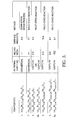
- compositions 1 and 2 were two commercially-available LSCF 6428 compositions manufactured by a prior art combustion spray process and a solid state reaction process, respectively. Note that compositions 3,4,5 in accordance with the present invention are deficient in La and enriched in Sr with respect to prior art compositions 1,2.
- compositions 3,4,5 in accordance with the present invention appropriate amounts of La 2 O 3 , SrCO 3 CoCO 3 , and Fe 2 O 3 salts were mixed and ball-milled for 12 hours using aqueous or isopropyl alcohol as a medium. The wet slurries were then heated to 105°C -120°C and dried. The resultant mixtures were each calcined at about 800°C for 1 hour. Next, the resulting powders were ground by ball milling for several hours until a mean particle size (d 50 ) of about 1.0 ⁇ m was achieved. A small amount (composition 3a) of La 0.5 Sr 0.45 Co 0.2 Fe 0.8 O 3- ⁇ 3 was calcined at 1400°C for 1 hour.
- composition 5a yttrium-stabilized zirconia
- X-ray diffraction patterns were taken of all the FIG. 3 LSCF powders, represented by La 1-x-2z .Sr x+z Co 0.2+a Fe 0.8+b O 3- ⁇ and synthesized by solid-state reaction method, using a Siemens D500 equipped with a monochromated Cu K ⁇ radiation source.
- a comparison with (La 0 . 6 Sr 0.4 ) 0.95 Co 0 . 2 Fe 0.8 O 3- ⁇ prepared by combustion spray process (commercial composition 1) revealed that all the X-ray diffraction patterns of LSCF-powders were single perovskite type structures and were indistinguishable from each other.
- compositions 4,5 With about 5% A-site deficiency and additional Co and Fe in two of the compositions (compositions 4,5) traces of (Co,Fe) 3 O 4 were possible (while not observed) and were not considered to be detrimental for use as an SOFC cathode.
- Sheet resistivity of La 0.5 Sr 0 . 45 Co 0.2 Fe 0.8 O 3- ⁇ was compared with commercial materials 1,2.
- three strip cells with respective cathode materials (2.5 cm 2 area)on anode-supported electrolytes were prepared.
- the cathodes included a 5 ⁇ m thick samarium doped ceria (SDC) layer and a 30 ⁇ m thick LSCF layer.
- SDC samarium doped ceria
- the SDC layer was sintered at 1200°C with particle size about 0.3 ⁇ m while the LSCF layer was sintered at 1050°C with particle size about 1.0 ⁇ m.
- Two Ag/Pd strips (containing 15 wt.% Pd) were coated on each cathode 0.45 cm apart.
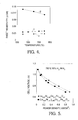
- the strip cell was placed inside a furnace and tested in air using an AC impedance technique. During the measurement, the temperature of the strip cell was set between 550 and 750°C. In this measurement, electrons were laterally transferred from one Ag/Pd strip into a sheet of the cathode material and then transferred out through the other Ag/Pd strip. After subtracting the resistance of the Pt leads, the sheet resistivities for the LSCF cathode materials were calculated as shown in FIG. 4 . In this calculation, the contact resistance existing between the silver screen and the Ag/Pd strip was not excluded.
- FIG. 4 shows that as compared to combustion sprayed commercial composition 1, and solid state reaction commercial composition 2, material in accordance with the present invention and represented by composition 3 had the lowest sheet resistance (highest sheet conductivity). Further, and referring now to FIG. 5 , a higher power density was measured at a variety of cell voltages for improved LSCF composition 3 in comparison to prior art LSCF composition 1.
- button cells with symmetrical cathodes were prepared on YSZ electrolyte (0.42 mm thick, as support) for each of the five LSCF materials shown in FIG. 3 .
- Each cell had two symmetrical cathodes (2.5 cm 2 ).
- the construction of button cells was similar to that of strip cells described above except that there were cathodes on both sides of the electrolyte.
- the resistance of the cathodes was measured using an AC impedance technique. During the measurement, a sinusoidal voltage (20 mV peak) was applied to the electrodes. The frequency of the sinusoidal voltage was scanned from 1 to 10 kHz. The sinusoidal current response of the system was then measured. From the voltage/current ratio, an AC impedance spectrum was obtained. In the spectrum, the width of the opening corresponded to the resistance of the cathode.
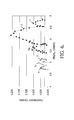
- the AC impedance spectra obtained at 650°C are shown in FIG. 6 .
- FIG. 6 shows that La 1-x-2z .Sr x+z Co 0.2+a Fe 0.8+b O 3- ⁇ materials 3,4,5 obtained via solid state reaction have spectra with smaller opening than commercial material 2. This implies a higher rate of oxygen ion conversion, as the width of the opening is inversely proportional to the rate of the cathodic reactions. Further, material 4 with slight excess of cobalt possesses high electronic and ionic conductivities along with high catalytic activity. Still further, milling of La 0.5 Sr 0.45 Co 0.2+0.025 Fe 0.8+0.12 O 3- ⁇ 5 material with metallic beads (composition 5) or ceramic beads (composition 5a) shows that ceramic beads (YSZ, alumina, ZrO 2 ) degrade the material. Finally, materials formed in accordance with the present invention yield films that have few cracks and high mechanical strength after sintering.
- three 1-inch diameter cells were prepared to evaluate power density performance with time. These cells were built on a 12 micron thick YSZ electrolyte supported on a 0.45 mm Ni/YSZ substrate acting as an anode. All the layers were screen printed using a paste obtained by mixing about 60 wt% of a solid phase with an organic binder. First, the electrolyte surfaces of these cells were covered with a Sm 0.2 Ce 0.8 O 2 with 2 wt% Fe 2 O 3 . The thickness of the layer was 4-5 ⁇ m after sintering at 1200°C. Next, the LSCF cathodes were screen printed to produce cathodes with active area of 2.5 cm 2 .
- the thickness of the cathodes were about 30 ⁇ m. Silver and nickel meshes with platinum lead wires and pastes were used to establish the current collectors. The air and fuel sides of the cells were isolated using a glass sealing material. The NiO/YSZ composite anode was reduced, in situ, at 800°C for 1 hour in a hydrogen gas atmosphere (50% H 2 in N 2 ). During testing, the cathode side of the cell was exposed to flowing air at a rate of 2.3 L/min and the anode side was exposed to a flowing stream of 50% hydrogen at a rate of 2.3 L/min. The electrochemical measurements were conducted at 750°C using a potentiostat/galvanostat (PARSTAT ® 2273) and power-generating characteristics as a function of time were measured at a polarization potential of 0.7V.
- PARSTAT ® 2273 potentiostat/galvanostat
- Figure 7 shows power generation characteristics of compositions 3, 4 in accordance with the present invention, and prior art composition 1. Under these conditions, at 750°C the La 1-x-2z. Sr x+z Co 0.2+a Fe 0.8+b O 3- ⁇ materials produce stable and high power, implying high catalytic activity with improved ionic and electronic conductivities. Further, the solid state reaction manufacturing method described above is suitable for low-cost volume production of such LSCF materials.
Landscapes
- Chemical & Material Sciences (AREA)
- Engineering & Computer Science (AREA)
- Ceramic Engineering (AREA)
- Organic Chemistry (AREA)
- Manufacturing & Machinery (AREA)
- Materials Engineering (AREA)
- Inorganic Chemistry (AREA)
- Structural Engineering (AREA)
- General Chemical & Material Sciences (AREA)
- Electrochemistry (AREA)
- Chemical Kinetics & Catalysis (AREA)
- Life Sciences & Earth Sciences (AREA)
- General Life Sciences & Earth Sciences (AREA)
- Geology (AREA)
- Physics & Mathematics (AREA)
- Thermal Sciences (AREA)
- Inert Electrodes (AREA)
- Fuel Cell (AREA)
- Compositions Of Oxide Ceramics (AREA)
- Compounds Of Iron (AREA)
Abstract
Description
- The present invention relates to solid oxide fuel cells (SOFCs); more particularly, to materials for forming the cathode in an SOFC; and most particularly, to improved perovskite-type materials (known in the SOFC art as "LSCF" compositions) having enhanced ionic and electronic conductivity, improved thermal properties, and capability for yielding higher SOFC power densities.
- Solid oxide fuel cell (SOFC) technology is being developed for automotive and stationary applications. It is known that mixed ionic and electronic conducting (MIEC) perovskite-type ABO3 oxides are promising cathode materials for solid oxide fuel cells and oxygen semi-permeable membranes.
- The general chemical formula for perovskite compounds is ABX3, wherein 'A' and 'B' are two cations of very different sizes, and X is an anion that bonds to both. (The native titanium mineral perovskite itself is of the formula CaTiO3) The 'A' atoms are larger than the 'B' atoms. The ideal cubic-symmetry structure has the B cation in 6-fold coordination, surrounded by an octahedron of anions, and the A cation in 12-fold cuboctahedral coordination. The relative ion size requirements for stability of the cubic structure are quite stringent, so slight buckling and distortion can produce several lower-symmetry distorted versions, in which the coordination numbers of A cations, B cations, or both are reduced.
- In the LSCF pervoskite crystal lattice, the A-sites are occupied by La and Sr ions, and the B-sites are occupied by Co and Fe ions that surround oxygen ions. In these materials, the cathode oxygen exchange reaction in an SOFC is not limited only to the triple-phase boundary line between electrolyte, cathode, and gas phase, but extends over a large three-dimensional area within the cathode.
- Compositions of the general formula La1-xSrx Co1-y FeyO3-δ have been proposed in the prior art as materials for SOFC cathodes due to their high catalytic activity for the oxygen exchange reaction and a high electronic conductivity for current collection. The physical and chemical properties of this class of materials, such as electrical conductivity, electronic structure, catalytic activity, stability, and thermal expansion coefficient (TEC), have been studied in detail. Generally, electronic and ionic conductivities and catalytic activity are enhanced with increasing values of x and decreasing values of y, whereas there is an opposite tendency for chemical stability.
- Further, it is known that these properties are strongly affected by a change in the combination of La and Co oxide concentrations. Electronic conductivity for La0.6Sr0.4 Co0.2 Fe0.8O3-δ (also known in the art as "LSCF 6428") is sufficient (>250 S/cm at 1073°K) for the above-mentioned applications. However, ionic conductivity is rather low (∼10-2 S/cm at 1273°K). It has been suggested that increasing Sr-deficiency in LSCF 6428 is a way to improve its oxide ionic conductivity and catalytic property for oxygen reduction.
- Another investigation on A-site deficiency has reported significant decrease in electronic conductivity in the order La0.6Sr0.4-z > (La0.6Sr0.4)1-z > La0.6-zSr0.4. In yet an another investigation, it has been concluded that the TEC decreases with decreasing A-site stoichiometry, and that electronic conductivity of the perovskites has a weak dependence on the A-site stoichiometry. As a result, (La0.6Sr0.4)1-z Co0.2 Fe0.8O3-δ materials are commonly used for SOFC cathodes and are available commercially.
- From the above discussion it is clear that while A-site deficiency is desirable, both ionic and electronic conductivities need to be high to drive performance in terms of fuel cell power density (W/cm2) and to reduce the cost. This is because cathode polarization, or resistance associated with the low rate of chemical and electrochemical reactions occurring in the cathode, is still the major source of voltage loss in SOFCs. Control of cathode microstructure (pore size, shape, and porosity) helps, but supply of electrons (electronic conductivity) and oxygen (oxide ion conductivity) deep into the cathode is the key to reducing cathode losses.
- The supply of oxygen ions to the electrolyte is a function of ionic conductivity on one hand and the supply of electrons on the other hand and depends on the electronic resistivity of the cathode material. What is desired is a cathode material that has high electronic and ionic conductivities along with high catalytic activity. Further, cathode polarization resistance, mechanical properties, and cost are major concerns in the development of a practical SOFC.
- Still further, reducing cost of manufacture requires a reduction in fuel cell operating temperature to around 750°C or below so that less expensive interconnect and sealing materials can be used. The degradation of these materials is reduced at lower operating temperature, and thus reliability and long-term stability of a fuel cell stack is improved. Development of such materials can help in attaining higher power density (W/cm2) at lower cost from SOFC stacks.
- What is needed in the art is improved LSCF perovskite materials having enhanced ionic and electronic conductivity, improved thermal properties, and capability for yielding higher SOFC power densities and at lower operating temperatures.
- It is a principal object of the present invention to reduce the cost of manufacture and improve performance and stability of a solid oxide fuel cell.
- The present invention is about an LSCF composition of the general type La1-x-2zSrx+zCo0.2+aFe0.8+bO3-δwherein the value of x is about 0.4, the value of z is between 0 and about 0.1, the value of a is between about 0.01 and about 0.04, and the value of b is between about 0.05 and about 0.15.
- The present invention is also about a fuel cell including a cathode comprising an LSCF composition of the general type La1-x-2zSrx+zCo0.2+aFe0.8+bO3-δ, wherein the value of x is about 0.4, the value of z is between 0 and about 0.1, the value of a is between about .01 and about 0.04, and the value of b is between about 0.05 and about 0.15.
- Furthermore the present invention discloses a method for making an LSCF composition of the general type La1-x-2zSrx+zCo0.2+aFe0.8+bO3-δ comprising the steps of:
- a) combining amounts of La2O3, SrCO3, CoCO3, and Fe2O3 to form a mixture thereof, said amounts being appropriate to forming said LSCF composition having predetermined values of x, z, a, and b;
- b) first ball milling said mixture for about twelve hours in a first wet medium selected from the group consisting of water, an alcohol, and combinations thereof, to form a slurry;
- c) drying said slurry at a temperature between about 105°C and about 120°C to form a dried mixture;
- d) first calcining said dried mixture at about 800°C for about one hour;
- e) second ball milling said dried mixture to form a first dry powder having a mean particle size of about 1.0 µm;
- f) second calcining said first dry powder for between about one half hour and about three hours at a temperature between about 1100°C and about 1400°C;
- g) third ball milling said first dry powder in a second wet medium to form said LSCF composition; and
- h) drying said wet powder.
- More particularly, said second calcining step is carried out for about one hour at a temperature of about 1250°C. Aalso said second wet medium includes an alcohol and said third ball milling step is carried out using stainless steel balls. Said LSCF composition resulting from said third ball milling step has a mean particle size of about 0.8 µm.
- Briefly described, the present invention comprises an improved LSCF 6428 perovskite material for use as a cathode in an SOFC and a method for forming the material. By creating deficiency on the A-site of the pervoskite lattice by reducing La or Sr or La+Sr in the LSCF 6428 material, electrical conductivity is reduced. Sr deficiency in LSCF material increases conductivity of the oxide ion.
- LSCF 6428 materials in accordance with the present invention of the type La1-x-2z.Srx+zCo0.2+aFe0.8+bO3-δ where preferably x = 0.4, z = (0 - 0.1), a = (.01 ― 0.04), and b = (0.05 ― 0.15) exhibit enhanced ionic and electronic conductivity. These materials are La-deficient but Sr-rich with respect to prior art LSCF 6428 materials. The general formula is similar to the prior art formulae (La0.6Sr0.4)1-z CO0.2 Fe0.8O3-δ and La0.6Sr0.4 CO0.2 Fe0.8O3-δ but applies the z term to La and Sr independently as well as reducing the overall content of La and increasing slightly the amount of Fe. Further, by adding a small amount of extra Co ions beyond the above stoichiometry, catalytic activity, conductivity, and sinterability may further enhanced.
- Still further, adding small amounts of Fe and/or Fe and Co moderates the thermal expansion coefficient with no adverse effect on crystal structure or fuel cell performance.
- Finally, improved sinterability, microstructure, and reduced film cracking from these compositions result in high power density and stability of fuel cells having these compositions as cathodes. While these pervoskites can be synthesized by various methods, a currently-preferred inherently low-cost solid state reaction method is described.
- The present invention will now be described, by way of example, with reference
- to the accompanying drawings, in which:
-
FIG. 1 is an isometric drawing of a prior art perovskite lattice structure used in the present invention; -
FIG. 2 is a prior art graph showing the adverse effect on electronic conductivity of reducing the molar amount of La, Sr, and La+Sr by various molar amounts z; -
FIG. 3 is a table showing comparative manufacturing conditions and resulting specific surface areas for two commercially-available LSCF compositions and three exemplary LSCF compositions in accordance with the present invention; -
FIG. 4 is a graph of sheet resistivity as a function of temperature, showing reduced resistivity and hence improved conductivity of LSCF compositions in accordance with the present invention; -
FIG. 5 is a graph of polarization curves showing a comparison of cell voltage and power density for a prior art LSCF composition and an LSCF composition in accordance with the present invention; -
FIG. 6 is a graph of AC impedance spectra for the five LSCF compositions shown inFIG. 3 , obtained at 650°C; and -
FIG. 7 is a graph of power density as a function of time for SOFCs having cathodes formed ofLSCF compositions - The exemplifications set out herein illustrates currently preferred embodiments of the present invention, and such exemplifications are not to be construed as limiting the scope of the invention in any manner.
- Referring to
FIG. 1 , prior artperovskite lattice structure 10 comprises a central B-site cation 12 surrounded by a square double pyramid lattice of sixoxygen ions 14 in turn surrounded by a cubic lattice of eightA-site cations 16. As noted above, the A-sites are occupied by La and Sr ions, and the B-sites are occupied by Co and Fe ions that surroundoxygen ions 14. - In the present invention as well as in the prior art, in forming a suitable LSCF 6428 material some of the cubic A-sites, such as site 16', which would otherwise contain La or Sr, are left vacant. As is known in the prior art, when Sr is omitted from some A-sites 16' ionic conductivity σion of LSCF is increased. However, such omission unfortunately causes a concomitant reduction in electronic conductivity σe.
FIG. 2 is a prior art graph showing the effect on σe of reducing the molar amount of La, Sr, and La+Sr by various molar amounts z. - Considering factors such as chemical stability, TEC, electrochemical activity, and ease of manufacturing A-site deficient LSCF perovskites, La1-x-2zSrx+zCo0.2+aFe0.8+bO3-δ, with z about 0.05, three such novel perovskites as shown in
FIG. 3 were synthesized by solid-state reaction of cationic salts.Compositions compositions prior art compositions - For the three
novel compositions composition 3a) of La0.5Sr0.45 Co0.2Fe0.8O3-δ 3 was calcined at 1400°C for 1 hour. All the powders were then calcined at 1250°C for 1 hour (range 1100°C -1400°C, 0.5 -3h) and were remilled for several hours until a mean particle size (d50) of about 0.8 µm was achieved. Heating and cooling rates were controlled at 5°C/min. After calcination, all powders were wet milled using alcohol and stainless steel balls as the media. A small amount of one of the compositions (composition 5a) was also wet milled using ceramic balls formed of yttrium-stabilized zirconia (YSZ) as the media. Although solid-state reaction was used to prepare these pervoskites, alternative known methods such as EDTA or citrate pyrolysis, flame or combustion spray, sol-gel, dissolution of metal nitrates, glycine nitrate, and the like, may be employed as well. - X-ray diffraction patterns were taken of all the
FIG. 3 LSCF powders, represented by La1-x-2z.Srx+zCo0.2+aFe0.8+bO3-δ and synthesized by solid-state reaction method, using a Siemens D500 equipped with a monochromated Cu Kα radiation source. A comparison with (La0.6Sr0.4)0.95 Co0.2 Fe0.8O3-δ prepared by combustion spray process (commercial composition 1) revealed that all the X-ray diffraction patterns of LSCF-powders were single perovskite type structures and were indistinguishable from each other. With about 5% A-site deficiency and additional Co and Fe in two of the compositions (compositions 4,5) traces of (Co,Fe)3O4 were possible (while not observed) and were not considered to be detrimental for use as an SOFC cathode. - Sheet resistivity of La0.5Sr0.45Co0.2Fe0.8O3-δ (composition 3) was compared with
commercial materials FIG. 4 . In this calculation, the contact resistance existing between the silver screen and the Ag/Pd strip was not excluded. -
FIG. 4 shows that as compared to combustion sprayedcommercial composition 1, and solid state reactioncommercial composition 2, material in accordance with the present invention and represented bycomposition 3 had the lowest sheet resistance (highest sheet conductivity). Further, and referring now toFIG. 5 , a higher power density was measured at a variety of cell voltages forimproved LSCF composition 3 in comparison to priorart LSCF composition 1. - To determine the effect of LSCF compositions on the cathode resistance, button cells with symmetrical cathodes were prepared on YSZ electrolyte (0.42 mm thick, as support) for each of the five LSCF materials shown in
FIG. 3 . Each cell had two symmetrical cathodes (2.5 cm2). The construction of button cells was similar to that of strip cells described above except that there were cathodes on both sides of the electrolyte. The resistance of the cathodes was measured using an AC impedance technique. During the measurement, a sinusoidal voltage (20 mV peak) was applied to the electrodes. The frequency of the sinusoidal voltage was scanned from 1 to 10 kHz. The sinusoidal current response of the system was then measured. From the voltage/current ratio, an AC impedance spectrum was obtained. In the spectrum, the width of the opening corresponded to the resistance of the cathode. The AC impedance spectra obtained at 650°C are shown inFIG. 6 . -
FIG. 6 shows that La1-x-2z.Srx+zCo0.2+aFe0.8+bO3-δ materials 3,4,5 obtained via solid state reaction have spectra with smaller opening thancommercial material 2. This implies a higher rate of oxygen ion conversion, as the width of the opening is inversely proportional to the rate of the cathodic reactions. Further,material 4 with slight excess of cobalt possesses high electronic and ionic conductivities along with high catalytic activity. Still further, milling of La0.5Sr0.45 Co0.2+0.025 Fe0.8+0.12O3-δ 5 material with metallic beads (composition 5) or ceramic beads (composition 5a) shows that ceramic beads (YSZ, alumina, ZrO2) degrade the material. Finally, materials formed in accordance with the present invention yield films that have few cracks and high mechanical strength after sintering. - Based on results shown in
FIG. 6 , three 1-inch diameter cells were prepared to evaluate power density performance with time. These cells were built on a 12 micron thick YSZ electrolyte supported on a 0.45 mm Ni/YSZ substrate acting as an anode. All the layers were screen printed using a paste obtained by mixing about 60 wt% of a solid phase with an organic binder. First, the electrolyte surfaces of these cells were covered with a Sm0.2Ce0.8O2 with 2 wt% Fe2O3. The thickness of the layer was 4-5 µm after sintering at 1200°C. Next, the LSCF cathodes were screen printed to produce cathodes with active area of 2.5 cm2. After sintering at 1050°C, the thickness of the cathodes were about 30 µm. Silver and nickel meshes with platinum lead wires and pastes were used to establish the current collectors. The air and fuel sides of the cells were isolated using a glass sealing material. The NiO/YSZ composite anode was reduced, in situ, at 800°C for 1 hour in a hydrogen gas atmosphere (50% H2 in N2). During testing, the cathode side of the cell was exposed to flowing air at a rate of 2.3 L/min and the anode side was exposed to a flowing stream of 50% hydrogen at a rate of 2.3 L/min. The electrochemical measurements were conducted at 750°C using a potentiostat/galvanostat (PARSTAT® 2273) and power-generating characteristics as a function of time were measured at a polarization potential of 0.7V. -
Figure 7 shows power generation characteristics ofcompositions prior art composition 1. Under these conditions, at 750°C the La1-x-2z.Srx+zCo0.2+aFe0.8+bO3-δ materials produce stable and high power, implying high catalytic activity with improved ionic and electronic conductivities. Further, the solid state reaction manufacturing method described above is suitable for low-cost volume production of such LSCF materials.
Claims (7)
- An LSCF (10) composition of the general type La1-x-2zSrx+zCo0.2+aFe0.8+bO3-δ ,
characterized in that the value of x is about 0.4, the value of z is between 0 and about 0.1, the value of a is between about 0.01 and about 0.04, and the value of b is between about 0.05 and about 0.15. - A fuel cell including a cathode comprising an LSCF as set in claim 1.
- A method for making an LSCF composition of the general type La1-x-2zSrx+zCo0.2+aFe0.8+bO3-δ comprising the steps of:combining amounts of La2O3, SrCO3, CoCO3, and Fe2O3 to form a mixture thereof, said amounts being appropriate to forming said LSCF composition having predetermined values of x, z, a, and b;first ball milling said mixture for about twelve hours in a first wet medium selected from the group consisting of water, an alcohol, and combinations thereof, to form a slurry;drying said slurry at a temperature between about 105°C and about 120°C to form a dried mixture;first calcining said dried mixture at about 800°C for about one hour;second ball milling said dried mixture to form a first dry powder having a mean particle size of about 1.0 µm;second calcining said first dry powder for between about one half hour and about three hours at a temperature between about 1100°C and about 1400°C;third ball milling said first dry powder in a second wet medium to form said LSCF composition; anddrying said wet powder.
- A method in accordance with Claim 3 wherein said second calcining step is carried out for about one hour at a temperature of about 1250°C.
- A method as set in any of the Claims 3 or 4 wherein said second wet medium includes an alcohol.
- A method as set in any of the Claims 3 to 5 wherein said third ball milling step is carried out using stainless steel balls.
- A method as set in any of the Claims 3 to 6 wherein said LSCF composition resulting from said third ball milling step has a mean particle size of about 0.8 µm.
Applications Claiming Priority (1)
| Application Number | Priority Date | Filing Date | Title |
|---|---|---|---|
| US12/635,756 US8124037B2 (en) | 2009-12-11 | 2009-12-11 | Perovskite materials for solid oxide fuel cell cathodes |
Publications (3)
| Publication Number | Publication Date |
|---|---|
| EP2333882A2 true EP2333882A2 (en) | 2011-06-15 |
| EP2333882A3 EP2333882A3 (en) | 2013-05-22 |
| EP2333882B1 EP2333882B1 (en) | 2018-08-15 |
Family
ID=43805717
Family Applications (1)
| Application Number | Title | Priority Date | Filing Date |
|---|---|---|---|
| EP10192226.8A Active EP2333882B1 (en) | 2009-12-11 | 2010-11-23 | Perovskite materials for solid oxide fuel cell cathodes |
Country Status (2)
| Country | Link |
|---|---|
| US (1) | US8124037B2 (en) |
| EP (1) | EP2333882B1 (en) |
Cited By (6)
| Publication number | Priority date | Publication date | Assignee | Title |
|---|---|---|---|---|
| EP2743245A1 (en) * | 2012-12-14 | 2014-06-18 | Delphi Technologies, Inc. | Material for solid state sintered material. |
| RU2608383C2 (en) * | 2011-12-15 | 2017-01-18 | Л'Эр Ликид, Сосьете Аноним Пур Л'Этюд Э Л'Эксплуатасьон Де Проседе Жорж Клод | Method of producing "sol-gel" complex from at least three metal salts and use of method for production of ceramic membrane |
| CN107265502A (en) * | 2017-06-29 | 2017-10-20 | 宁波吉电鑫新材料科技有限公司 | A kind of electric field regulation and control selective freezing synthesis double-perovskite kalium ion battery negative material and preparation method thereof |
| CN107285390A (en) * | 2017-06-29 | 2017-10-24 | 宁波吉电鑫新材料科技有限公司 | A kind of electric field regulation and control selective freezing synthesis double-perovskite lithium ion battery negative material and preparation method thereof |
| CN107352587A (en) * | 2017-06-29 | 2017-11-17 | 宁波吉电鑫新材料科技有限公司 | A kind of electric field regulation and control selective freezing synthesis double-perovskite anode material of lithium-ion battery and preparation method thereof |
| CN115000429A (en) * | 2022-04-07 | 2022-09-02 | 湖北大学 | LNCAF electrode material, fuel cell and preparation method thereof |
Families Citing this family (31)
| Publication number | Priority date | Publication date | Assignee | Title |
|---|---|---|---|---|
| US8323463B2 (en) * | 2010-01-22 | 2012-12-04 | Praxair Technology, Inc. | Catalyst containing oxygen transport membrane |
| US9561476B2 (en) | 2010-12-15 | 2017-02-07 | Praxair Technology, Inc. | Catalyst containing oxygen transport membrane |
| US9486735B2 (en) | 2011-12-15 | 2016-11-08 | Praxair Technology, Inc. | Composite oxygen transport membrane |
| CN103987681B (en) | 2011-12-15 | 2016-08-24 | 普莱克斯技术有限公司 | Composite Oxygen Transport Membrane |
| US9017897B2 (en) * | 2012-12-13 | 2015-04-28 | Delphi Technologies, Inc. | Metal composite material for attachment to ceramic |
| EP2935155B1 (en) | 2012-12-19 | 2019-02-13 | Praxair Technology Inc. | Method for sealing an oxygen transport membrane assembly |
| US9453644B2 (en) | 2012-12-28 | 2016-09-27 | Praxair Technology, Inc. | Oxygen transport membrane based advanced power cycle with low pressure synthesis gas slip stream |
| US9611144B2 (en) | 2013-04-26 | 2017-04-04 | Praxair Technology, Inc. | Method and system for producing a synthesis gas in an oxygen transport membrane based reforming system that is free of metal dusting corrosion |
| US9938145B2 (en) | 2013-04-26 | 2018-04-10 | Praxair Technology, Inc. | Method and system for adjusting synthesis gas module in an oxygen transport membrane based reforming system |
| US9296671B2 (en) | 2013-04-26 | 2016-03-29 | Praxair Technology, Inc. | Method and system for producing methanol using an integrated oxygen transport membrane based reforming system |
| US9212113B2 (en) | 2013-04-26 | 2015-12-15 | Praxair Technology, Inc. | Method and system for producing a synthesis gas using an oxygen transport membrane based reforming system with secondary reforming and auxiliary heat source |
| US8728671B1 (en) | 2013-06-05 | 2014-05-20 | ZAF Energy Systems, Incorporated | Air electrodes including perovskites |
| JP5603515B1 (en) * | 2013-08-23 | 2014-10-08 | 日本碍子株式会社 | Air electrode material and solid oxide fuel cell |
| BR112016007552A2 (en) | 2013-10-07 | 2017-08-01 | Praxair Technology Inc | oxygen transport membrane panel, oxygen transport membrane tube assemblies and reforming reactor blocks, oxygen transport membrane arrangement module, synthesis gas furnace train, and synthesis gas plant |
| EP3055053A2 (en) | 2013-10-08 | 2016-08-17 | Praxair Technology Inc. | System and method for temperature control in an oxygen transport membrane based reactor |
| US9556027B2 (en) | 2013-12-02 | 2017-01-31 | Praxair Technology, Inc. | Method and system for producing hydrogen using an oxygen transport membrane based reforming system with secondary reforming |
| CA2937943A1 (en) | 2014-02-12 | 2015-08-20 | Praxair Technology, Inc. | Oxygen transport membrane reactor based method and system for generating electric power |
| WO2015160609A1 (en) | 2014-04-16 | 2015-10-22 | Praxair Technology, Inc. | Method and system for oxygen transport membrane enhanced integrated gasifier combined cycle (igcc) |
| US9789445B2 (en) | 2014-10-07 | 2017-10-17 | Praxair Technology, Inc. | Composite oxygen ion transport membrane |
| KR101902617B1 (en) * | 2015-05-15 | 2018-10-01 | 세종대학교산학협력단 | Solid Oxide Electrochemical Device having Triple Layer Perovskite for Air-Electrode Catalyst |
| US10441922B2 (en) | 2015-06-29 | 2019-10-15 | Praxair Technology, Inc. | Dual function composite oxygen transport membrane |
| US10118823B2 (en) | 2015-12-15 | 2018-11-06 | Praxair Technology, Inc. | Method of thermally-stabilizing an oxygen transport membrane-based reforming system |
| US9938146B2 (en) | 2015-12-28 | 2018-04-10 | Praxair Technology, Inc. | High aspect ratio catalytic reactor and catalyst inserts therefor |
| KR102154420B1 (en) | 2016-04-01 | 2020-09-10 | 프랙스에어 테크놀로지, 인코포레이티드 | Catalyst-containing oxygen transport membrane |
| TWI642228B (en) * | 2017-09-18 | 2018-11-21 | 國立中央大學 | Electrolyte preparation method of solid oxide fuel cell |
| US11136238B2 (en) | 2018-05-21 | 2021-10-05 | Praxair Technology, Inc. | OTM syngas panel with gas heated reformer |
| CN112740445B (en) * | 2018-09-27 | 2024-05-24 | 堺化学工业株式会社 | Powder for air electrode of solid oxide fuel cell and method for producing the same |
| CN113258086B (en) * | 2021-04-30 | 2022-09-27 | 南京工业大学 | A three-phase conductor proton conductor composite cathode material and preparation method thereof |
| CN113964331B (en) * | 2021-10-26 | 2023-04-18 | 山东科技大学 | Nano-micron multilevel structure strontium-cobalt-based perovskite composite cathode and preparation method thereof |
| CN115241471B (en) * | 2022-08-23 | 2024-09-20 | 江苏科技大学 | A solid oxide fuel cell cathode material and its preparation method and application |
| KR102770944B1 (en) * | 2024-06-18 | 2025-02-21 | 주식회사 미코파워 | Soild oxide fuel cell and method for manufacturing of cathode for fuel cell |
Family Cites Families (4)
| Publication number | Priority date | Publication date | Assignee | Title |
|---|---|---|---|---|
| JPS61215247A (en) * | 1985-03-22 | 1986-09-25 | 株式会社東芝 | Infrared radiator |
| US5575940A (en) * | 1992-05-26 | 1996-11-19 | Eastman Kodak Company | Inverse limited coalescence process |
| US5681373A (en) * | 1995-03-13 | 1997-10-28 | Air Products And Chemicals, Inc. | Planar solid-state membrane module |
| DE10351955A1 (en) * | 2003-11-07 | 2005-06-16 | Forschungszentrum Jülich GmbH | Cathode material for a high-temperature fuel cell (SOFC) and a cathode producible therefrom |
-
2009
- 2009-12-11 US US12/635,756 patent/US8124037B2/en active Active
-
2010
- 2010-11-23 EP EP10192226.8A patent/EP2333882B1/en active Active
Non-Patent Citations (1)
| Title |
|---|
| None |
Cited By (8)
| Publication number | Priority date | Publication date | Assignee | Title |
|---|---|---|---|---|
| RU2608383C2 (en) * | 2011-12-15 | 2017-01-18 | Л'Эр Ликид, Сосьете Аноним Пур Л'Этюд Э Л'Эксплуатасьон Де Проседе Жорж Клод | Method of producing "sol-gel" complex from at least three metal salts and use of method for production of ceramic membrane |
| EP2743245A1 (en) * | 2012-12-14 | 2014-06-18 | Delphi Technologies, Inc. | Material for solid state sintered material. |
| US9005490B2 (en) | 2012-12-14 | 2015-04-14 | Delphi Technologies, Inc. | Material for solid state sintered material |
| CN107265502A (en) * | 2017-06-29 | 2017-10-20 | 宁波吉电鑫新材料科技有限公司 | A kind of electric field regulation and control selective freezing synthesis double-perovskite kalium ion battery negative material and preparation method thereof |
| CN107285390A (en) * | 2017-06-29 | 2017-10-24 | 宁波吉电鑫新材料科技有限公司 | A kind of electric field regulation and control selective freezing synthesis double-perovskite lithium ion battery negative material and preparation method thereof |
| CN107352587A (en) * | 2017-06-29 | 2017-11-17 | 宁波吉电鑫新材料科技有限公司 | A kind of electric field regulation and control selective freezing synthesis double-perovskite anode material of lithium-ion battery and preparation method thereof |
| CN115000429A (en) * | 2022-04-07 | 2022-09-02 | 湖北大学 | LNCAF electrode material, fuel cell and preparation method thereof |
| CN115000429B (en) * | 2022-04-07 | 2024-01-16 | 湖北大学 | LNCAF electrode materials, fuel cells and preparation methods thereof |
Also Published As
| Publication number | Publication date |
|---|---|
| EP2333882B1 (en) | 2018-08-15 |
| US20110143255A1 (en) | 2011-06-16 |
| EP2333882A3 (en) | 2013-05-22 |
| US8124037B2 (en) | 2012-02-28 |
Similar Documents
| Publication | Publication Date | Title |
|---|---|---|
| EP2333882B1 (en) | Perovskite materials for solid oxide fuel cell cathodes | |
| Shen et al. | Medium-Entropy perovskites Sr (FeαTiβCoγMnζ) O3-δ as promising cathodes for intermediate temperature solid oxide fuel cell | |
| US7838141B2 (en) | Cerium-modified doped strontium titanate compositions for solid oxide fuel cell anodes and electrodes for other electrochemical devices | |
| Yoo et al. | Investigation of layered perovskite type NdBa1− xSrxCo2O5+ δ (x= 0, 0.25, 0.5, 0.75, and 1.0) cathodes for intermediate-temperature solid oxide fuel cells | |
| Hou et al. | A novel in situ diffusion strategy to fabricate high performance cathodes for low temperature proton-conducting solid oxide fuel cells | |
| Guo et al. | Thermal and electrochemical properties of layered perovskite PrBaCo2− xMnxO5+ δ (x= 0.1, 0.2 and 0.3) cathode materials for intermediate temperature solid oxide fuel cells | |
| Wang et al. | Composition and microstructure optimization and operation stability of barium deficient Ba1− xCo0. 7Fe0. 2Nb0. 1O3− δ perovskite oxide electrodes | |
| US20120135331A1 (en) | Cathode | |
| US20120308915A1 (en) | Cathode material for fuel cell, cathode including the cathode material, solid oxide fuel cell including the cathode | |
| Yoo et al. | Structural, electrical and electrochemical characteristics of La 0.1 Sr 0.9 Co 1− x Nb x O 3− δ as a cathode material for intermediate temperature solid oxide fuel cells | |
| US20080011604A1 (en) | Process and Device for Water Electrolysis Comprising a Special Oxide Electrode Material | |
| Chaianansutcharit et al. | Ni doped PrSr3Fe3O10-δ Ruddlesden-Popper oxide for active oxygen reduction cathode for solid oxide fuel cell | |
| US9005490B2 (en) | Material for solid state sintered material | |
| US7468218B2 (en) | Composite solid oxide fuel cell anode based on ceria and strontium titanate | |
| KR20120135463A (en) | Cathode material for fuel cell, and cathode for fuel cell and solid oxide fuel cell including the material | |
| KR20120123639A (en) | Cathode material for fuel cell, cathode for fuel cell and solid oxide fuel cell including the material | |
| US7758992B2 (en) | Copper-substituted perovskite compositions for solid oxide fuel cell cathodes and oxygen reduction electrodes in other electrochemical devices | |
| Kısa et al. | Transition metal doped solid oxide fuel cell cathodes | |
| Yin et al. | Modulating Metal‐Oxygen Bonds in BaCo0. 4Fe0. 4Zr0. 1Y0. 1O3‐δ to Enhance Oxygen Adsorption and Proton Conduction for High‐Performance Protonic Ceramic Fuel Cell Air Electrodes | |
| Ruiz de Larramendi et al. | Synthesis and Performance of La0. 6Ca0. 4Fe0. 8Ni0. 2O3-δ Material for Intermediate-Temperature SOFC Cathode | |
| Kamboj et al. | Oxygen reduction reaction | |
| Jeong | Development of Layered Perovskites as high-performance cathodes for Intermediate Temperature Solid Oxide Fuel Cells | |
| WO2025054276A1 (en) | Reversible solid oxide electrochemical cells with hybrid oxygen electrode | |
| CN120836092A (en) | Electrodes and electrochemical cells | |
| Inagaki et al. | Intermediate Temperature Solid Oxide Fuel Cells with Doped Lanthanum Gallate Electrolyte, La (Sr) CoO3 Cathode, and Ni-SDC Cermet Anode |
Legal Events
| Date | Code | Title | Description |
|---|---|---|---|
| PUAI | Public reference made under article 153(3) epc to a published international application that has entered the european phase |
Free format text: ORIGINAL CODE: 0009012 |
|
| AK | Designated contracting states |
Kind code of ref document: A2 Designated state(s): AL AT BE BG CH CY CZ DE DK EE ES FI FR GB GR HR HU IE IS IT LI LT LU LV MC MK MT NL NO PL PT RO RS SE SI SK SM TR |
|
| AX | Request for extension of the european patent |
Extension state: BA ME |
|
| PUAL | Search report despatched |
Free format text: ORIGINAL CODE: 0009013 |
|
| AK | Designated contracting states |
Kind code of ref document: A3 Designated state(s): AL AT BE BG CH CY CZ DE DK EE ES FI FR GB GR HR HU IE IS IT LI LT LU LV MC MK MT NL NO PL PT RO RS SE SI SK SM TR |
|
| AX | Request for extension of the european patent |
Extension state: BA ME |
|
| RIC1 | Information provided on ipc code assigned before grant |
Ipc: H01M 4/90 20060101ALI20130416BHEP Ipc: C04B 35/626 20060101ALI20130416BHEP Ipc: C01G 49/00 20060101ALI20130416BHEP Ipc: C01G 51/00 20060101ALI20130416BHEP Ipc: C04B 35/26 20060101ALI20130416BHEP Ipc: H01M 4/88 20060101AFI20130416BHEP Ipc: H01M 8/12 20060101ALI20130416BHEP Ipc: B01J 23/00 20060101ALI20130416BHEP Ipc: H01M 4/86 20060101ALI20130416BHEP |
|
| 17P | Request for examination filed |
Effective date: 20131122 |
|
| RBV | Designated contracting states (corrected) |
Designated state(s): AL AT BE BG CH CY CZ DE DK EE ES FI FR GB GR HR HU IE IS IT LI LT LU LV MC MK MT NL NO PL PT RO RS SE SI SK SM TR |
|
| 17Q | First examination report despatched |
Effective date: 20131219 |
|
| GRAP | Despatch of communication of intention to grant a patent |
Free format text: ORIGINAL CODE: EPIDOSNIGR1 |
|
| INTG | Intention to grant announced |
Effective date: 20180327 |
|
| GRAS | Grant fee paid |
Free format text: ORIGINAL CODE: EPIDOSNIGR3 |
|
| GRAA | (expected) grant |
Free format text: ORIGINAL CODE: 0009210 |
|
| AK | Designated contracting states |
Kind code of ref document: B1 Designated state(s): AL AT BE BG CH CY CZ DE DK EE ES FI FR GB GR HR HU IE IS IT LI LT LU LV MC MK MT NL NO PL PT RO RS SE SI SK SM TR |
|
| REG | Reference to a national code |
Ref country code: CH Ref legal event code: EP Ref country code: GB Ref legal event code: FG4D Ref country code: AT Ref legal event code: REF Ref document number: 1030807 Country of ref document: AT Kind code of ref document: T Effective date: 20180815 |
|
| REG | Reference to a national code |
Ref country code: IE Ref legal event code: FG4D |
|
| REG | Reference to a national code |
Ref country code: DE Ref legal event code: R096 Ref document number: 602010052706 Country of ref document: DE |
|
| REG | Reference to a national code |
Ref country code: DE Ref legal event code: R081 Ref document number: 602010052706 Country of ref document: DE Owner name: APTIV TECHNOLOGIES LIMITED, BB Free format text: FORMER OWNER: DELPHI TECHNOLOGIES, INC., TROY, MICH., US |
|
| REG | Reference to a national code |
Ref country code: NL Ref legal event code: MP Effective date: 20180815 |
|
| REG | Reference to a national code |
Ref country code: LT Ref legal event code: MG4D |
|
| REG | Reference to a national code |
Ref country code: AT Ref legal event code: MK05 Ref document number: 1030807 Country of ref document: AT Kind code of ref document: T Effective date: 20180815 |
|
| PG25 | Lapsed in a contracting state [announced via postgrant information from national office to epo] |
Ref country code: AT Free format text: LAPSE BECAUSE OF FAILURE TO SUBMIT A TRANSLATION OF THE DESCRIPTION OR TO PAY THE FEE WITHIN THE PRESCRIBED TIME-LIMIT Effective date: 20180815 Ref country code: NL Free format text: LAPSE BECAUSE OF FAILURE TO SUBMIT A TRANSLATION OF THE DESCRIPTION OR TO PAY THE FEE WITHIN THE PRESCRIBED TIME-LIMIT Effective date: 20180815 Ref country code: SE Free format text: LAPSE BECAUSE OF FAILURE TO SUBMIT A TRANSLATION OF THE DESCRIPTION OR TO PAY THE FEE WITHIN THE PRESCRIBED TIME-LIMIT Effective date: 20180815 Ref country code: RS Free format text: LAPSE BECAUSE OF FAILURE TO SUBMIT A TRANSLATION OF THE DESCRIPTION OR TO PAY THE FEE WITHIN THE PRESCRIBED TIME-LIMIT Effective date: 20180815 Ref country code: GR Free format text: LAPSE BECAUSE OF FAILURE TO SUBMIT A TRANSLATION OF THE DESCRIPTION OR TO PAY THE FEE WITHIN THE PRESCRIBED TIME-LIMIT Effective date: 20181116 Ref country code: NO Free format text: LAPSE BECAUSE OF FAILURE TO SUBMIT A TRANSLATION OF THE DESCRIPTION OR TO PAY THE FEE WITHIN THE PRESCRIBED TIME-LIMIT Effective date: 20181115 Ref country code: IS Free format text: LAPSE BECAUSE OF FAILURE TO SUBMIT A TRANSLATION OF THE DESCRIPTION OR TO PAY THE FEE WITHIN THE PRESCRIBED TIME-LIMIT Effective date: 20181215 Ref country code: LT Free format text: LAPSE BECAUSE OF FAILURE TO SUBMIT A TRANSLATION OF THE DESCRIPTION OR TO PAY THE FEE WITHIN THE PRESCRIBED TIME-LIMIT Effective date: 20180815 Ref country code: BG Free format text: LAPSE BECAUSE OF FAILURE TO SUBMIT A TRANSLATION OF THE DESCRIPTION OR TO PAY THE FEE WITHIN THE PRESCRIBED TIME-LIMIT Effective date: 20181115 Ref country code: FI Free format text: LAPSE BECAUSE OF FAILURE TO SUBMIT A TRANSLATION OF THE DESCRIPTION OR TO PAY THE FEE WITHIN THE PRESCRIBED TIME-LIMIT Effective date: 20180815 |
|
| REG | Reference to a national code |
Ref country code: GB Ref legal event code: 732E Free format text: REGISTERED BETWEEN 20190117 AND 20190123 |
|
| REG | Reference to a national code |
Ref country code: GB Ref legal event code: 732E Free format text: REGISTERED BETWEEN 20190124 AND 20190130 |
|
| PG25 | Lapsed in a contracting state [announced via postgrant information from national office to epo] |
Ref country code: LV Free format text: LAPSE BECAUSE OF FAILURE TO SUBMIT A TRANSLATION OF THE DESCRIPTION OR TO PAY THE FEE WITHIN THE PRESCRIBED TIME-LIMIT Effective date: 20180815 Ref country code: ES Free format text: LAPSE BECAUSE OF FAILURE TO SUBMIT A TRANSLATION OF THE DESCRIPTION OR TO PAY THE FEE WITHIN THE PRESCRIBED TIME-LIMIT Effective date: 20180815 Ref country code: AL Free format text: LAPSE BECAUSE OF FAILURE TO SUBMIT A TRANSLATION OF THE DESCRIPTION OR TO PAY THE FEE WITHIN THE PRESCRIBED TIME-LIMIT Effective date: 20180815 Ref country code: HR Free format text: LAPSE BECAUSE OF FAILURE TO SUBMIT A TRANSLATION OF THE DESCRIPTION OR TO PAY THE FEE WITHIN THE PRESCRIBED TIME-LIMIT Effective date: 20180815 |
|
| PG25 | Lapsed in a contracting state [announced via postgrant information from national office to epo] |
Ref country code: IT Free format text: LAPSE BECAUSE OF FAILURE TO SUBMIT A TRANSLATION OF THE DESCRIPTION OR TO PAY THE FEE WITHIN THE PRESCRIBED TIME-LIMIT Effective date: 20180815 Ref country code: RO Free format text: LAPSE BECAUSE OF FAILURE TO SUBMIT A TRANSLATION OF THE DESCRIPTION OR TO PAY THE FEE WITHIN THE PRESCRIBED TIME-LIMIT Effective date: 20180815 Ref country code: EE Free format text: LAPSE BECAUSE OF FAILURE TO SUBMIT A TRANSLATION OF THE DESCRIPTION OR TO PAY THE FEE WITHIN THE PRESCRIBED TIME-LIMIT Effective date: 20180815 Ref country code: PL Free format text: LAPSE BECAUSE OF FAILURE TO SUBMIT A TRANSLATION OF THE DESCRIPTION OR TO PAY THE FEE WITHIN THE PRESCRIBED TIME-LIMIT Effective date: 20180815 Ref country code: CZ Free format text: LAPSE BECAUSE OF FAILURE TO SUBMIT A TRANSLATION OF THE DESCRIPTION OR TO PAY THE FEE WITHIN THE PRESCRIBED TIME-LIMIT Effective date: 20180815 |
|
| REG | Reference to a national code |
Ref country code: DE Ref legal event code: R097 Ref document number: 602010052706 Country of ref document: DE |
|
| PG25 | Lapsed in a contracting state [announced via postgrant information from national office to epo] |
Ref country code: DK Free format text: LAPSE BECAUSE OF FAILURE TO SUBMIT A TRANSLATION OF THE DESCRIPTION OR TO PAY THE FEE WITHIN THE PRESCRIBED TIME-LIMIT Effective date: 20180815 Ref country code: SM Free format text: LAPSE BECAUSE OF FAILURE TO SUBMIT A TRANSLATION OF THE DESCRIPTION OR TO PAY THE FEE WITHIN THE PRESCRIBED TIME-LIMIT Effective date: 20180815 Ref country code: SK Free format text: LAPSE BECAUSE OF FAILURE TO SUBMIT A TRANSLATION OF THE DESCRIPTION OR TO PAY THE FEE WITHIN THE PRESCRIBED TIME-LIMIT Effective date: 20180815 |
|
| PLBE | No opposition filed within time limit |
Free format text: ORIGINAL CODE: 0009261 |
|
| STAA | Information on the status of an ep patent application or granted ep patent |
Free format text: STATUS: NO OPPOSITION FILED WITHIN TIME LIMIT |
|
| REG | Reference to a national code |
Ref country code: CH Ref legal event code: PL |
|
| 26N | No opposition filed |
Effective date: 20190516 |
|
| PG25 | Lapsed in a contracting state [announced via postgrant information from national office to epo] |
Ref country code: LU Free format text: LAPSE BECAUSE OF NON-PAYMENT OF DUE FEES Effective date: 20181123 Ref country code: MC Free format text: LAPSE BECAUSE OF FAILURE TO SUBMIT A TRANSLATION OF THE DESCRIPTION OR TO PAY THE FEE WITHIN THE PRESCRIBED TIME-LIMIT Effective date: 20180815 |
|
| REG | Reference to a national code |
Ref country code: BE Ref legal event code: MM Effective date: 20181130 |
|
| REG | Reference to a national code |
Ref country code: IE Ref legal event code: MM4A |
|
| PG25 | Lapsed in a contracting state [announced via postgrant information from national office to epo] |
Ref country code: CH Free format text: LAPSE BECAUSE OF NON-PAYMENT OF DUE FEES Effective date: 20181130 Ref country code: LI Free format text: LAPSE BECAUSE OF NON-PAYMENT OF DUE FEES Effective date: 20181130 Ref country code: SI Free format text: LAPSE BECAUSE OF FAILURE TO SUBMIT A TRANSLATION OF THE DESCRIPTION OR TO PAY THE FEE WITHIN THE PRESCRIBED TIME-LIMIT Effective date: 20180815 |
|
| PG25 | Lapsed in a contracting state [announced via postgrant information from national office to epo] |
Ref country code: IE Free format text: LAPSE BECAUSE OF NON-PAYMENT OF DUE FEES Effective date: 20181123 |
|
| PG25 | Lapsed in a contracting state [announced via postgrant information from national office to epo] |
Ref country code: BE Free format text: LAPSE BECAUSE OF NON-PAYMENT OF DUE FEES Effective date: 20181130 |
|
| PG25 | Lapsed in a contracting state [announced via postgrant information from national office to epo] |
Ref country code: MT Free format text: LAPSE BECAUSE OF NON-PAYMENT OF DUE FEES Effective date: 20181123 |
|
| PG25 | Lapsed in a contracting state [announced via postgrant information from national office to epo] |
Ref country code: TR Free format text: LAPSE BECAUSE OF FAILURE TO SUBMIT A TRANSLATION OF THE DESCRIPTION OR TO PAY THE FEE WITHIN THE PRESCRIBED TIME-LIMIT Effective date: 20180815 |
|
| PG25 | Lapsed in a contracting state [announced via postgrant information from national office to epo] |
Ref country code: PT Free format text: LAPSE BECAUSE OF FAILURE TO SUBMIT A TRANSLATION OF THE DESCRIPTION OR TO PAY THE FEE WITHIN THE PRESCRIBED TIME-LIMIT Effective date: 20180815 |
|
| PG25 | Lapsed in a contracting state [announced via postgrant information from national office to epo] |
Ref country code: CY Free format text: LAPSE BECAUSE OF FAILURE TO SUBMIT A TRANSLATION OF THE DESCRIPTION OR TO PAY THE FEE WITHIN THE PRESCRIBED TIME-LIMIT Effective date: 20180815 Ref country code: HU Free format text: LAPSE BECAUSE OF FAILURE TO SUBMIT A TRANSLATION OF THE DESCRIPTION OR TO PAY THE FEE WITHIN THE PRESCRIBED TIME-LIMIT; INVALID AB INITIO Effective date: 20101123 Ref country code: MK Free format text: LAPSE BECAUSE OF NON-PAYMENT OF DUE FEES Effective date: 20180815 |
|
| P01 | Opt-out of the competence of the unified patent court (upc) registered |
Effective date: 20230425 |
|
| PGFP | Annual fee paid to national office [announced via postgrant information from national office to epo] |
Ref country code: DE Payment date: 20251010 Year of fee payment: 16 |
|
| PGFP | Annual fee paid to national office [announced via postgrant information from national office to epo] |
Ref country code: GB Payment date: 20251107 Year of fee payment: 16 |
|
| REG | Reference to a national code |
Ref country code: DE Ref legal event code: R081 Ref document number: 602010052706 Country of ref document: DE Owner name: APTIV TECHNOLOGIES AG, CH Free format text: FORMER OWNER: APTIV TECHNOLOGIES LIMITED, ST. MICHAEL, BB |
|
| PGFP | Annual fee paid to national office [announced via postgrant information from national office to epo] |
Ref country code: FR Payment date: 20251112 Year of fee payment: 16 |