EP2333533A1 - Sensor apparatus and method therefor - Google Patents
Sensor apparatus and method therefor Download PDFInfo
- Publication number
- EP2333533A1 EP2333533A1 EP10252031A EP10252031A EP2333533A1 EP 2333533 A1 EP2333533 A1 EP 2333533A1 EP 10252031 A EP10252031 A EP 10252031A EP 10252031 A EP10252031 A EP 10252031A EP 2333533 A1 EP2333533 A1 EP 2333533A1
- Authority
- EP
- European Patent Office
- Prior art keywords
- gas
- sensor apparatus
- sensor
- recited
- housing
- Prior art date
- Legal status (The legal status is an assumption and is not a legal conclusion. Google has not performed a legal analysis and makes no representation as to the accuracy of the status listed.)
- Withdrawn
Links
Images
Classifications
-
- G—PHYSICS
- G01—MEASURING; TESTING
- G01N—INVESTIGATING OR ANALYSING MATERIALS BY DETERMINING THEIR CHEMICAL OR PHYSICAL PROPERTIES
- G01N27/00—Investigating or analysing materials by the use of electric, electrochemical, or magnetic means
- G01N27/02—Investigating or analysing materials by the use of electric, electrochemical, or magnetic means by investigating impedance
- G01N27/04—Investigating or analysing materials by the use of electric, electrochemical, or magnetic means by investigating impedance by investigating resistance
- G01N27/12—Investigating or analysing materials by the use of electric, electrochemical, or magnetic means by investigating impedance by investigating resistance of a solid body in dependence upon absorption of a fluid; of a solid body in dependence upon reaction with a fluid, for detecting components in the fluid
-
- G—PHYSICS
- G01—MEASURING; TESTING
- G01N—INVESTIGATING OR ANALYSING MATERIALS BY DETERMINING THEIR CHEMICAL OR PHYSICAL PROPERTIES
- G01N27/00—Investigating or analysing materials by the use of electric, electrochemical, or magnetic means
- G01N27/02—Investigating or analysing materials by the use of electric, electrochemical, or magnetic means by investigating impedance
- G01N27/04—Investigating or analysing materials by the use of electric, electrochemical, or magnetic means by investigating impedance by investigating resistance
- G01N27/12—Investigating or analysing materials by the use of electric, electrochemical, or magnetic means by investigating impedance by investigating resistance of a solid body in dependence upon absorption of a fluid; of a solid body in dependence upon reaction with a fluid, for detecting components in the fluid
- G01N27/125—Composition of the body, e.g. the composition of its sensitive layer
-
- G—PHYSICS
- G01—MEASURING; TESTING
- G01N—INVESTIGATING OR ANALYSING MATERIALS BY DETERMINING THEIR CHEMICAL OR PHYSICAL PROPERTIES
- G01N33/00—Investigating or analysing materials by specific methods not covered by groups G01N1/00 - G01N31/00
- G01N33/0004—Gaseous mixtures, e.g. polluted air
- G01N33/0009—General constructional details of gas analysers, e.g. portable test equipment
- G01N33/0011—Sample conditioning
- G01N33/0014—Sample conditioning by eliminating a gas
-
- G—PHYSICS
- G01—MEASURING; TESTING
- G01N—INVESTIGATING OR ANALYSING MATERIALS BY DETERMINING THEIR CHEMICAL OR PHYSICAL PROPERTIES
- G01N33/00—Investigating or analysing materials by specific methods not covered by groups G01N1/00 - G01N31/00
- G01N33/0004—Gaseous mixtures, e.g. polluted air
- G01N33/0009—General constructional details of gas analysers, e.g. portable test equipment
- G01N33/0027—General constructional details of gas analysers, e.g. portable test equipment concerning the detector
- G01N33/0036—General constructional details of gas analysers, e.g. portable test equipment concerning the detector specially adapted to detect a particular component
- G01N33/005—H2
-
- G—PHYSICS
- G01—MEASURING; TESTING
- G01N—INVESTIGATING OR ANALYSING MATERIALS BY DETERMINING THEIR CHEMICAL OR PHYSICAL PROPERTIES
- G01N33/00—Investigating or analysing materials by specific methods not covered by groups G01N1/00 - G01N31/00
- G01N33/0004—Gaseous mixtures, e.g. polluted air
- G01N33/0009—General constructional details of gas analysers, e.g. portable test equipment
- G01N33/0027—General constructional details of gas analysers, e.g. portable test equipment concerning the detector
- G01N33/0036—General constructional details of gas analysers, e.g. portable test equipment concerning the detector specially adapted to detect a particular component
- G01N33/0059—Avoiding interference of a gas with the gas to be measured
Definitions
- This disclosure relates to a sensor apparatus for measuring a gas concentration in a surrounding environment.
- MOS sensors and other types of sensors are known and used for detecting gas concentration levels. For instance, MOS sensors are sensitive to a variety of different gases, such as methane, hydrogen, ethanol, isobutane, etc.
- a disclosed sensor apparatus includes a metal oxide semiconductor sensor and a housing having an internal chamber in which the sensor is disposed.
- the housing includes at least one window for the ingress of a gas into the internal chamber from an atmosphere exterior to the housing.
- a gas-selective barrier is disposed across the at least one window.
- An example method for use with the sensor apparatus includes impeding the ingress of a selected species of flammable gas through the at least one window using the gas-selective barrier in the window.
- a sensor apparatus in another aspect, includes a sensor, a sensor zone around the sensor for receiving analyte gas, and a gas-selective barrier between the sensor zone and an atmosphere exterior to the sensor zone.
- Figure 1 illustrates selected portions of an example sensor apparatus 20 that is adapted to have increased selectivity to a preferred species of flammable gas, such as hydrogen.
- the sensor apparatus 20 may be used in an environment that may contain many different species of flammable gases.
- a vehicle e.g., a commercial bus or other transportation device
- enhanced hydrogen detection may be desired.
- Most metal oxide semiconductor (“MOS”) sensors are typically more sensitive to other flammable gases in the surrounding environment than to hydrogen, which can interfere with obtaining reliable hydrogen concentration measurements.
- the sensor apparatus 20 is configured to have heightened selectivity to hydrogen and may thereby be used to more reliably detect any hydrogen that escapes from hydrogen storage in a vehicle, for example.
- MOS metal oxide semiconductor
- the sensor apparatus 20 includes a metal oxide semiconductor (“MOS”) sensor 22 (e.g. Figaro TGS2611) and a sensor zone 24 around the MOS sensor 22 for receiving analyte gas 26 from an atmosphere that is exterior to the sensor zone 24.
- the MOS sensor 22 may include a gas-sensing surface (not shown) composed of tin oxide (SnO2), for example.
- the sensor apparatus 20 further includes a gas-selective barrier 28 disposed between the sensor zone 24 and the exterior atmosphere for impeding ingress of a selected species of flammable gas into the sensor zone 24.
- gas-selective may refer to a characteristic of preferentially hindering movement of one species of flammable gas over another.
- the gas-selective barrier 28 is adapted to impede ingress of other types of gases, such as methane, to thereby increase relative selectivity of the MOS sensor 22 to hydrogen.
- the MOS sensor 22 may be electrically connected to a controller 30 for transmitting signals that are representative of detected gas concentrations in the sensor zone 24 to the controller 30.
- the controller 30 may include hardware, software, or both for receiving and processing the signals. As an example, the controller 30 may trigger an alarm or other indication in response to the received signals if the detected gas concentration exceeds a predetermined threshold.
- the gas-selective barrier 28 may include a support 40 and an organosilicon coating 42 disposed on the support 40. In this case, there is a single layer of the organosilicon coating 42 on the support 40. However, in other examples, the support 40 may include multiple layers of the organosilicon coating 42 on one side or layers of the organosilicon coating 42 on the opposed sides of the support 40 to achieve a desired gas-selectivity.
- the support 40 is porous but mechanically suitable for supporting the organosilicon coating 42.
- the support 40 may be cellulose paper or a polymer material, such as a membrane, woven fiber structure or non-woven fiber structure of polytetrafluoroethylene fibers.
- the support 40 may have a degree of porosity that is suited for the particular application. For instance, a higher degree of porosity may be selected to facilitate avoiding substantially impeding movement of the analyte gas 26 such that the organosilicon coating 42 is the sole component of the gas-selective barrier 28 that functions to impede gas ingress.
- a lower degree of porosity may be selected to compliment the gas-selectivity of the organosilicon coating 42 by trapping or impeding larger gas molecules, such as methane.
- the cellulose paper may have a weight of 50-75 g/m2.
- the amount of the organosilicon coating 42 may be controlled to achieve a desired influence on impedance. For instance, using a greater amount may provide a greater degree of impedance while using less may provide less impedance. In some examples, the amount may be 0.1-10 g/m2. In a further example that may be useful in hydrogen vehicle applications, the amount may be 0.5-2.0 g/m2. The amount may also be represented by a thickness of the organosilicon coating 42. In some examples, the thickness may be 0.5-10 micrometers. In a further example, the thickness may be approximately 0.5-2.0 micrometers.
- the organosilicon coating 42 may be of a type that impedes methane gas movement more than it impedes hydrogen gas movement.
- the organosilicon coating 42 may be polydimethylsiloxane, polydiethylsiloxane, polyalkylene oxide siloxane, phenylmethylsiloxane-dimethylsiloxane copolymer, diphenylsiloxane-dimethylsiloxane copolymer and combinations thereof. Given this description, one of ordinary skill in the art will recognize other types of organosilicon or silicone materials to meet their particular needs.
- MOS sensors may be more sensitive to methane than to hydrogen at relatively low concentrations of hydrogen and methane below approximately 5 vol%. In this concentration regime, exposure to low levels of methane may cause a significant electrical response signal from a MOS sensor.
- the gas-selective barrier 28 impedes the ingress of methane into the sensor zone 24 to thereby increase the selectivity of the MOS sensor 22 to hydrogen and facilitate reducing interference from methane and other gases.
- the gas-selective barrier 28 may also be used to impede the ingress of methane to reduce exposure of the MOS sensor 22 to transient increases in concentration of methane that might otherwise cause a significant electrical response signal that could trigger an alarm or other indicator.
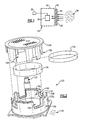
- Figure 2 illustrates another example sensor apparatus 120 that is also adapted for increased selectivity to a preferred species of flammable gas, such as hydrogen.
- like reference numerals designate like elements where appropriate, and reference numerals with the addition of one-hundred or multiples thereof designate modified elements that are understood to incorporate the same features and benefits of the corresponding original elements.
- the sensor apparatus 120 includes a MOS sensor 122 and a housing 150 having an internal chamber 152 in which the MOS sensor 122 is disposed.
- the internal chamber 152 may be considered to be similar to the sensor zone 24 of the prior examples, for receiving analyte gas 126.
- the housing 150 includes at least one window 154 for the ingress of analyte gas 126 into the internal chamber 152 from an atmosphere that is external to the housing 150.
- a gas-selective barrier 128 is disposed within the at least one window 154.
- the housing 150 includes four such windows 154. However, in other examples, there may be fewer or more windows 154 depending upon the detection needs of the particular application.
- the MOS sensor 122 may be electrically connected to a controller (not shown) for transmitting signals representative of detected gas concentrations.
- the housing 150 may include a base 152a and a cover 152b that fits with the base 152a to form the housing 150.
- the base 152a includes an inner wall 156 and an outer wall 158 that are spaced apart to define circumferential slot 160 therebetween.
- the base 152a is circular and thus the slot 160 is circumferential.
- the base 152a may have a different shape and the slot 160 may have a shape that corresponds to the shape of the base 152a.
- the inner and outer walls 156 and 158 at least partially frame the window or windows 154.
- the walls 156 and 158 of the base 152a form three sides of each window 154 and the cover 152b forms a fourth side.
- the windows 154 may be cut into the walls 156 and 158 or formed in a molding process or the like.
- the gas-selective barrier 128 is in the shape of a ring and may be disposed within the internal chamber 152 such that the gas-selective barrier 128 extends across the windows 154.
- the cover 152b may then be received within the slot 160 of the base 152a such that the windows 154 in the cover 152b align with the windows 154 in the base 152a.
- additional filters 170 may be disposed adjacent to the gas-selective barrier 128 to provide other services, such as limiting debris or liquid from entering into the internal chamber 152.
- Such filters 170 may also be a ring that fits concentrically with the gas-selective barrier 128.
- the sensor apparatus 120 was exposed to an analyte gas having a 50% LEL (lower explosion limit) concentration of flammable gas, approximately 2.5 vol% methane or 2.0 vol% hydrogen.
- LEL lower explosion limit
- the gas-selective barrier 128 caused a larger delay in the response time to methane gas than to the hydrogen gas.
- the gas selective barrier 128 selectively impedes the ingress of methane into the internal chamber 152 such that the relative selectivity of the sensor apparatus 120 to hydrogen is increased.
Landscapes
- Chemical & Material Sciences (AREA)
- Health & Medical Sciences (AREA)
- Life Sciences & Earth Sciences (AREA)
- Analytical Chemistry (AREA)
- General Health & Medical Sciences (AREA)
- Pathology (AREA)
- Immunology (AREA)
- Physics & Mathematics (AREA)
- General Physics & Mathematics (AREA)
- Biochemistry (AREA)
- Engineering & Computer Science (AREA)
- Chemical Kinetics & Catalysis (AREA)
- Electrochemistry (AREA)
- Combustion & Propulsion (AREA)
- Medicinal Chemistry (AREA)
- Food Science & Technology (AREA)
- Investigating Or Analyzing Materials By The Use Of Fluid Adsorption Or Reactions (AREA)
- Investigating Or Analyzing Materials By The Use Of Electric Means (AREA)
Abstract
A sensor apparatus (120) includes a metal oxide semiconductor sensor (122) and a housing (150) having an internal chamber (152) in which the sensor is disposed. The housing includes at least one window (154,154) for the ingress of a gas (126) into the internal chamber from an atmosphere exterior to the housing. A gas-selective barrier (128) is disposed across the at least one window.
Description
- This disclosure relates to a sensor apparatus for measuring a gas concentration in a surrounding environment.
- Metal oxide semiconductor ("MOS") sensors and other types of sensors are known and used for detecting gas concentration levels. For instance, MOS sensors are sensitive to a variety of different gases, such as methane, hydrogen, ethanol, isobutane, etc.
- A disclosed sensor apparatus includes a metal oxide semiconductor sensor and a housing having an internal chamber in which the sensor is disposed. The housing includes at least one window for the ingress of a gas into the internal chamber from an atmosphere exterior to the housing. A gas-selective barrier is disposed across the at least one window.
- An example method for use with the sensor apparatus includes impeding the ingress of a selected species of flammable gas through the at least one window using the gas-selective barrier in the window.
- In another aspect, a sensor apparatus includes a sensor, a sensor zone around the sensor for receiving analyte gas, and a gas-selective barrier between the sensor zone and an atmosphere exterior to the sensor zone.
- The various features and advantages of the disclosed examples will become apparent to those skilled in the art from the following detailed description. The drawings that accompany the detailed description can be briefly described as follows.
-
Figure 1 illustrates an example sensor apparatus. -
Figure 2 illustrates another example sensor apparatus. -
Figure 1 illustrates selected portions of anexample sensor apparatus 20 that is adapted to have increased selectivity to a preferred species of flammable gas, such as hydrogen. For instance, thesensor apparatus 20 may be used in an environment that may contain many different species of flammable gases. In the case of a vehicle (e.g., a commercial bus or other transportation device) that utilizes hydrogen for propulsion, enhanced hydrogen detection may be desired. Most metal oxide semiconductor ("MOS") sensors are typically more sensitive to other flammable gases in the surrounding environment than to hydrogen, which can interfere with obtaining reliable hydrogen concentration measurements. However, as will be described, thesensor apparatus 20 is configured to have heightened selectivity to hydrogen and may thereby be used to more reliably detect any hydrogen that escapes from hydrogen storage in a vehicle, for example. - In the illustrated example, the
sensor apparatus 20 includes a metal oxide semiconductor ("MOS") sensor 22 (e.g. Figaro TGS2611) and asensor zone 24 around theMOS sensor 22 for receivinganalyte gas 26 from an atmosphere that is exterior to thesensor zone 24. TheMOS sensor 22 may include a gas-sensing surface (not shown) composed of tin oxide (SnO2), for example. Thesensor apparatus 20 further includes a gas-selective barrier 28 disposed between thesensor zone 24 and the exterior atmosphere for impeding ingress of a selected species of flammable gas into thesensor zone 24. For instance, "gas-selective" may refer to a characteristic of preferentially hindering movement of one species of flammable gas over another. In the case of a vehicle application where detection of hydrogen is desired, the gas-selective barrier 28 is adapted to impede ingress of other types of gases, such as methane, to thereby increase relative selectivity of theMOS sensor 22 to hydrogen. - The
MOS sensor 22 may be electrically connected to acontroller 30 for transmitting signals that are representative of detected gas concentrations in thesensor zone 24 to thecontroller 30. Thecontroller 30 may include hardware, software, or both for receiving and processing the signals. As an example, thecontroller 30 may trigger an alarm or other indication in response to the received signals if the detected gas concentration exceeds a predetermined threshold. - The gas-
selective barrier 28 may include asupport 40 and anorganosilicon coating 42 disposed on thesupport 40. In this case, there is a single layer of theorganosilicon coating 42 on thesupport 40. However, in other examples, thesupport 40 may include multiple layers of theorganosilicon coating 42 on one side or layers of theorganosilicon coating 42 on the opposed sides of thesupport 40 to achieve a desired gas-selectivity. - The
support 40 is porous but mechanically suitable for supporting theorganosilicon coating 42. In some examples, thesupport 40 may be cellulose paper or a polymer material, such as a membrane, woven fiber structure or non-woven fiber structure of polytetrafluoroethylene fibers. Thesupport 40 may have a degree of porosity that is suited for the particular application. For instance, a higher degree of porosity may be selected to facilitate avoiding substantially impeding movement of theanalyte gas 26 such that theorganosilicon coating 42 is the sole component of the gas-selective barrier 28 that functions to impede gas ingress. Alternatively, a lower degree of porosity may be selected to compliment the gas-selectivity of theorganosilicon coating 42 by trapping or impeding larger gas molecules, such as methane. In this regard, the cellulose paper may have a weight of 50-75 g/m2. - In the above examples, the amount of the
organosilicon coating 42 may be controlled to achieve a desired influence on impedance. For instance, using a greater amount may provide a greater degree of impedance while using less may provide less impedance. In some examples, the amount may be 0.1-10 g/m2. In a further example that may be useful in hydrogen vehicle applications, the amount may be 0.5-2.0 g/m2. The amount may also be represented by a thickness of theorganosilicon coating 42. In some examples, the thickness may be 0.5-10 micrometers. In a further example, the thickness may be approximately 0.5-2.0 micrometers. - The
organosilicon coating 42 may be of a type that impedes methane gas movement more than it impedes hydrogen gas movement. For instance, theorganosilicon coating 42 may be polydimethylsiloxane, polydiethylsiloxane, polyalkylene oxide siloxane, phenylmethylsiloxane-dimethylsiloxane copolymer, diphenylsiloxane-dimethylsiloxane copolymer and combinations thereof. Given this description, one of ordinary skill in the art will recognize other types of organosilicon or silicone materials to meet their particular needs. - MOS sensors may be more sensitive to methane than to hydrogen at relatively low concentrations of hydrogen and methane below approximately 5 vol%. In this concentration regime, exposure to low levels of methane may cause a significant electrical response signal from a MOS sensor. In this regard, the gas-
selective barrier 28 impedes the ingress of methane into thesensor zone 24 to thereby increase the selectivity of theMOS sensor 22 to hydrogen and facilitate reducing interference from methane and other gases. The gas-selective barrier 28 may also be used to impede the ingress of methane to reduce exposure of theMOS sensor 22 to transient increases in concentration of methane that might otherwise cause a significant electrical response signal that could trigger an alarm or other indicator. -
Figure 2 illustrates anotherexample sensor apparatus 120 that is also adapted for increased selectivity to a preferred species of flammable gas, such as hydrogen. In this disclosure, like reference numerals designate like elements where appropriate, and reference numerals with the addition of one-hundred or multiples thereof designate modified elements that are understood to incorporate the same features and benefits of the corresponding original elements. - In this example, the
sensor apparatus 120 includes aMOS sensor 122 and ahousing 150 having an internal chamber 152 in which theMOS sensor 122 is disposed. The internal chamber 152 may be considered to be similar to thesensor zone 24 of the prior examples, for receivinganalyte gas 126. Thehousing 150 includes at least onewindow 154 for the ingress ofanalyte gas 126 into the internal chamber 152 from an atmosphere that is external to thehousing 150. - A gas-
selective barrier 128 is disposed within the at least onewindow 154. In this case, thehousing 150 includes four such windows 154. However, in other examples, there may be fewer ormore windows 154 depending upon the detection needs of the particular application. As in the previous example, theMOS sensor 122 may be electrically connected to a controller (not shown) for transmitting signals representative of detected gas concentrations. - The
housing 150 may include abase 152a and acover 152b that fits with thebase 152a to form thehousing 150. Thebase 152a includes aninner wall 156 and anouter wall 158 that are spaced apart to definecircumferential slot 160 therebetween. In the illustrated example, thebase 152a is circular and thus theslot 160 is circumferential. However, in other examples thebase 152a may have a different shape and theslot 160 may have a shape that corresponds to the shape of thebase 152a. - The inner and
outer walls windows 154. In this case, thewalls base 152a form three sides of eachwindow 154 and thecover 152b forms a fourth side. Thewindows 154 may be cut into thewalls - The gas-
selective barrier 128 is in the shape of a ring and may be disposed within the internal chamber 152 such that the gas-selective barrier 128 extends across thewindows 154. Thecover 152b may then be received within theslot 160 of thebase 152a such that thewindows 154 in thecover 152b align with thewindows 154 in thebase 152a. In some examples,additional filters 170 may be disposed adjacent to the gas-selective barrier 128 to provide other services, such as limiting debris or liquid from entering into the internal chamber 152.Such filters 170 may also be a ring that fits concentrically with the gas-selective barrier 128. - In one example of the effectiveness of the gas-
selective barrier 128, thesensor apparatus 120 was exposed to an analyte gas having a 50% LEL (lower explosion limit) concentration of flammable gas, approximately 2.5 vol% methane or 2.0 vol% hydrogen. The time for theMOS sensor 122 to reach 90% of the full scale sensitivity output, which is also known as t90, was measured and compared to the same arrangement without the gas-selective barrier 128. In this case, the gas-selective barrier 128 caused a larger delay in the response time to methane gas than to the hydrogen gas. Thus, the gasselective barrier 128 selectively impedes the ingress of methane into the internal chamber 152 such that the relative selectivity of thesensor apparatus 120 to hydrogen is increased. - Although a combination of features is shown in the illustrated examples, not all of them need to be combined to realize the benefits of various embodiments of this disclosure. In other words, a system designed according to an embodiment of this disclosure will not necessarily include all of the features shown in any one of the Figures or all of the portions schematically shown in the Figures. Moreover, selected features of one example embodiment may be combined with selected features of other example embodiments.
- The preceding description is exemplary rather than limiting in nature. Variations and modifications to the disclosed examples may become apparent to those skilled in the art that do not necessarily depart from the essence of this disclosure. The scope of legal protection given to this disclosure can only be determined by studying the following claims.
Claims (14)
- A sensor apparatus (20;120) comprising:a metal oxide semiconductor ("MOS") sensor (22;122);a housing (150) having an internal chamber (152) in which the MOS sensor is disposed, the housing having at least one window (154,154) for the ingress of gas (26;126) into the internal chamber from an atmosphere exterior to the housing; anda gas-selective barrier (28;128) disposed across the at least one window.
- The sensor apparatus as recited in claim 1, wherein the gas-selective barrier (28) is a support (40) having an organosilicon coating (42).
- The sensor apparatus as recited in claim 2, wherein the support is cellulose paper.
- The sensor apparatus as recited in claim 3, wherein the cellulose paper has a weight of 50-75 g/m2.
- The sensor apparatus as recited in claim 2, wherein the support is a polymeric material.
- The sensor apparatus as recited in claim 2, 3, 4 or 5 wherein the organosilicon coating is selected from a group consisting of polydimethylsiloxane, polydiethylsiloxane, polyalkylene oxide siloxane, phenylmethylsiloxane-dimethylsiloxane copolymer, diphenylsiloxane-dimethylsiloxane copolymer and combinations thereof.
- The sensor apparatus as recited in claim 6, including an amount of 0.1-10 g/m2 of the organosilicon coating.
- The sensor apparatus as recited in claim 6 or 7, wherein the organosilicon coating has a thickness of 0.5-10 micrometers.
- The sensor apparatus as recited in any preceding claim, wherein the gas-selective barrier is a ring disposed within the housing.
- The sensor apparatus as recited in any preceding claim, wherein the housing includes a base having an inner wall and an outer wall forming a slot therebetween and the at least one window is at least partially framed by the inner wall and the outer wall.
- The sensor apparatus as recited in any preceding claim, further including other filters (170) adjacent to the gas-selective barrier (128).
- A method for use with a sensor apparatus (20;120) that includes a metal oxide semiconductor ("MOS") sensor (22; 122) and a housing having an internal chamber (24;152) in which the MOS sensor is disposed, the housing (150) having at least one window (154;154) for the ingress of gas (26;126) into the internal chamber, the method comprising:impeding the ingress of a selected species of flammable gas through the at least one window using a gas-selective barrier (28;128) disposed within the at least one window.
- The method as recited in claim 12, including impeding ingress of methane as the selected species of flammable gas such that a relative selectivity of the sensor apparatus to hydrogen increases.
- The method as recited in claim 12, including impeding the ingress of methane as the selected species of flammable gas to reduce exposure of the MOS sensor to transient increases in concentration of methane in an atmosphere exterior to the housing.
Applications Claiming Priority (1)
| Application Number | Priority Date | Filing Date | Title |
|---|---|---|---|
| GB0921842A GB2476123A (en) | 2009-12-14 | 2009-12-14 | MOS gas sensor apparatus and method of use |
Publications (1)
| Publication Number | Publication Date |
|---|---|
| EP2333533A1 true EP2333533A1 (en) | 2011-06-15 |
Family
ID=41667077
Family Applications (1)
| Application Number | Title | Priority Date | Filing Date |
|---|---|---|---|
| EP10252031A Withdrawn EP2333533A1 (en) | 2009-12-14 | 2010-11-30 | Sensor apparatus and method therefor |
Country Status (7)
| Country | Link |
|---|---|
| US (1) | US8322192B2 (en) |
| EP (1) | EP2333533A1 (en) |
| KR (1) | KR101289515B1 (en) |
| CN (1) | CN102095757B (en) |
| AU (1) | AU2010249249B2 (en) |
| CA (1) | CA2724500A1 (en) |
| GB (1) | GB2476123A (en) |
Cited By (2)
| Publication number | Priority date | Publication date | Assignee | Title |
|---|---|---|---|---|
| CN104062344A (en) * | 2014-07-02 | 2014-09-24 | 武汉工程大学 | Hydrogen selective gas sensitive element |
| US20230152289A1 (en) * | 2019-06-11 | 2023-05-18 | Msa Technology, Llc | Gas sensor with separate contaminant detection element |
Families Citing this family (8)
| Publication number | Priority date | Publication date | Assignee | Title |
|---|---|---|---|---|
| JP5204284B2 (en) * | 2010-11-12 | 2013-06-05 | 日本特殊陶業株式会社 | Gas sensor |
| GB201112477D0 (en) | 2011-07-20 | 2011-08-31 | Corentium As | Gas sensor |
| KR101445590B1 (en) * | 2012-05-08 | 2014-10-02 | 연세대학교 산학협력단 | Hydrogen Sensor and Method for Manufacturing the same |
| CN103439458A (en) * | 2013-08-12 | 2013-12-11 | 中国电子科技集团公司第四十八研究所 | Gas concentration sensor probe |
| US10617985B2 (en) * | 2016-09-29 | 2020-04-14 | Rosemount Inc. | Gas sensor module with field replaceable, ingress protected, sensor filter |
| JP2018197700A (en) * | 2017-05-24 | 2018-12-13 | Nissha株式会社 | Gas sensor |
| US12196727B2 (en) | 2019-01-11 | 2025-01-14 | Eth Zurich | Device and method for detecting an analyte |
| CN115493968A (en) * | 2022-09-22 | 2022-12-20 | 北京工业大学 | A permeable hydrogen leakage alarm device |
Citations (6)
| Publication number | Priority date | Publication date | Assignee | Title |
|---|---|---|---|---|
| US4677414A (en) * | 1983-12-23 | 1987-06-30 | Lucas Electrical Electronics & Systems Ltd. | Oxygen sensor |
| US20060120920A1 (en) * | 2004-12-06 | 2006-06-08 | Gas Technology Institute | Hydrogen or helium sensor |
| EP1720008A1 (en) * | 2004-02-24 | 2006-11-08 | Mikuni Corporation | Carbon monoxide sensor and method for sensing carbon monoxide |
| US20070089989A1 (en) * | 2005-09-02 | 2007-04-26 | William Hoagland | Conformable hydrogen indicating wrap to detect leaking hydrogen gas |
| WO2008076602A1 (en) * | 2006-12-18 | 2008-06-26 | Uop Llc | Method of making mixed matrix membranes |
| EP2098281A1 (en) * | 2006-12-28 | 2009-09-09 | Shin-Etsu Polymer Co. Ltd. | Selectively permeable material, method for producing selectively permeable membrane structure, selectively permeable membrane structure, and air conditioning system |
Family Cites Families (23)
| Publication number | Priority date | Publication date | Assignee | Title |
|---|---|---|---|---|
| FR2082095A5 (en) | 1970-03-03 | 1971-12-10 | Rhone Poulenc Sa | |
| US3864628A (en) * | 1973-05-29 | 1975-02-04 | Inst Gas Technology | Selective solid-state gas sensors and method |
| JPS5417414A (en) * | 1977-07-08 | 1979-02-08 | Nippon Soken Inc | Exhaust gas purifying system |
| JPS59120945A (en) | 1982-12-28 | 1984-07-12 | Shinkosumosu Denki Kk | Hydrogen selectivity sensor |
| JPS59222204A (en) * | 1983-04-26 | 1984-12-13 | Asahi Glass Co Ltd | Compound membrane for separating gas |
| US4877528A (en) * | 1988-10-27 | 1989-10-31 | Bend Research, Inc. | Siloxane-grafted membranes |
| EP0369238B1 (en) | 1988-11-01 | 1996-09-04 | Ngk Spark Plug Co., Ltd | Oxygen sensor and method for producing same |
| US5279795A (en) | 1993-01-04 | 1994-01-18 | The United States Of America As Represented By The United States Department Of Energy | Extended range chemical sensing apparatus |
| DE19618935C2 (en) * | 1996-05-10 | 2002-11-28 | Siemens Ag | Gas sensor and method for manufacturing a gas sensor |
| DE19819575C1 (en) * | 1998-04-30 | 2000-03-16 | Siemens Ag | Hydrogen sensor |
| JP2000338072A (en) * | 1999-05-26 | 2000-12-08 | Mikuni Corp | Carbon monoxide sensor |
| JP3518800B2 (en) | 1999-12-16 | 2004-04-12 | フィガロ技研株式会社 | Gas sensor and gas detection device |
| DE10031882A1 (en) | 2000-06-30 | 2002-01-10 | Leybold Vakuum Gmbh | Helium or hydrogen sensor |
| DE10213805A1 (en) * | 2001-03-28 | 2002-11-07 | Denso Corp | Gas sensor and method for manufacturing a gas sensor |
| CA2467429C (en) | 2001-11-15 | 2010-08-17 | Riken Keiki Co., Ltd. | Gas sensor |
| JP3969274B2 (en) | 2001-12-03 | 2007-09-05 | 株式会社デンソー | Gas sensor element and manufacturing method thereof |
| US7097875B2 (en) | 2002-12-19 | 2006-08-29 | Delphi Technologies, Inc | Methods of making gas sensors and sensors formed therefrom |
| US7491547B1 (en) | 2003-11-07 | 2009-02-17 | Piers Richard Warburton | Filter for gas sensor |
| DE112005000249B4 (en) | 2004-01-27 | 2014-10-16 | H2Scan Corp. | Thin film gas sensor configuration |
| DE102004028701B3 (en) * | 2004-06-14 | 2005-11-24 | Siemens Ag | Gas sensor for the determination of ammonia |
| US7140229B2 (en) * | 2004-06-29 | 2006-11-28 | Mst Technology Gmbh | Gas-monitoring assembly comprising one or more gas sensors and one or more getters, and method of using same |
| EP1722219A1 (en) | 2005-05-10 | 2006-11-15 | Sumitomo Electric Industries, Ltd. | Gas sensor |
| JP2008014662A (en) * | 2006-07-03 | 2008-01-24 | New Cosmos Electric Corp | Gas filter and gas sensor |
-
2009
- 2009-12-14 GB GB0921842A patent/GB2476123A/en not_active Withdrawn
-
2010
- 2010-01-22 US US12/692,205 patent/US8322192B2/en active Active
- 2010-11-30 EP EP10252031A patent/EP2333533A1/en not_active Withdrawn
- 2010-11-30 KR KR1020100120218A patent/KR101289515B1/en active Active
- 2010-12-08 CA CA2724500A patent/CA2724500A1/en not_active Abandoned
- 2010-12-13 AU AU2010249249A patent/AU2010249249B2/en not_active Ceased
- 2010-12-14 CN CN201010586924.6A patent/CN102095757B/en not_active Expired - Fee Related
Patent Citations (6)
| Publication number | Priority date | Publication date | Assignee | Title |
|---|---|---|---|---|
| US4677414A (en) * | 1983-12-23 | 1987-06-30 | Lucas Electrical Electronics & Systems Ltd. | Oxygen sensor |
| EP1720008A1 (en) * | 2004-02-24 | 2006-11-08 | Mikuni Corporation | Carbon monoxide sensor and method for sensing carbon monoxide |
| US20060120920A1 (en) * | 2004-12-06 | 2006-06-08 | Gas Technology Institute | Hydrogen or helium sensor |
| US20070089989A1 (en) * | 2005-09-02 | 2007-04-26 | William Hoagland | Conformable hydrogen indicating wrap to detect leaking hydrogen gas |
| WO2008076602A1 (en) * | 2006-12-18 | 2008-06-26 | Uop Llc | Method of making mixed matrix membranes |
| EP2098281A1 (en) * | 2006-12-28 | 2009-09-09 | Shin-Etsu Polymer Co. Ltd. | Selectively permeable material, method for producing selectively permeable membrane structure, selectively permeable membrane structure, and air conditioning system |
Cited By (4)
| Publication number | Priority date | Publication date | Assignee | Title |
|---|---|---|---|---|
| CN104062344A (en) * | 2014-07-02 | 2014-09-24 | 武汉工程大学 | Hydrogen selective gas sensitive element |
| CN104062344B (en) * | 2014-07-02 | 2016-10-12 | 武汉工程大学 | hydrogen selective gas sensor |
| US20230152289A1 (en) * | 2019-06-11 | 2023-05-18 | Msa Technology, Llc | Gas sensor with separate contaminant detection element |
| US11846617B2 (en) * | 2019-06-11 | 2023-12-19 | Msa Technology, Llc | Gas sensor with separate contaminant detection element |
Also Published As
| Publication number | Publication date |
|---|---|
| AU2010249249A1 (en) | 2011-06-30 |
| CN102095757B (en) | 2013-07-10 |
| CA2724500A1 (en) | 2011-06-14 |
| US20110138881A1 (en) | 2011-06-16 |
| CN102095757A (en) | 2011-06-15 |
| KR101289515B1 (en) | 2013-07-24 |
| US8322192B2 (en) | 2012-12-04 |
| KR20110068844A (en) | 2011-06-22 |
| GB0921842D0 (en) | 2010-01-27 |
| AU2010249249B2 (en) | 2013-02-14 |
| GB2476123A (en) | 2011-06-15 |
Similar Documents
| Publication | Publication Date | Title |
|---|---|---|
| US8322192B2 (en) | Sensor apparatus and method therefor | |
| CA2950795C (en) | Methods and systems for selective hydrogen gas extraction for dissolved gas analysis applications | |
| EP0084935B1 (en) | Gas detection device | |
| US10948207B2 (en) | Air purifier and air purification method | |
| CN101014854B (en) | Gas monitoring assembly including one or more gas sensors and one or more getters and methods of use thereof | |
| CN111089941A (en) | A formaldehyde detection device and detection method thereof | |
| AU2010249247B2 (en) | Sensor apparatus and method therefor | |
| WO1997041426A1 (en) | Polyion sensor with molecular weight differentiation | |
| US8916037B1 (en) | Instrument and method for measuring high concentrations of carbon monoxide in a gaseous sample | |
| US20150308995A1 (en) | Analyte detectors and methods for their preparation and use | |
| JP4311461B2 (en) | Oxygen sensor for NOx detection | |
| US20180266983A1 (en) | Electrochemical sensor | |
| CN110057973B (en) | A kind of laboratory gas safety early warning system and method | |
| JP5894230B2 (en) | sensor | |
| EP3701255B1 (en) | Systems and methods for using a plurality of solid electrolyte sensors for a selective, low resolution formaldehyde detector | |
| CN113720989A (en) | Detection system and detection method for service life of sensor | |
| EP4700898A1 (en) | Venting device for a battery, battery comprising the venting device, and electric vehicle comprising the battery | |
| RU24729U1 (en) | DEVICE FOR DETECTING LOCATIONS | |
| RU24727U1 (en) | DEVICE FOR DETECTING LOCATIONS | |
| JP2000009688A (en) | Carbon monoxide sensor | |
| JP2002350382A (en) | Gas analysis method and gas analyzer | |
| JP2002286669A (en) | Inspection method and apparatus for combustible gas detector |
Legal Events
| Date | Code | Title | Description |
|---|---|---|---|
| PUAI | Public reference made under article 153(3) epc to a published international application that has entered the european phase |
Free format text: ORIGINAL CODE: 0009012 |
|
| AK | Designated contracting states |
Kind code of ref document: A1 Designated state(s): AL AT BE BG CH CY CZ DE DK EE ES FI FR GB GR HR HU IE IS IT LI LT LU LV MC MK MT NL NO PL PT RO RS SE SI SK SM TR |
|
| AX | Request for extension of the european patent |
Extension state: BA ME |
|
| 17P | Request for examination filed |
Effective date: 20111215 |
|
| STAA | Information on the status of an ep patent application or granted ep patent |
Free format text: STATUS: THE APPLICATION HAS BEEN WITHDRAWN |
|
| 18W | Application withdrawn |
Effective date: 20140521 |