EP2333038A1 - Novel 4-Alkyl Cyclohexanepropanal Compounds and their use in Perfume Compositions - Google Patents
Novel 4-Alkyl Cyclohexanepropanal Compounds and their use in Perfume Compositions Download PDFInfo
- Publication number
- EP2333038A1 EP2333038A1 EP10191118A EP10191118A EP2333038A1 EP 2333038 A1 EP2333038 A1 EP 2333038A1 EP 10191118 A EP10191118 A EP 10191118A EP 10191118 A EP10191118 A EP 10191118A EP 2333038 A1 EP2333038 A1 EP 2333038A1
- Authority
- EP
- European Patent Office
- Prior art keywords
- fragrance
- product
- cyclohexanepropanal
- compound
- butyl
- Prior art date
- Legal status (The legal status is an assumption and is not a legal conclusion. Google has not performed a legal analysis and makes no representation as to the accuracy of the status listed.)
- Granted
Links
Classifications
-
- C—CHEMISTRY; METALLURGY
- C11—ANIMAL OR VEGETABLE OILS, FATS, FATTY SUBSTANCES OR WAXES; FATTY ACIDS THEREFROM; DETERGENTS; CANDLES
- C11D—DETERGENT COMPOSITIONS; USE OF SINGLE SUBSTANCES AS DETERGENTS; SOAP OR SOAP-MAKING; RESIN SOAPS; RECOVERY OF GLYCEROL
- C11D3/00—Other compounding ingredients of detergent compositions covered in group C11D1/00
- C11D3/50—Perfumes
-
- A—HUMAN NECESSITIES
- A61—MEDICAL OR VETERINARY SCIENCE; HYGIENE
- A61K—PREPARATIONS FOR MEDICAL, DENTAL OR TOILETRY PURPOSES
- A61K8/00—Cosmetics or similar toiletry preparations
- A61K8/18—Cosmetics or similar toiletry preparations characterised by the composition
- A61K8/30—Cosmetics or similar toiletry preparations characterised by the composition containing organic compounds
- A61K8/33—Cosmetics or similar toiletry preparations characterised by the composition containing organic compounds containing oxygen
-
- A—HUMAN NECESSITIES
- A61—MEDICAL OR VETERINARY SCIENCE; HYGIENE
- A61Q—SPECIFIC USE OF COSMETICS OR SIMILAR TOILETRY PREPARATIONS
- A61Q13/00—Formulations or additives for perfume preparations
-
- C—CHEMISTRY; METALLURGY
- C11—ANIMAL OR VEGETABLE OILS, FATS, FATTY SUBSTANCES OR WAXES; FATTY ACIDS THEREFROM; DETERGENTS; CANDLES
- C11B—PRODUCING, e.g. BY PRESSING RAW MATERIALS OR BY EXTRACTION FROM WASTE MATERIALS, REFINING OR PRESERVING FATS, FATTY SUBSTANCES, e.g. LANOLIN, FATTY OILS OR WAXES; ESSENTIAL OILS; PERFUMES
- C11B9/00—Essential oils; Perfumes
- C11B9/0026—Essential oils; Perfumes compounds containing an alicyclic ring not condensed with another ring
- C11B9/0034—Essential oils; Perfumes compounds containing an alicyclic ring not condensed with another ring the ring containing six carbon atoms
Definitions
- the present invention relates to new chemical entities and the incorporation and use of the new chemical entities as fragrance materials.
- trans-compounds are shown to share pronounced urine-perspiration-type odor, while the corresponding cis-compounds are odorless or at the most possess weak and undefinable flowery or woody odor.
- some other trans- and cis-tert-butyl cyclohexanes are shown to possess opposite sensory activities [ Ohloff, et al., Helvetica Chimica Acta 66, Fasc. 5: 1343-1354 (1983 )].
- it is hard for those with skill in the art to predict a given structure would be effective in sensory activities. Identifying desirable fragrance chemicals continues to pose difficult challenges.
- the present invention provides novel chemicals and their unexpected advantageous use in enhancing, improving or modifying the fragrance of perfumes, colognes, toilet waters, personal products and the like.
- the present invention is directed to novel 4-alkyl cyclohexanepropanal compounds that exhibit unexpected strong fragrance effect and a method of improving, enhancing or modifying a fragrance formulation through the addition of an olfactory acceptable amount of 4-alkyl cyclohexanepropanals represented by Formula I set forth below: wherein R is selected from the group consisting of methyl, ethyl, propyl, isopropyl, butyl, isobutyl, and sec-butyl.
- the compounds of the present invention can be prepared from 3-(4-alkyl-phenyl)-propionaldehydes, which are first synthesized via the Hoaglin-Hirsch reaction using corresponding 4-alkyl benzaldehydes (commercially available from Mitsubishi Gas Chemical America, Inc.).
- the reaction steps can be depicted by general Schemes 1 and 2 shown as follows:
- the 1,4-substituted aromatic rings contained in the compounds of the present invention give rise to a number of trans- and cis-isomers. It is intended herein that the compounds described herein include isomeric mixtures of such compounds, as well as those isomers that may be separated using techniques known to those having skill in the art. Suitable techniques include chromatography such as high performance liquid chromatography, referred to as HPLC, and particularly gel chromatography and solid phase microextraction, referred to as SPME.
- HPLC high performance liquid chromatography
- SPME solid phase microextraction
- the use of the compounds of the present invention is widely applicable in current perfumery products, including the preparation of perfumes and colognes, the perfuming of personal care products such as soaps, shower gels, and hair care products, fabric care products as well as air fresheners and cosmetic preparations.
- perfume cleaning agents such as, but not limited to detergents, dishwashing materials, scrubbing compositions, window cleaners and the like.
- the compounds of the present invention can be used alone or in combination with other perfuming compositions, solvents, adjuvants and the like.
- the nature and variety of the other ingredients that can also be employed are known to those with skill in the art.
- fragrances can be employed in the present invention, the only limitation being the compatibility with the other components being employed.
- Suitable fragrances include but are not limited to fruits such as almond, apple, cherry, grape, pear, pineapple, orange, strawberry, raspberry; musk, flower scents such as lavender-like, rose-like, iris-like, carnation-like.
- Other pleasant scents include herbal and woodland scents derived from pine, spruce and other forest smells.
- Fragrances may also be derived from various oils, such as essential oils, or from plant materials such as peppermint, spearmint and the like.
- a list of suitable fragrances is provided in US Pat. No. 4,534,891 , the contents of which are incorporated by reference as if set forth in its entirety.
- fragrances are acacia, cassie, chypre, cyclamen, fern, gardenia, hawthorn, heliotrope, honeysuckle, hyacinth, jasmine, lilac, lily, magnolia, mimosa, narcissus, freshly-cut hay, orange blossom, orchid, reseda, sweet pea, trefle, tuberose, vanilla, violet, wallflower, and the like.
- fragrance formulation is understood to mean the same and refer to a formulation that is intended for providing a fragrance character to a perfume, a cologne, toilet water, a personal product, a fabric care product, and the like.
- the fragrance formulation of the present invention is a composition comprising a compound of the present invention.
- Olfactory acceptable amount is understood to mean the amount of a compound in a fragrance formulation, wherein the compound will contribute its individual olfactory characteristics.
- the olfactory effect of the fragrance formulation will be the sum of effect of each of the fragrance ingredients.
- the compounds of the present invention can be used to improve or enhance the aroma characteristics of the fragrance formulation, or by modifying the olfactory reaction contributed by other ingredients in the formulation.
- the olfactory acceptable amount may vary depending on many factors including other ingredients, their relative amounts and the olfactory effect that is desired.
- the amount of the compounds of the present invention employed in a fragrance formulation varies from about 0.005 to about 70 weight percent, preferably from 0.005 to about 10 weight percent, more preferably from about 0.5 to about 8 weight percent, and even more preferably from about 1 to about 7 weight percent.
- Those with skill in the art will be able to employ the desired amount to provide desired fragrance effect and intensity.
- other materials can also be used in conjunction with the fragrance formulation.
- Well known materials such as surfactants, emulsifiers, polymers to encapsulate the fragrance can also be employed without departing from the scope of the present invention.
- the compounds of the present invention When used in a fragrance formulation, the compounds of the present invention provide unexpected strong floral, muguet, and green characteristics and make the fragrance formulation more desirable and noticeable.
- the odor qualities found in the compounds of the present invention assist in beautifying and enhancing the finished accord and improve the performance of other materials in the fragrance formulation.
- the crude intermediate product 1-dimethoxymethyl-4-propyl-benzene (1.388 Kg) was obtained and charged to a second reaction flask at 25°C. Boron trifluride etherate (1 g, commercially available from Sigma-Aldrich, Inc.) was added. Ethyl vinyl ether (684 g, commercially available from Sigma-Aldrich, Inc.) was then fed for over 4 hours with the temperature maintained at 25-30°C. The reaction mass was quenched with saturated sodium carbonate (500 mL). The crude intermediate products methoxy ethoxy acetals were obtained, which were contained in the organic layer and confirmed by NMR analysis.
- the compound 3-(4-propyl-phenyl)-propionaldehyde was described as having floral, muguet, and green notes.
- the crude intermediate product 3-(4-propyl-phenyl)-propionaldehyde dimethylacetal (300 g), 2-propanol (100 mL), and rutheniium on alumina (3 g) were then charged to a1 L zipper autoclave.
- the autoclave was purged with nitrogen followed by hydrogen.
- the autoclave was pressurized with 500 psi hygrogen and heated to 150°C for 6 hours.
- the autoclave vessel was then cooled to an ambient temperature, depressurized, and purged with nitrogen.
- the reaction mass was filtered through celite to remove the catalyst and further hydrolyzed in the presence of water (2 L) containing hydrochloric acid (37%, 2 g) at 90°C for 5 hours.
- the compound 4-propyl cyclohexanepropanal was described as having strong floral, muguet, and green notes.
- 4-methyl cyclohexanepropanal (Formula II): 4-Methyl cyclohexanepropanal was similarly prepared as described in Examples I and II. First, 4-methyl benzaldehyde (140 g, commercially available from Mitsubishi Gas Chemical America, Inc.) was used to obtain 3-(4-methyl-phenyl)-propionaldehyde (130 g) with a boiling point of 120°C at a pressure of 21 mmHg. 3-(4-Methyl-phenyl)-propionaldehyde (180 g) was consequently used to provide 4-methyl cyclohexanepropanal (104 g) with a boiling point of 112°C at a pressure of 24 mmHg.
- the compound 4-methyl cyclohexanepropanal was described as having strong floral, muguet, and green notes.
- 4-Ethyl cyclohexanepropanal was similarly prepared as described in Examples I and II.
- 4-ethyl benzaldehyde (925 g, commercially available from Mitsubishi Gas Chemical America, Inc.) was used to obtain 3-(4-ethyl-phenyl)-propionaldehyde (878 g) with a boiling point of 129°C at a pressure of 12 mmHg.
- the compound 4-ethyl cyclohexanepropanal was described as having strong floral, muguet, and green notes.
- the compound 4-isobutyl cyclohexanepropanal was described as having strong floral, muguet, and green notes.
- the fragrance formula exemplified as follows demonstrates that a 4-alkyl cyclohexanepropanal compound imparts muguet and green characters to a musk fragrance formula.
- Ingredients Parts* + - Allyl Caproate 10 10 Leaf Alcohol 5 5 Kharismal® 15 15 Seveniff® 100 100 Alpha Damascone 5 5 Cashmeran® 10 10 Nebulone® 50 50 Iso E Super® 100 100 Phenoxanol® 65 65 Vivaldie® 20 20 Verdox® 70 70 Undecavertol 5 5 Applelide® 40 40
- the fragrance formula exemplified as follows demonstrates that a 4-alkyl cyclohexanepropanal compound imparts muguet and green characters to a female fragrance formula.
Landscapes
- Life Sciences & Earth Sciences (AREA)
- Health & Medical Sciences (AREA)
- Chemical & Material Sciences (AREA)
- General Health & Medical Sciences (AREA)
- Public Health (AREA)
- Wood Science & Technology (AREA)
- Organic Chemistry (AREA)
- Chemical Kinetics & Catalysis (AREA)
- Veterinary Medicine (AREA)
- Oil, Petroleum & Natural Gas (AREA)
- Engineering & Computer Science (AREA)
- Animal Behavior & Ethology (AREA)
- Epidemiology (AREA)
- Birds (AREA)
- Emergency Medicine (AREA)
- Fats And Perfumes (AREA)
- Organic Low-Molecular-Weight Compounds And Preparation Thereof (AREA)
- Cosmetics (AREA)
Abstract
Description
- The present invention relates to new chemical entities and the incorporation and use of the new chemical entities as fragrance materials.
- There is an ongoing need in the fragrance industry to provide new chemicals to give perfumers and other persons the ability to create new fragrances for perfumes, colognes and personal care products. Those with skill in the art appreciate how small differences in chemical structures can result in unexpected and significant differences in odor, notes and characteristics of molecules. These variations allow perfumers and other persons to apply new compounds in creating new fragrances. For example, benzene compounds that differ slightly in substituents possess completely different odor profiles [ Ishikawa, et al., International Journal of Quantum Chemistry 79: 101-108 (2000)]. In the case of tert-butyl cyclohexanes, the odor is said to be dependent on the compounds' conformation and therefore analogs adopting same conformation possess similar odor. Accordingly, many trans-compounds are shown to share pronounced urine-perspiration-type odor, while the corresponding cis-compounds are odorless or at the most possess weak and undefinable flowery or woody odor. However, some other trans- and cis-tert-butyl cyclohexanes are shown to possess opposite sensory activities [Ohloff, et al., Helvetica Chimica Acta 66, Fasc. 5: 1343-1354 (1983)]. Thus, it is hard for those with skill in the art to predict a given structure would be effective in sensory activities. Identifying desirable fragrance chemicals continues to pose difficult challenges.
- The present invention provides novel chemicals and their unexpected advantageous use in enhancing, improving or modifying the fragrance of perfumes, colognes, toilet waters, personal products and the like.
- More specifically, the present invention is directed to novel 4-alkyl cyclohexanepropanal compounds that exhibit unexpected strong fragrance effect and a method of improving, enhancing or modifying a fragrance formulation through the addition of an olfactory acceptable amount of 4-alkyl cyclohexanepropanals represented by Formula I set forth below:

- These and other embodiments of the present invention will be apparent by reading the following specification.
- It is known to those with the skill in the art that Formula I as defined above provides the following novel compounds:


- Those with the skill in the art will recognize that:
- Formula II represents 4-methyl cyclohexanepropanal;
- Formula III represents 4-ethyl cyclohexanepropanal;
- Formula IV represents 4-propyl cyclohexanepropanal;
- Formula V represents 4-isopropyl cyclohexanepropanal;
- Formula VI represents 4-butyl cyclohexanepropanal;
- Formula VII represents 4-isobutyl cyclohexanepropanal; and
- Formula VIII represents 4-sec-butyl cyclohexanepropanal.
- The compounds of the present invention can be prepared from 3-(4-alkyl-phenyl)-propionaldehydes, which are first synthesized via the Hoaglin-Hirsch reaction using corresponding 4-alkyl benzaldehydes (commercially available from Mitsubishi Gas Chemical America, Inc.). The reaction steps can be depicted by general Schemes 1 and 2 shown as follows:
- Scheme 1. Preparation of 3-(4-alkyl-phenyl)-propionaldehydes.

- Scheme 2. Preparation of target compounds, 4-alkyl cyclohexanepropanals.

- R1, R2, and R3 represent independently methyl or ethyl;
- TMOF represents trimethyl orthoformate;
- Pd/C represents palladium carbon catalyst; and
- Ru/Al represents ruthenium on alumina catalyst.
- Those with skill in the art will recognize that the 1,4-substituted aromatic rings contained in the compounds of the present invention give rise to a number of trans- and cis-isomers. It is intended herein that the compounds described herein include isomeric mixtures of such compounds, as well as those isomers that may be separated using techniques known to those having skill in the art. Suitable techniques include chromatography such as high performance liquid chromatography, referred to as HPLC, and particularly gel chromatography and solid phase microextraction, referred to as SPME.
- The use of the compounds of the present invention is widely applicable in current perfumery products, including the preparation of perfumes and colognes, the perfuming of personal care products such as soaps, shower gels, and hair care products, fabric care products as well as air fresheners and cosmetic preparations. These compounds can also be used to perfume cleaning agents, such as, but not limited to detergents, dishwashing materials, scrubbing compositions, window cleaners and the like. In these preparations, the compounds of the present invention can be used alone or in combination with other perfuming compositions, solvents, adjuvants and the like. The nature and variety of the other ingredients that can also be employed are known to those with skill in the art.
- Many types of fragrances can be employed in the present invention, the only limitation being the compatibility with the other components being employed. Suitable fragrances include but are not limited to fruits such as almond, apple, cherry, grape, pear, pineapple, orange, strawberry, raspberry; musk, flower scents such as lavender-like, rose-like, iris-like, carnation-like. Other pleasant scents include herbal and woodland scents derived from pine, spruce and other forest smells. Fragrances may also be derived from various oils, such as essential oils, or from plant materials such as peppermint, spearmint and the like. A list of suitable fragrances is provided in
US Pat. No. 4,534,891 , the contents of which are incorporated by reference as if set forth in its entirety. Another source of suitable fragrances is found in Perfumes, Cosmetics and Soaps, Second Edition, edited by W. A. Poucher, 1959. Among the fragrances provided in this treatise are acacia, cassie, chypre, cyclamen, fern, gardenia, hawthorn, heliotrope, honeysuckle, hyacinth, jasmine, lilac, lily, magnolia, mimosa, narcissus, freshly-cut hay, orange blossom, orchid, reseda, sweet pea, trefle, tuberose, vanilla, violet, wallflower, and the like. - The terms "fragrance formulation", "fragrance composition", and "perfume composition" are understood to mean the same and refer to a formulation that is intended for providing a fragrance character to a perfume, a cologne, toilet water, a personal product, a fabric care product, and the like. The fragrance formulation of the present invention is a composition comprising a compound of the present invention.
- Olfactory acceptable amount is understood to mean the amount of a compound in a fragrance formulation, wherein the compound will contribute its individual olfactory characteristics. However, the olfactory effect of the fragrance formulation will be the sum of effect of each of the fragrance ingredients. Thus, the compounds of the present invention can be used to improve or enhance the aroma characteristics of the fragrance formulation, or by modifying the olfactory reaction contributed by other ingredients in the formulation. The olfactory acceptable amount may vary depending on many factors including other ingredients, their relative amounts and the olfactory effect that is desired.
- The amount of the compounds of the present invention employed in a fragrance formulation varies from about 0.005 to about 70 weight percent, preferably from 0.005 to about 10 weight percent, more preferably from about 0.5 to about 8 weight percent, and even more preferably from about 1 to about 7 weight percent. Those with skill in the art will be able to employ the desired amount to provide desired fragrance effect and intensity. In addition to the compounds of the present invention, other materials can also be used in conjunction with the fragrance formulation. Well known materials such as surfactants, emulsifiers, polymers to encapsulate the fragrance can also be employed without departing from the scope of the present invention.
- When used in a fragrance formulation, the compounds of the present invention provide unexpected strong floral, muguet, and green characteristics and make the fragrance formulation more desirable and noticeable. The odor qualities found in the compounds of the present invention assist in beautifying and enhancing the finished accord and improve the performance of other materials in the fragrance formulation.
- The following are provided as specific embodiments of the present invention. Other modifications of this invention will be readily apparent to those skilled in the art. Such modifications are understood to be within the scope of this invention. As used herein all percentages are weight percent unless otherwise noted, ppm is understood to stand for parts per million, L is understood to be liter, mL is understood to be milliliter, Kg is understood to be kilogram, g is understood to be gram, and mmHg be millimeters (mm) of mercury (Hg). IFF as used in the examples is understood to mean International Flavors & Fragrances Inc., New York, NY, USA.
-

- Preparation of 3-(4-propyl-phenyl)-propionaldehyde: A reaction flask was charged with 4-propyl benzaldehyde (1.064 Kg, commercially available from Mitsubishi Gas Chemical America, Inc.), methanol (500 mL), and trimethyl orthoformate (TMOF) (1.144 Kg, commercially available from Sigma-Aldrich, Inc.). The reaction mass was cooled to -10 to 0°C and hydrochloric acid (37%, lg) was added in one portion. The reaction was instantaneous and the temperature was allowed to rise to 25°C for over 30 minutes. The reaction mass was then quenched with sodium acetate (20 g) and the solvent was removed by evaporation. The crude intermediate product 1-dimethoxymethyl-4-propyl-benzene (1.388 Kg) was obtained and charged to a second reaction flask at 25°C. Boron trifluride etherate (1 g, commercially available from Sigma-Aldrich, Inc.) was added. Ethyl vinyl ether (684 g, commercially available from Sigma-Aldrich, Inc.) was then fed for over 4 hours with the temperature maintained at 25-30°C. The reaction mass was quenched with saturated sodium carbonate (500 mL). The crude intermediate products methoxy ethoxy acetals were obtained, which were contained in the organic layer and confirmed by NMR analysis. Crude methoxy ethoxy acetals were hydrolyzed in the presence of water (500 mL) containing hydrochloric acid (37%, 50 g) at 90°C for 5 hours and further catalytically hydrogenated in 2-propanol (200 mL) using palladium on carbon (5%, 1 g) and hydrogen in a 1 L zipper autoclave to provide the product 3-(4-propylphenyl)-propionaldehyde (1.008 Kg), which had a boiling point of 115°C at a pressure of 6 mmHg.
- The NMR analysis of the intermediate products methoxy ethoxy acetals was the following:
- 1HNMR: 0.94 ppm (t, 3H, J=7.02 Hz), 1.13-1.27 ppm (m, 9H), 1.529-1.68 ppm (m, 2H), 1.84-1.91 ppm (m, 1H), 2.06-2.14 ppm (m, 1H), 2.55-2.59 ppm (m, 2H), 2.66 ppm (t, 2H, J=7.59 Hz), 3.17 ppm (s, 3H), 3.30 ppm (s, 3H), 3.33 ppm (s, 3H), 3.35-3.67 ppm (m, 6H), 4.19-4.60 ppm (m, 2H), 7.15 ppm (d, 2H, J=5.94 Hz), 7.21 ppm (d, 2H, J=7.33 Hz), 7.32 ppm (d, 2H, J=7.85 Hz), 7.78 ppm (d, 2H, J=7.94 Hz), 9.95 ppm (s, 1H).
- The NMR analysis of 3-(4-propyl-phenyl)-propionaldehyde was the following:
- 1HNMR: 0.93 ppm (t, 3H, J=7.34 Hz), 1.62 ppm (m, 2H, J=7.52 Hz), 2.55 ppm (t, 2H, J=7.66 Hz), 2.75 ppm (t, 2H, J=7.56 Hz), 2.92 ppm (t, 2H, J=7.56 Hz), 7.10 ppm (s, 4H), 9.81 ppm (s, 1H)
- The compound 3-(4-propyl-phenyl)-propionaldehyde was described as having floral, muguet, and green notes.
-

- Preparation of 4-propyl cyclohexanepropanal (Formula IV): A reaction flask was charged with 3-(4-propyl-phenyl)-propionaldehyde (240 g, prepared as above), methanol (200 mL), and TMOF (150 g). The reaction mass was cooled to 0°C and hydrochloric acid (37%, 1 g) was added in one portion. The reaction was exothermic and the temperature rose to 23°C. The reaction mass was quenched with sodium methoxide in methanol (25%, 10 g) and the solvent was removed by evaporation. The crude intermediate product 3-(4-propyl-phenyl)-propionaldehyde dimethylacetal (300 g), 2-propanol (100 mL), and rutheniium on alumina (3 g) were then charged to a1 L zipper autoclave. The autoclave was purged with nitrogen followed by hydrogen. The autoclave was pressurized with 500 psi hygrogen and heated to 150°C for 6 hours. The autoclave vessel was then cooled to an ambient temperature, depressurized, and purged with nitrogen. The reaction mass was filtered through celite to remove the catalyst and further hydrolyzed in the presence of water (2 L) containing hydrochloric acid (37%, 2 g) at 90°C for 5 hours. The organic layer was separated and washed with saturated sodium carbonate solution (500 mL). Subsequent fractional distillation afforded 4-propyl cyclohexanepropanal (188 g), which had a boiling point of 107°C at a pressure of 7 mmHg.
- 1HNMR: 0.85-0.95 ppm (m, 4H), 1.13-1.56 ppm (m, 11H), 1.60 ppm (q, 2H, J=7.24 Hz), 1.72-1.75 ppm (m, 2H), 2.29-2.35 ppm (m, 2H), 9.74-9.76 ppm (m, 1H)
- The compound 4-propyl cyclohexanepropanal was described as having strong floral, muguet, and green notes.
- Preparation of 4-methyl cyclohexanepropanal (Formula II): 4-Methyl cyclohexanepropanal was similarly prepared as described in Examples I and II. First, 4-methyl benzaldehyde (140 g, commercially available from Mitsubishi Gas Chemical America, Inc.) was used to obtain 3-(4-methyl-phenyl)-propionaldehyde (130 g) with a boiling point of 120°C at a pressure of 21 mmHg. 3-(4-Methyl-phenyl)-propionaldehyde (180 g) was consequently used to provide 4-methyl cyclohexanepropanal (104 g) with a boiling point of 112°C at a pressure of 24 mmHg.
- 1HNMR: 0.85-0.97 ppm (m, 5H), 1.13-1.73 ppm (m, 10H), 2.40-2.45 ppm (m, 2H), 9.76-9.77 ppm (2s, 1H)
- The compound 4-methyl cyclohexanepropanal was described as having strong floral, muguet, and green notes.
- Preparation of 4-ethyl cyclohexanepropanal (Formula III): 4-Ethyl cyclohexanepropanal was similarly prepared as described in Examples I and II. First, 4-ethyl benzaldehyde (925 g, commercially available from Mitsubishi Gas Chemical America, Inc.) was used to obtain 3-(4-ethyl-phenyl)-propionaldehyde (878 g) with a boiling point of 129°C at a pressure of 12 mmHg. 3-(4-Ethyl-phenyl)-propionaldehyde (350 g) was consequently used to provide 4-ethyl cyclohexanepropanal (201 g) with a boiling point of 85°C at a pressure of 3 mmHg.
- 1HNMR: 0.81-0.95 ppm (m, 5H), 1.05-1.77 ppm (m, 12H), 2.39-2.45 ppm (m, 2H), 9.76-9.77 ppm (2s, 1H)
- The compound 4-ethyl cyclohexanepropanal was described as having strong floral, muguet, and green notes.
- Preparation of 4-isobutyl cyclohexanepropanal (Formula VII): 4-Isobutyl cyclohexanepropanal was similarly prepared as described in Examples I and II. First, 4-isobutyl benzaldehyde (600 g, commercially available from Mitsubishi Gas Chemical America, Inc.) was used to obtain 3-(4-isobutyl-phenyl)-propionaldehyde (568 g) with a boiling point of 119°C at a pressure of 5 mmHg. 3-(4-Isobutyl-phenyl)-propionaldehyde (400 g) was consequently used to provide 4-isobutyl cyclohexanepropanal (245 g) with a boiling point of 107°C at a pressure of 4.4 mmHg.
- 1HNMR: 0.80-0.96 ppm (m, 8H), 1.02 ppm (t, ~33% of 2H, J =7.05 Hz), 1.12 ppm (t, -67% of 2H, J =7.14 Hz), 1.24-1.35 ppm (m, 4H), 1.43-1.74 ppm (m, 7H), 2.42 ppm (q, 2H, J =7.67 Hz), 9.75-9.77 ppm (m, 1H)
- The compound 4-isobutyl cyclohexanepropanal was described as having strong floral, muguet, and green notes.
- The fragrance formula exemplified as follows demonstrates that a 4-alkyl cyclohexanepropanal compound imparts muguet and green characters to a musk fragrance formula.
Ingredients Parts* + - Allyl Caproate 10 10 Leaf Alcohol 5 5 Kharismal® 15 15 Seveniff® 100 100 Alpha Damascone 5 5 Cashmeran® 10 10 Nebulone® 50 50 Iso E Super® 100 100 Phenoxanol® 65 65 Vivaldie® 20 20 Verdox® 70 70 Undecavertol 5 5 Applelide® 40 40 4-Propyl cyclohexanepropanal 45 -- (Formula IV) DPG -- 45 Total 540 540 * "+" represents a 4-alkyl cyclohexanepropanal compound containing formula; and "- "represents a 4-alkyl cyclohexanepropanal compound non-containing formula. - The fragrance formula exemplified as follows demonstrates that a 4-alkyl cyclohexanepropanal compound imparts muguet and green characters to a female fragrance formula.
Ingredients Parts* + - Salicynalva® 80 80 Delta Damascone 25 25 Gamma Decalactone 2 2 Dimethyloctenol 10 10 Phenyl ethyl alcohol 20 20 Montaverdi® 5 5 Geraniol 150 150 Linalool 50 50 Iso E Super® 123 123 Cashmeran® 25 25 Applelide® 100 100 Galbascone® 15 15 Leaf Alcohol 5 5 Globanone® 20 20 Aldehyde C10 30 30 Kharismal® 25 25 Vanillin 5 5 4-Propyl cyclohexanepropanal 10 -- (Formula IV) DPG -- 10 Total 700 700 * "+" represents a 4-alkyl cyclohexanepropanal compound containing formula; and "- "represents a 4-alkyl cyclohexanepropanal compound non-containing formula.
Claims (15)
- A method of improving, enhancing or modifying a fragrance formulation through the addition of an olfactory acceptable amount of a compound:
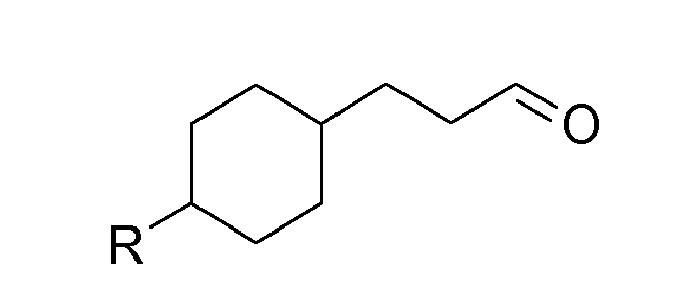
- A fragrance formulation containing an olfactory effective amount of a compound:

- A fragrance product containing an olfactory effective amount of the compound:

- The method of claim 1, or the fragrance formulation of claim 2, or the fragrance product of claim 3, wherein the compound is 4-methyl cyclohexanepropanal.
- The method of claim 1, or the fragrance formulation of claim 2, or the fragrance product of claim 3, wherein the compound is 4-ethyl cyclohexanepropanal.
- The method of claim 1, or the fragrance formulation of claim 2, or the fragrance product of claim 3, wherein the compound is 4-propyl cyclohexanepropanal.
- The method of claim 1, or the fragrance formulation of claim 2, or the fragrance product of claim 3, wherein the compound is 4-isopropyl cyclohexanepropanal.
- The method of claim 1, or the fragrance formulation of claim 2, or the fragrance product of claim 3, wherein the compound is 4-butyl cyclohexanepropanal.
- The method of claim 1, or the fragrance formulation of claim 2, or the fragrance product of claim 3, wherein the compound is 4-isobutyl cyclohexanepropanal.
- The method of claim 1, or the fragrance formulation of claim 2, or the fragrance product of claim 3, wherein the compound is 4-sec-butyl cyclohexanepropanal.
- The method of claim 1, or of any of claims 4 to 10, or the fragrance formulation of claim 2, or of any of claims 4 to 10, or the fragrance product of claim 3, or of any of claims 4 to 10, wherein the olfactory acceptable amount is from about 0.005 to about 10 weight percent of the fragrance formulation.
- The method of claim 1, or of any of claims 4 to 10, or the fragrance formulation of claim 2, or of any of claims 4 to 10, or the fragrance product of claim 3, or of any of claims 4 to 10, wherein the olfactory acceptable amount is from about 0.5 to about 8 weight percent of the fragrance formulation.
- The method of claim 1, or of any of claims 4 to 10, or the fragrance formulation of claim 2, or of any of claims 4 to 10, or the fragrance product of claim 3, or of any of claims 4 to 10, wherein the olfactory acceptable amount is from about 1 to about 7 weight percent of the fragrance formulation.
- The method of claim 1, or of any of claims 4 to 13, or the fragrance product of claim 3 or of any of claims 4 to 13 wherein the fragrance product comprises a product selected from the group methyl, ethyl, propyl, isopropyl, butyl, isobutyl, and sec-butyl, wherein the fragrance formulation is incorporated into a product selected from the group consisting of a perfume, a cologne, a toilet water, a cosmetic product, a personal care product, a fabric care product, a cleaning product, and an air freshener.
- The method or fragrance product of claim 14, wherein the cleaning product is selected from the group consisting of a detergent, a dishwashing composition, a scrubbing compound, and a window cleaner.
Applications Claiming Priority (1)
| Application Number | Priority Date | Filing Date | Title |
|---|---|---|---|
| US12/619,325 US8188023B2 (en) | 2009-11-16 | 2009-11-16 | 4-alkyl cyclohexanepropanal compounds and their use in perfume compositions |
Publications (2)
| Publication Number | Publication Date |
|---|---|
| EP2333038A1 true EP2333038A1 (en) | 2011-06-15 |
| EP2333038B1 EP2333038B1 (en) | 2012-06-13 |
Family
ID=43533496
Family Applications (1)
| Application Number | Title | Priority Date | Filing Date |
|---|---|---|---|
| EP10191118A Active EP2333038B1 (en) | 2009-11-16 | 2010-11-12 | Novel 4-Alkyl Cyclohexanepropanal Compounds and their use in Perfume Compositions |
Country Status (4)
| Country | Link |
|---|---|
| US (1) | US8188023B2 (en) |
| EP (1) | EP2333038B1 (en) |
| CN (1) | CN102070418A (en) |
| ES (1) | ES2389405T3 (en) |
Cited By (1)
| Publication number | Priority date | Publication date | Assignee | Title |
|---|---|---|---|---|
| EP2578671A1 (en) * | 2011-10-07 | 2013-04-10 | Symrise AG | Aromatic substances with lily of the valley note |
Families Citing this family (5)
| Publication number | Priority date | Publication date | Assignee | Title |
|---|---|---|---|---|
| US20110217257A1 (en) * | 2009-11-16 | 2011-09-08 | Belko Robert P | Novel 4-alkyl cyclohexanepropanal compounds and their use in perfume compositions |
| SG11202001226PA (en) | 2017-12-21 | 2020-03-30 | Firmenich & Cie | Method for identifying positive allosteric modulators for odorant receptors |
| CN111587284B (en) * | 2018-03-27 | 2024-05-17 | 弗门尼舍有限公司 | Aldehyde odor agent |
| US12110472B2 (en) | 2018-11-13 | 2024-10-08 | Symrise Ag | Perfuming ingredients with lily of the valley note |
| JP7562520B2 (en) | 2018-12-19 | 2024-10-07 | フイルメニツヒ ソシエテ アノニム | Use of Volatile Compounds to Modulate Floral Muguet Perception |
Citations (4)
| Publication number | Priority date | Publication date | Assignee | Title |
|---|---|---|---|---|
| US4534891A (en) | 1982-11-12 | 1985-08-13 | International Flavors & Fragrances Inc. | Branched C13 -alk-1-en-5-ones and use thereof in perfumery |
| EP1054053A2 (en) * | 1999-05-19 | 2000-11-22 | Firmenich S.A. | Utilization of substituted acetaldehydes with a cyclic substituent as perfuming ingredients |
| EP1529770A1 (en) * | 2003-11-06 | 2005-05-11 | Firmenich Sa | Aldehyde as perfuming or flavoring ingredient |
| US20090036347A1 (en) * | 2007-07-31 | 2009-02-05 | Levorse Jr Anthony T | Substituted cyclohexyl propanal compounds and their use in perfume compositions |
Family Cites Families (7)
| Publication number | Priority date | Publication date | Assignee | Title |
|---|---|---|---|---|
| JP3673873B2 (en) | 1994-12-28 | 2005-07-20 | 大日本インキ化学工業株式会社 | Biphenyl derivatives |
| JP2004018470A (en) * | 2002-06-18 | 2004-01-22 | Takasago Internatl Corp | Antibacterial fragrance composition, bad breath suppressing fragrance composition, and oral composition containing them |
| CN1488789A (en) * | 2002-10-10 | 2004-04-14 | 上海香料研究所 | Preparation method of green apple fragrance masterbatch for composite fiber flavoring |
| CN1829786B (en) | 2003-06-30 | 2013-10-02 | 大日本油墨化学工业株式会社 | Chroman derivative and liquid-crystal composition containing the compound |
| GB0419266D0 (en) * | 2004-08-31 | 2004-09-29 | Givaudan Sa | Compositions |
| GB0622037D0 (en) * | 2006-11-04 | 2006-12-13 | Quest Int Serv Bv | Novel fragrance compounds |
| US7834219B1 (en) * | 2009-11-16 | 2010-11-16 | International Flavors & Fragrances Inc. | 4-alkyl cyclohexanepropanal compounds and their use in perfume compositions |
-
2009
- 2009-11-16 US US12/619,325 patent/US8188023B2/en active Active
-
2010
- 2010-11-12 EP EP10191118A patent/EP2333038B1/en active Active
- 2010-11-12 ES ES10191118T patent/ES2389405T3/en active Active
- 2010-11-16 CN CN2010105644149A patent/CN102070418A/en active Pending
Patent Citations (4)
| Publication number | Priority date | Publication date | Assignee | Title |
|---|---|---|---|---|
| US4534891A (en) | 1982-11-12 | 1985-08-13 | International Flavors & Fragrances Inc. | Branched C13 -alk-1-en-5-ones and use thereof in perfumery |
| EP1054053A2 (en) * | 1999-05-19 | 2000-11-22 | Firmenich S.A. | Utilization of substituted acetaldehydes with a cyclic substituent as perfuming ingredients |
| EP1529770A1 (en) * | 2003-11-06 | 2005-05-11 | Firmenich Sa | Aldehyde as perfuming or flavoring ingredient |
| US20090036347A1 (en) * | 2007-07-31 | 2009-02-05 | Levorse Jr Anthony T | Substituted cyclohexyl propanal compounds and their use in perfume compositions |
Non-Patent Citations (3)
| Title |
|---|
| "Perfumes, Cosmetics and Soaps", 1959 |
| ISHIKAWA ET AL., INTERNATIONAL JOURNAL OF QUANTUM CHEMISTRY, vol. 79, 2000, pages 101 - 108 |
| OHLOFF ET AL., HELVETICA CHIMICA ACTA 66, FASC., vol. 5, 1983, pages 1343 - 1354 |
Cited By (3)
| Publication number | Priority date | Publication date | Assignee | Title |
|---|---|---|---|---|
| EP2578671A1 (en) * | 2011-10-07 | 2013-04-10 | Symrise AG | Aromatic substances with lily of the valley note |
| CN103030538A (en) * | 2011-10-07 | 2013-04-10 | 西姆莱斯有限公司 | Fragrances with note of lily of the valley |
| US12545851B2 (en) | 2011-10-07 | 2026-02-10 | Symrise Ag | Fragrances with note of lily of the valley |
Also Published As
| Publication number | Publication date |
|---|---|
| US8188023B2 (en) | 2012-05-29 |
| ES2389405T3 (en) | 2012-10-25 |
| US20110117046A1 (en) | 2011-05-19 |
| EP2333038B1 (en) | 2012-06-13 |
| CN102070418A (en) | 2011-05-25 |
Similar Documents
| Publication | Publication Date | Title |
|---|---|---|
| EP2322495B1 (en) | Novel 4-alkyl cyclohexanepropanal compounds and their use in perfume compositions | |
| EP2333038B1 (en) | Novel 4-Alkyl Cyclohexanepropanal Compounds and their use in Perfume Compositions | |
| US7531489B2 (en) | Organoleptic compounds and their use in perfume compositions | |
| EP2119694B1 (en) | Optically Active Ester Compounds and their use in Perfume Compositions | |
| US20110217257A1 (en) | Novel 4-alkyl cyclohexanepropanal compounds and their use in perfume compositions | |
| US9181514B2 (en) | Octahydro-benzofurans and their uses in perfume compositions | |
| EP2070512B1 (en) | Methyl cyclohexane carboxylates and their use in perfume compositons | |
| US9416335B2 (en) | Quinazoline compounds and their use in perfume compositions | |
| US20110118170A1 (en) | Novel 4-alkyl 1-(3-methoxy-2-propen-1-yl) benzene compounds and their use in perfume compositions | |
| US8178485B2 (en) | Hexahydro ethanochromenes and related compounds and their use in fragrance compositions | |
| US8168834B2 (en) | 4-alkyl 1-(3-methoxy-2-propen-1-yl) benzene compounds and their use in perfume compositions | |
| EP1795518B1 (en) | Organoleptic compounds and their use in perfume compositons | |
| US7691803B1 (en) | Propanol and related compounds and their use in perfume compositions | |
| US8399398B2 (en) | Organoleptic compounds and their use in perfume compositions | |
| EP2338868B1 (en) | [(4e, 4z)-5-methoxy-3-methyl-4-pentenyl]-benzene and its use in perfume compositions | |
| EP1647541B1 (en) | Cyclohexanbutanol derivative and fragrance use thereof |
Legal Events
| Date | Code | Title | Description |
|---|---|---|---|
| PUAI | Public reference made under article 153(3) epc to a published international application that has entered the european phase |
Free format text: ORIGINAL CODE: 0009012 |
|
| AK | Designated contracting states |
Kind code of ref document: A1 Designated state(s): AL AT BE BG CH CY CZ DE DK EE ES FI FR GB GR HR HU IE IS IT LI LT LU LV MC MK MT NL NO PL PT RO RS SE SI SK SM TR |
|
| AX | Request for extension of the european patent |
Extension state: BA ME |
|
| 17P | Request for examination filed |
Effective date: 20111110 |
|
| RIC1 | Information provided on ipc code assigned before grant |
Ipc: A61K 8/33 20060101ALI20111129BHEP Ipc: A61Q 13/00 20060101ALI20111129BHEP Ipc: C11D 3/50 20060101ALI20111129BHEP Ipc: C11B 9/00 20060101AFI20111129BHEP |
|
| GRAP | Despatch of communication of intention to grant a patent |
Free format text: ORIGINAL CODE: EPIDOSNIGR1 |
|
| GRAS | Grant fee paid |
Free format text: ORIGINAL CODE: EPIDOSNIGR3 |
|
| GRAA | (expected) grant |
Free format text: ORIGINAL CODE: 0009210 |
|
| AK | Designated contracting states |
Kind code of ref document: B1 Designated state(s): AL AT BE BG CH CY CZ DE DK EE ES FI FR GB GR HR HU IE IS IT LI LT LU LV MC MK MT NL NO PL PT RO RS SE SI SK SM TR |
|
| REG | Reference to a national code |
Ref country code: GB Ref legal event code: FG4D |
|
| REG | Reference to a national code |
Ref country code: AT Ref legal event code: REF Ref document number: 562013 Country of ref document: AT Kind code of ref document: T Effective date: 20120615 Ref country code: CH Ref legal event code: EP |
|
| REG | Reference to a national code |
Ref country code: IE Ref legal event code: FG4D |
|
| REG | Reference to a national code |
Ref country code: DE Ref legal event code: R096 Ref document number: 602010001857 Country of ref document: DE Effective date: 20120809 |
|
| REG | Reference to a national code |
Ref country code: NL Ref legal event code: VDEP Effective date: 20120613 |
|
| REG | Reference to a national code |
Ref country code: ES Ref legal event code: FG2A Ref document number: 2389405 Country of ref document: ES Kind code of ref document: T3 Effective date: 20121025 |
|
| PG25 | Lapsed in a contracting state [announced via postgrant information from national office to epo] |
Ref country code: LT Free format text: LAPSE BECAUSE OF FAILURE TO SUBMIT A TRANSLATION OF THE DESCRIPTION OR TO PAY THE FEE WITHIN THE PRESCRIBED TIME-LIMIT Effective date: 20120613 Ref country code: CY Free format text: LAPSE BECAUSE OF FAILURE TO SUBMIT A TRANSLATION OF THE DESCRIPTION OR TO PAY THE FEE WITHIN THE PRESCRIBED TIME-LIMIT Effective date: 20120613 Ref country code: NO Free format text: LAPSE BECAUSE OF FAILURE TO SUBMIT A TRANSLATION OF THE DESCRIPTION OR TO PAY THE FEE WITHIN THE PRESCRIBED TIME-LIMIT Effective date: 20120913 Ref country code: SE Free format text: LAPSE BECAUSE OF FAILURE TO SUBMIT A TRANSLATION OF THE DESCRIPTION OR TO PAY THE FEE WITHIN THE PRESCRIBED TIME-LIMIT Effective date: 20120613 Ref country code: FI Free format text: LAPSE BECAUSE OF FAILURE TO SUBMIT A TRANSLATION OF THE DESCRIPTION OR TO PAY THE FEE WITHIN THE PRESCRIBED TIME-LIMIT Effective date: 20120613 Ref country code: RS Free format text: LAPSE BECAUSE OF FAILURE TO SUBMIT A TRANSLATION OF THE DESCRIPTION OR TO PAY THE FEE WITHIN THE PRESCRIBED TIME-LIMIT Effective date: 20120613 |
|
| REG | Reference to a national code |
Ref country code: AT Ref legal event code: MK05 Ref document number: 562013 Country of ref document: AT Kind code of ref document: T Effective date: 20120613 |
|
| REG | Reference to a national code |
Ref country code: LT Ref legal event code: MG4D Effective date: 20120613 |
|
| PG25 | Lapsed in a contracting state [announced via postgrant information from national office to epo] |
Ref country code: SI Free format text: LAPSE BECAUSE OF FAILURE TO SUBMIT A TRANSLATION OF THE DESCRIPTION OR TO PAY THE FEE WITHIN THE PRESCRIBED TIME-LIMIT Effective date: 20120613 Ref country code: GR Free format text: LAPSE BECAUSE OF FAILURE TO SUBMIT A TRANSLATION OF THE DESCRIPTION OR TO PAY THE FEE WITHIN THE PRESCRIBED TIME-LIMIT Effective date: 20120914 Ref country code: HR Free format text: LAPSE BECAUSE OF FAILURE TO SUBMIT A TRANSLATION OF THE DESCRIPTION OR TO PAY THE FEE WITHIN THE PRESCRIBED TIME-LIMIT Effective date: 20120613 Ref country code: LV Free format text: LAPSE BECAUSE OF FAILURE TO SUBMIT A TRANSLATION OF THE DESCRIPTION OR TO PAY THE FEE WITHIN THE PRESCRIBED TIME-LIMIT Effective date: 20120613 |
|
| PG25 | Lapsed in a contracting state [announced via postgrant information from national office to epo] |
Ref country code: SK Free format text: LAPSE BECAUSE OF FAILURE TO SUBMIT A TRANSLATION OF THE DESCRIPTION OR TO PAY THE FEE WITHIN THE PRESCRIBED TIME-LIMIT Effective date: 20120613 Ref country code: CZ Free format text: LAPSE BECAUSE OF FAILURE TO SUBMIT A TRANSLATION OF THE DESCRIPTION OR TO PAY THE FEE WITHIN THE PRESCRIBED TIME-LIMIT Effective date: 20120613 Ref country code: EE Free format text: LAPSE BECAUSE OF FAILURE TO SUBMIT A TRANSLATION OF THE DESCRIPTION OR TO PAY THE FEE WITHIN THE PRESCRIBED TIME-LIMIT Effective date: 20120613 Ref country code: RO Free format text: LAPSE BECAUSE OF FAILURE TO SUBMIT A TRANSLATION OF THE DESCRIPTION OR TO PAY THE FEE WITHIN THE PRESCRIBED TIME-LIMIT Effective date: 20120613 Ref country code: IS Free format text: LAPSE BECAUSE OF FAILURE TO SUBMIT A TRANSLATION OF THE DESCRIPTION OR TO PAY THE FEE WITHIN THE PRESCRIBED TIME-LIMIT Effective date: 20121013 Ref country code: BE Free format text: LAPSE BECAUSE OF FAILURE TO SUBMIT A TRANSLATION OF THE DESCRIPTION OR TO PAY THE FEE WITHIN THE PRESCRIBED TIME-LIMIT Effective date: 20120613 Ref country code: AT Free format text: LAPSE BECAUSE OF FAILURE TO SUBMIT A TRANSLATION OF THE DESCRIPTION OR TO PAY THE FEE WITHIN THE PRESCRIBED TIME-LIMIT Effective date: 20120613 |
|
| PG25 | Lapsed in a contracting state [announced via postgrant information from national office to epo] |
Ref country code: PT Free format text: LAPSE BECAUSE OF FAILURE TO SUBMIT A TRANSLATION OF THE DESCRIPTION OR TO PAY THE FEE WITHIN THE PRESCRIBED TIME-LIMIT Effective date: 20121015 Ref country code: PL Free format text: LAPSE BECAUSE OF FAILURE TO SUBMIT A TRANSLATION OF THE DESCRIPTION OR TO PAY THE FEE WITHIN THE PRESCRIBED TIME-LIMIT Effective date: 20120613 |
|
| PG25 | Lapsed in a contracting state [announced via postgrant information from national office to epo] |
Ref country code: NL Free format text: LAPSE BECAUSE OF FAILURE TO SUBMIT A TRANSLATION OF THE DESCRIPTION OR TO PAY THE FEE WITHIN THE PRESCRIBED TIME-LIMIT Effective date: 20120613 |
|
| PLBE | No opposition filed within time limit |
Free format text: ORIGINAL CODE: 0009261 |
|
| STAA | Information on the status of an ep patent application or granted ep patent |
Free format text: STATUS: NO OPPOSITION FILED WITHIN TIME LIMIT |
|
| PG25 | Lapsed in a contracting state [announced via postgrant information from national office to epo] |
Ref country code: DK Free format text: LAPSE BECAUSE OF FAILURE TO SUBMIT A TRANSLATION OF THE DESCRIPTION OR TO PAY THE FEE WITHIN THE PRESCRIBED TIME-LIMIT Effective date: 20120613 |
|
| 26N | No opposition filed |
Effective date: 20130314 |
|
| REG | Reference to a national code |
Ref country code: DE Ref legal event code: R097 Ref document number: 602010001857 Country of ref document: DE Effective date: 20130314 |
|
| PG25 | Lapsed in a contracting state [announced via postgrant information from national office to epo] |
Ref country code: BG Free format text: LAPSE BECAUSE OF FAILURE TO SUBMIT A TRANSLATION OF THE DESCRIPTION OR TO PAY THE FEE WITHIN THE PRESCRIBED TIME-LIMIT Effective date: 20120913 |
|
| REG | Reference to a national code |
Ref country code: IE Ref legal event code: MM4A |
|
| PG25 | Lapsed in a contracting state [announced via postgrant information from national office to epo] |
Ref country code: IE Free format text: LAPSE BECAUSE OF NON-PAYMENT OF DUE FEES Effective date: 20121112 |
|
| PG25 | Lapsed in a contracting state [announced via postgrant information from national office to epo] |
Ref country code: AL Free format text: LAPSE BECAUSE OF FAILURE TO SUBMIT A TRANSLATION OF THE DESCRIPTION OR TO PAY THE FEE WITHIN THE PRESCRIBED TIME-LIMIT Effective date: 20120613 Ref country code: MT Free format text: LAPSE BECAUSE OF FAILURE TO SUBMIT A TRANSLATION OF THE DESCRIPTION OR TO PAY THE FEE WITHIN THE PRESCRIBED TIME-LIMIT Effective date: 20120613 |
|
| PG25 | Lapsed in a contracting state [announced via postgrant information from national office to epo] |
Ref country code: TR Free format text: LAPSE BECAUSE OF FAILURE TO SUBMIT A TRANSLATION OF THE DESCRIPTION OR TO PAY THE FEE WITHIN THE PRESCRIBED TIME-LIMIT Effective date: 20120613 Ref country code: MC Free format text: LAPSE BECAUSE OF NON-PAYMENT OF DUE FEES Effective date: 20121130 |
|
| PG25 | Lapsed in a contracting state [announced via postgrant information from national office to epo] |
Ref country code: LU Free format text: LAPSE BECAUSE OF NON-PAYMENT OF DUE FEES Effective date: 20121112 Ref country code: SM Free format text: LAPSE BECAUSE OF FAILURE TO SUBMIT A TRANSLATION OF THE DESCRIPTION OR TO PAY THE FEE WITHIN THE PRESCRIBED TIME-LIMIT Effective date: 20120613 |
|
| PG25 | Lapsed in a contracting state [announced via postgrant information from national office to epo] |
Ref country code: HU Free format text: LAPSE BECAUSE OF FAILURE TO SUBMIT A TRANSLATION OF THE DESCRIPTION OR TO PAY THE FEE WITHIN THE PRESCRIBED TIME-LIMIT Effective date: 20101112 |
|
| REG | Reference to a national code |
Ref country code: CH Ref legal event code: PL |
|
| PG25 | Lapsed in a contracting state [announced via postgrant information from national office to epo] |
Ref country code: CH Free format text: LAPSE BECAUSE OF NON-PAYMENT OF DUE FEES Effective date: 20141130 Ref country code: LI Free format text: LAPSE BECAUSE OF NON-PAYMENT OF DUE FEES Effective date: 20141130 Ref country code: MK Free format text: LAPSE BECAUSE OF FAILURE TO SUBMIT A TRANSLATION OF THE DESCRIPTION OR TO PAY THE FEE WITHIN THE PRESCRIBED TIME-LIMIT Effective date: 20120613 |
|
| REG | Reference to a national code |
Ref country code: FR Ref legal event code: PLFP Year of fee payment: 6 |
|
| PGFP | Annual fee paid to national office [announced via postgrant information from national office to epo] |
Ref country code: IT Payment date: 20151112 Year of fee payment: 6 |
|
| REG | Reference to a national code |
Ref country code: FR Ref legal event code: PLFP Year of fee payment: 7 |
|
| PG25 | Lapsed in a contracting state [announced via postgrant information from national office to epo] |
Ref country code: IT Free format text: LAPSE BECAUSE OF NON-PAYMENT OF DUE FEES Effective date: 20161112 |
|
| REG | Reference to a national code |
Ref country code: FR Ref legal event code: PLFP Year of fee payment: 8 |
|
| PGFP | Annual fee paid to national office [announced via postgrant information from national office to epo] |
Ref country code: GB Payment date: 20220930 Year of fee payment: 13 |
|
| P01 | Opt-out of the competence of the unified patent court (upc) registered |
Effective date: 20230530 |
|
| GBPC | Gb: european patent ceased through non-payment of renewal fee |
Effective date: 20231112 |
|
| PG25 | Lapsed in a contracting state [announced via postgrant information from national office to epo] |
Ref country code: GB Free format text: LAPSE BECAUSE OF NON-PAYMENT OF DUE FEES Effective date: 20231112 |
|
| PG25 | Lapsed in a contracting state [announced via postgrant information from national office to epo] |
Ref country code: GB Free format text: LAPSE BECAUSE OF NON-PAYMENT OF DUE FEES Effective date: 20231112 |
|
| PGFP | Annual fee paid to national office [announced via postgrant information from national office to epo] |
Ref country code: FR Payment date: 20250930 Year of fee payment: 16 |
|
| PGFP | Annual fee paid to national office [announced via postgrant information from national office to epo] |
Ref country code: DE Payment date: 20250930 Year of fee payment: 16 |
|
| PGFP | Annual fee paid to national office [announced via postgrant information from national office to epo] |
Ref country code: ES Payment date: 20251212 Year of fee payment: 16 |