EP2332927A1 - Nitrogen-containing heterocyclic compound and pest control agent - Google Patents
Nitrogen-containing heterocyclic compound and pest control agent Download PDFInfo
- Publication number
- EP2332927A1 EP2332927A1 EP09814282A EP09814282A EP2332927A1 EP 2332927 A1 EP2332927 A1 EP 2332927A1 EP 09814282 A EP09814282 A EP 09814282A EP 09814282 A EP09814282 A EP 09814282A EP 2332927 A1 EP2332927 A1 EP 2332927A1
- Authority
- EP
- European Patent Office
- Prior art keywords
- group
- dicl
- indicates
- compounds
- formula
- Prior art date
- Legal status (The legal status is an assumption and is not a legal conclusion. Google has not performed a legal analysis and makes no representation as to the accuracy of the status listed.)
- Withdrawn
Links
- XESBFOQWSSWOAS-UHFFFAOYSA-N O=C(c1ccccc11)N(Cc2cc(C(C3)=NOC3(C(F)(F)F)C(C3)=CC(Cl)=CC3Cl)ccc2)C1=O Chemical compound O=C(c1ccccc11)N(Cc2cc(C(C3)=NOC3(C(F)(F)F)C(C3)=CC(Cl)=CC3Cl)ccc2)C1=O XESBFOQWSSWOAS-UHFFFAOYSA-N 0.000 description 1
Classifications
-
- C—CHEMISTRY; METALLURGY
- C07—ORGANIC CHEMISTRY
- C07D—HETEROCYCLIC COMPOUNDS
- C07D261/00—Heterocyclic compounds containing 1,2-oxazole or hydrogenated 1,2-oxazole rings
- C07D261/02—Heterocyclic compounds containing 1,2-oxazole or hydrogenated 1,2-oxazole rings not condensed with other rings
- C07D261/04—Heterocyclic compounds containing 1,2-oxazole or hydrogenated 1,2-oxazole rings not condensed with other rings having one double bond between ring members or between a ring member and a non-ring member
-
- A—HUMAN NECESSITIES
- A01—AGRICULTURE; FORESTRY; ANIMAL HUSBANDRY; HUNTING; TRAPPING; FISHING
- A01N—PRESERVATION OF BODIES OF HUMANS OR ANIMALS OR PLANTS OR PARTS THEREOF; BIOCIDES, e.g. AS DISINFECTANTS, AS PESTICIDES OR AS HERBICIDES; PEST REPELLANTS OR ATTRACTANTS; PLANT GROWTH REGULATORS
- A01N43/00—Biocides, pest repellants or attractants, or plant growth regulators containing heterocyclic compounds
- A01N43/72—Biocides, pest repellants or attractants, or plant growth regulators containing heterocyclic compounds having rings with nitrogen atoms and oxygen or sulfur atoms as ring hetero atoms
- A01N43/80—Biocides, pest repellants or attractants, or plant growth regulators containing heterocyclic compounds having rings with nitrogen atoms and oxygen or sulfur atoms as ring hetero atoms five-membered rings with one nitrogen atom and either one oxygen atom or one sulfur atom in positions 1,2
-
- C—CHEMISTRY; METALLURGY
- C07—ORGANIC CHEMISTRY
- C07D—HETEROCYCLIC COMPOUNDS
- C07D413/00—Heterocyclic compounds containing two or more hetero rings, at least one ring having nitrogen and oxygen atoms as the only ring hetero atoms
- C07D413/02—Heterocyclic compounds containing two or more hetero rings, at least one ring having nitrogen and oxygen atoms as the only ring hetero atoms containing two hetero rings
- C07D413/04—Heterocyclic compounds containing two or more hetero rings, at least one ring having nitrogen and oxygen atoms as the only ring hetero atoms containing two hetero rings directly linked by a ring-member-to-ring-member bond
-
- C—CHEMISTRY; METALLURGY
- C07—ORGANIC CHEMISTRY
- C07D—HETEROCYCLIC COMPOUNDS
- C07D413/00—Heterocyclic compounds containing two or more hetero rings, at least one ring having nitrogen and oxygen atoms as the only ring hetero atoms
- C07D413/02—Heterocyclic compounds containing two or more hetero rings, at least one ring having nitrogen and oxygen atoms as the only ring hetero atoms containing two hetero rings
- C07D413/10—Heterocyclic compounds containing two or more hetero rings, at least one ring having nitrogen and oxygen atoms as the only ring hetero atoms containing two hetero rings linked by a carbon chain containing aromatic rings
-
- C—CHEMISTRY; METALLURGY
- C07—ORGANIC CHEMISTRY
- C07D—HETEROCYCLIC COMPOUNDS
- C07D413/00—Heterocyclic compounds containing two or more hetero rings, at least one ring having nitrogen and oxygen atoms as the only ring hetero atoms
- C07D413/02—Heterocyclic compounds containing two or more hetero rings, at least one ring having nitrogen and oxygen atoms as the only ring hetero atoms containing two hetero rings
- C07D413/12—Heterocyclic compounds containing two or more hetero rings, at least one ring having nitrogen and oxygen atoms as the only ring hetero atoms containing two hetero rings linked by a chain containing hetero atoms as chain links
Definitions
- the present invention relates to novel nitrogen-containing heterocyclic compounds or their salts, and to pest control agents which contain at least one type of these compounds as an active ingredient.
- Patent Document 1 As a compound with a skeleton that resembles the compounds of the present invention, the following compound is recorded in Patent Document 1.
- W indicates oxygen atom or sulfur atom; A 1 , A 2 , and A 3 are respectively independent, and indicate carbon atom or nitrogen atom; X indicates a halogen atom or the like; Y indicates a halogen atom or the like; n indicates any integer from 0 to 4; R 1 and R 2 are respectively independent, and indicate hydrogen atom, a C1-12 alkyl group, or the like; R 3 indicates a halogen atom or the like; and G indicates a phenyl group or the like.
- L indicates - C (Ra) (Rb) -, -N(Rc) -, or the like;
- a 1 , A 2 , and A 3 are respectively independent, and indicate carbon atom or nitrogen atom;
- X indicates a halogen atom or the like;
- Y indicates a halogen atom or the like;
- n indicates any integer from 0 to 4;
- R 1 indicates hydrogen atom, - CHO or the like;
- R 2 indicates hydrogen atom, a C1-12 alkyl group, or the like;
- R 3 indicates a halogen atom or the like;
- G indicates a phenyl group or the like.
- the object of the present invention is to offer novel nitrogen-containing heterocyclic compounds and their salts which can be industrially and expediently synthesized, and which are capable of constituting the active ingredient of pest control agents that can be safely used to reliable effect, as well as pest control agents which respectively contain at least one type of these compounds as an active ingredient.
- the present invention relates to compounds expressed by formula (I):
- X indicates an alkyl group, alkenyl group, alkynyl group, aryl group, or heteroaryl group.
- Y indicates an alkyl group.
- Z indicates a respectively independent nitro group, hydroxyl group, mercapto group, halogen atom, group expressed by N(R a ) 2 (in the formula, each R a indicates a respectively independent hydrogen atom or a hydrocarbon group), alkyl group, or cyano group.
- n indicates any integer from 0 to 3.
- A indicates carbon atom or nitrogen atom, and hydrogen atom is bonded thereto in the case where the carbon atom is not substituted with Z.
- D indicates oxygen atom, C(O) group, group expressed by the following formula (in the formula, R b1 and R b2 indicate hydrogen atoms or organic groups that are respectively independent; n1 indicates 1 or 2), or group expressed by N(R c ) (in the formula, R c indicates hydrogen atom or hydrocarbon group).
- W indicates hydrogen atom, halogen atom, cyano group, nitro group, alkyl group, alkoxy group, group expressed by N(R d ) 2 (in the formula, each R d indicates a respectively independent hydrogen atom or hydrocarbon group), alkylthio group, alkylsulfinyl group, alkylsulfonyl group, or heteroaryl group.
- R 1 and R 2 indicate respectively independent hydrogen atoms, acyl groups, or alkoxycarbonyl groups.
- R 1 and R 2 may be bonded, and may form a heterocycle together with the nitrogen atom between R 1 and R 2 ⁇ or their salts.
- the present invention relates to a pest control agent - particularly to an insecticide or acaricide - that contains the compound expressed by the aforementioned formula (I) or its salt as an active ingredient.
- novel nitrogen-containing heterocyclic compounds or their salts are offered which can be industrially and expediently synthesized, and which are capable of constituting the active ingredient of pest control agents that can be safely used to reliable effect, as well as pest control agents that respectively contain at least one type of these compounds as an active ingredient.
- the compounds of the present invention are compounds expressed by the aforementioned formula (I) (hereinafter referred to as "compounds of the present invention") or their salts. Moreover, the present invention also includes solvates, crystal polymorphs and the like of the compounds of the present invention or their salts.
- each group in formula (I) is described below.
- each group may have substituents within a scope that is chemically permissible.
- a carbon number is stipulated below, it does not include the carbon number of a substituent.
- X indicates an alkyl group, alkenyl group, alkynyl group, aryl group, or heteroaryl group.
- alkyl group As the "alkyl group" of X, one may cite a methyl group, ethyl group, n-propyl group, i-propyl group, n-butyl group, s-butyl group, i-butyl group, t-butyl group, n-pentyl group, n-hexyl group, nonyl group, isononyl group, decyl group, lauryl group, tridecyl group, myristyl group, pentadecyl group, palmityl group, heptadecyl group, stearyl group, and the like.
- a C1-6 alkyl group is preferable.
- the alkyl group may have at least one substituent of at least a single type selected from among the substituent groups shown in the below Table 1.
- alkenyl group As the "alkenyl group" of X, one may cite a vinyl group, 1-propenyl group, 2-propenyl group, 1-butenyl group, 2-butenyl group, 3-butenyl group, 1-methyl-2-propenyl group, 2-methyl-2-propenyl group, 1-pentenyl group, 2-pentenyl group, 3-pentenyl group, 4-pentenyl group, 1-methyl-2-butenyl group, 2-methyl-2-butenyl group, 1-hexenyl group, 2-hexenyl group, 3-hexenyl group, 4-hexenyl group, 5-hexenyl group, and the like.
- a C2-6 alkenyl group is preferable.
- the alkenyl group may have at least one substituent of at least a single type selected from among the substituent groups shown in the below Table 1.
- alkynyl group As the "alkynyl group" of X, one may cite an ethynyl group, 1-propinyl group, 2-propinyl group, 1-butinyl group, 2-butinyl group, 3-butinyl group, 1-methyl-2-propinyl group, 2-methyl-2-propinyl group, 1-pentinyl group, 2-pentinyl group, 3-pentinyl group, 4-pentinyl group, 1-methyl-2-butinyl group, 2-methyl-2-butinyl group, 1-hexinyl group, 2-hexinyl group, 3-hexinyl group, 4-hexinyl group, 5-hexinyl group, 1-heptinyl group, 1-octinyl group, 1-decinyl group, and the like.
- a C2-6 alkynyl group is preferable.
- the alkynyl group may have at least one substituent of at least a single type selected from among the substituent
- the "aryl group” of X signifies a monocyclic or polycyclic aryl group.
- a polycyclic aryl group both fully unsaturated and partially unsaturated groups are included.
- a C6-10 aryl group is preferable.
- the aryl group may have at least one substituent of at least a single type selected from among the substituent groups shown in the below Table 1.
- heteroaryl group includes 5- to 7-membered monocyclic or polycyclic aromatic heterocycles having 1-4 nitrogen atoms, oxygen atoms, or sulfur atoms as hetero atoms, as well as condensed cycles that condense benzene and 5- to 7-membered heterocycles having 1-4 nitrogen atoms, oxygen atoms, or sulfur atoms as hetero atoms.
- heteroaryl groups one may cite, for example, pyridinyl, imidazolyl, pyrimidinyl, pyrazolyl, triazolyl, pyrazinyl, tetrazolyl, furyl, thienyl, isoxazolyl, thiazolyl, oxazolyl, isothiazolyl, pyrrolyl, quinolinyl, isoquinolinyl, indolyl, benzimidazolyl, benzofuranyl, cinnolinyl, indazolyl, indolizinyl, phthalazinyl, pyridazinyl, triazinyl, isoindolyl, pteridinyl, purinyl, oxadiazolyl, triazolyl, thiadiazolyl, thiadiazolyl, furazanyl, benzofurazanyl, benzothiophenyl, benzothiazolyl,
- Arylalkyl groups Benzyl group, phenethyl group, and the like
- a C6-10 aryl C1-6 alkyl group is preferable.
- Unsaturated 6-membered heterocyclic alkyl groups Pyridin-2-ylmethyl group, pyridin-3-ylmethyl group, 6-chloropyridin-3-ylmethyl group, pyrimidi-2-ylmethyl group, and the like; an unsaturated 6-membered heterocyclic C1-6 alkyl group is preferable.
- Unsaturated 5-membered heterocyclic alkyl groups Furan-2-yl-methyl group, thiophen-3-ylmethyl group, 1-methyl-pirazol-3-ylmethyl group, and the like; an unsaturated 5-membered heterocyclic C1-6 alkyl group is preferable Saturated heterocyclic alkyl groups Tetrahydrofaran-2-yl methyl group, piperazine-3-ylmethyl group, N-methyl-pyrrolidin-3-ylmethyl group, morpholinomethyl group, and the like Alkoxy groups Methoxy group, ethoxy group, n-propoxy group, isopropoxy group, n-butoxy group, s-butoxy group, isobutoxy group, t-butoxy group, and the like; a C1-6 alkoxy group is preferable Alkenyloxy groups Vinyloxy group, allyloxy group, and the like; a C2-6 alkenyloxy group is preferable Alkynyloxy groups Ethynyloxy group, proparg
- Y indicates an alkyl group.
- Z indicates a respectively independent nitro group, hydroxyl group, mercapto group, halogen atom, group expressed by N(R a ) 2 (in the formula, each R a indicates a respectively independent hydrogen atom or hydrocarbon group), alkyl group, or cyano group.
- Z is bonded in 0-3 units onto the benzene ring, and may also be bonded to A in the case where A is carbon atom.
- halogen atom of Z, one may cite a fluorine atom, chlorine atom, bromine atom, iodine atom, and the like.
- N(R a ) 2 " of Z signifies an amino group or an amino group that is substituted with a hydrocarbon group.
- the "hydrocarbon group" in R a indicates an alkyl group, cycloalkyl group, alkenyl group, cycloalkenyl group, alkynyl group, aryl group, arylalkyl group, and the like.
- alkyl group alkenyl group
- alkynyl group alkynyl group
- aryl group of R a
- cycloalkyl group of R a signifies an alkyl group that has a cyclic portion that is monocyclic or polycyclic, and one may cite a cyclopropyl group, cyclobutyl group, cyclopentyl group, cyclohexyl group, and the like.
- a C3-C8 cycloalkyl group is preferable.
- cycloalkenyl group of R a signifies an alkenyl group having a cyclic portion, and one may cite a cyclopropenyl group, 2-cyclobutenyl group, 3-cyclopentenyl group, and the like.
- a C3-8 cycloalkenyl group is preferable.
- arylalkyl group of R a , one may cite a benzyl group, phenethyl group, 3-phenyl-n-propyl group, 1-phenyl-n-hexyl group, naphthalene-1-ylmethyl group, naphthalene-2-ylethyl group, 1- naphthalene-2-yl-n-propyl group, indene-1-ylmethyl group, and the like.
- A(C6-10) aryl (C1-6) alkyl group is preferable.
- N (R a ) 2 group As specific examples of a N (R a ) 2 group, one may cite an amino group, dimethyl amino group, methylethyl amino group, vinyl amino group, allyl amino group, phenyl amino group, benzyl amino group, and the like.
- the N (R a ) 2 group may have at least one substituent of at least a single type selected from among the substituent groups shown in the aforementioned Table 1.
- A indicates carbon atom or nitrogen atom, and hydrogen atom is bonded thereto in the case where the carbon atom is not substituted with Z.
- D indicates oxygen atom, a C(O) group, a group expressed by the following formula (in the formula, R b1 and R b2 indicate hydrogen atoms or organic groups that are respectively independent; n1 indicates 1 or 2), or a group expressed by N (R c ) (in the formula, R c indicates hydrogen atom or hydrocarbon group).
- R b1 and R b2 are hydrogen atoms or organic groups.
- organic groups signify the totality of functional groups including carbon atoms.
- organic groups of R b1 and R b2 , one may cite a cyano group, alkyl group, alkenyl group, alkynyl group, alkoxy group, cycloalkyl group, cycloalkenyl group, aryl group, aryloxy group, acyl group, alkoxy carbonyl group, alkylthio carbonyl group, alkylthio group, alkyl sulfinyl group, alkyl sulfonyl group, arylthio group, aryl sulfinyl group, aryl sulfonyl group, and the like. Any of the groups other than a "cyano group" may have substituents.
- alkyl group alkenyl group
- alkynyl group alkynyl group
- cycloalkyl group cycloalkenyl group
- aryl group of R b1 and R b2
- alkoxy group of R b1 and R b2 , one may cite a methoxy group, ethoxy group, n-propoxy group, i-propoxy group, n-butoxy group, i-butoxy group, s-butoxy group, t-butoxy group, n-pentyloxy group, n-hexyloxy group, and the like.
- a C1-6 alkoxy group is preferable.
- the alkoxy group may have at least one substituent of at least a single type selected from among the substituent groups shown in Table 1.
- aryloxy group of Rb1 and R b2 , one may cite a phenoxy group, 1-naphtyloxy group, 2-naphtyloxy group, azulenyloxy group, indenyloxy group, indanyloxy group, tetralinyloxy group, and the like.
- a C6-14 aryloxy group is preferable.
- the aryloxy group may have at least one substituent of at least a single type selected from among the substituent groups shown in Table 1.
- acyl group of R b1 and R b2 signifies a group wherein hydrogen atom, or an alkyl group, alkenyl group, alkynyl group, aryl group, or heteroaryl group or the like is bonded with a carbonyl group.
- acyl group signifies a group wherein hydrogen atom, or an alkyl group, alkenyl group, alkynyl group, aryl group, or heteroaryl group or the like is bonded with a carbonyl group.
- alkoxy carbonyl group of R b1 and R b2 , one may cite a methoxy carbonyl group, ethoxy carbonyl group, n-propoxy carbonyl group, i-propoxy carbonyl group, n-butoxy carbonyl group, i-butoxy carbonyl group, s-butoxy carbonyl group, t-butoxy carbonyl group, n-pentyloxy carbonyl group, n-hexyloxy carbonyl group, and the like.
- a C2-6 alkoxy carbonyl group is preferable.
- the alkoxy carbonyl group may have at least one substituent of at least a single type selected from among the substituent groups shown in Table 1.
- alkylthio carbonyl group of k b1 and R b2 , one may cite a methylthio carbonyl group, ethylthio carbonyl group, n-propylthio carbonyl group, i-propylthio carbonyl group, n-butylthio carbonyl group, i-butylthio carbonyl group, s-butylthio carbonyl group, t-butylthio carbonyl group, n-pentylthio carbonyl group, n-hexylthio carbonyl group, and the like.
- a C2-6 alkylthio carbonyl group is preferable.
- the alkylthio carbonyl group may have at least one substituent of at least a single type selected from among the substituent groups shown in Table 1.
- alkylthio group of k b1 and R b2 , one may cite a methylthio group, ethylthio group, n-propylthio group, i-propylthio group, n-butylthio group, i-butylthio group, s-butylthio group, t-butylthio group, and the like.
- a C1-6 alkylthio group is preferable.
- alkyl sulfinyl group As an "alkyl sulfinyl group" of R b1 and R b2 , one may cite a methyl sulfinyl group, ethyl sulfinyl group, n-propyl sulfinyl group, i-propyl sulfinyl group, n-butyl sulfinyl group, i-butyl sulfinyl group, s-butyl sulfinyl group, t-butyl sulfinyl group, and the like.
- a C1-6 alkyl sulfinyl group is preferable.
- the alkyl sulfinyl group may have at least one substituent of at least a single type selected from among the substituent groups shown in Table 1.
- alkyl sulfonyl group As an "alkyl sulfonyl group" of R b1 and R b2 , one may cite a methyl sulfonyl group, ethyl sulfonyl group, n-propyl sulfonyl group, i-propyl sulfonyl group, n-butyl sulfonyl group, i-butyl sulfonyl group, s-butyl sulfonyl group, t-butyl sulfonyl group, and the like.
- a C1-6 alkyl sulfonyl group is preferable.
- the alkyl sulfonyl group may have at least one substituent of at least a single type selected from among the substituent groups shown in Table 1.
- arylthio group of R b1 and R b2 , one may cite a phenylthio group, 1-naphtylthio group, 2-naphtylthio group, and the like.
- a C6-14 arylthio group is preferable.
- the arylthio group may have at least one substituent of at least a single type selected from among the substituent groups shown in Table 1.
- aryl sulfinyl group As an "aryl sulfinyl group" of R b1 and R b2 , one may cite a phenyl sulfinyl group, 1-naphtyl sulfinyl group, 2-naphtyl sulfinyl group, and the like. A C6-14 aryl sulfinyl group is preferable.
- the aryl sulfinyl group may have at least one substituent of at least a single type selected from among the substituent groups shown in Table 1.
- aryl sulfonyl group of R b1 and R b2 , one may cite a phenyl sulfonyl group, 1-naphtyl sulfonyl group, 2-naphtyl sulfonyl group, and the like.
- a C6-14 aryl sulfonyl group is preferable.
- the aryl sulfonyl group may have at least one substituent of at least a single type selected from among the substituent groups shown in Table 1.
- the R c in the N(R c ) group of D is hydrogen atom or a hydrocarbon group, and with respect to the hydrocarbon group, one may cite the same examples of hydrocarbon groups as mentioned in Z above.
- N(R c ) group of D one may specifically cite -NH-, -N(CH 3 )-, -N(CF 3 )-, -N(C 2 H 5 )-, -N(i-C 3 H 7 )-, -N(c-C 3 H 7 )-, and the like.
- W indicates hydrogen atom, halogen atom, cyano group, nitro group, alkyl group, alkoxy group, N(R d ) 2 group (in the formula, each R d indicates a respectively independent hydrogen atom or hydrocarbon group), alkylthio group, alkylsulfinyl group, alkylsulfonyl group, or heteroaryl group.
- alkyl group alkoxy group
- alkylthio group alkyl sulfinyl group
- alkyl sulfonyl group alkyl sulfonyl group
- heteroaryl group of W
- each R d indicates a respectively independent hydrogen atom or hydrocarbon group, and with respect to hydrocarbon groups, one may cite the same examples of hydrocarbon groups as mentioned in Z above.
- N(R d ) 2 group of W one may cite an amino group, dimethyl amino group, methylethyl amino group, vinyl amino group, allyl amino group, phenyl amino group, benzyl amino group, and the like.
- the N(R d ) 2 group may have at least one substituent of at least a single type selected from among the substituent groups shown in Table 1.
- R 1 and R 2 indicate a respectively independent hydrogen atom, acyl group, or alkoxy carbonyl group
- R 1 and R 2 may be bonded, and may form a heterocycle together with nitrogen atom between R 1 and R 2 .
- a heterocycle one may cite a monocycle or a condensed cycle with a benzene ring, and, for example,
- salts of the compounds expressed in formula (I) there are no particular limitations provided that it is horticulturally permissible.
- inorganic acid such as hydrochloride salt, nitrate salt, sulfate salt, and phosphate salt
- organic acid such as acetic acid, propionic acid, and lactic acid.
- the structure of the compounds of the present invention may be determined by NMR spectroscopy, IR spectroscopy, MS spectroscopy, and the like.
- the compounds expressed by formula (I) of the present invention may be synthesized based on known reactions. For example, they may be manufactured by the methods shown below.
- a halogenation agent is made to act upon a compound expressed by formula (II) to obtain a compound expressed by formula (III).
- N-halogenosuccinimide such as N-chlorosuccinimide and N-bromosuccinimide
- alkali metal salt of hypohalous acid such as sodium hypochlorite
- esters of hypohalous acid such as hydrochlorite-t-butylester
- halogen carrier such as chlorine gas
- this reaction occur in a solvent.
- solvent there are no particular limitations on the employed solvent provided that it is inert in the reaction.
- aromatic hydrocarbons such as benzene, toluene, and xylene
- aliphatic hydrocarbons such as hexane and heptane
- alicyclic hydrocarbons such as cyclohexane
- aromatic halogenated hydrocarbons such as chlorobenzene and dichlorobenzene
- aliphatic halogenated hydrocarbons such as dichloromethane, chloroform, carbon tetrachloride, 1,2-dichloroethane, 1,1,1-trichloroethane, trichloroethylene, and tetrachloroethylene
- ethers such as diethyl ether, 1,2-dimethoxyethane, tetrahydrofuran, and 1,4-dioxane
- esters such as ethyl acetate and ethyl
- solvents may be used alone, or in mixtures of two or more.
- the obtained compounds expressed by formula (III) may normally be provided to the following reactions without being isolated.
- a compound expressed by formula (IV) may be obtained by the action of a compound expressed by formula (a).
- alkali metal hydroxides such as sodium hydroxide and potassium hydroxide
- alkali metal carbonates such as sodium carbonate and potassium carbonate
- alkali metal bicarbonates such as sodium bicarbonate and potassium bicarbonate
- organic base such as triethylamine, imidazole, and 1,8-diazabicyclo[5.4.0]-7-undecene; and the like.
- this reaction be conducted in a solvent.
- a solvent there are no particular limitations on the employed solvent provided that it is inert in the reaction, and one may cite, for example, the same solvents used in the reaction to obtain the aforementioned compound expressed by formula (III).
- a compound expressed by formula (V) may be obtained by reacting the aforementioned compound expressed by formula (IV) with hydrazine according to conventional methods.
- a compound expressed by formula (I-1) may be obtained by reacting compounds expressed by the formula R 1 -L 1 and the formula R 2 -L 2 with the compound expressed by formula (V) in a stepwise manner.
- J 1 expresses a halogen atom.
- a compound expressed by formula (VII) is obtained by reacting a metal salt of phthalimide (potassium phthalimide or the like) with an aldehyde compound expressed by formula (VI) according to conventional methods.
- solvent to be used in this reaction there are no particular limitations on the solvent to be used in this reaction provided that it is inert in the reaction, and one may cite alcohols such as ethanol and i-propyl alcohol and the like; water; mixed solvents of these; and so on.
- hydroxylamine salt hydroxylamine hydrochloride or the like
- base such as sodium acetate, sodium hydroxide, triethylamine or the like.
- the azidation agent one may cite, for example, metal azides such as lithium azide and sodium azide; silicon azide compounds such as trimethylsilyl azide; and phosphoryl azide compounds such as diphenylphosphoryl azide.
- metal azides such as lithium azide and sodium azide
- silicon azide compounds such as trimethylsilyl azide
- phosphoryl azide compounds such as diphenylphosphoryl azide.
- an aprotic polar solvent is preferable, and one may cite, for example, acetone, acetonitrile, N,N-dimethyl formaldehyde, dimethyl sulfoxide, and the like.
- the azide compound expressed by formula (XII) is made into an amine compound expressed by formula (XIII) by the method that uses hydrogen gas and metal catalyst, the method that uses tin (II) chloride dihydrate, the method that uses a reducing agent such as LiAlH 4 , or the like.
- a reducing agent such as LiAlH 4
- the employed solvent one may cite methanol, ethanol, isopropyl alcohol, and the like.
- a compound expressed by formula (I-1) may be obtained by reacting compounds expressed by the formula R 1 -L 1 and the formula R 2 -L 2 with the compound expressed by formula (XIII) in a stepwise manner.
- a compound expressed by formula (1-2) wherein D is a group expressed by the formula - NH - may be manufactured as follows.
- a compound expressed by formula (XIV) sodium nitrite is reacted with a compound expressed by formula (XIV), after which a hydrazine compound (XV) is obtained by the action of a reducing agent such as tin chloride.
- a compound expressed by the target formula (1-2) may be obtained by reacting a compound expressed by the formula R 1 -L 1 and a compound expressed by the formula R 2 -L 2 with this compound in a stepwise manner.
- the hydrazine compound (XV) may be isolated in the form of hydrochloride salt or sulfate salt.
- a compound expressed by formula (XIV) may be manufactured in the same way as the method recorded in Japanese Unexamined Patent Application, First Publication No. 2007-016017 .
- salts of compounds expressed by formula (I) there are no limitations on the salts of compounds expressed by formula (I) provided that they are horticulturally permissible.
- inorganic acid salts of compounds expressed by formula (I) such as hydrochloride salts, nitrate salts, sulfate salts, and phosphate salts; and organic acid salts of acetic acid, propionic acid, lactic acid, and the like.
- Salts of compounds expressed by formula (I) may be manufactured, for example, by causing an inorganic acid or organic acid to act upon a compound expressed by formula (I).
- the target substance may be isolated by conducting purification by a purification means known to those skilled in the art such as distillation, recrystallization, or column chromatography.
- the compounds and their salts of the present invention obtained in the foregoing manner may be utilized for the control of agricultural pests, hygiene pests, stored grain pests, clothing pests, household pests, and the like, and may have adulticidal, pupicidal, larvicidal, or ovicidal activity.
- the compounds of the present invention are useful as effective ingredients of pest control agents.
- the compounds of the present invention may also be used as antifoulants that serve to prevent adhesion of aquatic organisms to marine implements such as ship bottoms and fishing nets.
- a pest control agent of the present invention may contain a single type or two or more types of the compounds of the present invention as its active ingredient. It is preferable that the pest control agent of the present invention be an insecticidal agent or an acaricidal agent.
- Lepidopteran pests such as, for example, Spodoptera litura, Mamestra brassicae, agrotis ipsilon, green caterpillars, Autographa nigrisigna, Plutella xylostella, Adoxophyes honmai, Homona magnanima, Carposina sasakii, Grapholita molesta, Phyllocnistis citrella, Caloptilia theivora, Phyllonorycter ringoniella, Lymantria dispar, Euproctis pseudoconspersa, Chilo suppressalis, Cnaphalocrocis medinalis, Ostrinia nubilasis, Hyphantria cunea, Cadra cautella, genus Heliothis, genus Helicoverpa, genus Agrothis, Tinea translucens, Cydia pomonella, and Pectinophora gossypiella;
- hemipteran pests such as, for example, Myzus persicae, Aphis gossypii, Lipaphis erysimi, Rhopalosiphum padi, Riptortus clavatus, Nezara antennata, Unaspis yanonensis, Pseudococcus comstocki, Trialeurodes vaporariorum, Bemisia tabaci, Bemisia argentifolii, Psylla pyrisuga, Stephanitis nashi, Nilaparuata lugens, Laodelphax stratella, Sogatella furcifera, and Nephotettix cincticeps; coleopteran pests such as, for example, Phyllotreta striolata, Aulacophora femoralis, Leptinotarsa decemlineata, Lissorhoptrus oryzophilus, Sitophilis zeamais, Callo
- isopteran pests such as, for example, Coptotermes formosanus and Reticulitermes speratus; siphonapteran pests such as, for example, Pulex irritans and Ctenocephalides felis; phthirapteran pests such as, for example, Pediculus humanus ; Acarina such as Tetranychus urticae, Tetranychus cinnabarinus, Tetranychus kanzawai, Panonychus citri, Panonychus ulmi, Aculops pelekassi, Aculus Mattendali, Polyphagotarsonemus latus , genus Brevipalpus , genus Eotetranichus, Rhizoglyphus robini, Tyrophagus putrescentiae, Dermatophagoides farinae, Boophilus microplus , and Haemaphysalis longicornis ; and plant parasitic nematodes such as Meloidogyne inc
- pests to which application is particularly preferable are lepidopteran pests, hemipteran pests, acarina, thysanopteran pests, and coleopteran pests.
- the compounds of the present invention are chemical agents that have excellent pesticidal and miticidal effects not only relative to susceptible strains, but also relative to strains of pests that are resistant to organophosphorous agents, carbamate agents, and pyrethroid agents, as well as strains of mites that are resistant to miticidal agents.
- the pest control agents of the present invention are chemical agents that have few harmful effects, low toxicity relative to fish and mammals, and high stability.
- pest control agents of the present invention When the pest control agents of the present invention are practically applied, one may use a single type or two or more types of the compounds of the present invention as is without addition of other components, but they are normally further mixed with a solid carrier, liquid carrier, or gaseous carrier, or impregnated into a base material such as porous ceramic sheet or nonwoven cloth, with addition of surfactants and other adjuvants as necessary, and formulated for use in a form that can be assumed by common agrochemicals for the purpose of use as an agrochemical, that is, a form such as a wettable powder, granular agent, dust agent, emulsion agent, water-soluble agent, suspension agent, granular wettable powder, flowable, aerosol, smoke and misting agent, heat steam agent, fumigant, poison bait, or microcapsule.
- a wettable powder granular agent, dust agent, emulsion agent, water-soluble agent, suspension agent, granular wettable powder, flowable, aerosol, smoke
- Additives and carriers which may be employed in the case where a solid formulation is desired include vegetable powders such as soybean or wheat flour and the like; mineral micropowders such as diatom clay, apatite, plaster, talc, bentonite, pyrophyllite, clay, and the like; organic and inorganic compounds such as benzoate soda, urea, Glauber's salt, and the like.
- Solvents which may be employed in the case where a liquid agent is desired include petroleum distallates such as kerosene, xylene, solvent naphtha and the like; cyclohexane, cyclohexanone, dimethylformamide, dimethylsulfoxide, alcohol, acetone, methylisobutylketone, mineral oil, vegetable oil, water, and the like.
- a gas carrier which may be employed in the spray agent, one may use butane gas, LG, dimethyl ether, and carbon dioxide gas.
- bait ingredients such as grain flour, vegetable oil, sugar, and crystalline cellulose
- antioxidants such as dibutylhydroxytoluene and nordihydroguacetic acid
- preservatives such as dehydroacetic acid
- agents which prevent children and pets from eating by mistake such as powdered capsicum
- vermin attracting perfumes such as cheese perfume and onion perfume.
- Surfactants may be added as necessary in order to achieve a uniform and stable morphology in these formulations.
- nonionic surfactants such as alkyl ether to which polyoxyethylene is added, higher fatty acid ester to which polyoxyethylene is added, sorbitan higher fatty acid ester to which polyoxyethylene is added, and tristyrylphenyl ether to which polyoxyethylene is added, sulfate ester salt of alkylphenyl ether to which polyoxyethylene is added, alkylnaphthalene sulfonate, polycarboxylate, lignin sulfonate, formaldehyde condensate of alkyl naphthalene sulfonate, copolymer of isobutylene-maleic anhydride, and the like.
- the amount of active ingredient in the pest control agent of the present invention there are no particular limitations on the amount of active ingredient in the pest control agent of the present invention, but 0.01-90 weight % is preferable, and 0.05-85 weight % is particularly preferable.
- the formulation may be prepared as a wettable powder, emulsion agent, suspension agent, flowable agent, water-soluble agent, granular wettable powder, or the like. These formulations may be used by diluting to a prescribed concentration to obtain a solution, suspension or emulsion and spraying them on plants or soil, or in the case of a dust formulation or granular formulation, it may be used by directly spraying them on plants or soil.
- the formulation may be prepared as an emulsion agent, wettable powder, flowable agent, or the like, and these formulations may be applied after dilution with water to a prescribed concentration.
- the formulation is prepared as an oil agent, aerosol, smoke and misting agent, poison bait, mite control sheet, or the like, it may be directly applied.
- compounds of the present invention are used as pest control agents for the control of external parasites of animals such as livestock including cows and pigs, or pets including dogs and cats
- the normal formulations of compounds of the present invention are used by methods known to those skilled in the veterinary art.
- a compound of the present invention is sufficiently effective when used alone, and it may also be used in a mixture or combination with one or more other types of pest control agent, bactericide, insecticide/acaricide, nematicide, soil pest control agent, herbicide, plant growth regulation agent, synergist, fertilizer, soil improver, animal feed, and so on.
- active ingredients of bactericides, insecticides, acaricides, nematicides, soil pest control agents, synergists, plant growth regulation agents, and the like which can be mixed or combined with a compound of the present invention are shown below.
- Fungicides (common names; including some still in the application stage): anilinopyrimidine compounds such as mepanipyrim, pyrimethanil, and cyprodinil; pyridinamine compounds such as fluazinam;
- azole compounds such as triadimefon, bitertanol, triflumizole, etaconazole, propiconazole, penconazole, flusilazole, myclobutanil, cyproconazole, tebuconazole, hexaconazole, furconazole-cis, prochloraz, metconazole, epoxiconazole, tetraconazole, oxpoconazole fumarate, sipconazole, prothioconazole, triadimenol, flutriafol, difenoconazole, fluquinconazole, fenbuconazole, bromuconazole, diniconazole, tricyclazole, probenazole, simeconazole, pefurazoate, ipconazole, imibenconazole, and imazalil;
- quinoxaline compounds such as quinomethionate
- dithiocabamate compounds such as maneb, zineb, mancozeb, polycarbamate, metiram, propineb, ferbam, nabam, metam, thiram, and ziram;
- organic chlorine compounds such as fthalide, chlorothalonil, and quintozene
- imidazole compounds such as benomyl, thiophanate-methyl, carbendazim, thiabendazole, fuberiazole, and cyazofamid
- cyano acetamide compounds such as cymoxanil
- phenylamide compounds such as metalaxyl, metalaxyl-M, mefenoxam,oxadixyl, ofurace, benalaxyl, benalaxyl-M, furalaxyl, and cyprofuram; sulfenic acid compounds such as dichlofluanid;
- nitrophenyl compounds such as dinocap
- copper compounds such as cuprichydroxide or oxine copper
- isoxazole compounds such as hymexazol
- organic phosphorus compounds such as fosetyl-Al, tolcofos-methyl, S-benzyl O,O-diisopropylphosphorothioate, O-ethyl S,S-diphenylphosphorodithioate, and aluminum ethylhydrogen phosphonate;
- N-halogenothioalkyl compounds such as captan, captafol, and folpet; dicarboxyimide compounds such as procymidone, iprodione, and vinclozolin; benzanilide compounds such as flutolanil, mepronil, zoxamid, and tiadinil;
- anilide compounds such as carboxin, oxycarboxin, thifluzamide, penthiopyrad, boscalid, fluopicolide, fluopyram, and bixafen; piperazine compounds such as triforine; pyridine compounds such as pyrifenox; carbinol compounds such as fenarimol and flutriafol;
- piperidine compounds such as fenpropidine; morpholine compounds such as fenpropimorph and tridemorph; organotin compounds such as fentin hydroxide and fentin acetate; urea compounds such as pencycuron; cinnamic acid compounds such as dimethomorph, flumorph, and flumetover; phenylcarbamate compounds such as diethofencarb;
- cyanopyrrole compounds such as fludioxonil and fenpiclonil
- strobilurin compounds such as azoxystrobin, kresoxim-methyl, metominofen, metominostrobin, trifloxystrobin, picoxystrobin, oryzastrobin, dimoxystrobin, pyraclostrobin, and fluoxastrobin
- oxazolidinone compounds such as famoxadone; thiazolecarboxamide compounds such as ethaboxam; silylamide compounds such as silthiopham; amino acid amidecarbamate compounds such as iprovalicarb and benthiavalicarbisopropyl; imidazolidine compounds such as fenamidone; hydroxanilide compounds such as fenhexamid; benzenesulfonamide compounds such as flusulfamide; oxime ether compounds such as cyflufenamid;
- phenoxyamide compounds such as fenoxanil; antibiotics such as validamycin, kasugamycin, and polyoxin; guanidine compounds such as iminoctadine;
- Pesticides, acaricides, nematicides, or soil pest control agents (common names; including some still in the application stage): organic phosphate ester compounds such as profenofos, dichlorvos, fenamiphos, fenitrothion, EPN, diazinon, chlorpyrifos-methyl, acephate, prothiofos, fosthiazate, phosphocarb, cadusafos, disulfoton, chlorpyrifos, demeton-S-methyl, dimethoate, methamidophos, isoxathion, isofenphos, ethion, etrimfos, quinalphos, dimethylvinphos, sulprofos, thiometon, vamidothion, pyraclofos, pyridaphenthion, pirimiphos-methyl, propaphos, phosalone, formothion, malathion, t
- carbamate compounds such as carbaryl, propoxur, aldicarb, carbofuran, thiodicarb, methomyl, oxamyl, ethiofencarb, pirimicarb, fenobucarb, carbosulfan, benfuracarb, bendiocarb, furathiocarb, isoprocarb, metolcarb, xylylcarb, XMC, and fenothiocarb;
- nereistoxin derivatives such as cartap, thiocyclam, bensultap and thiosultap-sodium; organic chlorine compounds such as dicofol, tetradifon, endosulufan, dienochlor and dieldrin; organic metal compounds such as fenbutatin oxide and cyhexatin;
- pyrethroid compounds such as fenvalerate, permethrin, cypermethrin, deltamethrin, cyhalothrin, tefluthrin, ethofenprox, cyfluthrin, fenpropathrin, bifenthrin, flucythrinate, fluvalinate, cycloprothrin, lambda-cyhalothrin, pyrethrins, esfenvalerate, tetramethrin, resmethrin, protrifenbute, zeta-cypermethrin, acrinathrin, alpha-cypermethrin, allethrin, gamma-cyhalothrin, theta-cypermethrin, tau-fluvalinate, tralomethrin, profluthrin, beta-cypermethrin, beta-cyfluthr
- benzoylurea compounds such as diflubenzuron, chlorfluazuron, teflubenzuron, flufenoxuron, lufenuron, novaluron, triflumuron, hexaflumuron, noviflumuron, bistrifluoron and fluazuron; juvenile hormone-like compounds such as methoprene, pyriproxyfen, fenoxycarb and diofenolan;
- pyridazinone compounds such as pyridaben
- pyrazole compounds such as fenpyroximate, fipronil, tebufenpyrad, ethiprole, tolfenpyrad, acetoprole, pyrafluprole, and pyriprole;
- neonicotinoids such as imidacloprid, nitenpyram, acetamiprid, thiacloprid, thiamethoxam, clothianidin, dinotefuran, and nithiazine
- hydrazine compounds such as tebufenozide, methoxyfenozide, chromafenozide, and halofenozide
- microbial agricultural chemicals such as Bacillus thuringienses aizawai, Bacillus thuringienses kurstaki, Bacillus thuringienses israelensis, Bacillus thuringienses japonensis, Bacillus thuringienses tenebrionis, insecticidal crystal protein produced by Bacillus cthuringienses, insect viruses, etomopathogenic fungi, and nematophagous fungi; antibiotics or semisynthetic antibiotics such as avermectin, emamectin-benzoate, milbemectin, spinosad, ivermectin, and lepimectin;
- Plant growth regulators such as gibberellins (e.g., gibberellins A3, gibberellins A4, and gibberellin A7), IAA, NAA, and the like.
- compositions of the present invention are shown, but additives and addition ratios are not limited by these working examples, and can be modified over a wide range.
- the term "parts" used in these formulation examples indicate “mass parts.”
- Formulation example 1 wettable powder Compound of the present invention 40 parts Clay 48 parts Sodium dioctylsulfosuccinate salt 4 parts Sodium lignin sulfonate salt 8 parts
- Formulation example 2 emulsion Compound of the present invention 10 parts Solvesso 200 53 parts Cyclohexanone 26 parts Calcium dodecyl benzene sulfonate salt 1 part Polyoxyethylene alkylallyl ether 10 parts
- Formulation example 4 granular agent Compound of the present invention 5 parts Clay 73 parts Bentonite 20 parts Sodium dioctylsulfosuccinate salt 1 part Potassium phosphate 1 part
- Formulation example 5 suspension Compound of the present invention 10 parts Polyoxyethylene alkylallyl ether 4 parts Sodium polycarboxylate salt 2 parts Glycerin 10 parts Xanthan gum 0.2 part Water 73.8 parts
- Formulation example 6 granular wettable powder Compound of the present invention 40 parts Clay 36 parts Potassium chloride 10 parts Sodium alkylbenzene sulfonate salt 1 part Sodium lignin sulfonate salt 8 parts Formaldehyde condensate of sodium alkylbenzene sulfonate salt 5 parts
- the foregoing is uniformly mixed and finely pulverized, and a suitable amount of water is added, and kneaded to be argillaceous. After the argillaceous substance is granulated, it is dried to obtain a granular wettable powder of 40% active ingredient.
- Test case 1 Efficacy against Aphis gossypii
- the mortality rate of pirimicarb used for control was 9%.
- Test case 2 Efficacy against Tetranychus urticae
- Beans seeded in a pot with a diameter of 9 cm which had germinated for 7-10 days were inoculated on a first leaf with 17 female adults of Tetranychus urticae with organophosphate resistance, after which a chemical solution was applied that was prepared according to the prescription of the wettable powder shown in the aforementioned Formulation Example 1 and that was diluted with water to a compound concentration of 125 ppm.
- a chemical solution was applied that was prepared according to the prescription of the wettable powder shown in the aforementioned Formulation Example 1 and that was diluted with water to a compound concentration of 125 ppm.
- the insect mortality rate was investigated after three days. The test was repeated twice. As a result, the following compounds exhibited a 100% mortality rate.
- the mortality rate of chlordimeform used for control was 9%.
- Test case 3 Efficacy against Spodoptera litura
- the compound was adjusted to a 1% solution using DMSO (containing 0.5% Tween-20), and further diluted to 0.01 % with distilled water. 0.025 ml of this diluted chemical solution was added to a test container into which Culex pipiens had been inserted, and stirring was conducted (final concentration of compound: 0.001 %).
Landscapes
- Chemical & Material Sciences (AREA)
- Organic Chemistry (AREA)
- Life Sciences & Earth Sciences (AREA)
- Dentistry (AREA)
- Wood Science & Technology (AREA)
- Plant Pathology (AREA)
- Health & Medical Sciences (AREA)
- Engineering & Computer Science (AREA)
- Agronomy & Crop Science (AREA)
- General Health & Medical Sciences (AREA)
- Pest Control & Pesticides (AREA)
- Zoology (AREA)
- Environmental Sciences (AREA)
- Plural Heterocyclic Compounds (AREA)
- Pharmaceuticals Containing Other Organic And Inorganic Compounds (AREA)
- Agricultural Chemicals And Associated Chemicals (AREA)
- Heterocyclic Carbon Compounds Containing A Hetero Ring Having Nitrogen And Oxygen As The Only Ring Hetero Atoms (AREA)
Abstract
Description
- The present invention relates to novel nitrogen-containing heterocyclic compounds or their salts, and to pest control agents which contain at least one type of these compounds as an active ingredient.
- Priority is claimed on Japanese Patent Application No.
2008-239724, filed September 18, 2008 - Heretofore, numerous pest control agents such as insecticides and acaricides have been used, but many cannot necessarily be considered as satisfactory control agents, because their efficacy has been insufficient, or because their use has been limited due to drug resistance problems, or because they have caused harmful effects or contamination in plants, or have been strongly toxic with respect to humans, animals, fish, and the like. Accordingly, there has been a need for development of chemical agents that can be safely used with few of the pertinent drawbacks.
- As a compound with a skeleton that resembles the compounds of the present invention, the following compound is recorded in Patent Document 1.
-


- (In the formula, W indicates oxygen atom or sulfur atom; A1, A2, and A3 are respectively independent, and indicate carbon atom or nitrogen atom; X indicates a halogen atom or the like; Y indicates a halogen atom or the like; n indicates any integer from 0 to 4; R1 and R2 are respectively independent, and indicate hydrogen atom, a C1-12 alkyl group, or the like; R3 indicates a halogen atom or the like; and G indicates a phenyl group or the like.)
- The following compound is recorded in Patent Document 2.
-

- (In the formula, L indicates - C (Ra) (Rb) -, -N(Rc) -, or the like; A1, A2, and A3 are respectively independent, and indicate carbon atom or nitrogen atom; X indicates a halogen atom or the like; Y indicates a halogen atom or the like; n indicates any integer from 0 to 4; R1 indicates hydrogen atom, - CHO or the like; R2 indicates hydrogen atom, a C1-12 alkyl group, or the like; R3 indicates a halogen atom or the like; and G indicates a phenyl group or the like.)
- However, the compounds of the present invention are not recorded in the foregoing literature.
-
- Patent Document 1: Pamphlet of International Publication
WO 2005/085216 - Patent Document 2: Pamphlet of International Publication
WO 2007/105814 - The object of the present invention is to offer novel nitrogen-containing heterocyclic compounds and their salts which can be industrially and expediently synthesized, and which are capable of constituting the active ingredient of pest control agents that can be safely used to reliable effect, as well as pest control agents which respectively contain at least one type of these compounds as an active ingredient.
- The present invention relates to compounds expressed by formula (I):
-

- {In the formula, X indicates an alkyl group, alkenyl group, alkynyl group, aryl group, or heteroaryl group. Y indicates an alkyl group. Z indicates a respectively independent nitro group, hydroxyl group, mercapto group, halogen atom, group expressed by N(Ra)2 (in the formula, each Ra indicates a respectively independent hydrogen atom or a hydrocarbon group), alkyl group, or cyano group. n indicates any integer from 0 to 3. A indicates carbon atom or nitrogen atom, and hydrogen atom is bonded thereto in the case where the carbon atom is not substituted with Z. D indicates oxygen atom, C(O) group, group expressed by the following formula

- In addition, the present invention relates to a pest control agent - particularly to an insecticide or acaricide - that contains the compound expressed by the aforementioned formula (I) or its salt as an active ingredient.
- According to the present invention, novel nitrogen-containing heterocyclic compounds or their salts are offered which can be industrially and expediently synthesized, and which are capable of constituting the active ingredient of pest control agents that can be safely used to reliable effect, as well as pest control agents that respectively contain at least one type of these compounds as an active ingredient.
- The present invention is described below in detail.
- The compounds of the present invention are compounds expressed by the aforementioned formula (I) (hereinafter referred to as "compounds of the present invention") or their salts. Moreover, the present invention also includes solvates, crystal polymorphs and the like of the compounds of the present invention or their salts.
- Each group in formula (I) is described below. In the present invention, each group may have substituents within a scope that is chemically permissible. When a carbon number is stipulated below, it does not include the carbon number of a substituent.
- X indicates an alkyl group, alkenyl group, alkynyl group, aryl group, or heteroaryl group.
- As the "alkyl group" of X, one may cite a methyl group, ethyl group, n-propyl group, i-propyl group, n-butyl group, s-butyl group, i-butyl group, t-butyl group, n-pentyl group, n-hexyl group, nonyl group, isononyl group, decyl group, lauryl group, tridecyl group, myristyl group, pentadecyl group, palmityl group, heptadecyl group, stearyl group, and the like. A C1-6 alkyl group is preferable. The alkyl group may have at least one substituent of at least a single type selected from among the substituent groups shown in the below Table 1.
- As the "alkenyl group" of X, one may cite a vinyl group, 1-propenyl group, 2-propenyl group, 1-butenyl group, 2-butenyl group, 3-butenyl group, 1-methyl-2-propenyl group, 2-methyl-2-propenyl group, 1-pentenyl group, 2-pentenyl group, 3-pentenyl group, 4-pentenyl group, 1-methyl-2-butenyl group, 2-methyl-2-butenyl group, 1-hexenyl group, 2-hexenyl group, 3-hexenyl group, 4-hexenyl group, 5-hexenyl group, and the like. A C2-6 alkenyl group is preferable. The alkenyl group may have at least one substituent of at least a single type selected from among the substituent groups shown in the below Table 1.
- As the "alkynyl group" of X, one may cite an ethynyl group, 1-propinyl group, 2-propinyl group, 1-butinyl group, 2-butinyl group, 3-butinyl group, 1-methyl-2-propinyl group, 2-methyl-2-propinyl group, 1-pentinyl group, 2-pentinyl group, 3-pentinyl group, 4-pentinyl group, 1-methyl-2-butinyl group, 2-methyl-2-butinyl group, 1-hexinyl group, 2-hexinyl group, 3-hexinyl group, 4-hexinyl group, 5-hexinyl group, 1-heptinyl group, 1-octinyl group, 1-decinyl group, and the like. A C2-6 alkynyl group is preferable. The alkynyl group may have at least one substituent of at least a single type selected from among the substituent groups shown in the below Table 1.
- The "aryl group" of X signifies a monocyclic or polycyclic aryl group. Here, in the case of a polycyclic aryl group, both fully unsaturated and partially unsaturated groups are included. For example, one may cite a phenyl group, naphtyl group, azulenyl group, indenyl group, indanyl group, tetralinyl group, and the like. A C6-10 aryl group is preferable. The aryl group may have at least one substituent of at least a single type selected from among the substituent groups shown in the below Table 1.
- With respect to the "heteroaryl group" of X, it includes 5- to 7-membered monocyclic or polycyclic aromatic heterocycles having 1-4 nitrogen atoms, oxygen atoms, or sulfur atoms as hetero atoms, as well as condensed cycles that condense benzene and 5- to 7-membered heterocycles having 1-4 nitrogen atoms, oxygen atoms, or sulfur atoms as hetero atoms. As heteroaryl groups, one may cite, for example, pyridinyl, imidazolyl, pyrimidinyl, pyrazolyl, triazolyl, pyrazinyl, tetrazolyl, furyl, thienyl, isoxazolyl, thiazolyl, oxazolyl, isothiazolyl, pyrrolyl, quinolinyl, isoquinolinyl, indolyl, benzimidazolyl, benzofuranyl, cinnolinyl, indazolyl, indolizinyl, phthalazinyl, pyridazinyl, triazinyl, isoindolyl, pteridinyl, purinyl, oxadiazolyl, triazolyl, thiadiazolyl, thiadiazolyl, furazanyl, benzofurazanyl, benzothiophenyl, benzothiazolyl, benzoxazolyl, quinazolinyl, quinoxalinyl, napthyridinyl, furopyridinyl, and the like. The heteroaryl group may have at least one substituent of at least a single type selected from among the substituent groups shown in the below Table 1.
-
[Table 1] TABLE 1 Substituent Groups Substituent Type Exemplifications Hydroxyl groups Thiol groups Halogen atoms Fluorine atoms, chlorine atoms, bromine atoms, iodine atoms, and the like Cyano groups Isocyano groups Nitro groups Isocyanato groups Isothiocyanato groups Cyanato groups Thiocyanato groups Carboxyl groups Amino groups Alkyl groups Methyl group, ethyl group, n-propyl group, i-propyl group, n-butyl group, s-butyl group, i-butyl group, t-butyl group, n-pentyl group, n-hexyl group, n-decyl group, n-dodecyl group, and the like; a C1-6 alkyl group is preferable Cycloalkyl groups Cyclopropyl group, cyclobutyl group, cyclopentyl, cyclohexyl group, cycloheptyl group, and the like; a C3-8 cycloalkyl group is preferable Alkenyl groups Vinyl group, 1-propenyl group, 2-propenyl group, 1-butenyl group, 2-butenyl group, 3-butenyl group, 1-methyl-2-propenyl group, 2-methyl-2-propenyl group, 1-pentenyl group, 2-pentenyl group, 3-pentenyl group, 4-pentenyl group, 1-methyl-2-butenyl group, 2-methyl-2-butenyl group, 1-hexenyl group, 2-hexenyl group, 3-hexenyl group, 4-hexenyl group, 5-hexenyl group, 1-decenyl group, and the like; a C2-6 alkenyl group is preferable Cycloalkenyl groups Cyclopropenyl group, 2-cyclopentenyl group, 3-cyclohexenyl, 4-cyclooctenyl group, and the like; a C3-8 cycloalkenyl group is preferable Alkynyl groups Ethynyl group, 1-propinyl group, 2-propinyl group, 1-butinyl group, 2-butinyl group, 3-butinyl group, 1-methyl-2-propinyl group, 2-methyl-3-butinyl group, 1-pentinyl group, 2-pentinyl group, 3-pentinyl group, 4-pentinyl group, 1-methyl-2-butinyl group, 2-methyl-3-pentinyl group, 1-hexinyl group, 1,1-dimethyl-2-butinyl group, 1-decinyl group, and the like; a C2-6 alkynyl group is preferable Haloalkyl groups Chloromethyl group, fluoromethyl group, bromomethyl group, dichloromethyl group, difluoromethyl group, dibromomethyl group, trichloromethyl group, trifluoromethyl group, bromodifluoromethyl group, 1,1,1-trifluoroethyl group, 1-chloroethyl group, 2-chloroethyl group, 1-bromoethyl group, pentafluoroethyl group, and the like; a C1-6 haloalkyl group is preferable Aryl groups Phenyl group, 1-naphtyl group, 2-naphtyl group, 1-indanyl group, 2-indanyl group, 1-indenyl group, 2-indenyl group, and the like; a C6-10 aryl group is preferable Unsaturated 5-membered heterocyclic groups Furan-2-yl group, furan-3-yl group, thiophen-2-yl group, thiophen-3-yl group, pyrrol-2-yl group, pyrrol-3-yl group, oxazol-2-yl group, oxazol-4-yl group, oxazol-5-yl group, thiazol-2-yl group, thiazol-4-yl group, thiazol-5-yl group, isooxazol-3-yl group, isooxazol-4-yl group, isooxazol-5-yl group, isothiazol-3-yl group, isothiazol-4-yl group, isothiazol-5-yl group, imidazol-2-yl group, imidazol-4-yl group, imidazol-5-yl group, pyrazol-3-yl group, pyrazol-4-yl group, pyrazol-5-yl group, 1,3,4-oxadiazol-2-yl group, 1,3,4-thiadiazol-2-yl group, 1,2,3-triazol-4-yl group, 1,2,4-triazol-3-yl group, 1,2,4-triazol-5-yl group, and the like Unsaturated 6-membered heterocyclic groups Pyridin-2-yl group, pyridin-3-yl group, pyridin-4-yl group, pyridazin-3-yl group, pyridazin-4-yl group, pyrazin-2-yl group, pyrimidin-2-yl group, pyrimidin-4-yl group, pyrimidin-5-yl group, 1,3,5-triazin-2-yl group, 1,2,4-triazin-3-yl group, and the like Saturated heterocyclic groups Tetrahydrofuran-2-yl group, tetrahydrofuran-4-yl group, piperidin-3-yl group, pyrrolidin-2-yl group, morpholine group, piperidino group, N-methylpiperazinyl group, and the like Monoalkyl amino groups Methyl amino group, ethyl amino group, and the like Monoaryl amino groups Anilino group, 1-naphtyl amino group, and the like Dialkyl amino groups Dimethyl amino group, diethyl amino group, and the like Diaryl amino groups Diphenyl amino group, diindanyl amino group, and the like Alkylsulfonyl amino groups Methylsulfonyl amino group, ethylsulfonyl amino group, n-propylsulfonyl amino group, isopropylsulfonyl amino group, n-butylsulfonyl amino group, t-butylsulfonyl amino group, and the like Arylsulfonyl amino groups Phenylsulfonyl amino group, indanylsulfonyl amino group, and the like Heteroarylsulfonyl amino groups Pyridin-3-ylsulfonyl amino group, furan-2-ylsulfonyl amino group, and the like Alkylcarbonyl amino groups Methylcarbonyl amino group, ethylcarbonyl amino group, n-propylcarbonyl amino group, isopropylcarbonyl amino group, and the like Alkoxycarbonyl amino groups Methoxycarbonyl amino group, ethoxycarbonyl amino group, n-propoxycarbonyl amino group, isopropoxycarbonyl amino group, and the like Bis (alkylsulfonyl) amino groups Bis (methylsulfonyl) amino group, bis (ethylsulfonyl) amino group, (ethylsulfonyl) (methylsulfonyl) amino group, bis (n-propylsulfonyl) amino group, bis (isopropylsulfonyl) amino group, bis (n-butylsulfonyl) amino group, bis (t-butylsulfonyl) amino group, and the like N-unsubstituted or N-substituted iminoalkyl groups N-methyliminomethyl group, 1-N-phenyliminoethyl group, N-hydroxyiminomethyl group, N-methoxyiminomethyl group, and the like A N-unsubstituted or N-substituted imino C1-6 alkyl group is preferable. Arylalkyl groups Benzyl group, phenethyl group, and the like A C6-10 aryl C1-6 alkyl group is preferable. Unsaturated 6-membered heterocyclic alkyl groups Pyridin-2-ylmethyl group, pyridin-3-ylmethyl group, 6-chloropyridin-3-ylmethyl group, pyrimidi-2-ylmethyl group, and the like; an unsaturated 6-membered heterocyclic C1-6 alkyl group is preferable. Unsaturated 5-membered heterocyclic alkyl groups Furan-2-yl-methyl group, thiophen-3-ylmethyl group, 1-methyl-pirazol-3-ylmethyl group, and the like; an unsaturated 5-membered heterocyclic C1-6 alkyl group is preferable Saturated heterocyclic alkyl groups Tetrahydrofaran-2-yl methyl group, piperazine-3-ylmethyl group, N-methyl-pyrrolidin-3-ylmethyl group, morpholinomethyl group, and the like Alkoxy groups Methoxy group, ethoxy group, n-propoxy group, isopropoxy group, n-butoxy group, s-butoxy group, isobutoxy group, t-butoxy group, and the like; a C1-6 alkoxy group is preferable Alkenyloxy groups Vinyloxy group, allyloxy group, and the like; a C2-6 alkenyloxy group is preferable Alkynyloxy groups Ethynyloxy group, propargyloxy group, and the like; a C2-6 alkynyloxy group is preferable Aryloxy groups Phenoxy group, 1-naphthoxy group, and the like; a C6-10 aryloxy group is preferable Arylalkyloxy groups Benzyloxy group, phenethyloxy group, and the like; a C6-10 aryl C1-6 alkyloxy group is preferable Heterocyclic oxy groups Pyridin-2-yloxy group, 3-oxazolin-2-yloxy group, pyrrolidin-2-yloxy group, and the like Alkylthiocarbonyl groups Methylthiocarbonyl group, ethylthiocarbonyl group, n-propylthiocarbonyl group, isopropylthiocarbonyl group, n-butylthiocarbonyl group, isobutylthiocarbonyl group, s-butylthicarbonyl group, t-butylthiocarbonyl group, and the like; a C1-6 alkylthiocarbonyl group is preferable Alkoxycarbonyl groups Methoxycarbonyl group, ethoxycarbonyl group, n-propoxycarbonyl group, isopropoxycarbonylamino group, n-butoxycarbonyl group, t-butoxycarbonyl group, and the like; a C1-6 alkoxycarbonyl group is preferable Unsubstituted or substituted aminocarbonyl groups Aminocarbonyl group, dimethylaminocarbonyl group, phenylaminocarbonyl group, and the like unsubstituted or substituted hydrazino groups Hydrazino group, N'-phenyl hydrazino group, N'-methoxycarbonyl hydrazino group, N'-acetyl hydrazino group, N'-methyl hydrazino group, and the like Unsubstituted or substituted hydrazinocarbonyl groups Hydrazinocarbonyl group, N'-methyl hydrazinocarbonyl group, N'-phenyl hydrazinocarbonyl group, and the like Alkylthio groups Methylthio group, ethylthio group, t-butylthio group, and the like; a C1-6 alkylthio group is preferable Alkenylthio groups Vinylthio group, allylthio group, and the like; a C2-6 alkenylthio group is preferable Alkynylthio groups Ethynylthio group, propargylthio group, and the like; a C2-6 alkynylthio group is preferable Arylthio groups Phenylthio group, 4-chlorophenylthio group, and the like; a C6-10 arylthio group is preferable Heteroarylthio groups Pyridin-2-ylthio group, pyridazin-3-ylthio group, and the like Aryl alkylthio groups Benzylthio group, phenethylthio group, and the like; a C6-10 aryl C1-6 alkylthio group is preferable Alkyl sulfonyl groups Methyl sulfonyl group, ethyl sulfonyl group, t-butyl sulfonyl group, and the like; a C1-6 alkyl sulfonyl group is preferable Alkenyl sulfonyl groups Vinyl sulfonyl group, allyl sulfonyl group, and the like; a C2-6 alkenyl sulfonyl group is preferable Alkynyl sulfonyl groups Ethynyl sulfonyl group, propargyl sulfonyl group, and the like; a C2-6 alkynyl sulfonyl group is preferable Aryl sulfonyl groups Phenyl sulfonyl group, naphtyl sulfonyl group, and the like; a C6-10 aryl sulfonyl group is preferable Heteroaryl sulfonyl groups Pyridin-2-ylsulfonyl group, pyridin-3-ylsulfonyl group, and the like Arylalkyl sulfonyl groups Benzyl sulfonyl group, phenethyl sulfonyl group, and the like; a C6-10 aryl C1-6 alkylsulfonyl group is preferable Acyl groups Formyl group, acetyl group, propionyl group, acryloyl group, cinnamoyl group, benzoyl group, pyridin-2-ylcarbonyl group, cyclohexylcarbonyl group, and the like; a C1-10 acyl group is preferable Acyloxy groups Formyloxy group, acetyloxy group, propionyloxy group, cinnamoyloxy group, benzoyloxy group, pyridin-2-ylcarbonyloxy group, cyclohexylcarbonyloxy group, and the like; a C1-10 acyloxy group is preferable Alkylene dioxy groups Ethylene dioxy group, trimethylene dioxy group, tetramethylene dioxy group, and the like - Y indicates an alkyl group.
- With respect to the "alkyl group" ofY, one may cite the same examples as the "alkyl group" of X mentioned above.
- Z indicates a respectively independent nitro group, hydroxyl group, mercapto group, halogen atom, group expressed by N(Ra)2 (in the formula, each Ra indicates a respectively independent hydrogen atom or hydrocarbon group), alkyl group, or cyano group.
- Z is bonded in 0-3 units onto the benzene ring, and may also be bonded to A in the case where A is carbon atom.
- As the "halogen atom" of Z, one may cite a fluorine atom, chlorine atom, bromine atom, iodine atom, and the like.
- The "N(Ra)2" of Z signifies an amino group or an amino group that is substituted with a hydrocarbon group.
- The "hydrocarbon group" in Ra indicates an alkyl group, cycloalkyl group, alkenyl group, cycloalkenyl group, alkynyl group, aryl group, arylalkyl group, and the like.
- Here, with respect to the "alkyl group," "alkenyl group," "alkynyl group," and "aryl group" of Ra, one may cite the same examples as the "alkyl group," "alkenyl group," "alkynyl group," and "aryl group" of X mentioned above.
- The "cycloalkyl group" of Ra signifies an alkyl group that has a cyclic portion that is monocyclic or polycyclic, and one may cite a cyclopropyl group, cyclobutyl group, cyclopentyl group, cyclohexyl group, and the like. A C3-C8 cycloalkyl group is preferable.
- The "cycloalkenyl group" of Ra signifies an alkenyl group having a cyclic portion, and one may cite a cyclopropenyl group, 2-cyclobutenyl group, 3-cyclopentenyl group, and the like. A C3-8 cycloalkenyl group is preferable.
- As an "arylalkyl group" of Ra, one may cite a benzyl group, phenethyl group, 3-phenyl-n-propyl group, 1-phenyl-n-hexyl group, naphthalene-1-ylmethyl group, naphthalene-2-ylethyl group, 1- naphthalene-2-yl-n-propyl group, indene-1-ylmethyl group, and the like. A(C6-10) aryl (C1-6) alkyl group is preferable.
- As specific examples of a N (Ra)2 group, one may cite an amino group, dimethyl amino group, methylethyl amino group, vinyl amino group, allyl amino group, phenyl amino group, benzyl amino group, and the like. The N (Ra)2 group may have at least one substituent of at least a single type selected from among the substituent groups shown in the aforementioned Table 1.
- With respect to the "alkyl group" of Z, one may cite the same examples as the "alkyl group" of X mentioned above.
- A indicates carbon atom or nitrogen atom, and hydrogen atom is bonded thereto in the case where the carbon atom is not substituted with Z.
- D indicates oxygen atom, a C(O) group, a group expressed by the following formula

- Rb1 and Rb2 are hydrogen atoms or organic groups. Here, "organic groups" signify the totality of functional groups including carbon atoms.
- As "organic groups" of Rb1 and Rb2, one may cite a cyano group, alkyl group, alkenyl group, alkynyl group, alkoxy group, cycloalkyl group, cycloalkenyl group, aryl group, aryloxy group, acyl group, alkoxy carbonyl group, alkylthio carbonyl group, alkylthio group, alkyl sulfinyl group, alkyl sulfonyl group, arylthio group, aryl sulfinyl group, aryl sulfonyl group, and the like. Any of the groups other than a "cyano group" may have substituents.
- The definitions for each of the aforementioned organic groups are as follows.
- With respect to the "alkyl group," "alkenyl group," "alkynyl group," "cycloalkyl group," "cycloalkenyl group," and "aryl group" of Rb1 and Rb2, one may cite the same specific examples of each group mentioned above.
- As an "alkoxy group" of Rb1 and Rb2, one may cite a methoxy group, ethoxy group, n-propoxy group, i-propoxy group, n-butoxy group, i-butoxy group, s-butoxy group, t-butoxy group, n-pentyloxy group, n-hexyloxy group, and the like. A C1-6 alkoxy group is preferable. The alkoxy group may have at least one substituent of at least a single type selected from among the substituent groups shown in Table 1.
- As an "aryloxy group" of Rb1 and Rb2, one may cite a phenoxy group, 1-naphtyloxy group, 2-naphtyloxy group, azulenyloxy group, indenyloxy group, indanyloxy group, tetralinyloxy group, and the like. A C6-14 aryloxy group is preferable. The aryloxy group may have at least one substituent of at least a single type selected from among the substituent groups shown in Table 1.
- The "acyl group" of Rb1 and Rb2 signifies a group wherein hydrogen atom, or an alkyl group, alkenyl group, alkynyl group, aryl group, or heteroaryl group or the like is bonded with a carbonyl group. For example, one may cite:
- a formyl group;
- an alkyl carbonyl group such as an acetyl group, propionyl group, butyroyl group, pentanoyl group, hexanoyl group, heptanoyl group, octanoyl group, nonanoyl group, decanoyl group, 3-methylnonanoyl group, 8-methylnonanoyl group, 3- ethyloctanoyl group, 3,7-dimethyloctanoyl group, undecanoyl group, dodecanoyl group, tridecanoyl group, tetradecanoyl group, pentadecanoyl group, hexadecanoyl group, 1-methylpentadecanoyl group, 14-methylpentadecanoyl group, 13, 13-dimethyltetradecanoyl group, heptadecanoyl group, 15-methylhexadecanoyl group, octadecanoyl group, 1-methylheptadecanoyl group, nonadecanoyl group, eicosanoyl group, heneicosanoyl group, and the like (a C2-6 alkyl carbonyl group is preferable); an alkenyl carbonyl group such as an acryloyl group or allyl carbonyl group (a C3-6 alkenyl carbonyl group is preferable);
- an alkynyl carbonyl group such as an ethynyl carbonyl group or 2-propionyl carbonyl group (a C3-6 alkynyl carbonyl group is preferable);
- a cycloalkyl carbonyl group such as a cyclopropyl carbonyl group or cyclopentyl carbonyl group (a C4-7 cycloalkyl carbonyl group is preferable);
- an aryl carbonyl group such as a benzoyl group, naphthyl carbonyl group, biphenyl carbonyl group, or anthranyl carbonyl group (a C7-15 aryl carbonyl group is preferable);
- a heteroaryl carbonyl group such as a 2-pyridyl carbonyl group or 2-thienyl carbonyl group (a C7-15 heteroaryl carbonyl group is preferable). The acyl group may have at least one substituent of at least a single type selected from among the substituent groups shown in Table 1.
- As an "alkoxy carbonyl group" of Rb1 and Rb2, one may cite a methoxy carbonyl group, ethoxy carbonyl group, n-propoxy carbonyl group, i-propoxy carbonyl group, n-butoxy carbonyl group, i-butoxy carbonyl group, s-butoxy carbonyl group, t-butoxy carbonyl group, n-pentyloxy carbonyl group, n-hexyloxy carbonyl group, and the like. A C2-6 alkoxy carbonyl group is preferable. The alkoxy carbonyl group may have at least one substituent of at least a single type selected from among the substituent groups shown in Table 1.
- As an "alkylthio carbonyl group" of kb1 and Rb2, one may cite a methylthio carbonyl group, ethylthio carbonyl group, n-propylthio carbonyl group, i-propylthio carbonyl group, n-butylthio carbonyl group, i-butylthio carbonyl group, s-butylthio carbonyl group, t-butylthio carbonyl group, n-pentylthio carbonyl group, n-hexylthio carbonyl group, and the like. A C2-6 alkylthio carbonyl group is preferable. The alkylthio carbonyl group may have at least one substituent of at least a single type selected from among the substituent groups shown in Table 1.
- As an "alkylthio group" of kb1 and Rb2, one may cite a methylthio group, ethylthio group, n-propylthio group, i-propylthio group, n-butylthio group, i-butylthio group, s-butylthio group, t-butylthio group, and the like. A C1-6 alkylthio group is preferable.
- As an "alkyl sulfinyl group" of Rb1 and Rb2, one may cite a methyl sulfinyl group, ethyl sulfinyl group, n-propyl sulfinyl group, i-propyl sulfinyl group, n-butyl sulfinyl group, i-butyl sulfinyl group, s-butyl sulfinyl group, t-butyl sulfinyl group, and the like. A C1-6 alkyl sulfinyl group is preferable. The alkyl sulfinyl group may have at least one substituent of at least a single type selected from among the substituent groups shown in Table 1.
- As an "alkyl sulfonyl group" of Rb1 and Rb2, one may cite a methyl sulfonyl group, ethyl sulfonyl group, n-propyl sulfonyl group, i-propyl sulfonyl group, n-butyl sulfonyl group, i-butyl sulfonyl group, s-butyl sulfonyl group, t-butyl sulfonyl group, and the like. A C1-6 alkyl sulfonyl group is preferable. The alkyl sulfonyl group may have at least one substituent of at least a single type selected from among the substituent groups shown in Table 1.
- As an "arylthio group" of Rb1 and Rb2, one may cite a phenylthio group, 1-naphtylthio group, 2-naphtylthio group, and the like. A C6-14 arylthio group is preferable. The arylthio group may have at least one substituent of at least a single type selected from among the substituent groups shown in Table 1.
- As an "aryl sulfinyl group" of Rb1 and Rb2, one may cite a phenyl sulfinyl group, 1-naphtyl sulfinyl group, 2-naphtyl sulfinyl group, and the like. A C6-14 aryl sulfinyl group is preferable. The aryl sulfinyl group may have at least one substituent of at least a single type selected from among the substituent groups shown in Table 1.
- As an "aryl sulfonyl group" of Rb1 and Rb2, one may cite a phenyl sulfonyl group, 1-naphtyl sulfonyl group, 2-naphtyl sulfonyl group, and the like. A C6-14 aryl sulfonyl group is preferable. The aryl sulfonyl group may have at least one substituent of at least a single type selected from among the substituent groups shown in Table 1.
- As a group expressed by the following formula,

- The Rc in the N(Rc) group of D is hydrogen atom or a hydrocarbon group, and with respect to the hydrocarbon group, one may cite the same examples of hydrocarbon groups as mentioned in Z above.
- As the N(Rc) group of D, one may specifically cite -NH-, -N(CH3)-, -N(CF3)-, -N(C2H5)-, -N(i-C3H7)-, -N(c-C3H7)-, and the like.
- W indicates hydrogen atom, halogen atom, cyano group, nitro group, alkyl group, alkoxy group, N(Rd)2 group (in the formula, each Rd indicates a respectively independent hydrogen atom or hydrocarbon group), alkylthio group, alkylsulfinyl group, alkylsulfonyl group, or heteroaryl group.
- With respect to the "alkyl group," "alkoxy group," "alkylthio group," "alkyl sulfinyl group," "alkyl sulfonyl group," and "heteroaryl group" of W, one may cite the same examples of each group mentioned above.
- In the N(Rd)2 of W, each Rd indicates a respectively independent hydrogen atom or hydrocarbon group, and with respect to hydrocarbon groups, one may cite the same examples of hydrocarbon groups as mentioned in Z above.
- As specific examples of the N(Rd)2 group of W, one may cite an amino group, dimethyl amino group, methylethyl amino group, vinyl amino group, allyl amino group, phenyl amino group, benzyl amino group, and the like. The N(Rd)2 group may have at least one substituent of at least a single type selected from among the substituent groups shown in Table 1.
- R1 and R2 indicate a respectively independent hydrogen atom, acyl group, or alkoxy carbonyl group,
- As the "acyl group" and "alkoxy carbonyl group" of R1 and R2, one may cite the same examples of each group mentioned above.
- Moreover, R1 and R2 may be bonded, and may form a heterocycle together with nitrogen atom between R1 and R2. As a heterocycle, one may cite a monocycle or a condensed cycle with a benzene ring, and, for example,
-

- As compounds of the present invention, from the standpoint of superior biocontrol activity, a compound expressed by the following formula (XVI), wherein R1 represents hydrogen atom and R2 represents an optionally substituted acyl group or an optionally substituted alkoxy carbonyl group is preferable.

- As a salt of the compounds expressed in formula (I), there are no particular limitations provided that it is horticulturally permissible. For example, one may cite salts of inorganic acid such as hydrochloride salt, nitrate salt, sulfate salt, and phosphate salt, as well as salts of organic acid such as acetic acid, propionic acid, and lactic acid.
- In addition, in the compounds (I) of the present invention, there may exist stereoisomers or tautomers based on asymmetric carbon, double bonds and the like. Such isomers and their mixtures are all included within the technical scope of the present invention.
- The structure of the compounds of the present invention may be determined by NMR spectroscopy, IR spectroscopy, MS spectroscopy, and the like.
- Representative examples of the compounds of the present invention are shown in the following table. However, the compounds of the present invention are not limited to these compounds.
- The abbreviations in the table express the following meanings.
Me: methyl, Et: ethyl, Pr: propyl, Bt: butyl, Hex: hexyl, Ph: phenyl, n: normal, i: iso, t: tertiary, c: cyclo, CH3C(OCH2CH2O)CH2C(O): 3,3-ethylenedioxy-butylyl -

-
[Table 2) Examples of compounds (1) No. Y X (Z) n W Rb1, Rb2 R1 R2 1 Me Me - H H, H H H 2 Me E t - H H, H H MeC(O) 3 Mc i-Pr - H H, H II EtC(O) 4 Me t-Bt - H H, H H c-PrC(O) 5 Me CF3 - H H, H H PhC(O) 6 Me Ph - H H, H H CH3CH(OMe)CH2C(O) 7 Me 3, 5-diCl-Ph - H H, H H N=CCH1CH2C(O) 8 Me CH2=CH - H H, H H CH3C(OCH2CH2O)CH2C(O) 9 Me CH=C - H H, H H McOC(O) 10 Me 2-furyl - H H, H H i-PrOC(O) 11 Me 2-pyridyl - H H, H H t-BtOC(O) 12 Me Me - Cl H, H H H 13 Me Et - Cl H, H H MeC(O) 14 Me i-Pr - Cl H, H H EtC(O) 15 Me t-Bt - Cl H, H H c-PrC(O) 16 Me CF3 - Cl H, H H PhC(O) 17 Me Ph Me Br H, H H CH3CH(OMe)CH2C(O) 18 Me 3, 5-diCl-Ph - Br H, H H N≡CCH2CH2C(O) 19 Me CH2=CH - I H, H H CH2C(OCH2CE2C)CH2C(O) 20 Et CH≡C - I H, H H CH3OC(O) 21 Et 2-furyl - F H, H H i-PrOC(O) 22 Et 2-pyridyl - F H, H H t-BtOC(O) 23 Et Me - CN H, H H H 24 Et Et - CN H, H H MeC(O) 25 Et i-Pr - NO, H, H H EtC(O) 26 Et t-Bt - NO2 H, H H c-PrC(O) 27 Et CF3 - CH3 H, H H PhC(O) 28 Et Ph - CH3 H, H H CH2CH(OMc)CH2C(O) 29 Et 3, 5-diCf-Ph - CF3 H, H H N≡CCH2CH2C(O) 30 Et CH2=CH - CF3 H, H H CH3C(OCH2CH2O)CH2C(O) 31 Et CH≡C - MeO H, H H McOC(O) 32 Et 2-furyl - MeO H, H H i-PrOC(O) 33 Et 2-pyridyl - NH2 H, H H t-BtOC(O) 34 Et Me - NH2 H, H H H 35 Et Et - N(Me)2 H, H H MeC(O) 36 Et i-Pr - N(Me)2 H, H H EtC(O) 37 Et t-Bt - MeS H,H H c-PrC(O) 38 Et CF3 - MeS H, H H PhC(O) 39 i-Pr Ph - MeS(O) H, H H CH3CH(OMe)CH2C(O) 40 i-Pr 3,5-diCl-Ph - MeS(O) H,H H N≡CCH2CH2C(O) 41 i-Pr CH2-CH - MeS(O)2 H, H H CH3C(OCH2CH2O)CH2C(O) 42 i-Pr CH≡C - MeS(O)2 H, H H CH3OC(O) 43 i-Pr 2-furyl - 2-furyl H, H H i-PrOC(O) 44 i-Pr 2-pyridyl - 2-pyridyl H, H H t-BOC(O) 45 i-Pr Me - Cl H, H H H 46 i-Pr Et - Cl H, H MeC(O) MeC(O) 47 i-Pr i-Pr - Cl H, H ElC(O) EtC(O) 48 i-Pr t-Bt - Cl H, H c-PrC(O) c-PrC(O) 49 i-Pr CF3 - Cl H, H PhC(O) PhC(O) 50 i-Pr Ph - Cl H, H H CH3CH(OMe)CH2C(O) 51 CF3 3, 5-diCl-Ph 2-Cl H H, H H N≡CCH2CH2C(O) 52 CF3 3, 6-diCl-Ph 5-Cl H H, Me H CH3C(OCH,CH2O)CH1C(O) 53 CF3 3, 5-diCl-Ph 6-Cl H H, Et H CH3OC(O) 54 CF3 3, 5-diCl-Ph 2-Br H Me, Me H i-PrOC(O) 55 CF3 3, 5-diCl-Ph 5-Br H H, H H t-BtOC(O) 56 CF3 3, 5-diCl-Ph 6-Br H H, Me H H 57 CF3 3, 5-diCl-Ph 2-1 H H, Et H MeC(O) 58 CF3 3, 5-diCl-Ph 5-1 H Me, Me H EtC(O) 59 CF3 3, 5-diCl-Ph 6-1 H H, H H c-PrC(O) 60 CF3 3, 5-diCl-Ph 2-F H H, Me H PhC(O) 61 CF3 3, 5-diCl-Ph 5-F H H, Et H CH3CH(OMe)CH2C(O) 62 CF3 3, 5-diCl-Ph 6-F H Me, Me H N≡CCH2CB2C(O) 63 CF3 3, 5-diCl-Ph 2-OH H H, H H CH3C(OCH2CH2O)CH2C(O) 64 CF3 3, 5-diC1-Ph 5-OH H H, Me H CH3OC(O) 65 CF3 3, 5-diCl-Ph 6-OH H H, Et H i-PrOC(O) 66 CF3 3, 5-diCl-Ph 2-SH H Me, Me H t-BtOC(O) 67 CF3 3, 5-diCl-Ph 5-SH H H, H H H 68 CF3 3, 5-diCl-Ph 6-SH H H, Me H MeC(O) 69 CF3 3, 5-diCl-Ph 2-NH H H, Et H EtC(O) 70 CF3 3, 5-diCl-Ph 5-NH H Me, Me H c-PrC(O) 71 CF3 3, 5-diCl-Ph 6-NH H H, H H PhC(O) 72 CF3 3, 5-diCl-Ph 2-N(Me) H H, Me H CH3CH(OMe)CH2C(O) 73 CF3 3, 5-diC1-Ph 5-N (Me) Cl H, H H N≡CH2CH2C(O) 74 CF3 3, 5-diCl-Ph 6-N(Me) Cl H, CF3 H CH3C(OCH2CH2O)CH2C(O) 75 CF3 3, 5-diCl-Ph 2-NO2 Cl H, Et H CH3OC(O) 76 CF3 3, 5-diC1-Ph 5-NO2 Cl Me, Me H i-PrOC(O) 77 CF3 3, 5-diCl-Ph 6-NO2 Br H, H H i-Bt0C(O) 78 CF3 3, 5-diCl-Ph 2-CN Br H, CF3 H H 79 CF3 3, 5-diCl-Ph 5-CN I H, Et H MeC(O) 80 CF3 3, 5-diCl-Ph 6-CN I Me, Me H EtC(O) 81 CF3 3, 5-diCl-Ph 2-Cl F H, H H c-PrC(O) 82 CF3 3, 5-diCl-Ph 5-Cl F H, Me H PhC(O) 83 CF3 3, 5-diCl-Ph 6-C1 NO2 H, E H CH3CH(OMe)CH2C(O) 84 CF3 3, 5-diCl-Ph 2-Br NO2 Me, Me H N≡CCH2CH2C(O) 85 CF3 3, 5-diCl-Ph 5-Br OH H, H H GH3C(OCH2CH2O)CH2C(O) 86 CF3 3, 5-diCl-Ph 6-bar OH H, Me H CH3OC(O) 87 CF3 3, 5-diCl-Ph 2-1 SH H, Et H i-PrOC(O) 88 CF3 3, 5-diCl-Ph 5-1 SH Me, Me H t-BOC(O) 89 CF3 3, 5-diCl-Ph 6-I NH H, H H H 90 CF3 3, 5-diCl-Ph 2-F NH H,Me H MeC(C) 91 CF3 3, 5-diCl-Ph 5-F N(Me) H,Et H EtC(O) 92 CF3 3, 5-diCl-Ph 6-F N(Me) Me, Me H c-PrC(O) 93 CF3 3, 5-diCl-Ph 2-OH CN H, H H PhC(O) 94 CF3 3, 5-diCI-Ph 5-OH CN H, Me H CH3CH(OMe)CH2C(O) 95 CF3 3, 5-diCl-Ph 6-OH H H, Ph H N≡CCH2CH2C(O) 96 CF3 3, 5-diCl-Ph 2-Cl H H, i-Pr H CH3C(OCH2CH2O)CH2C(O) 97 CF3 3, 5-diCl-Ph 5-Cl H H, c-Pr H CH3OC(O) 98 CF3 3, 5-diCl-Ph 2-Br H H, CF3 H i-PrOC(O) 99 CF3 3, 5-diCl-Ph 5-Br H CF3, CF3 H t-BtOC(O) 100 CF3 3, 5-diCl-Ph 2-Cl H Et, Et H H -

-
[Table 3] Examples of compounds (2) No. Y X (Z)n W R1 R2 1 Me Me - H H H 2 Me E t - H H MeC(O) 3 Me i-Pr - H H EtC(O) 4 Me t-Bt - H H C-PrC(O) 5 Me CF3 - H H PhC(O) 6 Me Ph - H H GH3CII(OMe)CH2C(O) 7 Me 3, 5-diCl-Ph - H H N≡CCH2CH2C(O) 8 Me CH2=CH - H H CH3C(OCH2CH2O)CH2C(O) 9 Me CH≡C - H H MeOC(O) 10 Me 2-furyl - H H i-PrOC(O) 11 Me 2-pyridyl - H H t-BtOC(O) 12 Me Me - Cl H H 13 Me Et - Cl H MeC(O) 14 Me i-Pr - Cl H ElC(O) 15 Me t-Bt - Cl H c-PrC(O) 16 Me CF3 - Cl H PhC(O) 17 Me Ph - Br H CH3CH(OMe)CH2C(O) 18 Me 3,5-diCl-Ph - Br H N≡CCH2CH2C(O) 19 Me CH2=CH - I H CH3C(OCH2CH2O)CH2C(O) 20 E t CH≡C - I H CH3OC(O) 21 Et 2-furyl - F H i-PrOC(O) 22 Et 2-pyridyl - F H t-BtOC(O) 23 Et Me - CN H H 24 Et Et - CN H MeC(O) 25 Et i-Pr - NO2 H EtC(O) 26 Et t-Bt - NO2 H c-PrC(O) 27 Et CF3 - CH3 H PhC(O) 28 Et Ph - CH3 H CH3CH(OMe)CH2C(O) 29 Et 3, 5-diCl-Ph - CF3 H N≡CCH2CH2C(O) 30 E t CH2=CH - CF3 H CH3C(OCH2CH2O)CH2C(O) 31 Et CH≡C - MeO H MeOC(O) 32 Et 2-furyl - McO H i-PrOC(O) 33 Et 2-pyridyl - NH2 H t-BtOC(O) 34 Et Me - NH2 H H 35 Et Et - N(Me)2 H McC(O) 36 Et i-Pr - N(Me)2 H EtC(O) 37 Et t-Bt - MeS H c-PrC(O) 38 Et CF3 - MeS H PhC(O) 39 i-Pr Ph - MeS(O) H CH3CH(OMe)CH2C(O) 40 i-Pr 3,5-diCl-Ph - MeS(O) H N≡CCH2CH2C(O) 41 i-Pr CH2=CH - MeS(O)2 H CH3C(OCH2CH2O)CH2C(O) 41 i-Pr CH≡C - MeS(O)2 H CH3OC(O) 43 i-Pr 2-furyl - 2-furyl H i-PrOC(O) 44 i-Pr 2-pyridyl - 2-pyridyl H t-BtOC(O) 45 i-Pr Mc - Cl H H 46 i-Pr Et - Cl MeC(O) MeC(O) 47 i-Pr i-Pr - Cl EtC(O) EtC(O) 48 i-Pr t-Bt - Cl c-PrC(O) c-PrC(O) 49 i-Pr CF3 - Cl PhC(O) PhC(O) 50 i-Pr Ph - Cl H CH3CH(OMe)CH2C(O) 51 CF3 3,5-diCl-Ph 2-Cl H H N≡CCH2CH2C(O) 52 CF3 3, 5-diCl-Ph 5-Cl H H CH3O(OCH2CH2O)CH2C(O) 53 CF3 3,5-diCl-Ph 6-Cl H H CH3OC(O) 54 CF3 3,5-diCl-Ph 2-Br H H i-PrOC(O) 55 CF3 3, 5-diCl-Ph 5-Br H H i-BtOC(O) 56 CF3 3,5-diCl-Ph 6-Br H H H 57 CF3 3,5-diCl-Ph 2-I H H MeC(O) 58 CF3 3,5-diCl-Ph 5-I H H EtC(O) 59 CF3 3,5-diCl-Ph 6-1 H H c-PrC(O) 60 CF3 3,5-diCl-Ph 2-F H H PhC(O) 61 CF3 3,5-diCl-Ph 5-F H H CH3CH(OMe)CH2C(O) 62 CF3 3,5-diCl-Ph 6-F H H N≡CCH2CH2C(O) 63 CF3 3,5-diCl-Ph 2-NO2 H H CH3C(OCH2CH2O)CH2C(O) 64 CF3 3,5-diCl-Ph 5-NO2 H H CH3OC(O) 65 CF3 3,5-diCl-Ph 6-NO2 H H i-PrOC(O) 66 CF3 3,5-diCl-Ph 2-OH H H t-BtOC(O) 67 CF3 3,5-diCl-Ph 5-OH H H H 68 CF3 3,5-diCl-Ph 6-OH H H MeC(O) 69 CF3 3,5-diCl-Ph 2-SH H H EtC(O) 70 CF3 3,5-diCl-Ph 5-SH H H c-PrC(O) 71 CF3 3,5-diCl-Ph 6-SH H H PhC(O) 72 CF3 3,5-diCl-Ph 2-NH H H CH3CH(OMe) CH2C(O) 73 CF3 3,5-diCl-Ph 5-NH Cl H H≡CCH2CH2C(O) 74 CF3 3,5-diCl-Ph 6-NH Cl H CH3C(OCH2CH2O)CH2C(O) 75 CF3 3,5-diCl-Ph 2-N(Me) Cl H CH3OC(O) 76 CF3 3,5-diCl-Ph 5-N(Me) Cl H i-PrOC(O) 77 CF3 3,5-diCl-Ph 6-N(Me) Br H t-BtOC(O) 78 CF3 3,5-diCl-Ph 2-CN Br H H 79 CF3 3,5-diCl-Ph 5-CN I H MeC(O) 80 CF3 3,5-diCl-Ph 6-CN I H EtC(O) 81 CF3 3,5-diCl-Ph 2-Cl F H c-PrC(O) 82 CF3 3,5-diCl-Ph 5-Cl F H PhC(O) 83 CF3 3,5-diCl-Ph 6-Cl NO2 H CH3GH(OMe)CH2C(O) 84 CF3 3,5-diCl-Ph 2-Br NO2 H N≡CCH2CH2C(O) 85 CF3 3,5-diCl-Ph 5-Br OH H CH3C(OCH2CH2O)CH2C(O) 86 CF3 3,5-diCl-Ph 6-Br OH H CH3OC(O) 87 CF3 3,5-diCl-Ph 2-1 SH H i-PrOC(O) 88 CF3 3,5-diCl-Ph 5-1 SH H t-BtOC(O) 89 CF3 3,5-diCl-Ph 6-I NH H H 90 CF3 3,5-diCl-Ph 2-F NH H MeC(O) 91 CF3 3,5-diCl-Ph 5-F N (Me) H EtC(O) 92 CF3 3,5-diCl-Ph 6-F N(Me) H c-PrC(O) 93 CF3 3,5-diCl-Ph 2-OH CN H PhC(O) 94 CF3 3,5-diCl-Ph 5-OH CN H CH3CH(OMe)CH2C(O) 95 CF3 3,5-diClPh 6-OH H H N≡CH2H2(O) 96 CF3 3,5-diClPh 2-Cl H H CH3C(OCH2CH2)CH2C(O) 97 CF3 3,5-diCl-Ph 5-Cl H H CH3OC(O) 98 CF2 3,5-diCl-Ph 2-Br H H i-PrOC(O) 99 CF3 3,5-diCl-Ph 5-Br H H i-BtOC(O) 100 CF3 3,5-diCl-Ph 2-Cl H H H -

-
[Table 4] Examples of compounds (3) No. Y X (Z)n W R1 R2 1 Me Me - H H H 2 Me E t - H H MeC(O) 3 Me i-Pr - H H EtC(O) 4 He t-Bt - H H c-PrC(O) 5 Me CF3 - H H PhC(O) 6 Me Ph - H H CH3CH(OMe)CH2C(O) 7 Me 3.5-diCl-Ph - H H N≡CCH2CH2C(O) 8 Me CH2=CH - H H CH3C(OCH2CH2O)CH2C(O) 9 Me CH≡C - H H MeOC(O) 10 Me 2-furyl - H H i-PrOC(O) 11 Me 2-pyridyl - H H t-BtOC(O) 12 Me Me - Cl H H 13 Me Et - Cl H MeC(O) 14 Me i-Pr - Cl H EtC(O) 15 Me t-Bt - Cl H c-PrC(O) 16 Me CF3 - Cl H PhC(O) 17 Me Ph - Br H CH3CH(OMe)CR2C(O) 18 Me 3,5-diCl-Ph - Br H N≡CCH2CH2C(O) 19 Me CH2=CH - I H CH3C(OCH2CH2O)CH2C(O) 20 Et CH≡C - I H CH3OC(O) 21 Et 2-furyl - F H i-PrOC(O) 22 Et 2-pyridyl - F H t-BtOC(O) 23 Et Me - CN H H 24 Et Et - CN H McC(O) 25 Et i-Pr - NO2 H EtC(O) 26 Et t-Bt - NO2 H c-PrC(O) 27 Et CF3 - CH3 H PhC(O) 28 Et Ph - CH3 H CH3CH(OMe)CH2C(O) 29 Et 3,5-diCl-Ph - CF3 H N≡CCH2CH2C(O) 30 Et CH2=CH - CF3 H CH3C (OCH2CH2O)CH2C(O) 31 Et CH=C - MeO H MeOC(O) 32 Et 2-furyl - MeO H i-PrOC(O) 33 Et 2-pyridyl - NH2 H t-BtOC(O) 34 Et Me - NH2 H H 35 Et Et - N(Me)2 H MeC(O) 36 Et i-Pr - N(Me)2 H EtC(O) 37 Et t-Bt - MeS H c-PrC(O) 38 Et CF3 - MeS H PhC(O) 39 i-pr Ph - MeS(O) H CH3CH(OMe)CH2C(O) 40 i-Pr 3,5-diCl-Ph - MeS(O) H N≡CCH2CH2C(O) 41 i-Pr CH2=CH - MeS(O)2 H CH3C(OCH2CH2O)CH2C(O) 42 i-Pr CH≡C - MeS(O)2 H CH3OC(O) 43 i-Pr 2-furyl - 2-furyl H i-PrOC(O) 44 i-Pr 2-pyridyl - 2-pyridyl H t-BtOC(O) 45 i-Pr Me - Cl H H 96 i-Pr Et - Cl MeC(O) MeC(O) 47 i-Pr i-Pr - Cl EtC(O) EtC(O) 48 i-Pr t-Bt - Cl c-PrC(O) c-PrC(O) 49 i-Pr CF3 - Cl PhC(O) PhC(O) 50 i-Pr Ph - Cl H CH3CH(OMe)CH2C(O) 51 CF3 3.5-diCl-Ph 2-Cl H H N≡CCH2CH2C(O) 52 CF3 3,5-diCl-Ph 5-Cl H H CH3C(OCH2CH2O)CH2C(O) 53 CF3 3,5-diCl-Ph 6-Cl H H CH3OC(O) 54 CF3 3,5-diCl-Ph 2-Br H H i-PrOC(O) 55 CF3 3,5-diCl-Ph 5-Br H H t-BtOC(O) 56 CF3 3,5-diCl-Ph 6-Br H H H 57 CF3 3,5-diCl-Ph 2-1 H H MeC(O) 58 CF3 3,5-diCl-Ph 5-1 H H EtC(O) 59 CF3 3,5-diCl-Ph 6-1 H H c-PrC(O) 60 CF3 3,5-diCl-Ph 2-F H H PhC(O) 61 CF3 3,5-diCl-Ph 5-F H H CH3CH(OMe)CH2C(O) 62 CF3 3,5-diCl-Ph 6-F H H N≡CCH2CH2C(O) 63 CF3 3,5-diCl-Ph 2-NO2 H H CH3C(OCH2CH2O)CH2C(O) 64 CF3 3,5-diCl-Ph 5-NO2 H H CH3OC(O) 65 CF3 3,5-diCl-Ph 6-NO2 H H i-PrOC(O) 66 CF3 3,5-diCl-Ph 2-OH H H t-BtOC(O) 67 CF3 3,5-diCl-Ph 5-OH H H H 68 CF3 3,5-diCl-Ph 6-OH H H MeC(O) 69 CF3 3,5-diCl-Ph 2-SH H H EtC(O) 70 CF3 3,5-diCl-Ph 5-SE H H c-PrC(O) 71 CF3 3,5-diCl-Ph 6-SH H H PhC(O) 72 CF3 3,5-diCl-Ph 2-NH H H CH3CH(OMe)CH2C(O) 73 CF3 3,5-diCl-Ph 5-NH Cl H N≡CCH2CH2C(O) 74 CF3 3,5-diCl-Ph 6-NH Cl H CH3C(OCH2CH2O)CH2C(O) 75 CF3 3,5-diCl-Ph 2-N(Me) Cl H CH3OC(O) 76 CF3 3,5-diCl-Ph 5-N(Me) Cl H i-PrOC(O) 77 CF3 3,5-diCl-Ph 6-N(Me) Br H t-BtOC(O) 78 CF3 3,5-diCl-Ph 2-CN Br H H 79 CF3 3,5-diCl-Ph 5-CN I H MeC(O) 80 CF3 3,5-diCl-Ph 6-CN I H EtC(O) 81 CF3 3,5-diCl-Ph 2-Cl F H c-PrC(O) 82 CF3 3,5-diCl-Ph 5-Cl F H PhC(O) 83 CF3 3,5-diCl-Ph 6-Cl NO2 H CH3CH(OMe)CH2C(O) 84 CF3 3,5-diCl-Ph 2-Br NO2 H N≡CCH2CH2C(O) 85 CF3 3,5-diCl-Ph 5-Br OH H CH3C (OCH2CH2O)CH2C(O) 86 CF3 3,5-diCl-Ph 6-Br OH H CH3OC(O) 87 CF3 3,5-diCl-Ph 2-1 SH H i-PrOC(O) 88 CF3 3,5-diCl-Ph 5-1 SH H t-BtOC(O) 89 CF3 3,5-diCl-Ph 6-1 NH H H 90 CF3 3,5-diCl-Ph 2-F NH H MeC(O) 91 CF3 3,5-diCl-Ph 5-F N(Me) H EtC(O) 92 CF3 3.5-diCl-Ph 6-F N(Me) H c-PrC(O) 93 CF3 3,5-diCl-Ph 2-OH CN H PhC(O) 94 CF3 3,5-diCl-Ph 5-OH CN H CH3CH(OMe)CH2C(O) 95 CF3 3,5-diCl-Ph 6-OH H H N≡CCH2CH2C(O) 96 CF3 3,5-diCl-Ph 2-Cl H H CH3C(OCH2CH2O)CH2C(O) 97 CF3 3,5-diCl-Ph 5-Cl H H CH3OC(O) 98 CF3 3,5-diCl-Ph 2-Br H H i-PrOC(O) 99 CF3 3,5-diCl-Ph 5-Br H H t-BtOC(O) 100 CF3 3,5-diCl-Ph 2-Cl H H H -

-
[Table 5] Examples of compounds (4) No. Y X (Z)n w Rc R1 R2 1 Me Me - H H H H 2 Me E t - H H H MeC(O) 3 Me i-Pr - H H H EtC(O) 4 Me t-Bt - H H H c-PrC(O) 5 Me CF3 - H H H PhC(O) 6 Me Ph - H H H CH3CH(OMe)CH2C(O) 7 Me 3,5-diCl-Ph - H H H N≡CCH2CH2C(O) 8 Me CH2=CH - H H H CH3C(OCH2CH2O)CH2C(O) 9 Me CH≡C - H H H MeOC(O) 10 Me 2-furyl - H H H i-PrOC(O) 11 Me 2-pyriayl - H H H t-BtOC(O) 12 Me Me - Cl H H H 13 Me Et - Cl H H MeC(O) 14 Me i-Pr - Cl H H EtC(O) 15 Me t-Bt - Cl H H c-PrC(O) 16 Me CF3 - Cl H H PhC(O) 17 Me Ph - Br H H CH3CH (OMe) CH2C(O) 18 Me 3,5-diCl-Ph - Br H H N≡CCH2CH2C(O) 19 Me CH2=CH - I H H CH3C (OCH2CH2O) CH2C(O) 20 Et CH≡C - I H H CH3OC(O) 21 Et 2-furyl - F H H i-PrDC(O) 22 Et 2-pyridyl - F H H t-BtOC(O) 23 Et Me - CN H H H 24 Et Et - CN H H MeC(O) 25 Et i-Pr - NO2 H H EtC(O) 26 Et t-Bt - NO2 H H c-PrC(O) 27 Et CF3 - CH3 H H PhC(O) 28 Et Ph - CH3 H H CH3CH(OMe)CH2C(O) 29 Et 3,5-(diCl-Ph - CF3 H H N≡CCH2CH2C(O) 30 Et CH2=CH - CF3 H H CH3C(OCH2CH2O)CH2C(O) 31 Et CH≡C - MeO H H MeOC(O) 32 Et 2 fury) - MeO H H i-PrOC(O) 33 Et 2-pyridyl - NH2 H H t-BtOC(O) 34 Et Me - NH2 H H H 35 Et Et - N(Me)2 H H MeC(O) 36 Et i-Pr - N(Me)2 H H EtC(O) 37 Et t-Bt - MeS H H c-PrC(O) 38 Et CF3 - MeS H H PhC(O) 39 i-Pr Ph - MeS(O) H H CH3CH(OMe)CH2C(O) 40 i-Pr 3,5-diCl-Ph - MeS(O) H H N≡CCH2CH2C(O) 41 i-Pr CH2=CH - MeS(O)2 H H CH3C(OCH2CH2O) CH2C (O) 41 i-Pr CH≡C - MeS(O)2 H H CH3OC(O) 43 i-Pr 2-furyl - 2-furyl H H i-PrOC(O) 44 i-Pr 2-pyridyl - 2-pyridyl H H t-BtOC(O) 45 i-Pr Me - Cl H H H 46 i-Pr Et - Cl H MeC(O) MeC(O) 47 i-Pr i-Pr - Cl H EtC(O) EtC(O) 48 i-Pr t-Bt - Cl H c-PrC(O) c-PrC(O) 49 i-Pr CF3 - Cl H PhC(O) PhC(O) 50 i-Pr Ph - Cl H H CH3CH(OMe)CH2C(O) 51 CF3 3,5-diCl-Ph 2-Cl H H H N≡CCH2CH2C(O) 52 CF3 3,5-diCl-Ph 5-Cl H Me H CH3C(OCH2CH2O)CH2C(O) 53 CF3 3,5-diCl-Ph 6-Cl H Et H CH3OC(O) 54 CF3 3,5-diCl-Ph 2-Br H CF3 H i-PrOC(O) 55 CF3 3,5-diCl-Ph 5-Br H Ph H t-BtOC(O) 56 CF3 3,5-diCl-Ph 6-Br H c-Pr H H 57 CF3 3,5-diCl-Ph 2-I H c-Hex H MeC(O) 58 CF3 3,5-diCl-Ph 5-1 H PhCH2 H EtC(O) 59 CF3 3,5-diCl-Ph 6-I H CH2=CH H c-PrC(O) 60 CF3 3,5-diCl-Ph 2-F H CH≡C H PhC(O) 61 CF3 3,5-diCl-Ph 5-F H H H CH3CH(OMe)CH2C(O) 62 CF3 3,5-diCl-Ph 6-F H Me H N≡CCH2CH2C(O) 63 CF3 3,5-diCl-Ph 2-NO2 H Et H CH3C(OCH2CH2O)CH2C(O) 64 CF3 3,5-diCl-Ph 5-NO2 H CF3 H CH2OC(O) 65 CF3 3,5 diCl-Ph 6-NO2 H Ph H i-PrOC(O) 66 CF3 3,5-diCl-Ph 2-OH H c-Pr H t-BtOC(O) 67 CF3 3,5-diCl-Ph 5-OH H c-Hex H H 68 CF3 3,5-diCl-Ph 6-OH H PhCH2 H MeC(O) 69 CF3 3,5-diCl-Ph 2-SH H CH2=CH H EtC(O) 70 CF3 3,5-diCl-Ph 5-SH H CH≡C H c-PrC(O) 71 CF3 3,5-diCl-Ph 6-SH H H H PhC(O) 72 CF3 3,5-diCl-Ph 2-NH H Me H CH3CH(OMe)CH2C(O) 73 CF3 3,5-diCl-Ph 5-NH Cl Et H N≡CCH2CH2C(O) 74 CF3 3,5-diCl-Ph 6-NH Cl CF3 H CH3C(OCH2CH2)CH2(O) 75 CF3 3,5-diCl-Ph 2-N(Me) Cl Ph H CH3OC(O) 76 CF3 3,b-diClPh 5-N(Me) Cl c-Pr H i-PrOC(O) 77 CF3 3,5-diCl-Ph 6-N(Me) Br c-Hcx H t-BtOC(O) 78 CF3 3,5-diCl-Ph 2-CN Br PhCH2 H H 79 CF8 3,5-diCl-Ph 5-CN I CH2=CH H MeC(O) 80 CF3 3,5-diCl-Ph 6-CN I CH≡C H EtC(O) 81 CF3 3,5-diCl-Ph 2-Cl F H H c-PrC(O) 82 CF3 3,5-diCl-Ph 5-Cl F Me H PhC(O) 83 CF3 3,5-diCl-Ph 6-Cl NO2 Et H CH3CH(OMe)CH2C(O) 84 CF3 3,5-diCl-Ph 2-Br NO2 CF3 H N≡CCH2CH2C(O) 85 CF3 3,5-diCl-Ph 5-Br OH Ph H CH3C(OCH2CH2O)CH2C(O) 86 CF3 3,5-diCl-Ph 6-Br OH c-Pr H CH3OC(O) 87 CF3 3,5-diCl-Ph 2-I SH c-Hex H i-PrOC(O) 88 CF3 3,5-diCl-Ph 5-I SH PhCH2 H t-BtOC(O) 89 CF3 3,5-diCl-Ph 6-I NH CH2=CH H H 90 CF3 3,5-diCl-Ph 2-F NH CH≡C H MeC(O) 91 CF3 3,5-diCl-Ph 5-F N(Me) H H EtC(O) 92 CF3 3,5-diCl-Ph 6-F N(Me) Me H c-PrC(O) 93 CF3 3,5-diCl-Ph 2-OH CN Et H PhC(O) 94 CF3 3,5-diCl-Ph 5-OH CN CF3 H CH3CH(OMe)CH2C(O) 95 CF3 3,5-diCl-Ph 6-OH H Ph H N≡CCH2CH2C(O) 96 CF3 3,5-diCl-Ph 2-Cl H c-Pr H CH3C(OCH2CH2O)CH2C(O) 97 CF3 3,5-diCl-Ph 5-Cl H c-Hex H CH3OC(O) 98 CF3 3,5-diCl-Ph 2-Br H PhCH2 H i-PrOC(O) 99 CF3 3,5-diCl-Ph 5-Br H CH2=CH H t-BtOC(O) 100 CF3 3,5-diCl-Ph 2-Cl H CH≡C H H -

-
[Table 6] Examples of compounds (5) No. Y X (Z) n W Rb1, Rb2 R1 R2 1 Me Me - H H, H H H 2 Me Et - H H, H H MeC(O) 3 Me i-Pr - H H, H H EtC(O) 4 Me t-Bt - H H, H H c-PrC(O) 5 Me CF3 - H H, H H PhC(O) 6 Me Ph - H H, H H CH3CH (OMe) CH2C (O) 7 Me 3,5-diCl-Ph - H H, H H N≡CCH2CH2C(O) 8 Me CH2=CH - H H, H H CH3C (OCH2CH2C) CH2C (O) 9 Me CH≡C - H H, H H MeOC(O) 10 Me 2-furyl - H H, H H i-PrOC(O) 11 Me 2-pyridyl - H H, H H t-BtOC(O) 12 Me Me - Cl H, H H H 13 Me Et - Cl H, H H McC(O) 14 Me i-Pr - Cl H, H H EtC(O) 15 Me t-Bt - Cl H, H H c-PrC(O) 16 Me CF3 - Cl H, H H PhC(O) 17 Me Ph - Br H, H H CH3CH(OMe)CH2C(O) 18 Me 3,5-diCl-Ph - Br H,H H N≡CCH2CH2C(O) 19 Me CH2=CH - I H, H H CH3C (OCH2CH2O) CH2C (0) 20 E t CH≡C - I H, H H CH3OC(O) 21 Et 2-furyl - F H, H H i-PrOC(O) 22 Et 2-pyridyl - F H, H H t-BtOC(O) 23 Et Mc - CN H, H H H 24 Et Et - CN H, H H MeC(O) 25 Et i-Pr - NO2 H, H H EtC(O) 26 Et t-Bt - NO2 H, H H c-PrC(O) 27 Et CF3 - CH3 H, H H PhC(O) 28 Et Ph - CH3 H, H H CH3CH (OMe) CH2C (0) 29 Et 3,5-diCl-Ph - CF3 H, H H N≡CCH2CH2C(O) 30 Et CH2=CH - CF3 H, H H CH3C (OCH2CH2O) CH2C (0) 31 Et CH≡C - MeO H, H H MeOC(O) 32 Et 2-furyl - MeO H, H H iPrOC(O) 33 Et 2-pyridyl - NH2 H, H H t-BtOC(O) 34 Et Me - NH2 H, H H H 35 Et Et - N(Me)2 H, H H MeC(O) 36 Et i-Pr - N(Me)2 H, H H EtC(O) 37 Et t-Bt - MeS H, H H c-PrC(O) 38 E CF3 - MeS H, H H PhC(O) 39 i-Pr Ph - MeS(O) H, H H CH3CH(OMe)CH2C(O) 40 i-Pr 3,5-diCl-Ph - MeS(O) H,H H N≡CCH2CH2C(O) 41 i-Pr CH2=CH - MeS(O)2 H, H H CH3C(OCH2CH2O)CH2C(O) 41 i-Pr CH≡C - MeS(O)2 H, H H CH3OC(O) 43 i-Pr 2-furyl - 2-furyl H, H H i-PrOC(O) 44 i-Pr 2-pyridyl - 2-pyridyl H, H H t-EtOC(O) 45 i-Pr Me - Cl H, H H H 46 i-Pr Et - Cl H, H MeC(O) MeC(O) 47 i-Pr i-Pr - Cl H, H EtC(O) EtC(O) 48 i-Pr t-Bt - Cl H, H c-PrC(O) c-PrC(O) 49 i-Pr CF3 - Cl H, H PhC(O) PhC(O) 50 i-Pr Ph - Cl H, H H CH3CH(OMe) CH2C(0) 51 CF3 3,5-diCl-Ph 2-Cl H H, H H N≡CCH2CH2C(O) 52 CF3 3,5-diCl-Ph 6-Cl H H, Me H CH3C(OCH2CH2O)CH2C(O) 53 CF3 3,5-diCl-Ph 2-Cl H H, Et H CH3OC(O) 54 CF3 3,5-diCl-Ph 6-Cl H Me, Me H i-PrOC(O) 55 CF3 3,5-diCl-Ph 2-Br H H, H H t-BtOC(O) 56 CF3 3,5-diCl-Ph 6-Br H H, Me H H 57 CF3 3,5-diCl-Ph 2-I H H, Et H MeC(O) 58 CF3 3,5-diCl-Ph 6-I H Me, Me H EtC(O) 59 CF3 3,5-diCl-Ph 2-F H H, H H c-PrC(O) 60 CF3 3,5-diCl-Ph 6-F H H, Me H PhC(O) 61 CF3 3,5-diCl-Ph 2-NO2 H H,Et H CH3CH(OMe)CH2C(O) 62 CF3 3,5-diCl-Ph 6-NO2 H Me, Me H N≡CCH2CH2C (0) 63 CF3 3,5-diCl-Ph 2-OH H H, H H CH3C(OCH2CH2O)CH2C(O) 64 CF3 3,5-diCl-Ph 6-OH H H, Me H CH3OC(O) 65 CF3 3,5-diCl-Ph 2-SH H H, Et H i-PrOC(O) 66 CF3 3,5-diCl-Ph 6-SH H Me, Me H t-BtOC(O) 67 CF3 3,5-diCl-Ph 2-NH H H, H H H 68 CF3 3,5-diCl-Ph 6-NH H H, Me H MeC(O) 69 CF3 3,5-diCl-Ph 2-N(Me) H H,Et H EtC(O) 70 CF3 3,5-diCl-Ph 6-N(Me) H Me, Me H c-PrC(O) 71 CF3 3,5-diCl-Ph 2-CN H H,H H PhC(O) 72 CF3 3,5-diCl-Ph 6-CN H H, Me H CH3CH(OMe)CH2C(O) 73 CF3 3,5-diCl-Ph 2-Cl Cl H, H H N≡CCH2CH2C(O) 74 CF3 3,5-diCl-Ph 6-Cl Cl H, CF3 H CH3C(OCH2CH2O)CH2C(O) 75 CF3 3,5-diCl-Ph 2-Cl Cl H, Et H CH3OC(O) 76 CF3 3,5-diCl-Ph 6-Cl Cl Me, Me H i-PrOC(O) 77 CF3 3,5-diCl-Ph 2-Br Br H, H H t-BtOC(O) 78 CF3 3,5-diCl-Ph 6-Br Br H, CF3 H H 79 CF3 3,5-diCl-Ph 2-I I H,Et H MeC(O) 80 CF3 3,5-diCl-Ph 6-I I Me, Me H EtC(O) 81 CF3 3,5-diCl-Ph 2-F F H, H H c-PrC(O) 82 CF3 3,5-diCl-Ph 6-F F H, Mc H PhC(O) 83 CF3 3,5-diCl-Ph 2-NO2 NO2 H, Et H CH3CH(OMe)CH2C(O) 84 CF3 3,5-diCl-Ph 6-NO2 NO2 Me,Me H N≡CCH2CH2C(O) 85 CF3 3,5-diCl-Ph 2-OH OH H, H H CH3C (OCH2CH2O) CH2C(O) 86 CF3 3,5-diCl-Ph 6-OH OH H, Me H CH3OC(O) 87 CF3 3,5-diCl-Ph 2-SH SH H, Et H i-PrOC(O) 88 CF3 3,5-diCl-Ph 6-SH SH Me,Me H t-BtOC(O) 89 CF3 3,5-diCl-Ph 2-NH NH H, H H H 90 CF3 3,5-diCl-Ph 6-NH NH H, Me H MeC(O) 91 CF3 3,5-diCl-Ph 2-N(Me) N(Me) H, Et H EtC(O) 92 CF3 3,5-diCl-Ph 6-N(Me) N(Me) Me,Me H c-PrC(O) 93 CF3 3,5-diCl-Ph 2-CN CN H, H H PhC(O) 94 CF3 3,5-diCl-Ph 6-CN CN H, Me H CH2CH(OMe)CH2C(O) 95 CF3 3,5-diCl-Ph 2-Cl H H, Ph H N≡CCH2CH2C(O) 96 CF3 3,5-diCl-Ph 6-Cl H H, i-Pr H CH3C(OCH2CH2O)CH2C(O) 97 CF3 3,5-diCl-Ph 2-Cl H H, c-Pr H CH3OC(O) 98 CF3 3,5-diCl-Ph 6-Cl H H, CF3 H i-PrOC(O) 99 CF3 3,5-diCl-Ph 2-Br H CF3, CF3 H I-BtOC(O) 100 CF3 3,5-diCl-Ph 6-Br H Et, Et H H -

-
[Table 7] Examples of compounds (6) No. Y X (Z)n W R1 R2 1 Me Me - H H H 2 Me E t - H H MeC(O) 3 Me i-Pr - H H EtC(O) 4 Me t-Bt - H H c-PrC(O) 5 Me CF3 - H H PhC(O) 6 Me Ph - H H CH3CH(OMe)CH2C(O) 7 Me 3,5-diCl-Ph - H H N≡CCH2CH2C(O) 8 Me CH2=CH - H H CH3C(OCH2CH20)CH2C(O) 9 Me CH≡C - H H MeOC(O) 10 Me 2-furyl - H H i-PrOC(O) 11 Me 2-pyridyl - H H t-BtOC(O) 12 Me Me - Cl H H 13 Me Et - Cl H MeC(O) 14 Me i-Pr - Cl H EtC(O) 15 Me t-Bt - Cl H c-PrC(O) 16 Me CF3 - Cl H PhC(O) 17 Me Ph - Br H CH3CH(OMe)CH2C(O) 18 Me 3, 5-diCl-Ph - Br H N≡CCH2CH2C(O) 19 Me CH2=CH - I H CH3C(OCH2CH2O)CH2C(O) 20 Et CH≡C - I H CH3OC(O) 21 Et 2-furyl - F H i-PrOC(O) 22 Et 2-pyridyl - F H t-Bt0C(O) 23 Et Me - CN H H 24 Et Et - CN H MeC(O) 25 Et i-Pr - NO2 H EtC(O) 26 Et t-Bt - NO2 H c-PrC(O) 27 Et CF3 - CH3 H PhC(O) 28 E t Ph - CH3 H CH3CH(OMe)CH2C(O) 29 Et 3, 5-diCl-Ph - CF3 H N≡CCH2CH2C(O) 30 Et CH2=CH - CF3 H CH3C(OCH2CH2O)CH2C(O) 31 Et CH=C - MeO H MeOC(O) 32 Et 2-furyl - MeO H i-PrOC(O) 33 Et 2-pyridyl - NH2 H t-BtOC(O) 34 Et Me - NH2 H H 35 Et Et - N(Me)2 H MeC(O) 36 Et i-Pr - N(Me)2 H EtC(O) 37 Et t-Bt - MeS H c-PrC(O) 38 Et CF3 - MeS H PhC(O) 39 i-Pr Ph - MeS(O) H CH3CH(OMe)CH2C(O) 40 i-Pr 3, 5-diCl-Ph - MeS(O) H N≡CCH2CH2C(O) 41 i-Pr CH2=CH - MeS(O)2 H CH3C(OCH2CH2O)CH2C(O) 41 i-Pr CH≡C - MeS(O)2 H CH3OC(O) 43 i-Pr 2-furyl - 2-furyl H i-PrOC(O) 44 i-Pr 2-pyridyl - 2-pyridyl H t-BtOC(O) 45 i-Pr Me - Cl H H 46 i-Pr Et - Cl MeC(O) MeC(O) 47 i-Pr i-Pr - Cl EtC(O) EtC(0) 48 i-Pr t-Bt - Cl c-PrC(O) c-PrC(O) 49 i-Pr CF3 - Cl PhC(O) PhC(O) 50 i-Pr Ph - Cl H CH3CH(OMe)CH2C(O) 51 CF3 3, 5-diCl-Ph 2-Cl H H N≡CCH2CH2C(O) 52 CF3 3, 5-diCl-Ph 6-Cl H H CH3C(OCH2CH2O)CH2C(O) 53 CF3 3, 5-diCl-Ph 2-Br H H CH3OC(O) 54 CF3 3, 5-diCl-Ph 6-Br H H i-PrOC(O) 55 CF3 3, 5-diCl-Ph 2-I H H 1-BtOC(O) 56 CF3 3, 5-diCl-Ph 6-I H H H 57 CF3 3, 5-diCl-Ph 2-F H H MeC(O) 58 CF3 3, 5-diCl-Ph 6-F H H EtC(O) 59 CF3 3, 5-diCl-Ph 2-0H H H c-PrC(O) 60 CF3 3, 5-diCl-Ph 6-0H H H PhC(O) 61 CF3 3, 5-diCl-Ph 2-SH H H CH3CH(OMe)CH2C(O) 62 CF3 3, 5-diCl-Ph 6-SH H H N≡CCH2CH2C(O) 63 CF3 3, 5-diCl-Ph 2-NH H H CH3C(OCH2CH2O)CH2C(O) 64 CF3 3, 5-diCl-Ph 6-NH H H CH3OC(O) 65 CF3 3, 5-diCl-Ph 2-N(Me) H H i-Pr0C(O) 66 CF3 3, 5-diCl-Ph 6-N(Me) H H t-BtOC(O) 67 CF3 3, 5-diCl-Ph 2-NO2 H H H 68 CF3 3, 5-diCl-Ph 6-NO2 H H MeC(O) 69 CF3 3, 5-diCl-Ph 2-CN H H EtC(O) 70 CF3 3, 5-diCl-Ph 6-CN H H c-PrC(O) 71 CF3 3, 5-diCl-Ph 2-Cl H H PhC(O) 72 CF3 3, 5-diCl-Ph 6-Cl H H CH3CH(OMe)CH2C(O) 73 CF3 3, 5-diCl-Ph 2-Br Cl H N≡CCH2CH2C(O) 74 CF3 3, 5-diCl-Ph 6-Br Cl H CH3C(OCH2CH2O)CH2C(O) 75 CF3 3, 5-diCl-Ph 2-I Cl H CH3OC(O) 76 CF3 3, 5-diCl-Ph 6-I Cl H i-PrOC(O) 77 CF3 3, 5-diCl-Ph 2-F Br H t-BtOC(O) 78 CF3 3, 5-diCl-Ph 6-F Br H H 79 CF3 3, 5-diCl-Ph 2-OH I H MeC(O) 80 CF3 3, 5-diCl-Ph 6-OH I H Etc(O) 81 CF3 3, 5-diCl-Ph 2-SH F H c-PrC(O) 82 CF3 3, 5-diCl-Ph 6-SH F H PhC(O) 83 CF3 3, 5-diCl-Ph 2-NH NO2 H CH3CH(OMe)CH2C(O) 84 CF3 3, 5-diCl-Ph 6-NH NO2 H N≡CCH2CH2C(O) 85 CF3 3, 5-diCl-Ph 2-N(Me) OH H CH3C(OCH2CH2O)CH2C(O) 86 CF3 3, 5-diCl-Ph 6-N(Me) OH H CH3OC(O) 87 CF3 3, 5-diCl-Ph 2-NO2 SH H i-PrOC(O) 88 CF3 3, 5-diCl-Ph 6-NO2 SH H t-BtOC(O) 89 CF3 3, 5-diCl-Ph 2-CN NH2 H H 90 CF3 3, 5-diCl-Ph 6-CN NH2 H MeC(0) 91 CF3 3, 5-diCl-Ph 2-Cl N(Me)2 H EtC(0) 92 CF3 3, 5-diCl-Ph 6-Cl N(Me)2 H c-PrC(O) 93 CF3 3, 5-diCl-Ph 2-Br CN H PhC(O) 94 CF3 3, 5-diCl-Ph 6-Br CN H CH3CH(OMe)CH2C(O) 95 CF3 3, 5-diCl-Ph 2-I H H N≡CCH2CH2C(O) 96 CF3 3, 5-diCl-Ph 6-I H H CH3C(OCH2CH2O)CH2C(O) 97 CF3 3, 5-diCl-Ph 2-F H H CH3OC(O) 98 CF3 3, 5-diCl-Ph 6-F H H i-PrOC(O) 99 CF3 3, 5-diCl-Ph 2-OH H H t-BtOC(O) 100 CF3 3, 5-diCl-Ph 6-OH H H H -
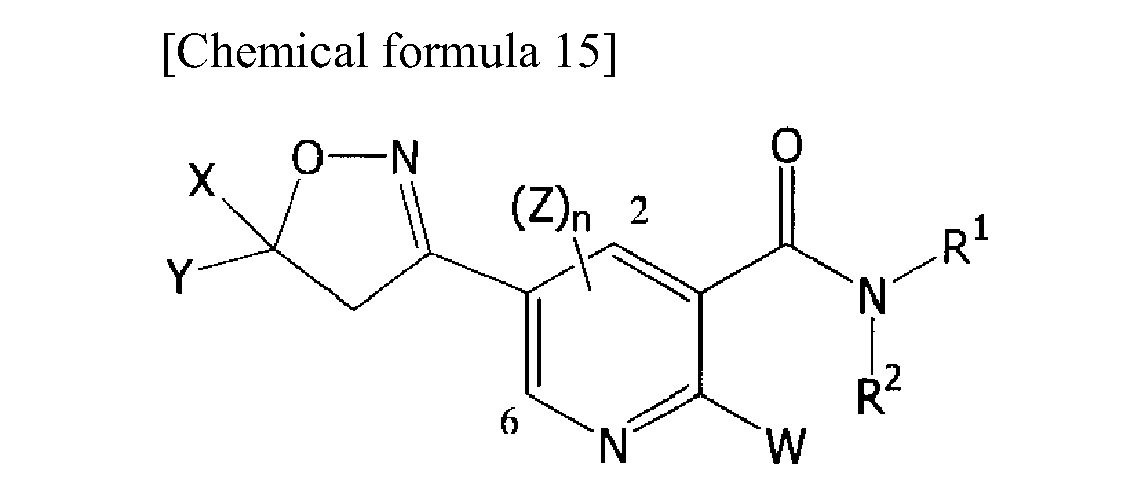
-
[Table 8] Examples of compounds (7) No. Y X (Z)n W R1 R2 1 Me Me - H H H 2 Me Et - H H MeC(O) 3 Me i-Pr - H H EtC(O) 4 Me t-Bt - H H c-PrC(O) 5 Me CF3 - H H PhC(O) 6 Me Ph - H H CH3CH(OMe)CH2C(O) 7 Me 3,5-diCl-Ph - H H N≡CCH2CH2C(O) 8 Me CH2=CH - H H CH3C(OCH2CH2O)CH2C(O) 9 Me CH≡C - H H MeOC(O) 10 Me 2-furyl - H H i-PrOC(O) 11 Me 2-pyridyl - H H t-BtOC(O) 12 Me Me - Cl H H 13 Me Et - Cl H MeC(O) 14 Me i-Pr - Cl H EtC(O) 15 Me t-Bt - Cl H c-PrC(O) 16 Me CF3 - Cl H PhC(O) 17 Me Ph - Br H CH3CH(OMe)CH2C(O) 18 Me 3, 5-diCl-Ph - Br H N≡CCH2CH2C(O) 19 Me CH2=CH - I H CH3C(OCH2CH2O)CH2C(O) 20 Et CH≡C - I H CH3OC(O) 21 Et 2-furyl - F H i-PrOC(O) 22 Et 2-pyridyl - F H t-BtOC(O) 23 Et Me - CN H H 24 Et Et - CN H MeC(O) 25 Et i-Pr - NO2 H EtC(O) 26 Et t-Bt - NO2 H c-PrC(O) 27 Et CF3 - CH3 H PhC(O) 28 Et Ph - CH3 H CH3CH(OMe)CH2C(O) 29 Et 3, 5-diCl-Ph - CF3 H N≡CCH2CH2C(O) 30 Et CH2=CH - CF3 H CH3C(OCH2CH2O)CH2C(O) 31 Et CH=C - MeO H MeOC(O) 32 Et 2-furyl - MeO H i-PrOC(O) 33 Et 2-pyridyl - NH2 H t-BtOC(O) 34 E t Me - NH2 H H 35 Et Et - N(Me)2 H MeC(O) 36 Et i-Pr - N(Me)2 H EtC(O) 37 Et t-Bt - MeS H c-PrC(O) 38 Et CF3 - MeS H PhC(O) 39 i-Pr Ph - MeS(O) H CH3CH(OMe)CH2C(O) 40 i-Pr 3, 5-diCl-Ph - MeS(O) H N≡CCH2CH2C(O) 41 i-Pr CH2=CH - MeS(O)2 H CH3C(OCH2CH2O)CH2C(O) 41 i-Pr CH≡C - MeS(O)2 H CH3OC(O) 43 i-Pr 2-furyl - 2-furyl H i-PrOC(O) 44 i-Pr 2-pyridyl - 2-pyridy l H t-BtOC(O) 45 i-Pr Me - Cl H H 46 i-Pr Et - Cl MeC(O) MeC(O) 47 i-Pr i-Pr - Cl EtC(O) EtC(O) 48 i-Pr t-Bt - Cl c-PrC(O) c-PrC(O) 49 i-Pr CF3 - Cl PhC(O) PhC(O) 50 i-Pr Ph - Cl H CH3CH(OMe)CH2C(O) 51 CF3 3, 5-diCl-Ph 2-Cl H H N≡CCH2CH2C(O) 52 CF3 3, 5-diCl-Ph 6-Cl H H CH3C(OCH2CH2O)CH2C(O) 53 CF3 3, 5-diCl-Ph 2-Br H H CH3OC(O) 54 CF3 3, 5-diCl-Ph 6-Br H H i-PrOC(O) 55 CF3 3, 5-diCl-Ph 2-I H H t-BtOC(O) 56 CF3 3, 5-diCl-Ph 6-I H H H 57 CF3 3, 5-diCl-Ph 2-F H H MeC(O) 58 CF3 3, 5-diCl-Ph 6-F H H EtC(O) 59 CF3 3, 5-diCl-Ph 2-0H H H c-PrC(O) 60 CF3 3, 5-diCl-Ph 6-0H H H PhC(O) 61 CF3 3, 5-diCl-Ph 2-SH H H CH3CH(OMe)CH2C(O) 62 CF3 3, 5-diCl-Ph 6-SH H H N≡CCH2CH2C(O) 63 CF3 3, 5-diCl-Ph 2-NH H H CH3C(OCH2CH2O)CH2C(O) 64 CF3 3, 5-diCl-Ph 6-NH H H CH3OC(O) 65 CF3 3, 5-diCl-Ph 2-N(Me) H H i-PrOC(O) 66 CF3 3, 5-diCl-Ph 6-N(Me) H H t-BtOC(O) 67 CF3 3, 5-diCl-Ph 2-NO2 H H H 68 CF3 3, 5-diCl-Ph 6-NO2 H H MeC(O) 69 CF3 3, 5-diCl-Ph 2-CN H H EtC(O) 70 CF3 3, 5-diCl-Ph 6-CN H H c-PrC(O) 71 CF3 3, 5-diCl-Ph 2-Cl H H PhC(O) 72 CF3 3, 5-diCl-Ph 6-Cl H H CH3CH(OMe)CH2C(O) 73 CF3 3, 5-diCl-Ph 2-Br Cl H N≡CCH2CH2C(O) 74 CF3 3, 5-diCl-Ph 6-Br Cl H CH3C(OCH2CH2O)CH2C(O) 75 CF3 3, 5-diCl-Ph 2-I Cl H CH3OC(O) 76 CF3 3, 5-diCl-Ph 6-I Cl H i-PrOC(O) 77 CF3 3, 5-diCl-Ph 2-F Br H t-BtOC(O) 78 CF3 3, 5-diCl-Ph 6-F Br H H 79 CF3 3, 5-diCl-Ph 2-OH I H MeC(O) 80 CF3 3, 5-diCl-Ph 6-OH I H EtC(O) 81 CF3 3, 5-diCl-Ph 2-SH F H c-PrC(O) 82 CF3 3, 5-diCl-Ph 6-SH F H PhC(O) 83 CF3 3, 5-diCl-Ph 2-NH NO2 H CH3CH(OMe)CH2C(O) 84 CF3 3, 5-diCL-Ph 6-NH NO2 H N≡CCH2CH2C(O) 85 CF3 3, 5-diCl-Ph 2-N(Me)2 OH H CH3C(OCH2CH2O)CH2C(O) 86 CF3 3,5-diCl-Ph 6-N(Me)2 OH H CH3OC (O) 87 CF3 3,5-diCl-Ph 2-NO2 SH H i-PrOC(O) 88 CF3 3,5-diCl-Ph 6-NO2 SH H t-BtOC(O) 89 CF3 3,5-diCl-Ph 2-CN NH H H 90 CF3 3,5-diCl-Ph 6-CN NH H MeC(O) 91 CF3 3,5-diCl-Ph 2-Cl N(Me)2 H EtC(O) 92 CF3 3,5-diCl-Ph 6-Cl N(Me)2 H c-PrC(O) 93 CF3 3.5-diCl-Ph 2-Br CN H PhC(O) 94 CF3 3,5-diCl-Ph 6-Br CN H CH3CH(OMe)CH2C(O) 95 CF3 3.5-diCl-Ph 2-I H H N≡CCH2CH2C(O) 96 CF3 3,5-diCl-Ph 6-I H H CH3C(OCH2CH2O)CH2C(O) 97 CF3 3,5-diCl-Ph 2-F H H CH3OC (O) 98 CF3 3.5-diCl-Ph 6-F H H i-PrOC (O) 99 CF3 3,5-diCl-Ph 2-OH H H t-BtOC(O) 100 CF3 3,5-diCl-Ph 6-OH H H H -

-
[Table 9] Examples of compounds (8) No. Y X (Z) n W Rc R1 R2 1 Me Me - H H H H 2 Me Et - H H H MeC(O) 3 Me i-Pr - H H H EtC(O) 4 Mc t-Bt - H H H c-PrC(O) 5 Me CF3 - H H H PhC(O) 6 Me Ph - H H H CH3CH(OMe)CH2C(O) 7 Me 3,5-diCl-Ph - H H H N≡CCH2CH2C(O) 8 Me CH2-CH - H H H CH3C(OCH2CH2O)CH2C (0) 9 Me CH≡C - H H H MeOC(O) 10 Me 2-furyl - H H H i-PrOC(O) 11 Me 2-pyridyl - H H H t-BtOC(O) 12 Me Me - Cl H H H 13 Me Et - Cl H H MeC(O) 14 Me i-Pr - Cl H H EtC(O) 15 Me t-Bt - Cl H H c-PrC(O) 16 Me CF3 - Cl H H PhC(O) 17 Me Ph - Br H H CH3CHOMe)CH2C(O) 18 Me 3,5-diCl-Ph - Br H H N≡CCH2CH2C(O) 19 Me CH2=CH - I H H CH3C(OCH2CH2O)CH2C(O) 20 Et CH≡C - I H H CH3OC(O) 21 Et 2-furyl - F H H i-PrOC(O) 22 Et 2-pyridyl - F H H t-BtOC (O) 23 Et Me - CN H H H 24 Et Et - CN H H MeC(O) 25 Et i-Pr - NO2 H H EtC(O) 26 Et 1-Bt - NO2 H H c-PrC(O) 27 Et CF3 - CH3 H H PhC(O) 28 Et Ph - CH3 H H CH3CH(OMe)CH2C(O) 29 Et 3,5-diCl-Ph - CF3 H H N≡CCH2CH2C(O) 30 Et CH2=CH - CF3 H H CH3C(OCH2CH2O)CH2C(O) 31 Et CH≡C - MeO H H MeOC(O) 32 Et 2-furyl - MeO H H i-PrOC(O) 33 Et 2-pyridyl - NH2 H H t-BtOC(O) 34 Et Me - NH2 H H H 35 Et Et - N(Me)2 H H MeC(O) 36 Et i-Pr - N(Me)2 H H EtC(O) 37 Et t-Bt - MeS H H c-PrC(O) 38 Et CF3 - MeS H H PhC(O) 39 i-Pr Ph - MeS(O) H H CH3CH(OMe)CH2C(O) 40 i-Pr 3,5-diCl-Ph - MeS(O) H H N≡CCH2CH2C(O) 41 i-Pr CH2=CH - MeS (O)2 H H CH3C(OCH2CH2O)CH2C(O) 41 i-Pr CH≡C - MeS (O)2 H H CH3OC(O) 43 i-Pr 2-furyl - 2-furyl H H i-PrOC(O) 44 i-Pr 2-pyridyl - 2-pyridyI H H t-BtOC (O) 45 i-Pr Me - Cl H H H 46 i-Pr Et - Cl H MeC(O) MeC(O) 47 i-Pr i-Pr - Cl H EtC(O) EtC(O) 48 i-Pr t-Bt - Cl H c-PrC(O) c-PrC(O) 49 i-Pr CF3 - Cl H PhC(O) PhC(O) 50 i-Pr Ph - Cl H H CH3CH(OMe)CH2C(O) 51 CF3 3,5-diCl-Ph 2-Cl H H H N≡CCH2CH2C(O) 52 CF3 3,5-diCl-Ph 6-Cl H Me H CH3C(OCH2CH2O)CH2C(O) 53 CF3 3,5-diCl-Ph 2-Br H Et H CH3OC(O) 54 CF3 3.5-diCl-Ph 6-Br H CF3 H i-PrOC(O) 55 CF3 3,5-diCl-Ph 2-1 H Ph H t-BtOC(O) 56 CF3 3,5-diCl-Ph 6-1 H c-Pr H H 57 CF3 3,5-diCl-Ph 2-F H c-Hex H MeC(O) 58 CF3 3,5-diCl-Ph 6-F H PhCH2 H EtC(O) 59 CF3 3,5-diCl-Ph 2-NO2 H CH2=CH H c-PrC(O) 60 CF3 3,5-diCl-Ph 6-NO2 H CH≡C H PhC(O) 61 CF3 3,5-diCl-Ph 2-OH H H H CH3CH(OMe)CH2C(O) 62 CF3 3,5-diCl-Ph 6-OH H Me H N≡CCH2CH2C(O) 63 CF3 3,5-diCl-Ph 2-SH H Et II CH3C(OCH2CH2O)CH2C(O) 64 CF3 3,5-diCl-Ph 6-SH H CF3 H CH3OC(O) 65 CF3 3,5-diCl-Ph 2-NH H Ph H i-PrOC(O) 66 CF3 3,5-diCl-Ph 6-NH H c-Pr H t-BtOC(O) 67 CF3 3,5-diCl-Ph 2-N(Me) H c-Hex H H 68 CF3 3,5-diCl-Ph 6-N(Me) H PhCH2 H MeC(O) 69 CF3 3,5-diCl-Ph 2-CN H CH2=CH H EtC(O) 70 CF3 3,5-diCl-Ph 6-CN H CH≡C H c-PrC(O) 71 CF3 3,5-diCl-Ph 2-Cl H H H PhC(O) 72 CF3 3,5-diCl-Ph 6-Cl H Me H CH3CH(OMe)CH2C(O) 73 CF3 3,5-diCl-Ph 2-Br Cl Et H N≡CCH2CH2C(O) 74 CF3 3,5-diCl-Ph 6-Br Cl CF3 H CH3C(OCH2CH2O)CH2C(O) 75 CF3 3,5-diCl-Ph 2-1 Cl Ph H CH3OC(O) 76 CF3 3,5-diCl-Ph 6-I Cl c-Pr H i-PrOC(O) 77 CF3 3,5-diCl-Ph 2-F Br c-Hex H t-BtOC(O) 78 CF3 3,5 diCl-Ph 6-F Br PhCH2 H H 79 CF3 3,5-diCl-Ph 2-NO2 I CH2=CH H MeC(O) 80 CF3 3,5-diCl-Ph 6-NO2 I CH≡C H EtC(O) 81 CF3 3,5-diCl-Ph 2-OH F H H c-PrC(O) 82 CF3 3,5-diCl-Ph 6-OH F Me H PhC(O) 83 CF3 3,5-diCl-Ph 2-SH NO2 Et H CH3CH(OMe)CH2C(O) 84 CF3 3,5-diCl-Ph 6-SH NO2 CF3 H N≡CCH2CH2C(O) 85 CF3 3,5-diCl-Ph 2-NH2 OH Ph H CH3C (OCH2CH2O) CH2C (O) 86 CF3 3,5-diCl-Ph 6-NH2 OH c-Pr H CH3OC(O) 87 CF3 3,5-diCl-Ph 2-N(Me)2 SH c-Hex H i-PrOC(O) 88 CF3 3,5-diCl-Ph 6-N(Me)2 SH PhCH2 H t-BtOC(O) 89 CF3 3,5-diCl-Ph 2-CN NH2 CH2=CH H H 90 CF3 3,5-diCl-Ph 6-CN NH2 CH≡C H MeC(O) 91 CF3 3,5-diCl-Ph 2-Cl N(Me)2 H H EtC(O) 92 CF3 3,5-diCl-Ph 6-Cl N(Me)2 Me H c-PrC(O) 93 CF3 3,5-diCl-Ph 2-Br CN Et H PhC(O) 94 CF3 3,5-diCl-Ph 6-Br CN CF3 H CH3CH(OMe)CH2C(O) 95 CF3 3,5-diCl-Ph 2-1 H Ph H N≡CCH2CH2C(O) 96 CF3 3,5-diCl-Ph 6-1 H c-Pr H CH3C(OCH2CH2O)CH2C(O) 97 CF3 3,5-diCl-Ph 2-F H c-Hex H CH3OC(O) 98 CF3 3,5-diCl-Ph 6-F H PhCH2 H i-PrOC(O) 99 CF3 3,5-diCl-Ph 2-OH H CH2=CH H t-BtOC(O) 100 CF3 3,5-diCl-Ph 6-OH H CH≡C H H - The compounds expressed by formula (I) of the present invention may be synthesized based on known reactions. For example, they may be manufactured by the methods shown below.
- Among the compounds expressed by the aforementioned formula (I), compounds expressed by formula (I-1) wherein D is a methylene group may be manufactured as follows.
-

- (In the formula, A, X, Y, Z, W, R1 R2, and n express the same meanings described above, J1 expresses a halogen atom, and L1 and L2 express elimination groups such as halogen atoms and the like. However, R1 and R2 exclude hydrogen atoms in here.)
- That is, first, a halogenation agent is made to act upon a compound expressed by formula (II) to obtain a compound expressed by formula (III).
- As the halogenation agent that is employed, one may cite N-halogenosuccinimide such as N-chlorosuccinimide and N-bromosuccinimide; alkali metal salt of hypohalous acid such as sodium hypochlorite; esters of hypohalous acid such as hydrochlorite-t-butylester; halogen carrier such as chlorine gas; and the like.
- It is preferable that this reaction occur in a solvent. There are no particular limitations on the employed solvent provided that it is inert in the reaction. For example, one may cite aromatic hydrocarbons such as benzene, toluene, and xylene; aliphatic hydrocarbons such as hexane and heptane; alicyclic hydrocarbons such as cyclohexane; aromatic halogenated hydrocarbons such as chlorobenzene and dichlorobenzene; aliphatic halogenated hydrocarbons such as dichloromethane, chloroform, carbon tetrachloride, 1,2-dichloroethane, 1,1,1-trichloroethane, trichloroethylene, and tetrachloroethylene; ethers such as diethyl ether, 1,2-dimethoxyethane, tetrahydrofuran, and 1,4-dioxane; esters such as ethyl acetate and ethyl propionate; amides such as N,N-dimethyl formamide, N,N-dimethylacetamide, and N-methyl-2-pyrrolidone; alcohols such as methanol, ethanol, and ethylene glycol; carboxylic acids such as acetic acid and propionic acid; acetonitrile; water; and the like.
- These solvents may be used alone, or in mixtures of two or more.
- The obtained compounds expressed by formula (III) may normally be provided to the following reactions without being isolated.
- Next, after subjecting the compound expressed by formula (III) to the action of a base, a compound expressed by formula (IV) may be obtained by the action of a compound expressed by formula (a).
- As the base to be employed, one may cite, for example, alkali metal hydroxides such as sodium hydroxide and potassium hydroxide; alkali metal carbonates such as sodium carbonate and potassium carbonate; alkali metal bicarbonates such as sodium bicarbonate and potassium bicarbonate; organic base such as triethylamine, imidazole, and 1,8-diazabicyclo[5.4.0]-7-undecene; and the like.
- It is preferable that this reaction be conducted in a solvent. There are no particular limitations on the employed solvent provided that it is inert in the reaction, and one may cite, for example, the same solvents used in the reaction to obtain the aforementioned compound expressed by formula (III).
- With respect to the usage amount of the compound expressed by formula (a), it is normally a 1-5 equivalent relative to the compound expressed by formula (III).
- Subsequently, a compound expressed by formula (V) may be obtained by reacting the aforementioned compound expressed by formula (IV) with hydrazine according to conventional methods.
- Furthermore, a compound expressed by formula (I-1) may be obtained by reacting compounds expressed by the formula R1-L1 and the formula R2-L2 with the compound expressed by formula (V) in a stepwise manner.
- The aforementioned compound expressed by formula (II) may be obtained, for example, as follows.
-

- Subsequently, a compound expressed by formula (II) is obtained by reacting hydroxylamine with the obtained compound expressed by formula (VII).
- There are no particular limitations on the solvent to be used in this reaction provided that it is inert in the reaction, and one may cite alcohols such as ethanol and i-propyl alcohol and the like; water; mixed solvents of these; and so on.
- Otherwise, with respect to this reaction, it is also acceptable to generate free hydroxylamine in the reaction system by conducting addition to the reaction solution in the form of hydroxylamine salt (hydroxylamine hydrochloride or the like) that is easy to handle, adding thereto base such as sodium acetate, sodium hydroxide, triethylamine or the like.
- Of the aforementioned compounds expressed by formula (I), it is also possible to manufacture a compound expressed by formula (I-1) wherein D is a methylene group by another method.


- The halogenation of compound (VIII), the reaction of compound (IX) with a base and with a compound expressed by (a), and the halogenation of compound (X) are identical to the aforementioned manufacturing method 1. Subsequently, a compound expressed by formula (XII) is obtained by azidation compound (XI) in a solvent.
- As the azidation agent, one may cite, for example, metal azides such as lithium azide and sodium azide; silicon azide compounds such as trimethylsilyl azide; and phosphoryl azide compounds such as diphenylphosphoryl azide.
- As the solvent employed in the azidation reaction, an aprotic polar solvent is preferable, and one may cite, for example, acetone, acetonitrile, N,N-dimethyl formaldehyde, dimethyl sulfoxide, and the like.
- The azide compound expressed by formula (XII) is made into an amine compound expressed by formula (XIII) by the method that uses hydrogen gas and metal catalyst, the method that uses tin (II) chloride dihydrate, the method that uses a reducing agent such as LiAlH4, or the like. As the employed solvent, one may cite methanol, ethanol, isopropyl alcohol, and the like.
- Furthermore, as in the aforementioned manufacturing method 1, a compound expressed by formula (I-1) may be obtained by reacting compounds expressed by the formula R1-L1 and the formula R2-L2 with the compound expressed by formula (XIII) in a stepwise manner.
- With respect to a compound expressed by formula (I), a compound expressed by formula (1-2) wherein D is a group expressed by the formula - NH - may be manufactured as follows.
-


- That is, first, sodium nitrite is reacted with a compound expressed by formula (XIV), after which a hydrazine compound (XV) is obtained by the action of a reducing agent such as tin chloride. Subsequently, a compound expressed by the target formula (1-2) may be obtained by reacting a compound expressed by the formula R1-L1 and a compound expressed by the formula R2-L2 with this compound in a stepwise manner.
- The hydrazine compound (XV) may be isolated in the form of hydrochloride salt or sulfate salt.
- A compound expressed by formula (XIV) may be manufactured in the same way as the method recorded in Japanese Unexamined Patent Application, First Publication No.
2007-016017 - There are no limitations on the salts of compounds expressed by formula (I) provided that they are horticulturally permissible. For example, one may cite inorganic acid salts of compounds expressed by formula (I) such as hydrochloride salts, nitrate salts, sulfate salts, and phosphate salts; and organic acid salts of acetic acid, propionic acid, lactic acid, and the like.
- Salts of compounds expressed by formula (I) may be manufactured, for example, by causing an inorganic acid or organic acid to act upon a compound expressed by formula (I).
- With respect to whichever reaction, if purification of the product is required after termination of the reaction and following the normal after-treatment operations, the target substance may be isolated by conducting purification by a purification means known to those skilled in the art such as distillation, recrystallization, or column chromatography.
- The compounds and their salts of the present invention obtained in the foregoing manner may be utilized for the control of agricultural pests, hygiene pests, stored grain pests, clothing pests, household pests, and the like, and may have adulticidal, pupicidal, larvicidal, or ovicidal activity.
- Accordingly, as described below, the compounds of the present invention are useful as effective ingredients of pest control agents.
- Among the compounds of the present invention, some exhibit germicidal, herbicidal, and plant growth regulatory activity. In addition, among intermediate compounds of the compounds of the present invention, some exhibit pesticidal and acaricidal activity.
- Moreover, the compounds of the present invention may also be used as antifoulants that serve to prevent adhesion of aquatic organisms to marine implements such as ship bottoms and fishing nets.
- A pest control agent of the present invention may contain a single type or two or more types of the compounds of the present invention as its active ingredient. It is preferable that the pest control agent of the present invention be an insecticidal agent or an acaricidal agent.
- One may cite the following as representative examples of agricultural pests, hygiene pests, stored grain pests, clothing pests, household pests, or the like.
- Lepidopteran pests such as, for example, Spodoptera litura, Mamestra brassicae, agrotis ipsilon, green caterpillars, Autographa nigrisigna, Plutella xylostella, Adoxophyes honmai, Homona magnanima, Carposina sasakii, Grapholita molesta, Phyllocnistis citrella, Caloptilia theivora, Phyllonorycter ringoniella, Lymantria dispar, Euproctis pseudoconspersa, Chilo suppressalis, Cnaphalocrocis medinalis, Ostrinia nubilasis, Hyphantria cunea, Cadra cautella, genus Heliothis, genus Helicoverpa, genus Agrothis, Tinea translucens, Cydia pomonella, and Pectinophora gossypiella;
- hemipteran pests such as, for example, Myzus persicae, Aphis gossypii, Lipaphis erysimi, Rhopalosiphum padi, Riptortus clavatus, Nezara antennata, Unaspis yanonensis, Pseudococcus comstocki, Trialeurodes vaporariorum, Bemisia tabaci, Bemisia argentifolii, Psylla pyrisuga, Stephanitis nashi, Nilaparuata lugens, Laodelphax stratella, Sogatella furcifera, and Nephotettix cincticeps;
coleopteran pests such as, for example, Phyllotreta striolata, Aulacophora femoralis, Leptinotarsa decemlineata, Lissorhoptrus oryzophilus, Sitophilis zeamais, Callosobruchus chinensis, Popillia japonica, Anomala rufocuprea, genus Diabrotica, Lasioderma serricorne, Lyctus brunneus, Monochamus alternatus, Anoplophora malasiaca, genus Agriotis, Epilachna vigintioctopunctata, Tenebroides mauritanicus, and Anthonomus grandis;
dipteran pests such as, for example, Musca domestica, Calliphora lata, Boettcherisca peregrine, Zeugodacus cucurbitae, Bactrocera dorsalis, Delia platura, Agromyza oryzae, Drosophila melanogaster, Stomoxys calcitrans, Culex tritaeniorhynchus, Aedes aegypti, and Anopheles sinensis;
thysanopteran pests such as, for example, Thrips palmi, and Scirtothrips dorsalis; hymenopteran pests such as, for example, Monomorium pharaonis, Vespa simillima xanthoptera, and Athalia rosae ruficornis;
orthopteran pests such as, for example, Locusta migratoria, Blattella germanica, Periplaneta americana, and Periplaneta fuliginosa; - isopteran pests such as, for example, Coptotermes formosanus and Reticulitermes speratus;
siphonapteran pests such as, for example, Pulex irritans and Ctenocephalides felis; phthirapteran pests such as, for example, Pediculus humanus ;
Acarina such as Tetranychus urticae, Tetranychus cinnabarinus, Tetranychus kanzawai, Panonychus citri, Panonychus ulmi, Aculops pelekassi, Aculus schlechtendali, Polyphagotarsonemus latus , genus Brevipalpus , genus Eotetranichus, Rhizoglyphus robini, Tyrophagus putrescentiae, Dermatophagoides farinae, Boophilus microplus , and Haemaphysalis longicornis ; and
plant parasitic nematodes such as Meloidogyne incognita, Pratylenchus spp., Heterodera glycines, Aphelenchoides besseyi , and Bursaphelenchus xylophilus. - Of these, pests to which application is particularly preferable are lepidopteran pests, hemipteran pests, acarina, thysanopteran pests, and coleopteran pests.
- In recent years, the resistance of many pests such as diamondback moths, planthoppers, leafhoppers and aphids to organophosphorous agents, carbamate agents and acaricides has grown, the impotency of such chemical agents has become problematic, and there has been increasing demand for chemical agents that are effective relative to resistant strains of pests and mites. The compounds of the present invention are chemical agents that have excellent pesticidal and miticidal effects not only relative to susceptible strains, but also relative to strains of pests that are resistant to organophosphorous agents, carbamate agents, and pyrethroid agents, as well as strains of mites that are resistant to miticidal agents. Moreover, the pest control agents of the present invention are chemical agents that have few harmful effects, low toxicity relative to fish and mammals, and high stability.
- When the pest control agents of the present invention are practically applied, one may use a single type or two or more types of the compounds of the present invention as is without addition of other components, but they are normally further mixed with a solid carrier, liquid carrier, or gaseous carrier, or impregnated into a base material such as porous ceramic sheet or nonwoven cloth, with addition of surfactants and other adjuvants as necessary, and formulated for use in a form that can be assumed by common agrochemicals for the purpose of use as an agrochemical, that is, a form such as a wettable powder, granular agent, dust agent, emulsion agent, water-soluble agent, suspension agent, granular wettable powder, flowable, aerosol, smoke and misting agent, heat steam agent, fumigant, poison bait, or microcapsule.
- Additives and carriers which may be employed in the case where a solid formulation is desired include vegetable powders such as soybean or wheat flour and the like; mineral micropowders such as diatom clay, apatite, plaster, talc, bentonite, pyrophyllite, clay, and the like; organic and inorganic compounds such as benzoate soda, urea, Glauber's salt, and the like. Solvents which may be employed in the case where a liquid agent is desired include petroleum distallates such as kerosene, xylene, solvent naphtha and the like; cyclohexane, cyclohexanone, dimethylformamide, dimethylsulfoxide, alcohol, acetone, methylisobutylketone, mineral oil, vegetable oil, water, and the like. As a gas carrier which may be employed in the spray agent, one may use butane gas, LG, dimethyl ether, and carbon dioxide gas.
- As a base material for poison bait, one may use, for example, bait ingredients such as grain flour, vegetable oil, sugar, and crystalline cellulose; antioxidants such as dibutylhydroxytoluene and nordihydroguacetic acid; preservatives such as dehydroacetic acid; agents which prevent children and pets from eating by mistake such as powdered capsicum; , and vermin attracting perfumes such as cheese perfume and onion perfume.
- Surfactants may be added as necessary in order to achieve a uniform and stable morphology in these formulations. There are no particular limitations on surfactants, and one may cite, for example, nonionic surfactants such as alkyl ether to which polyoxyethylene is added, higher fatty acid ester to which polyoxyethylene is added, sorbitan higher fatty acid ester to which polyoxyethylene is added, and tristyrylphenyl ether to which polyoxyethylene is added, sulfate ester salt of alkylphenyl ether to which polyoxyethylene is added, alkylnaphthalene sulfonate, polycarboxylate, lignin sulfonate, formaldehyde condensate of alkyl naphthalene sulfonate, copolymer of isobutylene-maleic anhydride, and the like.
- There are no particular limitations on the amount of active ingredient in the pest control agent of the present invention, but 0.01-90 weight % is preferable, and 0.05-85 weight % is particularly preferable.
- In the case where the pest control agent of the present invention is to be used for agricultural purposes, the formulation may be prepared as a wettable powder, emulsion agent, suspension agent, flowable agent, water-soluble agent, granular wettable powder, or the like. These formulations may be used by diluting to a prescribed concentration to obtain a solution, suspension or emulsion and spraying them on plants or soil, or in the case of a dust formulation or granular formulation, it may be used by directly spraying them on plants or soil.
- In the case where the compound of the present invention is used as a pest control agent for the prevention of epidemics, the formulation may be prepared as an emulsion agent, wettable powder, flowable agent, or the like, and these formulations may be applied after dilution with water to a prescribed concentration. In the case where the formulation is prepared as an oil agent, aerosol, smoke and misting agent, poison bait, mite control sheet, or the like, it may be directly applied.
- In the case where compounds of the present invention are used as pest control agents for the control of external parasites of animals such as livestock including cows and pigs, or pets including dogs and cats, the normal formulations of compounds of the present invention are used by methods known to those skilled in the veterinary art.
- With respect to these methods, in the case where, for example, systemic control is desired, one may cite methods of administration by tablet, capsule, immersion fluid, feed intermixture, suppository, injection (intramuscular, subcutaneous, intravenous, intraperitoneal, and so on), and the like; in the case where non-systemic control is desired, one may cite methods of administration of oleaginous or aqueous solutions by spray, pour-on, spot-on, and the like; as well as methods of application of resin formulations molded into an appropriate shape such as a collar or ear tag. In these cases, compounds of the present invention may be used in a proportion of 0.01-1000 mg relative to 1 kg of an ordinary host animal.
- It goes without saying that a compound of the present invention is sufficiently effective when used alone, and it may also be used in a mixture or combination with one or more other types of pest control agent, bactericide, insecticide/acaricide, nematicide, soil pest control agent, herbicide, plant growth regulation agent, synergist, fertilizer, soil improver, animal feed, and so on.
- Representative examples of active ingredients of bactericides, insecticides, acaricides, nematicides, soil pest control agents, synergists, plant growth regulation agents, and the like which can be mixed or combined with a compound of the present invention are shown below.
- Fungicides (common names; including some still in the application stage): anilinopyrimidine compounds such as mepanipyrim, pyrimethanil, and cyprodinil; pyridinamine compounds such as fluazinam;
- azole compounds such as triadimefon, bitertanol, triflumizole, etaconazole, propiconazole, penconazole, flusilazole, myclobutanil, cyproconazole, tebuconazole, hexaconazole, furconazole-cis, prochloraz, metconazole, epoxiconazole, tetraconazole, oxpoconazole fumarate, sipconazole, prothioconazole, triadimenol, flutriafol, difenoconazole, fluquinconazole, fenbuconazole, bromuconazole, diniconazole, tricyclazole, probenazole, simeconazole, pefurazoate, ipconazole, imibenconazole, and imazalil;
- quinoxaline compounds such as quinomethionate; dithiocabamate compounds such as maneb, zineb, mancozeb, polycarbamate, metiram, propineb, ferbam, nabam, metam, thiram, and ziram;
- organic chlorine compounds such as fthalide, chlorothalonil, and quintozene;
imidazole compounds such as benomyl, thiophanate-methyl, carbendazim, thiabendazole, fuberiazole, and cyazofamid;
cyano acetamide compounds such as cymoxanil; - phenylamide compounds such as metalaxyl, metalaxyl-M, mefenoxam,oxadixyl, ofurace, benalaxyl, benalaxyl-M, furalaxyl, and cyprofuram;
sulfenic acid compounds such as dichlofluanid; - nitrophenyl compounds such as dinocap;
copper compounds such as cuprichydroxide or oxine copper;
isoxazole compounds such as hymexazol; organic phosphorus compounds such as fosetyl-Al, tolcofos-methyl, S-benzyl O,O-diisopropylphosphorothioate, O-ethyl S,S-diphenylphosphorodithioate, and aluminum ethylhydrogen phosphonate; - N-halogenothioalkyl compounds such as captan, captafol, and folpet;
dicarboxyimide compounds such as procymidone, iprodione, and vinclozolin;
benzanilide compounds such as flutolanil, mepronil, zoxamid, and tiadinil; - anilide compounds such as carboxin, oxycarboxin, thifluzamide, penthiopyrad, boscalid, fluopicolide, fluopyram, and bixafen;
piperazine compounds such as triforine;
pyridine compounds such as pyrifenox; carbinol compounds such as fenarimol and flutriafol; - piperidine compounds such as fenpropidine;
morpholine compounds such as fenpropimorph and tridemorph;
organotin compounds such as fentin hydroxide and fentin acetate;
urea compounds such as pencycuron;
cinnamic acid compounds such as dimethomorph, flumorph, and flumetover; phenylcarbamate compounds such as diethofencarb; - cyanopyrrole compounds such as fludioxonil and fenpiclonil;
strobilurin compounds such as azoxystrobin, kresoxim-methyl, metominofen, metominostrobin, trifloxystrobin, picoxystrobin, oryzastrobin, dimoxystrobin, pyraclostrobin, and fluoxastrobin; - oxazolidinone compounds such as famoxadone;
thiazolecarboxamide compounds such as ethaboxam;
silylamide compounds such as silthiopham; amino acid amidecarbamate compounds such as iprovalicarb and benthiavalicarbisopropyl;
imidazolidine compounds such as fenamidone;
hydroxanilide compounds such as fenhexamid;
benzenesulfonamide compounds such as flusulfamide; oxime ether compounds such as cyflufenamid; - phenoxyamide compounds such as fenoxanil;
antibiotics such as validamycin, kasugamycin, and polyoxin;
guanidine compounds such as iminoctadine; - and other compounds such as tolyfluanid, isoprothiolane, pyroquilon, diclomezine, quinoxyfen, propamocarb hydrochloride, spiroxamine, chloropicrin, dazomet, metam-sodium, nicobifen, metrafenone, UBF-307, diclocymet, proquinazid, amisulbrom, pyribencarb mandipropamid, 5-chlor-7-(4-methyl-piperidin-1-yl)-6-(2,4,6-trifluor-phenyl) - [1,2,4] triazolo [1,5-a] pyrimidin, and OK-5203.
- Pesticides, acaricides, nematicides, or soil pest control agents (common names; including some still in the application stage): organic phosphate ester compounds such as profenofos, dichlorvos, fenamiphos, fenitrothion, EPN, diazinon, chlorpyrifos-methyl, acephate, prothiofos, fosthiazate, phosphocarb, cadusafos, disulfoton, chlorpyrifos, demeton-S-methyl, dimethoate, methamidophos, isoxathion, isofenphos, ethion, etrimfos, quinalphos, dimethylvinphos, sulprofos, thiometon, vamidothion, pyraclofos, pyridaphenthion, pirimiphos-methyl, propaphos, phosalone, formothion, malathion, tetrachlovinphos, chlorfenvinphos, cyanophos, trichlorfon, methidathion, phenthoate, ESP, azinphos-methyl, fenthion, heptenophos, methoxychlor, paration, monocrotophos, imicyafos, parathion-methyl, terbufos, phospamidon, phosmet, and phorate;
- carbamate compounds such as carbaryl, propoxur, aldicarb, carbofuran, thiodicarb, methomyl, oxamyl, ethiofencarb, pirimicarb, fenobucarb, carbosulfan, benfuracarb, bendiocarb, furathiocarb, isoprocarb, metolcarb, xylylcarb, XMC, and fenothiocarb;
- nereistoxin derivatives such as cartap, thiocyclam, bensultap and thiosultap-sodium; organic chlorine compounds such as dicofol, tetradifon, endosulufan, dienochlor and dieldrin;
organic metal compounds such as fenbutatin oxide and cyhexatin; - pyrethroid compounds such as fenvalerate, permethrin, cypermethrin, deltamethrin, cyhalothrin, tefluthrin, ethofenprox, cyfluthrin, fenpropathrin, bifenthrin, flucythrinate, fluvalinate, cycloprothrin, lambda-cyhalothrin, pyrethrins, esfenvalerate, tetramethrin, resmethrin, protrifenbute, zeta-cypermethrin, acrinathrin, alpha-cypermethrin, allethrin, gamma-cyhalothrin, theta-cypermethrin, tau-fluvalinate, tralomethrin, profluthrin, beta-cypermethrin, beta-cyfluthrin, metofluthrin, and phenothrin;
- benzoylurea compounds such as diflubenzuron, chlorfluazuron, teflubenzuron, flufenoxuron, lufenuron, novaluron, triflumuron, hexaflumuron, noviflumuron, bistrifluoron and fluazuron;
juvenile hormone-like compounds such as methoprene, pyriproxyfen, fenoxycarb and diofenolan; - pyridazinone compounds such as pyridaben;
pyrazole compounds such as fenpyroximate, fipronil, tebufenpyrad, ethiprole, tolfenpyrad, acetoprole, pyrafluprole, and pyriprole; - neonicotinoids such as imidacloprid, nitenpyram, acetamiprid, thiacloprid, thiamethoxam, clothianidin, dinotefuran, and nithiazine;
hydrazine compounds such as tebufenozide, methoxyfenozide, chromafenozide, and halofenozide; - and other compounds such as flonicamid, buprofezin, hexythiazox, amitraz, chlordimeform, silafluofen, triazamate, pymetrozine, pyrimidifen, chlorfenapyr, indoxacarb, acequinocyl, etoxazole, cyromazine, 1,3-dichloropropene, diafenthiuron, benclothiaz, flufenerim, pyridalyl, spirodiclofen, bifenazate, spiromesifen, spirotetramat, propargite, clofentezine, fluacrypyrim, metaflumizone, flubendiamide, cyflumetofen, chlorantraniliprole, cyenopyrafen, pyrifluquinazon, fenazaquin, amidoflumet, chlorobenzoate, sulfluramid, hydramethylnon, metaldehyde, and ryanodine.
- Further, one may cite: microbial agricultural chemicals such as Bacillus thuringienses aizawai, Bacillus thuringienses kurstaki, Bacillus thuringienses israelensis, Bacillus thuringienses japonensis, Bacillus thuringienses tenebrionis, insecticidal crystal protein produced by Bacillus cthuringienses, insect viruses, etomopathogenic fungi, and nematophagous fungi; antibiotics or semisynthetic antibiotics such as avermectin, emamectin-benzoate, milbemectin, spinosad, ivermectin, and lepimectin;
- natural products such as azadirachtin and rotenone;
synergists such as piperonyl butoxide;
and repellents such as deet; and so on. - Plant growth regulators such as gibberellins (e.g., gibberellins A3, gibberellins A4, and gibberellin A7), IAA, NAA, and the like.
- Next, the present invention is described in further detail with reference to working examples, but the present invention is in no way limited by the following working examples.
-

- 6.2 g of 4-fluoro-3-methylbenzaldehyde oxime were dissolved in 50 ml of 1,2-dimethoxy ethane, 6.5 g of N-chlorosuccinimide were added, and stirring was conducted for two hours at 70°C. Subsequently, the reaction solution was cooled to 0°C, 9.8 g of 3,5-dichloro-1-(1-trifluoromethyl ethenyl) benzene, 10.2 g of potassium bicarbonate, and 10 ml of water were added, and stirring was conducted overnight at room temperature. The reaction solution was poured into ice water, extracted with ethyl acetate, and washed with water and brine, and dried with anhydrous magnesium sulfate. The solvent was removed to vacuum distillation, and the obtained residue was purified by silica gel column chromatography (eluent: ethyl acetate/n-hexane = 1/9) to obtain 11.1 g of the target compound. Yield was 69%; 1H-NMR (CDCl3, δppm) ; 2.31 (s, 3H), 3.67 (d, 1H), 4.05 (d, 1H), 7.05 (t, 1H), 7.42-7.54 (m, 5H).
-

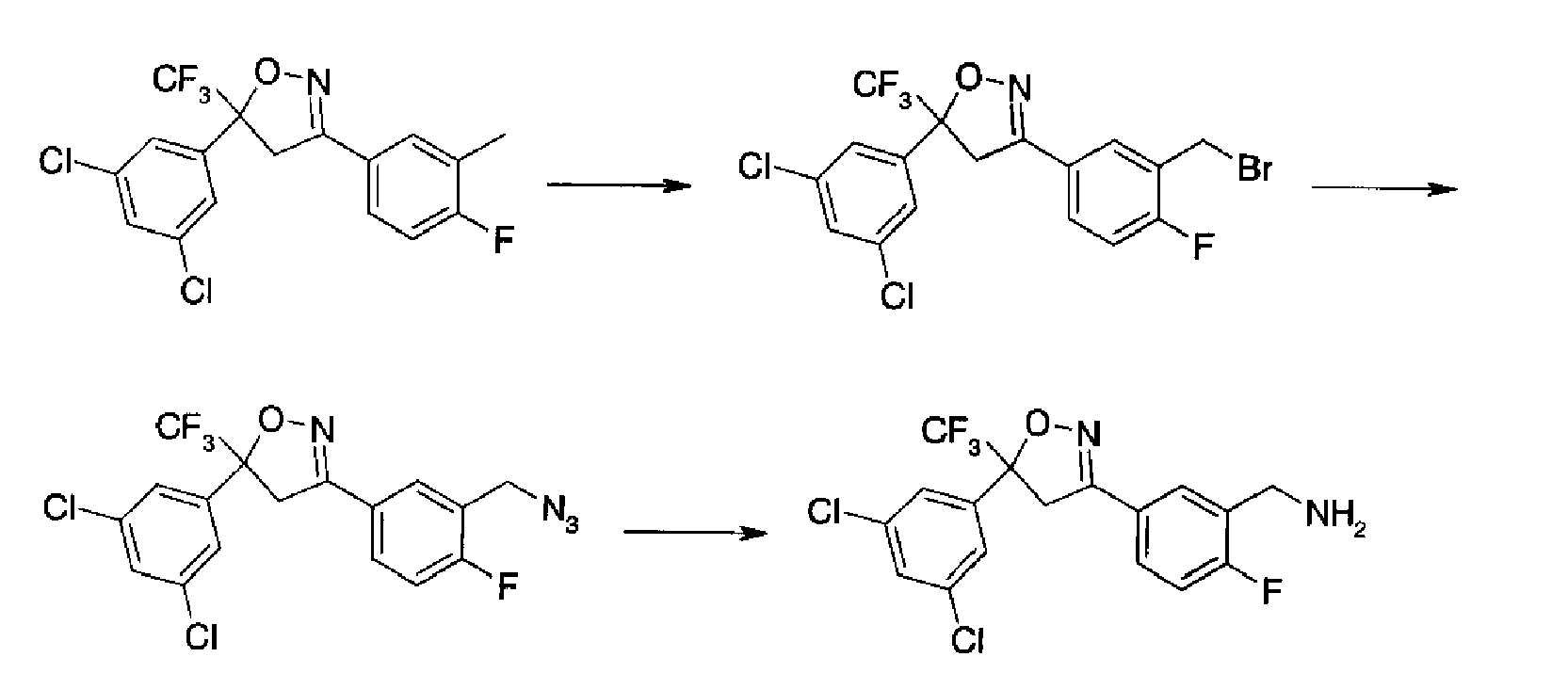
- 11.1 g of 5-(3,5-dichlorophenyl)-3-(4-fluoro-3-methylphenyl)-5-trifluoromethyl-4,5-dihydroisoxazole were dissolved in 100 ml of carbon tetrachloride, 6.0 g of N-bromosuccinimide and 0.2 g of benzoyl peroxide were added, and heat reflux was conducted overnight. The reaction solution was cooled to room temperature, and filtered, and the filtrate was removed to vacuum concentration to obtain unpurified 3-(3-bromomethyl-4-fluorophenyl)-5-(3,5-dichlorophenyl)-5-trifluoromethyl-4,5-dihydroisoxazole. The obtained unpurified 3-(3-bromomethyl-4-fluorophenyl)-5-(3,5-dichlorophenyl)-5-trifluoromethyl-4,5-dihydroisoxazole was dissolved in 120 ml of N,N-dimethylformamide, 7.3 g of sodium azide were added, and stirring was conducted overnight at room temperature. The reaction solution was poured into ice water, extracted with ethyl acetate, and washed with water and brine, and dried with anhydrous magnesium sulfate. The solvent was removed to vacuum distillation, and unpurified 3-(3-azidemethyl-4-fluorophenyl)-5-(3,5-dichlorophenyl)-5-trifluoromethyl-4,5-dihydroisoxazole was obtained. The obtained unpurified 3-(3-azidemethyl-4-fluorophenyl)-5-(3,5-dichlorophenyl)-5-trifluoromethyl-4,5-dihydroisoxazole was dissolved in 200 ml of methanol, 12.7 g of tin (II) chloride dehydrate was added under icing, and stirring was conducted overnight at room temperature. After subjecting the reaction solution to vacuum concentration, a 10% sodium hydroxide aqueous solution was added to alkalize, chloroform was added, and celite filtration was conducted. The filtrate was extracted with chloroform, and washed with water and brine, and dried with anhydrous magnesium sulfate. The solvent was removed to vacuum distillation, and the obtained residue was purified by silica gel column chromatography (eluent: triethyl amine/methanol/ethyl acetate = 1/1/8) to obtain 5.0 g of the target compound. Yield; 43%; 1H-NMR (CDCl3, δppm); 3.70 (d, 1H), 3.94 (s, 1H), 4.09 (d, 1H), 7.09 (t, 1H), 7.42-7.71 (m, 5H).
-

- 1.3 g of 2-fluoro-5-[5-(3,5-dichlorophenyl)-5-trifluoromethyl-4,5-dihydroisoxazole-3-yl]-benzyl amine was dissolved in 20 ml of dichloromethane, 0.56 g of pyridine was added, and 0.5 g of anhydrous propionic acid was added under icing. After the reaction solution was returned to room temperature, and stirred overnight, the reaction solution was poured into ice water, extracted with chloroform, and washed with water and brine, and dried with anhydrous magnesium sulfate. The solvent was removed to vacuum distillation, and the obtained residue was purified by silica gel column chromatography (eluent: ethyl acetate/n-hexane = 1/1) to obtain 1.1 g of the target compound. Yield; 74%; 1H-NMR (CDCl3, δppm); 1.17 (t, 3H), 2.25 (q, 2H), 3.68 (d, 1H), 4.07 (d, 1H), 4.49 (d, 2H), 5.84 (brs, 1H), 7.11 (t, 1H), 7.42-7.67 (m, 5H).
- The compounds of working examples 2-61 were synthesized in the same manner as working example 1 by known methods. The structure and physical properties of the manufactured compounds of the present invention, including the compound obtained in working example 1, are shown below.
- In the below tables, the abbreviations have the following meanings. Ph: phenyl, Me: methyl, Et: ethyl, i-Pr: isopropyl, c-Pr: cyclopropyl, t-Bt: tertiary butyl.
-

-
[Table 10] Working example number D (Z) n W R1 Physical properties 1 CH2 - F 
amorphous 2 CH2 - H 
amorphous 3 CH2 - H 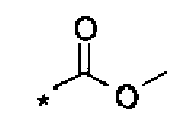
amorphous 4 CH2 - H 
amorphous 5 CH2 2-F H 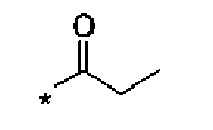
amorphous 6 CH2 2-Cl H 
amorphous 7 CH2 2-Cl H 
amorphous 8 CH2 - H 
amorphous 9 CH2 - F 
amorphous 10 CH2 - F 
amorphous 11 CH2 - F 
amorphous 12 CH2 - F 
amorphous 13 CH2 - F 
amorphous 14 CH2 - F 
amorphous 15 CH2 - F 
amorphous 16 CH2 - F 
amorphous 17 CH2 - F 
amorphous 18 CH2 - F 
amorphous 19 CH2 - Cl 
amorphous 20 CH2 - Cl 
amorphous 21 CH2 - Cl 
amorphous 22 CH2 - Cl 
amorphous 23 CH2 - Cl 
amorphous 24 CH2 - Br 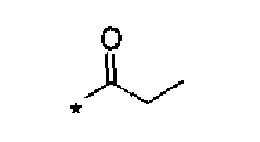
amorphous 25 CH2 - Br 
amorphous 26 CH2 - Br 
amorphous 27 CH2 - Br 
amorphous 28 CH2 - I 
amorphous 29 CH2 - Me 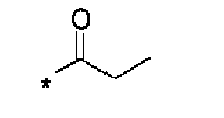
amorphous 30 CH2 - CN 
amorphous 31 CH2 - CF3 
amorphous 32 CH2 - CF3 
amorphous 33 CH2 - CF3 
amorphous 34 CH2 - CF3 
amorphous 35 CH2 - MeO 
amorphous 36 CH2 2-F F 
amorphous 37 CH2 2-F F 
amorphous 38 CH2 2-F F 
amorphous 39 CH2 2-F F 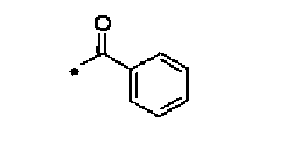
amorphous 40 CH2 2-F F 
amorphous 41 CH2 5-F F 
amorphous 42 CH2 CH2 5-F F 
amorphous 43 CH2 5-F F 
m.p.:162-164 44 CH2 5-Cl Cl 
amorphous 45 CH2 5-Cl Cl 
amorphous 46 CH2 CH2 5-Cl Cl 
amorphous 47 CH2 5-Cl Cl 
amorphous 48 CH2 5-Cl Cl 
m.p. :112-115 49 CH(CH3) - H 
amorphous 50 NH - H 
amorphous 51 NH - H 
amorphous 52 NH - Cl 
amorphous 53 NH - Cl 
amorphous 54 NH - Cl 
m. p. :175-176 55 NH - Cl 
amorphous 56 0 - Cl 
amorphous 57 0 - Cl 
m.p. :136-140 58 0 - CN 
amorphous -

-


-
[Table 11] Working example number D (Z) n W R1 Physical properties 60 CH2 2-Cl H 
amorphous 61 CH2 2-Me H 
amorphous - Of the compounds of the aforementioned working examples, 1H-NMR (CDCl3, δppm) is shown below for the compounds which are amorphous.
[Table 12] Working example
member1H-NMR (CDCl3, δ ppm) 1 1.17 (t, 3H), 2. 25 (q, 2H), 3. 68 (d. 1H), 4.07 (d, 1H), 4. 49 (d, 2H) , 5. 84 (m, 1H ) , 7. 08-7. 67 (m, 6H) 2 2. 18 (s, 3H), 3.68 (d, 1H), 4.06 (d, 1H), 4. 66 (d, 2H), 7. 33-7. 58 (m, 7H) 3 3.69 (d, 1H), 3. 72 (s, 3H) , 4. 08 (d, 1H), 4. 39 (d, 2H), 5. 04 (m, 1H), 7.39-7. 59 (m, 7H) 4 1.25 (d, 6H), 3. 69 (d, 1H), 4. 08 (d, 1H), 4. 38 (d, 2H), 4. 95 (m, 1H), 7.39-7.59 (m, 7H) 5 1.188 (t, 3H), 2.25 (q, 2H), 3. 78 (d, 1H), 4. 11 (d, 1H), 4.50 (d, 2H), 5. 78 (m, 1H ), 7.14-7.49 (m, 6H) 6 1.18 (t, 3H), 2. 26 (q, 2H), 3. 81 (d, 1H), 4. 21 (d, 1H), 4. 60 (d, 2H), 5. 93 (m, 1H ), 7.28-7.64 (m, 6H) 7 1. 20 (d, 3H), 2. 34-2. 47 (m, 2H), 3. 34 (s, 3H), 3.67-3.85 (m, 2H), 4.17 (dd, 1H ), 4.48-4.63 (m, 2H) , 6. 82 (m, 1H), 7. 28-7. 54 (m, 6H) 8 3. 69 (d, 1H), 4. 08 (d, 1H), 4. 68 (d, 2H), 6. 48 (m, 1H), 7. 39-7. 81 (m, 7H) 9 0. 95 (t, 3H) , 1. 62-1.74 (m, 2H) , 2. 22 (q, 2H), 3. 67 (d, 1H), 4. 06 (d, 1H), 4. 49 (d, 2H) , 5. 92 (m, 1H), 7.06-7.67 (m, 6H) 10 1.16(d, 6H) , 2. 42-2. 46 (m, 1H), 3. 67 (d, 1H), 4. 07 (d, 1H), 4. 48 (d, 2H) , 5.91 (m, 1H), 7.08-7.66 (m, 6H) 11 0.75-0.81 (m, 2H), 0. 97-1. 01 (m, 2H), 1. 33-1. 41 (m, 1H), 3. 67 (d, 1H), 4.06 ( d, 1H), 4. 50 (d, 2H), 6. 04 (m, 1H), 7. 08-7. 67 (m, 6H) 12 1.21 (s, 9H), 3. 7 (d, 1H), 4.06 (d, 1H), 4. 47 (d, 2H) , 6.08 (m, 1H), 7. 08-7. 65 ( m, 6H) 13 0.18-0.23 (m, 2H) , 0. 60-0. 66 (m, 2H) , 0. 93-1. 02 (m, 1H), 2.19 (d, 2H) , 3. 68 ( d, 1H), 4. 05 (d, 1H), 4. 52 (d, 2H) , 6. 35 (m, 1H), 7. 08-7. 66 (m, 6H) 14 3. 68 (d, 1H), 4. 07 (d, 1H), 4. 59 (d, 2H) , 6. 73 (m, 1H), 7. 14-7. 72 (m, 6H) 15 3. 07-3. 17 (m, 2H) , 3. 67 (d, 1H), 4. 04 (d, 1H), 4. 54 (d, 2H) , 6. 26 (m, 1H) , 7.10 -7.70(m,6H) 16 1. 20 (d, 3H) , 2. 34-2. 47 (m, 2H), 3. 34 (s, 3H), 3. 65-3. 76 (m, 2H) , 4. 06 (d, 1H) , 4. 49 (d, 2H), 6. 75 (m, 1H), 7.07-7.64 (m, 6H) 17 1. 28 (s, 3H), 2. 66 (s, 2H), 3. 67 (d, 1H), 3. 92-4. 16 (m, 5H), 4. 50 (d, 2H) , 6. 81 (m, 1H), 7. 08-7.68 (m, 6H) 18 2.58 (t, 2H), 2.73 (t, 2H), 3.71 (d, 1H), 4.07 (d, 1H), 4.54 (d, 2H), 6.02 (m, 1H ), 7.09-7.72 (m, 6H) 19 1.16 (t, 3H), 2.26 (q, 2H), 3.68 (d, 1H), 4.06 (d, 1H), 4. 51 (d, 2H), 5. 97 (m, 1H ), 7.40-7. 64 (m, 6H) 20 0.75-0.81 (m2H), 0. 97-1. 02 (m, 2H) , 1.35-1.43 (m, 1H), 3. 68 (d, 1H), 4. 06 (d , 1H), 4. 53 (d, 2H) , 6. 88 (m, 1H), 7. 40-7. 64 (m, 6H) 21 1.21 (d, 3H), 2.34-2.48 (m, 2H), 3. 34 (s, 3H), 3. 65-3. 71 (m, 2H), 4.06 (d, 1H) , 4. 53 (d, 2H), 6. 88 (m, 1H), 7. 40-7. 64 (m, 6H) 22 2. 60 (t, 2H), 2. 73 (t, 2H), 3. 71 (d, 1H), 4. 07 (d, 1H), 4.58 (d, 2H), 6. 04 (m, 1H ) , 7.41-7.67 (m, 6H) 23 1.24 (d, 6H), 3. 67 (d, 1H), 4.06 (d, 1H), 4. 45 (d, 2H), 4.88-5.12 (m, 2H) , 7. 32 -7.63 (m, 6H) 24 1.16 (t, 3H), 2. 26 (q, 2H), 3. 69 (d, 1H), 4. 07 (d, 1H), 6. 02 (m, 1H), 7. 42-7. 92 (m, 6H) 26 1. 20 (d, 3H), 2. 35-2. 49 (m, 2H), 3. 35 (s, 3H) , 3. 66-3. 76 (m, 2H) , 4. 06 (d, 1H) , 4.51 (d, 2H) , 6. 94 (m, 1H), 7. 41-7. 63 (m, 6H) 27 2.60 (t, 2H), 2.73 (t, 2H), 3.71 (d, 1H), 4.08 (d, 1H), 4.56 (d, 2H), 6.15 (m, 1H ) , 7. 41-7. 63 (m, 6H) 28 1.16 (t, 3H) , 2. 24 (q, 2H) , 3. 68 (d, 1H), 4. 06 (d, 1H), 4. 52 (d, 2H) , 5. 97 (m, 1H ) , 7.42-7.62 (m, 6H) 29 1.17 (t, 3H) , 2. 26 (q, 2H), 2. 36 (s, 3H) , 3. 67 (d, 1H), 4. 06 (d, 1H), 4. 45 (d, 2H ), 5.64 (m, 1H), 7. 21-7. 59 (m, 6H) 30 1. 17 (t, 3H) , 2. 26 (q, 2H) , 3.68 (d, 1H), 4. 07 (d, 1H), 4. 59 (d, 2H), 7. 42-7.76 (m, 6H) 31 1. 17 (t, 3H) , 2.27 (q, 2H) , 3. 73 (d, 1H), 4. 09 (d, 1H), 4. 62 (d, 2H) , 6. 01 (m, 1H ), 7.42-7.81 (m, 6H) 32 1.20 (d, 3H) , 2. 35-2. 49 (m, 2H), 3. 32 (s, 3H) , 3. 69-3. 77 (m, 2H) , 4. 08 (d, 1H) , 4. 63 (d, 2H) , 6. 88 (m, 1H), 7. 42-7. 82 (m, 6H) 33 1. 41 (s, 3H) , 2. 68 (s, 2H) , 3. 72 (d, 1H), 3. 87-3. 98 (m, 4H), 4. 06 (d, 1H), 4. 65 (d, 2H) , 6. 86 (m, 1H), 7. 43-7. 80 (m, 6H) 34 2. 57-2. 76 (m, 4H) , 3. 75 (d, 1H), 4.11 (d, 1H), 4. 66 (d, 2H) , 6. 18 (m, 1H), 7. 42 -8.32 (m, 6H) 35 1.16 (t, 3H) , 2. 24 (q, 2H) , 3. 67 (d, 1H), 3. 91 (s, 3H), 4. 07 (d, 1H), 4. 43 (d, 2H ) , 5. 89 (m, 1H), 6. 91 (d, 1H), 7. 41-7. 71 (m, 5H) 36 1.14 (t, 3H), 2. 19 (q, 2H) , 3. 78 (d, 1H), 4.16 (d, 1H), 4. 55 (d, 2H), 5.76 (m, 1H ), 6.93-7.89 (m, 5H) 37 1.16 (d, 3H) , 2. 33-2. 36 (m, 2H) , 3. 66 (m, 1H), 3. 76 (d, 1H), 4. 15 (d, 1H), 4. 54 (d, 2H), 6. 70 (m, 1H), 6. 93-7. 88 (m, 5H) 38 1. 35 (s, 3H), 2. 60 (s, 2H) , 3. 78 (d, 1H), 3. 88-3. 99 (m, 4H), 4. 15 (d, 1H), 4. 55 (d, 2H), 6.80 (m, 1H), 6.91-7. 88 (m, 5H) 39 3. 78 (d, 1H), 4. 17 (d, 1H), 4. 75 (d, 2H) , 6. 55 (m, 1H), 6. 97-7. 90 (m, 10H) 40 1.21 (d, 6H), 3. 78 (d, 1H), 4.16 (d, 1H), 4. 46 (d, 2H), 4. 86-4. 99 (m, 2H), 6.95 -7. 89 (m, 5H) 41 1. 16 (t, 3H), 2. 25 (q, 2H), 3. 67 (d, 1H), 4.04 (d, 1H), 4. 50 (d, 2H), 6.81 (m, 1H ), 7.36-7.53 (m, 5H) 42 1.15 (d, 3H) , 2. 33-2. 49 (m, 2H), 3. 34 (s, 3H), 3. 63-3. 76 (m, 2H), 4. 04 (d, 1H) , 4. 51 (d, 2H) 6. 82 (m, 1H), 7.37-7.53 (m, 5H) 44 1.18 (t, 3H), 2.27 (q, 2H), 3.68 (d, 1H), 4.05 (d, 1H), 4.53 (d, 2H), 6.08 (m, 1H ), 7.42-7.73 (m, 5H) 45 1.21 (d, 3H) , 2. 35-2. 50 (m, 2H), 3. 35 (s, 3H), 3.67-3.78 (m, 2H), 4. 05 (d, 1H) , 4.53 (d, 2H) , 6. 96 (m, 1H), 7. 42-7. 72 (m, 5H) 46 1. 46 (s, 3H), 2. 67 (s, 2H) , 3. 68 (d, 1H) , 3. 93-4. 09 (m, 5H) , 4. 54 (d, 2H), 6. 98 (m, 1H), 7. 43-7. 76 (m, 5H) 47 2.59-2.75 (m, 4H) , 3. 71 (d, 1H), 4. 05 (d, 1H), 4. 56 (d, 2H), 6. 41 (m, 1H), 7.41 -7.77 (m, 5H) 49 1. 15 (t, 3H) , 1. 49 (d, 3H) , 2. 24 (q, 2H) , 3. 69 (d, 1H), 4. 08 (d, 1H), 5.16 (m, 1H ), 5.67 (m, 1H), 7. 36-7. 64 (m, 7H) 50 3. 66 (d, 1H), 3. 77 (s, 3H) , 4. 06 (d, 1H), 5. 84 (m, 1H), 6.53 (m, 1H), 6.91-7.51 (m, 7H) 51 1. 27(d, 6H) , 3. 65 (d, 1H), 4. 05 (d, 1H), 4. 96 (m, 1H), 5. 84 (m, 1H), 6. 45 (m, 1H ), 6. 91-7. 51 (m, 7H) 52 2. 11 (s, 3H), 3. 65 (d, 1H), 4. 07 (d, 1H), 6. 91-7. 48 (m, 7H) 53 3. 61 (d, 1H), 3. 99(d, 1H), 6. 73-8. 08(m, 13H) 55 1.27 (d, 6H) , 3. 64 (d, 1H), 4. 04 (d, 1H), 4. 98 (m, 1H), 6. 31 (m, 1H), 6. 43 (m, 1H ), 7.00-7. 50 (m, 6H) 56 1. 17 (t, 3H), 2. 36 (q, 2H) , 3. 67 (d, 1H), 4. 05 (d, 1H), 7.20-7.56 (m, 7H) 58 2.12 (s, 3H), 3. 68 (d, 1H), 4. 06 (d, 1H), 7.30-7.78 (m, 6H) 60 1.16 (t, 3H), 2. 29 (q, 2H), 3. 69 (d, 1H), 4.07 (d, 1H), 4. 51 (d, 2H), 6.06 (m, 1H ), 7.43-8.62 (m, 5H) 61 1.18 (t, 3H), 2.30 (q, 2H), 3.69 (d, 1H), 4.07 (d, 7H), 4.47 (d, 2H), 5.93 (m, 1H ), 7.43-8.55 (m, 5H) - Next, some working examples of compositions of the present invention are shown, but additives and addition ratios are not limited by these working examples, and can be modified over a wide range. Moreover, the term "parts" used in these formulation examples indicate "mass parts."
-
Formulation example 1 wettable powder Compound of the present invention 40 parts Clay 48 parts Sodium dioctylsulfosuccinate salt 4 parts Sodium lignin sulfonate salt 8 parts - The foregoing is uniformly mixed and finely pulverized to obtain a wettable powder of 40% active ingredient.
-
Formulation example 2 emulsion Compound of the present invention 10 parts Solvesso 200 53 parts Cyclohexanone 26 parts Calcium dodecyl benzene sulfonate salt 1 part Polyoxyethylene alkylallyl ether 10 parts - The foregoing is mixed and dissolved to obtain an emulsion of 10% active ingredient.
-
Formulation example 3 dust agent Compound of the present invention 10 parts Clay 90 parts - The foregoing is uniformly mixed and finely pulverized to obtain a dust agent of 40% active ingredient.
-
Formulation example 4 granular agent Compound of the present invention 5 parts Clay 73 parts Bentonite 20 parts Sodium dioctylsulfosuccinate salt 1 part Potassium phosphate 1 part - The foregoing is thoroughly pulverized and mixed, water is added, and kneading is thoroughly conducted, after which granulation and drying are conducted to obtain a granular agent of 5% active ingredient.
-
Formulation example 5 suspension Compound of the present invention 10 parts Polyoxyethylene alkylallyl ether 4 parts Sodium polycarboxylate salt 2 parts Glycerin 10 parts Xanthan gum 0.2 part Water 73.8 parts - The foregoing is mixed, and wet crushing is conducted until particle size is 3 microns or less to obtain a suspension of a 10% active ingredient.
-
Formulation example 6 granular wettable powder Compound of the present invention 40 parts Clay 36 parts Potassium chloride 10 parts Sodium alkylbenzene sulfonate salt 1 part Sodium lignin sulfonate salt 8 parts Formaldehyde condensate of sodium alkylbenzene sulfonate salt 5 parts - The foregoing is uniformly mixed and finely pulverized, and a suitable amount of water is added, and kneaded to be argillaceous. After the argillaceous substance is granulated, it is dried to obtain a granular wettable powder of 40% active ingredient.
- Test cases of the pest-control agents of the present invention obtained in the foregoing manner are shown below.
- Cucumbers seeded in a pot with a diameter of 9 cm which had germinated for 10 days were inoculated with adult Aphis gossypii. The adult insects were removed after one day, and the cucumbers which were parasitized with the produced offspring were subjected to application of a chemical solution that was prepared according to the prescription of the emulsion shown in the aforementioned Formulation Example 2 and that was diluted with water to a compound concentration of 125 ppm. Stored in a temperature-controlled room at a temperature of 25°C and a humidity of 65%, mortality was investigated after five days, and the insect mortality rate was obtained. The test was repeated twice. As a result, the following compounds exhibited a 100% mortality rate.
- Compound number: working example 1, working example 11, working example 16, working example 18, working example 19, working example 22, working example 28, example 30, working examples 36-38, working example 44, and working example 45.
- The mortality rate of pirimicarb used for control was 9%.
- Beans seeded in a pot with a diameter of 9 cm which had germinated for 7-10 days were inoculated on a first leaf with 17 female adults of Tetranychus urticae with organophosphate resistance, after which a chemical solution was applied that was prepared according to the prescription of the wettable powder shown in the aforementioned Formulation Example 1 and that was diluted with water to a compound concentration of 125 ppm. Stored in a temperature-controlled room at a temperature of 25°C and a humidity of 65%, the insect mortality rate was investigated after three days. The test was repeated twice. As a result, the following compounds exhibited a 100% mortality rate.
- Compound number: working example 1, working example 11, working example 18, working example 19, working example 22, working examples 28-30, working examples 36-38, working example 44, working example 45, and working example 47.
- The mortality rate of chlordimeform used for control was 9%.
- Following the prescription of the emulsion shown in the aforementioned Formulation Example 2, dilution with water was conducted to a compound concentration of 125 ppm. Cabbage leaves were immersed in the chemical solution for 30 seconds, dried by air, and inserted into a petri dish lined with filter paper, and inoculated with 5 second-instar larvae of Spodoptera litura. A glass lid was put on, and storage was conducted in a temperature-controlled room at a temperature of 25°C and a humidity of 65%. Mortality was investigated after five days, and the insect mortality rate was obtained. The test was repeated twice. As a result, the following compounds exhibited a 100% mortality rate.
- Compound number: working example 1, working example 5, working example 11, working examples 16-19, working examples 21-23, working examples 28-30, working examples 36-40, working example 44, working example 45, working example 47, working example 48, working example 51, working example 52, working example 54, working example 55, working example 58, and working example 60.
- 10 larvae of Culex pipiens molestus, which were hatched 1 day before, and 0.225 ml of distilled water containing 0.5 mg of feed for aquarium fish (TetraMin® manufactured by Tetra Japan Co. Ltd) were put into a polystyrene test container with a volume of 0.3 ml.
- The compound was adjusted to a 1% solution using DMSO (containing 0.5% Tween-20), and further diluted to 0.01 % with distilled water. 0.025 ml of this diluted chemical solution was added to a test container into which Culex pipiens had been inserted, and stirring was conducted (final concentration of compound: 0.001 %).
- This was left standing at 25°C, and the mortality rate was investigated after two days. The test was conducted with two repetitions.
- In this test, the following compounds were effective with a mortality rate of 90% or more.
- Compound number: working example 19, working examples 21-23, working example 44, working example 45, working example 47
- According to the present invention, it is possible to offer industrially useful pest control agents whose active ingredient is at least one type of novel nitrogen-containing heterocyclic compound or its salt, or a compound thereof, which can be industrially synthesized in an expedient manner, and which can constitute the active ingredient of pest control agents that are reliably effective and that can be safely used.
Claims (3)
- A compound expressed by formula (I):


- A pest control agent comprising the compound or salt thereof according to claim 1 as an active ingredient.
- The pest control agent according to claim 2, wherein said pest control agent is an insecticide or acaricide.
Applications Claiming Priority (2)
| Application Number | Priority Date | Filing Date | Title |
|---|---|---|---|
| JP2008239724 | 2008-09-18 | ||
| PCT/JP2009/004601 WO2010032437A1 (en) | 2008-09-18 | 2009-09-15 | Nitrogen-containing heterocyclic compound and pest control agent |
Publications (2)
| Publication Number | Publication Date |
|---|---|
| EP2332927A1 true EP2332927A1 (en) | 2011-06-15 |
| EP2332927A4 EP2332927A4 (en) | 2012-07-18 |
Family
ID=42039286
Family Applications (1)
| Application Number | Title | Priority Date | Filing Date |
|---|---|---|---|
| EP09814282A Withdrawn EP2332927A4 (en) | 2008-09-18 | 2009-09-15 | Nitrogen-containing heterocyclic compound and pest control agent |
Country Status (10)
| Country | Link |
|---|---|
| US (2) | US8362257B2 (en) |
| EP (1) | EP2332927A4 (en) |
| JP (1) | JP5307819B2 (en) |
| KR (2) | KR101430891B1 (en) |
| CN (1) | CN102149696A (en) |
| AU (1) | AU2009294050B2 (en) |
| BR (1) | BRPI0918731A2 (en) |
| CA (1) | CA2737291C (en) |
| NZ (1) | NZ591619A (en) |
| WO (1) | WO2010032437A1 (en) |
Cited By (5)
| Publication number | Priority date | Publication date | Assignee | Title |
|---|---|---|---|---|
| EP2412240A1 (en) * | 2010-07-30 | 2012-02-01 | Sumitomo Chemical Company, Limited | Animal ectoparasite-controlling agent |
| EP2412238A1 (en) * | 2010-07-30 | 2012-02-01 | Sumitomo Chemical Company, Limited | Animal ectoparasite-controlling agent |
| EP2412239A1 (en) * | 2010-07-30 | 2012-02-01 | Sumitomo Chemical Company, Limited | Animal ectoparasite-controlling agent |
| EP2412241A1 (en) * | 2010-07-30 | 2012-02-01 | Sumitomo Chemical Company, Limited | Animal ectoparasite-controlling agent |
| WO2012165186A1 (en) * | 2011-05-31 | 2012-12-06 | Sumitomo Chemical Company, Limited | Animal ectoparasite-controlling agent |
Families Citing this family (27)
| Publication number | Priority date | Publication date | Assignee | Title |
|---|---|---|---|---|
| JP5747440B2 (en) | 2009-02-06 | 2015-07-15 | 住友化学株式会社 | Hydrazide compound and its use for pest control |
| TWI487486B (en) | 2009-12-01 | 2015-06-11 | Syngenta Participations Ag | Insecticidal compound based on isoxazoline derivatives |
| WO2011124998A1 (en) * | 2010-04-08 | 2011-10-13 | Pfizer Inc. | Substituted 3,5- di phenyl - isoxazoline derivatives as insecticides and acaricides |
| US20130131118A1 (en) * | 2010-08-03 | 2013-05-23 | Sumitomo Chemical Company, Limited | Pest control composition |
| EP2601836A4 (en) * | 2010-08-03 | 2014-01-15 | Sumitomo Chemical Co | COMPOSITION FOR THE CONTROL OF PESTS |
| US20130131083A1 (en) * | 2010-08-03 | 2013-05-23 | Sumitomo Chemical Company, Limited | Pest control composition |
| WO2012017969A1 (en) * | 2010-08-03 | 2012-02-09 | 住友化学株式会社 | Pest control composition |
| US20130131116A1 (en) * | 2010-08-03 | 2013-05-23 | Sumitomo Chemical Company, Limited | Pest control composition |
| US20130131117A1 (en) * | 2010-08-03 | 2013-05-23 | Sumitomo Chemical Company, Limited | Pest control composition |
| AU2011205081A1 (en) * | 2010-08-03 | 2012-02-23 | Sumitomo Chemical Company Limited | Pest control composition |
| UY33887A (en) | 2011-02-03 | 2012-09-28 | Syngenta Ltd | PEST CONTROL METHODS IN SOYA |
| SI2683723T1 (en) | 2011-03-10 | 2016-07-29 | Zoetis Services Llc | Spirocyclic isoxazoline derivatives as antiparasitic agents |
| JP2013018767A (en) * | 2011-06-03 | 2013-01-31 | Sumitomo Chemical Co Ltd | Method of manufacturing benzylamine compound |
| JP2013010739A (en) | 2011-06-03 | 2013-01-17 | Sumitomo Chemical Co Ltd | Method for producing isoxazoline compound |
| WO2013026939A1 (en) | 2011-08-25 | 2013-02-28 | Syngenta Participations Ag | Methods for the control of termites and ants |
| KR101093102B1 (en) * | 2011-10-04 | 2011-12-13 | (주)목우연구소 | Phenylisoxazolin-based compound having herbicidal activity and use thereof |
| WO2014019609A1 (en) | 2012-07-31 | 2014-02-06 | Syngenta Participations Ag | Methods of pest control in soybean |
| WO2014019957A2 (en) | 2012-08-03 | 2014-02-06 | Syngenta Participations Ag | Methods of pest control in soybean |
| CN104520287A (en) | 2012-08-03 | 2015-04-15 | 先正达参股股份有限公司 | Methods of controlling insects |
| WO2014019950A1 (en) | 2012-08-03 | 2014-02-06 | Syngenta Participations Ag | Methods of pest control in soybean |
| WO2014029640A1 (en) | 2012-08-24 | 2014-02-27 | Syngenta Participations Ag | Methods of controlling insects |
| WO2014029639A1 (en) | 2012-08-24 | 2014-02-27 | Syngenta Participations Ag | Methods of soil pest control |
| WO2014029709A1 (en) | 2012-08-24 | 2014-02-27 | Syngenta Participations Ag | Methods of controlling insects |
| CA2973974A1 (en) | 2015-01-16 | 2016-07-21 | Avista Pharma Solutions, Inc. | Antiparasitic compounds |
| WO2019099669A1 (en) | 2017-11-16 | 2019-05-23 | Avista Pharma Solutions, Inc. | Single enantiomer antiparasitic compounds |
| CN113272316A (en) | 2019-01-07 | 2021-08-17 | 豪夫迈·罗氏有限公司 | HPLC-free purification of peptides using novel capping and capture reagents |
| AR119790A1 (en) | 2019-08-29 | 2022-01-12 | Pi Industries Ltd | ISOXAZOLINE COMPOUNDS AND THEIR USE AS PEST CONTROL AGENTS |
Family Cites Families (10)
| Publication number | Priority date | Publication date | Assignee | Title |
|---|---|---|---|---|
| WO2005051932A1 (en) * | 2003-11-28 | 2005-06-09 | Nippon Soda Co., Ltd. | Arylheterocycle derivative and agricultural or horticulrual bactericide and insecticide |
| CN101768129B (en) | 2004-03-05 | 2012-05-23 | 日产化学工业株式会社 | Preparation intermediate of isoxazoline substituted benzamide compound |
| WO2006016237A2 (en) | 2004-08-04 | 2006-02-16 | Ranbaxy Laboratories Limited | Heterocyclic derivatives as anti-inflammatory agents |
| JP5051340B2 (en) | 2005-06-06 | 2012-10-17 | 日産化学工業株式会社 | Substituted isoxazoline compounds and pest control agents |
| AU2006285613B2 (en) * | 2005-09-02 | 2011-11-17 | Nissan Chemical Corporation | Isoxazoline-substituted benzamide compound and harmful organism-controlling agent |
| TW200803740A (en) * | 2005-12-16 | 2008-01-16 | Du Pont | 5-aryl isoxazolines for controlling invertebrate pests |
| JP5152518B2 (en) * | 2006-03-10 | 2013-02-27 | 日産化学工業株式会社 | Substituted isoxazoline compounds and pest control agents |
| JP2008239724A (en) | 2007-03-27 | 2008-10-09 | Toppan Printing Co Ltd | Hard coat film |
| RU2009141185A (en) * | 2007-04-10 | 2011-05-20 | Байер КропСайенс АГ (DE) | INSECTICIDAL DERIVATIVES OF ARILIZOXOXAZOLINE |
| JP5365806B2 (en) * | 2007-09-10 | 2013-12-11 | 日産化学工業株式会社 | Substituted isoxazoline compounds and pest control agents |
-
2009
- 2009-09-15 KR KR1020137013577A patent/KR101430891B1/en not_active Expired - Fee Related
- 2009-09-15 US US13/062,037 patent/US8362257B2/en not_active Expired - Fee Related
- 2009-09-15 WO PCT/JP2009/004601 patent/WO2010032437A1/en not_active Ceased
- 2009-09-15 JP JP2010529628A patent/JP5307819B2/en not_active Expired - Fee Related
- 2009-09-15 AU AU2009294050A patent/AU2009294050B2/en not_active Ceased
- 2009-09-15 CN CN2009801360016A patent/CN102149696A/en active Pending
- 2009-09-15 KR KR1020117005867A patent/KR20110042231A/en not_active Ceased
- 2009-09-15 CA CA2737291A patent/CA2737291C/en not_active Expired - Fee Related
- 2009-09-15 EP EP09814282A patent/EP2332927A4/en not_active Withdrawn
- 2009-09-15 BR BRPI0918731A patent/BRPI0918731A2/en not_active IP Right Cessation
- 2009-09-15 NZ NZ591619A patent/NZ591619A/en not_active IP Right Cessation
-
2013
- 2013-01-25 US US13/749,911 patent/US8598367B2/en not_active Expired - Fee Related
Non-Patent Citations (2)
| Title |
|---|
| No further relevant documents disclosed * |
| See also references of WO2010032437A1 * |
Cited By (7)
| Publication number | Priority date | Publication date | Assignee | Title |
|---|---|---|---|---|
| EP2412240A1 (en) * | 2010-07-30 | 2012-02-01 | Sumitomo Chemical Company, Limited | Animal ectoparasite-controlling agent |
| EP2412238A1 (en) * | 2010-07-30 | 2012-02-01 | Sumitomo Chemical Company, Limited | Animal ectoparasite-controlling agent |
| EP2412239A1 (en) * | 2010-07-30 | 2012-02-01 | Sumitomo Chemical Company, Limited | Animal ectoparasite-controlling agent |
| EP2412241A1 (en) * | 2010-07-30 | 2012-02-01 | Sumitomo Chemical Company, Limited | Animal ectoparasite-controlling agent |
| US8399498B2 (en) | 2010-07-30 | 2013-03-19 | Sumitomo Chemical Company, Limited | Animal ectoparasite-controlling agent |
| US8785485B2 (en) | 2010-07-30 | 2014-07-22 | Sumitomo Chemical Company, Limited | Animal ectoparasite-controlling agent |
| WO2012165186A1 (en) * | 2011-05-31 | 2012-12-06 | Sumitomo Chemical Company, Limited | Animal ectoparasite-controlling agent |
Also Published As
| Publication number | Publication date |
|---|---|
| BRPI0918731A2 (en) | 2019-09-24 |
| CA2737291C (en) | 2013-04-16 |
| JP5307819B2 (en) | 2013-10-02 |
| US20110166358A1 (en) | 2011-07-07 |
| NZ591619A (en) | 2012-08-31 |
| US8362257B2 (en) | 2013-01-29 |
| JPWO2010032437A1 (en) | 2012-02-02 |
| EP2332927A4 (en) | 2012-07-18 |
| KR20130065733A (en) | 2013-06-19 |
| KR101430891B1 (en) | 2014-08-18 |
| CN102149696A (en) | 2011-08-10 |
| AU2009294050A1 (en) | 2010-03-25 |
| AU2009294050B2 (en) | 2011-11-17 |
| KR20110042231A (en) | 2011-04-25 |
| CA2737291A1 (en) | 2010-03-25 |
| US8598367B2 (en) | 2013-12-03 |
| WO2010032437A1 (en) | 2010-03-25 |
| US20130137876A1 (en) | 2013-05-30 |
Similar Documents
| Publication | Publication Date | Title |
|---|---|---|
| US8598367B2 (en) | Nitrogen-containing heterocyclic compound and pest control agent | |
| JP5128600B2 (en) | Nitrogen-containing heterocyclic compounds and pest control agents | |
| JP5280972B2 (en) | Acaricides and new urea compounds | |
| IL190532A (en) | Cyclic amine compounds and pesticidal compositions containing the same | |
| JP2012180339A (en) | Isoxazoline compound and harmful organism-controlling agent | |
| JP5600355B2 (en) | Aryloxyurea compounds and pest control agents | |
| JP6088631B2 (en) | Aryloxyacetamide compounds and pest control agents | |
| US20100179172A1 (en) | N-phenyl-methanamine derivative and pesticide containing it | |
| US8222420B2 (en) | Nitrogen-containing compounds and harmful organism control agents | |
| CA2869721A1 (en) | Aryloxyurea compound and pest control agent | |
| JP2009062355A (en) | Nitrogen-containing heterocyclic compound and pest control agent | |
| CA2740340A1 (en) | Pyridine derivative or its salt, pesticide containing it and process for its production | |
| JPWO2015025960A1 (en) | Pest control agent | |
| JP2009062277A (en) | Benzisothiazoline compound and pest control agent | |
| WO2019163921A1 (en) | Substituted pyridine compound and salt thereof | |
| US20040072826A1 (en) | Organic compound having cyano group and insecticides/miticides | |
| JP2002114784A (en) | Isoxazole derivative and controller against noxious organism | |
| TW201304680A (en) | Benzamide derivative or its salt, and insecticide, miticide, nematicide or soil pesticide containing it |
Legal Events
| Date | Code | Title | Description |
|---|---|---|---|
| PUAI | Public reference made under article 153(3) epc to a published international application that has entered the european phase |
Free format text: ORIGINAL CODE: 0009012 |
|
| 17P | Request for examination filed |
Effective date: 20110315 |
|
| AK | Designated contracting states |
Kind code of ref document: A1 Designated state(s): AT BE BG CH CY CZ DE DK EE ES FI FR GB GR HR HU IE IS IT LI LT LU LV MC MK MT NL NO PL PT RO SE SI SK SM TR |
|
| AX | Request for extension of the european patent |
Extension state: AL BA RS |
|
| A4 | Supplementary search report drawn up and despatched |
Effective date: 20120615 |
|
| RIC1 | Information provided on ipc code assigned before grant |
Ipc: C07D 413/06 20060101ALI20120611BHEP Ipc: C07D 261/04 20060101AFI20120611BHEP Ipc: C07D 413/10 20060101ALI20120611BHEP Ipc: A01N 43/80 20060101ALI20120611BHEP Ipc: C07D 413/04 20060101ALI20120611BHEP Ipc: A01P 7/04 20060101ALI20120611BHEP Ipc: A01P 7/02 20060101ALI20120611BHEP |
|
| 17Q | First examination report despatched |
Effective date: 20131108 |
|
| STAA | Information on the status of an ep patent application or granted ep patent |
Free format text: STATUS: THE APPLICATION IS DEEMED TO BE WITHDRAWN |
|
| 18D | Application deemed to be withdrawn |
Effective date: 20150324 |