EP2330103A1 - Novel epigallocatechin gallate tetramer, and vascular endothelial function improver comprising same - Google Patents
Novel epigallocatechin gallate tetramer, and vascular endothelial function improver comprising same Download PDFInfo
- Publication number
- EP2330103A1 EP2330103A1 EP09810041A EP09810041A EP2330103A1 EP 2330103 A1 EP2330103 A1 EP 2330103A1 EP 09810041 A EP09810041 A EP 09810041A EP 09810041 A EP09810041 A EP 09810041A EP 2330103 A1 EP2330103 A1 EP 2330103A1
- Authority
- EP
- European Patent Office
- Prior art keywords
- compound
- formula
- vascular endothelial
- salt
- endothelial function
- Prior art date
- Legal status (The legal status is an assumption and is not a legal conclusion. Google has not performed a legal analysis and makes no representation as to the accuracy of the status listed.)
- Granted
Links
Images


Classifications
-
- A—HUMAN NECESSITIES
- A61—MEDICAL OR VETERINARY SCIENCE; HYGIENE
- A61K—PREPARATIONS FOR MEDICAL, DENTAL OR TOILETRY PURPOSES
- A61K31/00—Medicinal preparations containing organic active ingredients
- A61K31/33—Heterocyclic compounds
- A61K31/335—Heterocyclic compounds having oxygen as the only ring hetero atom, e.g. fungichromin
- A61K31/35—Heterocyclic compounds having oxygen as the only ring hetero atom, e.g. fungichromin having six-membered rings with one oxygen as the only ring hetero atom
- A61K31/352—Heterocyclic compounds having oxygen as the only ring hetero atom, e.g. fungichromin having six-membered rings with one oxygen as the only ring hetero atom condensed with carbocyclic rings, e.g. methantheline
- A61K31/353—3,4-Dihydrobenzopyrans, e.g. chroman, catechin
-
- A—HUMAN NECESSITIES
- A23—FOODS OR FOODSTUFFS; TREATMENT THEREOF, NOT COVERED BY OTHER CLASSES
- A23L—FOODS, FOODSTUFFS OR NON-ALCOHOLIC BEVERAGES, NOT OTHERWISE PROVIDED FOR; PREPARATION OR TREATMENT THEREOF
- A23L2/00—Non-alcoholic beverages; Dry compositions or concentrates therefor; Preparation or treatment thereof
- A23L2/52—Adding ingredients
-
- A—HUMAN NECESSITIES
- A23—FOODS OR FOODSTUFFS; TREATMENT THEREOF, NOT COVERED BY OTHER CLASSES
- A23L—FOODS, FOODSTUFFS OR NON-ALCOHOLIC BEVERAGES, NOT OTHERWISE PROVIDED FOR; PREPARATION OR TREATMENT THEREOF
- A23L33/00—Modifying nutritive qualities of foods; Dietetic products; Preparation or treatment thereof
- A23L33/10—Modifying nutritive qualities of foods; Dietetic products; Preparation or treatment thereof using additives
- A23L33/105—Plant extracts, their artificial duplicates or their derivatives
-
- A—HUMAN NECESSITIES
- A61—MEDICAL OR VETERINARY SCIENCE; HYGIENE
- A61P—SPECIFIC THERAPEUTIC ACTIVITY OF CHEMICAL COMPOUNDS OR MEDICINAL PREPARATIONS
- A61P29/00—Non-central analgesic, antipyretic or antiinflammatory agents, e.g. antirheumatic agents; Non-steroidal antiinflammatory drugs [NSAID]
-
- A—HUMAN NECESSITIES
- A61—MEDICAL OR VETERINARY SCIENCE; HYGIENE
- A61P—SPECIFIC THERAPEUTIC ACTIVITY OF CHEMICAL COMPOUNDS OR MEDICINAL PREPARATIONS
- A61P3/00—Drugs for disorders of the metabolism
- A61P3/06—Antihyperlipidemics
-
- A—HUMAN NECESSITIES
- A61—MEDICAL OR VETERINARY SCIENCE; HYGIENE
- A61P—SPECIFIC THERAPEUTIC ACTIVITY OF CHEMICAL COMPOUNDS OR MEDICINAL PREPARATIONS
- A61P3/00—Drugs for disorders of the metabolism
- A61P3/08—Drugs for disorders of the metabolism for glucose homeostasis
- A61P3/10—Drugs for disorders of the metabolism for glucose homeostasis for hyperglycaemia, e.g. antidiabetics
-
- A—HUMAN NECESSITIES
- A61—MEDICAL OR VETERINARY SCIENCE; HYGIENE
- A61P—SPECIFIC THERAPEUTIC ACTIVITY OF CHEMICAL COMPOUNDS OR MEDICINAL PREPARATIONS
- A61P9/00—Drugs for disorders of the cardiovascular system
-
- A—HUMAN NECESSITIES
- A61—MEDICAL OR VETERINARY SCIENCE; HYGIENE
- A61P—SPECIFIC THERAPEUTIC ACTIVITY OF CHEMICAL COMPOUNDS OR MEDICINAL PREPARATIONS
- A61P9/00—Drugs for disorders of the cardiovascular system
- A61P9/10—Drugs for disorders of the cardiovascular system for treating ischaemic or atherosclerotic diseases, e.g. antianginal drugs, coronary vasodilators, drugs for myocardial infarction, retinopathy, cerebrovascula insufficiency, renal arteriosclerosis
-
- A—HUMAN NECESSITIES
- A61—MEDICAL OR VETERINARY SCIENCE; HYGIENE
- A61P—SPECIFIC THERAPEUTIC ACTIVITY OF CHEMICAL COMPOUNDS OR MEDICINAL PREPARATIONS
- A61P9/00—Drugs for disorders of the cardiovascular system
- A61P9/12—Antihypertensives
-
- A—HUMAN NECESSITIES
- A61—MEDICAL OR VETERINARY SCIENCE; HYGIENE
- A61P—SPECIFIC THERAPEUTIC ACTIVITY OF CHEMICAL COMPOUNDS OR MEDICINAL PREPARATIONS
- A61P9/00—Drugs for disorders of the cardiovascular system
- A61P9/14—Vasoprotectives; Antihaemorrhoidals; Drugs for varicose therapy; Capillary stabilisers
-
- C—CHEMISTRY; METALLURGY
- C07—ORGANIC CHEMISTRY
- C07D—HETEROCYCLIC COMPOUNDS
- C07D311/00—Heterocyclic compounds containing six-membered rings having one oxygen atom as the only hetero atom, condensed with other rings
- C07D311/02—Heterocyclic compounds containing six-membered rings having one oxygen atom as the only hetero atom, condensed with other rings ortho- or peri-condensed with carbocyclic rings or ring systems
- C07D311/04—Benzo[b]pyrans, not hydrogenated in the carbocyclic ring
- C07D311/58—Benzo[b]pyrans, not hydrogenated in the carbocyclic ring other than with oxygen or sulphur atoms in position 2 or 4
- C07D311/60—Benzo[b]pyrans, not hydrogenated in the carbocyclic ring other than with oxygen or sulphur atoms in position 2 or 4 with aryl radicals attached in position 2
- C07D311/62—Benzo[b]pyrans, not hydrogenated in the carbocyclic ring other than with oxygen or sulphur atoms in position 2 or 4 with aryl radicals attached in position 2 with oxygen atoms directly attached in position 3, e.g. anthocyanidins
-
- A—HUMAN NECESSITIES
- A23—FOODS OR FOODSTUFFS; TREATMENT THEREOF, NOT COVERED BY OTHER CLASSES
- A23V—INDEXING SCHEME RELATING TO FOODS, FOODSTUFFS OR NON-ALCOHOLIC BEVERAGES AND LACTIC OR PROPIONIC ACID BACTERIA USED IN FOODSTUFFS OR FOOD PREPARATION
- A23V2002/00—Food compositions, function of food ingredients or processes for food or foodstuffs
Definitions
- the present invention relates to a novel epigallocatechin gallate tetramer compound, a method for producing the compound, and a food and drink and a pharmaceutical composition containing the compound, particularly a food and drink and a pharmaceutical composition exerting a vascular endothelial function improving action.
- Metabolic syndrome is a pathologic condition in which a visceral fat accumulation amount increases by lifestyle habits and hereditary predisposition, with the result that insulin resistance is induced and symptoms such as lipidosis, hypertension and impaired glucose tolerance emerge and a vascular lesion is likely to occur.
- Such pathologic condition leads to arteriosclerosis such as cardial infarction and cerebral infarction and at worst may result in death.
- Non Patent Literature 1 When insulin resistance emerges due to metabolic syndrome, the function of the vascular endothelial cells is damaged- As a cause thereof, abnormality of the nitrogen monoxide (hereinafter, simply referred to as NO) production system in the vascular endothelial cells is suggested (Non Patent Literature 1).
- NO nitrogen monoxide
- NO is produced by L-arginine and an oxygen molecule by endothelial NO synthetase (hereinafter, simply referred to as eNOS) in the vascular endothelial cells.
- eNOS endothelial NO synthetase
- the role of NO which is a vascular relaxation factor derived from the vascular endothelium, is primarily a suppressive action on proliferative change, inflammatory change, platelet aggregation and oxidation stress. A reduction of NO production and insufficient action thereof were observed in the presence of various risk factors such as arteriosclerosis and hyperlipemia (Non Patent Literature 2).
- GTP-CH1 GTP cyclohydrase I
- BH 4 tetrahydrobiopterin
- Non Patent Literature 3 oxygen molecules are preferentially metabolized by NADPH oxidase to generate active oxygen, which further induces hypoactivity of vascular endothelium.
- vascular endothelial cells produce ADMA degrading enzyme, i.e., dimethylarginine dimethylaminohydrolase 2 (hereinafter, simply referred to as DDAH 2)
- DDAH 2 dimethylarginine dimethylaminohydrolase 2
- the vascular endothelial function can be satisfactorily maintained.
- the vascular endothelial function can be satisfactorily maintained also by reducing NADPH oxidase activity present in the vascular endothelial cells.
- Non Patent Literature 4 A food material having a vascular endothelial function improving effect, (-)-epigallocatechin-3-O-gallate (hereinafter, also referred to as "EGCG”) contained in green tea is known (Non Patent Literature 4). Furthermore, it is reported that when black tea is taken, the vasodilation depending upon blood flow of the human upper arm is improved (Non Patent Literature 5), that eNOS activation is facilitated in the in-vitro study using a black tea extract (Non Patent Literature 6); however, active ingredients thereof did not elucidated. Furthermore, no study has been made on oolong tea and its components.
- Examples of the EGCG polymer produced by an oolong tea intrinsic fermentation process include a dimer (oolong homobisflavan A and oolong homobisflavan B)(Non Patent Literature 7) and a trimer (Patent Literature 1) have been isolated and identified. It has been reported that these compounds have strong pancreatic lipase inhibitory activity (Non Patent Literature 8 and Patent Literature 1).
- Non Patent Literature 4 describes the vascular endothelial function improving effect of EGCG; however, in a study using cultured cells, a relatively high concentration of at least 30 to 50 ⁇ M is required to increase eNOS activity. Furthermore, Non Patent Literature 5 discloses the vascular endothelial function improving effect of black tea and described that the vasodilation depending upon blood flow of the upper arm is improved in a group where black tea is allowed to take to a human in a dose of 900 ml per day for 4 weeks, compared to a control group.
- EGCG has a vascular endothelial function improving effect; however the effect is not sufficient.
- black tea containing EGCG a relatively large amount of black tea, etc. must be taken.
- the EGCG is a cause of bitter taste and astringency and thus if EGCG is continuously taken, flavor is a problem.
- a large amount of black tea intake leads to intake of a large amount of caffeine. From this, taking black tea is considered improper for continuous intake in order to maintain the vascular endothelial function.
- An objective of the present invention is to provide a compound capable of continuously taking and having a vascular endothelial function improving effect by enhancing NO function from the vascular endothelial cells, and further provide a food and drink containing the compound.
- the present inventors studied with a view to solving these problems on a compound derived from a compound having a chroman ring such as EGCG. As a result, they found that a novel compound having four chroman rings has a more effective vascular endothelial function improving action than EGCG. Based on the finding, the present invention has been accomplished.
- R 1 , R 2 , R 3 and R 4 are the same as defined above, or a salt thereof;
- the present invention can provide beverages or supplements for improving vascular endothelial function, thereby promoting health by blending tetramers of the invention to foods and drinks. These compounds are highly palatable, since flavor is not damaged even though they are added to a food and drink, and excellent in safety and thus can be continuously taken for maintaining a vascular endothelial function.
- the present invention relates to a novel EGCG tetramer compound in which four chroman rings are bonded by a methylene group and represented by Formula (I), a method for producing the compound of Formula (I), and a vascular endothelial function improving agent, food and drink and pharmaceutical composition containing the compound of Formula (I).
- Formula (I) a novel EGCG tetramer compound in which four chroman rings are bonded by a methylene group and represented by Formula (I)
- a method for producing the compound of Formula (I) and a vascular endothelial function improving agent, food and drink and pharmaceutical composition containing the compound of Formula (I).
- the present invention will be described below.
- An EGCG tetramer compound of the present invention represented by Formula (I) can be produced as follows.
- the compound of Formula (I) in which R 1 , R 2 , R 3 and R 4 each are a group (gallate group) represented by Formula (A) can be produced by reacting (-)-epigallocatechin-3-O-gallate with formaldehyde in a solvent in the presence of an acid.
- Examples of the solvent that can be used in the reaction include alcohols such as methanol, ethanol, n-propanol and isopropanol.
- the use amount of solvent is not particularly limited; however, for example, 20 to 200 parts by mass of solvent can be used relative to 1 part by mass of EGCG.
- Examples of the acid that can be used herein include inorganic acids such as hydrochloric acid, sulfuric acid and nitric acid and organic acids such as formic acid and acetic acid.
- the use amount of acid is not particularly limited; however, 0.01 to 2 moles of acid can be used relative to 1 mole of EGCG.
- the amount of formaldehyde that can be used is, for example, 1 to 100 moles relative to 1 mole of EGCG.
- Reaction temperature and time vary depending upon e.g., the amount of solvent to be used; however, for example, reaction temperature is -10 to 50°C, and reaction time is 0.2 to 12 hours. Typically, the reaction temperature is room temperature (about 25°C).
- the compound of Formula (I) in which R 1 , R 2 , R 3 and R 4 each are H (hydrogen atom) can be produced by reacting (-)-epigallocatechin in place of (-)-epigallocatechin-3-O-gallate with formaldehyde in the same manner as above.
- a tetramer product is obtained by the reaction between (-)-epigallocatechin-3-O-gallate or (-)-epigallocatechin and formaldehyde generally as a mixture of tetramer compounds containing at least two of three compounds represented by Formula (II), Formula (III) and Formula (IV) different in coupling scheme of chroman rings by a methylene group.
- compounds of Formula (II), Formula (III) and Formula (IV) each can be isolated by use of a known purification method such as open column chromatography using a styrene based adsorption resin such as HP-20 (manufactured by Mitsubishi Chemical Corporation) and a dextran based resin such as Shephadex LH-20, and high performance liquid chromatography (HPLC).
- HP-20 manufactured by Mitsubishi Chemical Corporation
- HPLC high performance liquid chromatography
- the compound of Formula (I), wherein 1 to 4 of R 1 , R 2 , R 3 and R 4 are H can be also produced by removing the gallate group from the compound of Formula (I) wherein R 1 , R 2 , R 3 and R 4 each are a gallate group by hydrolysis.
- Such hydrolysis is performed by use of an aqueous solution of a basic compound such as sodium hydroxide and potassium hydroxide or by use of a hydrolytic enzyme such as an enzyme having tannase activity.
- 1, 2, 3 or 4 gallate groups are removed from the compound of Formula (I) wherein R 1 , R 2 , R 3 and R 4 each are a gallate group to provide a mixture of a plurality of compounds.
- individual compounds can be isolated from the mixture by use of a known purification method such as open column chromatography using a styrene based adsorption resin including HP-20 (manufactured by Mitsubishi Chemical Corporation) and a dextran based resin such as Shephadex LH-20 and high performance liquid chromatography (HPLC).
- the present invention also relates to a salt of the compound of Formula (I).
- Such a salt is not particularly limited as long as it is a salt that can be formed from a compound of Formula (I); however, a pharmaceutically acceptable salt is preferable.
- Examples thereof include a metal salt with a metal element belonging to the first or second family of the periodic table, such as a lithium salt, a sodium salt, a potassium salt, a calcium salt and a magnesium salt of a compound of Formula (I).
- a metal salt can be formed with, for example, a hydroxide group of a compound of Formula 1 (a phenolic hydroxide group, a hydroxide group in the case where one or all of R 1 , R 2 , R 3 and R 4 are H).
- the compound of Formula (I) and metallic sodium or sodium hydride are reacted to convert a hydroxide group (-OH) to a sodium alkoxide group (-ONa) to produce a sodium salt of a compound of Formula (I).
- a hydroxide group (-OH) to a sodium alkoxide group (-ONa)
- all hydroxide groups contained in the compound of Formula (I) can be converted into sodium alkoxide groups or only part of the hydroxide groups can be converted into sodium alkoxide groups by controlling the use amount of metallic sodium or sodium hydride.
- the compound of Formula (I) of the present invention is a novel compound.
- the compounds of Formula (II) and Formula (III) can be isolated from tea using Camellia sinensis as a raw material, preferably from fermented tea such as oolong tea, black tea and roasted tea by extraction and purification.
- Isolation of the compounds of Formula (II) and Formula (III) from these teas can be performed by, for example, adsorption column chromatography and high performance liquid chromatography (HPLC).
- a compound of the present invention exerts a vascular endothelial function improving action.
- a compound of the present invention exerts a vascular endothelial function improving action by enhancing expression of eNOS gene, by enhancing expression of GTP-CH1 gene, by enhancing expression of DDAH2 gene and/or by reducing NADPH oxidase gene.
- Expression of eNOS gene, GTP-CH1 gene, DDAH2 gene and NADPH oxidase gene can be evaluated by a known method described in literatures or by the method described in Examples below.
- a compound of the present invention exerts a vascular endothelial function improving action, it can be used as a vascular endothelial function improving agent. Furthermore, since a compound of the present invention exerts a vascular endothelial function improving action, if a compound of the present invention is formed into a dosage form suitable for intake by mammals such as a human by blending it to a food and drink or preparing it into a pharmaceutical composition, the vascular endothelial function improving action can be exerted by using the food and drink or the pharmaceutical product in mammals.
- the present invention also relates to a food and drink in which a compound of the present invention or a salt thereof is added, and a pharmaceutical composition containing a compound of the present invention or a salt thereof.
- a compound of the present invention can be added to various types of foods and drinks.
- a food and drink to which a compound of the present invention is to be added is not particularly limited.
- a compound of the present invention can be added to various types of foods and drinks conventionally available.
- the foods and drinks include beverages such as refreshing drinks, tea drinks, liquid tonic medicines, healthy drinks, nutrition drinks, sports drinks and carbonated drinks (including concentrated stock solutions and preparatory powders of these beverages) and foods such as gums, candies, jellies, tablets, health foods, nutrition foods and supplements.
- a compound of the present invention can be added such that the ratio of the compound of the present invention in these foods and drinks becomes, for example, 0.01 to 10000 ppm ( ⁇ g/ml), preferably 0.06 to 2000 ppm and further preferably 0.1 to 1000 ppm.
- the medicinal drug can be provided in dosage form of powder, grain, tablet, capsule, liquid and injection.
- a compound of the present invention or a salt thereof can be orally administered directly or by diluting it with water or the like. Alternatively, it is formed into a preparation with a known carrier for a medicinal drug.
- a compound of the present invention or a salt thereof can be administered as a peroral liquid preparation such as a syrup agent.
- the compound of the present invention or a salt thereof is processed into an extract or a powder and blended with a pharmaceutically acceptable carrier, it can be provided as a peroral solid preparation such as a tablet, a capsule, a grain, and a powder.
- the pharmaceutically acceptable carrier examples include various types of organic or inorganic carrier substances conventionally used as a preparation material.
- the carrier is blended as an excipient, a lubricant, a binding agent and a disintegrator in a solid preparation and as e.g., a solvent, an excipient, a suspension agent and a binding agent in a liquid preparation.
- additives for a preparation such as an antiseptic agent, an antioxidative agent, a coloring agent and a sweetening agent can be also used.
- an effective dose thereof can be appropriately determined depending upon the age and body weight of a patient, the type and significance of a disease and the administration route.
- the fractionated products obtained by the CHP-20P column purification was further purified by reverse-phase preparative HPLC.
- MS measurement was performed by Q-TOF Premier (manufactured by Micromass, UK) using ESI equipped with a Z spray ion source as an ion source, in a negative, V mode. Mass correction was performed by lock spray at a Cone volt.: 45 V, Capillary voltage: 3 KV, and Source Temp.: 80°C, Desolvation Temp: 180°C.
- leucine enkephalin m/z 554.2615 [M-H] - ) was used.
- compound 1 gave molecular ions of m/z 1867.3112 [M-H] - and divalent 933.1517 [M-2H] 2- and a molecular formula thereof was calculated as C 91 H 72 O 44 (err.: -11.0 ppm); compound 2 gave molecular ions of m/z 1867.3100 [M-H] - and divalent 933.1151 [M-2H] 2- and a molecular formula thereof was calculated as C 91 H 72 O 44 (err.: -11.7 ppm). Either one of the compounds is estimated as a compound having four EGCG molecules crosslinked with three methylene groups.
- NMR NMR was measured in the following conditions. Compound 1 and compound 2 were each dissolved in DMSO-d6 ((CD 3 ) 2 SO) and NMR measurement was performed using residual peaks of 1 H and 13 C, i.e., ⁇ 2.50 and ⁇ 39.43, as the internal standard. Measurement items, which were 1 H NMR, 13 C NMR, 1 H ⁇ 13 C ⁇ - HSQC, 1 H ⁇ 13 C ⁇ - HMBC, TOCSY and DQF-COSY, were measured by DMX-750 spectrometer (BRUKER BIOSPIN, Germany).
- compound 1 is a compound (Formula (II)) having a coupling scheme of EGCG8:8EGCG6:8EGCG6:8EGCG and compound 2 is a compound (Formula (III)) having a coupling scheme of EGCG8:6EGCG8:8EGCG6:8EGCG.
- the 1 H NMR and 13 C NMR spectra of compound 1 are shown in Figures 1 and 2 and the 1 H NMR and 13 C NMR spectra of compound 2 are shown in Figures 3 and 4 , respectively.
- DMSO dimethyl sulfoxide
- RNA was extracted from the cells. Furthermore, RNA was purified by RNeasy Mini Kit (QIAGEN). cDNA was synthesized by a High-Capacity cDNA reverse transcription kit (manufactured by Applied Biosystem) using the total RNA (200 ng) purified as a template and quantitative PCR was performed. Analysis was performed by comparative Ct method with a glyceraldehyde-3-phosphate dehydrogenase gene used as an internal standard. The gene expression change ratio (ratio relative to the control) of a test sample was calculated by using untreated cells as a control.
- the expression change rates of individual genes i.e., EGCG, Formula (II)(OHBF-Tet1), Formula (III)(OHBF-Tet2), theaflavin (THF), theaflavin 3-O-gallate (THF3G), theaflavin 3'-O-gallate (THF3'G) and theaflavin 3,3'-O-digallate (THFDiG) are shown in Figures 5 to 8 .
- the compounds of Formula (II) and Formula (III) enhanced expression of the eNOS gene about three times ( Figure 5 ), the expression of the GTP-CH1 gene about 7 times ( Figure 6 ) and the expression of the DT3AH2 gene about three times ( Figure 7 ). Furthermore, it is shown that expression of Nox4 subunit gene of NADPH oxidase producing active oxygen in the vascular endothelial cells and reducing vascular endothelial function dramatically reduces in the presence of the compounds of Formula (II) and Formula (III) ( Figure 8 ).
- theasinensin (TSN)-A is the one synthesized in accordance with the paper ( Hashimoto, F. Nonaka, G. Nishioka, I. Chem. Pharm. Bull. 36 (5), 1676-1684 (1988 )).
- Oolong homobisflavan-A, oolong homobisflavan-B, oolong homobisflavan-C and compound 5 used herein were those synthesized and purified in Example 1. Evaluation was performed in the same method as in the above (A).
- EGCG dimers i.e., oolong homobisflavan-A, oolong homobisflavan-B, oolong homobisflavan-C, theasinensin A and an EGCG trimer, i.e., compound 5, do not substantially change the expression of any one of the genes in the same concentration as in the compounds of Formula (II) and Formula (III) investigated in the above (A).
- the vascular endothelial function improving effect of the EGCG tetramer of the present invention is a characteristic function of a compound of the present invention among EGCG polymers.
- LC-MS/MS was measured by 4000 Q TRAP (manufactured by Applied) using a turbo ion spray in a negative mode in the following conditions: Collision energy: 46 eV (nega.), Ionspray voltage: 4500V, Temp: 450°C.
- the Suntory black oolong tea blend (solution before sterilized) was fractionated stepwise by a CHP-20P column (manufactured by Mitsubishi Chemical Corporation) and fractions were quantified. The concentrations of individual fractions detected were added up and defined as the concentration in the blend. The concentration in the blend was obtained by adding up the concentrations of 4 components detected as an EGCG tetramer. It was 55 ng/mL in terms of the compound of Formula (III).
Landscapes
- Health & Medical Sciences (AREA)
- Chemical & Material Sciences (AREA)
- Life Sciences & Earth Sciences (AREA)
- Organic Chemistry (AREA)
- Engineering & Computer Science (AREA)
- Veterinary Medicine (AREA)
- Public Health (AREA)
- Medicinal Chemistry (AREA)
- Pharmacology & Pharmacy (AREA)
- Animal Behavior & Ethology (AREA)
- General Health & Medical Sciences (AREA)
- Bioinformatics & Cheminformatics (AREA)
- General Chemical & Material Sciences (AREA)
- Nuclear Medicine, Radiotherapy & Molecular Imaging (AREA)
- Chemical Kinetics & Catalysis (AREA)
- Nutrition Science (AREA)
- Polymers & Plastics (AREA)
- Food Science & Technology (AREA)
- Cardiology (AREA)
- Diabetes (AREA)
- Heart & Thoracic Surgery (AREA)
- Epidemiology (AREA)
- Hematology (AREA)
- Obesity (AREA)
- Vascular Medicine (AREA)
- Botany (AREA)
- Mycology (AREA)
- Urology & Nephrology (AREA)
- Emergency Medicine (AREA)
- Endocrinology (AREA)
- Pain & Pain Management (AREA)
- Rheumatology (AREA)
- Pharmaceuticals Containing Other Organic And Inorganic Compounds (AREA)
- Coloring Foods And Improving Nutritive Qualities (AREA)
- Pyrane Compounds (AREA)
Abstract
Description
- The present invention relates to a novel epigallocatechin gallate tetramer compound, a method for producing the compound, and a food and drink and a pharmaceutical composition containing the compound, particularly a food and drink and a pharmaceutical composition exerting a vascular endothelial function improving action.
- Metabolic syndrome is a pathologic condition in which a visceral fat accumulation amount increases by lifestyle habits and hereditary predisposition, with the result that insulin resistance is induced and symptoms such as lipidosis, hypertension and impaired glucose tolerance emerge and a vascular lesion is likely to occur. Such pathologic condition leads to arteriosclerosis such as cardial infarction and cerebral infarction and at worst may result in death.
- When insulin resistance emerges due to metabolic syndrome, the function of the vascular endothelial cells is damaged- As a cause thereof, abnormality of the nitrogen monoxide (hereinafter, simply referred to as NO) production system in the vascular endothelial cells is suggested (Non Patent Literature 1).
- NO is produced by L-arginine and an oxygen molecule by endothelial NO synthetase (hereinafter, simply referred to as eNOS) in the vascular endothelial cells. The role of NO, which is a vascular relaxation factor derived from the vascular endothelium, is primarily a suppressive action on proliferative change, inflammatory change, platelet aggregation and oxidation stress. A reduction of NO production and insufficient action thereof were observed in the presence of various risk factors such as arteriosclerosis and hyperlipemia (Non Patent Literature 2). Particularly, in the state of insulin resistance associated with metabolic syndrome, it is known that the activity of GTP cyclohydrase I (hereinafter, simply referred to as GTP-CH1), which is a coenzyme of eNOS, i.e., a tetrahydrobiopterin (hereinafter, simply referred to as BH4) producing enzyme, reduces (Non Patent Literature 1). Mechanism of reduction of NO production and insufficient production thereof is complicated; however, it is known that eNOS activity is inhibited by a metabolite of L-arginine, asymmetric dimethyl arginine (hereinafter, simply referred to as ADMA). Furthermore, in the state where eNOS activity reduces, oxygen molecules are preferentially metabolized by NADPH oxidase to generate active oxygen, which further induces hypoactivity of vascular endothelium (Non Patent Literature 3). On the other hand, when vascular endothelial cells produce ADMA degrading enzyme, i.e., dimethylarginine dimethylaminohydrolase 2 (hereinafter, simply referred to as DDAH 2), the vascular endothelial function can be satisfactorily maintained. Furthermore, the vascular endothelial function can be satisfactorily maintained also by reducing NADPH oxidase activity present in the vascular endothelial cells.
- A food material having a vascular endothelial function improving effect, (-)-epigallocatechin-3-O-gallate (hereinafter, also referred to as "EGCG") contained in green tea is known (Non Patent Literature 4). Furthermore, it is reported that when black tea is taken, the vasodilation depending upon blood flow of the human upper arm is improved (Non Patent Literature 5), that eNOS activation is facilitated in the in-vitro study using a black tea extract (Non Patent Literature 6); however, active ingredients thereof did not elucidated. Furthermore, no study has been made on oolong tea and its components.
- Examples of the EGCG polymer produced by an oolong tea intrinsic fermentation process include a dimer (oolong homobisflavan A and oolong homobisflavan B)(Non Patent Literature 7) and a trimer (Patent Literature 1) have been isolated and identified. It has been reported that these compounds have strong pancreatic lipase inhibitory activity (
Non Patent Literature 8 and Patent Literature 1). - PTL 1: International Publication No.
WO2005/116005 -
- NPL 1: Folia Pharmacol. Jpn. Vol. 125: p285-290, 2005
- NPL 2: Journal of clinical Investigation, vol. 95, p1747-1755, 1995
- NPL 3: Endocrinology, vol. 148, p3773-3780, 2007
- NPL 4: Journal of Biological Chemistry, vol. 279, p6190-6195, 2004
- NPL 5: Circulation. Vol. 104, p151-156, 2001
- NPL 6: Journal of Biological Chemistry, vol. 279, p46637-46643, 2004
- NPL 7: Chem. Pharm. Bull. 37(12), 3255-3263, 1989
- NPL 8: J. Agric. Food Chem. 53, 4593-4598 (2005)
-
Non Patent Literature 4 describes the vascular endothelial function improving effect of EGCG; however, in a study using cultured cells, a relatively high concentration of at least 30 to 50 µM is required to increase eNOS activity. Furthermore,Non Patent Literature 5 discloses the vascular endothelial function improving effect of black tea and described that the vasodilation depending upon blood flow of the upper arm is improved in a group where black tea is allowed to take to a human in a dose of 900 ml per day for 4 weeks, compared to a control group. - As described above, EGCG has a vascular endothelial function improving effect; however the effect is not sufficient. To obtain the effect by taking black tea containing EGCG, a relatively large amount of black tea, etc. must be taken. Furthermore, the EGCG is a cause of bitter taste and astringency and thus if EGCG is continuously taken, flavor is a problem. In addition, a large amount of black tea intake leads to intake of a large amount of caffeine. From this, taking black tea is considered improper for continuous intake in order to maintain the vascular endothelial function.
- An objective of the present invention is to provide a compound capable of continuously taking and having a vascular endothelial function improving effect by enhancing NO function from the vascular endothelial cells, and further provide a food and drink containing the compound.
- The present inventors studied with a view to solving these problems on a compound derived from a compound having a chroman ring such as EGCG. As a result, they found that a novel compound having four chroman rings has a more effective vascular endothelial function improving action than EGCG. Based on the finding, the present invention has been accomplished.
- More specifically, according to the present invention, there are provided
- 1. A compound represented by Formula (I):


- 2. The compound according to
item 1 above, represented by Formula (II):
- 3. The compound according to
item 1 above, represented by Formula (III): -

- 4. The compound according to any one of
items 1 to 3 above, in which R1, R2, R3 and R4 are all a group represented by Formula (A) :
- 5. A vascular endothelial function improving agent containing the compound or a salt thereof according to any one of
items 1 to 4; - 6. A food and drink, in which the compound or a salt thereof according to any one of
items 1 to 4 is added; - 7. A pharmaceutical composition containing the compound or a salt thereof according to any one of
items 1 to 4; and - 8. A method for producing the compound according to any one of
items 1 to 4, including reacting epigallocatechin gallate or epigallocatechin with formaldehyde in the presence of an acid. - The present invention can provide beverages or supplements for improving vascular endothelial function, thereby promoting health by blending tetramers of the invention to foods and drinks. These compounds are highly palatable, since flavor is not damaged even though they are added to a food and drink, and excellent in safety and thus can be continuously taken for maintaining a vascular endothelial function.
-
-
Figure 1 shows a 1H NMR spectrum ofcompound 1. -
Figure 2 shows a 13C NMR spectrum ofcompound 1. -
Figure 3 shows a 1H NMR spectrum ofcompound 2. -
Figure 4 shows a 13C NMR spectrum ofcompound 2. -
Figure 5 is a graph showing the results of eNOS expression. -
Figure 6 is a graph showing the results of GTP-CH1 expression. -
Figure 7 is a graph showing the results of DDAH2 expression. -
Figure 8 is a graph showing the results of expression of Nox4 subunit gene of NADPH oxidase. -
Figure 9 is a graph showing the results of eNOS expression. -
Figure 10 is a graph showing the results of GTP-CH1 expression. -
Figure 11 is a graph showing the results of DDAH2 expression. -
Figure 12 is a graph showing the results of expression of Nox4 subunit gene of NADPH oxidase. - The present invention relates to a novel EGCG tetramer compound in which four chroman rings are bonded by a methylene group and represented by Formula (I), a method for producing the compound of Formula (I), and a vascular endothelial function improving agent, food and drink and pharmaceutical composition containing the compound of Formula (I). The present invention will be described below.
- An EGCG tetramer compound of the present invention represented by Formula (I) can be produced as follows.
- The compound of Formula (I) in which R1, R2, R3 and R4 each are a group (gallate group) represented by Formula (A) can be produced by reacting (-)-epigallocatechin-3-O-gallate with formaldehyde in a solvent in the presence of an acid.
- Examples of the solvent that can be used in the reaction include alcohols such as methanol, ethanol, n-propanol and isopropanol. The use amount of solvent is not particularly limited; however, for example, 20 to 200 parts by mass of solvent can be used relative to 1 part by mass of EGCG.
- Examples of the acid that can be used herein include inorganic acids such as hydrochloric acid, sulfuric acid and nitric acid and organic acids such as formic acid and acetic acid. The use amount of acid is not particularly limited; however, 0.01 to 2 moles of acid can be used relative to 1 mole of EGCG.
- The amount of formaldehyde that can be used is, for example, 1 to 100 moles relative to 1 mole of EGCG.
- Reaction temperature and time vary depending upon e.g., the amount of solvent to be used; however, for example, reaction temperature is -10 to 50°C, and reaction time is 0.2 to 12 hours. Typically, the reaction temperature is room temperature (about 25°C).
- The compound of Formula (I) in which R1, R2, R3 and R4 each are H (hydrogen atom) can be produced by reacting (-)-epigallocatechin in place of (-)-epigallocatechin-3-O-gallate with formaldehyde in the same manner as above.
- Note that when (-)-epigallocatechin-3-O-gallate or (-)-epigallocatechin is used in the reaction with formaldehyde, in the resultant compound of Formula (I), a substituent at
position 2 of each chroman ring and a substituent atposition 3 thereof form cis relative configuration. - A tetramer product is obtained by the reaction between (-)-epigallocatechin-3-O-gallate or (-)-epigallocatechin and formaldehyde generally as a mixture of tetramer compounds containing at least two of three compounds represented by Formula (II), Formula (III) and Formula (IV) different in coupling scheme of chroman rings by a methylene group. From such a mixture, compounds of Formula (II), Formula (III) and Formula (IV) each can be isolated by use of a known purification method such as open column chromatography using a styrene based adsorption resin such as HP-20 (manufactured by Mitsubishi Chemical Corporation) and a dextran based resin such as Shephadex LH-20, and high performance liquid chromatography (HPLC).

- In such hydrolysis, 1, 2, 3 or 4 gallate groups are removed from the compound of Formula (I) wherein R1, R2, R3 and R4 each are a gallate group to provide a mixture of a plurality of compounds. In this case, individual compounds can be isolated from the mixture by use of a known purification method such as open column chromatography using a styrene based adsorption resin including HP-20 (manufactured by Mitsubishi Chemical Corporation) and a dextran based resin such as Shephadex LH-20 and high performance liquid chromatography (HPLC).
- The present invention also relates to a salt of the compound of Formula (I).
- Such a salt is not particularly limited as long as it is a salt that can be formed from a compound of Formula (I); however, a pharmaceutically acceptable salt is preferable.
- Examples thereof include a metal salt with a metal element belonging to the first or second family of the periodic table, such as a lithium salt, a sodium salt, a potassium salt, a calcium salt and a magnesium salt of a compound of Formula (I). Such a metal salt can be formed with, for example, a hydroxide group of a compound of Formula 1 (a phenolic hydroxide group, a hydroxide group in the case where one or all of R1, R2, R3 and R4 are H).
- For example, in a non-protic solvent, the compound of Formula (I) and metallic sodium or sodium hydride are reacted to convert a hydroxide group (-OH) to a sodium alkoxide group (-ONa) to produce a sodium salt of a compound of Formula (I). Furthermore, all hydroxide groups contained in the compound of Formula (I) can be converted into sodium alkoxide groups or only part of the hydroxide groups can be converted into sodium alkoxide groups by controlling the use amount of metallic sodium or sodium hydride.
- The compound of Formula (I) of the present invention is a novel compound. When studies were conducted using the compounds of Formula (II) and Formula (III) produced by the present inventors, as standards, it was found that the compounds of Formula (II) and Formula (III) are also present in oolong tea, as described later in Examples. Therefore, the compounds of Formula (II) and Formula (III) can be isolated from tea using Camellia sinensis as a raw material, preferably from fermented tea such as oolong tea, black tea and roasted tea by extraction and purification.
- Isolation of the compounds of Formula (II) and Formula (III) from these teas can be performed by, for example, adsorption column chromatography and high performance liquid chromatography (HPLC).
- A compound of the present invention exerts a vascular endothelial function improving action.
- More specifically, a compound of the present invention exerts a vascular endothelial function improving action by enhancing expression of eNOS gene, by enhancing expression of GTP-CH1 gene, by enhancing expression of DDAH2 gene and/or by reducing NADPH oxidase gene. Expression of eNOS gene, GTP-CH1 gene, DDAH2 gene and NADPH oxidase gene can be evaluated by a known method described in literatures or by the method described in Examples below.
- As described above, since a compound of the present invention exerts a vascular endothelial function improving action, it can be used as a vascular endothelial function improving agent. Furthermore, since a compound of the present invention exerts a vascular endothelial function improving action, if a compound of the present invention is formed into a dosage form suitable for intake by mammals such as a human by blending it to a food and drink or preparing it into a pharmaceutical composition, the vascular endothelial function improving action can be exerted by using the food and drink or the pharmaceutical product in mammals.
- Therefore, the present invention also relates to a food and drink in which a compound of the present invention or a salt thereof is added, and a pharmaceutical composition containing a compound of the present invention or a salt thereof.
- A compound of the present invention can be added to various types of foods and drinks. A food and drink to which a compound of the present invention is to be added is not particularly limited. A compound of the present invention can be added to various types of foods and drinks conventionally available. Examples of the foods and drinks include beverages such as refreshing drinks, tea drinks, liquid tonic medicines, healthy drinks, nutrition drinks, sports drinks and carbonated drinks (including concentrated stock solutions and preparatory powders of these beverages) and foods such as gums, candies, jellies, tablets, health foods, nutrition foods and supplements. A compound of the present invention can be added such that the ratio of the compound of the present invention in these foods and drinks becomes, for example, 0.01 to 10000 ppm (µg/ml), preferably 0.06 to 2000 ppm and further preferably 0.1 to 1000 ppm.
- When a compound of the present invention is used as a medicinal drug, the medicinal drug can be provided in dosage form of powder, grain, tablet, capsule, liquid and injection. A compound of the present invention or a salt thereof can be orally administered directly or by diluting it with water or the like. Alternatively, it is formed into a preparation with a known carrier for a medicinal drug. For example, a compound of the present invention or a salt thereof can be administered as a peroral liquid preparation such as a syrup agent. Alternatively, if the compound of the present invention or a salt thereof is processed into an extract or a powder and blended with a pharmaceutically acceptable carrier, it can be provided as a peroral solid preparation such as a tablet, a capsule, a grain, and a powder. Examples of the pharmaceutically acceptable carrier include various types of organic or inorganic carrier substances conventionally used as a preparation material. The carrier is blended as an excipient, a lubricant, a binding agent and a disintegrator in a solid preparation and as e.g., a solvent, an excipient, a suspension agent and a binding agent in a liquid preparation. Furthermore, if necessary, additives for a preparation such as an antiseptic agent, an antioxidative agent, a coloring agent and a sweetening agent can be also used.
- Furthermore, an effective dose thereof can be appropriately determined depending upon the age and body weight of a patient, the type and significance of a disease and the administration route.
- The present invention will be more specifically described by way of Examples; however, the present invention is not limited by these.
- Six grams (13 millimole) of (-)-epigallocatechin-3-O-gallate (EGCG) (Teavigo™ manufactured by Roche) was dissolved in 120 ml of ethanol solution (0.02N, 2.4 millimole in terms of HCl), and a formaldehyde ethanol solution (180 ml) (4% by mass, 240 millimole in terms of formaldehyde) was added and then stirred at room temperature for 4 hours. After completion of the reaction, the resultant reaction solution was diluted 10 fold with pure water and loaded on an adsorption resin CHP-20P column (600 ml, 37-75 µm, manufactured by Mitsubishi Chemical Corporation). After washed with water (1200 mL), elution was performed sequentially with 900 ml of a 25 V/V% aqueous acetonitrile solution and 1200 mL of a 30% V/V% aqueous acetonitrile solution. The fraction eluted with the 25V/V% aqueous acetonitrile solution was separated into three fractions (fr. 1 to fr. 3) of 300 ml for each, whereas the faction eluted with the 30% V/V% aqueous acetonitrile solution was separated into four fractions (fr .4 to fr. 7) of 300 ml for each.
- The fractionated products obtained by the CHP-20P column purification was further purified by reverse-phase preparative HPLC.
- Column: Develosil ODS-HG-5 (5 cm ϕ × 50 cm, manufactured by Nomura Chemical Co., Ltd.)
Mobile phase A: 0.05 V/V% TFA/H2O (TFA: trifluoroacetic acid),
Mobile phase B: 90 V/V% CH3CN, 0.05 V/V% TFA/H2O,
Flow rate: 32 ml/min
Gradient program: A/B = 80/20 (30 minutes), A/B = 80/20→60/40 (100 minutes), A/B = 60/40 (30 minutes)
Detector: UV ray/visible light adsorption detector, SPD-6AV (manufactured by Shimadzu Corporation)
Detection wavelength: A280 nm
Sample: fr. 2 to fr. 7 obtained by CHP-20P column purification each were dissolved in a 20 V/V% aqueous acetonitrile solution and the total amount was loaded by several times. - In the above analysis conditions, individual peaks corresponding to retention time 109 minutes (compound 1), 113 minutes (compound 2), 85 minutes (compound 3), 106 minutes (compound 4) and retention time 104 minutes (compound 5) and retention time 135 minutes (compound 6) were collected.
- The compounds isolated by preparative HPLC were subjected to MS and NMR measurements.
- Ms of
compounds 3 to 6 were measured by Q-TOF Premier (manufactured by Micromass, UK) in a negative, V mode. As a result, ion peaks were observed respectively at m/z 927.160, 927.163, 1397.248 and 927.161 [M-H]-. Furthermore, NMR spectrum data ofcompound 3 coincided with the NMR spectrum data of oolong homobisflavan-A described in the literature (Chem. Pharm. Bull 37(12), 3255-3563 (1989)). The NMR spectrum data ofcompound 4 coincided with the NMR spectrum data of oolong homobisflavan-B described in the literature (Chem. Pharm. Bull 37(12), 3255-3563 (1989)). Furthermore, the NMR spectrum ofcompound 5 coincided with the NMR spectrum described inFigure 4 andFigure 5 of International Publication No.WO 2005/116005 . The NMR spectrum ofcompound 6 coincided with the NMR spectrum described inFigure 2 andFigure 3 of International Publication No.WO 2005/116005 . From these results,compound 3 was identified as oolong homobisflavan A,compound 4 as oolong homobisflavan-B,compound 5 as the compound represented by the following Formula (V) (wherein R represents a gallate group), andcompound 6 as oolong homobisflavan-C. -

Compound 1 andcompound 2 were subjected to structural analysis by the following MS and NMR. - MS measurement was performed by Q-TOF Premier (manufactured by Micromass, UK) using ESI equipped with a Z spray ion source as an ion source, in a negative, V mode. Mass correction was performed by lock spray at a Cone volt.: 45 V, Capillary voltage: 3 KV, and Source Temp.: 80°C, Desolvation Temp: 180°C. As a reference, leucine enkephalin (m/z 554.2615 [M-H]-) was used.
- As a result,
compound 1 gave molecular ions of m/z 1867.3112 [M-H]- and divalent 933.1517 [M-2H]2- and a molecular formula thereof was calculated as C91H72O44 (err.: -11.0 ppm);compound 2 gave molecular ions of m/z 1867.3100 [M-H]- and divalent 933.1151 [M-2H]2- and a molecular formula thereof was calculated as C91H72O44 (err.: -11.7 ppm). Either one of the compounds is estimated as a compound having four EGCG molecules crosslinked with three methylene groups. - NMR was measured in the following conditions.
Compound 1 andcompound 2 were each dissolved in DMSO-d6 ((CD3)2SO) and NMR measurement was performed using residual peaks of 1H and 13C, i.e., δ2.50 and δ39.43, as the internal standard. Measurement items, which were 1H NMR, 13C NMR, 1H{13C} - HSQC, 1H{13C} - HMBC, TOCSY and DQF-COSY, were measured by DMX-750 spectrometer (BRUKER BIOSPIN, Germany). As a result of the NMR, it was elucidated thatcompound 1 is a compound (Formula (II)) having a coupling scheme of EGCG8:8EGCG6:8EGCG6:8EGCG andcompound 2 is a compound (Formula (III)) having a coupling scheme of EGCG8:6EGCG8:8EGCG6:8EGCG. The 1H NMR and 13C NMR spectra ofcompound 1 are shown inFigures 1 and2 and the 1H NMR and 13C NMR spectra ofcompound 2 are shown inFigures 3 and4 , respectively. - Signals of 1H NMR (in DMSO-d6) observed were δ 10.34, 9.37, 9.17, 9.09, 9.01, 8.88, 8.75, 8.71, 8.68, 8.08, 8.04, 7.62, 6.81, 6.77, 6.72, 6.55, 6.49, 6.39, 6.04, 5.86, 5.55, 5.47, 5.34, 5.23, 4.96, 4.79, 4.64, 4.04, 4.02, 3.92, 3.90, 3.85, 3.83, 3.73, 3.71, 3.64, 3.62, 3.54, 3.52, 3.07, 3.05, 2.96, 2.93, 2.74, 2.72, 2.70.
- Signals of 13C NMR observed were δ 165.29, 165.13, 165.02, 165.01, 154.45, 154.44, 154.25, 152.33, 152.20, 151.97, 151.66, 151.62, 150.82, 150.66, 150.52, 149.66, 145.63, 145.56, 145.54, 145.50, 145.50, 145.27, 145.23, 145.18, 138.46, 138.38, 132.77, 132.26, 132.12, 128.50, 127.61, 119.20, 119.17, 118.96, 118.90, 108.73, 108.55, 107.05, 106.19, 105.19, 105.05, 104.31, 103.77, 99.01, 98.52, 77.44, 76.65, 76.51, 76.10, 67.53, 67.50, 66.95, 66.63, 25.94, 25.63, 25.49, 25.30, 17.14, 16.74, 15.81.
- Signals of 1H NMR (in DMSO-d6) observed were δ 9.91, 9.25, 9.16, 8.09, 7.22, 6.81, 6.76, 6.74, 6.52, 5.94, 5.50, 5.38, 4.77, 4.52, 3.95, 3.95, 3.80, 3.54, 2.80, 2.74, 2.73, 2.67.
- Signals of 13C NMR observed were δ 165.08, 165.01, 154.06, 152.83, 152.35, 151.45, 150.78, 150.26, 145.52, 145.52, 145.24, 145.18, 138.49, 138.44, 132.21, 132.10, 128.42, 127.63, 119.05, 118.95, 108.58, 108.46, 108.46, 106.95, 105.74, 104.92, 104.06, 98.32, 97.81, 76.59, 75.94, 66.69, 66.35,26.33, 25.26, 16.72, 15.99.
- The yields of the individual compounds obtained by the aforementioned synthesis and purification were as follows: compound 3 (oolong homobisflavan A, 984 mg), compound 4 (oolong homobisflavan-B, 374 mg), compound 5 (468 mg), compound 6 (oolong homobisflavan-C, 33 mg), compound 1 (15 mg) and compound 2 (44 mg).
- With respect to the compounds of Formula (II) and Formula (III) synthesized and purified in Example 1, the effect of them on expression of a gene involved in the vascular endothelial function was studied. Furthermore, as compounds for comparison, an EGCG monomer (manufactured by Wako Pure Chemical Industries Ltd.), theaflavin, theaflavin 3-O-gallate, theaflavin 3'-O-gallate and
theaflavin 3,3'-O-digallate (manufactured by Nagara Science Co., Ltd.), which are known to have a vascular endothelial function improving action. - These compounds were dissolved in sterilized dimethyl sulfoxide (DMSO, manufactured by Nacalai Tesque Inc.) to prepare a solution having a concentration of 10 mM.
- These solutions were diluted 1000 fold by using HuMedia-EG2 medium (manufactured by Kurabo Industries Ltd.) to prepare a solution having a final concentration of 10 µM (the final concentration of DMSO was 0.1 V/V%). These sample solutions each were added to human umbilical vascular endothelial cells (manufactured by Kurabo Industries Ltd.) cultured in a 6-well plate in a proportion of 3 mL/well and incubated at 37°C under 5% CO2 conditions for 8 hours.
- The cells were recovered by ISOGEN (manufactured by Nippon Gene Co., Ltd.) and RNA was extracted from the cells. Furthermore, RNA was purified by RNeasy Mini Kit (QIAGEN). cDNA was synthesized by a High-Capacity cDNA reverse transcription kit (manufactured by Applied Biosystem) using the total RNA (200 ng) purified as a template and quantitative PCR was performed. Analysis was performed by comparative Ct method with a glyceraldehyde-3-phosphate dehydrogenase gene used as an internal standard. The gene expression change ratio (ratio relative to the control) of a test sample was calculated by using untreated cells as a control.
- The expression change rates of individual genes, i.e., EGCG, Formula (II)(OHBF-Tet1), Formula (III)(OHBF-Tet2), theaflavin (THF), theaflavin 3-O-gallate (THF3G), theaflavin 3'-O-gallate (THF3'G) and
theaflavin 3,3'-O-digallate (THFDiG) are shown inFigures 5 to 8 . - The compounds of Formula (II) and Formula (III) enhanced expression of the eNOS gene about three times (
Figure 5 ), the expression of the GTP-CH1 gene about 7 times (Figure 6 ) and the expression of the DT3AH2 gene about three times (Figure 7 ). Furthermore, it is shown that expression of Nox4 subunit gene of NADPH oxidase producing active oxygen in the vascular endothelial cells and reducing vascular endothelial function dramatically reduces in the presence of the compounds of Formula (II) and Formula (III) (Figure 8 ). - On the other hand, it was elucidated that an EGCG monomer and theaflavins in concentrations investigated herein do not substantially change expression of all genes and that the EGCG tetramer of the present invention is effective in a lower concentration than the EGCG monomer and theaflavins.
- Effect of an EGCG dimer and trimer upon expression of vascular endothelial function related gene was investigated. Of the EGCG polymers used in evaluation, theasinensin (TSN)-A is the one synthesized in accordance with the paper (Hashimoto, F. Nonaka, G. Nishioka, I. Chem. Pharm. Bull. 36 (5), 1676-1684 (1988)). Oolong homobisflavan-A, oolong homobisflavan-B, oolong homobisflavan-C and
compound 5 used herein were those synthesized and purified in Example 1. Evaluation was performed in the same method as in the above (A). - The expression change ratios of individual genes of oolong homobisflavan-A (OHBF-A), oolong homobisflavan-B (OHBF-B), oolong homobisflavan-C (OHBF-C), compound 5 (OHBFTri-1) and theasinensin-A (TSN-A) are shown in
Figures 9 to 12 . - As shown in
Figures 9 to 12 , EGCG dimers, i.e., oolong homobisflavan-A, oolong homobisflavan-B, oolong homobisflavan-C, theasinensin A and an EGCG trimer, i.e.,compound 5, do not substantially change the expression of any one of the genes in the same concentration as in the compounds of Formula (II) and Formula (III) investigated in the above (A). - From the above results, it was found that the vascular endothelial function improving effect of the EGCG tetramer of the present invention is a characteristic function of a compound of the present invention among EGCG polymers.
- LC-MS/MS was measured by 4000 Q TRAP (manufactured by Applied) using a turbo ion spray in a negative mode in the following conditions: Collision energy: 46 eV (nega.), Ionspray voltage: 4500V, Temp: 450°C.
- As a measurement channel in MRM (multiple reaction monitoring), 933.16/168.90 (nega. divalent) was used for an EGCG tetramer compound. The measurement was performed in the following conditions. The compound of Formula (III) was used as a standard substance.
- Column: Develosil C30-UG-3 (manufactured by Nomura Chemical Co., Ltd., 3 mmϕ × 150 mm)
Flow rate: 0.3 mL/minute
Column temperature: 40°C
Mobile phase A: 0.1 V/V% HCOOH/H2O
Mobile phase B: 0.1 V/V% HCOOH/CH3CN
Gradient program: A/B = 91/9 (0 minute)→A/B = 40/60 (17 minutes)→A/B = 15/85 (17.1 minutes)→A/B = 15/85 (17.1 minutes to 19 minutes)
Using the above conditions, Suntory black oolong tea was measured. - The Suntory black oolong tea blend (solution before sterilized) was fractionated stepwise by a CHP-20P column (manufactured by Mitsubishi Chemical Corporation) and fractions were quantified. The concentrations of individual fractions detected were added up and defined as the concentration in the blend. The concentration in the blend was obtained by adding up the concentrations of 4 components detected as an EGCG tetramer. It was 55 ng/mL in terms of the compound of Formula (III).
Claims (8)
- A compound represented by Formula (I):
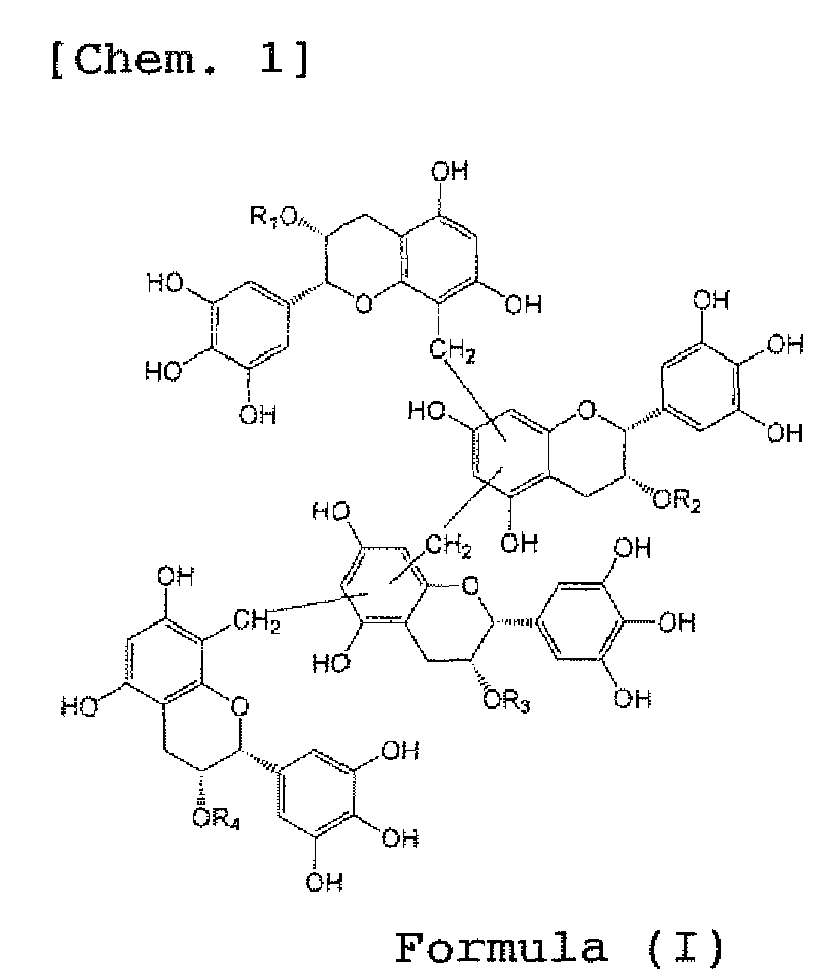

- The compound according to claim 1, represented by Formula (II):

- The compound according to claim 1, represented by Formula (III):

- The compound according to any one of claims 1 to 3,
wherein R1, R2, R3 and R4 are all a group represented by Formula (A):
- A vascular endothelial function improving agent comprising the compound or a salt thereof according to any one of claims 1 to 4.
- A food and drink, in which the compound or a salt thereof according to any one of claims 1 to 4 is added.
- A pharmaceutical composition comprising the compound or a salt thereof according to any one of claims 1 to 4.
- A method for producing the compound according to any one of claims 1 to 4, comprising reacting epigallocatechin gallate or epigallocatechin with formaldehyde in the presence of an acid.
Applications Claiming Priority (2)
| Application Number | Priority Date | Filing Date | Title |
|---|---|---|---|
| JP2008222935 | 2008-08-29 | ||
| PCT/JP2009/065084 WO2010024393A1 (en) | 2008-08-29 | 2009-08-28 | Novel epigallocatechin gallate tetramer, and vascular endothelial function improver comprising same |
Publications (3)
| Publication Number | Publication Date |
|---|---|
| EP2330103A1 true EP2330103A1 (en) | 2011-06-08 |
| EP2330103A4 EP2330103A4 (en) | 2012-05-02 |
| EP2330103B1 EP2330103B1 (en) | 2015-10-07 |
Family
ID=41721556
Family Applications (1)
| Application Number | Title | Priority Date | Filing Date |
|---|---|---|---|
| EP09810041.5A Active EP2330103B1 (en) | 2008-08-29 | 2009-08-28 | Novel epigallocatechin gallate tetramer, and vascular endothelial function improver comprising same |
Country Status (8)
| Country | Link |
|---|---|
| US (2) | US8901166B2 (en) |
| EP (1) | EP2330103B1 (en) |
| JP (1) | JP5539881B2 (en) |
| CN (1) | CN101659649B (en) |
| ES (1) | ES2550077T3 (en) |
| PT (1) | PT2330103E (en) |
| TW (1) | TWI469779B (en) |
| WO (1) | WO2010024393A1 (en) |
Cited By (2)
| Publication number | Priority date | Publication date | Assignee | Title |
|---|---|---|---|---|
| EP2783578A1 (en) * | 2013-03-26 | 2014-10-01 | Symrise AG | Catechin reaction products |
| CN111163769A (en) * | 2016-08-10 | 2020-05-15 | 国立大学法人九州大学 | 67kDa laminin receptor agonist and use thereof |
Families Citing this family (10)
| Publication number | Priority date | Publication date | Assignee | Title |
|---|---|---|---|---|
| JP5569716B2 (en) * | 2009-06-23 | 2014-08-13 | 独立行政法人国立循環器病研究センター | Drug for inhibiting lectin-like oxidized LDL receptor |
| WO2012094636A2 (en) | 2011-01-07 | 2012-07-12 | Elcelyx Therapeutics, Inc. | Chemosensory receptor ligand-based therapies |
| US9795792B2 (en) | 2011-02-25 | 2017-10-24 | Medtronic, Inc. | Emergency mode switching for non-pacing modes |
| BR112014016808B1 (en) | 2012-01-06 | 2022-01-11 | Anji Pharma (Us) Llc | USE OF A BIGUANIDE COMPOUND FOR THE MANUFACTURE OF A DRUG TO LOWER BLOOD GLUCOSE LEVELS AND FOR THE TREATMENT OF A DISORDER OF GLUCOSE METABOLISM |
| CN104349773A (en) | 2012-01-06 | 2015-02-11 | 埃尔舍利克斯治疗公司 | Compositions and methods for treating metabolic disorders |
| AU2013290100A1 (en) | 2012-07-11 | 2015-01-29 | Elcelyx Therapeutics, Inc. | Compositions comprising statins, biguanides and further agents for reducing cardiometabolic risk |
| CN102809592B (en) * | 2012-07-13 | 2014-03-12 | 江苏大学 | Electro-polymerization preparation method of electrochemical sensor for quickly detecting EGCG (Epigallocatechin-3-Gallate) |
| EP2941245B1 (en) | 2013-01-05 | 2024-06-26 | Anji Pharmaceuticals Inc. | Delayed-release composition comprising biguanide |
| CN109432083A (en) * | 2018-12-29 | 2019-03-08 | 中国医科大学附属第医院 | EGCG improves the application in endothelial cell damage drug caused by blood glucose fluctuation in preparation |
| CN111888481B (en) * | 2020-07-28 | 2022-03-11 | 四川大学 | Nanomedicine based on polyphenol complex and preparation method thereof |
Family Cites Families (10)
| Publication number | Priority date | Publication date | Assignee | Title |
|---|---|---|---|---|
| JPH02187433A (en) * | 1989-01-14 | 1990-07-23 | Sekisui Chem Co Ltd | Production of deodorant synthetic resin foam |
| JPH10142726A (en) * | 1996-11-14 | 1998-05-29 | Konica Corp | Silver halide photographic sensitive material, processing method for the same and organic silver salt photographic sensitive material |
| US6156912A (en) * | 1999-04-09 | 2000-12-05 | Mars, Incorporated | 88, 66, and 68 catechin and epicatechin dimers and methods for their preparation |
| US7067679B2 (en) * | 2002-10-02 | 2006-06-27 | Mars, Inc. | Synthesis of dimeric, trimeric, tetrameric pentameric, and higher oligomeric epicatechin-derived procyanidins having 4,8-interflavan linkages and their use to inhibit cancer cell growth through cell cycle arrest |
| JP4668553B2 (en) * | 2004-05-27 | 2011-04-13 | サントリーホールディングス株式会社 | Epigallocatechin dimer and trimer having lipase inhibitory activity and / or antioxidant activity |
| US7858080B2 (en) * | 2005-05-20 | 2010-12-28 | Agency For Science, Technology And Research | Aldehyde conjugated flavonoid preparations |
| JP2007306872A (en) * | 2006-05-19 | 2007-11-29 | Suntory Ltd | Proanthocyanidin-containing tea beverage |
| JP5160149B2 (en) | 2007-06-22 | 2013-03-13 | 明治薬品株式会社 | 柿 Polyphenol oligomer |
| JP5563753B2 (en) * | 2008-08-29 | 2014-07-30 | サントリーホールディングス株式会社 | Glucosyltransferase inhibitor containing epigallocatechin gallate polymer as active ingredient |
| TWI529165B (en) * | 2008-08-29 | 2016-04-11 | Suntory Holdings Ltd | Novel epigallocatechin gallate 3-mer, and the use of alpha-glucosidase inhibitors containing epigallocatechin gallate polymers |
-
2009
- 2009-08-28 TW TW98129103A patent/TWI469779B/en active
- 2009-08-28 ES ES09810041.5T patent/ES2550077T3/en active Active
- 2009-08-28 US US13/060,996 patent/US8901166B2/en active Active
- 2009-08-28 JP JP2010526791A patent/JP5539881B2/en active Active
- 2009-08-28 EP EP09810041.5A patent/EP2330103B1/en active Active
- 2009-08-28 PT PT98100415T patent/PT2330103E/en unknown
- 2009-08-28 WO PCT/JP2009/065084 patent/WO2010024393A1/en not_active Ceased
- 2009-08-31 CN CN2009101694127A patent/CN101659649B/en active Active
-
2014
- 2014-07-30 US US14/447,221 patent/US9375416B2/en not_active Expired - Fee Related
Cited By (3)
| Publication number | Priority date | Publication date | Assignee | Title |
|---|---|---|---|---|
| EP2783578A1 (en) * | 2013-03-26 | 2014-10-01 | Symrise AG | Catechin reaction products |
| CN111163769A (en) * | 2016-08-10 | 2020-05-15 | 国立大学法人九州大学 | 67kDa laminin receptor agonist and use thereof |
| EP3662906A4 (en) * | 2016-08-10 | 2021-04-28 | Kyushu University, National University Corporation | LAMININE 67 KDA RECEIVER AGONIST AND ITS USE |
Also Published As
| Publication number | Publication date |
|---|---|
| JPWO2010024393A1 (en) | 2012-01-26 |
| EP2330103A4 (en) | 2012-05-02 |
| US20140343303A1 (en) | 2014-11-20 |
| CN101659649A (en) | 2010-03-03 |
| TW201014591A (en) | 2010-04-16 |
| JP5539881B2 (en) | 2014-07-02 |
| US9375416B2 (en) | 2016-06-28 |
| PT2330103E (en) | 2015-12-28 |
| EP2330103B1 (en) | 2015-10-07 |
| WO2010024393A1 (en) | 2010-03-04 |
| CN101659649B (en) | 2013-10-09 |
| US8901166B2 (en) | 2014-12-02 |
| ES2550077T3 (en) | 2015-11-04 |
| TWI469779B (en) | 2015-01-21 |
| US20110152361A1 (en) | 2011-06-23 |
Similar Documents
| Publication | Publication Date | Title |
|---|---|---|
| EP2330103B1 (en) | Novel epigallocatechin gallate tetramer, and vascular endothelial function improver comprising same | |
| US8309745B2 (en) | Epigallocatechin dimers or trimers having lipase inhibitory activity and/or antioxidant activity | |
| CN102427807B (en) | Anti-obesity agent containing benzotrienol ketone ring-containing compound | |
| US8367718B2 (en) | Epigallocatechin gallate trimer and α-glucosidase inhibitor containing epigallocatechin gallate polymer | |
| US8088419B2 (en) | Sulfur-containing proanthocyanidin oligomer composition and production method thereof | |
| JP5563753B2 (en) | Glucosyltransferase inhibitor containing epigallocatechin gallate polymer as active ingredient | |
| KR101942538B1 (en) | Pharmaceutical composition and functional food containing the dipeptide Glu-phe to improve metabolic diseases | |
| KR20170065117A (en) | Composition for preventing, improving or treating vascular diseases comprising 3-caffeoyl-4-dihydrocaffeoylquinic acid as effective component | |
| TW201322990A (en) | Agent for increasing serotonin in brain |
Legal Events
| Date | Code | Title | Description |
|---|---|---|---|
| PUAI | Public reference made under article 153(3) epc to a published international application that has entered the european phase |
Free format text: ORIGINAL CODE: 0009012 |
|
| 17P | Request for examination filed |
Effective date: 20110310 |
|
| AK | Designated contracting states |
Kind code of ref document: A1 Designated state(s): AT BE BG CH CY CZ DE DK EE ES FI FR GB GR HR HU IE IS IT LI LT LU LV MC MK MT NL NO PL PT RO SE SI SK SM TR |
|
| AX | Request for extension of the european patent |
Extension state: AL BA RS |
|
| DAX | Request for extension of the european patent (deleted) | ||
| A4 | Supplementary search report drawn up and despatched |
Effective date: 20120403 |
|
| RIC1 | Information provided on ipc code assigned before grant |
Ipc: A61P 3/10 20060101ALI20120328BHEP Ipc: A23L 2/52 20060101ALI20120328BHEP Ipc: C07D 311/62 20060101AFI20120328BHEP Ipc: A23L 1/30 20060101ALI20120328BHEP Ipc: A61K 31/353 20060101ALI20120328BHEP Ipc: A61P 3/06 20060101ALI20120328BHEP Ipc: A61P 9/10 20060101ALI20120328BHEP Ipc: A61P 9/12 20060101ALI20120328BHEP |
|
| 17Q | First examination report despatched |
Effective date: 20130123 |
|
| GRAP | Despatch of communication of intention to grant a patent |
Free format text: ORIGINAL CODE: EPIDOSNIGR1 |
|
| INTG | Intention to grant announced |
Effective date: 20150127 |
|
| GRAS | Grant fee paid |
Free format text: ORIGINAL CODE: EPIDOSNIGR3 |
|
| GRAP | Despatch of communication of intention to grant a patent |
Free format text: ORIGINAL CODE: EPIDOSNIGR1 |
|
| INTG | Intention to grant announced |
Effective date: 20150626 |
|
| RAP1 | Party data changed (applicant data changed or rights of an application transferred) |
Owner name: SUNTORY HOLDINGS LIMITED |
|
| GRAA | (expected) grant |
Free format text: ORIGINAL CODE: 0009210 |
|
| AK | Designated contracting states |
Kind code of ref document: B1 Designated state(s): AT BE BG CH CY CZ DE DK EE ES FI FR GB GR HR HU IE IS IT LI LT LU LV MC MK MT NL NO PL PT RO SE SI SK SM TR |
|
| REG | Reference to a national code |
Ref country code: GB Ref legal event code: FG4D |
|
| REG | Reference to a national code |
Ref country code: AT Ref legal event code: REF Ref document number: 753676 Country of ref document: AT Kind code of ref document: T Effective date: 20151015 Ref country code: CH Ref legal event code: EP |
|
| REG | Reference to a national code |
Ref country code: ES Ref legal event code: FG2A Ref document number: 2550077 Country of ref document: ES Kind code of ref document: T3 Effective date: 20151104 Ref country code: IE Ref legal event code: FG4D |
|
| REG | Reference to a national code |
Ref country code: DE Ref legal event code: R096 Ref document number: 602009034086 Country of ref document: DE |
|
| REG | Reference to a national code |
Ref country code: PT Ref legal event code: SC4A Free format text: AVAILABILITY OF NATIONAL TRANSLATION Effective date: 20151201 |
|
| REG | Reference to a national code |
Ref country code: NL Ref legal event code: MP Effective date: 20151007 |
|
| REG | Reference to a national code |
Ref country code: AT Ref legal event code: MK05 Ref document number: 753676 Country of ref document: AT Kind code of ref document: T Effective date: 20151007 |
|
| REG | Reference to a national code |
Ref country code: LT Ref legal event code: MG4D |
|
| PG25 | Lapsed in a contracting state [announced via postgrant information from national office to epo] |
Ref country code: NO Free format text: LAPSE BECAUSE OF FAILURE TO SUBMIT A TRANSLATION OF THE DESCRIPTION OR TO PAY THE FEE WITHIN THE PRESCRIBED TIME-LIMIT Effective date: 20160107 Ref country code: IT Free format text: LAPSE BECAUSE OF FAILURE TO SUBMIT A TRANSLATION OF THE DESCRIPTION OR TO PAY THE FEE WITHIN THE PRESCRIBED TIME-LIMIT Effective date: 20151007 Ref country code: NL Free format text: LAPSE BECAUSE OF FAILURE TO SUBMIT A TRANSLATION OF THE DESCRIPTION OR TO PAY THE FEE WITHIN THE PRESCRIBED TIME-LIMIT Effective date: 20151007 Ref country code: LT Free format text: LAPSE BECAUSE OF FAILURE TO SUBMIT A TRANSLATION OF THE DESCRIPTION OR TO PAY THE FEE WITHIN THE PRESCRIBED TIME-LIMIT Effective date: 20151007 Ref country code: HR Free format text: LAPSE BECAUSE OF FAILURE TO SUBMIT A TRANSLATION OF THE DESCRIPTION OR TO PAY THE FEE WITHIN THE PRESCRIBED TIME-LIMIT Effective date: 20151007 Ref country code: IS Free format text: LAPSE BECAUSE OF FAILURE TO SUBMIT A TRANSLATION OF THE DESCRIPTION OR TO PAY THE FEE WITHIN THE PRESCRIBED TIME-LIMIT Effective date: 20160207 |
|
| PG25 | Lapsed in a contracting state [announced via postgrant information from national office to epo] |
Ref country code: SE Free format text: LAPSE BECAUSE OF FAILURE TO SUBMIT A TRANSLATION OF THE DESCRIPTION OR TO PAY THE FEE WITHIN THE PRESCRIBED TIME-LIMIT Effective date: 20151007 Ref country code: AT Free format text: LAPSE BECAUSE OF FAILURE TO SUBMIT A TRANSLATION OF THE DESCRIPTION OR TO PAY THE FEE WITHIN THE PRESCRIBED TIME-LIMIT Effective date: 20151007 Ref country code: GR Free format text: LAPSE BECAUSE OF FAILURE TO SUBMIT A TRANSLATION OF THE DESCRIPTION OR TO PAY THE FEE WITHIN THE PRESCRIBED TIME-LIMIT Effective date: 20160108 Ref country code: LV Free format text: LAPSE BECAUSE OF FAILURE TO SUBMIT A TRANSLATION OF THE DESCRIPTION OR TO PAY THE FEE WITHIN THE PRESCRIBED TIME-LIMIT Effective date: 20151007 Ref country code: FI Free format text: LAPSE BECAUSE OF FAILURE TO SUBMIT A TRANSLATION OF THE DESCRIPTION OR TO PAY THE FEE WITHIN THE PRESCRIBED TIME-LIMIT Effective date: 20151007 Ref country code: PL Free format text: LAPSE BECAUSE OF FAILURE TO SUBMIT A TRANSLATION OF THE DESCRIPTION OR TO PAY THE FEE WITHIN THE PRESCRIBED TIME-LIMIT Effective date: 20151007 |
|
| REG | Reference to a national code |
Ref country code: DE Ref legal event code: R097 Ref document number: 602009034086 Country of ref document: DE |
|
| REG | Reference to a national code |
Ref country code: FR Ref legal event code: PLFP Year of fee payment: 8 |
|
| REG | Reference to a national code |
Ref country code: FR Ref legal event code: PLFP Year of fee payment: 8 |
|
| PG25 | Lapsed in a contracting state [announced via postgrant information from national office to epo] |
Ref country code: CZ Free format text: LAPSE BECAUSE OF FAILURE TO SUBMIT A TRANSLATION OF THE DESCRIPTION OR TO PAY THE FEE WITHIN THE PRESCRIBED TIME-LIMIT Effective date: 20151007 |
|
| PLBE | No opposition filed within time limit |
Free format text: ORIGINAL CODE: 0009261 |
|
| STAA | Information on the status of an ep patent application or granted ep patent |
Free format text: STATUS: NO OPPOSITION FILED WITHIN TIME LIMIT |
|
| PG25 | Lapsed in a contracting state [announced via postgrant information from national office to epo] |
Ref country code: SK Free format text: LAPSE BECAUSE OF FAILURE TO SUBMIT A TRANSLATION OF THE DESCRIPTION OR TO PAY THE FEE WITHIN THE PRESCRIBED TIME-LIMIT Effective date: 20151007 Ref country code: EE Free format text: LAPSE BECAUSE OF FAILURE TO SUBMIT A TRANSLATION OF THE DESCRIPTION OR TO PAY THE FEE WITHIN THE PRESCRIBED TIME-LIMIT Effective date: 20151007 Ref country code: SM Free format text: LAPSE BECAUSE OF FAILURE TO SUBMIT A TRANSLATION OF THE DESCRIPTION OR TO PAY THE FEE WITHIN THE PRESCRIBED TIME-LIMIT Effective date: 20151007 Ref country code: DK Free format text: LAPSE BECAUSE OF FAILURE TO SUBMIT A TRANSLATION OF THE DESCRIPTION OR TO PAY THE FEE WITHIN THE PRESCRIBED TIME-LIMIT Effective date: 20151007 Ref country code: RO Free format text: LAPSE BECAUSE OF FAILURE TO SUBMIT A TRANSLATION OF THE DESCRIPTION OR TO PAY THE FEE WITHIN THE PRESCRIBED TIME-LIMIT Effective date: 20151007 |
|
| 26N | No opposition filed |
Effective date: 20160708 |
|
| PG25 | Lapsed in a contracting state [announced via postgrant information from national office to epo] |
Ref country code: SI Free format text: LAPSE BECAUSE OF FAILURE TO SUBMIT A TRANSLATION OF THE DESCRIPTION OR TO PAY THE FEE WITHIN THE PRESCRIBED TIME-LIMIT Effective date: 20151007 |
|
| PG25 | Lapsed in a contracting state [announced via postgrant information from national office to epo] |
Ref country code: BE Free format text: LAPSE BECAUSE OF FAILURE TO SUBMIT A TRANSLATION OF THE DESCRIPTION OR TO PAY THE FEE WITHIN THE PRESCRIBED TIME-LIMIT Effective date: 20151007 |
|
| PG25 | Lapsed in a contracting state [announced via postgrant information from national office to epo] |
Ref country code: MC Free format text: LAPSE BECAUSE OF FAILURE TO SUBMIT A TRANSLATION OF THE DESCRIPTION OR TO PAY THE FEE WITHIN THE PRESCRIBED TIME-LIMIT Effective date: 20151007 |
|
| REG | Reference to a national code |
Ref country code: CH Ref legal event code: PL |
|
| PG25 | Lapsed in a contracting state [announced via postgrant information from national office to epo] |
Ref country code: LI Free format text: LAPSE BECAUSE OF NON-PAYMENT OF DUE FEES Effective date: 20160831 Ref country code: CH Free format text: LAPSE BECAUSE OF NON-PAYMENT OF DUE FEES Effective date: 20160831 |
|
| REG | Reference to a national code |
Ref country code: IE Ref legal event code: MM4A |
|
| REG | Reference to a national code |
Ref country code: FR Ref legal event code: PLFP Year of fee payment: 9 |
|
| PG25 | Lapsed in a contracting state [announced via postgrant information from national office to epo] |
Ref country code: IE Free format text: LAPSE BECAUSE OF NON-PAYMENT OF DUE FEES Effective date: 20160828 |
|
| PG25 | Lapsed in a contracting state [announced via postgrant information from national office to epo] |
Ref country code: LU Free format text: LAPSE BECAUSE OF NON-PAYMENT OF DUE FEES Effective date: 20160828 |
|
| PG25 | Lapsed in a contracting state [announced via postgrant information from national office to epo] |
Ref country code: CY Free format text: LAPSE BECAUSE OF FAILURE TO SUBMIT A TRANSLATION OF THE DESCRIPTION OR TO PAY THE FEE WITHIN THE PRESCRIBED TIME-LIMIT Effective date: 20151007 Ref country code: HU Free format text: LAPSE BECAUSE OF FAILURE TO SUBMIT A TRANSLATION OF THE DESCRIPTION OR TO PAY THE FEE WITHIN THE PRESCRIBED TIME-LIMIT; INVALID AB INITIO Effective date: 20090828 |
|
| PG25 | Lapsed in a contracting state [announced via postgrant information from national office to epo] |
Ref country code: TR Free format text: LAPSE BECAUSE OF FAILURE TO SUBMIT A TRANSLATION OF THE DESCRIPTION OR TO PAY THE FEE WITHIN THE PRESCRIBED TIME-LIMIT Effective date: 20151007 Ref country code: MT Free format text: LAPSE BECAUSE OF NON-PAYMENT OF DUE FEES Effective date: 20160831 Ref country code: MK Free format text: LAPSE BECAUSE OF FAILURE TO SUBMIT A TRANSLATION OF THE DESCRIPTION OR TO PAY THE FEE WITHIN THE PRESCRIBED TIME-LIMIT Effective date: 20151007 |
|
| REG | Reference to a national code |
Ref country code: FR Ref legal event code: PLFP Year of fee payment: 10 |
|
| PG25 | Lapsed in a contracting state [announced via postgrant information from national office to epo] |
Ref country code: BG Free format text: LAPSE BECAUSE OF FAILURE TO SUBMIT A TRANSLATION OF THE DESCRIPTION OR TO PAY THE FEE WITHIN THE PRESCRIBED TIME-LIMIT Effective date: 20151007 |
|
| PGFP | Annual fee paid to national office [announced via postgrant information from national office to epo] |
Ref country code: PT Payment date: 20220824 Year of fee payment: 14 Ref country code: DE Payment date: 20220621 Year of fee payment: 14 |
|
| P01 | Opt-out of the competence of the unified patent court (upc) registered |
Effective date: 20230509 |
|
| REG | Reference to a national code |
Ref country code: DE Ref legal event code: R119 Ref document number: 602009034086 Country of ref document: DE |
|
| PG25 | Lapsed in a contracting state [announced via postgrant information from national office to epo] |
Ref country code: PT Free format text: LAPSE BECAUSE OF NON-PAYMENT OF DUE FEES Effective date: 20240228 |
|
| PG25 | Lapsed in a contracting state [announced via postgrant information from national office to epo] |
Ref country code: DE Free format text: LAPSE BECAUSE OF NON-PAYMENT OF DUE FEES Effective date: 20240301 |
|
| PGFP | Annual fee paid to national office [announced via postgrant information from national office to epo] |
Ref country code: GB Payment date: 20240701 Year of fee payment: 16 |
|
| PGFP | Annual fee paid to national office [announced via postgrant information from national office to epo] |
Ref country code: FR Payment date: 20240702 Year of fee payment: 16 |
|
| PGFP | Annual fee paid to national office [announced via postgrant information from national office to epo] |
Ref country code: ES Payment date: 20240902 Year of fee payment: 16 |
|
| GBPC | Gb: european patent ceased through non-payment of renewal fee |
Effective date: 20250828 |
|
| PG25 | Lapsed in a contracting state [announced via postgrant information from national office to epo] |
Ref country code: GB Free format text: LAPSE BECAUSE OF NON-PAYMENT OF DUE FEES Effective date: 20250828 |
|
| PG25 | Lapsed in a contracting state [announced via postgrant information from national office to epo] |
Ref country code: FR Free format text: LAPSE BECAUSE OF NON-PAYMENT OF DUE FEES Effective date: 20250831 |