EP2326330B1 - Compositions for treating or delaying the onset of hair loss - Google Patents
Compositions for treating or delaying the onset of hair loss Download PDFInfo
- Publication number
- EP2326330B1 EP2326330B1 EP09815103.8A EP09815103A EP2326330B1 EP 2326330 B1 EP2326330 B1 EP 2326330B1 EP 09815103 A EP09815103 A EP 09815103A EP 2326330 B1 EP2326330 B1 EP 2326330B1
- Authority
- EP
- European Patent Office
- Prior art keywords
- hpa
- hair
- pyrimidine
- pyrro
- dihydro
- Prior art date
- Legal status (The legal status is an assumption and is not a legal conclusion. Google has not performed a legal analysis and makes no representation as to the accuracy of the status listed.)
- Not-in-force
Links
- 201000004384 Alopecia Diseases 0.000 title claims description 29
- 208000024963 hair loss Diseases 0.000 title claims description 16
- 230000003676 hair loss Effects 0.000 title claims description 16
- 239000000203 mixture Substances 0.000 title claims description 13
- CZPWVGJYEJSRLH-UHFFFAOYSA-N Pyrimidine Chemical compound C1=CN=CN=C1 CZPWVGJYEJSRLH-UHFFFAOYSA-N 0.000 claims description 48
- 210000004209 hair Anatomy 0.000 claims description 26
- 238000000034 method Methods 0.000 claims description 14
- 150000003839 salts Chemical class 0.000 claims description 10
- 230000003797 telogen phase Effects 0.000 claims description 10
- 210000003780 hair follicle Anatomy 0.000 claims description 8
- 231100000360 alopecia Toxicity 0.000 claims description 7
- 238000011200 topical administration Methods 0.000 claims description 6
- 208000004631 alopecia areata Diseases 0.000 claims description 5
- 201000002996 androgenic alopecia Diseases 0.000 claims description 5
- ZNUQLGRLMDQIID-BTJKTKAUSA-N (Z)-but-2-enedioic acid pyrimidine Chemical compound C1=CN=CN=C1.OC(=O)\C=C/C(O)=O ZNUQLGRLMDQIID-BTJKTKAUSA-N 0.000 claims description 4
- 238000007911 parenteral administration Methods 0.000 claims 3
- 210000004761 scalp Anatomy 0.000 claims 2
- 150000001875 compounds Chemical class 0.000 description 31
- 241000699670 Mus sp. Species 0.000 description 20
- 210000004027 cell Anatomy 0.000 description 16
- LFQSCWFLJHTTHZ-UHFFFAOYSA-N Ethanol Chemical compound CCO LFQSCWFLJHTTHZ-UHFFFAOYSA-N 0.000 description 15
- WOVKYSAHUYNSMH-RRKCRQDMSA-N 5-bromodeoxyuridine Chemical compound C1[C@H](O)[C@@H](CO)O[C@H]1N1C(=O)NC(=O)C(Br)=C1 WOVKYSAHUYNSMH-RRKCRQDMSA-N 0.000 description 13
- WOVKYSAHUYNSMH-UHFFFAOYSA-N BROMODEOXYURIDINE Natural products C1C(O)C(CO)OC1N1C(=O)NC(=O)C(Br)=C1 WOVKYSAHUYNSMH-UHFFFAOYSA-N 0.000 description 13
- 229950004398 broxuridine Drugs 0.000 description 13
- 230000000699 topical effect Effects 0.000 description 12
- 239000000243 solution Substances 0.000 description 11
- 241001465754 Metazoa Species 0.000 description 9
- 238000003364 immunohistochemistry Methods 0.000 description 9
- 239000007924 injection Substances 0.000 description 8
- 238000002347 injection Methods 0.000 description 8
- 241000699666 Mus <mouse, genus> Species 0.000 description 7
- 230000003698 anagen phase Effects 0.000 description 7
- 239000003795 chemical substances by application Substances 0.000 description 7
- 238000002360 preparation method Methods 0.000 description 7
- 230000035755 proliferation Effects 0.000 description 7
- 210000000130 stem cell Anatomy 0.000 description 7
- 239000003981 vehicle Substances 0.000 description 7
- 210000002615 epidermis Anatomy 0.000 description 6
- 239000003102 growth factor Substances 0.000 description 6
- WEXRUCMBJFQVBZ-UHFFFAOYSA-N pentobarbital Chemical compound CCCC(C)C1(CC)C(=O)NC(=O)NC1=O WEXRUCMBJFQVBZ-UHFFFAOYSA-N 0.000 description 6
- 210000001519 tissue Anatomy 0.000 description 6
- 241000283984 Rodentia Species 0.000 description 5
- 230000000903 blocking effect Effects 0.000 description 5
- 230000000694 effects Effects 0.000 description 5
- 239000008194 pharmaceutical composition Substances 0.000 description 5
- 238000012360 testing method Methods 0.000 description 5
- 231100000419 toxicity Toxicity 0.000 description 5
- 230000001988 toxicity Effects 0.000 description 5
- IAZDPXIOMUYVGZ-UHFFFAOYSA-N Dimethylsulphoxide Chemical compound CS(C)=O IAZDPXIOMUYVGZ-UHFFFAOYSA-N 0.000 description 4
- 230000004663 cell proliferation Effects 0.000 description 4
- 238000002474 experimental method Methods 0.000 description 4
- 238000007912 intraperitoneal administration Methods 0.000 description 4
- XLYOFNOQVPJJNP-UHFFFAOYSA-N water Substances O XLYOFNOQVPJJNP-UHFFFAOYSA-N 0.000 description 4
- FWBHETKCLVMNFS-UHFFFAOYSA-N 4',6-Diamino-2-phenylindol Chemical compound C1=CC(C(=N)N)=CC=C1C1=CC2=CC=C(C(N)=N)C=C2N1 FWBHETKCLVMNFS-UHFFFAOYSA-N 0.000 description 3
- ZFMITUMMTDLWHR-UHFFFAOYSA-N Minoxidil Chemical compound NC1=[N+]([O-])C(N)=CC(N2CCCCC2)=N1 ZFMITUMMTDLWHR-UHFFFAOYSA-N 0.000 description 3
- 229930040373 Paraformaldehyde Natural products 0.000 description 3
- 239000000853 adhesive Substances 0.000 description 3
- 230000001070 adhesive effect Effects 0.000 description 3
- 239000003814 drug Substances 0.000 description 3
- 239000000839 emulsion Substances 0.000 description 3
- 239000000834 fixative Substances 0.000 description 3
- 238000009472 formulation Methods 0.000 description 3
- 230000012010 growth Effects 0.000 description 3
- 230000003779 hair growth Effects 0.000 description 3
- 125000000623 heterocyclic group Chemical group 0.000 description 3
- 229920002866 paraformaldehyde Polymers 0.000 description 3
- 230000037361 pathway Effects 0.000 description 3
- 229960001412 pentobarbital Drugs 0.000 description 3
- 239000000843 powder Substances 0.000 description 3
- -1 pyrimidine compound Chemical class 0.000 description 3
- 150000003230 pyrimidines Chemical class 0.000 description 3
- 239000000725 suspension Substances 0.000 description 3
- 239000003826 tablet Substances 0.000 description 3
- CURLTUGMZLYLDI-UHFFFAOYSA-N Carbon dioxide Chemical compound O=C=O CURLTUGMZLYLDI-UHFFFAOYSA-N 0.000 description 2
- 102000009024 Epidermal Growth Factor Human genes 0.000 description 2
- 241000283074 Equus asinus Species 0.000 description 2
- 108010033040 Histones Proteins 0.000 description 2
- GUBGYTABKSRVRQ-QKKXKWKRSA-N Lactose Natural products OC[C@H]1O[C@@H](O[C@H]2[C@H](O)[C@@H](O)C(O)O[C@@H]2CO)[C@H](O)[C@@H](O)[C@H]1O GUBGYTABKSRVRQ-QKKXKWKRSA-N 0.000 description 2
- 241000700159 Rattus Species 0.000 description 2
- VYPSYNLAJGMNEJ-UHFFFAOYSA-N Silicium dioxide Chemical compound O=[Si]=O VYPSYNLAJGMNEJ-UHFFFAOYSA-N 0.000 description 2
- MUMGGOZAMZWBJJ-DYKIIFRCSA-N Testostosterone Chemical compound O=C1CC[C@]2(C)[C@H]3CC[C@](C)([C@H](CC4)O)[C@@H]4[C@@H]3CCC2=C1 MUMGGOZAMZWBJJ-DYKIIFRCSA-N 0.000 description 2
- 208000027418 Wounds and injury Diseases 0.000 description 2
- 230000002411 adverse Effects 0.000 description 2
- 239000000443 aerosol Substances 0.000 description 2
- 230000003542 behavioural effect Effects 0.000 description 2
- 210000004556 brain Anatomy 0.000 description 2
- 239000002775 capsule Substances 0.000 description 2
- 230000003778 catagen phase Effects 0.000 description 2
- UQLDLKMNUJERMK-UHFFFAOYSA-L di(octadecanoyloxy)lead Chemical compound [Pb+2].CCCCCCCCCCCCCCCCCC([O-])=O.CCCCCCCCCCCCCCCCCC([O-])=O UQLDLKMNUJERMK-UHFFFAOYSA-L 0.000 description 2
- 239000002552 dosage form Substances 0.000 description 2
- 231100000673 dose–response relationship Toxicity 0.000 description 2
- 229940079593 drug Drugs 0.000 description 2
- 235000019441 ethanol Nutrition 0.000 description 2
- 239000000835 fiber Substances 0.000 description 2
- MHMNJMPURVTYEJ-UHFFFAOYSA-N fluorescein-5-isothiocyanate Chemical compound O1C(=O)C2=CC(N=C=S)=CC=C2C21C1=CC=C(O)C=C1OC1=CC(O)=CC=C21 MHMNJMPURVTYEJ-UHFFFAOYSA-N 0.000 description 2
- 239000012595 freezing medium Substances 0.000 description 2
- 230000003660 hair regeneration Effects 0.000 description 2
- 238000003384 imaging method Methods 0.000 description 2
- 238000001727 in vivo Methods 0.000 description 2
- 208000014674 injury Diseases 0.000 description 2
- 230000016507 interphase Effects 0.000 description 2
- 239000008101 lactose Substances 0.000 description 2
- 239000007788 liquid Substances 0.000 description 2
- HQKMJHAJHXVSDF-UHFFFAOYSA-L magnesium stearate Chemical compound [Mg+2].CCCCCCCCCCCCCCCCCC([O-])=O.CCCCCCCCCCCCCCCCCC([O-])=O HQKMJHAJHXVSDF-UHFFFAOYSA-L 0.000 description 2
- 230000010534 mechanism of action Effects 0.000 description 2
- 125000002496 methyl group Chemical group [H]C([H])([H])* 0.000 description 2
- 230000005012 migration Effects 0.000 description 2
- 238000013508 migration Methods 0.000 description 2
- 229960003632 minoxidil Drugs 0.000 description 2
- 239000002674 ointment Substances 0.000 description 2
- 230000002028 premature Effects 0.000 description 2
- 239000003755 preservative agent Substances 0.000 description 2
- 230000008569 process Effects 0.000 description 2
- 230000004800 psychological effect Effects 0.000 description 2
- 229940083082 pyrimidine derivative acting on arteriolar smooth muscle Drugs 0.000 description 2
- 230000000284 resting effect Effects 0.000 description 2
- 210000002966 serum Anatomy 0.000 description 2
- 238000007920 subcutaneous administration Methods 0.000 description 2
- 239000000375 suspending agent Substances 0.000 description 2
- 208000024891 symptom Diseases 0.000 description 2
- 230000009885 systemic effect Effects 0.000 description 2
- VZCYOOQTPOCHFL-UHFFFAOYSA-N trans-butenedioic acid Natural products OC(=O)C=CC(O)=O VZCYOOQTPOCHFL-UHFFFAOYSA-N 0.000 description 2
- 238000012546 transfer Methods 0.000 description 2
- 230000000472 traumatic effect Effects 0.000 description 2
- 239000003357 wound healing promoting agent Substances 0.000 description 2
- 125000006701 (C1-C7) alkyl group Chemical group 0.000 description 1
- DDMOUSALMHHKOS-UHFFFAOYSA-N 1,2-dichloro-1,1,2,2-tetrafluoroethane Chemical compound FC(F)(Cl)C(F)(F)Cl DDMOUSALMHHKOS-UHFFFAOYSA-N 0.000 description 1
- IIZPXYDJLKNOIY-JXPKJXOSSA-N 1-palmitoyl-2-arachidonoyl-sn-glycero-3-phosphocholine Chemical compound CCCCCCCCCCCCCCCC(=O)OC[C@H](COP([O-])(=O)OCC[N+](C)(C)C)OC(=O)CCC\C=C/C\C=C/C\C=C/C\C=C/CCCCC IIZPXYDJLKNOIY-JXPKJXOSSA-N 0.000 description 1
- KDOPAZIWBAHVJB-UHFFFAOYSA-N 5h-pyrrolo[3,2-d]pyrimidine Chemical compound C1=NC=C2NC=CC2=N1 KDOPAZIWBAHVJB-UHFFFAOYSA-N 0.000 description 1
- 235000019489 Almond oil Nutrition 0.000 description 1
- 238000010953 Ames test Methods 0.000 description 1
- 231100000039 Ames test Toxicity 0.000 description 1
- 206010002091 Anaesthesia Diseases 0.000 description 1
- 229920002261 Corn starch Polymers 0.000 description 1
- 108090000695 Cytokines Proteins 0.000 description 1
- 102000004127 Cytokines Human genes 0.000 description 1
- 239000004338 Dichlorodifluoromethane Substances 0.000 description 1
- 241000792859 Enema Species 0.000 description 1
- 108090000790 Enzymes Proteins 0.000 description 1
- 102000004190 Enzymes Human genes 0.000 description 1
- 101800003838 Epidermal growth factor Proteins 0.000 description 1
- 102000018233 Fibroblast Growth Factor Human genes 0.000 description 1
- 108050007372 Fibroblast Growth Factor Proteins 0.000 description 1
- 108090000379 Fibroblast growth factor 2 Proteins 0.000 description 1
- 102100024785 Fibroblast growth factor 2 Human genes 0.000 description 1
- 108010010803 Gelatin Proteins 0.000 description 1
- WQZGKKKJIJFFOK-GASJEMHNSA-N Glucose Chemical compound OC[C@H]1OC(O)[C@H](O)[C@@H](O)[C@@H]1O WQZGKKKJIJFFOK-GASJEMHNSA-N 0.000 description 1
- 108090000723 Insulin-Like Growth Factor I Proteins 0.000 description 1
- 235000010643 Leucaena leucocephala Nutrition 0.000 description 1
- 240000007472 Leucaena leucocephala Species 0.000 description 1
- 102000043136 MAP kinase family Human genes 0.000 description 1
- 108091054455 MAP kinase family Proteins 0.000 description 1
- 235000019759 Maize starch Nutrition 0.000 description 1
- 229920000168 Microcrystalline cellulose Polymers 0.000 description 1
- 108010025020 Nerve Growth Factor Proteins 0.000 description 1
- 102000015336 Nerve Growth Factor Human genes 0.000 description 1
- 101710098940 Pro-epidermal growth factor Proteins 0.000 description 1
- FAPWRFPIFSIZLT-UHFFFAOYSA-M Sodium chloride Chemical compound [Na+].[Cl-] FAPWRFPIFSIZLT-UHFFFAOYSA-M 0.000 description 1
- DBMJMQXJHONAFJ-UHFFFAOYSA-M Sodium laurylsulphate Chemical compound [Na+].CCCCCCCCCCCCOS([O-])(=O)=O DBMJMQXJHONAFJ-UHFFFAOYSA-M 0.000 description 1
- 102000013275 Somatomedins Human genes 0.000 description 1
- 229920002472 Starch Polymers 0.000 description 1
- 238000012288 TUNEL assay Methods 0.000 description 1
- 206010052428 Wound Diseases 0.000 description 1
- 238000010521 absorption reaction Methods 0.000 description 1
- 239000002253 acid Substances 0.000 description 1
- 150000007513 acids Chemical class 0.000 description 1
- 230000004913 activation Effects 0.000 description 1
- 239000004480 active ingredient Substances 0.000 description 1
- 230000007059 acute toxicity Effects 0.000 description 1
- 231100000403 acute toxicity Toxicity 0.000 description 1
- 239000000654 additive Substances 0.000 description 1
- 125000000217 alkyl group Chemical group 0.000 description 1
- 239000008168 almond oil Substances 0.000 description 1
- 239000003708 ampul Substances 0.000 description 1
- 230000037005 anaesthesia Effects 0.000 description 1
- 102000001307 androgen receptors Human genes 0.000 description 1
- 108010080146 androgen receptors Proteins 0.000 description 1
- 238000010171 animal model Methods 0.000 description 1
- 230000006907 apoptotic process Effects 0.000 description 1
- 239000007864 aqueous solution Substances 0.000 description 1
- 230000004888 barrier function Effects 0.000 description 1
- 239000011230 binding agent Substances 0.000 description 1
- 230000004071 biological effect Effects 0.000 description 1
- 230000033558 biomineral tissue development Effects 0.000 description 1
- 239000000872 buffer Substances 0.000 description 1
- 239000000337 buffer salt Substances 0.000 description 1
- FUFJGUQYACFECW-UHFFFAOYSA-L calcium hydrogenphosphate Chemical compound [Ca+2].OP([O-])([O-])=O FUFJGUQYACFECW-UHFFFAOYSA-L 0.000 description 1
- 239000001569 carbon dioxide Substances 0.000 description 1
- 229910002092 carbon dioxide Inorganic materials 0.000 description 1
- 229960004424 carbon dioxide Drugs 0.000 description 1
- 239000000969 carrier Substances 0.000 description 1
- 238000004113 cell culture Methods 0.000 description 1
- 230000010261 cell growth Effects 0.000 description 1
- 239000001913 cellulose Substances 0.000 description 1
- 235000010980 cellulose Nutrition 0.000 description 1
- 229920002678 cellulose Polymers 0.000 description 1
- 230000008859 change Effects 0.000 description 1
- 229940112822 chewing gum Drugs 0.000 description 1
- 235000015218 chewing gum Nutrition 0.000 description 1
- 229940110456 cocoa butter Drugs 0.000 description 1
- 235000019868 cocoa butter Nutrition 0.000 description 1
- 239000003086 colorant Substances 0.000 description 1
- 238000004040 coloring Methods 0.000 description 1
- 239000013065 commercial product Substances 0.000 description 1
- 238000013270 controlled release Methods 0.000 description 1
- 210000003618 cortical neuron Anatomy 0.000 description 1
- 239000006071 cream Substances 0.000 description 1
- 230000006378 damage Effects 0.000 description 1
- 239000003405 delayed action preparation Substances 0.000 description 1
- 238000011161 development Methods 0.000 description 1
- 230000018109 developmental process Effects 0.000 description 1
- 235000019700 dicalcium phosphate Nutrition 0.000 description 1
- PXBRQCKWGAHEHS-UHFFFAOYSA-N dichlorodifluoromethane Chemical compound FC(F)(Cl)Cl PXBRQCKWGAHEHS-UHFFFAOYSA-N 0.000 description 1
- 235000019404 dichlorodifluoromethane Nutrition 0.000 description 1
- 229940042935 dichlorodifluoromethane Drugs 0.000 description 1
- 229940087091 dichlorotetrafluoroethane Drugs 0.000 description 1
- 235000005911 diet Nutrition 0.000 description 1
- 230000037213 diet Effects 0.000 description 1
- 239000003085 diluting agent Substances 0.000 description 1
- 239000007884 disintegrant Substances 0.000 description 1
- 239000002270 dispersing agent Substances 0.000 description 1
- 239000003596 drug target Substances 0.000 description 1
- 230000002500 effect on skin Effects 0.000 description 1
- 239000003995 emulsifying agent Substances 0.000 description 1
- 230000001804 emulsifying effect Effects 0.000 description 1
- 239000007920 enema Substances 0.000 description 1
- 229940079360 enema for constipation Drugs 0.000 description 1
- 239000003623 enhancer Substances 0.000 description 1
- 239000002702 enteric coating Substances 0.000 description 1
- 238000009505 enteric coating Methods 0.000 description 1
- 231100000317 environmental toxin Toxicity 0.000 description 1
- 229940116977 epidermal growth factor Drugs 0.000 description 1
- 150000002148 esters Chemical class 0.000 description 1
- BEFDCLMNVWHSGT-UHFFFAOYSA-N ethenylcyclopentane Chemical compound C=CC1CCCC1 BEFDCLMNVWHSGT-UHFFFAOYSA-N 0.000 description 1
- 125000000219 ethylidene group Chemical group [H]C(=[*])C([H])([H])[H] 0.000 description 1
- 230000008020 evaporation Effects 0.000 description 1
- 238000001704 evaporation Methods 0.000 description 1
- 230000001747 exhibiting effect Effects 0.000 description 1
- 239000003925 fat Substances 0.000 description 1
- 235000019197 fats Nutrition 0.000 description 1
- 229940126864 fibroblast growth factor Drugs 0.000 description 1
- 239000000945 filler Substances 0.000 description 1
- 239000000796 flavoring agent Substances 0.000 description 1
- 239000011888 foil Substances 0.000 description 1
- 235000013305 food Nutrition 0.000 description 1
- 235000003599 food sweetener Nutrition 0.000 description 1
- 210000003194 forelimb Anatomy 0.000 description 1
- 238000004108 freeze drying Methods 0.000 description 1
- 230000006870 function Effects 0.000 description 1
- 239000007789 gas Substances 0.000 description 1
- 239000000499 gel Substances 0.000 description 1
- 239000008273 gelatin Substances 0.000 description 1
- 229920000159 gelatin Polymers 0.000 description 1
- 235000019322 gelatine Nutrition 0.000 description 1
- 235000011852 gelatine desserts Nutrition 0.000 description 1
- 125000005456 glyceride group Chemical group 0.000 description 1
- 230000036541 health Effects 0.000 description 1
- 238000010438 heat treatment Methods 0.000 description 1
- 150000002391 heterocyclic compounds Chemical class 0.000 description 1
- 238000004128 high performance liquid chromatography Methods 0.000 description 1
- 125000004435 hydrogen atom Chemical group [H]* 0.000 description 1
- 230000002209 hydrophobic effect Effects 0.000 description 1
- 239000001866 hydroxypropyl methyl cellulose Substances 0.000 description 1
- 235000010979 hydroxypropyl methyl cellulose Nutrition 0.000 description 1
- 229920003088 hydroxypropyl methyl cellulose Polymers 0.000 description 1
- UFVKGYZPFZQRLF-UHFFFAOYSA-N hydroxypropyl methyl cellulose Chemical compound OC1C(O)C(OC)OC(CO)C1OC1C(O)C(O)C(OC2C(C(O)C(OC3C(C(O)C(O)C(CO)O3)O)C(CO)O2)O)C(CO)O1 UFVKGYZPFZQRLF-UHFFFAOYSA-N 0.000 description 1
- 238000002513 implantation Methods 0.000 description 1
- 238000010348 incorporation Methods 0.000 description 1
- 239000007972 injectable composition Substances 0.000 description 1
- 229940042040 innovative drug Drugs 0.000 description 1
- 238000007918 intramuscular administration Methods 0.000 description 1
- 239000007927 intramuscular injection Substances 0.000 description 1
- 238000010255 intramuscular injection Methods 0.000 description 1
- 239000007928 intraperitoneal injection Substances 0.000 description 1
- 238000007913 intrathecal administration Methods 0.000 description 1
- 238000001990 intravenous administration Methods 0.000 description 1
- 239000003456 ion exchange resin Substances 0.000 description 1
- 229920003303 ion-exchange polymer Polymers 0.000 description 1
- 230000001788 irregular Effects 0.000 description 1
- 210000002510 keratinocyte Anatomy 0.000 description 1
- 235000010445 lecithin Nutrition 0.000 description 1
- 239000000787 lecithin Substances 0.000 description 1
- 229940067606 lecithin Drugs 0.000 description 1
- 239000002502 liposome Substances 0.000 description 1
- 239000007937 lozenge Substances 0.000 description 1
- 239000000314 lubricant Substances 0.000 description 1
- 238000012792 lyophilization process Methods 0.000 description 1
- 235000019359 magnesium stearate Nutrition 0.000 description 1
- 230000014759 maintenance of location Effects 0.000 description 1
- VZCYOOQTPOCHFL-UPHRSURJSA-N maleic acid Chemical compound OC(=O)\C=C/C(O)=O VZCYOOQTPOCHFL-UPHRSURJSA-N 0.000 description 1
- 238000004519 manufacturing process Methods 0.000 description 1
- 239000000463 material Substances 0.000 description 1
- 230000007246 mechanism Effects 0.000 description 1
- 238000002483 medication Methods 0.000 description 1
- 229910052751 metal Inorganic materials 0.000 description 1
- 239000002184 metal Substances 0.000 description 1
- 235000010270 methyl p-hydroxybenzoate Nutrition 0.000 description 1
- 229940016286 microcrystalline cellulose Drugs 0.000 description 1
- 235000019813 microcrystalline cellulose Nutrition 0.000 description 1
- 239000008108 microcrystalline cellulose Substances 0.000 description 1
- 150000007522 mineralic acids Chemical class 0.000 description 1
- 238000002156 mixing Methods 0.000 description 1
- 210000003205 muscle Anatomy 0.000 description 1
- 230000009756 muscle regeneration Effects 0.000 description 1
- 231100000350 mutagenesis Toxicity 0.000 description 1
- 238000002703 mutagenesis Methods 0.000 description 1
- 231100000219 mutagenic Toxicity 0.000 description 1
- 230000003505 mutagenic effect Effects 0.000 description 1
- 239000006199 nebulizer Substances 0.000 description 1
- 229940053128 nerve growth factor Drugs 0.000 description 1
- 230000004766 neurogenesis Effects 0.000 description 1
- 230000000926 neurological effect Effects 0.000 description 1
- 230000007658 neurological function Effects 0.000 description 1
- 210000002569 neuron Anatomy 0.000 description 1
- 230000014511 neuron projection development Effects 0.000 description 1
- 230000000508 neurotrophic effect Effects 0.000 description 1
- 239000002687 nonaqueous vehicle Substances 0.000 description 1
- 235000016709 nutrition Nutrition 0.000 description 1
- 230000035764 nutrition Effects 0.000 description 1
- 239000003921 oil Substances 0.000 description 1
- 235000019198 oils Nutrition 0.000 description 1
- 238000012346 open field test Methods 0.000 description 1
- 150000007524 organic acids Chemical class 0.000 description 1
- 235000005985 organic acids Nutrition 0.000 description 1
- 239000003960 organic solvent Substances 0.000 description 1
- 230000001575 pathological effect Effects 0.000 description 1
- 230000035515 penetration Effects 0.000 description 1
- 210000000578 peripheral nerve Anatomy 0.000 description 1
- 239000000546 pharmaceutical excipient Substances 0.000 description 1
- 125000001997 phenyl group Chemical group [H]C1=C([H])C([H])=C(*)C([H])=C1[H] 0.000 description 1
- 229920003023 plastic Polymers 0.000 description 1
- 239000004033 plastic Substances 0.000 description 1
- 239000001267 polyvinylpyrrolidone Substances 0.000 description 1
- 235000013855 polyvinylpyrrolidone Nutrition 0.000 description 1
- 229920000036 polyvinylpyrrolidone Polymers 0.000 description 1
- 230000001144 postural effect Effects 0.000 description 1
- 229920001592 potato starch Polymers 0.000 description 1
- 230000003389 potentiating effect Effects 0.000 description 1
- 108090000765 processed proteins & peptides Proteins 0.000 description 1
- 238000012545 processing Methods 0.000 description 1
- 239000000047 product Substances 0.000 description 1
- 230000002062 proliferating effect Effects 0.000 description 1
- 230000002035 prolonged effect Effects 0.000 description 1
- 230000001737 promoting effect Effects 0.000 description 1
- 239000003380 propellant Substances 0.000 description 1
- 235000010232 propyl p-hydroxybenzoate Nutrition 0.000 description 1
- QELSKZZBTMNZEB-UHFFFAOYSA-N propylparaben Chemical class CCCOC(=O)C1=CC=C(O)C=C1 QELSKZZBTMNZEB-UHFFFAOYSA-N 0.000 description 1
- 230000002685 pulmonary effect Effects 0.000 description 1
- 239000002510 pyrogen Substances 0.000 description 1
- 150000004944 pyrrolopyrimidines Chemical class 0.000 description 1
- 230000011514 reflex Effects 0.000 description 1
- 230000001172 regenerating effect Effects 0.000 description 1
- 230000008439 repair process Effects 0.000 description 1
- 238000011160 research Methods 0.000 description 1
- 230000002441 reversible effect Effects 0.000 description 1
- 238000011808 rodent model Methods 0.000 description 1
- 229940107889 rogaine Drugs 0.000 description 1
- 238000010825 rotarod performance test Methods 0.000 description 1
- 230000035939 shock Effects 0.000 description 1
- 230000011664 signaling Effects 0.000 description 1
- 239000000377 silicon dioxide Substances 0.000 description 1
- 210000003491 skin Anatomy 0.000 description 1
- 150000003384 small molecules Chemical class 0.000 description 1
- 239000011780 sodium chloride Substances 0.000 description 1
- 235000019333 sodium laurylsulphate Nutrition 0.000 description 1
- 229940079832 sodium starch glycolate Drugs 0.000 description 1
- 239000008109 sodium starch glycolate Substances 0.000 description 1
- 229920003109 sodium starch glycolate Polymers 0.000 description 1
- 235000010199 sorbic acid Nutrition 0.000 description 1
- 239000004334 sorbic acid Substances 0.000 description 1
- 229940075582 sorbic acid Drugs 0.000 description 1
- 239000000600 sorbitol Substances 0.000 description 1
- 235000010356 sorbitol Nutrition 0.000 description 1
- 239000007921 spray Substances 0.000 description 1
- 239000003381 stabilizer Substances 0.000 description 1
- 230000000087 stabilizing effect Effects 0.000 description 1
- 239000008107 starch Substances 0.000 description 1
- 229940032147 starch Drugs 0.000 description 1
- 235000019698 starch Nutrition 0.000 description 1
- 238000011476 stem cell transplantation Methods 0.000 description 1
- 230000035882 stress Effects 0.000 description 1
- 235000000346 sugar Nutrition 0.000 description 1
- 150000008163 sugars Chemical class 0.000 description 1
- 239000000829 suppository Substances 0.000 description 1
- 239000002511 suppository base Substances 0.000 description 1
- 230000004083 survival effect Effects 0.000 description 1
- 239000003765 sweetening agent Substances 0.000 description 1
- 239000006188 syrup Substances 0.000 description 1
- 235000020357 syrup Nutrition 0.000 description 1
- 239000000454 talc Substances 0.000 description 1
- 229910052623 talc Inorganic materials 0.000 description 1
- 229960003604 testosterone Drugs 0.000 description 1
- 229940124598 therapeutic candidate Drugs 0.000 description 1
- 231100000041 toxicology testing Toxicity 0.000 description 1
- 230000037317 transdermal delivery Effects 0.000 description 1
- 230000008733 trauma Effects 0.000 description 1
- CYRMSUTZVYGINF-UHFFFAOYSA-N trichlorofluoromethane Chemical compound FC(Cl)(Cl)Cl CYRMSUTZVYGINF-UHFFFAOYSA-N 0.000 description 1
- 229940029284 trichlorofluoromethane Drugs 0.000 description 1
- VBEQCZHXXJYVRD-GACYYNSASA-N uroanthelone Chemical compound C([C@@H](C(=O)N[C@H](C(=O)N[C@@H](CS)C(=O)N[C@@H](CC(N)=O)C(=O)N[C@@H](CS)C(=O)N[C@H](C(=O)N[C@@H]([C@@H](C)CC)C(=O)NCC(=O)N[C@@H](CC=1C=CC(O)=CC=1)C(=O)N[C@@H](CO)C(=O)NCC(=O)N[C@@H](CC(O)=O)C(=O)N[C@@H](CCCNC(N)=N)C(=O)N[C@@H](CS)C(=O)N[C@@H](CCC(N)=O)C(=O)N[C@@H]([C@@H](C)O)C(=O)N[C@@H](CCCNC(N)=N)C(=O)N[C@@H](CC(O)=O)C(=O)N[C@@H](CC(C)C)C(=O)N[C@@H](CCCNC(N)=N)C(=O)N[C@@H](CC=1C2=CC=CC=C2NC=1)C(=O)N[C@@H](CC=1C2=CC=CC=C2NC=1)C(=O)N[C@@H](CCC(O)=O)C(=O)N[C@@H](CC(C)C)C(=O)N[C@@H](CCCNC(N)=N)C(O)=O)C(C)C)[C@@H](C)O)NC(=O)[C@H](CO)NC(=O)[C@H](CC(O)=O)NC(=O)[C@H](CC(C)C)NC(=O)[C@H](CO)NC(=O)[C@H](CCC(O)=O)NC(=O)[C@@H](NC(=O)[C@H](CC=1NC=NC=1)NC(=O)[C@H](CCSC)NC(=O)[C@H](CS)NC(=O)[C@@H](NC(=O)CNC(=O)CNC(=O)[C@H](CC(N)=O)NC(=O)[C@H](CC(C)C)NC(=O)[C@H](CS)NC(=O)[C@H](CC=1C=CC(O)=CC=1)NC(=O)CNC(=O)[C@H](CC(O)=O)NC(=O)[C@H](CC=1C=CC(O)=CC=1)NC(=O)[C@H](CO)NC(=O)[C@H](CO)NC(=O)[C@H]1N(CCC1)C(=O)[C@H](CS)NC(=O)CNC(=O)[C@H]1N(CCC1)C(=O)[C@H](CC=1C=CC(O)=CC=1)NC(=O)[C@H](CO)NC(=O)[C@@H](N)CC(N)=O)C(C)C)[C@@H](C)CC)C1=CC=C(O)C=C1 VBEQCZHXXJYVRD-GACYYNSASA-N 0.000 description 1
- 235000015112 vegetable and seed oil Nutrition 0.000 description 1
- 239000008158 vegetable oil Substances 0.000 description 1
- 238000005303 weighing Methods 0.000 description 1
- 239000000080 wetting agent Substances 0.000 description 1
Images


Classifications
-
- C—CHEMISTRY; METALLURGY
- C07—ORGANIC CHEMISTRY
- C07D—HETEROCYCLIC COMPOUNDS
- C07D487/00—Heterocyclic compounds containing nitrogen atoms as the only ring hetero atoms in the condensed system, not provided for by groups C07D451/00 - C07D477/00
- C07D487/02—Heterocyclic compounds containing nitrogen atoms as the only ring hetero atoms in the condensed system, not provided for by groups C07D451/00 - C07D477/00 in which the condensed system contains two hetero rings
- C07D487/04—Ortho-condensed systems
-
- A—HUMAN NECESSITIES
- A61—MEDICAL OR VETERINARY SCIENCE; HYGIENE
- A61K—PREPARATIONS FOR MEDICAL, DENTAL OR TOILETRY PURPOSES
- A61K31/00—Medicinal preparations containing organic active ingredients
- A61K31/33—Heterocyclic compounds
- A61K31/395—Heterocyclic compounds having nitrogen as a ring hetero atom, e.g. guanethidine or rifamycins
- A61K31/54—Heterocyclic compounds having nitrogen as a ring hetero atom, e.g. guanethidine or rifamycins having six-membered rings with at least one nitrogen and one sulfur as the ring hetero atoms, e.g. sulthiame
-
- A—HUMAN NECESSITIES
- A61—MEDICAL OR VETERINARY SCIENCE; HYGIENE
- A61K—PREPARATIONS FOR MEDICAL, DENTAL OR TOILETRY PURPOSES
- A61K8/00—Cosmetics or similar toiletry preparations
- A61K8/18—Cosmetics or similar toiletry preparations characterised by the composition
- A61K8/30—Cosmetics or similar toiletry preparations characterised by the composition containing organic compounds
- A61K8/49—Cosmetics or similar toiletry preparations characterised by the composition containing organic compounds containing heterocyclic compounds
- A61K8/494—Cosmetics or similar toiletry preparations characterised by the composition containing organic compounds containing heterocyclic compounds with more than one nitrogen as the only hetero atom
- A61K8/4953—Cosmetics or similar toiletry preparations characterised by the composition containing organic compounds containing heterocyclic compounds with more than one nitrogen as the only hetero atom containing pyrimidine ring derivatives, e.g. minoxidil
-
- A—HUMAN NECESSITIES
- A61—MEDICAL OR VETERINARY SCIENCE; HYGIENE
- A61P—SPECIFIC THERAPEUTIC ACTIVITY OF CHEMICAL COMPOUNDS OR MEDICINAL PREPARATIONS
- A61P17/00—Drugs for dermatological disorders
- A61P17/14—Drugs for dermatological disorders for baldness or alopecia
-
- A—HUMAN NECESSITIES
- A61—MEDICAL OR VETERINARY SCIENCE; HYGIENE
- A61Q—SPECIFIC USE OF COSMETICS OR SIMILAR TOILETRY PREPARATIONS
- A61Q7/00—Preparations for affecting hair growth
-
- A—HUMAN NECESSITIES
- A61—MEDICAL OR VETERINARY SCIENCE; HYGIENE
- A61K—PREPARATIONS FOR MEDICAL, DENTAL OR TOILETRY PURPOSES
- A61K31/00—Medicinal preparations containing organic active ingredients
- A61K31/33—Heterocyclic compounds
- A61K31/395—Heterocyclic compounds having nitrogen as a ring hetero atom, e.g. guanethidine or rifamycins
- A61K31/495—Heterocyclic compounds having nitrogen as a ring hetero atom, e.g. guanethidine or rifamycins having six-membered rings with two or more nitrogen atoms as the only ring heteroatoms, e.g. piperazine or tetrazines
- A61K31/505—Pyrimidines; Hydrogenated pyrimidines, e.g. trimethoprim
- A61K31/519—Pyrimidines; Hydrogenated pyrimidines, e.g. trimethoprim ortho- or peri-condensed with heterocyclic rings
-
- C—CHEMISTRY; METALLURGY
- C07—ORGANIC CHEMISTRY
- C07D—HETEROCYCLIC COMPOUNDS
- C07D471/00—Heterocyclic compounds containing nitrogen atoms as the only ring hetero atoms in the condensed system, at least one ring being a six-membered ring with one nitrogen atom, not provided for by groups C07D451/00 - C07D463/00
- C07D471/02—Heterocyclic compounds containing nitrogen atoms as the only ring hetero atoms in the condensed system, at least one ring being a six-membered ring with one nitrogen atom, not provided for by groups C07D451/00 - C07D463/00 in which the condensed system contains two hetero rings
- C07D471/04—Ortho-condensed systems
Definitions
- Alopecia affects millions of men and women annually. 95 % of all hair loss is caused by Androgenic Alopecia (a genetically inherited hair loss condition, otherwise known as pattern baldness). The remaining 5% of hair loss can be associated with a variety of health conditions, stress and trauma, diet and nutrition, environmental toxins, and medications. Currently, five out of 10 men and 21 million women will experience hair loss and the psychological affects associated with this condition. In the case of Androgenic Alopecia, testosterone is converted in the body to DHT (Di-hydrotesterone) by the enzyme 5AR (5 Alpha-deductase).
- DHT Di-hydrotesterone
- 5AR Alpha-deductase
- DHT binds to specific points in the hair follicle called Androgen Receptor Sites (ARS) and this causes a mineralization which shrinks the diameter of the hair and reduces the time spent in the growth cycle, known as the anagen phase.
- ARS Androgen Receptor Sites
- Other known types of hair loss can be diagnosed as Telogen Effiuvium, Traction or Traumatic Alopecia, Alopecia Areata, and Postpartum Alopecia. Telogen Effiuvium produces a premature shedding of hair that is in resting or telogen phase. causess of Telogen Effiuvium can be contributed to illness, shock, and medication and can usually be reversed upon the removal of conditions.
- Alopecia Areata produces round irregular patchy spots of hair loss and the cause is unknown. But the commonality of all types of hair loss is the psychological effect it has on the men and women who experience these conditions.
- NBI-18 (2-piperazino-6-methyl-5-oxo-5,6-dihydro-(7H) pyrro-[3,4-d] pyrimidine maleate; Mwt. 349.54)
- Mwt. 349.54 A heterocyclic pyrimidine molecule NBI-18 (2-piperazino-6-methyl-5-oxo-5,6-dihydro-(7H) pyrro-[3,4-d] pyrimidine maleate; Mwt. 349.54
- heterocyclic pyrrolopyrimidine (PyP) compounds have a variety of growth promoting biological activities including increasing neurite outgrowth and repair of injured peripheral nerves and muscle.
- U.S. Patent Nos. 4,959,368 ; 5,976,523 One derivative of interest is heterocyclic pyrimidine molecule referred to herein as 'NBI-18' (2-piperazino-6-methyl-5-oxo-5,6-dihydro-(7H) pyrro-[3,4-d] pyrimidine maleate; Mwt. 349.54).
- NBI-18 was reported to be active primarily in the presence of various growth factors, including bFGF, nerve growth factor, EGF, and insulin-like growth factor.
- bFGF nerve growth factor
- EGF nerve growth factor
- IGF insulin-like growth factor
- U.S. Patent Pub 20030139410 The mechanism of action of NBI-18 is not known, although some evidence implies the activation of the MAPK (mitogen activated protein kinase) pathway, a cascade that is also activated by peptide growth factors. It has been suggested that NBI-18 promoted the survival of rodent cortical neurons by reducing the rate of apoptosis, as measured by TUNEL assays.
- MAPK mitogen activated protein kinase
- NBI-18 has been tested in isolated animal models--axon growth in mice and muscle regeneration in rats -- with no evidence of mechanistic details relating to function. Mechanism of Mechanism of action studies to find the drug target, are planned as part of our ongoing research. Upon learning about the availability of NBI-18 family of molecules, it was hypothesized that the compounds may be involved in the proliferation process of Stem Cells and the inventors decided to examine the possible implication for genesis of Keratinocyte Stem Cells (KSCs) or possibly the human bulge cells which provide the niche for KSCs, in animal models. Early evidence from rodent studies, suggests that NBI-18 is absorbed well after intraperitoneal as well as oral administration and it has a t1/2 >>4 h in rat circulation as shown by HPLC analysis. NBI-18 can be extracted 24 hours-post-injection from the epidermis of treated mice and the compound was not mutagenic, as indicated by a third party Ames test.
- KSCs Keratinocyte Stem Cells
- NBI-18 has proven to produce a desired affect in rodent models that show a predominant re-growth of hair using the topical application of the small molecular pyrimidine compound known as NBI-18.
- NBI-18 treatment will lead to greater cytogenesis and eventually lead to a commercial product that will eradicate hair loss.
- the subject invention pertains to a method of increasing thickness of hair (i.e. number of hair fibers per surface area) and/or number hair follicles actively producing hair fibers in a human or nonhuman subject that comprises the administration of a hair-enhancing composition that contains a hair producing agent (HPA).
- HPA hair producing agent
- U.S. Patent Nos. 5,976,523 ('523 patent) and 4,959,368 ('368 patent) teach a number of compounds that may be used as wound healing agents.
- the '523 patent teaches that the wound healing agents described therein act by potentiating growth factors and cytokines released in tissues as a result of injury or wounding of tissues.
- the '523 patent teaches that the agents stimulate the migration of cells toward the wound.
- the present inventors have discovered that the same agents actually stimulate the proliferation of stem cells, which in turn, led to the discovery that the agents may be used in circumstances where tissues have not been wounded.
- Typical illustrative compounds of formula (1) include:
- Typical illustrative compounds of formula (2) include:
- the pyrimidine derivative of formula (I) is NBI-18, or 2-piperazino-6-methyl-5-oxo-5,6-dihydro(7H) pyrro[2,3-d]pyrimidine maleate (the C 4 H 4 O 4 maleate salt), as disclosed in U.S. Pat. No. 4,959,368 .
- the pyrimidine derivatives of formulae (I) and (II) is administered at a concentration of between about 0.01 mg/kg/day to 50 mg/kg/day, more preferably between about 0.1 mg/kg/day to 10 mg/kg/day, even more preferably between about 1 mg/kg/day to 5 mg/kg/day, and even more preferably about 3 mg/kg/day.
- the pyrimidine derivatives of formulae (I) and (II) is administered for between about 1 and 60 days, or more preferably between about 1 and 30 days, or more preferably between about 1 and 15 days, or even more preferably between about 1 and 10 days, or more preferably between about 2 and 7 days, or even more preferably about 5 days.
- the methods further comprise the step of administering a growth factor.
- the growth factor comprises fibroblast growth factor, epidermal growth factor or a combination thereof.
- compositions comprising the active compounds of the invention may be manufactured by means of conventional mixing, dissolving, granulating, dragee-making levigating, emulsifying, encapsulating, entrapping or lyophilization processes.
- the compositions may be formulated in conventional manner using one or more physiologically acceptable carriers, diluents, excipients or auxiliaries which facilitate processing of the active compounds into preparations which can be used pharmaceutically.
- the actual pharmaceutical composition administered will depend upon the mode of administration. Virtually any mode of administration may be used, including, for example topical, oral, systemic, inhalation, injection, transdermal, etc.
- the active compound may be formulated in the pharmaceutical compositions per se, or in the form of a pharmaceutically acceptable salt.
- pharmaceutically acceptable salt means those salts which retain substantially the biological effectiveness and properties of the active compound and which is not biologically or otherwise undesirable.
- Such salts may be prepared from inorganic and organic acids and bases, as is well-known in the art. Typically, such salts are more soluble in aqueous solutions than the corresponding free acids and bases.
- the active compound(s) may be formulated as solutions, gels, ointments, creams, suspensions, etc. as are well-known in the art.
- Systemic formulations include those designed for administration by injection, e.g., subcutaneous, intravenous, intramuscular, intrathecal or intraperitoneal injection, as well as those designed for transdermal, transmucosal oral or pulmonary administration.
- Useful injectable preparations include sterile suspensions, solutions or emulsions of the active compound(s) in aqueous or oily vehicles.
- the compositions may also contain formulating agents, such as suspending, stabilizing and/or dispersing agent.
- the formulations for injection may be presented in unit dosage form, e.g., in ampules or in multidose containers, and may contain added preservatives.
- the injectable formulation may be provided in powder form for reconstitution with a suitable vehicle, including but not limited to sterile pyrogen free water, buffer, dextrose solution, etc., before use.
- a suitable vehicle including but not limited to sterile pyrogen free water, buffer, dextrose solution, etc.
- the active compound(s) may dried by any art-known technique, such as lyophilization, and reconstituted prior to use.
- penetrants appropriate to the barrier to be permeated are used in the formulation.
- penetrants are known in the art.
- the pharmaceutical compositions may take the form of, for example,tablets or capsules prepared by conventional means with pharmaceutically acceptable excipients such as binding agents (e.g., pregelatinised maize starch, polyvinylpyrrolidone or hydroxypropyl methylcellulose); fillers (e.g., lactose, microcrystalline cellulose or calcium hydrogen phosphate); lubricants (e.g., magnesium stearate, talc or silica); disintegrants (e.g., potato starch or sodium starch glycolate); or wetting agents (e.g., sodium lauryl sulfate).
- binding agents e.g., pregelatinised maize starch, polyvinylpyrrolidone or hydroxypropyl methylcellulose
- fillers e.g., lactose, microcrystalline cellulose or calcium hydrogen phosphate
- lubricants e.g., magnesium stearate, talc or silica
- disintegrants e.g.,
- Liquid preparations for oral administration may take the form of, for example, elixirs, solutions, syrups or suspensions, or they may be presented as a dry product for constitution with water or other suitable vehicle before use.
- Such liquid preparations may be prepared by conventional means with pharmaceutically acceptable additives such as suspending agents (e.g., sorbitol syrup, cellulose derivatives or hydrogenated edible fats); emulsifying agents (e.g., lecithin or acacia); non-aqueous vehicles (e.g., almond oil, oily esters, ethyl alcohol or fractionated vegetable oils); and preservatives (e.g., methyl or propyl-p-hydroxybenzoates or sorbic acid).
- the preparations may also contain buffer salts, flavoring, coloring and sweetening agents as appropriate.
- Preparations for oral administration may be suitably formulated to give controlled release of the active compound.
- compositions may take the form of tablets, chewing gum or lozenges formulated in conventional manner.
- the active compound(s) may be formulated as solutions (for retention enemas) suppositories or ointments containing conventional suppository bases such as cocoa butter or other glycerides.
- the active compound(s) can be conveniently delivered in the form of an aerosol spray from pressurized packs or a nebulizer, with the use of a suitable propellant, e.g., dichlorodifluoromethane, trichlorofluoromethane, dichlorotetrafluoroethane, carbon dioxide or other suitable gas.
- a suitable propellant e.g., dichlorodifluoromethane, trichlorofluoromethane, dichlorotetrafluoroethane, carbon dioxide or other suitable gas.
- a suitable propellant e.g., dichlorodifluoromethane, trichlorofluoromethane, dichlorotetrafluoroethane, carbon dioxide or other suitable gas.
- a suitable propellant e.g., dichlorodifluoromethane, trichlorofluoromethane, dichlorotetrafluoroethane, carbon dioxide or other suitable gas
- the active compound(s) can be formulated as a depot preparation, for administration by implantation; e.g., subcutaneous, intradermal, or intramuscular injection.
- the active ingredient may be formulated with suitable polymeric or hydrophobic materials (e.g., as an emulsion in an acceptable oil) or ion exchange resins, or as sparingly soluble derivatives; e.g., as a sparingly soluble salt
- transdermal delivery systems manufactured as an adhesive disc or patch which slowly releases the active compound(s) for percutaneous absorption may be used.
- permeation enhancers may be used to facilitate transdermal penetration of the active compound(s).
- Suitable transdermal patches are described in for example, U.S. Pat.No. 5,407,713 .; U.S. Pat. No. 5,352,456 ; U.S. Pat. No. 5,332,213 ; U.S. Pat. No. 5,336,168 ; U.S. Pat. No. 5,290,561 ; U.S. Pat. No. 5,254,346 ; U.S. Pat. No. 5,164,189 ; U.S. Pat. No.
- Liposomes and emulsions are well-known examples of delivery vehicles that may be used to deliver active compounds(s).
- Certain organic solvents such as dimethylsulfoxide (DMSO) may also be employed, although usually at the cost of greater toxicity.
- DMSO dimethylsulfoxide
- compositions may, if desired, be presented in a pack or dispenser device which may contain one or more unit dosage forms containing the active compound(s).
- the pack may, for example, comprise metal or plastic foil, such as a blister pack.
- the pack or dispenser device may be accompanied by instructions for administration.
- Example 1 Preparation of NBI-18 composition.
- NBI-18 injections (5 mg/kg) increased proliferation of cells in the brain of rodents.
- the inventors determined a dose range where keratinogenesis occurs in healthy mice to help us learn about the fate of newly formed cells within the epidermis.
- This data enables selection of a relevant dose range for treating hair loss conditions such as Androgenic Alopecia, Alopecia Areata, Postpartum Alopecia and Telogen Effiuvium using a topical application.
- Normal healthy C57 BL/6 mice exhibiting natural active behavior were used to test the topical application of NBI-18.
- our vehicle of delivery was 50% Ethanol (ETOH).
- NBI-18 was suspended in 50% ETOH using the concentrations of 0.75 mg/ml, 1.5 mg/ml, 3.0 mg/ml, and control (50%ETOH) respectively.
- mice A total of 16 male C57 BL/6 mice (12 weeks old) weighing 25-30 g were used to investigate the toxicity of NBI-18. The mice were maintained on a 12-h light/dark cycle, and had free access to food and water through the study period. These animals were housed four per cage. In this study, animals were divided into four groups (four / group). Acute toxicity has been tested up to 1000 mg/kg. NBI-18 (0,100,300,1000 mg/kg/day, i.p.) was injected for 7 days and for the control group, the same volume of vehicle saline was injected.
- Bromodeoxyuridine (BrdU)(Sigma Chemical Co., St Louis, Mo), was injected (100 mg/ kg/day, i.p.) for the last three days (days 5-7).
- rotarod and open field tests were used to examine balance and coordination of mice before, during and after NBI-18 injection.
- postural reflex and forelimb placing tests were performed to evaluate the neurological functions for the animals. All the animals were anesthetized with pentobarbital (i.p.) 48 h after the last BrdU injection and immediately per fused with 4% paraformaldehyde fixative. The brains were immediately dissected, post fixed for 24 h and processed for immunohistochemistry.
- mice demonstrated no immediate behavioral or neurological changes in the study. They showed no symptoms of toxicity due to the treatment with NBI-18 throughout the experiment. An Ames was conducted by a third party company and the results were consistent showing no mutagenesis or toxicity, suggesting that NBI-18 is safe and won't have any adverse effects on the mice.
- mice Two C57 BL/6 mice were selected for the topical application study of NBI-18. The mice were prepped by shaving four specific locations lateral/dorsal in a circular pattern. NBI-18 was delivered to the specified areas (right, counterclockwise from lowest to highest dose, then control) in concentrations of 1.5 mg/ml, 3.0 mg/ml, 6.0 mg/ml and control (50%ETOH) respectively. The solutions were applied to the center of these locations in a 5 ul dose for 5 consecutive days and on days 4 and 5 BrdU (100 mg/K, ip) was injected. On day 7 the mice were euthanized using a high dose pentobarbital (70 mg/kg, ip) and the treated epidermis was dissected and placed into 4% paraformaldehyde fixative for 48 hour
- Epidermal sections were mounted into square embedding molds with freezing medium (O.C.T. compound, Tissue Tek), sliced in 20uM sections then mounted onto adhesive coated slides (Instrumedics, Inc) via tape transfer method. Slides were washed with PBS then placed in 2N HCL for 30 minutes to induce histone release. Slides were then washed again with PBS, then blocked using 3% Donkey serum in PBST for 1 hour. Primary anti-body suspended in blocking solution used was anti-BrdU (sigma) at 1:1000 overnight in 4C.
- mice Four C57 BL/6 mice were selected for the topical application study of NBI-18. The mice were prepped by shaving four specific locations lateral/dorsal in a circular pattern. NBI-18 was delivered to the specified areas (right, counterclockwise from lowest to highest dose, then control) in concentrations of 0.75 mg/ml, 1.5 mg/ml, and 3.0 mg/ml, and control (50%ETOH) respectively. The solutions were applied to the center of these locations in a 5 ul dose for 5 consecutive days and on days 4 and 5 BrdU (100 mg/K, ip) was injected. On day 7 the mice were euthanized using a high dose pentobarbital (70 mg/kg, ip) and the treated epidermis was dissected and placed into 4% paraformaldehyde fixative for 48 hour.
- pentobarbital 70 mg/kg, ip
- Epidermal sections were mounted into square embedding molds with freezing medium (O.C.T. compound, Tissue Tek), sliced in 20uM sections then mounted onto adhesive coated slides (Instrumedics, Inc) via tape transfer method. Slides were washed with PBS then placed in 2N HCL for 30 minutes to induce histone release. Slides were then washed again with PBS, then blocked using 3% Donkey serum in PBST for 1 hour. Primary anti-body suspended in blocking solution used was anti-BrdU (sigma) at 1:1000 overnight in 4C.
- NBI-18 increases the number of BrdU positive cells in mice that have received a 5 day consecutive topical application of 5 ul doses of 0.75 mg/ml, 1.5 mg/ml, 3.0 mg/ml and 50% ETOH (control).
- the anagen phase last for appx.1000 days but can range from 2-6 years and it is considered the "on" phase or growing phase.
- the catagen phase lasts for only 1-2 weeks and during this phase the hair follicle shrinks and starts to die; this is known as the transitional phase.
- Telogen is the final phase often referred to as the "resting" or “off” phase and this is when the hair follicle renews or activates itself and a new hair in the anagen phase develops pushing the old hair out.
- the mechanistic effect of NBI-18 has on the stem cell population and how it directly effects the hair follicles is still in the process of being elucidated.
- another study using the monoxidil showed that in animal studies, topical minoxidil shortens the telogen phase, causing premature entry of new hair from resting hair follicles into anagen phase, thus producing a mechanistic blocking effect of the natural pathways.
- the delivery dosage must continually be maintained.
- our compound works on the physiological pathway of the stem cell environment by increasing the proliferation of endogenous cells. Once this increase is achieved, usually within a 3-5 day treatment schedule there is no need to continue using the compound.
- NBI-18 bypasses the ethical and technical issues associated with stem cell transplantation by directly coaxing the production of healthy new endogenous cells.
- NBI-18 and its variants represent a unique class of synthetic heterocyclic compounds that are stable, orally bioavailability, and easily manufactured. The inventors are able to use a compound that works synergistically with natural stem cell growth factors to speed up cell proliferation. Such compounds are a rare and valuable therapeutic candidate. This idea delivers an exciting time for everyone. It is a new and innovative drug that could change the aesthetics of people everywhere. The adverse psychological effects caused hair loss will no longer be an in issue in both men and women.
Landscapes
- Health & Medical Sciences (AREA)
- Chemical & Material Sciences (AREA)
- Life Sciences & Earth Sciences (AREA)
- Organic Chemistry (AREA)
- Animal Behavior & Ethology (AREA)
- General Health & Medical Sciences (AREA)
- Public Health (AREA)
- Veterinary Medicine (AREA)
- Epidemiology (AREA)
- Pharmacology & Pharmacy (AREA)
- Medicinal Chemistry (AREA)
- Dermatology (AREA)
- Birds (AREA)
- Chemical Kinetics & Catalysis (AREA)
- General Chemical & Material Sciences (AREA)
- Nuclear Medicine, Radiotherapy & Molecular Imaging (AREA)
- Bioinformatics & Cheminformatics (AREA)
- Engineering & Computer Science (AREA)
- Pharmaceuticals Containing Other Organic And Inorganic Compounds (AREA)
- Nitrogen Condensed Heterocyclic Rings (AREA)
- Medicines That Contain Protein Lipid Enzymes And Other Medicines (AREA)
Description
- Alopecia affects millions of men and women annually. 95 % of all hair loss is caused by Androgenic Alopecia (a genetically inherited hair loss condition, otherwise known as pattern baldness). The remaining 5% of hair loss can be associated with a variety of health conditions, stress and trauma, diet and nutrition, environmental toxins, and medications. Currently, five out of 10 men and 21 million women will experience hair loss and the psychological affects associated with this condition. In the case of Androgenic Alopecia, testosterone is converted in the body to DHT (Di-hydrotesterone) by the enzyme 5AR (5 Alpha-deductase). DHT binds to specific points in the hair follicle called Androgen Receptor Sites (ARS) and this causes a mineralization which shrinks the diameter of the hair and reduces the time spent in the growth cycle, known as the anagen phase. Other known types of hair loss can be diagnosed as Telogen Effiuvium, Traction or Traumatic Alopecia, Alopecia Areata, and Postpartum Alopecia. Telogen Effiuvium produces a premature shedding of hair that is in resting or telogen phase. Causes of Telogen Effiuvium can be contributed to illness, shock, and medication and can usually be reversed upon the removal of conditions. Traction or Traumatic Alopecia is demonstrated by patchy, scattered hair loss and is induced by heating elements used to dress hair or binding hair with bands; this is also reversible by removal of conditions. Alopecia Areata produces round irregular patchy spots of hair loss and the cause is unknown. But the commonality of all types of hair loss is the psychological effect it has on the men and women who experience these conditions.
-
-
FIG. 1 The pictures A-D are 20 uM sagittal sections of the dermal layer of mouse #1 A)Control (50% ETOH) at 10X B; stained with anti-BrdU (green) 1.5 mg/ml NBI-18 at 5X magnification; stained with anti- BrdU (green) and dapi (blue) C) 3.0 mg/ml NBI-18 at 10X magnification; stained with anti-BrdU (green) D) 3.0 mg/ml NBI-18 at 10X magnification; stained with anti-BrdU (green). -
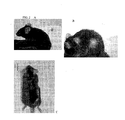
FIG. 2 Pictures A-C are all ofmouse # 4. A) Prior to experiment (nothing has been done to the animal. B) The circled area shows where the hair has been shaved and what appears to look like a water drop is the application of solutions prior to evaporation (this picture was taken on the first day of application). C) The circled area shows where there was a predominant re-growth of hair. -
FIG. 3 . Immunohistochemistry: below A) control B) 3.0 mg/ml (circled area above in C where there is demonstrative hair re-growth. -
FIG. 4 : shows predominant hair re-growth (in white circle) in mouse #2 (A) using a topical application of 3.0 mg/ml. B) mouse prior to experiment. C) shaved area (in white circle) Below show immunohistochemistry of 3.0 mg/ml (D) where an overwhelming number of BrdU positive (green) cells coincides with the area of hair re-growth and 1.5 mg/ ml (E) where proliferation is at an increase. - Recently, in the course of evaluating factors that influence stem cell proliferation, we made a provocative discovery. A heterocyclic pyrimidine molecule NBI-18 (2-piperazino-6-methyl-5-oxo-5,6-dihydro-(7H) pyrro-[3,4-d] pyrimidine maleate; Mwt. 349.54), previously described as having possible neurotrophic activity, can stimulate the proliferation of human NSCs in culture. The increase in proliferation was dose dependent in animal studies. We found that daily injections of NBI-18 for five days led to stable neurogenesis at four weeks in young and aged rodents alike. There were no discernible pathological effects, and no symptoms of toxicity due to the treatment with NBI-18 throughout the experiment. Based on these preliminary findings, we moved towards developing a topical application in an attempt to increase cell proliferation in a similar manner in relation to hair regeneration. C57 BU6 mice were used to apply different concentrations of NBI-18 on shaved areas of skin with the incorporation of BrdU to detect cell proliferation, followed by immunohistochemistry. We were able to see an abundant increase in proliferating cells in all concentrations applied in comparison to the control area. More importantly, was the visibly complete hair growth that was in the treated areas compared to the non-treated areas. NBI-18 promises to be a novel compound leading to the development of regenerative therapeutics that can accelerate hair growth.
- Recently, the inventors became intrigued by several reports suggesting that a family of heterocyclic pyrrolopyrimidine (PyP) compounds have a variety of growth promoting biological activities including increasing neurite outgrowth and repair of injured peripheral nerves and muscle.
U.S. Patent Nos. 4,959,368 ;5,976,523 . One derivative of interest is heterocyclic pyrimidine molecule referred to herein as 'NBI-18' (2-piperazino-6-methyl-5-oxo-5,6-dihydro-(7H) pyrro-[3,4-d] pyrimidine maleate; Mwt. 349.54). In other cell culture studies using neurons isolated from rodent cortex, NBI-18 was reported to be active primarily in the presence of various growth factors, including bFGF, nerve growth factor, EGF, and insulin-like growth factor.U.S. Patent Pub 20030139410 . The mechanism of action of NBI-18 is not known, although some evidence implies the activation of the MAPK (mitogen activated protein kinase) pathway, a cascade that is also activated by peptide growth factors. It has been suggested that NBI-18 promoted the survival of rodent cortical neurons by reducing the rate of apoptosis, as measured by TUNEL assays. NBI-18 has been tested in isolated animal models--axon growth in mice and muscle regeneration in rats -- with no evidence of mechanistic details relating to function. Mechanism of Mechanism of action studies to find the drug target, are planned as part of our ongoing research. Upon learning about the availability of NBI-18 family of molecules, it was hypothesized that the compounds may be involved in the proliferation process of Stem Cells and the inventors decided to examine the possible implication for genesis of Keratinocyte Stem Cells (KSCs) or possibly the human bulge cells which provide the niche for KSCs, in animal models. Early evidence from rodent studies, suggests that NBI-18 is absorbed well after intraperitoneal as well as oral administration and it has a t1/2 >>4 h in rat circulation as shown by HPLC analysis. NBI-18 can be extracted 24 hours-post-injection from the epidermis of treated mice and the compound was not mutagenic, as indicated by a third party Ames test. - Based on the inventors' realizations, the decision was made to test NBI-18 in a topical application study to induce the genesis or re-growth of hair. Varying doses of NBI-18 [0.75 mg/ml, 1.5 mg/ml, 3.0 mg/ml, and control (50%ETOH)] was delivered in 5 ul drops to shaved locations on the back of C57 BL/6 mice. The varying doses were given 5 consecutive days and on
day 4 and 5 BrdU (100 mg/kg, ip) was injected. Immunohistochemistry suggest a vast increase in Brdu + cells throughout the NBI-18 concentrations in comparison to the control, which didn't receive NBI-18. However, the most impressive data was the visible re-growth of hair in the treated areas, near to its original length within 7 days. The control or untreated areas showed no visible re-growth within the 7 day time frame. NBI-18 has proven to produce a desired affect in rodent models that show a predominant re-growth of hair using the topical application of the small molecular pyrimidine compound known as NBI-18. We are hypothesizing that NBI-18 treatment will lead to greater cytogenesis and eventually lead to a commercial product that will eradicate hair loss. These studies will be further described in the Examples provided below. - Accordingly, in one embodiment, the subject invention pertains to a method of increasing thickness of hair (i.e. number of hair fibers per surface area) and/or number hair follicles actively producing hair fibers in a human or nonhuman subject that comprises the administration of a hair-enhancing composition that contains a hair producing agent (HPA).
U.S. Patent Nos. 5,976,523 ('523 patent) and4,959,368 ('368 patent) teach a number of compounds that may be used as wound healing agents. The '523 patent teaches that the wound healing agents described therein act by potentiating growth factors and cytokines released in tissues as a result of injury or wounding of tissues. Essentially, the '523 patent teaches that the agents stimulate the migration of cells toward the wound. The present inventors have discovered that the same agents actually stimulate the proliferation of stem cells, which in turn, led to the discovery that the agents may be used in circumstances where tissues have not been wounded. - Accordingly, the agents presented in the '523 patent and '368 patent are incorporated herein by reference for disclosure of HPA agents. Also see
U.S. Patent Pub 20080124306 Formulas 1 and 2 as set forth in the '523 patent are provided:

- Typical illustrative compounds of formula (1) include:
- 2-Piperazino-6-methyl-5-oxo-5,6-dihydro(7H)pyrro-[3,4-d]pyrimidine,
- 2-((4-Methylpiperazino-6-methyl-5-oxo-5,6-dihydro-(7H)pyrro[3,4 -d]pyrimidine,
- 2-((4-Ethylpiperazino-6-methyl-5-oxo-5,6-dihydro-(7H)pyrro[3,4-d]pyrimidine,
- 2-Piperidino-6-methyl-5-oxo-5,6-dihydro(7H)pyrro-[3,4-d]pyrimidine,
- 2-((4-Methylpiperidino)-6-methyl-5-oxo-5,6-dihydro(7H)pyrro[3,4-d]pyrimidine
- 2-((4-Ethylpiperidino)-6-methyl-5-oxo-5,6-dihydro-(7H)pyrro[3,4-d]pyrimidine
- 2-Morpholino-6-methyl-5-oxo-5,6-dihydro(7H)pyrro-[3,4-d]pyrimidine,
- 2-Thiomorpholino-6-methyl-5-oxo-5,6-dihydro(7H)-pyrro[3,4-d]pyrimidine,
- 2-Piperazino-6-ethyl-5-oxo-5,6-dihydro(7H)pyrro-[3,4-d]pyrimidine,
- 2-Piperazino-6-isopropyl-5-oxo-5,6-dihydro(7H)-pyrro[3,4-d]pyrimidine,
- 2-Piperazino-6-n-butyl-5-oxo-5,6-dihydro(7H)-pyrro[3,4-d]pyrimidine,
- 2-Piperazino-6-sec.-butyl-5-oxo-5,6-dihydro(7H)-pyrro[3,4-d]pyrimidine,
- 2-Piperazino-6-t-butyl-5-oxo-5,6-dihydro(7H)-pyrro[3,4-d]pyrimidine,
- 2-Piperazino-4,6-dimethyl-5-oxo-5,6-dihydro(7H)-pyrro[3,4-d]pyrimidine,
- 2-Piperazino-6,7-dimethyl-5-oxo-5,6-dihydro(7H)-pyrro[3,4-d]pyrimidine,
- 2-Piperazino-6,7,7-trimethyl-5-oxo-5,6-dihydro-(7H)pyrro[3,4-d]pyrimidine,
- 2-Piperidino-4,6-dimethyl-5-oxo-5,6-dihydro(7H)-pyrro[3,4-d]pyrimidine,
- 2-Piperidino-6,7,7-trimethyl-5-oxo-5,6-dihydro-(7H)pyrro[3,4-d]pyrimidine,
- 2-Piperazino-7-methyl-6-ethyl-5-oxo-5,6-dihydro-(7H)pyrro[3,4-d]pyrimidine, and
- 2-Piperazino-4-methyl-6-ethyl-5-oxo-5,6-dihydro-(7H)pyrro[3,4-d]pyrimidine.
- Typical illustrative compounds of formula (2) include:
- 2-Piperazino-7-methyl-6-oxo-5,6-dihydro(7H)pyrro-[2,3-d]pyrimidine,
- 2-((4-Methylpiperazino)-7-methyl-6-oxo-5,6-dihydro(7H)pyrro[2,3-d]pyrimidine
- 2-((4-Ethylpiperazino)-7-methyl-6-oxo-5,6-dihydro-(7H)pyrro[2,3-d]pyrimidine
- 2-((4-N-Acetylpiperazino)-7-methyl-6-oxo-5,6-dihydro(7H)pyrro[2,3-d]pyrimidine,
- 2-Piperidino-7-methyl-6-oxo-5,6-dihydro(7H)pyrro-[2,3-d]pyrimidine,
- 2-((4-Methylpiperidino)-7-methyl-6-oxo-5,6-dihydro(7H)pyrro[2,3-d]pyrimidine
- 4-((Ethylpiperidino)-7-methyl-6-oxo-5,6-dihydro-(7H)pyrro[2,3-d]pyrimidine,
- 2-Morpholino-7-methyl-6-oxo-5,6-dihydro(7H)pyrro-[2,3-d]pyrimidine,
- 2-Thiomorpholino-7-methyl-6-oxo-5,6-dihydro(7H)-pyrro[2,3-d]pyrimidine,
- 2-Piperidino-7-ethyl-6-oxo-5,6-dihydro(7H)pyrro-[2,3-d]pyrimidine,
- 2-Piperidino-7-n-propyl-6-oxo-5,6-dihydro(7H)-pyrro[2,3-d]pyrimidine,
- 2-Piperidino-7-isopropyl-6-oxo-5,6-dihydro(7H)-pyrro[2,3-d]pyrimidine,
- 2-Piperidino-7-n-butyl-6-oxo-5,6-dihydro(7H)-pyrro[2,3-d]pyrimidine,
- 2-Piperidino-7-t-butyl-6-oxo-5,6-dihydro(7H)-pyrro[2,3-d]pyrimidine,
- 2-Piperidino-5-methyl-6-oxo-5,6-dihydro(7H)pyrro-[2,3-d]pyrimidine,
- 2-Piperazino-5-methyl-6-oxo-5,6-dihydro(7H)pyrro-[2,3-d]pyrimidine,
- 2-Piperazino-4,7-dimethyl-6-oxo-5,6-dihydro(7H)-pyrro[2,3-d]pyrimidine,
- 2-Piperidino-5,7-dimethyl-6-oxo-5,6-dihydro(7H)-pyrro[2,3-d]pyrimidine,
- 2-Piperidino-5,5,7-trimethyl-6-oxo-5,6-dihydro-(7H)pyrro[2,3-d]pyrimidine,
- 2-Piperazino-5,7-dimethyl-6-oxo-5,6-dihydro(7H)-pyrro[2,3-d]pyrimidine,
- 2-Piperazino-5,5,7-trimethyl-6-oxo-5,6-dihydro-(7H)pyrro[2,3-d]pyrimidine,
- 2-Piperidino-4-methyl-7-ethyl-6-oxo-5,6-dihydro-(7H)pyrro[2,3-d]pyrimidine, and
- 2-Piperidino-5-methyl-7-ethyl-6-oxo-5,6-dihydro-(7H)pyrro[2,3-d]pyrimidine.
- In certain embodiments the pyrimidine derivative of formula (I) is NBI-18, or 2-piperazino-6-methyl-5-oxo-5,6-dihydro(7H) pyrro[2,3-d]pyrimidine maleate (the C4H4O4 maleate salt), as disclosed in
U.S. Pat. No. 4,959,368 . In certain in vivo embodiments, the pyrimidine derivatives of formulae (I) and (II) is administered at a concentration of between about 0.01 mg/kg/day to 50 mg/kg/day, more preferably between about 0.1 mg/kg/day to 10 mg/kg/day, even more preferably between about 1 mg/kg/day to 5 mg/kg/day, and even more preferably about 3 mg/kg/day. In these embodiments, the pyrimidine derivatives of formulae (I) and (II) is administered for between about 1 and 60 days, or more preferably between about 1 and 30 days, or more preferably between about 1 and 15 days, or even more preferably between about 1 and 10 days, or more preferably between about 2 and 7 days, or even more preferably about 5 days. In certain others of these embodiments, the methods further comprise the step of administering a growth factor. In certain embodiments, the growth factor comprises fibroblast growth factor, epidermal growth factor or a combination thereof. - Pharmaceutical compositions comprising the active compounds of the invention may be manufactured by means of conventional mixing, dissolving, granulating, dragee-making levigating, emulsifying, encapsulating, entrapping or lyophilization processes. The compositions may be formulated in conventional manner using one or more physiologically acceptable carriers, diluents, excipients or auxiliaries which facilitate processing of the active compounds into preparations which can be used pharmaceutically. The actual pharmaceutical composition administered will depend upon the mode of administration. Virtually any mode of administration may be used, including, for example topical, oral, systemic, inhalation, injection, transdermal, etc.
- The active compound may be formulated in the pharmaceutical compositions per se, or in the form of a pharmaceutically acceptable salt. As used herein, the expression "pharmaceutically acceptable salt" means those salts which retain substantially the biological effectiveness and properties of the active compound and which is not biologically or otherwise undesirable. Such salts may be prepared from inorganic and organic acids and bases, as is well-known in the art. Typically, such salts are more soluble in aqueous solutions than the corresponding free acids and bases.
- For topical administration, the active compound(s) may be formulated as solutions, gels, ointments, creams, suspensions, etc. as are well-known in the art.
- Systemic formulations include those designed for administration by injection, e.g., subcutaneous, intravenous, intramuscular, intrathecal or intraperitoneal injection, as well as those designed for transdermal, transmucosal oral or pulmonary administration.
- Useful injectable preparations include sterile suspensions, solutions or emulsions of the active compound(s) in aqueous or oily vehicles. The compositions may also contain formulating agents, such as suspending, stabilizing and/or dispersing agent. The formulations for injection may be presented in unit dosage form, e.g., in ampules or in multidose containers, and may contain added preservatives.
- Alternatively, the injectable formulation may be provided in powder form for reconstitution with a suitable vehicle, including but not limited to sterile pyrogen free water, buffer, dextrose solution, etc., before use. To this end, the active compound(s) may dried by any art-known technique, such as lyophilization, and reconstituted prior to use.
- For transmucosal administration, penetrants appropriate to the barrier to be permeated are used in the formulation. Such penetrants are known in the art.
- For oral administration, the pharmaceutical compositions may take the form of, for example,tablets or capsules prepared by conventional means with pharmaceutically acceptable excipientssuch as binding agents (e.g., pregelatinised maize starch, polyvinylpyrrolidone or hydroxypropyl methylcellulose); fillers (e.g., lactose, microcrystalline cellulose or calcium hydrogen phosphate); lubricants (e.g., magnesium stearate, talc or silica); disintegrants (e.g., potato starch or sodium starch glycolate); or wetting agents (e.g., sodium lauryl sulfate). The tablets may be coated by methods well known in the art with, for example, sugars or enteric coatings.
- Liquid preparations for oral administration may take the form of, for example, elixirs, solutions, syrups or suspensions, or they may be presented as a dry product for constitution with water or other suitable vehicle before use. Such liquid preparations may be prepared by conventional means with pharmaceutically acceptable additives such as suspending agents (e.g., sorbitol syrup, cellulose derivatives or hydrogenated edible fats); emulsifying agents (e.g., lecithin or acacia); non-aqueous vehicles (e.g., almond oil, oily esters, ethyl alcohol or fractionated vegetable oils); and preservatives (e.g., methyl or propyl-p-hydroxybenzoates or sorbic acid). The preparations may also contain buffer salts, flavoring, coloring and sweetening agents as appropriate. Preparations for oral administration may be suitably formulated to give controlled release of the active compound.
- For buccal administration, the compositions may take the form of tablets, chewing gum or lozenges formulated in conventional manner.
- For rectal and vaginal routes of administration, the active compound(s) may be formulated as solutions (for retention enemas) suppositories or ointments containing conventional suppository bases such as cocoa butter or other glycerides.
- For administration by inhalation, the active compound(s) can be conveniently delivered in the form of an aerosol spray from pressurized packs or a nebulizer, with the use of a suitable propellant, e.g., dichlorodifluoromethane, trichlorofluoromethane, dichlorotetrafluoroethane, carbon dioxide or other suitable gas. In the case of a pressurized aerosol the dosage unit may be determined by providing a valve to deliver a metered amount. Capsules and cartridges of e.g. gelatin for use in an inhaler or insufflator may be formulated containing a powder mix of the compound and a suitable powder base such as lactose or starch.
- For prolonged delivery, the active compound(s) can be formulated as a depot preparation, for administration by implantation; e.g., subcutaneous, intradermal, or intramuscular injection. Thus, for example, the active ingredient may be formulated with suitable polymeric or hydrophobic materials (e.g., as an emulsion in an acceptable oil) or ion exchange resins, or as sparingly soluble derivatives; e.g., as a sparingly soluble salt
- Alternatively, transdermal delivery systems manufactured as an adhesive disc or patch which slowly releases the active compound(s) for percutaneous absorption may be used. To this end, permeation enhancers may be used to facilitate transdermal penetration of the active compound(s). Suitable transdermal patches are described in for example,
U.S. Pat.No. 5,407,713 .;U.S. Pat. No. 5,352,456 ;U.S. Pat. No. 5,332,213 ;U.S. Pat. No. 5,336,168 ;U.S. Pat. No. 5,290,561 ;U.S. Pat. No. 5,254,346 ;U.S. Pat. No. 5,164,189 ;U.S. Pat. No. 5,163,899 ;U.S. Pat. No. 5,088,977 ;U.S. Pat. No. 5,087,240 ;U.S. Pat. No. 5,008,110 ; andU.S. Pat. No. 4,921,475 . - Alternatively, other pharmaceutical delivery systems may be employed. Liposomes and emulsions are well-known examples of delivery vehicles that may be used to deliver active compounds(s). Certain organic solvents such as dimethylsulfoxide (DMSO) may also be employed, although usually at the cost of greater toxicity.
- The pharmaceutical compositions may, if desired, be presented in a pack or dispenser device which may contain one or more unit dosage forms containing the active compound(s). The pack may, for example, comprise metal or plastic foil, such as a blister pack. The pack or dispenser device may be accompanied by instructions for administration.
- In preliminary studies, the inventors found that NBI-18 injections (5 mg/kg) increased proliferation of cells in the brain of rodents. In this study, the inventors determined a dose range where keratinogenesis occurs in healthy mice to help us learn about the fate of newly formed cells within the epidermis. This data enables selection of a relevant dose range for treating hair loss conditions such as Androgenic Alopecia, Alopecia Areata, Postpartum Alopecia and Telogen Effiuvium using a topical application. Normal healthy C57 BL/6 mice exhibiting natural active behavior were used to test the topical application of NBI-18. In order for us to eliminate unnecessary anesthesia, our vehicle of delivery was 50% Ethanol (ETOH). NBI-18 was suspended in 50% ETOH using the concentrations of 0.75 mg/ml, 1.5 mg/ml, 3.0 mg/ml, and control (50%ETOH) respectively.
- Results. In using 50% ETOH as our delivery vehicle we were able to demonstrate through immunohistochemistry, an increased population in BrdU positive stained cells. This visible increase was incurred in all concentrations of NBI-18 and showed a dramatic elevation in BrdU positive stained cells in comparison to the control which received just 50% ETOH. Although the elevations in BrdU positive stained cells did not demonstrate a dose dependent increase as one would expect, this could be due to the probability of that each recurring application was not placed in exactly the same area on some of the mice. A more applicable delivery system will be developed in future studies.
- A total of 16 male C57 BL/6 mice (12 weeks old) weighing 25-30 g were used to investigate the toxicity of NBI-18. The mice were maintained on a 12-h light/dark cycle, and had free access to food and water through the study period. These animals were housed four per cage. In this study, animals were divided into four groups (four / group). Acute toxicity has been tested up to 1000 mg/kg. NBI-18 (0,100,300,1000 mg/kg/day, i.p.) was injected for 7 days and for the control group, the same volume of vehicle saline was injected. Bromodeoxyuridine (BrdU)(Sigma Chemical Co., St Louis, Mo), was injected (100 mg/ kg/day, i.p.) for the last three days (days 5-7). For behavioral testing, rotarod and open field tests were used to examine balance and coordination of mice before, during and after NBI-18 injection. Also, postural reflex and forelimb placing tests were performed to evaluate the neurological functions for the animals. All the animals were anesthetized with pentobarbital (i.p.) 48 h after the last BrdU injection and immediately per fused with 4% paraformaldehyde fixative. The brains were immediately dissected, post fixed for 24 h and processed for immunohistochemistry.
- Results. The animals demonstrated no immediate behavioral or neurological changes in the study. They showed no symptoms of toxicity due to the treatment with NBI-18 throughout the experiment. An Ames was conducted by a third party company and the results were consistent showing no mutagenesis or toxicity, suggesting that NBI-18 is safe and won't have any adverse effects on the mice.
- A. Two C57 BL/6 mice were selected for the topical application study of NBI-18. The mice were prepped by shaving four specific locations lateral/dorsal in a circular pattern. NBI-18 was delivered to the specified areas (right, counterclockwise from lowest to highest dose, then control) in concentrations of 1.5 mg/ml, 3.0 mg/ml, 6.0 mg/ml and control (50%ETOH) respectively. The solutions were applied to the center of these locations in a 5 ul dose for 5 consecutive days and on
days 4 and 5 BrdU (100 mg/K, ip) was injected. On day 7 the mice were euthanized using a high dose pentobarbital (70 mg/kg, ip) and the treated epidermis was dissected and placed into 4% paraformaldehyde fixative for 48 hour - Immunohistochemistry of epidermis. Epidermal sections were mounted into square embedding molds with freezing medium (O.C.T. compound, Tissue Tek), sliced in 20uM sections then mounted onto adhesive coated slides (Instrumedics, Inc) via tape transfer method. Slides were washed with PBS then placed in 2N HCL for 30 minutes to induce histone release. Slides were then washed again with PBS, then blocked using 3% Donkey serum in PBST for 1 hour. Primary anti-body suspended in blocking solution used was anti-BrdU (sigma) at 1:1000 overnight in 4C. Slide were washed 3X then placed in secondary anti-body suspended in blocking solution, FITC (Jackson ImmunoResearch) at 1:500 for 2 hours at room temperature then washed with PBS. Slides were mounted using Vectashield with Dapi. Photographs were taken using an inverted fluorescent microscope (Leica, DMI 6000 B with Q-imaging Retiga exi camera).
- Results. The Control (A) show a much reduced level of BrdU signaling along with a nonmigration pattern; the new cells are sporadic throughout the tissue sample. All of the NBI-18 treated samples (B-D) showed mass increases of newly developed cells but most importantly they demonstrated an alignment towards migration patterns.
FIG. 1 . - B. Four C57 BL/6 mice were selected for the topical application study of NBI-18. The mice were prepped by shaving four specific locations lateral/dorsal in a circular pattern. NBI-18 was delivered to the specified areas (right, counterclockwise from lowest to highest dose, then control) in concentrations of 0.75 mg/ml, 1.5 mg/ml, and 3.0 mg/ml, and control (50%ETOH) respectively. The solutions were applied to the center of these locations in a 5 ul dose for 5 consecutive days and on
days 4 and 5 BrdU (100 mg/K, ip) was injected. On day 7 the mice were euthanized using a high dose pentobarbital (70 mg/kg, ip) and the treated epidermis was dissected and placed into 4% paraformaldehyde fixative for 48 hour. - Immunohistochemistry of epidermis. Epidermal sections were mounted into square embedding molds with freezing medium (O.C.T. compound, Tissue Tek), sliced in 20uM sections then mounted onto adhesive coated slides (Instrumedics, Inc) via tape transfer method. Slides were washed with PBS then placed in 2N HCL for 30 minutes to induce histone release. Slides were then washed again with PBS, then blocked using 3% Donkey serum in PBST for 1 hour. Primary anti-body suspended in blocking solution used was anti-BrdU (sigma) at 1:1000 overnight in 4C. Slide were washed 3X then placed in secondary anti-body suspended in blocking solution, FITC (Jackson ImmunoResearch) at 1:500 for 2 hours at room temperature then washed with PBS. Slides were mounted using Vectashield with Dapi. Photographs were taken using an inverted fluorescent microscope (Leica, DMI 6000 B with Q-imaging Retiga exi camera).
- Results. In all of the mice there were some varying levels of increase in BrdU positive cells in comparison with the controls as shown in the immunohistochemistry.
FIG. 3 . However the most visible effect is the actual hair re-growth demonstrated in the pictures of the mice.FIG. 2 (mouse 4) andFIG. 4 (mouse 2). Even though the locations of hair re-growth occur sporadically throughout the three concentrations of NBI-18 (0.75 mg/ml, 1.5 mg/ml, 3.0 mg/ml.), there is absolutely no visible hair regeneration in the controls within the same time constraints. This can be explained by the probability of each recurring applications ability was placed in exactly the same area. A 5 ul drop onto the back of a moving mouse allows for a possible missed location involving topical applications. However, the data clearly demonstrates the differences between the control and compound. A next feasible step will be to test this compounds efficacy against similar proven compounds such as minoxidil (Rogaine). - Discussion related to Examples 1-3. Preliminary studies have shown that NBI-18 increases the number of BrdU positive cells in mice that have received a 5 day consecutive topical application of 5 ul doses of 0.75 mg/ml, 1.5 mg/ml, 3.0 mg/ml and 50% ETOH (control). There are three cycles of hair growth; the anagen phase (the growing phase), the catagen phase (where hair stops growing) and the Telogen phase (which is the resting phase). The anagen phase last for appx.1000 days but can range from 2-6 years and it is considered the "on" phase or growing phase. The catagen phase lasts for only 1-2 weeks and during this phase the hair follicle shrinks and starts to die; this is known as the transitional phase. Telogen is the final phase often referred to as the "resting" or "off" phase and this is when the hair follicle renews or activates itself and a new hair in the anagen phase develops pushing the old hair out. The mechanistic effect of NBI-18 has on the stem cell population and how it directly effects the hair follicles is still in the process of being elucidated. However, another study using the monoxidil showed that in animal studies, topical minoxidil shortens the telogen phase, causing premature entry of new hair from resting hair follicles into anagen phase, thus producing a mechanistic blocking effect of the natural pathways. In order to preserve this mechanistic effect, the delivery dosage must continually be maintained. In comparison our compound works on the physiological pathway of the stem cell environment by increasing the proliferation of endogenous cells. Once this increase is achieved, usually within a 3-5 day treatment schedule there is no need to continue using the compound.
- The small molecule NBI-18 bypasses the ethical and technical issues associated with stem cell transplantation by directly coaxing the production of healthy new endogenous cells. NBI-18 and its variants represent a unique class of synthetic heterocyclic compounds that are stable, orally bioavailability, and easily manufactured. The inventors are able to use a compound that works synergistically with natural stem cell growth factors to speed up cell proliferation. Such compounds are a rare and valuable therapeutic candidate. This idea delivers an exciting time for everyone. It is a new and innovative drug that could change the aesthetics of people everywhere. The adverse psychological effects caused hair loss will no longer be an in issue in both men and women.
Claims (13)
- A hair producing agent (HPA) selected from 2-piperazino-6-methyl-5-oxo-5,6-dihydro-(7H) pyrro-[3,4-d] pyrimidine or a pharmaceutically acceptable salt thereof for use in a method of treating hair loss or delaying the onset of hair loss in a patient in need thereof.
- The HPA for the use according to claim 1, wherein said patient has androgenic alopecia, alopecia areata, postpartum alopecia or telogen effiuvium.
- The HPA for the use according to claims 1 or 2, wherein said treating comprises parenteral administration, topical administration and/or oral administration.
- The HPA for the use according to anyone of claims 1 to 3, wherein said treating comprises topical administration.
- The HPA for the use according to anyone of claims 1 to 4, wherein said HPA is 2-piperazino-6-methyl-5-oxo-5,6-dihydro-(7H) pyrro-[3,4-d] pyrimidine maleate (NBI-18).
- A hair producing agent (HPA) selected from 2-piperazino-6-methyl-5-oxo-5,6-dihydro-(7H) pyrro-[3,4-d] pyrimidine or a pharmaceutically acceptable salt thereof, for use in a method of increasing the number of hair follicles growing hair on a scalp of a patient in need thereof.
- The HPA for the use according to claim 6, wherein said patient has androgenic alopecia, alopecia areata, postpartum alopecia or telogen effiuvium.
- The HPA for the use according to anyone of claims 6 or 7, wherein said method comprises parenteral administration, topical administration and/or oral administration.
- The HPA for the use according to anyone of claims 6 to 8, wherein said method comprises topical administration.
- The HPA for the use according to anyone of claims 6 to 9, wherein said HPA is 2-piperazino-6-methyl-5-oxo-5,6-dihydro-(7H) pyrro-[3,4-d] pyrimidine maleate (NBI-18).
- A composition comprising a therapeutically effective amount of an HPA according to anyone of claims 1 to 5, or a pharmaceutically acceptable salt thereof for use in a method of treating hair loss or delaying the onset of hair loss in a patient in need thereof.
- A composition comprising a therapeutically effective amount of an HPA according to anyone of claims 6 to 10, or a pharmaceutically acceptable salt thereof for use in a method of increasing the number of hair follicles growing hair on a scalp of a patient in need thereof.
- The composition of claims 11 or 12 for the use according to claims 11 or 12 for parenteral administration, topical administration and/or oral administration.
Applications Claiming Priority (2)
| Application Number | Priority Date | Filing Date | Title |
|---|---|---|---|
| US9744308P | 2008-09-16 | 2008-09-16 | |
| PCT/US2009/057134 WO2010033576A1 (en) | 2008-09-16 | 2009-09-16 | Compositions for treating or delaying the onset of hair loss |
Publications (3)
| Publication Number | Publication Date |
|---|---|
| EP2326330A1 EP2326330A1 (en) | 2011-06-01 |
| EP2326330A4 EP2326330A4 (en) | 2011-08-31 |
| EP2326330B1 true EP2326330B1 (en) | 2015-01-07 |
Family
ID=42039840
Family Applications (1)
| Application Number | Title | Priority Date | Filing Date |
|---|---|---|---|
| EP09815103.8A Not-in-force EP2326330B1 (en) | 2008-09-16 | 2009-09-16 | Compositions for treating or delaying the onset of hair loss |
Country Status (5)
| Country | Link |
|---|---|
| US (1) | US8791128B2 (en) |
| EP (1) | EP2326330B1 (en) |
| JP (1) | JP5555922B2 (en) |
| CA (1) | CA2736018C (en) |
| WO (1) | WO2010033576A1 (en) |
Families Citing this family (1)
| Publication number | Priority date | Publication date | Assignee | Title |
|---|---|---|---|---|
| WO2010087527A1 (en) * | 2009-01-29 | 2010-08-05 | Akira Awaya | Ultraviolet absorbers, and pharmaceutical compositions and cosmetics containing pyrimidine compounds for uv protection |
Family Cites Families (24)
| Publication number | Priority date | Publication date | Assignee | Title |
|---|---|---|---|---|
| JPH08325268A (en) * | 1986-02-24 | 1996-12-10 | Mitsui Petrochem Ind Ltd | Pyrrolo [3,4-d] pyrimidine derivative |
| EP0799617A3 (en) | 1986-02-24 | 1997-11-12 | Mitsui Petrochemical Industries, Ltd. | Therapeutic agent for neurological diseases |
| US5304555A (en) * | 1987-08-26 | 1994-04-19 | Mitsui Petrochemical Industries, Ltd. | Pyrimidines and pharmaceutically acceptable salts thereof useful in treatment of neurological disorders |
| EP0743066A3 (en) * | 1995-05-16 | 1998-09-30 | Mitsui Pharmaceuticals, Inc. | Wound-healing agent |
| JPH09295946A (en) * | 1995-05-16 | 1997-11-18 | Mitsui Pharmaceut Inc | Pharmaceutical composition |
| WO1998006422A1 (en) * | 1996-08-13 | 1998-02-19 | Fujisawa Pharmaceutical Co., Ltd. | Hematopoietic stem cell proliferating agents |
| WO1999062880A1 (en) * | 1998-06-03 | 1999-12-09 | Gpi Nil Holdings, Inc. | N-linked sulfonamides of n-heterocyclic carboxylic acids or carboxylic acid isosteres |
| GB9904281D0 (en) | 1999-02-24 | 1999-04-21 | Reneuron Ltd | Transplantation |
| IL148175A0 (en) | 1999-08-18 | 2002-09-12 | Gen Hospital Corp | Methods, compositions and kits for promoting recovery from damage to the central nervous system |
| AU2003202988A1 (en) | 2002-01-14 | 2003-07-30 | The Board Of Trustees Of The University Of Illinois | Use of modified pyrimidine compounds to promote stem cell migration and proliferation |
| WO2005040391A1 (en) | 2003-10-27 | 2005-05-06 | Murdoch Childrens Research Institute | Compositions and methods for differentiating stem cells |
| WO2005066142A2 (en) * | 2004-01-06 | 2005-07-21 | Taisho Pharmaceutical Co., Ltd. | Pyrrolopyrimidine and pyrrolotriazine derivatives as crf receptor antagonists |
| WO2005085253A1 (en) * | 2004-03-05 | 2005-09-15 | Taisho Pharmaceutical Co., Ltd. | Pyrrolopyrimidine derivatives |
| FR2870739B1 (en) * | 2004-05-26 | 2008-05-16 | Oreal | USE OF LIF IN COSMETICS AND DERMATOLOGY |
| JP2007161585A (en) * | 2004-06-25 | 2007-06-28 | Taisho Pharmaceut Co Ltd | Pyrrolopyrimidine and pyrrolopyridine derivatives substituted with cyclic amino groups |
| EA011606B1 (en) | 2004-07-14 | 2009-04-28 | Эдуард Борисович Татулов | METHODS OF OBTAINING AND USING A RECOMBINANT ALPHA-FETOPROTEIN |
| US7850960B2 (en) * | 2004-12-30 | 2010-12-14 | University Of Washington | Methods for regulation of stem cells |
| US20060257449A1 (en) * | 2005-05-16 | 2006-11-16 | Didier Billy | Methods, compositions, systems, and devices for bone fusion |
| WO2006133876A1 (en) * | 2005-06-17 | 2006-12-21 | Dsm Ip Assets B.V. | Use of pyrimidine derivatives for cosmetic purposes |
| KR100705981B1 (en) | 2005-10-12 | 2007-04-10 | 주식회사 리제론 | Hair loss prevention or hair growth promoting composition containing human growth hormone |
| JP4804935B2 (en) | 2006-01-31 | 2011-11-02 | 株式会社マンダム | Hair growth and nourishing composition |
| US20080124306A1 (en) * | 2006-11-28 | 2008-05-29 | Kiminobu Sugaya | Vigor Enhancement Via Administration of Pyrimidine Derivatives |
| JP5568221B2 (en) | 2008-06-09 | 2014-08-06 | 富士機械製造株式会社 | Electronic circuit component mounting system |
| PL2528955T3 (en) * | 2010-01-29 | 2019-09-30 | Monosol, Llc | WATER-SOLUBLE FOIL WITH IMPROVED DISSOLUTION AND TENSION CHARACTERISTICS, AND PACKAGING |
-
2009
- 2009-09-16 CA CA2736018A patent/CA2736018C/en active Active
- 2009-09-16 US US13/061,159 patent/US8791128B2/en active Active
- 2009-09-16 WO PCT/US2009/057134 patent/WO2010033576A1/en not_active Ceased
- 2009-09-16 JP JP2011527062A patent/JP5555922B2/en active Active
- 2009-09-16 EP EP09815103.8A patent/EP2326330B1/en not_active Not-in-force
Also Published As
| Publication number | Publication date |
|---|---|
| JP2012502918A (en) | 2012-02-02 |
| JP5555922B2 (en) | 2014-07-23 |
| WO2010033576A1 (en) | 2010-03-25 |
| EP2326330A1 (en) | 2011-06-01 |
| US20110190320A1 (en) | 2011-08-04 |
| CA2736018C (en) | 2015-11-03 |
| CA2736018A1 (en) | 2010-03-25 |
| EP2326330A4 (en) | 2011-08-31 |
| US8791128B2 (en) | 2014-07-29 |
Similar Documents
| Publication | Publication Date | Title |
|---|---|---|
| US6194440B1 (en) | Small molecule carbamate or urea hair growth compositions and uses | |
| PT1096924E (en) | Inhibitors of proteasomal activity for stimulating hair growth | |
| Glasky et al. | Effect of AIT-082, a purine analog, on working memory in normal and aged mice | |
| EP1379269B1 (en) | Adenosine a2a receptor antagonists combined with neurotrophic activity compounds in the treatment of parkinson's disease | |
| Meyer-Bernstein et al. | Destruction of serotonergic neurons in the median raphe nucleus blocks circadian rhythm phase shifts to triazolam but not to novel wheel access | |
| Harkany et al. | Oral post-lesion administration of 5-HT1A receptor agonist repinotan hydrochloride (BAY x 3702) attenuates NMDA-induced delayed neuronal death in rat magnocellular nucleus basalis | |
| US11077118B2 (en) | Methods and compositions for ibogaine treatment of impulse control disorder, anxiety-related disorders, violence and/or anger, or regulating food intake | |
| AU709454B2 (en) | Carbon monoxide dependent guanylyl cyclase modifiers | |
| CA2736018C (en) | Compositions for treating or delaying the onset of hair loss | |
| AU764032B2 (en) | Small molecule carbamate or urea hair growth compositions and uses | |
| WO2010148094A1 (en) | Methods and compositions for increasing trichogenic potency of dermal cells | |
| WO1999062487A1 (en) | Heterocyclic ester and amide hair growth compositions and uses | |
| EP1799219A1 (en) | Tetrodotoxin and its derivatives for the treatment of central-nervously derived neuropathic pain | |
| US6172087B1 (en) | N-oxide of heterocyclic ester, amide, thioester, or ketone hair growth compositions and uses | |
| Datta et al. | Effects of MIF-I and melatonin on novelty-induced defecation and associated plasma 11-OHCS and brain catecholamines | |
| AU760663B2 (en) | Small molecule sulfonamide hair growth compositions and uses | |
| DE19744676A1 (en) | Combination product for cancer therapy | |
| US6187796B1 (en) | Sulfone hair growth compositions and uses | |
| JP2002516847A (en) | Small molecule pipecolic acid derivative hair growth compositions and uses | |
| US20020045647A1 (en) | N-linked urea or carbamate of heterocyclic thioester hair growth compositons and uses | |
| Alphs et al. | Schizophrenic Inpatients' | |
| Merchant et al. | A Heterocyclic Pyrrolopyrimidine Compound as a Possible Candidate for Topical Application to Induce Hair Restoration | |
| AU764073B2 (en) | N-linked urea or carbamate of heterocyclic thioester hair growth compositions and uses | |
| MXPA00011850A (en) | Small molecule pipecolic acid derivative hair growth compositions and uses | |
| MXPA00011877A (en) | Small molecule carbamate or urea hair growth compositions and uses |
Legal Events
| Date | Code | Title | Description |
|---|---|---|---|
| PUAI | Public reference made under article 153(3) epc to a published international application that has entered the european phase |
Free format text: ORIGINAL CODE: 0009012 |
|
| 17P | Request for examination filed |
Effective date: 20110314 |
|
| AK | Designated contracting states |
Kind code of ref document: A1 Designated state(s): AT BE BG CH CY CZ DE DK EE ES FI FR GB GR HR HU IE IS IT LI LT LU LV MC MK MT NL NO PL PT RO SE SI SK SM TR |
|
| AX | Request for extension of the european patent |
Extension state: AL BA RS |
|
| RIN1 | Information on inventor provided before grant (corrected) |
Inventor name: MERCHANT, STEPHANIE Inventor name: SUGAYA, KIMINOBU |
|
| A4 | Supplementary search report drawn up and despatched |
Effective date: 20110803 |
|
| RIC1 | Information provided on ipc code assigned before grant |
Ipc: A61P 17/14 20060101ALI20110728BHEP Ipc: A61K 31/54 20060101AFI20110728BHEP |
|
| DAX | Request for extension of the european patent (deleted) | ||
| 17Q | First examination report despatched |
Effective date: 20121024 |
|
| GRAP | Despatch of communication of intention to grant a patent |
Free format text: ORIGINAL CODE: EPIDOSNIGR1 |
|
| INTG | Intention to grant announced |
Effective date: 20140718 |
|
| GRAS | Grant fee paid |
Free format text: ORIGINAL CODE: EPIDOSNIGR3 |
|
| GRAA | (expected) grant |
Free format text: ORIGINAL CODE: 0009210 |
|
| AK | Designated contracting states |
Kind code of ref document: B1 Designated state(s): AT BE BG CH CY CZ DE DK EE ES FI FR GB GR HR HU IE IS IT LI LT LU LV MC MK MT NL NO PL PT RO SE SI SK SM TR |
|
| REG | Reference to a national code |
Ref country code: GB Ref legal event code: FG4D |
|
| REG | Reference to a national code |
Ref country code: CH Ref legal event code: EP |
|
| REG | Reference to a national code |
Ref country code: IE Ref legal event code: FG4D |
|
| REG | Reference to a national code |
Ref country code: AT Ref legal event code: REF Ref document number: 705212 Country of ref document: AT Kind code of ref document: T Effective date: 20150215 |
|
| REG | Reference to a national code |
Ref country code: DE Ref legal event code: R096 Ref document number: 602009028877 Country of ref document: DE Effective date: 20150219 |
|
| REG | Reference to a national code |
Ref country code: NL Ref legal event code: VDEP Effective date: 20150107 |
|
| REG | Reference to a national code |
Ref country code: AT Ref legal event code: MK05 Ref document number: 705212 Country of ref document: AT Kind code of ref document: T Effective date: 20150107 |
|
| REG | Reference to a national code |
Ref country code: LT Ref legal event code: MG4D |
|
| PG25 | Lapsed in a contracting state [announced via postgrant information from national office to epo] |
Ref country code: HR Free format text: LAPSE BECAUSE OF FAILURE TO SUBMIT A TRANSLATION OF THE DESCRIPTION OR TO PAY THE FEE WITHIN THE PRESCRIBED TIME-LIMIT Effective date: 20150107 Ref country code: ES Free format text: LAPSE BECAUSE OF FAILURE TO SUBMIT A TRANSLATION OF THE DESCRIPTION OR TO PAY THE FEE WITHIN THE PRESCRIBED TIME-LIMIT Effective date: 20150107 Ref country code: LT Free format text: LAPSE BECAUSE OF FAILURE TO SUBMIT A TRANSLATION OF THE DESCRIPTION OR TO PAY THE FEE WITHIN THE PRESCRIBED TIME-LIMIT Effective date: 20150107 Ref country code: BG Free format text: LAPSE BECAUSE OF FAILURE TO SUBMIT A TRANSLATION OF THE DESCRIPTION OR TO PAY THE FEE WITHIN THE PRESCRIBED TIME-LIMIT Effective date: 20150407 Ref country code: SE Free format text: LAPSE BECAUSE OF FAILURE TO SUBMIT A TRANSLATION OF THE DESCRIPTION OR TO PAY THE FEE WITHIN THE PRESCRIBED TIME-LIMIT Effective date: 20150107 Ref country code: NO Free format text: LAPSE BECAUSE OF FAILURE TO SUBMIT A TRANSLATION OF THE DESCRIPTION OR TO PAY THE FEE WITHIN THE PRESCRIBED TIME-LIMIT Effective date: 20150407 Ref country code: FI Free format text: LAPSE BECAUSE OF FAILURE TO SUBMIT A TRANSLATION OF THE DESCRIPTION OR TO PAY THE FEE WITHIN THE PRESCRIBED TIME-LIMIT Effective date: 20150107 |
|
| PG25 | Lapsed in a contracting state [announced via postgrant information from national office to epo] |
Ref country code: AT Free format text: LAPSE BECAUSE OF FAILURE TO SUBMIT A TRANSLATION OF THE DESCRIPTION OR TO PAY THE FEE WITHIN THE PRESCRIBED TIME-LIMIT Effective date: 20150107 Ref country code: GR Free format text: LAPSE BECAUSE OF FAILURE TO SUBMIT A TRANSLATION OF THE DESCRIPTION OR TO PAY THE FEE WITHIN THE PRESCRIBED TIME-LIMIT Effective date: 20150408 Ref country code: NL Free format text: LAPSE BECAUSE OF FAILURE TO SUBMIT A TRANSLATION OF THE DESCRIPTION OR TO PAY THE FEE WITHIN THE PRESCRIBED TIME-LIMIT Effective date: 20150107 Ref country code: PL Free format text: LAPSE BECAUSE OF FAILURE TO SUBMIT A TRANSLATION OF THE DESCRIPTION OR TO PAY THE FEE WITHIN THE PRESCRIBED TIME-LIMIT Effective date: 20150107 Ref country code: LV Free format text: LAPSE BECAUSE OF FAILURE TO SUBMIT A TRANSLATION OF THE DESCRIPTION OR TO PAY THE FEE WITHIN THE PRESCRIBED TIME-LIMIT Effective date: 20150107 Ref country code: IS Free format text: LAPSE BECAUSE OF FAILURE TO SUBMIT A TRANSLATION OF THE DESCRIPTION OR TO PAY THE FEE WITHIN THE PRESCRIBED TIME-LIMIT Effective date: 20150507 |
|
| REG | Reference to a national code |
Ref country code: DE Ref legal event code: R097 Ref document number: 602009028877 Country of ref document: DE |
|
| PG25 | Lapsed in a contracting state [announced via postgrant information from national office to epo] |
Ref country code: EE Free format text: LAPSE BECAUSE OF FAILURE TO SUBMIT A TRANSLATION OF THE DESCRIPTION OR TO PAY THE FEE WITHIN THE PRESCRIBED TIME-LIMIT Effective date: 20150107 Ref country code: SK Free format text: LAPSE BECAUSE OF FAILURE TO SUBMIT A TRANSLATION OF THE DESCRIPTION OR TO PAY THE FEE WITHIN THE PRESCRIBED TIME-LIMIT Effective date: 20150107 Ref country code: CZ Free format text: LAPSE BECAUSE OF FAILURE TO SUBMIT A TRANSLATION OF THE DESCRIPTION OR TO PAY THE FEE WITHIN THE PRESCRIBED TIME-LIMIT Effective date: 20150107 Ref country code: DK Free format text: LAPSE BECAUSE OF FAILURE TO SUBMIT A TRANSLATION OF THE DESCRIPTION OR TO PAY THE FEE WITHIN THE PRESCRIBED TIME-LIMIT Effective date: 20150107 Ref country code: RO Free format text: LAPSE BECAUSE OF FAILURE TO SUBMIT A TRANSLATION OF THE DESCRIPTION OR TO PAY THE FEE WITHIN THE PRESCRIBED TIME-LIMIT Effective date: 20150107 |
|
| PLBE | No opposition filed within time limit |
Free format text: ORIGINAL CODE: 0009261 |
|
| STAA | Information on the status of an ep patent application or granted ep patent |
Free format text: STATUS: NO OPPOSITION FILED WITHIN TIME LIMIT |
|
| 26N | No opposition filed |
Effective date: 20151008 |
|
| PG25 | Lapsed in a contracting state [announced via postgrant information from national office to epo] |
Ref country code: IT Free format text: LAPSE BECAUSE OF FAILURE TO SUBMIT A TRANSLATION OF THE DESCRIPTION OR TO PAY THE FEE WITHIN THE PRESCRIBED TIME-LIMIT Effective date: 20150107 |
|
| PG25 | Lapsed in a contracting state [announced via postgrant information from national office to epo] |
Ref country code: SI Free format text: LAPSE BECAUSE OF FAILURE TO SUBMIT A TRANSLATION OF THE DESCRIPTION OR TO PAY THE FEE WITHIN THE PRESCRIBED TIME-LIMIT Effective date: 20150107 |
|
| PG25 | Lapsed in a contracting state [announced via postgrant information from national office to epo] |
Ref country code: LU Free format text: LAPSE BECAUSE OF FAILURE TO SUBMIT A TRANSLATION OF THE DESCRIPTION OR TO PAY THE FEE WITHIN THE PRESCRIBED TIME-LIMIT Effective date: 20150916 Ref country code: MC Free format text: LAPSE BECAUSE OF FAILURE TO SUBMIT A TRANSLATION OF THE DESCRIPTION OR TO PAY THE FEE WITHIN THE PRESCRIBED TIME-LIMIT Effective date: 20150107 |
|
| REG | Reference to a national code |
Ref country code: CH Ref legal event code: PL |
|
| PG25 | Lapsed in a contracting state [announced via postgrant information from national office to epo] |
Ref country code: BE Free format text: LAPSE BECAUSE OF FAILURE TO SUBMIT A TRANSLATION OF THE DESCRIPTION OR TO PAY THE FEE WITHIN THE PRESCRIBED TIME-LIMIT Effective date: 20150107 |
|
| REG | Reference to a national code |
Ref country code: IE Ref legal event code: MM4A |
|
| PG25 | Lapsed in a contracting state [announced via postgrant information from national office to epo] |
Ref country code: LI Free format text: LAPSE BECAUSE OF NON-PAYMENT OF DUE FEES Effective date: 20150930 Ref country code: CH Free format text: LAPSE BECAUSE OF NON-PAYMENT OF DUE FEES Effective date: 20150930 Ref country code: IE Free format text: LAPSE BECAUSE OF NON-PAYMENT OF DUE FEES Effective date: 20150916 |
|
| REG | Reference to a national code |
Ref country code: FR Ref legal event code: PLFP Year of fee payment: 8 |
|
| PG25 | Lapsed in a contracting state [announced via postgrant information from national office to epo] |
Ref country code: MT Free format text: LAPSE BECAUSE OF FAILURE TO SUBMIT A TRANSLATION OF THE DESCRIPTION OR TO PAY THE FEE WITHIN THE PRESCRIBED TIME-LIMIT Effective date: 20150107 |
|
| PG25 | Lapsed in a contracting state [announced via postgrant information from national office to epo] |
Ref country code: HU Free format text: LAPSE BECAUSE OF FAILURE TO SUBMIT A TRANSLATION OF THE DESCRIPTION OR TO PAY THE FEE WITHIN THE PRESCRIBED TIME-LIMIT; INVALID AB INITIO Effective date: 20090916 Ref country code: SM Free format text: LAPSE BECAUSE OF FAILURE TO SUBMIT A TRANSLATION OF THE DESCRIPTION OR TO PAY THE FEE WITHIN THE PRESCRIBED TIME-LIMIT Effective date: 20150107 |
|
| PG25 | Lapsed in a contracting state [announced via postgrant information from national office to epo] |
Ref country code: CY Free format text: LAPSE BECAUSE OF FAILURE TO SUBMIT A TRANSLATION OF THE DESCRIPTION OR TO PAY THE FEE WITHIN THE PRESCRIBED TIME-LIMIT Effective date: 20150107 |
|
| PG25 | Lapsed in a contracting state [announced via postgrant information from national office to epo] |
Ref country code: TR Free format text: LAPSE BECAUSE OF FAILURE TO SUBMIT A TRANSLATION OF THE DESCRIPTION OR TO PAY THE FEE WITHIN THE PRESCRIBED TIME-LIMIT Effective date: 20150107 |
|
| REG | Reference to a national code |
Ref country code: FR Ref legal event code: PLFP Year of fee payment: 9 |
|
| PG25 | Lapsed in a contracting state [announced via postgrant information from national office to epo] |
Ref country code: PT Free format text: LAPSE BECAUSE OF FAILURE TO SUBMIT A TRANSLATION OF THE DESCRIPTION OR TO PAY THE FEE WITHIN THE PRESCRIBED TIME-LIMIT Effective date: 20150107 Ref country code: MK Free format text: LAPSE BECAUSE OF FAILURE TO SUBMIT A TRANSLATION OF THE DESCRIPTION OR TO PAY THE FEE WITHIN THE PRESCRIBED TIME-LIMIT Effective date: 20150107 |
|
| REG | Reference to a national code |
Ref country code: FR Ref legal event code: PLFP Year of fee payment: 10 |
|
| PGFP | Annual fee paid to national office [announced via postgrant information from national office to epo] |
Ref country code: GB Payment date: 20220217 Year of fee payment: 13 Ref country code: DE Payment date: 20220215 Year of fee payment: 13 |
|
| PGFP | Annual fee paid to national office [announced via postgrant information from national office to epo] |
Ref country code: FR Payment date: 20220222 Year of fee payment: 13 |
|
| REG | Reference to a national code |
Ref country code: DE Ref legal event code: R119 Ref document number: 602009028877 Country of ref document: DE |
|
| GBPC | Gb: european patent ceased through non-payment of renewal fee |
Effective date: 20220916 |
|
| PG25 | Lapsed in a contracting state [announced via postgrant information from national office to epo] |
Ref country code: FR Free format text: LAPSE BECAUSE OF NON-PAYMENT OF DUE FEES Effective date: 20220930 Ref country code: DE Free format text: LAPSE BECAUSE OF NON-PAYMENT OF DUE FEES Effective date: 20230401 |
|
| PG25 | Lapsed in a contracting state [announced via postgrant information from national office to epo] |
Ref country code: GB Free format text: LAPSE BECAUSE OF NON-PAYMENT OF DUE FEES Effective date: 20220916 |