EP2325186B1 - Fused Bicyclic mTor Inhibitors - Google Patents
Fused Bicyclic mTor Inhibitors Download PDFInfo
- Publication number
- EP2325186B1 EP2325186B1 EP11155268.3A EP11155268A EP2325186B1 EP 2325186 B1 EP2325186 B1 EP 2325186B1 EP 11155268 A EP11155268 A EP 11155268A EP 2325186 B1 EP2325186 B1 EP 2325186B1
- Authority
- EP
- European Patent Office
- Prior art keywords
- alkyl
- formula
- compound
- cycloalkyl
- compounds
- Prior art date
- Legal status (The legal status is an assumption and is not a legal conclusion. Google has not performed a legal analysis and makes no representation as to the accuracy of the status listed.)
- Active
Links
- 239000003628 mammalian target of rapamycin inhibitor Substances 0.000 title description 6
- 125000002619 bicyclic group Chemical group 0.000 title description 3
- 229940124302 mTOR inhibitor Drugs 0.000 title description 3
- 150000001875 compounds Chemical class 0.000 claims description 630
- 238000000034 method Methods 0.000 claims description 252
- 239000000203 mixture Substances 0.000 claims description 164
- 150000003839 salts Chemical class 0.000 claims description 57
- IJGRMHOSHXDMSA-UHFFFAOYSA-N Atomic nitrogen Chemical compound N#N IJGRMHOSHXDMSA-UHFFFAOYSA-N 0.000 claims description 40
- 229910052739 hydrogen Inorganic materials 0.000 claims description 39
- -1 5-benzo[b]furyl Chemical group 0.000 claims description 36
- 229910052736 halogen Inorganic materials 0.000 claims description 34
- 150000002367 halogens Chemical class 0.000 claims description 33
- 125000003118 aryl group Chemical group 0.000 claims description 30
- 125000001072 heteroaryl group Chemical group 0.000 claims description 30
- 229910052757 nitrogen Inorganic materials 0.000 claims description 29
- 125000000217 alkyl group Chemical group 0.000 claims description 26
- 125000000623 heterocyclic group Chemical group 0.000 claims description 26
- 125000002023 trifluoromethyl group Chemical group FC(F)(F)* 0.000 claims description 24
- 125000006552 (C3-C8) cycloalkyl group Chemical group 0.000 claims description 22
- 125000000876 trifluoromethoxy group Chemical group FC(F)(F)O* 0.000 claims description 21
- 206010028980 Neoplasm Diseases 0.000 claims description 20
- 125000001424 substituent group Chemical group 0.000 claims description 20
- 125000002887 hydroxy group Chemical group [H]O* 0.000 claims description 17
- 125000005843 halogen group Chemical group 0.000 claims description 16
- 125000004043 oxo group Chemical group O=* 0.000 claims description 16
- 201000011510 cancer Diseases 0.000 claims description 12
- 239000001257 hydrogen Substances 0.000 claims description 12
- 208000037265 diseases, disorders, signs and symptoms Diseases 0.000 claims description 11
- UFHFLCQGNIYNRP-UHFFFAOYSA-N Hydrogen Chemical compound [H][H] UFHFLCQGNIYNRP-UHFFFAOYSA-N 0.000 claims description 10
- 125000004122 cyclic group Chemical group 0.000 claims description 10
- 239000003937 drug carrier Substances 0.000 claims description 10
- 229920006395 saturated elastomer Polymers 0.000 claims description 10
- 125000003710 aryl alkyl group Chemical group 0.000 claims description 9
- 208000002154 non-small cell lung carcinoma Diseases 0.000 claims description 9
- 208000011580 syndromic disease Diseases 0.000 claims description 9
- 208000029729 tumor suppressor gene on chromosome 11 Diseases 0.000 claims description 9
- 208000002927 Hamartoma Diseases 0.000 claims description 8
- 208000006265 Renal cell carcinoma Diseases 0.000 claims description 8
- 239000002246 antineoplastic agent Substances 0.000 claims description 8
- 125000004786 difluoromethoxy group Chemical group [H]C(F)(F)O* 0.000 claims description 8
- 125000004475 heteroaralkyl group Chemical group 0.000 claims description 8
- 239000008280 blood Substances 0.000 claims description 7
- 210000004369 blood Anatomy 0.000 claims description 7
- 208000002551 irritable bowel syndrome Diseases 0.000 claims description 7
- 206010014759 Endometrial neoplasm Diseases 0.000 claims description 6
- 206010025323 Lymphomas Diseases 0.000 claims description 6
- 208000025205 Mantle-Cell Lymphoma Diseases 0.000 claims description 6
- 206010038389 Renal cancer Diseases 0.000 claims description 6
- 230000000259 anti-tumor effect Effects 0.000 claims description 6
- 210000001035 gastrointestinal tract Anatomy 0.000 claims description 6
- 206010062016 Immunosuppression Diseases 0.000 claims description 5
- 208000008839 Kidney Neoplasms Diseases 0.000 claims description 5
- 206010052779 Transplant rejections Diseases 0.000 claims description 5
- 125000000753 cycloalkyl group Chemical group 0.000 claims description 5
- 208000035475 disorder Diseases 0.000 claims description 5
- 125000005842 heteroatom Chemical group 0.000 claims description 5
- 230000003463 hyperproliferative effect Effects 0.000 claims description 5
- 230000001506 immunosuppresive effect Effects 0.000 claims description 5
- 201000010982 kidney cancer Diseases 0.000 claims description 5
- 201000006417 multiple sclerosis Diseases 0.000 claims description 5
- 206010039073 rheumatoid arthritis Diseases 0.000 claims description 5
- 125000004169 (C1-C6) alkyl group Chemical group 0.000 claims description 4
- 125000004209 (C1-C8) alkyl group Chemical group 0.000 claims description 4
- 206010006187 Breast cancer Diseases 0.000 claims description 4
- 208000026310 Breast neoplasm Diseases 0.000 claims description 4
- 125000006374 C2-C10 alkenyl group Chemical group 0.000 claims description 4
- IOJUPLGTWVMSFF-UHFFFAOYSA-N benzothiazole Chemical class C1=CC=C2SC=NC2=C1 IOJUPLGTWVMSFF-UHFFFAOYSA-N 0.000 claims description 4
- 125000004433 nitrogen atom Chemical group N* 0.000 claims description 4
- 206010014733 Endometrial cancer Diseases 0.000 claims description 3
- 230000002401 inhibitory effect Effects 0.000 claims description 3
- 125000000714 pyrimidinyl group Chemical group 0.000 claims description 3
- 206010058467 Lung neoplasm malignant Diseases 0.000 claims description 2
- 206010033128 Ovarian cancer Diseases 0.000 claims description 2
- 206010061535 Ovarian neoplasm Diseases 0.000 claims description 2
- 206010060862 Prostate cancer Diseases 0.000 claims description 2
- 208000000236 Prostatic Neoplasms Diseases 0.000 claims description 2
- 208000024770 Thyroid neoplasm Diseases 0.000 claims description 2
- 230000033115 angiogenesis Effects 0.000 claims description 2
- 239000004037 angiogenesis inhibitor Substances 0.000 claims description 2
- 230000001772 anti-angiogenic effect Effects 0.000 claims description 2
- 230000000118 anti-neoplastic effect Effects 0.000 claims description 2
- 229940034982 antineoplastic agent Drugs 0.000 claims description 2
- 125000003785 benzimidazolyl group Chemical group N1=C(NC2=C1C=CC=C2)* 0.000 claims description 2
- 125000000499 benzofuranyl group Chemical group O1C(=CC2=C1C=CC=C2)* 0.000 claims description 2
- 125000004196 benzothienyl group Chemical group S1C(=CC2=C1C=CC=C2)* 0.000 claims description 2
- 125000004541 benzoxazolyl group Chemical group O1C(=NC2=C1C=CC=C2)* 0.000 claims description 2
- 229940127089 cytotoxic agent Drugs 0.000 claims description 2
- 125000002541 furyl group Chemical group 0.000 claims description 2
- 150000002431 hydrogen Chemical class 0.000 claims description 2
- 125000002883 imidazolyl group Chemical group 0.000 claims description 2
- 125000001041 indolyl group Chemical group 0.000 claims description 2
- 125000001786 isothiazolyl group Chemical group 0.000 claims description 2
- 125000000842 isoxazolyl group Chemical group 0.000 claims description 2
- 201000007270 liver cancer Diseases 0.000 claims description 2
- 208000014018 liver neoplasm Diseases 0.000 claims description 2
- 201000005202 lung cancer Diseases 0.000 claims description 2
- 208000020816 lung neoplasm Diseases 0.000 claims description 2
- 125000001715 oxadiazolyl group Chemical group 0.000 claims description 2
- 125000002971 oxazolyl group Chemical group 0.000 claims description 2
- 125000004482 piperidin-4-yl group Chemical group N1CCC(CC1)* 0.000 claims description 2
- 125000003373 pyrazinyl group Chemical group 0.000 claims description 2
- 125000003226 pyrazolyl group Chemical group 0.000 claims description 2
- 125000002098 pyridazinyl group Chemical group 0.000 claims description 2
- 125000004076 pyridyl group Chemical group 0.000 claims description 2
- 125000000168 pyrrolyl group Chemical group 0.000 claims description 2
- 125000003107 substituted aryl group Chemical group 0.000 claims description 2
- 125000003831 tetrazolyl group Chemical group 0.000 claims description 2
- 125000001113 thiadiazolyl group Chemical group 0.000 claims description 2
- 125000000335 thiazolyl group Chemical group 0.000 claims description 2
- 125000001544 thienyl group Chemical group 0.000 claims description 2
- 201000002510 thyroid cancer Diseases 0.000 claims description 2
- 125000004306 triazinyl group Chemical group 0.000 claims description 2
- 125000001425 triazolyl group Chemical group 0.000 claims description 2
- 201000001320 Atherosclerosis Diseases 0.000 claims 1
- 208000022559 Inflammatory bowel disease Diseases 0.000 claims 1
- 239000012830 cancer therapeutic Substances 0.000 claims 1
- 231100000433 cytotoxic Toxicity 0.000 claims 1
- 230000001472 cytotoxic effect Effects 0.000 claims 1
- 229940124597 therapeutic agent Drugs 0.000 claims 1
- YMWUJEATGCHHMB-UHFFFAOYSA-N Dichloromethane Chemical compound ClCCl YMWUJEATGCHHMB-UHFFFAOYSA-N 0.000 description 349
- ZMXDDKWLCZADIW-UHFFFAOYSA-N N,N-Dimethylformamide Chemical compound CN(C)C=O ZMXDDKWLCZADIW-UHFFFAOYSA-N 0.000 description 316
- WYURNTSHIVDZCO-UHFFFAOYSA-N Tetrahydrofuran Chemical compound C1CCOC1 WYURNTSHIVDZCO-UHFFFAOYSA-N 0.000 description 278
- 239000002904 solvent Substances 0.000 description 272
- 238000006243 chemical reaction Methods 0.000 description 181
- XEKOWRVHYACXOJ-UHFFFAOYSA-N Ethyl acetate Chemical compound CCOC(C)=O XEKOWRVHYACXOJ-UHFFFAOYSA-N 0.000 description 169
- OKKJLVBELUTLKV-UHFFFAOYSA-N Methanol Chemical compound OC OKKJLVBELUTLKV-UHFFFAOYSA-N 0.000 description 159
- 230000008569 process Effects 0.000 description 156
- WEVYAHXRMPXWCK-UHFFFAOYSA-N Acetonitrile Chemical compound CC#N WEVYAHXRMPXWCK-UHFFFAOYSA-N 0.000 description 151
- LFQSCWFLJHTTHZ-UHFFFAOYSA-N Ethanol Chemical compound CCO LFQSCWFLJHTTHZ-UHFFFAOYSA-N 0.000 description 142
- YLQBMQCUIZJEEH-UHFFFAOYSA-N tetrahydrofuran Natural products C=1C=COC=1 YLQBMQCUIZJEEH-UHFFFAOYSA-N 0.000 description 139
- IAZDPXIOMUYVGZ-UHFFFAOYSA-N Dimethylsulphoxide Chemical compound CS(C)=O IAZDPXIOMUYVGZ-UHFFFAOYSA-N 0.000 description 134
- HEDRZPFGACZZDS-UHFFFAOYSA-N Chloroform Chemical compound ClC(Cl)Cl HEDRZPFGACZZDS-UHFFFAOYSA-N 0.000 description 108
- KFZMGEQAYNKOFK-UHFFFAOYSA-N Isopropanol Chemical compound CC(C)O KFZMGEQAYNKOFK-UHFFFAOYSA-N 0.000 description 102
- HEDRZPFGACZZDS-MICDWDOJSA-N Trichloro(2H)methane Chemical compound [2H]C(Cl)(Cl)Cl HEDRZPFGACZZDS-MICDWDOJSA-N 0.000 description 99
- 238000005160 1H NMR spectroscopy Methods 0.000 description 82
- QGZKDVFQNNGYKY-UHFFFAOYSA-N Ammonia Chemical compound N QGZKDVFQNNGYKY-UHFFFAOYSA-N 0.000 description 80
- 235000019439 ethyl acetate Nutrition 0.000 description 80
- 239000000243 solution Substances 0.000 description 77
- 238000000524 positive electrospray ionisation mass spectrometry Methods 0.000 description 73
- XLYOFNOQVPJJNP-UHFFFAOYSA-N water Substances O XLYOFNOQVPJJNP-UHFFFAOYSA-N 0.000 description 70
- 238000002360 preparation method Methods 0.000 description 59
- VLKZOEOYAKHREP-UHFFFAOYSA-N n-Hexane Chemical class CCCCCC VLKZOEOYAKHREP-UHFFFAOYSA-N 0.000 description 57
- 239000007787 solid Substances 0.000 description 55
- VYPSYNLAJGMNEJ-UHFFFAOYSA-N Silicium dioxide Chemical compound O=[Si]=O VYPSYNLAJGMNEJ-UHFFFAOYSA-N 0.000 description 52
- XTHFKEDIFFGKHM-UHFFFAOYSA-N Dimethoxyethane Chemical compound COCCOC XTHFKEDIFFGKHM-UHFFFAOYSA-N 0.000 description 47
- 108010065917 TOR Serine-Threonine Kinases Proteins 0.000 description 46
- 102000013530 TOR Serine-Threonine Kinases Human genes 0.000 description 46
- 239000000376 reactant Substances 0.000 description 46
- 150000002170 ethers Chemical class 0.000 description 45
- 229940052303 ethers for general anesthesia Drugs 0.000 description 45
- QTBSBXVTEAMEQO-UHFFFAOYSA-N acetic acid Substances CC(O)=O QTBSBXVTEAMEQO-UHFFFAOYSA-N 0.000 description 44
- 239000011541 reaction mixture Substances 0.000 description 42
- 239000000741 silica gel Substances 0.000 description 41
- 229910002027 silica gel Inorganic materials 0.000 description 41
- RIOQSEWOXXDEQQ-UHFFFAOYSA-N triphenylphosphine Chemical compound C1=CC=CC=C1P(C=1C=CC=CC=1)C1=CC=CC=C1 RIOQSEWOXXDEQQ-UHFFFAOYSA-N 0.000 description 40
- IAZDPXIOMUYVGZ-WFGJKAKNSA-N DMSO-d6 Substances [2H]C([2H])([2H])S(=O)C([2H])([2H])[2H] IAZDPXIOMUYVGZ-WFGJKAKNSA-N 0.000 description 39
- JGFZNNIVVJXRND-UHFFFAOYSA-N N,N-Diisopropylethylamine (DIPEA) Chemical compound CCN(C(C)C)C(C)C JGFZNNIVVJXRND-UHFFFAOYSA-N 0.000 description 39
- PMZURENOXWZQFD-UHFFFAOYSA-L Sodium Sulfate Chemical compound [Na+].[Na+].[O-]S([O-])(=O)=O PMZURENOXWZQFD-UHFFFAOYSA-L 0.000 description 39
- 239000000460 chlorine Substances 0.000 description 39
- XHXFXVLFKHQFAL-UHFFFAOYSA-N phosphoryl trichloride Chemical compound ClP(Cl)(Cl)=O XHXFXVLFKHQFAL-UHFFFAOYSA-N 0.000 description 38
- RTZKZFJDLAIYFH-UHFFFAOYSA-N Diethyl ether Chemical compound CCOCC RTZKZFJDLAIYFH-UHFFFAOYSA-N 0.000 description 36
- 239000000047 product Substances 0.000 description 35
- 229910052938 sodium sulfate Inorganic materials 0.000 description 35
- 229910002092 carbon dioxide Inorganic materials 0.000 description 34
- UIIMBOGNXHQVGW-UHFFFAOYSA-M Sodium bicarbonate Chemical compound [Na+].OC([O-])=O UIIMBOGNXHQVGW-UHFFFAOYSA-M 0.000 description 32
- 239000012267 brine Substances 0.000 description 32
- HPALAKNZSZLMCH-UHFFFAOYSA-M sodium;chloride;hydrate Chemical compound O.[Na+].[Cl-] HPALAKNZSZLMCH-UHFFFAOYSA-M 0.000 description 32
- 229910021529 ammonia Inorganic materials 0.000 description 31
- 229910052794 bromium Inorganic materials 0.000 description 31
- 238000004128 high performance liquid chromatography Methods 0.000 description 30
- VHYFNPMBLIVWCW-UHFFFAOYSA-N 4-Dimethylaminopyridine Chemical compound CN(C)C1=CC=NC=C1 VHYFNPMBLIVWCW-UHFFFAOYSA-N 0.000 description 29
- LQZMLBORDGWNPD-UHFFFAOYSA-N N-iodosuccinimide Chemical compound IN1C(=O)CCC1=O LQZMLBORDGWNPD-UHFFFAOYSA-N 0.000 description 29
- 229910052801 chlorine Inorganic materials 0.000 description 28
- ZMANZCXQSJIPKH-UHFFFAOYSA-N Triethylamine Chemical compound CCN(CC)CC ZMANZCXQSJIPKH-UHFFFAOYSA-N 0.000 description 27
- GCBQXISUKKDBPP-UHFFFAOYSA-N 7-chloro-2-(4,4,5,5-tetramethyl-1,3,2-dioxaborolan-2-yl)-1h-indole Chemical compound O1C(C)(C)C(C)(C)OB1C1=CC2=CC=CC(Cl)=C2N1 GCBQXISUKKDBPP-UHFFFAOYSA-N 0.000 description 23
- 239000007832 Na2SO4 Substances 0.000 description 22
- 150000001298 alcohols Chemical class 0.000 description 21
- 239000003795 chemical substances by application Substances 0.000 description 21
- 239000003153 chemical reaction reagent Substances 0.000 description 20
- RHQDFWAXVIIEBN-UHFFFAOYSA-N Trifluoroethanol Chemical compound OCC(F)(F)F RHQDFWAXVIIEBN-UHFFFAOYSA-N 0.000 description 19
- JUJWROOIHBZHMG-UHFFFAOYSA-N Pyridine Chemical compound C1=CC=NC=C1 JUJWROOIHBZHMG-UHFFFAOYSA-N 0.000 description 18
- 230000002829 reductive effect Effects 0.000 description 18
- 238000003756 stirring Methods 0.000 description 17
- PCLIMKBDDGJMGD-UHFFFAOYSA-N N-bromosuccinimide Chemical compound BrN1C(=O)CCC1=O PCLIMKBDDGJMGD-UHFFFAOYSA-N 0.000 description 16
- 150000002148 esters Chemical class 0.000 description 16
- QFJCIRLUMZQUOT-HPLJOQBZSA-N sirolimus Chemical class C1C[C@@H](O)[C@H](OC)C[C@@H]1C[C@@H](C)[C@H]1OC(=O)[C@@H]2CCCCN2C(=O)C(=O)[C@](O)(O2)[C@H](C)CC[C@H]2C[C@H](OC)/C(C)=C/C=C/C=C/[C@@H](C)C[C@@H](C)C(=O)[C@H](OC)[C@H](O)/C(C)=C/[C@@H](C)C(=O)C1 QFJCIRLUMZQUOT-HPLJOQBZSA-N 0.000 description 16
- 235000011152 sodium sulphate Nutrition 0.000 description 16
- QOSSAOTZNIDXMA-UHFFFAOYSA-N Dicylcohexylcarbodiimide Chemical compound C1CCCCC1N=C=NC1CCCCC1 QOSSAOTZNIDXMA-UHFFFAOYSA-N 0.000 description 15
- 108050000946 Eukaryotic translation initiation factor 4E-binding protein 1 Proteins 0.000 description 15
- 102100022466 Eukaryotic translation initiation factor 4E-binding protein 1 Human genes 0.000 description 15
- HEMHJVSKTPXQMS-UHFFFAOYSA-M Sodium hydroxide Chemical compound [OH-].[Na+] HEMHJVSKTPXQMS-UHFFFAOYSA-M 0.000 description 15
- 238000004587 chromatography analysis Methods 0.000 description 15
- 239000012043 crude product Substances 0.000 description 15
- RAXXELZNTBOGNW-UHFFFAOYSA-N imidazole Natural products C1=CNC=N1 RAXXELZNTBOGNW-UHFFFAOYSA-N 0.000 description 15
- 239000000543 intermediate Substances 0.000 description 15
- 125000002496 methyl group Chemical group [H]C([H])([H])* 0.000 description 15
- 239000000725 suspension Substances 0.000 description 15
- 230000009466 transformation Effects 0.000 description 15
- OAKJQQAXSVQMHS-UHFFFAOYSA-N Hydrazine Chemical compound NN OAKJQQAXSVQMHS-UHFFFAOYSA-N 0.000 description 14
- CSNNHWWHGAXBCP-UHFFFAOYSA-L Magnesium sulfate Chemical compound [Mg+2].[O-][S+2]([O-])([O-])[O-] CSNNHWWHGAXBCP-UHFFFAOYSA-L 0.000 description 14
- 150000001412 amines Chemical class 0.000 description 14
- 229910000030 sodium bicarbonate Inorganic materials 0.000 description 14
- 229910000069 nitrogen hydride Inorganic materials 0.000 description 13
- 239000008194 pharmaceutical composition Substances 0.000 description 13
- VVWRJUBEIPHGQF-MDZDMXLPSA-N propan-2-yl (ne)-n-propan-2-yloxycarbonyliminocarbamate Chemical compound CC(C)OC(=O)\N=N\C(=O)OC(C)C VVWRJUBEIPHGQF-MDZDMXLPSA-N 0.000 description 13
- ZAHRKKWIAAJSAO-UHFFFAOYSA-N rapamycin Natural products COCC(O)C(=C/C(C)C(=O)CC(OC(=O)C1CCCCN1C(=O)C(=O)C2(O)OC(CC(OC)C(=CC=CC=CC(C)CC(C)C(=O)C)C)CCC2C)C(C)CC3CCC(O)C(C3)OC)C ZAHRKKWIAAJSAO-UHFFFAOYSA-N 0.000 description 13
- 229960002930 sirolimus Drugs 0.000 description 13
- 230000000694 effects Effects 0.000 description 12
- 125000001495 ethyl group Chemical group [H]C([H])([H])C([H])([H])* 0.000 description 12
- 239000000284 extract Substances 0.000 description 12
- 125000000524 functional group Chemical group 0.000 description 12
- 230000002140 halogenating effect Effects 0.000 description 12
- 230000005764 inhibitory process Effects 0.000 description 12
- FYSNRJHAOHDILO-UHFFFAOYSA-N thionyl chloride Chemical compound ClS(Cl)=O FYSNRJHAOHDILO-UHFFFAOYSA-N 0.000 description 12
- 238000000844 transformation Methods 0.000 description 12
- NLXLAEXVIDQMFP-UHFFFAOYSA-N Ammonia chloride Chemical compound [NH4+].[Cl-] NLXLAEXVIDQMFP-UHFFFAOYSA-N 0.000 description 11
- 108010001336 Horseradish Peroxidase Proteins 0.000 description 11
- ZADPBFCGQRWHPN-UHFFFAOYSA-N boronic acid Chemical compound OBO ZADPBFCGQRWHPN-UHFFFAOYSA-N 0.000 description 11
- 210000004027 cell Anatomy 0.000 description 11
- 239000000706 filtrate Substances 0.000 description 11
- 229910052740 iodine Inorganic materials 0.000 description 11
- IMNFDUFMRHMDMM-UHFFFAOYSA-N N-Heptane Chemical compound CCCCCCC IMNFDUFMRHMDMM-UHFFFAOYSA-N 0.000 description 10
- JRNVZBWKYDBUCA-UHFFFAOYSA-N N-chlorosuccinimide Chemical compound ClN1C(=O)CCC1=O JRNVZBWKYDBUCA-UHFFFAOYSA-N 0.000 description 10
- 239000004480 active ingredient Substances 0.000 description 10
- 238000010168 coupling process Methods 0.000 description 10
- 238000005859 coupling reaction Methods 0.000 description 10
- 239000007788 liquid Substances 0.000 description 10
- 239000003921 oil Substances 0.000 description 10
- 230000026731 phosphorylation Effects 0.000 description 10
- 238000006366 phosphorylation reaction Methods 0.000 description 10
- 239000002002 slurry Substances 0.000 description 10
- JOXIMZWYDAKGHI-UHFFFAOYSA-N toluene-4-sulfonic acid Chemical compound CC1=CC=C(S(O)(=O)=O)C=C1 JOXIMZWYDAKGHI-UHFFFAOYSA-N 0.000 description 10
- LMDZBCPBFSXMTL-UHFFFAOYSA-N 1-ethyl-3-(3-dimethylaminopropyl)carbodiimide Chemical compound CCN=C=NCCCN(C)C LMDZBCPBFSXMTL-UHFFFAOYSA-N 0.000 description 9
- CSCPPACGZOOCGX-UHFFFAOYSA-N Acetone Chemical compound CC(C)=O CSCPPACGZOOCGX-UHFFFAOYSA-N 0.000 description 9
- PEDCQBHIVMGVHV-UHFFFAOYSA-N Glycerine Chemical compound OCC(O)CO PEDCQBHIVMGVHV-UHFFFAOYSA-N 0.000 description 9
- 108091000080 Phosphotransferase Proteins 0.000 description 9
- 150000001408 amides Chemical class 0.000 description 9
- 238000005915 ammonolysis reaction Methods 0.000 description 9
- 239000012298 atmosphere Substances 0.000 description 9
- 230000008878 coupling Effects 0.000 description 9
- 229960004132 diethyl ether Drugs 0.000 description 9
- 239000010410 layer Substances 0.000 description 9
- MZRVEZGGRBJDDB-UHFFFAOYSA-N n-Butyllithium Substances [Li]CCCC MZRVEZGGRBJDDB-UHFFFAOYSA-N 0.000 description 9
- 235000019198 oils Nutrition 0.000 description 9
- 102000020233 phosphotransferase Human genes 0.000 description 9
- 125000005544 phthalimido group Chemical group 0.000 description 9
- UMJSCPRVCHMLSP-UHFFFAOYSA-N pyridine Natural products COC1=CC=CN=C1 UMJSCPRVCHMLSP-UHFFFAOYSA-N 0.000 description 9
- 229910052717 sulfur Inorganic materials 0.000 description 9
- 238000003786 synthesis reaction Methods 0.000 description 9
- RYHBNJHYFVUHQT-UHFFFAOYSA-N 1,4-Dioxane Chemical compound C1COCCO1 RYHBNJHYFVUHQT-UHFFFAOYSA-N 0.000 description 8
- FPIRBHDGWMWJEP-UHFFFAOYSA-N 1-hydroxy-7-azabenzotriazole Chemical compound C1=CN=C2N(O)N=NC2=C1 FPIRBHDGWMWJEP-UHFFFAOYSA-N 0.000 description 8
- FEJUGLKDZJDVFY-UHFFFAOYSA-N 9-borabicyclo(3.3.1)nonane Chemical compound C1CCC2CCCC1B2 FEJUGLKDZJDVFY-UHFFFAOYSA-N 0.000 description 8
- CURLTUGMZLYLDI-UHFFFAOYSA-N Carbon dioxide Chemical compound O=C=O CURLTUGMZLYLDI-UHFFFAOYSA-N 0.000 description 8
- AFVFQIVMOAPDHO-UHFFFAOYSA-N Methanesulfonic acid Chemical compound CS(O)(=O)=O AFVFQIVMOAPDHO-UHFFFAOYSA-N 0.000 description 8
- PFKFTWBEEFSNDU-UHFFFAOYSA-N carbonyldiimidazole Chemical compound C1=CN=CN1C(=O)N1C=CN=C1 PFKFTWBEEFSNDU-UHFFFAOYSA-N 0.000 description 8
- 239000013058 crude material Substances 0.000 description 8
- 230000006870 function Effects 0.000 description 8
- 239000011521 glass Substances 0.000 description 8
- CBOIHMRHGLHBPB-UHFFFAOYSA-N hydroxymethyl Chemical compound O[CH2] CBOIHMRHGLHBPB-UHFFFAOYSA-N 0.000 description 8
- 239000000463 material Substances 0.000 description 8
- 239000000843 powder Substances 0.000 description 8
- JPJALAQPGMAKDF-UHFFFAOYSA-N selenium dioxide Chemical compound O=[Se]=O JPJALAQPGMAKDF-UHFFFAOYSA-N 0.000 description 8
- 239000000758 substrate Substances 0.000 description 8
- PDVFSPNIEOYOQL-UHFFFAOYSA-N (4-methylphenyl)sulfonyl 4-methylbenzenesulfonate Chemical compound C1=CC(C)=CC=C1S(=O)(=O)OS(=O)(=O)C1=CC=C(C)C=C1 PDVFSPNIEOYOQL-UHFFFAOYSA-N 0.000 description 7
- 101000678286 Danio rerio Eukaryotic translation initiation factor 4E-binding protein 3-like Proteins 0.000 description 7
- 101000800913 Dictyostelium discoideum Eukaryotic translation initiation factor 4E-1A-binding protein homolog Proteins 0.000 description 7
- 101000800906 Drosophila melanogaster Eukaryotic translation initiation factor 4E-binding protein Proteins 0.000 description 7
- 102000009738 Ribosomal Protein S6 Kinases Human genes 0.000 description 7
- 108010034782 Ribosomal Protein S6 Kinases Proteins 0.000 description 7
- 238000003556 assay Methods 0.000 description 7
- 230000037396 body weight Effects 0.000 description 7
- 210000000481 breast Anatomy 0.000 description 7
- GDTBXPJZTBHREO-UHFFFAOYSA-N bromine Substances BrBr GDTBXPJZTBHREO-UHFFFAOYSA-N 0.000 description 7
- 239000000969 carrier Substances 0.000 description 7
- 125000001309 chloro group Chemical group Cl* 0.000 description 7
- 238000004440 column chromatography Methods 0.000 description 7
- 229910052731 fluorine Inorganic materials 0.000 description 7
- NPZTUJOABDZTLV-UHFFFAOYSA-N hydroxybenzotriazole Substances O=C1C=CC=C2NNN=C12 NPZTUJOABDZTLV-UHFFFAOYSA-N 0.000 description 7
- 229910052943 magnesium sulfate Inorganic materials 0.000 description 7
- 239000012044 organic layer Substances 0.000 description 7
- 239000012074 organic phase Substances 0.000 description 7
- 239000007800 oxidant agent Substances 0.000 description 7
- 229910052760 oxygen Inorganic materials 0.000 description 7
- 125000006239 protecting group Chemical group 0.000 description 7
- REGZQZHKIFOMRK-LSCFUAHRSA-N (2r,3r,4s,5r)-2-[6-[(4-amino-3-iodophenyl)methylamino]purin-9-yl]-5-(hydroxymethyl)oxolane-3,4-diol Chemical compound C1=C(I)C(N)=CC=C1CNC1=NC=NC2=C1N=CN2[C@H]1[C@H](O)[C@H](O)[C@@H](CO)O1 REGZQZHKIFOMRK-LSCFUAHRSA-N 0.000 description 6
- OZAIFHULBGXAKX-UHFFFAOYSA-N 2-(2-cyanopropan-2-yldiazenyl)-2-methylpropanenitrile Chemical compound N#CC(C)(C)N=NC(C)(C)C#N OZAIFHULBGXAKX-UHFFFAOYSA-N 0.000 description 6
- YYROPELSRYBVMQ-UHFFFAOYSA-N 4-toluenesulfonyl chloride Chemical compound CC1=CC=C(S(Cl)(=O)=O)C=C1 YYROPELSRYBVMQ-UHFFFAOYSA-N 0.000 description 6
- WFDIJRYMOXRFFG-UHFFFAOYSA-N Acetic anhydride Chemical compound CC(=O)OC(C)=O WFDIJRYMOXRFFG-UHFFFAOYSA-N 0.000 description 6
- 102100027304 Eukaryotic translation initiation factor 4E Human genes 0.000 description 6
- 101710091918 Eukaryotic translation initiation factor 4E Proteins 0.000 description 6
- 229910006124 SOCl2 Inorganic materials 0.000 description 6
- PXIPVTKHYLBLMZ-UHFFFAOYSA-N Sodium azide Chemical compound [Na+].[N-]=[N+]=[N-] PXIPVTKHYLBLMZ-UHFFFAOYSA-N 0.000 description 6
- FAPWRFPIFSIZLT-UHFFFAOYSA-M Sodium chloride Chemical compound [Na+].[Cl-] FAPWRFPIFSIZLT-UHFFFAOYSA-M 0.000 description 6
- YXFVVABEGXRONW-UHFFFAOYSA-N Toluene Chemical compound CC1=CC=CC=C1 YXFVVABEGXRONW-UHFFFAOYSA-N 0.000 description 6
- 208000026911 Tuberous sclerosis complex Diseases 0.000 description 6
- 230000001476 alcoholic effect Effects 0.000 description 6
- 230000015572 biosynthetic process Effects 0.000 description 6
- 239000003638 chemical reducing agent Substances 0.000 description 6
- OPQARKPSCNTWTJ-UHFFFAOYSA-L copper(ii) acetate Chemical compound [Cu+2].CC([O-])=O.CC([O-])=O OPQARKPSCNTWTJ-UHFFFAOYSA-L 0.000 description 6
- NXQGGXCHGDYOHB-UHFFFAOYSA-L cyclopenta-1,4-dien-1-yl(diphenyl)phosphane;dichloropalladium;iron(2+) Chemical compound [Fe+2].Cl[Pd]Cl.[CH-]1C=CC(P(C=2C=CC=CC=2)C=2C=CC=CC=2)=C1.[CH-]1C=CC(P(C=2C=CC=CC=2)C=2C=CC=CC=2)=C1 NXQGGXCHGDYOHB-UHFFFAOYSA-L 0.000 description 6
- FAMRKDQNMBBFBR-BQYQJAHWSA-N diethyl azodicarboxylate Substances CCOC(=O)\N=N\C(=O)OCC FAMRKDQNMBBFBR-BQYQJAHWSA-N 0.000 description 6
- ANYSGBYRTLOUPO-UHFFFAOYSA-N lithium tetramethylpiperidide Chemical compound [Li]N1C(C)(C)CCCC1(C)C ANYSGBYRTLOUPO-UHFFFAOYSA-N 0.000 description 6
- 231100000252 nontoxic Toxicity 0.000 description 6
- 230000003000 nontoxic effect Effects 0.000 description 6
- XKJCHHZQLQNZHY-UHFFFAOYSA-N phthalimide Chemical compound C1=CC=C2C(=O)NC(=O)C2=C1 XKJCHHZQLQNZHY-UHFFFAOYSA-N 0.000 description 6
- BWHMMNNQKKPAPP-UHFFFAOYSA-L potassium carbonate Chemical compound [K+].[K+].[O-]C([O-])=O BWHMMNNQKKPAPP-UHFFFAOYSA-L 0.000 description 6
- 239000011347 resin Substances 0.000 description 6
- 229920005989 resin Polymers 0.000 description 6
- 229910001220 stainless steel Inorganic materials 0.000 description 6
- 239000010935 stainless steel Substances 0.000 description 6
- 239000003826 tablet Substances 0.000 description 6
- VZGDMQKNWNREIO-UHFFFAOYSA-N tetrachloromethane Chemical compound ClC(Cl)(Cl)Cl VZGDMQKNWNREIO-UHFFFAOYSA-N 0.000 description 6
- ITMCEJHCFYSIIV-UHFFFAOYSA-M triflate Chemical compound [O-]S(=O)(=O)C(F)(F)F ITMCEJHCFYSIIV-UHFFFAOYSA-M 0.000 description 6
- RHKWGVWUXBFIIE-UHFFFAOYSA-N (3-chloropyrazin-2-yl)methanamine;dihydrochloride Chemical compound Cl.Cl.NCC1=NC=CN=C1Cl RHKWGVWUXBFIIE-UHFFFAOYSA-N 0.000 description 5
- WSLDOOZREJYCGB-UHFFFAOYSA-N 1,2-Dichloroethane Chemical compound ClCCCl WSLDOOZREJYCGB-UHFFFAOYSA-N 0.000 description 5
- NNKLICLIBKMDOY-UHFFFAOYSA-N 3-methylidenecyclobutane-1-carboxylic acid Chemical compound OC(=O)C1CC(=C)C1 NNKLICLIBKMDOY-UHFFFAOYSA-N 0.000 description 5
- YYBRRJVPEFDOOE-UHFFFAOYSA-N 4-bromo-2-nitro-n-phenylaniline Chemical compound [O-][N+](=O)C1=CC(Br)=CC=C1NC1=CC=CC=C1 YYBRRJVPEFDOOE-UHFFFAOYSA-N 0.000 description 5
- FXHOOIRPVKKKFG-UHFFFAOYSA-N N,N-Dimethylacetamide Chemical compound CN(C)C(C)=O FXHOOIRPVKKKFG-UHFFFAOYSA-N 0.000 description 5
- 239000002253 acid Substances 0.000 description 5
- 125000003545 alkoxy group Chemical group 0.000 description 5
- 239000002168 alkylating agent Substances 0.000 description 5
- 229940100198 alkylating agent Drugs 0.000 description 5
- 239000000872 buffer Substances 0.000 description 5
- 125000003178 carboxy group Chemical group [H]OC(*)=O 0.000 description 5
- 230000010261 cell growth Effects 0.000 description 5
- 238000001914 filtration Methods 0.000 description 5
- 238000003818 flash chromatography Methods 0.000 description 5
- 239000004615 ingredient Substances 0.000 description 5
- 150000002576 ketones Chemical class 0.000 description 5
- IZDROVVXIHRYMH-UHFFFAOYSA-N methanesulfonic anhydride Chemical compound CS(=O)(=O)OS(C)(=O)=O IZDROVVXIHRYMH-UHFFFAOYSA-N 0.000 description 5
- SCVFZCLFOSHCOH-UHFFFAOYSA-M potassium acetate Chemical compound [K+].CC([O-])=O SCVFZCLFOSHCOH-UHFFFAOYSA-M 0.000 description 5
- 108090000623 proteins and genes Proteins 0.000 description 5
- 238000000746 purification Methods 0.000 description 5
- 238000006268 reductive amination reaction Methods 0.000 description 5
- 238000010992 reflux Methods 0.000 description 5
- 125000000467 secondary amino group Chemical group [H]N([*:1])[*:2] 0.000 description 5
- 235000017557 sodium bicarbonate Nutrition 0.000 description 5
- 239000012279 sodium borohydride Substances 0.000 description 5
- 229910000033 sodium borohydride Inorganic materials 0.000 description 5
- 230000014616 translation Effects 0.000 description 5
- 208000009999 tuberous sclerosis Diseases 0.000 description 5
- 125000000008 (C1-C10) alkyl group Chemical group 0.000 description 4
- UCRSTGRDIQTGFS-UHFFFAOYSA-N 1-benzyl-5-bromo-2-phenylbenzimidazole Chemical compound C=1C=CC=CC=1C1=NC2=CC(Br)=CC=C2N1CC1=CC=CC=C1 UCRSTGRDIQTGFS-UHFFFAOYSA-N 0.000 description 4
- PMMFWPYLZARBHU-UHFFFAOYSA-N 1-methyl-2-phenyl-5-(4,4,5,5-tetramethyl-1,3,2-dioxaborolan-2-yl)benzimidazole Chemical compound C=1C=C2N(C)C(C=3C=CC=CC=3)=NC2=CC=1B1OC(C)(C)C(C)(C)O1 PMMFWPYLZARBHU-UHFFFAOYSA-N 0.000 description 4
- RKMGAJGJIURJSJ-UHFFFAOYSA-N 2,2,6,6-Tetramethylpiperidine Substances CC1(C)CCCC(C)(C)N1 RKMGAJGJIURJSJ-UHFFFAOYSA-N 0.000 description 4
- JKMHFZQWWAIEOD-UHFFFAOYSA-N 2-[4-(2-hydroxyethyl)piperazin-1-yl]ethanesulfonic acid Chemical compound OCC[NH+]1CCN(CCS([O-])(=O)=O)CC1 JKMHFZQWWAIEOD-UHFFFAOYSA-N 0.000 description 4
- XFWUCHZFVXFZGF-UHFFFAOYSA-N 3-(8-chloro-1-iodoimidazo[1,5-a]pyrazin-3-yl)cyclobutan-1-one Chemical compound N=1C(I)=C2C(Cl)=NC=CN2C=1C1CC(=O)C1 XFWUCHZFVXFZGF-UHFFFAOYSA-N 0.000 description 4
- UOFKEBQFRTULGS-UHFFFAOYSA-N 7-ethoxy-1h-indole Chemical compound CCOC1=CC=CC2=C1NC=C2 UOFKEBQFRTULGS-UHFFFAOYSA-N 0.000 description 4
- RLEXCWASAGYXPF-UHFFFAOYSA-N 8-chloro-3-(3-methylidenecyclobutyl)imidazo[1,5-a]pyrazine Chemical compound N=1C=C2C(Cl)=NC=CN2C=1C1CC(=C)C1 RLEXCWASAGYXPF-UHFFFAOYSA-N 0.000 description 4
- OKTJSMMVPCPJKN-UHFFFAOYSA-N Carbon Chemical group [C] OKTJSMMVPCPJKN-UHFFFAOYSA-N 0.000 description 4
- ZHNUHDYFZUAESO-UHFFFAOYSA-N Formamide Chemical compound NC=O ZHNUHDYFZUAESO-UHFFFAOYSA-N 0.000 description 4
- TWRXJAOTZQYOKJ-UHFFFAOYSA-L Magnesium chloride Chemical compound [Mg+2].[Cl-].[Cl-] TWRXJAOTZQYOKJ-UHFFFAOYSA-L 0.000 description 4
- YNAVUWVOSKDBBP-UHFFFAOYSA-N Morpholine Chemical compound C1COCCN1 YNAVUWVOSKDBBP-UHFFFAOYSA-N 0.000 description 4
- SECXISVLQFMRJM-UHFFFAOYSA-N N-Methylpyrrolidone Chemical compound CN1CCCC1=O SECXISVLQFMRJM-UHFFFAOYSA-N 0.000 description 4
- KDLHZDBZIXYQEI-UHFFFAOYSA-N Palladium Chemical compound [Pd] KDLHZDBZIXYQEI-UHFFFAOYSA-N 0.000 description 4
- GLUUGHFHXGJENI-UHFFFAOYSA-N Piperazine Chemical compound C1CNCCN1 GLUUGHFHXGJENI-UHFFFAOYSA-N 0.000 description 4
- NQRYJNQNLNOLGT-UHFFFAOYSA-N Piperidine Chemical compound C1CCNCC1 NQRYJNQNLNOLGT-UHFFFAOYSA-N 0.000 description 4
- XBDQKXXYIPTUBI-UHFFFAOYSA-M Propionate Chemical compound CCC([O-])=O XBDQKXXYIPTUBI-UHFFFAOYSA-M 0.000 description 4
- CDBYLPFSWZWCQE-UHFFFAOYSA-L Sodium Carbonate Chemical compound [Na+].[Na+].[O-]C([O-])=O CDBYLPFSWZWCQE-UHFFFAOYSA-L 0.000 description 4
- 238000006619 Stille reaction Methods 0.000 description 4
- NINIDFKCEFEMDL-UHFFFAOYSA-N Sulfur Chemical compound [S] NINIDFKCEFEMDL-UHFFFAOYSA-N 0.000 description 4
- 238000006069 Suzuki reaction reaction Methods 0.000 description 4
- KXKVLQRXCPHEJC-UHFFFAOYSA-N acetic acid trimethyl ester Natural products COC(C)=O KXKVLQRXCPHEJC-UHFFFAOYSA-N 0.000 description 4
- 150000001540 azides Chemical class 0.000 description 4
- 125000005604 azodicarboxylate group Chemical group 0.000 description 4
- 238000010256 biochemical assay Methods 0.000 description 4
- 230000033228 biological regulation Effects 0.000 description 4
- IPWKHHSGDUIRAH-UHFFFAOYSA-N bis(pinacolato)diboron Chemical compound O1C(C)(C)C(C)(C)OB1B1OC(C)(C)C(C)(C)O1 IPWKHHSGDUIRAH-UHFFFAOYSA-N 0.000 description 4
- UORVGPXVDQYIDP-UHFFFAOYSA-N borane Chemical compound B UORVGPXVDQYIDP-UHFFFAOYSA-N 0.000 description 4
- 239000002775 capsule Substances 0.000 description 4
- 239000013592 cell lysate Substances 0.000 description 4
- 239000006071 cream Substances 0.000 description 4
- 230000003436 cytoskeletal effect Effects 0.000 description 4
- 230000001419 dependent effect Effects 0.000 description 4
- 239000013024 dilution buffer Substances 0.000 description 4
- 239000006185 dispersion Substances 0.000 description 4
- GUVUOGQBMYCBQP-UHFFFAOYSA-N dmpu Chemical compound CN1CCCN(C)C1=O GUVUOGQBMYCBQP-UHFFFAOYSA-N 0.000 description 4
- 238000010438 heat treatment Methods 0.000 description 4
- GNOIPBMMFNIUFM-UHFFFAOYSA-N hexamethylphosphoric triamide Chemical compound CN(C)P(=O)(N(C)C)N(C)C GNOIPBMMFNIUFM-UHFFFAOYSA-N 0.000 description 4
- XMBWDFGMSWQBCA-UHFFFAOYSA-N hydrogen iodide Chemical compound I XMBWDFGMSWQBCA-UHFFFAOYSA-N 0.000 description 4
- 238000001114 immunoprecipitation Methods 0.000 description 4
- 125000001449 isopropyl group Chemical group [H]C([H])([H])C([H])(*)C([H])([H])[H] 0.000 description 4
- 210000003734 kidney Anatomy 0.000 description 4
- 238000000021 kinase assay Methods 0.000 description 4
- 239000012280 lithium aluminium hydride Substances 0.000 description 4
- 210000004185 liver Anatomy 0.000 description 4
- 210000004072 lung Anatomy 0.000 description 4
- 108020004999 messenger RNA Proteins 0.000 description 4
- QARBMVPHQWIHKH-UHFFFAOYSA-N methanesulfonyl chloride Chemical compound CS(Cl)(=O)=O QARBMVPHQWIHKH-UHFFFAOYSA-N 0.000 description 4
- MHLXBNMYIIXWRR-UHFFFAOYSA-N n-[(3-chloropyrazin-2-yl)methyl]-3-methylidenecyclobutane-1-carboxamide Chemical compound ClC1=NC=CN=C1CNC(=O)C1CC(=C)C1 MHLXBNMYIIXWRR-UHFFFAOYSA-N 0.000 description 4
- 230000008520 organization Effects 0.000 description 4
- 230000002611 ovarian Effects 0.000 description 4
- CTSLXHKWHWQRSH-UHFFFAOYSA-N oxalyl chloride Chemical compound ClC(=O)C(Cl)=O CTSLXHKWHWQRSH-UHFFFAOYSA-N 0.000 description 4
- 125000001997 phenyl group Chemical group [H]C1=C([H])C([H])=C(*)C([H])=C1[H] 0.000 description 4
- HXITXNWTGFUOAU-UHFFFAOYSA-N phenylboronic acid Chemical compound OB(O)C1=CC=CC=C1 HXITXNWTGFUOAU-UHFFFAOYSA-N 0.000 description 4
- IVDFJHOHABJVEH-UHFFFAOYSA-N pinacol Chemical compound CC(C)(O)C(C)(C)O IVDFJHOHABJVEH-UHFFFAOYSA-N 0.000 description 4
- 210000002307 prostate Anatomy 0.000 description 4
- 102000004169 proteins and genes Human genes 0.000 description 4
- 238000010898 silica gel chromatography Methods 0.000 description 4
- JQWHASGSAFIOCM-UHFFFAOYSA-M sodium periodate Chemical compound [Na+].[O-]I(=O)(=O)=O JQWHASGSAFIOCM-UHFFFAOYSA-M 0.000 description 4
- AKHNMLFCWUSKQB-UHFFFAOYSA-L sodium thiosulfate Chemical compound [Na+].[Na+].[O-]S([O-])(=O)=S AKHNMLFCWUSKQB-UHFFFAOYSA-L 0.000 description 4
- 239000011593 sulfur Substances 0.000 description 4
- 210000001685 thyroid gland Anatomy 0.000 description 4
- 238000013519 translation Methods 0.000 description 4
- IHIXIJGXTJIKRB-UHFFFAOYSA-N trisodium vanadate Chemical compound [Na+].[Na+].[Na+].[O-][V]([O-])([O-])=O IHIXIJGXTJIKRB-UHFFFAOYSA-N 0.000 description 4
- YAXWOADCWUUUNX-UHFFFAOYSA-N 1,2,2,3-tetramethylpiperidine Chemical compound CC1CCCN(C)C1(C)C YAXWOADCWUUUNX-UHFFFAOYSA-N 0.000 description 3
- AVJBQMXODCVJCJ-UHFFFAOYSA-M 1,3-bis[2,6-di(propan-2-yl)phenyl]imidazol-1-ium;chloride Chemical compound [Cl-].CC(C)C1=CC=CC(C(C)C)=C1N1C=[N+](C=2C(=CC=CC=2C(C)C)C(C)C)C=C1 AVJBQMXODCVJCJ-UHFFFAOYSA-M 0.000 description 3
- ASOKPJOREAFHNY-UHFFFAOYSA-N 1-Hydroxybenzotriazole Chemical compound C1=CC=C2N(O)N=NC2=C1 ASOKPJOREAFHNY-UHFFFAOYSA-N 0.000 description 3
- YEDUAINPPJYDJZ-UHFFFAOYSA-N 2-hydroxybenzothiazole Chemical compound C1=CC=C2SC(O)=NC2=C1 YEDUAINPPJYDJZ-UHFFFAOYSA-N 0.000 description 3
- WXMBSVUDSOHVNL-UHFFFAOYSA-N 3-(8-chloroimidazo[1,5-a]pyrazin-3-yl)cyclobutan-1-one Chemical compound N=1C=C2C(Cl)=NC=CN2C=1C1CC(=O)C1 WXMBSVUDSOHVNL-UHFFFAOYSA-N 0.000 description 3
- FPQQSJJWHUJYPU-UHFFFAOYSA-N 3-(dimethylamino)propyliminomethylidene-ethylazanium;chloride Chemical compound Cl.CCN=C=NCCCN(C)C FPQQSJJWHUJYPU-UHFFFAOYSA-N 0.000 description 3
- JGXCXQPNYWBAGW-UHFFFAOYSA-N 4-bromo-1-n-methylbenzene-1,2-diamine Chemical compound CNC1=CC=C(Br)C=C1N JGXCXQPNYWBAGW-UHFFFAOYSA-N 0.000 description 3
- AJILEXBDIMQXQT-UHFFFAOYSA-N 6-(aminomethyl)-2h-1,2,4-triazin-5-one Chemical compound NCC1=NN=CNC1=O AJILEXBDIMQXQT-UHFFFAOYSA-N 0.000 description 3
- DHVAWYUVJATJPZ-UHFFFAOYSA-N 6-bromo-7-fluoro-1-methylindole Chemical compound C1=C(Br)C(F)=C2N(C)C=CC2=C1 DHVAWYUVJATJPZ-UHFFFAOYSA-N 0.000 description 3
- DRRUCEJALUGDQR-UHFFFAOYSA-N 6-bromo-7-fluoro-1h-indole Chemical compound FC1=C(Br)C=CC2=C1NC=C2 DRRUCEJALUGDQR-UHFFFAOYSA-N 0.000 description 3
- ZIMDUVYFMGCYAB-UHFFFAOYSA-N 7-(trifluoromethyl)-1-benzothiophene Chemical compound FC(F)(F)C1=CC=CC2=C1SC=C2 ZIMDUVYFMGCYAB-UHFFFAOYSA-N 0.000 description 3
- CKQLEZJDMZRQSM-UHFFFAOYSA-N 7-cyclohexyl-5-iodo-1h-imidazo[5,1-f][1,2,4]triazin-4-one Chemical compound N12N=CNC(=O)C2=C(I)N=C1C1CCCCC1 CKQLEZJDMZRQSM-UHFFFAOYSA-N 0.000 description 3
- 102000007469 Actins Human genes 0.000 description 3
- 108010085238 Actins Proteins 0.000 description 3
- WKBOTKDWSSQWDR-UHFFFAOYSA-N Bromine atom Chemical compound [Br] WKBOTKDWSSQWDR-UHFFFAOYSA-N 0.000 description 3
- XKRLWXPETDGNDO-MGCOHNPYSA-N C1C[C@@H](C(=O)OC)CC[C@@H]1C1=NC=C2N1C=CN=C2Cl Chemical compound C1C[C@@H](C(=O)OC)CC[C@@H]1C1=NC=C2N1C=CN=C2Cl XKRLWXPETDGNDO-MGCOHNPYSA-N 0.000 description 3
- KZBUYRJDOAKODT-UHFFFAOYSA-N Chlorine Chemical compound ClCl KZBUYRJDOAKODT-UHFFFAOYSA-N 0.000 description 3
- 239000007995 HEPES buffer Substances 0.000 description 3
- VEXZGXHMUGYJMC-UHFFFAOYSA-N Hydrochloric acid Chemical compound Cl VEXZGXHMUGYJMC-UHFFFAOYSA-N 0.000 description 3
- MHAJPDPJQMAIIY-UHFFFAOYSA-N Hydrogen peroxide Chemical compound OO MHAJPDPJQMAIIY-UHFFFAOYSA-N 0.000 description 3
- 241000283973 Oryctolagus cuniculus Species 0.000 description 3
- 102000038030 PI3Ks Human genes 0.000 description 3
- 108091007960 PI3Ks Proteins 0.000 description 3
- KWYUFKZDYYNOTN-UHFFFAOYSA-M Potassium hydroxide Chemical compound [OH-].[K+] KWYUFKZDYYNOTN-UHFFFAOYSA-M 0.000 description 3
- DNIAPMSPPWPWGF-UHFFFAOYSA-N Propylene glycol Chemical compound CC(O)CO DNIAPMSPPWPWGF-UHFFFAOYSA-N 0.000 description 3
- RWRDLPDLKQPQOW-UHFFFAOYSA-N Pyrrolidine Chemical compound C1CCNC1 RWRDLPDLKQPQOW-UHFFFAOYSA-N 0.000 description 3
- KEAYESYHFKHZAL-UHFFFAOYSA-N Sodium Chemical compound [Na] KEAYESYHFKHZAL-UHFFFAOYSA-N 0.000 description 3
- 239000006180 TBST buffer Substances 0.000 description 3
- CBPNZQVSJQDFBE-FUXHJELOSA-N Temsirolimus Chemical compound C1C[C@@H](OC(=O)C(C)(CO)CO)[C@H](OC)C[C@@H]1C[C@@H](C)[C@H]1OC(=O)[C@@H]2CCCCN2C(=O)C(=O)[C@](O)(O2)[C@H](C)CC[C@H]2C[C@H](OC)/C(C)=C/C=C/C=C/[C@@H](C)C[C@@H](C)C(=O)[C@H](OC)[C@H](O)/C(C)=C/[C@@H](C)C(=O)C1 CBPNZQVSJQDFBE-FUXHJELOSA-N 0.000 description 3
- HXJUTPCZVOIRIF-UHFFFAOYSA-N Tetrahydrothiophene-1,1-dioxide, Natural products O=S1(=O)CCCC1 HXJUTPCZVOIRIF-UHFFFAOYSA-N 0.000 description 3
- GZEIXMYPSADADP-UHFFFAOYSA-N [3-(8-chloroimidazo[1,5-a]pyrazin-3-yl)cyclobutyl]methanol Chemical compound C1C(CO)CC1C1=NC=C2N1C=CN=C2Cl GZEIXMYPSADADP-UHFFFAOYSA-N 0.000 description 3
- 230000002378 acidificating effect Effects 0.000 description 3
- 150000007513 acids Chemical class 0.000 description 3
- 239000002671 adjuvant Substances 0.000 description 3
- 150000001299 aldehydes Chemical class 0.000 description 3
- 230000029936 alkylation Effects 0.000 description 3
- 230000003321 amplification Effects 0.000 description 3
- 239000007864 aqueous solution Substances 0.000 description 3
- QVGXLLKOCUKJST-UHFFFAOYSA-N atomic oxygen Chemical compound [O] QVGXLLKOCUKJST-UHFFFAOYSA-N 0.000 description 3
- 125000000852 azido group Chemical group *N=[N+]=[N-] 0.000 description 3
- 239000011230 binding agent Substances 0.000 description 3
- BTANRVKWQNVYAZ-UHFFFAOYSA-N butan-2-ol Chemical compound CCC(C)O BTANRVKWQNVYAZ-UHFFFAOYSA-N 0.000 description 3
- 125000002837 carbocyclic group Chemical group 0.000 description 3
- 229910052799 carbon Inorganic materials 0.000 description 3
- 125000002915 carbonyl group Chemical group [*:2]C([*:1])=O 0.000 description 3
- 150000001732 carboxylic acid derivatives Chemical class 0.000 description 3
- 239000003054 catalyst Substances 0.000 description 3
- 239000013522 chelant Substances 0.000 description 3
- 238000001816 cooling Methods 0.000 description 3
- 238000010511 deprotection reaction Methods 0.000 description 3
- UAOMVDZJSHZZME-UHFFFAOYSA-N diisopropylamine Chemical compound CC(C)NC(C)C UAOMVDZJSHZZME-UHFFFAOYSA-N 0.000 description 3
- 239000003085 diluting agent Substances 0.000 description 3
- 238000010790 dilution Methods 0.000 description 3
- 239000012895 dilution Substances 0.000 description 3
- 239000002552 dosage form Substances 0.000 description 3
- 231100000673 dose–response relationship Toxicity 0.000 description 3
- 238000009472 formulation Methods 0.000 description 3
- 239000003102 growth factor Substances 0.000 description 3
- 230000026030 halogenation Effects 0.000 description 3
- 238000005658 halogenation reaction Methods 0.000 description 3
- 238000011534 incubation Methods 0.000 description 3
- PZOUSPYUWWUPPK-UHFFFAOYSA-N indole Natural products CC1=CC=CC2=C1C=CN2 PZOUSPYUWWUPPK-UHFFFAOYSA-N 0.000 description 3
- 239000003112 inhibitor Substances 0.000 description 3
- DLEDOFVPSDKWEF-UHFFFAOYSA-N lithium butane Chemical compound [Li+].CCC[CH2-] DLEDOFVPSDKWEF-UHFFFAOYSA-N 0.000 description 3
- IHLVCKWPAMTVTG-UHFFFAOYSA-N lithium;carbanide Chemical compound [Li+].[CH3-] IHLVCKWPAMTVTG-UHFFFAOYSA-N 0.000 description 3
- 239000000314 lubricant Substances 0.000 description 3
- 239000012139 lysis buffer Substances 0.000 description 3
- 210000004962 mammalian cell Anatomy 0.000 description 3
- 230000001404 mediated effect Effects 0.000 description 3
- 229910052751 metal Inorganic materials 0.000 description 3
- 239000002184 metal Substances 0.000 description 3
- OKKJLVBELUTLKV-VMNATFBRSA-N methanol-d1 Chemical compound [2H]OC OKKJLVBELUTLKV-VMNATFBRSA-N 0.000 description 3
- YPWACXXBOXNHOU-UHFFFAOYSA-N methyl 4-[(3-chloropyrazin-2-yl)methylcarbamoyl]cyclohexane-1-carboxylate Chemical compound C1CC(C(=O)OC)CCC1C(=O)NCC1=NC=CN=C1Cl YPWACXXBOXNHOU-UHFFFAOYSA-N 0.000 description 3
- 239000013642 negative control Substances 0.000 description 3
- 238000003199 nucleic acid amplification method Methods 0.000 description 3
- 235000015097 nutrients Nutrition 0.000 description 3
- 239000002674 ointment Substances 0.000 description 3
- 239000001301 oxygen Substances 0.000 description 3
- YJVFFLUZDVXJQI-UHFFFAOYSA-L palladium(ii) acetate Chemical compound [Pd+2].CC([O-])=O.CC([O-])=O YJVFFLUZDVXJQI-UHFFFAOYSA-L 0.000 description 3
- 229910000027 potassium carbonate Inorganic materials 0.000 description 3
- 239000002243 precursor Substances 0.000 description 3
- 239000003755 preservative agent Substances 0.000 description 3
- 150000003254 radicals Chemical class 0.000 description 3
- 230000019491 signal transduction Effects 0.000 description 3
- 239000000377 silicon dioxide Substances 0.000 description 3
- 239000011734 sodium Substances 0.000 description 3
- 239000011780 sodium chloride Substances 0.000 description 3
- 239000004094 surface-active agent Substances 0.000 description 3
- 229960000235 temsirolimus Drugs 0.000 description 3
- 125000000999 tert-butyl group Chemical group [H]C([H])([H])C(*)(C([H])([H])[H])C([H])([H])[H] 0.000 description 3
- YSSHHKYKCKPLCN-UHFFFAOYSA-N (2,5-dioxopyrrolidin-1-yl) 3-oxocyclobutane-1-carboxylate Chemical compound C1C(=O)CC1C(=O)ON1C(=O)CCC1=O YSSHHKYKCKPLCN-UHFFFAOYSA-N 0.000 description 2
- YYVVOYJKQZWKFS-UHFFFAOYSA-N (3-chloropyrazin-2-yl)methanamine;hydrochloride Chemical compound Cl.NCC1=NC=CN=C1Cl YYVVOYJKQZWKFS-UHFFFAOYSA-N 0.000 description 2
- GETTZEONDQJALK-UHFFFAOYSA-N (trifluoromethyl)benzene Chemical compound FC(F)(F)C1=CC=CC=C1 GETTZEONDQJALK-UHFFFAOYSA-N 0.000 description 2
- KZPYGQFFRCFCPP-UHFFFAOYSA-N 1,1'-bis(diphenylphosphino)ferrocene Chemical compound [Fe+2].C1=CC=C[C-]1P(C=1C=CC=CC=1)C1=CC=CC=C1.C1=CC=C[C-]1P(C=1C=CC=CC=1)C1=CC=CC=C1 KZPYGQFFRCFCPP-UHFFFAOYSA-N 0.000 description 2
- UWYZHKAOTLEWKK-UHFFFAOYSA-N 1,2,3,4-tetrahydroisoquinoline Chemical compound C1=CC=C2CNCCC2=C1 UWYZHKAOTLEWKK-UHFFFAOYSA-N 0.000 description 2
- LBUJPTNKIBCYBY-UHFFFAOYSA-N 1,2,3,4-tetrahydroquinoline Chemical compound C1=CC=C2CCCNC2=C1 LBUJPTNKIBCYBY-UHFFFAOYSA-N 0.000 description 2
- FESZOKNIIAUDCX-UHFFFAOYSA-N 1-[4-[3-(8-chloro-1-iodoimidazo[1,5-a]pyrazin-3-yl)cyclobutyl]piperazin-1-yl]ethanone Chemical compound C1CN(C(=O)C)CCN1C1CC(C=2N3C=CN=C(Cl)C3=C(I)N=2)C1 FESZOKNIIAUDCX-UHFFFAOYSA-N 0.000 description 2
- HGKNQQUGXPWHBT-UHFFFAOYSA-N 1-n-benzyl-4-bromobenzene-1,2-diamine Chemical compound NC1=CC(Br)=CC=C1NCC1=CC=CC=C1 HGKNQQUGXPWHBT-UHFFFAOYSA-N 0.000 description 2
- MVXVYAKCVDQRLW-UHFFFAOYSA-N 1h-pyrrolo[2,3-b]pyridine Chemical compound C1=CN=C2NC=CC2=C1 MVXVYAKCVDQRLW-UHFFFAOYSA-N 0.000 description 2
- MQWVRWKSILKNEK-UHFFFAOYSA-N 2-(4,4,5,5-tetramethyl-1,3,2-dioxaborolan-2-yl)-7-(trifluoromethyl)-1h-indole Chemical compound O1C(C)(C)C(C)(C)OB1C1=CC2=CC=CC(C(F)(F)F)=C2N1 MQWVRWKSILKNEK-UHFFFAOYSA-N 0.000 description 2
- HZAXFHJVJLSVMW-UHFFFAOYSA-N 2-Aminoethan-1-ol Chemical compound NCCO HZAXFHJVJLSVMW-UHFFFAOYSA-N 0.000 description 2
- JPBGTQOVRIGWRA-UHFFFAOYSA-N 2-[(5-oxo-2h-1,2,4-triazin-6-yl)methyl]isoindole-1,3-dione Chemical compound O=C1C2=CC=CC=C2C(=O)N1CC1=NN=CNC1=O JPBGTQOVRIGWRA-UHFFFAOYSA-N 0.000 description 2
- GELVZYOEQVJIRR-UHFFFAOYSA-N 2-chloropyrazine Chemical compound ClC1=CN=CC=N1 GELVZYOEQVJIRR-UHFFFAOYSA-N 0.000 description 2
- BHANQQWNLCKMCA-UHFFFAOYSA-N 3-(1-bromo-8-chloroimidazo[1,5-a]pyrazin-3-yl)-1-methylcyclobutan-1-ol Chemical compound C1C(C)(O)CC1C1=NC(Br)=C2N1C=CN=C2Cl BHANQQWNLCKMCA-UHFFFAOYSA-N 0.000 description 2
- SPFGLRKIXCHBPT-UHFFFAOYSA-N 3-(1-bromo-8-chloroimidazo[1,5-a]pyrazin-3-yl)cyclobutan-1-one Chemical compound N=1C(Br)=C2C(Cl)=NC=CN2C=1C1CC(=O)C1 SPFGLRKIXCHBPT-UHFFFAOYSA-N 0.000 description 2
- CPXDQTHOJLSAKN-UHFFFAOYSA-N 3-(8-chloro-1-iodoimidazo[1,5-a]pyrazin-3-yl)-1-(hydroxymethyl)cyclobutan-1-ol Chemical compound C1C(CO)(O)CC1C1=NC(I)=C2N1C=CN=C2Cl CPXDQTHOJLSAKN-UHFFFAOYSA-N 0.000 description 2
- LVURRLOPVIUNND-UHFFFAOYSA-N 3-(8-chloro-1-iodoimidazo[1,5-a]pyrazin-3-yl)-1-methylcyclobutan-1-ol Chemical compound C1C(C)(O)CC1C1=NC(I)=C2N1C=CN=C2Cl LVURRLOPVIUNND-UHFFFAOYSA-N 0.000 description 2
- BBOFEWRUWMYSJW-UHFFFAOYSA-N 3-(8-chloro-1-iodoimidazo[1,5-a]pyrazin-3-yl)cyclobutan-1-ol Chemical compound C1C(O)CC1C1=NC(I)=C2N1C=CN=C2Cl BBOFEWRUWMYSJW-UHFFFAOYSA-N 0.000 description 2
- NKMZJVVUJFOTFY-UHFFFAOYSA-N 3-(8-chloroimidazo[1,5-a]pyrazin-3-yl)-1-(hydroxymethyl)cyclobutan-1-ol Chemical compound C1C(CO)(O)CC1C1=NC=C2N1C=CN=C2Cl NKMZJVVUJFOTFY-UHFFFAOYSA-N 0.000 description 2
- GVPACKHNVQCYPZ-UHFFFAOYSA-N 3-(8-chloroimidazo[1,5-a]pyrazin-3-yl)-1-methylcyclobutan-1-ol Chemical compound C1C(C)(O)CC1C1=NC=C2N1C=CN=C2Cl GVPACKHNVQCYPZ-UHFFFAOYSA-N 0.000 description 2
- SEBRPHZZSLCDRQ-UHFFFAOYSA-N 3-methyl-1-benzothiophene Chemical compound C1=CC=C2C(C)=CSC2=C1 SEBRPHZZSLCDRQ-UHFFFAOYSA-N 0.000 description 2
- BTKCKOMQQMNUJB-UHFFFAOYSA-N 4-(phenylmethoxycarbonylaminomethyl)cyclohexane-1-carboxylic acid Chemical compound C1CC(C(=O)O)CCC1CNC(=O)OCC1=CC=CC=C1 BTKCKOMQQMNUJB-UHFFFAOYSA-N 0.000 description 2
- IFTUKVAJYOQKRS-UHFFFAOYSA-N 4-bromo-n-methyl-2-nitroaniline Chemical compound CNC1=CC=C(Br)C=C1[N+]([O-])=O IFTUKVAJYOQKRS-UHFFFAOYSA-N 0.000 description 2
- ZQJNPHCQABYENK-UHFFFAOYSA-N 4-methoxycarbonylcyclohexane-1-carboxylic acid Chemical compound COC(=O)C1CCC(C(O)=O)CC1 ZQJNPHCQABYENK-UHFFFAOYSA-N 0.000 description 2
- NSPMIYGKQJPBQR-UHFFFAOYSA-N 4H-1,2,4-triazole Chemical compound C=1N=CNN=1 NSPMIYGKQJPBQR-UHFFFAOYSA-N 0.000 description 2
- AGXBDFLBYGQPOB-UHFFFAOYSA-N 5-bromo-1-methyl-2-phenylbenzimidazole Chemical compound N=1C2=CC(Br)=CC=C2N(C)C=1C1=CC=CC=C1 AGXBDFLBYGQPOB-UHFFFAOYSA-N 0.000 description 2
- VWWNXBVHASKIKY-UHFFFAOYSA-N 7-(trifluoromethoxy)-1h-indole Chemical compound FC(F)(F)OC1=CC=CC2=C1NC=C2 VWWNXBVHASKIKY-UHFFFAOYSA-N 0.000 description 2
- RDSVSEFWZUWZHW-UHFFFAOYSA-N 7-bromo-1h-indole Chemical compound BrC1=CC=CC2=C1NC=C2 RDSVSEFWZUWZHW-UHFFFAOYSA-N 0.000 description 2
- FAHSLWDARDDDLJ-UHFFFAOYSA-N 7-cyclobutyl-1h-imidazo[5,1-f][1,2,4]triazin-4-one Chemical compound N=1C=C2C(=O)NC=NN2C=1C1CCC1 FAHSLWDARDDDLJ-UHFFFAOYSA-N 0.000 description 2
- CSRZCUGFLVJDSE-UHFFFAOYSA-N 7-cyclobutyl-5-iodo-1h-imidazo[5,1-f][1,2,4]triazin-4-one Chemical compound N12N=CNC(=O)C2=C(I)N=C1C1CCC1 CSRZCUGFLVJDSE-UHFFFAOYSA-N 0.000 description 2
- HXJDRMUSIZMHJE-UHFFFAOYSA-N 7-cyclohexyl-1h-imidazo[5,1-f][1,2,4]triazin-4-one Chemical compound N=1C=C2C(=O)NC=NN2C=1C1CCCCC1 HXJDRMUSIZMHJE-UHFFFAOYSA-N 0.000 description 2
- YSIMBBBPXZVPKH-UHFFFAOYSA-N 7-cyclohexyl-5-iodoimidazo[5,1-f][1,2,4]triazin-4-amine Chemical compound N=1C(I)=C2C(N)=NC=NN2C=1C1CCCCC1 YSIMBBBPXZVPKH-UHFFFAOYSA-N 0.000 description 2
- DPICZZRBXJLQIK-UHFFFAOYSA-N 7-fluoro-1-methyl-6-(4,4,5,5-tetramethyl-1,3,2-dioxaborolan-2-yl)indole Chemical compound FC1=C2N(C)C=CC2=CC=C1B1OC(C)(C)C(C)(C)O1 DPICZZRBXJLQIK-UHFFFAOYSA-N 0.000 description 2
- PIEDFMITVNDHRR-UHFFFAOYSA-N 7-phenyl-1h-indole Chemical compound C=12NC=CC2=CC=CC=1C1=CC=CC=C1 PIEDFMITVNDHRR-UHFFFAOYSA-N 0.000 description 2
- IPCZBFINAQCRKS-UHFFFAOYSA-N 7-propan-2-yloxy-1h-indole Chemical compound CC(C)OC1=CC=CC2=C1NC=C2 IPCZBFINAQCRKS-UHFFFAOYSA-N 0.000 description 2
- ZCYVEMRRCGMTRW-UHFFFAOYSA-N 7553-56-2 Chemical group [I] ZCYVEMRRCGMTRW-UHFFFAOYSA-N 0.000 description 2
- SKRNOIRFFZQIIT-UHFFFAOYSA-N 8-chloro-1-iodo-3-[3-(4-methylpiperazin-1-yl)cyclobutyl]imidazo[1,5-a]pyrazine Chemical compound C1CN(C)CCN1C1CC(C=2N3C=CN=C(Cl)C3=C(I)N=2)C1 SKRNOIRFFZQIIT-UHFFFAOYSA-N 0.000 description 2
- HITZGGXWMCCAIY-UHFFFAOYSA-N 8-chloro-3-cyclobutyl-1-iodoimidazo[1,5-a]pyrazine Chemical compound N=1C(I)=C2C(Cl)=NC=CN2C=1C1CCC1 HITZGGXWMCCAIY-UHFFFAOYSA-N 0.000 description 2
- QKTHPZLWERNYEN-UHFFFAOYSA-N 8-chloro-3-cyclobutylimidazo[1,5-a]pyrazine Chemical compound N=1C=C2C(Cl)=NC=CN2C=1C1CCC1 QKTHPZLWERNYEN-UHFFFAOYSA-N 0.000 description 2
- OZAIFHULBGXAKX-VAWYXSNFSA-N AIBN Substances N#CC(C)(C)\N=N\C(C)(C)C#N OZAIFHULBGXAKX-VAWYXSNFSA-N 0.000 description 2
- 241000349731 Afzelia bipindensis Species 0.000 description 2
- QGZKDVFQNNGYKY-UHFFFAOYSA-O Ammonium Chemical compound [NH4+] QGZKDVFQNNGYKY-UHFFFAOYSA-O 0.000 description 2
- PAYRUJLWNCNPSJ-UHFFFAOYSA-N Aniline Chemical compound NC1=CC=CC=C1 PAYRUJLWNCNPSJ-UHFFFAOYSA-N 0.000 description 2
- KZMGYPLQYOPHEL-UHFFFAOYSA-N Boron trifluoride etherate Chemical compound FB(F)F.CCOCC KZMGYPLQYOPHEL-UHFFFAOYSA-N 0.000 description 2
- 108091003079 Bovine Serum Albumin Proteins 0.000 description 2
- CPELXLSAUQHCOX-UHFFFAOYSA-M Bromide Chemical compound [Br-] CPELXLSAUQHCOX-UHFFFAOYSA-M 0.000 description 2
- 101150041968 CDC13 gene Proteins 0.000 description 2
- OYPRJOBELJOOCE-UHFFFAOYSA-N Calcium Chemical compound [Ca] OYPRJOBELJOOCE-UHFFFAOYSA-N 0.000 description 2
- KXDHJXZQYSOELW-UHFFFAOYSA-M Carbamate Chemical compound NC([O-])=O KXDHJXZQYSOELW-UHFFFAOYSA-M 0.000 description 2
- VEXZGXHMUGYJMC-UHFFFAOYSA-M Chloride anion Chemical compound [Cl-] VEXZGXHMUGYJMC-UHFFFAOYSA-M 0.000 description 2
- ZAMOUSCENKQFHK-UHFFFAOYSA-N Chlorine atom Chemical compound [Cl] ZAMOUSCENKQFHK-UHFFFAOYSA-N 0.000 description 2
- XDTMQSROBMDMFD-UHFFFAOYSA-N Cyclohexane Chemical compound C1CCCCC1 XDTMQSROBMDMFD-UHFFFAOYSA-N 0.000 description 2
- OKKJLVBELUTLKV-MZCSYVLQSA-N Deuterated methanol Chemical compound [2H]OC([2H])([2H])[2H] OKKJLVBELUTLKV-MZCSYVLQSA-N 0.000 description 2
- DHCLVCXQIBBOPH-UHFFFAOYSA-N Glycerol 2-phosphate Chemical compound OCC(CO)OP(O)(O)=O DHCLVCXQIBBOPH-UHFFFAOYSA-N 0.000 description 2
- 101001051777 Homo sapiens Protein kinase C alpha type Proteins 0.000 description 2
- DGAQECJNVWCQMB-PUAWFVPOSA-M Ilexoside XXIX Chemical compound C[C@@H]1CC[C@@]2(CC[C@@]3(C(=CC[C@H]4[C@]3(CC[C@@H]5[C@@]4(CC[C@@H](C5(C)C)OS(=O)(=O)[O-])C)C)[C@@H]2[C@]1(C)O)C)C(=O)O[C@H]6[C@@H]([C@H]([C@@H]([C@H](O6)CO)O)O)O.[Na+] DGAQECJNVWCQMB-PUAWFVPOSA-M 0.000 description 2
- WHXSMMKQMYFTQS-UHFFFAOYSA-N Lithium Chemical compound [Li] WHXSMMKQMYFTQS-UHFFFAOYSA-N 0.000 description 2
- FYYHWMGAXLPEAU-UHFFFAOYSA-N Magnesium Chemical compound [Mg] FYYHWMGAXLPEAU-UHFFFAOYSA-N 0.000 description 2
- 229910021380 Manganese Chloride Inorganic materials 0.000 description 2
- GLFNIEUTAYBVOC-UHFFFAOYSA-L Manganese chloride Chemical compound Cl[Mn]Cl GLFNIEUTAYBVOC-UHFFFAOYSA-L 0.000 description 2
- 238000006751 Mitsunobu reaction Methods 0.000 description 2
- LRHPLDYGYMQRHN-UHFFFAOYSA-N N-Butanol Chemical compound CCCCO LRHPLDYGYMQRHN-UHFFFAOYSA-N 0.000 description 2
- LFTLOKWAGJYHHR-UHFFFAOYSA-N N-methylmorpholine N-oxide Chemical compound CN1(=O)CCOCC1 LFTLOKWAGJYHHR-UHFFFAOYSA-N 0.000 description 2
- 229910020700 Na3VO4 Inorganic materials 0.000 description 2
- OFOPDSRCIWQORX-KYZUINATSA-N OC[C@H]1CC[C@@H](CC1)c1nc(I)c2c(Cl)nccn12 Chemical compound OC[C@H]1CC[C@@H](CC1)c1nc(I)c2c(Cl)nccn12 OFOPDSRCIWQORX-KYZUINATSA-N 0.000 description 2
- WYNCHZVNFNFDNH-UHFFFAOYSA-N Oxazolidine Chemical compound C1COCN1 WYNCHZVNFNFDNH-UHFFFAOYSA-N 0.000 description 2
- 102000014160 PTEN Phosphohydrolase Human genes 0.000 description 2
- 108010011536 PTEN Phosphohydrolase Proteins 0.000 description 2
- 229920001213 Polysorbate 20 Polymers 0.000 description 2
- ZLMJMSJWJFRBEC-UHFFFAOYSA-N Potassium Chemical compound [K] ZLMJMSJWJFRBEC-UHFFFAOYSA-N 0.000 description 2
- 102100024924 Protein kinase C alpha type Human genes 0.000 description 2
- SMWDFEZZVXVKRB-UHFFFAOYSA-N Quinoline Chemical compound N1=CC=CC2=CC=CC=C21 SMWDFEZZVXVKRB-UHFFFAOYSA-N 0.000 description 2
- NPXOKRUENSOPAO-UHFFFAOYSA-N Raney nickel Chemical compound [Al].[Ni] NPXOKRUENSOPAO-UHFFFAOYSA-N 0.000 description 2
- 102000002278 Ribosomal Proteins Human genes 0.000 description 2
- 108010000605 Ribosomal Proteins Proteins 0.000 description 2
- 240000004808 Saccharomyces cerevisiae Species 0.000 description 2
- 102100023085 Serine/threonine-protein kinase mTOR Human genes 0.000 description 2
- QAOWNCQODCNURD-UHFFFAOYSA-N Sulfuric acid Chemical compound OS(O)(=O)=O QAOWNCQODCNURD-UHFFFAOYSA-N 0.000 description 2
- 101710120037 Toxin CcdB Proteins 0.000 description 2
- LPUAXEFKOGTWHZ-UHFFFAOYSA-N [3-(8-chloro-1-iodoimidazo[1,5-a]pyrazin-3-yl)cyclobutyl]methanol Chemical compound C1C(CO)CC1C1=NC(I)=C2N1C=CN=C2Cl LPUAXEFKOGTWHZ-UHFFFAOYSA-N 0.000 description 2
- KSHYLWKJWLZXSZ-UHFFFAOYSA-N [4-(8-chloroimidazo[1,5-a]pyrazin-3-yl)cyclohexyl]methanol Chemical compound C1CC(CO)CCC1C1=NC=C2N1C=CN=C2Cl KSHYLWKJWLZXSZ-UHFFFAOYSA-N 0.000 description 2
- UMBJBSWXQQEIQK-UHFFFAOYSA-N [7-(trifluoromethyl)-1-benzothiophen-2-yl]boronic acid Chemical compound C1=CC(C(F)(F)F)=C2SC(B(O)O)=CC2=C1 UMBJBSWXQQEIQK-UHFFFAOYSA-N 0.000 description 2
- 230000009471 action Effects 0.000 description 2
- ORILYTVJVMAKLC-UHFFFAOYSA-N adamantane Chemical compound C1C(C2)CC3CC1CC2C3 ORILYTVJVMAKLC-UHFFFAOYSA-N 0.000 description 2
- 125000003342 alkenyl group Chemical group 0.000 description 2
- 230000002152 alkylating effect Effects 0.000 description 2
- 238000005804 alkylation reaction Methods 0.000 description 2
- 125000000304 alkynyl group Chemical group 0.000 description 2
- 239000012131 assay buffer Substances 0.000 description 2
- HONIICLYMWZJFZ-UHFFFAOYSA-N azetidine Chemical compound C1CNC1 HONIICLYMWZJFZ-UHFFFAOYSA-N 0.000 description 2
- JUMOTDTUTUOSRW-UHFFFAOYSA-N benzyl 4-(8-chloro-1-iodoimidazo[1,5-a]pyrazin-3-yl)piperidine-1-carboxylate Chemical compound N=1C(I)=C2C(Cl)=NC=CN2C=1C(CC1)CCN1C(=O)OCC1=CC=CC=C1 JUMOTDTUTUOSRW-UHFFFAOYSA-N 0.000 description 2
- GICTYCOUGZEHPH-UHFFFAOYSA-N benzyl 4-(8-chloroimidazo[1,5-a]pyrazin-3-yl)piperidine-1-carboxylate Chemical compound N=1C=C2C(Cl)=NC=CN2C=1C(CC1)CCN1C(=O)OCC1=CC=CC=C1 GICTYCOUGZEHPH-UHFFFAOYSA-N 0.000 description 2
- UGVSYCYYEDVNIV-UHFFFAOYSA-N benzyl n-[[4-(8-chloro-1-iodoimidazo[1,5-a]pyrazin-3-yl)cyclohexyl]methyl]carbamate Chemical compound N=1C(I)=C2C(Cl)=NC=CN2C=1C(CC1)CCC1CNC(=O)OCC1=CC=CC=C1 UGVSYCYYEDVNIV-UHFFFAOYSA-N 0.000 description 2
- MIMMTLAQHHWIPS-UHFFFAOYSA-N benzyl n-[[4-(8-chloroimidazo[1,5-a]pyrazin-3-yl)cyclohexyl]methyl]carbamate Chemical compound N=1C=C2C(Cl)=NC=CN2C=1C(CC1)CCC1CNC(=O)OCC1=CC=CC=C1 MIMMTLAQHHWIPS-UHFFFAOYSA-N 0.000 description 2
- CBPRQPYFJXIZDT-UHFFFAOYSA-N benzyl n-[[4-[(3-chloropyrazin-2-yl)methylcarbamoyl]cyclohexyl]methyl]carbamate Chemical compound ClC1=NC=CN=C1CNC(=O)C1CCC(CNC(=O)OCC=2C=CC=CC=2)CC1 CBPRQPYFJXIZDT-UHFFFAOYSA-N 0.000 description 2
- 229910000085 borane Inorganic materials 0.000 description 2
- 229910052796 boron Inorganic materials 0.000 description 2
- 229940098773 bovine serum albumin Drugs 0.000 description 2
- 125000001246 bromo group Chemical group Br* 0.000 description 2
- 230000005587 bubbling Effects 0.000 description 2
- 239000006227 byproduct Substances 0.000 description 2
- RYYVLZVUVIJVGH-UHFFFAOYSA-N caffeine Chemical compound CN1C(=O)N(C)C(=O)C2=C1N=CN2C RYYVLZVUVIJVGH-UHFFFAOYSA-N 0.000 description 2
- 239000011575 calcium Substances 0.000 description 2
- 229910052791 calcium Inorganic materials 0.000 description 2
- 150000001733 carboxylic acid esters Chemical class 0.000 description 2
- 239000008004 cell lysis buffer Substances 0.000 description 2
- 230000009134 cell regulation Effects 0.000 description 2
- MVPPADPHJFYWMZ-UHFFFAOYSA-N chlorobenzene Chemical compound ClC1=CC=CC=C1 MVPPADPHJFYWMZ-UHFFFAOYSA-N 0.000 description 2
- 229910052681 coesite Inorganic materials 0.000 description 2
- QTMDXZNDVAMKGV-UHFFFAOYSA-L copper(ii) bromide Chemical compound [Cu+2].[Br-].[Br-] QTMDXZNDVAMKGV-UHFFFAOYSA-L 0.000 description 2
- SBTSVTLGWRLWOD-UHFFFAOYSA-L copper(ii) triflate Chemical compound [Cu+2].[O-]S(=O)(=O)C(F)(F)F.[O-]S(=O)(=O)C(F)(F)F SBTSVTLGWRLWOD-UHFFFAOYSA-L 0.000 description 2
- 229910052906 cristobalite Inorganic materials 0.000 description 2
- NZNMSOFKMUBTKW-UHFFFAOYSA-N cyclohexanecarboxylic acid Chemical compound OC(=O)C1CCCCC1 NZNMSOFKMUBTKW-UHFFFAOYSA-N 0.000 description 2
- NNBZCPXTIHJBJL-UHFFFAOYSA-N decalin Chemical compound C1CCCC2CCCCC21 NNBZCPXTIHJBJL-UHFFFAOYSA-N 0.000 description 2
- 238000011161 development Methods 0.000 description 2
- NRNFKRFWZQQDMD-UHFFFAOYSA-M dichloromethylidene(dimethyl)azanium;chloride Chemical compound [Cl-].C[N+](C)=C(Cl)Cl NRNFKRFWZQQDMD-UHFFFAOYSA-M 0.000 description 2
- 150000002009 diols Chemical class 0.000 description 2
- LOKCTEFSRHRXRJ-UHFFFAOYSA-I dipotassium trisodium dihydrogen phosphate hydrogen phosphate dichloride Chemical compound P(=O)(O)(O)[O-].[K+].P(=O)(O)([O-])[O-].[Na+].[Na+].[Cl-].[K+].[Cl-].[Na+] LOKCTEFSRHRXRJ-UHFFFAOYSA-I 0.000 description 2
- 201000010099 disease Diseases 0.000 description 2
- 229940079593 drug Drugs 0.000 description 2
- 239000003814 drug Substances 0.000 description 2
- BZXPCRFWORVORB-UHFFFAOYSA-N ethyl 3-(1,3-dioxoisoindol-2-yl)-2-oxopropanoate Chemical compound C1=CC=C2C(=O)N(CC(=O)C(=O)OCC)C(=O)C2=C1 BZXPCRFWORVORB-UHFFFAOYSA-N 0.000 description 2
- RIFGWPKJUGCATF-UHFFFAOYSA-N ethyl chloroformate Chemical compound CCOC(Cl)=O RIFGWPKJUGCATF-UHFFFAOYSA-N 0.000 description 2
- QDOASNYKHPSLNC-UHFFFAOYSA-N ethyl n-[2-iodo-6-(trifluoromethoxy)phenyl]carbamate Chemical compound CCOC(=O)NC1=C(I)C=CC=C1OC(F)(F)F QDOASNYKHPSLNC-UHFFFAOYSA-N 0.000 description 2
- 239000012065 filter cake Substances 0.000 description 2
- 239000000796 flavoring agent Substances 0.000 description 2
- 238000002376 fluorescence recovery after photobleaching Methods 0.000 description 2
- 235000013355 food flavoring agent Nutrition 0.000 description 2
- IYWCBYFJFZCCGV-UHFFFAOYSA-N formamide;hydrate Chemical compound O.NC=O IYWCBYFJFZCCGV-UHFFFAOYSA-N 0.000 description 2
- 239000007789 gas Substances 0.000 description 2
- KWIUHFFTVRNATP-UHFFFAOYSA-N glycine betaine Chemical compound C[N+](C)(C)CC([O-])=O KWIUHFFTVRNATP-UHFFFAOYSA-N 0.000 description 2
- 239000008187 granular material Substances 0.000 description 2
- UPJHGMQWKSHELY-UHFFFAOYSA-N hydrazine;isoindole-1,3-dione Chemical compound NN.C1=CC=C2C(=O)NC(=O)C2=C1 UPJHGMQWKSHELY-UHFFFAOYSA-N 0.000 description 2
- BRWIZMBXBAOCCF-UHFFFAOYSA-N hydrazinecarbothioamide Chemical compound NNC(N)=S BRWIZMBXBAOCCF-UHFFFAOYSA-N 0.000 description 2
- 239000005457 ice water Substances 0.000 description 2
- 238000000338 in vitro Methods 0.000 description 2
- 230000001965 increasing effect Effects 0.000 description 2
- 239000003999 initiator Substances 0.000 description 2
- 150000007529 inorganic bases Chemical class 0.000 description 2
- NOESYZHRGYRDHS-UHFFFAOYSA-N insulin Chemical compound N1C(=O)C(NC(=O)C(CCC(N)=O)NC(=O)C(CCC(O)=O)NC(=O)C(C(C)C)NC(=O)C(NC(=O)CN)C(C)CC)CSSCC(C(NC(CO)C(=O)NC(CC(C)C)C(=O)NC(CC=2C=CC(O)=CC=2)C(=O)NC(CCC(N)=O)C(=O)NC(CC(C)C)C(=O)NC(CCC(O)=O)C(=O)NC(CC(N)=O)C(=O)NC(CC=2C=CC(O)=CC=2)C(=O)NC(CSSCC(NC(=O)C(C(C)C)NC(=O)C(CC(C)C)NC(=O)C(CC=2C=CC(O)=CC=2)NC(=O)C(CC(C)C)NC(=O)C(C)NC(=O)C(CCC(O)=O)NC(=O)C(C(C)C)NC(=O)C(CC(C)C)NC(=O)C(CC=2NC=NC=2)NC(=O)C(CO)NC(=O)CNC2=O)C(=O)NCC(=O)NC(CCC(O)=O)C(=O)NC(CCCNC(N)=N)C(=O)NCC(=O)NC(CC=3C=CC=CC=3)C(=O)NC(CC=3C=CC=CC=3)C(=O)NC(CC=3C=CC(O)=CC=3)C(=O)NC(C(C)O)C(=O)N3C(CCC3)C(=O)NC(CCCCN)C(=O)NC(C)C(O)=O)C(=O)NC(CC(N)=O)C(O)=O)=O)NC(=O)C(C(C)CC)NC(=O)C(CO)NC(=O)C(C(C)O)NC(=O)C1CSSCC2NC(=O)C(CC(C)C)NC(=O)C(NC(=O)C(CCC(N)=O)NC(=O)C(CC(N)=O)NC(=O)C(NC(=O)C(N)CC=1C=CC=CC=1)C(C)C)CC1=CN=CN1 NOESYZHRGYRDHS-UHFFFAOYSA-N 0.000 description 2
- 238000001990 intravenous administration Methods 0.000 description 2
- 125000002346 iodo group Chemical group I* 0.000 description 2
- HVTICUPFWKNHNG-UHFFFAOYSA-N iodoethane Chemical compound CCI HVTICUPFWKNHNG-UHFFFAOYSA-N 0.000 description 2
- AWJUIBRHMBBTKR-UHFFFAOYSA-N isoquinoline Chemical compound C1=NC=CC2=CC=CC=C21 AWJUIBRHMBBTKR-UHFFFAOYSA-N 0.000 description 2
- 229940043355 kinase inhibitor Drugs 0.000 description 2
- 238000004895 liquid chromatography mass spectrometry Methods 0.000 description 2
- 229910052744 lithium Inorganic materials 0.000 description 2
- 229940123729 mTOR kinase inhibitor Drugs 0.000 description 2
- 239000011777 magnesium Substances 0.000 description 2
- 229910052749 magnesium Inorganic materials 0.000 description 2
- 229910001629 magnesium chloride Inorganic materials 0.000 description 2
- HQKMJHAJHXVSDF-UHFFFAOYSA-L magnesium stearate Chemical compound [Mg+2].CCCCCCCCCCCCCCCCCC([O-])=O.CCCCCCCCCCCCCCCCCC([O-])=O HQKMJHAJHXVSDF-UHFFFAOYSA-L 0.000 description 2
- 235000019341 magnesium sulphate Nutrition 0.000 description 2
- NXPHGHWWQRMDIA-UHFFFAOYSA-M magnesium;carbanide;bromide Chemical compound [CH3-].[Mg+2].[Br-] NXPHGHWWQRMDIA-UHFFFAOYSA-M 0.000 description 2
- CCERQOYLJJULMD-UHFFFAOYSA-M magnesium;carbanide;chloride Chemical compound [CH3-].[Mg+2].[Cl-] CCERQOYLJJULMD-UHFFFAOYSA-M 0.000 description 2
- 230000036210 malignancy Effects 0.000 description 2
- 239000011565 manganese chloride Substances 0.000 description 2
- NUJOXMJBOLGQSY-UHFFFAOYSA-N manganese dioxide Chemical compound O=[Mn]=O NUJOXMJBOLGQSY-UHFFFAOYSA-N 0.000 description 2
- 230000007246 mechanism Effects 0.000 description 2
- BDAGIHXWWSANSR-UHFFFAOYSA-N methanoic acid Natural products OC=O BDAGIHXWWSANSR-UHFFFAOYSA-N 0.000 description 2
- TZIHFWKZFHZASV-UHFFFAOYSA-N methyl formate Chemical compound COC=O TZIHFWKZFHZASV-UHFFFAOYSA-N 0.000 description 2
- 244000005700 microbiome Species 0.000 description 2
- 238000000465 moulding Methods 0.000 description 2
- 230000035772 mutation Effects 0.000 description 2
- ZIOPHEASFNTEOQ-UHFFFAOYSA-N n-[(5-oxo-2h-1,2,4-triazin-6-yl)methyl]cyclobutanecarboxamide Chemical compound C1CCC1C(=O)NCC1=NN=CNC1=O ZIOPHEASFNTEOQ-UHFFFAOYSA-N 0.000 description 2
- 125000004108 n-butyl group Chemical group [H]C([H])([H])C([H])([H])C([H])([H])C([H])([H])* 0.000 description 2
- 230000027405 negative regulation of phosphorylation Effects 0.000 description 2
- 239000012299 nitrogen atmosphere Substances 0.000 description 2
- 239000012434 nucleophilic reagent Substances 0.000 description 2
- 230000002018 overexpression Effects 0.000 description 2
- 229910052763 palladium Inorganic materials 0.000 description 2
- 230000037361 pathway Effects 0.000 description 2
- 239000008188 pellet Substances 0.000 description 2
- 239000012071 phase Substances 0.000 description 2
- 239000002953 phosphate buffered saline Substances 0.000 description 2
- 239000003757 phosphotransferase inhibitor Substances 0.000 description 2
- 239000002798 polar solvent Substances 0.000 description 2
- 229920001223 polyethylene glycol Polymers 0.000 description 2
- 239000000256 polyoxyethylene sorbitan monolaurate Substances 0.000 description 2
- 235000010486 polyoxyethylene sorbitan monolaurate Nutrition 0.000 description 2
- 239000013641 positive control Substances 0.000 description 2
- 239000011591 potassium Substances 0.000 description 2
- 229910052700 potassium Inorganic materials 0.000 description 2
- FYRHIOVKTDQVFC-UHFFFAOYSA-M potassium phthalimide Chemical compound [K+].C1=CC=C2C(=O)[N-]C(=O)C2=C1 FYRHIOVKTDQVFC-UHFFFAOYSA-M 0.000 description 2
- XSCHRSMBECNVNS-UHFFFAOYSA-N quinoxaline Chemical compound N1=CC=NC2=CC=CC=C21 XSCHRSMBECNVNS-UHFFFAOYSA-N 0.000 description 2
- 230000009257 reactivity Effects 0.000 description 2
- 230000009467 reduction Effects 0.000 description 2
- 238000006722 reduction reaction Methods 0.000 description 2
- 238000007363 ring formation reaction Methods 0.000 description 2
- 238000007086 side reaction Methods 0.000 description 2
- ZFRKQXVRDFCRJG-UHFFFAOYSA-N skatole Chemical compound C1=CC=C2C(C)=CNC2=C1 ZFRKQXVRDFCRJG-UHFFFAOYSA-N 0.000 description 2
- 229910052708 sodium Inorganic materials 0.000 description 2
- 229910000029 sodium carbonate Inorganic materials 0.000 description 2
- PUZPDOWCWNUUKD-UHFFFAOYSA-M sodium fluoride Chemical compound [F-].[Na+] PUZPDOWCWNUUKD-UHFFFAOYSA-M 0.000 description 2
- 239000012312 sodium hydride Substances 0.000 description 2
- 229910000104 sodium hydride Inorganic materials 0.000 description 2
- GEHJYWRUCIMESM-UHFFFAOYSA-L sodium sulfite Chemical compound [Na+].[Na+].[O-]S([O-])=O GEHJYWRUCIMESM-UHFFFAOYSA-L 0.000 description 2
- 235000019345 sodium thiosulphate Nutrition 0.000 description 2
- 239000012321 sodium triacetoxyborohydride Substances 0.000 description 2
- 229910052682 stishovite Inorganic materials 0.000 description 2
- 239000000126 substance Substances 0.000 description 2
- 239000000829 suppository Substances 0.000 description 2
- 230000004083 survival effect Effects 0.000 description 2
- LMBFAGIMSUYTBN-MPZNNTNKSA-N teixobactin Chemical compound C([C@H](C(=O)N[C@@H]([C@@H](C)CC)C(=O)N[C@@H](CO)C(=O)N[C@H](CCC(N)=O)C(=O)N[C@H]([C@@H](C)CC)C(=O)N[C@@H]([C@@H](C)CC)C(=O)N[C@@H](CO)C(=O)N[C@H]1C(N[C@@H](C)C(=O)N[C@@H](C[C@@H]2NC(=N)NC2)C(=O)N[C@H](C(=O)O[C@H]1C)[C@@H](C)CC)=O)NC)C1=CC=CC=C1 LMBFAGIMSUYTBN-MPZNNTNKSA-N 0.000 description 2
- CXWXQJXEFPUFDZ-UHFFFAOYSA-N tetralin Chemical compound C1=CC=C2CCCCC2=C1 CXWXQJXEFPUFDZ-UHFFFAOYSA-N 0.000 description 2
- YAPQBXQYLJRXSA-UHFFFAOYSA-N theobromine Chemical compound CN1C(=O)NC(=O)C2=C1N=CN2C YAPQBXQYLJRXSA-UHFFFAOYSA-N 0.000 description 2
- 238000002560 therapeutic procedure Methods 0.000 description 2
- 230000000699 topical effect Effects 0.000 description 2
- 125000005270 trialkylamine group Chemical group 0.000 description 2
- 229910052905 tridymite Inorganic materials 0.000 description 2
- JYIGYTWAYATZEO-UHFFFAOYSA-N trimethyl-[2-(pyrrolo[2,3-b]pyridin-1-ylmethoxy)ethyl]silane Chemical compound C1=CN=C2N(COCC[Si](C)(C)C)C=CC2=C1 JYIGYTWAYATZEO-UHFFFAOYSA-N 0.000 description 2
- XFVOUCBHFBQNOA-UHFFFAOYSA-N trimethyl-[2-[(2-tributylstannylpyrrolo[2,3-b]pyridin-1-yl)methoxy]ethyl]silane Chemical compound C1=CN=C2N(COCC[Si](C)(C)C)C([Sn](CCCC)(CCCC)CCCC)=CC2=C1 XFVOUCBHFBQNOA-UHFFFAOYSA-N 0.000 description 2
- GETQZCLCWQTVFV-UHFFFAOYSA-N trimethylamine Chemical compound CN(C)C GETQZCLCWQTVFV-UHFFFAOYSA-N 0.000 description 2
- 238000010792 warming Methods 0.000 description 2
- 239000011534 wash buffer Substances 0.000 description 2
- 229910000166 zirconium phosphate Inorganic materials 0.000 description 2
- JFLPMVAGELUJLF-UHFFFAOYSA-N (1-methylindol-6-yl)boronic acid Chemical compound C1=C(B(O)O)C=C2N(C)C=CC2=C1 JFLPMVAGELUJLF-UHFFFAOYSA-N 0.000 description 1
- MTCFGRXMJLQNBG-REOHCLBHSA-N (2S)-2-Amino-3-hydroxypropansäure Chemical compound OC[C@H](N)C(O)=O MTCFGRXMJLQNBG-REOHCLBHSA-N 0.000 description 1
- FMCAFXHLMUOIGG-JTJHWIPRSA-N (2s)-2-[[(2r)-2-[[(2s)-2-[[(2r)-2-formamido-3-sulfanylpropanoyl]amino]-3-methylbutanoyl]amino]-3-(4-hydroxy-2,5-dimethylphenyl)propanoyl]amino]-4-methylsulfanylbutanoic acid Chemical compound O=CN[C@@H](CS)C(=O)N[C@@H](C(C)C)C(=O)N[C@@H](C(=O)N[C@@H](CCSC)C(O)=O)CC1=CC(C)=C(O)C=C1C FMCAFXHLMUOIGG-JTJHWIPRSA-N 0.000 description 1
- FMCAFXHLMUOIGG-IWFBPKFRSA-N (2s)-2-[[(2s)-2-[[(2s)-2-[[(2r)-2-formamido-3-sulfanylpropanoyl]amino]-3-methylbutanoyl]amino]-3-(4-hydroxy-2,5-dimethylphenyl)propanoyl]amino]-4-methylsulfanylbutanoic acid Chemical compound O=CN[C@@H](CS)C(=O)N[C@@H](C(C)C)C(=O)N[C@H](C(=O)N[C@@H](CCSC)C(O)=O)CC1=CC(C)=C(O)C=C1C FMCAFXHLMUOIGG-IWFBPKFRSA-N 0.000 description 1
- PODCTQRYFHFTPT-UHFFFAOYSA-N (3-chloropyrazin-2-yl)methanamine Chemical compound NCC1=NC=CN=C1Cl PODCTQRYFHFTPT-UHFFFAOYSA-N 0.000 description 1
- 125000006570 (C5-C6) heteroaryl group Chemical group 0.000 description 1
- 125000003088 (fluoren-9-ylmethoxy)carbonyl group Chemical group 0.000 description 1
- PLGAGTXQDPNYDY-UHFFFAOYSA-N 1,2-diphenyl-5-(4,4,5,5-tetramethyl-1,3,2-dioxaborolan-2-yl)benzimidazole Chemical compound O1C(C)(C)C(C)(C)OB1C1=CC=C(N(C(=N2)C=3C=CC=CC=3)C=3C=CC=CC=3)C2=C1 PLGAGTXQDPNYDY-UHFFFAOYSA-N 0.000 description 1
- CIISBYKBBMFLEZ-UHFFFAOYSA-N 1,2-oxazolidine Chemical compound C1CNOC1 CIISBYKBBMFLEZ-UHFFFAOYSA-N 0.000 description 1
- CZSRXHJVZUBEGW-UHFFFAOYSA-N 1,2-thiazolidine Chemical compound C1CNSC1 CZSRXHJVZUBEGW-UHFFFAOYSA-N 0.000 description 1
- YRIZYWQGELRKNT-UHFFFAOYSA-N 1,3,5-trichloro-1,3,5-triazinane-2,4,6-trione Chemical compound ClN1C(=O)N(Cl)C(=O)N(Cl)C1=O YRIZYWQGELRKNT-UHFFFAOYSA-N 0.000 description 1
- BCMCBBGGLRIHSE-UHFFFAOYSA-N 1,3-benzoxazole Chemical compound C1=CC=C2OC=NC2=C1 BCMCBBGGLRIHSE-UHFFFAOYSA-N 0.000 description 1
- VDFVNEFVBPFDSB-UHFFFAOYSA-N 1,3-dioxane Chemical compound C1COCOC1 VDFVNEFVBPFDSB-UHFFFAOYSA-N 0.000 description 1
- OGYGFUAIIOPWQD-UHFFFAOYSA-N 1,3-thiazolidine Chemical compound C1CSCN1 OGYGFUAIIOPWQD-UHFFFAOYSA-N 0.000 description 1
- HEAHLTGDUHXTTO-UHFFFAOYSA-N 1,3-thiazolidine 1,1-dioxide Chemical compound O=S1(=O)CCNC1 HEAHLTGDUHXTTO-UHFFFAOYSA-N 0.000 description 1
- KZPUZEPLLNUDDZ-UHFFFAOYSA-N 1,3-thiazolidine 1-oxide Chemical compound O=S1CCNC1 KZPUZEPLLNUDDZ-UHFFFAOYSA-N 0.000 description 1
- FQUYSHZXSKYCSY-UHFFFAOYSA-N 1,4-diazepane Chemical compound C1CNCCNC1 FQUYSHZXSKYCSY-UHFFFAOYSA-N 0.000 description 1
- NDOVLWQBFFJETK-UHFFFAOYSA-N 1,4-thiazinane 1,1-dioxide Chemical compound O=S1(=O)CCNCC1 NDOVLWQBFFJETK-UHFFFAOYSA-N 0.000 description 1
- YHIIJNLSGULWAA-UHFFFAOYSA-N 1,4-thiazinane 1-oxide Chemical compound O=S1CCNCC1 YHIIJNLSGULWAA-UHFFFAOYSA-N 0.000 description 1
- PVOAHINGSUIXLS-UHFFFAOYSA-N 1-Methylpiperazine Chemical compound CN1CCNCC1 PVOAHINGSUIXLS-UHFFFAOYSA-N 0.000 description 1
- 102000001556 1-Phosphatidylinositol 4-Kinase Human genes 0.000 description 1
- 108010029190 1-Phosphatidylinositol 4-Kinase Proteins 0.000 description 1
- UNZPTANSQCFIPX-UHFFFAOYSA-N 1-[4-[3-(8-amino-1-iodoimidazo[1,5-a]pyrazin-3-yl)cyclobutyl]piperazin-1-yl]ethanone Chemical compound C1CN(C(=O)C)CCN1C1CC(C=2N3C=CN=C(N)C3=C(I)N=2)C1 UNZPTANSQCFIPX-UHFFFAOYSA-N 0.000 description 1
- BHKKSKOHRFHHIN-MRVPVSSYSA-N 1-[[2-[(1R)-1-aminoethyl]-4-chlorophenyl]methyl]-2-sulfanylidene-5H-pyrrolo[3,2-d]pyrimidin-4-one Chemical compound N[C@H](C)C1=C(CN2C(NC(C3=C2C=CN3)=O)=S)C=CC(=C1)Cl BHKKSKOHRFHHIN-MRVPVSSYSA-N 0.000 description 1
- UNLITDMJERJIDM-UHFFFAOYSA-N 1-benzyl-2-phenyl-5-(4,4,5,5-tetramethyl-1,3,2-dioxaborolan-2-yl)benzimidazole Chemical compound O1C(C)(C)C(C)(C)OB1C1=CC=C(N(CC=2C=CC=CC=2)C(=N2)C=3C=CC=CC=3)C2=C1 UNLITDMJERJIDM-UHFFFAOYSA-N 0.000 description 1
- MWYFDHRLYOKUMH-UHFFFAOYSA-N 1-bromo-2-fluoro-3-nitrobenzene Chemical compound [O-][N+](=O)C1=CC=CC(Br)=C1F MWYFDHRLYOKUMH-UHFFFAOYSA-N 0.000 description 1
- KFODIZVEEUDMHW-UHFFFAOYSA-N 1-ethyl-2-phenyl-5-(4,4,5,5-tetramethyl-1,3,2-dioxaborolan-2-yl)benzimidazole Chemical compound C=1C=C2N(CC)C(C=3C=CC=CC=3)=NC2=CC=1B1OC(C)(C)C(C)(C)O1 KFODIZVEEUDMHW-UHFFFAOYSA-N 0.000 description 1
- GGCDOLDXNOVYLQ-UHFFFAOYSA-N 1-iodo-3-[3-(4-methylpiperazin-1-yl)cyclobutyl]imidazo[1,5-a]pyrazin-8-amine Chemical compound C1CN(C)CCN1C1CC(C=2N3C=CN=C(N)C3=C(I)N=2)C1 GGCDOLDXNOVYLQ-UHFFFAOYSA-N 0.000 description 1
- URTPNQRAHXRPMP-UHFFFAOYSA-N 1-phenylmethoxycarbonylpiperidine-4-carboxylic acid Chemical compound C1CC(C(=O)O)CCN1C(=O)OCC1=CC=CC=C1 URTPNQRAHXRPMP-UHFFFAOYSA-N 0.000 description 1
- PKDPUENCROCRCH-UHFFFAOYSA-N 1-piperazin-1-ylethanone Chemical compound CC(=O)N1CCNCC1 PKDPUENCROCRCH-UHFFFAOYSA-N 0.000 description 1
- HYZJCKYKOHLVJF-UHFFFAOYSA-N 1H-benzimidazole Chemical compound C1=CC=C2NC=NC2=C1 HYZJCKYKOHLVJF-UHFFFAOYSA-N 0.000 description 1
- ZXDMUHFTJWEDEF-UHFFFAOYSA-N 1h-indol-4-yl acetate Chemical compound CC(=O)OC1=CC=CC2=C1C=CN2 ZXDMUHFTJWEDEF-UHFFFAOYSA-N 0.000 description 1
- ZVMHOIWRCCZGPZ-UHFFFAOYSA-N 1h-indol-6-ylboronic acid Chemical compound OB(O)C1=CC=C2C=CNC2=C1 ZVMHOIWRCCZGPZ-UHFFFAOYSA-N 0.000 description 1
- ORVPXPKEZLTMNW-UHFFFAOYSA-N 1h-indol-7-ol Chemical compound OC1=CC=CC2=C1NC=C2 ORVPXPKEZLTMNW-UHFFFAOYSA-N 0.000 description 1
- KGLPWQKSKUVKMJ-UHFFFAOYSA-N 2,3-dihydrophthalazine-1,4-dione Chemical compound C1=CC=C2C(=O)NNC(=O)C2=C1 KGLPWQKSKUVKMJ-UHFFFAOYSA-N 0.000 description 1
- QYSPWVNGKNUUDF-UHFFFAOYSA-N 2-(4,4,5,5-tetramethyl-1,3,2-dioxaborolan-2-yl)-7-(trifluoromethoxy)-1h-indole Chemical compound O1C(C)(C)C(C)(C)OB1C1=CC2=CC=CC(OC(F)(F)F)=C2N1 QYSPWVNGKNUUDF-UHFFFAOYSA-N 0.000 description 1
- QRDKVKFLDQQDFZ-UHFFFAOYSA-N 2-(7-methoxy-1-benzofuran-2-yl)-4,4,5,5-tetramethyl-1,3,2-dioxaborolane Chemical compound O1C=2C(OC)=CC=CC=2C=C1B1OC(C)(C)C(C)(C)O1 QRDKVKFLDQQDFZ-UHFFFAOYSA-N 0.000 description 1
- BPXKZEMBEZGUAH-UHFFFAOYSA-N 2-(chloromethoxy)ethyl-trimethylsilane Chemical compound C[Si](C)(C)CCOCCl BPXKZEMBEZGUAH-UHFFFAOYSA-N 0.000 description 1
- ZFCOUBUSGHLCDT-UHFFFAOYSA-N 2-(trifluoromethoxy)aniline Chemical compound NC1=CC=CC=C1OC(F)(F)F ZFCOUBUSGHLCDT-UHFFFAOYSA-N 0.000 description 1
- XVGQHRKNXSUPEF-UHFFFAOYSA-N 2-(trifluoromethyl)benzenethiol Chemical compound FC(F)(F)C1=CC=CC=C1S XVGQHRKNXSUPEF-UHFFFAOYSA-N 0.000 description 1
- WTNASFUELNZJJX-UHFFFAOYSA-N 2-[(3-chloropyrazin-2-yl)methyl]isoindole-1,3-dione Chemical compound ClC1=NC=CN=C1CN1C(=O)C2=CC=CC=C2C1=O WTNASFUELNZJJX-UHFFFAOYSA-N 0.000 description 1
- MFKRITNNQZOTJZ-UHFFFAOYSA-N 2-[(3-methyl-5-oxo-2h-1,2,4-triazin-6-yl)methyl]isoindole-1,3-dione Chemical compound O=C1NC(C)=NN=C1CN1C(=O)C2=CC=CC=C2C1=O MFKRITNNQZOTJZ-UHFFFAOYSA-N 0.000 description 1
- OIQHWKDMUUGIHU-UHFFFAOYSA-N 2-[(5-oxo-3-sulfanylidene-2h-1,2,4-triazin-6-yl)methyl]indene-1,3-dione Chemical compound O=C1C2=CC=CC=C2C(=O)C1CC1=NNC(=S)NC1=O OIQHWKDMUUGIHU-UHFFFAOYSA-N 0.000 description 1
- UJFKJPMPQBVIJZ-UHFFFAOYSA-N 2-[(5-oxo-3-sulfanylidene-2h-1,2,4-triazin-6-yl)methyl]isoindole-1,3-dione Chemical compound O=C1C2=CC=CC=C2C(=O)N1CC1=NNC(=S)NC1=O UJFKJPMPQBVIJZ-UHFFFAOYSA-N 0.000 description 1
- MSWZFWKMSRAUBD-IVMDWMLBSA-N 2-amino-2-deoxy-D-glucopyranose Chemical compound N[C@H]1C(O)O[C@H](CO)[C@@H](O)[C@@H]1O MSWZFWKMSRAUBD-IVMDWMLBSA-N 0.000 description 1
- LILXDMFJXYAKMK-UHFFFAOYSA-N 2-bromo-1,1-diethoxyethane Chemical compound CCOC(CBr)OCC LILXDMFJXYAKMK-UHFFFAOYSA-N 0.000 description 1
- YCTJEUZFFVLCOV-UHFFFAOYSA-N 2-bromo-3-iodo-4-methylbenzenesulfonyl chloride Chemical compound IC=1C(=C(S(=O)(=O)Cl)C=CC=1C)Br YCTJEUZFFVLCOV-UHFFFAOYSA-N 0.000 description 1
- BFSVOASYOCHEOV-UHFFFAOYSA-N 2-diethylaminoethanol Chemical compound CCN(CC)CCO BFSVOASYOCHEOV-UHFFFAOYSA-N 0.000 description 1
- 229940013085 2-diethylaminoethanol Drugs 0.000 description 1
- 125000003903 2-propenyl group Chemical group [H]C([*])([H])C([H])=C([H])[H] 0.000 description 1
- ADYHPYNMZMANBW-UHFFFAOYSA-N 3-(8-amino-1-bromoimidazo[1,5-a]pyrazin-3-yl)-1-methylcyclobutan-1-ol Chemical compound C1C(C)(O)CC1C1=NC(Br)=C2N1C=CN=C2N ADYHPYNMZMANBW-UHFFFAOYSA-N 0.000 description 1
- FPKSUOLZSZJTKP-UHFFFAOYSA-N 3-(8-amino-1-iodoimidazo[1,5-a]pyrazin-3-yl)-1-methylcyclobutan-1-ol Chemical compound C1C(C)(O)CC1C1=NC(I)=C2N1C=CN=C2N FPKSUOLZSZJTKP-UHFFFAOYSA-N 0.000 description 1
- DEXMDEXSLOCZDQ-UHFFFAOYSA-N 3-(8-amino-1-iodoimidazo[1,5-a]pyrazin-3-yl)cyclobutan-1-ol Chemical compound N=1C(I)=C2C(N)=NC=CN2C=1C1CC(O)C1 DEXMDEXSLOCZDQ-UHFFFAOYSA-N 0.000 description 1
- UMCMPZBLKLEWAF-BCTGSCMUSA-N 3-[(3-cholamidopropyl)dimethylammonio]propane-1-sulfonate Chemical compound C([C@H]1C[C@H]2O)[C@H](O)CC[C@]1(C)[C@@H]1[C@@H]2[C@@H]2CC[C@H]([C@@H](CCC(=O)NCCC[N+](C)(C)CCCS([O-])(=O)=O)C)[C@@]2(C)[C@@H](O)C1 UMCMPZBLKLEWAF-BCTGSCMUSA-N 0.000 description 1
- JJGJCRMPYWIBIT-UHFFFAOYSA-N 3-amino-1h-pyrrole-2-carbonitrile Chemical class NC=1C=CNC=1C#N JJGJCRMPYWIBIT-UHFFFAOYSA-N 0.000 description 1
- NHQDETIJWKXCTC-UHFFFAOYSA-N 3-chloroperbenzoic acid Chemical compound OOC(=O)C1=CC=CC(Cl)=C1 NHQDETIJWKXCTC-UHFFFAOYSA-N 0.000 description 1
- KWWDGDYUKWZKOM-UHFFFAOYSA-N 3-cyclobutyl-1-[1-(2-trimethylsilylethoxymethyl)pyrrolo[2,3-b]pyridin-2-yl]imidazo[1,5-a]pyrazin-8-amine Chemical compound C=1C2=CC=CN=C2N(COCC[Si](C)(C)C)C=1C(=C1C(N)=NC=CN11)N=C1C1CCC1 KWWDGDYUKWZKOM-UHFFFAOYSA-N 0.000 description 1
- ZEXCXPJVVLIIQN-UHFFFAOYSA-N 3-cyclobutyl-1-iodoimidazo[1,5-a]pyrazin-8-amine Chemical compound N=1C(I)=C2C(N)=NC=CN2C=1C1CCC1 ZEXCXPJVVLIIQN-UHFFFAOYSA-N 0.000 description 1
- ZRXHLJNBNWVNIM-UHFFFAOYSA-N 3-methyl-1-benzofuran Chemical compound C1=CC=C2C(C)=COC2=C1 ZRXHLJNBNWVNIM-UHFFFAOYSA-N 0.000 description 1
- PLPGPYRYHXEZGN-UHFFFAOYSA-N 3-methyl-2-(4,4,5,5-tetramethyl-1,3,2-dioxaborolan-2-yl)-1h-indole Chemical compound N1C2=CC=CC=C2C(C)=C1B1OC(C)(C)C(C)(C)O1 PLPGPYRYHXEZGN-UHFFFAOYSA-N 0.000 description 1
- ZRWMAMOBIQQJSA-UHFFFAOYSA-N 3-methylidenecyclobutane-1-carbonitrile Chemical compound C=C1CC(C#N)C1 ZRWMAMOBIQQJSA-UHFFFAOYSA-N 0.000 description 1
- IENOFRJPUPTEMI-UHFFFAOYSA-N 3-oxocyclobutane-1-carboxylic acid Chemical compound OC(=O)C1CC(=O)C1 IENOFRJPUPTEMI-UHFFFAOYSA-N 0.000 description 1
- LVCBETYCGFMLNF-UHFFFAOYSA-N 4,4,5,5-tetramethyl-2-(3-methyl-1-benzofuran-2-yl)-1,3,2-dioxaborolane Chemical compound O1C2=CC=CC=C2C(C)=C1B1OC(C)(C)C(C)(C)O1 LVCBETYCGFMLNF-UHFFFAOYSA-N 0.000 description 1
- DVHBFOOMPZZQBN-UHFFFAOYSA-N 4,4,5,5-tetramethyl-2-(3-methyl-1-benzothiophen-2-yl)-1,3,2-dioxaborolane Chemical compound S1C2=CC=CC=C2C(C)=C1B1OC(C)(C)C(C)(C)O1 DVHBFOOMPZZQBN-UHFFFAOYSA-N 0.000 description 1
- OVINLUCADNOQQL-UHFFFAOYSA-N 4,4,5,5-tetramethyl-2-(7-methyl-1-benzofuran-2-yl)-1,3,2-dioxaborolane Chemical compound O1C=2C(C)=CC=CC=2C=C1B1OC(C)(C)C(C)(C)O1 OVINLUCADNOQQL-UHFFFAOYSA-N 0.000 description 1
- OUDGAYDZZUTPPC-UHFFFAOYSA-N 4,7-dimethoxy-1h-indole Chemical compound COC1=CC=C(OC)C2=C1C=CN2 OUDGAYDZZUTPPC-UHFFFAOYSA-N 0.000 description 1
- CEIQQEICWKNFDF-UHFFFAOYSA-N 4,7-dimethoxy-2-(4,4,5,5-tetramethyl-1,3,2-dioxaborolan-2-yl)-1h-indole Chemical compound C=1C=2C(OC)=CC=C(OC)C=2NC=1B1OC(C)(C)C(C)(C)O1 CEIQQEICWKNFDF-UHFFFAOYSA-N 0.000 description 1
- OSWFIVFLDKOXQC-UHFFFAOYSA-N 4-(3-methoxyphenyl)aniline Chemical compound COC1=CC=CC(C=2C=CC(N)=CC=2)=C1 OSWFIVFLDKOXQC-UHFFFAOYSA-N 0.000 description 1
- YSOUFDHMZSJTGE-UHFFFAOYSA-N 4-[(3-chloropyrazin-2-yl)methylcarbamoyl]piperidine-1-carboxylic acid Chemical compound C1CN(C(=O)O)CCC1C(=O)NCC1=NC=CN=C1Cl YSOUFDHMZSJTGE-UHFFFAOYSA-N 0.000 description 1
- UQEANKGXXSENNF-UHFFFAOYSA-N 4-bromo-1-fluoro-2-nitrobenzene Chemical compound [O-][N+](=O)C1=CC(Br)=CC=C1F UQEANKGXXSENNF-UHFFFAOYSA-N 0.000 description 1
- FIHMWZLZKMUGJO-UHFFFAOYSA-N 4-bromo-1-n-ethylbenzene-1,2-diamine Chemical compound CCNC1=CC=C(Br)C=C1N FIHMWZLZKMUGJO-UHFFFAOYSA-N 0.000 description 1
- NBTKUAXTHMSWFA-UHFFFAOYSA-N 4-bromo-1-n-phenylbenzene-1,2-diamine Chemical compound NC1=CC(Br)=CC=C1NC1=CC=CC=C1 NBTKUAXTHMSWFA-UHFFFAOYSA-N 0.000 description 1
- VRIRIGHMWUIJSH-UHFFFAOYSA-N 4-bromo-n-ethyl-2-nitroaniline Chemical compound CCNC1=CC=C(Br)C=C1[N+]([O-])=O VRIRIGHMWUIJSH-UHFFFAOYSA-N 0.000 description 1
- 125000004800 4-bromophenyl group Chemical group [H]C1=C([H])C(*)=C([H])C([H])=C1Br 0.000 description 1
- HVCNXQOWACZAFN-UHFFFAOYSA-N 4-ethylmorpholine Chemical compound CCN1CCOCC1 HVCNXQOWACZAFN-UHFFFAOYSA-N 0.000 description 1
- CXDWKYRSUATFFD-UHFFFAOYSA-N 4-methoxy-1-methyl-2-(4,4,5,5-tetramethyl-1,3,2-dioxaborolan-2-yl)indole Chemical compound C=1C=2C(OC)=CC=CC=2N(C)C=1B1OC(C)(C)C(C)(C)O1 CXDWKYRSUATFFD-UHFFFAOYSA-N 0.000 description 1
- ATEWBFOJLQMYEA-UHFFFAOYSA-N 4-methoxy-1-methylindole Chemical compound COC1=CC=CC2=C1C=CN2C ATEWBFOJLQMYEA-UHFFFAOYSA-N 0.000 description 1
- LUNOXNMCFPFPMO-UHFFFAOYSA-N 4-methoxy-1h-indole Chemical compound COC1=CC=CC2=C1C=CN2 LUNOXNMCFPFPMO-UHFFFAOYSA-N 0.000 description 1
- IRATVBPKOAAZGS-UHFFFAOYSA-N 4-methoxy-2-(4,4,5,5-tetramethyl-1,3,2-dioxaborolan-2-yl)-1h-indole Chemical compound C=1C=2C(OC)=CC=CC=2NC=1B1OC(C)(C)C(C)(C)O1 IRATVBPKOAAZGS-UHFFFAOYSA-N 0.000 description 1
- 125000004172 4-methoxyphenyl group Chemical group [H]C1=C([H])C(OC([H])([H])[H])=C([H])C([H])=C1* 0.000 description 1
- VELXJVTVYLHSHY-UHFFFAOYSA-N 4-methyl-2-(4,4,5,5-tetramethyl-1,3,2-dioxaborolan-2-yl)-1h-indole Chemical compound C=1C=2C(C)=CC=CC=2NC=1B1OC(C)(C)C(C)(C)O1 VELXJVTVYLHSHY-UHFFFAOYSA-N 0.000 description 1
- TXNLQUKVUJITMX-UHFFFAOYSA-N 4-tert-butyl-2-(4-tert-butylpyridin-2-yl)pyridine Chemical group CC(C)(C)C1=CC=NC(C=2N=CC=C(C=2)C(C)(C)C)=C1 TXNLQUKVUJITMX-UHFFFAOYSA-N 0.000 description 1
- HASALPWGHPTQBW-UHFFFAOYSA-N 5-bromo-1,2-diphenylbenzimidazole Chemical compound N=1C2=CC(Br)=CC=C2N(C=2C=CC=CC=2)C=1C1=CC=CC=C1 HASALPWGHPTQBW-UHFFFAOYSA-N 0.000 description 1
- BGXZOXSWXLJWGV-UHFFFAOYSA-N 5-bromo-1-ethyl-2-phenylbenzimidazole Chemical compound N=1C2=CC(Br)=CC=C2N(CC)C=1C1=CC=CC=C1 BGXZOXSWXLJWGV-UHFFFAOYSA-N 0.000 description 1
- ISDURAWVACQPMQ-UHFFFAOYSA-N 6-(aminomethyl)-3-methyl-2h-1,2,4-triazin-5-one Chemical compound CC1=NN=C(CN)C(=O)N1 ISDURAWVACQPMQ-UHFFFAOYSA-N 0.000 description 1
- WDYVUKGVKRZQNM-UHFFFAOYSA-N 6-phosphonohexylphosphonic acid Chemical compound OP(O)(=O)CCCCCCP(O)(O)=O WDYVUKGVKRZQNM-UHFFFAOYSA-N 0.000 description 1
- VRAYAPZSEPNOTI-UHFFFAOYSA-N 7-(trifluoromethyl)-1h-indole Chemical compound FC(F)(F)C1=CC=CC2=C1NC=C2 VRAYAPZSEPNOTI-UHFFFAOYSA-N 0.000 description 1
- KGWJGQUTNNLURY-UHFFFAOYSA-N 7-bromo-2-(4,4,5,5-tetramethyl-1,3,2-dioxaborolan-2-yl)-1h-indole Chemical compound O1C(C)(C)C(C)(C)OB1C1=CC2=CC=CC(Br)=C2N1 KGWJGQUTNNLURY-UHFFFAOYSA-N 0.000 description 1
- WWKHWWGUJPWWDF-UHFFFAOYSA-N 7-bromo-4-methoxy-1h-indole Chemical compound COC1=CC=C(Br)C2=C1C=CN2 WWKHWWGUJPWWDF-UHFFFAOYSA-N 0.000 description 1
- LJSIJAUACYUNDE-UHFFFAOYSA-N 7-bromo-4-methoxy-2-(4,4,5,5-tetramethyl-1,3,2-dioxaborolan-2-yl)-1h-indole Chemical compound C=1C=2C(OC)=CC=C(Br)C=2NC=1B1OC(C)(C)C(C)(C)O1 LJSIJAUACYUNDE-UHFFFAOYSA-N 0.000 description 1
- WMYQAKANKREQLM-UHFFFAOYSA-N 7-chloro-1h-indole Chemical compound ClC1=CC=CC2=C1NC=C2 WMYQAKANKREQLM-UHFFFAOYSA-N 0.000 description 1
- MAFCYUSZGLOIIA-UHFFFAOYSA-N 7-cyclobutyl-5-iodoimidazo[5,1-f][1,2,4]triazin-4-amine Chemical compound N=1C(I)=C2C(N)=NC=NN2C=1C1CCC1 MAFCYUSZGLOIIA-UHFFFAOYSA-N 0.000 description 1
- BMFCIXHUUPYCTA-UHFFFAOYSA-N 7-cyclopropyl-2-(4,4,5,5-tetramethyl-1,3,2-dioxaborolan-2-yl)-1h-indole Chemical compound O1C(C)(C)C(C)(C)OB1C1=CC2=CC=CC(C3CC3)=C2N1 BMFCIXHUUPYCTA-UHFFFAOYSA-N 0.000 description 1
- RIKUKWAHWCIYBG-UHFFFAOYSA-N 7-ethoxy-2-(4,4,5,5-tetramethyl-1,3,2-dioxaborolan-2-yl)-1h-indole Chemical compound N1C=2C(OCC)=CC=CC=2C=C1B1OC(C)(C)C(C)(C)O1 RIKUKWAHWCIYBG-UHFFFAOYSA-N 0.000 description 1
- PIIZLMYXLGYWTN-UHFFFAOYSA-N 7-ethyl-1h-indole Chemical compound CCC1=CC=CC2=C1NC=C2 PIIZLMYXLGYWTN-UHFFFAOYSA-N 0.000 description 1
- WPNJOYLAZGYTKV-UHFFFAOYSA-N 7-ethyl-2-(4,4,5,5-tetramethyl-1,3,2-dioxaborolan-2-yl)-1h-indole Chemical compound N1C=2C(CC)=CC=CC=2C=C1B1OC(C)(C)C(C)(C)O1 WPNJOYLAZGYTKV-UHFFFAOYSA-N 0.000 description 1
- XONKJZDHGCMRRF-UHFFFAOYSA-N 7-fluoro-1h-indole Chemical compound FC1=CC=CC2=C1NC=C2 XONKJZDHGCMRRF-UHFFFAOYSA-N 0.000 description 1
- UCMJVLMXECHXQH-UHFFFAOYSA-N 7-fluoro-2-(4,4,5,5-tetramethyl-1,3,2-dioxaborolan-2-yl)-1h-indole Chemical compound O1C(C)(C)C(C)(C)OB1C1=CC2=CC=CC(F)=C2N1 UCMJVLMXECHXQH-UHFFFAOYSA-N 0.000 description 1
- QPLLPLLBBSWRTM-UHFFFAOYSA-N 7-methoxy-1-benzofuran Chemical compound COC1=CC=CC2=C1OC=C2 QPLLPLLBBSWRTM-UHFFFAOYSA-N 0.000 description 1
- FSOPPXYMWZOKRM-UHFFFAOYSA-N 7-methoxy-1h-indole Chemical compound COC1=CC=CC2=C1NC=C2 FSOPPXYMWZOKRM-UHFFFAOYSA-N 0.000 description 1
- PUMBCQFXUXKTHQ-UHFFFAOYSA-N 7-methoxy-2-(4,4,5,5-tetramethyl-1,3,2-dioxaborolan-2-yl)-1h-indole Chemical compound N1C=2C(OC)=CC=CC=2C=C1B1OC(C)(C)C(C)(C)O1 PUMBCQFXUXKTHQ-UHFFFAOYSA-N 0.000 description 1
- PHQXPPBIJBCIMI-UHFFFAOYSA-N 7-methyl-1-benzofuran Chemical compound CC1=CC=CC2=C1OC=C2 PHQXPPBIJBCIMI-UHFFFAOYSA-N 0.000 description 1
- AZNAYTQOYNEGPL-UHFFFAOYSA-N 7-methyl-2-(4,4,5,5-tetramethyl-1,3,2-dioxaborolan-2-yl)-1h-indole Chemical compound N1C=2C(C)=CC=CC=2C=C1B1OC(C)(C)C(C)(C)O1 AZNAYTQOYNEGPL-UHFFFAOYSA-N 0.000 description 1
- KGWPHCDTOLQQEP-UHFFFAOYSA-N 7-methylindole Chemical compound CC1=CC=CC2=C1NC=C2 KGWPHCDTOLQQEP-UHFFFAOYSA-N 0.000 description 1
- MIBWMJMDPZBFRW-UHFFFAOYSA-N 7-phenyl-2-(4,4,5,5-tetramethyl-1,3,2-dioxaborolan-2-yl)-1h-indole Chemical compound O1C(C)(C)C(C)(C)OB1C1=CC2=CC=CC(C=3C=CC=CC=3)=C2N1 MIBWMJMDPZBFRW-UHFFFAOYSA-N 0.000 description 1
- JQOFVPZWBOKLPB-UHFFFAOYSA-N 7-propan-2-yloxy-2-(4,4,5,5-tetramethyl-1,3,2-dioxaborolan-2-yl)-1h-indole Chemical compound N1C=2C(OC(C)C)=CC=CC=2C=C1B1OC(C)(C)C(C)(C)O1 JQOFVPZWBOKLPB-UHFFFAOYSA-N 0.000 description 1
- HBAQYPYDRFILMT-UHFFFAOYSA-N 8-[3-(1-cyclopropylpyrazol-4-yl)-1H-pyrazolo[4,3-d]pyrimidin-5-yl]-3-methyl-3,8-diazabicyclo[3.2.1]octan-2-one Chemical class C1(CC1)N1N=CC(=C1)C1=NNC2=C1N=C(N=C2)N1C2C(N(CC1CC2)C)=O HBAQYPYDRFILMT-UHFFFAOYSA-N 0.000 description 1
- BUROJSBIWGDYCN-GAUTUEMISA-N AP 23573 Chemical compound C1C[C@@H](OP(C)(C)=O)[C@H](OC)C[C@@H]1C[C@@H](C)[C@H]1OC(=O)[C@@H]2CCCCN2C(=O)C(=O)[C@](O)(O2)[C@H](C)CC[C@H]2C[C@H](OC)/C(C)=C/C=C/C=C/[C@@H](C)C[C@@H](C)C(=O)[C@H](OC)[C@H](O)/C(C)=C/[C@@H](C)C(=O)C1 BUROJSBIWGDYCN-GAUTUEMISA-N 0.000 description 1
- 229920001817 Agar Polymers 0.000 description 1
- GUBGYTABKSRVRQ-XLOQQCSPSA-N Alpha-Lactose Chemical compound O[C@@H]1[C@@H](O)[C@@H](O)[C@@H](CO)O[C@H]1O[C@@H]1[C@@H](CO)O[C@H](O)[C@H](O)[C@H]1O GUBGYTABKSRVRQ-XLOQQCSPSA-N 0.000 description 1
- VHUUQVKOLVNVRT-UHFFFAOYSA-N Ammonium hydroxide Chemical compound [NH4+].[OH-] VHUUQVKOLVNVRT-UHFFFAOYSA-N 0.000 description 1
- 239000004475 Arginine Substances 0.000 description 1
- 208000032791 BCR-ABL1 positive chronic myelogenous leukemia Diseases 0.000 description 1
- 241000894006 Bacteria Species 0.000 description 1
- OMPJBNCRMGITSC-UHFFFAOYSA-N Benzoylperoxide Chemical compound C=1C=CC=CC=1C(=O)OOC(=O)C1=CC=CC=C1 OMPJBNCRMGITSC-UHFFFAOYSA-N 0.000 description 1
- COVZYZSDYWQREU-UHFFFAOYSA-N Busulfan Chemical compound CS(=O)(=O)OCCCCOS(C)(=O)=O COVZYZSDYWQREU-UHFFFAOYSA-N 0.000 description 1
- 241000283707 Capra Species 0.000 description 1
- 208000010833 Chronic myeloid leukaemia Diseases 0.000 description 1
- RYGMFSIKBFXOCR-UHFFFAOYSA-N Copper Chemical compound [Cu] RYGMFSIKBFXOCR-UHFFFAOYSA-N 0.000 description 1
- 229910021595 Copper(I) iodide Inorganic materials 0.000 description 1
- 229910021590 Copper(II) bromide Inorganic materials 0.000 description 1
- JPVYNHNXODAKFH-UHFFFAOYSA-N Cu2+ Chemical compound [Cu+2] JPVYNHNXODAKFH-UHFFFAOYSA-N 0.000 description 1
- 102000006311 Cyclin D1 Human genes 0.000 description 1
- 108010058546 Cyclin D1 Proteins 0.000 description 1
- KCXVZYZYPLLWCC-UHFFFAOYSA-N EDTA Chemical compound OC(=O)CN(CC(O)=O)CCN(CC(O)=O)CC(O)=O KCXVZYZYPLLWCC-UHFFFAOYSA-N 0.000 description 1
- GKQLYSROISKDLL-UHFFFAOYSA-N EEDQ Chemical compound C1=CC=C2N(C(=O)OCC)C(OCC)C=CC2=C1 GKQLYSROISKDLL-UHFFFAOYSA-N 0.000 description 1
- 102000004190 Enzymes Human genes 0.000 description 1
- 108090000790 Enzymes Proteins 0.000 description 1
- 241000283074 Equus asinus Species 0.000 description 1
- PIICEJLVQHRZGT-UHFFFAOYSA-N Ethylenediamine Chemical compound NCCN PIICEJLVQHRZGT-UHFFFAOYSA-N 0.000 description 1
- HKVAMNSJSFKALM-GKUWKFKPSA-N Everolimus Chemical compound C1C[C@@H](OCCO)[C@H](OC)C[C@@H]1C[C@@H](C)[C@H]1OC(=O)[C@@H]2CCCCN2C(=O)C(=O)[C@](O)(O2)[C@H](C)CC[C@H]2C[C@H](OC)/C(C)=C/C=C/C=C/[C@@H](C)C[C@@H](C)C(=O)[C@H](OC)[C@H](O)/C(C)=C/[C@@H](C)C(=O)C1 HKVAMNSJSFKALM-GKUWKFKPSA-N 0.000 description 1
- CWYNVVGOOAEACU-UHFFFAOYSA-N Fe2+ Chemical compound [Fe+2] CWYNVVGOOAEACU-UHFFFAOYSA-N 0.000 description 1
- PXGOKWXKJXAPGV-UHFFFAOYSA-N Fluorine Chemical compound FF PXGOKWXKJXAPGV-UHFFFAOYSA-N 0.000 description 1
- PNKUSGQVOMIXLU-UHFFFAOYSA-N Formamidine Chemical compound NC=N PNKUSGQVOMIXLU-UHFFFAOYSA-N 0.000 description 1
- 241000233866 Fungi Species 0.000 description 1
- 108010010803 Gelatin Proteins 0.000 description 1
- YSWHPLCDIMUKFE-QWRGUYRKSA-N Glu-Tyr Chemical compound OC(=O)CC[C@H](N)C(=O)N[C@H](C(O)=O)CC1=CC=C(O)C=C1 YSWHPLCDIMUKFE-QWRGUYRKSA-N 0.000 description 1
- WQZGKKKJIJFFOK-GASJEMHNSA-N Glucose Natural products OC[C@H]1OC(O)[C@H](O)[C@@H](O)[C@@H]1O WQZGKKKJIJFFOK-GASJEMHNSA-N 0.000 description 1
- 239000007818 Grignard reagent Substances 0.000 description 1
- 241000282412 Homo Species 0.000 description 1
- 101000599951 Homo sapiens Insulin-like growth factor I Proteins 0.000 description 1
- 101000798015 Homo sapiens RAC-beta serine/threonine-protein kinase Proteins 0.000 description 1
- 101000623857 Homo sapiens Serine/threonine-protein kinase mTOR Proteins 0.000 description 1
- 229920002153 Hydroxypropyl cellulose Polymers 0.000 description 1
- 102000004877 Insulin Human genes 0.000 description 1
- 108090001061 Insulin Proteins 0.000 description 1
- 102100037852 Insulin-like growth factor I Human genes 0.000 description 1
- LPHGQDQBBGAPDZ-UHFFFAOYSA-N Isocaffeine Natural products CN1C(=O)N(C)C(=O)C2=C1N(C)C=N2 LPHGQDQBBGAPDZ-UHFFFAOYSA-N 0.000 description 1
- ODKSFYDXXFIFQN-BYPYZUCNSA-P L-argininium(2+) Chemical compound NC(=[NH2+])NCCC[C@H]([NH3+])C(O)=O ODKSFYDXXFIFQN-BYPYZUCNSA-P 0.000 description 1
- HNDVDQJCIGZPNO-YFKPBYRVSA-N L-histidine Chemical compound OC(=O)[C@@H](N)CC1=CN=CN1 HNDVDQJCIGZPNO-YFKPBYRVSA-N 0.000 description 1
- KDXKERNSBIXSRK-YFKPBYRVSA-N L-lysine Chemical compound NCCCC[C@H](N)C(O)=O KDXKERNSBIXSRK-YFKPBYRVSA-N 0.000 description 1
- 239000005517 L01XE01 - Imatinib Substances 0.000 description 1
- 239000005551 L01XE03 - Erlotinib Substances 0.000 description 1
- GUBGYTABKSRVRQ-QKKXKWKRSA-N Lactose Natural products OC[C@H]1O[C@@H](O[C@H]2[C@H](O)[C@@H](O)C(O)O[C@@H]2CO)[C@H](O)[C@@H](O)[C@H]1O GUBGYTABKSRVRQ-QKKXKWKRSA-N 0.000 description 1
- 240000007472 Leucaena leucocephala Species 0.000 description 1
- 235000010643 Leucaena leucocephala Nutrition 0.000 description 1
- 239000012448 Lithium borohydride Substances 0.000 description 1
- 239000004472 Lysine Substances 0.000 description 1
- KDXKERNSBIXSRK-UHFFFAOYSA-N Lysine Natural products NCCCCC(N)C(O)=O KDXKERNSBIXSRK-UHFFFAOYSA-N 0.000 description 1
- 241000124008 Mammalia Species 0.000 description 1
- PWHULOQIROXLJO-UHFFFAOYSA-N Manganese Chemical compound [Mn] PWHULOQIROXLJO-UHFFFAOYSA-N 0.000 description 1
- 239000012359 Methanesulfonyl chloride Substances 0.000 description 1
- 229920000168 Microcrystalline cellulose Polymers 0.000 description 1
- 101150097381 Mtor gene Proteins 0.000 description 1
- 102100038895 Myc proto-oncogene protein Human genes 0.000 description 1
- 101710135898 Myc proto-oncogene protein Proteins 0.000 description 1
- NQTADLQHYWFPDB-UHFFFAOYSA-N N-Hydroxysuccinimide Chemical compound ON1C(=O)CCC1=O NQTADLQHYWFPDB-UHFFFAOYSA-N 0.000 description 1
- UEEJHVSXFDXPFK-UHFFFAOYSA-N N-dimethylaminoethanol Chemical compound CN(C)CCO UEEJHVSXFDXPFK-UHFFFAOYSA-N 0.000 description 1
- HTLZVHNRZJPSMI-UHFFFAOYSA-N N-ethylpiperidine Chemical compound CCN1CCCCC1 HTLZVHNRZJPSMI-UHFFFAOYSA-N 0.000 description 1
- MBBZMMPHUWSWHV-BDVNFPICSA-N N-methylglucamine Chemical compound CNC[C@H](O)[C@@H](O)[C@H](O)[C@H](O)CO MBBZMMPHUWSWHV-BDVNFPICSA-N 0.000 description 1
- 238000005481 NMR spectroscopy Methods 0.000 description 1
- 229910020889 NaBH3 Inorganic materials 0.000 description 1
- 241000244206 Nematoda Species 0.000 description 1
- 108700020796 Oncogene Proteins 0.000 description 1
- 102000043276 Oncogene Human genes 0.000 description 1
- 235000019483 Peanut oil Nutrition 0.000 description 1
- 102100027913 Peptidyl-prolyl cis-trans isomerase FKBP1A Human genes 0.000 description 1
- 206010034764 Peutz-Jeghers syndrome Diseases 0.000 description 1
- 239000002202 Polyethylene glycol Substances 0.000 description 1
- 239000004793 Polystyrene Substances 0.000 description 1
- 102000004022 Protein-Tyrosine Kinases Human genes 0.000 description 1
- 108090000412 Protein-Tyrosine Kinases Proteins 0.000 description 1
- 102100032315 RAC-beta serine/threonine-protein kinase Human genes 0.000 description 1
- 239000007868 Raney catalyst Substances 0.000 description 1
- 229910000564 Raney nickel Inorganic materials 0.000 description 1
- 102100024908 Ribosomal protein S6 kinase beta-1 Human genes 0.000 description 1
- 101710108924 Ribosomal protein S6 kinase beta-1 Proteins 0.000 description 1
- 229910006024 SO2Cl2 Inorganic materials 0.000 description 1
- MTCFGRXMJLQNBG-UHFFFAOYSA-N Serine Natural products OCC(N)C(O)=O MTCFGRXMJLQNBG-UHFFFAOYSA-N 0.000 description 1
- 229920002472 Starch Polymers 0.000 description 1
- 235000021355 Stearic acid Nutrition 0.000 description 1
- 229910000831 Steel Inorganic materials 0.000 description 1
- CZMRCDWAGMRECN-UGDNZRGBSA-N Sucrose Chemical compound O[C@H]1[C@H](O)[C@@H](CO)O[C@@]1(CO)O[C@@H]1[C@H](O)[C@@H](O)[C@H](O)[C@@H](CO)O1 CZMRCDWAGMRECN-UGDNZRGBSA-N 0.000 description 1
- 229930006000 Sucrose Natural products 0.000 description 1
- 108010006877 Tacrolimus Binding Protein 1A Proteins 0.000 description 1
- 108010027179 Tacrolimus Binding Proteins Proteins 0.000 description 1
- 102000018679 Tacrolimus Binding Proteins Human genes 0.000 description 1
- FEWJPZIEWOKRBE-UHFFFAOYSA-N Tartaric Acid Chemical class [H+].[H+].[O-]C(=O)C(O)C(O)C([O-])=O FEWJPZIEWOKRBE-UHFFFAOYSA-N 0.000 description 1
- 241000255588 Tephritidae Species 0.000 description 1
- DHXVGJBLRPWPCS-UHFFFAOYSA-N Tetrahydropyran Chemical compound C1CCOCC1 DHXVGJBLRPWPCS-UHFFFAOYSA-N 0.000 description 1
- YPWFISCTZQNZAU-UHFFFAOYSA-N Thiane Chemical compound C1CCSCC1 YPWFISCTZQNZAU-UHFFFAOYSA-N 0.000 description 1
- 229910021626 Tin(II) chloride Inorganic materials 0.000 description 1
- GYDJEQRTZSCIOI-UHFFFAOYSA-N Tranexamic acid Chemical compound NCC1CCC(C(O)=O)CC1 GYDJEQRTZSCIOI-UHFFFAOYSA-N 0.000 description 1
- 101710150448 Transcriptional regulator Myc Proteins 0.000 description 1
- GCTFWCDSFPMHHS-UHFFFAOYSA-M Tributyltin chloride Chemical compound CCCC[Sn](Cl)(CCCC)CCCC GCTFWCDSFPMHHS-UHFFFAOYSA-M 0.000 description 1
- XSQUKJJJFZCRTK-UHFFFAOYSA-N Urea Chemical class NC(N)=O XSQUKJJJFZCRTK-UHFFFAOYSA-N 0.000 description 1
- 102000005789 Vascular Endothelial Growth Factors Human genes 0.000 description 1
- 108010019530 Vascular Endothelial Growth Factors Proteins 0.000 description 1
- HCHKCACWOHOZIP-UHFFFAOYSA-N Zinc Chemical compound [Zn] HCHKCACWOHOZIP-UHFFFAOYSA-N 0.000 description 1
- DWMRPMQNKMFZLY-UHFFFAOYSA-N [2-(4,4,5,5-tetramethyl-1,3,2-dioxaborolan-2-yl)-1h-indol-4-yl] acetate Chemical compound C=1C=2C(OC(=O)C)=CC=CC=2NC=1B1OC(C)(C)C(C)(C)O1 DWMRPMQNKMFZLY-UHFFFAOYSA-N 0.000 description 1
- NOBGZAFREPIJIV-UHFFFAOYSA-N [3-(8-amino-1-iodoimidazo[1,5-a]pyrazin-3-yl)cyclobutyl]methanol Chemical compound N=1C(I)=C2C(N)=NC=CN2C=1C1CC(CO)C1 NOBGZAFREPIJIV-UHFFFAOYSA-N 0.000 description 1
- HLCDWFWIIFAGIZ-UHFFFAOYSA-N [4-(8-amino-1-iodoimidazo[1,5-a]pyrazin-3-yl)cyclohexyl]methanol Chemical compound N=1C(I)=C2C(N)=NC=CN2C=1C1CCC(CO)CC1 HLCDWFWIIFAGIZ-UHFFFAOYSA-N 0.000 description 1
- BVVCDLLKIBUISQ-UHFFFAOYSA-N acetonitrile;pyridine Chemical compound CC#N.C1=CC=NC=C1 BVVCDLLKIBUISQ-UHFFFAOYSA-N 0.000 description 1
- 125000002777 acetyl group Chemical group [H]C([H])([H])C(*)=O 0.000 description 1
- 239000013543 active substance Substances 0.000 description 1
- 230000010933 acylation Effects 0.000 description 1
- 238000005917 acylation reaction Methods 0.000 description 1
- 239000000443 aerosol Substances 0.000 description 1
- 239000008272 agar Substances 0.000 description 1
- 235000010419 agar Nutrition 0.000 description 1
- 125000004453 alkoxycarbonyl group Chemical group 0.000 description 1
- 230000004075 alteration Effects 0.000 description 1
- 229910052782 aluminium Inorganic materials 0.000 description 1
- XAGFODPZIPBFFR-UHFFFAOYSA-N aluminium Chemical compound [Al] XAGFODPZIPBFFR-UHFFFAOYSA-N 0.000 description 1
- 150000001413 amino acids Chemical class 0.000 description 1
- 235000019270 ammonium chloride Nutrition 0.000 description 1
- 235000011114 ammonium hydroxide Nutrition 0.000 description 1
- 238000004458 analytical method Methods 0.000 description 1
- HOPRXXXSABQWAV-UHFFFAOYSA-N anhydrous collidine Natural products CC1=CC=NC(C)=C1C HOPRXXXSABQWAV-UHFFFAOYSA-N 0.000 description 1
- 229940041181 antineoplastic drug Drugs 0.000 description 1
- 229940045988 antineoplastic drug protein kinase inhibitors Drugs 0.000 description 1
- 239000003963 antioxidant agent Substances 0.000 description 1
- 235000006708 antioxidants Nutrition 0.000 description 1
- 239000008346 aqueous phase Substances 0.000 description 1
- 238000010936 aqueous wash Methods 0.000 description 1
- ODKSFYDXXFIFQN-UHFFFAOYSA-N arginine Natural products OC(=O)C(N)CCCNC(N)=N ODKSFYDXXFIFQN-UHFFFAOYSA-N 0.000 description 1
- 229960003121 arginine Drugs 0.000 description 1
- 125000004429 atom Chemical group 0.000 description 1
- 230000004900 autophagic degradation Effects 0.000 description 1
- OHDRQQURAXLVGJ-HLVWOLMTSA-N azane;(2e)-3-ethyl-2-[(e)-(3-ethyl-6-sulfo-1,3-benzothiazol-2-ylidene)hydrazinylidene]-1,3-benzothiazole-6-sulfonic acid Chemical compound [NH4+].[NH4+].S/1C2=CC(S([O-])(=O)=O)=CC=C2N(CC)C\1=N/N=C1/SC2=CC(S([O-])(=O)=O)=CC=C2N1CC OHDRQQURAXLVGJ-HLVWOLMTSA-N 0.000 description 1
- ZSIQJIWKELUFRJ-UHFFFAOYSA-N azepane Chemical compound C1CCCNCC1 ZSIQJIWKELUFRJ-UHFFFAOYSA-N 0.000 description 1
- QXNDZONIWRINJR-UHFFFAOYSA-N azocane Chemical compound C1CCCNCCC1 QXNDZONIWRINJR-UHFFFAOYSA-N 0.000 description 1
- RFRXIWQYSOIBDI-UHFFFAOYSA-N benzarone Chemical compound CCC=1OC2=CC=CC=C2C=1C(=O)C1=CC=C(O)C=C1 RFRXIWQYSOIBDI-UHFFFAOYSA-N 0.000 description 1
- WPYMKLBDIGXBTP-UHFFFAOYSA-N benzoic acid group Chemical group C(C1=CC=CC=C1)(=O)O WPYMKLBDIGXBTP-UHFFFAOYSA-N 0.000 description 1
- PASDCCFISLVPSO-UHFFFAOYSA-N benzoyl chloride Chemical class ClC(=O)C1=CC=CC=C1 PASDCCFISLVPSO-UHFFFAOYSA-N 0.000 description 1
- 235000019400 benzoyl peroxide Nutrition 0.000 description 1
- PSEAUZJBUSDMHI-UHFFFAOYSA-N benzyl 4-(8-amino-1-iodoimidazo[1,5-a]pyrazin-3-yl)piperidine-1-carboxylate Chemical compound N=1C(I)=C2C(N)=NC=CN2C=1C(CC1)CCN1C(=O)OCC1=CC=CC=C1 PSEAUZJBUSDMHI-UHFFFAOYSA-N 0.000 description 1
- ZEONGMOFMUFXPU-UHFFFAOYSA-N benzyl 4-[(3-chloropyrazin-2-yl)methylcarbamoyl]piperidine-1-carboxylate Chemical compound ClC1=NC=CN=C1CNC(=O)C1CCN(C(=O)OCC=2C=CC=CC=2)CC1 ZEONGMOFMUFXPU-UHFFFAOYSA-N 0.000 description 1
- HSDAJNMJOMSNEV-UHFFFAOYSA-N benzyl chloroformate Chemical compound ClC(=O)OCC1=CC=CC=C1 HSDAJNMJOMSNEV-UHFFFAOYSA-N 0.000 description 1
- 125000001797 benzyl group Chemical group [H]C1=C([H])C([H])=C(C([H])=C1[H])C([H])([H])* 0.000 description 1
- SOTSHAJHGCBBBO-UHFFFAOYSA-N benzyl n-[[4-(8-amino-1-iodoimidazo[1,5-a]pyrazin-3-yl)cyclohexyl]methyl]carbamate Chemical compound N=1C(I)=C2C(N)=NC=CN2C=1C(CC1)CCC1CNC(=O)OCC1=CC=CC=C1 SOTSHAJHGCBBBO-UHFFFAOYSA-N 0.000 description 1
- MSWZFWKMSRAUBD-UHFFFAOYSA-N beta-D-galactosamine Natural products NC1C(O)OC(CO)C(O)C1O MSWZFWKMSRAUBD-UHFFFAOYSA-N 0.000 description 1
- WQZGKKKJIJFFOK-VFUOTHLCSA-N beta-D-glucose Chemical compound OC[C@H]1O[C@@H](O)[C@H](O)[C@@H](O)[C@@H]1O WQZGKKKJIJFFOK-VFUOTHLCSA-N 0.000 description 1
- 229960003237 betaine Drugs 0.000 description 1
- SIPUZPBQZHNSDW-UHFFFAOYSA-N bis(2-methylpropyl)aluminum Chemical compound CC(C)C[Al]CC(C)C SIPUZPBQZHNSDW-UHFFFAOYSA-N 0.000 description 1
- YNHIGQDRGKUECZ-UHFFFAOYSA-L bis(triphenylphosphine)palladium(ii) dichloride Chemical compound [Cl-].[Cl-].[Pd+2].C1=CC=CC=C1P(C=1C=CC=CC=1)C1=CC=CC=C1.C1=CC=CC=C1P(C=1C=CC=CC=1)C1=CC=CC=C1 YNHIGQDRGKUECZ-UHFFFAOYSA-L 0.000 description 1
- 238000009835 boiling Methods 0.000 description 1
- 239000007975 buffered saline Substances 0.000 description 1
- 125000000484 butyl group Chemical group [H]C([*])([H])C([H])([H])C([H])([H])C([H])([H])[H] 0.000 description 1
- FJDQFPXHSGXQBY-UHFFFAOYSA-L caesium carbonate Chemical compound [Cs+].[Cs+].[O-]C([O-])=O FJDQFPXHSGXQBY-UHFFFAOYSA-L 0.000 description 1
- 229910000024 caesium carbonate Inorganic materials 0.000 description 1
- 229960001948 caffeine Drugs 0.000 description 1
- VJEONQKOZGKCAK-UHFFFAOYSA-N caffeine Natural products CN1C(=O)N(C)C(=O)C2=C1C=CN2C VJEONQKOZGKCAK-UHFFFAOYSA-N 0.000 description 1
- OSGAYBCDTDRGGQ-UHFFFAOYSA-L calcium sulfate Chemical compound [Ca+2].[O-]S([O-])(=O)=O OSGAYBCDTDRGGQ-UHFFFAOYSA-L 0.000 description 1
- 150000004657 carbamic acid derivatives Chemical class 0.000 description 1
- 235000013877 carbamide Nutrition 0.000 description 1
- 125000003917 carbamoyl group Chemical group [H]N([H])C(*)=O 0.000 description 1
- 239000001569 carbon dioxide Substances 0.000 description 1
- 150000001735 carboxylic acids Chemical class 0.000 description 1
- 239000012876 carrier material Substances 0.000 description 1
- 230000003197 catalytic effect Effects 0.000 description 1
- 238000009903 catalytic hydrogenation reaction Methods 0.000 description 1
- ZDQWVKDDJDIVAL-UHFFFAOYSA-N catecholborane Chemical compound C1=CC=C2O[B]OC2=C1 ZDQWVKDDJDIVAL-UHFFFAOYSA-N 0.000 description 1
- 230000011712 cell development Effects 0.000 description 1
- 230000003915 cell function Effects 0.000 description 1
- 230000004663 cell proliferation Effects 0.000 description 1
- 230000019522 cellular metabolic process Effects 0.000 description 1
- 230000005754 cellular signaling Effects 0.000 description 1
- FZFAMSAMCHXGEF-UHFFFAOYSA-N chloro formate Chemical compound ClOC=O FZFAMSAMCHXGEF-UHFFFAOYSA-N 0.000 description 1
- OEYIOHPDSNJKLS-UHFFFAOYSA-N choline Chemical compound C[N+](C)(C)CCO OEYIOHPDSNJKLS-UHFFFAOYSA-N 0.000 description 1
- 229960001231 choline Drugs 0.000 description 1
- 229940110456 cocoa butter Drugs 0.000 description 1
- 235000019868 cocoa butter Nutrition 0.000 description 1
- UTBIMNXEDGNJFE-UHFFFAOYSA-N collidine Natural products CC1=CC=C(C)C(C)=N1 UTBIMNXEDGNJFE-UHFFFAOYSA-N 0.000 description 1
- 239000003086 colorant Substances 0.000 description 1
- 238000004891 communication Methods 0.000 description 1
- 238000013329 compounding Methods 0.000 description 1
- 239000007891 compressed tablet Substances 0.000 description 1
- 238000007906 compression Methods 0.000 description 1
- 230000006835 compression Effects 0.000 description 1
- 235000008504 concentrate Nutrition 0.000 description 1
- 239000012141 concentrate Substances 0.000 description 1
- 238000013270 controlled release Methods 0.000 description 1
- 230000001276 controlling effect Effects 0.000 description 1
- 229910052802 copper Inorganic materials 0.000 description 1
- 239000010949 copper Substances 0.000 description 1
- LSXDOTMGLUJQCM-UHFFFAOYSA-M copper(i) iodide Chemical compound I[Cu] LSXDOTMGLUJQCM-UHFFFAOYSA-M 0.000 description 1
- 239000010779 crude oil Substances 0.000 description 1
- 239000012045 crude solution Substances 0.000 description 1
- WZHCOOQXZCIUNC-UHFFFAOYSA-N cyclandelate Chemical compound C1C(C)(C)CC(C)CC1OC(=O)C(O)C1=CC=CC=C1 WZHCOOQXZCIUNC-UHFFFAOYSA-N 0.000 description 1
- JFWMYCVMQSLLOO-UHFFFAOYSA-N cyclobutanecarbonyl chloride Chemical compound ClC(=O)C1CCC1 JFWMYCVMQSLLOO-UHFFFAOYSA-N 0.000 description 1
- TXWOGHSRPAYOML-UHFFFAOYSA-N cyclobutanecarboxylic acid Chemical compound OC(=O)C1CCC1 TXWOGHSRPAYOML-UHFFFAOYSA-N 0.000 description 1
- 125000001995 cyclobutyl group Chemical group [H]C1([H])C([H])([H])C([H])(*)C1([H])[H] 0.000 description 1
- VZFUCHSFHOYXIS-UHFFFAOYSA-N cycloheptane carboxylic acid Natural products OC(=O)C1CCCCCC1 VZFUCHSFHOYXIS-UHFFFAOYSA-N 0.000 description 1
- 125000000113 cyclohexyl group Chemical group [H]C1([H])C([H])([H])C([H])([H])C([H])(*)C([H])([H])C1([H])[H] 0.000 description 1
- 125000001511 cyclopentyl group Chemical group [H]C1([H])C([H])([H])C([H])([H])C([H])(*)C1([H])[H] 0.000 description 1
- 125000001559 cyclopropyl group Chemical group [H]C1([H])C([H])([H])C1([H])* 0.000 description 1
- WLVKDFJTYKELLQ-UHFFFAOYSA-N cyclopropylboronic acid Chemical compound OB(O)C1CC1 WLVKDFJTYKELLQ-UHFFFAOYSA-N 0.000 description 1
- 230000001086 cytosolic effect Effects 0.000 description 1
- 230000002074 deregulated effect Effects 0.000 description 1
- 230000003831 deregulation Effects 0.000 description 1
- 230000001627 detrimental effect Effects 0.000 description 1
- 230000018109 developmental process Effects 0.000 description 1
- 239000002027 dichloromethane extract Substances 0.000 description 1
- BLEBFDYUDVZRFG-UHFFFAOYSA-N dichloromethane;propan-2-ol Chemical compound ClCCl.CC(C)O BLEBFDYUDVZRFG-UHFFFAOYSA-N 0.000 description 1
- 235000005911 diet Nutrition 0.000 description 1
- 230000037213 diet Effects 0.000 description 1
- HPNMFZURTQLUMO-UHFFFAOYSA-N diethylamine Chemical compound CCNCC HPNMFZURTQLUMO-UHFFFAOYSA-N 0.000 description 1
- 229940043279 diisopropylamine Drugs 0.000 description 1
- JMVOCSLPMGHXPG-UHFFFAOYSA-N dipotassium;dioxido(dioxo)osmium Chemical compound [K+].[K+].[O-][Os]([O-])(=O)=O JMVOCSLPMGHXPG-UHFFFAOYSA-N 0.000 description 1
- 229940042399 direct acting antivirals protease inhibitors Drugs 0.000 description 1
- BNIILDVGGAEEIG-UHFFFAOYSA-L disodium hydrogen phosphate Chemical compound [Na+].[Na+].OP([O-])([O-])=O BNIILDVGGAEEIG-UHFFFAOYSA-L 0.000 description 1
- 239000002270 dispersing agent Substances 0.000 description 1
- 239000002612 dispersion medium Substances 0.000 description 1
- 238000010494 dissociation reaction Methods 0.000 description 1
- 230000005593 dissociations Effects 0.000 description 1
- 150000002019 disulfides Chemical class 0.000 description 1
- 239000000890 drug combination Substances 0.000 description 1
- 238000010410 dusting Methods 0.000 description 1
- 229940121647 egfr inhibitor Drugs 0.000 description 1
- 239000000839 emulsion Substances 0.000 description 1
- 238000005516 engineering process Methods 0.000 description 1
- 238000006911 enzymatic reaction Methods 0.000 description 1
- 238000006345 epimerization reaction Methods 0.000 description 1
- 235000019441 ethanol Nutrition 0.000 description 1
- DQYBDCGIPTYXML-UHFFFAOYSA-N ethoxyethane;hydrate Chemical compound O.CCOCC DQYBDCGIPTYXML-UHFFFAOYSA-N 0.000 description 1
- DUCWJRFQAGUNFE-UHFFFAOYSA-N ethyl 3-methylidenecyclobutane-1-carboxylate Chemical compound CCOC(=O)C1CC(=C)C1 DUCWJRFQAGUNFE-UHFFFAOYSA-N 0.000 description 1
- JRLAMFITEFEBRS-UHFFFAOYSA-N ethyl n-[2-(trifluoromethoxy)phenyl]carbamate Chemical compound CCOC(=O)NC1=CC=CC=C1OC(F)(F)F JRLAMFITEFEBRS-UHFFFAOYSA-N 0.000 description 1
- FAMRKDQNMBBFBR-UHFFFAOYSA-N ethyl n-ethoxycarbonyliminocarbamate Chemical compound CCOC(=O)N=NC(=O)OCC FAMRKDQNMBBFBR-UHFFFAOYSA-N 0.000 description 1
- 102000022577 eukaryotic initiation factor 4E binding proteins Human genes 0.000 description 1
- 108091012329 eukaryotic initiation factor 4E binding proteins Proteins 0.000 description 1
- 229960005167 everolimus Drugs 0.000 description 1
- 230000029142 excretion Effects 0.000 description 1
- 238000002474 experimental method Methods 0.000 description 1
- 238000000605 extraction Methods 0.000 description 1
- 239000012467 final product Substances 0.000 description 1
- 239000012530 fluid Substances 0.000 description 1
- 239000011737 fluorine Substances 0.000 description 1
- 150000003948 formamides Chemical class 0.000 description 1
- 235000019253 formic acid Nutrition 0.000 description 1
- 108020001507 fusion proteins Proteins 0.000 description 1
- 102000037865 fusion proteins Human genes 0.000 description 1
- 239000008273 gelatin Substances 0.000 description 1
- 229920000159 gelatin Polymers 0.000 description 1
- 235000019322 gelatine Nutrition 0.000 description 1
- 235000011852 gelatine desserts Nutrition 0.000 description 1
- 230000002068 genetic effect Effects 0.000 description 1
- 229960002442 glucosamine Drugs 0.000 description 1
- 239000008103 glucose Substances 0.000 description 1
- 150000002334 glycols Chemical class 0.000 description 1
- 239000003979 granulating agent Substances 0.000 description 1
- 230000012010 growth Effects 0.000 description 1
- 239000001963 growth medium Substances 0.000 description 1
- 150000002357 guanidines Chemical class 0.000 description 1
- JEGUKCSWCFPDGT-UHFFFAOYSA-N h2o hydrate Chemical compound O.O JEGUKCSWCFPDGT-UHFFFAOYSA-N 0.000 description 1
- 230000036541 health Effects 0.000 description 1
- XLYOFNOQVPJJNP-ZSJDYOACSA-N heavy water Substances [2H]O[2H] XLYOFNOQVPJJNP-ZSJDYOACSA-N 0.000 description 1
- 125000003187 heptyl group Chemical group [H]C([*])([H])C([H])([H])C([H])([H])C([H])([H])C([H])([H])C([H])([H])C([H])([H])[H] 0.000 description 1
- 125000004051 hexyl group Chemical group [H]C([H])([H])C([H])([H])C([H])([H])C([H])([H])C([H])([H])C([H])([H])* 0.000 description 1
- HNDVDQJCIGZPNO-UHFFFAOYSA-N histidine Natural products OC(=O)C(N)CC1=CN=CN1 HNDVDQJCIGZPNO-UHFFFAOYSA-N 0.000 description 1
- XGIHQYAWBCFNPY-AZOCGYLKSA-N hydrabamine Chemical compound C([C@@H]12)CC3=CC(C(C)C)=CC=C3[C@@]2(C)CCC[C@@]1(C)CNCCNC[C@@]1(C)[C@@H]2CCC3=CC(C(C)C)=CC=C3[C@@]2(C)CCC1 XGIHQYAWBCFNPY-AZOCGYLKSA-N 0.000 description 1
- 235000011167 hydrochloric acid Nutrition 0.000 description 1
- 238000005984 hydrogenation reaction Methods 0.000 description 1
- 230000007062 hydrolysis Effects 0.000 description 1
- 238000006460 hydrolysis reaction Methods 0.000 description 1
- 239000001863 hydroxypropyl cellulose Substances 0.000 description 1
- 235000010977 hydroxypropyl cellulose Nutrition 0.000 description 1
- 238000003312 immunocapture Methods 0.000 description 1
- 239000012535 impurity Substances 0.000 description 1
- 238000001727 in vivo Methods 0.000 description 1
- 230000002779 inactivation Effects 0.000 description 1
- 125000003392 indanyl group Chemical group C1(CCC2=CC=CC=C12)* 0.000 description 1
- 230000001939 inductive effect Effects 0.000 description 1
- 239000003701 inert diluent Substances 0.000 description 1
- 229940125396 insulin Drugs 0.000 description 1
- 230000003834 intracellular effect Effects 0.000 description 1
- 238000007918 intramuscular administration Methods 0.000 description 1
- PNDPGZBMCMUPRI-UHFFFAOYSA-N iodine Chemical compound II PNDPGZBMCMUPRI-UHFFFAOYSA-N 0.000 description 1
- 239000011630 iodine Substances 0.000 description 1
- INQOMBQAUSQDDS-UHFFFAOYSA-N iodomethane Chemical compound IC INQOMBQAUSQDDS-UHFFFAOYSA-N 0.000 description 1
- 239000003456 ion exchange resin Substances 0.000 description 1
- 229920003303 ion-exchange polymer Polymers 0.000 description 1
- GWVMLCQWXVFZCN-UHFFFAOYSA-N isoindoline Chemical compound C1=CC=C2CNCC2=C1 GWVMLCQWXVFZCN-UHFFFAOYSA-N 0.000 description 1
- 238000002955 isolation Methods 0.000 description 1
- FMKOJHQHASLBPH-UHFFFAOYSA-N isopropyl iodide Chemical compound CC(C)I FMKOJHQHASLBPH-UHFFFAOYSA-N 0.000 description 1
- JJWLVOIRVHMVIS-UHFFFAOYSA-N isopropylamine Chemical compound CC(C)N JJWLVOIRVHMVIS-UHFFFAOYSA-N 0.000 description 1
- 239000008101 lactose Substances 0.000 description 1
- 231100000225 lethality Toxicity 0.000 description 1
- 235000014666 liquid concentrate Nutrition 0.000 description 1
- WGOPGODQLGJZGL-UHFFFAOYSA-N lithium;butane Chemical compound [Li+].CC[CH-]C WGOPGODQLGJZGL-UHFFFAOYSA-N 0.000 description 1
- 239000006210 lotion Substances 0.000 description 1
- 239000006166 lysate Substances 0.000 description 1
- 239000003120 macrolide antibiotic agent Substances 0.000 description 1
- 235000019359 magnesium stearate Nutrition 0.000 description 1
- RMGJCSHZTFKPNO-UHFFFAOYSA-M magnesium;ethene;bromide Chemical compound [Mg+2].[Br-].[CH-]=C RMGJCSHZTFKPNO-UHFFFAOYSA-M 0.000 description 1
- 230000003211 malignant effect Effects 0.000 description 1
- CUONGYYJJVDODC-UHFFFAOYSA-N malononitrile Chemical compound N#CCC#N CUONGYYJJVDODC-UHFFFAOYSA-N 0.000 description 1
- 229910052748 manganese Inorganic materials 0.000 description 1
- 239000011572 manganese Substances 0.000 description 1
- 235000002867 manganese chloride Nutrition 0.000 description 1
- 238000004519 manufacturing process Methods 0.000 description 1
- WEAXQUBYRSEBJD-UHFFFAOYSA-N methyl 1h-indole-4-carboxylate Chemical compound COC(=O)C1=CC=CC2=C1C=CN2 WEAXQUBYRSEBJD-UHFFFAOYSA-N 0.000 description 1
- DBUOXHIKCAIAHS-UHFFFAOYSA-N methyl 2-(4,4,5,5-tetramethyl-1,3,2-dioxaborolan-2-yl)-1h-indole-4-carboxylate Chemical compound C=1C=2C(C(=O)OC)=CC=CC=2NC=1B1OC(C)(C)C(C)(C)O1 DBUOXHIKCAIAHS-UHFFFAOYSA-N 0.000 description 1
- VCCPBPXMXHHRLN-UHFFFAOYSA-N methylsulfinylmethane;propan-2-one Chemical compound CC(C)=O.CS(C)=O VCCPBPXMXHHRLN-UHFFFAOYSA-N 0.000 description 1
- 239000008108 microcrystalline cellulose Substances 0.000 description 1
- 235000019813 microcrystalline cellulose Nutrition 0.000 description 1
- 229940016286 microcrystalline cellulose Drugs 0.000 description 1
- 150000007522 mineralic acids Chemical class 0.000 description 1
- 239000007932 molded tablet Substances 0.000 description 1
- 125000002950 monocyclic group Chemical group 0.000 description 1
- HDZGCSFEDULWCS-UHFFFAOYSA-N monomethylhydrazine Chemical compound CNN HDZGCSFEDULWCS-UHFFFAOYSA-N 0.000 description 1
- 229910000403 monosodium phosphate Inorganic materials 0.000 description 1
- 235000019799 monosodium phosphate Nutrition 0.000 description 1
- 229940126619 mouse monoclonal antibody Drugs 0.000 description 1
- ACTNHJDHMQSOGL-UHFFFAOYSA-N n',n'-dibenzylethane-1,2-diamine Chemical compound C=1C=CC=CC=1CN(CCN)CC1=CC=CC=C1 ACTNHJDHMQSOGL-UHFFFAOYSA-N 0.000 description 1
- BDJHVZSZVZKIRK-UHFFFAOYSA-N n'-aminoethanimidamide;hydrochloride Chemical compound Cl.CC(N)=NN BDJHVZSZVZKIRK-UHFFFAOYSA-N 0.000 description 1
- SYSQUGFVNFXIIT-UHFFFAOYSA-N n-[4-(1,3-benzoxazol-2-yl)phenyl]-4-nitrobenzenesulfonamide Chemical class C1=CC([N+](=O)[O-])=CC=C1S(=O)(=O)NC1=CC=C(C=2OC3=CC=CC=C3N=2)C=C1 SYSQUGFVNFXIIT-UHFFFAOYSA-N 0.000 description 1
- RIKPCPQNHLTPHL-UHFFFAOYSA-N n-benzyl-4-bromo-2-nitroaniline Chemical compound [O-][N+](=O)C1=CC(Br)=CC=C1NCC1=CC=CC=C1 RIKPCPQNHLTPHL-UHFFFAOYSA-N 0.000 description 1
- 125000001624 naphthyl group Chemical group 0.000 description 1
- 150000002829 nitrogen Chemical class 0.000 description 1
- 125000006574 non-aromatic ring group Chemical group 0.000 description 1
- 230000000269 nucleophilic effect Effects 0.000 description 1
- 239000007764 o/w emulsion Substances 0.000 description 1
- QIQXTHQIDYTFRH-UHFFFAOYSA-N octadecanoic acid Chemical compound CCCCCCCCCCCCCCCCCC(O)=O QIQXTHQIDYTFRH-UHFFFAOYSA-N 0.000 description 1
- OQCDKBAXFALNLD-UHFFFAOYSA-N octadecanoic acid Natural products CCCCCCCC(C)CCCCCCCCC(O)=O OQCDKBAXFALNLD-UHFFFAOYSA-N 0.000 description 1
- 239000004006 olive oil Substances 0.000 description 1
- 235000008390 olive oil Nutrition 0.000 description 1
- 238000011275 oncology therapy Methods 0.000 description 1
- 230000003287 optical effect Effects 0.000 description 1
- 239000006186 oral dosage form Substances 0.000 description 1
- 150000007524 organic acids Chemical class 0.000 description 1
- 235000005985 organic acids Nutrition 0.000 description 1
- 150000007530 organic bases Chemical class 0.000 description 1
- 125000002524 organometallic group Chemical group 0.000 description 1
- 229910000489 osmium tetroxide Inorganic materials 0.000 description 1
- XHWNEBDUPVMPKI-UHFFFAOYSA-N oxazetidine Chemical compound C1CON1 XHWNEBDUPVMPKI-UHFFFAOYSA-N 0.000 description 1
- UHHKSVZZTYJVEG-UHFFFAOYSA-N oxepane Chemical compound C1CCCOCC1 UHHKSVZZTYJVEG-UHFFFAOYSA-N 0.000 description 1
- AHHWIHXENZJRFG-UHFFFAOYSA-N oxetane Chemical compound C1COC1 AHHWIHXENZJRFG-UHFFFAOYSA-N 0.000 description 1
- 230000003647 oxidation Effects 0.000 description 1
- 238000007254 oxidation reaction Methods 0.000 description 1
- 230000001590 oxidative effect Effects 0.000 description 1
- HZIVRQOIUMAXID-UHFFFAOYSA-N oxocane Chemical compound C1CCCOCCC1 HZIVRQOIUMAXID-UHFFFAOYSA-N 0.000 description 1
- 125000003854 p-chlorophenyl group Chemical group [H]C1=C([H])C(*)=C([H])C([H])=C1Cl 0.000 description 1
- 125000000636 p-nitrophenyl group Chemical group [H]C1=C([H])C(=C([H])C([H])=C1*)[N+]([O-])=O 0.000 description 1
- 125000001037 p-tolyl group Chemical group [H]C1=C([H])C(=C([H])C([H])=C1*)C([H])([H])[H] 0.000 description 1
- UQPUONNXJVWHRM-UHFFFAOYSA-N palladium;triphenylphosphane Chemical compound [Pd].C1=CC=CC=C1P(C=1C=CC=CC=1)C1=CC=CC=C1 UQPUONNXJVWHRM-UHFFFAOYSA-N 0.000 description 1
- 238000007911 parenteral administration Methods 0.000 description 1
- 230000036961 partial effect Effects 0.000 description 1
- 239000000312 peanut oil Substances 0.000 description 1
- 239000001814 pectin Substances 0.000 description 1
- 235000010987 pectin Nutrition 0.000 description 1
- 229920001277 pectin Polymers 0.000 description 1
- 125000001147 pentyl group Chemical group C(CCCC)* 0.000 description 1
- 239000000137 peptide hydrolase inhibitor Substances 0.000 description 1
- 150000002989 phenols Chemical class 0.000 description 1
- 150000003906 phosphoinositides Chemical class 0.000 description 1
- 229910052698 phosphorus Inorganic materials 0.000 description 1
- 230000000865 phosphorylative effect Effects 0.000 description 1
- USRGIUJOYOXOQJ-GBXIJSLDSA-N phosphothreonine Chemical compound OP(=O)(O)O[C@H](C)[C@H](N)C(O)=O USRGIUJOYOXOQJ-GBXIJSLDSA-N 0.000 description 1
- DCWXELXMIBXGTH-UHFFFAOYSA-N phosphotyrosine Chemical compound OC(=O)C(N)CC1=CC=C(OP(O)(O)=O)C=C1 DCWXELXMIBXGTH-UHFFFAOYSA-N 0.000 description 1
- 229920000768 polyamine Polymers 0.000 description 1
- 229920005862 polyol Polymers 0.000 description 1
- 150000003077 polyols Chemical class 0.000 description 1
- 229920002223 polystyrene Polymers 0.000 description 1
- 235000011056 potassium acetate Nutrition 0.000 description 1
- 239000012286 potassium permanganate Substances 0.000 description 1
- 235000014483 powder concentrate Nutrition 0.000 description 1
- 239000002244 precipitate Substances 0.000 description 1
- 230000002335 preservative effect Effects 0.000 description 1
- 150000003141 primary amines Chemical class 0.000 description 1
- MFDFERRIHVXMIY-UHFFFAOYSA-N procaine Chemical compound CCN(CC)CCOC(=O)C1=CC=C(N)C=C1 MFDFERRIHVXMIY-UHFFFAOYSA-N 0.000 description 1
- 229960004919 procaine Drugs 0.000 description 1
- 238000003672 processing method Methods 0.000 description 1
- VVWRJUBEIPHGQF-UHFFFAOYSA-N propan-2-yl n-propan-2-yloxycarbonyliminocarbamate Chemical compound CC(C)OC(=O)N=NC(=O)OC(C)C VVWRJUBEIPHGQF-UHFFFAOYSA-N 0.000 description 1
- 125000001436 propyl group Chemical group [H]C([*])([H])C([H])([H])C([H])([H])[H] 0.000 description 1
- 239000003909 protein kinase inhibitor Substances 0.000 description 1
- 239000003586 protic polar solvent Substances 0.000 description 1
- 150000003212 purines Chemical class 0.000 description 1
- USPWKWBDZOARPV-UHFFFAOYSA-N pyrazolidine Chemical compound C1CNNC1 USPWKWBDZOARPV-UHFFFAOYSA-N 0.000 description 1
- JUJWROOIHBZHMG-UHFFFAOYSA-O pyridinium Chemical compound C1=CC=[NH+]C=C1 JUJWROOIHBZHMG-UHFFFAOYSA-O 0.000 description 1
- 239000002718 pyrimidine nucleoside Substances 0.000 description 1
- 150000004944 pyrrolopyrimidines Chemical class 0.000 description 1
- 230000006340 racemization Effects 0.000 description 1
- 102000027426 receptor tyrosine kinases Human genes 0.000 description 1
- 108091008598 receptor tyrosine kinases Proteins 0.000 description 1
- 108020003175 receptors Proteins 0.000 description 1
- 102000005962 receptors Human genes 0.000 description 1
- 238000005932 reductive alkylation reaction Methods 0.000 description 1
- 230000021014 regulation of cell growth Effects 0.000 description 1
- 230000009712 regulation of translation Effects 0.000 description 1
- 201000010174 renal carcinoma Diseases 0.000 description 1
- 230000000717 retained effect Effects 0.000 description 1
- 210000003705 ribosome Anatomy 0.000 description 1
- 229960001302 ridaforolimus Drugs 0.000 description 1
- 238000007127 saponification reaction Methods 0.000 description 1
- 238000012216 screening Methods 0.000 description 1
- 125000002914 sec-butyl group Chemical group [H]C([H])([H])C([H])([H])C([H])(*)C([H])([H])[H] 0.000 description 1
- 150000003335 secondary amines Chemical class 0.000 description 1
- 238000007493 shaping process Methods 0.000 description 1
- 235000020374 simple syrup Nutrition 0.000 description 1
- 235000020183 skimmed milk Nutrition 0.000 description 1
- AJPJDKMHJJGVTQ-UHFFFAOYSA-M sodium dihydrogen phosphate Chemical compound [Na+].OP(O)([O-])=O AJPJDKMHJJGVTQ-UHFFFAOYSA-M 0.000 description 1
- FQENQNTWSFEDLI-UHFFFAOYSA-J sodium diphosphate Chemical compound [Na+].[Na+].[Na+].[Na+].[O-]P([O-])(=O)OP([O-])([O-])=O FQENQNTWSFEDLI-UHFFFAOYSA-J 0.000 description 1
- HRZFUMHJMZEROT-UHFFFAOYSA-L sodium disulfite Chemical compound [Na+].[Na+].[O-]S(=O)S([O-])(=O)=O HRZFUMHJMZEROT-UHFFFAOYSA-L 0.000 description 1
- QDRKDTQENPPHOJ-UHFFFAOYSA-N sodium ethoxide Chemical compound [Na+].CC[O-] QDRKDTQENPPHOJ-UHFFFAOYSA-N 0.000 description 1
- 239000011775 sodium fluoride Substances 0.000 description 1
- 235000013024 sodium fluoride Nutrition 0.000 description 1
- 229940001584 sodium metabisulfite Drugs 0.000 description 1
- 235000010262 sodium metabisulphite Nutrition 0.000 description 1
- 229940048086 sodium pyrophosphate Drugs 0.000 description 1
- 159000000000 sodium salts Chemical class 0.000 description 1
- 235000010265 sodium sulphite Nutrition 0.000 description 1
- 241000894007 species Species 0.000 description 1
- 235000019698 starch Nutrition 0.000 description 1
- 239000008117 stearic acid Substances 0.000 description 1
- 239000010959 steel Substances 0.000 description 1
- 239000012258 stirred mixture Substances 0.000 description 1
- 238000003860 storage Methods 0.000 description 1
- 238000007920 subcutaneous administration Methods 0.000 description 1
- 239000005720 sucrose Substances 0.000 description 1
- 235000000346 sugar Nutrition 0.000 description 1
- 150000008163 sugars Chemical class 0.000 description 1
- 150000003456 sulfonamides Chemical class 0.000 description 1
- YBBRCQOCSYXUOC-UHFFFAOYSA-N sulfuryl dichloride Chemical compound ClS(Cl)(=O)=O YBBRCQOCSYXUOC-UHFFFAOYSA-N 0.000 description 1
- 239000006228 supernatant Substances 0.000 description 1
- GFYHSKONPJXCDE-UHFFFAOYSA-N sym-collidine Natural products CC1=CN=C(C)C(C)=C1 GFYHSKONPJXCDE-UHFFFAOYSA-N 0.000 description 1
- 229950009390 symclosene Drugs 0.000 description 1
- 239000000454 talc Substances 0.000 description 1
- 229910052623 talc Inorganic materials 0.000 description 1
- 235000012222 talc Nutrition 0.000 description 1
- 239000013077 target material Substances 0.000 description 1
- 235000002906 tartaric acid Nutrition 0.000 description 1
- QKSQWQOAUQFORH-UHFFFAOYSA-N tert-butyl n-[(2-methylpropan-2-yl)oxycarbonylimino]carbamate Chemical compound CC(C)(C)OC(=O)N=NC(=O)OC(C)(C)C QKSQWQOAUQFORH-UHFFFAOYSA-N 0.000 description 1
- IOGXOCVLYRDXLW-UHFFFAOYSA-N tert-butyl nitrite Chemical compound CC(C)(C)ON=O IOGXOCVLYRDXLW-UHFFFAOYSA-N 0.000 description 1
- 239000012414 tert-butyl nitrite Substances 0.000 description 1
- 150000003512 tertiary amines Chemical class 0.000 description 1
- RAOIDOHSFRTOEL-UHFFFAOYSA-N tetrahydrothiophene Chemical compound C1CCSC1 RAOIDOHSFRTOEL-UHFFFAOYSA-N 0.000 description 1
- ISXOBTBCNRIIQO-UHFFFAOYSA-N tetrahydrothiophene 1-oxide Chemical compound O=S1CCCC1 ISXOBTBCNRIIQO-UHFFFAOYSA-N 0.000 description 1
- 235000019818 tetrasodium diphosphate Nutrition 0.000 description 1
- 239000001577 tetrasodium phosphonato phosphate Substances 0.000 description 1
- 229960004559 theobromine Drugs 0.000 description 1
- 230000001225 therapeutic effect Effects 0.000 description 1
- BUGOPWGPQGYYGR-UHFFFAOYSA-N thiane 1,1-dioxide Chemical compound O=S1(=O)CCCCC1 BUGOPWGPQGYYGR-UHFFFAOYSA-N 0.000 description 1
- NNLBRYQGMOYARS-UHFFFAOYSA-N thiane 1-oxide Chemical compound O=S1CCCCC1 NNLBRYQGMOYARS-UHFFFAOYSA-N 0.000 description 1
- 239000002562 thickening agent Substances 0.000 description 1
- JWCVYQRPINPYQJ-UHFFFAOYSA-N thiepane Chemical compound C1CCCSCC1 JWCVYQRPINPYQJ-UHFFFAOYSA-N 0.000 description 1
- XSROQCDVUIHRSI-UHFFFAOYSA-N thietane Chemical compound C1CSC1 XSROQCDVUIHRSI-UHFFFAOYSA-N 0.000 description 1
- AMIGYDGSJCJWSD-UHFFFAOYSA-N thiocane Chemical compound C1CCCSCCC1 AMIGYDGSJCJWSD-UHFFFAOYSA-N 0.000 description 1
- 150000003558 thiocarbamic acid derivatives Chemical class 0.000 description 1
- 150000003568 thioethers Chemical class 0.000 description 1
- BRNULMACUQOKMR-UHFFFAOYSA-N thiomorpholine Chemical compound C1CSCCN1 BRNULMACUQOKMR-UHFFFAOYSA-N 0.000 description 1
- 125000000341 threoninyl group Chemical group [H]OC([H])(C([H])([H])[H])C([H])(N([H])[H])C(*)=O 0.000 description 1
- AXZWODMDQAVCJE-UHFFFAOYSA-L tin(II) chloride (anhydrous) Chemical compound [Cl-].[Cl-].[Sn+2] AXZWODMDQAVCJE-UHFFFAOYSA-L 0.000 description 1
- 231100000419 toxicity Toxicity 0.000 description 1
- 230000001988 toxicity Effects 0.000 description 1
- 238000013518 transcription Methods 0.000 description 1
- 230000035897 transcription Effects 0.000 description 1
- 230000014621 translational initiation Effects 0.000 description 1
- 150000003852 triazoles Chemical class 0.000 description 1
- IECKAVQTURBPON-UHFFFAOYSA-N trimethoxymethylbenzene Chemical compound COC(OC)(OC)C1=CC=CC=C1 IECKAVQTURBPON-UHFFFAOYSA-N 0.000 description 1
- CWMFRHBXRUITQE-UHFFFAOYSA-N trimethylsilylacetylene Chemical group C[Si](C)(C)C#C CWMFRHBXRUITQE-UHFFFAOYSA-N 0.000 description 1
- NHDIQVFFNDKAQU-UHFFFAOYSA-N tripropan-2-yl borate Chemical compound CC(C)OB(OC(C)C)OC(C)C NHDIQVFFNDKAQU-UHFFFAOYSA-N 0.000 description 1
- YFTHZRPMJXBUME-UHFFFAOYSA-N tripropylamine Chemical compound CCCN(CCC)CCC YFTHZRPMJXBUME-UHFFFAOYSA-N 0.000 description 1
- LENZDBCJOHFCAS-UHFFFAOYSA-N tris Chemical compound OCC(N)(CO)CO LENZDBCJOHFCAS-UHFFFAOYSA-N 0.000 description 1
- 125000002221 trityl group Chemical group [H]C1=C([H])C([H])=C([H])C([H])=C1C([*])(C1=C(C(=C(C(=C1[H])[H])[H])[H])[H])C1=C([H])C([H])=C([H])C([H])=C1[H] 0.000 description 1
- 229960000281 trometamol Drugs 0.000 description 1
- 230000007306 turnover Effects 0.000 description 1
- 238000011144 upstream manufacturing Methods 0.000 description 1
- 150000003672 ureas Chemical class 0.000 description 1
- 230000006711 vascular endothelial growth factor production Effects 0.000 description 1
- 235000015112 vegetable and seed oil Nutrition 0.000 description 1
- 239000008158 vegetable oil Substances 0.000 description 1
- 238000010626 work up procedure Methods 0.000 description 1
- 239000011701 zinc Substances 0.000 description 1
- 229910052725 zinc Inorganic materials 0.000 description 1
- DGVVWUTYPXICAM-UHFFFAOYSA-N β‐Mercaptoethanol Chemical compound OCCS DGVVWUTYPXICAM-UHFFFAOYSA-N 0.000 description 1
Classifications
-
- C—CHEMISTRY; METALLURGY
- C07—ORGANIC CHEMISTRY
- C07D—HETEROCYCLIC COMPOUNDS
- C07D487/00—Heterocyclic compounds containing nitrogen atoms as the only ring hetero atoms in the condensed system, not provided for by groups C07D451/00 - C07D477/00
- C07D487/02—Heterocyclic compounds containing nitrogen atoms as the only ring hetero atoms in the condensed system, not provided for by groups C07D451/00 - C07D477/00 in which the condensed system contains two hetero rings
- C07D487/04—Ortho-condensed systems
-
- A—HUMAN NECESSITIES
- A61—MEDICAL OR VETERINARY SCIENCE; HYGIENE
- A61K—PREPARATIONS FOR MEDICAL, DENTAL OR TOILETRY PURPOSES
- A61K31/00—Medicinal preparations containing organic active ingredients
- A61K31/33—Heterocyclic compounds
- A61K31/395—Heterocyclic compounds having nitrogen as a ring hetero atom, e.g. guanethidine or rifamycins
- A61K31/495—Heterocyclic compounds having nitrogen as a ring hetero atom, e.g. guanethidine or rifamycins having six-membered rings with two or more nitrogen atoms as the only ring heteroatoms, e.g. piperazine or tetrazines
- A61K31/4985—Pyrazines or piperazines ortho- or peri-condensed with heterocyclic ring systems
-
- A—HUMAN NECESSITIES
- A61—MEDICAL OR VETERINARY SCIENCE; HYGIENE
- A61P—SPECIFIC THERAPEUTIC ACTIVITY OF CHEMICAL COMPOUNDS OR MEDICINAL PREPARATIONS
- A61P19/00—Drugs for skeletal disorders
- A61P19/02—Drugs for skeletal disorders for joint disorders, e.g. arthritis, arthrosis
-
- A—HUMAN NECESSITIES
- A61—MEDICAL OR VETERINARY SCIENCE; HYGIENE
- A61P—SPECIFIC THERAPEUTIC ACTIVITY OF CHEMICAL COMPOUNDS OR MEDICINAL PREPARATIONS
- A61P25/00—Drugs for disorders of the nervous system
-
- A—HUMAN NECESSITIES
- A61—MEDICAL OR VETERINARY SCIENCE; HYGIENE
- A61P—SPECIFIC THERAPEUTIC ACTIVITY OF CHEMICAL COMPOUNDS OR MEDICINAL PREPARATIONS
- A61P29/00—Non-central analgesic, antipyretic or antiinflammatory agents, e.g. antirheumatic agents; Non-steroidal antiinflammatory drugs [NSAID]
-
- A—HUMAN NECESSITIES
- A61—MEDICAL OR VETERINARY SCIENCE; HYGIENE
- A61P—SPECIFIC THERAPEUTIC ACTIVITY OF CHEMICAL COMPOUNDS OR MEDICINAL PREPARATIONS
- A61P35/00—Antineoplastic agents
-
- A—HUMAN NECESSITIES
- A61—MEDICAL OR VETERINARY SCIENCE; HYGIENE
- A61P—SPECIFIC THERAPEUTIC ACTIVITY OF CHEMICAL COMPOUNDS OR MEDICINAL PREPARATIONS
- A61P37/00—Drugs for immunological or allergic disorders
-
- A—HUMAN NECESSITIES
- A61—MEDICAL OR VETERINARY SCIENCE; HYGIENE
- A61P—SPECIFIC THERAPEUTIC ACTIVITY OF CHEMICAL COMPOUNDS OR MEDICINAL PREPARATIONS
- A61P37/00—Drugs for immunological or allergic disorders
- A61P37/02—Immunomodulators
-
- A—HUMAN NECESSITIES
- A61—MEDICAL OR VETERINARY SCIENCE; HYGIENE
- A61P—SPECIFIC THERAPEUTIC ACTIVITY OF CHEMICAL COMPOUNDS OR MEDICINAL PREPARATIONS
- A61P37/00—Drugs for immunological or allergic disorders
- A61P37/02—Immunomodulators
- A61P37/06—Immunosuppressants, e.g. drugs for graft rejection
-
- A—HUMAN NECESSITIES
- A61—MEDICAL OR VETERINARY SCIENCE; HYGIENE
- A61P—SPECIFIC THERAPEUTIC ACTIVITY OF CHEMICAL COMPOUNDS OR MEDICINAL PREPARATIONS
- A61P43/00—Drugs for specific purposes, not provided for in groups A61P1/00-A61P41/00
-
- A—HUMAN NECESSITIES
- A61—MEDICAL OR VETERINARY SCIENCE; HYGIENE
- A61P—SPECIFIC THERAPEUTIC ACTIVITY OF CHEMICAL COMPOUNDS OR MEDICINAL PREPARATIONS
- A61P9/00—Drugs for disorders of the cardiovascular system
- A61P9/10—Drugs for disorders of the cardiovascular system for treating ischaemic or atherosclerotic diseases, e.g. antianginal drugs, coronary vasodilators, drugs for myocardial infarction, retinopathy, cerebrovascula insufficiency, renal arteriosclerosis
-
- C—CHEMISTRY; METALLURGY
- C07—ORGANIC CHEMISTRY
- C07D—HETEROCYCLIC COMPOUNDS
- C07D253/00—Heterocyclic compounds containing six-membered rings having three nitrogen atoms as the only ring hetero atoms, not provided for by group C07D251/00
- C07D253/02—Heterocyclic compounds containing six-membered rings having three nitrogen atoms as the only ring hetero atoms, not provided for by group C07D251/00 not condensed with other rings
- C07D253/06—1,2,4-Triazines
- C07D253/065—1,2,4-Triazines having three double bonds between ring members or between ring members and non-ring members
- C07D253/07—1,2,4-Triazines having three double bonds between ring members or between ring members and non-ring members with hetero atoms, or with carbon atoms having three bonds to hetero atoms with at the most one bond to halogen, e.g. ester or nitrile radicals, directly attached to ring carbon atoms
-
- C—CHEMISTRY; METALLURGY
- C07—ORGANIC CHEMISTRY
- C07D—HETEROCYCLIC COMPOUNDS
- C07D519/00—Heterocyclic compounds containing more than one system of two or more relevant hetero rings condensed among themselves or condensed with a common carbocyclic ring system not provided for in groups C07D453/00 or C07D455/00
-
- A—HUMAN NECESSITIES
- A61—MEDICAL OR VETERINARY SCIENCE; HYGIENE
- A61K—PREPARATIONS FOR MEDICAL, DENTAL OR TOILETRY PURPOSES
- A61K31/00—Medicinal preparations containing organic active ingredients
- A61K31/33—Heterocyclic compounds
- A61K31/395—Heterocyclic compounds having nitrogen as a ring hetero atom, e.g. guanethidine or rifamycins
- A61K31/495—Heterocyclic compounds having nitrogen as a ring hetero atom, e.g. guanethidine or rifamycins having six-membered rings with two or more nitrogen atoms as the only ring heteroatoms, e.g. piperazine or tetrazines
- A61K31/50—Pyridazines; Hydrogenated pyridazines
- A61K31/5025—Pyridazines; Hydrogenated pyridazines ortho- or peri-condensed with heterocyclic ring systems
-
- C—CHEMISTRY; METALLURGY
- C07—ORGANIC CHEMISTRY
- C07D—HETEROCYCLIC COMPOUNDS
- C07D401/00—Heterocyclic compounds containing two or more hetero rings, having nitrogen atoms as the only ring hetero atoms, at least one ring being a six-membered ring with only one nitrogen atom
- C07D401/02—Heterocyclic compounds containing two or more hetero rings, having nitrogen atoms as the only ring hetero atoms, at least one ring being a six-membered ring with only one nitrogen atom containing two hetero rings
- C07D401/04—Heterocyclic compounds containing two or more hetero rings, having nitrogen atoms as the only ring hetero atoms, at least one ring being a six-membered ring with only one nitrogen atom containing two hetero rings directly linked by a ring-member-to-ring-member bond
-
- C—CHEMISTRY; METALLURGY
- C07—ORGANIC CHEMISTRY
- C07D—HETEROCYCLIC COMPOUNDS
- C07D401/00—Heterocyclic compounds containing two or more hetero rings, having nitrogen atoms as the only ring hetero atoms, at least one ring being a six-membered ring with only one nitrogen atom
- C07D401/14—Heterocyclic compounds containing two or more hetero rings, having nitrogen atoms as the only ring hetero atoms, at least one ring being a six-membered ring with only one nitrogen atom containing three or more hetero rings
-
- C—CHEMISTRY; METALLURGY
- C07—ORGANIC CHEMISTRY
- C07D—HETEROCYCLIC COMPOUNDS
- C07D403/00—Heterocyclic compounds containing two or more hetero rings, having nitrogen atoms as the only ring hetero atoms, not provided for by group C07D401/00
- C07D403/02—Heterocyclic compounds containing two or more hetero rings, having nitrogen atoms as the only ring hetero atoms, not provided for by group C07D401/00 containing two hetero rings
- C07D403/04—Heterocyclic compounds containing two or more hetero rings, having nitrogen atoms as the only ring hetero atoms, not provided for by group C07D401/00 containing two hetero rings directly linked by a ring-member-to-ring-member bond
-
- C—CHEMISTRY; METALLURGY
- C07—ORGANIC CHEMISTRY
- C07D—HETEROCYCLIC COMPOUNDS
- C07D403/00—Heterocyclic compounds containing two or more hetero rings, having nitrogen atoms as the only ring hetero atoms, not provided for by group C07D401/00
- C07D403/14—Heterocyclic compounds containing two or more hetero rings, having nitrogen atoms as the only ring hetero atoms, not provided for by group C07D401/00 containing three or more hetero rings
Definitions
- the present invention is directed to bicyclic compounds that are inhibitors of m ammalian Target O f R apamycin (mTOR) kinase (also known as FRAP, RAFT, RAPT, SEP).
- mTOR m ammalian Target O f R apamycin
- the present invention is directed to fused bicyclic compounds that are mTOR inhibitors useful in the treatment of cancer.
- rapamycin analogues are in clinical development for cancer as mTOR kinase inhibitor, the clinical out come with CCI-779 is just modest in breast and renal cancer patients. This is probably because rapamycin partially inhibits mTOR function through raptor-mTOR complex (mTORC1). It has been also found that 2/3 of the breast cancer and 1 ⁇ 2 of renal cancer patients are resistant to rapamycin therapy.
- mTORC2 rictor-mTOR complex
- AKT phosphorylation of AKT
- PKC ⁇ PKC ⁇
- inhibition of these activities of mTOR is probably important for broader antitumor activity and better efficacy. Therefore, it is desirable to develop novel compounds that are direct inhibitors of mTOR kinase, which would inhibit mTORC1 and mTORC2.
- Rapamycin a macrolide antibiotic has been shown to specifically inhibit mTOR kinase activity in vitro and in vivo in several studies. Although precise mechanism by which rapamycin inhibits mTOR function is not well understood, it is known that rapamycin first binds to FKBP12 (FK506 binding protein) and then binds to FRB domain of mTOR and thus inhibit mTOR activity by inducing conformational changes, which inhibits substrate binding. Rapamycin has been widely used as a specific mTOR inhibitor in preclinical studies to demonstrate role of mTOR in signal transduction and cancer. But rapamycin was not developed as a cancer therapy because of stability and solubility problems even though significant antitumor activity was observed in the NCI screening programme.
- FKBP12 FK506 binding protein
- rapamycin analogues with superior solubility and stability properties has led to run the clinical trails with CCI-779, RAD001 and AP23573.
- CCI-779 The most advanced rapamycin analogue, CCI-779 has shown modest anti-tumor activity in Phase II breast, renal carcinoma and mantle cell lymphoma clinical trials.
- mTOR is a member of the phosphoinositide kinase-related kinase (PIKK) family, but rather than phosphorylating phosphoinositides, phosphorylates proteins on serine or threonine residues. Genetic studies have shown that mTOR is essential for cell growth and development in fruit flies, nematodes and mammals, and the disruption of the genes encoding mTOR results in lethality in all species. Several studies have demonstrated that mTOR has a central role in controlling cell growth, proliferation and metabolism.
- PIKK phosphoinositide kinase-related kinase
- mTOR regulates a wide range of cellular functions, including translation, transcription, mRNA turnover, protein stability, actin cytoskeletal organization and autophagy.
- mTOR complex I mTORC1
- mTOR complex II mTORC2
- mTORC2 mTOR complex II
- S6K Ribosomal S6 kinase
- 4E-BP1 eukaryotic initiation factor 4E binding protein 1
- S6K is the major ribosomal protein kinase in mammalian cells. Phosphorylation of S6 protein by S6K selectively increases the translation of mRNAs containing a tract of pyrimidines motif; these mRNAs often encode ribosomal proteins and other translational regulators. Thus, S6K enhances overall translation capacity of cells.
- 4E-BP1 another well-characterized mTOR target, acts as a translational repressor by binding and inhibiting the eukaryotic translation initiation factor 4E (eIF4E), which recognizes the 5' end cap of eukaryotic mRNAs.
- eIF4E eukaryotic translation initiation factor 4E
- Phosphorylation of 4E-BP1 by mTOR results in a dissociation of 4E-BP 1 from eIF4E, thereby relieving the inhibition of 4E-BP 1 on eIF4E-dependent translation initiation.
- eIF4E overexpression enhances cell growth and transforms cells by increasing the translation of a subset of key growth-promoting proteins, including cyclin D1, c-Myc and VEGF.
- mTOR-dependent regulation of both 4E-BP 1 and S6K might be one mechanism by which mTOR positively regulates cell growth.
- mTOR integrates two of the most important extracellular and intracellular signals involved in the regulation of cell growth: growth factors and nutrients. Growth factor, such as insulin or IGF1 and nutrients, such as amino acids or glucose, enhance mTOR function, as evidenced by an increased phosphorylation of S6K and 4E-BP1. Rapamycin or dominant negative mTOR inhibits these effects, indicating that mTOR integrates the regulation of signals from growth factors and nutrients.
- Signalling pathways that are upstream and downstream of mTOR are often deregulated in variety of cancers, including breast, lung, kidney, prostate, blood, liver, ovarian, thyroid, GI tract and lymphoma.
- Oncogenes including overexpressed receptor tyrosine kinases and constitutively activated mutant receptors activate PI3K-mediated signaling pathways.
- Additional alterations of the PI3K-mTOR pathway in human cancers include amplification of the p110 catalytic subunit of PI3K, loss of PTEN phosphatase function, amplification of AKT2, mutations in TSC1 or TSC2, and overexpression or amplification of eIF4E or S6K1.
- TSC Tuberous Sclerosis
- direct mTOR kinase inhibitors which can be used in the treatment of variety of cancers - including breast, lung, kidney, prostate, blood, liver, ovarian, thyroid, GI tract and lymphoma - and other indications such as rheumatoid arthritis, hamartoma syndromes, transplant rejection, IBD, multiple sclerosis and immunosuppression.
- PI3K PI3K
- Src PI3K
- KDR kinases
- Compounds represented by Formula (I) or a pharmaceutically acceptable salt thereof, are inhibitors of mTOR and useful in the treatment of cancer.
- the compounds are represented by Formula I, or a pharmaceutically acceptable salt thereof, wherein X 1 and X 2 are CH; X 3 and X 5 are N; and X 4 , X 6 and X 7 are C; and the other variables are as described above for Formula I.
- the compounds are represented by Formula I, or a pharmaceutically acceptable salt thereof, wherein X 1 and X 2 are CH; X 3 and X 5 are N; and X 4 , X 6 and X 7 are C; Q 1 is -A(R 1 ) m B(W) n ; and the other variables are as described above for Formula I.
- the compounds are represented by Formula I, or a pharmaceutically acceptable salt thereof, wherein X 1 and X 2 are CH; X 3 and X 5 are N; and X 4 , X 6 and X 7 are C; Q 1 is -B(G 11l ) n A(Y) m ; and the other variables are as described above for Formula I.
- the compounds are represented by Formula I, or a pharmaceutically acceptable salt thereof, wherein X 1 is CH; X 2 , X 3 and X 5 are N; and X 4 , X 6 and X 7 are C; and the other variables are as described above for Formula I.
- the compounds are represented by Formula I, or a pharmaceutically acceptable salt thereof, wherein X 1 is CH; X 2 , X 3 and X 5 are N; and X 4 , X 6 and X 7 are C; Q 1 is -A(R 1 ) m B(W) n ; and the other variables are as described above for Formula I.
- the compounds are represented by Formula I, or a pharmaceutically acceptable salt thereof, wherein X 1 is CH; X 2 , X 3 and X 5 are N; and X 4 , X 6 and X 7 are C; Q 1 is -B(G 11 ) n A(Y) m ; and the other variables are as described above for Formula I.
- the compounds of the present invention include: or a pharmaceutically acceptable salt thereof.
- the present invention includes a composition comprising a compound according to Formula I, or a pharmaceutically acceptable salt thereof, and a pharmaceutically acceptable carrier.
- the present invention includes a composition comprising a compound according to Formula I, or a pharmaceutically acceptable salt thereof; and an anti-neoplastic, anti-tumor, anti-angiogenic, or chemotherapeutic agent.
- the present invention includes a compound according to Formula I, or a pharmaceutically acceptable salt thereof for use in a method of treatment of hyperproliferative disorder.
- the present invention includes a compound according to Formula I, or a pharmaceutically acceptable salt thereof for use in a method of treatment of hyperproliferative disorder, wherein the hyperproliferative disorder is breast cancer, lung cancer, non-small cell lung cancer, kidney cancer, renal cell carcinoma, prostate cancer, cancer of the blood, liver cancer, ovarian cancer, thyroid cancer, endometrial cancer, cancer of the GI tract, lymphoma, renal cell carcinoma, mantle cell lymphoma, or endometrial cancer.
- the hyperproliferative disorder is breast cancer, lung cancer, non-small cell lung cancer, kidney cancer, renal cell carcinoma, prostate cancer, cancer of the blood, liver cancer, ovarian cancer, thyroid cancer, endometrial cancer, cancer of the GI tract, lymphoma, renal cell carcinoma, mantle cell lymphoma, or endometrial cancer.
- the present invention includes the compound according to Formula I, or a pharmaceutically acceptable salt thereof for use in a method of treatment of rheumatoid arthritis, hamartoma syndromes, transplant rejection, IBD, multiple sclerosis or immunosuppression diseases.
- Such intermediates include compounds represented by or a pharmaceutically acceptable salt thereof.
- alkyl as well as other groups having the prefix “alk” such as, for example, alkoxy, alkanyl, alkenyl, alkynyl, and the like, means carbon chains which may be linear or branched or combinations thereof. Examples of alkyl groups include methyl, ethyl, propyl, isopropyl, butyl, sec- and tert-butyl, pentyl, hexyl, heptyl and the like. "Alkenyl”, “alkynyl” and other like terms include carbon chains having at least one unsaturated carbon-carbon bond.
- C 0-4 alkyl for example is used to mean an alkyl having 0-4 carbons - that is, 0, 1, 2, 3, or 4 carbons in a straight or branched configuration.
- An alkyl having no carbon is hydrogen when the alkyl is a terminal group.
- An alkyl having no carbon is a direct bond when the alkyl is a bridging (connecting) group.
- cycloalkyl means 3-10 membered mono or polycyclic aromatic, partially aromatic or non-aromatic ring carbocycles containing no heteroatoms, and include mono-, bi-, and tricyclic saturated carbocycles, as well as fused and bridged systems.
- fused ring systems can include one ring that is partially or fully unsaturated, such as a benzene ring, to form fused ring systems, such as benzofused carbocycles.
- Cycloalkyl includes such fused ring systems as spirofused ring systems.
- cycloalkyl and carbocyclic rings include C 3-8 cycloalkyl such as cyclopropyl, cyclobutyl, cyclopentyl, cyclohexyl, and decahydronaphthalene, adamantane, indanyl, 1,2,3,4-tetrahydronaphthalene and the like.
- halogen includes fluorine, chlorine, bromine, and iodine atoms.
- aryl is well known to chemists.
- the preferred aryl groups are phenyl and naphthyl.
- heteroaryl is well known to chemists.
- the term includes 5- or 6-membered heteroaryl rings containing 1-4 heteroatoms chosen from oxygen, sulfur, and nitrogen in which oxygen and sulfur are not next to each other.
- heteroaryl rings are furyl, thienyl, pyrrolyl, pyrazolyl, imidazolyl, oxazolyl, isoxazolyl, thiazolyl, isothiazolyl, triazolyl, oxadiazolyl, thiadiazolyl, tetrazolyl, pyridyl, pyridazinyl, pyrimidinyl, pyrazinyl, and triazinyl.
- hetaryl includes hetaryl rings with fused carbocyclic ring systems that are partially or fully unsaturated, such as a benzene ring, to form a benzofused hetaryl.
- benzimidazole benzoxazole, benzothiazole, benzofuran, quinoline, isoquinoline, quinoxaline, and the like.
- heterocyclic ring is defined as for cyclic but also contains one or more atoms chosen independently from N, O, and S (and the N and S oxides), provided such derivatives exhibit appropriate and stable valencies.
- the terms include 4-8-membered saturated rings containing one or two heteroatoms chosen from oxygen, sulfur, and nitrogen.
- heterocyclic rings examples include azetidine, oxetane, tetrahydrofuran, tetrahydropyran, oxepane, oxocane, thietane, thiazolidine, oxazolidine, oxazetidine, pyrazolidine, isoxazolidine, isothiazolidine, tetrahydrothiophene, tetrahydrothiopyran, thiepane, thiocane, azetidine, pyrrolidine, piperidine, azepane, azocane, [1,3]dioxane, oxazolidine, piperazine, homopiperazine, morpholine, thiomorpholine, and the like.
- heterocyclic rings include the oxidized forms of the sulfur-containing rings.
- tetrahydrothiophene-1-oxide, tetrahydrothiophene-1,1-dioxide, thiomorpholine-1-oxide, thiomorpholine-1,1-dioxide, tetrahydrothiopyran-1-oxide, tetrahydrothiopyran-1,1-dioxide, thiazolidine-1-oxide, and thiazolidine-1,1-dioxide are also considered to be heterocyclic rings.
- heterocyclic also includes fused ring systems, including het-het fused systems, and can include a carbocyclic ring that is partially or fully unsaturated, such as a benzene ring, to form benzofused heterocycles.
- fused ring systems including het-het fused systems
- carbocyclic ring that is partially or fully unsaturated, such as a benzene ring, to form benzofused heterocycles.
- benzene ring such as a benzene ring
- Compounds described herein may contain one or more asymmetric centers and may thus give rise to diastereomers and optical isomers.
- the present invention includes all such possible diastereomers as well as their racemic mixtures, their substantially pure resolved enantiomers, all possible geometric isomers, and pharmaceutically acceptable salts thereof.
- the above Formula I is shown without a definitive stereochemistry at certain positions.
- the present invention includes all stereoisomers of Formula I and pharmaceutically acceptable salts thereof. Further, mixtures of stereoisomers as well as isolated specific stereoisomers are also included. During the course of the synthetic procedures used to prepare such compounds, or in using racemization or epimerization procedures known to those skilled in the art, the products of such procedures can be a mixture of stereoisomers.
- the invention also encompasses a pharmaceutical composition that is comprised of a compound of Formula I in combination with a pharmaceutically acceptable carrier.
- composition is comprised of a pharmaceutically acceptable carrier and a therapeutically effective amount of a compound of Formula I as described above (or a pharmaceutically acceptable salt thereof).
- the invention encompasses a pharmaceutical composition for the treatment of disease by inhibition of mTor, comprising a pharmaceutically acceptable carrier and a non-toxic therapeutically effective amount of compound of formula I as described above (or a pharmaceutically acceptable salt thereof).
- salts refers to salts prepared from pharmaceutically acceptable non-toxic bases or acids.
- the compound of the present invention is acidic, its corresponding salt can be conveniently prepared from pharmaceutically acceptable non-toxic bases, including inorganic bases and organic bases.
- Salts derived from such inorganic bases include aluminum, ammonium, calcium, copper (ic and ous), ferric, ferrous, lithium, magnesium, manganese (ic and ous), potassium, sodium, zinc and the like salts. Particularly preferred are the ammonium, calcium, magnesium, potassium and sodium slats.
- Salts derived from pharmaceutically acceptable organic non-toxic bases include salts of primary, secondary, and tertiary amines, as well as cyclic amines and substituted amines such as naturally occurring and synthesized substituted amines.
- Other pharmaceutically acceptable organic non-toxic bases from which salts can be formed include ion exchange resins such as, for example, arginine, betaine, caffeine, choline, N',N'-dibenzylethylenediamine, diethylamine, 2-diethylaminoethanol, 2-dimethylaminoethanol, ethanolamine, ethylenediamine, N-ethylmorpholine, N-ethylpiperidine, glucamine, glucosamine, histidine, hydrabamine, isopropylamine, lysine, methylglucamine, morpholine, piperazine, piperidine, polyamine resins, procaine, purines, theobromine, triethylameine, trimethyl
- the compound of the present invention When the compound of the present invention is basic, its corresponding salt can be conveniently prepared from pharmaceutically acceptable non-toxic acids, including inorganic and organic acids.
- Such acids include, for example, acetic, benzenesulfonic, benzoic, camphorsulfonic, citric, ethanesulfonic, fumaric, gluconic, glutamic, hydrobromic, hydrochloric, isethionic, lactic, maleic, malic, mandelic, methanesulfonic, mucic, nitric, pamoic, pantothenic, phosphoric, succinic, sulfuric, tartaric, p-toluenesulfonic acid and the like.
- Particularly preferred are citric, hydrobromic, hydrochloric, maleic, phosphoric, sulfuric and tartaric acids.
- compositions of the present invention comprise a compound represented by formula I (or a pharmaceutically acceptable salt thereof) as an active ingredient, a pharmaceutically acceptable carrier and optionally other therapeutic ingredients or adjuvants.
- the compositions include compositions suitable for oral, rectal, topical, and parenteral (including subcutaneous, intramuscular, and intravenous) administration, although the most suitable route in any given case will depend on the particular host, and nature and severity of the conditions for which the active ingredient is being administered.
- the pharmaceutical compositions may be conveniently presented in unit dosage form and prepared by any of the methods well known in the art of pharmacy.
- the compounds represented by Formula I, or pharmaceutically acceptable salts thereof, of this invention can be combined as the active ingredient in intimate admixture with a pharmaceutical carrier according to conventional pharmaceutical compounding techniques.
- the carrier may take a wide variety of forms depending on the form of preparation desired for administration. e.g., oral or parenteral (including intravenous).
- the pharmaceutical compositions of the present invention can be presented as discrete units suitable for oral administration such as capsules, cachets or tablets each containing a predetermined amount of the active ingredient.
- compositions can be presented as a powder, as granules, as a solution, as a suspension in an aqueous liquid, as a non-aqueous liquid, as an oil-in-water emulsion, or as a water-in-oil liquid emulsion.
- the compound represented by Formula I, or a pharmaceutically acceptable salt thereof may also be administered by controlled release means and/or delivery devices.
- the compositions may be prepared by any of the methods of pharmacy. In general, such methods include a step of bringing into association the active ingredient with the carrier that constitutes one or more necessary ingredients.
- the compositions are prepared by uniformly and intimately admixing the active ingredient with liquid carriers or finely divided solid carriers or both. The product can then be conveniently shaped into the desired presentation.
- compositions of this invention may include a pharmaceutically acceptable carrier and a compound or a pharmaceutically acceptable salt of Formula I.
- the compounds of Formula I, or pharmaceutically acceptable salts thereof, can also be included in pharmaceutical compositions in combination with one or more other therapeutically active compounds.
- the pharmaceutical carrier employed can be, for example, a solid, liquid, or gas.
- solid carriers include lactose, terra alba, sucrose, talc, gelatin, agar, pectin, acacia, magnesium stearate, and stearic acid.
- liquid carriers are sugar syrup, peanut oil, olive oil, and water.
- gaseous carriers include carbon dioxide and nitrogen.
- any convenient pharmaceutical media may be employed.
- water, glycols, oils, alcohols, flavoring agents, preservatives, coloring agents, and the like may be used to form oral liquid preparations such as suspensions, elixirs and solutions; while carriers such as starches, sugars, microcrystalline cellulose, diluents, granulating agents, lubricants, binders, disintegrating agents, and the like may be used to form oral solid preparations such as powders, capsules and tablets. Because of their ease of administration, tablets and capsules are the preferred oral dosage units whereby solid pharmaceutical carriers are employed.
- tablets may be coated by standard aqueous or nonaqueous techniques.
- a tablet containing the composition of this invention may be prepared by compression or molding, optionally with one or more accessory ingredients or adjuvants.
- Compressed tablets may be prepared by compressing, in a suitable machine, the active ingredient in a free-flowing form such as powder or granules, optionally mixed with a binder, lubricant, inert diluent, surface active or dispersing agent. Molded tablets may be made by molding in a suitable machine, a mixture of the powdered compound moistened with an inert liquid diluent.
- Each tablet preferably contains from about 0.05mg to about 5g of the active ingredient and each cachet or capsule preferably containing from about 0.05mg to about 5g of the active ingredient.
- a formulation intended for the oral administration to humans may contain from about 0.5mg to about 5g of active agent, compounded with an appropriate and convenient amount of carrier material, which may vary from about 5 to about 95 percent of the total composition.
- Unit dosage forms will generally contain between from about 1mg to about 2g of the active ingredient, typically 25mg, 50mg, 100mg, 200mg, 300mg, 400mg, 500mg, 600mg, 800mg, or 1000mg.
- compositions of the present invention suitable for parenteral administration may be prepared as solutions or suspensions of the active compounds in water.
- a suitable surfactant can be included such as, for example, hydroxypropylcellulose.
- Dispersions can also be prepared in glycerol, liquid polyethylene glycols, and mixtures thereof in oils. Further, a preservative can be included to prevent the detrimental growth of microorganisms.
- compositions of the present invention suitable for injectable use include sterile aqueous solutions or dispersions.
- the compositions can be in the form of sterile powders for the extemporaneous preparation of such sterile injectable solutions or dispersions.
- the final injectable form must be sterile and must be effectively fluid for easy syringability.
- the pharmaceutical compositions must be stable under the conditions of manufacture and storage; thus, preferably should be preserved against the contaminating action of microorganisms such as bacteria and fungi.
- the carrier can be a solvent or dispersion medium containing, for example, water, ethanol, polyol (e.g., glycerol, propylene glycol and liquid polyethylene glycol), vegetable oils, and suitable mixtures thereof.
- compositions of the present invention can be in a form suitable for topical sue such as, for example, an aerosol, cream, ointment, lotion, dusting powder, or the like. Further, the compositions can be in a form suitable for use in transdermal devices. These formulations may be prepared, utilizing a compound represented by Formula I of this invention, or a pharmaceutically acceptable salt thereof, via conventional processing methods. As an example, a cream or ointment is prepared by admixing hydrophilic material and water, together with about 5wt% to about 10wt% of the compound, to produce a cream or ointment having a desired consistency.
- compositions of this invention can be in a form suitable for rectal administration wherein the carrier is a solid. It is preferable that the mixture forms unit dose suppositories.
- suitable carriers include cocoa butter and other materials commonly used in the art. He suppositories may be conveniently formed by first admixing the composition with the softened or melted carrier(s) followed by chilling and shaping in molds.
- the pharmaceutical formulations described above may include, as appropriate, one or more additional carrier ingredients such as diluents, buffers, flavoring agents, binders, surface-active agents, thickeners, lubricants, preservatives (including anti-oxidants) and the like.
- additional carrier ingredients such as diluents, buffers, flavoring agents, binders, surface-active agents, thickeners, lubricants, preservatives (including anti-oxidants) and the like.
- additional carrier ingredients such as diluents, buffers, flavoring agents, binders, surface-active agents, thickeners, lubricants, preservatives (including anti-oxidants) and the like.
- additional carrier ingredients such as diluents, buffers, flavoring agents, binders, surface-active agents, thickeners, lubricants, preservatives (including anti-oxidants) and the like.
- other adjuvants can be included to render the formulation isotonic with the blood of the intended recipient
- the compounds and compositions of the present invention are useful in the treatment of cancers of the breast, lung, kidney, prostate, blood, liver, ovarian, thyroid, GI tract and lymphoma.
- the compounds and compositions are useful against cancers including non-small cell lung cancer (NSCLC), renal cell carcinoma, mantle cell lymphoma, and endometrial cancers.
- NSCLC non-small cell lung cancer
- the compounds and compositions are useful in treating other indications such as rheumatoid arthritis, hamartoma syndromes, transplant rejection, irritable bowel disease (IBD), multiple sclerosis and immunosuppression.
- dosage levels on the order of from about 0.01 mg/kg to about 150mg/kg of body weight per day are useful in the treatment of the above-indicated conditions, or alternatively about 0.5mg to about 7g per patient per day.
- cancers of the breast, lung, kidney, prostate, blood, liver, ovarian, thyroid, GI tract and lymphoma may be effectively treated by the administration of from about 0.01 to 50mg of the compound per kilogram of body weight per day, or alternatively about 0.5mg to about 3.5g per patient per day.
- Dosage levels on the order of from about 0.01mg/kg to about 150mg/kg of body weight per day are useful in the treatment of non-small cell lung cancer (NSCLC), renal cell carcinoma, mantle cell lymphoma, and endometrial cancers, or alternatively about 0.5mg to about 7g per patient per day. They may be treated by the administration of from about 0.01 to 50mg of the compound per kilogram of body weight per day, or alternatively about 0.5mg to about 3.5g per patient per day.
- NSCLC non-small cell lung cancer
- Dosage levels on the order of from about 0.01mg/kg to about 150mg/kg of body weight per day are useful in the treatment of rheumatoid arthritis, hamartoma syndromes, transplant rejection, irritable bowel disease (IBD), multiple sclerosis and immunosuppression, or alternatively about 0.5mg to about 7g per patient per day. They may be treated by the administration of from about 0.01 to 50mg of the compound per kilogram of body weight per day, or alternatively about 0.5mg to about 3.5g per patient per day.
- the ability of compounds to inhibit the mTOR kinase activity was determined in an in vitro immunoprecipitation (IP) kinase assay using recombinant 4E-BP1 as a substrate.
- IP immunoprecipitation
- the assay determines the ability of compounds to inhibit phosphorylation of 4E-BP 1 a well-known physiological substrate of mTOR.
- the immunocapture mTOR complex from HeLa cells is incubated with various concentrations of compounds and His-tag 4E-BP 1 in kinase assay buffer prior to addition of ATP to start the reaction at RT. The reaction is stopped after 30 mins and the phosphorylated His-tag 4E-BP1 is captured on a Nickel-chelate plate overnight at 4°C.
- the phosphothreonine content of 4E-BP1 is then measured using phospho-4E-BP1 (T37/46) primary antibody and corresponding anti rabbit IgG HRP conjugated, secondary antibody.
- the secondary antibody has a reporter enzyme (eg. horseradish peroxidase, HRP) covalently attached, such that binding of primary antibody to phosphorylated 4E-BP1 can be determined quantitatively which is equal to the amount secondary antibody bound to it.
- the amount of secondary antibody can be determined by incubation with an appropriate HRP substrate.
- the stock reagents used are as follows:
- Protein G coated plates for immunoprecipitation (Pierce, catalog #15131)
- HeLa cell lysate was prepared in bulk by homogenizing 25 g of cell pellet in 60mL of cell lysis buffer and then, centrifuged at 12,000rpm for 30min. The clear supernatant was transferred to fresh tube, aliquoted, quickly frozen and stored at -80°C until use.
- Protein G coated 96-well plate is washed once with lysis buffer and 50 ⁇ L of diluted mTOR antibody is added to each well, and incubated at RT for 30-60min. Then, 50 ⁇ g of HeLa cell lysate was added to each well in 50 ⁇ L of lysis buffer and incubated at 4°C in a cold room on a shaker for 2-3h. Lysate was removed and the plate was washed with 100 ⁇ L of complete lysis buffer for 3 times. The plate was further washed 2 times with 100 ⁇ L of high salt wash buffer. Diluted 4E-BP1 (substrate) is added to each well in 30 ⁇ L. The compounds were added in various concentrations in 5 ⁇ L to each well.
- the drug concentrations varied from 30 ⁇ M to 0.1 ⁇ M.
- the final DMSO concentration was 1%. Only DMSO was added to positive control wells. For negative control wells, no ATP solution was added but instead 15 ⁇ L of kinase buffer was added, the reaction was started by addition of ATP in 15 ⁇ L to a final concentration of 100 ⁇ M to rest of the wells except negative control wells. The reaction was carried out for 30min at RT. Then, 45 ⁇ L of the reaction mixture was transferred to Ni-chelate plate and incubated overnight at 4°C. The plate was washed once with antibody dilution buffer and 50 ⁇ L of diluted phospho-4E-BP1 antibody was added to each well, and incubated at RT for 1h.
- the plate was washed 4 times with TBST and 50uL of diluted anti-rabbit secondary antibody was added to each plate, and incubated at RT for 1h.
- the plate was washed 4 times with 100 ⁇ L of TBST.
- 50 ⁇ L of Pierce Femto chemiluminescent reagent was added and the chemiluminescence was measured using victor machine.
- MDA-MB-231 cells were plated in 96 well plates at 2x10 4 cells/well in 90 ul of complete growth medium and incubated at 37°C O/N in a CO 2 incubator. Cells were treated with various compounds in a dose response manner for 3h at 37°C in a CO 2 incubator before making cell lysates to measure inhibition of phosphorylation of 4E-BP 1 at T37/46. Cell lysates were transferred to a 96-well plate coated with 4E-BP1 antibodies to capture phospho-4E BP1 (T37/46) and incubated O/N at 4°C.
- the amount of phospho-4E-BP1 in each well is further measured by incubating the wells with anti-rabbit phospho-4E-BP1 (T37/46) antibodies and a corresponding goat anti-rabbit IgG conjugated to HRP.
- Amount of HRP present in each well is measured by a chemiluminescence method, which corresponds to amount of phospho-4E-BP1 in each well.
- IC 50 values were determined using a 6-point dose response curve.
- IGF-1R inhibition was shown in a tyrosine kinase assay using purified GST fusion protein containing the cytoplasmic kinase domain of human IGF-1R expressed in Sf9 cells.
- This assay is carried out in a final volume of 90 ⁇ L containing 1-100nM (depending on the specific activity) in an Immulon-4 96-well plate (Thermo Labsystems) pre-coated with 1 ⁇ g/well of substrate poly-glu-tyr (4:1 ratio) in kinase buffer (50mM Hepes, pH 7.4, 125mM NaCl, 24mM MgCl 2 , 1mM MnCl 2 , 1 % glycerol, 200 ⁇ M Na 3 VO 4 , and 2mM DTT).
- kinase buffer 50mM Hepes, pH 7.4, 125mM NaCl, 24mM MgCl 2 , 1mM MnCl 2 , 1 % g
- the enzymatic reaction was initiated by addition of ATP at a final concentration of 100 ⁇ M. After incubation at room temperature for 30 minutes, the plates were washed with 2mM Imidazole buffered saline with 0.02% Tween-20. Then the plate was incubated with anti-phosphotyrosine mouse monoclonal antibody pY-20 conjugated with horse radish peroxidase (HRP) (Calbiochem) at 167ng/mL diluted in phosphate buffered saline (PBS) containing 3% bovine serum albumin (BSA), 0.5% Tween-20 and 200 ⁇ M Na 3 VO 4 for 2 hours at room temperature.
- HRP horse radish peroxidase
- PBS phosphate buffered saline
- BSA bovine serum albumin
- the bound anti-phosphotyrosine antibody was detected by incubation with 100 ⁇ l/well ABTS (Kirkegaard & Perry Labs, Inc.) for 30 minutes at room temperature. The reaction was stopped by the addition of 100 ⁇ l /well 1% SDS, and the phosphotyrosine dependent signal was measured by a plate reader at 405/490 nm.
- Suitable solvents for use in the above process included, but were not limited to, ethers such as tetrahydrofuran (THF), glyme, and the like; dimethylformamide (DMF); dimethyl sulfoxide (DMSO); acetonitrile; alcohols such as methanol, ethanol, isopropanol, trifluoroethanol, and the like; and chlorinated solvents such as methylene chloride (CH 2 Cl 2 ) or chloroform (CHCl 3 )- If desired, mixtures of these solvents were used, however, the preferred solvents were isopropanol and a mixture of THF and isopropanol.
- ethers such as tetrahydrofuran (THF), glyme, and the like
- DMF dimethylformamide
- DMSO dimethyl sulfoxide
- chlorinated solvents such as methylene chloride (CH 2 Cl 2 ) or chloroform (CHCl 3 )- If desired, mixture
- the above process was carried out at temperatures between about -78°C and about 120°C.
- the reaction was carried out between 80°C and about 120°C.
- the above process to produce compounds of the present invention was preferably carried in a sealed reaction vessel such as but not limited to a thick walled glass reaction vessel or a stainless steel Parr bomb. An excess amount of the reactant, ammonia, was preferably used.
- an intermediate of Formula III was treated with POCl 3 or the isolated "Vilsmeier salt" [CAS# 33842-02-3] in a suitable solvent at a suitable reaction temperature.
- suitable solvents for use in the above process included, but were not limited to, ethers such as tetrahydrofuran (THF), glyme, and the like; acetonitrile; and chlorinated solvents such as methylene chloride (CH 2 Cl 2 ) or chloroform (CHCl 3 ). If desired, mixtures of these solvents were used or no solvent was used.
- the preferred solvents included methylene chloride and acetonitrile.
- the above process was carried out at temperatures between about -78°C and about 120°C. Preferably, the reaction was carried out between 20°C and about 95°C.
- the above process to produce compounds of the present invention was preferably carried out at about atmospheric pressure although higher or lower pressures were used if desired. Substantially equimolar amounts of reactants were preferably used although higher or lower amounts were used if desired.
- Suitable solvents for use in the above process included, but were not limited to, ethers such as tetrahydrofuran (THF), glyme, and the like; dimethylformamide (DMF); dimethyl sulfoxide (DMSO); acetonitrile; halogenated solvents such as chloroform or methylene chloride.
- mixtures of these solvents were used, however the preferred solvents were methylene chloride and DMF.
- the above process was carried out at temperatures between about 0°C and about 80°C. Preferably, the reaction was carried out at about rt.
- the above process to produce compounds of the present invention was preferably carried out at about atmospheric pressure although higher or lower pressures were used if desired. Substantially equimolar amounts of reactants were preferably used although higher or lower amounts were used if desired.
- Suitable solvents for use in this process included, but were not limited to, ethers such as tetrahydrofuran (THF), glyme, and the like; dimethylformamide (DMF); dimethyl sulfoxide (DMSO); acetonitrile; halogenated solvents such as chloroform or methylene chloride. If desired, mixtures of these solvents were used, however the preferred solvent was methylene chloride.
- ethers such as tetrahydrofuran (THF), glyme, and the like
- DMF dimethylformamide
- DMSO dimethyl sulfoxide
- acetonitrile halogenated solvents
- chloroform or methylene chloride halogenated solvents
- mixtures of these solvents were used, however the preferred solvent was methylene chloride.
- the above process was carried out at temperatures between about -20°C and about 40°C. Preferably, the reaction was carried out between 0°C and 25°C.
- a compound of Formula VI is reacted under suitable reaction conditions in a suitable solvent.
- suitable conditions include treatment of compound of Formula VI with hydrazine in a suitable solvent.
- suitable solvents for use in the above process included, but were not limited to, ethers such as tetrahydrofuran (THF), glyme, and the like; dimethylformamide (DMF); dimethyl sulfoxide (DMSO); acetonitrile; halogenated solvents such as chloroform or methylene chloride; alcoholic solvents such as methanol and ethanol. If desired, mixtures of these solvents may be used, however the preferred solvent was ethanol.
- the above process was carried out at temperatures between about 0°C and about 80°C. Preferably, the reaction was carried out at about 22°C.
- the above process to produce compounds of the present invention was preferably carried out at about atmospheric pressure although higher or lower pressures were used if desired. Substantially equimolar amounts of reactants were preferably used although higher or lower amounts were used if desired.
- a compound of Formula VII was reacted with a phthalimide under typical Mitsunobu conditions in a suitable solvent in the presence of suitable reactants.
- suitable solvents for use in the above process included, but were not limited to, ethers such as tetrahydrofuran (THF), glyme, and the like; dimethylformamide (DMF); dimethyl sulfoxide (DMSO); acetonitrile (CH 3 CN); chlorinated solvents such as methylene chloride (CH 2 Cl 2 )or chloroform (CHCl 3 ). If desired, mixtures of these solvents were used, however, the preferred solvent was THF.
- ethers such as tetrahydrofuran (THF), glyme, and the like
- DMF dimethylformamide
- DMSO dimethyl sulfoxide
- CH 3 CN acetonitrile
- chlorinated solvents such as methylene chloride (CH 2 Cl 2 )or chloroform (CHCl 3
- Suitable reactants for use in the above process included, but were not limited to, triphenylphosphine and the like, and an azodicarboxylate (DIAD, DEAD, DBAD).
- the preferred reactants were triphenylphosphine or resin-bound triphenylphosphine (PS-PPh 3 ), and DIAD.
- the above process may be carried out at temperatures between about -78°C and about 100°C. Preferably, the reaction was carried out at about 22°C.
- the above process to produce compounds of the present invention was preferably carried out at about atmospheric pressure although higher or lower pressures were used if desired. Substantially equimolar amounts of reactants were preferably used although higher or lower amounts were used if desired.
- compound of Formula VII can be reacted with Ts 2 O, M S2 O, Tf 2 O, TsCl, MsCl, or SOCl 2 in which the hydroxy group is converted to a leaving group such as its respective tosylate, mesylate, triflate, or halogen such as chloro and subsequently reacted with an amine equivalent such as NH(Boc) 2 , phthalimide, potassium phthalimide, or sodium azide.
- a leaving group such as its respective tosylate, mesylate, triflate, or halogen such as chloro
- an amine equivalent such as NH(Boc) 2 , phthalimide, potassium phthalimide, or sodium azide.
- a compound of Formula VIII was reacted under suitable reaction conditions in a suitable solvent with a compound of Formula Q 1 -CHO.
- suitable conditions included but were not limited to treating compounds of Formula VIII with a base such as lithium tetramethylpiperidide (Li-TMP) followed by treating with compounds of Formula Q 1 -CHO.
- Li-TMP lithium tetramethylpiperidide
- Lithium tetramethylpiperidide may be prepared by reacting tetramethylpiperidine with n-butyllithium at -78°C and warming up to 0°C.
- Suitable solvents for use in the above process included, but were not limited to, ethers such as tetrahydrofuran (THF), glyme, and the like.
- Polar solvents such as hexamethylphosphoramide (HMPA), 1,3-dimethyl-3,4,5,6-tetrahydro-2(1H)-pyrimidinone (DMPU), and the like may be added if necessary. If desired, mixtures of these solvents were used, however, the preferred solvent was THF.
- the above process may be carried out at temperatures between about -80°C and about 20°C. Preferably, the reaction was carried out at -78°C to 0°C.
- the above process to produce compounds of the present invention was preferably carried out at about atmospheric pressure although higher or lower pressures were used if desired. Substantially equimolar amounts of reactants were preferably used although higher or lower amounts were used if desired.
- a suitable boronic acid/ester Q 1 -B(OR) 2
- Suitable solvents for use in the above process included, but were not limited to, ethers such as tetrahydrofuran (THF), glyme, dioxane, dimethoxyethane, and the like; dimethylformamide (DMF); dimethyl sulfoxide (DMSO); acetonitrile; alcohols such as methanol, ethanol, isopropanol, trifluoroethanol, and the like; and chlorinated solvents such as methylene chloride (CH 2 Cl 2 ) or chloroform (CHCl 3 ).
- THF tetrahydrofuran
- DMF dimethylformamide
- DMSO dimethyl sulfoxide
- chlorinated solvents such as methylene chloride (CH 2 Cl 2 ) or chloroform (CHCl 3 ).
- the preferred solvent was dimethoxyethane/water.
- the above process was carried out at temperatures between about -78°C and about 120°C. Preferably, the reaction was carried out between 60°C and about 100°C.
- the above process to produce compounds of the present invention was preferably carried out at about atmospheric pressure although higher or lower pressures were used if desired. Substantially equimolar amounts of reactants were preferably used although higher or lower amounts were used if desired.
- compound of Formula I-AAA could be reacted with a suitable organotin reagent Q 1 -SnBu 3 or the like in a suitable solvent via typical Stille coupling procedures.
- Suitable solvents for use in the above process included, but were not limited to, ethers such as tetrahydrofuran (THF), glyme, and the like; dimethylformamide (DMF); dimethyl sulfoxide (DMSO); acetonitrile; alcohols such as methanol, ethanol, isopropanol, trifluoroethanol, and the like; and chlorinated solvents such as methylene chloride (CH 2 Cl 2 ) or chloroform (CHCl 3 ).
- ethers such as tetrahydrofuran (THF), glyme, and the like
- DMF dimethylformamide
- DMSO dimethyl sulfoxide
- alcohols such as methanol, ethanol, isopropanol, trifluoroethanol, and the like
- chlorinated solvents such as methylene chloride (CH 2 Cl 2 ) or chloroform (CHCl 3 ).
- mixtures of these solvents were used, however, the preferred solvents were isopropanol and a mixture of THF and isopropanol.
- the above process was carried out at temperatures between about -78°C and about 120°C. Preferably, the reaction was carried out between 80°C and about 120°C.
- the above process to produce compounds of the present invention was preferably carried in a sealed reaction vessel such as but not limited to a thick walled glass reaction vessel or a stainless steel Parr bomb. An excess amount of the reactant, ammonia, was preferably used.
- intermediate III-Z was converted to compound of Formula II-Z'.
- Intermediate of Formula III-Z was treated with POCl 3 in a suitable solvent at a suitable reaction temperature.
- suitable solvents for use in the above process included, but were not limited to, ethers such as tetrahydrofuran (THF), glyme, and the like; acetonitrile; and chlorinated solvents such as methylene chloride (CH 2 Cl 2 ) or chloroform (CHCl 3 ). If desired, mixtures of these solvents were used.
- the preferred solvents included methylene chloride and acetonitrile.
- the above process was carried out at temperatures between about -78°C and about 120°C.
- the reaction was carried out between 20°C and about 95°C.
- the above process to produce compounds of the present invention was preferably carried out at about atmospheric pressure although higher or lower pressures were used if desired. Substantially equimolar amounts of reactants were preferably used although higher or lower amounts were used if desired.
- suitable halogenating agent were used, but were not limited to, Br 2 , I 2 , Cl 2 , N -chlorosuccinimide, N- bromosuccinimide, or N- iodosuccinimide.
- the preferred halogenating agent was N- iodosuccinimide.
- Suitable solvents for use in the above process included, but were not limited to, ethers such as tetrahydrofuran (THF), glyme, and the like; dimethylformamide (DMF); dimethyl sulfoxide (DMSO); acetonitrile; alcohols such as methanol, ethanol, isopropanol, trifluoroethanol, and the like; and chlorinated solvents such as methylene chloride (CH 2 Cl 2 ) or chloroform (CHCl 3 ). If desired, mixtures of these solvents were used, however, the preferred solvent was DMF.
- the above process was carried out at temperatures between about - 78°C and about 120°C. Preferably, the reaction was carried out between 40°C and about 75°C.
- the above process to produce compounds of the present invention was preferably carried out at about atmospheric pressure although higher or lower pressures were used if desired. Substantially equimolar amounts of reactants were preferably used although higher or lower amounts were used if desired
- Suitable solvents for use in the above process included, but were not limited to, ethers such as tetrahydrofuran (THF), glyme, and the like; dimethylformamide (DMF); dimethyl sulfoxide (DMSO); acetonitrile; halogenated solvents such as chloroform or methylene chloride.
- the preferred solvent was methylene chloride.
- the above process was carried out at temperatures between about 0°C and about 80°C. Preferably, the reaction was carried out at about 22°C.
- the above process to produce compounds of the present invention was preferably carried out at about atmospheric pressure although higher or lower pressures were used if desired. Substantially equimolar amounts of reactants were preferably used although higher or lower amounts were used if desired. Additionally, if compound of Formula IV-Z was a salt or bis-salt, a suitable base was required and included, but was not limited to, diisopropylethylamine or triethylamine.
- compounds of Formula IV-Z and V were reacted with bases such as triethylamine or ethyldiisopropylamine and the like in conjunction with DMAP and the like.
- bases such as triethylamine or ethyldiisopropylamine and the like in conjunction with DMAP and the like.
- Suitable solvents for use in this process included, but were not limited to, ethers such as tetrahydrofuran (THF), glyme, and the like; dimethylformamide (DMF); dimethyl sulfoxide (DMSO); acetonitrile; halogenated solvents such as chloroform or methylene chloride. If desired, mixtures of these solvents were used, however the preferred solvent was methylene chloride.
- the above process was carried out at temperatures between about -20°C and about 40°C. Preferably, the reaction was carried out between 0°C and 25°C.
- the above process to produce compounds of the present invention was preferably carried out at about atmospheric pressure although higher or lower pressures were used if desired.
- other suitable reaction conditions for the conversion of an amine (compound of Formula IV-Z) to an amide (compound of Formula III-Z) can be found in Larock, R. C. Comprehensive Organic Transformations, 2nd ed.; Wiley and Sons: New York, 1999, pp 1941-1949 .
- a compound of Formula VI-Z is reacted under suitable reaction conditions in a suitable solvent.
- suitable conditions include treatment of compound of Formula VI-Z with hydrazine in a suitable solvent.
- suitable solvents for use in the above process included, but were not limited to, ethers such as tetrahydrofuran (THF), glyme, and the like; dimethylformamide (DMF); dimethyl sulfoxide (DMSO); acetonitrile; halogenated solvents such as chloroform or methylene chloride; alcoholic solvents such as methanol and ethanol.
- mixtures of these solvents may be used, however the preferred solvent was ethanol.
- the above process was carried out at temperatures between about 0°C and about 80°C. Preferably, the reaction was carried out at about 22°C.
- the above process to produce compounds of the present invention was preferably carried out at about atmospheric pressure although higher or lower pressures were used if desired. Substantially equimolar amounts of reactants were preferably used although higher or lower amounts were used if desired.
- a compound of Formula VII-Z was reacted with a phthalimide under typical Mitsunobu conditions in a suitable solvent in the presence of suitable reactants.
- suitable solvents for use in the above process included, but were not limited to, ethers such as tetrahydrofuran (THF), glyme, and the like; dimethylformamide (DMF); dimethyl sulfoxide (DMSO); acetonitrile (CH 3 CN); chlorinated solvents such as methylene chloride (CH 2 Cl 2 ) or chloroform (CHCl 3 ). If desired, mixtures of these solvents were used, however, the preferred solvent was THF.
- ethers such as tetrahydrofuran (THF), glyme, and the like
- DMF dimethylformamide
- DMSO dimethyl sulfoxide
- CH 3 CN acetonitrile
- chlorinated solvents such as methylene chloride (CH 2 Cl 2 ) or chloroform (CHC
- Suitable reactants for use in the above process included, but were not limited to, triphenylphosphine and the like, and an azodicarboxylate (DIAD, DEAD, DBAD).
- the preferred reactants were triphenylphosphine or resin-bound triphenylphosphine (PS-PPh 3 ) and DIAD.
- the above process may be carried out at temperatures between about -78°C and about 100°C. Preferably, the reaction was carried out at about 22°C.
- the above process to produce compounds of the present invention was preferably carried out at about atmospheric pressure although higher or lower pressures were used if desired. Substantially equimolar amounts of reactants were preferably used although higher or lower amounts were used if desired.
- compound of Formula VII-Z can be reacted with Ts 2 O, Ms 2 O, Tf 2 O, TsCl, MsCl, or SOCl 2 in which the hydroxy group is converted to a leaving group such as its respective tosylate, mesylate, triflate, or halogen such as chloro and subsequently reacted with an amine equivalent such as NH(Boc) 2, phthalimide, potassium phthalimide or sodium azide.
- a compound of Formula VIII was reacted under suitable reaction conditions in a suitable solvent.
- suitable reaction conditions included, but were not limited to, treating compounds of Formula VIII with a base such as lithium tetramethylpiperidide (Li-TMP) followed by treatment with a reagent containing a carbonyl equivalent followed by treatment with a suitable reducing agent.
- Li-TMP lithium tetramethylpiperidide
- Lithium tetramethylpiperidide may be prepared by reacting tetramethylpiperidine with n-butyllithium at -78°C and warming up to 0°C.
- Suitable solvents for use in the above process included, but were not limited to, ethers such as tetrahydrofuran (THF), glyme, and the like.
- Polar solvents such as hexamethylphosphoramide (HMPA), 1,3-dimethyl-3,4,5,6-tetrahydro-2(1H)-pyrimidinone (DMPU), and the like may be added if necessary. If desired, mixtures of these solvents were used, however, the preferred solvent was THF.
- Suitable carbonyl equivalent reagents include, but are not limited to, formamides such as DMF or suitable chloroformate such as methyl or ethyl chloroformate.
- the reaction After addition of the suitable carbonyl equivalent reagent, the reaction if charged with a polar protic solvent such as, but not limited to, methanol or ethanol followed by treatment with a suitable reducing agent such as sodium borohydride.
- a polar protic solvent such as, but not limited to, methanol or ethanol
- a suitable reducing agent such as sodium borohydride.
- the above process may be carried out at temperatures between about -80°C and about 20°C.
- the reaction was carried out at -78°C to 0°C.
- the above process to produce compounds of the present invention was preferably carried out at about atmospheric pressure although higher or lower pressures were used if desired.
- Substantially equimolar amounts of reactants were preferably used although higher or lower amounts were used if desired.
- a compound of Formula IX-Z (Q 1 -CHO) was reacted with a suitable oxidizing agent under suitable reaction conditions.
- suitable oxidizing agents included, but were not limited to, selenium dioxide.
- Suitable reaction conditions for use in the above process included, but were not limited to, heating a mixture of selenium dioxide and compounds of Formula IX-Z (Q 1 -CH 3 ) neat or in a suitable solvent such as, but not limited to, chlorobenzene or sulpholane.
- the above process may be carried out at temperatures between about 120°C and about 180°C.
- the reaction was carried out at 150°C to 165°C.
- Suitable halogenating agents included, but were not limited to, bromine, N-bromosuccinimide, and chlorine.
- N-bromosuccinimide was used.
- Suitable radical initiators included, but were not limited to, 2,2'-azobisisobutyronitrile (AIBN) and UV light.
- AIBN 2,2'-azobisisobutyronitrile
- UV light Preferably, AIBN was used.
- carbon tetrachloride was used as solvent for the halogenation step, although other halogenated solvents may be added.
- the halogenation may be carried out at temperatures between about 60°C and about 100°C.
- the reaction was carried out at about 80°C.
- Suitable bases included, but were not limited to, sodium hydrogencarbonate, sodium dihydrogenphosphate, disodium hydrogenphosphate, and collidine.
- sodium hydrogencarbonate was used.
- DMSO was preferably used as solvent although other solvents may be added.
- the second step may be carried out at temperatures between about 40°C and about 140°C.
- the reaction was carried out at about 90°C.
- other suitable reaction conditions for the conversion of Q 1 -CH 3 to Q 1 -CHO can be found in Larock, R. C. Comprehensive Organic Transformations, 2nd ed.; Wiley and Sons: New York, 1999, pp 1205-1207 and 1222-1224 .
- a compound of Formula XIV-Z (Q 1 -B(OR) 2 ) was reacted with a suitable metal catalyst and a suitable boronating agent under suitable reaction conditions.
- suitable metal catalyst agents included, but were not limited to, Pd(OAc) 2 in the presence of 1,3-bis(2,6-diisopropylphenyl)imidazolium chloride.
- Suitable boronating agents included, but were not limited to, bis(pinacolato)diboron.
- Suitable reaction conditions for use in the above process included, but were not limited to, heating a mixture of Pd(OAc) 2 , 1,3-bis(2,6-diisopropylphenyl)imidazolium chloride, KOAc, and bis(pinacol)borane in a suitable solvent such as, but not limited to, THF.
- the above process may be carried out at temperatures between about 20°C and about 100°C.
- the reaction was carried out at 60°C to 80°C.
- the above process to produce compounds of the present invention was preferably carried out at about atmospheric pressure although higher or lower pressures were used if desired.
- compounds of Formula XIII-Z (Q 1 -A 111 ) and XIV-Z (Q 1 -B(OR) 2 ) are commercially available or synthesized according to literature procedures. In cases where neither are available, compounds of Formula XIII-Z (Q 1 -A 111 ) and XIV-Z (Q 1 -B(OR) 2 ) were synthesized via procedures described in the experimental section herein.
- Both R 3 and Q 1 in the compounds described herein in some instances contain functional groups that can be further manipulated. It would be appreciated by those skilled in the art that such manipulation of functional groups can be accomplished with key intermediates or with late stage compounds. Such functional group transformations are exemplified in the following Schemes 16-26 as well as in the experimental section but are in no way meant to limit the scope of such transformations. Additionally, the chemistry shown in Schemes 16-26 can also be applied to compounds of I-AAA, II-Z, and II-Z'.
- Suitable solvents for use in the above process included, but were not limited to, ethers such as tetrahydrofuran (THF), glyme, and the like; dimethylformamide (DMF); dimethyl sulfoxide (DMSO); acetonitrile; alcohols such as methanol, ethanol, isopropanol, trifluoroethanol, and the like; and chlorinated solvents such as methylene chloride (CH 2 Cl 2 ) or chloroform (CHCl 3 ). If desired, mixtures of these solvents were used, however, the preferred solvents were isopropanol and a mixture of isopropanol/THF.
- ethers such as tetrahydrofuran (THF), glyme, and the like
- DMF dimethylformamide
- DMSO dimethyl sulfoxide
- chlorinated solvents such as methylene chloride (CH 2 Cl 2 ) or chloroform (CHCl 3 ).
- the reaction was carried out between 80°C and about 120°C.
- Suitable solvents for use in the above process included, but were not limited to, ethers such as tetrahydrofuran (THF), glyme, and the like; dimethylformamide (DMF); dimethyl sulfoxide (DMSO); acetonitrile; alcohols such as methanol, ethanol, isopropanol, trifluoroethanol, and the like; and chlorinated solvents such as methylene chloride (CH 2 Cl 2 ) or chloroform (CHCl 3 ). If desired, mixtures of these solvents were used, however, the preferred solvent was isopropanol.
- ethers such as tetrahydrofuran (THF), glyme, and the like
- DMF dimethylformamide
- DMSO dimethyl sulfoxide
- chlorinated solvents such as methylene chloride (CH 2 Cl 2 ) or chloroform (CHCl 3 ). If desired, mixtures of these solvents were used, however, the preferred solvent was isoprop
- the above process was carried out at temperatures between about -78°C and about 120°C.
- the reaction was carried out between 100°C and about 120°C.
- the above process to produce compounds of the present invention was preferably carried out at about atmospheric pressure although higher or lower pressures were used if desired. In most cases, the reactions were run in a sealed tube. Substantially equimolar amounts ofreactants were preferably used although higher or lower amounts were used if desired. Typically, an excess of ammonia was used and the reaction was monitored in order to ensure that additional of ammonia to the ester moiety did not occur to an appreciable extent.
- compound of Formula I-A' was reacted under typical saponification conditions such as NaOH in THF/H 2 O/MeOH.
- suitable solvents for use in the above process included, but were not limited to, ethers such as tetrahydrofuran (THF), glyme, and the like; dimethylformamide (DMF); dimethyl sulfoxide (DMSO); acetonitrile; alcohols such as methanol, ethanol, isopropanol, trifluoroethanol, and the like; and chlorinated solvents such as methylene chloride (CH 2 Cl 2 ) or chloroform (CHCl 3 ).
- ethers such as tetrahydrofuran (THF), glyme, and the like
- DMF dimethylformamide
- DMSO dimethyl sulfoxide
- alcohols such as methanol, ethanol, isopropanol, trifluoroethanol, and the like
- chlorinated solvents such as methylene chloride (
- the preferred solvent was a mixture of THFM 2 O/MeOH.
- the above process was carried out at temperatures between about -78°C and about 120°C.
- the reaction was carried out between rt and about 60°C.
- the above process to produce compounds of the present invention was preferably carried out at about atmospheric pressure although higher or lower pressures were used if desired.
- Substantially equimolar amounts of reactants were preferably used although higher or lower amounts were used if desired.
- compound of Formula II-A is treated with a suitable reducing agent such as lithium aluminum hydride in a suitable solvent, such as THF to afford compound of Formula II-B.
- suitable solvents for use in the above process included, but were not limited to, ethers such as tetrahydrofuran (THF), glyme, and the like; dimethylformamide (DMF); dimethyl sulfoxide (DMSO); acetonitrile; alcohols such as methanol, ethanol, isopropanol, trifluoroethanol, and the like; and chlorinated solvents such as methylene chloride (CH 2 Cl 2 ) or chloroform (CHCl 3 ).
- ethers such as tetrahydrofuran (THF), glyme, and the like
- DMF dimethylformamide
- DMSO dimethyl sulfoxide
- alcohols such as methanol, ethanol, isopropanol, trifluoroethanol, and the like
- chlorinated solvents
- mixtures of these solvents were used.
- the preferred solvent was THF.
- the above process was carried out at temperatures between about -78°C and about 120°C.
- the reaction was carried out between 0°C and about 50°C.
- the above process to produce compounds of the present invention was preferably carried out at about atmospheric pressure although higher or lower pressures were used if desired.
- Substantially equimolar amounts of reactants were preferably used although higher or lower amounts were used if desired.
- Subsequent treatment of compound of Formula II-B under previously described ammonolysis conditions (ammonia in isopropanol in a sealed tube at 120°C), afforded compound of Formula I-B.
- Suitable solvents for use in the above process included, but were not limited to, ethers such as tetrahydrofuran (THF), glyme, and the like; and chlorinated solvents such as methylene chloride (CH 2 Cl 2 ) or chloroform (CHCl 3 ). If desired, mixtures of these solvents were used, however, the preferred solvent was chloroform.
- Suitable bases for use in the above process included, but were not limited to, trialkylamines such as diisopropylethylamine, triethylamine, or resin bound trialkylamines such as PS-DIEA. The preferred base was PS-DIEA.
- the above process was carried out at temperatures between about -78°C and about 120°C.
- the reaction was carried out between 0°C and about 20°C.
- the above process to produce compounds of the present invention was preferably carried out at about atmospheric pressure although higher or lower pressures were used if desired. Substantially equimolar amounts of reactants were preferably used although higher or lower amounts were used if desired.
- compound of Formula II-E is treated with suitable reagents capable of converting N-G 99a to N—H and therefore afford compound of Formula I-D.
- suitable reagents capable of converting N-G 99a to N—H and therefore afford compound of Formula I-D.
- treatment of compound of Formula II-E (when G 99a is equal to CO 2 Bn) under previously described ammonolysis conditions followed by treatment with concentrated HCl and a suitable basic workup, affords compound of Formula I-D.
- Compound of Formula I-D can be subjected to various conditions including but not limited to reductive aminations, alkylations and ar(hetar)ylations, and acylations to afford amides, ureas, guanidines, carbamates, thiocarbamates, sulphonamides, and variously substituted nitrogen adducts to afford the net conversion of NH to NR 2 .
- Q 1 is as defined for a compound of Formula I;
- R 3 is C 0-10 alkyl, cycloC 3-10 alkyl, aminomethylcycloC 3-10 alkyl, bicycloC 5-10 alkyl, aryl, heteroaryl, aralkyl, heteroaralkyl, heterocyclyl, heterobicycloC 5-10 alkyl, spiroalkyl, or heterospiroalkyl, any of which is optionally substituted by one or more independent G 11 substituents; and G 11 is as defined for a compound of Formula I:
- Suitable solvents for use in the above process included, but were not limited to, ethers such as tetrahydrofuran (THF), glyme, and the like; dimethylformamide (DMF); dimethyl sulfoxide (DMSO); acetonitrile; alcohols such as methanol, ethanol, isopropanol, trifluoroethanol, and the like; and chlorinated solvents such as methylene chloride (CH 2 Cl 2 ) or chloroform (CHCl 3 ). If desired, mixtures of these solvents were used, however, the preferred solvent systems were THF/water and DMF/water. The above process was carried out at temperatures between about 20°C and about 120°C.
- the reaction was carried out between 80°C and about 100°C.
- the above process to produce compounds of the present invention was preferably carried out at about atmospheric pressure although higher or lower pressures were used if desired.
- Substantially equimolar amounts of reactants were preferably used although higher or lower amounts were used if desired.
- compound of Formula I-ABA could be reacted with a suitable organotin reagent Q 1 -SnBu 3 or the like in a suitable solvent via typical Stille coupling procedures.
- a compound of Formula I-ABB was reacted with an alcohol R 3 -OH under typical Mitsunobu conditions in a suitable solvent in the presence of suitable reactants.
- suitable solvents for use in the above process included, but were not limited to, ethers such as tetrahydrofuran (THF), glyme, and the like; dimethylformamide (DMF); dimethyl sulfoxide (DMSO); acetonitrile (CH 3 CN); chlorinated solvents such as methylene chloride (CH 2 Cl 2 ) or chloroform (CHCl 3 ). If desired, mixtures of these solvents were used, however, the preferred solvent was THF.
- ethers such as tetrahydrofuran (THF), glyme, and the like
- DMF dimethylformamide
- DMSO dimethyl sulfoxide
- CH 3 CN acetonitrile
- chlorinated solvents such as methylene chloride (CH 2 Cl 2 ) or chloroform (
- Suitable reactants for use in the above process included, but were not limited to, triphenylphosphine and the like, and an azodicarboxylate (DIAD, DEAD, DBAD).
- the preferred reactants were triphenylphosphine or resin-bound triphenylphosphine and DIAD.
- the above process may be carried out at temperatures between about -78°C and about 100°C. Preferably, the reaction was carried out between about 0°C and 25°C.
- the above process to produce compounds of the present invention was preferably carried out at about atmospheric pressure although higher or lower pressures were used if desired. Substantially equimolar amounts of reactants were preferably used although higher or lower amounts were used if desired.
- one equivalent of triphenylphosphine, DIAD, and R 3 -OH was used per equivalent of compound of Formula I-ABB.
- the compounds of Formula I-ABA may be prepared by alkylating compounds of Formula I-ABB with an alkylating agent R 3 -LG, wherein LG is a leaving group including, but not limited to, chloride, bromide, iodide, tosylate, mesylate, trifluoromethanesulfonate, under typical alkylation conditions known to someone skilled in the art.
- a 11 Br and I.
- a 11 I: H. B. Cottam et al., J. Med. Chem. 1993, 36(22), 3424-3430 ;
- a 11 Br: T. S. Leonova et al., Khim. Geterotsikl. Soedin. 1982, (7), 982-984 ).
- Q 1 is as defined for a compound of Formula I;
- R 3 is C 0-10 alkyl, cycloC 3-10 alkyl, bicycloC 5 - 10 alkyl, aryl, heteroaryl, aralkyl, heteroaralkyl, heterocyclyl, heterobicycloC 5-10 alkyl, spiroalkyl, or heterospiroalkyl, any of which is optionally substituted by one or more independent G 11 substituents; and
- G 11 is as defined for a compound of Formula I:
- Suitable solvents for use in the above process included, but were not limited to, ethers such as tetrahydrofuran (THF), glyme, and the like; dimethylformamide (DMF); dimethyl sulfoxide (DMSO); acetonitrile; alcohols such as methanol, ethanol, isopropanol, trifluoroethanol, and the like; and chlorinated solvents such as methylene chloride (CH 2 Cl 2 ) or chloroform (CHC1 3 ).
- ethers such as tetrahydrofuran (THF), glyme, and the like
- DMF dimethylformamide
- DMSO dimethyl sulfoxide
- alcohols such as methanol, ethanol, isopropanol, trifluoroethanol, and the like
- chlorinated solvents such as methylene chloride (CH 2 Cl 2 ) or chloroform (CHC1 3 ).
- mixtures of these solvents were used, however, the preferred solvent systems were THF/water and DMF/water.
- the above process was carried out at temperatures between about 20°C and about 120°C.
- the reaction was carried out between 80°C and about 100°C.
- the above process to produce compounds of the present invention was preferably carried out at about atmospheric pressure although higher or lower pressures were used if desired.
- Substantially equimolar amounts of reactants were preferably used although higher or lower amounts were used if desired.
- compound of Formula I-ACA could be reacted with a suitable organotin reagent Q 1 -SnBu 3 or the like in a suitable solvent via typical Stille coupling procedures.
- Suitable solvents for use in the above process included, but were not limited to, ethers such as tetrahydrofuran (THF), glyme, and the like; dimethylformamide (DMF); dimethyl sulfoxide (DMSO); acetonitrile; alcohols such as methanol, ethanol, isopropanol, trifluoroethanol, and the like; and chlorinated solvents such as methylene chloride (CH 2 Cl 2 ) or chloroform (CHCl 3 ). If desired, mixtures of these solvents were used, however, the preferred solvent was isopropanol.
- ethers such as tetrahydrofuran (THF), glyme, and the like
- DMF dimethylformamide
- DMSO dimethyl sulfoxide
- chlorinated solvents such as methylene chloride (CH 2 Cl 2 ) or chloroform (CHCl 3 ). If desired, mixtures of these solvents were used, however, the preferred solvent was isoprop
- the above process was carried out at temperatures between about -78°C and about 120°C. Preferably, the reaction was carried out between 80°C and about 100°C.
- the above process to produce compounds of the present invention was preferably carried out in a glass pressure tube or a stainless steel reactor. Preferably, an excess of ammonia was used.
- a compound of Formula XVI was reacted with an alcohol R 3 -OH under typical Mitsunobu conditions in a suitable solvent in the presence of suitable reactants.
- suitable solvents for use in the above process included, but were not limited to, ethers such as tetrahydrofuran (THF), glyme, and the like; dimethylformamide (DMF); dimethyl sulfoxide (DMSO); acetonitrile (CH 3 CN); chlorinated solvents such as methylene chloride (CH 2 Cl 2 ) or chloroform (CHCl 3 ). If desired, mixtures of these solvents were used, however, the preferred solvent was THF.
- ethers such as tetrahydrofuran (THF), glyme, and the like
- DMF dimethylformamide
- DMSO dimethyl sulfoxide
- CH 3 CN acetonitrile
- chlorinated solvents such as methylene chloride (CH 2 Cl 2 ) or chloroform (C
- Suitable reactants for use in the above process included, but were not limited to, triphenylphosphine and the like, and an azodicarboxylate (DIAD, DEAD, DBAD).
- the preferred reactants were triphenylphosphine or resin-bound triphenylphosphine and DIAD.
- the above process may be carried out at temperatures between about -78°C and about 100°C. Preferably, the reaction was carried out between about 0°C and 25°C.
- the above process to produce compounds of the present invention was preferably carried out at about atmospheric pressure although higher or lower pressures were used if desired. Substantially equimolar amounts of reactants were preferably used although higher or lower amounts were used if desired.
- one equivalent of triphenylphosphine, DIAD, and R 3 -OH was used per equivalent of compound of Formula XVI.
- the compounds of Formula XVA may be prepared by alkylating compounds of Formula XVI with an alkylating agent R 3 -LG, wherein LG is a leaving group including, but not limited to, chloride, bromide, iodide, tosylate, mesylate, trifluoromethanesulfonate, under typical alkylation conditions known to someone skilled in the art.
- Suitable solvents for use in the above process included, but were not limited to, ethers such as tetrahydrofuran (THF), glyme, 1,4-dioxane, and the like; dimethylformamide (DMF); N -methylpyrrolidinone (NMP); chlorinated solvents such as methylene chloride (CH 2 Cl 2 ). If desired, mixtures of these solvents were used, however, the preferred solvent was methylene chloride (CH 2 C1 2 ).
- ethers such as tetrahydrofuran (THF), glyme, 1,4-dioxane, and the like
- DMF dimethylformamide
- NMP N -methylpyrrolidinone
- chlorinated solvents such as methylene chloride (CH 2 Cl 2 ). If desired, mixtures of these solvents were used, however, the preferred solvent was methylene chloride (CH 2 C1 2 ).
- Suitable reactants for use in the above process included, but were not limited to, copper(II) acetate (Cu(OAc) 2 ), copper(II) triflate (Cu(OTf) 2 ), and the like, and a base (pyridine, and the like).
- the preferred reactants were Cu(OAc) 2 and pyridine.
- the above process to produce compounds of the present invention was preferably carried out at about atmospheric pressure under air, although higher or lower pressures could be used if desired. Preferably, the reaction was carried out at about 22°C. Generally, 1.5eq. of copper(II) acetate, 2eq. of pyridine, and 2eq. of boronic acid of Formula R 3 -B(OH) 2 were used per equivalent of compound of Formula XVI.
- R 3 and Q 1 in the compounds described herein in some instances contain functional groups that can be further manipulated. It would be appreciated by those skilled in the art that such manipulation of functional groups could be accomplished with key intermediates or with late stage compounds. Such functional group transformations are exemplified in the following Schemes 34-35 as well as in the experimental section but are in no way meant to limit the scope of such transformations.
- Suitable solvents for use in the above process included, but were not limited to, ethers such as tetrahydrofuran (THF), glyme, and the like; dimethylformamide (DMF); dimethyl sulfoxide (DMSO); acetonitrile; alcohols such as methanol, ethanol, isopropanol, trifluoroethanol, and the like; and chlorinated solvents such as methylene chloride (CH 2 Cl 2 ) or chloroform (CHC1 3 ). If desired, mixtures of these solvents were used, however, the preferred solvent was isopropanol.
- ethers such as tetrahydrofuran (THF), glyme, and the like
- DMF dimethylformamide
- DMSO dimethyl sulfoxide
- acetonitrile alcohols such as methanol, ethanol, isopropanol, trifluoroethanol, and the like
- chlorinated solvents such as methylene chloride (CH 2 Cl
- the reaction was carried out between 80°C and about 100°C.
- the above process to produce compounds of the present invention was preferably carried out in a glass pressure tube or a stainless steel reactor. Preferably, an excess of ammonia was used.
- HNR 312 R 322 was reacted with HNR 312 R 322 followed by ammonia in a suitable solvent.
- R 3 XVII Cl A 11 XV Z-CO 2 A 3 XVII NH 2 A 11 I-ACA Z-CO 2 A 3 XVII NH 2 Q 1 I-AC Z-CO 2 A 3 XVIII Cl A 11 XV Z-CH 2 OH XVIII NH 2 A 11 I-ACA Z-CH 2 OH XVIII NH 2 Q 1 I-AC Z-CH 2 OH XIX Cl A 11 XV Z-CH 2 LG XIX NH 2 A 11 I-ACA Z-CH 2 LG XIX CH 2 Q 1 I-AC Z-CH 2 LG XX Cl A 11 XV Z-CH 2 A 5 R 2 (R 4 ) XX NH 2 A 11 I-ACA Z-CH 2 A 5 R 2 (R 4 ) d XX NH 2 Q 1 I-AC Z-CH 2 A 2 R 2 (R 4 ) d
- a suitable reducing agent such as lithium aluminum hydride or diisobutylaluminum hydride
- a suitable solvent such as THF or methylene chloride
- the compounds of Formula XXI may be prepared from aldehydes Q 1 -CHO (see Scheme 14 for their preparation) by addition of methyllithium or a methyl Grignard reagent, followed by oxidation of the resulting alcohol to the ketone of Formula XXI.
- Other compounds are commercially available or can be prepared by methods well known to someone skilled in the art, see: Larock, R. C. Comprehensive Organic Transformations, 2nd ed.; Wiley and Sons: New York, 1999, 1197ff .
- Their reaction with amines of Formula H 2 N-R 3 gives the aminoketones of Formula XXIII that are converted to aminocyanopyrroles of Formula XXIV by reaction with malononitrile under basic conditions.
- reaction of compounds of Formula XXIV under typical cyclization conditions gives the compounds of Formula I-AC. Conditions for this cyclization include, but are not limited to, heating
- a suitable boronic acid/ester Q 1 -B(OR) 2
- Suitable solvents for use in the above process included, but were not limited to, water, ethers such as tetrahydrofuran (THF), glyme, and the like; dimethylformamide (DMF); dimethyl sulfoxide (DMSO); acetonitrile; alcohols such as methanol, ethanol, isopropanol, trifluoroethanol, and the like; and chlorinated solvents such as methylene chloride (CH 2 C1 2 ) or chloroform (CHCl 3 ).
- the preferred solvent was glyme/water.
- the above process was carried out at temperatures between about -78°C and about 120°C.
- the reaction was carried out between 80°C and about 100°C.
- the above process to produce compounds of the present invention was preferably carried out at about atmospheric pressure although higher or lower pressures were used if desired.
- Substantially equimolar amounts of reactants were preferably used although higher or lower amounts were used if desired.
- compound of Formula II-Q could be reacted with a suitable organotin reagent Q 1 -SnBu 3 or the like in a suitable solvent via typical Stille coupling procedures.
- compound of Formula III-Q was reacted with phosphorus oxychloride (POCl 3 ) and triazole, and pyridine followed by ammonia (NH 3 ) in a suitable solvent.
- POCl 3 phosphorus oxychloride
- pyridine pyridine followed by ammonia (NH 3 ) in a suitable solvent.
- Suitable solvents for use in the above process included, but were not limited to, ethers such as tetrahydrofuran (THF), glyme, and the like; dimethylformamide (DMF); dimethyl sulfoxide (DMSO); acetonitrile; alcohols such as methanol, ethanol, isopropanol, trifluoroethanol, and the like; and chlorinated solvents such as methylene chloride (CH 2 Cl 2 ) or chloroform (CHCl 3 ). If desired, mixtures of these solvents were used, however, the preferred solvent was isopropanol.
- ethers such as tetrahydrofuran (THF), glyme, and the like
- DMF dimethylformamide
- DMSO dimethyl sulfoxide
- acetonitrile alcohols such as methanol, ethanol, isopropanol, trifluoroethanol, and the like
- chlorinated solvents such as methylene chloride (CH 2 Cl
- the reaction was carried out between 0°C and about 25°C.
- the above process to produce compounds of the present invention was preferably carried out at about atmospheric pressure although higher or lower pressures were used if desired.
- Substantially equimolar amounts of reactants were preferably used although higher or lower amounts were used if desired.
- intermediate V-Q was converted to compound of Formula IV-Q.
- Intermediate of Formula V-Q was treated with phosphorus oxychloride (POCl 3 ) in a suitable solvent at a suitable reaction temperature.
- Suitable solvents for use in the above process included, but were not limited to, ethers such as tetrahydrofuran (THF), glyme, and the like, chlorinated solvents such as methylene chloride (CH 2 Cl 2 ) or chloroform (CHCl 3 ), and acetonitrile. If desired, mixtures of these solvents were used.
- the preferred solvent was acetonitrile.
- the above process was carried out at temperatures between about -78°C and about 120°C.
- reaction was carried out between 40°C and about 95°C.
- the above process to produce compounds of the present invention was preferably carried out at about atmospheric pressure although higher or lower pressures were used if desired.
- Intermediate for Formula III-Q was prepared by reacting intermediate of Formula IV-Q with a suitable halogenating agent.
- Suitable halogenating agents included, but were not limited to, Br 2 , I 2 , Cl 2 , N -chlorosuccinimide, N -bromosuccinimide, or N- iodosuccinimide.
- the preferred halogenating agent was N -iodosuccinimide.
- Suitable solvents for use in the above process included, but were not limited to, ethers such as tetrahydrofuran (THF), glyme, and the like; dimethylformamide (DMF); dimethyl sulfoxide (DMSO); acetonitrile; alcohols such as methanol, ethanol, isopropanol, trifluoroethanol, and the like; and chlorinated solvents such as methylene chloride (CH 2 Cl 2 ) or chloroform (CHCl 3 ). If desired, mixtures of these solvents were used, however, the preferred solvent was DMF.
- the above process was carried out at temperatures between about -78°C and about 120°C. Preferably, the reaction was carried out between 40°C and about 75°C.
- the above process to produce compounds of the present invention was preferably carried out at about atmospheric pressure although higher or lower pressures were used if desired. Substantially equimolar amounts of reactants were preferably used although higher or lower amounts were used if desired.
- a compound of Formula VI-Q and compound of Formula V were reacted under suitable amide -coupling conditions.
- Suitable solvents for use in the above process included, but were not limited to, ethers such as tetrahydrofuran (THF), glyme, and the like; dimethylformamide (DMF); dimethyl sulfoxide (DMSO); acetonitrile; halogenated solvents such as chloroform or methylene chloride. If desired, mixtures of these solvents were used, however the preferred solvent was methylene chloride.
- the above process was carried out at temperatures between about 0°C and about 80°C. Preferably, the reaction was carried out at about 22°C.
- the above process to produce compounds of the present invention was preferably carried out at about atmospheric pressure although higher or lower pressures were used if desired.
- Substantially equimolar amounts of reactants were preferably used although higher or lower amounts were used if desired.
- bases such as triethylamine or ethyldiisopropylamine and the like in conjunction with DMAP and the like.
- Suitable solvents for use in this process included, but were not limited to, ethers such as tetrahydrofuran (THF), glyme, and the like; dimethylformamide (DMF); dimethyl sulfoxide (DMSO); acetonitrile; pyridine; halogenated solvents such as chloroform or methylene chloride.
- mixtures of these solvents were used, however the preferred solvent was DMF.
- the above process was carried out at temperatures between about-20°C and about 40°C. Preferably, the reaction was carried out between 0°C and 25°C.
- the above process to produce compounds of the present invention was preferably carried out at about atmospheric pressure although higher or lower pressures were used if desired.
- a compound of Formula VII-Q is reacted under suitable reaction conditions in a suitable solvent.
- suitable conditions include treatment of compound of Formula VII-Q with hydrazine or methyl hydrazine in a suitable solvent.
- Suitable solvents for use in the above process included, but were not limited to, ethers such as tetrahydrofuran (THF), glyme, and the like; dimethylformamide (DMF); dimethyl sulfoxide (DMSO); acetonitrile; halogenated solvents such as chloroform or methylene chloride; alcoholic solvents such as methanol and ethanol.
- mixtures of these solvents may be used, however the preferred solvents were ethanol and methylene chloride.
- the above process was carried out at temperatures between about 0°C and about 80°C. Preferably, the reaction was carried out at about 22°C.
- the above process to produce compounds of the present invention was preferably carried out at about atmospheric pressure although higher or lower pressures were used if desired. Substantially equimolar amounts of reactants were preferably used although higher or lower amounts were used if desired.
- a compound of Formula VIII-Q was reacted with Raney Nickel in a suitable solvent.
- suitable solvents for use in the above process included, but were not limited to, ethers such as tetrahydrofuran (THF), glyme, and the like; dimethylformamide (DMF); dimethyl sulfoxide (DMSO); acetonitrile (CH 3 CN); alcohols such as methanol, ethanol, isopropanol, trifluoroethanol, and the like; chlorinated solvents such as methylene chloride (CH 2 Cl 2 ) or chloroform (CHCl 3 ). If desired, mixtures of these solvents were used, however, the preferred solvent was ethanol.
- the above process may be carried out at temperatures between about rt and about 100°C. Preferably, the reaction was carried out at about 80°C.
- the above process to produce compounds of the present invention was preferably carried out at about atmospheric pressure although higher or lower pressures were used if desired. Substantially equimolar amounts of reactants were preferably used although higher or lower amounts were used if desired.
- a compound of Formula VII-Q can be prepared by reacting a compound of Formula VIII-Q with a suitable oxidizing agent in a suitable solvent.
- a suitable oxidizing agent includes, but is not limited to hydrogen peroxide (H 2 O 2 ), 3-chloro peroxybenzoic acid (mCPBA) and the like.
- Suitable solvents for use in the above process included, but were not limited to, ethers such as THF, glyme, and the like; DMF; DMSO; CH 3 CN; and dimethylacetamide (DMA); chlorinated solvents such as CH 2 Cl 2 or CHCl 3 If desired, mixtures of these solvents were used, however, the preferred solvent was DMA.
- the above process may be carried out at temperatures between about 0°C and 100°C. Preferably, the reaction was carried out at about rt to 70°C.
- the above process to produce compounds of the present invention was preferably carried out at about atmospheric pressure although higher or lower pressures were used if desired. Substantially equimolar amounts of reactants were preferably used although higher or lower amounts were used if desired.
- a compound of Formula IX-Q was reacted with thiosemicarbazide and a suitable base in a suitable solvent.
- Suitable bases include, but were not limited to triethylamine, ethyldiisopropylamine and the like.
- Suitable solvents for use in the above process included, but were not limited to, ethers such as tetrahydrofuran (THF), glyme, and the like; dimethylformamide (DMF); dimethylacetamide (DMA); dimethyl sulfoxide (DMSO); acetonitrile (CH 3 CN); alcohols such as methanol, ethanol, isopropanol, trifluoroethanol, and the like; chlorinated solvents such as methylene chloride (CH 2 Cl 2 ) or chloroform (CHCl 3 ). If desired, mixtures of these solvents were used, however, the preferred solvent was ethanol.
- ethers such as tetrahydrofuran (THF), glyme, and the like
- DMF dimethylformamide
- DMA dimethylacetamide
- DMSO dimethyl sulfoxide
- CH 3 CN acetonitrile
- alcohols such as methanol, ethanol, isopropanol, trifluor
- the reaction was carried out between about 40°C and 80°C.
- the above process to produce compounds of the present invention was preferably carried out at about atmospheric pressure although higher or lower pressures were used if desired.
- Substantially equimolar amounts of reactants were preferably used although higher or lower amounts were used if desired.
- Compound of Formula IX-Q can be prepared according to literature procedures Knutsen, Lars J. S. et. al., J. Chem. Soc. Perkin Trans 1: Organic and Bio-Organic Chemistry (1972-1999),1984, 229-238 .
- Suitable solvents for use in the above process included, but were not limited to, ethers such as tetrahydrofuran (THF), glyme, and the like; alcohols such as methanol, ethanol, isopropanol, trifluoroethanol, and the like; and chlorinated solvents such as methylene chloride (CH 2 Cl 2 ) or chloroform (CHCl 3 ). If desired, mixtures of these solvents were used, however, the preferred solvent was isopropanol.
- THF tetrahydrofuran
- alcohols such as methanol, ethanol, isopropanol, trifluoroethanol, and the like
- chlorinated solvents such as methylene chloride (CH 2 Cl 2 ) or chloroform (CHCl 3 ). If desired, mixtures of these solvents were used, however, the preferred solvent was isopropanol.
- the above process was carried out at temperatures between about 0°C and about 50°C.
- the reaction was carried out at between 0°C and about 22°C.
- the above process to produce compounds of the present invention was preferably carried out at about atmospheric pressure although higher or lower pressures were used if desired.
- Substantially equimolar amounts of reactants were preferably used although higher or lower amounts were used if desired.
- compound V-W was converted to compound of Formula IV-W.
- Compound of Formula V-W was treated with phosphorus oxychloride (POCl 3 ) or the isolated "Vilsmeir salt” [CAS# 33842-02-3] in a suitable solvent at a suitable reaction temperature.
- suitable solvents for use in the above process included, but were not limited to, ethers such as tetrahydrofuran (THF), glyme, and the like, chlorinated solvents such as methylene chloride (CH 2 Cl 2 ) or chloroform (CHCl 3 ), and acetonitrile (CH 3 CN). If desired, mixtures of these solvents were used.
- the preferred solvent was acetonitrile.
- the above process was carried out at temperatures between about -78°C and about 120°C. Preferably, the reaction was carried out between 40°C and about 95°C.
- the above process to produce compounds of the present invention was preferably carried out at about atmospheric pressure although higher or lower pressures were used if desired.
- Compounds of Formula III-W were prepared by reacting compound of Formula IV-W with a suitable halogenating agent. Suitable halogenating agents included, but were not limited to, Br 2 , I 2 , Cl 2 , N -chlorosuccinimide, N -bromosuccinimide, or N -iodosuccinimide.
- the preferred halogenating agent was N -iodosuccinimide.
- Suitable solvents for use in the above process included, but were not limited to, ethers such as tetrahydrofuran (THF), glyme, and the like; dimethylformamide (DMF); dimethyl sulfoxide (DMSO); acetonitrile; alcohols such as methanol, ethanol, isopropanol, trifluoroethanol, and the like; and chlorinated solvents such as methylene chloride (CH 2 Cl 2 ) or chloroform (CHCl 3 ). If desired, mixtures of these solvents were used, however, the preferred solvent was DMF.
- ethers such as tetrahydrofuran (THF), glyme, and the like
- DMF dimethylformamide
- DMSO dimethyl sulfoxide
- chlorinated solvents such as methylene chloride (CH 2 Cl 2 ) or chloroform (CHCl 3 ). If desired
- the reaction was carried out between 40°C and about 75°C.
- the above process to produce compounds of the present invention was preferably carried out at about atmospheric pressure although higher or lower pressures were used if desired.
- Substantially equimolar amounts of reactants were preferably used although higher or lower amounts were used if desired.
- compound VI-W was reacted with compound V under suitable amide coupling conditions. Suitable conditions include but are not limited to those described for the conversion of compound XIII to compound XII as shown in Scheme 10 .
- Compounds of Formula VI-W were prepared from compounds of Formula VII-W.
- Suitable solvents for use in the above process included, but were not limited to, ethers such as tetrahydrofuran (THF), glyme, and the like, alcoholic solvents such as methanol, ethanol and the like, esters such as ethyl acetate, methyl acetate and the like. If desired, mixtures of these solvents were used.
- the preferred solvents were ethyl acetate and methanol.
- the above process was carried out at temperatures between about -78°C and about 120°C. Preferably, the reaction was carried out between 40°C and about 95°C.
- the above process to produce compounds of the present invention was preferably carried out at about atmospheric pressure although higher or lower pressures were used if desired.
- the reduction to compounds of Formula VI-W could be achieved by treatment of a compound of Formula VII-W with triaryl- or trialkylphosphines in the presence of water in a suitable solvent at a suitable reaction temperature.
- suitable solvents for use in the above process included, but were not limited to, ethers such as tetrahydrofuran (THF), dioxane and the like, alcoholic solvents such as methanol, ethanol and the like, esters such as ethyl acetate, methyl acetate and the like, DMF, acetonitrile, and pyridine. If desired, mixtures of these solvents were used.
- the preferred solvents were THF and acetonitrile.
- the above process was carried out at temperatures between about -78°C and about 120°C. Preferably, the reaction was carried out between 40°C and about 95°C.
- the above process to produce compounds of the present invention was preferably carried out at about atmospheric pressure although higher or lower pressures were used if desired.
- X 12 mono- or di-protected amino
- the deprotection could be effected by the procedures known to those skilled in the art and as disclosed in: " Protective Groups in Organic Syntheses", T. W. Greene and P. G. M. Wuts, John Wiley and Sons, 1989 .
- compound VIII-W was reacted with an azide salt, such as lithium or sodium azide in suitable solvent at a suitable reaction temperature.
- suitable solvents for use in the above process included, but were not limited to, alcoholic solvents such as ethanol, butanol and the like, esters such as ethyl acetate, methyl acetate and the like, DMF, acetonitrile, acetone DMSO. If desired, mixtures of these solvents were used.
- the preferred solvents were acetone and DMF.
- the above process was carried out at temperatures between about -78°C and about 120°C. Preferably, the reaction was carried out between 40°C and about 95°C.
- compounds of Formula XI-W are treated with halogenating reagents such as but not limited to N -iodosuccinimide, N -bromosuccinimide, N -chlorosuccinimide, trichloroisocyanuric acid, N,N' -1,3-dibromo-5,5-dimethylhydantoin, bromine and iodine, preferably in the presence of one or more radical sources such as dibenzoyl peroxide, azobisisobutyronitrile or light in suitable solvent at a suitable reaction temperature.
- halogenating reagents such as but not limited to N -iodosuccinimide, N -bromosuccinimide, N -chlorosuccinimide, trichloroisocyanuric acid, N,N' -1,3-d
- Suitable solvents for use in the above process included, but were not limited to, chlorinated solvents such as carbon tetrachloride, dichloromethane, ⁇ , ⁇ , ⁇ -trifluorotoluene and the like, esters such as methyl formate, methyl acetate and the like, DMF, acetonitrile. If desired, mixtures of these solvents were used.
- the preferred solvents were carbon tetrachloride and ⁇ , ⁇ , ⁇ -trifluorotoluene.
- the above process was carried out at temperatures between about -78°C and about 120°C. Preferably, the reaction was carried out between 40°C and about 95°C.
- the above process to produce compounds of the present invention was preferably carried out at about atmospheric pressure although higher or lower pressures were used if desired.
- a compound of Formula X-W was reacted with a sulfonylating reagent such as methanesulfonyl chloride or p -toluenesulfonyl chloride in the presence of a base such as, but not limited to DIPEA or triethylamine in a suitable solvent at a suitable reaction temperature.
- a sulfonylating reagent such as methanesulfonyl chloride or p -toluenesulfonyl chloride
- Suitable solvents for use in the above reaction included, but were not limited to, chlorinated solvents such as dichloromethane, 1,2-dichloroethane and the like, ethers such THF, diethylether and the like, DMF and acetonitrile. If desired, mixtures of these solvents were used.
- the preferred solvents were THF and dichloromethane.
- the above process was carried out at temperatures between about -78°C and about 120°C. Preferably, the reaction was carried out between 40°C and about 95°C.
- the above process to produce compounds of the present invention was preferably carried out at about atmospheric pressure although higher or lower pressures were used if desired.
- a compound of Formula XI-W was reacted with a reducing reagent such as, but not limited to, sodium borohydride, lithium borohydride or lithium aluminum hydride in a suitable solvent at a suitable reaction temperature.
- a reducing reagent such as, but not limited to, sodium borohydride, lithium borohydride or lithium aluminum hydride in a suitable solvent at a suitable reaction temperature.
- Suitable solvents for use in the above reaction included, but were not limited to, ethers such THF, diethylether and the like, and alcohols such as ethanol, methanol, isopropanol and the like. If desired, mixtures of these solvents were used.
- the preferred solvents were THF and methanol.
- the above process was carried out at temperatures between about -78°C and about 120°C. Preferably, the reaction was carried out between 40°C and about 95°C.
- the above process to produce compounds of the present invention was preferably carried out at about atmospheric pressure although higher or lower pressures were used if desired.
- Compounds of Formula XI-W were prepared from compounds of Formula XI-W.
- a compound of Formula IX-W was reacted with an oxidizing reagent such as, but not limited to, selenium dioxide, manganese dioxide, potassium permanganate and the like, in a suitable solvent at a suitable reaction temperature.
- Suitable solvents for use in the above reaction included, but were not limited to, chlorinated solvents such as dichloromethane, 1,2-dichloroethane and the like, water, acetic acid and sulfolane. If desired, mixtures of these solvents were used.
- the above process was carried out at temperatures between about -78°C and about 120°C.
- the reaction was carried out between 40°C and about 95°C.
- the above process to produce compounds of the present invention was preferably carried out at about atmospheric pressure although higher or lower pressures were used if desired.
- Compounds of Formula I-AQ and/or their precursors may be subjected to various functional group interconversions as a means to access some functionalities that may not be introduced directly as a result of incompatible chemistries.
- Examples of such functional group manipulations applicable to compounds of Formula I-AQ and their precursors are similar, but not limited to, those described in Schemes 16-27, 34 and 35 that related to compounds of Formula I-AA, I-P, I-P', I-Q, I-R, I-AB and I-AC.
- This compound was prepared using procedures analogous to that described for trans- methyl 4-(8-chloroimidazo[1,5-a]pyrazin-3-yl)cyclohexanecarboxylate and its precursor trans-methyl 4-( ⁇ [(3-chloropyrazin-2-yl)methyl]amino ⁇ carbonyl)cyclohexanecarboxylate, using cyclobutanecarboxylic acid in place of 4-(methoxycarbonyl)cyclohexanecarboxylic acid.
- trans -[4-(8-chloro-1-iodoimidazo[1,5- a ]pyrazin-3-yl)cyclohexyl]methanol (26.50g, 67.66mmol) was charged in a 400mL steel bomb and was dissolved in 2M NH 3 in isopropanol (300mL) and anhydrous THF (10mL). The reaction mixture was cooled to -78°C. Ammonia gas was bubbled vigorously into the solution for 8min; then the bomb was tightly sealed and heated to 120°C for 20h. The crude reaction mixture was concentrated in vacuo, then the reaction residue was taken up with MeOH/CHC1 3 , loaded onto silica gel.
- trans -Methyl 4-( ⁇ [(3-chloropyrazin-2-yl)methyl]amino ⁇ carbonyl)-cyclohexanecarboxylate (29.00g, 93.02mmol) was dissolved in anhydrous acetonitrile (930mL) and anhydrous DMF (9mL) and heated at 55°C under nitrogen for 3h.
- the reaction mixture was concentrated in vacuo, then, the solid residue was taken up in DCM, then, basified to pH 10 with 2M ammonia in isopropanol.
- the mixture was concentrated in vacuo, re-dissolved in DCM, and then loaded onto TEA-basified silica gel.
- the final product contained 1,5- cis -octanediol derived from 9-BBN. Based on 1 H NMR estimated roughly to be 66 % target material and 33 % of the byproduct. The crude product was taken onto next step crude, stereoselectivity of the product was 4-5:1 as judged by 1 H NMR.
- 3-Methylene-cyclobutanecarboxylic acid (3-chloro-pyrazin-2-ylmethyl)-amide was dissolved in 1.0L of anhydrous MeCN.
- DMF 1.0mL
- POCl 3 100mL, 1.09mol
- the reaction was heated to 55°C for 30min. with a slow N 2 bubbling the reaction.
- the reaction was then concentrated in vacuo, basified with cold 2.0M NH 3 in IPA with CH 2 Cl 2 .
- the IPA/CH 2 Cl 2 was concentrated in vacuo and the salts were dissolved with minimal water and extracted with CH 2 Cl 2 (4 ⁇ ). The organic layers where combined and washed with sat.
- the title compound was purified by chromatography on silica gel [Jones Flashmaster, 20g/70mL cartridge, eluting with EtOAc:Hex 10% 20% ⁇ 40% ⁇ 70%], affording the title compound as a pale yellow solid. Additionally, the title compound could be prepared by the following route: 1,1'-Carbonyldiimidazole (CDI) (0.824g, 5.08mmol, 1.1eq.) and 3-methylenecyclobutanecarboxylic acid (0.570g, 5.08mmo1, 1.leq.) were dissolved in anhydrous THF (12mL) and allowed to stir at 60°C for 2h.
- CDI 1,1'-Carbonyldiimidazole
- 3-methylenecyclobutanecarboxylic acid 0.570g, 5.08mmo1, 1.leq.
- N -iodosuccinimide (3.6g, 0.016mol) and 3-(8-chloroimidazo[1,5- ⁇ ]pyrazin-3-yl)-1-hydroxymethylcyclobutanol (3.16g, 0.012mol) were dissolved in N,N -dimethylformamide (30mL) and heated at 60°C for 3.0h.
- reaction mixture was cooled to 0°C quenched with 2M NH 3 in isopropanol (IPA) until basic then allowed to reach rt and stirred for an additional 2h.
- IPA isopropanol
- trans -4-(Aminomethyl)cyclohexanecarboxylic acid (10.00 g, 0.06361 mol), in a 10% aq solution of NaOH (5.60g in 55 mL) was cooled to 0°C and treated over 15 min with vigorous stirring, with benzyl chloroformate (11 mL, 0.076 mol). After one hour the solution was acidified (1M HCl(aq)) and the resulting the white precipitate collected by filtration, washed with water and hexane then dried in vacuo oven overnight to afford 17.23g of the title compound.
- reaction mixture was extracted with EtOAc (3 x 20mL) and the extracts washed with water (2 x 30 mL) and brine (30 mL) and then dried over Na 2 SO 4 and concentrated in vacuo to afford 0.096g of the title compound.
- N,N -Diisopropylamine (1.18mL, 8.35mmol) was added dropwise to a 2M solution of "butyllithium (4.18mL, 8.4mmol) at -78°C under nitrogen. After 15min at this temperature the solution was raised to and held at 0°C for 15 min prior to re-cooloing to -78°C and treatment with a solution of 4-(methoxycarbonyl)cyclohexanecarboxylic acid (0.62g, 3.34mmol) in THF (8 mL). After 30min., iodomethane (0.31 mL, 5mmol) was added dropwise and the mixture was allowed to warm to rt over 2hr.
- the reaction was quenched with excess 2 M of NH 3 in i -PrOH (40.00 mL) at 0 °C and allowed to stir at rt for an additional 3 h.
- the reaction was concentrated in vacuo and partitioned between EtOAc and sat. NaHCO 3 and separated.
- the aqueous was washed with EtOAc (3x) and the combined organic fractions were washed with brine (1x).
- the aqueous was re-extracted with CHCl 3 (3x) and the organic was added to the EtOAc fractions.
- the combined organic fractions were dried over Na 2 SO 4 , filtered and concentrated in vacuo.
- Chlorosulfonyl isocyanate (1.0 mL, 0.012 mol) was added to a solution of trans -4-(methoxycarbonyl)cyclohexanecarboxylic acid (2.00 g, 0.0107 mol) in DCM cooled to 0 °C. The resulting solution was heated at reflux for 15 minutes and then cooled 0 °C and treated dropwise with DMF. The mixture was stirred at room temperature overnight then poured onto ice water and the organic phase separated and washed with a saturated solution of sodium bicarbonate. The solvent was removed in vacuo and the crude material was taken up in ethyl acetate, washed with 1N aq.
- reaction mixture was diluted with water, extracted with DCM and the extracts washed with water and brine, then dried over magnesium sulphate, and concentrated in vacuo to afford an orange solid which was recrystallised from acetonitrile to afford methyl 8-amino-3-cyclobutylimidazo[1,5- a ]pyrazine-1-carboxylate.
- Methanesulfonyl chloride (4.40 ⁇ L, 0.057 mmol was added to a mixture of 1- ⁇ trans- 4-[8-amino-1-(1 H -indol-2-yl)imidazo[1,5- a ]pyrazin-3-yl]cyclohexyl ⁇ methanamine (20.5mg, 0.057mol) and PS-DIEA (3.90mmol/g loading; 60mg, 0.2mmol) in DCM (1.14mL). The reaction mixture was stirred for 30min at r.t. for 18h. The crude reaction mixture was then concentrated and residue purified by mass directed preparative HPLC to afford 4mg of desired product.
Landscapes
- Health & Medical Sciences (AREA)
- Chemical & Material Sciences (AREA)
- Organic Chemistry (AREA)
- Life Sciences & Earth Sciences (AREA)
- General Health & Medical Sciences (AREA)
- Veterinary Medicine (AREA)
- Public Health (AREA)
- Pharmacology & Pharmacy (AREA)
- Medicinal Chemistry (AREA)
- Animal Behavior & Ethology (AREA)
- General Chemical & Material Sciences (AREA)
- Nuclear Medicine, Radiotherapy & Molecular Imaging (AREA)
- Engineering & Computer Science (AREA)
- Bioinformatics & Cheminformatics (AREA)
- Chemical Kinetics & Catalysis (AREA)
- Immunology (AREA)
- Rheumatology (AREA)
- Transplantation (AREA)
- Pain & Pain Management (AREA)
- Cardiology (AREA)
- Heart & Thoracic Surgery (AREA)
- Biomedical Technology (AREA)
- Neurology (AREA)
- Neurosurgery (AREA)
- Vascular Medicine (AREA)
- Urology & Nephrology (AREA)
- Orthopedic Medicine & Surgery (AREA)
- Physical Education & Sports Medicine (AREA)
- Epidemiology (AREA)
- Pharmaceuticals Containing Other Organic And Inorganic Compounds (AREA)
- Nitrogen Condensed Heterocyclic Rings (AREA)
- Nitrogen And Oxygen Or Sulfur-Condensed Heterocyclic Ring Systems (AREA)
- Medicines That Contain Protein Lipid Enzymes And Other Medicines (AREA)
Description
- The present invention is directed to bicyclic compounds that are inhibitors of mammalian Target Of Rapamycin (mTOR) kinase (also known as FRAP, RAFT, RAPT, SEP). In particular, the present invention is directed to fused bicyclic compounds that are mTOR inhibitors useful in the treatment of cancer.
- International Patent Publication
WO 2001 019828 describes the preparation of heteroaromatic amines as protein kinase inhibitors. International Patent PublicationWO 2005/047289 describes pyrrolopyrimidine compounds useful in treatment of cancer. Bergstrom et al., J.Org. Chem., 56:5598-5602(1991) describes Palladium-Mediated Synthesis of C-5 Pyrimidine Nucleoside Thioethers from Disulfides and Mercurinucleosides. Further reference is made toWO2005/047289 ,WO2005/097800 ,WO2005/037836 and to Bergstrom et al., "Journal of Organic Chemistry", 56(19), 1991, pages 5598-5602. - It has been shown that high levels of dysregulated mTOR activity are associated with variety of human cancers and several hamartoma syndromes, including tuberous sclerosis complex, the PTEN-related hamartoma syndromes and Peutz-Jeghers syndrome. Although rapamycin analogues are in clinical development for cancer as mTOR kinase inhibitor, the clinical out come with CCI-779 is just modest in breast and renal cancer patients. This is probably because rapamycin partially inhibits mTOR function through raptor-mTOR complex (mTORC1). It has been also found that 2/3 of the breast cancer and ½ of renal cancer patients are resistant to rapamycin therapy. With a recent discovery of rictor-mTOR complex (mTORC2) which is involved in phosphorylation of AKT (S473) that is important in regulation of cell survival and modulation of PKCα that plays a major role in regulation of actin cytoskeletal organization in a rapamycin-independent manner, and inhibition of these activities of mTOR is probably important for broader antitumor activity and better efficacy. Therefore, it is desirable to develop novel compounds that are direct inhibitors of mTOR kinase, which would inhibit mTORC1 and mTORC2.
- Rapamycin, a macrolide antibiotic has been shown to specifically inhibit mTOR kinase activity in vitro and in vivo in several studies. Although precise mechanism by which rapamycin inhibits mTOR function is not well understood, it is known that rapamycin first binds to FKBP12 (FK506 binding protein) and then binds to FRB domain of mTOR and thus inhibit mTOR activity by inducing conformational changes, which inhibits substrate binding. Rapamycin has been widely used as a specific mTOR inhibitor in preclinical studies to demonstrate role of mTOR in signal transduction and cancer. But rapamycin was not developed as a cancer therapy because of stability and solubility problems even though significant antitumor activity was observed in the NCI screening programme. However, synthesis of rapamycin analogues with superior solubility and stability properties has led to run the clinical trails with CCI-779, RAD001 and AP23573. The most advanced rapamycin analogue, CCI-779 has shown modest anti-tumor activity in Phase II breast, renal carcinoma and mantle cell lymphoma clinical trials.
- The Tor genes were originally identified in yeast as the targets of the drug rapamycin. The structurally and functionally conserved mammalian counter part of yeast TOR, mTOR was later discovered. mTOR is a member of the phosphoinositide kinase-related kinase (PIKK) family, but rather than phosphorylating phosphoinositides, phosphorylates proteins on serine or threonine residues. Genetic studies have shown that mTOR is essential for cell growth and development in fruit flies, nematodes and mammals, and the disruption of the genes encoding mTOR results in lethality in all species. Several studies have demonstrated that mTOR has a central role in controlling cell growth, proliferation and metabolism. mTOR regulates a wide range of cellular functions, including translation, transcription, mRNA turnover, protein stability, actin cytoskeletal organization and autophagy. There are two mTOR complexes in mammalian cells. mTOR complex I (mTORC1) is a raptor-mTOR complex, which mainly regulates cell growth in a rapamycin-sensitive manner whereas mTOR complex II (mTORC2) is a rictor-mTOR complex, which regulates cytoskeletal organization in a rapamycin-insensitive manner.
- The best-characterized function of mTOR in mammalian cells is regulation of translation. Ribosomal S6 kinase (S6K) and eukaryotic initiation factor 4E binding protein 1 (4E-BP1), the most extensively studied substrates of mTOR, are key regulators of protein translation. S6K is the major ribosomal protein kinase in mammalian cells. Phosphorylation of S6 protein by S6K selectively increases the translation of mRNAs containing a tract of pyrimidines motif; these mRNAs often encode ribosomal proteins and other translational regulators. Thus, S6K enhances overall translation capacity of cells. 4E-BP1, another well-characterized mTOR target, acts as a translational repressor by binding and inhibiting the eukaryotic translation initiation factor 4E (eIF4E), which recognizes the 5' end cap of eukaryotic mRNAs. Phosphorylation of 4E-BP1 by mTOR results in a dissociation of 4E-BP 1 from eIF4E, thereby relieving the inhibition of 4E-BP 1 on eIF4E-dependent translation initiation. eIF4E overexpression enhances cell growth and transforms cells by increasing the translation of a subset of key growth-promoting proteins, including cyclin D1, c-Myc and VEGF. Therefore, mTOR-dependent regulation of both 4E-BP 1 and S6K might be one mechanism by which mTOR positively regulates cell growth. mTOR integrates two of the most important extracellular and intracellular signals involved in the regulation of cell growth: growth factors and nutrients. Growth factor, such as insulin or IGF1 and nutrients, such as amino acids or glucose, enhance mTOR function, as evidenced by an increased phosphorylation of S6K and 4E-BP1. Rapamycin or dominant negative mTOR inhibits these effects, indicating that mTOR integrates the regulation of signals from growth factors and nutrients.
- Signalling pathways that are upstream and downstream of mTOR are often deregulated in variety of cancers, including breast, lung, kidney, prostate, blood, liver, ovarian, thyroid, GI tract and lymphoma. Oncogenes including overexpressed receptor tyrosine kinases and constitutively activated mutant receptors activate PI3K-mediated signaling pathways. Additional alterations of the PI3K-mTOR pathway in human cancers include amplification of the p110 catalytic subunit of PI3K, loss of PTEN phosphatase function, amplification of AKT2, mutations in TSC1 or TSC2, and overexpression or amplification of eIF4E or S6K1. Mutation or loss of heterozygosity in TSC1 and TSC2 most often give rise to Tuberous Sclerosis (TSC) syndrome. TSC is rarely associated with malignant tumors, although patients with TSC are at risk for malignant renal cancer of clear-cell histology. Although inactivation of TSC might not lead to malignancy per se, deregulation of this pathway seems crucial for angiogenesis in developing malignancies. TSC2 regulates VEGF production through mTOR-dependent and -independent manner.
- With the recent discovery of rapamycin independent function of mTOR (by mTOR2) in phosphorylation AKT (at S473) that is important in regulation of cell survival and modulation of PKCα, which plays a major role in regulation of actin cytoskeletal organization, it is believed that inhibition of mTOR function by rapamycin is partial. Therefore, discovery of a direct mTOR kinase inhibitor, which would completely inhibit the function of both mTORC1 and mTORC2, is required for broader anti-tumor activity and better efficacy. Here we describe the discovery of direct mTOR kinase inhibitors, which can be used in the treatment of variety of cancers - including breast, lung, kidney, prostate, blood, liver, ovarian, thyroid, GI tract and lymphoma - and other indications such as rheumatoid arthritis, hamartoma syndromes, transplant rejection, IBD, multiple sclerosis and immunosuppression.
- Recent success of Tarceva™, an EGFR kinase inhibitor for the treatment of NSCLC and prior success with Gleevec™ for the treatment of CML indicate that it is possible to develop selective kinase inhibitors for the effective treatment of cancers. Although there are several anti-cancer agents including kinase inhibitors, there is still continuing need for improved anti-cancer drugs, and it would be desirable to develop new compounds with better selectivity, potency or with reduced toxicity or side effects.
- Thus, it is desirable to develop compounds that exhibit mTOR inhibition in order to treat cancer patients. Further, such compounds may be active in other kinases such as, for example, PI3K, Src, KDR, to add efficacy in breast, non-small cell lung cancer (NSCLC), renal cell carcinoma, mantle cell lymphoma, endometrial cancers, or other hamartoma syndromes.
- Compounds represented by Formula (I)

- The compounds of the present invention are represented by Formula (I)

- X1is C-(E1)aa;
- X2 is N or C-(E1)aa,
- X3 and X5 are N;
- X4, X6, and X7 are C;
- X5 is N, C-(E1)aa, or N-(E1)aa;
- R3 is C0-10alkyl, cycloC3-10alkyl, aminomethylcycloC3-10alkyl, bicycloC5-10alkyl, aryl, heteroaryl, aralkyl, heteroaralkyl, heterocyclyl or heterobicycloC5-10alkyl any of which is optionally substituted by one or more independent G11 substituents;
- Q1 is -A(R1)mB(W)n or -B(G11)nA(Y)m;
- A and B are respectively, 5 and 6 membered aromatic or heteroaromatic rings, fused together to form a 9-membered heteroaromatic system excluding indolyl, benzimidazolyl, benzoxazolyl, benzofuranyl, benzothienyl, 5-benzo[b]furyl and 3-indolyl; R1 is independently, hydrogen, N(C0-8alkyl)(C0-8alkyl), hydroxyl, halogen, oxo, aryl(optionally substituted with 1 or more R31 groups), hetaryl(optionally substituted with 1 or more R31 groups), C1-6alkyl, -C0-8alkylC3-8cycloalkyl, -C0-8alkyl-NR311S(O)0-2R321, -C0-8alkyl-NR311 S(O)0-2NR321R331, -C0-8alkyl-S(O)0-2NR311R121, -C0-8alkyl-NR311COR321, -C0-8alkyl-NR311CO2R321, -C0-8alkyl-NR311CONR321R131, -C0-8alkyl-CONR311R321, -C0-8alkyl-CON(R311)S(O)0-2R321,-C0-8alkyl-CO2R311, -C0-8alkyl-S(O)0-R311,-C0-8alkyl-O-C1-8alkyl, -C0-8alkyl-O-C0-8alkylC3-8cycloalkyl, -C0-8 alkyl-O-C0-8alkylheterocyclyl, -C0-8alkyl-O-C0-8alkylaryl, -C0-8alkylaryl, -C0-8alkylhetaryl, -C0-8a]kylheterocyclyl, -C0-8allcyl-O-C0-8alkylhetaryl, -C0-8alkyl-S-C0-8alkyl, -C0-8alkYl-S-C0-8alkylC3-8cycloalkyl, -C0-8alkyl-S-C0-8alkylheterocyclyl, -C0-8alkyl-S-C0-8alkylaryl, -C0-8alkyl-S-C0-8alkylhetaryl, -C0-8alkyl-N(R311)-C0-alkyl, -C0-8alkyl-N(R311)-C0-8alkylC3-8cycloalkyl, -C0-8alkyl-N(R311)-C0-8alkylheterocyclyl, -C0- 8alkyl-N(R311)-C0-8alkylaryl, -C0-8alkyl-N(R311)-C0-8alkylhetaryl, -C0-8alkyl-NR311R321, -C2-8alkenyl, - C2-8alkynyl, NO2, CN, CF3, OCF3, OCHF2; provided that Q1 is not N-methyl-2-indolyl, N-(phenylsulfonyl)-2-indolyl, or N-tert-butoxycarbonyl
- W is independently, hydrogen, -N(C0-8allcyl)(C0-8alkyl), hydroxyl, halogen, oxo, aryl (optionally substituted with 1 or more R31 groups), hetaryl (optionally substituted with 1 or more R31 groups), C1-6alkyl, -C0-8alkylC3-8cycloalkyl, -C0-8alkyl-NR312S(O)0-2R322, -C0-8alkyl-NR311S(O)0-2NR321R331, -C0-8alkyl-NR311CO2R321, -C0-8alkyl-CON(R311)S(O)0-2NR321,-C0-8alkyl-S(O)0-2NR312R322, - C0-8alkyl-NR312COR322, -C0-8alkyl-NR312CONR322R232, -C0-8alkyl-CONR312R322, -C0-8alkyl-CO2R312, -C0-8alkylS(O)0-2R312, -C0-8alkyl-O-C1-8alkyl, -C0-8alkyl-O-C0-8alkylcyclyl, -C0-8alkyl-O-C0-8alkylheterocycloalkyl, -C0-8alkyl-O-C0-8alkylaryl, -Oaryl, -C0-8alkyl-O-C0-8alkylhetaryl, -C0-8alkylaryl, -C0-8alkylhetaryl, -C0-8alkylheterocyclyl, -C0-8galkyl-S-C0-8alkyl, -C0-8alkyl-S-C0-8alkylC3-8cycloalkyl, -C0-8alkyl-S-C0-8alkylheterocycloalkyl, -C0-8alkyl-S-C0-8alkylaryl, -C0-8alkyl-S-C0-8alkylhetaryl, -C0-8alkyl-N(R312)-C0-8alkyl, -C0-8alkyl-N(R312)-C0-8alkylC3-8cycloalkyl, -C0-8alkyl-N(R312)-C0-8alkylheterocycloalkyl, -C0-8alkyl-N(R312)-C0-8alkylaryl, -C0-8alkyl-N(NR12)-C0-8alkylhetaryl, -C0-8alkyl-NR312R322, -C2-8alkenyl, -C2-8alkynyl, NO2 CN, CF3, OCF3, OCHF2;
- Y is independently, hydrogen, -N(C0-8alkyl)(C0-8alkyl), hydroxyl, halogen, oxo, aryl(optionally substituted with 1 or more R31 groups), hetaryl(optionally substituted with 1 or more R31 groups), C0-6alkyl, -C0-8alkylC3-8cycloalkyl, -C0-8alkyl-NR311S(O)0-2R321, -C0-8alkyl-NR311S(O)o-2NR321R331, -C0-8alkyl-NR311CO2R321, -C0-8alkyl-CON(R311)S(O)0-2R321, -C0-8alkyl-S(O)0-2NR311R321,-C0-8alkyl-NR311COR321, -C0-8alkyl-NR311(CONR321R331, -C0-8alkyl-CONR311R321, -C0-8alkyl-CO2R311, -C0-8alkylS(O)0-2R311, -C0-8alkyl-O-C1-8alkyl, -C0-8alkyl-O-C0-8alkylC3-8cycloalkyl, -C0-8alkyl-O-C0-8alkylheterocycloalkyl, -C0-8alkyl-O-C0-8alkylaryl, -C0-8alkyl-O-C0-8alkylhetaryl, -C0-8alkylaryl, -C0-8allcylhetaryl, -C0-8alkylheterocyclyl, -C0-8alkyl-S-C0-8alkyl, -C0-8alkyl-S-C0-8alkylC3-8cycloalkyl, -C0-8alkyl-S-C0-8alkylheterocycloalkyl, -C0-8alkyl-S-C0-8alkylaryl, -C0-8alkyl-S-C0-8alkylhetaryl, -C0-8alkyl-N(R311)-C0-8alkyl, -C0-8alkyl-N(R311)-C0-8alkylC3-8cycloalkyl, -C0-8alkyl-N(R311)-C0-8alkylheterocycloalkyl, -C0-8alkyl-N(R311)-C0-8alkylaryl, -C0-8alkyl-N(R311)-C0-8alkylhetaryl, -C0-8alkyl-NR311R321, -C2-8alkenyl, -C2-8alkynyl, NO2, CN, CF3, OCF3, OCHF2; G11 is halo, oxo, -CF3, -OCF3, -OR312, -NR312R322, -C(O)R312, -C(O)C3-8cycloalkyl, -CO2C3-8cycloalkyl, -CO2R312, -C(=O)NR312R322, -NO2, -CN, -S(O)0-2R312, -SO2NR312R322, NR312(C-O)R322, NR312C(=O)OR322, NR312C(=O)NR322R332, NR312S(O)0-2R322, -C(=S)OR312, -C(=O)SR312, -NR312C(=NR322)NR332R341, -NR312C(=NR322)OR332, -NR312C(=NR322)SR332, -OC(=O)OR312, -OC(=O)NR312R322, -OC(=O)SR312, -SC(=O)OR312, -SC(=O)NR312R322, -P(O)OR312OR322, C1-10alkylidene, C0-10alkyl, C2-10alkenyl, C2-10alkynyl, -C1-10alkoxyC1-10alkyl, -C1-10alkoxyC2-10alkenyl, -C1-10alkoxyC2-10alkynyl, - C1-10alkylthioC1-10alkyl, -C110alkylthioC2-10alkenyl, -C1-10alkylthioC2-10alkynyl, cycloC3-8alkyl, cycloC3-8alkenyl, -cycloC3-8alkylC1-10alkyl, -cycloC3-8alkenylC1-10alkyl, -cycloC38alkylC2-10alkenyl, -cycloC3-8alkenylC2-10alkenyl, -cycloC3-8alkylC2-10alkynyl, -cycloC3-8alkenylC2-10akynyl, - heterocyclyl-C0-10alkyl, heterocyclyl-C2-10alkenyl, or -heterocyclyl-C2-10akynyl, any of which is optionally substituted with one or more independent halo, oxo, -CF3, -OCF3, -OR313, -NR313R323, -C(O)R313, -CO2R313, -C(=O)NR313R323, -NO2, -CN, -S(O)0-2R313, -SO2NR313R323, -NR313C(=O)R323, -NR313C(-O)OR323, -NR313C(=O)NR323R333, -NR313S(O)0-2R323, -C(=S)OR313, -C(=O)SR313, -NR313C(=NR323)NR333R342, -NR313C(=NR323)OR333, -NR313C(=NR323)SR333, -OC(=O)OR333, -OC(=O)NR313R323, -OC(=O)SR313, -SC(=O)OR313, -P(O)OR313OR323, or -SC(=O)NR313R323 substituents;
- or G11 is aryl-C0-10alkyl, aryl-C2-10alkenyl, aryl-C2-10alkynyl, hetaryl-C0-10alkyl, hetaryl-C2-10alkenyl, or hetaryl-C2-10akynyl, where the attachment point is from either the left or right as written, where any of which is optionally substituted with one or more independent halo, -CF3, -OCF3, -OR313, -NR313R323, -C(O)R313, -CO2R313, -C(-O)NR313R323, -NO2, -CN, -S(O)0-2R313, -SO2NR313R323, -NR313C(=O)R323, -NR313C(=O)OR323, -NR313C(=O)NR323R333, -NR313S(O)0-2R323, -C(=S)OR313, -C(=O)SR313, -NR323C(=NR313)NR333R342, -NR313C(=NR323)OR333, -NR313C(=NR323)SR333, -OC(=O)OR313, -OC(=O)NR313R323, -OC(=O)SR313, -SC(=O)OR313, -P(O)OR313OR323, or -SC(=O)NR313R323 substituents; provided that G11 is not N-CH2CO2H when R3 is 4-piperidinyl;
- R31, R32, R33, R311, R321, R331, R312, R322, R332, R341, R313, R323, R333, and R342, in each instance, is independently
- C0-8alkyl optionally substituted with an aryl, heterocyclyl or hetaryl substituent, or C0-8 alkyl optionally substituted with 1-6 independent halo, -CON(C0-8alkyl)(C0-8alkyl), -CO(C0-8alkyl), -OC0-8alkyl, -Oaryl, -Ohetaryl, -Oheterocyclyl, -S(O)0-2aryl, -S(O)0-2hetaryl, -S(O)0-2 heterocyclyl, -S(O)0-2C0-8alkyl, -N(C0-8alkyl )(C0-8alkyl), -N(C0-8alkyl )CON(C0-8alkyl)(C0-8alkyl), -N(C0-8alkyl )CO(C1-8alkyl), -N(C0-8alkyl )CO(C3-8cycloalkyl), -N(C0-8alkyl)CO2(C1-8alkyl), -S(O)1-2N(C0-8alkyl)(C0-8alkyl), -NR11S(O)1-2(C0-8alkyl), -CON(C3-8cycloalkyl)(C3-8cycloalkyl), -CON(C0-8alkyl )(C3-8cycloalkyl), -N(C3-8cycloalkyl)CON(C0-8alkyl)(C0-8alkyl), -N(C3-8cycloalkyl )CON(C3-8cycloalkyl)(C0-8alkyl), -N(C0-8alkyl)CON(C3-8cycloallcyl)(C0-8alkyl), N(C0-8alkyl)CO2(C3-8cycloalkyl), -N(C3-8cycloalkyl)CO2(C3-8cycloalkyl), S(O)1-2N(C0-8alkyl)(C3-8cycloalkyl), -NR11S(O)1-2(C3-8cycloalkyl), C2-8alkenyl, C2-8alkynyl, CN, CF3, OH, or optionally substituted aryl substituents; such that each of the above aryl, heterocyclyl, hetaryl, alkyl or cycloalkyl groups may be optionally, independently substituted with -N(C0-8alkyl)(C0-8alkyl), hydroxyl, halogen, oxo, aryl, hetaryl, C0-6alkyl, C0-8alkylcyclyl, -C0-8alkyl-N(C0-8alkyl)-S(O)0-2-(C0-8alkyl), -C0-8alkyl-S(O)0-2-N(C0-8alkyl)(C0-8alkyl), -C0-8alkyl-N(C0-8alkyl)CO(C0-8alkyl), -C0-8alkyl-N(C0-8alkyl)CO-N(C0-8alkyl)(C0-8alkyl), -C0-8alkyl-CON(C0-8alkyl)(C0-8alkyl), -C1-8alkyl-CO2-C0-8alkyl),-C0-8alkylS(O)0-2, C0-8alkyl), -C0-8alkyl-O-C1-8alkyl, -C0-8alkyl-O-C0-8alkylcyclyl, -C0-8alkyl-O-C0-8alkylheterocyclyl, -C0-8alkyl-O-C0-8alkylaryl, -C0-8alkyl-O-C0-8alkylhetaryl, -C0-8alkyl-S-C0-8alkyl, -C0-8alkyl-S-C0-8alkylcyclyl, -C0-8alkyl-S-C0-8alkylheterocyclyl, -C0-8alkyl-S-C0-8alkylaryl, -C0-8alkyl-S-C0-8alkylhetaryl, -C0-8alkyl-N(C0-8alkyl)-C0-8alkyl, -C0-8alkyl-N(C0-8alkyl)-C0-8alkylcyclyl, -C0-8alkyl-N(C0-8alkyl)-C0-8alkylheterocyclyl, -C0-8alkyl-N(C0-8alkyl)-C0-8alkylaryl, -C0-8alkyl-N(C0-8alkyl)-C0-8alkylhetaryl, C2-8alkenyl, C2-8alkynyl, NO2, CN, CF3, OCF3, OCHF2,
- -C0-8alkyl-C3-8cycloalkyl,
- -C0-8alkyl-O-C0-8alkyl,
- -C0-8alkyl-N(C0-8alkyl)(C0-8alkyl),
- -C0-8alkyl-S(O)0-2-C0-8alkyl, or
- heterocyclyl optionally substituted with 1-4 independent C0-8alkyl, cyclyl, or substituted cyclyl substituents;
- E1 in each instance is independently halo, -CF3, -OCF3, -OR2, -NR31R32, -C(=O)R31, -CO2R31, -CONR31R32, -NO2, -CN, -S(O)0-2R31, -S(O)0-2NR31R32, -NR31C(=O)R32, -NR31C(=O)OR32, -NR31C(=O)NR32R33, -NR31S(O)0-2R32, -C(=S)OR31, -C(=O)SR31, -NR31C(=NR32)NR33R31, -NR31C(=NR32)OR33 , -NR31C(=NR31)SR31, -OC(=O)OR31, -OC(=O)NR31R32, -OC(=O)SR31, -SC(=O)OR31, -SC(=O)NR31R32, C0-10alkyl, C2-10alkenyl, C2-10alkynyl, -C1-10alkoxyC1-10alkyl, -C1-10alkoxyC2-10alkenyl, -C1-10alkoxyC2-10alkynyl, -C1-10alkylthioC1-10alkyl, -C1-10alkylthioC2-10alkenyl, -C1-10alkylthioC2-10alkynyl, cycloC3-8alkyl, cycloC3-8alkenyl, -cycloC3-8alkylC1-10alkyl, -cycloC3-8alkenylC1-10alkyl, -cycloC3-8alkylC2-10alkenyl, - cycloC3-8alkenylC2-10oalkenyl, -cycloC3-8alkylC2-10alkynyl, -cycloC3-8alkenylC2-10alkynyl, - heterocyclyl-C0-10alkyl, -heterocyclyl-C2-10alkenyl, or heterocyclyl-C2-10alkynyl, any of which is optionally substituted with one or more independent halo, oxo, -CF3, -OCF3, -OR31, -NR31R32, -C(=O)R31, -CO2R31, -C(=O)NR31R32, -NO2, -CN, -S(=O)0-2R31, -SO2NR31, -NR31C(=O)R32, -NR31C(=O)OR31, -NR31C(=O)NR32R33, -NR31S(O)0-2R31, -C(=S)OR31, -C(=O)SR31, -NR31C(=NR32)NR33R31, -NR31C(=NR32)OR33, -NR31C(=NR32)SR33, -OC(=O)OR31, -OC(=O)NR31R32, -OC(=O)SR31, -SC(=O)OR31, or -SC(=O)NR31R32 substituents;
- or E1 in each instance is independently aryl-C0-10alkyl, aryl-C2-10alkenyl, aryl-C2-10alkynyl, hetaryl-C0-10alkyl, hetaryl-C2-10alkenyl, or hetaryl-C2-10alkynyl, where the attachment point is from either the left or right as written, where any of which is optionally substituted with one or more independent halo, -CF3, -OCF3, -OR31, -NR31R32, -C(O)R31, -CO2R31, -C(=O)NR31R32, -NO2, -CN, -S(O)0-2R31, -S(O)0-2NR31R32, -N31C(=O)R32, -NR31C(=O)OR32, -NR31C(=O)NR32R33, -NR31S(O)0-2R32, -C(=S)OR31, -C(=O)SR31, -NR31C(=NR32)NR33R31, -NR31C(=NR32)OR33, -NR31C(=NR32)SR33, -OC(=O)OR31, -OC(=O)NR31R32, -OC(=O)SR31, -SC(=O)OR31, or -SC(=O)NR31R32 substituents;
- in the cases of -NR31R32, -NR311R321, -NR312R322, -NR332R341, -NR313R323, and -NR323R333, the respective R31 and R32, R311 and R321, R312 and R322, R331 and R341, R313 and R323, and R323 and R333 are optionally taken together with the nitrogen atom to which they are attached to form a 3-10 membered saturated or unsaturated ring; wherein said ring in each instance independently is optionally substituted by one or more independent -N(C0-8alkyl)(C0-8alkyl), hydroxyl, halogen, oxo, aryl, hetaryl, C0-6alkyl, -C0-8alkylC3-8cycloalkyl, -C0-8alkyl-N(C0-8alkyl)S(O)0-2C0-8alkyl, -C0-8alkyl-N(C0-8alkyl)S(O)0-2N(C0-8alkyl)(C0-8alkyl), -C0-8alkyl-N(C0-8alkyl)CO2(C0-8alkyl), -C0-8alkyl-CON((C0-8alkyl))S(O)0-8(C0-8alkyl), -C0-8alkyl-S(O)0-2N(C0-8alkyl)(C0-8alkyl), -C0-8alkyl-N(C0-8alkyl)CO(C0-8alkyl), -C0-8alkyl-N(C0-8alkyl)CON(C0-8alkyl)(C0-8alkyl), -C0-8alkyl-CON(C0-8alkyl)(C0-8alkyl), -C0-8alkYl-CO2(C0-8alkyl), -C0-8alkylS(O)0-8(C0-8alkyl), -C0-8alkyl-O-C0-8alkyl, -C0-8alkyl-O-C0-8alkylcyclyl, -C0-8alkyl-O-C0-8alkylheterocycloalkyl, -C0-8alkyl-O-C0-8alkylaryl, -Oaryl, -C0-8alkyl-O-C0-8alkylhetaryl, -C0-8alkyl-S-C0-8alkyl, -C0-8alkyl-S-C0-8alkylC3-8cycloalkyl, -C0-8alkyl-S-C0-8alkylheterocycloalkyl, -C0-8alkyl-S-C0-8alkylaryl, -C0-8alkyl-S-C0-8alkylhetaryl, -C0-8alkyl-N(C0-8alkyl)-C0-8alkyl, -C0-8alkyl-N(C0-8alkyl)-C0-8alkylC3-8cycloalkyl, -C0-8alkyl-N(C0-8alkyl)-C0-8alkylheterocycloalkyl, -C0-8alkyl-N(C0-8alkyl)-C0-8alkylaryl, -C0-8alkyl-N(C0-8alkyl)-C0-8alkylhetaryl, -C0-8alkyl-N(C0-8alkyl)(C0-8alkyl), C2-8alkenyl, C2-8alkynyl, NO2, CN, CF3, OCF3, or OCHF2 substituents; wherein said ring in each instance independently optionally includes one or more heteroatoms other than the nitrogen;
- m is 0, 1, 2, or 3;
- n is 0, 1, 2, 3, or 4;
- aa is 0 or 1.
- According to an aspect of the present invention, the compounds are represented by Formula I, or a pharmaceutically acceptable salt thereof, wherein X1 and X2 are CH; X3 and X5 are N; and X4, X6 and X7 are C; and the other variables are as described above for Formula I.
- In an embodiment of this aspect of the present invention, the compounds are represented by Formula I, or a pharmaceutically acceptable salt thereof, wherein X1 and X2 are CH; X3 and X5 are N; and X4, X6 and X7 are C; Q1 is -A(R1)mB(W)n; and the other variables are as described above for Formula I.
- In another embodiment of this aspect of the present invention, the compounds are represented by Formula I, or a pharmaceutically acceptable salt thereof, wherein X1 and X2 are CH; X3 and X5 are N; and X4, X6 and X7 are C; Q1 is -B(G11l)nA(Y)m; and the other variables are as described above for Formula I.
- According to a second aspect of the present invention, the compounds are represented by Formula I, or a pharmaceutically acceptable salt thereof, wherein X1 is CH; X2, X3 and X5 are N; and X4, X6 and X7 are C; and the other variables are as described above for Formula I.
- In an embodiment of the second aspect of the present invention, the compounds are represented by Formula I, or a pharmaceutically acceptable salt thereof, wherein X1 is CH; X2, X3 and X5 are N; and X4, X6 and X7 are C; Q1 is -A(R1)mB(W)n; and the other variables are as described above for Formula I.
- In another embodiment of the second aspect of the present invention, the compounds are represented by Formula I, or a pharmaceutically acceptable salt thereof, wherein X1 is CH; X2, X3 and X5 are N; and X4, X6 and X7 are C; Q1 is -B(G11)nA(Y)m; and the other variables are as described above for Formula I.
- The compounds of the present invention include:


- The present invention includes a composition comprising a compound according to Formula I, or a pharmaceutically acceptable salt thereof, and a pharmaceutically acceptable carrier.
- The present invention includes a composition comprising a compound according to Formula I, or a pharmaceutically acceptable salt thereof; and an anti-neoplastic, anti-tumor, anti-angiogenic, or chemotherapeutic agent.
- The present invention includes a compound according to Formula I, or a pharmaceutically acceptable salt thereof for use in a method of treatment of hyperproliferative disorder.
- The present invention includes a compound according to Formula I, or a pharmaceutically acceptable salt thereof for use in a method of treatment of hyperproliferative disorder, wherein the hyperproliferative disorder is breast cancer, lung cancer, non-small cell lung cancer, kidney cancer, renal cell carcinoma, prostate cancer, cancer of the blood, liver cancer, ovarian cancer, thyroid cancer, endometrial cancer, cancer of the GI tract, lymphoma, renal cell carcinoma, mantle cell lymphoma, or endometrial cancer.
- The present invention includes the compound according to Formula I, or a pharmaceutically acceptable salt thereof for use in a method of treatment of rheumatoid arthritis, hamartoma syndromes, transplant rejection, IBD, multiple sclerosis or immunosuppression diseases.
- Also described herein are intermediates useful in making the compounds of the invention. Such intermediates include compounds represented by
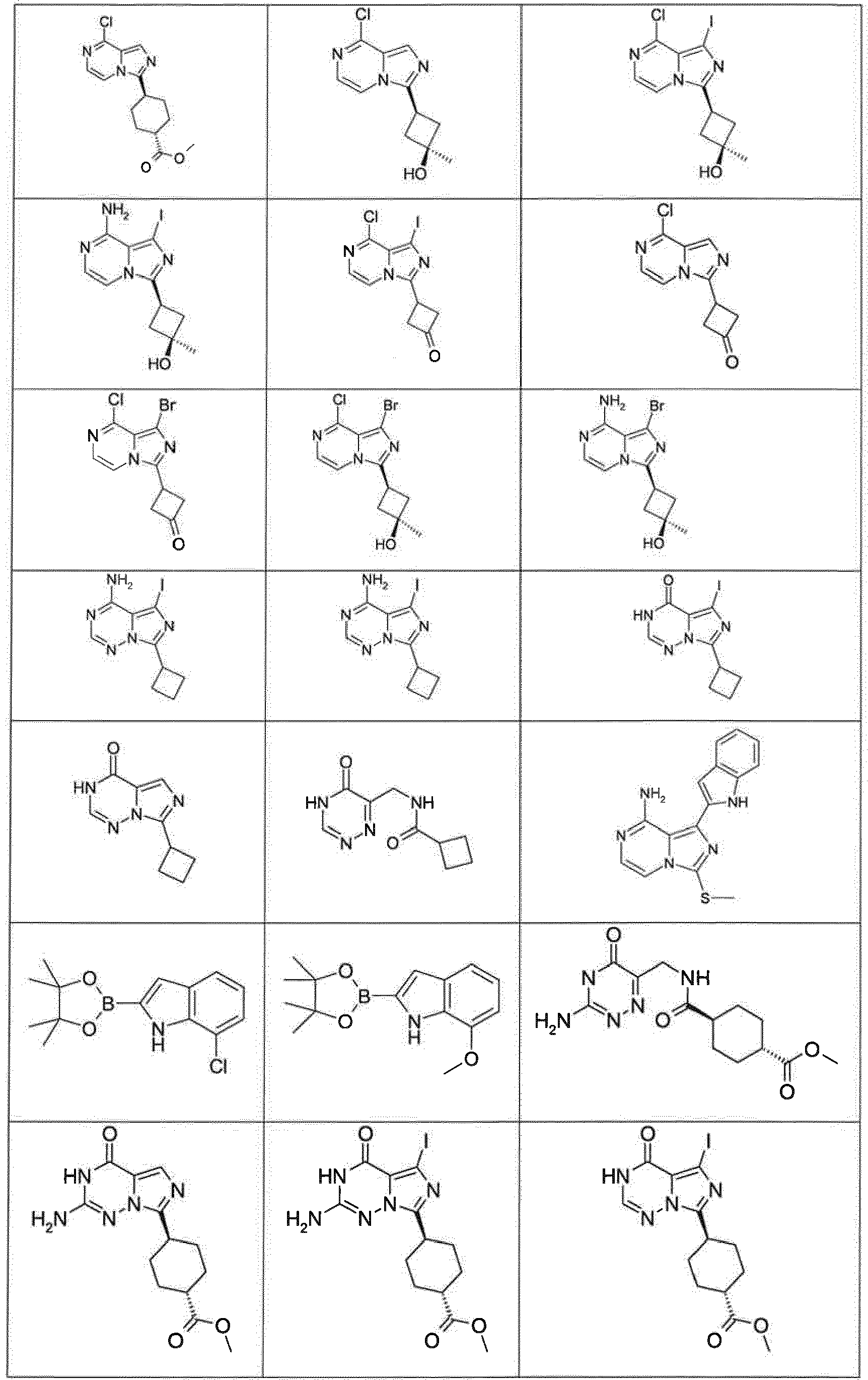

- In all of the above circumstances forbidden or unstable valences, N-S, N-halogen bonds are excluded.
- As used herein, unless stated otherwise, "alkyl" as well as other groups having the prefix "alk" such as, for example, alkoxy, alkanyl, alkenyl, alkynyl, and the like, means carbon chains which may be linear or branched or combinations thereof. Examples of alkyl groups include methyl, ethyl, propyl, isopropyl, butyl, sec- and tert-butyl, pentyl, hexyl, heptyl and the like. "Alkenyl", "alkynyl" and other like terms include carbon chains having at least one unsaturated carbon-carbon bond.
- As used herein, "C0-4alkyl" for example is used to mean an alkyl having 0-4 carbons - that is, 0, 1, 2, 3, or 4 carbons in a straight or branched configuration. An alkyl having no carbon is hydrogen when the alkyl is a terminal group. An alkyl having no carbon is a direct bond when the alkyl is a bridging (connecting) group.
- The terms "cycloalkyl", "carbocyclic ring", cyclic", or "cyclyl" mean 3-10 membered mono or polycyclic aromatic, partially aromatic or non-aromatic ring carbocycles containing no heteroatoms, and include mono-, bi-, and tricyclic saturated carbocycles, as well as fused and bridged systems. Such fused ring systems can include one ring that is partially or fully unsaturated, such as a benzene ring, to form fused ring systems, such as benzofused carbocycles. Cycloalkyl includes such fused ring systems as spirofused ring systems. Examples of cycloalkyl and carbocyclic rings include C3-8cycloalkyl such as cyclopropyl, cyclobutyl, cyclopentyl, cyclohexyl, and decahydronaphthalene, adamantane, indanyl, 1,2,3,4-tetrahydronaphthalene and the like.
- The term "halogen" includes fluorine, chlorine, bromine, and iodine atoms.
- The term "carbamoyl" unless specifically described otherwise means -C(O)-NH- or - NH-C(O)-.
- The term "aryl" is well known to chemists. The preferred aryl groups are phenyl and naphthyl.
- The term "hetaryl" is well known to chemists. The term includes 5- or 6-membered heteroaryl rings containing 1-4 heteroatoms chosen from oxygen, sulfur, and nitrogen in which oxygen and sulfur are not next to each other. Examples of such heteroaryl rings are furyl, thienyl, pyrrolyl, pyrazolyl, imidazolyl, oxazolyl, isoxazolyl, thiazolyl, isothiazolyl, triazolyl, oxadiazolyl, thiadiazolyl, tetrazolyl, pyridyl, pyridazinyl, pyrimidinyl, pyrazinyl, and triazinyl. The term "hetaryl" includes hetaryl rings with fused carbocyclic ring systems that are partially or fully unsaturated, such as a benzene ring, to form a benzofused hetaryl. For example, benzimidazole, benzoxazole, benzothiazole, benzofuran, quinoline, isoquinoline, quinoxaline, and the like.
- Unless otherwise stated, the terms "heterocyclic ring", "heterocycle", "heterocyclic", and "heterocyclyl" are equivalent, and is defined as for cyclic but also contains one or more atoms chosen independently from N, O, and S (and the N and S oxides), provided such derivatives exhibit appropriate and stable valencies. The terms include 4-8-membered saturated rings containing one or two heteroatoms chosen from oxygen, sulfur, and nitrogen. Examples of heterocyclic rings include azetidine, oxetane, tetrahydrofuran, tetrahydropyran, oxepane, oxocane, thietane, thiazolidine, oxazolidine, oxazetidine, pyrazolidine, isoxazolidine, isothiazolidine, tetrahydrothiophene, tetrahydrothiopyran, thiepane, thiocane, azetidine, pyrrolidine, piperidine, azepane, azocane, [1,3]dioxane, oxazolidine, piperazine, homopiperazine, morpholine, thiomorpholine, and the like. Other examples of heterocyclic rings include the oxidized forms of the sulfur-containing rings. Thus, tetrahydrothiophene-1-oxide, tetrahydrothiophene-1,1-dioxide, thiomorpholine-1-oxide, thiomorpholine-1,1-dioxide, tetrahydrothiopyran-1-oxide, tetrahydrothiopyran-1,1-dioxide, thiazolidine-1-oxide, and thiazolidine-1,1-dioxide are also considered to be heterocyclic rings. The term "heterocyclic" also includes fused ring systems, including het-het fused systems, and can include a carbocyclic ring that is partially or fully unsaturated, such as a benzene ring, to form benzofused heterocycles. For example, 3,4,-dihydro-1,4-benzodioxine, tetrahydroquinoline, tetrahydroisoquinoline, isoindoline and the like.
- Compounds described herein may contain one or more asymmetric centers and may thus give rise to diastereomers and optical isomers. The present invention includes all such possible diastereomers as well as their racemic mixtures, their substantially pure resolved enantiomers, all possible geometric isomers, and pharmaceutically acceptable salts thereof. The above Formula I is shown without a definitive stereochemistry at certain positions. The present invention includes all stereoisomers of Formula I and pharmaceutically acceptable salts thereof. Further, mixtures of stereoisomers as well as isolated specific stereoisomers are also included. During the course of the synthetic procedures used to prepare such compounds, or in using racemization or epimerization procedures known to those skilled in the art, the products of such procedures can be a mixture of stereoisomers.
- The invention also encompasses a pharmaceutical composition that is comprised of a compound of Formula I in combination with a pharmaceutically acceptable carrier.
- Preferably the composition is comprised of a pharmaceutically acceptable carrier and a therapeutically effective amount of a compound of Formula I as described above (or a pharmaceutically acceptable salt thereof).
- Moreover, within this preferred embodiment, the invention encompasses a pharmaceutical composition for the treatment of disease by inhibition of mTor, comprising a pharmaceutically acceptable carrier and a non-toxic therapeutically effective amount of compound of formula I as described above (or a pharmaceutically acceptable salt thereof).
- The term "pharmaceutically acceptable salts" refers to salts prepared from pharmaceutically acceptable non-toxic bases or acids. When the compound of the present invention is acidic, its corresponding salt can be conveniently prepared from pharmaceutically acceptable non-toxic bases, including inorganic bases and organic bases. Salts derived from such inorganic bases include aluminum, ammonium, calcium, copper (ic and ous), ferric, ferrous, lithium, magnesium, manganese (ic and ous), potassium, sodium, zinc and the like salts. Particularly preferred are the ammonium, calcium, magnesium, potassium and sodium slats. Salts derived from pharmaceutically acceptable organic non-toxic bases include salts of primary, secondary, and tertiary amines, as well as cyclic amines and substituted amines such as naturally occurring and synthesized substituted amines. Other pharmaceutically acceptable organic non-toxic bases from which salts can be formed include ion exchange resins such as, for example, arginine, betaine, caffeine, choline, N',N'-dibenzylethylenediamine, diethylamine, 2-diethylaminoethanol, 2-dimethylaminoethanol, ethanolamine, ethylenediamine, N-ethylmorpholine, N-ethylpiperidine, glucamine, glucosamine, histidine, hydrabamine, isopropylamine, lysine, methylglucamine, morpholine, piperazine, piperidine, polyamine resins, procaine, purines, theobromine, triethylameine, trimethylamine, tripropylamine, tromethamine and the like.
- When the compound of the present invention is basic, its corresponding salt can be conveniently prepared from pharmaceutically acceptable non-toxic acids, including inorganic and organic acids. Such acids include, for example, acetic, benzenesulfonic, benzoic, camphorsulfonic, citric, ethanesulfonic, fumaric, gluconic, glutamic, hydrobromic, hydrochloric, isethionic, lactic, maleic, malic, mandelic, methanesulfonic, mucic, nitric, pamoic, pantothenic, phosphoric, succinic, sulfuric, tartaric, p-toluenesulfonic acid and the like. Particularly preferred are citric, hydrobromic, hydrochloric, maleic, phosphoric, sulfuric and tartaric acids.
- The pharmaceutical compositions of the present invention comprise a compound represented by formula I (or a pharmaceutically acceptable salt thereof) as an active ingredient, a pharmaceutically acceptable carrier and optionally other therapeutic ingredients or adjuvants. The compositions include compositions suitable for oral, rectal, topical, and parenteral (including subcutaneous, intramuscular, and intravenous) administration, although the most suitable route in any given case will depend on the particular host, and nature and severity of the conditions for which the active ingredient is being administered. The pharmaceutical compositions may be conveniently presented in unit dosage form and prepared by any of the methods well known in the art of pharmacy.
- In practice, the compounds represented by Formula I, or pharmaceutically acceptable salts thereof, of this invention can be combined as the active ingredient in intimate admixture with a pharmaceutical carrier according to conventional pharmaceutical compounding techniques. The carrier may take a wide variety of forms depending on the form of preparation desired for administration. e.g., oral or parenteral (including intravenous). Thus, the pharmaceutical compositions of the present invention can be presented as discrete units suitable for oral administration such as capsules, cachets or tablets each containing a predetermined amount of the active ingredient. Further, the compositions can be presented as a powder, as granules, as a solution, as a suspension in an aqueous liquid, as a non-aqueous liquid, as an oil-in-water emulsion, or as a water-in-oil liquid emulsion. In addition to the common dosage forms set out above, the compound represented by Formula I, or a pharmaceutically acceptable salt thereof, may also be administered by controlled release means and/or delivery devices. The compositions may be prepared by any of the methods of pharmacy. In general, such methods include a step of bringing into association the active ingredient with the carrier that constitutes one or more necessary ingredients. In general, the compositions are prepared by uniformly and intimately admixing the active ingredient with liquid carriers or finely divided solid carriers or both. The product can then be conveniently shaped into the desired presentation.
- Thus, the pharmaceutical compositions of this invention may include a pharmaceutically acceptable carrier and a compound or a pharmaceutically acceptable salt of Formula I. The compounds of Formula I, or pharmaceutically acceptable salts thereof, can also be included in pharmaceutical compositions in combination with one or more other therapeutically active compounds.
- The pharmaceutical carrier employed can be, for example, a solid, liquid, or gas. Examples of solid carriers include lactose, terra alba, sucrose, talc, gelatin, agar, pectin, acacia, magnesium stearate, and stearic acid. Examples of liquid carriers are sugar syrup, peanut oil, olive oil, and water. Examples of gaseous carriers include carbon dioxide and nitrogen.
- In preparing the compositions for oral dosage form, any convenient pharmaceutical media may be employed. For example, water, glycols, oils, alcohols, flavoring agents, preservatives, coloring agents, and the like may be used to form oral liquid preparations such as suspensions, elixirs and solutions; while carriers such as starches, sugars, microcrystalline cellulose, diluents, granulating agents, lubricants, binders, disintegrating agents, and the like may be used to form oral solid preparations such as powders, capsules and tablets. Because of their ease of administration, tablets and capsules are the preferred oral dosage units whereby solid pharmaceutical carriers are employed. Optionally, tablets may be coated by standard aqueous or nonaqueous techniques.
- A tablet containing the composition of this invention may be prepared by compression or molding, optionally with one or more accessory ingredients or adjuvants. Compressed tablets may be prepared by compressing, in a suitable machine, the active ingredient in a free-flowing form such as powder or granules, optionally mixed with a binder, lubricant, inert diluent, surface active or dispersing agent. Molded tablets may be made by molding in a suitable machine, a mixture of the powdered compound moistened with an inert liquid diluent. Each tablet preferably contains from about 0.05mg to about 5g of the active ingredient and each cachet or capsule preferably containing from about 0.05mg to about 5g of the active ingredient.
- For example, a formulation intended for the oral administration to humans may contain from about 0.5mg to about 5g of active agent, compounded with an appropriate and convenient amount of carrier material, which may vary from about 5 to about 95 percent of the total composition. Unit dosage forms will generally contain between from about 1mg to about 2g of the active ingredient, typically 25mg, 50mg, 100mg, 200mg, 300mg, 400mg, 500mg, 600mg, 800mg, or 1000mg.
- Pharmaceutical compositions of the present invention suitable for parenteral administration may be prepared as solutions or suspensions of the active compounds in water. A suitable surfactant can be included such as, for example, hydroxypropylcellulose. Dispersions can also be prepared in glycerol, liquid polyethylene glycols, and mixtures thereof in oils. Further, a preservative can be included to prevent the detrimental growth of microorganisms.
- Pharmaceutical compositions of the present invention suitable for injectable use include sterile aqueous solutions or dispersions. Furthermore, the compositions can be in the form of sterile powders for the extemporaneous preparation of such sterile injectable solutions or dispersions. In all cases, the final injectable form must be sterile and must be effectively fluid for easy syringability. The pharmaceutical compositions must be stable under the conditions of manufacture and storage; thus, preferably should be preserved against the contaminating action of microorganisms such as bacteria and fungi. The carrier can be a solvent or dispersion medium containing, for example, water, ethanol, polyol (e.g., glycerol, propylene glycol and liquid polyethylene glycol), vegetable oils, and suitable mixtures thereof.
- Pharmaceutical compositions of the present invention can be in a form suitable for topical sue such as, for example, an aerosol, cream, ointment, lotion, dusting powder, or the like. Further, the compositions can be in a form suitable for use in transdermal devices. These formulations may be prepared, utilizing a compound represented by Formula I of this invention, or a pharmaceutically acceptable salt thereof, via conventional processing methods. As an example, a cream or ointment is prepared by admixing hydrophilic material and water, together with about 5wt% to about 10wt% of the compound, to produce a cream or ointment having a desired consistency.
- Pharmaceutical compositions of this invention can be in a form suitable for rectal administration wherein the carrier is a solid. It is preferable that the mixture forms unit dose suppositories. Suitable carriers include cocoa butter and other materials commonly used in the art. He suppositories may be conveniently formed by first admixing the composition with the softened or melted carrier(s) followed by chilling and shaping in molds.
- In addition to the aforementioned carrier ingredients, the pharmaceutical formulations described above may include, as appropriate, one or more additional carrier ingredients such as diluents, buffers, flavoring agents, binders, surface-active agents, thickeners, lubricants, preservatives (including anti-oxidants) and the like. Furthermore, other adjuvants can be included to render the formulation isotonic with the blood of the intended recipient. Compositions containing a compound described by Formula I, or pharmaceutically acceptable salts thereof, may also be prepared in powder or liquid concentrate form.
- The compounds and compositions of the present invention are useful in the treatment of cancers of the breast, lung, kidney, prostate, blood, liver, ovarian, thyroid, GI tract and lymphoma. The compounds and compositions are useful against cancers including non-small cell lung cancer (NSCLC), renal cell carcinoma, mantle cell lymphoma, and endometrial cancers. Further, the compounds and compositions are useful in treating other indications such as rheumatoid arthritis, hamartoma syndromes, transplant rejection, irritable bowel disease (IBD), multiple sclerosis and immunosuppression.
- Generally, dosage levels on the order of from about 0.01 mg/kg to about 150mg/kg of body weight per day are useful in the treatment of the above-indicated conditions, or alternatively about 0.5mg to about 7g per patient per day. For example, cancers of the breast, lung, kidney, prostate, blood, liver, ovarian, thyroid, GI tract and lymphoma may be effectively treated by the administration of from about 0.01 to 50mg of the compound per kilogram of body weight per day, or alternatively about 0.5mg to about 3.5g per patient per day.
- Dosage levels on the order of from about 0.01mg/kg to about 150mg/kg of body weight per day are useful in the treatment of non-small cell lung cancer (NSCLC), renal cell carcinoma, mantle cell lymphoma, and endometrial cancers, or alternatively about 0.5mg to about 7g per patient per day. They may be treated by the administration of from about 0.01 to 50mg of the compound per kilogram of body weight per day, or alternatively about 0.5mg to about 3.5g per patient per day.
- Dosage levels on the order of from about 0.01mg/kg to about 150mg/kg of body weight per day are useful in the treatment of rheumatoid arthritis, hamartoma syndromes, transplant rejection, irritable bowel disease (IBD), multiple sclerosis and immunosuppression, or alternatively about 0.5mg to about 7g per patient per day. They may be treated by the administration of from about 0.01 to 50mg of the compound per kilogram of body weight per day, or alternatively about 0.5mg to about 3.5g per patient per day.
- It is understood, however, that the specific dose level for any particular patient will depend upon a variety of factors including the age, body weight, general health, sex, diet, time of administration, route of administration, rate of excretion, drug combination and the severity of the particular disease undergoing therapy.
- The ability of compounds to inhibit the mTOR kinase activity was determined in an in vitro immunoprecipitation (IP) kinase assay using recombinant 4E-BP1 as a substrate. The assay determines the ability of compounds to inhibit phosphorylation of 4E-BP 1 a well-known physiological substrate of mTOR. The immunocapture mTOR complex from HeLa cells is incubated with various concentrations of compounds and His-tag 4E-BP 1 in kinase assay buffer prior to addition of ATP to start the reaction at RT. The reaction is stopped after 30 mins and the phosphorylated His-tag 4E-BP1 is captured on a Nickel-chelate plate overnight at 4°C. The phosphothreonine content of 4E-BP1 is then measured using phospho-4E-BP1 (T37/46) primary antibody and corresponding anti rabbit IgG HRP conjugated, secondary antibody. The secondary antibody has a reporter enzyme (eg. horseradish peroxidase, HRP) covalently attached, such that binding of primary antibody to phosphorylated 4E-BP1 can be determined quantitatively which is equal to the amount secondary antibody bound to it. The amount of secondary antibody can be determined by incubation with an appropriate HRP substrate.
- 40 mM HEPES, pH 7.5 containing 120 mM NaCl,1 mM EDTA, 10 mM sodium pyrophosphate, 10 mM (β-glycerophosphate, 50 mM sodium fluoride, 1.5 mM sodium vanadate and 0.3% CHAPS.
- 50 mM HEPES, pH 7.5 containing 150 mM NaCl
- 20 mM HEPES, pH 7.5 containing 10 mM MgCl2, 4 mM MnCl2, 10 mM b-mercaptoethanol and 200 uM sodium vanadate. Make fresh for assay.
- Dilute 4E-BP1 stock (1 mg/mL) 120 times in kinase assay buffer to obtain a concentration of 0.25 ug/well in 30 uL
- Prepare 330 uM ATP stock in kinase buffer
- TBST containing 5% skim milk
- 1:1000 dilution of phospho-4E-BP1 (T37/46) antibody (Cell Signaling Technology, catalog # 9459) in antibody dilution buffer
- 1:10,000 dilution of anti rabbit IgG HRP conjugated (GE Healthcare, Catalog# NA934) in antibody dilution buffer
- Chemiluminescent reagents (Pierce, catalog# 37074)
- HeLa cell lysate was prepared in bulk by homogenizing 25 g of cell pellet in 60mL of cell lysis buffer and then, centrifuged at 12,000rpm for 30min. The clear supernatant was transferred to fresh tube, aliquoted, quickly frozen and stored at -80°C until use.
- Protein G coated 96-well plate is washed once with lysis buffer and 50µL of diluted mTOR antibody is added to each well, and incubated at RT for 30-60min. Then, 50µg of HeLa cell lysate was added to each well in 50µL of lysis buffer and incubated at 4°C in a cold room on a shaker for 2-3h. Lysate was removed and the plate was washed with 100µL of complete lysis buffer for 3 times. The plate was further washed 2 times with 100µL of high salt wash buffer. Diluted 4E-BP1 (substrate) is added to each well in 30µL. The compounds were added in various concentrations in 5µL to each well. The drug concentrations varied from 30µM to 0.1µM. The final DMSO concentration was 1%. Only DMSO was added to positive control wells. For negative control wells, no ATP solution was added but instead 15µL of kinase buffer was added, the reaction was started by addition of ATP in 15µL to a final concentration of 100µM to rest of the wells except negative control wells. The reaction was carried out for 30min at RT. Then, 45µL of the reaction mixture was transferred to Ni-chelate plate and incubated overnight at 4°C. The plate was washed once with antibody dilution buffer and 50µL of diluted phospho-4E-BP1 antibody was added to each well, and incubated at RT for 1h. Then, the plate was washed 4 times with TBST and 50uL of diluted anti-rabbit secondary antibody was added to each plate, and incubated at RT for 1h. The plate was washed 4 times with 100µL of TBST. To each well, 50µL of Pierce Femto chemiluminescent reagent was added and the chemiluminescence was measured using victor machine.
- Comparison of the assay signals obtained in the presence of compound with those of positive and negative controls, allows the degree of inhibiton of phospho-4E-BP1 phosphorylation to be determined over a range of compound concentrations. These inhibiton values were fitted to a sigmoidal dose-response inhibition curve to determine the IC50 values (i.e. the concentration of the compound that inhibits phosphorylation of 4E-BP 1 by 50%).
- MDA-MB-231 cells were plated in 96 well plates at 2x10⁴ cells/well in 90 ul of complete growth medium and incubated at 37°C O/N in a CO2 incubator. Cells were treated with various compounds in a dose response manner for 3h at 37°C in a CO2 incubator before making cell lysates to measure inhibition of phosphorylation of 4E-BP 1 at T37/46. Cell lysates were transferred to a 96-well plate coated with 4E-BP1 antibodies to capture phospho-4E BP1 (T37/46) and incubated O/N at 4°C. The amount of phospho-4E-BP1 in each well is further measured by incubating the wells with anti-rabbit phospho-4E-BP1 (T37/46) antibodies and a corresponding goat anti-rabbit IgG conjugated to HRP. Amount of HRP present in each well is measured by a chemiluminescence method, which corresponds to amount of phospho-4E-BP1 in each well. IC50 values were determined using a 6-point dose response curve.
- IGF-1R inhibition was shown in a tyrosine kinase assay using purified GST fusion protein containing the cytoplasmic kinase domain of human IGF-1R expressed in Sf9 cells. This assay is carried out in a final volume of 90 µL containing 1-100nM (depending on the specific activity) in an Immulon-4 96-well plate (Thermo Labsystems) pre-coated with 1µg/well of substrate poly-glu-tyr (4:1 ratio) in kinase buffer (50mM Hepes, pH 7.4, 125mM NaCl, 24mM MgCl2, 1mM MnCl2, 1 % glycerol, 200µM Na3VO4, and 2mM DTT). The enzymatic reaction was initiated by addition of ATP at a final concentration of 100µM. After incubation at room temperature for 30 minutes, the plates were washed with 2mM Imidazole buffered saline with 0.02% Tween-20. Then the plate was incubated with anti-phosphotyrosine mouse monoclonal antibody pY-20 conjugated with horse radish peroxidase (HRP) (Calbiochem) at 167ng/mL diluted in phosphate buffered saline (PBS) containing 3% bovine serum albumin (BSA), 0.5% Tween-20 and 200µM Na3VO4 for 2 hours at room temperature. Following 3X 250µL washes, the bound anti-phosphotyrosine antibody was detected by incubation with 100µl/well ABTS (Kirkegaard & Perry Labs, Inc.) for 30 minutes at room temperature. The reaction was stopped by the addition of 100µl /well 1% SDS, and the phosphotyrosine dependent signal was measured by a plate reader at 405/490 nm.
- The EXAMPLES of this invention demonstrated at least one of the following:
- I) Inhibited phosphorylation of 4E-BP1 by immunocaptured human mTOR as determined in the Biochemical Assay for Inhibition of mTOR Activity with IC50 values between 0.001 µM and 11.00µM. It is advantageous that the IC50 values be less than 1.00µM and more advantageous that the IC50 values be below 0.1 µM. Even more advantageous, the IC50 values be less than 0.01µM.
- II) Inhibited the phosphorylation of 4E-BP1 (T37/46) in the mTOR Cell-based Mechanistic Assay with IC50 values below 40µM.
- III) Inhibition of IGF-1R in the Biochemical Assay for Inhibition of IGF-1R Activity with IC50 values less than 15µM.
- The following schemes, intermediates and examples serve to demonstrate how to synthesize compounds described herein, but in no way limit the invention. Additionally, the following abbreviations are used: Me for methyl, Et for ethyl, iPr or iPr for isopropyl, n-Bu for n-butyl, t-Bu for tert-butyl, Ac for acetyl, Ph for phenyl, 4Cl-Ph or (4Cl)Ph for 4-chlorophenyl, 4Me-Ph or (4Me)Ph for 4-methylphenyl, (p-CH3O)Ph for p-methoxyphenyl, (p-NO2)Ph for p-nitrophenyl, 4Br-Ph or (4Br)Ph for 4-bromophenyl, 2-CF3-Ph or (2CF3)Ph for 2-trifluoromethylphenyl, DMAP for 4-(dimethylamino)pyridine, DCC for 1,3-dicyclohexylcarbodiimide, EDC for 1-(3-dimethylaminopropyl)-3-ethylcarbodiimide hydrochloride, HOBt for 1-hydroxybenzotriazole, HOAt for 1-hydroxy-7-azabenzotriazole, TMP for tetramethylpiperidine, n-BuLi for n-butyllithium, CDI for 1,1'-carbonyldiimidazole, DEAD for diethyl azodicarboxylate, PS-PPh3 for polystyrene triphenylphosphine, DIEA for diisopropylethylamine, DIAD for diisopropyl azodicarboxylate, DBAD for di-tert-butyl azodicarboxylate, HPFC for high performance flash chromatography, rt or RT for room temperature, min for minute, h for hour, Bn for benzyl, and LAH for lithium aluminum hydride.
- Accordingly, the following are compounds that are useful as intermediates in the formation of mTOR inhibiting EXAMPLES.
- The compounds of Formula I of this invention and the intermediates used in the synthesis of the compounds of this invention were prepared according to the following methods. Method A was used when preparing compounds of Formula I-AA

-

- In a typical preparation of compounds of Formula I-AA, compound of Formula II was reacted with ammonia in a suitable solvent. Suitable solvents for use in the above process included, but were not limited to, ethers such as tetrahydrofuran (THF), glyme, and the like; dimethylformamide (DMF); dimethyl sulfoxide (DMSO); acetonitrile; alcohols such as methanol, ethanol, isopropanol, trifluoroethanol, and the like; and chlorinated solvents such as methylene chloride (CH2Cl2) or chloroform (CHCl3)- If desired, mixtures of these solvents were used, however, the preferred solvents were isopropanol and a mixture of THF and isopropanol. The above process was carried out at temperatures between about -78°C and about 120°C. Preferably, the reaction was carried out between 80°C and about 120°C. The above process to produce compounds of the present invention was preferably carried in a sealed reaction vessel such as but not limited to a thick walled glass reaction vessel or a stainless steel Parr bomb. An excess amount of the reactant, ammonia, was preferably used.
- The compounds of Formula II of Scheme 1 were prepared as shown below in Scheme 2.

- In a typical preparation of a compound of Formula II, an intermediate of Formula III was treated with POCl3 or the isolated "Vilsmeier salt" [CAS# 33842-02-3] in a suitable solvent at a suitable reaction temperature. Suitable solvents for use in the above process included, but were not limited to, ethers such as tetrahydrofuran (THF), glyme, and the like; acetonitrile; and chlorinated solvents such as methylene chloride (CH2Cl2) or chloroform (CHCl3). If desired, mixtures of these solvents were used or no solvent was used. The preferred solvents included methylene chloride and acetonitrile. The above process was carried out at temperatures between about -78°C and about 120°C. Preferably, the reaction was carried out between 20°C and about 95°C. The above process to produce compounds of the present invention was preferably carried out at about atmospheric pressure although higher or lower pressures were used if desired. Substantially equimolar amounts of reactants were preferably used although higher or lower amounts were used if desired.
- The compounds of Formula III of Scheme 2 were prepared as shown below in Scheme 3:

- In a typical preparation, of a compound of Formula III, a compound of Formula IV and compound of Formula V were reacted under suitable amide coupling conditions. Suitable conditions include but are not limited to treating compounds of Formula IV and V (when A1 = OH) with coupling reagents such as DCC or EDC in conjunction with DMAP, HOBt, HOAt and the like. Suitable solvents for use in the above process included, but were not limited to, ethers such as tetrahydrofuran (THF), glyme, and the like; dimethylformamide (DMF); dimethyl sulfoxide (DMSO); acetonitrile; halogenated solvents such as chloroform or methylene chloride. If desired, mixtures of these solvents were used, however the preferred solvents were methylene chloride and DMF. The above process was carried out at temperatures between about 0°C and about 80°C. Preferably, the reaction was carried out at about rt. The above process to produce compounds of the present invention was preferably carried out at about atmospheric pressure although higher or lower pressures were used if desired. Substantially equimolar amounts of reactants were preferably used although higher or lower amounts were used if desired. Alternatively, compounds of Formula IV and V (where A1 = F, Cl, Br, I) were reacted with bases such as triethylamine or ethyldiisopropylamine and the like in conjunction with DMAP and the like. Suitable solvents for use in this process included, but were not limited to, ethers such as tetrahydrofuran (THF), glyme, and the like; dimethylformamide (DMF); dimethyl sulfoxide (DMSO); acetonitrile; halogenated solvents such as chloroform or methylene chloride. If desired, mixtures of these solvents were used, however the preferred solvent was methylene chloride. The above process was carried out at temperatures between about -20°C and about 40°C. Preferably, the reaction was carried out between 0°C and 25°C. The above process to produce compounds of the present invention was preferably carried out at about atmospheric pressure although higher or lower pressures were used if desired. Substantially equimolar amounts of compounds of Formula IV and V (where A1 = F, Cl, Br, I) and base and substochiometric amounts of DMAP were preferably used although higher or lower amounts were used if desired. Additionally, other suitable reaction conditions for the conversion of a compound of Formula IV to a compound of Formula III can be found in Larock, R. C. Comprehensive Organic Transformations, 2nd ed.; Wiley and Sons: New York, 1999, pp 1941-1949.
- The compounds of Formula IV of Scheme 3 were prepared as shown below in Scheme 4:

- In a typical preparation, of a compound of Formula IV, a compound of Formula VI is reacted under suitable reaction conditions in a suitable solvent. When A2 = phthalimido, suitable conditions include treatment of compound of Formula VI with hydrazine in a suitable solvent. Suitable solvents for use in the above process included, but were not limited to, ethers such as tetrahydrofuran (THF), glyme, and the like; dimethylformamide (DMF); dimethyl sulfoxide (DMSO); acetonitrile; halogenated solvents such as chloroform or methylene chloride; alcoholic solvents such as methanol and ethanol. If desired, mixtures of these solvents may be used, however the preferred solvent was ethanol. The above process was carried out at temperatures between about 0°C and about 80°C. Preferably, the reaction was carried out at about 22°C. The above process to produce compounds of the present invention was preferably carried out at about atmospheric pressure although higher or lower pressures were used if desired. Substantially equimolar amounts of reactants were preferably used although higher or lower amounts were used if desired. In the transformation of compound of Formula VI to IV, if A2 = N3, then one skilled in the art would recognize that typical azide reduction conditions could be employed, including but not limited to PPh3 and water or hydrogenation in the presence of a metal catalyst such as palladium.
- The compounds of Formula VI of Scheme 4 were prepared as shown below in Scheme 5:

- In a typical preparation of a compound of Formula VI (when A2 = phthalimido), a compound of Formula VII was reacted with a phthalimide under typical Mitsunobu conditions in a suitable solvent in the presence of suitable reactants. Suitable solvents for use in the above process included, but were not limited to, ethers such as tetrahydrofuran (THF), glyme, and the like; dimethylformamide (DMF); dimethyl sulfoxide (DMSO); acetonitrile (CH3CN); chlorinated solvents such as methylene chloride (CH2Cl2)or chloroform (CHCl3). If desired, mixtures of these solvents were used, however, the preferred solvent was THF. Suitable reactants for use in the above process included, but were not limited to, triphenylphosphine and the like, and an azodicarboxylate (DIAD, DEAD, DBAD). The preferred reactants were triphenylphosphine or resin-bound triphenylphosphine (PS-PPh3), and DIAD. The above process may be carried out at temperatures between about -78°C and about 100°C. Preferably, the reaction was carried out at about 22°C. The above process to produce compounds of the present invention was preferably carried out at about atmospheric pressure although higher or lower pressures were used if desired. Substantially equimolar amounts of reactants were preferably used although higher or lower amounts were used if desired. Generally, one equivalent or a slight excess, 1.1 equivalents, of triphenylphosphine, DIAD and phthalimide was used per equivalent of compound of Formula VII. Additionally, compound of Formula VII can be reacted with Ts2O, MS2O, Tf2O, TsCl, MsCl, or SOCl2 in which the hydroxy group is converted to a leaving group such as its respective tosylate, mesylate, triflate, or halogen such as chloro and subsequently reacted with an amine equivalent such as NH(Boc)2, phthalimide, potassium phthalimide, or sodium azide. Conversion of the amine equivalents by known methods such as by treating under acidic conditions (NH(Boc)2), with hydrazine (phthalimide) as shown in Scheme 4, or with triphenylphosphine/water (azide) will afford the desired amine as shown in Scheme 4.
- The compounds of Formula VII of Scheme 5 were prepared from aldehydes Q1-CHO and a 2-chloropyrazine VIII as shown below in Scheme 6:

- In a typical preparation, of a compound of Formula VII, a compound of Formula VIII was reacted under suitable reaction conditions in a suitable solvent with a compound of Formula Q1-CHO. Suitable conditions included but were not limited to treating compounds of Formula VIII with a base such as lithium tetramethylpiperidide (Li-TMP) followed by treating with compounds of Formula Q1-CHO. Lithium tetramethylpiperidide may be prepared by reacting tetramethylpiperidine with n-butyllithium at -78°C and warming up to 0°C. Suitable solvents for use in the above process included, but were not limited to, ethers such as tetrahydrofuran (THF), glyme, and the like. Polar solvents such as hexamethylphosphoramide (HMPA), 1,3-dimethyl-3,4,5,6-tetrahydro-2(1H)-pyrimidinone (DMPU), and the like may be added if necessary. If desired, mixtures of these solvents were used, however, the preferred solvent was THF. The above process may be carried out at temperatures between about -80°C and about 20°C. Preferably, the reaction was carried out at -78°C to 0°C. The above process to produce compounds of the present invention was preferably carried out at about atmospheric pressure although higher or lower pressures were used if desired. Substantially equimolar amounts of reactants were preferably used although higher or lower amounts were used if desired.
- The compounds of Formula I of this invention and the intermediates used in the synthesis of the compounds of this invention were also prepared according to the following methods. Method AA was used when preparing compounds of Formula I-AA from compound of Formula I-AAA as shown below in Scheme 7:
-

- In a typical preparation of compounds of Formula I-AA, compound of Formula I-AAA was reacted with a suitable boronic acid/ester (Q1-B(OR)2) in a suitable solvent via typical Suzuki coupling procedures. Suitable solvents for use in the above process included, but were not limited to, ethers such as tetrahydrofuran (THF), glyme, dioxane, dimethoxyethane, and the like; dimethylformamide (DMF); dimethyl sulfoxide (DMSO); acetonitrile; alcohols such as methanol, ethanol, isopropanol, trifluoroethanol, and the like; and chlorinated solvents such as methylene chloride (CH2Cl2) or chloroform (CHCl3). If desired, mixtures of these solvents were used, however, the preferred solvent was dimethoxyethane/water. The above process was carried out at temperatures between about -78°C and about 120°C. Preferably, the reaction was carried out between 60°C and about 100°C. The above process to produce compounds of the present invention was preferably carried out at about atmospheric pressure although higher or lower pressures were used if desired. Substantially equimolar amounts of reactants were preferably used although higher or lower amounts were used if desired.
- One skilled in the art will appreciate that alternative methods may be applicable for preparing compounds of Formula I-AA from I-AAA. For example, compound of Formula I-AAA could be reacted with a suitable organotin reagent Q1-SnBu3 or the like in a suitable solvent via typical Stille coupling procedures.
- The compounds of Formula I-AAA of Scheme 7 were prepared as shown below in Scheme 8.

- In a typical preparation of compounds of Formula I-AAA, compound of Formula II-Z was reacted with ammonia in a suitable solvent. Suitable solvents for use in the above process included, but were not limited to, ethers such as tetrahydrofuran (THF), glyme, and the like; dimethylformamide (DMF); dimethyl sulfoxide (DMSO); acetonitrile; alcohols such as methanol, ethanol, isopropanol, trifluoroethanol, and the like; and chlorinated solvents such as methylene chloride (CH2Cl2) or chloroform (CHCl3). If desired, mixtures of these solvents were used, however, the preferred solvents were isopropanol and a mixture of THF and isopropanol. The above process was carried out at temperatures between about -78°C and about 120°C. Preferably, the reaction was carried out between 80°C and about 120°C. The above process to produce compounds of the present invention was preferably carried in a sealed reaction vessel such as but not limited to a thick walled glass reaction vessel or a stainless steel Parr bomb. An excess amount of the reactant, ammonia, was preferably used.
- The compounds of Formula II-Z of Scheme 8 were prepared as shown below in Scheme 9.

- In a typical preparation of a compound of Formula II-Z, intermediate III-Z was converted to compound of Formula II-Z'. Intermediate of Formula III-Z was treated with POCl3 in a suitable solvent at a suitable reaction temperature. Suitable solvents for use in the above process included, but were not limited to, ethers such as tetrahydrofuran (THF), glyme, and the like; acetonitrile; and chlorinated solvents such as methylene chloride (CH2Cl2) or chloroform (CHCl3). If desired, mixtures of these solvents were used. The preferred solvents included methylene chloride and acetonitrile. The above process was carried out at temperatures between about -78°C and about 120°C. Preferably, the reaction was carried out between 20°C and about 95°C. The above process to produce compounds of the present invention was preferably carried out at about atmospheric pressure although higher or lower pressures were used if desired. Substantially equimolar amounts of reactants were preferably used although higher or lower amounts were used if desired. In the conversion of compound of Formula III-Z to II-Z', suitable halogenating agent were used, but were not limited to, Br2, I2, Cl2, N-chlorosuccinimide, N-bromosuccinimide, or N-iodosuccinimide. The preferred halogenating agent was N-iodosuccinimide. Suitable solvents for use in the above process included, but were not limited to, ethers such as tetrahydrofuran (THF), glyme, and the like; dimethylformamide (DMF); dimethyl sulfoxide (DMSO); acetonitrile; alcohols such as methanol, ethanol, isopropanol, trifluoroethanol, and the like; and chlorinated solvents such as methylene chloride (CH2Cl2) or chloroform (CHCl3). If desired, mixtures of these solvents were used, however, the preferred solvent was DMF. The above process was carried out at temperatures between about - 78°C and about 120°C. Preferably, the reaction was carried out between 40°C and about 75°C. The above process to produce compounds of the present invention was preferably carried out at about atmospheric pressure although higher or lower pressures were used if desired. Substantially equimolar amounts of reactants were preferably used although higher or lower amounts were used if desired.
- The compounds of Formula III-Z of Scheme 9 were prepared as shown below in Scheme 10:

- In a typical preparation, of a compound of Formula III-Z, a compound of Formula IV-Z and compound of Formula V were reacted under suitable amide coupling conditions. Suitable conditions include but are not limited to treating compounds of Formula IV-Z and V (when A1 = OH) with coupling reagents such as DCC or EDC in conjunction with DMAP, HOBt, HOAt and the like. Suitable solvents for use in the above process included, but were not limited to, ethers such as tetrahydrofuran (THF), glyme, and the like; dimethylformamide (DMF); dimethyl sulfoxide (DMSO); acetonitrile; halogenated solvents such as chloroform or methylene chloride. If desired, mixtures of these solvents were used, however the preferred solvent was methylene chloride. The above process was carried out at temperatures between about 0°C and about 80°C. Preferably, the reaction was carried out at about 22°C. The above process to produce compounds of the present invention was preferably carried out at about atmospheric pressure although higher or lower pressures were used if desired. Substantially equimolar amounts of reactants were preferably used although higher or lower amounts were used if desired. Additionally, if compound of Formula IV-Z was a salt or bis-salt, a suitable base was required and included, but was not limited to, diisopropylethylamine or triethylamine. Alternatively, compounds of Formula IV-Z and V (where A1 = F, Cl, Br, I) were reacted with bases such as triethylamine or ethyldiisopropylamine and the like in conjunction with DMAP and the like. Suitable solvents for use in this process included, but were not limited to, ethers such as tetrahydrofuran (THF), glyme, and the like; dimethylformamide (DMF); dimethyl sulfoxide (DMSO); acetonitrile; halogenated solvents such as chloroform or methylene chloride. If desired, mixtures of these solvents were used, however the preferred solvent was methylene chloride. The above process was carried out at temperatures between about -20°C and about 40°C. Preferably, the reaction was carried out between 0°C and 25°C. The above process to produce compounds of the present invention was preferably carried out at about atmospheric pressure although higher or lower pressures were used if desired. Substantially equimolar amounts of compounds of Formula IV-Z and V (where A1 = F, Cl, Br, I) and base and substochiometric amounts of DMAP were preferably used although higher or lower amounts were used if desired. Additionally, other suitable reaction conditions for the conversion of an amine (compound of Formula IV-Z) to an amide (compound of Formula III-Z) can be found in Larock, R. C. Comprehensive Organic Transformations, 2nd ed.; Wiley and Sons: New York, 1999, pp 1941-1949.
- The compounds of Formula IV-Z of Scheme 10 were prepared as shown below in Scheme 11:

- In a typical preparation, of a compound of Formula IV-Z, a compound of Formula VI-Z is reacted under suitable reaction conditions in a suitable solvent. When A2 = phthalimido, suitable conditions include treatment of compound of Formula VI-Z with hydrazine in a suitable solvent. Suitable solvents for use in the above process included, but were not limited to, ethers such as tetrahydrofuran (THF), glyme, and the like; dimethylformamide (DMF); dimethyl sulfoxide (DMSO); acetonitrile; halogenated solvents such as chloroform or methylene chloride; alcoholic solvents such as methanol and ethanol. If desired, mixtures of these solvents may be used, however the preferred solvent was ethanol. The above process was carried out at temperatures between about 0°C and about 80°C. Preferably, the reaction was carried out at about 22°C. The above process to produce compounds of the present invention was preferably carried out at about atmospheric pressure although higher or lower pressures were used if desired. Substantially equimolar amounts of reactants were preferably used although higher or lower amounts were used if desired.
- The compounds of Formula VI-Z of Scheme 11 were prepared as shown below in Scheme 12:

- In a typical preparation of a compound of Formula VI-Z (when A2 = phthalimido), a compound of Formula VII-Z was reacted with a phthalimide under typical Mitsunobu conditions in a suitable solvent in the presence of suitable reactants. Suitable solvents for use in the above process included, but were not limited to, ethers such as tetrahydrofuran (THF), glyme, and the like; dimethylformamide (DMF); dimethyl sulfoxide (DMSO); acetonitrile (CH3CN); chlorinated solvents such as methylene chloride (CH2Cl2) or chloroform (CHCl3). If desired, mixtures of these solvents were used, however, the preferred solvent was THF. Suitable reactants for use in the above process included, but were not limited to, triphenylphosphine and the like, and an azodicarboxylate (DIAD, DEAD, DBAD). The preferred reactants were triphenylphosphine or resin-bound triphenylphosphine (PS-PPh3) and DIAD. The above process may be carried out at temperatures between about -78°C and about 100°C. Preferably, the reaction was carried out at about 22°C. The above process to produce compounds of the present invention was preferably carried out at about atmospheric pressure although higher or lower pressures were used if desired. Substantially equimolar amounts of reactants were preferably used although higher or lower amounts were used if desired. Generally, 1.0 or 1.1 equivalents of triphenylphosphine, DIAD and phthalimide was used per equivalent of compound of Formula VII-Z. Additionally, compound of Formula VII-Z can be reacted with Ts2O, Ms2O, Tf2O, TsCl, MsCl, or SOCl2 in which the hydroxy group is converted to a leaving group such as its respective tosylate, mesylate, triflate, or halogen such as chloro and subsequently reacted with an amine equivalent such as NH(Boc)2, phthalimide, potassium phthalimide or sodium azide. Conversion of the amine equivalents by known methods such as by treating under acidic conditions (NH(Boc)2), with hydrazine (phthalimide) as shown in Scheme 4, or with triphenylphosphine/water (azide) will afford the desired amine as shown in Scheme 4.
- The compounds of Formula VII-Z of Scheme 12 were prepared from 2-chloropyrazine VIII as shown below in Scheme 13:

- In a typical preparation, of a compound of Formula VII-Z, a compound of Formula VIII was reacted under suitable reaction conditions in a suitable solvent. Suitable reaction conditions included, but were not limited to, treating compounds of Formula VIII with a base such as lithium tetramethylpiperidide (Li-TMP) followed by treatment with a reagent containing a carbonyl equivalent followed by treatment with a suitable reducing agent. Lithium tetramethylpiperidide may be prepared by reacting tetramethylpiperidine with n-butyllithium at -78°C and warming up to 0°C. Suitable solvents for use in the above process included, but were not limited to, ethers such as tetrahydrofuran (THF), glyme, and the like. Polar solvents such as hexamethylphosphoramide (HMPA), 1,3-dimethyl-3,4,5,6-tetrahydro-2(1H)-pyrimidinone (DMPU), and the like may be added if necessary. If desired, mixtures of these solvents were used, however, the preferred solvent was THF. Suitable carbonyl equivalent reagents include, but are not limited to, formamides such as DMF or suitable chloroformate such as methyl or ethyl chloroformate. After addition of the suitable carbonyl equivalent reagent, the reaction if charged with a polar protic solvent such as, but not limited to, methanol or ethanol followed by treatment with a suitable reducing agent such as sodium borohydride. The above process may be carried out at temperatures between about -80°C and about 20°C. Preferably, the reaction was carried out at -78°C to 0°C. The above process to produce compounds of the present invention was preferably carried out at about atmospheric pressure although higher or lower pressures were used if desired. Substantially equimolar amounts of reactants were preferably used although higher or lower amounts were used if desired.
- The compounds of Formula X-Z (Q1-CHO) of Scheme 6 were prepared as shown below in Scheme 14:

- In a typical preparation, of a compound of Formula X-Z (Q1-CHO), a compound of Formula IX-Z (Q1-CH3) was reacted with a suitable oxidizing agent under suitable reaction conditions. Suitable oxidizing agents included, but were not limited to, selenium dioxide. Suitable reaction conditions for use in the above process included, but were not limited to, heating a mixture of selenium dioxide and compounds of Formula IX-Z (Q1-CH3) neat or in a suitable solvent such as, but not limited to, chlorobenzene or sulpholane. The above process may be carried out at temperatures between about 120°C and about 180°C. Preferably, the reaction was carried out at 150°C to 165°C. The above process to produce compounds of the present invention was preferably carried out at about atmospheric pressure although higher or lower pressures were used if desired. Preferably, 1-1.5eq. selenium dioxide were used although higher or lower amounts were used if desired. Alternatively, a compound of Formula IX-Z (Q1-CH3) was reacted first with a halogenating agent and a radical initiator under suitable reaction conditions in a suitable solvent to give a compound of Formula Q1-CH2-Hal (wherein Hal = Cl or Br) that was then further reacted with DMSO and a base under suitable reaction conditions to give a compound of Formula X-Z (Q1-CHO). Suitable halogenating agents included, but were not limited to, bromine, N-bromosuccinimide, and chlorine. Preferably, N-bromosuccinimide was used. Suitable radical initiators included, but were not limited to, 2,2'-azobisisobutyronitrile (AIBN) and UV light. Preferably, AIBN was used. Preferably, carbon tetrachloride was used as solvent for the halogenation step, although other halogenated solvents may be added. The halogenation may be carried out at temperatures between about 60°C and about 100°C. Preferably, the reaction was carried out at about 80°C. Suitable bases included, but were not limited to, sodium hydrogencarbonate, sodium dihydrogenphosphate, disodium hydrogenphosphate, and collidine. Preferably, sodium hydrogencarbonate was used. DMSO was preferably used as solvent although other solvents may be added. The second step may be carried out at temperatures between about 40°C and about 140°C. Preferably, the reaction was carried out at about 90°C. Additionally, other suitable reaction conditions for the conversion of Q1-CH3 to Q1-CHO can be found in Larock, R. C. Comprehensive Organic Transformations, 2nd ed.; Wiley and Sons: New York, 1999, pp 1205-1207 and 1222-1224.
- The compounds of Formula XIV-Z (Q1-B(OR)2) of Scheme 7 were prepared as shown below in Scheme 15:

- In a typical preparation, of a compound of Formula XIV-Z (Q1-B(OR)2), a compound of Formula XIII-Z (Q1-A111) was reacted with a suitable metal catalyst and a suitable boronating agent under suitable reaction conditions. Suitable metal catalyst agents included, but were not limited to, Pd(OAc)2 in the presence of 1,3-bis(2,6-diisopropylphenyl)imidazolium chloride. Suitable boronating agents included, but were not limited to, bis(pinacolato)diboron. Suitable reaction conditions for use in the above process included, but were not limited to, heating a mixture of Pd(OAc)2, 1,3-bis(2,6-diisopropylphenyl)imidazolium chloride, KOAc, and bis(pinacol)borane in a suitable solvent such as, but not limited to, THF. The above process may be carried out at temperatures between about 20°C and about 100°C. Preferably, the reaction was carried out at 60°C to 80°C. The above process to produce compounds of the present invention was preferably carried out at about atmospheric pressure although higher or lower pressures were used if desired. Preferably, 2-3eq. KOAc, 1-1.5eq. bis(pinacol)borane, 0.03-1eq. Pd(OAc)2, and 0.09-3eq. 1,3-bis(2,6-diisopropylphenyl)imidazolium chloride were used although higher or lower amounts were used if desired. Additionally, other suitable reaction conditions for the conversion of Q1-A111 to Q1-B(OR)2 can be found in the literature which involve a variety of Q1-A111 or aryl/heteroarylhalides and a variety of conditions (Biooganic & Medicinal Chemistry Letters, 2003, 12(22), 4001; Biooganic & Medicinal Chemistry Letters, 2003, 13(18), 3059; Chemical Communications (Cambridge, UK), 2003, 23, 2924; Synthesis, 2002, 17, 2503; Angewandte Chemie, International Ed., 2002, 41(16), 3056; Journal of the American Chemical Society, 2002, 124(3), 390; Organic Letters, 2002, 4(4), 541; Tetrahedron, 2001, 57(49), 9813; Journal of Organic Chemistry, 2000, 65(1), 164; Journal of Organic Chemistry, 1997, 62(19), 6458; Journal of Organometallic Chemistry, 1983, 259(3), 269). In some cases, compounds of Formula XIII-Z (Q1-A111) and XIV-Z (Q1-B(OR)2) are commercially available or synthesized according to literature procedures. In cases where neither are available, compounds of Formula XIII-Z (Q1-A111) and XIV-Z (Q1-B(OR)2) were synthesized via procedures described in the experimental section herein.
- Both R3 and Q1 in the compounds described herein in some instances contain functional groups that can be further manipulated. It would be appreciated by those skilled in the art that such manipulation of functional groups can be accomplished with key intermediates or with late stage compounds. Such functional group transformations are exemplified in the following Schemes 16-26 as well as in the experimental section but are in no way meant to limit the scope of such transformations. Additionally, the chemistry shown in Schemes 16-26 can also be applied to compounds of I-AAA, II-Z, and II-Z'.
- The compounds of Formula I-A (compounds of Formula I-AA where R3 = Z— CONR312R322) were prepared as shown below in Scheme 17:

- In a typical preparation of compound of Formula I-A, when A3 = alkyl and R312 and R322 were both equal to H, reaction of compound of Formula II-A (compounds of Formula II where R3 = Z-CO2A3) with ammonia in a suitable solvent, afforded compound of Formula I-A. Suitable solvents for use in the above process included, but were not limited to, ethers such as tetrahydrofuran (THF), glyme, and the like; dimethylformamide (DMF); dimethyl sulfoxide (DMSO); acetonitrile; alcohols such as methanol, ethanol, isopropanol, trifluoroethanol, and the like; and chlorinated solvents such as methylene chloride (CH2Cl2) or chloroform (CHCl3). If desired, mixtures of these solvents were used, however, the preferred solvents were isopropanol and a mixture of isopropanol/THF. The above process was carried out at temperatures between about -78°C and about 120°C. Preferably, the reaction was carried out between 80°C and about 120°C. The above process to produce compounds of the present invention was preferably carried out at about atmospheric pressure although higher or lower pressures were used if desired. Substantially equimolar amounts of reactants were preferably used although higher or lower amounts were used if desired. Additionally, in a typical preparation of compound of Formula I-A, compound of Formula II-A (when A3 = H) was reacted with HNR312R322 followed by ammonia in a suitable solvent. When A3 = H, typical coupling procedures as described in Scheme 3 (conversion of CO2H to COCl via treatment with SOCl2 or oxalyl chloride followed by reaction with HR312R322 or treatment of CO2H and HR312R322 with EDC or DCC in conjunction with DMAP, HOBT, or HOAt and the like) were employed to afford the transformation of a carboxylic acid to an amide. When A3 = alkyl such as methyl or ethyl, treatment of the ester with Al(NR312R322) afforded conversion of CO2A3 to CO(NR312R322). Subsequent treatment with ammonia afforded compounds of Formula I-A.
- The compounds of Formula I-A' (compounds of Formula I-AA where R3 = Z— CO2A3) and I-A" (compounds of Formula I-AA where R3 = Z—CO2H) were prepared as shown below in Scheme 17:

- In a typical preparation of compound of Formula I-A', compound of Formula II-A was reacted with ammonia in a suitable solvent. Suitable solvents for use in the above process included, but were not limited to, ethers such as tetrahydrofuran (THF), glyme, and the like; dimethylformamide (DMF); dimethyl sulfoxide (DMSO); acetonitrile; alcohols such as methanol, ethanol, isopropanol, trifluoroethanol, and the like; and chlorinated solvents such as methylene chloride (CH2Cl2) or chloroform (CHCl3). If desired, mixtures of these solvents were used, however, the preferred solvent was isopropanol. The above process was carried out at temperatures between about -78°C and about 120°C. Preferably, the reaction was carried out between 100°C and about 120°C. The above process to produce compounds of the present invention was preferably carried out at about atmospheric pressure although higher or lower pressures were used if desired. In most cases, the reactions were run in a sealed tube. Substantially equimolar amounts ofreactants were preferably used although higher or lower amounts were used if desired. Typically, an excess of ammonia was used and the reaction was monitored in order to ensure that additional of ammonia to the ester moiety did not occur to an appreciable extent. Additionally, in a typical preparation of compound of Formula I-A", compound of Formula I-A' was reacted under typical saponification conditions such as NaOH in THF/H2O/MeOH. Suitable solvents for use in the above process included, but were not limited to, ethers such as tetrahydrofuran (THF), glyme, and the like; dimethylformamide (DMF); dimethyl sulfoxide (DMSO); acetonitrile; alcohols such as methanol, ethanol, isopropanol, trifluoroethanol, and the like; and chlorinated solvents such as methylene chloride (CH2Cl2) or chloroform (CHCl3). If desired, mixtures of these solvents were used, however, the preferred solvent was a mixture of THFM2O/MeOH. The above process was carried out at temperatures between about -78°C and about 120°C. Preferably, the reaction was carried out between rt and about 60°C. The above process to produce compounds of the present invention was preferably carried out at about atmospheric pressure although higher or lower pressures were used if desired. Substantially equimolar amounts of reactants were preferably used although higher or lower amounts were used if desired.
- The compounds of Formula II-B (compounds of Formula II where R3 = Z—CH2OH) and I-B (compounds of Formula I-AA where R3 = Z-CH2OH) were prepared as shown below in Scheme 18:

- In a typical preparation of compound of Formula I-B, compound of Formula II-A is treated with a suitable reducing agent such as lithium aluminum hydride in a suitable solvent, such as THF to afford compound of Formula II-B. Suitable solvents for use in the above process included, but were not limited to, ethers such as tetrahydrofuran (THF), glyme, and the like; dimethylformamide (DMF); dimethyl sulfoxide (DMSO); acetonitrile; alcohols such as methanol, ethanol, isopropanol, trifluoroethanol, and the like; and chlorinated solvents such as methylene chloride (CH2Cl2) or chloroform (CHCl3). If desired, mixtures of these solvents were used. The preferred solvent was THF. The above process was carried out at temperatures between about -78°C and about 120°C. Preferably, the reaction was carried out between 0°C and about 50°C. The above process to produce compounds of the present invention was preferably carried out at about atmospheric pressure although higher or lower pressures were used if desired. Substantially equimolar amounts of reactants were preferably used although higher or lower amounts were used if desired. Subsequent treatment of compound of Formula II-B under previously described ammonolysis conditions (ammonia in isopropanol in a sealed tube at 120°C), afforded compound of Formula I-B.
- The compounds of Formula II-C (compounds of Formula II where R3 = Z-CH2A4), II-D (compounds of Formula II where R3 = Z-CH2A5(R311)(R321)aa), I-B (compounds of Formula I-AA where R3 = Z-CH2OH) and I-C (compounds of Formula I-AA where R3 = Z-CH2A5(R313)(R323)aa) were prepared as shown below in Scheme 19:


- In a typical preparation of compound of Formula I-C, the hydroxy group of compound of Formula II-B was converted to a suitable leaving group, A4, such as Cl or OTs, OMs, or OTf, by reaction with SOCl2 or Ts2O, Ms2O, or Tf2O to afford compound of Formula II-C. Reaction of compound of Formula II-C with HA5(R313)(R323)aa afforded compound of Formula II-D. Subsequent reaction of compound of Formula II-D under previously described ammonolysis conditions afforded compound of Formula I-C. Additionally, compound of Formula II-B was converted to compound of Formula I-B as described previously in Scheme 18. Further conversion of compound of Formula I-B to compound of Formula I-C was accomplished by following the previously described conditions for the conversion of compound of Formula II-B to compound of Formula II-C and the further conversion of compound of Formula II-C to compound of Formula 11-D (in the net conversion of OH to A5(R313)(R323)aa). Furthermore, compound of Formula II-B can be directly converted to compound of Formula II-D by treating compound of Formula II-B with various alkylating agent or with phenols via the Mitsunobu reaction to afford compounds Formula II-D (compounds of Formula II where R3 = CH2-Z-A5(R313)(R323)aa) in which A5 = O, aa = 0, and R313 = alkyl or aryl).
- The compounds of Formula I-C' (compounds of Formula I-AA where R3 = Z-CH2-A2), I-C" (compounds of Formula I-AA where R3 = Z-CH2-NH2), and I-C'" (compounds of Formula I-AA where R3 = Z-CH2-N(R313)(R323)) were prepared as shown below in Scheme 20:

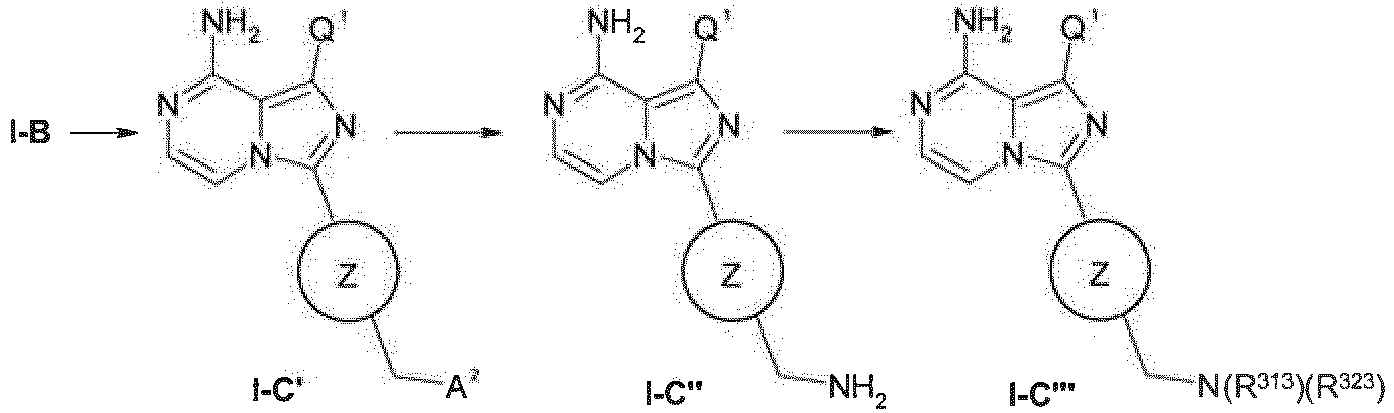
- In a typical preparation of compounds of Formula I-C', I-C", and I-C"', the hydroxy group of compound of Formula I-B was converted to A2, following the procedures as described in Scheme 5 for the conversion of compound of Formula VII to compound of Formula VI. Reaction of compound of Formula I-C' under conditions described in Scheme 4 afforded compound of Formula I-C". Reaction of compound of Formula I-C" with, but not limited to various alkylating agents, various aldehydes/ketones under reductive amination conditions, various acylating agents such as acetic anhydride, benzoyl chlorides, or with carboxylic acids in the presence of EDC or DCC with HOBT or HOAT, or with sulphonylating agents such as Ts2O or MeSO2Cl afforded compounds of Formula I-C"'. For example, in a typical preparation of compounds of Formula I-C"', a compound of Formula I-C" is treated with a suitable acylating agent in the presence of a suitable base in a suitable solvent. Suitable solvents for use in the above process included, but were not limited to, ethers such as tetrahydrofuran (THF), glyme, and the like; and chlorinated solvents such as methylene chloride (CH2Cl2) or chloroform (CHCl3). If desired, mixtures of these solvents were used, however, the preferred solvent was chloroform. Suitable bases for use in the above process included, but were not limited to, trialkylamines such as diisopropylethylamine, triethylamine, or resin bound trialkylamines such as PS-DIEA. The preferred base was PS-DIEA. In the case where the suitable acylating agent was acetic anhydride, the conversion of compound of Formula I-C" to compound of Formula 1-C'" where R313 = H and R323 = COCH3 was accomplished. The above process was carried out at temperatures between about -78°C and about 120°C. Preferably, the reaction was carried out between 0°C and about 20°C. The above process to produce compounds of the present invention was preferably carried out at about atmospheric pressure although higher or lower pressures were used if desired. Substantially equimolar amounts of reactants were preferably used although higher or lower amounts were used if desired.
- The compounds of Formula I-D (compounds of Formula I-AA where R3 = (CH2)n— Z2-H and Z2 is a heterocyclyl ring containing a nitrogen atom connected to H) and I-E (compounds of Formula I-AA where R3 = (CH2)n Z2-R31 and Z2 is a heterocyclyl ring containing a nitrogen atom connected to R31) were prepared as shown below in Scheme 21:


- In a typical preparation of compound of Formula I-E, compound of Formula II-E is treated with suitable reagents capable of converting N-G99a to N—H and therefore afford compound of Formula I-D. For example, treatment of compound of Formula II-E (when G99a is equal to CO2Bn) under previously described ammonolysis conditions followed by treatment with concentrated HCl and a suitable basic workup, affords compound of Formula I-D. Compound of Formula I-D can be subjected to various conditions including but not limited to reductive aminations, alkylations and ar(hetar)ylations, and acylations to afford amides, ureas, guanidines, carbamates, thiocarbamates, sulphonamides, and variously substituted nitrogen adducts to afford the net conversion of NH to NR2.
- The compounds of Formula II-G (compounds of Formula II where R3 = Z3-OH), II-H (compounds of Formula II where R3 = Z-A5(R313)(R323)aa), I-F (compounds of Formula I-AA where R3 = Z—OH), and I-G (compounds of Formula I-AA where R3 = Z-A5(R313)(R323)aa) were prepared as shown below in Scheme 22:

- In a typical preparation of compound of Formula I-F and I-G, the following transformations occurred: Compound of Formula II-F was reduced with a suitable reducing agent in a suitable solvent, such as sodium borohydride in methanol to afford compound of Formula II-G. Compound of Formula II-G was subjected to previously described ammonolysis conditions to afford compound of Formula I-F. Additionally, compounds of Formula II-F can be reacted with various amines under reductive amination conditions (NaBH3CN or NaBH(OAc)3 with HA5(R313)(R323)aa where d = 0, A5 = N, and R313 and R323 are as previously described for compound of Formula I) to afford compounds of Formula II-H where d = 0, A5 = N, and R313 and R323 are as previously described for compound of Formula I. Subsequent reaction of compounds of Formula II-H (compounds of Formula II where R3 = Z-A5(R313)(R323)aa where d = 0, A5 = N, and R313 and R323 are as previously described for compound of Formula I) with previously described ammonolysis conditions afforded compounds of Formula I-G. Furthermore, compounds of Formula II-H from II-G and I-G from I-F can be synthesized according to the conditions described in Scheme 19 for the transformations of II-B to II-D and I-B to I-C, respectively.
- The compounds of Formula I-C"' (compounds of Formula I-AA where R3 = Z— CH2-N(R313)(R323)) were prepared as shown below in Scheme 23:

- In a typical preparation of compound of Formula I-C"' (compounds of Formula I-AA where R3 = Z-CH2-N(R313)(R323)), the following transformations occurred: Compounds of Formula II-J (compounds of Formula II where R3 = Z=CH2) were reacted with a suitable hydroborating agent such as diborane, 9-borabicyclo[3.3.1]nonane (9-BBN), catecholborane and the like, in a suitable solvent such as THF followed by treatment with an suitable oxidizing agent such as hydrogen peroxide in basic aqueous solution or NaBO3•H2O to afford compounds of Formula II-B. Further reaction of compounds of Formula II-B with previously described ammonolysis conditions afforded compounds of Formula I-B. The hydroxy group of compounds of Formula I-B was then converted to a suitable leaving group, A4, such OTs, OMs, or OTf, by reaction with Ts2O, Ms2O, or Tf2O, respectively, to afford compounds of Formula I-H. Further reaction of compounds of Formula I-H with HN(R313)(R323) where R313 and R323 are as previously described for compounds of Formula I afforded compound of Formula I-C"' (compounds of Formula I-AA where R3 = Z—CH2— N(R313)(R323)).
- The compounds of Formula I-J (compounds of Formula I-AA where R3 = Z-OH(CH2OH)), I-K (compounds of Formula I-AA where R3= Z=O), and I-L (compounds of Formula I-AA where R3 = Z-NR313R323) were prepared as shown below in Scheme 24:

- In a typical preparation of compound of Formula I-J (compounds of Formula I-AA where R3 = Z-OH(CH2OH)), I-K (compounds of Formula I-AA where R3 = Z=O), and I-L (compounds of Formula I-AA where R3 = Z-NR312R322) compound of Formula II-J was treated under (compounds of Formula II where R3 = Z=CH2) was reacted with a suitable dihydroxylating agent such as osmium tetraoxide in the presence of NMO in a suitable solvent such as THF to afford compound of Formula II-K (compounds of Formula II where R3 = Z-OH(CH2OH)) as a mixture of cis and trans isomers. Compounds of Formula II-K (compounds of Formula II where R3 = Z— OH(CH2OH)) were treated with a suitable oxidizing agent, such as but not limited to, NaIO4, converting the diol into a ketone moiety, affording compound of Formula II-L (compounds of Formula II where R3 = Z=O). Compound of Formula II-L (compounds of Formula II where R3 = Z=O) was then treated under typical reductive amination conditions, involving a suitable amine, HNR312R322 and a suitable reducing agent, such as but not limited to, NaBH(OAc)3 or NaBH(CN)3, affording compound of Formula II-M (compounds of Formula II where R3 = Z-NR312R322). Compound of Formula II-M (compounds of Formula II where R3 = Z-NR312R322) was treated under ammonolysis conditions, ammonia in isopropanol in a stainless steel bomb at 110°C, to afford compound of Formula I-L (compounds of Formula 1-AA where R3 = Z-NR312R322). Moreover, compound of Formula II-K (compounds of Formula II where R3 = Z-OH(CH2OH)) was treated under the ammonolysis conditions described above to afford compound of Formula I-J (compounds of Formula I-AA where R3 = Z-OH(CH2OH)) as a mixture of isomers. Compound of Formula I-J (compounds of Formula I-AA where R3 = Z-OH(CH2OH)) was treated with a suitable oxidizing agent, such as but not limited to, NaIO4, converting the diol into a ketone moiety, affording compound of Formula I-K (compounds of Formula I-AA where R3 = Z=O), which was treated under the typical reductive amination conditions described above to afford compound of Formula I-L (compounds of Formula I-AA where R3 = Z-NR312R322).
- The compounds of Formula I-N (compounds of Formula I-AA where R3 = Z— OH(CH2NR313R323)) were prepared as shown below in Scheme 25:

- In a typical preparation of compounds of Formula I-N (compounds of Formula I-AA where R3 = Z-OH(CH2NR313R323)), the primary hydroxyl group of compound of Formula I-J (compounds of Formula I-AA where R3 = Z-OH(CH2OH)) was converted to a suitable leaving group, A4, such as OTs, OMs, or OTf, by reaction with Ts2O, Ms2O, or Tf2O in the presence of a suitable base such as diisopropylamine or pyridine and solvent such as THF or methylene chloride to afford compound of Formula I-M (compounds of Formula I-AA where R3 = Z-OH(CH2A4)). Reaction of compound of Formula I-M (compounds of Formula I-AA where R3= Z-OH(CH2A4)) with HN(R313)(R323) in a suitable solvent such as THF or methylene chloride afforded compound of Formula I-N (compounds of Formula I where R3 = Z-OH(CH2NR313R123)).
- The compounds of Formula I-O (compounds of Formula I where R3 = Z3-OH(G11)) were prepared as shown below in Scheme 26:

- In a typical preparation of compounds of Formula I-O (compounds of Formula I where R3 = Z-OH(G11)), the ketone moiety of compound of Formula II-L (compounds of Formula II where R3 = Z=O) was reacted with a suitable nucleophilic reagent such as MeMgBr or MeLi in a suitable solvent such as THF to afford compound of Formula II-N (compounds of Formula II where R3 = Z-OH(G11)). Compound of Formula II-N (compounds of Formula II where R3 = Z-OH(G11)) was reacted under ammonolysis conditions, ammonia in isopropanol in a stainless steel bomb at 110°C, to afford compound of Formula I-O (compounds of Formula I where R3 = Z-OH(G11)). Additionally, compound of Formula I-O (compounds of Formula I where R3 = Z-OH(G11)) was prepared by reacting compound of Formula I-K (compounds of Formula I-AA where R3 = Z=O) with a suitable nucleophilic reagent such as MeMgBr or MeLi in a suitable solvent such as THF.
- The conversion of compounds of Formula I-PP' and I-P' to compounds of Formula I-RR an I-R, respectively may be accomplished by reaction with a boronic acid ester using so-called "Liebeskind-Srogl" conditions such as those described in Organic Letters, (2002), 4(6), 979 or Synlett, (2002), (3), 447.
- A compound of Formula I-AB is equal to compound of Formula I wherein X1 = CH, X2, X4 and X5 = N, and X3, X6 and X7 = C; Q1 is as defined for a compound of Formula I; R3 is C0-10alkyl, cycloC3-10alkyl, aminomethylcycloC3-10alkyl, bicycloC5-10alkyl, aryl, heteroaryl, aralkyl, heteroaralkyl, heterocyclyl, heterobicycloC5-10alkyl, spiroalkyl, or heterospiroalkyl, any of which is optionally substituted by one or more independent G11 substituents; and G11 is as defined for a compound of Formula I:

- Method AB was used when preparing compounds of Formula I-AB as shown below in Scheme 28:
-


- In a typical preparation of compounds of Formula I-AB, compound of Formula I-ABA was reacted with a suitable boronic acid/ester of Formula XIV-Z (Q1-B(OR)2) in a suitable solvent via typical Suzuki coupling procedures. Suitable solvents for use in the above process included, but were not limited to, ethers such as tetrahydrofuran (THF), glyme, and the like; dimethylformamide (DMF); dimethyl sulfoxide (DMSO); acetonitrile; alcohols such as methanol, ethanol, isopropanol, trifluoroethanol, and the like; and chlorinated solvents such as methylene chloride (CH2Cl2) or chloroform (CHCl3). If desired, mixtures of these solvents were used, however, the preferred solvent systems were THF/water and DMF/water. The above process was carried out at temperatures between about 20°C and about 120°C. Preferably, the reaction was carried out between 80°C and about 100°C. The above process to produce compounds of the present invention was preferably carried out at about atmospheric pressure although higher or lower pressures were used if desired. Substantially equimolar amounts of reactants were preferably used although higher or lower amounts were used if desired.
- One skilled in the art will appreciate that alternative methods may be applicable for preparing compounds of Formula I-AB from I-ABA. For example, compound of Formula I-ABA could be reacted with a suitable organotin reagent Q1-SnBu3 or the like in a suitable solvent via typical Stille coupling procedures.
- The compounds of Formula I-ABA wherein R3 is C1-10alkyl, cycloC3-10alkyl, bicycloC5-10alkyl, aralkyl, heteroaralkyl, heterocyclyl, heterobicycloC5-10alkyl, spiroalkyl, or heterospiroalkyl, any of which is optionally substituted by one or more independent G11 substituents, of Scheme 28 were prepared as shown below in Scheme 29:

- In a typical preparation of a compound of Formula I-ABA, a compound of Formula I-ABB was reacted with an alcohol R3-OH under typical Mitsunobu conditions in a suitable solvent in the presence of suitable reactants. Suitable solvents for use in the above process included, but were not limited to, ethers such as tetrahydrofuran (THF), glyme, and the like; dimethylformamide (DMF); dimethyl sulfoxide (DMSO); acetonitrile (CH3CN); chlorinated solvents such as methylene chloride (CH2Cl2) or chloroform (CHCl3). If desired, mixtures of these solvents were used, however, the preferred solvent was THF. Suitable reactants for use in the above process included, but were not limited to, triphenylphosphine and the like, and an azodicarboxylate (DIAD, DEAD, DBAD). The preferred reactants were triphenylphosphine or resin-bound triphenylphosphine and DIAD. The above process may be carried out at temperatures between about -78°C and about 100°C. Preferably, the reaction was carried out between about 0°C and 25°C. The above process to produce compounds of the present invention was preferably carried out at about atmospheric pressure although higher or lower pressures were used if desired. Substantially equimolar amounts of reactants were preferably used although higher or lower amounts were used if desired. Generally, one equivalent of triphenylphosphine, DIAD, and R3-OH was used per equivalent of compound of Formula I-ABB.
- Alternatively, the compounds of Formula I-ABA may be prepared by alkylating compounds of Formula I-ABB with an alkylating agent R3-LG, wherein LG is a leaving group including, but not limited to, chloride, bromide, iodide, tosylate, mesylate, trifluoromethanesulfonate, under typical alkylation conditions known to someone skilled in the art.
- Preferably, in compounds of Formula I-ABB, A11 = Br and I. These compounds are known (A11 = I: H. B. Cottam et al., J. Med. Chem. 1993, 36(22), 3424-3430; A11 = Br: T. S. Leonova et al., Khim. Geterotsikl. Soedin. 1982, (7), 982-984).
- Compound of Formula I-AC is equal to compound of Formula I wherein X1 and X5 = CH, X2 and X4 = N, and X3, X6 and X7 = C; Q1 is as defined for a compound of Formula I; R3 is C0-10alkyl, cycloC3-10alkyl, bicycloC5-10alkyl, aryl, heteroaryl, aralkyl, heteroaralkyl, heterocyclyl, heterobicycloC5-10alkyl, spiroalkyl, or heterospiroalkyl, any of which is optionally substituted by one or more independent G11 substituents; and G11 is as defined for a compound of Formula I:

- Method AC was used when preparing compounds of Formula I-AB as shown below in Scheme 30:
-

- In a typical preparation of compounds of Formula I-AC, compound of Formula I-ACA was reacted with a suitable boronic acid/ester XIV-Z (Q'-B(OR)2) in a suitable solvent via typical Suzuki coupling procedures. Suitable solvents for use in the above process included, but were not limited to, ethers such as tetrahydrofuran (THF), glyme, and the like; dimethylformamide (DMF); dimethyl sulfoxide (DMSO); acetonitrile; alcohols such as methanol, ethanol, isopropanol, trifluoroethanol, and the like; and chlorinated solvents such as methylene chloride (CH2Cl2) or chloroform (CHC13). If desired, mixtures of these solvents were used, however, the preferred solvent systems were THF/water and DMF/water. The above process was carried out at temperatures between about 20°C and about 120°C. Preferably, the reaction was carried out between 80°C and about 100°C. The above process to produce compounds of the present invention was preferably carried out at about atmospheric pressure although higher or lower pressures were used if desired. Substantially equimolar amounts of reactants were preferably used although higher or lower amounts were used if desired.
- One skilled in the art will appreciate that alternative methods may be applicable for preparing compounds of formula I-AC from I-ACA. For example, compound of Formula I-ACA could be reacted with a suitable organotin reagent Q1-SnBu3 or the like in a suitable solvent via typical Stille coupling procedures.
- The compounds of Formula I-ACA of Scheme 30 were prepared as shown below in Scheme 31:

- In a typical preparation of compounds of Formula I-ACA, compound of Formula XV was reacted with ammonia in a suitable solvent. Suitable solvents for use in the above process included, but were not limited to, ethers such as tetrahydrofuran (THF), glyme, and the like; dimethylformamide (DMF); dimethyl sulfoxide (DMSO); acetonitrile; alcohols such as methanol, ethanol, isopropanol, trifluoroethanol, and the like; and chlorinated solvents such as methylene chloride (CH2Cl2) or chloroform (CHCl3). If desired, mixtures of these solvents were used, however, the preferred solvent was isopropanol. The above process was carried out at temperatures between about -78°C and about 120°C. Preferably, the reaction was carried out between 80°C and about 100°C. The above process to produce compounds of the present invention was preferably carried out in a glass pressure tube or a stainless steel reactor. Preferably, an excess of ammonia was used.
- The compounds of Formula XVA (= compounds of Formula XV of Scheme 31 wherein R3 is C1-10alkyl, cycloC3-10alkyl, bicycloC5-10alkyl, aralkyl, heteroaralkyl, heterocyclyl, heterobicycloC5-10alkyl, spiroalkyl, or heterospiroalkyl, any of which is optionally substituted by one or more independent G11 substituents) were prepared as shown below in Scheme 32:

- In a typical preparation of a compound of Formula XVA, a compound of Formula XVI was reacted with an alcohol R3-OH under typical Mitsunobu conditions in a suitable solvent in the presence of suitable reactants. Suitable solvents for use in the above process included, but were not limited to, ethers such as tetrahydrofuran (THF), glyme, and the like; dimethylformamide (DMF); dimethyl sulfoxide (DMSO); acetonitrile (CH3CN); chlorinated solvents such as methylene chloride (CH2Cl2) or chloroform (CHCl3). If desired, mixtures of these solvents were used, however, the preferred solvent was THF. Suitable reactants for use in the above process included, but were not limited to, triphenylphosphine and the like, and an azodicarboxylate (DIAD, DEAD, DBAD). The preferred reactants were triphenylphosphine or resin-bound triphenylphosphine and DIAD. The above process may be carried out at temperatures between about -78°C and about 100°C. Preferably, the reaction was carried out between about 0°C and 25°C. The above process to produce compounds of the present invention was preferably carried out at about atmospheric pressure although higher or lower pressures were used if desired. Substantially equimolar amounts of reactants were preferably used although higher or lower amounts were used if desired. Generally, one equivalent of triphenylphosphine, DIAD, and R3-OH was used per equivalent of compound of Formula XVI.
- Alternatively, the compounds of Formula XVA may be prepared by alkylating compounds of Formula XVI with an alkylating agent R3-LG, wherein LG is a leaving group including, but not limited to, chloride, bromide, iodide, tosylate, mesylate, trifluoromethanesulfonate, under typical alkylation conditions known to someone skilled in the art.
- The compounds of Formula XVB (= compounds of Formula XV of Scheme 31 wherein R3 is aryl or heteroaryl, optionally substituted by one or more independent G11 substituents) were prepared as shown below in Scheme 33:

- In a typical preparation of compounds of Formula XVB, compound of Formula XVI was reacted with a suitable boronic acid of Formula R3-B(OH)2 in a suitable solvent via typical copper(II)-mediated coupling procedures. Suitable solvents for use in the above process included, but were not limited to, ethers such as tetrahydrofuran (THF), glyme, 1,4-dioxane, and the like; dimethylformamide (DMF); N-methylpyrrolidinone (NMP); chlorinated solvents such as methylene chloride (CH2Cl2). If desired, mixtures of these solvents were used, however, the preferred solvent was methylene chloride (CH2C12). Suitable reactants for use in the above process included, but were not limited to, copper(II) acetate (Cu(OAc)2), copper(II) triflate (Cu(OTf)2), and the like, and a base (pyridine, and the like). The preferred reactants were Cu(OAc)2 and pyridine. The above process to produce compounds of the present invention was preferably carried out at about atmospheric pressure under air, although higher or lower pressures could be used if desired. Preferably, the reaction was carried out at about 22°C. Generally, 1.5eq. of copper(II) acetate, 2eq. of pyridine, and 2eq. of boronic acid of Formula R3-B(OH)2 were used per equivalent of compound of Formula XVI.
- All compounds of Formula XVI are known in the literature (A11 = I: L. B. Townsend et al., J. Med. Chem. 1990, 33, 1984-92; A11 = Br, Cl: L. B. Townsend et al., J. Med. Chem. 1988, 31, 2086-2092). Preferably, A11 = Br and I.
- Both R3 and Q1 in the compounds described herein in some instances contain functional groups that can be further manipulated. It would be appreciated by those skilled in the art that such manipulation of functional groups could be accomplished with key intermediates or with late stage compounds. Such functional group transformations are exemplified in the following Schemes 34-35 as well as in the experimental section but are in no way meant to limit the scope of such transformations.
- The compounds of Formula I-ACA' (= compounds of Formula I-ACA where R3 = Z-CONR312R322) were prepared from compounds of Formula XV' (= compounds of Formula XV where R3 = Z-CO2A3) as shown below in Scheme 34:
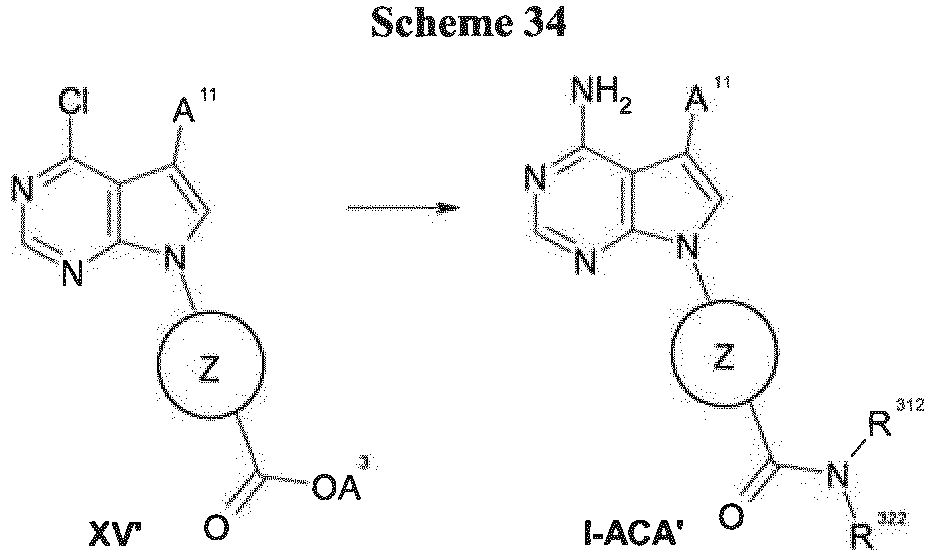
- In a typical preparation of compound of Formula I-ACA', when A3 = alkyl and R312 and R322 were both equal to H, reaction of compound of Formula XV' with ammonia in a suitable solvent, afforded compound of Formula I-ACA'. Suitable solvents for use in the above process included, but were not limited to, ethers such as tetrahydrofuran (THF), glyme, and the like; dimethylformamide (DMF); dimethyl sulfoxide (DMSO); acetonitrile; alcohols such as methanol, ethanol, isopropanol, trifluoroethanol, and the like; and chlorinated solvents such as methylene chloride (CH2Cl2) or chloroform (CHC13). If desired, mixtures of these solvents were used, however, the preferred solvent was isopropanol. The above process was carried out at temperatures between about -78°C and about 120°C. Preferably, the reaction was carried out between 80°C and about 100°C. The above process to produce compounds of the present invention was preferably carried out in a glass pressure tube or a stainless steel reactor. Preferably, an excess of ammonia was used. Additionally, in a typical preparation of compound of Formula I-ACA' (compounds of Formula I-ACA where R3 = Z-CONR312R322), compound of Formula XV' (compounds of Formula XV' where R3= Z-CO2A3) was reacted with HNR312R322 followed by ammonia in a suitable solvent. When A3 = H, typical coupling procedures (such as conversion of -CO2H to -COCl via treatment with SOCl2 or oxalyl chloride followed by reaction with HNR312R322 or treatment of -CO2H and HNR312R322 with EDC or DCC in conjunction with DMAP, HOBT, or HOAt and the like) were employed to afford the transformation of a carboxylic acid to an amide. When A3 = alkyl such as methyl or ethyl, treatment of the ester with Al(NR312R322) afforded conversion of -CO2A3 to -CO(NR312R322). Subsequent treatment with ammonia afforded compounds of Formula I-ACA'.
- The chemistry shown in Scheme 34 can also be applied to compounds with Q1 in place of A11.
- The compounds of Formula XVIII (compounds of Formula XV, I-ACA, or I-AC where R3 = Z-CH2OH), XIX (compounds of Formula XV, I-ACA, or I-AC where R3 = Z-CH2LG), and XX (compounds of Formula XV, I-ACA, or I-AC where R3 = Z-CH2A5(R313)(R323)aa were prepared as shown below in Scheme 35:

- The following table indicates the relations between the compounds of Formulas XVII-XX, A12, A13, compounds of Formulas I-AC, I-ACA, and XV, and R3.
Compound of Formula... wherein A12 = and A13 = ...is equal to Formula... wherein R3 = XVII Cl A11 XV Z-CO2A3 XVII NH2 A11 I-ACA Z-CO2A3 XVII NH2 Q1 I-AC Z-CO2A3 XVIII Cl A11 XV Z-CH2OH XVIII NH2 A11 I-ACA Z-CH2OH XVIII NH2 Q1 I-AC Z-CH2OH XIX Cl A11 XV Z-CH2LG XIX NH2 A11 I-ACA Z-CH2LG XIX CH2 Q1 I-AC Z-CH2LG XX Cl A11 XV Z-CH2A5R2(R4) XX NH2 A11 I-ACA Z-CH2A5R2(R4)d XX NH2 Q1 I-AC Z-CH2A2R2(R4)d - In a typical preparation of compound of Formula XVIII (compounds of Formula XV, I-ACA, or I-AC, where R3 = Z-CH2OH), compound of Formula XVII (compounds of Formula XV, I-ACA, or I-AC, where R3 = Z-CO2A3) is treated with a suitable reducing agent, such as lithium aluminum hydride or diisobutylaluminum hydride, in a suitable solvent, such as THF or methylene chloride, to afford compound of Formula XVIII. In a typical preparation of compound of Formula XX (compounds of Formula XV, I-ACA, or I-AC, where R3 = Z-CH2A5(R313)(R323)aa), the hydroxy group of compound of Formula XVIII was converted to a suitable leaving group, LG, such as Cl or tosylate, mesylate, or triflate, by reaction with SOCl2 or Ts2O, Ms2O, or Tf2O to afford compound of Formula XIX (compounds of Formula XV, I-ACA, or I-AC, where R3 = Z-CH2LG). Reaction of compound of Formula XIX with HA5(R313)(R323)aa afforded compound of Formula XX. Furthermore, compound of Formula XVIII can be directly converted to compound of Formula XX by treating compound of Formula XVIII with various alkylating agents or under typical Mitsunobu reaction conditions to afford compounds of Formula XX (compounds of Formula XV, I-ACA, or I-AC, where R3 = Z-CH2A5(R133)(R123)aa) in which A5 = O, aa = 0, and R313 = alkyl or aryl). Someone skilled in the art will choose the most appropriate stage during the sequence shown in Scheme 35 to convert A2 = Cl to A12 = NH2 as described in Scheme 31, and to convert A13 = A11 to A13 = Q1 as described in Scheme 30, if applicable.
- An alternative preparation of compounds of Formula I-AC is shown in Scheme 36.

- The compounds of Formula XXI may be prepared from aldehydes Q1-CHO (see Scheme 14 for their preparation) by addition of methyllithium or a methyl Grignard reagent, followed by oxidation of the resulting alcohol to the ketone of Formula XXI. Other compounds are commercially available or can be prepared by methods well known to someone skilled in the art, see: Larock, R. C. Comprehensive Organic Transformations, 2nd ed.; Wiley and Sons: New York, 1999, 1197ff. Reaction of compounds of Formula XXI under typical halogenation conditions with typical halogenating agents including, but not limited to, Br2, NBS, pyridinium perbromide, or CuBr2 (for A11 = Br), or NCS or SO2Cl2 (for A11 = Cl) gives the compounds of Formula XXII. Their reaction with amines of Formula H2N-R3 gives the aminoketones of Formula XXIII that are converted to aminocyanopyrroles of Formula XXIV by reaction with malononitrile under basic conditions. Finally, reaction of compounds of Formula XXIV under typical cyclization conditions gives the compounds of Formula I-AC. Conditions for this cyclization include, but are not limited to, heating with formamide; heating with formamide and ammonia; sequential treatment with a trialkyl orthoformate, ammonia, and a base; sequential treatment with formamidine and ammonia.
- It would be appreciated by those skilled in the art that in some situations, a substituent that is identical or has the same reactivity to a functional group which has been modified in one of the above processes, will have to undergo protection followed by deprotection to afford the desired product and avoid undesired side reactions. Alternatively, another of the processes described within this invention may be employed in order to avoid competing functional groups. Examples of suitable protecting groups and methods for their addition and removal may be found in the following reference: "Protective Groups in Organic Syntheses", T. W. Greene and P. G. M. Wuts, John Wiley and Sons, 1989 .
- Compound of Formula I-AQ is equal to compound of Formula I wherein X1 = CH; X2, X3 and X5 = N; X4, X6, and X7 = C and J=H or NH2

- Method AQ was used when preparing compounds of Formula I-AQ as shown below in Scheme 37:
-

- In a typical preparation of compounds of Formula I-AQ, compound of Formula II-Q was reacted with a suitable boronic acid/ester (Q1-B(OR)2) in a suitable solvent via typical Suzuki coupling procedures. Suitable solvents for use in the above process included, but were not limited to, water, ethers such as tetrahydrofuran (THF), glyme, and the like; dimethylformamide (DMF); dimethyl sulfoxide (DMSO); acetonitrile; alcohols such as methanol, ethanol, isopropanol, trifluoroethanol, and the like; and chlorinated solvents such as methylene chloride (CH2C12) or chloroform (CHCl3). If desired, mixtures of these solvents were used, however, the preferred solvent was glyme/water. The above process was carried out at temperatures between about -78°C and about 120°C. Preferably, the reaction was carried out between 80°C and about 100°C. The above process to produce compounds of the present invention was preferably carried out at about atmospheric pressure although higher or lower pressures were used if desired. Substantially equimolar amounts of reactants were preferably used although higher or lower amounts were used if desired.
- One skilled in the art will appreciate that alternative methods may be applicable for preparing compounds of Formula I-AQ from II-Q. For example, compound of Formula II-Q could be reacted with a suitable organotin reagent Q1-SnBu3 or the like in a suitable solvent via typical Stille coupling procedures.
- The compounds of Formula II-Q of Scheme 37 were prepared as shown below in Scheme 38.

- In a typical preparation of compounds of Formula II-Q, compound of Formula III-Q was reacted with phosphorus oxychloride (POCl3) and triazole, and pyridine followed by ammonia (NH3) in a suitable solvent. Suitable solvents for use in the above process included, but were not limited to, ethers such as tetrahydrofuran (THF), glyme, and the like; dimethylformamide (DMF); dimethyl sulfoxide (DMSO); acetonitrile; alcohols such as methanol, ethanol, isopropanol, trifluoroethanol, and the like; and chlorinated solvents such as methylene chloride (CH2Cl2) or chloroform (CHCl3). If desired, mixtures of these solvents were used, however, the preferred solvent was isopropanol. The above process was carried out at temperatures between about -20°C and about 50°C. Preferably, the reaction was carried out between 0°C and about 25°C. The above process to produce compounds of the present invention was preferably carried out at about atmospheric pressure although higher or lower pressures were used if desired. Substantially equimolar amounts of reactants were preferably used although higher or lower amounts were used if desired.
- The compounds of Formula III-Q of Scheme 38 were prepared as shown below in Scheme 39.

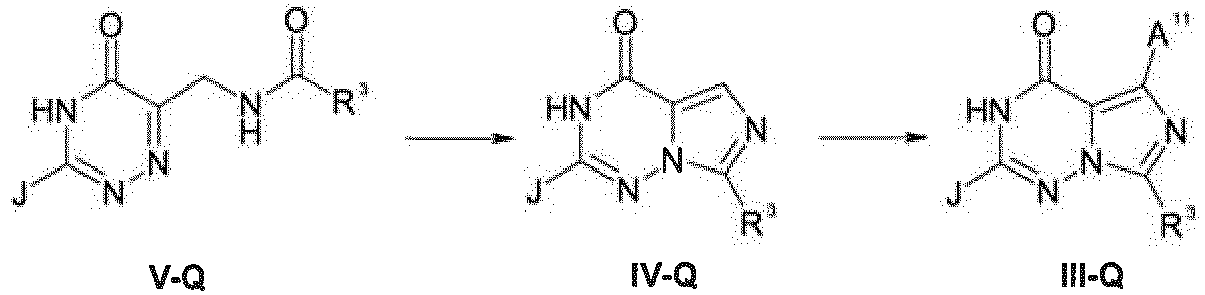
- In a typical preparation of a compound of Formula III-Q, intermediate V-Q was converted to compound of Formula IV-Q. Intermediate of Formula V-Q was treated with phosphorus oxychloride (POCl3) in a suitable solvent at a suitable reaction temperature. Suitable solvents for use in the above process included, but were not limited to, ethers such as tetrahydrofuran (THF), glyme, and the like, chlorinated solvents such as methylene chloride (CH2Cl2) or chloroform (CHCl3), and acetonitrile. If desired, mixtures of these solvents were used. The preferred solvent was acetonitrile. The above process was carried out at temperatures between about -78°C and about 120°C. Preferably, the reaction was carried out between 40°C and about 95°C. The above process to produce compounds of the present invention was preferably carried out at about atmospheric pressure although higher or lower pressures were used if desired. Intermediate for Formula III-Q was prepared by reacting intermediate of Formula IV-Q with a suitable halogenating agent. Suitable halogenating agents included, but were not limited to, Br2, I2, Cl2, N-chlorosuccinimide, N-bromosuccinimide, or N-iodosuccinimide. The preferred halogenating agent was N-iodosuccinimide. Suitable solvents for use in the above process included, but were not limited to, ethers such as tetrahydrofuran (THF), glyme, and the like; dimethylformamide (DMF); dimethyl sulfoxide (DMSO); acetonitrile; alcohols such as methanol, ethanol, isopropanol, trifluoroethanol, and the like; and chlorinated solvents such as methylene chloride (CH2Cl2) or chloroform (CHCl3). If desired, mixtures of these solvents were used, however, the preferred solvent was DMF. The above process was carried out at temperatures between about -78°C and about 120°C. Preferably, the reaction was carried out between 40°C and about 75°C. The above process to produce compounds of the present invention was preferably carried out at about atmospheric pressure although higher or lower pressures were used if desired. Substantially equimolar amounts of reactants were preferably used although higher or lower amounts were used if desired.
- Compounds of Formulae IV-Q and III-Q where J=NH2 can be respectively converted into the compounds of Formulae IV-Q and III-Q where J=H, by diazotisation procedures known to those skilled in the art. A typical procedure includes the treatment of a compound of Formula IV-Q or III-Q where J=NH2 with tert-butylnitrite in a suitable solvent such a THF or DMF.
- The compounds of Formula V-Q of Scheme 39 were prepared as shown below in Scheme 40:


- In a typical preparation, of a compound of Formula V-Q, a compound of Formula VI-Q and compound of Formula V were reacted under suitable amide -coupling conditions. Suitable conditions include but are not limited to treating compounds of Formula VI-Q and V (when A1 = OH) with coupling reagents such as DCC or EDC in conjunction with DMAP, HOBt, HOAt and the like, or reagents like EEDQ. Suitable solvents for use in the above process included, but were not limited to, ethers such as tetrahydrofuran (THF), glyme, and the like; dimethylformamide (DMF); dimethyl sulfoxide (DMSO); acetonitrile; halogenated solvents such as chloroform or methylene chloride. If desired, mixtures of these solvents were used, however the preferred solvent was methylene chloride. The above process was carried out at temperatures between about 0°C and about 80°C. Preferably, the reaction was carried out at about 22°C. The above process to produce compounds of the present invention was preferably carried out at about atmospheric pressure although higher or lower pressures were used if desired. Substantially equimolar amounts of reactants were preferably used although higher or lower amounts were used if desired. Alternatively, compounds of Formula VI-Q and V (where A1 = F, Cl, Br, I) were reacted with bases such as triethylamine or ethyldiisopropylamine and the like in conjunction with DMAP and the like. Suitable solvents for use in this process included, but were not limited to, ethers such as tetrahydrofuran (THF), glyme, and the like; dimethylformamide (DMF); dimethyl sulfoxide (DMSO); acetonitrile; pyridine; halogenated solvents such as chloroform or methylene chloride. If desired, mixtures of these solvents were used, however the preferred solvent was DMF. The above process was carried out at temperatures between about-20°C and about 40°C. Preferably, the reaction was carried out between 0°C and 25°C. The above process to produce compounds of the present invention was preferably carried out at about atmospheric pressure although higher or lower pressures were used if desired. Substantially equimolar amounts of compounds of Formula VI-Q and V (where A1 = F, Cl, Br, I) and base and substochiometric amounts of DMAP were preferably used although higher or lower amounts were used if desired. Additionally, other suitable reaction conditions for the conversion of an amine (compound of Formula VI-Q) to an amide (compound of Formula V-Q) can be found in Larock, R. C. Comprehensive Organic Transformations, 2nd ed.; Wiley and Sons: New York, 1999, pp 1941-1949.
- The compounds of Formula VI-Q of Scheme 40 where J=H were prepared as shown below in Scheme 41:


- In a typical preparation, of a compound of Formula VI-Q, a compound of Formula VII-Q is reacted under suitable reaction conditions in a suitable solvent. Suitable conditions include treatment of compound of Formula VII-Q with hydrazine or methyl hydrazine in a suitable solvent. Suitable solvents for use in the above process included, but were not limited to, ethers such as tetrahydrofuran (THF), glyme, and the like; dimethylformamide (DMF); dimethyl sulfoxide (DMSO); acetonitrile; halogenated solvents such as chloroform or methylene chloride; alcoholic solvents such as methanol and ethanol. If desired, mixtures of these solvents may be used, however the preferred solvents were ethanol and methylene chloride. The above process was carried out at temperatures between about 0°C and about 80°C. Preferably, the reaction was carried out at about 22°C. The above process to produce compounds of the present invention was preferably carried out at about atmospheric pressure although higher or lower pressures were used if desired. Substantially equimolar amounts of reactants were preferably used although higher or lower amounts were used if desired.
- Compounds of Formula VI-Q where J=NH2 may be prepared according to the procedures described in J.Het. Chem., (1984), 21, 697.
- The compounds of Formula VII-Q of Scheme 41 were prepared as shown below in Scheme 42:

- In a typical preparation of a compound of Formula VII-Q, a compound of Formula VIII-Q was reacted with Raney Nickel in a suitable solvent. Suitable solvents for use in the above process included, but were not limited to, ethers such as tetrahydrofuran (THF), glyme, and the like; dimethylformamide (DMF); dimethyl sulfoxide (DMSO); acetonitrile (CH3CN); alcohols such as methanol, ethanol, isopropanol, trifluoroethanol, and the like; chlorinated solvents such as methylene chloride (CH2Cl2) or chloroform (CHCl3). If desired, mixtures of these solvents were used, however, the preferred solvent was ethanol. The above process may be carried out at temperatures between about rt and about 100°C. Preferably, the reaction was carried out at about 80°C. The above process to produce compounds of the present invention was preferably carried out at about atmospheric pressure although higher or lower pressures were used if desired. Substantially equimolar amounts of reactants were preferably used although higher or lower amounts were used if desired. Additionally a compound of Formula VII-Q can be prepared by reacting a compound of Formula VIII-Q with a suitable oxidizing agent in a suitable solvent. A suitable oxidizing agent includes, but is not limited to hydrogen peroxide (H2O2), 3-chloro peroxybenzoic acid (mCPBA) and the like. Suitable solvents for use in the above process included, but were not limited to, ethers such as THF, glyme, and the like; DMF; DMSO; CH3CN; and dimethylacetamide (DMA); chlorinated solvents such as CH2Cl2 or CHCl3 If desired, mixtures of these solvents were used, however, the preferred solvent was DMA. The above process may be carried out at temperatures between about 0°C and 100°C. Preferably, the reaction was carried out at about rt to 70°C. The above process to produce compounds of the present invention was preferably carried out at about atmospheric pressure although higher or lower pressures were used if desired. Substantially equimolar amounts of reactants were preferably used although higher or lower amounts were used if desired.
- The compounds of Formula VIII-Q of Scheme 42 were prepared as shown below in Scheme 43:

- In a typical preparation of a compound of Formula VIII-Q, a compound of Formula IX-Q was reacted with thiosemicarbazide and a suitable base in a suitable solvent. Suitable bases include, but were not limited to triethylamine, ethyldiisopropylamine and the like. Suitable solvents for use in the above process included, but were not limited to, ethers such as tetrahydrofuran (THF), glyme, and the like; dimethylformamide (DMF); dimethylacetamide (DMA); dimethyl sulfoxide (DMSO); acetonitrile (CH3CN); alcohols such as methanol, ethanol, isopropanol, trifluoroethanol, and the like; chlorinated solvents such as methylene chloride (CH2Cl2) or chloroform (CHCl3). If desired, mixtures of these solvents were used, however, the preferred solvent was ethanol. The above process may be carried out at temperatures between about rt and about 100°C. Preferably, the reaction was carried out between about 40°C and 80°C. The above process to produce compounds of the present invention was preferably carried out at about atmospheric pressure although higher or lower pressures were used if desired. Substantially equimolar amounts of reactants were preferably used although higher or lower amounts were used if desired. Compound of Formula IX-Q can be prepared according to literature procedures Knutsen, Lars J. S. et. al., J. Chem. Soc. Perkin Trans 1: Organic and Bio-Organic Chemistry (1972-1999),1984, 229-238.
- It would be appreciated by those skilled in the art that in some situations, a substituent that is identical or has the same reactivity to a functional group which has been modified in one of the above processes, will have to undergo protection followed by deprotection to afford the desired product and avoid undesired side reactions. Alternatively, another of the processes described within this invention may be employed in order to avoid competing functional groups. Examples of suitable protecting groups and methods for their addition and removal may be found in the following reference: "Protective Groups in Organic Syntheses", T. W. Greene and P. G. M. Wuts, John Wiley and Sons, 1989 .
- Method AW was also used when preparing compounds of Formula II-Q as shown below in Scheme 44:
-

- In a typical preparation of compounds of Formula II-Q, compound of Formula III-W was reacted with ammonia in a suitable solvent. Suitable solvents for use in the above process included, but were not limited to, ethers such as tetrahydrofuran (THF), glyme, and the like; alcohols such as methanol, ethanol, isopropanol, trifluoroethanol, and the like; and chlorinated solvents such as methylene chloride (CH2Cl2) or chloroform (CHCl3). If desired, mixtures of these solvents were used, however, the preferred solvent was isopropanol. The above process was carried out at temperatures between about 0°C and about 50°C. Preferably, the reaction was carried out at between 0°C and about 22°C. The above process to produce compounds of the present invention was preferably carried out at about atmospheric pressure although higher or lower pressures were used if desired. Substantially equimolar amounts of reactants were preferably used although higher or lower amounts were used if desired.
- The compounds of Formula III-W of Scheme 44 were prepared as shown below in Scheme 45.


- In a typical preparation of a compound of Formula III-W, compound V-W was converted to compound of Formula IV-W. Compound of Formula V-W was treated with phosphorus oxychloride (POCl3) or the isolated "Vilsmeir salt" [CAS# 33842-02-3] in a suitable solvent at a suitable reaction temperature. Suitable solvents for use in the above process included, but were not limited to, ethers such as tetrahydrofuran (THF), glyme, and the like, chlorinated solvents such as methylene chloride (CH2Cl2) or chloroform (CHCl3), and acetonitrile (CH3CN). If desired, mixtures of these solvents were used. The preferred solvent was acetonitrile. The above process was carried out at temperatures between about -78°C and about 120°C. Preferably, the reaction was carried out between 40°C and about 95°C. The above process to produce compounds of the present invention was preferably carried out at about atmospheric pressure although higher or lower pressures were used if desired. Compounds of Formula III-W were prepared by reacting compound of Formula IV-W with a suitable halogenating agent. Suitable halogenating agents included, but were not limited to, Br2, I2, Cl2, N-chlorosuccinimide, N-bromosuccinimide, or N-iodosuccinimide. The preferred halogenating agent was N-iodosuccinimide. Suitable solvents for use in the above process included, but were not limited to, ethers such as tetrahydrofuran (THF), glyme, and the like; dimethylformamide (DMF); dimethyl sulfoxide (DMSO); acetonitrile; alcohols such as methanol, ethanol, isopropanol, trifluoroethanol, and the like; and chlorinated solvents such as methylene chloride (CH2Cl2) or chloroform (CHCl3). If desired, mixtures of these solvents were used, however, the preferred solvent was DMF. The above process was carried out at temperatures between about -78°C and about 120°C. Preferably, the reaction was carried out between 40°C and about 75°C. The above process to produce compounds of the present invention was preferably carried out at about atmospheric pressure although higher or lower pressures were used if desired. Substantially equimolar amounts of reactants were preferably used although higher or lower amounts were used if desired.
- The compounds of Formula V-W of Scheme 45 were prepared as shown below in Scheme 46.

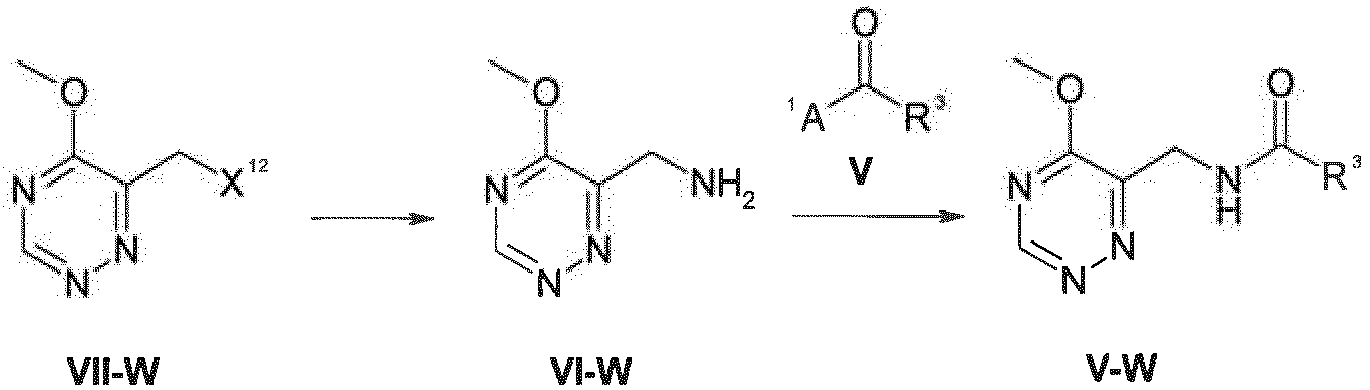
- In a typical preparation of a compound of Formula V-W, compound VI-W was reacted with compound V under suitable amide coupling conditions. Suitable conditions include but are not limited to those described for the conversion of compound XIII to compound XII as shown in Scheme 10. Compounds of Formula VI-W were prepared from compounds of Formula VII-W. A typical procedure for the conversion of compounds of Formula VII-W to compounds of Formula VI-W involves subjecting a compound of Formula VII-W, where X12 = azido, to reducing conditions such as, but not limited to, catalytic hydrogenation in a suitable solvent at a suitable reaction temperature. Suitable solvents for use in the above process included, but were not limited to, ethers such as tetrahydrofuran (THF), glyme, and the like, alcoholic solvents such as methanol, ethanol and the like, esters such as ethyl acetate, methyl acetate and the like. If desired, mixtures of these solvents were used. The preferred solvents were ethyl acetate and methanol. The above process was carried out at temperatures between about -78°C and about 120°C. Preferably, the reaction was carried out between 40°C and about 95°C. The above process to produce compounds of the present invention was preferably carried out at about atmospheric pressure although higher or lower pressures were used if desired. Alternatively, when X12 = azido, the reduction to compounds of Formula VI-W could be achieved by treatment of a compound of Formula VII-W with triaryl- or trialkylphosphines in the presence of water in a suitable solvent at a suitable reaction temperature. Suitable solvents for use in the above process included, but were not limited to, ethers such as tetrahydrofuran (THF), dioxane and the like, alcoholic solvents such as methanol, ethanol and the like, esters such as ethyl acetate, methyl acetate and the like, DMF, acetonitrile, and pyridine. If desired, mixtures of these solvents were used. The preferred solvents were THF and acetonitrile. The above process was carried out at temperatures between about -78°C and about 120°C. Preferably, the reaction was carried out between 40°C and about 95°C. The above process to produce compounds of the present invention was preferably carried out at about atmospheric pressure although higher or lower pressures were used if desired.
- Where X12 = mono- or di-protected amino, the deprotection could be effected by the procedures known to those skilled in the art and as disclosed in: "Protective Groups in Organic Syntheses", T. W. Greene and P. G. M. Wuts, John Wiley and Sons, 1989.
- The compounds of Formula VII-W of Scheme 46 were prepared as shown below in Scheme 47:

- In a typical preparation of a compound of Formula VII-W where X12 = azide, compound VIII-W was reacted with an azide salt, such as lithium or sodium azide in suitable solvent at a suitable reaction temperature. Suitable solvents for use in the above process included, but were not limited to, alcoholic solvents such as ethanol, butanol and the like, esters such as ethyl acetate, methyl acetate and the like, DMF, acetonitrile, acetone DMSO. If desired, mixtures of these solvents were used. The preferred solvents were acetone and DMF. The above process was carried out at temperatures between about -78°C and about 120°C. Preferably, the reaction was carried out between 40°C and about 95°C. The above process to produce compounds of the present invention was preferably carried out at about atmospheric pressure although higher or lower pressures were used if desired. Alternatively, where X12 = mono- or di-protected amino, compounds of Formula VIII-W were reacted with suitably protected amines where the protecting group is chosen such that the nucleophilic nature of the nitrogen is either retained or where it can be enhanced by the action of a reagent such as a base. Those skilled in the art will recognize that such protecting groups include, but are not limited to, benzyl, trityl, allyl, and alkyloxycarbonyl derivatives such as BOC, CBZ and FMOC.
- Compounds of Formula VIII-W where A12 = halogen, are prepared from compounds of Formula XI-W. In a typical procedure, compounds of Formula XI-W are treated with halogenating reagents such as but not limited to N-iodosuccinimide, N-bromosuccinimide, N-chlorosuccinimide, trichloroisocyanuric acid, N,N'-1,3-dibromo-5,5-dimethylhydantoin, bromine and iodine, preferably in the presence of one or more radical sources such as dibenzoyl peroxide, azobisisobutyronitrile or light in suitable solvent at a suitable reaction temperature. Suitable solvents for use in the above process included, but were not limited to, chlorinated solvents such as carbon tetrachloride, dichloromethane, α,α,α-trifluorotoluene and the like, esters such as methyl formate, methyl acetate and the like, DMF, acetonitrile. If desired, mixtures of these solvents were used. The preferred solvents were carbon tetrachloride and α,α,α-trifluorotoluene. The above process was carried out at temperatures between about -78°C and about 120°C. Preferably, the reaction was carried out between 40°C and about 95°C. The above process to produce compounds of the present invention was preferably carried out at about atmospheric pressure although higher or lower pressures were used if desired.
- Alternatively, compounds of Formula VIII-W where A12 = tosylate or mesylate were prepared from compounds of Formula X-W as shown in Scheme 48. In a typical preparation of a compound of Formula VIII-W, a compound of Formula X-W was reacted with a sulfonylating reagent such as methanesulfonyl chloride or p-toluenesulfonyl chloride in the presence of a base such as, but not limited to DIPEA or triethylamine in a suitable solvent at a suitable reaction temperature. Suitable solvents for use in the above reaction included, but were not limited to, chlorinated solvents such as dichloromethane, 1,2-dichloroethane and the like, ethers such THF, diethylether and the like, DMF and acetonitrile. If desired, mixtures of these solvents were used. The preferred solvents were THF and dichloromethane. The above process was carried out at temperatures between about -78°C and about 120°C. Preferably, the reaction was carried out between 40°C and about 95°C. The above process to produce compounds of the present invention was preferably carried out at about atmospheric pressure although higher or lower pressures were used if desired.

- Compounds of Formula X-W were prepared from compounds of Formula XI-W. In a typical preparation of a compound of Formula X-W, a compound of Formula XI-W was reacted with a reducing reagent such as, but not limited to, sodium borohydride, lithium borohydride or lithium aluminum hydride in a suitable solvent at a suitable reaction temperature. Suitable solvents for use in the above reaction included, but were not limited to, ethers such THF, diethylether and the like, and alcohols such as ethanol, methanol, isopropanol and the like. If desired, mixtures of these solvents were used. The preferred solvents were THF and methanol. The above process was carried out at temperatures between about -78°C and about 120°C. Preferably, the reaction was carried out between 40°C and about 95°C. The above process to produce compounds of the present invention was preferably carried out at about atmospheric pressure although higher or lower pressures were used if desired.
- Compounds of Formula XI-W were prepared from compounds of Formula XI-W. In a typical preparation of a compound of Formula XI-W, a compound of Formula IX-W was reacted with an oxidizing reagent such as, but not limited to, selenium dioxide, manganese dioxide, potassium permanganate and the like, in a suitable solvent at a suitable reaction temperature. Suitable solvents for use in the above reaction included, but were not limited to, chlorinated solvents such as dichloromethane, 1,2-dichloroethane and the like, water, acetic acid and sulfolane. If desired, mixtures of these solvents were used. The above process was carried out at temperatures between about -78°C and about 120°C. Preferably, the reaction was carried out between 40°C and about 95°C. The above process to produce compounds of the present invention was preferably carried out at about atmospheric pressure although higher or lower pressures were used if desired.
- Those skilled in the art will appreciate that compounds of Formula IX-W can be made by routes disclosed in the literature, for example as in Bulletin de la Societe Chimique de France, (1973), (6)(Pt. 2), 2126.
- Compounds of Formula I-AQ and/or their precursors may be subjected to various functional group interconversions as a means to access some functionalities that may not be introduced directly as a result of incompatible chemistries. Examples of such functional group manipulations applicable to compounds of Formula I-AQ and their precursors are similar, but not limited to, those described in Schemes 16-27, 34 and 35 that related to compounds of Formula I-AA, I-P, I-P', I-Q, I-R, I-AB and I-AC.
-

- This compound was prepared using procedures analogous to that described for trans-methyl 4-(8-chloroimidazo[1,5-a]pyrazin-3-yl)cyclohexanecarboxylate and its precursor trans-methyl 4-({[(3-chloropyrazin-2-yl)methyl]amino}carbonyl)cyclohexanecarboxylate, using cyclobutanecarboxylic acid in place of 4-(methoxycarbonyl)cyclohexanecarboxylic acid.
-

- 8-Chloro-3-cyclobutylimidazo[1,5-a]pyrazine (1058mg, 5.1mmol) and NIS (1146mg, 5.1mmol) in anh DMF (10mL) were stirred at 60°C under Ar for 6h. The reaction was diluted with DCM (∼400mL), washed (H2O, brine), dried (Na2SO4) and concentrated under reduced pressure. Purification of the crude material by flash chromatography on silica gel (50g cartridge, 10:1 - 8:1- 7:1 - 6:1 hexanes:EtOAc) afforded the title compound as a pale yellow solid; 1H NMR (400 MHz, CDCl3) δ 7.51 (d, J= 4.8 Hz, 1H), 7.26 (d, J = 4.8 Hz, 1H), 3.75 (quintetd, J = 1.2 Hz, 8.4 Hz, 1H), 2.62-2.42 (m, 4H), 2.32-1.98 (m, 2H); MS (ES+): m/z 334.0 (100) [MH+]; HPLC: t R = 3.38 min (OpenLynx, polar_5min).
-
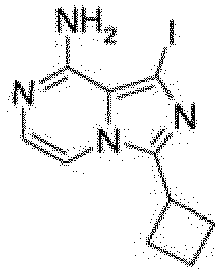
- A Parr bomb containing 8-chloro-3-cyclobutyl-1-iodoimidazo[1,5-a]pyrazine (759mg, 2.3mmol) in IPA (100mL) was saturated with NH3(g) for 5min at 0°C then sealed and heated at 115°C for 38h. The reaction mixture was then concentrated under reduced pressure, partitioned between DCM (200mL) and H2O (50mL) and extracted with DCM (50mL). Combined organic fractions were washed with brine, dried (Na2SO4) and concentrated under reduced pressure to provide the title compound as a white solid; 1H NMR (400MHz, CDC13) δ 7.13 (d, J = 4.8 Hz, 1H), 7.01 (d, J = 5.2 Hz, 1H), 5.63 (br, 2H), 3.73 (quintetd, J = 0.8 Hz, 8.4 Hz, 1H), 2.60-2.38 (m, 4H), 2.20-1.90 (m, 2H); MS (ES+): m/z 315.9 (100) [MH+]; HPLC: t R = 1.75 min (OpenLynx, polar_5min).
-

- To a suspension of 1H-1,2,4-triazole (1g, 0.02mol) in acetonitrile (23mL) was added dropwise phosphoryl chloride (0.6mL, 0.007mol) and triethylamine (3mL, 0.02mol) at 0°C. To this mixture was added 7-cyclohexyl-5-iodoimidazo[5,1-f][1,2,4]triazin-4(3H)-one (77mg, 0.224mmol) and the resulting mixture refluxed overnight. The cooled mixture was then quenched with excess NH3 in iPrOH (pH 8) stirred at rt for 30min. then filtered and the isolated solid washed with DCM. The filtrate was concentrated in vacuo and purified by chromatography over silica gel eluting with 2% MeOH in DCM to afford the 7-cyclohexyl-5-iodoimidazo[5,1-f][1,2,4]triazin-4-amine. 1H NMR (400 MHz - DMSO-d6) δ 1.14-1.91 (m, 10H), 3.11-3.18 (m, 1H), 6.75 (br.s, 1H), 7.84 (s, 1H) 8.42 (bs, 1H); MS (ES+): m/z: 344.01 (100) [MH+]. HPLC: t R = 3.10 min (OpenLynx: polar_5 min).
-

- To a solution of 7-cyclohexylimidazo[5,1-f][1,2,4]triazin-4(3H)-one (130mg, 0.6mmol) in DMF (0.6mL) was added N-iodosuccinimide (700mg, 0.003mol) and the reaction mixture stirred at 55°C for 20h. After this time the mixture was diluted with water (50mL) and extracted with EtOAc (4 x 40mL). The organic extracts were washed with water (4 x 40mL), treated with sodium thiosulfate and brine, dried over Na2SO4 and concentrated in vacuo to afford 7-cyclohexyl-5-iodoimidazo[5,1-f][1,2,4]triazin-4(3H)-one. 1H NMR (400MHz-DMSO-d6) δ 1.34-1.37 (m, 3H), 1.52 -1.56 (m, 2H), 1.76 -1.88 (m, 5H), 3.06 - 3.08 (m, 1H) 7.87 (s, 1H) 11.78 (s, 1H); MS (ES+): m/z: 344.95 (100) [MH+]. HPLC: tr = 2.95 min (OpenLynx: polar_5 min).
-

- To a suspension of 6-aminomethyl-4H-[1,2,4]triazin-5-one (250mg, 1.98mmol) in DMF (7.5mL) was added 2-(1H-benzotriazol-1-yl)-1,1,3,3-tetramethyluronium tetrafluoroborate (760mg, 2.38mmol), cyclohexanecarboxylic acid (305mg, 2.38mmol) and N,N-diisopropylethylamine (1.5mL, 8.6mmol). After 1h acetonitrile (40 mL) was added to the mixture followed by dropwise addition of phosphoryl chloride (0.28mL, 3.0mmol) and the reaction mixture stirred at 55°C for 1h. The mixture was then concentrated in vacuo chromatographed over silica gel eluting with 3% MeOH in DCM, to afford 7-cyclohexylimidazo[5,1-f][1,2,4]triazin-4(3H)-one. 1H NMR (400 MHz - DMSO-d6) δ 1.24 -1.91 (m, 10H), 3.08 - 3.16 (m, 1H), 7.68 (s, 1H) 7.88 (s, 1H) 11.76 (s, 1H); MS (ES+): m/z: 219.24 (100) [MH+]. HPLC: t R = 2.44 min (OpenLynx: polar_5 min).
-

- trans-[4-(8-chloro-1-iodoimidazo[1,5-a]pyrazin-3-yl)cyclohexyl]methanol (26.50g, 67.66mmol) was charged in a 400mL steel bomb and was dissolved in 2M NH3 in isopropanol (300mL) and anhydrous THF (10mL). The reaction mixture was cooled to -78°C. Ammonia gas was bubbled vigorously into the solution for 8min; then the bomb was tightly sealed and heated to 120°C for 20h. The crude reaction mixture was concentrated in vacuo, then the reaction residue was taken up with MeOH/CHC13, loaded onto silica gel. The mixture was purified by a silica gel glass column chromatography [eluted with 1:1 CH2Cl2/EtOAc to 10% ∼7 N NH3 in MeOH/CHCl3] to afford the desired product as a beige cream white solid; MS (ES+): m/z 373.01 (100) [MH+], 373.98 (50) [MH+2]; tR(polar-Smin/openlynx) 1.57 min.
-

- trans-[4-(8-Chloroimidazo[1,5-a]pyrazin-3-yl)cyclohexyl]methanol (18.00g, 67.74mmol) and N-iodosuccinimide (19.81 g, 88.06mmol) in anhydrous DMF (360mL) were stirred at 60°C under N2 for 6h. The reaction was diluted with DCM (∼600mL), washed with water and brine, dried over anhydrous Na2SO4 and then concentrated in vacuo. The crude material was purified by a silica gel flash chromatography (eluted with 1:2 EtOAc/DCM to 1:1 EtOAc/DCM) to obtain the desired product as a pale yellow solid; By 1H NMR analysis, the product was contaminated with 0.35eq. of NIS-impurity. The product was carried onto the next reaction without further purification; MS (ES+): m/z 391.92 (100) [MH+], 393.88 (50) [MH+2], 394.89 (10) [MH+3]; tR(polar-5min/openlynx) 2.79 min.
-

- A THF solution (1.00L) of trans-methyl 4-(8-chloroimidazo[1,5-a]pyrazin-3-yl)cyclohexanecarboxylate (29.70g, 101.1mmol) was cooled to -78°C and was charged with LAH (1M in THF, 25.3mmol, 25.3mL) dropwise. After 30min., the reaction mixture was charged with additional LAH (25.3mmol) at-78°C and then, allowed to stir at-78°C for 1.5h. The reaction was slowly warmed up to rt and stirred for additional 30min. Ethyl acetate, Na2SO4-10H2O, and silica gel were added to the reaction mixture and concentrated in vacuo to give an orange solid. The crude mixture was purified by a silica gel glass column chromatography (eluted with 2:3 EtOAc/DCM to 100% EtOAc) to obtain the title compound as a slightly yellow-tinted white solid; 1H NMR (CDCl3, 400 MHz) δ 1.14-1.30 (m, 2H), 1.61-1.75 (mc, 1H), 1.84 (ddd, J= 13.2, 13.2, 13.2, 3.2 Hz, 2H), 1.98-2.13 (m, 4H), 2.19 (s, br, -OH), 2.94 (tt, J= 11.6, 3.2 Hz, 1H), 3.56 (d, J= 6.0 Hz, 2H), 7.31 (d, J= 5.2 Hz, 1H), 7.64 (dd, J= 5.2, 1.2 Hz, 1H), 7.79 (d, J= 0.8 Hz, 1H); MS (ES+): mlz 266.21/268.17 (100/89) [MH+]. HPLC: t R = 2.38 min (OpenLynx, polar_5min). MS (ES+): m/z 266.21 (100) [MH], 268.17 (80) [MH+2}, 289.18 (20) [MH+3]; tR(polar-5min/openlynx) 2.36 min.
- To a solution/slurry of the carboxylic ester (30.17 mmol) in ethanol (200 mL) was added 3.0 M of sodium hydroxide in water (15.1 mL) and the mixture was stirred at 40°C for 4 h. The solvent was removed under reduced pressure at 40 °C and to the residue was added water (10 mL) and ethanol (10 mL) and the slurry was filtered. The filter cake was washed with ethanol (2 x 10 mL) and dried under vacuum to yield the sodium salt. For the isolation of the free acid, water was added to this salt and the slurry was acidified with formic acid, stirred for 10 min at RT and filtered. The filter cake was washed with water followed by ethanol to yield the carboxylic acid.
-

- trans-Methyl 4-({[(3-chloropyrazin-2-yl)methyl]amino}carbonyl)-cyclohexanecarboxylate (29.00g, 93.02mmol) was dissolved in anhydrous acetonitrile (930mL) and anhydrous DMF (9mL) and heated at 55°C under nitrogen for 3h. The reaction mixture was concentrated in vacuo, then, the solid residue was taken up in DCM, then, basified to pH 10 with 2M ammonia in isopropanol. The mixture was concentrated in vacuo, re-dissolved in DCM, and then loaded onto TEA-basified silica gel. The crude product was purified by a silica gel column chromatography (eluted with 2:3 EtOAc/DCM) to obtain the title compound as a yellow powder; 1H NMR (CDCl3, 400 MHz) δ 1.63 (ddd, J = 13.2, 13.2, 13.2, 3.2 Hz, 2H), 1.85 (ddd, J = 13.2, 13.2, 13.2,2.8 Hz, 2H), 2.10 (dd, J = 14.4, 3.2 Hz, 2H), 2.19 (dd, J = 14.0, 3.2 Hz, 2H), 2.46 (tt, J = 12.4, 3.6 Hz, 1H), 2.96 (tt, J = 11.6, 3.2 Hz, 1H), 3.70 (s, 3H), 7.33 (dd, J = 5.2, 1.2 Hz, 1H), 7.61 (d, J = 4.8 Hz, 1H), 7.79 (s, 1H). MS (ES+): m/z 294.17/296.14 (100/86) [MH+]. HPLC: t R = 2.85 min (OpenLynx, polar_5min).
-
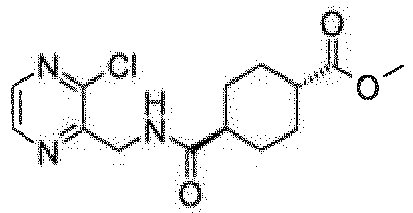
- A THF (370mL) solution of 4-(methoxycarbonyl)cyclohexanecarboxylic acid (15.14g, 81.30mmo1) and CDI (13.18g, 81.30mmol) was placed under a nitrogen atmosphere and stirred at 60°C for 4h. The reaction mixture was cooled to rt, then, (3-chloropyrazin-2-yl)methylamine bis-hydrochloride salt (16.00g, 73.91mmol) and DIPEA (31.52g, 244.00mmol, 42.5mL) was added. After stirring at 60°C for 20h, the reaction was concentrated in vacuo. The crude reaction mixture was purified by a silica gel glass column chromatography (eluted with 3:2 DCM/EtOAc) to obtain the pure desired product as a slightly yellowish creamy white powder; 1H NMR (CDCl3, 400 MHz) δ 1.43-1.65 (m, 4H), 2.01-2.14 (m, 4H), 2.25 (tt, J = 12.0, 3.6 Hz, 1H), 2.34 (tt, J = 11.6, 3.2 Hz, 1H), 3.68 (s, 3H), 4.70 (d, J = 4.4 Hz, 2H), 6.81 (s, br, -NH), 8.32-8.36 (m, 1H), 8.46 (d, J = 2.4 Hz, 1H); MS (ES+): m/z 312.17/314.12 (84/32) [MH+]; HPLC: t R = 2.44 min (OpenLynx, polar_5min).
-

- [3-(8-Chloro-1-iodoimidazo[1,5-a]pyrazin-3-yl)cyclobutyl]methanol (6.9g) in i-PrOH (200mL) was saturated with NH3(g), by passing a slow a slow stream of ammonia for 10min at -20°C, and then heated in a Parr bomb at 110°C for 2d. The reaction mixture was then cooled to rt, filtered through a sintered glass and the solid residue and the Parr vessel were rinsed with i-PrOH several times. The filtrate was concentrated under reduced pressure to provide an orange solid still containing NH4Cl. The material was taken up into refluxing MeCN (250mL) and filtered hot. The step was repeated with another portion of hot MeCN (200mL). The combined MeCN filtrates were concentrated under reduced pressure to give the title compound as an orange solid; HPLC: (polar5min) 0.53 and 1.51 min; MS (ES+): 345:1 (100, M++1); 1H NMR (400 MHz,DMSO-d6) δ 7.50 (d, J = 5.2 Hz, 1 H), 7.44 (d, J = 5.2 Hz, 0.27 H, minor isomer), 6.95 (d, J = 5.2 Hz, 1.29 H overlapped with the minor isomer) 6.63 (br, 2H), 4.61 (t, J = 5.2 Hz, 0.27H, minor isomer), 4.52 (t, J = 5.2 Hz, 1H), 3.69 (quintet, J = 5.6 Hz,0.32H, minor isomer), 3.54 (quintet, J = 5.6 Hz, 1H), 2.52-2.25 (m, 4H), 2.10-2.00 (m, 1H).
-

- To a solution of NIS (6.31g, 28.0mmo1) in anh DMF (100mL) under Ar was added dry [3-(8-chloroimidazo[1,5-a]pyrazin-3-yl)cyclobutyl]methanol (6.67g) dissolved in anh DMF (30mL). The flask containing [3-(8-chloroimidazo[1,5-a]pyrazin-3-yl)cyclobutyl] methanol was rinsed with another portion of anh DMF (20mL) and the rinse was added to the reaction mixture. The reaction was heated to 60°C (rt → 60°C ∼ 30min) and the stirred at this temperature for 3h. The mixture was then cooled to rt, partitioned between 1M aq Na2S2O3 (60mL), brine (60mL) and DCM (160mL). The aq layer was extracted with DCM (3x100mL). The combined organics were dried (Na2SO4), concentrated under reduced pressure and purified by flash chromatography on SiO2 (0-8 % MeOH in DCM) to provide a material, homogenous by UV on both TLC and HPLC, still containing DMF. The material was dissolved in DCM (200 mL) and washed with water (3x40 mL), dried (Na2SO4) and concentrated under reduced pressure to provide the title compound as a pale yellow solid; HPLC (polar5min) 2.52 min; MS (ES+): m/z (rel. int.) 364.0 (100, M++1); 1H NMR (400 MHz,CDCl3) δ 7.59 (d, J = 4.8 Hz, 1 H), 7.49 (d, J = 4.8 Hz, 0.22 H, minor isomer), 7.29 (d, J = 4.8 Hz, 1 H), 7.28 (d, J = 5.2 Hz, 0.23 H, minor isomer), 3.83-3.80 (m, 0.7 H), 3.72-3.62 (m, 3 H), 2.75-2.55 (m, 4 H), 2.42-2.32 (m, 1-2H).
-

- To a solution of 8-chloro-3-(3-methylenecyclobutyl)imidazo[1,5-a]pyrazine (4.48g, 20.4mmo1) in anh THF (255mL) at -78°C under Ar, 9-BBN (61.2mL, 0.5M in THF, 30.6mmol) was added dropwise over 8min (a suspension). The cooling bath was replaced with ice-H2O and the reaction was allowed to warm slowly to rt. After being stirred for 17h, H2O (100mL,) was added followed by, after - 5min, NaBO3•H2O (12.2g, 122.3mmol) added in one lot. The reaction was stirred at rt for 5h and then filtered through Celite. The Celite and residual solids were washed with DCM and EtOAc. The filtrate was concentrated under reduced pressure to yield an aq solution, which was saturated with NaCI and extracted with EtOAc (3x). The extracts were dried (Na2SO4) and concentrated under reduced pressure to yield a light yellow oil which was purified by flash chromatography on SiO2 (9:1 DCM:MeOH) to afford the title compound as a light yellow oil; HPLC: tR (mass-directed HPLC, polar7min) 2.52min; MS (ES+): 238.0. The addition may be carried out at 0 °C. Suspension quickly clears up after the exchange of cooling baths. The final product contained 1,5-cis-octanediol derived from 9-BBN. Based on 1H NMR estimated roughly to be 66 % target material and 33 % of the byproduct. The crude product was taken onto next step crude, stereoselectivity of the product was 4-5:1 as judged by 1H NMR.
-

- 3-Methylene-cyclobutanecarboxylic acid (3-chloro-pyrazin-2-ylmethyl)-amide (52.1g, 219.2mmol) was dissolved in 1.0L of anhydrous MeCN. Followed by the addition of DMF (1.0mL) and POCl3 (100mL, 1.09mol). The reaction was heated to 55°C for 30min. with a slow N2 bubbling the reaction. The reaction was then concentrated in vacuo, basified with cold 2.0M NH3 in IPA with CH2Cl2. The IPA/CH2Cl2 was concentrated in vacuo and the salts were dissolved with minimal water and extracted with CH2Cl2 (4×). The organic layers where combined and washed with sat. NaHCO3 (1x), dried over sodium sulfate, filtered and concentrated in vacuo. The crude product was purified via silica gel column chromatography [eluting with 2:1 Hex: EtOAc] to yield the title compound as a light yellow solid; 1H NMR (400 MHz,CDCl3) δ 3.24-3.30 (4 H, m), 3.78-3.85 (1 H, m), 4.89-4.94 (2 H, m), 7.33 (1 H, d, J=4.99 Hz), 7.53 (1 H, d, J=5.09 Hz), 7.82 (1 H, s); MS (ES+): m/z 220.28/222.30 (100/80) [MH+]; HPLC: t R = 2.87 min (OpenLynx, polar_5min).
-

- C-(3-Chloropyrazin-2-yl)-methylamine bis-HCl (1.0g, 4.62mmol), N-ethyl-N'-(3-dimethylaminopropyl)carbodiimide (EDC) (1.31g, 6.47mmol, 1.4eq.), 4-dimethylamino pyridine (DMAP) (0.141g, 1.15mmo1, 0.25eq.), and diisopropylethylamine (DIPEA) (2.42mL, 1.79g, 13.9mmol, 3.0eq.) were dissolved in anhydrous CH2Cl2 (25mL). To this solution, a solution of 3-methylenecyclobutanecarboxylic acid (0.622g, 5.54mmol, 1.2eq.) in anhydrous CH2Cl2 (25mL) was added under N2 and the reaction was allowed to stir overnight at rt. Reaction mixture was concentrated in vacuo and the resulting residue was dissolved in EtOAc, washed with water (2×), NaHCO3 (1×), water (1×), and brine (1×), dried over Na2SO4, filtered, and concentrated in vacuo, giving crude title compound, as a brown oil. The crude material was purified by chromatography on silica gel [Jones Flashmaster, 20g/70mL cartridge, eluting with EtOAc:Hex 10% 20% → 40% → 70%], affording the title compound as a pale yellow solid. Additionally, the title compound could be prepared by the following route: 1,1'-Carbonyldiimidazole (CDI) (0.824g, 5.08mmol, 1.1eq.) and 3-methylenecyclobutanecarboxylic acid (0.570g, 5.08mmo1, 1.leq.) were dissolved in anhydrous THF (12mL) and allowed to stir at 60°C for 2h. A solution of C-(3-chloropyrazin-2-yl)-methylamine bis-HCI (1.0g, 4.62mmol) and diisopropylethylamine (DIPEA) (2.42mL, 1.79g, 13.9mmol, 3.Oeq.) in anhydrous CH2Cl2 (13mL) was added to the acid mixture and the reaction was allowed to stir at 60°C, under N2, overnight. The reaction mixture was concentrated in vacuo and the resulting residue was dissolved in EtOAc, washed with NaHCO3 (2×) and brine (1×), dried over Na2SO4, filtered, and concentrated in vacuo, giving crude title compound, as a brown oil. The crude material was purified by chromatography on silica gel [Jones Flashmaster, 20g/70mL cartridge, eluting with EtOAc:Hex 10% → 20%→ 40%→70%], affording the title compound as a pale yellow solid; 1H NMR (CDCl3, 400 MHz) δ 2.86-2.96 (m, 2H), 3.03-3.19 (m, 3H), 4.72 (dd, J = 4.4, 0.8 Hz, 2H), 4.79-4.84 (m, 2H), 6.78 (s, NH), 8.32-8.34 (m, 1H), 8.46 (d, J= 2.8 Hz, 1H); MS (ES+): m/z 238.19 (90) [MH+]; HPLC: tR = 2.67 min (OpenLynx, polar_7min).
-

- In a Parr pressure reactor 3-(8-chloro-1-iodo-imidazo[1,5-a]pyrazin-3-yl)-cyclobutanol (4.159g, 0.0119mol) was dissolved with 2.0M ammonia in isopropyl alcohol (40mL). The mixture was cooled to -20°C and saturated with ammonia. The reaction was heated at 110°C for 63h at which point it was cooled and concentrated in vacuo. The crude product was purified using HPFC Jones 25g silica gel column eluting with 5-8% MeOH: CH2Cl2 to yield the title compounds; MS (ES+): m/z 330.88 (100) [MH+], 331.89 (10) [MH++]; HPLC: t R = 0.48 min (OpenLynx, polar_5min); 1H NMR (EDCl3, 400 MHz) δ 2.55 - 2.76 (m, 2 H) 3.06 - 3.22 (m, 2 H) 3.32 - 3.50 (m, 1 H) 4.51 - 4.69 (m, 1 H) 6.15 (br. s., 2 H) 7.24 (d, J=5.05 Hz, 1 H) 7.39 (d, J=5.05 Hz, 1 H).
-

- 3-(8-Chloro-1-iodo-imidazo[1,5-a]pyrazin-3-yl)-cyclobutanone (5.0g, 14mmol) was dissolved in a 1:1 mixture of methanol (35.0mL) and CH2Cl2 (35.0mL). To the solution mixture sodium tetrahydroborate (560mg, 14.Ommol) was added slowly, gas evolution was observed. After 4.5h at rt under nitrogen, the reaction was concentrated in vacuo. The crude mix was dissolved in EtOAc and washed with water. The organic layer was dried over sodium sulfate, filtered and concentrated in vacuo. The crude product was purified using HPFC Jones 50 gram silica gel column eluting with 50% EtOAc: Hex to 100% EtOAc, to yield the title compound as a light yellow solid; MS (ES+): m/z 349.81 (100) [MH+], 351.50 (30) [MH+++]; HPLC: t R = 2.49 min (OpenLynx, polar_5min); 1H NMR (CDCl3, 400 MHz) δ 2.41 - 2.54 (m, 2 H) 2.78 - 3.05 (m, 1 H) 3.12 - 3.32 (m, 1 H) 4.08 - 4.75 (m, 1 H) 5.30 (s, 1 H) 7.31 (d, J=5.05 Hz, 1 H) 7.57 (d, J=4.80 Hz, 1 H)
-

- 1-{4-[3-(8-Chloro-1-iodoimidazo[1,5-a]pyrazin-3-yl)cyclobutyl]piperazin-1-yl}ethanone (13.2g, 0.029mol) was dissolved in isopropyl alcohol (100mL) into a Parr pressure reactor. The vessel was cooled to -78°C and saturated with ammonia gas and sealed. The reaction was heated for 19h at 110°C, at which point the reaction was cooled and the solvent concentrated in vacuo. The crude product was purified via silica gel chromatography eluting with 5-10% MeOH (7M NH3): CH2Cl2 to yield the title compounds as an off white solid; MS (ES+): m/z 440.89 (100) [MH+] 441.89 (20) [MH++]; HPLC: t R = 0.46 min (OpenLynx, polar_5min); 1H NMR (CDCl3, 400 MHz) δ 2.09 (s, 3 H) 2.28 - 2.48 (m, 6 H) 2.54 - 2.71 (m, 2 H) 2.80 - 2.99 (m, 1 H) 3.27 - 3.43 (m, 1 H) 3.43 - 3.54 (m, 2 H) 3.56 - 3.70 (m, 2 H) 7.02 (d, J=5.05 Hz, 1 H) 7.16 (d, J=5.05 Hz, 2 H).
-

- Into a RBF 3-(8-chloro-1-iodoimidazo[1,5-a]pyrazin-3-yl)cyclobutanone (1.00g, 0.0029mol) and sodium triacetoxyborohydride (1.30g, 0.006mol) were dissolved in 1,2-dichloroethane (65.0mL) and a solution of 1-acetylpiperazine (0.39g, 0.003mol) in 1,2-dichloroethane was added to the reaction. The reaction mixture was stirred at rt for 2h. The crude product was concentrated in vacuo and the dissolved in CH2Cl2 (25.0mL) and washed with saturated NaHCO3 solution (1 x 40mL). The product was dried with sodium sulfate and concentrated in vacuo to yield a light yellow solid; MS (ES+): m/z 459.84 (100) [MH+], 461.80 (40) [MH+++]; HPLC: t R = 1.81 min (OpenLynx, polar_5min); 1H NMR (CDCl3, 400 MHz) δ 2.04 - 2.15 (m, 3 H) 2.26 - 2.50 (m, 6 H) 2.55 - 2.72 (m, 2 H) 2.83 - 2.99 (m, 1 H) 3.29 - 3.52 (m, 3 H) 3.56 - 3.67 (m, 2 H) 7.29 (d, 1 H) 7.58 (d, 1 H).
-

- A solution of 2N ammonia in isopropyl alcohol (350mL) and THF (30mL, 0.4mol) was added to 8-chloro-1-iodo-3-[3-(4-methyl-piperazin-1-yl)-cyclobutyl]-imidazo[1,5-a]pyrazine (19.91g, 0.04612mol) in a Parr bomb and cooled to -78°C. Ammonia was bubbled into the solution for 8-10min. The bomb was sealed, stirred and heated to at 110°C over 3d. The solvent was then evaporated in vacuo and purified by flash silica gel chromatography (wetted with CHCl3, dried loaded with silica, and eluted with 8% (7N NH3) MeOH in CHCl3), which afforded the title compound; 1H NMR (CDC13, 400 MHz) δ 7.31 (1 H, d, J = 5.01), 7.16 (1 H, d, J = 6.25), 5.83 (2 H, s), 3.49 (1 H, m), 3.06 (1 H, m), 2.76 (4 H, m), 2.64 (8 H, m), 2.46 (3H, s); MS (ES+): mlz 412.89/413.91 (50/10) [MH+]; HPLC: tR = 0.31 min. (OpenLynx, polar_5min.).
-

- 1-Methyl piperazine (5.75mL, 0.0514mol) in 1,2-dichloroethane (1096.7mL, 13.892mol) was added to 3-(8-chloro-1-iodoimidazo[1,5-a]pyrazin-3-yl)cyclobutanone (17.00g, 0.04892mol) and sodium triacetoxyborohydride (21.8g, 0.0978mol). The reaction stirred at rt for 3h. The reaction was concentrated, dissolved in CH2Cl2, and then washed with saturated NaHCO3 solution and brine. The product was dried over sodium sulfate, filtered, and concentrated in vacuo. The product was flushed through a quick silica gel plug (wetted with 100% CHCl3, eluted with 8% (7N NH3) MeOH in CHCl3), to afford the title compound; 1H NMR (CDCl3, 400 MHz) δ 7.63 (1 H, d), 7.30 (1 H, d), 3.42 (1H, m), 2.94 (1H, m), 2.65 (4 H, m), 2.44 (8 H, m), 2.32 (3H, s); MS (ES+): m/z 431.85/433.87 (100/45) [MH+]; HPLC: t R = 1.82 min. (OpenLynx, polar_5min.).
-

- 3-(8-Chloroimidazo[1,5-a]pyrazin-3-yl)cyclobutanone (1.95 g, 8.80 mmol) in anhydrous THF (77.78 mL) at -78 °C under an atmosphere of nitrogen was treated slowly with a 3.0 M solution of methylmagnesium chloride in THF (5.9 mL). The solution stirred for 3hr at -78 °C then quenched with 40 mL of semi-saturated aqueous NH4Cl CH4Cl dilution in 1:1 mixture with water) at -78 °C and allowed to warm up to rt. The mixture was then extracted with EtOAc (3 x 40 mL) and the combined extracts washed with brine (30 mL), dried over magnesium sulfate, filtered and concentrated in vacuo. The crude solid was purified by chromatography over silica gel eluting with 1:1 EtOAc/DCM to 4% MeOH in (1:1) EtOAc/DCM to afford desired product. 1H-NMR (400 MHz, CDCl3) δ ppm 1.54 (s, 3 H), 2.74 - 2.60 (m, 4 H), 3.75 - 3.39 (m, 1 H), 7.35 (d, J = 5.04 Hz, 1 H), 7.71 (d, J = 5.00 Hz, 1 H) and 7.86 (s, 1 H). MS (ES+): m/z 238.15 and 240.17 [MH+].
-

- 3-(8-Chloroimidazo[1,5-a]pyrazin-3-yl)-1-methylcyclobutanol (2.20 g, 9.26 mmol) and NIS (2.71 g, 12.0 mmol) were dissolved in DMF (36.6 mL, 0.472 mol) and stirred at 60 °C for 4 h. The mixture was then concentrated in vacuo and the residue reconstituted in EtOAc (100 mL). This solution was washed with sodium bicarbonate (2 x 20 mL) and these washes back-extracted with EtOAc (2 x 20 mL). The organic layers were combined, dried with sodium sulfate, filtered and concentrated in vacuo. The crude solid was purified by chromatography over silica gel eluting with 1:1 EtOAc:hexanes to afford desired product. 1H-NMR (400 MHz, CDCl3) δ ppm 1.53 (s, 3 H), 2.72 - 2.59 (m, 4 H), 3.37 - 3.29 (m, 1 H), 7.32 (d, J = 4.91 Hz, 1 H) and 7.60 (d, J = 4.96 Hz, 1 H). MS (ES+): m/z 363.95 and 365.91 [MH+].
-

- A solution of 2M ammonia in isopropanol (80 mL) and THF (5 mL) was added to 3-(8-chloro-1-iodoimidazo[1,5-a]pyrazin-3-yl)-1-methylcyclobutanol (2.77 g, 7.62 mmol) in a Parr pressure reactor. The mixtiure was cooled to at -78 °C then ammonia gas was bubbled into the solution for 4-6 min. The reactor was sealed then heated at 110 °C for 15 h. The solvent was then removed in vacuo and the residue purified by chromatography over silica gel eluting with 7% MeOH in DCM to afford desired product. 1H NMR (400 MHz, DMSO-d6) δ ppm 1.44 (s, 3 H), 2.32 - 2.51 1 (m, 4 H), 3.33 - 3.52 (m, 1 H), 6.61 (br.s., 2 H), 7.03 (d, J = 5.05 Hz, I H) and 7.62 (d, J = 5.05 Hz, 1 H).
-

- A solution of 3-(8-chloro-1-iodoimidazo[1,5-a]pyrazin-3-yl)-1-hydroxymethylcyclobutanol (4.08g, 0.011mol) in THF (120mL) and water (40mL) was charged with sodium periodate (2.8g, 0.013mol) at 0°C. The reaction warmed to rt and stirred for 5h. The reaction mixture was diluted with ethyl acetate and then washed with brine. The organic phase was dried over Na2SO4, filtered, and concentrated in vacuo to afford the title compound as a yellow solid; 1H NMR (CDCl3, 400 MHz) δ 7.56 (1 H, d, J = 4.94), 7.32 (1 H, d, J = 4.98), 3.64 (5 H, m); MS (ES+): m/z 347.82 and 349.85 [MH+]; HPLC: t R = 2.89 min. (OpenLynx, polar_5min.).
-

- Under inert atmosphere N-iodosuccinimide (3.6g, 0.016mol) and 3-(8-chloroimidazo[1,5-α]pyrazin-3-yl)-1-hydroxymethylcyclobutanol (3.16g, 0.012mol) were dissolved in N,N-dimethylformamide (30mL) and heated at 60°C for 3.0h. The reaction mixture was then concentrated in vacuo to a dark oil and purified by HPFC Jones 20g silica gel column, eluting with 5% MeOH: CH2C12 to yield a light brown fluffy solid which was triturated with diethyl ether and hexanes to afford the title compound; MS (ES+): m/z 379.85 and 381.80 [MH+]; HPLC: t R = 2.30 min (OpenLynx, polar_5min).
-

- To a THF solution (170 mL) of 8-chloro-3-(3-methylenecyclobutyl)imidazo[1,5-a]pyrazine (3.1g, 14mmol), water (18mL), 50% N-methylmorpholine-N-oxide in water (3.2mL) and potassium osmate, dehydrate (200mg, 0.70mmol) were added and the reaction was allowed to stir at rt for 4h. Sodium sulfite (8.0g, 70.0mmol) was added to the reaction mixture and allowed to stir for 30min at which point the reaction was concentrated in vacuo. The crude product was extracted from the aqueous with EtOAc. The organics were washed with brine and the combined aqueous washes were back extracted with EtOAc (5 x 50 mL). The combined organics were dried over sodium sulfate, filtered, and concentrated in vacuo to yield the title compounds as a sticky tan/off-white solid; MS (ES+): m/z 254.17 (100) [MH+], 256.19 (50) [MH+++]; HPLC: t R = 1.95 min (OpenLynx, polar_5min).
-

- To a solution of 3-methylenecyclobutanecarbonitrile (100.0 g, 1.042 mol) in ethanol (1.00 L) and water (1.00 L) was added potassium hydroxide (230.0 g, 4.2 mol). The resulting mixture was heated at reflux for 7 hr then the EtOH was removed in vacuo and the solution was cooled to 0 °C and acidified with (300.0 mL) of conc. HCI to pH = 1. The mixture was extracted with diethyl ether (4 x 1L) and the combined organic phases were dried over sodium sulfate, filtered and concentrated in vacuo to yield desired product. 1H NMR (400 MHz, CDCl3) δ ppm 2.64-3.44 (m, 5H), 4.60-4.98 (m, 2H) and 10.64 (br. s., 1H).
-

- Iodoethane (7.5 mL, 93.0 mol) was added at rt to a mixture of 3-methylenecyclobutanecarboxylic acid (10.0 g, 80.0 mmol) and cesium carbonate (56.0 g, 170.0 mmol) in anhydrous N,N-dimethylformamide (500.00 mL) under an atmosphere of nitrogen. The reaction was stirred for 16hr then partitioned between diethyl ether (1L) and brine (1L). The aqueous layer was extracted with diethyl ether (3 x 500 mL) and the combined organic phases washed with water (2 x 1L), dried over sodium sulfate, filtered and concentrated in vacuo to yield desired product 1H NMR (400 MHz, CDCl3) δ ppm 1.26 (t, 3H), 2.71-3.27 (m, 5H), 4.15 (q, J=7.07 Hz, 2H) and 4.53-4.96 (m, 2H).
-

- 1,1'-Carbonyldiimidazole (CDI) (8.24 g, 50.81 mmol) and 3-methylenecyclobutanecarboxylic acid (5.70 g, 50.81 mmol) were dissolved in anhydrous THF (100 mL) and allowed to stir at 60 °C for 4 h. A solution of C-(3-Chloropyrazin-2-yl)methylamine bis-hydrochloride (10.0 g, 46.19 mmol) and diisopropylethylamine (DIPEA) (32.30 mL, 184.76 mmol) in anhydrous CH2Cl2 (150 mL) was added to the mixture and the reaction was allowed to stir at rt for 24h. The mixture was concentrated in vacuo, the residue dissolved in EtOAc and the resulting solution washed with saturated NaHCO3 (aq.) water H2O and Brine. The combined organic layers were dried over sodium sulfate, filtered and concentrated in vacuo to afford crude product, which was purified by chromatography over silica gel eluting with 50-70% EtOAc/hexane to yield desired product. 1H NMR (400 MHz, CDCl3) δ ppm 2.92-2.94 (2 H, m), 3.05-3.14 (2 H, m), 4.60 (2 H, d, J=4.24 Hz), 4.80-4.84 (2 H, m), 6.75 (1 H, brs), 8.33 (1 H, d, J=4.22 Hz) and 8.45 (1 H, d, J=2.54 Hz). MS (ES+): m/z 238 and 240 [MH+].
-

- N-[(3-Chloropyrazin-2-yl)methyl]-3-methylenecyclobutanecarboxamide (52.1 g, 219.2 mmol) in anhydrous MeCN (1.0 L) was treated with DMF (1.0 mL) and POCl3 (100 mL, 1.09 mol) and the mixture was stirred at 55°C for 30 min. under a gentle stream of N2. The reaction was then concentrated in vacuo and the residue reconstituted in CH2C12 and treated with cold 2.0 M NH3 in IPA. This mixture was concentrated in vacuo, water added to dissolve the salts, and then extracted with CH2Cl2 (4× 60mL). The organic layers where combined and washed with sat. NaHCO3 (1× 70mL) dried over sodium sulfate, filtered and concentrated in vacuo. The crude material was purified by chromatography over silica gel eluting with 2:1 hexane: EtOAc to yield desired product. 1H NMR (400 MHz,CDCl3) δ ppm 3.24-3.30 (4 H, m), 3.78-3.85 (1 H, m), 4.89-4.94 (2 H, m), 7.33 (1 H, d, J=4.99 Hz), 7.53 (1 H, d, J=5.09 Hz) and 7.82 (1 H, s). MS (ES+): m/z 220.28 and 222.30 [MH+].
-

- A solution of 2-(3-chloropyrazin-2-ylmethyl)-isoindole-1,3-dione (10.0g, 36.5mmol) in anhydrous CH2Cl2 (200mL) was charged with hydrazine (2.87mL, 2.93g, 91.3mmol, 2.5eq.) at rt, under N2 atmosphere. After 2.5h, MeOH (300mL) was added and the reaction was heated until the solution was homogenous. The reaction mixture was allowed to stir for 19h. The white ppt that had formed (2,3-dihydrophthalazine-1,4-dione byproduct), was filtered off and washed several times with ether. The clear filtrate was concentrated in vacuo and the concentrate was dissolved in EtOAc and filtered again to remove white ppt. All solvent was removed, giving a yellow oil, which was dissolved into EtOAc and ether and charged with HCI (g). The title compound, a pale yellow solid, instantly precipitated. The title compound was dried in a 40 °C oven for 72h, affording the title compound, as a dark yellow solid; 1H NMR (400 MHz, CD3OD) δ 4.55 (2 H, s), 8.27 (1 H, d, J=2.52 Hz), 8.54 (1 H, d, J=2.56 Hz); MS (ES+): mlz 143.96/145.96 (100/60) [MH+]; HPLC: t R = 0.41 min (OpenLynx, polar_7min).
-

- Into a 5L reactor equipped with a nitrogen flow and an overhead stirrer was added N-hydroxysuccinimide (250.0 g, 2.172 mol) and 3-oxo-cyclobutanecarboxylic acid (248 g, 2.17 mol). Ethyl acetate (3.4 L) was added and the reaction was cooled to 16 °C. A solution of 25% DCC in EtOAc (2.17 mol) was added slowly via an addition funnel to the reaction mixture over 7 minutes then the mixture was then heated at 45 °C. After 2h, the mixture was filtered and the filtrate was washed once with EtOAc (1L x 1) and evaporated to dryness in vacuo to afford the desired product. 1H NMR (400 MHz, DMSO-d6) δ 2.83 (bs, 4H), 3.30-3.39 (m, 2H), 3.52-3.60 (m, 2H) and 3.67-3.73 (m, 1H).
-

- Into a round bottom 1-neck flask (5L), 3-oxo-cyclobutanecarboxylic acid 2,5-dioxo-pyrrolidin-1-yl ester (217.2g, 0.937 mol), C-(3-chloro-pyrazin-2-yl)-methylamine hydrochloride salt (153.3 g, 0.852 mol), and THF (760 mL) were added. A solution of 10% NaHCO3 (1.07 kg) was then added and after 20 min, the layers were allowed to separate and the aqueous layer was removed. The aqueous layer was back extracted with EtOAc (1x700 mL, 1x300 mL). The combined organics were washed with brine (350 mL), dried over MgSO4, filtered, and concentrated in vacuo to provide the title compound. This solid was resuspended in ethyl acetate (915 mL) and DMF (132 mL) and the solution was put under an atmosphere of nitrogen and cooled to 10.5 °C. Phosphorus oxychloride (159 mL, 1.70 mol) was then added over 15 minutes and the reaction was allowed to stir for 45 min. The reaction solution was then poured slowly into a 22% aqueous Na2CO3 solution at 10°C. Water (1 I L) was added and the layers were allowed to separate. The organic layer was removed and the aqueous was back extracted with EtOAc (1x1L, 1x0.5L). The combined organic phases were dried over MgSO4, filtered, and concentrated in vacuo until about 0.5 L of solvent remained. Heptane was added and the slurry was concentrated in vacuo until most of the EtOAc was removed. The resultant slurry was filtered to give desired product. 1H NMR (400 MHz, CDCl3) δ 3.59-3.68 (m, 2H), 3.72-3.79 (m, 2H), 3.86-3.94 (m, 1H), 7.40 (d, 1H, J = 5.2 Hz), 7.60 (d, 1H, J = 5.2 Hz) and 7.85 (s, 1H).
-
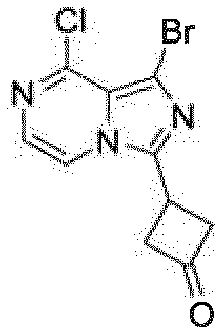
- 3-(8-Chloroimidazo[1,5-a]pyrazin-3-yl)cyclobutanone (47.7 g, 215 mmol) was dissolved in DMF (200 mL) under an atmosphere of nitrogen and cooled to -4 °C. N-Bromosuccinimide (40.3 g, 226 mmol) was dissolved in DMF (140 mL) and slowly added to the reaction mixture. After 5 min, water (400 mL) was added and the resulting solid isolated by filtration and washed with solid with water to give the title compound. 1H NMR (DMSO-d6, 400 MHz): δ 3.45-3.53 (m, 2H), 3.58-3.67 (m, 2H), 4.08-4.16 (m, 1H), 7.45 (d, 1H, J = 5.2 Hz) and 8.30 (d, 1H, J = 4.8 Hz).
-

- 3-(1-Bromo-8-chloroimidazo[1,5-a]pyrazin-3-yl)cyclobutanone (51.988 g, 0.17 mol) in anhydrous THF (550 g, 620 mL) under nitrogen at -78 °C was treated with a 3.0 M solution of methyl magnesium chloride in THF (130 mL, 0.38 mol) over 30 min. The mixture was stirred at -78 °C for 30 min and then the cooling bath was removed and the mixture quenched with 14% NH4Cl (132 g). EtOAc was added to the aqueous phase and the pH was adjusted to -5 with 20% HCI and the layers separated. The combined organic phases were concentrated in vacuo to a slurry and 0.5 L of toluene was added and the mixture concentrated in vacuo until the EtOAc was removed. The slurry was heated at reflux until homogeneous then allowed to cool to provide desired product, which was isolated by filtration and dried in vacuo. 1H NMR (DMSO-d6, 400 MHz): δ 1.37 (s, 3H), 2.35-2.49 (m, 4H), 3.52 (dddd, 1H, J= 9.6, 9.6, 9.6, 9.6 Hz), 5.18 (bs, 1H), 7.37 (d, 1H, J = 5.2 Hz) and 8.26 (d, 1H, J = 5.2 Hz).
-

- A 35% ammonia solution (132ml, 2.9 moles) was added to a suspension of 3-(1-bromo-8-chloroimidazo[1,5-a]pyrazin-3-yl)-1-methylcyclobutanol (22.0g, 0.06463 mol) in 2-butanol (81ml). The mixture was heated at 90 °C in a pressure vessel for 15hr then concentrated to ∼130ml), cooled to room temperature and the solid collected by filtration. This material was washed with water (3 x 22mL) and dried at 40 °C under vacuum. To afford the desired product. 1H NMR (DMSO-d6, 400 MHz): δ 7.5 (d, 1H), 7.0 (d, 1H), 6.6 (bs, 2H), 5.1 (s, 1H), 3.4 (pentet, 1H), 2.3-2.4 (m, 4H) and 1.4 (s, 3H).
-

- To a solution of 1,2,4-triazole (1.28g, 18.59mmol) in anhydrous pyridine (10mL) was added phosphorus oxychloride (POC13) (0.578mL, 6.20mmol) and stirred at rt for 15min. This mixture was dropwise charged (3.5min) with a solution of 7-cyclobutyl-5-iodo-3H imidazo[5,1f][1,2,4]triazin-4-one (0.653mg, 2.07mmol) in anhydrous pyridine (14mL) and stirred for 1.5h. The reaction mixture was cooled to 0°C quenched with 2M NH3 in isopropanol (IPA) until basic then allowed to reach rt and stirred for an additional 2h. The reaction mixture was filtered through a fritted Buchner funnel and washed with DCM. The filtrate was concentrated in vacuo and purified by chromatography on silica gel [eluting with 30% EtOAc in DCM] resulting in the title compound as an off-white solid; 1H NMR (CDCl3, 400 MHz) δ 1.93-2.04 (m, 1H), 2.05-2.18 (m, 1H), 2.35-2.45 (m, 2H), 2.49-2.62 (m, 2H), 4.00-4.12 (m, 1H), 7.82 (s, 1H); MS (ES+): m/z 316.08 (100) [MH+], HPLC: t R = 2.59 min (MicromassZQ, polar_5min).
-

- A solution of 7-cyclobutyl-3H-imidazo[5,1-f][1,2,4]triazin-4-one (789mg, 4.15mmol) and N-iodosuccinimide (NIS, 933mg, 4.15mmol) in anhydrous DMF (40mL) was stirred overnight at rt. An additional 4eq. of NIS was added and reaction was heated to 55°C for 6h. The reaction mixture was concentrated in vacuo and partitioned between DCM and H2O and separated. The aqueous layer was washed with DCM (3X) and the combined organic fractions were washed with 1M sodium thiosulfate (Na2S2O3) (1X), brine (1X), dried over sodium sulfate (Na2SO4), filtered, and concentrated in vacuo. The solid was triturated with 20 % EtOAc in DCM and filtered through a fritted Buchner funnel resulting in the title compound as an off-white solid; 1H NMR (DMSO-d6, 400 MHz) δ 1.84-1.96 (m, 1H), 1.98-2.13 (m, 1H), 2.25-2.43 (m, 4H), 3.84-3.96 (m, 1H), 7.87 (s, 1H); MS (ES+): m/z 317.02 (100) [MH+], HPLC: tR = 2.62 min (MicromassZQ, polar_5min).
-

- A crude solution of cyclobutanecarboxylic acid (5-oxo-4,5-dihydro-[1,2,4]triazin-6-ylmethyl)amide (1.33g, 6.39mmol) in phosphorus oxychloride (POCl3) (10mL) was heated to 55°C. The reaction was heated for 2h then concentrated in vacuo and the crude oil was cooled to 0°C in an ice-bath and quenched with 2M NH3 in ispropanol (IPA) until slightly basic. This crude reaction mixture was concentrated in vacuo and was partitioned between DCM and H2O and separated. The aqueous layer was extracted with DCM (3X) and the combined organic fractions were dried over sodium sulfate (Na2SO4), filtered and concentrated in vacuo. The crude material was purified by chromatography on silica gel [eluting with 5% MeOH in DCM], resulting in the title compound as an off-white solid; 1H NMR (DMSO-d6 , 400 MHz) δ 1.86-1.96 (m, 1H), 2.00-2.13 (m, 1H); 2.26-2.46 (m, 4H); 3.87-4.00 (m, 1H); 7.71 (s, 1H); 7.87 (d, J = 3.6 Hz, 1H); 11.7 (brs, 1H); MS (ES+): m/z 191.27 (100) [MH+], HPLC: t R = 2.06 min (MicromassZQ, polar_5min).
-
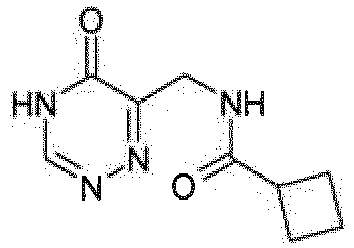
- To a solution of 6-aminomethyl-4H-[1,2,4]triazin-5-one (500mg, 3.96mmol) and N,N-diisopropylethylamine (DIEA) (0.829mL, 4.76mmol) in anhydrous N,N-dimethylforamide (DMF) (20mL) and anhydrous pyridine (2mL) was dropwise charged with cyclobutanecarbonyl chloride (0.451mL, 3.96mmol) at 0°C then warmed to rt and stirred for an additional 1.5h. The reaction mixture was quenched with H2O (2mL) and concentrated in vacuo and was purified by chromatography on silica gel [eluting with 5% MeOH in DCM (200 mL) →10% MeOH in DCM (800mL)], affording the title compound; 1H NMR (DMSO-d 6, 400 MHz) δ 1.7-1.82 (m, 1H), 1.70-1.92 (m, 1H); 1.97-2.07 (m, 2H); 2.07-2.19 (m, 2H); 3.55-3.67 (m, 1H); 4.19 (d, 2H); 7.97 (brt, J = 5.6 Hz, 1H); 8.67 (s, 1H); MS (ES+): m/z 209.25 (100) [MH+], HPLC: tR = 1.56 min (MicromassZQ, polar_5min).
-

- A slurry of 2-(5-oxo-4,5-dihydro-[1,2,4]triazin-6-ylmethyl)isoindole-1,3-dione (4g, 15.6mmol) in DCM/EtOH (1:1) (150mL) was charged with anhydrous hydrazine (1.23mL, 39.0mmol) and stirred at rt for 18h. The reaction mixture was concentrated in vacuo and the off-white solid was triturated with warm CHCl3 and filtered through a fritted funnel. The solid was then triturated with hot boiling methanol (MeOH) and filtered through a fritted funnel resulting in an off-white solid. The material was triturated a second time as before and dried overnight resulting in the title compound as a white solid, which was taken on to the next step without further purification; 1H NMR (DMSO-d 6, 400 MHz) δ 3.88(s, 2H), 8.31 (2,1H); MS (ES+): m/z 127.07 (100) [MH+], HPLC: tR = 0.34 min (MicromassZQ, polar-5min).
-

- A slurry of 2-(5-oxo-3-thioxo-2,3,4,5-tetrahydro-[1,2,4]triazin-6-ylmethyl)isoindole-1,3-dione (1.0g, 3.47mmol) in EtOH (40mL) was charged with excess Raney Ni (3 spatula) and heated to reflux for 2h. The reaction mixture was filtered hot through a small pad of celite and washed with a hot mixture of EtOH/THF (1:1) (100mL) and the filtrate was concentrated in vacuo resulting in the title compound as an off-white solid; 1H NMR (DMSO-d6 , 400 MHz) δ 4.75 (s, 2H), 7.84-7.98 (m, 4H), 8.66 (s, 1H); MS (ES+): m/z 257.22 (100) [MH+].
-

- A slurry of 3-(1,3-dioxo-1,3-dihydroisoindol-2-yl)-2-oxo-propionic acid ethyl ester (20g, 76.6mmol) in anhydrous EtOH (300mL) was charged with thiosemicarbazide (6.98 g, 76.6mmo1) in one portion and heated to 80°C for 2h. The reaction mixture was charged with N,N-diisopropylethylamine (DIEA) (26.7mL, 76.56mmol) and heated to 40°C for 6h then stirred at rt for an additional 10h The reaction mixture was concentrated in vacuo and solid was triturated with hot EtOH/EtOAc filtered and washed with EtOAc. The solid was dried overnight in a vacuum oven (40°C) resulting in the title compound as an off-white solid; 1H NMR (DMSO-d6, 400 MHz) δ 4.68 (s, 2H), 7.85-7.95 (m, 4H); MS (ES+): m/z 289.2 (100) [MH+].
-

- A solution of ethyl 3-(1,3-dioxo-1,3-dihydro-2H-isoindol-2-yl)-2-oxopropanoate [J.Org.Chem., (1985), 50 (1), 91] (4.29 g, 16.4 mmol), acetamidrazone hydrochloride (1.80 g, 16.4 mmol) in anhydrous EtOH (85.8 mL) was heated to 80 °C for 3 h then cooled to rt and stirred for an additional 16 h. The reaction mixture was filtered through a fritted funnel resulting in 3.28 g, (73 % yield) of the title compound as a white solid. 1H NMR (400 MHz, DMSO-d6) δ ppm 2.28 (s, 3H), 4.73 (s, 2H) and 7.74 - 8.12 (m, 4H); MS (ES+): m/z 271.08 [MH+].
-

- A solution of 2-[(3-methyl-5-oxo-4,5-dihydro-1,2,4-triazin-6-yl)methyl]-1H-isoindole-1,3(2H)-dione (2.00 g, 7.40 mmol) in DCM (10.0 mL) and EtOH (10.0 mL) was charged with hydrazine (0.58 mL, 18.5 mmol) and stirred at rt for 8 h, then heated to 45 °C for an additional 16 h. The reaction was charged with an additional 0.5 equiv of hydrazine (0.116 mL, 3.70 mmol) and heated to 45 °C for 4 h. The reaction mixture was allowed to cool to rt then filtered through a fritted funnel and the cake was washed with 2 portions of cold 1:1 EtOH/DCM (75 mL) and the filtrate was concentrated resulting in 622 mg of a pale yellow solid which was taken on to the next step without further purification. 1H NMR (400 MHz, DMSO-d6 ) δ ppm 2.21 (s, 3H), 3.72 (s, 2H); MS (ES+): m/z 141.06 [MH+].
-

- trans-4-(Aminomethyl)cyclohexanecarboxylic acid (10.00 g, 0.06361 mol), in a 10% aq solution of NaOH (5.60g in 55 mL) was cooled to 0°C and treated over 15 min with vigorous stirring, with benzyl chloroformate (11 mL, 0.076 mol). After one hour the solution was acidified (1M HCl(aq)) and the resulting the white precipitate collected by filtration, washed with water and hexane then dried in vacuo oven overnight to afford 17.23g of the title compound. 1H NMR (400 MHz, CDC13): δ 0.93-0.99 (m, 2H), 1.38-1.46 (m, 2H), 1.82-1.85 (m, 2H), 2.03-2.06 (m, 2H), 2.25 (m, 1H), 3.06 (t, J = 5.6 Hz, 2H), 4.83 (m, 1H), 5.09 (s, 2H), 7.31-7.36 (m, 5H). MS (ES+): m/z 292 [MH+].
-

- To a solution of C-(3-chloropyrazin-2-yl)methylamine hydrochloride salt (0.100 g, 0.533 mmol) in DCM (1.35 mL) was added N-(3-dimethylaminopropyl) N'-ethylcarbodiimide hydrochloride (0.16 g, 0.83 mmol), N,N-diisopropylethylamine (0.14 mL, 0.83 mmol), 1-hydroxybenzotriazole (0.075 g, 0.56 mmol) and trans-4-({[(benzyloxy)carbonyl]amino}methyl)cyclohexanecarboxylic acid (0.21 g, 0.70 mmol). The reaction was stirred at rt overnight then diluted with DCM, washed with sat. NaHCO3 (aq) and brine, then dried over Na2SO4 and the solvent removed in vacuo. The residue thus isolated was chromatographed over silica gel eluting with EtOAc/hexane (1:1) to afford 0.173g of the title compound. 1H NMR (400 MHz, CDCl3): δ 1.00-1.03 (m, 2H), 1.45-1.51 (m, 2H), 1.83-1.89 (m, 2H), 1.99-2.03 (m, 2H), 2.20 (m, 1H), 3.05-3.12 (m, 3H), 4.68 (d, J = 4.4 Hz, 2H), 4.79 (br, 1H), 5.10 (s, 2H), 6.79 (br, 1H), 7.31-7.37 (m, 5H), 8.33 (d, J = 2.8 Hz, 1H), 8.46 (d, J = 2.8 Hz, 1H). MS (ES+): m/z 417.14 [MH+].
-

- To a suspension of benzyl [(trans-4-{[(3-chloropyrazin-2-yl)methyl]carbamoyl}cyclohexyl)methyl]carbamate (0.100 g, 0.220 mmol) in EtOAc (0.9 mL) and DMF (0.068 mL) at 0 °C was added slowly POCl3 (0.082 mL, 0.88 mmol). After stirring at rt for an hour, the mixture was cooled to 0°C and solid NaHCO3 was added. After a further 10min at 0°C and 20min at rt, the mixture was re-cooled to 0°C and water (20mL) was added. The reaction mixture was extracted with EtOAc (3 x 20mL) and the extracts washed with water (2 x 30 mL) and brine (30 mL) and then dried over Na2SO4 and concentrated in vacuo to afford 0.096g of the title compound. 1H NMR (400 MHz, CDCl3): δ 1.15-1.19 (m, 2H), 1.76-1.87 (m, 3H), 1.93-2.00 (m, 2H), 2.04-2.08 (m, 2H), 3.07 (m, 1H), 3.15 (t, J = 6.4 Hz, 2H), 4.84 (br, 1H), 5.09 (s, 2H), 7.31-7.40 (m, 6H), 7.61 (d, J = 4.8 Hz, 1H), 7.79 (s, 1H). MS (ES+): m/z 399.26 [MH+].
-

- To a solution of benzyl {[trans-4-(8-chloroimidazo[1,5-a]pyrazin-3-yl)cyclohexyl]methyl}carbamate (1.49 g, 0.00374 mol) in DMF (0.6 mL) was added NIS (1.0g, 0.0045 mol). The reaction mixture was stirred at 55 °C overnight then diluted with EtOAc (20mL), washed with water (2 x 40 mL) and brine (20mL), then dried over Na2SO4 and concentrated in vacuo. The crude mixture thus isolated was chromatographed over silica gel eluting with hexane → hexane:EtOAc 1:1 to afford 1.7g of the title compound.
MS (ES+): m/z 525.01 [MH+]. -

- A solution of benzyl {[trans-4-(8-chloro-1-iodoimidazo[1,5-a]pyrazin-3-yl)cyclohexyl]methyl}carbamate (1.70 g, 0.00324 mol) in IPA (30 mL) was cooled to -78 °C, treated with a stream of ammonia gas over 3 min. and then heated at 110 °C in a Parr vessel overnight. The reaction solution was concentrated in vacuo and residue washed with water to afford 1.37g of desired product. 1H NMR (400 MHz, CDCl3): δ= 1.08-1.17 (m, 2H), 1.88 (m, 1H), 1.71-1.81 (m, 2H), 1.91-1.94 (m, 2H), 2.00-2.04 (m, 2H), 2.90 (m, 1H), 3.13 (t, J = 6.4 Hz, 2H), 4.86 (br, 1H), 5.11 (s, 2H), 5.76 (br, 2H), 7.00 (d, J = 5.2 Hz, 1H), 7.22 (d, J = 5.2 Hz, 1H), 7.31-7.37 (m, 5H). MS (ES+): m/z 5.7.36 [MH+].
-

- A solution of C-(3-Chloropyrazin-2-yl)methylamine bis-hydrochloride (2.00 g, 0.0107 mol) and N,N-diisopropylethylamine (2.2 g, 0.017 mol) in DCM (27.0 mL) was treated with and N-(3-dimethylaminopropyl)-N'-ethylcarbodiimide hydrochloride (3.2 g, 0.017 mol), 1-hydroxybenzotriazole (1.5 g, 0.011 mol) and 1-[(benzyloxy)carbonyl]-4-piperidine carboxylic acid (3.8 g, 0.014 mol). The mixture was stirred at rt overnight then diluted with DCM (30mL), washed with sat. NaHCO3 (20mL) and brine (20mL), then dried over Na2SO4 and concentrated in vacuo. The crude material thus obtained was chromatographed over silica gel eluting with EtOAc:hexane 1:1 yielding 3.38g of the title compound. 1H NMR (400 MHz, CDCl3): δ 1.68-1.78 (m, 2H), 1.91-1.94 (m, 2H), 2.44 (m, 1H), 2.89-2.92 (m, 2H), 4.24-4.26 (m, 2H), 4.70 (d, J = 4.8 Hz, 2H), 5.14 (s, 2H), 6.85 (br, 1H), 7.30-7.37 (m, 5H), 8.34 (d, J = 2.8 Hz, 1H), 8.45 (d, J = 2.8 Hz, 1H). MS (ES+): m/z 389.17 [MH+].
-

- To a suspension ofbenzyl 4-{[(3-chloropyrazin-2-yl)methyl]carbamoyl}piperidine-1-carboxylate (0.100 g, 0.220 mmol) in EtOAc (0.9 mL) and DMF (0.068 mL) at 0 °C was slowly added POCl3 (0.082 mL, 0.88 mmol). After stirring at rt for an hour the mixture was cooled to 0°C then treated with solid NaHCO3. The mixture was stirred for 20min at rt, diluted with water and extracted with EtOAc (3 x 20mL). The combined extracts were washed with water (2 x 30 mL) and brine (30 mL), then dried over Na2SO4, and concentrated in vacuo to yield 2.07 g of desired product. 1H NMR (400 MHz, CDCl3): δ 1.98-2.04 (m, 4H), 3.03-3.20 (m, 3H), 4.30-4.33 (m, 2H), 5.16 (s, 2H), 7.33 (d, J = 5.2 Hz, 1H), 7.35-7.38 (m, 5H), 7.26 (d, J = 4.4 Hz, 1H), 7.79 (s, 1H). MS (ES+): m/z 371.22 [MH+].
-

- To a solution of benzyl 4-(8-chloroimidazo[1,5-a]pyrazin-3-yl)piperidine-1-carboxylate (1.31 g, 0.00354 mol) in DMF (0.6 mL) was added NIS (1.6 g, 0.0071 mol). The reaction mixture was left to stir at 55 °C for 20 h. then the mixture was diluted with EtOAc (20mL), washed with water (2 x 40 mL) and brine, then dried over Na2SO4 and concentrated in vacuo. The crude reaction mixture was chromatographed over silica gel eluting with hexanes- hexane:EtOAc 1:1 yielding 1.63g of desired product. 1H NMR (400 MHz, CDCl3):δ 1.95-2.04 (m, 4H), 3.02-3.15 (m, 3H), 4.29-4.32 (m, 2H), 5.15 (s, 2H), 7.32 (d, J = 5.2 Hz, 1H), 7.34-7.37 (m, 5H), 7.66 (d, J = 5.2 Hz, 1H). MS (ES+): m/z 497.03 [MH+].
-

- A mixture of benzyl 4-(8-chloro-1-iodoimidazo[1,5-a]pyrazin-3-yl)piperidine-1-carboxylate (0.500 g, 0.00101 mol) in IPA (20 mL) was cooled to at -78 °C and treated with a stream of ammonia gas over 3 minutes. The resulting solution was heated at 110 °C in a Parr vessel prior to concentration in vacuo, suspension in DCM and filtration through a bed of Celite. The filtrate was concentrated in vacuo to afford 0.504 g of desired product. 1H NMR (400 MHz, CDCl3): δ 1.88-2.02 (m, 2H), 2.99-3.10 (m, 3H), 4.24-4.41 (m, 2H), 5.15 s, 2H), 6.03 (br, 2H), 7.03 (d, J = 4.8 Hz, 1H), 7.24 (d, J = 5.2 Hz, 1H), 7.31-7.40 (m, 5H). MS (ES+): m/z 479.33 [MH+].
-
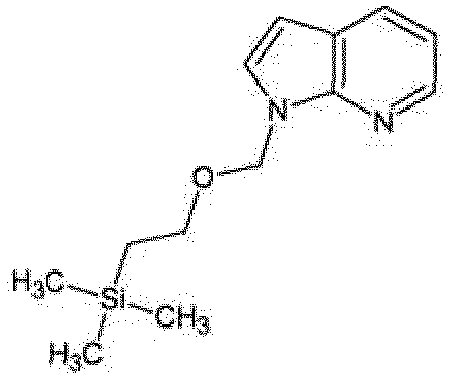
- To a suspension of sodium hydride (934 mg, 0.0358 mol) in DMF (57 mL) was added dropwise under N2, a solution of 1H-pyrrolo[2,3-b]pyridine (3.00 g, 0.0254 mol) in DMF (20 mL). The mixture was stirred at r.t. for 45 min. then cooled to 0°C and treated dropwise with [2-(trimethylsilyl)ethoxy]methyl chloride (6.32 mL, 0.0357 mol). The mixture was stirred at rt for 12h. then poured into water (10 mL), stirred for 30 min. and extracted with Et20 (4 x 10mL). The combined extracts were washed with brine (20mL), dried over sodium sulfate, and concentrated in vacuo to give the crude product which was chromatographed over silica gel eluting with hexane → 1:9 Et2O: hexane to afford 6 g desired product.
-

- To a solution of 1-(2-trimethylsilylethoxymethyl)-1H-pyrrolo[2,3-b]pyridine (500 mg, 0.0020129 mol) in THF (5 mL) at -10°C was added a 2.0 M of n-BuLi in cyclohexane (1.2 mL). After 10 min at -10 °C, the mixture was cooled to -20 °C and tributyltin chloride (0.65 mL, 0.0024 mol) was added. The mixture was stirred at rt for 1 h, the poured into a 5% aqueous ammonium chloride (20mL), extracted with EtOAc (3 x 20mL) and the combined extracts dried over anhydrous MgSO4 and concentrated in vacuo. The material thus obtained was chromatographed over silica gel eluting with 1:9 EtOAc: hexane to afford 0.7g of the title compound. 1H NMR (400 MHz DMSO-d6) δ 0.01 (s, 9H), 0.10 (s, 2H), 0.92 - 0.94 (m, 9H), 1.14 - 1.27 (m, 6H), 1.37 -1.46 (m, 6H), 1.60 - 1.72 (m, 6H), 3.48 - 3.52 (m, 2H), 5.71 (s, 2H), 6.74 (s, 1H), 7.16 - 7.19 (m, 1H), 8.02 (dd, J = 1.6, 7.6 Hz, 1H) and 8.31 (dd, J = 1.6, 4.4 Hz, 1H).
-
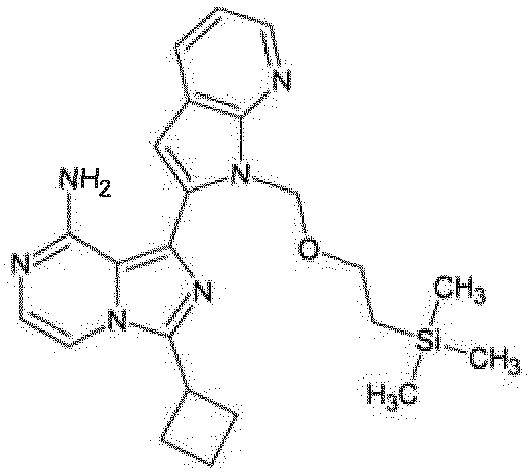
- A mixture of N-(2-trimethylsilyl-1-ethoxymethyl)-2-(tributylstannyl)-1Hpyrrolo[2,3-b]pyridine (110 mg, 0.20 mmol), 3-cyclobutyl-1-iodoimidazo[1,5-a]pyrazin-8-amine (50 mg, 0.1592 mmol) and bis(triphenylphosphine)palladium(II) chloride (10 mg, 0.02 mmol) in ethanol (2 mL) was heated at reflux for 48 h. The mixture was then cooled to rt, filtered through a pad of Celite and concentrated in vacuo. The residue thus obtained was chromatographed over silica gel eluting with hex :EtOAc to afford 17.2mg of the title compound. 1H NMR (400 MHz CDCl3) δ 0.22 (s, 9H), 0.70 (t, 2H), 1.87 - 2.19 (m, 2H), 2.49 - 2.64 (m, 4H), 3.37 (t, 2H), 3.81 - 3.86 (m, 1H), 5.51 (bs, 2H), 6.07 (s, 2H), 6.67 (s, 1H), 7.10 - 7.16 (m, 3H), 7.93 (dd, J = 1.6, 8.0 Hz, 1H) and 8.41 (dd, J = 1.6, 4.8 Hz, 1H). MS (ES+): m/z: 435.21 [MH+].
-

- A mixture of 1-bromo-4-fluoro-3-nitrobenzene (2270 mg, 10.01 mmol), aniline (3 ml) and DMF (20 ml) was heated at 100 °C under an atmosphere of Nitrogen for 7 h. The mixture was then concentrated in vacuo, and the residue triturated with heptane (30 ml) to give the desired product. 1H NMR (400 MHz, CDC13) δ = 7.11 (d, 1 H, J = 9.2 Hz), 7.25 - 7.29 (m, 3H), 7.40 - 7.45 (m, 3 H), 8.35 (d, 1 H, J = 2.4 Hz) and 9.45 (brs, 1 H).
-

- Prepared according to a procedure analogous to that described for 4-bromo-2-nitro-N-phenylaniline. 1H NMR (400 MHz, CDCl3): δ= 3.02 (d, 3 H, J = 5.2 Hz), 6.76 (d, 1 H, J = 9.6 Hz), 7.51 - 7.54 (m, 1 H), 8.02 (brs, 1 H) and 8.32 (d, 1 H, J = 2.8 Hz). MS(ES+): m/z 231.05 and 233.08[MH+].
-

- Prepared according to a procedure analogous to that described for 4-bromo-2-nitro-N-phenylaniline, 1H NMR (400 MHz, CDC13) δ = 1.37 (t, 3 H, J = 7.2 Hz), 3.31 - 3.37 (m, 2 H), 6.76 (d, 1 H, J = 8.8 Hz), 7.48 - 7.51 (m, 1 H), 7.95 (brs, 1 H) and 8.31 (d, 1 H, J = 2.4 Hz). MS(ES+); m/z 245.07 and 247.11 [MH+].
-

- Prepared according to a procedure analogous to that described for 4-bromo-2-nitro-N-phenylaniline. 1H NMR (400 MHz, CDCl3) δ= 4.54 (d, 2 H, J = 5.6 Hz), 6.72 (d, 1 H, J = 9.2 Hz), 7.30 - 7.40 (m, 5 H), 7.44 (ddd, 1 H, J = 0.4 & 2.4 & 9.2 Hz), 8.34 (d, 1 H, J = 2.4 Hz) and 8.41 (brs, 1H). MS(ES+): m/z 245.07 and 247.11 [MH+].
-

- Prepared according to a procedure analogous to that described for 4-bromo-2-nitro-N-phenylaniline. 1H NMR (400 MHz, DMSO-d6 ) δ= 3.80 (brs, 2 H), 5.07 (br, s, 1 H), 6.70 - 6.75 (m, 2 H), 6.82 - 6.86 (m, 2 H), 6.93 (d, 1 H, J = 2.4 Hz), 6.97 (d, 1 H, J = 8.0 Hz) and 7.17 - 7.24 (m, 2 H). MS(ES+): m/z 263.17 and 265.20 [MH+].
-

- A suspension of 4-bromo-N-methyl-2-nitroaniline (5328 mg, 22.04 mmol) in EtOH (100 ml) was treated with SnCl2·2H2O (25.61 g, 110.2 mmol) and the resulting mixture heated at 70 °C under an atmosphere of Nitrogen for 5 h. The reaction mixture was then cooled to rt and treated with ice-water (50 ml) followed by aqueous NaOH (4 N) until pH > 8. This basic mixture was then extracted with EtOAc (3 × 150 ml) and the combined extracts washed with brine (3 × 100 ml), dried over MgSO4 and concentrated in vacuo to afford the title compound. 1H NMR (400 MHz, DMSO-d6 ) δ ppm = 2.68 (s, 3 H), 4.74 (brs, 3 H), 6.27 (d, 1 H, J= 8.4 Hz), 6.61 (dd, 1 H, J= 2.0 & 8.4 Hz) and 6.66 (d, 1 H, J = 2.0 Hz). MS(ES+): m/z 201.10 and 203.12[MH+].
-

- Prepared according to a procedure analogous to that described for 4-bromo-N1-methylbenzene-1,2-diamine. 1H NMR (400 MHz, DMSO-d6,) δ ppm = 1.19 (t, 3 H, J = 6.8 Hz), 3.01 (quartet, 2 H, J = 6.8 Hz), 4.46 (brs, 1 H), 4.81 (brs, 2 H), 6.30 (d, 1 H, J = 8.4 Hz), 6.58 (dd, 1 H, J = 2.4 & 8.4 Hz) and 6.66 (d, 1 H, J = 2.0 Hz). MS(ES+): m/z 215.07 and 217.16 [MH+].
-

- Prepared according to a procedure analogous to that described for 4-bromo-N1-methylbenzene-1,2-diamine. 1H NMR (400 MHz, DMSO-d6 ) δ ppm = 3.39 (brs, 2 H), 3.61 (brs, 1 H), 4.28 (s, 2 H), 6.51 (d, 1 H, J = 8.4 Hz), 6.85 - 6.89 (m, 2 H) and 7.27 - 7.38 (m, 5 H). MS(ES+): m/z 277.20 and 279.20 [MH+].
-

- p-TsOH·H2O (311.7 mg, 1.606 mmol) was added to a DCM (50 ml) solution of N1-benzyl-4-bromobenzene-1,2-diamine (4451 mg, 16.06 mmol) and trimethyl orthobenzoate (3096 µl, 17.66 mmol) and the resulting mixture was stirred at rt under an atmosphere of Nitrogen for 40 h. The reaction mixture was then concentrated in vacuo to give a yellow solid which was triturated with 40%MeOH/water (375 mL), filtered, washed with saturated NaHCO3 (20 ml)+H2O (80 ml) twice and 40% MeOH/M2O (2 × 50 ml), and dried to give the title compound. 1H NMR (400 MHz, DMSO-d6 ) δ ppm = 5.44 (s, 2 H), 7.05 - 7.08 (m, 3 H), 7.30 - 7.36 (m, 4 H), 7.44 - 7.50 (m, 3 H), 7.66 - 7.68 (m, 2 H) and 7.99 (dd, 1 H, J=0.4 & 1.6 Hz). MS(ES+): m/z 363.20 and 365.26[MH+].
-

- Prepared according to a procedure analogous to that described for 1-benzyl-5-bromo-2-phenyl-1H-benzimidazole. 1H NMR (400 MHz, CDCl3) δ ppm = 3.86 (s, 3 H), 7.26 - 7.29 (m, 1 H), 7.42 (dd, 1 H, J= 2.0 & 8.4 Hz), 7.53 - 7.56 (m, 3 H), 7.74 - 7.76 (m, 2 H) and 7.95 (dd, 1 H, J= 0.4 & 1.6 Hz). MS(ES+): m/z 287.18 and 289.14 [MH+].
-

- Prepared according to a procedure analogous to that described for 1-benzyl-5-bromo-2-phenyl-1H-benzimidazole. 1H NMR (400 MHz, CDCl3) δ ppm = 1.46 (t, 3 H, J = 7.2 Hz), 4.27 (quartet, 2 H, J= 7.2 Hz), 7.27 (m, 1 H), 7.30 (dd, 1 H, J = 0.4 & 8.8 Hz), 7.42 (dd, 1 H, J = 1.6 & 8.8 Hz), 7.53 - 7.55 (m, 3 H), 7.70 - 7.72 (m, 2 H) and 7.96 (dd, 1 H, J = 0.4 & 1.6 Hz). MS(ES+): m/z 301.18 and 303.11 [MH+].
-

- Prepared according to a procedure analogous to that described for 1-benzyl-5-bromo-2-phenyl-1H-benzimidazole. 1H NMR (400 MHz, CDCl3): δ = 7.11 (dd, 1 H, J = 0.4 & 8.4 Hz), 7.27 - 7.39 (m, 6 H), 7.48 - 7.56 (m, 5 H) and 8.01 (dd, 1H, J =0.4 & 1.6 Hz). MS(ES+): m/z 349.20 and 351.22 [MH+].
-

- A mixture of 5-bromo-1-methyl-2-phenyl-1H-benzimidazole (616 mg, 2.14 mmol), [1,1'-Bis(diphenylphosphino)ferrocene]dichloropalladium(II) complex with dichloromethane (1:1) (52.6 mg, 0.0644 mmol), bis(pinacolato)diboron (667 mg, 2.57 mmol), 1,1'-bis(diphenylphosphino)ferrocene (36.8 mg, 0.0644 mmol) and AcOK (638 mg, 6.44 mmol) in 1,4-dioxane (10 ml) was purged with N2 for 5 min, and was then heated at 100 °C under an atmosphere of Nitrogen for 16 h. The mixture was then treated with saturated NH4Cl (20 ml), extracted with EtOAc (3 × 20 ml) and the combined extracts washed with brine (3 × 20 ml), dried over MgSO4 and concentrated in vacuo to afford crude product which was purified by chromatography over silica gel eluting with 30% (250 ml) and 40% (250 ml) EtOAc/Heptane to give a white solid that was triturated with 50% EtOAc/Heptane (10 ml) to yield the title compound. 1H NMR (400 MHz, CDCl3) δ ppm = 1.38 (s, 12 H), 3.86 (s, 3 H), 7.39 (dd, 1 H, J = 1.2 & 8.0 Hz), 7.50 - 7.55 (m, 3H), 7.76 - 7.79 (m, 3H) and 8.29 (d, 1 H, J = 0.8 Hz). MS(ES+): m/z 335.29 (100) [MH+].
-

- Prepared according to a procedure analogous to that described for 1-Methyl-2-phenyl-5-(4,4,5,5-tetramethyl-[1,3,2]dioxaborolan-2-yl)-1H-benzimidazole. 1H NMR (400 MHz, CDCl3) δ ppm = 1.38 (s, 12 H), 1.45 (t, 3 H, J = 7.2 Hz), 4.28 (quartet, 2 H, J = 7.2 Hz), 7.42 (dd, 1 H, J = 0.8 & 8.0 Hz), 7.51- 7.54 (m, 3H), 7.71 - 7.74 (m, 2H), 7.77 (dd, 1 H, J = 0.8 & 8.0 Hz) and 8.31 (s, 1 H). MS(ES+): m/z 349.33 [MH+].
-

- Prepared according to a procedure analogous to that described for 1-Methyl-2-phenyl-5-(4,4,5,5-tetramethyl-[1,3,2]dioxaborolan-2-yl)-1H-benzimidazole. 1H NMR (400 MHz, CDCl3) δ ppm = 1.36 (s, 12 H), 5.45 (s, 2 H), 7.05 - 7.08 (m, 1 H), 7.21 (dd, 1 H, J = 0.8 & 8.0 Hz), 7.26 - 7.31 (m, 3H), 7.44 - 7.48 (m, 3H), 7.66 - 7.71 (m, 3H) and 8.36 (m, 1 H). MS(ES+): m/z 411.42 [MH+].
-

- Prepared according to a procedure analogous to that described for 1-Methyl-2-phenyl-5-(4,4,5,5-tetramethyl-[1,3,2]dioxaborolan-2-yl)-1H-benzimidazole.1H NMR (400 MHz, CDCl3) δ ppm = 1.38 (s, 12 H), 7.22 (dd, 1 H, J= 0.8 & 8.0 Hz), 7.29 - 7.35 (m, 5 H), 7.47 - 7.50 (m, 3 H), 7.55 - 7.57 (m, 2 H) and 7.71 (dd, 1 H, J= 0.8 & 8.0 Hz), 8.38 (m, 1 H). MS(ES+): m/z 397.43 [MH+].
-

- A flask containing Ir(Ome)2(COD)2 [Inorganic Syntheses (1985), 23, 126] (850 mg, 0.0013 mol), 4,4'-di-tert-butyl-[2,2']bipyridinyl (686 mg, 0.00256 mol) and 4,4,4',4',5,5,5',5'-octamethyl-2,2'-bi-1,3,2-dioxaborolane (15.2 g, 0.0600 mol) was evacuated and refilled with Ar (3x), then charged with anhydrous DME (400 mL, 3 mol) and a solution of 7-chloro-1H-indole (0.086 mol) in DME (10 mL). The resulting mixture was stirred under Ar for 16h then concentrated and chromatographed over silica gel eluting with 10% EtOAc/Heptane to afford the desired product as a waxy solid in a 96% yield. 1H NMR (400 MHz, CDCl3) δ ppm 1.39 (s, 12 H), 7.04 (t, J=7.71 Hz, 1 H), 7.15 (d, J=2.27 Hz, 1 H), 7.21 - 7.30 (m, 1 H), 7.58 (d, J=8.08 Hz, 1 H) and 8.72 (br. s., 1 H).
-

- Prepared according to a procedure analogous to that described for 7-chloro-2-(4,4,5,5-tetramethyl-[1,3,2]dioxaborolan-2-yl)-1H-indole using 4-methoxy-1H-indole.
-

- Prepared according to a procedure analogous to that described for 7-chloro-2-(4,4,5,5-tetramethyl-[1,3,2]dioxaborolan-2-yl)-1H-indole using 7-bromo-4-methoxy-1H-indole.
-

- Prepared according to a procedure analogous to that described for 7-chloro-2-(4,4,5,5-tetramethyl-[1,3,2]dioxaborolan-2-yl)-1H-indole using 7-methyl-1H-indole.
-

- Prepared according to a procedure analogous to that described for 7-chloro-2-(4,4,5,5-tetramethyl-[1,3,2]dioxaborolan-2-yl)-1H-indole using 7-fluoro-1H-indole.
-

- Prepared according to a procedure analogous to that described for 7-chloro-2-(4,4,5,5-tetramethyl-[1,3,2]dioxaborolan-2-yl)-1H-indole using 4-methyl-1H-indole.
-

- Prepared according to a procedure analogous to that described for 7-chloro-2-(4,4,5,5-tetramethyl-[1,3,2]dioxaborolan-2-yl)-1H-indole using 4-methoxy-1-methyl-1H-indole.
-

- Prepared according to a procedure analogous to that described for 7-chloro-2-(4,4,5,5-tetramethyl-[1,3,2]dioxaborolan-2-yl)-1H-indole using 7-ethyl-1H-indole.
-

- Prepared according to a procedure analogous to that described for 7-chloro-2-(4,4,5,5-tetramethyl-[1,3,2]dioxaborolan-2-yl)-1H-indole using 4,7-dimethoxy-1H-indole.
-

- Prepared according to a procedure analogous to that described for 7-chloro-2-(4,4,5,5-tetramethyl-[1,3,2]dioxaborolan-2-yl)-1H-indole using 1H-indol-4-yl acetate.
-

- Prepared according to a procedure analogous to that described for 7-chloro-2-(4,4,5,5-tetramethyl-[1,3,2]dioxaborolan-2-yl)-1H-indole using 1H-indole-4-carboxylic acid, methyl ester.
-

- Prepared according to a procedure analogous to that described for 7-chloro-2-(4,4,5,5-tetramethyl-[1,3,2]dioxaborolan-2-yl)-1H-indole using 7-methoxy-benzofuran.
-

- Prepared according to a procedure analogous to that described for 7-chloro-2-(4,4,5,5-tetramethyl-[1,3,2]dioxaborolan-2-yl)-1H-indole using 3-methyl-benzo[b]thiophene.
-

- Prepared according to a procedure analogous to that described for 7-chloro-2-(4,4,5,5-tetramethyl-[1,3,2]dioxaborolan-2-yl)-1H-indole using 3-methyl-benzofuran.
-

- Prepared according to a procedure analogous to that described for 7-chloro-2-(4,4,5,5-tetramethyl-[1,3,2]dioxaborolan-2-yl)-1H-indole using 7-bromo-1H-indole.
-

- Prepared according to a procedure analogous to that described for 7-chloro-2-(4,4,5,5-tetramethyl-[1,3,2]dioxaborolan-2-yl)-1H-indole using 3-methyl-1H-indole.
-

- Prepared according to a procedure analogous to that described for 7-chloro-2-(4,4,5,5-tetramethyl-[1,3,2]dioxaborolan-2-yl)-1H-indole using 7-methyl-benzofuran.
-

- Prepared according to a procedure analogous to that described for 7-chloro-2-(4,4,5,5-tetramethyl-[1,3,2]dioxaborolan-2-yl)-1H-indole using 7-methoxy-1H-indole.
-

- To a stirred solution of 1H-indol-7-ol (500 mg, 3.75 mmol) in acetone (10 mL) at r.t. was added potassium carbonate (3.11 g, 22.5 mmol), followed by iodoethane (0.45 mL, 5.63 mol). The mixture was stirred at r.t. for 16h then solvent removed under reduced pressure. The crude product thus obtained was purified by chromatography over silica gel to afford 7-ethoxy-1H-indole: 1H NMR (400 MHz, MeOD) δ ppm 1.51 (t, J=6.95 Hz, 3 H), 4.22 (q, J=6.91 Hz, 2 H), 6.42 (d, J=3.03 Hz, 1H), 6.63 (d, J=7.58 Hz, 1 H), 6.92 (t, J=7.83 Hz, 1 H), 7.04 - 7.23 (m, 2 H); MS (ES+): m/z 162.20 (MH+).
-

- Prepared according to a procedure analogous to that described for 7-chloro-2-(4,4,5,5-tetramethyl-[1,3,2]dioxaborolan-2-yl)-1H-indole using 7-ethoxy-1H-indole.
-

- Made according to the procedure described for 7-ethoxy-1H-indole using 2-iodopropane.
-

- Prepared according to a procedure analogous to that described for 7-chloro-2-(4,4,5,5-tetramethyl-[1,3,2]dioxaborolan-2-yl)-1H-indole using 7-isopropoxy-1H-indole.
-

- To a stirred mixture of 7-thfluoromethyl-1H-indole-2,3-dione (116 mg) in THF (5.00 mL) was added boron trifluoride etherate (0.205 mL, 1.62 mmol) followed by sodium borohydride (71.4 mg, 1.88 mmol). The resulting mixture was stirred at -20 °C for 2hrs, then water (1 mL) was added and the mixture was stirred at 0 °C for 10min. The solution was acidified to pH = 1 with 2N HCl, warmed to r.t. and stirred at r.t. for 20min prior to extraction with EtOAc. The extracts were dried over magnesium sulphate, concentrated in vacuo and the residue purified by chromatography over silica gel eluting with hexane to give 7-trifluoromethyl-1H-indole. 1H NMR (400 MHz, CDCl3) δ ppm 6.63 - 6.68 (1 H, m), 7.20 (1 H, t, J=7.71 Hz), 7.30 - 7.35 (1 H, m), 7.47 (1 H, d, J=7.33Hz), 7.83 (1 H, d, J=8.08 Hz), and 8.56 (1 H, br. s.).
-

- Prepared according to a procedure analogous to that described for 7-chloro-2-(4,4,5,5-tetramethyl-[1,3,2]dioxaborolan-2-yl)-1H-indole using 7-trifluorornethyl-1H-indole.
-

- Ethyl chloroformate (4.4 mL, 0.046 mol) was added to a mixture of 2-(trifluoromethoxy)aniline (8.25 g, 0.0466 mol), sodium carbonate (15 g, 0.14 mol), 1,4-dioxane (70 mL) and water (70 mL) at 0 °C and the the reaction mixture stirred at room temperature overnight. The reaction mixture was then washed with ether, acidified (pH 3) and the product extracted into EtOAc (3 x 40mL). The combined extracts were washed with water (40mL) and brine (40mL), dried over Na2SO4 and the solvent removed in vacuo to give the desired product in a 84% yield. 1H NMR (400 MHz, CDCl3): δ 1.33 (t, J = 5.2 Hz, 3H), 4.25 (q, J = 6.8 Hz, 2H), 6.91 (br, 1H), 7.04 (m, 1H), 7.23 (m, 1H), 7.28 (m, 1H) and 8.2 (m, 1H). MS (ES+); m/z 250.12 [MH+].
-

- A 1.4 M solution of sec-butyllithium in cyclohexane (3.0 mL) was added drop-wise to a solution of ethyl N-[2-(trifluoromethoxy)phenyl]carbamate (0.5000 g, 0.002006 mol) in THF (9 mL) at -70 °C. After stirring for 1 hour a solution of iodine (0.51g, 0.002 mol) in THF (1.0 mL) was added drop-wise at -70 °C. Stirring was continued for another 1 hour then the mixture was quenched with saturated ammonium chloride solution. Water (50mL) was added and the mixture extracted with diethyl ether (3 x 40mL). The combined organic phases was washed with 40% sodium meta-bisulfite solution, water and brine, then dried over Na2SO4 and the solvent removed in vacuo to give the desired product in a 73% yield. 1H NMR (400 MHz, CDCl3): δ 1.29-1.36 (m, 3H), 4.21-4.28 (m, 2H), 6.21 (br, 1H), 7.05 (t, J = 8.0 Hz, 1H), 7.30 (m, 1H) and 7.80 (dd, J = 6.8, 1.2 Hz, 1H). MS (ES+): m/z 375.78 [MH+].
-

- A mixture of Pd(PPh3)2Cl2 (83 mg, 0.00012 mol) and copper (I) iodide (23 mg, 0.00012 mol) in triethylamine (44 mL, 0.32 mol) was heated at 40 °C for 20 min then cooled to rt and ethyl [2-iodo-6-(trifluoromethoxy)phenyl]carbamate (4.50 g, 0.0120 mol) was added in one portion. The mixture was stirred at room temperature for 30 min, then (trimethylsilyl)acetylene (1.6 mL, 0.011 mol) was added and the mixture stirred for a further 2 hours. The solvent was removed in vacuo and the residue was partitioned between water and diethyl ether (60mL of each). The organic was washed wtih 1N HCl and brine, then dried over Na2SO4 then the solvent removed in vacuo. The reaction was chromatographed over silica gel eluting with 20% EtOAc/hexane to afford the desired product in 80% yield. MS (ES+): m/z 345.99 [MH+].
-

- Sodium ethoxide (0.65 mL, 0.0017 mol, 2.6M) was added to a solution of ethyl [2-trifluoromethoxy-6-(trimethylsilanylethynylphenyl)]carbamate in EtOH (5.0 mL) and the mixture stirred at 72 °C for 14 hours. The solvent was removed under reduced pressure and the residue was partitioned between diethyl ether and water (30mL of each). The ether phase was washed with brine and dried over Na2SO4 yielding the desired compound in 59% yield. 1H NMR (400 MHz, CDCl3): δ 6.60-6.61 (m, 1H), 7.07-7.09 (m, 2H), 7.25 (d, J= 5.6 Hz, 1H), 7.55-7.57 (m, 1H) and 8.42 (br, 1H). MS (ES+): m/z 202.18 [MH+].
-

- Prepared according to a procedure analogous to that described for 7-chloro-2-(4,4,5,5-tetramethyl-[1,3,2]dioxaborolan-2-yl)-1H-indole using 7-trifluoromethoxy-1H-indole.
-

- To a suspension of 7-bromo-1H-indole (196 mg, 0.00100 mol) in 1,4-dioxane (4 mL) and water (1 mL) was added phenylboronic acid (146 mg, 0.00120 mol), potassium carbonate (414 mg, 0.00300 mol) and [1,1'-bis(diphenylphosphino)ferrocene]dichloropalladium(II),complex with dichloromethane (1:1) (82 mg, 0.00010 mol). The flask was evacuated and refilled with nitrogen, three times then the mixture was heated at 100 °C overnight. The mixture was diluted with EtOAc (30 mL), washed with sat. aq. NaHCO3 (10 mL) and brine (10 mL), then dried over anhydrous sodium sulfate and the solvent removed in vacuo. The crude material was purified by chromatography over silica gel eluting with hexane/EtOAc to give the title compound (180 mg, 93% yield). 1H NMR (CDCl3, 400 MHz): δ 6.64 (dd, J = 3.0, 2.0 Hz, 1H), 7.18-7.26 (m, 3H), 7.41 (t, J = 7.5 Hz, 1H), 7.48-7.57 (m, 2H), 7.61-7.70 (m, 3H) and 8.43 (br s, 1H) ppm. LC-MS (ES+.): 194 [MH+].
-

- Prepared according to a procedure analogous to that described for 7-chloro-2-(4,4,5,5-tetramethyl-[1,3,2]dioxaborolan-2-yl)-1H-indole using 7-phenyl-1H-indole.
-

- Prepared according to the procedures described above for 7-phenyl-2-(4,4,5,5-tetramethyl-[1,3,2]dioxaborolan-2-yl)-1H-indole using cyclopropylboronic acid in place of phenylboronic acid. 1H NMR (CDCl3, 400 MHz): δ 0.75-0.82 (m, 2H), 0.95-1.04 (m, 2H), 2.08 (m, 1H), 6.59 (dd, J = 3.0, 2.0 Hz, 1H), 6.96 (d, J = 7.1 Hz, 1H), 7.06 (t, J = 7.6 Hz, 1H), 7.25 (m, 1H), 7.52 (d, J = 7.8 Hz, 1H) and 8.39 (br s, 1H) ppm. LC-MS (ES, Pos.): 158 [MH+].
-

- To a solution of 1-bromo-2-fluoro-3-nitrobenzene (2.5 g, 11.3 mmol) in THF (25 mL) at -50 °C was added vinyl magnesium bromide (34 mL, 34 mmol) and the mixture was stirred at -40 °C for 1 h. The reaction was quenched with saturated ammonium chloride solution and extracted with ethyl acetate. The organic layer was washed with brine, dried over anhydrous sodium sulfate and evaporated under reduced pressure to yield a gum, which was purified by column chromatography over silica gel eluting with EtOAc/hexane to afford pure 6-bromo-7-fluoro-1H-indole. 1H NMR (400 MHz, CDCl3) δ = 6.53-6.62 (m, 1H), 7.16-7.25 (m, 2H), 7.29 (d, J = 8.34 Hz, 1H) and 8.36 (br. s., 1H); MS (ES+): m/z 214.08 [MH+].
-

- To a solution of 6-bromo-7-fluoro-1H-indole (470 mg, 2.19 mmol) in THF (7 mL) at -10 °C was added sodium hydride (175 mg, 4.39 mmol, 60% dispersion) and the mixture was stirred at 0 °C for 30 min. Methyl iodide was added at 0 °C and the reaction was allowed to warm to at 10 °C and stirred for 2h. The reaction was quenched with saturated ammonium chloride and extracted with DCM. The DCM extract was washed with brine, dried over anhydrous sodium sulfate and evaporated under reduced pressure. The crude product was purified by column chromatography over silica gel eluting with EtOAc/hexane to afford 6-bromo-7-fluoro-1-methyl-1H-indole. 1NMR (400 MHz, CDCl3) δ = 3.95 (d, J = 2.00 Hz, 1H), 6.42 (t, J = 2.78 Hz, 1H), 6.94 (d, J = 3.03 Hz, 1H), 7.09-7.15 (m, 1H) and 7.20 (d, J = 8.34 Hz, 1H); MS (ES+): m/z 228.04 [MH+].
-

- To a mixture of 6-bromo-7-fluoro-1-methyl-1H-indole (420 mg, 1.84 mmol), 4,4,4',4',5,5,5',5'-octamethyl-2,2'-bi-1,3,2-dioxaborolane (514 mg, 2.02 mmol), potassium acetate (542 mg, 5.52 mmol), [1,1'-bis(diphenylphosphino)ferrocene]dichloropalladium(II) complex with dichloromethane (1:1 complex, 150 mg, 0.184 mmol) and 1,1'-bis(diphenylphosphino)ferrocene (102 mg, 0.184 mmol) was added dioxane (10 mL) and the mixture was degassed by bubbling through with nitrogen for 3 min. The reaction mixture was heated at 100 °C overnight then the dioxane was removed under reduced pressure and the residue was dissolved in DCM and filtered to remove inorganics. The filtrate was concentrated and the crude product was purified by column chromatography over silica gel eluting with EtOAc/hexane to afford pure 7-fluoro-1-methyl-6-(4,4,5,5-tetramethyl-[1,3,2]dioxaborolan-2-yl)-1H-indole. 1H NMR (400 MHz, CDCl3) δ = 1.41 (s, 12H), 4.02 (d, J = 2.02 Hz, 3H), 6.46 (t, J = 2.65 Hz, 1H), 7.03 (d, J = 3.03 Hz, 1H) and 7.28-7.47 (m, 2 H); MS (ES+): m/z 276.03 [MH+].
-

- To a stirred solution of 2-(trifluoromethyl)benzenethiol (5.000 g, 0.028 mol) in acetone (50 mL) was added 2-bromo-1,1-diethoxyethane (6.08 g, 0.030 mol) and potassium carbonate (7.757 g, 0.056 mol). The resulting mixture was then stirred at 45 °C for 2 hours prior to removal of the solvent in vacuo and suspension of the residue in EtOAc. The inorganic salts were filtered off and the organic phase was concentrated to give crude product, which was used in next step without further purification. This residue was dissolved in toluene (50mL), and to this solution was added PPA (10g) and the resulting mixture stirred at 95-100 °C for 2 hours. The mixture was allowed to cool to rt, was poured into ice-water, then extracted with EtOAc (3 x 50mL). The combined extracts were washed with aqueous sodium bicarbonate followed by brine, then dried over anhydrous sodium sulfate and evaporated under reduced pressure to yield an oil. This was purified by column chromatography over silica gel eluting with hexane to give 7-trifluoromethyl-benzo[b]thiophene. 1H NMR (400 MHz, MeOD) δ ppm 7.49 - 7.57 (m, 2H), 7.70 (d, J=7.33 Hz, 1H), 7.74 (d, J=5.56 Hz, 1H) and 8.10 (d, J=8.08 Hz, 1H).
-

- To a solution of 7-trifluoromethyl-benzo[b]thiophene (0.52 g, 0.0026 mol) in THF (30 mL) at -78 °C was added 2.5 M of n-BuLi in hexane (1.4 mL). The reaction was then slowly warmed up to -30 °C over 30 min. and stirred at this temperature for 10min prior to recooling to -78 °C and treatement with triisopropyl borate (0.7255 g, 0.0038 mol). The reaction was then slowly warmed up to 0 °C then was quenched with saturated ammonium chloride and the solvent removed in vacuo. To the residue was added aqueous sodium hydroxide (10 mL, 2N solution) followed by water (30 mL) then this mixture was extracted with DCM. The aqueous solution was acidified using dilute sulfuric acid (2N solution), filtered and the residue dried in vacuo to yield 7-trifluoromethylbenzo[b]thiophen-2-boronic acid. 1H NMR (400 MHz, MeOD) δ ppm 7.55 (1 H, t, J=7.45 Hz), 7.75 (1 H, d, J=7.07 Hz), 8.02 (1 H, s) and 8.17 (1 H, d, J=7.83 Hz).
-

- A mixture of indole-6-boronic acid (0.100g, 0.615 mmol), sodium hydride (0.07g, 20 mmol) and THF (5 mL, 60 mmol) was stirred at rt for 20 min. then methyl iodide (100 uL, 20 mmol) was added and the mixture was allowed ro stir at rt for 3 hours. The reaction was quenched with sat. NH4Cl solution, washed with brine and dried over Na2SO4, then the solvent was removed in vacuo. The crude product was purified by chromatography over silica gel eluting with 1:9 EtOAc/hexane and 1% MeOH, yielding the desired product. 1H NMR (400 MHz, CDCl3) δ ppm 3.99 (s, 3H), 6.58 (m, 1H). 7.23 (m, 1H), 7.81 (m, 1H), 8.08 (m, 1H) and 8.34 (m, 1H). MS (ES+): m/z 176.15 [MH+].
-

- To a solution of 3-methyl-2-nitrophenol (2.0 g, 13.06 mmol) in acetic acid (40 mL) was added bromine (0.70 mL, 13.71 mmol) and the mixture was stirred at RT for 5 h. The reaction was poured in to ice water and the yellow precipitate formed was filtered and washed with water and dried in vacuo to yield 4-bromo-3-methyl-2-nitrophenol. 1H NMR (400 MHz, CDCl3) δ = 2.61 (s, 3H), 2.62 (s, 5H), 6.92 (d, J = 8.84 Hz, 1H), 7.66 (d, J = 9.09 Hz, 1H) and 9.28 (s, 1 H); MS (ES+): m/z 215.00 [M-17].
-

- To a solution of 4-bromo-3-methyl-2-nitrophenol (2.200 g, 9.48 mmol) in acetone (35 mL) was added potassium carbonate (3.276 g, 23.70 mmol) and methyl iodide (1.47 mL, 23.70 mmol) and the mixture was heated to reflux for 4 h. The reaction was cooled to rt, filtered and the filtrate was evaporated under reduced pressure to afford the crude product. Purification of the crude product by column chromatography over silica gel eluting with EtOAc/hexane afforded pure 1-bromo-4-methoxy-2-methyl-3-nitrobenzene as pale yellow solid. 1H NMR (400 MHz, CDCl3) δ = 2.33 (s, 2H), 3.87 (s, 3H), 6.78 (d, J = 8.84 Hz, 1H) and 7.58 (d, J = 8.84 Hz, 1H); MS (ES+): m/z 247.26 [MH+].
-

- To a solution of 1-bromo-4-methoxy-2-methyl-3-nitrobenzene (1.400 g, 5.68 mmol) and 1,1-dimethoxy-N,N-dimethylmethanamine (0.884 mL, 6.657 mmol) in DMF (10.0 mL) was added pyrrolidine (0.555 mL, 6.656 mmol) and the mixture was heated to at 110 °C for 4 h. The DMF was removed and the residue was recrystallized from DCM:methanol (1:6) mixture to afford 1-[(E)-2-(6-bromo-3-methoxy-2-nitrophenyl)vinyl]pyrrolidine.
-

- To a solution of 1-[(E)-2-(6-bromo-3-methoxy-2-nitrophenyl)vinyl]pyrrolidine (1.3 g, 3.97 mmol) in THF (6 mL) and methanol (6 mL) was added Raney Ni (≈ 500 mg) followed by hydrazine (0.19 mL). (CAUTION: Exothermic reaction with vigorous gas evolution). Hydrazine (0.19 mL) was added again, two times, after 30 min and 1 h. The reaction was stirred at 45 °C for 2 h, filtered through a pad of celite. The filtrate was concentrated in vacuo and the residue purified by chromatography over silica gel eluting with EtOAc/hexane to afford pure 4-bromo-7-rnethoxy-1H-indole. 1H NMR (400 MHz, CDCl3) δ = 3.94 (s, 3H), 6.52 (d, J = 8.08 Hz, 1H), 6.56 (dd, J = 3.16, 2.40 Hz, 1H), 7.17 (d, J = 8.08 Hz, 1H), 7.22 (t, J = 2.78 Hz, 1H) and 8.47 (br. s., 1H); MS (ES+): m/z 226.12 [MH+].
-

- A stirred solution of 5-bromo-2-phenylbenzothiazole (0.500 g, 0.00172 mol), bis(pinacolato)diboron (0.508 g, 0.00200 mol), 1,3-bis(2,6-diisopropylphenyl)imidazol-2-ylidene hydrochloride (0.044 g, 0.10 mmol), Pd(OAc)2 (0.019 g, 0.086 mmol) and AcOK (0.423 g, 0.00431 mol) in anhydrous THF (9.78 mL, 0.121 mol) was heated at 72 °C under Argon for 29 h. The mixture was filtered through a multi-layered pad of anhydrous sodium sulfate, silica gel and celite and the filtrate was concentrated in vacuo and the solids triturated multiple times with hexanes to give the title compound. 1H NMR (400 MHz, CHLOROFORM-d) δ ppm = 1.39 (s, 12 H), 7.49 - 7.56 (m, 3 H), 7.83 (dd, J = 8.08, 1.01 Hz, 1 H), 7.92 (d, J = 7.33 Hz, 1 H), 8.12 - 8.18 (m, 2 H) and 8.60 (s, 1 H); MS (ES+): m/z 337.91 [MH+].
-

- N,N-Diisopropylamine (1.18mL, 8.35mmol) was added dropwise to a 2M solution of "butyllithium (4.18mL, 8.4mmol) at -78°C under nitrogen. After 15min at this temperature the solution was raised to and held at 0°C for 15 min prior to re-cooloing to -78°C and treatment with a solution of 4-(methoxycarbonyl)cyclohexanecarboxylic acid (0.62g, 3.34mmol) in THF (8 mL). After 30min., iodomethane (0.31 mL, 5mmol) was added dropwise and the mixture was allowed to warm to rt over 2hr. The mixture was cooled to at 0 °C, quenched with 2 N HCl (10 mL) then was extracted with EtOAc (2 x 10 mL), washed with brine (3 x 15 mL), and dried over anhydrous magnesium sulfate. Concentration of the combined organic extracts afforded a yellow solid. NMR (CDCl3) consistent with crude, desired product.
-

- A solution of N-hydroxysuccinimide (6.18 g, 0.0537 mol) and trans-4-(methoxycarbonyl)cyclohexanecarboxylic acid (10.00 g, 0.05370 mol) in THF (100.00 mL) was charged with (N,N'-dicyclohexylcarbodiimide (11.08 g, 0.0537 mol) in THF (16 mL). This reaction was stirred at rt for an additional 16 h then stirred at 45 °C for 1 h. The reaction mixture was filtered while still warm through a fritted funnel. The cake was washed with 3 more portions of THF and the filtrate was concentrated in vacuo and was crystallized from i-PrOH (300 mL) and filtered through a fritted funnel resulting in 11.8 g, (78% yield) of the title compound as a white crystals. 1H NMR (400 MHz, CDCl3) δ ppm 1.45-1.69 (m, 4H), 2.07 - 2.16 (m, 2H), 2.18 - 2.28 (m, 2H), 2.29 - 2.39 (m, 1H), 2.59 - 2.71 (m, 1H) 2.84 (br. s., 4H) and 3.68 (s, 3H); MS (ES+): m/z 284.09 [MH+].
-

- A solution of 3-amino-6-(aminomethyl)-1,2,4-triazin-5(4H)-one [J.Heterocyclic Chem., (1984), 21 (3), 697] (2.00 g, 0.0113 mol) in H2O (60.0 mL, 3.33 mol) was cooled to 0 °C and drop wise charged with 1.00 M of NaHCO3 in H2O (22.5 mL) and allowed to warm to rt. This mixture was charged with methyl trans-4-{[(2,5-dioxopyrrolidin-1-yl)oxy]carbonyl}cyclohexanecarboxylate (3.8 g, 0.012 mol) in 1:1 THF/MeCN (40 mL). After 30 min a precipitate began to form in the reaction. This was allowed to stir at rt for an additional 16 h and was filtered through a fritted funnel and washed with H2O (2x), diethyl ether (2x), and dried in vacuo resulting in the title compound 2.92g, (84 % yield) as an off-white solid. 1H NMR (400 MHz, DMSO-d 6) δ ppm 1.24 - 1.55 (m, 4H), 1.83 (s, 2H), 1.98 (d, J= 10.61 Hz, 2H), 2.27 (s, 2H), 3.64 (s, 3H), 4.10 (d, J = 5.81 Hz, 2H), 6.81 (br. s., 2H), 7.91 (t, J = 5.56 Hz, 1H) and 11.98 (br. s., 1H); MS (ES+): m/z 310.05 [MH+].
-

- A solution of methyl trans-4-{[(3-amino-5-oxo-4,5-dihydro-1,2,4-triazin-6-yl)methyl]carbamoyl}cyclohexanecarboxylate (2.00 g, 0.00646 mol) in 1,2-dichloroethane (130 mL) was charged with POCl3 (4.2 mL, 0.045 mol) and heated to reflux for 3 h. The reaction mixture was concentrated in vacuo then partitioned between EtOAc and sat. NaHCO3 and separated. The aqueous was re-extracted with EtOAc (3x) and the combined organic fractions were dried over Na2SO4, filtered, and concentrated in vacuo resulting in 1.43 g, (76 % yield) of the title compound as an off-white solid. 1H NMR (400 MHz, DMSO-d 6) δ ppm 1.43 (q, J = 11.79 Hz, 2H), 1.61 (q, J= 12.55 Hz, 2H), 1.85 - 2.11 (m, 4H), 2.38 (t, J = 11.87 Hz, 1H), 2.98 (t, J= 11.75 Hz, 1H), 3.61 (s, 3 H), 6.17 (br. s., 2 H), 7.49 (s, 1H) and 10.90 (br. s., 1H); MS (ES+): m/z 292.25 [MH+].
-

- A solution of methyl trans-4-(2-amino-4-oxo-3,4-dihydroimidazo[5,1-f][1,2,4]triazin-7-yl)cyclohexanecarboxylate (0.200 g, 0.000686 mol) and N-iodosuccinimide (0.278 g, 0.00124 mol) in anhydrous DMF (4.0 mL) was stirred at rt for 48 h. The reaction was concentrated in vacuo then partitioned between H2O and EtOAc. The aqueous material was re-extracted with EtOAc (3x) and the combined organic fractions were washed with H2O (2x), Na2S2O3 (2x) and brine (1x). The aqueous was re-extracted with CHCl3 and combined with the EtOAc fractions dried over Na2SO4, filtered and concentrated in vacuo resulting in 229 mg, (79.9 % yield) of the title compound as a light orange solid. 1H NMR (400 MHz, DMSO-d 6) δ ppm 1.34 - 1.65 (m, 4H), 1.88 - 2.06 (m, 4H), 2.33 - 2.45 (m, 1H), 2.91 - 3.01 (m, 1H), 3.61 (s, 3H), 6.17 (s, 2H) and 10.82 (br. s., 1H); MS (ES+): m/z 417.82 [MH+].
-

- A solution of methyl trans-4-(2-amino-5-iodo-4-oxo-3,4-dihydroimidazo[5,1-f][1,2,4]triazin-7-yl)cyclohexanecarboxylate (0.880 g, 0.00211 mol) in anhydrous THF (74 mL) and DMF (13.2 mL) was charged with tert-butyl nitrite (1.2 mL, 0.010 mol) and stirred at rt for 2 h. The reaction was concentrated in vacuo and was purified by chromatography over silica gel [eluting with 5% MeOH in CHCl3] resulting in 570 mg, (67% yield) of the title compound as a pale orange solid. (1H NMR (400 MHz, DMSO-d6) δ ppm 1.40 - 1.54 (m, 2H), 1.56 - 1.69 (m, 2H), 1.92 - 2.06 (m, 4H), 2.36 - 2.46 (m, 1H), 3.02 - 3.14 (m, 1H), 3.61 (s, 3H), 7.89 (d, J= 3.28 Hz, 1 H) and 11.79 (br. s., 1H); MS (ES+): m/z 402.86 [MH+].
-

- A solution of 1H-1,2,4-triazole (0.881 g, 0.0128 mol) in pyridine (3.00 mL) was charged with POCl3 (0.396 mL, 0.00425 mol) and stirred at rt for 15 min. To this mixture was drop wise added methyl trans-4-(5-iodo-4-oxo-3,4-dihydroimidazo[5,1-f][1,2,4]triazin-7-yl)cyclohexanecarboxylate (0.570 g, 0.00142 mol) in pyridine (6.00 mL) and stirred at rt for an additional 2.45 h. The reaction was quenched with excess 2 M of NH3 in i-PrOH (40.00 mL) at 0 °C and allowed to stir at rt for an additional 3 h. The reaction was concentrated in vacuo and partitioned between EtOAc and sat. NaHCO3 and separated. The aqueous was washed with EtOAc (3x) and the combined organic fractions were washed with brine (1x). The aqueous was re-extracted with CHCl3 (3x) and the organic was added to the EtOAc fractions. The combined organic fractions were dried over Na2SO4, filtered and concentrated in vacuo. The crude brown/red solid was purified by chromatography over silica gel [eluting with 5% MeOH in CHCl3] resulting in 438 mg, (76% yield) of the title compound as a light yellow solid. 1H NMR (400 MHz, DMSO-d6) δ ppm 1.39 - 1.54 (m, 2H), 1.55 - 1.71 (m, 2H), 1.92 - 2.07 (m, 4H), 2.35 - 2.46 (m, 1H), 3.06 - 3.19 (m, 1H), 3.61 (s, 3H), 6.77 (br. s., 1H) 7.86 (s, 1H) and 8.44 (br. s., 1H); MS (ES+): m/z 401.85 [MH+].
-
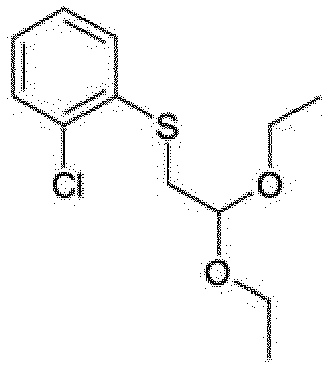
- To a solution of 2-chlorobenzenethiol (5.0 g, 34.5 mmol) in acetone (35 mL) was added 2-bromo-1,1-diethoxyethane (7.15 g, 36.3 mmol) followed by potassium carbonate (9.55 g, 69.1 mmol). The mixture was heated at reflux for 3 h. then cooled to rt, filtered and the filtrate evaporated under reduced pressure to yield the crude product. This material was purified by chromatography over silica gel eluting with ethyl acetate in hexanes (0→2%) to afford pure 1-chloro-2-(2,2-diethoxyethylsulfanyl)benzene (7.3, 80%). 1H NMR (400 MHz, CDCl3) δ = 1.20 (t, J = 7.07 Hz, 6H), 3.15 (d, J = 5.56 Hz, 2H), 3.51-3.61 (m, 2H), 3.63-3.74 (m, 2H), 4.69 (t, J = 5.56 Hz, 1H), 7.12 (td, J = 7.58, 1.52 Hz, 1H), 7.20 (td, J = 7.58, 1.52 Hz, 1H), 7.36 (dd, J = 7.83, 1.52 Hz, 1H), 7.39 (dd, J = 8.08, 1.52 Hz, 1H); MS (ES+): m/z 187.17 [M-74].
-

- To a solution of 1-chloro-2-(2,2-diethoxyethylsulfanyl)benzene (3.95 g, 15.14 mmol) in toluene (40 mL) was added polyphosphoric acid (15 g, 137.5 mmol). The mixture was heated at reflux for 4 h. then was poured in to ice water, stirred for 30 min and extracted with toluene. The combined toluene extracts were washed with aqueous sodium bicarbonate followed by brine, dried over anhydrous sodium sulfate and evaporated under reduced pressure to yield the crude product. This material was purified by chromatography over silica gel eluting with hexane to afford pure 7-chlorobenzo[b]thiophene (1.72 g, 67.5%). 1H NMR (400 MHz, CDCl3) δ = 7.13-7.30 (m, 3H), 7.38 (d, J = 5.31 Hz, 1H), 7.62 (dd, J = 7.33, 1.52 Hz, 1H); MS (ES+): m/z 169.06 [MH+].
-

- To a solution of 7-chlorobenzo[b]thiophene (1.0 g, 5.92 mmol) in THF (25 mL) at-78 °C was added nbutyllithium (7.41 mL, 11.8 mmol, 1.6 M solution). The reaction was allowed to warm to -30 °C then was cooled back to -78 °C and triisopropyl borate (2.23 g, 11.8 mmol) was added. The mixture was allowed to warm to 0 °C, saturated ammonium chloride added and the organic phase separated off and concentrated in vacuo. To the residue was added aqueous sodium hydroxide (10 mL, 2N solution) followed by water (30 mL) and the mixture was washed with DCM. The aqueous phase was acidified with 2N sulfuric acid, and the resulting precipitate isolated by filtration and dried under vacuum to yield 7-chlorobenzo[b]thiophene-2-boronic acid (1.21 g, 96%) as white solid. 1H NMR (400 MHz, CDCl3) δ = 7.41 (t, J = 7.70 Hz, 1H), 7.50 (d, J = 7.70 Hz, 1H), 7.91 (d, J = 7.70 Hz, 1H), 8.03 (s, 1H), 8.63 (s, 2H); MS (ES+): m/z 211.86 [M+].
-

- To a solution of 7-bromo-1H-indole (3.0 g, 15.3 mmol) in THF (60 mL) at -78 °C was added tBuLi (1.7 M, 33.8 mL, 57.4 mmol) and the mixture was allowed to warm to 0 °C. The reaction was re-cooled to -78 °C and a solution of dimethyl disulfide (2.0 mL, 22.9 mmol) was added and the reaction was allowed to warm to 0 °C. The reaction was quenched with saturated ammonium chloride and extracted with ethyl acetate. The organic layer was washed with brine, dried over anhydrous sodium sulfate and evaporated under reduced pressure to yield the crude product. This material was purified by chromatography over silica gel eluting with ethyl acetate in hexanes (0→2%) to afford pure 7-(methylthio)-1H-indole (1.4 g, 55%). 1H NMR (400 MHz, CDCl3) δ = 2.50 (s, 3 H), 6.58 (dd, J = 3.03, 2.02 Hz, 1H), 7.09 (t, J = 7.58 Hz, 1H), 7.18-7.31 (m, 2H), 7.56 (d, J = 7.83 Hz, 1H), 8.45 (br. s., 1 H); MS (ES+): m/z 164.15 [MH+].
-

- To a solution of 7-(methylthio)-1H-indole (1.1 g, 6.7 mmol) in DCM (25 ml) at -40 °C was added m-chloroperbenzoic acid (3.02 g, 13.4 mmol) and the reaction was stirred at -40 °C for 30 min. The reaction mixture was then quenched with saturated sodium bicarbonate and extracted with DCM. The DCM extracts was washed with water, brine, dried over anhydrous sodium sulfate and evaporated under reduced pressure to yield the crude product. This material was purified by chromatography over silica gel eluting with hexanes (0→10%) to afford pure 7-(methylsulfonyl)-1H-indole (987 mg, 75%). 1H NMR (400 MHz, CDCl3) δ = 3.12 (s, 1H), 6.66 (d, J = 2.53 Hz, 1H), 7.24 (t, J = 7.71 Hz, 1H), 7.35 (d, J = 1.77 Hz, 1H), 7.68 (d, J = 7.07 Hz, 1H), 7.90 (d, J = 7.83 Hz, 1H), 9.68 (br. s., 1H); MS (ES+): m/z 196.08 [MH+].
-

- Chlorosulfonyl isocyanate (1.0 mL, 0.012 mol) was added to a solution of trans-4-(methoxycarbonyl)cyclohexanecarboxylic acid (2.00 g, 0.0107 mol) in DCM cooled to 0 °C. The resulting solution was heated at reflux for 15 minutes and then cooled 0 °C and treated dropwise with DMF. The mixture was stirred at room temperature overnight then poured onto ice water and the organic phase separated and washed with a saturated solution of sodium bicarbonate. The solvent was removed in vacuo and the crude material was taken up in ethyl acetate, washed with 1N aq. NaOH (10mL and the ethyl acetate removed in vacuo. The resulting crude product was used in subsequent steps without further purification. 1H NMR (400 MHz, CHLOROFORM-d) δ ppm 1.36 - 1.70 (4 H, m), 2.01 - 2.18 (4 H, m), 2.24 - 2.54 (2 H, m) and 3.68 (3 H, s).
-

- To a solution of methyl trans-4-cyanocyclohexanecarboxylate (996 mg, 5.96 mmol) in THF (37 mL) was added a solution of 0.5 M lithium hydroxide in water (20 mL). The mixture was stirred overnight then the THF was removed in vacuo and the residual aqueous solution acidified to pH 4. The resulting mixture was extracted with ether (2 x 30 mL), EtOAc (2 x 30 mL) and CHCl3 (2 x 30 mL) then the combined extracts, dried over anhydrous sodium sulfate and concentrated in vacuo. This material was taken to the next step without any purification. 1H NMR (400 MHz, CHLOROFORM-d) δ ppm 1.43 - 1.73 (4 H, m), 2.05 - 2.22 (4 H, m) and 2.36 - 2.59 (2 H, m).
-

- A solution of methyl trans-4-(8-chloroimidazo[1,5-a]pyrazin-3-yl)cyclohexanecarboxylate (4.0 g, 0.014 mol) in toluene (300 mL) and THF (70 mL) was cooled to 0 °C and treated with a 3.0 M solution of methylmagnesium bromide in ether (14 mL) mantaining the temperature at 0 °C. The mixture was stirred at rt for 1.5 hours then cooled to 0 °C and an addtional 3 eq of 3.0 M of methylmagnesium bromide in ether was added. The mixture was stirred at rt for 15 minutes then cooled to 0 °C and quenched with 1:1 NH4Cl sat. : H2O (50 mL total volume). The organic layer was separated and the aqueous layer was extracted with EtOAc (3 x 30 mL). The combined organic layers were dried over sodium sulfate and concentrated in vacuo and the crude product thus obtained, chromatographed over silica gel eluting with EtOAc to afford desired 2-[trans-4-(8-chloroimidazo[1,5-a]pyrazin-3-yl)cyclohexyl]propan-2-ol.1H NMR (400 MHz, CHLOROFORM-d) δ ppm 1.14 - 1.39 (m, 8 H), 1.41 - 1.60 (m, 1 H), 1.77 - 1.98 (m, 2 H), 2.01 - 2.20 (m, 4 H), 2.78 - 3.06 (m, 1 H), 7.35 (d, J=5.05 Hz, 1 H), 7.64 (d, J=5.05 Hz, 1 H) and 7.83 (s, 1 H).
-

- A dry mixture of 8-amino-3-cyclobutyl-1-iodoimidazo[3,4-a]pyrazine (30mg, 0.096mmol), cesium carbonate (38mg, 0.117mmol) and 5-(4,4,5,5-tetramethyl-1,3,2-dioxaborolan-2-yl)-1H-indole (26mg, 0.107mmol) was purged with Argon 3 times prior to the addition of tetrakistriphenylphosphino palladium (0) (6mg, 0.005mmol). The mixture was purged twice more and then treated with a degassed mixture of DME:water (5:1, 2mL). The resulting solution was degassed twice more and then heated at 80°C overnight. The resulting reaction mixture was concentrated in vacuo, the residue dissolved in 1:1 MeCN:MeOH (1.5mL) and purified by mass directed preparative HPLC to afford 3-cyclobutyl-1-(1H-indol-5-yl)imidazo[1,5-a]pyrazin-8-amine. 1H NMR (400 MHz, DMSO-d 6) δ ppm 1.82 - 1.92 (1 H, m) 1.95 - 2.08 (1 H, m) 2.32 - 2.41 (4 H, m) 3.82 - 3.93 (1 H, m) 5.91 (2 H, br. s.) 6.45 (1 H, d, J=3.03 Hz) 6.90 (1 H, d, J=5.05 Hz) 7.26 (1 H, dd, J=8.34, 1.52 Hz) 7.34 (1 H, d, J=5.05 Hz) 7.35 - 7.39 (1 H, m) 7.45 (1 H, d, J=8.34 Hz) 7.64 - 7.68 (1 H, m) 11.20 (1 H, br. s.); MS (ES+): m/z 304.15 [MH+]. HPLC: t R 6.18min (XTerra C18 5uM, 4.6 x 15mm, A: MeCN & B:10mmol NH4OAc in 0.05% HOAc/aq., method Polar15).
-

- Prepared as described above for EXAMPLE 1 using 1-(tert-butoxycarbonyl)-1H-indole-2-boronic acid in place of 5-(4,4,5,5-tetramethyl-1,3,2-dioxaborolan-2-yl)-1H-indole. The reaction conditions used effected significant cleavage of the N-(tert-butoxycarbamoyl) functionality. MS (ES+): m/z 304.10 [MH+].
-

- Prepared as described above for EXAMPLE 1 using 1-(tert-butoxycarbonyl)-5-fluoro-1H-indole-2-boronic acid in place of 5-(4,4,5,5-tetramethyl-1,3,2-dioxaborolan-2-yl)-1H-indole. The reaction conditions used effected significant cleavage of the N-(tert-butoxycarbamoyl) functionality. MS (ES+): m/z 322.06 [MH+].
-
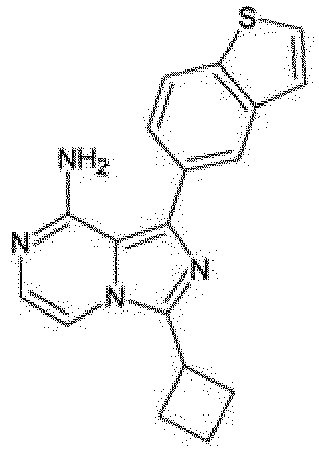
- Prepared as described above for EXAMPLE 1 using 2-(1-benzothiophen-5-yl)-4,4,5,5-tetramethyl-1,3,2-dioxaborolane in place of 5-(4,4,5,5-tetramethyl-1,3,2-dioxaborolan-2-yl)-1H-indole. MS (ES+): m/z 321.10 [MH+].
-

- Prepared as described above for EXAMPLE 1 using 1-(tert-butoxycarbonyl)-5-methyl-1H-indole-2-boronic acid in place of 5-(4,4,5,5-tetramethyl-1,3,2-dioxaborolan-2-yl)-1H-indole. MS (ES+): m/z 318.05 [MH+].
-

- Prepared as described above for EXAMPLE 1 using 1-(tert-butoxycarbonyl)-6-methyl-1H-indole-2-boronic acid in place of 5-(4,4,5,5-tetramethyl-1,3,2-dioxaborolan-2-yl)-1H-indole. MS (ES+): m/z 318.05 [MH+].
-

- A mixture of 6-bromo-1H-indole (2g, 10.00mmol), 4,4,4',4',5,5,5',5'-octamethyl-2,2'-bi-1,3,2-dioxaborolane (2.00g, 7.87mmol) and potassium acetate (3.0g, 31.00mmol) was degassed three times, treated with (1,1'-bis(diphenylphosphino)ferrocene) palladium dichloride (0.20g, 0.28mmol) and degassed twice more. 1,2-dimethoxyethane (28mL) was added and the mixture was heated at 75°C overnight. The cooled reaction mixture was then diluted with water, extracted with EtOAc and the extracts washed with water and brine, then dried over magnesium sulphate, and concentrated in vacuo to afford a brown/black semi-solid. This was triturated with ether to afford a brown powder, which was identified by LCMS to be desired indole-6-boronic acid, pinacol ester. 1H NMR (400 MHz, CHLOROFORM-d) δ ppm 1.37 (s, 12 H), 6.54 - 6.58 (m, 1 H), 7.26 - 7.28 (m, 1 H), 7.55 (dd, J=7.83, 1.01 Hz, 1 H), 7.62 - 7.68 (m, 1 H),7.90 (s, 1 H), 8.19 (br. s., 1 H); MS (ES+): m/z 244.25 [MH+]; HPLC: t R = 3.52 min (OpenLynx, polar_5min).
- This material was used in place of 5-(4,4,5,5-tetramethyl-1,3,2-dioxaborolan-2-yl)-1H-indole under the conditions described in EXAMPLE 1 to afford 3-cyclobutyl-1-(1H-indol-6-yl)imidazo[1,5-a]pyrazin-8-amine. MS (ES+): m/z 304.15 [MH+].
-

- 3-Cyclobutyl-1-iodoimidazo[1,5-a]pyrazin-8-amine (500mg, 2mmol) and tetrakis(triphenylphosphine)palladium(0) (100mg, 0.1mmol) was degassed dry three times then treated with methanol (20mL) and N,N-diisopropylethylamine (0.7mL, 4.0mmol) and the mixture heated at 70°C under an atmosphere of carbon monoxide, with intermittent bubbling of this gas under the surface of the reaction mixture. After 3d heating with extensive bubbling through of the solution with carbon monoxide and some addition of fresh catalyst after day 2, TLC (10% MeOH/DCM) indicated the reaction to be complete. The reaction mixture was diluted with water, extracted with DCM and the extracts washed with water and brine, then dried over magnesium sulphate, and concentrated in vacuo to afford an orange solid which was recrystallised from acetonitrile to afford methyl 8-amino-3-cyclobutylimidazo[1,5-a]pyrazine-1-carboxylate. 1H NMR (400 MHz, CHLOROFORM-d) δ ppm 1.97 - 2.06 (m, 1 H), 2.10 - 2.26 (m, 1 H), 2.43 - 2.54 (m, 2 H), 2.53 - 2.68 (m, 2 H), 3.78 (dd, J=9.09, 8.08 Hz, 1 H), 4.01 (s, 3 H), 7.08 (d, J=4.80 Hz, 1 H), 7.22 (d, J=4.80 Hz, 1 H), 7.38 (br. s., 1 H), 7.69 (br. s., 1 H).
- A suspension of 1,2-phenylenediamine (60mg, 0.6mmol) in toluene (2.0mL) was treated with a 2M solution of trimethylaluminum in toluene (0.5mL) effecting the formation of a pink solution. After 5min this solution was treated with solid methyl 8-amino-3-cyclobutylimidazo[1,5-a]pyrazine-1-carboxylate (30mg, 0.1mmol) and the mixture heated at 120°C for 30min then stirred at rt overnight. The mixture was then partitioned between 2M NaOH (10mL) & EtOAc (10mL) and stirred for 15min. The organic layer was separated and the aqueous layer extracted further with EtOAc (3 x 10mL). The combined organics were washed with brine, dried and concentrated in vacuo to give ∼85% pure 8-amino-N-(2-aminophenyl)-3-cyclobutylimidazo[1,5-a]pyrazine-1-carboxamide which was used without purification.
- A solution of 8-amino-N-(2-aminophenyl)-3-cyclobutylimidazo[1,5-a]pyrazine-1-carboxamide (40.0mg, 0.124mmol) in acetic acid (1.2mL) was microwaved at 120°C for 10min (300W). The resulting solution was purified mass directed preparative HPLC to afford 1-(1H-benzimidazol-2-yl)-3-cyclobutylimidazo[1,5-a]pyrazin-8-amine. 1H NMR (400 MHz, DMSO-d6) δ ppm 1.92 - 2.05 (m, 1 H) 2.07 - 2.21 (m, 1 H) 2.53 - 2.59 (m, 4 H) 3.91 - 4.06 (m, 1 H) 7.08 (d, J=4.80 Hz, 1 H) 7.16 - 7.26 (m, 2 H) 7.38 (d, J=4.80 Hz, 1 H) 7.44 (br. s., 1 H) 7.55 (d, J=8.08 Hz, 1 H) 7.62 (d, J=6.82 Hz, 1 H) 10.49 (br. s., 1 H) 12.76 (s, 1 H); MS (ES+): m/z 305.15 [MH+].
-

- A mixture of 5-chlorobenzoxazole (0.129g, 0.84mmol), 4,4,4',4',5,5,5',5'-octamethyl-2,2'-bi-1,3,2-dioxaborolane (0.4956g, 1.95mmol), potassium acetate (0.41g, 4.2mmol), 1,3-bis(2,6-diisopropylphenyl)imidazol-2-ylidene hydrochloride (43mg, 0.10mmol) and palladium acetate (11mg, 0.05mmol) was degassed, treated with tetrahydrofuran (10mL) and the resulting mixture heated at 80°C overnight. The mixture was diluted with water (100mL), acidified to pH 6 and extracted with EtOAc (3 x 40mL). The extracts were washed with water, dried and concentrated in vacuo. The residue so obtained was purified by chromatography over silica gel eluting with DCM to 10% MeCN/DCM to afford 1,3-benzoxazole-5-boronic acid, pinacol ester. 1H NMR (400 MHz, CHLOROFORM-d) δ ppm 1.37 - 1.39 (m, 12 H) 7.59 (d, J=8.34 Hz, 1 H) 7.86 (dd, J=8.08, 1.01 Hz, 1 H) 8.10 (s, 1 H) 8.26 (s, 1 H); MS (ES+): m/z 246.23 [MH+].
- This material was used in place of 5-(4,4,5,5-tetramethyl-1,3,2-dioxaborolan-2-yl)-1H-indole under the conditions described in example 1 to afford 1-(1,3-benzoxazol-5-yl)-3-cyclobutylimidazo[1,5-a]pyrazin-8-amine MS (ES+): m/z 306.16 [MH+].
-

- Prepared according to the procedure described in EXAMPLE 2 using trans-[4-(8-amino-1-iodoimidazo[1,5-a]pyrazin-3-yl)cyclohexyl]methanol in place of 8-amino-3-cyclobutyl-1-iodoimidazo[3,4-a]pyrazine. 1H NMR (DMSO-d6, 400 MHz) δ 1.12-1.23 (m,), 1.38-1.54 (m, 1H); 1.58-1.78 (m, 2H); 1.82-1.92 (m, 2H); 1.96-2.06 (m, 2H); 3.03-3.16 (m, 1H); 3.29 (t, J = 5.6 Hz, 2H); . 4.46 (t, J = 5.3 Hz, 1H); 6.45 (brs, 2H); 6.63 (d, J = 1.38 Hz, 1H); 7.02 (t, J = 7.50 Hz, 1H); 7.06 (d, J = 4.99 Hz, 1H); 7.12 (t, J = 7.52, 1H), 7.46 (d, J = 8.02 Hz, 1H), 7.58 (d, J = 7.83 Hz, 1H), 7.66 (d, J = 5.06 Hz, 1H), 11.43 (s, 1H); MS (ES+): m/z 362.07 (100) [MH+], HPLC: tR= 1.97 min (MicromassZQ, polar_5min).
-

- Prepared according to the procedure described in EXAMPLE 2 using [3-(8-chloro-1-iodoimidazo[1,5-a]pyrazin-3-yl)cyclobutyl]methanol in place of 8-amino-3-cyclobutyl-1-iodoimidazo[3,4-a]pyrazine. MS (ES+): m/z 334.10 [MH+].
-

- Prepared according to the procedure described in EXAMPLE 2 using 3-(8-amino-1-iodoimidazo[1,5-a]pyrazin-3-yl)cyclobutanol in place of 8-amino-3-cyclobutyl-1-iodoimidazo[3,4-a]pyrazine. MS (ES+): m/z 320.03 [MH+].
-

- Prepared according to the procedure described in EXAMPLE 2 using 1-{4-[3-(8-amino-1-iodoimidazo[1,5-a]pyrazin-3-yl)cyclobutyl]piperazin-1-yl}ethanone in place of 8-amino-3-cyclobutyl-1-iodoimidazo[3,4-a]pyrazine. MS (ES+): m/z 430.08 [MH+].
-

- Prepared according to the procedure described in EXAMPLE 1 using trans-[4-(8-amino-1-iodoimidazo[1,5-a]pyrazin-3-yl)cyclohexyl]methanol in place of 8-amino-3-cyclobutyl-1-iodoimidazo[3,4-a]pyrazine. MS (ES+): m/z 362.07 [MH+].
-

- Prepared according to the procedure described in EXAMPLE 2 using 1-iodo-3-[3-(4-methyl-piperazin-1-yl)cyclobutyl]imidazo[1,5-a]pyrazin-8-ylamine in place of 8-amino-3-cyclobutyl-1-iodoimidazo[3,4-a]pyrazine. MS (ES+): m/z 402.10 [MH+].
-

- Prepared according to the procedure described in EXAMPLE 1 using 7-cyclobutyl-5-iodoimidazo[5,1-f][1,2,4]triazin-4-ylamine in place of 8-amino-3-cyclobutyl-1-iodoimidazo[3,4-a]pyrazine. MS (ES+): m/z 305.16 [MH+].
-

- Prepared according to the procedure described in EXAMPLE 2 using 7-cyclobutyl-5-iodoimidazo[5,1-f][1,2,4]triazin-4-ylamine in place of 8-amino-3-cyclobutyl-1-iodoimidazo[3,4-a]pyrazine. MS (ES+): m/z 305.07 [MH+].
-

- Prepared according to the procedure described in EXAMPLE 7 using 7-cyclobutyl-5-iodoimidazo[5,1-f][1,2,4]triazin-4-ylamine in place of 8-amino-3-cyclobutyl-1-iodoimidazo[3,4-a]pyrazine. MS (ES+): m/z 305.07 [MH+].
-

- Prepared according to the procedure described in EXAMPLE 2 using 7-cyclohexyl-5-iodoimidazo[5,1-f][1,2,4]triazin-4-amine in place of 8-amino-3-cyclobutyl-1-iodoimidazo[3,4-a]pyrazine. 1H NMR (400 MHz - DMSO-d6) δ 1.40 -1.54 (m, 4H), 1.72 -1.82 (m, 2H), 1.87-1.92 (m, 2H), 2.02 - 2.09 (m, 2H) 3.31 - 3.38 (m, 1H) 6.26 (bs, 2H) 6.73 - 6.74 (m, 1H), 7.13 - 7.17 (m, 1H), 7.22 - 7.25 (m, 1H), 7.44 (d, J = 8.0 Hz, 1H) 7.64 (d, J =8.0 Hz, 1H), 7.91 (s, 1H), 9.18 (s, 1H). MS (ES+): m/z: 333.16 (100) [MH+]. HPLC: t R = 3.46 min (OpenLynx: polar_5 5 min).
-

- A mixture of {trans-4-[8-amino-1-(1H-indol-2-yl)imidazo[1,5-a]pyrazin-3-yl]cyclohexyl}methanol (400mg, 0.001mol), phthalimide (211.7mg, 0.001439mol), and triphenylphosphine resin (2.14mmol/g loading; 1.03g, 0.00221mol; Argonaut) in THF (22mL, 0.27mol; Aldrich) was placed under nitrogen atmosphere and charged dropwise with diisopropyl azodicarboxylate (290.9mg, 0.001439mol). After 16h, the resin was filtered off, washed with chloroform (5 x 20mL) and the filtrate concentrated in vacuo to yield an orange oil which was chromatographed over silica gel eluting with chloroform → 5% MeOH/chloroform to afford the title compound. 1H NMR (CDCl3, 400 MHz): δ 7.90-7.85 (m, 2H), 7.77-7.70 (m, 2H), 7.64 (m, 1H), 7.43 (dd, J = 8.0, 0.8 Hz, 1H), 7.27-7.15 (m, 2H), 7.14 (m, 1H), 7.09 (d, J = 4.8 Hz, 1H), 6.77 (br s, 1H), 3.64 (d, J = 6.4 Hz, 2H), 2.91 (m, 1H), 2.09 (m, 2H), 2.25-1.90 (m, 4H), 1.80 (ddd, J = 13.2, 12,4, 2,4 Hz, 2H), 1.27 (ddd, J = 13.2, 12,4, 2,4 Hz, 2H). MS (ES+): m/z 491.09 [MH+].
-

- A solution of benzyl {[trans-4-(8-amino-1-(1H-indol-2-yl)imidazo[1,5-a]pyrazin-3-yl)cyclohexyl]methyl}carbamate (0.163 g, 0.330 mmol) in conc. HCl (5 ml) was stirred at rt overnight. The reaction mixture was diluted with H2O (20mL), washed with Et2O (30mL), then basified with 1N NaOH (aq) and extracted with DCM (3 x 20mL). The combined extracts were washed with water then dried over Na2SO4 and concentrated in vacuo To afford 0.085g of desired compound. MS (ES+): m/z 361.30 [MH+].
-

- To a suspension of 1-{trans-4-[8-amino-1-(1H-indol-2-yl)imidazo[1,5-a]pyrazin-3-yl]cyclohexyl}methanamine (100.00 mg, 0.27 mmol), N-(3-dimethylaminopropyl)-N'-ethylcarbodiimide hydrochloride (0.0798 g, 0.416 mmol), N,N-diisopropylethylamine (0.097 mL, 0.55 mmol), 1-hydroxbenzotriaxole Hydrate (0.0425 g, 0.277 mmol), and DMF (600 uL) in DCM (5 mL) was added AcOH (24 uL). The mixture was stirred at rt for 3 h under an atmosphere of nitrogen then diluted with DCM (20mL), washed with saturated NaHCO3 (aq) (2 x 25mL) and brine (2 x 25mL), then dried over Na2SO4, filtered and concentrated in vacuo. The residue was chromatographed over silica gel eluting with DCM → 2% 2M NH3 in MeOH/DCM to afford 0.02g of the title compound. MS (ES+): m/z 403.31 [MH+]. 1H NMR (400 MHz, CDCl3): δ 1.12-1.31 (m, 3H), 1.79-1.86 (m, 2H), 1.94-1.97 (m, 2H), 2.02 (s, 3H), 2.04-2.09 (m, 2H), 2.91 (m, 1H), 3.20 (t, J = 6.4 Hz, 2H), 5.51 (br, 1H), 5.66 (br, 2H), 6.79 (s, 1H), 7.10-7.16 (m, 2H), 7.20-7.25 (m, 2H), 7.43 (d, J = 8.4 Hz, 1H), 7.44 (d, J = 7.6 Hz, 1H), 9.07 (br, 1H).
-

- Methanesulfonyl chloride (4.40µL, 0.057 mmol was added to a mixture of 1-{trans-4-[8-amino-1-(1H-indol-2-yl)imidazo[1,5-a]pyrazin-3-yl]cyclohexyl}methanamine (20.5mg, 0.057mol) and PS-DIEA (3.90mmol/g loading; 60mg, 0.2mmol) in DCM (1.14mL). The reaction mixture was stirred for 30min at r.t. for 18h. The crude reaction mixture was then concentrated and residue purified by mass directed preparative HPLC to afford 4mg of desired product. MS (ES+): m/z 439.10 (100) [MH+]. 1H NMR (CD3OD, 400 MHz): δ 8.24 (br s, 2H), 7.61 (m, 2H), 7.46 (dd, J = 8.4, 0.8 Hz, 1H), 7.19 (ddd, J = 7.2, 1.2, 1.2 Hz, 1H), 7.08 (ddd, J = 7.2, 1.2, 1.2 Hz, 1H), 6.75 (d, J = 0.8 Hz, 1H), 3.14 (m, 1H), 2.07 (m, 4H), 1.85 (m, 2H), 1.64 (m, 1H), 1.26 (m, 2H).
-

- A mixture of benzyl 4-(8-amino-1-iodoimidazo[1,5-a]pyrazin-3-yl)piperidine-1-carboxylate (1.149g, 0.002191mol), 1-(tert-butoxycarbonyl)-1H-indole-2-boronic acid (0.629g, 0.00241mol), 1,2-dimethoxyethane (9.3mL), water (1.8mL) and cesium carbonate (1.43g, 0.00438mol) was degassed three times and then treated with tetrakis(triphenyl phosphine)palladium(0) (200mg, 0.0002mol). The mixture was once more degassed and then heated at 100 °C overnight. The resulting reaction mixture was diluted with EtOAc (30mL) then washed with water (2 x 30mL) and brine, dried over Na2SO4 and concentrated in vacuo. The crude product was chromatographed over silica gel eluting with hexane → EtOAc:hexane 1:1:0.05 2M NH3/MeOH to afford the desired product. 1H NMR (400 MHz, CDCl3): δ 2.02-2.06 (m, 4H), 3.03-3.17 (m, 3H), 4.29-4.33 (m, 2H), 5.16 (s, 2H), 5.66 (br, 2H), 6.79-6.80 (m, 1H), 7.11-7.16 (m, 2H), 7.20-7.25 (m, 2H), 7.31-7.45 (m, 5H), 7.44 (m, 1H), 7.64 (d, J = 7.6 Hz, 1H), 8.96 (br, 1H). MS (ES+): m/z 467.12 [MH+].
-

- A solution of benzyl 4-[8-amino-1-(1H-indol-2-yl)imidazo[1,5-a]pyrazin-3-yl]piperidine-1-carboxylate (3.61 g, 0.00774 mol) in conc. HC1 (100 ml) was stirred at rt overnight. The mixture was then diluted with water (200mL), washed with Et2O (2 x 30mL) then the aqueous layer concentrated in vacuo yielding 2.62 g of desired product as the trihydrochloride salt. 1H NMR (400 MHz, MeOD): δ 2.19-2.32 (m, 4H), 3.26-3.30 (m, 2H), 3.53-3.36 (m, 2H), 3.70 (m, 1H), 7.06 (d, J = 5.6 Hz, 1H), 7.10-7.14 (m, 1H), 7.23-7.26 (m, 2H), 7.50-7.52 (m, 1H), 7.67 (m, 1H), 7.93 (m, 1H). MS (ES+): m/z 333.27 [MH+].
-

- To a solution of 1-(1H-Indol-2-yl)-3-piperidin-4-ylimidazo[1,5-a]pyrazin-8-amine hydrochloride (30.00 mg, 0.0068 mmol) in DCM (0.5 mL, 0.008 mol) was added N-(3-dimethylaminopropyl)-N'-ethylcarbodiimide hydrochloride (0.0195 g, 0.102 mmol), N,N-diisopropylethylamine (0.047 mL), 1-hydroxbenzotriaxole hydrate (0.0104 g, 0.0679 mmol) and formic acid (4.7 mg, 0.10 mmol). The reaction was stirred at rt overnight then diluted with DCM, washed with saturated NaHCO3 (2 x 25mL) and brine (2 x 25), then dried over Na2SO4 and concentrated in vacuo. The material thus isolated was crystallized from EtOAc to afford 10.6 mg of desired product. 1H NMR (400 MHz, CDCl3): δ 2.04-2.12 (m, 4H), 2.99-3.00 (m, 1H), 3.27-3.32 (m, 2H), 3.85 (m, 1H), 4.49 (m, 1H), 5.70 (br, 2H), 6.80 (s, 1H), 7.13-7.24 (m, 4H), 7.45 (d, J = 8.4 Hz, 1H), 7.65 (d, J = 8.0 Hz, 1H), 8.10 (s, 1H), 8.97 (br, 1H). MS (ES+): m/z 361.16 [MH+].
-

- Prepared according to the procedure described above for EXAMPLE 26, except using indole-3-carboxylic acid in place of formic acid. MS (ES+): m/z 476.18 [MH+].
-

- Prepared according to the procedure described above for EXAMPLE 26, except using acetic acid in place of formic acid. MS (ES+): m/z 375.17 [MH+].
-

- Prepared according to the procedure described above for EXAMPLE 26, except using 4-methoxybenzoic acid in place of formic acid. MS (ES+): m/z 467.27 [MH+].
-

- Prepared according to the procedure described above for EXAMPLE 26, except using 4-methoxybenzoic acid in place of formic acid. MS (ES+): m/z 515.17 & 517.17 [MH+].
-

- Prepared according to the procedure described above for EXAMPLE 26, except using 2-methoxyacetic acid in place of formic acid. MS (ES+): m/z 405.10 [MH+].
-
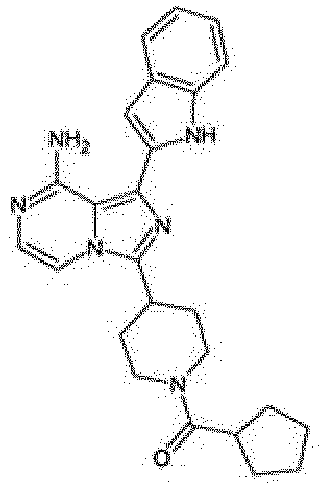
- Prepared according to the procedure described above for EXAMPLE 26, except using cyclopentanecarboxylic acid in place of formic acid. MS (ES+): m/z 429.07 [MH+].
-

- Prepared according to the procedure described above for EXAMPLE 26, except using 2,5-dimethylpyrrolecarboxylic acid in place of formic acid. MS (ES+): m/z 454.19 [MH+].
-

- Prepared according to the procedure described above for EXAMPLE 26, except using 4-(dimethylamino)butanoic acid in place of formic acid. MS (ES+): m/z 446.22 [MH+].
-

- Prepared according to the procedure described above for EXAMPLE 26, except using 4-(dimethylamino)phenylacetic acid in place of formic acid. MS (ES+): m/z 480.22 [MH+].
-

- Prepared according to the procedure described above for EXAMPLE 26, except using 4-(dimethylamino)benzoic acid in place of formic acid. MS (ES+): m/z 480.22 [MH+].
-

- Prepared according to the procedure described above for EXAMPLE 26, except using cyclohexanecarboxylic acid in place of formic acid. MS (ES+): m/z 443.20 [MH+].
-

- Prepared according to the procedure described above for EXAMPLE 26, except using cyclopropanecarboxylic acid in place of formic acid. MS (ES+): m/z 401.19 [MH+].
-

- Prepared according to the procedure described above for EXAMPLE 26, except using thiophene-2-carboxylic acid in place of formic acid. MS (ES+): m/z 443.22 [MH+].
-

- Prepared according to the procedure described above for EXAMPLE 26, except using indole-3-acetic acid in place of formic acid. MS (ES+): m/z 490.10 [MH+].
-

- Prepared according to the procedure described above for EXAMPLE 26, except using (3-methoxyphenoxy)acetic acid in place of formic acid. MS (ES+): m/z 497.11 [MH+].
-

- Prepared according to the procedure described above for EXAMPLE 26, except using 1,3-benzodioxole-5-carboxylic acid in place of formic acid. MS (ES+); m/z 481.05 [MH+].
-

- Prepared according to the procedure described above for EXAMPLE 26, except using 1-methyl-1H-indazole-3-carboxylic acid in place of formic acid. MS (ES+): m/z 491.04 [MH+].
-

- Prepared according to the procedure described above for EXAMPLE 26, except using 3-methoxyphenylacetic acid in place of formic acid. MS (ES+); m/z 481.09 [MH+].
-

- Prepared according to the procedure described above for EXAMPLE 26, except using benzothiophene-3-carboxylic acid in place of formic acid. MS (ES+): m/z 493.01 [MH+].
-

- Prepared according to the procedure described above for EXAMPLE 26, except using benzothiazole-6-carboxylic acid in place of formic acid. MS (ES+): m/z 494.01 [MH+].
-

- Prepared according to the procedure described above for EXAMPLE 26, except using 2-methylcyclohexa-2,5-diene-1-carboxylic acid in place of formic acid. MS (ES+): m/z 453.08 [MH+].
-

- Prepared according to the procedure described above for EXAMPLE 26, except using isoquinoline-1-carboxylic acid in place of formic acid. MS (ES+): m/z 488.01 [MH+].
-

- Prepared according to the procedure described above for EXAMPLE 26, except using (pyridin-4-ylthio)acetic acid in place of formic acid. MS (ES+): m/z 484.04 [MH+].
-

- Prepared according to the procedure described above for EXAMPLE 26, except using pyridin-3-ylacetic acid in place of formic acid. MS (ES+): m/z 452.07 [MH+].
-

- A mixture of 1-(1H-indol-2-yl)-3-piperidin-4-ylimidazo[1,5-a]pyrazin-8-amine hydrochloride (30.0mg, 0.0679mmol), N,N diisopropylethylamine (59.1µL, 0.340mmol) and DMF (1.00mL) was treated with N,N-dimethylcarbamoyl chloride (6.23µL, 0.0679mmol) and stirred at rt for 1h prior to semi-preparative HPLC to afford the isolated title compound. 1H NMR (400 MHz, CD3OD) ppm: 8.32 (br. s., 1H), 7.59-7.66 (m, 2H), 7.46 (d, 1H, J = 8.3 Hz), 7.15-7.22 (m, 1H), 7.01-7.10 (m, 2H), 6.74 (s, 1H), 3.82 (d, 2H, J = 12.6 Hz), 3.34-3.42 (m, 1H), 2.97-3.09 (m, 2H), 2.87 (s, 6H), 1.95-2.09 (m, 4H); MS (ES+): m/z 404.14 [MH+].
-

- A mixture of 1-(1H-indol-2-yl)-3-piperidin-4-ylimidazo[1,5-a]pyrazin-8-amine hydrochloride (30.0mg, 0.0679mmol), N,N-diisopropylethylamine (59.1µL, 0.340mmol) and DMF (1.00mL) was treated with methyl chloroformate (5.25µL, 0.0679mmol) and stirred at rt for 1h prior to semi-preparative HPLC to afford the isolation of the title compound. 1H NMR (400 MHz, CD3OD) ppm: 8.32 (br. s., 1H), 7.58-7.66 (m, 2H), 7.46 (d, 1H, J = 8.1 Hz), 7.14-7.22 (m, 1H), 7.00-7.12 (m, 2H), 6.73 (s, 1H), 4.26 (d, 2H, J = 12.9 Hz), 3.71 (s, 3H), 3.33-3.37 (m, 1H), 2.9-3.17 (m, 2H), 1.85-2.06 (m, 4H); MS (ES+): m/z 391.06 [MH+].
-

- Prepared according to the procedure described above for EXAMPLE 26, except using 4-chloro-2-methylbenzoic acid in place of formic acid. MS (ES+): m/z 485.05 [MH+].
-

- Prepared according to the procedure described above for EXAMPLE 26, except using 1-(4-methylphenyl)cyclopropanecarboxylic acid in place of formic acid. MS (ES+): m/z 491.11 [MH+].
-

- Prepared according to the procedure described above for EXAMPLE 26, except using 4-chloro-3-methoxybenzoic acid in place of formic acid. MS (ES+): m/z 501.04 [MH+].
-

- Prepared according to the procedure described above for EXAMPLE 26, except using 5-acetylthiophene-2-carboxylic acid in place of formic acid. MS (ES+): m/z 485.04 [MH+].
-

- Prepared according to the procedure described above for EXAMPLE 26, except using thiophene-3-carboxylic acid in place of formic acid. MS (ES+): m/z 443.04 [MH+].
-

- Prepared according to the procedure described above for EXAMPLE 26, except using 4-nitrobenzoic acid in place of formic acid. MS (ES+): m/z 482.07 [MH+].
-

- A solution of 1-(1H-indol-2-yl)-3-piperidin-4-ylimidazo[1,5-a]pyrazin-8-amine hydrochloride (33.23mg, 0.075mmol) in DMF (1mL) was treated with N,N-diisopropylethylamine (0.05mL, 0.3mmol) and a solution of nbutanesulfonyl chloride (9.42mg, 0.0602mmol) in 1mL of DMF. The mixture was left to stir at rt for 1h and then subjected to mass-directed preparative HPLC to afford the title compound. 1H NMR (400 MHz - DMSO-d6) δ 0.91 (t, 3H), 1.40 - 1.45 (m, 2H), 1.66 - 1.69 (m, 2H), 1.86 - 1.90 (m, 2H) 2.04 - 2.09 (m, 2H) 3.02 - 3.11 (m, 5H) 3.73 - 3.77 (m, 2H), 6.47 (bs, 2H), 6.64 (s, 1H), 7.00 - 7.05 (m, 1H) 7.09 - 7.12 (m, 2H), 7.45 (d, J = 8.4 Hz, 1H), 7.58 (d, J = 8.0 Hz, 1H), 7.69 (d, J = 5.2 Hz, 1H). MS (ES+): m/z: 453.24 [MH+].
-

- Prepared according to the procedure described above for EXAMPLE 59, except using isopropane-2-sulfonyl chloride in place of nbutanesulfonyl chloride. MS (ES+): m/z 439.27 [MH+].
-
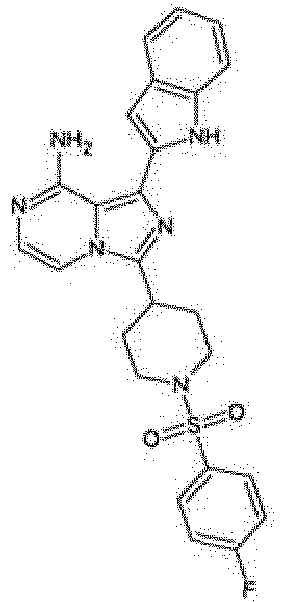
- Prepared according to the procedure described above for EXAMPLE 59, except using 4-fluorobenzenesulfonyl chloride in place of nbutanesulfonyl chloride. MS (ES+): m/z 491.15 [MH+].
-

- Prepared according to the procedure described above for EXAMPLE 59, except using 2,5-dimethoxybenzenesulfonyl chloride in place of nbutanesulfonyl chloride. MS (ES+): m/z 533.17 [MH+].
-

- Prepared according to the procedure described above for EXAMPLE 59, except using 4-methylbenzenesulfonyl chloride in place of nbutanesulfonyl chloride. MS (ES+): m/z 487.94 [MH+].
-

- Prepared according to the procedure described above for EXAMPLE 59, except using 3-fluorobenzenesulfonyl chloride in place of nbutanesulfonyl chloride. MS (ES+): m/z 491.92 [MH+].
-

- 3-Cyclobutyl-1-[1-(2-trimethylsilylethoxymethyl)-1H-pyrrolo[2,3-b]pyridin-2-yl]imidazo[1,5-a]pyrazin-8-amine (35mg, 0.08mmol) was stirred with concentrated HC1 for 15min. The mixture was then concentrated in vacuo and purified via mass directed preparative HPLC to afford the title compound. 1H NMR (400 MHz DMSO-d6) δ 1.92 - 2.00 (m, 1H), 2.07 - 2.14 (m, 1H), 2.43 - 2.47 (m, 4H), 3.93 - 4.01 (m, 1H), 6.35 - 6.49 (bs, 2H), 6.64 - 6.70 (m, 1H), 7.03 - 7.10 (m, 2H), 7.39 - 7.49 (m, 1H), 7.95 - 8.00 (m, 1H), 8.18 - 8.23 (m, 1H), 11.91 (bs, 1H). MS (ES+): m/z: 305.17 [MH+].
-

- Starting from trans-methyl 4-(8-chloroimidazo[1,5-a]pyrazin-3-yl)cyclohexanecarboxylate, the title compound was prepared according to procedures analogous to those described for EXAMPLE 10. 1H NMR (d6-DMSO, 400 MHz): δ 11.42 (br s, 1H), 7.70 (d, J = 4.0 Hz, 1M, 7.58 (d, J = 8.0 Hz, 1H), 7.46 (d, J = 8.0 Hz, 1H), 7.30-6.90 (m, 3H), 6.63 (br s, MHz, 6.44 (br s, 1H), 3.64 (s, 3H), 3.18 (m, 1H), 2.44 (m, 1H), 2.03 (m, 4H), 1.80-1.50 (m, 4H). MS (ES+): m/z 390.28 [MH+].
-
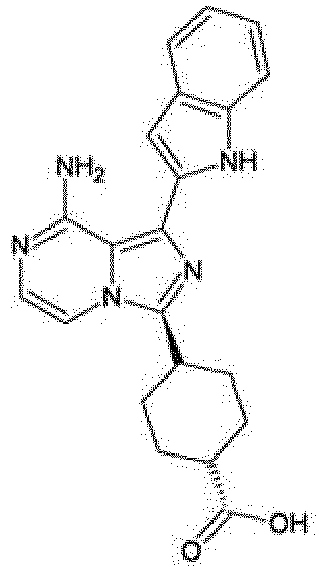
- A mixture of 37% HCl (30 mL) and methyl trans-(8-amino-1-(1H-indol-2-yl)imidazo[1,5-a]pyrazin-3-yl)cyclohexanecarboxylate (500.0mg, 1.28mmol) was stirred for 18h at rt. The reaction mixture was then concentrated in vacuo, and the residue washed with diethyl ether (3 x 10mL) and ethyl acetate (2 x 10mL), then with ice-cold acetonitrile (10mL) to afford 0.3g of the desired product. 1H NMR (d6-DMSO, 400 MHz): δ 12.15 (br s, 1H), 11.69 (s, 1H), 8.45 (br s, 2H), 7.97 (d, J= 6.4 Hz, 1H), 7.63 (d, J = 8.0 Hz, 1H), 7.50 (dd, J= 8.0, 0.4 Hz, 1H), 7.19 (m, 1H), 7.13 (d, J = 6.0 Hz, 1H), 7.06 (m, 1H), 6.83 (d, J = 1.6 Hz, 1H), 3.27 (td, J = 11.6, 3.2, 3.2 Hz, 1H), 2.33 (td, J = 10.8, 3.2, 3.2 Hz, 1H), 2.05 (m, 4H), 1.73 (m, 2H) and 1.58 (mz, 2H). MS (ES+): m/z 376.05 [MH+].
-

- A suspension of 3-aminopyridine (40mg, 0.43mmol) in toluene (1.3mL) was treated with a 2M toluene solution of trimethylaluminum (0.3mL, 0.60mmol). After 25min, the resulting solution was treated with methyl trans-4-(8-amino-1-(1H-indol-2-yl)imidazo[1,5-a]pyrazin-3-yl)cyclohexanecarboxylate (30mg, 0.08mol) and the mixture stirred at rt overnight. The mixture was then stirred with 2M NaOH (20 mL) and ethyl acetate (20mL) for 10min., then the organic phase was separated and the aqueous extracted EtOAc (3x15mL). The combined organic extracts were washed with water (20mL) and brine (20mL), then dried over Na2SO4 and concentrated in vacuo to give crude product which was subjected to mass-directed preparative HPLC to afford pure desired product. 1H NMR (d6-DMSO, 400 MHz): δ 11.45 (br s, 1H), 10.12 (s, 1H), 8.77 (d, J= 2.4 Hz, 1H), 8.25 (d, J = 4.8 Hz, 1H), 8.14 (s, 1H), 8.08 (dd, J= 8.0, 1.6 Hz, 1H), 7.71 (d, J= 5.2 Hz, 1H), 7.59 (d, J = 7.6 Hz, 1H), 7.46 (d, J= 8.4 Hz, 1H), 7.34 (m, 1H), 7.15-7.00 (m, 3H), 6.65 (s, 1H), 6.42 (br s, 2H), 3.22 (m, 1H), 2.47 (m, 1H), 2.15-1.95 (m, 4H), and 1.85-1.65 (m, 4H). MS (ES+): m/z 452.17 [MH+].
-

- Prepared according to the procedure described above for EXAMPLE 68, except using 2-aminopyridine in place of 3-aminopyridine. MS (ES+): m/z 452.17 [MH+].
-

- Prepared according to the procedure described above for EXAMPLE 68, except using aniline in place of 3-aminopyridine. MS (ES+): m/z 451.16 [MH+].
-

- trans-4-(8-Amino-1-iodoimidazo[1,5-a]pyrazin-3-yl)cyclohexanecarboxamide (40mg, 0.10mmol), 1-(tert-butoxycarbonyl)-1H-indole-2-boronic acid (33mg, 0.12mmol), and sodium carbonate (33mg, 0.31mmol) were added to DME:Water (5:1) (2mL) and the mixture degassed with Argon for 10min. Tetrakis(triphenylphosphine)palladium(0) (8.0mg, 0.007mmol) was then added and the reaction mixture microwaved at 110°C for 1h, The mixture was concentrated in vacuo, taken up in DMSO, and purified by mass-directed preparative HPLC to afford desired product. 1H NMR (d6-DMSO, 400 MHz): □ 11.50 (br s, 1H), 7.72 (m, 1H), 7.58 (m, 1H), 7.46 (dd, J = 7.6, 0.4 Hz, 1H), 7.25 (br s, 1H), 7.13 (m, 1H), 7.08-7.00 (m, 2H), 6.70 (br s, 1H), 6.69 (br s, 1H), 3.16 (m, 1H), 2.20 (m, 1H), 2.10-1.80 (m, 4H) and 1.65 (m, 4H). MS (ES+): m/z 375.17 [MH+].
-

- Ethylamine hydrochloride (30 mg, 0.37mmol), 2-(1H-benzotriazol-1-yl)-1,1,3,3-tetramethyluronium tetrafluoroborate (35mg, 0.11mmol), and N,N-diisopropylethylamine (80µL, 0.53mmol) were added to a solution of trans-4-(8-Amino-1-(1H-indol-2-yl)imidazo[1,5-a]pyrazin-3-yl)cyclohexanecarboxylic acid (25mg, 0.07mmol) in anhydrous DMF (2mL). Upon completion of reaction (as monitored by LCMS), the mixture was added to a saturated aqueous sodium bicarbonate solution (10mL). The resulting precipitate was collected by filtration and washed with cold acetonitrile (3 x 10mL) to afford 13mg of the desired product. 1H NMR (d6-DMSO, 400 MHz): δ 11.41 (br s, 1H), 7.75 (dd, J = 4.0, 4.0Hz, 1H), 7.69 (d, J = 4.0Hz, 1H), 7.58 (d, J = 8.0, 4.0Hz, 1H), 7.45 (d, J= 4.0, 4.0Hz, 1H), 7.12 (dd, J = 8.0, 8.0 Hz, 1H), 7.08-7.00 (m, 2H), 6.63 (m, 1H), 6.43 (br s, 2H), 3.16 (m, 1H), 3.07 (m, 2H), 2.18 (m, 1H), 2.02 (m, 2H), 1.84 (m, 2H), 1.66 (m, 4H) and 1.02 (t, J= 4.0 Hz, 3H). MS (ES+): m/z 403.09 [MH+].
-

- Prepared according to the procedure described above for EXAMPLE 72, except using cyclopropylamine in place of ethylamine. MS (ES+): m/z 415.22 [MH+].
-

- A mixture of benzyl {[trans-4-(8-amino-1-iodoimidazo[1,5-a]pyrazin-3-yl)cyclohexyl]methyl}carbamate (1.00g, 0.00180mol), 1-(tert-butoxycarbonyl)-1H-indole-2-boronic acid (0.517g, 0.00198mol), 1,2-dimethoxyethane (7.7mL), water (1.4mL, 0.081mol) and Cesium Carbonate (1.17g, 0.00360mol) degassed three times, treated with tetrakis (triphenylphosphine)palladium(0) (200mg, 0.0002mol) and degassed once more. The resulting mixture was heated at 100°C overnight before being diluted with EtOAc (40mL), washed with water (2 X 30mL) and brine (20mL) then dried over Na2SO4 and concentrated in vacuo. The crude product thus isolated was chromatographed over silica gel eluting with hexane → EtOAc: hexane: 5% 2M NH3 in MeOH 1:1:0.05 to afford the title compound. 1H NMR (400 MHz, CDCl3): δ 1.13-1.22 (m, 2H), 1.75-1.86 (m, 2H), 1.94-1.97 (m, 2H), 2.11-2.13 (m, 2H), 2.86 (m, 1H), 3.12-3.16 (m, 2H), 4.82 (m, 1H), 5.12 (s, 2H), 5.69 (br, 2H), 6.78 (s, 1H), 7.13-7.15 (m, 2H), 7.19-7.25 (m, 2H), 7.32-7.38 (m, 5H), 7.42 (d, J = 8.0 Hz, 1H), 7.64 (d, J = 8.4 Hz, 1H), 9.09 (br, 1H). MS (ES+): m/z 495 [MH+].
-

- Prepared according to the procedure described above for EXAMPLE 22, except using 2-furoic acid in place of acetic acid. MS (ES+): m/z 455.20 [MH+].
-

- Prepared according to the procedure described above for EXAMPLE 22, except using benzoic acid in place of acetic acid. MS (ES+): m/z 465.25 [MH+].
-

- Prepared according to the procedure described above for EXAMPLE 22, except using cyclobutanecarboxylic acid in place of acetic acid. MS (ES+): m/z 443.25 [MH+].
-

- Prepared according to the procedure described above for EXAMPLE 22, except using 3,5-dimethoxybenzoic acid in place of acetic acid. MS (ES+): m/z 525.35 [MH+].
-

- Prepared according to the procedure described above for EXAMPLE 22, except using 2,4-dimethoxybenzoic acid in place of acetic acid. MS (ES+): m/z 525.33 [MH+].
-

- Prepared according to the procedure described above for EXAMPLE 22, except using formic acid in place of acetic acid. MS (ES+): m/z 389.10 [MH+].
-
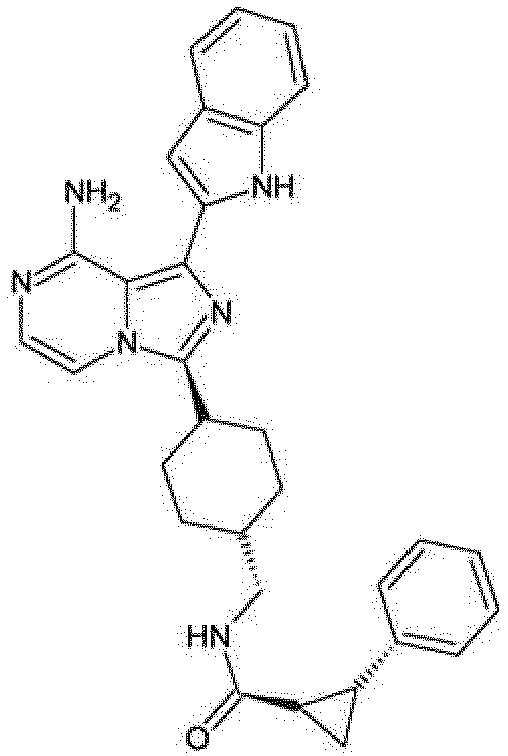
- Prepared according to the procedure described above for EXAMPLE 22, except using (1R,2R)-2-phenylcyclopropanecarboxylic acid in place of acetic acid. MS (ES+): m/z 505.30 [MH+].
-

- Prepared according to the procedure described above for EXAMPLE 22, except using 3-chloro-6-fluorobenzo[b]thiophene-2-carboxylic acid in place of acetic acid. MS (ES+): m/z 573.35 & 575.31 [MH+].
-

- Prepared according to the procedure described above for EXAMPLE 22, except using isoquinoline-2-carboxylic acid in place of acetic acid. MS (ES+): m/z 516.40 [MH+].
-

- Prepared according to the procedure described above for EXAMPLE 22, except using indole-3-carboxylic acid in place of acetic acid. MS (ES+): m/z 505.46 [MH+].
-

- Prepared according to the procedure described above for EXAMPLE 2, except using 1-(tert-butoxycarbonyl)-4-chloro-1H-indole-2-boronic acid in place of 1-(tert-butoxycarbonyl)-1H-indole-2-boronic acid. 1H NMR (400 MHz - DMSO-d6) δ 1.91 - 1.98 (m, 1H), 2.08 - 2.15 (m, 1H), 2.42 - 2.46 (m, 4H), 3.97 - 4.00 (m, 1H), 6.42 (bs, 2H), 6.67 (s, 1H), 7.09 - 7.14 (m, 3H), 7.43 - 7.47 (m, 2H) and 11.83 (bs, 1H). MS (ES+): m/z 338.26 [MH+].
-

- Prepared according to the procedure described above for EXAMPLE 2, except using 4-methoxyphenylcyclopropanecarboxylic acid in place of cyclobutanecarboxylic acid. 1H NMR (400 MHz, CHLOROFORM-d) δ ppm 1.46 (s, 2 H), 1.58 (s, 2 H), 3.76 (s, 3 H), 6.78 (d, J=8.80 Hz, 2 H), 6.77 (s, 1 H), 6.82 (s, 1 H), 6.98 (d, J=5.13 Hz, 1 H), 7.03 (d, J=8.80 Hz, 2 H), 7.15 (t, J=7.52 Hz, 1 H), 7.23 (s, 2 H), 7.44 (d, J=8.07 Hz, 1 H), 7.65 (d, J=8.07 Hz, 1 H) and 9.36 (br. s., 1 H). MS (ES+): m/z 396.15 [MH+].
-

- Prepared according to the procedure described above for EXAMPLE 59, except using propane-2-sulfonyl chloride in place of nbutanesulfonyl chloride. MS (ES+): m/z 439.06 [MH+].
-

- Prepared according to the procedure described above for EXAMPLE 59, except using benzenesulfonyl chloride in place of nbutanesulfonyl chloride. MS (ES+): m/z 473.29 [MH+].
-

- Prepared according to the procedure described above for EXAMPLE 59, except using 3,3,3-trifluoropropane-1-sulfonyl chloride in place of nbutanesulfonyl chloride. MS (ES+): m/z 493.19 [MH+].
-

- Prepared according to the procedure described above for EXAMPLE 72, except using (1S)-1-phenylethanamine in place of cyclopropylamine. MS (ES+): m/z 479.11 [MH+].
-

- Prepared according to the procedure described above for EXAMPLE 22, except using 3-bromophenylacetic acid in place of acetic acid. MS (ES+): m/z 557.21 and 559.20 [MH+].
-

- Prepared according to the procedure described above for EXAMPLE 22, except using (2,6-dichloro-5-fluoropyridin-3-yl)acetic acid in place of acetic acid. MS (ES+): m/z 522.21 [MH+].
-
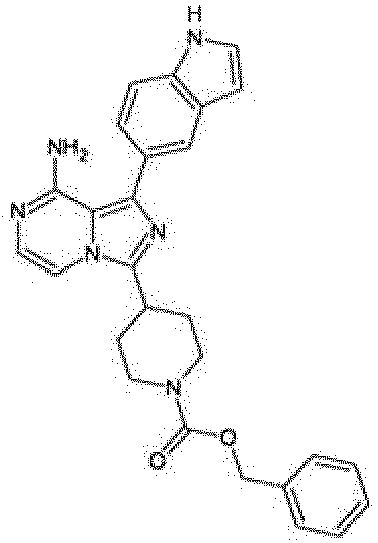
- Prepared according to the procedure described above for EXAMPLE 24, except using indole-5-boronic acid in place of 1-(tert-butoxycarbonyl)-1H-indole-2-boronic acid. MS (ES+): m/z 494.97 [MH+].
-

- Prepared according to the procedure described above for EXAMPLE 68, except using 2-aminobenzimidazole in place of 3-aminopyridine. MS (ES+): m/z 490.97 [MH+].
-

- A solution of 1-(1H-Indol-2-yl)-3-piperidin-4-ylimidazo[1,5-a]pyrazin-8-amine hydrochloride (30mg, 0.09mmol), 2-formylquinoline (17mg, 0.11 mmol) and triethylamine (0.019mL, 0.14mmol) in 1,4-dioxane (1mL) was treated with sodium cyanoborohydride (5.7mg, 0.090mmol) and microwaved at 300 watts, 120°C for 20min. The mixture was concentrated in vacuo, the residue was dissolved in methanol loaded onto an SCX ion exchange cartridge, and then eluted with 1M NH4OH in methanol. The semi-pure material thus obtained was then subjected to semi-preparative HPLC to afford desired product. 1H NMR (400 MHz, MeOD) δ ppm 2.13 - 2.33 (m, 4 H), 2.90 (t, J=10.86, 9.60 Hz, 2 H), 3.47 (d, J=10.11 Hz, 2 H), 4.29 (s, 2 H), 6.74 (s, 1 H), 7.02 - 7.11 (m, 2 H), 7.19 (t,J=8.08, 7.07 Hz, 1 H), 7.47 (d, J=9.09 Hz, 1 H), 7.58 - 7.65 (m, 3 H), 7.69 (d, J=8.59 Hz, 1 H), 7.80 (t, J=8.34, 6.82 Hz, 1 H), 7.96 (d, J=7.33 Hz, 1 H), 8.08 (d, J=8.34 Hz, 1H) and 8.39 (d, J=8.59 Hz, 1 H). MS (ES+): m/z 474.23 [MH+].
-

- Prepared according to the procedure described above for EXAMPLE 59, except using thiophene-2-sulfonyl chloride in place of nbutanesulfonyl chloride. MS (ES+): m/z 479.16 [MH+].
-
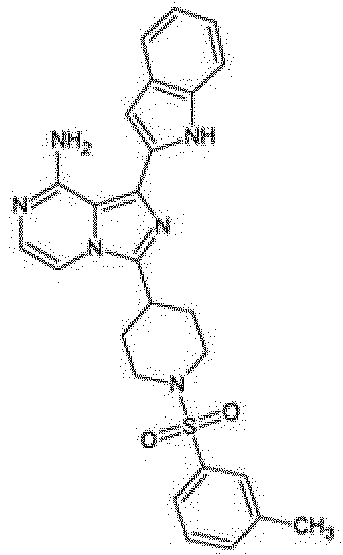
- Prepared according to the procedure described above for EXAMPLE 59, except using 3-methylbenzenesulfonyl chloride in place of nbutanesulfonyl chloride. MS (ES+): m/z 487.94 [MH+].
-

- Prepared according to the procedure described above for EXAMPLE 59, except using 1-methyl-1H-imidazole-4-sulfonyl chloride in place of nbutanesulfonyl chloride. MS (ES+): m/z 477.20 [MH+].
- The following examples were prepared according to procedures analogous to those described above, utilizing where necessary known literature chemistries. Examples 99-131, 133-241, 243-334, and 363-371 are comparative.
Ex # Structure MH+ Ex # Structure MH+ 99 
500.93 502.91 100 
433.06 101 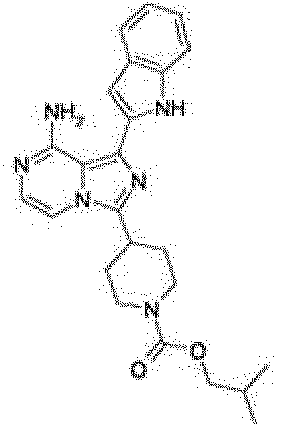
433.02 102 
404.96 103 
474.23 104 
483.00 105 
483.27 106 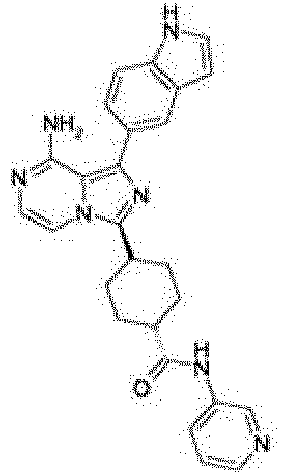
452.04 107 
514.92 108 
500.89 109 
492.92 110 
447.01 111 
498.93 112 
456.90 500.90 113 
420.97 114 
496.91 115 
488.91 116 
475.91 117 
468.84 118 
426.99 119 
461.00 120 
320.86 121 
391.23 122 
490.97 123 
493.18 124 
487.09 125 
459.01 126 
446.15 127 
452.98 128 
451.97 129 
481.95 130 
470.00 131 
535.91 132 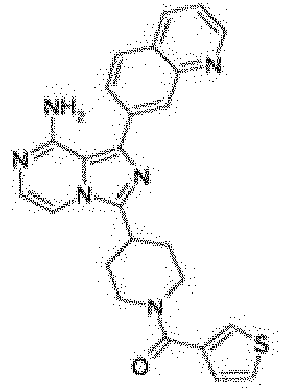
454.97 133 
448.02 134 
318.03 135 
470.96 136 
475.92 137 
475.92 138 
457.08 139 
426.92 140 
521.03 523.08 141 
427.05 142 
457.02 143 
444.20 144 
425.91 145 
376.98 146 
337.97 339.92 147 
304.95 148 
452.95 149 
305.20 150 
389.83 151 
426.97 152 
456.79 153 
443.97 154 
475.94 155 
492.76 156 
475.85 157 
460.13 158 
375.98 159 
466.97 160 
451.98 161 
304.19 162 
405.02 163 
433.18 164 
532.90 165 
476.95 166 
410.02 167 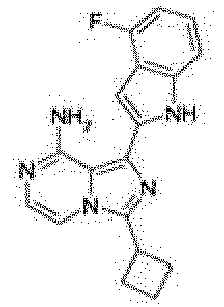
321.92 168 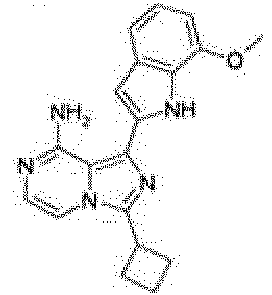
333.87 169 
381.83 170 
495.97 383.72 171 
465.96 232 
440.89 442.86 172 
468.84 233 
354.74 470.50 356.98 173 
480.20 234 
335.84 174 
452.97 235 
442.96 175 
466.20 236 
480.98 176 
339.92 237 
421.83 177 
426.91 238 
549.91 178 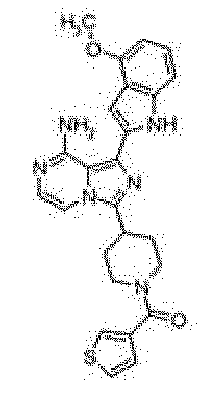
472.62 239 
480.02 179 
550.68 240 
419.89 552.50 180 
456.63 241 
467.92 181 
471.89 242 
420.97 182 
523.93 243 
487.97 183 
496.05 244 
319.00 184 
510.00 245 
405.03 185 
483.89 246 
499.95 501.96 186 
404.18 247 
423.83 425.93 187 
427.93 248 
409.95 411.90 188 
428.88 249 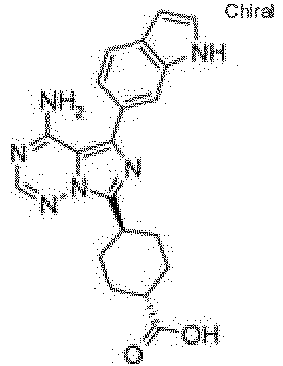
376.99 189 
460.66 250 
412.06 414.03 191 
548.72 251 
404.96 192 
456.86 252 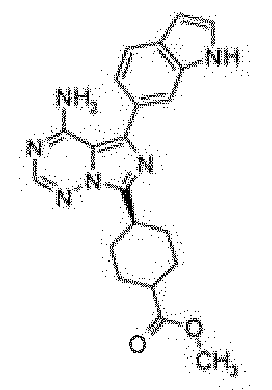
391.01 193 
525.25 253 
419.12 194 
467.21 254 
434.04 195 
486.96 255 
405.03 196 
470.97 256 
445.01 197 
444.00 257 
438.94 440.89 198 
363.89 258 
406.98 406.99 199 
403.07 259 
421.00 200 
458.97 260 
437.93 439.95 201 
500.96 261 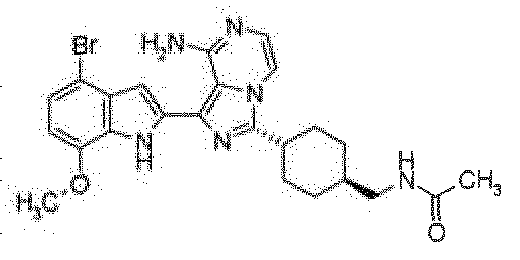
511.21 513.14 202 
500.94 262 
447.03 203 
362.03 263 
461.05 204 
473.95 264 
447.99 205 
335.06 265 
462.00 206 
433.07 266 
387.20 207 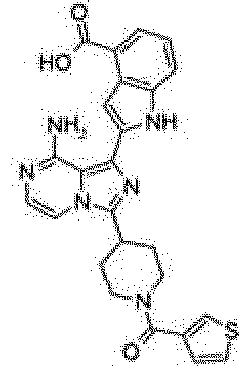
486.96 267 
432.06 208 
348.02 268 
434.02 434.06 209 
473.87 269 
437.97 439.95 210 
334.88 270 
468.95 211 
457.95 271 
423.97 425.93 212 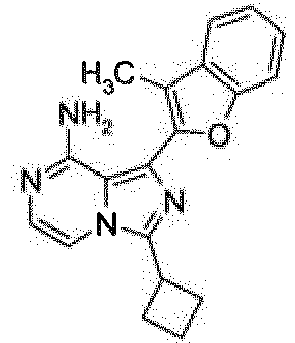
318.92 272 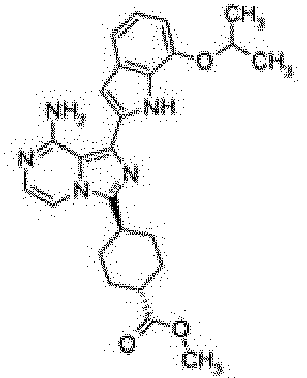
448.05 213 
475.02 273 
471.98 214 
425.17 274 
418.09 427.06 215 
518.83 275 
405.03 216 
379.87 276 
363.98 217 
439.19 277 
423.97 425.99 218 
526.77 278 
391.01 219 
483.04 279 
460.94 220 
520.89 280 
421.00 221 
436.98 281 
435.03 438.94 222 
425.93 282 
485.32 223 
411.13 283 
510.38 413.02 224 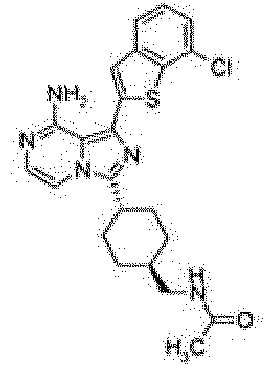
453.99 284 
406.29 225 
433.02 285 
404.21 226 
479.85 286 
420.53 227 
434.95 287 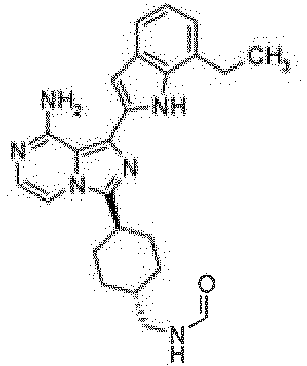
417.29 228 
417.21 288 
423.29 229 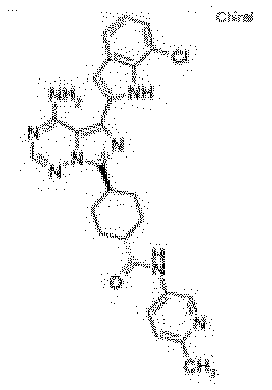
500.99 289 
455.11 502.88 457.09 230 
516.91 290 
497.93 518.90 231 
498.02 291 
424.04 425.99 292 
434.08 333 
406.35 406.42 293 
475.89 334 
501.31 294 
461.94 335 
487.44 295 
485.14 336 
420.15 487.10 420.18 296 
491.18 337 
411.06 413.07 297 
488.63 338 
471.35 298 
434.08 339 
454.07 456.03 299 
435.10 340 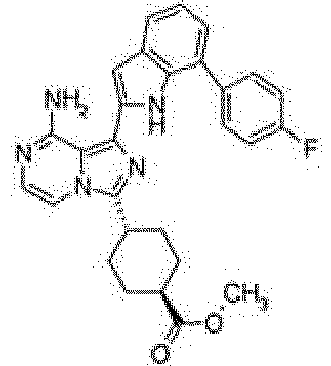
484.44 300 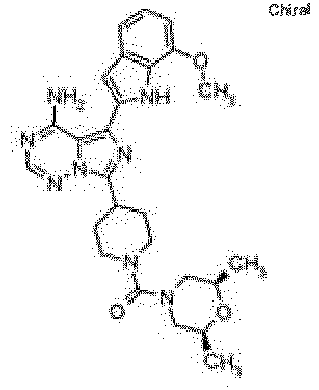
505.10 341 
470.41 301 
438.00 342 
469.46 302 
432.02 343 
409.35 303 
467.30 344 
416.17 304 
455.23 345 
485.39 305 
405.09 346 
444.10 306 
424.13 347 
471.41 426.23 307 
458.99 348 
404.04 406.06 308 
409.97 349 
404.27 411.96 406.29 309 
445 350 
469.39 445.1 310 
407.05 351 
401.39 311 
421.00 352 
444.16 312 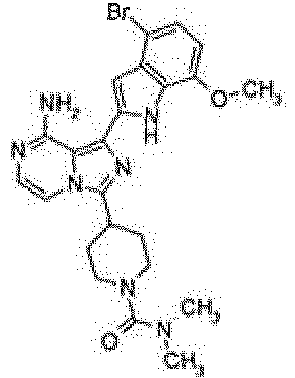
512.40 353 
481.12 483.14 313 
418.03 354 
415.17 314 
391.06 355 
400.09 315 
453.04 356 
425.34
427.33453.17 453.39 316 
474.95 357 
417.36 317 
457.08 358 
402.33 318 
457.95 359 
381.96 384.01 319 
482.96 360 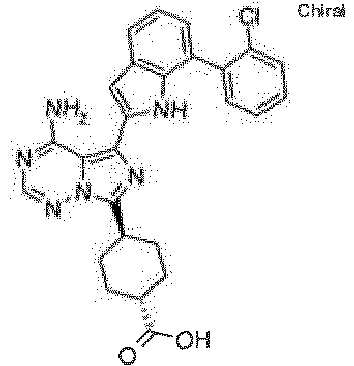
487.01 489.03 320 
483.90 361 
495.03 321 
390.02 362 
428.02 322 
463.08 363 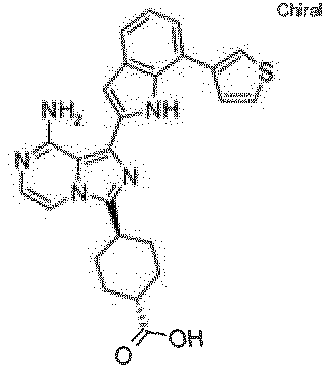
458.32 323 
460.09 364 
487.01 488.90 324 
480.21 365 
470.37 325 
471.11 366 
521.27 523.27 326 
455.94 367 
443.22 327 
486.20 368 
459.28 328 
436.23 369 
458.37 438.26 329 
432.02 370 
493.22 495.18 330 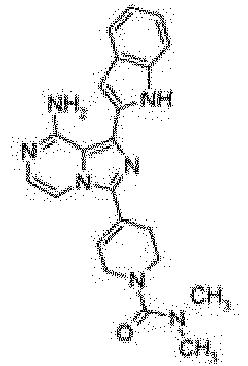
402.06 371 
471.03 331 
452.12 372 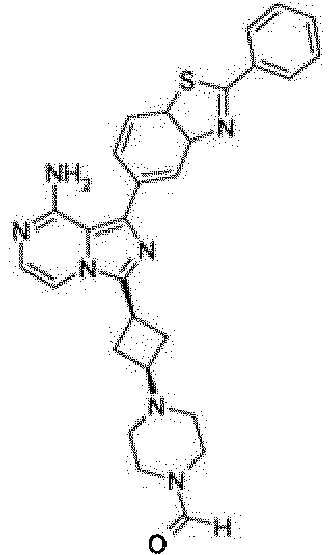
510.03 332 
434.25 373 
496.06 374 
501.45 375 
493.49 376 
507.46 377 
569.56 378 
507.46 379 
521.50 380 
583.53 381 
425.39 382 
439.42 383 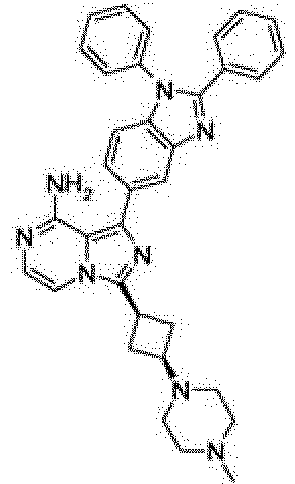
555.55 384 
569.55 - The following compounds are expected to be active as inhibitors of mTOR. Where shown, X can be N or CH.


Claims (14)
- A compound represented by Formula (I)
 X1 is C-(E1)aa;X2 is N or C-(E1)aa,X3 and X5 are N;X4, X6, and X7 are C;R3 is C0-10alkyl, cycloC3-10alkyl, aminomethylcycloC3-10alkyl, bicycloC5-10alkyl, aryl, heteroaryl, aralkyl, heteroaralkyl, heterocyclyl or heterobicycloC5-10alkyl any of which is optionally substituted by one or more independent G11 substituents;Q1 is -A(R1)mB(W)n or -B(G11)nA(Y)m;A and B are respectively, 5 and 6 membered aromatic or heteroaromatic rings, fused together to form a 9-membered heteroaromatic system excluding indolyl, benzimidazolyl, benzoxazolyl, benzofuranyl, benzothienyl, 5-benzo[b]furyl and 3-indolyl;R1 is independently, hydrogen, -N(C0-8alkyl)(C0-8alkyl), hydroxyl, halogen, oxo, aryl(optionally substituted with 1 or more R31 groups), hetaryl(optionally substituted with 1 or more R31 groups), C1-6alkyl, -C0-8alkylC3-8cycloalkyl, -C0-8alkyl-NR311S(O)0-2R21, -C0-8alkyl-NR311S(O)0-2NR321R331, -C0-8alkyl-S(O)0-2NR311R321, -C0-8alkyl-NR311COR321, -C0-8alkyl-NR311CO2R321, -C0-8alkyl-NR311CONR321R331, -C0-8alkyl-CONR311R321, -C0-8alkyl-CON(R311)S(O)0-2R321, -C0-8alkyl-CO2R311, -C0-8alkyl-S(O)0-2R311, -C0-8alkyl-O-C1-8alkyl, -C0-8alkyl-O-C0-8alkylC3-8cycloalkyl, -C0-8alkyl-O-C0-8alkylheterocyclyl, -C0-8alkyl-O-C0-8alkylaryl, -C0-8alkylaryl, -C0-8alkylhetaryl, -C0-8alkylheterocyclyl, -C0-8alkyl-O-C0-8alkylhetaryl, -C0-8alkyl-S-C0-8alkyl, -C0-8alkyl-S-C0-8alkylC3-8cycloalkyl, -C0-8alkyl-S-C0-8alkylheterocyclyl, -C0-8alkyl-S-C0-8alkylaryl, -C0-8alkyl-S-C0-8alkylhetaryl, - C0-8alkyl-N(R311)-C0-8alkyl, -C0-8alkyl-N(R311)-C0-8alkylC3-8cycloalkyl, -C0-8alkyl-N(R311)-C0-8alkylheterocyclyl, -C0-8alkyl-N(R311)-C0-8alkylaryl, -C0-8alkyl-N(R311)-C0-8alkylhetaryl, -C0-8alkyl-NR311R321, -C2-8alkenyl, -C2-8alkynyl, NO2, CN, CF3, OCF3, OCHF2; provided that Q1 is not N-methyl-2-indolyl, N-(phenylsulfonyl)-2-indolyl, or N-tert-butoxycarbonyl;W is independently, hydrogen, -N(C0-8alkyl)(C0-8alkyl), hydroxyl, halogen, oxo, aryl(optionally substituted with 1 or more R31 groups), hetaryl(optionally substituted with 1 or more R31 groups), C1-6alkyl, -C0-8alkylC3-8cycloalkyl, -C0-8alkyl-NR312S(O)0-2R322, -C0-8alkyl-NR311S(O)0-2NR321R331, -C0-8alkyl-NR311CO2R321, -C0-8alkyl-CON(R311)S(O)0-2R321, -C0-8alkyl-S(O)0-2NR312R322, -C0-8alkyl-NR312COR322, -C0-8alkyl-NR312CONR322R332, -C0-8alkyl-CONR312R322, -C0-8alkyl-CO2R312, -C0-8alkylS(O)0-2R312, -C0-8alkyl-O-C1-8alkyl, -C0-8alkyl-O-C0-8alkylcyclyl, -C0-8alkyl-O-C0-8alkylheterocycloalkyl, -C0-8alkyl-O-C0-8alkylaryl, -C0-8alkylaryl, -C0-8alkylhetaryl, -C0-8alkylheterocyclyl, -Oaryl, -C0-8alkyl-O-C0-8alkylhetaryl, -C0-8alkyl-S-C0-8alkyl, -C0-8alkyl-S-C0-8alkylC3-8cycloalkyl, -C0-8alkyl-S-C0-8alkylheterocycloalkyl, -C0-8alkyl-S-C0-8alkylaryl, -C0-8alkyl-S-C0-8alkylhetaryl, -C0-8alkyl-N(R312)-C0-8alkyl, -C0-8alkyl-N(R312)-C0-8alkyl-C3-8cycloalkyl, -C0-8alkyl-N(R312)-C0-8alkylheterocycloalkyl,-C0-8alkyl-N(R312)-C0-8alkylaryl, -C0-8alkyl-N(R312)-C0-8alkylhetaryl, C0-8alkyl-NR312R322, -C2-8alkenyl, -C2-8alkynyl, NO2, CN, CF3, OCF3, OCHF2; Y is independently, hydrogen, N(C0-8alkyl)(C0-8alkyl), hydroxyl, halogen, oxo, aryl(optionally substituted with 1 or more R31 groups), hetaryl(optionally substituted with 1 or more R31 groups), C0-6alkyl, -C0-8alkylC3-8cycloalkyl, -C0-8alkyl-NR311S(O)0-2R321, -C0-8alkyl-NR311S(O)0-2NR321R331, -C0-8alkyl-NR311CO2R321, -C0-8alkyl-CON(R311)S(O)0-2R321, -C0-8alkyl-S(O)0-2NR311R321, -C0-8alkyl-NR311COR321, -C0-8alkyl-NR311CONR321R331, -C0-8alkyl-CONR311R321, -C0-8alkyl-CO2R311, -C0-8alkylS(O)0-2R311, -C0-8alkyl-O-C1-8alkyl, -C0-8alkyl-O-C0-8alkylC3-8cycloalkyl, -C0-8alkyl-O-C0-8alkylheterocycloalkyl, -C0-8alkyl-O-C0-8alkylaxyl, -C0-8alkylaryl, -C0-8alkylhetaryl, -C0-8alkylheterocyclyl, -C0-8alkyl-O-C0-8alkylhetaryl, -C0-8alkyl-S-C0-8alkyl, -C0-8alkyl-S-C0-8alkylC3-8cycloalkyl, -C0-8alkyl-S-C0-8alkylheterocycloalkyl, -C0-8alkyl-S-C0-8alkylaryl, -C0-8alkyl-S-C0-8alkylhetaryl, -C0-8alkyl-N-(R311)-C0-8alkyl, -C0-8alkyl-N(R311)-C0-8alkylC3-8cycloalkyl, -C0-8alkyl-N(R311)-C0-8alkylheterocycloalkyl, -C0-8alkyl-N(R311)-C0-8alkylaryl, -C0-8alkyl-N(R311)-C0-8alkylhetaryl, -C0-8alkyl-NR311R321, -C2-8alkenyl, -C2-8alkynyl, NO2, CN, CF3, OCF3, OCHF2; G11 is halo, oxo, -CF3, -OCF3, -OR312, -NR312R322, -C(O)R312, -C(O)C3-8cycloalkyl, -CO2C3-8cycloalkyl, -CO2R312, -C(=O)NR312R322, -NO2, -CN, -S(O)0-2R312, -SO2NR312R322, NR312(C=O)R322, NR312C(=O)OR322, NR312C(=O)NR322R332, NR312S(O)0-2R322, -C(=S)OR312, -C(=O)SR312, -NR312C(=NR322)NR332R341, -NR312C(=NR322)OR332, -NR312C(=NR322)SR332, -OC(=O)OR312, -OC(=O)NR312R322, -OC(=O)SR312, -SC(=O)OR312, -SC(=O)NR312R322, -P(O)OR312OR322, C1-10alkylidene, C0-10alkyl, C2-10alkenyl, C2-10alkynyl, -C1-10alkoxyC1-10alkyl, -C1-10alkoxyC2-10alkenyl, -C1-10alkoxyC2-10alkynyl, -C1-10alkylthioC1-10alkyl, -C1-10alkylthioC2-10alkenyl, -C1-10alkylthioC2-10alkynyl, cycloC3-8alkyl, cycloC3-8alkenyl, -cycloC3-8alkylC1-10alkyl, -cycloC3-8alkenylC1-10alkyl, -cycloC3-8alkylC2-10alkenyl, -cycloC3-8alkenylC2-10alkenyl, -cycloC3-8alkylC2-10alkynyl, -cycloC3-8alkenylC2-10alkynyl, -heterocyclyl-C0-10alkyl, -heterocyclyl-C2-10alkenyl, or -heterocyclyl-C2-10alkynyl, any of which is optionally substituted with one or more independent halo, oxo, -CF3, -OCF3, -OR313, -NR313R323, -C(O)R313, -CO2R313, -C(=O)NR313R323, -NO2, -CN, -S(O)0-2R313, -SO2NR313R323, -N313C(=O)R323, -NR313C(=O)OR323, -NR313C(=O)NR323R333, -NR313S(O)0-2R323, -C(=S)OR313, -C(=O)SR313, -NR313C(=NR323)NR333R342, -NR313C(=NR323)OR333, -NR313C(=NR323)SR333, -OC(=O)OR333, -OC(=O)NR313R323, -OC(=O)SR313, -SC(=O)OR313, -P(O)OR313OR323, or -SC(=O)NR313R323 substituents;or G11 is aryl-C0-10alkyl, aryl-C2-10alkenyl, aryl-C2-10alkynyl, hetaryl-C0-10alkyl, hetaryl-C2-10alkenyl, or hetaryl-C2-10alkynyl, where the attachment point is from either the left or right as written, where any of which is optionally substituted with one or more independent halo, -CF3, -OCF3, -OR313, -NR313R323, -C(O)R313, -CO2R313, -C(=O)NR313R323, -NO2, -CN, -S(O)0-2R313, -SO2NR313R323, -NR313C(=O)R323, -NR313C(=O)OR323, -NR313C(=O)NR323R333, -NR313S(O)0-2R323, -C(=S)OR313, -C(=O)SR313, -NR323C(=NR313)NR333R342, -NR313C(=NR323)OR333, -NR313C(=NR323)SR333, -OC(=O)OR313, -OC(=O)NR313R323, -OC(=O)SR313, -SC(=O)OR313, -P(O)OR313OR323, or -SC(=O)NR313R323 substituents; provided that G11 is not N-CH2CO2H when R3 is 4-piperidinyl;R31, R32, R33, R311, R321, R331, R312, R322, R332, R341, R313, R323, R333, and R342, in each instance, is independentlyC0-8alkyl optionally substituted with an aryl, heterocyclyl or hetaryl substituent, or C0-8alkyl optionally substituted with 1-6 independent halo, -CON(C0-8alkyl)(C0-8alkyl), -CO(C0-8alkyl), -OC0-8alkyl, -Oaryl, -Ohetaryl, -Oheterocyclyl, -S(O)0-2aryl, -S(O)0-2hetaryl, -S(O)0-2heterocyclyl, -S(O)0-2C0-8alkyl, -N(C0-8alkyl)(C0-8alkyl), -N(C0-8alkyl )CON(C0-8alkyl)(C0-8alkyl), -N(C0-8alkyl)CO(C1-8alkyl), -N(C0-8alkyl)CO(C3-8cycloalkyl), -N(C0-8alkyl)CO2(C1-8alkyl), S(O)1-2N(C0-8alkyl)(C0-8alkyl), -NR11S(O)1-2(C0-8alkyl), -CON(C3-8cycloalkyl)(C3-8cycloalkyl), -CON(C0-8alkyl)(C3-8cycloalkyl), -N(C3-8cycloalkyl)CON(C0-8alkyl)(C0-8alkyl), -N(C3-8cycloalkyl)CON(C3-8cycloalkyl)(C0-8alkyl), -N(C0-8alkyl)CON(C3-8cycloakl)(C0-8alkyl), -N(C0-8alkyl)CO2(C3-8cycloalkyl), -N(C3-8cycloalkyl)CO2(C3-8cycloalkyl), S(O)1-2N(C0-8akl)(C3-8cycloalkyl), -NR11S(O)1-2(C3-8cycloalkyl), C2-8alkenyl, C2-8alkynyl, CN, CF3, OH, or optionally substituted aryl substituents; such that each of the above aryl, heterocyclyl, hetaryl, alkyl or cycloalkyl groups may be optionally, independently substituted with -N(C0-8alkyl)(C0-8alkyl), hydroxyl, halogen, oxo, aryl, hetaryl, C0-6alkyl, -C0-8alkylcyclyl, -C0-8alkyl-N(C0-8alkyl)-S(O)0-2-(C0-8alkyl), -C0-8alkyl-S(O)0-2-N(C0-8alkyl)(C0-8alkyl), -C0-8alkyl-N(C0-8alkyl)CO(C0-8alkyl), -C0-8alkyl-N(C0-8alkyl)CO-N(C0-8alkyl)(C0-8alkyl), -C0-8alkyl-CO-N(C0-8alkyl)(C0-8alkyl), -C1-8alkyl-CO2-(C0-8alkyl), -C0-8alkylS(O)0-2-(C0-8alkyl), -C0-8alkyl-O-C1-8alkyl, -C0-8alkyl-O-C0-8alkylcyclyl, -C0-8alkyl-O-C0-8alkylheterocyclyl, -CO-alkyl-O-C0-8alkylaryl, -C0-8alkyl-O-C0-8alkylhetaryl, -C0-8alkyl-S-C0-8alkyl, -C0-8alkyl-S-C0-8alkylcyclyl, -C0-8alkyl-S-C0-8alkylheterocyclyl, -C0-8alkyl-S-C0-8alkylaryl, -C0-8alkyl-S-C0-8alkylhetaryl, -C0-8alkyl-N(C0-8alkyl)-C0-8alkyl, -C0-8alkyl-N(C0-8alkyl)-C0-8alkylcyclyl, -C0-8alkyl-N(C0-8alkyl)-C0-8alkylheterocyclyl, -C0-8alkyl-N(C0-8alkyl)-C0-8alkylaryl, -C0-8alkyl-N(C0-8alkyl)-C0-8alkylhetaryl, -C2-8alkenyl, -C2-8akynyl, NO2, CN, CF3, OCF3, OCHF2,-C0-8alkyl-C3-8cycloalkyl,-C0-8alkyl-O-C0-8alkyl,-C0-8alkyl-N(C0-8alkyl)(C0-8alkyl),-C0-8alkyl-S(O)0-2-C0-8alkyl, orheterocyclyl optionally substituted with 1-4 independent C0-8alkyl, cyclyl, or substituted cyclyl substituents;E1 in each instance is independently halo, -CF3, -OCF3, -OR2, -NR31R32, -C(=O)R31, -CO2R31, -CONR31R32, -NO2, -CN, -S(O)0-2R31, -S(O)0-2NR31R32, -NR31C(=O)R32, -NR31C(=O)OR32, -NR31C(=0)NR32R33, -NR31S(O)0-2R32, -C(=S)OR31, -C(=O)SR31, -NR31C(=NR32)NR33R31, -NR31C(=NR2)OR33, -NR31C(=NR31)SR31, -OC(=O)OR31, -OC(=O)NR11R32, -OC(=O)SR31, -SC(=O)OR31, -SC(-O)NR31R32, C0-10alkyl, C2-10alkenyl, C2-10alkynyl, -C1-10alkoxyC1-10alkyl, -C1-10alkoxyC2-10alkenyl, -C1-10alkoxyC2-10alkynyl, -C1-10alkylthioC1-10alkyl, -C1-10alkylthioC2-10alkenyl, -C1-10alkylthioC2-10alkynyl, cycloC3-8alkyl, cycloC3-8alkenyl, -cycloC3-8alkylC1-10alkyl, -cycloC3-8alkenylC1-10alkyl, -cycloC3-8alkylC2-10alkenyl, -cycloC3-8alkenylC2-10alkenyl, -cycloC3-8alkylC2-10alkynyl, -cycloC3-8alkenylC2-10alkynyl, -heterocyclyl-C0-10alkyl, -heterocyclyl-C2-10alkenyl, or -heterocyclyl-C2-10alkynyl, any of which is optionally substituted with one or more independent halo, oxo, -CF3, -OCF3, -OR31, -NR31R32, -C(=O)R31, -CO2R31, -C(=O)NR31R32, -NO2, -CN, -S(=O)0-2R31, -SO2NR31, -NR31C(=O)R32, -NR31C(=O)OR31, -NR31C(=O)NR32R33, -NR31S(O)0-2R31, -C(=S)OR31, -C(=O)SR31, -NR31C(=NR32)NR33R31, -NR31C(=NR32)OR33, -NR31C(=NR32)SR33, -OC(=O)OR31, -OC(=O)NR31R32, -OC(=O)SR31, -SC(=O)OR31, or -SC(=O)NR31R32 substituents;or E1 in each instance is independently aryl-C0-10alkyl, aryl-C2-10alkenyl, aryl-C2-10alkynyl, hetaryl-C0-10alkyl, hetaryl-C2-10alkenyl, or hetaryl-C2-10alkynyl, where the attachment point is from either the left or right as written, where any of which is optionally substituted with one or more independent halo, -CF3, -OCHF3, -OR31, -NR31R32, -C(O)R31, -CO2R31, -C(=O)NR31R32, -NO2, -CN, -S(O)0-2R31, -S(O)0-2NR31R32, -NR31C(=O)R32, -NR31C(=O)OR32, -NR31C(=O)NR32R33, -NR31S(O)0-2R32, -C(=S)OR31, -C(=O)SR31, -NR31C(=NR32)NR33R31, -NR31C(=NR32)OR33, -NR31C(=NR32)SR33, -OC(=O)OR31, -OC(=O)NR31R32, -OC(=O)SR31, -SC(=O)OR31, or -SC(=O)NR31R32 substituents;in the cases of -NR31R32, -NR311R321, -NR312R322, -NR332R341, -NR313R323, and -NR323R333, the respective R31 and R32, R311 and R 321, R312 and R322, R331 and R341, R313 and R323 and R323 and R333 are optionally taken together with the nitrogen atom to which they are attached to form a 3-10 membered saturated or unsaturated ring; wherein said ring in each instance independently is optionally substituted by one or more independent -N(C0-8alkyl)(C0-8alkyl), hydroxyl, halogen, oxo, aryl, hetaryl, C0-6alkyl, -C0-8alkylC3-8cycloalkyl, -C0-8alkyl-N(C0-8alkyl)S(O)0-2C0-8alkyl, -C0-8alkyl-N(C0-8alkyl)S(O)0-2N(C0-8alkyl)( C0-8alkyl), -C0-8alkyl-N(C0-8alkyl)CO2(C0-8alkyl), -C0-8alkyl-CON((C0-8alkyl))S(O)0-2(C0-8alkyl), -C0-8alkyl-S(O)0-2N(C0-8alkyl)(C0-8alkyl), -C0-8alkyl-N(C0-8alkyl)CO(C0-8alkyl), -C0-8alkyl-N(C0-8alkyl)CON(C0-8alkyl)(C0-8alkyl), -C0-8alkyl-CON(C0-8alkyl)(C0-8alkyl), -C0-8alkyl-CO2(C0-8alkyl), -C0-8alkylS(O)0-2(C0-8alkyl), -C0-8alkyl-O-C0-8alkyl, -C0-8alkyl-O-C0-8alkylcyclyl, -C0-8alkyl-O-C0-8alkylheterocycloalkyl, -C0-8alkyl-O-C0-8alkylaryl, -Oaryl, -C0-8alkyl-O-C0-8alkylhetaryl, -C0-8alkyl-S-C0-8alkyl, -C0-8alkyl-S-C0-8alkylC3-8cycloalkyl, -C0-8alkyl-S-C0-8alkylheterocycloalkyl, -C0-8alkyl-S-C0-8alkylaryl, -C0-8alkyl-S-C0-8alkylhetaryl, -C0-8alkyl-N(C0-8alkyl)-C0-8alkyl, -C0-8alkyl-N(C0-8alkyl)-C0-8alkylC3-8cycloalkyl, -C0-8alkyl-N(C0-8alkyl)-C0-8alkylheterocycloalkyl, -C0-8alyl-N(C0-8alkyl)-C0-8alkylaryl, -C0-8alkyl-N(C0-8alkyl)-C0-8alkylhetaryl, -C0-8alkyl-N(C0-8alkyl)(C0-8alkyl), C2-8alkenyl, C2-8alkynyl, NO2, CN, CF3, OCF3, or OCHF2 substituents; wherein said ring in each instance independently optionally includes one or more heteroatoms other than the nitrogen;m is 0, 1, 2, or 3;n is 0, 1, 2, 3, or 4; andaa is 0 or 1;wherein C0 alkyl is hydrogen when the alkyl is a terminal group and is a direct bond when the alkyl is a bridging group.
 - The compound according to claim 1, or a pharmaceutically acceptable salt thereof, wherein X1 and X2 are CH; X3 and X5 are N; and X4, X6 and X7 are C
- The compound according to claim 1, or a pharmaceutically acceptable salt thereof, wherein X1 is CH; X.2, X3 and X5 are N; and X4, X6 and X7 are C.
- The compound according to any one of claims 1 to 3, or a pharmaceutically acceptable salt thereof, wherein Q1 is -A(R1)mB(W)n.
- The compound according to any one of claims 1 to 3, or a pharmaceutically acceptable salt thereof, wherein Q1 is -B(G11)nA(Y)m.
- The compound according to any one of claims 1 to 5, or a pharmaceutically acceptable salt thereof wherein A and B are respectively, 5 and 6 membered aromatic or heteroaromatic rings, fused together to form a 9-membered heteroaromatic system wherein the 5 and 6 membered heteroaromatic rings are selected from the group consisting of furyl, thienyl, pyrrolyl, pyrazolyl, imidazolyl, oxazolyl, isoxazolyl, thiazolyl, isothiazolyl, triazolyl, oxadiazolyl, thiadiazolyl, tetrazolyl, pyridyl, pyridazinyl, pyrimidinyl, pyrazinyl, and triazinyl.
- The compound according to any one of claims 1 to 5, or a pharmaceutically acceptable salt thereof, wherein Q1 is optionally substituted benzothiazole.
- A compound selected from the group consisting of oror a pharmaceutically acceptable salt thereof.
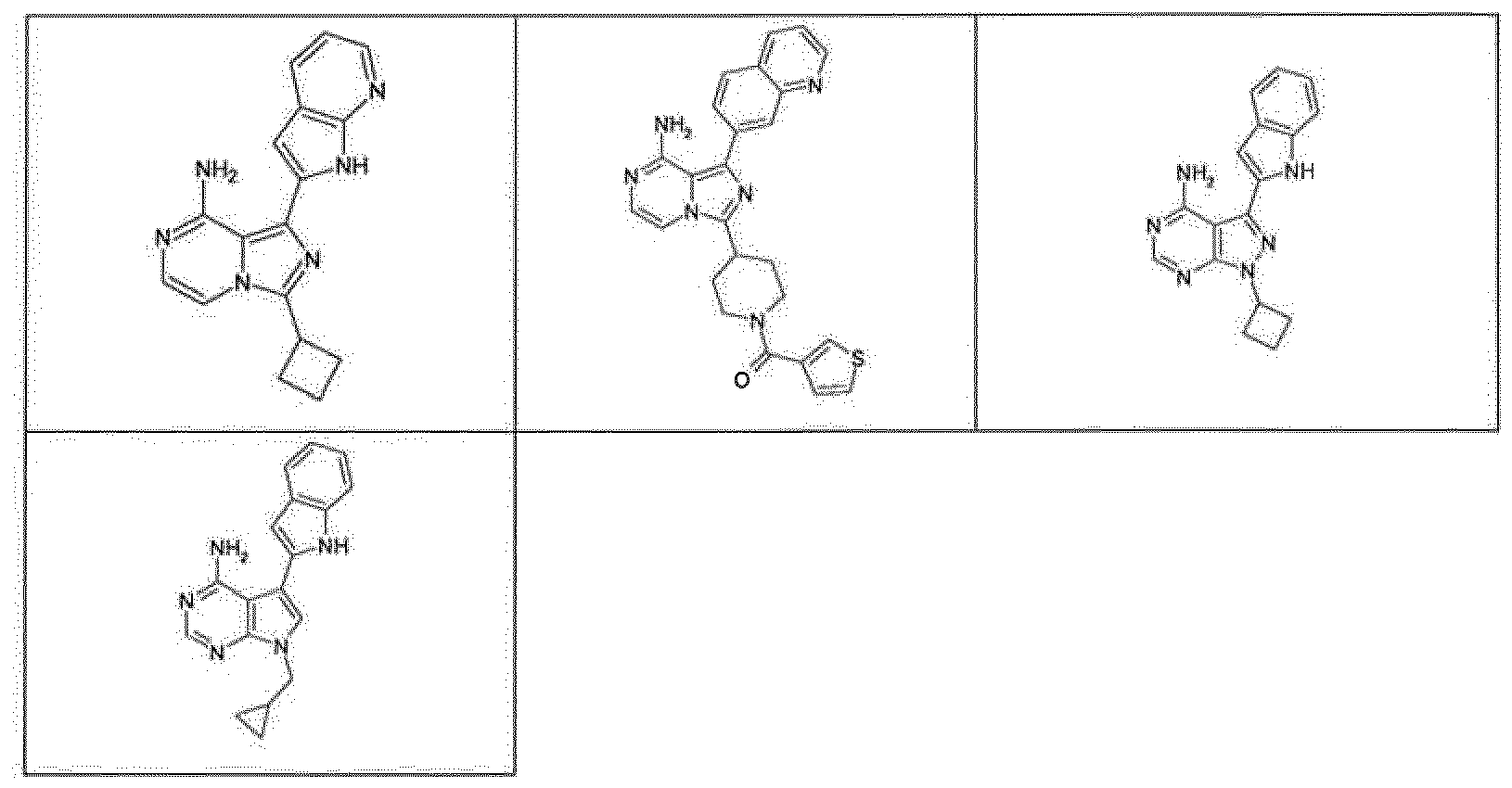
- A composition comprising a compound according to any of claims 1 to 8, or a pharmaceutically acceptable salt thereof, and a pharmaceutically acceptable carrier.
- A composition according to claim 9 or a pharmaceutically acceptable salt thereof; and an anti-neoplastic, anti-tumor, anti-angiogenic, or chemotherapeutic agent.
- A composition according to claim 9, or a pharmaceutically acceptable salt thereof, and a cytotoxic or angiogenesis inhibiting cancer therapeutic agent.
- The compound according to any of claims 1 to 8, or a pharmaceutically acceptable salt thereof for use in a method of treatment of hyperproliferative disorder, wherein preferably the hyperproliferative disorder is breast cancer, lung cancer, non-small cell lung cancer, kidney cancer, renal cell carcinoma, prostate cancer, cancer of the blood, liver cancer, ovarian cancer, thyroid cancer, cancer of the GI tract, lymphoma, renal cell carcinoma, mantle cell lymphoma, or endometrial cancer.
- The compound according to any of claims 1 to 8, or a pharmaceutically acceptable salt thereof for use in a method of treatment of rheumatoid arthritis, hamartoma syndromes, transplant rejection, atherosclerosis, IBD, multiple sclerosis or immunosuppression diseases.
- The compound according to claim 1, selected from the group consisting of or
 wherein X is N or CH;
or a pharmaceutically acceptable salt thereof.
Applications Claiming Priority (3)
| Application Number | Priority Date | Filing Date | Title |
|---|---|---|---|
| US73758105P | 2005-11-17 | 2005-11-17 | |
| US85424706P | 2006-10-25 | 2006-10-25 | |
| EP06837752A EP1951724B1 (en) | 2005-11-17 | 2006-11-15 | FUSED BICYCLIC mTOR INHIBITORS |
Related Parent Applications (2)
| Application Number | Title | Priority Date | Filing Date |
|---|---|---|---|
| EP06837752.2 Division | 2006-11-15 | ||
| EP06837752A Division EP1951724B1 (en) | 2005-11-17 | 2006-11-15 | FUSED BICYCLIC mTOR INHIBITORS |
Publications (3)
| Publication Number | Publication Date |
|---|---|
| EP2325186A2 EP2325186A2 (en) | 2011-05-25 |
| EP2325186A3 EP2325186A3 (en) | 2011-10-26 |
| EP2325186B1 true EP2325186B1 (en) | 2014-10-08 |
Family
ID=38066461
Family Applications (3)
| Application Number | Title | Priority Date | Filing Date |
|---|---|---|---|
| EP06837752A Active EP1951724B1 (en) | 2005-11-17 | 2006-11-15 | FUSED BICYCLIC mTOR INHIBITORS |
| EP11155268.3A Active EP2325186B1 (en) | 2005-11-17 | 2006-11-15 | Fused Bicyclic mTor Inhibitors |
| EP11155270.9A Active EP2385053B1 (en) | 2005-11-17 | 2006-11-15 | Intermediates for the preparation of fused bicyclic mTOR inhibitors |
Family Applications Before (1)
| Application Number | Title | Priority Date | Filing Date |
|---|---|---|---|
| EP06837752A Active EP1951724B1 (en) | 2005-11-17 | 2006-11-15 | FUSED BICYCLIC mTOR INHIBITORS |
Family Applications After (1)
| Application Number | Title | Priority Date | Filing Date |
|---|---|---|---|
| EP11155270.9A Active EP2385053B1 (en) | 2005-11-17 | 2006-11-15 | Intermediates for the preparation of fused bicyclic mTOR inhibitors |
Country Status (25)
| Country | Link |
|---|---|
| US (6) | US7700594B2 (en) |
| EP (3) | EP1951724B1 (en) |
| JP (2) | JP5335432B2 (en) |
| KR (1) | KR20080078668A (en) |
| CN (2) | CN102936250B (en) |
| AR (1) | AR056884A1 (en) |
| AT (1) | ATE507227T1 (en) |
| AU (1) | AU2006316605B2 (en) |
| BR (1) | BRPI0618622A2 (en) |
| CA (1) | CA2630271C (en) |
| DE (1) | DE602006021608D1 (en) |
| DK (1) | DK1951724T3 (en) |
| EA (1) | EA015463B1 (en) |
| ES (2) | ES2436877T3 (en) |
| HR (1) | HRP20110553T1 (en) |
| IL (1) | IL191532A0 (en) |
| MY (1) | MY148491A (en) |
| NZ (1) | NZ569050A (en) |
| PL (2) | PL2385053T3 (en) |
| PT (2) | PT1951724E (en) |
| RS (1) | RS51843B (en) |
| SI (1) | SI1951724T1 (en) |
| TW (1) | TWI382028B (en) |
| WO (1) | WO2007061737A2 (en) |
| ZA (1) | ZA200804237B (en) |
Families Citing this family (164)
| Publication number | Priority date | Publication date | Assignee | Title |
|---|---|---|---|---|
| HRP20090495T1 (en) * | 2004-04-02 | 2009-10-31 | Osi Pharmaceuticals | 6,6-bicyclic ring substituted heterobicyclic protein kinase inhibitors |
| EP1831225A2 (en) | 2004-11-19 | 2007-09-12 | The Regents of the University of California | Anti-inflammatory pyrazolopyrimidines |
| JP5094394B2 (en) * | 2005-04-20 | 2012-12-12 | 武田薬品工業株式会社 | Fused heterocyclic compounds |
| ES2436877T3 (en) * | 2005-11-17 | 2014-01-07 | OSI Pharmaceuticals, LLC | Intermediates for the preparation of condensed bicyclic mTOR inhibitors |
| AR057960A1 (en) * | 2005-12-02 | 2007-12-26 | Osi Pharm Inc | BICYCLE PROTEIN QUINASE INHIBITORS |
| US8575164B2 (en) * | 2005-12-19 | 2013-11-05 | OSI Pharmaceuticals, LLC | Combination cancer therapy |
| TW200801008A (en) * | 2005-12-29 | 2008-01-01 | Abbott Lab | Protein kinase inhibitors |
| US7659274B2 (en) * | 2006-01-25 | 2010-02-09 | Osi Pharmaceuticals, Inc. | Unsaturated mTOR inhibitors |
| WO2007106503A2 (en) * | 2006-03-13 | 2007-09-20 | Osi Pharmaceuticals, Inc. | Combined treatment with an egfr kinase inhibitor and an agent that sensitizes tumor cells to the effects of egfr kinase inhibitors |
| EA200870409A1 (en) | 2006-04-04 | 2009-04-28 | Дзе Риджентс Оф Дзе Юниверсити Оф Калифорния | ANTAGONISTS OF KINASE PI3 |
| WO2008141140A1 (en) * | 2007-05-09 | 2008-11-20 | Abbott Laboratories | Condensed heterocyclic compounds as inhibitors of protein kinases |
| MX2009012079A (en) * | 2007-05-09 | 2009-11-19 | Abbott Lab | Condensed heterocyclic compounds as inhibitors of protein kinases. |
| US8124759B2 (en) | 2007-05-09 | 2012-02-28 | Abbott Laboratories | Inhibitors of protein kinases |
| WO2008148074A2 (en) * | 2007-05-24 | 2008-12-04 | Research Foundation Of State University Of New York | Inhibitors of mtor and methods of treatment using same |
| JP2010532756A (en) * | 2007-07-06 | 2010-10-14 | オーエスアイ・ファーマスーティカルズ・インコーポレーテッド | Combination anti-cancer therapy comprising inhibitors of both mTORC1 and mTORC2 |
| GB2467670B (en) | 2007-10-04 | 2012-08-01 | Intellikine Inc | Chemical entities and therapeutic uses thereof |
| CA2711558C (en) | 2008-01-04 | 2016-12-13 | Intellikine, Inc. | Phosphatidyl inositol-3 kinase inhibiting compounds |
| US8193182B2 (en) | 2008-01-04 | 2012-06-05 | Intellikine, Inc. | Substituted isoquinolin-1(2H)-ones, and methods of use thereof |
| JP2011510018A (en) * | 2008-01-18 | 2011-03-31 | オーエスアイ・フアーマスーテイカルズ・インコーポレーテツド | Imidazopyrazinol derivatives for cancer treatment |
| BRPI0908433A2 (en) * | 2008-02-06 | 2019-09-24 | Novartis Ag | pyrrolo [2,3-d] pyridines and their use as tyrosine kinase inhibitors |
| US20090227575A1 (en) * | 2008-03-04 | 2009-09-10 | Wyeth | 7H-PYRROLO[2,3-H]QUINAZOLINE COMPOUNDS, THEIR USE AS mTOR KINASE AND PI3 KINASE INHIBITORS, AND THEIR SYNTHESIS |
| US20100048524A1 (en) | 2008-03-14 | 2010-02-25 | Angela Brodie | Novel C-17-Heteroaryl Steroidal CYP17 Inhibitors/Antiandrogens;Synthesis In Vitro Biological Activities, Pharmacokinetics and Antitumor Activity |
| US8993580B2 (en) | 2008-03-14 | 2015-03-31 | Intellikine Llc | Benzothiazole kinase inhibitors and methods of use |
| JP5547099B2 (en) * | 2008-03-14 | 2014-07-09 | インテリカイン, エルエルシー | Kinase inhibitors and methods of use |
| JP2011515410A (en) * | 2008-03-19 | 2011-05-19 | オーエスアイ・フアーマスーテイカルズ・インコーポレーテツド | MTOR inhibitor in salt form |
| EP2278966B1 (en) * | 2008-03-21 | 2019-10-09 | The University of Chicago | Treatment with opioid antagonists and mtor inhibitors |
| EP2283020B8 (en) * | 2008-05-19 | 2012-12-12 | OSI Pharmaceuticals, LLC | Substituted imidazopyr-and imidazotri-azines |
| WO2010006072A2 (en) | 2008-07-08 | 2010-01-14 | The Regents Of The University Of California | Mtor modulators and uses thereof |
| AU2009268611B2 (en) | 2008-07-08 | 2015-04-09 | Intellikine, Llc | Kinase inhibitors and methods of use |
| JP5731978B2 (en) | 2008-09-26 | 2015-06-10 | インテリカイン, エルエルシー | Heterocyclic kinase inhibitor |
| CA2740885C (en) | 2008-10-16 | 2018-04-03 | The Regents Of The University Of California | Fused ring heteroaryl kinase inhibitors |
| US8110578B2 (en) * | 2008-10-27 | 2012-02-07 | Signal Pharmaceuticals, Llc | Pyrazino[2,3-b]pyrazine mTOR kinase inhibitors for oncology indications and diseases associated with the mTOR/PI3K/Akt pathway |
| US8476282B2 (en) * | 2008-11-03 | 2013-07-02 | Intellikine Llc | Benzoxazole kinase inhibitors and methods of use |
| ES2443948T3 (en) | 2008-12-19 | 2014-02-21 | Bristol-Myers Squibb Company | Carbazole carboxamide compounds useful as kinase inhibitors |
| WO2010091306A1 (en) | 2009-02-05 | 2010-08-12 | Tokai Pharmaceuticals | Novel prodrugs of steroidal cyp17 inhibitors/antiandrogens |
| US8591943B2 (en) | 2009-04-09 | 2013-11-26 | Merck Sharp & Dohme Corp. | Pyrazolo[1,5-a]pyrimidine derivatives as mTOR inhibitors |
| CN102405214A (en) | 2009-04-20 | 2012-04-04 | Osi药物有限责任公司 | Preparation of c-pyrazine-methylamines |
| EP2427195B1 (en) | 2009-05-07 | 2019-05-01 | Intellikine, LLC | Heterocyclic compounds and uses thereof |
| JP2012526138A (en) * | 2009-05-07 | 2012-10-25 | オーエスアイ・ファーマシューティカルズ,エルエルシー | Use of OSI-906 to treat adrenocortical cancer |
| EP2451792A4 (en) * | 2009-07-09 | 2013-03-06 | Osi Pharmaceuticals Llc | Process for substituted 3-amino-5-oxo-4,5-dihydro-[1,2,4]triazines |
| MY162604A (en) | 2009-08-17 | 2017-06-30 | Intellikine Llc | Heterocyclic compounds and uses thereof |
| JP2013506669A (en) | 2009-09-30 | 2013-02-28 | メルク・シャープ・アンド・ドーム・コーポレーション | Novel compounds that are ERK inhibitors |
| WO2011047384A2 (en) | 2009-10-16 | 2011-04-21 | The Regents Of The University Of California | Methods of inhibiting ire1 |
| WO2011089400A1 (en) | 2010-01-22 | 2011-07-28 | Centro Nacional De Investigaciones Oncológicas (Cnio) | Inhibitors of pi3 kinase |
| US9765037B2 (en) | 2010-01-28 | 2017-09-19 | University Of Washington Through Its Center For Commercialization | Compositions and methods for treating toxoplasmosis, cryptosporidiosis, and other apicomplexan protozoan related diseases |
| WO2011094628A1 (en) * | 2010-01-28 | 2011-08-04 | University Of Washington | Compositions and methods for treating toxoplasmosis. cryptosporidiosis and other apicomplexan protozoan related diseases |
| SG183155A1 (en) | 2010-02-03 | 2012-09-27 | Signal Pharm Llc | Identification of lkb1 mutation as a predictive biomarker for sensitivity to tor kinase inhibitors |
| WO2011112666A1 (en) | 2010-03-09 | 2011-09-15 | OSI Pharmaceuticals, LLC | Combination anti-cancer therapy |
| EP2545170A1 (en) | 2010-03-11 | 2013-01-16 | Yeda Research And Development Co. Ltd. | Death associated protein 1 variants and use thereof for modulating autophagy |
| KR101830455B1 (en) | 2010-04-13 | 2018-02-20 | 노파르티스 아게 | Combination comprising a cyclin dependent kinase 4 or cyclin dependent kinase (cdk4/6) inhibitor and an mtor inhibitor for treating cancer |
| WO2011141713A1 (en) * | 2010-05-13 | 2011-11-17 | Centro Nacional De Investigaciones Oncologicas (Cnio) | New bicyclic compounds as pi3-k and mtor inhibitors |
| AU2011255218B2 (en) | 2010-05-21 | 2015-03-12 | Infinity Pharmaceuticals, Inc. | Chemical compounds, compositions and methods for kinase modulation |
| US20120028972A1 (en) * | 2010-07-30 | 2012-02-02 | Lilly Wong | Biomarker assays for detecting or measuring inhibition of tor kinase activity |
| US9242981B2 (en) | 2010-09-16 | 2016-01-26 | Merck Sharp & Dohme Corp. | Fused pyrazole derivatives as novel ERK inhibitors |
| JP2013545749A (en) | 2010-11-10 | 2013-12-26 | インフィニティー ファーマシューティカルズ, インコーポレイテッド | Heterocyclic compounds and uses thereof |
| AU2012205669B2 (en) | 2011-01-10 | 2015-08-20 | Infinity Pharmaceuticals Inc. | Processes for preparing isoquinolinones and solid forms of isoquinolinones |
| JP6130305B2 (en) | 2011-02-23 | 2017-05-17 | インテリカイン, エルエルシー | Combinations of kinase inhibitors and their use |
| AP2013007070A0 (en) | 2011-02-23 | 2013-08-31 | Pfizer | Imidazo[5,1-f][1,2,4] triazines for the treatment of neurological disorders |
| EP2548877A1 (en) | 2011-07-19 | 2013-01-23 | MSD Oss B.V. | 4-(5-Membered fused pyridinyl)benzamides as BTK-inhibitors |
| US9056877B2 (en) | 2011-07-19 | 2015-06-16 | Infinity Pharmaceuticals, Inc. | Heterocyclic compounds and uses thereof |
| AU2012285987C1 (en) | 2011-07-19 | 2016-09-08 | Merck Sharp & Dohme B.V. | 4 - imidazopyridazin- 1 -yl-benzamides and 4 - imidazotriazin- 1 - yl - benzamides as Btk- inhibitors |
| JP2014522860A (en) * | 2011-07-19 | 2014-09-08 | メルク・シャープ・アンド・ドーム・ベー・フェー | 4-Imidazopyridazin-1-yl-benzamide and 4-Imidazotriazin-1-yl-benzamide as BTK inhibitors |
| JP6027610B2 (en) | 2011-07-19 | 2016-11-16 | インフィニティー ファーマシューティカルズ, インコーポレイテッド | Heterocyclic compounds and uses thereof |
| US20130158023A1 (en) | 2011-08-03 | 2013-06-20 | Signal Pharmaceuticals, Llc | Identification of gene expression as a predictive biomarker for lkb1 status |
| EP2751093A1 (en) | 2011-08-29 | 2014-07-09 | Infinity Pharmaceuticals, Inc. | Heterocyclic compounds and uses thereof |
| MX370814B (en) | 2011-09-02 | 2020-01-08 | Univ California | Substituted pyrazolo[3,4-d]pyrimidines and uses thereof. |
| US20130209543A1 (en) | 2011-11-23 | 2013-08-15 | Intellikine Llc | Enhanced treatment regimens using mtor inhibitors |
| UY34484A (en) | 2011-12-15 | 2013-07-31 | Bayer Ip Gmbh | BENZOTIENILO-PIRROLOTRIAZINAS DISUSTITUIDAS AND ITS USES |
| JP6047582B2 (en) * | 2011-12-15 | 2016-12-21 | バイエル・インテレクチュアル・プロパティ・ゲゼルシャフト・ミット・ベシュレンクテル・ハフツングBayer Intellectual Property GmbH | Substituted benzothienyl-pyrrolotriazines and their use in the treatment of cancer |
| CA2865021C (en) * | 2012-02-23 | 2020-06-30 | Bayer Intellectual Property Gmbh | Substituted benzothienyl-pyrrolotriazines and uses thereof |
| WO2013152342A1 (en) | 2012-04-06 | 2013-10-10 | OSI Pharmaceuticals, LLC | Anti-cancer mtor inhibitor and anti-androgen combination |
| US8940742B2 (en) | 2012-04-10 | 2015-01-27 | Infinity Pharmaceuticals, Inc. | Heterocyclic compounds and uses thereof |
| CN103374001B (en) * | 2012-04-19 | 2015-10-28 | 山东轩竹医药科技有限公司 | Imidazo-triazine class mTOR inhibitors |
| CN103374021B (en) * | 2012-04-21 | 2015-10-28 | 通化济达医药有限公司 | Pyridopyrimidine class HDAC containing zinc binding moiety and mTOR inhibitors |
| US8828998B2 (en) | 2012-06-25 | 2014-09-09 | Infinity Pharmaceuticals, Inc. | Treatment of lupus, fibrotic conditions, and inflammatory myopathies and other disorders using PI3 kinase inhibitors |
| MX2015003874A (en) | 2012-09-26 | 2015-12-16 | Univ California | Modulation of ire1. |
| AU2013203714B2 (en) | 2012-10-18 | 2015-12-03 | Signal Pharmaceuticals, Llc | Inhibition of phosphorylation of PRAS40, GSK3-beta or P70S6K1 as a marker for TOR kinase inhibitory activity |
| KR102229478B1 (en) | 2012-11-01 | 2021-03-18 | 인피니티 파마슈티칼스, 인코포레이티드 | Treatment of cancers using pi3 kinase isoform modulators |
| EP2968370A4 (en) | 2013-03-14 | 2016-09-21 | Univ Maryland | ANDROGEN RECEPTOR DECREASING AGENTS AND USES THEREOF |
| US9481667B2 (en) | 2013-03-15 | 2016-11-01 | Infinity Pharmaceuticals, Inc. | Salts and solid forms of isoquinolinones and composition comprising and methods of using the same |
| WO2014153509A1 (en) | 2013-03-22 | 2014-09-25 | Millennium Pharmaceuticals, Inc. | Combination of catalytic mtorc 1/2 inhibitors and selective inhibitors of aurora a kinase |
| MX368286B (en) | 2013-04-17 | 2019-09-27 | Signal Pharm Llc | Combination therapy comprising a tor kinase inhibitor and a 5-substituted quinazolinone compound for treating cancer. |
| HK1221168A1 (en) | 2013-04-17 | 2017-05-26 | 西格诺药品有限公司 | Combination therapy comprising a tor kinase inhibitor and n-(3-(5-fluoro-2-(4-(2-methoxyethoxy)phenylamino)pyrimidin-4- ylamino)phenyl)acrylamide for treating cancer |
| EA030726B1 (en) | 2013-04-17 | 2018-09-28 | СИГНАЛ ФАРМАСЬЮТИКАЛЗ, ЭлЭлСи | PHARMACEUTICAL FORMULATIONS, PROCESSES, SOLID FORMS AND METHODS OF USE RELATING TO 1-ETHYL-7-(2-METHYL-6-(1H-1,2,4-TRIAZOL-3-YL)PYRIDIN-3-YL)-3,4-DIHYDROPYRAZINO[2,3-b]PYRAZIN-2(1H)-ONE |
| CA2908957C (en) | 2013-04-17 | 2021-05-18 | Signal Pharmaceuticals, Llc | Combination therapy comprising a dihydropyrazino-pyrazine compound and an androgen receptor antagonist for treating prostate cancer |
| US9505764B2 (en) | 2013-04-17 | 2016-11-29 | Signal Pharmaceuticals, Llc | Treatment of cancer with dihydropyrazino-pyrazines |
| CA2908353C (en) | 2013-04-17 | 2021-11-02 | Signal Pharmaceuticals, Llc | Treatment of cancer with dihydropyrazino-pyrazines |
| AU2014254059B2 (en) | 2013-04-17 | 2019-06-06 | Signal Pharmaceuticals, Llc | Combination therapy comprising a TOR kinase inhibitor and a cytidine analog for treating cancer |
| AU2014268700B2 (en) | 2013-05-20 | 2018-07-05 | University Of Washington Through Its Center For Commercialization | 5-aminopyrazole-4-carboxamide inhibitors of CDPK1 from T. gondii and C. parvum |
| HK1223286A1 (en) | 2013-05-29 | 2017-07-28 | 西格诺药品有限公司 | Pharmaceutical compositions of 7-(6-(2-hydroxypropan-2-yl)pyridin-3-yl)-1-((trans)-4-methoxycyclohexyl)-3,4-dihydropyrazino[2,3-b]pyrazin-2(1h)-one, a solid form thereof and methods of their use |
| CA2928568A1 (en) | 2013-07-26 | 2015-01-29 | Update Pharma Inc. | Combinatorial methods to improve the therapeutic benefit of bisantrene |
| EP3033088A4 (en) | 2013-08-12 | 2017-03-08 | Tokai Pharmaceuticals, Inc. | Biomarkers for treatment of neoplastic disorders using androgen-targeted therapies |
| PE20160685A1 (en) | 2013-10-04 | 2016-07-23 | Infinity Pharmaceuticals Inc | HETEROCYCLIC COMPOUNDS AND USES OF THEM |
| US9751888B2 (en) | 2013-10-04 | 2017-09-05 | Infinity Pharmaceuticals, Inc. | Heterocyclic compounds and uses thereof |
| EA201691169A1 (en) | 2013-12-05 | 2016-09-30 | Асерта Фарма Б.В. | THERAPEUTIC COMBINATION OF PI3K INHIBITOR AND BTK INHIBITOR |
| CA2935167C (en) | 2014-01-16 | 2022-02-22 | Musc Foundation For Research Development | Targeted nanocarriers for the administration of immunosuppressive agents |
| US10272083B2 (en) | 2014-01-21 | 2019-04-30 | Acerta Pharma B.V. | Methods of treating chronic lymphocytic leukemia and small lymphocytic leukemia using a BTK inhibitor |
| RU2016134406A (en) | 2014-01-24 | 2018-03-01 | Лэм Терапьютикс, Инк. | APILIMOD COMPOSITIONS AND WAYS OF THEIR APPLICATION |
| SG10201808053XA (en) | 2014-03-19 | 2018-10-30 | Infinity Pharmaceuticals Inc | Heterocyclic compounds for use in the treatment of pi3k-gamma mediated disorders |
| WO2015181633A2 (en) | 2014-04-11 | 2015-12-03 | Acerta Pharma B.V. | Methods of blocking the cxcr-4/sdf-1 signaling pathway with inhibitors of bruton's tyrosine kinase |
| US20150320755A1 (en) | 2014-04-16 | 2015-11-12 | Infinity Pharmaceuticals, Inc. | Combination therapies |
| JP2017511367A (en) | 2014-04-16 | 2017-04-20 | シグナル ファーマシューティカルズ,エルエルシー | 1-ethyl-7- (2-methyl-6- (1H-1,2,4-triazol-3-yl) pyridin-3-yl) -3,4-dihydropyrazino [2,3-b] pyrazine-2 Solid forms comprising (1H) -one and coforms, compositions thereof and methods of use |
| NZ714742A (en) | 2014-04-16 | 2017-04-28 | Signal Pharm Llc | Solid forms of 1-ethyl-7-(2-methyl-6-(1h-1,2,4-triazol-3-yl)pyridin-3-yl)-3,4-dihydropyrazino[2,3-b]pyrazin-2(1h)-one, compositions thereof and methods of their use |
| CN106659758A (en) | 2014-06-02 | 2017-05-10 | 儿童医疗中心有限公司 | Methods and compositions for immunomodulation |
| RU2016149812A (en) | 2014-06-06 | 2018-07-17 | Флексус Байосайенсиз, Инк. | IMMUNO REGULATORY MEANS |
| TW201613644A (en) | 2014-06-17 | 2016-04-16 | Acerta Pharma Bv | Therapeutic combinations of a BTK inhibitor, a PI3K inhibitor, and/or a JAK-2 inhibitor |
| RS62713B1 (en) | 2014-08-11 | 2022-01-31 | Acerta Pharma Bv | Therapeutic combinations of a btk inhibitor and a bcl-2 inhibitor |
| US9708348B2 (en) | 2014-10-03 | 2017-07-18 | Infinity Pharmaceuticals, Inc. | Trisubstituted bicyclic heterocyclic compounds with kinase activities and uses thereof |
| EP3209665B1 (en) | 2014-10-22 | 2019-08-14 | Bristol-Myers Squibb Company | Substituted pyrrolotriazine amine compounds as pi3k inhibitors |
| ES2807785T3 (en) | 2014-10-22 | 2021-02-24 | Bristol Myers Squibb Co | Bicyclic heteroarylamine compounds as pi3k inhibitors |
| MX2017005462A (en) | 2014-11-05 | 2017-07-28 | Flexus Biosciences Inc | Immunoregulatory agents. |
| UY36390A (en) | 2014-11-05 | 2016-06-01 | Flexus Biosciences Inc | MODULATING COMPOUNDS OF INDOLAMINE ENZYME 2,3-DIOXYGENASE (IDO), ITS SYNTHESIS METHODS AND PHARMACEUTICAL COMPOSITIONS CONTAINING THEM |
| UY36391A (en) * | 2014-11-05 | 2016-06-01 | Flexus Biosciences Inc | MODULATING COMPOUNDS OF INDOLAMINE ENZYME 2,3-DIOXYGENASE (IDO1), ITS SYNTHESIS METHODS AND PHARMACEUTICAL COMPOSITIONS CONTAINING THEM |
| US10206910B2 (en) | 2014-11-07 | 2019-02-19 | Lam Therapeutics, Inc. | Apilimod for use in the treatment of renal cancer |
| PT3215157T (en) | 2014-11-07 | 2019-07-12 | Ai Therapeutics Inc | APILIMOD FOR USE IN MELANOMA TREATMENT |
| KR102562866B1 (en) | 2014-11-14 | 2023-08-04 | 네르비아노 메디칼 사이언시스 에스.알.엘. | 6-amino-7-bicyclo-7-deaza-purine derivatives as protein kinase inhibitors |
| WO2016106623A1 (en) | 2014-12-31 | 2016-07-07 | Merck Sharp & Dohme Corp. | Benzamide imidazopyrazine btk inhibitors |
| US10308871B2 (en) | 2015-02-19 | 2019-06-04 | Jnc Corporation | Liquid crystal compound having benzothiophene, liquid crystal composition and liquid crystal display device |
| US20180078561A1 (en) | 2015-03-31 | 2018-03-22 | Lam Therapeutics, Inc. | Active metabolites of apilimod and uses thereof |
| US9840503B2 (en) | 2015-05-11 | 2017-12-12 | Incyte Corporation | Heterocyclic compounds and uses thereof |
| RU2018103913A (en) | 2015-07-02 | 2019-08-02 | Асерта Фарма Б.В. | SOLID FORMS AND COMPOSITIONS (S) -4- (8-AMINO-3- (1- (BUT-2-INOIL) PYRROLIDIN-2-IL) IMIDAZO [1,5-A] PYRAZIN-1-IL) -N- (Pyridine-2-yl) benzamide |
| WO2017027717A1 (en) * | 2015-08-12 | 2017-02-16 | Incyte Corporation | Bicyclic fused pyrimidine compounds as tam inhibitors |
| US10053465B2 (en) | 2015-08-26 | 2018-08-21 | Incyte Corporation | Pyrrolopyrimidine derivatives as TAM inhibitors |
| US10160761B2 (en) | 2015-09-14 | 2018-12-25 | Infinity Pharmaceuticals, Inc. | Solid forms of isoquinolinones, and process of making, composition comprising, and methods of using the same |
| CN105732460A (en) * | 2016-02-03 | 2016-07-06 | 常州工程职业技术学院 | Method for synthesizing indole compound |
| US10722484B2 (en) | 2016-03-09 | 2020-07-28 | K-Gen, Inc. | Methods of cancer treatment |
| WO2017161116A1 (en) | 2016-03-17 | 2017-09-21 | Infinity Pharmaceuticals, Inc. | Isotopologues of isoquinolinone and quinazolinone compounds and uses thereof as pi3k kinase inhibitors |
| CN114456176B (en) * | 2016-03-28 | 2024-08-30 | 因赛特公司 | Pyrrolotriazine compounds as TAM inhibitors |
| EP3442980B1 (en) * | 2016-04-15 | 2021-06-09 | Cancer Research Technology Limited | Heterocyclic compounds as ret kinase inhibitors |
| RS63609B1 (en) | 2016-04-15 | 2022-10-31 | Cancer Research Tech Ltd | HETEROCYCLIC COMPOUNDS AS RET KINASE INHIBITORS |
| US10919914B2 (en) | 2016-06-08 | 2021-02-16 | Infinity Pharmaceuticals, Inc. | Heterocyclic compounds and uses thereof |
| MX391135B (en) | 2016-06-24 | 2025-03-21 | Infinity Pharmaceuticals Inc | COMBINATION THERAPIES. |
| JP2019533022A (en) * | 2016-10-24 | 2019-11-14 | ユマニティ セラピューティクス,インコーポレーテッド | Compounds and uses thereof |
| GB201705971D0 (en) | 2017-04-13 | 2017-05-31 | Cancer Res Tech Ltd | Inhibitor compounds |
| IL303660A (en) * | 2017-05-02 | 2023-08-01 | Revolution Medicines Inc | Rapamycin derivatives as MTOR tracers |
| ES2959860T3 (en) | 2017-06-22 | 2024-02-28 | Celgene Corp | Treatment of hepatocellular carcinoma characterized by hepatitis B virus infection |
| RU2771311C2 (en) * | 2017-08-15 | 2022-04-29 | Сиэсписи Чжунци Фармасьютикал Текнолоджи (Шишцзяжуан) Ко., Лтд. | Fgfr inhibitor and its medical use |
| KR102739325B1 (en) | 2017-09-27 | 2024-12-09 | 인사이트 코포레이션 | Salts of pyrrolotriazine derivatives useful as TAM inhibitors |
| WO2019067666A1 (en) | 2017-09-27 | 2019-04-04 | Lam Therapeutics, Inc. | Therapeutic methods relating to hsp90 inhbitors |
| FR3075794A1 (en) | 2017-12-21 | 2019-06-28 | Galderma Research & Development | NEW MTOR INHIBITOR COMPOUNDS |
| FR3075795A1 (en) | 2017-12-21 | 2019-06-28 | Galderma Research & Development | NEW MTOR INHIBITOR COMPOUNDS |
| EA202091777A1 (en) * | 2018-01-26 | 2020-10-14 | Бристол-Маерс Сквибб Компани | AMINOPYRROLOTRIAZINES AS KINASE INHIBITORS |
| US10596165B2 (en) | 2018-02-12 | 2020-03-24 | resTORbio, Inc. | Combination therapies |
| BR122023024273A2 (en) | 2018-02-27 | 2024-02-20 | Incyte Corporation | IMIDAZOPIRIMIDINE AND TRIAZOLOPYRIMIDIINE COMPOUNDS, THEIR USES, METHOD FOR INHIBITING AN ADENOSINE RECEPTOR ACTIVITY AND PHARMACEUTICAL COMPOSITION THEREOF |
| CN118978535A (en) | 2018-05-01 | 2024-11-19 | 锐新医药公司 | C40-, C28- and C-32-linked rapamycin analogs as mTOR inhibitors |
| CA3098698A1 (en) | 2018-05-01 | 2019-11-07 | Revolution Medicines, Inc. | C26-linked rapamycin analogs as mtor inhibitors |
| EP3810610A1 (en) | 2018-05-18 | 2021-04-28 | Incyte Corporation | Fused pyrimidine derivatives as a2a / a2b inhibitors |
| CN113194752A (en) | 2018-06-01 | 2021-07-30 | 康奈尔大学 | Combination therapy for PI3K related diseases or disorders |
| IL314362A (en) | 2018-06-15 | 2024-09-01 | Janssen Pharmaceutica Nv | Rapamycin analogs and uses thereof |
| US11241438B2 (en) | 2018-06-29 | 2022-02-08 | Incyte Corporation | Formulations of an AXL/MER inhibitor |
| AU2019297361B2 (en) | 2018-07-05 | 2024-06-27 | Incyte Corporation | Fused pyrazine derivatives as A2A / A2B inhibitors |
| WO2020055761A1 (en) | 2018-09-10 | 2020-03-19 | Mirati Therapeutics, Inc. | Combination therapies |
| TWI829857B (en) | 2019-01-29 | 2024-01-21 | 美商英塞特公司 | Pyrazolopyridines and triazolopyridines as a2a / a2b inhibitors |
| WO2020156982A1 (en) * | 2019-01-31 | 2020-08-06 | Bayer Aktiengesellschaft | The monohydrate of rogaratinib hydrochloride and solid states thereof |
| BR112022010754A2 (en) | 2019-12-05 | 2022-08-23 | Anakuria Therapeutics Inc | RAPAMICIN ANALOGS AND USES THEREOF |
| PH12022552347A1 (en) | 2020-03-06 | 2024-01-29 | Incyte Corp | Combination therapy comprising axl/mer and pd-1/pd-l1 inhibitors |
| AU2022224567A1 (en) | 2021-02-16 | 2023-08-24 | Barinthus Biotherapeutics North America, Inc. | Self-assembling nanoparticles based on amphiphilic peptides |
| JP2024529341A (en) | 2021-07-15 | 2024-08-06 | プレジデント・アンド・フェロウズ・オブ・ハーバード・カレッジ | Compositions and methods relating to particle-attached cells - Patents.com |
| JP2025522296A (en) | 2022-05-25 | 2025-07-15 | レヴォリューション・メディスンズ,インコーポレイテッド | Methods of Treating Cancer with mTOR Inhibitors |
| US20230381190A1 (en) * | 2022-05-27 | 2023-11-30 | Avalo Therapeutics, Inc. | Methods and Treatment for Complex Lymphatic Malformations |
| EP4608455A1 (en) | 2022-10-25 | 2025-09-03 | Barinthus Biotherapeutics North America, Inc. | Self-assembling nanoparticles |
| CN118754873B (en) * | 2024-06-27 | 2025-03-07 | 广东医科大学 | A cyclobutane indole derivative and its preparation method and application |
| CN118994167B (en) * | 2024-08-09 | 2025-09-12 | 南京健康产业研究院 | An imidazo[1,5-a]pyrazine antitumor compound and its preparation method and application |
| GB202415232D0 (en) | 2024-10-16 | 2024-11-27 | Nacamed As | Composition |
Family Cites Families (44)
| Publication number | Priority date | Publication date | Assignee | Title |
|---|---|---|---|---|
| BE791025A (en) * | 1971-11-19 | 1973-05-07 | Allen & Hanburys Ltd | HETEROCYCLIC COMPOUNDS |
| JP4145955B2 (en) | 1994-09-29 | 2008-09-03 | ノバルティス アクチェンゲゼルシャフト | Pyrrolo [2,3-d] pyrimidine and use thereof |
| US6071891A (en) * | 1996-11-22 | 2000-06-06 | Regents Of The University Of Minnesota | Insulin-like growth factor 1 receptors (IGF-1R) antisense oligonucleotide cells composition |
| TR199902301T2 (en) | 1997-03-19 | 1999-12-21 | Basf Aktiengesellschaft | Pyrilo $2,3D]pyrimidines and their use. |
| US7863444B2 (en) | 1997-03-19 | 2011-01-04 | Abbott Laboratories | 4-aminopyrrolopyrimidines as kinase inhibitors |
| DK1140938T3 (en) | 1999-01-11 | 2003-12-22 | Univ Princeton | High affinity inhibitors for target validation and their applications |
| WO2001019828A2 (en) | 1999-09-17 | 2001-03-22 | Basf Aktiengesellschaft | Kinase inhibitors as therapeutic agents |
| US6921763B2 (en) | 1999-09-17 | 2005-07-26 | Abbott Laboratories | Pyrazolopyrimidines as therapeutic agents |
| KR20020088406A (en) | 1999-09-17 | 2002-11-27 | 애보트 게엠베하 운트 콤파니 카게 | Pyrazolopyrimidines as therapeutic agents |
| US6660731B2 (en) * | 2000-09-15 | 2003-12-09 | Vertex Pharmaceuticals Incorporated | Pyrazole compounds useful as protein kinase inhibitors |
| JP2005508904A (en) | 2001-09-11 | 2005-04-07 | スミスクライン ビーチャム コーポレーション | Furo- and thienopyrimidine derivatives as angiogenesis inhibitors |
| TW200306819A (en) | 2002-01-25 | 2003-12-01 | Vertex Pharma | Indazole compounds useful as protein kinase inhibitors |
| US20040209930A1 (en) * | 2002-10-02 | 2004-10-21 | Carboni Joan M. | Synergistic methods and compositions for treating cancer |
| UA80171C2 (en) * | 2002-12-19 | 2007-08-27 | Pfizer Prod Inc | Pyrrolopyrimidine derivatives |
| EP1594894A2 (en) | 2003-02-18 | 2005-11-16 | Whitehead Institute For Biomedical Research | Mtor kinase-associated proteins |
| ES2372694T3 (en) | 2003-10-15 | 2012-01-25 | OSI Pharmaceuticals, LLC | INHIBITORS OF TYPEOSIN KINASE IMIDAZO [1,5-A] PIRAZINA. |
| WO2005044835A1 (en) | 2003-10-27 | 2005-05-19 | Genelabs Technologies, Inc. | METHODS FOR PREPARING 7-(2'-SUBSTITUTED-ß-D-RIBOFURANOSYL)-4-(NR2R3)-5-(SUBSTITUTED ETHYN-1-YL)-PYRROLO[2,3-D]PYRIMIDINE DERIVATIVES |
| EP1687321A1 (en) | 2003-10-27 | 2006-08-09 | Genelabs Technologies, Inc. | Nucleoside compounds for treating viral infections |
| JP2007511596A (en) | 2003-11-17 | 2007-05-10 | ファイザー・プロダクツ・インク | Pyrrolopyrimidine compounds useful in the treatment of cancer |
| WO2005061519A1 (en) * | 2003-12-19 | 2005-07-07 | Takeda San Diego, Inc. | Kinase inhibitors |
| HRP20090495T1 (en) * | 2004-04-02 | 2009-10-31 | Osi Pharmaceuticals | 6,6-bicyclic ring substituted heterobicyclic protein kinase inhibitors |
| RU2342159C2 (en) * | 2004-07-16 | 2008-12-27 | Пфайзер Продактс Инк. | Combined therapy for non-hematologic malignant tumours using anti-igf-1r antibody |
| AR053090A1 (en) * | 2004-07-20 | 2007-04-25 | Osi Pharm Inc | IMIDAZOTRIAZINS AS PROTEIN KINASE INHIBITORS AND THEIR USE FOR THE PREPARATION OF MEDICINES |
| EP1831225A2 (en) * | 2004-11-19 | 2007-09-12 | The Regents of the University of California | Anti-inflammatory pyrazolopyrimidines |
| WO2006081425A1 (en) | 2005-01-28 | 2006-08-03 | Whitehead Institute For Biomedical Research | Phosphorylation and regulation of akt/pkb by the rictor-mtor complex |
| WO2007047754A2 (en) | 2005-10-18 | 2007-04-26 | George Mason Intellectual Properties, Inc. | Mtor pathway theranostic |
| JP5116687B2 (en) * | 2005-11-02 | 2013-01-09 | バイエル・ファルマ・アクチェンゲゼルシャフト | Pyrrolo [2,1-f] [1,2,4] triazin-4-ylamine IGF-1R kinase inhibitors for the treatment of cancer and other hyperproliferative diseases |
| ES2436877T3 (en) * | 2005-11-17 | 2014-01-07 | OSI Pharmaceuticals, LLC | Intermediates for the preparation of condensed bicyclic mTOR inhibitors |
| AR057960A1 (en) | 2005-12-02 | 2007-12-26 | Osi Pharm Inc | BICYCLE PROTEIN QUINASE INHIBITORS |
| US20080299113A1 (en) | 2005-12-19 | 2008-12-04 | Arnold Lee D | Combined treatment with and composition of 6,6-bicyclic ring substituted heterobicyclic protein kinase inhibitor and anti-cancer agents |
| TW200801008A (en) | 2005-12-29 | 2008-01-01 | Abbott Lab | Protein kinase inhibitors |
| US7659274B2 (en) * | 2006-01-25 | 2010-02-09 | Osi Pharmaceuticals, Inc. | Unsaturated mTOR inhibitors |
| WO2007106503A2 (en) | 2006-03-13 | 2007-09-20 | Osi Pharmaceuticals, Inc. | Combined treatment with an egfr kinase inhibitor and an agent that sensitizes tumor cells to the effects of egfr kinase inhibitors |
| EP2007373A4 (en) | 2006-03-29 | 2012-12-19 | Foldrx Pharmaceuticals Inc | INHIBITION OF THE TOXICITY OF ALPHA-SYNUCLEIN |
| EA200870409A1 (en) | 2006-04-04 | 2009-04-28 | Дзе Риджентс Оф Дзе Юниверсити Оф Калифорния | ANTAGONISTS OF KINASE PI3 |
| DE102006016426A1 (en) | 2006-04-07 | 2007-10-11 | Merck Patent Gmbh | Novel cyclobutyl compounds as kinase inhibitors |
| TW200835507A (en) | 2006-12-05 | 2008-09-01 | Vioquest Pharmaceuticals Inc | Compositions including triciribine and epidermal growth factor receptor inhibitor compounds or salts thereof and methods of use thereof |
| JP2010532756A (en) * | 2007-07-06 | 2010-10-14 | オーエスアイ・ファーマスーティカルズ・インコーポレーテッド | Combination anti-cancer therapy comprising inhibitors of both mTORC1 and mTORC2 |
| US20090263397A1 (en) * | 2007-07-06 | 2009-10-22 | Buck Elizabeth A | Combination anti-cancer therapy |
| KR20100089082A (en) | 2007-10-15 | 2010-08-11 | 아스트라제네카 아베 | Combination 059 |
| JP2011515410A (en) * | 2008-03-19 | 2011-05-19 | オーエスアイ・フアーマスーテイカルズ・インコーポレーテツド | MTOR inhibitor in salt form |
| EP2451792A4 (en) | 2009-07-09 | 2013-03-06 | Osi Pharmaceuticals Llc | Process for substituted 3-amino-5-oxo-4,5-dihydro-[1,2,4]triazines |
| WO2011014726A1 (en) | 2009-07-31 | 2011-02-03 | Osi Pharmaceuticals, Inc. | Mtor inhibitor and angiogenesis inhibitor combination therapy |
| WO2011112666A1 (en) | 2010-03-09 | 2011-09-15 | OSI Pharmaceuticals, LLC | Combination anti-cancer therapy |
-
2006
- 2006-11-15 ES ES11155270.9T patent/ES2436877T3/en active Active
- 2006-11-15 PL PL11155270T patent/PL2385053T3/en unknown
- 2006-11-15 AU AU2006316605A patent/AU2006316605B2/en not_active Ceased
- 2006-11-15 HR HR20110553T patent/HRP20110553T1/en unknown
- 2006-11-15 US US11/599,663 patent/US7700594B2/en active Active
- 2006-11-15 BR BRPI0618622-0A patent/BRPI0618622A2/en not_active IP Right Cessation
- 2006-11-15 JP JP2008541334A patent/JP5335432B2/en not_active Expired - Fee Related
- 2006-11-15 EP EP06837752A patent/EP1951724B1/en active Active
- 2006-11-15 DE DE602006021608T patent/DE602006021608D1/en active Active
- 2006-11-15 EA EA200801341A patent/EA015463B1/en not_active IP Right Cessation
- 2006-11-15 ES ES06837752T patent/ES2365869T3/en active Active
- 2006-11-15 NZ NZ569050A patent/NZ569050A/en not_active IP Right Cessation
- 2006-11-15 PT PT06837752T patent/PT1951724E/en unknown
- 2006-11-15 PL PL06837752T patent/PL1951724T3/en unknown
- 2006-11-15 AT AT06837752T patent/ATE507227T1/en active
- 2006-11-15 PT PT111552709T patent/PT2385053E/en unknown
- 2006-11-15 EP EP11155268.3A patent/EP2325186B1/en active Active
- 2006-11-15 CN CN201210369830.2A patent/CN102936250B/en not_active Expired - Fee Related
- 2006-11-15 MY MYPI20081660A patent/MY148491A/en unknown
- 2006-11-15 DK DK06837752.2T patent/DK1951724T3/en active
- 2006-11-15 SI SI200631064T patent/SI1951724T1/en unknown
- 2006-11-15 WO PCT/US2006/044461 patent/WO2007061737A2/en not_active Ceased
- 2006-11-15 RS RS20110337A patent/RS51843B/en unknown
- 2006-11-15 CN CNA2006800430785A patent/CN101316845A/en active Pending
- 2006-11-15 KR KR1020087014589A patent/KR20080078668A/en not_active Ceased
- 2006-11-15 EP EP11155270.9A patent/EP2385053B1/en active Active
- 2006-11-15 CA CA2630271A patent/CA2630271C/en not_active Expired - Fee Related
- 2006-11-16 TW TW095142464A patent/TWI382028B/en not_active IP Right Cessation
- 2006-11-17 AR ARP060105058A patent/AR056884A1/en not_active Application Discontinuation
-
2008
- 2008-05-16 ZA ZA200804237A patent/ZA200804237B/en unknown
- 2008-05-18 IL IL191532A patent/IL191532A0/en unknown
- 2008-12-02 US US12/326,536 patent/US7923555B2/en active Active
-
2009
- 2009-11-09 JP JP2009255728A patent/JP4491510B2/en not_active Expired - Fee Related
- 2009-11-20 US US12/622,545 patent/US7943767B2/en active Active
-
2011
- 2011-04-13 US US13/085,722 patent/US20110190496A1/en not_active Abandoned
- 2011-05-13 US US13/106,954 patent/US8314111B2/en active Active
-
2013
- 2013-02-15 US US13/767,947 patent/US8796455B2/en active Active
Also Published As
Similar Documents
| Publication | Publication Date | Title |
|---|---|---|
| EP2385053B1 (en) | Intermediates for the preparation of fused bicyclic mTOR inhibitors | |
| JP5156644B2 (en) | Unsaturated mTOR inhibitor | |
| EP2283020B1 (en) | Substituted imidazopyr-and imidazotri-azines | |
| JP4629334B2 (en) | Pyrrolopyrimidine as an inhibitor of cysteine protease | |
| EP2464641A1 (en) | Pyrimidine compounds as tuberculosis inhibitors | |
| HK1121158B (en) | Fused bicyclic mtor inhibitors |
Legal Events
| Date | Code | Title | Description |
|---|---|---|---|
| PUAI | Public reference made under article 153(3) epc to a published international application that has entered the european phase |
Free format text: ORIGINAL CODE: 0009012 |
|
| AC | Divisional application: reference to earlier application |
Ref document number: 1951724 Country of ref document: EP Kind code of ref document: P |
|
| AK | Designated contracting states |
Kind code of ref document: A2 Designated state(s): AT BE BG CH CY CZ DE DK EE ES FI FR GB GR HU IE IS IT LI LT LU LV MC NL PL PT RO SE SI SK TR |
|
| AX | Request for extension of the european patent |
Extension state: AL BA HR MK RS |
|
| PUAL | Search report despatched |
Free format text: ORIGINAL CODE: 0009013 |
|
| AK | Designated contracting states |
Kind code of ref document: A3 Designated state(s): AT BE BG CH CY CZ DE DK EE ES FI FR GB GR HU IE IS IT LI LT LU LV MC NL PL PT RO SE SI SK TR |
|
| AX | Request for extension of the european patent |
Extension state: AL BA HR MK RS |
|
| RIC1 | Information provided on ipc code assigned before grant |
Ipc: A61P 35/00 20060101ALI20110919BHEP Ipc: A61K 31/4985 20060101ALI20110919BHEP Ipc: C07D 519/00 20060101ALI20110919BHEP Ipc: C07D 487/04 20060101AFI20110919BHEP |
|
| 17P | Request for examination filed |
Effective date: 20120426 |
|
| 17Q | First examination report despatched |
Effective date: 20120710 |
|
| GRAP | Despatch of communication of intention to grant a patent |
Free format text: ORIGINAL CODE: EPIDOSNIGR1 |
|
| INTG | Intention to grant announced |
Effective date: 20140506 |
|
| GRAS | Grant fee paid |
Free format text: ORIGINAL CODE: EPIDOSNIGR3 |
|
| GRAA | (expected) grant |
Free format text: ORIGINAL CODE: 0009210 |
|
| RAP1 | Party data changed (applicant data changed or rights of an application transferred) |
Owner name: OSI PHARMACEUTICALS, LLC |
|
| AC | Divisional application: reference to earlier application |
Ref document number: 1951724 Country of ref document: EP Kind code of ref document: P |
|
| AK | Designated contracting states |
Kind code of ref document: B1 Designated state(s): AT BE BG CH CY CZ DE DK EE ES FI FR GB GR HU IE IS IT LI LT LU LV MC NL PL PT RO SE SI SK TR |
|
| AX | Request for extension of the european patent |
Extension state: AL BA HR MK RS |
|
| REG | Reference to a national code |
Ref country code: GB Ref legal event code: FG4D |
|
| REG | Reference to a national code |
Ref country code: AT Ref legal event code: REF Ref document number: 690523 Country of ref document: AT Kind code of ref document: T Effective date: 20141015 Ref country code: CH Ref legal event code: EP |
|
| REG | Reference to a national code |
Ref country code: IE Ref legal event code: FG4D |
|
| REG | Reference to a national code |
Ref country code: DE Ref legal event code: R096 Ref document number: 602006043336 Country of ref document: DE Effective date: 20141120 |
|
| REG | Reference to a national code |
Ref country code: NL Ref legal event code: VDEP Effective date: 20141008 |
|
| REG | Reference to a national code |
Ref country code: AT Ref legal event code: MK05 Ref document number: 690523 Country of ref document: AT Kind code of ref document: T Effective date: 20141008 |
|
| REG | Reference to a national code |
Ref country code: LT Ref legal event code: MG4D |
|
| PG25 | Lapsed in a contracting state [announced via postgrant information from national office to epo] |
Ref country code: NL Free format text: LAPSE BECAUSE OF FAILURE TO SUBMIT A TRANSLATION OF THE DESCRIPTION OR TO PAY THE FEE WITHIN THE PRESCRIBED TIME-LIMIT Effective date: 20141008 |
|
| PG25 | Lapsed in a contracting state [announced via postgrant information from national office to epo] |
Ref country code: FI Free format text: LAPSE BECAUSE OF FAILURE TO SUBMIT A TRANSLATION OF THE DESCRIPTION OR TO PAY THE FEE WITHIN THE PRESCRIBED TIME-LIMIT Effective date: 20141008 Ref country code: IS Free format text: LAPSE BECAUSE OF FAILURE TO SUBMIT A TRANSLATION OF THE DESCRIPTION OR TO PAY THE FEE WITHIN THE PRESCRIBED TIME-LIMIT Effective date: 20150208 Ref country code: PT Free format text: LAPSE BECAUSE OF FAILURE TO SUBMIT A TRANSLATION OF THE DESCRIPTION OR TO PAY THE FEE WITHIN THE PRESCRIBED TIME-LIMIT Effective date: 20150209 Ref country code: ES Free format text: LAPSE BECAUSE OF FAILURE TO SUBMIT A TRANSLATION OF THE DESCRIPTION OR TO PAY THE FEE WITHIN THE PRESCRIBED TIME-LIMIT Effective date: 20141008 Ref country code: LT Free format text: LAPSE BECAUSE OF FAILURE TO SUBMIT A TRANSLATION OF THE DESCRIPTION OR TO PAY THE FEE WITHIN THE PRESCRIBED TIME-LIMIT Effective date: 20141008 |
|
| PG25 | Lapsed in a contracting state [announced via postgrant information from national office to epo] |
Ref country code: LV Free format text: LAPSE BECAUSE OF FAILURE TO SUBMIT A TRANSLATION OF THE DESCRIPTION OR TO PAY THE FEE WITHIN THE PRESCRIBED TIME-LIMIT Effective date: 20141008 Ref country code: GR Free format text: LAPSE BECAUSE OF FAILURE TO SUBMIT A TRANSLATION OF THE DESCRIPTION OR TO PAY THE FEE WITHIN THE PRESCRIBED TIME-LIMIT Effective date: 20150109 Ref country code: SE Free format text: LAPSE BECAUSE OF FAILURE TO SUBMIT A TRANSLATION OF THE DESCRIPTION OR TO PAY THE FEE WITHIN THE PRESCRIBED TIME-LIMIT Effective date: 20141008 Ref country code: PL Free format text: LAPSE BECAUSE OF FAILURE TO SUBMIT A TRANSLATION OF THE DESCRIPTION OR TO PAY THE FEE WITHIN THE PRESCRIBED TIME-LIMIT Effective date: 20141008 Ref country code: AT Free format text: LAPSE BECAUSE OF FAILURE TO SUBMIT A TRANSLATION OF THE DESCRIPTION OR TO PAY THE FEE WITHIN THE PRESCRIBED TIME-LIMIT Effective date: 20141008 Ref country code: CY Free format text: LAPSE BECAUSE OF FAILURE TO SUBMIT A TRANSLATION OF THE DESCRIPTION OR TO PAY THE FEE WITHIN THE PRESCRIBED TIME-LIMIT Effective date: 20141008 |
|
| REG | Reference to a national code |
Ref country code: DE Ref legal event code: R119 Ref document number: 602006043336 Country of ref document: DE |
|
| PG25 | Lapsed in a contracting state [announced via postgrant information from national office to epo] |
Ref country code: BE Free format text: LAPSE BECAUSE OF NON-PAYMENT OF DUE FEES Effective date: 20141130 |
|
| REG | Reference to a national code |
Ref country code: CH Ref legal event code: PL |
|
| PG25 | Lapsed in a contracting state [announced via postgrant information from national office to epo] |
Ref country code: CZ Free format text: LAPSE BECAUSE OF FAILURE TO SUBMIT A TRANSLATION OF THE DESCRIPTION OR TO PAY THE FEE WITHIN THE PRESCRIBED TIME-LIMIT Effective date: 20141008 Ref country code: EE Free format text: LAPSE BECAUSE OF FAILURE TO SUBMIT A TRANSLATION OF THE DESCRIPTION OR TO PAY THE FEE WITHIN THE PRESCRIBED TIME-LIMIT Effective date: 20141008 Ref country code: LI Free format text: LAPSE BECAUSE OF NON-PAYMENT OF DUE FEES Effective date: 20141130 Ref country code: CH Free format text: LAPSE BECAUSE OF NON-PAYMENT OF DUE FEES Effective date: 20141130 Ref country code: DK Free format text: LAPSE BECAUSE OF FAILURE TO SUBMIT A TRANSLATION OF THE DESCRIPTION OR TO PAY THE FEE WITHIN THE PRESCRIBED TIME-LIMIT Effective date: 20141008 Ref country code: SK Free format text: LAPSE BECAUSE OF FAILURE TO SUBMIT A TRANSLATION OF THE DESCRIPTION OR TO PAY THE FEE WITHIN THE PRESCRIBED TIME-LIMIT Effective date: 20141008 Ref country code: RO Free format text: LAPSE BECAUSE OF FAILURE TO SUBMIT A TRANSLATION OF THE DESCRIPTION OR TO PAY THE FEE WITHIN THE PRESCRIBED TIME-LIMIT Effective date: 20141008 Ref country code: MC Free format text: LAPSE BECAUSE OF FAILURE TO SUBMIT A TRANSLATION OF THE DESCRIPTION OR TO PAY THE FEE WITHIN THE PRESCRIBED TIME-LIMIT Effective date: 20141008 |
|
| PLBE | No opposition filed within time limit |
Free format text: ORIGINAL CODE: 0009261 |
|
| STAA | Information on the status of an ep patent application or granted ep patent |
Free format text: STATUS: NO OPPOSITION FILED WITHIN TIME LIMIT |
|
| REG | Reference to a national code |
Ref country code: IE Ref legal event code: MM4A |
|
| REG | Reference to a national code |
Ref country code: FR Ref legal event code: ST Effective date: 20150731 |
|
| PG25 | Lapsed in a contracting state [announced via postgrant information from national office to epo] |
Ref country code: IT Free format text: LAPSE BECAUSE OF FAILURE TO SUBMIT A TRANSLATION OF THE DESCRIPTION OR TO PAY THE FEE WITHIN THE PRESCRIBED TIME-LIMIT Effective date: 20141008 |
|
| 26N | No opposition filed |
Effective date: 20150709 |
|
| GBPC | Gb: european patent ceased through non-payment of renewal fee |
Effective date: 20150108 |
|
| PG25 | Lapsed in a contracting state [announced via postgrant information from national office to epo] |
Ref country code: DE Free format text: LAPSE BECAUSE OF NON-PAYMENT OF DUE FEES Effective date: 20150602 Ref country code: GB Free format text: LAPSE BECAUSE OF NON-PAYMENT OF DUE FEES Effective date: 20150108 Ref country code: IE Free format text: LAPSE BECAUSE OF NON-PAYMENT OF DUE FEES Effective date: 20141115 |
|
| PG25 | Lapsed in a contracting state [announced via postgrant information from national office to epo] |
Ref country code: FR Free format text: LAPSE BECAUSE OF NON-PAYMENT OF DUE FEES Effective date: 20141208 |
|
| PG25 | Lapsed in a contracting state [announced via postgrant information from national office to epo] |
Ref country code: SI Free format text: LAPSE BECAUSE OF FAILURE TO SUBMIT A TRANSLATION OF THE DESCRIPTION OR TO PAY THE FEE WITHIN THE PRESCRIBED TIME-LIMIT Effective date: 20141008 |
|
| PG25 | Lapsed in a contracting state [announced via postgrant information from national office to epo] |
Ref country code: BG Free format text: LAPSE BECAUSE OF FAILURE TO SUBMIT A TRANSLATION OF THE DESCRIPTION OR TO PAY THE FEE WITHIN THE PRESCRIBED TIME-LIMIT Effective date: 20141008 |
|
| PG25 | Lapsed in a contracting state [announced via postgrant information from national office to epo] |
Ref country code: TR Free format text: LAPSE BECAUSE OF FAILURE TO SUBMIT A TRANSLATION OF THE DESCRIPTION OR TO PAY THE FEE WITHIN THE PRESCRIBED TIME-LIMIT Effective date: 20141008 Ref country code: LU Free format text: LAPSE BECAUSE OF NON-PAYMENT OF DUE FEES Effective date: 20141115 Ref country code: HU Free format text: LAPSE BECAUSE OF FAILURE TO SUBMIT A TRANSLATION OF THE DESCRIPTION OR TO PAY THE FEE WITHIN THE PRESCRIBED TIME-LIMIT; INVALID AB INITIO Effective date: 20061115 |