EP2325175A1 - 2,4-diaminopyrimidine compound - Google Patents
2,4-diaminopyrimidine compound Download PDFInfo
- Publication number
- EP2325175A1 EP2325175A1 EP09810074A EP09810074A EP2325175A1 EP 2325175 A1 EP2325175 A1 EP 2325175A1 EP 09810074 A EP09810074 A EP 09810074A EP 09810074 A EP09810074 A EP 09810074A EP 2325175 A1 EP2325175 A1 EP 2325175A1
- Authority
- EP
- European Patent Office
- Prior art keywords
- rel
- substituted
- amino
- esi
- alkyl
- Prior art date
- Legal status (The legal status is an assumption and is not a legal conclusion. Google has not performed a legal analysis and makes no representation as to the accuracy of the status listed.)
- Withdrawn
Links
- 0 C*1C*=CCC1 Chemical compound C*1C*=CCC1 0.000 description 47
- FCGJTTQANRJJDZ-QGCYKBJSSA-N C/C=C/C1CCC(CC(C2C(C3)CC(CN/C(/[I]=C(\C)/NCc4ccccc4C(F)(F)F)=C(/C=C/C)\C#N)(CC4)CC3C4C2)N)CC1 Chemical compound C/C=C/C1CCC(CC(C2C(C3)CC(CN/C(/[I]=C(\C)/NCc4ccccc4C(F)(F)F)=C(/C=C/C)\C#N)(CC4)CC3C4C2)N)CC1 FCGJTTQANRJJDZ-QGCYKBJSSA-N 0.000 description 1
- XDTMQSROBMDMFD-UHFFFAOYSA-N C1CCCCC1 Chemical compound C1CCCCC1 XDTMQSROBMDMFD-UHFFFAOYSA-N 0.000 description 1
- NDQKFXODIBBQCL-FRYQMIKKSA-O C=C(CC[C@@H](CO)N)C(CC1C(C2)CC3(CNC(/C(/C#N)=C\N=C\NCc4ccccc4Cl)=[NH2+])C[C@H]1CC2C3)C/C=C(\CO)/O Chemical compound C=C(CC[C@@H](CO)N)C(CC1C(C2)CC3(CNC(/C(/C#N)=C\N=C\NCc4ccccc4Cl)=[NH2+])C[C@H]1CC2C3)C/C=C(\CO)/O NDQKFXODIBBQCL-FRYQMIKKSA-O 0.000 description 1
- VAHWQNKDHHLYSP-UKCYDWGISA-N CC(C)(C)OC(N[C@H]1C(C2)C[C@]3(CNC4NC(NCc5ccccc5)=NC=C4C#N)CC1CC2C3)=O Chemical compound CC(C)(C)OC(N[C@H]1C(C2)C[C@]3(CNC4NC(NCc5ccccc5)=NC=C4C#N)CC1CC2C3)=O VAHWQNKDHHLYSP-UKCYDWGISA-N 0.000 description 1
- UYMWPCYAPBEJJJ-VAARRAIRSA-N CC(C)(C)O[C@@H](NC1CCC(CC[C@@H]2C(C3)CC4(CNc(nc(NCc(cccc5)c5OC)nc5)c5C#N)C[C@@H]2CC3C4)CC1)O Chemical compound CC(C)(C)O[C@@H](NC1CCC(CC[C@@H]2C(C3)CC4(CNc(nc(NCc(cccc5)c5OC)nc5)c5C#N)C[C@@H]2CC3C4)CC1)O UYMWPCYAPBEJJJ-VAARRAIRSA-N 0.000 description 1
- LHBOJOSWJDFRAU-UHFFFAOYSA-N CC(C)(C)[Si+](C)(C)OCCCN(C)C12C(C3)CC4(CNc(nc(NCc(cccc5)c5SC)nc5)c5C#N)CC3C1C2C4 Chemical compound CC(C)(C)[Si+](C)(C)OCCCN(C)C12C(C3)CC4(CNc(nc(NCc(cccc5)c5SC)nc5)c5C#N)CC3C1C2C4 LHBOJOSWJDFRAU-UHFFFAOYSA-N 0.000 description 1
- TUJVOUITGZPTHV-UHFFFAOYSA-O CC(CNC1C(C2)CC3(C[NH2+]c(nc(NCC4=CCCC=C4OC(F)(F)F)nc4)c4C#N)CC1CC2C3)=O Chemical compound CC(CNC1C(C2)CC3(C[NH2+]c(nc(NCC4=CCCC=C4OC(F)(F)F)nc4)c4C#N)CC1CC2C3)=O TUJVOUITGZPTHV-UHFFFAOYSA-O 0.000 description 1
- ARZLSFAUCVRVTK-GTAKJMFVSA-N CCN(C)CCCNC1C(C2)CC3(CNc4nc(NCC/[IH+]=C/C[C@H](C)/C=C/Cl)ncc4C#N)CC1CC2C3 Chemical compound CCN(C)CCCNC1C(C2)CC3(CNc4nc(NCC/[IH+]=C/C[C@H](C)/C=C/Cl)ncc4C#N)CC1CC2C3 ARZLSFAUCVRVTK-GTAKJMFVSA-N 0.000 description 1
- GEJJSQMTGZYMSV-HJLPKWQCSA-N CO/C(/C(CC1)(CC(C2)C1C1)C[C@@H]2C1NCc1ccccc1)=[O]/C Chemical compound CO/C(/C(CC1)(CC(C2)C1C1)C[C@@H]2C1NCc1ccccc1)=[O]/C GEJJSQMTGZYMSV-HJLPKWQCSA-N 0.000 description 1
- SYFYFNLHYVROTM-UHFFFAOYSA-N COc1c(CNC(N=C2NCC3(CC4CC(C5)C3)CC5C4NC(CC3)CCC3N)=NCC2C#N)cccc1 Chemical compound COc1c(CNC(N=C2NCC3(CC4CC(C5)C3)CC5C4NC(CC3)CCC3N)=NCC2C#N)cccc1 SYFYFNLHYVROTM-UHFFFAOYSA-N 0.000 description 1
- PRABVWUNNGSICK-UHFFFAOYSA-N COc1ncccc1CNC(N=CC1C#N)=NC1NCC1(CC2CC(C3)C1)CC3C21OCCO1 Chemical compound COc1ncccc1CNC(N=CC1C#N)=NC1NCC1(CC2CC(C3)C1)CC3C21OCCO1 PRABVWUNNGSICK-UHFFFAOYSA-N 0.000 description 1
- NGGZVMYSRCXSIG-UDEGIXIPSA-N C[C@@H]1C(C2)CC3(CN)C[C@@H]1CC2C3 Chemical compound C[C@@H]1C(C2)CC3(CN)C[C@@H]1CC2C3 NGGZVMYSRCXSIG-UDEGIXIPSA-N 0.000 description 1
- PEKZCVUDXJXYMX-SUHVJZFFSA-N N#CC(C=NC(C1)NCc(c2c3)c[s]c2ccc3Cl)=C1NC[C@](CCC1C2)(CC3)C[C@@H]1C3C[C@@H]2NCC1NCCCC1 Chemical compound N#CC(C=NC(C1)NCc(c2c3)c[s]c2ccc3Cl)=C1NC[C@](CCC1C2)(CC3)C[C@@H]1C3C[C@@H]2NCC1NCCCC1 PEKZCVUDXJXYMX-SUHVJZFFSA-N 0.000 description 1
- NMPBXXPKNSNHDX-UHFFFAOYSA-N N#Cc1c(NC(C(CC(C2)C3)C4)C2CC34O)nc(NCc2ccccc2OC(F)(F)F)nc1 Chemical compound N#Cc1c(NC(C(CC(C2)C3)C4)C2CC34O)nc(NCc2ccccc2OC(F)(F)F)nc1 NMPBXXPKNSNHDX-UHFFFAOYSA-N 0.000 description 1
- OUGMUGYSBJWGNL-UHFFFAOYSA-N N#Cc1c(NCC2(CC3CC(C4)C2)CC4C3NCC(CC2)CCC2O)nc(NCc2ccccc2Cl)nc1 Chemical compound N#Cc1c(NCC2(CC3CC(C4)C2)CC4C3NCC(CC2)CCC2O)nc(NCc2ccccc2Cl)nc1 OUGMUGYSBJWGNL-UHFFFAOYSA-N 0.000 description 1
- ARPCCNIRZLPEOE-UHFFFAOYSA-N NCCNC(CNc(nc(NCc1ccccc1OC(F)(F)F)nc1)c1C#N)=O Chemical compound NCCNC(CNc(nc(NCc1ccccc1OC(F)(F)F)nc1)c1C#N)=O ARPCCNIRZLPEOE-UHFFFAOYSA-N 0.000 description 1
- HADRTUXRVZKWAS-KVOMMTOESA-N N[C@H]1C(C2)CC3(CNc(nc(NCc4cc(Cl)ccc4Cl)nc4)c4C#N)C[C@H]1CC2C3 Chemical compound N[C@H]1C(C2)CC3(CNc(nc(NCc4cc(Cl)ccc4Cl)nc4)c4C#N)C[C@H]1CC2C3 HADRTUXRVZKWAS-KVOMMTOESA-N 0.000 description 1
- QZRIJNWBQJKTNA-UHFFFAOYSA-N O=C(NC1C(C2)CC(CNc3ncc(C(F)(F)F)c(NCC(C=CCC4)=C4OC(F)(F)F)n3)(CC3)CC2C3C1)OCc1ccccc1 Chemical compound O=C(NC1C(C2)CC(CNc3ncc(C(F)(F)F)c(NCC(C=CCC4)=C4OC(F)(F)F)n3)(CC3)CC2C3C1)OCc1ccccc1 QZRIJNWBQJKTNA-UHFFFAOYSA-N 0.000 description 1
- ZMDQXHLMHZKLKT-OHCDRBSJSA-N OC(C[C@H]1C(C2)C[C@@]3(CNCCOCC4=CC=CC5C4=C5)CC1CC2C3)=O Chemical compound OC(C[C@H]1C(C2)C[C@@]3(CNCCOCC4=CC=CC5C4=C5)CC1CC2C3)=O ZMDQXHLMHZKLKT-OHCDRBSJSA-N 0.000 description 1
- JFLWCNZMTSTPOZ-NRPMQWRGSA-N OCCN[C@@H]1C(C2)C[C@@]3(CNc(nc(NCc(cccc4)c4Cl)nc4)c4F)C[C@@H]1CC2C3 Chemical compound OCCN[C@@H]1C(C2)C[C@@]3(CNc(nc(NCc(cccc4)c4Cl)nc4)c4F)C[C@@H]1CC2C3 JFLWCNZMTSTPOZ-NRPMQWRGSA-N 0.000 description 1
Classifications
-
- C—CHEMISTRY; METALLURGY
- C07—ORGANIC CHEMISTRY
- C07D—HETEROCYCLIC COMPOUNDS
- C07D403/00—Heterocyclic compounds containing two or more hetero rings, having nitrogen atoms as the only ring hetero atoms, not provided for by group C07D401/00
- C07D403/02—Heterocyclic compounds containing two or more hetero rings, having nitrogen atoms as the only ring hetero atoms, not provided for by group C07D401/00 containing two hetero rings
- C07D403/12—Heterocyclic compounds containing two or more hetero rings, having nitrogen atoms as the only ring hetero atoms, not provided for by group C07D401/00 containing two hetero rings linked by a chain containing hetero atoms as chain links
-
- C—CHEMISTRY; METALLURGY
- C07—ORGANIC CHEMISTRY
- C07D—HETEROCYCLIC COMPOUNDS
- C07D239/00—Heterocyclic compounds containing 1,3-diazine or hydrogenated 1,3-diazine rings
- C07D239/02—Heterocyclic compounds containing 1,3-diazine or hydrogenated 1,3-diazine rings not condensed with other rings
- C07D239/24—Heterocyclic compounds containing 1,3-diazine or hydrogenated 1,3-diazine rings not condensed with other rings having three or more double bonds between ring members or between ring members and non-ring members
- C07D239/28—Heterocyclic compounds containing 1,3-diazine or hydrogenated 1,3-diazine rings not condensed with other rings having three or more double bonds between ring members or between ring members and non-ring members with hetero atoms or with carbon atoms having three bonds to hetero atoms with at the most one bond to halogen, directly attached to ring carbon atoms
- C07D239/46—Two or more oxygen, sulphur or nitrogen atoms
- C07D239/48—Two nitrogen atoms
-
- A—HUMAN NECESSITIES
- A61—MEDICAL OR VETERINARY SCIENCE; HYGIENE
- A61K—PREPARATIONS FOR MEDICAL, DENTAL OR TOILETRY PURPOSES
- A61K31/00—Medicinal preparations containing organic active ingredients
- A61K31/33—Heterocyclic compounds
- A61K31/395—Heterocyclic compounds having nitrogen as a ring hetero atom, e.g. guanethidine or rifamycins
- A61K31/495—Heterocyclic compounds having nitrogen as a ring hetero atom, e.g. guanethidine or rifamycins having six-membered rings with two or more nitrogen atoms as the only ring heteroatoms, e.g. piperazine or tetrazines
- A61K31/505—Pyrimidines; Hydrogenated pyrimidines, e.g. trimethoprim
- A61K31/506—Pyrimidines; Hydrogenated pyrimidines, e.g. trimethoprim not condensed and containing further heterocyclic rings
-
- A—HUMAN NECESSITIES
- A61—MEDICAL OR VETERINARY SCIENCE; HYGIENE
- A61P—SPECIFIC THERAPEUTIC ACTIVITY OF CHEMICAL COMPOUNDS OR MEDICINAL PREPARATIONS
- A61P37/00—Drugs for immunological or allergic disorders
- A61P37/02—Immunomodulators
- A61P37/06—Immunosuppressants, e.g. drugs for graft rejection
-
- A—HUMAN NECESSITIES
- A61—MEDICAL OR VETERINARY SCIENCE; HYGIENE
- A61P—SPECIFIC THERAPEUTIC ACTIVITY OF CHEMICAL COMPOUNDS OR MEDICINAL PREPARATIONS
- A61P43/00—Drugs for specific purposes, not provided for in groups A61P1/00-A61P41/00
Definitions
- the present invention relates to a 2,4-diaminopyrimidine compound which is useful as an active ingredient for a pharmaceutical composition, in particular, a pharmaceutical composition for inhibiting acute rejection occurring in transplantation.
- PLC Protein kinase C
- a type of PKC which is activated by calcium and diacyl glycerol (DAG) is called a classical PKC (cPKC), and a type of PKC which is activated by DAG but which does not need calcium in this activation is called a novel PKC (nPKC) and a type of PKC which does not need either calcium or DAG is called atypical PKC (aPKC).
- DAG diacyl glycerol
- cPKC classical PKC
- nPKC novel PKC
- aPKC a type of PKC which does not need either calcium or DAG
- each subfamily consists of plural isozymes, cPKC is classified into PKC ⁇ , PKC ⁇ and PKC ⁇ , nPKC is classified into PKC ⁇ , PKC ⁇ , PKC ⁇ and PKC ⁇ , and aPKC is classified into PKC ⁇ and PKC ⁇ .
- the expression distribution of each isozyme covers a relatively wide range, but the expression of a PKC ⁇ which is one nPKC is restricted to the T lymphocytes and the skeletal muscles.
- the phenotype of knockout mice of PKC ⁇ exhibits inhibition of T cell signaling or induction of T cell anergy, and further, from the viewpoint that abnormalities of the skeletal muscles are not observed, PKC ⁇ is promising as a target of an immunosuppressor having few side-effects.
- a compound represented by the formula (D) has an inhibition activity against a cyclin-dependent kinase (CDK), a kinase of Aurora B, or the like, and is useful for treatment and prevention of diseases characterized by excessive or abnormal cell growth.
- CDK cyclin-dependent kinase
- a compound having a pyrimidine structure is disclosed and there is a description that the compound is useful for immunosuppression in organ transplantation, but there is no specific disclosure of the compound of the present invention. (For the symbols in the formula, reference can be made to the publication.)
- the present inventors have conducted extensive studies on a compound having a PKC ⁇ inhibition activity, and as a result, they have found that a compound having a structure such as aralkyl and the like on an amino group at the 2-position and also having a structure such as an adamantylalkyl group and the like on an amino group at the 4-position of 2,4-diaminopyrimidine, or a salt thereof has an excellent PUC ⁇ inhibition activity, thereby completing the present invention.
- the present invention relates to a compound of the formula (I) or a pharmaceutically acceptable salt thereof, and a pharmaceutical composition comprising the compound of the formula (I) or a pharmaceutically acceptable salt thereof and a pharmaceutically acceptable excipient.
- the symbols in the formula have the following meanings:
- the present invention relates to a pharmaceutical composition
- a pharmaceutical composition comprising the compound of the formula (I) or a pharmaceutically acceptable salt thereof, and a pharmaceutically acceptable excipient, for inhibiting acute rejection occurring in transplantation; i.e., an agent for inhibiting acute rejection occurring in transplantation, comprising the compound of the formula (I) or a pharmaceutically acceptable salt thereof, and a pharmaceutically acceptable excipient.
- the present invention relates to use of the compound of the formula (I) or a pharmaceutically acceptable salt thereof for the manufacture of an inhibitor of acute rejection occurring in transplantation, and a method for inhibiting acute rejection occurring in transplantation, comprising administering to a patient an effective amount of the compound of the formula (I) or a pharmaceutically acceptable salt thereof.
- the compound of the formula (I) or a pharmaceutically acceptable salt thereof has a PKC ⁇ inhibition action and can be used as an inhibitor of acute rejection occurring in transplantation.
- C 1-6 alkyl is linear or branched alkyl having 1 to 6 carbon atoms, and examples thereof include a methyl, ethyl,, n-propyl, isopropyl, n-butyl, isobutyl, sec-butyl, tert-butyl, n-pentyl, n-hexyl, and the like.
- C 1-6 alkylene is linear or branched C 1-6 alkylene, and examples thereof include methylene, ethylene, trimethylene, tetramethylene, pentamethylene, hexamethylene, propylene, methylmethylene, ethylethylene, 1,2-dimethylethylene, 1,1,2,2-tetramethylethylene, and the like. In another embodiment, it is C 1-4 alkylene, in a further embodiment, C 1-2 alkylene, and in a still further embodiment, methylene or ethylene.
- halogen means F, Cl, Br, or I.
- cycloalkyl is a C 3-10 saturated hydrocarbon ring group, which may have a bridge. Examples thereof include cyclopropyl, cyclobutyl, cyclopentyl, cyclohexyl, cycloheptyl, cyclooctyl, adamantyl, and the like. In another embodiment, it is C 3-8 cycloalkyl, in a further embodiment, C 3-6 cycloalkyl, and in a still further embodiment, cyclopropyl, cyclobutyl, cyclopentyl, or cyclohexyl.
- aryl is a C 6-14 monocyclic to tricyclic aromatic hydrocarbon ring group, and examples thereof include phenyl and naphthyl, and in another embodiment, phenyl.
- the "heterocyclic ring” is a ring group selected from i) a monocyclic 3- to 8-membered heterocyclic ring, and preferably, 5- to 7-membered heterocyclic ring, containing 1 to 4 heteroatoms selected from oxygen, sulfur, and nitrogen, and ii) a bicyclic to tricyclic heterocyclic ring group containing 1 to 5 heteroatoms selected from oxygen, sulfur, and nitrogen, formed by condensation with one or two rings in which the monocyclic heterocyclic ring group is selected from the group consisting of a monocyclic heterocyclic ring group, a benzene ring, C 5-8 cycloalkane, and C 5-8 cycloalkene.
- the ring atom, sulfur or nitrogen may be oxidized to form an oxide or a dioxide.
- heterocyclic ring examples include the following embodiments.
- heterocycloalkyl is the monocyclic saturated heterocyclic ring group described in (1) and the condensed polycyclic saturated heterocyclic ring group described in (3) among the above-described “heterocyclic rings", in which a ring atom, sulfur or nitrogen, may be oxidized to form an oxide or a dioxide.
- it is the monocyclic saturated heterocyclic ring group described in (1), in which a ring atom, sulfur or nitrogen, may be oxidized to form an oxide or a dioxide, and in a further embodiment, it is azetidinyl, pyrrolidinyl, piperidinyl, piperazinyl, morpholinyl, tetrahydro-2H-thiopyranyl, tetrahydrothiopyranyl dioxide, or tetrahydro-2H-pyranyl.
- the "nitrogen-containing heterocycloalkyl” is the Monocyclic saturated heterocyclic ring containing at least one nitrogen atom described in (1) (a) and (b), and the condensed polycyclic saturated heterocyclic ring group containing at least one nitrogen atom described in (3) (a) and (b), among the above-described "heterocyclic rings".
- the nitrogen-containing heterocycloalkyl is the monocyclic saturated heterocyclic ring containing at least one nitrogen atom described in (1) (a) and (b), and in a further embodiment, azetidinyl, pyrrolidinyl, piperidyl, piperazinyl, or morpholinyl.
- the "heteroaryl” is the heterocyclic ring having an aromaticity among (2) the monocyclic unsaturated heterocyclic ring group and (4) the aromatic heterocyclic ring group among the condensed polycyclic unsaturated heterocyclic ring groups of the above-described "heterocyclic ring".
- it is the heterocyclic ring having an aromaticity among (2) the aromatic heterocyclic ring group, (monocyclic heteroaryl), and in a further embodiment, pyridyl.
- the expression "which may be substituted” means which is not substituted or which has 1 to 5 substituents, and in another embodiment, which is not substituted or which has 1 to 3 substituents. Further, the expression “(which is) substituted” means which has 1 to 5 substituents, and in another embodiment, which has 1 to 3 substituents. Furthermore, if it has a plurality of substituents, the substituents may be the same as or different from each other.
- the "protected -OH” means that the OH group is protected with a protecting group usually used for the protection of a hydroxyl group. In another embodiment, it means being protected with an acyl group, an ether group, a silyl ether group, or an acetal group, and in a further embodiment, it means protection with a methyl group or in the case that two OH groups are adjacent to each other, protection with a dimethylmethylene group or a benzylidene group.
- the compound of the formula (I) may exist in the form of tautomeric properties or geometrical isomers in some cases, depending on the kind of substituents.
- the compound shall be described in only one form of isomer, yet the present invention includes other isomers, isolated forms of the isomers, or a mixture thereof.
- the compound of the formula (I) may have asymmetric carbon atoms or axial chirality in some cases, and correspondingly, it may exist in the form of optical isomers.
- the present invention includes both an isolated form of the optical isomers of the compound of the formula (I) or a mixture thereof.
- the pharmaceutically acceptable prodrugs of the compound represented by the formula (I) are also included in the present invention.
- the pharmaceutically acceptable prodrug refers to a compound which is converted into the compound of the present invention by solvolysis or under a physiological condition. Examples of the group for forming a prodrug include those as described in Prog. Med., 5, 2157-2161 (1985 ) or " lyakuhin no Kaihatsu (Development of Medicines)" (Hirokawa Shoten, 1990), Vol. 7, Bunshi Sekkei (Molecular Design), 163-198 .
- the compound of the formula (I) refers to a pharmaceutically acceptable salt of the compound of the formula (I), and it may form a salt with an acid or a base, depending on the kind of the substituents.
- examples thereof include acid addition salts with inorganic acids such as hydrochloric acid, hydrobromic acid, hydroiodic acid, sulfuric acid, nitric acid, phosphoric acid, and the like, and with organic acids such as formic acid, acetic acid, propionic acid, oxalic acid, malonic acid, succinic acid, fumaric acid, maleic acid, lactic acid, malic acid, mandelic acid, tartaric acid, dibenzoyl tartaric acid, ditoluoyl tartaric acid, citric acid, methanesulfonic acid, ethanesulfonic acid, benzenesulfonic acid, p-toluenesulfonic acid, aspartic acid, glutamic acid, and the like, and salts
- the present invention also includes various hydrates or solvates, and polymorphic crystal substances of the compound of the formula (I) and a pharmaceutically acceptable salt thereof. Also, the present invention includes compounds labeled with various radioactive or non-radioactive isotopes.
- the compound of the formula (I) and a pharmaceutically acceptable salt thereof can be prepared by applying various known synthesis methods, using the characteristics based on their basic skeletons or the kind of substituents. At this time, depending on the type of the functional groups, it is in some cases effective, from the viewpoint of the preparation techniques, to substitute the functional group with an appropriate protecting group (a group which is capable of being easily converted into the functional group), during the steps from starting materials to intermediates.
- an appropriate protecting group a group which is capable of being easily converted into the functional group
- Examples of such a protective group include those described in " Green's Protective Groups in Organic Synthesis (4th Edition, 2006)", edited by Wuts (P. G. M. Wuts) and Greene (T. W. Gre en), which may be appropriately selected and used depending on reaction conditions.
- a desired compound can be obtained by introducing the protecting group to carry out the reaction, and then, if desired, removing the protecting group.
- the prodrug of the compound of formula (I) can be prepared by introducing a specific group during the steps from starting materials to intermediates, in the same manner as for the aforementioned protecting groups, or by carrying out the reaction using the obtained compound of formula (I).
- the reaction can be carried out by applying a method known to a person skilled in the art, such as general esterification, amidation, dehydration, and the like.
- the representative preparation methods for the compound of formula (I) will be described. Each of the production processes may also be carried out with reference to the References appended in the present description. Further, the preparation methods of the present invention are not limited to the examples as shown below.
- the present production process is a method in which a compound(1) and an amine compound(2) are subjected to a nucleophilic substitution reaction to prepare a compound (3), and the obtained compound (3) and an amine compound (4) are subjected to a nucleophilic substitution reaction to prepare the compound (I) of the present invention.
- the leaving group include halogen, a methanesulfonyloxy group, a methylsulfinyl group, a methylsulfonyl group, a p-toluenesulfonyloxy group, and the like.
- the compound (1) and the compound (2), or the compound (3) and the compound (4) are used in equivalent amounts or with either thereof in an excess amount, and the mixture is stirred under any temperature condition from cooling to heating with reflux in a solvent which is inert to the reaction or without a solvent, preferably at 0°C to 80°C, usually for 0.1 hour to 5 days.
- the solvent used herein is not particularly limited, but examples thereof include aromatic hydrocarbons such as benzene, toluene, xylene, and the like, ethers such as diethyl ether, tetrahydrofuran, dioxane, dimethoxyethane, and the like, halogenated hydrocarbons such as dichloromethane, 1,2-dichloroethane, chloroform, and the like, N,N-dimethylformamide, N-methylpyrrolidone, 1,3-dimethyl-2-imidazolidinone, dimethylsulfoxide, ethyl acetate, acetonitrile, and a mixture thereof.
- aromatic hydrocarbons such as benzene, toluene, xylene, and the like
- ethers such as diethyl ether, tetrahydrofuran, dioxane, dimethoxyethane, and the like
- halogenated hydrocarbons such as dich
- the compound (2) may be reacted after reacting the compound (1) and the compound (4) first.
- An amide compound can be obtained by subjecting a carboxylic acid compound and an amine compound to amidation.
- a carboxylic acid compound and an amine compound are used in equivalent amounts, or with either thereof in an excess amount, and the mixture thereof is stirred at any temperature from under cooling to heating, preferably at a temperature from - 20°C to 60°C, usually for 0.1 hour to 5 days, in a solvent which is inert to the reaction, in the presence of a condensing agent.
- Examples of the solvent as used herein are not particularly limited, and include aromatic hydrocarbons such as benzene, toluene, xylene, and the like, halogenated hydrocarbons such as dichloromethane, 1,2-dichloroethane, chloroform, and the like, ethers such as diethyl ether, tetrahydrofuran, dioxane, dimethoxyethane, and the like, N,N-dimethylformamide, dimethylsufoxide, ethyl acetate, acetonitrile, water, and a mixture thereof.
- aromatic hydrocarbons such as benzene, toluene, xylene, and the like
- halogenated hydrocarbons such as dichloromethane, 1,2-dichloroethane, chloroform, and the like
- ethers such as diethyl ether, tetrahydrofuran, dioxane, dimethoxyethane, and the
- condensing agent examples include 1-(3-dimethylaminopropyl)-3-ethylcarbodiimide, dicyclohexylcarbodiimide, 1,1'-carbonyldiimidazole, diphenylphosphoric azide, and phosphorus oxychloride, but are not limited thereto. It may be preferable for the reaction in some cases to use an additive (for example, 1-hydroxybenzotriazole).
- an organic base such as triethylamine, N,N-diisopropylethylamine, N-methylmorpholine, and the like
- an inorganic base such as potassium carbonate, sodium carbonate, potassium hydroxide, and the like.
- Examples of the reactive derivative of the carboxylic acid include acid halides obtained by the reaction of a halogenating agent such as phosphorus oxychloride, thionyl chloride, and the like, mixed acid anhydrides obtained by the reaction of isobutyl chloroformate or the like, active esters obtained by the condensation with 1-hydroxybenzotriazole or the like, etc.
- the reaction of the reactive derivative and the amine compound can be carried out at any temperature from under cooling to heating, preferably at -20°C to 60°C, in a solvent which is inert to the reaction, such as halogenated hydrocarbons, aromatic hydrocarbons, ethers, and the like.
- An alkyl amine compound can be prepared by alkylating the amine compound with a compound having a leaving group.
- the alkylation can be carried out by the same method as in Production Process 1.
- An amine compound can be alkylated by reducing an imine compound which is prepared from a carbonyl compound and a primary or secondary amine compound.
- the carbonyl compound and the primary or secondary amine compound are used in equivalent amounts, or with either thereof in an excess amount, and the mixture thereof is stirred at any temperature from under cooling to heating, preferably at a temperature from -45°C to heating under reflux, and preferably at 0°C to room temperature, usually for 0.1 hour to 5 days, in a solvent which is inert to the reaction, in the presence of a reducing agent.
- Examples of the solvent as used herein are not particularly limited, and include alcohols such as methanol, ethanol, and the like, halogenated hydrocarbons such as dichloromethane, 1,2-dichloroethane, chloroform, and the like, ethers such as diethyl ether, tetrahydrofuran, dioxane, dimethoxyethane, and the like, and a mixture thereof.
- Examples of the reducing agent include sodium cyanoborohydride, sodium triacetoxyborohydride, sodium borohydride, and the like.
- the reaction may be preferably carried out in the presence of a dehydrating agent such as molecular sieves and the like, or an acid such as acetic acid, hydrochloric acid, titanium (IV) isopropoxide complexes, and the like in some cases.
- a dehydrating agent such as molecular sieves and the like
- an acid such as acetic acid, hydrochloric acid, titanium (IV) isopropoxide complexes, and the like in some cases.
- an imine is produced by the condensation of the carbonyl compound with the primary or secondary amine compound and it can be isolated as a stable intermediate.
- the imine intermediate can be isolated, and then subjected to a reduction reaction, thereby obtaining a desired product.
- reaction can be carried out in a solvent such as methanol, ethanol, ethyl acetate, and the like, in the presence or absence of an acid such as acetic acid, hydrochloric acid, and the like, using a reduction catalyst (for example, palladium on carbon, Raney nickel, and the like), instead of treatment with the reducing agent.
- a reduction catalyst for example, palladium on carbon, Raney nickel, and the like
- An alcohol compound can be obtained by subjecting a carbonyl compound to reduction.
- the carbonyl compound is treated with an equivalent amount or an excess amount of a reducing agent at any temperature from under cooling to heating, preferably at a temperature from -20°C to 80°C, usually for 0.1 hour to 3 days, in a solvent which is inert to the reaction.
- Examples of the solvent as used herein are not particularly limited, and include ethers such as diethyl ether, tetrahydrofuran, dioxane, dimethoxyethane, and the like, alcohols such as methanol, ethanol, 2-propanol, and the like, aromatic hydrocarbons such as benzene, toluene, xylene, and the like, N,N-dimethylformamide, dimethylsulfoxide, ethyl acetate, and a mixture thereof.
- ethers such as diethyl ether, tetrahydrofuran, dioxane, dimethoxyethane, and the like
- alcohols such as methanol, ethanol, 2-propanol, and the like
- aromatic hydrocarbons such as benzene, toluene, xylene, and the like, N,N-dimethylformamide, dimethylsulfoxide, ethyl acetate, and a mixture thereof
- reducing agent hydride reducing agents such as sodium borohydride, diisobutylaluminum hydride, and the like, metal reducing agents such as sodium, zinc, iron, and the like, or others described in the following documents are suitably used.
- the starting materials used in the preparation of the compound of the present invention can be prepared, for example, from available well-known compounds, by employing the methods described in Preparation Examples as described later, well-known methods described in "Production Process 2: Other Production Processes", or methods apparent to a skilled person in the art, or modified methods thereof, or the like.
- the compound of the formula (I) is isolated and purified as a free compound, pharmaceutically acceptable salts thereof, hydrates, solvates, or polymorphic crystal substances thereof.
- the pharmaceutically acceptable salt of the compound of the formula (I) can also be prepared in accordance with a conventional method for a salt formation reaction. Isolation and purification are carried out by employing general chemical operations such as extraction, fractional crystallization, various types of fraction chromatography, and the like. Various isomers can be separated by selecting an appropriate starting compound or by making use of the difference in the physicochemical properties between isomers.
- the optical isomer can be derived into a stereochemically pure isomer by means of general optical resolution methods (for example, fractional crystallization for inducing diastereomer salts with optically active bases or acids, chromatography using a chiral column and the like, and others).
- the isomers can also be prepared from an appropriate optically active starting compound.
- Test Method 1 Measurement of human PKC ⁇ enzyme inhibition activity
- the test was carried out using a HTRF R KinEASE TM S1 kit (CIS bio).
- CIS bio 384-well plate
- 4 ⁇ L of a liquid agent 3 ⁇ L of a mixed liquid of STK Substrate 1-biotin (final 250 nM), and Full-length human PKC ⁇ (Carna Biosciences, final 31 ng/mL), followed by leaving it to stand at room temperature for 30 minutes.
- 3 ⁇ L of an ATP liquid final 30 ⁇ M was dispensed therein to carry out an enzyme reaction at room temperature for 1 hour.
- Test Method 2 Measurement of Human IL-2 Production Inhibition Activity
- the DNA fragments (445 bp) in the Human IL-2 promoter region corresponding to the DNA sequence as described in the database were cloned and inserted into pGL3 basic which is a Vector for Reporter Gene Assay to acquire pGL3-IL2-pro-43.
- Jurkat, Clone E6-1 (ATCC No. TIB-152), which is a human T cell-based culture cell was cultured under the conditions of 37°C, 5% CO 2 , and saturated humidity, using 10% FBS RPMI 1640 (Sigma) as a medium, and at a time point of a confluency of about 90%, passage was carried out.
- a cell suspension of a concentration of 2.5 ⁇ 10 7 cells/mL was preapred using 10% FBS RPMI 1640 (Sigma) by counting the cells using a cell counting plate, and 10 ⁇ g of pGL3-IL2-pro-43 was mixed therewith. Then, 400 ⁇ L of the Jurkat cells prepared at 2.5 ⁇ 10 7 cells/mL were added to each of the prepared plasmid mixture and mixed, followed by adding it entirely to Gene Pulsor R Cuvette (BIO-RAD). By Gene Pulsor R II (BIO-RAD), a plasmid was introduced at 300 V and 975 ⁇ F, and the whole amount of the Jurkat cells having the plasmid introduction completed were gently suspended in 2.5 mL of 10% FBS RPMI 1640. Then, the cells were seeded to a 96-well plate (Coming Coster) at 50 ⁇ L/well, and cultured for about 10 hours under the condition of 37°C, 5% CO 2 , and saturated humidity.
- Coming Coster Coming Coster
- a drug solution was added respectively at 25 ⁇ L/well, and additionally, a mixed liquid obtained by 250-fold dilution of an anti-CD3 antibody, an anti-CD28 antibody (Pharmingen) (all 1000-fold liquid of the final concentration of 1 ⁇ g/mL) with 10% FBS RPMI1640 was added respectively thereto at 25 ⁇ L/well.
- the resultant was cultured for about 14 hours under the condition of 37°C, 5% CO 2 , and saturated humidity.
- the assay was performed in duplicate.
- a substrate solution supplied by a Bright-Glo TM Luciferase Assay System (Promega) was added respectively at 100 ⁇ L/well and mixed gently.
- a Multilabel Counter (ARVO SX, WALLAC) was set at a reaction temperature: 25°C, Shaking Duration: 1 sec, and Measurement time: 1 sec, the measurement well of each of the 96-well plates was set up, and a Firefly luciferase activity was measured.
- Remaining Rate II % Ai , II / Ao , II / Ai , I / Ao , I ⁇ 100
- the compound of the formula (I) has a PKC ⁇ inhibition action and reduction in CYP inhibition, from which it is apparent that the compound is useful for an inhibitor of acute rejection occurring in transplantation, or the like.
- a pharmaceutical composition containing one or two or more kinds of the compound of formula (I) or a pharmaceutically acceptable salt thereof as an active ingredient can be prepared in accordance with a generally used method, using a pharmaceutical excipient, a pharmaceutical carrier, or the like, that is generally used in the art.
- Administration may be carried out through any mode of oral administration via tablets, pills, capsules, granules, powders, liquid preparations, or the like, or parenteral administration via injections such as intraarticular, intravenous, intramuscular, and the like, suppositories, eye drops, eye ointments, transdermal liquid preparations, ointments, transdermal patches, transmucosal liquid preparations, transmucosal patches, inhalations, and the like.
- solid composition for oral administration, tablets, powders, granules, or the like are used.
- one or more active ingredients are mixed with at least one inactive excipient, for example, lactose, mannitol, glucose, hydroxypropylcellulose, microcrystalline cellulose, starch, polyvinyl pyrrolidone, aluminum magnesium metasilicate, or the like.
- the composition may contain inactive additives, for example, a lubricant such as magnesium stearate and the like, a disintegrator such as sodium carboxymethylstarch and the like, a stabilizer, and a solubilizing agent.
- the liquid composition for oral administration includes pharmaceutically acceptable emulsions, solutions, suspensions, syrups, elixirs, or the like, and contains a generally used inert diluent, such as purified water or ethanol.
- the liquid composition may contain adjuvants such as a solubilizing agent, a moisturizing agent, and a suspending agent, a sweetener, a flavor, an aromatic, and an antiseptic.
- Injections for parenteral administration include sterile, aqueous or non-aqueous solutions, suspensions, or emulsions.
- aqueous solvent for example, distilled water for injection or physiological saline is included.
- non-aqueous solvent include propylene glycol, polyethylene glycol, vegetable oils such as olive oil and the like, alcohols such as ethanol and the like, polysorbate 80 (Pharmacopeia), etc.
- Such a composition may further contain a tonicity agent, an antiseptic, a moistening agent, an emulsifying agent, a dispersing agent, a stabilizer, or a solubilizing agent.
- These are sterilized, for example, by filtration through a bacteria-retaining filter, blending with bactericides, or irradiation.
- these can also be used by producing a sterile solid composition, and dissolving or suspending it in sterile water or a sterile solvent for injection prior to its use.
- Examples of the agent for external use include ointments, plasters, creams, jellies, patches, sprays, lotions, eye drops, eye ointments, and the like.
- the agents contain generally used ointment bases, lotion bases, aqueous or non-aqueous liquid preparations, suspensions, emulsions, and the like.
- Examples of the ointment bases or the lotion bases include polyethylene glycol, propylene glycol, white vaseline, bleached bee wax, polyoxyethylene hydrogenated castor oil, glyceryl monostearate, stearyl alcohol, cetyl alcohol, lauromacrogol, sorbitan sesquioleate, and the like.
- transmucosal agents such as an inhalation, a transnasal agent, and the like, those in the form of a solid, liquid, or semi-solid state are used, and can be prepared in accordance with a conventionally known method.
- a known excipient and also a pH adjusting agent, an antiseptic, a surfactant, a lubricant, a stabilizing agent, a thickening agent, or the like may be appropriately added thereto.
- an appropriate device for inhalation or blowing can be used.
- a compound may be administered alone or as a powder of formulated mixture, or as a solution or suspension in combination with a pharmaceutically acceptable carrier, using a conventionally known device or sprayer, such as a measured administration inhalation device, and the like.
- a dry powder inhaler or the like may be for single or multiple administration use, and a dry powder or a powder-containing capsule may be used.
- this may be in a form such as a pressurized aerosol spray which uses an appropriate propellant, for example, a suitable gas such as chlorofluoroalkane, hydrofluoroalkane, carbon dioxide, and the like, or other forms.
- the daily dose is from about 0.0001 to 100 mg/kg per body weight, administered in one portion or in 2 to 4 divided portions.
- the daily dose is suitably administered from about 0.0001 to 10 mg/kg per body weight, once a day or two or more times a day.
- the agent is administered at a dose from about 0.0001 1 to 1 mg/kg per body weight, once a day or two or more times a day. The dose is appropriately decided in response to the individual case by taking the symptoms, the age, the gender, and the like into consideration.
- the compound of the formula (I) can be used in combination with various agents for treating or preventing the diseases for which the compound of the formula (I) of the present invention is considered to be effective.
- the combined preparations may be administered simultaneously, or separately and continuously, or at a desired time interval.
- the preparations to be co-administered may be a blend or may be prepared individually.
- the preparation methods for the compound of the formula (I) are described in more detail with reference to the Examples. Further, the present invention is not intended to be limited to the compounds described in Examples below. In addition, the production processes for the starting compounds are shown in Preparation Examples. Further, the preparation methods for the compound of the formula (I) are not limited to the specific preparation methods in Examples presented below, but the compound of the formula (I) can be prepared by combinations of the preparation methods, or methods apparent to a skilled person in the art.
- the mixed reaction liquid was diluted with EtOAc, and the organic layer was sequentially washed with water and saturated brine, and dried over anhydrous sodium sulfate. After the desiccant was removed, the solvent was evaporated under reduced pressure. The obtained residue was purified by silica gel flash column chromatography (hexane-EtOAc) to obtain 113 mg of benzyl tert-butyl [(1S,3R,5S)-tricyclo[3.3.1.1 3,7 ]decane-1,4-diyl bis(methylene)]bis rel-carbamate.
- N-(5-cyano-2- ⁇ [2-(trifluoromethoxy)benzyl]amino ⁇ pyrimidin-4-yl)glycine trifluoroacetate (30 mg) in DMF (0.9 ml) were sequentially added tert-butyl (2-aminoethyl)carbamate (25.0 mg), HOBt (9.3 mg), and WSC (24.2 mg), followed by stirring at room temperature.
- the mixed reaction liquid was diluted with EtOAc, and the organic layer was sequentially washed with water and saturated brine, and dried over anhydrous sodium sulfate. After the desiccant was removed, the solvent was evaporated under reduced pressure.
- the mixed reaction liquid was extracted with EtOAc, and the organic layer was washed with water three times and with saturated brine, and dried over anhydrous sodium sulfate. After the desiccant was removed, the solvent was evaporated under reduced pressure. To the obtained residue was added MeOH to precipitate the solid, which was collected by filtration. The filtrate was concentrated under reduced pressure, and MeOH was used again to precipitate the solid, which was collected by filtration. The filtrate was concentrated under reduced pressure, and MeOH was used several times to precipitate the solid, which was collected by filtration. The obtained solid was dried under reduced pressure to obtain benzyl rel-[(1R,2R,3S,5S)-5-carbamoyladamantan-2yl]carbamate (2.9 g).
- the mixed reaction liquid was diluted with EtOAc, and the organic layer was sequentially washed with water and saturated brine, and dried over anhydrous sodium sulfate. After the desiccant was removed, the solvent was evaporated under reduced pressure.
- the obtained residue was purified by silica gel flash column chromatography (hexane-EtOAc) to obtain a crude product of benzyl rel-[(1R,2S,3S,5S)-5-( ⁇ [2- ⁇ [2-(trifluoromethoxy)benzyl]amino ⁇ -5-(trifluoromethyl)pyrimidin-4-yl]amino ⁇ methyl)adamantan-2-yl]carbamate and a crude product of benzyl rel-[(1R,2S,3S,5S)-S-( ⁇ [4- ⁇ [2-(trifluoromethoxy)benzyl]amino ⁇ -5-(trifluoromethyl)pyrimidin-2-yl]amino ⁇ methyl)adamantan-2-yl]carbamate.
- the steric configuration of the obtained product was determined by using the compound (benzyl rel-( ⁇ (1R,3S,4R,5R)-4-[(trans-4- ⁇ [tert-butyl (dimethyl)silyl]oxy ⁇ cyclohexyl)amino]adamantan-1-yl ⁇ methyl)carbamate) eluted later in amino silica gel column chromatography as a starting material to provide the rel-trans-4- ⁇ [(1R,2S,3S,5S)-5-(aminomethyl)adamantan-2-yl]amino ⁇ cyclohexanol obtained in Preparation Example 134, which is then used for Example 45, and by confirming that the HPLC retention time (15.1 min) of the obtained product coincided with that in Example 42 (trans-alcohol product).
- the obtained solid was suspended in EtOH, alkalified by the addition of a 1 M aqueous sodium hydroxide solution, then adjusted to pH 7 with 1 M hydrochloric acid, and extracted with chloroform. The organic layer was combined and dried over anhydrous sodium sulfate. After the desiccant was removed, the solvent was evaporated under reduced pressure to obtain 95 mg of N-[4-(2-aminoethyl)phenyl]methanesulfonamide.
- the catalyst was separated by filtration through Celite and washed with MeOH, and then the filtrate was concentrated under reduced pressure to obtain 263.8 mg of rel-trans-4- ⁇ [(1R,2S,3S,5S)-5-(aminomethyl)adamantan-2-yl]amino ⁇ cyclohexanol.
- the mixed reaction liquid was concentrated under reduced pressure, and the residue was alkalified by the addition of saturated aqueous sodium bicarbonate, followed by extraction with EtOAc.
- the organic layer was washed with saturated brine and dried over anhydrous magnesium sulfate. After the desiccant was removed, the solvent was evaporated under reduced pressure.
- the obtained residue was purified by silica gel flash column chromatography (hexane-EtOAc) to obtain 300 mg of rel-4-( ⁇ [(1S,3R,5S)-4-oxoadamantan-1-yl]methyl ⁇ amino)-2- ⁇ [2-(trifluoromethoxy)benzyl]amino ⁇ pyrimidine-5-carbonitrile.
- the obtained residue was purified by amino silica gel flash column chromatography (chloroform-MeOH) and then purified by silica gel flash column chromatography (chloroform-MeOH) to obtain 0.42 g of a mixture of 1-[1-(tetrahydro-2H-pyran-2-yl)-1H-benzimidazol-5-yl]methanamine and 1-[1-(tetrahydro-2H-pyran-2-yl)-1H-benzimidazol-6-yl]methanamine.
- the mixed reaction liquid was concentrated under reduced pressure, and the obtained residue was purified by amino silica gel flash column chromatography (hexane-EtOAc) to obtain 1.03 g of tert-butyl (2- ⁇ 4-[(methylsulfonyl)amino]phenyl ⁇ ethyl)carbamate.
- the mixed reaction liquid was warmed to room temperature, followed by stirring for 15 hours.
- To the mixed reaction liquid were sequentially added water and EtOAc, followed by stirring, and then the organic layer was collected by separation.
- the aqueous layer was further extracted with EtOAc, and the organic layer was combined, washed with saturated brine, and dried over anhydrous sodium sulfate. After the desiccant was removed, the solvent was evaporated under reduced pressure.
- the residue was purified by silica gel flash column chromatography (hexane-EtOAc) to obtain 4-(methoxymethylene)-1-methylcyclohexanol (21.37 g).
- the reaction liquid was diluted with EtOAc, sequentially washed with water, saturated aqueous ammonium chloride solution, water, saturated aqueous sodium hydrogen carbonate solution, water, and saturated brine, and dried over anhydrous sodium sulfate. After the desiccant was removed, the solvent was evaporated under reduced pressure.
- reaction liquid was cooled under ice, and saturated aqueous ammonium chloride solution was added thereto, followed by extraction with chloroform.
- the organic layer was dried over anhydrous sodium sulfate, the desiccant was removed, and then the solvent was evaporated under reduced pressure.
- the obtained residue was purified by silica gel flash column chromatography (hexane-EtOAc) to obtain 400 mg of tert-butyl ⁇ [2-(cyclopentylsulfonyl)pyridin-3-yl]methyl ⁇ carbamate.
- Rel-(1R,3S,5R,7S)-4-oxoadamantane-1-carboxylic acid (1.0 g) was dissolved in a solution (concentration 8 M, 20 ml) of ammonia in MeOH, and 10% Pd/C (wetted with 50% water, 100 mg) was added thereto, followed by stirring at 25°C for 10 hours under a hydrogen atmosphere of 3 atm.
- the product that had been precipitated in a large amount was dissolved in water (20 ml), and the catalyst was removed by filtration through Celite.
- MeOH was evaporated under reduced pressure, and to the residue was added dropwise acetonitrile (30 ml), followed by stirring at room temperature for 1 hour.
- Rel-(1S,3R,5S)-4-aminoadamantane-1-carboxylic acid (mixture of trans product and cis product at a ratio of 3.5:1, 100 mg) was suspended in water (4 ml), followed by stirring at 75°C for 30 minutes. While stirring, the suspension was cooled back to room temperature, and MeCN (4 ml) was slowly added dropwise thereto, followed by stirring at the same temperature for 30 minutes. The precipitate was collected by filtration, washed with acetonitrile (1 ml), and then dried under reduced pressure at 45°C to obtain 50.0 mg of rel-(1S,3R,4S,5S)-4-aminoadamantane-1-carboxylic acid.
- the obtained residue was purified by silica gel flash column chromatography (hexane-EtOAc) to first elute cis-4-hydroxy-4-methylcyclohexanecarbaldehyde (2.37 g) and then elute trans-4-hydroxy-4-methylcyclohexanecarbaldehyde (2.7 g).
- the mixed reaction liquid was purified by amino silica gel flash column chromatography (chloroform-MeOH) to obtain 25 mg of rel-4-[( ⁇ (1S,3R,4S,5S)-4-[(2,3-dihydroxypropyl)amino]adamantan-1-yl ⁇ methyl)amino]-2- ⁇ [2-(trifluoromethoxy)benzyl]amino ⁇ pyrimidine-5-carbonitrile.
- the mixed reaction liquid itself was purified by silica gel flash column chromatography (chloroform-MeOH) to obtain 55 mg of rel-4-[( ⁇ (1S,3R,4S,5S)-4-[(2,2,2-trifluoroethyl)amino]adamantan-1-yl ⁇ methyl)amino]-2- ⁇ [2-(trifluoromethoxy)benzyl]amino ⁇ pyrimidine-5-carbonitrile,
- reaction mixture was purified by silica gel column chromatography (chloroform-MeOH) as it was to obtain 5 mg of [( ⁇ (1S,3R,4S,5S)-4-[3,3-bis(hydroxymethyl)azetidin-1-yladamantan-1-yl ⁇ methyl)amino]-2- ⁇ [2-(trifluoromethoxy)benzyl]amino ⁇ pyrimidine-5-carbonitrile.
- the mixed reaction liquid was purified by amino silica gel flash column chromatography (chloroform-MeOH) to obtain 73.4 mg of rel-4-[( ⁇ (1R,3S,4R,5R)-4-[(trans-4-hydroxycyclohexyl)amino]adamantan-1-yl ⁇ methyl)amino]-2- ⁇ [2-(methylsulfanyl)benzyl]amino ⁇ pynmidine-5-carbonitrile.
- reaction mixture was diluted with chloroform and purified by amino silica gel flash column chromatography (chloroform-MeOH) as it was to obtain 17.6 mg of rel-2-[ ⁇ 2-chlorobenzyl ⁇ amino]-4-( ⁇ [(1R,3S,4R,SR)-4-( ⁇ cis-4-[(2-hydroxyethyl)amino]cyclohexyl ⁇ amino)adamantan-1-yl]methyl ⁇ amino)pyrimidine-5-carbonitrile.
- reaction mixture was diluted with chloroform, and purified by amino silica gel flash column chromatography (hexane-EtOAc) as it was to obtain 20 mg of rel-2-[(2-chlorobenzyl)amino]-4-( ⁇ [(1S,3R,4S,5S)-4-( ⁇ [1-(3-fluoropropyl)piperidin-4-ylmethyl]methyl ⁇ amino)adamantan-1-yl ⁇ methyl ⁇ amino)pyrimidine-5-carbonitrile.
- Example compounds were prepared in the same manner as the methods of Examples above, using each of the corresponding starting materials.
- the structures, the production processes, and the physicochemical data of the Example compounds are shown in Tables below.
- the compound of the formula (I) or a pharmaceutically acceptable salt has a PKC ⁇ inhibition action and can be used as an inhibitor of acute rejection occurring in transplantation.
Landscapes
- Chemical & Material Sciences (AREA)
- Organic Chemistry (AREA)
- Health & Medical Sciences (AREA)
- Immunology (AREA)
- General Health & Medical Sciences (AREA)
- Engineering & Computer Science (AREA)
- Medicinal Chemistry (AREA)
- Veterinary Medicine (AREA)
- Bioinformatics & Cheminformatics (AREA)
- Pharmacology & Pharmacy (AREA)
- Life Sciences & Earth Sciences (AREA)
- Animal Behavior & Ethology (AREA)
- Public Health (AREA)
- Chemical Kinetics & Catalysis (AREA)
- Nuclear Medicine, Radiotherapy & Molecular Imaging (AREA)
- General Chemical & Material Sciences (AREA)
- Transplantation (AREA)
- Epidemiology (AREA)
- Pharmaceuticals Containing Other Organic And Inorganic Compounds (AREA)
- Nitrogen Condensed Heterocyclic Rings (AREA)
- Plural Heterocyclic Compounds (AREA)
Abstract
Description
- The present invention relates to a 2,4-diaminopyrimidine compound which is useful as an active ingredient for a pharmaceutical composition, in particular, a pharmaceutical composition for inhibiting acute rejection occurring in transplantation.
- Protein kinase C (PKC) is one of the protein kinase families, of which at least ten kinds of isozymes have hitherto been identified and which have been classified into three subfamilies according to differences in the primary structures.
- The activation mechanisms of these three subfamilies are greatly different among the subfamilies. A type of PKC which is activated by calcium and diacyl glycerol (DAG) is called a classical PKC (cPKC), and a type of PKC which is activated by DAG but which does not need calcium in this activation is called a novel PKC (nPKC) and a type of PKC which does not need either calcium or DAG is called atypical PKC (aPKC).
- Furthermore, each subfamily consists of plural isozymes, cPKC is classified into PKCα, PKCβ and PKCγ, nPKC is classified into PKCδ, PKCε, PKCη and PKCθ, and aPKC is classified into PKCξ and PKCλ.
The expression distribution of each isozyme covers a relatively wide range, but the expression of a PKCθ which is one nPKC is restricted to the T lymphocytes and the skeletal muscles. In addition, the phenotype of knockout mice of PKCθ exhibits inhibition of T cell signaling or induction of T cell anergy, and further, from the viewpoint that abnormalities of the skeletal muscles are not observed, PKCθ is promising as a target of an immunosuppressor having few side-effects. - Moreover, since PKCθ is in complementary relationship in the T cell receptor signaling pathway with calcineurin, which is a target molecule of FK506 and cyclosporin A, which have been widely used in current transplantation medication, there is a possibility that combination use of a calcineurin inhibitor and a PKCθ inhibitor will express a synergic immunosuppressive effect.
- Therefore, it is considered that if PKCθ is inhibited selectively, an immunosuppressive activity is expressed with a low level of side-effects, and as a transplantation medication, it is promising in regard to the inhibition of acute rejection occurring in transplantation, and also, there is a possiblity that it will be able to express a synergic immunosuppressive activity when used in combination with a calcineurin inhibitor.
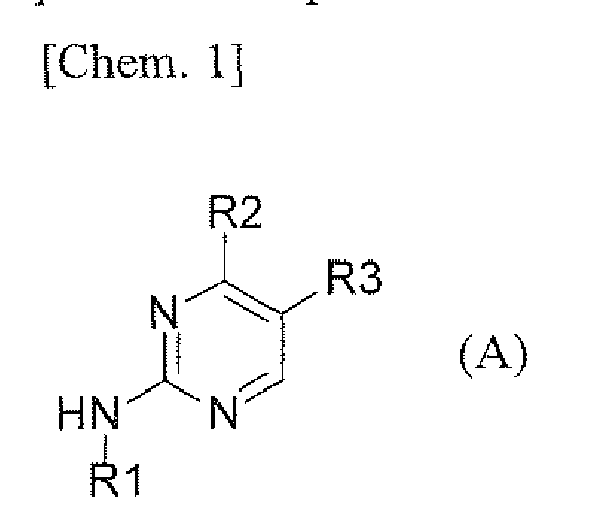
- In Patent Citation 1, it is reported that a compound represented by the formula (A) inhibits PKCθ and is useful as an immunosuppressor. As a specific compound, a compound having a pyrimidine structure is disclosed, but there is no specific disclosure of the compound of the present invention.

- In Patent Citation 2, it is reported that a compound represented by the formula (B) inhibits PKCθ and is useful as an immunosuppressor. As a specific compound, a compound having a pyrimidine structure is disclosed, but there is no specific disclosure of the compound of the present invention.


- In Patent Citation 3, it is reported that a compound represented by the formula (C) inhibits PKCθ and is useful as an immunosuppressor. As a specific compound, a compound having a pyrimidine structure is disclosed, but there is no specific disclosure of the compound of the present invention.


- In Patent Citation 4, it is reported that a compound represented by the formula (D) has an inhibition activity against a cyclin-dependent kinase (CDK), a kinase of Aurora B, or the like, and is useful for treatment and prevention of diseases characterized by excessive or abnormal cell growth. As a specific compound, a compound having a pyrimidine structure is disclosed and there is a description that the compound is useful for immunosuppression in organ transplantation, but there is no specific disclosure of the compound of the present invention.

- In Patent Citation 5, it is reported that a compound represented by the formula (E) inhibits a polo-like kinase (PLK) and is thus useful for prevention and/or treatment of diseases associated with tumors, neurodegenerative diseases, and activation of immune systems. As a specific compound, a compound having a pyrimidine structure is disclosed, but there is no specific disclosure of the compound of the present invention. Also, there is neither description of technologies concerning a PKCθ inhibition activity nor description that the compound is useful for inhibition of acute rejection occurring in transplantation.

- In Patent Citation 6, it is reported that a compound represented by the formula (F) inhibits a G protein-coupled receptor protein 88 (GPR88) and is thus useful for prevention and/or treatment of central nervous system diseases. As a specific compound, a compound having a pyrimidine structure is disclosed, but there is no specific disclosure of the compound of the present invention. Also, there is neither description of technologies concerning a PKCθ inhibition activity nor description that the compound is useful for inhibition of acute rejection occurring in transplantation.

-
- [Patent Citation 1] Pamphlet of International Publication
WO 2004/067516 - [Patent Citation 2] Pamphlet of International Publication
WO 2006/014482 - [Patent Citation 3] Pamphlet of International Publication
WO 2007/076247 - [Patent Citation 4] Pamphlet of International Publication
WO 2003/032997 - [Patent Citation 5] Pamphlet of International Publication
WO 2004/043936 - [Patent Citation 6] Pamphlet of International Publication
WO 2004/054617 - It is an object of the present invention to provide a 2,4-diaminopyrimidine compound which is useful as an active ingredient of a pharmaceutical having a PKCθ inhibition activity, particularly, a pharmaceutical composition for inhibiting acute rejection occurring in transplantation.
- The present inventors have conducted extensive studies on a compound having a PKCθ inhibition activity, and as a result, they have found that a compound having a structure such as aralkyl and the like on an amino group at the 2-position and also having a structure such as an adamantylalkyl group and the like on an amino group at the 4-position of 2,4-diaminopyrimidine, or a salt thereof has an excellent PUCθ inhibition activity, thereby completing the present invention.
Thus, the present invention relates to a compound of the formula (I) or a pharmaceutically acceptable salt thereof, and a pharmaceutical composition comprising the compound of the formula (I) or a pharmaceutically acceptable salt thereof and a pharmaceutically acceptable excipient.
- R1 represents any one group selected from the group consisting of:

- R4 represents -OH, amine which may be substituted, or -CH2NH2;
- n1 represents 0 or 1;
- R5 represents -OH, (C1-6 alkyl which may be substituted with -OH or -NH2), or -CN;
- R6 represents -H or C1-6 alkyl which may be substituted with aryl;
- p represents 0 or 1;
- q represents 1, 2, 3, or 4;
- R13 represents -H or C1-6 alkyl;
- R2 represents -CN, -CF3, -NO2, or halogen;
- A represents a single bond or C1-6 alkylene;
- R3 represents any one group selected from the group consisting of:

- R9s are the same as or different from each other and represent halogen, C1-6 alkyl which may be substituted, -OH, -CN, cycloalkyl, -Q-(C1-6 alkyl which may be substituted), or aryl which may be substituted;
- Q represents -O-, -S-, -SO-, -SO2-, or -NHSO2-;
- n2 represents 0, 1, 2, or 3;
- R10 represents halogen, C1-6 alkyl, -CN, -O-(C1-6 alkyl), -S-(C1-6 alkyl), -SO-(C1-6 alkyl), -SO2-(C1-6 alkyl), -S-(cycloalkyl), or -OCF3; and
- R12 represents -H or halogen).
- In addition, the present invention relates to a pharmaceutical composition comprising the compound of the formula (I) or a pharmaceutically acceptable salt thereof, and a pharmaceutically acceptable excipient, for inhibiting acute rejection occurring in transplantation; i.e., an agent for inhibiting acute rejection occurring in transplantation, comprising the compound of the formula (I) or a pharmaceutically acceptable salt thereof, and a pharmaceutically acceptable excipient.
Moreover, the present invention relates to use of the compound of the formula (I) or a pharmaceutically acceptable salt thereof for the manufacture of an inhibitor of acute rejection occurring in transplantation, and a method for inhibiting acute rejection occurring in transplantation, comprising administering to a patient an effective amount of the compound of the formula (I) or a pharmaceutically acceptable salt thereof. - The compound of the formula (I) or a pharmaceutically acceptable salt thereof has a PKCθ inhibition action and can be used as an inhibitor of acute rejection occurring in transplantation.
- According to the present invention, the following are provided.
- [1]
A compound of the formula (I) or a pharmaceutically acceptable salt thereof:
- R1 represents any one group selected from the group consisting of:


- R4 represents -OH, amine which may be substituted, or -CH2NH2;
- n1 represents 0 or 1;
- R5 represents -OH, (C1-6 alkyl which may be substituted with -OH or -NH2), or -CN;
- R6 represents -H or C1-6 alkyl which may be substituted with aryl;
- p represents 0 or 1;
- q represents 1, 2, 3, or 4;
- R13 represents -H or C1-6 alkyl;
- R2 represents -CN, -CF3, -NO2, or halogen;
- A represents a single bond or C1-6 alkylene;
- R3 represents any one group selected from the group consisting of:

- R9s are the same as or different from each other and represent halogen, C1-6 alkyl which may be substituted, -OH, -CN, cycloalkyl, -Q-(C1-6 alkyl which may be substituted), or aryl which may be substituted;
- Q represents -O-, -S-, -SO-, -SO2-, or -NHSO2-;
- n2 represents 0, 1, 2, or 3;
- R10 represents halogen, C1-6 alkyl, -CN, -O-(C1-6 alkyl), -S-(C1-6 alkyl), -SO-(C1-6 alkyl), -SO2-(C1-6 alkyl), -S-(cycloalkyl), or -OCF3; and
- R12 represents -H or halogen).
- R1 represents any one group selected from the group consisting of:
- [2]
The compound or a pharmaceutically acceptable salt thereof described in [1],
wherein
R4 is -OH, -NR7R8, or -CH2NH2;
R7 and R8 are the same as or different from each other and represent:- (a) -H;
- (b) C1-6 alkyl, in which the C1-6 alkyl may be substituted with at least one group selected from the group consisting of the following 1) to 12):
- 1) -OH
- 2) protected -OH
- 3) halogen
- 4) -COOH
- 5) -CONH2
- 6) oxo
- 7) aryl
- 8) heteroaryl
- 9) cycloalkyl which may be substituted with at least one group selected from the group consisting of -OH, protected -OH, (C1-6 alkyl which may be substituted with -OH), halogen, -CN, -NR14R15, -CONR14R15, -SO2NR14R15, (C1-6 alkyl which may be substituted with -OH)-O-, and oxo
- 10) heterocycloalkyl which may be substituted with -OH or (C1-6 alkyl which may be substituted with -OH, -OCH3, -CN, or halogen)
- 11) (heterocycloalkyl which may be substituted with -OH or -NH2)-CO-, and
- 12) (heterocycloalkyl)-NH-CO-;
- (c) cycloalkyl, in which the cycloalkyl may be substituted with at least one group selected from the group consisting of the following 1) to 6):
- 1) -OH
- 2) -NHR11
- 3) halogen
- 4) oxo
- 5) C1-6 alkyl which may be substituted with -OH, and
- 6) heterocycloalkyl which may be substituted with (halogen, -OH, -CH2OH, or -COCH3);
- (d) heterocycloalkyl, in which the heterocycloalkyl may be substituted with at least one group selected from the group consisting of the following 1) to 11):
- 1) C1-6 alkyl which may be substituted with (-OH, -OCH3, -CN, halogen, or -CONH2)
- 2) cycloalkyl
- 3) aryl
- 4) heterocycloalkyl
- 5) heterocycloalkyl-CO-
- 6) -COCH3
- 7) -CONH5
- 8) -COCH2OH
- 9) -COOCH2CH3
- 10) -SO2CH3
- 11) oxo, and
- 12) halogen;
- (e) acryl;
- (f) nicotinoyl; and
- (g) -SO2CH3; or
- (h) R7 and R8, together with a nitrogen atom to which they bind, are a nitrogen-containing a heterocycloalkyl which may be substituted with at least one group selected from the group consisting of (-OH, -NH2, -COOH, -COCH3, -CONH2 and -CH2OH);
R14 and R15 are the same as or different from each other and are -H, C1-6 alkyl, or heterocycloalkyl. - [3]
The compound or a pharmaceutically acceptable salt thereof described in [2],
wherein
R1 is

- [4]
The compound or a pharmaceutically acceptable salt thereof described in [3],
wherein
R4 is -NR7R8;
R and R8 are the same as or different from each other and are- (b) C1-6 alkyl, in which the C1-6 alkyl may be substituted with at least one group selected from the group consisting of the following 1) to 12):
- 1) -OH
- 2) -OH protected with methyl group, or when having two OH groups adjacent to each other, -OH protected with a dimethylmethylene group or a benzylidene group
- 3) -F
- 4) -COOH
- 5) -CONH2
- 6) oxo
- 7) phenyl
- 8) pyridyl
- 9) cyclohexyl which may be substituted with at least one group selected from the group consisting of -OH and (C1-6 alkyl which may be substituted with -OH)
- 10) (piperidinyl or pyrrolidinyl) which may be substituted with -OH or (C1-6 alkyl which may be substituted with -OH, -OCH3, -CN, or -F)
- 11) (piperazinyl)-CO- or (piperidinyl which may be substituted with -OH or -NH2)-CO-, and
- 12) (piperidinyl)-NH-CO-; or
- (c) cycloalkyl, in which the cycloalkyl may be substituted with at least one group selected from the group consisting of the following 1) to 6):
- 1) -OH
- 2)-NHR11
- 3) -F
- 4) oxo
- 5) C1-6 alkyl which may be substituted with -OH, and
- 6) (azetidinyl, pyrrolidinyl, piperidinyl, piperazinyl or morpholinyl) which may be substituted with (halogen, -OH, -CH2OH, or -COCH3);
n1 is 1;
R2 is -CN, -CF3, -NO2, or -F;
A is C1-6 alkylene;
R9 is- (i) -F, -Cl, or -Br
- (j) C1-6 alkyl which may be substituted with -OH or halogen,
- (k) -OH,
- (l) -CN,
- (m) cyclopropyl,
- (n) -Q-(C1-6 alkyl which may be substituted with halogen, -OH, -OCH3, -CN, or -CONH2), or
- (o) phenyl which may be substituted with -CH2NH2; and
- (b) C1-6 alkyl, in which the C1-6 alkyl may be substituted with at least one group selected from the group consisting of the following 1) to 12):
- [5]
The compound or a pharmaceutically acceptable salt thereof described in [4],
wherein
R7 and R8 are the same as or different from each other and are- (b) C1-6 alkyl, in which the C1-6 alkyl may be substituted with the following groups:
- 9) cyclohexyl substituted with at least one group selected from the group consisting of -OH, -CH3, and -CH2OH, and
- 10) piperidinyl which may be substituted with -OH or (C1-6 alkyl which may be substituted with -OH, -OCH3, -CN, or -F); or
- (c) cycloalkyl, in which the cycloalkyl, may be substituted with at least one group selected from the group consisting of the following 1), 2), and 5):
- 1)-OH
- 2) -NHR11, and
- 5) C1-6 alkyl which may be substituted with -OH;
R2 is -CN;
A is methylene;
R9 is - (i) -F, -Cl, or -Br
- (j) C1-6 alkyl which may be substituted with -OH or -F,
- (k) -OH,
- (l) -CN,
- (m) cyclopropyl,
- (n) -Q-(C1-6 alkyl which may be substituted with halogen, -OH, -OCH3, -CN, or -CONH2), or
- (o) phenyl which may be substituted with -CH2NH2; and
- (b) C1-6 alkyl, in which the C1-6 alkyl may be substituted with the following groups:
- [6] A pharmaceutical composition comprising the compound or a pharmaceutically acceptable salt thereof described in [1], and a pharmaceutically acceptable excipient.
- [7] A PKCθ inhibitor comprising the compound or a pharmaceutically acceptable salt thereof described in [1].
- [8] A pharmaceutical composition for inhibiting acute rejection occurring in transplantation, comprising the compound or a pharmaceutically acceptable salt thereof described in [1].
- [9] Use of the compound or a pharmaceutically acceptable salt thereof described in [1] for the manufacture of an inhibitor of acute rejection occurring in transplantation.
- [10] A method for inhibiting acute rejection occurring in transplantation, comprising administering to a patient an effective amount of the compound or a pharmaceutically acceptable salt thereof described in [1].
- Hereinbelow, the present invention will be described in detail.
In the present specification, the "C1-6 alkyl" is linear or branched alkyl having 1 to 6 carbon atoms, and examples thereof include a methyl, ethyl,, n-propyl, isopropyl, n-butyl, isobutyl, sec-butyl, tert-butyl, n-pentyl, n-hexyl, and the like. - In the present specification, the "C1-6 alkylene" is linear or branched C1-6 alkylene, and examples thereof include methylene, ethylene, trimethylene, tetramethylene, pentamethylene, hexamethylene, propylene, methylmethylene, ethylethylene, 1,2-dimethylethylene, 1,1,2,2-tetramethylethylene, and the like. In another embodiment, it is C1-4 alkylene, in a further embodiment, C1-2 alkylene, and in a still further embodiment, methylene or ethylene.
- In the present specification, the "halogen" means F, Cl, Br, or I.
- In the present specification, the "cycloalkyl" is a C3-10 saturated hydrocarbon ring group, which may have a bridge. Examples thereof include cyclopropyl, cyclobutyl, cyclopentyl, cyclohexyl, cycloheptyl, cyclooctyl, adamantyl, and the like. In another embodiment, it is C3-8 cycloalkyl, in a further embodiment, C3-6 cycloalkyl, and in a still further embodiment, cyclopropyl, cyclobutyl, cyclopentyl, or cyclohexyl.
- In the present specification, the "aryl" is a C6-14 monocyclic to tricyclic aromatic hydrocarbon ring group, and examples thereof include phenyl and naphthyl, and in another embodiment, phenyl.
- In the present specification, the "heterocyclic ring" is a ring group selected from i) a monocyclic 3- to 8-membered heterocyclic ring, and preferably, 5- to 7-membered heterocyclic ring, containing 1 to 4 heteroatoms selected from oxygen, sulfur, and nitrogen, and ii) a bicyclic to tricyclic heterocyclic ring group containing 1 to 5 heteroatoms selected from oxygen, sulfur, and nitrogen, formed by condensation with one or two rings in which the monocyclic heterocyclic ring group is selected from the group consisting of a monocyclic heterocyclic ring group, a benzene ring, C5-8 cycloalkane, and C5-8 cycloalkene. The ring atom, sulfur or nitrogen, may be oxidized to form an oxide or a dioxide.
- Examples of the "heterocyclic ring" include the following embodiments.
- (1) Monocyclic saturated heterocyclic ring
- (a) those containing 1 to 4 nitrogen atoms, for example, azepanyl, diazepanyl, aziridinyl, azetidinyl, pyrrolidinyl, imidazolylidinyl, piperidyl, pyrazolidinyl, piperazinyl, azocanyl, and the like;
- (b) those containing 1 to 3 nitrogen atoms and 1 to 2 sulfur atoms and/or 1 to 2 oxygen atoms, for example, thiomorpholinyl, thiazolidinyl, isothiazolidinyl, oxazolidinyl, morpholinyl, and the like;
- (c) those containing 1 to 2 sulfur atoms, for example, tetrahydro-2H-thiopyranyl and the like;
- (d) those containing 1 to 2 sulfur atoms and 1 to 2 oxygen atoms, for example, oxathiolanyl and the like; and
- (e) those containing 1 to 2 oxygen atoms, for example, oxiranyl, oxetanyl, dioxolanyl, tetrahydrofuranyl, tetrahydro-2H-pyranyl, 1,4-dioxanyl, and the like;
-
- (2) Monocyclic unsaturated heterocyclic group
- (a) those containing 1 to 4 nitrogen atoms, for example, pyrrolyl, imidazolyl, pyrazolyl, pyridyl, dihydropyridyl, tetrahydropyridinyl, pyrimidinyl, pyrazinyl, pyridazinyl, triazolyl, tetrazolyl, triazinyl, dihydrotriazinyl, azepinyl, and the like;
- (b) those containing 1 to 3 nitrogen atoms and 1 to 2 sulfur atoms and/or 1 to 2 oxygen atoms, for example, thiazolyl, isothiazolyl, thiadiazolyl, dihydrothiazinyl, oxazolyl, isoxazolyl, oxadiazolyl, oxazinyl, and the like;
- (c) those containing 1 to 2 sulfur atoms, for example, thienyl, thiepinyl, dihydrodithiopyranyl, dihydrodithionyl, and the like;
- (d) those containing 1 to 2 sulfur atoms and 1 to 2 oxygen atoms, for example, dihydroxathiopyranyl and the like; and
- (e) those containing 1 to 2 oxygen atoms, for example, furyl, pyranyl, oxepinyl, dioxolyl, and the like;
-
- (3) Condensed polycyclic saturated heterocyclic group
- (a) those containing 1 to 5 nitrogen atoms, for example, quinuclidinyl, 7-azabicyclo[2.2.1]heptyl, 3-azabicyclo[3.2.2]nonanyl, and the like;
- (b) those containing 1 to 4 nitrogen atoms and 1 to 3 sulfur atoms and/or 1 to 3 oxygen atoms, for example, trithiadiazaindenyl, dioxoloimidazolidinyl, and the like; and
- (c) those containing 1 to 3 sulfur atoms and/or 1 to 3 oxygen atoms, for example, 2,6-dioxabicyclo[3.2.2]octo-7-yl, and the like;
-
- (4) Condensed polycyclic unsaturated heterocyclic ring group
- (a) those containing 1 to 5 nitrogen atoms, for example, indolyl, isoindolyl, indolinyl, indolidinyl, benzoimidazolyl, dihydrobenzoimidazolyl, tetrahyzorobenzimidazolyl, quinolyl, tetrahydroquinolyl, isoquinolyl, tetrahydroisoquinolyl, indazolyl, imidazopyridyl, benzotriazolyl, tetrazolopyridazinyl, carbazolyl, acridinyl, quinoxalinyl, dihydroquinoxalinyl, tetrahydroqunioxalinyl, phthalazinyl, dihydroindazolyl, benzopyrimidinyl, naphthyridinyl, quinazolinyl, cinnolinyl, and the like;
- (b) those containing 1 to 4 nitrogen atoms and 1 to 3 sulfur atoms and/or 1 to 3 oxygen atoms, for example, benzothiazolyl, dihydrobenzothiazolyl, benzothiadiazolyl, imidazothiazolyl, imidazothiadiazolyl, benzoxazolyl, dihydrobenzoxazolyl, dihydrobenzoxazinyl, benzoxadiazolyl, benzoisothiazolyl, benzoisoxazolyl, and the like;
- (c) those containing 1 to 3 sulfur atoms, for example, benzothienyl, benzodithiopyranyl, dibenzo[b,d]thienyl, and the like;
- (d) 1 to 3 sulfur atoms and 1 to 3 oxygen atoms, for example, benzoxathiopyranyl, phenoxadinyl, and the like; and
- (e) those containing 1 to 3 oxygen atoms, for example, benzodioxolyl, benzofuranyl, dihydrobenzofuranyl, isobenzofuranyl, chromanyl, chromenyl, dibenzo[b,d]furanyl, methylenedioxyphenyl, ethylenedioxyphenyl, and the like;
- In the present specification, the "heterocycloalkyl" is the monocyclic saturated heterocyclic ring group described in (1) and the condensed polycyclic saturated heterocyclic ring group described in (3) among the above-described "heterocyclic rings", in which a ring atom, sulfur or nitrogen, may be oxidized to form an oxide or a dioxide. In another embodiment, it is the monocyclic saturated heterocyclic ring group described in (1), in which a ring atom, sulfur or nitrogen, may be oxidized to form an oxide or a dioxide, and in a further embodiment, it is azetidinyl, pyrrolidinyl, piperidinyl, piperazinyl, morpholinyl, tetrahydro-2H-thiopyranyl, tetrahydrothiopyranyl dioxide, or tetrahydro-2H-pyranyl.
- In the present specification, the "nitrogen-containing heterocycloalkyl" is the Monocyclic saturated heterocyclic ring containing at least one nitrogen atom described in (1) (a) and (b), and the condensed polycyclic saturated heterocyclic ring group containing at least one nitrogen atom described in (3) (a) and (b), among the above-described "heterocyclic rings". In another embodiment, the nitrogen-containing heterocycloalkyl is the monocyclic saturated heterocyclic ring containing at least one nitrogen atom described in (1) (a) and (b), and in a further embodiment, azetidinyl, pyrrolidinyl, piperidyl, piperazinyl, or morpholinyl.
- In the present specification, the "heteroaryl" is the heterocyclic ring having an aromaticity among (2) the monocyclic unsaturated heterocyclic ring group and (4) the aromatic heterocyclic ring group among the condensed polycyclic unsaturated heterocyclic ring groups of the above-described "heterocyclic ring". In another embodiment, it is the heterocyclic ring having an aromaticity among (2) the aromatic heterocyclic ring group, (monocyclic heteroaryl), and in a further embodiment, pyridyl.
- In the present specification, the expression "which may be substituted" means which is not substituted or which has 1 to 5 substituents, and in another embodiment, which is not substituted or which has 1 to 3 substituents. Further, the expression "(which is) substituted" means which has 1 to 5 substituents, and in another embodiment, which has 1 to 3 substituents. Furthermore, if it has a plurality of substituents, the substituents may be the same as or different from each other.
- The "protected -OH" means that the OH group is protected with a protecting group usually used for the protection of a hydroxyl group. In another embodiment, it means being protected with an acyl group, an ether group, a silyl ether group, or an acetal group, and in a further embodiment, it means protection with a methyl group or in the case that two OH groups are adjacent to each other, protection with a dimethylmethylene group or a benzylidene group.
- Embodiments regarding the compound (I) of the present invention are shown below.
- (1) The compound, wherein R1 is

- (2) The compound as described in (1), wherein R4 is -OH, -NR7R8, or -CH2NH2, and in another embodiment, -NR7R8.
- (3) The compound as described in (2), wherein R7 and R8 are the same as or different from each other and are
- (a) -H;
- (b) C1-6 alkyl, in which the C1-6 alkyl may be substituted with at least one group selected from the group consisting of the following 1) to 12):
- 1) -OH
- 2) protected -OH, and in another embodiment, -OH protected with a methyl group, or in the case of having two OH groups which are adjacent to each other, -OH protected with a dimethylmethylene group or a benzylidene group
- 3) halogen, and in another embodiment, -F
- 4) -COOH
- 5) -CONH2
- 6) oxo
- 7) aryl, and in another embodiment, phenyl
- 8) heteroaryl, and in another embodiment, pyridyl
- 9) cycloalkyl which may be substituted with at least one group selected from the group consisting of -OH, protected -OH, (C1-6 alkyl which may be substituted with -OH), halogen, -CN, -NR14R15, -CONR14R15, -SO2NR14R15, (C1-6 alkyl which may be substituted with -OH)-O-, and oxo, in another embodiment, cyclohexyl which may be substituted with at least one group selected from the group consisting of -OH and (C1-6 alkyl which may be substituted with -OH), and in a further embodiment, cyclohexyl substituted with at least one group selected from the group consisting of -OH, -CH3, and -CH2OH
- 10) heterocycloalkyl which may be substituted with -OH or (C1-6 alkyl which may be substituted with -OH, -OCH3, -CN, or halogen), and in another embodiment, (piperidinyl or pyrrolidinyl) which may be substituted with -OH or (C1-6 alkyl which may be substituted with -OH, -OCH3, -CN, or F)
- 11) (heterocycloalkyl which may be substituted with -OH or -NH2)-CO-, and in another embodiment, (piperazinyl)-CO- or (piperidinyl which may be substituted with -OH or -NH2)-CO-, and
- 12) (heterocycloalkyl)-NH-CO-, and in another embodiment, (piperidine)-NH-CO-;
- (c) cycloalkyl, and in another embodiment, cyclobutyl or cyclohexyl, in which the cycloalkyl may be substituted with at least one group selected from the group consisting of the following 1) to 6):
- 1) -OH
- 2) -NHR11
- 3) halogen, and in another embodiment, -F
- 4) oxo
- 5) C1-6 alkyl which may be substituted with -OH, and in another embodiment, -CH3 or -CH2OH, and
- 6) heterocycloalkyl which may be substituted with (halogen, -OH, -CH2OH, or -COCH3), and in another embodiment, (azetidinyl, pyrrolidinyl, piperidinyl, piperazinyl, or morpholinyl) which may be substituted with (-F, -OH, -CH2OH or -COCH3);
- (d) heterocycloalkyl, and in another embodiment, azetidinyl, piperidinyl, tetrahydro-2H-pyranyl, or tetrahydro-2H-thiopyranyl, in which the heterocycloalkyl may be substituted with at least one group selected from the group consisting of the following 1) to 11):
- 1) C1-6 alkyl which may be substituted with (-OH, -OCH3, -CN, halogen, or -CONH2), and in another embodiment, C1-6 alkyl which may be substituted with (-OH, -OCH3, -CN, -F, or -CONH2)
- 2) cycloalkyl, and in another embodiment, cyclopropyl
- 3) aryl, and in another embodiment, phenyl
- 4) heterocycloalkyl, and in another embodiment, tetrahydro-2H-pyranyl
- 5) heterocycloalkyl-CO-, and in another embodiment, morpholinyl-CO-
- 6) -COCH3
- 7) -CONH2
- 8) -COCH2OH
- 9) -COOCH2CH3
- 10) -SO2CH3
- 11) oxo, and
- 12) halogen;
- (e) aryl, and in another embodiment, phenyl;
- (f) nicotinoyl; and
- (g) -SO2CH3; or
- (h) R7 and R8, together with a nitrogen atom to which they bind, are a nitrogen-containing heterocycloalkyl which may be substituted with at least one group selected from the group consisting of (-OH, -NH2, -COOH, -COCH3, -CONH2 and-CH2OH), and in another embodiment, (azetidinyl, pyrrolidinyl, piperidinyl, or piperazinyl) which may be substituted with at least one group selected from the group consisting of (-OH, -NH2, -COOH, -COCH3, -CONH2, and-CH2OH).
- (4) The compound as described in (3), wherein R11 is -H, C1-6 alkyl which may be substituted with (halogen or -OH), cycloalkyl which may be substituted with halogen, heterocycloalkyl which may be substituted with -COCH3, or -COCH3, in another embodiment, -H, C1-6 alkyl which may be substituted with (-F or -OH), cycloalkyl which may be substituted with -F, heterocycloalkyl which may be substituted with -COCH3, or -COCH3, and in a further embodiment, C1-6 alkyl which may be substituted with (-F or -OH), cyclohexyl which may be substituted with -F, tetrahydro-2H-pyranyl, piperidinyl substituted with -COCH3, or -COCH3.
- (5) The compound as described in (3), wherein R14 and R15 are the same as or different from each other and are -H, C1-6 alkyl, or heterocycloalkyl, and in another embodiment, -H, methyl, or tetrahydro-2H-pyranyl.
- (6) The compound as described in (1), wherein n1 is 1.
- (7) The compound, wherein R5 is -OH, -CH2OH, -CH2NH2, or -CN.
- (8) The compound, wherein R6 is -H or C1-6 alkyl which may be substituted with aryl, and in another embodiment, -H or C1-6 alkyl which may be substituted with phenyl.
- (9) The compound, wherein R2 is -CN.
- (10) The compound, wherein A is C1-6 alkylene, in another embodiment, methylene or ethylene, and in a further embodiment, methylene.
- (11) The compound, wherein R3 is

- (12) The compound as described in (11), wherein R9s are the same as or different from each other and are
- (i) halogen, and in another embodiment, -F, -Cl, or -Br;
- (j) C1-6 alkyl which may be substituted, in another embodiment, C1-6 alkyl which may be substituted with -OH or halogen, and in a further embodiment, C1-6 alkyl which may be substituted with -OH or -F;
- (k) -OH;
- (l) -CN;
- (m) cycloalkyl, and in another embodiment, cyclopropyl;
- (n) -Q-(C1-6 alkyl which may be substituted), and in another embodiment, -Q-(C1-6 alkyl which may be substituted with halogen, -OH, -OCH3, -CN, or -CONH2); or
- (o) aryl which may be substituted, in another embodiment, aryl which may be substituted with -CH2NH2, and in a further embodiment, phenyl which may be substituted with -CH2NH2, and
in a further embodiment, wherein R9 is -Cl, -O-CF3, -O-CHF2, or -SCH3.
- (13) The compound as described in (11), wherein n2 is 1.
- (14) The compound as described in (11), wherein R10 is -Cl, -CH3, -OCH3, -OCH2CH3, -OCH(CH3)2, -SCH3, -SCH2CH3, -SCH(CH3)2, -SOCH3, -SO2CH3, -S-(cyclopentane), or -OCF3, and in another embodiment, -Cl, -CH3, -OCH3, or -SCH3.
- (15) The compound, wherein R12 is -H or -Cl.
- (16) The compound, which is a combination of two or more of the groups as described (1) to (15) above.
- The compound of the formula (I) may exist in the form of tautomeric properties or geometrical isomers in some cases, depending on the kind of substituents. In the present specification, the compound shall be described in only one form of isomer, yet the present invention includes other isomers, isolated forms of the isomers, or a mixture thereof.
In addition, the compound of the formula (I) may have asymmetric carbon atoms or axial chirality in some cases, and correspondingly, it may exist in the form of optical isomers. The present invention includes both an isolated form of the optical isomers of the compound of the formula (I) or a mixture thereof. - In addition, the pharmaceutically acceptable prodrugs of the compound represented by the formula (I) are also included in the present invention. The pharmaceutically acceptable prodrug refers to a compound which is converted into the compound of the present invention by solvolysis or under a physiological condition. Examples of the group for forming a prodrug include those as described in Prog. Med., 5, 2157-2161 (1985) or "lyakuhin no Kaihatsu (Development of Medicines)" (Hirokawa Shoten, 1990), Vol. 7, Bunshi Sekkei (Molecular Design), 163-198.
- Furthermore, the compound of the formula (I) refers to a pharmaceutically acceptable salt of the compound of the formula (I), and it may form a salt with an acid or a base, depending on the kind of the substituents. Specifically, examples thereof include acid addition salts with inorganic acids such as hydrochloric acid, hydrobromic acid, hydroiodic acid, sulfuric acid, nitric acid, phosphoric acid, and the like, and with organic acids such as formic acid, acetic acid, propionic acid, oxalic acid, malonic acid, succinic acid, fumaric acid, maleic acid, lactic acid, malic acid, mandelic acid, tartaric acid, dibenzoyl tartaric acid, ditoluoyl tartaric acid, citric acid, methanesulfonic acid, ethanesulfonic acid, benzenesulfonic acid, p-toluenesulfonic acid, aspartic acid, glutamic acid, and the like, and salts with inorganic bases such as sodium, potassium, magnesium, calcium, aluminum, and the like, and organic bases such as methylamine, ethylamine, ethanolamine, lysine, ornithine, and the like, salts with various amino acids or amino acid derivatives such as acetylleucine and the like, ammonium salts, and others.
- In addition, the present invention also includes various hydrates or solvates, and polymorphic crystal substances of the compound of the formula (I) and a pharmaceutically acceptable salt thereof. Also, the present invention includes compounds labeled with various radioactive or non-radioactive isotopes.
- The compound of the formula (I) and a pharmaceutically acceptable salt thereof can be prepared by applying various known synthesis methods, using the characteristics based on their basic skeletons or the kind of substituents. At this time, depending on the type of the functional groups, it is in some cases effective, from the viewpoint of the preparation techniques, to substitute the functional group with an appropriate protecting group (a group which is capable of being easily converted into the functional group), during the steps from starting materials to intermediates. Examples of such a protective group include those described in "Green's Protective Groups in Organic Synthesis (4th Edition, 2006)", edited by Wuts (P. G. M. Wuts) and Greene (T. W. Green), which may be appropriately selected and used depending on reaction conditions. In these methods, a desired compound can be obtained by introducing the protecting group to carry out the reaction, and then, if desired, removing the protecting group.
In addition, the prodrug of the compound of formula (I) can be prepared by introducing a specific group during the steps from starting materials to intermediates, in the same manner as for the aforementioned protecting groups, or by carrying out the reaction using the obtained compound of formula (I). The reaction can be carried out by applying a method known to a person skilled in the art, such as general esterification, amidation, dehydration, and the like.
Hereinbelow, the representative preparation methods for the compound of formula (I) will be described. Each of the production processes may also be carried out with reference to the References appended in the present description. Further, the preparation methods of the present invention are not limited to the examples as shown below. -

The present production process is a method in which a compound(1) and an amine compound(2) are subjected to a nucleophilic substitution reaction to prepare a compound (3), and the obtained compound (3) and an amine compound (4) are subjected to a nucleophilic substitution reaction to prepare the compound (I) of the present invention. Here, examples of the leaving group include halogen, a methanesulfonyloxy group, a methylsulfinyl group, a methylsulfonyl group, a p-toluenesulfonyloxy group, and the like.
In this reaction, the compound (1) and the compound (2), or the compound (3) and the compound (4) are used in equivalent amounts or with either thereof in an excess amount, and the mixture is stirred under any temperature condition from cooling to heating with reflux in a solvent which is inert to the reaction or without a solvent, preferably at 0°C to 80°C, usually for 0.1 hour to 5 days. The solvent used herein is not particularly limited, but examples thereof include aromatic hydrocarbons such as benzene, toluene, xylene, and the like, ethers such as diethyl ether, tetrahydrofuran, dioxane, dimethoxyethane, and the like, halogenated hydrocarbons such as dichloromethane, 1,2-dichloroethane, chloroform, and the like, N,N-dimethylformamide, N-methylpyrrolidone, 1,3-dimethyl-2-imidazolidinone, dimethylsulfoxide, ethyl acetate, acetonitrile, and a mixture thereof. It may be advantageous in some cases for the smooth progress of the reaction to carry out the reaction in the presence of organic bases such as triethylamine, N,N-diisopropylethylamine, N-methylmorpholine, and the like, or inorganic bases such as potassium carbonate, sodium carbonate, potassium hydroxide, and the like. In this regard, the compound (2) may be reacted after reacting the compound (1) and the compound (4) first. -
- "Organic Functional Group Preparations", edited by S. R. Sandler and W. Karo, 2nd Edition, Vol. 1, Academic Press Inc., 1991
- "Jikken Kagaku Koza (Courses in Experimental Chemistry) (5th Edition)", edited by The Chemical Society of Japan, Vol. 14 (2005) (Maruzen)
- Moreover, several compounds represented by the formula (I) can be prepared from the compound of the formula (I) of the present invention obtained above, by any combination of the processes that can be generally employed by a person skilled in the art, such as well-known amidation, alkylation, reductive amination, reduction of a carbonyl group to a hydroxyl group, and the like. For example, they can be prepared, for example, by the reactions as described below, the methods as described in Examples to be described later, the methods known to a skilled person in the art, or a modified method thereof.
- An amide compound can be obtained by subjecting a carboxylic acid compound and an amine compound to amidation.
In this reaction, a carboxylic acid compound and an amine compound are used in equivalent amounts, or with either thereof in an excess amount, and the mixture thereof is stirred at any temperature from under cooling to heating, preferably at a temperature from - 20°C to 60°C, usually for 0.1 hour to 5 days, in a solvent which is inert to the reaction, in the presence of a condensing agent. Examples of the solvent as used herein are not particularly limited, and include aromatic hydrocarbons such as benzene, toluene, xylene, and the like, halogenated hydrocarbons such as dichloromethane, 1,2-dichloroethane, chloroform, and the like, ethers such as diethyl ether, tetrahydrofuran, dioxane, dimethoxyethane, and the like, N,N-dimethylformamide, dimethylsufoxide, ethyl acetate, acetonitrile, water, and a mixture thereof. Examples of the condensing agent include 1-(3-dimethylaminopropyl)-3-ethylcarbodiimide, dicyclohexylcarbodiimide, 1,1'-carbonyldiimidazole, diphenylphosphoric azide, and phosphorus oxychloride, but are not limited thereto. It may be preferable for the reaction in some cases to use an additive (for example, 1-hydroxybenzotriazole). It may be advantageous in some cases for the smooth progress of the reaction to carry out the reaction in the presence of an organic base such as triethylamine, N,N-diisopropylethylamine, N-methylmorpholine, and the like, or an inorganic base such as potassium carbonate, sodium carbonate, potassium hydroxide, and the like.
Further, a method in which the carboxylic acid is converted into a reactive derivative thereof, and then the reactive derivative is reacted with the amine compound may also be used. Examples of the reactive derivative of the carboxylic acid include acid halides obtained by the reaction of a halogenating agent such as phosphorus oxychloride, thionyl chloride, and the like, mixed acid anhydrides obtained by the reaction of isobutyl chloroformate or the like, active esters obtained by the condensation with 1-hydroxybenzotriazole or the like, etc. The reaction of the reactive derivative and the amine compound can be carried out at any temperature from under cooling to heating, preferably at -20°C to 60°C, in a solvent which is inert to the reaction, such as halogenated hydrocarbons, aromatic hydrocarbons, ethers, and the like. -
- "Organic Functional Group Preparations", edited by S. R. Sandler and W. Karo, 2nd Edition, Vol. 1, Academic Press Inc., 1991
- "Jikken Kagaku Koza (Courses in Experimental Chemistry) (5th Edition)", edited by The Chemical Society of Japan, Vol. 16 (2005) (Maruzen)
- An alkyl amine compound can be prepared by alkylating the amine compound with a compound having a leaving group.
The alkylation can be carried out by the same method as in Production Process 1. - An amine compound can be alkylated by reducing an imine compound which is prepared from a carbonyl compound and a primary or secondary amine compound.
In this reaction, the carbonyl compound and the primary or secondary amine compound are used in equivalent amounts, or with either thereof in an excess amount, and the mixture thereof is stirred at any temperature from under cooling to heating, preferably at a temperature from -45°C to heating under reflux, and preferably at 0°C to room temperature, usually for 0.1 hour to 5 days, in a solvent which is inert to the reaction, in the presence of a reducing agent. Examples of the solvent as used herein are not particularly limited, and include alcohols such as methanol, ethanol, and the like, halogenated hydrocarbons such as dichloromethane, 1,2-dichloroethane, chloroform, and the like, ethers such as diethyl ether, tetrahydrofuran, dioxane, dimethoxyethane, and the like, and a mixture thereof. Examples of the reducing agent include sodium cyanoborohydride, sodium triacetoxyborohydride, sodium borohydride, and the like. The reaction may be preferably carried out in the presence of a dehydrating agent such as molecular sieves and the like, or an acid such as acetic acid, hydrochloric acid, titanium (IV) isopropoxide complexes, and the like in some cases. According to the reaction, there may be some cases where an imine is produced by the condensation of the carbonyl compound with the primary or secondary amine compound and it can be isolated as a stable intermediate. In this case, the imine intermediate can be isolated, and then subjected to a reduction reaction, thereby obtaining a desired product. Further, the reaction can be carried out in a solvent such as methanol, ethanol, ethyl acetate, and the like, in the presence or absence of an acid such as acetic acid, hydrochloric acid, and the like, using a reduction catalyst (for example, palladium on carbon, Raney nickel, and the like), instead of treatment with the reducing agent. In this case, it is preferable to carry out the reaction under a hydrogen atmosphere at normal pressure to 50 atmospheres from under cooling to under heating. -
- "Comprehensive Organic Functional Group Transformations II", edited by A. R. Katritzky and R. J. K. Taylor, Vol. 2, Elsevier Pergamon, 2005,
- "Jikken Kagaku Koza (Courses in Experimental Chemistry) (5th Edition)", edited by The Chemical Society of Japan, Vol. 14 (2005) (Maruzen).
- An alcohol compound can be obtained by subjecting a carbonyl compound to reduction.
In this reaction, the carbonyl compound is treated with an equivalent amount or an excess amount of a reducing agent at any temperature from under cooling to heating, preferably at a temperature from -20°C to 80°C, usually for 0.1 hour to 3 days, in a solvent which is inert to the reaction. Examples of the solvent as used herein are not particularly limited, and include ethers such as diethyl ether, tetrahydrofuran, dioxane, dimethoxyethane, and the like, alcohols such as methanol, ethanol, 2-propanol, and the like, aromatic hydrocarbons such as benzene, toluene, xylene, and the like, N,N-dimethylformamide, dimethylsulfoxide, ethyl acetate, and a mixture thereof. As the reducing agent, hydride reducing agents such as sodium borohydride, diisobutylaluminum hydride, and the like, metal reducing agents such as sodium, zinc, iron, and the like, or others described in the following documents are suitably used. -
- "Reductions in Organic Chemistry, 2nd Ed. (ACS Monograph: 188)" edited by M. Hudlicky, ACS, 1996
- "Comprehensive Organic Transformations" edited by R. C. Larock, 2nd ed, VCH Publishers, Inc., 1999
- "Oxidation and Reduction in Organic Synthesis (Oxford Chemistry Primers 6)" edited by T. J. Donohoe, Oxford Science Publications, 2000
- "Jikken Kagaku Koza (Courses in Experimental Chemistry) (5th Edition)", edited by The Chemical Society of Japan, Vol. 14 (2005) (Maruzen).
- The starting materials used in the preparation of the compound of the present invention, that is, the amine compound (2) and the amine compound (4) can be prepared, for example, from available well-known compounds, by employing the methods described in Preparation Examples as described later, well-known methods described in "Production Process 2: Other Production Processes", or methods apparent to a skilled person in the art, or modified methods thereof, or the like.
- The compound of the formula (I) is isolated and purified as a free compound, pharmaceutically acceptable salts thereof, hydrates, solvates, or polymorphic crystal substances thereof. The pharmaceutically acceptable salt of the compound of the formula (I) can also be prepared in accordance with a conventional method for a salt formation reaction.
Isolation and purification are carried out by employing general chemical operations such as extraction, fractional crystallization, various types of fraction chromatography, and the like.
Various isomers can be separated by selecting an appropriate starting compound or by making use of the difference in the physicochemical properties between isomers. For example, the optical isomer can be derived into a stereochemically pure isomer by means of general optical resolution methods (for example, fractional crystallization for inducing diastereomer salts with optically active bases or acids, chromatography using a chiral column and the like, and others). In addition, the isomers can also be prepared from an appropriate optically active starting compound. - The pharmacological activity of the compound of the formula (I) was confirmed by the following test.
- The test was carried out using a HTRFR KinEASE™ S1 kit (CIS bio). To a 384-well plate (CORNING) were put 4 µL of a liquid agent and 3 µL of a mixed liquid of STK Substrate 1-biotin (final 250 nM), and Full-length human PKCθ (Carna Biosciences, final 31 ng/mL), followed by leaving it to stand at room temperature for 30 minutes. Then, 3 µL of an ATP liquid (final 30 µM) was dispensed therein to carry out an enzyme reaction at room temperature for 1 hour. Thereafter, the reaction was stopped by addition of 10 µL of a solution of Sa-XL665 (final 31.25 nM) and an antibody STK-Antibody-Cryptate (finally 800-fold diluted), and the mixture was left to stand at room temperature for 1 hour Fluorescence intensities at 620 nm (Cryptate) and 665 nm (XL665) were measured in Discovery (PACKARD), and with reference to a Vehicle at 0% inhibition and a Blank of 100% inhibition, the inhibition rates and IC50 values were calculated.
The test results are shown in Table 1. Ex represents Compound No. of Examples as described later.[Table 1] Ex IC50(nM) Ex IC50(nM) Ex IC50(nM) 11 1.0 169 0.36 302 14 28 1.3 170 110 303 0.065 41 14 178 7.6 318 0.86 43 0.44 183 29 319 4.0 48 54 187 3.8 321 0.25 57 15 189 1.7 340 1.4 60 1.1 194 6.5 341 1.7 70 1.9 195 3.3 342 0.48 74 0.65 196 3.9 344 0.48 76 2.3 200 0.28 348 0.41 107 5.4 204 11 357 1.2 115 3.5 205 0.83 363 0.58 125 89 208 1.6 371 0.70 126 100 211 0.96 372 1.22 139 13 219 0.4 383 1.6 140 2.5 240 0.064 387 77 145 1.6 246 0.31 388 3.3 150 5.3 264 1.9 390 2.1 156 67 284 0.28 401 0.65 165 2.3 292 10 - The DNA fragments (445 bp) in the Human IL-2 promoter region corresponding to the DNA sequence as described in the database were cloned and inserted into pGL3 basic which is a Vector for Reporter Gene Assay to acquire pGL3-IL2-pro-43.
- Jurkat, Clone E6-1 (ATCC No. TIB-152), which is a human T cell-based culture cell was cultured under the conditions of 37°C, 5% CO2, and saturated humidity, using 10% FBS RPMI 1640 (Sigma) as a medium, and at a time point of a confluency of about 90%, passage was carried out.
- A cell suspension of a concentration of 2.5 × 10⁷ cells/mL was preapred using 10% FBS RPMI 1640 (Sigma) by counting the cells using a cell counting plate, and 10 µg of pGL3-IL2-pro-43 was mixed therewith. Then, 400 µL of the Jurkat cells prepared at 2.5×10⁷ cells/mL were added to each of the prepared plasmid mixture and mixed, followed by adding it entirely to Gene PulsorR Cuvette (BIO-RAD). By Gene PulsorRII (BIO-RAD), a plasmid was introduced at 300 V and 975 µF, and the whole amount of the Jurkat cells having the plasmid introduction completed were gently suspended in 2.5 mL of 10% FBS RPMI 1640. Then, the cells were seeded to a 96-well plate (Coming Coster) at 50 µL/well, and cultured for about 10 hours under the condition of 37°C, 5% CO2, and saturated humidity.
- A drug solution was added respectively at 25 µL/well, and additionally, a mixed liquid obtained by 250-fold dilution of an anti-CD3 antibody, an anti-CD28 antibody (Pharmingen) (all 1000-fold liquid of the final concentration of 1 µg/mL) with 10% FBS RPMI1640 was added respectively thereto at 25 µL/well. The resultant was cultured for about 14 hours under the condition of 37°C, 5% CO2, and saturated humidity. The assay was performed in duplicate.
A substrate solution supplied by a Bright-Glo™ Luciferase Assay System (Promega) was added respectively at 100 µL/well and mixed gently. A Multilabel Counter (ARVO SX, WALLAC) was set at a reaction temperature: 25°C, Shaking Duration: 1 sec, and Measurement time: 1 sec, the measurement well of each of the 96-well plates was set up, and a Firefly luciferase activity was measured. - Using a 96-well plate, 2 µM of a substrate (midazolam), 5 µM of a test compound, and human liver microsome (0.1 mg protein/mL) were incubated at 37°C for 20 minutes in a total amount of 150 µL of a 100 mM phosphate buffer (pH 7.4) containing 0.1 mM EDTA and 1 mM NADPH. Then, the reaction was stopped by adding 130 µL of an aqueous solution containing 80% acetonitrile. Thereafter, the samples were analyzed by LC/MS/MS, and the remaining rates I were calculated using the following equation 1.

- Ai, I=Amount of produced metabolite after reaction in the presence of the test compound in the inhibition test I
- Ao, I= Amount of produced metabolite after reaction in the absence of the test compound in the inhibition test I
- Using a 96-well plate, 5 µM of a test compound and human liver microsome (0.1 mg protein/mL) were incubated at 37°C for 30 minutes in a total amount of 145 µL of a 100 mM phosphate buffer (pH=7.4) containing 0.1 mM EDTA and 1 mM NADPH. Then, 2 µM of midazolam as the substrate was added thereto at a total amount of 150 µL of and incubated at 37°C for 20 minutes. After the incubation, the reaction was stopped by adding 130 µL of an aqueous solution containing 80% acetonitrile. Thereafter, the samples were analyzed by LC/MS/MS, and the remaining rate II was calculated using the following equation 2.

- Ai, II=Amount of produced metabolite after reaction in the presence of the test compound in the inhibition test II
- Ao, I= Amount of produced metabolite after reaction in the absence of the test compound in the inhibition test II
- As a result of each of the above tests, the compound of the formula (I) has a PKCθ inhibition action and reduction in CYP inhibition, from which it is apparent that the compound is useful for an inhibitor of acute rejection occurring in transplantation, or the like.
- A pharmaceutical composition containing one or two or more kinds of the compound of formula (I) or a pharmaceutically acceptable salt thereof as an active ingredient can be prepared in accordance with a generally used method, using a pharmaceutical excipient, a pharmaceutical carrier, or the like, that is generally used in the art.
Administration may be carried out through any mode of oral administration via tablets, pills, capsules, granules, powders, liquid preparations, or the like, or parenteral administration via injections such as intraarticular, intravenous, intramuscular, and the like, suppositories, eye drops, eye ointments, transdermal liquid preparations, ointments, transdermal patches, transmucosal liquid preparations, transmucosal patches, inhalations, and the like. - Regarding solid composition for oral administration, tablets, powders, granules, or the like are used. In such a solid composition, one or more active ingredients are mixed with at least one inactive excipient, for example, lactose, mannitol, glucose, hydroxypropylcellulose, microcrystalline cellulose, starch, polyvinyl pyrrolidone, aluminum magnesium metasilicate, or the like. According to a conventional method, the composition may contain inactive additives, for example, a lubricant such as magnesium stearate and the like, a disintegrator such as sodium carboxymethylstarch and the like, a stabilizer, and a solubilizing agent. As occasion demands, tablets or pills may be coated with a sugar coating, or a gastric or enteric coating agent.
The liquid composition for oral administration includes pharmaceutically acceptable emulsions, solutions, suspensions, syrups, elixirs, or the like, and contains a generally used inert diluent, such as purified water or ethanol. In addition to the inert diluent, the liquid composition may contain adjuvants such as a solubilizing agent, a moisturizing agent, and a suspending agent, a sweetener, a flavor, an aromatic, and an antiseptic. - Injections for parenteral administration include sterile, aqueous or non-aqueous solutions, suspensions, or emulsions. As the aqueous solvent, for example, distilled water for injection or physiological saline is included. Examples of the non-aqueous solvent include propylene glycol, polyethylene glycol, vegetable oils such as olive oil and the like, alcohols such as ethanol and the like, polysorbate 80 (Pharmacopeia), etc. Such a composition may further contain a tonicity agent, an antiseptic, a moistening agent, an emulsifying agent, a dispersing agent, a stabilizer, or a solubilizing agent. These are sterilized, for example, by filtration through a bacteria-retaining filter, blending with bactericides, or irradiation. In addition, these can also be used by producing a sterile solid composition, and dissolving or suspending it in sterile water or a sterile solvent for injection prior to its use.
- Examples of the agent for external use include ointments, plasters, creams, jellies, patches, sprays, lotions, eye drops, eye ointments, and the like. The agents contain generally used ointment bases, lotion bases, aqueous or non-aqueous liquid preparations, suspensions, emulsions, and the like. Examples of the ointment bases or the lotion bases include polyethylene glycol, propylene glycol, white vaseline, bleached bee wax, polyoxyethylene hydrogenated castor oil, glyceryl monostearate, stearyl alcohol, cetyl alcohol, lauromacrogol, sorbitan sesquioleate, and the like.
- As the transmucosal agents such as an inhalation, a transnasal agent, and the like, those in the form of a solid, liquid, or semi-solid state are used, and can be prepared in accordance with a conventionally known method. For example, a known excipient, and also a pH adjusting agent, an antiseptic, a surfactant, a lubricant, a stabilizing agent, a thickening agent, or the like may be appropriately added thereto. For their administration, an appropriate device for inhalation or blowing can be used. For example, a compound may be administered alone or as a powder of formulated mixture, or as a solution or suspension in combination with a pharmaceutically acceptable carrier, using a conventionally known device or sprayer, such as a measured administration inhalation device, and the like. A dry powder inhaler or the like may be for single or multiple administration use, and a dry powder or a powder-containing capsule may be used. Alternatively, this may be in a form such as a pressurized aerosol spray which uses an appropriate propellant, for example, a suitable gas such as chlorofluoroalkane, hydrofluoroalkane, carbon dioxide, and the like, or other forms.
- Generally, in the case of oral administration, the daily dose is from about 0.0001 to 100 mg/kg per body weight, administered in one portion or in 2 to 4 divided portions. In the case of intravenous administration, the daily dose is suitably administered from about 0.0001 to 10 mg/kg per body weight, once a day or two or more times a day. In addition, in the case of inhalation, the agent is administered at a dose from about 0.0001 1 to 1 mg/kg per body weight, once a day or two or more times a day. The dose is appropriately decided in response to the individual case by taking the symptoms, the age, the gender, and the like into consideration.
- The compound of the formula (I) can be used in combination with various agents for treating or preventing the diseases for which the compound of the formula (I) of the present invention is considered to be effective. The combined preparations may be administered simultaneously, or separately and continuously, or at a desired time interval. The preparations to be co-administered may be a blend or may be prepared individually.
- Hereinbelow, the preparation methods for the compound of the formula (I) are described in more detail with reference to the Examples. Further, the present invention is not intended to be limited to the compounds described in Examples below. In addition, the production processes for the starting compounds are shown in Preparation Examples. Further, the preparation methods for the compound of the formula (I) are not limited to the specific preparation methods in Examples presented below, but the compound of the formula (I) can be prepared by combinations of the preparation methods, or methods apparent to a skilled person in the art.
- Moreover, the following abbreviations are used in some cases in Examples, Preparation Examples, and Tables to be described later.
PEx: Preparation Example No., Ex: Example No., Str: structural formula (a description of, for example, HCl, in the structural formula indicates that the compound is a hydrochloride, and a description of 2HCl indicates that the compound is dihydrochloride), rel: relative configuration (a description of rel under the PEx or Ex No. indicates that steric denotements in the adamantane skeletal portion in the structural formula described in the section of the Str represent relative configuration), Syn: Preparation Method (the numeral alone shows Example No. having the same preparation manner, and when P is prefixed before the number, the numeral shows Preparation Example No. having the same preparation manner), Dat: physicochemical data, NMR1: δ (ppm) 1H-NMR in DMSO-d6, NMR2: δ (ppm) in 1H-NMR in CDCl3, NMR3: δ (ppm) 1H-NMR in D2O, FAB+:FAB-MS (positive ion), ESI+: ESI-MS (positive ion), ESI-: ESI-MS (negative ion), TEA: triethylamine, TFA: trifluoroacetic acid, THF: tetrahydrofuran, DMF: N,N-dimethylformamide, DME: dimethoxyethane, DMI: 1,3-dimethyl-2-imidazolidinone, MeOH: methanol, EtOH: ethanol, EtOAc: ethyl acetate, MeCN: acetonitrile, HOBt: 1-hydroxybenzotriazole, WSC: 3-ethyl-1-(3-dimethylaminopropyl)carbodiimide, DEAD: diethylazodicarboxylate, DIPEA: diisopropylethylamine, MCPBA: m-chloroperbenzoic acid, LAH: lithium aluminum hydride, Pd/C: palladium on carbon, TLC1: TLC analysis (condition: eluting solvent; MeOH/chloroform=1/9, silica gel plate (silica gel 60 F254, Merck)), TLC2: TLC analysis (condition: eluting solvent; hexane/EtOAc=1/1, amino silica gel plate (TLC plate (NH), FUJI SILYSIA)), TLC3: TLC analysis (condition: eluting solvent; EtOAc, amino silica gel plate (TLC plate (NH), FUJI SILYSIA)), HPLC: HPLC analysis, rt: retention time. - Further, there are descriptions of the retention time (HPLC:rt) in HPLC in the physicochemical data, in which the HPLC analysis conditions are as follows.
- Column: YMC-Pack ODS-AM (S-5 µm, 12 nm) (150x4.6 mm I.D.), Column temperature: 40°C, Detection method: UV (254 nm), Flow rate: 1 mL/min, Eluent A: acetonitrile, Eluent B: pH 3 buffer (phosphoric acid being added to a 0.05 M aqueous NaH2PO4 solution to adjust to pH 3)
Time program: Time (min) 0 20 30 Eluent A (%) 10 60 60 Eluent B (%) 90 40 40 - To a solution of rel-[(1R,3S,5S)-5-({[(benzyloxy)carbonyl]amino}methyl)adamantan-2-yl]acetic acid (250 mg) in toluene (3 ml) were sequentially added TEA (127 µl) and diphenylphosphoryl azide (196 µl), followed by stirring at 80°C for 1 hour. After leaving to be cooled to room temperature, to the mixed reaction liquid were sequentially added copper (I) iodide (69 mg) and tert-butanol (3 ml), followed by stirring at 80°C for 1 hour. The mixed reaction liquid was diluted with EtOAc, and the organic layer was sequentially washed with water and saturated brine, and dried over anhydrous sodium sulfate. After the desiccant was removed, the solvent was evaporated under reduced pressure. The obtained residue was purified by silica gel flash column chromatography (hexane-EtOAc) to obtain 113 mg of benzyl tert-butyl [(1S,3R,5S)-tricyclo[3.3.1.13,7]decane-1,4-diyl bis(methylene)]bis rel-carbamate.
- Under ice-cooling, to a suspension of 60% sodium hydride (oil dispersion, 25.5 mg) in THF (1 ml) was added dropwise triethyl phosphonoacetate (0.128 ml), followed by stirring for 10 minutes. To the mixed reaction liquid was added portionwise benzyl rel-{[(1S,3R,5S)-4-oxoadamantan-1-yl]methyl}carbamate (100 mg) at the same temperature, and the mixed reaction liquid was stirred at room temperature for 1 hour. To the mixed reaction liquid were added EtOAc and water, and the organic layer was collected by separation. The organic layer was sequentially washed with water and saturated brine, and dried over anhydrous sodium sulfate. After the desiccant was removed, the solvent was evaporated under reduced pressure. The obtained residue was purified by silica gel flash column chromatography (hexane-EtOAc) to obtain 120 mg of ethyl rel-(2E)-[(1R,3S,5R)-5-({[(benzyloxy)carbonyl]amino}methyl)tricyclo[3.3.1.13,7]dec-2-ylidene]acetate.
- To a solution of tert-butyl rel-{(1R,2S,3S,5S)-5-[({2-[(3-bromobenzyl)amino]-5-cyanopyrimidine-4-yl}amino)methyl]adamantan-2-yl}carbamate (136 mg) in DME (2.7 ml) were added (3-aminomethylphenyl)boronic acid hydrochloride (89.8 mg), tetrakis(triphenylphosphine)palladium (0) (41.5 mg), sodium carbonate (101.6 mg), and water (0.34 ml), followed by stirring at 140°C for 6 hours under a nitrogen air flow. To the mixed reaction liquid were added (3-aminomethylphenyl)boronic acid hydrochloride (89.8 mg) and a 2 M aqueous sodium carbonate solution (0.479 ml), followed by stirring at 140°C for additional 4 hours. The mixed reaction liquid was diluted with EtOAc, and the organic layer was sequentially washed with water and saturated brine, and dried over anhydrous sodium sulfate. After the desiccant was removed, the solvent was evaporated under reduced pressure. The obtained residue was purified by amino silica gel flash column chromatography (chloroform-MeOH) to obtain 126.6 mg of tert-butyl rel-[(1R,2S,3S,5S)-5-({[2-({[3'-(aminomethyl)biphenyl-3-yl]methyl}amino)-5-cyanopyrimidin-4-yl] amino}methyl)adamantan-2-yl]carbamate.
- To a solution of tert-butyl N-(5-cyano-2-{[2-(trifluoromethoxy)benzyl]amino}pyrimidin-4-yl)glycinate (616 mg) in dichloromethane (6.16 ml) was added trifluoroacetic acid (3.4 ml), followed by stirring at room temperature. After completion of the reaction, to the mixed reaction liquid was added diisopropyl ether. The precipitated solid was collected by filtration, washed with diisopropyl ether, and dried under reduced pressure to obtain 484 mg of N-(5-cyano-2-{[2-(trifluoromethoxy)benzyl]amino}pyrimidin-4-yl)glycine trifluoroacetate.
- To a solution ofmethyl 1H-benzimidazole-5-carboxylate (8.5 g) in THF (85 ml) were added 3,4-dihydro-2H-pyran (5.3 ml) and (1S)-(+)-10-camphorsulfonic acid (1.1 g), followed by heating and refluxing for 24 hours. To the mixed reaction liquid were added 3,4-dihydro-2H-pyran (4.4 ml) and (1S)-(+)-10-camphorsulfonic acid (10.1 g), followed by heating and refluxing for additional 12 hours. The mixed reaction liquid was poured into a mixed liquid of EtOAc and water, and the organic layer was collected by separation. The organic layer was sequentially washed with water and saturated brine, and dried over anhydrous sodium sulfate. After the desiccant was removed, the solvent was evaporated under reduced pressure. The obtained residue was purified by silica gel flash column chromatography (hexane-EtOAc) to obtain a mixture (7.46 g) of methyl 1-(tetrahydro-2H-pyran-2-yl)-1H-benzimidazole-5-carboxylate and methyl 1-(tetrahydro-2H-pyran-2-y1)-1H-benzimidazole-6-carboxylate.
- Under ice-cooling, to a solution of tert-butyl rel-[(1R,2S,3S,5S)-5-(aminomethyl)adamantan-2-yl]carbamate (200 mg) and TEA (0.12 ml) in dichloromethane (4 ml) was added benzyl chloroformate (0.11 ml), followed by stirring at room temperature for 4 hours. The reaction liquid was diluted with EtOAc, sequentially washed with 0.1 M hydrochloric acid, water, saturated aqueous sodium bicarbonate, water, and saturated brine, and dried over anhydrous sodium sulfate. After the desiccant was removed, the solvent was evaporated under reduced pressure, and the obtained residue was purified by silica gel column chromatography (hexane-EtOAc) to obtain 295.0 mg of benzyl rel-({(1S,3R,4S,5S)-4-[(tert-butoxycarbonyl)amino]adamantan-1-yl}methyl)carbamate.
- Under ice-cooling, to a suspension of rel-1-[(1'R,3'S,5'S)-5'H-spiro[1,3-dioxolane-2,2'-tricyclo[3.3.1.13,7]decan]-5-yl]methanamine (2.15 g) in THF (21.5 ml) were added dropwise benzyl chloroformate (1.92 ml) and a 1M aqueous sodium hydroxide solution (13.5 ml). The mixed reaction liquid was warmed to room temperature, followed by stirring at room temperature for 3 hours. The mixed reaction liquid was diluted with EtOAc and then adjusted to pH 3 with an aqueous sodium hydrogen sulfate solution, and the organic layer was collected by separation. The organic layer was sequentially washed with water and saturated brine, and dried over anhydrous sodium sulfate. After the desiccant was removed, the solvent was evaporated under reduced pressure to obtain 2.66 g of benzyl rel-[(1'R,3'S,5'S)-5'H-spiro[1,3-dioxolane-2,2'-tricyclo[3.3.1.13,7]decan]-5'-ylmethyl]carbamate.
- A suspension of {trans-3-[(tert-butoxycarbonyl)amino]cyclobutyl}methyl methanesulfonate (80.7 mg) and sodium azide (93.9 mg) in DMF (0.81 ml) and water (0.081 ml) was stirred at 120°C for 40 minutes. The reaction liquid was cooled, then diluted with EtOAc, washed with water and saturated brine in this order, and dried over anhydrous sodium sulfate. After the desiccant was removed, the solvent was evaporated under reduced pressure, and the obtained residue was purified by silica gel column chromatography (hexane-EtOAc) to obtain 63.1 mg of tert-butyl [trans-3-(azidomethyl)cyclobutyl]carbamate.
- To a solution of tert-butyl [trans-3-(azidomethyl)cyclobutyl]carbamate (270 mg) in MeOH (13.5 ml) was added 10% Pd/C (wetted with 50% water, 81 mg), followed by stirring at room temperature for 40 minutes at a normal pressure under a hydrogen atmosphere. The catalyst was separated by filtration through Celite and washed with MeOH, and then the filtrate was concentrated under reduced pressure. The obtained residue was purified by silica gel column chromatography (chloroform-MeOH-concentrated aqueous ammonia) to obtain 120.5 mg of tert-butyl [trans-3-(aminomethyl)cyclobutyl]carbamate.
- To a solution of N-(5-cyano-2-{[2-(trifluoromethoxy)benzyl]amino}pyrimidin-4-yl)glycine trifluoroacetate (30 mg) in DMF (0.9 ml) were sequentially added tert-butyl (2-aminoethyl)carbamate (25.0 mg), HOBt (9.3 mg), and WSC (24.2 mg), followed by stirring at room temperature. After completion of the reaction, the mixed reaction liquid was diluted with EtOAc, and the organic layer was sequentially washed with water and saturated brine, and dried over anhydrous sodium sulfate. After the desiccant was removed, the solvent was evaporated under reduced pressure. The obtained residue was purified by preparative silica gel thin layer chromatography (chloroform-MeOH) to obtain 10 mg of tert-butyl (2-{[N-(5-cyano-2-{[2-(trifluoromethoxy)benzyl]amino}pyrimidin-4-yl)glycyl]amino}ethyl)carbamate.
- Under ice-cooling, to a solution of benzyl rel-[(1R,2S,3S,5S)-5-(aminomethyl)adamantan-2-yl]carbamate and pyridine (1.4 ml) in dichloromethane (50 ml) were added a solution of trifluoroacetic anhydride (2.5 ml) in dichloromethane (20 ml), followed by stirring at the same temperature for 30 minutes. Pyridine (0.128 ml) and trifluoroacetic anhydride (0.225 ml) were further added thereto, followed by stirring for 30 minutes under ice-cooling. Under ice-cooling, to the mixed reaction liquid was added water, followed by stirring and then dilution with EtOAc, and the organic layer was sequentially washed with water and saturated brine, and dried over anhydrous sodium sulfate. After the desiccant was removed, the solvent was evaporated under reduced pressure to obtain 7.0 g of benzyl rel-[(1R,2S,3S,5S)-5-{[(trifluoroacetyl)amino]methyl}adamantan-2-yl]carbamate.
- To a solution of rel-(1R,3S,5R,7S)-4-{[(benzyloxy)carbonyl]amino}adamantane-1-carboxylic acid (12 g) in dichloromethane (120 ml) were added oxalyl chloride (4.8 ml), followed by stirring at room temperature. After completion of the reaction, the reaction mixture was concentrated under reduced pressure, and toluene was added thereto, followed by additional concentration under reduced pressure. The obtained residue was dissolved in 1,4-dioxane (12 ml), and added dropwise to 28% aqueous ammonia (110 g) under ice-cooling. The mixed reaction liquid was extracted with EtOAc, and the organic layer was washed with water three times and with saturated brine, and dried over anhydrous sodium sulfate. After the desiccant was removed, the solvent was evaporated under reduced pressure. To the obtained residue was added MeOH to precipitate the solid, which was collected by filtration. The filtrate was concentrated under reduced pressure, and MeOH was used again to precipitate the solid, which was collected by filtration. The filtrate was concentrated under reduced pressure, and MeOH was used several times to precipitate the solid, which was collected by filtration. The obtained solid was dried under reduced pressure to obtain benzyl rel-[(1R,2R,3S,5S)-5-carbamoyladamantan-2yl]carbamate (2.9 g). The filtrate was concentrated under reduced pressure and the obtained residue was purified by silica gel flash column chromatography (hexane-EtOAc) to obtain 1.9 g of benzyl rel-[(1R,2S,3S,5S)-5-carbamoyladamantan-2-yl]carbamate.
- To a mixed solution of tert-butyl rel-[(1R,2S,3S,5S)-5-{[(trifluoroacetyl)amino]methyl}adamantan-2-yl]carbamate (4.6 g) in MeOH (46 ml) and water (23 ml) was added potassium carbonate (16.9 g), followed by stirring at room temperature. After completion of the reaction, the mixed reaction liquid was diluted with EtOAc, washed with saturated brine, and dried over anhydrous sodium sulfate. After the desiccant was removed, the solvent was evaporated under reduced pressure to obtain 3.78 g oftert-butyl rel-[(1R,2S,3S,5S)-5-(aminomethyl)adamantan-2-yl]carbamate.
- Under ice-cooling, to a solution of benzyl rel-[(1R,2S,3S,5S)-5-carbamoyladamantan-2-yl]carbamate (500 mg) in THF (5.0 ml) was added dropwise a 1.17 M solution of a borane-tetrahydrofuran complex in THF (3.9 ml) under a nitrogen air flow, followed by heating and refluxing for 3 hours. The mixed reaction liquid was ice-cooled, and then water was carefully added dropwise thereinto. Then, the liquid was poured into an aqueous dichloromethane-potassium carbonate solution under stirring. The organic layer was collected by separation, and further extracted with dichloromethane twice. The obtained organic layer was combined and dried over anhydrous sodium sulfate. After the desiccant was removed, the solvent was evaporated under reduced pressure to obtain 530 mg of benzyl rel-[(1R,2S,3S,5S)-5-(aminomethyl)adamantan-2-yl]carbamate.
- Under ice-cooling, to a solution of di-tert-butyl iminodicarboxylate (1.88 g) in DMF (28 ml) was added potassium tert-butoxide (970 mg) in small portions, followed by stirring at room temperature for 1 hour. To the reaction mixture was added dropwise a solution of 3-(bromomethyl)-4-chlorophenyl acetate (1.90 g) in DMF (10 ml) under ice-cooling, followed by stirring at room temperature for 2 hours. To the reaction mixture was added water, followed by extraction with EtOAc. The organic layer was sequentially washed with water and saturated brine, and dried over anhydrous magnesium sulfate. After the desiccant was removed, the solvent was evaporated under reduced pressure. The obtained residue was purified by silica gel column chromatography (hexane-EtOAc) to obtain 2.79 g of 3-{[bis(tert-butoxycarbonyl)amino]methyl}-4-chlorophenyl acetate.
- Under an argon atmosphere, to a solution of [2-(benzyloxy)phenyl]methanol (20.2 g) in chloroform (160 ml) was slowly added a solution of thionyl chloride (13.8 ml) in chloroform (40 ml) at room temperature. After stirring at room temperature for 90 minutes, volatile substances were evaporated under reduced pressure to obtain 1-(benzyloxy)-2-(chloromethyl)benzene. Then, under an argon atmosphere, to a solution of di-tert-butyl iminodicarboxylate (41.0 g) in DMF (500 ml) was added potassium tert-butoxide (21.2 g) at room temperature. After stirring at the same temperature for 70 minutes, a solution of 1-(benzyloxy)-2-(chloromethyl)benzene in DMF (60 ml) was added thereto. After stirring at the same temperature for 15 hours, water was added thereto, followed by stirring for additional 90 minutes. The precipitate was collected by filtration, washed with water, and then dried under reduced pressure. The obtained crude product was purified by silica gel column chromatography (chloroform) to obtain 34.5 g of di-tert-butyl [2-(benzyloxy)benzyl]imidodicarbonate.
- To a solution of rel-4-({[(1S,3R,4S,5S)-4-aminoadamantan-1-yl]methyl}amino)-2-{[2-(trifluoromethoxy)benzyl]amino}pyrimidine-5-carbonitrile (30 mg) in DMF (0.6 ml) were added DIPEA (22 µl) and ethylbromo acetate (5.8 µl), followed by stirring at 60°C. After completion of the reaction, the mixed reaction liquid was diluted with EtOAc, and the organic layer was sequentially washed with water and saturated brine, and dried over anhydrous sodium sulfate. After the desiccant was removed, the solvent was evaporated under reduced pressure. The obtained residue was purified by preparative silica gel thin layer chromatography (chloroform-MeOH) to obtain ethyl rel-N-[(1R,2S,3S,5S)-5-{[(5-cyano-2-{[2-(trifluoromethoxy)benzyl]amino}pyrimidin-4-yl)amino]methyl}adamantan-2-yl]glycinate(26.1 mg).
- To a solution of di-tert-butyl (2-hydroxybenzyl)imidodicarbonate (500 mg) in DMF (5.0 ml) were added 2-bromoacetamide (320 mg), potassium carbonate (641 mg), and potassium iodide (385 mg), followed by stirring at 80°C for 3 hours. After leaving to be cooled to room temperature, water was added thereto, and the precipitated product was collected by filtration to obtain 546 mg of di-tert-butyl [2-(2-amino-2-oxoethoxy)benzyl]imidodicarbonate.
- To a mixed solution of tert-butyl (5-formyl-2-nnethoxybenzyl)carbamate (1.0 g) in THF (3.0 ml) and EtOH (6.0 ml) was added sodium borohydride (192.5 mg), followed by stirring at room temperature. After completion of the reaction, to the mixed reaction liquid was added water, followed by extraction with EtOAc, and the organic layer was dried over anhydrous sodium sulfate. After the desiccant was removed, the solvent was evaporated under reduced pressure. The obtained residue was purified by silica gel flash column chromatography (hexane-EtOAc) to obtain 1.09 g oftert-butyl [5-(hydroxymethyl)-2-methoxybenzyl]carbamate.
- To a solution of 4-chloro-2-(methylsulfanyl)pyrimidine-5-carbonitrile (2.2 g) in 1,3-dimethylimidazolidin-2-one were added DIPEA (4.13 ml) and tert-butyl rel-[(1R,2S,3S,5S)-5-(aminomethyl)adamantan-2-yl]carbamate (3.99 g), followed by stirring at room temperature. After completion of the reaction, the mixed reaction liquid was diluted with EtOAc, and the organic layer was sequentially washed with water and saturated brine, and dried over anhydrous sodium sulfate. After the desiccant was removed, the solvent was evaporated under reduced pressure. The obtained residue was purified by silica gel flash column chromatography (hexane-EtOAc) to obtain 4.76 g of tert-butyl rel-[(1R,2S,3S,5S)-5-({[5-cyano-2-(methylsulfanyl)pyrimidin-4-yl]amino}methyl)adamantan-2-yl]carbamate.
- Under ice-cooling, to a solution of 2,4-dichloropyrimidine-5-carbonitrile (1.00 g) in DMF (15 ml) were added dropwise a solution of 2-(methylthio)benzylamine (881 mg) in DMF (5 ml) and DIPEA (1.2 ml), followed by stirring at the same temperature for 1 hour. A solution of 2-(methylthio)benzylamine (44 mg) in DMF (2 ml) was added thereto, followed by stirring at room temperature for additional 1 hour. To the reaction mixture were added EtOAc and water, followed by liquid separation. The organic layer was sequentially washed with water and saturated brine, and dried over anhydrous magnesium sulfate. After the desiccant was removed, the solvent was evaporated under reduced pressure, and the obtained residue was purified by silica gel column chromatography (chloroform) to obtain 709 mg of 4-chloro-2-{[2-(methylsulfanyl)benzyl]amino}pyrimidine-5-carbonitrile.
- To a solution of 2,4-dichloro-5-(trifluoromethyl)pyrimidine (300 mg) in DMF (6.0 ml) which had been cooled in an ice-brine bath were added DIPEA (252.9 µl) and 1-[2-(trifluoromethoxy)phenyl]methanamine (277.5 mg), followed by stirring at -20°C. After completion of the reaction, the mixed reaction liquid was diluted with EtOAc, and the organic layer was sequentially washed with water and saturated brine, and dried over anhydrous sodium sulfate. After the desiccant was removed, the solvent was evaporated under reduced pressure to obtain 507 mg of a mixture of 4-chloro-N-[2-(trifluoromethoxy)benzyl]-5-(trifluoromethyl)pyrimidin-2-amine and 2-chloro-N-[2-(trifluoromethoxy)benzyl]-5-(trifluoromethyl)pyrimidin-4-amine.
- To a solution of a mixture (90 mg) of 4-chloro-N-[2-(trifluoromethoxy)benzyl]-5-(trifluoromethyl)pyrimidin-2-amine and 2-chloro-N-[2-(trifluoromethoxy)benzyl]-5-(trifluoromethyl)pyrimidin-4-amine in DMF (1.0 ml) were added DIPEA (84.3 µl) and benzyl rel-[(1R,2S,3S,5S)-5-(aminomethyl)adamantan-2-yl]carbamate (79.9 mg), followed by stirring at room temperature. After completion of the reaction, the mixed reaction liquid was diluted with EtOAc, and the organic layer was sequentially washed with water and saturated brine, and dried over anhydrous sodium sulfate. After the desiccant was removed, the solvent was evaporated under reduced pressure. The obtained residue was purified by silica gel flash column chromatography (hexane-EtOAc) to obtain a crude product of benzyl rel-[(1R,2S,3S,5S)-5-({[2-{[2-(trifluoromethoxy)benzyl]amino}-5-(trifluoromethyl)pyrimidin-4-yl]amino}methyl)adamantan-2-yl]carbamate and a crude product of benzyl rel-[(1R,2S,3S,5S)-S-({[4-{[2-(trifluoromethoxy)benzyl]amino}-5-(trifluoromethyl)pyrimidin-2-yl]amino}methyl)adamantan-2-yl]carbamate. Each of the crude products was further purified by silica gel flash column chromatography (chloroform-MeOH) to obtain benzyl rel-[(1R,2S,3S,5S)-5-({[2-{[2-(trifluoromethoxy)benzyl]amino}-5-(trifluoromethyl)pyrimidin-4-yl]amino}methyl)adamantan-2-yl]carbamate (100 mg) and benzyl rel-[(1R,2S,3S,5S)-5-({[4-{[2-(trifluoromethoxy)benzyl]amino}-5-(trifluoromethyl)pyrimidin-2-yl]amino}methyl)adamantan-2-yl]carbamate (50 mg).
- To a solution of benzyl rel-[(1R,2S,3S,5S)-5-({[5-cyano-2-(methylsulfinyl)pyrimidin-4-yl]amino}methyl)adamantan-2-yl]carbamate (50 mg) in 1,3-dimethylimidazolidin-2-one (1.0 ml) were added 3-bromoaniline (0.114 ml) and a 4 M hydrogen chloride dioxane solution (2.6 µl), followed by stirring at 100°C for 3 hours. After leaving to be cooled to room temperature, to the mixed reaction liquid was added water, and the precipitated solid was collected by filtration, washed with water and hexane, and then dried under reduced pressure to obtain 46 mg of benzyl rel-{(1R,2S,3S,5S)-5-[({2-[(3-bromophenyl)amino]-5-cyanopyrimidine-4-yl}amino)methyl]adamantan-2-yl}carbamate.
- To a solution of ethyl rel-[(1R,3S,5S)-5-({[(benzyloxy)carbonyl]amino}methyl)adamantan-2-yl]acetate(300 mg) in MeOH (6.0 ml) was added a 4 M aqueous lithium hydroxide solution (1.2 ml), followed by stirring at 60°C for 3 hours. The mixed reaction liquid was diluted with EtOAc and then an aqueous potassium hydrogen sulfate solution was added to adjust to pH 2, and the organic layer was collected by separation. The organic layer was sequentially washed with water and saturated brine, and dried over anhydrous sodium sulfate. After the desiccant was removed, the solvent was evaporated under reduced pressure to obtain 264.6 mg of rel-[(1R,3S,5S)-5-({[(benzyloxy)carbonyl]amino}methyl)adamantan-2-yl] acetic acid.
- To a mixed solution of methyl rel-(1R,3S,5R,7S)-4-{[(benzyloxy)carbonyl]amino}adamantane-1-carboxylate (15 g) in 1,4-dioxane (75 ml) and MeOH (75 ml) were added a 1M aqueous sodium hydroxide solution (87.4 ml), followed by stirring at 60°C for 4 hours. The mixed reaction liquid was left to be cooled to room temperature, then adjusted to pH 4 with a 10% aqueous potassium hydrogen sulfate solution, and extracted with EtOAc. The obtained organic layer was washed with saturated brine once and dried over anhydrous magnesium sulfate. After the desiccant was removed, the solvent was evaporated under reduced pressure to obtain 12 g of rel-(1R,3S,5R,7S)-4-{[(benzyloxy)carbonyl]amino}adamantane-1-carboxylic acid.
- Under a nitrogen atmosphere, to a suspension of lithium aluminum hydride (1.2 g) in THF (100 ml) was added dropwise a solution of a mixture (7.0 g) of methyl 1-(tetrahydro-2H-pyran-2-yl)-1H-benzimidazole-5-carboxylate and methyl 1-(tetrahydro-2H-pyran-2-yl)-1H-benzimidazole-6-carboxylate in THF (100 ml) at -10°C or lower, followed by stirring for 1 hour under ice-cooling. Lithium aluminum hydride (0.8 g) was added in divided portions thereto, followed by stirring for additional 30 minutes under ice-cooling. At the same temperature, water (6.0 ml), a 15% aqueous sodium hydroxide solution (6.0 ml), and water (3.0 ml) were sequentially added thereto, followed by stirring at room temperature for 30 minutes. The insoluble materials were removed by filtration through Celite and the filtrate was concentrated under reduced pressure to obtain 5.48 g of a mixture of [1-(tetrahydro-2H-pyran-2-yl)-1H-benzimidazol-5-yl]methanol and [1-(tetrahydro-2H-pyran-2-yl)-1H-benzimidazol-6-yl]methanol.
- Under ice-cooling, to a solution of ethyl rel-(2E)-[(1R,3S,5R)-5-({[(benzyloxy)carbonyl]amino}methyl)tricyclo[3.3.1.13,7]dec-2-ylidene]acetate (350 mg) in MeOH (6.0 ml) was added nickel (II) chloride (23.7 mg) under a nitrogen atmosphere, and sodium borohydride was added portionwise thereto, followed by stirring at the same temperature for 1 hour and at room temperature for 3 hours. To the mixed reaction liquid was added water, followed by extraction with EtOAc. The organic layer was sequentially washed with water and saturated brine, and dried over anhydrous sodium sulfate. After the desiccant was removed, the solvent was evaporated under reduced pressure to obtain 310 mg of ethyl rel-[(1R,3S,5S)-5-({[(benzyloxy)carbonyl]amino}methyl)adamantan-2-yl]acetate.
- To a solution of methyl rel-(1R,3S,5R,7S)-4-oxoadamantane-1-carboxylate (500 mg) in dichloromethane (7.5 ml) were sequentially added benzyl amine (0.262 ml) and sodium triacetoxyborohydride (763 mg), followed by stirring at room temperature for 2 hours. To the mixed reaction liquid was added saturated aqueous sodium bicarbonate, followed by stirring and then extraction with dichloromethane. The organic layer was collected by separation. The obtained organic layer was washed with saturated brine and dried over anhydrous magnesium sulfate. After the desiccant was removed, the solvent was evaporated under reduced pressure. The obtained residue was purified by silica gel flash column chromatography (chloroform-MeOH) to obtain 757 mg of methyl rel-(1R,3S,5R,7S)-4-(benzylamino)adamantane-1-carboxylate.
- To a solution of benzyl rel-{[(1S,3R,4S,5S)-4-aminoadamantan-1-yl]methyl}carbamate (760 mg) in dichloromethane (22.8 ml) were added 4-{[tert-butyl (dimethyl)silyl]oxy}cyclohexanone (1.22 ml) and sodium triacetoxyborohydride (1.02 g), followed by stirring at room temperature for 4 hours. To the mixed reaction liquid was added saturated aqueous sodium bicarbonate, followed by extraction with EtOAc. The organic layer was sequentially washed with water and saturated brine, and dried over anhydrous sodium sulfate. The desiccant was removed, the solvent was evaporated under reduced pressure, and the obtained residue was purified by amino silica gel column chromatography (hexane-EtOAc) to first elute 674.8 mg of benzyl rel-({(1R,3S,4R,5R)-4-[(cis-4-{[tert-butyl (dimethyl)silyl]oxy}cyclohexyl)amino]adamantan-1-yl}methyl)carbamate and then elute 435.8 mg of benzyl rel-({(1R,3S,4R,SR)-4-[(trans-4-{[tert-butyl(dimethyl)silyl]oxy}cyclohexyl)amino]adamantan-1-yl}methyl)carbamate.
The steric configuration of the obtained product was determined by using the compound (benzyl rel-({(1R,3S,4R,5R)-4-[(trans-4-{[tert-butyl (dimethyl)silyl]oxy}cyclohexyl)amino]adamantan-1-yl}methyl)carbamate) eluted later in amino silica gel column chromatography as a starting material to provide the rel-trans-4-{[(1R,2S,3S,5S)-5-(aminomethyl)adamantan-2-yl]amino}cyclohexanol obtained in Preparation Example 134, which is then used for Example 45, and by confirming that the HPLC retention time (15.1 min) of the obtained product coincided with that in Example 42 (trans-alcohol product). - Under ice-cooling, to a solution of tert-butyl rel-[(1R,2S,3S,5S)-5-({[5-cyano-2-(methylsulfanyl)pyrimidin-4-yl]amino}methyl)adamantan-2-yl]carbamate (4.7 g) in dichloromethane (50 ml) was added 75% MCPBA (contains water) (2.77 g), followed by stirring at the same temperature. After completion of the reaction, the mixed reaction liquid was diluted with EtOAc, and the organic layer was sequentially washed with saturated aqueous sodium bicarbonate, water, and saturated brine, and dried over anhydrous sodium sulfate. After the desiccant was removed, the solvent was evaporated under reduced pressure. The obtained residue was purified by silica gel flash column chromatography (chloroform-MeOH) to obtain 5.02 g of tert-butyl rel-[(1R,2S,3S,5S)-5-({[5-cyano-2-(methylsulfinyl)pyrimidin-4-yl]amino}methyl)adamantan-2-yl]carbamate.
- Under ice-cooling, to a solution of tert-butyl rel-[(1R,2S,3S,5S)-5-{[(5-cyano-2-{[2-(methylsulfanyl)benzyl]amino}pyrimidin-4-yl)amino]methyl} adamantan-2-yl]carbamate (147 mg) in dichloromethane (5.0 ml) was added 75% MCPBA (contains water, 69.6 mg), followed by stirring at the same temperature for 1 hour. To the mixed reaction liquid was added saturated aqueous sodium bicarbonate, followed by extraction with EtOAc. The organic layer was sequentially washed with water and saturated brine, and dried over anhydrous sodium sulfate. After the desiccant was removed, the solvent was evaporated under reduced pressure. The obtained residue was purified by silica gel flash column chromatography (starting with hexane-EtOAc and changing to chloroform-MeOH in the middle of the process) to obtain tert-butyl rel-[(1R,2S,3S,5S)-5-{[(5-cyano-2-{[2-(methylsulfinyl)benzyl]amino}pyrimidin-4-yl)amino]methyl}adamantan-2-yl]carbamate (123.9 mg) and tert-butyl rel-[(1R,2S,3S,5S)-5-{[(5-cyano-2-{[2-(methylsulfonyl)benzyl]amino}pyrimidin-4-yl)amino]methyl}adamantan-2-yl]carbamate (28.1mg).
- Under ice-cooling, to a suspension of LAH (88 mg) in THF (20 ml) was added tert-butyl 3-cyano-8-azabicyclo[3.2.1] octane-8-carboxylate (550 mg), followed by stirring at room temperature for 4 hours. Under ice-cooling, water was added thereto, followed by extraction with EtOAc, and the organic layer was dried over anhydrous sodium sulfate. After the desiccant was removed, the solvent was evaporated under reduced pressure to obtain 600 mg of tert-butyl 3-(aminomethyl)-8-azabicyclo[3.2.1]octane-8-carboxylate.
- To a solution of di-tert-butyl {2-[2-(methoxymethoxy)ethoxy]benzyl}imidodicarbonate (288 mg) in methanol (1.4 ml) was added a 4 M hydrogen chloride dioxane solution (3.5 ml), followed by stirring at room temperature for 2 hours. The solvent was evaporated under reduced pressure to obtain 140 mg of 2-[2-(aminomethyl)phenoxy]ethanol hydrochloride.
- Under ice-cooling, to a solution of benzyl rel-({(1S,3R,4S,5S)-4-[(tert-butoxycarbonyl)amino]adamantan-1-yl}methyl)carbamate (295.0 mg) in dichloromethane (3.54 ml) was added trifluoroacetic acid (3.54 ml), followed by stirring at room temperature for 2 hours. The reaction liquid was concentrated under reduced pressure, and then the residue was alkalified by the addition of an aqueous potassium carbonate solution and then extracted with EtOAc. The organic layer was sequentially washed with water and saturated brine, and dried over anhydrous sodium sulfate. After the desiccant was removed, the solvent was evaporated under reduced pressure to obtain 242.8 mg of benzyl rel-{[(1S,3R,4S,5S)-4-aminoadamantan-1-yl]methyl}carbamate.
- To a solution of di-tert-butyl [2-(2-methoxyethoxy)benzyl]imidodicarbonate (341 mg) in 1,4-dioxane (1.7 ml) was added a 4 M hydrogen chloride dioxane solution (3.5 ml) at room temperature, followed by stirring for 2 hours. The solvent was evaporated under reduced pressure to obtain 155 mg of 1-[2-(2-methoxyethoxy)phenyl]methanamine hydrochloride.
- To a solution of tert-butyl (2-{4-[(methylsulfonyl)amino]phenyl}ethyl)carbamate (900 mg) in dichloromethane (18 ml) was added trifluoroacetic acid (2.89 ml), followed by stirring at room temperature overnight. The mixed reaction liquid was concentrated under reduced pressure, and toluene was added to the residue, followed by further concentration under reduced pressure. To the obtained residue was added diethyl ether, the precipitated solid was collected by filtration, washed with diethyl ether, and then dried under reduced pressure. The obtained solid was suspended in EtOH, alkalified by the addition of a 1 M aqueous sodium hydroxide solution, then adjusted to pH 7 with 1 M hydrochloric acid, and extracted with chloroform. The organic layer was combined and dried over anhydrous sodium sulfate. After the desiccant was removed, the solvent was evaporated under reduced pressure to obtain 95 mg of N-[4-(2-aminoethyl)phenyl]methanesulfonamide.
- Under ice-cooling, to a solution of benzyl rel-[(1R,2S,3S,5S)-5-{[(trifluoroacetyl)amino]methyl}adamantan-2-yl]carbamate (7.0 g) in EtOH (175 ml) were sequentially added di-tert-butyl dicarbonate (5.58 g), 10% Pd/C (wetted with 50% water, 7.0 g), and cyclohexa-1,4-diene (15.9 ml), followed by stirring at room temperature for 1 hour. The catalyst was removed by filtration, and then the filtrate was concentrated under reduced pressure. The obtained residue was purified by silica gel flash column chromatography (hexane-EtOAc) to obtain 4.67 g of tert-butyl rel-[(1R,2S,3S,5S)-5-{[(trifluoroacetyl)amino]methyl}adamantan-2-yl]carbamate.
- To a solution of benzyl rel-({(1R,3S,4R,5R)-4-[(trans-4-hydroxycyclohexyl)amino]adamantan-1-yl}methyl)carbamate (380 mg) in MeOH (11.4 ml) was added 10% Pd/C (wetted with 50% water, 76 mg), followed by stirring at 35°C for 2.5 hours at a normal pressure under a hydrogen atmosphere. The catalyst was separated by filtration through Celite and washed with MeOH, and then the filtrate was concentrated under reduced pressure to obtain 263.8 mg of rel-trans-4-{[(1R,2S,3S,5S)-5-(aminomethyl)adamantan-2-yl]amino}cyclohexanol.
- To a solution of 3-{[bis(tert-butoxycarbonyl)amino]methyl}-4-chlorophenyl acetate (2.79 g) in methanol (56 ml) was added potassium carbonate (1.45 g), followed by stirring at room temperature for 1 hour. To the reaction mixture was added saturated aqueous ammonium chloride solution, and the precipitate was collected by filtration to obtain 2.15 g of di-tert-butyl (2-chloro-5-hydroxybenzyl)imidodicarbonate.
- To a mixed solution of rel-4-{[(1'R,3'S,5'S)-5'H-spiro[1,3-dioxolane-2,2'-tricyclo[3.3 .1.13,7]decan]-5'-ylmethyl]amino}-2- {[2-(trifluoromethoxy)benzyl]amino}pyrimidine-5-carbonitrile (385 mg) in THF (23.1 ml) and water (30.8 ml) was added p-toluenesulfonic acid monohydrate (1.42 g), followed by stirring at room temperature overnight. The mixed reaction liquid was concentrated under reduced pressure, and the residue was alkalified by the addition of saturated aqueous sodium bicarbonate, followed by extraction with EtOAc. The organic layer was washed with saturated brine and dried over anhydrous magnesium sulfate. After the desiccant was removed, the solvent was evaporated under reduced pressure. The obtained residue was purified by silica gel flash column chromatography (hexane-EtOAc) to obtain 300 mg of rel-4-({[(1S,3R,5S)-4-oxoadamantan-1-yl]methyl}amino)-2-{[2-(trifluoromethoxy)benzyl]amino}pyrimidine-5-carbonitrile.
- To a mixed solution of benzyl rel-[(1'R,3'S,5'S)-5'H-spiro[1,3-dioxolane-2,2'-tricyclo[3.3.1.13,7]decan]-5'-ylmethyl]carbamate (2.5 g) in THF (25 ml) and water (25 ml) was added p-toluenesulfonic acid monohydrate (6.65 g), followed by stirring at room temperature overnight. The mixed reaction liquid was concentrated under reduced pressure, and the residue was alkalified by the addition of saturated aqueous sodium bicarbonate, followed by extraction with EtOAc. The obtained organic layer was washed with saturated brine and dried over anhydrous magnesium sulfate. After the desiccant was removed, the solvent was evaporated under reduced pressure to obtain 2.26 g of benzyl rel-{[(1S,3R,5S)-4-oxoadamantan-1-yl]methyl}carbamate.
- To a solution of benzyl rel-({(1R,3S,4R,SR)-4-[(trans-4-{[tert-butyl(dimethyl)silyl]oxy}cyclohexyl)amino]adamantan-1-yl}methyl)carbamate (446 mg) in THF (8.92 ml) was added a solution (2.54 ml) of 1 M tetrabutylammonium fluoride in THF, followed by stirring at 70°C for 5.5 hours. The solvent was evaporated under reduced pressure, and to the residue was added water, followed by extraction with chloroform. The organic layer was washed with saturated brine and dried over anhydrous sodium sulfate, the desiccant was then removed, and the solvent was evaporated under reduced pressure. The obtained residue was purified by silica gel column chromatography (starting with chloroform-MeOH and changing to chloroform-MeOH-concentrated aqueous ammonia in the middle of the process) to obtain 385.1 mg of benzyl rel-({(1R,3S,4R,5R)-4-[(trans-4-hydroxycyclohexyl)amino]adamantan-1-yl)methyl)carbamate.
- To a mixed solution of a mixture (3.99 g) of 2-{[1-(tetrahydro-21H-pyran-2-yl)-1H-benzimidazol-5-yl]methyl}-1H-isoindole-1,3(2H)-dione and 2-{[1-(tetrahydro-2H-pyran-2-yl)-1H-benzimidazol-6-yl]methyl}-1H-isoindole-1,3(2H)-dione in EtOH (79.8 ml) and THF (79.8 ml) was added hydrazine monohydrate (2.14 ml), followed by heating and refluxing. After completion of the reaction, the insoluble materials were removed by filtration and the filtrate was concentrated under reduced pressure. The obtained residue was diluted with dichloromethane, washed with a 1 M aqueous sodium hydroxide solution, and dried over anhydrous magnesium sulfate. After the desiccant was removed, the solvent was evaporated under reduced pressure. The obtained residue was purified by amino silica gel flash column chromatography (chloroform-MeOH) and then purified by silica gel flash column chromatography (chloroform-MeOH) to obtain 0.42 g of a mixture of 1-[1-(tetrahydro-2H-pyran-2-yl)-1H-benzimidazol-5-yl]methanamine and 1-[1-(tetrahydro-2H-pyran-2-yl)-1H-benzimidazol-6-yl]methanamine.
- To a mixed solution of methyl rel-(1R,3S,5R,7S)-4-(benzylamino)adamantane-1-carboxylate (720 mg) in EtOH (7.2 ml) and water (0.72 ml) were added 10% Pd/C (wetted with 50% water, 144 mg) and ammonium formate (455 mg), followed by heating and refluxing for 30 minutes. The mixed reaction liquid was left to be cooled to room temperature, then the catalyst was separated by filtration through Celite, and the filtrate was concentrated under reduced pressure to obtain 482 mg of methyl rel-(1R,3S,5R,7S)-4-aminoadamantane-1-carboxylate.
- To a solution of di-tert-butyl [2-(benzyloxy)benzyl]imidodicarbonate (34.5 g) in methanol (170 ml) and THF (170 ml) was added 10% Pd/C (3.5 g), followed by stirring for 14 hours at a normal pressure under a hydrogen atmosphere. The reaction mixture was filtered and the filtrate was concentrated under reduced pressure to obtain 27.0 g of di-tert-butyl (2-hydroxybenzyl)imidodicarbonate.
- To a solution of 4-chloro-3-methylphenyl acetate (2.06 g) in carbon tetrachloride (20.6 ml) were added N-bromosuccinimide (1.99 g) and 2,2'-azobis(isobutyronitrile) (366 mg), followed by heating and refluxing for 1 hour. To the reaction liquid was added water, followed by extraction with EtOAc, and the organic layer was washed with saturated aqueous sodium chloride solution, and then dried over anhydrous magnesium sulfate. After the desiccant was removed, the solvent was evaporated under reduced pressure, and the residue was purified by silica gel column chromatography (hexane-EtOAc) to obtain 1.87 g of 3-(bromomethyl)-4-chlorophenyl acetate.
- To a solution of tert-butyl (2-methoxybenzyl)carbamate (25.0 g) in MeCN (200 ml) was added N-bromosuccinimide (19.7 g), followed by stirring at room temperature overnight. To the mixed reaction liquid was added N-bromosuccinimide (10.0 g), followed by additionally stirring at room temperature for 8 hours. The mixed reaction liquid was concentrated under reduced pressure, and then the residue was diluted with EtOAc, sequentially washed with water and saturated brine, and dried over anhydrous sodium sulfate. After the desiccant was removed, the solvent was evaporated under reduced pressure. The obtained residue was purified by silica gel flash column chromatography (toluene) to obtain 9.55 g of tert-butyl (5-bromo-2-methoxybenzyl)carbamate.
- To a solution of tert-butyl (5-bromo-2-methoxy benzyl)carbamate (5.0 g) in DMF (50 ml) were added bis(triphenylphosphine)palladium (II) dichloride (222 mg), triphenyl phosphine (83 mg), and sodium hydrogen carbonate (1.61 g), followed by heating and stirring at 110°C at a normal pressure under a carbon monoxide atmosphere. The mixed reaction liquid was diluted with EtOAc, sequentially washed with water, an aqueous sodium carbonate solution, and saturated brine, and dried over anhydrous sodium sulfate. After the desiccant was removed, the solvent was evaporated under reduced pressure. The obtained residue was purified by silica gel flash column chromatography (hexane-EtOAc) to obtain 1.69 g of tert-butyl (5-formyl-2-methoxybenzyl)carbamate.
- Under ice-cooling, to a solution of a mixture (2.0 g) of [1-(tetrahydro-2H-pyran-2-yl)-1H-benzimidazol-5-yl]methanol and [1-(tetrahydro-2H-pyran-2-yl)-1H-benzimidazol-6-yl]methanol in toluene (40 ml) were added succinimide (1.52 g), triphenyl phosphine (2.71 g), and DEAD (1.62 ml), followed by stirring at the same temperature for 3 hours. The mixed reaction liquid was diluted with EtOAc, sequentially washed with water and saturated brine, and dried over anhydrous sodium sulfate. After the desiccant was removed, the solvent was evaporated under reduced pressure, and the obtained residue was purified by silica gel flash column chromatography (chloroform-MeOH) to obtain 4.12 g of a mixture of 2-{[1-(tetrahydro-2H-pyran-2-yl)-1H-benzimidazol-5-yl]methyl}-1H-isoindole-1,3(2H)-dione and 2-{[1-(tetrahydro-2H-pyran-2-yl)-1H-benzimidazol-6-yl]methyl}-1H-isoindole-1,3(2H)-dione.
- Under ice-cooling, to a solution of tert-butyl [trans-3-(hydroxymethyl)cyclobutyl]carbamate (60 mg) and TEA (0.066 ml) in dichloromethane (4 ml) was added methanesulfonyl chloride (0.035 ml), followed by stirring at the same temperature for 30 minutes. The reaction liquid was diluted with EtOAc, washed with water and saturated brine in this order, and dried over anhydrous sodium sulfate. The desiccant was removed, the solvent was evaporated under reduced pressure, and the obtained residue was purified by silica gel column chromatography (hexane-EtOAc) to obtain 83.3 mg of {trans-3-[(tert-butoxycarbonyl)amino]cyclobutyl}methyl methanesulfonate.
- Under ice-cooling, to a solution of tert-butyl [2-(4-aminophenyl)ethyl]carbamate (1.5 g) in chloroform (15 ml) were sequentially added TEA (0.973 ml) and methanesulfonyl chloride (0.540 ml), followed by stirring at room temperature for 3 hours. TEA (1.326 ml) and mesyl chloride (0.737 ml) were sequentially added thereto, followed by stirring at room temperature for additional 3 hours. The mixed reaction liquid was concentrated under reduced pressure, and the obtained residue was purified by amino silica gel flash column chromatography (hexane-EtOAc) to obtain 1.03 g of tert-butyl (2-{4-[(methylsulfonyl)amino]phenyl}ethyl)carbamate.
- Under ice-cooling, to a solution of tert-butyl piperidin-4-ylcarbamate (400 mg) and DIPEA (0.30 ml) in dichloromethane (6 ml) was added chloroacetyl chloride (0.175 ml), followed by stirring at the same temperature for 30 minutes and at room temperature for 2.5 hours. To the reaction mixture were added EtOAc and 0.5 M hydrochloric acid, followed by liquid separation, and then the organic layer was sequentially washed with water, saturated aqueous sodium bicarbonate, water, and saturated brine, and dried over anhydrous sodium sulfate. After the desiccant was removed, the solvent was evaporated under reduced pressure and the residue was purified by silica gel flash column chromatography (hexane-EtOAc) to obtain 545 mg of tert-butyl [1-(chloroacetyl)piperidin-4-yl]carbamate.
- To a solution of 6-chloronicotinonitrile (400 mg) and tert-butylpiperidin-4-ylcarbamate (693 mg) in DMF (4.8 ml) was added potassium carbonate (598 mg), followed by stirring at 120°C for 2 hours. To the reaction mixture were added EtOAc and water, followed by liquid separation, and then the organic layer was sequentially washed with water (three times) and saturated brine, and dried over anhydrous sodium sulfate. After the desiccant was removed, the solvent was evaporated under reduced pressure, and the precipitated powder was collected by filtration. After washing with EtOAc, the powder was dried to obtain 504 mg of tert-butyl [1-(5-cyanopyridin-2-yl)piperidin-4-yl]carbamate.
- Under ice-cooling, to a solution of 4-[({(1S,3R,4S,5S)-4-[(3-{[tert-butyldimethyl)silyl]oxypropyl)amino]adamantan-1-yl}methyl)amino]-2- {[2-(methylsulfanyl)benzyl]amino}pyrimidine-5-carbonitrile (65 mg) in MeOH (1.3 mL) were added a 35% aqueous formalin solution (34 mg) and sodium cyanoborohydride (27 mg), followed by stirring at room temperature for 5 hours. To the reaction mixture was added saturated aqueous sodium bicarbonate (5 mL), and the precipitated white solid was collected by filtration. The obtained solid was dissolved in chloroform and purified by amino silica gel flash column chromatography (hexane-EtOAc) to obtain 60 mg of 4-[({(1S,3R,4S,5S)-4-[(3-[tert-butyldimethyl)silyl]oxypropyl)(methyl)amino]adamantan-1-yl}methyl)amino]-2-{[2-(methylsulfanyl)benzyl]amino}pyrimidine-5-carbonitrile.
- To a solution of rel-4-({[(1S,3R,4S,5S)-4-aminoadamantan-1-yl]methyl)amino)-2-{[2-(trifluoromethoxy)benzyl]amino}pyrimidine-5-carbonitrile (100 mg) in EtOAc (1.0 ml) were added tert-butyl (4-oxocyclohexyl)carbamate (67.7 mg) and titanium (IV) isopropoxide (250 µl), followed by stirring at room temperature for 20 minutes. Then, to the mixed reaction liquid was added platinum oxide (12 mg), followed by stirring at room temperature for 220 minutes under a hydrogen atmosphere. To the mixed reaction liquid were sequentially added water and EtOAc, followed by stirring, and the insoluble materials were removed by filtration. The filtrate was concentrated under reduced pressure and the residue was extracted with EtOAc. The organic layer was washed with saturated brine and dried over anhydrous sodium sulfate. After the desiccant was removed, the solvent was evaporated under reduced pressure, and the residue was purified by amino silica gel flash column chromatography (hexane-EtOAc) to first elute tert-butyl rel-(cis-4-{[(1R,2S,3S,5S)-5-{[(5-cyano-2-{([2-(trifluoromethoxy)benzyl]amino)pyrimidin-4-yl)amino]methyl}adamantan-2-yl]amino}cyclohexyl)carbamate (86.6 mg), and then elute tert-butyl rel-(trans-4-{[(1R,2S,3S,5S)-5-([(5-cyano-2-{[2-(trifluoromethoxy)benzyl]amino}pyrimidin-4-yl)amino]methyl}adamantan-2-yl]amino}cyclohexyl)carbamate (28.4 mg).
- Under ice-cooling, to a solution of (4-methoxypyridin-3-yl)methanol (58 mg) in chloroform (0.6 ml) was added thionyl chloride (0.046 ml), followed by stirring at room temperature for 1 hour. The reaction liquid was concentrated under reduced pressure, and to the reside was added saturated aqueous sodium bicarbonate, followed by extraction with EtOAc. The organic layer was washed with water and saturated brine, and dried over anhydrous magnesium sulfate. After the desiccant was removed, the solvent was evaporated under reduced pressure to obtain 65 mg of 3-(chloromethyl)-4-methoxypyridine.
- Under ice-cooling, to a solution of tert-butyl 5-cyano-4,5,6,7-tetrahydro-1H-benzimidazole-1-carboxylate (100 mg) in MeOH (3 mL) were slowly added cobalt (II) chloride hexahydrate (192 mg) and sodium borohydride (61 mg), followed by stirring at room temperature for 1 hour. To the reaction liquid was added 1 M hydrochloric acid (1 mL), and the insoluble materials were removed by filtration. The filtrate was washed with chloroform (10 mL), and to the aqueous layer was added 1 M hydrochloric acid (4 mL), followed by concentration under reduced pressure, to obtain 72 mg of 1-(4,5,6,7-tetrahydro-1H-benzimidazol-5-yl)methylamine dihydrochloride.
- To a solution of tert-butyl (2-vinylbenzyl)carbamate (30 mg) in water (0.075 ml) - acetone (0.15 ml) were added a 4% aqueous osmium tetroxide solution (41 mg) and 4-methylmorpholine N-oxide (23 mg) at room temperature. After stirring at the same temperature for 2 hours, a 10% aqueous sodium sulfite solution was added thereto under ice-cooling. The mixture was extracted with EtOAc, and the organic layer was washed with saturated brine and dried over anhydrous magnesium sulfate. After the desiccant was removed, the solvent was evaporated under reduced pressure, and the obtained residue was purified by silica gel flash column chromatography (hexane-EtOAc) to obtain 24 mg of tert-butyl [2-(1,2-dihydroxyethyl)benzyl]carbamate.
- Under ice-cooling, to a solution of tert-butyl 5-carbamoyl-4,5,6,7-tetrahydro-1H-benzimidazole-1-carboxylate (500 mg) in THF (5 mL) were added trifluoroacetic anhydride (0.32 mL) and pyridine (0.32 mL), followed by stirring at room temperature for 1 hour. To the reaction liquid was added saturated aqueous sodium bicarbonate (10 mL), followed by extraction with EtOAc (40 mL). The organic layer was washed with water (10 mL) and saturated brine (10 mL), and then dried over anhydrous sodium sulfate. Then, the desiccant was removed and the solvent was evaporated under reduced pressure. The obtained residue was purified by silica gel flash column chromatography (hexane-EtOAc) to obtain 380 mg oftert-butyl 5-cyano-4,5,6,7-tetrahydro-1H-benzimidazole-1-carboxylate.
- Under ice-cooling, to a solution of 2-(methylsulfanyl)nicotinonitrile (382 mg) in MeOH (6 ml) was added cobalt (II) chloride hexahydrate (1.69 g), and sodium borohydride (346 mg) was added thereto in small portions at the same temperature. After stirring at room temperature for 3 hours, the precipitate was removed by filtration through Celite. The filtrate was concentrated under reduced pressure, and to the residue was added 1 M hydrochloric acid, followed by washing with chloroform. The aqueous layer was alkalified by the addition of 28% aqueous ammonia and then extracted with chloroform, and the organic layer was dried over anhydrous magnesium sulfate. The solvent was evaporated under reduced pressure to obtain 237 mg of 1-[2-(methylsulfanyl)pyridin-3-yl]methylamine.
- Under ice-cooling, to a mixed solution of rel-4-({[(1S,3R,4S,5S)-4-(3-hydroxyazetidin-1-yl)adamantan-1-yl]methyl}amino)-2-{[2-(trifluoromethoxy)benzyl]amino}pyrimidine-5-carbonitrile (50 mg) in THF (2 ml) and toluene (3 ml) were added succinimide (19.8 mg), triphenylphosphine (29.8 mg), and DEAD (17.8 µl), followed by stirring at room temperature. Succinimide (33.4 mg), triphenylphosphine (74.4 mg), DEAD (44.5 µl), THF (2 ml), and toluene (1 ml) were added thereto, followed by further stirring at room temperature. After completion of the reaction, the mixed reaction liquid was diluted with EtOAc, and the organic layer was sequentially washed with water (three times) and saturated brine, and dried over anhydrous sodium sulfate. After the desiccant was removed, the solvent was evaporated under reduced pressure, and the obtained residue was purified by silica gel flash column chromatography (hexane-EtOAc) to obtain 70.7 mg of rel-4-[({(1S,3R,4S,5S)-4-[3-(1,3-dioxo-1,3-dihydro-2H-isoindol-2-yl)azetidin-1-yl]adamantan-1-yl]methyl)amino]-2-{[2-(trifluoromethoxy)benzyl]amino}pyrimidine-5-carbonitrile.
- Under ice-cooling, to a suspension of rel-(1S,3R,4S,5S)-4-aminoadamantane-1-carboxylic acid (100 mg) in 1,4-dioxane (0.7 ml) was added a 1M aqueous sodium hydroxide solution (0.62 ml), followed by stirring at the same temperature for 10 minutes for dissolution. Under ice-cooling, a solution of di-tert-butyl dicarbonate (115 mg) in 1,4-dioxane (0.1 ml) was added dropwise thereto, followed by stirring at room temperature for 4 hours. Under ice-cooling, 1 M hydrochloric acid (0.74 ml) was added thereto, followed by extraction with EtOAc, and washing with water (twice) and then with saturated brine. The organic layer was dried over anhydrous sodium sulfate, filtered, and then concentrated under reduced pressure to precipitate crystals. Thus, the crystals were suspended in hexane (3 ml) before dryness, and collected by filtration to obtain 111.1 mg of rel-(1S,3R,4S,5S)-4-[(tert-butoxycarbonyl)amino]adamantane-1-carboxylic acid.
- To a suspension of (methoxymethyl)(triphenyl)phosphonium chloride (164.57 g) which had been cooled in a dry ice-acetone bath in THF (500 ml) was added dropwise a solution of n-butyllithium in hexane (concentration 1.65 M, 281.3 ml) at -55°C or lower under a nitrogen air flow. Then, the mixed reaction liquid was warmed, followed by stirring at room temperature for 1 hour. After stirring, the mixed reaction liquid was cooled under ice, and a solution of 4-hydroxy-4-methylcyclohexanone (20.51 g) in THF (205 ml) was added dropwise thereto. After dropwise addition, the mixed reaction liquid was warmed to room temperature, followed by stirring for 15 hours. To the mixed reaction liquid were sequentially added water and EtOAc, followed by stirring, and then the organic layer was collected by separation. The aqueous layer was further extracted with EtOAc, and the organic layer was combined, washed with saturated brine, and dried over anhydrous sodium sulfate. After the desiccant was removed, the solvent was evaporated under reduced pressure. The residue was purified by silica gel flash column chromatography (hexane-EtOAc) to obtain 4-(methoxymethylene)-1-methylcyclohexanol (21.37 g).
- To a solution of tert-butyl rel-[(1R,2S,3S,5S)-5-(azidomethyl)adamantan-2-yl]carbamate (300 mg) in THF (3 ml) was added triphenylphosphine (300 mg), followed by stirring at room temperature for 4 hours. To the reaction mixture was added water (1.8 ml), followed by stirring at room temperature for 2 hours, and then the solvent was evaporated under reduced pressure. The residue was purified by silica gel flash column chromatography (the side products were first eluted with EtOAc alone, and then the eluting solvent was changed to MeOH/chloroform/28% NH3 aq. (1/9/0.1)) to obtain 270 mg of tert-butyl rel-[(1R,2S,3S,5S)-5-(aminomethyl)adamantan-2-yl]carbamate.
- To a solution of tert-butyl rel-[(1R,2S,3S,5S)-5-{[(2-chloro-5-fluoropyrimidin-4-yl)amino]methyl}adamantan-2-yl]carbamate (100 mg) and 2-(trifluoromethoxy)benzylamine (280 mg) in DMI (0.8 ml) was added DIPEA (0.127 ml), followed by irradiation with microwaves at 165°C for 4 hours. The reaction liquid was diluted with EtOAc, sequentially washed with water, saturated aqueous ammonium chloride solution, water, saturated aqueous sodium hydrogen carbonate solution, water, and saturated brine, and dried over anhydrous sodium sulfate. After the desiccant was removed, the solvent was evaporated under reduced pressure. The obtained residue was purified by silica gel flash column chromatography (hexane-EtOAc) to obtain 78.3 mg of tert-butyl rel-[(1R,2S,3S,5S)-5-{[(5-fluoro-2-{[2-(trifluoromethoxy)benzyl]amino}pyrimidin-4-yl)amino]methyl}adamantan-2-yl]carbamate.
- Under ice-cooling, to a solution of tert-butyl [(2-chloropyridin-3-yl)methyl]carbamate (450 mg) in DMF (2 ml) were added cyclopentanethiol (0.65 ml) and sodium hydride (about 40% of mineral oil added, 220 mg), followed by stirring at room temperature for 4 hours. Then, the reaction liquid was cooled under ice, and cyclopentanethiol (0.40 ml) and sodium hydride (about 40% of mineral oil added, 140 mg) were added thereto, followed by stirring at room temperature for 2 hours. Again, the reaction liquid was cooled under ice, and saturated aqueous ammonium chloride solution was added thereto, followed by extraction with chloroform. The organic layer was dried over anhydrous sodium sulfate, the desiccant was removed, and then the solvent was evaporated under reduced pressure. The obtained residue was purified by silica gel flash column chromatography (hexane-EtOAc) to obtain 400 mg of tert-butyl {[2-(cyclopentylsulfonyl)pyridin-3-yl]methyl}carbamate.
- At room temperature, to a suspension of rel-(1S,3R,4S,5S)-4-[(tert-butoxycarbonyl)amino]adamantane-1-carboxylic acid (99.0 mg) in DME (0.99 ml) was added N-methylmorpholine (0.044 ml) for dissolution. Under ice-cooling, isobutyl chlorocarbonate (0.052 ml) was added dropwise thereto, followed by stirring at the same temperature for 40 minutes. The precipitated white insoluble materials were removed by filtration and washed with DME (0.5 ml). The filtrate was cooled under ice, sodium borohydride (25.3 mg) was added thereto, and then MeOH (0.495 ml) was slowly added dropwise thereto. After stirring at room temperature for 1 hour, the reaction liquid was cooled under ice and diluted with EtOAc. The reaction liquid was acidified by the addition of 1 M hydrochloric acid (1.0 ml), and the organic layer was collected by separation. The organic layer was sequentially washed with water (twice), saturated aqueous sodium bicarbonate, water, and then saturated brine, dried over anhydrous sodium sulfate, filtered, and then concentrated under reduced pressure. The residue was purified by silica gel column chromatography (hexane-EtOAc). A fraction including a desired product was concentrated under reduced pressure, and then the residue was dissolved in EtOAc, and concentrated under reduced pressure to about 0.1 ml. Hexane (1.5 ml) was added portionwise thereto for crystallization, and the crystals were collected by filtration to obtain 77.3 mg of tert-butyl rel-[(1R,2S,3S,5S)-5-(hydroxymethyl)adamantan-2-yl]carbamate.
- Rel-(1R,3S,5R,7S)-4-oxoadamantane-1-carboxylic acid (1.0 g) was dissolved in a solution (concentration 8 M, 20 ml) of ammonia in MeOH, and 10% Pd/C (wetted with 50% water, 100 mg) was added thereto, followed by stirring at 25°C for 10 hours under a hydrogen atmosphere of 3 atm. The product that had been precipitated in a large amount was dissolved in water (20 ml), and the catalyst was removed by filtration through Celite. MeOH was evaporated under reduced pressure, and to the residue was added dropwise acetonitrile (30 ml), followed by stirring at room temperature for 1 hour. The precipitate was collected by filtration, washed with MeCN (10 ml), and then dried under reduced pressure at 45°C to obtain 982 mg of rel-(1S,3R,5S)-4-aminoadamantane-1-carboxylic acid as a mixture of trans isomer and cis isomer at a ratio of 3.5:1.
- Rel-(1S,3R,5S)-4-aminoadamantane-1-carboxylic acid (mixture of trans product and cis product at a ratio of 3.5:1, 100 mg) was suspended in water (4 ml), followed by stirring at 75°C for 30 minutes. While stirring, the suspension was cooled back to room temperature, and MeCN (4 ml) was slowly added dropwise thereto, followed by stirring at the same temperature for 30 minutes. The precipitate was collected by filtration, washed with acetonitrile (1 ml), and then dried under reduced pressure at 45°C to obtain 50.0 mg of rel-(1S,3R,4S,5S)-4-aminoadamantane-1-carboxylic acid.
- To a solution of 4-(methoxymethylene)-1-methyleyclohexanol (5.0 g) in MeCN (50 ml) were sequentially added water (8.6 ml) and TFA (3.6 ml), followed by stirring at room temperature for 4 hours. The mixed reaction liquid was adjusted to be neutral with saturated aqueous sodium hydrogen carbonate solution, and then extracted with EtOAc four times. The organic layer was combined, washed with saturated brine, and dried over anhydrous magnesium sulfate. After the desiccant was removed, the solvent was evaporated under reduced pressure. The obtained residue was purified by silica gel flash column chromatography (hexane-EtOAc) to first elute cis-4-hydroxy-4-methylcyclohexanecarbaldehyde (2.37 g) and then elute trans-4-hydroxy-4-methylcyclohexanecarbaldehyde (2.7 g).
- Each of the Preparation Example compounds was prepared in the same manner as the methods of Preparation Examples above, using each of the corresponding starting materials. The structures, the production processes, and the physicochemical data of the compounds of Preparation Examples are shown in Tables below.
-
[Table 3] PEx Str PEx Str 1 rel 
2 rel 
3 rel 
4 
5 
6 
7 rel 
8 rel 
9 rel 
10 
11 
12 
-
[Table 4] PEx Str PEx Str 13 
14 
15 
16 
17 
18 
19 rel 
20 rel 
21 rel 
22 rel 
-
[Table 5] PEx Str PEx Str 23 rel 
24 rel 
25 rel 
26 rel 
27 
28 
29 rel 
30 rel 
31 
32 
33 
34 
-
[Table 6] PEx Str PEx Str 35 
36 
37 rel 
38 
39 
40 rel 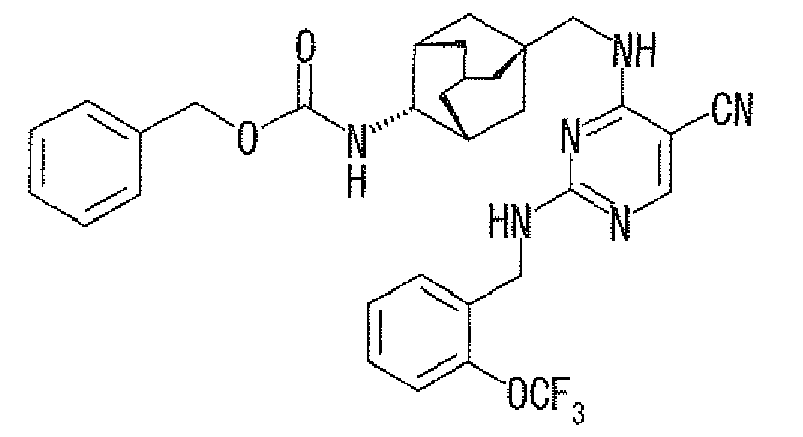
41 rel 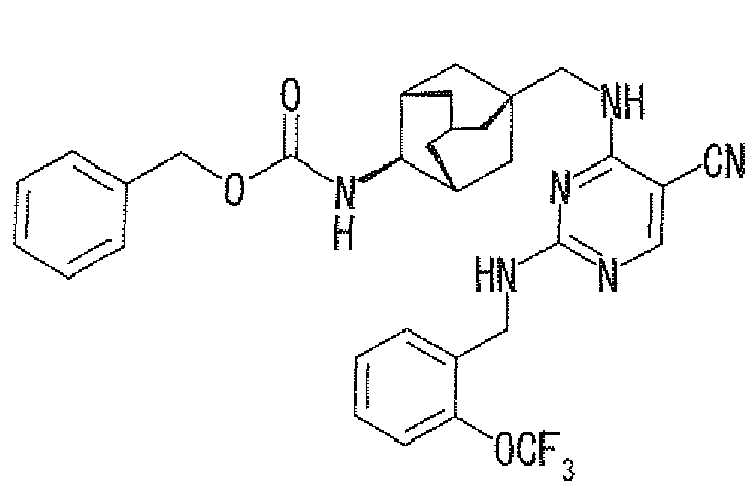
42 
-
[Table 7] PEx Str PEx Str 43 rel 
44 
45 
46 rel 
47 rel 
48 rel 
49 rel 
50 rel 
-
[Table 8] PEx Str PEx Str 51 
52 
53 
54 
55 rel 
56 rel 
57 rel 
58 rel 
59 rel 
60 rel 
-
[Table 9] PEx Str PEx Str 61 rel 
62 rel 
63 rel 
64 rel 
65 rel 
66 rel 
67 rel 
68 rel 
69 rel 
70 rel 
-
[Table 10] PEx Str PEx Str 71 rel 
72 rel 
73 rel 
74 rel 
75 
76 rel 
77 rel 
78 rel 
-
[Table 11] PEx Str PEx Str 79 rel 
80 rel 
81 rel 
82 rel 
83 
84 rel 
85 rel 
86 rel 
-
[Table 12] PEx Str PEx Str 87 rel 
88 rel 
89 rel 
90 rel 
91 rel 
92 rel 
93 rel 
94 rel 
95 rel 
96 rel 
-
[Table 13] PEx Str PEx Str 97 rel 
98 
99 
100 
101 
102 rel 
103 rel 
104 rel 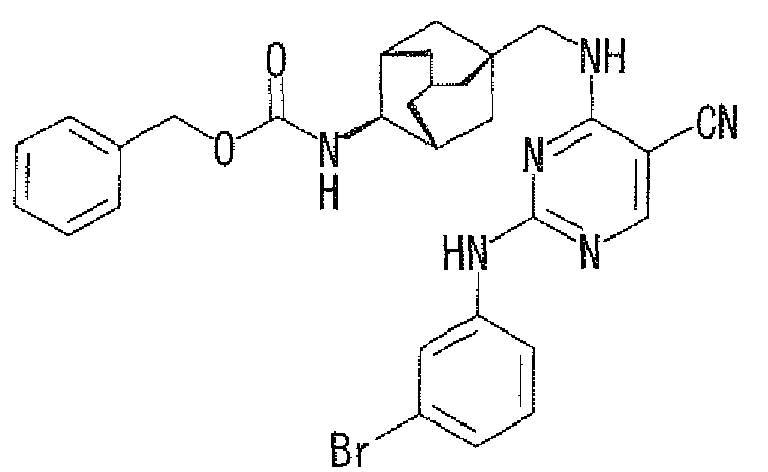
105 rel 
106 rel 
-
[Table 14] PEx Str PEx Str 107 
108 rel 
109 rel 
110 rel 
111 rel 
112 rel 
113 rel 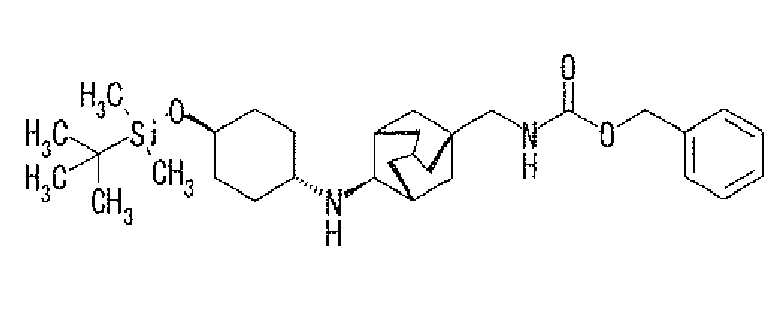
114 rel 
115 rel 
116 rel 
-
[Table 15] PEx Str PEx Str 117 rel 
118 rel 
119 rel 
120 rel 
121 rel 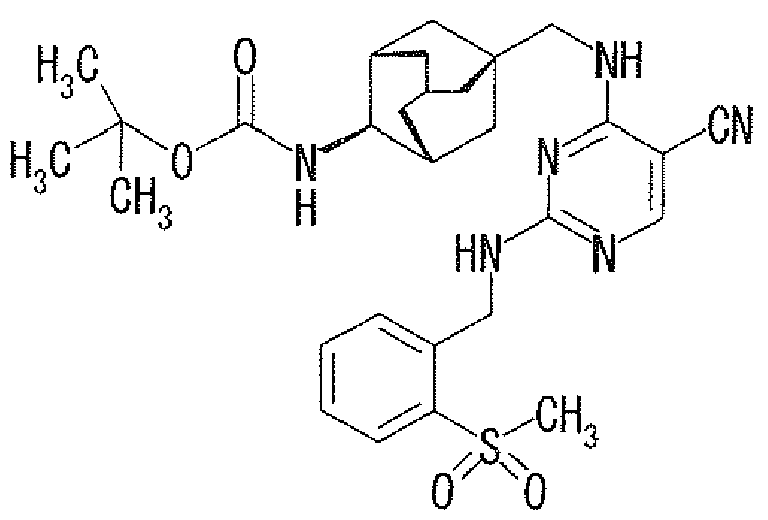
122 
123 
124 rel 
125 rel 
126 
127 
128 
-
[Table 16] PEx Str PEx Str 129 
130 
131 
132 
133 rel 
134 rel 
135 rel 
136 rel 
137 
138 rel 
139 rel 
140 rel 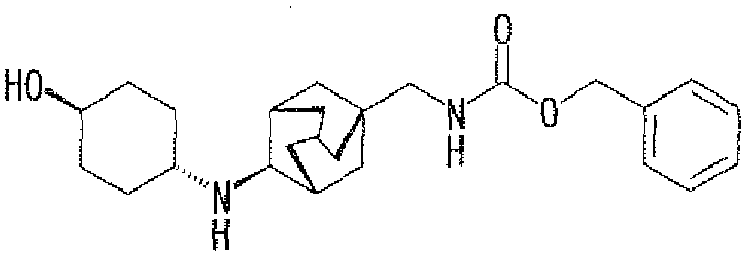
141 rel 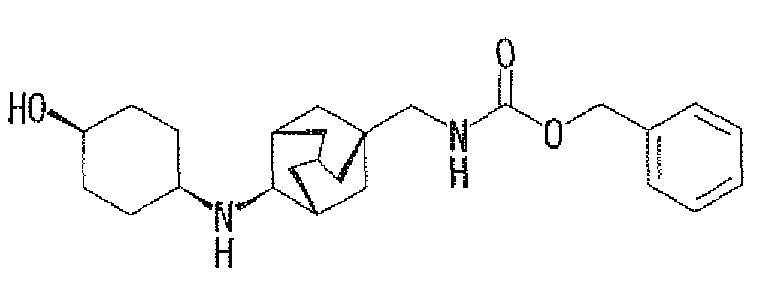
142 
-
[Table 17] PEx Str PEx Str 143 rel 
144 
145 
146 
147 
148 
149 
150 
151 
152 rel 
153 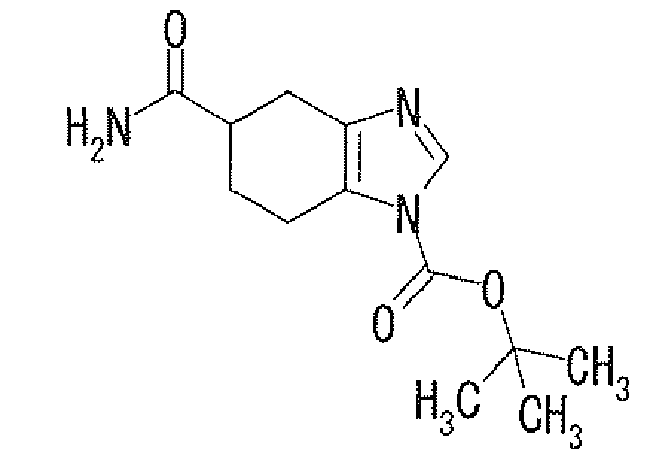
154 
-
[Table 18] PEx Str PEx Str 155 
156 
157 
158 
159 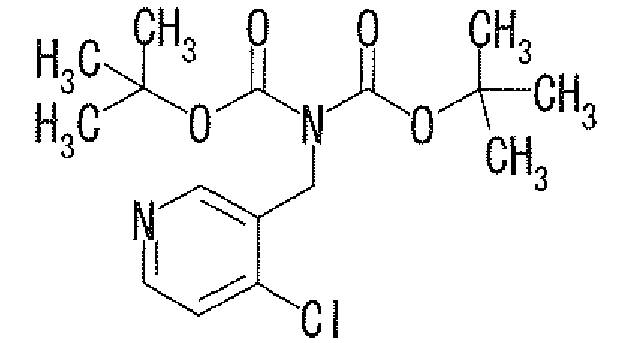
160 
161 rel 
162 rel 
163 rel 
164 rel 
165 
166 rel 
-
[Table 19] PEx Str PEx Str 167 
168 rel 
169 rel 
170 rel 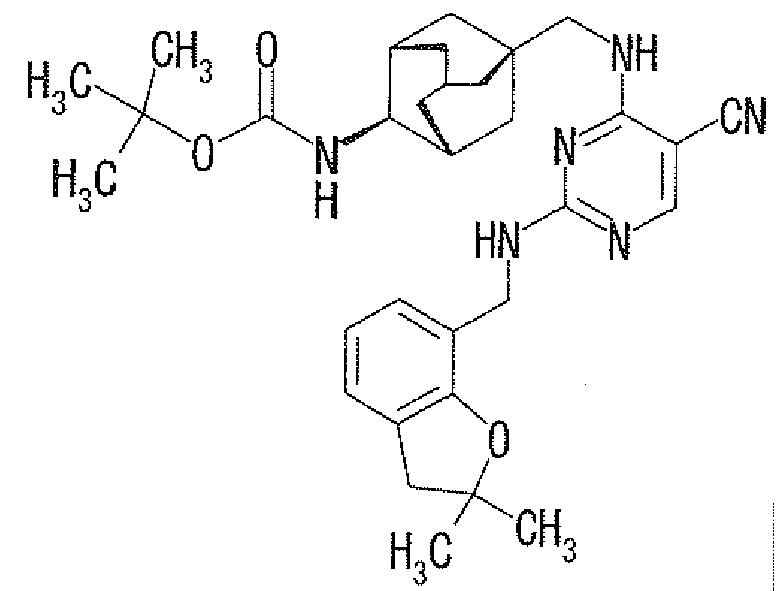
171 rel 
172 rel 
173 rel 
174 rel 
-
[Table 20] PEx Str PEx Str 175 rel 
176 rel 
177 rel 
178 rel 
179 rel 
180 rel 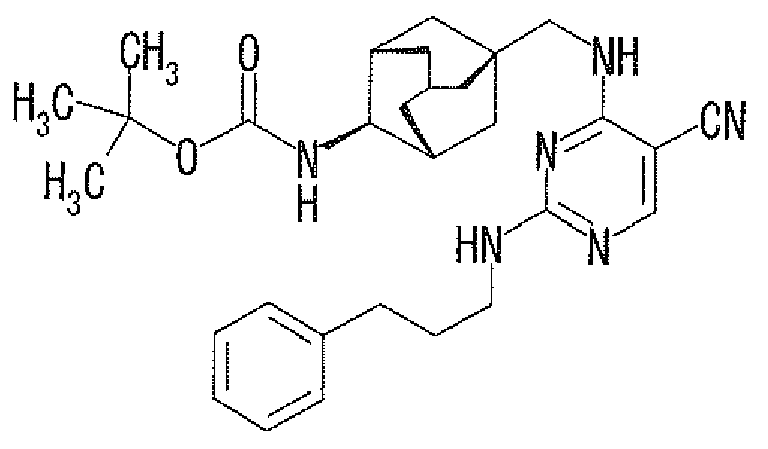
181 rel 
182 rel 
-
[Table 21] PEx Str PEx Str 183 rel 
184 rel 
185 rel 
186 rel 
187 rel 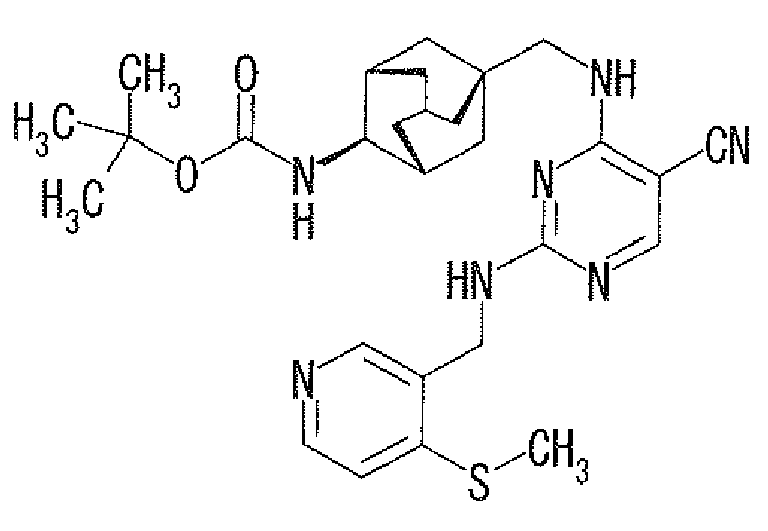
188 rel 
189 rel 
190 rel 
-
[Table 22] PEx Str PEx Str 191 rel 
192 rel 
193 rel 
194 rel 
195 rel 
196 rel 
197 rel 
198 rel 
-
[Table 23] PEx Str PEx Str 199 rel 
200 rel 
201 rel 
202 
203 rel 
204 rel 
205 rel 
206 rel 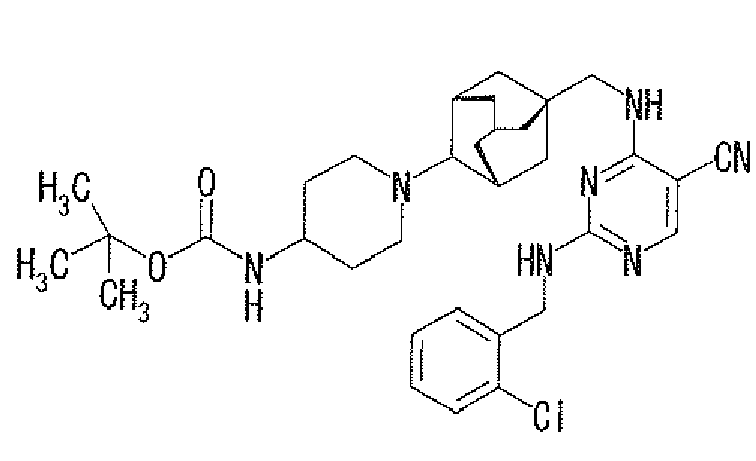
-
[Table 24] PEx Str PEx Str 207 rel 
208 rel 
209 rel 
210 rel 
211 rel 
212 rel 
213 rel 
214 rel 
215 rel 
216 rel 
217 rel 
218 rel 
-
[Table 25] PEx Str PEx Str 219 rel 
220 rel 
221 rel 
222 rel 
223 rel 
224 rel 
225 rel 
226 rel 
227 rel 
228 rel 
-
[Table 26] PEx Str PEx Str 229 rel 
230 rel 
231 rel 
232 rel 
233 rel 
234 rel 
235 rel 
236 rel 
237 rel 
238 rel 
-
[Table 27] PEx Str PEx Str 239 rel 
240 rel 
241 
242 
243 rel 
244 rel 
245 
246 
247 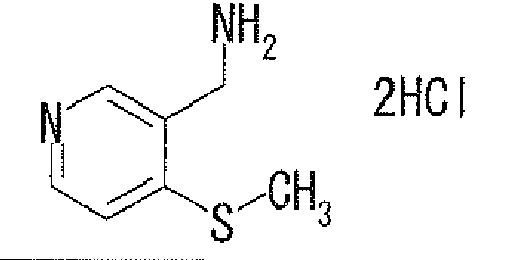
248 
249 
250 
251 
252 
-
[Table 28] PEx Str PEx Str 253 
254 rel 
255 rel 
256 rel 
257 rel 
258 rel 
259 rel 
260 
261 
262 rel 
-
[Table 29] PEx Str PEx Str 263 rel 
264 
265 
266 
267 
268 rel 
269 rel 
270 
271 
272 
-
[Table 30] PEx Str PEx Str 273 
274 
275 
276 rel 
277 
278 
279 rel 
280 rel 
-
[Table 31] PEx Str PEx Str 281 rel 
282 rel 
283 rel 
284 rel 
285 rel 
286 rel 
287 rel 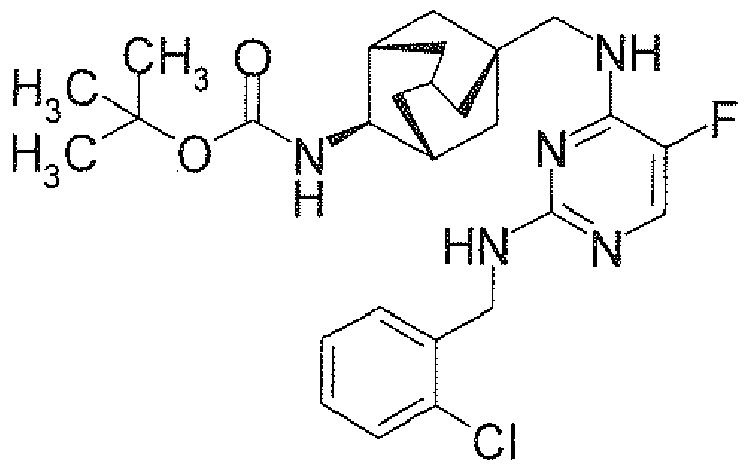
288 
289 rel 
290 
-
[Table 32] PEx Str PEx Str 291 
292 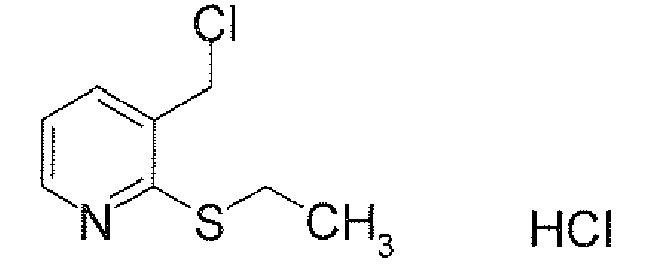
293 rel 
294 rel 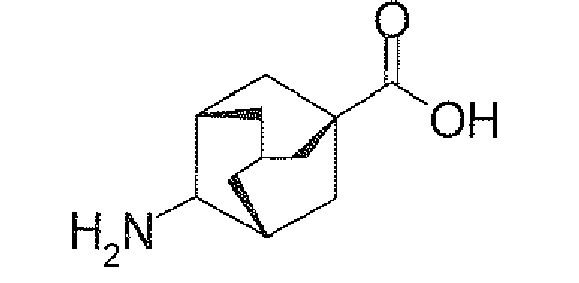
295 rel 
296 rel 
297 rel 
298 rel 
299 rel 
300 rel 
-
[Table 33] PEx Str PEx Str 301 rel 
302 rel 
303 rel 
304 rel 
305 rel 
306 rel 
307 rel 
308 rel 
309 rel 
310 rel 
311 rel 
312 rel 
-
[Table 34] PEx Str PEx Str 313 rel 
314 rel 
315 rel 
316 rel 
317 rel 
318 rel 
319 
320 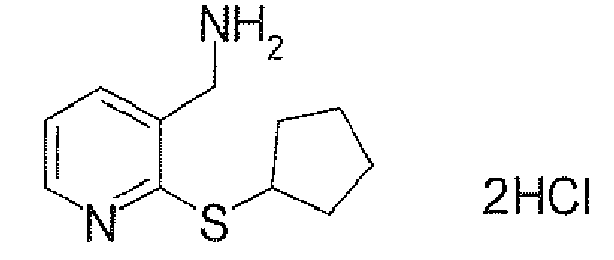
321 
322 
323 
-
[Table 351 PEx Syn Dat PEx Syn Dat 1 P1 ESI+:451 2 P2 ESI+: 384 3 P3 ESI+: 594 4 P4 ESI+: 368 5 P4 ESI+: 382 6 P6 ESI+:283 7 P7 ESI+: 437 8 P7 ESI+: 344 9 P9 East+: 358 10 P10 ESI+: 249 11 P11 ESI+: 223 12 P12 ESI+: 510 13 P12 ESI+: 536 14 P12 ESI+: 536 15 P12 ESI+: 572 16 P12 ESI+: 572 17 P12 ESI+: 572 18 P12 ESI+: 558 19 P19 ESI+: 411 20 P20 ESI+: 351 21 P21 ESI+: 351 22 P20 ESI+: 238 23 P23 ESI+: 281 24 P24 ESI+: 315 25 P24 ESI+: 315 26 P24 ESI+: 224 27 P27 ESI+: 422, 424 28 P28 FAB+: 414 29 P29 ESI+: 559 30 P29 ESI+: 559 31 P31 ESI+: 403 32 P31 ESI+: 385 33 P31 ESI+: 404 34 P31 ESI+: 434 35 P31 ESI+: 437, 439 36 P36 ESI+: 290 37 P37 ESI+: 430 38 P37 ESI+: 529 39 P37 ESI+: 555 40 P37 ESI+: 607 41 P37 ESI+: 607 42 P37 ESI+: 424 43 P37 ESI+:516 44 P37 ESI+:507 45 P37 ESI+: 507 46 P37 ESI+: 464 47 P37 ESI+: 474, 476 48 P37 ESI+: 613, 615,617 49 P37 ESI+: 621 50 P37 ESI+: 587 51 P37 ESI+: 460 52 P37 ESI+: 524 53 P37 ESI+: 493 54 P54 ESI+: 313, 315 55 P54 ESI+: 531 56 P54 ESI+: 519 57 P54 ESI+: 597 58 P54 ESI+: 503 59 P54 ESI+: 519 60 P54 ESI+: 490 61 P54 ESI+: 490 62 P54 ESI+: 490 63 P54 ESI+: 523, 525 64 P54 ESI+: 523, 525 65 P54 ESI+: 523, 525 66 P54 ESI+: 567, 569 67 P54 ESI+: 529 68 P54 ESI+: 515 69 P54 ESI+: 505 70 P54 ESI+: 589,591 71 P54 ESI+: 549 72 P54 ESI+: 579, 581, 583 73 P54 ESI+: 579, 581,583 74 P54 ESI+: 535 -
[Table 36] PEx Syn Dat PEx Syn Dat 75 P54 no data 76 P54 ESI+: 557, 559, 561 77 P54 ESI+: 519 78 P54 ESI+: 553, 555 79 P54 ESI+: 596 80 P54 ESI+: 549 81 P54 ESI+: 524, 526 82 P54 ESI+: 579 83 P54 ESI+: 351, 353 84 P54 no data 85 P54 no data 86 P54 ESI+: 571 87 P54 ESI+: 584 88 P54 ESI+: 571 89 P54 ESI+: 575, 577 90 P54 ESI+: 566 91 P54 ESI+: 563 92 P54 ESI+: 541 93 P54 ESI+: 541 94 P54 ESI+: 571 95 P54 ESI+: 555 96 P54 ESI+: 561, 563 97 P54 ESI+: 618, 620 98 P54 ESI+: 301, 303 99 P54 ESI+: 297, 299 100 P100 ESI+: 372, 374 101 P101 ESI+: 372, 374 102 P100 ESI+: 650 103 P100 ESI+: 650 104 P104 ESI+: 587,589 105 P105 ESI+:380 106 P106 ESI+: 352 107 P107 ESI+: 255 108 P108 ESI+: 408 109 P109 ESI+: 300 110 P109 ESI+: 661 111 P109 ESI+: 677 112 P112 ESI+: 527 113 P113 ESI+: 527 114 P112 ESI+: 649 115 P112 ESI+: 611 116 P112 ESI+: 606, 608 117 P117 ESI+:468 118 P117 ESI+: 480 119 P117 ESI+: 496 120 P120 ESI+: 551 121 P121 ESI+: 589 122 P122 no data 123 P123 ESI+: 168 124 P124 ESI+: 315 125 P124 ESI+: 329 126 P126 ESI+: 182 127 P126 ESI+: 168 128 P126 ESI+: 181 129 P126 NMR1: 3.91-4.01(2 H, m), 5.23(2 H, s), 7.09-7.14(1H, m), 7.19-7.23(1H, m), 7.30-7.51 (2 H, m), 8.27-8.45(3 H, m) 130 P126 ESI+: 158, 160 131 P126 ESI+: 215, 217 132 P132 ESI+: 215 133 P133 ESI-: 375 134 P134 ESI+: 279 135 P134 ESI+: 279 136 P134 ESI+: 295 137 P137 ESI+: 380, 382 138 P138 ESI+: 472 139 P139 ESI+: 314 140 P140 ESI+: 413 -
[Table 371 PEx Syn Dat PEx Syn Dat 141 P140 ESI+: 413 142 P142 ESI+: 232 143 P143 EST+: 210 144 P144 FAB+: 324 145 P145 ESI+: 285, 287,289 146 P146 ESI+: 338, 340 147 P147 ESI+: 288 148 P148 ESI+: 362 149 P149 ESI+: 302 150 P150 ESI+: 337 151 P3 ESI+: 270 152 P4 ESI+: 481, 483 153 P20, P21 ESI+: 288 154 P154 ESI+: 299, 301 155 P154 ESI+: 299, 301 156 P154 ESI+: 285, 287 157 P27 ESI+: 355 158 P27 ESI+: 339 159 P27 ESI+: 365, 367 160 P27 ESI+: 377 161 P29 ESI+: 537, 539 162 P29 ESI+: 663, 665 163 P29 ESI+: 663, 665 164 P29 ESI+: 649, 651 165 P37 ESI+: 156 166 P37 ESI+: 373 167 P37 ESI+: 515 168 P37 ESI+: 460, 462 169 P54 ESI+: 545 170 P54 ESI+: 559 171 P54 ESI+: 611 172 P54 ESI+:478 173 P54 ESI+: 571 174 P54 ESI+: 537 175 P54 ESI+: 559, 561 176 P54 ESI+: 559,561 177 P54 ESI+: 559, 561 178 P54 ESI+: 542 179 P54 ESI+: 535 180 P54 ESI+:539 181 P54 ESI+: 547 182 P54 ESI+:565 183 P54 ESI+: 565 184 P54 ESI+: 546, 548 185 P54 ESI+: 559, 561 186 P54 ESI+: 558 187 P54 ESI+: 536 188 P54 ESI+: 547 189 P54 ESI+: 520 190 P54 ESI+: 501 191 P54 ESI+: 485 192 P54 ESI+: 533 193 P54 ESI+:584 194 P54 ESI+: 557 195 P54 ESI+: 555 196 P54 ESI+: 529 197 P54 ESI+: 565, 567 198 P54 ESI+: 466, 468 199 P54 ESI+: 567 200 P54 ESI+: 601, 603 201 P54 ESI+: 569 202 P202 ESI+: 325 203 P109 ESI+: 618 204 P109 ESI+: 656 205 P109 ESI+: 628 206 P109 ESI+: 606, 608 207 P109 ESI+: 592, 594 208 P112, P113 ESI+: 607 209 P112, P113 ESI+: 620, 622 210 P112, P113 ESI+: 670 211 P112, P113 ESI+: 547 212 P112, P113 ESI+: 675 213 P112, P113 ESI+: 663, 665 214 P112, P113 ESI+: 676 -
[Table38] PEx Syn Dat PEx Syn Dat 215 P112, P113 ESI+: 660 216 P112, P113 ESI+: 654 217 P112, P113 ESI+: 649, 651 218 P112, P113 ESI+: 662 219 P112, P113 ESI+: 646 220 P112, P113 ESI+: 640 221 P112, P113 ESI+: 699 222 P112, P113 ESI+: 485, 487,489 223 P112, P113 ESI+: 683 224 P112, P113 ESI+: 681 225 P112 P113 ESI+: 655 226 P112, P113 ESI+: 620,622; TLC2: Rf=0.5 227 P112, P113 ESI+: 620,622; TLC2: Rf=0.45 228 P112, P113 ESI+: 634,636; TLC1: Rf=0.8 229 P112, P113 ESI+: 634,636; TLC1: Rf=0.7 230 P112, P113 ESI+:634,636 231 P112, P113 ESI+: 650 232 P112, P113 ESI+: 578, 580 233 P112, P113 ESI+: 616; TLC2: Rf=0.5 234 P112, P113 ESI+: 616; TLC2: Rf=0.45 235 P112, P113 no data 236 P112, P113 ESI+: 592, 594 237 P112, P113 no data 238 P238 ESI+:621 239 239, P240 ESI+: 670; TLC2: Rf=0.5 240 P239, P240 ESI+: 670; TLC2: Rf=0.45 241 P241 ESI+: 158, 160 242 P241 ESI+: 174, 176 243 P117 ESI+: 389 244 P117 ESI+: 484 245 P245 ESI+: 152 246 P246 ESI+:290 247 P126 ESI+: 155 248 P126 ESI+: 139 249 P126 ESI+: 143, 145 250 P126 ESI+: 155 251 P126 ESI+: 148 252 P132 ESI+:168 253 P132 ESI+: 203 254 P138 ESI+:434 255 P138 ESI+: 457 256 P138 ESI+:441 257 P138 ESI+: 422, 424 258 P138 no data 259 P138 no data 260 P260 ESI+: 270 261 P261 ESI+: 155 262 P262 ESI+: 658 263 P263 ESI+: 318 264 P263 NMR1: 1.40(9 H, s), 4.11-4.28(2H, m), 7.38-7.76(2 H, m), 7.64-7.76(1H, m), 8.25-8.33(1 H, m) 265 P4 ESI+: 395 266 P4 ESI-: 408 -
[Table 39] PEx Syn Dat PEx Syn Dat 267 P267 NMR2: 1.23(3 H, s), 1.43-1.50(2H, m), 1.56-1.64(2H, m), 1.88-1.94(1H, m), 2.14-2.23(2 H, m), 2.33-2.39(1 H, m), 3.54(3 H, s), 5.78(1 H, s) 268 P10 ESI+: 329 269 P269 ESI+: 281 270 P12 ESI-: 562 271 P12 ESI-: 576 272 P12 ESI+: 563 273 P12 ESI+: 563 274 P27 ESI+: 383 275 P27 ESI+: 369 276 P37 ESI+: 411, 413 277 P37 ESI-: 450 278 P37 ESI+: 466 279 P54 ESI+: 548 280 P54 ESI+: 548 281 P54 ESI+: 564 282 P54 ESI+: 593 283 P54 ESI+: 591 284 P54 ESI+: 550 285 P54 ESI+: 587 286 P286 ESI+: 566 287 P286 ESI+: 516, 518 288 P288 ESI+: 309 289 P289 ESI+: 304 290 P289 ESI+: 170 291 P241 ESI+: 202, 204 292 P241 ESI+: 188, 190 293 P149 ESI+:382 294 P294 ESI+: 196 295 P112, P113 ESI+: 678 296 P112, P113 ESI+: 694 297 P112, P113 ESI+: 689 298 P112, P113 ESI+: 675 299 P112, P113 ESI+: 713 300 P112, P113 ESI+: 691 301 P112, P113 ESI+: 624, 626 302 P112, P113 ESI+: 662 303 P112, P113 ESI+: 719 304 P112, P113 ESI+: 669, 671 305 P112, P113 ESI+: 649, 651 306 P112, P113 ESI+: 646 307 P112, P113 ESI+: 692 308 P112, P113 ESI+: 642, 644 309 P112, P113 ESI+: 677 310 P112, P113 ESI+: 676 311 P112, P113 ESI+: 705, 707 312 P112, P113 ESI+: 695 313 P112, P113 ESI+: 679, 681 314 P112, P113 ESI+: 699 315 P112, P113 ESI+: 713 316 P316 NMR3: 1.66-1.75(2H, m), 1.82-1.95(6 H, m), 1.95-2.08(3 H, m), 2.12-2.20(2 H, m), 3.50-3.55(1 H, m) -
[Table 40] PEx Syn Dat PEx Syn Dat 317 P120 ESI+: 574 318 P120 ESI+: 568 319 P126 ESI+: 183 320 P126 ESI+: 209 321 P126 ESI+: 169 322 P322, P323 NMR2: 1.26(3 H, s), 1.40-1.48(2H, m), 1.68-1.86(6 H, m), 2.13-2.19(1 H, m), 9.64(1 H, s) 323 P322, P323 NMR2: 1.22(3 H, s), 1.46-1.73(6 H, m), 1.92-1.99(2 H, m), 2.30-2.36(1 H, m), 9.69(1 H, s) - To a solution of benzyl rel-1-[(1R,3S,5S)-5-{[(5-cyano-2-{[2-(trifluoromethoxy)benzyl]amino}pyrimidin-4-yl)amino]methyl}adamantan-2-yl]-D-prolinate (100 mg) in EtOH (5 ml) was added 10% Pd/C (wetted with 50% water, 20 mg), followed by stirring at room temperature at a normal pressure under a hydrogen atmosphere. After completion of the reaction, the catalyst was separated by filtration through Celite, and the filtrate was concentrated under reduced pressure. The obtained residue was purified by preparative alumina thin layer chromatography (chloroform-MeOH) to obtain 74.4 mg of rel-1-[(1R,3S,5S)-5-{[(5-cyano-2-{[2-(trifluoromethoxy)benzyl]amino}pyrimidin-4-yl)amino]methyl}adamantan-2-yl]-D-proline.
- To a solution of rel-4-({[(1S,3R,4S,5S)-4-aminoadamantan-1-yl]methyl}amino)-2-{[2-(trifluoromethoxy)benzyl]amino}pyrimidine-5-carbonitrile (50 mg) in DMF (0.2 ml) were added iodobenzene (14.2 µl), cesium acetate (50.8 mg) and copper (I) iodide (20.2 mg), followed by stirring at 90°C for 24 hours under irradiation with microwaves. The mixed reaction liquid was diluted with EtOAc, and then the organic layer was sequentially washed with water and saturated brine, and dried over anhydrous sodium sulfate. After the desiccant was removed, the solvent was evaporated under reduced pressure. The obtained residue was purified by preparative silica gel thin layer chromatography (chloroform-MeOH) to obtain 5.1 mg of rel-4-({[(1S,3R,4S,5S)-4-anilinoadamantan-1-yl]methyl}amino)-2-{[2-(trifluoromethoxy)benzyl]amino}pyrimidine-5-carbonitrile.
- Under ice-cooling, to a solution of rel-4-({[(1S,3R,4S,5S)-4-aminoadamantan-1-yl]methyl}amino)-2-{[2-(trifluoromethoxy)benzyl]amino}pyrimidine-5-carbonitrile (50 mg) in DMF (1.0 ml) were sequentially added DIPEA (27.7 µl) and acetyl chloride (10.3 µl), followed by stirring at the same temperature for 1 hour. The reaction mixture was diluted with EtOAc, and then the organic layer was sequentially washed with water and saturated brine, and dried over anhydrous sodium sulfate. After the desiccant was removed, the solvent was evaporated under reduced pressure. The obtained residue was purified by preparative silica gel thin layer chromatography (chloroform-MeOH) to obtain 46 mg of rel-N-[(1R,2S,3S,5S)-5-{[(5-cyano-2-{[2-{trifluoromethoxy}benzyl]amino}pyrimidin-4-yl)amino]methyl}adamantan-2-yl]acetamide.
- To a solution of rel-(4R)-1-[(1R,3S,5S)-5-{[(5-cyano-2-{[2-(trifluoromethoxy)benzyl]amino}pyrimidzn-4-yl)amino]methyl} adamantan-2-yl]-4-hydroxy-D-proline (23 mg) in DMF (0.5 ml) were sequentially added ammonium chloride (6.3 mg), HOBt (15.9 mg), and WSC (18.3 mg), followed by stirring at room temperature overnight. The reaction mixture was diluted with EtOAc, then sequentially washed with water and saturated brine, and dried over anhydrous sodium sulfate. After the desiccant was removed, the solvent was evaporated under reduced pressure. The obtained residue was purified by preparative silica gel thin layer chromatography (THF), and then purified by amino silica gel flash column chromatography (chloroform-MeOH) to obtain 10 mg of rel-(4R)-1-[(1R,3S,5S)-5-{[(5-cyano-2-{[2-(trifluoromethoxy)benzyl]amino}pyrimidin-4-yl)amino]methyl}adamantan-2-yl]-4-hydroxy-D-prolinamide.
- To a solution of rel-4-({[(1S,3R,4S,5S)-4-aminoadamantan-1-yl]methyl}amino)-2-{[2-(trifluoromethoxy)benzyl]amino}pyrimidlne-5-carbonitrile (50 mg) in DMF (1.0 ml) were sequentially added nicotinic acid (14.3 mg), HOBt (15.7 mg), and WSC (18.1 mg), followed by stirring at room temperature overnight. The reaction mixture was diluted with EtOAc, and then the organic layer was sequentially washed with water and saturated brine, and dried over anhydrous sodium sulfate. After the desiccant was removed, the solvent was evaporated under reduced pressure. The obtained residue was purified by amino silica gel flash column chromatography (hexane-EtOAc) to obtain 58 mg of rel-N-[(1R,2S,3S,5S)-5-{[(5-cyano-2-{[2-(trifluoromethoxy)benzyl]amino}pyrimidin-4-yl)amino]methyl}adamantan-2-yl]nicotinamide.
- To a solution of rel-4-({[(1S,3R,4S,5S)-4-aminoadamantan-1-yl]methyl}amino)-2-{[2-(trifluoromethoxy)benzyl]amino}pyrimidine-5-carbonitrile (50 mg) in N,N-dimethylacetamide (2.5 ml) were added sodium carbonate (44.8 mg) and 1,3-dibromopropane (43.2 µl), followed by stirring at 100°C for 30 minutes under irradiation with microwaves. The reaction mixture was diluted with EtOAc, and then the organic layer was sequentially washed with water and saturated brine, and dried over anhydrous sodium sulfate. After the desiccant was removed, the solvent was evaporated under reduced pressure. The obtained residue was purified by preparative silica gel thin layer chromatography (chloroform-MeOH) to obtain 45 mg of rel-4-({[(1S,3R,4S,5S)-4-azetidin-1-yladamantan-1-yl]methyl}amino)-2-{[2-(trifluoromethoxy)benzyl]amino}pyrimidine-5-carbonitrile.
- To a solution of rel-4-({[(1S,3R,45,5S)-4-aminoadamantan-1-yl]methyl}amino)-2-{[2-(trifluoromethoxy)benzyl]amino}pyrimidine-5-carbonitrile (30 mg) in DMF (0.6 ml) were added DIPEA (22.1 µl) and 2-bromoethanol (4.5 µl), followed by heating and stirring at 60°C. The reaction mixture was diluted with EtOAc, and then the organic layer was sequentially washed with water and saturated brine, and dried over anhydrous sodium sulfate. After the desiccant was removed, the solvent was evaporated under reduced pressure. The obtained residue was purified by preparative silica gel thin layer chromatography (chloroform-MeOH), and then by preparative alumina thin layer chromatography (chloroform-MeOH) to obtain 25 mg of rel-4-[({(1S,3R,4S,5S)-4-[(2-hydroxyethyl)amino]adamantan-1-yl}methyl)amino]-2-{[2-(trifluoromethoxy)benzyl]amino}pyrimidine-5-carbonitrile.
- To a solution of 4-({[(1S,3R,4S,5S)-4-aminoadarnantan-1-yl]methyl}amino)-2-{[2-(trifluoromethoxy)benzyl]ammo}pyrimidine-5-carbonitrile (50 mg) in DMF (1 ml) were added (2,2-dimethyl-1,3-dioxan-5-yl)methyl 4-methylbenzenesulfonate (47.7 mg) and potassium carbonate (29.2 mg), followed by stirring at 70°C for 12 hours. To the reaction mixture was added water, followed by extraction with EtOAc. The organic layer was dried over magnesium sulfate, the desiccant was removed, and then the solvent was evaporated under reduced pressure. The obtained residue was purified by silica gel column chromatography (hexane-EtOAc) to obtain 21 mg of 4-({[(1S,3R,4S,5S)-4-{[(2,2-dimethy)-1,3-dioxan-5-yl)methyl]amino}adamantan-1-yl]mehyl}amino)-2-{[2-(trifluoromethoxy)benzyl]amino}pyrimidine-5-carbonitrile.
- To a mixed solution of rel-4-({[(1S,3R,4S,SS)-4-aminoadamantan-1-yl]methyl}amino)-2-{[2-(trifluoromethoxy)benzyl]amino}pyrimidine-5-carbonitril(50 mg) in EtOH (1.0 ml) and THF (0.5 ml) was added oxiran-2-ylmethanol (8.2 µl), followed by stirring at room temperature for 24 hours. Oxylan-2-yl methanol (82.1 µl) was added thereto, followed by stirring at room temperature for additional 48 hours. The mixed reaction liquid was purified by amino silica gel flash column chromatography (chloroform-MeOH) to obtain 25 mg of rel-4-[({(1S,3R,4S,5S)-4-[(2,3-dihydroxypropyl)amino]adamantan-1-yl}methyl)amino]-2-{[2-(trifluoromethoxy)benzyl]amino}pyrimidine-5-carbonitrile.
- To a solution of rel-4-({[(1S,3R,4S,5S)-4-aminoadamantan-1-yl]methyl}amino)-2-{[2-(trifluoromethoxy)benzyl]amino}pyrimidine-5-carbonitrile (50 mg) in 1,3-dimethylimidazolidin-2-one (1.0 ml) were added DIPEA (36.9 µl) and 2,2,2-trifluoroethyl trifluoromethanesulfonate (18.3 µl), followed by stirring at room temperature. After completion of the reaction, the mixed reaction liquid itself was purified by silica gel flash column chromatography (chloroform-MeOH) to obtain 55 mg of rel-4-[({(1S,3R,4S,5S)-4-[(2,2,2-trifluoroethyl)amino]adamantan-1-yl}methyl)amino]-2-{[2-(trifluoromethoxy)benzyl]amino}pyrimidine-5-carbonitrile,
- To a solution of 4-({[(1S,3R,4S,5S)-4-aminoadamantan-1-yl]methyl)amino)-2-{[2-(trifluoromethoxy)benzy]amino}pyrimidine-5-carbonitrile (50 mg) in 1,3-dimethylimidazolidin-2-one (0.5 ml) were added 2,2-bis(bromomethyl)propane-1,3-diol (221.8 mg), and potassium carbonate (146.3 mg), followed by stirring at room temperature for 4 days. The reaction mixture was purified by silica gel column chromatography (chloroform-MeOH) as it was to obtain 5 mg of [({(1S,3R,4S,5S)-4-[3,3-bis(hydroxymethyl)azetidin-1-yladamantan-1-yl}methyl)amino]-2-{[2-(trifluoromethoxy)benzyl]amino}pyrimidine-5-carbonitrile.
- A mixture of steric isomers (39 mg) of rel-4-[({(1R,3S,5R)-4-[(trans-4-hydroxycyclohexyl)amino]adamantan-1-yl}methyl)amino]-2-{[2-(trifluoromethoxy)benzyl]amino}pynmidine-5-carbonitrile was subjected to separation and purification by reverse phase liquid chromatography (eluent: a mixed liquid of 0.2% formic acid/MeOH and water) to obtain a formate of rel-4-[({(1R,35,4R,5R)-4-[(trans-4-hydroxycyclohexyl)amino]adamantan-1-yl}methyl)amino]-2-{[2-(trifluoromethoxy)benzyl]amino}pyrimidine-5-carbonitrile and a formate of rel-4-[({(1R,3S,4S,5R)-4-[(trans-4-hydroxycydohexyl)amino]adamantan-1-yl}methyl)amino]-2-{[2-(triftuoromethoxy)benzyl]amino}pyrimidine-5-carbonitrile as single isomers, respectively. Then, their formates were each purified by amino silica gel flash column chromatography (hexane-EtOAc) to obtain 19.1 mg of rel-4-[({(1R,3S,4R,5R)-4-[(trans-4-hydroxycyclohexyl)amino]adamantan-1-yl}methyl)amino]-2-{[2-(tnfluoromethoxy)benzyl]amino}pyrimidine-5-carbonitrile and 10.4 mg of rel-4-[({(1R,3S,4S,5R)-4-[(trans-4-hydroxycyclohexyl)amino]adamantan-1-yl}methyl)amino]-2-{[2-(trifluoromethoxy)benzyl]amino}pyrimidine-5-carbonitrile.
- To a solution of rel-trans-4-{[(1R,2S,3S,5S)-5-(aminomethyl)adamantan-2-yl]amino}cyclohexanol (80 mg) in 1,3-dimethylimidazolidin-2-one (1.0 ml) were added DIPEA (0.20 ml) and 4-chloro-2-{[2-(methylsulfanyl)benzyl]amino}pyrimidine-5-carbonitrile (108.6 mg), followed by stirring at room temperature overnight. The mixed reaction liquid was purified by amino silica gel flash column chromatography (chloroform-MeOH) to obtain 73.4 mg of rel-4-[({(1R,3S,4R,5R)-4-[(trans-4-hydroxycyclohexyl)amino]adamantan-1-yl}methyl)amino]-2-{[2-(methylsulfanyl)benzyl]amino}pynmidine-5-carbonitrile.
- To a solution of ethyl rel-N-[(1R,2S,3S,5S)-5-{[(5-cyano-2-{[2-(trifluoromethoxy)benzyl]amino}pyrimidin-4-yl)amino]methyl}adamantan-2-yl]glycinate (24 mg) in THF (2.4 ml) was added a 4 M aqueous lithium hydroxide solution (0.1 ml), followed by stirring at room temperature. After completion of the reaction, to the mixed reaction liquid were added 1 M hydrochloric acid (0.4 ml), followed by stirring, and then the mixed reaction liquid was concentrated under reduced pressure. To the obtained residue was added water, and the solid was collected by filtration and then dried under reduced pressure. The obtained solid was suspended by the addition of EtOAc and diisopropyl ether, and then the solid was collected by filtration and dried under reduced pressure to obtain 11.0 mg of rel-N-[(1R,2S,3S,5S)-5-{[(5-cyano-2-{[2-(trifluoromethoxy)benzyl]amino}pyrimidin-4-yl)amino]methyl}adamantan-2-yl]glycine.
- To a solution of rel-4-({[(1S,3R,5S)-4-oxoadamantan-1-yl]methyl}amino)-2-([2-(trifluoromethoxy)benzyl]amino}pyrimidine-5-carbonitrile (40 mg) in dichloromethane (0.8 ml) were added trans-4-aminocyclohexanol (14.7 mg) and sodium triacetoxyborohydride (53.9 mg), followed by stirring at room temperature overnight. To the mixed reaction liquid was added saturated aqueous sodium bicarbonate, followed by extraction with EtOAc, and then the organic layer was washed with saturated brine, and dried over anhydrous sodium sulfate. After the desiccant was removed, the solvent was evaporated under reduced pressure. The obtained residue was purified by preparative silica gel thin layer chromatography (chloroform-MeOH) to obtain 18 mg of rel-4-[({1R,3S,5R)-4-[(trans-4-hydroxycyclohexyl)amino]adamantan-1-yl}methyl)amino]-2-{[2-(trifluoromethoxy)benzyl]amino}pyrimidine-5-carbonitrile.
- To a solution of rel-4-({[(1S,3R,4S,5S)-4-aminoadamantan-1-yl]methyl}amino)-2-{[2-(methylsulfanyl)benzyl]amino}pyrimidine-5-carbonitrile (50 mg) in dichloromethane (3.5 ml) were added 4-hydroxycyclohexanone (39.4 mg) and sodium triacetoxyborohydride (146.3 mg), followed by stirring at room temperature for 2 hours. To the mixed reaction liquid was added saturated aqueous sodium bicarbonate, followed by extraction with EtOAc, then washing with saturated brine, and drying over anhydrous sodium sulfate. After the desiccant was removed, the solvent was evaporated under reduced pressure. The obtained residue was purified by amino silica gel flash column chromatography (chloroform-MeOH) to obtain 60.6 mg of rel-4-[({1S,3R,4S,5S}-4-[(4-hydroxycyclohexyl)amino]adamantan-1-yl}methyl)amino]-2-{[2-(methylsulfanyl)benzyl]amino}pyrimidine-5-carbonitrile.
- To a solution of rel-4-[({(1S,3R,4S,5S)-4-[(4-hydroxycyclohexyl)amino]adamantan-1-yl}methyl)amino]-2-{[2-(trifluoromethoxy)benzyl]amino}pyrimidine-5-carbonitrile (50 mg) in MeOH (2 ml) were added a 37% aqueous formalin solution (28.4 µl) and sodium cyanoborohydride (8.3 mg), followed by stirring at room temperature for 5 hours. To the mixed reaction liquid was added saturated aqueous sodium bicarbonate, followed by extraction with EtOAc, and then washed with saturated brine, and dried over anhydrous sodium sulfate. After the desiccant was removed, the solvent was evaporated under reduced pressure. The obtained residue was purified by amino silica gel flash column chromatography (chloroform-MeOH) to obtain 37.6 mg of rel-4-[({(1S,3R,4S,5S)-4-[(4-hydroxycyclohexyl)(methyl)amino]adamantan-1-yl}methyl)amino]-2-{[2-(trifluoromethoxy)benzyl]amino}pyrimidine-5-carbonitrile.
- To a solution of rel-4-({[(1S,3R,5S)-4-oxoadamantan-1-yl]methyl}amino)-2-{[2-(trifluoromethoxy)benzyl]amino}pyrimidine-5-carbonitrile (30 mg) in MeOH (3 ml) was added sodium borohydride (13.5 mg), followed by stirring at room temperature. After completion of the reaction, the reaction mixture was diluted with EtOAc, and then the organic layer was sequentially washed with water and saturated brine, and dried over anhydrous sodium sulfate. After the desiccant was removed, the solvent was evaporated under reduced pressure. The obtained residue was purified by preparative silica gel thin layer chromatography (chloroform-MeOH) to obtain 25.6 mg of rel-4-({[(1S,3R,5S)-4-hydroxyadamantan-1-yl]methyl}amino)-2-{[2-(trifluoromethoxy)benzyl]amino}pyrimidine-5-carbonitrile.
- Under ice-cooling, to a solution of rel-2-[(2-methoxybenzyl)amino]-4-[({(1S,3R,4S,5S)-4-[(4-oxocyclohexyl)amino]adamantan-1-yl}methyl)amino]pyrimidine-5-carbonitrile (40 mg) in THF (2 ml) was added dropwise a 0.97 M solution (0.40 ml) of methylmagnesium bromide in THF under a nitrogen atmosphere, followed by stirring at the same temperature for 3 hours. To the mixed reaction liquid was added water, followed by extraction with EtOAc, and then the organic layer was washed with saturated brine, and dried over anhydrous sodium sulfate. After the desiccant was removed, the solvent was evaporated under reduced pressure. The obtained residue was purified by preparative silica gel thin layer chromatography (chloroform-MeOH-28% aqueous ammonia) to first obtain 4.3 mg of rel-4-[({(1S,3R,4S,5S)-4-[(4-hydroxy-4-methylcyclohexyl)amino]adamantan-1-yl}methyl)amino]-2-[(2-methoxybenzyl)amino]pyrimidine-5-carbonitrile (isomer A) and then obtain 5.3 mg of rel-4-[({(1S,3R,4S,5S)-4-[(4-hydroxy-4-methylcyclohexyl)aminoladamantan-1-yl}methyl)amino]-2-[(2-methoxybenzyl)amino]pyrimidine-5-carbonitrile (isomer B).
- To a solution of 4-[(1-azabicyclo[2.2.2]oct-3-ylmethyl)amino]-2-{[2-(trifluoromethoxy)benzyl]amino}pyrimidine-5-carbonitrile (40 mg) in dichloromethane (1 ml) was added 77% MCPBA (contains water, 21 mg) under ice-cooling, followed by stirring at room temperature for 3 hours. To the reaction mixture was added saturated aqueous sodium hydrogen carbonate solution, followed by extraction with EtOAc. The organic layer was dried over anhydrous sodium sulfate, the desiccant was removed, and then the solvent was evaporated under reduced pressure. The obtained residue was purified by amino silica gel flash column chromatography (chloroform-MeOH) to obtain 19 mg of 4-[(1-oxide-azabicyclo[2.2.2]oct-3-ylmethyl)amino]-2-{[2-(trifluoromethoxy)benzyl]amino}pyrimidine-5-carbonitrile.
- To a solution of rel-4-({[(1S,3R,4S,5S)-4-(tetrahydro-2H-thiopyran-4-ylamino)adamantan-1-yl]methyl}amino)-2-{[2-(trifluoromethoxy)benzyl]amino}pyrimidine-5-carbonitrile (88 mg) in dichloromethane (2 ml) was added 75% MCPBA (contains water, 106.1 mg), followed by stirring at room temperature for 6 hours. To the mixed reaction liquid was added saturated aqueous sodium bicarbonate, followed by extraction with EtOAc, and the organic layer was washed with saturated brine and then dried over anhydrous sodium sulfate. After the desiccant was removed, the solvent was evaporated under reduced pressure. The obtained residue was purified by silica gel flash column chromatography (chloroform-MeOH), and then by preparative silica gel thin layer chromatography (chloroform-MeOH) to obtain 8.8 mg of rel-4-[({(1S,3R,4,5S)-4-[(1,1-dioxidotetrahydro-2H-thiopyraran-4-yl)amino]adamantan-1-yl}methyl)amino]-2-{[2-(trifluoromethoxy)benzyl]amino}pyrimidine-5-carbonitrile.
- To a solution of 4-{[(3-endo)-8-benzyl-8-azabicyclo[3.2.1]oct-3-yl]amino}-2-{[2-(trifluoromethoxy)benzyl]amino}pyrimidine-5-carbonitrile (16 mg) in MeOH (1ml) were added ammonium formate (100 mg) and a catalytic amount of 10% Pd/C (wetted with 50% water), followed by heating and refluxing for 6 hours. The mixed reaction liquid was left to be cooled to room temperature, then the catalyst was removed, and the filtrate was concentrated under reduced pressure. The obtained residue was dissolved in EtOAc, sequentially washed with water and saturated brine, and dried over anhydrous sodium sulfate. After the desiccant was removed, the solvent was evaporated under reduced pressure. The obtained residue was purified by preparative silica gel thin layer chromatography (chloroform-MeOH) to obtain 8.0 mg of 4-[{3-endo}-8-azabicyclo[3.2.1]oct-3-ylamino]-2-{[2-(trifluoromethoxy)benzyl]amino}pyrimidine-5-carbonitrile.
- To a solution of tert-butyl rel-{(1R,2S,3S,5S)-S-[({2-[(2-chlorobenzyl)amino]-5-cyanopyrimidin-4-yl}amino)methyl]adamantan-2-yl}carbamate (70 mg) in dichloromethane (1 ml) was added trifluoroacetic acid (0.135 ml), followed by stirring at room temperature overnight. The mixed reaction liquid was concentrated under reduced pressure, and to the obtained residue was added an aqueous potassium carbonate solution, followed by stirring at room temperature for 3 hours. The precipitated solid was collected by filtration, washed with water, and then dried under reduced pressure to obtain 55 mg of rel-4-({[(1S,3R,4S,5S)-4-aminoadamantan-1-yl]methyl}amino)-2-[(2-chlorobenzyl)amino]pyrimidine-5-carbonitrile.
- To a solution of tert-butyl 3-{[(5-cyano-2-{[2-(trifluoromethoxy)benzyl]amino}pyrimidin-4-yl)amino]methyl}-8-azabicyclo[3.2.1]octane-8-carboxylate in dioxane (0.6 ml) was added a 4 M hydrogen chloride dioxane solution (0.28 ml), followed by stirring at room temperature for 10 hours. The reaction mixture was concentrated under reduced pressure to obtain 56 mg of 4-[(8-azabicyclo[3.2.1]oct-3-ylmethyl)amino]-2-{[2-(trifluoromethoxy)benzyl]amino}pyrimidine-5-carbonitrile dihydrochloride.
- To a solution of 4-({[1-(tetrahydro-2H-pyran-2-yl)-1H-benzimidazol-5-yl]methyl}amino)-2-{[2-(trifluoromethoxy)benzyl]amino}pyrimidine-5-carbonitrile (50 mg) in EtOH (3 ml) was added 1 M hydrochloric acid (1ml), followed by stirring at 60°C for 24 hours. To the mixed reaction liquid were added 1 M hydrochloric acid (1 ml), followed by stirring at 60°C for additional 24 hours. The reaction liquid was concentrated under reduced pressure, and to the obtained residue were added EtOAc and EtOH. The precipitated solid was collected by filtration, washed with EtOAc, and then dried under reduced pressure to obtain 53.1 mg of 4-[(1H-benzimidazol-5-ylmethyl)amino]-2-{[2-(trifluoromethoxy)benzyl]amino}pyrimidine-5-carbonitrile dihydrochloride.
- To a solution of benzyl rel-[(1R,2S,3S,5S)-5-{[(5-cyano-2-{[2-(trifluoromethoxy)benzyl]amino}pyrimidin-4-yl)amino]methyl}adamantan-2-yl]carbamate (55 mg) in MeOH (3 ml) was added 10% Pd/C (wetted with 50% water, 15 mg), followed by stirring at room temperature for 6 hours at a normal pressure under a hydrogen atmosphere. The catalyst was removed by filtration, and the filtrate was concentrated under reduced pressure. The obtained residue was purified by preparative alumina thin layer chromatography (chloroform-MeOH) to obtain 20.0 mg of rel-4-({[(1S,3R,4S,5S)-4-aminoadamantan-1-yl]methyl}amino)-2-{[2-(trifluoromethoxy)benzyl]amino}pyrimidine-5-carbonitrile.
- To a solution of benzyl rel-{(1R,2S,3S,5S)-5-[({5-cyano-2[(2,5-dichlorobenzyl)amino]pyrimidin-4-yl}amino)methyl]adamantan-2-yl}carbamate (45 mg) in acetic acid (1.5 ml) was added 48% hydrobromic acid (1.5 ml), followed by stirring at room temperature for 24 hours. The reaction liquid was concentrated under reduced pressure, then the residue was dissolved in EtOAc, sequentially washed with an aqueous potassium carbonate solution, water, and saturated brine, and dried over anhydrous sodium sulfate. After the desiccant was removed, the solvent was evaporated under reduced pressure. The obtained residue was purified by amino silica gel flash column chromatography (chloroform-MeOH) to obtain 18 mg of rel-4-({[(1S,3R,4S,5S)-4-aminoadamantan-1-yl]methyl}amino)-2-[(2,5-dichlorobenzyl)amino]pyrimidine-5-carbonitrile.
- To a solution of rel-4-({[(1S,3R,4S,5S)-4-{[(2-phenyl-1,3-dioxan-4-yl)methyl]amino }adamantan-1-yl]methyl} amino)-2-{[2-(trifluoromethoxy)benzyl]amino}-5-carbonitrile (54 mg) in THF (1.5 ml) was added 1 M hydrochloric acid (1.5 ml), followed by stirring at room temperature for 4 hours. The reaction mixture was cooled under ice, and saturated aqueous sodium bicarbonate was added thereto. The precipitate was collected by filtration and dried under reduced pressure to obtain a solid, which was purified by amino silica gel column chromatography (chloroform-MeOH) to obtain 41.2 mg of rel-4-[({(1S,3R,4S,5S)-4-[(2,4-dihydroxybutyl)amino]adamantan-1-yl}methyl)amino]-2-{[2-(trifluoromethoxy)benzyl]amino}pyrimidine-5-carbonitrile.
- To a solution of rel-4-[({(1S,3R,4S,5S)-4-[(2,2-dimethyl-1,3-dioxan-5-yl)amino]adamantan-1-yl}methyl)amino]-2-{[2-(trifluoromethoxy)benzyl]amino}pyrimidine-5-carbonitrile (55 mg) in THF (1.0 ml) was added 1 M hydrochloric acid (1.0 ml), followed by stirring at room temperature. After completion of the reaction, the mixed reaction liquid was concentrated under reduced pressure, and then to the residue was added dichloromethane, followed by concentration under reduced pressure. To the obtained residue was added diethyl ether, and the precipitated solid was collected by filtration, washed with diethyl ether, and then dried under reduced pressure to obtain 50.5 mg of rel-4-({[(1S,3R,4S,5S)-4-{[2-hydroxy-1-(hydroxymethyl)ethyl]amino}adamantan-1-yl]methyl}amino)-2-[2-(trifluoromethoxy)benzyl]amino}pyrimidine-5-carbonitrile dihydrochloride.
- Under ice-cooling, to a solution of rel-4-({[(1S,3R,4S,5S)-4-aminoadamantan-1-yl]methyl}amino)-2-{[2-(trifluoromethoxy)benzyl]amino}pyrimidine-5-carbonitrile (50 mg) in DMF (1.0 ml) were sequentially added DIPEA (27.7 µl) and methanesulfonyl chloride (8.6 µL), followed by stirring at the same temperature for 1 hour. The mixed reaction liquid was diluted with EtOAc, and the organic layer was sequentially washed with water and saturated brine, and dried over anhydrous sodium sulfate. After the desiccant was removed, the solvent was evaporated under reduced pressure. The obtained residue was purified by preparative silica gel thin layer chromatography (chloroform-MeOH) to obtain 31 mg of rel-N-[(1R,2S,3S,5S)-5-{[(5-cyano-2-{[2-(trifluoromethoxy)benzyl]amino}pyrimidin-4-yl)amino]methyl}adamantan-2-yl]methane sulfonamide.
- Under ice-cooling, to a solution of rel-2-[(2-chlorobenzyl)amino]-4-({[(1S,3R,5S)-4-piperazin-1-yladamantan-1-yl]methyl}amino)pyrimidine-5-carbonitrile (18 mg) in DMF (360 µl) were sequentially added triethylamine (3.6 µl) and acetic anhydride (7.6 µl), followed by stirring at room temperature. After completion of the reaction, the mixed reaction liquid was diluted with EtOAc, washed with water (three times) and saturated brine, and dried over anhydrous sodium sulfate. The desiccant was removed, then the solvent was evaporated under reduced pressure, and the residue was purified by amino silica gel flash column chromatography (hexane-EtOAc) to obtain 16.2 mg of rel-4-({[(1S,3R,5S)-4-(4-acetylpiperazin-1-yl)adamantan-1-yl]methyl}amino)-2-[(2-chlorobenzyl)amino]pyrimidine-5-carbonitrile.
- To a solution of rel-2-[(2-chlorobenzyl)amino]-4-[({(1S,3R,4S,5S)-4-[(2-chloroethyl)amino]adamantan-1-yl}methyl)amino]pyrimidine-5-carbonitrile (27.0 mg) and (2S)-pyrrolidin-2-ylmethanol (7.9 mg) in DMF (0.27 ml) were added potassium iodide (13.8 mg) and DIPEA (0.02 ml), followed by stirring at 75°C for 2 hours. Then,(2S)-pyrrolidin-2-ylmethanol (1.1 mg) was added thereto, followed by stirring at the same temperature for additional 2 hours. The solvent was evaporated under reduced pressure and the obtained residue was purified by amino silica gel flash column chromatography (chloroform- MeOH) to obtain 25.4 mg of 2-[(2-chlorobenzyl)amino]-4-({[(1R,3R,4S,5S)-4-({2-[(2S)-2-(hydroxymethylpyrrolidin-1-yl]ethyl}amino)adamantan-1-yl]methyl}amino)pyrimidine-5-carbonitrile.
- To a solution of rel-4-[({(1R,3S,4R,5R)-4-[(cis-4-ammocyclohexyl)amino]adamantan-1-yl}methyl)amino]-2-[(2-chlorobenzyl)amino]pyrimidine-5-carbonitrile (30 mg) in DMI (1.0 ml) were added DIPEA (80.4 µl) and 2-bromoethanol (8.2 µl), followed by heating and stirring at 120°C. After completion of the reaction, the reaction mixture was diluted with chloroform and purified by amino silica gel flash column chromatography (chloroform-MeOH) as it was to obtain 17.6 mg of rel-2-[{2-chlorobenzyl}amino]-4-({[(1R,3S,4R,SR)-4-({cis-4-[(2-hydroxyethyl)amino]cyclohexyl}amino)adamantan-1-yl]methyl}amino)pyrimidine-5-carbonitrile.
- To a solution of rel-2-[(2-chlorobenzyl)amino]-4-[({(1S,3R,4S,5S)-4-[(4-oxocyclohexyl)amino]adamantan-1-yl}methyl)amino]pyrimidine-5-carbonitrile (50 mg) in dichloromethane (3.0 ml) were sequentially added 4,4-difluoropiperidine hydrochloride (30.4 mg), triethylamine (26.7 µl), and sodium triacetoxyborohydride (61.2 mg), followed by stirring at room temperature. After completion of the reaction, to the mixed reaction liquid was added saturated aqueous sodium bicarbonate, followed by extraction with chloroform, and the solvent was evaporated under reduced pressure. The obtained residue was purified by amino silica gel flash column chromatography (chloroform-MeOH) to obtain 13.1 mg of rel-2-[(2-chlorobenzyl)amino]-4-({[(1S,3R,4S,5S)-4-{[4-(4,4-difluoropiperidin-1-yl)cyclohexyl]amino}adamantan-1-yl]methyl}amino)pyrimidine-5-carbonitrile.
- To a solution of rel-4-[({(1R,3S,4R,5R)-4-[(cis-4-aminocyclohexyl)amino]adamantan-1-yl}methyl)amino] -2-[(2-chlorobenzyl)amino]pyrimidine-5-carbonitrile (40 mg) in dichloromethane (2.0 ml) were sequentially added 1-acetylpiperidin-4-one (21.7 mg) and sodium triacetoxyborohydride (48.9 mg), followed by stirring at room temperature. After completion of the reaction, to the mixed reaction liquid was added saturated aqueous sodium bicarbonate, followed by extraction with chloroform, and the solvent was evaporated under reduced pressure. The obtained residue was purified by amino silica gel flash column chromatography (chloroform-MeOH) to obtain 54 mg of rel-4-({[(1R,35,4R,5R)-4-({cis-4-[(1-acetylpiperidin-4-yl)amino]cyclohexyl}amino)adamantan-1-yl]methyl}amino)-2-[(2-chlorobenzyl)amino]pyrimidine-5-carbonitrile.
- To a suspension of rel-4-({[(1S,3R,4S,5S)-4-([trans-4-([tert-butyl (dimethyl)sllyl]oxylmethyl)cyclohexyl]methyllamino)adamantan-1-yl]methyl}amino)-2-[(2-cyanobenzyl)amino]pyrimidine-5-carbonitrile (68 mg) in MEOH) (1.4 ml) was added 1 M hydrochloric acid (0.6 ml), followed by stirring at room temperature for 1 hour. The solvent was evaporated under reduced pressure, and then the residue was diluted with chloroform, and saturated aqueous sodium bicarbonate was added thereto under ice-cooling. The mixture was extracted with a mixed solvent of chloroform-MeOH (10:1), and the organic layer was washed with water and saturated brine, and dried over anhydrous magnesium sulfate. After the desiccant was removed, the solvent was evaporated under reduced pressure and the obtained residue was purified by amino silica gel flash column chromatography (chloroform-MeOH) to obtain 49.4 mg of rel-2-[(2-cyanobenzyl)amino]-4-({[(1S,3R,4S,5S)-4-({[trans-4-(hydroxymethyl)cyclohexyl]methyl}amino)adamantan-1-yl]methyl}amino)pyrimidine-5-carbonitrile.
- Under ice-cooling, to a solution of 4-[({(1S,3R,4S,5S)-4-[(3-{[tert-butyldimethyl)silyl]oxypropyl)(methyl)amino]adamantan-1-yl}methyl)amino]-2-{[2-(methylsulfanyl)benzyl]amino}pyrimidine-5-carbonitrile (55 mg) in THF (2 mL) were added a solution (0.20 mL) of 1 M tetrabutylammonium fluoride in THF, followed by stirring at room temperature for 1 hour. The solvent was evaporated under reduced pressure, and purified by amino silica gel flash column chromatography (chloroform-MeOH) as it was to obtain 25 mg of 4-[({(1S,3R,4S,5S)-4-[(3-hydroxypropyl)(methyl)amino]adamantan-1-yl}methyl)amino]-2-{[2-(methylsulfanyl)benzyl]amino}pyrimidine-5-carbonitrile.
- To a mixed solution of rel-4-[({(1S,3R,4S,5S)-4-[3-(1,3-dioxo-1,3-dihydro-2H-isoindol-2-yl)azetidin-1-yl]adamantan-1-yl}methyl)amino]-2-{[2-(trifluoromethoxy)benzyl]amino}pyrimidine-5-carbonitrile (64 mg) in EtOH (1.28 ml) and THF (1.28 ml) was added hydrazine monohydrate (18.9 µl), followed by heating and refluxing, and the insoluble materials were removed by filtration, and then the filtrate was concentrated under reduced pressure. To the obtained residue was added chloroform, followed by washing with water twice and drying over anhydrous sodium sulfate. After the desiccant was removed, the solvent was evaporated under reduced pressure and the residue was purified by amino silica gel flash column chromatography (chloroform-MeOH) to obtain 14 mg of rel-4-({[(1S,3R,4S,5S)-4-(3-aminoazetidin-1-yl)adamantan-1-yl]methyl}amino)-2-{[2-(trifluoromethoxy) benzyl]amino}pyrimidine-5-carbonitrile.
- To a solution of rel-2-[(2-chlorobenzyl)amino]-4-[({(1S,3R,4S,5S)-4-[(piperidin-4-ylmethyl)amino]adamantan-1-yl}methyl)amino]pyrimidine-5-carbonitrile (40 mg) in DMI (1 ml) were added 1-fluoro-3-iodopropane (18 mg) and DIPEA (0.017 ml), followed by irradiation with microwaves at 100°C for 1 hour. The reaction mixture was diluted with chloroform, and purified by amino silica gel flash column chromatography (hexane-EtOAc) as it was to obtain 20 mg of rel-2-[(2-chlorobenzyl)amino]-4-({[(1S,3R,4S,5S)-4-({[1-(3-fluoropropyl)piperidin-4-ylmethyl]methyl}amino)adamantan-1-yl} methyl}amino)pyrimidine-5-carbonitrile.
- Under ice-cooling, to a solution of tert-butyl 4-{4-[(5-cyano-2-{[2-(trifluoromethoxy)benzyl]amino}pyrimidin-4-yl)amino]butanolyl}piperazine-1-carboxylate (205 mg) in dichloromethane (4.1 ml) was added TFA (0.75 ml), followed by stirring at room temperature for 18 hours. The mixed reaction liquid was concentrated, and an aqueous potassium carbonate solution was added thereto under ice-cooling, followed by stirring at room temperature. The precipitated solid was collected by filtration, dried, and then purified by amino silica gel flash column chromatography (chloroform-MeOH). A fraction including a desired compound was concentrated, and to the residue was added a 4 M hydrogen chloride ethyl acetate solution, followed by concentration and solidification, to obtain 65.6 mg of 4-{[4-oxo-4-(piperazin-1-yl)butyl]amino}-2-{[2-(trifluoromethoxy)benzyl]amino}pyrimidine-5-carbonitrile dihydrochloride.
- To a solution of rel-4-[({(1S,3R,4S,5S)-4-[(1,4-dioxaspiro[4.5]dec-8-ylmethyl)amino]adamantan-1-yl}methyl)amino]-2-({[2-(methylsulfanyl)pyridin-3-yl]methyl}amino)pyrimidine-5-carbonitrile (140 mg) in THF (3 ml) was added 1 M hydrochloric acid (2 ml), followed by stirring at room temperature for 2 hours. The reaction mixture was concentrated under reduced pressure, and then saturated aqueous sodium bicarbonate was added thereto, followed by extraction with EtOAc. The organic layer was washed with saturated brine and dried over anhydrous sodium sulfate. The desiccant was removed, then the solvent was evaporated under reduced pressure, and the residue was purified by amino silica gel flash column chromatography (chloroform-MeOH) to obtain 100 mg of rel-2-({[2-(methylsulfanyl)pyridin-3-yl]methyl}amino)-4-({[(1S,3R,4S,5S)-4-{[(4-oxocyclohexyl)methyl]amino}adamantan-1-yl]methyl}amino)pyrimidine-5-carbonitrile.
- Each of the Example compounds was prepared in the same manner as the methods of Examples above, using each of the corresponding starting materials. The structures, the production processes, and the physicochemical data of the Example compounds are shown in Tables below.
-
[Table 41] Ex Str Ex Str 1 rel 
2 rel 
3 rel 
4 rel 
5 rel 
6 rel 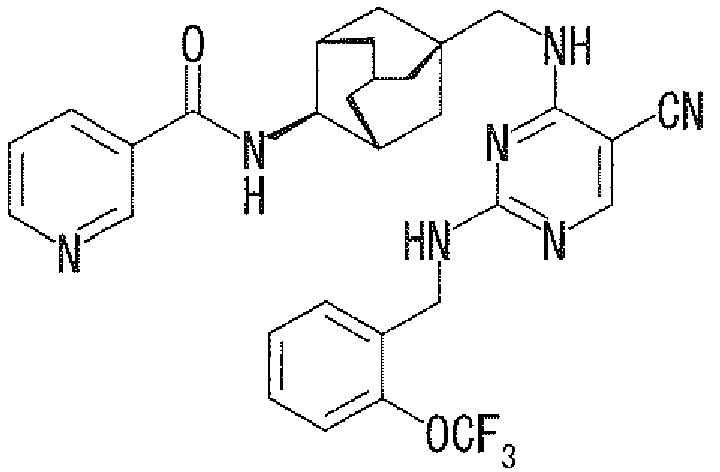
7 rel 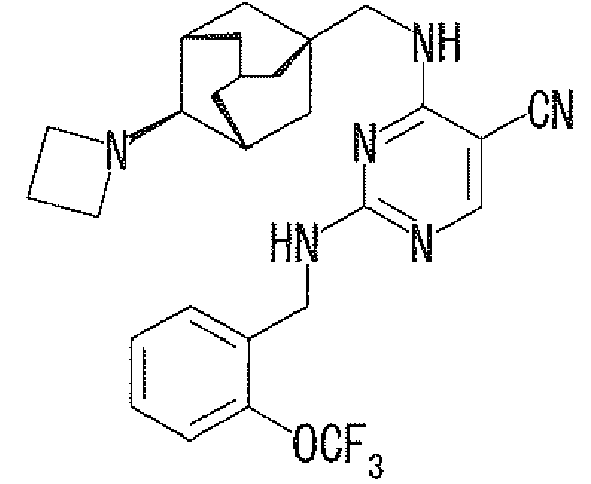
8 rel 
-
[Table 42] Ex Str Ex Str 9 rel 
10 rel 
11 rel 
12 rel 
13 rel 
14 rel 
15 rel 
16 rel 
-
[Table 43] Ex Str Ex Str 17 rel 
18 rel 
19 rel 
20 rel 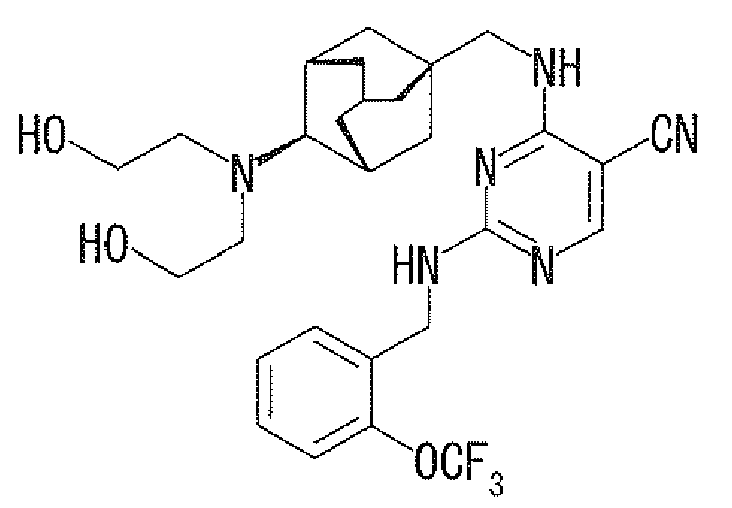
21 rel 
22 rel 
23 rel 
24 rel 
-
[Table 44] Ex Str Ex Str 25 rel 
26 rel 
27 rel 
28 rel 
29 rel 
30 rel 
31 rel 
32 rel 
-
[Table 45] Ex Str Ex Str 33 rel 
34 rel 
35 rel 
36 rel 
37 rel 
38 rel 
39 rel 
40 rel 
-
[Table 46] Ex Str Ex Str 41 rel 
42 rel 
43 rel 
44 rel 
45 rel 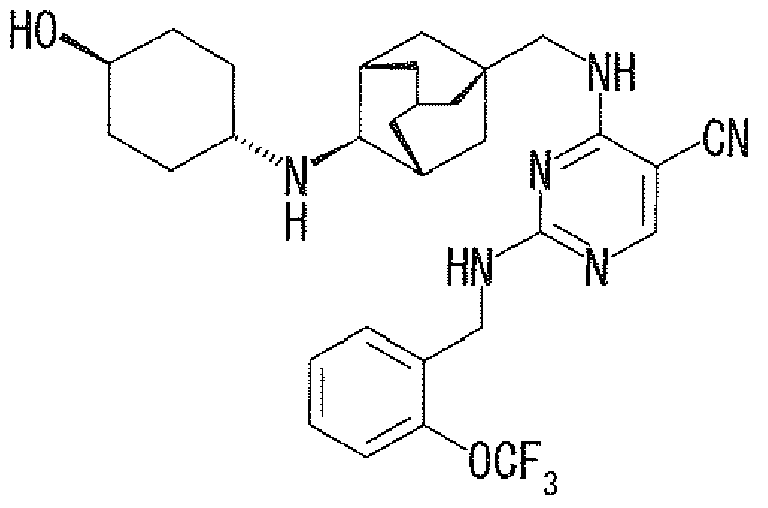
46 rel 
47 rel 
48 
-
[Table 47] Ex Str Ex Str 49 
50 
51 rel 
52 rel 
53 rel 
54 rel 
55 rel 
56 
-
[Table 48] Ex Str Ex Str 57 rel 
58 
59 rel 
60 rel 
61 rel 
62 rel 
63 rel 
64 rel 
-
[Table 49] Ex Str Ex Str 65 rel 
66 rel 
67 rel 
68 rel 
69 
70 rel 
71 rel 
72 rel 
-
[Table 50] Ex Str Ex Str 73 rel 
74 rel 
75 rel 
76 rel 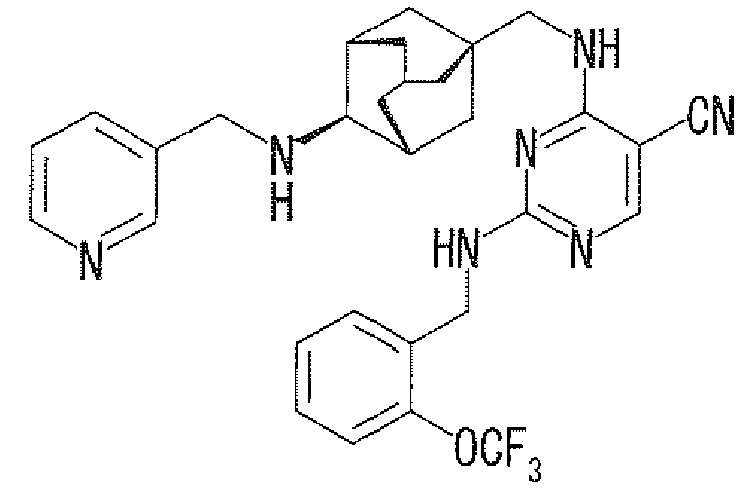
77 rel 
78 rel 
79 rel 
80 rel 
-
[Table 51] Ex Str Ex Str 81 rel 
82 rel 
83 rel 
84 rel 
85 rel 
86 rel 
87 rel 
88 rel 
-
[Table 52] Ex Str Ex Str 89 rel 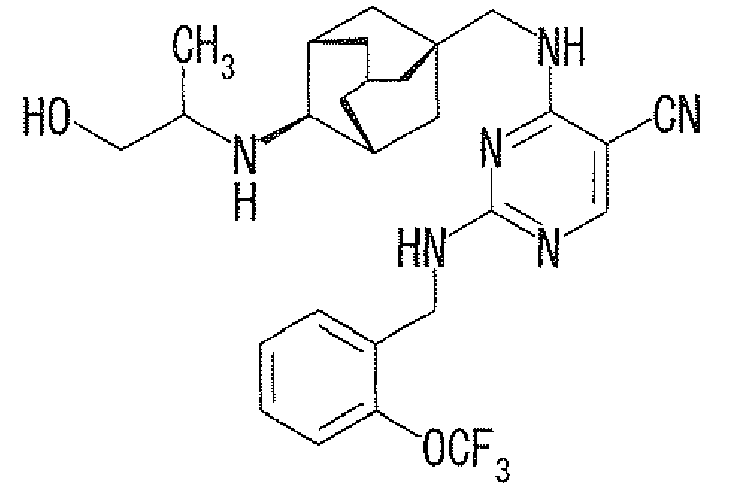
90 rel 
91 rel 
92 rel 
93 rel 
94 rel 
95 rel 
96 rel 
-
[Table 53] Ex Str Ex Str 97 rel 
98 rel 
99 rel 
100 rel 
101 rel 
102 rel 
103 rel 
104 rel 
-
[Table 54] Ex Str Ex Str 105 rel 
106 rel 
107 rel 
108 rel 
109 rel 
110 rel 
111 rel 
112 rel 
-
[Table 55] Ex Str Ex Str 113 rel 
114 rel 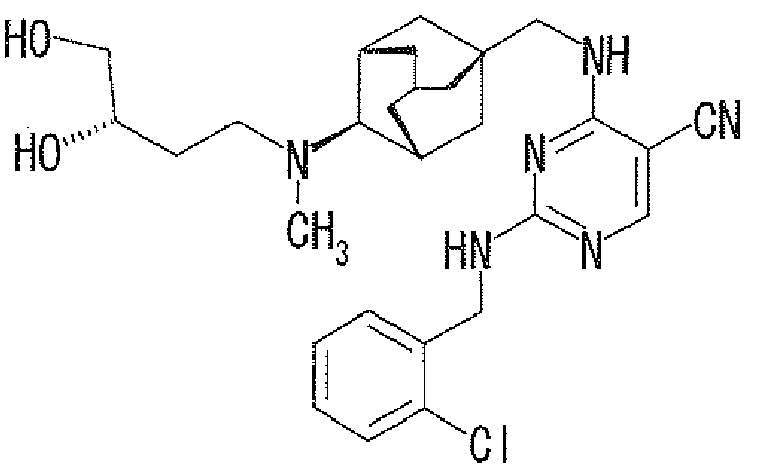
115 rel 
116 rel 
117 rel 
118 rel 
119 rel 
120 
-
[Table 56] Ex Str Ex Str 121 rel 
122 
123 rel 
124 
125 
126 
127 rel 
128 rel 
-
[Table 57] Ex Str Ex Str 129 rel 
130 rel 
131 rel 
132 rel 
133 rel 
134 rel 
135 rel 
136 rel 
-
[Table 58] Ex Str Ex Str 137 rel 
138 rel 
139 rel 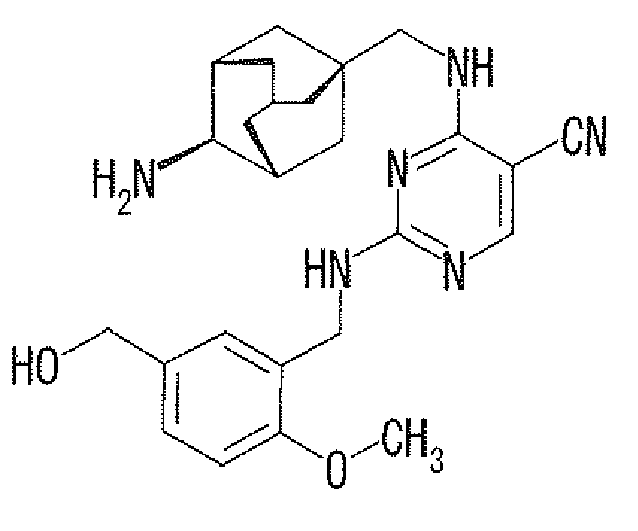
140 rel 
141 rel 
142 rel 
143 rel 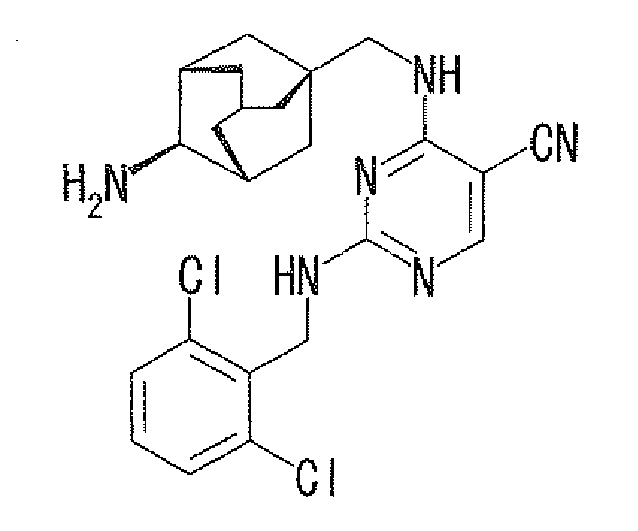
144 rel 
-
[Table 59] Ex Str Ex Str 145 rel 
146 rel 
147 rel 
148 rel 
149 rel 
150 rel 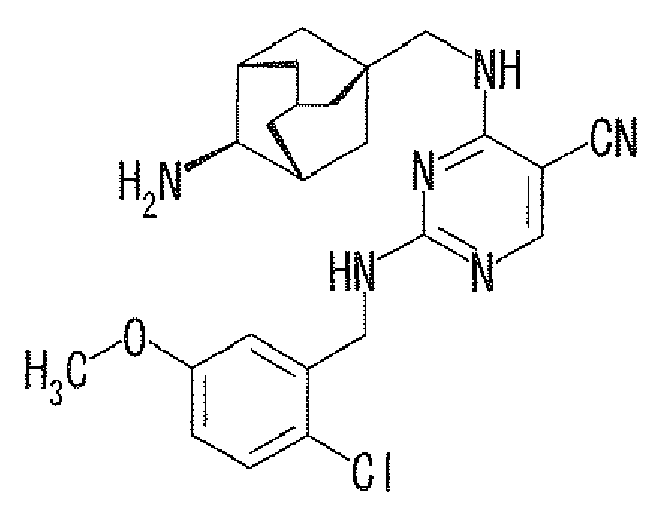
151 rel 
152 rel 
-
[Table 60] Ex Str Ex Str 153 rel 
154 rel 
155 rel 
156 
157 rel 
158 rel 
159 rel 
160 rel 
-
[Table 61] Ex Str Ex Str 161 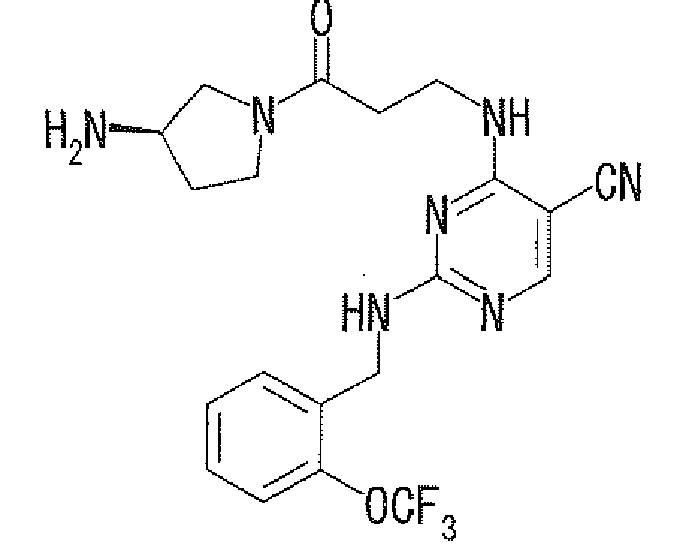
162 
163 
164 rel 
165 rel 
166 rel 
167 rel 
168 rel 
-
[Table 62] Ex Str Ex Str 169 rel 
170 
171 
172 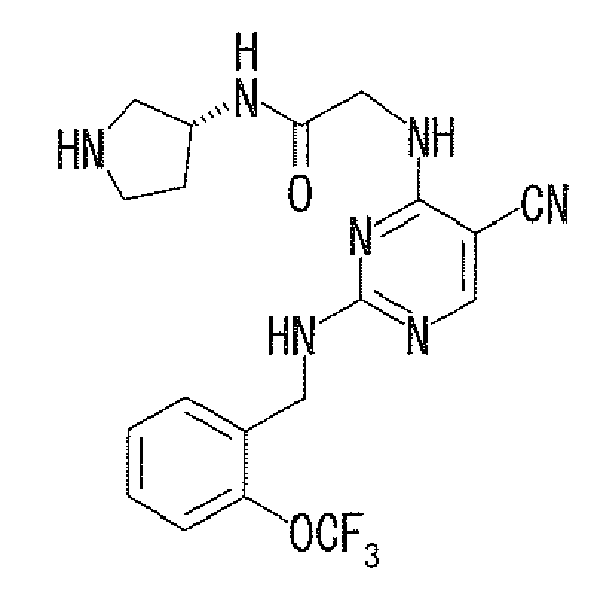
173 
174 
175 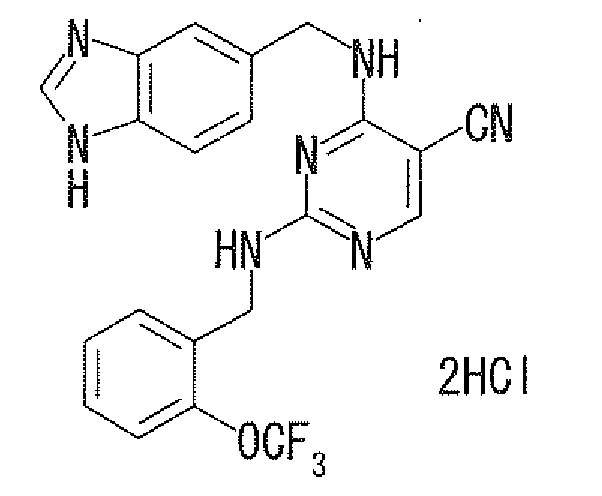
176 rel 
-
[Table 63] Ex Str Ex Str 177 rel 
178 rel 
179 rel 
180 rel 
181 rel 
182 rel 
183 rel 
184 rel 
-
[Table 64] Ex Str Ex Str 185 rel 
186 rel 
187 rel 
188 rel 
189 rel 
190 rel 
191 rel 
192 rel 
-
[Table 65] Ex Str Ex Str 193 rel 
194 rel 
195 rel 
196 rel 
197 rel 
198 rel 
199 rel 
200 rel 
-
[Table 66] Ex Str Ex Str 201 rel 
202 rel 
203 rel 
204 rel 
205 rel 
206 rel 
207 rel 
208 rel 
209 rel 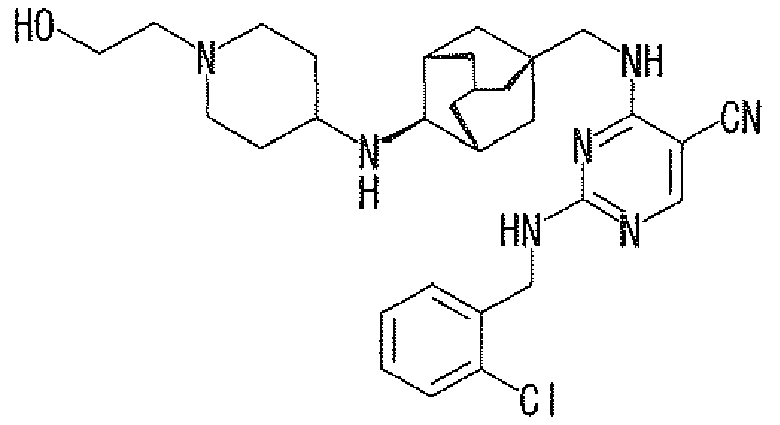
210 rel 
-
[Table 67] Ex Str Ex Str 211 rel 
212 rel 
213 rel 
214 rel 
215 rel 
216 rel 
217 rel 
218 rel 
219 rel 
220 rel 
-
[Table 68] Ex Str Ex Str 221 rel 
222 rel 
223 rel 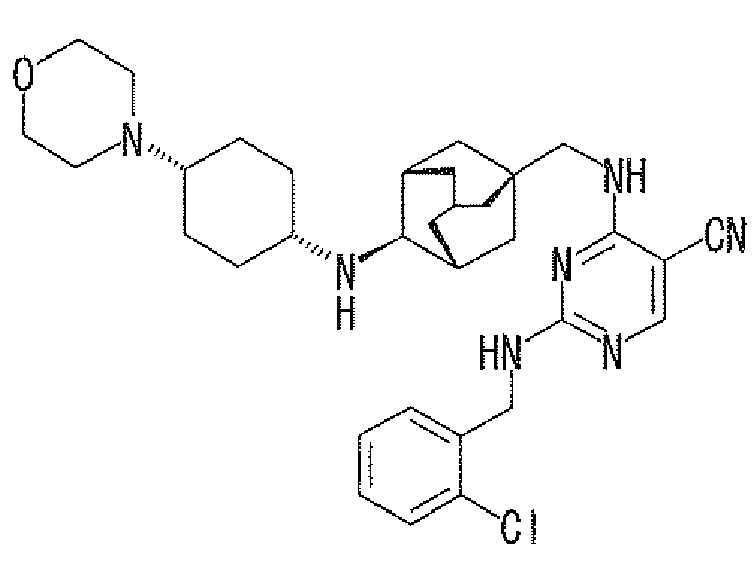
224 
225 
226 rel 
227 rel 
228 rel 
-
[Table 69] Ex Str Ex Str 229 rel 
230 rel 
231 rel 
232 rel 
233 rel 
234 rel 
235 rel 
236 rel 
-
[Table 70] Ex Str Ex Str 237 rel 
238 rel 
239 rel 
240 rel 
241 rel 
242 rel 
243 rel 
244 rel 
-
[Table 71] Ex Str Ex Str 245 rel 
246 rel 
247 rel 
248 rel 
249 rel 
250 rel 
251 rel 
252 rel 
-
[Table 72] Ex Str Ex Str 253 rel 
254 rel 
255 rel 
256 rel 
257 rel 
258 rel 
259 rel 
260 rel 
-
[Table 73] Ex Str Ex Str 261 rel 
262 rel 
263 rel 
264 rel 
265 rel 
266 rel 
267 rel 
268 rel 
-
[Table 74] Ex Str Ex Str 269 rel 
270 rel 
271 rel 
272 rel 
273 rel 
274 rel 
275 rel 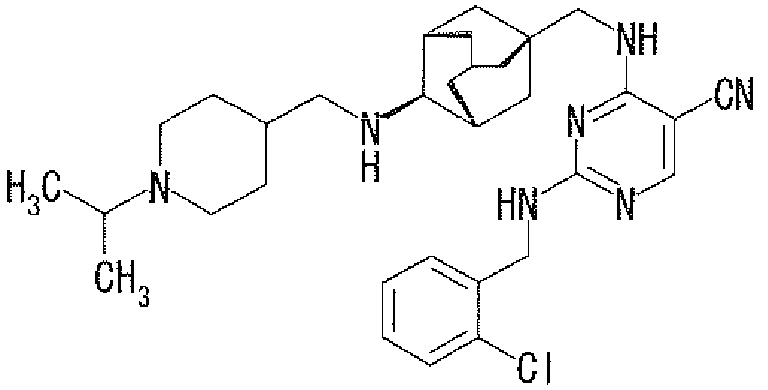
276 rel 
-
[Table 75] Ex Str Ex Str 277 rel 
278 rel 
279 rel 
280 rel 
281 rel 
282 rel 
283 rel 
284 rel 
285 rel 
286 rel 
-
[Table 76] Ex Str Ex Str 287 rel 
288 rel 
289 rel 
290 rel 
291 rel 
292 rel 
293 rel 
294 rel 
-
[Table 77] Ex Str Ex Str 295 rel 
296 rel 
297 rel 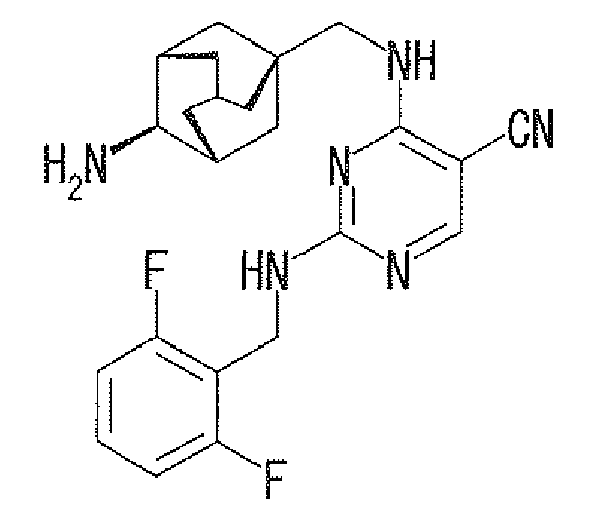
298 rel 
299 rel 
300 rel 
301 rel 
302 rel 
-
[Table 78] Ex Str Ex Str 303 rel 
304 rel 
305 rel 
306 rel 
307 rel 
308 rel 
309 rel 
310 rel 
-
[Table 79] Ex Str Ex Str 311 rel 
312 rel 
313 rel 
314 rel 
315 rel 
316 rel 
317 rel 
318 rel 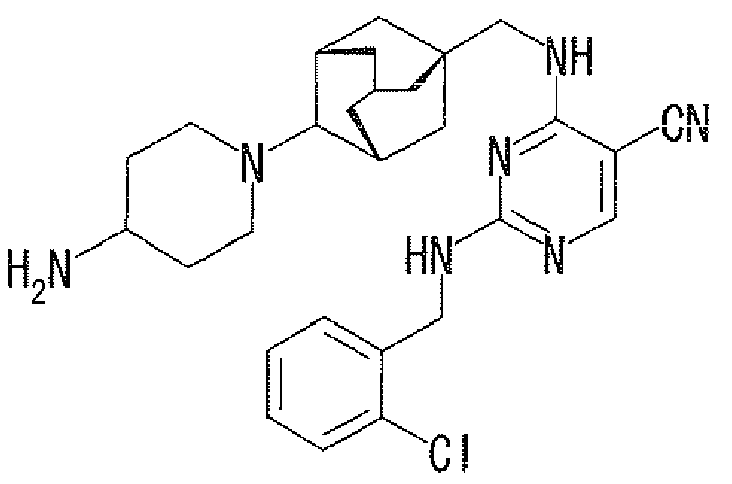
-
[Table 80] Ex Str Ex Str 319 rel 
320 
321 rel 
322 rel 
323 rel 
324 rel 
325 rel 
326 rel 
-
[Table 81] Ex Str Ex Str 327 rel 
328 rel 
329 rel 
330 rel 
331 rel 
332 rel 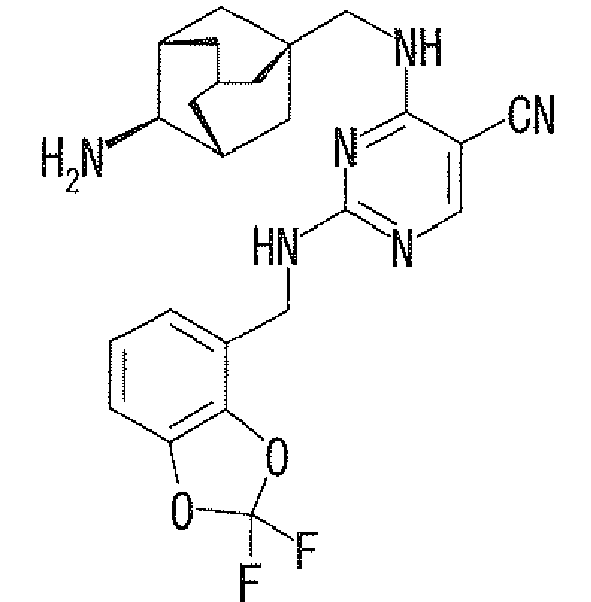
333 rel 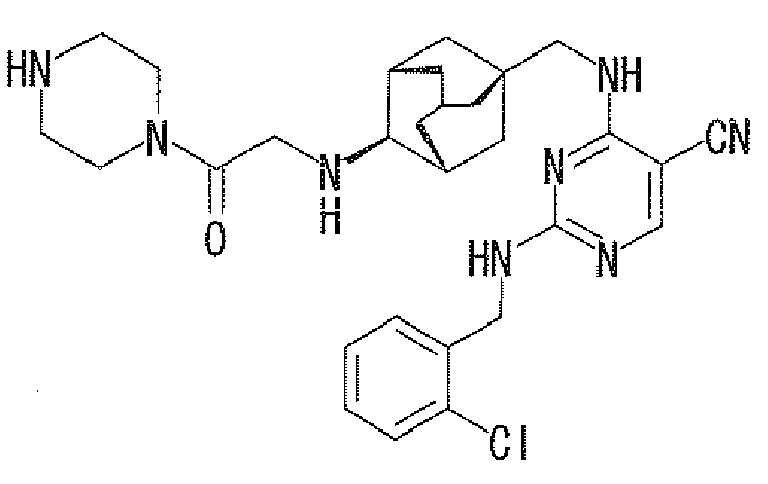
334 rel 
-
[Table 82] Ex Str Ex Str 335 rel 
336 rel 
337 rel 
338 rel 
339 rel 
340 rel 
341 rel 
342 rel 
343 rel 
344 rel 
-
[Table 83] Ex Str Ex Str 345 rel 
346 rel 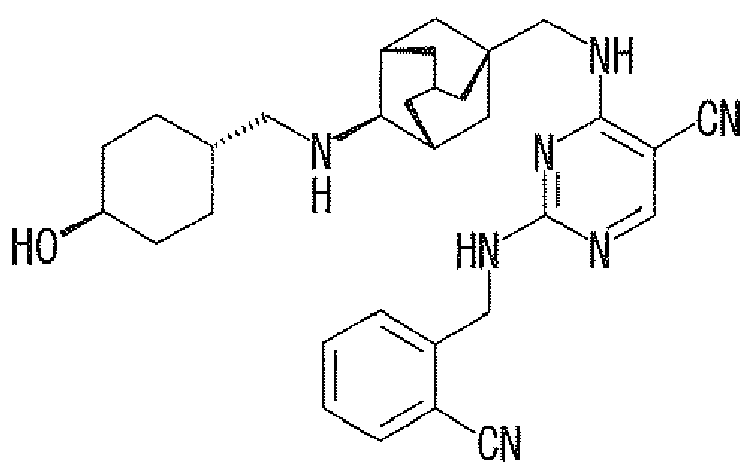
347 rel 
348 rel 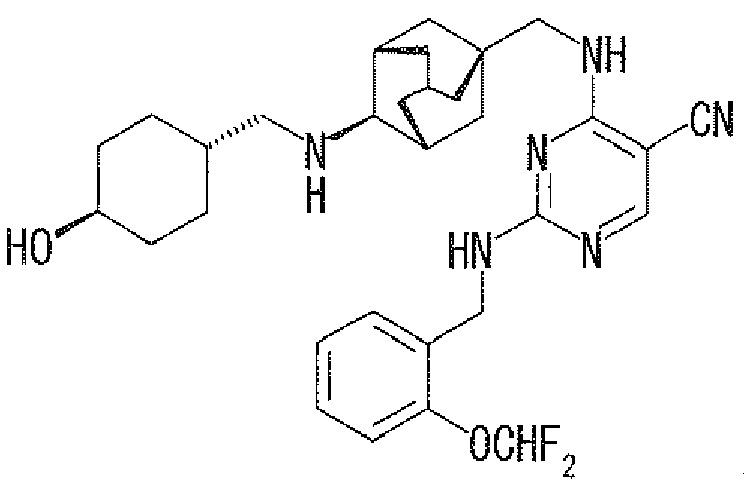
349 rel 
350 rel 
351 rel 
352 rel 
353 rel 
354 
-
[Table 84] Ex Str Ex Str 355 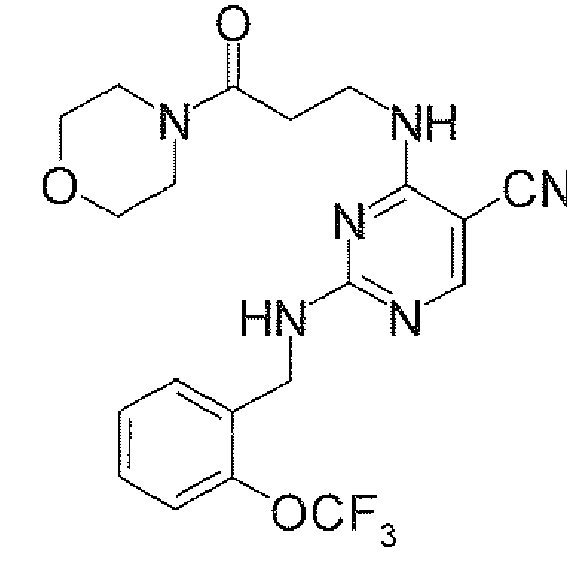
356 rel 
357 rel 
358 rel 
359 rel 
360 rel 
361 rel 
362 rel 
363 rel 
364 rel 
-
[Table 85] Ex Str Ex Str 365 rel 
366 rel 
367 rel 
368 rel 
369 rel 
370 rel 
371 rel 
372 rel 
373 rel 
374 rel 
-
[Table 86] Ex Str Ex Str 375 rel 
376 
377 rel 
378 rel 
379 rel 
380 rel 
381 rel 
382 rel 
-
[Table 87] Ex Str Ex Str 383 rel 
384 
385 rel 
386 
387 
388 rel 
389 rel 
390 rel 
-
[Table 88] Ex Str Ex Str 391 rel 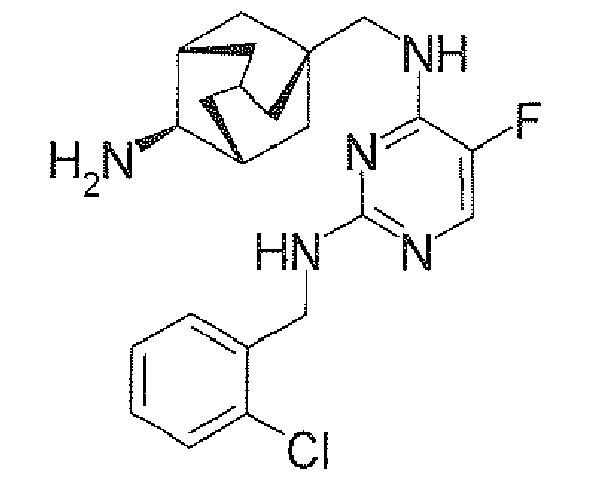
392 rel 
393 rel 
394 rel 
395 rel 
396 rel 
397 rel 
398 rel 
-
[Table 89] Ex Str Ex Str 399 rel 
400 rel 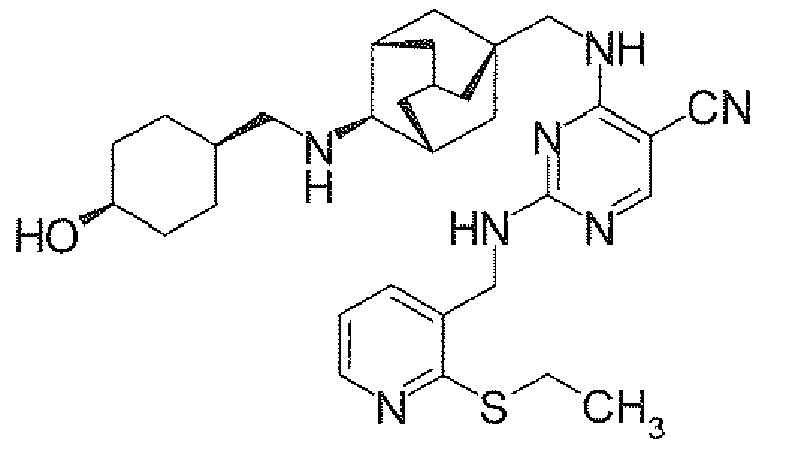
401 rel 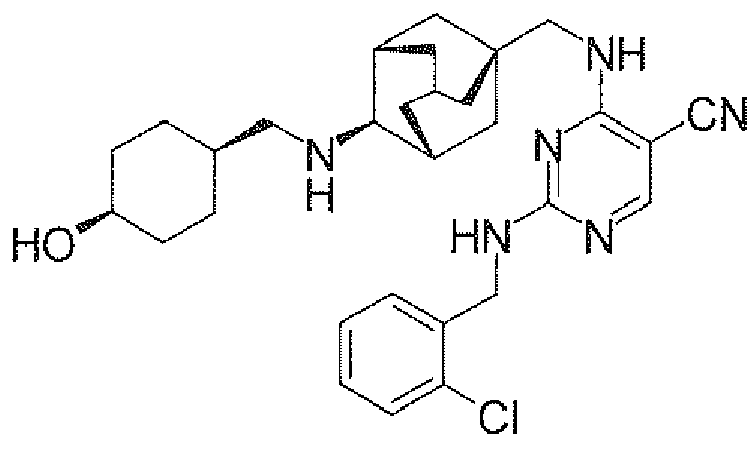
402 rel 
403 rel 
404 rel 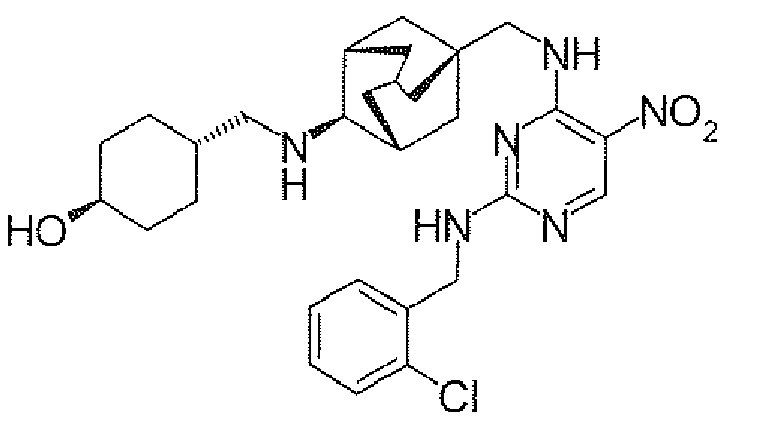
405 rel 
406 rel 
407 rel 
408 rel 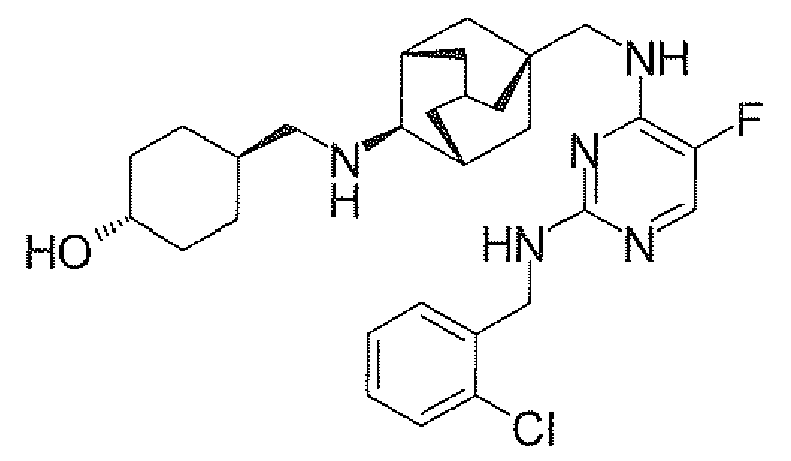
-
[Table 90] Ex Str Ex Str 409 rel 
410 rel 
411 rel 
412 rel 
-
[Table 91] Ex Syn Dat 1 1 NMR1: 1.00-2.03 (18H, m), 2.67-2.98 (4H, m), 3.21-3.68 (2H, m), 4.52-4.56 (2H, m), 7.21-7.35 (5H, m), 8.03-8.18 (2H, m); ESI+: 571 2 1 NMR1: 0.94-2.23 (16H, m), 2.61-3.15 (5H, m), 3.44-3.50 (2H, m), 4.20 (1H, brs), 4.53 (2H, d, J-6.0Hz), 7.13-7.35 (5H, m), 8.03-8.18 (2H, m); ESI+:587 3 3 NMR1: 1.47-2.02 (13H, m), 2.99 (2H, d, J=6.2Hz), 3.17 (1H, brs), 4.56 (2H, d, J=6.2Hz), 5.36 and 5.45 (total 1H, each d, J =7.2Hz), 6.47 (1H, t, J= 7.8Hz), 6.55 and 6.61 (total 2H, each d, J=7.8Hz), 7.03 (2H, t, J=7.8Hz), 7.22-7.37 (5H, m), 7.92 and 8.16 (total 1H, each t, J=6.2Hz), 8.20 (1H, s); ESI+: 549 4 4 NMR1: 1.18-1.95 (13H, m), 1.83 (3H, s), 2.95 and 3.15 (total 2H, each d, J =6.3Hz), 3.60 and 3.74 (total 1H, each d, J = 7.3Hz), 4.52 4.56 (total 2H, each d, J=6.0Hz), 7.23-7.35 (5H, m), 7.62 and 7.72 (total 1H, each d, J=7.7Hz), 7.91 and 8.16-8.13 (total 1H, each), 8.18 (1H, s); ESI+:515 5 5 NMR1: 0.82-2.67 (17H, m), 2.84-3.14 (4H, m), 4.12 (1H, brs), 4.53 (2H, d, J =6.0Hz), 5.09-5.12 (1H, m), 6.91-7.02 (1H, m), 7.17-7.34 (6H, m), 7.89-8.18 (2H,m); ESI+: 586 6 6 NMR1: 1.22-2.10 (13H, m), 2.99 and 3.19 (total 2H, each d, J=6.3Hz), 3.83 and 3.97 (total 1H, each m), 4.54 (2H, d, J=6.0Hz), 7.25-7.38 (5H, m), 7.48 (1H, dd, J=4.7,7.9Hz), 7.93-8.18 (3H, m), 8.19 (1H, s), 8.68 (1H, dd, J=1.6,4.8Hz), 8.95 (1H, d, J=2.2Hz); ESI+: 578 7 7 NMR1: 1.04-2.33 (16H, m), 2.95 (4H, brs), 4.04 (2H, brs), 4.53 (2H, d, J= 6.0Hz), 7.28-7.37 (5H, m), 7.92-8.19 (2H, m); ESI+: 513 8 7 NMR1: 1.20-2.33 (18H,m), 2.96 and 3.15 (total 2H, each d, J=6.3Hz), 3.00 (2H, brs), 3.54 (2H, brs), 4.53 (2H, d, J=6.0Hz), 7.28-7.42 (5H, m), 7.92-8.20 (2H, m); ESI+: 527 9 7 NMR1: 1.19-2.79 (24H, m), 2.96 and 3.16 (total 2H, each d, J=6.3Hz), 4.53 (2H, d, J=6.0Hz), 7.28-7.36 (5H, m), 7.91 and 8.17 (total 1H, each m), 8.19 (1H, s); ESI+: 541 10 7 NMR1: 1.06-1.99 (16H, m), 2.94 and 3.14 (total 2H, each d, J=6.3Hz), 3.41 (2H, brs), 4.14 (1H, brs), 4.53 (2H, d, J=6.0Hz), 5.19 (1H, brs), 7.27-7.36 (5H, m), 7.91 and 8.17 (total 1H, each m), 8.19 (1H, s); ESI+: 529 -
[Table 92] Ex Syn Dat 11 7 NMR1: 1.19-1.99 (19H, m), 2.50 (1H, brs), 2.95 and 3.16 (total 2H, each d, J=6.3Hz), 3.31-3.32 (1H, brs), 4.21 (1H, brs), 4.53 (2H, d, J=6.0Hz), 7.28-7.35 (5H, m), 7.91 and 8.17 (total 1H, each m), 8.19 (1H, s); ESI+: 543 12 7 NMR1: 1.05-2.20 (18H, m), 2.79 (1H, brs), 2.94 and 3.15 (total 2H, each d, J=6.3Hz), 3.91 (2H, brs), 4.48 (1H, brs), 4.53 (2H, d, J=6.0Hz), 7.19-7.34 (5H, m), 7.91 and 8.15 (total 1H, each t, J-6.3Hz), 8.18 (1H, s); ESI+: 559 13 7 NMR1: 1.08-2.33 (18H, m), 2.95 and 3.15 (total 2H, each d, J=6.3Hz), 3.58 (4H,m), 4.54 (2H, d, J=6.1Hz), 7.21-7.34 (5H, m), 7.90 and 8.15 (total 1H, each t, J=6.3Hz), 8.19 (1H, s); ESI+: 543 14 7 NMR1: 1.23-2.67 (21H, m), 2.99 and 3.17 (total 2H, each d, J=6.3Hz), 3.80-3.83 (3H, m), 4,21 (1H, brs), 4.43 (2H, d, J=6.0Hz), 6.84-6.87 (1H, m), 6.95-6.99 (1H, m), 7.05-7.08 (1H, m), 7.19-7.29 (2H, m), 7.71 and 7.98 (total 1H, each brs), 8.15 and 8.17 (total 1H, each s); ESI+: 489 15 7 NMR1: 1.09-2.65 (20H, m), 2.95 and 3.17 (total 2H, each d, J=6.3Hz), 4.17 (1H, brs), 4.52 (2H, d, J=6.2Hz), 4.6 (1H, d, J=4.6Hz), 7.20-7.34 (4H, m), 7.41-7.43 (1H, m), 7.92-8.21 (2H, m); ESI+: 493, 495 16 16 NMR1: 1.08-2.34 (15H, m), 2.53-2.61 (2H, m), 2.94 and 3.14 (total 2H, each d, J=6.3Hz), 3.44 (2H, m), 4.44 (1H, brs), 4.54 (2H, d, J=6.0Hz), 7.18-7.34 (5H, m), 7.91 and 8.1 (total 1H, each t, J=6.3Hz), 8.18 (1H, s); ESI+: 517 17 16 NMR1: 1.02-2.08 (14H, m), 2.37 and 2.56 (total 1H, each brs), 2.92 and 3.14 (total 2H, each d, J=6.3Hz), 3.65 and 3.69 (total 2H, each s), 4.51 and 4.55 (total 2H, each d, J=6.2Hz), 7.19-7.35 (10H, m), 7.91 and 8.14-8.16 (total 1H, each m), 8.18 (1H, s); ESI+: 563 18 16 NMR1: 1.05-2.00 (14H, m), 2.27 (1H, brs), 2.93 and 3.14 (total 2H, each d, J=6.3Hz), 2.99-3.04 (total 2H, each s), 4.52 (2H, d, J=6.0Hz), 7.05-7.36 (7H, m), 7.91 and 8.16 (total 1H, each t, J=6.3Hz), 8.18 (1H, s); ESI+: 530 19 16 NMR1: 1.02-2.03 (13H, m), 2.53 (1H, brs), 2.94 (2H, d, J=6.3Hz), 3.13 and 3.19 (total 4H, each s), 4.52 (2H, d, J=6.0Hz), 7.00 (2H, brs), 7.22-7.35 (5H, m), 7.65 (2H, brs), 7.92 and 8.16 (total 1H, each t, J=6.3Hz), 8.18 (1H.s); ESI+: 587 -
[Table 93] Ex Syn Dat 20 16 NMR1: 1.04-2.67 (18H, m), 2.94 and 3.16 (total 2H, each d, J=6.3Hz), 3.38-3.42 (4H, m), 4.34 (2H, t, J=5.2Hz), 4.54 (2H, d, J=6.0Hz), 7.18-7.34 (5H, m), 7.90 and 8.14 (total 1H, each t, J=6.3Hz), 8.18 (1H, s); ESI+: 561 21 16 NMR1: 1.00-2.01 (15H, m), 2.33 (1H, brs), 2.43-2.69 (2H, m), 2.94 (2H, d, J=6.4Hz), 3.09-3.33 (1H, m), 3.47 (2H, t, J=6.0Hz), 4.46-4.62 (1H, brs), 4.54 (2H, d, J=6.4Hz), 7.21-7.39 (5H, m), 8.14 (1H, t, J=6.4Hz), 8.18 (1H, s); ESI+: 531 22 16 NMR1: 0.78-2.03 (17H, m), 2.28-2.63 (3H, m), 2.94 (2H, d, J=6.4Hz), 3.09-3.35 (1H, m), 3.38 (2H, t, J=6.0Hz), 4.54 (2H, d, J=6.0Hz), 4.69 (1H, brs), 7.23-7.41 (5H, m), 8.14 (1H, t, J=6.4Hz), 8.18 (1H, s); ESI+: 545 23 16 NMR1: 1.23-2.56 (14H, m), 2.86-3.07 (3H, m), 2.99 and 3.17 (total 2H, each d, J=6.3Hz), 3.43 and 3.63 (total 2H, each m), 3.80-3.83 (3H, m), 4.42-4.43 (2H, m), 5.00 (1H, brs), 6.84-6.87 (1H, m), 6.95-7.00 (1H, m), 7.07 (1H, d, J=7.4Hz), 7.17-7.31 (2H, m), 7.71 and 7.99 (total 1H, each t, J=6.3Hz), 8.16 and 8.17 (total 1H, each s); ESI+: 463 24 16 NMR1: 1.00-2.00 (15H, m), 2.36 (1H, brs), 2.44-2.60 (2H, m), 2.97 (2H, d, J =6.4Hz), 3.11-3.44 (1H, m), 3.45 (2H, t, J=6.0Hz), 3.83 (3H, s), 4.43 (2H, d, J=6.0Hz), 4.57 (1H, brs), 6.71-7.29 (5H, m), 7.66-8.17 (2H, m); ESI+: 477 25 16 NMR1: 1.03-2.05 (17H, m), 2.28-2.56 (3H, m), 2.91-3.34 (3H, m), 3.35-3.44 (2H, m), 3.83 (3H, s), 4.43 (2H, d, J=5.6Hz), 4.69 (1H, br), 6.80-7.27 (5H, m), 7.67-8.18 (2H, m); ESI+: 491 26 16 NMR1: 1.08-2.57 (17H, m), 2.95 and 3.17 (total 2H, each d, J=6.3Hz), 3.45 (2H, m), 4.47 (1H, brs), 4.52 (2H, d, J=6.2Hz), 7.20-7.34 (4H, m), 7.42-7.44 (1H, m), 7.92-8.23 (2H, m); ESI+: 467, 469 27 16 NMR1: 1.07-2.54 (20H, m), 2.96 and 3.17 (2H, d, J=6.3Hz), 3.44 (2H, q, J= 5.6Hz), 4.43-4.45 (3H, m), 7.06-7.30 (5H, m), 7.83 and 8.11 (total 1H, each t, J=6.3Hz), 8.16 (1H, s); ESI+: 479 28 16 NMR1: 0.77-2.06 (15H, m), 2.34 (1H, brs), 2.39-2.72 (2H, m), 2.95 (2H, d, J=6.0Hz), 3.11-3.43 (1H, m), 3.47 (2H, t, J-6.0Hz), 4.44-4.63 (3H, m), 7.16-7.47 (5H, m), 8.14-8.23 (2H, m); ESI+: 481, 483 29 16 NMR1: 1.00-2.05 (15H, m), 2.33 (1H, brs), 2.39-2.68 (5H, m), 2.95 (2H, d, J=6.0Hz), 3.09-3.42 (1H, m), 3.48 (2H, t, J=6.0Hz), 4.45 (2H, d, J=6.0Hz), 4.58 (1H, br), 7.04-7.32 (5H, m), 8.12 (1H, t, J-6.0Hz), 8.17 (1H, s); ESI+:493 -
[Table 94] Ex Syn Dat 30 16 NMR1: 0.81-2.00 (17H, m), 2.31-2.36 (1H, m), 2.38-2.70 (2H, m), 2.95 (2H, d, J=6.4Hz), 3.11-3.36 (1H, m), 3.39 (2H, d, J=6.4Hz), 4.52 (2H, d, J=6.4Hz), 4.70 (1H, br), 7.14-7.49 (5H, m), 8.13-8.25 (2H, m); ESI+: 495, 497 31 16 NMR1: 1.01-2.05 (17H, m), 1.59 (3H, s), 2.29-2.36 (1H, m), 2.37-2.69 (2H, m), 2.95 (2H, d, J=6.0Hz), 3.13-3.35 (1H, m), 3.39 (2H, d, J=6.0Hz), 4.44 (2H, d, J=6.0Hz), 4.70 (1H, brs), 7.05-7.35 (5H, m), 8.11 (1H, t, J=6.0Hz), 8.16 (1H, s); ESI+: 507 32 32 NMR1: 1.00-2.01 (14H, m), 1.29 (3H, s), 1.31 (3H, s), 2.25-2.70 (3H, m), 2.94 (2H, d, J=6.0Hz), 3.35-3.43 (1H, m), 3.52-3.66 (2H, m), 3.76-3.89 (2H, m), 4.54 (2H, d, J=6.0Hz), 7.24-7.40 (5H, m), 8.14 (1H, t, J=6.0Hz), 8.18 (1H, s); EST+: 601 33 32 NMR1: 1.01-2.00 (15H, m), 1.25 (3H, s), 1.30 (3H, s), 2.29-2.69 (3H, m), 2.94 (2H, d, J=6.0Hz), 3.09-3.34 (1H, m), 3.46 (1H, t, J=7.6Hz), 3.99 (1H, dd, J=7.6 and 6.0Hz), 4.04-4.13 (1H, m), 4.53 (2H, d, J-6.0Hz), 7.24- 7.43 (5H, m), 8.14 (1H, t, J=6.0Hz), 8.18 (1H, s); ESI+: 601 34 32 NMR1: 0.97-2.01 (14H, m), 1.29 (3H, s), 1.31 (3H, s), 2.18-2.69 (3H, m), 2.97 (2H, d, J=6.0Hz), 3.08-3.38 (1H, m), 3.52-3.63 (2H, m), 3.75-3.89 (2H, m), 3.82 (3H, s), 4.43 (2H, d, J=6.0Hz), 6.77-7.29 (5H, m), 7.66-8.00 (1H, m), 8.15 (1H, s); ESI+: 547 35 32 NMR1: 0.99-2.05 (15H, m), 1.25 (3H, s), 1.30 (3H, s), 2.30-2.70 (3H, m), 2.97 (2H, d, J=6.0Hz), 3.12-3.33 (1H, m), 3.46 (1H, t, J=6.0Hz), 3.82 (3H, s), 3.94-4.13 (2H, m), 4.23 (2H, d, J=6.0Hz), 6.79-7.28 (5H, m), 7.66- 7.99 (1H, m), 8.15 (1H, s); ESI+: 547 36 36 NMR1: 1.08-2.59 (18H, m), 2.94 and 3.15 (total 2H, each d, J=6.3Hz), 3.29-3.38 (2H, m), 3.50-3.51 (1H, m), 4.53-4.55 (3H, m), 7.16-7.34 (5H, m), 7.90 and 8.14 (total 1H, each t, J=6.3Hz), 8.18 (1H, s); ESI+: 547 37 36 NMR1: 1.07-2.67 (21H, m), 2.94 and 3.15 (total 2H, each d, J=6.3Hz), 3.36 and 3.50 (total 1H, each m), 4.53-4.57 (2H, m), 7.18-7.34 (5H, m), 7.91 and 8.15 (total 1H, each t, J=6.3Hz), 8.18 (1H, s); ESI+: 547 38 36 NMR1: 1.08-2.67 (19H, m), 2.97 and 3.16 (total 2H, each d, J=6.3Hz), 3.35 and 3.51 (total 1H, each brs), 3.80-3.83 (3H, m), 4.43 (2H, d, J= 6.0Hz), 4.53-4.58 (2H, m), 6.82-6.86 (1H, m), 6.96-6.98 (1H, m), 7.05-7.26 (3H, m), 7.71 and 7.96 (total 1H, each t, J=6.3Hz), 8.15 and 8.16 (total 1H, each s); ESI+: 493 -
[Table 95] Ex Syn Dat 39 39 NMR1: 1.07-2.00 (11H, m), 2.20-2.23 (1H, m), 2.43 (1H, brs), 2.94 (2H, d, J =6.3Hz), 3.11-3.21 (4H, m), 4.53 (2H, d, J=6.0Hz), 7.19-7.34 (5H, m), 7.90 and 8.15 (total 1H, each t, J=6.3Hz), 8.18 (1H, s); ESI+: 555 40 40 NMR1: 0.73-2.07 (13H, m), 2.25-2.76 (4H, m), 2.94 (2H, d, J=6.0Hz), 3.13-3.64 (1H, m), 4.27 (4H, s), 4.54 (2H, d, J=6.0Hz), 4.87 (2H, brs), 7.21- 7.39 (5H, m), 8.10-8.20 (2H, m); ESI+: 573 41 41 NMR1: 0.79-2.71 (24H, m), 2.86-3.14 (2H, m), 3.27-3.52 (1H, m), 4.41-4.59 (3H, m), 7.02-7.41 (5H, m), 7.92 and 8.12 (total 1H, each t, J=6.3Hz), 8.17 and 8.18 (total 1H, each s); ESI+: 571; HPLC: rt=16.3 min 42 42 NMR1: 0.76-2.69 (24H, m), 2.88-3.19 (2H, m), 3.25-3.45 (1H, m), 4.41-4.59 (3H, m), 7.13-7.41 (5H, m), 7.89 and 8.14 (total 1H, each t, J=6.3Hz), 8.18 (1H, s); ESI+: 571; HPLC: rt=15.1 min 43 43 NMR1: 0.72-2.71 (25H, m), 2.49 (3H, s), 2.90-3.18 (2H, m), 3.27-3.41 (1H, m), 4.41-4.48 (3H, m), 7.05-7.37 (5H, m), 7.82 and 8.11 (total 1H, each t, J=6.2Hz), 8.17 (1H, s); ESI+: 533 44 43 NMR1: 0.72-2.72 (24H, m), 2.49 (3H, s), 2.90-3.19 (2H, m), 3.55-3.65 (1H, m), 4.23-4.48 (3H, m), 7.05-7.37 (5H, m), 7.82 and 8.11 (total 1H, each t, J=6.2Hz), 8.17 (1H, s); ESI+: 533 45 43 NMR1: 0.69-2.69 (24H, m), 2.88-3.17 (2H, m), 3.22-3.41 (1H, m), 4.41-4.59 (3H, m), 7.13-7.43 (5H, m), 7.90 and 8.14 (total 1H, each t, J=6.3Hz), 8.18 (1H, s); ESI+: 571;HPLC: rt=15.1 min 46 43 NMR1: 1.18-1.94 (15H, m), 2.93 and 3.14 (total 2H, each d, J=6.3Hz), 4.53 (2H, d, J=6.0Hz), 7.16-7.34 (5H, m), 7.90 and 8.15 (total 1H, each t, J=6.3Hz), 8.18 (1H, s); ESI+: 458 47 43 NMR1: 1.03-1.47 (14H, m), 1.84-2.03 (2H, m), 2.97 and 3.18 (total 2H, each d, J=6.4Hz), 4.53 (2H, d, J=6.4Hz), 7.18-7.36 (5H, m), 7.90 and 8.15 (total 1H, each t, J=6.4Hz), 8.18 (1H, s); ESI+: 473 48 43 NMR1: 1.13-2.10 (5H, m), 2.51-2.67 (6H, m), 3.13 (2H, t, J=6.0Hz), 4.15 (1H, d, J=6.0Hz), 4.55 (2H, d, J=6.0Hz), 7.33-7.36 (4H, m), 7.56-7.57 (1H, m), 8.14-8.18 (2H, d); ESI+: 433 49 43 NMR1: 0.97-1.53 (6H, m), 2.67-2.78 (6H, m), 2.99 (2H, d, J=6.4Hz), 4.50 (2H, d, J=6.0Hz), 7.31-7.38 (5H, m), 8.17-8.20 (2H, m); ESI+: 433 -
[Table 96] Ex Syn Dat 50 43 NMR1: 1.26-1.97 (8H, m), 2.99 and 3.15 (total 2H, each brs), 3.55 and 3.64 (total 2H, each s), 4.21 and 4.43 (total 1H, each brs), 4.55-4.58 (2H, m), 7.19-7.36 (10H, m), 7.88 and 8.11 (total 1H, each t, J=6.3Hz), 8.19 (1H, s); ESI+: 509 51 43 NMR1: 1.25-2.20 (13H, m), 3.77 (1H, brs), 4.38 (1H, brs), 4.51-4.58 (2H, m), 6.27 (1H, d, J=5.2Hz), 7.29-7.38 (4H, m), 8.20-8.27 (2H, m); ESI+: 458 52 43 NMR1: 1.23-2.51 (13H, m), 3.68-3.70 (1H, m), 4.42 (1H, brs), 4.51 (2H, d, J=6.0Hz), 6.26 (1H, d, J=5.6Hz), 7.29-7.39 (4H, m), 8.21-8.24 (2H, m); ESI+: 482 53 43 NMR1: 1.39-2.23 (13H, m), 3.84 (1H, brs), 4.51 (2H, d, J=6.0Hz), 6.63 (1H, d, J=5.2Hz), 7.27-7.41 (4H, m), 8.23-8.26 (2H, m); ESI-: 467 54 43 NMR1: 1.08-2.09 (13H, m), 2.93 (2H, d, J=5.2Hz), 3.82 (1H, brs), 4.32 (1H, t, J=5.2Hz), 4.50 (2H, d, J-6.0Hz), 6.28 (1H, d, J=6.0Hz), 7.31-7.38 (4H, m), 8.19-8.24 (2H, m); ESI+: 474; TLC1: Rf=0.5 55 43 NMR1: 1.14-2.14 (13H, m), 2.92 (2H, d, J=5.2Hz), 3.81-4.07 (1H, m), 4.31 (1H, t, J=5.2Hz), 4.51 (2H, d, J=6.0Hz), 6.18 (1H, d, J=5.6Hz), 7.31- 7.36 (4H, m), 8.20-8.23 (2H, m); ESI+: 496; TLC1: Rf=0.4 56 43 NMR1: 1.59-2.05 (8H, m), 2.98 and 3.12 (total 2H, each brs), 3.44 and 3.47 (total 2H, each s), 3.98 and 4.21 (total 1H, each brs), 4.53 and 4.56 (total 2H, each d, J=6.0Hz), 6.52 and 6.60 (total 1H, each d, J= 5.3Hz), 7.21-7.37 (9H, m), 8.03 and 8.20-8.22 (total 1H, each m), 8.21 (1H, s); ESI+: 509 57 43 NMR1: 0.97-1.54 (14H, m), 1.81 and 2.00 (total 2H, each brs), 2.10 and 2.20 (total 2H, each s), 3.96 and 3.25 (total 2H, each d, J=6.3Hz), 4.54 (2H, d, J=6.0Hz), 7.14-7.34 (5H, m), 7.90 and 8.14 (total 1H, each t, J=6.3Hz), 8.18 and 8.24 (total 1H, each s); ESI+: 487 58 43 NMR1: 2.57-2.83 (2H, m), 3.44 and 3.59 (total 2H, each brs), 4.55-4.56 (2H, m), 6.45-6.89 (1H, m), 7.32-7.58 (6H, m), 8.01 and 8.16-8.21 (total 1H, each), 8.18 (1H, s), 11.75 (1H, brs); ESI+: 404 59 43 NMR1: 0.71-2.70 (24H, m), 2.90-3.19 (2H, m), 3.56-3.64 (1H, m), 4.23-4.59 (3H, m), 7.14-7.41 (5H, m), 7.90 and 8.14 (total 1H, each t, J=6.3Hz), 8.18 (1H,s); ESI+: 571 60 43 NMR1: 0.92-2.69 (24H, m), 2.91-3.18 (2H, m), 3.27-3.43 (1H, m), 4.42-4.58 (3H, m), 7.15-7.44 (5H, m), 7.86-8.23 (2H, m); ESI+: 521, 523 -
table 971 Ex Syn Dat 61 43 NMR1: 0.90-2.61 (24H, m), 2.90-3.19 (2H, m), 3.58-3.66 (1H, m), 4.23-4.30 (1H, m), 4.49-4.56 (2H, m), 7.14-7.45 (5H, m), 7.85-8.22 (2H, m); ESI+: 521, 523 62 43 NMR1: 0.81-2.62 (24H, m), 2.94-3.18 (2H, m), 3.29-3.39 (1H, m), 3.80 and 3.82 (total 3H, each s), 4.41-4.57 (3H, m), 6.81-7.28 (5H, m), 7.66-7.99 (1H, m), 8.15 and 8.16 (total 1H, each s); ESI+: 517 63 63 NMR1: 1.11-2.09 (14H, m), 2.82 (1H, brs), 2.94 (2H, d, J=6.3Hz), 3.13-3.18 (2H, m), 3.60 (1H, brs), 4.52 (2H, d, J=6.0Hz), 7.26-7.38 (5H, m), 7.93 and 8.18 (total 1H, each t, J=6.2Hz), 8.18 (1H, s); ESI+: 531 64 64 NMR1: 0.81-2.71 (24H, m), 2.87-3.19 (2H, m), 3.19-4.61 (4H, m), 7.01-7.42 (5H, m), 7.85-7.96 and 8.07-8.17 (total 1H, each m), 8.17 and 8.18 (total 1H, each s); ESI+: 571; HPLC: rt=15.2 min, 16.3 min 65 64 NMR1: 0.87-1.99 (25H, m), 2.93-3.1 3 (3H, m), 4.54 (2H, d, J-6.1Hz), 7.24-7.35 (5H, m), 7.90 and 8.15 (total 1H, each t, J=6.0Hz), 8.18 and 8.19 (total 1H, each s); ESI+: 555 66 64 NMR1: 0.85-2.74 (21H, m), 2.94-3.27 (4H, m), 4.34 (1H, brs), 4.47-4.60 (2H, m), 7.21-7.34 (5H, m), 7.91 and 8.14 (total 1H, each m), 8.18 and 8.19 (total 1H, each s); ESI+: 557 67 64 NMR1: 0.84-2.67 (21H, m), 2.94-3.28 (4H, m), 4.32 (1H, brs), 4.52-4.56 (2H, m), 7.06-7.35 (5H, m), 7.91 and 8.13 (total 1H, each m), 8.18 and 8.19 (total 1H, each s); ESI+: 557 68 68 NMR1: 0.68-2.71 (27H, m), 2.89-3.19 (2H, m), 3.28-3.65 (1H, m), 4.23-4.51 (3H, m), 7.03-7.34 (5H, m), 7.79-7.85 and 8.07-8.14 (total 1H, each m), 8.17 and 8.32 (total 1H, each s); ESI+: 533 69 68 NMR1: 0.75-2.35 (9H, m), 2.09 (3H, s), 2.82-3.37 (4H, m), 4.55 (2H, d, J= 6.0Hz), 7.14-7.62 (5H, m), 7.89-8.24 (2H, m); ESI+: 447 70 68 NMR1: 1.06-1.95 (14H, m), 2.07 and 2.13 (total 6H, each s), 2.94 and 3.16 (total 2H, each d, J=6.3Hz), 4.54 (2H, d, J=6.0Hz), 7.21-7.34 (5H, m), 7.90 and 8.1 (total 1H, each t, J=6.3Hz), 8.19 (1H, s); ESI+: 501 -
[Table 98] Ex Syn Dat 71 68 NMR1: 1.00 (3H, t, J=7.1Hz), 1.05-1.88 (15H, m), 2.46 (2H, q, J=7.1Hz), 2.94 and 3.15 (total 2H, each d, J=6.3Hz), 4.54 (2H, d, J=6.0Hz), 7.18-7.33 (5H, m), 7.91 and 8.15 (total 1H, each t, J=6.3Hz), 8.18 (1H, s); ESI+: 501 72 68 NMR1: 0.86 (6H, t, J=7.0Hz), 1.06-2.15 (14H, m), 2.34-2.59 (4H, m), 2.95 and 3.16 (total 2H, each d, J=6.3Hz), 4.54 (2H, d, J= 6.0Hz), 7.20-7.34 (5H, m), 7.90 and 8.15 (total 1H, each t, J=6.3Hz), 8.18 (1H, s); ESI+: 529 73 68 NMR1: 1.06-2.60 (15H, m), 2.70-2.72 (4H, m), 2.93 and 3.15 (total 2H, each d, J=6.3Hz), 4.53 (2H, d, J=6.0Hz), 7.16-7.33 (10H, m), 7.91 and 8.15 (total 1H, each t, J=6.3Hz), 8.18 (1H, s); ESI+: 577 74 68 NMR1: 1.02-1.89 (18H, m), 2.54-2.74 (2H, m), 2.94 and 3.17 (total 2H, each d, J=6.3Hz), 3.27 (2H, t, J=11.6Hz), 3.81 (2H, d, J=11.6Hz), 4.54 (2H, d, J=6.0Hz), 7.16-7.34 (5H, m), 7.89 and 8.14 (total 1H, each t, J=6.3 Hz), 8.15 (1H, s); ESI+: 557 75 68 NMR1: 1.05-2.12 (14H, m), 2.38 and 2.58 (total 1H, each brs), 2.93 and 3.14 (total 2H, each d, J=6.3Hz), 3.75 and 3.79 (total 2H, each s), 4.51 and 4.55 (total 2H, each d, J=6.0Hz), 7.16-7.33 (6H, m), 7.45 (1H, d, J=7.8Hz), 7.72-7.76 (1H, m), 7.89 and 8.13 (total 1H, each t, J=6.3Hz), 8.17 (1H, s), 8.49 (1H, d, J=4.1Hz); ESI+: 564 76 68 NMR1: 1.04-2.04 (14H, m), 2.35 and 2.55 (total 1H, each brs), 2.93 and 3.14 (total 2H, each d, J=6.3Hz), 3.67 and 3.71 (total 2H, each s), 4.52 and 4.55 (total 2H, each d, J=6.0Hz), 7.15-7.35 (6H, m), 7.75 (1H, d, J=7.8Hz), 7.89 and 8.13 (total 1H, each t, J=6.3Hz), 8.17 (1H, s), 8.43 (1H, dd, J=1.6,4.7Hz), 8.53 (1H, d, J=1.6Hz); ESI+: 564 77 68 NMR1: 1.04-2.13 (14H, m), 2.34 (1H, s), 2.93 and 3.14 (total 2H, each d, J=6.3Hz), 3.68 and 3.72 (total 2H, each s), 4.51 and 4.55 (total 2H, each d, J=6.0Hz), 7.15-7.34 (5H, m), 7.36 (2H, d, J=5.8Hz), 7.88 and 8.13 (total 1H, each t, J=6.3Hz), 8.17 (1H, s), 8.48 (2H, dd, J=1.4,4.4Hz); ESI+: 564 78 68 NMR1: 1.05-2.33 (13H, m), 2.42 (2H, t, J=6.7Hz), 2.95 (2H, d, J=6.3Hz), 3.17 (3H, d, J=5.4Hz), 3.42-3.47 (2H, m), 4.09 (1H, q, J=5.4Hz), 4.27 (1H, t, J=5.4Hz), 4.54 (2H, d, J=6.2Hz), 7.18-7.34 (5H, m), 7.89 and 8.14 (total 1H, each t, J=6.2Hz), 8.18 (1H, s); ESI+: 531 -
[Table 99] Ex Syn Dat 79 68 NMR1: 0.91-1.22 (14H, m), 1.45-1.99 (11H, m), 2.32 (1H, m), 2.93 and 3.15 (total 2H, each d, J=6.3Hz), 4.54 (2H, d, J=6.0Hz), 7.16-7.35 (5H, m), 7.89 and 8.14 (total 1H, each t, J=6.3Hz), 8.18 (1H, s); ESI+: 555 80 68 NMR1: 0.94 (6H, d, J=6.2Hz), 0.97-1.97 (14H, m), 2.46 and 2.65 (total 1H, each brs), 2.70-2.75 (1H, m), 2.94 and 3.15 (total 2H, each d, J= 6.3Hz), 4.54 (2H, d, J=6.0Hz), 7.16-7.35 (5H, m), 7.90 and 8.14 (total 1H, each t, J=6.3Hz), 8.18 (1H, s); ESI+: 515 81 68 NMR1: 1.07-2.71 (24H, m), 2.93 and 3.14 (total 2H, each d, J=6.3Hz), 4.54 (2H, d, J=6.0Hz), 7.17-7.34 (5H, m), 7.90 and 8.14 (total 1H, each t, J=6.3Hz), 8.18 (1H, s); ESI+: 573 82 68 NMR1: 1.08-1.99 (22H, m), 2.46 (1H, brs), 2.59-2.66 (1H, m), 2.94 and 3.15 (total 2H, each d, J=6.3Hz), 4.54 (2H, d, J=6.0Hz), 7.17-7.34 (5H, m), 7.90 and 8.14 (total 1H, each d, J=6.3Hz), 8.18 (1H, s); ESI+: 591 83 68 NMR1: 0.96-1.96 (15H, m), 2.08 (3H, s), 2.36-2.44 (2H, m), 2.65-2.68 (1H, m), 2.94 (2H, d, J=6.4Hz), 3.36-3.44 (2H, m), 4.40 (1H, brs), 4.54 (2H, d, J=6.4Hz), 7.12-7.44 (5H, m), 8.14 (1H, t, J=6.4Hz), 8.18 (1H, s); ESI+: 545 84 68 NMR1: 0.79-2.70 (24H, m), 2.88-3.20 (2H, m), 3.28-3.65 (1H, m), 4.23-4.60 (3H, m), 7.12-7.41 (5H, m), 7.86-7.93 and 8.10-8.18 (total 1H, each m), 8.18 (1H, s); ESI+: 571 ;HPLC: rt=15.1 min, 15.8 min 85 68 NMR1: 1.05-1.96 (14H, m), 2.45-2.53 (1H, m), 2.73-2.86 (1H, m), 2.94 and 3.15 (total 2H, each d, J=6.2Hz), 3.21-3.27 (10H, m), 4.50-4.58 (2H, m), 7.14-7.40 (5H, m), 7.90 and 8.15 (total 1H, each t, J=6.2Hz), 8.18 and 8.32 (total 1H, each s); ESI+: 575 86 68 NMR1: 0.90-2.71 (24H, m), 2.91-3.20 (2H, m), 3.26-3.65 (1H, m), 3.75-3.89 (3H, m), 4.22-4.50 (3H, m), 6.79-7.27 (5H, m), 7.66-7.73 and 7.91-7.99 (total 1H, each m), 8.12-8.18 (1H, m); ESI+: 517 87 68 NMR1: 1.05-2.68 (22H, m), 2.93 and 3.15 (total 2H, each d, J=6.3Hz), 3.48 (2H, dd, J=8.2, 11.3Hz), 3.76 (2H, dd, J=4.3, 11.3Hz), 4.54 (2H, d, J=6.0Hz), 7.17-7.34 (5H, m), 7.90 and 8.14 (total 1H, each t, J=6.3Hz), 8.18 (1H, s); ESI+: 587 -
[Table 100] Ex Syn Dat 88 68 NMR1: 1.08-1.95 (14H, m), 2.75-2.87 (1H, m), 2.97 and 3.15 (total 2H, each d, J=6.6Hz), 3.21-3.33 (11H, m), 3.80 and 3.83 (total 3H, each s), 4.40-4.46 (2H, m), 6.80-6.89 (1H, m), 6.94-6.99 (1H, m), 7.04-7.27 (3H, m), 7.70 and 7.96 (total 1H, each t, J=6.6Hz), 8.15 and 8.16 (total 1H, each s); ESI+: 521 89 68 NMR1: 0.86 (3H, d, J=6.4Hz), 1.02-2.00 (13H, m), 2.42-2.47 (1H, m), 2.53-2.70 (2H, m), 2.94 (2H, d, J=6.0Hz), 3.10-3.28 (2H, m), 4.46 (1H, t, J=5.2Hz), 4.54 (2H, d, J=6.0Hz), 7.23-7.40 (5H, m), 8.14 (1H, t, J=6.0Hz), 8.18 (1H, s); ESI+: 531 90 68 NMR1: 0.88 (3H, d, J=6.0Hz), 1.05-2.00 (13H, m), 2.56-2.68 (2H, m), 2.97 (2H, d, J=6.0Hz), 3.11-3.28 (3H, m), 3.83 (3H, s), 4.33-4.50 (3H, m), 6.78-7.28 (5H, m), 7.96 (1H, t, J=6.0Hz), 8.15 (1H, s); ESI+: 477 91 68 NMR1: 0.78 (3H, s), 1.00-1.89 (13H, m), 1.97 (3H, s), 2.42-2.62 (1H, m), 2.64-2.69 (1H, m), 2.95 (2H, d, J=6.0Hz), 3.10-3.44 (2H, m), 4.04-4.11 (1H, m), 4.55 (2H, d, J=6.0Hz), 7.22-7.40 (5H, m), 8.14 (1H, t, J=6.0Hz), 8.18 (1H, s); ESI+: 545 92 68 NMR1: 0.95-2.71 (27H, m), 2.97 and 3.15 (total 2H, each d, J=6.3Hz), 3.80-3.82 (3H, m), 4.43 (2H, d, J=6.0Hz), 6.82-6.86 (1H, m), 6.95 (1H, d, J=8.0Hz), 7.07-7.23 (2H, m), 7.70 and 7.95 (total 1H, each t, J=6.3Hz), 8.14 and 8.16 (total 1H, each s); ESI+: 501 93 68 NMR1: 1.10-2.74 (20H, m), 2.97 and 3.15 (total 2H, each d, J=6.3Hz), 3.24-3.30 (2H, m), 3.80-3.82 (5H, m), 4.43 (2H, d, J=6.0Hz), 6.82-6.86 (1H, m), 6.95 (1H, d, J=7.5Hz), 7.06-7.25 (3H, m), 7.70 and 7.95 (total 1H, each t, J=6.3Hz), 8.14 and 8.16 (total 1H, each s); ESI+: 503 94 68 NMR1: 1.07-2.55 (22H, m), 2.97 and 3.15 (total 2H, each d, J=6.3Hz), 3.46-3.51 (2H, m), 3.75-3.82 (5H, m), 4.43 (2H, d, J=6.0Hz), 6.83-6.86 (1H, m), 6.95-6.97 (1H, m), 7.05-7.24 (3H, m), 7.70 and 7.96 (total 1H, each t, J=6.3Hz), 8.15 and 8.16 (total 1H, each s); ESI+: 533 95 68 NMR1: 0.78-2.71 (24H, m), 2.89-3.21 (2H, m), 3.28-3.65 (1H, m), 4.23-4.59 (3H, m), 7.13-7.37 (4H, m), 7.37-7.45 (1H, m), 7.88-7.95 and 8.14-8.34 (total 2H, each m); ESI+: 521, 523 96 68 NMR1: 0.87 (3H, d, J=6.0Hz), 1.05-1.98 (13H, m), 2.42-2.68 (3H, m), 2.49 (3H, s), 2.95 (2H, d, J=6.4Hz), 3.10-3.27 (2H, m), 4.34-4.52 (3H, m), 7.04-7.52 (5H, m), 8.11 (1H, t, J=6.4Hz), 8.17 (1H, s); ESI+: 493 -
[Table 101] Ex Syn Dat 97 68 NMR1: 0.87 (3H, s, J=6.0Hz), 1.02-2.00 (13H, m), 2.42-2.69 (3H, m), 2.95 (2H, d, J=6, 4Hz), 3.10-3.29 (2H, m), 4.40-4.57 (3H, m), 7.05-7.45 (5H, m), 8.07-8.22 (2H, m); ESI+: 481 98 68 NMR1: 1.07-1.29 (7H, m), 1.37-1.73 (6H, m), 1.78-2.02 (2H, m), 2.31-2.49 (1H, m), 2.56-2.69 (3H, m), 2.97 and 3.16 (total 2H, each d, J=each 6.4Hz), 3.80 and 3.81 (total 3H, each s), 3.88-3.98 (2H, m), 4.12-4.19 (1H, m), 4.40-4.46 (2H, m), 5 .52 and 5.53 (total 1H, each s), 6.80-6.89 (1H, m), 6.93-6.97 (1H, m), 7.03-7.28 (3H, m), 7.30-7.44 (5H, m), 7.71 and 7.94 (total 1H, each t, J=6.4Hz), 8.15 and 8.16 (total 1H, each s); ESI+: 595 99 68 NMR1: 1.10-2.65 (19H, m), 2.95 and 3.15 (total 2H, each d, J=6.3Hz), 3.17 (1H, s), 3.23-3.32 (2H, m), 3.78-3.86 (2H, m), 4.49-4.55 (2H, m), 7.21-7.43 (5H, m), 7.91-8.21 (2H, m); ESI+: 507, 509 100 68 NMR1: 1.12-2.71 (23H, m), 2.87-2.91 (1H, m), 2.99 and 3.16 (total 2H, each d, J=6.3Hz), 3.80-3.82 (3H, m), 4.44 (2H, d, J=6.1Hz), 6.83-6.88 (1H, m), 6.95-6.98 (1H, m), 7.06-7.27 (3H, m), 7.70 and 7.96 (total 1H, each t, J=6.3Hz), 8.15 and 8.16 (total 1H, each s); ESI+: 515 101 68 NMR1: 1.02-2.03 (15H, m), 1.25 (3H, s), 1.30 (3H, s), 1.58 (3H, s), 2.28-2.68 (3H, m), 2.95 (2H, d, J=6.0Hz), 3.13-3.39 (1H, m), 3.46 (1H, t, J=7.6Hz), 3.95-4.14 (2H, m), 4.44 (2H, d, J=6.0Hz), 7.04-7.33 (5H, m), 8.11 (1H, t, J=6.0Hz), 8.17 (1H, s); ESI+: 563 102 68 NMR1: 0.98-2.04 (15H, m), 1.25 (3H, s), 1.30 (3H, s), 2.26-2.77 (3H, m), 2.95 (2H, d, J=6.4Hz), 3.10-3.38 (1H, m), 3.46 (1H, t, J=7.6Hz), 3.93- 4.15 (2H, m), 4.51 (2H, d, J=6.4Hz), 7.14-7.46 (5H, m), 8.13-8.23 (2H, m); ESI+:551,553 103 68 NMR1: 0.77-2.17 (17H, m), 1.25 (6H, s), 1.30 (6H, s), 2.28-2.69 (5H, m), 2.95 (2H, d, J=6.0Hz), 3.44 (2H, t, J=6.4Hz), 3.90-4.06 (4H, m), 4.52 (2H, d, J=6.0Hz), 7.16-7.45 (5H, m), 8.15-8.22 (2H, m); ESI+: 679, 681 104 68 NMR1: 0.99-2.04 (17H, m), 1.06 (6H, s), 2.28-2.69 (3H, m), 2.85 (2H, d, J=6.4Hz), 3.12-3.37 (1H, m), 4.46-4.56 (3H, m), 7.14-7.45 (5H, m), 8.14-8.22 (2H, m); ESI+: 523, 525 105 105 NMR1: 1.04-2.55 (26H, m), 2.95 and 3.16 (total 2H, each d, J=6.3Hz), 3.29 and 3.77 (total 1H, each brs), 4.20 and 4.45 (total 1H, each d, J= 3.1Hz), 4.55 (2H, d, J=6.0Hz), 7.28-7.33 (5H, m), 7.90 and 8.13 (total 1H, each t, J=6.3Hz), 8.18 (1H, s); ESI+: 585 -
[Table 102] Ex Syn Dat 106 105 NMR1: 1.00-1.97 (13H, m), 2.10 and 2.15 (total 3H, each s), 2.30-2.36 (1H, m), 2.84 and 2.95 (total 2H, each d, J= 6.2Hz), 3.05-3.25 (7H, m), 3.28-3.46 (4H, m), 4.49-4.57 (2H, m), 7.13-7.42 (5H, m), 7.91 and 8.15 (total 1H, each t, J=6.2Hz), 8.18 and 8.32 (total 1H, each s); ESI+: 589 107 105 NMR1: 1.00-2.00 (17H, m), 2.07 (3H, s), 2.26-2.71 (2H, m), 2.93-3.50 (5H, m), 3.82 (3H, s), 4.32-4.54 (3H, m), 6.80-7.32 (5H, m), 7.66-8.19 (2H, m); ESI+: 505 108 105 NMR1: 0.78-1.96 (17H, m), 2.07 (3H, s), 2.24-2.60 (2H, m), 2.95 (2H, d, J=6.0Hz), 3.10-3.30 (1H, m), 3.35-3.42 (2H, m), 4.40 (1H, t, J=5.2Hz), 4.54 (2H, d, J=6.0Hz), 7.15-7.40 (5H, m), 8.14 (1H, t, J=6.0Hz), 8.18 (1H, s); ESI+: 559 109 105 NMR1: 1.05-2.41 (19H, m), 2.95 and 3.16 (total 2H, each d, J=6.3Hz), 3.29 (1H, m), 3.36 (1H, m), 3.59 (1H, m), 4.29 (1H, d, J=4.4Hz), 4.50 (1H, t, J=5.5Hz), 4.54 (2H, d, J=6.0Hz), 7.19-7.34 (5H, m), 7.90 and 8.14 (total 1H, each t, J=6.3Hz), 8.18 (1H, s); ESI+: 561 110 105 NMR1: 1.05-2.55 (24H, m), 2.95 and 3.16 (total 2H, d, J=6.3Hz), 3.62-3.66 (2H, m), 3.79-3.84 (2H, m), 4.54 (2H, d, J=6.1Hz), 7.21-7.35 (5H, m), 7.89 and 8.14 (total 1H, each t, J=6.3Hz), 8.18 (1H, s); ESI+: 601 111 105 NMR1: 1.00-1.98 (15H, m), 2.08 (3H, s), 2.30-2.71 (2H, m), 2.95 (2H, d, J=6.4Hz), 3.13-3.51 (4H, m), 4.48 (1H, brs), 4.54 (2H, d, J=6.4Hz), 4.60 (1H, brs), 7.20-7.40 (5H, m), 8.14 (1H, t, J=6.4Hz), 8.18 (1H, s); ESI+: 575 112 105 NMR1: 0.78-1.96 (14H, m), 1.30 (6H, s), 2.04 (3H, s), 2.15-2.70 (3H, m), 2.94 (2H, d, J=6.4Hz), 3.48-3.87 (4H, m), 4.54 (2H, d, J=6.4Hz), 7.22-7.40 (5H, m), 8.14 (1H, t, J=6.4Hz), 8.18 (1H, s); ESI+; 615 113 105 NMR1: 1.00-2.17 (15H, m), 1.82 (3H, s), 2.08 (3H, s), 2.28-2.69 (3H, m), 2.96 (2H, d, J=6.0Hz), 3.11-3.45 (3H, m), 4.39-4.65 (4H, m), 7.05-7.34 (5H, m), 8.12 (1H, t, J=6.0Hz), 8.17 (1H, s); ESI+: 537 114 105 NMR1: 1.00-1.88 (15H, m), 2.08 (3H, s), 2.30-2.72 (3H, m), 2.96 (2H, d, J=6.0Hz), 3.16-3.45 (3H, m), 4.45-4.62 (4H, m), 7.17-7.45 (5H, m), 8.15-8.22 (2H, m); ESI+: 525, 527 115 105 NMR1: 1.05-2.55 (26H, m), 2.95 and 3.16 (total 2H, each d, J=6.2Hz), 3.27-3.29 (1H, m), 4.45 (1H, d, J=4.4Hz), 4.54 (2H, d, J=6.2Hz), 7.18-7.33 (5H, m), 7.90 and 8.14 (total 1H, each t, J=6.3Hz), 8.16 (1H, s); ESI+: 585 -
[Table 103] Ex Syn Dat 116 105 NMR1: 1.05-2.55 (26H, m), 2.95 (2H, d, J=6.4Hz), 3.77 (1H, brs), 4.20 (1H, d, J=3.1Hz), 4.54 (2H, d, J-6.2Hz), 7.18-7.33 (5H, m), 7.90 and 8.14 (total 1H, each t, J=6.2Hz), 8.18 (1H, s); ESI+: 585 117 117 NMR1: 0.86-1.93 (13H, m), 2.90-3.14 (2H, m), 3.43 and 3.49 (total 1H, each brs), 4.42 and 4.45 (total 1H, each d, J=3.1Hz), 4.53 (2H, d, J=6.0Hz), 7.11-7.34 (5H, m), 7.91 and 8.15 (total 1H, each m), 8.17 and 8.18 (total 1H, each s); ESI+: 474 118 118 NMR1: 1.08-2.67 (27H, m), 2.97 and 3.15 (total 2H, each d, J=6.2Hz), 3.80-4.11 (4H, m), 4.43 (2H, d, J=6.0Hz), 6.67-7.24 (5H, m), 7.71 and 7.97 (total 1H, each t, J=6.3Hz), 8.15 and 8.16 (total 1H, each s); ESI+: 531;HPLC: rt=13.0 min 119 118 NMR1: 1.07-2.67 (27H, m), 2.97 and 3.15 (total 2H, each d, J=6.2Hz), 3.80-3.90 (4H, m), 4.43 (2H, d, J=5.9Hz), 6.82-7.25 (5H, m), 7.70 and 7.96 (total 1H, each t, J=6.3Hz), 8.15 and 8.16 (total 1H, each s); ESI+: 531;HPLC: rt=14.3 min 120 120 NMR1: 1.20-2.20 (6H, m), 2.62-3.23 (8H, m), 4.50-4.61 (2H, m), 7.26- 7.45 (4H, m), 7.58-7.75 (1H, m), 8.05-8.32 (1H, m), 8.21 (1H, s); ESI+: 449 121 121 NMR1: 1.05-2.39 (19H, m), 2.64-2.71 (2H, m), 2.86 (1H, brs), 2.95 and 3.16 (total 2H, each d, J=6.3Hz), 3.26-3.28 (2H, m), 4.54 (2H, d, J=6.0Hz), 7.18-7.34 (5H, m), 7.90 and 8.15 (total 1H, t, J=6.3Hz), 8.18 (1H, s); ESI+: 605 122 122 NMR1: 1.16-1.99 (10H, m), 3.23 (1H, brs), 3.93 and 4.20 (total 1H, each brs), 4.51 and 4.56 (total 2H, each d, J=6.1Hz), 6.47-6.51 (1H, m), 7.32-7.39 (4H, m), 8.04 and 8.19-8.23 (total 1H, each m), 8.20 (1H, s); ESI+: 419 123 123 NMR1: 1.07-2.03 (15H, m), 2.62 and 2.80 (total 1H, each brs), 2.94 and 3.16 (total 2H, each d, J=6.3Hz), 4.51-4.54 (2H, m), 7.15-7.31 (4H, m), 7.42 (1H, d, J=7.4Hz), 7.92 and 8.19 (total 1H, each t, J=6.3Hz), 8.18 (1H, s); ESI+: 423, 425 124 123 NMR1: 0.79-2.03 (9H, m), 2.99-3.39 (2H, m), 3.44-3.75 (1H, m), 4.41-4.61 (2H, m), 7.29-7.60 (5H, m), 7.87-8.25 (2H, m); ESI+: 407 125 123 NMR1: 1.46-2.44 (7H, m), 3.17-3.47 (3H, m), 4.52 and 4.56 (total 2H, each d, J=6.2Hz), 7.30-7.42 (4H, m), 7.42-7.57 (1H, m), 7.93-8.01 and 8.12-8.22 (total 2H, each m); ESI+: 393 -
[Table 104] Ex Syn Dat 126 123 NMR1: 0.92-1.84 (8H, m), 2.08-2.33 (1H, m), 3.00-3.17 (2H, m), 3.20-3.40 (1H, m), 4.47-4.60 (2H, m), 7.29-7.55 (5H, m), 7.90-8.20 (2H, m); ESI+: 407 127 123 NMR1: 0.95-1.86 (15H, m), 2.43-2.58 (2H, m), 2.91-3.15 (3H, m), 4.54 (2H, d, J=6.0Hz), 6.58-7.35 (5H, m), 7.90 and 8.14 (total 1H, each brs), 8.18 (1H, s); ESI+: 487 128 123 NMR1: 1.13-2.01 (15H, m), 2.74 and 2.91 (total 1H, each brs), 2.94 and 3.16 (total 2H, each d, J=6.3Hz), 4.46 (2H, d, J=6.0Hz), 7.14-7.20 (2H, m), 7.29-7.33 (2H, m), 7.60 (1H, d, J=7.8Hz), 7.91 and 8.21 (total 1H, each t, J=6.3Hz), 8.18 (1H, s); ESI+: 467, 469 129 123 NMR1: 1.13-2.02 (15H, m), 2.68 and 2.79 (total 1H, each brs), 2.99 and 3.13 (total 2H, each d, J=6.3Hz), 4.44 and 4.47 (total 2H, each d, J= 6.0Hz), 7.13-7.35 (5H, m), 7.96 and 8.19 (total 1H, each t, 1=6.3Hz), 8.17 and 8.20 (total 1H, each s); ESI+: 423, 425 130 123 NMR1: 1.12-2.02 (15H, m), 2.66 and 2.79 (total 1H, each brs), 2.98 and 3.12 (total 2H, each d, J=6.3Hz), 4.42 and 4.45 (total 2H, each d, J= 6.0Hz), 7.11-7.28 (1H, m), 7.25 (2H, d, J=8.4Hz), 7.35 (2H, d, J=8.4Hz), 7.95 and 8.17 (total 1H, each t, J=6.3Hz), 8.15 (1H, s); ESI+: 423, 425 131 123 NMR1: 1.08-2.03 (15H, m), 2.63 and 2.80 (total 1H, each brs), 2.93 and 3.15 (total 2H, each d, J=6.3Hz), 4.52 and 4.56 (total 2H, each d, J= 6.0Hz), 7.12-7.25 (3H, m), 7.68-7.74 (1H, m), 7.91 and 8.15 (total 1H, each d, J=6.3Hz), 8.18 (1H, s), 8.49 (1H, d, J=4.2Hz); ESI+: 390 132 123 NMR1: 1.14-2.02 (15H, m), 2.69 and 2.79 (total 1H, each brs), 3.01 and 3.12 (total 2H, each d, J=6.3Hz), 4.46-4.50 (2H, m), 7.13 and 7.28 (total 1H, each t, J=6.3Hz), 7.32 (1H, dd, J=4.8,7.7Hz), 7.63-7.65 (1H, m), 7.97-8.21 (2H, m), 8.41-8.42 (1H, m), 8.49-8.50 (1H, m); ESI+: 390 133 123 NMR1: 1.09-2.03 (15H, m), 2.65 and 2.79 (total 1H, each brs), 2.93 and 3.14 (total 2H, each d, J=6.3Hz), 4.45 and 4.48 (total 2H, each d, J= 6.1Hz), 7.15 and 7.27 (total 1H, each t, J=6.3Hz), 7.23 (2H, d, J=5.8Hz), 7.99 and 8.19 (total 1H, each t, J=6.1Hz), 8.17 (1H, s), 8.46 (2H, dd, J=1.6,4.5Hz); ESI+: 390 -
[Table 105] Ex Syn Dat 134 123 NMR1: 1.11-2.02 (15H, m), 2.65 and 2.79 (total 1H, each brs), 2.99 and 3.13 (total 2H, each d, J=6.3Hz), 4.80-4.52 (2H, m), 4.58 and 4.62 (total 2H, each d, 3=4.1Hz), 5.17 (1H, brs), 7.09-7.24 (4H, m), 7.36- 7.38 (1H, m), 7.78 and 8.04 (total 1H, each t, J=6.3Hz), 8.14 and 8.18 (total 1H, each s); ESI+: 419 135 123 NMR1: 1.09-2.03 (15H, m), 2.64 and 2.80 (total 1H, each brs), 2.97 and 3.15 (total 2H, each d, J=6.3Hz), 3.80 and 3.82 (total 3H, each s), 4.43 (2H, d, J=6.0Hz), 6.82-6.89 (1H, m), 6.95-6.98 (1H, m), 7.06-7.23 (3H, m), 7.71 and 7.95 (total 1H, each t, J=6.2Hz), 8.14 and 8.16 (total 1H, each s); ESI+: 419 136 123 NMR1: 1.09-2.04 (15H, m), 2.27 and 2.31 (total 3H, each s), 2.64 and 2.79 (total 1H, each brs), 2.98 and 3.15 (total 2H, each d, J=6.3Hz), 4.42-4.46 (2H, m), 7.08-7.24 (5H, m), 7.82 and 8.09 (total 1H, each t, J =6.2Hz), 8.15 and 8.18 (total 1H, each s); ESI+: 403 137 123 NMR1: 1.12-2.03 (15H, m), 2.67 and 2.79 (total 1H, each brs), 2.99 and 3.14 (total 2H, each d, J=6.3Hz), 4.49 and 4.52 (total 2H, each d, J= 6.0Hz), 7.10-7.28 (5H, m), 7.90-8.19 (2H, m); ESI+: 407 138 123 NMR1: 1.27-2.00 (14H, m), 3.04 and 3.16 (total 2H, each d, J=6.2Hz), 3.11 and 3.26 (total 1H, each brs), 4.40 (2H, d, J=6.0Hz), 6.67-6.81 (2H, m), 6.99-7.05 (2H, m), 7.26 and 7.33 (total 1H, each t, J=6.3Hz), 7.74 and 7.98 (total 1H, each t, J=6.0Hz), 7.87-7.92 (3H, m), 8.16 and 8.22 (total 1H, each s), 9.50 (1H, brs); ESI+: 405 139 123 NMR1: 1.11-2.32 (14H, m), 2.66 and 2.80 (total 1H, each brs), 2.98 and 3.15 (total 2H, each d, J=6.3Hz), 3.78 and 3.81 (total 3H, each s), 4.34 and 4.35 (total 2H, each s), 4.43 and 4.45 (total 2H, each d, J= 6.3Hz), 5.00 (1H, brs), 6.89-6.92 (2H, m), 7.08-7.23 (3H, m), 7.71 and 7.95 (total 1H, each t, J=6.3Hz), 8.14 and 8.16 (total 1H, each s); ESI+: 449 140 123 NMR1: 1.06-2.03 (15H, m), 2.63-2.67 (1H, m), 2.91 and 3.15 (total 2H, each d, J=6.3Hz), 4.52-4.56 (2H, m), 7.17 and 7.21 (total 1H, each d, J= 7.0Hz), 7.28-7.35 (2H, m), 7.49 and 7.53 (total 1H, each d, J=7.0Hz), 7.99 and 8.26 (total 1H, each t, J=6.2Hz), 8.19 (1H, s); ESI+: 457, 459,461 -
[Table 106] Ex Syn Dat 141 123 NMR1: 1.06-2.00 (15H, m), 2.65 (1H, brs), 2.93 and 3.15 (total 2H, each d, J=6.3Hz), 4.47 and 4.50 (total 2H, each d, J-6.1Hz), 7.19 and 7.24 (total 1H, each d, J=8.4Hz), 7.34 (1H, t, J= 6.4Hz), 7.3 6 (1H, dd, J=2.1, 8.4Hz), 7.60 (1H, d, J=2.1Hz), 7.95 and 8.23 (total 1H, each t, J=6.1Hz), 8.18 (1H, s); ESI+: 457, 459,461 142 123 NMR1: 11.07-2.03 (15H, m), 2.49 (3H, s), 2.63 and 2.81 (total 1H, each brs), 2.95 and 3.15 (total 2H, each d, J=6.3Hz), 4.44 (2H, d, J=5.8Hz), 7.06-7.27 (5H, m), 7.84 and 8.11 (total 1H, each t, J=6.0Hz), 8.16 (1H, s); ESI+: 435 143 123 NMR1: 1.22-1.25 (2H, m), 1.43-1.62 (10H, m), 1.77 (1H, brs), 1.98-2.01 (2H, m), 2.77 (1H, brs), 3.10 and 3.19 (total 2H, each d, J=6.3Hz), 4.71 (2H, d, J=6.0Hz), 7.08 and 7.28 (total 1H, each brs), 7.36 (1H, t, J=7.8Hz), 7.48 (2H, d, J=7.8Hz), 7.60 and 7.79 (total 1H, each brs), 8.13 and 8.27 (total 1H, each s); ESI+: 457, 459,961 144 123 NMR1: 1.11-2.78 (16H, m), 2.70 (3H, s), 2.87-3.04 (2H, m), 3.14-3.17 (1H, m), 4.34-4.67 (2H, m), 7.18 and 7.25 (total 1H, each brs), 7.33-7.39 (1H, m), 7.45-7.52 (2H, m), 8.01 and 8.25 (total 1H, each brs), 8.17 (1H, s); ESI+: 451 145 123 NMR1: 1.41-1.58 (8H, m), 1.89-1.92 (3H, m), 2.00 (2H, brs), 2.66-2.72 (2H, m), 3.13 and 3.23 (total 2H, each d, J=6.2Hz), 3.24 (1H, brs), 3.39-3.45 (2H, m), 6.66 and 6.68 (total 2H, each d, J=8.4Hz), 6.98 and 7.03 (total 2H, each d, J=8.4Hz), 7.28 and 7.70 (total 1H, each brs), 7.56 and 7.95 (total 1H, each brs), 7.92 (3 H, brs), 8.23 and 8.26 (total 1H, each s), 9.25 (1H, brs); ESI+: 419 146 123 NMR1: 1.42-1.59 (9H, m), 1.90-1.93 (3H, m), 2.00 (2H, brs), 2.69-2.73 (2H, m), 3.13 and 3.22 (total 2H, each d, J=6.2Hz), 3.26 (1H, brs), 3.41-3.47 (2H, m), 6.86 and 6.89 (total 1H, each d, J=8.2Hz), 6.96 and 6.99 (total 1H, each dd, J=2.0,8.2Hz), 7.14 and 7.19 (total 1H, each d, J=2.0Hz), 7.3 and 7.73 (total 1H, each brs), 7.58 and 8.00 (total 1H, each brs), 7.94 (3H, brs), 8.24 and 8.25 (total 1H, each s), 10.01 (1H, brs); ESI+: 453, 455 -
[Table 107] Ex Syn Dat 147 123 NMR1: 1.07-1.31 (7H, m), 1.42-1.55 (3H, m), 1.60-1.71 (1H, m), 1.78-2.04 (2H, m), 2.65-2.70 and 2.82-2.85 (total 1H, each m), 3.00 and 3.14 (total 2H, each d, J=6.3Hz), 3.77 (3H, s), 3.78 (3H, s), 4.44-4.51 (2H, m), 6.66-6.71 and 6.74-6.78 (total 1H, each m), 6.85-7.00 (2H, m), 7.05-7.11 and 7.20-7.26 (1H, m), 7.72-7.78 and 7. 96-8.03 (total 1H, each m), 8.15 and 8.18 (total 1H, each s); ESI+: 449 148 123 NMR1: 1.05-2.57 (15H, m), 2.94 and 3.15 (total 2H, each d, J=6.1Hz), 3.28 (3H, s), 3.34 (1H, m), 4.86 and 4.96 (total 2H, each d, J=5.9Hz), 7.20 and 7.28 (total 1H, each t, J=6.7Hz), 7.40-7.66 (3H, m), 7.90-7.96 (1H, m), 8.01 and 8.14 (total 1H, each t, J=6.6Hz), 8.20 (1H, s); ESI+: 467 149 123 NMR1: 1.10-1.33 (6H, m), 1.41-1.55 (3H, m), 1.62-1.69 (1H, m), 1.77-2.04 (3H, m), 2.65-2.69 and 2.78-2.81 (1H, m), 3.02 and 3.13 (total 2H, each d, J=6.2Hz), 4.45-4.56 (4H, m), 6.85-6.94 (2H, m), 7.07-7.25 (3H, m), 7.42-7.61 (2H, m), 7.82 and 8.01 (total 1H, each t, J=6.2Hz), 8.14 and 8.17 (total 1H, each s); ESI+: 462 150 123 NMR1: 1.15-1.34 (6H, m), 1.41-1.99 (7H, m), 2.96-3.02 and 3.16-3.21 (total 2H, each m), 3.05-3.08 and 3.21-3.24 (total 1H, each), 3.67 and 3.69 (total 3H, each s), 4.43-4.53 (2H, m), 6.73-6.87 (2H, m), 7.27-7.74 (5H, m), 7.86-8.25 (2H, m); ESI+: 453 , 455 151 123 NMR1: 1.10-2.01 (13H, m), 2.67 and 2.82 (total 1H, each hrs), 3.01 and 3.14 (total 214, each m), 3.25-3.51 (4H, m), 3.78 and 4.15 (total 2H, each brs), 4.51 and 4.55 (total 2H, each d, J=5.8Hz), 7.11-7.58 (9H, m), 7.99-8.24 (2H, m); ESI+: 494 152 123 NMR1: 1.14-1.35 (7H, m), 1.42-2.02 (6H, m), 2.77-2.82 and 2.90-2.95 (total 1H, each m), 2.98 and 3.16 (total 2H, each d, J=6.3Hz), 3.61 and 3.63 (total 3H, each s), 3.74 and 3.77 (total 3H, each s), 4.35-4.44 (2H, m), 6.61-6.67 (1H, m), 6.70-6.77 (1H, m), 6.86-6.92 (1H, m), 7.12- 7.18 and 7.24-7.30 (total 1H, each m), 7.69-7.75 and 7.94- 8.01 (total 1H, each m), 8.16 and 8.17 (total 1H, each s); ESI+: 449 153 123 NMR1; 1.11-1.33 (7H, m), 1.41-2.04 (6H, m), 2.72-2.76 and 2.87-2.90 (total 1H, each m), 3.00 and 3.15 (total 2H, each d, J=6.3Hz), 3.34 (3H, s), 3.66-3.73 (2H, m), 4.10-4.17 (2H, m), 4.37-4.49 (2H, m), 6.65- 6.89 (1H, m), 6.95-7.28 (4H, m), 7.56-7.61 and 7.84-7.92 (total 1H, each m), 8.15 and 8.17 (1H, each s); ESI+: 463 -
[Table 108] Ex Syn Dat 154 123 NMR1: 1.06-1.29 (7H, m), 1.43-1.53 (3H, m), 1.59-1.68 (1H, m), 1.77-2.04 (2H, m), 2.62-2.66 and 2.77-2.82 (total 1H, each m), 2.97 and 3.15 (total 2H, each d, J=6.2Hz), 4.43-4.49 (2H, m), 5.21 and 5.24 (total 2H, each s), 6.95-7.03 (1, m), 7.07-7.19 (2H, m), 7.21-7.30 (1H, m), 7.78 and 7.99 (total 1H, each t, J=6.2Hz), 8.16 and 8.17 (total 1H, each s); ESI+: 444 155 123 NMR1: 1.16-1.38 (7H, m), 1.42-2.03 (6H, m), 2.71-2.75 and 2.88-2.92 (total 1H, each m), 3.00-3.16 (2H, m), 4.39-4.48 (4H, m), 5.05-5.15 (1H, br), 7.06-7.29 (5H, m), 7.87-8.21 (2H, m); ESI+: 419 156 123 NMR1: 2.32-2.35 (2H, m), 2.50-2.65 (4H, m), 3.08-3.35 (5H, m), 3.43 and 3.56 (total 2H, each q, J=6.7Hz), 4.54 and 4.58 (total 2H, each d, J= 6.0Hz), 7.33-7.42 (5H, m), 8.03-8.21 (2H, m); ESI+: 450 157 123 NMR1: 1.12-1.37 (6H, m), 1.42-1.57 (3H, m), 1.61-2.24 (4H, m), 2.66-2.72 and 2.77-2.81 (total 1H, each m), 3.00-3.06 and 3.11-3.15 (total 2H, each m), 4.40-4.53 (4H, m), 5.11-5.23 (1H, br), 7.06- 7.17 (2H, m), 7.19-7.27 (3H, m), 7.90-8.21 (2H, m); ESI+: 419 158 123 NMR1: 1.21-2.00 (13H, m), 2.32-2.81 (4H, m), 2.91 (3H, s), 3.10 and 3.18 (total 2H, each d, J=6.2Hz), 3.41-3.48 (4H, m), 7.05 and 7.29 (total 1H, each t, J=6.3Hz), 7.08-7.19 (4H, m), 7.44 and 7.69 (total 1H, each t, J=6.0Hz), 8.11 and 8.20 (total 1H, each s); ESI+: 496 159 123 NMR1: 1.10-1.39 (10H, m), 1.42-2.10 (6H, m), 2.69-2.75 and 2.85-2.89 (total 1H, each m), 2.98 and 3.15 (total 2H, each d, J=6.4Hz), 4.00- 4.1 (2H, m), 4.41-4.48 (2H, m), 6.79-6.88 (1H, m), 6.91-6.98 (1H, m), 7.03-7.31 (3H, m), 7.66 and 7.92 (total 1H, each t, J=6.4Hz), 8.15 and 8.17 (total 1H, each s); ESI+: 433 160 123 NMR1: 1.11-1.32 (7H, m), 1.43-1.57 (3H, m), 1.62-1.71 (1H, m), 1.78-2.04 (2H, m), 2.69-2.73 and 2.82-2.86 (total 1H, each m), 3.02 and 3.14 (total 2H, each d, J=6.2Hz), 3.70-3.78 (2H, m), 3.98-4.05 (2H, m), 4.43-4.50 (2H, m), 4.84-5.00 (1H, br), 6.81-6.88 (1H, m), 6.93-6.98 (1H, m), 7.06-7.25 (3H, m), 7.68 and 7.90 (total 1H, each t, J=6.2Hz), 8.14 and 8.17 (total 1H, each s); ESI+: 449 161 123 NMR1: 1.44-1.95 (4H, m), 2.16-3.08 (4H, m), 3.18-3.56 (5H, m), 4.53 and 4.57 (total 2H, each d, J=6.1Hz), 7.14-7.39 (5H, m), 8.06-8.21 (2H, m); ESI+: 450 -
[Table 109] Ex Syn Dat 162 123 NMR1: 1.51-1.87 (4H, m), 2.20-3.06 (4H, m), 3.18-3.55 (5H, m), 4.53 and 4.57 (total 2H, each d, J=6.1Hz), 7.32-7.40 (5H, m), 8.06-8.21 (2H, m); ESI+: 450 163 123 NMR1: 2.31-2.70 (4H, m), 3.01-3.39 (5H, m), 4.01 and 4.18 (total 2H, each s), 4.51 and 4.57 (total 2H, each d, J=5.2Hz), 7.17-7.38 (5H, m), 8.01-8.26 (2H, m); ESI+; 436 164 123 NMR1: 1.40-1.58 (8H, m), 1.89 (2H, brs), 1.92 (1H, brs), 1.99 (2H, brs), 2.67-2.74 (2H, m), 3.13-3.23 (3H, m), 3.45-3.47 (2H, m), 3.74 (3H, s), 6.57-6.77 (3H, m), 7.31-8.05 (5H, m), 8.26 (1H, s); ESI+: 449 165 123 NMR1: 1.16-2.63 (15H, m), 2.95 and 3.18 (total 2H, each d, J=6.4Hz), 3.07 and 3.23 (total 1H, each brs), 4.50 (2H, d, J=6.0Hz), 7.37-7.40 (1H, m), 7.57 (1H, t, J=6.0Hz), 7.64 (1H, d, J=6.0Hz), 7.87 (3H, m), 8.21-8.30 (2H, m), 8.39 (1H, t, J=6.0Hz); ESI+: 424, 426 166 123 NMR1: 1.39-1.57 (4H, m), 1.98-1.88 (3H, m), 2.71-2.76 (2H, m), 3.00-3.23 (2H, m), 3.46-3.47 (1H, m), 3.72-3.75 (8H, m), 6.44-6.50 (3H, m), 7.25-7.98 (5H, m), 8.23 (1H s); ESI+: 479 167 123 NMR1: 1.16-1.35 (7H, m), 3.40-1.62 (1H, m), 1.68-2.03 (5H, m), 2.99 and 3.19 (total 2H, each d, J=6.2Hz), 3.07-3.14 and 3.24-3.31 (total 1H, each m), 4.39-4.46 (2H, m), 6.58-6.69 (2H, m), 7.15-7.23 (1H, m), 7.31 and 7.50 (total 1H, each t, J=6.2Hz), 7.75-7.93 (3H, m), 8.19-8.30 (2H, m), 9.46-9.64 (1H, br); ESI+: 439, 441 168 123 NMR1; 1.13-1.34 (7H, m), 1.42-1.59 (2H, m), 1.62-1.67 (1H, m), 1.72-2.01 (3H, m), 2.74-2.78 and 2.90-2.93 (total 1H, each m), 2.95-3.00 and 3.15-3.19 (total 1H, each m), 4.32 and 4.36 (total 2H, each s), 4.44-4.52 (2H, m), 6.78-6.90 (2H, m), 7.16-7.41 (3H, m), 7.51-7.58 (1H, m), 7.86-8.21 (2H, m); ESI+: 496, 498 169 123 NMR1: 0.95-2.92 (25H, m), 2.92-3.18 (2H, m), 4.49-4.56 (2H, m), 7.14-7.44 (5H, m), 7.87-7.94 and 8.15-8.22 (total 2H, each m); ESI+: 506, 508 170 170 NMR1: 1.32-2.08 (9H, m), 3.08-3.29 (2H, m), 3.74-4.08 (3H, m), 4.66 (2H, d, J=6.0Hz), 7.30-7.50 (5H, m), 8.50-8.75 (2H, m), 8.85-9.18 (2H, m); ESI+:433 171 170 NMR1: 1.16-1.56 (4H, m), 1.60-2.04 (4H, m), 2.78-2.98 (1H, m), 3.63-3.77 and 3.93-4.05 (total 1H, each m), 4.58 (2H, d, J=5.7Hz), 7.31- 7.47 (4H, m), 7.91-8.78 (6H, m); ESI+: 407 -
[Table 110] Ex Syn Dat 172 170 NMR1: 1.22-1.89 (211, m), 2.32-3.01 (3H, m), 3.23-3.57 (2H, m), 3.80-4.08 (3H, m), 4.52 and 4.56 (total 2H, each d, J=6.0Hz), 7.31-7.55 (5H, m), 7.84-7.97 (1H, m), 8.06-8.12 (1H, m), 8.22 and 8.25 (total 1H, each s); ESI+: 436 173 170 NMR1: 1.23-2.4-0 (2H, m), 2.61-2.88 (2H, m), 3.21-3.51 (3H, m), 3.81-4.09 (3H, m), 4.52 and 4.57 (total 2H, each d, J=6.0Hz), 7.32-7.54 (5H, m), 7.87 and 7.97 (total 1H, each d, J=7.2Hz), 8.06-8.11 (1H, m), 8.22 and 8.24 (total 1H, each s); ESI+: 436 174 170 NMR1: 1.79 (2H, brs), 2.47 and 2.57 (total 2H, each t, J=6.3Hz), 2.95 and 3.05 (total 2H, each q, J=6.0Hz), 3.82 and 3.92 (total 2H, each d, J =4.1Hz), 4.46-4.61 (2H, m), 7.33-7.40 (4H, m), 7.48 and 7.57 (total 1H, each brs), 7.77 and 7.87 (total 1H, each brs), 8.02 and 8.13 (total 1H, each t, J=6.2Hz), 8.22 and 8.25 (total 1H, each s); ESI+: 410 175 175 NMR1: 4.55 and 4.58 (total 2H, each d, J=5.9Hz), 4.66 and 4.75 (total 2H, each d, J=5.9Hz), 7.15-7.82 (10H, m), 8.27 and 8.83 (total 1H, each brs), 8.32 and 8.52 (total 1H, each brs), 8.37 and 9.11 (total 1H, each brs), 9.57 and 9.60 (total 1H, each s); ESI+: 440 176 176 NMR1: 1.01-2.02 (15H, m), 2.63 and 2.79 (total 1H, each s), 2.94 and 3.14 (total 2H, each d, J=6.4Hz), 4.54 (2H, d, J=6.4Hz), 7.14-7.34 (5H, m), 8.90 and 8.14 (total 1H, each t, J=6.4Hz), 8.18 (1H, s); ESI+: 473 177 176 NMR1: 0.88-1.85 (15H, m), 2.72 and 2.82 (total 1H, each brs), 2.91 and 3.11 (total 2H, each d, J=6.3Hz), 4.54 (2H, d, J=6.0Hz), 7.10-7.35 (5H, m), 7.91 and 8.13 (total 1H, each t, J=6.3Hz), 8.17 (1H, s); ESI+: 473 178 176 NMR1: 1.04-2.03 (15H, m), 2.60 (1H, brs), 3.00 and 3.22 (total 2H, each d, J=6.1Hz), 4.54 (2H, d, J=6.2Hz), 6.29 and 6.43 (total 1H, each brs), 7.30-7.34 (4H, m), 7.68 and 7.89 (total 1H, each brs), 8.03 (1H, s); ESI+: 516 179 176 NMR1: 1.06-1.91 (16H, m), 2.61 (1H, brs), 2.78 and 3.03 (total 1H, each d, J=6.6Hz), 4.66 (2H, d, J=5.7Hz), 7.19-7.47 (6H, m), 8.01 and 8.09 (total I H, each s); ESI+: 516 180 176 NMR1: 1.10-2.10 (13H, m), 2.67-2.73 (1H, m), 3.00-3.05 (2H, m), 4.40-4.50 (2H, m), 7.05-7.38 (7H, m), 7.88-7.97 (1H, m), 8.11-8.22 (2H, m); ESI+: 389 -
[Table 111] Ex Syn Dat 181 176 NMR1: 1.17-1.30 (2H, m), 1.38-1.57 (6H,m), 1.62-1.68 (2H,m), 1.74-1.83 (2H, m), 1.94-2.08 (2H, m), 2.74-2.87 (3H, m), 3.05-3.14 (1H, m), 3.20 (2H, d, J=6.4Hz), 3.42-3.52 (2H, m), 6.98-7.49 (6H, m), 7.65-7.75 (1H,m), 8.11 (1H, s); ESI+: 403 182 176 NMR1: 1.19-1.28 (2H, m), 1.40-1.51 (8H,m), 1.7-1.85 (1H, m), 1.93-2.04 (2H, m), 2.75-2.81 (1H, m), 3.18-3.25 (2H, m), 7.01 (1H, dd, J=7.3,7.3Hz), 7.30 (2H, dd, J=7.3,8.1Hz), 7.51-7.64 (1H, br), 7.77 (2H, d, J=8.114z), 9.66-9.84 (1H, br); ESI+: 375 183 176 NMR1: 1.07-2.18 (17H, m), 3.22-3.34 (3H, m), 4.57 (2H, d, J=6.0Hz), 7.31-7.57 (5H, m), 7.88 and 8.09 (total 1H, each m), 8.17 (1H, s); ESI+: 487 184 176 NMR1: 1.13-2.02 (25H, m), 2.77 (1H, s), 3.13-3.14 (2H, m), 3.68 (1H, brs), 6.90 and 7.28 (total 1H, each t, J=6.6Hz), 7.25 and 7.48 (total 1H, each d, J=7.9Hz), 8.09 and 8.18 (total 1H, each s); ESI+: 381 185 176 NMR1: 0.87-2.03 (26H, m), 2.78 (1H, brs), 3.05-3.1.5 (4H, m), 6.94 and 7.23 (total 1H, each t, J=6.4Hz), 7.40 and 7.68 (total 1H, each t, J= 6.2Hz), 8.08 and 8.18 (total 1H, each s); ESI+: 395 186 186 NMR1: 1.08-2.03 (15H, m), 2.62 and 2.80 (total 1H, each brs), 2.94 and 3.16 (total 2H, each d, J=6.3Hz), 4.49 (2H, d, J=6.0Hz), 7.18 (1H, d, J= 2.6Hz), 7.23 and 7.36 (total 1H, each m), 7.33 (1H, dd, J=2.6,8.5 Hz), 7.50 (1H, d, J=8.6Hz), 7.95 and 8.20 (totally, each m), 8.20 (1H, s); ESI+: 457, 459,461 187 186 NMR1: 1.24-2.02 (16H, m), 2.80 (1H, brs), 3.23 (2H, d, J=6.2Hz), 7.18 (1H, d, J=7.9Hz), 7.25 (1H, t, J=7,9Hz), 7.53 (1H, d, J=7.9Hz), 7.66 (1H, brs), 8.36 (1H, s), 8.37 (1H, brs); ESI+: 453, 455 188 188 NMR1: 1.05-1.30 (7H, m), 1.42-1.66 (6H, m), 1.78-2.01 (2H, m), 2.31-2.62 (4H, m), 2.94 and 3.15 (total 2H, each d, J=6.4Hz), 3.43-3.54 (2H, m), 3.57-3.65 (1H, m), 4.29-4.58 (3H, m), 7.15-7.38 (5H, m), 7.91 and 8.15 (total 1H, each t, J=6.4Hz), 8.18 (1H, s); ESI+: 561 189 188 NMR1: 1.06-1.30 (7H, m), 1.43-1.66 (6H, m), 1.78-2.01 (2H, m), 2.31-2.55 (4H, m), 2.97 and 3.16 (total 2H, each d, J=6.2Hz), 3.45-3.53 (2H, m), 3.57-3.65 (1H, m), 3.80 and 3.83 (total 3H, each s), 4.38-4.44 (3H, m), 6.81-6.89 (1H, m), 6.94-6.99 (1H, m), 7.03-7.28 (3H, m), 7.71 and 7.97 (total 1H, each t, J=6.2Hz), 8.15 and 8.16 (total 1H, each s); ESI+: 507 -
[Table 112] Ex Syn Dat 190 188 NMR1: 1.04-1.31 (7H, m), 1.43-1.64 (6H, m), 1.78-2.03 (2H, m), 2.28-2.58 (7H, m), 2.96 and 3.16 (total 2H, each d, J=6.1Hz), 3.45-3.68 (3H, m), 4.33-4.72 (3H, m), 7.05-7.48 (5H, m), 7.83 and 8.11 (total 1H, each t, J=6.1Hz), 8.17 and 8.18 (total 1H, each s); ESI+: 523 191 191 NMR1: 1.20-1.27 (8H, m), 1.39-1.58 (1H, m), 1.74 (1H, brs), 2.05-2.10 (4H, m), 3.01 (2H, d, J=6.1Hz), 3.13 (1H, m), 3.24 (1H, brs), 3.67 (4H, d, J=5.3Hz), 4.61 (2H, d, J=6.3Hz), 7.35-7.41 (5H, m), 8.22-8.33 (3H, m), 8.50 (1H, s), 8.83 (1H, brs); ESI+: 547 192 191 NMR1: 1.17-1.94 (14H, m), 2.01-2.07 (3H, m), 2.91-3.06 (2H, m), 3.47-3.56 (2H, m), 3.51-3.57 (2H, m), 3.99-4.07 (2H, m), 4.57 (3H, d), 7.25-7.44 (5H, m), 8.27-8.52 (4H, m); ESI+: 561 193 191 NMR1: 1.01-2.01 (15H, m), 2.26-2.72 (3H, m), 2.94 (2H, d, J=6.0Hz), 3.09-3.40 (3H, m), 3.46-3.57 (1H, m), 4.53 (2H, d, J=6.0Hz), 4.72 (1H, brs), 4.96 (1H, brs), 7.14-7.41 (5H, m), 8.15 (1H, t, J=6.0Hz), 8.18 (1H, s); ESI+: 561 194 191 NMR1: 1.05-2.00 (14H, m.), 2.29-2.69 (2H, m), 2.97 (2H, d, J-6.0Hz), 3.11-3.58 (6H, m), 3.83 (3H, s), 4.43 (2H, d, J-6.0Hz), 4.73 (1H, br), 4.96 (1H, br), 6.80-7.28 (5H, m), 7.67-8.00 (1H, m), 8.15 (1H, s); ESI+: 507 195 191 NMR1: 1.05-2.00 (15H,m), 2.31-2.69 (3H, m), 2.97 (2H, d, J=6.4Hz), 3.05-3.56 (4H, m), 3.83 (3H, s), 4.23 (2H, d, J=6.4Hz), 4.75 (1H, br), 4.96 (1H, br), 6.80-7.23 (5H, m), 7.67-7.99 (1H, m), 8.15 (1H, s); ESI+: 507 196 191 NMR1; 1.00-1.26 (7H, m), 1.38-2.56 (7H, m), 2.76 and 2.80 (total 4H, each s), 2.96 and 3.15 (total 2H, each d, J=6.1Hz), 3.46-3.52 (4H, m), 3.80 and 3.84 (total 3H, each s), 4.40-4.46 (2H, m), 4.49-4.55 (2H, m), 6.81-6.89 (1H, m), 6.98-7.28 (4H, m), 7.70 and 7.96 (total 1H, each t, J=6.1Hz), 8.15 and 8.16 (total 1H, each s); ESI+: 519 197 191 NMR1: 1.00-2.35 (15H, m), 2.06 (3H, s), 2.94 (2H, d, J=6.0Hz), 3.13-3.46 (6H, m), 4.41-4.60 (4H,m), 7.16-7.40 (5H, m), 8.08-8.20 (2H, m); ESI+: 575 198 191 NMR1: 1.11-2.68 (17H, m), 2.97 and 3.15 (total 2H, each d, J=6.3Hz), 3.25-3.36 (4H, m), 3.80-3.83 (3H, m), 4.35 (1H, brs), 4.43 (2H, d, J=6.0Hz), 6.82-6.86 (1H, m), 6.95-6.98 (1H m), 7.05-7.26 (3H, m), 7.70 and 7.97 (total 1H, each t, J=6.2Hz), 8.15 and 8.16 (total 1H, each s); ESI+: 493 -
[Table 113] Ex Syn Dat 199 188 NMR1: 1.04-2.43 (19H, m), 2.96 and 3.16 (total 2H, each t, J=6.2Hz), 3.37-3.46 (3H, m), 4.09-4.13 (2H, m), 4.54 (2H, d, J=6.2Hz), 7.13-7.34 (5H, m), 8.15-8.18 (2H, m); ESI+: 561 200 191 NMR1: 1.02-2.03 (15H, m), 1.59 (3H, s), 2.20-2.70 (3H, m), 2.95 (2H, d, J= 6.0Hz), 3.14-3.60 (4H, m), 4.44 (2H, d, J=6.0Hz), 4.73 (1H, br), 4.98 (1H, br), 7.03-7.38 (5H, m), 8.12 (1H, t, J=6.0Hz), 8.17 (1H, s). ; ESI+: 523 201 191 NMR1: 1.01-2.00 (15H, m), 2.27-2.68 (3H, m), 2.85 (2H, d, J=6.4Hz), 3.14-3.58 (4H, m), 4.51 (2H, d, J=6.4Hz), 4.73 (1H, br), 4.96 (1H, br), 7.13- 7.68 (5H, m), 8.15-8.22 (2H, m); ESI+: 511, 513 202 191 NMR1: 1.02-1.98 (17H, m), 2.08-2.72 (5H, m), 2.95 (2H, d, J=6.0Hz), 3.13-3.43 (2H, m), 4.43-4.56 (6H, m), 7.16-7.45 (5H, m), 8.16-8.22 (2H, m); ESI+: 599, 601 203 203 NMR1: 1.17-1.97 (13H, m), 2.88 (3H, s), 2.90 and 2.95 (total 2H, each d, J=6.3Hz), 3.16 (1H, brs), 4.52-4.56 (2H, m), 6.93 and 7.01 (total 1H, each d, J=6.5Hz), 7.28-7.35 (5H, m), 7.91 and 8.16-8.18 (total 1H, each m), 8.19 (1H, s); ESI+: 551 204 5 NMR1: 1.00-2.03 (18H, m), 2.31-3.96 (10H, m), 4.48-4.58 (2H, m), 4.71-4.75 (1H, m), 7.16-7.45 (5H, m), 7.88-7.94 and 8.14-8.24 (total 2H, each m); ESI+: 564, S66 205 6 NMR1: 0.78-2.06 (20H, m), 2.42-3.67 (6H, m), 4.00-4.56 (5H, m), 7.11-7.44 (5H, m), 7.84-8.22 (2H, m); ESI+: 564, 566 206 206 NMR1: 0.90-2.36 (21H, m), 2.96-3.17 (2H, m), 3.37-3.42 (4H, m), 4.51-4.54 (2H, m), 7.20-7.44 (5H, m), 7.91-8.20 (2H, m); ESI+: 534, 536 207 207 NMR1: 1.01-3.40 (30H, m), 4.34-4.59 (3H, m), 7.14-7.46 (5H, m), 7.88-7.95 and 8.13-8.24 (total 2H, each m); ESI+: 550, 552 208 207 NMR1: 1.01-3.52 (30H, m), 4.47-4.57 (3H, m), 7.13-7.45 (5H, m), 7.87-7.95 and 8.14-8.22 (total 2H, each m); ESI+: 550, 552 209 16 NMR1: 0.97-2.00 (22H, m), 2.33 (2H, t, J=6.4Hz), 2.60-3.20 (4H, m), 3.38-3.51 (2H, m), 4.30 (1H, t, J=5.2Hz), 4.52 (2H, d, J=6.4Hz), 7.16-7.44 (5H, m), 7.66-8.33 (2H, m); ESI+: 550, 552 -
[Table 114] Ex Syn Dat 210 16 NMR1: 1.03-2.33 (22H, m), 2.41 (2H, t, J==6.0Hz), 2.65-3.20 (4H, m), 3.22 (3H, s), 3.40 (2H, t, J=6.0Hz), 4.51 (2H, d, J=6.0Hz), 7.17-7.44 (5H, m), 7.86-8.21 (2H, m); ESI+: 564, 566 211 16 NMR1: 1.03-1.99 (14H, m), 2.52-2.55 (2H, m), 2.94-3.17 (2H, m), 3.40-3.42 (2H, m), 4.11-4.16 (1H, m), 4.51-4.52 (2H, m), 5.18 (1H, d, J=6.7Hz), 7.21-7.46 (5H, m), 7.92-8.21 (2H, m); ESI+: 479, 481 212 16 NMR1: 1.00-2.05 (22H, m), 2.27-3.72 (6H, m), 4.40-4.59 (4H, m), 7.13-7.45 (5H, m), 7.87-8.24 (2H, m); ESI+: 552, 554 213 16 NMR1: 0.96-2.08 (22H, m), 2.27-3.20 (8H, m), 4.52 (2H, d, J=6.4Hz), 7.11-7.45 (5H, m), 7.87-8.23 (2H, m); ESI+: 559, 561 214 16 NMR1: 0.98-2.14 (22H, m), 2.28-3.18 (6H, m), 4.51 (2H, d, J=6.0Hz), 7.00-7.44 (7H, m), 7.88-8.22 (2H, m); ESI+: 563, 565 215 16 NMR1: 0.92-2.23 (20H, m), 2.28-3.23 (6H, m), 3.67 (2H, s), 4.52 (2H, d, J= 6.0Hz), 7.11-7.46 (5H, m), 7.86-8.33 (2H, m); ESI+: 545, 547 21.6 16 NMR1: 0.75-2.06 (23H, m), 2.23-3.19 (7H, m), 3.46 (2H, q, J=5.6Hz), 4.30 (1H, t, J=5.6Hz), 4.52 (2H, d, J=6.4Hz), 7.12-7.46 (5H, m), 7.87-8.32 (2H, m); ESI+: 564,566 217 16 NMR1: 1.00-2.01 (21H, m), 2.23-3.19 (9H, m), 3.22 (3H, s), 3.40 (2H, t, J=6.0Hz), 4.52 (2H, d, J=6.0Hz), 7.12-7.46 (5H, m), 7.87-8.24 (2H, m); ESI+: 578, 580 218 16 NMR1: 0.98-2.04 (21H, m), 2.26-3.20 (11H, m), 4.51 (2H, d, J=6.0Hz), 7.14-7.44 (5H, m), 7.88-8.23 (2H, m); ESI+: 573, 575 219 16 NMR1: 0.98-2.01 (21H, m), 2.22-3.20 (9H, m), 4.10-4.60 (4H, m), 7.10-7.47 (5H, m), 7.87-8.27 (2H, m); ESI+: 566, 568 220 220 NMR1: 1.08-2.00 (24H, m), 2.46-2.56 (4H, m), 2.94-3.17 (2H, m), 3.41-3.45 (2H, m), 4.29-4.44 (1H, m), 4.51-4.53 (2H, m), 7.19-7.41 (5H, m), 7.91-8.20 (2H, m); ESI+: 564, 566 221 220 NMR1: 0.86-2.67 (27H, m), 2.94-3.17 (2H, m), 3.48-3.50 (2H, m), 4.10-4.14 (1H, m), 4.51-4.52 (2H, m), 5.27 (1H, brs), 7.22-7.43 (5H, m), 7.90 - 8.22 (2H, m); ESI+: 576, 577 -
[Table 115] Ex Syn Dat 222 220 NMR1: 1.07-3.17 (30H, m), 4.36-4.52 (4H, m), 7.21-7.41 (5H, m), 7.90-8.18 (2H, m); ESI+: 566, 568 223 220 NMR1: 1.09-2.68 (30H, m), 2.85-3.17 (2H, m), 3.55-3.57 (3H, m), 4.51-4.53 (2H, m), 7.18-7.41 (5H, m), 7.90-8.20 (2H, m); ESI+: 590, 592 224 43 NMR1: 0.79-2.69 (6H, m), 4.18-4.60 (3H, m), 7.17-7.71 (7H, m), 7.90-8.24 (2H, m); ESI+: 430 225 43 NMR1: 0.77-2.67 (7H, m), 3.11-3.23 (2H, m), 4.43-4.64 (2H, m), 7.18-7.71 (7H, m), 7.90-8.24 (2H, m); ESI+: 444 226 64 NMR1: 0.85-2.17 (18H, m), 2.29-2.69 (2H, m), 2.50 (3H, s), 2.90-3.26 (3H, m), 3.34-3.42 (2H, m), 4.39-4.48 (3H, m), 7.05-7.40 (5H, m), 7.78-8.20 (2H, m); ESI+: 519 227 64 NMR1: 0.75-1.91 (23H, m), 2.20-2.71 (2H, m), 2.48 (3H, s), 2.90-3.23 (4H, m), 4.29-4.36 (1H, m), 4.39-4.48 (2H, m), 7.00-7.30 (5H, m), 7.80-8.19 (2H, m); ESI+: 547 228 64 NMR1: 0.74-2.62 (29H, m), 2.88-3.40 (3H, m), 4.38-4.49 (3H, m), 6.97-7.33 (5H, m), 7.78-8.19 (2H, m); ESI+: 547 229 64 NMR1: 0.69-2.02 (24H, m), 2.19-2.69 (3H, m), 2.48 (3H, s), 2.87-3.25 (4H, m), 4.28-4.34 (1H, m), 4.40-4.49 (2H, m), 7.00-7.30 (5H, m), 7.78-8.18 (2H, m); ESI+: 561 230 64 NMR1: 0.70-2.75 (25H, m), 2.91-3.37 (4H, m), 4.28-4.40 (1H, m), 4.48-4.57 (2H, m), 7.13-7.44 (5H,m), 7.88-8.22 (2H, m); ESI+: 535, 537 ;HPLC: rt=11.9 min, 13.3 min 231 64 NMR1; 0.79-2.13 (25H, m), 2.53-2.58 (3H, m), 2.90-3.24 (4H, m), 4.30-4.42 (3H, m), 7.02-7.11 (1H, m), 7.18-7.42 (2H, m), 7.83-8.22 (2H, m), 8.27-8.38 (1H, m); ESI+: 548 232 64 NMR1: 0.78-2.69 (25H, m), 2.89-3.23 (4H, m), 3.87-3.94 (3H, m), 4.29-4.43 (3H, m), 6.87-6.95 (1H, m), 7.00-7.44 (2H, m), 7.74-8.09 (2H, m), 8.16 and 8.17 (total 1H, each s); ESI+: 532 233 64 NMR1: 0.90-3.47 (29H, m), 4.53-4.55 (2H, m), 7.05-7.34 (5H, m), 7.92-8.18 (2H, m); ESI+: 570; HPLC: rt=10.1 min, 11.1 min -
[Table 116] Ex Syn Dat 234 64 NMR1: 0.88-1.83 (24H, m), 2.67-3.47 (5H, m), 4.52-4.53 (2H, m), 7.21-7.44 (5H, m), 7.91-8.19 (2H, m); ESI+: 520, 522;HPLC: rt=8.9 min, 9.9 min 235 235 NMR1: 1.09-2.67 (33H, m), 2.94-3.17 (2H, m), 4.51-4.53 (2H, m), 7.20-7.41 (5H, m), 7.90-8.19 (2H, m); ESI+: 624, 626;HPLC: rt=10.2 min 236 235 NMR1: 1.11-2.27 (26H, m), 2.66-3.16 (7H, m), 4.51-4.53 (2H, m), 7.21-7.42 (5H, m), 7.89-8.18 (2H, m); ESI+: 610, 612;HPLC: rt=10.1 min 237 235 NMR1: 1.03-2.67 (29H, m), 1.97-1.99 (3H, m), 2.94-3.17 (2H, m), 3.37-3.41 (4H, m), 4.51-4.53 (2H, m), 7.21-7.41 (5H, m), 7.89-8.19 (2H, m); ESI+: 631;HPLC: rt=9.2 min 238 235 NMR1: 1.09-1.87 (24H, m), 2.38-3.32 (12H, m), 4.32 (1H, brs), 4.51-4.53 (2H, m), 7.19-7.41 (5H, m), 7.90-8.20 (2H, m); ESI+: 604, 606;HPLC: rt= 15.4 min 239 235 NMR1: 0.86-1.99 (27H, m), 2.38-4.35 (10H, m), 4.51-4.54 (2H, m), 7.19-7.41 (5H, m), 7.91-8.20 (2H, m); ESI+: 604, 606;HPLC: rt=17.2 min 240 235 NMR1: 0.83-2.43 (29H, m), 2.60-2.82 (3H, m), 2.93-3.31 (4H, m), 4.34 (1H, brs), 4.53-4.56 (2H, m), 7.17-7.32 (5H, m), 7.90-8.18 (2H, m); ESI+: 654;HPLC: rt=7.8 min 241 235 NMR1: 1.08-2.55 (30H, m), 2.60-3.30 (6H, m), 4.53-4.56 (2H, m), 4.32 (1H, m), 7.16-7.32 (5H, m), 7.89-8.18 (2H,m); ESI+: 654; HPLC: rt=13.1 min 242 68 NMR1: 1.00-2.03 (18H, m), 2.28-2.53 (2H, m), 2.48 (3H, s), 2.90-3.18 (2H, m), 4.16-4.26 (1H, m), 4.40-4.48 (2H, m), 4.77 (1H, d, J=5.2Hz), 7.03-7.3 (5H, m), 7.78-8.18 (2H, m); ESI+: 505 243 68 NMR1: 0.93-1.92 (19H, m), 1.97 (3H, s), 2.30-3.20 (5H, m), 3.65-4.21 (2H, m), 4.54 (2H, d, J=6.4Hz), 7.11-7.40 (5H, m), 7.84-8.22 (2H, m); ESI+: 598 244 68 NMR1: 0.78-2.39 (22H, m), 2.11 (3H, s), 2.60-3.17 (4H, m), 4.54 (2H, d, J= 6.0Hz), 7.10-7.40 (5H, m), 7.84-8.20 (2H, m); ESI+: 570 245 68 NMR1: 0.97 (3H, t, J=7.2Hz), 1.02-2.03 (18H, m), 2.26 (2H, q, J=7.2Hz), 2.65-3.15 (8H, m), 4.54 (2H, d, J=6.0Hz), 7.12-7.45 (5H, m), 7.87-8.22 (2H, m); ESI+: 584 -
[Table 117] Ex Syn Dat 246 68 NMR1: 0.93 (6H, d, J=6.8Hz), 1.00-2.15 (18H, m), 2.21-3.17 (9H,m), 4.54 (2H, d, J=6.4Hz), 7.11-7.42 (5H, m), 7.86-8.21 (2H, m); ESI+: 598 247 68 NMR1: 0.97-1.91 (19H, m), 1.93 (3H, s), 2.52-3.20 (5H, m), 3.68-4.20 (2H, m), 4,52 (2H, d, J=6.0Hz), 7.15-7.45 (5H, m), 8.12-8.22 (2H, m); ESI+:548,550 248 68 NMR1: 0.77-2.38 (22H, m), 2.11 (3H, s), 2.54-3.16 (4H, m), 4.52 (2H, d, J= 5.6Hz), 7.13-7.45 (5H, m), 8.14-8.21 (1H, m), 8.31 (1H, s); ESI+: 520, 522 249 68 NMR1: 0.97 (3H, t, J=7.2Hz), 1.03-2.39 (20H, m), 2.41-3.42 (8H, m), 4.52 (2H, d, J=6.0Hz), 7.16-7.44 (5H, m), 8.14-8.32 (2H, m); ESI+: 534, 536 250 68 NMR1: 0.94 (6H, d, J=6.4Hz), 0.90-2.20 (18H, m), 2.21-3.17 (9H, m), 4.52 (2H, d, J=6.0Hz), 7.14-7.46 (5H, m), 7.88-8.12 (2H, m); ESI+: 548, 550 251 68 NMR1: 0.91-2.69 (24H, m), 2.90-3.19 (2H, m), 3.31-3.64 (1H, m), 4.22-4.44 (1H, m), 4.52-4.64 (2H, m), 7.17-7.38 (1H, m), 7.50-7.54 (1H, m), 7.91-8.25 (2H, m), 8.35-8.45 (2H, m); ESI+: 522, 524 252 68 NMR1: 0.91-2.71 (24H, m), 2.91-3.18 (2H, m), 3.30-3.64 (1H, m), 3.89 and 3.92 (total 3H, each s), 4.22-4.44 (3H, m), 6.86-6.95 (1H, m), 7.09-7.31 (1H, m), 7.35-7.44 (1H, m), 7.76-8.08 (2H, m), 8.16 (1H, s); ESI+: 518 253 68 NMR1: 0.92-2.69 (24H, m), 2.96-3.16 (2H, m), 3.28-3.63 (1H, m), 3.86 and 3.88 (total 3H, each s), 4.23-4.46 (3H, m), 7.00-7.04 (1H, m), 7.09-7.31 (1H, m), 7.70-8.02 (1H, m), 8.12-8.20 (2H, m), 8.29-8.36 (1H, m); ESI+: 518 254 68 NMR1: 0.78-2.35 (26H, m), 2.59-3.03 (5H, m), 4.51 (2H, d, J=6.4Hz), 7.07-7.44 (5H, m), 8.14-8.31 (2H, m); ESI+: 546, 548 255 68 NMR1: 1.01-2.02 (20H, m), 2.52-3.67 (5H, m), 4.53 (2H, d, J=6.0Hz), 6.67-7.45 (11H, m), 7.87-8.30 (2H, m); ESI+: 582, 584 256 68 NMR1: 1.02-2.07 (21H, m),2,57-3.49 (5H, m), 2.83 (3H, s), 4.52 (2H, d, J= 6.0Hz), 7.11-7.45 (5H, m), 7.86-8.34 (2H, m); ESI+: 584, 586 257 68 NMR1: 0.75-2.04 (21H, m), 2.42-3.20 (5H, m), 4.52 (2H, d, J=6.0Hz), 5.83 (2H, s), 7.11-7.46 (5H, m), 7.87-8.24 (2H, m); ESI+: 549, 551 -
[Table 118] Ex Syn Dat 258 68 NMR1: 0.90-2.70 (27H, m), 2.89-3.19 (2H, m), 3.27-3.64 (1H, m), 4.23-4.48 (3H, m), 7.04-7.42 (3H, m), 7.84-8.21 (2H, m), 8.26-8.37 (1H, m); ESI+: 534 259 68 NMR1: 0.91-2.69 (27H, m), 2.91-3.18 (2H, m), 3.28-3.64 (1H, m), 4.22-4.47 (3H, m), 7.14-7.35 (2H, m), 7.80-8.21 (3H, m), 8.26-8.36 (1H, m); ESI+: 534 260 68 NMR1: 0.97 (3H, t, J=7.2Hz), 1.00-2.40 (21H, m), 2.26 (2H, q, J=7.2Hz), 2.31-3.19 (5H, m), 2.47 (3H, s), 4.44 (2H, d, J=6.0Hz), 7.03-7.34 (5H, m), 7.77-8.19 (2H, m); ESI+: 546 261 68 NMR1: 0.90-2.69 (24H, m), 2.91-3.17 (2H, m), 3.29-3.63 (1H, m), 4.23-4.44 (1H, m), 4.61-4.70 (2H, m), 7.15-7.46 (3H, m), 7.60-7.68 (1H, m), 7.77-7.84 (111, m), 8.00-8.35 (2H, m); ESI+: 512 262 68 NMR1: 0.90-2.69 (24H, m), 2.88-3.19 (2H, m), 3.29-3.64 (1H, m), 4.23-4.53 (3H, m), 7.17-7.42 (2H, m), 7.57-7.67 (1H, m), 7.92-8.31 (3H, m); ESI+: 522, 524 263 68 NMR1: 0.79-2.03 (23H, m), 2.21-2.62 (6H, m), 2.90-3.19 (2H, m), 3.24-3.39 (1H, m), 4.38-4.50 (3H, m), 7.04-7.31 (5H, m), 7.78-8.22 (2H, m); ESI+: 547; TLC3: Rf=0.44 264 68 NMR1: 1.00-2.69 (29H, m), 2.91-3.19 (2H, m), 3.64-3.75 (1H, s), 4.19-4.25 (1H, m), 4.40-4.49 (2H, m), 7.04-7.32 (5H, m), 7.79-8.22 (2H, m); ESI+: 547; TLC3: Rf=0.50 265 68 NMR1: 0.94 (6H, d, J=6.8Hz), 1.00-2.37 (22H, m), 2.49 (3H, s), 2.56-3.19 (5H, m), 4.44 (2H, d, J=6.0Hz), 7.03-7.32 (5H, m), 7.78-8.20 (2H, m); ESI+: 560 266 68 NMR1: 0.92-2.13 (26H, m), 2.26-3.04 (7H, m), 3.28-3.90 (2H, m), 4.52 (2H, d, J=6.0Hz), 7.09-7.52 (5H, m), 7.80-8.10 (2H, m); ESI+: 590, 592 267 68 NMR1: 0.99-2.04 (22H, m), 2.45-3.53 (12H, m), 4.52 (2H, d, J=6.0Hz), 7.08-7.48 (5H, m), 7.84-8.32 (2H, m); ESI+: 619, 621 268 68 NMR1: 0.77-2.02 (20H, m), 2.39-3.87 (6H, m), 4.54 (2H, d, J=6.0Hz), 5.84 (2H, s), 7.09-7.42 (5H, m), 7.85-8.32 (2H, m); ESI+: 599 -
[Table 119] Ex Syn Dat 269 68 NMR1: 0,76-2.04 (20H, m), 2.49 (3H, s), 2.62-3.18 (4H, m), 3.76-3.87 (2H, m), 4.44 (2H, d, J=6.0Hz), 5.83 (2H, s), 7.02-8.37 (5H, m), 7.77-8.32 (2H, m); ESI+: 561 270 68 NMR1: 1.11-2.57 (24H, m), 1.78 (3H, s), 2.94-3.17 (2H, m), 3.62-3.64 (1H, m), 4.51-4.53 (2H, m), 7.19-7.67 (6H, m), 7.89-8.18 (2H,m); ESI+: 562, 564;HPLC: rt=11.7 min 271 68 NMR1: 0.97-2.02 (20H, m), 1.17 (3H, t, J=7.2Hz), 2.29-3.17 (4H, m), 3.70-3.94 (2H, m), 4.01 (2H, q, J=7.2Hz), 4.51 (2H, d, J=6.0Hz), 7.13-7.46 (5H, m), 7.87-8.23 (2H, m); ESI+: 578, 580 272 68 NMR1: 0.70-2.03 (21H, m), 1.00 (6H, s), 1.09 (6H, s), 2.29-3.39 (4H, m), 4.52 (2H,d,J=6.0Hz), 7.13-7.45 (5H, m), 7.87-8.22 (2H, m); ESI+:562,564 273 68 NMR1: 0.92-2.41 (24H, m), 2.64-3.91 (11H, m), 4.54 (2H, d, J=6.0Hz), 7.11-7.41 (5H, m), 7.86-8.22 (2H, m); ESI+: 640 274 68 NMR1: 0.77-2.09 (21H, m), 0.94 (6H, d, J=6.8Hz), 2.20-3.22 (8H, m), 4.54 (2H, d, J=6.0Hz), 7.11-7.41 (5H, m), 7.86-8.32 (2H, m); ESI+: 612 275 68 NMR1: 0.94 (6H, d, J=6.8Hz), 0.97-2.16 (21H, m), 2.22-3.20 (8H, m), 4.51 (2H, d, J=6.0Hz), 7.10-7.50 (5H, m), 7.84-8.33 (2H, m); ESI+: 562, 564 276 68 NMR1: 0.77-2.10 (21H, m), 2.24-3.17 (8H, m), 4.48-4.67 (6H, m), 7.13-7.44 (5H, m), 7.87-8.23 (2H, m); ESI+: 598, 600 277 68 NMR1: 0.91-2.72 (24H, m), 3.12-3.64 (3H, m), 4.22-4.66 (3H, m), 7.20-7.32 (3H, m), 7.41-7.47 (1H, m), 8.44-8.59 (1H, m), 8.83-8.92 (2H, m); ESI+: 541, 543 278 68 NMR1: 0.79-2.74 (25H, m), 2.91-3.34 (4H, m), 4.28-4.35 (1H, m), 4.48-4.57 (2H, m), 7.12-7.44 (5H, m), 7.87-8.22 (2H, m); ESI+: 535,537; HPLC: rt=12.0 min, 12.2 min 279 105 NMR1: 1.05-2.55 (29H, m), 2.96-3.16 (2H, m), 3.77-3.78 (1H, m), 4.19-4.20 (1H, m), 4.44-4.45 (2H, m), 7.06-7.30 (5H, m), 7.83-8.11 (1H, m), 8.17 (1H, s); ESI+: 547 280 105 NMR1: 1.05-2.54 (29H, m), 2.96-3.28 (3H, m),4,44-4.46 (3H, m), 7.06-7.29 (5H, m),7,81-8.11 (1H, m), 8.17 (1H, s); ESI+: 547 -
[Table 120] Ex Syn Dat 281 281 NMR1: 0.97-2.46 (32H, m), 2.64-2.70 (3H, m), 2.94-3.17 (3H, m), 3.69-3.73 (1H, m), 4.14-4.17 (1H, m), 4.51-4.53 (2H, m), 7.15-7.41 (5H, m), 7.90-8.20 (2H, m); ESI+: 645, 647 282 281 NMR1: 1.08-2.46 (29H, m), 2.65-2.70 (2H, m), 2.94-3.17 (2H, m), 3.24-3.30 (2H, m), 3.79-3.81 (2H, m), 4.52-4.53 (2H, m), 7.19-7.41 (5H, m), 7.90-8.20 (2H, m); ESI+: 604, 606 283 281 NMR1: 0.95-2.71 (35H, m), 2.94-3.15 (2H, m), 4.51-4.53 (2H, m), 7.19-7.41 (5H, m), 7.91-8.20 (2H, m); ESI+: 638, 640 284 281 NMR1: 1.08-2.67 (31H, m), 2.93-3.15 (2H, m), 3.25-3.30 (2H, m), 3.79-3.82 (2H, m), 4.53-4.55 (2H, m), 7.27-7.34 (5H, m), 7.88-8.18 (2H, m); ESI+:654 285 123 NMR1: 1.02-2.06 (15H, m), 2.59-2.82 (1H, m), 2.88-3.19 (2H, m), 4.45-4.55 (2H, m), 7.16-7.42 (2H, m), 7.57-7.66 (1H, m), 7.93-8.32 (3H, m); ESI+: 424, 426 286 123 NMR1: 1.02-2.05 (15H, m), 2.62-2.68 and 2.76-2.81 (total 1H, each m), 2.89-3.16 (2H, m), 3.40-3.56 (2H, m), 4.50-4.57 (2H, m), 4.74-4.90 (2H, m), 5.16-5.22 (1H, m), 7.06-7.48 (5H, m), 7.71-7.78 and 7.92-7.99 (total 1H, each m), 8.16 and 8.18 (total 1H, each s); ESI+; 449 287 123 NMR1: 1.14-2.05 (17H, m), 2.71-3.18 (5H, m), 5.45-5.60 (1H, m), 6.99-7.29 (5H, m), 7.70-7.77 and 7.90-7.98 (total 1H, each m), 8.15 and 8.26 (total 1H, each s); ESI+: 415 288 123 NMR1: 0.71-2.06 (14H, m), 2.25-2.59 (2H, m), 2.64-3.17 (2H, m), 4.59-4.78 (2H, m), 7.10-7.81 (6H, m), 7.97-8.37 (2H, m); ESI+: 445 289 123 NMR1: 0.92-2.02 (19H, m), 2.20-3.18 (8H, m), 4.54 (2H, d, J=6.0Hz), 7.10-7.45 (5H, m), 7.82-8.32 (2H, m); ESI+: 556 290 123 NMR1: 0.95-2.02 (20H, m), 2.30-2.56 (3H, m), 2.49 (3H, s), 2.65-3.18 (4H, m), 4.44 (2H, d, J=6.0Hz), 7.04-7.34 (5H, m), 7.79-8.31 (2H, m); ESI+: 518 291 123 NMR1: 1.16-2.05 (15H, m), 2.73-2.80 (1H, m), 2.90-2.98 (2H, m), 3.08-3.18 (2H, m), 3.47-3.56 (2H, m), 7.01-7.71 (6H, m), 8.10 and 8.20 (total 1H, each s); ESI+: 437, 439 -
[Table 121] Ex Syn Dat 292 123 NMR1: 1.18-2.09 (15H, m), 2.74-2.87 (3H, m), 3.07-3.21 (2H, m), 3.42-3.52 (2H, m), 7.01-7.35 (5H, m), 7.42-7.74 (1H, m), 8.11 and 8.20 (total 1H, each s); ESI+: 437, 439 293 123 NMR1: 1.16-2.05 (15H, m), 2.73-2.85 (3H, m), 3.07-3.19 (2H, m), 3.41-3.50 (2H, m), 7.00-7.37 (5H, m), 7.44-7.71 (1H, m), 8.11 and 8.21 (total 1H, each s); ESI+: 437, 439 294 123 NMR1: 1.02-2.05 (15H, m), 2.61-2.82 (1H, m), 2.90-3.17 (2H, m), 3.89 and 3.92 (total 3H, each s), 4.34-4.41 (2H, m), 6.87-6.95 (1H, m), 7.10-7.31 (1H, m), 7.36-7.43 (1H, m), 7.78-8.09 (2H, m), 8.16 (1H, s); ESI+: 420 295 123 NMR1: 1.06-2.06 (15H, m), 2.62-2.83 (1H, m), 2.90-3.17 (2H, m), 4.59-4.67 (2H, m), 7.15-7.31 (1H, m), 7.37-7.45 (2H, m), 7.59-7.68 (1H, m), 7.78-7.85 (1H, m), 8.00-8.57 (2H, m); ESI+: 414 296 123 NMR1: 1.16-2.05 (17H, m), 2.55-2.81 (3H, m), 3.09-3.30 (4H, m), 6.95-7.29 (6H, m), 7.42-7.68 (1H, m), 8.10 and 8.19 (total 1H, each s); ESI+: 417 297 123 NMR1: 1.18-2.04 (15H, m), 2.74-2.80 (1H, m), 3.07-3.18 (2H, m), 4.47-4.56 (2H, m), 7.01-7.41 (4H, m), 7.70-8.06 (1H, m), 8.12 and 8.23 (total 1H, each m); ESI+: 425 298 123 NMR1: 0.77-2.07 (20H, m), 2.18-2.57 (3H, m), 2.65-3.18 (4H, m), 4.60-4.76 (2H, m), 7.11-7.79 (6H, m), 7.98-8.65 (2H, m); ESI+: 528 299 123 NMR1: 1.18-2.04 (15H, m), 2.74-2.79 (1H, m), 3.07-3.15 (2H,m), 4.49-4.57 (2H, m), 7.05-7.48 (3H, m), 7.77-8.26 (2H, m); ESI+: 443 300 123 NMR1: 1.06-2.05 (15H, m), 2.65-2.83 (1H, m), 2.95-3.17 (2H, m), 4.46-4.57 (2H, m), 6.84-6.97 (1H, m), 7.17-7.45 (2H, m), 7.89-8.24 (2H, m); ESI+: 443 301 123 NMR1: 1.05-2.06 (15H, m), 2.62-2.82 (1H, m), 2.92-3.17 (2H, m), 4.52-4.60 (2H, m), 7.14-7.38 (1H, m), 7.50-7.57 (1H, m), 7.92-8.26 (2H, m), 8.36-8.45 (2H, m); ESI+: 424, 426 302 123 NMR1: 1.03-2.07 (18H, m), 2.66-3.27 (3H, m), 5.25-5.47 (1H, m), 7.00-7.49 (5H, m), 8.01-8.33 (2H, m); ESI+: 437, 439 -
[Table 122] Ex Syn Dat 303 123 NMR1: 1.09-2.72 (27H, m), 2.93-3.16 (2H, m), 4.53-4.56 (2H, m), 7.15-7.35 (5H,m), 7.89-8.15 (1H, m), 8.18 (1H, s); ESI+: 570; HPLC: rt=10.4 min 304 123 NMR1: 0.94-2.67 (27H, m), 2.93-3.15 (2H, m), 4.53-4.55 (2H, m), 7.15-7.35 (5H,m), 7.89-8.15 (1H, m), 8.18 (1H, s); ESI+: 570; HPLC: rt=10.1 min 305 123 NMR1: 1.08-2.69 (27H, m), 2.94-3.17 (2H, m), 4.51-4.53 (2H, m), 7.19-7.41 (5H, m), 7.90-8.20 (2H, m); ESI+: 529, 522;HPLC: rt=9.1 min 306 123 NMR1: 0.92-2.69 (27H, m). 2.94-3.16 (2H, m), 4.51-4.53 (2H, m), 7.16-7.41 (5H, m), 7.90-8.20 (2H, m); ESI+: 520, 522;HPLC: rt=8.9 min 307 123 NMR1: 1.06-2.32 (15H, m), 2.92-3.14 (2H, m), 3.24-3.43 (6H, m), 4.52-4.54 (2H, m), 7.15-7.34 (5H, m), 7.90-8.18 (2H, m); ESI+: 528 308 123 NMR1: 1.04-2.33 (15H, m), 2.93-3.16(2H, m), 3.25-3.51 (6H, m), 4.51-4.52 (2H, m), 7.21-7.43 (5H, m), 7.90-8.20 (2H, m); ESI+: 478, 480 309 123 NMR1: 1.07-2.05 (15H, m), 2.64-2.81 (1H, m), 2.95-3.17 (2H, m), 4.38-4.47 (2H, m), 7.05-7.41 (4H, m), 7.90-8.22 (2H, m); ESI+: 425 310 123 NMR1: 1.09-2.06 (15H, m), 2.65-2.81 (1H, m), 2.96-3.17 (2H, m), 3.86 and 3.88 (total 3H, each s), 4.39-4.46 (2H, m), 6.99-7.05 (1H, m), 7.08-7.29 (1H, m), 7.72-8.02 (1H, m), 8.13-8.20 (2H, m), 8.30-8.36 (1H, m); ESI+: 420 311 123 NMR1: 1.01-2.07 (15H, m), 2.54 and 2.55 (total 3H, each s), 2.58-2.82 (1H, m), 2.90-3.18 (2H, m), 4.29-4.41 (2H, m), 7.02-7.11 (1H, m), 7.14-7.41 (2H, m), 7,86-8.23 (2H, m), 8.29-8.37 (1H, m); ESI+: 436 312 123 NMR1: 1.10-2.00 (25H, m), 2.47 (1H, m), 2.65-2.70 (1H, m), 2.97-3.16 (2H, m), 3.80-3.82 (3H, m), 4.42-4.44 (2H, m), 6.82-7.25 (5H, m), 7.70-7.97 (1H, m), 8.14-8.16 (1H, m); ESI+: 516;HPLC: rt=10.6 min 313 123 NMR1: 0.97-2.67 (27H, m), 2.96-3.15 (2H, m), 3.80-3.82 (3H, m), 4.42-4.44 (2H, m), 6.82-7.24 (5H, m), 7.68-7.97 (1H, m), 8.14-8.16 (1H, m); ESI+: 516;HPLC: rt=10.3 min -
[Table 123] Ex Syn Dat 314 123 NMR1: 0.98-0.99 (3H, m), 1.04-2.33 (24H, m), 2.94-3.16 (2H, m), 3.43-3.45 (1H, m), 4.33-4.35 (1H, m), 4.51-4.53 (2H, m), 7.19-7.41 (5H, m), 7.91-8.20 (2H, m); ESI+: 534, 536 315 123 NMR1: 1.08-2.00 (24H, m), 2.23 (3H, s), 2.36-2.66 (2H, m), 2.94-3.15 (2H, m), 4.51-4.53 (2H, m), 7.19-7.41 (5H, m), 7.90-8.20 (2H, m); ESI+: 534, 536;HPLC: rt=11.6 min 316 123 NMR1: 0.96-2.70 (29H, m), 2.94-3.16 (2H, m), 4.51-4.53 (2H, m), 7.19-7.41 (5H, m), 7.91-8.20 (2H, m); ESI+: 534, 536;HPLC: rt=11.2 min 317 123 NMR1: 1.07-2.05 (15H, m), 2.52 and 2.53 (total 314, each s), 2.61-2.81 (1H, m), 2.93-3.18 (2H, m), 4.36-4.45 (2H, m), 7.13-7.35 (2H,m), 7.81-8.22 (3H, m), 8.28-8.35 (1H, m); ESI+: 436 318 123 NMR1: 0.90-2.23 (23H, m), 2.86-3.18 (4H, m), 4.51-4.54 (2H, m), 7.20-7.43 (5H, m), 7.91-8.18 (2H, m); ESI+: 506, 508 319 123 NMR1: 0.88-2.32 (19H,m), 2.63-2.68 (4H, m), 2.93-3.18 (2H,m), 4.51-4.53 (2H, m), 7.20-7.43 (5H, m), 7.91-8.20 (2H, m); ESI+: 492, 494 320 123 NMR1: 1.10-1.79 (2H, m), 1.98-3.53 (8H, m), 4.45-4.63 (2H, m), 7.27-7.43 (4H, m), 7.48-7.65 (1H, m), 7.73-8.02 and 8.11-8.24 (total 2H, each m); ESI+: 393 321 123 NMR1: 0.73-2.09 (22H, m), 2.15-3.55 (7H, m), 4.51 (2H, d, J=6.0Hz), 7.11-7.47 (5H, m), 7.87-8.32 (2H, m); ESI+: 520, 522 322 123 NMR1: 1.06-2.05 (14H, m), 1.42 (6H, s), 2.63-2.80 (1H, m), 2.98 (2H, s), 3.00-3.17 (2H, m), 4.36 (2H, d, J=6.0Hz), 6.64-7.31 (5H, m), 7.62-8.22 (2H, m); ESI+: 459 323 123 NMR1: 1.17-2.11 (29H, m), 2.74-2.83 (1H, m), 3.08-3.20 (2H, m), 3.96-4.04 (1H, m), 6.85-7.55 (2H, m), 8.13 and 8.20 (total 1H, each s); ESI+: 433 324 123 NMR1: 1.20-2.25 (19H, m), 2.77-3.47 (5H, m), 3.95-4.15 (1H, m), 4.35-4.53 (2H, m), 6.92-7.86 (4H, m), 8.12 and 8.22 (total 1H, each s), 8.45-8.50 (1H, m); ESI+: 484 325 123 NMR1: 0.99-1.97 (15H, m), 2.57-2.85 (1H, m), 2.98-3.13 (2H, m), 4.68-4.72 (2H, m), 7.11-7.47 (4H, m), 7.91-8.25 (4H, m); ESI+: 445 -
[Table 124] Ex Syn Dat 326 123 NMR1: 1.00-1.99 (15H, m), 2.56-2.80 (1H, m), 2.98-3.13 (2H, m), 4.65-4.68 (2H, m), 7.12-7.28 (1H, m), 7.40 (1H, dd, J=8.6,2.0Hz), 7.50-7.59 (1H, m), 8.00-8.27 (4H, m); ESI+: 479, 481 327 123 NMR1: 0.97-2.05 (15H, m), 2.30-3.43 (3H, m), 4.72 (2H, d, J=6.0Hz), 7.11-7.77 (5H, m), 7.89-8.24 (2H, m); ESI+: 489 328 123 NMR1: 1.06-1.97 (16H, m), 2.33-3.44 (9H, m), 4.51-4.52 (2H, m), 7.17-(5H, m), 7.92-8.21 (2H, m); ESI+: 492, 494 329 123 NMR1: 0.76-2.03 (22H, m), 2.22-3.44 (7H, m), 4.54 (2H, d, J=6.4Hz), 7.10-7.43 (5H, m), 7.86-8.32 (2H, m); ESI+: 570 330 123 NMR1: 0.96-2.04 (20H, m), 2.30-3.43 (8H, m), 3.67-3.78 (1H, m), 4.11-4.22 (1H, m), 4.46-4.58 (2H, m), 7.15-7.36 (4H, m), 7.39-7.45 (1H, m), 7.89-7.96 and 8.15-8.24 (total 2H, each m); ESI+: 563, 565 331 123 NMR1: 1.01-2.56 (22H, m), 2.82-3.19 (6H, m), 3.56-3.68 (1H, m), 4.47-4.56 (2H, m), 7.16-7.36 (4H, m), 7.38-7.44 (1H, m), 7.62-7.70 (1H, m), 7.89-7.95 and 8.16-8.23 (total 2H, each m); ESI+: 563, 565 332 123 NMR1: 1.09-2.02 (15H, m), 2.66-2.80 (1H, m), 2.97-3.14 (2H, m), 4.51-4.55 (2H, m), 7.03-7.30 (4H, m), 7.97-8.23 (2H, m); ESI+: 469 333 123 NMR1: 1.00-2.05 (14H, m), 2.22-2.71 (6H, m), 2.88-3.19 (2H, m), 3.23-3.44 (6H, m), 4.48-4.56 (2H, m), 7.16-7.36 (4H, m), 7.39-7.46 (1H, m), 7.89-7.95 and 8.15-8.24 (total 2H, each m); ESI+: 549, 551 334 123 NMR1: 0.95-2.09 (15H, m), 2.50-2.83 (1H, m), 2.85-3.20 (2H, m), 4.61-4.72 (2H, m), 7.14-7.76 (5H, m), 7.92-8.01 and 8.16-8.27 (total 2H, each m); ESI+: 457 335 123 NMR1: 1.07-1.87 (13H, m), 1.87-2.09 (2H, m), 2.63-2.84 (1H, m), 3.12-3.33 (2H, m), 4.54-4.66 (2H, m), 7.22-7.33 (3H, m), 7.42-7.50 (1H, m), 8.43-8.60 and 8.82-8.93 (total 3H, each m); ESI+: 443, 445 336 123 NMR1: 1.05-2.06 (15H, m), 2.60-2.82 (1H, m), 2.92-3.18 (2H, m), 4.46-4.55 (2H, m), 7.01-7.44 (6H, m), 7.81-8.12 (1H, m), 8.16 and 8.18 (total 1H, each s); ESI+: 455 337 123 NMR1: 0.57-0.68 (2H, m), 0.85-0.97 (2H, m), 1.02-2.06 (16H, m), 2.58-2.82 (1H, m), 2.93-3.19 (2H, m), 4.60-4.71 (2H, m), 6.93-7.29 (5H, m), 7.80-7.87 and 8.06-8.13 (total 1H, each m), 8.16 and 8.18 (total 1H, each s); ESI+: 429 -
[Table 125] Ex Syn Dat 338 338 NMR1: 0.77-2.03 (24H, m), 2.34-2.68 (3H, m), 2.90-3.23 (4H, m), 4.31 (1H, t, J=5.3Hz), 4.61-4.68 (2H, m), 7.15-7.31 (1H, m), 7.36-7.46 (2H, m), 7.60-7.68 (1H, m), 7.77-7.84 (1H, m), 8.00-8.34 (2H, m); ESI+: 540 339 338 NMR1: 0.77-2.03 (24H, m), 2.24-2.68 (6H, m), 2.92-3.27 (4H, m), 4.29-4.36 (1H, m), 4.41-4.49 (2H, m), 7.05-7.33 (5H, m), 7.79-8.13 (1H, m), 8.16 (1H, s); ESI+: 561 340 338 NMR1: 0.79-2.03 (23H, m), 2.20-2.61 (3H, m), 2.89-3.19 (2H, m), 3.26-3.37 (1H, m), 4.40-4.45 (1H, m), 4.48-4.56 (2H, m), 7.12-7.45 (5H, m), 7.87-8.22 (2H, m) ; ESI+: 535, 537 341 338 NMR1: 0.77-2.03 (24H, m), 2.24-2.69 (3H, m), 2.92-3.23 (4H, m), 4.31 (1H, t, J=5.3Hz), 4.49-4.56 (2H, m), 7.13-7.44 (5H, m), 7.87-8.21 (2H, m); ESI+: 549, 551 342 338 NMR1: 0.76-2.04 (24H, m), 2.25-2.68 (6H, m), 2.90-3.23 (4H, m), 4.29-4.40 (3H, m), 7.03-7.41 (3H, m), 7.84-8.21 (2H, m), 8.27-8.38 (1H, m); ESI+: 562 343 338 NMR1: 0.76-2.03 (24H, m), 2.25-2.68 (3H, m), 2.89-3.23 (4H, m), 3.89 and 3.92 (total 3H, each s), 4.29-4.42 (3H, m), 6.86-6.96 (1H, m), 7.09-7.31 (1H, m), 7.35-7.44 (1H, m), 7.77-8.09 (2H, m), 8.16 (1H, s); ESI+: 546 344 338 NMR1: 0.79-2.04 (23H, m), 2.21-2.62 (6H, m), 2.88-3.18 (2H, m), 3.24-3.38 (1H, m), 4.30-4.40 (2H, m), 4.41-4.45 (1H, m), 7.03-7.12 (1H, m), 7.13-7.41 (2H, m), 7.84-8.21 (2H, m), 8.26-8.37 (1H, m); ESI+: 548 345 338 NMR1: 0.79-2.03 (23H, m), 2.22-2.61 (3H, m), 2.88-3.19 (2H, m), 3.25-3.38 (1H, m), 3.89 and 3.92 (total 3H, each s), 4.33-4.46 (3H, m), 6.86-6.96 (1H, m), 7.08-7.34 (1H, m), 7.34-7.44 (1H, m), 7.75-8.09 (2H, m), 8.16 (1H, s) ; ESI+: 532 346 338 NMR1: 0.78-2.56 (26H, m), 2.89-3.18 (2H, m), 3.25-3.41 (1H, m), 4.40-4.45 (1H, m), 4.60-4.68 (2H, m), 7.14-7.33 (1H, m), 7.34-7.46 (2H, m), 7.59-7.69 (1H, m), 7.77-7.85 (1H, m), 7.99-8.35 (2H, m) ; ESI+: 526 -
[Table 126] Ex Syn Dat 347 338 NMR1: 0.78-2.62 (26H, m), 2.89-3.18 (2H, m), 3.25-3.37 (1H, m), 4.41-4.45 (1H, m), 4.50-4.58 (2H, m), 7.10-7.40 (5H, m), 7.85-8.21 (2H, m); ESI+: 585 348 338 NMR1: 0.78-2.56 (26H, m), 2.91-3.19 (2H, m), 3.25-3.38 (1H, m), 4.42-4.55 (3H, m), 7.02-7.44 (6H, m), 7.82-7.88 and 8.05-8.13 (total 1H, each m), 8.17 and 8.18 (total 1H, each s); ESI+: 567 349 338 NMR1: 0.79-2.58 (26H, m), 2.86-3.19 (2H, m), 3.26-3.38 (1H, m), 4.43-4.48 (1H, m), 4.62-4.71 (2H, m), 7.18-7.73 (5H, m), 7.93-8.01 and 8.16-8.27 (total 2H, each m); ESI+: 569 350 338 NMR1: 0.58-0.68 (2H, m), 0.78-2.58 (29H, m), 2.93-3.18 (2H, m), 3.25-3.37 (1H, m), 4.42-4.69 (3H, m), 6.94-7.29 (5H, m), 7.79-7.86 and 8.05-8.13 (total 1H, m), 8.17 and 8.18 (total 1H, each s); East+: 541 351 351 NMR1: 0.80-2.00 (15H, m), 2.08 (3H, s), 2.29-2.43 (3H, m), 2.49 (3H, s), 3.90-3.19 (2H, m), 3.35-3.47 (2H, m), 4.34-4.49 (3H, m), 7.05-7.32 (5H, m), 7.78-8.20 (2H, m); ESI+: 507 352 191 NMR1: 1.03-2.00 (16H, m), 2.30-3.34 (7H, m), 3.47-3.60 (1H, m), 3.77-3.87 (3H, m), 4.43 (2H, d, J=6.0Hz), 4.62-5.07 (2H, m), 6.80-7.29 (5H, m), 7.67-8.20 (2H, m); ESI+: 507 353 353 NMR1: 1.02-2.37 (17H, m), 2.93-3.15 (2H, m), 3.27-3.41 (4H, m), 4.52-4.54 (2H, m), 7.17-7.36 (5H, m), 7.90-8.18 (2H, m); ESI+: 528 354 5 NMR1: 2.16-2.69 (6H, m), 3.17-3.59 (9H, m), 4.50-4.62 (2H, m), 7.26-7.45 (5H, m), 7.97-8.24 (2H, m); ESI+: 464 355 5 NMR1: 2.36 and 2.63 (total 2H, each t, J=6.8Hz), 3.13-3.62 (10H, m), 4.51-4.61 (2H, m), 7.29-7.43 (5H, m), 7.98-8.24 (2H, m); ESI+: 451 356 356 NMR1: 1.01-2.38 (27H, m), 2.59-3.43 (5H, m), 4.37-4.59 (4H, m), 7.11-7.45 (5H, m), 7.86-8.22 (2H, m); ESI+: 580, 582 357 356 NMR1: 1.0-2.42 (23H, m), 2.60-3.41 (7H, m), 4.47-4.60 (2H, m), 5.92-6.28 (1H, m), 7.10-7.48 (5H, m), 7.85-8.24 (2H, m); ESI+: 584, 586 358 68 NMR1: 0.83-1.98 (28H, m), 2.54-2.56 (4H, m), 2.94-3.18 (2H, m), 3.91 (1H, brs), 4.34-4.38 (2H, m), 7.06-7.37 (3H, m), 7.87-8.20 (2H, m), 8.30-8.35 (1H, m); ESI+: 562 -
[Table 127] Ex Syn Dat 359 68 NMR1: 1.02-1.99 (28H, m), 2.54-2.56 (4H, m), 2.94-3.18 (2H, m), 4.20 (1H, brs), 4.34-4.38 (2H, m), 7.05-7.37 (3H, m), 7.87-8.20 (2H, m), 8.30-8.35 (1H, m); ESI+: 562 360 68 NMR1: 0.82-2.37 (25H, m), 2.55 (3H, s), 2.90-3.35 (3H, m), 3.83 (4H, s), 4.30-4.39 (2H, m), 7.02-7.40 (3H, m), 7.84-8.32 (3H, m); ESI+: 590 361 68 NMR1: 1.00-2.41 (21H, m), 2.91-3.39 (5H, m), 3.77-3.89 (2H, m), 4.40-4.59 (2H, m), 7.11-7.44 (5H, m), 7.87-8.22 (2H, m); FAB+: 521, 523 362 68 NMR1: 0.85-2.67 (29H, m), 2.95-3.17 (2H, m), 394 (1H, brs), 4.53-4.57 (2H, m), 7.23-7.35 (5H, m), 7.88-8.19 (2H, m); ESI+: 599 363 68 NMR1: 0.82-2.40 (29H, m), 2.94-3.16 (2H, m), 4.18 (1H, brs), 4.53-4.56 (2H, m), 7.16-7.34 (5H, m), 7.89-8.16 (2H, m); ESI+: 599 364 68 NMR1: 0.82-2.55 (29H, m), 2.97-3.17 (2H, m), 3.91 (1H, brs), 4.47-4.49 (2H, m), 4.79 (2H, q, J=8.0Hz), 6.95-7.30 (5H, m), 7.67-7.97 (1H, m), 8.17 (1H, s); ESI+: 613 365 68 NMR1: 0.86-2.31 (29H, m), 2.95-3.15 (2H, m), 4.15 (1H, s), 4.47-4.49 (2H, m), 4.77 (2H, q, J=8.0Hz), 6.94-7.25 (5H, m), 7.67-7.94 (1H, m), 8.16 (1H, s); ESI+: 613 366 68 NMR1: 1.06-2.56 (27H, m), 1.09 (3H, s), 1.33 (6H, d, J=4.0Hz), 2.97-3.17 (2H, m), 3.93 (1H, brs), 4.34-4.39 (2H, m), 5.28-5.34 (1H, m), 6.84-7.40 (2H, m), 7.68-8.02 (2H, m), 8.18 (1H, s); ESI+: 574 367 68 NMR1: 0.86-2.00 (32H, m), 2.29-2.34 (3H, m), 2.95-3.15 (2H, m), 4.15 (1H, brs), 4.35-4.39 (2H, m), 5.28-5.34 (1H, m), 6.83-7.33 (3H, m), 7.67-8.00 (2H, m), 8.17 (1H, s); ESI+: 574 368 68 NMR1: 0.98-2.32 (32H, m), 2.93-3.16 (2H, m), 3.22 (2H, q, J=8.0Hz), 4.15 (1H, s), 4.31-4.35 (2H, m), 7.03-7.38 (3H, m), 7.84-8.18 (2H, m), 8.27-8.34 (1H, m); ESI+: 576 369 68 NMR1: 1.08-2.40 (29H, m), 2.93-3.18 (2H, m), 3.82-3.90 (1H, m), 4.50-4.54 (2H, m), 7.18-7.44 (5H, m), 7.90-8.19 (2H, m); ES1+: 549, 551 370 68 NMR1: 0.94-2.40 (29H, m), 2.93-3.17 (2H, m), 4.16 (1H, s), 4.41-4.55 (2H, m), 7.15-7.42 (5H, m), 7.89-8.19 (2H, m); ESI+: 549, 551 -
[Table 128] Ex Syn Dat 371 68 NMR1: 1.04-2.41 (29H, m), 2.98-3.17 (2H, m), 3.86 (1H, br), 4.49-4.56 (2H, m), 7.02-7.42 (6H, m), 7.80-8.09 (1H, m), 8.16-8.18 (1H, m); ESI+: 581 372 68 NMR1: 0.95-2.39 (29H, m), 2.95-3.17 (2H, m), 4.16 (1H, s), 4.50-4.54 (2H, m), 7.02-7.43 (6H, m), 7.81-8.09 (1H, m), 8.16-8.18 (1H, m); ESI+: 581 373 68 NMR1: 0.85-2.38 (29H, m), 2.93-3.16 (2H, m), 3.89 and 3.92 (total 3H, each s), 4.17 (1H, br), 4.36-4.40 (2H, m), 6.88-6.94 (1H, m), 7.13-7.43 (2H, m), 7.73-8.04 (2H, m), 8.16 (1H, s); ESI+; 546 374 68 NMR1: 1.03-2.37 (33H, m), 1.08 (3H, s), 2.90-3.38 (3H, m), 3.84 (1H, br s), 4.09-4.22 (1H, m), 4.26-4.35 (2H, m), 7.00-7.09 (1H, m), 7.28-7.38 (2H, m), 8.08-8.34 (3H, m); ES1+: 616 375 68 NMR1: 0.80-2.38 (33H, m), 1.07 (3H, s), 2.90-3.38 (3H, m), 4.07-4.22 (2H, m), 4.24-4.36 (2H, m), 6.99-7.40 (3H, m), 7.82-8.35 (3H, m); ESI+: 616 376 376 NMR1: 1.57-1.85 (2H, m), 2.18-2.43 (2H, m), 2.95-3.15 (4H, m), 3.25-3.44 (2H, m), 3.53-3.71 (4H, m), 4.55-4.67 (2H, m), 7.31-7.50 (4H, m), 7.57-8.81 (3H, m), 9.27-9.47 (2H, m); ESI-: 462 377 123 NMR1: 1.03-2.06 (15H, m), 2.59-2.81 (1H, m), 2.84 and 2.85 (total 3H, each s), 2.89-3.19 (2H, m), 4.69-4.92 (2H, m), 7.16-7.3 (1H, m), 7.49-7.56 (1H, m), 7.72-7.85 (1H, m), 7.90-8.22 (2H, m), 8.55-8.64 (1H, m); ESI+: 452 378 123 NMR1: 0.96-207 (15H, m), 2.52-2.83 (1H, m), 2.88-3.20 (2H, m), 3.43 (3H, s), 4.87-4.96 (2H, m), 7.19-7.37 (1H, m), 7.62-7.70 (1H, m), 7.76-7.85 (1H, m), 7.88-8.24 (2H, m), 8.50-8.59 (1H, m); ES1+: 468 379 123 NMR1: 1.11-2.02 (15H, m), 2.16-2.2 (6H, m), 2.66-2.79 (1H, m), 3.01-3.15 (2H, m), 3.71 (3H, s), 4.49-4.53 (2H, m), 7.09-7.23 (1H, m), 7.44-7.79 (1H, m), 8.11-8.23 (2H, m); ESI+: 448 380 123 NMR1: 1.06-2.03 (21H, m), 2.61-2.79 (1H, m), 2.94-3.15 (2H, m), 4.34-4.38 (2H, m), 5.26-5.34 (1H, m), 6.83-8.01 (5H, m), 8.17 (1H, s); ES1+: 448 -
[Table 129] Ex Syn Dat 381 123 NMR1: 1.07-2.03 (15H, m), 2.62-2.80 (1H, m), 2.95-3.16 (2H, m), 4.47-4.79 (2H, m), 4.75-4.81 (2H, m), 6.94-7.26 (5H, m), 7.70-7.95 (1H, m), 8.16 (1H, s); ESI+: 487 382 123 NMR1: 1.07-1.02 (21H, m), 2.62-2.80 (1H, m), 2.94-3.16 (2H, m), 4.07-4.14 (1H, m), 4.29-4.33 (2H, m), 7.03-7.39 (3H, m), 7.82-8.11 (1H, m), 8.17 (1H, s), 8.30-8.33 (1H, m); ESI+: 464 383 123 NMR1: 0.96-2.10 (17H, m), 2.26-3.39 (8H, m), 4.38-4.73 (3H, m), 7.11-7.48 (5H, m), 7.82-8.35 (2H, m); ESI+: 524, 526 384 123 NMR1: 1.23-1.62 (4H, m), 2.05-2.43 (3H, m), 2.51-2.69 (4H, m), 3.12-3.43 (6H, m), 4.48-4.61 (2H, m), 7.28-7.56 (5H, m), 7.91-8.22 (2H, m); ESI+: 478 385 123 NMR1: 1.06-2.02 (15H, m), 1.32 (3H, t, J=8.0Hz), 2.61-2.79 (1H, m), 2.93 -3.17 (2H, m), 3.22 (2H, q, J=8.0H.z), 4.31-4.34 (2H, m), 7.04-7.35 (3H, m), 7.87-8.17 (2H, m), 8.29-8.33 (1H, m); ESI+: 450 386 123 NMR1: 1.31-1.48 (2H, m), 1.70-1.83 (2H, m), 2.24 and 2.40 (total 2H, each t, J=6.8Hz), 2.68-2.82 (2H, m), 3.02-3.14 (2H, m), 3.38-3.61 (4H, m), 3.64-3.79 (1H, m), 4.51-4.61 (2H, m), 7.26-7.47 (4H, m), 7.78-7.97 (1H, m), 7.98-8.23 (2H, m); ESI+: 464 387 123 NMR1: 1.59-1.83 (2H, m), 2.22-2.94 (6H, m), 3.15-3.64 (7H, m), 4.49-4.61 (2H, m), 7.25-7.43 (5H, m), 7.97-8.23 (2H, m); ESI+: 464 388 123 NMR1: 1.07-1.85 (13H, m), 1.89-2.08 (2H, m), 2.63-2.83 (1H, m), 3.10-3.40 (2H, m), 4.54-4.68 (2H, m), 7.29-7.42 (4H, m), 8.42-8.90 (3H, m); ESI+: 493 389 123 NMR1: 0.99-2.26 (23H, m), 2.57-3.61 (3H, m), 4.07-4.19 (1H, m), 4.23-4.38 (2H, m), 6.98-7.40 (3H, m), 7.69-8.35 (3H, m); ESI+: 490 390 123 NMR1: 1.04-1.74 (13H, m), 1.86-2.01 (2H, m), 2.62-2.72 (1H, m), 2.85-3.03 (2H, m), 4.36-4.50 (2H, m), 6.93-7.09 (2H, m), 7.23-7.39 (4H, m), 7.66 (1H, d, J=4.0Hz); ESI+: 466 391 123 NMR1: 0.97-1.74 (13H, m), 1.85-2.00 (2H, m), 2.61-2.74 (1H, m), 2.86-3.04 (2H, m), 4.36-4.49 (2H, m), 6.58-7.13 (2H, m), 7.16-7.47 (4H, m), 7.66 (1H, d, J=4.4Hz); ESI+: 416, 418 -
[Table 130] Ex Syn Dat 392 338 NMR1: 0.80-2.58 (26H, m), 2.84 and 2.86 (total 3H, each s), 2.88-3.17 (2H, m), 3.25-3.38 (1H, m), 4.42-4.45 (1H, m), 4.69-4.93 (2H, m), 7.16-7.37 (1H, m), 7.48-7.57 (1H, m), 7.71-7.86 (1H, m), 7.89-8.23 (2H, m), 8.52-8.64 (1H, m); ESI+: 564 393 338 NMR1: 0.78-2.55 (26H, m), 2.88-3.20 (2H, m), 3.25-3.37 (1H, m), 3.43 (3H, s), 4.41-4.47 (1H, m), 4.86-4.97 (2H, m), 7.19-7.39 (1H, m), 7.61-7.71 (1H, m), 7.75-7.86 (1H, m), 7.86-8.18 (1H, m), 8.18 and 8.21 (total 1H, each s), 8.45-8.60 (1H, m); ESI+: 580 394 338 NMR1: 0.78-2.00 (23H, m), 1.42 (6H, s), 2.21-2.70 (3H, m), 2.98 (2H, s), 3.00-3.37 (3H, m), 4.36 (2H, d, J=4.0Hz), 4.43 (1H, d, J=4.0Hz), 6.65-6.74 (1H, m), 6.82-6.91 (1H, m), 6.95-7.05 (1H, m), 7.06-7.29 (1H, m), 7.62-7.97 (1H, m), 8.13-8.20 (1H, m); ESI+: 571 395 338 NMR1: 0.82-2.67 (33H, m), 2.95-3.18 (2H, m), 4.32-4.42 (3H, m), 5.28-5.34 (1H, m), 6.83-7.40 (3H, m), 7.65-8.00 (2H, m), 8.16 (1H, s); ESI+: 560 396 338 NMR1: 0.82-2.31 (27H, m), 2.96-3.17 (2H, m), 4.41 (1H, d, J=4.0Hz), 4.48-4.49 (2H, m), 4.77 (2H, q, J=8.0Hz), 6.94-7.23 (5H, m), 7.64-7.91 (1H, m), 8.16 (1H, s); ESI+: 599 397 338 NMR1: 0.82-2.32 (33H, m), 2.94-3.17 (2H, m), 4.08-4.15 (1H, m), 4.29-4.33 (2H, m), 4.42-4.43 (1H, m), 7.03-7.08 (1H, m), 7.16-7.39 (2H, m), 7.84-8.17 (1H, m), 8.17 (1H, s), 8.27-8.33 (1H, m); ESI+: 576 398 338 NMR1: 0.81-2.04 (23H, m), 2.20-2.69 (3H, m), 2.54-2.56 (3H, each s), 2.88-3.42 (2H, m), 3.67-3.76 (1H, m), 4.18-4.25 (1H, m), 4.30-4.44 (2H, m), 7.00-7.22 (1H, m), 7.26-7.44 (2H, m), 7.82-8.24 (2H, m), 8.25-8.38 (1H, m); ESI+: 547 399 338 NMR1: 0.81-2.31 (27H, m), 1.32 (3H, t, J=8.0Hz), 2.93-3.17 (2H, m), 3.22 (2H, q, J=8.0Hz), 4.31-4.36 (2H, m), 4.43 (1H, d, J=4.0Hz), 7.03-7.38 (3H, m), 7.85-8.17 (2H, m), 8.26-8.33 (1H, m); ESI+: 562 400 338 NMR1: 1.08-2.36 (29H, m), 2.94-3.17 (2H, m), 3.22 (2H, q, J=8.0Hz), 3.72 (1H, brs), 4.22-4.33 (1H, m), 4.31-4.36 (2H, m), 7.04-7.37 (3H, m), 7.86 -8.28 (2H, m), 8.27-8.33 (1H, m); ESI+: 562 -
[Table 131] Ex Syn Dat 401 338 NMR1: 1.04-2.01 (23H, m), 2.28-2.38 (3H, m), 2.92-3.18 (2H, m), 3.68-3.72 (1H, m), 4.19-4.23 (1H, m), 4.50-4.54 (2H, m), 7.15-7.46 (5H, m), 7.90-8.19 (2H, m); ESI+: 535, 537 402 338 NMR1: 1.06-2.02 (23H, m), 2.30-2.36 (3H, m), 2.93-3.18 (2H, m), 3.68-3.74 (1H, m), 3.89 and 3.92 (total 3H, each s), 4.20-4.40 (3H, m), 6.88-6.94 (1H, m), 7.06-7.44 (2H, m), 7.76-8.06 (2H, m), 8.15-8.16 (1H, m); ESI+: 532 403 338 NMR1: 0.78-2.39 (26H, m), 3.09-3.36 (3H, m), 4.42 (1H, d, J=4.4Hz), 4.54-4.68 (2H, m), 7.29-7.43 (4H, m), 8.43-8.84 (2H, m), 8.90 (1H, s); ESI+: 605 404 338 NMR1: 0.79-2.39 (26H, m), 3.11-3.36 (3H, m), 4.42 (1H, d, J=4.4Hz), 4.54-4.66 (2H, m), 7.20-7.32 (3H, m), 7.42-7.47 (1H, m), 8.42-8.59 (1H, m), 8.81-8.92 (1H, m), 8.89 and 8.90 (total 1H, each s); ESI+: 555, 557 405 338 NMR1: 0.82-2.55 (27H, m), 2.98-3.13 (2H, m), 4.43 (1H, d, J=4.0Hz), 4.65-4.68 (2H, m), 7.11-7.59 (3H, m), 7.98-8.31 (4H, m); ESI+: 591, 593 406 338 NMR1: 0.82-2.36 (27H, m), 2.97-3.15 (2H, m), 4.43 (1H, d, J=4.0Hz), 4.52-4.55 (2H, m), 7.02-7.30 (4H, m), 7.95-8.22 (2H, m); ESI+: 581 407 338 NMR1: 0.80-1.32 (15H, m), 1.66-1.91 (9H, m), 2.26-2.28 (2H, m), 2.36 (1H, brs), 2.93-2.94 (2H, m), 4.43 (1H, d, J=4.0Hz), 4.45 (2H, d, J=8.0Hz), 6.99-7.04 (2H, m), 7.29-7.35 (4H, m), 7.67 (1H, d, J=4.0Hz); ESI+: 578 408 338 NMR1: 0.81-1.31 (15H, m), 1.65-1.91 (9H, m), 2.26-2.28 (2H, m), 2.37 (1H, brs), 2.95 (2H, brs), 4.42-4.43 (3H, m), 6.99-7.07 (2H, m), 7.16- 7.28 (3H, m), 7.37-7.39 (1H, m), 7.66 (1H, d, J=4.0Hz); ESI+: 528, 530 409 338 NMR1: 0.81-2.48 (28H, m), 2.68-2.72 (2H, m), 3.10-3.19 (2H, m), 3.37-3.51 (2H, m), 4.41 (1H, brs), 6.84-7.03 (2H, m), 7.13-7.19 (1H, m), 7.25 -7.68 (2H, m), 8.10-8.20 (1H, m); ESI+: 565, 567 410 338 NMR1: 1.06-2.31 (26H, m), 2.93-3.16 (2H, m), 3.71 (1H, brs), 4.21 (1H, d, J=4.0Hz), 4.53-4.55 (2H, m), 7.14-7.33 (5H, m), 7.89-8.14 (1H, m), 8.18 (1H, s); ESI+: 585 -
[Table 132] Ex Syn Dat 411 338 NMR1: 1.07-2.35 (26H, m), 2.96-3.17 (2H, m), 3.71 (1H, brs), 4.20-4.21 (1H, m), 4.47-4.49 (2H, m), 4.77 (2H, q, J=8.8Hz), 6.94-7.24 (5H, m), 7.67-7.94 (1H, m), 8.16 (1H, s); ESI+: 599 412 412 NMR1: 1.00-2.46 (25H, m), 2.54-2.56 (3H, each s), 2.90-3.37 (3H, m), 4.31-4.40 (2H, m), 7.02-7.40 (3H, m), 8.11-8.22 (2H, m), 8.27-8.37 (1H, m); ESI+: 546 - The compounds shown in Tables below can be prepared using each of the corresponding starting materials, in the same manner as the methods of Preparation Examples and Examples above.
-
[Table 133] No Str No Str A1 rel 
A2 rel 
A3 rel 
A4 rel 
A5 rel 
A6 rel 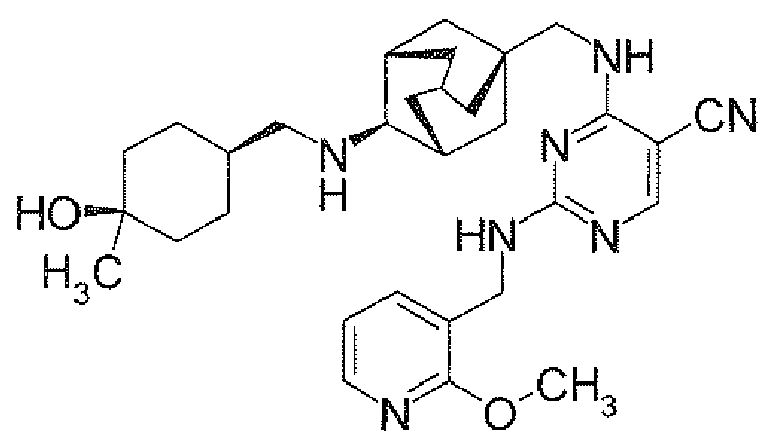
A7 rel 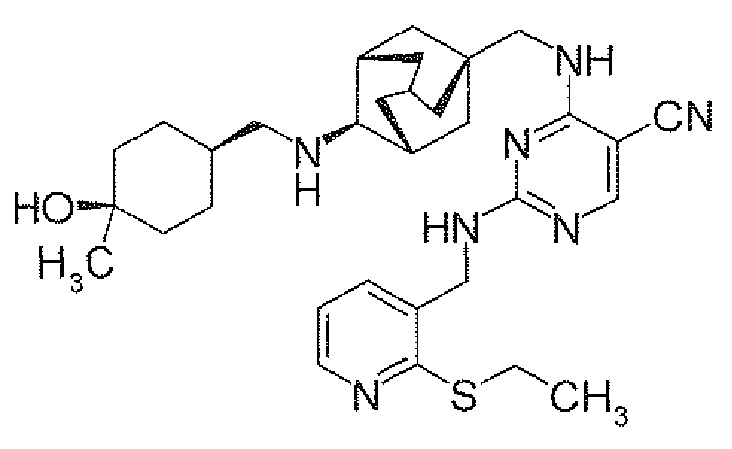
A8 rel 
A9 rel 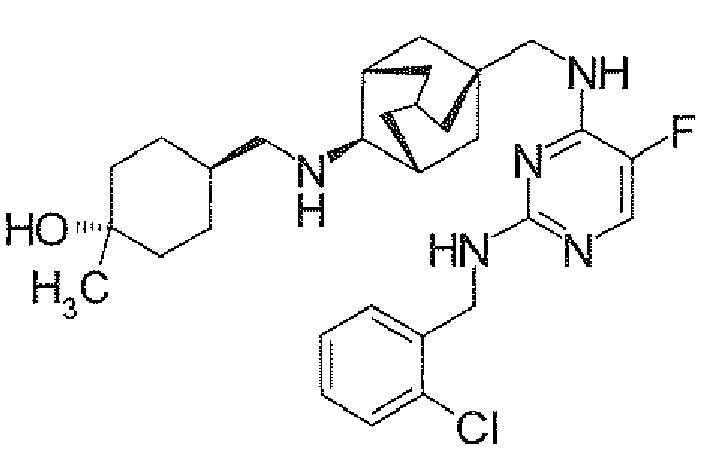
A10 rel 
-
[Table 134] No Str No Str A11 rel 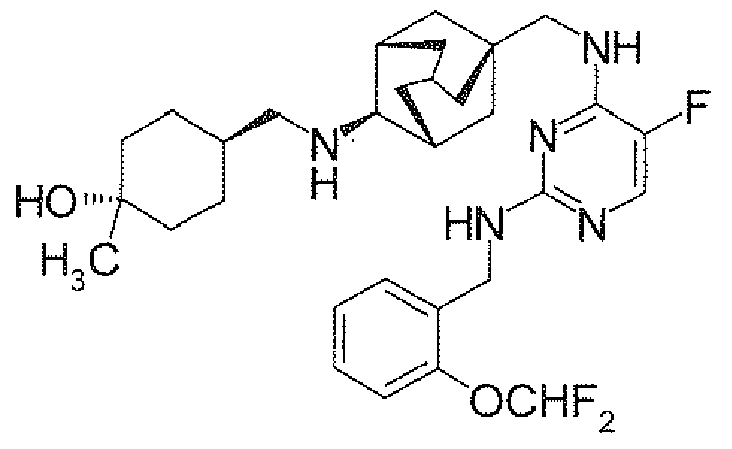
A12 rel 
A13 rel 
A14 rel 
A15 rel 
A16 rel 
A17 rel 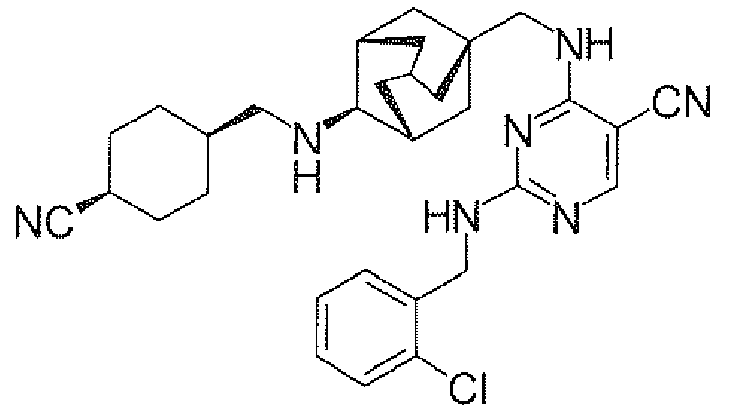
A18 rel 
A19 rel 
A20 rel 
-
[Table 135] No Str No Str A21 rel 
A22 rel 
A23 rel 
A24 rel 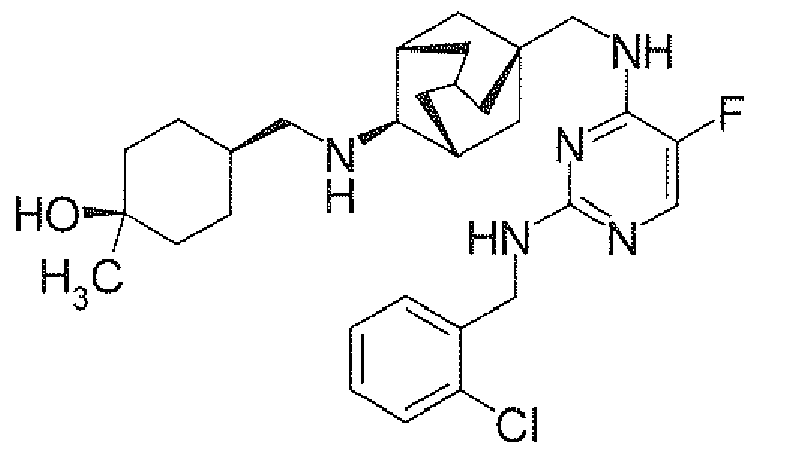
A25 rel 
A26 rel 
A27 rel 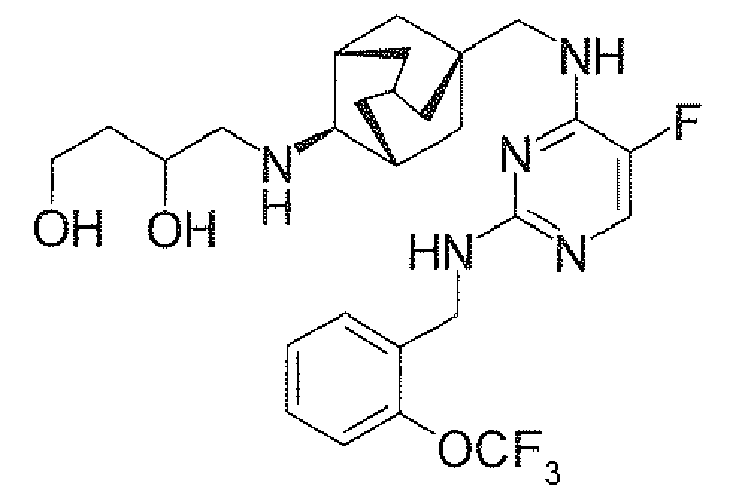
A28 rel 
A29 rel 
A30 rel 
-
[Table 136] No Str No Str A31 rel 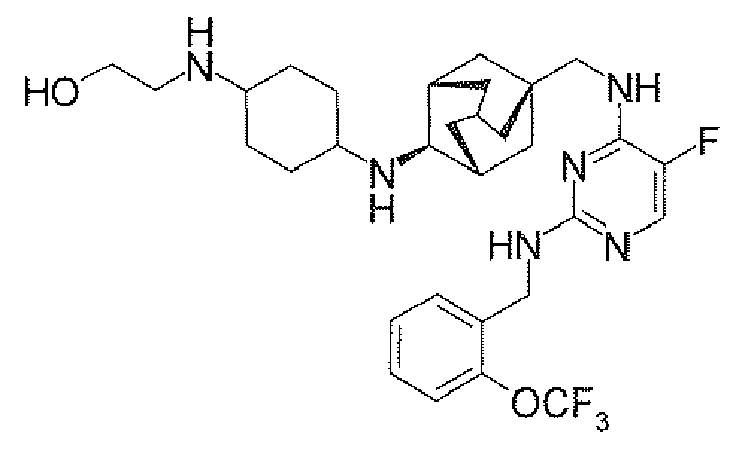
A32 rel 
A33 rel 
A34 rel 
A35 rel 
A36 rel 
A37 rel 
A38 rel 
A39 rel 
A40 rel 
-
[Table 137] No Str No Str A41 rel 
A42 rel 
A43 rel 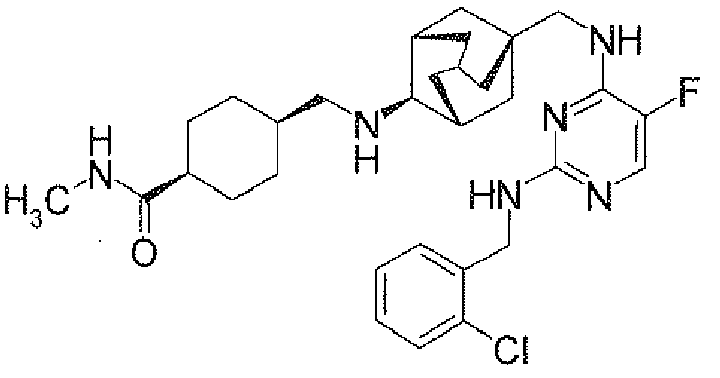
A44 rel 
A45 rel 
A46 rel 
A47 rel 
- The compound of the formula (I) or a pharmaceutically acceptable salt has a PKCθ inhibition action and can be used as an inhibitor of acute rejection occurring in transplantation.
| Ex | I(%) | II(%) | Ex | I(%) | II(%) |
| 41 | 80 | 102 | 251 | 75 | 85 |
| 43 | 76 | 99 | 252 | 85 | 80 |
| 62 | 87 | 81 | 258 | 88 | 90 |
| 68 | 82 | 90 | 263 | 91 | 87 |
| 95 | 84 | 81 | 266 | 83 | 99 |
| 107 | 77 | 84 | 281 | 89 | 83 |
| 115 | 75 | 90 | 282 | 81 | 91 |
| 119 | 77 | 80 | 290 | 85 | 88 |
| 169 | 83 | 89 | 303 | 75 | 88 |
| 195 | 88 | 82 | 314 | 85 | 84 |
| 196 | 86 | 87 | 315 | 85 | 86 |
| 200 | 95 | 85 | 316 | 85 | 84 |
| 209 | 79 | 92 | 321 | 90 | 92 |
| 210 | 77 | 94 | 329 | 92 | 95 |
| 212 | 81 | 85 | 339 | 78 | 94 |
| 216 | 92 | 90 | 340 | 91 | 83 |
| 219 | 76 | 94 | 343 | 78 | 91 |
| 220 | 82 | 85 | 344 | 89 | 84 |
| 228 | 79 | 91 | 345 | 94 | 81 |
| 229 | 80 | 95 | 352 | 94 | 81 |
| 232 | 88 | 94 | 370 | 81 | 85 |
| 238 | 75 | 81 | 372 | 78 | 84 |
| 248 | 88 | 82 | 401 | 84 | 89 |
| 249 | 82 | 83 | |||
Claims (10)
- A compound of the formula (I) or a pharmaceutically acceptable salt thereof:

R1 represents any one group selected from the group consisting of:
n1 represents 0 or 1;
R5 represents -OH, (C1-6 alkyl which may be substituted with -OH or -NH2), or -CN;
R6 represents -H or C1-6 alkyl which may be substituted with aryl;
p represents 0 or 1;
q represents 1, 2, 3, or 4;
R13 represents -H or C1-6 alkyl;
R2 represents -CN, -CF3, -NO2, or halogen;
A represents a single bond or C1-6 alkylene;
R3 represents any one group selected from the group consisting of: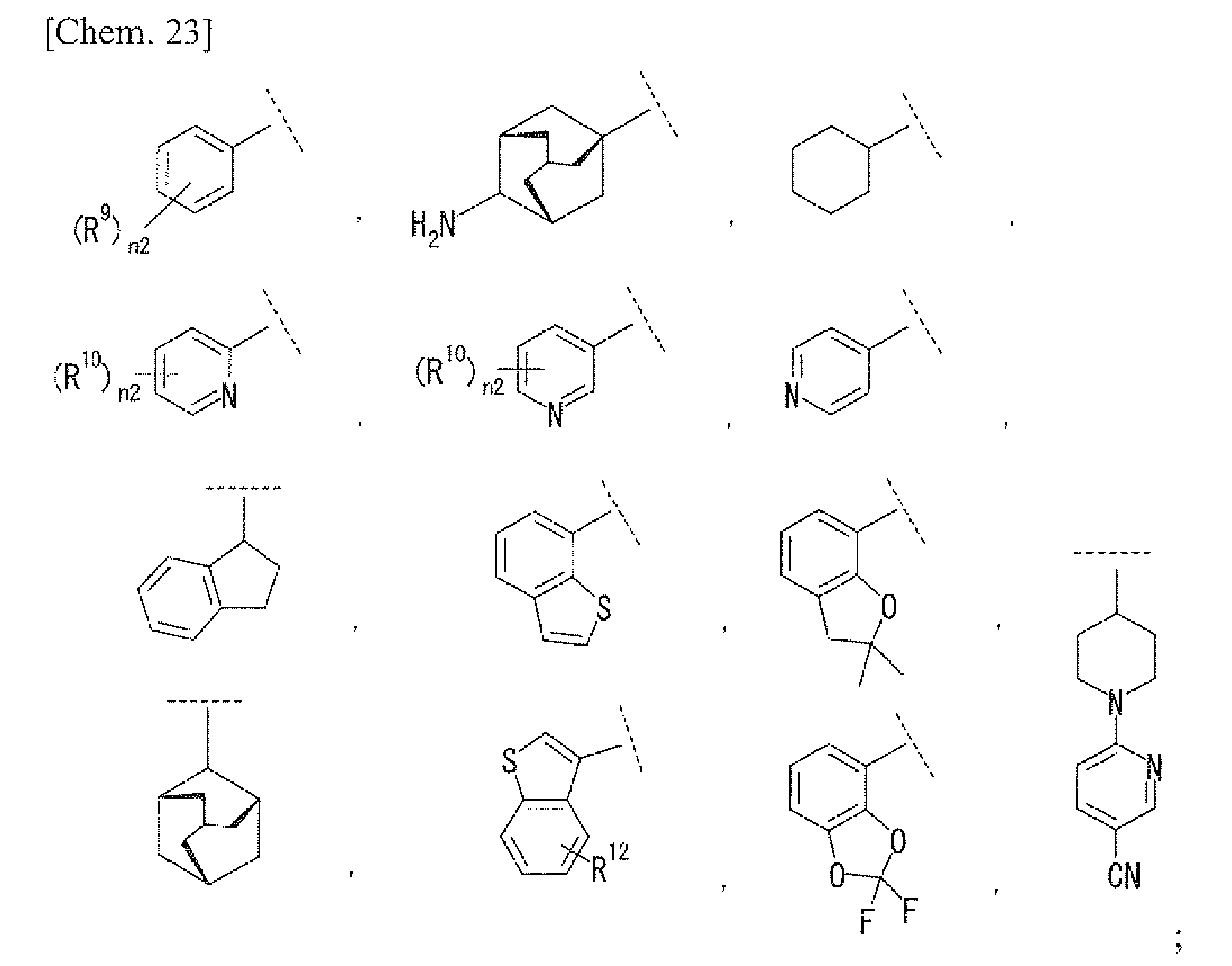
Q represents -O-, -S-, -SO-, -SO2-, or -NHSO2-;
n2 represents 0, 1, 2, or 3;
R10 represents halogen, C1-6 alkyl, -CN, -O-(C1-6 alkyl), -S-(C1-6 alkyl), -SO-(C1-6 alkyl), -SO2-(C1-6 alkyl), -S-(cycloalkyl), or -OCF3; and
R12 represents -H or halogen). - The compound or a pharmaceutically acceptable salt thereof described in claim 1, wherein
R4 is -OH, -NR7R8, or -CH2NH2;
R7 and R8 are the same as or different from each other and represent:(a) -H;(b) C1-6 alkyl, in which the C1-6 alkyl may be substituted with at least one group selected from the group consisting of the following 1) to 12):1) -OH2) protected -OH3) halogen4) -COOH5) -CONH26) oxo7) aryl8) heteroaryl9) cycloalkyl which may be substituted with at least one group selected from the group consisting of -OH, protected -OH, (C1-6 alkyl which may be substituted with -OH), halogen, -CN, -NR14R15, -CONR14R15, -SO2NR14R15, (C1-6 alkyl which may be substituted with -OH)-O-, and oxo10) heterocycloalkyl which may be substituted with -OH or (C1-6 alkyl which may be substituted with -OH, -OCH3, -CN, or halogen)11) (heterocycloalkyl which may be substituted with -OH or -NH2)-CO-, and12) (heterocycloalkyl)-NH-CO-;(c) cycloalkyl, in which the cycloalkyl may be substituted with at least one group selected from the group consisting of the following 1) to 6):1) -OH2) -NHR113) halogen4) oxo5) C1-6 alkyl which may be substituted with -OH, and6) heterocyloalkyl which may be substituted with (halogen, -OH, -CH2OH, or -COCH3);(d) heterocycloalkyl, in which the heterocycloalkyl may be substituted with at least one group selected from the group consisting of the following 1) to 11):1) C1-6 alkyl which may be substituted with (-OH, -OCH3, -CN, halogen, or -CONH2)2) cycloalkyl3) aryl4) heterocycloalkyl5) heterocycloalkyl-CO-6) -COCH37) -CONH28)-COCH2OH9) -COOCH2CH310) -SO2CH311) oxo, and12) halogen;(e) aryl;(f) nicotinoyl; and(g) -SO2CH3; or(h) R7 and R8, together with a nitrogen atom to which they bind, are a nitrogen-containing a heterocycloalkyl which may be substituted with at least one group selected from the group consisting of (-OH, -NH2, -COOH, -COCH3, -CONH2 and -CH2OH);R11 is -H, C1-6 alkyl which may be substituted with (halogen or -OH), cycloalkyl which may be substituted with halogen, heterocycloalkyl which may be substituted with -COCH3, or -COCH3; and
R14 and R15 are the same as or different from each other and are -H, C1-6 alkyl, or heterocycloalkyl. - The compound or a pharmaceutically acceptable salt thereof described in claim 2,
wherein
R1 is
R3 is
- The compound or a pharmaceutically acceptable salt thereof described in claim 3,
wherein
R4 is -NR7R8;
R7 and R8 are the same as or different from each other and are (b) C1-6 alkyl, in which the C1-6 alkyl may be substituted with at least one group selected from the group consisting of the following 1) to 12):1) -OH2) -OH protected with methyl group, or when having two OH groups adjacent to each other, -OH protected with a dimethylmethylene group or a benzylidene group3) -F4) -COOH5) -CONH26) oxo7) phenyl8) pyridyl9) cyclohexyl which may be substituted with at least one group selected from the group consisting of -OH and (C1-6 alkyl which may be substituted with -OH)10) (piperidinyl or pyrrolidinyl) which may be substituted with -OH or (C1-6 alkyl which may be substituted with -OH, -OCH3, -CN, or -F)11) (piperazinyl)-CO- or (piperidinyl which may be substituted with -OH or -NH2)-CO-, and12) (piperidinyl)-NH-CO-; orn2 is 1.(c) cycloalkyl, in which the cycloalkyl may be substituted with at least one group selected from the group consisting of the following 1) to 6):1) -OH2) -NHR113) -F4) oxo5) C1-6 alkyl which may be substituted with -OH, and6) (azetidinyl, pyrrolidinyl, piperidinyl, piperazinyl or morpholinyl) which may be substituted with (halogen, -OH, -CH2OH, or -COCH3);R11 is -H;
n1 is 1;
R2 is -CN, -CF3, -NO2, or -F;
A is C1-6 alkylene;
R9 is(i) -F, -Cl, or -Br(j) C1-6 alkyl which may be substituted with -OH or halogen,(k) -OH,(l) -CN,(m) cyclopropyl,(n) -Q-(C1-6 alkyl which may be substituted with halogen, -OH, -OCH3, -CN, or -CONH2), or(o) phenyl which may be substituted with -CH2NH2; and - The compound or a pharmaceutically acceptable salt thereof described in claim 4,
wherein
R7 and R8 are the same as or different from each other and are(b) C1-6 alkyl, in which the C1-6 alkyl may be substituted with the following groups:9) cyclohexyl substituted with at least one group selected from the group consisting of -OH, -CH3, and -CH2OH, and10) piperidinyl which may be substituted with -OH or (C1-6 alkyl which may be substituted with -OH, -OCH3, -CN, or -F); or(c) cycloalkyl, in which the cycloalkyl may be substituted with at least one group selected from the group consisting of the following 1), 2), and 5):R11 is -H;1) -OH2) -NHR11, and5) C1-6 alkyl which may be substituted with -OH;
R2 is -CN;
A is methylene;
R9 is(i) -F, -Cl, or -Br(j) C1-6 alkyl which may be substituted with -OH or -F,(k) -OH,(l) -CN,(m) cyclopropyl,(n) -Q-(C1-6 alkyl which may be substituted with halogen, -OH, -OCH3, -CN, or -CONH2), or(o) phenyl which may be substituted with -CH2NH2; andR10 is -Cl, -CH3, -OCH3, -OCH2CH3, -OCH(CH3)2, -SCH3, -SCH2CH3, -SCH(CH3)2, -SOCH3, -SO2CH3, -S-(cylopentane), or -OCF3. - A pharmaceutical composition comprising the compound or a pharmaceutically acceptable salt thereof described in claim 1, and a pharmaceutically acceptable excipient.
- A PKCθ inhibitor comprising the compound or a pharmaceutically acceptable salt thereof described in claim 1.
- A pharmaceutical composition for inhibiting acute rejection occurring in transplantation, comprising the compound or a pharmaceutically acceptable salt thereof described in claim 1.
- Use of the compound or a pharmaceutically acceptable salt thereof described in claim 1 for the manufacture of an inhibitor of acute rejection occurring in transplantation.
- A method for inhibiting acute rejection occurring in transplantation, comprising administering to a patient an effective amount of the compound or a pharmaceutically acceptable salt thereof described in claim 1.
Applications Claiming Priority (3)
| Application Number | Priority Date | Filing Date | Title |
|---|---|---|---|
| JP2008223323 | 2008-09-01 | ||
| JP2009121482 | 2009-05-20 | ||
| PCT/JP2009/065149 WO2010024430A1 (en) | 2008-09-01 | 2009-08-31 | 2,4-diaminopyrimidine compound |
Publications (2)
| Publication Number | Publication Date |
|---|---|
| EP2325175A1 true EP2325175A1 (en) | 2011-05-25 |
| EP2325175A4 EP2325175A4 (en) | 2012-03-21 |
Family
ID=41721589
Family Applications (1)
| Application Number | Title | Priority Date | Filing Date |
|---|---|---|---|
| EP09810074A Withdrawn EP2325175A4 (en) | 2008-09-01 | 2009-08-31 | 2,4-DIAMINOPYRIMIDINE COMPOUND |
Country Status (10)
| Country | Link |
|---|---|
| US (1) | US20110159019A1 (en) |
| EP (1) | EP2325175A4 (en) |
| JP (1) | JP5644499B2 (en) |
| KR (1) | KR20110049902A (en) |
| CN (1) | CN102137848A (en) |
| BR (1) | BRPI0918472A2 (en) |
| CA (1) | CA2735730A1 (en) |
| MX (1) | MX2011002306A (en) |
| TW (1) | TW201014832A (en) |
| WO (1) | WO2010024430A1 (en) |
Cited By (4)
| Publication number | Priority date | Publication date | Assignee | Title |
|---|---|---|---|---|
| WO2012059932A1 (en) * | 2010-11-01 | 2012-05-10 | Aurigene Discovery Technologies Limited | 2, 4 -diaminopyrimidine derivatives as protein kinase inhibitors |
| WO2013048949A3 (en) * | 2011-09-26 | 2013-07-18 | Bristol-Myers Squibb Company | Selective nr2b antagonists |
| EP2518051A4 (en) * | 2009-12-22 | 2013-10-16 | Shionogi & Co | Adamantanamine derivative |
| WO2025136129A1 (en) * | 2023-12-22 | 2025-06-26 | Captor Therapeutics S.A. | Targeted protein degradation using bifunctional compounds that bind ubiquitin ligase and target protein kinase c |
Families Citing this family (25)
| Publication number | Priority date | Publication date | Assignee | Title |
|---|---|---|---|---|
| JP2012148977A (en) * | 2009-05-20 | 2012-08-09 | Astellas Pharma Inc | 2,4-diaminopyrimidine compound having aminocyclohexylalkyl group |
| JP5951600B2 (en) | 2010-05-21 | 2016-07-13 | インフィニティー ファーマシューティカルズ, インコーポレイテッド | Compounds, compositions and methods for kinase regulation |
| AU2011260323A1 (en) | 2010-06-04 | 2012-11-15 | F. Hoffmann-La Roche Ag | Aminopyrimidine derivatives as LRRK2 modulators |
| TWI511958B (en) | 2010-08-09 | 2015-12-11 | Shionogi & Co | Process for production of aminoadamantanecarbamate derivative |
| JP2012067033A (en) * | 2010-09-22 | 2012-04-05 | Kuraray Co Ltd | Method for producing aminomethylpyridine derivative |
| KR101566091B1 (en) | 2010-11-10 | 2015-11-04 | 에프. 호프만-라 로슈 아게 | Pyrazole aminopyrimidine derivatives as lrrk2 modulators |
| TWI548621B (en) * | 2011-04-22 | 2016-09-11 | 標誌製藥公司 | Substituted diaminocarboxamide and diaminocarbonitrile pyrimidines, compositions thereof, and methods of treatment therewith |
| AU2016244228B2 (en) * | 2011-04-22 | 2019-02-21 | Signal Pharmaceuticals, Llc | Substituted diaminocarboxamide and diaminocarbonitrile pyrimidines, compositions thereof, and methods of treatment therewith |
| PE20141371A1 (en) | 2011-08-29 | 2014-10-13 | Infinity Pharmaceuticals Inc | HETEROCYCLIC COMPOUNDS AND USES OF THEM |
| EP2760856B1 (en) | 2011-09-30 | 2016-09-14 | Bristol-Myers Squibb Company | Selective nr2b antagonists |
| US9481667B2 (en) | 2013-03-15 | 2016-11-01 | Infinity Pharmaceuticals, Inc. | Salts and solid forms of isoquinolinones and composition comprising and methods of using the same |
| RU2016129380A (en) * | 2013-12-20 | 2018-01-25 | СИГНАЛ ФАРМАСЬЮТИКАЛЗ, ЭлЭлСи | SUBSTITUTED DIAMINOPYRIMIDYL COMPOUNDS, THEIR COMPOSITIONS AND METHODS OF TREATMENT WITH THEIR PARTICIPATION |
| NZ715903A (en) | 2014-01-30 | 2017-06-30 | Signal Pharm Llc | Solid forms of 2-(tert-butylamino)-4-((1r,3r,4r)-3-hydroxy-4-methylcyclohexylamino)-pyrimidine-5-carboxamide, compositions thereof and methods of their use |
| US9513297B2 (en) | 2014-12-16 | 2016-12-06 | Signal Pharmaceuticals, Llc | Methods for measurement of inhibition of c-Jun N-terminal kinase in skin |
| EP3712134B1 (en) | 2014-12-16 | 2023-11-29 | Signal Pharmaceuticals, LLC | Salts of 2-(tert-butylamino)-4-((1r,3r,4r)-3-hydroxy-4-methycyclohexylamino)-pyrimidine-5-carboxamide |
| EP3250557B1 (en) | 2015-01-29 | 2024-11-20 | Signal Pharmaceuticals, LLC | Isotopologues of 2-(tert-butylamino)-4-((1r,3r,4r)-3-hydroxy-4-methylcyclohexylamino)-pyrimidine-5-carboxamide |
| EP3325432B1 (en) | 2015-07-24 | 2020-09-02 | Celgene Corporation | Methods of synthesis of (1r,2r,5r)-5-amino-2-methylcyclohexanol hydrochloride and intermediates useful therein |
| CN108430986B (en) | 2015-10-26 | 2021-08-31 | 拜耳作物科学股份公司 | Fused Bicyclic Heterocyclic Derivatives as Pest Control Agents |
| CN113710669A (en) | 2019-02-26 | 2021-11-26 | 拜耳公司 | Fused bicyclic heterocyclic derivatives as pesticides |
| PH12021552065A1 (en) | 2019-02-26 | 2022-05-23 | Bayer Ag | Condensed bicyclic heterocyclic derivatives as pest control agents |
| AR131541A1 (en) | 2023-01-07 | 2025-04-09 | Syngenta Crop Protection Ag | NOVEL CARBOXAMIDE COMPOUNDS |
| WO2025109114A1 (en) | 2023-11-24 | 2025-05-30 | Syngenta Crop Protection Ag | Novel carboxamide compounds |
| WO2025149637A1 (en) | 2024-01-12 | 2025-07-17 | Syngenta Crop Protection Ag | Novel carboxamide compounds |
| PY2501648A (en) | 2024-01-12 | 2025-10-31 | Syngenta Crop Protection Ag | NEW CARBOXAMIDE COMPOUNDS |
| WO2026008750A1 (en) | 2024-07-05 | 2026-01-08 | Syngenta Crop Protection Ag | Novel carboxamide compounds |
Family Cites Families (12)
| Publication number | Priority date | Publication date | Assignee | Title |
|---|---|---|---|---|
| GB0016877D0 (en) * | 2000-07-11 | 2000-08-30 | Astrazeneca Ab | Chemical compounds |
| IL159120A0 (en) * | 2001-05-29 | 2004-05-12 | Schering Ag | Cdk inhibiting pyrimidines, production thereof and their use as medicaments |
| JP4460292B2 (en) * | 2001-10-17 | 2010-05-12 | ベーリンガー インゲルハイム ファルマ ゲゼルシャフト ミット ベシュレンクテル ハフツング ウント コンパニー コマンディトゲゼルシャフト | Pyrimidine derivatives, pharmaceutical compositions containing these compounds, their use and methods for their preparation |
| WO2004043936A1 (en) | 2002-11-14 | 2004-05-27 | Kyowa Hakko Kogyo Co., Ltd. | Plk inhibitors |
| WO2004048343A1 (en) * | 2002-11-28 | 2004-06-10 | Schering Aktiengesellschaft | Chk-, pdk- and akt-inhibitory pyrimidines, their production and use as pharmaceutical agents |
| JPWO2004054617A1 (en) | 2002-12-13 | 2006-04-20 | 協和醗酵工業株式会社 | Preventive and / or therapeutic agent for central diseases |
| EP1590334B1 (en) | 2003-01-30 | 2009-08-19 | Boehringer Ingelheim Pharmaceuticals Inc. | 2,4-diaminopyrimidine derivatives useful as inhibitors of pkc-theta |
| JP4812763B2 (en) * | 2004-05-18 | 2011-11-09 | ライジェル ファーマシューティカルズ, インコーポレイテッド | Cycloalkyl-substituted pyrimidinediamine compounds and uses thereof |
| US7601714B2 (en) | 2004-07-08 | 2009-10-13 | Boehringer Ingelheim Pharmaceuticals, Inc. | Pyrimidine derivatives useful as inhibitors of PKC-theta |
| JP2009521488A (en) * | 2005-12-21 | 2009-06-04 | ベーリンガー インゲルハイム インターナショナル ゲゼルシャフト ミット ベシュレンクテル ハフツング | Pyrimidine derivatives useful as inhibitors of PKC-theta |
| CN101903357A (en) * | 2007-07-17 | 2010-12-01 | 里格尔药品股份有限公司 | Cyclic amine-substituted pyrimidinediamines as PKC inhibitors |
| WO2010083241A2 (en) * | 2009-01-14 | 2010-07-22 | Rigel Pharmaceuticals, Inc. | 2,4-pyrimidinediamine compounds for treatment of inflammatory disorders |
-
2009
- 2009-08-31 EP EP09810074A patent/EP2325175A4/en not_active Withdrawn
- 2009-08-31 CN CN2009801341763A patent/CN102137848A/en active Pending
- 2009-08-31 WO PCT/JP2009/065149 patent/WO2010024430A1/en not_active Ceased
- 2009-08-31 MX MX2011002306A patent/MX2011002306A/en not_active Application Discontinuation
- 2009-08-31 KR KR1020117007428A patent/KR20110049902A/en not_active Withdrawn
- 2009-08-31 BR BRPI0918472A patent/BRPI0918472A2/en not_active IP Right Cessation
- 2009-08-31 US US13/061,311 patent/US20110159019A1/en not_active Abandoned
- 2009-08-31 JP JP2010526805A patent/JP5644499B2/en not_active Expired - Fee Related
- 2009-08-31 CA CA2735730A patent/CA2735730A1/en not_active Abandoned
- 2009-09-01 TW TW098129376A patent/TW201014832A/en unknown
Non-Patent Citations (2)
| Title |
|---|
| No further relevant documents disclosed * |
| See also references of WO2010024430A1 * |
Cited By (5)
| Publication number | Priority date | Publication date | Assignee | Title |
|---|---|---|---|---|
| EP2518051A4 (en) * | 2009-12-22 | 2013-10-16 | Shionogi & Co | Adamantanamine derivative |
| WO2012059932A1 (en) * | 2010-11-01 | 2012-05-10 | Aurigene Discovery Technologies Limited | 2, 4 -diaminopyrimidine derivatives as protein kinase inhibitors |
| WO2013048949A3 (en) * | 2011-09-26 | 2013-07-18 | Bristol-Myers Squibb Company | Selective nr2b antagonists |
| US8841301B2 (en) | 2011-09-26 | 2014-09-23 | Bristol-Myers Squibb Company | Selective NR2B antagonists |
| WO2025136129A1 (en) * | 2023-12-22 | 2025-06-26 | Captor Therapeutics S.A. | Targeted protein degradation using bifunctional compounds that bind ubiquitin ligase and target protein kinase c |
Also Published As
| Publication number | Publication date |
|---|---|
| WO2010024430A1 (en) | 2010-03-04 |
| TW201014832A (en) | 2010-04-16 |
| US20110159019A1 (en) | 2011-06-30 |
| MX2011002306A (en) | 2011-05-25 |
| CA2735730A1 (en) | 2010-03-04 |
| EP2325175A4 (en) | 2012-03-21 |
| JPWO2010024430A1 (en) | 2012-01-26 |
| BRPI0918472A2 (en) | 2015-12-01 |
| JP5644499B2 (en) | 2014-12-24 |
| KR20110049902A (en) | 2011-05-12 |
| CN102137848A (en) | 2011-07-27 |
Similar Documents
| Publication | Publication Date | Title |
|---|---|---|
| US20110159019A1 (en) | 2,4-diaminopyrimidine compound | |
| EP3768674B1 (en) | Aminopyrimidine derivatives as ctps1 inhibitors | |
| US12227517B2 (en) | Pyridazinyl-thiazolecarboxamide compound | |
| US20260028329A1 (en) | Jak1 selective inhibitors | |
| CA2808435C (en) | Heterocyclic compound | |
| EP3148975B1 (en) | Piperazine derivatives as ror-gamma modulators | |
| US8802679B2 (en) | Glycine compound | |
| CA2950564C (en) | 2-acylaminothiazole derivative or salt thereof | |
| AU2020408107B2 (en) | Compounds active towards nuclear receptors | |
| AU2010231694A1 (en) | Pyrimidine compound | |
| US20230192673A1 (en) | Compounds | |
| EP3196200B1 (en) | 2-aminothiazole derivatives or salt thereof as muscarinic m3 ligands for the treatment of bladder diseases | |
| US10494363B2 (en) | Non-steroidal glucocorticoid receptor modulators for local drug delivery | |
| CA3160508C (en) | Substituted ((((6-benzylamino-5-fluoropyrimidin-4-yl)amino)methyl)-piperidin-1-yl)acetamide compounds active towards nuclear receptors | |
| JP2011173853A (en) | 2,4-diaminopyrimidine compound having substituted aminoadamantylalkyl group | |
| HK40044108B (en) | Aminopyrimidine derivatives as ctps1 inhibitors | |
| HK40044108A (en) | Aminopyrimidine derivatives as ctps1 inhibitors | |
| HK40098388A (en) | Jak1 selective inhibitors | |
| JP2011173854A (en) | 2,4-diaminopyrimidine compound having bicyclo ring-substituted alkyl group | |
| HK40017725A (en) | Jak1 selective inhibitors | |
| HK40017725B (en) | Jak1 selective inhibitors |
Legal Events
| Date | Code | Title | Description |
|---|---|---|---|
| PUAI | Public reference made under article 153(3) epc to a published international application that has entered the european phase |
Free format text: ORIGINAL CODE: 0009012 |
|
| 17P | Request for examination filed |
Effective date: 20110301 |
|
| AK | Designated contracting states |
Kind code of ref document: A1 Designated state(s): AT BE BG CH CY CZ DE DK EE ES FI FR GB GR HR HU IE IS IT LI LT LU LV MC MK MT NL NO PL PT RO SE SI SK SM TR |
|
| AX | Request for extension of the european patent |
Extension state: AL BA RS |
|
| DAX | Request for extension of the european patent (deleted) | ||
| A4 | Supplementary search report drawn up and despatched |
Effective date: 20120221 |
|
| RIC1 | Information provided on ipc code assigned before grant |
Ipc: C07D 471/08 20060101ALI20120215BHEP Ipc: C07D 453/02 20060101ALI20120215BHEP Ipc: C07D 409/12 20060101ALI20120215BHEP Ipc: C07D 405/14 20060101ALI20120215BHEP Ipc: C07D 405/12 20060101ALI20120215BHEP Ipc: C07D 403/12 20060101ALI20120215BHEP Ipc: C07D 401/12 20060101ALI20120215BHEP Ipc: A61P 37/06 20060101ALI20120215BHEP Ipc: A61K 31/5513 20060101ALI20120215BHEP Ipc: A61K 31/5377 20060101ALI20120215BHEP Ipc: A61K 31/506 20060101ALI20120215BHEP Ipc: A61K 31/505 20060101ALI20120215BHEP Ipc: C07D 239/48 20060101AFI20120215BHEP |
|
| 17Q | First examination report despatched |
Effective date: 20120824 |
|
| GRAP | Despatch of communication of intention to grant a patent |
Free format text: ORIGINAL CODE: EPIDOSNIGR1 |
|
| STAA | Information on the status of an ep patent application or granted ep patent |
Free format text: STATUS: THE APPLICATION IS DEEMED TO BE WITHDRAWN |
|
| 18D | Application deemed to be withdrawn |
Effective date: 20130611 |