EP2323266A1 - Segmentation mechanism for a block encoder - Google Patents
Segmentation mechanism for a block encoder Download PDFInfo
- Publication number
- EP2323266A1 EP2323266A1 EP10011964A EP10011964A EP2323266A1 EP 2323266 A1 EP2323266 A1 EP 2323266A1 EP 10011964 A EP10011964 A EP 10011964A EP 10011964 A EP10011964 A EP 10011964A EP 2323266 A1 EP2323266 A1 EP 2323266A1
- Authority
- EP
- European Patent Office
- Prior art keywords
- block
- input data
- segments
- idb
- data block
- Prior art date
- Legal status (The legal status is an assumption and is not a legal conclusion. Google has not performed a legal analysis and makes no representation as to the accuracy of the status listed.)
- Ceased
Links
- 230000011218 segmentation Effects 0.000 title claims description 4
- 238000000034 method Methods 0.000 claims abstract description 10
- 230000009897 systematic effect Effects 0.000 description 3
- 230000003044 adaptive effect Effects 0.000 description 1
- 230000005540 biological transmission Effects 0.000 description 1
- 230000001419 dependent effect Effects 0.000 description 1
- 238000001514 detection method Methods 0.000 description 1
- 230000004048 modification Effects 0.000 description 1
- 238000012986 modification Methods 0.000 description 1
Images

Classifications
-
- H—ELECTRICITY
- H04—ELECTRIC COMMUNICATION TECHNIQUE
- H04L—TRANSMISSION OF DIGITAL INFORMATION, e.g. TELEGRAPHIC COMMUNICATION
- H04L1/00—Arrangements for detecting or preventing errors in the information received
- H04L1/0078—Avoidance of errors by organising the transmitted data in a format specifically designed to deal with errors, e.g. location
-
- H—ELECTRICITY
- H03—ELECTRONIC CIRCUITRY
- H03M—CODING; DECODING; CODE CONVERSION IN GENERAL
- H03M13/00—Coding, decoding or code conversion, for error detection or error correction; Coding theory basic assumptions; Coding bounds; Error probability evaluation methods; Channel models; Simulation or testing of codes
- H03M13/29—Coding, decoding or code conversion, for error detection or error correction; Coding theory basic assumptions; Coding bounds; Error probability evaluation methods; Channel models; Simulation or testing of codes combining two or more codes or code structures, e.g. product codes, generalised product codes, concatenated codes, inner and outer codes
- H03M13/2957—Turbo codes and decoding
-
- H—ELECTRICITY
- H03—ELECTRONIC CIRCUITRY
- H03M—CODING; DECODING; CODE CONVERSION IN GENERAL
- H03M13/00—Coding, decoding or code conversion, for error detection or error correction; Coding theory basic assumptions; Coding bounds; Error probability evaluation methods; Channel models; Simulation or testing of codes
- H03M13/65—Purpose and implementation aspects
- H03M13/6508—Flexibility, adaptability, parametrability and configurability of the implementation
-
- H—ELECTRICITY
- H04—ELECTRIC COMMUNICATION TECHNIQUE
- H04L—TRANSMISSION OF DIGITAL INFORMATION, e.g. TELEGRAPHIC COMMUNICATION
- H04L1/00—Arrangements for detecting or preventing errors in the information received
- H04L1/004—Arrangements for detecting or preventing errors in the information received by using forward error control
- H04L1/0041—Arrangements at the transmitter end
- H04L1/0043—Realisations of complexity reduction techniques, e.g. use of look-up tables
-
- H—ELECTRICITY
- H04—ELECTRIC COMMUNICATION TECHNIQUE
- H04L—TRANSMISSION OF DIGITAL INFORMATION, e.g. TELEGRAPHIC COMMUNICATION
- H04L1/00—Arrangements for detecting or preventing errors in the information received
- H04L1/004—Arrangements for detecting or preventing errors in the information received by using forward error control
- H04L1/0056—Systems characterized by the type of code used
- H04L1/0057—Block codes
-
- H—ELECTRICITY
- H04—ELECTRIC COMMUNICATION TECHNIQUE
- H04L—TRANSMISSION OF DIGITAL INFORMATION, e.g. TELEGRAPHIC COMMUNICATION
- H04L1/00—Arrangements for detecting or preventing errors in the information received
- H04L1/004—Arrangements for detecting or preventing errors in the information received by using forward error control
- H04L1/0056—Systems characterized by the type of code used
- H04L1/0064—Concatenated codes
- H04L1/0066—Parallel concatenated codes
Definitions
- the invention relates to methods and equipment for block encoders.
- block encoders are frequently used for error correction.
- An example of a block encoder is a so-called turbo (en)coder, as disclosed in reference 1.
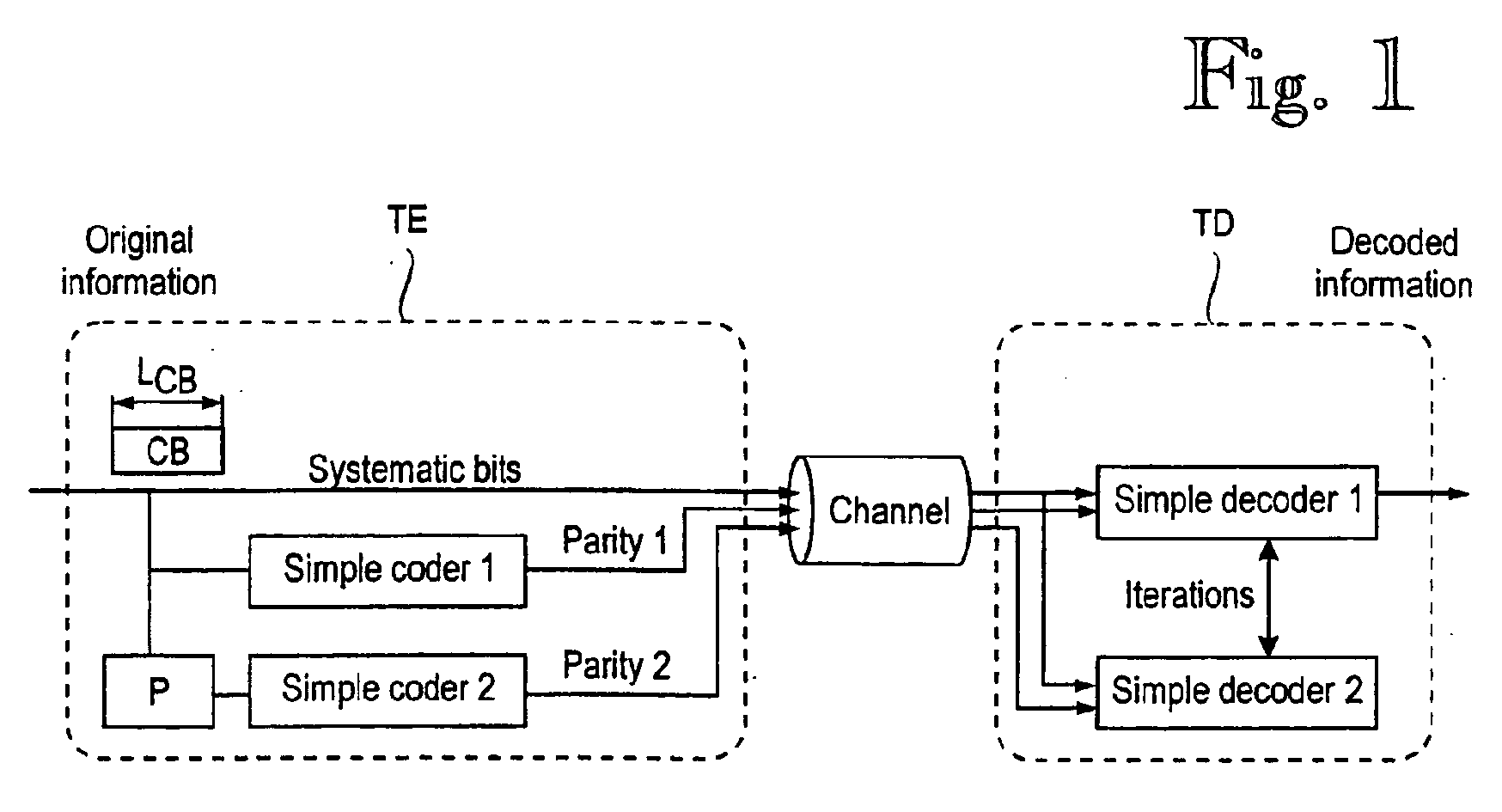
- Figure 1 is a block chart of a turbo encoder TE which is connected to a corresponding turbo decoder TD via a (transmission) channel.
- a typical turbo encoder conveys the original information directly to the channel. These bits are called systematic bits. Additionally, the turbo encoder adds redundancy (parity) with simple encoders 1 and 2, the latter of which is preceded by an interleaver P, which permutes the bits of the original information.
- parity redundancy
- P interleaver
- block encoders process one or more data blocks at a time.
- An input data block whose size exceeds the block size of the block encoder must be divided into smaller segments such that no segment is larger than the block size of the block encoder. This is why block encoders are particularly suitable for applications with a fixed input block size.
- a problem with block encoders is that they do not easily lend themselves to applications having a variable (dynamic) input block size. In other words, what to do with the last few segments of the input data block, remains an open question.
- An object of the invention is to provide a mechanism for using block encoders with applications having a variable (dynamic) input block size.
- the mechanism should be generic in order to be applicable to a wide variety of block encoders.
- a straightforward solution would be to fill the segment of the input data block to the block size of the block encoder. Assuming a block size of 8 kilobits (kb), a 14-kb input data block would be divided into a first segment of 8 kb and second (last) segment with a net size of 6 kb and 2 kb of fill (padding) bits.
- kb kilobits
- a benefit of this straightforward solution is that the block encoder does not have to adapt to varying input block sizes.
- the invention is based on the idea that for an input data block whose size exceeds the block size of the block encoder:
- the input data block is divided into the least possible number of segments.
- the segments are as large as possible.
- the input data block is divided into 2 n segments where n is a positive integer.
- the input data block or the last segment is padded with a few fill bits until the length of the last segment equals that of the remaining segments.
- the last segment is not padded to the full block size of the block encoder (unless the remaining segments happen to be of that size too).
- turbo encoder an example of which is disclosed in reference 1.
- details of the turbo encoder, or any other encoder are not relevant for understanding the invention.
- turbo encoder and the corresponding decoder
- a reasonable value for the length of the coding block is 8192 bits including the user data, a possible error detection field (CRC) and the termination.
- CRC error detection field
- N S round_up ⁇ R DATA * T DELAY + T EXTRA / L CB - N TAIL
- Algorithm A allows the last segment to be shorter than the other segments. Algorithm A uses the following Inputs:
- Algorithm A produces the following outputs:
- algorithm B all input segments to the turbo encoder will be of equal size.
- the inputs to algorithm B are:
- the length of input segment to the turbo encoder is maximised by choosing the smallest possible number of segments N S . In some cases it may be preferable to use a number of segments N S which is a power of 2, but this will shorten the input segments to the turbo encoder. In this case, the first step of the above algorithms A and B would be replaced by the following three steps:
Landscapes
- Engineering & Computer Science (AREA)
- Computer Networks & Wireless Communication (AREA)
- Signal Processing (AREA)
- Physics & Mathematics (AREA)
- Probability & Statistics with Applications (AREA)
- Theoretical Computer Science (AREA)
- Error Detection And Correction (AREA)
- Compression, Expansion, Code Conversion, And Decoders (AREA)
- Analogue/Digital Conversion (AREA)
- Transmission And Conversion Of Sensor Element Output (AREA)
- Character Spaces And Line Spaces In Printers (AREA)
- Compression Or Coding Systems Of Tv Signals (AREA)
- Image Processing (AREA)
Abstract
Description
- The invention relates to methods and equipment for block encoders. As is well known, block encoders are frequently used for error correction. An example of a block encoder is a so-called turbo (en)coder, as disclosed in
reference 1. -
Figure 1 is a block chart of a turbo encoder TE which is connected to a corresponding turbo decoder TD via a (transmission) channel. A typical turbo encoder conveys the original information directly to the channel. These bits are called systematic bits. Additionally, the turbo encoder adds redundancy (parity) withsimple encoders - Unlike streaming encoders, block encoders process one or more data blocks at a time. An input data block whose size exceeds the block size of the block encoder must be divided into smaller segments such that no segment is larger than the block size of the block encoder. This is why block encoders are particularly suitable for applications with a fixed input block size. A problem with block encoders is that they do not easily lend themselves to applications having a variable (dynamic) input block size. In other words, what to do with the last few segments of the input data block, remains an open question.
- An object of the invention is to provide a mechanism for using block encoders with applications having a variable (dynamic) input block size. The mechanism should be generic in order to be applicable to a wide variety of block encoders.
- This object is achieved with a method and equipment which are characterized by what is disclosed in the attached independent claims. Preferred embodiments of the invention are disclosed in the attached dependent claims.
- A straightforward solution would be to fill the segment of the input data block to the block size of the block encoder. Assuming a block size of 8 kilobits (kb), a 14-kb input data block would be divided into a first segment of 8 kb and second (last) segment with a net size of 6 kb and 2 kb of fill (padding) bits. A benefit of this straightforward solution is that the block encoder does not have to adapt to varying input block sizes.
- The invention is based on the idea that for an input data block whose size exceeds the block size of the block encoder:
- 1) before coding is started, the size of the input data block is determined; and
- 2) the input data block is divided into segments of approximately equal size such that no segment is larger than the block size of the block encoder.
- According to a preferred embodiment of the invention, the input data block is divided into the least possible number of segments. In other words, the segments are as large as possible.
- According to an alternative embodiment, the input data block is divided into 2n segments where n is a positive integer.
- According to yet another preferred embodiment of the invention, if dividing the input data block produces a last segment which is shorter than the remaining segments, the input data block or the last segment is padded with a few fill bits until the length of the last segment equals that of the remaining segments. However, in contrast to the straightforward solution, the last segment is not padded to the full block size of the block encoder (unless the remaining segments happen to be of that size too).
- The invention will be described in more detail by means of preferred embodiments with reference to the appended drawing wherein:
-
Figure 1 is a block chart of a turbo encoder; and -
Figure 2 illustrates dividing an input data block to a number of segments for the turbo encoder. - Various embodiments of the invention will be described in connection with a turbo encoder, an example of which is disclosed in
reference 1. However, details of the turbo encoder, or any other encoder, are not relevant for understanding the invention. - Implementing a turbo encoder (and the corresponding decoder) can be facilitated by limiting the length of the coding block. A reasonable value for the length of the coding block is 8192 bits including the user data, a possible error detection field (CRC) and the termination. The following naming conventions will be used:
- N TAIL = the number of termination bits
- T DELAY (seconds) = the length of the user data block
- R DATA (bits per second) = the user data rate of the service
- N EXTRA = the number of other bits added to the original user data (CRC etc.)
- LCB = max length of the coding block.
- The following condition has to be satisfied:

- If this condition is not satisfied the data to be encoded must be segmented so that each separate segment satisfies the condition. The number of segments N S has to satisfy the condition:

- It is preferable to choose the smallest N S satisfying the inequality [2]. N S can be calculated from:

- It may happen that all the encoding blocks do not end up being of the same length, i.e. that (R DATA * T DELAY + N EXTRA) /N S is not an integer. In such a case, there are at least two possible solutions, which will be called algorithms A and B. In algorithm A, the last segment is allowed to have a different length than the other segments. In algorithm B, a number N FILL of fill bits (e.g. zeroes) are added to the input data so that (R DATA * T DELAY + N EXTRA + N FILL) / N S is the smallest possible integer. (Alternatively, the fill bits can be appended to the last segment after segmentation.)
- Algorithm A allows the last segment to be shorter than the other segments. Algorithm A uses the following Inputs:
- R DATA = the user data rate (bits per second)
- T DELAY = encoding user data block length (seconds)
- N EXTRA = extra data to be appended to the user data before encoding (bits)
- N TAIL = number of tail bits to be appended to the encoding blocks
- Algorithm A produces the following outputs:
- N S = number of segments
- N TB = number of bits in the turbo encoder input blocks except the last one
- N LAST_TB = number of bits in the last turbo encoder input block
- In algorithm A the following computations will be performed:
- Let N S = round_up((R DATA * T DELAY + N EXTRA) / (LCB - N TAIL ))
- Let N TB = round_up((R DATA * T DELAY + N EXTRA) / N S) + N TAIL;
- Let N REM = remainder of (R DATA * T DELAY + N EXTRA) / N S;
- If N REM is not equal to zero then N LAST_TB = N TB - N S + N REM else N LAST_TB = N TB. End.
- If algorithm A is used, an adaptive turbo interleaver is needed since the last input segment to the turbo encoder may be shorter than the others. The number of systematic bits in the output of the encoder is

- Thus there are no additional bits other than the ones due to the termination of each segment.
- As shown in
Figure 2 , in algorithm B all input segments to the turbo encoder will be of equal size. The inputs to algorithm B are: - R DATA = the user data rate (bits per second)
- T DELAY = encoding user data block length (seconds)
- N EXTRA = extra data to be appended to the user data before encoding (bits)
- N TAIL = number of tail bits to be appended to the encoding blocks
- The outputs from algorithm B are:
- N S = number of segments
- N TB = number of bits in the turbo encoder input blocks
- N FILL = number of fill bits (e.g. zero) in the last turbo encoder input block
- In algorithm B, the following computations will be performed:
- Let N S = round_up((R DATA * T DELAY + N EXTRA) / (LCB - N TAIL ))
- Let N TB = round_up ((R DATA * T DELAY + N EXTRA) / N S ) + N TAIL
- Let N REM = remainder of (R DATA * T DELAY + N EXTRA) / N S
- If N REM ≠ 0 then insert N FILL = (N S - N REM) zero bits to the end of the input data else N FILL = 0.
- All input segments to the turbo encoder are of equal size and therefore the same turbo interleaver can be used for all segments. In this case the number of systematic bits over an entire channel interleaving block at the output of the turbo encoder is:

- Thus there may be some additional bits other than the termination bits.
- In the above algorithms A and B, the length of input segment to the turbo encoder is maximised by choosing the smallest possible number of segments N S. In some cases it may be preferable to use a number of segments N S which is a power of 2, but this will shorten the input segments to the turbo encoder. In this case, the first step of the above algorithms A and B would be replaced by the following three steps:
- Let n S = round_up ((R DATA * T DELAY + N EXTRA) / (LCB - N TAIL));
- Let m = round_up (log2 n S);
- Let N S = 2 m .
- References:
- 1. C. Berrou, A. Glavieux, P. Thitimajshima: Near Shannon limit error-correcting coding and decoding: Turbo-codes, IEEE International Conference on Communications, ICC 1993, Geneva, Switzerland 23-26 May, 1993, Vol. 2, pp. 1064-1070.
- All references are incorporated herein by reference.
Claims (5)
- A method for encoding an input data block (IDB) with a block encoder (TE), said block encoder being capable of processing consecutive coding blocks (CB) whose size has an upper limit (LCB) which is smaller than the size of the input data block (IDB);
characterized in that the method comprises the steps of:determining the length of the input data block (IDB) before encoding any of its data with said block encoder (TE);dividing the input data block (IDB) to a plurality of segments (S1 ... SN) wherein all segments are of substantially equal size and no segment is larger than said upper limit (LCB); andprocessing each segment (S1 ... SN) with said block encoder (TE). - A method according to claim 1, characterized in that if the last segment (SN) is shorter than the remaining segments (S1, S2...), fill bits (NFILL) are added to the last segment (SN) such that its length equals that of the remaining segments (S1, S2...).
- A method according to claim 1, characterized in that if the length of the input data block (IDB) is not an exact multiple of said upper limit (LCB), fill bits (NFILL) are added to the input data block (IDB) such that its length is an exact multiple of said upper limit (LCB)
- A method according to any one of the preceding claims, characterized in that the number of segments is 2n where n is a positive integer.
- A segmentation device for segmenting an input data block (IDB) for processing with a block encoder (TE), said block encoder being capable of processing consecutive coding blocks (CB) whose size has an upper limit (LCB) which is smaller than the size of the input data block (IDB);
characterized in that the segmentation device is arranged to:determine the length of the input data block (IDB) before applying any of its data to said block encoder (TE);divide the input data block (IDB) to a plurality of segments (S1 ... SN) wherein all segments are of substantially equal size and no segment is larger than said upper limit (LCB); and toapply each segment (S1 ... SN) to said block encoder (TE).
Applications Claiming Priority (2)
| Application Number | Priority Date | Filing Date | Title |
|---|---|---|---|
| FI990863A FI106758B (en) | 1999-04-16 | 1999-04-16 | Segmentation mechanism for a block encoder |
| EP00918918A EP1095461B1 (en) | 1999-04-16 | 2000-04-14 | Segmentation mechanism for a block encoder |
Related Parent Applications (1)
| Application Number | Title | Priority Date | Filing Date |
|---|---|---|---|
| EP00918918.4 Division | 2000-04-14 |
Publications (1)
| Publication Number | Publication Date |
|---|---|
| EP2323266A1 true EP2323266A1 (en) | 2011-05-18 |
Family
ID=8554453
Family Applications (2)
| Application Number | Title | Priority Date | Filing Date |
|---|---|---|---|
| EP10011964A Ceased EP2323266A1 (en) | 1999-04-16 | 2000-04-14 | Segmentation mechanism for a block encoder |
| EP00918918A Expired - Lifetime EP1095461B1 (en) | 1999-04-16 | 2000-04-14 | Segmentation mechanism for a block encoder |
Family Applications After (1)
| Application Number | Title | Priority Date | Filing Date |
|---|---|---|---|
| EP00918918A Expired - Lifetime EP1095461B1 (en) | 1999-04-16 | 2000-04-14 | Segmentation mechanism for a block encoder |
Country Status (10)
| Country | Link |
|---|---|
| US (1) | US6437711B1 (en) |
| EP (2) | EP2323266A1 (en) |
| JP (1) | JP2002542706A (en) |
| CN (2) | CN1191684C (en) |
| AT (1) | ATE537609T1 (en) |
| AU (1) | AU3969700A (en) |
| BR (1) | BRPI0006049B1 (en) |
| CA (1) | CA2333109C (en) |
| FI (1) | FI106758B (en) |
| WO (1) | WO2000064057A1 (en) |
Families Citing this family (24)
| Publication number | Priority date | Publication date | Assignee | Title |
|---|---|---|---|---|
| US7522631B1 (en) * | 1999-10-26 | 2009-04-21 | Qualcomm, Incorporated | Method and apparatus for efficient data transmission control in a wireless voice-over-data communication system |
| DE10008064B4 (en) * | 2000-02-22 | 2009-07-02 | Siemens Ag | Method for adapting the data blocks to be supplied to a turbo-coder and corresponding communication device |
| US20030072329A1 (en) * | 2000-10-17 | 2003-04-17 | Janoska Mark William | Segmentation of data transmission units into fixed size segments |
| EP1229662A1 (en) * | 2001-02-06 | 2002-08-07 | Alcatel Espana, S.A. | Method and device for turbo coding in a satellite data communication |
| JP4451008B2 (en) * | 2001-04-04 | 2010-04-14 | 三菱電機株式会社 | Error correction encoding method and decoding method and apparatus |
| EP1451962B1 (en) * | 2001-12-10 | 2006-07-26 | Telefonaktiebolaget LM Ericsson (publ) | Methods and apparati for rate matching and decoding |
| EP3079261B1 (en) * | 2002-09-20 | 2019-03-20 | NTT DoCoMo, Inc. | Method and apparatus for arithmetic decoding |
| JP3800170B2 (en) * | 2002-12-11 | 2006-07-26 | ソニー株式会社 | Encoding transmission apparatus and encoding transmission method |
| US8644341B1 (en) * | 2003-09-26 | 2014-02-04 | Sigma Designs Israel S.D.I. Ltd | MAC structure with packet-quasi-static blocks and ARQ |
| US7685500B2 (en) * | 2003-11-25 | 2010-03-23 | Intel Corporation | Forward error correction coding in communication networks |
| US7434150B1 (en) * | 2004-03-03 | 2008-10-07 | Marvell Israel (M.I.S.L.) Ltd. | Methods, circuits, architectures, software and systems for determining a data transmission error and/or checking or confirming such error determinations |
| US20060218459A1 (en) * | 2004-08-13 | 2006-09-28 | David Hedberg | Coding systems and methods |
| US7698623B2 (en) * | 2004-08-13 | 2010-04-13 | David Hedberg | Systems and methods for decreasing latency in a digital transmission system |
| EP1786109A1 (en) * | 2005-11-15 | 2007-05-16 | STMicroelectronics N.V. | Block encoding and decoding method and apparatus, with controllable decoding latency |
| HUE026879T2 (en) * | 2006-01-05 | 2016-07-28 | Nokia Technologies Oy | A flexible segmentation scheme for communication systems |
| US8356232B2 (en) * | 2006-10-06 | 2013-01-15 | Motorola Mobility Llc | Method and apparatus for encoding and decoding data |
| BRPI0717506B8 (en) * | 2006-10-04 | 2019-12-17 | Google Technology Holdings LLC | method and apparatus for encoding and decoding data |
| US7949926B2 (en) * | 2006-11-30 | 2011-05-24 | Motorola Mobility, Inc. | Method and apparatus for encoding and decoding data |
| US8046668B2 (en) * | 2007-01-31 | 2011-10-25 | Samsung Electronics Co., Ltd | Method and apparatus for code block segmentation in a mobile communication system |
| EP1973234A1 (en) * | 2007-03-20 | 2008-09-24 | Nokia Siemens Networks Gmbh & Co. Kg | Optimised code block segmentation for turbo encoding |
| CN101394187B (en) * | 2007-09-17 | 2012-04-25 | 电信科学技术研究院 | A filling bit insertion method and related device |
| WO2012069187A1 (en) * | 2010-11-23 | 2012-05-31 | Lantiq Deutschland Gmbh | Padding after channel encoding (repetition) and interleaving |
| US10701415B2 (en) | 2016-05-19 | 2020-06-30 | Arris Enterprises Llc | Method and apparatus for segmenting data |
| US10909251B2 (en) * | 2018-08-24 | 2021-02-02 | Micron Technology, Inc. | Modification of a segment of data based on an encryption operation |
Citations (1)
| Publication number | Priority date | Publication date | Assignee | Title |
|---|---|---|---|---|
| WO1999050963A2 (en) * | 1998-03-31 | 1999-10-07 | Samsung Electronics Co., Ltd. | TURBO ENCODING/DECODING DEVICE AND METHOD FOR PROCESSING FRAME DATA ACCORDING TO QoS |
Family Cites Families (16)
| Publication number | Priority date | Publication date | Assignee | Title |
|---|---|---|---|---|
| US4929946A (en) * | 1989-02-09 | 1990-05-29 | Storage Technology Corporation | Adaptive data compression apparatus including run length encoding for a tape drive system |
| DE69024045T2 (en) * | 1990-08-16 | 1996-06-20 | Ibm | Coding method and device for pipeline and parallel processing. |
| SG65702A1 (en) * | 1991-04-10 | 1999-06-22 | Mitsubishi Electric Corp | Encorder and decorder |
| EP0523306B1 (en) * | 1991-07-17 | 1995-10-25 | International Business Machines Corporation | Decimation filter for a sigma-delta converter and an analog-to-digital converter using the same |
| US5386212A (en) * | 1992-11-19 | 1995-01-31 | General Instrument Corporation | Double buffer scheme for variable length decoder |
| CA2190985C (en) | 1995-04-12 | 2000-11-28 | Tadashi Kojima | Method and apparatus for generating, recording and transmitting an errorproduct code block having an improved check code arrangement |
| US5781133A (en) * | 1996-08-05 | 1998-07-14 | Seagate Technology, Inc. | Method and apparatus for implementing run length limited codes |
| US5889791A (en) * | 1996-08-13 | 1999-03-30 | Motorola, Inc. | System, device and method of FEC coding and interleaving for variable length burst transmission |
| FI103854B1 (en) | 1996-11-01 | 1999-09-30 | Nokia Mobile Phones Ltd | Data transmission method, cellular telecommunication system and mobile station |
| US5963716A (en) | 1996-12-02 | 1999-10-05 | Hewlett-Packard Company | Bi-directional data stream decompression |
| FI106175B (en) | 1997-08-18 | 2000-11-30 | Nokia Mobile Phones Ltd | Data transmission in a mobile telephone network |
| DE19743662A1 (en) | 1997-10-02 | 1999-04-08 | Bosch Gmbh Robert | Bit rate scalable audio data stream generation method |
| US6339834B1 (en) * | 1998-05-28 | 2002-01-15 | Her Majesty The Queen In Right Of Canada, As Represented By The Minister Of Industry Through The Communication Research Centre | Interleaving with golden section increments |
| US6347385B1 (en) * | 1998-08-03 | 2002-02-12 | Nortel Networks Limited | Interleavers for turbo code |
| WO2000008765A2 (en) * | 1998-08-06 | 2000-02-17 | Steensgaard Madsen Jesper | Delta-sigma a/d converter |
| KR100373965B1 (en) * | 1998-08-17 | 2003-02-26 | 휴우즈 일렉트로닉스 코오포레이션 | Turbo code interleaver with near optimal performance |
-
1999
- 1999-04-16 FI FI990863A patent/FI106758B/en not_active IP Right Cessation
-
2000
- 2000-04-14 WO PCT/FI2000/000322 patent/WO2000064057A1/en not_active Ceased
- 2000-04-14 EP EP10011964A patent/EP2323266A1/en not_active Ceased
- 2000-04-14 AU AU39697/00A patent/AU3969700A/en not_active Abandoned
- 2000-04-14 JP JP2000613080A patent/JP2002542706A/en active Pending
- 2000-04-14 US US09/719,585 patent/US6437711B1/en not_active Expired - Lifetime
- 2000-04-14 AT AT00918918T patent/ATE537609T1/en active
- 2000-04-14 CN CNB008005931A patent/CN1191684C/en not_active Expired - Lifetime
- 2000-04-14 CN CNB2004100575607A patent/CN100508404C/en not_active Expired - Lifetime
- 2000-04-14 BR BRPI0006049A patent/BRPI0006049B1/en active IP Right Grant
- 2000-04-14 EP EP00918918A patent/EP1095461B1/en not_active Expired - Lifetime
- 2000-04-14 CA CA002333109A patent/CA2333109C/en not_active Expired - Lifetime
Patent Citations (3)
| Publication number | Priority date | Publication date | Assignee | Title |
|---|---|---|---|---|
| WO1999050963A2 (en) * | 1998-03-31 | 1999-10-07 | Samsung Electronics Co., Ltd. | TURBO ENCODING/DECODING DEVICE AND METHOD FOR PROCESSING FRAME DATA ACCORDING TO QoS |
| EP1005726B1 (en) * | 1998-03-31 | 2003-10-15 | Samsung Electronics Co., Ltd. | TURBO ENCODING/DECODING DEVICE AND METHOD FOR PROCESSING FRAME DATA ACCORDING TO QoS |
| EP1367748A2 (en) * | 1998-03-31 | 2003-12-03 | Samsung Electronics Co., Ltd. | Turbo encoding/decoding device and method for processing frame data according to qoS |
Non-Patent Citations (3)
| Title |
|---|
| 3RD GENERATION PARTNERSHIP PROJECT: "Technical Specification Group (TSG) Radio Access Network (RAN); Working Group 1 (WG1); Multiplexing and channel coding (FDD)", March 1999 (1999-03-01), pages 52PP, XP002627520, Retrieved from the Internet <URL:http://www.3gpp.org/ftp/tsg_ran/WG1_RL1/TSGR1_03/Docs/zips/R1-99260.zip> [retrieved on 20050228] * |
| C. BERROU; A. GLAVIEUX; P. THITIMAJSHIMA: "Near Shannon limit error- correcting coding and decoding: Turbo-codes", IEEE INTERNATIONAL CONFERENCE ON COMMUNICATIONS, ICC 1993, GENEVA, SWITZERLAND 23-26 MAY, 1993, vol. 2, 23 May 1993 (1993-05-23), pages 1064 - 1070, XP010137024, DOI: doi:10.1109/ICC.1993.397441 |
| FUJITSU: "Parameter for segmentation in channel coding", 22 March 1999 (1999-03-22), pages 1, XP002627519, Retrieved from the Internet <URL:http://www.3gpp.org/ftp/tsg_ran/WG1_RL1/TSGR1_03/Docs/zips/R1-99288.zip> [retrieved on 20040525] * |
Also Published As
| Publication number | Publication date |
|---|---|
| CA2333109A1 (en) | 2000-10-26 |
| WO2000064057A1 (en) | 2000-10-26 |
| CA2333109C (en) | 2007-06-19 |
| FI990863A0 (en) | 1999-04-16 |
| AU3969700A (en) | 2000-11-02 |
| US6437711B1 (en) | 2002-08-20 |
| BRPI0006049B1 (en) | 2016-10-04 |
| FI990863L (en) | 2000-10-17 |
| CN100508404C (en) | 2009-07-01 |
| ATE537609T1 (en) | 2011-12-15 |
| JP2002542706A (en) | 2002-12-10 |
| EP1095461A1 (en) | 2001-05-02 |
| CN1574649A (en) | 2005-02-02 |
| BR0006049A (en) | 2001-03-20 |
| CN1300468A (en) | 2001-06-20 |
| FI106758B (en) | 2001-03-30 |
| EP1095461B1 (en) | 2011-12-14 |
| CN1191684C (en) | 2005-03-02 |
Similar Documents
| Publication | Publication Date | Title |
|---|---|---|
| EP1095461B1 (en) | Segmentation mechanism for a block encoder | |
| JP3546063B2 (en) | Channel coding apparatus and method for communication system | |
| JP3610329B2 (en) | Turbo coding method using large minimum distance and system for realizing the same | |
| JP3494994B2 (en) | Encoding and decoding apparatus having a serial chain structure in a communication system | |
| US6769091B2 (en) | Encoding method and apparatus using squished trellis codes | |
| KR100321978B1 (en) | Apparatus and method for eterative decoding in telecommunication system | |
| US7152198B2 (en) | Encoding/decoding device and encoding/decoding method | |
| EP1009098A1 (en) | Error correction using a turbo code and a CRC | |
| EP2019503A2 (en) | A data communication system and rate matching method | |
| EP1933466A2 (en) | Turbo-coding with staged data transmission and processing | |
| EP1748592B1 (en) | Method and apparatus for efficiently decoding a concatenated burst in a Wireless Broadband Internet (WiBro) system | |
| EP1378086B1 (en) | Turbo decoder with circular redundancy code signature comparison | |
| CN1419743A (en) | Scaled-feedback turbo decoder | |
| EP1446888B1 (en) | Non linear scaling of reliability values in a turbo decoder system | |
| US6757859B1 (en) | Parallel turbo trellis-coded modulation | |
| KR100912600B1 (en) | Tail-biting turbo code for arbitrary number of information bits | |
| US8230304B2 (en) | Wireless transmit/receive unit having a turbo decoder with circular redundancy code signature comparison and method | |
| EP2686962B1 (en) | Error correction encoding method, decoding method and associated devices | |
| KR100370780B1 (en) | Coding/decoding method and apparatus of turbo code concatenated by Hamming code | |
| KR101968590B1 (en) | Recursive systematic coding method, recursive systematic convolutional encoder and turbo encoder using the same | |
| Buch et al. | Unequal error protection with product-like turbo codes | |
| Usher et al. | Coding | |
| Wysocki | Convolutional interleaver for unequal error protection of turbo codes | |
| KR20020007874A (en) | Method for improving a performance of the turbo coding |
Legal Events
| Date | Code | Title | Description |
|---|---|---|---|
| PUAI | Public reference made under article 153(3) epc to a published international application that has entered the european phase |
Free format text: ORIGINAL CODE: 0009012 |
|
| AC | Divisional application: reference to earlier application |
Ref document number: 1095461 Country of ref document: EP Kind code of ref document: P |
|
| AK | Designated contracting states |
Kind code of ref document: A1 Designated state(s): AT BE CH CY DE DK ES FI FR GB GR IE IT LI LU MC NL PT SE |
|
| 17P | Request for examination filed |
Effective date: 20111118 |
|
| 17Q | First examination report despatched |
Effective date: 20111229 |
|
| STAA | Information on the status of an ep patent application or granted ep patent |
Free format text: STATUS: THE APPLICATION HAS BEEN REFUSED |
|
| RAP1 | Party data changed (applicant data changed or rights of an application transferred) |
Owner name: NOKIA SOLUTIONS AND NETWORKS OY |
|
| 18R | Application refused |
Effective date: 20130606 |