EP2322505A1 - 1-adamantylazetidin-2-one derivative and pharmaceutical preparation comprising same - Google Patents
1-adamantylazetidin-2-one derivative and pharmaceutical preparation comprising same Download PDFInfo
- Publication number
- EP2322505A1 EP2322505A1 EP09809586A EP09809586A EP2322505A1 EP 2322505 A1 EP2322505 A1 EP 2322505A1 EP 09809586 A EP09809586 A EP 09809586A EP 09809586 A EP09809586 A EP 09809586A EP 2322505 A1 EP2322505 A1 EP 2322505A1
- Authority
- EP
- European Patent Office
- Prior art keywords
- dimethyl
- group
- azetidin
- adamantan
- trans
- Prior art date
- Legal status (The legal status is an assumption and is not a legal conclusion. Google has not performed a legal analysis and makes no representation as to the accuracy of the status listed.)
- Withdrawn
Links
- 0 C*C1C(*C2)**2[C@](*)*=CCCCC*1 Chemical compound C*C1C(*C2)**2[C@](*)*=CCCCC*1 0.000 description 10
- MMGMPTLETXSMAA-UHFFFAOYSA-N CC(c1cccc(C(F)(F)F)c1[IH]1=C)N(C(C(C2)C3)C4CCCC3C2C4)C1=O Chemical compound CC(c1cccc(C(F)(F)F)c1[IH]1=C)N(C(C(C2)C3)C4CCCC3C2C4)C1=O MMGMPTLETXSMAA-UHFFFAOYSA-N 0.000 description 1
Classifications
-
- C—CHEMISTRY; METALLURGY
- C07—ORGANIC CHEMISTRY
- C07D—HETEROCYCLIC COMPOUNDS
- C07D205/00—Heterocyclic compounds containing four-membered rings with one nitrogen atom as the only ring hetero atom
- C07D205/02—Heterocyclic compounds containing four-membered rings with one nitrogen atom as the only ring hetero atom not condensed with other rings
- C07D205/06—Heterocyclic compounds containing four-membered rings with one nitrogen atom as the only ring hetero atom not condensed with other rings having one double bond between ring members or between a ring member and a non-ring member
- C07D205/08—Heterocyclic compounds containing four-membered rings with one nitrogen atom as the only ring hetero atom not condensed with other rings having one double bond between ring members or between a ring member and a non-ring member with one oxygen atom directly attached in position 2, e.g. beta-lactams
-
- A—HUMAN NECESSITIES
- A61—MEDICAL OR VETERINARY SCIENCE; HYGIENE
- A61K—PREPARATIONS FOR MEDICAL, DENTAL OR TOILETRY PURPOSES
- A61K31/00—Medicinal preparations containing organic active ingredients
- A61K31/33—Heterocyclic compounds
- A61K31/395—Heterocyclic compounds having nitrogen as a ring hetero atom, e.g. guanethidine or rifamycins
- A61K31/397—Heterocyclic compounds having nitrogen as a ring hetero atom, e.g. guanethidine or rifamycins having four-membered rings, e.g. azetidine
-
- A—HUMAN NECESSITIES
- A61—MEDICAL OR VETERINARY SCIENCE; HYGIENE
- A61P—SPECIFIC THERAPEUTIC ACTIVITY OF CHEMICAL COMPOUNDS OR MEDICINAL PREPARATIONS
- A61P3/00—Drugs for disorders of the metabolism
-
- A—HUMAN NECESSITIES
- A61—MEDICAL OR VETERINARY SCIENCE; HYGIENE
- A61P—SPECIFIC THERAPEUTIC ACTIVITY OF CHEMICAL COMPOUNDS OR MEDICINAL PREPARATIONS
- A61P3/00—Drugs for disorders of the metabolism
- A61P3/04—Anorexiants; Antiobesity agents
-
- A—HUMAN NECESSITIES
- A61—MEDICAL OR VETERINARY SCIENCE; HYGIENE
- A61P—SPECIFIC THERAPEUTIC ACTIVITY OF CHEMICAL COMPOUNDS OR MEDICINAL PREPARATIONS
- A61P3/00—Drugs for disorders of the metabolism
- A61P3/06—Antihyperlipidemics
-
- A—HUMAN NECESSITIES
- A61—MEDICAL OR VETERINARY SCIENCE; HYGIENE
- A61P—SPECIFIC THERAPEUTIC ACTIVITY OF CHEMICAL COMPOUNDS OR MEDICINAL PREPARATIONS
- A61P3/00—Drugs for disorders of the metabolism
- A61P3/08—Drugs for disorders of the metabolism for glucose homeostasis
- A61P3/10—Drugs for disorders of the metabolism for glucose homeostasis for hyperglycaemia, e.g. antidiabetics
-
- A—HUMAN NECESSITIES
- A61—MEDICAL OR VETERINARY SCIENCE; HYGIENE
- A61P—SPECIFIC THERAPEUTIC ACTIVITY OF CHEMICAL COMPOUNDS OR MEDICINAL PREPARATIONS
- A61P43/00—Drugs for specific purposes, not provided for in groups A61P1/00-A61P41/00
-
- A—HUMAN NECESSITIES
- A61—MEDICAL OR VETERINARY SCIENCE; HYGIENE
- A61P—SPECIFIC THERAPEUTIC ACTIVITY OF CHEMICAL COMPOUNDS OR MEDICINAL PREPARATIONS
- A61P9/00—Drugs for disorders of the cardiovascular system
- A61P9/12—Antihypertensives
-
- C—CHEMISTRY; METALLURGY
- C07—ORGANIC CHEMISTRY
- C07D—HETEROCYCLIC COMPOUNDS
- C07D401/00—Heterocyclic compounds containing two or more hetero rings, having nitrogen atoms as the only ring hetero atoms, at least one ring being a six-membered ring with only one nitrogen atom
- C07D401/02—Heterocyclic compounds containing two or more hetero rings, having nitrogen atoms as the only ring hetero atoms, at least one ring being a six-membered ring with only one nitrogen atom containing two hetero rings
- C07D401/04—Heterocyclic compounds containing two or more hetero rings, having nitrogen atoms as the only ring hetero atoms, at least one ring being a six-membered ring with only one nitrogen atom containing two hetero rings directly linked by a ring-member-to-ring-member bond
-
- C—CHEMISTRY; METALLURGY
- C07—ORGANIC CHEMISTRY
- C07D—HETEROCYCLIC COMPOUNDS
- C07D401/00—Heterocyclic compounds containing two or more hetero rings, having nitrogen atoms as the only ring hetero atoms, at least one ring being a six-membered ring with only one nitrogen atom
- C07D401/02—Heterocyclic compounds containing two or more hetero rings, having nitrogen atoms as the only ring hetero atoms, at least one ring being a six-membered ring with only one nitrogen atom containing two hetero rings
- C07D401/08—Heterocyclic compounds containing two or more hetero rings, having nitrogen atoms as the only ring hetero atoms, at least one ring being a six-membered ring with only one nitrogen atom containing two hetero rings linked by a carbon chain containing alicyclic rings
-
- C—CHEMISTRY; METALLURGY
- C07—ORGANIC CHEMISTRY
- C07D—HETEROCYCLIC COMPOUNDS
- C07D405/00—Heterocyclic compounds containing both one or more hetero rings having oxygen atoms as the only ring hetero atoms, and one or more rings having nitrogen as the only ring hetero atom
- C07D405/02—Heterocyclic compounds containing both one or more hetero rings having oxygen atoms as the only ring hetero atoms, and one or more rings having nitrogen as the only ring hetero atom containing two hetero rings
- C07D405/04—Heterocyclic compounds containing both one or more hetero rings having oxygen atoms as the only ring hetero atoms, and one or more rings having nitrogen as the only ring hetero atom containing two hetero rings directly linked by a ring-member-to-ring-member bond
Definitions
- the present invention relates to a novel 1-adamantyl azetidin-2-one derivative having an 11 ⁇ -hydroxy steroid dehydrogenase 1-inhibitor activity and a medicine comprising the same.
- 11 ⁇ -hydroxysteroid dehydrogenase (hereinafter, abbreviated as 11 ⁇ -HSD)1 is an enzyme that converts in cells an inactive form of glucocorticoid (cortisone or 11-dehydrocorticosterone) into an active form of glucocorticoid (cortisol or 11 ⁇ -corticosterone), and is found to be expressed on the liver, central nerves and the like as well as subcutaneous fat and visceral fat (non-patent documents 1 and 2). Meanwhile, in cells, enzyme 11 ⁇ -HSD2 is also present that converts an active form of glucocorticoid into an inactivated form.
- glucocorticoid An active form of glucocorticoid is converted in cells from inactive precursor by the action of 11 ⁇ -HSD1, thereby exercises its effect.
- Glucocorticoid has been reported to be involved in adipocyte differentiation and to inhibit glycolipid metabolism that is helped by insulin (non-patent document 3).
- 11 ⁇ -HSD1 activity and expression level in adipose tissues positively correlate with body-mass index (BMI) or insulin resistance (non-patent document 4).
- a transgenic mouse over-expressing 11 ⁇ -HSD1 specifically in adipose tissues exhibits a phenotype comprising a combination of major factors of metabolic syndrome, such as visceral fat accumulation, insulin resistance, dyslipidemia, hypertension and fatty liver (non-patent documents 5 and 6).
- an inactive form cannot be converted to an active form and as a result, the induction of the group of gluconeogenic enzymes attributable to the burden of high-fat food does not occur in the liver, which acts suppressively on hyperglycaemia due to obesity (non-patent document 7).
- the examples of reported compounds include compounds having a spiro structure (patent documents 1 to 4), adamantane derivative (patent document 5), sulfonamide derivative (patent document 6), pyrazole derivative (patent document 7), isooxazole derivative (patent document 8), triazole derivative (patent document 9), tetrazole derivative (patent document 10), pyridine derivative (patent document 11), pyrimidine derivative (patent document 12), piperidine derivative (patent document 13), pyridazine derivative (patent document 14), pyrrolidine derivative (patent document 15), thiazole derivative (patent document 16), thiophene derivative (patent document 17), lactam derivative (patent document 18) and the like.
- a compound having an adamantyl group on the nitrogen atom (1-adamantyl azetidin-2-one derivative) has been reported. Examples include a compound having action of inhibiting cholesterol absorption (non-patent document 9); a compound having an action of enhancing release of neurotransmitter (patent document 19); and a compound having an antiviral action (patent document 20). Further, 1-adamantyl azetidin-2-one derivative has been reported as a subject of reaction and synthesis studies (non-patent document 10, non-patent document 11, non-patent document 12, non-patent document 13, patent document 21, non-patent document 14, non-patent document 15, non-patent document 16, non-patent document 17).
- azetidin-2-one skeleton compound is useful as an agent for preventing and/or treating diabetes, insulin resistance, diabetes complication, obesity, dyslipidemia, hypertension, fatty liver, or metabolic syndrome.
- the object of the present invention is to provide a novel compound that inhibits 11 ⁇ -HSD1 selectively, and is useful as a medicine .
- a compound having 1-adamantyl azetidin-2-one skeleton represented by the following formula (1) is a compound that inhibits 11 ⁇ -HSD1 selectively and thus completed the present invention. More specifically, the present invention relates to
- a ring represents C 6-10 aryl group, 5- to 14-membered heteroaryl group
- R 1 is a hydrogen atom, halogen atom, C 1-6 alkoxycarbonyl group, mono(C 1-8 alkyl)aminocarbonyl group that may substituted with the following group B, di(C 1-8 alkyl) aminocarbonyl group, C 3-6 cycloalkyl aminocarbonyl group, C 2-6 alkanoyl group, formyl group, hydroxyl group, carboxyl group or carbamoyl group
- R 2 and R 3 are the same or different and are a C 1-6 alkyl group
- R 4 , R 5 , and R 6 are same or different, and are a hydrogen atom, halogen atom, C 1-6 alkyl group, halo C 1-6 alkyl group, C 1-6 alkoxy group, halo C 1-6 alkoxy group, C 1-6 alkylthio group, C 1-6 alkylsulfinyl group
- halogen atom represents a halogeno group, and examples include a fluorine atom, chlorine atom, bromine atom, iodine atom, etc.
- alkyl may be straight-chained or branched-chained. Therefore, examples of “C 1-8 alkyl group” include a methyl group, ethyl group, propyl group, isopropyl group, butyl group, isobutyl group, sec-butyl group, tert-butyl group, pentyl group, isopentyl group, neopentyl group, hexyl group, isohexyl group, heptyl group, octyl group, etc.
- C 1-6 alkyl group examples include a methyl group, ethyl group, propyl group, isopropyl group, butyl group, isobutyl group, sec-butyl group, tert-butyl group, pentyl group, isopenthyl group, neopentyl group, hexyl group, isohexyl group, etc.
- haloalkyl is an alkyl group substituted with one to the maximum number of substitutable halogen atoms, which is the same or different. Therefore, examples of “halo C 1-6 alkyl group” specifically include monofluoromehtyl group, difluoromethyl group, trifluoromethyl group, monochloromethyl group, monobromomethyl group, monoiodomethyl group, 2,2,2-trifluoroethyl group, etc.
- alkoxy may be straight-chained or branched-chained. Therefore, examples of “C 1-6 alkoxy group” include a methoxy group, ethoxy group, propoxy group, isopropoxy group, butoxy group, isobutoxy group, sec-butoxy group, tert-butoxy group, pentoxy group, isopentoxy group, neopentoxy group, hexyloxy group, isohexyloxy group, etc.
- haloalkoxy means an alkoxy group substituted with one to the maximum number of substitutable halogen atoms, which is the same or different. Therefore, examples of “halo C 1-6 alkoxy group” specifically include a monofluoromethoxy group, difluoromethoxy group, trifluoromethoxy group, monochloromethoxy group, monobromomethoxy group, monoiodomethoxy group, 2,2,2-trifluoroethoxy group, etc.
- aryl means a monocyclic or condensed ring aromatic hydrocarbon ring. Therefore, examples of “C 6-10 aryl group” include a phenyl group, naphthyl group, azulenyl group, etc.
- 5- to 14-membered heteroaryl group means a 5-to 14-membered monocyclic aromatic heterocyclic group or condensed aromatic heterocyclic group containing 1 to 4 heteroatoms selected from a nitrogen atom, oxygen atom and sulfur atom in addition to a carbon atom as atoms constituting the ring.
- Examples of monocyclic aromatic heterocyclic group include a 2-furyl group, 3-furyl group, 2-thienyl group, 3-thienyl group, pyrrol-1-yl group, pyrrol-2-yl group, pyrrol-3-yl group, pyridin-2-yl group, pyridin-3-yl group, pyridin-4-yl group, pyrazin-2-yl group, pyrimidin-2-yl group, pyrimidin-4-yl group, pyrimidin-5-yl group, pyridazin-3-yl group, pyridazin-4-yl group, imidazol-1-yl group, imidazol-2-yl group, imidazol-4-yl group, pyrazol-1-yl group, pyrazol-3-yl group, pyrazol-4-yl group, thiazol-2-yl group, thiazol-4-yl group, thiazol-5-yl group, oxa
- condensed aromatic heterocyclic group examples include a benzofuran-2-yl group, benzofuran-3-yl group, benzofuran-4-yl group, benzofuran-5-yl group, benzofuran-6-yl group, benzofuran-7-yl group, benzothiophen-2-yl group, benzothiophen-3-yl group, benzothiophen-4-yl group, benzothiophen-5-yl group, benzothiophen-6-yl group, benzothiophen-7-yl group, quinoxalin-2-yl group, quinoxalin-5-yl group, quinoxalin-6-yl group, indol-1-yl group, indol-2-yl group, indol-3-yl group, indol-4-yl group, indol-5-yl group, indol-6-yl group, indol-7-yl group, isoindol-1-yl group, isoind
- alkoxycarbonyl group means a group wherein a straight-chained or branched-chained alkoxy group is bound to a carbonyl group (CO). Therefore, "C 1-6 alkoxycarbonyl group” is a group wherein an C 1-6 alkoxy group and carbonyl group are bound, and examples include a methoxycarbonyl group, ethoxycarbonyl group, propoxycarbonyl group, isopropoxycarbonyl group, butoxycarbonyl group, isobutoxycarbonyl group, sec-butoxycarbonyl group, tert-butoxycarbonyl group, pentoxycarbonyl group, isopentoxycarbonyl group, neopentoxycarbonyl group, hexyloxycarbonyl group, isohexyloxycarbonyl group, etc.
- alkylthio means a group wherein a straight-chained or branched-chained alkyl group is bound to a sulfur atom. Therefore, examples of “C 1-6 alkylthio group” include a methylthio group, ethylthio group, propylthio group, isopropylthio group, butylthio group, isobutylthio group, sec-butylthio group, tert-butylthio group, pentylthio group, isopentylthio group, neopentylthio group, hexylthio group, isohexylthio group, etc.
- alkylsulfinyl means a group wherein a straight-chained or branched-chained alkyl group is bound to a sulfinyl group (SO). Therefore, examples of “C 1-6 alkylsulfinyl group” include a methylsulfinyl group, ethylsulfinyl group, propylsulfinyl group, isopropylsulfinyl group, butylsulfinyl group, isobutylsulfinyl group, sec-butylsulfinyl group, tert-butylsulfinyl group, pentylsulfinyl group, isopentylsulfinyl group, neopentylsulfinyl group, hexylsulfinyl group, isohexylsulfinyl group, etc.
- alkylsulfonyl means a group wherein a straight-chained or branched-chained alkyl group is bound to a sulfonyl group (SO 2 ). Therefore, examples of “C 1-6 alkylsulfonyl group” include a methylsulfonyl group, ethylsulfonyl group, propylsulfonyl group, isopropylsulfonyl group, butylsulfonyl group, isobutylsulfonyl group, sec-butylsulfonyl group, tert-butylsulfonyl group, pentylsulfonyl group, isopentylsulfonyl group, neopentylsulfonyl group, hexylsulfonyl group, isohexylsulfonyl group, etc.
- alkanoyl means a group wherein an oxo group is bound to the 1st position of an alkyl group. Therefore, examples of “C 2-6 alkanoyl group” include an acetyl group, propionyl group, butyryl group, isobutyryl group, valeryl group, isovaleryl group, pivaloyl group, hexanoyl group, etc.
- “monoalkylamino” means a group wherein one alkyl group is bound to a nitrogen atom of an amino group. Therefore, examples of “mono(C 1-8 alkyl)amino group” include a methylamino group, ethylamino group, propylamino group, isopropylamino group, butylamino group, sec-butylamino group, tert-butylamino group, pentylamino group, isopentylamino group, neopentylamino group, 1-methylbutylamino group, 1-ethylpropylamino group, hexylamino group, isohexylamino group, 3-methylpentylamino group, 2-methylpentylamino group, 1-methylpentylamino group, 3,3-dimethylbutylamino group, 2,2-dimethylbutylamino group, 1,1-dimethylbutylamino group, 1,
- dialkylamino group means a group wherein 2 same or different alkyl groups are bound to a nitrogen atom. Therefore, examples of “di(C 1-8 alkyl)amino group” include a dimethylamino group, methylethylamino group, diethylamino group, methylpropylamino group, ethylpropylamino group, dipropylamino group, methylisopropylamino group, ethylisopropylamino group, diisopropylamino group, methylbutylamino group, ethylbutylamino group, propylbutylamino group, dibutylamino group, di-sec-butylamino group, di-tert-butylamino group, dipentylamino group, dihexylamino group, diheptylamino group, dioctylamino group, etc.
- “monoalkylaminocarbonyl group” means a group wherein a monoalkylamino group is bound to a carbonyl group (CO). Therefore, examples of “mono(C 1-8 alkyl)aminocarbonyl group” include a methylaminocarbonyl group, ethylaminocarbonyl group, propylaminocarbonyl group, isopropylaminocarbonyl group, butylaminocarbonyl group, sec-butylaminocarbonyl group, tert-butylaminocarbonyl group, pentylaminocarbonyl group, isopentylaminocarbonyl group, neopentylaminocarbonyl group, 1-methylbutylaminocarbonyl group, 1-ethylpropylaminocarbonyl group, hexylaminocarbonyl group, isohexylaminocarbonyl group, 3-methylpentylaminocarbonyl group, 2-methylpentyla
- dialkylaminocarbonyl group means a group wherein a dialkylamino group is bound to a carbonyl group (CO). Therefore, examples of di(C 1-8 alkyl) aminocarbonyl group include a dimethylaminocarbonyl group, methylethylaminocarbonyl group, diethylaminocarbonyl group, methylpropylaminocarbonyl group, ethylpropylaminocarbonyl group, dipropylaminocarbonyl group, methylisopropylaminocarbonyl group, ethylisopropylaminocarbonyl group, diisopropylaminocarbonyl group, methylbutylaminocarbonyl group, ethylbutylaminocarbonyl group, propylbutylaminocarbonyl group, dibutylaminocarbonyl group, di-sec-butylaminocarbonyl group, di-tert-butylaminocarbonyl
- C 3-6 cycloalkylaminocarbonyl group is a group wherein C 3-6 cycloalkylamino group and a carbonyl group are bound, and examples include a cyclopropylaminocarbonyl group, cyclobutylaminocarbonyl group, cyclopentylaminocarbonyl group, cyclohexylaminocarbonyl group, cyclopropylmethylaminocarbonyl group, cyclopropylethylaminocarbonyl group, cyclobutylmethylaminocarbonyl group, cyclopentylmethylaminocarbonyl group, etc.
- C 2-6 alkanoylamino group examples include an acetylamino group, propionylamino group, butyrylamino group, isobutyrylamino group, valerylamino group, isovalerylamino group, pivaloylamino group, hexanoylamino group, etc.
- C 1-3 alkylenedioxy group examples include a methylenedioxy group, ethylenedioxy group, 1,3-propylenedioxy group, 2,2-propylenedioxy group, etc.
- C 3-6 cyclic hydrocarbon group examples include a 1,1-cyclopropylene group, 1,1-cycloputylene group, 1,1-cyclopentylene group, 1,1-cyclohexylene group, etc.
- C 6-10 aryl group of A ring is preferably a phenyl group or naphthyl group (1-naphthyl group, etc.).
- 5- to 14-membered heteroaryl group of A ring is preferably a quinolinyl group (quinolin-4-yl group, quinolin-5-yl group, quinolin-8-yl group, etc.), isoquinolinyl group (isoquinolin-5-yl group, etc.), pyridinyl group (pyridin-2-yl group, etc.), 2,5-dihydrobenzo[b]oxepin-9-yl group, or benzo[b]oxepan-9-yl group.
- halogen atom in R 1 is preferably a chlorine atom.
- C 1-6 alkoxycarbonyl group in R 1 is preferably a methoxycarbonyl group.
- mono(C 1-8 alkyl)aminocarbonyl group in R 1 is preferably a methylaminocarbonyl group, ethylaminocarbonyl group, n-propylaminocarbonyl group, n-hexylaminocarbonyl group, or n-octylaminocarbonyl group.
- Preferred substituents of mono(C 1-8 alkyl)aminocarbonyl group include C 6-10 aryl group such as phenyl group, and C 1-6 alkoxycarbonyl group such as methoxycarbonyl group, other than carboxyl group.
- C 3-8 cycloalkylaminocarbonyl group is preferably a C 3-6 cycloalkylaminocarbonyl group, and more preferably a cyclopropylaminocarbonyl group and cyclohexylaminocarbonyl group.
- C 1-6 alkyl group in R 2 and R 3 is preferably a C 1-4 alkyl group, and more preferably a methyl group.
- halogen atom in R 4 , R 5 and R 6 is preferably a fluorine atom, chlorine atom or bromine atom.
- C 1-6 alkyl group in R 4 , R 5 , and R 6 is preferably a C 1-4 alkyl group, and more preferably a methyl group, isopropyl group or tert-butyl group.
- halo C 1-6 alkyl group in R 4 , R 5 and R 6 is preferably a trifluoromethyl group.
- C 1-6 alkoxy group in R 4 , R 5 and R 6 is preferably a C 1-4 alkoxy group, and more preferably a methoxy group.
- halo C 1-6 alkoxy group in R 4 , R 5 and R 6 is preferably a trifluoromethoxy group.
- C 1-6 alkylthio group in R 4 , R 5 and R 6 is preferably a C 1-4 alkylthio group, and more preferably a methylthio group.
- C 1-3 alkylenedioxy group is preferably a methylenedioxy group.
- C 3-6 cyclic hydrocarbon group is preferably a 1,1-cyclopropylene group.
- 1-adamantyl azetidin-2-one derivative represented by general formula (1) of the present invention the following compound, pharmaceutically acceptable salt thereof, or their solvate are particularly preferred.
- the present invention also encompasses various hydrates or solvates of the 1-adamantyl azetidin-2-one derivative shown by general formula (1) or pharmaceutically acceptable acid-addition salt thereof, and a crystal polymorphic substance of the same.
- Examples of pharmaceutically acceptable salt of the 1-adamantyl azetidin-2-one derivative shown by general formula (1) specifically include acid-addition salt and the like treated with an inorganic acid (for example, a hydrochloric acid, hydrobromic acid, hydroiodic acid, sulfuric acid, nitric acid, phosphoric acid, and the like) or an organic acid (for example, a formic acid, acetic acid, propionic acid, oxalic acid, malonic acid, succinic acid, fumaric acid, maleic acid, lactic acid, malic acid, tartaric acid, citric acid, methanesulfonic acid, ethanesulfonic acid, p-toluenesulfonic acid, asparaginic acid, glutamic acid, and the like), base-addition salt and the like treated with inorganic bases (alkali metals such as sodium, potassium and the like; alkaline earth metals such as calcium, magnesium and the like), ammonia or organic bases
- solvates of the 1-adamantyl azetidin-2-one derivative shown by general formula (1) or pharmaceutically acceptable salt thereof include hydrates or various solvates (for example, a solvate with alcohol such as ethanol).
- the 1-adamantyl azetidin-2-one derivative shown by general formula (1) of the present invention can be prepared by the following method or similar method.
- R 1 , R 2 , R 3 , R 4 , R 5 , R 6 and A show the same things as they show in the above general formula (1), R 9 shows an alkyl group, aryl group or arylalkyl group, and X shows a halogen atom.
- a reaction of an amine compound (II) and aldehyde derivative (III) can be conducted in a solvent in the presence or absence of an acid catalyst .
- a solvent is not particularly limited, and for example, the followings can be used independently or in combination: tetrahydrofuran, toluene, acetonitrile, methanol, ethanol and the like.
- An acid catalyst is not particularly limited, and for example, the followings can be used: toluenesulfonic acid, alminium chloride, titanium (IV) chloride, titanium tetraisopropoxide, scandium triflate, ytterbium triflate and the like.
- the reaction condition varies depending on the materials used, but generally, an imine derivative (IV) is obtained by conducting the reaction at 0 to 150°C, preferably at 15 to 90°C for 5 minutes to 24 hours, preferably for 30 minutes to 15 hours.
- a reaction of an imine derivative (IV) and ⁇ -haloester derivative (V) can be conducted in a solvent in the presence of zinc.
- a solvent is not particularly limited, and for example, the followings can be used independently or in combination: tetrahydrofuran, toluene, xylene, dioxane, dichloromethane, acetonitrile, propionitrile and the like.
- the reaction condition varies depending on the materials used, but generally, an 1-adamantyl azetidin-2-one derivative (Ia) of interest is obtained by conducting the reaction at 0 to 200°C, preferably at 50 to 150°C for 10 minutes to 12 hours, preferably for 30 minutes to 5 hours.
- the above amine compound (II) can be prepared by a known method.
- R 1 is a hydroxyl group or methoxycarbonyl group, it may be referred to the method described in US Patent Publication No. US2006/0148871 .
- R 1 is a hydrogen atom
- 2-adamantylamine commercialized by Aldrich may be used as a raw material.
- R 1 is a chlorine atom
- 5-chloro-2-adamantanone commercialized by Alfa Aesar may be used as a raw material.
- haloester derivative (V) a commercialized product can be used.
- ethyl 2-bromoisobutyrate those commercialized by Aldrich and Tokyo Chemical Industry, Co., Ltd. can be used.
- an azetidin-2-one derivative (IX) of interest can be prepared by the following reaction path.
- R 2 , R 3 , R 4 , R 5 , R 6 and A show the same things as they show in the above general formula (1)
- R 10 shows an alkyl group, aryl group, or arylalkyl group
- R 11 and R 12 are the same or different and show a hydrogen atom, an alkyl group or cycloalkyl group that may have a substituent.
- a carboxylic acid ester derivative (VI) is subjected to a usual hydrolysis reaction to yield a carboxylic acid derivative (VII).
- the reaction can be conducted in a solvent in the presence of a base or acid.
- a solvent is not particularly limited, and for example, the followings can be used independently or in combination: tetrahydrofuran, dioxane, methanol, ethanol, water and the like.
- a base is not particularly limited, and for example, the followings can be used: alkali metal hydroxides such as sodium hydroxide and potassium hydroxide; alkali metal carbonates such as lithium carbonate, sodium carbonate, potassium carbonate, and cesium carbonate; potassium trimethylsilanolate and the like.
- An acid is not particularly limited, and the followings can be used: hydrochloric acid, acetic acid, trifluoroacetic acid, boron tribromide, aluminium chloride and the like.
- the reaction condition varies depending on the materials used, but generally, a carboxylic acid derivative (VII) is obtained by conducting the reaction at -20 to 100°C, preferably at 15 to 50°C for 5 minutes to 1 day, preferably for 1 hour to 12 hours.
- a dehydration-condensation reaction of the carboxylic acid derivative (VII) with an amine compound (VIII) can be conducted in a solvent using a condensation agent in the presence or absence of a base, and in the presence or absence of a condensation accelerator.
- a solvent is not particularly limited, and for example, the followings can be used: 1, 2-dichloroethane, chloroform, dichloromethane, ethyl acetate, isopropyl acetate, toluene, benzene, tetrahydrofuran, dioxane, acetonitrile, propionitrile, N,N-dimethylformamide, N-methylpyrrolidone and the like.
- a base is not particularly limited, and for example, the followings can be used: organic bases such as pyridine, N,N-dimethylaminopyridine (DMAP), collidine, lutidine, 1,8-diazabicyclo[5.4.0]undecene (DBU), 1,5-diazabicyclo[4,3,0]nonene (DBN), 1,4-diazabicyclo[2.2.2]octene (DABCO), triethylamine, diisopropylethylamine, diisopropylpentylamine, and trimethylamine; alkali metal hydrides such as lithium hydride, sodium hydride, and potassium hydride; alkali metal hydroxides such as lithium hydroxide, sodium hydroxide, and potassium hydroxide; alkali metal carbonates such as lithium carbonate, sodium carbonate, potassium carbonate, and cesium carbonate; and bicarbonates such as sodium hydrogen carbonate and potassium hydrogen carbonate.
- organic bases such as pyridine, N,
- a condensation accelerator is not particularly limited, and DMAP, 1-hydroxy-7-azobenzotriazole (HOAt), 1-hydroxybenzotriazole (HOBT), 3-hydroxy-3,4-dihydro-4-oxo-1,2,3-benzotriazole (HODhbt), N-hydroxy-5-norbornene-2,3-dicarboxyimide (HONB), pentafluorophenol (HOPfp), N-hydroxyphthalimide (HOPht), N-hydroxysuccinimide (HOSu) etc. can be used.
- a condensation agent is not particularly limited, and N,N'-dicyclohexylcarbodiimide (DCC), N,N'-diisopropylcarbodiimide (DIPCI), 1-ethyl-3-(3-dimethylaminopropyl)carbodiimide (WSCI), 1-ethyl-3-(3-dimethylaminopropyl)carbodiimide hydrochloride (WSC ⁇ HCl), diethyl cyanophosphate (DEPC), benzotriazol-1-yl-oxy-tris(dimethylamino)phosphonium hexafluorophosphate (BOP), benzotriazol-1-yl-oxy-tris(pyrrolidinylamino)phosphonium hexafluorophosphate (PyBOP), 2-(1H-benzotriazol-1-yl)-1,1,3,3-tetramethyluronium tetrafluoroborate (TBTU) and the like can
- reaction condition varies depending on the materials used, but generally, 1-adamantyl azetidin-2-one derivative (IX) of interest is obtained by conducting the reaction at -20 to 100°C, preferably at 0 to 30°C for 5 minutes to 1 day, preferably for 1 hour to 12 hours.
- the azetidin-2-one derivative (XI) of interest can be prepared by the following reaction path.
- an azetidin-2-one derivative (XI) of interest By reacting the compound (X) with a fluorinating agent, an azetidin-2-one derivative (XI) of interest can be obtained.
- the reaction can be conducted in a solvent, in the presence of a fluorinating agent.
- the fluorinating agent is not particularly limited, and for example, (diethylamino)sulfur trifluoride, potassium fluoride, pyridinium poly(hydrogen fluoride) and the like can be used.
- a solvent is not particularly limited, and for example, the followings can be used independently or in combination: tetrahydrofuran, dioxane, diethylether, dichloromethane, chloroform, etc.
- reaction condition varies depending on the materials used, but generally, an azetidin-2-one derivative (XI) is obtained by conducting the reaction at -78 to 100° C, preferably at -10 to 50° C for 5 minutes to 1 day, preferably for 1 hour to 12 hours.
- XI azetidin-2-one derivative
- a cyclic compound (III) used in the above preparation method an available compound can be used directly, or can be produced appropriately by a known method, or according to the same.
- a compound shown by general formula (XII) among the cyclic compounds (III) can be prepared by the following method, but it is not limited to this method.
- a reaction technique conducted in a solvent, in the presence of a methathesis catalyst may be applied.
- a methathesis catalyst is not particularly limited, but the Grubbs first generation catalyst, the Grubbs second generation catalyst, the Hoveyda-Grubbs first generation catalyst, the Hoveyda-Grubbs second generation catalyst and the like may be used independently or in combination.
- a solvent is not particularly limited, and for example, the followings may be used independently or in combination: dichloromethane, toluene, tetrahydrofuran, dioxane, etc.
- the reaction condition varies depending on the materials used, but generally, a subject of interest is obtained by conducting the reaction at -20 to 180° C, preferably at 0 to 60° C for 5 minutes to 3 days, preferably for 10 minutes to 24 hours.
- a compound shown by formula (XIV) among the compounds (I) can be prepared by the following method, but it is not limited to this method.
- a usual method for converting an alkenyl group to alkyl group can be applied, and for example, a catalytic reduction using a metal catalyst and hydrogen source can be used.
- a hydrogen source for hydrogenation is not particularly limited, and hydrogen, formic acid, ammonium formate, cyclohexadiene and the like can be used.
- a hydrogenation catalyst is not particularly limited, and the followings can be used: palladium carbon, palladium black, platinum black, platinum dioxide, Raney nickel, palladium carbon hydroxide powder and the like.
- a solvent is not particularly limited, and for example, the followings can be used independently or in combination: ethanol, ethanol, isopropanol, ethyl acetate, isopropyl acetate, N,N-dimethylformamide, tetrahydrofuran, dioxane, acetonitrile, acetic acid and water.
- the reaction condition varies depending on the compound used shown by general formula (XV), but generally, a substance of interest is obtained by conducting the reaction at 0 to 150°C, preferably at 0 to 100°C for 5 minutes to 3 days, preferably for 30 minutes to 50 hours.
- an imine derivative shown by general formula (XVII) and ⁇ -haloester derivative shown by formula (V) By reacting an imine derivative shown by general formula (XVII) and ⁇ -haloester derivative shown by formula (V), an 1-adamantyl azetidin-2-one derivative (Ib) of interest can be prepared.
- the reaction path is shown by the following chemical formula.
- R 1 , R 2 , R 3 , R 4 , R 5 , R 6 , R 7 , and R 8 show the same things as they show in the above general formula (1), R 9 shows an alkyl group, aryl group or arylalkyl group, and X shows a halogen atom.
- a reaction of an amine derivative (II) and aldehyde derivative (XVI) can be conducted in a solvent in the absence of a catalyst.
- a solvent is not particularly limited, and for example, the followings can be used independently or in combination: tetrahydrofuran, benezene, toluene, acetonitrile, methanol, ethanol and the like.
- the reaction condition varies depending on the materials and reagents used, but generally, an imine derivative (XVII) is obtained by conducting the reaction at 0 to 150° C, preferably at 15 to 90° C for 5 minutes to 24 hours, preferably for 30 minutes to 15 hours.
- a reaction of an imine derivative (XVII) and haloester derivative (V) can be conducted in a solvent in the presence of zinc.
- a solvent is not particularly limited, and for example, the followings can be used independently or in combination: toluene, benzene, xylene, dioxane, dichloroethane and the like.
- zinc zinc in a powder form is preferred.
- the reaction condition varies depending on the materials used, but generally, an 1-adamantyl azetidin-2-one derivative (Ib) of interest is obtained by conducting the reaction at 0 to 200°C, preferably at 50 to 150°C for 5 minutes to 48 hours, preferably for 1 hour to 24 hours.
- R 1 is a hydroxyl group, or any one of R 4 , R 5 and R 6 is an amino group
- each substituent thereof can be protected or deprotected with a protection group generally used.
- Each hydroxyl group and amino group can be modified with the acylation or sulfonylation condition generally used.
- R 4 , R 5 and R 6 are a C 1-6 alkylsulfinyl group or C 1-6 alkylsulfonyl group, a sulfur atom of the corresonponding alkylthio group can be oxidized by a common method.
- An aldehyde derivative (XVI) used in the above preparation method can be prepared by a method described previously, or according thereto, for example by the following reaction formula.
- the alkylation reaction of a compound (XVIII) may be referred to WO2005/019161 when R 7 and R 8 are -CH 2 -CH 2 -.
- the reduction reaction of a nitrile derivative (XIX) can be conducted in a solvent in the presence of a base.
- a solvent is not particularly limited, and for example, the followings can be used independently or in combination: toluene, benzene, dichloromethane, dichloroethane, tetrahydrofuran, diethylether, dimethoxyethane and the like.
- a base is not particularly limited, and for example, lithium diisobutylaluminum hydride, lithium triethoxy aluminum hydride, triethyloxonium tetrafluoroborate and the like can be used.
- reaction condition varies depending on the materials and reagents used, but generally, an aldehyde derivative (XVI) is obtained by conducting the reaction at -80 to 50°C, preferably at -40 to 40°C for 5 minutes to 24 hours, preferably for 30 minutes to 3 hours.
- XVI aldehyde derivative
- an aldehyde derivative (XVI) can be prepared by a method described previously, or according thereto, for example by the following reaction formula.
- a dehydration-condensation reaction of the carboxylic acid derivative (XX) with a hydroxylamine derivative (XXI) can be conducted in a solvent using a condensation agent in the presence or absence of a base, and in the presence or absence of a condensation accelerator.
- a solvent is not particularly limited, and for example, the followings can be used independently or in combination: 1,2-dichloroethane, chloroform, dichloromethane, ethyl acetate, isopropyl acetate, toluene, benzene, tetrahydrofuran, dioxane, acetonitrile, propionitrile, N,N-dimethylformamide, N-methylpyrrolidone, water and the like.
- a base is not particularly limited, and for example, the followings can be used: organic bases such as pyridine, DMAP, collidine, lutidine, DBU, DBN, DABCO, triethylamine, diisopropylethylamine, diisopropylpentylamine, and trimethylamine; alkali metal hydrides such as lithium hydride, sodium hydride, and potassium hydride; alkali metal hydroxides such as lithium hydroxide, sodium hydroxide, and potassium hydroxide; alkali metal carbonates such as lithium carbonate, sodium carbonate, potassium carbonate, and cesium carbonate; and alkali metal bicarbonates such as sodium hydrogen carbonate and potassium hydrogen carbonate.
- organic bases such as pyridine, DMAP, collidine, lutidine, DBU, DBN, DABCO, triethylamine, diisopropylethylamine, diisopropylpentylamine, and trimethylamine
- alkali metal hydrides such as
- a condensation accelerator is not particularly limited, and DMAP, HOAt, HOBt, HODhbt, HONB, HOPfp, HOPht, HOSu etc. can be used.
- a condensation agent is not particularly limited and DCC, DIPCI, WSCI, WSC ⁇ HCl, DEPC, BOP, PyBOP, TBTU and the like can be used.
- the reaction condition varies depending on the materials and reagents used, but generally, an amide derivative (XXII) of interest is obtained by conducting the reaction at -20 to 100° C, preferably at 0 to 40° C for 5 minutes to 1 day, preferably for 10 minutes to 12 hours.
- the reduction reaction of an amide derivative (XXII) can be conducted in a solvent, in the presence of a base.
- a solvent is not particularly limited, and for example, the followings can be used independently or in combination: toluene, benzene, dichloromethane, dichloroethane, tetrahydrofuran, diethylether, dimethoxyethane and the like.
- a base is not particularly limited, and for example, lithium diisobutylaluminum hydride, lithium aluminum hydride and the like can be used.
- reaction condition varies depending on the materials used, but generally, an aldehyde derivative (XVI) is obtained by conducting the reaction at -100 to 20°C, preferably at -80 to 0°C for 5 minutes to 24 hours, preferably for 30 minutes to 3 hours.
- XVI aldehyde derivative
- an aldehyde derivative (XVI) can be also prepared by a method described previously, or according thereto, for example by the following reaction formula.
- the reduction reaction of a carboxylic acid derivative (XX) can be conducted in a solvent by using a reductant.
- a solvent is not particularly limited, and for example, the followings can be used independently or in combination: toluene, benzene, dichloromethane, dichlroethane, tetrahydrofuran, diethylether, dimethoxyethane and the like .
- a reductant is not particularly limited, and for example, diisobutylaluminum lithium, lithium aluminum hydride, lithium borohydride, borane-dimethyl sulfide, 9-borabicyclo[3.3.1]nonane, etc. can be used.
- the reaction condition varies depending on the materials and reagents used, but generally, an alcohol derivative (XXIII) is obtained by conducting the reaction at -80 to 50° C, preferably at -40 to 40° C for 5 minutes to 24 hours, preferably for 30 minutes to 3 hours.
- the oxidation reaction of an alcohol derivative (XXIII) can be conducted in a solvent, in the presence of an oxidant.
- a solvent is not particularly limited, and for example, the followings can be used independently or in combination: toluene, benzene, dichloromethane, dichloroethane, tetrahydrofuran, diethylether, dimethoxyethane and the like.
- An oxidant is not particularly limited, and for example, the following can be used: dimethyl sulfoxide-oxalyl chloride, pyridinium chlorochromate, pyridinium dichromate, Dess-Martin periodinane, chromic acid, hypochlorous acid, 2,2,6,6-tetramethyl piperidine 1-oxy, manganese dioxide, lead tetraacetate, 2-iodoxybenzoic acid, tetrapropylammonium perruthenate, N-tert-butylbenzene sulfide imidoyl chloride, 1-methyl-2-azaadamantan N-oxyl, aluminium isopropoxide, dimethyl sulfide-N-chlorosuccinimide, etc.
- reaction condition varies depending on the materials and reagents used, but generally, an aldehyde derivative (XVI) is obtained by conducting the reaction at -80 to 50° C, preferably at -40 to 40° C for 5 minutes to 24 hours, preferably for 30 minutes to 3 hours.
- XVI aldehyde derivative
- aldehyde derivative (XVI) a commercialized reagent can be used.
- commercialized reagent include phenyl acetaldehyde, 2-phenylpropionaldehyde and 1-phenylcyclopropane carboaldehyde, but it is not limited to these.
- a compound represented by formula (XXVI) can be prepared by the following method, but it is not limited to this.
- R 10 shows an alkyl group, aryl group or arylalkyl group
- R 11 and R 12 may be the same or different, and show a hydrogen atom, or an alkyl group or cycloalkyl group that may have a substituent).
- An ester derivative (XXIV) is subjected to a usual hydrolysis reaction to yield a carboxylic acid derivative (XXV).
- the reaction can be conducted in a solvent in the presence of a base or acid.
- a solvent is not particularly limited, and for example, the followings can be used independently or in combination: tetrahydrofuran, dioxane, methanol, ethanol, water and the like.
- a base is not particularly limited, and for example, the followings can be used: alkali metal hydroxides such as sodium hydroxide and potassium hydroxide; alkali metal carbonates such as lithium carbonate, sodium carbonate, potassium carbonate, and cesium carbonate; potassium trimethylsilanolate and the like.
- An acid is not particularly limited, and the followings can be used: hydrochloric acid, acetic acid, trifluoroacetic acid, boron tribromide, aluminum trichloride, etc.
- the reaction condition varies depending on the materials and reagents used, but generally, a carboxylic acid derivative (XXV) is obtained by conducting the reaction at -20 to 100° C, preferably at 15 to 50° C for 5 minutes to 1 day, preferably for 30 minutes to 13 hours.
- a dehydration-condensation reaction of the carboxylic acid derivative (XXV) with an amine compound (VIII) can be conducted in a solvent using a condensation agent in the presence or absence of a base, and in the presence or absence of a condensation accelerator.
- a solvent is not particularly limited, and for example, the followings can be used independently or in combination: 1,2-dichloroethane, chloroform, dichloromethane, ethyl acetate, isopropyl acetate, toluene, benzene, tetrahydrofuran, dioxane, acetonitrile, propionitrile, N,N-dimethylformamide, N-methylpyrrolidone, water and the like.
- a base is not particularly limited, and for example, the followings can be used: organic bases such as pyridine, DMAP, collidine, lutidine, DBU, DBN, DABCO, triethylamine, diisopropylethylamine, diisopropylpentylamine, and trimethylamine; alkali metal hydrides such as lithium hydride, sodium hydride, and potassium hydride; alkali metal hydroxides such as lithium hydroxide, sodium hydroxide, and potassium hydroxide; alkali metal carbonates such as lithium carbonate, sodium carbonate, potassium carbonate, and cesium carbonate; and alkali metal bicarbonates such as sodium hydrogen carbonate and potassium hydrogen carbonate.
- organic bases such as pyridine, DMAP, collidine, lutidine, DBU, DBN, DABCO, triethylamine, diisopropylethylamine, diisopropylpentylamine, and trimethylamine
- alkali metal hydrides such as
- a condensation accelerator is not particularly limited, and DMAP, HOAt, HOBt, HODhbt, HONB, HOPfp, HOPht, HOSu etc. can be used.
- a condensation agent is not particularly limited, and DCC, DIPCI, WSCI, WSC ⁇ HCl, DEPC, BOP, PyBOP, TBTU and the like can be used.
- the reaction condition varies depending on the materials and reagents used, but generally, a compound of interest (XXVI) is obtained by conducting the reaction at -20 to 100° C, preferably at 0 to 30° C for 5 minutes to 1 day, preferably for 30 minutes to 12 hours.
- R 4 , R 5 and R 6 are a hydroxyl group or amino group
- each substituent thereof can be protected or deprotected with a protection group generally used.
- Each hydroxyl group and amino group can be modified with the acylation or sulfonylation condition generally used.
- R 4 , R 5 and R 6 are a C 1-6 alkylsulfonyl group
- a sulfur atom of the corresponding C 1-6 alkylthio group can be oxidized by a common method for preparing the above compound.
- a compound represented by formula (XXIX) can be prepared by the following method, but it is not limited to this. (wherein A ring, R 1 , R 2 , R 3 , R 4 , R 5 , R 6 , R 7 and R 8 show the same things as they show in the above, R 13 , R 14 and R 15 show the same things as R 4 and R 5 , C ring show the same thins as A ring, and X 2 shows a halogen atom).
- the coupling reaction of a compound (XXVII) and boron acid derivative (XXVIII) can be conducted in a solvent, in the presence of a base and in the presence of a catalyst.
- a solvent is not particularly limited and for example, the followings can be used independently or in combination: 1,2-dichloroethane, chloroform, dichloromethane, ethyl acetate, isopropyl acetate, toluene, benzene, tetrahydrofuran, dioxane, diethylether, acetonitrile, propionitrile, N,N-dimethylformamide, N-methylpyrrolidone, ethanol, methanol, butanol, water and the like.
- a base is not particularly limited, and for example, the followings can be used: organic bases such as pyridine, DMAP, collidine, lutidine, DBU, DBN, DABCO, triethylamine, diisopropylethylamine, diisopropylpentylamine, and trimethylamine; alkali metal alkoxides such as sodium methoxide, potassium methoxide, sodium ethoxide, potassium ethoxide, sodium tert -butoxide and potassium tert-butoxide; alkali metal hydrides such as lithium hydride, sodium hydride, and potassium hydride; alkali metal hydroxides such as lithium hydroxides, sodium hydroxides and potassium hydroxides; alkali earth metal hydroxides such as barium hydroxide and calcium hydroxide; alkali metal carbonates such as lithium carbonate, sodium carbonate, potassium carbonate and cesium carbonate; alkali metal bicarbonates such as sodium hydrogen carbonate and potassium hydrogen carbonate; phospho
- a catalyst is not particularly limited, and for example the followings can be used: palladium acetate, tetrakis(triphenylphosphine)palladium, 1,1'-bis (diphenylphosphino)ferrocene]dichloropalladium, bis(1,5-cyclooctadiene)nickel.
- the reaction condition varies depending on the materials and reagents used, but generally, a compound of interest (XXIX) is obtained by conducting the reaction at -20 to 200° C, preferably at 20 to 150° C for 5 minutes to 2 days, preferably for 30 minutes to 24 hours.
- R 4 , R 5 , R 13 , R 14 and R 15 are a hydroxyl group or amino group
- each substituent thereof can be protected or deprotected with a protection group generally used.
- each hydroxyl group and amino group can be modified with an acyl group or sulfonyl group generally used.
- R 4 , R 5 , R 13 , R 14 and R 15 are a C 1-6 alkylthio group
- a corresponding sulfur atom can be turned into a sulfonyl group by using a common oxidation reaction of a sulfur atom.
- the intermediates and substances of interest obtained in each of the above reactions can be isolated and purified as desired by subjecting to a purification method that are used routinely in the field of organic synthetic chemistry, for example, filtration, extraction, washing, drying, condensation, recrystallization, various types of chromatography and the like. Alternatively, the intermediates can be used for next reactions without a particular purification.
- various isomers can be isolated by applying a routine procedure utilizing the difference in physical-chemical property between the isomers.
- a racemic mixture can be led to optically-pure isomers by a common racemic resolution method such as an optical resolution method comprising leading a mixture to diastereomeric salt with a common optically-active acid such as tartaric acid, or a method using optically-active column chromatography.
- a diastereomeric mixture can be separated by a fractional crystallization, various types of chromatography or the like.
- an optically-active compound can be produced by using an appropriate optically-active material.
- the pharmaceutical composition of the present invention comprises the 1-adamantyl azetidin-2-one derivative shown by general formula (1), pharmaceutically acceptable salt thereof, or their solvate as an active ingredient.
- the compound of the present invention can be used independently, but generally, the compound is used in combination with a pharmaceutically acceptable carrier and/or diluent.
- Examples of an administration form of a medicine that comprises 1-adamantyl azetidin-2-one derivative of the present invention or salt thereof, or their solvate as an active ingredient include an oral administration by a tablet, capsule, granules, powder, syrup or the like; or a parenteral administration by an intravenous injection, intramuscular injection, suppository, inhaler, percutaneous absorption, eye-drops, nasal preparation or the like.
- the active ingredient can be prepared independently or as a pharmaceutical composition where appropriate, by combining with other pharmaceutically acceptable carriers, specifically an excipient, binder, extender, disintegrant, surfactant, lubricant, dispersant, buffer, preservative, flavoring agent, flavor, coating agent, diluent or the like.
- other pharmaceutically acceptable carriers specifically an excipient, binder, extender, disintegrant, surfactant, lubricant, dispersant, buffer, preservative, flavoring agent, flavor, coating agent, diluent or the like.
- the dose of the medicine of the present invention varies depending on weight, age, sex, symptoms and the like of the patient, but generally, in a case of an adult, 1-adamantyl azetidin-2-one derivative represented by general formula (1) can be administered in an amount of 0.1 to 1000 mg, in particular 1 to 300 mg a day, as a single or several separate doses either orally or parenterally.
- trans -5-Chloro-2-adamantylamine was used in place of 2-adamantylamine, and 2,3-dichlorobenzaldehyde in place of benzaldehyde for a similar reaction and treatment as Example 1, and the title compound was obtained as a white amorphous solid.
- Example 3 cis -5-Chloro-2-adamantylamine was used for a similar reaction and treatment as Example 3 , and the title compound was obtained as a white amorphous solid.
- trans -5-Chloro-2-adamantylamine was used in place of 2 -adamantylamine, and 1-naphthaldehyde in place of benzaldehyde for a similar reaction and treatment as Example 1, and the title compound was obtained as a white amorphous solid.
- Example 5 cis -5-Chloro-2-adamantylamine was used for a similar reaction and treatment as Example 5, and the title compound was obtained as a white amorphous solid.
- Methyl trans -4-adamantylamine-1-carboxylate was used in place of 2-adamantylamine, and 2,3-dichlrobenzaldehyde in place of benzaldehyde for a similar reaction and treatment as Example 1, and the title compound was obtained as a white amorphous solid.
- Methyl trans -4-adamantylamine-1-carboxylate was used in place of 2-adamantylamine, and 1-naphthaldehyde in place of benzaldehyde for a similar reaction and treatment as Example 1, and the title compound was obtained as a pale yellow oil.
- trans -4-[2-(Naphthalen-1-yl)-3,3-dimethyl-4-oxoazetid in-1-yl]-1-adamantane carboxylic acid was used in place of trans -4-[2-(2,3-dichlorophenyl)-3,3-dimethyl-4-oxoazetidin-1-yl]-1-adamantane carboxylic acid for a similar reaction and treatment as Example 9, and the title compound was obtained as a white amorphous solid.
- Methyl trans -4-adamantylamine-1-carboxylate was used in place of 2-adamantylamine, and 2,3-(methylenedioxy)benzaldehyde in place of benzaldehyde for a similar reaction and treatment as Example 1, and the title compound was obtained as a colorless amorphous solid.
- Methyl trans -4-[2-(benzo[d][1,3]dioxol-4-yl)-3,3-dimethyl-4-oxoaze tidin-1-yl]-1-adamantane carboxylate was used in place of methyl trans -4-[2-(2,3-dichlorophenyl)-3,3-dimethyl-4-oxoazetidin-1-yl]-1-adamantane carboxylate for a similar reaction and treatment as Example 8, and the title compound was obtained as a colorless oil.
- trans -4-[2-(Benzo[d][1,3]dioxol-4-yl)-3,3-dimethyl-4-oxoazetidin-1-yl]-1-adamantane carboxylic acid was used in place of trans -4-[2-(2,3-dichlorophenyl)-3,3-dimethyl-4-oxoazetidin-1-yl]-1-adamantane carboxylic acid for a similar reaction and treatment as Example 9, and the title compound was obtained as a white amorphous solid.
- trans -4-[2-(Isoquinolin-5-yl)-3,3-dimethyl-4-oxoazeti din-1-yl]-1-adamantane carboxylic acid was used in place of trans -4-[2-(2,3-dichlorophenyl)-3,3-dimethyl-4-oxoazetidin-1-yl]-1-adamantane carboxylic acid for a similar reaction and treatment as Example 9, and the title compound was obtained as a colorless oil.
- trans -4-[2-(Isoquinolin-5-yl)-3,3-dimethyl-4-oxoazetidin-1-yl]-1-adaanantane carboxylic acid was obtained by subjecting methyl trans -4-[2-(isoguinolin-5-yl)-3,3-dimethyl-4-oxoazetidin-1-yl]-1-adamantane carboxylate, obtained by using methyl trans -4-adamantylamine-1-carboxylate in place of 2-adamantylamine, and isoquinoline-5-carboxyaldehyde in place of benzaldehyde for a similar reaction and treatment as Example 1, to hydrolysis reaction.
- Methyl trans -4-[2-(quinolin-5-yl)-3,3-dimethyl-4-oxoazetidin-1-yl] -1-adamantane carboxylate was used in place of methyl trans -4-[2-(2,3-dichlorophenyl)-3,3-dimethyl-4-oxoazetidin-1-yl]-1-adamantane carboxylate for a similar reaction and treatment as Example 8, and the title compound was obtained as a colorless oil.
- Methyl trans -4-[2-(quinolin-5-yl)-3,3-dimethyl-4-oxoazetidin-1-yl] -1-adamantane carboxylate was obtained by using methyl trans -4-adamantylamine-1-carboxylate in place of 2-adamantylamine, and quinoline- 5-carboxyaldehyde in place of benzaldehyde for a similar reaction and treatment as Example 1.
- Methyl trans -4-adamantylamine-1-carboxylate was used in place of 2-adamantylamine, and quinoline-8-carboxyaldehyde in place of benzaldehyde for a similar reaction and treatment as Example 1, and the title compound was obtained as a pale yellow amorphous stolid.
- trans -4-[2-(Quinolin-8-yl)-3,3-dimethyl-4-oxoazetidin -1-yl]-1-adamantane carboxylic acid was used in place of trans -4-[2-(2,3-dichlorophenyl)-3,3-dimethyl-4-oxoazetidin-1-yl]-1-adamantane carboxylic acid for a similar reaction and treatment as Example 9, and the title compound was obtained as a white amorphous solid.
- 2,3-Difluorobenzaldehyde was used in place of benzaldehyde for a similar reaction and treatment as Example 1 , and the title compound was obtained as a white amorphous solid.
- 2,3,5-Trifluorobenzaldehyde was used in place of benzaldehyde for a similar reaction and treatment as Example 1, and the title compound was obtained as a white amorphous stolid.
- trans -5-Hydroxy-2-adamantylamine was used in place of 2-adamantylamine, and 2,3-dichlorobenzaldehyde in place of benzaldehyde for a similar reaction and treatment as Example 1, and the title compound was obtained as a white amorphous solid.
- trans -5-Hydroxy-2-adamantylamine was used in place of 2-adamantylamine, and 1-naphthaldehyde in place of benzaldehyde for a similar reaction and treatment as Example 1, and the title compound was obtained as a white amorphous solid.
- trans -5-Hydroxy-2-adamantylamine was used in place of 2-adamantylamine, and 4-methoxy-1-naghthaldehyde in place of benzaldehyde for a similar reaction and treatment as Example 1, and the title compound was obtained as a white amorphous solid.
- Methyl trans -4-adamantylarnine-1-carboxylate was used in place of 2-adamantylamine, and quinoline-4-carboxyaldehyde in place of benzaldehyde for a similar reaction and treatment as Example 1, and the title compound was obtained as a white amorphous solid.
- Methyl trans -4-[2-(quinolin-4-yl)-3,3-dimethyl-4-oxoazetidin-1-yl] -1-adamantane carboxylate was used in place of methyl trans -4-[2-(2,3-dichlorophenyl)-3,3-dimethyl-4-oxoazetidin-1-yl]-1-adamantane carboxylate for a similar reaction and treatment as Example 8, and the title compound was obtained as a white amorphous solid.
- trans -4-[2-(Quinolin-4-yl)-3,3-dimethyl-4-oxoazetidin -1-yl]-1-adamantane carboxylic acid was used in place of trans -4-[2-(2,3-dichlorophenyl)-3,3-dimethyl-4-oxoazetidin-1-yl]-1-adamantane carboxylic acid for a similar reaction and treatment as Example 9, and the title compound was obtained as a white amorphous solid.
- Hexylamine was used in place of a solution of 2M methylamine in tetrahydrofuran for a similar reaction and treatment as Example 57, and the title compound was obtained as a white amorphous solid.
- Octylamine was used in place of a solution of 2M methylamine in tetrahydrofuran for a similar reaction and treatment as Example 57, and the title compound was obtained as a white amorphous stolid.
- Methylglycine was used in place of a solution of 2M methylamine in tetrahydrofuran for a similar reaction and treatment as Example 57, and the title compound was obtained as a colorless oil.
- the organic layer was dried over anhydrous sodium sulfate, concentrated in vacuo, and trans-2-[4-(2-(benzo[d][1,3]dioxol-4-yl)-3,3-dimethyl-4-oxo azetidin-1-yl) -1-adamantane carboxyamide]acetic acid (24.1 mg, 100%) was obtained as a white crystalline powder.
- Step 2 Preparation of 1-(adamantan-2-yl)-4-(2,5-dihydrobenzo[b]oxepin-9-yl)-3,3-d imethylazetidin-2-one:
- Step 1 Preparation of 1-(4-chlorophenyl)cyclopropane carboaldehyde:
- the obtained residue was dissolved in toluene (30 mL), added at -78°C with a solution of diisobutylaluminum hydride in toluene (1.01 M, 4.35 mL), and the resultant was stirred at the same temperature for 1 hour.
- the reaction solution was added with hydrochloric acid, and extracted with ethyl acetate.
- the organic layer was dried over anhydrous sodium sulfate, and concentrated in vacuo.
- Step 2 Preparation of 4-[1-(4-chlorophenyl)cyclopropyl]-1-(adamantan-2-yl)-3,3-di methylazetidin-2-one:
- Step 2 Preparation of 1-(adamantan-2-yl)-4-[1-(4-methoxyphenyl)cyclopropyl]-3,3-d imethylazetidin-2-one:
- Step 1 Preparation of 1- p -toluylcyclopropane carboaldehyde
- Step 2 Preparation of 1-(adamantan-2-yl)-3,3-dimethyl-4-(1- p -toluylcyclopropyl)az etidin-2-one
- Example 69 1- p -Toluyl cyclopropane carboaldehyde was used in place of phenylacetaldehyde for a similar reaction and treatment as Example 69, and the title compound was obtained as a colorless oil.
- Step 1 Preparation of 1-(benzo[d][1,3]dioxol-5-yl)cyclopropane carboaldehyde
- Step 2 Preparation of 4-[1-(benzo[d][1,3]dioxol-5-yl)cyclopropyl]-1-(adamantan-2-yl)-3,3-dimethylazelazetidin-2-one
- Step 2 Preparation of 4-[1-(4-bromophenyl)cyclopropyl]-1-(adamantan-2-yl)-3,3-dim ethylazetidin-2-one:
- Step 2 Preparation of 1-(adamantan-2-yl)-3,3-dimethyl-4-[1-(pyridin-2-yl)cyclopro pyl]azetidin-2-one
- Step 2 Preparation of 4-[1-(2-chlorophenyl)cyclopropyl]-1-(adamantan-2-yl)-3,3-di methylazetidin-2-one:
- Step 2 Preparation of 4-[1-(3-chlorophenyl)cyclopropyl]-1-(adamantan-2-yl)-3,3-di methylazetidin-2-one
- Methyl trans -4-adamantyrlamine-1-carboylate was used in place of 2-adamantylamine for a similar reaction and treatment as Example 76, and the title compound was obtained as a colorless oil.
- the aqueous layer was adjusted to a liquid of pH 6 to 7 by using 4N-hydrochloric acid, and extracted with chloroform.
- the organic layer was dried over anhydrous sodium sulfate, and concentrated in vacuo.
- Human 11 ⁇ -HSD1-, human 11 ⁇ 3-HSD2-, and mouse 11 ⁇ -HSD1-gene clonings were conducted using as a template a reverse transcription product of human-liver RNA, human-kidney RNA (CELL APPLICATIONS), and mouse-kidney RNA respectively, by means of PCR cloning with reference to nucleotide sequences of Genbank Accession Nos . NM_005525, NM_000196, and NM_008288.
- the obtained PCR products of about 0.9 kbp, 1.2 kbp, and 0.9 kbp were subcloned into an expression vector pcDNA3.1+/Zeo (Invitrogen).
- Human 11 ⁇ p-HSD1- and human 11 ⁇ -HSD2-expressing vectors were transfected into human kidney-derived cell line, HEK293 cells, using a transfection reagent, jet PEI (Funakoshi) .
- Mouse 11 ⁇ -HSD1 was transfected to Chinese hamster ovary-derived cell line, CHO-K1 cells. Selection was conducted with 200-400 ⁇ g/mL of zeocine (Invitrogen) to provide stably expressing-cell clones.
- zeocine Invitrogen
- the stably expressing cells were suspended in buffer solution A (20 mmol/L Tris-HCl, pH 7.4, 250 mmol/L sucrose, 1 mmol/L EGTA, 1mmol/L EDTA, 1 mmol/L Macl 2 ), sonicated, and then stored at -80°C.
- An enzymatic reaction was conducted using a polystyrene 96-well plate. Each well was added with 1 ⁇ L of a test agent dissolved in DMSO and then diluted (0.003 to 3 mmol/L), and further added with 10 ⁇ L of cell lysate diluted to a concentration of 0.1 mg/mL to 0.4 mg/mL. Next, 90 ⁇ L of buffer solution A containing substrate (100 nmol/L cortisone or cortisol) and coenzyme (400 ⁇ mol/L NADPH or NAD+) was added and the mixture was incubated at 37°C for 1 hour. The enzymatic reaction was stopped by treating at 95°C for 3 minutes.
- Cortisol that was present in the reaction solution was determined by a competitive ELISA shown below.
- Anti-rabbit IgG antibody (Chemi-con) diluted to 2 ⁇ g/mL with carbonate buffer solution (pH 9.6) was added in 100 ⁇ L each to a 96-well immuno plate (Nunc) and immobilized by an incubation at 4°C overnight.
- the values of human 11 ⁇ -HSD1, human 11 ⁇ -HSD2, and mouse 11 ⁇ -HSD1 activities were subtracted from 100, and the resultant values were regarded as the respective 11 ⁇ -HSD inhibition rates of example compounds.
- the value of 50% inhibitory concentration (IC 50 ) was calculated from 11 ⁇ -HSD inhibition rates at plural concentrations, for 11 ⁇ -HSD1 and 11 ⁇ -HSD2 activities.
- the comparison of human 11 ⁇ -HSD1 and human 11 ⁇ -HSD2 inhibiting activities is shown in Table 1, and the comparison of human 11 ⁇ -HSD1 and mouse 11 ⁇ -HSD1 inhibiting activities is shown in Table 2.
- the compound of the present invention has an activity to strongly and selectively inhibit human 11 ⁇ -HSD1.
- a 1-adamantyl azetidin-2-one derivative or salt thereof, or their solvate of the present invention shows a superior inhibitory effect of 11 ⁇ -hydroxysteroid dehydrogenase 1, and is useful as an agent for preventing or treating a disease that involves 11 ⁇ -hydroxysteroid dehydrogenase 1 (in particular, diabetes, insulin resistance, diabetes complication, obesity, dyslipidemia, hypertension, fatty liver, or metabolic syndrome).
- a disease that involves 11 ⁇ -hydroxysteroid dehydrogenase 1 in particular, diabetes, insulin resistance, diabetes complication, obesity, dyslipidemia, hypertension, fatty liver, or metabolic syndrome.
Landscapes
- Chemical & Material Sciences (AREA)
- Organic Chemistry (AREA)
- Health & Medical Sciences (AREA)
- General Health & Medical Sciences (AREA)
- Veterinary Medicine (AREA)
- Public Health (AREA)
- Medicinal Chemistry (AREA)
- Animal Behavior & Ethology (AREA)
- Life Sciences & Earth Sciences (AREA)
- Pharmacology & Pharmacy (AREA)
- Bioinformatics & Cheminformatics (AREA)
- Nuclear Medicine, Radiotherapy & Molecular Imaging (AREA)
- Engineering & Computer Science (AREA)
- General Chemical & Material Sciences (AREA)
- Chemical Kinetics & Catalysis (AREA)
- Diabetes (AREA)
- Hematology (AREA)
- Obesity (AREA)
- Epidemiology (AREA)
- Endocrinology (AREA)
- Emergency Medicine (AREA)
- Cardiology (AREA)
- Heart & Thoracic Surgery (AREA)
- Child & Adolescent Psychology (AREA)
- Pharmaceuticals Containing Other Organic And Inorganic Compounds (AREA)
- Plural Heterocyclic Compounds (AREA)
- Indole Compounds (AREA)
Abstract

Description
- The present invention relates to a novel 1-adamantyl azetidin-2-one derivative having an 11β-hydroxy steroid dehydrogenase 1-inhibitor activity and a medicine comprising the same.
- 11β-hydroxysteroid dehydrogenase (hereinafter, abbreviated as 11β-HSD)1 is an enzyme that converts in cells an inactive form of glucocorticoid (cortisone or 11-dehydrocorticosterone) into an active form of glucocorticoid (cortisol or 11β-corticosterone), and is found to be expressed on the liver, central nerves and the like as well as subcutaneous fat and visceral fat (non-patent documents 1 and 2). Meanwhile, in cells, enzyme 11β-HSD2 is also present that converts an active form of glucocorticoid into an inactivated form. An active form of glucocorticoid is converted in cells from inactive precursor by the action of 11β-HSD1, thereby exercises its effect. Glucocorticoid has been reported to be involved in adipocyte differentiation and to inhibit glycolipid metabolism that is helped by insulin (non-patent document 3). 11β-HSD1 activity and expression level in adipose tissues positively correlate with body-mass index (BMI) or insulin resistance (non-patent document 4). Further, it is reported that a transgenic mouse over-expressing 11β-HSD1 specifically in adipose tissues exhibits a phenotype comprising a combination of major factors of metabolic syndrome, such as visceral fat accumulation, insulin resistance, dyslipidemia, hypertension and fatty liver (non-patent documents 5 and 6). By contrast, it is reported that, in an 11β-HSD1 knockout mouse, an inactive form cannot be converted to an active form and as a result, the induction of the group of gluconeogenic enzymes attributable to the burden of high-fat food does not occur in the liver, which acts suppressively on hyperglycaemia due to obesity (non-patent document 7). It is also reported that decreased blood triglyceride, elevated HDL cholesterol, and improved insulin resistance were observed (non-patent document 8). From these findings, active form of glucocorticoid produced excessively by 11β-HSD1 is considered to cause the onset of a metabolic disease such as diabetes, insulin resistance, diabetes complication, obesity, dyslipidemia (hyperlipidemia), hypertension, and fatty liver, or a metabolic syndrome pathology which comprises a series of these metabolic diseases. Therefore, a selective inhibitor of 11β-HSD1 is believed to be useful for treating or preventing the above pathologies.
- Heretofore, many compounds have been reported for the purpose of inhibiting 11β-HSD1 activity. The examples of reported compounds include compounds having a spiro structure (patent documents 1 to 4), adamantane derivative (patent document 5), sulfonamide derivative (patent document 6), pyrazole derivative (patent document 7), isooxazole derivative (patent document 8), triazole derivative (patent document 9), tetrazole derivative (patent document 10), pyridine derivative (patent document 11), pyrimidine derivative (patent document 12), piperidine derivative (patent document 13), pyridazine derivative (patent document 14), pyrrolidine derivative (patent document 15), thiazole derivative (patent document 16), thiophene derivative (patent document 17), lactam derivative (patent document 18) and the like.
- On the other hand, a compound having an adamantyl group on the nitrogen atom (1-adamantyl azetidin-2-one derivative) has been reported. Examples include a compound having action of inhibiting cholesterol absorption (non-patent document 9); a compound having an action of enhancing release of neurotransmitter (patent document 19); and a compound having an antiviral action (patent document 20). Further, 1-adamantyl azetidin-2-one derivative has been reported as a subject of reaction and synthesis studies (non-patent document 10, non-patent document 11, non-patent document 12, non-patent document 13, patent document 21, non-patent document 14, non-patent document 15, non-patent document 16, non-patent document 17). Such are the reports on a compound having 1-adamantyl azetidin-2-one derivative skeleton, and most of them are reported as a compound not having substituent on the 4th position of azetidin-2-one ring, which is different from the 1-adamantyl azetidin-2-one derivative of the present invention. As for the compound which is the closest to the compound of the present invention (compound No.79 in the non-patent document 9), the substituent of the 3rd position of azetidin-2-one ring is different from the 1-adamantyl azetidin-2-one derivative of the present invention. Further, there is no description nor suggestion that 1-adamantyl azetidin-2-one derivative inhibits 11β-HSD1 activity, and it has not been known at all that azetidin-2-one skeleton compound is useful as an agent for preventing and/or treating diabetes, insulin resistance, diabetes complication, obesity, dyslipidemia, hypertension, fatty liver, or metabolic syndrome.
-
- Patent Document 1:
WO2005/110992 - Patent Document 2:
WO2006/040329 - Patent Document 3:
WO2006/053024 - Patent Document 4:
WO2006/055752 - Patent Document 5:
WO2005/108368 - Patent Document 6:
WO2006/134467 - Patent Document 7:
WO2006/132436 - Patent Document 8:
WO2006/132197 - Patent Document 9:
WO2007/007688 - Patent Document 10:
WO2007/029021 - Patent Document 11:
WO2006/010546 - Patent Document 12:
WO2006/000371 - Patent Document 13:
WO2005/046685 - Patent Document 14:
WO2007/003521 - Patent Document 15:
WO2004/037251 - Patent Document 16:
WO2006/051662 - Patent Document 17:
WO2004/112779 - Patent Document 18:
WO2006/049952 - Patent Document 19:
WO95/29909 - Patent Document 20: Japanese Patent Publication No.
48-15926 - Patent Document 21: UK Patent Application No.
GB2143819 -
- Non-patent Document 1: J.Mol. Endocrinol., 37:327-340 (2006)
- Non-patent Document 2: Endcr. Rev., 25:831-866 (2004)
- Non-patent Document 3: Rinsho-i, vol.30, No.9, 1782-1787 (2004)
- Non-patent Document 4: J.Clin. Endocrinol. Metab., 88:2738-2744 (2003)
- Non-patent Document 5: Science 294: 2166-2170 (2001)
- Non-patent Document 6: J.Clin. Invest. 112:83-90 (2003)
- Non-patent Document 7: Proc. Natl. Acad. Sci. USA 94:14924-14929 (1997)
- Non-patent Document 8: J. Biol. Chem., 276 41293-41301 (2001)
- Non-patent Document 9:J.Med.Chem.,39:3684-3693(1996)
- Non-patent Document 10:J.Org.Chem.,69:3558-3561(2004)
- Non-patent Document 11: Syn.Commun.,31:2499-2506(2001)
- Non-patent Document 12: J.Am.Chem.Soc.,111:931-934(1989)
- Non-patent Document 13: Tetrahedron Lett.,28:3237-3240(1987)
- Non-patent Document 14: Organometallics,3:1767-1769(1984)
- Non-patent Document 15: J.Am.Chem.Soc.,105:6737-6738(1983)
- Non-patent Document 16: Tetrahedron Lett.,24:3725-3728(1983)
- Non-patent Document 17: J.Chem.Soc.,Chem.Commun.,(2):48-49(1973)
- The object of the present invention is to provide a novel compound that inhibits 11β-HSD1 selectively, and is useful as a medicine .
- The present inventors made a keen study to find a compound that selectively inhibits 11β-HSD1. Consequently, the present inventors have found that a compound having 1-adamantyl azetidin-2-one skeleton represented by the following formula (1) is a compound that inhibits 11β-HSD1 selectively and thus completed the present invention. More specifically, the present invention relates to
- [1] an 1-adamantyl azetidin-2-one derivative represented by the following general formula (1) or salt thereof, or their solvate:
-

- [wherein A ring represents C6-10 aryl group, 5- to 14-membered heteroaryl group, R1 is a hydrogen atom, halogen atom, C1-6 alkoxycarbonyl group, mono(C1-8 alkyl)aminocarbonyl group that may substituted with the following group B, di(C1-8 alkyl) aminocarbonyl group, C3-6 cycloalkyl aminocarbonyl group, C2-6 alkanoyl group, formyl group, hydroxyl group, carboxyl group or carbamoyl group; R2 and R3 are the same or different and are a C1-6 alkyl group; R4, R5, and R6 are same or different, and are a hydrogen atom, halogen atom, C1-6 alkyl group, halo C1-6 alkyl group, C1-6 alkoxy group, halo C1-6 alkoxy group, C1-6 alkylthio group, C1-6 alkylsulfinyl group, C1-6 alkylsulfonyl group, amino group, C6-10 aryl group, mono(C1-8 alkyl) amino group, di(C1-8 alkyl) amino group, C2-6 alkanoylamino group or formylamino group, or R4 and R5, or R5 and R6 may together form a C1-3 alkylenedioxy group, R7 and R8 are the same or different and represent a hydrogen atom or C1-6 alkyl group, or may together form a C3-6 cyclic hydrocarbon group, and
n represents an integer of 0 or 1;
Group B: C6-10 aryl group, carboxyl group or C1-6 alkoxycarbonyl group]; -
- [2] the 1-adamantyl azetidin-2-one derivative or salt thereof, or their solvate according to [1], wherein the compound represented by the formula (1) is a compound selected from the group consisting of:
- 1-(adamantan-2-yl)-3,3-dimethyl-4-phenylazetidin-2-one, 1-(adamantan-2-yl)-3,3-dimethyl-4-(2,3-dichlorophenyl)azeti din-2-one,
- trans-1-(5-chloroadamantan-2-yl)-3,3-dimethyl-4-(2,3-dichlo rophenyl)azetidin-2-one,
- cis-1-(5-chloroadamantan-2-yl)-3,3-dimethyl-4-(2,3-dichloro phenyl)azetidin-2-one,
- trans-1-(5-chloroadamantan-2-yl)-3,3-dimethyl-4-(naphthalen -1-yl)azetidin-2-one,
- cis-1-(5-chloroadamantan-2-yl)-3,3-dimethyl-4-(naphthalen-1 -yl)azetidin-2-one, methyl
- trans-4-[2-(2,3-dichlorophenyl)-3,3-dimethyl-4-oxoazetidin-1-yl]-1-adamantane carboxylate,
- trans-4-[2-(2,3-dichlorophenyl)-3,3-dimethyl-4-oxoazetidin-1-yl]-1-adamantane carboxylic acid,
- trans-4-[2-(2,3-dichlorophenyl)-3,3-dimethyl-4-oxoazetidin-1-yl]-1-adamantane carboxyamide, methyl
- trans-4-[2-(naphthalen-1-yl)-3,3-dimethyl-4-oxoazetidin-1-y 1]-1-adamantane carboxylate,
- trans-4-[2-(naphthalen-1-yl)-3,3-dimethyl-4-oxoazetidin-1-y 1]-1-adamantane carboxylic acid,
- trans-4-[2-(naphthalen-1-yl)-3,3-dimethyl-4-oxoazetidin-1-y 1]-1-adamantane carboxyamide, methyl
- trans-4-[2-(benzo[d][1,3]dioxal-4-yl)-3,3-dimethyl-4-oxoaze tidin-1-yl]-1-adamantane carboxylate,
- trans-4-[2-(benzo[d][1,3]dioxol-4-yl)-3,3-dimethyl-4-oxoaze tidin-1-yl]-1-adamantane carboxylic acid,
- trans-4-[2-(benzo[d][1,3]dioxol-4-yl)-3,3-dimethyl-4-oxoaze tidin-1-yl]-1-adamantane carboxyamide,
- trans-4-[2-(isoquinolin-5-yl)-3,3-dimethyl-4-oxoazetidin-1-yl]-1-adamantane carboxyamide,
- trans-4-[2-(quinolin-5-yl)-3,3-dimethyl-4-oxoazetidin-1-yl] -1-adamantane carboxylic acid, methyl
- trans-4-[2-(quinolin-8-yl)-3,3-dimethyl-4-oxoazetidin-1-yl] -1-adamantane carboxylate,
- trans-4-[2-(quinolin-8-yl)-3,3-dimethyl-4-oxoazetidin-1-yl] -1-adamantane carboxylic acid,
- trans-4-[2-(quinolin-8-yl)-3,3-dimethyl-4-oxoazetidin-1-yl] -1-adamantane carboxyamide,
- 1-(adamantan-2-yl)-3,3-dimethyl-4-(2,3-dimethoxyphenyl)azet idin-2-one,
- 1-(adamantan-2-yl)-3,3-dimethyl-4-(4-chlorophenyl)azetidin-2-one,
- 1-(adamantan-2-yl)-3,3-dimethyl-4-(4-methoxyphenyl)azetidin -2-one,
- 1-(adamantan-2-yl)-3,3-dimethyl-4-(2,3-difluorophenyl)azeti din-2-one,
- 1-(adamantan-2-yl)-3,3-dimethyl-4-(3-chloro-2-fluorophenyl) azetidin-2-one,
- 1-(adamantan-2-yl)-3,3-dimethyl-4-(3,4-dichlorophenyl)azeti din-2-one,
- 1-(adamantan-2-yl)-3,3-dimethyl-4-(3,4-difluorophenyl)azeti din-2-one,
- 1-(adamantan-2-yl)-3,3-dimethyl-4-(2-fluoro-3-trifluorometh ylphenyl)azetidin-2-one,
- 1-(adamantan-2-yl)-3,3-dimethyl-4-(3-chloro-4-fluorophenyl) azetidin-2-one,
- 1-(adamantan-2-yl)-3,3-dimethyl-4-(2-chloro-3-trifluorometh ylphenyl)azetidin-2-one,
- 1-(adamantan-2-yl)-3,3-dimethyl-4-(3,5-dichlorophenyl)azeti din-2-one,
- 1-(adamantan-2-yl-)-3,3-dimethyl-4-(4-fluoro-3-trifluorometh ylphenyl)azetidin-2-one,
- 1-(adamantan-2-yl)-3,3-dimethyl-4-(2-methoxyphenyl)azetidin -2-one,
- 1-(adamantan-2-yl)-3,3-dimethyl-4-(3-methoxyphenyl)azetidin -2-one,
- 1-(adamantan-2-yl)-3,3-dimethyl-4-(2,3,5-trifluorophenyl)az etidin-2-one,
- 1-(adamantan-2-yl)-3,3-dimethyl-4-(3,4,5-trifluorophenyl)az etidin-2-one,
- 1-(adamantan-2-yl)-3,3-dimethyl-4-(4-isopropylphenyl)azetid in-2-one,
- 1-(adamantan-2-yl)-3,3-dimethyl-4-(4-t-butylphenyl)azetidin -2-one,
- 1-(adamantan-2-yl)-3,3-dimethyl-4-(2-fluorophenyl)azetidin-2-one,
- 1-(adamantan-2-yl)-3,3-dimethyl-4-(2-fluoro-4-methoxyphenyl )azetidin-2-one,
- 1-(adamantan-2-yl)-3,3-dimethyl-4-(2-trifluoromethylphenyl) azetidin-2-one,
- 1-(adamantan-2-yl)-3,3-dimethyl-4-(4-trifluoromethoxyphenyl )azetidin-2-one,
- 1-(adamantan-2-yl)-3,3-dimethyl-4-(4-bromophenyl)azetidin-2 -one,
- 1-(adamantan-2-yl)-3,3-dimethyl-4-(2-chlorophenyl)azetidin-2-one,
- 1-(adamantan-2-yl)-3,3-dimethyl-4-(naphthalen-1-yl)azetidin -2-one,
- trans-1-(5-hydroxyadamantan-2-yl)-3,3-dimethyl-4-(2,3-dichl orophenyl)azetidin-2-one,
- trans-1-(5-hydroxyadamantan-2-yl)-3,3-dimethyl-4-(naphthale n-1-yl)azetidin-2-one,
- trans-1-(5-hydroxyadamantan-2-yl)-3,3-dimethyl-4-(4-methoxy naphthalen-1-yl)azetidin-2-one, methyl
- trans-4-[2-(quinolin-4-yl)-3,3-dimethyl-4-oxoazetidin-1-yl] -1-adamantane carboxylate,
- trans-4-[2-(quinolin-4-yl)-3,3-dimethyl-4-oxoazetidin-1-yl] -1-adamantane carboxylic acid,
- trans-4-[2-(quinolin-4-yl)-3,3-dimethyl-4-oxoazetidin-1-yl] -1-adamantane carboxyamide,
- trans-1-(5-fluoroadamantan-2-yl)-3,3-dimethyl-4-(2,3-dichlo rophenyl)azetidin-2-one,
- 1-(adamantan-2-yl)-3,3-dimethyl-4-(3-chlorophenyl)azetidin-2-one,
- 1-(adamantan-2-yl)-3,3-dimethyl-4-[3,5-bis(trifluoromethyl) phenyl]azetidin-2-one,
- 1-(adamantan-2-yl)-3,3-dimethyl-4-[4-(methylthio)phenyl]aze tidin-2-one,
- 1-(adamantan-2-yl)-3,3-dimethyl-4-(4-methoxy-2-methylphenyl )azetidin-2-one,
- trans-4-[2-(benzo[d][1,3]dioxol-4-yl)-3,3-dimethyl-4-oxoaze
- tidin-1-yl]-N-methyl-1-adamantane carboxyamide,
- trans-4-[2-(benzo[d][1,3]dioxol-4-yl)-3,3-dimethyl-4-oxoaze
- tidin-1-yl]-N-ethyl-1-adamantane carboxyamide,
- trans-4-[2-(benzo[d][1,3]dioxol-4-yl)-3,3-dimethyl-4-oxoaze
- tidin-1-yl]-N-propyl-1-adamantane carboxyamide,
- trans-4-[2-(benzo[d][1,3]dioxol-4-yl)-3,3-dimethyl-4-oxoaze
- tidin-1-yl]-N-hexyl-1-adamantane carboxyamide,
- trans-4-[2-(benzo[d][1,3]dioxol-4-yl)-3,3-dimethyl-4-oxoaze
- tidin-1-yl]-N-octyl-1-adamantane carboxyamide,
- trans-4-[2-(benzo[d][1,3]dioxol-4-yl)-3,3-dimethyl-4-oxoaze
- tidin-1-yl]-N-cyclopropyl-1-adamantane carboxyamide,
- trans-4-[2-(benzo[d][1,3]dioxol-4-yl)-3,3-dimethyl-4-oxoaze
- tidin-1-yl]-N-cyclohexyl-1-adamantane carboxyamide,
- trans-4-[2-(benzo[d][1,3]dioxol-4-yl)-3,3-dimethyl-4-oxoaze
- tidin-1-yl]-N-benzyl-1-adamantane carboxyamide, methyl
- trans-2-[4-(2-(benzo[d][1,3]dioxol-4-yl)-3,3-dimethyl-4-oxo azetidin-1-yl)-1-adamantane carboxyamide]acetate,
- trans-2-[4-(2-(benzo[d][1,3]dioxol-4-yl)-3,3-dimethyl-4-oxo azetidin-1-yl)-1-adamantane carboxyamide]acetic acid,
- 1-(adamantan-2-yl)-4-(2,5-dihydrobenzo[b]oxepin-9-yl)-3,3-d imethylazetidin-2-one,
- 1-(adamantan-2-yl)-3,3-dimethyl-4-(benzo[b]oxepan-9-yl)azet idin-2-one,
- 4-benzyl-1-(adamantan-2-yl)-3,3-dimethyl diazetidin-2-one,
- 4-[1-(4-chlorophenyl)cyclopropyl]-1-(adamantan-2-yl)-3,3-di methylazetidin-2-one,
- 1-(adamantan-2-yl)-3,3-dimethyl-4-(1-phenylcyclopropyl)azet idin-2-one,
- 1-(adamantan-2-yl)-4-[1-(4-methoxyphenyl)cyclopropyl]-3,3-d imethylazetidin-2-one,
- 1-(adamantan-2-yl)-3,3-dimethyl-4-(1-p-toluylcyclopropyl)az etidin-2-one,
- 4-[1-(benzo[d][1,3]dioxol-5-yl)cyclopropyl]-1-(adamantan-2-yl)-3,3-dimethylazetidin-2-one,
- 4-[1-(4-bromophenyl)cyclopropyl]-1-(adamantan-2-yl)-3,3-dim ethylazetidin-2-one,
- 1-(adamantan-2-yl)-3,3-dimethyl-4-[1-(pyridin-2-yl)cyclopro pyl]azetidin-2-one,
- 4-[1-(2-chlorophenyl)cyclopropyl]-1-(adamantan-2-yl)-3,3-di methylazetidin-2-one,
- 4-[1-(3-chlorophenyl)cyclopropyl]-1-(adamantan-2-yl)-3,3-di methylazetidin-2-one,
- 4-[1-(biphenyl-4-yl)cyclopropyl]-1-(adamantan-2-yl)-3,3-dim ethylazetidin-2-one, methyl
- trans-4-{2-[1-(pyridin-2-yl)cyclopropyl]-3,3-dimethyl-4-oxo azetidin-1-yl}-1-adamantane carboxylate,
- trans-4-{2-[1-(pyridin-2-yl)cyclopropyl]-3,3-dimethyl-4-oxo azetidin-1-yl}-1-adamantane carboxylic acid, and
- trans-4-{2-[1-(pyridin-2-yl)cyclopropyl]-3,3-dimethyl-4-oxo azetidin-1-yl}-1-adamantane carboxyamide;
-
- [3] a pharmaceutical composition consisting of the 1-adamantyl azetidin-2-one derivative or salt thereof, or their solvate according to [1] or [2], and a pharmaceutically acceptable carrier;
-
- [4] an inhibitor of 11β-hydroxysteroid dehydrogenase 1, comprising the 1-adamantyl azetidin-2-one derivative or salt thereof, or their solvate according to [1] or [2] as an active ingredient;
-
- [5] an agent for preventing and/or treating diabetes, insulin resistance, diabetes complication, obesity, dyslipidemia, hypertension, fatty liver, or metabolic syndrome, which agent comprises the 1-adamantyl azetidin-2-one derivative or salt thereof, or their solvate according to [1] or [2] as an active ingredient;
-
- [6] use of the 1-adamantyl azetidin-2-one derivative or salt thereof, or their solvate according to [1] or [2] for producing a formulation for inhibiting 11β-hydroxysteroid dehydrogenase 1;
-
- [7] use of the 1-adamantyl azetidin-2-one derivative or salt thereof, or their solvate according to [1] or [2] for producing a formulation for preventing and/or treating diabetes, insulin resistance, diabetes complication, obesity, dyslipidemia, hypertension, fatty liver, or metabolic syndrome;
-
- [8] a method for inhibiting 11β-hydroxysteroid dehydrogenase 1, which method comprises administering an effective amount of the 1-adamantyl azetidin-2-one derivative or salt thereof, or their solvate according to [1] or [2];
-
- [9] a method for preventing and/or treating diabetes, insulin resistance, diabetes complication, obesity, dyslipidemia, hypertension, fatty liver, or metabolic syndrome, which method comprises administering an effective amount of the 1-adamantyl azetidin-2-one derivative or salt thereof, or their solvate according to [1] or [2].
- The present invention will be explained in detail herein below.
- Herein, a "halogen atom" represents a halogeno group, and examples include a fluorine atom, chlorine atom, bromine atom, iodine atom, etc.
- Herein, "alkyl" may be straight-chained or branched-chained. Therefore, examples of "C1-8 alkyl group" include a methyl group, ethyl group, propyl group, isopropyl group, butyl group, isobutyl group, sec-butyl group, tert-butyl group, pentyl group, isopentyl group, neopentyl group, hexyl group, isohexyl group, heptyl group, octyl group, etc.
- Herein, examples of "C1-6 alkyl group" include a methyl group, ethyl group, propyl group, isopropyl group, butyl group, isobutyl group, sec-butyl group, tert-butyl group, pentyl group, isopenthyl group, neopentyl group, hexyl group, isohexyl group, etc.
- Herein, "haloalkyl" is an alkyl group substituted with one to the maximum number of substitutable halogen atoms, which is the same or different. Therefore, examples of "halo C1-6 alkyl group" specifically include monofluoromehtyl group, difluoromethyl group, trifluoromethyl group, monochloromethyl group, monobromomethyl group, monoiodomethyl group, 2,2,2-trifluoroethyl group, etc.
- Herein, "alkoxy" may be straight-chained or branched-chained. Therefore, examples of "C1-6 alkoxy group" include a methoxy group, ethoxy group, propoxy group, isopropoxy group, butoxy group, isobutoxy group, sec-butoxy group, tert-butoxy group, pentoxy group, isopentoxy group, neopentoxy group, hexyloxy group, isohexyloxy group, etc.
- Herein, "haloalkoxy" means an alkoxy group substituted with one to the maximum number of substitutable halogen atoms, which is the same or different. Therefore, examples of "halo C1-6 alkoxy group" specifically include a monofluoromethoxy group, difluoromethoxy group, trifluoromethoxy group, monochloromethoxy group, monobromomethoxy group, monoiodomethoxy group, 2,2,2-trifluoroethoxy group, etc.
- Herein, "aryl" means a monocyclic or condensed ring aromatic hydrocarbon ring. Therefore, examples of "C6-10 aryl group" include a phenyl group, naphthyl group, azulenyl group, etc.
- Herein, "5- to 14-membered heteroaryl group" means a 5-to 14-membered monocyclic aromatic heterocyclic group or condensed aromatic heterocyclic group containing 1 to 4 heteroatoms selected from a nitrogen atom, oxygen atom and sulfur atom in addition to a carbon atom as atoms constituting the ring. Examples of monocyclic aromatic heterocyclic group include a 2-furyl group, 3-furyl group, 2-thienyl group, 3-thienyl group, pyrrol-1-yl group, pyrrol-2-yl group, pyrrol-3-yl group, pyridin-2-yl group, pyridin-3-yl group, pyridin-4-yl group, pyrazin-2-yl group, pyrimidin-2-yl group, pyrimidin-4-yl group, pyrimidin-5-yl group, pyridazin-3-yl group, pyridazin-4-yl group, imidazol-1-yl group, imidazol-2-yl group, imidazol-4-yl group, pyrazol-1-yl group, pyrazol-3-yl group, pyrazol-4-yl group, thiazol-2-yl group, thiazol-4-yl group, thiazol-5-yl group, oxazol-2-yl-group, oxazol-4-yl group, oxazol-5-yl group, isooxazol-3-yl group, isooxazol-4-yl group, isooxazol-5-yl group, 1,3,4-thiadiazol-2-yl group, 1,2,3-triazol-1-yl group, 1,2,3-triazol-4-yl group, 1,2,4-triazol-1-yl group, 1,2,4-triazol-3-yl group, 1,2,4-triazol-4-yl group, tetrazol-1-yl group, tetrazol-5-yl group, etc. Examples of condensed aromatic heterocyclic group include a benzofuran-2-yl group, benzofuran-3-yl group, benzofuran-4-yl group, benzofuran-5-yl group, benzofuran-6-yl group, benzofuran-7-yl group, benzothiophen-2-yl group, benzothiophen-3-yl group, benzothiophen-4-yl group, benzothiophen-5-yl group, benzothiophen-6-yl group, benzothiophen-7-yl group, quinoxalin-2-yl group, quinoxalin-5-yl group, quinoxalin-6-yl group, indol-1-yl group, indol-2-yl group, indol-3-yl group, indol-4-yl group, indol-5-yl group, indol-6-yl group, indol-7-yl group, isoindol-1-yl group, isoindol-2-yl group, isoindol-4-yl group, isoindol-5-yl group, isobenzofuran-1-yl group, isobenzofuran-4-yl group, isobenzofuran-5-yl group, chromen-2-yl group, chromen-3-yl group, chromen-4-yl group, chromen-5-yl group, chromen-6-yl group, chromen-7-yl group, chromen-8-yl group, benzoimidazol-1-yl group, benzoimidazol-2-yl group, benzoimidazol-4-yl group, benzoimidazol-5-yl group, benzothiazol-2-yl group, benzothiazol-4-yl group, benzothiazol-5-yl group, benzooxazol-2-yl group, benzooxazol-4-yl group, benzooxazol-5-yl group, quinolin-2-yl group, quinolin-3-yl group, quinolin-4-yl group, quinolin-5-yl group, quinolin-6-yl group, quinolin-7-yl group, quinolin-8-yl group, isoquinolin-1-yl group, isoquinolin-3-yl group, isoquinolin-4-yl group, isoquinolin-5-yl group, isoquinolin-6-yl group, isoquinolin-7-yl group, isoquinolin-8-yl group, 2,5-dihydrobenzo[b]oxepin-9-yl group, benzo[b]oxepan-9-yl group, etc.
- Herein, "alkoxycarbonyl group" means a group wherein a straight-chained or branched-chained alkoxy group is bound to a carbonyl group (CO). Therefore, "C1-6 alkoxycarbonyl group" is a group wherein an C1-6 alkoxy group and carbonyl group are bound, and examples include a methoxycarbonyl group, ethoxycarbonyl group, propoxycarbonyl group, isopropoxycarbonyl group, butoxycarbonyl group, isobutoxycarbonyl group, sec-butoxycarbonyl group, tert-butoxycarbonyl group, pentoxycarbonyl group, isopentoxycarbonyl group, neopentoxycarbonyl group, hexyloxycarbonyl group, isohexyloxycarbonyl group, etc.
- Herein, "alkylthio" means a group wherein a straight-chained or branched-chained alkyl group is bound to a sulfur atom. Therefore, examples of "C1-6 alkylthio group" include a methylthio group, ethylthio group, propylthio group, isopropylthio group, butylthio group, isobutylthio group, sec-butylthio group, tert-butylthio group, pentylthio group, isopentylthio group, neopentylthio group, hexylthio group, isohexylthio group, etc.
- Herein, "alkylsulfinyl" means a group wherein a straight-chained or branched-chained alkyl group is bound to a sulfinyl group (SO). Therefore, examples of "C1-6 alkylsulfinyl group" include a methylsulfinyl group, ethylsulfinyl group, propylsulfinyl group, isopropylsulfinyl group, butylsulfinyl group, isobutylsulfinyl group, sec-butylsulfinyl group, tert-butylsulfinyl group, pentylsulfinyl group, isopentylsulfinyl group, neopentylsulfinyl group, hexylsulfinyl group, isohexylsulfinyl group, etc.
- Herein, "alkylsulfonyl" means a group wherein a straight-chained or branched-chained alkyl group is bound to a sulfonyl group (SO2). Therefore, examples of "C1-6 alkylsulfonyl group" include a methylsulfonyl group, ethylsulfonyl group, propylsulfonyl group, isopropylsulfonyl group, butylsulfonyl group, isobutylsulfonyl group, sec-butylsulfonyl group, tert-butylsulfonyl group, pentylsulfonyl group, isopentylsulfonyl group, neopentylsulfonyl group, hexylsulfonyl group, isohexylsulfonyl group, etc.
- Herein, "alkanoyl" means a group wherein an oxo group is bound to the 1st position of an alkyl group. Therefore, examples of "C2-6 alkanoyl group" include an acetyl group, propionyl group, butyryl group, isobutyryl group, valeryl group, isovaleryl group, pivaloyl group, hexanoyl group, etc.
- Herein, "monoalkylamino" means a group wherein one alkyl group is bound to a nitrogen atom of an amino group. Therefore, examples of "mono(C1-8 alkyl)amino group" include a methylamino group, ethylamino group, propylamino group, isopropylamino group, butylamino group, sec-butylamino group, tert-butylamino group, pentylamino group, isopentylamino group, neopentylamino group, 1-methylbutylamino group, 1-ethylpropylamino group, hexylamino group, isohexylamino group, 3-methylpentylamino group, 2-methylpentylamino group, 1-methylpentylamino group, 3,3-dimethylbutylamino group, 2,2-dimethylbutylamino group, 1,1-dimethylbutylamino group, 1,2-dimethylbutylamino group, 1,3-dimethylbutylamino group, 2,3-dimethylbutylamino group, 1-ethylbutylamino group, 2-ethylbutylamino group, heptylamino group, octylamino group, etc.
- Herein, "dialkylamino group" means a group wherein 2 same or different alkyl groups are bound to a nitrogen atom. Therefore, examples of "di(C1-8 alkyl)amino group" include a dimethylamino group, methylethylamino group, diethylamino group, methylpropylamino group, ethylpropylamino group, dipropylamino group, methylisopropylamino group, ethylisopropylamino group, diisopropylamino group, methylbutylamino group, ethylbutylamino group, propylbutylamino group, dibutylamino group, di-sec-butylamino group, di-tert-butylamino group, dipentylamino group, dihexylamino group, diheptylamino group, dioctylamino group, etc.
- Herein, "monoalkylaminocarbonyl group" means a group wherein a monoalkylamino group is bound to a carbonyl group (CO). Therefore, examples of "mono(C1-8 alkyl)aminocarbonyl group" include a methylaminocarbonyl group, ethylaminocarbonyl group, propylaminocarbonyl group, isopropylaminocarbonyl group, butylaminocarbonyl group, sec-butylaminocarbonyl group, tert-butylaminocarbonyl group, pentylaminocarbonyl group, isopentylaminocarbonyl group, neopentylaminocarbonyl group, 1-methylbutylaminocarbonyl group, 1-ethylpropylaminocarbonyl group, hexylaminocarbonyl group, isohexylaminocarbonyl group, 3-methylpentylaminocarbonyl group, 2-methylpentylaminocarbonyl group, 1-methylpentylaminocarbonyl group, 3,3-dimethylbutylaminocarbonyl group, 2,2-dimethylbutylaminocarbonyl group, 1,1-dimethylbutylaminocarbonyl group, 1,2-dimethylbutylaminocarbonyl group, 1,3-dimethylbutylaminocarbonyl group, 2,3-dimethylbutylaminocarbonyl group, 1-ethylbutylaminocarbonyl group, 2-ethylbutylaminocarbonyl group, heptylaminocarbonyl group, octylaminocarbonyl group, etc.
- Herein, "dialkylaminocarbonyl group" means a group wherein a dialkylamino group is bound to a carbonyl group (CO). Therefore, examples of di(C1-8 alkyl) aminocarbonyl group include a dimethylaminocarbonyl group, methylethylaminocarbonyl group, diethylaminocarbonyl group, methylpropylaminocarbonyl group, ethylpropylaminocarbonyl group, dipropylaminocarbonyl group, methylisopropylaminocarbonyl group, ethylisopropylaminocarbonyl group, diisopropylaminocarbonyl group, methylbutylaminocarbonyl group, ethylbutylaminocarbonyl group, propylbutylaminocarbonyl group, dibutylaminocarbonyl group, di-sec-butylaminocarbonyl group, di-tert-butylaminocarbonyl group, dipentylaminocarbonyl group, dihexylaminocarbonyl group, diheptylaminocarbonyl group, dioctylaminocarbonyl group, etc.
- Herein, "cycloalkyl" means a saturated alkyl group having a cyclic moiety. Therefore, "C3-6 cycloalkylaminocarbonyl group" is a group wherein C3-6 cycloalkylamino group and a carbonyl group are bound, and examples include a cyclopropylaminocarbonyl group, cyclobutylaminocarbonyl group, cyclopentylaminocarbonyl group, cyclohexylaminocarbonyl group, cyclopropylmethylaminocarbonyl group, cyclopropylethylaminocarbonyl group, cyclobutylmethylaminocarbonyl group, cyclopentylmethylaminocarbonyl group, etc.
- Herein, examples of "C2-6 alkanoylamino group" include an acetylamino group, propionylamino group, butyrylamino group, isobutyrylamino group, valerylamino group, isovalerylamino group, pivaloylamino group, hexanoylamino group, etc.
- Herein, examples of "C1-3 alkylenedioxy group" include a methylenedioxy group, ethylenedioxy group, 1,3-propylenedioxy group, 2,2-propylenedioxy group, etc.
- Herein, examples of "C3-6 cyclic hydrocarbon group" include a 1,1-cyclopropylene group, 1,1-cycloputylene group, 1,1-cyclopentylene group, 1,1-cyclohexylene group, etc.
- In general formula (1), C6-10 aryl group of A ring is preferably a phenyl group or naphthyl group (1-naphthyl group, etc.).
In general formula (1), 5- to 14-membered heteroaryl group of A ring is preferably a quinolinyl group (quinolin-4-yl group, quinolin-5-yl group, quinolin-8-yl group, etc.), isoquinolinyl group (isoquinolin-5-yl group, etc.), pyridinyl group (pyridin-2-yl group, etc.), 2,5-dihydrobenzo[b]oxepin-9-yl group, or benzo[b]oxepan-9-yl group. - In general formula (1), halogen atom in R1 is preferably a chlorine atom.
- In general formula (1), C1-6 alkoxycarbonyl group in R1 is preferably a methoxycarbonyl group.
- In general formula (1), mono(C1-8 alkyl)aminocarbonyl group in R1 is preferably a methylaminocarbonyl group, ethylaminocarbonyl group, n-propylaminocarbonyl group, n-hexylaminocarbonyl group, or n-octylaminocarbonyl group. Preferred substituents of mono(C1-8 alkyl)aminocarbonyl group include C6-10 aryl group such as phenyl group, and C1-6 alkoxycarbonyl group such as methoxycarbonyl group, other than carboxyl group.
- In general formula (1), C3-8 cycloalkylaminocarbonyl group is preferably a C3-6 cycloalkylaminocarbonyl group, and more preferably a cyclopropylaminocarbonyl group and cyclohexylaminocarbonyl group.
- In general formula (1), C1-6 alkyl group in R2 and R3 is preferably a C1-4 alkyl group, and more preferably a methyl group.
- In general formula (1), halogen atom in R4, R5 and R6 is preferably a fluorine atom, chlorine atom or bromine atom.
- In general formula (1), C1-6 alkyl group in R4, R5, and R6 is preferably a C1-4 alkyl group, and more preferably a methyl group, isopropyl group or tert-butyl group.
- In general formula (1), halo C1-6 alkyl group in R4, R5 and R6 is preferably a trifluoromethyl group.
- In general formula (1), C1-6 alkoxy group in R4, R5 and R6 is preferably a C1-4 alkoxy group, and more preferably a methoxy group.
- In general formula (1), halo C1-6 alkoxy group in R4, R5 and R6 is preferably a trifluoromethoxy group.
- In general formula (1), C1-6 alkylthio group in R4, R5 and R6 is preferably a C1-4 alkylthio group, and more preferably a methylthio group.
- In general formula (1), when R4 and R5, or R5 and R6 together form a C1-3 alkylenedioxy group, C1-3 alkylenedioxy group is preferably a methylenedioxy group.
- In general formula (1), when R7 and R8 together form a C3-6 cyclic hydrocarbon group, C3-6 cyclic hydrocarbon group is preferably a 1,1-cyclopropylene group.
- As for the 1-adamantyl azetidin-2-one derivative represented by general formula (1) of the present invention, the following compound, pharmaceutically acceptable salt thereof, or their solvate are particularly preferred.
1-(adamantan-2-yl)-3,3-dimethyl-4-phenylazetidin-2-one,
1-(adamantan-2-yl)-3,3-dimethyl-4-(2,3-dichlorophenyl)azeti din-2-one,
trans-1-(5-chloroadamantan-2-yl)-3,3-dimethyl-4-(2,3-dichlo rophenyl)azetidin-2-one,
cis-1-(5-chloroadamantan-2-yl)-3,3-dimethyl-4-(2,3-dichloro phenyl)azetidin-2-one,
trans-1-(5-chloroadamantan-2-yl)-3,3-dimethyl-4-(naphthalen -1-yl)azetidin-2-one,
cis-1-(5-chloroadamantan-2-yl)-3,3-dimethyl-4-(naphthalen-1 -yl)azetidin-2-one,
methyl
trans-4-[2-(2,3-dichlorophenyl)-3,3-dimethyl-4-oxoazetidin-1-yl]-1-adamantane carboxylate,
trans-4-[2-(2,3-dichlorophenyl)-3,3-dimethyl-4-oxoazetidin-1-yl]-1-adamantane carboxylic acid,
trans-4-[2-(2,3-dichlorophenyl)-3,3-dimethyl-4-oxoazetidin-1-yl]-1-adamantane carboxyamide, methyl
trans-4-[2-(naphthalen-1-yl)-3,3-dimethyl-4-oxoazetidin-1-y l]-1-adamantane carboxylate,
trans-4-[2-(naphthalen-1-yl)-3,3-dimethyl-4-oxoazetidin-1-y l]-1-adamantane carboxylic acid,
trans-4-[2-(naphthalen-1-yl)-3,3-dimethyl-4-oxoazetidin-1-y l]-1-adamantane carboxyamide,
methyl
trans-4-[2-(benzo[d][1,3]dioxol-4-yl)-3,3-dimethyl-4-oxoaze tidin-1-yl]-1-adamantane carboxylate,
trans-4-[2-(benzo[d][1,3]dioxol-4-yl)-3,3-dimethyl-4-oxoaze tidin-1-yl]-1-adamantane carboxylic acid,
trans-4-[2-(benzo[d][1,3]dioxol-4-yl)-3,3-dimethyl-4-oxoaze tidin-1-yl]-1-adamantane carboxyamide,
trans-4-[2-(isoquinolin-5-yl)-3,3-dimethyl-4-oxoazetidin-1-yl]-1-adamantane carboxyamide,
trans-4-[2-(quinolin-5-yl)-3,3-dimethyl-4-oxoazetidin-1-yl] -1-adamantane carboxylic acid, methyl
trans-4-[2-(quinolin-8-yl)-3,3-dimethyl-4-oxoazetidin-1-yl] -1-adamantane carboxylate,
trans-4-[2-(quinolin-8-yl)-3,3-dimethyl-4-oxoazetidin-1-yl] -1-adamantane carboxylic acid,
trans-4-[2-(quinolin-8-yl)-3,3-dimethyl-4-oxoazetidin-1-yl] -1-adamantane carboxyamide,
1-(adamantan-2-yl)-3,3-dimethyl-4-(2,3-dimethoxyphenyl)azet idin-2-one,
1-(adamantan-2-yl)-3,3-dimethyl-4-(4-chlorophenyl)azetidin-2-one,
1-(adamantan-2-yl)-3,3-dimethyl-4-(4-methoxyphenyl)azetidin -2-one,
1-(adamantan-2-yl)-3,3-dimethyl-4-(2,3-difluorophenyl)azeti din-2-one,
1-(adamantan-2-yl)-3,3-dimethyl-4-(3-chloro-2-fluorophenyl) azetidin-2-one,
1-(adamantan-2-yl)-3,3-dimethyl-4-(3,4-dichlorophenyl)azeti din-2-one,
1-(adamantan-2-yl)-3,3-dimethyl-4-(3,4-difluorophenyl)azeti din-2-one,
1-(adamantan-2-yl)-3,3-dimethyl-4-(2-fluoro-3-trifluorometh ylphenyl)azetidin-2-one,
1-(adamantan-2-yl)-3,3-dimethyl-4-(3-chloro-4-fluorophenyl) azetidin-2-one,
1-(adamantan-2-yl)-3,3-dimethyl-4-(2-chloro-3-trifluorometh ylphenyl)azetidin-2-one,
1-(adamantan-2-yl)-3,3-dimethyl-4-(3,5-dichlorophenyl)azeti din-2-one,
1-(adamantan-2-yl)-3,3-dimethyl-4-(4-fluoro-3-trifluorometh ylphenyl)azetidin-2-one,
1-(adamantan-2-yl)-3,3-dimethyl-4-(2-methoxyphenyl)azetidin -2-one,
1-(adamantan-2-yl)-3,3-dimethyl-4-(3-methoxyphenyl)azetidin -2-one,
1-(adamantan-2-yl)-3,3-dimethyl-4-(2,3,5-trifluorophenyl)az etidin-2-one,
1-(adamantan-2-yl)-3,3-dimethyl-4-(3,4,5-trifluorophenyl)az etidin-2-one,
1-(adamantan-2-yl)-3,3-dimethyl-4-(4-isopropylphenyl)azetid in-2-one,
1-(adamantan-2-yl)-3,3-dimethyl-4-(4-t-butylphenyl)azetidin -2-one,
1-(adamantan-2-yl)-3,3-dimethyl-4-(2-fluorophenyl)azetidin-2-one,
1-(adamantan-2-yl)-3,3-dimethyl-4-(2-fluoro-4-methoxyphenyl )azetidin-2-one,
1-(adamantan-2-yl)-3,3-dimethyl-4-(2-trifluoromethylphenyl) azetidin-2-one,
1-(adamantan-2-yl)-3,3-dimethyl-4-(4-trifluoromethoxyphenyl )azetidin-2-one,
1-(adamantan-2-yl)-3,3-dimethyl-4-(4-bromophenyl)azetidin-2 -one,
1-(adamantan-2-yl)-3,3-dimethyl-4-(2-chlorophenyl)azetidin-2-one,
1-(adamantan-2-yl)-3,3-dimethyl-4-(naphthalen-1-yl)azetidin -2-one,
trans-1-(5-hydroxyadamantan-2-yl)-3,3-dimethyl-4-(2,3-dichl orophenyl)azetidin-2-one,
trans-1-(5-hydroxyadamantan-2-yl)-3,3-dimethyl-4-(naphthale n-1-yl)azetidin-2-one,
trans-1-(5-hydroxyadamantan-2-yl)-3,3-dimethyl-4-(4-methoxy naphthalen-1-yl)azetidin-2-one,
methyl
trans-4-[2-(quinolin-4-yl)-3,3-dimethyl-4-oxoazetidin-1-yl]
-1-adamantane carboxylate,
trans-4-[2-(quinolin-4-yl)-3,3-dimethyl-4-oxoazetidin-1-yl] -1-adamantane carboxylic acid,
trans-4-[2-(quinolin-4-yl)-3,3-dimethyl-4-oxoazetidin-1-yl] -1-adamantane carboxyamide,
trans-1-(5-fluoroadamantan-2-yl)-3,3-dimethyl-4-(2,3-dichlo rophenyl)azetidin-2-one,
1-(adamantan-2-yl)-3,3-dimethyl-4-(3-chlorophenyl)azetidin-2-one,
1-(adamantan-2-yl)-3,3-dimethyl-4-[3,5-bis(trifluoromethyl) phenyl]azetidin-2-one,
1-(adamantan-2-yl)-3,3-dimethyl-4-[4-(methylthio)phenyl]aze tidin-2-one,
1-(adamantan-2-yl)-3,3-dimethyl-4-(4-methoxy-2-methylphenyl )azetidin-2-one,
trans-4-[2-(benzo[d][1,3]dioxol-4-yl)-3,3-dimethyl-4-oxoaze tidin-1-yl]-N-methyl-1-adamantane carboxyamide,
trans-4-[2-(benzo[d][1,3]dioxol-4-yl)-3,3-dimethyl-4-oxoaze tidin-1-yl]-N-ethyl-1-adamantane carboxyamide,
trans-4-[2-(benzo[d][1,3]dioxol-4-yl)-3,3-dimethyl-4-oxoaze tidin-1-yl]-N-propyl-1-adamantane carboxyamide,
trans-4-[2-(benzo[d][1,3]dioxol-4-yl)-3,3-dimethyl-4-oxoaze tidin-1-yl]-N-hexyl-1-adamantane carboxyamide,
trans-4-[2-(benzo[d][1,3]dioxol-4-yl)-3,3-dimethyl-4-oxoaze tidin-1-yl]-N-octyl-1-adamantane carboxyamide,
trans-4-[2-(benzo[d][1,3]dioxol-4-yl)-3,3-dimethyl-4-oxoaze tidin-1-yl]-N-cyclopropyl-1-adamantane carboxyamide,
trans-4-[2-(benzo[d][1,3]dioxol-4-yl)-3,3-dimethyl-4-oxoaze tidin-1-yl]-N-cyclohexyl-1-adamantane carboxyamide,
trans-4-[2-(benzo[d][1,3]dioxol-4-yl)-3,3-dimethyl-4-oxoaze tidin-1-yl]-N-benzyl-1-adamantane carboxyamide, methyl
trans-2-[4-(2-(benzo[d][1,3]dioxol-4-yl)-3,3-dimethyl-4-oxo azetidin-1-yl)-1-adamantane carboxyamide]acetate,
trans-2-[4-(2-(benzo[d][1,3]dioxol-4-yl)-3,3-dimethyl-4-oxo azetidin-1-yl)-1-adamantane carboxyamide]acetic acid,
1-(adamantan-2-yl)-4-(2,5-dihydrobenzo[b]oxepin-9-yl)-3,3-d imethylazetidin-2-one,
1-(adamantan-2-yl)-3,3-dimethyl-4-(benzo[b]oxepan-9-yl)azet idin-2-one,
4-benzyl-1-(adamantan-2-yl)-3,3-dimethyldiazetidin-2-one,
4-[1-(4-chlorophenyl)cyclopropyl]-1-(adamantan-2-yl)-3,3-di methylazetidin-2-one,
1-(adamantan-2-yl)-3,3-dimethyl-4-(1-phenylcyclopropyl)azet idin-2-one,
1-(adamantan-2-yl)-4-[1-(4-methoxyphenyl)cyclopropyl]-3,3-d imethylazetidin-2-one,
1-(adamantan-2-yl)-3,3-dimethyl-4-(1-p-tolylcyclopropyl)aze tidin-2-one,
4-[1-(benzo[d][1,3]dioxol-5-yl)cyclopropyl]-1-(adamantan-2-yl)-3,3-dimethylazetidin-2-one,
4-[1-(4-bromophenyl)cyclopropyl]-1-(adamantan-2-yl)-3,3-dim ethylazetidin-2-one,
1-(adamantan-2-yl)-3,3-dimethyl-4-[1-(pyridin-2-yl)cyclopro pyl]azetidin-2-one,
4-[1-(2-chlorophenyl)cyclopropyl]-1-(adamantan-2-yl)-3,3-di methylazetidin-2-one,
4-[1-(3-chlorophenyl)cyclopropyl]-1-(adamantan-2-yl)-3,3-di methylazetidin-2-one,
4-[1-(biphenyl-4-yl)cyclopropyl]-1-(adamantan-2-yl)-3,3-dim ethylazetidin-2-one, methyl
trans-4-{2-[1-(pyridin-2-yl)cyclopropyl]-3,3-dimethyl-4-oxo azetidin-1-yl}-1-adamantane carboxylate,
trans-4-{2-[1-(pyridin-2-yl)cyclopropyl]-3,3-dimethyl-4-oxo azetidin-1-yl}-1-adamantane carboxylic acid and
trans-4-{2-[1-(pyridin-2-yl)cyclopropyl]-3,3-dimethyl-4-oxo azetidin-1-yl}-1-adamantane carboxyamide. - When an asymmetric carbon atom is present in the 1-adamantyl azetidin-2-one derivative shown by general formula (1) of the present invention, there exists an optical isomer, and the present invention encompasses those optical isomers or any mixtures comprising racemate and the like.
- The present invention also encompasses various hydrates or solvates of the 1-adamantyl azetidin-2-one derivative shown by general formula (1) or pharmaceutically acceptable acid-addition salt thereof, and a crystal polymorphic substance of the same.
- Examples of pharmaceutically acceptable salt of the 1-adamantyl azetidin-2-one derivative shown by general formula (1) specifically include acid-addition salt and the like treated with an inorganic acid (for example, a hydrochloric acid, hydrobromic acid, hydroiodic acid, sulfuric acid, nitric acid, phosphoric acid, and the like) or an organic acid (for example, a formic acid, acetic acid, propionic acid, oxalic acid, malonic acid, succinic acid, fumaric acid, maleic acid, lactic acid, malic acid, tartaric acid, citric acid, methanesulfonic acid, ethanesulfonic acid, p-toluenesulfonic acid, asparaginic acid, glutamic acid, and the like), base-addition salt and the like treated with inorganic bases (alkali metals such as sodium, potassium and the like; alkaline earth metals such as calcium, magnesium and the like), ammonia or organic bases (trialkylamine, etc.).
- Examples of solvates of the 1-adamantyl azetidin-2-one derivative shown by general formula (1) or pharmaceutically acceptable salt thereof include hydrates or various solvates (for example, a solvate with alcohol such as ethanol).
- The 1-adamantyl azetidin-2-one derivative shown by general formula (1) of the present invention can be prepared by the following method or similar method.
- By reacting cyclic amines shown by general formula (II) with aldehyde derivatives shown by general formula (III), an azetidin-2-one derivative (Ia) of interest can be prepared.
The reaction path is shown by the following chemical formula. -

- (wherein R1, R2, R3, R4, R5, R6 and A show the same things as they show in the above general formula (1), R9 shows an alkyl group, aryl group or arylalkyl group, and X shows a halogen atom.)
- A reaction of an amine compound (II) and aldehyde derivative (III) can be conducted in a solvent in the presence or absence of an acid catalyst . A solvent is not particularly limited, and for example, the followings can be used independently or in combination: tetrahydrofuran, toluene, acetonitrile, methanol, ethanol and the like. An acid catalyst is not particularly limited, and for example, the followings can be used: toluenesulfonic acid, alminium chloride, titanium (IV) chloride, titanium tetraisopropoxide, scandium triflate, ytterbium triflate and the like. The reaction condition varies depending on the materials used, but generally, an imine derivative (IV) is obtained by conducting the reaction at 0 to 150°C, preferably at 15 to 90°C for 5 minutes to 24 hours, preferably for 30 minutes to 15 hours.
- A reaction of an imine derivative (IV) and α-haloester derivative (V) can be conducted in a solvent in the presence of zinc. A solvent is not particularly limited, and for example, the followings can be used independently or in combination: tetrahydrofuran, toluene, xylene, dioxane, dichloromethane, acetonitrile, propionitrile and the like. The reaction condition varies depending on the materials used, but generally, an 1-adamantyl azetidin-2-one derivative (Ia) of interest is obtained by conducting the reaction at 0 to 200°C, preferably at 50 to 150°C for 10 minutes to 12 hours, preferably for 30 minutes to 5 hours.
- The above amine compound (II) can be prepared by a known method. For example, when R1 is a hydroxyl group or methoxycarbonyl group, it may be referred to the method described in US Patent Publication No.
US2006/0148871 . Further, when R1 is a hydrogen atom, 2-adamantylamine commercialized by Aldrich may be used as a raw material. Further, when R1 is a chlorine atom, 5-chloro-2-adamantanone commercialized by Alfa Aesar may be used as a raw material. - As for the above haloester derivative (V), a commercialized product can be used. For example, as for ethyl 2-bromoisobutyrate, those commercialized by Aldrich and Tokyo Chemical Industry, Co., Ltd. can be used.
- As for a 1-adamantyl azetidin-2-one derivative wherein R1 is a carboxyl group or carboxyamide group, an azetidin-2-one derivative (IX) of interest can be prepared by the following reaction path.
-

- A carboxylic acid ester derivative (VI) is subjected to a usual hydrolysis reaction to yield a carboxylic acid derivative (VII). The reaction can be conducted in a solvent in the presence of a base or acid. A solvent is not particularly limited, and for example, the followings can be used independently or in combination: tetrahydrofuran, dioxane, methanol, ethanol, water and the like. A base is not particularly limited, and for example, the followings can be used: alkali metal hydroxides such as sodium hydroxide and potassium hydroxide; alkali metal carbonates such as lithium carbonate, sodium carbonate, potassium carbonate, and cesium carbonate; potassium trimethylsilanolate and the like. An acid is not particularly limited, and the followings can be used: hydrochloric acid, acetic acid, trifluoroacetic acid, boron tribromide, aluminium chloride and the like. The reaction condition varies depending on the materials used, but generally, a carboxylic acid derivative (VII) is obtained by conducting the reaction at -20 to 100°C, preferably at 15 to 50°C for 5 minutes to 1 day, preferably for 1 hour to 12 hours.
- A dehydration-condensation reaction of the carboxylic acid derivative (VII) with an amine compound (VIII) can be conducted in a solvent using a condensation agent in the presence or absence of a base, and in the presence or absence of a condensation accelerator. A solvent is not particularly limited, and for example, the followings can be used: 1, 2-dichloroethane, chloroform, dichloromethane, ethyl acetate, isopropyl acetate, toluene, benzene, tetrahydrofuran, dioxane, acetonitrile, propionitrile, N,N-dimethylformamide, N-methylpyrrolidone and the like. A base is not particularly limited, and for example, the followings can be used: organic bases such as pyridine, N,N-dimethylaminopyridine (DMAP), collidine, lutidine, 1,8-diazabicyclo[5.4.0]undecene (DBU), 1,5-diazabicyclo[4,3,0]nonene (DBN), 1,4-diazabicyclo[2.2.2]octene (DABCO), triethylamine, diisopropylethylamine, diisopropylpentylamine, and trimethylamine; alkali metal hydrides such as lithium hydride, sodium hydride, and potassium hydride; alkali metal hydroxides such as lithium hydroxide, sodium hydroxide, and potassium hydroxide; alkali metal carbonates such as lithium carbonate, sodium carbonate, potassium carbonate, and cesium carbonate; and bicarbonates such as sodium hydrogen carbonate and potassium hydrogen carbonate. A condensation accelerator is not particularly limited, and DMAP, 1-hydroxy-7-azobenzotriazole (HOAt), 1-hydroxybenzotriazole (HOBT), 3-hydroxy-3,4-dihydro-4-oxo-1,2,3-benzotriazole (HODhbt), N-hydroxy-5-norbornene-2,3-dicarboxyimide (HONB), pentafluorophenol (HOPfp), N-hydroxyphthalimide (HOPht), N-hydroxysuccinimide (HOSu) etc. can be used. A condensation agent is not particularly limited, and N,N'-dicyclohexylcarbodiimide (DCC), N,N'-diisopropylcarbodiimide (DIPCI), 1-ethyl-3-(3-dimethylaminopropyl)carbodiimide (WSCI), 1-ethyl-3-(3-dimethylaminopropyl)carbodiimide hydrochloride (WSC·HCl), diethyl cyanophosphate (DEPC), benzotriazol-1-yl-oxy-tris(dimethylamino)phosphonium hexafluorophosphate (BOP), benzotriazol-1-yl-oxy-tris(pyrrolidinylamino)phosphonium hexafluorophosphate (PyBOP), 2-(1H-benzotriazol-1-yl)-1,1,3,3-tetramethyluronium tetrafluoroborate (TBTU) and the like can be used. The reaction condition varies depending on the materials used, but generally, 1-adamantyl azetidin-2-one derivative (IX) of interest is obtained by conducting the reaction at -20 to 100°C, preferably at 0 to 30°C for 5 minutes to 1 day, preferably for 1 hour to 12 hours.
- As for a 1-adamantyl azetidin-2-one derivative wherein R1 is fluorine, the azetidin-2-one derivative (XI) of interest can be prepared by the following reaction path.
-

- By reacting the compound (X) with a fluorinating agent, an azetidin-2-one derivative (XI) of interest can be obtained. The reaction can be conducted in a solvent, in the presence of a fluorinating agent. The fluorinating agent is not particularly limited, and for example, (diethylamino)sulfur trifluoride, potassium fluoride, pyridinium poly(hydrogen fluoride) and the like can be used. A solvent is not particularly limited, and for example, the followings can be used independently or in combination: tetrahydrofuran, dioxane, diethylether, dichloromethane, chloroform, etc. The reaction condition varies depending on the materials used, but generally, an azetidin-2-one derivative (XI) is obtained by conducting the reaction at -78 to 100° C, preferably at -10 to 50° C for 5 minutes to 1 day, preferably for 1 hour to 12 hours.
- As a cyclic compound (III) used in the above preparation method, an available compound can be used directly, or can be produced appropriately by a known method, or according to the same. For example, a compound shown by general formula (XII) among the cyclic compounds (III) can be prepared by the following method, but it is not limited to this method.
-

- For the ring closing methathesis reaction of a compound (XIII) to a compound (XII), a reaction technique conducted in a solvent, in the presence of a methathesis catalyst may be applied. A methathesis catalyst is not particularly limited, but the Grubbs first generation catalyst, the Grubbs second generation catalyst, the Hoveyda-Grubbs first generation catalyst, the Hoveyda-Grubbs second generation catalyst and the like may be used independently or in combination. A solvent is not particularly limited, and for example, the followings may be used independently or in combination: dichloromethane, toluene, tetrahydrofuran, dioxane, etc. The reaction condition varies depending on the materials used, but generally, a subject of interest is obtained by conducting the reaction at -20 to 180° C, preferably at 0 to 60° C for 5 minutes to 3 days, preferably for 10 minutes to 24 hours.
- For example, a compound shown by formula (XIV) among the compounds (I) can be prepared by the following method, but it is not limited to this method.
-

- As a reduction reaction of a compound shown by general formula (XV), a usual method for converting an alkenyl group to alkyl group can be applied, and for example, a catalytic reduction using a metal catalyst and hydrogen source can be used. A hydrogen source for hydrogenation is not particularly limited, and hydrogen, formic acid, ammonium formate, cyclohexadiene and the like can be used. A hydrogenation catalyst is not particularly limited, and the followings can be used: palladium carbon, palladium black, platinum black, platinum dioxide, Raney nickel, palladium carbon hydroxide powder and the like. A solvent is not particularly limited, and for example, the followings can be used independently or in combination: ethanol, ethanol, isopropanol, ethyl acetate, isopropyl acetate, N,N-dimethylformamide, tetrahydrofuran, dioxane, acetonitrile, acetic acid and water. The reaction condition varies depending on the compound used shown by general formula (XV), but generally, a substance of interest is obtained by conducting the reaction at 0 to 150°C, preferably at 0 to 100°C for 5 minutes to 3 days, preferably for 30 minutes to 50 hours.
- By reacting an imine derivative shown by general formula (XVII) and α-haloester derivative shown by formula (V), an 1-adamantyl azetidin-2-one derivative (Ib) of interest can be prepared. The reaction path is shown by the following chemical formula.
-

- A reaction of an amine derivative (II) and aldehyde derivative (XVI) can be conducted in a solvent in the absence of a catalyst. A solvent is not particularly limited, and for example, the followings can be used independently or in combination: tetrahydrofuran, benezene, toluene, acetonitrile, methanol, ethanol and the like. The reaction condition varies depending on the materials and reagents used, but generally, an imine derivative (XVII) is obtained by conducting the reaction at 0 to 150° C, preferably at 15 to 90° C for 5 minutes to 24 hours, preferably for 30 minutes to 15 hours.
- A reaction of an imine derivative (XVII) and haloester derivative (V) can be conducted in a solvent in the presence of zinc. A solvent is not particularly limited, and for example, the followings can be used independently or in combination: toluene, benzene, xylene, dioxane, dichloroethane and the like. As zinc, zinc in a powder form is preferred. The reaction condition varies depending on the materials used, but generally, an 1-adamantyl azetidin-2-one derivative (Ib) of interest is obtained by conducting the reaction at 0 to 200°C, preferably at 50 to 150°C for 5 minutes to 48 hours, preferably for 1 hour to 24 hours.
- When R1 is a hydroxyl group, or any one of R4, R5 and R6 is an amino group, each substituent thereof can be protected or deprotected with a protection group generally used. Each hydroxyl group and amino group can be modified with the acylation or sulfonylation condition generally used. Further, when R4, R5 and R6 are a C1-6 alkylsulfinyl group or C1-6 alkylsulfonyl group, a sulfur atom of the corresonponding alkylthio group can be oxidized by a common method.
- An aldehyde derivative (XVI) used in the above preparation method can be prepared by a method described previously, or according thereto, for example by the following reaction formula.
-

- The alkylation reaction of a compound (XVIII) may be referred to
WO2005/019161 when R7 and R8 are -CH2-CH2-. - The reduction reaction of a nitrile derivative (XIX) can be conducted in a solvent in the presence of a base. A solvent is not particularly limited, and for example, the followings can be used independently or in combination: toluene, benzene, dichloromethane, dichloroethane, tetrahydrofuran, diethylether, dimethoxyethane and the like. A base is not particularly limited, and for example, lithium diisobutylaluminum hydride, lithium triethoxy aluminum hydride, triethyloxonium tetrafluoroborate and the like can be used. The reaction condition varies depending on the materials and reagents used, but generally, an aldehyde derivative (XVI) is obtained by conducting the reaction at -80 to 50°C, preferably at -40 to 40°C for 5 minutes to 24 hours, preferably for 30 minutes to 3 hours.
- When the following carboxylic acid derivative (XX) can be obtained, an aldehyde derivative (XVI) can be prepared by a method described previously, or according thereto, for example by the following reaction formula.
-

- A dehydration-condensation reaction of the carboxylic acid derivative (XX) with a hydroxylamine derivative (XXI) can be conducted in a solvent using a condensation agent in the presence or absence of a base, and in the presence or absence of a condensation accelerator. A solvent is not particularly limited, and for example, the followings can be used independently or in combination: 1,2-dichloroethane, chloroform, dichloromethane, ethyl acetate, isopropyl acetate, toluene, benzene, tetrahydrofuran, dioxane, acetonitrile, propionitrile, N,N-dimethylformamide, N-methylpyrrolidone, water and the like. A base is not particularly limited, and for example, the followings can be used: organic bases such as pyridine, DMAP, collidine, lutidine, DBU, DBN, DABCO, triethylamine, diisopropylethylamine, diisopropylpentylamine, and trimethylamine; alkali metal hydrides such as lithium hydride, sodium hydride, and potassium hydride; alkali metal hydroxides such as lithium hydroxide, sodium hydroxide, and potassium hydroxide; alkali metal carbonates such as lithium carbonate, sodium carbonate, potassium carbonate, and cesium carbonate; and alkali metal bicarbonates such as sodium hydrogen carbonate and potassium hydrogen carbonate. A condensation accelerator is not particularly limited, and DMAP, HOAt, HOBt, HODhbt, HONB, HOPfp, HOPht, HOSu etc. can be used. A condensation agent is not particularly limited and DCC, DIPCI, WSCI, WSC·HCl, DEPC, BOP, PyBOP, TBTU and the like can be used. The reaction condition varies depending on the materials and reagents used, but generally, an amide derivative (XXII) of interest is obtained by conducting the reaction at -20 to 100° C, preferably at 0 to 40° C for 5 minutes to 1 day, preferably for 10 minutes to 12 hours.
- The reduction reaction of an amide derivative (XXII) can be conducted in a solvent, in the presence of a base. A solvent is not particularly limited, and for example, the followings can be used independently or in combination: toluene, benzene, dichloromethane, dichloroethane, tetrahydrofuran, diethylether, dimethoxyethane and the like. A base is not particularly limited, and for example, lithium diisobutylaluminum hydride, lithium aluminum hydride and the like can be used. The reaction condition varies depending on the materials used, but generally, an aldehyde derivative (XVI) is obtained by conducting the reaction at -100 to 20°C, preferably at -80 to 0°C for 5 minutes to 24 hours, preferably for 30 minutes to 3 hours.
- When a carboxylic acid derivative (XX) can be obtained, an aldehyde derivative (XVI) can be also prepared by a method described previously, or according thereto, for example by the following reaction formula.
-

- The reduction reaction of a carboxylic acid derivative (XX) can be conducted in a solvent by using a reductant. A solvent is not particularly limited, and for example, the followings can be used independently or in combination: toluene, benzene, dichloromethane, dichlroethane, tetrahydrofuran, diethylether, dimethoxyethane and the like . A reductant is not particularly limited, and for example, diisobutylaluminum lithium, lithium aluminum hydride, lithium borohydride, borane-dimethyl sulfide, 9-borabicyclo[3.3.1]nonane, etc. can be used. The reaction condition varies depending on the materials and reagents used, but generally, an alcohol derivative (XXIII) is obtained by conducting the reaction at -80 to 50° C, preferably at -40 to 40° C for 5 minutes to 24 hours, preferably for 30 minutes to 3 hours.
- The oxidation reaction of an alcohol derivative (XXIII) can be conducted in a solvent, in the presence of an oxidant. A solvent is not particularly limited, and for example, the followings can be used independently or in combination: toluene, benzene, dichloromethane, dichloroethane, tetrahydrofuran, diethylether, dimethoxyethane and the like. An oxidant is not particularly limited, and for example, the following can be used: dimethyl sulfoxide-oxalyl chloride, pyridinium chlorochromate, pyridinium dichromate, Dess-Martin periodinane, chromic acid, hypochlorous acid, 2,2,6,6-tetramethyl piperidine 1-oxy, manganese dioxide, lead tetraacetate, 2-iodoxybenzoic acid, tetrapropylammonium perruthenate, N-tert-butylbenzene sulfide imidoyl chloride, 1-methyl-2-azaadamantan N-oxyl, aluminium isopropoxide, dimethyl sulfide-N-chlorosuccinimide, etc. The reaction condition varies depending on the materials and reagents used, but generally, an aldehyde derivative (XVI) is obtained by conducting the reaction at -80 to 50° C, preferably at -40 to 40° C for 5 minutes to 24 hours, preferably for 30 minutes to 3 hours.
- As for the aldehyde derivative (XVI), a commercialized reagent can be used. Examples of commercialized reagent include phenyl acetaldehyde, 2-phenylpropionaldehyde and 1-phenylcyclopropane carboaldehyde, but it is not limited to these.
- Further, among the compounds (Ib), a compound represented by formula (XXVI) can be prepared by the following method, but it is not limited to this.
-

- An ester derivative (XXIV) is subjected to a usual hydrolysis reaction to yield a carboxylic acid derivative (XXV). The reaction can be conducted in a solvent in the presence of a base or acid. A solvent is not particularly limited, and for example, the followings can be used independently or in combination: tetrahydrofuran, dioxane, methanol, ethanol, water and the like. A base is not particularly limited, and for example, the followings can be used: alkali metal hydroxides such as sodium hydroxide and potassium hydroxide; alkali metal carbonates such as lithium carbonate, sodium carbonate, potassium carbonate, and cesium carbonate; potassium trimethylsilanolate and the like. An acid is not particularly limited, and the followings can be used: hydrochloric acid, acetic acid, trifluoroacetic acid, boron tribromide, aluminum trichloride, etc. The reaction condition varies depending on the materials and reagents used, but generally, a carboxylic acid derivative (XXV) is obtained by conducting the reaction at -20 to 100° C, preferably at 15 to 50° C for 5 minutes to 1 day, preferably for 30 minutes to 13 hours.
- A dehydration-condensation reaction of the carboxylic acid derivative (XXV) with an amine compound (VIII) can be conducted in a solvent using a condensation agent in the presence or absence of a base, and in the presence or absence of a condensation accelerator. A solvent is not particularly limited, and for example, the followings can be used independently or in combination: 1,2-dichloroethane, chloroform, dichloromethane, ethyl acetate, isopropyl acetate, toluene, benzene, tetrahydrofuran, dioxane, acetonitrile, propionitrile, N,N-dimethylformamide, N-methylpyrrolidone, water and the like. A base is not particularly limited, and for example, the followings can be used: organic bases such as pyridine, DMAP, collidine, lutidine, DBU, DBN, DABCO, triethylamine, diisopropylethylamine, diisopropylpentylamine, and trimethylamine; alkali metal hydrides such as lithium hydride, sodium hydride, and potassium hydride; alkali metal hydroxides such as lithium hydroxide, sodium hydroxide, and potassium hydroxide; alkali metal carbonates such as lithium carbonate, sodium carbonate, potassium carbonate, and cesium carbonate; and alkali metal bicarbonates such as sodium hydrogen carbonate and potassium hydrogen carbonate. A condensation accelerator is not particularly limited, and DMAP, HOAt, HOBt, HODhbt, HONB, HOPfp, HOPht, HOSu etc. can be used. A condensation agent is not particularly limited, and DCC, DIPCI, WSCI, WSC·HCl, DEPC, BOP, PyBOP, TBTU and the like can be used. The reaction condition varies depending on the materials and reagents used, but generally, a compound of interest (XXVI) is obtained by conducting the reaction at -20 to 100° C, preferably at 0 to 30° C for 5 minutes to 1 day, preferably for 30 minutes to 12 hours. When R4, R5 and R6 are a hydroxyl group or amino group, each substituent thereof can be protected or deprotected with a protection group generally used. Each hydroxyl group and amino group can be modified with the acylation or sulfonylation condition generally used. Further, when R4, R5 and R6 are a C1-6 alkylsulfonyl group, a sulfur atom of the corresponding C1-6 alkylthio group can be oxidized by a common method for preparing the above compound.
- Further, among the compounds (Ib), a compound represented by formula (XXIX) can be prepared by the following method, but it is not limited to this.

- The coupling reaction of a compound (XXVII) and boron acid derivative (XXVIII) can be conducted in a solvent, in the presence of a base and in the presence of a catalyst. A solvent is not particularly limited and for example, the followings can be used independently or in combination: 1,2-dichloroethane, chloroform, dichloromethane, ethyl acetate, isopropyl acetate, toluene, benzene, tetrahydrofuran, dioxane, diethylether, acetonitrile, propionitrile, N,N-dimethylformamide, N-methylpyrrolidone, ethanol, methanol, butanol, water and the like. A base is not particularly limited, and for example, the followings can be used: organic bases such as pyridine, DMAP, collidine, lutidine, DBU, DBN, DABCO, triethylamine, diisopropylethylamine, diisopropylpentylamine, and trimethylamine; alkali metal alkoxides such as sodium methoxide, potassium methoxide, sodium ethoxide, potassium ethoxide, sodium tert-butoxide and potassium tert-butoxide; alkali metal hydrides such as lithium hydride, sodium hydride, and potassium hydride; alkali metal hydroxides such as lithium hydroxides, sodium hydroxides and potassium hydroxides; alkali earth metal hydroxides such as barium hydroxide and calcium hydroxide; alkali metal carbonates such as lithium carbonate, sodium carbonate, potassium carbonate and cesium carbonate; alkali metal bicarbonates such as sodium hydrogen carbonate and potassium hydrogen carbonate; phosphorylated alkali metal such as potassium phosphate and sodium phosphate; alkali metal fluorides such as potassium fluoride and cesium fluoride; transition metal hydroxides such as thallium hydroxide. A catalyst is not particularly limited, and for example the followings can be used: palladium acetate, tetrakis(triphenylphosphine)palladium, 1,1'-bis (diphenylphosphino)ferrocene]dichloropalladium, bis(1,5-cyclooctadiene)nickel. The reaction condition varies depending on the materials and reagents used, but generally, a compound of interest (XXIX) is obtained by conducting the reaction at -20 to 200° C, preferably at 20 to 150° C for 5 minutes to 2 days, preferably for 30 minutes to 24 hours. When R4, R5, R13, R14 and R15 are a hydroxyl group or amino group, each substituent thereof can be protected or deprotected with a protection group generally used. Moreover, each hydroxyl group and amino group can be modified with an acyl group or sulfonyl group generally used. Further, when R4, R5, R13, R14 and R15 are a C1-6 alkylthio group, a corresponding sulfur atom can be turned into a sulfonyl group by using a common oxidation reaction of a sulfur atom.
- The intermediates and substances of interest obtained in each of the above reactions can be isolated and purified as desired by subjecting to a purification method that are used routinely in the field of organic synthetic chemistry, for example, filtration, extraction, washing, drying, condensation, recrystallization, various types of chromatography and the like. Alternatively, the intermediates can be used for next reactions without a particular purification.
- Further, various isomers can be isolated by applying a routine procedure utilizing the difference in physical-chemical property between the isomers. For example, a racemic mixture can be led to optically-pure isomers by a common racemic resolution method such as an optical resolution method comprising leading a mixture to diastereomeric salt with a common optically-active acid such as tartaric acid, or a method using optically-active column chromatography. Further, a diastereomeric mixture can be separated by a fractional crystallization, various types of chromatography or the like. Alternatively, an optically-active compound can be produced by using an appropriate optically-active material.
- The pharmaceutical composition of the present invention comprises the 1-adamantyl azetidin-2-one derivative shown by general formula (1), pharmaceutically acceptable salt thereof, or their solvate as an active ingredient. The compound of the present invention can be used independently, but generally, the compound is used in combination with a pharmaceutically acceptable carrier and/or diluent.
- Examples of an administration form of a medicine that comprises 1-adamantyl azetidin-2-one derivative of the present invention or salt thereof, or their solvate as an active ingredient include an oral administration by a tablet, capsule, granules, powder, syrup or the like; or a parenteral administration by an intravenous injection, intramuscular injection, suppository, inhaler, percutaneous absorption, eye-drops, nasal preparation or the like. Further, to prepare a pharmaceutical formulation in such various forms, the active ingredient can be prepared independently or as a pharmaceutical composition where appropriate, by combining with other pharmaceutically acceptable carriers, specifically an excipient, binder, extender, disintegrant, surfactant, lubricant, dispersant, buffer, preservative, flavoring agent, flavor, coating agent, diluent or the like.
- The dose of the medicine of the present invention varies depending on weight, age, sex, symptoms and the like of the patient, but generally, in a case of an adult, 1-adamantyl azetidin-2-one derivative represented by general formula (1) can be administered in an amount of 0.1 to 1000 mg, in particular 1 to 300 mg a day, as a single or several separate doses either orally or parenterally.
- The present invention will be further described with reference to the following examples, while the scope of the present invention will not be limited to these examples.
-
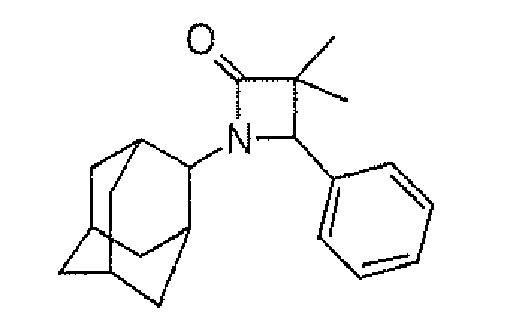
- A solution of 2-adamantylamine (50.0 mg, 0.330 mmol) in ethanol (2 mL) was added with benzaldehyde (56.3 mg, 0.330 mmol) at room temperature, and the resultant was stirred at the same temperature for 1.5 hours. The reaction solution was concentrated in vacuo. The obtained residue was dissolved in toluene (5 mL), and sequentially added with ethyl 2-bromoisobutyrate (109 mg, 0.660 mmol) and zinc (432 mg, 6.60 mmol) at room temperature. The reaction solution was stirred at 130°C for 5 hours, and added with hydrochloric acid, and extracted with ethyl acetate. The organic layer was dried with anhydrous sodium sulfate, and concentrated in vacuo. The obtained residue was purified by preparative thin-layer chromatography (hexane:ethyl acetate = 3:1), and 1-(adamantan-2-yl)-3,3-dimethyl-4-phenylazetidin-2-one (65.4 mg, 64.0%) was obtained as a white crystalline powder.
- 1H-NMR (400 MHz, CDCl3) δ; 0.72 (s, 3H), 1.47 (s, 3H), 1.52-1.88 (m, 12H), 2.00-2.14 (m, 1H), 2.89 (s, 1H), 3.63 (s, 1H), 4.39 (s, 1H), 7.21 (d, J= 7.1 Hz, 2H), 7.28-7.39 (m, 3H).
IR (ATR); 2907, 1729, 1461, 1329, 1110, 704 cm-1.
EI-MS m/z; 309 (M+). -

- 2,3-Dichlorobenzaldehyde was used in place of benzaldehyde for a similar reaction and treatment as Example 1, and the title compound was obtained as a white amorphous solid.
- 1H-NMR (400 MHz, CDCl3) δ; 0.73 (s, 3H), 1.58 (s, 3H), 1.60-2.12 (m, 13H), 2.93 (s, 1H), 3.67 (s, 1H), 4.89 (s, 1H), 7.21 (dd, J= 1.7, 7.8 Hz, 1H), 7.27 (t, J= 7.8 Hz, 1H), 7.42 (dd, J= 1.7, 7.8 Hz, 1H).
IR (ATR); 2907, 1747, 1422, 1327, 1111, 796 cm-1.
FAB-MS m/z; 378 (M+H)+. -

- trans-5-Chloro-2-adamantylamine was used in place of 2-adamantylamine, and 2,3-dichlorobenzaldehyde in place of benzaldehyde for a similar reaction and treatment as Example 1, and the title compound was obtained as a white amorphous solid.
- 1H-NMR (400 MHz, CDCl3) δ; 0.74 (s, 3H), 1.54-2.36 (m, 15H), 3.16 (s, 1H), 3.67 (s, 1H), 4.89 (s, 1H), 7.16 (d, J= 8.0 Hz, 1H), 7.23-7.30 (m, 1H), 7.43 (dd, J= 1.8, 7.7 Hz, 1H).
IR (ATR); 2922, 1748, 1423, 1188, 1116, 746 cm-1. -

- cis-5-Chloro-2-adamantylamine was used for a similar reaction and treatment as Example 3 , and the title compound was obtained as a white amorphous solid.
- 1H-NMR (400 MHz, CDCl3) δ; 0.75 (s, 3H), 1.58-2.33 (m, 15H), 3.11 (s, 1H), 3.72 (s, 1H), 4.94 (s, 1H), 7.11 (d, J= 8.0 Hz, 1H), 7.22-7.29 (m, 1H), 7.43 (d, J= 7.6 Hz, 1H).
IR (ATR); 2922, 1748, 1423, 1191, 1109, 747 cm-1. -

- trans-5-Chloro-2-adamantylamine was used in place of 2 -adamantylamine, and 1-naphthaldehyde in place of benzaldehyde for a similar reaction and treatment as Example 1, and the title compound was obtained as a white amorphous solid.
- 1H-NMR (400 MHz, CDCl3) δ; 0.64 (s, 3H), 1.64-2.42 (m, 15H), 3.27 (s, 1H), 3.84 (s,
1H), 5.24 (s, 1H), 7.46-7.54 (m, 4H), 7.80-7.91 (m, 3H).
IR (ATR); 2920, 1743, 1450, 1331, 1117, 779 cm-1. -

- cis-5-Chloro-2-adamantylamine was used for a similar reaction and treatment as Example 5, and the title compound was obtained as a white amorphous solid.
- 1H-NMR (400 MHz, CDCl3) δ; 0.66 (s, 3H), 1.55-2.32 (m, 15H), 3.21 (s, 1H), 3.90 (s, 1H), 5.29 (s, 1H), 7.45-7.58 (m, 4H), 7.81 (d, J= 8.3 Hz, 1H), 7.89-7.92 (m, 2H).
IR (ATR); 2922, 1744, 1450, 1337, 1108, 779 cm-1. -

- Methyl trans-4-adamantylamine-1-carboxylate was used in place of 2-adamantylamine, and 2,3-dichlrobenzaldehyde in place of benzaldehyde for a similar reaction and treatment as Example 1, and the title compound was obtained as a white amorphous solid.
- 1H-NMR (400 MHz, CDCl3) δ; 0.74 (s, 3H), 1.59 (s, 3H), 1.68-2.11 (m, 12H), 3.07 (s, 1H), 3.64 (s, 3H), 3.65 (s, 1H), 4.88 (s, 1H), 7.19 (dd, J= 1.5, 7.8 Hz, 1H), 7.27 (t, J= 7.8 Hz, 1H), 7.43 (dd, J= 1.5, 8.0 Hz, 1H).
IR (ATR); 2929, 1748, 1730, 1424, 1236, 1079, 745 cm-1.
EI-MS m/z; 436 (M++1). -

- A solution of methyl trans-4-[2-(2,3-dichlorophenyl)-3,3-dimethyl-4-oxoazetidin-1-yl]-1-adamantane carboxylate (160 mg, 0. 370 mmol) in methanol (2 mL) was added with an aqueous solution of 4N-sodium hydroxide (1 mL, 4.00 mmol) at room temperature, and the resultant was stirred at the same temperature for 1.5 hours. The reaction solution was concentrated in vacuo, the obtained residue was dissolved in water, and washed with diethyl ether. The aqueous layer was adjusted to a liquid of pH 1 to 2 using 4N-hydrochloric acid, and extracted with chloroform. The organic layer was dried over anhydrous sodium sulfate, and concentrated in vacuo. The obtained residue was purified by preparative thin-layer chromatography (chloroform:methanol = 10:1). trans-4-[2-(2,3-Dichlorophenyl)-3,3-dimethyl-4-oxoazetidin-1-yl]-1-adamantane carboxylic acid (156 mg, 100%) was obtained as a white amorphous solid .
- 1H-NMR (400 MHz, CDCl3) δ; 0.74 (s, 3H), 1.59 (s, 3H), 1.68-2.12 (m, 12H), 3.08 (s, 1H), 3.65 (s, 1H), 4.89 (s, 1H), 7.19 (d, J= 7.6 Hz, 1H), 7.24-7.29 (m, 1H), 7.44 (d, J= 7.8 Hz, 1H).
IR (ATR); 2930, 1731, 1696, 1425, 1218, 1080, 750 cm-1.
EI-MS m/z; 422 (M++1). -

- A solution of trans-4-[2-(2,3-dichlorophenyl)-3,3-dimethyl-4-oxoazetidin-1-yl]-1-adamantane carboxylic acid (145 mg, 0.343 mmol) in dichloromethane (3 mL) was added with WSC·HCl (132 mg, 0.686 mmol) and HOBT·H2O (78.8 mg, 0.515 mmol) at room temperature. The resultant was stirred at the same temperature for 15 min, added with an aqueous solution of 30% ammonium (0.300 ml) and stirred further at the same temperature for 2 hours. The reaction solution was added with water, and extracted with chloroform. The organic layer was dried over anhydrous sodium sulfate, and concentrated in vacuo. The obtained residue was purified by preparative thin-layer chromatography (chloroform:methanol = 10:1), and trans-4-[2-(2,3-dichlorophenyl)-3,3-dimethyl-4-oxoazetidin-1-yl]-1-adamantane carboxyamide (107 mg, 74.2%) was obtained as a white crystalline powder.
- 1H-NMR (400 MHz, CDCl3) δ; 0.75 (s, 3H), 1.59 (s, 3H), 1.68-2.14 (m, 12H), 3.10 (s, 1H), 3.67 (s, 1H), 4.88 (s, 1H), 5.20 (s, 1H), 5.55 (s, 1H), 7.19 (d, J= 7.8 Hz, 1H), 7.25-7.30 (m, 1H), 7.44 (d, J= 7.8 Hz, 1H).
IR (ATR); 3396, 2917, 1741, 1666, 1422, 1112, 777 cm-1.
EI-MS m/z; 421 (M++1). -

- Methyl trans-4-adamantylamine-1-carboxylate was used in place of 2-adamantylamine, and 1-naphthaldehyde in place of benzaldehyde for a similar reaction and treatment as Example 1, and the title compound was obtained as a pale yellow oil.
- 1H-NMR (400 MHz, CDCl3) δ; 0.65 (s, 3H), 1.69 (s, 3H), 1.53-2.20 (m, 12H), 3.16 (s, 1H), 3.63 (s, 3H), 3.83 (s, 1H), 5.24 (s, 1H), 7.42 (d, J= 7.3 Hz, 1H), 7.48-7.55 (m, 3H), 7.81 (d, J= 8.3 Hz, 1H), 7.86-7.92 (m, 2H).
-
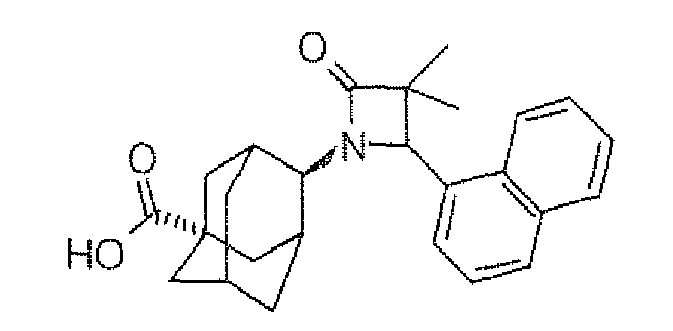
- Methyl trans-4-[2-(naphthalen-1-yl)-3,3-dimethyl-4-oxoazetidin-1-y 1]-1-adamantane carboxylate was used in place of methyl trans-4-[2-(2,3-dichlorophenyl)-3,3-dimethyl-4-oxoazetidin-1-yl]-1-adamantane carboxylate for a similar reaction and treatment as Example 8, and the title compound was obtained as a white amorphous solid.
- 1H-NMR (400 MHz, CDCl3) δ; 0.64 (s, 3H), 1.52-2.19 (m, 12H), 1.68 (s, 3H), 3.15 (s, 1H), 3.82 (s, 1H), 5.24 (s, 1H), 7.41 (d, J= 6.8 Hz, 1H), 7.50-7.56 (m, 3H), 7.81 (d, J= 8.3 Hz, 1H), 7.86-7.92 (m, 2H).
IR (ATR); 2926, 1729, 1696, 1452, 1220, 754 cm-1.
FAB-MS m/z; 404 (M+H)+. -

- trans-4-[2-(Naphthalen-1-yl)-3,3-dimethyl-4-oxoazetid in-1-yl]-1-adamantane carboxylic acid was used in place of trans-4-[2-(2,3-dichlorophenyl)-3,3-dimethyl-4-oxoazetidin-1-yl]-1-adamantane carboxylic acid for a similar reaction and treatment as Example 9, and the title compound was obtained as a white amorphous solid.
- 1H-NMR (400 MHz, CDCl3) δ; 0.65 (s, 3H), 1.52-2.22 (m, 12H), 1.69 (s, 3H), 3.18 (s, 1H), 3.84 (s, 1H), 5.24 (s, 1H), 5.67 (s, 1H), 5.76 (s, 1H), 7.41 (d, J= 7.1 Hz, 1H), 7.50-7.57 (m, 3H), 7.81 (d, J= 8.0 Hz, 1H), 7.85-7.92 (m, 2H).
IR (ATR); 3348, 2925, 1735, 1664, 1365, 754 cm-1.
FAB-MS m/z; 403 (M+H)+. -

- Methyl trans-4-adamantylamine-1-carboxylate was used in place of 2-adamantylamine, and 2,3-(methylenedioxy)benzaldehyde in place of benzaldehyde for a similar reaction and treatment as Example 1, and the title compound was obtained as a colorless amorphous solid.
- 1H-NMR (400 MHz, CDCl3) δ; 0.86 (s, 3H), 0.48 (s, 3H), 1.54-2.11 (m, 12H), 2.99 (s, 1H), 3.58 (s, 1H), 3.63 (s, 3H), 4.47 (s, 1H), 5.97 (d, J= 6.4 Hz, 2H), 6.69 (d, J= 7.7 Hz, 1H), 6.78 (d, J= 7.7 Hz, 1H), 6.84 (t, J= 7.7 Hz, 1H).
IR (ATR); 2929, 1730, 1459, 1250, 1238, 1079, 754 cm-1.
EI-MS m/z; 411 (M+). -

- Methyl trans-4-[2-(benzo[d][1,3]dioxol-4-yl)-3,3-dimethyl-4-oxoaze tidin-1-yl]-1-adamantane carboxylate was used in place of methyl
trans-4-[2-(2,3-dichlorophenyl)-3,3-dimethyl-4-oxoazetidin-1-yl]-1-adamantane carboxylate for a similar reaction and treatment as Example 8, and the title compound was obtained as a colorless oil. - 1H-NMR (400 MHz, GDCl3) δ; 0.86 (s, 3H), 1.48 (s, 3H), 1.53-2.11 (m, 12H), 2.99 (s, 1H), 3.58 (s, 1H), 4.48 (s, 1H), 5.96 (dd, J= 1.2, 6.6 Hz, 2H), 6.68 (dd, J= 1.2, 7.7 Hz, 1H), 6.78 (dd, J= 1.3, 7.7 Hz, 1H), 6.84 (t, J= 7.8 Hz, 1H).
IR (ATR); 2927, 1729, 1698, 1459, 1250, 754 cm-1.
EI-MS m/z; 397 (M+). -

- trans-4-[2-(Benzo[d][1,3]dioxol-4-yl)-3,3-dimethyl-4-oxoazetidin-1-yl]-1-adamantane carboxylic acid was used in place of trans-4-[2-(2,3-dichlorophenyl)-3,3-dimethyl-4-oxoazetidin-1-yl]-1-adamantane carboxylic acid for a similar reaction and treatment as Example 9, and the title compound was obtained as a white amorphous solid.
- 1H-NMR (400 MHz, CDCl3) δ; 0.87 (s, 3H), 1.48 (s, 3H), 1.55-2.13 (m, 12H), 3.02 (s, 1H), 3.59 (s, 1H), 4.47 (s, 1H), 5.63 (s, 2H), 5.97 (dd, J= 1.4, 7.4 Hz, 2H), 6.68 (dd, J= 1.1, 7.7 Hz, 1H), 6.79 (dd, J= 2.4, 7.7 Hz, 1H), 6.84 (t, J= 7.7 Hz, 1H).
IR (ATR); 3350, 2922, 1732, 1661, 1459, 1250, 1056, 754 cm-1.
EI-MS m/z; 396 (M+). -

- trans-4-[2-(Isoquinolin-5-yl)-3,3-dimethyl-4-oxoazeti din-1-yl]-1-adamantane carboxylic acid was used in place of trans-4-[2-(2,3-dichlorophenyl)-3,3-dimethyl-4-oxoazetidin-1-yl]-1-adamantane carboxylic acid for a similar reaction and treatment as Example 9, and the title compound was obtained as a colorless oil. trans-4-[2-(Isoquinolin-5-yl)-3,3-dimethyl-4-oxoazetidin-1-yl]-1-adaanantane carboxylic acid was obtained by subjecting methyl trans-4-[2-(isoguinolin-5-yl)-3,3-dimethyl-4-oxoazetidin-1-yl]-1-adamantane carboxylate, obtained by using methyl trans-4-adamantylamine-1-carboxylate in place of 2-adamantylamine, and isoquinoline-5-carboxyaldehyde in place of benzaldehyde for a similar reaction and treatment as Example 1, to hydrolysis reaction.
- 1H-NMR (400 MHz, CDCl3) δ; 0.64 (s, 3H), 1.53-2.22 (m, 12H), 1.69 (s, 3H), 3.17 (s, 1H), 3.80 (s, 1H), 5.16 (s, 1H), 5.47 (s, 1H), 5.59 (s, 1H), 7.62-7.68 (m, 3H), 7.96 (d, J= 7.3 Hz, 1H), 8.60 (d, J= 5.8 Hz, 1H), 9.32 (s,1H).
IR (ATR); 3344, 2923, 1738, 1663, 1385, 1112, 757 cm-1.
EI-MS m/z; 403 (M+). -

- Methyl trans-4-[2-(quinolin-5-yl)-3,3-dimethyl-4-oxoazetidin-1-yl] -1-adamantane carboxylate was used in place of methyl trans-4-[2-(2,3-dichlorophenyl)-3,3-dimethyl-4-oxoazetidin-1-yl]-1-adamantane carboxylate for a similar reaction and treatment as Example 8, and the title compound was obtained as a colorless oil. Methyl trans-4-[2-(quinolin-5-yl)-3,3-dimethyl-4-oxoazetidin-1-yl] -1-adamantane carboxylate was obtained by using methyl trans-4-adamantylamine-1-carboxylate in place of 2-adamantylamine, and quinoline- 5-carboxyaldehyde in place of benzaldehyde for a similar reaction and treatment as Example 1.
- 1H-NMR (400 MHz, CDCl3) δ; 0.63 (s, 3H), 1.55-2.19 (m, 12H), 1.67 (s, 3H), 3.16 (s, 1H), 3.82 (s, 1H), 5.18 (s, 1H), 7.48-7.51 (m, 2H), 7.77 (t, J= 7.8 Hz, 1H), 8.11 (d, J= 8.5 Hz, 1H), 8.25 (d, J= 8.5 Hz, 1H), 8.99 (dd, J= 1.5, 4.1 Hz, 1H).
EI-MS m/z; 404 (M+). -

- Methyl trans-4-adamantylamine-1-carboxylate was used in place of 2-adamantylamine, and quinoline-8-carboxyaldehyde in place of benzaldehyde for a similar reaction and treatment as Example 1, and the title compound was obtained as a pale yellow amorphous stolid.
- 1H-NMR (400 MHz, CDCl3) δ; 0.58 (s, 3H), 1.51-2.06 (m, 11H), 1.67 (s, 3H), 2.18-2.23 (m, 1H), 3.14 (s, 1H), 3.63 (s, 3H), 3.81 (s, 1H), 5.81 (s, 1H), 7.45 (dd, J= 4.1, 8.3 Hz, 1H), 7.54-7.60 (m, 2H), 7.77 (dd, J= 1.8, 7.7 Hz, 1H), 8.18 (dd, J= 1.8, 8.3 Hz, 1H), 8.91 (dd, J= 1.8, 4,1 Hz, 1H),
-

- Methyl trans-4-[2-(quinolin-8-yl)-3,3-dimethyl-4-oxoazetidin-1-yl] -1-adamantane carboxylate was used in place of methyl trans-4-[2-(2,3-dichlorophenyl)-3,3-dimethyl-4-oxoazetidin-1-y1]-1-adamantane carboxylate for a similar reaction and treatment as Example 8, and the title compound was obtained as a pale yellow amorphous solid.
- 1H-NMR (400 MHz, CDCl3 δ; 0.58 (s, 3H), 1.48-2.22 (m, 12H), 1.66 (s, 3H), 3.14 (s, 1H), 3.90 (s, 1H), 5.82 (s, 1H), 7.44 (dd, J= 4.2, 8.3 Hz, 1H), 7.55-7.61 (m, 2H), 7.77 (dd, J= 1.8, 7.7 Hz, 1H), 8.18 (dd, J= 1.7, 8.3 Hz, 1H), 8.92 (dd, J= 1.7, 4.1 Hz, 1H).
-

- trans-4-[2-(Quinolin-8-yl)-3,3-dimethyl-4-oxoazetidin -1-yl]-1-adamantane carboxylic acid was used in place of trans-4-[2-(2,3-dichlorophenyl)-3,3-dimethyl-4-oxoazetidin-1-yl]-1-adamantane carboxylic acid for a similar reaction and treatment as Example 9, and the title compound was obtained as a white amorphous solid.
- 1H-NMR (400 MHz, CDCl3) δ; 0.58 (s, 3H), 1.51-2.25 (m, 12H), 1.67 (s, 3H), 3.17 (s, 1H), 3.82 (s, 1H), 5.57 (s, 1H), 5.62 (s, 1H), 5.82 (s, 1H), 7.44 (dd, J= 4.2, 8.3 Hz, 1H), 7.54-7.60 (m, 2H), 7.77 (dd, J= 1.9, 7.6 Hz, 1H), 8.18 (dd, J= 1.7, 8.3 Hz, 1H), 8.91 (dd, J= 1.8, 4.3 Hz, 1H).
IR (ATR); 3352, 2925, 1726, 1665, 1498, 1363, 1112, 751 cm-1.
EI-MS m/z; 403 (M+). -

- 2,3-Dimethoxybenzaldehyde was used in place of benzaldehyde for a similar reaction and treatment as Example 1, and the title compound was obtained as a colorless oil.
- IH-NMR (400 MHz, CDCl3) δ; 0.76 (s, 3H), 1.50 (s, 3H), 1.53-1.88 (m, 12H), 2.11 (d, J= 12.9 Hz, 1H), 2.90 (s, 1H), 3.63 (s, 1H), 3.82 (s, 3H), 3.88 (s, 3H), 4.83 (s, 1H), 6.82 (d, J= 7.8 Hz, 1H), 6.86 (d, J= 8.3 Hz, 1H), 7.07 (t, J= 8.0 Hz, 1H).
IR (ATR); 2906, 2853, 1742, 1480, 750 cm-1.
EI-MS m/z; 369 (M+). -

- 4-Chlorobenzaldehyde was used in place of benzaldehyde for a similar reaction and treatment as Example 1, and the title compound was obtained as a white amorphous solid.
- 1H-NMR (400 MHz, CDCl3) δ; 0.73 (s, 3H), 1.46 (s, 3H), 1.49-1.88 (m, 12H), 2.09 (d, J= 12.7 Hz, 1H), 2.58 (s, 1H), 3.58 (s. 1H), 4.36 (s, 1H), 7.16 (d, J= 8.3 Hz, 2H), 7.35 (d, J= 8.6 Hz, 2H).
IR (ATR); 2900, 2855, 1727 cm-1.
EI-MS m/z; 343 (M+). -

- 4-Methoxybenzaldehyde was used in place of benzaldehyde for a similar reaction and treatment as Example 1, and the title compound was obtained as a white amorphous solid.
- 1H-NMR (400 MHz, CDCl3) δ; 0.73 (d, J= 1.7 Hz, 3H), 1.44 (d, J= 1.5 Hz, 3H), 1.51-1.88 (m, 12H), 2.11 (d, J= 12.9 Hz, 1H), 2.87 (s, 1H), 3.59 (s, 1H), 3.82 (s, 3H), 4.33 (s, 1H), 6.90 (d, J= 8.6 Hz, 2H), 7.13 (d, J= 8.3 Hz, 2H).
IR (ATR); 2907, 2855, 1729, 1246 cm-1.
EI-MS m/z; 339 (M+). -

- 2,3-Difluorobenzaldehyde was used in place of benzaldehyde for a similar reaction and treatment as Example 1 , and the title compound was obtained as a white amorphous solid.
- 1H-NMR (400 MHz, CDCl3) δ; 0.78 (s, 3H), 1.52 (s, 3H), 1.54-1.89 (m, 12H), 2.10 (d, J= 13.2 Hz, 1H), 2.90 (s, 1H), 3.63 (s, 1H), 4.73 (s, 1H), 7.01-7.04 (m, 1H), 7.09-7.14 (m, 2H).
IR (ATR); 2924, 2854, 1743, 1485 cm-1.
EI-MS m/z; 345 (M+). -
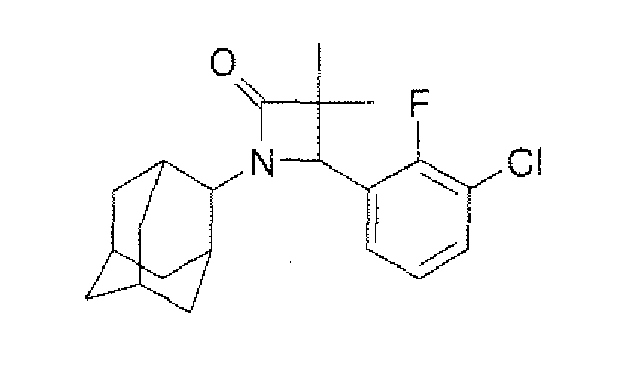
- 3-Chloro-2-fluorobenzaldehyde was used in place of benzaldehyde for a similar reaction and treatment as Example 1, and the title compound was obtained as a colorless oil .
- 1H-NMR (400 MHz, CDCl3) δ; 0.77 (s, 3H), 1.51 (s, 3H), 1.56-1.90 (m, 12H), 2.09 (d, J= 13.2 Hz, 1H), 2.91 (s, 1H), 3.63 (s, 1H), 4.73 (s, 1H), 7.13-7.17 (m, 2H), 7.33-7.36 (m, 1H).
IR (ATR); 2907, 2854, 1748, 1457 cm-1.
EI-MS m/z; 361 (M+). -

- 3,4-Dichlorobenzaldehyde was used in place of benzaldehyde for a similar reaction and treatment as Example 1, and the title compound was obtained as a white amorphous solid.
- 1H-NMR (400 MHz, CDCl3) δ; 0.75 (s, 3H), 1.47 (s, 3H), 1.54-1.89 (m, 12H), 2.07 (d, J= 13.2 Hz, 1H), 2.86 (s, 1H), 3.56 (s, 1H), 4.32 (s, 1H), 7.07 (dd, J= 2.2, 8.3 Hz, 1H), 7.31 (d, J= 2.2 Hz, 1H), 7.46 (d, J= 8.3 Hz, 1H).
IR (ATR); 2924, 2852, 1735 cm-1.
EI-MS m/z; 378 (M+). -

- 3,4-Difluorobenzaldehyde was used in place of benzaldehyde for a similar reaction and treatment as Example 1, and the title compound was obtained as a white amorphous stolid.
- 1H-NMR (400 MHz, CDCl3) δ; 0.74 (s, 3H) 1.46 (s, 3H), 1.54-1.88 (m, 12H), 2.08 (d, J= 13.2 Hz, 1H), 2.86 (s, 1H), 3.57 (s, 1H), 4.33 (s, 1H), 6.94-6.96 (m, 1H), 7.01-7.06 (m, 1H), 7.15-7.21 (m, 1H).
IR (ATR); 2925, 2859, 1725, 1516, 1291 cm-1.
EI-MS m/z; 345 (M+). -

- 2-Fluoro-3-trifluoromethyl benzaldehyde was used in place of benzaldehyde for a similar reaction and treatment as Example 1, and the title compound was obtained as a white amorphous solid.
- 1H-NMR (400 MHz, CDCls) δ; 0.76 (s, 3H), 1.53 (s, 3H), 1.57-1.91 (m, 12H), 2.10 (d, J= 13.4 Hz, 1H), 2.92 (s, 1H), 3.64 (s, 1H), 4.77 (s, 1H), 7.30 (t, J= 7,6 Hz, 1H), 7.49 (t, J= 6.6 Hz, 1H), 7.57 (t, J= 6.8 Hz, 1H).
IR (ATR); 2916, 2859, 1738, 1332, 1125 cm-1.
EI-MS m/z; 395 (M+). -

- 3-Chloro-4-fluorobenzaldehyde was used in place of benzaldehyde for a similar reaction and treatment as Example 1, and the title compound was obtained as a white amorphous solid.
- 1H-NMR (400 MHz, CDCl3) δ; 0.75 (s, 3H), 1.46 (s, 3H), 1.54-1.89 (m, 12H), 2.08 (d, J= 13.2 Hz, 1H), 2.86 (s, 1H), 3.56 (s, 1H), 4.33 (s, 1H), 7.08-7.12 (m, 1H), 7.17 (t, J= 8.6 Hz, 1H), 7.25-7.27 (m, 1H).
IR (ATR); 2917, 2854, 1728, 1499 cm-1.
EI-MS m/z; 361 (M+). -

- 2-Chloro-3-trifluoromethyl benzaldehyde was used in place of benzaldehyde for a similar reaction and treatment as Example 1, and the title compound was obtained as a white amorphous solid.
- 1H-NMR (400 MHz, CDCl3) δ; 0.72 (s, 3H), 1.60 (s, 3H), 1.65-1.92 (m, 12H), 2.11 (d, J= 12.9 Hz, 1H), 2.95 (s, 1H), 3.67 (s, 1H), 4.96 (s, 1H), 7.44 (t, J= 7.6 Hz, 1H), 7.50 (d, J= 6.3 Hz, 1H), 7.67 (d, J= 7.8 Hz, 1H).
IR (ATR); 2920, 2879, 1745, 1319, 1140, 1133 cm-1.
EI-MS m/z; 411 (M+). -

- 3,5-Dichlorobenzaldehyde was used in place of benzaldehyde for a similar reaction and treatment as Example 1, and the title compound was obtained as a white amorphous solid.
- 1H-NMR (400 MHz, CDCl3) δ; 0.77 (s, 3H), 1.47 (s, 3H), 1.60-1.89 (m, 12H), 2.06 (d, J= 12.9 Hz, 1H), 2.87 (s, 1H), 3.57 (s, 1H), 4,31 (s, 1H), 7.11 (d, J= 1.7 Hz, 2H), 7.32 (t, J= 2.0 Hz, 1H).
IR (ATR); 2921, 2852, 1733 cm-1.
FAB-MS m/z; 378 (M+H)+. -

- 4-Fluoro-3-trifluoromethyl benzaldehyde was used in place of benzaldehyde for a similar reaction and treatment as Example 1, and the title compound was obtained as a white amorphous stolid.
- 1H-NMR (400 MHz, CDCl3) δ; 0.73 (s, 3H), 1.48 (s, 3H), 1.51-1.89 (m, 12H), 2.07 (d, J= 15.7 Hz, 1H), 2.86 (s, 1H), 3.54 (s, 1H), 4.40 (s, 1H), 7.20-7.27 (m, 1H), 7.40-7.44 (m, 2H).
IR (ATR); 2903, 2859, 1738, 1328, 1142 cm-1
FAB-MS m/z; 396 (M+H)+. -

- 2-Methoxybenzaldehyde was used in place of benzaldehyde for a similar reaction and treatment as Example 1, and the title compound was obtained as a white amorphous solid.
- 1H-NMR (400 MHz, CDCl3) δ; 0.68 (s, 3H), 1.49 (s, 3H), 1.57-1.90 (m, 12H), 2.13 (d, J= 12.9 Hz, 1H), 2.95 (s, 1H), 3.72 (s, 1H), 3.83 (s, 3H), 4.79 (s, 1H), 6.89 (d, J= 8.0 Hz, 1H), 6.97 (t, J= 6.8 Hz, 1H), 7.18 (dd, J= 1.4, 7.6 Hz, 1H), 7.24-7.28 (m, 1H).
IR (ATR); 2905, 2851, 1742, 1242, 760 cm-1.
FAB-MS m/z; 340 (M+H)+. -

- 3-Methoxybenzaldehyde was used in place of benzaldehyde for a similar reaction and treatment as Example 1, and the title compound was obtained as a white amorphous solid.
- 1H-NMR (400 MHz, CDCl3) δ; 0.75 (s, 3H), 1.46 (s, 3H), 1..54-1.87 (m, 12H), 2.10 (d, J= 12.9 Hz, 1H), 2.89 (s; 1H), 3.63 (s, 1H), 3.82 (s, 3H), 4.35 (s, 1H), 6.73-6.74 (m, 1H), 6.80 (d, J= 7.6 Hz, 1H), 6.83-6.85 (m, 1H), 7.30 (d, J= 8.1 Hz, 1H).
IR (ATR); 2908, 2854, 1731, 1049 cm-1.
FAB-MS m/z; 340 (M+H)+. -
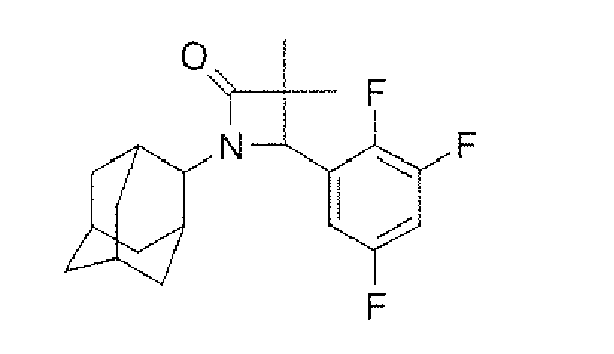
- 2,3,5-Trifluorobenzaldehyde was used in place of benzaldehyde for a similar reaction and treatment as Example 1, and the title compound was obtained as a white amorphous stolid.
- 1H-NMR (400 MHz, CDCl3) δ; 0.81 (s, 3H), 1.51 (s, 3H), 1.65-1.91 (m, 12H), 2.07 (d, J= 13.2 Hz, 1H), 2.90 (s, 1H), 3.61 (s, 1H), 4.71 (s, 1H), 6.76-6.80 (m, 1H), 6.85-6.92 (m, 2H).
IR (ATR); 2916, 2855, 1736, 1499 cm-1.
FAB-MS m/z; 364 (M+H)+. -

- 3,4,5-Trifluorobenzaldehyde was used in place of benzaldehyde for a similar reaction and treatment as Example 1, and the title compound was obtained as a white amorphous solid.
- 1H-NMR (400 MHz, CDCl3) δ; 0.78 (s, 3H), 1.46 (s, 3H), 1.56-1.90 (m, 12H), 2.06 (d, J= 12.0 Hz, 1H), 2.86 (s, 1H), 3.57 (s, 1H), 4.30 (s, 1H), 6.86 (dd, J= 6.4, 8.1 Hz, 2H).
IR (ATR); 2913, 2850, 1733, 1527, 1038 cm-1.
FAB-MS m/z; 364 (M+H) +. -

- 4-Isopropylbenzaldehyde was used in place of benzaldehyde for a similar reaction and treatment as Example 1, and the title compound was obtained as a white amorphous stolid.
- 1H-NMR (400 MHz, CDCl3) δ; 0.72 (s, 3H), 1.24 (d, J= 2.4 Hz, 6H), 1.45 (s, 3H), 1.55-1.88 (m, 12H), 2.12 (d, J= 13.2 Hz, 1H), 2.89-2.94 (m, 2H), 3.61 (s, 1H), 4.35 (s, 1H), 7.11 (d, J= 8.3 Hz, 2H), 7.21 (d, J= 8.0 Hz, 2H).
IR (ATR); 2959, 2908, 2851, 1732 cm-1.
FAB-MS m/z; 352 (M+H)+, -

- 4-t-Butylbenzaldehyde was used in place of benzaldehyde for a similar reaction and treatment as Example 1, and the title compound was obtained as a white amorphous solid.
- 1H-NMR (400 MHz, CDCl3) δ; 0.72 (s, 3H), 1.32 (s, 9H), 1.45 (s, 3H), 1.55-1.88 (m, 12H), 2.12 (d, J= 13.2 Hz, 1H), 2.89 (s, 1H), 3.61 (s, 1.H), 4.35 (s, 1H), 7.11 (d, J= 8.3 Hz, 2H), 7.36 (d, J= 8.3 Hz, 2H).
IR (ATR); 2959, 2903, 2853, 1731 cm-1.
FAB-MS m/z; 366 (M+H)+. -

- 2-Fluorobenzaldehyde was used in place of benzaldehyde for a similar reaction and treatment as Example 1, and the title compound was obtained as a pale yellow oil,
- 1H-NMR (400 MHz, CDCl3) δ; 0.76 (s, 3H), 1.50 (s, 3H), 1.56-1.89 (m, 12H), 2.11 (d, J= 12.9 Hz, 1H), 2.92 (s, 1H), 3.66 (s, 1H), 4.74 (s, 1H), 7.05-7.10 (m, 1H), 7.15-7.19 (m, 1H), 7.25-7.31 (m, 2H).IR (ATR); 2906, 2854, 1731, 1488, 1233, 757 cm-1.
EI-MS m/z; 327 (M+). -

- 2-Fluoro-4-methoxy benzaldehyde was used in place of benzaldehyde for a similar reaction and treatment as Example 1, and the title compound was obtained as a colorless oil.
- 1H-NMR (400 MHz, CDCl3) δ; 0.77 (s, 3H), 1.47 (s, 3H), 1.55-1.88 (m, 12H), 2.10 (d, J= 13.2 Hz, 1H), 2.89 (s, 1H), 3.61 (s, 1H), 3.81 (s, 3H), 4.65 (s, 1H), 6.64 (dd, J= 2.4, 12.2
Hz, 1H), 6.72 (dd, J= 2.4, 8.5 Hz, 1H), 7.15 (t, J= 8.6 Hz, 1H).
IR (ATR); 2907, 2853, 1746, 1625, 1508, 1114 cm-1.
EI-MS m/z; 357 (M+). -

- 2-Trifluoromethyl benzaldehyde was used in place of benzaldehyde for a similar reaction and treatment as Example 1, and the title compound was obtained as a white amorphous solid.
- 1H-NMR (400 MHz, CDCl3) δ; 0.69 (s, 3H), 1.49 (s, 3H), 1.53-1.90 (m, 12H), 2.10 (d, J= 13.2 Hz, 1H), 2.93 (s, 1H), 3.58 (s, 1H), 4.83 (s, 1H), 7.43 (t, J= 7.6 Hz, 1H), 7.48 (d, J= 7.8 Hz, 1H), 7.61 (d, J= 7.3 Hz, 1H), 7.70 (d, J= 7.8 Hz, 1H).
IR (ATR); 2906, 1731, 1313, 1115, 774 cm-1.
EI-MS m/z; 377 (M+). -

- 4-Trifluoromethoxy benzaldehyde was used in place of benzaldehyde for a similar reaction and treatment as Example 1, and the title compound was obtained as a white amorphous solid.
- 1H-NMR (400 MHz, CDCl3) δ; 0.72 (s, 3H), 1.47 (s, 3H), 1.54-1.89 (m, 12H), 2.10 (d, J= 13.2 Hz, 1H), 2.88 (s, 1H), 3.59 (s, 1H), 4.39 (s, 1H), 7.24 (s, 4H).
IR (ATR); 2906, 2859, 1731, 1298, 1263, 1163 cm-1.
EI-MS m/z; 393 (M+). -

- 4 -Bromobenzaldehyde was used in place of benzaldehyde for a similar reaction and treatment as Example 1, and the title compound was obtained as a white amorphous solid.
- 1H-NMR (400 MHz, CDCl3) δ; 0.79 (s, 3H), 1.46 (s, 3H), 1.51-2.10 (m, 13H), 2.87 (s, 1H), 3.58 (s, 1H), 4.34 (s, 1H), 7.09 (d, J= 8.3 Hz, 2H), 7.50 (d, J= 8.3 Hz, 2H).
IR (ATR); 2906, 1743, 1010, 753 cm-1.
EI-MS m/z; 388 (M+). -

- 2-Chlorobenzaldehyde was used in place of benzaldehyde for a similar reaction and treatment as Example 1, and the title compound was obtained as a white amorphous solid.
- 1H-NMR (400 MHz, CDCl3) δ; 0.72 (s, 3H), 1.57 (s, 3H), 1.60-2.00 (m, 12H), 2.09-2.13 (m, 1H), 2.94 (s, 1H), 3.69 (s, 1H), 4.91 (s, 1H), 7.22-7.33 (m, 3H), 7.39 (d, J= 7.6 Hz, 1H).
IR (ATR); 2911, 1753, 1736, 761 cm-1.
EI-MS m/z; 344 (M+). -

- 1-Naphthaldehyde was used in place of benzaldehyde for a similar reaction and treatment as Example 1, and the title compound was obtained as a white amorphous solid.
- 1H-NMR (400 MHz, CDCl3) δ; 0.63 (s, 3H), 1.56-1.91 (m, 1.5H), 2.16-2.19 (m, 1H), 3.04 (s, 1H), 3.84 (s, 1H), 5.24 (s, 1H), 7.44 (d, J= 6.8 Hz, 1H), 7.49-7.58 (m, 3H), 7.80 (d, J= 8.1 Hz, 1H), 7.85-7.92 (m, 2H).
IR (ATR); 2907, 1741, 753 cm-1.
EI-MS m/z; 359 (M+). -

- trans-5-Hydroxy-2-adamantylamine was used in place of 2-adamantylamine, and 2,3-dichlorobenzaldehyde in place of benzaldehyde for a similar reaction and treatment as Example 1, and the title compound was obtained as a white amorphous solid.
- 1H-NMR (400 MHz, CDCl3) δ; 0.74 (s, 3H), 1.48-1.83 (m, 14H), 1.99-2.05 (m, 1H), 2.20 (s, 1H), 3.14 (s, 1H), 3.69 (s, 1H), 4.89 (s, 1H), 7.19 (dd, J= 1.5, 7.8 Hz, 1H), 7.28 (t, J= 7.8 Hz, 1H), 7.43 (dd, J= 1.5, 7.8 Hz, 1H).
IR (ATR); 3431, 2927, 1730, 1424, 1120, 778 cm-1.
EI-MS m/z; 394 (M+). -

- trans-5-Hydroxy-2-adamantylamine was used in place of 2-adamantylamine, and 1-naphthaldehyde in place of benzaldehyde for a similar reaction and treatment as Example 1, and the title compound was obtained as a white amorphous solid.
- 1H-NMR (400 MHz, CDCl3) δ; 0.64 (s, 3H), 1.44-1.87 (m, 14H), 2.09-2.12 (m, 1H), 2.20 (s, 1H), 3.24 (s, 1H), 3.77 (s, 1H), 5.24 (s, 1H), 7.41 (d, J= 7.1 Hz, 1H), 7.49-7.58 (m, 3H), 7.81 (d, J= 8.0 Hz, 1H), 7.86-7.92 (m, 2H).
IR (ATR); 3411, 2922, 1728, 1352, 1112, 779 cm-1.
EI-MS m/z; 375 (M+). -

- trans-5-Hydroxy-2-adamantylamine was used in place of 2-adamantylamine, and 4-methoxy-1-naghthaldehyde in place of benzaldehyde for a similar reaction and treatment as Example 1, and the title compound was obtained as a white amorphous solid.
- 1H-NMR (400 MHz, CDCl3) δ; 0.70 (s, 3H), 1.56-1.90 (m, 14H), 2.07-2.10 (m, 1H), 2.19 (s, 1H), 3.23 (s, 1H), 3.78 (s, 1H), 4.05 (s, 3H), 5.18 (s, 1H), 6.84 (d, J= 8.1 Hz, 1H), 7.30 (d, J= 8.1 Hz, 1H), 7.52-7.57 (m, 2H), 7.78 (d, J= 8.1 Hz, 1H), 8.35 (d, J= 8.1 Hz, 1H).
IR (ATR); 3404, 2923, 1724, 1275, 1092, 763 cm-1.
EI-MS m/z; 405 (M+). -

- Methyl trans-4-adamantylarnine-1-carboxylate was used in place of 2-adamantylamine, and quinoline-4-carboxyaldehyde in place of benzaldehyde for a similar reaction and treatment as Example 1, and the title compound was obtained as a white amorphous solid.
- 1H-NMR (400 MHz, CDCl3) δ; 0.67 (s, 3H), 1.50-2.17 (m, 15H), 3.15 (s, 1H), 3.64 (s, 3H), 3.82 (s, 1H), 5.20 (s, 1H), 7.32 (d, J= 4.4 Hz, 1H), 7.64 (t, J= 8.1 Hz, 1H), 7.78 (t, J= 8.1 Hz, 1H), 7.86 (d, J= 8.1 Hz, 1H), 8.19 (d, J= 8.1 Hz, 1H), 8.95 (d, J= 4.4 Hz, 1H).
IR (ATR); 1906, 1743, 1236, 1080, 758 cm-1.
FAB-MS m/z; 419 (M+H)+. -

- Methyl trans-4-[2-(quinolin-4-yl)-3,3-dimethyl-4-oxoazetidin-1-yl] -1-adamantane carboxylate was used in place of methyl trans-4-[2-(2,3-dichlorophenyl)-3,3-dimethyl-4-oxoazetidin-1-yl]-1-adamantane carboxylate for a similar reaction and treatment as Example 8, and the title compound was obtained as a white amorphous solid.
- 1H-NMR (400 MHz, CDCl3) δ; 0.67 (s, 3H), 1.56-1.60 (m, 1H), 1.71 (s, 3H), 1.79-2.16 (m, 11H), 3.15 (s, 1H), 3.82 (s, 1H), 5.21 (s, 1H), 7.36 (d, J= 4.4 Hz, 1H), 7.64 (t, J= 8.1 Hz, 1H), 7.79 (t, J= 8.1 Hz, 1H), 7.87 (d, J= 8.1 Hz, 1H), 8.22 (d, J= 8.1 Hz, 1H), 8.97 (d, J= 4.4 Hz, 1H).
IR (ATR); 2926, 1722, 1698, 1218, 1080, 761 cm-1.
FAB-MS m/z; 405 (M+H)+. -

- trans-4-[2-(Quinolin-4-yl)-3,3-dimethyl-4-oxoazetidin -1-yl]-1-adamantane carboxylic acid was used in place of trans-4-[2-(2,3-dichlorophenyl)-3,3-dimethyl-4-oxoazetidin-1-yl]-1-adamantane carboxylic acid for a similar reaction and treatment as Example 9, and the title compound was obtained as a white amorphous solid.
- 1H-NMR (400 MHz, CDCl3) δ; 0.67 (s, 3H), 1-57-1.60 (m, 1H), 1.71 (s, 3H), 1.75-2.19 (m, 11H), 3.18 (s, 1H), 3.83 (s, 1H), 5.20 (s, 1H), 5.59 (br, 2H), 7.32 (d, J= 4.4 Hz, 1H), 7.63 (t, J= 8.1 Hz, 1H), 7.78 (t, J= 8.1 Hz, 1H), 7.86 (d, J= 8.1 Hz, 1H), 8.19 (d, J= 8.1 Hz, 1.H), 8.95 (d, J= 4.4 Hz, 1H).
IR (ATR); 3356, 2924, 1740, 1662, 1367, 758 cm-1.
FAB-MS m/z; 404 (M+H)+. -

- Under an argon atmosphere, a solution of trans-1-(5-hydroxyadamantan-2-yl)-3,3-dimethyl-4-(2,3-dichl orophenyl)azetidin-2-one (9.20 mg, 0.023 mmol) in dichloromethane (1 mL) was added with (diethylamino)sulfur trifluoride (4.60 µL, 0.350 mmol) at 0° C, and the resultant was stirred at the same temperature for 1 hour. The reaction solution was added with water and extracted with chloroform. The organic layer was dried over anhydrous sodium sulfate, and concentrated in vacuo. trans-1-(5-Fluoroadamantan-2-yl)-3,3-dimethyl-4-(2,3-dichlo rophenyl)azetidin-2-one (7.20 mg, 79%) was obtained as a white amorphous solid.
- 1H-NMR (400 MHz, CDCl3) δ; 0.74 (s, 3H), 1.50-1.63 (m, 5H), 1.75-2.05 (m, 9H), 2.28 (s, 1H), 3.22 (s, 1H), 3.61 (s, 1H), 5.07 (s, 1H), 7.18 (dd, J= 1.2, 8.0 Hz, 1H), 7.28 (t, J= 8.0 Hz, 1H), 7.44 (dd, J= 1.2, 8.0 Hz, 1H).
IR (ATR); 2927, 1749, 1424, 1070, 778 cm-1.
FAB-MS m/z; 396 (M+H)+. -

- 3-Chlorobenzaldehyde was used in place of benzaldehyde for a similar reaction and treatment as Example 1, and the title compound was obtained as a white amorphous solid.
- 1H-NMR (400 MHz, CDCl3) δ; 0.74 (s, 3H), 1.67 (s, 3H), 1.54-1.88 (m, 12H), 2.07 (d, J= 12.9 Hz, 1H), 2.88 (s, 1H), 3.60 (s, 1H), 4.34 (s, 1H), 7.09-7.12 (m, 1H), 7.21 (d, J= 2.0 Hz, 1H), 7.27-7.34 (m, 2H).
IR (ATR) 2908, 2854, 1732, 703 cm-1.
EI-MS m/z; 343 (M+). -

- 3,5-Bis(trifluoromethyl)benzaldehyde was used in place of benzaldehyde for a similar reaction and treatment as Example 1, and the title compound was obtained as a white amorphous solid.
- 1H-NMR (400 MHz, CDCl3) δ; 0.72 (s, 3H), 1.52 (s, 3H), 1.57-1.91 (m, 12H), 2.08 (d, J= 13.2 Hz, 1H), 2.89 (s, 1H), 3.57 (s, 1H), 4.51 (s, 1H), 7.67 (s, 2H), 7.85 (s, 1H).
IR (ATR) 2925, 2854, 1743, 1732, 1276, 1140, 681 cm-1.
EI-MS m/z; 445 (M+). -

- 4-(Methylthio)benzaldehyde was used in place of benzaldehyde for a similar reaction and treatment as Example 1, and the title compound was obtained as a white amorphous solid.
- 1H-NMR (400 MHz, CDCl3) δ; 0.74 (s, 3H), 1.45 (s, 3H), 1.52-1.87 (m, 12H), 2.10 (d, J= 12.9 Hz, 1H), 2.50 (s, 3H), 2.87 (s, 1H), 3.59 (s, 1H), 4.34 (s, 1H), 7.13 (d, J= 8.3 Hz, 2H), 7.26 (d, J= 3.4 Hz, 2H).
IR (ATR) 2916, 2856, 1726, 825 cm-1.
EI-MS m/z; 355 (M+). -

- 4-Methoxy-2-methyl benzaldehyde was used in place of benzaldehyde for a similar reaction and treatment as Example 1, and the title compound was obtained as a pale yellow oil.
- 1H-NMR (400 MHz, CDCl3) δ; 0.70 (s, 3H), 1.51 (s, 3H), 1.55-1.88 (m, 12H), 2.12 (d, J= 12.9 Hz, 1H), 2.25 (s, 3H), 2.92 (s, 1H), 3.66 (s, 1H), 3.80 (s, 3H), 4.59 (s, 1H), 6.73-6.78 (m, 2H), 7.12 (d, J= 8.3 Hz, 1H).
IR (ATR) 2906, 2853, 1742, 1253, 753 cm-1.
EI-MS m/z; 353 (M+). -

- A solution of trans-4-[2-(benzo[d][1,3]dioxol-4-yl)-3,3-dimethyl-4-oxoaze tidin-1-yl]-1-adamantane carboxylic acid (20.0 mg, 0.050 mmol) in dichloromethane (2 mL) was added with PyBOP (39.0 mg, 0.075 mmol), diisopropylethylamine (13.0 mg, 0.101 mmol) and a solution of 2 M methylamine in tetrahydrofuran (28.0 µL, 0.055 mmol) at room temperature, and the resultant was stirred at the same temperature for 2 hours. The reaction solution was added with water, and extracted with chloroform. The organic layer was dried over anhydrous sodium sulfate, and concentrated in vacuo. The obtained residue was purified by preparative thin-layer chromatography (hexane:ethyl acetate = 1:5). trans-4-[2-(Benzo[d][1,3]dioxol-4-yl)-3,3-dimethyl-4-oxoaze tidin-1-yl]-N-methyl-1-adamantane carboxyamide (19.8 mg, 96.5%) was obtained as a white crystalline powder.
- 1H-NMR (400 MHz, CDCl3) δ; 0.87 (s, 3H), 1.48 (s, 3H), 1.55-1.91 (m, 10H), 2.06-2.08 (m, 2H), 2.75 (d, J= 4.6 Hz, 3H), 2.95 (s, 1H), 3.59 (s, 1H), 4.50 (s, 1H), 5.97 (dd, J= 1.2, 7.3 Hz, 2H), 6.16 (s, 1H), 6.68 (dd, J= 1.0, 7.6 Hz, 1H), 6.80 (dd, J= 1.2, 7.8 Hz, 1H), 6.85 (t, J= 7.8 Hz, 1H).
IR (ATR); 3365, 2921, 1732, 1639, 1460, 1251, 843 cm-1.
EI-MS m/z; 410 (M+). -

- A solution of 2M ethylamine in tetrahydrofuran was used in place of a solution of 2M methylamine in tetrahydrofuran for a similar reaction and treatment as Example 57, and the title compound was obtained as a colorless oil.
- 1H-NMR (400 MHz, CDCl3) δ; 0,87 (s, 3H), 1.10 (t, J= 7.3 Hz, 3H), 1.48 (s, 3H), 1.54-1.91 (m, 10H), 2.06-2.13 (m, 2H), 3.(32 (s, 1H), 3.24 (quint, J= 7.3 Hz, 2H), 3.58 (s, 1H), 4.47 (s, 1H), 5.52 (s, 1H), 5.97 (dd, J= 1.2, 7.6 Hz, 2H), 6.68 (dd, J= 1.1, 7.6 Hz, 1H), 6.78 (dd, J = 1.5, 7.8 Hz, 1H), 6.84 (t, J= 7.8 Hz, 1H).
IR (ATR); 3352, 2928, 1734, 1638, 1460, 1251, 757 cm-1.
EI-MS m/z; 424 (M+). -

- Propylamine was used in place of a solution of 2M methylamine in tetrahydrofuran for a similar reaction and treatment as Example 57, and the title compound was obtained as a colorless oil.
- 1H-NMR (400 MHz, CDCl3) δ; 0.87 (s, 3H), 0.89 (t, J= 7.4 Hz, 3H), 1.46-1.91 (m, 12H), 1.48 (s, 3H), 2.06-2.13 (m, 2H), 3.02 (s, 1H), 3.18 (d, J= 6.7 Hz, 2H), 3.58 (s, 1H), 4.47 (s, 1H), 5.53 (s, 1H), 5.97 (dd, J= 1.3, 8.2 Hz, 2H), 6.68 (dd, J= 1.1, 7.8 Hz, 1H), 6.79 (dd, J= 1.1, 7.8 Hz, 1H), 6.84 (t, J= 7.8 Hz, 1H).
IR (ATR); 3356, 2926, 1735, 1636, 1460, 1251, 760 cm-1.
EI-MS m/z; 438 (M+). -

- Hexylamine was used in place of a solution of 2M methylamine in tetrahydrofuran for a similar reaction and treatment as Example 57, and the title compound was obtained as a white amorphous solid.
- 1H-NMR (400 MHz, CDCl3) δ; 0.87 (s, 3H), 0.87 (t, J= 6.7 Hz, 3H), 1.23-1.32 (m, 6H), 1.48 (s, 3H), 1.44-1.91 (m, 12H), 2.06-2.13 (m, 2H), 3.02 (s, 1H), 3.20 (q, J= 6.7 Hz, 2H), 3.58 (s, 1H), 4.47 (s, 1H), 5.51 (s, 1H), 5.97 (dd, J= 1.3, 8.2 Hz, 2H), 6.68 (dd, J= 1.1, 7.7 Hz, 1H), 6.79 (dd, J=1.4, 7.7 Hz, 1H), 6.84 (t, J= 7.7 Hz, 1H).
IR (ATR); 3375, 2925, 1737, 1635, 1460, 1251, 730 cm-1.
EI-MS m/z; 480 (M+). -

- Octylamine was used in place of a solution of 2M methylamine in tetrahydrofuran for a similar reaction and treatment as Example 57, and the title compound was obtained as a white amorphous stolid.
- 1H-NMR (400 MHz, CDCl3) δ; 0.85-0.89 (m, 6H), 1.23-1.27 (m, 10H), 1.48 (s, 3H), 1.54-1.91 (m, 12H), 2.06-2.13 (m, 2H), 3.02 (s, 1H), 3.19 (q, J= 6.7 Hz, 2H), 3.58 (s, 1H), 4.47 (s, 1H), 5.53 (br, 1H), 5.97 (dd, J= 1.3, 8.2 Hz, 2H), 6.68 (d, J= 7.8 Hz, 1H), 6.79 (dd, J=1.3, 7.8 Hz, 1H), 6.84 (t, J= 7.8 Hz, 1H). IR (ATR); 3374, 2924, 1738, 1635, 1460, 1251, 730 cm-1. EI-MS m/z; 508 (M+).
-

- Cyclopropylamine was used in place of a solution of 2M methylamine in tetrahydrofuran for a similar reaction and treatment as Example 57, and the title compound was obtained as a colorless oil.
- 1H-NMR (400 MHz, CDCl3) δ; 0.40-0.44 (m, 2H), 0.70-0.77 (m, 2H), 0.86 (s, 3H), 1.48 (s, 3H), 1.53-1.87 (m, 10H), 2.05-2.12 (m, 2H), 2.67 (oct, J=3.6 Hz, 1H), 3.01 (s, 1H), 3.56 (s, 1H), 4.46 (s, 1H), 5.63 (s, 1H), 5.97 (dd, J=1.5, 8.3 Hz, 2H), 6.68 (d, J= 7.8 Hz, 1H), 6.78 (dd, J= 1.5, 7.8 Hz, 1H), 6.84 (t, J= 7.8 Hz, 1H).
IR (ATR); 3350, 2924, 1732, 1638, 1460, 1251, 754 cm-1.
EI-MS m/z; 436 (M+). -
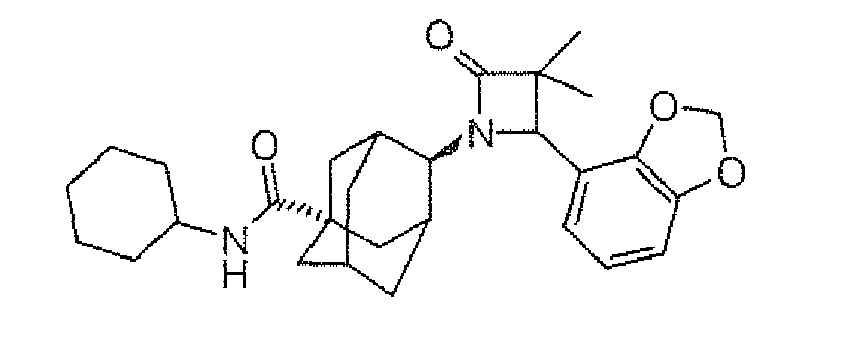
- Cyclohexylamine was used in place of a solution of 2M methylamine in tetrahydrofuran for a similar reaction and treatment as Example 57, and the title compound was obtained as a white amorphous solid.
- 1H-NMR (270 MHz, CDCl3) δ; 0.86 (s, 3H), 0.99-1.88 (m, 20H), 1.47 (s, 3H), 2.06-2.13 (m, 2H), 3.00 (s, 1H), 3.57 (s, 1H), 3.64-3.78 (m, 1H), 4.46 (s, 1H), 5.36 (d, J= 7.8 Hz, 1H), 5.96 (dd, J= 1.0, 6.6 Hz, 2H), 6.68 (dd, J= 1.6, 7.6 Hz, 1H), 6.76-6.86 (m, 2H).
IR (ATR); 3356, 2927, 1736, 1633, 1460, 1251, 729 cm-1.
EI-MS m/z; 478 (M+). -

- Benzylamine was used in place of a solution of 2M methylamine in tetrahydrofuran for a similar reaction and treatment as Example 57, and the title compound was obtained as a white amorphous stolid.
- 1H-NMR (270 MHz, CDCl3) δ; 0.86 (s, 3H), 1.47 (s, 3H), 1.53-2.14 (m, 12H), 3.02 (s, 1H), 3.58 (s, 1H), 4.40 (d, J= 5.1 Hz, 2H), 4.46 (s, 1H), 5.83 (br, 1H), 5.96 (dd, J= 1.4, 5.9 Hz, 2H), 6.67 (dd, J= 1.4, 7.4 Hz, 1H), 6.76-6.83 (m, 2H), 7.21-7.32 (m, 5H).
IR (ATR); 3357, 2910, 1736, 1639, 1459, 1251, 1056, 729 cm-1.
EI-MS m/z; 486 (M+). -

- Methylglycine was used in place of a solution of 2M methylamine in tetrahydrofuran for a similar reaction and treatment as Example 57, and the title compound was obtained as a colorless oil.
- 1H-NMR (400 MHz, CDCl3) δ; 0.87 (s, 3H), 1.48 (s, 3H), 1.55-1.95 (m, 10H), 2.01-2.17 (m, 2H), 3.03 (s, 1H), 3.59 (s, 1H), 3.75 (s, 3H), 4.00 (d, J= 4.9 Hz, 2H), 4.47 (s, 1H), 5.97 (dd, J=1.2, 8.3 Hz, 2H), 6.09 (t, J= 4.9 Hz, 1H), 6.68 (dd, J=1.2, 7.8 Hz, 1H), 6.79 (dd, Z=1.2, 7.8 Hz, 1H), 6.85 (t, J=7.8 Hz, 1H).
IR (ATR); 3356, 2920, 1736, 1646, 1460, 1251, 1205, 757 cm-1.
EI-MS m/z; 468 (M+). -

- A solution of trans-methyl 2-[4-(2-(benzo[d][1,3]dioxol-4-yl)-3,3-dimethyl-4-oxoazetid in-1-yl)-1-adamantane carboxyamide]acetate (20.0 mg, 0.050 mmol) in methanol (2 mL) was added with an aqueous solution of 4N-sodium hydroxide (1 mL) at room temperature, and the resultant was stirred at the same temperature for 2 hours. The reaction solution was concentrated in vacuo, the obtained residue was added with water, and washed with diethyl either. The aqueous layer was added with 4N-hydrochloric acid until it becomes a liquid of pH = 1.0, and extracted with chloroform. The organic layer was dried over anhydrous sodium sulfate, concentrated in vacuo, and trans-2-[4-(2-(benzo[d][1,3]dioxol-4-yl)-3,3-dimethyl-4-oxo azetidin-1-yl) -1-adamantane carboxyamide]acetic acid (24.1 mg, 100%) was obtained as a white crystalline powder.
- 1H-NMR (400 MHz, CDCl3) δ; 0.87 (s, 3H), 1.48 (s, 3H), 1.54-1.94 (m, 10H), 2.07-2.11 (m, 2H), 3.00 (s, 1H), 3.60 (s, 1H), 4.00 (d, J= 4.9 Hz, 2H), 4.49 (s, 1H), 5.97 (dd, J= 1.5, 9.0 Hz, 2H), 6.32 (t, J=4.9 Hz, 1H), 6.68 (d, J=7.8 Hz, 1H), 6.79 (dd, J= 1.3, 7.8 Hz, 1H), 6.84 (t, J=7.8 Hz, 1H).
IR (ATR); 3375, 2926, 1731, 1644, 1460, 1251, 1221, 754 cm-1.
EI-MS m/z; 454 (M+). -

- Under an argon atmosphere, a solution of 3-allyl-2-allyloxybenzaldehyde (480 mg, 2.40 mmol) in dichloromethane (24 mL) synthesized by a method described in Tetrahedron, 61, p. 7746-7755, was added with a Grubbs second generation catalyst (benzylidene{1,3-bis(2,4,6-trimethylphenyl)-2-imidazolidiny lidene}dichloro(tricyclohexylphosphine)ruthenium) (50.0 mg, 2.50 mol%) at room temperature, and the resultant was stirred at the same temperature for 3 hours. The reaction solution was concentrated in vacuo, and the obtained residue was purified by silica gel chromatography (hexane:ethyl acetate = 4:1). 2,5-dihydrobenzo[b]oxepin-9-carboxyaldehyde (384 mg, 91.7%) was obtained as a colorless oil.
- 1H-NMR (400 MHz, CDCl3) δ; 3.55 (s, 2H), 4.73 (s, 2H), 5.51-5.54 (m, 1H), 5.88-5.93 (m, 1H), 7.13 (t, J=7.8 Hz, 1H), 7.36 (d, J=7.8 Hz, 1H), 7.73 (d, J= 7.8 Hz, 1H), 10.46 (s, 1H).
- 2,5-Dihydrobenzo[b]oxepin-9-carboxyaldehyde (363 mg, 2.00 mmol) was used in place of benzaldehyde for a similar reaction and treatment as Example 1, and the title compound was obtained as a colorless oil.
- 1H-NMR (400 MHz, CDCl3) δ; 0.79 (s, 3H), 1.49-1.85 (m, 15H), 2.09-2.13 (m, 1H), 2.89 (s, 1H), 2.96-3.02 (m, 1H), 3.37-3.43 (m, 1H), 3.65 (s, 1H), 4.65 (s, 1H), 5.20-5.23 (m, 2H), 5.32-5.37 (m, 1H), 5.95-6,04 (m, 1H), 6.86 (t, J= 7.5 Hz, 1H), 7.00 (d, J= 7.5 Hz, 1H), 7.09 (d, J=7.5 Hz, 1H).
IR (ATR); 2906, 1743, 1455, 1329, 1181, 933, 756 cm-1.
EI-MS m/z; 377 (M+). -

- A solution of 1-(adamantan-2-yl)-4-(2,5-dihydrobenzo[b]oxepin-9-yl)-3,3-d imethylazetidin-2-one (21.1 mg, 0.0560 mmol) in methanol (2 mL) was added with palladium carbon ethylenediamine complex (catalyst amount), and the resultant was stirred at room temperature for 6 hours under a hydrogen atmosphere. The reaction solution was filtered using celite, concentrated in vacuo, and 1-(adamantan-2-yl)-3,3-dimethyl-4-(benzo[b]oxepan-9-yl)azet idin-2-one (16.2 mg, 76.2%) was obtained as a colorless oil.
- 1H-NMR (400 MHz, CDCl3) δ; 0.80 (s, 3H), 1.00-1.87 (m, 19H), 2.09-2.13 (m, 1H), 2.82-2.91 (m, 2H), 3.24-3.30 (m, 1H), 3.65 (s, 1H), 4.59-4.78 (m, 2H), 6.81 (t, J=7.8 Hz, 1H), 6.96 (d, J= 7.8 Hz, 1H), 7.07 (d, J=7.8 Hz, 1H).
IR (ATR); 2907, 1743, 1456, 1329, 1184, 931, 754 cm-1.
EI-MS m/z; 379 (M+). -
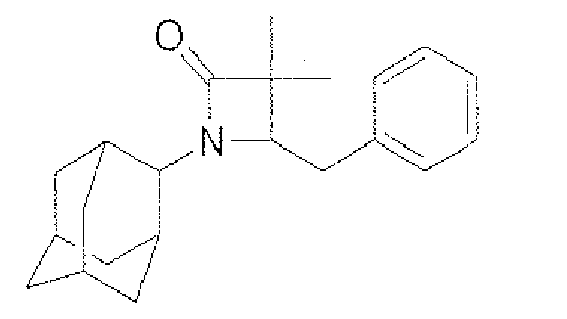
- A solution of 2-adamantylamine (310 mg, 2.05 mmol) in toluene (15 mL) was added with phenylacetaldehyde (246 mg, 2.05 mmol) at room temperature, and the resultant was stirred at the same temperature for 1 hour. The reaction solution was concentrated in vacuo, and the obtained residue was dissolved in toluene (15 mL), to which ethyl 2-bromoisobutylate (1.20 g, 6.15 mmol) and zinc (4.02 g, 61.5 mmol) were sequentially added at room temperature. The reaction solution was stirred at 135°C for 5 hours, and the residue was filtered with a filter paper for Kiriyama funnel. The reaction solution was added with hydrochloric acid, and extracted with ethyl acetate. The organic layer was dried over anhydrous sodium sulfate, and concentrated in vacuo. The obtained residue was purified by column chromatography (hexane:diethylether = 1:1). 4-Benzyl-1-(adamantan-2-yl)-3,3-dimethyldiazetidin-2-one (44.8 mg, 5.4%) was obtained as a colorless oil.
- 1H-NMR (400 MHz, CDCl3) δ; 1.13 (s, 3H), 1.16-1.89 (m, 1.5H), 2.09-2.12 (m, 1H), 2.73 (s, 1H), 2.85 (dd, J= 8.1, 14.6 Hz, 1H), 3.00 (dd, J= 5.6, 14.6 Hz, 1H), 3.44 (s, 1H), 3.60 (dd, J= 5.6, 8.1 Hz, 1H), 7.18-7.31 (m, 5H). IR (ATR) 2912, 1734, 1330, 1111, 741 cm-1.
EI-MS m/z; 323 (M+). -

- A solution of 1-(4-chlorophenyl)cyclopropane carboxylic acid (784 mg, 3.99 mmol) in dichloromethane (30 mL) was added sequentially at room temperature with N,O-dimethylhydroxylamine hydrochloride (389 mg, 3.99 mmol), benzotriazole-1-yloxytrispyrrolidinophosphonium hexafluorophosphate (2.28 g, 4.39 mmol) and triethylamine (807 mg, 7.97 mmol). The resultant was stirred at the same temperature for 20 min, and extracted with chloroform. The organic layer was dried over anhydrous sodium sulfate, and concentrated in vacuo. The obtained residue was dissolved in toluene (30 mL), added at -78°C with a solution of diisobutylaluminum hydride in toluene (1.01 M, 4.35 mL), and the resultant was stirred at the same temperature for 1 hour. The reaction solution was added with hydrochloric acid, and extracted with ethyl acetate. The organic layer was dried over anhydrous sodium sulfate, and concentrated in vacuo. The obtained residue was purified by column chromatography (hexane:ethyl acetate = 3:1), and 1-(4-chlorophenyl)cyclopropane carboaldehyde (460 mg, 63.7%) was obtained.
- 1H-NMR (400 MHz, CDCl3) δ; 1.38-1.40 (m, 2H), 1.53-1.59 (m, 2H), 7.23-7.26 (m, 2H), 7.30-7.35 (m, 2H), 9.16 (s, 1H).
- 1 - (4-Chlorophenyl) cyclopropane carbo aldehyde was us ed in place of phenylacetaldehyde for a similar reaction and treatment as Example 69, and the title compound was obtained as a colorless oil.
- 1H-NMR (400 MHz, CDCl3) δ; 0.60-0.66 (m, 1H), 0.87-0.91 (m, 1H), 1.04 (s, 3H), 1.14-1.89 (m, 16H), 1.97-2.00 (m, 1H), 2.20 (s, 1H), 2.92 (s, 1H), 3.39 (s, 1H), 3.89 (s, 1H), 7.19 (d, J= 8.8 Hz, 2H), 7.24 (d, J= 8.8 Hz, 2H).
IR (ATR) 2908, 1741, 1493, 1324, 1014, 751 cm-1.
EI-MS m/z; 383 (M+). -

- 1-Phenylcyclopropane carboaldehyde was used in place of phenylacetaldehyde for a similar reaction and treatment as Example 69, and the title compound was obtained as a colorless oil.
- 1H-NMR (400 MHz, CDCl3) δ; 0.64-0.69 (m, 1H), 0.86-0.91 (m, 1H), 1.06 (s, 3H), 1.09-1.88 (m, 16H), 1.97-1.99 (m, 1H), 2.23 (s, 1H), 2.93 (s, 1H), 3.41 (s, 1H), 3.96 (s, 1H), 7.17-7.39 (m, 5H).
IR (ATR) 2908, 2856, 1741, 1325, 1117, 762 cm-1.
EI-MS m/z; 349 (M+). -

- Under an argon atmosphere, a solution of 1-(4-methoxyphenyl)cyclopropane carboxylic acid (2.00 g, 10.4 mmol) in tetrahydrofuran (20 mL) was added with lithium aluminum hydride (513 mg, 13.5 mmol) at 0° C, and the resultant was stirred at room temperature for 2 hours. The resultant was added sequentially with water and hydrochloric acid at 0°C, stirred at room temperature for 30 min and then extracted with ethyl acetate. The organic layer was dried over anhydrous sodium sulfate, and concentrated in vacuo. The obtained residue was dissolved in dichloromethane (15 mL). The resultant was sequentially added with molecular sieves 4A (1.80 g), N-methylmorpholine (1.83 g, 15.6 mmol) and tetrapropylammonium perruthenate (183 mg, 0.520 mmol) at 0°C, and stirred at room temperature for 1.5 hours. The reaction solution was filtered using celite, and concentrated in vacuo. The obtained residue was purified by column chromatography (hexane:ethyl acetate = 4:1), and 1-(4-methoxyphenyl)cyclopropane carboaldehyde(1.54 g, 84.0%) was obtained.
- 1H-NMR (400 MHz, CDCl3) δ; 1.35-1.38 (m, 2H), 1.53-1.56 (m, 2H), 3.81 (s, 3H), 6.88-6.93 (m, 2H), 7.21-7.28 (m, 2H), 9.23 (s, 1H).
- 1-(4-Methoxyphenyl)cyclopropane carboaldehyde was used in place of phenylacetaldehyde for a similar reaction and treatment as Example 69, and the title compound was obtained as a pale yellow amorphous stolid.
- 1H-NMR (400 MHz, CDCl3) δ; 0.61-0.65 (m, 1H), 0.82-0.85 (m, 1H), 1.08 (s, 3H), 1.10-1.15 (m, 2H), 1.24 (s, 3H), 1.64-1.89 (m, 11H), 2.00 (d, J= 11.5 Hz, 1H), 2.24 (s, 1H), 2.92 (s, 1H), 3.42 (s, 1H), 3.79 (s, 3H), 3.83 (s, 1H), 6.81-6.86 (m, 2H), 7.18-7.23 (m, 2H).
IR (ATR); 2905, 2859, 1740, 1514, 1238 cm-1.
EI-MS m/z; 379 (M+). -

- Under an argon atmosphere, a solution of 1-p-toluylcyclopropane carbonitrile (1.57 g, 10.0 mmol) in toluene (70 mL) was added with a solution of lithium diisobutylaluminum hydride in toluene (1.01 M, 23.1 mL) at 0°C, and the resultant was stirred at the same temperature for 1 hour. The reaction solution was added with hydrochloric acid at 0°C, and extracted with ethyl acetate. The organic layer was dried over anhydrous sodium sulfate, and concentrated in vacuo. The obtained residue was purified by column chromatography (hexane:ethyl acetate = 9:1). 1-p-toluylcyclopropane carboaldehyde (960 mg, 59.9%) was obtained.
- 1H-NMR (400 MHz, CDCl3) δ; 1.34-1.40 (m, 2H), 1.57-1.59 (m, 2H), 7.18 (d, J=8.6 Hz, 2H); 7.49 (d, J= 8.3 Hz, 2H), 9.15 (s, 1H).
- 1-p-Toluyl cyclopropane carboaldehyde was used in place of phenylacetaldehyde for a similar reaction and treatment as Example 69, and the title compound was obtained as a colorless oil.
- 1H-NMR (400 MHz, CDCl3) δ; 0.63-0.66 (m, 1H), 0.84-0.88 (m, 1H), 1.06 (s, 3H), 1.08-190 (m, 16H), 1.98-2.01 (m, 1H), 2.23 (s, 1H), 2.31 (s, 3H), 2.92 (s, 1H), 3.41 (s, 1H), 3.91 (s, 1H), 7.08 (d, J=8.1 Hz, 2H), 7.14 (d, J= 8.1 Hz, 2H).
IR (ATR) 2981, 2912, 1758, 1732, 1469, 1388, 1255, 1147, 1101 cm-1.
EI-MS m/z; 363 (M+). -

- 2-(Benzo[d][1,3]dioxol-5-yl)acetonitrile (1.50 g, 9.31 mmol) was cyclopropylated according to the method described in
WO2005/019161 . Then, a solution of the obtained product in toluene (100 mL) was added with a solution of lithium diisobutylaluminum hydride in toluene (1.01 M, 9.22 mL) at 0°C, and the resultant was stirred for 1 hour. The reaction solution was added with hydrochloric acid at 0° C, and extracted with ethyl acetate. The organic layer was dried over anhydrous sodium sulfate, and concentrated in vacuo. The obtained residue was purified by column chromatography (hexane: ethyl acetate = 4:1), and 1-(benzo[d][1,3]dioxol-5-yl)cyclopropane carboaldehyde (117 mg, 6.7%) was obtained. - 1H-NMR (400 MHz, CDCl3) δ; 1.34-1.37 (m, 2H), 1.52-1.54 (m, 2H), 5.96 (d, J=2.0 Hz, 2H), 6,75-6.80 (m, 3H), 9.20 (s, 1H).
- 1-(Benzo[d][1,3]dioxol-5-yl)cyclopropane carboaldehyde was used in place of phenylacetaldehyde for a similar reaction and treatment as Example 69, and the title compound was obtained as a colorless oil.
- 1H-NMR (400 MHz, CDCl3) δ; 0.55-0.63 (m, 1H), 0.77-0.86 (m, 1H), 1.04 (s, 3H), 1.10-2.00 (m, 17H), 2.22 (s, 1H), 2.92 (s, 1H), 3.40 (s, 1H), 3.83 (s, 1H), 5.94 (s, 2H), 6.70-6.77 (m, 3H).
IR (ATR) 2906, 1853, 1741, 1505,1229, 1038 cm-1.
EI-MS m/z; 393 (M+). -

- 2-(4-Bromophenyl)acetonitrile was used in place of 2-(benzo[d][1,3]dioxol-5-yl)acetonitrile for a similar reaction and treatment of Step 1 of Example 74, and the title compound was obtained.
- 1H-NMR (400 MHz, CDCl3) δ; 1.34-1.40 (m, 2H), 1.57-1.59 (m, 2H), 7.18 (d, J= 8.6 Hz, 2H), 7.49 (d, J= 8.3 Hz, 2H), 9.15 (s, 1H).
- 1-(4-Bromophenyl)cyclopropane carboaldehyde was used in place of phenylacetaldehyde for a similar reaction and treatment as Example 69, and the title compound was obtained as a pale yellow amorphous solid.
- 1H-NMR (400 MHz, CDCl3) δ; 0.60-0.66 (m, 1H), 0.87-0.92 (m, 1H), 1.04 (s, 3H), 1.13-1.19 (m, 2H), 1.26 (s, 3H), 1.61-1.89 (m, 11H), 1.99 (d, J=13.2 Hz, 1H), 2.20 (s, 1H), 2.92 (s, 1H), 3.39 (s, 1H), 3.89 (s, 1H), 7.14 (d, J=8.5 Hz, 2H), 7.41 (d, J= 8.6 Hz, 2H).
IR (ATR); 2907, 2855, 1741, 1086, 1010 cm-1.
EI-MS m/z; 427 (M+). -

- 2-(Pyridin-2-yl)acetonitrile was used in place of 2-(benzo[d][1,3]dioxol-5-yl)acetonitrile for a similar reaction and treatment as Step 1 of Example 74, and the title compound was obtained.
- 1H-NMR (400 MHz, CDCl3) δ; 1.63-1.68 (m, 2H), 1.70-1.74 (m, 2H), 7.16-7.20 (m, 1H), 7.53-7.56 (m, 1H), 7.65-7.68 (m, 1H), 8.55 (d, J= 1.9 Hz, 1H), 9.54 (s, 1H).
- 1-(Pyridin-2-yl)cyclopropane carboaldehyde was used in place of phenylacetaldehyde for a similar reaction and treatment as Example 69, and the title compound was obtained as a pale yellow oil.
- 1H-NMR (400 MHz, CDCl3) δ; 0.91 (s, 3H), 0.95-1.00 (m, 2H), 1.22-1.30 (m, 1H), 1.38-1.41 (m, 1H), 1.46 (s, 3H), 1.58 (s, 2H), 1.66-1.75 (m, 5H), 1.82-1.88 (m, 4H), 2.03 (d, J= 12.4 Hz, 1H), 2.17 (s, 1H), 2.95 (s, 1H), 3.36 (s, 1H), 4.32 (s, 1H), 7.02-7.09 (m, 2H), 7.55-7.59 (m, 1H), 8.48-8.49 (m, 1H).
IR (ATR); 2917, 2853, 1736, 775, 739 cm-1.
EI-MS m/z; 350 (M+). -

- 2-(2-Chlorophenyl)acetonitrile was used in place of 2-(benzo[d][1,3]dioxol-5-yl)acetonitrile for a similar reaction and treatment as Step 1 of Example 74, and the title compound was obtained.
- 1H-NMR (400 MHz, CDCl3) δ; 1.39-1.42 (m, 2H), 1.69-1.72 (m, 2H), 7.26-7.30 (m, 3H), 7.43-7.45 (m, 1H), 9.17 (s, 1H).
- 1-(2-Chlorophenyl)cyclopropane carboaldehyde was used in place of phenylacetaldehyde for a similar reaction and treatment as Example 69, and the title compound was obtained as a colorless oil.
- 1H-NMR (400 MHz, CDCl3) δ; 0.50-0.55 (m, 1H), 1.01-1.06 (m, 1H), 1.11 (s, 3H), 1,19-1.94 (m, 17H), 2.45 (s, 1H), 2.96 (s, 1H), 3.37 (s, 1H), 4.23 (s, 1H), 7.18-7.19 (m, 2H), 7.36-7.39 (m, 2H).
IR (ATR) 2909, 737, 1471, 1327, 1045,751 cm-1.
EI-MS m/z; 383 (M+). -

- 2-(3-Chlorophenyl) acetonitrile was used in place of 2-(benzo[d][1,3]dioxol-5-yl)acetonitrile for a similar reaction and treatment as Step 1 of Example 74, and the title compound was obtained.
- 1H-NMR (400 MHz, CDCl3) δ; 1.40-1.43 (m, 2H), 1.58-1.61 (m, 2H), 7.19 (m, 1H), 7.26-7.30 (m, 3H), 9.21 (s,1H).
- 2-(3-Chlorophenyl)acetonitrile was used in place of phenylacetaldehyde for a similar reaction and treatment as Example 69, and the title compound was obtained as a colorless oil.
- 1H-NMR (400 MHz, CDCl3) δ; 0.64-0.66 (m, 1H), 0.90-0.93 (m, 1H), 1.05 (s, 3H), 1.11-2.04 (m, 17H), 2.19 (s, 1H), 2.92 (s, 1H), 3.39 (s, 1H), 3.92 (s,1H), 7.14-7.22 (m, 4H)..
IR (ATR) 2908, 1740. 1358, 1121., 750 cm-1.
EI-MS m/z; 383 (M+). -

- A solution of 4-[1-(4-bromophenyl)cyclopropyl]-1-(adamantan-2-yl)-3,3-dim ethylazetidin-2-one (12.2 mg, 0.0285 mmol) in 1,4-dioxane (3 mL) prepared in Example 75 was added with tetrakis (triphenylphosphine) palladium (1.6 mg, 1.4 µmol), phenyl boronic acid (7 mg, 0.057 mmol), and potassium phosphate (30 mag, 0.142 mmol) at room temperature, and the resultant was stirred at 100°C for 20 hours. The reaction solution was poured into water, and extracted with ethyl acetate. The organic layer was dried over anhydrous sodium sulfate, and concentrated in vacuo. The obtained residue was purified by thin-layer chromatography (hexane:ethyl acetate = 3:1), and 4-[1-(biphenyl-4-yl)cyclopropyl]-1-(adamantan-2-yl)-3,3-dim ethylazetidin-2-one (10.2 mg, 84%) was obtained as a white amorphous solid.
- 1H-NMR (400 MHz, CDCl3) δ; 0.70-0-75 (m, 1H), (3.90-0.95 (m, 1H), 1.10 (s, 3H)., 1.16-1.28 (m, 2H), 1.31(s, 3H), 1.59-2.04 (m, 12H), 2.25 (s, 1H), 2.95 (s, 1H), 3.44 (s, 1H), 3.97 (s, 3.H), 7.31-7.3a (m, 3H), 7.43 (t, J= 8.4 Hz, 2H), 7.52 (d, J= 8.4 Hz, 2H), 7.58 (d, J= 8.4 Hz, 2H).
IR (ATR) 2908, 1740, 1326, 1221,1086,762 cm-1.
EI-MS m/z; 425 (M+). -

- Methyl trans-4-adamantyrlamine-1-carboylate was used in place of 2-adamantylamine for a similar reaction and treatment as Example 76, and the title compound was obtained as a colorless oil.
- 1H-NMR (400 MHz, CDCl3) δ; 0.92 (s, 3H), 094-0.99 (m, 2H), 1.24-1.29 (m, 1H), 1.36-1.43 (m, 1H), 1.47 (s, 3H), 1/62-1.66 (m, 2H), 1.85-2.05 (m, 9H), 2.25 (s, 1H), 3.07 (s, 1H), 3.36 (s, 1H), 3.66 (s, 3H), 4.32 (s, 1H), 7.01 (d, J= 7.6 Hz, 1H), 7.08 (dd, J= 4.8, 7.6 Hz, 1H), 7.58 (t, J= 4.8 Hz, 1H), 8.49 (d, J= 4.8 Hz, 1H).
IR (ATR) 2930,1730,1588,1237,1079, 777 cm-1.
EI-MS m/z; 408 (M+), -

- A solution of methyl trans-4-(2-[1-(pyridin-2-yl)cyclopropyl]-3,3-dimethyl-4-oxo azetidin-1-yl}-1-adamantane carboxylate (98.8 mg, 0.24 mmol) in methanol (2 mL) prepared in Example 80 was added with an aqueous solution of 4N-sodium hydroxide (1 mL), 4.00 mmol) at room temperature, and the resultant was stirred at the same temperature for 1.5 hours. The reaction solution was concentrated in vacuo, and the obtained residue was dissolved in water, and washed with diethyl ether. The aqueous layer was adjusted to a liquid of pH 6 to 7 by using 4N-hydrochloric acid, and extracted with chloroform. The organic layer was dried over anhydrous sodium sulfate, and concentrated in vacuo. The obtained residue was purified by column chromatography (chloroform:methanol = 10:1), and trans-4-{2-[1-(pyridin-2-yl)cyclopropyl]-3,3-dimethyl-4-oxo azetidin-1-yl}-1-adamantane carboxylic acid (69.3 mg, 73%) was obtained as a white amorphous solid.
- 1H-NMR (400 MHz, CDCl3) δ; 0.93 (s, 3H), 0.94-0.98 (m, 2H), 1.24-1.29 (m, 1H), 1.6-1.40 (m, 1H), 1.44 (s, 3H), 1.62-1.65 (m, 2H), 1.87-2.05 (m, 9H), 2.27 (s, 1H), 3.07 (s, 1H), 3.36 (s, 1H), 4.32 (s, 1H), 7.02 (d, J= 8.4 Hz, 1H), 7.09 (dd,J= 3.6, 8.4 Hz, 1H), 7.59 (t, J= 3.6 Hz, 1H), 8.50 (d, J= 3.6 Hz, 1H).
IR (ATR) 2927,1727, 15 9 4, 1217, 1079, 776 cm-1.
EI-MS m/z; 394 (M+), -
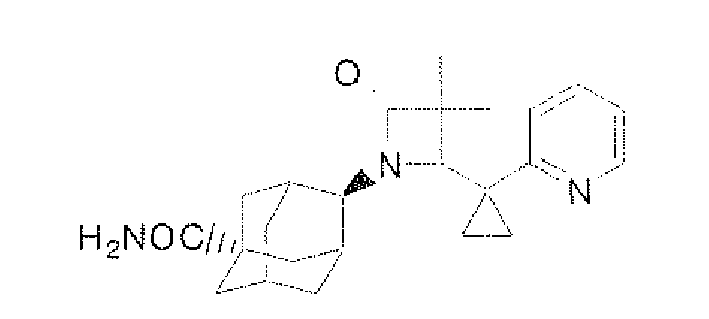
- A solution of trans-4-{2-[1-(pyridin-2-yl)cyclopropyl]-3,3-dimethyl-4-oxo azetidin-1-yl}-1-adamantane carboxylic acid (61.5 mg, 0.156 mmol) in dichloromethane (3 mL) prepared in Example 81 was added with WSC HCl (60 mg, 0.312 mmol) and HOBT-H2O (36 mg, 0.234 mmol) at room temperature, and the resultant was stirred at the same temperature for 15 minutes. Then, an aqueous solution of 30% ammonia (0.200 ml) was added at room temperature, and further stirred at the same temperature for 1 hour. The reaction solution was added with water, and extracted with chloroform. The organic layer was dried over anhydrous sodium sulfate, and concentrated in vacuo. The obtained residue was purified by column chromatography (chloroform:methanol = 10:1), and trans-4-{2-[1-(pyridin-2-yl)cyclopropyl]-3,3-dimethyl-4-oxo azetidin-1-yl}-1-adamantane carboxyamide (23.7mg, 38.6%) was obtained as a white amorphous solid.
- 1H-NMR (400 MHz, CDCl3) δ; 0.92 (s, 3H), 0.93-0.98 (m, 2H), 1.24-1.27 (m, 1H), 1.32-1.39 (m, 1H), 1.46 (s, 3H), 1.61-1.65 (m, 2H), 1.84-1.96 (m, 7H), 2.05-2.08 (m, 2H), 2.28 (s, 1H), 3.10 (s, 1H), 3.38 (s, 1H), 4.31 (s., 1H), 5.65 (br, 2H), 7.00 (d, J= 7.6 Hz, 1H), 7.08 (dd, J= 4.8, 7.6 Hz, 1H), 7.58 (t, J= 4.8 Hz, 1H), 8.48 (d, J= 4.8 Hz, 1H).
IR (ATR) 2926,1731,1650,1588,1103,1013, 749 cm-1,
EI-MS m/z; 393 (M+), - Human 11β-HSD1-, human 11β3-HSD2-, and mouse 11β-HSD1-gene clonings were conducted using as a template a reverse transcription product of human-liver RNA, human-kidney RNA (CELL APPLICATIONS), and mouse-kidney RNA respectively, by means of PCR cloning with reference to nucleotide sequences of Genbank Accession Nos . NM_005525, NM_000196, and NM_008288. The obtained PCR products of about 0.9 kbp, 1.2 kbp, and 0.9 kbp were subcloned into an expression vector pcDNA3.1+/Zeo (Invitrogen).
- Human 11βp-HSD1- and human 11β-HSD2-expressing vectors were transfected into human kidney-derived cell line, HEK293 cells, using a transfection reagent, jet PEI (Funakoshi) . Mouse 11β-HSD1 was transfected to Chinese hamster ovary-derived cell line, CHO-K1 cells. Selection was conducted with 200-400 µg/mL of zeocine (Invitrogen) to provide stably expressing-cell clones. The stably expressing cells were suspended in buffer solution A (20 mmol/L Tris-HCl, pH 7.4, 250 mmol/L sucrose, 1 mmol/L EGTA, 1mmol/L EDTA, 1 mmol/L Macl2), sonicated, and then stored at -80°C.
- An enzymatic reaction was conducted using a polystyrene 96-well plate. Each well was added with 1 µL of a test agent dissolved in DMSO and then diluted (0.003 to 3 mmol/L), and further added with 10 µL of cell lysate diluted to a concentration of 0.1 mg/mL to 0.4 mg/mL. Next, 90 µL of buffer solution A containing substrate (100 nmol/L cortisone or cortisol) and coenzyme (400 µmol/L NADPH or NAD+) was added and the mixture was incubated at 37°C for 1 hour. The enzymatic reaction was stopped by treating at 95°C for 3 minutes. Cortisol that was present in the reaction solution was determined by a competitive ELISA shown below.
Anti-rabbit IgG antibody (Chemi-con) diluted to 2 µg/mL with carbonate buffer solution (pH 9.6) was added in 100 µL each to a 96-well immuno plate (Nunc) and immobilized by an incubation at 4°C overnight. 50 µL of enzymatic reaction solution was put onto the plates, and further, anti-cortisol antibody (Cosmo Bio) and HRP-labeled cortisol (Cosmo Bio), diluted with buffer solution B (25 mmol/L Tris-HCl pH 7.4, 137 mmol/L NaCl, 2.68 mmol/L KCl ) , were added in 50 µL respectively and incubated at 4°C overnight. After washed three times with buffer solution B containing 0.05% Tween 20, the plates were allowed to develop color by adding 100 µL of color reagent, TMB (Moss ) . The color reaction was stopped by 25 µL of 1 mol/L sulfuric acid and the absorbance was determined at 450 nm with a microplate reader (Molecular Device, VersaMax). - The values of human 11β-HSD1, human 11β-HSD2, and mouse 11β-HSD1 activities were subtracted from 100, and the resultant values were regarded as the respective 11β-HSD inhibition rates of example compounds. For each example compound, the value of 50% inhibitory concentration (IC50) was calculated from 11β-HSD inhibition rates at plural concentrations, for 11β-HSD1 and 11β-HSD2 activities. The comparison of human 11β-HSD1 and human 11β-HSD2 inhibiting activities is shown in Table 1, and the comparison of human 11β-HSD1 and mouse 11β-HSD1 inhibiting activities is shown in Table 2.
-
[Table 1] Enzyme inhibitory selectivity of human 11β-HSD1 and human 11βHSD2 Example No in vitro assay (IC50 uM) Example No. in vitro assay (IC50 uM) h HSD1 h HSD2 h HSD1 h HSD2 1 0.013 3-30 33 0.0067 6.7 2 0.0054 NA 34 0.012 30 3 0.057 NA 35 0.053 >30 4 0.046 NA 36 0.091 NA 5 0.88 NA 37 0.026 14 6 0.56 NA 38 0.079 3-30 7 0.013 NA 39 0.0034 3-30 8 0.066 NA 40 0.0059 >30 9 0.0050 NA 41 0.0087 3-30 10 0.019 NA 42 0.006 NA 11 0.26 NA 43 0.025 NA 12 0.022 NA 44 0.0055 3-30 13 0.051 NA 45 0.0081 NA 14 0.013 NA 46 0.0081 30 15 0.031 NA 47 0.0075 NA 16 0.41 NA 48 0.0088 NA 18 0.029 30 49 0.10 NA 20 0.057 NA 51 0.080 NA 22 0.0095 15 52 0.0046 NA 23 0.010 >30 53 0.0039 30 24 0.011 >30 54 0.91 NA 25 0.020 NA 55 0.0039 NA 26 0.013 >30 56 0.0079 >30 27 0.017 8.8 67 0.065 30 28 0.029 NA 68 0.026 3-30 29 0.011 >30 69 0.020 0.28 30 0.016 NA 70 0.110 4.1 31 0.015 NA 71 0.059 4.3 32 0.024 NA - As it is shown in Table 1, it has been confirmed that the compound of the present invention has an activity to strongly and selectively inhibit human 11β-HSD1.
-
[Table 2] Enzyme inhibitory activity of human HSD1 and mouse HSD1 Example No. in vitro assay (IC50 uM) Example No. in vitro assay (IC50 uM) hHSD1 m HSD1 h HSD1 m HSD1 1 0.013 0.077 31 0.015 0.076 2 0.0054 0.054 33 0.0067 0.072 3 0.057 0.31 34 0.012 0.031 4 0.046 0.34 35 0.053 0.61 5 0.88 0.66 39 0.0034 0.055 6 0.56 0.87 40 0.0059 0.34 7 0.013 0.25 41 0.0087 0.079 9 0.0050 0.035 42 0.0060 0.69 10 0.019 0.034 44 0.0055 0.076 11 0.26 0.42 45 0.0081 0.0035 12 0.022 0.023 46 0.0081 0.029 13 0.051 0.24 47 0.0075 0.0056 14 0.013 0.0095 48 0.0088 0.33 15 0.031 0.031 52 0.0046 0.027 18 0.029 0.074 53 0.0039 0.025 20 0.057 0.053 55 0.0039 0.87 22 0.0095 0.66 56 0.0079 0.46 24 0.011 0.10 67 0.065 0.029 25 0.020 0.18 68 0.026 0.020 26 0.013 0.46 69 0.020 0.0051 28 0.029 0.16 70 0.110 0.0078 29 0.011 0.59 71 0.059 0.0061 30 0.016 0.13 - For medicine development, it is required to make a dosage selection for clinical experiments by extrapolating data which have been accumulated with animal models to human. Sometimes, the difference of enzyme species becomes an issue for evaluating an inhibitor targeting a certain enzyme, such as the compound of the present invention. Specifically, as rodents such as mouse are generally used as an animal model, a compound having an inhibitory activity to mouse type enzyme as well as human type enzyme, has an advantageous property for evaluating usefulness as medicine. As it is shown in Table 2, the compound of the present invention has been confirmed to have an inhibitory effect to mouse 11β-HSD1 as well.
- A 1-adamantyl azetidin-2-one derivative or salt thereof, or their solvate of the present invention shows a superior inhibitory effect of 11β-hydroxysteroid dehydrogenase 1, and is useful as an agent for preventing or treating a disease that involves 11β-hydroxysteroid dehydrogenase 1 (in particular, diabetes, insulin resistance, diabetes complication, obesity, dyslipidemia, hypertension, fatty liver, or metabolic syndrome).
Claims (9)
- An 1-adamantyl azetidin-2-one derivative represented by the following general formula (1) or salt thereof, or their solvates.

- The 1-adamantyl azetidin-2-one derivative represented by the following formula (1) or salt thereof, or their solvate according to claim 1, wherein the compound represented by the formula (1) is a compound selected from the group consisting of:1-(adamantan-2-yl)-3,3-dimethyl-4-phenylazetidin-2-one,1-(adamantan-2-yl)-3,3-dimethyl-4-(2,3-dichlorophenyl)azeti din-2-one,t-rans-1-(5-chloroadamantan-2-yl)-3,3-dimethyl-4-(2,3-dichlo rophenyl)azetidin-2-one,cis-1-(5-chloroadamantan-2-yl)-3,3-dimethyl-4-(2,3-dichloro phenyl)azetidin-2-one,trans-1-(5-chloroadamantan-2-yl)-3,3-dimethyl-4-(naphthalen -1-yl)azetidin-2-one,cis-1-(5-chloroadamantan-2-yl)-3,3-dimethyl-4-(naphthalen-1 -yl)azetidin-2-one,methyltrans-4-[2-(2,3-dichlorophenyl)-3,3-dimethyl-4-oxoasetidin-1-yl]-1-adamantane carboxylate,trans-4-[2-(2,3-dichlorophanyl)-3,3-dimethyl-4-oxoazetidin-1-yl]-1-adamantane carboxylic acid,trans-4-[2-(2,3-dichlorophenyl)-3,3-dimethyl-4-oxoazetidin-1-yl]-1-adamantane carboxyamide,methyltrans-4-[2-(naphthalen-1-yl)-3,3-dimethyl-4-oxoazetidin-1-y l]-1-adamantane carboxylate,trans-4-[2-(naphthalen-1-yl)-3,3-dimethyl-4-oxoazetidin-1-y l]-1-adamantane carboxylic acid,trans-4-[2-(naphthalen-1-yl)-3,3-dimethyl-4-oxoazetidin-1-y l]-1-adamantane carboxyamide,methyltrans-4-[2-(benzo[d] [1,3]dioxol-4-yl)-3,3-dimethyl-4-oxoaze tidin-1-yl]-1-adamantane carboxylate,trans-4-[2-(benzo[d][1,3]dioxol-4-yl)-3,3-dimethyl-4-oxoaze tidin-1-yl]-1-adamantane carboxylic acid,trans-4-[2-(benzo[d][1,3]dioxol-4-yl)-3,3-dimethyl-4-oxoaze tidin-1-yl]-1-adamantane carboxyamide,trans-4-[2-(isoquinalin-5-yl)-3,3-dimethyl-4-oxoazetidin-1-yl]-1-adamantane carboxyamide,trans-4-[2-(quinolin-5-yl)-3,3-dimethyl-4-oxoazetidin-1-yl] -1-adamantane carboxylic acid,methyltrans-4-[2-(quinolin-8-yl)-3,3-dimethyl-4-oxoazetidin-1-yl] -1-adamantane carboxylate,trans-4-[2-(quinolin-8-yl)-3,3-dimethyl-4-oxoazetidin-1-yl] -1-adamantane carboxylic acid,trans-4-[2-(quinolin-8-yl)-3,3-dimethyl-4-oxoazetidin-1-yl] -1-adamantane carboxyamide,1-(adamantan-2-yl)-3,3-dimethyl-4-(2,3-dimethoxyphenyl)azet idin-2-one,1-(adamantan-2-yl)-3,3-dimethyl-4-(4-chlorophenyl)azetidin-2-one,1-(adamantan-2-yl)-3,3-dimethyl-4-(4-methoxyphenyl)azetidin -2-one,1-(adamantan-2-yl)-3,3-dimethyl-4-(2,3-difluorophenyl)azeti din-2-one,1-(adamantan-2-yl)-3,3-dimethyl-4-(3-chloro-2-fluorophenyl) azetidin-2-one,1-(adamantan-2-yl)-3,3-dimethyl-4-(3,4-dichlorophenyl)azeti din-2-one,1-(adamantan-2-yl)-3,3-dimethyl-4-(3,4-difluorophenyl)azeti din-2-one,1-(adamantan-2-yl)-3,3-dimethyl-4-(2-fluoro-3-trifluorometh ylphenyl)azetidin-2-one,1-(adamantan-2-yl)-3,3-dimethyl-4-(3-chloro-4-fluorophenyl) azetidin-2-one,1-(adamantan-2-yl)-3,3-dimethyl-4-(2-chloro-3-trifluorometh ylphenyl)azetidin-2-one,1-(adamantan-2-yl)-3,3-dimethyl-4-(3,5-dichlorophenyl)azeti din-2-one,1-(adamantan-2-yl)-3,3-dimethyl-4-(4-fluoro-3-trifluorometh ylphenyl)azetidin-2-one,1-(adamantan-2-yl)-3,3-dimethyl-4-(2-methoxyphenyl)azetidin -2-on,1-(adamantan-1-yl)-3,3-dimethyl-4-(3-methoxyphenyl)azetidin -2-one,1-(adamantan-2-yl)-3,3-dimethyl-4-(2,3,5-trifluorophenyl)az etidin-2-one,1-(adamantan-2-yl)-3,3-dimethyl-4-(3,4,5-trifluorophenyl)az etidin-2-one,1-(adamantan-2-yl)-3,3-dimethyl-4-(4-isopropylphenyl)azetid in-2-one,1-(adamantan-2-yl)-3,3-dimethyl-4-(4-t-butylphenyl)azetidin -2-one,1-(adamantan-2-yl)-3,3-dimethyl-4-(2-fluorophenyl)azetidin-2-one,1-(adamantan-2-yl)-3,3-dimethyl-4-(2-fluoro-4-methoxyphenyl )azetidin-2-one,1-(adamantan-2-yl)-3,3-dimethyl-4-(2-trifluoromethylphenyl) azetidin-2-one,1-(adamantan-2-yl)-3,3-dimethyl-4-(4-trifluaramethoxyphenyl )azetidin-2-one,1-(adamantan-2-yl)-3,3-dimethyl-4-(4-bromophenyl)azetidin-2 -one,1-tadamantan-2-yl)-3,3-dimethyl-4-(2-chlorophenyl)azetidin-2-one,1-(adamantan-2-yl)-3,3-dimethyl-4-(naphthalen-1-yl)azetidin -2-one,trans-1-(5-hydroxyadamantan-2-yl)-3,3-dimethyl-4-(2,3-dichl orophenyl)azetidin-2-one,trans-1-(5-hydroxyadamantan-2-yl)-3,3-dimethyl-4-(naphthale n-1-yl)azetidin-2-one,trans-1-(5-hydroxyadamantan-2-yl)-3,3-dimethyl-4-(4-methoxy naphthalen-1-yl)azetidin-2-one,methyltrans-4-[2-(quinolin-4-yl)-3,3-dimethyl-4-oxoazetidin-1-yl] -1-adamantane carboxylate,trans-4-[2-(quinolin-4-yl)-3,3-dimethyl-4-oxoazetidin-1-yl] -1-adamantane carboxylic acid,trans-4-[2-(quinolin-4-yl)-3,3-dimethyl-4-oxoazetidin-1-yl] -1-adamantane carboxyamide,trans-1-(5-fluoroadamantan-2-yl)-3,3-dimethyl-4-(2,3-dichlo rophenyl)azetidin-2-one,3-(adamantan-2-yl)-3,3-dimethyl-4-(3-chlaraphenyl)azetidin-2-one,1-(adamantan-2-yl)-3,3-dimethyl-4-[3,5-bis(trifluoromethyl) phenyl]azetidin-2-one,1-(adamantan-2-yl)-3,3-dimethyl-4-[4-(methylthio)phenyl]aze tidin-2-one,1-(adamantan-2-yl)-3,3-dimethyl-4-(4-methoxy-2-methylphenyl )azetidin-2-ane,trans-4-[2-(benzo[d][1,3]dioxol-4-yl)-3,3-dimethyl-4-oxoazetidin-1-yl]-N-methyl-1-adamantane carboxyamide,trans-4-[2-(banzo[d][1,3]dioxol-4-yl)-3,3-dimethyl-4-oxoazetidin-1-yl]-N-ethyl-1-adamantane carboxyamide,trans-4-[2-(benzo[d][1,3]dioxol-4-yl)-3,3-dimethyl-4-oxoazetidin-1-yl]-N-propyl-1-adamantane carboxyamide,trans-4-[2-[benzold][1,3]dioxol-4-yl)-3,3-dimethyl-4-oxoazetidin-1-yl]-N-hexyl-1-adamantane carboxyamide,trans-4-[2-(benzo[d][1,3]dioxol-4-yl)-3,3-dimethyl-4-oxoazetidin-1-yl]-N-octy1-1-adamantane carboxyamide,trans-4-[2-(benzo[d][1,3]dioxol-4-yl)-3,3-dimethyl-4-oxoazetidin-1-yl]-N-cyclopropyl-1-adamantane carboxyamide,trans-4-[2-(benzo[d][1,3]dioxol-4-yl)-3,3-dimethyl-4-oxoazetidin-1-yl]-N-cyclohexyl-1-adamantane carboxyamide,trans-4-[2-(benzo[d] [1,3]dioxol-4-yl)-3,3-dimethyl-4-oxoaze tidin-1-yl]-N-benzyl-1-adamantane carboxyamide,methyltrans-1-[4-(2-(benzo[d][1,3]dioxol-4-yl)-3,3-dimethyl-4-oxo azetidin-1-yl)-1-adamantane carboxyamide]acetatetrans-2-[4-(2-(benzo[d][1,3]dioxol-4-yl)-3,3-dimethyl-4-oxo azetidin-1-yl)-1-adamantane carboxyamide]acetic acid,1-(adamantan-2-yl)-4-(2,5-dihydrobenzo[b]oxepin-9-yl)-3,3-d imethylazetidin-2-one,1-(adamantan-2-yl)-3,3-dimethyl-4-(benza[b]oxepan-9-yl)azet idin-2-one,4-benzyl-1-(adamantan-2-yl)-3,3-dimethyl diazetidin-2-one,4-[1-(4-chlorophenyl)cyclopropyl]-1-(adamantan-2-yl)-3,3-di methylazetidin-2-one,1-(adamantan-2-yl)-3,3-dimethyl-4-(1-phenylcyclopropyl)azet idin-2-one,1-(adamantan-2-yl)-4-[1-(4-methoxyphenyl)cyclopropyl]-3,3-d imethylazetidin-2-one,1-(adamantan-2-yl)-3,3-dimethyl-4-(1-p-toluylcyclopropyl)az etidin-2-one,4-[1-(benzo[d][1,3]dioxol-5-yl)cyclopropyl]-1-(adamantan-2-yl)-3,3-dimethylazetidin-2-one,4-[1-(4-bromophenyl)cyclopropyl]-1-(adamantan-2-yl)-3,3-dim ethylazetidin-2-one,1-(adamantan-2-yl)-3,3-dimethyl-4-[1-(pyridin-2-yl)cyclopro pyl]azetidin-2-one,4-[1-(2-chlorophenyl)cyclopropyl]-1-(adamantan-2-yl)-3,3-di methylazetidin-2-one,4-[1-(3-chlorophenyl)cyclopropyl]-1-(adamantan-2-yl)-3,3-di methylazetidin-2-one,4-[1-(biphenyl-4-yl)cyclopropyl]-1-(adamantan-2-yl)-3,3-dim ethylazetidin-2-one,methyltrans-4-{2- [1-(pyridin-2-yl)cyclopropyl]-3,3-dimethyl-4-oxo azetidin-1-yl}-1-adamantane carboxylate,trans-4-12-[1-(pyridin-2-yl)cyclopropyl]-3,3-dimethyl-4-oxo azetidin-1-yl}-1-adamantane carboxylic acid, andtrans-4-{2-[1-(pyridin-2-yl)cyclopropyl]-3,3-dimethyl-4-oxo azetidin-1-yl}-1-adamantane carboxyamide.
- A pharmaceutical composition consisting of the 1-adamantyl azetidin-2-one derivative or salt thereof, or their solvate according to claim 1 or 2, and a pharmaceutically acceptable carrier.
- An inhibitor of 11β-hydroxysteroid dehydrogenase 1, comprising the 1-adamantyl azetidin-2-one derivative or salt thereof, or their solvate according to claim 1 or 2 as an active ingredient.
- An agent for preventing and/or treating diabetes, insulin resistance, diabetes complication, obesity, dyslipidemia, hypertension, fatty liver, or metabolic syndrome, which agent comprises the 1-adamantyl azetidin-2-one derivative or salt thereof, or their solvate according to claim 1 or 2 as an active ingredient.
- Use of the 1-adamantyl azetidin-2-one derivative or salt thereof, or their solvate according to claim 1 or 2 for producing a formulation for inhibiting 11β-hydroxysteroid dehydrogenase 1.
- Use of the 1-adamantyl azetidin-2-one derivative or salt thereof, or their solvate according to claim 1 or 2 for producing a formulation for preventing and/or treating diabetes, insulin resistance, diabetes complication, obesity, dyslipidemia, hypertension, fatty liver, or metabolic syndrome.
- A method for inhibiting 11β-hydroxysteroid dehydrogenase 1, which method comprises administering an effective amount of the 1-adamantyl azetidin-2-one derivative or salt thereof, or their solvate according to claim 1 or 2.
- A method for preventing and/or treating diabetes, insulin resistance, diabetes complication, obesity, dyslipidemia, hypertension, fatty liver, or metabolic syndrome, which method comprises administering an effective amount of the 1-adamantyl azetidin-2-one derivative or salt thereof, or their solvate according to claim 1 or 2.
Applications Claiming Priority (3)
| Application Number | Priority Date | Filing Date | Title |
|---|---|---|---|
| US9302608P | 2008-08-29 | 2008-08-29 | |
| US15567409P | 2009-02-26 | 2009-02-26 | |
| PCT/JP2009/004189 WO2010023931A1 (en) | 2008-08-29 | 2009-08-28 | 1-adamantylazetidin-2-one derivative and pharmaceutical preparation comprising same |
Publications (2)
| Publication Number | Publication Date |
|---|---|
| EP2322505A1 true EP2322505A1 (en) | 2011-05-18 |
| EP2322505A4 EP2322505A4 (en) | 2011-10-19 |
Family
ID=41721112
Family Applications (1)
| Application Number | Title | Priority Date | Filing Date |
|---|---|---|---|
| EP09809586A Withdrawn EP2322505A4 (en) | 2008-08-29 | 2009-08-28 | 1-ADAMANTYLAZETIDINE-2-ONE DERIVATIVE AND PHARMACEUTICAL PREPARATION COMPRISING THE DERIVATIVE |
Country Status (5)
| Country | Link |
|---|---|
| US (1) | US8236789B2 (en) |
| EP (1) | EP2322505A4 (en) |
| JP (1) | JP5574431B2 (en) |
| TW (1) | TW201010975A (en) |
| WO (1) | WO2010023931A1 (en) |
Families Citing this family (6)
| Publication number | Priority date | Publication date | Assignee | Title |
|---|---|---|---|---|
| US8236789B2 (en) | 2008-08-29 | 2012-08-07 | Kowa Company, Ltd. | 1-adamantyl azetidin-2-one derivatives and drugs containing same |
| JP5477973B2 (en) * | 2008-10-29 | 2014-04-23 | 興和株式会社 | 1,2-diazetidin-3-one derivative and medicament containing the same |
| CN103091781A (en) * | 2013-02-04 | 2013-05-08 | 宁波电业局 | Light attenuator |
| WO2017151487A1 (en) * | 2016-02-29 | 2017-09-08 | Neurovation Labs, Inc. | Detection of glua1 in brain to identify the presence of glua1 -mediated ptsd |
| CN113045539B (en) * | 2021-03-30 | 2021-12-07 | 苏州大学 | Preparation method of 2- (4, 4-dichloro-1- (8-quinolyl) -2-azetidinyl) carboxylic acid ester derivative |
| CN115141212A (en) * | 2022-07-26 | 2022-10-04 | 南通大学 | Synthetic method of benzoazacyclo skeleton containing oxygen bridged ring |
Family Cites Families (29)
| Publication number | Priority date | Publication date | Assignee | Title |
|---|---|---|---|---|
| DE2030989A1 (en) | 1969-06-26 | 1971-01-07 | E R. Squibb & Sons Inc., New York, N.Y (VSt.A.) | Adamantyl lactams and process for their preparation |
| GB2143819A (en) | 1983-07-16 | 1985-02-20 | British Petroleum Co Plc | Preparing monocyclic beta-lactams |
| CA2188427C (en) | 1994-04-29 | 2000-06-27 | Robert A. Volkmann | Neurotransmitter release enhancers |
| WO2004037251A1 (en) | 2002-10-24 | 2004-05-06 | Sterix Limited | Inhibitors of 11-beta-hydroxy steroid dehydrogenase type 1 and type 2 |
| SE0301888D0 (en) | 2003-06-25 | 2003-06-25 | Biovitrum Ab | New use VII |
| CN1839114A (en) | 2003-08-21 | 2006-09-27 | 默克弗罗斯特加拿大有限公司 | Cathepsin cysteine protease inhibitors |
| GB0326029D0 (en) | 2003-11-07 | 2003-12-10 | Astrazeneca Ab | Chemical compounds |
| US20050245534A1 (en) | 2004-04-29 | 2005-11-03 | Link James T | Inhibitors of the 11-beta-hydroxysteroid dehydrogenase Type 1 enzyme |
| TWI350168B (en) | 2004-05-07 | 2011-10-11 | Incyte Corp | Amido compounds and their use as pharmaceuticals |
| AU2005240785B2 (en) * | 2004-05-07 | 2011-02-03 | Janssen Pharmaceutica N.V. | Adamantyl pyrrolidin-2-one derivatives as 11-beta hydroxysteroid dehydrogenase inhibitors |
| CA2571361C (en) | 2004-06-28 | 2011-07-26 | F. Hoffmann-La Roche Ag | Pyrimidine derivatives as 11beta-hsd1 inhibitors |
| EP1789041B1 (en) | 2004-07-28 | 2008-07-09 | F. Hoffmann-Roche AG | Aryl-pyridine derivatives as 11-beta-hsd1 inhibitors |
| EP1802623A1 (en) | 2004-10-12 | 2007-07-04 | Novo Nordisk A/S | 11beta-hydroxysteroid dehydrogenase type 1 active spiro compounds |
| US7713979B2 (en) | 2004-10-29 | 2010-05-11 | Eli Lilly And Company | Cycloalkyl lactam derivatives as inhibitors of 11-beta-hydroxysteroid dehydrogenase 1 |
| WO2006051662A1 (en) | 2004-11-09 | 2006-05-18 | Taisho Pharmaceutical Co., Ltd. | Thiazole derivative |
| ES2547724T3 (en) * | 2004-11-10 | 2015-10-08 | Incyte Corporation | Lactam compounds and their use as pharmaceutical products |
| CN101103016A (en) | 2004-11-18 | 2008-01-09 | 因塞特公司 | 11-beta hydroxysteroid dehydrogenase type 1 inhibitors and methods of use thereof |
| MX2007008238A (en) * | 2005-01-05 | 2007-08-17 | Abbott Lab | Adamantyl derivatives as inhibitors of the 11-beta-hydroxysteroid dehydrogenase type 1 enzyme. |
| US20060148871A1 (en) | 2005-01-05 | 2006-07-06 | Rohde Jeffrey J | Metabolic stabilization of substituted adamantane |
| CN101142172A (en) * | 2005-01-05 | 2008-03-12 | 艾博特公司 | Inhibitors of 11-beta-hydroxysteroid dehydrogenase type 1 enzyme |
| TW200716576A (en) | 2005-06-07 | 2007-05-01 | Shionogi & Co | Heterocyclic derivatives as inhibitors of 11-beta-hydroxysteroid dehydrogenase 1 |
| KR100970294B1 (en) | 2005-06-08 | 2010-07-15 | 니뽄 다바코 산교 가부시키가이샤 | Heterocyclic compounds |
| CA2610903A1 (en) | 2005-06-16 | 2006-12-21 | Pfizer Inc. | N-(pyridin-2-yl)-sulfonamide derivatives |
| CN101528713B (en) | 2005-07-05 | 2013-05-22 | 霍夫曼-拉罗奇有限公司 | Pyridazine derivatives as 11β-hydroxysteroid dehydrogenase type 1 inhibitors |
| WO2007007688A1 (en) | 2005-07-08 | 2007-01-18 | Mochida Pharmaceutical Co., Ltd. | 3,5-diamino-1,2,4-triazole derivative |
| GB2429975A (en) | 2005-09-08 | 2007-03-14 | Univ Edinburgh | 1,5-substituted-1H-tetrazole 11beta-hydroxysteroid dehydrogenase type 1 inhibitors |
| EP1801098A1 (en) | 2005-12-16 | 2007-06-27 | Merck Sante | 2-Adamantylurea derivatives as selective 11B-HSD1 inhibitors |
| JP2009530346A (en) | 2006-03-21 | 2009-08-27 | ハイ ポイント ファーマシューティカルズ,リミティド ライアビリティ カンパニー | Adamantane derivatives for the treatment of metabolic syndrome |
| US8236789B2 (en) | 2008-08-29 | 2012-08-07 | Kowa Company, Ltd. | 1-adamantyl azetidin-2-one derivatives and drugs containing same |
-
2009
- 2009-08-28 US US12/550,206 patent/US8236789B2/en not_active Expired - Fee Related
- 2009-08-28 WO PCT/JP2009/004189 patent/WO2010023931A1/en not_active Ceased
- 2009-08-28 EP EP09809586A patent/EP2322505A4/en not_active Withdrawn
- 2009-08-28 JP JP2010526559A patent/JP5574431B2/en not_active Expired - Fee Related
- 2009-08-28 TW TW098129166A patent/TW201010975A/en unknown
Non-Patent Citations (2)
| Title |
|---|
| No further relevant documents disclosed * |
| See also references of WO2010023931A1 * |
Also Published As
| Publication number | Publication date |
|---|---|
| JP5574431B2 (en) | 2014-08-20 |
| TW201010975A (en) | 2010-03-16 |
| US20100075943A1 (en) | 2010-03-25 |
| JPWO2010023931A1 (en) | 2012-01-26 |
| EP2322505A4 (en) | 2011-10-19 |
| WO2010023931A1 (en) | 2010-03-04 |
| US8236789B2 (en) | 2012-08-07 |
Similar Documents
| Publication | Publication Date | Title |
|---|---|---|
| EP0930298B1 (en) | Fluorinated 1,4-disubstituted piperidine derivatives | |
| EP2430012B1 (en) | 7-aza-spiro[3.5]nonane-7-carboxylate derivatives, preparation thereof, and therapeutic use thereof | |
| US8236789B2 (en) | 1-adamantyl azetidin-2-one derivatives and drugs containing same | |
| EP2081939B1 (en) | Benzimidazole derivatives as selective acid pump inhibitors | |
| WO1996033973A1 (en) | 1,4-disubstituted piperidine derivatives | |
| SK109095A3 (en) | Method of production of trans-6-£2-(substituted-pyrol-1-yl)alkyl| pyran-2-one intermediates of this method and pharmaceutical agents | |
| WO2007083207A1 (en) | Substituted imidazoles and their use as pesticides | |
| KR20150130426A (en) | Ship1 modulators and methods related thereto | |
| EP0226099A2 (en) | N-(pyrrol-1-yl)pyridinamines, a process for their preparation and their use as medicaments | |
| EP1966146B1 (en) | 4,5-dihydro- (1h)-pyrazole derivatives as cannabinoid cb1 receptor modulators | |
| EP2283000B1 (en) | 3- or 4-substituted piperidine compounds | |
| CN101679191B (en) | Di(hetero)arylcyclohexane derivatives, their preparation, their use and pharmaceutical compositions comprising them | |
| JPWO2011043387A1 (en) | Pyrazolooxazole compounds | |
| US8252781B2 (en) | 1,2-diazetidin-3-one derivatives and drugs containing same | |
| EP3696178B1 (en) | Heterocyclic compound and application thereof in medicine | |
| SK9982002A3 (en) | New imidazole derivatives | |
| EP1963278B1 (en) | Substituted imidazoline derivatives | |
| EP2814814B1 (en) | Imidazolylketone derivatives asd aldosterone synthase inhibitors | |
| KR20100072037A (en) | 5-aryl-4,5-dihydro-(1h)-pyrazoles as cannabinoid cb1 receptor agonists | |
| RS51246B (en) | HETEROARIL-ALKYL CARBAMATE DERIVATIVES, THEIR PRODUCTION AND THEIR APPLICATION AS FAAH ENZYME INHIBITORS | |
| EP1935881A1 (en) | Aryl-substituted nitrogen-containing heterocyclic compound | |
| JP2010530367A (en) | 4,5-Dihydro- (1H) -pyrazole derivatives as cannabinoid CB1 receptor modulators | |
| WO2007013421A1 (en) | Novel nitrogenated heterocyclic compound | |
| HK1142587A (en) | Di(hetero)arylcyclohexane derivatives, their preparation, their use and pharmaceutical compositions comprising them | |
| HK1142587B (en) | Di(hetero)arylcyclohexane derivatives, their preparation, their use and pharmaceutical compositions comprising them |
Legal Events
| Date | Code | Title | Description |
|---|---|---|---|
| PUAI | Public reference made under article 153(3) epc to a published international application that has entered the european phase |
Free format text: ORIGINAL CODE: 0009012 |
|
| 17P | Request for examination filed |
Effective date: 20110216 |
|
| AK | Designated contracting states |
Kind code of ref document: A1 Designated state(s): AT BE BG CH CY CZ DE DK EE ES FI FR GB GR HR HU IE IS IT LI LT LU LV MC MK MT NL NO PL PT RO SE SI SK SM TR |
|
| AX | Request for extension of the european patent |
Extension state: AL BA RS |
|
| RIN1 | Information on inventor provided before grant (corrected) |
Inventor name: OHGIYA, TADAAKI Inventor name: ABE, KAZUTOYO Inventor name: OGAMINO, TAKAHISA Inventor name: ARAKI, TAKAAKI Inventor name: MORI, TAKAHIRO Inventor name: NAKASHIMA, HISASHI |
|
| A4 | Supplementary search report drawn up and despatched |
Effective date: 20110920 |
|
| RIC1 | Information provided on ipc code assigned before grant |
Ipc: A61P 9/12 20060101ALI20110914BHEP Ipc: A61P 3/10 20060101ALI20110914BHEP Ipc: A61P 3/06 20060101ALI20110914BHEP Ipc: A61P 3/04 20060101ALI20110914BHEP Ipc: A61K 31/4725 20060101ALI20110914BHEP Ipc: A61K 31/4709 20060101ALI20110914BHEP Ipc: A61K 31/4427 20060101ALI20110914BHEP Ipc: A61K 31/397 20060101ALI20110914BHEP Ipc: C07D 405/04 20060101ALI20110914BHEP Ipc: C07D 401/08 20060101ALI20110914BHEP Ipc: C07D 401/04 20060101ALI20110914BHEP Ipc: C07D 205/08 20060101AFI20110914BHEP |
|
| DAX | Request for extension of the european patent (deleted) | ||
| STAA | Information on the status of an ep patent application or granted ep patent |
Free format text: STATUS: THE APPLICATION IS DEEMED TO BE WITHDRAWN |
|
| 18D | Application deemed to be withdrawn |
Effective date: 20120418 |