EP2319728A1 - Locking system for fixed ladder, in particular for camping vehicles - Google Patents
Locking system for fixed ladder, in particular for camping vehicles Download PDFInfo
- Publication number
- EP2319728A1 EP2319728A1 EP10189716A EP10189716A EP2319728A1 EP 2319728 A1 EP2319728 A1 EP 2319728A1 EP 10189716 A EP10189716 A EP 10189716A EP 10189716 A EP10189716 A EP 10189716A EP 2319728 A1 EP2319728 A1 EP 2319728A1
- Authority
- EP
- European Patent Office
- Prior art keywords
- ladder
- locking
- locking cam
- hook member
- locking system
- Prior art date
- Legal status (The legal status is an assumption and is not a legal conclusion. Google has not performed a legal analysis and makes no representation as to the accuracy of the status listed.)
- Granted
Links
Images

Classifications
-
- B—PERFORMING OPERATIONS; TRANSPORTING
- B60—VEHICLES IN GENERAL
- B60P—VEHICLES ADAPTED FOR LOAD TRANSPORTATION OR TO TRANSPORT, TO CARRY, OR TO COMPRISE SPECIAL LOADS OR OBJECTS
- B60P3/00—Vehicles adapted to transport, to carry or to comprise special loads or objects
- B60P3/32—Vehicles adapted to transport, to carry or to comprise special loads or objects comprising living accommodation for people, e.g. caravans, camping, or like vehicles
- B60P3/36—Auxiliary arrangements; Arrangements of living accommodation; Details
- B60P3/38—Sleeping arrangements, e.g. living or sleeping accommodation on the roof of the vehicle
-
- A—HUMAN NECESSITIES
- A47—FURNITURE; DOMESTIC ARTICLES OR APPLIANCES; COFFEE MILLS; SPICE MILLS; SUCTION CLEANERS IN GENERAL
- A47C—CHAIRS; SOFAS; BEDS
- A47C19/00—Bedsteads
- A47C19/20—Multi-stage bedsteads; Bedsteads stackable to multi-stage bedsteads
- A47C19/207—Mezzanine beds
-
- E—FIXED CONSTRUCTIONS
- E06—DOORS, WINDOWS, SHUTTERS, OR ROLLER BLINDS IN GENERAL; LADDERS
- E06C—LADDERS
- E06C1/00—Ladders in general
- E06C1/02—Ladders in general with rigid longitudinal member or members
- E06C1/34—Ladders attached to structures, such as windows, cornices, poles, or the like
- E06C1/36—Ladders suspendable by hooks or the like
-
- E—FIXED CONSTRUCTIONS
- E06—DOORS, WINDOWS, SHUTTERS, OR ROLLER BLINDS IN GENERAL; LADDERS
- E06C—LADDERS
- E06C7/00—Component parts, supporting parts, or accessories
- E06C7/48—Ladder heads; Supports for heads of ladders for resting against objects
Definitions
- the present invention concerns a locking system for fixed ladders for firmly bound the ladder to its support surface.
- Fixed ladder are structures made of two vertical members and a set of rungs or steps, and they could be composed of one or more lengths but they have the main feature of not being self-supporting, that is they need to be leaned against a vertical surface.
- This kind of rigid ladder is very widespread as it has a simple structure and little overall dimensions. In particular, due to the little dimensions they have in a plant view, rigid ladders are commonly used since ever as an accessory of bunk beds or in camping vehicles, such as campers or caravans.
- a solution which is commonly adopted to give the ladder a greater stability consists of providing the top ends of the ladder with hook shaped protuberances, so that the ladder can be bound to a top edge of a vertical surface.
- this solution improve the stability of the ladder, it do not completely impede the movement of the ladder since, as a consequence of hits, vibrations, or vertical forces in general applied to the ladder, the hook shaped end of the ladder can slip out of their housing with the ladder that falls down.
- the use of hook shaped requires a top edge of the vertical support surface thin enough to be caught by the hook.
- a locking system for rigid ladders in particular in camping vehicles, comprising a rigid ladder providing at least a hook member at a top end, at least one restraining block for restraining said hook member, said restraining block being stably connectable to a surface where the ladder is to be leaned against and providing a cavity with at least a top opening for inserting said hook member; and at least one locking cam pivotably bound to said ladder in correspondence to said hook member at a predefined distance from said hook member, the minimum dimension of said locking cam being such to allow disengaging said hook member from said cavity, the maximum dimension of said locking cam being such to prevent disengaging of said hook member from said cavity, said locking cam comprising at least one thin main body with axis of rotation placed in an intermediate position of said main body.
- a longitudinal end of said cam provides a locking wall, the opposite longitudinal end providing handling means.
- the restraining block is bound to said surface by screw means.
- the locking cam is pivotably bound to said ladder by either screw means or rivets.
- the locking cam can be provided with a first protruding portion apt to press against said ladder in specific angular positions of said locking cam in order to create friction forces defining steady angular positions of said locking cam and/or with a second protruding portion apt to define surfaces facing specific surfaces of the ladder in order to define angular end stroke positions of said locking cam.
- the locking system of the present invention is very simple and reliable and it makes rigid ladders very safe without complicating too much their structure and then without increasing their production costs.
- the presence of restraining blocks allow to lean ladders with hook shaped top protuberances to any wall.
- a bunk bed, L which has leaned, at a vertical wall, P, a rigid ladder, 100, comprising two vertical members, 101, four steps, 102, and, at the top end of each vertical member, a locking system according to the invention.
- the locking cam 30, which is shown in the lock position in figures 1 and 2 , is shaped so that the hook member 10 can be disengaged from the restraining block 20 only when it is rotated around the pivot axis 31 at specific angular positions.
- FIGS 3 and 4 the top end of the vertical member 101 is shown in side view with the locking system of the present invention arranged in lock position and in release position respectively.
- the hook member 10 is formed by a portion 11 adapted to be firmly coupled to the vertical member 101 and a downward directed free end, 12, which together form a hook shape.
- the downward directed free end 12 is adapted to enter a cavity, 21, of the restraining block 20.
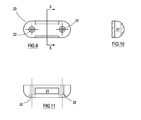
- a restraining block according to the present invention is shown in figures 9 to 11 in front, section and top view respectively.
- At both sides of the slot 21 (which could also be a blind cavity) there are through holes, 22, which are used for fastening the restraining block to the vertical wall P by screw means.
- the locking cam 30, is pivotably bound to the vertical member 101 by means of a rivet, 32, determining the locking cam pivot axis 31.
- the shape of the locking cam 30 can be clearly seen in figures 5 to 8 .
- a main body, 33, of the locking cam is a thin component having a substantially rectangular shape.
- At a longitudinal end of the main body there is a locking wall, 34, having a curvilinear outline whose bending radius has its center in the center of a hole, 35, which houses the rivet 32, that is on the pivot axis 31.
- the internal side of the locking wall 34 is also provided with a stiffening member, 36.
- the main body 33 is provided with handling means, 37, formed by a portion of the main body which has a greater thickness and which is properly shaped so that it can be grasped with two fingers.
- handling means 37 formed by a portion of the main body which has a greater thickness and which is properly shaped so that it can be grasped with two fingers.
- a protruding section, 38 In correspondence with the handling means 37, but extending on the opposite side of the main body 33 there is a protruding section, 38, with a little groove, 39, in the center, which, so, while the locking cam is being rotated in the locking position the protruding section at a certain rotation angle starts rubbing against the vertical member 101 until the groove 39 is vertically aligned with the vertical member, 101 and this is then a firm angular position of the locking cam.
- the locking cam 30 is in the locking position since the maximum dimension of the locking cam is longitudinally aligned with the vertical member 101 and the locking wall 34 is in its closest position to the restraining block 20.
- the distance between pivot axis 31 and the end of the locking wall 34 and the distance between the pivot axis 31 and the free end 12 of the hook member are designed so that in the locking position the gap between the locking wall 34 and the free end 12 of the hooking member is very small and the locking wall is then very close to the restraining block 20, so completely preventing the vertical slide of the ladder.
- the locking cam is in the release position, rotated of 90° with regard to the locking position.
- the distance between the locking cam 30 and the free end 12 of the hook member is at its maximum amount, that is the minimum dimension of the locking cam is aligned with the vertical member 101, so that the free end 12 can be disengaged from the restraining block 20 by lifting the ladder 100.
- the passage from the locking position to the release position and vice-versa, takes place in a very simple way by grasping the handling means 37 of the locking cam 30 and rotating the locking cam of 90°.
- the locking cam 30 may have a different shape with respect to the substantially rectangular shape shown in figures and described as an embodiment example.
- One edge of the locking cam could be provided with a protruding portion extending towards the vertical member 101, said protruding action being for abutting the vertical member and so defining a limit for the rotation movement of the locking cam.
- the rotation movement of the cam about the pivot axis 31 could be obtained by different means with respect to the disclosed handling means 37.
- transmission means could be provided for transmitting the sliding movement of a lever and converting it in the rotation movement of the locking cam.
- the restraining block 20 could have a different shape.
- the cavity 21 could be a blind cavity closed at the bottom and/or it could lack one or both the side portions where, in the represented embodiment, are provided the fastening holes 21 and 22.
- the fastening means could be different in number, arrangement, and type.
- the hook member 10, that in the represent embodiment is substantially a plug covering the end of the vertical member 101, could also be integral to the vertical member.
- the hook member 10 could also extend downwards along the vertical member 101 and it could also provide a hole or other means for pivotably binding the locking cam 30 to it instead of to the vertical member 101.
Landscapes
- Engineering & Computer Science (AREA)
- Mechanical Engineering (AREA)
- Architecture (AREA)
- Structural Engineering (AREA)
- Health & Medical Sciences (AREA)
- Public Health (AREA)
- Transportation (AREA)
- Ladders (AREA)
- Fittings On The Vehicle Exterior For Carrying Loads, And Devices For Holding Or Mounting Articles (AREA)
Abstract
Description
- The present invention concerns a locking system for fixed ladders for firmly bound the ladder to its support surface.
- Fixed ladder are structures made of two vertical members and a set of rungs or steps, and they could be composed of one or more lengths but they have the main feature of not being self-supporting, that is they need to be leaned against a vertical surface. This kind of rigid ladder is very widespread as it has a simple structure and little overall dimensions. In particular, due to the little dimensions they have in a plant view, rigid ladders are commonly used since ever as an accessory of bunk beds or in camping vehicles, such as campers or caravans.
- Nevertheless, rigid ladders have very little stability and that is an important limit in the above cited fields of use as, about bunk beds the ladder is used mainly by children and safety requirements are fundamental, while in camping vehicles there is the further trick that they have to be used in a room subject to vibrations, accelerations and other causes of instability.
- A solution which is commonly adopted to give the ladder a greater stability consists of providing the top ends of the ladder with hook shaped protuberances, so that the ladder can be bound to a top edge of a vertical surface. As it can be easily understood, though this solution improve the stability of the ladder, it do not completely impede the movement of the ladder since, as a consequence of hits, vibrations, or vertical forces in general applied to the ladder, the hook shaped end of the ladder can slip out of their housing with the ladder that falls down. In addiction, the use of hook shaped requires a top edge of the vertical support surface thin enough to be caught by the hook.
- Due to the above limits of the background art, which are particularly relevant in case of bunk beds or camping vehicles, it is strongly felt the need of looking for solution for making rigid ladders much more stable.
- It is object of the present invention to propose a locking system for rigid ladders having hook shaped top ends, for preventing fortuitous slipping out of the hook shaped and from its housing.
- It is further object of the present invention to propose a locking system for rigid ladders having hook shaped top ends apt to allow to safely lean the ladder to any vertical surface.
- It is another object of the present invention to propose a simple and safe locking system for rigid ladders that also have very low production costs.
- The above objects are attained by a locking system for rigid ladders, in particular in camping vehicles, comprising a rigid ladder providing at least a hook member at a top end, at least one restraining block for restraining said hook member, said restraining block being stably connectable to a surface where the ladder is to be leaned against and providing a cavity with at least a top opening for inserting said hook member; and at least one locking cam pivotably bound to said ladder in correspondence to said hook member at a predefined distance from said hook member, the minimum dimension of said locking cam being such to allow disengaging said hook member from said cavity, the maximum dimension of said locking cam being such to prevent disengaging of said hook member from said cavity, said locking cam comprising at least one thin main body with axis of rotation placed in an intermediate position of said main body.
- By acting on the angular position of the locking cam it is possible to fasten the hook shaped protuberance in its housing so preventing it from accidentally slipping out until the cam is rotated from the locking position.
- Advantageously, a longitudinal end of said cam provides a locking wall, the opposite longitudinal end providing handling means.
- Still advantageously the restraining block is bound to said surface by screw means.
- The locking cam is pivotably bound to said ladder by either screw means or rivets.
- In addiction the locking cam can be provided with a first protruding portion apt to press against said ladder in specific angular positions of said locking cam in order to create friction forces defining steady angular positions of said locking cam and/or with a second protruding portion apt to define surfaces facing specific surfaces of the ladder in order to define angular end stroke positions of said locking cam.
- It is clear that the locking system of the present invention is very simple and reliable and it makes rigid ladders very safe without complicating too much their structure and then without increasing their production costs. In addiction, the presence of restraining blocks allow to lean ladders with hook shaped top protuberances to any wall.
- These and more characteristics of the present invention will be more easily comprehensible thanks to the following description of a preferred embodiment, given as a non limiting example, with reference to the accompanying drawings in which:
-
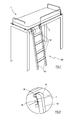
Figure 1 shows a perspective view of a bunk bed with a ladder provided with locking system according to the invention; -
Figure 2 is detailed view offig. 1 showing the locking system for fastening the ladder to the bed supporting structure; -
Figure 3 shows a side view of the locking system of the invention a ladder locking state; -
Figure 4 shows a view similar tofig. 3 with the locking system in the ladder unlocked state; -
Figures 5 to 8 show front, side, back and perspective views of a locking cam of a locking system according to the invention; -
Figures 9 to 11 show a front view, a section view made along line X-X offig. 9 , and a top view, of a restraining block of the locking system of the present invention. - In
fig. 1 it is visible a bunk bed, L, which has leaned, at a vertical wall, P, a rigid ladder, 100, comprising two vertical members, 101, four steps, 102, and, at the top end of each vertical member, a locking system according to the invention. - In the detailed view of
fig. 2 it can be seen one of the two areas where the ladder touch the vertical wall P. At the top end of the ladder there is a hook shaped member, 10, whose downward directed free end is housed in a restraining block, 20, bound to the wall P. Under thehook member 10, on the side facing the vertical wall P which is also the side where protrudes the free end of thehook member 10, is provided a locking cam, 30, pivotably bound to the ladder for rotating around an axis, 31. Thelocking cam 30, which is shown in the lock position infigures 1 and 2 , is shaped so that thehook member 10 can be disengaged from therestraining block 20 only when it is rotated around thepivot axis 31 at specific angular positions. - In
figures 3 and 4 the top end of thevertical member 101 is shown in side view with the locking system of the present invention arranged in lock position and in release position respectively. Thehook member 10 is formed by aportion 11 adapted to be firmly coupled to thevertical member 101 and a downward directed free end, 12, which together form a hook shape. The downward directedfree end 12 is adapted to enter a cavity, 21, of therestraining block 20. A restraining block according to the present invention is shown infigures 9 to 11 in front, section and top view respectively. In a center portion of therestraining block 20 there is a throughslot 21, whose size is adapted to receive thefree end 12 of thehook member 10. At both sides of the slot 21 (which could also be a blind cavity) there are through holes, 22, which are used for fastening the restraining block to the vertical wall P by screw means. - The
locking cam 30, is pivotably bound to thevertical member 101 by means of a rivet, 32, determining the lockingcam pivot axis 31. The shape of thelocking cam 30 can be clearly seen infigures 5 to 8 . A main body, 33, of the locking cam is a thin component having a substantially rectangular shape. At a longitudinal end of the main body there is a locking wall, 34, having a curvilinear outline whose bending radius has its center in the center of a hole, 35, which houses therivet 32, that is on thepivot axis 31. The internal side of thelocking wall 34 is also provided with a stiffening member, 36. Opposite with regard to said locking wall, themain body 33 is provided with handling means, 37, formed by a portion of the main body which has a greater thickness and which is properly shaped so that it can be grasped with two fingers. In correspondence with the handling means 37, but extending on the opposite side of themain body 33 there is a protruding section, 38, with a little groove, 39, in the center, which, so, while the locking cam is being rotated in the locking position the protruding section at a certain rotation angle starts rubbing against thevertical member 101 until thegroove 39 is vertically aligned with the vertical member, 101 and this is then a firm angular position of the locking cam. - In
fig. 3 thelocking cam 30 is in the locking position since the maximum dimension of the locking cam is longitudinally aligned with thevertical member 101 and thelocking wall 34 is in its closest position to therestraining block 20. In this embodiment the distance betweenpivot axis 31 and the end of thelocking wall 34 and the distance between thepivot axis 31 and thefree end 12 of the hook member are designed so that in the locking position the gap between thelocking wall 34 and thefree end 12 of the hooking member is very small and the locking wall is then very close to therestraining block 20, so completely preventing the vertical slide of the ladder. Anyway, for the locking action being effective, it is sufficient that, in the locking position, the above gap between thelocking wall 34 and thefree end 12 of the hooking member is lower than the depth of thecavity 21. - In
fig. 4 the locking cam is in the release position, rotated of 90° with regard to the locking position. In the release position the distance between thelocking cam 30 and thefree end 12 of the hook member is at its maximum amount, that is the minimum dimension of the locking cam is aligned with thevertical member 101, so that thefree end 12 can be disengaged from therestraining block 20 by lifting theladder 100. The passage from the locking position to the release position and vice-versa, takes place in a very simple way by grasping the handling means 37 of thelocking cam 30 and rotating the locking cam of 90°. - It is clear that the advantages of the above described locking system for rigid ladders remain safe even if modifications or different embodiment are carried out.
- The
locking cam 30 may have a different shape with respect to the substantially rectangular shape shown in figures and described as an embodiment example. One edge of the locking cam could be provided with a protruding portion extending towards thevertical member 101, said protruding action being for abutting the vertical member and so defining a limit for the rotation movement of the locking cam. The rotation movement of the cam about thepivot axis 31 could be obtained by different means with respect to the disclosed handling means 37. For instance, transmission means could be provided for transmitting the sliding movement of a lever and converting it in the rotation movement of the locking cam. Also therestraining block 20 could have a different shape. Thecavity 21 could be a blind cavity closed at the bottom and/or it could lack one or both the side portions where, in the represented embodiment, are provided thefastening holes hook member 10, that in the represent embodiment is substantially a plug covering the end of thevertical member 101, could also be integral to the vertical member. Thehook member 10 could also extend downwards along thevertical member 101 and it could also provide a hole or other means for pivotably binding thelocking cam 30 to it instead of to thevertical member 101. - These and other changes or modifications could be carried out to the locking system for rigid ladders of the present invention, still remaining within the ambit of protection defined by the following claims.
Claims (7)
- Locking system for fixed ladder, in particular for camping vehicles, characterized in that it comprises:- a ladder providing at least a hook member (10) at a top end;- at least one restraining block (20) for restraining said hook member (10), said restraining block (20) being stably connectable to a surface (P) where the ladder is to be leaned against and providing a cavity (21) with at least a top opening for inserting said hook member (10); and- at least one locking cam (30) pivotably bound to said ladder in correspondence to said hook member (10) at a predefined distance from said hook member, the minimum dimension of said locking cam (30) being such to allow disengaging said hook member (10) from said cavity (21), the maximum dimension of said locking cam (30) being such to prevent disengaging of said hook member (10) from said cavity (21), said locking cam (30) comprising at least one thin main body (33) with axis of rotation (31) placed in an intermediate position of said main body (33).
- Locking system for fixed rigid ladder according to claim 1 characterized in that a longitudinal end of said cam (30) provides a locking wall (34), the opposite longitudinal end providing handling means (37).
- Locking system for fixed rigid ladder according to claim 1 or 2 characterized in that said restraining block (20) is bound to said surface (P) by screw means.
- Locking system for fixed rigid ladder according to any preceding claim characterized in that said locking cam (30) is pivotably bound to said ladder by either screw means or rivets (32).
- Locking system for fixed rigid ladder according to any preceding claim characterized in that said locking cam (30) is provided with a first protruding portion (38) apt to press against said ladder in specific angular positions of said locking cam (30) in order to create friction forces defining steady angular positions of said locking cam (30).
- Locking system for fixed rigid ladder according to any preceding claim characterized in that said locking cam (30) is provided with a second protruding portion apt to define surfaces facing specific surfaces of the ladder in order to define angular end stroke positions of said locking cam (30).
- Fixed rigid ladder (100) of the type comprising hook members (10) on top characterized in that it comprises a locking system according one of claims 1 to 6.
Applications Claiming Priority (1)
| Application Number | Priority Date | Filing Date | Title |
|---|---|---|---|
| ITPI2009A000137A IT1396691B1 (en) | 2009-11-04 | 2009-11-04 | LOCKING SYSTEM FOR SUPPORTING STAIRS, IN PARTICULAR IN CAMPING VEHICLES. |
Publications (2)
| Publication Number | Publication Date |
|---|---|
| EP2319728A1 true EP2319728A1 (en) | 2011-05-11 |
| EP2319728B1 EP2319728B1 (en) | 2012-09-05 |
Family
ID=42224555
Family Applications (1)
| Application Number | Title | Priority Date | Filing Date |
|---|---|---|---|
| EP20100189716 Active EP2319728B1 (en) | 2009-11-04 | 2010-11-02 | Locking system for fixed ladder, in particular for camping vehicles |
Country Status (2)
| Country | Link |
|---|---|
| EP (1) | EP2319728B1 (en) |
| IT (1) | IT1396691B1 (en) |
Cited By (1)
| Publication number | Priority date | Publication date | Assignee | Title |
|---|---|---|---|---|
| GB2557286A (en) * | 2016-12-05 | 2018-06-20 | Vincent Cole Geoffrey | A Ladder Apparatus |
Citations (4)
| Publication number | Priority date | Publication date | Assignee | Title |
|---|---|---|---|---|
| GB610261A (en) * | 1946-04-03 | 1948-10-13 | Harry Gilbert | A new or improved means for preventing the slipping of ladders |
| GB945113A (en) * | 1959-04-10 | 1963-12-23 | Erismann Paul | Improvements in rack and like frames having vertically adjustable supports |
| FR2610362A1 (en) * | 1987-02-04 | 1988-08-05 | Sermeto Sa | Device for climbing up an object standing vertically such as a pole for overhead lines, ladders forming part thereof and objects standing vertically provided with the series of supports of this device |
| NL1026402C2 (en) * | 2004-06-11 | 2005-12-23 | Vebo Lift Support V O F | Holder device for supporting extendible ladder against wall, comprises holders on ladder and wall which can be detached or fixed in interlocking position |
-
2009
- 2009-11-04 IT ITPI2009A000137A patent/IT1396691B1/en active
-
2010
- 2010-11-02 EP EP20100189716 patent/EP2319728B1/en active Active
Patent Citations (4)
| Publication number | Priority date | Publication date | Assignee | Title |
|---|---|---|---|---|
| GB610261A (en) * | 1946-04-03 | 1948-10-13 | Harry Gilbert | A new or improved means for preventing the slipping of ladders |
| GB945113A (en) * | 1959-04-10 | 1963-12-23 | Erismann Paul | Improvements in rack and like frames having vertically adjustable supports |
| FR2610362A1 (en) * | 1987-02-04 | 1988-08-05 | Sermeto Sa | Device for climbing up an object standing vertically such as a pole for overhead lines, ladders forming part thereof and objects standing vertically provided with the series of supports of this device |
| NL1026402C2 (en) * | 2004-06-11 | 2005-12-23 | Vebo Lift Support V O F | Holder device for supporting extendible ladder against wall, comprises holders on ladder and wall which can be detached or fixed in interlocking position |
Cited By (2)
| Publication number | Priority date | Publication date | Assignee | Title |
|---|---|---|---|---|
| GB2557286A (en) * | 2016-12-05 | 2018-06-20 | Vincent Cole Geoffrey | A Ladder Apparatus |
| GB2557286B (en) * | 2016-12-05 | 2018-12-19 | Vincent Cole Geoffrey | A Collapsible Ladder Apparatus |
Also Published As
| Publication number | Publication date |
|---|---|
| ITPI20090137A1 (en) | 2011-05-05 |
| IT1396691B1 (en) | 2012-12-14 |
| EP2319728B1 (en) | 2012-09-05 |
Similar Documents
| Publication | Publication Date | Title |
|---|---|---|
| EP1849383B1 (en) | Hanger system | |
| US20110000630A1 (en) | Hanger Device for Window Shade | |
| US5636819A (en) | Toolless rafter and joist hanger | |
| EP2319728B1 (en) | Locking system for fixed ladder, in particular for camping vehicles | |
| CN216251276U (en) | Lift socket | |
| US20150096154A1 (en) | Snap Hook | |
| EP3939928A2 (en) | Safety latch for a hook | |
| CN107183896A (en) | Connect the lock and bag | |
| CN218478452U (en) | Anti-falling hook | |
| JP2003143268A5 (en) | ||
| EP2336480B1 (en) | Ladder with two lengths, in particular for camping vehicles | |
| CN217852550U (en) | Frying basket with separated handle and air frying pot | |
| US4061388A (en) | Safety becket | |
| KR200458247Y1 (en) | Carabiner | |
| KR200259818Y1 (en) | A lock | |
| CN218668913U (en) | Double-hook lock for sliding door | |
| JP3138550U (en) | Accessories storage box such as keys | |
| JP4446277B2 (en) | Bag lock | |
| CN212685779U (en) | Female trolley locking device and female trolley | |
| CN220607823U (en) | Sliding rail with lock | |
| CN221219482U (en) | Art relief stone material wall suspended structure | |
| JP7738492B2 (en) | Carabiner | |
| CN211270137U (en) | Dull and stereotyped bolt fixed knot constructs for cooking utensil | |
| CN213682227U (en) | Well lid lock with slide | |
| CN213820091U (en) | Novel convenient hasp |
Legal Events
| Date | Code | Title | Description |
|---|---|---|---|
| PUAI | Public reference made under article 153(3) epc to a published international application that has entered the european phase |
Free format text: ORIGINAL CODE: 0009012 |
|
| AK | Designated contracting states |
Kind code of ref document: A1 Designated state(s): AL AT BE BG CH CY CZ DE DK EE ES FI FR GB GR HR HU IE IS IT LI LT LU LV MC MK MT NL NO PL PT RO RS SE SI SK SM TR |
|
| AX | Request for extension of the european patent |
Extension state: BA ME |
|
| 17P | Request for examination filed |
Effective date: 20110803 |
|
| 17Q | First examination report despatched |
Effective date: 20111004 |
|
| GRAP | Despatch of communication of intention to grant a patent |
Free format text: ORIGINAL CODE: EPIDOSNIGR1 |
|
| GRAS | Grant fee paid |
Free format text: ORIGINAL CODE: EPIDOSNIGR3 |
|
| GRAA | (expected) grant |
Free format text: ORIGINAL CODE: 0009210 |
|
| AK | Designated contracting states |
Kind code of ref document: B1 Designated state(s): AL AT BE BG CH CY CZ DE DK EE ES FI FR GB GR HR HU IE IS IT LI LT LU LV MC MK MT NL NO PL PT RO RS SE SI SK SM TR |
|
| REG | Reference to a national code |
Ref country code: GB Ref legal event code: FG4D |
|
| REG | Reference to a national code |
Ref country code: CH Ref legal event code: EP |
|
| REG | Reference to a national code |
Ref country code: AT Ref legal event code: REF Ref document number: 573946 Country of ref document: AT Kind code of ref document: T Effective date: 20120915 |
|
| REG | Reference to a national code |
Ref country code: IE Ref legal event code: FG4D |
|
| REG | Reference to a national code |
Ref country code: DE Ref legal event code: R096 Ref document number: 602010002700 Country of ref document: DE Effective date: 20121025 |
|
| REG | Reference to a national code |
Ref country code: AT Ref legal event code: MK05 Ref document number: 573946 Country of ref document: AT Kind code of ref document: T Effective date: 20120905 |
|
| REG | Reference to a national code |
Ref country code: NL Ref legal event code: VDEP Effective date: 20120905 |
|
| PG25 | Lapsed in a contracting state [announced via postgrant information from national office to epo] |
Ref country code: LT Free format text: LAPSE BECAUSE OF FAILURE TO SUBMIT A TRANSLATION OF THE DESCRIPTION OR TO PAY THE FEE WITHIN THE PRESCRIBED TIME-LIMIT Effective date: 20120905 Ref country code: AT Free format text: LAPSE BECAUSE OF FAILURE TO SUBMIT A TRANSLATION OF THE DESCRIPTION OR TO PAY THE FEE WITHIN THE PRESCRIBED TIME-LIMIT Effective date: 20120905 Ref country code: HR Free format text: LAPSE BECAUSE OF FAILURE TO SUBMIT A TRANSLATION OF THE DESCRIPTION OR TO PAY THE FEE WITHIN THE PRESCRIBED TIME-LIMIT Effective date: 20120905 Ref country code: NO Free format text: LAPSE BECAUSE OF FAILURE TO SUBMIT A TRANSLATION OF THE DESCRIPTION OR TO PAY THE FEE WITHIN THE PRESCRIBED TIME-LIMIT Effective date: 20121205 Ref country code: FI Free format text: LAPSE BECAUSE OF FAILURE TO SUBMIT A TRANSLATION OF THE DESCRIPTION OR TO PAY THE FEE WITHIN THE PRESCRIBED TIME-LIMIT Effective date: 20120905 |
|
| REG | Reference to a national code |
Ref country code: LT Ref legal event code: MG4D Effective date: 20120905 |
|
| PG25 | Lapsed in a contracting state [announced via postgrant information from national office to epo] |
Ref country code: LV Free format text: LAPSE BECAUSE OF FAILURE TO SUBMIT A TRANSLATION OF THE DESCRIPTION OR TO PAY THE FEE WITHIN THE PRESCRIBED TIME-LIMIT Effective date: 20120905 Ref country code: SE Free format text: LAPSE BECAUSE OF FAILURE TO SUBMIT A TRANSLATION OF THE DESCRIPTION OR TO PAY THE FEE WITHIN THE PRESCRIBED TIME-LIMIT Effective date: 20120905 Ref country code: SI Free format text: LAPSE BECAUSE OF FAILURE TO SUBMIT A TRANSLATION OF THE DESCRIPTION OR TO PAY THE FEE WITHIN THE PRESCRIBED TIME-LIMIT Effective date: 20120905 Ref country code: GR Free format text: LAPSE BECAUSE OF FAILURE TO SUBMIT A TRANSLATION OF THE DESCRIPTION OR TO PAY THE FEE WITHIN THE PRESCRIBED TIME-LIMIT Effective date: 20121206 |
|
| PG25 | Lapsed in a contracting state [announced via postgrant information from national office to epo] |
Ref country code: CZ Free format text: LAPSE BECAUSE OF FAILURE TO SUBMIT A TRANSLATION OF THE DESCRIPTION OR TO PAY THE FEE WITHIN THE PRESCRIBED TIME-LIMIT Effective date: 20120905 Ref country code: ES Free format text: LAPSE BECAUSE OF FAILURE TO SUBMIT A TRANSLATION OF THE DESCRIPTION OR TO PAY THE FEE WITHIN THE PRESCRIBED TIME-LIMIT Effective date: 20121216 Ref country code: EE Free format text: LAPSE BECAUSE OF FAILURE TO SUBMIT A TRANSLATION OF THE DESCRIPTION OR TO PAY THE FEE WITHIN THE PRESCRIBED TIME-LIMIT Effective date: 20120905 Ref country code: RO Free format text: LAPSE BECAUSE OF FAILURE TO SUBMIT A TRANSLATION OF THE DESCRIPTION OR TO PAY THE FEE WITHIN THE PRESCRIBED TIME-LIMIT Effective date: 20120905 Ref country code: IS Free format text: LAPSE BECAUSE OF FAILURE TO SUBMIT A TRANSLATION OF THE DESCRIPTION OR TO PAY THE FEE WITHIN THE PRESCRIBED TIME-LIMIT Effective date: 20130105 Ref country code: BE Free format text: LAPSE BECAUSE OF FAILURE TO SUBMIT A TRANSLATION OF THE DESCRIPTION OR TO PAY THE FEE WITHIN THE PRESCRIBED TIME-LIMIT Effective date: 20120905 Ref country code: NL Free format text: LAPSE BECAUSE OF FAILURE TO SUBMIT A TRANSLATION OF THE DESCRIPTION OR TO PAY THE FEE WITHIN THE PRESCRIBED TIME-LIMIT Effective date: 20120905 |
|
| PG25 | Lapsed in a contracting state [announced via postgrant information from national office to epo] |
Ref country code: PL Free format text: LAPSE BECAUSE OF FAILURE TO SUBMIT A TRANSLATION OF THE DESCRIPTION OR TO PAY THE FEE WITHIN THE PRESCRIBED TIME-LIMIT Effective date: 20120905 Ref country code: PT Free format text: LAPSE BECAUSE OF FAILURE TO SUBMIT A TRANSLATION OF THE DESCRIPTION OR TO PAY THE FEE WITHIN THE PRESCRIBED TIME-LIMIT Effective date: 20130107 Ref country code: SK Free format text: LAPSE BECAUSE OF FAILURE TO SUBMIT A TRANSLATION OF THE DESCRIPTION OR TO PAY THE FEE WITHIN THE PRESCRIBED TIME-LIMIT Effective date: 20120905 |
|
| PLBE | No opposition filed within time limit |
Free format text: ORIGINAL CODE: 0009261 |
|
| STAA | Information on the status of an ep patent application or granted ep patent |
Free format text: STATUS: NO OPPOSITION FILED WITHIN TIME LIMIT |
|
| PG25 | Lapsed in a contracting state [announced via postgrant information from national office to epo] |
Ref country code: BG Free format text: LAPSE BECAUSE OF FAILURE TO SUBMIT A TRANSLATION OF THE DESCRIPTION OR TO PAY THE FEE WITHIN THE PRESCRIBED TIME-LIMIT Effective date: 20121205 Ref country code: RS Free format text: LAPSE BECAUSE OF FAILURE TO SUBMIT A TRANSLATION OF THE DESCRIPTION OR TO PAY THE FEE WITHIN THE PRESCRIBED TIME-LIMIT Effective date: 20120905 Ref country code: DK Free format text: LAPSE BECAUSE OF FAILURE TO SUBMIT A TRANSLATION OF THE DESCRIPTION OR TO PAY THE FEE WITHIN THE PRESCRIBED TIME-LIMIT Effective date: 20120905 |
|
| 26N | No opposition filed |
Effective date: 20130606 |
|
| REG | Reference to a national code |
Ref country code: IE Ref legal event code: MM4A |
|
| REG | Reference to a national code |
Ref country code: DE Ref legal event code: R097 Ref document number: 602010002700 Country of ref document: DE Effective date: 20130606 |
|
| PG25 | Lapsed in a contracting state [announced via postgrant information from national office to epo] |
Ref country code: IE Free format text: LAPSE BECAUSE OF NON-PAYMENT OF DUE FEES Effective date: 20121102 |
|
| PG25 | Lapsed in a contracting state [announced via postgrant information from national office to epo] |
Ref country code: MT Free format text: LAPSE BECAUSE OF FAILURE TO SUBMIT A TRANSLATION OF THE DESCRIPTION OR TO PAY THE FEE WITHIN THE PRESCRIBED TIME-LIMIT Effective date: 20120905 Ref country code: CY Free format text: LAPSE BECAUSE OF FAILURE TO SUBMIT A TRANSLATION OF THE DESCRIPTION OR TO PAY THE FEE WITHIN THE PRESCRIBED TIME-LIMIT Effective date: 20120905 Ref country code: AL Free format text: LAPSE BECAUSE OF FAILURE TO SUBMIT A TRANSLATION OF THE DESCRIPTION OR TO PAY THE FEE WITHIN THE PRESCRIBED TIME-LIMIT Effective date: 20120905 |
|
| PGFP | Annual fee paid to national office [announced via postgrant information from national office to epo] |
Ref country code: IT Payment date: 20131130 Year of fee payment: 4 |
|
| PG25 | Lapsed in a contracting state [announced via postgrant information from national office to epo] |
Ref country code: MC Free format text: LAPSE BECAUSE OF NON-PAYMENT OF DUE FEES Effective date: 20121130 Ref country code: TR Free format text: LAPSE BECAUSE OF FAILURE TO SUBMIT A TRANSLATION OF THE DESCRIPTION OR TO PAY THE FEE WITHIN THE PRESCRIBED TIME-LIMIT Effective date: 20120905 |
|
| PG25 | Lapsed in a contracting state [announced via postgrant information from national office to epo] |
Ref country code: SM Free format text: LAPSE BECAUSE OF FAILURE TO SUBMIT A TRANSLATION OF THE DESCRIPTION OR TO PAY THE FEE WITHIN THE PRESCRIBED TIME-LIMIT Effective date: 20120905 Ref country code: LU Free format text: LAPSE BECAUSE OF NON-PAYMENT OF DUE FEES Effective date: 20121102 |
|
| PG25 | Lapsed in a contracting state [announced via postgrant information from national office to epo] |
Ref country code: HU Free format text: LAPSE BECAUSE OF FAILURE TO SUBMIT A TRANSLATION OF THE DESCRIPTION OR TO PAY THE FEE WITHIN THE PRESCRIBED TIME-LIMIT Effective date: 20101102 |
|
| REG | Reference to a national code |
Ref country code: CH Ref legal event code: PL |
|
| GBPC | Gb: european patent ceased through non-payment of renewal fee |
Effective date: 20141102 |
|
| PG25 | Lapsed in a contracting state [announced via postgrant information from national office to epo] |
Ref country code: CH Free format text: LAPSE BECAUSE OF NON-PAYMENT OF DUE FEES Effective date: 20141130 Ref country code: LI Free format text: LAPSE BECAUSE OF NON-PAYMENT OF DUE FEES Effective date: 20141130 Ref country code: MK Free format text: LAPSE BECAUSE OF FAILURE TO SUBMIT A TRANSLATION OF THE DESCRIPTION OR TO PAY THE FEE WITHIN THE PRESCRIBED TIME-LIMIT Effective date: 20120905 |
|
| PG25 | Lapsed in a contracting state [announced via postgrant information from national office to epo] |
Ref country code: GB Free format text: LAPSE BECAUSE OF NON-PAYMENT OF DUE FEES Effective date: 20141102 |
|
| REG | Reference to a national code |
Ref country code: FR Ref legal event code: PLFP Year of fee payment: 6 |
|
| PG25 | Lapsed in a contracting state [announced via postgrant information from national office to epo] |
Ref country code: IT Free format text: LAPSE BECAUSE OF NON-PAYMENT OF DUE FEES Effective date: 20141102 |
|
| REG | Reference to a national code |
Ref country code: FR Ref legal event code: PLFP Year of fee payment: 7 |
|
| REG | Reference to a national code |
Ref country code: FR Ref legal event code: PLFP Year of fee payment: 8 |
|
| REG | Reference to a national code |
Ref country code: DE Ref legal event code: R082 Ref document number: 602010002700 Country of ref document: DE Representative=s name: ABITZ & PARTNER PATENTANWAELTE MBB, DE Ref country code: DE Ref legal event code: R081 Ref document number: 602010002700 Country of ref document: DE Owner name: LCI ITALY S.R.L., IT Free format text: FORMER OWNER: ST.LA.SRL, PONTEDERA (PI), IT |
|
| PGFP | Annual fee paid to national office [announced via postgrant information from national office to epo] |
Ref country code: DE Payment date: 20251126 Year of fee payment: 16 |
|
| PGFP | Annual fee paid to national office [announced via postgrant information from national office to epo] |
Ref country code: FR Payment date: 20251124 Year of fee payment: 16 |