EP2317599A2 - Prismatic-cell battery pack with integral coolant channels - Google Patents
Prismatic-cell battery pack with integral coolant channels Download PDFInfo
- Publication number
- EP2317599A2 EP2317599A2 EP20100179034 EP10179034A EP2317599A2 EP 2317599 A2 EP2317599 A2 EP 2317599A2 EP 20100179034 EP20100179034 EP 20100179034 EP 10179034 A EP10179034 A EP 10179034A EP 2317599 A2 EP2317599 A2 EP 2317599A2
- Authority
- EP
- European Patent Office
- Prior art keywords
- coolant
- prismatic
- cell
- battery
- battery pack
- Prior art date
- Legal status (The legal status is an assumption and is not a legal conclusion. Google has not performed a legal analysis and makes no representation as to the accuracy of the status listed.)
- Withdrawn
Links
- 239000002826 coolant Substances 0.000 title claims abstract description 82
- 230000002093 peripheral effect Effects 0.000 claims abstract description 13
- 238000011144 upstream manufacturing Methods 0.000 claims description 2
- 238000001816 cooling Methods 0.000 description 7
- 239000004033 plastic Substances 0.000 description 4
- 238000013459 approach Methods 0.000 description 3
- 239000006260 foam Substances 0.000 description 3
- 239000000463 material Substances 0.000 description 3
- 238000010586 diagram Methods 0.000 description 2
- 229910052751 metal Inorganic materials 0.000 description 2
- 239000002184 metal Substances 0.000 description 2
- 238000004806 packaging method and process Methods 0.000 description 2
- HBBGRARXTFLTSG-UHFFFAOYSA-N Lithium ion Chemical compound [Li+] HBBGRARXTFLTSG-UHFFFAOYSA-N 0.000 description 1
- 229910052782 aluminium Inorganic materials 0.000 description 1
- XAGFODPZIPBFFR-UHFFFAOYSA-N aluminium Chemical compound [Al] XAGFODPZIPBFFR-UHFFFAOYSA-N 0.000 description 1
- 230000005465 channeling Effects 0.000 description 1
- 239000004020 conductor Substances 0.000 description 1
- 238000013461 design Methods 0.000 description 1
- 230000000694 effects Effects 0.000 description 1
- 230000001747 exhibiting effect Effects 0.000 description 1
- 238000002955 isolation Methods 0.000 description 1
- 229910001416 lithium ion Inorganic materials 0.000 description 1
- 238000012986 modification Methods 0.000 description 1
- 230000004048 modification Effects 0.000 description 1
- 238000013021 overheating Methods 0.000 description 1
- 239000002985 plastic film Substances 0.000 description 1
- 229920006255 plastic film Polymers 0.000 description 1
- 239000012858 resilient material Substances 0.000 description 1
- 238000004513 sizing Methods 0.000 description 1
- 238000012546 transfer Methods 0.000 description 1
Images


Classifications
-
- H—ELECTRICITY
- H01—ELECTRIC ELEMENTS
- H01M—PROCESSES OR MEANS, e.g. BATTERIES, FOR THE DIRECT CONVERSION OF CHEMICAL ENERGY INTO ELECTRICAL ENERGY
- H01M10/00—Secondary cells; Manufacture thereof
- H01M10/60—Heating or cooling; Temperature control
- H01M10/61—Types of temperature control
- H01M10/613—Cooling or keeping cold
-
- H—ELECTRICITY
- H01—ELECTRIC ELEMENTS
- H01M—PROCESSES OR MEANS, e.g. BATTERIES, FOR THE DIRECT CONVERSION OF CHEMICAL ENERGY INTO ELECTRICAL ENERGY
- H01M10/00—Secondary cells; Manufacture thereof
- H01M10/60—Heating or cooling; Temperature control
- H01M10/62—Heating or cooling; Temperature control specially adapted for specific applications
- H01M10/625—Vehicles
-
- H—ELECTRICITY
- H01—ELECTRIC ELEMENTS
- H01M—PROCESSES OR MEANS, e.g. BATTERIES, FOR THE DIRECT CONVERSION OF CHEMICAL ENERGY INTO ELECTRICAL ENERGY
- H01M10/00—Secondary cells; Manufacture thereof
- H01M10/60—Heating or cooling; Temperature control
- H01M10/64—Heating or cooling; Temperature control characterised by the shape of the cells
- H01M10/647—Prismatic or flat cells, e.g. pouch cells
-
- H—ELECTRICITY
- H01—ELECTRIC ELEMENTS
- H01M—PROCESSES OR MEANS, e.g. BATTERIES, FOR THE DIRECT CONVERSION OF CHEMICAL ENERGY INTO ELECTRICAL ENERGY
- H01M10/00—Secondary cells; Manufacture thereof
- H01M10/60—Heating or cooling; Temperature control
- H01M10/65—Means for temperature control structurally associated with the cells
- H01M10/655—Solid structures for heat exchange or heat conduction
- H01M10/6556—Solid parts with flow channel passages or pipes for heat exchange
- H01M10/6557—Solid parts with flow channel passages or pipes for heat exchange arranged between the cells
-
- H—ELECTRICITY
- H01—ELECTRIC ELEMENTS
- H01M—PROCESSES OR MEANS, e.g. BATTERIES, FOR THE DIRECT CONVERSION OF CHEMICAL ENERGY INTO ELECTRICAL ENERGY
- H01M10/00—Secondary cells; Manufacture thereof
- H01M10/60—Heating or cooling; Temperature control
- H01M10/65—Means for temperature control structurally associated with the cells
- H01M10/656—Means for temperature control structurally associated with the cells characterised by the type of heat-exchange fluid
- H01M10/6561—Gases
- H01M10/6563—Gases with forced flow, e.g. by blowers
-
- H—ELECTRICITY
- H01—ELECTRIC ELEMENTS
- H01M—PROCESSES OR MEANS, e.g. BATTERIES, FOR THE DIRECT CONVERSION OF CHEMICAL ENERGY INTO ELECTRICAL ENERGY
- H01M10/00—Secondary cells; Manufacture thereof
- H01M10/60—Heating or cooling; Temperature control
- H01M10/65—Means for temperature control structurally associated with the cells
- H01M10/656—Means for temperature control structurally associated with the cells characterised by the type of heat-exchange fluid
- H01M10/6561—Gases
- H01M10/6566—Means within the gas flow to guide the flow around one or more cells, e.g. manifolds, baffles or other barriers
-
- H—ELECTRICITY
- H01—ELECTRIC ELEMENTS
- H01M—PROCESSES OR MEANS, e.g. BATTERIES, FOR THE DIRECT CONVERSION OF CHEMICAL ENERGY INTO ELECTRICAL ENERGY
- H01M10/00—Secondary cells; Manufacture thereof
- H01M10/60—Heating or cooling; Temperature control
- H01M10/61—Types of temperature control
- H01M10/617—Types of temperature control for achieving uniformity or desired distribution of temperature
-
- H—ELECTRICITY
- H01—ELECTRIC ELEMENTS
- H01M—PROCESSES OR MEANS, e.g. BATTERIES, FOR THE DIRECT CONVERSION OF CHEMICAL ENERGY INTO ELECTRICAL ENERGY
- H01M10/00—Secondary cells; Manufacture thereof
- H01M10/60—Heating or cooling; Temperature control
- H01M10/65—Means for temperature control structurally associated with the cells
- H01M10/651—Means for temperature control structurally associated with the cells characterised by parameters specified by a numeric value or mathematical formula, e.g. ratios, sizes or concentrations
- H01M10/652—Means for temperature control structurally associated with the cells characterised by parameters specified by a numeric value or mathematical formula, e.g. ratios, sizes or concentrations characterised by gradients
-
- H—ELECTRICITY
- H01—ELECTRIC ELEMENTS
- H01M—PROCESSES OR MEANS, e.g. BATTERIES, FOR THE DIRECT CONVERSION OF CHEMICAL ENERGY INTO ELECTRICAL ENERGY
- H01M6/00—Primary cells; Manufacture thereof
- H01M6/42—Grouping of primary cells into batteries
-
- Y—GENERAL TAGGING OF NEW TECHNOLOGICAL DEVELOPMENTS; GENERAL TAGGING OF CROSS-SECTIONAL TECHNOLOGIES SPANNING OVER SEVERAL SECTIONS OF THE IPC; TECHNICAL SUBJECTS COVERED BY FORMER USPC CROSS-REFERENCE ART COLLECTIONS [XRACs] AND DIGESTS
- Y02—TECHNOLOGIES OR APPLICATIONS FOR MITIGATION OR ADAPTATION AGAINST CLIMATE CHANGE
- Y02E—REDUCTION OF GREENHOUSE GAS [GHG] EMISSIONS, RELATED TO ENERGY GENERATION, TRANSMISSION OR DISTRIBUTION
- Y02E60/00—Enabling technologies; Technologies with a potential or indirect contribution to GHG emissions mitigation
- Y02E60/10—Energy storage using batteries
Definitions
- the present invention relates to a high-voltage battery pack containing prismatic battery cells arranged a lineal stack, and more particularly to prismatic-cell battery pack with integral coolant passages for forced-air cooling of the battery cells.
- High voltage battery packs can be configured for efficient space utilization by stacking and co-packaging battery cells of a prismatic (i.e., rectangular) form factor.
- the prismatic cells are typically arranged so that their terminals are all accessible from the top of the pack, and the terminals of adjacent cells lie in close proximity for convenient interconnection due to the thin profile of the cells.
- Lithium-ion batteries are well-suited to such applications because of their low weight, high power density and relatively high cell voltage, and because they can be produced at relatively low cost in prismatic form, particularly when encapsulated by a soft package of metalized plastic film instead of a rigid plastic or metal case.
- soft-package cells When soft-package cells are used, they can be conveniently mounted in stackable rigid plastic frames, as shown for example, in the U.S. Patent Publication No. 2006/01232119 .
- foam pads can be used for cell-to-cell isolation and to compressively support the cells.
- a serious challenge involved in the design of a battery pack is the provision of adequate cooling for the individual cells. This is particularly true in hybrid vehicle and other applications that require the battery pack to supply large amounts of energy at a high rate.
- the usual approach is to attach one or more liquid-cooled or air-cooled heatsinks to the bottom and/or sides of the battery pack, and to use metal heat runners to transfer heat from the battery cells to the heatsinks by conduction. While this approach can be effective if sufficient space is available to accommodate the heatsinks, space and weight considerations often take precedence, forcing sub-optimal sizing and placement of the heatsinks.
- the effectiveness of this approach is hampered for two additional reasons: first, the heat produced in a battery cell is greatest near its terminals, which may be separated from the heatsinks by a substantial distance; and second, the cooling medium rises in temperature as it travels through the heatsink, which degrades heat rejection capability at the downstream end of the heatsink. And since over-heating can permanently damage a battery cell, the power output of the battery pack often has to be limited to preserve battery pack life expectancy. Accordingly, what is needed is a way of more effectively and uniformly cooling a prismatic-cell battery pack so that its life and performance will not be heat-limited.
- the present invention is directed to a prismatic-cell battery pack, comprising a set of battery cell modules arranged and interlocked in a lineal stack, each battery cell module including at least one prismatic battery cell supported in thermal proximity to an array of coolant channels distributed over a profile of the battery cell, and a pair of peripheral chambers joined to opposite ends of the coolant channels to form intake and exhaust plenums respectively upstream and downstream of said coolant channels when the modules are lineally arranged and interlocked.
- the coolant supplied to the intake plenum enters the coolant channels of each module in parallel, cools the respective battery cells, and is returned to the exhaust plenum for expulsion from the battery pack.
- the intake and exhaust plenums are disposed near a first end of the battery cell, and the coolant channels of each module conduct coolant from the intake plenum toward a second end of the battery cell and then back into the exhaust plenum.
- the battery cell further comprises a coolant inlet cap that blocks the exhaust plenum but establishes a coolant inlet airway between the intake plenum and an inlet port formed in the coolant inlet cap and a coolant outlet cap that blocks the intake plenum but establishes a coolant outlet airway between the exhaust plenum and an outlet port formed in the coolant outlet cap.
- the battery cell modules may comprise a first and a second prismatic battery cells and, a first and a second mutually joined inner frame members having sculpted inboard faces that form said array of coolant channels, and planar outboard faces that are thermally coupled to said first and second battery cells.
- the first and second inner frame members have peripheral openings that form said pair of peripheral chambers.
- the prismatic-cell battery pack further comprise a peripheral seal between said first and second inner frame members to prevent coolant leakage from said array of coolant channels and said peripheral chambers.
- the prismatic-cell battery pack may also comprises a seal between said first and second inner frame members to prevent coolant leakage between said pair of peripheral chambers.
- FIG. 1 is an isometric view of a prismatic-cell battery pack according to this invention.
- FIG. 2 is an isometric view of a battery cell module of the battery pack of FIG. 1 .
- FIG. 3 is a partially sectioned isometric view of the battery pack of FIG. 1 , illustrating coolant flow through a representative battery cell module.
- FIG. 4 is an abbreviated coolant flow diagram for the battery pack of FIG. 1 .
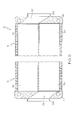
- FIG. 5 is a partial cross-sectional view illustrating inlet and outlet end caps for the battery pack of FIG. 1 .
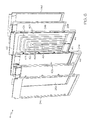
- FIG. 6 is an exploded isometric view of the battery cell module of FIG. 2 .
- the reference numeral 10 generally designates prismatic-cell battery pack according to this invention.
- the battery pack 10 includes a lineal stack 12 of battery cell modules 14 longitudinally bounded by first and second end pieces 16 and 18, an inlet end cap 20, and an outlet end cap 22.
- each of the battery cell modules 14 includes a set of interlocking frames 24 for supporting and retaining a pair of prismatic battery cells 26 (only one of which is shown in FIG. 2 ), and for channeling coolant in proximity to the battery cells 26.
- the battery cells 26 are preferably soft-package cells, and a pad of resilient material such as open-cell foam (not shown) is inserted between each of the battery cell modules 14 of the stack 12 to support and compressively load the non-marginal portions of the battery cells 26.
- the battery pack elements may be held in place, for example, by a set of fasteners routed through suitable openings (not shown) in the modules 14 and end pieces 16, 18.
- each of the battery cell modules 14 includes a set of coolant passages, including an intake chamber 28, an exhaust chamber 30, and several U-shaped coolant channels 32a, 32b, 32c, 32d (as represented by phantom flow lines) that couple the intake chamber 28 to the exhaust chamber 30.
- the various intake chambers 28 axially align to form an intake plenum 34 that extends the length of the stack 12, and the various exhaust chambers 30 similarly align to form an exhaust plenum 36 that also extends the length of the stack 12.
- FIG. 1 illustrates the various intake chambers 28 axially align to form an intake plenum 34 that extends the length of the stack 12
- the various exhaust chambers 30 similarly align to form an exhaust plenum 36 that also extends the length of the stack 12.
- the coolant inlet cap 20 blocks the exhaust plenum 36 but establishes an airway 38 between intake plenum 34 and an inlet port 20a formed in the coolant inlet cap 20.
- the coolant outlet cap 22 blocks the intake plenum 34 but establishes an airway 39 between exhaust plenum 36 and an outlet port 22a formed in the coolant outlet cap 22. Accordingly, and as illustrated in the coolant flow diagram of FIG. 4 , coolant (forced air, for example) entering inlet port 20a is directed into the intake plenum 34, through the U-shaped coolant channels 32a-32d in each of the stacked battery cell modules 14, into the exhaust plenum 36, and is expelled from the outlet port 22a.
- each module 14 receives coolant from the intake plenum 34, as opposed to coolant that has already passed through another module 14 of the pack 10.
- the cooling performance is substantially equivalent for each battery cell module 14 of the pack 10.
- the U-shaped coolant channels 32a-32d traverse substantially the entire surface area of the respective battery cells 26 to prevent any battery cell hot-spots, particularly in the region of the battery terminals where much of the battery cell heat is generated. While the temperature of the coolant will obviously rise as it traverses the U-shaped coolant channels 32a-32d, the coolant flow can be controlled to provide sufficient cooling to the battery cell portions adjacent the downstream ends of the coolant channels 32a-32d. Also, the coolant channels 32a, 32b, 32c, 32d in a given battery call module 14 can vary in width to achieve a desired coolant flow distribution for optimal cooling performance.
- each of the battery cell modules 14 is constructed as an assembly of two prismatic battery cells 26a, 26b and a set of four interlocking frame members 24a-24d.
- the two inner frame members 24a and 24b are identical, as are the two outer frame members 24c and 24d.
- the modules 14 also include a provision for suitably interconnecting the battery cell terminals 48a, 48b, 48c, 48d, and the battery cells 26a, 26b may be placed in an orientation that facilitates the desired series or parallel battery terminal interconnection.
- the two inner frame members 24a and 24b each have a planar outboard face 40a and sculpted inboard face 40b.
- the outboard faces 40a provide smooth support surfaces for the battery cells 26a and 26b
- the sculpted inboard faces 40b form the U-shaped coolant channels 32a-32d.
- the coolant channels 32a, 32b, 32c, 32d are formed by a set of nested U-shaped recesses 42a, 42b, 42c, 42d on the inboard face 40b of each inner frame member 24a, 24b.
- the opposed recesses 42a-42d on the inboard faces 40b of frame members 24a and 24b abut when the frame members 24a and 24b are joined, thereby forming the U-shaped coolant channels 32a-32d.
- the inner frame members 24a, 24b also include lower openings or apertures 44 that align as indicated to form the intake and exhaust chambers 28 and 30 mentioned above in reference to FIG. 2 .
- the recesses 42a-42d open at one end into the openings 44 that form the intake chamber 28, and at the other end into the openings 44 that form the exhaust chamber 30, to produce the coolant flow illustrated in FIG. 4 when coolant is supplied to the inlet port 20a.
- a tongue-in-groove seal 46 near the periphery of the inner frame members 24a, 24b prevents coolant leaks to atmosphere; and a tongue-in-groove seal 48 in a central portion of the inner frame members 24a, 24b prevents coolant leakage between intake and exhaust plenums 34, 36. It is expected that some coolant leakage between adjacent coolant channels 32a-32d may occur, but any such leakage will be both minor and inconsequential.
- the battery cells 26a, 26b are maintained in contact with the smooth and planar outboard faces 40 of the inner frame members 24a, 24b, and the coolant in coolant channels 32a-32d is only separated from the battery cells 26a, 26b by the local thickness of the respective inner frame member 24a or 24b, which may be on the order of 1 mm or less. Accordingly, heat produced by the battery cells 26a, 26b is quickly and efficiently transferred to the coolant flowing in coolant channels 32a-32d, even if the inner frame members 24a, 24b are constructed of a material such as plastic.
- the inner frame members 24a, 24b could be constructed of a material exhibiting high thermal conductivity if desired.
- the two outer frame members 24c and 24d fasten to the inner frame members 24a and 24b, respectively, to retain the prismatic battery cells 26a and 26b in the module 14.
- the terminal and marginal portions of each battery cell 26a, 26b are sandwiched between an inner frame member 24a, 24b and an outer frame member 24c, 24d.
- the inter-module foam pads press against the exposed non-marginal portions of the battery cells 26a and 26b to maintain them in abutment with the exterior surfaces 40 of the inner frame members 24a and 24b.
- present invention provides an effective and low-cost packaging arrangement for efficiently and uniformly cooling a prismatic-cell battery pack with a flow-through coolant.
- Integrating the coolant channels 32a-32d and plenums 34, 36 into the frames 24a, 24b that support the cells 26 of the battery pack 10 contributes to low overall cost, and ensures that the coolant will uniformly cool each of the cells 26.
- the use of identical parts in reverse orientation (for example, the inlet and outlet end caps 20, 22, the inner frame members 24a, 24b, and the outer frame members 24c, 24d) also contributes to low overall cost of the battery pack 10.
Landscapes
- Engineering & Computer Science (AREA)
- Manufacturing & Machinery (AREA)
- Chemical & Material Sciences (AREA)
- Chemical Kinetics & Catalysis (AREA)
- Electrochemistry (AREA)
- General Chemical & Material Sciences (AREA)
- Secondary Cells (AREA)
- Battery Mounting, Suspending (AREA)
Abstract
Description
- The present invention relates to a high-voltage battery pack containing prismatic battery cells arranged a lineal stack, and more particularly to prismatic-cell battery pack with integral coolant passages for forced-air cooling of the battery cells.
- High voltage battery packs can be configured for efficient space utilization by stacking and co-packaging battery cells of a prismatic (i.e., rectangular) form factor. The prismatic cells are typically arranged so that their terminals are all accessible from the top of the pack, and the terminals of adjacent cells lie in close proximity for convenient interconnection due to the thin profile of the cells. Lithium-ion batteries are well-suited to such applications because of their low weight, high power density and relatively high cell voltage, and because they can be produced at relatively low cost in prismatic form, particularly when encapsulated by a soft package of metalized plastic film instead of a rigid plastic or metal case. When soft-package cells are used, they can be conveniently mounted in stackable rigid plastic frames, as shown for example, in the
U.S. Patent Publication No. 2006/01232119 - A serious challenge involved in the design of a battery pack is the provision of adequate cooling for the individual cells. This is particularly true in hybrid vehicle and other applications that require the battery pack to supply large amounts of energy at a high rate. The usual approach is to attach one or more liquid-cooled or air-cooled heatsinks to the bottom and/or sides of the battery pack, and to use metal heat runners to transfer heat from the battery cells to the heatsinks by conduction. While this approach can be effective if sufficient space is available to accommodate the heatsinks, space and weight considerations often take precedence, forcing sub-optimal sizing and placement of the heatsinks. Moreover, the effectiveness of this approach is hampered for two additional reasons: first, the heat produced in a battery cell is greatest near its terminals, which may be separated from the heatsinks by a substantial distance; and second, the cooling medium rises in temperature as it travels through the heatsink, which degrades heat rejection capability at the downstream end of the heatsink. And since over-heating can permanently damage a battery cell, the power output of the battery pack often has to be limited to preserve battery pack life expectancy. Accordingly, what is needed is a way of more effectively and uniformly cooling a prismatic-cell battery pack so that its life and performance will not be heat-limited.
- The present invention is directed to a prismatic-cell battery pack, comprising a set of battery cell modules arranged and interlocked in a lineal stack, each battery cell module including at least one prismatic battery cell supported in thermal proximity to an array of coolant channels distributed over a profile of the battery cell, and a pair of peripheral chambers joined to opposite ends of the coolant channels to form intake and exhaust plenums respectively upstream and downstream of said coolant channels when the modules are lineally arranged and interlocked. The coolant supplied to the intake plenum enters the coolant channels of each module in parallel, cools the respective battery cells, and is returned to the exhaust plenum for expulsion from the battery pack. The intake and exhaust plenums are disposed near a first end of the battery cell, and the coolant channels of each module conduct coolant from the intake plenum toward a second end of the battery cell and then back into the exhaust plenum. The battery cell further comprises a coolant inlet cap that blocks the exhaust plenum but establishes a coolant inlet airway between the intake plenum and an inlet port formed in the coolant inlet cap and a coolant outlet cap that blocks the intake plenum but establishes a coolant outlet airway between the exhaust plenum and an outlet port formed in the coolant outlet cap.
- More particularly, the battery cell modules may comprise a first and a second prismatic battery cells and, a first and a second mutually joined inner frame members having sculpted inboard faces that form said array of coolant channels, and planar outboard faces that are thermally coupled to said first and second battery cells. The first and second inner frame members have peripheral openings that form said pair of peripheral chambers. The prismatic-cell battery pack further comprise a peripheral seal between said first and second inner frame members to prevent coolant leakage from said array of coolant channels and said peripheral chambers. The prismatic-cell battery pack may also comprises a seal between said first and second inner frame members to prevent coolant leakage between said pair of peripheral chambers.
-
FIG. 1 is an isometric view of a prismatic-cell battery pack according to this invention. -
FIG. 2 is an isometric view of a battery cell module of the battery pack ofFIG. 1 . -
FIG. 3 is a partially sectioned isometric view of the battery pack ofFIG. 1 , illustrating coolant flow through a representative battery cell module. -
FIG. 4 is an abbreviated coolant flow diagram for the battery pack ofFIG. 1 . -
FIG. 5 is a partial cross-sectional view illustrating inlet and outlet end caps for the battery pack ofFIG. 1 . -
FIG. 6 is an exploded isometric view of the battery cell module ofFIG. 2 . - Referring to the drawings, and particularly to
FIGS. 1-3 , thereference numeral 10 generally designates prismatic-cell battery pack according to this invention. In general, thebattery pack 10 includes alineal stack 12 ofbattery cell modules 14 longitudinally bounded by first andsecond end pieces inlet end cap 20, and anoutlet end cap 22. Referring particularly toFIG. 2 , each of thebattery cell modules 14 includes a set ofinterlocking frames 24 for supporting and retaining a pair of prismatic battery cells 26 (only one of which is shown inFIG. 2 ), and for channeling coolant in proximity to thebattery cells 26. Thebattery cells 26 are preferably soft-package cells, and a pad of resilient material such as open-cell foam (not shown) is inserted between each of thebattery cell modules 14 of thestack 12 to support and compressively load the non-marginal portions of thebattery cells 26. The battery pack elements may be held in place, for example, by a set of fasteners routed through suitable openings (not shown) in themodules 14 andend pieces - Referring to
FIG. 2 , each of thebattery cell modules 14 includes a set of coolant passages, including anintake chamber 28, anexhaust chamber 30, and severalU-shaped coolant channels intake chamber 28 to theexhaust chamber 30. When thebattery cell modules 14 are arranged and interlocked in a lineal stack as shown inFIGS. 1 and3 , thevarious intake chambers 28 axially align to form anintake plenum 34 that extends the length of thestack 12, and thevarious exhaust chambers 30 similarly align to form anexhaust plenum 36 that also extends the length of thestack 12. As illustrated inFIG. 5 , thecoolant inlet cap 20 blocks theexhaust plenum 36 but establishes anairway 38 betweenintake plenum 34 and aninlet port 20a formed in thecoolant inlet cap 20. Conversely, thecoolant outlet cap 22 blocks theintake plenum 34 but establishes anairway 39 betweenexhaust plenum 36 and anoutlet port 22a formed in thecoolant outlet cap 22. Accordingly, and as illustrated in the coolant flow diagram ofFIG. 4 , coolant (forced air, for example) enteringinlet port 20a is directed into theintake plenum 34, through theU-shaped coolant channels 32a-32d in each of the stackedbattery cell modules 14, into theexhaust plenum 36, and is expelled from theoutlet port 22a. - The temperature of the coolant entering each of the
battery cell modules 14 is essentially the same because eachmodule 14 receives coolant from theintake plenum 34, as opposed to coolant that has already passed throughanother module 14 of thepack 10. As a result, the cooling performance is substantially equivalent for eachbattery cell module 14 of thepack 10. Additionally, the U-shapedcoolant channels 32a-32d traverse substantially the entire surface area of therespective battery cells 26 to prevent any battery cell hot-spots, particularly in the region of the battery terminals where much of the battery cell heat is generated. While the temperature of the coolant will obviously rise as it traverses the U-shapedcoolant channels 32a-32d, the coolant flow can be controlled to provide sufficient cooling to the battery cell portions adjacent the downstream ends of thecoolant channels 32a-32d. Also, thecoolant channels battery call module 14 can vary in width to achieve a desired coolant flow distribution for optimal cooling performance. - Referring to
FIG. 6 , each of thebattery cell modules 14 is constructed as an assembly of twoprismatic battery cells frame members 24a-24d. The twoinner frame members outer frame members FIG. 6 , themodules 14 also include a provision for suitably interconnecting the battery cell terminals 48a, 48b, 48c, 48d, and thebattery cells - The two
inner frame members planar outboard face 40a and sculptedinboard face 40b. When they are arranged as shown inFIG. 6 and mutually joined, the outboard faces 40a provide smooth support surfaces for thebattery cells inboard faces 40b form theU-shaped coolant channels 32a-32d. Specifically, thecoolant channels nested U-shaped recesses inboard face 40b of eachinner frame member opposed recesses 42a-42d on theinboard faces 40b offrame members frame members coolant channels 32a-32d. Theinner frame members apertures 44 that align as indicated to form the intake andexhaust chambers FIG. 2 . Therecesses 42a-42d open at one end into theopenings 44 that form theintake chamber 28, and at the other end into theopenings 44 that form theexhaust chamber 30, to produce the coolant flow illustrated inFIG. 4 when coolant is supplied to theinlet port 20a. A tongue-in-groove seal 46 near the periphery of theinner frame members groove seal 48 in a central portion of theinner frame members exhaust plenums adjacent coolant channels 32a-32d may occur, but any such leakage will be both minor and inconsequential. - The
battery cells inner frame members coolant channels 32a-32d is only separated from thebattery cells inner frame member battery cells coolant channels 32a-32d, even if theinner frame members inner frame members inner frame members inner frame members - The two
outer frame members inner frame members prismatic battery cells module 14. In effect, the terminal and marginal portions of eachbattery cell inner frame member outer frame member FIG. 1 , press against the exposed non-marginal portions of thebattery cells inner frame members - In summary, present invention provides an effective and low-cost packaging arrangement for efficiently and uniformly cooling a prismatic-cell battery pack with a flow-through coolant. Integrating the
coolant channels 32a-32d andplenums frames cells 26 of thebattery pack 10 contributes to low overall cost, and ensures that the coolant will uniformly cool each of thecells 26. The use of identical parts in reverse orientation (for example, the inlet and outlet end caps 20, 22, theinner frame members outer frame members battery pack 10. - While the present invention has been described with respect to the illustrated embodiment, it is recognized that numerous modifications and variations in addition to those mentioned herein will occur to those skilled in the art. For example, the number of
coolant channels 32a-32d in abattery cell module 14 may be different than shown, as may the number ofbattery cells 26 in abattery cell module 14, and so on. Accordingly, it is intended that the invention not be limited to the disclosed embodiment, but that it have the full scope permitted by the language of the following claims.
Claims (7)
- A prismatic-cell battery pack (10), comprising:a set of battery cell modules (14) arranged and interlocked in a lineal stack (12), each battery cell module (14) including at least one prismatic battery cell (26) supported in thermal proximity to an array of coolant channels (32a-32d) distributed over a profile of the battery cell (26), and a pair of peripheral chambers (28, 30) joined to opposite ends of the coolant channels (32a-32d) to form intake and exhaust plenums (34, 36) respectively upstream and downstream of said coolant channels (32a-32d) when the modules (14) are lineally arranged and interlocked, characterized in that the coolant supplied to the intake plenum (34) enters the coolant channels (32a-32d) of each module (14) in parallel, cools the respective battery cells (26), and is returned to the exhaust plenum (36) for expulsion from the battery pack (10).
- The prismatic-cell battery pack of claim 1, where:the intake and exhaust plenums (34, 36) are disposed near a first end of the battery cell (26), and the coolant channels (32a-32d) of each module (14) conduct coolant from the intake plenum (34) toward a second end of the battery cell (26) and then back into the exhaust plenum (36).
- The prismatic-cell battery pack as set in any of the preceding claim, further comprising:a coolant inlet cap (20) that blocks the exhaust plenum (36) but establishes a coolant inlet airway (38) between the intake plenum (34) and an inlet port (20a) formed in the coolant inlet cap (20); anda coolant outlet cap (22) that blocks the intake plenum (34) but establishes a coolant outlet airway (39) between the exhaust plenum (36) and an outlet port (22a) formed in the coolant outlet cap (22).
- The prismatic-cell battery pack as set in any of the preceding claim, where said battery cell modules comprise:first and second prismatic battery cells (26a, 26b); andfirst and second mutually joined inner frame members (24a, 24b) having sculpted inboard faces (40b) that form said array of coolant channels (32a-32d), and planar outboard faces (40a) that are thermally coupled to said first and second battery cells (26a, 26b).
- The prismatic-cell battery pack of claim 4, where:said first and second inner frame members (24a, 24b) have peripheral openings (44) that form said pair of peripheral chambers (28, 30).
- The prismatic-cell battery pack as set in any of the claim 4 or 5, further comprising:a peripheral seal (46) between said first and second inner frame members (24a, 24b) to prevent coolant leakage from said array of coolant channels (32a-32d) and said peripheral chambers (28, 30).
- The prismatic-cell battery pack as set in any of the claim 4 to 6, further comprising:a seal (48) between said first and second inner frame members (24a, 24b) to prevent coolant leakage between said pair of peripheral chambers (28, 30).
Applications Claiming Priority (1)
| Application Number | Priority Date | Filing Date | Title |
|---|---|---|---|
| US12/611,168 US8039139B2 (en) | 2009-11-03 | 2009-11-03 | Prismatic-cell battery pack with integral coolant passages |
Publications (2)
| Publication Number | Publication Date |
|---|---|
| EP2317599A2 true EP2317599A2 (en) | 2011-05-04 |
| EP2317599A3 EP2317599A3 (en) | 2014-11-05 |
Family
ID=42231449
Family Applications (1)
| Application Number | Title | Priority Date | Filing Date |
|---|---|---|---|
| EP20100179034 Withdrawn EP2317599A3 (en) | 2009-11-03 | 2010-09-23 | Prismatic-cell battery pack with integral coolant channels |
Country Status (2)
| Country | Link |
|---|---|
| US (1) | US8039139B2 (en) |
| EP (1) | EP2317599A3 (en) |
Families Citing this family (20)
| Publication number | Priority date | Publication date | Assignee | Title |
|---|---|---|---|---|
| US8877366B2 (en) * | 2010-01-04 | 2014-11-04 | GM Global Technology Operations LLC | Cooling plate for lithium-ion battery pack |
| US8802264B2 (en) * | 2010-05-06 | 2014-08-12 | GM Global Technology Operations LLC | Easy-to-assemble battery pack with prismatic battery cells |
| US8673473B2 (en) | 2010-08-10 | 2014-03-18 | GM Global Technology Operations LLC | Integrated cooling fin and frame |
| US9385360B2 (en) | 2010-08-10 | 2016-07-05 | GM Global Technology Operations LLC | Integrated stackable battery |
| US20120045672A1 (en) | 2010-08-23 | 2012-02-23 | Delphi Technologies, Inc. | Vented battery pack |
| FR2974249B1 (en) * | 2011-04-12 | 2015-03-27 | Peugeot Citroen Automobiles Sa | MODULAR TEMPERATURE TRANSPORT DEVICE FOR A MOTOR VEHICLE BATTERY, METHOD FOR MOUNTING THE SAME, AND MOTOR VEHICLE BATTERY COMPRISING SUCH A DEVICE |
| WO2012151190A2 (en) * | 2011-05-05 | 2012-11-08 | Bright Automotive, Inc. | Close-coupled dry battery system for hybrid and electric vehicles |
| US8835039B2 (en) * | 2011-10-21 | 2014-09-16 | Avl Powertrain Engineering, Inc. | Battery cooling plate and cooling system |
| US20130171491A1 (en) * | 2011-12-30 | 2013-07-04 | PEV Power Systems Inc. | Apparatus for transferring thermal energy to or from a battery cell |
| JP2013157182A (en) * | 2012-01-30 | 2013-08-15 | Denso Corp | Battery temperature controller |
| GB2502976B (en) * | 2012-06-11 | 2016-06-01 | Jaguar Land Rover Ltd | A vehicle battery pack |
| DE102013204195B4 (en) | 2013-03-12 | 2014-11-13 | Continental Automotive Gmbh | Device and system for tempering an energy storage and battery module with such a system |
| US20150263397A1 (en) * | 2014-03-13 | 2015-09-17 | Ford Global Technologies, Llc | Side mounted traction battery thermal plate |
| US9995535B2 (en) * | 2015-06-30 | 2018-06-12 | Faraday&Future Inc. | Heat pipe for vehicle energy-storage systems |
| US11135910B2 (en) * | 2017-06-25 | 2021-10-05 | Brp-Rotax Gmbh & Co. Kg | Electric kart and battery |
| KR102274518B1 (en) * | 2017-09-29 | 2021-07-06 | 주식회사 엘지에너지솔루션 | Cooling jacket having an ununiformed flow channels for cooling an secondary battery cell and battery module including the same |
| CN207338582U (en) * | 2017-09-30 | 2018-05-08 | 比亚迪股份有限公司 | Battery pack and vehicle for vehicle |
| CN109360916B (en) * | 2018-11-29 | 2024-02-02 | 山东交通学院 | Battery device with intelligent temperature control function |
| FR3084525B1 (en) * | 2019-02-14 | 2020-12-25 | Hutchinson | ELECTRIC BATTERY THERMAL MANAGEMENT STRUCTURE |
| US11799151B1 (en) * | 2020-08-20 | 2023-10-24 | Moog Inc. | Vehicle battery cell cooling assembly |
Citations (1)
| Publication number | Priority date | Publication date | Assignee | Title |
|---|---|---|---|---|
| US20060123219A1 (en) | 2002-06-25 | 2006-06-08 | Samra Nicholas G | Intra-instruction fusion |
Family Cites Families (8)
| Publication number | Priority date | Publication date | Assignee | Title |
|---|---|---|---|---|
| DE19503085C2 (en) * | 1995-02-01 | 1997-02-20 | Deutsche Automobilgesellsch | Battery module with several electrochemical cells |
| JP2006236826A (en) * | 2005-02-25 | 2006-09-07 | Toyota Motor Corp | Battery pack |
| US9653748B2 (en) * | 2005-04-14 | 2017-05-16 | Enerdel, Inc. | Apparatus and method for securing battery cell packs |
| KR20070013455A (en) * | 2005-07-26 | 2007-01-31 | 삼성에스디아이 주식회사 | Secondary battery module |
| US8598739B2 (en) * | 2008-02-29 | 2013-12-03 | Kawasaki Jukogyo Kabushiki Kaisha | Electric railway power-supply system |
| US8465863B2 (en) * | 2008-04-09 | 2013-06-18 | GM Global Technology Operations LLC | Batteries and components thereof and methods of making and assembling the same |
| US7851080B2 (en) * | 2008-04-09 | 2010-12-14 | Gm Global Technology Operations, Inc. | Battery cooling plate design with discrete channels |
| US8563154B2 (en) * | 2009-05-06 | 2013-10-22 | GM Global Technology Operations LLC | Battery assembly with immersed cell temperature regulating |
-
2009
- 2009-11-03 US US12/611,168 patent/US8039139B2/en active Active
-
2010
- 2010-09-23 EP EP20100179034 patent/EP2317599A3/en not_active Withdrawn
Patent Citations (1)
| Publication number | Priority date | Publication date | Assignee | Title |
|---|---|---|---|---|
| US20060123219A1 (en) | 2002-06-25 | 2006-06-08 | Samra Nicholas G | Intra-instruction fusion |
Also Published As
| Publication number | Publication date |
|---|---|
| EP2317599A3 (en) | 2014-11-05 |
| US8039139B2 (en) | 2011-10-18 |
| US20100143782A1 (en) | 2010-06-10 |
Similar Documents
| Publication | Publication Date | Title |
|---|---|---|
| US8039139B2 (en) | Prismatic-cell battery pack with integral coolant passages | |
| JP4440553B2 (en) | Battery pack cooling device | |
| JP7171615B2 (en) | Separator for power supply and power supply | |
| JP4415570B2 (en) | Battery | |
| JP6134120B2 (en) | Battery block and battery module having the same | |
| US20110244297A1 (en) | Prismatic-cell battery pack with integral coolant channels | |
| US20130052491A1 (en) | Thermal management system for a multi-cell array | |
| US8227106B2 (en) | Battery module having cooling means, and middle or large-sized battery pack containing the same | |
| KR102058688B1 (en) | Battery Module of Indirect Cooling | |
| US10128549B2 (en) | Electrical energy store | |
| US20090197166A1 (en) | Battery module case | |
| KR20120099063A (en) | Battery pack | |
| CN103918101A (en) | Rechargeable electric battery | |
| EP3896779B1 (en) | Battery pack | |
| CN218996932U (en) | A battery pack and vehicle | |
| US20250379286A1 (en) | Battery Module | |
| JP2013171698A (en) | Battery pack | |
| WO2025067506A1 (en) | Battery pack and electric apparatus | |
| CN216720066U (en) | Cases, batteries and electrical equipment for accommodating battery modules | |
| JP2023524708A (en) | Battery module with improved temperature uniformity of battery cells | |
| CN212033086U (en) | Heat-dissipating container structure of lithium battery and its combined module | |
| US20250105388A1 (en) | Integrated cooling structure | |
| CN220934223U (en) | Battery packs and electrical equipment | |
| CN222813677U (en) | Battery cell liquid cooling box and battery pack | |
| CN221353048U (en) | Battery box and battery pack |
Legal Events
| Date | Code | Title | Description |
|---|---|---|---|
| PUAI | Public reference made under article 153(3) epc to a published international application that has entered the european phase |
Free format text: ORIGINAL CODE: 0009012 |
|
| AK | Designated contracting states |
Kind code of ref document: A2 Designated state(s): AL AT BE BG CH CY CZ DE DK EE ES FI FR GB GR HR HU IE IS IT LI LT LU LV MC MK MT NL NO PL PT RO SE SI SK SM TR |
|
| AX | Request for extension of the european patent |
Extension state: BA ME RS |
|
| PUAL | Search report despatched |
Free format text: ORIGINAL CODE: 0009013 |
|
| AK | Designated contracting states |
Kind code of ref document: A3 Designated state(s): AL AT BE BG CH CY CZ DE DK EE ES FI FR GB GR HR HU IE IS IT LI LT LU LV MC MK MT NL NO PL PT RO SE SI SK SM TR |
|
| AX | Request for extension of the european patent |
Extension state: BA ME RS |
|
| RIC1 | Information provided on ipc code assigned before grant |
Ipc: H01M 10/60 20140101AFI20141001BHEP |
|
| STAA | Information on the status of an ep patent application or granted ep patent |
Free format text: STATUS: THE APPLICATION IS DEEMED TO BE WITHDRAWN |
|
| 18D | Application deemed to be withdrawn |
Effective date: 20150507 |