EP2316810A1 - Alcoholic hydroxyl-containing compounds and making method - Google Patents
Alcoholic hydroxyl-containing compounds and making method Download PDFInfo
- Publication number
- EP2316810A1 EP2316810A1 EP10251748A EP10251748A EP2316810A1 EP 2316810 A1 EP2316810 A1 EP 2316810A1 EP 10251748 A EP10251748 A EP 10251748A EP 10251748 A EP10251748 A EP 10251748A EP 2316810 A1 EP2316810 A1 EP 2316810A1
- Authority
- EP
- European Patent Office
- Prior art keywords
- alcoholic hydroxyl
- hydrogen
- carbon atoms
- general formula
- aryl
- Prior art date
- Legal status (The legal status is an assumption and is not a legal conclusion. Google has not performed a legal analysis and makes no representation as to the accuracy of the status listed.)
- Granted
Links
Images

Classifications
-
- C—CHEMISTRY; METALLURGY
- C07—ORGANIC CHEMISTRY
- C07C—ACYCLIC OR CARBOCYCLIC COMPOUNDS
- C07C43/00—Ethers; Compounds having groups, groups or groups
- C07C43/02—Ethers
- C07C43/20—Ethers having an ether-oxygen atom bound to a carbon atom of a six-membered aromatic ring
- C07C43/23—Ethers having an ether-oxygen atom bound to a carbon atom of a six-membered aromatic ring containing hydroxy or O-metal groups
-
- C—CHEMISTRY; METALLURGY
- C07—ORGANIC CHEMISTRY
- C07C—ACYCLIC OR CARBOCYCLIC COMPOUNDS
- C07C41/00—Preparation of ethers; Preparation of compounds having groups, groups or groups
- C07C41/01—Preparation of ethers
- C07C41/18—Preparation of ethers by reactions not forming ether-oxygen bonds
- C07C41/26—Preparation of ethers by reactions not forming ether-oxygen bonds by introduction of hydroxy or O-metal groups
-
- C—CHEMISTRY; METALLURGY
- C08—ORGANIC MACROMOLECULAR COMPOUNDS; THEIR PREPARATION OR CHEMICAL WORKING-UP; COMPOSITIONS BASED THEREON
- C08K—Use of inorganic or non-macromolecular organic substances as compounding ingredients
- C08K5/00—Use of organic ingredients
- C08K5/04—Oxygen-containing compounds
- C08K5/06—Ethers; Acetals; Ketals; Ortho-esters
-
- C—CHEMISTRY; METALLURGY
- C08—ORGANIC MACROMOLECULAR COMPOUNDS; THEIR PREPARATION OR CHEMICAL WORKING-UP; COMPOSITIONS BASED THEREON
- C08K—Use of inorganic or non-macromolecular organic substances as compounding ingredients
- C08K5/00—Use of organic ingredients
- C08K5/04—Oxygen-containing compounds
- C08K5/15—Heterocyclic compounds having oxygen in the ring
- C08K5/151—Heterocyclic compounds having oxygen in the ring having one oxygen atom in the ring
- C08K5/1515—Three-membered rings
Definitions
- This invention relates to novel alcoholic hydroxyl-containing compounds which are useful as reagents for modifying organic resins and silicone resins in electronic applications, and a method for preparing the same.
- Alcoholic hydroxyl-containing bisphenol derivatives are known in the art and include, for example, those of the general formula (4): wherein R is hydrogen, methyl or trifluoromethyl.
- R is hydrogen, methyl or trifluoromethyl.
- the possession of alcoholic hydroxyl groups allows for functionality conversion to introduce new functional groups and hence to impart new properties.
- polymerization or modification of such bisphenol derivatives it is desirable from the standpoints of properties and reactivity that the derivatives have an allyl group.
- bisphenol compounds having both an allyl group and a glycerol group substituted on an aromatic ring are unknown.
- JP-A H08-12745 and JP-A H08-67805 disclose the use of allylated bisphenols as the curing agent in epoxy resin compositions. Although allylated bisphenols are useful as the curing agent in epoxy resin compositions, they are unsuited to modify silicone and other resins.
- An object of the invention is to provide novel bisphenols having both alcoholic hydroxyl and allyl groups which are useful as reagents for modifying organic resins and silicone resins, and a method for preparing the same.
- the invention provides an alcoholic hydroxyl-containing compound having the general formula (1): wherein R is hydrogen, methyl or trifluoromethyl.
- Another aspect of the invention provides a method for preparing the alcoholic hydroxyl-containing compound of formula (1).
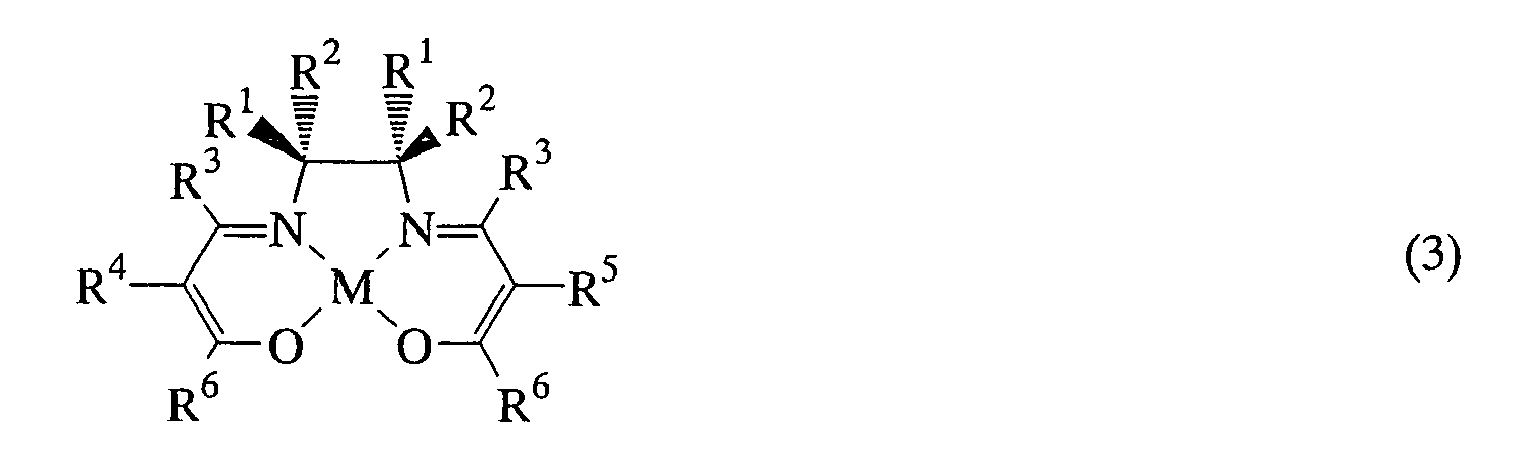
- the compound of formula (1) is prepared by reacting a bisphenol derivative of the general formula (2) with water in the presence of a transition metal catalyst of the general formula (3).
- R is hydrogen, methyl or trifluoromethyl.
- R 1 and R 2 are hydrogen, alkyl or aryl, may have a substituent, or two R 1 or two R 2 may bond together to form a ring with the carbon atoms to which they are attached;
- R 3 , R 4 , R 5 and R 6 are hydrogen, alkyl or aryl, R 4 and R 5 may also be a polymer like hydroxymethylpolystyrene or silica gel, R 6 may form an optionally substituted ring with adjacent R 4 or R 5 and the carbon atoms to which they are attached; and
- M is manganese, iron, cobalt, zinc, nickel, aluminum, chromium, ruthenium, rhodium, titanium, vanadium, molybdenum, or tungsten.
- the alcoholic hydroxyl-containing compounds are novel and useful as reagents for modifying organic resins and silicone resins.
- the method is successful in preparing the alcoholic hydroxyl-containing compounds in high yields.
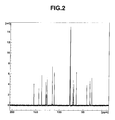
- FIGS. 1 and 2 are 1 H-NMR and 13 C-NMR diagrams of the alcoholic hydroxyl-containing compound in Example 1, respectively.
- the invention provides an alcoholic hydroxyl-containing compound having the general formula (1): wherein R is hydrogen, methyl or trifluoromethyl.
- the invention provides a method for preparing the alcoholic hydroxyl-containing compound of formula (1) by reacting an epoxy-containing bisphenol derivative of the general formula (2) with water in the presence of a transition metal catalyst of the general formula (3).
- R is hydrogen, methyl or trifluoromethyl.
- R 1 and R 2 are hydrogen, alkyl or aryl, may have a substituent(s), or two R 1 or two R 2 may bond together to form a ring with the carbon atoms to which they are attached.
- R 3 , R 4 , R 5 and R 6 are hydrogen, alkyl or aryl, R 4 and R 5 may also be a polymer like hydroxymethylpolystyrene or silica gel, R 6 may form an optionally substituted ring with adjacent R 4 or R 5 and the carbon atoms to which they are attached.
- M is manganese, iron, cobalt, zinc, nickel, aluminum, chromium, ruthenium, rhodium, titanium, vanadium, molybdenum, or tungsten.
- R, R 1 to R 6 and M are as defined above.
- the metal complexes used herein are well known in the art and are represented by the general formula (3).
- the center metal M is not particularly limited. Typical metals include manganese, iron, cobalt, zinc, nickel, aluminum, chromium, ruthenium, rhodium, titanium, vanadium, molybdenum, and tungsten, with cobalt being most suitable in the method.
- R 1 , R 2 , R 3 , R 4 , R 5 , and R 6 in formula (3) are not particularly limited.
- R 1 and R 2 are hydrogen, alkyl or aryl.
- R 1 and R 2 may have one or more substituents such as alkyl or aryl.
- R 1 or two R 2 may bond together to form a ring with the carbon atoms to which they are attached.
- Suitable rings include saturated non-aromatic rings of 3 to 20 carbon atoms.
- R 3 , R 4 , R 5 and R 6 are hydrogen, alkyl or aryl.
- R 4 and R 5 may also be a polymer like hydroxymethylpolystyrene or silica gel.
- R 6 may form a ring of 3 to 20 carbon atoms with adjacent R 4 or R 5 and the carbon atoms to which they are attached, and the ring may have one or more substituents such as alkyl or aryl.
- the preferred catalysts are those of formulae (5) and (6).
- t-Bu stands for tert-butyl.
- the reaction rate differs with the configuration of epoxy in the substrate. It is then preferred to use the metal catalyst as a combination of enantiomers.
- the catalyst of formula (3), (5) or (6) is activated through air oxidation from n-valence to (n+1)-valence with air and an acid, preferably an organic acid.
- an acid typically an organic acid is used along with the catalyst.
- Suitable organic acids are compounds having an acidic functional group such as carboxylic acids, sulfonic acids, sulfinic acids, and phenols and include, for example, aliphatic carboxylic acids of 1 to 10 carbon atoms, aromatic carboxylic acids of 7 to 20 carbon atoms, aliphatic sulfonic acids of 1 to 10 carbon atoms, aromatic sulfonic acids of 6 to 20 carbon atoms, aliphatic sulfinic acids of 1 to 10 carbon atoms, and aromatic sulfinic acids of 6 to 20 carbon atoms. Specific examples include acetic acid, propionic acid, p-toluenesulfonic acid, and methanesulfonic acid. Aliphatic carboxylic acids of 1 to 5 carbon atoms are preferred, with acetic acid being most preferred. From the standpoints of catalyst stability, activity and reproducibility, it is ideal to use the catalyst as activated with these acids.
- An appropriate amount of the catalyst used is 0.01 to 10.0 mol%, more preferably 0.05 to 5.0 mol%, even more preferably 0.15 to 1.5 mol%, and most preferably 0.25 to 0.75 mol%, based on the bisphenol derivative of formula (2). Too small an amount of the catalyst may lead to a decline of reaction rate whereas an excess amount may increase the cost of manufacture despite a shortened reaction time.
- the acid is preferably used in such amounts as to give a molar ratio of acid to catalyst of from 0.1 to 15.0, more preferably 1.0 to 10.0, even more preferably 2.0 to 8.0, and most preferably 4.0 to 6.0. An excess of the catalyst may promote decomposition of the catalyst.
- a solvent is preferably used.
- the amount of the solvent used is not particularly limited, it is generally used in an amount of 10 to 1,000 mL, preferably 50 to 500 mL, more preferably 80 to 250 mL, and even more preferably 100 to 140 mL, per mole of the bisphenol derivative of formula (2).
- the solvent used herein is not particularly limited as long as it is compatible with the epoxy-containing bisphenol derivative and the metal catalyst.
- Suitable solvents include ketones such as acetone and methyl ethyl ketone, ether solvents such as diethyl ether, tetrahydrofuran, and 1,4-dioxane, and organic solvents such as toluene, xylene, and hexane, which may be used alone or in combination of two or more. Preferred are ether solvents, with tetrahydrofuran being most preferred.
- Another reactant is water which is preferably used in such amounts as to give a molar ratio of water to epoxy-containing bisphenol of from 1.0 to 15.0, more preferably 1.4 to 10.0, even more preferably 1.8 to 5.0, and most preferably 2.2 to 3.0. It is recommended that the reaction temperature be in a range of 0 to 100°C, preferably 10 to 60° C , and more preferably 15 to 35°C. The reaction time is approximately 50 hours although it varies with the scale.
- the alcoholic hydroxyl-containing compounds thus obtained are useful as reagents for modifying organic resins and silicone resins in electronic applications.
- FIGS. 1 and 2 are 1 H- and 13 C-NMR diagrams of the compound, respectively.
- reaction product was identified to be 2-[2-allyl-4-(2,3-dihydroxypropyloxy)phenyl]-2-[3-allyl-4-(2,3-dihydroxypropyloxy)phenyl]propane of the following formula (8).
Landscapes
- Chemical & Material Sciences (AREA)
- Organic Chemistry (AREA)
- Chemical Kinetics & Catalysis (AREA)
- Health & Medical Sciences (AREA)
- Medicinal Chemistry (AREA)
- Polymers & Plastics (AREA)
- Organic Low-Molecular-Weight Compounds And Preparation Thereof (AREA)
- Low-Molecular Organic Synthesis Reactions Using Catalysts (AREA)
Abstract
Description
- This invention relates to novel alcoholic hydroxyl-containing compounds which are useful as reagents for modifying organic resins and silicone resins in electronic applications, and a method for preparing the same.
- Alcoholic hydroxyl-containing bisphenol derivatives are known in the art and include, for example, those of the general formula (4):

-
JP-A H08-12745 JP-A H08-67805 -
- Patent Document 1:
JP-A H08-12745 - Patent Document 2:
JP-A H08-67805 - An object of the invention is to provide novel bisphenols having both alcoholic hydroxyl and allyl groups which are useful as reagents for modifying organic resins and silicone resins, and a method for preparing the same.
- In one aspect, the invention provides an alcoholic hydroxyl-containing compound having the general formula (1):

- Another aspect of the invention provides a method for preparing the alcoholic hydroxyl-containing compound of formula (1). The compound of formula (1) is prepared by reacting a bisphenol derivative of the general formula (2) with water in the presence of a transition metal catalyst of the general formula (3).
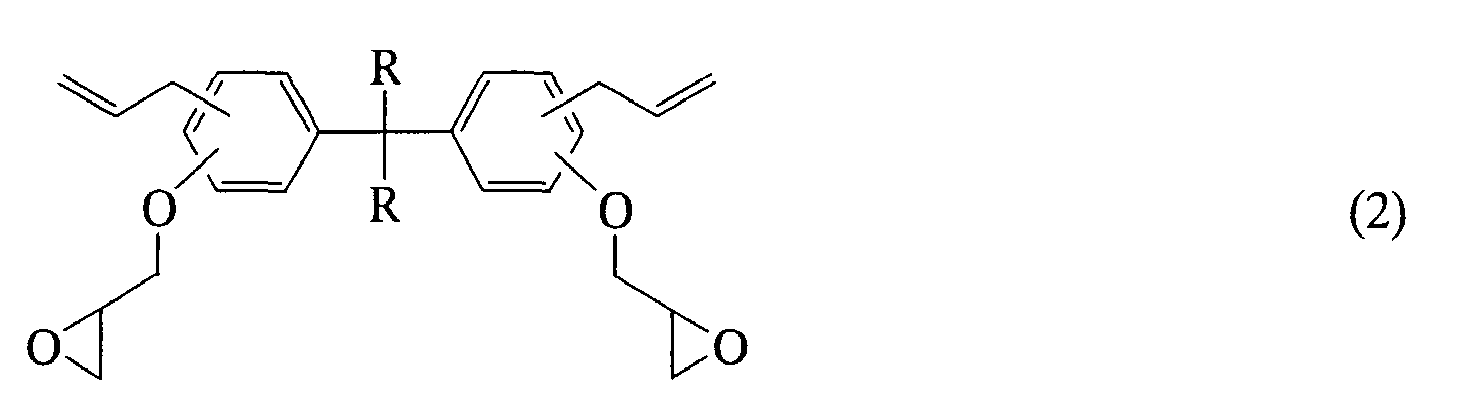
- Herein R is hydrogen, methyl or trifluoromethyl.

- Herein R1 and R2 are hydrogen, alkyl or aryl, may have a substituent, or two R1 or two R2 may bond together to form a ring with the carbon atoms to which they are attached; R3, R4, R5 and R6 are hydrogen, alkyl or aryl, R4 and R5 may also be a polymer like hydroxymethylpolystyrene or silica gel, R6 may form an optionally substituted ring with adjacent R4 or R5 and the carbon atoms to which they are attached; and M is manganese, iron, cobalt, zinc, nickel, aluminum, chromium, ruthenium, rhodium, titanium, vanadium, molybdenum, or tungsten.
- The alcoholic hydroxyl-containing compounds are novel and useful as reagents for modifying organic resins and silicone resins. The method is successful in preparing the alcoholic hydroxyl-containing compounds in high yields.
-
FIGS. 1 and2 are 1H-NMR and 13C-NMR diagrams of the alcoholic hydroxyl-containing compound in Example 1, respectively. - The invention provides an alcoholic hydroxyl-containing compound having the general formula (1):

- Illustrative examples of the alcoholic hydroxyl-containing compound of formula (1) are given below.


- Also the invention provides a method for preparing the alcoholic hydroxyl-containing compound of formula (1) by reacting an epoxy-containing bisphenol derivative of the general formula (2) with water in the presence of a transition metal catalyst of the general formula (3).

- Herein R is hydrogen, methyl or trifluoromethyl.

- Herein R1 and R2 are hydrogen, alkyl or aryl, may have a substituent(s), or two R1 or two R2 may bond together to form a ring with the carbon atoms to which they are attached. R3, R4, R5 and R6 are hydrogen, alkyl or aryl, R4 and R5 may also be a polymer like hydroxymethylpolystyrene or silica gel, R6 may form an optionally substituted ring with adjacent R4 or R5 and the carbon atoms to which they are attached. M is manganese, iron, cobalt, zinc, nickel, aluminum, chromium, ruthenium, rhodium, titanium, vanadium, molybdenum, or tungsten.
- The reaction proceeds according to the following scheme.

- Herein R, R1 to R6 and M are as defined above.
- Illustrative examples of the bisphenol derivative of formula (2) are given below.


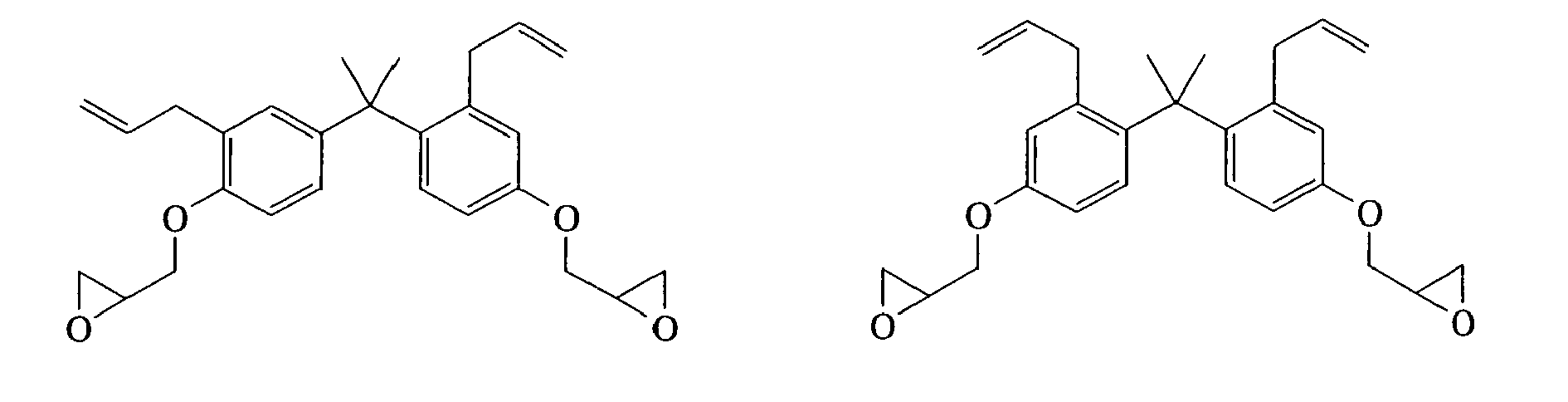


- The metal complexes used herein are well known in the art and are represented by the general formula (3). The center metal M is not particularly limited. Typical metals include manganese, iron, cobalt, zinc, nickel, aluminum, chromium, ruthenium, rhodium, titanium, vanadium, molybdenum, and tungsten, with cobalt being most suitable in the method. Likewise, R1, R2, R3 , R4 , R5, and R6 in formula (3) are not particularly limited. In a preferred embodiment, R1 and R2 are hydrogen, alkyl or aryl. R1 and R2 may have one or more substituents such as alkyl or aryl. Also, two R1 or two R2 may bond together to form a ring with the carbon atoms to which they are attached. Suitable rings include saturated non-aromatic rings of 3 to 20 carbon atoms. R3, R4, R5 and R6 are hydrogen, alkyl or aryl. R4 and R5 may also be a polymer like hydroxymethylpolystyrene or silica gel. R6 may form a ring of 3 to 20 carbon atoms with adjacent R4 or R5 and the carbon atoms to which they are attached, and the ring may have one or more substituents such as alkyl or aryl.
- The preferred catalysts are those of formulae (5) and (6).


- Herein t-Bu stands for tert-butyl.
- Since the catalysts of formulae (5) and (6) are asymmetric, the reaction rate differs with the configuration of epoxy in the substrate. It is then preferred to use the metal catalyst as a combination of enantiomers.
- The catalyst of formula (3), (5) or (6) is activated through air oxidation from n-valence to (n+1)-valence with air and an acid, preferably an organic acid. In a preferred embodiment of the method, an acid, typically an organic acid is used along with the catalyst. Suitable organic acids are compounds having an acidic functional group such as carboxylic acids, sulfonic acids, sulfinic acids, and phenols and include, for example, aliphatic carboxylic acids of 1 to 10 carbon atoms, aromatic carboxylic acids of 7 to 20 carbon atoms, aliphatic sulfonic acids of 1 to 10 carbon atoms, aromatic sulfonic acids of 6 to 20 carbon atoms, aliphatic sulfinic acids of 1 to 10 carbon atoms, and aromatic sulfinic acids of 6 to 20 carbon atoms. Specific examples include acetic acid, propionic acid, p-toluenesulfonic acid, and methanesulfonic acid. Aliphatic carboxylic acids of 1 to 5 carbon atoms are preferred, with acetic acid being most preferred. From the standpoints of catalyst stability, activity and reproducibility, it is ideal to use the catalyst as activated with these acids.
- An appropriate amount of the catalyst used is 0.01 to 10.0 mol%, more preferably 0.05 to 5.0 mol%, even more preferably 0.15 to 1.5 mol%, and most preferably 0.25 to 0.75 mol%, based on the bisphenol derivative of formula (2). Too small an amount of the catalyst may lead to a decline of reaction rate whereas an excess amount may increase the cost of manufacture despite a shortened reaction time. The acid is preferably used in such amounts as to give a molar ratio of acid to catalyst of from 0.1 to 15.0, more preferably 1.0 to 10.0, even more preferably 2.0 to 8.0, and most preferably 4.0 to 6.0. An excess of the catalyst may promote decomposition of the catalyst.
- In the method of the invention, a solvent is preferably used. Although the amount of the solvent used is not particularly limited, it is generally used in an amount of 10 to 1,000 mL, preferably 50 to 500 mL, more preferably 80 to 250 mL, and even more preferably 100 to 140 mL, per mole of the bisphenol derivative of formula (2). The solvent used herein is not particularly limited as long as it is compatible with the epoxy-containing bisphenol derivative and the metal catalyst. Suitable solvents include ketones such as acetone and methyl ethyl ketone, ether solvents such as diethyl ether, tetrahydrofuran, and 1,4-dioxane, and organic solvents such as toluene, xylene, and hexane, which may be used alone or in combination of two or more. Preferred are ether solvents, with tetrahydrofuran being most preferred. Another reactant is water which is preferably used in such amounts as to give a molar ratio of water to epoxy-containing bisphenol of from 1.0 to 15.0, more preferably 1.4 to 10.0, even more preferably 1.8 to 5.0, and most preferably 2.2 to 3.0. It is recommended that the reaction temperature be in a range of 0 to 100°C, preferably 10 to 60° C , and more preferably 15 to 35°C. The reaction time is approximately 50 hours although it varies with the scale.
- The alcoholic hydroxyl-containing compounds thus obtained are useful as reagents for modifying organic resins and silicone resins in electronic applications.
- Examples of the invention are given below by way of illustration and not by way of limitation.
- A flask equipped with a thermometer, condenser and stirrer was charged with 700 g of 2,2-bis[3-allyl-4-(glycidyloxy)phenyl]propane in 187 g of tetrahydrofuran. Then each 2.5 g of (R,R) and (S,S)-N,N'-bis(3,5-di-tert-butylsalicylidene)-1,2-cyclohexanediaminocobalt(II), 78 g of distilled water, and 2 g of acetic acid were added to the solution, which was stirred for 72 hours. At the end of reaction, the solvent was distilled off by heating at 85°C in vacuum. Methanol, 395 g, was added to the residue, which was stirred for 1 hour. The precipitated catalyst solid was removed by filtration. The solvent including methanol was distilled off by heating at 85°C in vacuum again, yielding 612 g of a reaction product as brown liquid (yield 81%). On analysis by 1H- and 13C-NMR spectroscopy, the reaction product was identified to be 2,2-bis[3-allyl-4-(2,3-dihydroxypropyloxy)phenyl]propane of the following formula (7).
FIGS. 1 and2 are 1H- and 13C-NMR diagrams of the compound, respectively.
- A flask equipped with a thermometer, condenser and stirrer was charged with 80 g of 2-[2-allyl-4-(glycidyloxy)-phenyl]-2-[3-allyl-4-(glycidyloxy)phenyl]propane in 19 g of tetrahydrofuran. Then each 0.29 g of (R,R) and (S,S)-N,N'-bis(3,5-di-tert-butylsalicylidene)-1,2-cyclo-hexanediaminocobalt(II), 9.4 g of distilled water, and 0.23 g of acetic acid were added to the solution, which was stirred for 70 hours. At the end of reaction, the solvent was distilled off by heating at 85°C in vacuum. Methanol, 120 g, was added to the residue, which was stirred for 1 hour. The precipitated catalyst solid was removed by filtration. The solvent including methanol was distilled off by heating at 85°C in vacuum again, yielding 66 g of a reaction product as brown liquid (yield 76%). On analysis by 1H- and 13C-NMR spectroscopy, the reaction product was identified to be 2-[2-allyl-4-(2,3-dihydroxypropyloxy)phenyl]-2-[3-allyl-4-(2,3-dihydroxypropyloxy)phenyl]propane of the following formula (8).

- A flask equipped with a thermometer, condenser and stirrer was charged with 78.5 g of 2,2-bis[3-allyl-4-(glycidyloxy)phenyl]propane in 22.5 g of tetrahydrofuran. Then each 0.30 g of (R,R) and (S,S)-N,N'-bis(3,5-di-tert-butylsalicylidene)-1,2-cyclohexanediaminocobalt(II), 9.4 g of distilled water, and 0.24 g of acetic acid were added to the solution, which was stirred for 72 hours. At the end of reaction, the solvent was distilled off by heating at 85°C in vacuum. Methanol, 120 g, was added to the residue, which was stirred for 1 hour. The precipitated catalyst solid was removed by filtration. The solvent including methanol was distilled off by heating at 85°C in vacuum again, yielding 74.1 g of a reaction product as brown liquid (yield 87%). On analysis by 1H- and 13C-NMR spectroscopy, the reaction product was identified to be 2,2-bis[3-allyl-4-(2,3-dihydroxypropyloxy)phenyl]propane of the following formula (9).

- A flask equipped with a thermometer, condenser and stirrer was charged with 10.6 g of 2,2-bis[3-allyl-4-(glycidyloxy)phenyl]hexafluoropropane in 2.3 g of tetrahydrofuran. Then each 31 mg of (R,R) and (S,S)-N,N'-bis(3,5-di-tert-butylsalicylidene)-1,2-cyclo-hexanediaminocobalt(II), 1.0 g of distilled water, and 24 mg of acetic acid were added to the solution, which was stirred for 72 hours. At the end of reaction, the solvent was distilled off by heating at 85°C in vacuum. Methanol, 10 g, was added to the residue, which was stirred for 1 hour. The precipitated catalyst solid was removed by filtration. The solvent including methanol was distilled off by heating at 85°C in vacuum again, yielding 9.2 g of a reaction product as brown liquid (yield 81%). On analysis by 1H- and 13C-NMR spectroscopy, the reaction product was identified to be 2,2-bis[3-allyl-4-(2,3-dihydroxypropyloxy)phenyl]hexafluoropropane of the following formula (10).

Claims (4)
- An alcoholic hydroxyl-containing compound having the general formula (1):

- A compound of claim 1, selected from the following compounds:


- A method of preparing an alcoholic hydroxyl-containing compound of claim 1 or 2, comprising the step of reacting a bisphenol derivative having the general formula (2):

- The use of a compound of claim 1 or 2 as a modifier for organic resin or silicone resin.
Applications Claiming Priority (1)
| Application Number | Priority Date | Filing Date | Title |
|---|---|---|---|
| JP2009232294A JP5375502B2 (en) | 2009-10-06 | 2009-10-06 | Alcoholic hydroxyl group-containing compound and method for producing the same |
Publications (2)
| Publication Number | Publication Date |
|---|---|
| EP2316810A1 true EP2316810A1 (en) | 2011-05-04 |
| EP2316810B1 EP2316810B1 (en) | 2012-01-04 |
Family
ID=43545595
Family Applications (1)
| Application Number | Title | Priority Date | Filing Date |
|---|---|---|---|
| EP10251748A Ceased EP2316810B1 (en) | 2009-10-06 | 2010-10-06 | Alcoholic hydroxyl-containing compounds and making method |
Country Status (5)
| Country | Link |
|---|---|
| US (1) | US8378148B2 (en) |
| EP (1) | EP2316810B1 (en) |
| JP (1) | JP5375502B2 (en) |
| KR (1) | KR20110037886A (en) |
| TW (1) | TWI469960B (en) |
Cited By (2)
| Publication number | Priority date | Publication date | Assignee | Title |
|---|---|---|---|---|
| EP2386591A3 (en) * | 2010-05-07 | 2012-03-21 | Shin-Etsu Chemical Co., Ltd. | Novel silphenylene skeleton-containing silicon type polymer and method for manufacturing the same |
| CN109467942A (en) * | 2017-09-07 | 2019-03-15 | 信越化学工业株式会社 | Resin composition, resin film, semiconductor laminate, manufacturing method of semiconductor laminate, and manufacturing method of semiconductor device |
Families Citing this family (7)
| Publication number | Priority date | Publication date | Assignee | Title |
|---|---|---|---|---|
| KR101252063B1 (en) * | 2011-08-25 | 2013-04-12 | 한국생산기술연구원 | Epoxy Compound Having Alkoxysilyl Group, Preparing Method Thereof, Composition Comprising the Same and Cured Product and Use Thereof |
| CN103906753B (en) | 2011-11-01 | 2017-02-15 | 韩国生产技术研究院 | Isocyanurate epoxy compound containing alkoxysilyl group, its preparation method, composition including it, cured product of composition and application of composition |
| WO2013137663A1 (en) | 2012-03-14 | 2013-09-19 | 한국생산기술연구원 | Epoxy compound having alkoxy silyl group, composition comprising same, cured product, use thereof and method for preparing epoxy compound having alkoxy silyl group |
| WO2013151308A1 (en) | 2012-04-02 | 2013-10-10 | 한국생산기술연구원 | Epoxy compound having alkoxysilyl group, composition and hardened material comprising same, use for same, and production method for epoxy compound having alkoxysilyl group |
| KR101863111B1 (en) | 2012-07-06 | 2018-06-01 | 한국생산기술연구원 | Novolac-based epoxy compound, preparing method thereof, composition, cured product thereof, and use thereof |
| CN103342892A (en) * | 2013-06-06 | 2013-10-09 | 西安交通大学 | Bimaleimide resin toughening modifiers and preparation method thereof |
| KR102232340B1 (en) | 2019-11-15 | 2021-03-26 | 한국생산기술연구원 | Composition of alkoxysilyl-functionalized epoxy resin and composite thereof |
Citations (4)
| Publication number | Priority date | Publication date | Assignee | Title |
|---|---|---|---|---|
| JPH0812745A (en) | 1994-06-29 | 1996-01-16 | Matsushita Electric Works Ltd | Liquid epoxy resin composition |
| JPH0867805A (en) | 1994-08-29 | 1996-03-12 | Matsushita Electric Works Ltd | Liquid epoxy resin composition |
| WO2005037755A2 (en) * | 2003-10-14 | 2005-04-28 | X-Ceptor Therapeutics, Inc. | Bridged ring structures as pharmaceutical agents |
| WO2010000066A1 (en) * | 2008-07-02 | 2010-01-07 | British Columbia Cancer Agency Branch | Diglycidic ether derivative therapeutics and methods for their use |
Family Cites Families (7)
| Publication number | Priority date | Publication date | Assignee | Title |
|---|---|---|---|---|
| JPS5693718A (en) * | 1979-12-24 | 1981-07-29 | Ciba Geigy Ag | Acrylateecontaining polymerizable composition and its polymerization |
| US4433179A (en) * | 1980-08-25 | 1984-02-21 | Ciba-Geigy Corporation | Process for the preparation of di- and poly-allyl ethers |
| US5070117A (en) * | 1990-06-25 | 1991-12-03 | Loctite Corporation | Aromatic vinyl ether compounds and compositions, and method of making the same |
| PL174754B1 (en) * | 1993-12-31 | 1998-09-30 | Politechnika Warszawska | Allyl bisphenol hydroxyethers |
| TW482756B (en) * | 1997-02-07 | 2002-04-11 | Shell Int Research | Process for the manufacture of intermediates for epoxy compounds, process for the manufacture of epoxy compounds and epoxy compounds obtained therewith |
| JP2004189942A (en) * | 2002-12-12 | 2004-07-08 | Shin Etsu Chem Co Ltd | Silicone-modified acrylate resin and photocurable resin composition |
| JP5046678B2 (en) * | 2007-02-22 | 2012-10-10 | 株式会社リコー | Electrophotographic apparatus and process cartridge |
-
2009
- 2009-10-06 JP JP2009232294A patent/JP5375502B2/en active Active
-
2010
- 2010-10-01 TW TW99133533A patent/TWI469960B/en not_active IP Right Cessation
- 2010-10-05 KR KR1020100096637A patent/KR20110037886A/en not_active Withdrawn
- 2010-10-05 US US12/898,136 patent/US8378148B2/en not_active Expired - Fee Related
- 2010-10-06 EP EP10251748A patent/EP2316810B1/en not_active Ceased
Patent Citations (4)
| Publication number | Priority date | Publication date | Assignee | Title |
|---|---|---|---|---|
| JPH0812745A (en) | 1994-06-29 | 1996-01-16 | Matsushita Electric Works Ltd | Liquid epoxy resin composition |
| JPH0867805A (en) | 1994-08-29 | 1996-03-12 | Matsushita Electric Works Ltd | Liquid epoxy resin composition |
| WO2005037755A2 (en) * | 2003-10-14 | 2005-04-28 | X-Ceptor Therapeutics, Inc. | Bridged ring structures as pharmaceutical agents |
| WO2010000066A1 (en) * | 2008-07-02 | 2010-01-07 | British Columbia Cancer Agency Branch | Diglycidic ether derivative therapeutics and methods for their use |
Non-Patent Citations (3)
| Title |
|---|
| MOU ET AL.: "Synthesis of a hydrophilic phosphonic acid monomer for dental materials", CHEM. COMMUN., vol. 5, 25 January 2000 (2000-01-25), pages 345 - 346, XP002626867, DOI: 10.1039/a909877a * |
| PALA G ET AL: "NEW PHENOLIC ETHERS. I. SYNTHESIS AND PHARMACOLOGY OF ALPHA-GLYCERYL ETHERS OF METHYLENE-BIS-PHENOLS", FARMACO, EDIZIONE SCIENTIFICA, SOCIETA CHIMICA ITALIANA, PAVIA, IT, vol. 18, no. 9, 1 September 1963 (1963-09-01), pages 619 - 642, XP009145598, ISSN: 0430-0920 * |
| SATOH ET AL.: "Study on anti-androgenic effects of bisphenol a diglycidyl ether (BADGE), bisphenol F diglycidyl ether (BFDGE) and their derivatives using cells stably transfected with human androgen receptor, AR-EcoScreen", FOOD AND CHEMICAL TOXICOLOGY, vol. 42, no. 6, 7 February 2004 (2004-02-07), pages 983 - 993, XP002626868, DOI: 10.1016/j.fct.2004.02.011 * |
Cited By (4)
| Publication number | Priority date | Publication date | Assignee | Title |
|---|---|---|---|---|
| EP2386591A3 (en) * | 2010-05-07 | 2012-03-21 | Shin-Etsu Chemical Co., Ltd. | Novel silphenylene skeleton-containing silicon type polymer and method for manufacturing the same |
| US8476379B2 (en) | 2010-05-07 | 2013-07-02 | Shin-Etsu Chemical Co., Ltd. | Silphenylene skeleton-containing silicone type polymer and method for manufacturing the same |
| CN109467942A (en) * | 2017-09-07 | 2019-03-15 | 信越化学工业株式会社 | Resin composition, resin film, semiconductor laminate, manufacturing method of semiconductor laminate, and manufacturing method of semiconductor device |
| CN109467942B (en) * | 2017-09-07 | 2022-02-11 | 信越化学工业株式会社 | Resin composition, resin film, semiconductor laminate, method for producing semiconductor laminate, and method for producing semiconductor device |
Also Published As
| Publication number | Publication date |
|---|---|
| JP2011079762A (en) | 2011-04-21 |
| US20110082321A1 (en) | 2011-04-07 |
| TW201129535A (en) | 2011-09-01 |
| JP5375502B2 (en) | 2013-12-25 |
| KR20110037886A (en) | 2011-04-13 |
| US8378148B2 (en) | 2013-02-19 |
| TWI469960B (en) | 2015-01-21 |
| EP2316810B1 (en) | 2012-01-04 |
Similar Documents
| Publication | Publication Date | Title |
|---|---|---|
| EP2316810B1 (en) | Alcoholic hydroxyl-containing compounds and making method | |
| US4284574A (en) | Diglycidyl ethers of di-secondary alcohols, their preparation, and curable compositions containing them | |
| CN110997649B (en) | Method for preparing thiocarbonate | |
| JP4998271B2 (en) | Phenolic resin and resin composition | |
| JP5958734B2 (en) | Novel epoxy compound and method for producing the same | |
| EP2103600B1 (en) | Clathrate compound, curing catalyst, composition for forming cured resin, and cured resin | |
| US8735529B2 (en) | Clathrate compound, curing catalyst, composition for forming cured resin, and cured resin | |
| US4837293A (en) | Linear bisphenol epoxy polymers containing cyano groups | |
| JP2006160663A (en) | Process for producing 1,1'-bis (2-hydroxynaphthyl) s | |
| US20240025867A1 (en) | Catalysts for benzoxazine | |
| KR910004902B1 (en) | Phenolic ethers containing epoxide groups | |
| JP2014189526A (en) | Bisphenol compounds and methods of producing the same | |
| JP6068204B2 (en) | New trisphenol compounds | |
| KR101728577B1 (en) | Process for producing polyglycidyl ether | |
| WO2016076112A1 (en) | Process for producing polyvalent glycidyl compound | |
| JP2008285544A (en) | Epoxy compound containing fluorene ring and method for producing the same | |
| JP2011032202A (en) | Method for producing thiol compound | |
| JPWO2011037073A1 (en) | Method for producing trans cyclic polyphenol compound | |
| JP2005263717A (en) | Method for producing cyanoalkoxy compound | |
| JPH04145039A (en) | Production of 4,4'-(1-phenylethylidene)bisphenol | |
| JPH1180060A (en) | Production of tetrakisphenol | |
| JP5352477B2 (en) | Process for preparing 2,4-dihydroxyphenyl-4-methoxybenzyl ketones | |
| JP6824699B2 (en) | New benzoxazine compound | |
| JP2002161087A (en) | Long-chain aliphatic diglycidyl ether and method for synthesizing the same | |
| CN121779207A (en) | A hindered phenolic antioxidant, its preparation method and application |
Legal Events
| Date | Code | Title | Description |
|---|---|---|---|
| PUAI | Public reference made under article 153(3) epc to a published international application that has entered the european phase |
Free format text: ORIGINAL CODE: 0009012 |
|
| AK | Designated contracting states |
Kind code of ref document: A1 Designated state(s): AL AT BE BG CH CY CZ DE DK EE ES FI FR GB GR HR HU IE IS IT LI LT LU LV MC MK MT NL NO PL PT RO RS SE SI SK SM TR |
|
| AX | Request for extension of the european patent |
Extension state: BA ME |
|
| 17P | Request for examination filed |
Effective date: 20110520 |
|
| GRAP | Despatch of communication of intention to grant a patent |
Free format text: ORIGINAL CODE: EPIDOSNIGR1 |
|
| RIC1 | Information provided on ipc code assigned before grant |
Ipc: C07C 43/205 20060101AFI20110616BHEP |
|
| GRAS | Grant fee paid |
Free format text: ORIGINAL CODE: EPIDOSNIGR3 |
|
| GRAA | (expected) grant |
Free format text: ORIGINAL CODE: 0009210 |
|
| RBV | Designated contracting states (corrected) |
Designated state(s): DE FR GB |
|
| AK | Designated contracting states |
Kind code of ref document: B1 Designated state(s): DE FR GB |
|
| REG | Reference to a national code |
Ref country code: GB Ref legal event code: FG4D |
|
| REG | Reference to a national code |
Ref country code: DE Ref legal event code: R096 Ref document number: 602010000634 Country of ref document: DE Effective date: 20120308 |
|
| PLBE | No opposition filed within time limit |
Free format text: ORIGINAL CODE: 0009261 |
|
| STAA | Information on the status of an ep patent application or granted ep patent |
Free format text: STATUS: NO OPPOSITION FILED WITHIN TIME LIMIT |
|
| 26N | No opposition filed |
Effective date: 20121005 |
|
| REG | Reference to a national code |
Ref country code: DE Ref legal event code: R097 Ref document number: 602010000634 Country of ref document: DE Effective date: 20121005 |
|
| REG | Reference to a national code |
Ref country code: FR Ref legal event code: PLFP Year of fee payment: 7 |
|
| REG | Reference to a national code |
Ref country code: FR Ref legal event code: PLFP Year of fee payment: 8 |
|
| REG | Reference to a national code |
Ref country code: FR Ref legal event code: PLFP Year of fee payment: 9 |
|
| PGFP | Annual fee paid to national office [announced via postgrant information from national office to epo] |
Ref country code: FR Payment date: 20210913 Year of fee payment: 12 |
|
| PGFP | Annual fee paid to national office [announced via postgrant information from national office to epo] |
Ref country code: GB Payment date: 20210901 Year of fee payment: 12 |
|
| PGFP | Annual fee paid to national office [announced via postgrant information from national office to epo] |
Ref country code: DE Payment date: 20210831 Year of fee payment: 12 |
|
| REG | Reference to a national code |
Ref country code: DE Ref legal event code: R119 Ref document number: 602010000634 Country of ref document: DE |
|
| GBPC | Gb: european patent ceased through non-payment of renewal fee |
Effective date: 20221006 |
|
| PG25 | Lapsed in a contracting state [announced via postgrant information from national office to epo] |
Ref country code: FR Free format text: LAPSE BECAUSE OF NON-PAYMENT OF DUE FEES Effective date: 20221031 Ref country code: DE Free format text: LAPSE BECAUSE OF NON-PAYMENT OF DUE FEES Effective date: 20230503 |
|
| PG25 | Lapsed in a contracting state [announced via postgrant information from national office to epo] |
Ref country code: GB Free format text: LAPSE BECAUSE OF NON-PAYMENT OF DUE FEES Effective date: 20221006 |