EP2314703A1 - A plant promoter being tissue specific for endosperm and embryo of a plant seed - Google Patents
A plant promoter being tissue specific for endosperm and embryo of a plant seed Download PDFInfo
- Publication number
- EP2314703A1 EP2314703A1 EP09013413A EP09013413A EP2314703A1 EP 2314703 A1 EP2314703 A1 EP 2314703A1 EP 09013413 A EP09013413 A EP 09013413A EP 09013413 A EP09013413 A EP 09013413A EP 2314703 A1 EP2314703 A1 EP 2314703A1
- Authority
- EP
- European Patent Office
- Prior art keywords
- plant
- contiguous nucleotides
- embryo
- promoter
- nucleic acid
- Prior art date
- Legal status (The legal status is an assumption and is not a legal conclusion. Google has not performed a legal analysis and makes no representation as to the accuracy of the status listed.)
- Withdrawn
Links
- 210000001161 mammalian embryo Anatomy 0.000 title claims abstract description 60
- 108090000623 proteins and genes Proteins 0.000 claims abstract description 33
- 102000004169 proteins and genes Human genes 0.000 claims abstract description 30
- 210000002615 epidermis Anatomy 0.000 claims abstract description 21
- 238000000034 method Methods 0.000 claims abstract description 14
- 210000001519 tissue Anatomy 0.000 claims abstract description 11
- 241000196324 Embryophyta Species 0.000 claims description 205
- 239000002773 nucleotide Substances 0.000 claims description 100
- 125000003729 nucleotide group Chemical group 0.000 claims description 100
- 150000007523 nucleic acids Chemical class 0.000 claims description 36
- 108091028043 Nucleic acid sequence Proteins 0.000 claims description 19
- 108020004707 nucleic acids Proteins 0.000 claims description 17
- 102000039446 nucleic acids Human genes 0.000 claims description 17
- FWMNVWWHGCHHJJ-SKKKGAJSSA-N 4-amino-1-[(2r)-6-amino-2-[[(2r)-2-[[(2r)-2-[[(2r)-2-amino-3-phenylpropanoyl]amino]-3-phenylpropanoyl]amino]-4-methylpentanoyl]amino]hexanoyl]piperidine-4-carboxylic acid Chemical compound C([C@H](C(=O)N[C@H](CC(C)C)C(=O)N[C@H](CCCCN)C(=O)N1CCC(N)(CC1)C(O)=O)NC(=O)[C@H](N)CC=1C=CC=CC=1)C1=CC=CC=C1 FWMNVWWHGCHHJJ-SKKKGAJSSA-N 0.000 claims description 9
- 240000002791 Brassica napus Species 0.000 claims description 7
- 235000000832 Ayote Nutrition 0.000 claims description 6
- 235000009854 Cucurbita moschata Nutrition 0.000 claims description 6
- 235000009804 Cucurbita pepo subsp pepo Nutrition 0.000 claims description 6
- 244000020551 Helianthus annuus Species 0.000 claims description 6
- 235000003222 Helianthus annuus Nutrition 0.000 claims description 6
- 240000007049 Juglans regia Species 0.000 claims description 6
- 235000009496 Juglans regia Nutrition 0.000 claims description 6
- 244000046052 Phaseolus vulgaris Species 0.000 claims description 6
- 235000010627 Phaseolus vulgaris Nutrition 0.000 claims description 6
- 240000004713 Pisum sativum Species 0.000 claims description 6
- 235000010582 Pisum sativum Nutrition 0.000 claims description 6
- 235000015136 pumpkin Nutrition 0.000 claims description 6
- 235000020234 walnut Nutrition 0.000 claims description 6
- 235000004977 Brassica sinapistrum Nutrition 0.000 claims description 5
- 241000208838 Asteraceae Species 0.000 claims description 4
- 241000219104 Cucurbitaceae Species 0.000 claims description 4
- 241000758791 Juglandaceae Species 0.000 claims description 4
- 240000001980 Cucurbita pepo Species 0.000 claims 2
- 210000004027 cell Anatomy 0.000 description 29
- 239000005090 green fluorescent protein Substances 0.000 description 13
- 239000003921 oil Substances 0.000 description 8
- 150000001875 compounds Chemical class 0.000 description 7
- 238000004458 analytical method Methods 0.000 description 6
- 210000002257 embryonic structure Anatomy 0.000 description 5
- 238000004519 manufacturing process Methods 0.000 description 5
- 241000219195 Arabidopsis thaliana Species 0.000 description 4
- 108010078791 Carrier Proteins Proteins 0.000 description 4
- 240000004244 Cucurbita moschata Species 0.000 description 4
- CZMRCDWAGMRECN-UGDNZRGBSA-N Sucrose Chemical compound O[C@H]1[C@H](O)[C@@H](CO)O[C@@]1(CO)O[C@@H]1[C@H](O)[C@@H](O)[C@H](O)[C@@H](CO)O1 CZMRCDWAGMRECN-UGDNZRGBSA-N 0.000 description 4
- 229930006000 Sucrose Natural products 0.000 description 4
- 239000003925 fat Substances 0.000 description 4
- 230000003287 optical effect Effects 0.000 description 4
- 239000005720 sucrose Substances 0.000 description 4
- 235000017060 Arachis glabrata Nutrition 0.000 description 3
- 244000105624 Arachis hypogaea Species 0.000 description 3
- 235000010777 Arachis hypogaea Nutrition 0.000 description 3
- 235000018262 Arachis monticola Nutrition 0.000 description 3
- 229920000742 Cotton Polymers 0.000 description 3
- 244000068988 Glycine max Species 0.000 description 3
- 235000010469 Glycine max Nutrition 0.000 description 3
- 244000299507 Gossypium hirsutum Species 0.000 description 3
- 244000000231 Sesamum indicum Species 0.000 description 3
- 235000003434 Sesamum indicum Nutrition 0.000 description 3
- 150000002632 lipids Chemical class 0.000 description 3
- 235000020232 peanut Nutrition 0.000 description 3
- 241000894007 species Species 0.000 description 3
- YBJHBAHKTGYVGT-ZKWXMUAHSA-N (+)-Biotin Chemical compound N1C(=O)N[C@@H]2[C@H](CCCCC(=O)O)SC[C@@H]21 YBJHBAHKTGYVGT-ZKWXMUAHSA-N 0.000 description 2
- 235000011293 Brassica napus Nutrition 0.000 description 2
- 108700026244 Open Reading Frames Proteins 0.000 description 2
- 230000000694 effects Effects 0.000 description 2
- 239000012634 fragment Substances 0.000 description 2
- 230000008676 import Effects 0.000 description 2
- 235000015097 nutrients Nutrition 0.000 description 2
- 235000016709 nutrition Nutrition 0.000 description 2
- 102000057234 Acyl transferases Human genes 0.000 description 1
- 108700016155 Acyl transferases Proteins 0.000 description 1
- 241000589158 Agrobacterium Species 0.000 description 1
- 108700031723 Arabidopsis GL2 Proteins 0.000 description 1
- 102000014914 Carrier Proteins Human genes 0.000 description 1
- 102000036181 Fatty Acid Elongases Human genes 0.000 description 1
- 108010058732 Fatty Acid Elongases Proteins 0.000 description 1
- 108010043121 Green Fluorescent Proteins Proteins 0.000 description 1
- 102000004144 Green Fluorescent Proteins Human genes 0.000 description 1
- 101710132674 Monosaccharide transporter Proteins 0.000 description 1
- 240000007817 Olea europaea Species 0.000 description 1
- 229920002472 Starch Polymers 0.000 description 1
- 238000009825 accumulation Methods 0.000 description 1
- 108700014220 acyltransferase activity proteins Proteins 0.000 description 1
- 238000013459 approach Methods 0.000 description 1
- 108010051210 beta-Fructofuranosidase Proteins 0.000 description 1
- 230000001851 biosynthetic effect Effects 0.000 description 1
- 230000015572 biosynthetic process Effects 0.000 description 1
- 229960002685 biotin Drugs 0.000 description 1
- 235000020958 biotin Nutrition 0.000 description 1
- 239000011616 biotin Substances 0.000 description 1
- 150000001720 carbohydrates Chemical class 0.000 description 1
- 235000014633 carbohydrates Nutrition 0.000 description 1
- 210000000170 cell membrane Anatomy 0.000 description 1
- 229930002875 chlorophyll Natural products 0.000 description 1
- 235000019804 chlorophyll Nutrition 0.000 description 1
- ATNHDLDRLWWWCB-AENOIHSZSA-M chlorophyll a Chemical compound C1([C@@H](C(=O)OC)C(=O)C2=C3C)=C2N2C3=CC(C(CC)=C3C)=[N+]4C3=CC3=C(C=C)C(C)=C5N3[Mg-2]42[N+]2=C1[C@@H](CCC(=O)OC\C=C(/C)CCC[C@H](C)CCC[C@H](C)CCCC(C)C)[C@H](C)C2=C5 ATNHDLDRLWWWCB-AENOIHSZSA-M 0.000 description 1
- 238000004624 confocal microscopy Methods 0.000 description 1
- 238000011161 development Methods 0.000 description 1
- 230000018109 developmental process Effects 0.000 description 1
- 230000013020 embryo development Effects 0.000 description 1
- 238000000605 extraction Methods 0.000 description 1
- 238000000799 fluorescence microscopy Methods 0.000 description 1
- 230000002068 genetic effect Effects 0.000 description 1
- 238000010348 incorporation Methods 0.000 description 1
- 235000011073 invertase Nutrition 0.000 description 1
- 239000000463 material Substances 0.000 description 1
- 230000001404 mediated effect Effects 0.000 description 1
- 239000012528 membrane Substances 0.000 description 1
- 239000002245 particle Substances 0.000 description 1
- 230000000144 pharmacologic effect Effects 0.000 description 1
- 210000003449 plasmodesmata Anatomy 0.000 description 1
- 229930000044 secondary metabolite Natural products 0.000 description 1
- 235000019698 starch Nutrition 0.000 description 1
- 239000008107 starch Substances 0.000 description 1
- 230000002123 temporal effect Effects 0.000 description 1
- 238000012546 transfer Methods 0.000 description 1
- 230000009466 transformation Effects 0.000 description 1
- 230000014723 transformation of host cell by virus Effects 0.000 description 1
- 230000009261 transgenic effect Effects 0.000 description 1
- 238000011144 upstream manufacturing Methods 0.000 description 1
Images

Classifications
-
- C—CHEMISTRY; METALLURGY
- C12—BIOCHEMISTRY; BEER; SPIRITS; WINE; VINEGAR; MICROBIOLOGY; ENZYMOLOGY; MUTATION OR GENETIC ENGINEERING
- C12N—MICROORGANISMS OR ENZYMES; COMPOSITIONS THEREOF; PROPAGATING, PRESERVING, OR MAINTAINING MICROORGANISMS; MUTATION OR GENETIC ENGINEERING; CULTURE MEDIA
- C12N15/00—Mutation or genetic engineering; DNA or RNA concerning genetic engineering, vectors, e.g. plasmids, or their isolation, preparation or purification; Use of hosts therefor
- C12N15/09—Recombinant DNA-technology
- C12N15/63—Introduction of foreign genetic material using vectors; Vectors; Use of hosts therefor; Regulation of expression
- C12N15/79—Vectors or expression systems specially adapted for eukaryotic hosts
- C12N15/82—Vectors or expression systems specially adapted for eukaryotic hosts for plant cells, e.g. plant artificial chromosomes (PACs)
- C12N15/8216—Methods for controlling, regulating or enhancing expression of transgenes in plant cells
- C12N15/8222—Developmentally regulated expression systems, tissue, organ specific, temporal or spatial regulation
- C12N15/823—Reproductive tissue-specific promoters
- C12N15/8234—Seed-specific, e.g. embryo, endosperm
Definitions
- the present invention relates to a plant promoter being tissue specific for endosperm and embryo of a plant seed, in particular for the epidermis of an embryo of a plant seed, and to an expression system comprising such plant promoter.
- the present invention also relates to a vector comprising the plant promoter, and to a plant cell comprising the plant promoter or the aforementioned expression system or the aforementioned vector.
- the present invention relates to a plant seed comprising such plant promoter or such expression system or such vector or such plant cell.
- the present invention also relates to a plant comprising a plant cell in accordance with the present invention.
- the present invention relates to a method of selectively expressing a protein in endosperm and embryo of a plant seed, in particular in the epidermis of an embryo of a plant seed.
- plants are of commercial interest because of their capability to produce specific compounds. These may be secondary metabolites, such as compounds having pharmacological activity, or they may e.g. be nutritional compounds, such as starch, sucrose, or fats.
- the compounds of commercial interest are oils, fats and lipids; these accumulate within the embryo and not in the endosperm of the seeds.
- Numerous attempts have been made to improve the yield of the oil production in such oleaginous plants. These concern specific selection of plants having a high oil yield.
- Other attempts have been made in optimizing the extraction efficiency with which the oil is extracted from the seeds.
- One approach in this respect has been to increase the production of the desired compounds, e.g. the oil production by the expression of genes which optimize the "biosynthetic fitness" of the plants, e. g. by increasing the import of nutrients into the seeds which are necessary for an optimum development thereof. In many instances, however, this could not be achieved, because the import of such nutrients was unspecific and not targeted.
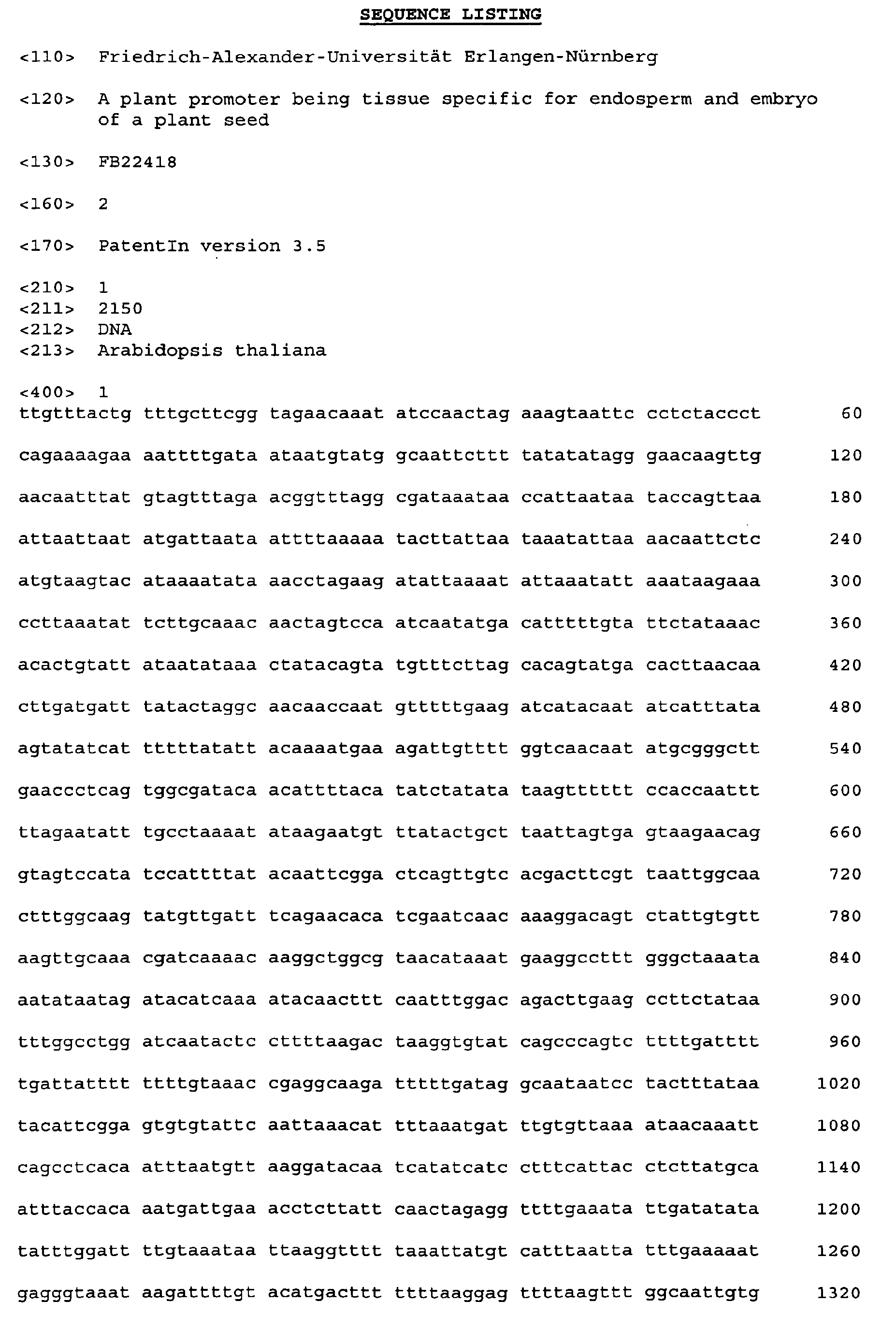
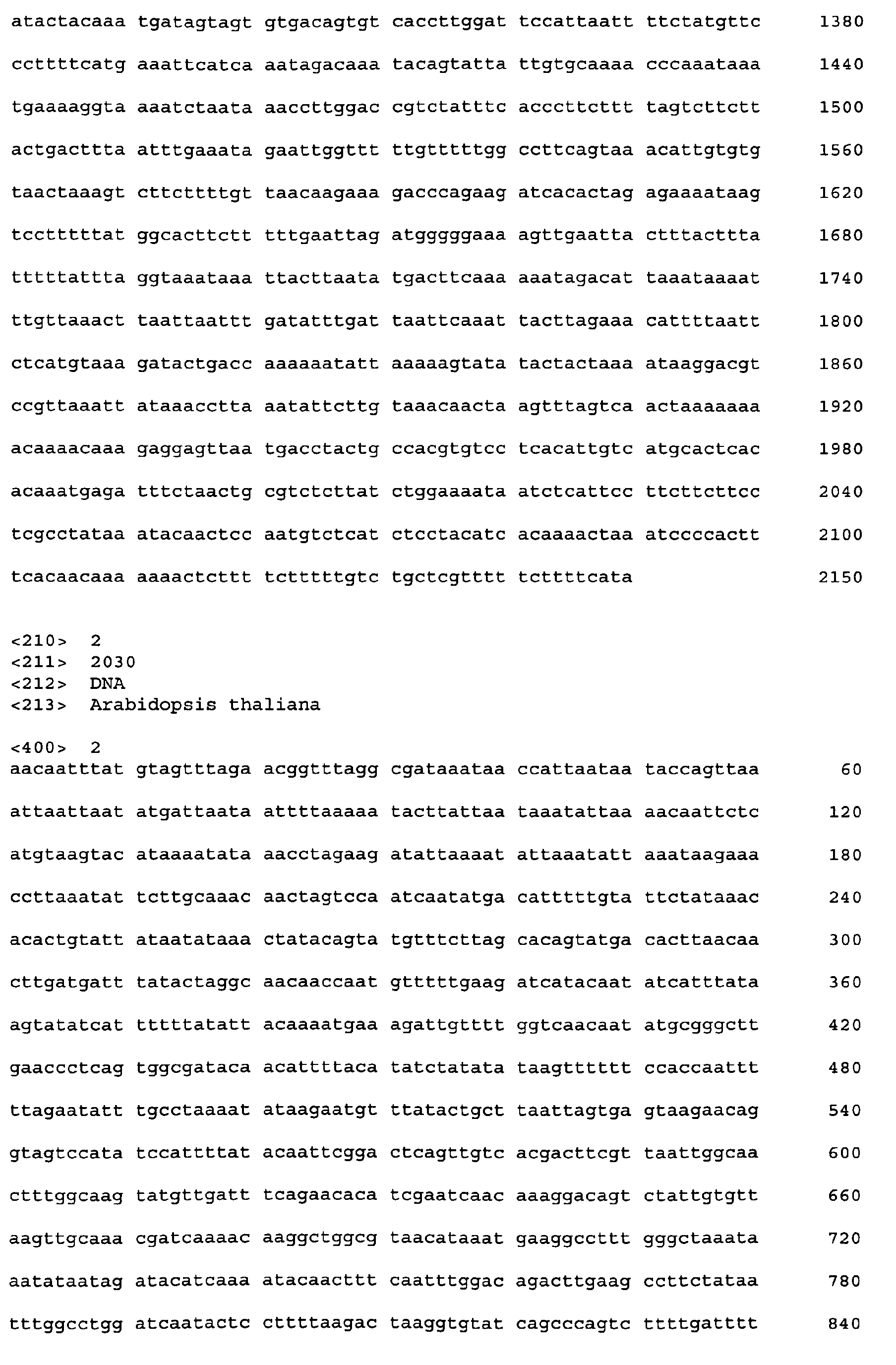
- said plant promoter has a nucleic acid sequence represented by SEQ ID NO: 2, or a sequence which is at least 95 %, preferably at least 99 % identical to SEQ ID NO: 2.
- said plant promoter has a nucleic acid sequence represented by SEQ ID NO: 1, or a sequence which is at least 95 %, preferably at least 99 % identical to SEQ ID NO: 1.
- said plant cell is derived from a plant species selected from plants, the mature seeds of which do not contain an endosperm.
- said plant cell is derived from a plant species selected from oleaginous plants, such as rapeseed, leguminous plants, such as peas and beans, Asteraceae plants, such as sunflower, Cucurbitaceae plants, such as pumpkin, and Juglandaceae plants, such as walnut.
- oleaginous plants such as rapeseed, leguminous plants, such as peas and beans
- Asteraceae plants such as sunflower
- Cucurbitaceae plants such as pumpkin
- Juglandaceae plants such as walnut.
- a plant promoter being tissue specific for endosperm and embryo of a plant seed, in particular the epidermis of an embryo of a plant seed, said plant promoter having a nucleic acid sequence comprising at least 100, 200, 300, 400, 500, 600, 700, 800, 900, 1000, 1100, 1200, 1300, 1400, 1500, or 1505 contiguous nucleotides of SEQ ID NO: 1, preferably at least 1700 contiguous nucleotides, more preferably at least 1900 contiguous nucleotides, even more preferably at least 2000 contiguous nucleotides, and most preferably at least 2030 contiguous nucleotides of SEQ ID NO: 1, or of a sequence which is at least 95 %, preferably at least 99 % identical to SEQ ID NO: 1.
- Sequences which are "at least 95 %, preferably at least 99 % identical" to SEQ ID NO: 1 are those sequences which account for the intraspecies sequences variation which may occur. Such sequences are explicitly encompassed herein.
- a sequence W is said to be "X % identical to SEQ ID NO: 1 ", if X % residues of SEQ ID NO: 1 can be found in sequence W in corresponding positions.
- said plant promoter consists of
- SEQ ID NO: 1 taken from SEQ ID NO: 1 or from a sequence which is at least 95 %, preferably at least 99 % identical to SEQ ID NO: 1.
- the plant promoter has a nucleic acid sequence represented by SEQ ID NO: 2.
- the plant promoter has a nucleic acid sequence represented by SEQ ID NO: 1.
- an expression system comprising a plant promoter according to the present invention and a nucleic acid coding for a protein to be specifically expressed in the endosperm or embryo of a plant seed, said nucleic acid coding for a protein being arranged downstream of said plant promoter and being connected to said plant promoter in a sense direction, such that said plant promoter directs expression of said protein coded by said nucleic acid.
- the objects of the present invention are also solved by a vector comprising the plant promoter according to the present invention or the expression system according to the present invention.
- the objects of the present invention are also solved by a plant cell comprising the plant promoter according to the present invention or the expression system according to the present invention or the vector according to the present invention.
- the plant cell according to the present invention is derived from a plant species selected from plants, the mature seeds of which do not contain an endosperm.
- a person skilled in the art knows or is able to determine whether a mature plant seed contains an endosperm.
- the plant cell according to the present invention is derived from a plant species selected from oleaginous plants, such as rapeseed, soybean, cotton, peanut, sesame, leguminous plants, such as pea and bean, Asteraceae plants, such as sunflower, Cucurbitaceae plants, such as pumpkin, and Juglandaceae plants, such as walnut.
- a plant seed comprising the plant promoter according to the present invention or the expression system according to the present invention or the vector according to the present invention or at least one plant cell according to the present invention.
- the plant seed is derived from a plant species selected from plants as defined above.
- the objects of the present invention are also solved by a plant comprising a plant cell according to the present invention.
- the plant is derived from a plant species selected from plants as defined above.
- the plant according to the present invention comprises the plant promoter according to the present invention, wherein said plant promoter has been deliberately introduced into said plant.
- the plant cell according to the present invention comprises the plant promoter according to the present invention, wherein said plant promoter has been deliberately introduced into said plant cell.
- the plant seed according to the present invention comprises the plant promoter according to the present invention, wherein said plant promoter has been deliberately introduced into said plant seed.
- Methods of artificially or deliberately introducing nucleic acids into plants/plant cells include, amongst others, Agrobacterium mediated transformation, biolistic particle bombardment, and viral transformation.
- the objects of the present invention are also solved by a method of selectively expressing a protein in endosperm and embryo of a plant seed, in particular in the epidermis of an embryo of a plant seed, said method comprising:
- the plant cell and plant, in this aspect of the present invention, are as defined further above.
- a plant promoter can be used to direct a tissue specific expression of proteins of interest in the endosperm and embryo of a plant seed, in particular in the epidermis of the embryo of a plant seed.
- the plant promoter has a nucleic acid sequence which is represented by SEQ ID NO: 2.
- the plant promoter consists of the nucleic acid sequence represented by SEQ ID NO:2.
- the plant promoter has a nucleic acid sequence represented by SEQ ID NO: 1.
- the plant promoter according to the present invention consists of a nucleic acid sequence represented by SEQ ID NO: 1.
- Proteins of interest that may be specifically expressed using the present invention are selected from carbohydrate transporters, such as sucrose transporters, and monosaccharide transporters, eventually also together with extracellular invertases.
- Other proteins that may be specifically expressed using the present invention are selected from proteins involved in the biosynthesis of oils, lipids and fats, such as acyltransferases, fatty acid elongases, acyl-CoA-synthetasis.
- the plant promoter in accordance with embodiments of the present invention is connected to the nucleic acid coding for the protein to be expressed in such a manner that the promoter directs expression of said protein.
- a person skilled in the art knows how to produce such functional constructs.
- the nucleic acid coding for the protein to be expressed is connected to the plant promoter in a sense direction downstream of said plant promoter.
- the plant promoter in accordance with embodiments of the present invention is particularly useful in oleaginous plants, but also in plants of other species which may be used for commercial purposes.
- the plant cell, plant seed and whole plant is preferably derived from a plant species selected from Arabidopsis thaliana, Brassica napus, beans, peas, pumpkin, sunflower, walnut, cotton, soybean, peanut, sesame.
- the term "derived from a plant species", when used in connection with a plant or plant cell herein, is meant to refer to such plant or plant cell belonging to such plant species.
- the term is also meant to include such plants and plant cells the genetic make-up of which is that of the indicated species, although the plant or plant cell may also contain nucleic acids which are foreign to such species.
- the term "derived from a plant species” is meant to also include transgenic plants and plant cells.
- the present invention also relates to the use of a plant promoter as defined above for the tissue specific expression of proteins of interest in the endosperm and embryo of a plant seed, in particular in the epidermis of the embryo of a plant seed, the plant promoter being as defined further above.
- a plant promoter as defined above for the tissue specific expression of proteins of interest in the endosperm and embryo of a plant seed, in particular in the epidermis of the embryo of a plant seed, the plant promoter being as defined further above.
- such use comprises the incorporation of the plant promoter, together with the nucleic acid coding for a protein of interest into a plant cell, generating a whole plant from such plant cell and obtaining the seeds from such whole plant.
- said use in accordance with embodiments of the present invention is for a specific expression of proteins of interest in the epidermis of the embryo and the endosperm of a plant seed.
- the method and use in accordance with the present invention are particularly useful in oleaginous plants, such as Brassica napus (rapeseed), but may also be used with other plants of commercial interest, such as soybean, cotton, peanut, sesame, pea, bean, pumpkin, sunflower, walnut, olive.
- Brassica napus rapeseed
- other plants of commercial interest such as soybean, cotton, peanut, sesame, pea, bean, pumpkin, sunflower, walnut, olive.
- the present inventors have surprisingly found that a stretch of the promoter of the AtSUC5 protein from Arabidopsis thaliana directs the expression of a protein of interest to the endosperm and the epidermis of the developing embryo.
- the Arabidopsis thaliana AtSUC5 protein had been characterized as a transport protein of the plant plasma membrane catalyzing the transport of biotin and sucrose. Baud et al., 2005, The Plant Journal, 43, 824-836 found that the sucrose transporter gene AtSUC5 was only expressed in the endosperm of Arabidopsis thaliana seeds, i. e. the nutritional tissue surrounding the developing embryo.
- the present inventors could show that the promoter in accordance with the present invention directs the expression of a gene of interest to the endosperm and, what had not been previously described, to the epidermis (i. e. the outermost cell layer of the embryo).
- the epidermis i. e. the outermost cell layer of the embryo.
- Such expression in the embryo epidermis appears to start at a time, when the oil production within the embryo is initiated and is restricted to the physiological underside of the embryo cotyledons, that is to the cell layer that has contacts to the surrounding endosperm which is therefore responsible for the transfer of compounds from the endosperm to the embryo.
- the plant promoter in accordance with the present invention there provides for an ideal temporal as well as special resolution of expression.
- the present inventors envisage that any stretch as small as 100 contiguous nucleotides, preferably 100-200, or 200-300, or 300-400, or 400-500, or 500-600, or 600-700, or 700-800, or 800-900, or 900-1000, or 1000-1100, or 1100-1200, or 1200-1300, or 1300-1400, or 1400-1500, or 1500-1600, or 1600-1700, or 1700-1800, or 1800-1900, or 1900-2000, or 2000-2100, or 2100-2149, or 2100-2150 contiguous nucleotides taken from SEQ ID NO: 1, or from a sequence that is at least 95 %, preferably at least 99 % identical to SEQ ID NO: 1, will allow for the required tissue specific expression.
- a stretch of at least 1505 contiguous nucleotides, preferably at least 1700 contiguous nucleotides, more preferably at least 1900 contiguous nucleotides, even more preferably at least 2000 contiguous nucleotides, and most preferably at least 2030 contiguous nucleotides, taken from SEQ ID NO: 1, or from a sequence that is at least 95 %, preferably at least 99 % identical to SEQ ID NO: 1, will allow for the required tissue specific expression, in particular for an expression in the endosperm and embryo of a plant seed, more particularly in the epidermis of the embryo.
- Figure 1 shows analyses of pAtSUC5/sGFP plants and pAtSUC5/tmGFP9 plants.
- figure 1 shows confocal images of developing seeds [( A ) to ( E )] and isolated embryos [( F ) to ( I )] from pAtSUC5lsGFP plants [( A ), ( D ) and ( E )] or pAtSUC5 / tmGFP9 [( B ), ( C ), and ( F ) to ( I )] plants are presented.
- AtSUC5 promoter pAtSUC5/reporter lines that expressed the open reading frames (ORFs) of the soluble and freely mobile green fluorescent protein (sGFP) or of a membrane-bound version of GFP (tmGFP9) that is linked to several transmembrane helices and, therefore, membrane-localized and immobile ( Stadler et al., 2005 Physiol. 139, 704-712 ) under the control of a 2030-bp AtSUC5 promoter.
- the pAtSUC5 fragment used in previous analyses by Baud et al. (2005, Plant J., 43, 824-836 ) was 1.5 kb long.
- the present inventors obtained numerous transformed T1 plants for both constructs. Analyses of these plants by confocal microscopy confirmed the expression of AtSUC5 in the endosperm with both constructs (Fig. 2A and 2B), and also the accumulation of GFP at the chalazal end of the endosperm (Fig. 2B) and the absence of GFP from globular-stage embryos (Fig. 2C) that were already published (Baud et al., 2005). Moreover, they observed no expression of GFP in heart-stage embryos (Fig. 2D). The present inventors did, however, find pAtSUC5 activity with both constructs during later stages of embryo development (Fig. 2E to 2I). This embryo-specific expression has not been observed in earlier analyses performed with standard fluorescence microscopy and a shorter promoter fragment (Baud et al., 2005).
- Optical sections through pAtSUC5 / tmGFP9 embryos confined the pAtSUC5 activity to the embryo epidermis (Fig. 2G and 2H).
- sGFP synthesized in the embryo epidermis from Arabidopsis GLABRA2 promoter (pAtGL2) / sGFP constructs can move symplastically into all other cells of the developing embryo due to the presence of large plasmodesmata. This explains the homogenous fluorescence seen in the early-torpedo-stage embryo expressing sGFP from p AtSUC5 (Fig. 2E). Wild type embryos did not show fluorescence at any developmental stage (Fig. 2I).
Landscapes
- Health & Medical Sciences (AREA)
- Genetics & Genomics (AREA)
- Life Sciences & Earth Sciences (AREA)
- Engineering & Computer Science (AREA)
- Biomedical Technology (AREA)
- Zoology (AREA)
- General Engineering & Computer Science (AREA)
- Organic Chemistry (AREA)
- Chemical & Material Sciences (AREA)
- Wood Science & Technology (AREA)
- Bioinformatics & Cheminformatics (AREA)
- Biotechnology (AREA)
- Plant Pathology (AREA)
- Molecular Biology (AREA)
- Reproductive Health (AREA)
- Biophysics (AREA)
- Microbiology (AREA)
- Physics & Mathematics (AREA)
- Developmental Biology & Embryology (AREA)
- Pregnancy & Childbirth (AREA)
- Biochemistry (AREA)
- General Health & Medical Sciences (AREA)
- Cell Biology (AREA)
- Breeding Of Plants And Reproduction By Means Of Culturing (AREA)
- Micro-Organisms Or Cultivation Processes Thereof (AREA)
Abstract
Description
- The present invention relates to a plant promoter being tissue specific for endosperm and embryo of a plant seed, in particular for the epidermis of an embryo of a plant seed, and to an expression system comprising such plant promoter. The present invention also relates to a vector comprising the plant promoter, and to a plant cell comprising the plant promoter or the aforementioned expression system or the aforementioned vector. Moreover, the present invention relates to a plant seed comprising such plant promoter or such expression system or such vector or such plant cell. The present invention also relates to a plant comprising a plant cell in accordance with the present invention. Also, the present invention relates to a method of selectively expressing a protein in endosperm and embryo of a plant seed, in particular in the epidermis of an embryo of a plant seed.
- Many plants are of commercial interest because of their capability to produce specific compounds. These may be secondary metabolites, such as compounds having pharmacological activity, or they may e.g. be nutritional compounds, such as starch, sucrose, or fats.
- As an example, in oleaginous plants, the compounds of commercial interest are oils, fats and lipids; these accumulate within the embryo and not in the endosperm of the seeds. Numerous attempts have been made to improve the yield of the oil production in such oleaginous plants. These concern specific selection of plants having a high oil yield. Other attempts have been made in optimizing the extraction efficiency with which the oil is extracted from the seeds. There remains a need in the art to increase the yields of production of desired compounds, such as oils, fats and lipids. One approach in this respect has been to increase the production of the desired compounds, e.g. the oil production by the expression of genes which optimize the "biosynthetic fitness" of the plants, e. g. by increasing the import of nutrients into the seeds which are necessary for an optimum development thereof. In many instances, however, this could not be achieved, because the import of such nutrients was unspecific and not targeted.
- Accordingly, it was an object of the present invention to provide for means that allow a specific and targeted expression of genes in the developing embryo and the endosperm of a plant seed, in particular in the epidermis of the embryo.
- These objects are solved by a method of selectively expressing a protein in endosperm and embryo of a plant seed, in particular the epidermis of an embryo of a plant seed, said method comprising:
- a) introducing into a plant cell a plant promoter being tissue specific for endosperm and embryo of a plant seed, in particular the epidermis of said embryo, together with a nucleic acid coding for a protein to be specifically expressed in the endosperm and embryo of a plant seed, and
- b) generating a whole plant from said plant cell, and
- c) obtaining seed from said whole plant,
- In one embodiment, said plant promoter has a nucleic acid sequence represented by SEQ ID NO: 2, or a sequence which is at least 95 %, preferably at least 99 % identical to SEQ ID NO: 2.
- In one embodiment, said plant promoter has a nucleic acid sequence represented by SEQ ID NO: 1, or a sequence which is at least 95 %, preferably at least 99 % identical to SEQ ID NO: 1.
- In one embodiment, said plant cell is derived from a plant species selected from plants, the mature seeds of which do not contain an endosperm.
- In one embodiment, said plant cell is derived from a plant species selected from oleaginous plants, such as rapeseed, leguminous plants, such as peas and beans, Asteraceae plants, such as sunflower, Cucurbitaceae plants, such as pumpkin, and Juglandaceae plants, such as walnut.
- This object is also solved by a plant promoter being tissue specific for endosperm and embryo of a plant seed, in particular the epidermis of an embryo of a plant seed, said plant promoter having a nucleic acid sequence comprising at least 100, 200, 300, 400, 500, 600, 700, 800, 900, 1000, 1100, 1200, 1300, 1400, 1500, or 1505 contiguous nucleotides of SEQ ID NO: 1, preferably at least 1700 contiguous nucleotides, more preferably at least 1900 contiguous nucleotides, even more preferably at least 2000 contiguous nucleotides, and most preferably at least 2030 contiguous nucleotides of SEQ ID NO: 1, or of a sequence which is at least 95 %, preferably at least 99 % identical to SEQ ID NO: 1. Sequences which are "at least 95 %, preferably at least 99 % identical" to SEQ ID NO: 1 are those sequences which account for the intraspecies sequences variation which may occur. Such sequences are explicitly encompassed herein. A sequence W is said to be "X % identical to SEQ ID NO: 1 ", if X % residues of SEQ ID NO: 1 can be found in sequence W in corresponding positions.
- In one embodiment, said plant promoter consists of
- 100-200 contiguous nucleotides, or of
- 200-300 contiguous nucleotides, or of
- 300-400 contiguous nucleotides, or of
- 400-500 contiguous nucleotides, or of
- 500-600 contiguous nucleotides, or of
- 600-700 contiguous nucleotides, or of
- 700-800 contiguous nucleotides, or of,
- 800-900 contiguous nucleotides, or of
- 900-1000 contiguous nucleotides, or of
- 1000-1100 contiguous nucleotides, or of
- 1100-1200 contiguous nucleotides, or of
- 1200-1300 contiguous nucleotides, or of
- 1300-1400 contiguous nucleotides, or of
- 1400-1500 contiguous nucleotides, or of
- 1505-1600 contiguous nucleotides, or of
- 1600-1700 contiguous nucleotides, or of
- 1700-1800 contiguous nucleotides, or of
- 1800-1900 contiguous nucleotides, or of
- 1900-2000 contiguous nucleotides, or of
- 2000-2100 contiguous nucleotides, or of
- 2100-2149 contiguous nucleotides, or of
- 2100-2150 contiguous nucleotides,
- taken from SEQ ID NO: 1 or from a sequence which is at least 95 %, preferably at least 99 % identical to SEQ ID NO: 1.
- In one embodiment the plant promoter has a nucleic acid sequence represented by SEQ ID NO: 2.
- In one embodiment the plant promoter has a nucleic acid sequence represented by SEQ ID NO: 1.
- The objects of the present invention are also solved by an expression system comprising a plant promoter according to the present invention and a nucleic acid coding for a protein to be specifically expressed in the endosperm or embryo of a plant seed, said nucleic acid coding for a protein being arranged downstream of said plant promoter and being connected to said plant promoter in a sense direction, such that said plant promoter directs expression of said protein coded by said nucleic acid.
- The objects of the present invention are also solved by a vector comprising the plant promoter according to the present invention or the expression system according to the present invention.
- The objects of the present invention are also solved by a plant cell comprising the plant promoter according to the present invention or the expression system according to the present invention or the vector according to the present invention.
- In one embodiment the plant cell according to the present invention is derived from a plant species selected from plants, the mature seeds of which do not contain an endosperm. A person skilled in the art knows or is able to determine whether a mature plant seed contains an endosperm. In one embodiment, the plant cell according to the present invention is derived from a plant species selected from oleaginous plants, such as rapeseed, soybean, cotton, peanut, sesame, leguminous plants, such as pea and bean, Asteraceae plants, such as sunflower, Cucurbitaceae plants, such as pumpkin, and Juglandaceae plants, such as walnut.
- The objects of the present invention are also solved by a plant seed comprising the plant promoter according to the present invention or the expression system according to the present invention or the vector according to the present invention or at least one plant cell according to the present invention. Preferably, the plant seed is derived from a plant species selected from plants as defined above.
- The objects of the present invention are also solved by a plant comprising a plant cell according to the present invention.
- In one embodiment the plant is derived from a plant species selected from plants as defined above.
- In one embodiment, the plant according to the present invention comprises the plant promoter according to the present invention, wherein said plant promoter has been deliberately introduced into said plant. Likewise, in one embodiment, the plant cell according to the present invention comprises the plant promoter according to the present invention, wherein said plant promoter has been deliberately introduced into said plant cell. Likewise, in one embodiment, the plant seed according to the present invention comprises the plant promoter according to the present invention, wherein said plant promoter has been deliberately introduced into said plant seed.
- Methods of artificially or deliberately introducing nucleic acids into plants/plant cells are known to a person skilled in the art and include, amongst others, Agrobacterium mediated transformation, biolistic particle bombardment, and viral transformation.
- The objects of the present invention are also solved by a method of selectively expressing a protein in endosperm and embryo of a plant seed, in particular in the epidermis of an embryo of a plant seed, said method comprising:
- a) introducing an expression system according to the present invention or a vector according to the present invention into a plant cell, and
- b) generating a whole plant from said plant cell, and
- c) obtaining seed from said whole plant.
- The plant cell and plant, in this aspect of the present invention, are as defined further above.
- In accordance with embodiments of the present invention, a plant promoter can be used to direct a tissue specific expression of proteins of interest in the endosperm and embryo of a plant seed, in particular in the epidermis of the embryo of a plant seed. In one embodiment, the plant promoter has a nucleic acid sequence which is represented by SEQ ID NO: 2. In one embodiment, the plant promoter consists of the nucleic acid sequence represented by SEQ ID NO:2. In one embodiment, the plant promoter has a nucleic acid sequence represented by SEQ ID NO: 1. In yet a further embodiment, the plant promoter according to the present invention consists of a nucleic acid sequence represented by SEQ ID NO: 1.
- Proteins of interest that may be specifically expressed using the present invention are selected from carbohydrate transporters, such as sucrose transporters, and monosaccharide transporters, eventually also together with extracellular invertases. Other proteins that may be specifically expressed using the present invention are selected from proteins involved in the biosynthesis of oils, lipids and fats, such as acyltransferases, fatty acid elongases, acyl-CoA-synthetasis.
- The plant promoter, in accordance with embodiments of the present invention is connected to the nucleic acid coding for the protein to be expressed in such a manner that the promoter directs expression of said protein. A person skilled in the art knows how to produce such functional constructs. Hence, the nucleic acid coding for the protein to be expressed is connected to the plant promoter in a sense direction downstream of said plant promoter.
- The plant promoter in accordance with embodiments of the present invention is particularly useful in oleaginous plants, but also in plants of other species which may be used for commercial purposes. Accordingly, the plant cell, plant seed and whole plant is preferably derived from a plant species selected from Arabidopsis thaliana, Brassica napus, beans, peas, pumpkin, sunflower, walnut, cotton, soybean, peanut, sesame. The term "derived from a plant species", when used in connection with a plant or plant cell herein, is meant to refer to such plant or plant cell belonging to such plant species. The term is also meant to include such plants and plant cells the genetic make-up of which is that of the indicated species, although the plant or plant cell may also contain nucleic acids which are foreign to such species. Hence, the term "derived from a plant species" is meant to also include transgenic plants and plant cells.
- The present invention also relates to the use of a plant promoter as defined above for the tissue specific expression of proteins of interest in the endosperm and embryo of a plant seed, in particular in the epidermis of the embryo of a plant seed, the plant promoter being as defined further above. Preferably such use comprises the incorporation of the plant promoter, together with the nucleic acid coding for a protein of interest into a plant cell, generating a whole plant from such plant cell and obtaining the seeds from such whole plant. Preferably, said use in accordance with embodiments of the present invention is for a specific expression of proteins of interest in the epidermis of the embryo and the endosperm of a plant seed.
- The method and use in accordance with the present invention are particularly useful in oleaginous plants, such as Brassica napus (rapeseed), but may also be used with other plants of commercial interest, such as soybean, cotton, peanut, sesame, pea, bean, pumpkin, sunflower, walnut, olive.
- The present inventors have surprisingly found that a stretch of the promoter of the AtSUC5 protein from Arabidopsis thaliana directs the expression of a protein of interest to the endosperm and the epidermis of the developing embryo. Previously, the Arabidopsis thaliana AtSUC5 protein had been characterized as a transport protein of the plant plasma membrane catalyzing the transport of biotin and sucrose. Baud et al., 2005, The Plant Journal, 43, 824-836 found that the sucrose transporter gene AtSUC5 was only expressed in the endosperm of Arabidopsis thaliana seeds, i. e. the nutritional tissue surrounding the developing embryo. In contrast thereto, the present inventors could show that the promoter in accordance with the present invention directs the expression of a gene of interest to the endosperm and, what had not been previously described, to the epidermis (i. e. the outermost cell layer of the embryo). Such expression in the embryo epidermis appears to start at a time, when the oil production within the embryo is initiated and is restricted to the physiological underside of the embryo cotyledons, that is to the cell layer that has contacts to the surrounding endosperm which is therefore responsible for the transfer of compounds from the endosperm to the embryo. The plant promoter in accordance with the present invention there provides for an ideal temporal as well as special resolution of expression.
- Moreover, reference is made to the enclosed sequence listing, wherein,
- SEQ ID NO: 1 represents the 2150 bp sequence upstream of At 1g 71890 and downstream of At 1g 71880;
- SEQ ID NO: 2 represents one example of a stretch of 2030 bp taken from SEQ ID NO: 1.
- The present inventors envisage that any stretch as small as 100 contiguous nucleotides, preferably 100-200, or 200-300, or 300-400, or 400-500, or 500-600, or 600-700, or 700-800, or 800-900, or 900-1000, or 1000-1100, or 1100-1200, or 1200-1300, or 1300-1400, or 1400-1500, or 1500-1600, or 1600-1700, or 1700-1800, or 1800-1900, or 1900-2000, or 2000-2100, or 2100-2149, or 2100-2150 contiguous nucleotides taken from SEQ ID NO: 1, or from a sequence that is at least 95 %, preferably at least 99 % identical to SEQ ID NO: 1, will allow for the required tissue specific expression. In one embodiment, a stretch of at least 1505 contiguous nucleotides, preferably at least 1700 contiguous nucleotides, more preferably at least 1900 contiguous nucleotides, even more preferably at least 2000 contiguous nucleotides, and most preferably at least 2030 contiguous nucleotides, taken from SEQ ID NO: 1, or from a sequence that is at least 95 %, preferably at least 99 % identical to SEQ ID NO: 1, will allow for the required tissue specific expression, in particular for an expression in the endosperm and embryo of a plant seed, more particularly in the epidermis of the embryo.
- Moreover, reference is made to the enclosed figure, wherein
-
Figure 1 shows analyses of pAtSUC5/sGFP plants and pAtSUC5/tmGFP9 plants. - More specifically,
figure 1 shows confocal images of developing seeds [(A) to (E)] and isolated embryos [(F) to (I)] from pAtSUC5lsGFP plants [(A), (D) and (E)] or pAtSUC5/tmGFP9 [(B), (C), and (F) to (I)] plants are presented. - (A) Young seed with syncytial endosperm and no detectable embryo showing GFP fluorescence in the endosperm nuclei (maximal projection).
- (B) Young seed with syncytial endosperm showing strong GFP fluorescence in the chalazal region (maximal projection; ch).
- (C) Developing seed showing GFP fluorescence (optical section) in the ER of the endosperm but not in the globular embryo (arrow).
- (D) Slightly older seed with GFP fluorescence in the endosperm nuclei (maximal projection) but not in the heart-stage embryo (arrow).
- (E) Developing seed with GFP fluorescence in the early-torpedo-stage embryo and in the endosperm.
- (F) Isolated midtorpedo-stage embryo (maximal projection) showing highest GFP fluorescence at the physiological underside of the forming cotyledons (white arrows) and, no GFP fluorescence on the upper side (black arrow), and little fluorescence in the radicle.
- (G) Higher magnification of an embryo (optical section) at the same developmental stage as shown in (F).
- (H) Higher magnification (optical section) of e section through the underside of a forming cotyledon [same embryo as in (G)] showing GFP fluorescence only in the epidermis.
- (I) Comparison of the fluorescence in an isolated wt embryo [slightly older than the embryo shown in (E)] and pAtSUC5/tmGFP9 embryo [similar stage as in (F) and (G)].
- The present inventors generated AtSUC5 promoter (pAtSUC5)/reporter lines that expressed the open reading frames (ORFs) of the soluble and freely mobile green fluorescent protein (sGFP) or of a membrane-bound version of GFP (tmGFP9) that is linked to several transmembrane helices and, therefore, membrane-localized and immobile (Stadler et al., 2005 Physiol. 139, 704-712) under the control of a 2030-bp AtSUC5 promoter. The pAtSUC5 fragment used in previous analyses by Baud et al. (2005, Plant J., 43, 824-836) was 1.5 kb long. After BASTA-selection of T1 seedlings, the present inventors obtained numerous transformed T1 plants for both constructs. Analyses of these plants by confocal microscopy confirmed the expression of AtSUC5 in the endosperm with both constructs (Fig. 2A and 2B), and also the accumulation of GFP at the chalazal end of the endosperm (Fig. 2B) and the absence of GFP from globular-stage embryos (Fig. 2C) that were already published (Baud et al., 2005). Moreover, they observed no expression of GFP in heart-stage embryos (Fig. 2D). The present inventors did, however, find pAtSUC5 activity with both constructs during later stages of embryo development (Fig. 2E to 2I). This embryo-specific expression has not been observed in earlier analyses performed with standard fluorescence microscopy and a shorter promoter fragment (Baud et al., 2005).
- Optical sections through pAtSUC5/tmGFP9 embryos confined the pAtSUC5 activity to the embryo epidermis (Fig. 2G and 2H). In previous analyses (Stadler et al., 2005) it had been shown that sGFP synthesized in the embryo epidermis from Arabidopsis GLABRA2 promoter (pAtGL2)/sGFP constructs can move symplastically into all other cells of the developing embryo due to the presence of large plasmodesmata. This explains the homogenous fluorescence seen in the early-torpedo-stage embryo expressing sGFP from pAtSUC5 (Fig. 2E). Wild type embryos did not show fluorescence at any developmental stage (Fig. 2I).
- The features of the present invention disclosed in the specification, the claims, and/or in the accompanying drawings may, both separately and in any combination thereof, be material for realizing the invention in various forms thereof.

wherein said plant promoter has a nucleic acid sequence consisting of 100-200 contiguous nucleotides, or 200-300 contiguous nucleotides, or 300-400 contiguous nucleotides, or 400-500 contiguous nucleotides, or 500-600 contiguous nucleotides, or 600-700 contiguous nucleotides, or 700-800 contiguous nucleotides, or 800-900 contiguous nucleotides, or 900-1000 contiguous nucleotides, or 1000-1100 contiguous nucleotides, or 1100-1200 contiguous nucleotides, or 1200-1300 contiguous nucleotides, or 1300-1400 contiguous nucleotides, or 1400-1500 contiguous nucleotides, or 1500-1600 contiguous nucleotides, or 1600-1700 contiguous nucleotides, or 1700-1800 contiguous nucleotides, or 1800-1900 contiguous nucleotides, or 1900-2000 contiguous nucleotides, or 2000-2100 contiguous nucleotides, or 2030-2149 contiguous nucleotides, or 2030-2150 contiguous nucleotides taken from SEQ ID NO: 1, or from a nucleic acid sequence which is at least 95 %, preferably at least 99 % identical to SEQ ID NO: 1.
Moreover, reference is made to the example which is given to illustrate, not to limit the present invention.
Claims (15)
- A method of selectively expressing a protein in endosperm and embryo of a plant seed, in particular the epidermis of an embryo of a plant seed, said method comprising:a) introducing into a plant cell a plant promoter being tissue specific for endosperm and embryo of a plant seed, in particular the epidermis of said embryo, together with a nucleic acid coding for a protein to be specifically expressed in the endosperm and embryo of a plant seed, andb) generating a whole plant from said plant cell, andc) obtaining seed from said whole plant,wherein said nucleic acid coding for a protein to be specifically expressed in the endosperm and embryo of said plant seed is arranged downstream of said plant promoter and is connected to said plant promoter in a sense direction, such that said plant promoter directs expression of said protein coded by said nucleic acid, and
wherein said plant promoter has a nucleic acid sequence consisting of 100-200 contiguous nucleotides, or 200-300 contiguous nucleotides, or 300-400 contiguous nucleotides, or 400-500 contiguous nucleotides, or 500-600 contiguous nucleotides, or 600-700 contiguous nucleotides, or 700-800 contiguous nucleotides, or 800-900 contiguous nucleotides, or 900-1000 contiguous nucleotides, or 1000-1100 contiguous nucleotides, or 1100-1200 contiguous nucleotides, or 1200-1300 contiguous nucleotides, or 1300-1400 contiguous nucleotides, or 1400-1500 contiguous nucleotides, or 1500-1600 contiguous nucleotides, or 1600-1700 contiguous nucleotides, or 1700-1800 contiguous nucleotides, or 1800-1900 contiguous nucleotides, or 1900-2000 contiguous nucleotides, or 2000-2100 contiguous nucleotides, or 2030-2149 contiguous nucleotides, or 2030-2150 contiguous nucleotides taken from SEQ ID NO: 1, or from a nucleic acid sequence which is at least 95 %, preferably at least 99 % identical to SEQ ID NO: 1. - The method according to claim 1, wherein said plant promoter has a nucleic acid sequence represented by SEQ ID NO: 2, or a sequence which is at least 95 %, preferably at least 99 % identical to SEQ ID NO: 2.
- The method according to claim 1, wherein said plant promoter has a nucleic acid sequence represented by SEQ ID NO: 1, or a sequence which is at least 95 %, preferably at least 99 % identical to SEQ ID NO: 1.
- The method according to any of the foregoing claims, wherein said plant cell is derived from a plant species selected from plants, the mature seeds of which do not contain an endosperm.
- The method according to any of the foregoing claims, wherein said plant cell is derived from a plant species selected from oleaginous plants, such as rapeseed, leguminous plants, such as peas and beans, Asteraceae plants, such as sunflower, Cucurbitaceae plants, such as pumpkin, and Juglandaceae plants, such as walnut.
- A plant promoter being tissue specific for endosperm and embryo of a plant seed, said plant promoter having a nucleic acid sequence consisting of 100-200 contiguous nucleotides, or 200-300 contiguous nucleotides, or 300-400 contiguous nucleotides, or 400-500 contiguous nucleotides, or 500-600 contiguous nucleotides, or 600-700 contiguous nucleotides, or 700-800 contiguous nucleotides, or 800-900 contiguous nucleotides, or 900-1000 contiguous nucleotides, or 1000-1100 contiguous nucleotides, or 1100-1200 contiguous nucleotides, or 1200-1300 contiguous nucleotides, or 1300-1400 contiguous nucleotides, or 1400-1500 contiguous nucleotides, or 1505-1600 contiguous nucleotides, or 1600-1700 contiguous nucleotides, or 1700-1800 contiguous nucleotides, or 1800-1900 contiguous nucleotides, or 1900-2000 contiguous nucleotides, or 2000-2100 contiguous nucleotides or 2030-2149 contiguous nucleotides, or 2030-2150 contiguous nucleotides taken from SEQ ID NO: 1, or from a nucleic acid sequence which is at least 95 %, preferably at least 99 % identical to SEQ ID NO: 1.
- The plant promoter according to claim 6, having a nucleic acid sequence represented by SEQ ID NO: 2, or a sequence which is at least 95 %, preferably at least 99 % identical to SEQ ID NO: 2.
- The plant promoter according to claim 6, having a nucleic acid sequence represented by SEQ ID NO: 1, or a sequence which is at least 95 %, preferably at least 99 % identical to SEQ ID NO: 1.
- An expression system comprising a plant promoter according to any of claims 6-8 and a nucleic acid coding for a protein to be specifically expressed in the endosperm and embryo of a plant seed, said nucleic acid coding for a protein being arranged downstream of said plant promoter and being connected to said plant promoter in a sense direction, such that said plant promoter directs expression of said protein coded by said nucleic acid.
- A vector comprising the plant promoter according to any of claims 6-8 or the expression system according to claim 9.
- A plant cell comprising the plant promoter according to any of claims 6-8 or the expression system according to claim 9 or the vector according to claim 10.
- A plant seed comprising the plant promoter according to any of claims 6-8 or the expression system according to claim 9 or the vector according to claim 10 or at least one plant cell according to claim 11.
- A plant comprising a plant cell according to claim 11.
- The plant cell according to claim 11 or the plant seed according to claim 12 or the plant according to claim 13, being derived from a plant species selected from plants, the mature seeds of which do not contain an endosperm.
- The plant cell according to claim 11 or the plant seed according to claim 12 or the plant according to claim 13, being derived from a plant species selected from oleaginous plants, such as rapeseed, leguminous plants, such as peas and beans, Asteraceae plants, such as sunflower, Cucurbitaceae plants, such as pumpkin, and Juglandaceae plants, such as walnut.
Priority Applications (1)
| Application Number | Priority Date | Filing Date | Title |
|---|---|---|---|
| EP09013413A EP2314703A1 (en) | 2009-10-23 | 2009-10-23 | A plant promoter being tissue specific for endosperm and embryo of a plant seed |
Applications Claiming Priority (1)
| Application Number | Priority Date | Filing Date | Title |
|---|---|---|---|
| EP09013413A EP2314703A1 (en) | 2009-10-23 | 2009-10-23 | A plant promoter being tissue specific for endosperm and embryo of a plant seed |
Publications (1)
| Publication Number | Publication Date |
|---|---|
| EP2314703A1 true EP2314703A1 (en) | 2011-04-27 |
Family
ID=41723099
Family Applications (1)
| Application Number | Title | Priority Date | Filing Date |
|---|---|---|---|
| EP09013413A Withdrawn EP2314703A1 (en) | 2009-10-23 | 2009-10-23 | A plant promoter being tissue specific for endosperm and embryo of a plant seed |
Country Status (1)
| Country | Link |
|---|---|
| EP (1) | EP2314703A1 (en) |
Citations (3)
| Publication number | Priority date | Publication date | Assignee | Title |
|---|---|---|---|---|
| WO2002034924A2 (en) * | 2000-10-27 | 2002-05-02 | Basf Plant Science Gmbh | Expression cassette used for the transgenic expression of nucleic acids in the embryonic epidermis and/or flower of plants |
| DE10131789A1 (en) * | 2001-07-04 | 2003-01-16 | Sungene Gmbh & Co Kgaa | New nucleic acid containing plant promoter, useful for seed-specific gene expression |
| WO2007110600A2 (en) * | 2006-03-24 | 2007-10-04 | The University Of Bath | Plant promoters, coding sequences and their uses |
-
2009
- 2009-10-23 EP EP09013413A patent/EP2314703A1/en not_active Withdrawn
Patent Citations (3)
| Publication number | Priority date | Publication date | Assignee | Title |
|---|---|---|---|---|
| WO2002034924A2 (en) * | 2000-10-27 | 2002-05-02 | Basf Plant Science Gmbh | Expression cassette used for the transgenic expression of nucleic acids in the embryonic epidermis and/or flower of plants |
| DE10131789A1 (en) * | 2001-07-04 | 2003-01-16 | Sungene Gmbh & Co Kgaa | New nucleic acid containing plant promoter, useful for seed-specific gene expression |
| WO2007110600A2 (en) * | 2006-03-24 | 2007-10-04 | The University Of Bath | Plant promoters, coding sequences and their uses |
Non-Patent Citations (5)
| Title |
|---|
| BAUD ET AL., PLANT J., vol. 43, 2005, pages 824 - 836 |
| BAUD ET AL., THE PLANT JOURNAL, vol. 43, 2005, pages 824 - 836 |
| BAUD SEBASTIEN ET AL: "The AtSUC5 sucrose transporter specifically expressed in the endosperm is involved in early seed development in Arabidopsis", PLANT JOURNAL, BLACKWELL SCIENTIFIC PUBLICATIONS, OXFORD, GB, vol. 43, no. 6, 1 September 2005 (2005-09-01), pages 824 - 836, XP002454931, ISSN: 0960-7412 * |
| DATABASE EMBL [online] 19 June 2009 (2009-06-19), XP002572000, retrieved from EBI Database accession no. NC_003070 * |
| STADLER ET AL., PHYSIOL., vol. 139, 2005, pages 704 - 712 |
Similar Documents
| Publication | Publication Date | Title |
|---|---|---|
| US20140053296A1 (en) | Highly Active Soybean Promoters and Uses Thereof | |
| US8686223B2 (en) | Genetic transformation of jatropha curcas | |
| CA2521497A1 (en) | Modulation of cytokinin activity in plants | |
| EP1516051A2 (en) | Intron double stranded rna constructs and uses thereof | |
| RU2008131947A (en) | FAD-2 MUTANTS AND HIGH OLEIN PLANTS | |
| US20030154516A1 (en) | Cotton alpha-globulin promoter for seed-specific expression of transgenes | |
| JPH11506323A (en) | Modification of vegetable lipids and seed oil using yeast SLC gene | |
| Pickardt et al. | Seed specific expression of the 2S albumin gene from Brazil nut (Bertholletia excelsa) in transgenic Vicia narbonensis | |
| CN109355292B (en) | A kind of peanut seed specific expression promoter AHSSP2 and its clone and application | |
| EP1766032B1 (en) | In vivo assembly of transcription units | |
| US11560571B2 (en) | Simultaneous gene silencing and suppressing gene silencing in ihe same cell | |
| CN102575249B (en) | Effective plant promoters in endosperm and uses thereof | |
| EP1312672B1 (en) | Method for accumulating foreign gene product at a high level in plant seeds | |
| CN100339481C (en) | Method in increasing oleic acid content of soybean and peanut seed by applying gene silent technology | |
| Liu et al. | Cotton seed development: opportunities to add value to a byproduct of fiber production | |
| CN113025616A (en) | Rubber tree ubiquitin gene promoter proHbUBI2 and cloning and application thereof | |
| CN105820220B (en) | Application of stress resistance-related proteins and their encoding genes in regulating plant alkali tolerance | |
| Wahlroos et al. | Increase of histidine content in Brassica rapa subsp. oleifera by over-expression of histidine-rich fusion proteins | |
| CN1436849A (en) | Production method of transgenic rapeseed as erucic acid bioreactor | |
| CN110747196A (en) | A tissue-specific promoter JcTM6 gene promoter expressed in plant flowers and its application | |
| KR102184816B1 (en) | Metabolic engineering of the DHA biosynthetic pathway into transgenic perilla | |
| US20240254500A1 (en) | Increasing the accumulation of epa and dha in recombinant camelina | |
| Leroy et al. | Coffea spp. Genetic transformation | |
| CN121319146A (en) | Proteins and methods for synthesizing insect sex pheromone precursor compounds | |
| WO2007135755A1 (en) | Plant body with modified program related to accumulation of storage material and the use thereof |
Legal Events
| Date | Code | Title | Description |
|---|---|---|---|
| PUAI | Public reference made under article 153(3) epc to a published international application that has entered the european phase |
Free format text: ORIGINAL CODE: 0009012 |
|
| AK | Designated contracting states |
Kind code of ref document: A1 Designated state(s): AT BE BG CH CY CZ DE DK EE ES FI FR GB GR HR HU IE IS IT LI LT LU LV MC MK MT NL NO PL PT RO SE SI SK SM TR |
|
| AX | Request for extension of the european patent |
Extension state: AL BA RS |
|
| 17P | Request for examination filed |
Effective date: 20111012 |
|
| 17Q | First examination report despatched |
Effective date: 20111104 |
|
| GRAP | Despatch of communication of intention to grant a patent |
Free format text: ORIGINAL CODE: EPIDOSNIGR1 |
|
| STAA | Information on the status of an ep patent application or granted ep patent |
Free format text: STATUS: THE APPLICATION IS DEEMED TO BE WITHDRAWN |
|
| 18D | Application deemed to be withdrawn |
Effective date: 20130221 |