EP2314176A2 - Apparel - Google Patents
Apparel Download PDFInfo
- Publication number
- EP2314176A2 EP2314176A2 EP10188526A EP10188526A EP2314176A2 EP 2314176 A2 EP2314176 A2 EP 2314176A2 EP 10188526 A EP10188526 A EP 10188526A EP 10188526 A EP10188526 A EP 10188526A EP 2314176 A2 EP2314176 A2 EP 2314176A2
- Authority
- EP
- European Patent Office
- Prior art keywords
- zone
- garment
- area
- zones
- higher degree
- Prior art date
- Legal status (The legal status is an assumption and is not a legal conclusion. Google has not performed a legal analysis and makes no representation as to the accuracy of the status listed.)
- Granted
Links
Images








Classifications
-
- A—HUMAN NECESSITIES
- A41—WEARING APPAREL
- A41D—OUTERWEAR; PROTECTIVE GARMENTS; ACCESSORIES
- A41D27/00—Details of garments or of their making
- A41D27/28—Means for ventilation
-
- A—HUMAN NECESSITIES
- A41—WEARING APPAREL
- A41D—OUTERWEAR; PROTECTIVE GARMENTS; ACCESSORIES
- A41D13/00—Professional, industrial or sporting protective garments, e.g. surgeons' gowns or garments protecting against blows or punches
- A41D13/0015—Sports garments other than provided for in groups A41D13/0007 - A41D13/088
-
- A—HUMAN NECESSITIES
- A41—WEARING APPAREL
- A41D—OUTERWEAR; PROTECTIVE GARMENTS; ACCESSORIES
- A41D31/00—Materials specially adapted for outerwear
- A41D31/04—Materials specially adapted for outerwear characterised by special function or use
- A41D31/12—Hygroscopic; Water retaining
-
- A—HUMAN NECESSITIES
- A41—WEARING APPAREL
- A41D—OUTERWEAR; PROTECTIVE GARMENTS; ACCESSORIES
- A41D31/00—Materials specially adapted for outerwear
- A41D31/04—Materials specially adapted for outerwear characterised by special function or use
- A41D31/14—Air permeable, i.e. capable of being penetrated by gases
- A41D31/145—Air permeable, i.e. capable of being penetrated by gases using layered materials
Definitions
- the present invention relates to apparel, in particular to sportswear.
- Apparel has to comply with different requirements.
- apparel has to protect the body from exterior influences such as heat, cold and wind.
- it is necessary to support the thermal regulation of the body itself, for example to facilitate evaporation of sweat on the skin and to avoid undesired production of sweat on the skin.
- Thermal regulation is understood to be the active balancing of exterior climate conditions and inner influences by a garment which provides a comfortable feeling for the wearer of the garment. This combined effect of exterior as well as interior influences puts high demands on the design of apparel and the materials used therefore. This applies in particular to sportswear.
- US 6,332,221 suggests reduced insulation and / or increased ventilation in temperature sensitive areas of the body. Temperature sensitive areas are considered to be the spine, areas without fatty tissue and without muscles and areas with increased production of sweat. Similarly, US 4,722,099 describes patches of a motorcycle suit with increased ventilation.
- thermo regulating item of clothing with a thermo regulating area.
- a fabric guides humidity away from the skin towards the textile surface by means of capillary action.
- US 5,636,380 describes thermoregulatory apparel with insulating panels made from a fabric having moisture wicking capability.
- garment for cold weather with zones of increased thermal insulation is described. The zones are arranged in a gender-specific way.
- US 7,428,772 discloses apparel with areas of different heat insulation.
- the utility model DE 20 2008 001 340 U1 describes an upper garment which has an increased air permeability in the area of the axles.
- the present invention is therefore based on the problem to provide garments which provide an improved thermal regulation on a systematic basis.
- a further problem is to maintain the body temperature during an activity at cold or warm outdoor temperatures at approximately 37 degrees Celsius. This supports not only the wellness but also the performance of the wearer of the garment since muscles, nerves, heart and breathing are positively supported.
- One aspect of the invention relates to a garment which comprises at least a first and a second zone.
- the first zone of the garment is arranged in the spine area and comprises a higher degree of air permeability than the second zone.
- the second zone of the garment is arranged below the breast and in the area of the lumbar vertebrae, wherein the second zone comprises a higher degree of moisture wicking than the first zone.
- the area of the lumbar vertebrae may extend over the whole width of the back and may comprise the area of the kidneys.
- This aspect of the invention fulfils the requirements for a summer garment both for women and for men. From the maps of sweat production ( fig. 2 and 2b ) it can be recognized that women and men sweat in particular in the spine area and that the skin temperature according to the maps of skin temperature is particularly high in this region ( fig. 1a and 1b ). This heat can be used to evaporate the additional sweat in that the air permeability of the garment in the first zone is higher than in the second zone of the garment, i.e. below the breast and in the area of the lumbar vertebrae. This causes an increased evaporation of sweat in the first zone. From the maps of skin temperature ( fig. 1a and 1b ) it can be further recognized that the second zone is rather cool while much sweat is emitted ( fig.
- the second zone comprises a higher degree of moisture wicking than the first zone.
- the increased moisture wicking of the material of the second zone facilitates the transport of sweat from the inside of the material, i.e. the side directed to the skin, to the outside of the material where the sweat can evaporate.
- a higher degree of air permeability or ventilation in this second zone (as in the first zone) without removal of the sweat would to an accumulation of sweat and to an unpleasant wet sensation.. Therefore, only the combination of the two zones and their particular arrangement according to this aspect of the invention enables a garment with a significantly improved thermal regulation.
- the first area with higher degree of air permeability extends in addition in the shoulder area.
- Such a garment is particularly suitable for men who have a high skin temperature on the shoulders (cf. fig. 1 and 1b ) and have a high sweat production in this area (cf. fig. 2a and 2b ).
- a further aspect of the present invention relates to a garment which comprises at least a first, a second and a third zone.
- the first zone of the garment comprises a higher degree of air permeability than the other zones.
- the second zone of the garment comprises a higher degree of moisture wicking than the other zones.
- the third zone of the garment comprises a higher degree of wind protection than the other zones.
- the third zone is preferably arranged on the front sides of the arms and on the front side of the torso and / or on the front sides of the thighs.
- the garment comprises a first zone with a higher degree of air permeability and a second zone with a higher degree of moisture wicking than the other zones.
- the garment comprises a first zone with a higher degree of air permeability and a second zone with a higher degree of moisture wicking than the other zones.
- there are areas on the front side of the body which are subject to a high wind pressure (see fig. 1c ) and which have a lower skin temperature and a lower sweat production than the other zones.
- these areas have to be protected from over cooling, wherein no additional ventilation is desirable due to the lower sweat production.
- the problem of an improved thermal regulation of the third zone can therefore be solved by a higher degree of wind protection than in the first and the second zone.
- a garment according to the second aspect is advantageous in situations in which cool air or wind may cause an over cooling of the mentioned areas of the body, for example during running on a cool morning or when wind blows.
- a garment according to the invention in addition to a first and a second zone or a first, a second, and a third zone, further comprises a fourth zone which has a lower thermal resistance than the other zones.
- This embodiment concerns preferably a garment for the summer.
- the fourth zone which comprises a lower thermal resistance than the other zones, by using, for example a material with a lower thermal resistance, i.e. increased heat conductivity, or a very thin material or a combination of very thin and of heat conducting materials. This causes conduction of heat from the inside of the garment to the outside where it can be emitted to the atmosphere, so that an additional cooling is achieved.
- a further aspect of the present invention relates to a garment which comprises at least a first, a second and a fourth zone, respectively comprising a higher degree of air permeability and moisture wicking and a lower degree of thermal resistance than the other zones.
- the third aspect of the invention comprises the conduction of heat by a material with a lower thermal resistance in those areas of the body which have a high skin temperature but low sweat production.
- Such a garment is therefore advantageous in situations which require a comprehensive cooling of the body, for example during warm weather.
- the fourth zone is arranged laterally at the torso and in the elbow area.
- the fourth zone is arranged in the shoulder area and in the elbow area and / or on the front sides and the back sides of the lower legs.
- a further aspect of the present invention relates to a garment which comprises at least a first, a second and a fifth zone which respectively comprise a higher degree of air permeability, moisture wicking and heat insulation than the other zones.
- This embodiment concerns a garment for activities during low outdoor temperatures which require a careful balancing between over cooling and overheating of the body.
- This aspect of the invention is based on the insight that such a balance cannot be achieved uniformly for the whole garment, but only by a combination of differently located zones which respectively comprise a higher air permeability, moisture wicking and heat insulation than the other zones.
- there are areas of the body which require a higher degree of air permeability high skin temperature and high sweat production
- increased moisture wicking low skin temperature and high sweat production.
- the garment according to this aspect of the invention comprises a first layer and a second layer.
- a particular zone may be arranged both in the first layer and in the second layer.
- the first zone can be arranged both in the first layer laterally at the torso and in the second layer laterally at the torso, in the shoulder area, and in the spine area.
- the first to fifth zones may overlap, or one zone may completely include another zone.
- Overlapping areas can be realized, for example, by materials which fulfill the requirements of several zones. For example, a material with increased wind protection may also have increased heat insulation.
- overlapping zones can be realized by a multi-layer material, wherein one layer fulfills the requirements of one zone and a further layer fulfills the requirements of another zone.
- Preferred embodiments of these four aspects of the invention comprise advantageous arrangements of the first to fifth zones which are based on the requirements to thermo regulated apparel which are illustrated in fig. 3 to 6 and which are designated in the following also as climate zones.
- a garment according to the mentioned four aspects of the invention comprises a sixth zone having at least one entry vent.
- This enables to introduce air into the garment which provides an additional removal of heat and wetness. This improves the evaporation of sweat and therefore causes cooling of the body.
- the at least one vent is arranged between the shoulder area and the breast area and / or laterally at the torso, since in these locations the body the air circulates best around the body.
- the air which enters the garment not only hits a surface but can circulate along the shoulder respectively along the torso. This supports the supply of air to the first zone which requires a higher degree of air permeability.
- the at least one entry vent can be partially closed.
- the first zone of the garment comprises a material which has an air permeability which is at least a 15% higher in a wet state than in a dry state. It is preferred that the first zone comprises a material with a yarn whose length changes when being exposed to moisture. This enables to modify the air permeability of the material so that it increases when exposed to moisture due to sweat production, in order to evaporate sweat.
- the second zone comprises a material which transports moisture due to its capillary action.
- the capillary action can be effected by the material construction and / or yarn properties of the material of the second zone.
- the capillary action can also be effected by a chemical treatment of the material of the second zone.
- the third zone comprises a material with high density, a laminated material, a coated material including a material with a liquid coating, and / or material layers connected with glue points. This increases the degree of wind protection of the third zone.
- the fourth zone comprises a material whose thermal resistance is less than 6 ⁇ 10 3 m 2 K/W.
- the resulting conduction of heat away from areas with high skin temperature and low sweat production leads to a cooling of these areas.
- the fifth zone comprises a material with interspaces for enclosing air.
- This causes a higher degree of heat insulation.
- the interspaces for enclosing air of the fifth zone may be generated during manufacture of the material, by subsequent treatment of the material, or by filling of the material.
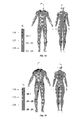
- Fig. 1a shows front views and fig. 1b shows back views of a male and a female body, on which skin temperatures during sports activities are represented. These views show areas of high temperature 130 with temperatures above 30 degrees, areas with medium skin temperature 125 with temperatures of 25 - 29 degrees and areas with low skin temperature 120 with temperatures of 20 - 24 degrees.
- the area of high skin temperature 130 of the male body is essentially located in the shoulder area, in the spine are, in the area of the breast bone, laterally at the torso, at the lower arms, on the back sides of the thighs and the knees, and at the lower legs.
- the area of medium skin temperature 125 is essentially located in the area of the torso, on the arms and on the back sides of the legs.
- the area of low skin temperature is essentially located in the breast area, in the stomach area, in the lower part of the back, and on the front sides of the thighs.
- Fig. 1a and 1b further show that the area of high skin temperature 130 of the female body is essentially located on the back side of the body on the shoulders, in a broad area around the spine and on the back sides of the lower legs.
- the area of medium skin temperature 125 of the female body essentially extends on the torso, on the arms and on the back sides of the thighs.
- the area of low skin temperature 120 of the female body extends on the back sides of the upper arms, in the breast area and in the stomach area, on the buttocks and on the front sides of the thighs.
- Fig. 1c shows front views of a male and a female body on which the wind pressure is illustrated, with areas of very high wind pressure 150, areas of high wind pressure 160, areas of medium wind pressure 170, and areas of low wind pressure 180.
- an air stream relative to the body surface was measured, wherein air streams which hit the body orthogonally have a higher air pressure (Pa) than air streams which hit the body at an oblique angle or in parallel.
- Fig. 2a shows front views and fig. 2b shows back views of a male and a female body on which the degree of sweat production during sports activity is represented. Both figures show areas of very high sweat production 250 (> 10), areas of high sweat production 260 (0.99-0.7), areas of medium sweat production 270 (0.69-0.4) and areas of low sweat production 280 (0.39-0.0). The indicated values of sweat production are relative values without units.
- areas of very high sweat production 250 of the male body are essentially located in the spine area and above the hips on the back.
- Areas of high sweat production 260 are arranged essentially along the center line of the breast, on the shoulders and laterally on the back.
- Areas of low sweat production 280 are mainly located on the back sides of the legs.
- the female body has the areas of very high sweat production 250 essentially in the area of the spine, above the hips on the back and below the breast area.
- the area of medium sweat production 270 is arranged on the shoulders. Sweat production on the shoulders of women is lower than for men.
- Areas of low sweat production 280 of the female body are essentially located in the breast area and in the stomach area and on the back sides of the legs.
- a first climate zone concerns an area which has both a high skin temperature and strong sweat production. Such areas require both cooling and removal of sweat. This is achieved by a higher degree of air permeability of the garment which evaporates the sweat together with the high skin temperature. Thereby sweat is removed from the skin, and the skin is cooled by the evaporative heat loss. To this end, the garment comprises increased air permeability along the first climate zone.
- a second climate zone of the garment with increased moisture wicking is arranged in areas of the body which is characterized by high production of sweat and by skin temperatures in the medium or low range so that evaporation is lower than in the first climate zone. In these areas sweat may accumulate which does not evaporate so that the garment gets wet in this area. This problem is solved by wicking the additional sweat to the outside of the garment where the sweat can evaporate, using a corresponding material of the garment.
- the second climate zone therefore comprises increased moisture wicking of the material of the garment.
- a third climate zone is arranged in areas of the body which are characterized by a low skin temperature and a low sweat production together with strong wind pressure (see fig. 1c ). These areas which are subject to strong wind pressure are located on the front side of the body and have to be protected from over cooling. In particular important organs have to be protected. This problem is solved by wind proof materials so that the third climate zone comprises an increased wind protection of the material of the garment.
- a fourth climate zone is arranged in areas of the body which show a high skin temperature while having low sweat production. This area therefore requires additional cooling. This problem is solved by heat conducting materials of the garment which conduct heat away from the skin surface to the outside of the garment and thereby cool the body.
- the fourth climate zone therefore comprises increased heat conductivity, i.e. a reduced thermal resistance, of the material of the garment.
- a fifth climate zone concerns areas of the body with low skin temperature and low sweat production which therefore require protection from over cooling. This is similar to the third climate zone which, however, only protects areas on the front side of the body being exposed to high wind pressure.
- the fifth climate zone mainly concerns areas in which the body accumulates fat in order to protect sensitive parts of the body and organs lying beneath the fat. Therefore, the fifth climate zone provides additional heat insulation, in particular at low temperatures, for example in autumn and winter.
- a sixth climate zone finally comprises vents arranged at the garment which are preferably applied in a multi-layer garment to provide supply of fresh air. This causes an additional removal of heat and evaporated sweat.
- the vents are arranged so that they provide ventilation in areas with high skin temperature and / or high sweat production.
- the vents are arranged so that the air can circulate "around" the body, for example an air stream over the shoulder or along the sides of the torso.
- One vent may act as an entry vent, and another vent may act as an exit vent.
- Fig. 1a, 1b and 2a, 2b illustrate that there are significant differences between the skin temperature and sweat production of the male and the female body. This leads to different requirements for garments, i.e. a different arrangement of the climate zones at the garment. This will become clear in fig. 3 to 6 described in the following. In addition, the requirements and therefore the climate zones of a garment for the summer ( fig. 3 and 4 ) and a garment for the winter ( fig. 5 and 6 ) are different due to the different outdoor temperatures.
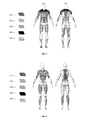
- Fig. 3 is a front view and a back view of a male body with climate zones for a summer garment.
- a first climate zone 310 with higher degree of air permeability is arranged in the shoulder area, in the upper portion of the upper arms and in the spine area.
- a second climate zone 320 with increased moisture wicking is arranged in the stomach area and in the area of the lumbar vertebrae.
- a third climate zone 330 with increased wind protection is arranged on the arms, in the breast area and on the front sides of the thighs.
- a fourth climate zone 340 with increased heat conductivity i.e.
- a sixth climate zone 360 with vents is arranged at the upper boundary of the breast area and laterally at the torso at the boundary of the breast area, since the air can best circulate around the body at these locations.
- Fig. 4 shows a front view and a back view of a female body with climate zones for a garment for the summer.
- a first climate zone 410 with a higher degree of air permeability is arranged between the neck area and the breast area and in the spine area.
- a second climate zone 420 with a higher degree of moisture wicking is arranged between the breast area and the stomach area and on the back in the area of the lumbar vertebrae.
- a third climate zone 430 with a higher degree of wind protection is arranged on the upper arms, the lower arms, in the breast area and in the stomach area, and on the front sides of the thighs.
- a fourth climate zone 440 with a higher degree of heat conduction i.e.
- lower thermal resistance is arranged in the shoulder area, in the elbow area (inside), in an area adjacent to the lower area of the spine and on the back sides of the lower lags.
- sixth climate zone 460 with vents is arranged above the breast area and laterally at the torso at the boundary of the breast area so that air can circulate around the body.
- the sixth climate zone with vents can also be arranged on the back side of a garment, for example for backward-directed sports such as rowing.
- Fig. 5 shows a front view and a back view of a male body with climate zones for a winter garment.
- a first climate zone 510 with a higher degree of air permeability of the garment is arranged in the shoulder area and in the upper portion of the upper arms, in the elbow area, in the spine area, laterally at the torso and on the back sides of the thighs and the lower legs.
- a second climate zone 520 with a higher degree of moisture wicking of the garment extends over the whole body which can be realized, for example, by a base material of the garment with a higher degree of moisture wicking. This is necessary for low outdoor temperatures which lead to an overall lower skin temperature and therefore to a reduced evaporation of sweat.
- a third climate zone 530 with increased wind protection of the garment is located on the upper arms and the lower arms, in the breast area, in the stomach area and on the front sides of the thighs.
- a fourth climate zone with increased heat conductivity is not envisaged in the climate zones for low outdoor temperatures of fig. 5 but can be added in other embodiments.
- a fifth climate zone 550 with increased heat insulation of the garment is arranged in the breast area, in the stomach area, on the back sides of the upper arms, in the area of the lumbar vertebrae and the kidneys, and on the front sides of the thighs. In these areas, sensitive parts of the body are protected, for example fat tissue with reduced blood circulation and organs.
- a sixth climate zone 560 with vents of the garment is located above the breast area and laterally at the torso at the boundary of the breast area. These vents are particularly important at low temperatures when a garment comprises several layers in order to guide air between the layers.
- the climate zones of the single layers have to be harmonized in order to enable transport of heat and / or sweat across several layers. Different functions are important for different layers.
- Fig. 6 shows a front view and a back view of a female body with climate zones for a winter garment.
- a first climate zone 610 with a higher degree of air permeability of the garment is arranged in the shoulder area, in the elbow area, in the spine area, laterally at the torso and on the back sides of the thighs.
- a second climate zone 620 with increased moisture wicking of the garment extends as in fig. 5 over the whole body.
- a third climate zone with increased wind protection 630 of the garment is arranged on the upper arms and the lower arms, in the breast area, in the stomach area and on the front sides of the thighs.
- the fourth climate zone with increased heat conductivity is not envisaged, similar to the climate zones for low temperatures of fig.
- a fifth climate zone 650 with increased heat insulation of the garment is arranged in the breast area and the stomach area, on the back sides of the upper arms, in the area of the lumbar vertebrae and the kidneys and on the front sides of the thighs.
- a sixth climate zone 660 with vents at the garment is arranged above the breast area and laterally at the torso at the boundary of the breast area so that air can circulate around the body.
- the single layers therein are adapted to gender-specific climate zones.
- One embodiment may comprise three layers: base layer - moisture wicking (plus heat insulations); medium layer - air permeability and insulation; outer layer - wind protection, air permeability (plus heat insulation). This sequence of layer provides transport of moisture from the inside to the outside and selective guidance of cold, fresh air between the layers.
- An embodiment of a garment with several layers is described in connection with fig. 15 and 16 .
- climate zones of garments derived in the foregoing which are based on empirical climate data can also be applied to other areas of the body. This will be done in the following fig. 7 to 9 with respect to the head and in fig. 10 to 12 with respect to the lower arm and the hand. A further application area is the foot which will be discussed with respect to fig. 24 to 28 .
- Fig. 7 shows a perspective front view and a back view of a head on which areas of skin temperatures during sports activities are shown.
- the views show the area of high skin temperature 730 with temperatures above 30 degrees, the area of medium skin temperature 725 with temperatures from 25 - 29 degrees and the area of low skin temperature 720 with temperatures from 20 - 24 degrees.
- the area of high skin temperature 730 is located at the temples, in the eye area, at the boundary of the mouth, below and behind the ear and in the neck area.
- the area of medium skin temperature 725 extends from the cranium down to the neck and over the face.
- the area of low skin temperature 720 comprises the ears and the nose.
- Fig. 8 shows a perspective front view and a back view of a head which illustrates sweat production during sports activities.
- the figure shows the area of strong sweat production 850 (> 1.0), the area of increased sweat production 860 (0.99-0.7), the area of medium sweat production 870 (0.69-0.4) and the area of low sweat production 880 (0.39-0.0).
- these values are relative values without units.
- the largest sweat production can be found in the forehead area and above the ears.
- Fig. 9 illustrates the climate zones for the head which result from the skin temperatures and the sweat production shown in fig. 7 and 8 .
- the first climate zone 910 with a higher degree of air permeability extends in the area of the temples, in the eye area, in the mouth area, behind the ear and in the neck area.
- a second climate zone 920 with increased moisture wicking extends from the cranium to the neck.
- a third climate zone 930 with increased wind protection extends over the face and the ears.
- a fifth climate zone 950 with increased heat insulation comprises the lower half of the face including the nose and the ears and an area between the cranium and the neck on the back side of the head.
- a sixth climate zone 960 comprises a vertical opening at the neck in the middle of the front side of the neck so that air can circulate around the neck having a high skin temperature.
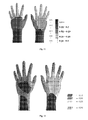
- Fig. 10 shows views of a lower arm, a back of a hand and a palm of a hand, on which areas of skin temperatures during sports activities are illustrated.
- the views show an area of high skin temperature 1030 with temperatures above 30 degrees, an area of medium skin temperature 1025 with temperatures from 25 - 29 degrees and an area of low skin temperature 1020 with temperatures of 20 - 24 degrees.
- the areas of high skin temperature 1030 are located in the middle of the upper side and the lower side of the lower arm, on the back of the hand and on the palm of the hand.
- the area of medium skin temperature 1025 extends over the adjacent areas of the lower arm and the hand and the first member of each finger.
- the area of low skin temperature 1020 comprises the remaining second and third members of the fingers.
- Fig. 11 shows views of a lower arm, the back of a hand and the palm of a hand which illustrate sweat production during sports activities.
- the figure shows an area of very high sweat production 1150 (> 1.0), an area of high sweat production 1160 (0.99-0.7), the area of medium sweat production 1170 (0.69-0.52), an area of low sweat production 1180 (0.51-0.32) and an area of very low sweat production 1190 (0.31-0.00).
- these values are relative values without units.
- the strongest sweat production can be found on the upper side and the lower side of the lower arm and on the back of the hand including the thumb.
- the fingers show the lowest sweat production.
- Fig. 12 illustrates the climate zones for a hand resulting from the skin temperatures and the sweat production shown in fig. 10 and 11 .
- a first climate zone 1210 with a higher degree of air permeability extends over the front side and the back side of the lower arm and the back of the hand.
- a second climate zone 1220 with increased moisture wicking extends over the palm of the hand and a narrow side of the lower arm.
- a third climate zone 1230 with increased wind protection extends over the adjacent narrow side of the lower arm, the back of the hand and the fingers.
- a fifth climate zone 1250 with increased heat insulation finally comprises the two front members of the fingers.
- Fig. 13 to 18 show garments which were designed according to the previously described climate zones and which therefore have an advantageous thermal regulation.
- reference numerals for symmetric parts of a garment are only indicated once.
- Fig. 13 illustrates a sports garment 1300 according to the invention for a man in a front view 1301, a side view 1302 and a back view 1303, preferably for the summer.
- a first zone 1310 with higher degree of air permeability is arranged in the shoulder area and in the spine area, according to the first climate zone 310 in fig. 3 .
- the first zone 1310 also comprises a lateral area of the torso and on the inside of the upper arms which can also be omitted.
- a second zone 1320 with increased moisture wicking is arranged on the front side 1300 in the stomach area and on the back side 1301 in the area of the lumbar vertebrae and the kidneys, according to the second climate zone 320 in fig.
- sports garment 1300 comprises a sixth zone 1360 with at least one vent which are located laterally at the torso and above the breast area, according to the sixth climate zone 360 in fig. 3 .
- Fig. 14 shows a summer sports garment 1400 according to the invention for women in a front view 1401, a side view 1402 and a back view 1403.
- a first zone 1410 with a higher degree of air permeability which is arranged above the breast area and in the spine area, according to the first climate zone 410 in fig. 4 .
- the first zone 1410 also comprises an area laterally at the torso and on the inside of the upper arm which can also be omitted.
- a second zone 1420 with increased moisture wicking is illustrated which is arranged in the front view 1401 below the breast area and in the side view 1402 and in the back view 1403 in the area of the lumbar vertebrae and the kidneys, according to the second climate zone 420 in fig. 4 .
- a fourth climate zone 1440 with reduced thermal resistance is arranged in the shoulder area, in the elbow area (inside) and in an area adjacent to the lower spine area, according to the fourth climate zone 440 in fig. 4 .
- the garment 1300 comprises a sixth zone 1360 with at least one vent which are located laterally at the torso and above the breast area, according to the sixth climate zone 360 in fig. 3 .
- the air permeability in the first zone 1310, 1410 is higher than in the second zone 1320, 1420 and in the fourth zone 1340, 1440. Further, the moisture wicking capability in the second zone 1320, 1420 is higher than in the first zone 1310, 1410 and in the fourth zone 1340, 1440 . Finally, the thermal resistance in the fourth zone 1340, 1440 is lower than in the first zone 1310, 1410 and in the second zone 1320,1420.
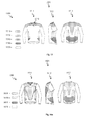
- Fig. 15, 16a and 16b show a multi layer sports garment 1500 which is in particular suited for the winter, wherein fig. 15 represents a first layer 1501, fig. 16a represents a first embodiment 1601 for a second layer, and fig. 16b represents a second embodiment 1602 for the second layer.
- the layers 1501, 1601 and 1602 may respectively form a separate garment which can be worn separately or above each other.
- Fig. 15 illustrates a first layer 1501 of a sports garment 1500 according to the invention in a front view 1511, a side view 1512, and a back view 1513.
- the firs layer 1501 may form an inner layer of the sports garment 1500,
- the figure shows a first zone 1510 with a higher degree of air permeability which is essentially arranged laterally at the torso and on the back, in accordance with the climate zones in fig. 5 and 6 .
- a second zone 1520 with increased moisture wicking extends over the whole sports garment 1500.
- a corresponding material may form the base material of the first layer 1501. In the areas of increased sweat production on the shoulders and in the spine area (see first climate zone 510 in fig.
- a second zone 1520 with a higher degree of moisture wicking is arranged which transports the sweat to a second layer 1601, 1602 (see fig. 16a , 16b ) where a first area 1610 with a higher degree of air permeability for evaporating the sweat is arranged.
- a fifth zone 1550 with increased heat insulation is arranged in the area of the lumbar vertebrae and on the back sides of the upper arms.
- a fourth zone with 1540 with reduced thermal resistance is arranged in the neck area and optionally (not illustrated) in the area of the wrists.
- Fig. 16a illustrates a second layer 1601 of the sports garment 1500 according to the invention in a front view 1611, a side view 1612, and a back view 1613, again in accordance with the climate zones in fig. 5 and 6 .
- the second layer 1601 may form a middle layer or an outer layer of the sports garment 1500.
- Fig. 16a illustrates a first zone 1610 with a higher degree of air permeability which is arranged in the shoulder area, laterally at the body and in the spine area.
- a second zone 1620 with increased moisture wicking extends over the whole base material.
- a fifth climate zone 1650 with increased heat insulation extends in the breast area and in the stomach area, and in the area of the lumbar vertebrae and the kidneys.
- a third zone 1630 with increased wind protection is arranged in the breast area and in the stomach area, and in the area of the lumbar vertebra and the kidneys, wherein the third zone 1630 is a subset of the fifth zone 1650.
- Figure 16b illustrates an alternative second layer 1602 of the sports garment 1500 according to the invention in a front view 1621, a side view 1622, and a back view 1623.
- the second layer or outer layer 1602 differs from the second layer or outer layer 1601 from figure 16a in that it does not comprise a third area 1630 with a higher degree of wind protection.
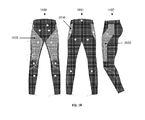
- Figure 17 shows a sports garment 1700 in a front view 1701 and a back view 1702, preferably for the winter.
- fig. 17 illustrates a first zone 1710 with a higher degree of air permeability in the shoulder area, in particular above the breast, laterally at the torso and on the back, in particular in the spine area, in agreement with the first climate zones 510, 610 in fig. 5 and 6 .
- fig. 17 shows a third zone 1730 with a higher degree of wind protection which is arranged in the breast area, in accordance with the third climate zones 530, 630 in fig. 5 and 6 .
- the third zone 1730 is additionally arranged on the front side of the neck (see front view 1701).
- a fifth zone 1750 with a higher degree of head insulation is arranged in the area of the lumbar vertebrae and the kidneys, according to the fifth climate zones 550, 650 in fig. 5 and 6 .
- Fig. 17 finally illustrates a sixth zone 1760 with vents which are arranged above the breast area and laterally at the torso, in accordance with the sixth climate zones 560, 660 in fig. 5 and 6 .
- Such vents may optionally be arranged also on the back side 1702.
- the vents maybe equipped, for example, with a zipper so that the opening width of the vent can regulate the air stream.
- the vents are particularly important when several layers of a garment are worn above each other. Fresh air flows through the vents between the garment layers and removes wet and/or warm air.
- An advantageous thermal regulation for a garment also results from a layer system (not illustrated).
- a base layer on the inside of the garment system directed to the body provides regulation of heat and sweat and comprises a first zone with a higher degree of air permeability and a second zone with a higher degree of moisture wicking.
- a middle layer of the garment system provides regulation of the body temperature and comprises a first zone with a higher degree of air permeability, a fifth zone with increased heat insulation and/or a third zone with a higher degree of wind protection.
- An outer layer of the garment system finally protects against extreme environmental impacts and provides regulation of the micro climate in the garment system. It is important that within such a layer systems the thermo regulating zones of the single layers are harmonized with respect to each other. For example, a vent 1760 of the outer layer should be arranged above a first zone of the middle layer so that heat and sweat can be transported from the inside to the outside and air can penetrate from the outside to the inside.
- the base layer may be formed by the first layer 1510 from fig. 15
- the middle layer may be formed from the second layer 1610, 1620 from fig. 16a or 16b
- An embodiment of the outer layer may be formed by the garment 1700 in fig. 17 . Every layer can also be used separately without the other layers.
- Fig. 18 illustrates a sports garment in a front view 1800, a back view 1801 and a lateral view 1802, preferably for the winter.
- the figure illustrates an area 1830 which forms both a third climate zone with increased wind protection and a fifth climate with increased insulation.
- the area 1830 is arranged on the front sides of the thighs, in agreement with the third climate zones 530, 630 and the fifth climate zones 550, 650 in fig. 5 and 6 .
- the garments illustrated in fig. 13 - 18 having first to sixth zones can be manufactured in a conventional way, for example by cutting and sewing.
- the seams may also be glued or melded.
- the patterns may be designed so that they are adjusted to motion sequences of particular sports activities. Apart from cutting and sewing a manufacture without seams (for example circular knitting) is conceivable.
- Fig. 19 shows different illustrations of a material suitable for the first zone which has higher air permeability than the other zones.
- This material comprises a yarn which is dry in an initial state. When the material absorbs moisture, the yarn elongates. When the material dries again, it returns to its initial state, and the yarn contracts. This increases the air permeability of a fabric made from this yarn in a wet state and reduces the air permeability in a dry state, as explained in the following. This provides drying of the skin beneath.
- An example of this material is VENTCOOLTM from Mitsubishi.
- View 1901 in Fig. 19 is a microscope image of a moisture-sensitive yarn or fiber in a dry state.
- the yarn In this state, the yarn is shorter and thicker than in a wet state.
- the fibers of the yarn have a helical shape which makes the yarn thicker.
- the yarn In the wet state of view 1903 the yarn has elongated and therefore is thinner.
- the fibers in view 1903 have a plane, straight shape.
- a fabric made from this yarn has in dry state smaller interspaces (view 1902) than in a wet state (view 1904).
- a sports garment made from such a fabric will therefore have much better ventilation in a wet state than in a dry state which facilitates evaporation of the sweat from the skin and drying of a wet garment.
- the higher degree of air permeability of such a fabric with a moisture-sensitive yarn can be demonstrated in experiments, as illustrated in fig. 20 .
- This figure shows measurements of the air permeability of different materials which are indicated in L/min (liter/minute).
- the measurements 2001, 2002 concern a fabric made from a moisture-sensitive yarn, wherein the measurement 2001 represents the air permeability in a dry state and the measurement 2002 represents the air permeability in a wet state.
- the air permeability in a wet state is more than 50 % higher than in a dry state (measurement 2001).
- the air permeability of a fabric made from cotton in a dry state is even larger than in a wet state (measurement 2004).
- a higher degree of air permeability of a material or fabric for the first zone may be achieved, for example, by holes in a fabric which may have different sizes.
- the holes may be generated, for example, by perforation or by lasing using a laser.
- a further possibility for the manufacture of an air-permeable material is a fabric with large meshes, wherein the fabric may comprise different mesh sizes.
- a preferred material for the second zone which comprises higher moisture wicking than the other zones is a material which transports moisture by capillary action.
- the capillary action may be achieved by a corresponding material structure, by properties of the yarn of the material and / or by a chemical treatment of a material (e.g. fleece) of the second zone.
- a material e.g. fleece
- a hydrophobic, moisture repellent material can be used for the second climate zone. In this way, cooling by evaporation of sweat can be improved by transporting moisture to locations where it can evaporate more easily.
- a material for the climate zone which comprises a higher degree of wind protection than the other climate zones preferably has an air permeability in the range of 0-50 mm/s and particularly preferred an air permeability of 0-10 mm/s.
- Corresponding air permeabilities can be achieved by a corresponding density of the fabric, for example a fleece, a laminated material (laminar gluing with a film layer, for example WindstopperTM of W. L. Gore Associates, Inc.), a coated material (liquid coating), material layers connected, for example, with glue points, or other suitable materials.
- a suitable material for the fourth zone which comprises a lower thermal resistance than the other climate zones can be achieved by metallic yarns which are embedded preferably in a thin and flat textile material.
- a textile material preferably comprises 1-10 % of a metallic yarn, in particular a silver yarn.
- a corresponding textile material for example a fabric, has to be woven such that the metallic yarn is located both on the side of the fabric directed to the skin and on the outside of the fabric, in order to provide heat conduction from the inside to the outside of the fabric.
- a further material suitable for the fourth zone is a textile material which is coated with heat-conducting material.
- a preferred density of a material for the fourth climate zone has less than 100 g/m 2 . It is further preferred that a thermal resistance of such a material is less than 6x10 3 m 2 K/W. A thermal resistance corresponds to a heat conductivity, wherein the heat conductivity increases when the thermal resistance decreases.
- Fig. 21 shows measurements of the thermal resistance of three different materials.
- Measurement 2101 concerns a material which comprises about 95.5 % polyester and about 4.5 % of a conductive material, for example X-static or silver, at a density of 100 g/m 2 .
- Measurement 2102 concerns a material made from 100 % polyester at a density of 139 g/m 2 .
- Measurement 2103 finally concerns a material which comprises 96 % polyester and a 4 % metallic content, for example X-static or silver, at a density of 128 g/m 2 .
- the thermal resistance of a material is not only influenced by its density and composition, but also by its structure respectively the volume and the thickness of the material.
- a particularly low thermal resistance therefore results from a combination of a conducting material and a very thin / flat constitution of the material.
- An appropriate material for the fifth zone which has higher heat insulation than the other zones preferably comprises a light weight material and fibers with a raised 3-D structure. In this way, air can be trapped which reduces heat exchange and thereby provides an improved heat insulation. Examples of such materials are brushed-up or roughened spandex, polyester, or fleece. Additionally or alternatively, an appropriate material may comprise on its inside, i.e. the side directed towards the body, a reflecting material which reduces heat radiation by the body.
- vents of the sixth zone which are preferably used in multilayer garments can be formed, for example, by openings or slits in the garment.
- the size of the openings or slits may be adaptable by using zippers.
- a mesh may be arranged behind such an opening.
- a material may simultaneously provide a higher degree of wind protection (third zone) and increased heat insulation (fifth zone).
- a combination of a higher degree of moisture wicking (second zone) and a higher degree of heat insulation (fifth zone) results from roughening of an appropriate material.
- a material which simultaneously fulfills the requirements of several climate zones can be used to realize an overlap of different climate zones.
- overlapping climate zones can be achieved by multi-layer garments, wherein a first layer fulfills the requirements of first climate zone and second layer fulfills the requirement of a second climate zone.
- the different climate zones should be compatible, as shown for example in connection with fig. 15, 16a and 16b .
- a second zone 1520 in a first layer with a higher degree of moisture wicking is arranged at the same location as a first zone 1510 in a second layer with a higher degree of air permeability is arranged.
- Conceivable are also garments which can be turned inside out and which have different material properties on the outside and on the inside of the garment.
- An example would be a higher degree of moisture wicking (second zone) on one side and a higher degree of head insulation (fifth zone) on the other side.
- Other combinations of a first side and a second side are roughened / not roughened (roughening improves both moisture wicking and heat insulation) or moisture wicking (hydrophobic) / non-moisture wicking (hygroscopic) or heat-reflecting / heat-absorbing.
- Such a garment could be turned inside out or vice versa according to the outdoor temperature.
- Garments which are provided with specific zones corresponding to climate zones according to the preceding description lead to a significantly improved body climate for the wearer of the garment which can also be measured, as shown in fig. 22 and 23 .
- These figures compare the skin temperature and the relative skin humidity of a wearer of a garment according to the invention to a conventional garment during different sports activities.
- Fig. 22 illustrates the skin temperature.
- the skin temperature of a conventional garment (measurements 2201, 2203, 2205, 2207) varies strongly between the running phases 2201, 2205 and the inactive phases 2203, 2207.
- the skin temperature of a garment according to the invention (measurements 2202, 2204, 2206, 2208) is significantly below the skin temperatures of the conventional garment during the running phases 2202, 2206 and only shows a minor increase during the inactive phases 2204, 2208.
- the skin temperature of the wearer of a garment according to the invention remains significantly lower and shows much smaller variations than for the conventional garment. This improved garment thermal regulation significantly improves the comfort of the wearer.
- Fig. 24 shows a perspective view of a foot with an illustration of skin temperatures, ranging from areas of highest temperature 2450, areas of high temperature 2460, and areas of medium temperature 2470 to areas with low temperatures 2480.
- View 2401 shows the skin temperature before an activity.
- View 2402 shows the skin temperature during an activity, and view 2403 finally shows the skin temperature after an activity.
- Fig. 25 shows areas of strong sweat production 2504 of a foot in a lateral view 2501, a bottom view 2502, and top view 2503.
- Fig. 26 illustrates specific zones of a sock, corresponding to the areas of highest temperature and high temperature in fig. 24 and areas of strong sweat production in fig. 25 .
- a first zone 2610 with a higher degree of air permeability and a second zone 26 with a higher degree of moisture wicking can be recognized in lateral view 2601, bottom view 2602 and top view 2603.
- the first zone 2610 is arranged on the upper side of the sock in the toe area (see lateral view 2601 and top view 2603) and on the lower side of the sock in the toe area and in the area of the foot arch (see bottom view 2602).
- the second zone 2620 is arranged on the upper side of the sock in the metatarsal area (see lateral view 2601 and top view 2603).
- zones of the sock correspond to zones of a shoe which is illustrated in fig. 27 in a lateral view, a bottom view 2702, and a top view 2703.
- a first zone 2710 with a higher degree of air permeability and a second zone 2720 with a higher degree of moisture wicking 2720 are arranged in correspondence with the first and the second zones of the sock from fig. 26 .
- the sock in fig. 26 and the shoe in fig. 27 form a combined system for improved thermal regulation which is finally illustrated in fig. 28 in a lateral view 2801, a bottom view 2802 and a top view 2803.
- Such a combination makes sense if the zones of the sock and the shoe are harmonized with each other, as in the present case.
Landscapes
- Engineering & Computer Science (AREA)
- Textile Engineering (AREA)
- Health & Medical Sciences (AREA)
- General Health & Medical Sciences (AREA)
- Physical Education & Sports Medicine (AREA)
- Professional, Industrial, Or Sporting Protective Garments (AREA)
- Details Of Garments (AREA)
- Gloves (AREA)
Abstract
Description
- The present invention relates to apparel, in particular to sportswear.
- Apparel has to comply with different requirements. On the one hand, apparel has to protect the body from exterior influences such as heat, cold and wind. On the other hand, it is necessary to support the thermal regulation of the body itself, for example to facilitate evaporation of sweat on the skin and to avoid undesired production of sweat on the skin. Thermal regulation is understood to be the active balancing of exterior climate conditions and inner influences by a garment which provides a comfortable feeling for the wearer of the garment. This combined effect of exterior as well as interior influences puts high demands on the design of apparel and the materials used therefore. This applies in particular to sportswear.
- In order to solve these problems,
US 6,332,221 suggests reduced insulation and / or increased ventilation in temperature sensitive areas of the body. Temperature sensitive areas are considered to be the spine, areas without fatty tissue and without muscles and areas with increased production of sweat. Similarly,US 4,722,099 describes patches of a motorcycle suit with increased ventilation. -
US 6,286,151 describes a heat-regulating sock in which an air channel is made from a heat-regulating netted fabric which conducts sweat out of the shoe. -
WO 03/065833 A1 US 2005/0086721 describe a thermo regulating item of clothing with a thermo regulating area. A fabric guides humidity away from the skin towards the textile surface by means of capillary action. - From the
US 2006/0179539 it is known to determine the size and location of ventilation openings and heat insulation areas based on a thermal profile of a body. - Further,
US 5,636,380 describes thermoregulatory apparel with insulating panels made from a fabric having moisture wicking capability. InUS 2009/0031486 garment for cold weather with zones of increased thermal insulation is described. The zones are arranged in a gender-specific way.US 7,428,772 discloses apparel with areas of different heat insulation. - The
utility model DE 20 2008 001 340 U1 describes an upper garment which has an increased air permeability in the area of the axles. - The prior art therefore teaches different approaches which cover isolated aspects of thermal regulatory apparel such as the combination of heat insulation and ventilation in the
US 6,332,221 or solutions for particular applications such as motorcycle suits in theUS 4,722,099 . However, these approaches lack a systematic basis from which the selection of materials for thermal regulation and the arrangement of areas of the garments in which these materials shall be used can be determined. - The present invention is therefore based on the problem to provide garments which provide an improved thermal regulation on a systematic basis. A further problem is to maintain the body temperature during an activity at cold or warm outdoor temperatures at approximately 37 degrees Celsius. This supports not only the wellness but also the performance of the wearer of the garment since muscles, nerves, heart and breathing are positively supported.
- To solve this problem, applicant initially has performed extensive empirical investigations of the thermal behavior of the human body during different sports activities. To this end, sweat was "collected" and measured at different locations of the body of women and men during sports activities, The essential parameters of the thermal behavior selected for this investigation are temperature, wind pressure and sweat production on the surface of the body. The results of these measurements are, for example, illustrated in the body maps of skin temperature in
fig. 1a and 1b , wind pressure infig. 1C and sweat production infig. 2a and 2b . These measurements enable far-reaching conclusions for requirements on the design of thermoregulatory apparel. These requirements of garments are represented with defined climate zones which are illustrated, for example, infig. 3 to 6 ,9 and12 and which are embodied in the following aspects of the invention. For example, specific areas of the body are particularly warm but emit little sweat which could contribute to a cooling of the body. This results in the requirement of additional heat conduction away from these areas. A further result of these investigations is that there are gender-specific differences between the thermal behavior of the male and the female body. Further, the requirements of thermal regulatory apparel have seasonal-specific differences (winter, summer). The conclusions from these investigations are defined in the most general form in the independent claims. - One aspect of the invention relates to a garment which comprises at least a first and a second zone. The first zone of the garment is arranged in the spine area and comprises a higher degree of air permeability than the second zone. The second zone of the garment is arranged below the breast and in the area of the lumbar vertebrae, wherein the second zone comprises a higher degree of moisture wicking than the first zone. The area of the lumbar vertebrae may extend over the whole width of the back and may comprise the area of the kidneys.
- This aspect of the invention fulfils the requirements for a summer garment both for women and for men. From the maps of sweat production (
fig. 2 and 2b ) it can be recognized that women and men sweat in particular in the spine area and that the skin temperature according to the maps of skin temperature is particularly high in this region (fig. 1a and 1b ). This heat can be used to evaporate the additional sweat in that the air permeability of the garment in the first zone is higher than in the second zone of the garment, i.e. below the breast and in the area of the lumbar vertebrae. This causes an increased evaporation of sweat in the first zone. From the maps of skin temperature (fig. 1a and 1b ) it can be further recognized that the second zone is rather cool while much sweat is emitted (fig. 2a and 2b ). Similar to the first zone it is therefore necessary to remove additional sweat. However, in contrast with the first zone, it is not possible to achieve this by increased ventilation since there is not sufficient heat to completely evaporate the additional sweat, due to the lower skin temperature. This causes the so-called "pooling": sweat accumulates and causes an unpleasant wet sensation. Further, this sweat cannot be used for cooling because it does not evaporate. - This problem is solved in that the second zone comprises a higher degree of moisture wicking than the first zone. The increased moisture wicking of the material of the second zone facilitates the transport of sweat from the inside of the material, i.e. the side directed to the skin, to the outside of the material where the sweat can evaporate. A higher degree of air permeability or ventilation in this second zone (as in the first zone) without removal of the sweat would to an accumulation of sweat and to an unpleasant wet sensation.. Therefore, only the combination of the two zones and their particular arrangement according to this aspect of the invention enables a garment with a significantly improved thermal regulation.
- In a preferred embodiment the first area with higher degree of air permeability extends in addition in the shoulder area. Such a garment is particularly suitable for men who have a high skin temperature on the shoulders (cf.
fig. 1 and1b ) and have a high sweat production in this area (cf.fig. 2a and 2b ). - A further aspect of the present invention relates to a garment which comprises at least a first, a second and a third zone. The first zone of the garment comprises a higher degree of air permeability than the other zones. The second zone of the garment comprises a higher degree of moisture wicking than the other zones. The third zone of the garment comprises a higher degree of wind protection than the other zones. The third zone is preferably arranged on the front sides of the arms and on the front side of the torso and / or on the front sides of the thighs.
- This aspect of the invention fulfills the requirements of a garment both for men and for women and for each season. As in the preceding first aspect, the garment comprises a first zone with a higher degree of air permeability and a second zone with a higher degree of moisture wicking than the other zones. However, there are areas on the front side of the body which are subject to a high wind pressure (see
fig. 1c ) and which have a lower skin temperature and a lower sweat production than the other zones. In contrast with the first and the second zone, these areas have to be protected from over cooling, wherein no additional ventilation is desirable due to the lower sweat production. The problem of an improved thermal regulation of the third zone can therefore be solved by a higher degree of wind protection than in the first and the second zone. A garment according to the second aspect is advantageous in situations in which cool air or wind may cause an over cooling of the mentioned areas of the body, for example during running on a cool morning or when wind blows. - In a preferred embodiment, a garment according to the invention , in addition to a first and a second zone or a first, a second, and a third zone, further comprises a fourth zone which has a lower thermal resistance than the other zones. This embodiment concerns preferably a garment for the summer. As can be derived from the maps for skin temperature (
fig. 1a, b ) and sweat production (fig. 2a, 2b ), there are zones of the body with a high skin temperature and low sweat production. These areas are not sufficiently cooled by evaporation of sweat and therefore require additional cooling. This problem is solved by the fourth zone which comprises a lower thermal resistance than the other zones, by using, for example a material with a lower thermal resistance, i.e. increased heat conductivity, or a very thin material or a combination of very thin and of heat conducting materials. This causes conduction of heat from the inside of the garment to the outside where it can be emitted to the atmosphere, so that an additional cooling is achieved. - A further aspect of the present invention relates to a garment which comprises at least a first, a second and a fourth zone, respectively comprising a higher degree of air permeability and moisture wicking and a lower degree of thermal resistance than the other zones. In contrast with the garment according to the preceding aspect of the present invention which includes wind protection, the third aspect of the invention comprises the conduction of heat by a material with a lower thermal resistance in those areas of the body which have a high skin temperature but low sweat production. Such a garment is therefore advantageous in situations which require a comprehensive cooling of the body, for example during warm weather. In a preferred embodiment for men the fourth zone is arranged laterally at the torso and in the elbow area. In a preferred embodiment for women the fourth zone is arranged in the shoulder area and in the elbow area and / or on the front sides and the back sides of the lower legs.
- A further aspect of the present invention relates to a garment which comprises at least a first, a second and a fifth zone which respectively comprise a higher degree of air permeability, moisture wicking and heat insulation than the other zones. This embodiment concerns a garment for activities during low outdoor temperatures which require a careful balancing between over cooling and overheating of the body. This aspect of the invention is based on the insight that such a balance cannot be achieved uniformly for the whole garment, but only by a combination of differently located zones which respectively comprise a higher air permeability, moisture wicking and heat insulation than the other zones. As already described above, there are areas of the body which require a higher degree of air permeability (high skin temperature and high sweat production) and increased moisture wicking (low skin temperature and high sweat production). In addition, areas of the body with low skin temperature and low sweat production need increased heat insulation, as can be recognized in the corresponding maps for skin temperature (
fig. 1a, b ) and sweat production (fig. 2a, 2b ). Typically these are areas with embedded fat, in order to protect the body. An improved thermal regulation therefore requires in addition a fifth zone which comprises an increased insulation, according to this aspect of the invention. - In a preferred embodiment the garment according to this aspect of the invention comprises a first layer and a second layer. A particular zone may be arranged both in the first layer and in the second layer. For example, the first zone can be arranged both in the first layer laterally at the torso and in the second layer laterally at the torso, in the shoulder area, and in the spine area.
- In all aspects of the invention, the first to fifth zones may overlap, or one zone may completely include another zone. Overlapping areas can be realized, for example, by materials which fulfill the requirements of several zones. For example, a material with increased wind protection may also have increased heat insulation. Alternatively, overlapping zones can be realized by a multi-layer material, wherein one layer fulfills the requirements of one zone and a further layer fulfills the requirements of another zone.
- Preferred embodiments of these four aspects of the invention comprise advantageous arrangements of the first to fifth zones which are based on the requirements to thermo regulated apparel which are illustrated in
fig. 3 to 6 and which are designated in the following also as climate zones. - In a preferred embodiment, a garment according to the mentioned four aspects of the invention comprises a sixth zone having at least one entry vent. This enables to introduce air into the garment which provides an additional removal of heat and wetness. This improves the evaporation of sweat and therefore causes cooling of the body. Preferably, the at least one vent is arranged between the shoulder area and the breast area and / or laterally at the torso, since in these locations the body the air circulates best around the body. The air which enters the garment not only hits a surface but can circulate along the shoulder respectively along the torso. This supports the supply of air to the first zone which requires a higher degree of air permeability. Preferably, the at least one entry vent can be partially closed.
- Preferably, the first zone of the garment comprises a material which has an air permeability which is at least a 15% higher in a wet state than in a dry state. It is preferred that the first zone comprises a material with a yarn whose length changes when being exposed to moisture. This enables to modify the air permeability of the material so that it increases when exposed to moisture due to sweat production, in order to evaporate sweat.
- Preferably, the second zone comprises a material which transports moisture due to its capillary action. In this way, thermal regulation of areas with high sweat production and low skin temperature can be effectively achieved. The capillary action can be effected by the material construction and / or yarn properties of the material of the second zone. The capillary action can also be effected by a chemical treatment of the material of the second zone.
- Preferably, the third zone comprises a material with high density, a laminated material, a coated material including a material with a liquid coating, and / or material layers connected with glue points. This increases the degree of wind protection of the third zone.
- Preferably, the fourth zone comprises a material whose thermal resistance is less than 6 · 103 m2K/W. The resulting conduction of heat away from areas with high skin temperature and low sweat production leads to a cooling of these areas.
- Preferably, the fifth zone comprises a material with interspaces for enclosing air. This causes a higher degree of heat insulation. The interspaces for enclosing air of the fifth zone may be generated during manufacture of the material, by subsequent treatment of the material, or by filling of the material.
- Further embodiments of the garment according to the invention are defined in further dependent claims.
- In the following, aspects of the present invention are explained in more detail with reference to the accompanying drawings. These figures show:
-
Fig. 1a :Front views of a male and a female body with skin temperatures during sports activities; -
Fig. 1b :Back views of a male and a female body with skin temperatures during sports activities; -
Fig. 1c : Front views of a male and a female body with wind pressure; -
Fig. 2a : Front views of a male and a female body with degree of sweat production during sports activities; -
Fig. 2b : Back views of a male and a female body with degree of sweat production during sports activities; -
Fig. 3 : Front view and back view of a male body with climate zones for the manufacture of a summer garment; -
Fig. 4 : Front view and back view of a female body with climate zones for the manufacture of a summer garment; -
Fig. 5 : Front view and back view of a male body with climate zones for the manufacture of a winter garment; -
Fig. 6 : Front view and back view of a female body with climate zones for the manufacture of a winter garment; -
Fig. 7 : Perspective front view and back view of a head with skin temperatures during sports activities; -
Fig. 8 : Perspective front view and back view of a head with degree of sweat production during sports activities; -
Fig. 9 : Perspective front view and back view of a head with climate zones; -
Fig. 10 : Views of the back of a hand and the palm of a hand with skin temperatures during sports activities; -
Fig. 11 : Views of the back of a hand and the palm of a hand with degree of sweat production during sports activities; -
Fig. 12 :Views of the back of a hand and the palm of a hand with climate zones; -
Fig. 13 : Front view and back view of a garment for men according to the invention; -
Fig. 14 : Front view and back view of a garment for women according to the invention; -
Fig. 15 : Front view and back view of a garment according to the invention; -
Fig. 16a , b: Front view and back view of a garment according to the invention; -
Fig. 17 : Front view and back view of a garment according to the invention; -
Fig. 18 : Front view, back view and lateral view of a garment according to the invention; -
Fig. 19 : Illustrations of a material for the first climate zone of a garment with increased air permeability; -
Fig. 20 : Measurements of the air permeability of different materials; -
Fig. 21 : Measurements of the thermal resistance of different materials; -
Fig. 22 : Measurements of the skin temperature during different activities; -
Fig. 23 : Measurements of the relative skin humidity during different activities; -
Fig. 24 : Perspective views of a foot with skin temperatures; -
Fig. 25 : Areas of sweat production of a foot; -
Fig. 26 : Sock with first and second zones; -
Fig. 27 : Shoe with first and second zones; and -
Fig. 28 : Combined system of sock and shoe with first and second zones. - In the following, embodiments and modifications of the present invention are explained in more detail with respect to sports garments. In addition, the invention can be applied to all kinds of garments which require an improved thermal regulation during special climate conditions, during physical activity or in any other application.
-
Fig. 1a shows front views andfig. 1b shows back views of a male and a female body, on which skin temperatures during sports activities are represented. These views show areas of high temperature 130 with temperatures above 30 degrees, areas with medium skin temperature 125 with temperatures of 25 - 29 degrees and areas withlow skin temperature 120 with temperatures of 20 - 24 degrees. - As can be further recognized in
fig. 1a and 1b , the area of high skin temperature 130 of the male body is essentially located in the shoulder area, in the spine are, in the area of the breast bone, laterally at the torso, at the lower arms, on the back sides of the thighs and the knees, and at the lower legs. The area of medium skin temperature 125 is essentially located in the area of the torso, on the arms and on the back sides of the legs. The area of low skin temperature is essentially located in the breast area, in the stomach area, in the lower part of the back, and on the front sides of the thighs. -
Fig. 1a and 1b further show that the area of high skin temperature 130 of the female body is essentially located on the back side of the body on the shoulders, in a broad area around the spine and on the back sides of the lower legs. The area of medium skin temperature 125 of the female body essentially extends on the torso, on the arms and on the back sides of the thighs. The area oflow skin temperature 120 of the female body extends on the back sides of the upper arms, in the breast area and in the stomach area, on the buttocks and on the front sides of the thighs. -
Fig. 1c shows front views of a male and a female body on which the wind pressure is illustrated, with areas of veryhigh wind pressure 150, areas ofhigh wind pressure 160, areas of medium wind pressure 170, and areas of low wind pressure 180. In order to determine these areas an air stream relative to the body surface was measured, wherein air streams which hit the body orthogonally have a higher air pressure (Pa) than air streams which hit the body at an oblique angle or in parallel. -
Fig. 2a shows front views andfig. 2b shows back views of a male and a female body on which the degree of sweat production during sports activity is represented. Both figures show areas of very high sweat production 250 (> 10), areas of high sweat production 260 (0.99-0.7), areas of medium sweat production 270 (0.69-0.4) and areas of low sweat production 280 (0.39-0.0). The indicated values of sweat production are relative values without units. - As further shown in
fig. 2a and 2b , areas of veryhigh sweat production 250 of the male body are essentially located in the spine area and above the hips on the back. Areas ofhigh sweat production 260 are arranged essentially along the center line of the breast, on the shoulders and laterally on the back. Areas oflow sweat production 280 are mainly located on the back sides of the legs. The female body has the areas of veryhigh sweat production 250 essentially in the area of the spine, above the hips on the back and below the breast area. The area of medium sweat production 270 is arranged on the shoulders. Sweat production on the shoulders of women is lower than for men. Areas oflow sweat production 280 of the female body are essentially located in the breast area and in the stomach area and on the back sides of the legs. - From the skin temperatures and the sweat production in
fig. 1a, 1b and2a, 2b requirements for different zones for thermal regulation of a garment can be derived, which are designated as climate zones in the following and which are illustrated infig. 3 - 6 ,9 , and12 . - A first climate zone concerns an area which has both a high skin temperature and strong sweat production. Such areas require both cooling and removal of sweat. This is achieved by a higher degree of air permeability of the garment which evaporates the sweat together with the high skin temperature. Thereby sweat is removed from the skin, and the skin is cooled by the evaporative heat loss. To this end, the garment comprises increased air permeability along the first climate zone.
- A second climate zone of the garment with increased moisture wicking is arranged in areas of the body which is characterized by high production of sweat and by skin temperatures in the medium or low range so that evaporation is lower than in the first climate zone. In these areas sweat may accumulate which does not evaporate so that the garment gets wet in this area. This problem is solved by wicking the additional sweat to the outside of the garment where the sweat can evaporate, using a corresponding material of the garment. The second climate zone therefore comprises increased moisture wicking of the material of the garment.
- A third climate zone is arranged in areas of the body which are characterized by a low skin temperature and a low sweat production together with strong wind pressure (see
fig. 1c ). These areas which are subject to strong wind pressure are located on the front side of the body and have to be protected from over cooling. In particular important organs have to be protected. This problem is solved by wind proof materials so that the third climate zone comprises an increased wind protection of the material of the garment. - A fourth climate zone is arranged in areas of the body which show a high skin temperature while having low sweat production. This area therefore requires additional cooling. This problem is solved by heat conducting materials of the garment which conduct heat away from the skin surface to the outside of the garment and thereby cool the body. The fourth climate zone therefore comprises increased heat conductivity, i.e. a reduced thermal resistance, of the material of the garment.
- A fifth climate zone concerns areas of the body with low skin temperature and low sweat production which therefore require protection from over cooling. This is similar to the third climate zone which, however, only protects areas on the front side of the body being exposed to high wind pressure. The fifth climate zone mainly concerns areas in which the body accumulates fat in order to protect sensitive parts of the body and organs lying beneath the fat. Therefore, the fifth climate zone provides additional heat insulation, in particular at low temperatures, for example in autumn and winter.
- A sixth climate zone finally comprises vents arranged at the garment which are preferably applied in a multi-layer garment to provide supply of fresh air. This causes an additional removal of heat and evaporated sweat. The vents are arranged so that they provide ventilation in areas with high skin temperature and / or high sweat production. Preferably, the vents are arranged so that the air can circulate "around" the body, for example an air stream over the shoulder or along the sides of the torso. One vent may act as an entry vent, and another vent may act as an exit vent.
- Properties of materials which are suitable for the six climate zones are described in more detail in connection with
fig. 19 to 23 . -
Fig. 1a, 1b and2a, 2b illustrate that there are significant differences between the skin temperature and sweat production of the male and the female body. This leads to different requirements for garments, i.e. a different arrangement of the climate zones at the garment. This will become clear infig. 3 to 6 described in the following. In addition, the requirements and therefore the climate zones of a garment for the summer (fig. 3 and 4 ) and a garment for the winter (fig. 5 and 6 ) are different due to the different outdoor temperatures. -
Fig. 3 is a front view and a back view of a male body with climate zones for a summer garment. As can be seen, afirst climate zone 310 with higher degree of air permeability is arranged in the shoulder area, in the upper portion of the upper arms and in the spine area. A second climate zone 320 with increased moisture wicking is arranged in the stomach area and in the area of the lumbar vertebrae. Athird climate zone 330 with increased wind protection is arranged on the arms, in the breast area and on the front sides of the thighs. A fourth climate zone 340 with increased heat conductivity (i.e. reduced thermal resistance) is arranged in the elbow area, on the upper sides of the lower arms, laterally at the torso, on the front sides of the lower legs and on the back sides of the thighs and the lower legs. Asixth climate zone 360 with vents is arranged at the upper boundary of the breast area and laterally at the torso at the boundary of the breast area, since the air can best circulate around the body at these locations. -
Fig. 4 shows a front view and a back view of a female body with climate zones for a garment for the summer. Afirst climate zone 410 with a higher degree of air permeability is arranged between the neck area and the breast area and in the spine area. A second climate zone 420 with a higher degree of moisture wicking is arranged between the breast area and the stomach area and on the back in the area of the lumbar vertebrae. Athird climate zone 430 with a higher degree of wind protection is arranged on the upper arms, the lower arms, in the breast area and in the stomach area, and on the front sides of the thighs. Afourth climate zone 440 with a higher degree of heat conduction (i.e. lower thermal resistance) is arranged in the shoulder area, in the elbow area (inside), in an area adjacent to the lower area of the spine and on the back sides of the lower lags. As sixth climate zone 460 with vents is arranged above the breast area and laterally at the torso at the boundary of the breast area so that air can circulate around the body. - In addition to the locations of the sixth climate zone on the front side of a garment shown in
fig. 3 to 6 , the sixth climate zone with vents can also be arranged on the back side of a garment, for example for backward-directed sports such as rowing. -
Fig. 5 shows a front view and a back view of a male body with climate zones for a winter garment. As can be seen, afirst climate zone 510 with a higher degree of air permeability of the garment is arranged in the shoulder area and in the upper portion of the upper arms, in the elbow area, in the spine area, laterally at the torso and on the back sides of the thighs and the lower legs. Asecond climate zone 520 with a higher degree of moisture wicking of the garment extends over the whole body which can be realized, for example, by a base material of the garment with a higher degree of moisture wicking. This is necessary for low outdoor temperatures which lead to an overall lower skin temperature and therefore to a reduced evaporation of sweat. A third climate zone 530 with increased wind protection of the garment is located on the upper arms and the lower arms, in the breast area, in the stomach area and on the front sides of the thighs. A fourth climate zone with increased heat conductivity is not envisaged in the climate zones for low outdoor temperatures offig. 5 but can be added in other embodiments. Afifth climate zone 550 with increased heat insulation of the garment is arranged in the breast area, in the stomach area, on the back sides of the upper arms, in the area of the lumbar vertebrae and the kidneys, and on the front sides of the thighs. In these areas, sensitive parts of the body are protected, for example fat tissue with reduced blood circulation and organs. A sixth climate zone 560 with vents of the garment is located above the breast area and laterally at the torso at the boundary of the breast area. These vents are particularly important at low temperatures when a garment comprises several layers in order to guide air between the layers. The climate zones of the single layers have to be harmonized in order to enable transport of heat and / or sweat across several layers. Different functions are important for different layers. -
Fig. 6 shows a front view and a back view of a female body with climate zones for a winter garment. As can be seen, afirst climate zone 610 with a higher degree of air permeability of the garment is arranged in the shoulder area, in the elbow area, in the spine area, laterally at the torso and on the back sides of the thighs. Asecond climate zone 620 with increased moisture wicking of the garment extends as infig. 5 over the whole body. A third climate zone with increasedwind protection 630 of the garment is arranged on the upper arms and the lower arms, in the breast area, in the stomach area and on the front sides of the thighs. The fourth climate zone with increased heat conductivity is not envisaged, similar to the climate zones for low temperatures offig. 5 , but can be added in other embodiments. Afifth climate zone 650 with increased heat insulation of the garment is arranged in the breast area and the stomach area, on the back sides of the upper arms, in the area of the lumbar vertebrae and the kidneys and on the front sides of the thighs. Asixth climate zone 660 with vents at the garment is arranged above the breast area and laterally at the torso at the boundary of the breast area so that air can circulate around the body. - Both women and men require a garment for the winter having several layers with different functions which are harmonized with each other. The single layers therein are adapted to gender-specific climate zones. One embodiment may comprise three layers: base layer - moisture wicking (plus heat insulations); medium layer - air permeability and insulation; outer layer - wind protection, air permeability (plus heat insulation). This sequence of layer provides transport of moisture from the inside to the outside and selective guidance of cold, fresh air between the layers. An embodiment of a garment with several layers is described in connection with
fig. 15 and16 . - The principles for determining climate zones of garments derived in the foregoing which are based on empirical climate data can also be applied to other areas of the body. This will be done in the following
fig. 7 to 9 with respect to the head and infig. 10 to 12 with respect to the lower arm and the hand. A further application area is the foot which will be discussed with respect tofig. 24 to 28 . -
Fig. 7 shows a perspective front view and a back view of a head on which areas of skin temperatures during sports activities are shown. The views show the area ofhigh skin temperature 730 with temperatures above 30 degrees, the area ofmedium skin temperature 725 with temperatures from 25 - 29 degrees and the area oflow skin temperature 720 with temperatures from 20 - 24 degrees. As illustrated, the area ofhigh skin temperature 730 is located at the temples, in the eye area, at the boundary of the mouth, below and behind the ear and in the neck area. The area ofmedium skin temperature 725 extends from the cranium down to the neck and over the face. The area oflow skin temperature 720 comprises the ears and the nose. -
Fig. 8 shows a perspective front view and a back view of a head which illustrates sweat production during sports activities. The figure shows the area of strong sweat production 850 (> 1.0), the area of increased sweat production 860 (0.99-0.7), the area of medium sweat production 870 (0.69-0.4) and the area of low sweat production 880 (0.39-0.0). As explained above, these values are relative values without units. As illustrated, the largest sweat production can be found in the forehead area and above the ears. -
Fig. 9 illustrates the climate zones for the head which result from the skin temperatures and the sweat production shown infig. 7 and 8 . As illustrated, the first climate zone 910 with a higher degree of air permeability extends in the area of the temples, in the eye area, in the mouth area, behind the ear and in the neck area. Asecond climate zone 920 with increased moisture wicking extends from the cranium to the neck. A third climate zone 930 with increased wind protection extends over the face and the ears. A fifth climate zone 950 with increased heat insulation comprises the lower half of the face including the nose and the ears and an area between the cranium and the neck on the back side of the head. Asixth climate zone 960 comprises a vertical opening at the neck in the middle of the front side of the neck so that air can circulate around the neck having a high skin temperature. -
Fig. 10 shows views of a lower arm, a back of a hand and a palm of a hand, on which areas of skin temperatures during sports activities are illustrated. The views show an area ofhigh skin temperature 1030 with temperatures above 30 degrees, an area ofmedium skin temperature 1025 with temperatures from 25 - 29 degrees and an area oflow skin temperature 1020 with temperatures of 20 - 24 degrees. As illustrated, the areas ofhigh skin temperature 1030 are located in the middle of the upper side and the lower side of the lower arm, on the back of the hand and on the palm of the hand. The area ofmedium skin temperature 1025 extends over the adjacent areas of the lower arm and the hand and the first member of each finger. The area oflow skin temperature 1020 comprises the remaining second and third members of the fingers. -
Fig. 11 shows views of a lower arm, the back of a hand and the palm of a hand which illustrate sweat production during sports activities. The figure shows an area of very high sweat production 1150 (> 1.0), an area of high sweat production 1160 (0.99-0.7), the area of medium sweat production 1170 (0.69-0.52), an area of low sweat production 1180 (0.51-0.32) and an area of very low sweat production 1190 (0.31-0.00). As explained above, these values are relative values without units. As illustrated, the strongest sweat production can be found on the upper side and the lower side of the lower arm and on the back of the hand including the thumb. The fingers show the lowest sweat production. -
Fig. 12 illustrates the climate zones for a hand resulting from the skin temperatures and the sweat production shown infig. 10 and11 . A first climate zone 1210 with a higher degree of air permeability extends over the front side and the back side of the lower arm and the back of the hand. A second climate zone 1220 with increased moisture wicking extends over the palm of the hand and a narrow side of the lower arm. Athird climate zone 1230 with increased wind protection extends over the adjacent narrow side of the lower arm, the back of the hand and the fingers. Afifth climate zone 1250 with increased heat insulation finally comprises the two front members of the fingers. -
Fig. 13 to 18 show garments which were designed according to the previously described climate zones and which therefore have an advantageous thermal regulation. In these figures, reference numerals for symmetric parts of a garment are only indicated once. -
Fig. 13 illustrates asports garment 1300 according to the invention for a man in afront view 1301, aside view 1302 and aback view 1303, preferably for the summer. A first zone 1310 with higher degree of air permeability is arranged in the shoulder area and in the spine area, according to thefirst climate zone 310 infig. 3 . In the embodiment offig. 13 , the first zone 1310 also comprises a lateral area of the torso and on the inside of the upper arms which can also be omitted. Further, a second zone 1320 with increased moisture wicking is arranged on thefront side 1300 in the stomach area and on theback side 1301 in the area of the lumbar vertebrae and the kidneys, according to the second climate zone 320 infig. 3 . A fourth zone 1340 of the garment with reduced thermal resistance is located laterally at the torso and in the elbow area (inside) according to the climate zone 340 infig. 3 . Finally,sports garment 1300 comprises a sixth zone 1360 with at least one vent which are located laterally at the torso and above the breast area, according to thesixth climate zone 360 infig. 3 . -
Fig. 14 shows asummer sports garment 1400 according to the invention for women in afront view 1401, aside view 1402 and aback view 1403. As illustrated, there is a first zone 1410 with a higher degree of air permeability which is arranged above the breast area and in the spine area, according to thefirst climate zone 410 infig. 4 . In the embodiment offig. 14 , the first zone 1410 also comprises an area laterally at the torso and on the inside of the upper arm which can also be omitted. Further, asecond zone 1420 with increased moisture wicking is illustrated which is arranged in thefront view 1401 below the breast area and in theside view 1402 and in theback view 1403 in the area of the lumbar vertebrae and the kidneys, according to the second climate zone 420 infig. 4 . A fourth climate zone 1440 with reduced thermal resistance is arranged in the shoulder area, in the elbow area (inside) and in an area adjacent to the lower spine area, according to thefourth climate zone 440 infig. 4 . Finally, thegarment 1300 comprises a sixth zone 1360 with at least one vent which are located laterally at the torso and above the breast area, according to thesixth climate zone 360 infig. 3 . - Both in
fig. 13 and fig. 14 the air permeability in the first zone 1310, 1410 is higher than in thesecond zone 1320, 1420 and in the fourth zone 1340, 1440. Further, the moisture wicking capability in thesecond zone 1320, 1420 is higher than in the first zone 1310, 1410 and in the fourth zone 1340, 1440. Finally, the thermal resistance in the fourth zone 1340, 1440 is lower than in the first zone 1310, 1410 and in thesecond zone 1320,1420. -
Fig. 15, 16a and16b show a multilayer sports garment 1500 which is in particular suited for the winter, whereinfig. 15 represents afirst layer 1501,fig. 16a represents afirst embodiment 1601 for a second layer, andfig. 16b represents asecond embodiment 1602 for the second layer. Thelayers -
Fig. 15 illustrates afirst layer 1501 of asports garment 1500 according to the invention in afront view 1511, aside view 1512, and aback view 1513. Thefirs layer 1501 may form an inner layer of thesports garment 1500, The figure shows a first zone 1510 with a higher degree of air permeability which is essentially arranged laterally at the torso and on the back, in accordance with the climate zones infig. 5 and 6 . A second zone 1520 with increased moisture wicking extends over thewhole sports garment 1500. A corresponding material may form the base material of thefirst layer 1501. In the areas of increased sweat production on the shoulders and in the spine area (seefirst climate zone 510 infig. 5 ) a second zone 1520 with a higher degree of moisture wicking is arranged which transports the sweat to asecond layer 1601, 1602 (seefig. 16a ,16b ) where a first area 1610 with a higher degree of air permeability for evaporating the sweat is arranged. - A fifth zone 1550 with increased heat insulation is arranged in the area of the lumbar vertebrae and on the back sides of the upper arms. Finally, a fourth zone with 1540 with reduced thermal resistance is arranged in the neck area and optionally (not illustrated) in the area of the wrists.
-
Fig. 16a illustrates asecond layer 1601 of thesports garment 1500 according to the invention in afront view 1611, aside view 1612, and aback view 1613, again in accordance with the climate zones infig. 5 and 6 . Thesecond layer 1601 may form a middle layer or an outer layer of thesports garment 1500.Fig. 16a illustrates a first zone 1610 with a higher degree of air permeability which is arranged in the shoulder area, laterally at the body and in the spine area. A second zone 1620 with increased moisture wicking extends over the whole base material. Further, a fifth climate zone 1650 with increased heat insulation extends in the breast area and in the stomach area, and in the area of the lumbar vertebrae and the kidneys. - Finally, a third zone 1630 with increased wind protection is arranged in the breast area and in the stomach area, and in the area of the lumbar vertebra and the kidneys, wherein the third zone 1630 is a subset of the fifth zone 1650.
-
Figure 16b illustrates an alternativesecond layer 1602 of thesports garment 1500 according to the invention in afront view 1621, aside view 1622, and aback view 1623. The second layer orouter layer 1602 differs from the second layer orouter layer 1601 fromfigure 16a in that it does not comprise a third area 1630 with a higher degree of wind protection. -
Figure 17 shows asports garment 1700 in afront view 1701 and aback view 1702, preferably for the winter. As can be seen,fig. 17 illustrates afirst zone 1710 with a higher degree of air permeability in the shoulder area, in particular above the breast, laterally at the torso and on the back, in particular in the spine area, in agreement with thefirst climate zones fig. 5 and 6 . Further,fig. 17 shows athird zone 1730 with a higher degree of wind protection which is arranged in the breast area, in accordance with thethird climate zones 530, 630 infig. 5 and 6 . Thethird zone 1730 is additionally arranged on the front side of the neck (see front view 1701). Afifth zone 1750 with a higher degree of head insulation is arranged in the area of the lumbar vertebrae and the kidneys, according to thefifth climate zones fig. 5 and 6 .Fig. 17 finally illustrates asixth zone 1760 with vents which are arranged above the breast area and laterally at the torso, in accordance with thesixth climate zones 560, 660 infig. 5 and 6 . Such vents may optionally be arranged also on theback side 1702. The vents maybe equipped, for example, with a zipper so that the opening width of the vent can regulate the air stream. The vents are particularly important when several layers of a garment are worn above each other. Fresh air flows through the vents between the garment layers and removes wet and/or warm air. - An advantageous thermal regulation for a garment also results from a layer system (not illustrated). A base layer on the inside of the garment system directed to the body provides regulation of heat and sweat and comprises a first zone with a higher degree of air permeability and a second zone with a higher degree of moisture wicking. A middle layer of the garment system provides regulation of the body temperature and comprises a first zone with a higher degree of air permeability, a fifth zone with increased heat insulation and/or a third zone with a higher degree of wind protection. An outer layer of the garment system finally protects against extreme environmental impacts and provides regulation of the micro climate in the garment system. It is important that within such a layer systems the thermo regulating zones of the single layers are harmonized with respect to each other. For example, a
vent 1760 of the outer layer should be arranged above a first zone of the middle layer so that heat and sweat can be transported from the inside to the outside and air can penetrate from the outside to the inside. - In one embodiment the base layer may be formed by the first layer 1510 from
fig. 15 , and the middle layer may be formed from the second layer 1610, 1620 fromfig. 16a or16b . An embodiment of the outer layer may be formed by thegarment 1700 infig. 17 . Every layer can also be used separately without the other layers. -
Fig. 18 illustrates a sports garment in afront view 1800, aback view 1801 and alateral view 1802, preferably for the winter. The figure illustrates anarea 1830 which forms both a third climate zone with increased wind protection and a fifth climate with increased insulation. Thearea 1830 is arranged on the front sides of the thighs, in agreement with thethird climate zones 530, 630 and thefifth climate zones fig. 5 and 6 . - The garments illustrated in
fig. 13 - 18 having first to sixth zones can be manufactured in a conventional way, for example by cutting and sewing. However, the seams may also be glued or melded. The patterns may be designed so that they are adjusted to motion sequences of particular sports activities. Apart from cutting and sewing a manufacture without seams (for example circular knitting) is conceivable. -
Fig. 19 shows different illustrations of a material suitable for the first zone which has higher air permeability than the other zones. This material comprises a yarn which is dry in an initial state. When the material absorbs moisture, the yarn elongates. When the material dries again, it returns to its initial state, and the yarn contracts. This increases the air permeability of a fabric made from this yarn in a wet state and reduces the air permeability in a dry state, as explained in the following. This provides drying of the skin beneath. An example of this material is VENTCOOL™ from Mitsubishi. -
View 1901 inFig. 19 is a microscope image of a moisture-sensitive yarn or fiber in a dry state. In this state, the yarn is shorter and thicker than in a wet state. As can be recognized, the fibers of the yarn have a helical shape which makes the yarn thicker. In the wet state ofview 1903 the yarn has elongated and therefore is thinner. The fibers inview 1903 have a plane, straight shape. As can be clearly recognized, a fabric made from this yarn has in dry state smaller interspaces (view 1902) than in a wet state (view 1904). A sports garment made from such a fabric will therefore have much better ventilation in a wet state than in a dry state which facilitates evaporation of the sweat from the skin and drying of a wet garment. - The higher degree of air permeability of such a fabric with a moisture-sensitive yarn can be demonstrated in experiments, as illustrated in
fig. 20 . This figure shows measurements of the air permeability of different materials which are indicated in L/min (liter/minute). Themeasurements measurement 2001 represents the air permeability in a dry state and themeasurement 2002 represents the air permeability in a wet state. As can be seen, the air permeability in a wet state (measurement 2002) is more than 50 % higher than in a dry state (measurement 2001). In contrast, the air permeability of a fabric made from cotton in a dry state (measurement 2003) is even larger than in a wet state (measurement 2004). The same applies to a fabric made from polyester where the air permeability in a dry state (measurement 2005) is slightly larger than in a wet state (measurement 2006). These two materials therefore do not provide the required increase in ventilation when wet. - In further embodiments a higher degree of air permeability of a material or fabric for the first zone may be achieved, for example, by holes in a fabric which may have different sizes. The holes may be generated, for example, by perforation or by lasing using a laser. A further possibility for the manufacture of an air-permeable material is a fabric with large meshes, wherein the fabric may comprise different mesh sizes.
- A preferred material for the second zone which comprises higher moisture wicking than the other zones is a material which transports moisture by capillary action. The capillary action may be achieved by a corresponding material structure, by properties of the yarn of the material and / or by a chemical treatment of a material (e.g. fleece) of the second zone. In this way, sweat can be absorbed from the skin and transported to the outside of the material where it can evaporate to the outside air.
- As an alternative, a hydrophobic, moisture repellent material can be used for the second climate zone. In this way, cooling by evaporation of sweat can be improved by transporting moisture to locations where it can evaporate more easily.
- A material for the climate zone which comprises a higher degree of wind protection than the other climate zones preferably has an air permeability in the range of 0-50 mm/s and particularly preferred an air permeability of 0-10 mm/s. Corresponding air permeabilities can be achieved by a corresponding density of the fabric, for example a fleece, a laminated material (laminar gluing with a film layer, for example Windstopper™ of W. L. Gore Associates, Inc.), a coated material (liquid coating), material layers connected, for example, with glue points, or other suitable materials.
- A suitable material for the fourth zone which comprises a lower thermal resistance than the other climate zones can be achieved by metallic yarns which are embedded preferably in a thin and flat textile material. Such a textile material preferably comprises 1-10 % of a metallic yarn, in particular a silver yarn. A corresponding textile material, for example a fabric, has to be woven such that the metallic yarn is located both on the side of the fabric directed to the skin and on the outside of the fabric, in order to provide heat conduction from the inside to the outside of the fabric. A further material suitable for the fourth zone is a textile material which is coated with heat-conducting material.
- A preferred density of a material for the fourth climate zone has less than 100 g/m2. It is further preferred that a thermal resistance of such a material is less than 6x10³m2K/W. A thermal resistance corresponds to a heat conductivity, wherein the heat conductivity increases when the thermal resistance decreases.
-
Fig. 21 shows measurements of the thermal resistance of three different materials.Measurement 2101 concerns a material which comprises about 95.5 % polyester and about 4.5 % of a conductive material, for example X-static or silver, at a density of 100 g/m2.Measurement 2102 concerns a material made from 100 % polyester at a density of 139 g/m2.Measurement 2103 finally concerns a material which comprises 96 % polyester and a 4 % metallic content, for example X-static or silver, at a density of 128 g/m2. - The thermal resistance of a material is not only influenced by its density and composition, but also by its structure respectively the volume and the thickness of the material. The thicker a material, the larger is the thermal resistance, since air accumulates in the interspaces. A particularly low thermal resistance therefore results from a combination of a conducting material and a very thin / flat constitution of the material.
- An appropriate material for the fifth zone which has higher heat insulation than the other zones preferably comprises a light weight material and fibers with a raised 3-D structure. In this way, air can be trapped which reduces heat exchange and thereby provides an improved heat insulation. Examples of such materials are brushed-up or roughened spandex, polyester, or fleece. Additionally or alternatively, an appropriate material may comprise on its inside, i.e. the side directed towards the body, a reflecting material which reduces heat radiation by the body.
- The vents of the sixth zone which are preferably used in multilayer garments can be formed, for example, by openings or slits in the garment. The size of the openings or slits may be adaptable by using zippers. A mesh may be arranged behind such an opening.
- It is also conceivable to use materials which simultaneously fulfill the requirements of more than one zone. For example, a material may simultaneously provide a higher degree of wind protection (third zone) and increased heat insulation (fifth zone). Also conceivable are materials which combine the features of a moisture wicking material (second zone) with the features of the first, the third, the fourth and / or the fifth zone. A combination of a higher degree of moisture wicking (second zone) and a higher degree of heat insulation (fifth zone) results from roughening of an appropriate material.
- A material which simultaneously fulfills the requirements of several climate zones can be used to realize an overlap of different climate zones. Alternatively, overlapping climate zones can be achieved by multi-layer garments, wherein a first layer fulfills the requirements of first climate zone and second layer fulfills the requirement of a second climate zone.
- Preferably, the different climate zones should be compatible, as shown for example in connection with
fig. 15, 16a and16b . In these figures, a second zone 1520 in a first layer with a higher degree of moisture wicking is arranged at the same location as a first zone 1510 in a second layer with a higher degree of air permeability is arranged. - Conceivable are also garments which can be turned inside out and which have different material properties on the outside and on the inside of the garment. An example would be a higher degree of moisture wicking (second zone) on one side and a higher degree of head insulation (fifth zone) on the other side. Other combinations of a first side and a second side are roughened / not roughened (roughening improves both moisture wicking and heat insulation) or moisture wicking (hydrophobic) / non-moisture wicking (hygroscopic) or heat-reflecting / heat-absorbing. Such a garment could be turned inside out or vice versa according to the outdoor temperature.
- Garments which are provided with specific zones corresponding to climate zones according to the preceding description lead to a significantly improved body climate for the wearer of the garment which can also be measured, as shown in
fig. 22 and23 . These figures compare the skin temperature and the relative skin humidity of a wearer of a garment according to the invention to a conventional garment during different sports activities. -
Fig. 22 illustrates the skin temperature. As shown, the skin temperature of a conventional garment (measurements phases inactive phases measurements inactive phases - Similar observations can be made with respect to the relative skin humidity in
fig. 23 . As shown, the relative skin humidity of a conventional garment (measurements inactive phases measurements - The principles for the design of garments based on climate zones which are based on empirical climate data and which have been described in the foregoing can also be applied to the foot, as described in the following.
-
Fig. 24 shows a perspective view of a foot with an illustration of skin temperatures, ranging from areas of highest temperature 2450, areas ofhigh temperature 2460, and areas of medium temperature 2470 to areas with low temperatures 2480.View 2401 shows the skin temperature before an activity.View 2402 shows the skin temperature during an activity, andview 2403 finally shows the skin temperature after an activity. -
Fig. 25 shows areas ofstrong sweat production 2504 of a foot in alateral view 2501, abottom view 2502, andtop view 2503. -
Fig. 26 illustrates specific zones of a sock, corresponding to the areas of highest temperature and high temperature infig. 24 and areas of strong sweat production infig. 25 . Afirst zone 2610 with a higher degree of air permeability and a second zone 26 with a higher degree of moisture wicking can be recognized inlateral view 2601,bottom view 2602 andtop view 2603. Thefirst zone 2610 is arranged on the upper side of the sock in the toe area (seelateral view 2601 and top view 2603) and on the lower side of the sock in the toe area and in the area of the foot arch (see bottom view 2602). Thesecond zone 2620 is arranged on the upper side of the sock in the metatarsal area (seelateral view 2601 and top view 2603). - These zones of the sock correspond to zones of a shoe which is illustrated in
fig. 27 in a lateral view, abottom view 2702, and atop view 2703. Afirst zone 2710 with a higher degree of air permeability and asecond zone 2720 with a higher degree ofmoisture wicking 2720 are arranged in correspondence with the first and the second zones of the sock fromfig. 26 . The sock infig. 26 and the shoe infig. 27 form a combined system for improved thermal regulation which is finally illustrated infig. 28 in alateral view 2801, abottom view 2802 and atop view 2803. Such a combination makes sense if the zones of the sock and the shoe are harmonized with each other, as in the present case.
Claims (15)
- Garment (1300, 1400), comprising at least a first (1310, 1410) and a second zone (1320, 1420), wherein:a. the first zone (1310, 1410) of the garment (1300, 1400) is arranged in the spine area, and wherein the first zone (1310, 1410) comprises a higher degree of air permeability than the second zone (1320, 1420); andb. the second zone (1320, 1420) of the garment (1300, 1400) is arranged below the breast area and in the area of the lumbar vertebrae, and wherein the second zone (1320) comprises a higher degree of moisture wicking than the first zone (1310).
- Garment (1500, 1600), comprising at least a first (1510, 1610), a second (1520, 1620) and a third zone (1630) wherein:a. the first zone (1510, 1610) of the garment (1500) comprises a higher degree of air permeability than the other zones;b. the second zone (1520, 1620) of the garment (1500) comprises a higher degree of moisture wicking than the other zones; andc. the third zone (1630) of the garment (1500) comprises a higher degree of wind protection than the other zones.
- Garment (1300, 1400, 1500) according to claim 2, further comprising:a fourth zone (1340, 1440, 1540) of the garment (1300, 1400, 1500), wherein the fourth zone (1340, 1440, 1540) comprises a lower degree of thermal resistance than the other zones.
- Garment (1300, 1400) comprising at least a first zone (1310, 1410), a second zone (1320, 1420) and a fourth zone (1340, 1440), wherein:a. the first zone (1310, 1410) of the garment (1300, 1400) comprises a higher degree of air permeability than the other zones;b. the second zone (1320, 1420) of the garment (1300, 1400) comprises a higher degree of moisture wicking than the other zones; andc. the fourth zone (1340, 1440) of the garment (1300, 1400) comprises a lower degree of thermal resistance than the other zones.
- Garment (1300, 1400) according to one of the claims 2 or 4, wherein the first zone (1310, 1410) is arranged in the spine area and laterally at the torso.
- Garment (1300) according to one of the claims 2 or 4, wherein the first zone (1310) is arranged in the shoulder area and in the spine area.
- Garment (1300, 1400) according to one of the claims 2 or 4 - 6, wherein the second zone (1320, 1420) is arranged below the breast area and in the area of the lumbar vertebrae.
- Garment (1300) according to one of the claims 3 or 4, wherein the fourth zone (1340) is arranged laterally at the torso.
- Garment (1500) according to one of the claims 2 or 3, wherein the third zone (1630) is arranged on the front side of the torso.
- Garment (1500), comprising a first zone (1510), a second zone (1520, 1620), and a fifth zone (1550, 1650), wherein:a. the first zone (1510,1610) of the garment (1500) comprises a higher degree of air permeability than the other zones,b. the second zone (1520, 1620) of the garment (1500) comprises a higher degree of moisture wicking than the other zones; andc. the fifth zone (1550, 1650) of the garment (1500) comprises a higher degree of heat insulation than the other zones.
- Garment (1500) according to claim 10, further comprising:a third zone (1630) of the garment (1500), wherein the third zone (1630) of the garment (1500) comprises a higher degree of wind protection than the other zones.
- Garment (1500) according to one of the claims 10 or m, wherein the first zone (1610) is arranged in the shoulder area, in the spine area and laterally at the torso.
- Garment according to one of the preceding claims, wherein the first zone comprises a fabric with a yarn whose length changes when exposed to moisture.
- Garment according to one of the preceding claims, wherein the second zone comprises a material which transports moisture by capillary action.
- Garment according to one of the claims 3, 4, or 8, wherein the fourth zone comprises a material whose thermal resistance is less than 6. 103m2K/W.
Applications Claiming Priority (1)
| Application Number | Priority Date | Filing Date | Title |
|---|---|---|---|
| DE102009045931.6A DE102009045931B4 (en) | 2009-10-22 | 2009-10-22 | clothing |
Publications (3)
| Publication Number | Publication Date |
|---|---|
| EP2314176A2 true EP2314176A2 (en) | 2011-04-27 |
| EP2314176A3 EP2314176A3 (en) | 2015-11-04 |
| EP2314176B1 EP2314176B1 (en) | 2020-09-09 |
Family
ID=43446590
Family Applications (1)
| Application Number | Title | Priority Date | Filing Date |
|---|---|---|---|
| EP10188526.7A Active EP2314176B1 (en) | 2009-10-22 | 2010-10-22 | Apparel |
Country Status (3)
| Country | Link |
|---|---|
| US (1) | US8910313B2 (en) |
| EP (1) | EP2314176B1 (en) |
| DE (1) | DE102009045931B4 (en) |
Cited By (4)
| Publication number | Priority date | Publication date | Assignee | Title |
|---|---|---|---|---|
| CN104080971A (en) * | 2011-09-23 | 2014-10-01 | 哥伦比亚运动休闲北美公司 | Zoned functional fabrics |
| CN107503030A (en) * | 2017-08-24 | 2017-12-22 | 宁波大千纺织品有限公司 | A kind of big jacquard knitting fabric preparation method of adjustable comfort level |
| CN108697188A (en) * | 2015-12-02 | 2018-10-23 | 健乐士股份公司 | Ventilated and breathable garment construction |
| WO2019118863A1 (en) * | 2017-12-14 | 2019-06-20 | Vf Jeanswear Lp | Creating a true thermally conductive apparel using intricate thermally functional coating and thermally conductive yarns |
Families Citing this family (40)
| Publication number | Priority date | Publication date | Assignee | Title |
|---|---|---|---|---|
| US9763482B2 (en) * | 2011-12-21 | 2017-09-19 | Under Armour, Inc. | Neck gaiter |
| USD697696S1 (en) * | 2011-12-23 | 2014-01-21 | Rise Apparel Ltd | Body shirt |
| US20130254971A1 (en) * | 2012-03-08 | 2013-10-03 | George Galluzzo | Seamless circular or warp knitted compression garment with targeted anatomical musculature support |
| US20150061914A1 (en) * | 2012-11-09 | 2015-03-05 | Robert Falken | Radiation attenuating clothing |
| CN103905946B (en) * | 2012-12-28 | 2017-08-25 | Gn奈康有限公司 | Metal ear pad |
| US9226527B2 (en) | 2013-08-13 | 2016-01-05 | Peter D. Dahlgren | Sock |
| WO2015131913A1 (en) * | 2014-03-01 | 2015-09-11 | Puma SE | Garment, especially sports garment |
| US11828929B2 (en) | 2014-03-24 | 2023-11-28 | Adidas Ag | Color changing materials arranged in slow particle coloration materials |
| US9507183B2 (en) | 2014-03-24 | 2016-11-29 | Adidas Ag | Apparatus for manipulating color changing materials in articles of wear |
| US9213191B2 (en) | 2014-03-24 | 2015-12-15 | Adidas Ag | Color changing materials arranged in slow particle coloration materials |
| US9482785B2 (en) | 2014-03-24 | 2016-11-01 | Adidas Ag | Method of applying and using color changing materials in articles of wear |
| US9701071B2 (en) | 2014-03-24 | 2017-07-11 | Adidas Ag | Method of manipulating encapsulation of color changing materials |
| US10698197B2 (en) | 2014-03-24 | 2020-06-30 | Adidas Ag | Color changing materials arranged in slow particle coloration materials |
| US9213192B2 (en) | 2014-03-24 | 2015-12-15 | Adidas Ag | System and method for manipulating color changing materials |
| CA2904754C (en) * | 2014-09-17 | 2023-01-24 | Myant Capitals Partners Inc. | Seamless silhouette with engineered insulation property |
| USD769628S1 (en) * | 2014-10-07 | 2016-10-25 | Under Armour, Inc. | Textile sheet |
| US10349687B2 (en) | 2015-02-19 | 2019-07-16 | Nike, Inc. | Cold-weather apparel item |
| US9681689B2 (en) | 2015-02-19 | 2017-06-20 | Nike, Inc. | Layered thumbhole structure |
| US9596896B2 (en) | 2015-05-11 | 2017-03-21 | Adidas Ag | Multilayer fabric with selective radiation filter |
| US9756901B2 (en) | 2015-07-07 | 2017-09-12 | Adidas Ag | Articles of footwear comprising a leno woven upper and methods of making the same |
| US10271580B2 (en) | 2015-09-14 | 2019-04-30 | Nike, Inc. | Apparel item configured for reduced cling perception |
| US10098395B2 (en) | 2015-10-16 | 2018-10-16 | Nike, Inc. | Air duct ventilation system for apparel items |
| US20180352883A1 (en) * | 2015-11-16 | 2018-12-13 | W. L. Gore & Associates Gmbh | Upper body garment |
| US11297888B2 (en) | 2016-01-15 | 2022-04-12 | Nike, Inc. | Garment with integral wipe zones |
| EP4111900B1 (en) | 2016-05-16 | 2024-04-10 | adidas AG | Patterned three-dimensionallly molded footwear and methods of making the same |
| US10960630B2 (en) | 2017-05-05 | 2021-03-30 | Adidas Ag | Patterned three-dimensionally molded footwear and methods of making the same |
| US10609968B2 (en) | 2016-08-17 | 2020-04-07 | Nike, Inc. | Garment having selected stretch zones |
| US11412796B2 (en) | 2016-11-16 | 2022-08-16 | Nike, Inc. | Garment with wipe zones |
| US10194714B2 (en) | 2017-03-07 | 2019-02-05 | Adidas Ag | Article of footwear with upper having stitched polymer thread pattern and methods of making the same |
| US10694817B2 (en) | 2017-03-07 | 2020-06-30 | Adidas Ag | Article of footwear with upper having stitched polymer thread pattern and methods of making the same |
| EP3939456B1 (en) * | 2017-03-17 | 2022-08-17 | Nike Innovate C.V. | Textiles and methods of making the same |
| IT201700056188A1 (en) * | 2017-05-24 | 2018-11-24 | Geox Spa | BREATHABLE CLOTHING GARMENT AND BREATHABLE INSERT FOR CLOTHING GARMENTS |
| US11517056B2 (en) * | 2017-06-27 | 2022-12-06 | Jeffrey Hall | Twin seam panel trousers |
| US10499707B2 (en) | 2017-10-18 | 2019-12-10 | Reebok International Limited | Articles of footwear having a leno woven upper with a bladder component |
| USD820604S1 (en) | 2017-10-20 | 2018-06-19 | Nike, Inc. | Garment |
| US10609986B2 (en) | 2018-03-23 | 2020-04-07 | Reebok International Limited | Articles of footwear having a leno woven upper with stretch zones |
| US11122846B2 (en) * | 2018-10-25 | 2021-09-21 | Cornell University | Breathable fabrics with smart pores |
| WO2021070179A1 (en) | 2019-10-07 | 2021-04-15 | Kornit Digital Ltd. | Preservation of moisture evaporation and body temperature regulation properties on garments post printing |
| US20250325058A1 (en) * | 2022-04-12 | 2025-10-23 | Lululemon Athletica Canada Inc. | Article of apparel having multiple thermal regulatory zones |
| CN114960005B (en) * | 2022-05-10 | 2023-05-26 | 江南大学 | A heat-humidity control smart fabric, its preparation method and application |
Citations (8)
| Publication number | Priority date | Publication date | Assignee | Title |
|---|---|---|---|---|
| US4722099A (en) | 1986-12-01 | 1988-02-02 | Kratz Richard F | Protective motorcycle garments for maximum cooling |
| US5636380A (en) | 1994-05-09 | 1997-06-10 | Schindler; Jerry | Thermoregulatory apparel |
| US6286151B1 (en) | 1997-09-03 | 2001-09-11 | High Teach Institut Fur Marketing & Personalentwicklung Gmbh | Heat-regulating sock |
| US6332221B1 (en) | 1989-12-28 | 2001-12-25 | Nicholas Dynes Gracey | Thermoregulatory clothing |
| WO2003065833A1 (en) | 2002-02-08 | 2003-08-14 | Brand Factory Swiss Gmbh | Thermoregulating item of clothing and method for removing humidity from areas of the skin |
| DE202008001340U1 (en) | 2008-01-30 | 2008-03-27 | Shimano, Inc., Sakai City | Cycling Outerwear |
| US7428772B2 (en) | 2005-05-19 | 2008-09-30 | Mmi-Ipco, Llc | Engineered fabric articles |
| US20090031486A1 (en) | 2007-08-02 | 2009-02-05 | Nike, Inc. | Articles Of Base Layer Apparel Including Zones Having Different Thermal Properties |
Family Cites Families (13)
| Publication number | Priority date | Publication date | Assignee | Title |
|---|---|---|---|---|
| US2391535A (en) * | 1944-10-27 | 1945-12-25 | Zelano Joseph | Ventilated clothing |
| US2715226A (en) * | 1953-06-11 | 1955-08-16 | Louis I Weiner | Ventilative garment |
| US3045243A (en) * | 1959-11-16 | 1962-07-24 | Lash Seymour | Ventilator for protective garment |
| US20040132367A1 (en) * | 1999-07-02 | 2004-07-08 | Moshe Rock | Multi-layer garment system |
| US6427242B1 (en) | 2000-01-05 | 2002-08-06 | The Burton Corporation | Garment lining system characterized by localized performance properties |
| US6918140B1 (en) * | 2002-03-29 | 2005-07-19 | Defeet International, Inc. | Protective fabric and apparel systems |
| US7437774B2 (en) * | 2004-03-19 | 2008-10-21 | Nike, Inc. | Article of apparel incorporating a zoned modifiable textile structure |
| WO2006002371A2 (en) * | 2004-06-24 | 2006-01-05 | Malden Mills Industries, Inc. | Engineered fabric articles |
| KR100548388B1 (en) * | 2004-07-20 | 2006-02-02 | 삼성전자주식회사 | Low Loss Inductor Device and Manufacturing Method Thereof |
| US7310824B2 (en) * | 2004-09-08 | 2007-12-25 | Simms Fishing Products Llc | Garment with hydrophobic forearms |
| US7395557B1 (en) * | 2004-11-15 | 2008-07-08 | Cass And Crew, L.L.C. | Seamless upper body garment |
| US9332792B2 (en) | 2005-02-17 | 2016-05-10 | Nike, Inc. | Articles of apparel utilizing targeted venting or heat retention zones that may be defined based on thermal profiles |
| US7934267B2 (en) * | 2007-05-31 | 2011-05-03 | Nike, Inc. | Articles of apparel providing enhanced body position feedback |
-
2009
- 2009-10-22 DE DE102009045931.6A patent/DE102009045931B4/en not_active Revoked
-
2010
- 2010-10-22 EP EP10188526.7A patent/EP2314176B1/en active Active
- 2010-10-22 US US12/926,051 patent/US8910313B2/en active Active
Patent Citations (9)
| Publication number | Priority date | Publication date | Assignee | Title |
|---|---|---|---|---|
| US4722099A (en) | 1986-12-01 | 1988-02-02 | Kratz Richard F | Protective motorcycle garments for maximum cooling |
| US6332221B1 (en) | 1989-12-28 | 2001-12-25 | Nicholas Dynes Gracey | Thermoregulatory clothing |
| US5636380A (en) | 1994-05-09 | 1997-06-10 | Schindler; Jerry | Thermoregulatory apparel |
| US6286151B1 (en) | 1997-09-03 | 2001-09-11 | High Teach Institut Fur Marketing & Personalentwicklung Gmbh | Heat-regulating sock |
| WO2003065833A1 (en) | 2002-02-08 | 2003-08-14 | Brand Factory Swiss Gmbh | Thermoregulating item of clothing and method for removing humidity from areas of the skin |
| US20050086721A1 (en) | 2002-02-08 | 2005-04-28 | Lambertz Bodo W. | Thermoregulating item of clothing and method for removing humidity from areas of the skin |
| US7428772B2 (en) | 2005-05-19 | 2008-09-30 | Mmi-Ipco, Llc | Engineered fabric articles |
| US20090031486A1 (en) | 2007-08-02 | 2009-02-05 | Nike, Inc. | Articles Of Base Layer Apparel Including Zones Having Different Thermal Properties |
| DE202008001340U1 (en) | 2008-01-30 | 2008-03-27 | Shimano, Inc., Sakai City | Cycling Outerwear |
Cited By (8)
| Publication number | Priority date | Publication date | Assignee | Title |
|---|---|---|---|---|
| CN104080971A (en) * | 2011-09-23 | 2014-10-01 | 哥伦比亚运动休闲北美公司 | Zoned functional fabrics |
| EP2758585A4 (en) * | 2011-09-23 | 2015-01-14 | Columbia Sportswear Na Inc | Zoned functional fabrics |
| CN104080971B (en) * | 2011-09-23 | 2015-11-25 | 哥伦比亚运动休闲北美公司 | The function fabric of subregion |
| CN108697188A (en) * | 2015-12-02 | 2018-10-23 | 健乐士股份公司 | Ventilated and breathable garment construction |
| CN107503030A (en) * | 2017-08-24 | 2017-12-22 | 宁波大千纺织品有限公司 | A kind of big jacquard knitting fabric preparation method of adjustable comfort level |
| CN107503030B (en) * | 2017-08-24 | 2019-12-27 | 宁波大千纺织品有限公司 | Preparation method of large jacquard knitted fabric with adjustable comfort level |
| WO2019118863A1 (en) * | 2017-12-14 | 2019-06-20 | Vf Jeanswear Lp | Creating a true thermally conductive apparel using intricate thermally functional coating and thermally conductive yarns |
| US11433638B2 (en) | 2017-12-14 | 2022-09-06 | The H.D. Lee Company, Inc. | Creating a true thermally conductive apparel using intricate thermally functional coating and thermally conductive yarns |
Also Published As
| Publication number | Publication date |
|---|---|
| EP2314176B1 (en) | 2020-09-09 |
| US20110099680A1 (en) | 2011-05-05 |
| US8910313B2 (en) | 2014-12-16 |
| EP2314176A3 (en) | 2015-11-04 |
| DE102009045931B4 (en) | 2015-06-03 |
| DE102009045931A1 (en) | 2011-04-28 |
Similar Documents
| Publication | Publication Date | Title |
|---|---|---|
| US8910313B2 (en) | Apparel | |
| EP1746909B1 (en) | Article of apparel utilizing zoned venting and/or other body cooling features or methods | |
| US9265654B2 (en) | Cooling article of clothing and method of use for same | |
| US20220049391A1 (en) | Synthetic radiator fabric | |
| US20110239350A1 (en) | Ventilated Garment | |
| CA2685082C (en) | Item of clothing comprising a thermal insulation element extending along the spinal column | |
| DK2640208T3 (en) | garment | |
| NO334690B1 (en) | Breathable clothing | |
| CN108697188B (en) | Ventilated and breathable garment structure | |
| NO334771B1 (en) | Micro climate system | |
| CN104432682B (en) | A kind of seamless gym suit preparation method that meets the wet comfortableness of human motion heat | |
| CN111918577B (en) | Temperature regulated garment and air exchange system | |
| PT1978836E (en) | Breathable multi-purpose clothing | |
| CN204169103U (en) | A kind of gym suit of novel fabric splicing | |
| CN215381712U (en) | School uniform with good ventilation and sweat absorption effects | |
| CN102802454A (en) | Functional outdoor garment | |
| CN121970940A (en) | A down jacket with a back heat and moisture circulation system and its manufacturing method | |
| CN214927878U (en) | Tile-shaped garment warm-keeping layer structure | |
| CN120788302A (en) | Thermal wet warm clothing | |
| TW200904347A (en) | A cloth integrated with trousers having improved wearing. | |
| JP2004183160A (en) | Heat insulation garment worn in air conditioned environment | |
| HK1168007B (en) | Patterned heat management material |
Legal Events
| Date | Code | Title | Description |
|---|---|---|---|
| PUAI | Public reference made under article 153(3) epc to a published international application that has entered the european phase |
Free format text: ORIGINAL CODE: 0009012 |
|
| AK | Designated contracting states |
Kind code of ref document: A2 Designated state(s): AL AT BE BG CH CY CZ DE DK EE ES FI FR GB GR HR HU IE IS IT LI LT LU LV MC MK MT NL NO PL PT RO RS SE SI SK SM TR |
|
| AX | Request for extension of the european patent |
Extension state: BA ME |
|
| PUAL | Search report despatched |
Free format text: ORIGINAL CODE: 0009013 |
|
| AK | Designated contracting states |
Kind code of ref document: A3 Designated state(s): AL AT BE BG CH CY CZ DE DK EE ES FI FR GB GR HR HU IE IS IT LI LT LU LV MC MK MT NL NO PL PT RO RS SE SI SK SM TR |
|
| AX | Request for extension of the european patent |
Extension state: BA ME |
|
| RIC1 | Information provided on ipc code assigned before grant |
Ipc: A41D 13/00 20060101ALI20151001BHEP Ipc: A41D 27/28 20060101AFI20151001BHEP |
|
| 17P | Request for examination filed |
Effective date: 20160503 |
|
| RBV | Designated contracting states (corrected) |
Designated state(s): AL AT BE BG CH CY CZ DE DK EE ES FI FR GB GR HR HU IE IS IT LI LT LU LV MC MK MT NL NO PL PT RO RS SE SI SK SM TR |
|
| STAA | Information on the status of an ep patent application or granted ep patent |
Free format text: STATUS: EXAMINATION IS IN PROGRESS |
|
| 17Q | First examination report despatched |
Effective date: 20170328 |
|
| TPAC | Observations filed by third parties |
Free format text: ORIGINAL CODE: EPIDOSNTIPA |
|
| TPAC | Observations filed by third parties |
Free format text: ORIGINAL CODE: EPIDOSNTIPA |
|
| TPAC | Observations filed by third parties |
Free format text: ORIGINAL CODE: EPIDOSNTIPA |
|
| GRAJ | Information related to disapproval of communication of intention to grant by the applicant or resumption of examination proceedings by the epo deleted |
Free format text: ORIGINAL CODE: EPIDOSDIGR1 |
|
| GRAP | Despatch of communication of intention to grant a patent |
Free format text: ORIGINAL CODE: EPIDOSNIGR1 |
|
| GRAP | Despatch of communication of intention to grant a patent |
Free format text: ORIGINAL CODE: EPIDOSNIGR1 |
|
| STAA | Information on the status of an ep patent application or granted ep patent |
Free format text: STATUS: GRANT OF PATENT IS INTENDED |
|
| RIC1 | Information provided on ipc code assigned before grant |
Ipc: A41D 31/14 20190101ALI20200310BHEP Ipc: A41D 31/12 20190101ALI20200310BHEP Ipc: A41D 13/00 20060101ALI20200310BHEP Ipc: A41D 27/28 20060101AFI20200310BHEP |
|
| INTG | Intention to grant announced |
Effective date: 20200327 |
|
| GRAS | Grant fee paid |
Free format text: ORIGINAL CODE: EPIDOSNIGR3 |
|
| GRAA | (expected) grant |
Free format text: ORIGINAL CODE: 0009210 |
|
| STAA | Information on the status of an ep patent application or granted ep patent |
Free format text: STATUS: THE PATENT HAS BEEN GRANTED |
|
| AK | Designated contracting states |
Kind code of ref document: B1 Designated state(s): AL AT BE BG CH CY CZ DE DK EE ES FI FR GB GR HR HU IE IS IT LI LT LU LV MC MK MT NL NO PL PT RO RS SE SI SK SM TR |
|
| REG | Reference to a national code |
Ref country code: GB Ref legal event code: FG4D |
|
| REG | Reference to a national code |
Ref country code: AT Ref legal event code: REF Ref document number: 1310455 Country of ref document: AT Kind code of ref document: T Effective date: 20200915 Ref country code: CH Ref legal event code: EP |
|
| REG | Reference to a national code |
Ref country code: IE Ref legal event code: FG4D |
|
| REG | Reference to a national code |
Ref country code: DE Ref legal event code: R096 Ref document number: 602010065390 Country of ref document: DE |
|
| REG | Reference to a national code |
Ref country code: LT Ref legal event code: MG4D |
|
| PG25 | Lapsed in a contracting state [announced via postgrant information from national office to epo] |
Ref country code: BG Free format text: LAPSE BECAUSE OF FAILURE TO SUBMIT A TRANSLATION OF THE DESCRIPTION OR TO PAY THE FEE WITHIN THE PRESCRIBED TIME-LIMIT Effective date: 20201209 Ref country code: NO Free format text: LAPSE BECAUSE OF FAILURE TO SUBMIT A TRANSLATION OF THE DESCRIPTION OR TO PAY THE FEE WITHIN THE PRESCRIBED TIME-LIMIT Effective date: 20201209 Ref country code: SE Free format text: LAPSE BECAUSE OF FAILURE TO SUBMIT A TRANSLATION OF THE DESCRIPTION OR TO PAY THE FEE WITHIN THE PRESCRIBED TIME-LIMIT Effective date: 20200909 Ref country code: LT Free format text: LAPSE BECAUSE OF FAILURE TO SUBMIT A TRANSLATION OF THE DESCRIPTION OR TO PAY THE FEE WITHIN THE PRESCRIBED TIME-LIMIT Effective date: 20200909 Ref country code: HR Free format text: LAPSE BECAUSE OF FAILURE TO SUBMIT A TRANSLATION OF THE DESCRIPTION OR TO PAY THE FEE WITHIN THE PRESCRIBED TIME-LIMIT Effective date: 20200909 Ref country code: GR Free format text: LAPSE BECAUSE OF FAILURE TO SUBMIT A TRANSLATION OF THE DESCRIPTION OR TO PAY THE FEE WITHIN THE PRESCRIBED TIME-LIMIT Effective date: 20201210 Ref country code: FI Free format text: LAPSE BECAUSE OF FAILURE TO SUBMIT A TRANSLATION OF THE DESCRIPTION OR TO PAY THE FEE WITHIN THE PRESCRIBED TIME-LIMIT Effective date: 20200909 |
|
| REG | Reference to a national code |
Ref country code: AT Ref legal event code: MK05 Ref document number: 1310455 Country of ref document: AT Kind code of ref document: T Effective date: 20200909 |
|
| REG | Reference to a national code |
Ref country code: NL Ref legal event code: MP Effective date: 20200909 |
|
| PG25 | Lapsed in a contracting state [announced via postgrant information from national office to epo] |
Ref country code: RS Free format text: LAPSE BECAUSE OF FAILURE TO SUBMIT A TRANSLATION OF THE DESCRIPTION OR TO PAY THE FEE WITHIN THE PRESCRIBED TIME-LIMIT Effective date: 20200909 Ref country code: PL Free format text: LAPSE BECAUSE OF FAILURE TO SUBMIT A TRANSLATION OF THE DESCRIPTION OR TO PAY THE FEE WITHIN THE PRESCRIBED TIME-LIMIT Effective date: 20200909 Ref country code: LV Free format text: LAPSE BECAUSE OF FAILURE TO SUBMIT A TRANSLATION OF THE DESCRIPTION OR TO PAY THE FEE WITHIN THE PRESCRIBED TIME-LIMIT Effective date: 20200909 |
|
| PG25 | Lapsed in a contracting state [announced via postgrant information from national office to epo] |
Ref country code: PT Free format text: LAPSE BECAUSE OF FAILURE TO SUBMIT A TRANSLATION OF THE DESCRIPTION OR TO PAY THE FEE WITHIN THE PRESCRIBED TIME-LIMIT Effective date: 20210111 Ref country code: NL Free format text: LAPSE BECAUSE OF FAILURE TO SUBMIT A TRANSLATION OF THE DESCRIPTION OR TO PAY THE FEE WITHIN THE PRESCRIBED TIME-LIMIT Effective date: 20200909 Ref country code: RO Free format text: LAPSE BECAUSE OF FAILURE TO SUBMIT A TRANSLATION OF THE DESCRIPTION OR TO PAY THE FEE WITHIN THE PRESCRIBED TIME-LIMIT Effective date: 20200909 Ref country code: SM Free format text: LAPSE BECAUSE OF FAILURE TO SUBMIT A TRANSLATION OF THE DESCRIPTION OR TO PAY THE FEE WITHIN THE PRESCRIBED TIME-LIMIT Effective date: 20200909 Ref country code: EE Free format text: LAPSE BECAUSE OF FAILURE TO SUBMIT A TRANSLATION OF THE DESCRIPTION OR TO PAY THE FEE WITHIN THE PRESCRIBED TIME-LIMIT Effective date: 20200909 Ref country code: CZ Free format text: LAPSE BECAUSE OF FAILURE TO SUBMIT A TRANSLATION OF THE DESCRIPTION OR TO PAY THE FEE WITHIN THE PRESCRIBED TIME-LIMIT Effective date: 20200909 |
|
| PG25 | Lapsed in a contracting state [announced via postgrant information from national office to epo] |
Ref country code: IS Free format text: LAPSE BECAUSE OF FAILURE TO SUBMIT A TRANSLATION OF THE DESCRIPTION OR TO PAY THE FEE WITHIN THE PRESCRIBED TIME-LIMIT Effective date: 20210109 Ref country code: ES Free format text: LAPSE BECAUSE OF FAILURE TO SUBMIT A TRANSLATION OF THE DESCRIPTION OR TO PAY THE FEE WITHIN THE PRESCRIBED TIME-LIMIT Effective date: 20200909 Ref country code: AT Free format text: LAPSE BECAUSE OF FAILURE TO SUBMIT A TRANSLATION OF THE DESCRIPTION OR TO PAY THE FEE WITHIN THE PRESCRIBED TIME-LIMIT Effective date: 20200909 Ref country code: AL Free format text: LAPSE BECAUSE OF FAILURE TO SUBMIT A TRANSLATION OF THE DESCRIPTION OR TO PAY THE FEE WITHIN THE PRESCRIBED TIME-LIMIT Effective date: 20200909 |
|
| REG | Reference to a national code |
Ref country code: CH Ref legal event code: PL |
|
| REG | Reference to a national code |
Ref country code: DE Ref legal event code: R097 Ref document number: 602010065390 Country of ref document: DE |
|
| PG25 | Lapsed in a contracting state [announced via postgrant information from national office to epo] |
Ref country code: LU Free format text: LAPSE BECAUSE OF NON-PAYMENT OF DUE FEES Effective date: 20201022 Ref country code: MC Free format text: LAPSE BECAUSE OF FAILURE TO SUBMIT A TRANSLATION OF THE DESCRIPTION OR TO PAY THE FEE WITHIN THE PRESCRIBED TIME-LIMIT Effective date: 20200909 Ref country code: SK Free format text: LAPSE BECAUSE OF FAILURE TO SUBMIT A TRANSLATION OF THE DESCRIPTION OR TO PAY THE FEE WITHIN THE PRESCRIBED TIME-LIMIT Effective date: 20200909 |
|
| REG | Reference to a national code |
Ref country code: BE Ref legal event code: MM Effective date: 20201031 |
|
| PLBE | No opposition filed within time limit |
Free format text: ORIGINAL CODE: 0009261 |
|
| STAA | Information on the status of an ep patent application or granted ep patent |
Free format text: STATUS: NO OPPOSITION FILED WITHIN TIME LIMIT |
|
| 26N | No opposition filed |
Effective date: 20210610 |
|
| PG25 | Lapsed in a contracting state [announced via postgrant information from national office to epo] |
Ref country code: BE Free format text: LAPSE BECAUSE OF NON-PAYMENT OF DUE FEES Effective date: 20201031 Ref country code: DK Free format text: LAPSE BECAUSE OF FAILURE TO SUBMIT A TRANSLATION OF THE DESCRIPTION OR TO PAY THE FEE WITHIN THE PRESCRIBED TIME-LIMIT Effective date: 20200909 Ref country code: CH Free format text: LAPSE BECAUSE OF NON-PAYMENT OF DUE FEES Effective date: 20201031 Ref country code: SI Free format text: LAPSE BECAUSE OF FAILURE TO SUBMIT A TRANSLATION OF THE DESCRIPTION OR TO PAY THE FEE WITHIN THE PRESCRIBED TIME-LIMIT Effective date: 20200909 Ref country code: LI Free format text: LAPSE BECAUSE OF NON-PAYMENT OF DUE FEES Effective date: 20201031 |
|
| PG25 | Lapsed in a contracting state [announced via postgrant information from national office to epo] |
Ref country code: IE Free format text: LAPSE BECAUSE OF NON-PAYMENT OF DUE FEES Effective date: 20201022 Ref country code: IT Free format text: LAPSE BECAUSE OF FAILURE TO SUBMIT A TRANSLATION OF THE DESCRIPTION OR TO PAY THE FEE WITHIN THE PRESCRIBED TIME-LIMIT Effective date: 20200909 |
|
| PG25 | Lapsed in a contracting state [announced via postgrant information from national office to epo] |
Ref country code: TR Free format text: LAPSE BECAUSE OF FAILURE TO SUBMIT A TRANSLATION OF THE DESCRIPTION OR TO PAY THE FEE WITHIN THE PRESCRIBED TIME-LIMIT Effective date: 20200909 Ref country code: MT Free format text: LAPSE BECAUSE OF FAILURE TO SUBMIT A TRANSLATION OF THE DESCRIPTION OR TO PAY THE FEE WITHIN THE PRESCRIBED TIME-LIMIT Effective date: 20200909 Ref country code: CY Free format text: LAPSE BECAUSE OF FAILURE TO SUBMIT A TRANSLATION OF THE DESCRIPTION OR TO PAY THE FEE WITHIN THE PRESCRIBED TIME-LIMIT Effective date: 20200909 |
|
| PG25 | Lapsed in a contracting state [announced via postgrant information from national office to epo] |
Ref country code: MK Free format text: LAPSE BECAUSE OF FAILURE TO SUBMIT A TRANSLATION OF THE DESCRIPTION OR TO PAY THE FEE WITHIN THE PRESCRIBED TIME-LIMIT Effective date: 20200909 |
|
| PGFP | Annual fee paid to national office [announced via postgrant information from national office to epo] |
Ref country code: GB Payment date: 20250923 Year of fee payment: 16 |
|
| PGFP | Annual fee paid to national office [announced via postgrant information from national office to epo] |
Ref country code: FR Payment date: 20250923 Year of fee payment: 16 |
|
| PGFP | Annual fee paid to national office [announced via postgrant information from national office to epo] |
Ref country code: DE Payment date: 20250923 Year of fee payment: 16 |