EP2312002A2 - Palladium-cobalt based alloys and dental articles including the same - Google Patents
Palladium-cobalt based alloys and dental articles including the same Download PDFInfo
- Publication number
- EP2312002A2 EP2312002A2 EP10012632A EP10012632A EP2312002A2 EP 2312002 A2 EP2312002 A2 EP 2312002A2 EP 10012632 A EP10012632 A EP 10012632A EP 10012632 A EP10012632 A EP 10012632A EP 2312002 A2 EP2312002 A2 EP 2312002A2
- Authority
- EP
- European Patent Office
- Prior art keywords
- alloy
- weight
- porcelain
- palladium
- present
- Prior art date
- Legal status (The legal status is an assumption and is not a legal conclusion. Google has not performed a legal analysis and makes no representation as to the accuracy of the status listed.)
- Withdrawn
Links
- 229910000531 Co alloy Inorganic materials 0.000 title description 5
- 229910045601 alloy Inorganic materials 0.000 claims abstract description 115
- 239000000956 alloy Substances 0.000 claims abstract description 115
- KDLHZDBZIXYQEI-UHFFFAOYSA-N Palladium Chemical compound [Pd] KDLHZDBZIXYQEI-UHFFFAOYSA-N 0.000 claims abstract description 51
- 229910052763 palladium Inorganic materials 0.000 claims abstract description 23
- 239000011651 chromium Substances 0.000 claims abstract description 22
- 239000010941 cobalt Substances 0.000 claims abstract description 22
- 229910017052 cobalt Inorganic materials 0.000 claims abstract description 21
- 229910052804 chromium Inorganic materials 0.000 claims abstract description 18
- 229910052710 silicon Inorganic materials 0.000 claims abstract description 15
- 229910052721 tungsten Inorganic materials 0.000 claims abstract description 15
- 229910052782 aluminium Inorganic materials 0.000 claims abstract description 14
- VYZAMTAEIAYCRO-UHFFFAOYSA-N Chromium Chemical compound [Cr] VYZAMTAEIAYCRO-UHFFFAOYSA-N 0.000 claims abstract description 13
- 229910052796 boron Inorganic materials 0.000 claims abstract description 13
- WFKWXMTUELFFGS-UHFFFAOYSA-N tungsten Chemical compound [W] WFKWXMTUELFFGS-UHFFFAOYSA-N 0.000 claims abstract description 11
- 239000010937 tungsten Substances 0.000 claims abstract description 11
- ZOXJGFHDIHLPTG-UHFFFAOYSA-N Boron Chemical compound [B] ZOXJGFHDIHLPTG-UHFFFAOYSA-N 0.000 claims abstract description 10
- XUIMIQQOPSSXEZ-UHFFFAOYSA-N Silicon Chemical compound [Si] XUIMIQQOPSSXEZ-UHFFFAOYSA-N 0.000 claims abstract description 10
- 229910052733 gallium Inorganic materials 0.000 claims abstract description 10
- 229910052744 lithium Inorganic materials 0.000 claims abstract description 10
- 229910052702 rhenium Inorganic materials 0.000 claims abstract description 10
- 239000010703 silicon Substances 0.000 claims abstract description 10
- GYHNNYVSQQEPJS-UHFFFAOYSA-N Gallium Chemical compound [Ga] GYHNNYVSQQEPJS-UHFFFAOYSA-N 0.000 claims abstract description 9
- XAGFODPZIPBFFR-UHFFFAOYSA-N aluminium Chemical compound [Al] XAGFODPZIPBFFR-UHFFFAOYSA-N 0.000 claims abstract description 9
- 229910052715 tantalum Inorganic materials 0.000 claims abstract description 9
- GUVRBAGPIYLISA-UHFFFAOYSA-N tantalum atom Chemical compound [Ta] GUVRBAGPIYLISA-UHFFFAOYSA-N 0.000 claims abstract description 9
- 239000010936 titanium Substances 0.000 claims abstract description 9
- WHXSMMKQMYFTQS-UHFFFAOYSA-N Lithium Chemical compound [Li] WHXSMMKQMYFTQS-UHFFFAOYSA-N 0.000 claims abstract description 8
- RTAQQCXQSZGOHL-UHFFFAOYSA-N Titanium Chemical compound [Ti] RTAQQCXQSZGOHL-UHFFFAOYSA-N 0.000 claims abstract description 8
- 239000000654 additive Substances 0.000 claims abstract description 8
- 229910052719 titanium Inorganic materials 0.000 claims abstract description 8
- KJTLSVCANCCWHF-UHFFFAOYSA-N Ruthenium Chemical compound [Ru] KJTLSVCANCCWHF-UHFFFAOYSA-N 0.000 claims abstract description 7
- WUAPFZMCVAUBPE-UHFFFAOYSA-N rhenium atom Chemical compound [Re] WUAPFZMCVAUBPE-UHFFFAOYSA-N 0.000 claims abstract description 7
- 229910052707 ruthenium Inorganic materials 0.000 claims abstract description 7
- 229910052573 porcelain Inorganic materials 0.000 claims description 57
- GUTLYIVDDKVIGB-UHFFFAOYSA-N cobalt atom Chemical compound [Co] GUTLYIVDDKVIGB-UHFFFAOYSA-N 0.000 claims description 18
- 239000000203 mixture Substances 0.000 claims description 11
- 239000000919 ceramic Substances 0.000 claims description 8
- 239000006112 glass ceramic composition Substances 0.000 claims description 6
- 229910052737 gold Inorganic materials 0.000 claims description 5
- 229910052742 iron Inorganic materials 0.000 claims description 3
- 229910052748 manganese Inorganic materials 0.000 claims description 3
- 229910052750 molybdenum Inorganic materials 0.000 claims description 3
- 229910052697 platinum Inorganic materials 0.000 claims description 3
- 229910052751 metal Inorganic materials 0.000 abstract description 18
- 239000002184 metal Substances 0.000 abstract description 18
- 150000002739 metals Chemical class 0.000 abstract description 6
- 229910002056 binary alloy Inorganic materials 0.000 abstract description 3
- 230000000996 additive effect Effects 0.000 abstract 1
- 238000010304 firing Methods 0.000 description 13
- 238000000034 method Methods 0.000 description 12
- 239000002131 composite material Substances 0.000 description 9
- 229910044991 metal oxide Inorganic materials 0.000 description 6
- 150000004706 metal oxides Chemical class 0.000 description 6
- 238000005275 alloying Methods 0.000 description 5
- 239000010931 gold Substances 0.000 description 5
- 210000003298 dental enamel Anatomy 0.000 description 4
- 210000004513 dentition Anatomy 0.000 description 4
- 230000036346 tooth eruption Effects 0.000 description 4
- 229910001252 Pd alloy Inorganic materials 0.000 description 3
- 238000001816 cooling Methods 0.000 description 3
- 210000004268 dentin Anatomy 0.000 description 3
- 239000000463 material Substances 0.000 description 3
- 238000002844 melting Methods 0.000 description 3
- 230000008018 melting Effects 0.000 description 3
- 229910001020 Au alloy Inorganic materials 0.000 description 2
- PXHVJJICTQNCMI-UHFFFAOYSA-N Nickel Chemical compound [Ni] PXHVJJICTQNCMI-UHFFFAOYSA-N 0.000 description 2
- 238000005266 casting Methods 0.000 description 2
- PCHJSUWPFVWCPO-UHFFFAOYSA-N gold Chemical compound [Au] PCHJSUWPFVWCPO-UHFFFAOYSA-N 0.000 description 2
- 239000003353 gold alloy Substances 0.000 description 2
- 239000007788 liquid Substances 0.000 description 2
- 230000003647 oxidation Effects 0.000 description 2
- 238000007254 oxidation reaction Methods 0.000 description 2
- 239000002245 particle Substances 0.000 description 2
- 230000000704 physical effect Effects 0.000 description 2
- BASFCYQUMIYNBI-UHFFFAOYSA-N platinum Substances [Pt] BASFCYQUMIYNBI-UHFFFAOYSA-N 0.000 description 2
- 239000000126 substance Substances 0.000 description 2
- 239000000758 substrate Substances 0.000 description 2
- 229910001339 C alloy Inorganic materials 0.000 description 1
- 238000007792 addition Methods 0.000 description 1
- 230000001464 adherent effect Effects 0.000 description 1
- 238000000889 atomisation Methods 0.000 description 1
- 238000006243 chemical reaction Methods 0.000 description 1
- 239000011248 coating agent Substances 0.000 description 1
- 238000000576 coating method Methods 0.000 description 1
- 238000007906 compression Methods 0.000 description 1
- 230000006835 compression Effects 0.000 description 1
- 239000000470 constituent Substances 0.000 description 1
- 238000012217 deletion Methods 0.000 description 1
- 230000037430 deletion Effects 0.000 description 1
- 239000003564 dental alloy Substances 0.000 description 1
- 239000002670 dental porcelain Substances 0.000 description 1
- 238000011161 development Methods 0.000 description 1
- 230000018109 developmental process Effects 0.000 description 1
- 238000009792 diffusion process Methods 0.000 description 1
- 238000005516 engineering process Methods 0.000 description 1
- 238000009472 formulation Methods 0.000 description 1
- 230000004927 fusion Effects 0.000 description 1
- 239000002241 glass-ceramic Substances 0.000 description 1
- 238000010438 heat treatment Methods 0.000 description 1
- 239000004615 ingredient Substances 0.000 description 1
- 238000000691 measurement method Methods 0.000 description 1
- 238000005058 metal casting Methods 0.000 description 1
- 238000012986 modification Methods 0.000 description 1
- 230000004048 modification Effects 0.000 description 1
- 229910052759 nickel Inorganic materials 0.000 description 1
- 230000008520 organization Effects 0.000 description 1
- 230000000135 prohibitive effect Effects 0.000 description 1
- 230000001105 regulatory effect Effects 0.000 description 1
- 238000012552 review Methods 0.000 description 1
- 239000007787 solid Substances 0.000 description 1
- 238000006467 substitution reaction Methods 0.000 description 1
- 238000012360 testing method Methods 0.000 description 1
- 238000012546 transfer Methods 0.000 description 1
Images
Classifications
-
- C—CHEMISTRY; METALLURGY
- C22—METALLURGY; FERROUS OR NON-FERROUS ALLOYS; TREATMENT OF ALLOYS OR NON-FERROUS METALS
- C22C—ALLOYS
- C22C19/00—Alloys based on nickel or cobalt
- C22C19/07—Alloys based on nickel or cobalt based on cobalt
-
- A—HUMAN NECESSITIES
- A61—MEDICAL OR VETERINARY SCIENCE; HYGIENE
- A61K—PREPARATIONS FOR MEDICAL, DENTAL OR TOILETRY PURPOSES
- A61K6/00—Preparations for dentistry
- A61K6/80—Preparations for artificial teeth, for filling teeth or for capping teeth
- A61K6/84—Preparations for artificial teeth, for filling teeth or for capping teeth comprising metals or alloys
- A61K6/844—Noble metals
-
- C—CHEMISTRY; METALLURGY
- C22—METALLURGY; FERROUS OR NON-FERROUS ALLOYS; TREATMENT OF ALLOYS OR NON-FERROUS METALS
- C22C—ALLOYS
- C22C30/00—Alloys containing less than 50% by weight of each constituent
-
- C—CHEMISTRY; METALLURGY
- C22—METALLURGY; FERROUS OR NON-FERROUS ALLOYS; TREATMENT OF ALLOYS OR NON-FERROUS METALS
- C22C—ALLOYS
- C22C5/00—Alloys based on noble metals
- C22C5/04—Alloys based on a platinum group metal
Definitions
- This invention provides a novel palladium-cobalt based alloy.
- the alloy can be used, for example, in making cast metal dental articles or restorations and, in particular, for alloy-porcelain (porcelain fused to metal (“PFM)) restorations.
- PFM metal fused to metal
- Aesthetics is one aspect to be considered.
- the primary reason for the use of such a composite is to reproduce the normal coloration of natural dentition.
- the enamel layer of healthy natural dentition is quite translucent and porcelain can be made with equal translucency.
- the translucency of enamel allows the color of healthy dentine to be seen.
- the dentine color normally has a yellowish tint.
- a layer of oxide must be present on the alloy to form a bond with the porcelain. While high gold alloys may provide a suitable yellowish background for the porcelain for proper aesthetics, the alloying elements can form a dark gray to black colored oxide layer, which can screen out this underlying yellowish background color. Moreover, larger amounts of alloying elements form a colored oxide layer that can further reduce or eliminate the underlying gold color of the alloy.
- the solidus of the alloy must be sufficiently higher than the firing temperature of the porcelain so that the alloy is not even partially melted during firing of the porcelain.
- the present invention provides compositions, materials and techniques that can optionally address one or more of the abovementioned shortcomings associated with conventional technology.
- An aspect of the present invention provides an alloy which can be manufactured by the normal melt process, cast into a bar and rolled to the required thickness or alternatively, by the atomization and compression method of U.S. Pat. No. 5,799,386 to Ingersoll et al. entitled Process Of Making Metal Castings, issued Sep. 1, 1998, which is incorporated herein by reference in its entirety.
- Another aspect of the present invention provides an alloy which has a solidus high enough that no fusion occurs during firing of normal porcelains.
- Another aspect of the present invention provides an alloy which has a CTE in a range that has been shown to be compatible with porcelains.
- Another aspect of the present invention is to provide an alloy which can be readily cast by normal dental procedures, and can be recast using normal dental laboratory procedures.
- Another aspect of the present invention provides a cast alloy unit which can be ground and polished to a high shine.
- Another aspect of the present invention provides an alloy which has a light oxide color that does not affect the apparent color of the porcelain layer and the oxide does not increase during the firing of the porcelain.
- Another aspect of the present invention provides an alloy which when heated to the porcelain firing temperature, a thin, continuous, tenacious oxide is formed which enters into a bond with the porcelain.
- Another aspect of the present invention provides an alloy which has the strength to withstand loads in excess of those that would cause pain to the patient.
- An alloy formed according to one embodiment of the invention is a palladium - cobalt binary alloy wherein palladium is about 20 to about 90 wt.% and cobalt is about 10 to about 80 wt.%.
- the coefficient of thermal expansion (CTE) is about 14.0 to about 15.3. From about 0 wt. % up to about 20 wt.% of the following metals can be added to the base Pd/Co alloy: aluminum, boron, chromium, gallium, lithium, rhenium, ruthenium, silicon, tantalum, titanium, tungsten or combinations thereof.
- Another aspect of the present invention is to provide an alloy comprising about 27 to about 30 wt.% Pd, about 55 to about 58 wt.% Co, about 8 to about 11 wt.% Cr, about 2.5 to about 4 wt.% W, about 1 to about 2.5 wt.% Ga and less than about 1 wt.% Al, Si, B, Li, or combinations thereof.
- Another aspect of the present invention is to provide a dental article or restoration comprising a dental porcelain composition fused to a dental alloy, the alloy comprising from about 20 to about 90 wt.% Pd, about 10 to about 80 wt.% Co and about 0 to about 20 wt.% aluminum, boron, chromium, gallium, lithium, rhenium, ruthenium, silicon, tantalum, titanium, tungsten or combinations thereof.
- the present invention provides an alloy comprising a base composition comprising palladium and cobalt, the amount of palladium and cobalt, expressed as a ratio is about 10:80 to about 80:10, the alloy further comprising about 0 to about 30 wt.% additives selected from: Au, Pt, Cr, Mo, W, Fe, Al, Si, Mn, Ga, Ta, Ti, Ru, Re, and combinations thereof, wherein the coefficient of thermal expansion of the alloy is about 14.0 to about 15.5 at 25-500°C.
- the present invention provides one or more of the above-described alloys in combination with a ceramic or a glass-ceramic material, which can optionally comprise porcelain.
- a dental article such as, for example, a restoration such as a crown or a bridge can comprise the alloy and/or combination of the present invention.
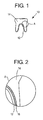
- Figure 1 is a schematic illustration of a dental article formed according to one aspect of the present invention.
- Figure 2 is a magnified sectional view of a portion the article of Figure 1 .
- alloy(s) of the present invention there are several properties exhibited by alloy(s) of the present invention that make it suitable for porcelain fused to metal (PFM) applications.
- the alloy is grey in color with an oxide coating for bonding porcelain to the oxidized cast alloy substrate.
- the alloy has mechanical properties for cast prostheses and for the support of the porcelain and is readily polished to a bright sheen.
- the alloy is based on a portion of the palladium - cobalt binary system wherein palladium is about 20 to about 90 wt.% and cobalt is about 10 to about 80 wt.% to obtain a coefficient of thermal expansion (CTE) in the range of about 14.0 to about 15.3.
- CTE coefficient of thermal expansion
- the base Pd/Co alloy can have a solidus high enough that no melting occurs during firing of normal porcelains, and a coefficient (CTE) in a range that has been demonstrated to be compatible with porcelains.
- CTE coefficient
- the alloy of the invention can be readily cast by normal dental procedures, and can be recast using normal dental laboratory procedures.
- the cast alloy unit can be ground and polished to a high shine.
- the alloy can have a light oxide color that does not affect the apparent color of the porcelain layer and the oxide does not increase during the firing of the porcelain. When heated to the porcelain firing temperature, a thin, continuous, tenacious oxide is formed, which enters into a bond with the porcelain.
- the alloy has a strength that withstands loads in excess of those that would cause pain to the patient.
- the alloy of the present invention can meet aesthetic needs while using a palladium-cobalt base. That is, the alloy system reproduces the normal coloration of natural dentition.
- the enamel layer of healthy natural dentition is quite translucent and porcelain can be made with similar translucency. The translucency of enamel allows the color of healthy dentine to be seen. This color normally has a yellowish tint.
- a layer of oxide must be present to form a bond with the porcelain. While high gold alloys may provide a yellowish background for the porcelain, other metals they are cost prohibitive and alloys such as nickel, cobalt, palladium, etc., provide a gray background. For proper bonding, the alloying elements form an oxide on the cast metal surface.
- the alloy system of the present invention may include elements added to regulate the amount and color of the oxide layer, selected from the group including, but not limited to: aluminum, boron, chromium, and/or silicon.
- alloying elements selected from the group comprising, but not limited to: chromium, silicon, tantalum, titanium, and/or tungsten may be added to the alloy formulation.
- the above mentioned standards do not require minimum or maximum values for coefficient of thermal expansion (CTE); however, physical properties including the CTE value for both porcelain and alloy may be regulated.
- the alloy of the invention may include elements added to regulate the grain size, selected from the group including, but not limited to: chromium, gallium, tantalum, titanium, tungsten, rhenium and/or ruthenium.
- Elements that can be added to regulate oxidation during melting and casting include but are not limited to: aluminum, boron, lithium, silicon. Also, heat transfer rate may be taken into consideration.
- shrinkage of both porcelain and alloy take place and the alloy, which cools faster, shrinks faster and thus puts tensile forces on the porcelain to metal bond. If this disparity of shrinkage is too much, the porcelain will no longer be bonded to the alloy when the composite reaches room temperature. It is readily understood that the solidus of the alloy must be sufficiently higher than the firing temperature of the porcelain so that the alloy is not even partially melted during firing.
- the bonding of the porcelain to the alloy of the invention it does not occur between porcelain and metal, it occurs between porcelain and the metal oxide layer formed when the alloy is heated prior to and during the firing of the porcelain. If the oxide is not adherent to the alloy, it can be simply removed by the porcelain. Some of the bond is simply mechanical but the primary bonding takes place as a mutual solution of metal oxide in porcelain and vice versa. If the oxide is not soluble in the porcelain and/or vice versa, no bond takes place.
- FIGS 1-2 An illustrative embodiment of certain aspects of the present invention is shown in Figures 1-2 .
- a composite comprising an alloy formed according to the present invention is illustrated therein.
- the composite is illustrated in the form of a dental article 10, such as a restoration.
- the dental article 10 may include an alloy 12 formed according to the principles of the present invention, as set forth above, in combination with a second material, such as a porcelain layer 14 bonded thereto.
- the alloy 12 is bonded to the second material or porcelain 14 via an oxide layer 16, as described herein.
- the present invention is not limited to the illustrated embodiment, and numerous alternative composites and/or dental articles are contemplated. In the following, further embodiments of the invention are described in form of numbered paragraphs.
- the CTE should be in the range of about 14.0 to about 15.3.
- the CTE of such an alloy be somewhere between the CTE's of each metals. It has been determined that this does not necessarily hold necessarily true for alloys of palladium and cobalt.
- Pd has a CTE of 12.5 and Co 11.75
- the alloys of the invention comprising an alloy of Pd/Co have higher values as shown in the following examples, where the amounts listed are in % by weight:
- the minimum solidus temperature of alloys of certain embodiments of the invention is to determined to be about 1025°C, in order that the alloy does not start to melt during the firing of porcelain on its surface.
- TYPE Noble PFM / Type-4 / ISO 9693 31- VI Composition: Palladium: 28+/- 0 .80 %; Co: 55 - 58 %; Cr: 8.0 - 11.0 %; W: 2.5 - 4.0 %; Ga: 1.0 - 2.5 %; (Al, Si, B & Li: ⁇ 1.0 %).
Landscapes
- Chemical & Material Sciences (AREA)
- Engineering & Computer Science (AREA)
- Materials Engineering (AREA)
- Mechanical Engineering (AREA)
- Metallurgy (AREA)
- Organic Chemistry (AREA)
- Health & Medical Sciences (AREA)
- Oral & Maxillofacial Surgery (AREA)
- Plastic & Reconstructive Surgery (AREA)
- Epidemiology (AREA)
- Life Sciences & Earth Sciences (AREA)
- Animal Behavior & Ethology (AREA)
- General Health & Medical Sciences (AREA)
- Public Health (AREA)
- Veterinary Medicine (AREA)
- Dental Preparations (AREA)
- Dental Prosthetics (AREA)
Abstract
Description
- This invention provides a novel palladium-cobalt based alloy. The alloy can be used, for example, in making cast metal dental articles or restorations and, in particular, for alloy-porcelain (porcelain fused to metal ("PFM)) restorations.
- In the discussion that follows, reference is made to certain structures and/or methods. However, the following references should not be construed as an admission that these structures and/or methods constitute prior art. Applicant expressly reserves the right to demonstrate that such structures and/or methods do not qualify as prior art.
- Since the late 1950s, dental crowns, bridges, and the like have been made with a composite including a cast metal substrate with a veneer of porcelain fabricated in such a manner that there is a bond between metal and porcelain such that the composite is stronger than the individual component parts. There are several aspects to be addressed when formulating such composites.
- Aesthetics is one aspect to be considered. The primary reason for the use of such a composite is to reproduce the normal coloration of natural dentition. The enamel layer of healthy natural dentition is quite translucent and porcelain can be made with equal translucency. The translucency of enamel allows the color of healthy dentine to be seen. The dentine color normally has a yellowish tint. For a porcelain/alloy combination to be effective as a composite, a layer of oxide must be present on the alloy to form a bond with the porcelain. While high gold alloys may provide a suitable yellowish background for the porcelain for proper aesthetics, the alloying elements can form a dark gray to black colored oxide layer, which can screen out this underlying yellowish background color. Moreover, larger amounts of alloying elements form a colored oxide layer that can further reduce or eliminate the underlying gold color of the alloy.
- Mechanical properties are another aspect to be considered. The American National Standards Institute/American Dental Association ("ANSI/ADA") specification #38 and International Organization for Standardization ("ISO") standard ISO9693 require a yield strength of at least 250 megapascal ("MPa") for the alloy. To attain such strength in gold-based alloys, significant amounts of alloying elements must be added, the result being alloys having a color that is closer to gray. It was thought that it is necessary to provide great strength because the alloy supported porcelain, which had little strength, particularly in tension, and zero ductility. Any slight deformation of the metal can cause fracture of the porcelain layer. The minimum for the standards mentioned above were set on the basis of testing alloys that were being successfully used at the time of the development of the standards. Subsequently, the minimum requirement has been questioned since alloys with less than this minimum have been used successfully. Also, it has been shown that the minimum requirement for single crowns should be lower than that for crowns composed of three or more unit bridges.
- An unpublished work at the University of Kiel in Germany has indicated that from 30 to 35 kilograms of force causes pain to patients while, in one instance, 75 kilograms of force caused fracture of the tooth.
- Physical properties are another aspect to be considered. Although the above-mentioned standards do not require either minimum or maximum values for the coefficient of thermal expansion ("CTE"), these standards require that the CTE value be given for both porcelain and alloy. This is because the popular conception is that the coefficients of porcelain and metal should be "matched" in order to assure compatibility of the two. This concept fails to take into consideration that stresses between the two occur during cooling rather than during heating, and the cooling rates of porcelain and metal vary very significantly.
- It is readily understood that the solidus of the alloy must be sufficiently higher than the firing temperature of the porcelain so that the alloy is not even partially melted during firing of the porcelain.
- Chemical properties are another aspect to be considered. The bonding of porcelain to metal does not occur directly; rather it occurs between porcelain and a metal oxide layer. Normal PFM procedure is to heat the cast alloy to a suitable temperature to produce a metal oxide layer on the surface of the alloy. If this oxide does not adhere to the alloy, it can be simply removed by its attachment to the porcelain. Some of the bond is simply mechanical but the primary bonding takes place as a mutual solution of metal oxide in porcelain and vice versa. If the oxide is not soluble in the porcelain and/or vice versa, no bonding takes place. When the porcelain is fired, small particles and larger particle surfaces are fused (melted) and this liquid porcelain and the metal oxide layer form a solution by either liquid or solid diffusion.
- The present invention provides compositions, materials and techniques that can optionally address one or more of the abovementioned shortcomings associated with conventional technology.
- An aspect of the present invention provides an alloy which can be manufactured by the normal melt process, cast into a bar and rolled to the required thickness or alternatively, by the atomization and compression method of
U.S. Pat. No. 5,799,386 to Ingersoll et al. entitled Process Of Making Metal Castings, issued Sep. 1, 1998, which is incorporated herein by reference in its entirety. - Another aspect of the present invention provides an alloy which has a solidus high enough that no fusion occurs during firing of normal porcelains.
- Another aspect of the present invention provides an alloy which has a CTE in a range that has been shown to be compatible with porcelains.
- Another aspect of the present invention is to provide an alloy which can be readily cast by normal dental procedures, and can be recast using normal dental laboratory procedures.
- Another aspect of the present invention provides a cast alloy unit which can be ground and polished to a high shine.
- Another aspect of the present invention provides an alloy which has a light oxide color that does not affect the apparent color of the porcelain layer and the oxide does not increase during the firing of the porcelain.
- Another aspect of the present invention provides an alloy which when heated to the porcelain firing temperature, a thin, continuous, tenacious oxide is formed which enters into a bond with the porcelain.
- Another aspect of the present invention provides an alloy which has the strength to withstand loads in excess of those that would cause pain to the patient.
- An alloy formed according to one embodiment of the invention is a palladium - cobalt binary alloy wherein palladium is about 20 to about 90 wt.% and cobalt is about 10 to about 80 wt.%. The coefficient of thermal expansion (CTE) is about 14.0 to about 15.3. From about 0 wt. % up to about 20 wt.% of the following metals can be added to the base Pd/Co alloy: aluminum, boron, chromium, gallium, lithium, rhenium, ruthenium, silicon, tantalum, titanium, tungsten or combinations thereof.
- Another aspect of the present invention is to provide an alloy comprising about 27 to about 30 wt.% Pd, about 55 to about 58 wt.% Co, about 8 to about 11 wt.% Cr, about 2.5 to about 4 wt.% W, about 1 to about 2.5 wt.% Ga and less than about 1 wt.% Al, Si, B, Li, or combinations thereof.
- Another aspect of the present invention is to provide a dental article or restoration comprising a dental porcelain composition fused to a dental alloy, the alloy comprising from about 20 to about 90 wt.% Pd, about 10 to about 80 wt.% Co and about 0 to about 20 wt.% aluminum, boron, chromium, gallium, lithium, rhenium, ruthenium, silicon, tantalum, titanium, tungsten or combinations thereof.
- According to yet another aspect, the present invention provides an alloy comprising a base composition comprising palladium and cobalt, the amount of palladium and cobalt, expressed as a ratio is about 10:80 to about 80:10, the alloy further comprising about 0 to about 30 wt.% additives selected from: Au, Pt, Cr, Mo, W, Fe, Al, Si, Mn, Ga, Ta, Ti, Ru, Re, and combinations thereof, wherein the coefficient of thermal expansion of the alloy is about 14.0 to about 15.5 at 25-500°C.
- According to an additional aspect, the present invention provides one or more of the above-described alloys in combination with a ceramic or a glass-ceramic material, which can optionally comprise porcelain.
- According to further aspects, the alloy(s) and ceramic or glass-ceramic are bonded together, optionally by an oxide layer. According to still further aspects, a dental article, such as, for example, a restoration such as a crown or a bridge can comprise the alloy and/or combination of the present invention.
- These and other aspects of the present invention will become apparent upon a review of the following detailed description and accompanying examples which are recited herein as illustrative of the present invention but in no way limit the present invention.
-
Figure 1 is a schematic illustration of a dental article formed according to one aspect of the present invention. -
Figure 2 is a magnified sectional view of a portion the article ofFigure 1 . - There are several properties exhibited by alloy(s) of the present invention that make it suitable for porcelain fused to metal (PFM) applications. The alloy is grey in color with an oxide coating for bonding porcelain to the oxidized cast alloy substrate. The alloy has mechanical properties for cast prostheses and for the support of the porcelain and is readily polished to a bright sheen. The alloy is based on a portion of the palladium - cobalt binary system wherein palladium is about 20 to about 90 wt.% and cobalt is about 10 to about 80 wt.% to obtain a coefficient of thermal expansion (CTE) in the range of about 14.0 to about 15.3. Up to about 20 wt.% of the following metals can be added to the base Pd/Co alloy: aluminum, boron, chromium, gallium, lithium, rhenium, ruthenium, silicon, tantalum, titanium, tungsten or combinations thereof, to improve physical, chemical, mechanical and handling properties. The alloy of the invention can have a solidus high enough that no melting occurs during firing of normal porcelains, and a coefficient (CTE) in a range that has been demonstrated to be compatible with porcelains.
- The alloy of the invention can be readily cast by normal dental procedures, and can be recast using normal dental laboratory procedures. The cast alloy unit can be ground and polished to a high shine. The alloy can have a light oxide color that does not affect the apparent color of the porcelain layer and the oxide does not increase during the firing of the porcelain. When heated to the porcelain firing temperature, a thin, continuous, tenacious oxide is formed, which enters into a bond with the porcelain. The alloy has a strength that withstands loads in excess of those that would cause pain to the patient.
- The alloy of the present invention can meet aesthetic needs while using a palladium-cobalt base. That is, the alloy system reproduces the normal coloration of natural dentition. The enamel layer of healthy natural dentition is quite translucent and porcelain can be made with similar translucency. The translucency of enamel allows the color of healthy dentine to be seen. This color normally has a yellowish tint. With the porcelain alloy combination, a layer of oxide must be present to form a bond with the porcelain. While high gold alloys may provide a yellowish background for the porcelain, other metals they are cost prohibitive and alloys such as nickel, cobalt, palladium, etc., provide a gray background. For proper bonding, the alloying elements form an oxide on the cast metal surface. This dark gray to black colored oxide layer, can affect the apparent color of the porcelain veneering layer. The alloy system of the present invention may include elements added to regulate the amount and color of the oxide layer, selected from the group including, but not limited to: aluminum, boron, chromium, and/or silicon.
- The mechanical properties of the alloy follow ANSI/ADA specification #38 and ISO standard ISO9693 which require yield strength of at least about 250 MPa for the alloy. To attain such strength, significant amounts of alloying elements selected from the group comprising, but not limited to: chromium, silicon, tantalum, titanium, and/or tungsten may be added to the alloy formulation.
- The above mentioned standards do not require minimum or maximum values for coefficient of thermal expansion (CTE); however, physical properties including the CTE value for both porcelain and alloy may be regulated. The alloy of the invention may include elements added to regulate the grain size, selected from the group including, but not limited to: chromium, gallium, tantalum, titanium, tungsten, rhenium and/or ruthenium.
- Elements that can be added to regulate oxidation during melting and casting include but are not limited to: aluminum, boron, lithium, silicon. Also, heat transfer rate may be taken into consideration. When cooling from the porcelain firing temperature, shrinkage of both porcelain and alloy take place and the alloy, which cools faster, shrinks faster and thus puts tensile forces on the porcelain to metal bond. If this disparity of shrinkage is too much, the porcelain will no longer be bonded to the alloy when the composite reaches room temperature. It is readily understood that the solidus of the alloy must be sufficiently higher than the firing temperature of the porcelain so that the alloy is not even partially melted during firing.
- Concerning the bonding of the porcelain to the alloy of the invention, it does not occur between porcelain and metal, it occurs between porcelain and the metal oxide layer formed when the alloy is heated prior to and during the firing of the porcelain. If the oxide is not adherent to the alloy, it can be simply removed by the porcelain. Some of the bond is simply mechanical but the primary bonding takes place as a mutual solution of metal oxide in porcelain and vice versa. If the oxide is not soluble in the porcelain and/or vice versa, no bond takes place.
- An illustrative embodiment of certain aspects of the present invention is shown in
Figures 1-2 . A composite comprising an alloy formed according to the present invention is illustrated therein. Specifically, the composite is illustrated in the form of adental article 10, such as a restoration. As illustrated, thedental article 10 may include analloy 12 formed according to the principles of the present invention, as set forth above, in combination with a second material, such as aporcelain layer 14 bonded thereto. As best illustrated inFigure 2 , thealloy 12 is bonded to the second material orporcelain 14 via anoxide layer 16, as described herein. Of course, the present invention is not limited to the illustrated embodiment, and numerous alternative composites and/or dental articles are contemplated.
In the following, further embodiments of the invention are described in form of numbered paragraphs. - 1. An alloy comprising a base composition comprising about 20 to about 90 weight % palladium and about 10 to 80 weight % cobalt, the alloy further comprising about 0 to about 20 weight %; aluminum, boron, chromium, gallium, lithium, rhenium, ruthenium, silicon, tantalum, titanium, tungsten or combinations thereof; wherein the coefficient of thermal expansion for the alloy of about 14.0 to about 15.2 at 25 - 500°C.
- 2. The alloy of paragraph 1, comprising about 30 to about 43 weight % palladium, about 57 to about 70 weight % cobalt, about 0 to about 10 weight % additives, and the coefficient of thermal expansion at about 14.0 to about 14.7 at 25 - 500°C.
- 3. The alloy of paragraph 1, comprising about 33 to about 47 weight % palladium, about 53 to about 67 weight % cobalt, about 2 to about 20 weight % Cr, about 0 to about 10 weight % additives, and the coefficient of thermal expansion of about 14.4 to about 14.6 at 25 - 500°C.
- 4. The alloy of paragraph 1, comprising about 27 to about 30 weight % palladium, about 55 to about 58 weight % cobalt, about 8 to about 11 weight % chromium, about 2.5 to about 4 weight % tungsten, about 1 to about 2.5 weight % gallium, and wherein the amount of aluminum, silicon, boron and lithium or combinations thereof is less than about 1 weight %.
- 5. The alloy of paragraph 1, comprising about 28.2 weight % palladium, about 56 weight % cobalt, about 10 weight % chromium, about 3 weight % tungsten, about 1.5 weight % gallium, and wherein the amount of Al Si, B, Li, or combinations thereof is less than about 1 weight %, and the coefficient of thermal expansion is about 14.2 at 25-500°C.
- 6. An alloy comprising a base composition comprising palladium and cobalt, the amount of palladium and cobalt, expressed as a ratio is about 10:80 to about 80:10, the alloy further comprising about 0-30 weight % additives selected from: Au, Pt, Cr, Mo, W, Fe, Al, Si, Mn, Ga, Ta, Ti, Ru, Re, and combinations thereof, wherein the coefficient of thermal expansion of the alloy is about 14.0 to about 15.5 at 25-500°C.
- 7. In combination, the alloy of any one of paragraphs 1 to 6 bonded to a ceramic or glass-ceramic material.
- 8. The combination of paragraph 7, wherein the ceramic or glass-ceramic material comprises porcelain.
- 9. The combination of paragraph 7 or 8, wherein the bond comprises an oxide layer.
- 10. A dental article comprising the combination of any one of paragraphs 7 to 9.
- 11. The dental article of
paragraph 10, comprising: a dental crown or dental bridge. - The following examples are for the purpose of illustration. It is understood that such detail is solely for that purpose, and variations can be made therein by those skilled in the art without departing from the spirit and scope of the invention which is defined by the following claims.
- For successful use of the alloys of the invention with porcelains in contemporary use, the CTE should be in the range of about 14.0 to about 15.3. When two metals comprise the base of an alloy, it would be expected that the CTE of such an alloy be somewhere between the CTE's of each metals. It has been determined that this does not necessarily hold necessarily true for alloys of palladium and cobalt. Whereas Pd has a CTE of 12.5 and Co 11.75, the alloys of the invention comprising an alloy of Pd/Co have higher values as shown in the following examples, where the amounts listed are in % by weight:
-
Table 1 Ex. No. 1 2 3 4 5 6 7 Pd 10 20 30 40 50 70 90 Co 90 80 70 60 50 30 10 CTE 13.85 14.0 14.1 14.6 14.9 15.2 14.2 - The minimum solidus temperature of alloys of certain embodiments of the invention is to determined to be about 1025°C, in order that the alloy does not start to melt during the firing of porcelain on its surface.
-
Table 2 Ex. No. 8 9 10 11 12 Pd 65 33.8 61.8 27.0 28.2 Co 35 60.4 31.0 52.3 56.0 Cr 1.2 16.2 10.0 Mo 2.4 2.0 Si 1.0 0.7 0.6 0.05 Fe 0.3 W 3.0 Ga 2.0 Al 1.2 1.6 0.35 Ta 0.8 Nb 3.0 Re 0.6 Ru 0.6 0.8 0.5 Li 0.1 0.1 0.2 B 0.2 Solidus T 1219°C 1014°C 1250°C 976°C 1047°C - Alloys 9 and 11 do not appear not to meet the required minimum solidus temperature.
- TYPE: Noble PFM / Type-4 / ISO 9693
31- VI
Composition: Palladium: 28+/- 0 .80 %; Co: 55 - 58 %; Cr: 8.0 - 11.0 %; W: 2.5 - 4.0 %; Ga: 1.0 - 2.5 %; (Al, Si, B & Li: < 1.0 %).Density: 9.0gm/cc Color: Crucible: WHITE Ceramic
Casting Temperature: 1410 - 1460°C (2570 - 2660°F)
Melting Temperature: 1100 - 1350°C (2010 - 2460°F)
Oxidation Cycle: 925°C / 5 minute / AIR
Porcelain Compatibility: IPS d. Sign; IPS Classics & InLine.
Tensile Properties:
U.T.S 0.2 % offset Proof Stress Percent Elongation Mod. Of Elasticity Hardness:
C.T.E: @ 25-500°C @ 20 - 600°C
Pore. Cycle:
800 MPa 610 MPa 9.0% 175,000 MPa
365 VHN
14.2 x 10⁻⁶/°C/inch/inch; 14.8 x 10⁻⁶/°C/inch /inch -
Table 3 Elements 14 15 16 17 18 19 20 21 Pd 23 21.1 23 29.3 36.3 22 16.2 12.5 Co 46.6 58.6 54 58 48 50 50.5 58.5 Cr 24.4 16.1 16 14.5 18.2 11.5 Au 2.2 3.7 1.8 6.0 9.0 Pt 4.0 5.8 9.0 Mo 1.0 0.9 1.5 3.0 3.0 W 3.4 3.5 Mn 0.1 0.1 0.1 0.5 0.6 0.5 Al 3.0 3.4 Si 1.2 1.0 0.8 0.7 1.0 Ga 1.2 1.5 B 0.1 0.1 0.1 Ti 1.2 Ta 0.6 0.5 1.0 Re 0.1 0.2 0.2 Ru 0.8 0.8 3.0 4.0 4.0 Li 0.1 0.1 0.1 0.1 0.1 Solidus: 1182°C 1133°C 1088°C 955°C 1013°C 1010°C 1243°C 1197°C Alloys 17, 18 and 19 do not meet the required minimum solidus temperature. - All numbers expressing quantities of ingredients, constituents, reaction conditions, and so forth used in the specification are to be understood as being modified in all instances by the term "about." Notwithstanding that the numerical ranges and parameters set forth, the broad scope of the subject matter presented herein are approximations, the numerical values set forth are indicated as precisely as possible. Any numerical value, however, may inherently contain certain errors resulting, for example, from their respective measurement techniques, as evidenced by standard deviations therefrom.
- Although the present invention has been described in connection with preferred embodiments thereof, it will be appreciated by those skilled in the art that additions, deletions, modifications, and substitutions not specifically described may be made without departing from the spirit and scope of the invention as defined in the appended claims.
Claims (15)
- An alloy comprising a base composition comprising about 20 to about 90 weight % palladium and about 10 to 80 weight % cobalt, the alloy further comprising about 0 to about 20 weight %; aluminum, boron, chromium, gallium, lithium, rhenium, ruthenium, silicon, tantalum, titanium, tungsten or combinations thereof; wherein tantalum is present in the alloy and wherein the coefficient of thermal expansion for the alloy is about 14.0 to about 15.2 x 10⁻⁶/°C at 25 - 500°C.
- The alloy of claim 1, wherein tungsten is present in the alloy.
- The alloy of claim 1 or 2, wherein chromium is present in the alloy.
- The alloy of any one of claims 1 to 3, wherein boron is present in the alloy.
- The alloy of any one of claims 1 to 4, comprising a base composition comprising about 30 to about 43 weight % palladium and about 57 to about 70 weight % cobalt, the alloy further comprising about 0 to about 10 weight % additives, wherein the coefficient of thermal expansion for the alloy is about 14.0 to about 14.7 x 10⁻⁶/°C at 25 - 500°C.
- The alloy of any one of claims 1 to 4, comprising a base composition comprising about 33 to about 47 weight % palladium and about 53 to about 67 weight % cobalt, the alloy further comprising about 2 to about 20 weight % chromium and about 0 to about 10 weight % additives, wherein the coefficient of thermal expansion for the alloy is about 14.4 to about 14.6 x 10⁻⁶/°C at 25 - 500°C.
- An alloy comprising a base composition comprising palladium and cobalt, the amount of palladium and cobalt, expressed as a ratio is about 10:80 to about 80:10, the alloy further comprising about 0-30 weight % additives selected from: Au, Pt, Cr, Mo, W, Fe, Al, Si, Mn, Ga, Ta, Ti, Ru, Re, and combinations thereof, wherein Ta is present in the alloy and wherein the coefficient of thermal expansion of the alloy is about 14.0 to about 15.5 x 10⁻⁶/°C at 25-500°C.
- The alloy of claim 7, wherein W is present in the alloy.
- The alloy of claim 7 or 8, wherein Cr is present in the alloy.
- The alloy of any one of claims 7 to 9, wherein B is present in the alloy.
- The alloy of any one of claims 1 to 10, wherein the alloy has a minimum solidus temperature of about 1025°C.
- Use of the alloy of any one of claims 1 to 11 for making a dental article, wherein the alloy is bonded to a ceramic or glass-ceramic material.
- The use of claim 12, wherein the ceramic or glass-ceramic material comprises porcelain.
- A dental article comprising the combination of the alloy of any one of claims 1 to 11 bonded to a ceramic or glass-ceramic material.
- The dental article of claim 14, comprising: a dental crown or dental bridge.
Applications Claiming Priority (4)
| Application Number | Priority Date | Filing Date | Title |
|---|---|---|---|
| US84467206P | 2006-09-15 | 2006-09-15 | |
| US11/543,917 US20080070192A1 (en) | 2006-09-15 | 2006-10-06 | Palladium-cobalt based alloys for dental prestheses including porcelain fused to metal |
| US11/892,933 US20080070058A1 (en) | 2006-09-15 | 2007-08-28 | Palladium-cobalt based alloys and dental articles including the same |
| EP07116294.5A EP1900836B1 (en) | 2006-09-15 | 2007-09-13 | Palladium-cobalt based alloys and dental articles including the same |
Related Parent Applications (1)
| Application Number | Title | Priority Date | Filing Date |
|---|---|---|---|
| EP07116294.5 Division | 2007-09-13 |
Publications (2)
| Publication Number | Publication Date |
|---|---|
| EP2312002A2 true EP2312002A2 (en) | 2011-04-20 |
| EP2312002A3 EP2312002A3 (en) | 2012-10-31 |
Family
ID=38626293
Family Applications (2)
| Application Number | Title | Priority Date | Filing Date |
|---|---|---|---|
| EP10012632A Withdrawn EP2312002A3 (en) | 2006-09-15 | 2007-09-13 | Palladium-cobalt based alloys and dental articles including the same |
| EP07116294.5A Active EP1900836B1 (en) | 2006-09-15 | 2007-09-13 | Palladium-cobalt based alloys and dental articles including the same |
Family Applications After (1)
| Application Number | Title | Priority Date | Filing Date |
|---|---|---|---|
| EP07116294.5A Active EP1900836B1 (en) | 2006-09-15 | 2007-09-13 | Palladium-cobalt based alloys and dental articles including the same |
Country Status (6)
| Country | Link |
|---|---|
| EP (2) | EP2312002A3 (en) |
| JP (1) | JP2010503772A (en) |
| KR (1) | KR20090058565A (en) |
| CN (2) | CN102061404A (en) |
| MX (1) | MX2009002777A (en) |
| WO (1) | WO2008033355A2 (en) |
Cited By (1)
| Publication number | Priority date | Publication date | Assignee | Title |
|---|---|---|---|---|
| RU2582836C1 (en) * | 2015-04-24 | 2016-04-27 | Сергей Алексеевич Костин | Palladium-based jewellery alloy hardened with intermetallides containing cobalt (versions) |
Families Citing this family (9)
| Publication number | Priority date | Publication date | Assignee | Title |
|---|---|---|---|---|
| US8623272B2 (en) | 2007-03-21 | 2014-01-07 | The Argen Corporation | Non-magnetic cobalt-palladium dental alloy |
| CN102876928A (en) * | 2011-07-12 | 2013-01-16 | 义获嘉·伟瓦登特公司 | Palladium-cobalt based alloys |
| DE102012223239A1 (en) * | 2012-12-14 | 2014-06-18 | BEGO Bremer Goldschlägerei Wilh. Herbst GmbH & Co. KG | Noble metal-dental alloy made of e.g. cobalt, ruthenium, rhodium, palladium, osmium, iridium or platinum, chromium, molybdenum and tungsten, useful for producing metallic component, preferably a dental component as dental restoration |
| CN103451479A (en) * | 2013-08-26 | 2013-12-18 | 苏州长盛机电有限公司 | Composite dental alloy |
| JP6524500B2 (en) * | 2014-07-03 | 2019-06-05 | 国立大学法人東北大学 | Alloys and dental prostheses for baking dental porcelain excellent in oxidation resistance |
| CN106041105A (en) * | 2016-05-25 | 2016-10-26 | 安徽省春谷3D打印智能装备产业技术研究院有限公司 | High-strength cobalt-tantalum-molybdenum alloy medical 3D-printing metal powder and preparation method thereof |
| US11427894B2 (en) | 2019-08-02 | 2022-08-30 | The Argen Corporation | Cobalt based platinum-containing noble dental alloys |
| CN115161516B (en) * | 2022-07-18 | 2023-03-21 | 嘉兴数字三维智能制造研究院有限公司 | Cobalt-chromium alloy powder material special for dentistry |
| CN121472642B (en) * | 2026-01-11 | 2026-03-31 | 合肥格物新材料科技有限公司 | Preparation method of mixed solid solution Ni-Pd-Re-Sc-Ti precise alloy slab |
Citations (1)
| Publication number | Priority date | Publication date | Assignee | Title |
|---|---|---|---|---|
| US5799386A (en) | 1994-10-24 | 1998-09-01 | Ivoclar Ag | Process of making metal castings |
Family Cites Families (9)
| Publication number | Priority date | Publication date | Assignee | Title |
|---|---|---|---|---|
| JPS5351123A (en) * | 1976-10-22 | 1978-05-10 | Hitachi Metals Ltd | Low melting point magnetic alloy |
| DE3009650C2 (en) * | 1980-03-13 | 1982-11-04 | Degussa Ag, 6000 Frankfurt | Gold-free alloys for firing ceramic bodies |
| JPS58110633A (en) * | 1981-11-26 | 1983-07-01 | Hitachi Metals Ltd | Dental alloy |
| JPS58153743A (en) * | 1982-03-08 | 1983-09-12 | Res Inst Electric Magnetic Alloys | Palladium-cobalt alloy useful as magnetostrictive working body and manufacture thereof |
| US4387072A (en) * | 1982-04-27 | 1983-06-07 | The J. M. Ney Company | Novel palladium alloy and dental restorations utilizing same |
| NL8503284A (en) * | 1985-11-27 | 1987-06-16 | Elephant Edelmetaal Bv | PALLADIUM COBAL ALLOYS; MANUFACTURE OF A CARROT. |
| JPH0230104A (en) * | 1988-07-20 | 1990-01-31 | Sony Corp | Vertically magnetized film |
| US5916518A (en) * | 1997-04-08 | 1999-06-29 | Allison Engine Company | Cobalt-base composition |
| CA2372911C (en) * | 1999-05-07 | 2015-01-27 | Rolls-Royce Corporation | Cobalt-base composition and method for diffusion braze repair of superalloy articles |
-
2007
- 2007-09-12 CN CN2010105525794A patent/CN102061404A/en active Pending
- 2007-09-12 WO PCT/US2007/019751 patent/WO2008033355A2/en not_active Ceased
- 2007-09-12 MX MX2009002777A patent/MX2009002777A/en unknown
- 2007-09-12 CN CN2007800424721A patent/CN101535513B/en not_active Expired - Fee Related
- 2007-09-12 JP JP2009528259A patent/JP2010503772A/en active Pending
- 2007-09-12 KR KR1020097007690A patent/KR20090058565A/en not_active Withdrawn
- 2007-09-13 EP EP10012632A patent/EP2312002A3/en not_active Withdrawn
- 2007-09-13 EP EP07116294.5A patent/EP1900836B1/en active Active
Patent Citations (1)
| Publication number | Priority date | Publication date | Assignee | Title |
|---|---|---|---|---|
| US5799386A (en) | 1994-10-24 | 1998-09-01 | Ivoclar Ag | Process of making metal castings |
Cited By (1)
| Publication number | Priority date | Publication date | Assignee | Title |
|---|---|---|---|---|
| RU2582836C1 (en) * | 2015-04-24 | 2016-04-27 | Сергей Алексеевич Костин | Palladium-based jewellery alloy hardened with intermetallides containing cobalt (versions) |
Also Published As
| Publication number | Publication date |
|---|---|
| WO2008033355A2 (en) | 2008-03-20 |
| WO2008033355A3 (en) | 2008-07-17 |
| EP2312002A3 (en) | 2012-10-31 |
| KR20090058565A (en) | 2009-06-09 |
| EP1900836B1 (en) | 2013-11-06 |
| CN101535513B (en) | 2012-03-28 |
| CN102061404A (en) | 2011-05-18 |
| HK1130295A1 (en) | 2009-12-24 |
| EP1900836A1 (en) | 2008-03-19 |
| CN101535513A (en) | 2009-09-16 |
| JP2010503772A (en) | 2010-02-04 |
| MX2009002777A (en) | 2009-06-02 |
Similar Documents
| Publication | Publication Date | Title |
|---|---|---|
| EP1900836B1 (en) | Palladium-cobalt based alloys and dental articles including the same | |
| US20080070058A1 (en) | Palladium-cobalt based alloys and dental articles including the same | |
| US6756012B2 (en) | High expansion dental alloys | |
| US7491361B2 (en) | Burning-on alloy for the production of ceramically veneered dental restorations | |
| US4606887A (en) | Cobalt alloys for the production of dental prothesis | |
| Anusavice | Noble metal alloys for metal-ceramic restorations | |
| US20110275033A1 (en) | Palladium-Cobalt Based Alloys | |
| CA2043429C (en) | Palladium alloys for dental implant restorations | |
| US6656420B2 (en) | Dental alloys | |
| US4319877A (en) | Palladium-based dental alloy containing indium and tin | |
| US4261744A (en) | Palladium-based dental alloy containing indium and tin | |
| US20020122741A1 (en) | Dental alloys | |
| US20080070192A1 (en) | Palladium-cobalt based alloys for dental prestheses including porcelain fused to metal | |
| EP2545895A2 (en) | Palladium-Cobalt based alloys | |
| US6913656B2 (en) | High gold alloy for porcelain fused to metal dental restorations | |
| US10653585B2 (en) | Palladium based alloys | |
| HK1173679A (en) | Palladium-cobalt based alloys | |
| US20240050206A1 (en) | Cobalt-platinum based dental alloy materials | |
| US20070026249A1 (en) | Veneerable silver alloy for producing ceramic-veneered dental restorations | |
| JPS60121248A (en) | Alloy for dental prosthesis | |
| US10123858B2 (en) | Palladium based alloys | |
| US5011311A (en) | Dental alloy | |
| HK1130295B (en) | Palladium-cobalt based alloys and dental articles including the same | |
| JPH0293033A (en) | dental palladium alloy | |
| CN101078073A (en) | Odontology nickel-chromium stove enamel alloy and application thereof |
Legal Events
| Date | Code | Title | Description |
|---|---|---|---|
| PUAI | Public reference made under article 153(3) epc to a published international application that has entered the european phase |
Free format text: ORIGINAL CODE: 0009012 |
|
| AC | Divisional application: reference to earlier application |
Ref document number: 1900836 Country of ref document: EP Kind code of ref document: P |
|
| AK | Designated contracting states |
Kind code of ref document: A2 Designated state(s): AT BE BG CH CY CZ DE DK EE ES FI FR GB GR HU IE IS IT LI LT LU LV MC MT NL PL PT RO SE SI SK TR |
|
| AX | Request for extension of the european patent |
Extension state: AL BA HR MK RS |
|
| RIC1 | Information provided on ipc code assigned before grant |
Ipc: C22C 30/00 20060101ALI20120703BHEP Ipc: C22C 19/07 20060101AFI20120703BHEP Ipc: C22C 5/04 20060101ALI20120703BHEP Ipc: A61K 6/04 20060101ALI20120703BHEP |
|
| PUAL | Search report despatched |
Free format text: ORIGINAL CODE: 0009013 |
|
| AK | Designated contracting states |
Kind code of ref document: A3 Designated state(s): AT BE BG CH CY CZ DE DK EE ES FI FR GB GR HU IE IS IT LI LT LU LV MC MT NL PL PT RO SE SI SK TR |
|
| AX | Request for extension of the european patent |
Extension state: AL BA HR MK RS |
|
| RIC1 | Information provided on ipc code assigned before grant |
Ipc: A61K 6/04 20060101ALI20120927BHEP Ipc: C22C 5/04 20060101ALI20120927BHEP Ipc: C22C 30/00 20060101ALI20120927BHEP Ipc: C22C 19/07 20060101AFI20120927BHEP |
|
| STAA | Information on the status of an ep patent application or granted ep patent |
Free format text: STATUS: THE APPLICATION IS DEEMED TO BE WITHDRAWN |
|
| 18D | Application deemed to be withdrawn |
Effective date: 20130503 |